Tag: FORENSIC EVIDENCE

  • Big Lie About a Small Wound


    Background

    There is no evidence, hard or soft, that supports the single bullet theory. Its defenders spend a lot of “proving” it “could have happened that way” — which is not the same as proving that it did, a distinction they don’t make. But they can’t even prove the SBT hypothetically because the sniper’s nest and the various wounds of the two men do not line up. To solve this problem, promoters of the SBT resort to chicanery. And, in desperation, they squeeze great significance out of minutiae — the small movements of Connally’s jacket and hat — events that occur all the time without the assistance of a bullet, magic or otherwise. Yet they ignore Connally’s more dramatic movements that occur too late to be associated with the same bullet that hit JFK. Worse yet, they stoop to manufacturing evidence.

    One example of manufactured evidence is the lie about Connally’s back wound. Why do supporters of the SBT say the wound was 3 centimeters long, when, in fact, it was only half as long? Why was the 1.5 centimeter wound a problem? Defenders of the theory say that if the Carcano bullet had struck sideways (as opposed to nose-on), it would have created a wound the same size as its length (3 centimeters), and such a long wound would be proof the bullet had been tumbling. If it had been tumbling, this, presumably, would be proof it had struck something else on its way to Connally’s back. The something else in this case: John F. Kennedy.

    Problem: Connally’s back wound was only as long as the wound in the back of Kennedy’s head: 1.5 centimeters — not a size that suggests the bullet was tumbling.


    clip image002

    Adaptation of a drawing demonstrating the hypothetical tumbling bullet. From John Lattimer’s book, Kennedy and Lincoln. Medical and Ballistic Comparisons of Their Assassinations, Harcourt Brace Jovanovich, 1980, page 268.

    The drawing above demonstrates the alleged behavior of the single bullet. The drawing was designed (though not executed) by John Lattimer, a urologist who has published several infomercials in medical journals promoting the lone assassin theory. What is wrong with this picture, aside from the fact that the men are too far apart? Experts assure me the Carcano bullet is much too stable to behave like this. Perforating a neck could divert the bullet, but not make it tumble to this extent in so short a time and in so short a space. (There is more on Lattimer below.)

    The wound in Connally’s back did not indicate a sideways hit any more than the wound in the back of Kennedy’s head. The latter was 1.5 x 0.6 centimeters, and the former, 1.5 x 0.8 centimeters, as documented on at least four occasions by the governor’s thoracic surgeon, Dr. Robert Shaw. (4WCH104,107; 6WCH85,86). The holes in the back of Connally’s shirt and jacket were as small as his back wound. (5WCH64) (See TABLE below.) The damage inside Connally’s chest also disproves a sideways hit. According to Shaw, the bullet created a “small tunneling wound” (7HSCA149) and he noted, “the neat way in which it stripped the rib out without doing much damage to the muscles that lay on either side of it.” (4WCH116) Shaw felt that the shape of the bullet was explained either by a “light tumbling,” or by it striking at a tangent. (6WCH95) It had to have been a tangential hit since the bullet “followed the line of declination of the fifth rib” (4WCH105), i.e., its path slanted downward.

    Connally’s back wound became 3 centimeters when it was surgically enlarged. Shaw explained that in order to clean and debride (cut away devitalized tissue) the wound, he had to enlarge it to twice its size. (6WCH88)

    Despite all this testimony, two doctors — John Lattimer and Michael Baden — found ways to make the magic bullet wound change its size to fit the magic bullet theory. And unethical “investigative journalists,” like Gerald Posner, Gus Russo and Dale Myers, have spread the lie further.

    John Lattimer Exploits a Coincidence

    Bullets and wounds are a bit like keys and locks, and that would make John Lattimer an amateur locksmith. Since a tumbling bullet did not fit into Connally’s back wound, Lattimer changed the lock.

    Some 30 years ago, Lattimer noticed an interesting coincidence: the size of the wound — after it was enlarged — was the same length as a Carcano bullet, 3 centimeters. Lattimer then published an article in which he claimed the wound had been three centimeters long — originally. (Medical Times 1974; 102 November:33-56; Kennedy and Lincoln, Harcourt Brace Jovanovich, 1980) As proof, he published Shaw’s operative report that described the wound as “three cm” — and never explained this was the size after surgical enlargement.

    Lattimer also chose to publish an uncorrected diagram that portrayed the back wound as it was after surgical enlargement (CE 679, 17WCH336) when, instead, he could have published the corrected diagram showing the actual size of the wound (Gregory Exhibit No.1, 20WCH32). See Exhibits A and B.

    On this same deceptive diagram, Lattimer pasted a snippet of testimony in which Shaw agrees the wound, as portrayed in the diagram, is correct — but, omitted from this snippet were statements that made it clear Shaw was talking about the EXIT wound. Lattimer did report that a correction had been made, but lied about its nature: “His careful diagram of the wound of entry (which he revised and initialed) showed it to be elongated in its vertical (not horizontal) axis and to be at least 3 cm in length.” (Medical Times 1974; 102 November:33-56; Kennedy and Lincoln, Harcourt Brace Jovanovich, 1980, page 266) See Exhibits B – F.

    Lattimer included Shaw’s testimony in which he agrees with Arlen Specter that the wound could have been caused by a slightly tumbling bullet — but omitted Shaw’s opinion that it could also have been caused by a tangential hit. (6WCH95) See Exhibit G. Again, it should be noted that this wound was the same length as the entrance into JFK’s head, which supporters of the lone assassin theory say was a tangential hit.

    Michael Baden Stretches the Lie Further

    Dr. Michael Baden who headed the HSCA medical panel, knew the true size of the wound and how it had been enlarged. He had also personally examined the scar on Connally’s back. This is how he described it to the panel:

    “On removing his shirt, it was readily apparent that at the site of gunshot perforation of the upper right back there is now a 1 1/8 -inch long horizontal pale well healed…” (7HSCA 143-144; 240)

    In a book Baden wrote for the public, he doubled the size of the scar:

    “According to Connally’s medical records, the bullet struck him nose first in the back and left a vertical scar. I thought the records were wrong. If it was the same magic bullet, it would have gone in sideways — with the length, not the point, first. After leaving Kennedy, it would have lost its power and became a tumbling bullet, and tumbling bullets rotate. When they finally strike, they strike edgewise. I needed to examine Connally…

    “He removed his shirt. There it was — a two-inch long sideways entrance scar in his back. He had not been shot by a second shooter but by the same flattened bullet that went through Kennedy.” (Unnatural Death: Confessions of a Medical Examiner, Random House 1989, p.20) See Exhibit H.

    Apparently Baden realized that if the original wound had been three centimeters (1.2 inches), then, after its surgical enlargement, the scar would have been even bigger. It was a calculated lie. This is only one of several examples of Michael Baden’s deceptions.

    Gerald Posner, Gus Russo, and Dale Myers Perpetuate the Lie

    Two of these “investigative reporters,” Posner and Russo, never quoted primary sources on the wound, choosing instead to accept the fraudulent claims of Lattimer and Baden. (Gerald Posner. Case Closed. Random House, pp 336, 479; Gus Russo. Live by the Sword: The Secret War Against Castro and the Death of JFK. Bancroft Press, 1998, p.297).

    The third “investigative reporter,” Dale Myers, mimicked Lattimer’s technique of taking testimony out of context. On his website, he wrote: “According to Dr. Robert Shaw’s operative record, the entrance wound in JBC’s body was ‘just lateral to the right [shoulder blade] close [to] the [armpit] yet has passed through the latysmus [latissimus] dorsi muscle…the wound of entrance was approximately [1.2 inches] in its longest diameter.’” (7HSCA142) But Myers omitted what followed immediately after the quote above: “The rear entrance wound was NOT [emphasis mine] 3 centimeters [1.2 inches] (in diameter) as indicated in one of the operative notes. It was a puncture-type wound, as if a bullet had struck the body at slight declination [i.e., not at a right angle]. The wound was actually approximately 1.5 centimeters in diameter. The ragged edges of the wound were surgically cut away, effectively enlarging it to approximately 3 centimeters.” (7HSCA143)

    Conclusion

    Five people, including the head of the second biggest investigation into the medical evidence, Michael Baden, MD, have demonstrated great faith in the public’s inability or unwillingness to make a simple comparison between what they say, and what is a matter of public record.

    Copyright © 2004, by Milicent Cranor


    table

    exhibit a

    exhibit b

    exhibit c

    exhibit d

    exhibit e

    exhibit f

    exhibit g

    exhibit h 19

    exhibit h 20

  • Russo, Myers and the Father of the Magic Bullet

    Russo, Myers and the Father of the Magic Bullet


    specter 2Introduction

    In his book, Gus Russo coined a fantastic new phrase that most people familiar with the Kennedy case would call an oxymoron: The Single Bullet Fact. On the ABC special, Myers used this same term. The phrase has its origins in the Warren Commission’s theory that one bullet, Commission Exhibit 399, went through President Kennedy and Governor John Connally making seven wounds and fracturing two bones, gyrating side to side and up and down on vertical and horizontal planes, and then emerging virtually unscathed at Parkland Hospital, allegedly on the stretcher of Connally. Since the Commission said there were only three shells found on the sixth floor of the Texas School Book Depository, and one bullet injured a bystander named James Tague, and one killed Kennedy by striking his head, this left only one bullet to account for the rest of the wounds. Consider the language the Warren Report uses to express this idea and you will see why responsible people call it a theory: “…one shot passed through the President’s neck and then most probably passed through the Governor’s body…” (Page 111) The reason that most people find this hedged language offensive is that, as Cyril Wecht has stated, the SBT is the backbone of the Warren Report. Without it, the report collapses and you have a conspiracy.

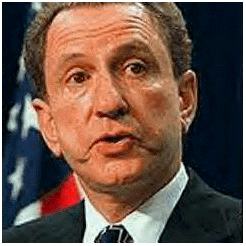
    Arlen Specter (pictured above), a young Philadelphia attorney, who handled the actual ballistics and medical evidence for the Warren Commission, put together the underpinnings of the Single Bullet Theory. In his book of memoirs he labels the SBT the Single Bullet Conclusion, thereby leaving the impression that the evidence he gathered pointed strongly only to that tenet. It is always good to revisit original sources. Which apparently, Russo and Myers and Jennings did not do in preparing their documentary. This is understandable considering Specter’s public appearance on the 40th anniversary of the most important case he ever worked on. We render a description of his performance at the Unviersity of Duquesne’s recent anniversary conference on Kennedy’s assassination below.

    In the interest of public fairness, we ask Mr. Jennings to get the video of this rather gentle colloquy and play it on his nightly news show. We would then like to have Mr. Russo and Mr. Myers respond to the very same questions. In evidentiary terms, those few moments would be worth more than all the “irrefutable” two hours of ABC’s specious special.

    The description below originated as an email; we present it with the permission of its author.


    Hi,

    The conference in Pittsburgh was fantastic! Have you heard about what happened to Arlen Specter? I would have gladly paid 5 times the admission fee just to see what I was so privileged to see — Arlen getting publicly humiliated. Frankly I was absolutely amazed that he showed up in person. But after he gave a droning talk in which he mentioned how the single bullet theory has now been proven to be single bullet “fact” thanks to ABC, he actually stayed for the Q&A and was sitting on the panel with Mark Lane (who the whole time was grinning ear to ear like a kid in a candy store — after 40 long years, he was finally getting a chance to challenge Specter in public), Jim Lesar, and a few others. People were lined up for a mile at the mike to ask questions. But they never had a chance (my friend Bob was going to ask him how he sleeps at night) because just the few preliminary questions by Lesar, who was the moderator, turned the former Yale debate champion into a babbling idiot.

    Lesar first asked Specter how he would put the magic bullet into evidence. When Specter fumbled that one, Lesar pointed out that there was no chain of evidence that would have held up in court and Specter said, “I know a bullet when I see one, and that was a bullet.” Then Lesar asked him who he would call as his witness to put Oswald in the sniper’s nest. Specter didn’t know! Then Lesar pointed out that not only was Howard Brennan their main witness, but he was their only witness, and that he changed his testimony 3 or 4 times and couldn’t identify Oswald in a police line-up that evening. Specter said, “Well, I’ll have to go back and look at the Warren Report again to refresh my memory on that one.”

    At this point Specter’s assistant (bodyguard? office hack? whatever you call these people) jumped on the stage waving his arms like a referee stopping a boxing match when a boxer is getting pounded mercilessly, and says that Mr. Specter has to leave for another appointment. At this point Specter incredibly waved him off in a show of bravado and said that he had come to answer questions. Then Mark Lane asks him why he always asked leading questions of the medical witnesses and pointed out that, again, this would not have been permissible if Oswald had actually been tried in a court of law. Specter vehemently denied that he ever led any witnesses at which point Lesar mentioned that the day before they showed on the big screen many examples from the WC testimony where he actually did lead witnesses.

    At that point Specter let out a huge sigh and let out a groan, slumped down in his chair, and literally turned white as a ghost. (My friend Greg sitting next to me jabbed me in the ribs and told me that he thought Specter was going to faint!) The place was so silent you could hear a pin drop. Then his bodyguard once again jumped on the stage and waved his arms repeating his prior assertion that Mr. Specter had to leave — and this time Arlen gladly jumped off and they hustled out a side door.

    This whole scene was absolutely incredible. The conference was open to attorneys for continuing education credits. I would estimate that of the 1,400 in attendance at least several hundred were sitting in the section reserved for lawyers. They learned more about their government in those 15 minutes than they ever could from any class they ever took. It was a priceless moment that I shall never forget. One of those extremely rare moments when the emperor is indeed stripped of his clothes and exposed naked for all to see. Feel free to forward this to anyone you know who is interested in this who wasn’t there. And make sure to get the video when it comes out.

  • The Two-Brain Memorandum


    From the May-June 2000 issue (Vol. 7 No. 4) of Probe

    (Click here to open in a new page.)

  • The Media Buries the Conspiracy Verdict in the King Case


    From the January-February 2000 issue (Vol. 7 No. 2) of Probe

    (Click here if your browser is having trouble loading the above.)

  • The Sins of Robert Blakey, Part 2


    From the November-December 1999 issue (Vol. 6 No. 1) of Probe


    Blakey told him, “You guys are thinking too big. You’ve got to get your conspiracy smaller.” Sprague replied, “Well, how small Bob?” The professor replied, “Five or six people.” HSCA investigator Eddie Lopez vouched for this rendition of Blakey’s view of how large a conspiracy could be.


    In an interesting segment from Gaeton Fonzi’s wonderful 1993 book The Last Investigation, the author recalls his first meeting with and impressions of the man who replaced Richard Sprague as chief counsel and staff director of the House Select Committee on Assassinations. At that time, the summer of 1977, Deputy Counsel Robert Tanenbaum was supervising the JFK side of the House Select Committee while awaiting a replacement. Tanenbaum had called Fonzi and told him that he wanted him to meet the incoming chief counsel, Cornell law professor G. Robert Blakey. Fonzi describes his first thoughts about Blakey thusly:

    Among my first impressions of Bob Blakey was that he was very knowledgeable in the ways of the Washington bureaucracy. It was obvious that he knew how to take over an operation because the first thing he did when he arrived was nothing. That, as they tell you in the military, is exactly what a new commander should do when he is assigned a unit: Do nothing but walk around, look around, listen carefully and ask questions. Then you’ll know how to move for control quickly and firmly…. Blakey turned out to be a very cunning intellectual strategist who seemed to take quiet pride in his ability to manipulate both people and situations. (pp. 208-209)

    Blakey’s Small Conspiracy

    Clearly, during the brief transition period in July of 1977, Blakey had decided that the open-ended investigation that his predecessors had launched was, for his purposes, much too broad and also too reliant on the literature critical of the Warren Commission. When I talked to photoanalyst Richard E. Sprague in 1993, he related a personal conversation that he had with Blakey shortly after the professor had taken over. Blakey told him, “You guys are thinking too big. You’ve got to get your conspiracy smaller.” Sprague replied, “Well, how small Bob?” The professor replied, “Five or six people.” HSCA investigator Eddie Lopez vouched for this rendition of Blakey’s view of how large a conspiracy could be. He said that in his lecture classes on criminal conspiracy, Blakey would describe such an entity as spokes on a wheel. It was necessary to keep these human spokes small in number to minimize the possibility of one breaking i.e. talking.

    To limit the conspiracy and deliberate cover-up in the John F. Kennedy case to five or six people is quite a tall order. But the cunning strategist Blakey knew where to strike first. Bob Tanenbaum had brought Michael Baden into the House Select Committee on Assassinations because he had worked with him many times in New York City where Tanenbaum worked homicide cases and Baden was Chief Medical Examiner. Tanenbaum had much admiration for Baden’s skills as a forensic pathologist, i.e. a doctor whose specialty is determining the cause of death in cases that need full autopsies. Tanenbaum told me that as long as he was there, Baden backed the basic idea that the Kennedy murder was the result of a conspiracy. In other words, the single bullet theory was not tenable. But something happened to Baden when Blakey took the helm, because shortly thereafter he switched positions. He became a vociferous backer of Oswald as the only assassin. In other words, the single bullet theory was now not only viable, it was the only way to go. And according to Jerry Policoff, people inside the committee have said Baden began to ride herd on the medical panel, actively encouraging the thesis on his cohorts

    Purdy Switches Sides

    Once Baden had switched his position, Andy Purdy was the next to go. As I wrote in the first part of this piece, Purdy was a friend of Representative Tom Downing’s son at the University of Virginia. Purdy had seen Robert Groden’s enhanced version of the Zapruder film and encouraged the son to have his father see it. Downing then wrote his bill authorizing congress to investigate the Kennedy case based on that viewing of the Z-film. Through his connections to Downing, Purdy secured a position on the committee. By all accounts, and like Baden, while Sprague and Tanenbaum were in command Purdy was all for finding the real conspirators in the Kennedy case. But Eddie Lopez said that one day shortly after the transition, young Purdy went into a meeting with Blakey and Baden. When he came out he announced, “We’re going with the single bullet theory.” Lopez was shocked. He began arguing with Purdy in a demonstrative way. He sat himself down in a chair to demonstrate the trajectory of the single bullet through Kennedy’s back. He then raised his arms over his head to show Purdy that it would be impossible for a bullet entering at the level shown in Kennedy’s shirt (about four inches below the collar) to exit at his throat. He raised his arms as high as they would go trying to show Purdy that no matter what he did, the bullet hole in the shirt would never rise up to neck level: “See, you can’t do it Andy!” It was to no avail. As Gaeton Fonzi later said, it was like the epiphany of St. Paul. Purdy now had gotten religion.

    What happened to Baden and Purdy? No one can know for sure. It would certainly seem that the facts of the case did not change. It would be very illuminating for all of us if Purdy would divulge what was discussed behind closed doors at the meeting which caused his conversion. But whatever was discussed, the 180 degree swerves of Baden and Purdy were very helpful in resuscitating the “Oswald as lone assassin” story. Because Baden would now lead the medical panel arranged by Blakey and Purdy would end up being the chief medical investigator for that panel. As long as both maintained the figleaf of the single bullet theory, it would be possible to posit a small conspiracy.

    Kennedy’s Wounds Shift Positions

    The problem with Purdy and Baden’s work though is that it does not hold up under scrutiny. In fact, it is not even consistent with its own assumptions. For a startling illustration of this, one only has to look at Baden’s own testimony in Volume 1 of the House Select Committee published set. On pages 186-192 Baden discusses the wound in Kennedy’s back with an illustration provided by medical artist Ida Dox. Her renditions are based on the actual autopsy photos. Baden and his panel moved the wound in Kennedy’s back lower than the Warren Commission had placed it. But even more importantly, he discusses something called an “abrasion collar”. This is the ring made around a bullet hole in the skin that can sometimes reveal directionality i.e. the angle at which the bullet perforated the body. The Warren Commission drawing of this angle placed that bullet at a downward trajectory from the sixth floor and this HSCA volume has that drawing in it (p. 232). Yet the two drawings prepared by Dox for the HSCA do not maintain that angle. They depict, respectively, a flat trajectory of entrance and an upward trajectory. (pp. 190-191) Both Baden and his questioners danced all around this issue. Clearly it was not to be openly stated at the public hearings. Unfortunately, Cyril Wecht let the cat out of the bag right after Baden left. In discussing the horizontal and vertical trajectories of the new HSCA version of the single bullet theory he stated the following:

    The panel, to the best of my recollection, was in unanimous agreement that there was a slight upward trajectory of the bullet through President John F. Kennedy, that is to say, that the bullet wound of entrance on the President’s back, lined up with the bullet wound of exit in the front of the President’s neck, drawing a straight line, showed that vertically the bullet had moved slightly upward. . . . (p. 344)

    In other words, in this regard, the HSCA had actually outdone the Warren Commission. Not even the Commission could postulate that a bullet fired from above could enter Kennedy’s back at an upward angle – and then actually reverse its trajectory inside the body without hitting bone. Yet by admitting one thing that was true – that the bullet did not hit Kennedy in the neck but in the back – they had to create an even larger fiction to cover an even greater deception. For as Wecht put it so vividly:

    How in the world can a bullet be fired from the sixth floor window, strike the President in the back, and yet have a slightly upward direction? There was nothing there to cause it to change its course. And then with the slightly upward direction, outside the President’s neck, that bullet then embarked upon a rollercoaster ride with a major dip, because it then proceeded; under the single bullet theory, through Gov. John Connally at a 25 degree angle of declination.. . . How does a bullet that is moving slightly upward in the President proceed then to move downward 25 degrees in John Connally? This is what I cannot understand. (Ibid)

    Stated in those clear, stark terms no wonder Baden and the committee wanted to tap-dance around the issue.

    Humes Does Baden’s Bidding

    There was another strange piece of alchemy done with the Warren Commission autopsy evidence on September 7, 1978, the second day of the HSCA public hearings. Sandwiched between Baden and Wecht was none other than Captain James J. Humes. Humes, of course, was the titular head of the autopsy team that examined President Kennedy’s body when it was shipped into Bethesda Maryland upon its return from Dallas. If one is discussing medical questions about perhaps the most important and dubious autopsy in contemporary American history, could there be a more important witness? Imagine the breadth and depth of questioning that could and should have been done with Humes. For instance, about any phone calls he may have received from the time he knew he was doing the autopsy until the time he entered the autopsy room. Or if he asked to look at the autopsy photos or x-rays before he wrote his report. Or if the doctors reconstructed the back of Kennedy’s skull with bones from Dallas to make the present photographs possible. One fine example the panel could have asked: Was there a probe done of the back wound to see if it penetrated all the way through the body? At the very least, the examination of Humes should have been as rigorous as that of his colleague Pierre Finck in 1969 at the trial of Clay Shaw. But if one examines the transcript of that September 9th hearing, a curious phenomenon is observed. Baden, who was not in Bethesda, talks on and on for about 53 pages. When he is finished, there are many questions. Wecht, who was not in Bethesda, goes on for about 39 pages. When he is finished, there are many questions. Humes talks for nine pages. Even more startling, when he is opened up for questioning to the committee, this is what appears in the transcript:

    Chairman Stokes: Thank you counsel. Are there any members of the committee that would seek recognition?

    [No response.] p. 331

    At this point in the radio broadcast of the hearings, medical researcher Wallace Milamstarted to cry.

    So what exactly was Humes called on stage to do? Under Tanenbaum’s replacement, Deputy Counsel Gary Cornwell, Humes was basically depicted as a bungling nincompoop who could not tell the top of the head from the bottom, a person’s back from his neck, and someone so sensitive to the memory of JFK that he threw out his original autopsy notes because they “were stained with the blood of our late President”. (Ibid. p.330) In other words, he got the location of the wounds wrong and burned the first draft of his autopsy notes. I will excerpt two parts of Humes’ comments to show what his Galileo-like recantation was like: “We made certain physical observations and measurements of these wounds. I state now those measurements we recorded then were accurate to the best of our ability to discern what we had before our eyes.” (p. 327) Four pages later, this follows:

    Having heard most of what Dr. Baden said, and the findings of his committee on forensic pathologists, I think the committee was very well advised to gather such a distinguished group. I wish I had had the availability of that many people and that much time to reach the conclusions that I and my associates were forced to reach in approximately 36 hours.

    Humes played the good soldier and simulated the humble, bumbling dolt for the HSCA.

    Humes Behind the Scenes

    Unfortunately for the public, we were not allowed to see what had gone on behind the scenes leading up to this dog and pony show. At their private conference with select members of Baden’s medical panel, all three autopsy doctors – Humes, Pierre Finck, and J. Thornton Boswell – mightily resisted this new location for the head wound: four inches up from where they had originally placed Kennedy’s fatal head shot. In the newly declassified HSCA files, Finck argues that he had the body right in front of him and that should be the strongest evidence. Humes also argues that what the HSCA is now calling a bullet hole does not even look like a wound to him. Humes said about the small red dot that the HSCA called an entrance wound, “I just don’t know what it is, but it certainly was not any wound of entrance.” This argument went on until one of the HSCA pathologists interjected. “We have no business recording this,” said Dr. Loquvam. “This is for us to decide between ourselves; I don’t think this belongs on this record. . . . You guys are nuts. You guys are nuts writing this stuff. It doesn’t belong in that damn record.” (Vol. 7 p. 255) ( Loquvam ended up writing the draft report of the medical panel.) But six pages later, Humes made an even more vigorous dissent and a telling point about the difference between the black and white vs. the color autopsy photos. Humes was being grilled about why, if the wound was in the lower part of the head, the photos depicting that “wound” are not centered on that particular part of the skull; the photographer’s camera lens is centered toward the middle of the head. Humes said that they were not trying to get just a picture of the wound in that shot. He then further replied with this: ” I submit to you that, despite the fact that this upper point that has been the source of some discussion here this afternoon is excessively obvious in the color photograph, I almost defy you to find it in that magnification in the black and white.” Baden did not directly respond to what was a not too subtle rejoinder that Humes himself could argue that there were signs of alteration in the photographs. (One has to wonder if this was the unspoken deal between the HSCA and Humes: He would take the fall as long as no questions were asked. If they were, he would bring up this weird discrepancy about the photos in public.) Suffice it to say, what the HSCA presented to the public was not an accurate portrayal of the dispute between Humes and the medical panel. Humes himself dramatized this years later when after Oliver Stone’s JFK came out, he reverted back to his original position for the head wound, four inches downward on the skull, for the publication Journal of the American Medical Association.

    But Baden had to do what he did.. Why? Because he decided that he had to stay true to the most recent version of the autopsy, which was not the Humes version. On the eve of the Clay Shaw trial, Attorney General Ramsey Clark had appointed a panel headed by forensic pathologist Russell Fisher of Maryland to again look at the autopsy materials in the JFK case. They had raised this rear head wound themselves. The elevation was clearly based on the presence of a large 6.5 mm. fragment apparent on the x-rays very close to the rear of the skull. As Dr. David Mantik has pointed out, this fragment was not mentioned by the three original autopsy doctors, which is hard to believe since its dimensions exactly fit the bullet size of Oswald’s alleged rifle. Mantik, not wed to the single bullet theory, went on to enact a tour-de-force demonstration of how this artifact was very likely inserted into the x-rays to cinch the case against Oswald. (See his long essay in the book Assassination Science, excerpted in Probe Vol. 5 No.. 2 .) Baden and Blakey would not touch this subject.. It could have indicated a larger conspiracy, at the very least, in the act of cover-up. So Humes did his temporary disappearing act. According to Jerry Policoff, it lasted until Humes left his microphone. As he left, he muttered, “They had their chance and they blew it.”(Gallery, July 1979)

    The Misreported Findings

    Did the HSCA “blow” its findings on the crucial aspect of the placement of the head wound? Or was something more sinister at work? In November of 1995, Gary Aguilar collated hundreds of pages of newly declassified documents of the HSCA by the Assassination Records Review Board. A crucial aspect of the medical evidence has always been whether or not a huge gaping hole existed in the back of Kennedy’s head after the murder. If this were so, it would give strong indication of a shot from the front since wounds of entrance generally make small puncture wounds while wounds of exit leave large, rough-edged holes. The doctors at Parkland Hospital in Dallas who had an opportunity to survey Kennedy’s head are almost uniform in their memories that just such an exit-type wound existed. To name just a few: Kemp Clark, Robert McClelland, Charles Carrico, Paul Peters, and Ronald C. Jones. Baden, basing his observations on the photos and x-rays, seemed to place this wound closer to the top of the head and nearer the right side, except that Baden called it a fracture caused by the entrance wound. The HSCA addressed this problem straight on in Volume 7 (pp. 37-39). The anonymous author of this section noted that Warren Commission critics had noted this discrepancy of the wound placement and had sided with the Parkland doctors believing that physicians who were accustomed to bullet wounds could hardly make such a mistake and all be so consistent in their recollections. The report then noted that, in opposition to the Parkland doctors, there were 26 people at Bethesda who watched the autopsy and they all corroborated the photos and x-rays. This statement is supported by a reference to “Staff interviews with persons present at the autopsy.” If this were so, it would be one more blow against the critics and for the HSCA’s strong belief in “scientific” evidence.

    The problem, as Aguilar so ably pointed out, is that the statement is not only false, but the opposite is true. Rather than contradicting the Parkland doctors, the 26 witnesses at Bethesda corroborated them. The Bethesda witnesses not only described a wound in the right rear of Kennedy’s head, they also drew diagrams illustrating that location. Further, when Aguilar presented the witness interviews on slides so that Cyril Wecht and Baden (who were both on hand) could see them, he asked both men if the had seen these corroborating reports while on the HSCA. Both answered that they had not. And who had conducted most of the interviews and was in a position to know the truth? Andy Purdy was the HSCA’s investigator whose name was on most of the documents. When Aguilar asked Purdy who wrote that (false) part of the report, Purdy said he did not recall. Aguilar wrote Blakey and got the same answer. Needless to say, when over forty witnesses in two different places describe the same type of wound in the same location and that wound does not show up on the photos or x-rays, it strongly suggests that something is wrong with those representations. And as I mentioned in the first part of this article, the fact that this uniformity of observation was not correctly noted by the HSCA seems to be at least part of the reason that David Lifton’s book Best Evidence seems a bit dated now. (See for example p. 172 and the drawings on p. 310).

    Baden and Russell Fisher

    After the HSCA September hearings, at a conference in December of 1978, Dr. Wecht reflected on what he felt to be some inherent bias in the composition of the medical panel. For instance, at the long interview with Humes (quoted above), Wecht was absent, and he was not made aware of that meeting until after the fact. Another one of the doctors on the panel, Dr. Weston, was a friend of Humes, who had worked for CBS on one of its JFK assassination documentaries. Wecht further added at that conference:

    It was not a surprise to me, nor do I believe it was circumstantial, that many of the pathologists who were selected [to the HSCA panel] are from the forensic pathology clique of Russell Fisher who headed the 1967 Ramsey Clark Panel and has a vested interest in having the questionable work of that panel endorsed.

    A perfect example of this was the choice of Werner Spitz, Chief Medical Examiner of Wayne County, which houses the city of Detroit. Prior to taking that position, Spitz served as assistant to Russell Fisher. Spitz was also a longtime friend of Humes and when Humes retired from the Navy, it was Spitz who threw a party for him. He then reportedly helped him find a job in the Detroit area. In 1975, Spitz was selected by the Rockefeller Commission and its Executive Director, former Warren Commission counsel David Belin, to examine the Kennedy autopsy photos and x-rays. Needless to say, that investigation ended up endorsing Russell Fisher’s findings.

    Vincent Guinn convicts Oswald

    Another expert employed by the Committee who would seem to have a less than objective attitude would be Vincent Guinn. Guinn was contracted to do the neutron activation analysis (NAA) on the one nearly intact bullet in evidence (the infamous Commission Exhibit 399), and for several other fragments recovered from either Kennedy or Connally’s body or from parts of the presidential limousine. This test breaks down pieces of evidence in a nuclear reactor to compare their smallest parts in elemental composition. In this case, Guinn was trying to show that the trace elements in these bullets and fragments were close enough in composition as to come from the Mannlicher-Carcano bullets allegedly used by Oswald. (Where Oswald got these bullets is another story.) Before describing and discussing Guinn’s conclusions, it is important to note how Blakey introduced him at the September 8, 1978 public hearing. During his opening narration, Blakey described Guinn as a professor of chemistry at the University of California at Irvine who “had no relation to the Warren Commission” (Vol. 1 p. 490). When asked later about this himself, Guinn replied in those same terms (p. 556). Unfortunately, if the reader turns to pages 152-153 of Mark Lane’s Rush to Judgment, he will see that this claim is apparently false. Lane wrote that although Guinn worked with the FBI on behalf of the Commission on the paraffin casts done for the nitrate tests about Oswald, and submitted a report on his findings, his name did not appear in the Warren Commission Report. Guinn himself admitted as much in a story in the New York World Telegram and Sun of August 28, 1964. At that time he worked for the big Pentagon contractor General Dynamics. In that story he is quoted as saying, “I cannot say what we found out about Oswald because it is secret until the publication of the Warren Report.” If Guinn was working on the paraffin casts of Oswald’s hands and cheeks in August of 1964, he had to have been in close contact with the FBI since they were the primary agent in these experiments for the Warren Commission. But yet Guinn’s direct quote on this subject was “…I never did anything for the Warren Commission, and although I know people in the FBI, I have never done any work for them.” (p. 556) This is extraordinary on two counts. First, could Blakey really not have known about this association if it was reported in Lane’s book? Could Guinn have forgotten he did work for the FBI on one of the biggest murder cases of the century? Secondly, the fact they both men appear to have been disingenuous about the subject shows another serious failing about the HSCA. Blakey and Gary Cornwell, Blakey’s closest associate, knew that one of the reasons that the Warren Report had fallen into disrepute was that many of its analysts had concluded that its findings were false because the “experts” used, especially by the FBI, were highly biased in favor of Oswald’s guilt. J. Edgar Hoover had essentially closed the investigation within about 72 hours after the crime. Since Hoover’s authority at that time was unchallenged, his subordinates did what they could to go along with that verdict. Blakey and Cornwell had to have been aware of this failing of the first investigation. It would seem to any sensible and objective observer that they were obligated to find the most independent and objective experts possible to retest some of this evidence. If necessary they would have been wholly within their mandate to go outside the country for them. But to go with someone like Guinn who not only did work for the Commission, but was then associated with General Dynamics, was inexcusable. (Larry Sturdivan, Blakey’s ballistics expert was also associated with the Warren Commission. See Vol. 1, p. 385; and his findings were just as dubious as those discussed here.)

    Guinn’s Fallacies Exposed

    Guinn’s findings were very important to Blakey. He leaked them to the press early in 1978 as the final nail in the HSCA’s verdict against Oswald. It was the rigorous scientific analysis that he so much admired and enthroned. And it showed that the single bullet theory was not just possible but that it actually happened. Unfortunately for Blakey, Guinn’s vaunted scientific rigor, like Baden’s, does not stand up to scrutiny. Guinn made two spectacularly erroneous general statements about the Mannlicher-Carcano bullets to the HSCA. First that, “[Y]ou simply do not find a wide variation in composition within individual WCC [Western Cartridge Company] Mannlicher-Carcano bullets. . . “(Vol. 1, p. 505). Yet Guinn’s own analysis in his report in the same volume undercuts this statement. Guinn performed tests on these WCC bullets from 1973-1975 for Dr. John Nichols of the University of Kansas, who was greatly interested in the Kennedy assassination. He took bullets from three production runs from WCC and then cut each bullet into four fragments. He then did NAA tests to find trace element compositions e.g. of antimony, silver, and copper in the bullet. Wallace Milam in his paper “The Testimony of Dr. Guinn: Some Troubling Questions” examined the results which appear in the HSCA (Vol. 1, p. 549). The four fragments from one bullet showed wildly varying amounts of antimony ranging from 358 PPM (parts per million) to 983 PPM. That is a variation of about 250% in one bullet. The four fragments from a different lot run varied to a lesser degree, but the PPM of antimony fell right within the same range of the bullet from the first lot! This means that by Guinn’s own matching standard, he could have concluded that a Carcano bullet from a completely different production run than CE 399 could have had the same amount of antimony as CE 399. And antimony was the trace element Guinn considered most important. (Guinn’s chart and this criticism of it is also exhibited on p. 43 of Stewart Galanor’s new book Cover-Up excerpted in this edition of Probe.)

    Guinn also seems to have been wrong in his interpretation of the copper content linking CE 399 to some wrist fragments taken from Connally. The PPM in copper from the bullet was 58. Milam notes the PPM for the fragments was 994. Yet these fragments had to have come from the copper base of the same bullet and therefore were in close proximity to each other. In fact, going through all of Guinn’s findings in this regard, Milam concluded, “. . the stretcher bullet [CE 399] matches the wrist fragments most closely in only one of seven elements.”

    Researcher Ed Tatro also examined Guinn’s work with help from John Nichols. Tatro found some very disturbing discrepancies between the samples tested by Guinn for the HSCA and those tested by the FBI in 1964. Of the samples received by Guinn from the FBI, one turned out to be only a copper jacket, one was devoid of any testable metal and was only cement particles. Further, Tatro wrote in The Continuing Inquiry, Guinn’s tested fragments in 1978 do not match the tested fragments of 1964 in either weight, size or number. And as Milam notes, Guinn testified that the FBI tests would not have destroyed or altered the samples. (Vol. 1, pp. 561-562)

    As Milam further notes in his important paper delivered at the 1994 COPA Conference in Washington, in taped comments to several people after his testimony (one of whom was George Lardner of the Washington Post), Guinn made some of the following startling statements:

    1. It was not until he received the evidence from the National Archives that he discovered he was testing fragments different from those previously tested by the FBI.
    2. None of the specimen weights matched those of the 1964 test fragments. Some of the fragments given to Guinn actually weighed more in 1978.
    3. Guinn himself admitted that it would be easy to deliberately falsify evidence to be tested: “Possibly they would take a bullet, take out a few pieces and put it in the container, and say, ‘This is what came out of Connally’s wrist.’ And, naturally, if you compare it with 399, it will look alike. . . . I have no control over such things.”

    Concerning the last sinister implication, we don’t really have to seriously consider it since, as shown, above, Guinn’s tests for Mannlicher-Carcano bullets, to put it kindly, are not probative. But one more comment on Guinn’s tests is in order. As early researchers like Ray Marcus have shown, the chain of evidence for CE 399 is very questionable. It is not probable, in fact is highly doubtful, that the bullet came from Kennedy’s stretcher. In a court of law, a defense lawyer for Oswald would have argued vehemently against admitting it into evidence, and he would have probably prevailed. Blakey and Cornwell were lawyers. Were they not cognizant of this? Would they not be aware that since the chain of possession of their most important exhibit in this regard was dubious, it would legally eliminate all of Guinn’s vaunted findings? In light of this, why go through Guinn’s tests at all? In the final analysis, they prove nothing.

    Canning and the Flight Path

    On September 12, 1978, Thomas Canning was called to testify before the HSCA. Canning was another government employee, this time the agency was NASA. Canning had worked on the Mercury, Gemini, and Apollo space missions during his 23 years there. Canning seemed an odd choice for the assignment he was given, namely testing the flight paths of the two bullets that hit Kennedy. In figuring out bullet trajectories, one would naturally think first of hiring a surveyor to figure out the angle in degrees from the so-called sniper’s nest to the point where the first shot hit. But, incredibly, in the nearly fifty pages of testimony given by Canning, there is never any expression of that angle in degrees! ( Volume 2, pp. 154-203) Canning took a rather unique and unexpected track in this assignment. Instead of plotting an angle from the sixth floor window through Kennedy’s body, and then Connally’s back, wrist, and left thigh, he did the reverse. He found a point on Kennedy and then plotted backwards into space to see where he would end up. One would think that this would have spelled the end of Oswald as the lone assassin since, as described before by Dr. Wecht, Baden’s forensic panel had said Kennedy’s back wound went through the body at an upward angle. But Canning found a way around that difficulty. If one looks at his schematic tracing the wound from back to front in Kennedy, that point of entry is now elevated back into the neck i.e. where the Warren Commission placed it in 1964. (Vol. 2, p. 170) And in tracing the line connecting the entry with the exit point, the reader can see that the angle is now flattened with no slope either up or down. When Canning was asked how he plotted these points he gave differing answers. Some of the time he said he relied on the HSCA’s medical panel for the entrance and exit points. But once he replied with this: “It was determined from photographs that were taken during the autopsy and by measurements and notes that were taken at that time.” (p. 170) If Canning actually saw the autopsy photos then he saw something different than Ida Dox or Baden saw as anyone can see from his placement of the non-fatal wound.

    Amazingly, no one mentioned this rather glaring and serious discrepancy until near the end of Canning’s comments. Representative Floyd Fithian said, “. . . someone . . . has made the statement that when the bullet exited the President’s throat it was rising.” (p. 200) When Canning answered this question he tried to explain away one part of this problem by saying JFK’s head was tilted forward. But he then added that he based this on a photo which was timed with frame 161 of the Zapruder film. The problem with this, as we shall see, is that the HSCA placed the first hit of Kennedy at frame 189! (Vol. 6 pp. 27-28)

    Further, in backing the single-bullet theory, Canning stopped his tracing of the flight path at Connally’s back. In his public testimony at least, he never got to the myriad problems with the rest of the flight path i.e. out Connally’s chest and to his wrist, and then off the wrist and over to his thigh. Also, Canning revealed in a colloquy with Fithian that if his calculations were off on points of entry and exit by as little as one inch, he would miss the originating firing point by anywhere from thirty to forty feet. (Vol. 2, p. 196) In other words by as many as four floors in the Texas School Book Depository building, where Oswald was supposed to be firing from the sixth floor. This is very important for in calculating the entrance point in Kennedy’s skull, he did use Baden’s positioning of that wound. In other words, he placed it up high in the cowlick area. But if Humes was telling the truth on this point, Canning would be off by about 160 feet! That would mean not only a sniper on a different floor, but in an entirely different building on another block.

    Canning and the Sixth Floor

    What is amazing about Canning’s work is that, even without plotting angles at which bullets entered or exited, or using such integrals as degrees, and even using Baden’s positioning of the head wound, when asked to pinpoint a firing point for the fatal head shot by drawing a circle on the TSBD, this is what Canning came up with:

    Michael Goldsmith: Essentially that circle covers the top four floors of that building, is that correct?

    Mr. Canning: Yes; it includes one, two, three, four floors and the roof of the building. It extends slightly beyond the building at the southeast corner and extends over to the edge of the photograph here. (Vol. 2, p. 169)

    The photo accompanying this “pinpointing” of the firing point depicts an area about forty feet high and fifty feet wide or about 2,000 square feet. To top it off, when Canning was asked which of the two Kennedy wounds he had the best photographic evidence to assist him, he replied it was the head wound. (p. 157) Further, when Wecht described the general firing angle from the sixth floor, he described it as going from right to left. (Vol. 1, p. 344) In Canning’s skull diagram, he depicts the bullet direction inside the brain as going from left to right. (Vol. 2, p. 159)

    Canning was another witness whose performance was apparently arranged, perhaps even choreographed. In recently declassified documents we learn from a contact report by HSCA staffer Mark Flanagan that there were “two schools of thought” on the location of the exit wound in Kennedy’s head – Baden’s and Canning’s. (Report of 7/24/78) Not only that, in a report by Jane Downey of May 2, 1978, she revealed that Canning disagreed with the entrance wound placement as well. What was an aerospace engineer doing arguing with a forensic pathologist about wound placement? Further revealing this back stage disagreement, Andy Purdy wrote on May 23, 1978 that Canning and Baden so disagreed that the trajectory analyst opened up a back channel to two other doctors on the forensic panel, Dr. Loquvam and Dr. Weston. This is notable because as described above, Weston had worked previously for CBS, and Loquvam wanted to keep the dispute over the placement of the rear head wound off the record.

    Canning Writes Blakey

    In spite of all this maneuvering, the apparently desired end result was not achieved. Important in this regard, is a letter Canning wrote to Blakey in January of 1978 revealing his unhappiness with his work:

    When I was asked to participate in analysis of the physical evidence regarding the assassination of John Kennedy, I welcomed the opportunity to help set the record straight. I did not anticipate that study of the photographic record of itself would reveal major discrepancies in the Warren Commission findings. Such has turned out to be the case.

    I have not set out to write this note to comment on results; my report does that. What I do wish to convey is my judgment of how the parts of the overall investigation which I could observe were conducted. The compartmentalization which you either fostered or permitted to develop in the technical investigations made it nearly impossible to do good work in reasonable time and at reasonable cost.

    The staff lawyers clearly were working in the tradition of adversaries; this would be acceptable if the adversary were ignorance or deception. The adversaries I perceived were the staff lawyers themselves. Each seemed to “protect” his own assigned group at the expense of getting to the heart of the matter by encouraging – or even demanding cooperation with the other participants. The most frustrating problem for me was to get quantitative data – and even consistent descriptions – from the forensic pathologists.

    Canning ended this letter to Blakey with a comment that never got into his public testimony:

    Permit me to end my not altogether complimentary letter by saying that it was for me the most part an interesting and enjoyable experience. On balance, the entire effort would be justified solely by the strong indication of conspiracy at the Plaza.

    Blakey and Stokes Alter the Report

    Despite all of the above, Blakey was determined to go with Oswald as the lone gunman until he got tripped up by the acoustics evidence. Although Blakey and Chairman Louis Stokes (incorrectly called Carl Stokes in the first part of this article) deny this today and say they were already leaning toward conspiracy before, this is not consistent with the record. As Josiah Thompson points out in the galley proofs of Beyond Conspiracy, the draft report of the HSCA dated 12/12/78 states; “The Committee finds that the available scientific evidence is insufficient to find there was a conspiracy to assassinate President Kennedy.” (Thompson et. al., p. 11) When the two sound technicians conducted experiments on a dictabelt police tape allegedly recorded during the assassination, they concluded there was a 95% chance of a second gunman from the front of JFK in the grassy knoll area. This was submitted two weeks later and the report was changed. The HSCA decided to go with this analysis by Mark Weiss and Ernest Aschkenasy. But they still tried to limit the damage as much as possible i.e. keep the conspiracy small. Since Baden had ruled that there were only two hits and both came from behind, Blakey could now say that if there was a second gunman in front, he took one shot and missed.

    But this new acoustical evidence left Blakey with another problem. The shots on the tape appeared to be bunched too close together. The timing of the first two shots left only 1.6 seconds between them. The interval between the third and fourth was only .6 of a second. But that could be handled by the assassin in front. Oswald had to be firing from behind. And when the FBI had tested the rifle for the Warren Commission, they had concluded that it took 2.3 seconds to complete the firing of one round with the manual bolt action rifle. This timing problem between the 1.6 and 2.3 seconds was called inside the committee “Blakey’s Problem”. He and Cornwell wanted to preserve both Oswald as the sole killer and the single bullet theory. They both finally found a way to get around the FBI tests. On March 22, 1979 Blakey, Cornwell and four marksmen from the Washington D. C. Police Department went to a rifle range to find a way to beat the earlier times. The solution was not to use the scope on the rifle. They aimed by using only the iron sights on the barrel. No magnification of the target; no crosshairs to line it up. Recall that the alleged rifle used by Oswald did have a scope that was not easily retractable. It had to be screwed off to remove it. Also, are we now to believe that Oswald, a rather poor shot, would not even need a scope to hit a target over 200 feet away? But still, the policemen could not get their times down fast enough and still maintain accuracy. Finally, two inexperienced riflemen, namely Blakey and Cornwell, fired two consecutive shots within 1.5 and 1.2 seconds respectively. How did they do what no one else in history did before? By something called “point aiming”. I assume this means not even using the iron sights to line up the target and just pointing the barrel in its direction. The accuracy of the results were not specified. Needless to say, in no way did the HSCA try to simulate Oswald’s feat. Shades of the Warren Commission, they fired at stationary targets from 20 feet up instead of a moving one at sixty feet up. (The episode is recorded in Vol. 8, pp. 183-185)

    It is especially painful to read the memorandum of this “experiment”. Early on, these two sentences appear:

    From knowledge of the difficulty involved in so shooting, it may be possible indirectly to infer something about the probability, as opposed to the possibility that Oswald did so. Nevertheless even the most improbable event may have occurred.”

    This is the science the HSCA was devoted to? This is proof? Two pages later, this is topped:

    It is apparently difficult, but not impossible. . . to fire 3 shots, at least two of which score “kills”, with an elapsed time of 1.7 seconds or less between any two shots, even though in the limited testing conducted, no shooter achieved this degree of proficiency.

    In other words, because they could not do it, does not mean Oswald couldn’t have if he would have practiced more. Unfortunately for the HSCA, no one saw Oswald firing from the 6th floor at moving targets in front of any building in preparation for the assassination.

    The SBT: 1979

    As the reader can see, the HSCA has descended into the hazy nonsensical netherworld previously mapped out by the Warren Commission. Their reconstruction of the single bullet theory and the shooting sequence strongly reminds one of their discredited predecessor’s. The Committee placed the first shot at around frames 157-161. This is earlier than almost anyone previous. No one had tried this because there were virtually no visible reactions to either a hit or a sound at that time. But the Committee says Oswald fired and missed here. If so, this had to be the hit on James Tague, since Oswald hit his next two shots and they allow for only four bullets. Yet, if so, Oswald missed when the car was closest to him, when he was tracking it unobstructed by any foliage, and when there was no recoil from his rifle since it was the first shot. In spite of all these advantages, he missed the whole car by 200 feet hitting somewhere near another street. Oswald fires again in the vicinity of frames 188-191. This is the shot that composes the single bullet theory, passing through Kennedy and Connally. Now, with the car further away, obscured by the foliage of an oak tree, and after the rifle has been fired and therefore is vibrating in his hands, Oswald worked the bolt faster than any FBI agent could, did not use the scope, and “point-aimed” at Kennedy scoring a clean hit through both men. At around frame 297, whoever was firing from the front, with the car coming toward him on a front plane, with an unobstructed view, at a range much closer than Oswald, this other assassin missed the entire car. Less than a second after this, Oswald scored his second hit at a range of over 200 feet, the fatal shot in the rear of Kennedy’s head. And as with the Warren Commission, this is a direct hit in the skull from behind. A medium to high speed bullet smashes Kennedy toward the shooter, lifting him up and back out of his seat. (For a different, intricate critique of this version of the single bullet theory and the firing sequence, see Ray Marcus’ monograph, The HSCA, the Zapruder Film and the Single Bullet Theory, available through the Last Hurrah Bookstore.)

    The HSCA Conspiracy

    Once Blakey gave in to the acoustics evidence (which has also since been brought into question), he went to work attempting to put in place the small conspiracy he had mentioned to Richard E. Sprague. In the March 29, 1979 HSCA Report, the main authors, presumably Blakey and Richard Billings, admitted they could not identify who the second sniper was. But clearly, the authors are out to attack any notion of a broad, sophisticated governmental role in either the conspiracy itself or the cover-up. Consider just one chapter heading: “The Secret Service, Federal Bureau of Investigation, and Central Intelligence Agency were not involved in the assassination of President Kennedy.” (p. 181) This report hints cautiously at some kind of kitchen conspiracy between a mobster or two and a renegade Cuban exile. Caution was tossed to the wind when Blakey and Billings left the HSCA and wrote their book, The Plot to Kill the President. There, the authors are clearly of the opinion that the Mafia killed Kennedy. The HSCA Report and Blakey’s book and appearances had a strong effect on much of the literature published in that time period and since. David Scheim and John Davis based both of their books on much of the material and findings of Blakey’s HSCA. Tony Summers’ book Conspiracy proposes a triangular conspiracy between the CIA, the Mafia and the Cuban exiles. Noel Twyman’s recent Bloody Treason also gives the Mafia role considerable attention. Twyman expresses surprise that many other researchers do not.

    As Bill Davy pointed out in his important article on John Davis, one of the things that both Davis and Blakey placed a lot of weight on was the so-called BRILAB tapes, the secret tape recording the FBI had on Carlos Marcello in the late seventies that helped convict him. As Davy wrote, “Davis and others have implied that Marcello incriminates himself in these tapes and the government is covering it up.” (Probe Vol. 5 No. 1) As long as we had only leaks from Blakey, Davis, and people like Gus Russo (who also trumpeted these tapes as evidence), the imputation of some role to Marcello had some hazy, mysterious efficacy. The Assassination Records Review Board has now declassified the pertinent parts of these ballyhooed tapes. They found 13 instances of conversations in which Marcello discussed the Kennedy assassination. They transcribed all 13 instances. There is not one scintilla of evidence to incriminate Marcello in the crime. In fact, virtually every instance in which the topic is brought up is in direct relation to the accusations made against Marcello in the HSCA Report, which was leaked in advance of its publication. In other words, if Blakey and Billings had not hinted at him in their own work, there would be no mention of the Kennedy assassination at all in the BRILAB tapes. Talk about the tail wagging the dog. Which leaves us the question: Who started the phony BRILAB rumors in the first place? And why?

    According to staffers, Blakey spent an enormous amount of time, money and effort trying to develop leads and evidence to connect Oswald to the Mob. The most viable area of investigation in that regard was New Orleans. The HSCA Report admits that some kind of association existed between David Ferrie and Oswald. There was so much evidence developed on this point that it could not be denied. But yet, since for them Oswald is still an anti-social Marxist, there is little shape or direction given to this relationship. In this aspect – setting up some nexus point for a Ferrie-Oswald friendship – the HSCA Report on Ferrie himself is also a curious document to read. With footnotes, it runs to 14 pages. It traces Ferrie from his birth in Cleveland, Ohio up until the assassination. Yet there is not one mention in the entire report of the Central Intelligence Agency. This is quite a feat since Ferrie was involved in Operation MONGOOSE, the preparations for the Bay of Pigs, and myriad other operations against Cuba. The report even mentions the miniature submarine Ferrie had built for a possible attack against the island. (Vol. 10, p. 109) Yet not only does this report not mention Ferrie’s own admitted association with the CIA, which the HSCA files contain in abundance, it actually states the opposite: “. . . there is no evidence. . . that Ferrie was connected in any way with the U. S. Government.” (Ibid) This is pure fiction.

    Blakey in New Orleans

    When Peter Vea and myself interviewed L. J. Delsa in New Orleans in 1993, he helped explain how this all came about. One of the last things Bob Tanenbaum did before leaving was to authorize a new investigation of New Orleans. Delsa lived in the area and had worked with Tanenbaum on a previous murder case. Delsa and his partner, Bob Buras, discovered a witness who knew Ferrie well and had been in Guy Banister’s offices at 544 Camp Street. Further, he connected Clay Shaw with Jack Ruby. Delsa wanted to test his veracity with a polygraph examination. It turned out that the polygraph results indicated he was telling the truth. When Blakey found out about this, he completely altered the shape and individuals involved in the New Orleans phase of the HSCA. Supervising attorney, Jonathan Blackmer was pulled off that assignment. Buras and Delsa were informally suspended. New people, who had little familiarity with the milieu were brought in. In fact, Blakey even assigned staffers from the King side of the HSCA to interview witnesses. On one of these reports, MLK staffer Joseph Thomas writes, that he “is not familiar with the JFK investigation” but he does not feel the witness he is talking to is telling the truth. (Report of 3/18/78) The revealed archival record bears out an indelible comment Delsa made to me over lunch in New Orleans. I asked him how productive Garrison’s leads were. He replied to me, “Garrison’s leads were so productive that Blakey shut down the New Orleans investigation.”

    As we have seen with its report on David Ferrie, the HSCA did all it could to exonerate the CIA of any involvement in the Kennedy killing. There are many other strong indications of this throughout the report and volumes. But perhaps the best example can be indicated by looking at the item in the report entitled “Oswald in Mexico City” which is on p. 225. The actual HSCA work on this aspect of Oswald’s last few weeks on earth is dealt with at voluminous and detailed length in the report of over 300 pages by Dan Hardway and Eddie Lopez. That volume brings up the most provocative questions possible about Oswald’s alleged trip and activities in Mexico just seven weeks before the assassination. For some authors, like Mark Lane and John Newman, Oswald’s alleged activities there, and the CIA’s reaction to them, are strong indications of a scenario attempting to ensnare Oswald in a trap in advance of the murder. How does the HSCA report deal with the 300 pages of compelling and documented findings by Hardway and Lopez? In three sentences. Need I add that those 3 sentences are completely exculpatory of any Agency involvement with Oswald in Mexico.

    The Blahut Affair

    One of Blakey’s most controversial statements was leaked to the media and reported by Jerry Policoff, among others. When some of the staffers felt that the new Chief Counsel was being too accommodating and trusting of some of the intelligence agencies, Blakey reportedly said, “You don’t think they’d lie to me do you? I’ve been working with these people for twenty years.” Blakey’s bond to the intelligence community was never more amply demonstrated than in the Regis Blahut incident. Blahut was a CIA liaison with the Committee. In late June of 1978, one of the security officers for the Committee discovered that some of the autopsy materials stored in the safe had been taken out, looked at, and one of the color photos had been removed from its plastic sleeve. The Committee conducted an internal inquiry and found through fingerprint matches on the safe that the culprit was Blahut. Blakey conducted three separate interviews with him. The first two were taped. Blakey concluded that in both interviews, Blahut’s responses conflicted with the facts. Yet both times, according to declassified CIA documents, Blahut consulted with the Agency after the interviews. For the third interview, Blahut refused to be taped. Blahut’s story was that the photos had been left out on a window sill, he had just happened to wander in, and he browsed through them. Yet, the facts appear to be these:

    1. Blahut’s prints were on the photos themselves, so he could not have just been leafing through the notebook they were bound in.
    2. The access entry log showed that the notebook had not been removed prior to the time Blahut was in the room looking at the photos.
    3. Blahut’s prints were inside the safe indicating he himself had removed the notebook.
    4. One version of the story had Blahut fleeing the room when he heard someone approaching, not bothering to replace the notebook in the safe.

    Blakey had the CIA in a tough corner. If this story, in all its suspicious detail, had been leaked to the media at the time, imagine the firestorm it could have caused. Blakey’s meeting at CIA Headquarters in Langley, Virginia reflected the gravity with which the Agency viewed the situation. At one meeting, he and Gary Cornwell met with Stansfield Turner himself, CIA Director at the time. But when Blakey demanded Blahut’s Office of Security file, the Director of Security, Robert Gambino handed him his personnel file instead. This was a crucial distinction. As Jim Hougan has explained in Secret Agenda, one of the functions of the Office of Security (OS), is to keep tabs on potential enemies of the Agency. It tracks potential threats by surveillance and other means and does its best to neutralize them. If Blahut had an OS file, it could reveal if his function was to monitor the HSCA and ward off any destabilizing acts the Committee would take against the CIA. The fact that Gambino refused to give Blakey that file suggested the worst (as would evidence revealed later).

    It went downhill from there. Blakey asked for an investigation to find out if Blahut was part of an operation against the Committee and/or if he was reporting back to control agents at CIA as part of that operation. The Agency offered four alternatives for a probe. Blakey could use the local D.C. police, the FBI, the HSCA itself, or the CIA. Blakey chose the CIA. The Agency did three polygraph examinations of Blahut. He flunked aspects of all three. Yet according to a CIA memo on this, about ten days after looking at the polygraph results, Blakey told the Agency that the matter was not a “high priority” with him. (Memo of 7/28/78) There is another notable aspect of Blakey’s dealings with the Agency about this affair. When he was offered the four alternatives for the investigation, a CIA officer on hand, Haviland Smith, actually encouraged him not to pick the CIA to investigate itself. He wanted Blakey to chose a “more objective investigating body.” (Memo of 7/17/78) Smith then predicted that if Blakey picked the CIA probe, the Agency would give itself a “clean bill of health.” Smith then asked Blakey if he was willing to accept that verdict if the Agency found no other accomplices in Blahut’s violations. Blakey said yes. Smith concluded his 7/17/78 memo with the only deduction he could make from these responses:

    My interpretation of what Mr. Blakey said was that he wishes CIA to go ahead with the investigation of Blahut and that he expects us to come up with a clean bill of health for the CIA.

    And they did. By August 21st, CIA was circulating an internal memorandum which read, “I believe Mr. Blakey’s original concerns have been laid to rest.”

    The CIA and Blahut

    The Blahut incident was not revealed to the public until nearly one year after it happened. Inside the Committee, Blakey told the Agency, only he, Louis Stokes, Cornwell and two security officers knew about it. When it was leaked to George Lardner of the Washington Post in May of 1979, Richardson Preyer, who ran the JFK side of the Committee, told the press that he was not aware of it, “Blakey and Lou Stokes were handling the CIA stuff. . . . . Talk to Lou.” (Washington Post 6/18/79) Lardner’s story provoked a flurry of media attention and a House Intelligence Committee inquiry. This body discovered that Blahut was part of a CIA program which was code-named MH/Child. ( Ibid 6/28/79) But even more interesting are the CIA documents generated by Lardner’s inquiry one year later. Blakey called the CIA after Lardner’s first calls to him, presumably after the reporter learned of it from one of the security officers. The CIA memo of this calls records the following message: “Blakey and Cornwell. . . will “no comment” all inquiries but they could not speak for Chairman Stokes.” Another memo on the same day, 5/10/79 states that, Blakey’s “observation is that Lardner has only pieces of the full story. He allowed as how the full story is known by DCI, DDCI, Chairman Stokes, Gary Cornwell. . .and himself.” In other words, Blakey had become a CIA informant helping to control the media for the Agency.

    But Lardner’s story generated some other activity at CIA HQ in Langley. As did the House inquiry and other press stories. It turns out that Blahut actually left the room with at least one photo and then returned. (Washington Post 6/28/79) A CIA memo in response to these stories at the time admits that the Inspector General did not do the internal investigation of Blahut. It was done by Gambino’s Office of Security, the man who refused to give Blakey Blahut’s OS file. In previous CIA memos of 1978, Scott Breckinridge, another CIA liaison with the HSCA had said that when he encountered Blahut at the HSCA offices when his violation first surfaced, he was waiting for a call from the Office of Security. (Memo of 7/17/78)

    Elegy for the HSCA

    The sad results achieved by the second big federal investigation of the murder of President Kennedy is really a parable that is quite relevant to our present day. It is a morality tale about leadership and values. If one talks to Bob Tanenbaum, one of his favorite words is ‘integrity’. One of the frequent phrases he reiterates when speaking about criminal investigations is “the truth-telling process.” One of the frequent words used to describe Richard A. Sprague is ‘professionalism’. When one talks to his colleagues, they describe the man as someone who has no qualms about putting in 12-14 hour days at the job. In investigating the Kennedy case, these two men were leading by example and they set a standard of devotion without compromise for those around them. That included Andy Purdy and Michael Baden. When they left, a vacuum was created, never to be filled. The House Select Committee on Assassinations was then sucked into the same whirlpool that engulfed the Warren Commission. The only difference being, the boat they went down in was a bit more decoratively disguised. In reflecting back on those days, Gary Shaw once told me that his impression was that Blakey looked into the deep abyss of the Kennedy assassination and decided to rear his head back. He then recalled the Sprague-Tanenbaum days and said, “Tanenbaum really wanted to know the truth. He’d be in that office until ten or eleven o’clock at night. Then he’d offer anyone still around a ride home.”

    How soon did Blakey rear his head from the abyss? We can only speculate. But the following letters, given to me by Ed Tatro, give us indications that it wasn’t very long. About the time that Blakey was telling Ed Lopez that their function was not to do a real investigation but to only write a report, he had already been in contact with Larry Strawderman who controlled access to files at CIA. In a letter to Blakey dated July 27, 1977, Strawderman wrote to the new Chief Counsel:

    In response to your letter of inquiry dated July 24, 1977, it is the Agency’s considered opinion that the areas of inquiry relating to the assassination of John F. Kennedy which were pursued by your predecessor, Richard A. Sprague . . . should be entirely disregarded based upon our contention that they are without any merit or corroboration.

    Please feel free to consult the Agency at any time should you feel indecisive regarding anything that will come into your possession during your investigation. The Agency will be only too happy to correctly advise you on “substance and procedure” of your probe.

    On October 10, 1978, in reply to a long series of objections to an interrogation of Richard Helms – the man who, as revealed in part one, Sprague wanted to “go at” – Blakey assured the main CIA liaison to the HSCA, Scott Breckinridge, that his fears should be allayed:

    As I have assured the Agency on many occasions, you will be given an opportunity to review, prior to public disclosure, those aspects of the Committee’s report which pertain to the CIA. If, at that time, you feel that the report is based upon an improper or misleading construction of the evidence, it would then be appropriate to discuss such problems. [Emphasis added.]

    Can anyone imagine Dick Sprague giving a prime suspect in a homicide case the opportunity to discuss rearranging the evidence in his prosecutor’s brief on the eve of trial?

    In the wee hours of April 1, 1977, when Dick Sprague left Washington to return to Philadelphia, the sounds of corks popping from champagne bottles must have echoed throughout the halls of Langley. The celebration hasn’t stopped since.

  • The Alleged MLK Murder Rifle: Is Tennessee Afraid to let Jerry Ray Take Possession of Property Legally His?


    From the September-October 1999 issue (Vol. 6 No. 6) of Probe

    (Click here if your browser is having trouble loading the above.)

  • Bremer & Wallace: It’s Déjà Vu All Over Again

    Bremer & Wallace: It’s Déjà Vu All Over Again


    From the May-June 1999 issue (Vol. 6 No. 4) of Probe


    “I have no evidence, but I think my attempted assassination was part of a conspiracy.”
    – Governor George Wallace

    The story was both familiar and devastating. Another crazy gunman, portrayed as a withdrawn loner, had taken down another leading political figure in our country. On May 15, 1972, Arthur Herman Bremer pulled a gun and fired upon Governor George Corley Wallace during his campaign rally at a shopping center in Laurel, Maryland.

    CBS photographer Laurens Pierce caught part of the shooting on film. A clip from this piece is included in the film Forrest Gump. Wallace is seen with his right side exposed as Bremer reaches forward through the crowd, plants the gun near Wallace’s stomach, and fires. Bremer continues firing four more shots, all in essentially the same forward direction, roughly parallel to the ground. Due largely to what was shown on the film, and to the apparent premeditation exhibited in his alleged diary, Bremer was arrested, tried and convicted.

    To most people, this case was truly incontestable. This time, a deranged (though not legally insane) gunman had taken out a presidential hopeful. But as with the assassinations of the two Kennedy brothers and Dr. Martin Luther King, there appears to be more to the story.

    Wallace alone was wounded in nine different places. Three other people were wounded by a bullet apiece. That makes twelve wounds. The gun found at the scene and presumed to be the only weapon used could only hold five bullets. Looks like someone brought magic bullets to Laurel that day.

    Doctors who treated Wallace said he was hit by a minimum of four bullets, and possibly five. Yet three other victims were hit by bullets, and bullets were recovered from two of them. The New York Times reported that there was “broad speculation on how four persons had suffered at least seven separate wounds from a maximum of five shots,” adding that although various law enforcement agencies had personnel on the scene, these agencies claimed that “none of their officers or agents had discharged their weapons.”1 Curiously absent is the logical deduction: perhaps a second shooter was present.


    nyt-wounds.jpg


    Bear in mind that shots 1 and 2 in the above picture represent two wounds each since they were through-and-through wounds, bringing Wallace’s total wound count to nine. In addition, three other people were wounded, bringing the total wound count to 12.

    Note too the low placement of the upper chest wound (4). Watch where this wound appears in the other two bullet scenarios which follow.


    shots-wp.jpg (47354 bytes)

    (Picture from the Washington Post, 5/17/72)

    Note that in the scenario described above, bullets would have had to enter Wallace from three directions: his right side, his front and from behind his left shoulder. How could one man, firing straight ahead, do that?


    newsweek-wounds.jpg (26538 bytes)

    (Picture from Newsweek, 5/29/72)

    Note the odd trajectories posited by Newsweek. The bullet paths do not trace to a single firing position, and instead require the shooter to be both behind and somewhat above Wallace.

    There were policemen on the roof of the shopping center, looking for snipers. Did they miss one? Did they include one?

    And if the shoulder wound entered the chest first and then exited the shoulder, then there is the problem of the wound across the back of Wallace’s left shoulder blade. The CBS film of the shooting shows Bremer firing a gun, but does not show us how Wallace’s body was positioned following the initial shot. Wallace ultimately fell on his back. If he turned his back to the gun, allowing the bullet to graze his back left shoulder blade, how did a bullet enter his chest to exit his right shoulder?


    Curious Bullet Trails

    Two bullets were removed from Wallace. Wallace’s right arm was shot through in two places, leaving four wounds. Doctors speculated that the two bullets that caused these wounds continued on into Wallace’s chest and abdomen. The two bullets were recovered from the chest and abdomen wounds. But three wounds remained unaccounted for on Wallace at that point. The second chest wound was connected, perhaps by necessity, to the wound in the shoulder. In addition, Wallace took a grazing wound in the left shoulder blade.

    One bullet was removed from Secret Service agent Nicholas Zarvos. He was shot in the right side of his throat; the bullet lodged in his left jaw. Another bullet was removed from the knee of campaign worker Dorothy Thompson. Curiously, the fact that a bullet was removed from Ms. Thompson was not made public until Bremer’s trial. Capt. Eldred C. Dothard of the Alabama State Patrol was wounded by a bullet grazing his abdomen. And one bullet was recovered from the pavement. If four bullets wounded Wallace, and two others had bullets in them, at least one of the bullets that wounded Wallace went on into one of the other victims. And if only one of them went into another victim, Dothard’s grazing bullet must have ended in Thompson’s knee or Zarvos’s throat. No single scenario seems to satisfy all wounds.

    But the wounds are only the start of the curiousities in this case.

    Ballistic Evidence (or Lack Thereof)

    At Bremer’s trial, his court-appointed lawyer, Benjamin Lipsitz, got Robert Frazier of the FBI to admit to the following facts:

    1. Bremer’s fingerprints were not found on the gun recovered at the scene.
    2. The gun could not be matched to the victim bullets.
    3. The bullets were too damaged to make such a comparison possible.2

    In the CBS film, Bremer is clearly shown holding a gun without gloves. How is it that he failed to leave fingerprints? And matches between guns and bullets are routinely made. How is it that the bullets were so damaged in this case, and not damaged beyond identifiability in so many others? As for Frazier’s comment that the bullets were too damaged to be able to make comparisons, note that the day after the shooting, the Washington Post had reported that Zavros’ doctor stated that the bullet from Zavros’ jaw “was removed intact.”

    In addition, Frazier admitted that Bremer had been given paraffin casts, but tested negative for nitrates (found in gunpowder, among other substances), as had Lee Harvey Oswald in similar tests nine years earlier. However, a doctor who treated Bremer for his own wounds shortly after the shooting claimed he had washed Bremer’s hands with surgical soap, which would have removed all traces of gunpowder residue. It seems odd, however, that the authorities holding Bremer would allow evidence to be washed away.

    The gun itself was not wrested from Bremer’s hand, but was found on the pavement by Secret Service agent Robert A. Innamorati. He picked it up from the pavement, and then “kept it secure until 9:00pm that evening,”3 at which point he turned it over to the FBI.

    The gun was traced to Bremer because his car license was recorded in the files. But the owner of the shop did not remember Bremer. That may seem normal in most cases, but by nearly all other recorded accounts, Bremer was hard to miss. People described him as having a sickly, incessant smile, and a pasty white color that made him stick out from the crowd.

    There were other guns at the plaza that day. The Washington Post reported that “At least two Prince George’s policemen were stationed on the shopping center rooftop, surveying for potential snipers, when Governor Wallace’s caravan arrived….”4 Many other policemen and Secret Service agents were in the crowd near Wallace during his appearance there.

    Because of the numerous discrepancies and lack of hard physical evidence linking Bremer to the actual bullets that wounded the victims, at the opening of his trial, Bremer’s lawyer said, “I’m not trying to kid you. I don’t know whether he [Bremer] shot Wallace or not. I think some doctors will tell you even Arthur Bremer doesn’t know if shot Wallace.” Lipsitz suggested instead that the bullets may have been fired by any of the dozens of policemen at the scene.

    During the trial, Bremer was placed in the audience portion of the courtroom. Several witnesses could not identify him in the crowd as having been the gunman they claimed to have seen or tackled.

    Second Suspect Rumors

    The Maryland police originally issued a bulletin regarding a second suspect in the shooting. An all-points bulletin described the man as a white male, six feet three inches, 220 pounds, with silver gray hair, driving a 1971 light blue Cadillac.5 The bulletin was retracted soon after, however, and the police disavowed later that the bulletin had anything to do with the assassination attempt. Carl Bernstein, who along with Bob Woodward, wrote several of the pieces relating to the Wallace shooting, authored an article claiming to refute this and other rumors surrounding the case. According to Bernstein, a man had been seen changing his auto license tags from Georgia to Maryland plates. The car, a light blue Cadillac, was later found abandoned. The police reported that the incident was unconnected with the shooting.

    There had been an earlier incident that bears noting. According to Dothard, two men with guns appeared at a Wallace rally nine days before the attempted assassination. One man apprehended was, without explanation, released. The other man escaped. Curiously, there is no record of the man’s arrest, or of anything about his companion.6

    CBS and the Wallace Shooting

    As mentioned earlier, CBS cameraman Laurens Pierce made a now famous film of the attempt on Wallace’s life. What’s odd is that this was the third time Pierce had caught Bremer on tape. Pierce had seen Bremer twice before shooting day—once at an earlier rally in Wheaton, Maryland, and once sometime before that. According to the New York Times (5/17/72),

    Mr. Pierce, who has been traveling with the Governor since April 30, said in an interview that he was convinced he had seen the suspect before he encountered him Monday in Wheaton, because “the previous time I saw him he was fanatic almost in appearance, so I did a close-up shot.”

    Pierce dould not remember where this earlier occurance took place. At Wheaton, however, Pierce related that he went up to Bremer and told him he had filmed him at a previous ralley. Pierce claimed, “he shied away from me, as if to say, ‘No, no!’”7

    Catching a would-be assassin on film before the shooting happened most recently in the Rabin assassination case. The alleged assassin was filmed for several minutes by himself, before the assassination took place.

    What is especially odd is that, while Pierce picked Bremer out of the crowd, filmed him and talked to him, the Secret Service did not, despite his having crossed places with them before. During a Nixon appearance in Canada, Bremer stayed at a hotel that housed about three dozen Secret Service agents. In his diary, Bremer talks about watching them with his binoculars, and being caught by one of them on camera. In addition, according to William Gullett, the chief executive of Prince George’s County, Maryland, Bremer had been arrested previously in Milwaukee and charged with carrying a concealed weapon. The charge was later reduced to disorderly conduct. Milwaukee police, however, were unable to find any record of his arrest. In Kalamazoo, Michigan, at a previous Wallace appearance, a parking lot attendant had called the police because he saw Bremer sitting in a car, outside the place Wallace was later to appear, for the better part of the day. The police questioned Bremer, but when Bremer told them he simply wanted to get a good seat, they believed him and left him alone. Bremer had also walked away from his life a few months earlier, disappearing from two jobs without any word. Wallace campaign workers noticed Wallace and mentioned that he seemed strange. Lastly, Bremer’s family was listed as a problem family with social service agencies in Wisconsin. Despite all of the above, the Secret Service data bank had no record of Wallace.

    Bremer’s Expenditures

    Bremer spent at least two months traveling between Milwaukee, Canada, New York and Maryland before the Laurel incident. Yet Bremer never had any significant source of income. His last two jobs before he disappeared from Milwaukee mid-February of 1972 were as a busboy and a janitor. As the New York Times put it,

    How did the former bus boy and janitor, who earned $3,016 last year, according to a Federal income tax form found in his apartment, support himself and manage to buy guns, tape recorder, portable radio with police band, binoculars and other equipment he was carrying, as well as finance his travels?8

    Curiously, the New York Times appeared to have inflated the income figure. Both the Washington Post and Time magazine had previously reported that the Federal income tax form found in Bremer’s apartment showed a much lower figure: $1,611. The lower figure is likely the accurate one, given that Bremer made only $9.45 a day. And even then, he would have had to put in for overtime to reach that figure. Bremer could not have had that full sum available, as he had to pay rent and eat during that year. Assuming he spent money on little else, there is still an enormous problem here. Bremer was able to purchase a car for $795 in cash, fly to and from New York City, stay at the exclusive Waldorf Astoria hotel, drive to and from Ottawa, Canada, where he stayed at another exclusive hotel, the Lord Elgin (where the Secret Service were staying during Nixon’s visit), buy three guns, all of which cost upwards of $80, take a helicopter ride in NYC, obtain a ride in a chauffered limousine, tip a girl at a massage parlor $30, and so forth. As with the cases of Lee Harvey Oswald and James Earl Ray, this “loner” clearly had financial support from an outside source.

    One person may have provided a key to this part of the puzzle. Earl S. Nunnery, trainmaster for the Chesapeak & Ohio Railway’s rail-auto ferry service through the Great Lakes region, told the Associated Press and confirmed to the New York Times that Bremer had taken his automobile from Milwaukee to Ludington, Michigan in April and again in May. But more importantly, Nunnery recalled the Bremer was not alone. He described Bremer’s companion as a well-dressed man, about 6′ 2″ tall, weighing 225 pounds, with curled hair that appeared heavily sprayed, that hung down over his ears. The companion appeared to have a New York accent. Nunnery said the man talked excitedly about moving some political campaign from Wisconsin to Michigan. Nunnery was so curious about which political candidate these two were discussing that he ventured a look at the car, hoping a bumper sticker might provide an answer. In the car of Bremer’s companion, he saw a third person with long hair, who could have been male or female.9 Interestingly, at the Wallace rally in Kalamazoo, Bremer had been seen talking to a slim, attractive woman accompanied by some “hippie types” who were distributing anti-Wallace literature.10

    Despite this evidence, the FBI, police and media were busily painting Bremer as a loner, without accomplices.

    Curiously, Bremer was not simply following Wallace. His Ottawa trip coincided with Nixon’s appearance there, and his diary is full of references to his wanting to kill Nixon. His stay at the Waldorf-Astoria in NYC corresponded to a night candidate Hubert Humphrey had planned to stay there. But Humphrey cancelled, and Wallace went back to Milwaukee, only to leave the next day on the auto-rail ferry for Michigan.

    The FBI’s Strange Behavior

    In a move reminiscent of the treatment of witnesses to the Kennedy assassination, the FBI busily instructed witnesses not to talk to the press.11 The FBI took possession of hotel records and instructed Waldorf-Astoria hotel employees not to divulge how much Bremer paid to stay there.12 They told Representative Henry Reuss and his aides not to divulge Bremer’s responses to a questionnaire he had responded to and returned to them.13

    E. Howard Hunt and Bremer?

    The belated desire for secrecy does not jibe with other actions taken by the Bureau. For example, right after the shooting, FBI people entered Bremer’s apartment in Milwaukee. But then, the FBI left for an hour and a half. Upon their return, they sealed off the apartment to all visitors. But why was the apartment left open for press and other visitors in the interim? Anyone could have walked off with, or more interestingly, planted incriminating evidence there. In fact, Gore Vidal, in the New York Review of Books, wrote a long essay in which he postulated that Watergate figure, expert forger and longtime Kennedy assassination suspect Everett Howard Hunt had penned Bremer’s infamous diary. He cited literary allusions and devices combined with misspellings that looked so phony as to have been made deliberately as reasons to disbelieve that Bremer was the original author. Hunt had claimed that Charles Colson had asked him to fly to Milwaukee after the assassination attempt to see what Bremer’s political leanings were.14 Colson maintained, however, that no such conversation took place, and claimed he had instead asked the FBI to look closely into the matter and to keep him posted on what they found. Colson argued that it would make no sense for him to ask the FBI to investigate, and then to send Hunt into the waiting arms of the FBI at Bremer’s apartment. Given Hunt’s proclivity to tell untruths, and given the plausibility of Colson’s position, it seems likely Hunt’s story emerged to cover his own interest in the case. In his autobiography, Hunt claims he went so far as to call airlines in an attempt to book a flight to Milwaukee that night. Hunt wrote,

    Reluctantly, I began to pack a bag, adding to it the shaving kit that held my CIA-issue physical disguise and documents….I called several airlines and found that the only available flight would put me in Milwaukee about 11 o’clock that night.15

    In the end, however, Hunt claims he decided not to go when he realized the place would be crawling with FBI by the time he got there. Was Hunt afraid that a flight he had booked, and perhaps taken, would be discovered, hence the cover story? In the end, we do not know whether Hunt flew there or not, and whether or not Colson or Hunt suggested the trip in the first place. But there is a curious footnote to this. Bob Woodward of the Washington Post received an anonymous tip that one of the Watergate suspects had gone to meet with Bremer in Milwaukee.16 While no evidence emerged to support that tip, it remains an intriguing item. Even Howard Simons, the Post’s managing editor, made the following comment to Woodward, Bernstein and other editors he had summoned. “There’s one thing we’ve got to think about,” he said, regarding the Wallace shooting. “The ultimate dirty trick.”17

    Dirty Tricks in ’72

    The suggestion of something more sinister in the shooting of Governor Wallace needs to be placed against the backdrop of all that was happening in 1972. Donald Segretti pulled off many dirty tricks on the Democrats during this year. For example, at a Muskie fundraiser, liquor, flowers, pizza and entertainers suddenly appeared, unrequested, cash on delivery. A reprint of an article dealing unfavorably with Edward Kennedy’s role in the Chappaquidick incident was distributed to members of Congress on facsimiles of Muskie’s stationery. Interestingly, the FBI found numerous phone calls from E. Howard Hunt to Segretti, implying that Hunt was perhaps directing Segretti’s efforts.

    1972 was truly a low point in American democracy. This was the year of the “Canuck Letter,” a letter supposedly written by an aide to presidential hopeful Edmund Muskie, in which the aide claimed Muskie condoned the use of the perjorative term “Canuck” regarding the many French-Americans living in New Hampshire. This letter was published by right-winger William Loeb before the New Hampshire primary. The following day, the same publication displayed a scathing personal attack on Muskie’s wife. On the next day, when Muskie abandoned his prepared speech and uncharacteristically took off after Loeb for these pieces, Muskie inexplicably lost his famous composure and broke down into tears. According to Bob Woodward, his famous source “Deep Throat” told him the Canuck Letter came right out of the White House. According to another source, Ken Clawson, the man who originally provided Bremer’s identity to the Post’s editors when no one was talking, admitted to having written the Canuck letter. Clawson was then employed by the White House. But even more intriguing is what Miles Copeland, longtime CIA heavyweight, had to say about Muskie’s subsequent breakdown and Hunt’s possible role therein:

    On one occasion, Jojo’s [a pseudonym for a high-level CIA officer] office was asked for an LSD-type drug that could be slipped into the lemonade of Democratic orators, thus causing them to say sillier things than they would say anyhow. To this day, some of my friends at the Agency are convinced that Howard Hunt or Gordon Liddy or somebody got hold of a variety of that drug and slipped it into Senator Muskie’s lemonade before he played that famous weeping scene.18

    Dirty tricks were used against George McGovern’s campaign as well. In All the President’s Men, Woodward claimed his source Deep Throat told him the following:

    [Hunt’s] operation was not only to check leaks to the papers but often to manufacture items for the press. It was a Colson-Hunt operation. Recipients include all you guys—Jack Andersen, Evans & Novak, the Post, the New York Times, the Chicago Tribune. The business of [McGovern’s choice for Vice President, Senator Thomas] Eagleton’s drunk-driving record or his health records, I understand, involves the White House and Hunt somehow. 19

    On a more sinister note, Lou Russell was on James McCord’s payroll while employed to provide security for McGovern’s campaign headquarters. McCord paid Russell through Bud Fensterwald’s Committee to Investigate Assassinations (CIA).20 Another plant inside the McGovern campaign, Tom Gregory, was being run by Howard Hunt.21

    1972 is most famous, however, for the Watergate break-in, which ultimately led to Nixon’s self-removal from office. The CIA played a heavy and interesting role in both the break-in and the subsequent revelations that led to Nixon’s removal. As Probe has written about in past issues, it appears the CIA operatives deliberately got themselves caught in the Watergate hotel so as not to blow other operations. Then, when Helms was removed, removing Nixon was seen as payback. Those who most contributed to exposing Nixon’s activities, such as Alexander Butterfield, James McCord, and Howard Hunt, all had relationships with the CIA. If the cumulative weight of the evidence is to be believed, it appears that the CIA ran the country’s election process in 1972, deciding which candidates would survive or fail, and participating in acts of sabotage.

    Is it too far fetched to suggest they may have had an interest in controlling the political fortunes of others that year, even by such drastic means as assassination? From what we know of their presence in the assassinations of John Kennedy, Robert Kennedy and Martin Luther King, such as suggestion can hardly be called far-fetched. Therefore, we must ask that most ugly of questions: is there evidence of CIA involvement in the Wallace shooting?

    According to newspaperwoman Sybil Leek and lawyer-turned-investigative-reporter Bert Sugar, the answer is yes.

    Sinister Connections

    According to Leek and Sugar, while Bremer was at the Lord Elgin hotel in Ottawa, he met with a Dennis Cossini. Famed conspiracy researcher Mae Brussell and Alan Stang identified Cossini as a CIA operative. Cossini was found dead from a massive heroin overdose in July, 1972, just two months after the Wallace shooting. Cossini had no history of drug use.

    Cossini’s address book contained the phone number of a John J. McCleary. McCleary lived in Sacramento, California, and was employed by V & T International, an import-export firm. McCleary drowned in the Pacific ocean in the fall of 1972. His father, amazingly, drowned around the same time in Reno, Nevada.22

    If the CIA was somehow involved, that could explain both E. Howard Hunt’s immediate interest in the case, as well as the role of CBS in filming Bremer in the act of shooting. CBS and the CIA shared a particularly close relationship. CIA involvement might go far in explaining the following connections as well.

    Bremer’s brother, William Bremer, was arrested shortly after the Wallace shooting for having bilked over 2,000 Miami matrons out of over $80,000 by signing them up for non-existant weight-loss sessions. Curiously, Bremer’s lawyer was none other than Ellis Rubin, the man who had defended many anti-Castro activists and who defended the CIA men who participated in the Watergate break-in.23

    Even more curious is Bremer’s half-sister Gail’s relationship with the Reverend Jerry Owen (ne Oliver Brindley Owen), who figures prominently in the RFK case. Owen’s bible-thumping show was cancelled from KCOP in Los Angeles when evidence surfaced showing he had a possibly sinister relationship with Sirhan Sirhan just prior to the assassination of Robert Kennedy. After the assassination, Owen had gone to the police with a strange tale of having picked Sirhan up as a hitchhiker. But other witnesses claimed Owen had given Sirhan cash, and had more of a relationship with Sirhan that he had admitted. Los Angeles County Supervisor Baxter Ward wrote a letter to his colleagues detailing an interesting experience he had with Owen:

    In the summer of 1971 as a broadcaster, I attempted unsuccessfully to contact Owen for an interview. In the spring of 1972, while I was campaigning for political office, Jerry Owen left word at my campaign headquarters that he would like to see me the following day. The call was placed just hours after Governor Wallace had been shot. Owen did not keep the appointment the following day.

    A short time after the hearing I conducted last May [1975] into the Senator Kennedy ballistics evidence, Jerry Owen called again, saying he would like to see me to disclose the full story behind the conspiracy.

    He came the following day, and I obtained his permission to tape record his conversation. In my opinion, he provided no information beyond what he had stated in 1968 to the authorities and to the press. However, there was one addition: when I questioned him as to why he did not keep our appointment the day after Governor Wallace had been shot, Owen volunteered that he was personal friends with the sister of Arthur Bremmer [sic]….Owen stated that Gale Bremmer [sic – his half sister was Gail Aiken] was employed by his brother here in Los Angeles for several years and had then just left Los Angeles for Florida because she was continually harassed by the FBI.24

    Links to the RFK case, which appears to be awash in CIA involvement, do not end here. In fact, Bremer had checked out two books on Sirhan from the Milwaukee Public Library in 1972 and had made comments about them in his journal. But perhaps the most interesting connection yet is the one discovered by Betsy Langman. Langman flew from her New York home to Los Angeles to talk to Dr. William Bryan, suspected hypnotist of Sirhan in the RFK assassination saga. On the pretext of doing an article on hypnosis, she encouraged the egotistical Bryan to elaborate at length on his ventures with “Boston Strangler” Albert Di Salvo, “Hollywood Strangler” Henry Bush, and about hypnosis in general. But when she brought up the subject of Sirhan, Bryan became suddenly curt and short-winded, charging out of the office declaring “This interview is over!”

    A sympathetic secretary of Bryan’s joined Langman for coffee across the street, and dropped an interesting item. As Bill Turner and Jonn Christian recounted it in their book on the RFK case,

    According to the secretary, Bryan had received an emergency call from Laurel, Marlyand, only minutes after George Wallace was shot. The call somehow concerned the shooting.25

    Could Bremer have been hypnotized to shoot Wallace?

    The Specter of Hypnosis

    Bremer’s behavior both before and after the shooting was strange, to say the least. The media shared only tantalizing clues:

    According to one Federal officer, who asked not to be identified, Mr. Bremer “seemed incredibly indifferent to what was going on around him, even the things that affected him. He was blasÈ, almost oblivious to what was going on. He seems like a shallow, mixed-up man, but not an ideologue.”26

    Some witnesses commented, as others had about Sirhan, of Bremer’s “spine-tingling” smirk,27 or “silly grin.”28 In November of the previous year, Bremer had been questioned by the police while parked alone in a no-parking zone in Fox Point, a wealthy Milwaukee suburb. On the seat, he had several boxes of bullets. When the policeman asked why he had a gun, Bremer turned it over. According to a Newsweek account, the policeman later testified that Bremer was “completely incoherent” although the terms “drunk” or “drugged” are nowhere to be found.29 This was the incident referred to earlier, where Bremer was originally arrested for having a concealed weapon, but later released after paying the fine for the lesser charge of “disorderly conduct.”

    Finally, there is the report from Leek and Sugar that Bremer had a friend named Michael Cullen who was a hypnotist and a master of behavior modification and psychological programming. In light of the evidence, the hypothesis of mental manipulations cannot be dismissed out of hand.

    Aftermath

    The question of conspiracy goes hand in hand with the old one of Cui Bono? Who benefits? 1972 was a year in which the Vietnam war was dividing the country. On the one hand, George McGovern was pulling votes from the more moderate Hubert Humphrey in large part because he was willing to speak out against the carnage there. McGovern could never have won in a direct fight with Nixon, as history proved. But with Wallace splitting the conservative vote, McGovern had a chance of becoming president. Clearly, those who supported the Vietnam engagement gained when Wallace was taken out of the running by the bullets in Laurel, Maryland.

    Wallace lived to be 79. Bremer is still alive and incarcerated. He is not yet 50. According to Patricia Cushwa, chairman of the Maryland Parole Commission, “There seems to be no rhyme or reason to what he [Bremer] does.” Not surprising, considered the defense and prosecution pyschiatrists had portrayed Bremer as a schizophrenic. What was surprising was how the jury could find this man, who could not even answer whether he had shot Wallace or not, legally sane. His original crime, it seems, was being born defenseless into a family that was unable to care for him. He grew up in a dysfunctional environment. He was given neither love nor guidance growing up. Either he grew into a criminal, or was twisted into one by forces as yet unknown. What does Bremer think now, after all this time? “Everyone is mean nowadays….[We’ve] got teenagers running around with drugs and machine guns, they never heard of me….They never heard of the public figure in my case, and they could care less. I was in prison when they were born. The country kind of went to hell in the last 24 years.”30 Make that 36.

    Notes

    1. New York Times, 5/17/72.

    2. Washington Post, 8/2/72.

    3. Washington Post, 8/1/72.

    4. Washington Post, 5/16/72.

    5. Sybil Leek and Bert R. Sugar, The Assassination Chain (New York: Corwin Books, 1976), p. 251.

    6. Washington Post, 5/20/72.

    7. New York Times, 5/17/72.

    8. New York Times, 5/22/72.

    9. The fullest account of Nunnery’s comments appears to be the New York Times of 5/22/72.

    10. New York Times, 5/22/72.

    11. New York Times, 5/22/72.

    12. New York Times, 5/22/72.

    13. Washington Post, 5/19/72.

    14. Washington Post, 6/21/73.

    15. E. Howard Hunt, Undercover (New York: Berkley Publishing Corporation, 1974), p. 217.

    16. Carl Bernstein and Bob Woodward, All the President’s Men (New York: Simon and Schuster, 1974), p. 326.

    17. Bernstein and Woodward, p. 326.

    18. Miles Copeland, The Real Spy World (London: Sphere Books Limited, 1978), p. 299.

    19. Bernstein and Woodward, p. 133.

    20. Jim Hougan, Secret Agenda (New York: Random House, 1984), pp. 255, 304.

    21. Hougan, p. 140.

    22. Sybil Leek and Bert R. Sugar, p. 254.

    23. Turner and Christian, p. 267.

    24. Memorandum from Baxter Ward to fellow supervisors, 7/29/75, published in the Appendix of The Assassination of Robert F. Kennedy: The Conspiracy and Coverup, by William Turner and Jonn Christian.(New York: Thunder’s Mouth Press, 1978 & 1993, originally published by Random House, 1978), p. 374.

    25. Turner and Christian, p. 227.

    26. New York Times, 5/17/72.

    27. Newsweek, 5/29/72.

    28. New York Times, 8/2/72.

    29. Newsweek, 5/29/72.

    30. AP Online, 9/20/98.

  • Sirhan and the RFK Assassination, Part I: The Grand Illusion


    This is the first of a two-part series dealing with Sirhan Sirhan’s current efforts to win an evidentiary hearing before the California State Supreme Court, and the evidence upon which that request is based. This part will focus on the evidence in the case, particularly as it relates to the gun, the bullets, and a little-known item referred to as Special Exhibit 10. The second part will deal with the question that must logically follow: If Sirhan didn’t kill Kennedy, then who did?


    “If he isn’t guilty, it’s the sweetest frame in the world.”

    – Los Angeles Deputy District Attorney John Howard, 1975


    The Grand Illusion

    Have you ever seen a master magician? Have you found yourself gasping in amazement asking half-aloud, “How did he do that?” You see a man step into a box on a hollow platform that’s immediately hoisted into the air. Within seconds, the man you saw get into a box that still hangs in front of you appears from behind you in the audience, walking down the aisle. Your eyes have convinced you this is not possible, because you saw the man get into the box. Yet there he is, the impossible made real. Such a trick is called a grand illusion, designed to confuse and deceive. Most enjoy being deceived in this manner; few want to puzzle the evidence through logically to the only possible conclusion of how such a trick has to be done. After all, the man cannot both be in the box and on the ground at the same time!

    The assassination of Robert F. Kennedy is also a carefully constructed illusion, designed to confuse and obfuscate. Imagine what the eyewitnesses in the crowded pantry saw. Robert Kennedy had obviously been shot, and Sirhan was firing a weapon. Sirhan must have killed Kennedy. And yet, the physical evidence does not support this conclusion. Sirhan cannot have killed Kennedy any more than the magician could be both in the box and in the audience. It is not physically possible. And just as only another magician or an extremely perceptive observer can tell you the truth behind the box illusion, only the conspirators themselves or perceptive observers can throw light on the events of June 5, 1968.

    The quantity of people who have seriously investigated the RFK assassination is surprisingly small, given the large number of people who have at some point or another devoted time and energy to learning the facts surrounding the assassination of Bobby’s older brother John. But what this small, dedicated group of citizens has uncovered is astonishing. The evidence they have uncovered deserves to be dealt with honestly in a court of law. In fact, a writ has been filed on Sirhan’s behalf and is before the California Supreme Court at the time of this writing. Sirhan’s family and legal representatives are asking the court to hold an evidentiary hearing, based on newly discovered evidence.

    As this article will show, justice in this case has yet to be served. This author is aware that an extraordinary claim requires extraordinary evidence. Tireless researchers such as Bill Turner, Jon Christian, Greg Stone, Philip Melanson, Ted Charach, Rose Lynn Mangan and Sirhan’s own family have discovered much over the intervening years. Mangan in particular has come up with evidence that should properly cause any court to doubt the legitimacy of the case against Sirhan. This article owes much to her guidance through the snaking paths of contradictory evidence, and her assistance has been both generous and exacting.

    In the case of Watergate, Deep Throat advised Bob Woodward to “follow the money.” If Deep Throat had anything to say about this case, it would be “follow the bullets.” Nothing is more important in a murder conviction than establishing that a certain person, by means of a certain gun and certain bullets, caused the death of another. The chain of evidence is critical in any such case. As will be shown, the chain of evidence here resembles not a chain at all, but a patchwork quilt made from squares of dubious origin. Hitler once wrote that the bigger the lie, the more likely people are to believe it, since few people can imagine telling so gross a lie. It is perhaps the size and nature of the lies in this case that have made the fictitious version of the event seem more plausible than the real one.

    There is no quick way to tell the incredible story of this case. It defies abbreviated summation. Those who wish to learn the truth must first find within themselves the requisite patience and interest necessary to discover it.

    June 5, 1968

    Not long after midnight, on the morning of June 5, 1968, Senator Robert F. Kennedy finished up his victory speech at the historic Ambassador Hotel on Wilshire Boulevard in Los Angeles. He had just won the California primary in his effort to secure the Democratic nomination to be that party’s presidential candidate in November. As Kennedy was about to leave the stage, a fateful event occurred. LA Rams tackle Roosevelt Grier, who had been working with Kennedy’s California campaign, would tell the LAPD:

    Well, first of all, we were up on the stage, and they said they was going off to the right of the stage, and at the last minute … Bill Barry decided to change and go a different direction because people had found out which way the senator was going to go, and we had to go downstairs to another ballroom where people were waiting. This was a press gathering here, and so Bill Barry and someone else took the senator down and I was lifting Mrs. Kennedy down from the stairs and we started walking….1

    As Kennedy left the podium, he walked down a ramp and entered a pair of swinging doors, heading east. Between the stage and the press area was the kitchen pantry, where food for guests at the Ambassador was prepared.

    Ma – tre d’ Karl Uecker gripped Kennedy’s right wrist with his left hand. Ace Guard Service employee Thane Eugene Cesar joined Kennedy as he went through the double doors into the pantry, touching his right elbow. Bill Barry, an ex-FBI man who was ostensibly serving as Kennedy’s bodyguard had fallen behind Kennedy as he entered the pantry.

    As they headed east through the room, Kennedy stopped every few feet to shake the hands of hotel workers. The last hand he shook was that of busboy Juan Romero. Uecker pulled Kennedy as he moved forward. The tiny kitchen held, by official count, 77 people (including Sirhan and the shooting victims) who were possible witnesses to what happened next.

    Uecker related that with Kennedy still in hand, he felt someone sliding in between himself and the steam table about two feet away from where he stood. Busboy Juan Romero and waiter Martin Patrusky saw Sirhan approach Kennedy, as did Lisa Urso, a San Diego high school student. Urso saw Sirhan push his way past her towards the Senator. She thought he was going to shake his hand, then saw a movement that made her stop in her tracks in frightened anticipation. Vincent DiPierro, a waiter who had observed Sirhan standing and talking to a pretty girl in a white, polka dotted dress earlier that night, heard someone yell “Grab him” a split second before the shots were fired. Somebody reported Sirhan saying, “Kennedy, you son of a bitch,” and then firing at Kennedy with his hand outstretched.

    Uecker felt Kennedy slip from his grasp as he fell to the ground. Screams were heard as bystanders Paul Schrade, William Weisel, Ira Goldstein, Erwin Stroll and Elizabeth Evans were hit by flying bullets. Kennedy suffered gunshot wounds in three different places, with a fourth bullet passing through his coat without entering the skin.

    Uecker immediately grabbed Sirhan’s hand and forced it down onto the steam table. A swarm of men descended upon Sirhan, surrounding him, holding the gun. Decathlon champion Rafer Johnson, Grier, George Plimpton and others formed a barricade around Sirhan, one holding his head, another with a finger in the trigger to prevent additional shots, another grabbing Sirhan in a crushing bear hug.

    Uecker and DiPierro reported initially hearing two shots, followed by a flurry. DiPierro told the LAPD, “I saw the first two go off. I saw them actually.” Several witnesses reported hearing one or two shots, and then a pause. Then all hell broke loose. Witnesses not within eyesight of what was happening thought they were hearing balloons popping or firecrackers. Los Angeles photographer Boris Yaro, in a phone interview with Robert Morrow, recounted his memory of the event:

    There was either one or two shots fired. O.K. And then, boom, boom, boom, boom, boom. There was a pregnant pause between those two because my initial impression was some jackass has set off firecrackers in here; because I got hit in the face with debris…And then it hit me. Oh, my God, it’s happened again.2

    Sirhan was eventually subdued, and taken into police custody.

    The police created a unit – originally named “Special Operations Senator,” and renamed a week later “Special Unit Senator” – to investigate the circumstances surrounding the assassination. The unit put together the evidence that became the basis of the prosecution’s case against Sirhan.

    Sirhan’s defense team stipulated to his guilt. The trial of Sirhan Bishara Sirhan was a trial solely for the purpose of determining his sentence, not whether or not he really was guilty of the crime. Sirhan himself, to the belief not only of his defense team but to the belief of the prosecution as well, truly could not remember the incidents of that night. His defense only offered that he had not been in control of his senses at the time of the killing. Not surprisingly, given such a defense, Sirhan was sentenced to death, a sentence which was commuted by the abolishment of the death penalty in California. The illusion was complete. A deranged lone gunman had killed another Kennedy. Most people, even those fairly knowledgeable about the John Kennedy assassination, assumed that this time, the truth was self-evident.

    It is due to the success of this grand illusion that to date, there has never been a serious official investigation of the strange facts surrounding this case. It is the most politically incorrect of all cases. So many people saw Sirhan firing, and Kennedy fell just a short distance away. How could the truth be other than what it seemed? Could that many people have misrepresented the case to us, including Sirhan’s own defense team? Could officials now serving at the higher levels of our state government have really been accessories after the fact to a deliberate cover-up?

    Ironically, as this article will show, it was the efforts of those who – by any means necessary – strove most to prove Sirhan guilty, who created the evidence that may yet serve to set him free.

    Police, FBI and press photographers swarmed into the pantry, each recording in their own way what had transpired that night. The photos told a story that was opposite what the police and the District Attorney’s office was telling. There were too many bullets to be accounted for. To limit the record to the maximum number of bullets Sirhan’s gun could have fired, eight, the official account of what transpired had to be stretched in some extraordinary – and ultimately dishonest – ways.

    The Great Waldo Pepper Bullets

    The trajectory study conducted by the Los Angeles Police Department was so superficial for a case of this enormous magnitude and complexity as to be embarrassing to the professional reputation of that Department. – Paul Schrade3

    One of the most ridiculed aspects of the John Kennedy assassination is the preposterous claim that one bullet created seven wounds. In that case, we are asked to believe that a bullet entered Kennedy’s back at a downward angle, exited from his neck (at an upward angle), turned around and went back down into Connally’s back, exited Connally’s chest, entered and exited (and shattered) Connally’s wrist to land, in near pristine condition, in his thigh, only to work its way out and to end up, undiscovered until by accident, on a cot in the hall of the hospital. This bullet, known among researchers by its Warren Commission exhibit number, CE399, has been called, appropriately, the “magic bullet.” Science had been changed. No longer did bullets fly in straight paths; they imitated instead the paths of stunt pilot barnstormers such as the Great Waldo Pepper of movie fame.

    The Robert Kennedy assassination requires not just one but several magic bullets to reduce the bullet count to eight. Without even getting into the evidence that there were more bullets than Sirhan’s gun could hold, let’s focus first on the route those eight supposedly took, according to the official LAPD summary.

    As you will recall, five people were shot besides Kennedy, one of whom was shot twice; Kennedy himself was shot four times. Doesn’t that add up to ten bullets? Not if the LAPD could come up with some magic ones.

    The bullet that pierced Kennedy’s coat without entering him took a path of roughly 80 degrees upwards. The bullet was moving upwards in a back to front path (as were all of Kennedy’s wound paths). But the LAPD figures this must be the bullet that hit Paul Schrade. Had Schrade been facing Kennedy, he would still not be tall enough to receive a bullet near the top of his head from that angle. But he was not standing in front of Kennedy. He was behind him by all eyewitness accounts, and as shown by the relative positions where the two fell after being hit.

    For Sirhan alone to have made all the shots, we are asked to believe that one of the bullets that entered Kennedy’s coat just below the armpit exited up and out of the coat just below the seam on top of his shoulders, and then pulled a U-turn in midair to hit Schrade in the head. Schrade has been one of the most persistent in calling for a new investigation of this case for precisely this reason. He knows the report is incorrect, and if it’s incorrect, there had to be at least one more gun firing in the pantry.

    Ira Goldstein had been shot twice, although one shot merely entered and exited his pant leg without entering his body. He was less fortunate on a separate shot, which entered his left rear buttock. But since there were no bullets to spare, according to the LAPD’s strict adherence to the eight-bullet scenario, the pant-leg bullet was made to do double duty. According to the LAPD, after passing through his pants, the bullet struck the cement floor and ricocheted up into Erwin Stroll’s left leg. The only bullet that seemed to take a plausible path was the one that hit Weisel in the left abdomen.

    One of the big problems the LAPD had with the crime scene was the number of bullet holes in the ceiling tiles. Based on witnesses’ recollections, there were too many holes to account for. There are photos of the LAPD running strings through bullet holes in the ceiling to establish trajectories. Somehow, these had to be accounted for.

    Elizabeth Evans had bent over to retrieve a shoe she had momentarily lost. Suddenly she felt something had hit her forehead. Medical reports confirm that the bullet entered her forehead below the hairline and traveled “upward”, fitting the scenario she remembers. But because the LAPD needed to account for some of the bullet holes in the ceiling, they decided that a bullet from Sirhan’s gun had been fired at the ceiling, entered a ceiling tile, bounced off something beyond the ceiling tile, reentered the room through a different ceiling tile, and struck Evans in the forehead. This bullet must have pulled more of a hairpin turn then a U-turn, if the LAPD’s version and the medical reports are to be merged.

    This left still one unaccounted for hole in the ceiling. Or rather, at least one. We don’t know how many holes there were because the tiles were destroyed. But the LAPD knew that there were more than two holes in the ceiling. One of the bullets that entered Kennedy passed straight through on a near vertical path, parallel to the one that entered the coat, but not the body, of Kennedy (the one that supposedly terminated its path in Schrade’s head). This bullet supposedly passed through Kennedy and continued on upwards into the ceiling. Since Kennedy was facing Sirhan, and the bullet entered back to front, that would aim the bullet into the ceiling nearly directly above Sirhan’s head, according to witness placements of Kennedy and Sirhan. And indeed, there was a tile removed from that very spot. But Sirhan’s arm is not the many feet long it would have taken to reach around Kennedy to shoot him from behind, while standing several feet in front of the Senator.

    More than Eight Bullets = Two (or More) Guns = Conspiracy

    As we have seen, the official police reports strove to present a plausible scenario for where each bullet went. And even if one accepts the accounts above as legitimate, despite the important difficulties in those trajectories, the problem is bigger still. There is a substantial amount of evidence to show that more than eight bullets had been fired in the pantry that night. And if there were more than eight bullets, Sirhan was not a deranged, lone gunman, but somehow part of a conspiracy which has yet to be officially acknowledged.

    Evidence of additional bullets surfaced nearly immediately. On June 5, an AP photo was published showing two police officers pointing at something in the center frame of the swinging doors that led into the pantry. The caption read, “Bullet found near Kennedy shooting scene”. In 1975, Vincent Bugliosi, who was then working with Schrade to get the case reopened, tracked down the two police officers depicted in the photograph. To that time their identity had been unknown. Bugliosi identified the two officers as Sgt. Charles Wright and Sgt. Robert Rozzi. Both Wright and Rozzi were sure that what they observed was not only a bullet hole, but a hole containing a bullet.

    If the hole contained a bullet, then it would have been the ninth bullet, since seven bullets had been recovered from victim wounds and the eighth was to have disappeared into the ceiling (necessary to account for acknowledged holes in the ceiling tiles). So any additional bullet presented a serious problem for those wishing to state there was no conspiracy.

    In a declaration filed with the courts, Bugliosi stated:

    Sgt. Rozzi had told me and he told me unequivocally that it was a bullet in the hole and when I told him that Sgt. Rozzi had informed me that he was pretty sure that the bullet was removed from the hole, Sgt. Wright replied “There is no pretty sure about it. It definitely was removed from the hole, but I do not know who did it.”

    Shortly after the assassination, the LAPD removed the doorjambs and ceiling panels in the Ambassador Hotel and booked them into evidence. One has to wonder why someone would tear off a doorframe or book a ceiling panel into evidence if it contained no evidence of bullets.

    Investigative reporter Jonn Christian found a Chicago Tribune article authored by Robert Weidrich. Weidrich had evidently been in the pantry as the doorjamb was being removed, for his account contained the following information:

    On a low table lay an 8-foot strip of molding, torn by police from the center post of the double doors leading from the ballroom. These were the doors through which Sen. Kennedy had walked….Now the molding bore the scars of a crime laboratory technician’s probe as it had removed two .22-caliber bullets that had gone wild.4

    Philip Melanson contacted Weidrich in December of 1988. To that point Weidrich had not been aware of the controversy surrounding the number of bullets in the pantry. He told Melanson that the police in the room had been “amazingly cooperative”, answering his questions and allowing him access. At that point, neither the police nor any reporters present could have known how significant additional bullet holes would be.

    Amongst a great deal of additional evidence that will not be discussed here, perhaps the strongest piece supporting the contentions of Rozzi and Wright came from the FBI. The FBI had taken their own photos of the pantry after the assassination. Three photos in particular have been particularly important to this discussion, photos E-1, E-2, and E-3. The official FBI report of these photos labels them as follows:

    E-1 View taken inside kitchen serving area showing doorway area leading into kitchen from the stage area. In lower right corner from the photo shows two bullet holes which are circled. The portion of the panel missing also reportedly contained a bullet.

    E-2 A close up view of the two bullet holes of area described above.

    E-3 Close up view of two bullet holes which is located in center door frame inside kitchen serving area and looking towards direction of back of stage area.

    Bullets do not create bullet holes in wood frames behind victims, exit those holes in the reverse direction, and then circle around to enter victims from the front! There is no way to account for these holes using the existing victim wounds. Two bullet holes in the doorframe would make 10 bullets overall at a minimum.

    This particular point so worried the County of Los Angeles that in 1977, Investigator Robert Jackson, writing for Chief Administrative Officer Harry L. Hufford, asked the FBI for any clarification they might offer regarding these photos. The full text of this interesting letter is included here:

    Dear Sir:

    In the course of an inquiry by the Los Angeles Count Board of Supervisors into certain aspects of the physical evidence at the Senator Robert F. Kennedy assassination, questions have arisen concerning certain FBI photographs. These photographs, purportedly taken by Special Agent Greiner and numbered E-1, E-2, E-3 and E-4, are captioned “bullet holes”.

    If these were, in fact, bullet holes, it could be inferred that more than one gun was fired in the pantry during the assassination. Mr. Allard Lowenstein, Ambassador to the United Nations, among others, has maintained that a possibility exists that another assassin was present. Mr. Lowenstein and other critics of the official version have referred to the above photographs as representing the official opinion of the FBI inasmuch as the captions are unequivocal in stating “bullet holes”.

    If the captions had said possible, probable, or apparent bullet holes, one could assume that no precise examination had taken place at the time the photographs were taken. However, the captions would lead one to believe that a determination had been made by someone with the requisite knowledge and skills.

    The dilemma we are faced with is that the photograph captions are being used as evidence of the official FBI position in the absence of any other official stated position.

    If more bullets were fired within the pantry than Sirhan Sirhan’s gun was capable of holding; we should certainly find out who else was firing. If, in fact, the FBI has no evidence that the questioned holes were bullet holes, we should know that so that the air may be cleared.

    It is therefore requested that the official position of the FBI regarding these bullet holes be relayed to this office.

    Thank you for your cooperation.5

    To date, no record of any formal reply to this appears to have surfaced. In addition, new corroboration for this evidence came in 1975, when Vincent Bugliosi tracked down Martin Patrusky, a waiter at the Ambassador and an eyewitness to the shooting. Patrusky gave Bugliosi a signed statement describing all the events he could recall that related to the assassination and its aftermath. He recounted being at the hotel when a few days after the assassination, the LAPD arrived to do a reconstruction of the crime. Patrusky wrote, “Sometime during the incident, one of the officers pointed to two circled holes on the center divider of the swinging doors and told us that they had dug two bullets out of the center divide.”6

    One final witness whose credibility is hard to shake is FBI agent William Bailey, who stated in an affidavit that he and several other agents of the FBI noted at least two small caliber bullet holes in the center divider. He added, in refutation to the hilarious claim that these holes were made by food carts, “There was no question in any of our minds as to the fact that they were bullet holes and were not caused by food carts or other equipment in the preparation room.”

    Inexplicably, not only has the LAPD denied that there were additional bullet holes in the pantry, they destroyed the evidence that could have proven their claims true! On June 27, 1969, a destruction order was issued for the ceiling panels and doorjambs which had been removed from the Ambassador and booked into evidence.7 Given that the AP photograph was circulated on June 5, 1968, it seems beyond the realm of plausibility that such an order could have been given in ignorance of the suspicions that would surely surround the doorjamb and ceiling panel evidence.

    Ten bullets (and likely more) would indicate that at least two guns were being fired in the pantry that night, and that a conspiracy had been at work. But if more guns were firing, why didn’t anyone report this? Or did they?

    Multiple Gun Sightings

    Contrary to popular belief, there were witnesses who indicated that more than one gun had been present in the pantry that night. Consider the following statements:

    “It sounded as if there was more than one gun being used at that point.” – Booker Griffin to the LAPD, 7/25/68.

    “After the shots, I saw to my left a guard holding a revolver.” – Statement attributed to Richard Lubic in a manuscript analyzed in the LAPD files.

    “But the security guard had a gun and I think he went like this [drawing a gun] or he put it in a holster or something…” – Lisa Urso to Dr. Phil Melanson.

    “I’m pretty doggone sure he [a security guard] fired his gun.” – Don Schulman to the DA’s office in 1971, reiterating his earlier comments to a reporter on 6/5/68.

    “TV reportsÖ.suspect shot at guard, guard shot suspect in the leg.” – Intelligence Division log entry from 6/5/68, LAPD.

    “Two or three seconds after Kennedy entered the kitchen, he heard 8 or 9 shots in quick succession. (He thought there had been two guns.)” – LAPD interview of Roy Mills, 8/9/68.

    “The guy with the gun could have left. No one seemed to pay any attention.” – Darnell Johnson to LAPD, 7/24/68.

    “My God, he had a gun and we let him go by.” – Joseph Klein, referring to a man leaving the pantry in the hurry while Sirhan was being subdued, to LAPD, 7/3/68.

    “We had reports from two of the eyewitnesses that there were two assailants involved.” – Larry Scheer, KTLA live broadcast footage from 6/5/68.

    This is by no means intended to represent a comprehensive list of such statements, but is included here to show that the LAPD had no reason to assume from the start that Sirhan was the only person firing in the pantry that night.

    There were Ace Security Guards in the room that night. One of them, Thane Eugene Cesar, told the LAPD the morning of June 5th that when he saw a gun in an extended arm, he reached for his own gun. Incredibly, no one from LAPD asked to see Cesar’s gun, or even inquired as to what kind of gun he had on him! If it was not standard procedure, then someone should have followed up with Cesar as to just why he did have a gun that night. If it was standard procedure for guards to carry guns, then the LAPD should at least have questioned each of the guards about their guns, and perhaps should have confiscated and tested them. Cesar once told Ted Charach, “there were three of us [guards who] had their guns out [when the shooting began.]”8

    Those who have wished to refute the evidence of conspiracy in this case just choose to ignore statements such as those shown here. People were just confused, or mistaken, and even if Cesar had his gun out, there is no evidence that he fired. Those people should remember, however, that absence of evidence is not evidence of absence, and it would have been prudent for the LAPD to thoroughly investigate these claims if only to refute them. Cesar, for example, claimed to have a .38 on him. But the police never asked to see the gun, never fired any test shots, never followed up on the evidence of too many bullets that necessitated the presence of at least one additional gun.

    The perplexing lack of curiosity is amplified by the fact that at least for the next several days, LAPD officers were far from sure that Sirhan was acting alone. In fact, even before Sirhan was taken to the Rampart Station, an APB had been put out on two very different suspects: a man in a gold sweater and a girl in a polka-dot dress.

    Multiple Original Suspects

    Immediately after the shooting, 20-year old “Youth for Kennedy” volunteer Sandy Serrano saw something disturbing, and reported it immediately to both the press and the police. A recent BBC special included the video of the live interview of Sandy Serrano from this night. She was very credible, very sure of what she had heard. She told Sander Vanocur of NBC about a wild encounter she had just had. At 2:35 a.m. on June 5th, and several additional times that morning, she repeated this story to the LAPD. Earlier in the night, she had seen a young woman in a white dress with black or dark blue polka dots walk up the back stairway of the Ambassador hotel, accompanied by two men – one in a white shirt and a gold sweater, the other looking dirty and out of place, “boracho,”9 under 5’5″, with bushy dark hair. Shortly after hearing what she assumed were backfires from a car, the woman and one of the men came back down the stairs, in an excited fashion, talking loudly. She described the encounter in this way:

    She practically stepped on me, and she said, “We’ve shot him. We’ve shot him.” Then I said, “Who did you shoot?” And she said, “We shot Senator Kennedy.” And I says, “Oh, sure.” She came running down the stairs, very fast, and then the boy in the gold sweater came running down after her, and I walked down the stairs.”10

    Serrano’s description of the third man in this group, the one who had gone up but had not come back down, bore a strong resemblance to Sirhan.

    An older couple who spoke to the first policeman to arrive at the scene provided confirmation of Serrano’s story. Sergeant Paul Sharaga had only been a block away from the hotel when the call came that shots had been fired at the Ambassador Hotel. Sgt. Sharaga recounted this event to author Dan Moldea as follows:

    I arrived at the hotel, and there was mass confusion. I got up on the parking lot, and there were people running in all directions.

    Right away, an older Jewish couple ran up to me, and they were hysterical. I asked them, “What happened?” The woman said that they were coming out of the Ambassador Hotel by the Embassy Room, when a young couple in their late teens or early twenties, well dresssed, came running past them. They were in a state of glee. They were very happy, shouting, “We shot him! We shot him!” The older woman asked, “Who did you shoot?” The girl said, “Kennedy, we shot him! We killed him!”

    ÖThis put this old Jewish woman into hysterics. She was still in hysterics at the time I talked to her. The one thing I learned during my many years in the police department is that remarks that are made spontaneously are seldom colored by people’s imagination. These were spontaneous remarks from this couple. As far as I was concerned, that was the most valid description available.11

    Sharaga put out APBs on both the male and female suspects. The female was described in the APB as follows:

    Prior to the shooting, suspect observed with a female cauc., 23/27, 5-6, wearing a white viole dress, 3/4 inch sleeves, with small black polka dots, dark shoes, bouffant type hair. This female not identified or in custody.12

    An early entry in the LAPD’s log of radio dispatches contains the entry of the male suspect just before 12:30 a.m.:

    description of a suspect in the shooting at 3400 Wilshire Boulevard, male Caucasian, 20 to 22, 6′ to 6’2″, built thin – blond curly hair, wearing brown pants and a light brown shirt, direction taken unknown at this time.

    Sirhan was short, dark-haired, and wearing a light blue shirt and blue pants. The police were already looking for two other suspects besides Sirhan within minutes of the shooting. A third suspect is referred to in the following LAPD broadcast log. Note how the talk of multiple suspects becomes a cause for concern. (The number 0034 refers to the time, 12:34 AM.)

    114 to 33, … Is the suspect in custody or what’s the story?…

    0034

    He left there approximately five minutes ago. He was taken into plus – in custody in a police car, and there was another suspect being held within the building, and I sent Nunley into –

    114 to 70 Boy, one suspect in custody. One suspect inside the building. Is there a supervisor up at the station? …

    0113

    2L30, 2L30, come in.

    2L30, go.

    2L30, the description we have is a male Latin, 25-26, 5-5, bush hair, dark eyes, light build, wearing a blue jacket and blue levis and blue tennis shoes. Do you have anything to add?

    2L30, that’s not the description that I put out.

    2L30, the description I put out was a male Caucasian –

    0114

    – 20 to 22, approximately 6′ to 6’2, sandy blond curly hair, and wearing brown pants and a light tan shirt.

    Rampart Base Station to Tac 1 units, we now have a base station set up in the watch commander’s office, Rampart Station. KMA 367.

    2L10, go.

    2L30 Roger. 2L30, would you suggest I contact Rampart Detectives and find if this suspect is in custody?…

    Affirmative 21-1 Attn units in the vicinity of the Ambassador hotel, Sups descrip is a male, cauc, 20/22, 6′ to 6’2 Sandy blond curly hair Brn pants Lt. tan shirt. end of description

    2L30 to control come in

    2L30 go ahead

    2L30 Code 2 on that Bus

    affirmative…

    0143…

    2L30 the 2nd suspect came from a witness who was pushed over by this suspect. Witness and his wife we have name and address

    0144

    The Juv officers who were collecting witnesses initially have a sheet of paper with the name and address and phone number of this witness.

    What proximity to the shooting were these people

    Staff 9 Staff 9 Come into Control 1

    – to 2L30 in what proximity where these 2 witnesses [sic]

    2L30 they where adjacent to the room [sic]

    2L30 Disregard that Broadcast, we got Rafer Johnson and Jesse Unruh who were right next to him and they only have one man and don’t want them to get anything started on a big conspiracy. This could be somebody that was

    0145

    – getting out of the way so they wouldn’t get shot. But the people that where [sic] right next to Kennedy say there was just one man….

    2L30 to control disregard my broadcast. A description M/C 20-22 6′ to 6’2 this is apparently [sic] not a correct description. Disregard and cancel.13 [Emphasis added.]

    That others were being considered seriously by the LAPD as suspects in the original shooting is not surprising. What is surprising is how quickly they were willing to dismiss these suspects; a curious bias displayed overtly, on the record, and just over an hour after the shooting. Had this been the first political assassination of a Presidential figure by the name of Kennedy in this country, such an attitude, while surprising, may have been normal. But after all the questions raised in the aftermath of President John F. Kennedy’s assassination, such a cavalier dismissal of the evidence of additional suspects becomes more serious. As Los Angeles Chief of Detectives Robert Houghton reported in his book about the case, it wasn’t as if no one was making the connection:

    Inspector [John] Powers had instructed Communications Division at 1:44 a.m. to cancel its broadcasts of Sharaga’s “second suspect” the male Caucasian with blond curly hair, after satisfying himself that it was a false lead….

    Thoughts of accomplices were much on the minds of both [Captain Hugh] Brown and Powers. Had the man they were holding really been alone? Could it possibly be a foreign conspiracy? Could it be the first in a series of assassinations planned in the midst of national election campaigns in order to paralyze the entire nation? Or was this perhaps the second? Just two months had gone by since Dr. Martin Luther King, Jr., was murdered. As yet, there was no suspect in that killing. Could it possibly be the third? Dallas, Memphis, Los Angeles?14

    Houghton fails to explain how Brown was able to “satisfy himself” that the APB should be cancelled when he harbored such dark thoughts and when an hour was hardly long enough to get to the bottom of a conspiracy. But this would become the modus operandi of many at Special Unit Senator, the LAPD task force created to investigate the circumstances of the assassination. While one public official after another proclaimed that they “didn’t want another Dallas”, they avoided, denied, and as we will see lied and even destroyed evidence, creating in effect a second “Dallas”.

    The evidence in the pantry presents many problems. There were too many bullet holes than could be accounted for by one gun. At least one other gun was present in the pantry, and possibly more as well. Suspicious characters fled the scene, one laughing, “We killed him.”

    In the final analysis, we will find that not one of the bullets recovered from the pantry victims was ever legitimately matched to Sirhan’s gun. There is even reason to doubt the gun currently recorded as Sirhan’s gun was the one he fired that night! And if we follow the evidence, we will reach the point where we must seriously question the case for Sirhan’s guilt, even if there was a conspiracy.

    This begins to sound like a rip-off of an X-Files episode. Yet it is no fiction; it is the bizarre reality presented by the official records of the case.

    The Problem of Distance

    One of the most problematic pieces of evidence for the case against Sirhan’s having fired the shots that killed Kennedy is his distance from Kennedy. Autopsy evidence showed that all four bullets that entered Kennedy’s body and clothes were fired at a distance no greater than six inches, and that the fatal head shot was fired at a distance of no greater than two inches. Yet all the eyewitness testimony puts Sirhan’s gun muzzle at a range of from one and a half to three feet from Kennedy. Sirhan would have had to be standing considerably closer to have been able to position the gun close enough to Kennedy’s head to have produced the stippling patterns found during the autopsy.

    The LAPD had a list of the “five best” witnesses who were in a position to see both Sirhan and Kennedy. These were (in alphabetical order): Frank Burns, Martin Patrusky, Jesus Perez, Juan Romero, and Karl Uecker. Others close by who had an opinion on the distance included Richard Aubrey, Vincent DiPierro, Pete Hamill, Richard Lubic, Edward Minasian, Valerie Schulte, Lisa Urso, and Boris Yaro.

    Phil Melanson questioned Frank Burns about his recollection as to distance in 1987. Burns told him that there were “several feet” between Sirhan and Kennedy. Burns did a mock recreation of the scene in his office, and positioned the gun about three to four feet from Kennedy’s head.15 Martin Patrusky, in the signed statement he gave to Bugliosi, specified the distance between the gun muzzle and Kennedy at “approximately 3 feet.”16 I have been unable to find a record of Perez’s opinion on the distance.

    Juan Romero reported the gun being “approximately one yard from the senator’s head.”17 Romero, incidentally, did not identify Sirhan as the gunman at the trial. Asked if anyone in the courtroom resembled the killer, he said no. Asked specifically if the defendant, pointed out to him, was the assassin, he replied, “No, sir. I don’t believe that’s him.”18 Uecker, considered by the prosecution to be their “star witness”, was not asked to speak on the question of the distance at the trial. Uecker, however, gave a written statement later to Congressman Allard Lowenstein in 1975. At that point, Lowenstein was seriously considering calling for a reinvestigation of the case. In his statement, Uecker said:

    [T]here was a distance of at least one and one-half feet between the muzzle of Sirhan’s gun and Senator Kennedy’s head. The revolver was directly in front of my nose. After Sirhan’s second shot, I pushed his hand that held the revolver down, and pushed him onto the steam table. There is no way that the shots described in the autopsy could have come from Sirhan’s gun. When I told this to the authorities, they told me that I was wrong. But I repeat now what I told them then: Sirhan never got close enough for a point-blank shot.19

    Richard Aubrey heard the shots and saw a blue flame from the gun. He told the LAPD that Sirhan was six or seven feet ahead of Senator Kennedy.20 Vincent DiPierro told the Grand Jury that Sirhan was four to six feet from Kennedy.21 Hamill put the gun at a distance of at least two feet from Kennedy; Minasian put the gun barrel about three feet away; Schulte put it six feet away, and Urso said the distance was “three to six feet”.22 Boris Yaro has been the only witness to put the gun inside of one foot from Kennedy; however, Yaro was also looking through a camera viewfinder in a foreshortened sightline, and told the FBI that Sirhan and Kennedy were “little more than silhouettes.”23

    Clearly, Sirhan was just not close enough to have fired the shots described by the wounds. In addition, even if Sirhan had been close enough, it’s unlikely he would have been able to position his right hand at Kennedy’s right ear and behind Kennedy’s back to shoot upwards at angles near 70 degrees to the vertical, considering that Kennedy’s body, if not his head as well, was reported to be facing Sirhan.

    Solve this one for yourself. Place a friend in front of you and slightly to your left, as Kennedy was reported to be in relation to Sirhan. Now, with your right hand, reach around behind your friend’s head with your right hand, as if you held a gun. Feel the awkward flexion required of your wrist to position yourself in such a manner. And even if your friend obligingly turns his or her head, you would still, from your position in front of and slightly to the right of your friend, need to reach around the right backside of your friend and fire upwards, and in a back-to-front direction, into the back bottom of your friend’s armpit.

    Now of course, you could just cheat and turn your friend’s back to you. Anything is possible if you are willing to alter the evidence in this case. Evidently, the LAPD felt the same way, for that is exactly what they did. Regardless of the testimony, they constructed their own scenario of how the bodies were positioned. Despite the fact that they used actual witnesses and filmed reenactments that made a farce of their scenario, the LAPD decided that the only way to prove their case was to make all the witnesses wrong, and their postulation right.

    Los Angeles District Attorney Evelle Younger, in one of the most provably inaccurate statements ever uttered by a public official about this case, shrugged off the distance problem with the following:

    If somebody says one inch and somebody else says two inches, that’s a discrepancy. But the jury didn’t think it was significant and neither did I.

    Younger’s statement lies on two counts: 1) the “discrepancy” is a distance of a foot and a half or more, not an inch or two, and 2) the jury was never made aware of the distance problem during Sirhan’s trial. And even assuming Sirhan’s defense team would have acted honestly with this information had they taken the time to understand it, they were not given that chance.

    The Delayed Autopsy Report

    “I’ll never forget reading that autopsy report. By God, the whole cosmos shook.” – Allard Lowenstein (New York Post, 5/19/75)

    People who get this far in the case inevitably ask, how could Sirhan’s defense team not have brought this discrepancy into evidence? According to Robert Kaiser, a LIFE magazine reporter who was serving as an investigator for the defense in this case, the official autopsy report was not made available to the defense until after Sirhan’s trial had commenced on January 7th, 1969. The first mention of the autopsy report from the defense appears in a memo dated February 22, 1969 that Kaiser wrote to Sirhan’s lead attorney, Grant Cooper, indicating that the report showed the gun was fired from a distance of one to two inches. In a sworn statement that accompanies Sirhan’s current writ, Kaiser states that he usually reported anything he found within a day or two of discovery, so it seems unlikely that the defense team had the report much sooner than a couple of days preceding the date on Kaiser’s memo. Kennedy had died on June 6, 1968, and the autopsy had been performed immediately upon his death.24 In the SUS card index, a card labeled only “Medical” reports: “Coroners protocol – Final Summary: 10 pages received 11-27-68.”

    What could possibly have kept the autopsy report from being delivered for nearly six months? Was it held back to keep the defense from figuring out that Kennedy was shot at a distance that could not be reconciled with the consistent reports as to Sirhan’s position relative to Kennedy’s?

    The autopsy report discusses the three wounds in Kennedy. The wound numbers are not meant to correspond to the order of entry of the bullets, which could not be determined. Wound #1 was to the head, the actual fatal wound. The bullet that entered fragmented into a couple of large and many tiny pieces. Two wound tracks were visible in the X-rays. Wounds #2 and #3 were fired from near the back of Kennedy’s armpit and traveled upward at angles of respectively 59 and 67-70 degrees to the vertical, moving back to front. Wound #2 was described as a “through and through” wound. Wound #3 was caused by a bullet moving in a nearly parallel path, but the bullet did not exit the skin, lodging near the 6th cervical vertebrae, just about where the neck meets the back. All three bullets traveled back to front, right to left, and upwards. There was a fourth bullet that passed through the outside of his coat without entering his skin, also traveling the same path. This, recall, was the bullet that was to have entered Paul Schrade’s head. The killer would have nearly had to be touching Kennedy from behind his right side to have fired any of these shots. Powder tests were conducted by LAPD Criminalist DeWayne Wolfer, and by Coroner Noguchi. Both concluded that the firing distance, based on comparable patterns produced by test firings, was approximately one inch.

    By now, most people would be convinced that it was not possible for Sirhan to have been the sole gunman. Dan Moldea, who until recently seemed to be calling for a new investigation, wrote in his book on the case that he feels Kennedy must have somehow been in the correct position for Sirhan to have made all the shots, and that the eyewitnesses all just missed that crucial moment. As bizarre a deduction as that is, let’s follow that for a moment and see where it takes us. Were that true, one would expect, at a minimum, to find some evidence that the neck bullet found in Kennedy from Wound #3, and the bullet fragments from the fatal bullet in the head, could be matched to Sirhan’s gun. Most people who have heard passing news about the case over time assume this has been done. Most people are in for a surprise.

    On the Trail of the Evidence

    On the morning of the autopsy, June 6, 1968, bullets and bullet fragments were removed from Kennedy’s body. The neck bullet had not been removed immediately because it was not life threatening. The surgeons had focused on removing bullet fragments from the head. The autopsy report states that fragments were recovered from Kennedy’s head. Wolfer’s log, however, reports receiving a “bullet” from Kennedy’s head, and even indicates that color photographs were taken of this “bullet”. In the autopsy report, a 6 x 3 x 2 millimeter fragment was found in Kennedy’s head, but no mention is made as to this fragment’s recovery. Slides are taken, and fragments are in evidence, but nowhere in the autopsy report does it state who took the fragments or who booked them into evidence.

    In the summary section of the report, under the heading “Bullet Recovery” for Wound #1, you will find only “see text.” But within the text of the section regarding Wound #1, there is no mention of the recovery of fragments, although many fragments were seen and described. Fragments were recovered and are in evidence, but there is no record in the report of whom the fragments were given to or when. Yet under both the summary and within the text for Wound #3, there is a specific reference to the bullet found, its removal and the all-important markings made to preserve the chain of evidence. The following detailed description for Wound #3 is provided in the report:

    A deformed bullet (later identified as .22 caliber) is recovered at the terminus of the wound path just described at 8:40 A.M., June 6, 1968. There is a unilateral, transverse deformation, the contour of which is indicated on an accompanying diagram. The initials, TN, and the numbers 31 are placed on the base of the bullet for future identification. The usual evidence envelope is prepared. The bullet, so marked and so enclosed as evidence, is given to Sergeant W. Jordan, No. 7167, Rampart Detectives, Los Angeles Police Department, at 8:49 A.M. this date for further studies.

    Clearly, the autopsists were being careful, marking the evidence appropriate and tracking where it went. So why wasn’t this done with the head bullet? This author has no satisfactory answer for that question.

    In the evidence log, there is also something odd about the way the fatal bullet fragments were booked. On one page (pictured on the opposite page), items 13-27 are listed. But where entry number 24 should be, something odd happens. The handwriting changes drastically, the numbers 24 and 25 are mysteriously skipped, and the number of the item booked immediately after item 23 is number 26. It looks like the numbers “26” and “27” have been added over previous numbers that were partially whited out. The back of the page reports the following:

    Item #26, bullet fragments, were taken from the right mastoid area of vict’s head, along with numerous bone fragments. These items were removed from the operating room by Dr. Wertlake, Good Samaritan pathologist, and taken into custody by Sgt. D. D. Varney 10833, from Dr. Wertlake. The items were taken to Rampart station and booked as evidence. Photos of the items were taken by Dept photographer Gaines, prior to removal from the hospital.

    Item #27, received from Dr. Wertlake at 7:00 A.M. by Lt. Hogue. Taken to Rampart station and booked as evidence by Sgt. Varney.

    It’s clear that these items were originally recorded as items number 24 and 25. The actual evidence vials and tags still contain this original number listing, as shown in the photo (at right). Why was it changed? Why were the photos of “George Clayton” booked into evidence instead as items 24 and 25 (see page 17)? What was so important about these photos that it necessitated reordering the evidence log? Or was the purpose to hide the bullet evidence relating to the only fatal wound in the pantry?

    But the story gets curiouser. After entry number 37 in the evidence log, we find out where the bullet fragments spent the next several nights:

    Items 26-34 inclusive were released to F.B.I. Special Agent E. Rhead Richards Jr. Credential #4560 on 6-5-68 3:00pm by Sgt. W. E. Brandt # 10004.

    At this point, the bullet fragments labeled items numbers 24 and 25 but booked as 26 and 27 disappear from official records for a period of eight days. On June 13th, Wolfer’s log reports the recovery of these fragments as follows:

    9:30 a.m. – Received Items #24 and #25, bullets from Kennedy’s head (Lodola, Patchett and MacArthur).

    On the following day, Wolfer’s log reports a startling pair of entries:

    8:00 a.m. – Ballistic tests and clean fatal bullets. Ammunition and nitrate patterns.

    1:00 p.m. – Photos taken in color of Kennedy’s head bullet by Watson. [Emphasis added.]

    The first entry begs this question: is it usual practice to “clean” evidence in a murder case? The second entry is interesting as well. Dinko Bozanich, in a 1974 memo to Joseph Busch, both of the DA’s office, wrote:

    Wolfer never had any photographic reproductions prepared of the evidence and test bullets used in his microscopic comparisons during the Sirhan investigations.

    For whatever reason, the fatal bullet fragments were entered into evidence under one set of numbers, booked as evidence under new numbers, disappeared with an FBI agent for over a week, and then returned only to be cleaned and photographed, while officially no photographs were taken. What is going on here?

    And what of the neck bullet? That bullet, marked by Noguchi upon removal, is at the center of one of the most damning indications of deliberate fraud in this case. Before that episode can be understood, another event needs to be examined, one that occurred a year prior to the assassination.

    Wolfer and Kirschke

    In 1967, former Los Angeles Deputy District Attorney Jack Kirschke was charged with the murder of his wife and another man. At that trial, LAPD Criminalist DeWayne Wolfer showed the jury huge blow-ups of bullet comparisons, and told the jury that based on his own examination of the evidence, “No other gun in the world other than Jack Kirschke’s could have killed his wife and her lover.” Kirschke had alibis that put him on the road to Las Vegas at the time of the murders. Veteran Criminalist William H. Harper of Pasadena was called into the case by the defense to examine the evidence. The evidence showed that the bodies had been shot while in bed. But the man’s body was discovered on the floor. Wolfer tried to say that a post-mortem “settling” of the body fluids had caused the body to roll off the bed, a notion not supported by any known scientific phenomena. But on a more serious note, Harper found that the photographs Wolfer had introduced into evidence compared one land from a test bullet with two different land impressions 120 degrees apart on the fatal bullet. In other words, Wolfer had fudged the evidence and presented it to the jury as fact in order to obtain a conviction in a murder case.

    In 1971, when Wolfer was promoted to head of the LAPD Scientific Investigation Division (SID) Crime Laboratory, Los Angeles attorney Barbara Warner Blehr submitted a formal request for a hearing on Wolfer’s qualifications before the Civil Service Commission. Blehr stated six basic precepts of criminology, and then examined three cases in which Wolfer had violated these basic precepts. The middle case was the Robert Kennedy assassination. Of the Kirschke case, Blehr wrote:

    His testimony, combined with his very esoteric photographic manipulations label his work in this instance nothing but perjury.

    Her words were uncanny; she could not possibly have known at that point in time that history was to repeat itself in the case of the Robert Kennedy assassination. But again, I’m ahead of the story.

    Hero Harper

    If this strange, twisted case has heroes, surely Harper is at the top of the list. Harper had contact with the Robert Kennedy case almost from the beginning. After his experience with Wolfer, Harper felt it his duty to inform Sirhan’s defense lawyer Grant Cooper not to accept Wolfer’s testimony at face value. Harper even warned the DA, Evelle Younger, to keep an eye on Wolfer’s handling of the evidence. Younger was eager to build a career, however, upon the successful prosecution of Sirhan, and Cooper had his own troubles, a topic that will be dealt with in part two of this article. Cooper stipulated eagerly to anything that came out of Wolfer’s mouth, regardless of whether or not it was supported by the evidence. Harper had enough doubts about Wolfer that in 1970, through Sirhan’s lawyer, he obtained permission to examine the evidence.

    Harper read much of the witness testimony, and the autopsy report, and reached his first conclusion. There had to be at least two firing positions to account for all the bullets and all the wounds.

    Harper took a Balliscan camera to the County Clerk’s office so that he could photograph the bullets in evidence. He focused attention on the two least-mutilated bullets, the Kennedy neck bullet and the bullet removed from William Weisel. What he found stunned himself, and all who heard about his findings. In the sworn affidavit he executed outlining his findings, Harper stated:

    My examinations disclosed no individual characteristics establishing that Exhibit 47 [the Kennedy neck bullet] and Exhibit 54 [the Weisel bullet] had been fired by the same gun. In fact, my examinations disclosed that bullet Exhibit 47 has a rifling angle of approximately 23 minutes (14%) greater than the rifling angle of bullet Exhibit 54. It is, therefore, my opinion that bullets 47 and 54 could not have been fired from the same gun.

    Harper’s findings sent shockwaves, and may well have provided the impetus to the elevation of Wolfer to the head of the Crime Lab. Once Wolfer became the head of the Crime Lab, would not his word seem by the uninformed to carry more weight? Blehr and Harper failed in their efforts to overturn Wolfer’s appointment. LAPD Chief Ed Davis hailed Wolfer as “the top expert in the country.” Klaber and Melanson have a whole chapter of their book devoted to Wolfer, and wrote this about his qualifications:

    At the time of the [Sirhan] trial, there was no specific major or grade point average required for the position of LAPD criminalist, and Wolfer’s studies at USC seemed to relate tangentially at best to his chosen profession. As a zoology major he received more C’s than all other grades combined, and he received five D’s, including one in his major and two in chemistry. He also had a history of offering inflated credentials to bolster his perceived expertise, something that would come to haunt him in a few years.25

    But the fact that the bullets could not be matched to the gun or to each other was only a piece of what Harper found. He found another element when he started looking at the test bullets. They came out of an envelope with the wrong gun number on it. The Sirhan gun had a serial number of H53725. The serial number for the gun on the evidence envelope, however, read H18602. Harper used an analogy to demonstrate the significance of this problem:

    “Let us ponder a simple analogy,” Harper, 72, said recently. “Let’s say that one day you become ill and your doctor sends you to a hospital for a biopsy test for cancer. The biospy specimen is numbered H53725. The test is reported negative for cancer, and you go home. Then you get your bill – and you find out you’re paying for a test with a different number, H18602.

    “Hell’s fire, you’d want to get tested again, wouldn’t you?”26

    Wolfer’s Second Gun

    Wolfer claimed that he had fired eight test bullets from Sirhan’s weapon after the gun was recovered. One of the bullets was not recovered. Wolfer testified that he had given four of the remaining seven to the Grand Jury to examine, while retaining the three “better” bullets to compare against other victim bullets which had not at that point been recovered. The four that were given to the Grand Jury became Grand Jury item 5B. The three that remained, however, were stored in an evidence envelope that bore something troubling. The serial number of the gun indicated did not match that of the Sirhan gun. The Sirhan gun had a serial number of H53725. The test bullets evidence envelope, however, bore the serial number of H18602. Wolfer tried to pass this off as a simple mistake, claiming he had asked someone for the number for the Sirhan gun, and this was the number given to him. But this gun had belonged, according to the LAPD’s records, to a Jake Williams. It does not make sense that someone would look up the record of the Sirhan gun and come up with Jake William’s gun number by mistake. Wolfer claimed he stored these bullets in, depending on which version you want to believe, a plain envelope, a manila envelope, or a paper bindle. He claims that the bullets were stored in his desk drawer for some time, and that he recorded them later. If this is true, Wolfer’s actions showed a remarkable disdain for the necessity of retaining an impeccable chain of possession for important evidence in a highly visible case of political assassination.

    There is, of course, another possible explanation. Wolfer had marked the envelope with the correct gun number, one that differed from the Sirhan gun. Wolfer had, after all, fired gun H18602 in relation to the Sirhan case. He admitted to using that gun to fire test shots to recreate stippling patterns in order to determine the distance of the gun from Kennedy. He also used the gun to conduct sound tests. Is it possible he fired bullets from that gun and put them in an evidence envelope instead of bullets fired from gun H53725? If that is the case, Wolfer’s statement at Sirhan’s 1969 trial that “no other gun in the world fired the evidence bullets” would indicate either that gun H18602 had been fired in the pantry(!), or that Wolfer’s comparisons were simply not credible on any point.

    Wolfer claims that he was not in possession of the gun H18602 until June 10, 1968. However, this is contradicted by Wolfer’s own log. He claimed that he turned four test bullets and Sirhan’s gun over to the Grand Jury on June 7, 1968. (The serial number of the gun turned over to the Grand Jury was, inexplicably and quite contrary to policy, not recorded. The gun was tagged as Grand Jury Exhibit 7. To date, there is no Grand Jury tag on the “Sirhan” gun currently in evidence, nor is there any gun tagged Grand Jury Exhibit 7 in evidence.)

    It was the absence of Sirhan’s gun, says Wolfer, that necessitated his using a second gun to perform the sound and powder pattern tests. Wolfer said, in a sworn deposition statement, that he conducted tests at Cal State Long Beach. But his log places the date of this event as June 8th, contradicting his assertion that he did not withdraw gun H18602 from the LAPD until June 10th.

    Blehr questioned Wolfer during a 1971 deposition about the possibility of his having used any other gun for the Long Beach tests. The exchange went as follows:

    Q: How many guns did you use, other than H18602, and the Sirhan gun 53725, in your testing for sound, muzzle distance, whatever?

    A: I believe this was the only gun that we used.

    Q: What test exactly, did you use?

    A: For the sound test – I am sorry, but that is for the sound test and the muzzle distance test. Those are the only two tests.

    Q: Those were the only two tests that you ran?

    A: No, I am sorry. I did run a test down at Long Beach State on the cc. Those were the three tests that I recall here today.

    Q: And this gun, H18602, was used for all those tests?

    A: I believe it was, to the best of my recollection here today. I am not sure.

    ABC, not ACB

    The four Grand Jury test bullets, the three withheld test bullets, and the Kennedy neck bullet were ultimately stored in evidence envelopes labeled respectively “A”, “B”, and “C”. Envelopes are usually numbered in a logical sequence, and any reasonable person would expect that envelopes marked A, B and C would have been created and filled in a chronological order. But this presents a problem for those striving to believe Wolfer. Envelope A (the A is partially but recognizably visible), bearing the gun serial number of H53725, was dated June 5th. Envelope C is dated June 6, 1968. One would then logically expect envelope B to have been prepared sometime on the 5th or 6th, certainly not on, say the 10th. Envelope B is dated June 6th, which certainly makes sense.

    But inexplicably, Envelope B bears the gun number H18602.

    This presents a serious problem for those wishing to believe Wolfer. He claims he didn’t have any contact with gun H18602 until June 10th. Yet envelope B, bearing that number, is dated June 6. We know the date could not have been in error, at least not for a later date, as the following envelope, marked C, was created on June 6th. In other words, Wolfer had to have had gun H18602 as early as June 6th, contradicting his own sworn assertions, and casting doubt on his other sworn assertions.

    It is easier to believe that Wolfer is wrong (or even lying) than to believe that on June 6th, someone had a premonition of the number of a gun that would not enter the case until four days later!

    There is no simple excuse for the mishandling of evidence in such a case. The notion that Wolfer was simply sloppy just does not hold water. What criminalist worth his salt would not only make such mistakes, but go out of his way to leave no written or photographic record of the work he had done? Wolfer claimed to have performed all sorts of examinations and tests. But there are no extant records to support any of his assertions. In a case sure to receive extraordinary scrutiny, it is beyond belief that Wolfer just forgot to record his examinations, and suggests instead that perhaps his examinations were not producing the desired findings.

    In Shadow Play, Klaber and Melanson quote from Sir Gerald Burrard’s book The Identification of Firearms and Forensic Ballistics about the caution that should be accorded any criminalist’s unsupported claims:

    Mere assertions by some investigator, no matter how great his reputation as an expert, should be regarded with extreme caution…. The most ridiculous claims have been put forward on behalf of the comparison microscope, and there is a danger that the mere fact of its possession may endow a witness with all sorts of imaginary skill and knowledge, at least in the eyes of the jury and public…. If, therefore, the evidence is unsupported by photographs which clearly tell their own story, that evidence should be regarded with suspicion.27

    As we saw in the Kirschke case, Wolfer certainly understood the importance of photographic comparisons, blowing up a huge, but ultimately misleading (some would say dishonest) representation of a comparison, designed to lead the jury to the conclusion of guilt. Wolfer apparently realized that sooner or later his word would not be enough. His worst fears came to pass in 1974, when County Supervisor Baxter Ward held public hearings to present evidence that shattered Wolfer’s presentation of the case.

    Baxter Ward’s 1974 Hearings

    In 1974, Los Angeles County Supervisor Baxter Ward presented to the public a hearing on evidence from the Sirhan trial. By that time, Ted Charach with his film The Second Gun and William Harper with his 1970 findings had raised the specter of a second gun having been fired in the pantry that night. Ward conducted hearings that included the testimony of two highly respected ballistics experts: famous New York criminalistics professor Herbert Leon MacDonnell and California state crime lab veteran Lowell Bradford.

    In his original 1970 affidavit, Harper had stated that he could not match either of the two most intact bullets, the Kennedy neck bullet (Exhibit 47), and the Weisel bullet (Exhibit 54) to each other, casting doubt on whether they had been fired from the same gun. MacDonnell had signed an affidavit in 1973 that presented the following as his professional conclusions:

    1) The bullet removed from the late Senator Robert F. Kennedy, exhibit #47, and the bullet removed from Mr. Weisel, exhibit #54, could not have been fired from the same weapon.

    2) The bullet removed from the late Senator Robert F. Kennedy, exhibit #47, was not fired from the Iver Johnson .22 Cadet #H53725, the revolver reportedly taken from Sirhan.

    In 1974, MacDonnell was questioned about his findings, as was Bradford. Bradford explained to Ward at the hearings the significance of a problem raised by dissimilar cannelures.

    Bradford: It appeared from these photographs [the photographs of the bullets taken by criminalist Harper] that there was one cannelure of the knurled type, and let me stop for just a moment and explain cannelures. A cannelure is defined as any circumferential groove around a bullet or cartridge case, and that refers then not only to the knurled types of grooves which are placed there by the manufacturer as you depicted in your earlier sketches, but it also includes the groove which is placed there for the purpose of receiving a crimp by the cartridge case – and I’ll limit myself to the knurl cannelures now….And I noticed that the photograph No. 47 portrays an image which appears to be that of one of these knurled cannelures, whereas 54 has an image which appears to portray two.

    In addition to this evidence, Bradford went on to present his conclusions, or lack thereof, regarding matching the bullets to each other:

    I could find no evidence of any specific identification marks of the type which would be necessary to identify one bullet as having been fired from the same weapon as the other.

    The following exchange summarizes MacDonnell’s findings regarding these two bullets:

    MacDonnell: The only two that I have really had an opportunity to compare are 47 and 54, and I could not find sufficient agreement in individual characteristics to consider it a positive identification.

    Ward: In the layman’s consideration or evaluation, of what you’ve just said, are you suggesting then that the bullets were not fired from the same gun?

    MacDonnell: I’m suggesting that they were not fired on the same gun, based upon the photographic evidence….I could not positively identify them as being fired in the same weapon.

    MacDonnell, like Bradford, also noticed the differing number of cannelures. Ward and MacDonnell shared the following exchange on this matter:

    Ward: To go back, the cannelures between 47 and 54 are different in number?

    MacDonnell: That is correct.

    Ward: Would that suggest they are from a different manufacturer?

    MacDonnell: Yes.

    Ward: Trial testimony, as I recall, in the Sirhan case indicated that all of the bullets used in the Sirhan gun came from the same manufacturer and also from the same batch of lead development. If you state that the cannelures are numbered differently, would this rule out the possibility of their being from the same manufacturer and same batch of lead?

    MacDonnell: For all practical purposes, yes. However, I must qualify that by saying that it is reasonably common for the manufacturer to purchase projectiles from another manufacturer, but it is extremely unlikely that if, for example, Omark Industries did in fact purchase a single-caliber projectile from Federal, that just one or two in the Sirhan revolver happens to be the one that hit Kennedy, and the other ones are consistent with their normal manufacture. It is an astronomical improbability, but it is a probability.

    Ward’s motives in presenting these hearings was to urge a reexamination of the ballistic evidence by a panel of experts. Such proposals had been made in the past, but with the momentum gained by such strong statements from respected experts, and with Allard Lowenstein’s persistent efforts, it became necessary to create just such a panel, which could either conclusively refute or support the findings to date. Dr. Robert J. Joling, then President of the American Academy of Forensic Science, called for the same, stating that “Only an independent, non-governmentally controlled body of experts can really be relied upon to let the arrows of truth come to rest wherever that may be.”

    The efforts of Ward et al. in conjunction with a suit filed by victim Paul Schrade finally came to fruition in September of 1975, when Superior Court presiding Judge Robert A. Wenke formally ordered a retesting of the firearms evidence.

    From the start, there was something odd at work with this panel. Joling’s warnings concerning the importance of finding an impartial panel apparently went unheeded. One of the experts appointed, Alfred Biasotti of the state crime lab, had been on record as backing Wolfer’s shenanigans in the Jack Kirschke case. Considering the panel was convened specifically to reexamine Wolfer’s evidence in the Kennedy case, Biasotti’s past record implied a conflict of interest. Attorney General Younger, the one who had claimed that the important distance problem between the gun and Kennedy was nothing more than a minor “discrepancy,” picked another expert whose objectivity left something to be desired: Courtland Cunningham of the FBI. Cunningham had been one of the FBI men involved in the investigation of the John Kennedy assassination evidence. In that case, Cunningham tried to explain away the negative results of a paraffin test on Oswald’s cheek. While false positives could be expected, false negatives seemed odd. Cunningham created a test condition that produced false negatives; however, to do so, he used a scenario where the gun was cleaned between shots and handed to the shooter. Cunningham failed to explain how this situation approximated Oswald’s “loner” act. 28

    Beyond the conflict of interest issues, even more serious problems were at hand. In the original court order, Wenke had asked the panel to examine not just the bullets, but the shell casings as well. Yet when the order was conveyed to the panel, the reference to shell casings had been curiously, and without explanation, deleted.

    This becomes a significant point because there has always been a problem surrounding the shell casings. SUS leader and chronicler Robert Houghton wrote about the importance of shell casings, describing them as:

    used brass, each branded with the indentation mark of the firing pin, a brand as unique and infallible in matching spent shells to the guns which fired them as fingerprints are in identifying people.29

    How could such “infallible” evidence have been omitted in the new version of Wenke’s court order? And was this omission a mistake, or a deliberate act?

    Lending credibility to the notion that the deletion of the reference to the shells was deliberate was the fact that Wolfer was given over 489 expended shell casings from the range where Sirhan allegedly spent June 4th, 1968, firing his gun. Wolfer’s comment at the bottom of this evidence report, dated 7/8/68, reads: “None of the above shells were fired in the Iver Johnson 22 caliber revolver H53725”. This was apparently such a serious problem that a week later, Sgt. McGann of the LAPD brought 37,815 more shell casings from the range into evidence. The comment on this report reads: “I was unable to find any shell casings which were fired from the weapon taken from arrestee Sirhan Sirhan (Iver Johnson, 22 caliber revolver #H-53725).”

    In the daily log of the Commander of Detectives for the Bureau of Investigations, the August 27, 1968 entry displays concern at this failure:

    One hole that has been overlooked that should be checked was discovered in this reading. The FBI, within a day or two after the Kennedy assassination, sent agents to the Pistol Range in San Gabriel and they gathered some 40,000 shell casings which were forwarded back to the FBI Crime Lab. They threw up their hands, and at our request, the brass was sent back to us. Wolfer reports he examined all of these casings and could not connect any of them to Sirhan’s gun. This means that if Sirhan shot several hundred rounds at the San Gabriel range, either he took the brass with him or someone else picked it up. Neither of these conclusions appears at this time to make sense. More investigation is needed. There is a possibility that Wolfer really did not examine all of this brass (this should be checked) or that the FBI still has brass in Washington (this should be checked.) [Emphasis added.]

    Apparently this was checked, and SUS continued to come up empty, for Wolfer’s failure to match any shells to the gun is reported in a footnote in Houghton’s 1970 book Special Unit Senator.30

    Despite the presence of a few experts with questionable independence, their findings were in the end, at best, inconclusive, and as supportive to the notion that the bullets from the victims were not fired from the Sirhan gun as to the notion that they were. While several of the experts said it was their belief that the bullets did indeed come from the Sirhan gun, not one of them was willing to say the evidence proved such.

    One thing the panel uncovered, however, was significant. Wolfer misrepresented to the Panel surprise evidence in the form of a long hidden photograph that became the panel’s Special Exhibit 10. And for all the panel found regarding this exhibit, the truth is worse yet. For in this little item lay the heart of the case against Sirhan. And it contained a two-tiered deception.

    Special Exhibit 10

    LAPD files contain these statements in regards to the RFK case: “Comparison photographs are not taken in Los Angeles Police Department cases,” and “There were no photomicrographs taken for comparison purposes.” But the LAPD files also contain the following:

    Confidential Addenda
    to the
    Lowenstein Inquiry

    This separate addenda contains confidential information relative to the questions submitted by Allard Lowenstein. The information has not been revealed prior to this report and may conflict with previous statements made by the Chief of Police and other officials.

    Serious consideration should be given to the release of this information.

    There exists a photograph of the Kennedy bullet and a test bullet taken through a comparison microscope showing one Land comparison.

    It is not intended to be a bullet striation identification comparison because the lighting and details of the bullet are not displayed in the proper position.

    The photograph is an overall photo not shot for striation detail. [Emphasis in the original.]

    The photograph is of a groove made by a Land in the barrel of the gun; the principal area of the photo is referred to as “one Land width.” The area on either side of this Land width depicts a partial groove marking.

    The fuzzy area on the left side of the photo is due to a deficiency in the optics of the microscope. This defect has existed since the Department first received the microscope and efforts to correct the defect have been unsuccessful.

    The defect was a subject in the Kirschke case. The photograph shows identical Land widths between the Kennedy and test bullet. It also shows a comparison area between the shoulders of the Land widths. This comparison area is located approximately in the center of the shoulders.

    The existence of this photograph is believed to be unknown by anyone outside of this Department. It should be rebuttal evidence were this case ever to be retried. However, the release of this information at this time would be susceptible to criticism because lay people would in all probability have difficulty deciphering this photograph. The issue as to its not being revealed at an earlier time may further make its authenticity suspect, particularly to the avid, exact assassination buff.

    Using the same defective equipment Wolfer had used to manipulate evidence in the Kirschke case, a secret photo had been prepared in the RFK case. This photomicrograph purported to show a comparison of the Kennedy neck bullet compared to one of the original test bullets fired from the Sirhan gun. But the 1975 panelists found that Wolfer’s photograph was not a comparison against a test bullet, but rather, against another victim bullet, the Goldstein bullet. To prove their point, they made their own photographic comparison, carefully lining up and photographing the same sections of both bullets. So someone was pulling yet another fraud in this case by concocting evidence in the hopes of convincing a panel of experts that a test bullet from Sirhan’s gun matched a bullet from Kennedy himself.

    But the finding that the photo did not depict the bullet described was only half of the deception. In the film The Parallax View, a film whose subject seems loosely patterned after the Robert Kennedy assassination, the main character is seeking an alias under which to operate. He uses a fake alias, but when that is discovered, he gives yet another alias, telling the person checking him out that he used the fake identity to hide the fact that he had committed indecent acts in public. His friend had told him to do this so that, after checking his first alias carefully, anyone would be less careful checking out the second, figuring he had nothing more to hide.

    This same logic appears to have been at work in the 1975 Panel’s identification of the bullets in the photomicrograph. Having discovered one level of deception, not one of the experts sought to examine the evidence further. And by stopping there, the Panel could make the assertion that whether or not the bullets matched each other, at least they had both come from the same gun, which would discredit the notion that Kennedy was shot by a different gun than had been used against the other victims.

    Lynn Mangan, however, at Sirhan’s request, looked deeper. Mangan had become close friends with William Harper. He so trusted her that he left her all his files. Harper had become a lightening rod to people within the LAPD looking to expose the fraudulent goings on with regards to the evidence in this case. He had many contacts in the Pasadena Crime Lab, and once he went public with his affidavit in 1971, people began leaking information to him. He had told Mangan many times, and in no uncertain terms, that the 1975 panel had been “a fix.” “They switched the guns,” he told her. “They switched the bullets.” Not many people are aware that Harper himself used to be a member of the OSS, the WWII intelligence apparatus that became, after the war, the CIA. Harper had maintained contact with some people over the years, and his information always checked out. So in 1994, when Mangan, after a long absence, reentered the case as Sirhan’s official investigator, along with Sirhan’s ever-faithful brother, Adel, she paid special attention to the evidence from the 1975 panel.

    What they found exposed the second layer of deception.

    Patrick Garland had written a detailed inventory of all the evidence to be examined. He noted which bullets bore which markings. The Kennedy neck bullet, #47, bore the markings “DWTN” on its base. The Goldstein bullet, #52, bore only a “6”.

    The original bullet #47, however, should have had “TN31” on its base. And bullet #52 should have had only an “X”.

    Someone had switched the bullets, and then created the photographs. The chain of evidence had been completely broken, and there is no way to know what two bullets the panel had evaluated.

    Mangan also obtained first-hand proof of evidence tampering. Examine the two bullets in the photo at right. Mangan visited the California State Archives to examine the evidence from the Sirhan case. On the right side of the photograph is the bullet that was in evidence as People’s #47, the Kennedy neck bullet, on March 11, 1994, the date of her visit. Mangan knew just by looking at it that the bullet could not be the correct one. She called Lowell Bradford and demanded he come to the Archives with her. He could not believe that just by looking at a bullet she could tell that it was incorrect. But he did not understand Mangan, her eye for detail, and her voluminous knowledge of the minutiae of the case. Mangan recalled distinctly the description of the bullet, which indicated a deformity not present on the bullet in evidence.

    Bradford finally relented at Mangan’s insistence, and accompanied her to the Archives. The bullet at left in the photo above shows the bullet that was in evidence as People’s #47 on August 3, 1994. Lest someone think the bullets were simply photographed from different angles, Mangan and Bradford labored to position the bullet in a way that would most resemble the bullet in Mangan’s photo from her earlier visit. But the deformity caused the bullet to consistently roll to the same position, and they concluded that this could not be the same bullet.

    Mangan asked Bradford to examine the all-important markings on the base of the bullet. Bradford found that grease had been applied to the bullet, making identification impossible. Such grease can rapidly disintegrate details, and Bradford complained to the State Archivist, insisting that the bullet be cleaned.

    Shortly after this episode, Mangan states that the Archives barred her access to the evidence in the case.

    There is a great deal more evidence that cannot possibly be fit into this article that shows not just occasional problems, but a pattern of substitution of evidence in this case. Mangan has discovered several evidence envelopes that were clearly forged after the fact, as they bear Sirhan’s name at a time when it was not yet known, and they bear a murder charge at a time when Kennedy was still alive, and when other contemporaneous envelopes bore the correct charge for attempted murder. These items are the subject of the Writ that is in court now, awaiting a chance for a genuine hearing.

    There is just one other item I wish to deal with in this article, and that is the gun in evidence, H53725. Throughout this article I have referred to it as the “Sirhan gun.” But is it? As with so much else in this case, that conclusion no longer seems certain.

    Which Gun Was It?

    A little known fact, brought out at the trial but hardly discussed since, is that at some point during the struggle in the Pantry, the gun was temporarily out of Sirhan’s hand. Uecker had been slamming Sirhan’s hand against the steam table in an effort to get him to drop the gun. Bill Barry told the LAPD later that morning:

    I took the gun away from him and put the gun on the counter. The susp. grabbed the gun and then Rayford [sic] Johnson and Roosevelt Grier helped me subdue the susp. again.

    Supporting Barry’s original statement to the LAPD was pantry witness Jack Gallivan:

    Then I turned to where Bill [Barry] was and he had the suspect pinned against the steam tables and disarmed him, with the weapon sitting on the steam table, not far from where the suspect was.31

    At the trial, Barry told a slightly different version of events:

    A [Barry]: At this time this individual with the gun fell on this table.

    Q: [David Fitts]: And the gun fell out of his right hand?

    A: Yes.32

    Barry also added, “I am not sure who took the gun at this juncture. There were many hands grabbing it.”33 One of the those hands apparently belonged to Boris Yaro, who claims to have been momentarily in possession of it:

    … the two guys went for him, and I moved; and they hit him; and pushed him kind of spread eagle on the counter; and they were trying to slam the gun loose; and the gun came loose; and I took it … And I picked it up and I’m thinking the son of a bitch doesn’t have any knurls on the grip. This gun is still warm … And I’m thinking this. And all of a sudden, wham, and the gun goes over my shoulder. Somebody pulled it out of my hand. As it turned out, it was apparently Rosy Grier But the first thing I said when I came to and into [sic] our office, where I’m on a dead run, and I hollered at Bill Thomas who is now the editor of the Los Angeles Times, and I said, “My finger prints are on that gun!”34

    Grier too remembered the gun being out of Sirhan’s hand:

    I saw the gun in his hand at first and then it seemed that the gun was lying on the table….and I looked back again and it was in his hand and that is when I went for him.35

    How the gun ended up back in Sirhan’s hand is not clear. And whether the gun that ended up in his hand is the same gun that was taken from it cannot truly be proven. That’s not to say it wasn’t, but there is room for question.

    But the weirdness doesn’t end there.

    After Sirhan was subdued, Rafer Johnson took the gun, and did not give it to the police. Instead, he went home and wrote the gun number in his diary.36 Almost two hours after the incident, he took the gun to the police. The following is the very curious exchange recorded when Rafer handed the gun to Sgt. Michael J. McGann of Homicide, in the presence of Sgt. R. L. Calkins:

    McGann: We have an Iver –

    Calkins: Iver-Johnson –

    McGann: Iver-Johnson Cadet, model 55-A

    Calkins: More of these goddamn guns kill more people –

    McGann: Model number 50 – number 56-SA. The serial number is H53725….

    Normally this would seem to be just a simple confusion, and were it not for the other evidence of deliberate deception in this case, frankly I would have dismissed this. But Harper had also told Mangan something he had learned as “fact” from one of his LAPD sources. And that was that Sirhan was firing blanks. That would go a long way towards explaining why almost no one recognized gun shots, and thought instead the noise was just balloons popping. Turner and Christian also came to the conclusion that Sirhan had to have been firing blanks, which are basically shells stuffed with paper that flash-burns, creating a visible flame that appears from the muzzle and a little shower of paper residue. Before I return to the model number issue, considering the following witness statements:

    “It didn’t sound like gun shots to me, and I’ve heard a lot of gun shots. It sounded like a cap pistol or somebody cracking a balloon.” – Norbert Schly [spelling unknown], on a KTLA interview broadcast immediate after the assassination, 6/5/68

    “I just saw this blue…like a flash, like maybe something from a firecracker…flash, like a little spark from a….it was just the flashes I saw, I thought somebody threw a firecracker right at him….”
    – Richard Aubrey to the LAPD, 6/5/68

    “I – at that time I didn’t recognize what it was, and I saw some paper flying. I don’t even remember what it was, paper or white pieces of things.”
    – Karl Uecker to the LAPD, 6/5/68

    Richard LubicÖheard two shots “which sounded like shots from a starter pistol at a track meet.” – Reported by Robert Blair Kaiser in R.F.K. Must Die!

    “I thought it was a balloon. I heard the first pop and then I heard about three or four just right after another….I looked, and then the second shot, I saw smoke and saw like something from a – like a – the residue from a bullet or cap, looked like a cap gun throwing off residue.” – Rafer Johnson (an Olympic Decathalon champion who would certainly recognize the sound of a blank being fired) to the LAPD, 6/5/68

    It is a shame McGann couldn’t have told us only one model number when he took the gun into evidence. Like so much of the evidence in this case, it may go down as an unsolvable mystery.

    The gun in evidence today is an Iver-Johnson Cadet, Model 55-SA.

    Iver Johnson Model 56-A, however, is a starter gun that fires blank cartridges. ±

    (Go to Part II of this Article)

    Notes

    1. Robert A. Houghton with Theodore Taylor, Special Unit Senator (New York: Random House, 1970), p. 42

    2. Robert Morrow, The Senator Must Die (Santa Monica: Roundtable Publishing, Inc., 1988), p. 279. Morrow was sued by a person he claims in this book was the real killer, using a special camera that was rigged to fire bullets (Morrow is himself an ex-CIA operative who claims to have known of such weapons). Morrow lost his suit. I viewed footage of the Ambassador from that night and found that Morrow’s suspect did not even enter the pantry at the time of the shooting, but was clearly visible on the stage the Senator had left, with camera still in hand. As a result of this lawsuit, the judgment required Morrow to destroy all remaining copies of this book. I am including the quote here on the assumption that Morrow has accurately represented Yaro’s comments to him in the transcript included in his book, and primarily because Yaro’s statements correspond to the record of that of other witnesses at this moment.

    3. Paul Schrade in a 1975 petition to the Superior Court of California.

    4. Philip Melanson, The Robert F. Kennedy Assassination (New York: SPI Books, 1994) p. 55.

    5. This letter, dated November 2, 1977, appears on the last microfilm reel of the SUS files from the California State Archives (SUS hereafter.) I have yet to find any official response in any of the files I have viewed. Philip Melanson discovered this letter and wrote about it The Robert F. Kennedy Assassination (pp. 46-47). He pursued this by writing the FBI in 1985. He received a response from Assistant Director William M. Baker, who stated, “Neither the photographic log nor the photographs were ever purported to be a ballistics report,” an interesting non-denial of the evidence.

    6. Turner and Christian, The Assassination of Robert F. Kennedy (New York: Thunder’s Mouth Press, 1993), p. 350.

    7. Turner and Christian, p. 178, citing LAPD Deputy Chief Daryl Gates in an August 22, 1975 NBC network interview.

    8. From Ted Charach’s video, The Second Gun.

    9. LAPD Interview of Sandy Serrano, 4:00 a.m., June 5, 1968, p. 12. On p. 15 she explains that by “boracho” she didn’t mean he was drunk, but that he “looked messy” and “he looked like he didn’t belong there.”

    10. LAPD Interview of Sandy Serrano, 2:35 a.m., June 5, 1968, p. 27.

    11. Dan Moldea, The Killing of Robert F. Kennedy (New York: W. W. Norton & Company, 1995), p. 40.

    12. APB from SUS files. This one was dated 6/5/68, and was not cancelled until 6/21/68.

    13. Telephone and Radio Transmissions Log (H-XIII), Radio transmission, reel 6 from the California State Archives SUS Files Microfilm Collection (SUS hereafter). The man who knocked over the people while running out of the room was Michael Wayne, a curious figure to be discussed in the second half of this article (to follow in the next issue of Probe).

    14. Houghton, p. 32.

    15. Melanson, The Robert F. Kennedy Assassination, p. 33.

    16. Turner and Christian, Copy of Patrusky’s signed statement, p. 350.

    17. Klaber and Melanson, Shadow Play: The Murder of Robert F. Kennedy, the Trial of Sirhan Sirhan, and the Failure of American Justice (New York: St. Martin’s Press, 1997, p. 96.

    18. The New York Times (2/15/69), p. 12.

    19. Klaber and Melanson, p. 96.

    20. LAPD Interview of Richard Aubrey, June 5, 1968, p. 16.

    21. Melanson, p. 33.

    22. Klaber and Melanson, p. 96.

    23. LAPD case summary, p. 25.

    24. As a side note to those who follow the John Kennedy assassination, it’s interesting to find the reappearance of Pierre Finck, one of the autopsists in the John Kennedy assassination, as well as Russell Fisher. Fisher was the Maryland Coroner who made the preposterous claim that a bound, gagged, and weighted man found in the ocean was really a suicide victim, the sensitively positioned CIA officer William Paisley. Fisher’s improbable verdict of suicide prevented what would have led to an uncomfortable examination that could have embarrassed the CIA. Fisher, in 1968, was part of the Clark Panel, a panel convened to examine the autopsy photographs from the John Kennedy assassination. The Clark panel had suspicious origins, and was timed to discredit the growing voices critical of the Warren Report, as well as the investigation of New Orleans District Attorney Jim Garrison. Both Finck and Fisher provided advice and assistance in the autopsy of Robert Kennedy.

    25. Klaber and Melanson, p. 94.

    26. New York Post∏5/21/75.

    27. Klaber and Melanson, p. 102, citing Sir Gerald Burrard, The Identification of Firearms and Forensic Ballistics (New York: A.S. Barnes, 1962), pp. 154-155.

    28. Warren Commission Hearings, Vol. III, p. 494.

    29. Houghton, p. 266.

    30. Houghton, p. 266.

    31. Jack Gallivan’s Testimony, Sirhan Trial Transcript, p. 3351.

    32. Bill Barry’s Testimony, Sirhan Trial Transcript, p. 3451.

    33. Ibid.

    34. Morrow, p. 279. No fingerprints of any kind were recovered from the gun, despite it having been held by Sirhan, Grier, Johnson, Barry, and others at the shooting range earlier that day.

    35. Roosevelt Grier’s Testimony, Sirhan Trial Transcript, p. 3310.

    36. Mangan’s record of a conversation she had with Rafer Johnson during a chance meeting. He told her he had the gun number, and gave her his unlisted number, saying if she called he would read to her the number. Mangan called many times after that, but Rafer’s mother always answered, and always told her he was not available, but that she would take a message.


    Go to Part 2 of this article: Sirhan and the RFK Assassination: Rubik’s Cube


    Read more from the Real History Archives

    This article is published in The Assassinations: Probe Magazine on JFK, MLK, RFK, and Malcolm X (Feral House, 2003)

  • Is the King Case Dead? Murder in Memphis – Again


    From the January-February, 1998 issue (Vol. 5 No. 2) of Probe


    Is there a conscious, coordinated effort to undermine any hope for a new trial for James Earl Ray in the Martin Luther King case? Or can the strange events unfolding in Memphis be chalked up to the incompetence and miscalculations of Ray and his allies? Wherever the truth may lie, there is little doubt that as the New Year rolls in, the hope for a new trial, so real and vibrant last summer, appears to be receding further over the horizon daily. Unless the King forces recover, or some spectacular development strikes and catches fire, it could be that the sixties assassination case that seemed about to be reopened, has now been closed forever.

    As we reported in July (Vol. 4 No. 6), Judge Joe Brown, at Ray lawyer Bill Pepper’s request, was trying to resolve the issue of whether or not James Earl Ray’s rifle could have fired the alleged bullet that killed King on the terrace of the Lorraine Motel in April of 1968. Because a round of test firings, also requested by Pepper, had proved inconclusive, Brown had tried to dig up the bullets test fired by the FBI in 1968. These were found by the Bureau at the end of July. The FBI lab notes on the 1968 test firings, like those by the House Select Committee on Assassinations (HSCA) in 1978, claiming inconclusive results as to whether Ray’s .30.06 Remington hunting rifle had fired the fatal shot. So Pepper, and his local Memphis partner Wayne Chastain, were on the verge of asking Brown for further testing.

    At this point, two things happened. First, Ray’s legal team began to split apart, and second, the local District Attorney’s office began a successful attempt to derail Brown’s efforts to find cause to reopen the case.

    Concerning the former, Ray’s defense team began to break apart over an internal dispute that seemed to pit Pepper and Chastain against Jack McNeil who, like Chastain, is a local Memphian. The dispute appeared to be over McNeil’s unexpected meetings with James Earl Ray and his authorization of other people to see Ray (Memphis Commercial Appeal 7/23/97). At this point Pepper tried to fire McNeil. But McNeil refused to step down, saying that only Judge Brown could remove him from the case. Simultaneous with this infighting, Mark Lane tried to enter the case as an ally of another lawyer trying a different tactic. Lane joined local attorney Andrew Hall in trying to get a grant of clemency for Ray which, of course, would preclude a new trial. Lane was quoted in the Commercial Appeal (7/22/97) as saying that he had “very strong doubts about Pepper’s credibility.” This was based on the June 19th ABC ambush of Pepper with a living Bill Eidson, a former Special Forces agent who Pepper depicted in his book as dead. According to Pepper, Eidson was one of the Army snipers ordered to Memphis to assassinate King as part of a contingency plan (see Probe Vol. 4 #5). Because of this, Eidson has filed a libel action against Pepper. Lane also added, appraising Pepper’s performance: “He’s taken very strong evidence and fouled it.” By November, Hall was saying that Pepper had sabotaged his clemency bid by convincing supporters not to send letters to the governor.

    Fights All Around

    At the beginning of August, an even stranger episode took center stage. To join the dispute amongst lawyers, a dispute between judges now broke out. Earlier motions in the Ray case had been heard in the court of Judge John Colton. But in 1994, through a routine rotation assignment, Pepper’s request for new rifle tests ended up in Brown’s court. In April, 1997 the Tennessee Court of Criminal Appeals rejected the local District Attorney’s argument that Brown did not have the authority to proceed with the testing. Most thought that this decision had settled the jurisdictional matter. Apparently it did not. For on August 5th, Judge John Colton ordered the clerk of court’s office to confiscate the Ray case files from Brown’s office. This order was based on a report by special court-appointed master Mike Roberts, a University of Memphis law professor. His report said that Brown’s care for the files was so haphazard that their present condition “imperils any possible retrial of this case.” Roberts’ report also questioned whether or not Brown should be presiding over the present hearings, since Ray had entered his 1969 guilty plea in Criminal Court Division 3, where Colton presides today. Roberts’ report was filed with the Court Clerk while Brown was on vacation in Jamaica.

    The day after the Colton-Roberts maneuver, prosecutor John Campbell filed a motion to dismiss the Pepper-Chastain request for a new round of test-firings. Campbell’s motion stated:

    The proposition that his right to ask for testing is unlimited and can continue until the defense obtains the results it like is totally unreasonable and would amount to an abuse of discretion by the court.

    At the same time, Roberts announced through the Commercial Appeal (8/7/97) that he was preparing a final report questioning Brown’s authority to hear the case at all. He also predicted that the pressure on Brown would mount leading to a meeting with a presiding judge to resolve a dispute over who should hear the case.

    The Commercial Appeal now openly joined the effort to stir things up. On two consecutive days, August 8th and 9th, it ran derogatory lead editorials about Judge Brown. The first was headed “More Circus: Ray Confusion grows on judge’s vacation”, the second was bannered, “Ray Fiasco: Transfer is a solution; talks also would help.”

    Brown fired back in a phone interview with the newspaper while still on vacation. He said that the Colton-Roberts maneuver was motivated by local Republican politics and was a ploy to try and wreck his credibility. Brown further added that, “It’s ridiculous, it’s disgusting and it’s partisan politics.” In response to this, Colton made a comment that revealed a certain empathy with local prosecutor John Campbell. Colton said that Brown was “absolutely correct” in overseeing the original round of rifle testing approved by the appeals court, but then suggested that Brown had overstepped that original authority. Colton stated, “It has been determined that he [Brown] should make the ruling on that issue and that issue alone.” Previously, Campbell had expressed concern that Brown was conducting an open ended inquiry when the judge had requested the original FBI test bullets for comparison purposes.

    At this point, the FBI stepped forward. U.S. Attorney Veronica Coleman said that the Bureau would agree to turn over the 1968 test fires to county prosecutors “upon a proper request.” Campbell responded that his office would request that the Bureau turn over the 1968 test bullets on the condition that the defense paid for further testing. Also, the Atlanta Journal-Constitution on August 15th noted that one of the grooves found on the 1997 test bullets was not mentioned in the examiner’s notes from the 1968 FBI test-firing.

    Prosecutor Roberts?

    On August 16th, Court Clerk Bill Key did something he previously stated he would not do. He delivered an order to Brown’s office seeking the return of the Ray files to him. On more than one occasion, Key had said he would not do this until Brown had returned from vacation on August 18th.

    On the 18th, and the day before Brown was expected to rule on another round of test-fires, two more surprise turns took place. First, Colton appointed Roberts as a special prosecutor to look into the King case. Campbell immediately filed an emergency appeal over Colton’s action, claiming Colton had no authority to name Roberts as a special investigator with subpoena power. Campbell commented: “He’s basically going to convene his own little grand jury, I guess. He’s going to take evidence and then seal it…. I don’t really know where he’s going on it.”

    Roberts agreed to put his probe on hold until the appeal court ruled on Campbell’s motion. Tennessee Attorney General John K. Walkup joined in Campbell’s appeal. Now, whether willy-nilly or not, a formal challenge had been mounted and filed over Brown’s proceeding and authority. It would be impossible for a court to rule on Colton’s actions without touching on Brown’s. Roberts seemed to invite the challenge to his new and surprising authority. He said to the Commercial Appeal on August 19th, “If someone wants to challenge it, let them challenge it, and it will go up to the Court of Criminal Appeals.”

    The combined appeal stated:

    Judges Brown and Colton are doing harm to the justice system because of the confusion they have engendered. The public can have no confidence in the reliability of any decisions which may eventually be entered in the wake of these orders.

    Meanwhile, the state attorney general in Shelby County, Bill Gibbons, asked the FBI to turn the 1968 test bullets over to the local Criminal Court Clerk’s office. Gibbons also said that he was investigating “every credible lead.” He then qualified that by saying:

    Our position is that James Earl Ray murdered Dr. King and is exactly where he belongs-in prison. The one remaining issue is if anyone helped Ray.

    Before Roberts’ inquiry was halted, Colton issued some interesting insights into how it was to be conducted. On August 20th, he told the Commercial Appeal that Roberts would be working without a fee and no court reporter would be assigned to him when taking testimony. He expected such costs to be paid privately, perhaps by Roberts himself.

    On August 21st, Colton and Brown met in the office of Probate Court Judge Donn Southern, who also serves as presiding judge of Shelby County’s state trial courts. It was a closed meeting and both judges refused to comment as they left. Southern did issue a statement saying that there should be no more public feuding and that such feuding had had a negative impact on the court’s work.

    On Friday, August 29th, the three judge appeal court panel sharply criticized both Brown and Colton on the grounds that both had overstepped their power to investigate Ray’s claims. The court voided Colton’s order giving subpoena power to Roberts. The judges stated that Colton did not have jurisdiction to act and had usurped the prosecutor’s authority to investigate crimes. The court ruled that Brown, under narrow constraints, could continue testing the rifle. But it shackled his efforts by voiding his order that the FBI turn over the 1968 test bullets for comparison purposes and also demanding that Ray, not the state, pay the bill for the testing. The first round of tests had cost $18,000. The court found that Brown had crossed the line from adjudicator to investigator and that he had exceeded his authority in several ways, including his criticisms of the DA’s office and his receiving sealed documents which created “an appearance of secrecy.”

    Junking Judge Brown

    Within a week of this ruling, the DA’s office moved to get Judge Brown taken off the Ray case. On September 3rd, motions were filed asking Brown to step down from the case on the grounds that he had made false statements, engaged in conversations with the defense, and was lacking in objectivity. The motion asked that the case be reassigned to another judge. At first, Brown made no overt move to answer the motion.

    In the interim, Andrew Hall tried another alternative to free Ray. Working with Mark Lane, Hall drew upon a technicality in old Tennessee law. Days after pleading guilty to King’s assassination, Ray sought to withdraw his plea in a letter to Shelby County Criminal Court Judge W. Preston Battle. Battle died of a heart attack days later, before he could rule on Ray’s request. The law had stated that a new trial should be allowed when a judge dies while considering such a motion. This bid was dismissed by Judge Cheryl Blackburn on September 18th. The judge decided that since the law had been altered in 1996, it did not apply.

    By the second week of September, Brown seemed to be withdrawing from the case. Admonished by the appeals court, attacked by the DA, constrained by what Ray’s defense team could afford in the way of further rifle tests, Brown made no more rulings on the case. In November, he flew to Los Angeles to tape a pilot for a possible television syndication deal with Big Ticket Television, the producers of Judge Judy. Commenting on the initial taping, Brown said, “I had a ball. It was fun.” (Commercial Appeal 11/4/97) A later report in December by the entertainment trade magazine Variety, said that the Judge Joe Brown Show was racking up TV station clearances for a fall 1998 launch.

    With Brown apparently out of the picture, the local DA’s office, with state attorney Bill Gibbons in tow, now took over whatever investigation was left to be done.

    Bizarre Bazaar

    On September 5th, Gibbons wrote a letter to Roberts asking him for whatever information he had garnered while he was special prosecutor for Judge Colton. Roberts replied in a letter to Gibbons that an investigator from Gibbons’ office had threatened to charge him with obstruction of justice if he didn’t tell what he knew. He added that people “in your office have chosen to threaten me as a way of attacking Judge Colton.” Roberts also added that he felt troubled about “revealing allegations made by citizens claiming the killing of Dr. King was not being adequately investigated.” (Commercial Appeal 9/11/97)

    Gibbons then decided to go public with his own beliefs on the subject:

    James Earl Ray is a professional con man who very much wanted attention. This is a guy who had very, very low self-esteem and saw assassination as a way to improve it basically. I think that was the primary motive.

    Gibbons then added that, “There is a pretty good possibility that he had some help.” Gibbons’ ideas about a very limited kind of conspiracy with Ray as the trigger man are reminiscent of those of Robert Blakey. And the Commercial Appeal (9/17/97) revealed that local DA’s John Campbell and Lee Coffee had traveled to Indiana in September to talk to Blakey about his views on the King case. After the meeting, Campbell told the paper that Blakey’s congressional committee “still came down to the conclusion that James Earl Ray killed Martin Luther King.”

    By September the status of the case boiled down to two separate branches, both rather weak. One consisted of Andrew Hall and Roberts (Lane seems to be out of the picture at this time). In November, they announced they would team up on a new effort to free Ray by arguing that he was mentally incompetent when he pleaded guilty in 1969. The plea was coerced since he was suffering from isolation and harassment while in jail. The Hall-Roberts teaming was of short duration. Hours after appearing before Judge Colton, Roberts was fired, ten days after he started working. Hall said that Pepper was behind the termination. Jerry Ray, James Earl Ray’s brother, said Pepper called Ray in prison and told him he had too many lawyers at work for him. By November 11th, Wayne Chastain, Pepper’s former partner, also announced that he was leaving the case.

    The second branch consisted of Chastain’s former partner, Jack McNeil who returned to the case after being separated from Pepper and Chastain. McNeil was now hooked up with detectives John Billings and Ken Herman, two local investigators who had long been delving into the King assassination. Gibbons and Campbell subpoenaed the two gumshoes to have them appear before the county grand jury to present all evidence they had of a conspiracy in the King case. The two detectives had worked for Pepper before, especially on the Raoul side of the case. A man Ray calls Raoul squired him around Canada and the U.S. paying him large amounts of money to be a courier in what seemed to be a gunrunning operation. Ray and Pepper are now convinced that Raoul played a major part in setting him up to take the fall in the King case. Billings and Herman both believed that the subpoenas were issued so the evidence they had would not be presented before a grand jury independently of the DA’s office, which is what McNeil had been attempting to do. In late September a three-person panel made up from the grand jury and headed by foreman Herbert W. Robinson was handed a set of affidavits by McNeil. By Tennessee law this panel would review the evidence before deciding if the grand jury should investigate further and/or indict someone. McNeil’s affidavits and evidence centered on two people: the mysterious Raoul, and former Memphian Lloyd Jowers. Jowers was the man who claimed on national television in 1993 that he was paid $100,000 to have King killed. Amid the evidence turned over by McNeil to Robinson was a tape of that interview, and an affidavit by one Glenda Grabow who claims to have known Raoul. Grabow is the person who Pepper calls “Cheryl” in his book Orders to Kill. (Incidentally, Pepper gave her real name away in the book himself. In photo #24, he calls her “Cheryl”, yet in the caption to photo #27, a drawing of Ray lawyer Percy Foreman, he calls her Glenda Grabow.) In the accounts in the Commercial Appeal, it appears that Grabow has expanded her story a bit. She now appears to be saying that Jack Ruby knew Raoul also.

    To this latest effort, Robert Blakey responded through the New York Times (11/23/97):

    There is a difference between suspicion and evidence. The government has to respond to these suspicions. But I am extremely skeptical of the underlying credibility of any of the evidence. These people are forcing the government to chase ghosts.

    In December, while the three grand jurors were visiting the scene of the 1968 shooting, the Lorraine Motel, Herman and Billings visited Dallas. Apparently they were trying to shore up the new Jack Ruby side of the Raoul story. Meanwhile, on December 1st, the Associated Press ran a wire story saying that Pepper and others had misunderstood the Army Intelligence side of the supposed assassination story.

    Now, retired Colonel Edward McBride who oversaw the 111th Military Intelligence Group’s Memphis operations said the reason King was under surveillance was only to monitor whether or not a riot would break during his visits and if any troops would be needed to be sent into a city to restore order. Another agent of that group, Jimmie Locke, was quoted as saying, “We weren’t particularly concerned except that he might be the catalyst for an event of some kind.” The 111th is the military group that Pepper says sent a military sniper team into Memphis the day of King’s murder. It is also the group to which, Pepper says, local undercover agent Marrell McCollough’s reports eventually went.

    On December 10th, Newsday’s Michael Dorman reported on the final developments in the Herman-Billings Dallas investigation. Apparently, the two investigators ran into Beverly Oliver. Oliver claims to be the so-called “Babushka Lady” who is seen in pictures of President Kennedy’s fatal trip through Dealey Plaza in Dallas on November 22, 1963. The woman has a camera in her hands and probably took some very valuable photos of the assassination. Yet no one had ever seen the pictures or found out who she was. In the 1970’s, researcher Gary Shaw of Cleburne, Texas said that he had discovered that Oliver was the mysterious woman. Oliver made claims that she worked at Ruby’s club, saw Oswald with Ruby, and saw Oswald’s friend David Ferrie at Ruby’s also. Yet, when Oliver Stone’s researcher on JFK, Jane Rusconi, checked on the camera Oliver said she had in Dealey Plaza, it turned out the model was not for sale in America at the time. According to Dorman’s report, she now told Herman and Billings that she saw Raoul at Ruby’s club also. Dorman also reported that Ray’s defense was also investigating the idea that Ruby was actually still alive and living in Chicago.

    After making a presentation to the three-member panel in mid-December, McNeil announced he was seeking indictments against Jowers and a New York man he (and Pepper) thought was Raoul. According to the Commercial Appeal, Jowers is now saying that four Memphis police officers were in on the plot to kill King. After the presentation, McNeil told the press that he felt the three man panel was “genuinely interested.” He continued, “It was a very good meeting.” Evidently, McNeil got the wrong impression. On December 18th, the panel rejected McNeil’s request for a re-examination of all the evidence and a reopening of the case to the full grand jury. In a letter to McNeil, Herbert Robinson said that the panel found “there was not sufficient, credible information presented in this matter to warrant an investigation by the Grand Jury.” According to the Commercial Appeal of December 19th, the Gibbons-Campbell task force will continue to work on leads in the case.

    Death by Media

    If this inquiry is now, for all intents and purposes, dead, it will be in no small part due to the role of the mainstream media. The New York Times apparently decided to go after Dexter King. Dexter was the member of the slain leader’s family who most openly allied himself with Pepper. He also met with Ray last spring in a nationally televised meeting on CNN. He also appeared on many talk shows pushing the conspiracy angle in the King case and the need for a new trial for Ray. In a syndicated story that was published by many papers in mid-August, Times reporter Kevin Sack attacked the King family for not doing more to promote MLK’s legacy of civil rights activism. Sack wrote that the family was preparing “to transform King’s legacy into a financial empire.” (This refers to a proposed deal between the King family and Time-Warner over intellectual property rights to King’s speeches and images.) Sack honed in on Dexter’s role in this as the new executor of MLK’s estate. He also attacked Dexter for backing Pepper’s book and the British based attorney’s efforts to free Ray.

    This attack was followed up by a similar article by Curtis Wilkie in the December issue of George. Wilkie works for the Boston Globe, which was recently bought by the New York Times. His article was a longer, harsher version of Sack’s. Wilkie criticized Dexter for meeting with Ray on national television in the following terms: ===BEG=== Once revered as the last blood link to the civil rights prophet, the King family has seen its credibility shaken by its blessing of Ray. Yet the alliance with the killer is just the latest in a series of audacious moves that 36 year old Dexter King has made since taking over the family’s power base…. (Emphasis added) ===END===

    Wilkie’s bias is clear from the above italicized words. If he granted the probability that Ray was innocent, he could not then make the blanket charges he needs to frame his hit piece. Eliminating the bias, overkill, and spurious lamentation for a lost legacy, the rest of Wilkie’s article comes down to three main points: 1) The King family, especially Dexter, was taken in by Pepper’s book; 2) Dexter has decided to make money from the failing Martin Luther King Jr. Center for Nonviolent Social Change; and 3) Dexter has concentrated power in his hands by forcing some of the Center’s elder board members to resign.

    Most of the people who read this journal know that Wilkie’s first point is dubious. Whatever the faults in Pepper’s book, he did raise some interesting points that merit consideration, and he did win a symbolic acquittal of Ray in the only legal forum he ever had: HBO’s 1993 mock trial. Concerning Wilkie’s second point, the King Center, by Wilkie’s own account it was not doing very well before Dexter took over. If Dexter wants to sell his father’s papers to a large college library, why not? They would be better cared for there and better organized by a professional archivist, which the Center can’t afford. Wilkie’s third point is partly related to the second. Some of the people on the Board stemmed from King’s sixties generation of civil rights activism, which really doesn’t exist anymore. The Center has not been all that successful with them and Dexter and his siblings don’t see themselves as emulating their father, which is their prerogative. It is doubtful that any leader in America could today do what King did in his brief career. Certainly, John F. Kennedy Jr., the guiding light behind George understands that fact.

    The New York Times also carried an article about another media force lurking amid the dying embers of the once hopeful King case. In an August 20th article noting the dispute between Colton and Joe Brown, the Times mentioned that Gerald Posner was in Memphis working on a book for Random House about the King assassination. In a peculiarly insightful way, Posner may have made a valuable comment to the Times “The judges are not just arguing over local issues, but over who will control the enduring historical record of this combustible and unpredictable case.” If one considers what Brown was attempting to do early last year versus what has happened since, the “combustible historical record” of the King case seems pretty much a dying flame.

    But fireman Posner won’t have much help from the Ray brothers in stamping out this one. In an exchange of letters published on the JFK Lancer web site (www.jfklancer.com), Posner approached James Earl Ray about an interview for his upcoming book. In the very same disingenuous way he approached subjects for his JFK whitewash Case Closed, Posner assumed the role of the disinterested observer who would follow the evidence wherever it would lead. The Ray brothers were not falling for it. Jerry Ray wrote Posner on August 21st that he and his brother would not cooperate with Posner. Jerry Ray wrote that if Posner needed some help in writing his kind of book, he should interview people at the FBI, the Justice Department, Robert Blakey, Louis Stokes (former chairman of the HSCA), and King biographer Dave Garrow. He told Posner he could give him the name of additional “slime balls” (Ray’s phrase) to speak to upon request.

    Meanwhile, James Earl Ray’s condition continues to weaken. In October, he was sent to Columbia Nashville Memorial Hospital in serious condition. This was his eighth visit in the last year. Ray is dying of cirrhosis of the liver. Tennessee hospitals have refused to consider him as a transplant candidate because of his age (69), and prison officials refuse to pay for an out of state operation. He has been approved for a liver transplant at the University of Pittsburgh, but can’t be placed on a waiting list until he makes a payment of $278,000. Because of this, Pepper and King family friend Rev. James Lawson are trying to raise money through a fund supporting this cause. See the box at the end of this article for information.

    But all is not gloom. To use a suitable cliché, hope, in the form of Oliver Stone, springs eternal. In the October issue of Icon magazine, Stone was pictured on the cover. Near the end of the long profile of the embattled movie director, the following tantalizing sentence appeared: “He’s planning on returning to a political subject in the near future-the assassination of Martin Luther King Jr.” The New York Times (11/23/97) mentioned that Stone had been to Memphis and has a project in development called MLK. So if Posner, as expected, douses the sparks, perhaps Stone’s film will reignite the combustion.

    Still, the sad spectacle chronicled above cries out for explication. What was John Colton’s motivation? Why did Roberts and Colton spring their surprise on Brown while he was on vacation? Did their agenda coincide with that of Campbell and Gibbons? Why did Brown walk away from the case? Why did Roberts, as Ray’s lawyer, try to pursue the case in Colton’s court when the jurisdictional matter had been decided in Brown’s favor twice already? Does McNeil really find Beverly Oliver credible? Did Pepper fall for two deceptions: Captain William Eidson’s “death”, and the Grabow/ Cheryl association with Raoul? Why did Pepper not temporarily move to Memphis to be sure no internecine feuds could wreck the opportunity of a lifetime? If Dexter King truly wishes to see a new trial, why did he not finance another round of test fires which would have helped keep Judge Brown on the case?

    Future historians of King, and his assassination, have these and more questions to sift through in order to explain the most recent reversal in the King chronicles. Whatever the forces behind these new twists, Judge Brown has now effectively joined the ranks of Jim Garrison and Richard Sprague as those too passionate in their efforts to find the truth about the assassinations of the sixties.

    Meanwhile, with Brown out of the picture, the Gerald Posner version awaits. But this time, Oliver Stone may have the last word.

  • Michael Baden’s Deceptions


    From Probe, Volume 4, Number 4 (May-June 1997)


    (Click here if your browser is having trouble loading the above.)