Tag: FORENSIC EVIDENCE

  • The JFK Assassination Decoded: Two Reviews

    The JFK Assassination Decoded: Two Reviews


    Review by Jerome Corsi

    On January 4, 2023, Dr. David Mantik, M.D., Ph.D., published The JFK Assassination Decoded: Criminal Forgery in the Autopsy Photographs and X-rays, a beautifully printed more than 500-page magnum opus complete with color illustrations compiling his decades-long investigation into the case. The JFK Assassination Decoded is not just another Kennedy assassination book.

    Mantik deserves an honored place in the pantheon of JFK researchers for his definitive forensic proof that JFK was shot from the front, hit by two shots from the right front, and one shot from the rear. Mantik’s book is a “must-read” JFK book that belongs in the library of every serious study of the assassination for its definitive treatment of the JFK headshots. Perhaps even more critical, Mantik allows us to see disinformation campaign parallels, suggesting both the JFK assassination and the removal of Donald Trump from the presidency were both Deep State planned and executed coup d’états.

    Mantik’s forensic analysis of the JFK autopsy X-rays proves Lee Harvey Oswald could not have been the assassin. Equally important, Mantik’s new book allows us to see the Deep State parallel between the JFK assassination and the DOJ/CIA conspiracy to remove President Trump from office. The Justice Department and the CIA conspired to infiltrate and control social media to conceal the Deep State’s role in fabricating the Russian collusion hoax to destroy Donald Trump’s presidency. So too, Allen Dulles penetrated the Warren Commission to cover the Justice Department and CIA’s complicity in the crossfire in Dealey Plaza that removed JFK from the White House.

    In nine separate trips to the National Archives over multiple years, armed with scientific apparatus including a Tobias optical densitometer, Mantik spent a record time examining the original JFK autopsy X-ray films. His brilliantly conducted optical density measurements proved that the autopsy X-rays had been altered to mask the frontal shots. Mantik traced and measured bullet fragments that transited Kennedy’s brain from the front to the back, establishing indisputable “case closed” proof that the official government narrative pinning Lee Harvey Oswald as the assassin was false. Mantik is eminently qualified to conduct this forensic analysis. He received a doctorate in physics from the University of Wisconsin and his M.D. from the University of Michigan. Mantik has spent some 40 years practicing as a board-certified radiation oncologist.

    Mantik bolsters his argument with his anatomical analysis of the Harper fragment, demonstrating that the bone fragment found on Elm Street was from the mid-occipital region, squarely in the back of JFK’s head, blown out of the back of JFK’s skull by an oblique shot from the right front. Mantik also demonstrated that at the extreme right edge of the Harper fragment is a metallic smear that evidenced a shot from the rear entering the back of JFK’s head from a low-angle shot to the rear of the limousine. The low angle of the rear-entry shot suggests a shooter may have been in the Dal-Tex building, not on the sixth floor of the Texas School Book Depository, where the Warren Commission positioned Oswald as the sole assassin.

    Mantik teamed with Douglas Horne, author of the five-volume Inside the Assassination Records Review Board, to conduct an equally rigorous examination of the front windshield of the presidential limousine. Through Doug Weldon, Mantik obtained first-hand testimony from George Whitaker, Sr., a Ford Motor Company supervisor, that he saw the JFK limousine in Dearborn, Michigan, on Monday, November 25, 1963, the day of JFK’s funeral. Whitaker and a second Dearborn witness (the father of Mantik’s Michigan Medical School roommate) saw a hole in the windshield from a frontal shot. Within minutes of the assassination, the Secret Service began cleaning the blood from the limousine, obviously destroying crime scene evidence. The Secret Service secreted the limousine, not allowing an inspection of the front window while it was yet in the limousine. In an August 1993 interview, Whitaker claimed to have replaced the windshield on Monday, November 25, at the River Rouge Assembly Plant, Building B, in Dearborn, Michigan. Whitaker recalled a hole in the windshield, 4-6 inches to the driver’s side of the rear-view mirror. He claimed the shot came from the front and the significant damage was on the inside of the windshield, as would be expected for standard contemporaneous safety glass. Mantik published in the book a photograph showing the JFK limousine stripped down to its frame at the Hess and Eisenhardt factory in Cincinnati in December 1963.

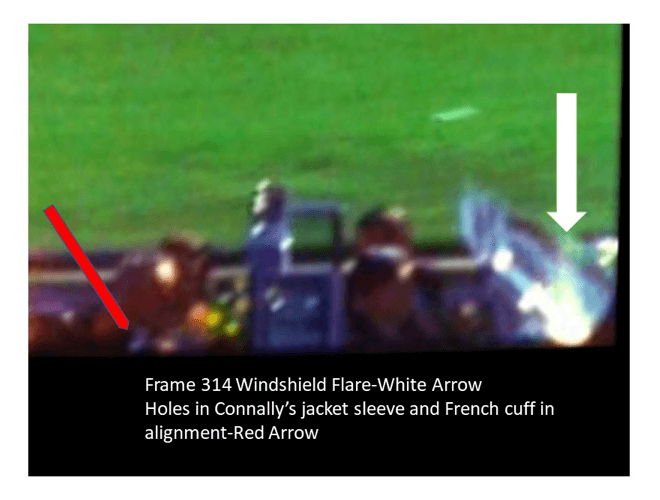
    Mantik established through photographic evidence several images where a bullet appears to hit the limousine’s front window at Z-255 [Zapruder Film, Frame 255, coincident with Altgen’s Photo #6], well ahead of the headshots that occurred after Z-300. Mantik documented that during the JFK autopsy, the pathologists recognized that the 5-centimeter contusion at the right lung apex was not caused by Dr. Malcolm Perry’s tracheotomy performed on JFK at Parkland Hospital in a desperate attempt to save his life. Mantik noted a bullet entered near the midline of JFK’s throat at about the third tracheal ring and traveled obliquely to the right lung apex, where it stopped. As further confirmation that the projectile causing the throat wound had a limited (non-exiting) trajectory, Mantik noted the pathologists conducting the autopsy found no deep penetration from JFK’s back wound. “They ignored this,” Mantik wrote, “and instead invented the single-bullet theory.”

    In a review of Mantik’s book, Douglas Horne notes that Mantik’s analysis of the JFK X-rays confirms Horne’s analysis in Chapter 13 of Inside the Assassinations Review Board. Both Horne and Mantik agree three headshots hit JFK:

    1. A shot low in the posterior skull, from the rear (probably fired from the second-floor window of the Dal-Tex building), blowing out the “head flap” on JFK that the Zapruder film shows prominently;
    2. An almost simultaneous shot from the right front (probably fired from well down the grassy knoll, near where the triple overpass meets the knoll); and
    3. A third almost simultaneous shot from the right front (fired from near the corner of the grassy knoll stockade fence), hitting JFK above and slightly behind the right ear.

    In his review of Mantik’s volume, Horne comments that Mantik’s book, “backstopped by extraordinary detail and footnoting, and by brilliant clarifying illustrations, is the “final word” on the JFK headshots. “Dr. Mantik brings his expertise as an M.D.—a radiation oncologist quite familiar with and qualified to read skull X-rays—and as a physicist to this extensive, illustrated monograph.” Horne added that equally important is that “Mantik’s conclusions about the three headshots, and the alteration of the extant skull X-rays, prove there was a massive U.S. government cover-up regarding how JFK was killed.”

    Editor’s Note: Via the late Robert Parry, we always thought the whole Russiagate caper was a mirage. And that is what it has turned out to be. Jerome was entangled in that ersatz imbroglio so we have allowed him to refer to it.

    Review by James DiEugenio

    David Mantik’s new book is really two books. First, it contains his ebook, JFK’s Head Wounds which includes what is probably the most extensive study of the Harper fragment in print. The rest of the 400 or so pages are a collection of what Mantik feels is his best prior writing on the case combined with some new work not seen before. Two of these latter essays were, for me, high points of the book. Namely a lengthy analytical critique of Josiah Thompson’s Last Second in Dallas; the other is an investigative essay on the possibility that the Kennedy limousine was struck by a bullet through the front windshield.

    Before we get started, let me make some descriptive comments about the book. First, it is in hard cover, which is kind of unusual in and of itself these days. Second, the book is an oversized volume. Which means that when I write that it is about 500 pages long, that is only numerical. In reality its more like 650 pages in length. Third, the reader will search far and wide to find a more extravagantly produced volume on the JFK case. What I mean by that is that the book is profusely illustrated with both pictures and graphics; there must be literally hundreds of these kinds of illustrations in the volume. And many of them are in color, which is another unusual trait in the modern publishing business. In that aspect, I cannot recall seeing a book like this in, quite literally, decades.

    Let me make one other preliminary observation. Dave Mantik is one of the most well-read Kennedy assassination critics there is. So when one reads the footnotes to his essays, one will find references to sources that one never heard of before. I know this will happen with the reader because it happened with me. And most people consider me one of the most well read and informed critics that there is. Well, Mantik sprung more than a few surprises on me.

    I

    The author begins his book by listing what he considers to be some of the major paradoxes in the JFK case. For instance, the mystery of Kennedy’s brain which is pretty much intact on the pictures. But which he and Cyril Wecht showed had to be missing a major amount of mass according to the x-rays. (pp. 4-6). This pungent observation is a summary of the essay those two men wrote for the book The Assassinations. (Edited by James DiEugenio and Lisa Pease, pp. 250-71) I am glad Mantik included this since that essay has been pretty much overlooked, and it should not be. Another paradox being the undetected presence of a 6.5 mm fragment on the Kennedy x-rays that was first noted by the Clark Panel in 1968. (pp. 6-8). A third being the plentiful dust like particles in the forehead area of JFK on the x-rays, which strongly indicate a shot from the front. (p. 10)

    There are seven others, but I think this gives the reader the drift of what the author is going after here. These are distinctly abnormal aspects in the medical record, ones that simply do not match up with the official conclusion of the Warren Report. That conclusion was that two full metal jacketed bullets, both from behind, went through Kennedy. One in the back and one in the head, the head shot being the kill shot. In other words, that verdict does not stand up under scrutiny from qualified experts like Mantik and Wecht. And these are aspects that are obvious in the official records themselves. Therefore, if one produced these records in court, the prosecution would be quickly placed on defense explaining these anomalies. Which would not be easy to explain. Because things like this do not happen in the normal course of a homicide inquiry. And if they did, the court would quickly suspect some kind of subterfuge or fraud.

    This lays the backdrop for what the book is about. For instance, the first chapter after this focuses on the saga of the 6.5 mm fragment near the back of the skull. To say the least, it is not easy to explain. Because it was not seen by any of the pathologists the night of the autopsy. As the author notes, you will not read about it in the Warren Report or the 26 volumes of evidence.(p. 20)

    What makes this even more odd is the fact that it happens to be the same size and caliber of the ammunition that Lee Oswald was allegedly using the day of the assassination. When the HSCA matched the Anterior posterior x-ray with lateral on this object it was revealed that the object had almost no thickness to it, it appears to be a slice of a fragment. (p. 21).

    The other peculiar characteristic is that when Mantik took optical densitometry readings on the object, it turned out to have a density to it that was off the charts. Far surpassing, for example, the 7 x 2 mm fragment. Warren Commission ballistics expert Larry Sturdivan believes this is an artifact. The question is what kind of artifact is it? Is it accidental or manmade. What argues for it being the latter is not just the caliber, but the position. The early critics, especially Josiah Thompson, did not think that a bullet coming in at a low part of the skull matched up with the position of Kennedy’s head at Zapruder frame 313. (Six Seconds in Dallas, p. 111) By raising the bullet strike four inches upward, it did something to solve that trajectory problem.

    II

    The next point of evidence the author will argue is a pet concern of the radiologist, namely the Zapruder film. This reviewer is an agnostic on the subject. But to be fair to him and Sydney Wilkinson–a film editor in the movie business–she and Mantik went to the Sixth Floor Museum and they saw transparencies produced by the MPI company, which produced a video and DVD version of the film. In 2009, they claim to have seen what is a black patch over the back of JFK’s head, with straight edges. Yet there is nothing like that on John Connally. Mantik says it is most obvious at Z-317. (p. 36).

    But when Sydney returned in 2010 the transparencies were larger but not as sharp and clear. The dark patch was gone, and looks more like a shadow. Mantik returned in 2012, and had the same reaction. But the Sixth Floor Museum insists there was no change from the material in 2009. The way to test this would be to find the original Time/Life transparencies from 1963-64. But the Sixth Floor says they do not have them and the searches done by Sydney and Mantik have been unable to turn them up. I have seen the third generation dupe that Wilkinson has and on that copy I did see that black spot. It is really an evidentiary shame that there is no locating the first generation transparencies.

    The next two chapters deal with Vincent Bugliosi. When I was reviewing Bugliosi’s mammoth Reclaiming HIstory, I called up Gary Aguilar and asked him if he was critiquing the book. He said yes he was. I asked: “Did you read the whole book?” Gary replied with, “Are you crazy!.”

    Well I did read the whole book, and so did Mantik. In addition to specifics, the doctor and former physics professor goes after Bugliosi on a general thematic charge. Namely that what suffices for truth for an attorney is not the same as what a scientist considers as truth. (pp. 48-49)

    From here, the doctor and scientist now lists 12 main points of factual evidence that the lawyer either denies in part, or simply ignores completely. The author writes about each of them over four pages. (pp. 53-57) Each point is not a matter of eyewitness observation or a circumstantial trial of evidence. Each deals with what most lawyers call “hard evidence”. Some of these I had not really heard of before or examined. For example, Commission Exhibit 843. This is a picture of lead fragments which came from Kennedy’s skull. As Mantik states it, the problem is they do not resemble their shapes or sizes on the x-rays. He then adds, “No interval testing should so have morphed its appearance.” (p. 54). Another example: stereoscopic viewing of the back of the head photos reveals “a flat, two dimensional image…” And this appears on the part of the image with “the shiny part of the hair that looks so freshly washed….” The author tried everything on this issue, “switching photos left to right, rotating them, and even looking at pairs of color prints and then pairs of color transparencies and then pairs in black and white.” In each instance the image was the same, two dimensional. (p. 55)

    It is a pretty impressive list which illustrates the author’s thematic point. As part of his summary, Mantik pens an insightful point. He writes that the aim of the book was to

    ….destroy every last scintilla of anti-WC evidence….That makes him all the less credible. And it certainly does not give him the air of a scientist. But he does not seem to care. He would prefer to appear omniscient. (p. 59)

    The author then reviews a later book by Bugliosi, Divinity of Doubt. Mantik, who has clearly studied the subjects of atheism, agnosticism and deism, gives the book a thorough thrashing. Concluding that Bugliosi should have never written about an area in which he had such poor mastery of the subject matter. (p. 66-67)

    III

    The next section of the book is composed of Mantik’s critiques of authors like the late Sherry Fiester, Randy Robertson and Fred Litwin. Although disagreeing with some of her points, he treats Fiester with respect. And, as we shall see, he seems to adapt one of her theorems—a shot from the south knoll.

    He has little or no respect for Fred Litwin. And, in my view, his critique of I Was a Teenage JFK Conspiracy Freak is a masterful polemic. It stands as a model of what negative criticism can and should be. Because not only does it destruct the subject, it educates the reader as to what the true facts are.

    He and Robertson have a fundamental disagreement about the evidence as a whole. Robertson thinks everything is genuine and on the up and up. Mantik does not. For instance, Robertson thinks the 6.5 mm fragment is genuine. He also believes that the ammunition was all uniform full metal jacketed (FMJ). Mantik asks how could a FMJ bullet produce the snowstorm effect of the dustlike particles in the forehead. (pp. 150, 155)

    Right after this comes another model of negative criticism. This time it is Mantik’s review of the late John McAdams’ book JFK Assassination Logic: How to Think about Claims of Conspiracy. The opening of this review shows the kinds of harpoons Mantik landed on the late Marquette professor. McAdams was attempting to show the reader how to think about the JFK case in a logical manner. Here is how Mantik leads off:

    Despite his pompous claim to teach all of us how to think critically, McAdams offers not a single reference to standard works on logical fallacies. Nor does he ever present his unique credentials for this task….In order to persuade the reader to vote for his dubious conclusions, he uses the standard tools of manipulation and commits a variety of crimes against logic-the straw man, the invalid analogy, begging the question, special pleading, the false dichotomy, and the moving goalpost. (p. 159)

    He spends most of the rest of this review exhibiting examples of this propagandistic type of writing.

    Mantik’s review of Josiah Thompson’s Last Second in Dallas is quite illuminating and thorough. Like Robertson, he questions the shot sequencing proposed by Thompson. He does this on what seems to me to be sound grounds. And it relates to his grand exposition of the Harper fragment which will come later in the book, but is introduced here. Mantik believes that the shot from the rear must have come before the frontal shot. (p. 263) If Thompson is proposing that the frontal shot dislodged Harper, then how did the outside smear get on the Harper fragment? This is a telling observation. Especially since Thompson is very familiar with the Harper fragment. (pp. 263-64)

    Mantik reminds us that Thompson wrote that Oswald shot TIppit and that the anterior neck wound was an ejection for a bone or a metal fragment. Mantik pretty much takes the book over the coals on the latter supposition. (pp. 268-69). Mantik’s disagreement with Thompson and James Barger and Rich Mullen—all of whom back the HSCA acoustics findings—is one of the most fascinating discussions one will read on that subject. This one review has ten appendixes to it. They include three comments by Michael O’Dell, who, in my opinion, is the single most knowledgeable person on the subject. If the reader ever wants to learn about the many sides to this argument, they are presented in this review.

    IV

    I wish to close my review of this valuable book by addressing the final essay and also the second book in the volume. You are not reading wrong: there is a second book with its own pagination. It’s a reprint of Mantik’s E book, JFK’s Head Wounds. But before we get to that let us discuss the subject of Mantik’s CAPA speech this past November. The doctor gave a compelling Powerpoint presentation on the mystery of the JFK windshield. I had never seen the issue reviewed this clearly and pointedly. And yes, I have seen the late Doug Weldon’s lectures on Youtube. The combination of Mantik’s lecture, and his essay in this book, caused me to go back and read two previous treatments of the topic. They would be Weldon’s long essay in Murder in Dealey Plaza, and Doug Horne’s much shorter review in Volume 5 of Inside the ARRB.

    But to place the problem in historical perspective, and to give proper credit, the late David Lifton actually wrote a rather fair precis of the imbroglio in Best Evidence. (pp. 370-71) There, in two pages, he gives the outlines of the apparent paradox. As he writes, there was credible eyewitness testimony that there was a hole in the front windshield when the limousine arrived at Parkland Hospital. For instance, two Dallas policemen, H. R. Freeman and Sgt. Stavis Ellis, both saw a hole. Ellis was certain about this, “It was a hole. You could put a pencil through it….” (Lifton, p. 370)

    Mantik’s list, quite naturally, is longer than Lifton’s. He lists nine witnesses. In addition to the policemen: medical student Evalea Glanges, Secret Service agents Joe Paolella, and Charles Taylor, reporters Richard Dudman and Frank Cormier, Ford Motor supervisor George Whitaker, and Secret Service agent Bill Greer, as told to Nick Prencipe of the US Park Police. (Mantik, p.321) The author finds this testimony credible. Further, he says the hole is most visible in the Altgens 6 photograph. (p. 323) He showed this in Dallas, and I had to say, it looked like a hole to me.

    Vaughn Ferguson was the go between for Ford Motor and the White House. He wrote a memo on December 18, 1963 that the author depicts as odd. Mantik spends the better part of two pages going through this memo and pointing out some problems. One of the massive ones is this: James Rowley, Chief of the Secret Service, wrote a letter to J. Lee Rankin of the Warren Commission on January 6, 1964. In that communication, Rowley declared the limousine was in the White House garage until December 20th. At that time Vaughn Ferguson drove the limo to Dearborn. Four days later it was driven to Hess and Eisenhardt in Cincinnati, a longstanding custom car company, for the installation of the bullet resistant bubble-top. (Mantik, pp.343-46)

    Even the rather somnolent House Select Committee on Assassinations (HSCA) had problems with the Rowley and Ferguson summary. As Weldon noted, the HSCA had four conflicts with the dates in the letter. A clear and obvious one is this: the limo was provably in Cincinnati on December 13th—a full ten days before Rowley said it was. (Weldon, Murder in Dealey Plaza, p. 133) In fact Willard Hess told Weldon that this December 20th journey would not and could not have happened. Hess was very disappointed that the Warren Commission only contacted him once, and then very briefly.

    As both Mantik and Weldon point out, there is another serious problem with Ferguson’s account. He wrote that the cracks in the windshield radiated from very close to the center and at a point right below the mirror. (Ibid, p. 134). This is simply false; so much so that one wonders if Ferguson really wrote the memo with the car in front of him.

    In 1993 Doug Weldon found a contradictory witness from Ford Motor Company. At that time he wished to remain anonymous, so Weldon used his information without naming him. Later it was revealed that his name was George Whitaker. Whitaker wrote that he worked at Ford and he got a call from the Vice President of the Division on November 25th. He was wanted in the glass plant immediately. (Horne, Inside the ARRB, p. 1446) The Lincoln was in the Rouge Plant of Ford Motor on the morning of that day. Called to report to the glass lab, he was let in a locked door. There were two engineers there and they had a car windshield that had a bullet hole in it. It was about 4—6 inches to the right of the mirror. From his forty years of experience with glass works, he knew the impact had come from the front. (Mantik, p. 370)

    As the author continues, Whitaker said they were to use the blasted windshield as a template, which had been taken out. When they were finished they were to take it to the B building. When they finished they placed it in the limousine, which had everything stripped out. It is worth quoting Whitaker as to his description of the hole: “…it was a good clean hole right straight through from the front.” (Horne, p. 1446)

    Mantik makes a circumstantial case that Rowley ordered the limo flown to Dearborn in either the late hours of the 24th or the early hours of the 25th. As no one could risk doing something like this in Washington at that time. (Mantik, pp. 328-29). The good doctor makes an extraordinary contribution to all this. He had an acquaintance from his days at the University of Michigan Medical School and this man’s father worked at Ford and had seen the limousine in Dearborn after the assassination. It turns out that this man, Robert D. Harrison, had seen the perforated windshield—and had been very upset by this. (Mantik, p. 347)

    I should add that Mantik, Horne and Weldon all make a rather trenchant observation about the original windshield. Roy Kellerman and Morgan Geis of the Secret Service both said they saw the damaged windshield and the outside was smooth, the damage was on the inside. But safety glass only shows damage on the other side from which its hit. Which means, what these observations show is that the impact was from the front. (Horne, p. 1449). Mantik takes this further and shows how someone realized this was a mistake and they tried to paper it over later. His demonstration continues with examples of how safety glass is supposed to shatter, and also in discrepancies as to comparisons between the supposed same windshield. (Mantik, pp. 332-34)

    Let me add that, Mantik concludes that if he is correct on this the shot likely came from the south knoll. And as he does throughout, he finds and recommends a good paper that argues for just such a shot, this one is from a gentleman named Anthony DeFiore.

    V

    I cannot hope to do justice to what Mantik has done with his analysis of what he thinks were the shots to President Kennedy’s head. But I should add that this 100 page mini-book does not just do that. In fact, the main reason Mantik wrote it was to advance his concept of the proper location of the so called Harper Fragment.

    As the author explained in Oliver Stone’s recent documentary, the Harper fragment was a piece of bone that was expelled from Kennedy’s skull in Dealey Plaza. No one really knows where it was originally located for the simple reason it was not found until more than a day later. (Mantik, p. 36). In fact, Mantik includes reports about this happening i.e. law enforcement officers picking up a piece of bone and moving it slightly before leaving it behind.

    After Billy Harper picked up the piece of bone he gave it to his father who was a pathologist. Jack Harper and two other pathologists at Methodist Hospital—Gerard Noteboom and A. B. Cairns– photographed it and examined it. (p. 1) They concluded it was from the occipital part of the skull. In talking to Noteboom, Mantik garnered that there was a metal smudge on the edge of the bone. (p. 2).

    From this point, Mantik argues against other placements of the Harper Fragment. He essentially takes on everybody. That means other critics and also the HSCA. His review of what the HSCA tried to do with the Harper Fragment—greatly aided by the late John Hunt—makes for quite insightful reading. (pgs. 5-8; 15-18) The HSCA’s Michael Baden said the Harper Fragment was from the parietal region. A judgment with which Mantik strongly disagrees.

    From here, the author proceeds to take on the arguments and placements of Dr. Joseph Riley (pgs. 23-30), Dr. Randy Robertson (pgs. 18-21), and Richard Tobias (pgs. 21-22). The remarkable thing about all of these debates is how Mantik’s investment in the book’s production values serves him quite well. One will search far and wide to find a book with as many technical and medical pictures and illustrations as this one. And this greatly aids the average reader in following the technical arguments Mantik lays out in front of him.

    That argument is going to end with two main concluding statements.

    The first is that Kennedy was hit with three shots in the head. One came from behind, two from in front. There was one in the high right forehead; the other was an oblique shot that hit adjacent to the right ear and exited the occiput while ejecting the Harper Fragment. (p. 58) He also argues that there was at least one shot fired after Z frame 313. For those who are enamored with this kind of discussion, the author includes a lengthy appendix—among several others—which explains in detail what he calls his Three Headshot Scenario. ( pp. 76-85) He even produces a new witness to a picture of the forehead shot. (pp. 86-88)

    The other concluding argument is this: the Harper Fragment was not part of the parietal bone, but part of the upper occipital bone. That description would denote the rear of the skull, in or about the center area. (p. 11). According to his orientation, the metal smudge connects with the bullet hole located by the pathologists at Bethesda that night around the External Occipital Protuberance.

    In the end I would have to agree with his 15 step argument.

    After the debut of Oliver Stone’s 1991 film JFK, a whole new wave of writer/researchers entered the debate over the true circumstances of President Kennedy’s death. Some of these were physicians who concentrated on the medical aspects of the assassination. It is difficult to name one who has achieved more than David Mantik. This book stands as a statement to that significant accomplishment.

  • Antelope Valley College JFK Revisited: Destiny Betrayed Presentation

    Antelope Valley College JFK Revisited: Destiny Betrayed Presentation


    (Click here if your browser is having trouble loading the above.)


  • JFK: Case Not Closed

    JFK: Case Not Closed


    Dave O’Brien wrote a book in 2017 entitled Through the Oswald Window. Unfortunately, for whatever reason, I missed that book and have not read it, but O’Brien brings up some of the points that he likely made in that book in his new effort entitled JFK: Case Not Closed. Four chapters of his new book were written by Johnny Cairns, who I consider one of the best of the new generation of JFK researchers.

    Early in this book, O’Brien brings up one of the points he likely made in his earlier book—and it’s a cogent one. Dave was once allowed access to the infamous “sniper’s window” at the Texas School Book Depository. Reflecting back on that visit, he asks two questions. If Oswald had really been at that window, why did he not shoot Kennedy as the president came down Houston Street? (p. 21) That was an unobstructed shot with the target right below him.

    He then goes onto a second issue. That particular window is at the southeast corner of the sixth floor. If we are to believe that Oswald was the lone assassin, was on that floor, and committed a premeditated murder, then there is another question that should be asked by anyone was has been on that floor. Why didn’t Oswald use the southwest window, at the opposite end. This would have solved more than one problem for the alleged killer:

    1. The oak tree would be removed as an obstruction.
    2. Kennedy would have been right below him.
    3. He would have had clear access to the target the whole time.
    4. He had a more direct and quicker escape from that floor.

    If one buys into the Warren Report, the alleged murderer had days to plan his crime. But he never figured on any of these circumstances? In spite of all these mitigating factors, as O’Brien writes:

    Yet, he chose the southeast corner window and allowed the left-hand turn onto Elm Street knowing that the fully-blossomed Oak Tree protected his target for valuable seconds, and that once clear of the foliage, his target was mere seconds from safety under the bridge just yards away. Why? (p. 21)

    As O’Brien writes, it is inexplicable that the Warren Commission never even considered this as part of their inquiry into Kennedy’s assassination. But any new formal inquiry should do so. Because it strongly indicates that Oswald was not what the Warren Report said he was. The idea of a reopening of the Kennedy case is a strong theme featured in the book. (p. 22)

    II

    From here, O’Brien notes another oddity. At Zapruder frame 312, right before the fatal headshot, JFK’s head is right next to Jackie’s. In fact, in the photo he shows on page 42, she is leaning so far over to his side of the seat that their heads are almost touching. But as the author notes, in the next split second, three things will happen that seriously undermine the official story which says Oswald shot Kennedy from behind. First, Kennedy’s head and body go backward, crashing off the back seat. Second, Jackie Kennedy reaches onto the trunk of the car attempting to retrieve a part of her husband’s skull, which is visible there. Third, motorcycle officer Billy Hargis, riding to the left and behind Kennedy’s limousine, is splattered with blood and tissue—and with such force that he momentarily thought he was hit. (pp. 42–45; 187–93). How could all three of these events occur in that short of an interval if the official story was correct? Do they not all betray a shot from the front? (And in arguing for a front shot, O’Brien mounts one more telling argument against the so-called neuromuscular reaction, see p. 46)

    Chapters 4–7 of the book were composed by Johnny Cairns. As anyone who has been exposed to his writing will automatically understand, they are first-class. They strike the Warren Report at the points where it is supposed to be strongest: the physical evidence against Oswald.

    In taking up the case of Oswald ordering the rifle, Johnny asks: if the FBI was monitoring the publications Oswald was getting through the post office—and they were—how could they not know he was also in receipt of a rifle and handgun? (pp. 60–66) Also, how could Oswald have sent a money order to Chicago on March 12th by 10:30am when his timecards from his place of employment say he was at work? And he did not have a lunch break until almost two hours later. (p. 67) He also brings up this point: if Oswald knew he was going to order a murder weapon delivered to a post office box, why utilize a box which he had signed for? Why not take out a box in the name of the alias he used to order the rifle, namely Hidell? (pp. 72–73)

    Johnny then goes through all the mechanical problems that the authorities had with the particular rifle found on the sixth floor of the Texas School Book Depository. They had to fit the weapon with two shims, since the sighting was off both in elevation and azimuth. Then there was a difficulty in opening the bolt, plus the trigger was a two stage operation: at first it was easy, then it required more an exertion of pressure to pull. (p. 76) Any of these, of course, would have pretty much eliminated that rifle as the murder weapon. What makes it worse is that the men who worked with the rifle once the Warren Commission got it were far more skilled with weapons than Oswald. These were FBI agents and master marksmen from the military. Johnny bases this evidence on the testimony of FBI expert Robert Frazier and weapons evaluation expert Ronald Simmons of the army. In addition, Frazier admitted that the actual scope mechanism was off. As they fired consecutive shots, the impact point got further and further away from the target. (p. 77; see also Michael Benson, Who’s Who in the JFK Assassination, p. 420; Mark Lane, Rush to Judgment, p. 127)

    From here, Cairns goes on to the question of assembling the rifle. As most of us know, even if we grant the Commission’s thesis that Oswald carried the rifle to work that day in a bag, that particular bag was too short to accommodate a fully assembled Mannlicher Carcano 6.5 mm rifle. There was no screwdriver found on the sixth floor of the depository. The FBI said that they could assemble the rifle with a coin in six minutes. The late British police inspector Ian Griggs said this was poppycock. He said, in a hopeless endeavor, he ended up with blood blisters and a cut on his right thumb before he gave up. In his opinion, one had to use a screwdriver and with that it would take about two minutes. A screwdriver was needed for the simple reason that there are 16 parts to the rifle and the Warren Commission tried to conceal this with their pictorial Commission Exhibit 1304. (Click here for how)

    All this leaves this important question: When and where did Oswald assemble the rifle?

    Cairns asks the logical questions about the ammunition: Why could the FBI find no evidence that Oswald purchased it? (p. 87) Also, using as his authority Henry Hurt, Cairns shows that Oswald’s Marine buddies thought he was a joke as a marksman. And Hurt talked to fifty servicemen who knew Oswald. (pp. 93–94) Further, using sniper Craig Roberts as his correspondent, the great Carlos Hathcock said that his SWAT team—replicating the true conditions in Dealey Plaza—could not duplicate what Oswald did, and they tried more than once. To this reviewer that, in and of itself, would eliminate Oswald as a suspect, because Hathcock was the greatest American sniper of the Vietnam War. (p. 96) And contrary to what some Commission zealots say, to this day, Roberts stands by what he wrote about Hathcock.

    In this same rigorous and systematic manner, Cairns then proceeds through the fingerprint evidence, the case that the alleged bag Oswald carried was fabricated after the assassination, the dubious police line ups Oswald was picked out of, the horrendous chain of custody for the shells found on the sixth floor—including the evidence that one of them could not have been fired that day—and probably the biggest liability in the entire Warren Report, namely the sorry, sorry case of Commission Exhibit 399, the infamous Magic Bullet. Cairns does a convincing and praiseworthy job on all of these topics and more, for example the PSE examination done on Oswald by author George O’Toole in his valuable book The Assassination Tapes.

    III

    Like Josiah Thompson in Last Second in Dallas, O’Brien writes that the pathologists did not know about Kennedy’s anterior neck wound the night of the autopsy. (p. 202) As the film JFK Revisited shows through nurse Audrey Bell, this is not accurate. But due to some nice detective work by Rob Couteau, we know this is false from Dr. Malcolm Perry himself. (Click here for details)

    O’Brien is on more solid ground when he writes that Dr. Jim Humes burned his notes (he could have added the first draft of his autopsy report also). And this perhaps allowed him to move up the posterior back wound, which at autopsy was determined to come in about six inches below the collar and not exited. Now, through some manufactured evidence, the Warren Report made it negotiable with what was depicted as an exit wound through the throat. (p. 203) But that was not all. As forensic pathologist Cyril Wecht notes in JFK Revisited, by the spring of 1964, attorney Arlen Specter had now enlivened that wound track to include five wounds in Governor John Connally also.

    O’Brien notes that medical illustrator Harold Rydberg was the artist who illustrated Commission Exhibit 385. Rydberg was essentially snookered by Humes and Dr. Boswell into drawing a trajectory through Kennedy’s body that would fit this alteration. (p. 208) And here, the book brings in a telling piece of testimony. Secret Service agent Clint Hill did not just see the rear skull wound in Kennedy. He also testified to Commissioner Hale Boggs, “I saw an opening in the back about six inches below the neckline to the right hand side of the spinal column.” (p. 209) Hill’s testimony corresponded with the holes in Kennedy’s shirt and jacket. As Vince Palamara shows with pictures from the front of Kennedy’s suit jacket, the jacket was likely not bunched up, since the bullet exit inside the back of the jacket matches up with the bullet entrance on the outside. (Palamara, Honest Answers, p. 21) This evidence corresponds to what was the likely first conclusion by the pathologists: the back wound did not transit Kennedy’s body.

    O’Brien makes another controversial statement in Chapter 11. He says that if the Altgens photo is located at Zapruder film 225–230, then Kennedy could not have been hit by that time. He did an experiment which showed that the projectile would have had to have been fired through the branches of the oak tree. (O’Brien, p. 220) This may or may not be true. But it would seem to disagree with the pictures in the Warren Report which show the line of sight through the tree and how it is completely clear of the branches by frame 225. (WR, p. 103) This issue is also touched upon by Josiah Thompson in his first book on the Kennedy case, Six Seconds in Dallas. (p. 35) I wish O’Brien had made reference to these seemingly contradictory views and attempted to reconcile them.

    In Chapters 12–14, O’Brien returns to the subject of Kennedy’s autopsy. He again notes that Humes did not call Parkland during the night. (p. 234) And he also notes how the Sibert/O’Neill report differs from the official autopsy report. For instance, the FBI report does not have the back wound transiting the body. (p. 239)

    He next deals with the House Select Committee on Assassinations (HSCA) medical report which covered up the evidence for a baseball sized hole in the back of Kennedy’s head. He further notes that this evidence—largely from the witnesses at Bethesda, but matching many of the witnesses from Parkland—appears to have been concealed from the experts on the HSCA medical panel, for example Cyril Wecht and Michael Baden. Those two men both denied looking at such reports when confronted with this declassified evidence by Dr. Gary Aguilar. (p. 258) This evidence matches what the earliest witnesses, like Clint Hill, said he saw about the hole in the rear of Kennedy’s skull. (p. 263)

    IV

    O’Brien makes a telling observation about Harold Rydberg and Ida Dox. Dox was the professional illustrator for the HSCA. She was largely guided by Dr. Michael Baden in what she was drawing, which roughly parallels what Humes and Boswell did with Rydberg. (p. 271) Consequently, the Dox drawings fail to show the blow out to the back of the skull that over 40 witnesses saw in Dallas and at Bethesda. But not only that, Dox was told by Baden to exaggerate the cratering effect at the cowlick area of Kennedy’s skull in order to make it look more like a wound of entry. This partly allowed the HSCA to raise the fatal head wound form low to high in the rear skull. Baden actually left declassified notes about this which were discovered by Dr. Randy Robertson. (pp. 274–75). There will be much more about this illicit relationship between Dox and Baden in Tim Smith’s upcoming book about the HSCA.

    O’Brien closes out the book by pointing out some of the familiar problems with the Commission’s chief witness to Oswald being on the sixth floor, namely Howard Brennan. And he opposes that sighting with witnesses like Carolyn Arnold who said she saw Oswald on the first floor mere minutes before the assassination. (p. 281) Twenty-one police officers heard shots from in front of the limousine. Several saw smoke arising from the knoll area. He then notes how the FBI and the Commission cajoled witnesses they considered helpful to their case and argued with those they considered problematic to their verdict. Carolyn Walther and Ruby Henderson were two witnesses who said they saw two men on one of the upper floors of the Depository, and one of them was armed. (p. 285) Neither of these witnesses testified before the Commission. In fact, Walther said:

    The FBI tried to make me think that what I saw were boxes. They were going to set out to prove me a liar and I had no intention of arguing with them and being harassed. (p. 285)

    The book ends with the hope for how new technology can open up areas of the Kennedy case that have been closed before. O’Brien discusses the optical densitometry readings of Dr. David Mantik and their use in showing the problems with Kennedy’s x-rays. He also suggests full body CT scans. (p. 315) He concludes with the long awaited 3D imaging attempts of John Orr and Larry Schnapf, which I understand are finally getting close to fruition. (pp. 318–19)

    The last part of the book includes an appendix in which well respected writers on the case suggest ways that it could be reinvestigated, for example Robert Kennedy Jr., Pat Speer, and Cyril Wecht. Some methods brought forth are by using a special prosecutor or a large panel of forensic experts or an ARRB type panel except with investigative powers.

    I could point out other areas of disagreement—as with Geraldine Reid—but all in all, Doug and Johnny have written a creditable book that is worth reading.

  • The Joker in the Jet Effect

    The Joker in the Jet Effect


    Nobel prize-winning physicist Luis Alvarez, with the sponsorship of the Department of Energy, designed experiments to “prove” Kennedy’s brain spatter sent his head backward, and published the results of these experiments in a low level publication, the American Journal of Physics in 1976.

    Alvarez assassinated ripe melons wrapped in tape (to simulate a human head), blowing out large exit holes, causing the melons to whizz impressively away from the direction of the exiting spatter in front—and toward the shooter in back. The jet effect. It is supposed to nullify the idea that JFK’s head moved backward because of a shooter in the front.

    The story—an infomercial rather than a scientific report—is written in the same manipulative, ingratiating style that lubricates so much of the pseudoscientific writings of John K. Lattimer MD and it vibrates with buzz words designed to earn your trust: Life Magazine…Thanksgiving…Christmas…football…the American flag…Lattimer’s service in World War II…his own service in World War II. (Somehow, he omitted references to mother, apple pie, church, and the family dog.)

    The following statement on page 819 contains the key to the jet effect as an explanation for the behavior of Kennedy’s head during the shooting:

    The simplest way to see where I differ from most of the critics is to note that they treat the problem as though it involved only two interacting masses: the bullet and the head. My analysis involves three interacting masses, the bullet, the jet of brain matter…and the remaining part of the head…

    Translated: Mass #1, the bullet, causes Mass #2, the brain, to explode, which, in turn, causes Mass #3, the “remaining part of the head” to move backward, away from the direction of the spatter.

    What’s wrong with this picture? Something critical is missing—the most important “interacting mass” in this entire event: The hard bone in the back of the head, the first thing the bullet is alleged to have hit, and with the full force of its energy!

    In this way, he eliminated the competition—the idea that JFK’s head moved backward because it was hit from the front, through transfer of momentum.

    The interaction between bullet and back of head was so violent, says the government, that it broke the bullet into two jacketed fragments and imbedded a disc of metal in the area of the cowlick. (Another interaction between bullet and bone takes place when the bullet exits, but I could find no data on it effects.)

    Note: Perforating metal-jacketed bullets don’t always move heads very much, especially if the bullet is perpendicular to the surface, and if the head is attached to a neck. Once the bullet enters, knocking a plug of bone aside, and is no longer in contact with bone, it no longer propels it (unless it moves it as it exits). But in a tangential hit, bullet and bone are in direct contact over a larger area for a longer period of time, often causing impressive movement. [The Parkland Hospital doctors did not look under the scalp to examine the top or front of the head, but did report a large area of missing scalp and skull in the right rear (in occipital-parietal bone). William Kemp Clark, former chief of neurosurgery, thought the wound was caused by a tangential hit. This would mean that at least one head shot came from the right, or north side of Elm Street. It could even have come from the right front: JFK’s head was rotated to his left, presenting a small part of the back of his head to a shooter on the grassy knoll.]

    Math: The Barbed Wire Protecting the Damaged Fruit

    Mathematical formulas tend to scare people away, discouraging close examination. They also provide the prickly appearance of intellectual rigor. But if you take a good look at his squirming calculations, you will see that, once again, he has left out the first interaction: Among the symbols, you will find none representing the back of the head.

    Thus, he not only eliminated the competition verbally, as mentioned above, but did it mathematically. In his equations, he has but one symbol for the melons that he shot, “M.” Alvarez’s theory contains the inherent assumption that the human head is as homogeneous as the melon.

    Well, the most relevant symbol that belongs in this formula is “BS” and you know what that stands for.

    Assassinating Melons

    How did Alvarez eliminate this high impact (in real life) collision between s pristine bullet and pristine (still intact) bone, in his experiments?

    He used melons wrapped in Scotch glass filament tape. Melon rinds are not much denser than the pulp inside. You can push a hole in one with your finger.

    How much resistance would a melon present to any bullet? And what about the bullets Alvarez used? He fired, at close range, 150 grain soft-nosed bullets with an impact velocity of 3000 ft/sec. What is the difference between the impact velocities of these two very different bullets? Ballistics expert W.E. DeMuth, Jr., M.D.:

    The kinetic energy theory…[that] energy = M x V2/2g, indicates that energy is directly proportional to mass and to the square of the velocity…doubling velocity quadruples it. (DeMuth, 1966)

    How much energy did Alvarez’s bullet lose on impact with the melon? How much energy would a Carcano bullet lose on impact with a skull, especially if breakage of the bullet results? How much momentum would be imparted to the skull? Alvarez answered none of these questions.

    Did Alvarez’s bullets break on the occipital-parietal region of the melon? He never even brought up the subject. Despite the omission of this most significant interacting mass (bone), Alvarez’s said his thesis includes “all the material in the problem:”

    I concluded that the retrograde motion of the President’s head, in response to the rifle bullet shot, is consistent with the law of conservation of momentum, if one pays attention to the law of conservation of energy as well, and includes the momentum of all the material in the problem. (Alvarez, 1976, p. 819)

    Luis Alvarez is like a third-rate magician, the kind that pulls a rabbit out of a hat, without first showing you the “empty” hat—and the rabbit turns out to be stuffed.

    A Professor Spreads Bullshit on a Slide

    How do these con artists manage to fool so many people? Harry Frankfurt, a former Professor of Philosophy at Princeton University, has made an in-depth study of the sort of thing produced by Alvarez, as well as the reasons it is accepted:

    The contemporary proliferation of bullshit…has deeper sources, in various forms of skepticism which deny that we can have any reliable access to an objective reality and which therefore reject the possibility of knowing how things truly are. (Frankfurt, 1988, p. 133)

    We may never know “how things truly are,” but thanks to various disinformation engineers, we actually do have “reliable access to an objective reality”—but it’s the reality that all kinds of people are trying to cover up the facts in this case. And they’re still doing it. Right before your eyes. (Go here to see a more recent example I’ve analyzed.)

  • A Presumption of Innocence: Lee Harvey Oswald, Part 3

    A Presumption of Innocence: Lee Harvey Oswald, Part 3


    Part 1

    Part 2

    I. The Disposition and Discovery of the Shells

    The discovery of the rifle shells on the sixth floor that go by the labels Commission Exhibits 543, 544, and 545 add more controversy into the investigation of the murder of President John F. Kennedy.

    The shells, which the Commission concluded had been used in the assassination, were discovered, according to the Warren Report, by Deputy Sheriff Luke Mooney. According to the report:

    Around 1pm, Deputy Sheriff Luke Mooney noticed a pile of cartons in front of the window in the south-east corner of the sixth floor. Searching that area, he found at approximately 1:12 p.m. three empty cartridge cases on the floor near the window. (WR, p. 79)

    A few obvious questions arise with regard to the subsequent discovery of the alleged “Snipers Nest” and the shells allegedly contained therein.

    1. With various witnesses reporting to the police in the immediate aftermath of the Presidents murder that they had indeed witnessed a rifle in the possession of a man or men on the upper floors, then why did the Dallas police not immediately converge upon the book depository’s sixth floor? Instead, the police decided to commence a floor by floor canvass of the building in search of a gunman or evidence linked to the crime. This was in spite of the various witness testimonies to a man (men) with a rifle on the upper floors.
    2. Why did it take Mooney 12 minutes between his discovery of the alleged “sniper’s nest” to his apparent discovery of the three spent cartridges? According to Mooney’s testimony once he had ventured down from the seventh floor:

    LM – So I went back down. I went straight across to the south-east corner of the building, and I saw all these high boxes. Of course, they were stacked all the way around over there. And I squeezed between two. And the minute I squeezed between these two stacks of boxes, I had to turn myself sideways to get in there—that is when I saw the expended shells and the boxes that were stacked up looked to be a rest for a weapon. (WCH, Vol. III, pp. 283284)

    Mooney’s testimony refutes the information contained in the Warren Report regarding the 12-minute discovery between the “Shield of Cartons” and the expended shells. And in reference to the earlier quoted testimony, “the minute I squeezed between these two stacks of boxes…that is when I saw the expended shells.” (ibid) It would seem that the authors of the report were too busy to re-acquaint themselves with the testimony which was deposed before them, choosing instead to print in error that 12 minutes had elapsed between the discovery of the shield of cartons and the discovery of the shells.

    In reference to Fritz and his conduct in handling the evidence, we find the following printed within the Report:

    When he was notified of Mooney’s discovery, Capt. J W. Fritz, chief of the homicide bureau of the Dallas Police Department, issued instructions that nothing be moved or touched until technicians from the police crime laboratory could take photographs and check for fingerprints. (WR, p. 79)

    This account is disputed by cameraman for WFFA TV Tom Alyea, who was present on the sixth floor after the assassination. Alyea stated that:

    After filming the casings with my wide-angle lens, from a height of 4 and half ft., I asked Captain Fritz, who was standing at my side, if I could go behind the barricade and get a close-up shot of the casings.

    He told me that it would be better if I got my shots from outside the barricade. He then rounded the pile of boxes and entered the enclosure. This was the first time anybody walked between the barricade and the windows.

    Fritz then walked to the casings, picked them up and held them in his hand over the top of the barricade for me to get a close-up shot of the evidence. I filmed between 3–4 seconds of a close-up shot of the shell casings in Captain Fritz’s hand.

    Fritz did not return them to the floor and he did not have them in his hand when he was examining the shooting support boxes. I stopped filming and thanked him. I have been asked many times if I thought it was peculiar that the Captain of Homicide picked up evidence with his hands.

    Actually, that was the first thought that came to me when he did it, but I rationalized that he was the homicide expert and no prints could be taken from spent shell casings. Over thirty minutes later, after the rifle was discovered and the crime lab arrived, Capt. Fritz reached into his pocket and handed the casings to Det. Studebaker to include in the photographs he would take of the sniper’s nest crime scene.

    We stayed at the rifle site to watch Lt. Day dust the rifle. You have seen my footage of this. Studebaker never saw the original placement of the casings so he tossed them on the floor and photographed them. Therefore, any photograph of shell casings taken after this is staged and not correct. (https://www.jfk-online.com/alyea.html)

    It should be noted that Alyea also said that the shells were in close proximity to each other at first appearance. There are two other witnesses who back him on this: Roger Craig and Mooney. (Cover-Up, J. Gary Shaw with Larry Harris, p. 70) That is not the way they appear in the Commission volumes. (Commission Exhibit 512) Once the “official crime scene” photographs were taken, Lt. Day and Detective Sims proceeded to collect the shells from the sixth floor.

    II. Chain of Custody of the Shells

    During his testimony before the Commission, Day stated what course of action he took in relation to preserving the shells as evidence.

    Mr. Belin – All right. Let me first hand you what has been marked as “Commission Exhibit,” part of “Commission Exhibit 543, 544,” and ask you to state if you know what that is.

    Mr. Day – This is the envelope the shells were placed in.

    Mr. Belin – How many shells were placed in that envelope?

    Mr. Day – Three.

    Mr. Belin – It says here that, it is written on here, “Two of the three spent hulls under window on sixth floor.

    Mr. Day – Yes, sir.

    Mr. Belin – Did you put all three there?

    Mr. Day – Three were in there when they were turned over to Detective Sims at that time. The only writing on it was “Lieut. J. C. Day.” Down here at the bottom.

    Mr. Belin – I see.

    Mr. Day – Dallas Police Department and the date.

    Mr. Belin – In other words, you didn’t put the writing in that says two of the three spent hulls.

    Mr. Day – Not then. About 10 o’clock in the evening this envelope came back to me with two hulls in it. I say it came to me, it was in a group of stuff, a group of evidence, we were getting ready to release to the FBI. I don’t know who brought them back. Vince Drain, FBI, was present with the stuff, the first I noticed it. At that time there were two hulls inside. I was advised the homicide division was retaining the third for their use. At that time, I marked the two hulls inside of this, still inside this envelope.

    Mr. Belin – That envelope, which is a part of Commission Exhibits 543 and 544?

    Mr. Day – Yes, sir; I put the additional marking on at that time.

    Mr. Belin – I see.

    Mr. Day – You will notice there is a little difference in the ink writing.

    Mr. Belin – But all of the writing there is yours?

    Mr. Day – Yes, sir.

    Mr. Belin – Now, at what time did you put any initials, if you did put any such initials, on the hull itself?

    Mr. Day – At about 10 o’clock when I noticed it back in the identification bureau in this envelope.

    Mr. Belin – Had the envelope been opened yet or not?

    Mr. Day – Yes, sir; it had been opened.

    Mr. Belin – Had the shells been out of your possession then?

    Mr. Day – Mr. Sims had the shells from the time they were moved from the building or he took them from me at that time, and the shells I did not see again until around 10 o’clock.

    Mr. Belin – Who gave them to you at 10 o’clock?

    Mr. Day – They were in this group of evidence being collected to turn over to the FBI. I don’t know who brought them back.

    Mr. Belin – Was the envelope sealed?

    Mr. Day – No, sir.

    Mr. Belin – Had it been sealed when you gave it to Mr. Sims?

    Mr. Day – No, sir; no. (WCH, Vol. IV, pp. 25354)

    Belin also elicits the following:

    Mr. Belin – Your testimony now is that you did not mark any of the hulls at the scene?

    Mr. Day – Those three; no, sir. (WCH, Vol. IV, p. 255)

    Further, in his testimony, Day states he recognizes CE 543, because it has the initials GD on it. Surprisingly, Day failed to acknowledge the other defining characteristic on 543. Contained on the lip of the shell is a dent, which has led many experts to conclude that this shell could not have held a bullet which was fired during the assassination. But he did admit that this very peculiarly dented shell was not sent to the FBI the night of the assassination. It is surprising that after Day admits this, Belin does not ask the obvious question: Why was it not sent up?

    Mr. Belin – Now, I am going to ask you to state if you know what Commission Exhibit 543 is?

    Mr. Day – That is a hull that does not have my marking on it.

    Mr. Belin – Do you know whether or not this was one of the hulls that was found at the School Book Depository Building?

    Mr. Day – I think it is.

    Mr. Belin – What makes you think it is?

    Mr. Day – It has the initials “G.D.” on it, which is George Doughty, the captain that I worked under.

    Mr. Belin – Was he there at the scene?

    Mr. Day – No, sir; this hull came up, this hull that is not marked came up, later. I didn’t send that. (WCH, Vol. IV, p. 255)

    Note what Day seems to be saying. He says it was marked by someone who was not at the crime scene. Again, Belin asks for no clarification as to when Doughty marked the shell. What makes this questioning even more off key is that Belin admits that he pre-interviewed Day in Dallas. And now Day has changed his story. At that prior interview, he admits that he told Belin that he did initial the shells. He now tells Belin that after he thought it over, no he did not mark any of them at the scene. (Ibid, p. 255). At this point, Belin actually said he should strike everything and start all over again.

    It later got even worse. In a letter to the Commission dated April 23, 1964, Day then throws his identification of CE 543 and their subsequent chain of custody into serious doubt:

    Sir:

    In regard to the third hull which I stated has GD for George Doughty scratched on it, Captain Doughty does not remember handling this.

    Please check again to see if possibly it can be VD or VED for Vince Drain.

    Very truly yours,

    J. C. Day

    Through Day’s testimony, we elicit that he did not mark the shells at the scene of the crime even though they were in his possession. Furthermore, he placed these unmarked shells into an unsealed envelope.

    This is a weird situation. And Belin does not seem to bat an eyelash while he is discovering it or the fact that the witness changed his story. Under these circumstances, how could Day swear under oath that the shells being presented in evidence against Oswald were the same ones allegedly found in the aftermath of the president’s murder? When he neglected to mark them at the scene and then proceeded to place them in an unsealed, unmarked envelope?

    III. Tom Alyea writes to the ARRB

    Lt. Day’s testimony is also disputed by press photographer Tom Alyea. He was the first such cameraman allowed entry into the crime scene. In a letter to the ARRB’s Tom Samoluk dated 8-15-97, Alyea states that:

    Regarding the perjured testimony given to the Warren Commission Investigators by members of the Dallas Police Department. I understand there were several cases, but the one I checked for myself by reading the printed testimony in the Warren Report, involves Lt. Day and Det. Studebaker. These are the two crime lab men who dusted the evidence on the 6th floor. Their testimony is false from beginning to end.

    This is what should have happened. According to Tom Alyea, Fritz was the first detective on the scene to come into contact with the shells. Fritz should have marked these shells at the scene in accordance with the chain of custody. Fritz then gave the shells to Det. Studebaker.

    Studebaker should have then proceeded to mark these shells at the scene. But what the evidence seems to indicate is that Studebaker then threw the shells down on the floor of the south east corner window and captured the “crime scene” photos.

    Lt. Day then retrieved the shells from the floor with help from Det. Sims. Day should have marked these shells at the scene and then put them into a sealed envelope, clearly stating what lay therein. Instead, Day gave up possession of the shells without adding his markings, which in turn lay in an unmarked, unsealed envelope.

    The envelope remained unsealed when Day took back possession of these hulls at 10 p.m. on 11/22/63. Sims should have marked the shells at the crime scene while in his possession. But yet, Sims did not even recall picking up the shells. In a remarkable exchange with David Belin, he admitted that in his first Commission interview with Joe Ball, he did not mention doing this. In fact, at that time, he attributed the carrying of the envelope with the shells to Lt. Day. When Ball asked him if he took possession, he denied it. (WCH, Vol. VII, p. 163)

    There had to have been a conference between Belin and Ball about this and Sims must have been made aware of their worries. Because two days after the April 6th Ball interview, Sims was recalled. This is what worried them: Belin knew that Day was going to testify that he turned over the unsealed envelope with shells to Sims. Therefore, they needed Sims on the record for this transfer. (WCH, Vol. IV, p. 256) Therefore, when he was returned to the stand, this time his questioner was Belin. And in almost no time flat, Belin is asking Sims about this specific point: the chain of custody of the shells. Sims now says that two days ago, he did not recall who brought the shells to the police station. But now, mirabile dictu, he says it was him! (WCH, Vol. VII, p. 183) So he has done a virtual 180 degree turn on this. After this pirouette, Belin asks Sims: Well, how did you remember that it was you who brought the cartridges to the station? Sims replies that, in the interval, he talked to Captain Will Fritz and his partner E. L. Boyd; they helped refresh his memory as to what happened.

    So, in handling the most important pieces of evidence in the biggest case he ever worked on, Sims forgot he brought the cartridge cases to the station. But then, thanks to Will Fritz, he now recalled he did. But even then, this was included in his testimony:

    Mr. Belin – Do you remember whether or not you ever initialled the hulls?

    Mr. Sims – I don’t know if I initialled the hulls or not. (WCH, Vol. VII, p. 186)

    There are established rules in the judicial system that every police department must follow with regards to the preservation of evidence. By no stretch of the imagination did the Dallas Police comply with any of them. It is a fact that had Oswald been permitted to stand trial Commission Exhibits 543/544/545 would have been a focus of serious questioning by defense counsel.

    For example, in addition to all the above, there is the dent problem that CE 543 presents. Ballistics expert Howard Donahue has said this cartridge could not have been used to fire a bullet that day since the weapon would not have discharged properly. (Bonar Menninger, Mortal Error, p. 114) People like Gerald Posner, Vince Bugliosi, and Robert Blakey have said, well it could have been dented in the firing. Donahue replied to this by saying, “There were no shells dented in that manner by the HSCA…I have never seen a case dented like this.” (Letter dated September 11, 1996, emphasis in original.) Both Josiah Thompson and British researcher Chris Mills tried in every way to dent a 6.5 mm Western Cartridge case like this one was. They failed. Mills concluded that the only way it could be done was through loading empty shells, and only on rare occasion. (James DiEugenio, The JFK Assassination: The Evidence Today, p. 95)

    If only that were the end of it. Thompson wrote in Six Seconds in Dallas that CE 543 contained three identifying marks revealing it had been loaded and extracted at least thrice before. (Thompson, p. 144) These were not found on the other cartridge cases. But it’s even more puzzling than that. As Thompson wrote:

    Of all the various marks discovered on this case, only one set links it to the follower. Yet the magazine follower marks only the last cartridge in the clip… (Thompson, p. 145)

    The last cartridge in the clip was not this one. It was the live round.

    IV. Lt. Day versus Sebastian Latona

    With the alleged discovery of the Mannlicher Carcano on the sixth floor in the aftermath of the president’s murder, the rifle was bound to be subjected to fingerprint analysis by the Dallas police. Lt. Day, who had applied fingerprint powder to the rifle on the sixth floor, had apparently discovered partial prints near the trigger guard of the weapon. Day testified to that effect.

    John McCloy – When was the rifle as such dusted with fingerprint powder?

    Lt. Day – After ejecting the live round, then I gave my attention to the rifle. I put fingerprint powder on the side of the rifle over the magazine housing. I noticed it was rather rough. I also noticed there were traces of two prints visible. I told Captain Fritz it was too rough to do there, it should go to the office where I would have better facilities for trying to work with the fingerprints.

    JM – But you could note with your naked eye or with a magnifying glass the remnants of fingerprints on the stock?

    JCD – Yes, sir; I could see traces of ridges, fingerprint ridges, on the side of the housing. (WCH, Vol. IV, p. 259)

    Upon the discovery of such incriminating evidence it would be logical to assume that Day would leave the depository, post haste, to process the latent prints found upon the suspected murder weapon. These prints could have been paramount for the Dallas police in their case in unmasking the President’s murderer. But while Day indeed had left the depository with the rifle, he opted to return to the Depository without processing the prints in order to conduct a press tour of the sixth floor. Thus, meaning that valuable evidence lay unprocessed whilst Day played tour guide to the media!

    Later that night Day eventually proceeded to take photographs of the latent prints found on the rifle. These were taken around 8pm on 11/22/63. (Sylvia Meagher, Accessories after the Fact, p. 122) Day was alleged to have been ordered by Chief of Police Jesse Curry to “go no further in the processing of the rifle,” because the evidence pertaining to the murder was to be sent to the FBI crime lab in Washington DC. (Meagher, p. 122) The assassination of President Kennedy would not fall under federal jurisdiction until after the public killing of Lee Oswald. So why was the bulk of the core evidence being transferred to the FBI on 11/23/63? Amongst the evidence sent to the FBI were negatives of the partial prints, along with the Mannlicher itself. Here is what FBI fingerprint expert Sebastian Latona said with regards to the partial prints found on the trigger guard:

    SL – There had, in addition to this rifle and that paper bag, which I received on the 23rd—there had also been submitted to me some photographs which had been taken by the Dallas Police Department, at least alleged to have been taken by them, of these prints on this trigger guard which they developed. I examined the photographs very closely and I still could not determine any latent value in the photograph. (WCH, Vol. IV, p. 21)

    He then goes on to describe that:

    SL – I made arrangements to immediately have a photographer come in and see if he could improve on the photographs that were taken by the Dallas Police Department. Well, we spent, between the two of us, setting up the camera, looking at prints, highlighting, sidelighting, every type of lighting that we could conceivably think of, checking back and forth in the darkroom—we could not improve the condition of these latent prints. So, accordingly, the final conclusion was simply that the latent print on this gun was of no value. (WCH, Vol. IV, p. 21)

    Latona then concluded the following about his overall attempt to garner any such print evidence from the rifle.

    SL – I was not successful in developing any prints at all on the weapon. (WCH, Vol. IV, p. 23, we shall return to this testimony later)

    The latent prints were, therefore, deemed to be valueless by the FBI. And valueless they remained until 1993 when author Gary Savage co-published a book with former Dallas police officer Rusty Livingston titled First Day Evidence. Savage was the nephew of Livingston. This publication would claim that not only did the Dallas Police have evidence of Oswald’s “palm-print” on C2766, but they also had a partial print, identified as Oswald’s, near the trigger guard of the weapon. According to researcher Pat Speer, Savage came to this conclusion by

    …working with a fingerprint examiner named Jerry Powdrill, [of the West Monroe, Louisiana, Police Department, who] claimed that the most prominent print apparent on the DPD’s photos of the trigger guard matched Oswald’s right middle finger on three points, and shared “very similar characteristics” on three more. Powdrill said, moreover, that this gave him a “gut feeling” the prints were a match. (Pat Speer, Chapter 4e: Un-smoking the Gun)

    “Gut feelings” do not always produce forensically sound and reliable evidence.

    In 1993 PBS aired the Frontline series program, “Who Was Lee Harvey Oswald?” Up for evaluation was the partial print found near the trigger guard which First Day Evidence claimed belonged to Oswald. PBS decided to run Rusty’s pictures through various fingerprint experts. Their first two experts, Powdrill and George Bonebrake, would not go on the record as saying such prints were Oswald’s. There simply were not enough points of identification. For example, in the British system, fifteen points are necessary. In the USA, depending on which state you are in, it’s between eight and twelve. Powdrill, for example, could only find three. (Gary Savage, First Day Evidence, p. 109)

    What makes this notable is the following, Bonebrake was a longtime veteran in the fingerprint field. In fact, according to the book Forensic Evidence, Science and Criminal Law by Terrence Kiely, Bonebrake worked for the FBI as a fingerprint examiner from 1941–78. In his last three years with the Bureau, he was in charge of its latent print section. He supervised 100 examiners and 65 support people. He then went into private practice. (Click here for another source)

    Come hell or high water, Frontline was determined to use this alleged Oswald fingerprint. We shall see how determined they were. But first let us pose some queries that the late producer of the show, Mike Sullivan, should have asked Rusty. Recall, the Dallas Police were getting all kinds of challenges about any prints of value from the media back in 1963–64. Since the illustrious Latona had declared there were none he could find, very few people accepted the Lt. Day palm print on the stock of the rifle. For one, the palm print on the barrel “was under the wooden stock of the rifle and could not be disturbed unless the weapon was disassembled.” (Meagher, p. 121) So would this not protect it from any kind of disturbance? How could the FBI have missed it?

    Secondly, unlike the rest of the rifle, there was no trace of powder on the area the palmprint was supposed to be. Although Latona did get pictures from the Dallas Police of their examination of the rifle, there were none for where this palm print was alleged to be located. Further, there was “no verbal or written notification by Lt. Day calling attention to it.” (Meagher, p. 122) Day tried to excuse this by saying he took no pictures of the palm print since he had been directed to give the evidence over to the FBI. As Meagher notes there is a serious problem with this statement. Day was working on the rifle at 8 PM. He did not get the order about the FBI from Curry until “shortly before midnight.” (Meagher, p. 122) Four hours is a long time to remove the wooden stock and take a photo. Also, why did the police not photograph the palm print before lifting it? Latona testified this was common practice.

    As Henry Hurt later wrote, even J. Lee Rankin, the Commission’s chief counsel doubted the authenticity of the palm print. He even suggested that it may have come from “some other source.” (Hurt, p. 108) Vincent Drain, the courier to the FBI from Dallas, told Hurt in 1984, that Day never indicated to him anything about such a print. He said “I just don’t believe there was ever a print.” Drain said there was lot of pressure on the DPD. This pressure got to the police which is why DA Henry Wade took until Sunday night, after Oswald was killed, to say someone had found a palm print on the rifle. So, it took nearly two days and the murder of Oswald for Wade to be informed of the palm print? And then it took another two days for it to be sent to the FBI. Finally—and this is telling—when the Warren Commission asked Day to sign an affidavit that he had identified the print before the rifle was turned over to the FBI, Day refused to do so. (Jim Marrs, Crossfire, p. 445)

    Because of all the above, and more, no credible researcher took the palm print as being legitimate.

    V. The Sullivan/Scalice Dog and Pony Show

    As written above, in the midst of all the dubious points about the palmprint, in 1993 PBS and Frontline were determined to use Rusty’s other print, the one on the trigger guard. How did producer Mike Sullivan get around the morass presented above? Right off the bat, Sullivan should have called Rusty into his office and asked the following questions:

    Sullivan – You knew all the problems that the Commission was having with the FBI about the palm print. If you had this other alleged fingerprint laying around, why did you not send that one to the Commission?

    Rusty – Well…

    Sullivan – Alright, but then why not send it to either Jim Garrison or Clay Shaw’s lawyers for use at the Shaw trial in 1969? I mean that went on for two years and was all over the media.

    Rusty – Well…

    Sullivan – Alright, but then why not send it to the Church Committee? They had a sub-committee that was inquiring into the JFK case. My God that was the lead story on the nightly news for months on end, it was in all the papers and news magazines. Jack Anderson wrote about it. You couldn’t have missed that.

    Rusty – Well…

    Sullivan – Alright, but then why not send it to the House Select Committee on Assassinations? They were around for three years!

    Rusty – Well Mike…

    Does anyone think that an experienced TV producer like the late Mike Sullivan was not aware of the value of asking such questions? Especially after Powdrill and Bonebrake refused to go on camera. The latter told Frontline that the prints were not clear enough to make an identification of anyone. “They lack enough characteristic ridge detail to be of value for identification purposes,” (Speer, Chapter 4e: Un-smoking the Gun)

    As we shall see, it is utterly bizarre that it was Vince Scalice who finally did decide to go on camera. And this shows just how desperate Mike Sullivan and Frontline were. Why? Because Scalice posed serious liabilities as an authority, because he had previously studied these prints in 1978 for the HSCA. At that time, he came to the same opinion that the other two Frontline experts had. It was this earlier opinion which he and Sullivan tried to obfuscate out of the record. (See HSCA, Vol. 8, p. 248)

    As Speer has noted, Scalice, after viewing Livingston’s copies of the prints, now proclaimed to PBS FRONTLINE:

    I took the photographs. There were a total of four photographs in all. I began to examine them. I saw two faint prints, and as I examined them, I realized that the prints had been taken at different exposures, and it was necessary for me to utilize all of the photographs to compare against the inked prints. As I examined them, I found that by maneuvring the photographs in different positions, I was able to pick up some details on one photograph and some details on another photograph. Using all the photographs at different contrasts…I was able to find in the neighbourhood of about eighteen points of identity in the two prints.

    Further from the PBS transcript:

    When Vincent Scalice examined photographs of the trigger guard prints in 1978 for the House Select Committee on Assassinations, he apparently only had the one or two Dallas police photographs that were part of the Warren Commission files. “I have to assume,” says Scalice, “that my original examination and comparison was carried out in all probability on one photograph. And that photograph was apparently a poor quality photograph, and the latent prints did not contain a sufficient amount of detail in order to effect an identification. I know for a fact that I did not see all these four photographs in 1978, because if I had, I would have been able to make an identification at that point in time.” (Speer, Chapter 4e: Un-smoking the Gun)

    Note the use of words like “apparently,” phrases like “I have to assume” and “in all probability.” Amid all this Scalice is claiming that, back in the day, the HSCA only furnished him with one photograph and this exhibit was substantially lacking in pictorial quality in order for him to make a positive identification as to the origin of the print.

    There is a serious problem with Scalice’s statement. The records of the HSCA don’t support it. Consider the following:

    Captioned: Red’d FBI 11/22/63

    6-5 mm Mannlicher-Carcano Rifle

    Photos of Latents on rifle

    Contents 8 small negs w/10 small prints.

    (HSCA Admin Folder M-3, p. 6)

    So how could Scalice claim to work from only one “poor quality photograph” when the HSCA, who had employed him to ID the partial prints, had 8 small negatives with 10 small prints of the partials on the trigger guard? That number and date suggests that the HSCA had both the FBI and DPD prints of this area.

    The other problem is this new technique Scalice was trying to sell. As Gil Jesus, a former investigator with experience in fingerprinting, has said: that is not the way it’s done. One does not piece partials together. One analyzes each individual partial and you compare it to the whole print. As Gil concluded, what Scalice claimed he did was like using a door of a Dodge, the hood of a Chevy and fender of a Ford, and then you claim it’s a Cadillac. (Gil Jesus posting on the Education Forum, July 15, 2021)

    But further, in some quarters, the Livingston pictures were hailed as being a new “set.” Note that Scalice said he had four different pictures. When one separates the blow ups from the originals, this is not the case. It is very likely that the actual photos Livingston produced were just two. (Click here for details) PBS also tried to say the trigger guard prints had been ignored prior to 1993. This was also false. They had been examined by both the FBI and the HSCA. And it is with that statement that Mike Sullivan and Frontline probably committed their most grievous journalistic sin. For at the 40th anniversary of Kennedy’s murder in 2003, they wrote the following piece of narration: “The FBI says it never looked at the Dallas police photographs of the fingerprints…”

    In his Warren Commission testimony, Latona said the opposite. He stated that he did examine photos of the trigger guard area sent by the DPD. (WCH, Vol. IV, p. 21) In fact, the FBI’s Gemberling Report states that at least three of these were sent to FBI headquarters. But Latona went beyond that. He said he examined the area with a magnifying glass. (WCH, Vol. IV, p. 20) He then called in a photographer and took his own pictures. He tried everything, “highlighting, side-lighting, every type of lighting that we could conceivably think of…” He then broke down the weapon into its assembly parts. It was at this point that he concluded there were no prints of value on the rifle. (WCH, Vol. IV, p. 23)

    It is one thing to be in error. Everyone makes mistakes. But when a program states as fact the contrary of what happened, then the public has the right to suspect that Mr. Sullivan and Frontline had an agenda. Does anyone really think that everyone involved in the program failed to read Latona’s sworn testimony?

    In a court of law, Vincent Scalice would have been required to produce evidence which would support his new and revised conclusions and explain why he had reversed himself. He would have to show a chart with photos of the (new) 18 points of identification between the prints on the rife, C2766, and those of the accused Lee Harvey Oswald. He would have had to explain why he could do it now, but not before. And also, why Powdrill, Bonebrake, and Latona could not do what he did.

    Yet Scalice never offered up any evidence to support his conclusions. No charts were produced by Scalice, or by PBS. These are necessary in order to show, irrefutably, the points of comparison between a print of Lee Oswald and that of the latent print on C2766. Supplementary material such as an evidence chart is a basic fundamental requirement in order to evaluate an “expert” opinion. And like many of the other pronouncements of “evidence” against the accused, these proclamations almost never hold up under any sort of scrutiny. At a trial, with a knowledgeable attorney and an opposing authority, Scalice would have been in a very sorry position.

    But, at the foot of Mike Sullivan, Scalice had learned how to sell himself in the world of partisan politics. Two years down the line he joined the board of Newsmax. Now, as a document examiner, he said that the note Vince Foster had written and placed in his briefcase before shooting himself was really a forgery.

    This is what the JFK case does to the fields of legal identification and examination. The late Mike Sullivan has a lot to answer for in this regard, because PBS was duplicating the same evidentiary hijinks on the 50th anniversary. And these were also exposed as empty subterfuges of the actual facts. (Click here for details)

    By his work in 1993, Mike Sullivan helped transform PBS into the equivalent of a forensic circus on the JFK case.

  • A Presumption of Innocence: Lee Harvey Oswald, Part 2

    A Presumption of Innocence: Lee Harvey Oswald, Part 2


    Part 1

    CE 399

    How does one go about verifying the authenticity of Commission Exhibit 399? That is a very important question. Had Lee Harvey Oswald survived long enough to see a public trial, no doubt one of the most important pieces of evidence against him would have been the nearly pristine bullet found on a stretcher at Dallas’s Parkland Hospital in the wake of the president’s murder. One of the most important aspects of any criminal case is verification of physical evidence which is being presented in a court of law. This high-profile murder case is no exception; therefore the provenance of CE 399 must be explored if we are to make a determination as to its authenticity. This exploration begins through the study of the variety of documentation and witness statements relating to this core evidence. This legal doctrine behind this exploration is termed ‘chain of possession.’ In relation to CE 399, we want to determine:

    1. Who found the bullet?
    2. Who took possession of the bullet?
    3. What documentation and markings exist in relation to the bullet?
    4. What do the witnesses say about the bullet?

    The discovery of the bullet is credited to Parkland maintenance employee Darrell C Tomlinson. Mr Tomlinson was in the process of moving a stretcher which was blocking an area in front of an elevator in the hospital’s emergency department. Tomlinson stated before the Commission that:

    Mr. TOMLINSON.  I pushed it back up against the wall.

    Mr. SPECTER.      What, if anything, happened then?

    Mr. TOMLINSON.  I bumped the wall and a spent cartridge or bullet rolled out that apparently had been lodged under the edge of the mat.

    (Testimony of Darrell C Tomlinson)

    Upon the retrieval and inspection of this bullet, Tomlinson handed it over to Mr. O. P. Wright, who was Parkland’s personnel director. Mr Wright was a retired Dallas deputy chief of police, in charge of patrol division in the 1950’s. Upon close inspection of this bullet, Wright sought out a Secret Service agent. That agent was Richard E Johnson. Agent Johnson kept in his possession the Parkland bullet until he had flown back to Washington D.C. with the slain president’s body. Once in Washington, Johnson handed over possession of the bullet to chief of the Secret Service, James Rowley. In turn, Rowley handed the bullet over to FBI agent Elmer Lee Todd. Todd, who is alleged to have placed his markings upon the bullet, handed the bullet over to Robert Frazier of the FBI crime lab. That is the official explanation as to how the bullet found in Dallas ended up in Washington D.C. on 11/22/63.   Let us examine some of the participants in this chain:

    Tomlinson => Wright => Johnson => Rowley => Todd => Frazier

    Darrell C Tomlinson

    Tomlinson appeared before the Warren Commission on March 20th, 1964. Amazingly, Mr. Tomlinson was not shown CE 399 during his hearing and consequently was not asked to ID it as the bullet that he found on the stretcher at Parkland Hospital on 11/22/63. This is strange behaviour from the Commission as Mr. Tomlinson was an important witness to the identification of this key piece of evidence.

    According to one memo (Commission Exhibit 2011, p.2), on June 12, 1964, Darrell C. Tomlinson, maintenance employee, Parkland Hospital, Dallas, Texas, was shown Exhibit C1 (CE 399), a rifle slug, by Special Agent Bardwell D. Odum of the Federal Bureau of Investigation. To quote from that report, “Tomlinson stated it appears to have been the same one he found on a hospital carriage at Parkland Hospital on November 22, 1963, but he cannot positively identify the bullet as the same one he found and showed to Mr. O. P. Wright.” Did Tomlinson at least concede that CE 399 resembled the bullet he held in his possession that day?

    O P Wright

    As incredible as it sounds, Mr. Wright was not called to testify before the Commission. According to an FBI Memo which was printed in the Warren Commission hearings (Commission Exhibit 2011, p.2), on June 12, 1964: “O. P. Wright, Personnel Officer, Parkland Hospital, Dallas, Texas, advised Special Agent Bardwell D. Odum that Exhibit C1 (CE 399), a rifle slug, shown to him at the time of the interview, looks like the slug found at Parkland Hospital on November 22, 1963. He advised he could not positively identify C1 (CE 399) as being the same bullet which was found on November 22, 1963.” But does the evidentiary record support the notion that Wright conceded that the Parkland bullet looked like CE 399?

    In November of 1966, Josiah Thompson visited Tomlinson and Wright at Parkland Hospital in Dallas. Thompson later asked Wright to describe the bullet he got from Tomlinson on 11/22/63. Wright described the bullet he obtained as having a “pointed tip.” (Six Seconds in Dallas, p. 175)

    In reference to an earlier re-enactment done with Tomlinson, Wright stated to Thompson that the stretcher bullet looked “like the one you got there in your hand,” referencing the .30 calibre projectile used for the re-enactment. (Thompson, Last Second in Dallas, p. 24)

    This description from Wright must bring into question Wright’s alleged concession to Odum that CE 399 looked like the bullet he had in his possession that day. When Thompson showed Wright a picture of CE 399, similar bullets from Oswald’s alleged rifle and CE 606, similar bullets from Oswald’s alleged revolver, Wright denied that any of these resembled the bullet Tomlinson found on 11/22/63. 

    Thompson stated that later, while getting ready to leave Parkland, Wright approached him and said, “Say, that single bullet photo you kept showing me … was that the one that was supposed to have been found here?” Thompson replied “Yes.”  Thompson states that Wright “looked right at me, his face expressionless, and said, ‘Uh…huh.’ Then Wright turned and went back to his office.” (Last Second in Dallas, p. 26)

    To Thompson, Wright had rejected CE 399 as the bullet Tomlinson handed over to him that day. Tomlinson also could not identify CE 399 as the bullet he found on the stretcher on 11/22/63.

    In a declassified document dated 6/20/64 from Gordon Shanklin, SAC Dallas, to FBI Director J Edgar Hoover, Shanklin states: “Neither Parkland’s DARRELL C. TOMLINSON, nor O. P. WRIGHT, can identify this bullet.”

    So as of June 20th 1964, the FBI knew that neither Tomlinson nor Wright could identify CE 399 as being the bullet which came from a stretcher at Parkland Hospital on 11/22/63. 

    Richard E Johnson

    Richard E Johnson was another important witness whose testimony the commission neglected to hear. Maybe it is because, contained within the document CE 2011, we find the following information with regard to his identification of CE 399:

    On June 24, 1964, Special Agent Richard E. Johnson, United States Secret Service, Washington, D.C., was shown Exhibit C1 (CE 399), a rifle bullet, by Special Agent Elmer Lee Todd, Federal Bureau of Investigation. Johnson advised he could not identify this bullet as the one he obtained from O. P. Wright, Parkland Hospital, Dallas Texas, and gave to James Rowley, Chief, United States Secret Service, Washington D.C., on November 22, 1963. (Commission Exhibit 2011, Volume XXIV, p. 412)

    James Rowley SS Chief

    On June 24, 1964,  James Rowley, Chief, United States Secret Service, Washington, D.C., was shown exhibit C1(CE 399), a rifle bullet, by Special Agent Elmer Lee Todd. Rowley advised he could not identify this bullet as the one he had received from Special Agent Richard E. Johnson and gave to Special Agent Todd on November 22, 1963. (Commission Exhibit 2011, Volume XXIV, p.  412)

    Elmer Lee Todd

    On June 24th, 1964, Special Agent Elmer Lee Todd, Washington D.C. … identified C1 (CE 399), a rifle bullet, as being the same one he had received from James Rowley, Chief, United States Secret Service, Washington D.C. … on November 22, 1963. This identification was made from initials marked thereon by Special Agent Todd at the Federal Bureau of Investigation Laboratory upon receipt, November 22, 1963. (Commission Exhibit No. 2011, Volume XXIV, p.  413)

    So according to CE 2011, SA Elmer Todd was able to identify CE 399 because of the initials Todd had placed upon the bullet to establish chain of custody.  

    Well respected Kennedy researcher John Hunt wanted to establish if the bullet which sits in the National Archives today in fact bears the marking of Special Agent Elmer Lee Todd. Hunt managed to put together an illustration using photographs of CE -399.” He was thenable to track the entire surface of the bullet using four of NARA’s preservation photos.”

    As Hunt states in his fine essay on this subject:

    There is no question but that only three sets of initials appear on CE -399. There is likewise no question that they have all been positively identified:  RF was Robert Frazier, CK was Charles Killion, and JH was Cortland Cunningham … It can be stated as a fact that SA Elmer Lee Todd’s mark is not on the historical CE -399 bullet.” (Phantom Identification of the Magic Bullet: E. L. Todd and CE-399)

    We also find further collaboration for Hunt’s work from Dr David Mantik. At NARA in June 1994, Mantik and astronomer Steve Majewski confirmed that Todd’s initials are not on the historical CE 399.  In an email communication with me, Mantik stated, “The other initials are precisely as described by John Hunt.”

    Robert Frazier FBI

    Another of John Hunt’s masterclasses comes in the form of the essay, “The Mystery of the 7:30 Bullet.” Hunt discovered through his examination of Robert Frazier’s detailed notes that the Parkland bullet was recorded as “Reed Elmer Todd, 11/22/63 – 7:30 p.m.” According to Frazier himself, he took custodianship of the bullet from Todd as of 7:30 p.m. on 11/22/63.

    However, upon further analysis of the documentation, Hunt came across an envelope which was filled out by SA Elmer Lee Todd upon receipt of the bullet from Chief Rowley. This documentation states:

    Received from Chief Rowley, USSS, 8:50 p.m. 11/22/63 E. L. Todd. (The Mystery of the 7:30 Bullet)

    Question: How could Todd have given Frazier the stretcher bullet at 7:30 p.m. when Todd had not yet received that bullet from Chief Rowley until 8:50 p.m.? This discrepancy further casts the authenticity of the prosecution’s evidence into the most serious doubt.


    Gary Aguilar and Josiah Thompson Track Down Odum

    Dr Gary Aguilar and Josiah Thompson tracked down former FBI agent Bardwell Odum. The following encounter is well documented in their fine essay, “The Magic Bullet: Even More Magical Than We Knew?” (The Assassinations, edited by James DiEugenio and Lisa Pease, pp. 282-84)

    On September 12th 2002, Aguilar phoned Odum and the two conversed about various things, but naturally the discussion turned to the assassination of John Kennedy. Odum agreed to look over various documents for Aguilar. Mr. Odum was sent three separate documents. The three were CE 2011, which states that Odum had shown CE 399 to Tomlinson and Wright at Parkland, the FBI airtel dated June 12, 1964, and the three-page FBI memo dated July 7, 1964. After a few weeks, Aguilar phoned Odum back. During that second phone call, Bardwell Odum then made the following statements: “Oh I never went to Parkland Hospital at all. I don’t know where you got that?” When Gary Aguilar asked Odum about CE 399, Odum replied, “I didn’t show it to anybody at Parkland. I didn’t even have any bullet. I don’t know where you got that from, but it is wrong.” (The Magic Bullet: Even More Magical Than We Knew?)

    Mr. Odum then went on to state that he never even saw CE 399, let alone had it in his possession. What makes it all worse is that Mr. Odum was a personal friend of O. P. Wright. Surely if Odum had at any time taken possession of this important piece of evidence relating to the murder of President Kennedy and presented it to his friend for identification purposes, then Odum would have remembered, would he not have?

    Summary 

    It is pretty clear that CE 399 would have been an evidentiary debacle for a prosecuting attorney trying Lee Oswald. In order for evidence to be ruled as admissible in a court of law, the item must have an intact chain of possession. If a certain piece of evidence does not meet that standard, then this evidence is wide open to serious questioning by a defense attorney. Why would any prosecutor want Tomlinson, Wright, Johnson, and Rowley to testify that CE 399 was not the bullet each of them took possession of that day? Why would the prosecution want Todd testifying that he had indeed marked the Parkland bullet, when the historical CE 399 which sits in evidence today does not bear his marked initials? Why would the prosecution want Frazier to take the stand and testify under oath that he had received the bullet from Todd at 7:30 pm, when the bullet from Dallas wouldn’t be received by Todd until 8:50 pm?

    Mark Lane, quoting Mark Twain, summed it up best:  “Who so clinging from a rope by his hands severeth it above his hands must fall. It being no defense to claim that the rest of the rope is sound.”


    C 2766 Palm Print

    Leaving behind CE 399, I now would like to turn our attention to another piece of evidence which is cited against Lee Oswald: the alleged presence of his palm print upon the rifle claimed as the murder weapon of John Kennedy. This alleged discovery of the print was made by J. C. Day of the Dallas police on 11/22/63. Even at that early stage it is alleged that Day had tentatively identified the palm print as coming from the main suspect, Lee Oswald. (Sylvia Meagher, Accessories After the Fact, p. 123) Is there any photographic evidence in existence of the print on C2766? The shocking but unsurprising answer to that question is there is no contemporaneous photographic evidence. Standard practice is to photograph a lift before an attempt at its removal is made. This step is taken to safeguard against the possibility of losing the print. Take, for example, the statements of FBI Fingerprint Expert Sebastian Latona: “Primarily, our recommendation in the FBI is simply in every procedure to photograph and then lift.” (Meagher, p. 123)  The absence of any contemporaneous photograph of the print on the rifle is even more dumbfounding when we learn that Lieutenant Day attended an advanced latent print school conducted in Dallas by the Federal Bureau of Investigation. (Meagher, p. 123)

    There are photographs of other partial prints taken by Day which were found on the exterior of the rifle. These prints were found to be valueless by the FBI.  Day claimed that he had taken these photographs around 8 p.m. on 11/22/63.

    Day claimed that he did not take a photograph of the most important latent palm print because he was given orders by Dallas Police Chief Jesse Curry to “go no further with the processing.” However, prior to his Commission testimony, Day related to the FBI that he received these orders from Curry shortly before midnight. So by his own admission, Day had almost 4 hours to photograph the print he identified as Oswald’s before receiving the orders from Chief Curry. (Commission Exhibit 3145)

    Why, then, did he not photograph the latent print? He must have known that this would be important evidence in any trial of Oswald. Not only is there no evidence that the palm print was ever present on the rifle, but when the FBI received the weapon and tested it for prints, they found no evidence of any fingerprint traces and no evidence of a lift ever being performed. (Henry Hurt, Reasonable Doubt, p. 107) Day testified that “the print on the gun … still remained on there … there was traces of ridges still on the gun barrel.” (WC Vol. 4, pp. 261-62) Which is in stark contrast to the findings by the FBI.

    There is also no independent collaboration to Day’s alleged lifting of the print, as Day claimed to be alone when he attempted the lift. (CE 3145)

    Day also apparently neglected to inform FBI agent Vincent T. Drain. Drain transferred the rifle to Washington D.C. on 11/23/63.  Day said he informed Drain he had indeed found a palm print on the rifle which he believed was Oswald’s. As Henry Hurt wrote, Drain clearly disputes this:  he says Day never showed him any such print or left any indication on the rifle where to look for it. (Hurt, p. 109)

    Once the rifle arrived in Washington D.C., FBI hair and fibre expert Paul Stombaugh examined it, stating, “I noticed immediately upon receiving the gun that this gun had been dusted for latent fingerprints prior to my receiving it. Latent fingerprints powder was all over the gun.” (Meagher, p. 121)

    In Accessories After the Fact, Sylvia Meagher states, “How could powder survive on the gun from Dallas to Washington, but every single trace of powder and the dry ridges which were present around the palm print on the gun barrel under the stock vanish?” (Meagher, p. 122)

    Now when Capt. Will Fritz was asked on Saturday, November 23, if Oswald’s prints were found on the rifle, he stated “No sir.”  Chief Curry also made no mention of this important discovery to the media. (Meagher, p. 124) In fact, the first mention of a palm print discovered on the rifle was announced on 11/24/63 by Dallas DA Henry Wade. (Hurt, p. 108) This was after the rifle was back in Dallas and after Oswald was murdered. The following is very hard to swallow:  Day allegedly informed Fritz and Curry on 11/22/63 that he had found a palm print on the rifle which allegedly was used in the killing of President Kennedy and that he had tentatively identified the palm print as coming from the main suspect, Lee Oswald. (Meagher, p. 124)

    With this powerful information in their arsenal, neither Fritz, Curry nor Wade, who were guilty of making many fraudulent and prejudicial statements of “fact” against the accused, offered not once to the assembled media on 11/22 or 11/23 that the existence of Oswald’s palm print had indeed been found on the suspected murder weapon.

    The statements emanating from law enforcement officials were so prejudicial against Oswald that they warranted comment from various sources, one of these being Attorney Percy Foreman. According to the St Louis Post Dispatch, Foreman suggested that “authorities are running a serious risk of jeopardizing their case against Oswald by failing to observe his constitutional rights.” He went on to state: “Officials may have already committed reversible error in the case by permitting the accused to undergo more than 24 hours of detention without benefit of legal counsel.” Citing grounds for reversal, Foreman further asserted: “Under recent decision of the United States Supreme Court, Federal procedural guarantees must be observed in state prosecutions. Their abridgment can be grounds for a reversal or even a conviction. This is a new law. They could get a conviction in Texas and get it thrown out on appeal, but it takes a long time for these dim-witted law enforcement officers to realize it.”  (St Louis Post Dispatch, 11/24/63)

    After Oswald’s murder, all the evidence pertaining to the murder of President Kennedy was transferred from Dallas to Washington for good on November 26th. Day’s alleged lift of the palm print on the rifle did not reach Washington until November 29th. Why did this important piece of evidence not arrive with the others? (Meagher, p. 123)

    In his book Reasonable Doubt, Henry Hurt interviewed retired FBI agent Vincent T Drain. Remember, Drain was the man who transferred the rifle from Dallas to Washington in the early hours of 11/23/63. When Drain was asked about the authenticity of the palm print, he replied: “I just don’t believe there was ever a print.” He noted that there was increasing pressure on the Dallas police to build evidence in the case. Asked to explain what might have happened, Agent Drain said, “All I can figure is that it (Oswald’s print) was some sort of cushion because they were getting a lot of heat by Sunday night. You could take the print off Oswald’s card and put it on the rifle. Something like this happened.” (Hurt, p. 109)

    From Latona’s testimony it appears that the FBI never did find any of Oswald’s prints on C 2766. Latona confirmed Oswald’s prints from pictures supplied to him by the Dallas Police on November 29th. (WC Vol. 4, pp. 24-25). To put it mildly, any accomplished defense attorney would have moved for what is called an evidentiary hearing prior to any trial of Oswald on both these pieces of evidence. He would likely have had both declared inadmissible. If not, he would have demonstrated to any jury that they were worthless as evidence since no chain of custody existed with either one. Beyond that, people were lying in order to create the illusion of a chain.


    Part 3

  • Last Second in Dallas, part 2

    Last Second in Dallas, part 2


    Another dispute Thompson had with Vince Salandria was the author’s theory about the small hole in JFK’s throat. On the day of the assassination, Dr. Malcolm Perry said to the public that this appeared to be an entrance wound. Thompson’s idea is that it was a piece of either brain or metal ejected from Kennedy’s skull. And he includes a diagram of this on page 98. The trajectory of this projectile is hard to fathom, especially since it would be traveling through soft tissue. But also, once it went into the throat area, it would be entering into all kinds of small bones and thicker cartilage. So in addition to the trajectory, it found an exit path through that maze?

    Thompson takes Howard Brennan at his word. (pp. 98-99) Which he also did in his previous JFK book. I am not going to go into the myriad problems with Brennan as a witness. That would be redundant of too many good writers. Let me say this: today, the best one can say about Brennan is that he was looking at the wrong building. The worst one could say is that he was rehearsed and suborned. As Vince Palamara wrote in Honest Answers, Brennan refused to appear before the House Select Committee on Assassinations. Beyond that, he would not answer written questions. When they said they would have to subpoena him, he replied he would fight the subpoena. Does this sound like a straightforward, credible witness? (Palamara, pp. 186-89)

    To supplement the dubious Brennan, the author uses the testimony of the three workers underneath the sixth floor. Vincent Bugliosi used one of them in a mock trial of Lee Oswald in England in 1986. I addressed the serious problem with using these men––in Bugliosi’s case it was Harold Norman––in my book The JFK Assassination: The Evidence Today. (pp. 54-55) To make a long story short, after they were interviewed by the FBI, their stories were altered by the Secret Service. At that mock trial, Norman could have been taken apart and spat out if defense lawyer Gerry Spence had been prepared––which he was not. (For a long version of how and why this happened, see Secret Service Report 491)

    Let me add one key point about this. One of the Secret Service agents involved in this mutation was Elmer Moore, a man who––since the declassifications of the ARRB––has become infamous in the literature. There is little doubt today, in the wake of the declassified files, that Moore was an important part of the coverup. (DiEugenio, pp. 166-69) Therefore, in my view, Thompson missed another pattern––one which could have been indicated to him by Gary Aguilar or Pat Speer, in addition to myself.

    The middle part of the book narrates much of the case history from the early to late seventies. For Thompson, this means the first showings of the Zapruder film by Bob Groden at conferences, then the big national showing on ABC in 1975. This was one of the factors that spurred the creation of the HSCA in 1976. Thompson says that he was invited to the so called HSCA “critics conference.” He says this was where he first heard of the dictabelt tape of a motorcycle recording of the assassination. He takes the opportunity to tell us how the HSCA actually recovered the tape. He also explains how it worked and some of the technology behind it. (pp. 147-51) Keeping with his personal journey aspect, in this part of the book he also tells us how he decided to give up his professorship at Haverford and become a private investigator.

    From 1979 until 2006 the author tells us he was very little involved with the case. (pp. 182-83) This is kind of surprising when one thinks about it. Thompson all but leaves out the yearlong furor that took place over the release of Oliver Stone’s film JFK. Which is odd, since that was the largest period of focused attention the case got since 1975. All he says is that he was called to testify by the Assassination Records Review Board about their purchase of the Zapruder film. And he testified, properly I think, that once the Secret Service knew about the film it should have gone to Abraham Zapruder’s home and taken possession of it right there as a piece of evidence in a homicide case. (pp. 189-90) About any of the rather startling disclosures of the ARRB, I could detect little or nothing.

    He spends several pages on a conference organized by Gary Aguilar in San Francisco which featured Eric Randich and Pat Grant. It was these two men who broke open the whole mythology of Vincent Guinn’s Neutron Activation Analysis, today called Comparative Bullet Lead Analysis. I was at that conference and Thompson does a good enough job summing up their scientific findings. (pp. 190-96). As the author notes, this “junk science” had been important to the HSCA in its findings that somehow Oswald alone did the shooting, and the acoustical second shot from the front missed.


    II

    In the second half of the book Thompson more or less forsakes the personal journey motif. He concentrates on what he sees as three important pieces of evidence, which he figures are crucial to the case. I will deal with each of these as candidly and completely as I can.

    Thompson devotes Chapter 16, well over twenty pages, to the medical evidence in the JFK case. He begins this part of his book by declaring that the JFK autopsy was “botched,” in other words, whatever shortcomings there were in that procedure, they were not by design. I was rather surprised by this supposition, for the simple reason that Dr. Pierre Finck said under oath at the trial of Clay Shaw that the reason the back wound was not dissected is because the military brass in the room stopped them from doing so. He also said that James Humes, the chief pathologist, was not running the proceedings. They were being so obstructed that Humes literally had to shout out, “Who’s in charge here?” Finck testified that an Army general replied, “I am.” Finck summed up the situation like this:

    You must understand that in those circumstances, there were law enforcement officials, military people with various ranks, and you have to coordinate the operations according to directions. (James DiEugenio, Destiny Betrayed, p. 300, italics added)

    The Department of Justice––among other groups––was monitoring the Clay Shaw trial in close to real time. When Carl Eardley, the Justice Department specialist on the JFK case, heard this, he almost had a hernia. He called up another of the pathologists, Thornton Boswell, and sent him to New Orleans, since they now had to discredit Finck for revealing what had happened. Eardley later thought better of this, probably because by any standard measure, Finck had better qualifications as a forensic pathologist then Boswell did. (ibid, p. 304)

    One cannot overrate the importance of this testimony. To give just one indication of its importance: I did a pre-interview with Dr. Henry Lee for Oliver Stone’s new documentary on the JFK case. I asked him this specific question, directly related to Finck’s testimony: Can you figure out a firing trajectory without a tracking of the wound? He said that under those circumstances, it was very difficult to do. Here is a man who has worked about 8000 cases all over the world and is recognized as one of the best criminalists alive.

    The same situation applies to the skull wound, except in this case, the situation is more complex. If one talks to Lee or Cyril Wecht they will tell you there is no evidence of a brain sectioning. But the Review Board did an inquiry into this subject, and Jeremy Gunn and Doug Horne came up with some evidence that such an examination may have been done. Under the scope of this particular review, this is not the place to do an expansive analysis of their evidence. Suffice it to say I found Thompson’s excuse for this lack rather strained: the doctors did not have the time to do so such a thing. (Thompson, p. 259) Yet in the Commission’s volumes there is a brain examination, dated 12/6/63. (CE 391) And there is no mention of sectioning; two weeks was not long enough? Yet without sectioning, how can one determine the bullets’ paths? On this matter, Lee was quite animated. He put his right hand up in front of his face and said words to the effect: You have this bullet coming in at a right to left angle: it then reverses itself and goes left to right? The lack of dissection in this instance is even more perplexing because the head wounding was how Kennedy was killed. And this is why Lee’s hand was piercing the air in bewilderment.


    III

    Thompson wrote something later that stunned me. On page 258 he says that the first time the autopsy doctors learned of a tracheostomy over the anterior neck wound was when they read about it in the next day’s newspapers. That passage is undermined by Nurse Audrey Bell’s 1997 testimony to the Review Board. Bell told them that Dr. Malcolm Perry complained to her the next morning (on Saturday, November 23rd) that he had been virtually sleepless, “because unnamed persons at Bethesda had been pressuring him on the telephone all night long to get him to change his opinion about the nature of the bullet wound in the throat, and to redescribe it as an exit, rather than an entrance.” (See DiEugenio, The JFK Assassination: The Evidence Today, pp. 167-68; also this discussion)

    In a very late discovery by writer Rob Couteau, Bell’s testimony was both certified and expanded. In the days following the assassination, many reporters were milling around Dallas, and some found their way to Malcolm Perry’s home, for the reason that he and Dr. Kemp Clark had held a press conference on the day of the assassination where Clark said there was a large, gaping wound in the back of Kennedy’s skull, and Perry said the anterior neck wound appeared to be one of entrance. One of the reporters who migrated to Perry’s home was from the New York Herald Tribune and his name was Martin Steadman. He asked Perry about this issue and Perry was frank. He affirmed that it was an entrance wound. But beyond that he said he was getting calls through the night from Bethesda. They wanted him to change his story. He said that the autopsy doctors questioned his judgment about this and they also threatened to call him before a medical board to take away his license. (See further “The Ordeal of Malcolm Perry”) To put It mildly, I disagree with Thompson’s next day thesis on this point.

    Another surprising aspect of this chapter is that Thompson agrees with the Ramsey Clark Panel. That panel’s findings were released on the eve of the Clay Shaw trial. They upheld the original autopsy’s conclusions about two shots from behind; but they made about four major changes that were rather bracing. One of them was that they raised the entrance wound in the rear of Kennedy’s skull 10 mm upward, into the cowlick area. (Thompson, p. 248)

    The way Thompson mentions this in passing was, again, jarring to the reviewer, one reason being that, in all likelihood, it was Six Seconds in Dallas which caused both the Clark Panel to be formed and the rear skull wound to be raised to the cowlick area. (DiEugenio, The JFK Assassination, p. 150). As Russell Fisher, the panel’s chief pathologist later said, Attorney General Ramsey Clark got hold of an advance copy of Six Seconds in Dallas. On page 111 of that book, Thompson shows that Kennedy’s head––as depicted in the Warren Commission to illustrate the fatal wound––is not in the correct posture as shown in Zapruder frame 312. The Commission had the film; therefore, all the indications are that they fibbed about this key point.

    How did the Clark panel elevate that wound into the cowlick area? Since Thompson does not show the anterior/posterior X-ray, the reader is in the dark about this point. The answer is they largely based it on a disk-shaped white object in the rear of the skull that stands out plain as day on the X-ray. The problem with this piece of evidence is that none of the autopsy doctors, or the two FBI agents in attendance, saw it on the X-rays in the morgue the night of the autopsy; and it is not in the 1963 autopsy report. All of which is incredible, for two reasons. First, it is by far the largest fragment visible; and second, its dimensions of 6.5 mm precisely fit the caliber of ammunition Oswald was allegedly firing. (DiEugenio, The JFK Assassination, pp. 153-54)

    I could go on from there, but I won’t. As the reader can see, I did not find this chapter at all satisfactory.


    IV

    One of the key points Thompson wants to make in this book is something he has been talking about for a rather long time. It is the work of Dave Wimp on what the author calls “the blur illusion.” In fact, Thompson calls Chapter 14, “Breaking the Impasse: The Blur Illusion.” Since I took Thompson at his word about this, several years ago, at a JFK Lancer conference, I mentioned Wimp and his work. I said the forward bob by Kennedy preceding the rearward head snap did not really exist. Almost immediately after I finished my address, first Art Snyder and then John Costella disagreed with me. Snyder disagreed with me on the mathematical analysis Wimp had done. Costella disagreed on whether or not this was really an illusion. In other words: did Kennedy’s head really bob forward before jetting backward? The two disagreements gave me pause. Why? Because both men are physicists.

    Back in the sixties, Thompson first learned of this forward bob between Zapruder frames 312-313 from one of the earliest students of the film, Ray Marcus. (See page 112 of Six Seconds in Dallas, footnote 2) The author and Vince Salandria then studied this in combination with the more dramatic and lengthier rearward slam at the Archives. (Six Seconds, pp. 86-87) The issue is one of the most interesting aspects of Thompson’s first book. He goes through a few explanations of how this could have occurred. He then decides on a term that became rather famous in the critical community––the “double hit” or “double impact.” (pp. 94-95) In other words, two projectiles hit Kennedy’s skull almost instantaneously: one from behind and one from the front. The first moved him forward, the second rocked him backward. He then adds that S. M. Holland had told him the third and fourth shots sounded like they were fired almost simultaneously. He backs this up with other witnesses who heard the same thing. Thus the double impact was credible.

    Why did Thompson change his tune on this point? There seem to be three reasons for this. The first is that he felt his first thesis allowed for too precise a synchronization of the shots. No firing team could be that well trained. The second and third are complementary: Dave Wimp’s work coincided with his gravitation towards the acoustics evidence.

    Since Thompson decided to go with the acoustics, he had to dump the “double hit” he wrote about in his earlier book, because the acoustics evidence allows for only one shot from the front at Zapruder frame 312. The following shot comes from behind at Zapruder frame 328. Dave Wimp aided this new scenario by somehow making the forward bob disappear, being dismissed as an illusion.

    But if such was the case, then why did the two physicists disagree with my statement about the Wimp thesis? Snyder objected to it on mathematical grounds. He did not think that Wimp’s work had absolutely proved his thesis. He told me that there was about a 20% chance Wimp was wrong. Snyder turned out to be correct, because in a reply to Nick Nalli’s review of Last Second in Dallas, Wimp admitted his calculations were not correct. He wrote:

    That I have a blur illusion hypothesis is the result mostly of people failing to distinguish between what people are saying and what people are saying people are saying, which seems to be a pervasive problem. The issue is not about illusions but rather about bad methodology.

    Today, Wimp now seems to admit that Kennedy’s head did go forward by about an inch. Evidently, Thompson oversold this idea to at least one person: me. And since he still insists on it in his book, perhaps others.

    Costella explained why Wimp made an error in a more practical, applicable sense:

    Wimp has always made a valid observation about trying to measure the position of a single (rising or falling) edge, in the presence of blur. That is fraught, especially in the presence of unavoidable nonlinearities. What he never seems to have considered, as far as I can tell, is that if you have two opposite edges (rising then falling, or vice versa) of an object, then it is quite simple to align the center of mass of the object between any two frames, even if the edges are blurred. You can do this even if the two frames are blurred differently––that’s effectively what all stabilized versions of the film do (including his own!). It’s even simpler if you either deblur the blurred 313 to match 312 (like I did back in the day, per my animation on my website), or else blur 312 to match 313 …. What I never did is put an exact number of inches on the forward head movement. I have no idea if his smaller number is accurate or not, because I didn’t quantify. What is certain, just from the visuals, is that the head moves forward in the extant Z film. (Email of 6/15/21)

    How proficient is Costella in his study of the film? After he approached me at JFK Lancer, he took out his cell phone and showed me how he had deblurred Zapruder and the forward head bob was still there. Yes, John is a man who carries his work with him.

    G. Paul Chambers, another physicist, probably has the most sensible explanation for this aspect of the case. He has told Gary Aguilar that what likely happened is that the first shot through Kennedy’s back likely paralyzed him. When the car began to brake, his limp body then went forward. (Phone call with Gary Aguilar, 7/18/21)


    V

    “Jim, there is no motorcycle where the HSCA says there is.”

    The above quotation is taken from a phone conversation in 1994 between this reviewer and the late Dick Sprague. I chose to lead this part of my review with it because, as with the head bob, I once believed in the acoustics evidence. So when the famous photo analyst Dick Sprague said the above to me, I was surprised.

    Let me explain why I had that reaction. When I visited the now deceased HSCA attorney Al Lewis at his office in Lancaster Pennsylvania, he told me about something his former boss had done in the early days of that congressional committee. Chief Counsel Richard A. Sprague had arranged a day-long study of the photographic evidence in the JFK case. There were three presenters on hand: Bob Cutler, Robert Groden, and Dick Sprague. They went in that order. Before Cutler began, the chief counsel turned to those in attendance and said, “I don’t want anyone to leave unless I leave, and I don’t plan on leaving.” As Lewis related to me, Cutler’s presentation was about 35 minutes. Groden’s was over 90 minutes, close to two hours. Dick Sprague’s went on for four hours. By the end of Sprague’s demonstration, 12 of the 13 staff lawyers believed Kennedy had been killed by a conspiracy. (James DiEugenio and Lisa Pease, The Assassinations, p. 57)

    Such was the photographic mastery of Dick Sprague. At that time, no one had a more expansive collection of films and photos than he did. In that phone call, he told me that Robert Blakey, the second chief counsel, only called him once. It was to ask him if there was a motorcycle where the acoustics experts said there had to be one. Dick spent a lot of time going through his massive collection. He eventually replied that no, there was not. It was Groden who said that there was.

    To this day this issue has not been settled to any adequate degree. And there is simply no papering it over. Because the motorcycle has to be at a precise point near the intersection of Houston and Elm for the acoustics evidence to be genuine. Modern experts on the motorcade, like Mark Tyler, insist that Sprague was correct. And Mark argues that point effectively at the Education Forum. (See his post of June 9th) What I found severely disappointing about Thompson’s book is this: he barely deals with the issue at all. This is what he says about the highly controversial but crucial point: he writes that he and author Don Thomas found the correct motorcycle in the films of Gary Mack. Afterwards, they had a few beers and called it a night. (p. 304)

    I could hardly believe what I was reading. I actually wrote “WTF” in the margin of my notes. Somehow, this trio, not experts on the photo evidence, easily accomplished something that Dick Sprague––who was the leading authority in the field––could not do? The cavalier way Thompson deals with this important point––throwing in the phrase “having a few beers and calling it a night”––underscores just how unconvincing his treatment of it is. If it was this easy to locate and demonstrate, then why is there no picture of the proper motorcycle in proper context to accompany the “few beers and calling it a night”––straight out of Sam and Diane at Cheers––motif? I was so puzzled by this carelessness, leaning toward avoidance, that I went back and read up on the acoustics evidence.

    These sound recordings first entered the legal case during the days of the HSCA. They were offered up by Texas researchers Gary Mack and Mary Ferrell. Thompson does a good job in explaining the rather primitive technology which the Dallas police used in these recordings. There were two channels being recorded that day, simply labeled Channel 1 and Channel 2. The latter used a Gray Audograph powered by a worm gear which drives a needle into a vinyl disk. (Thompson, pp. 304-06). Channel 1 “was done by a Dictaphone that used a stylus inscribing a groove onto a blue plastic belt called a Dictabelt mounted on a rotating cylinder.” (Thompson, p. 148). Channel 1 was used for basic police operations. Channel 2 was for special events, like Kennedy’s motorcade. Back at headquarters, the dispatcher would announce each minute that passed, and each time the dispatcher spoke to a unit he would announce the time. (p. 149)

    The HSCA did two tests of the acoustics. The first was by a company called Bolt, Beranek, and Newman. The main scientist on this was James Barger, who supervised a reconstruction test in Dealey Plaza. After doing this, Barger said that there was about a 50% chance of a shot from the Grassy Knoll. The HSCA then gave those results to another team of acoustic experts: Mark Weiss and Ernest Aschkenasy . After examining this data they decided there was a much higher probability, 95%. The HSCA announced this in their final days.

    Because he is wedded to this evidence for the finale of his book, Thompson has nothing but scorn for what is today called the Ramsey Panel. The Department of Justice asked the National Academy of Sciences to review the work of the HSCA. They set up a committee named after Harvard physicist Norman Ramsey. Alvarez ended up serving on this committee. Alvarez told Barger that no matter what he said he would vote against him. (Thompson, p. 287) The panel was biased from the start and the author does a good job proving that point. For Thompson, this is why they ended up rejecting the HSCA result.

    But I want to note two things about the closing 80 or so pages of Last Second in Dallas and how an author making himself a character in his book is a double-edged sword. Thompson mentions a 2013 debate he did for CNN moderated by Erin Burnett; his opponent was Nick Ragone. (p. 276) If one can comprehend it, Ragone brought up Gerald Posner’s discredited book Case Closed. Thompson says he did not do well since he did not have any new evidence to reply with. I don’t want to toot my own horn, but if I had been there, I would have had a lot of new evidence to throw back. This is how I would have replied:

    Nick, that book came out in 1993. Which was one year before the ARRB was set up. They declassified 2 million pages of documents. Have you read them? I read a lot of them, and here is what they said.

    When asked the old chestnut, “Well why didn’t someone squeal?”, Thompson could have mentioned Larry Hancock’s book Someone Would Have Talked. He then could have said: “Larry shows that two people did talk, Richard Case Nagell and John Martino. If you don’t know about them, that is a failure of the MSM.” As a point of comparison, when Oliver Stone and I did an interview this past June with Fox, I brought about eight of these new ARRB documents with me. Fox filmed me showing them while I described what they said. They then had me send them in email form. Whether or not they will exhibit them on the show, I don’t know. But I had enough rocks in hand to play David with his slingshot.


    VI

    But the reason I think Thompson plays up the CNN experience is that he wants to show that if the acoustics evidence had been reexamined, he could have mentioned that. As noted, Thompson harshly critiques the Ramsey Panel, and much of this is warranted. But he only briefly mentions how the Weiss/Aschkenasy ––hereafter called WA––verdict was rather hastily granted a stamp of approval by the HSCA.

    What makes this kind of odd is that the author mentions Michael O’Dell more than once in the book. But he does not go into O’Dell’s rather bracing criticism of WA. O’Dell is a computer scientist and systems analyst. O’Dell wrote that the WA conclusion was based upon a motorcycle rider having his Channel 1 microphone button stuck open for a continuous five minute period. This was thought to be H. B. McLain, who first said it was and then said it was not him. What O’Dell was trying to do was to replicate what WA had done, except with much more powerful computer tools, not available back then. He wrote a report called “Replication of the HSCA Weiss and Aschkenasy Acoustic Analysis.” In his report, he found that:

    Numerous errors have been found with the data provided in the report, including basic errors involved in the measurement of delay times, waveform peaks and object position. Some of the errors are necessary to the finding of an echo correlation to the suspect Dictabelt pattern. The Weiss and Aschkenasy report does not stand up to even limited scrutiny, and the results it contains cannot be reproduced. (p. 2)

    O’Dell revealed that WA had relied on a millimeter ruler and string to map out their bullet paths on a map of Dealey Plaza. O’Dell used Adobe Photoshop to scan the same map as WA and transferred the measurements into pixels after lining them up in Excel. He found multiple critical errors in WA’s work, including those of distance measurement of buildings from other objects like the stockade fence. (See p. 3) O’Dell wrote that the microphone was positioned in the wrong place by WA. (p. 9) There were errors in the original paperwork independent of a transfer to a virtual model. For the buildings list in Dealey Plaza, items 16 and 20 were described as the same object. (p. 4) He also found out that one of the bullet paths was supposed to rebound off of object 23, yet there were only 22 structures WA had listed. (p. 5). There were objects listed in the WA table that O’Dell could not find on the map. (p. 8) But perhaps the most bracing criticism O’Dell made was that

    … the values presented in Table 4 for the Dictabelt pattern do not appear to be valid measurements of the peaks in the recording. A test that supposedly identifies a gunshot on the Dictabelt recording must, at a minimum, correctly measure the sound being tested on the Dictabelt. (p. 11)

    I could go on. But before anyone comes back at me by saying, “Why would you use something like this after what Dale Myers did with his phony cartoon based on the Zapruder film?” After all, Jim, Myers went on ABC TV and said the single bullet theory was really the single bullet fact. All I can do is reply with the following. I used O’Dell because Thompson used him. In communicating with the man I found out that Thompson had signed him to a non-disclosure agreement about his book. It ended when the work was published.

    Another series of problems with this evidence was written about by Charles Olsen and Lee Ann Maryeski in June of 2014 for Sonalysts, Inc. out of Waterford, Connecticut. They stated that although McLain had claimed he had opened up his cycle to a continuous high speed after the shooting, that is not what they determined by placing the sound on a graph: “What Figure 1 shows is a motorcycle that variously speeds up and slows down and idles during this latter period.” (6/6/2014, Olsen and Maryeski, pp. 3-4)

    Let me add one other comment. As both O’Dell, and especially Dave Mantik have pointed out, one of the virtues attributed to this evidence is the so called “order in the data.” Or as Don Thomas puts it in his book, the best test matches correspond to a topographic order in Dealey Plaza and with the dictabelt. (Hear No Evil, p. 583) But as Mantik informed me, if one looks at Thompson’s own table, if the HSCA had chosen the bullet sound at the 144.90 point in the tape, they would have had two matches to the School Book Depository that very closely matched the one to the knoll area. (Thompson, p. 155) The same thing occurred at 137.70; the TSBD could have been chosen over the knoll. (interview with Mantik, 6/26/21)

    In addition to all the above, Thompson essentially brushes over the issue of heterodyne tones. (p. 296) This is an important point that the Sonalyst report examined. It’s important because it can result in words being scrambled in pronunciation as one listens to them. Meaning that they can sound like one phrase to one person and another phrase to someone else. And this has happened. (Olsen and Maryeski, p. 9)

    Even his heralded discovery, that voices saying “Hold everything” and “I’ll check it,” occur around the assassination is odd. First, the object is to show whether or not the bullet echo correlation is real, not the voices. Also, to get a more distinct peak for “I’ll check it,” Richard Mullen, Barger’s protégé, used a narrower sampling PCC (Pattern cross correlation) window of 64. Therefore Thompson concludes this is what should have been used from the start. Yet for “Hold everything,” a wider sampling window of 512 yielded a larger net peak than did a smaller sampling window of 64. Thompson offers no explanation for this seeming paradox. (See Figures 22-6 and 22-7; 6/26/21 interview with Mantik)

    If the “Hold everything secure” phrase is at the time of the assassination, then the acoustics is invalid, since this is spoken after the assassination. “I’ll check it” would be around the time of the shots. So the two phrases are in conflict if both were valid. The first phrase is at the wrong time, the latter one is at the right time. So Thompson argues that the “Hold” phrase has been altered and is really an overdub. (Thompson, pp. 345-47)

    This has also been placed in doubt by O’Dell. (See Dictabelt Hums and the “hold everything secure” Crosstalk) The “Check” phrase, as has been argued by many, is not really crosstalk at all. The same sound does not appear on both channels. (Email communication with O’Dell, 7/25/21). And further, Sonalysts showed that the spectrograms of the phrase differ on Channel 1 and 2. (Olsen and Maryeski, p. 6)

    I could go on. But I think the point has been made. There are simply too many uncertain variables with the acoustics evidence to rely on it as having a 95% probability. Much of this is due to the innate poor quality of the recordings themselves.

    When we were making JFK Revisited, producer Rob Wilson asked me to incorporate a section on the acoustics evidence. I recommended against it. I simply noted that with all the above problems with that evidence we would be making ourselves into a bull’s eye on a target range; a whole gallery of persons would take out their bows and arrows and start unloading their quivers on us.

    As I said in Part 1, there are good things in Last Second in Dallas. And as a responsible critic I have described them. In my opinion, they are important and valuable and have stood the test of time. But it is also my opinion that there are a lot of things which seem to me to be liabilities, including what the author thinks is the culminating arc of his book––and I have described those deficits also. This is why Last Second in Dallas is a decidedly mixed bag.


    Return to Part 1

  • Martin Luther King’s Son Says: James Earl Ray didn’t kill MLK!


    From the May-June, 1997 issue (Vol. 4 No. 4) of Probe


    (Click here if your browser is having trouble loading the above.)

  • A Review of Last Second in Dallas by Josiah Thompson

    A Review of Last Second in Dallas by Josiah Thompson


    Just over half a century ago Josiah “Tink” Thompson published one of the seminal books on the JFK assassination, the influential Six Seconds in Dallas. Working with limited materials, he performed a pioneering initial investigation outlining many of the crucial objections to the Warren Commission’s conclusion of a single gunman. A striking finding at that time, made by Raymond Marcus, was the forward and then violently back-and-to-the-left head motion seen sequentially at 312/313 and 314/315 on the Zapruder film. Thompson’s original theory was that this indicated sequential shots, the first from behind and the second from the Grassy Knoll, striking in approximately 1/10th of a second.

    Since the 1967 publication of Six Seconds in Dallas, intense scrutiny has been placed on all aspects of the evidence. In 1978, the HSCA discovered the DPD DictaBelt tape and an analysis concluded with a 95% confidence level that the shot that first struck the head was fired from the Grassy Knoll. In 2001, Don Thomas reanalyzed Mark Weiss and Ernest Aschkenasy’s data and published a peer reviewed article in Science and Justice concluding that the probability was even higher. Impressed by this pure science, Thompson has now changed his position and believes that the first shot came from the Grassy Knoll and that a second shot to the head came from behind less than 1 second later in accordance with the original 1978 analysis.

    His new investigation, culminating in the publication of Last Second in Dallas, relies on several experts, including the distinguished Dr. James Barger who did the original acoustic analysis for the HSCA. It is to Thompson’s credit that he was able to get the reticent genius Dr. Barger to do further scientific work in the final authentication of the tape. In Last Second in Dallas, Thompson presents the reader with new observations which should erase all doubt of a single gunman in Dealey Plaza. It is a combination of the history of the case from his personal perspective of over 50 years’ experience as well as the scientific studies which have been performed with special emphasis on the acoustic evidence.

    Chapters 1 and 2 are recollections of his initial reaction to the assassination as well as his early activities in the case. Interactions with many eyewitnesses and first-generation researchers and critics are recalled. Thompson revisits some of his original observations from Six Seconds in Dallas. One concerns the circuitous journey of CE399. The eyewitness testimony of Parkland Hospital Security Director O.P. Wright claiming that the bullet he recovered had a pointed tip is revived. This is a topic which has been examined in detail, but here the focus is on Wright. The author rightfully questions the ability of CE399 to have accomplished all necessary to maintain the single bullet theory. He continues with his involvement with Life magazine, which gave him access to the sequestered Zapruder film which was crucial in the writing of Six Seconds in Dallas.

    Chapters 3 through 5 recount the eyewitness testimony confirming a shot being fired from the Knoll. Their firsthand recollections of the gunshot report, including the smoke from under the trees, the smell of gunpowder, footprints, and cigarette butts behind the fence, as well as the presence of an individual flashing a fake Secret Service agent badge, are telling memories of the day. The reader is exposed once again to many familiar names: the Newmans, Zapruder, Sitzman, Hudson, Altgens, Jackson, Chaney, Hargis, Martin, Smith, Holland, and Bowers. Many of these statements will be known to even beginning students of the assassination, but Thompson’s focus on the Knoll provides persuasive evidence beyond the acoustics that a shot was fired from the there.

    In Chapters 6–8, Thompson recalls his continuing involvement in the case and significant developments during that time period. Deservedly proud of his work on the 1966 Life magazine article “A Matter of Reasonable Doubt,” he regales in telling how this brought him to the attention of J. Edgar Hoover. He immersed himself in the case doing groundbreaking work with interviews, examination of photos and films, and ballistics, among other fields, resulting in the publication of Six Seconds in Dallas. That book documented many of the early persuasive arguments weighing against a sole gunman and it garnered a cover story in The Saturday Evening Post. Tink’s behind-the-scenes stories are both entertaining and enlightening and provide insight into his early years of assassination research and his, at times, contentious interactions with other highly respected first-generation critics. At the time of the Clay Shaw trial, the author distanced himself from other critics who were supportive of Jim Garrison’s prosecution of Shaw. For older readers, the preceding chapters may evoke memories of the heady days of fresh clues and new revelations. For younger readers, Thompson’s firsthand recollections can directly transport them back to what those times were like.

    Chapter 9 covers the involvement of Nobel prize winner Dr. Luis Alvarez, who also assumed he had a PhD in assassination “science.” Alvarez, a blatant Warren Commission apologist, is known for shooting melons, thus trying to create a reverse jet effect to explain the rearward component of JFK’s double head motion. Alvarez is one of many scientists, like Vincent Guinn, in the governmental and academic circles to have used their prestige when approaching the assassination from their individual field of expertise. Thompson recounts a long period of contentious personal communication between he and Alvarez, mainly over Alvarez’s “jiggle analysis” of the Zapruder film and “reproducing” the reverse jet effect. Critics had immediately pounced on Alvarez’s claim that a single frame horizontal blur seen at 313 reflected Zapruder’s reaction to a rifle shot, as a muzzle blast from the TSBD would not have even reached his ears yet. Ironically later in Chapter 14, a same horizontal blur will be viewed as a reaction to a shot from the Grassy Knoll, with a similar lack of success based upon similar principles. Alvarez’s attempts at shooting various objects, plus his publications, are revisited. During the writing of the book, Paul Hoch provided the author with photos and notes from the actual melon shooting sessions, which almost invariably showed objects moving forward in the direction of the bullet as had the Warren Commission tests. Thompson details the intellectual dishonesty and despicable behavior exhibited by this Nobel prize winner. I do not think the author adequately describes the enjoyment he found after obtaining Alvarez’s materials, provided by Hoch, which are now conserved at the Sixth Floor Museum.

    Chapter 10 presents a continuing autobiographical tale of his life as a renowned first-generation researcher in the 70’s and a life one could well be envious of. He highlights working abroad as well as his presence at Robert Groden’s first public viewing of the Zapruder film in 1973. He also provides a behind-the-scenes view of the drama behind its first nationwide broadcast on Geraldo Rivera’s Good Night America in 1976. The electric effect this had on the public, and the resultant efforts to get the House Select Committee on Assassinations (HSCA) created, are noted. The chapter ends with the Dallas Police Department DictaBelt tapes being given to the HSCA in 1978 by Mary Farrell and its subsequent effect on their deliberations.

    II

    A short history of the chain of possession of the tapes is detailed and extremely helpful information on how the DictaBelt recording system functioned is provided in Chapter 11. HSCA Chief Counsel Robert Blakey’s choice of James Barger to analyze the tape for the HSCA is covered. Thompson ends this chapter without revealing to the reader that prior to the involvement of Weiss and Aschkenasy, Barger gave his discovery of the muzzle blast from the Grassy Knoll at 145.15 seconds a 50/50 probability.

    Thankfully, due to his true scientific ambivalence, the HSCA brought Weiss and Aschkenasy on board and it was their work which identified an earlier muzzle blast at 144.90 seconds. Without the identification of this earlier muzzle blast, the stalemate of medical evidence of a single shot from behind versus the acoustic evidence of a single shot from the Grassy Knoll would have continued for a significant period.

    The 60 Degree Rule concerning the identification of the N waves created by a bullet’s supersonic travel is improperly explained. I brought this up with Barger, who provided a diagram he had made applicable to this when the bullet’s velocity went down to zero after impact. Most important is that when the bullet stops, the creation of the N wave stops, and it is from this point along the trajectory to the target that the 60 degrees angle is measured for a bullet traveling at Mach 2. It is not the difference in the angle between the target and microphone as stated. When applied to a Grassy Knoll shot, H. B. McLain’s microphone should not have been able to detect an N wave from any Knoll shot. Barger recently acknowledged this, but gave the explanation that it might be a reflected N wave which was recorded.

    Chapter 12 delves into the HSCA investigation quickly going over Guinn’s Neutron Activation Analysis studies (today called Comparative Bullet Lead Analysis) and their attempts to synchronize shots on the tape with the film. On p. 173, a shot sequence is attempted based upon his evaluation of the timing of muzzle blasts. The origin of each shot is not noted. Confusion is created when predicated upon the inerrancy of the acoustic analysis. Barger cautioned the HSCA that, as the number of putative shots increased, so did the possibility that one of these events might be an artifact on the tape itself and not represent an actual gunshot. His warning has not been heeded.

    Attempts are made in Table 12–2 to correlate reactions thought to be due to a first shot recorded at 137.70 seconds or approximately Zapruder frame 175. This has Phil Willis reacting to a shot at 202 which would not be fired until 204. Close attention must also be given to the coverage of the blurs. A blur at 181–182 is cited as a reaction to the first proposed shot at 137.70 seconds. None of the HSCA investigators in Table 12–1, on the previous page, identified a blur at that time. A horizontal panning error is mistaken as evidence for a startle reaction at 181/182 just as for 313. This is the only extra-acoustic evidence for this earlier shot.

    All the reactions which are cited in Table 12–2 to support such an early shot occur incident to the actual first shot near 200 recorded at the later 139.27 seconds. The HSCA photographic panel pointed to JFK’s first reaction near 200. In this same table, it is not true that Connally and Kennedy are obscured by the Stemmon’s Freeway sign after 199. Here it is correctly stated that the last shot of the first volley, recorded at 140.32 seconds, struck Connally, but in Chapter 24 p. 352 it is mistakenly claimed that the acoustic evidence indicates that it was actually the prior shot recorded at 139.27 seconds. Mathematical calculations are not provided which would allow readers to arrive at that conclusion. This equivocation stems from a failure to recognize that the first impulse, recorded at 137.70 seconds, is an artifact on the tape. A true synchronization demonstrates the shot to Connally was fired from the TSBD and was the last shot of the first volley recorded at 140.32 seconds. The first actual gunshot which struck JFK at 201, was recorded at 139.27 seconds. The artifact on the tape earlier at 137.70 seconds is a phantom muzzle blast of which Barger had warned. A successful synchronization of a Knoll shot recorded at 144.90 seconds is not presented.

    The chapter ends by briefly going over the pseudoscience of reverse jet effects and “neuromuscular” reactions which establishment scientists—like Alvarez and Larry Sturdivan—have foisted on the public to explain the backward head motion. The HSCA medical panel’s significant reservations with each is noted. Unmentioned is that the HSCA Medical Panel finally concluded that both these unlikely factors, acting simultaneously, had caused the backward head movement. Along with this is a critique of the tests performed by Alvarez with melons and the goat shooting experiments by Sturdivan at the Edgewood Army Arsenal, which helped bring the HSCA Medical Panel to its head-scratching conclusion about the cause of the violent backward head movement.

    III

    In Chapter 13, the decision of the AARB to buy the Zapruder film for 16 million dollars is mentioned. The unconscionable decision by the ARRB to gift the copyright of the film to the Sixth Floor Museum should have deserved mention as well. The comparative bullet lead analysis, NAA, done by Vincent Guinn for the House Select Committee on Assassinations is addressed as well as the excellent scientific work of Rick Randich and Pat Grant in exposing the fallibility of these tests. That work was so groundbreaking that the FBI has subsequently stopped using the procedure entirely. Warren Commission apologist Ken Rahn’s “Queen of the Forensic Sciences,” NAA, had been dethroned. While providing relief for some criminal suspects, this analysis did nothing to advance the case beside WC apologists having to admit these small lead fragments cannot be traced to any particular bullet.

    Chapter 14 begins by attempting to convince the reader that the head does not actually go forward from a bullet impact at 312/313, relying solely on head motion while ignoring contrarian observations. Even then, the author’s, Itek’s, and even David Wimp’s measurements all show forward head motion and none significant backward motion until 315 as seen on page 415. The case for the blur at 313 representing a startle reaction by Zapruder is not well made. Similar lateral blurring at frame 409 is pointed to in Photo 14–2 on page p. 198 as an example. This blur cannot be due to a gunshot report because none was fired that late. A known horizontal panning error at 409 is used as an example for what happened at 313, a supposed startle reaction. The case is completely undermined when it has already been noted on p. 117 that a blur known to be due to gunshot report at 227 is in a diagonal or downward direction just like the blurs at 318 and 331. Don Thomas is relied upon to prove that the horizontal blur at 313 was caused by an acoustic startle reaction on Zapruder’s part. Thomas’s diagram, Plate 2 on p. 214, has Zapruder reacting in ½ a frame or .027 seconds after the muzzle blast arrival. Yet, the fastest acoustic startle reaction experimentally documented by Landis and Hunt in 1939 was .06 seconds or a full Zapruder frame. Based on the other shots, Zapruder’s reaction time can be calculated to approximately 1.5 frames.

    The horizontal blur at 313 cannot be due to a startle reaction and can be correctly recognized as a horizontal panning error as can 409. The other blurs at 331 (p. 227 photo 15–25), 318 (p. 223 photo 15–7), and 227 (p. 117 photo 9–20) are all greater in degree and all show a downward not horizontal deviation of Zapruder’s camera. Here the blur at 318 is not recognized as a startle reaction, yet the HSCA investigators did. Alvarez is now invoked to claim that oscillations caused the inconvenient downward camera deviation with blur at 318. None of the other blurs show such a train of oscillations as Alvarez claimed happened at 318. No such oscillations have been reported in the medical literature. If true, the downward oscillation at 318 caused an even greater blur than the supposed original horizontal reaction at 313. A startle reaction at 318, indicating a shot origin even farther than the TSBD, is antithetical to both Alvarez and the author’s claims.

    In Chapter 15, the author, having found an ally in Dave Wimp in the previous chapter, continues with the use of chosen experts. In 2005, Keith Fitzgerald sought out Thompson to show him what he thought was a notable finding concerning JFK’s head motion. Fitzgerald pointed to a 1.7 inch forward head motion between 327/328 as evidence for a shot having struck from behind. A second bullet striking the head from behind and fragmenting provided an apparent answer for all the damage to the windshield and Connally’s wrist wound which his theory demanded. However, earlier Thompson had relied on the opinion of physicist Art Snyder that a 2.16 inch forward head motion between 312/313 caused by a bullet was impossible. Is the short .4 inch difference between these two measurements the difference between possible and impossible? No. The author selectively uses one expert, Snyder, to claim no rear entry at 313, but then readily accepts the antithetical opinion of Fitzgerald to propose an absolutely necessary rear entry at 328. This chapter acknowledges that the bullet struck at 328. Whatever force caused the earlier forward motion Fitzgerald had identified between 327/328 could not have been caused by a bullet impact occurring at 328. Perhaps it might be related to the application of the brakes and/or the effects of gravity on a near lifeless body.

    The problem for a theory of a single shot from the front at 313 means that the two points of windshield damage and Connally’s wrist wound must have all been made at the same time by fragments of a forward moving bullet at 328. Thompson is relying on Fitzgerald’s errant conclusion to reinforce his particular viewpoint. The WC testimony of Dr. Gregory is quoted here, as it was in Chapter 4 of Six Seconds in Dallas, citing his opinion that a fragment of a bullet caused Connally’s wrist wound rather than CE399. A critical revelation in the first book, omitted here, is that dark wool suit fibers were discovered in the wound. The entry holes in the jacket sleeve and French cuff must have been in alignment to have been pierced simultaneously. At frame 328, however, Connally’s French cuff is completely exposed out of the jacket sleeve. This is readily apparent in Photo 15–41 on page 233. The entry point in the jacket sleeve graphically depicted in the close-up photos is closer to the wrist than is diagrammed. In either case a bullet entering at any point in the jacket sleeve could not have entered the mid portion of the fully exposed French cuff to simultaneously carry dark suit fibers into the wound. This observation, in and of itself, makes this whole thesis untenable. See photos 1, 2, and 3.

    Attention is now directed to the windshield damage. An impact at 328 is demonstrated by a flare of reflected light one frame later at 329 as the glass was deformed by a bullet’s impact. This seems quite logical. The acoustics indicates an impact at 328, a flare from deformation is seen on the very next frame and Zapruder’s startle reaction deviating his camera downward at 331. Incontrovertible evidence is provided for a gunshot and impact less than one second after the head wounds, meaning at least two gunmen.

    This is the single most important observation in the book and, quite frankly, the history of the case. Without it, there is no convincing visual evidence for an impact at 328 as the acoustic evidence indicates. The author’s seeming agnosticism relating to this flare is curious. This critical observation is dismissed simply as a matter of coincidence with a single critical angle to the sun causing the flare coincidentally timed one frame, 1/18th of a second, after a known windshield impact. However, there was another earlier flare from the windshield at 314, smaller the first time because it was caused by only a fragment of a bullet. See photo 4, frame 314.

    Two flares, each occurring on the very next frames after separate impacts, is evidence that the first wound to the head came from behind. The dark wool fibers in Connally’s wrist wound are fully corroborative. After the fragment’s impact at 313, Connally’s right wrist and French cuff were propelled fully forward out of the jacket sleeve. At frame 328 the holes in the jacket sleeve and in the French cuff were misaligned as photo 15–41 depicts. Selective use of observations is used to arrive at conclusions. The windshield flare at 329 will be cautiously pointed to as possible evidence of an impact but a second earlier flare, indicating a bullet going forward through JFK’s head at 313 and fragmenting, will be ignored in absolute deference to the acoustics. The presence of two flares, as well as two corresponding startle reactions, answers a question left unaddressed by the WC, whether the two points of damage were made at the same or separate times. The effects of two impacts are seen in less than one second proving conspiracy. An unshakeable belief in the inerrancy of the acoustic analysis prohibits the author from acknowledging these antithetical observations of the wound to Connally’s wrist and the presence of two windshield flares. A whole bullet directly struck the windshield frame at 328 bending its tip in the process and falling back into the limo where it was later recovered during the initial limo inspection. This non-fragmented bullet with a bent tip was chronicled by autopsy attendee and WH physician James Young MD in his 2001 US Navy BUMED Oral History Interview as well as in a confidential letter sent to ex-Warren Commission member and ex-President Gerald Ford. The existence of this whole bullet is also antithetical to a bullet fragmenting after a rear impact at 328.

    The final portion of the chapter is a review of eyewitness statements with the proposition that the final shot heard was the one which is conjectured as going forward through the head at 328. The question is not if an additional shot was heard after the head exploded, the tape reliably tells us that down to the hundredths of a second. The question is whether this final shot could accomplish all that is necessary in this scenario. Connally’s exposed French cuff and the head motion beginning at 327 rather than 328 should guide us to the conclusion that it cannot.

    IV

    Chapter 16 deals with the medical evidence and, I must admit, it is not the strongest chapter. Having investigated this area for 30 years, I can say that it can seem extremely complex at first and that there are many pitfalls which can be, and are, run into in this chapter. Numerous problems with the autopsy are highlighted. Thompson believes that the controversy over the autopsy findings is related to incompetence rather than a concerted effort to hide evidence of conspiracy. This reviewer can not come to the same conclusion.

    The Parkland doctor’s testimony concerning the head wounds, which are supposedly in contradiction to the autopsy photos and x-rays is revived, indicating to some alterations or forgery. This is a longstanding rabbit hole from which some are unwilling to exit. The hole in the skull was made by bone loss. All five of the recovered skull fragments are seen being ejected on the Zapruder film. The bone loss seen on the post-mortem radiographs and photographs in the autopsy room matches the bone loss seen as it occurred on the Zapruder film taken in Dealey Plaza as the events happened. Any intervening testimony by Parkland observers which challenges this is incorrect and only goes to demonstrate the fallibility of human recollections, such as those of O.P. Wright and McClelland among many others.

    An emphasis is placed on the distribution of metallic fragments in the head seen on the lateral skull x-ray. In either scenario, back then front or front then back, there were two bullets which struck the head and both fragmented. In either case, what the lateral x-ray of the skull shows is a composite of metal particles from two bullets. These metal fragments were mobile, and many were moved out of, or about in, the skull when the temporary pressure cavity caused an explosive wound. Mobile brain tissue with enclosed metallic fragments fell out onto the gurney in Trauma Room One. The discovery of a few additional metallic fragments adds little to the discussion.

    The subject of missing autopsy photos is taken up. Waters are muddied by bringing up the 30 year old recollections of Sandra Spencer to the AARB. Spencer initially developed and briefly saw the photos on one occasion shortly after the autopsy. The photographic and documentary records do not support her recollections. The HSCA had Kodak make enhancements of the roll of film exposed to light by Secret Service agent Kellerman the night of the autopsy. These images could not have been altered. I, as well as a few others, have seen these photos at the National Archives and I can say, as they have, that it is the same body on the same table at the same time and matches the other autopsy photos in the National Archives as well as those in the public domain. In the clinical photos taken later, there is a one-to-one correspondence between the fracture pattern on the photos and the authenticated skull x-rays. Spencer’s claim of a picture of the brain next to the body on the autopsy table makes no sense from a forensic perspective. The case is also made for other missing autopsy pictures. The possibility of missing photos can never be eliminated. Would one expect autopsy physicians, who will not disclose the distance of the entry wound above the EOP, to provide clear pictures of its exact location?

    Unable to make sense of the medical evidence as a whole, the author simplifies the focus down to only three findings. The first concerns the location of the entry hole in the rear of the head. Thompson claims that the hole of entry with internal beveling was completed by the portion of the hole in a corner in the late arriving triangular Delta fragment. A good student of the medical evidence will know that he is quoting autopsy pathologist Dr. Boswell from his gaffe filled 1992 JAMA interview. The problem is that the Delta fragment had external beveling in one corner not internal beveling. None of the late arriving fragments had internal beveling. Boswell had unwittingly revealed his knowledge that the Delta fragment fit at the top rear as the Nix and Zapruder films show. The actual level of the entry hole documented by the autopsy team can be seen on page 265 photo 16–14. A fracture, created by a first bullet’s entry, is present at the autopsy team’s lower entry level. This extends upwards and anteriorly to stop the propagation of a fracture from the HSCA’s higher “entry” wound. This is Puppe’s law which states that a primary fracture will stop the propagation of a secondary fracture by virtue of the pre-existing gap in the bone.

    This was the basis for an article I submitted to the Journal of Forensic Sciences in 1996 indicating two shots to the head, the first from behind and 1/10th of a second later from the front just as Thompson proposed in 1967. This was sent out for and passed peer review, but the editors and board refused to publish it for some of the same reasons later given to Don Thomas when his paper was even refused evaluation by Journal of Forensic Sciences.

    The second finding relates to the distribution of metallic fragments in the head. These mobile fragments cannot be used as a reliable path of the bullets. The pattern of intersecting fracture lines in areas of minimally displaced skull manifesting Puppe’s law indicate that the autopsy doctors were correct in their lower entry localization.

    The third area is the proper location and orientation of the Delta fragment. In 1967 in Six Seconds in Dallas, Thompson astutely identified it sliding backwards across the trunk on the Nix film. From the previous chapter, page 232, Jackie’s detailed and accurate description of the skull fragment she recovered matches the Delta fragment. Arising from this position, the only orientation possible, determined by a portion of cranial suture, is for the metallic fragments in its one corner with external beveling to match up with the 6.5 mm lead fragment seen at the HSCA’s higher “entry” point. Any proposed shot from the front had to strike the top rear of the skull to cause external beveling and deposit a 6.5 mm metallic fragment in the skull as well as simultaneously depositing lead particles in the corresponding corner of the Delta fragment. The apparent trail of metallic fragments high on the lateral skull x-ray, Photo 16–14 p. 265, do not depict a single bullet’s precise path for reasons discussed. The lower fracture, demonstrating Puppe’s law, which has passed peer review, indicates a first shot from behind and the external beveling at the HSCA’s higher “entry” means a second shot to the head from the front impacting at the top rear: forward at 313 and nearly immediately backward at 315 just as the author had proposed in 1967. These closely spaced motions corresponding to two muzzle blasts identified one quarter second apart at 144.90 and 145.15 seconds on the acoustics belt.

    V

    In Chapter 17, Thompson reveals that, while riding his classic BMW motorcycle through the beautiful central California countryside, he had an epiphany that the acoustic evidence was the glue which could bring all the elements of the assassination together. The findings of Wimp eliminated a forward strike at 313 as did the opinion of Snyder. Discarding the opinion of Snyder, Fitzgerald’s findings were accepted as evidence for a shot entering the rear at 328. Insufficient mathematical effort has been applied. On page 277, two essential claims are made about successful synchronization of a putative Grassy Knoll shot striking at 313 with the ensuing impact at 328, a 15 frame difference, and the preceding impact at 223, a 90 frame difference. The time difference for the last two shots is .71 seconds but the math is not demonstrated nor is it stated that it needs to be lengthened by 5% to compensate for time compression as the DictaBelt recorded. .71 X 1.05 = .7455 seconds .7455 seconds X 18.3 frames/second = 13.6 frames not 15 frames. The second claim is mathematically disproven as well. Here, the stated time difference to the previous shot was 4.8 seconds, which on this occasion is correct, because they were recorded 4.58 seconds apart and 4.58 X 1.05 = 4.8 seconds. It is not explained to the reader that compensation for time compression has been made or the reason for needing to do so. 4.58 seconds X 18.3 frames/second = 88 frames not 90 frames. For the acoustic evidence to be valid, it must synchronize with the events and this is a matter of mathematical calculations. This lack of synchronization means the echolocation of Weiss and Aschkenasy is in error. This failure of synchronization is due to the failure of W&A’s echolocation of the shot’s origin. They did not fail to correctly identify the precise timing of a true positive muzzle blast. The head is struck first from behind. It is surprising that this discrepancy in frames was overlooked. In full transparency, the math calculations immediately preceding are not in any way all that needs to be taken into consideration when doing a full synchronization. The speed of bullets at distance, speed of sound, distances, Zapruder camera rate, muzzle blast delays, and time compression among other factors must be taken into consideration. Even after a full set of calculations has been performed, as I have, a Grassy Knoll shot at W&A’s 144.90 seconds does not synchronize with either the preceding or ensuing shots which each synchronize with each other. The head is first struck from behind.

    The DOJ’s response to the HSCA’s recommendation on further study of the Bronson film for movement in the 6th floor window and the acoustic evidence of recorded gunshots is reviewed. Alvarez’s timely entry into this new aspect of the assassination is noted. His activities in declining chairmanship in the Ad Hoc Committee while maintaining a dominating role as a member of the panel are detailed as are some of the panel’s inner workings. Alvarez’s scientific bias is fully exposed by recalling his previous efforts to quash satellite evidence of a nuclear explosion in the Indian Ocean in 1979 during the Carter administration. Barger’s heroic efforts in defying the Ad Hoc Committee are chronicled including threats to his professional career if he did not sign a pre-drafted statement saying he agreed with the Ad Hoc Committee’s conclusions. Alvarez is fingered as this scientific extortionist.

    Chapters 18 through 23 are an excellent historical review of the DPD tape and the Ramsey Panel’s subsequent involvement. This covers Steve Barber’s discovery of the phrase “Hold everything secure,” a statement which was made shortly after the assassination, but on the tape supposedly occurred at the same time the Barger’s putative shots had been identified. The Ramsey Panel did not then need to do any statistical challenge but instead now used the ill-timed phrase “Hold everything secure” to completely discredit the possibility that the tape was recorded in Dealey Plaza or at the time of the shooting. This controversy would persist until resurrected by a peer reviewed article by Don Thomas in Science and justice, a statistical review substantiating the echolocation done in 1978 by Weiss and Aschkenasy. Thompson provides commentary on the scientific tennis match played out on the pages of the UK based journal Science and Justice between Thomas and the remnants of the Ramsey Panel, which had been dominated by his and Barger’s old nemesis Luis Alvarez. The author carefully goes over the significance of episodes of crosstalk such as “Hold everything secure” and “I’ll check it,” some of which the Ad Hoc Committee ignored, which bolstered Thomas’s position. As with the autopsy doctors, Thompson questions whether the panel’s actions were malignant but in the end is willing to chalk it up to complicity. Many readers may disagree with this opinion after reading this section. The 2005 Ramsey Panel’s belated rebuttal in Science and Justice to Thomas’s original 2001 piece had flaws which gave Thomas the advantage. Thomas served up another rebuttal with, now author, Ralph Linsker lobbing back a final article in which he admits that valid crosstalk of the phrase “I’ll check it” could destroy their argument about the late timing of the shots.

    Thompson, in his quest for final validation of the tape, then turned to the premier expert in the field, Dr. James Barger. Barger has impeccable academic credentials and is in every manner a gentleman and a scholar. His strong ethics and belief in his findings did not allow him to bow to pressure from others in the scientific community particularly from Alvarez. His intellectual talents are readily apparent in Appendix A. It is to Thompson’s credit that he brought such a genius on board. Barger and Mullen’s scientific work for this book served up the match winning ace for its authenticity. In somewhat technical but understandable terms, the author lays out how this analysis was performed. True to his nature, Barger did not want to directly perform the tests as it might appear biased so instead he had Dr. Richard Mullen perform them. Thompson describes the suspense he felt when Mullen presented his findings to them for the first time. One can feel his electric anticipation. It turned out that “I’ll check it” was a true example of crosstalk establishing its authenticity. Thompson felt not only vindication of its authenticity but also validation for the opinions of Wimp, Snyder, Fitzgerald, Thomas, and, of course, Barger, who were all supportive of his theory. Barger had cautioned the HSCA that any putative shots must be matched to visible reactions seen on the Zapruder film. Not only must the acoustics be applied to events on the film, but the events on the film must be applied to the acoustics. Thomas’s 2001 article was only a statistical analysis of the echolocation for an initial shot to the head from the front. This proposition had not been challenged by the real time events seen on the film or a full mathematical synchronization of this proposed shot to the others.

    Previously it has been noted that there is another flare at 314, that Connally’s right wrist could not have been struck at 328 and that horizontal panning error at 313 could not have represented a startle reaction from a Grassy Knoll shot. In 1978, Barger had initially given his Grassy Knoll shot at 145.15 seconds a 50/50 probability. The logical solution to this conundrum is that Thompson was correct in 1967. Weiss and Aschkenasy did find a muzzle blast at 144.90 seconds, but their echolocation failed, and what they actually discovered was the muzzle blast for the first shot to the head from behind consistent with Puppe’s law, the first windshield flare and proper synchronization. Barger had initially and correctly identified the shot from the Grassy Knoll at 145.15 seconds. This second impact ejected the Delta fragment from an area of previously undisturbed skull at the top rear. Two closely timed shots, recorded ¼ second apart, accounted for the rapid forward and then backward motions of the head seen at 312/313 and 314/315. When these two closely recorded shots are considered, a faithful synchronization of film and tape can be, and has been, accomplished. Chapter 23 again reviews the issues and tests which led to establishing the tape’s authenticity and how good science has prevailed over bad science.

    The final chapter will be a disappointment for those who had expectations that this book would provide the exact timing and origin of all the shots. Incontrovertible evidence of conspiracy is provided, however. The film of the assassination and now the authenticated soundtrack recorded as McLain’s motorcycle traveled through Dealey Plaza should have allowed a synch to be accomplished. A purported single shot from the Grassy Knoll recorded at W&A’s 144.90 seconds does not mathematically synchronize with any of the other shots which all synchronize with themselves. Confusion related to the presence of a phantom first shot causes an inability to locate the origin of any of the shots fired in the first volley. The fourth paragraph on page 352 states that the shot to Connally’s chest came from the Dallas County Records Building, but the previous paragraph stated that the acoustics indicated this shot was fired from the TSBD. A mathematical synchronization of the shots is not accomplished. To fully synchronize the tape and film, no one avenue of investigation, not even the acoustics, is immune to challenge from other disciplines and known facts. In this regard, I find the theory that JFK’s head was initially struck from the front untenable from numerous avenues. The book’s final determination of conspiracy is left to the evidence surrounding the final volley and the most critical observation of the second windshield flare at 329.

    In many ways, this is an exceptional book. Thompson, through this work, with the assistance of Barger and Mullen, has provided a scientific basis for the authenticity of the DPD DictaBelt tape. He has brought to light one of the windshield flares only one second after the head wounds indicating an additional shot and indisputable evidence of conspiracy. We are treated to a historical life’s journey through the Kennedy assassination from its beginning continuing forward through today that readers will find both illuminating and entertaining. The scientific battle over the authenticity of the acoustic evidence and his efforts in its validation will surely be one of the hallmark moments in the history of the case and an epic victory for those who believe in true versus pseudoscience. Despite its flaws concerning the number and timing of the shots, Last Second in Dallas presents new incontrovertible evidence which demands a conclusion of conspiracy. It is highly recommended reading and should be regarded as a significant book in the history of the JFK assassination.