Tag: FOREIGN POLICY

  • Andrew Cohen, Two Days in June: John F. Kennedy and the 48 Hours that Made History


    Introduction

    Andrew Cohen had a fine idea for a book.  How many people realize that John Kennedy’s famous “peace speech” at American University—in which he tried to break the vise-like grip of the Cold War– was followed up the next evening by his nearly as famous address on race.  In this one he made the first moral appeal to break the bonds of racism and segregation since Abraham Lincoln. I would be willing to wager that even most informed readers did not recall that the two milestone speeches were made in such close proximity to each other.  In fact, this reviewer—who knows a thing or two about Kennedy’s presidency– did not realize the two speeches were delivered within 48 hours of each other. Yet they were.

    The first one was delivered at around midday on June 10, 1963. (Click here http://www.americanrhetoric.com/speeches/jfkamericanuniversityaddress.html)  Kennedy’s equally epochal address, making segregation a moral issue, was delivered the following evening at 8 PM in the east.  In other words, Kennedy became both the first president to publicly try and soften the grip of the Cold War by proposing rapprochement with the Soviet Union; the next day he was the first president in a century to publicly say America had a serious race problem, and that he was now sending legislation to congress to break the barriers of segregation everywhere. (Click here to read that speech http://www.americanrhetoric.com/speeches/jfkcivilrights.htm)

    But as Cohen points out, it was not just Kennedy’s courage and boldness in addressing these two highly charged issues that make their closeness to each other so remarkable.  It is not even the fact that Ted Sorenson was the major wordsmith in crafting each address.  What really makes them notable is the fact that they were not just examples of the president using the bully pulpit; they weren’t just speeches. In both cases, Kennedy acted upon the sentiments he was expressing.  And he did so with alacrity.  By the end of the year, Kennedy had signed onto the Nuclear Test Ban Treaty, gotten the Russians to do the same, and shepherded the treaty through congress.  By the time of his death, Kennedy had submitted his civil rights bill to the House of Representatives, gotten it through committee, and was arranging for a full vote there.  After his assassination, the bill was passed. The first proved that arms control limitations could be negotiated and signed with the Russians.  The second began to methodically and legally break the grip of the nearly hundred-year reign of Jim Crow in the south. To my knowledge, no president–before or since–had ever matched such a large domestic landmark with an equally monumental foreign policy landmark in anywhere near such a brief period.


    I

    Kennedy leaves Hawaii

    Cohen begins the book with a talk President Kennedy gave in Hawaii to a conference of mayors on Sunday, June 9th.  It had been his first visit there as president. That little noticed speech was very much about the civil rights struggle.  Governor John Burns had declared June 9th President’s Day in the islands. He had hoped Kennedy would make a “policy statement of major significance” during his brief visit there.  (Cohen, p. 18) Kennedy did not disappoint the governor.

    Kennedy had arrived in Hawaii on Saturday night. Ten thousand jubilant residents greeted him at the airport.  On Sunday, he attended mass, and then laid a wreath at the Pearl Harbor memorial.  On his way back, over a quarter of a million people stood on either side of his motorcade to cheer him on. Congressman Spark Matsunaga declared that never in the history of the islands “has there been such a reception for anyone, barring none.” (ibid) Not bad for what had been a last minute addition to a western tour culminating in Los Angeles. (ibid, p. 17)

    That Sunday, at the Hawaiian Village Hotel, Kennedy addressed what he referred to as a growing national problem.  He asked the audience, “The question is whether you and I will do nothing, thereby inviting pressure and increasing tension, and inviting possible violence; or whether you will anticipate these problems and move to fulfill the rights of your Negro citizens in a peaceful and constructive manner.” (ibid, p. 19)

    He then moved on more dramatically, “It is clear to me that the time for token moves and talk is past…”  He then said that the rights of black Americans are going to be won, “…and that it is our responsibility–yours and mine–to see that they are won in a peaceful and constructive way, and not won in the streets.” (ibid)  He then called on the mayors in attendance to begin to form biracial local committees to eliminate all segregation laws, to promote equal opportunity in hiring practices, and to also create high school dropout prevention programs.

    He ended his speech with what can only be called a peroration. He said, “Justice cannot wait for too many meetings.  It cannot wait for the action of the Congress or the courts. We face a moment of moral and constitutional crisis, and men of generosity and vision must make themselves heard in every section of this country.” (ibid)  He then concluded that all men “should be equal in their chance to develop their character, their motivation, and their ability.  They should be given a fair chance to develop all the talents that they have, which is a basic assumption and presumption of this democracy of ours.”  Cohen deserves credit for pointing out this obscure but powerful and important address.  It serves as a neat prelude to his book.

    From here, the author moves to the creation of the peace speech delivered the next day at American University.  Cohen credits Saturday Review editor Norman Cousins with the originating impetus for Kennedy’s decision to make the speech. Like Jim Douglass, whose JFK and the Unspeakable he does not credit—a point we shall return to later—Cohen notes the role of Cousins in creating a non-official back channel between Kennedy and Russian premier Nikita Khrushchev.  This began a month after the Missile Crisis when Cousins alerted the White House that he would be making a journey to the USSR and probably talking to high officials there, including Khrushchev.  Kennedy assigned presidential assistant Ralph Dungan to the matter. (Cohen, p. 50)  Before Cousins left for Russia in December, Dungan invited him to meet with the president. 

    Kennedy knew that Cousins had been a lifelong crusader for nuclear arms reduction.  So he realized that, in the shadow of the Missile Crisis, the subject would come up when Cousins arrived in Moscow.  Kennedy advised Cousins to tell the premier that, “…I don’t think there’s any man in American politics who’s more eager than I am to put Cold War animosities behind us and get down to the hard business of building friendly relations.”  (ibid)  When Khrushchev heard this from Cousins, he said that if such was the case, then the first thing they should do is to negotiate a treaty limiting nuclear weapons testing.  They then should start work on limiting their proliferation. 
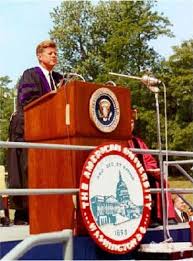
    Kennedy at American University

    When Cousins returned to Russia in April of 1963, he brought news that Kennedy would do all he could to get the treaty signed. The Russian premier was ready to sign on to a total test ban if it allowed a minimum amount of on site inspections. Kennedy favored that kind of ban also.  But his problem was that he knew he could not get that through the senate, where you needed a two-thirds vote to ratify a treaty. The extremists in America wanted much more inspection. (ibid, p. 51) Therefore, the two men had to settle for a partial ban.  This one banned testing in the atmosphere, outer space, and underwater, but still allowed for testing underground. Khrushchev was disappointed in the compromise. Kennedy understood the disappointment.  He told Cousins, “He would like to prevent a nuclear war but is under severe pressure from his hard-line crowd, which interprets every move in that direction as appeasement.  I’ve got similar problems.” Kennedy then continued in this vein by saying, the lack of progress “gives strength to the hard-line boys…with the result that the hard-liners in the Soviet Union and the United States feed on one another, each using the actions of the other to justify its own position.” (p. 52)

    Cousins replied that it was not just the hard-liners in the USSR. The Chinese also felt that Khrushchev’s efforts at conciliation were unrealistic.  And that once the negotiations broke down, they thought there would be a move towards closer friendship between China and the USSR. In fact, a delegation from Bejing was scheduled to visit Moscow in June. Kennedy understood this and was worried about it.  He saw the test ban as a way to derail it. (ibid)

    Cousins told the president that “what was needed was a breathtaking new approach toward the Russian people, calling for an end to the Cold War and a fresh start in American–Russian relationships.”  This kind of approach would insinuate that “the old animosities could become the fuse of a holocaust.” Kennedy took all of this in, digested it and understood it.  He told the editor to write him a memo on both their meetings and his visit with the Russian premier. Which Cousins did. (ibid, p. 53)  Two weeks later, in early May, Ted Sorenson–Kennedy’s main speechwriter–called him to his office.  Sorenson told him that Kennedy was going to use some of his arguments and he wanted some more notes. The Kennedy/Cousins connection was the beginning of the American University address.

    Sorenson wrote a rough draft first.  It was reviewed by National Security Advisor McGeorge Bundy, Bundy’s assistant Carl Kaysen, fellow speechwriter Arthur Schlesinger, and Adrian Fisher from the Arms Control and Disarmament agency.  On June 6th, Sorenson took all the suggestions and turned out a second draft overnight.  After another go-round with the same circle he refined it again.  On June 7th, he gave that final draft to Kaysen for the necessary security clearances.  Kennedy advised Kaysen on this process.  When handed the speech, the Chair of the Joint Chiefs, Maxwell Taylor decided not to show it to the other service branch chiefs.

    On the return plane ride back from Hawaii, Sorenson showed the speech to Kennedy.  JFK suggested some changes but, overall, he liked it.  Kennedy also showed the speech to Senator Mike Mansfield and Averill Harriman from the State Department, who he would later choose to negotiate the test ban treaty.  (ibid, pgs. 26-27)  It was ratified in the senate in late September of 1963 and took effect on October 10th.

    After JFK arrived at the White House from Hawaii at a little after nine in the morning, Bobby Kennedy called his brother.  He congratulated him on his speech in Hawaii. The Attorney General then asked him when he was speaking at American University.  The president replied that it would be at 10:30 that morning.   Bobby asked if he could come to the White House after that. He needed to talk to him about the crisis at the University of Alabama.


    II
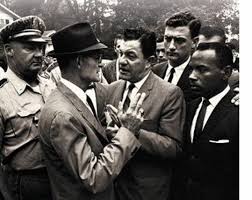
    Meridith at Ole Miss

    This is another point that most of us have forgotten about.  Sandwiched between these two epochal speeches, a gripping televised drama was playing itself out. The University of Alabama was the last major institution of higher learning in the south to remain segregated. At Ole Miss, the previous year, President Kennedy had to send in federal troops when Governor Ross Barnett had resisted admitting black student James Meredith.  During that violent conflict, two people were killed, cars were burned, and federal marshals were pelted with rocks. Barnett resisted even though Meredith’s case had been ruled upon by both a federal appeals court and the U.S. Supreme Court.  When he did so, the governor was then found in contempt of court. He was given five days to comply or he would be arrested and fined. The problem for Barnett was that he had proclaimed, “No school will be integrated in Mississippi while I am your governor.” Therefore, the Kennedys and the legal system had to go into high gear to gain entry for Meredith.  And because Barnett wanted to satisfy the racist element of the electorate, he resisted until the end. Because of this, violence ensued.  RFK later came to the conclusion that if Barnett could not stop Meredith from registering, his fallback plan was to make it appear that only the Kennedys sending in thousands of federal troops made him do so.  And for Meredith’s protection, troops stayed on campus for eight months. In other words, as in the Civil War and Reconstruction, the North was occupying the South.  Afterwards, Bobby Kennedy understood that this had been Barnett’s plan from the start.  (Robert Kennedy in His Own Words, edited by Ed Guthman and Jeffrey Shulman, p. 160)

    In Alabama, Governor George Wallace had taken a similar pledge. His was to stand in the schoolhouse door to stop the University of Alabama from being integrated.  The last thing the Kennedys wanted was another Ole Miss conflagration.  But as with Meredith, two young black students–Vivian Malone and James Hood–had been cleared by the courts to attend the publicly financed state university.  In addition to his public pledge, Wallace had made a political calculation after he lost the 1958 race for governor to the rightwing, Klan backed  John Patterson.  Prior to that loss, Wallace had  been–comparatively speaking–rather moderate on civil rights.  As both a state representative and circuit judge, he had done things that would not pigeonhole him as a racist, like granting probation to black prisoners.

    But after he lost to Patterson he reportedly told aide Seymore Trammell, “Seymore, you know why I lost …..?  I was outniggered by John Patterson.  And I’ll tell you here and now, I will never be outniggered again.” (Dan Carter, The Politics of Rage, p. 2; this incident is also depicted in John Frankenheimer’s award winning TV film, George Wallace.)  In other words, like Barnett, Wallace was putting on what was partly a theatrical performance.  He was playing to his constituency.  And his constituency was the Democratic Party in Alabama, just as Barnett’s was the Democratic Party in Mississippi.  In other words, the Kennedys were bucking up against what was supposed to be their own political colleagues.  I wish Cohen had given us a bit of historical background on how this happened. He does not.  (Which is a shortcoming of the overall book I will elaborate on later.)

    In a nutshell, it was Lincoln, a Republican, who had declared the Emancipation Proclamation. He then passed the Thirteenth Amendment.  And it was the Radical Republicans who had then passed the Fourteenth and Fifteenth Amendments.  Further, Andrew Johnson, a southerner, had been nearly impeached and removed from office by the Radical Republicans when he resisted their program for military occupied Reconstruction.

    Therefore, when the Klan began to organize around the remnants of the Confederacy and the southern army, their natural allies were the local and regional Democrats.  To their everlasting shame, those Democrats made a decision based upon nothing but arithmetic–as if the Civil War and its hundreds of thousands of casualties had never happened.  They casually and simply added up the number of white residents in the various states and compared them with the number of black residents.  Since the former outnumbered the latter by a margin of at least two to one, it was easy to see where political success lay.  Therefore, the local Democratic authorities united with the local racist groups and put together what historians today call the Mississippi Plan. In its most extreme form, on the eve of elections, white paramilitary groups would ride on horseback, processional style, through the center of towns and villages carrying torches, with weapons in their saddles.  The message was clear:  if the newly liberated black slaves tried to vote they would do so at their own risk.  And the fact that these processions openly rode through towns certified that the local legal authorities would do nothing about enforcing federal laws, like the Fourteenth and Fifteenth Amendments.

    This was followed by the infamous Compromise of 1877.  In that backroom deal, the presidential victory of Democrat Samuel Tilden was negated.  Republican Rutherford B. Hayes became president. The Democrats again were practicing arithmetic. In this horse trade, the Republican Hayes and his predecessor President Grant now removed the last northern armies from the south. Reconstruction was now ended. When that occurred, the last Republican governments in the south collapsed. That geographic area now become a bastion of Democratic electoral strength in national elections.  It came to be called the Solid South. With these two events, things like the Black Codes now morphed into Jim Crow.  Jim Crow then became a systematic and methodical plan of complete segregation.   No American president had seriously challenged this system before Kennedy.  And since he had spoken out on the issue as a senator and a candidate, he had lost six states in the Solid South in the 1960 election—before he was even inaugurated. Most historians see this as the beginning of the great transformation of the south from a Democratic to a Republican stronghold. 

    What made it all the worse was that the presidents who should have done something about this appalling situation did little or nothing.  That is, the so-called Progressive presidents (Taft, Teddy Roosevelt, Woodrow Wilson), and Democratic liberals like Franklin Roosevelt, and Harry Truman.  The last two understood something should be done.  But they both made the practical decision that if they acted on the subject in any real or forceful way, the other parts of their political agenda would be torpedoed by the power of the so-called Dixiecrats in the House and especially in the Senate i.e. the southern Democrats who controlled the chairmanships of so many committees in congress. Therefore Roosevelt did as much as he could symbolically by appointing black Americans to his administration.  Truman integrated the military services.

    But what is the excuse for Dwight Eisenhower?  The reason I express the question that way is because he had the sanction of the Supreme Court.  In 1954, the Warren Court passed down the Brown vs. Board decision.  This crucial case reversed the 1896 Supreme Court decision in Plessy vs. Ferguson, that had sanctified local Jim Crow laws, and therefore separate facilities were now deemed equal before the law. The Supreme Court had ratified segregation.  But the 1954 decision very clearly overturned that case and dictated that the system of segregation should be now taken apart with all due speed.  But as many commentators have stated, the Eisenhower/Nixon regime proceeded with the speed of a turtle with arthritis.  For instance, Eisenhower’s Justice Department never filed a civil rights case in Mississippi during his entire administration.  In the six years after Brown vs. Board, Eisenhower filed a grand total of ten civil rights cases based up on either equal accommodations or voting discrimination.  To say this was a snail’s pace is an insult to snails. As many commentators have pointed out, this hesitance was the beginning of Vice President Richard Nixon’s Southern Strategy: the deliberate courting of the racist element in the south for political gain.  In other words, the Republicans were–not very subtly–reversing the heritage of Lincoln. (The one exception in the six year span was the 1957 crisis at Central High in Little Rock, Arkansas.) Therefore, because of the political calculation of Eisenhower and Nixon, Kennedy had an even more uphill climb in front of him.  He had to overcome the nearly one hundred year institutional basis of segregation, which had now become ingrained in southern culture in every way: socially, politically, and psychologically. But further, he had to find a way to get around the Dixiecrat control in congress e.g. Senator James Eastland of Mississippi.

    I wish Cohen had detailed some of the above in his text. It would have placed the dramatic reversal President Kennedy was about to enact in a more accurate context.


    III
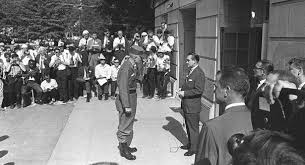
    Wallace in Tuscaloosa

    As authors Irving Bernstein, Harry Golden and Harris Wofford have noted, Kennedy understood that there were simply not enough votes in congress to get a civil rights bill enacted his first year. Therefore, in 1961, the White House did what Eisenhower and Nixon had not done. Attorney General Bobby Kennedy concentrated on school integration with the Brown vs. Board decision backing him. (Guthman and Shulman, pgs. 147-48)  The Kennedys sent Justice Department officials like Ramsey Clark, Burke Marshall and John Siegenthaler to local districts where they thought black families would have difficulty registering their children in public K-12 schools.  As Bernstein notes in Promises Kept, in 1961, Kennedy proceeded to do as much as possible through executive orders in order to build momentum, instead of sustaining a legislative defeat or filibuster.  In 1962, the administration did send up a modest voting rights bill.  As Bobby Kennedy later said, it went nowhere.  It was filibustered and the White House did not have anywhere near the votes to get cloture. (Guthman and Shulman, p. 149)  So the White House continued with administrative actions, like local lawsuits under Brown vs. Board and Title III of the 1957 Civil Rights Act, and equal employment through the Equal Employment Opportunity Commission. With the last, the Kennedys were determined to make sure that companies doing business with the government were active in hiring minority groups.

    Then came the Birmingham spectacle, with Sheriff Bull Connor facing off against Martin Luther King and the Southern Christian Leadership Conference. The sight of white firemen slamming black children against buildings with fire hoses, of German Shepherds leaping and biting innocent civilians, of police officers smashing demonstrators’ skulls with billy clubs, these nightly TV images created a sensation.  As JFK told his brother and Dr. King, the bill he sent to congress should have been called Bull Connor’s Bill. (Guthman and Shulman p. 171) Washington watched and listened as people in the north were now repulsed by what a century of segregation had done to Americans in the south—even after the Civil War amendments had legally made former slaves equal to whites. Such was simply not the case; not even close. The actions of Ross Barnett in Oxford, and Bull Connor in Birmingham now formed the background for President Kennedy versus Governor Wallace in Tuscaloosa.

    Cohen uses what is today a little known source for the backbone of his description of this conflict.  The late Robert Drew was a committed documentary film director who was one of the first—along with Emile de Antonio—to make cinema verite films.  That is, documentaries that did not use the device of  breaking up the action of the story with a posed and well lighted sit down interview with a subject.  Drew had previously made the film Primary in this way.  That was about the Wisconsin Democratic primary election of 1960, which featured Kennedy against Senator Hubert Humphrey.  (The only author in the JFK assassination field who has mentioned that film to any degree is Joseph McBride in his book Into the Nightmare.) Kennedy had seen the film and liked it.  He asked Drew what he wanted to do next. Drew said he wanted to make a film about his administration during a particularly stressful period of time. (Cohen, p. 78)  They eventually decided upon the racial crisis between Kennedy and Wallace over the integration of the University of Alabama.  In addition to filming the Kennedy brothers and the two students, Governor Wallace agreed to allow cameras to follow him around also.  The film, naturally entitled Crisis, aired on ABC in the fall of 1963. Its candor created quite a controversy. Two of the points the film makes are that 1.) It was Kennedy who was pushing for sending a civil rights bill to congress ASAP, and 2.) It was RFK who was pushing his brother to make a national speech in primetime before he did that.  (Cohen, pgs. 82-83)  Cohen not only saw the film, he saw hours of outtakes from it.

    The confrontation at the schoolhouse door was weeks in the making.  In April, Robert Kennedy had visited Wallace in Birmingham to try and ward off another violent, life threatening spectacle as with Barnett. As Bobby said later, that meeting was “unhelpful….We really didn’t get very far.” (Guthman and Shulman, p. 185)  In May, another meeting took place between the  AG and Wallace, again with no real result. Wallace was intent on being as unhelpful, and as unpredictable, as possible. Even though the university’s board of trustees wanted to let the students register, since Wallace was the titular head of the board, they could not overrule him. (ibid, p. 187)

    To give an example of this, on the evening of Saturday June 8th, Wallace had sent the White House a telegram telling the president that “out of an abundance of caution” he was calling up about 500 state guardsmen.  Kennedy replied that he was “gratified by the dedication to law and order expressed in your telegram” informing him of the potential use of the National Guard at Tuscaloosa. But, the president continued, the only foreseeable threat of violence came from Wallace’s “plan to bar physically the admission of Negro students in defiance of the order of the Alabama Federal District Court, and in violation of accepted standards of public conduct.” (Cohen, p. 74)  On Tuesday June 11th, Wallace flew from Montgomery to Tuscaloosa. He had a motorcycle escort to the Hotel Stafford where he constructed his headquarters.  Wallace was going to make real his promise to stand in the schoolhouse door.  The problem for the White House was that the courts had ruled on May 21st that the students had to be enrolled for the summer session, which began on June 11th. (ibid, p. 236)
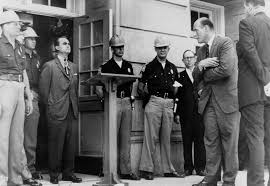
    Katzenbach and Wallace

    On the scene, the point man for the White House was Deputy Attorney General Nicolas Katzenbach. He had arrived on Monday, and set up his office on campus.  RFK and he had decided that Malone and Hood would not accompany Katzenbach to the gate.  Since the two had already been admitted he decided to escort them to their rooms.  The problem was the actual registration, which Wallace was holding up. (Cohen, p. 85)  The White House had out manned Wallace.  President Kennedy had 3,000 soldiers on the scene if Wallace refused to yield, was arrested, and violence broke out.  They were under the command of General Creighton Abrams who was in dress clothes so as not to suggest a military commander.  Colonel Albert Lingo, Alabama’s director of public safety, raised a force of 825 law enforcement officers.

    One of the valuable insights Cohen brings to the fore in his analysis of the Tuscaloosa showdown is the role of Louis Martin Jr.  Martin was a longtime reporter and editor for black newspapers like the Chicago Defender. He was recruited into Kennedy’s campaign by his brother-in-law Sargent Shriver.  He became one of the president’s main advisors on race issues. And Kennedy consulted with him in the early days of the conflict.  (Cohen, p. 226)  Kennedy was trying to decide just how wide his civil rights bill should be.  He originally wanted a bill that included integration of public accommodations, school desegregation, and voting rights. Some Republicans, like Senator Everett Dirksen, wanted to stop short of privately owned facilities like restaurants.  Previously advised by Martin, President Kennedy disagreed with this. Martin had told him the bill had to include all public accommodations or “we’re going to have one hell of a war in this country.” (ibid, p. 227) Therefore, at a private conference with Kennedy, when the Republicans objected to this aspect, Kennedy replied that all restaurants must be integrated. Martin also recommended a billion dollar program for job creation and development of job skills for inner city youth.

    Katzenbach,Johnson,Kennedy
    Katzenbach, LBJ, RFK

    Cohen also deals with the role of Lyndon Johnson in all this.  Kennedy included LBJ in a meeting with Republican leaders on Monday, the tenth. And he also describes the long discussion that many authors have mentioned between Sorenson and Johnson from a week before, which was taped by the vice-president.  Johnson also recommended that the president get on national television to push the issue.  But he was not sure that this was the proper time because, like Larry O’Brien and Ken O’Donnell, Johnson thought that pushing the issue might endanger the rest of Kennedy’s program. (ibid, pgs. 227-29)  In light of that, the subtext of Cohen’s work in this regard is that it was really Robert Kennedy who was the driving force in the Wallace crisis and also the speech on race.

    The Kennedys had two tactical advantages over the governor.  The first was that Frank Rose, the president of the university, was in favor of admitting the students.  (ibid, p. 239)  Therefore, he was providing the Kennedys with inside information about what Wallace was doing.  Secondly, if Wallace resisted admittance, the White House could attempt to nationalize the state national guard.  This was the step that the Kennedys realized they had to take before sending in federal troops under Abrams, which the White House always looked upon as a last resort.  (ibid, p. 249)  With over 300 journalists in attendance from all over the world, and a national TV broadcast, that is the way the conflict played out.  President Kennedy made the decision to nationalize the guard.  (ibid, p. 267)  Therefore Brigadier General Henry V. Graham asked Wallace to step aside upon orders of President Kennedy. Katzenbach and his assistant on civil rights John Doar now had the students registered.  Graham and his detachment stayed on campus, actually in the students’ dorms, for protection purposes. 

    It was with the peaceful conclusion of this conflict that President Kennedy decided to go ahead with the speech that evening.  Or as Ted Sorenson later related: as Wallace left the gate, JFK turned to him and said, “I think we’d better give that speech tonight.”  The problem was that Sorenson had not prepared a speech.  What existed were some notes put together by RFK and the Justice Department.  And here, Cohen inserts something that was new for this reviewer: the figure of Richard Yates. 

    Today, Yates is known as one of the most distinguished novelists of his era.  But like many other fiction writers, his fame and recognition only arrived after his death in 1992.  While alive, none of his books ever sold more than twelve thousand copies. His most famous novel, Revolutionary Road, was made into a film in 2008 by director Sam Mendes.  In 1963, Yates was freelancing as a speechwriter for Bobby Kennedy.  Anticipating, and in fact, pushing his brother to make a forceful nationally televised address on race, Bobby had told Yates to prepare a speech on the subject.  At the time the speech was telecast, June 11, Yates had only been working for RFK for a couple of weeks. (Cohen, p. 287)  On the evening of June 9th, Yates began working on a speech.  He completed in two days later, the day JFK went on television.  Sorenson did not hand the president a speech until less than an hour before he went before the cameras.  As Cohen notes, there is no evidence that Sorenson used the Yates draft in his work.  But there is evidence that he used some of the themes that Yates sounded.  (ibid, p. 289)

    JFK Civil Rights Speech June 11, 1963

    As Cohen notes, Kennedy only had a few minutes to look over the speech before going on camera. He delivered it without a teleprompter. (ibid, p. 331) And he actually extemporized the last four paragraphs. Kennedy chose to accent the events of the day, the showdown with Wallace, as the lead.  And he especially wished to highlight the facts that it was an Alabama guardsman who removed Wallace, and it was an Alabama judge who wrote the order to do so.  And they did this so that two Alabama citizens could enter the university.  Although Cohen includes a neat and incisive summary–impressing the fact that Kennedy was the first president since Lincoln to make race a moral, not a legal issue–I cannot do better than to recommend the reader watch this milestone speech for himself.  (http://abcnews.go.com/Archives/video/june-11-1963-jfk-promises-civil-rights-bill-9295675) In my opinion, among Kennedy’s several memorable speeches, it seems to me to be significantly underrated: both as a speech, and as part of the fabric of a dramatic historical revolution. It is almost impossible to imagine Eisenhower or Nixon making such a speech.  In fact, as Cohen notes, Martin Luther King was overjoyed after he heard it.  He told Walter Fauntroy, a friend he was watching it with, “Walter, can you believe that white man not only stepped up to the plate, he hit it over the fence!”  (ibid, p. 339)

    But there were some who detested the speech, and the movement that had brought it on.  Cohen closes the book proper with the wife of Medgar Evers watching the speech with her children in Jackson, Mississippi. (Cohen, p. 350)  She was riveted by the things the president was saying.  Evers himself was at a mass meeting at the New Jerusalem Baptist Church.  In the very early minutes of June 12th, as he was driving up his driveway, he was shot and killed by Klansmen Byron de La Beckwith.  At his second trial for murder, which ended with a hung jury–as did the first–Ross Barnett approached Beckwith at the defense table and shook hands with him, as his wife Myrlie was testifying from the stand.  As with the Civil War and Reconstruction, the forces of segregation and Jim Crow were not going down without a fight.  De La Beckwith was not convicted for another thirty years. 

    But it was this speech that really turned the conscience of America. Because it was spoken by a president who was a wealthy white man.  Kennedy used it to submit his Civil Rights Bill. Bobby Kennedy attended the funeral of Medgar Evers. After which the president invited Evers’ family to the White House.


    IV
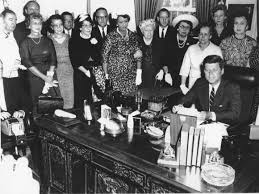
    JFK signs Equal Pay Act with American Association of University Women

    I don’t wish to leave the impression that these two speeches and their immediate background are all the author covers in the book.  He also touches on other significant accomplishments during Kennedy’s brief presidency.  For example he deals with the Equal Pay Act for women; Kennedy’s very close ties to the labor movement ( as one labor lobbyist noted, “We lived in the White House” p. 113).  He also deals with Kennedy’s attempt at stressing physical fitness programs, reforming immigration, and even touches on Kennedy’s attempt to soften the exit of some industries from Indonesia, American industries that President Sukarno had expelled. (p. 310)  And the author also notes that Kennedy held a press conference almost every sixteen days.  Which is amazing in light of their frequency today.

    At the beginning I said that Cohen had a fine idea for a book.  And as noted above, the volume has some good (and some new) attributes to it.  But ultimately I cannot fully endorse it like I did Robert Rakove’s Kennedy, Johnson and the Nonaligned World, or Philip Muehlenbeck’s Betting on the Africans.  There are two reasons for this.

    As touched upon previously, Cohen is not really an historian. So unlike Rakove and Muehlenbeck, he does not give you the historical backdrop to either the race issue or the rapprochement with the Soviets issue, which are his two main topics. Above, I tried to barely outline the backdrop to the race issue. The latter is even more complex.  And unlike the former, the scholarship in this area—how the Cold War originated and then aggrandized itself—is still growing.  Cohen does not even try to map any of this out. To give just one example: it is hard to believe, but you will not see the name of either of the Dulles brothers—neither John Foster, nor Allen—in the entire book. Any true historian—like Rakove or Muehlenbeck, if they had been writing this book– would have included them. In one central aspect, history is finding a through line. That is a combination of balanced background, cause and effect relationships, and, from there, searching for patterns and origins of new behavior and actions.  From all this one then finds, as Arthur Schlesinger once said, “currents”. There definitely were shifting currents in JFK’s presidency, especially on these two issues. And if Cohen had done a fuller job as historian, the reader would more fully understand the quantum leap that Kennedy was making in both areas. And why it was so difficult? Along with this failing, there is also a lack of information as to the central mystery:  Why, psychologically, did Kennedy do both of these things?  Again, the answer to that question is also in the record, but Cohen fails to excavate it for the reader.

    Kennedy in Dallas

    Because of these shortcomings, it leads to what I believe is the flawed conclusion he makes in his epilogue.  Cohen writes there that because of these two speeches, “For the first time in his whiplashed presidency, he came to inhabit his office.” (p. 373) This is echoed on the rear cover: a description reads, that in “Kennedy’s crowded hour, he begins to see things differently.” I could not disagree more.  On both points. The reason Kennedy’s early presidency was “whiplashed” was that he was being duped by the CIA over the Bay of Pigs issue, and he was starting a truly revolutionary program in foreign policy. And an only slightly less revolutionary one in domestic policy.  There was no way that was going to be easy, especially at the start. Because there was no way the opposition was not going to resist strongly.

    On the second point, I would say that Kennedy came to inhabit his office almost immediately. In the sense that he knew what he wanted to accomplish at the start. And he set out to achieve it.  The first and, I think, foremost example is one Cohen ignores: the situation in Congo. Again, you will not see the name of Patrice Lumumba in this book. Even though he was a black man striving to free his country from imperialism. Describing that struggle—even briefly—would have highlighted and dramatized the conflict Cohen is describing domestically. I have explained in my review why Kennedy’s bill was not sent up until 1963;  it would have been filibustered effectively.  The reason the attempt at détente took place in 1963 was due to the Bay of Pigs drama; which as many have noted was due to Allen Dulles misleading President Kennedy. This is called creating a balanced historical backdrop.

    Which relates to another failing of the book.  Like Thurston Clarke, Cohen is and wants to be an upstanding member of the MSM.  He has written for Time, UPI and, since he is a Canadian, the Globe and Mail, which is the USA Today of Canada.  He has been described by the New York Times as one of “Canada’s most distinguished authors.” In his book he actually praises Sally Bedell Smith’s Grace and Power as “groundbreaking”.  Which is about the last word I would use to describe it.  I would call John Newman’s JFK and Vietnam, groundbreaking. I would describe Richard Mahoney’s JFK: Ordeal in Africa as groundbreaking. I would also call Irving Bernstein’s Promises Kept and Donald Gibson’s Battling Wall Street groundbreaking tomes. No surprise, you will not see any of those books in his bibliography. But there you will see Ben Bradlee’s worthless book Conversations with Kennedy, and you will also see the late (and lying) David Heymann’s even more worthless biography of Robert Kennedy.  See, real historians like Robert Rakove and Phil Muehlenbeck are academics.  They are not part of the MSM propaganda machine. Therefore, they are not beholden to it for favors. Cohen is a part of it.  Therefore he dutifully spends a senseless amount of space on Mary Meyer. (Although, thankfully, he does not buy the Timothy Leary aspect of that story.) We are also told—Bradlee like–that Kennedy was endlessly interested in the John Profumo sex scandal in England. The author actually gives space and credibility to Mimi Alford. Even though Australian researcher Greg Parker has shown her story to be, at best, dubious. (Click here http://www.reopenkennedycase.net/reopen-blog/a-storm-in-a-mini-teapot) If you can comprehend it, as with Heymann, even stripper Tempest Storm makes an appearance in Cohen’s pages. What any of this has to do with race relations or nuclear arms control is Cohen’s secret. (Or maybe Tempest Storm’s?)

    This is all part of a publishing industry subdivision I have called the “Posthumous Assassination of John F. Kennedy”.  It’s a way of demeaning Kennedy’s character and legacy and, as a byproduct, killing off interest in his assassination.  As we shall see–and as I mentioned in that essay—Bob Loomis of Random House was one of its ringleaders. (The two-part essay “The Posthumous Assassination of John F. Kennedy” is available on the Probe CD collection, and in the book The Assassinations.  Many readers considered it one of the finest essays Probe ever published.)

    The problem for Cohen is his book was distributed by a subsidiary of Random House. It was Random House and the notorious Loomis who originated the work of Gerald Posner on the JFK murder. To the point of having CIA asset Loomis actually arrange interviews for Posner with the likes of Yuri Nosenko.  (Loomis was in prime position to do that.  When I called his office in 1997, his secretary said he was in Washington, since he spent about two days a week there.)  As anyone who has followed the Kennedy saga knows, Loomis has been one of the most pernicious behind the scenes operators in the field.  Some of his and his company’s clients—besides Posner—have included James Phelan, Sy Hersh, Alford, and Norman Mailer.  (The Assassinations, edited by James DiEugenio and Lisa Pease, pgs.  369-70.  See Destiny Betrayed Second Edition, p. 244, for Loomis’ handiwork on the MLK and RFK cases.) And as Sally Bedell Smith herself once admitted—as was the case with Posner—her book was not her idea.  It was pushed on her by the bigwigs at Random House—while Loomis was still there. (See SF Gate, May 23, 2004, interview with Carolyne Zinko) Therefore I have little doubt Loomis helped stage interviews for Vanity Fair’s answer to Kitty Kelley. And as we have learned about this cottage industry—with both Kelley and Heymann—some of these “interviews” did not happen. And that is why Smith’s book got such a big sendoff. Just like Loomis gave Posner a huge publicity binge. (Another Loomis client, Robin Moore, had his book, The Hunt for Bin Laden, partly fabricated by a false witness. The fabrication was done with direct authorization by Loomis.) As they say in that industry, you scratch my back and I’ll scratch your book. Cohen wanted to get his ticket punched.  So he played the game. No matter how badly it marred his work.

    Therefore what could have been an important and sterling volume is seriously compromised with a lot of litter.  Instead of being up there with Rakove and Muehlenbeck, it stands a couple of steps downward, with Thurston Clarke’s mixed bag of nuts.
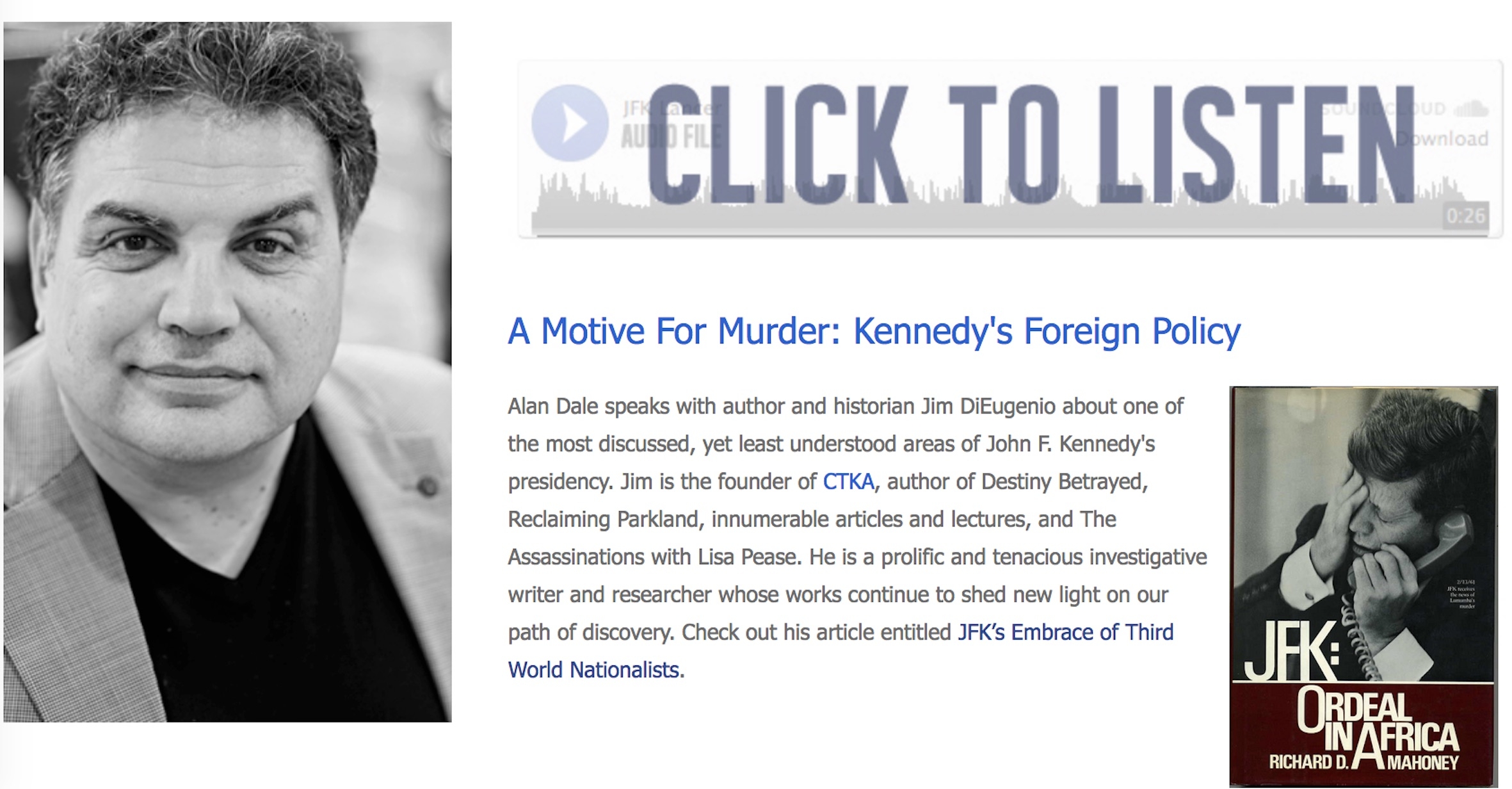
  • Introduction to JFK’s Foreign Policy: A Motive for Murder


    In a little over a year [2013-2014], I have spoken at four conferences. These were, in order: Cyril Wecht’s Passing the Torch conference in Pittsburgh in October of 2013; JFK Lancer’s 50th Anniversary conference on the death of JFK, in Dallas in November of 2013; Jim Lesar’s AARC conference in Washington on the 50th Anniversary of the Warren Commission in September of 2014; and Lancer’s Dallas conference on the 50th anniversary of the Commission in November of 2014.

    At all four of these meetings, I decided to address an issue that was new and original. Yet, it should not have been so, not by a long shot. The subject I chose was President Kennedy’s foreign policy outside of Vietnam and Cuba. I noted that, up until now, most Kennedy assassination books treat Kennedy’s foreign policy as if it consisted of only discussions and reviews of Cuba and Vietnam. In fact, I myself was guilty of this in the first edition of Destiny Betrayed. My only plea is ignorance due to a then incomplete database of information. I have now come to conclude that this view of Kennedy is solipsistic. It is artificially foreshortened by the narrow viewpoint of those in the research community. And that is bad.

    Why? Because this is not the way Kennedy himself viewed his foreign policy, at least judging by the time spent on various issues—and there were many different topics he addressed—or how important he considered diverse areas of the globe. Kennedy had initiated significant and revolutionary policy forays in disparate parts of the world from 1961 to 1963. It’s just that we have not discovered them.

    Note that I have written “from 1961 to 1963”. Like many others, I have long admired Jim Douglass’ book JFK and the Unspeakable. But in the paperback edition of the book, it features as its selling tag, “A Cold Warrior Turns.” Today, I also think that this is a myth. John Kennedy’s unorthodox and pioneering foreign policy was pretty much formed before he entered the White House. And it goes back to Saigon in 1951 and his meeting with State Department official Edmund Gullion. Incredibly, no author in the JFK assassination field ever mentioned Gullion’s name until Douglass did. Yet, after viewing these presentations, the reader will see that perhaps no other single person had the influence Gullion did on Kennedy’s foreign policy. In a very real sense, one can argue today that it was the impact of Gullion’s ideas on young Kennedy that ultimately caused his assassination.

    These presentations are both empirically based. That is, they are not tainted or colored by hero worship or nostalgia. They are grounded in new facts that have been covered up for much too long. In fact, after doing this research, I came to the conclusion that there were two cover-ups enacted upon Kennedy’s death. The first was about the circumstances of his murder. That one, as Vince Salandria noted, was designed to fall apart, leaving us with a phony debate played out between the Establishment and a small, informed minority. The second cover-up was about who Kennedy actually was. This cover-up was supposed to hold forever. And, as it happens, it held for about fifty years. But recent research by authors like Robert Rakove and Philip Muehlenbeck, taking their cue from Richard Mahoney’s landmark book, JFK: Ordeal in Africa, have shown that Kennedy was not a moderate liberal in the world of foreign policy. Far from it. When studied in its context—that is, what preceded it and what followed it—Kennedy’s foreign policy was clearly the most farsighted, visionary, and progressive since Franklin Roosevelt. And in the seventy years since FDR’s death, there is no one even in a close second place.

    This is why the cover-up in this area had to be so tightly held, to the point it was institutionalized. So history became nothing but politics. Authors like Robert Dallek, Richard Reeves, and Herbert Parmet, among others, were doing the bidding of the Establishment. Which is why their deliberately censored versions of Kennedy were promoted in the press and why they got interviewed on TV. It also explains why the whole School of Scandal industry, led by people like David Heymann, prospered. It was all deliberate camouflage. As the generals, in that fine film Z, said about the liberal leader they had just murdered, Let us knock the halo off his head.

    But there had to be a reason for such a monstrous exercise to take hold. And indeed there was. I try to present here the reasons behind its almost maniacal practice. An area I have singled out for special attention was the Middle East. Many liberal bystanders ask: Why is the JFK case relevant today? Well, because the mess in the Middle East now dominates both our foreign policy and the headlines, much as the Cold War did several decades ago. And the roots of the current situation lie in Kennedy’s death, whereupon President Johnson began the long process which reversed his predecessor’s policy there. I demonstrate how and why this was done, and why it was kept such a secret.

    It is a literal shame this story is only coming to light today. John Kennedy was not just a good president. Nor was he just a promising president. He had all the perceptions and instincts to be a truly great president.

    That is why, in my view, he was murdered. And why the dual cover-ups ensued. There is little doubt, considering all this new evidence, that the world would be a much different and better place today had he lived. Moreover, by only chasing Vietnam and Cuba, to the neglect of everything else, we have missed the bigger picture. For Kennedy’s approach in those two areas of conflict is only an extension of a larger gestalt view of the world, one that had been formed many years prior to his becoming president.

    That we all missed so much for so long shows just how thoroughly and deliberately it had been concealed.


    {aridoc engine=”google” width=”400″ height=”300″}images/ppt/JimDFP-Wecht2013.pptx{/aridoc}


    {aridoc engine=”google” width=”400″ height=”300″}images/ppt/JimDFP-Lancer2014.pptx{/aridoc}


    Wecht 2013 Presentation

    Lancer 2014 Presentation


    Version given at November in Dallas, November 18, 2016

    {aridoc engine=”google” width=”400″ height=”300″}images/ppt/JimDFP-Lancer2016.pptx{/aridoc}

    Lancer 2016 Presentation


    Revision, presented on March 3, 2018, in San Francisco

    {aridoc engine=”google” width=”400″ height=”300″}images/ppt/JimD-JFK-FP-2018.pptx{/aridoc}

    2018 Revision

  • Will the UN reopen the Dag Hammarskjold case?

    Spy messages could finally solve mystery of UN chief’s death crash

    by Jamie Doward, At: The Guardian

  • JFK: A President Betrayed


    Last November was the 50th anniversary of John F. Kennedy’s assassination. It provoked one of the most bizarre, depressing and extreme displays of MSM irresponsibility in recent memory. Even though respected pollster Peter Hart found that 75% of the public still believed that the Warren Commission verdict of Lee Oswald as the lone assassin was wrong, this meant nearly nothing to the media. Show after show, news segment after news segment proceeded as if we were still in 1964, and the Warren Commission had not been utterly discredited. This culminated with an absolutely Orwellian spectacle in Dallas on November 22nd. Mayor Mike Rawlings was clearly in the pocket of the Dallas Morning News and The Sixth Floor Museum. Rawlings literally blockaded Dealey Plaza. He had called up about 200 policemen to place wooden barriers around the site at incoming intersections. Only those who had been awarded tickets by a (pre-screened) lottery were allowed in the Plaza itself. There, inside the Missile Crisis type blockade, he and a few others gave some of the dullest and most pointless speeches ever made in the name of murdered president John F. Kennedy. It was one of the most wasted opportunities in recent history. There was literally a colony of media trailers on the site. With nothing to report; which, of course, was the aim of the whole exercise.

    There was one documentary that managed to break through the physical and mental blockade. Unfortunately it had very limited exposure through Direct TV. This was Cory Taylor’s JFK: A President Betrayed. Taylor’s film is now available at Amazon Instant and also for DVD purchase. After the reader sees it, I think he or she will agree that this was, by far and away, the best original production for anyone to see last November. And that is not at all a purely negative statement, that is, because most everything else was so poor. There are many good things in Taylor’s film.

    Taylor had previously mostly worked in television. Although he has several producer credits, he has worked mostly as an editor. And almost all of that work has been on documentaries and reality TV. But in looking through his credits, Taylor’s past work shows a strong social conscience, something lacking in Hollywood today. Therefore, we were lucky to have someone like him approach the Kennedy case at the 50th anniversary.

    That last statement is a bit misleading. For Taylor does not really approach the Kennedy case from a forensic or investigative viewpoint. What he does in his two-hour documentary is take a look at Kennedy’s foreign policy during his presidency, and try to show how some people within his own administration opposed it. To me, it is clear that the main inspiration for the film is the influential Jim Douglass tome, JFK and the Unspeakable.

    One of the main attributes of the film is that it uses some credible, and new, sources as interview subjects. And it bypasses the accepted mainstream historians who have, in reality, done little real research on JFK. Or, even worse, ignored Kennedy’s genuine interests. Therefore, to Taylor’s credit, one will not see the likes of Robert Dallek, Richard Reeves or Larry Sabato pontificating boringly and deceptively in this film. Some of the main academics in the documentary are University of Texas professor Jamie Galbraith, son of Kennedy aide and later Ambassador to India John K. Galbraith; Gareth Porter, a lecturer, journalist, and author who has written four books on the Vietnam War; former Wall Street journalist and editor Frederick Kempe, author of Berlin 1961; University of New Orleans professor Gunter Bischof, a specialist in Eastern European history. In addition to that, we see journalist Michael Dobbs, author of one of the better studies of the Missile Crisis, One Minute to Midnight, Peter Kornbluh, author and editor of Bay of Pigs Declassified, and Robert Schlesinger, son of Kennedy aide Arthur Schlesinger. This collection of commentators all makes for a notable improvement over the usual Dallek/Reeves/Sabato banal tendentiousness.

    But where Taylor has really done some interesting work is in the direct witnesses he has secured. For instance, Taylor interviews the interpreters at the Vienna Summit Conference, the late Viktor Sukhodrev (translator for Nikita Khrushchev) and Alex Akalovsky (interpreter for President Kennedy). In addition to Sukhodrev, there is also Sergei Khrushchev, son of the former Russian premier. Also on screen is the rather seldom seen Thomas L. Hughes. Hughes was an assistant to Chester Bowles in the Kennedy administration, and later succeeded Roger Hilsman as director of Intelligence and Research at the State Department. Lawyer Willam Vanden Heuvel was an advisor to Attorney General Robert Kennedy, and later wrote a book about RFK. Finally, in a real surprise, Taylor tracked down Andrea Cousins and Candis Cousins Kerns. These are the daughters of Saturday Review editor Norman Cousins. Cousins had been a tireless advocate for nuclear disarmament since, literally, the day after Hiroshima. As Douglass pointed out in his book, Cousins served as a kind of go-between between the Vatican, the Kremlin and the White House in their mutual efforts to construct a Nuclear Test Ban Treaty. He then wrote about it in his (much ignored) 1972 book, Improbable Triumvirate. It’s quite a promising roster. And it does not disappoint.

    II

    With actor Morgan Freeman narrating, the film begins with a brief discussion of a meeting Kennedy had on July 20, 1961 with, among others, CIA Director Allen Dulles and JCS Chairman Lyman Lemnitzer. The subject was the feasibility of a nuclear surprise attack on Russia in the fall of 1963. Apparently, Dulles and Lemnitzer figured that such a first strike would eliminate all the Russian missiles and bombers accumulated at that time. And therefore, push back against their imminent effort to match the atomic arsenal of the USA. In other words, America would now be the unchallenged superpower as far as nuclear arms went. Kennedy asked some probing questions about Russian casualties. He then closed the meeting by asking the attendees not to talk about the discussion. Afterwards he said to Secretary of State Dean Rusk, “And we call ourselves the human race.”

    This episode was first written about in that fine journal, The American Prospect back in 1994. A brief memorandum of the meeting had just been declassified in June of 1993. A little over a year later, Galbraith co-wrote the article with Heather Purcell, which the magazine featured as its cover story. As Dulles noted during the meeting, the fall of 1963 would be the optimum time for such an attack since America would be at its greatest advantage for strategic missiles vs. the Soviets. The backdrop to this meeting was the interim between the Vienna Conference and the Berlin Crisis. In fact, about two weeks later, Kennedy would make a speech in which he declared that the Russians would not drive the USA out of Berlin. Therefore, this opening is quite appropriate in that it shows Kennedy’s national security advisors trying to egg him on to do something incredibly violent; in fact, probably apocalyptic; while he quietly, yet resolutely resists. All against the backdrop of rising Cold War tensions, this time in Germany. This pattern will repeat itself a year later. But, in 1962, the backdrop will be Cuba.

    After this episode, Taylor now sets the historical era by introducing previous presidents Truman and Eisenhower and the beginnings of both the Cold War and the Nuclear Age. Kempe comments that the exit meeting at the White House between Eisenhower and Kennedy featured a 70-year-old president giving way to the youngest president ever elected. Vanden Heuvel comments that Kennedy quite consciously planned the New Frontier as a distinct break from Eisenhower. Sid Davis, a reporter of the time, says that in covering Kennedy, he found him to be very well versed on foreign policy and also quite articulate about his ideas.

    The film now addresses the Bay of Pigs fiasco. Taylor writes that Kennedy had been misled about the operation, but he does not get specific as to how. Which is odd, since Kornbluh edited what I think is one of the very best volumes on the subject, Bay of Pigs Declassified. There is a comment in the film as to how the planners at CIA though that the US would commit militarily but Kennedy would not. Further, one of the commentators, journalist Evan Thomas, actually says there was a lack of air cover. As more than one person, including myself, has explained in detail, the whole lack of air cover myth was manufactured afterwards by the CIA to shift the blame for the debacle from them to Kennedy. (See Chapter 3 of Destiny Betrayed, Second Edition, especially pgs. 54-56). Also, there is no mention of the investigations that took place afterwards, and how these caused Kennedy to fire Director Allen Dulles, Deputy Director Charles Cabell, and Director of Plans Dick Bissell. This was important because it was these inquiries that led JFK to conclude that the plan was never meant to succeed. That the enterprise was contingent upon him caving in and sending in the Marines. Which is what Allen Dulles eventually confessed to in a famous essay published years later based upon his notes for an article he was going to co-write for a magazine. (ibid, p. 47) Even considering the time restrictions, this is probably the most unsatisfactory of the episodes. To repeat, I am surprised Kornbluh was not used more at this point.

    From here, the film now goes to the Berlin Crisis of 1961. Kempe states that, upon Kennedy’s inauguration, Khrushchev made some small moves toward an accommodation with the USA. Sergei Khrushchev chimes in and says that his father wanted to improve relations with the Americans under Kennedy. But, as the film notes, Kennedy was bothered by a speech Khrushchev had made about starting small wars of national liberation throughout the globe. And this is how Taylor sets up the third major episode, which is the Vienna Conference and the Berlin Crisis.

    The Soviets were losing about ten thousand emigres per month in Berlin. As Bischof informs us, that was the approximate amount of German citizens flowing from the east to the western part of Berlin in 1961. This was not just a public embarrassment, but it was a serious loss to the economy of East Germany. For as both Bischof and Kempe state, it was mostly the cream of the east; that is educated, professional people; that were fleeing. When the Vienna summit was arranged, the Russians had this subject, Berlin, at the top of their agenda. The Kennedy brothers wanted to tell Khrushchev that the Bay of Pigs had been a mistake, and they were ready to talk about improving relations. But, as Bischof and Sukhudrev explain, the meeting got off on the wrong foot. Khrushchev made a comment about Kennedy’s youth, comparing it to his son who had died in World War II. Then, the discussion turned ideological. As Bischof explains, Khrushchev, a thorough communist ideologue, naturally had the advantage there. From this, Khrushchev now turned to Berlin. The Russian threatened to isolate, even blockade West Berlin. Khrushchev was that desperate to get some kind of overall treaty on the issue. Like Stalin, he did not like the fact that West Berlin was a part of East Germany. Therefore causing the huge refugee problem. As the film notes, Khrushchev actually became vocally belligerent about the issue, even threatening war. To which Kennedy replied, “It will be a cold winter.”

    Upon his return to Washington, Kennedy was clearly worried about Berlin. He brought in Dean Acheson, Truman’s Secretary of State. Acheson was the Democratic equivalent of John Foster Dulles, though not quite as extreme. There then came a battle of memoranda. Acheson prepared the hard line reaction to the threat. Arthur Schlesinger prepared the soft line. Acheson wanted to declare a national emergency, raise taxes, and prepare a troop build-up. In other words, a preparation for war in Germany. Kennedy was determined not to back down, but he essentially split the difference between Schlesinger and Acheson. He called out the reserves, but there was no enlistment drive. He went on television, but did not declare a national emergency. And he did not raise taxes for a military buildup.

    We all know what happened. The Russians backed down from both the war threat, and the isolation of West Berlin. They decided to solve their emigre problem by constructing the Berlin Wall. This was a very sad and drastic solution, and the film shows how it separated families in Berlin. But as Kennedy commented, better a wall and not a war. Acheson had a different reaction. As Gareth Porter notes, Acheson said to a small circle of like-minded individuals, “Gentlemen, you may as well face it. This nation is without leadership.” He later stated the same sentiments in a letter to his former boss, Harry Truman.

    III

    As the film notes, when the crisis was over, the Russians broke a pledge to Kennedy. They resumed atmospheric nuclear testing. Although the film does not specify it, this was not just another test. In October of 1961, the Tsar Bomba explosion took place. That bomb had a yield of 55 megatons. To this day it is by far the largest atomic blast ever. The Russians were now saying two things: 1.) We are resuming testing because there was no agreement on Berlin, and 2.) We are making progress in catching up to your atomic arsenal. In other words, the Dulles/Lemnitzer warning about the nuclear advantage being dissipated was coming to fruition. The USSR was closing the gap.

    In reaction, and reluctantly, Kennedy decided to resume testing. At this point, I wish Taylor had included some key information. As Jeffrey Sachs pointed out, the West German government had previously requested atomic weapons from Kennedy. To Konrad Adenauer’s chagrin, JFK had not given them to Bonn. In retrospect, and in spite of the strain it placed on West German diplomacy, that seems like a wise decision on his part.

    The film turns to the debate over inserting combat troops into Vietnam. This formally took place in the White House in November of 1961. Porter briefly mentions Kennedy’s knowledge and experience of the failed French struggle in Indochina in the fifties. And then, for me, the film reaches a dramatic high point. Taylor plays a black and white video clip of Rep. John F. Kennedy from 1953. Kennedy says that there will not be peace in the area until the French hand over more control to the people of Vietnam. Until they do, the communists will have the advantage in the struggle since they are not seen as an imperial power. He then demands that the people of Vietnam be given a promise of independence before the United States intervenes there. If not, any American attempt to intercede will be futile.

    It’s really good that Taylor dug up this clip. It’s one that not even I had seen before. But this is only one warning among many that Kennedy had given in public about Southeast Asia. (ibid, pgs. 25-31) And I wish that Taylor had mentioned the man who had caused Kennedy to make those perceptive comments. He was State Department official Edmund Gullion. Gullion had met with congressman Kennedy in Saigon in 1951 and explained to him how France could not win the war. That conversation, as proven by Taylor’s clip, greatly impacted Kennedy. (ibid, p. 21) When he became president, Kennedy brought Gullion into the White House to manage the immense Congo crisis.

    The film now returns to the result of the troop debate. Vanden Heuvel and Galbraith comment that because of his beliefs about colonial struggle, Kennedy was not willing to insert troops into Vietnam. Only advisors would be sent, so that the USA would not be actually fighting the war in the front ranks. But as Porter adds, this decision also met with internal resistance. For almost all of Kennedy’s advisors wanted him to commit combat troops, and the Pentagon thought it could win in Vietnam.

    IV

    The last part of the film deals with three main topics: the Missile Crisis, the rapprochement attempts by Kennedy with Cuba ad Russia afterwards, and Kennedy’s issuance of NSAM 263, the orders to remove all American personnel from Vietnam.

    Dobbs is a main interviewee for the first segment. He introduces it by saying that the Pentagon was not satisfied with the results of the Bay of Pigs. They wanted an all out invasion of Cuba and they submitted plans for this to Kennedy in early 1962. The Russians were worried about this possibility. So later in the year Khrushchev made the decision to move all three levels of the Russian nuclear armada onto the island, i.e. bombers, submarines and land based missiles. (There is a large debate about precisely what the motive was. For the simple reason that the amount of weapons the Russians moved onto the island was much more than enough to deter an invasion. It actually constituted a first strike capability).

    The main problem with the deployment was it was done in secret. Therefore when it was discovered, it was perceived as an attempt at a surprise attack. As most of us know by now, the Joint Chiefs, and most everyone else, wanted a show of force. Either tactical air strikes, a full invasion, or a combination of both. As Dobbs comments, Kennedy deserves much credit; he actually uses the accolade “greatness”; for not giving into the hawks and persevering through intense pressure to get a negotiated settlement. This consisted of a no invasion pledge, and a mutual withdrawal of atomic weapons: the Russians from Cuba and the Americans from Turkey.

    In the aftermath of the crisis–which had brought the world to the brink of atomic warfare–Kennedy decided it was now necessary to attain some kind of detente with the USSR. So he began to move forward, with the help of Cousins, in order to attain some kind of nuclear test ban treaty. It’s here that the two daughters of Norman Cousins now take some screen time to talk about certain events in April of 1963. In what has to be a film first, they discuss; with pictures; a meeting they and their father had with Khrushchev at his private resort on the Black Sea, a kind of Camp David for the premier.

    They also reveal why Kennedy agreed to this informal back channel: Because he was very conscious of the power of the Pentagon and how they would look askance at formal talks toward detente. Khrushchev told the girls to take a dip in his pool while he talked to their father about Kennedy’s request. Khrushchev told Cousins that although he was interested in nuclear disarmament and detente, he was as much hemmed in by his own hawks as Kennedy was. Cousins concluded that what was necessary was for Kennedy to make a bold move, perhaps a speech, to break through the impasse. He therefore told Kennedy that a meeting of the Central Committee was scheduled for June of 1963. That would be a good time for some kind of milestone speech, one about the necessity of peace in an atomic world. This, of course, was the origin of Kennedy’s famous American University speech, which figures so importantly in the Douglass book.

    We then shift to the other back channel Kennedy had constructed in 1963. This was with Castro. Kornbluh, who discovered some long secret documents in the early nineties, reviews this whole movement by Kennedy with the Cuban leader through a series of intermediaries. These maneuverings ended with a mission by French journalist Jean Daniel to Castro with a direct message from Kennedy about how he felt detente could be achieved. Kennedy said it was not really important to him that Castro was a communist. He could deal with that. Castro was overjoyed at this message and was jubilant about the possibilities. Which, as he predicted, were all dashed with the news of Kennedy’s assassination in Dallas.

    Finally, there is the Vietnam strand. Porter and Galbraith talk about two documents. The first is the set of papers discovered by the former about Averill Harriman’s thwarting of Kennedy’s attempt to get an agreement about Vietnam through India. This had been at the initiative of John K. Galbraith, who was the ambassador there at the time. In fact, Jamie Galbraith says that this was one of the purposes Kennedy had in mind when he moved his father out of the White House. When Galbraith wrote to Kennedy and said he had everything in place for negotiations to begin, Kennedy handed over the assignment to Averill Harriman, Assistant Secretary of State for Far Eastern Affairs. Harriman said he would send Kennedy’s memo–which included instructions on how to begin negotiations–by cable the next week. (Douglass, p. 119)

    But Harriman did not forward Kennedy’s instructions as he wished. He actually changed the language from one of de-escalation, to one of threatening escalation. When Harriman’s assistant tried to restore the cable to its original intent, Harriman killed the communication altogether. (ibid)

    But Kennedy still forged forward in his attempt to disengage from Vietnam. Galbraith talks about the issuance of NSAM 263 in October of 1963, which ordered all American advisors to be removed from Vietnam by 1965. He also relates Kennedy’s discussions with assistant Mike Forrestal just before he was assassinated. He told Forrestal he wanted a complete review of American policy in Vietnam, including how we ever got involved there. Considering Kennedy’s view of the French experience in 1951, this could only mean one thing.

    The film ends with an attempt to summarize Kennedy’s presidency. Journalist Evan Thomas says he symbolized the good image of public service, the image that faded with the escalation in Vietnam and then with Watergate. Andrea Cousins says that Kennedy should be remembered for his willingness to risk going against the grain. Her sister Candis concludes that Kennedy took a stand in the face of the nuclear threat. Even though he knew it would be difficult, and perhaps even dangerous.

    All in all, this is one of the better documentaries about Kennedy’s presidency. My only regret about it is that, although it presents much of the information from the Douglass book on screen for the first time, the Douglass book is not state of the art any more. Books by Philip Muehlenbeck and Robert Rakove have, in some significant ways, superseded it. (See here and here). These two books show that Kennedy’s foreign policy was even more revolutionary than depicted here.

    But that is a cavil. This film is much worth seeing. And it deserved a much larger platform than it got last year. Right now, it’s the best screen depiction of Kennedy’s foreign policy that I know of.

    You can buy this video by clicking here. It can also be viewed here. [Note:  the film was also subsequently shown on Netflix.]

  • Michael Swanson, The War State


    Michael Swanson’s book, The War State, seems to me to be a unique and worthy volume. This is not a book on the Kennedy assassination. It’s not even mainly about Kennedy’s presidency; although it does deal with that subject in the second half of the book. What it really is about is the construction of the Military Industrial Complex (MIC) after World War II. How that complex, as in no other country, then became a permanent and an integral part of our society. And how it then began to siphon and strangle parts of the American economy. It also deals with how two presidents helped start the phenomenon, Franklin Roosevelt and Harry Truman; and how two presidents then crashed into it, Dwight Eisenhower and John Kennedy. But the author makes clear that the crash by the latter was much more extensive. In other words, Swanson has written a Big Picture book, one in the tradition of, say, Fletcher Prouty. In my opinion, we need more of these types of books these days. Especially in light of what has happened to the USA since 1963.

    I

    Swanson begins the book with a telling quote by statesman and author George Kennan. Kennan writes that if the USSR would disappear tomorrow, the American military-industrial complex would remain unchanged, “Until some other adversary could be invented. Anything else would be an unacceptable shock to the American economy.” The remarkable thing about this quote is that Kennan wrote it in 1987, two years before the collapse of the Berlin Wall, and four years before the collapse of the USSR. And true to form, the MIC did hang on for a decade. And then, almost to fulfill the dreams of Project for the New American Century (PNAC), came Osama Bin Laden and the 9-11 attacks. The MIC now had its new nemesis. And, as per PNAC, American foreign policy demanded an invasion into Central Asia (Afghanistan) and one into the Middle East (Iraq-twice). PNAC also demanded a reshaping of that area into republics; something they were not at all ready to be. That stipulation created a new Perpetual War to replace the Cold War. All of this was predicted in advance by Kennan.

    From here, the author flashes forward to the Cuban Missile Crisis. (Pgs. 3-9) And he shows how the extremes in both the Russian and American camps made it difficult to settle that nightmare peaceably. To the point that President Kennedy had to use his brother to create a back channel to Ambassador Anatoly Dobrynin to come to a peaceful conclusion to the crisis. Swanson then comments that this may be why Kennedy allowed director John Frankenheimer to use the White House while filming Seven Days in May, a book and film which depicts an attempted military takeover of America.

    For his theme, Swanson now segues to Eisenhower’s famous Farewell Address, in which, for the first time, the MIC, as we know it, was named and described, and its dangers outlined. (p. 10) And now, Swanson begins to describe just how powerful and sprawling the MIC has become. The USA spends 15 times as much on the military as does Russia. It spends 6 times as much as China. (p. 11) If one adds up all global spending on arms and the military, the USA is responsible for 40% of it. More than the next 20 countries combined.

    How was this monster created? Prior to World War II, the USA had always demobilized after major wars. For example, in the thirties, the USA had an army of 140,000 men. We had only 80 tanks and 49 bombers. The total arms budget was only 243 million dollars. As Swanson comments, no one, not Huey Long, not John Maynard Keynes, could get Roosevelt to spend enough money to counter fully the Great Depression. But the threat of Germany and Japan did that in spades. By 1944, unemployment went from 14.6 % to 1.3 %. In constant dollars, FDR spent over 840 billion on the military. That figure dwarfed what he spent on the programs of the New Deal. By the end of the war, the USA had built 88,000 tanks, 97,000 bombers, 400 destroyers and cruisers and an amazing 22 aircraft carriers. (p. 13) Military spending was now 36% of GDP and had reached 86% of total budget expenditures in its biggest year. (p. 13)

    Prior to World War II, very few people paid income tax, and it was usually the rich who did. But this war was much more expensive than World War I, therefore bonds were not enough to finance it. Therefore, taxes had to be supplemented by the withholding income tax feature on middle class people. By 1945, that tax had now surpassed the corporate income tax as the base of operations for the American budget. (pgs. 14-15)

    When Roosevelt began to taper the economy to switch over to a wartime basis, he felt he had to go to the Eastern Establishment to man the high positions in this new behemoth. Therefore, the heads of companies like Sears and GE were placed on the War Production Board. And these men told Roosevelt only big companies could ramp up production fast enough to create a great war machine. Which, the author points out, may or may not have been true. (p. 18) These men also recommended the no-bid contract for much of the work to be done. Almost 75% of all contracts since have been of this variety. Further, they have also been cost plus contracts. Which means all costs of production are paid with a profit built into the contract. As the reader can see, this was the beginning of corporate socialism in military contracting. The biggest companies got even bigger and the MIC was now created. (p. 20)

    As the author notes, these abuses eventually led us down the path to Ronald Reagan and the Pentagon’s $435 hammers, $600 toilet seats, and $7000 coffee makers. Many of these men FDR appointed, like Charles Wilson, urged him not to demobilize after the war. Others, like historian Charles Beard, saw the danger this created and said it was necessary to demobilize. Since FDR died before the end of the war, he did not make that decision.

    II

    As many scholars have noted, including the illustrious Barton Bernstein of Stanford, Harry Truman was responsible for many of the excesses of the national security state. Whatever his regrets were later, whatever New York Times hagiographers like David McCullough may write about him, Truman is popular with Republican mouthpieces like George Will for a reason. The reason is that, along with Winston Churchill, he bears a large part of the responsibility for the Cold War. (As I previously pointed out, the best book on this subject is Frank Costigliola’s Roosevelt’s Lost Alliances.)

    As Swanson sees it, the Cold War began in earnest with the dropping of the atomic bombs on Hiroshima and Nagasaki. Swanson agrees with authors Gar Alperovitz and Stewart Udall that the dropping of these bombs was completely unnecessary. He also quotes people in the government at the time who agreed with that view. For example, Herbert Hoover, Curtis LeMay, Dwight Eisenhower and Douglas MacArthur. (pgs. 38-39) That is quite a conservative gallery for the allegedly populist Truman to be out of step with.

    As Swanson incisively writes, the arms race was accelerated because of the influence of Secretary of State James Byrnes. Byrnes was as much a contrast to Secretary of State Cordell Hull as Truman was to FDR. Byrnes pushed Truman into using the atomic bomb as leverage over the Russians at Potsdam. Which was an incredible misjudgment of Josef Stalin. Truman and Byrnes also looked askance at Stalin’s attempt to control Poland after the war; something that even Churchill understood and privately agreed to in principle. (pgs. 60-61) As Alperovitz postulated, one reason for the dropping of the atomic bomb on Nagasaki was to thwart any more Russian influence in Japan since Roosevelt had agreed to have Stalin open a second front in Asia. Something Stalin did. But the Russians were so easily successful that this alarmed many of the White House hawks, who Hull and FDR had overridden. With the second bomb, and the closing off of the Russian military drive in Manchuria, Stalin now saw the handwriting on the wall. The USSR now had to build its own atomic bomb. In a monumental miscalculation, Truman thought this would take the USSR many, many years to do. (pgs. 66-67) He was wrong. They did it in four.

    As Swanson astutely comments, this was not all to the origins of the Cold War. There were two other distinct elements. First, there was the Bretton Woods agreement of 1944. Named after the town in New Hampshire where the representatives met, this was the creation of the economic internationalist system that would mark the post war world. Bretton Woods marked the beginning of incredibly influential agencies like the IMF and the World Bank. In other words, the Western financial centers of London and New York would now have a reach that would be truly global. (p. 48)

    The second distinct aspect outside the creation of the bomb was the Truman Doctrine. Swanson mentions the struggle in Greece between the monarchists and the socialists after the war. The United States sided with the monarchists. (p. 69) Both Bill Donovan, former OSS chief, and George Kennan backed this move. Although Kennan did have his reservations about the USA becoming the policeman of the world. Senator Arthur Vandenberg, a former isolationist, urged Truman to use the aid to Greece issue as a fear tactic against the Russians, to herd the American people into following him. (p. 72) Needless to say, the tactic was successful. The Truman Doctrine passed in 1947 by the large margin of 67-23. The USA was now allowed to direct aid and weapons to any nation perceived to be in danger of being taken over by communists. This gave the president a huge new power that really did not require a lot of consultation with congress. Therefore, as his advisers told him, Truman now had a great issue in his hands, that of anti- communism. These men did not understand how ogres like Joe McCarthy and J. Edgar Hoover would now demagogue that point.

    The Truman Doctrine was followed up by the Marshall Plan and the creation of NATO. Both of which Stalin felt threatened by. Therefore, he joined neither one. As he did t join Bretton Woods. (p. 76) But when Stalin actually tried to act against this new coalition, he failed. Swanson describes here the attempt by the Russians to seal off West Berlin and force the USA out of the city and therefore make Berlin one, under Russian influence, inside of East Germany. The attempt failed due to the Berlin Airlift. And Swanson rightly states that, in practical terms, this was the extent of the Russian challenge to NATO in Europe. Which is why, for example, Kennan recommended unifying German as early as 1957. His doctrine of containment had won out.

    Kennan, of course, with the famous Long Telegram from Russia, had predicted a struggle with communism and the Soviets. But he always regretted the fact that his message had been taken over by the hawks in the White House and turned into an excuse for higher military budgets. He felt that struggle would be much more of an economic, diplomatic, and cultural one. (p. 77)

    III

    Now comes one of the highlights of the book. After the Russians exploded their atomic bomb in 1949, Truman ordered a review of national security policy. (ibid) The wrong person was placed in charge of this review. The result was one of the great mistakes in modern American history. The man in charge was Paul Nitze, and the Frankenstein monster he composed was NSC-68.

    Nitze is one of the most ignored figures present at the creation of the Cold War. Because not only did he play a major role in its construction, he was such an inveterate and unrepentant Cold Warrior that he stuck around for decades. He then revived it all under Ronald Reagan 30 year later.

    He is one of the worst examples of the Eastern Establishment. Educated at Harvard, he went into investment banking and made a fortune before he was thirty. He then joined Dillon, Read, before founding his own company. But he returned to Dillon Read from 1939-41 as its president. His first wife was a member of the Rockefeller clan. Nitze therefore was one of the members of a privileged class of wealth who navigated between Republican and Democratic presidents for forty years. He had no real political convictions except 1.) to stay in a position of power and 2.) to exacerbate the Cold War. He achieved the last with spectacular success.

    When Truman commissioned his review, Nitze was in charge of Policy Planning at State. He chaired a study group, which featured Dean Acheson and Chip Bohlen, among others. But as many authors agree, Swanson included, Nitze was the driving force behind NSC-68.

    This infamous document recommended a huge, spectacular expenditure on new atomic bombs; a tripling of the conventional defense budget; and a raising of Kennan’s containment policy to levels that Kennan never dreamed of or contemplated. Nitze did this by exaggerating the Russian threat out of all relation to its real military capabilities. But he also did so by attributing to it designs on Europe which it simply did not have. (pgs. 81-82) He then presented his report to Truman with three options: withdraw from Europe, attack the USSR, or follow his recommendations. A skilled bureaucrat, Nitze did his work behind Truman’s back. He himself understood that many of his claims were unsubstantiated at best, and pure hyperbole at worst. But by going to each service chief separately, by getting their support for a huge budget increase, and then telling them he was doing the president’s bidding, he had cornered Truman. He also went to the press to tell them how much this program was needed. (p. 84) Truman resisted, and then relented. (Swanson could have added that Nitze repeated this performance again in the late 70’s with the Committee on the Present Danger. See Jerry Sanders fine book, Peddlers of Crisis.)

    As a result of Nitze’s handiwork, by 1952, defense spending had gone from 13 billion annually to 56 billion. As Swanson comments, NSC-68 made the MIC created by World War II a permanent industry. For example, in 1953, 75% of the national budget was devoted to the military. In the first decade of the Cold War, over 60% of the national budget was devoted to defense spending. (p. 85) But beyond that, Nitze wrote in NSC-68, that even if there was no USSR, it was the purpose of the USA to keep “order” in the world. In fact, this was one of the Nitze’s favorite themes: America’s duty to keep a world order.

    When NSCA-68 was declassified in the seventies, the Russians were aghast at just how wrong the information it was. Later, the Russian military estimates for Nitze’s Committee on the Present Danger were also shown to be wrong. In other words, instead of the media treating him like a Wise Man of the establishment, Nitze was nothing more than a rightwing shill. He did his shilling for his beloved Wall Street brethren’s economic interests. His lies ended up bankrupting two countries: Russia and the USA.

    Previewing his next chapter, Swanson writes that the CIA would now become the chief mechanism for American control in all reaches of that world order.

    IV

    Swanson begins his chapter on the CIA by quoting from a speech Dick Bissell gave about the Agency at a CFR meeting in 1968. There, Bissell talked almost exclusively about the methods and goals of covert action programs. In other words, there was very little discussion of the collection and collating of intelligence. Swanson then observes that in a covert action program, sometimes things come up that are unforeseen. These command spur of the moment further covert actions. In fact, in an internal CIA 1972 report, it was observed that presidential authority had approved only 25% of all covert actions. (p. 101) In the formative years of the Agency, the 40’s and 50’s, some senators who were supposed to be practicing oversight, really did not want to hear about the Agency’s cloak and daggers activities. Therefore, the Agency had almost a blank check to do what it wished. An example of this was the extensive network of airlines the CIA developed over time. Which Director Richard Helms did not even know the extent of. He had to commission an officer to summarize their holdings. (p. 104)

    From here, Swanson traces the history of the Agency from the Central Intelligence Group led by Sidney Souers to the formation of the CIA under the National Security Act. He notes the influence of Allen Dulles in the shaping of the National Security Act, especially those paragraphs dealing with the Agency. (p. 113) Some of the early employees of the Agency were Frank Wisner, E. Howard Hunt, James Burnham, and Bill Buckley (the last two would go on to found the National Review). One of the early propaganda projects these men worked on was the construction of the Congress for Cultural Freedom and its flagship British magazine, Encounter. (p. 116) Some of its early covert action projects took place in Italy and Greece. But Frank Wisner, head of covert action at the time, utterly failed in his operations to undermine Russian control in Eastern Europe. The CIA also failed to predict the Korean conflict or the creation of the atomic bomb by the USSR.

    Truman, gravely disappointed by these intelligence failures, now appointed Walter B. Smith as CIA Director. Smith had read the Dulles-Corrrea-Jackson report on CIA reorganization. So he brought in Dulles as Deputy Director of Plans, and then made him Deputy Director. Wisner’s Office of Policy Coordination, where covert action was planned, was now brought out of the State Department and into the CIA. (p. 122)

    Dulles had been friendly with the Rockefeller family for many years. Through them, he had met the Shah of Iran. Therefore, he was instrumental, along with his brother, Secretary of State, John Foster Dulles, in recommending the overthrow of the nationalist Mossadegh in Iran. (p. 125) The CIA chief in Tehran suggested this was an attempt at Anglo-American colonialism. Dulles had him transferred out and replaced him with the head of the operation, Kermit Roosevelt. (p. 126) Needless to say the coup worked. But the warnings of the CIA chief turned out to be correct in the long run. In 1979, with the Iranian revolution, radical Islam began to sweep through the Middle East, along with radical anti-Americanism.

    Allen Dulles now became CIA Director due to Smith’s health problems. At the request of United Fruit, he and his brother advocated for the overthrow of Jacobo Arbenz in 1954 in Guatemala. United Fruit hired advertising wizard Edward Bernays to control the press coverage about Arbenz prior to the coup. Bernays of course played up the Red Menace angle. (p. 129) In reality, there were about 4,000 communists in the country, and only four members of congress were communists. The coup succeeded. But as with Iran, the long-term effects on Guatemala and the region were horrific. Some estimates state that the number of Guatemalans eventually killed by a series of fascist dictators mounted into the tens of thousands.

    Eisenhower began to get reports about Allen Dulles that portrayed him as being ruthless and a less than competent administrator. So Ike set up the 5412 group to supervise CIA activities and report back to him. But since Dulles gave this group incomplete information, they were never able to get a real grip on the CIA. Swanson writes that it was at this point that Eisenhower began to get disgusted with the intelligence community. And he now issued his famous warning about the USA’s intelligence apparatus being a mess since Pearl Harbor, and that he would bequeath his successor a “legacy of ashes.” (p. 140)

    Swanson now veers off into a subtheme of, “the Road not Taken.” He writes a chapter about Republican senator Bob Taft of Ohio. Like many in the Eastern Establishment, Taft was an Ivy League graduate of Yale and Harvard. But unlike, say Nitze, Taft did not migrate to Wall Street to make his fortune after graduation. He returned to Cincinnati and practiced law. He then went into government service to resupply Europe with food after World War I. Observing the Versailles Treaty, in which the Dulles brothers were involved, he disliked what he saw. He did not think it was a just peace, but an imperial peace. (p. 148) On his return to Ohio, he went into state politics and then entered the US senate in 1938. Opposing Roosevelt’s New Deal, he became known as Mr. Republican. He opposed the concentration of power in the White House during World War II and the New Deal. He also feared the growing trend of the American president to be a czar in the field of foreign policy. Which tended to make the USA into a major player in international affairs. Taft called himself a non-interventionist. (p. 154) He frowned on the growing armaments industry. He felt that because of its geography; being bound by the Atlantic and Pacific Oceans; the USA only needed a strong navy to protect itself from invasion. Prior to Pearl Harbor, he was against American intervention in World War II. He felt that America should supply England and Russia with the money and weapons to defeat Hitler.

    Taft saw the growing power of the presidency as making future wars more likely. He also felt that the growing spending on defense would weaken the economy by raising taxes and causing inflation. (pgs. 156-57) Taft’s ideas caused a split in the Republican Party in the fifties between the Eastern Establishment and the Midwest non-interventionists. In 1952, when Taft ran in the primaries, Thomas Dewey got Harold Stassen to serve as a stalking horse for Eisenhower and he branded Taft an isolationist.

    Taft’s ideas did have an influence on Eisenhower. Ike wanted security with solvency. He complained that when he was in the military, no general ever wanted to get rid of anything, including horses, which stuck around 50 years after they were obsolete. (p. 171) But for all his efforts, by the time Eisenhower left office, military spending had declined only from 70% of the budget to 60%. Eisenhower and Foster Dulles wanted to rely more on atomic weapons, as a cheaper option to conventional armies. (This was called the New Look.)

    But even at that, there were complaints about American weakness versus Russia. Curtis LeMay talked about a bomber gap. Senator Henry Jackson talked about a missile gap. Nitze now went to work on 1957’s Gaither Report, formally titled Deterrence and Survival in the Nuclear Age. Nitze did all he could to promulgate the LeMay/Jackson myths about Russian strength versus American weakness. His report said that the Russians had 1,500 nuclear weapons, 4,500 bombers, and 300 submarines, all aimed at the USA. Nitze also said the Soviets could knock out our SAC with ICBM’s. Therefore, the report asked for 44 billion dollars over five years to repair the difference.

    This was all a wild exaggeration. The Soviets only had four ICBM’s that could reach America at the time. Their nuclear bomber and submarine capability was primitive compared to the USA. (p. 191) But Nitze again leaked part of the report to the gullible media, which swallowed it. But much to his credit, Eisenhower rejected most of the Gaither Report. Which very much angered Nitze who wrote a very harsh letter to Foster Dulles at the time. (ibid) If one is to the right of Foster Dulles on national defense, where does that leave one?

    But the damage was already done. By 1960, the USA had over 18,000 nuclear warheads. This was an incredible 2,000% increase from Truman’s era. Yet, as we have seen, the military still wanted more. Swanson sees this endless appetite, and Eisenhower’s rejection of Nitze, as one of the causes for Ike’s unforgettable Farewell Address, with its pregnant warning about the growing might of the Military Industrial Complex. (p. 193)

    V

    When Eisenhower briefed John Kennedy before JFK was inaugurated, the incumbent warned the senator about two trouble spots, Laos and Cuba. He said that Kennedy should be ready to send American troops into Laos. Eisenhower had already authorized a program of covert action against Cuba because of the large amount of American investment there. He also told him that contrary to what Kennedy said during the campaign, there was no missile gap. The upcoming Polaris submarine missile was invulnerable. (p. 203) Kennedy was disturbed by how calm Eisenhower was when the discussion broached the possibility of atomic warfare.

    Swanson now discusses the shocking saga of the Bay of Pigs invasion. How it went from a small-scale guerilla operation to a large scale, big budget strike force. He brings up the key point that Allen Dulles and Director of Plans Dick Bissell, never left Kennedy any written plans to study. And how they stressed a reliance on thousands of defectors, and also the contingency of guerilla war in the Escambray Mountains if need be. Bissell even said that perhaps as much as one fourth of the Cuban population would rebel. (pgs. 222-24)

    Kennedy requested a shift in the landing location and demanded a location with an air strip. The problem was that the CIA did not foresee that the new landing site contained a coral reef. It was also now 85 miles from the mountains. These two factors caused serious damage to two ships during the landing, and the impossibility of retreat to the mountains for prolonged guerilla warfare. (p. 225) Importantly, Swanson mentions the key fact that Kennedy wanted D-Day air strikes to proceed from an airstrip inside of Cuba. (p. 235)

    The operation was a disaster from the beginning. Secretary of Defense Robert McNamara offered to resign. Kennedy declined since every person in the room was also for the operation. The one exception was Senator Bill Fulbright, who was not on the White House staff. In retrospect, Kennedy told Dave Powers: “They couldn’t believe that a new president like me wouldn’t panic and try to save his own face. Well they had me figured all wrong.” (p. 241)

    After the Bay of Pigs, Kennedy learned to pull in others from his personal staff to consult with on major operations e.g. Bobby Kennedy and Ted Sorenson. This ratcheted up the tensions between military mainstays like General Lyman Lemnitzer of the Joint Chiefs and LeMay on one side, and the White House.

    I have one serious disagreement with Swanson in this section. He writes that the program which followed the Bay of Pigs, Operation Mongoose, included assassination plots. I have not seen any of these Mongoose plans which did this. We do have the CIA-Mafia plots to kill Castro. But those were not part of Mongoose. They were done secretly without presidential authorization. Something which the CIA admits itself in the Inspector General Report on the plots.

    From here, Swanson segues to the USSR and its new leader Nikita Khrushchev. Unlike Stalin, Khrushchev actually consulted with the Presidium on a regular basis. Khrushchev also did away with the terrorist tactics Stalin used against perceived rivals. But the Russian was intent on holding onto Eastern Europe and encouraging wars of national liberation. Therefore, this entailed a rivalry with the USA.

    Economically, Russia could not afford to build a huge navy. Therefore, Khrushchev concentrated on finding a way to build an atomic arsenal. The main nuclear bomber Russia had, the Bison, could not reach the USA since it had only a 5,000 mile range. Further, the USSR had only four of these. As per ICBM’s, the Russians were still reliant on liquid fuel boosters. These took hours to prepare. And in 1960, the Russians had only two launch pads and four rockets. (p. 267) It is debatable if they had a rocket that could reach the USA at that time. And they would not have one for certain until early in 1962.

    Khrushchev requested a summit with Kennedy over Berlin. It was scheduled for June of 1961 in Vienna. Before this, JFK called a meeting with several advisers. Russian Ambassador Chip Bohlen was struck by how much Kennedy wanted to try for a peaceful co-existence strategy with the USSR. (p. 278)

    The summit was unsuccessful because of the cross purposes involved. Khrushchev wanted an agreement on Berlin, which Kennedy would not give him. Kennedy wanted to talk about a nuclear test ban treaty and Southeast Asia. But Khrushchev would not seriously broach those areas without Berlin. Both sides were stymied. (p. 283)

    On his return, many hawkish advisers, like Walt Rostow, Vice-President Lyndon Johnson, and former Secretary of State Dean Acheson, recommended a large defense build-up. They thought the USSR would move on West Berlin. Some even talked about a nuclear threat. Put off by these dire warnings, JFK eliminated Johnson and Acheson from the second stage of talks about the Berlin Crisis. Kennedy decided on a reserve call up, and a speech on Berlin. He then called back Acheson and Johnson and announced his policy at an NSC meeting. When he left, Acheson said, “This nation is without leadership.” (p. 294)

    The result of all this was twofold. The Russians now built the Berlin Wall to stem the tide of refugees fleeing to West Berlin. Secondly, they exploded the Tsar Bomba atomic bomb. This was the largest atomic explosion ever detonated before or since: 50 megatons. (p. 295) The Pentagon now asked for more missiles and more testing. The requests were for as many as 10,000 more ICBM’s. Kennedy granted them only a thousand. At that time the USA had hundreds of missiles that could reach the USSR; plus thousands of bombs on submarines and planes that could do the same. The mismatch was more underlined with the launching of Corona, an intelligence spy station in the sky. The Russians had all their ICBM’s at one installation; therefore they could be knocked out in one strike. Secondly, they had three bombers, which perhaps could reach the USA. They had only 12 atomic submarines and they were in port most of the time. (p. 297)

    In July of 1961, in light of this information, Chairman of the Joint Chiefs Lemnitzer and Allen Dulles presented Kennedy with a plan to launch a first strike on Russia. They said they had a window of superiority, which would close within two years. Kennedy was disgusted by the proposal. He walked out of the meeting and told Secretary of State Dean Rusk, “And we call ourselves the human race.” (p. 300) After the meeting, Kennedy put together the Foster Panel to place a cap on the construction of atomic weapons. He then approved a speech by McNamara’s assistant, Roswell Gilpatric, to demonstrate that he USA had a large superiority over the Soviets. Therefore, there was no need for a big build-up. Also Kennedy began to replan American atomic tactics. This was based upon having a formidable second strike if the Russians would launch first. He thus began to phase out a first strike strategy. (pgs. 303-308)

    VI

    Swanson closes out the book with a chapter long discussion of the Cuban Missile Crisis. I won’t detail this section since there have already been many summaries of this episode, along with several books on the subject. I will only enumerate things which I think are new or revelatory.

    Swanson sees the origins of the scheme as a counter to the American missiles in Turkey and Italy. (p. 308) Khrushchev would secretly install the missiles. He would then announce the installation in advance of the November elections and then sign a treaty with Castro.

    Khrushchev was successful in the installation since there was a lull in U2 flights over Cuba for a five-week period. Once they were detected, the CIA predicted they would be ready to launch in ten days. This turned out to be wrong. The Russians had installed all the missiles by the time the blockade was set up. It would only take hours to ready them for launch. It was Kennedy’s settling on the blockade option which allowed the time for both sides to come to a settlement short of warfare. For as Swanson notes, the Russians had given Cuba short-range tactical nukes which would have demolished any invading army.

    Very adroitly, Swanson points out the difference between LBJ and JFK during the crisis. Johnson was clearly more militant and hawkish on the issue than Kennedy was. In fact, Johnson actually grew tired of the debate and called for action to be taken. (p. 321) Acheson also called for an immediate bombing strike. (p. 323) The Joint Chiefs also called for an immediate bombing strike followed by an invasion. (p. 327) General Maxwell Taylor also wanted a bombing strike. And later on National Security Adviser McGeorge Bundy agreed with him, which disappointed Kennedy. Even Bill Fulbright and Sen. Richard Russell wanted an attack.

    The night he ordered the blockade, Kennedy ordered his wife and children to the White House from there home in Glen Ora. (p. 333)

    The break in tension occurred with two events. First, Khrushchev sent a letter asking for a pledge by JFK not to invade Cuba. Second, Kennedy sent his brother to see Ambassador Dobyrynin. RFK told the Russian that an exchange of the missile sin Cuba for a pledge, plus a removal of the American missiles in Turkey, would be acceptable. But the offer must be taken soon. Bobby did not know how long his brother could hold out against the Pentagon. Who he feared would act unilaterally if the situation was prolonged. (p. 348) Again, Kennedy cut Johnson out of these back channel communications. (p. 347) Incredibly, even after the offer was accepted, the Joint Chiefs still recommended an air raid. (p. 349)

    Afterwards, Kennedy said, “But the military are mad. They wanted to do this [an invasion]. It’s lucky we have McNamara over there.” (p. 354)

    After this, Kennedy moved for a wheat sale to Russia, the installation of a hotline to Moscow, a limited test ban treaty and a joint exploration agreement to the moon. He was successfully building toward a detente with Russia. It all ended in November of 1963.

    Mike Swanson has written a valuable Big Picture book. One with many new sources for study, which bring in much fascinating information. The light he sheds on men like Nitze and Acheson show just what hollow clowns the so-called Wise Men of the media really were. It’s a book that also demonstrates just how powerful and dangerous the Military Industrial Complex has become. By showing Kennedy’s opposition to it, he may have also shown why Kennedy was killed.

  • Jeff Greenfield, If Kennedy Lived


    Many years ago, in an America that seems very remote from the country we inhabit today, Jeff Greenfield co-wrote an interesting and valuable book. That book was co-written with journalist Jack Newfield. Both men had worked for Senator Robert Kennedy. In 1972, they published a book entitled A Populist Manifesto. It was subtitled, “The Making of a New Majority”. The book’s title echoed off of the Marx/Engels volume, A Communist Manifesto. It wasn’t quite as extreme as that volume, since the American populist movement was never communist in nature. But there is no doubt it had a leftist agenda. For instance, it decried the failures of the tax code to properly collect tax receipts from corporate giants like General Electric. The overall aim was to forge a new majority: a “coalition of self-interest” among the young urban middle class, poor racial minorities, and the Democratic labor movement. There was no denying the egalitarian theme of the book. The aim was to redistribute wealth and power through things like medical insurance for all, reorganization of the legal system, the splitting up of giant corporations, nationalization of large major public utilities, reducing national defense expenditures, and, ironically, in light of Greenfield’s position today, diversification of the broadcast media.

    As I said, I read the book as a young man. At the time I was working in the George McGovern campaign. I recall wrestling with several of its large, radical ideas. Many of which seemed attractive and almost common sensical to me. And back in the political environment of 1972, neither the title, nor the ideas, seemed out of place. But, of course, in a huge landslide, Richard Nixon crushed George McGovern later that year. And if one follows the career of Mr. Greenfield, it appears that the Yale Law School graduate got the message. Greenfield was 25 when his boss Senator Robert Kennedy was gunned down in Los Angeles. He was 29 when he co-wrote A Populist Manifesto. Socially and culturally, Woodstock signaled the end of the sixties: the anger and frustration of the betrayal and murders of the sixties would now transmute into an ethos of rock music and drugs. But in historical terms, the McGovern campaign was really the last stand for the sixties liberalism Bobby Kennedy represented in 1968. In fact, at the 1968 Democratic convention, McGovern was nominated as a kind of stand-in for Robert Kennedy’s constituency. And Frank Mankiewicz, who announced the death of RFK in Los Angeles, was one of the top managers of McGovern’s campaign. The Democratic Party has never really been the same since. Neither has the nation.

    As noted above, after his boss was killed and McGovern was swamped, Greenfield got the message. Books like A Populist Manifesto were not the way to get your ticket punched in a polity headed by RFK’s antithesis, Richard Nixon. Greenfield then went to work for several years in the office of political consultant David Garth. Garth was one of the most successful consultants in the history of New York City. He was a key figure-perhaps the key figure– in helping to elect Mayors John Lindsay, Ed Koch, Rudy Giuliani and Michael Bloomberg. Garth was a master of the use of television and what came to be called, “the sound bite”. Garth kept a low profile for himself. He shunned publicity and operated under the radar as he molded the city’s fate. Therefore, he was something of a political chameleon who worked for both Democrats and Republicans. Whatever his own political beliefs were, they remained a mystery. But its safe to say this: If Greenfield was now working for a man who’s main goal was winning, and if some of his winners included the likes of Giuliani, then its pretty clear that the law school graduate was now moderating the ideas he once advocated in A Populist Manifesto.

    After his work for Garth, Greenfield was now ready to start on a third career. With the lessons learned in Garth’s office, he repackaged himself as a “political analyst”. And he now sold himself as such to the media. He started at ABC News in the eighties, working primarily on Nightline. He then went to CNN for about a decade. In 2007, he was hired as a “political correspondent” at CBS. Today, he does things like conduct public discussions in New York with people like Fox’s Charles Krauthammer and Time’s Joe Klein. In other words, after starting his career as being concerned with challenging the establishment, Greenfield has now become a part of that establishment. To see this in bold letters, one has to go no further than his book on the 2000 election heist in Florida, Oh Waiter: One Order of Crow. That tome just might be one of the very worst published on that disastrous election: superficial, breezy, lazy, and worst of all, accepting of almost everything the MSM broadcast about the episode. If one wants to see just how bad Greenfield’s book really is, just read Greg Palast’s The Best Democracy Money Can Buy, or Jews for Buchanon by John Nichols. The first actually shows how the conspiracy to steal that election worked; the second is a good catalogue on all the irregularities which occurred during the entire months long drama. Which, of course, concluded with one of the worst Supreme Court decisions in recent memory. In 2005, Lance Dehaven-Smith wrote The Battle for Florida, a very good retrospective on all the failures of local and federal government that allowed a crime like this to occur. All of these works, and many more, make Greenfield’s book look like a grade school reader. And let us not forget, it was the heist of this election from Al Gore that directly caused the invasion of Iraq in 2003. Which was a completely manufactured and unnecessary war. That war’s repercussions are still being felt today. In both Iraq and the USA. Greenfield’s book does not even begin to fill in the outlines of that crime or its epic tragic results.

    All of the above is appropriate background to Greenfield’s attempt at an alternative history of the Kennedy presidency. Before we address the work itself, the reviewer should note a bit about the genre. Alternative history tries to imagine what the world would have been like if some crucial event had not occurred. There are two ways to approach the subject. One is in a fact based, scholarly manner in which alternative information is argued and debated for value. A good example of this would be James Blight’s excellent book about whether or not President Kennedy would have pulled out of Vietnam, Virtual JFK. A looser, more narrative type of alternative history would be exemplified by Philip Roth’s The Plot Against America. In that book, a fine novelist reimagines America if isolationist and closet anti-Semite Charles Lindbergh had been elected president in 1940. According to Roth, Lindbergh then negotiated a non-aggression understanding with Hitler and embarked on his own Jewish pogroms. The second method allows for more fictional devices and looser interpretations.

    Greenfield’s is much more in the second category than in the first. In fact, he wrote a previous book of alternative history called Then Everything Changed in 2011. I did not read that book, and after reading this one I am glad I did not. First, Greenfield does not have the literary gifts to do this kind of thing well. As noted above, Philip Roth was a fine novelist. To put it kindly, Jeff Greenfield is not. There is very little in this book to mark the gifts of fine narrative construction. Some traits a good novelist should have are the ability to draw characters, to depict credible and memorable dialogue, to make a narrative flow, to construct a believable backdrop to his story, and to build drama (and perhaps suspense). For me Greenfield’s book is written at the level of The Novel 101 in all of those categories. And even at that level, it is the work of only an average student. Therefore, intrinsically, the book has very little gripping power.

    Which leaves us with the choices Greenfield made in his version of a Kennedy presidency that lasted two terms. First of all, Greenfield has Kennedy surviving the assassination attempt because the Secret Service put the plexiglass bubble top on the limousine. Kennedy then goes on to Parkland Hospital where his life is saved by the doctors there. In his version, Oswald is then shot at the Texas Theater. Robert Kennedy then ponders if anyone else was involved in the murder attempt. But according to Greenfield, he is the only man of consequence who does so. In fact, one of the more bizarre things about the book is this: it’s President Kennedy who tries to discourage Bobby from investigating the case. In other words, Greenfield has JFK offering up the Warren Commission’s case against Oswald.

    This takes us up to about the end of Chapter 2. And even at this early point in the book, any responsible reviewer has to note some odd choices Greenfield made. In the author’s introduction to the book, remembering who Greenfield is and was, he says two predictable things about what will follow. First, he finds the case against Oswald to be compelling. Remember, this is a Yale Law School graduate saying this. Secondly, he is not going to be writing a hagiography about the Kennedys. These two qualifications clearly mark the book throughout. And the first one seriously discolors the opening two chapters.

    For instance, although Greenfield’s version of Oswald, like the real Oswald, never had a trial, its pretty clear where Mr. MSM stands on that issue. In his discussion of the Women’s Center or the Trade Mart as Kennedy’s ultimate speaking destination that day, he writes that if the former had been chosen, there would have been no sixth floor sniper. The author has Oswald also killing Officer Tippit. At the Texas Theater, Greenfield has Oswald pulling a gun before he is killed by Officer McDonald. As more than one commentator has demonstrated, including Gil DeJesus, this whole scenario, with Oswald trying to take a shot at a policeman, was very likely manufactured by the Dallas Police to make Oswald appear like a belligerent defendant who was capable of killing someone. (See here for the case.)

    But along the way in these opening two chapters, Greenfield shows us even further how questionable and weakly scaffolded his alternative history really is. In depicting the assassination, he says that Roy Kellerman’s first reaction was to throw himself over President Kennedy. One wonders how many times the author has seen the Zapruder film. Because there is no evidence on that film for Kellerman ever contemplating any such act. And further, he would have had to throw himself over Governor John Connally to get to Kennedy.

    And Greenfield has no qualms about walking over the dead body of his former boss. In his discussion of who Robert Kennedy may have thought killed his brother, he writes that the Attorney General knew about the CIA plots to kill Castro. As many, many others have written the problem with this is that is clashes with the best evidence we have on the matter. That is the CIA’s own Inspector General report, which says such was not the case. (The Assassinations, edited by James DiEugenio and Lisa Pease, pgs. 327-28) And also, there is J. Edgar Hoover’s memorandum of his meeting with Robert Kennedy. Hoover had stumbled upon the plots 2 years later and alerted RFK to his knowledge of Sam Giancana’s participation in them. This occurred when the Bureau found out about Robert Maheu’s illegal attempts to help Gianacana with a personal problem. When the FBI found out about their past association with the CIA plots to kill Castro, Hoover briefed RFK about the matter. Kennedy revealed nothing but surprise and anger. (ibid, p. 327) When he called in the CIA for further briefing, the same reaction was exhibited. As the briefer wrote, “If you have seen Mr. Kennedy’s eyes get steely and his jaw set and his voice get low and precise you get a definite feeling of unhappiness.” (ibid) The CIA had to brief him because he didn’t know about the plots.

    As this reviewer noted in his essay, “The Posthumous Assassination of John F. Kennedy”, since about 1975 and the Church Committee hearings, there has been an orchestrated, never-ending campaign to reverse both the CIA’s and the Committee’s finding in this regard. Which was that the CIA planned and executed these plots independently. Greenfield goes along with this campaign against his former boss.

    In Chapter 3, Greenfield has Vice-President Lyndon Johnson resigning office over scandals involving his former assistant Bobby Baker and insurance salesman Don Reynolds. In Greenfield’s scenario, Abe Fortas and Clark Clifford go to Johnson and tell him that Bobby Kennedy is bringing pressure on Life Magazine to go ahead and publicize these charges against Johnson. Therefore, Johnson resigns in January of 1964. Its clear that Greenfield got most of his material for this episode from Robert Caro’s book, The Passage of Power.

    In Chapter 4, Greenfield has President Kennedy, now healed, returning to Washington and addressing congress. But he also returns to the idea of Robert Kennedy wrestling with the possibility that Oswald may not have been working by himself. But they way the author presents this is classic MSM cliché:

    It was unimaginable to him that a single insignificant twerp of a man like Lee Harvey Oswald could have struck the most powerful figure in the world. But the more he and his team of investigators looked, the harder it was to fit any of the likely suspects with the facts.

    Note first, Greenfield uses the whole banal adage of the psychological difficulty of accepting a loser like Oswald as the assassin of a great man like Kennedy as his starting point. In other words, it’s not the evidence that is the problem, it’s the paradigm. Well, a writer can do that if he recites the whole warmed over Warren Commission creed as gospel.

    Which is what Greenfield does next. He presents the whole Commission case to the reader. Just as someone like Arlen Specter, or more in line with Greenfield’s profession, Tom Brokaw, would. He says CE 399, the Magic Bullet, was traced to the rifle found on the sixth floor. He then adds that the rifle was traced to Oswald who ordered it under an assumed name. He then goes even further and writes that it was this rifle which Oswald used to fire on retired General Edwin Walker. Then, apparently using Howard Brennan, Greenfield writes that witnesses saw a man fitting the Oswald description on the sixth floor moments before the assassination. He then tops it all off with a crescendo that would have had David Belin beaming. He writes that it was an undeniable fact that Oswald shot and killed Officer Tippit, and had tried to kill the officer who arrested him at the Texas Theater.

    Now to go through this whole litany of half-truths and outright deceptions would take much more length and depth than this book deserves. I have already linked to a source which discredits the last claim. But briefly, to say that the Tippit case leaves no room for doubt is a bit daffy. For instance, the bullets used in that shooting could never be matched to the alleged revolver used by Oswald. (James DiEugenio, Reclaiming Parkland, p. 101) And further, there is no evidence that Oswald ever picked up that handgun from Railroad Express Agency, as the Commission says he did. (ibid, p. 104) And perhaps Greenfield does not know it, but someone dropped Oswald’s wallet with an Alek Hidell alias in it at the Tippit scene. Because according to the Warren Commission, the Dallas Police took Oswald’s wallet in the car driving away from the Texas Theater. (ibid, pgs. 101-102) And to say that Oswald shot at Walker ignores the fact that Oswald was never accused of doing that until eight months afterwards. And the only way you can accuse him of that is by changing the bullet that was recovered from the scene of Walker’s house. (ibid, pgs. 79-80) Further, the best witness to the Walker shooting, young Kirk Coleman, said he saw two men escaping from the scene after the shooting. Both drove separate cars and neither resembled Oswald. Further, according to the Commission, Oswald did not drive.

    To further cut off any possibility of a conspiracy, Greenfield writes that Oswald’s only link to anti-Castro Cubans was a clumsy attempt to infiltrate them. This, of course, refers to Oswald’s confrontation with Carlos Bringuier on Canal Street. An incident which drew a lot of publicity for Oswald, even though it was quite innocuous. But this can only be categorized as the “only link” if one disregards a rather important piece of evidence. Namely the Corliss Lamont pamphlet which was stamped with the address “544 Camp Street”. This was found among Oswald’s belongings upon his arrest for the altercation with Bringuier. As anyone who has studied this case knows, that stamped address was a ticking bomb. Because it happened to be one of the addresses to Guy Banister’s office. And that office housed many Cuban exiles. Further, there were numerous credible witnesses who placed Oswald at that address and/or with Banister. And since Banister was involved with both the Bay of Pigs invasion and Operation Mongoose, Oswald had many opportunities to intersect with Cubans working for the CIA, for example Sergio Arcacha Smith. (See Destiny Betrayed, Second Edition, by James DiEugenio, pgs. 109-16)

    As noted above, one of the most repugnant parts of the book is that the author actually has President Kennedy trying to talk the Attorney General out of investigating further. So in addition to smearing RFK with the Castro plots, he tries to put the seal of approval on the preposterous Warren Report with John F. Kennedy speaking from the grave.

    From here, Greenfield now covers all the MSM tracks. Like Philip Shenon, he writes that the FBI and CIA were careless in their surveillance of Oswald. And this is what allowed him to kill President Kennedy. He specifically says the CIA lost track of Oswald when he returned to Dallas. In the sentence before this, Greenfield writes something artfully inaccurate. He says that Oswald had visited the Cuban and Russian embassies in Mexico City “just a few months before the shooting of the president.” (p. 60 of the e-book edition.) Oswald was in Mexico City seven weeks before the assassination. Not a few months. But that “error” makes it easier to say the CIA lost track of him in the meantime. When, according to the Commission, Oswald returned to Dallas right after leaving Mexico City. This allows Greenfield to avoid the whole can of worms that Mexico City opens up for defenders of the official story.

    Greenfield then notes the whole James Hosty incident with the destroyed note allegedly left at FBI HQ in Dallas by Oswald before the assassination. Hosty was ordered to deep-six the note about three days after the assassination. Greenfield writes that if this information about Oswald leaving a threatening note at FBI HQ had been given to the Secret Service, they may have been interested in knowing Oswald’s whereabouts during the motorcade. Well, maybe, maybe not. After all, what happened with the Secret Service in the wake of the thwarting of the plot to kill Kennedy in Chicago? Answer: Nothing. (Jim Douglass, JFK and the Unspeakable, p. 266) Greenfield avoids that problem by not mentioning a word about the Chicago attempt.

    The above summarizes the lengths Greenfield goes to in camouflaging the true circumstances of Kennedy’s murder. Let us now review what the author does with his version of Kennedy’s two terms in the presidency. Make no mistake, for the most part, Greenfield continues the agenda he showed on the assassination as he deals with Kennedy’s presidency. For instance, the author provides a brief and sketchy annotation section at the end in which he lists some of the sources he used in the book. Two of his main sources for Kennedy’s presidency are Richard Reeves’ President Kennedy: Profile of Power, and Nick Bryant’s The Bystander: John F. Kennedy and the Struggle for Black Equality. Again, if one wanted to present a Fox version of President Kennedy, one could hardly do better than this choice. First for his overall presidency, second for his civil rights campaign.

    Dealing with the latter, in my review of Larry Sabato’s book, The Kennedy Half Century, I demonstrated just how much Kennedy did for the civil rights struggle in less than three years. And how this was previewed by what he did in the senate. I also named three good books on this subject. All of them are ignored by Greenfield. I then presented the evidence that Kennedy had done more for civil rights in less than one term in office than the previous 18 presidents had done in a century. A combination of the regressive right and the loopy left (Bryant was the foreign correspondent for the The Guardian), wants to disguise that historical fact. They cannot. (Click here for that review and scroll to section 3.)

    As for Reeves, his book was so bad I couldn’t finish it. It seemed to me to largely be a response by an establishment journalist to the depiction of Kennedy as shown in Oliver Stone’s film JFK. And when Tom Brokaw presented his 2-hour special on Kennedy’s assassination last year, Reeves was trotted out to neutralize the effect of NSAM 263 on the Vietnam War. Reeves said that if only concerned things like cooks and kitchen help. Which is nothing but fiction. But these are the kinds of people who Greenfield uses as sources in his book.

    So its little surprise that the image presented of Kennedy here is that of a moderate conservative. For instance, because he does not want to be perceived as being too “out there” on civil rights, Greenfield’s Kennedy proposes a welfare-to-work program. This way he can negate any white backlash by saying the program is not targeted or black Americans. At his 1964 acceptance speech, Kennedy names a new theme for his second term. He dumps the title New Frontier for the New Patriotism. Greenfield actually then has Kennedy using a line from Ronald Reagan: “Are you better off than you were four years ago?”

    But that is not enough for Greenfield. He actually has Kennedy proclaiming, “This is a conservative country at heart…Why can’t these damn conservatives understand a tax cut will give us so much growth, we’ll actually have more revenue. Its so obvious.” If Kennedy ever said anything like this, I have never come across it. The story behind Kennedy’s tax cut was not at all similar to what the Reagan tax cut was. Walter Heller, a Keynesian economist, designed Kennedy’s tax cut. Heller would have never gotten within ten miles of Reagan’s White House. Why? Because he used to poke fun at Milton Friedman. Kennedy’s tax cut was designed to speed up both growth and productivity. It was not weighted towards the upper classes. In fact it slightly favored the working class and middle class. After discussing the issue with Heller, Kennedy thought this was the best way to get the economy moving immediately, with a demand-side stimulus program. (In fact, Kennedy first thought of a New Deal type government-spending program.) And if Kennedy ever thought the program would pay for itself, I have never seen that quote either. In fact, it did not. (See Timothy Noah, The New Republic, 10/12/2012) As for promoting his tax cut, this speech is about as far as he went rhetorically in catering to the business class. (http://www.presidency.ucsb.edu/ws/?pid=9057)

    Greenfield’s take on Vietnam is a decidedly mixed bag. He does have Kennedy withdrawing from Southeast Asia and flying to Moscow to cement a deal about this. But this is only after he writes “As president, he had pressed the military for a more assertive strategy in Vietnam.” Since the Pentagon wanted to insert combat troops, and Kennedy refused to do so, then this “assertive strategy” did not amount to much. In fact, it was fairly marginal. He then adds, “In his inclination to take the offensive, Kennedy was reflecting a long-standing national consensus that the loss of any territory to a communist insurgency was a threat to every other nation in the region.” In other words, Kennedy was a believer in the Domino Theory. As no less than McGeorge Bundy concluded after much study of the declassified records, this is simply not true. (See Gordon Goldstein’s Lessons in Disaster, a good book that, predictably, Greenfield ignores.) In fact, Greenfield actually implies that the reason Kennedy did do a deal in Vietnam was so the government of South Vietnam could not do one first.

    According to Greenfield, Kennedy could not get his civil rights bill through congress. (An idea that is neutralized by Thurston Clarke who used interviews with congressional leaders of the time for his information.) So LBJ calls Kennedy and recommends going with a crew of black Americans who were war heroes to shame congress into acting. As the reader can see, Greenfield is now stage-managing JFK like Dick Morris did Bill Clinton.

    Greenfield does mention that Kennedy was going to try an opening to Red China. (p. 174) And this, plus the Vietnam deal, ignites a plot to get rid of Kennedy. Headed by James Angleton, it threatens to expose his dalliance with Mary Meyer to the press. And, of course, Greenfield buys the Timothy Leary drug angle to this story also. One which Leary himself forgot about for almost two decades. The plotters decide to use reporter Clark Mollenhoff to expose the story. But Bobby Kennedy hears about it first. He then brings pressure on the newspaper not to print the tale. This kills the story.

    But because people in the press heard about what RFK had done, they give the Kennedys a bad press until 1968. Therefore, RFK does not run in 1968. The two men who do run are Hubert Humphrey and a man who Greenfield apparently very much admires, Ronald Reagan. We don’t learn who won. At the very end, Jackie Kennedy decides to leave her husband.

    This is the worst kind of alternative history. Because it’s an alternative that is seriously colored by the view from the present. More specifically, those who won and those who lost. With a decided bias in favor of those who won. Therefore it tells us more about today than about the past. What makes it offensive is that the author got his start in politics by working for one of those who lost. And today, that seems to mean little to him.

    Here, Jeff Greenfield shows us just how bad the MSM can be. Even with the freedom to write an imaginary history, he still can’t come close to telling the truth.

  • Jeffrey Sachs, To Move The World

    Jeffrey Sachs, To Move The World

    Jeffery Sachs is a professor of economics at Columbia University. He is a Ph. D. graduate of Harvard. At the age of 28, he became a tenured, full professor of economics at Harvard. Sachs spent about two decades there before switching to Columbia in 2002. He is the author of three bestselling books: The End of Poverty, Economics for a Crowded Planet, and The Price of Civilization. He is quite controversial in his third career: as an advisor to many different countries on shifting over from a collectivist to a free enterprise system. This includes the nations of Poland, Slovenia, Estonia and the USSR. He has been named, by both Time and Vanity Fair, as one of the hundred most influential people on the contemporary American scene. Today, he is very much concerned with creating what he calls sustainable environments. That is economies, which grow, benefit all citizens, are non-polluting, and use energy that is not solely hydrocarbon based. He is clearly one of the most influential economists in America. Perhaps in the world.

    Last year, he authored a book called To Move the World: JFK’s Quest for Peace. In the Preface to his book, he writes that he based part of a series of 2007 lectures for the BBC on Kennedy’s famous 1963 American University speech. (Sachs calls it the Peace Speech) This, of course, is the speech that so influenced Jim Douglass’ JFK and the Unspeakable and which he included as an appendix to the book. (Sachs includes it as one of the four speeches he appends to the end of this book.) He also adds that he met Ted Sorenson at Columbia and the two became friends. Sorenson told him that the American University speech was his favorite. The two were then going to cooperate on a book, but Sorenson passed away. So Sachs completed the work on his own.

    The result is an uneven work. Sachs is a first-rate economist. In my view, he is not a first-rate historian. For instance, in his Preface, he calls Kennedy a Cold Warrior when he entered office. As this reviewer has stated previously, this is simply not the case. In relation to Presidents Truman, Eisenhower, Johnson and Nixon, Kennedy was not a Cold Warrior in 1961. Using a multiplicity of sources, this issue has been dealt with by this reviewer in the second edition of Destiny Betrayed. (See pages 17-33) When Kennedy entered office in 1961 he was already a complex and sophisticated thinker on foreign policy. And he did not see the world’s problems through the lens of anti-communism. And he criticized those who did, e.g. Eisenhower’s Secretary of State, John Foster Dulles. This is why JFK reversed the Eisenhower/Dulles policy in more than one place in 1961, for example, in Congo and Laos. If he had really been a Cold Warrior, he would have kept those policies in place.

    In Chapter 1, Sachs tries to briefly sketch in the problems Kennedy had in office in 1961. Therefore, he naturally discusses the Bay of Pigs invasion. And here, this reviewer has another disagreement with the author. In writing on the Bay of Pigs, he calls the operation naive, and incompetently designed and managed. The most recent scholarship and declassified records on this issue would seem to paint a different picture. As Jim Douglass wrote in his book, using an important essay from the academic journal Diplomatic History, CIA Director Allen Dulles never really expected the operation to succeed. What he was banking on was that Kennedy really was a Cold Warrior and he would send in the Navy when he saw the operation was going to fail. (Douglass, p. 14)

    Sachs also writes in Chapter 1 that Kennedy denied the Cuban exiles air support during the first day of the invasion. As the declassified record now makes clear, this is a myth. It was created by Dulles and Howard Hunt during the White House Taylor Commission hearings on the Bay of Pigs. Hunt ghostwrote an article for reporter Charles Murphy of Fortune Magazine. That article tried to switch the blame for the failure of the Bay of Pigs from the CIA to Kennedy. Hunt and Dulles therefore created this story about the canceled D-Day air strikes. The problem is that Kennedy never approved these D-Day strikes to be launched until a sufficient beachhead bad been secured on Cuba. (DiEugenio, Destiny Betrayed, p. 46) Since no such beachhead was ever achieved, the strikes did not go forward. But, as Lyman Kirkpatrick wrote in the CIA’s Inspector General Report, these would not have made any difference anyway. Because Castro had brought too much heavy artillery, tanks and troops to the front within 10 hours. The exiles were greatly outnumbered and outgunned before the first day was over. (pgs. 40-41)

    Further, Sachs notes an exchange between Kennedy and Eisenhower on whether or not this capitulation should have happened. He quotes Eisenhower as saying that Kennedy’s attempt to keep American forces out was wrong headed because the world was going to know that the Cubans could not have launched such an amphibious assault on their own anyway. So America had to be involved. This shows a lack of understanding of Kennedy’s version of the Truman Doctrine. Kennedy differentiated between aiding and abetting forces resisting communism, and the United States actually directly involving itself in a conflict through the insertion of American combat troops. This is something Kennedy resisted for his entire term of office. On the other hand, Eisenhower committed troops into Lebanon, Johnson into the Dominican Republican and Vietnam, and Nixon into Cambodia. Therefore, Kennedy was not a classic Cold Warrior.

    But to further try and portray Kennedy as something he was not in 1961, Sachs also notes that Jupiter missiles were inserted into Turkey at that time. This is accurate. But this deployment had been agreed upon in 1959 under Eisenhower. Kennedy was only implementing a predetermined agreement. And Kennedy had actually wanted the Jupiters removed almost immediately and replaced with Polaris undersea missiles which would not be so open to a first strike. (Arthur Schlesinger, A Thousand Days, p. 807)

    II

    In Chapter 2, Sachs shifts to the Vienna summit and the dispute over West Berlin. He notes that Kennedy had decided in advance not to give atomic weapons to Konrad Adenauer and West Germany. He traces the subsequent Berlin Crisis and the construction of the Berlin Wall in August of 1961. Sachs adds that the stemming of the flow of refugees from East Berlin to West Berlin by the construction of the wall did much to lessen the tension over the refugee issue. So, in an ironic way, the construction of the wall actually helped solve a practical problem as it created a large, dark symbol of the Cold War.

    Afterwards, Kennedy told O’Donnell that he thought the whole crisis was overblown. To risk so many lives over access rights on the autobahn was simply ridiculous.

    As a result of the crisis, Russia now announced it was resuming nuclear testing. And on October 30, 1961, the Tsar Bomba test explosion took place at the Novaya Zemyla archipelago. This hydrogen bomb device had a yield of 55 megatons. To this day, it is the largest nuclear explosion ever recorded. It had ten times the power of all the bombs ever dropped during World War II. Sachs writes that, to Kennedy, this resumption of testing was the greatest disappointment in his first year in office. As a reaction, the president had Asst. Secretary of Defense Roswell Gilpatric spell out America’s distinct advantage in nuclear weaponry. Sachs now says that this was a precipitating cause of the Cuban Missile Crisis. Again, this reviewer cannot recall interpretation noted elsewhere. In The Kennedy Tapes, which is probably the best volume on the subject, this is never even mentioned as a cause of the crisis.

    From here, Sachs begins to chronicle the Missile Crisis. Again, he says something questionable. He writes that Kennedy favored an air strike at the beginning of the Ex Comm meetings. In the strictest sense, this may be true. But by questioning what would happen as a result of stray bombs during an air strike, Kennedy then searched for another option. He was not willing to risk thousands of dead civilians over a superpower conflict. One in which these civilians would be innocent bystanders.

    Sachs then proceeds to the conclusion of the crisis. The exchange included the Russians removing their atomic weapons on the island for a public pledge by Kennedy not to invade Cuba, combined with a secret agreement to remove the obsolete Jupiters in Turkey.

    The author sees this conclusion to the Missile Crisis as the prelude to both Kennedy and Khrushchev now seeking a way to deter the threat of nuclear Armageddon in the future. For instance, in an exchange of letters, the Russian leader told the American president that he appreciated the restraint he had shown during the crisis.

    And this is how the author essentially sums up the first two years of Kennedy’s foreign policy forays. When I read this summary I wrote in my notes, “Sachs leaves out Congo, Indonesia, India, Ghana, all of Africa, Nasser, Sadat, Iran and several others.” And it is this lack which allows him to write that JFK was now a changed man in 1962. If, for instance, Sachs had reviewed the Congo policy, he would have seen that Kennedy was really not a changed man at the end of 1962. He entered office with revolutionary ideas about American foreign policy and the Cold War, especially in the Third World. And he enacted those ideas almost immediately. What delayed any rapprochement with the USSR was the Bay of Pigs fiasco. Which many felt impacted the Cuban Missile Crisis. Khrushchev was determined not to lose his outpost in the Caribbean, which the Russian could use as leverage in Germany. Therefore, he misjudged Kennedy’s restraint during the Bay of Pigs and moved the nuclear triad into Cuba. If Kennedy had not been mislead about the Bay of Pigs, it is an open question that he would have gotten off to such a slow start with his rapprochement to Russia.

    III

    In Chapter 3, Sachs gets to the heart of his volume. And this is the section of the book that is the most valuable. Here the author begins to outline what he thinks were Kennedy’s goals in office concerning the Soviet Union in 1963 and how he thought they could be achieved.

    Number one on this list is arms control. After the fearsome explosion of Tsar Bomba, Kennedy was determined that the arms race be brought back under control. But Sachs notes that he was also worried about how atomic warfare could be kicked off by mistake. Kennedy was always reading. And one of his favorite books was Barbara Tuchman’s The Guns of August. This was a microstudy of the military decisions that led up to the start of World War I. It was published in 1962 and became an immediate bestseller through most of 1963. In it, Tuchman pointed out all the miscalculations made by leaders on both sides that resulted in the tragedy of trench warfare and the astronomical casualties consumed on the Western Front. Kennedy was so impressed by the book he gave copies to his cabinet and military advisors.

    Sachs also says that by 1963 Kennedy understood that peace with the USSR was going to be a process, a series of understandings taken step by step. He also knew that it had to be achieved by recognizing what the interests of the other side were, and where there was a mutuality of interests to share and cooperate upon. Therefore, another value was that the president knew he had to be a good listener. And that he should also utilize go-betweens, which he did with Saturday Review editor Norman Cousins. Cousins served as a courier of messages between Kennedy, Krushchev and Pope John XXIII. (This extraordinary circle is captured by Cousins in his book, The Improbable Triumvirate.)

    As Sachs notes, Kennedy told Cousins that both he and Khrushchev were partly imprisoned by the militant right-wingers within their governments. And these two groups, whether they realized it or not, aided each other. Kennedy tried to assure Khrushchev, who was worried about atomic war over Germany, by not giving nuclear weapons to West Germany. And according to Sachs, this decision hurt the militant Adenauer and led to the ascension of the more reasonable Ludwig Erhard in late 1963.

    Finally, Sachs writes that Kennedy understood that only strong and vigorous leadership could work toward peace. Or as he puts it, “only active presidential leadership would overcome the doubts, fears, and provocations of the military and hardliners and the public.” Sachs then continues with, “Both Kennedy and Khrushchev gave ground to each other to enable his counterpart to force down his own domestic skeptics and critics.” (He could have added here, that Castro offered to do the same with Lyndon Johnson in order to keep up Kennedy’s attempt at détente.)

    In Chapter 4, Sachs talks about speeches that he thinks may have influenced Kennedy in his American University address. I almost fell off my chair when he mentioned Winston Churchill’s 1946 Iron Curtain speech. This was made at the invitation of President Truman in Fulton, Missouri. Sachs tries to disguise this declaration by calling it the “Sinews of Peace” speech. But clearly, when read as a whole, Churchill was calling out the Russians for their domination of Eastern Europe, even though, this had been largely been arranged in advance by the infamous Percentages Agreement between Stalin and Churchill in 1944. A call for a new Cold War is clearly how Stalin viewed the speech.

    Sachs is on a bit stronger ground when he mentions two speeches by President Eisenhower. These were both delivered in 1953. One was called the “Chance for Peace” speech and the other was the “Atoms for Peace” speech. The first was made in April of 1953 to the American Society of Newspaper Editors and broadcast on TV and radio. It was made in the wake of Stalin’s death and called for a winding down of the Cold War, saying that the money spent of weapons, could help each side to build things like schools and power plants. The second speech was made before the UN at the end of 1953. In it Eisenhower called for peaceful uses for atomic energy and a non-proliferation of warheads. There has been a debate about the reasons for the speech. Some have said that Eisenhower was really just trying to soften the image of nuclear energy being only a destructive force.

    The last speech Sachs names is the famous Eisenhower Farewell Address. Most of us are familiar with this speech because Oliver Stone used it as the prelude to his film JFK. It is indeed quite a memorable speech. Yet Sachs does not make the irony as clear as he should: If Eisenhower was really serious about the first two speeches, then why did he have to make the ominous warning about the Military-Industrial Complex in the last speech?

    In point of fact, none of these speeches goes as far as Kennedy’s did in forging a new vision of understanding based on mutual interests as the America University speech. That speech, excerpted by Sachs here and Jim Douglass in JFK and the Unspeakable, was probably the first by an American president to actually try and recognize the USSR as something less than a permanent opponent, as something like a necessary partner, and as such, a nation that the USA needed to understand in order to cooperate with. As Sachs says in Chapter 5, Kennedy really tried to humanize the Soviet Union and its citizenry. And as Douglass noted, the reaction to the speech in the USSR was more congratulatory than the one in the USA.

    From here, Sachs goes on to trace the push by Kennedy for the Limited Test Ban Treaty. As Thurston Clarke had noted, the president made this a very high priority. And he literally covered all the bases in advance to make sure the treaty would pass. Which it did in a resounding vote of 80-19. And about 90 other countries signed onto the treaty. But Kennedy could not get a comprehensive ban through. For the reason that he and the USSR could not agree on the number of on-site inspections per year. Evidently, the Russians thought that too many inspections would allow for American spying. Therefore, underground testing was allowed to proceed.

    But as Sachs notes, Kennedy’s technical advisers on the treaty, like Adrian Fisher, said that they felt that Kennedy saw this as just a beginning. It was just a first step in a disarmament program. Sachs also notes that after the treaty passed, Kennedy continued in his attempt at détente with the USSR. The author mentions things like cultural exchanges, the installation of the hotline for crisis management, the large sale of wheat to Russia and Kennedy’s proposal for cooperation with Russia on a project to get to the moon.

    When Kennedy was murdered, Nikita Khrushchev was overwhelmed with grief. He wrote President Johnson a moving letter saying that Kennedy’s death not just a blow to America by a loss for the whole world, including the Soviet Union. And as Sachs notes, after Kennedy’s death, Khrushchev was deposed the following year.

    Sachs closes the book with the insight that, if Kennedy lived, the nuclear arsenals would not have grown to the astronomical heights they later did. And it would not have taken as long to draw them down to a more reasonable number. He also notes that Kennedy was very interested in non-proliferation, that is that other countries not gain nuclear arsenals either. Kennedy’s vision did not come to pass in any way near the form he wanted. The USSR went on a nuclear building binge that eventually passed the size of the American arsenal. At one time, the Soviets had over 40,000 warheads. In fact, in 1974, Henry Kissinger observed, “One of the questions we have to ask …is what is the name of God is strategic superiority? What is the significance of it politically, militarily, operationally at these levels of numbers? What do you do with it?”

    It was probably that comment that got Kissinger neutralized by the hawks in the Ford administration, namely Dick Cheney and Don Rumsfeld. Which was the true beginning of the neoconservative movement. Cheney and Rumsfeld wanted the USA to maintain whatever “superiority” they could. Thus began the whole Committee on the Present Danger campaign led by people like Jeanne Kirkpatrick and Paul Nitze, to drum up support for the growing mythology of Soviet military superiority. (That whole aspect, which Sachs ignores, is well described by Jerry Sanders in Peddlers of Crisis.) Therefore, it was not really until 1991 and START I that a serious step toward arms control and the lowering of numbers was actually taken. But yet, by the nineties, Kennedy’s other goal, non-proliferation, was violated since 6 other countries now had nuclear weapons. Including Israel, which Kennedy was very much opposed to.

    Causes of the Cuban Missile Crisis

    In October 1962, a U-2 American spy plane covertly took pictures of the nuclear missile sites that the Soviet Union was building on the island of Cuba. However, President Kennedy didn’t want Cuba and the Soviet Union to know that he had found the missiles. He arranged a secret meeting with his advisors for a number of days to talk about the issue. There are plenty of causes of the missile crisis in Cuba (also known as the Fidel Castro Cuban missile crisis) including America’s naval blockade, the discovery of Soviet missiles in Cuba, the arms race, the Bay of Pigs Disaster, and the Cuban Revolution.

  • CIA and the Bay of Pigs

    A Federal appeals court says the CIA doesn’t have to reveal information about the Bay of Pigs.

    by Josh Gerstein, At: Politico