Tag: FOREIGN POLICY

  • Assume Nothing about Edward Epstein

    Assume Nothing about Edward Epstein


    To those who were curious about the career of Edward Epstein and how such a person ever advanced in the literary world, his memoir is revealing. It’s called Assume Nothing and although its kind of an uphill grind to read, I am glad I read it since I now understand a lot more about Epstein. And how he got to where he was and is.

    Epstein’s father died at the age of 28. He left him some money he was entitled to at age 21. The author dropped out, or flunked out—its not clear which—from Cornell and decided to become a film producer. For his first film he was nothing if not ambitious. He was going to make a picture out of Homer’s Iliad. But there was a bit of a problem, actually more than one.

    He did not have a completed script.
    He did not have a director signed.
    He did not have an actor to play Achilles.

    I think Epstein tries to play all of this off as a comedy of errors: youthful indiscretions. I did not take it that way. All I could think of is this: What kind of a moron goes to Europe and tries to make an epic movie under those conditions? And even puts up some of his own money to do so.

    As anyone with any experience, or just common sense could have advised him, the whole effort turned out be a disaster.

    Epstein wandered back to Cornell and he happened to be with Professor Andrew Hacker on the day Kennedy was assassinated. (p. 38. All footnotes to the E book version.) They were continually watching the news and Epstein writes about Oswald calling himself a patsy, except he puts that word in quotes. Hacker said that establishing the truth about the murder “would be a test of American democracy.”

    Hacker helped get Epstein back into Cornell and Epstein suggested that he could write about the JFK case for his master’s thesis. (p. 40). Hacker agreed and said once Epstein read the Warren Report and the 26 volumes, he would write him letters of introduction for the seven commissioners. Epstein does not say if he read the 26 volumes. He just says he satisfied Hacker the he had done so. (p. 40) Hacker now writes the letters and all the commissioners agree to see him except Earl Warren. And its this part of the book that was for me the most interesting.

    II

    Instead of seeing Warren Epstein got to visit J. Lee Rankin, the chief counsel. Rankin tells him he was surprised that Warren chose him for the job. And that was that. I decided to go back and look at Epstein’s book about this issue, since it has become a seminal part of the literature about the Warren Commission. In Inquest, which became the book Epstein fashioned out of his thesis, this is how the episode is treated:

    The next order of business was the selection of a general counsel. The first person suggested for this position was rejected because he was “too controversial.” Warren then proposed J. Lee Rankin, a former Solicitor General of the Unites States, and the Commission, “immediately and unanimously” agreed upon him. (Epstein, The Assassination Chronicles, p. 31)

    And that was that? No it was not. Not by a long shot. Epstein deals with this key chapter in three sentences. Gerald McKnight spent three pages on it in his fine book Breach of Trust, and Warren did not propose Rankin. (pp. 41-44). J. Edgar Hoover was adamantly opposed to Warren Olney since he had been an FBI critic. Two days before this session where Warren tried to nominate Olney, Hoover learned through Nicolas Katzenbach of the Justice Department that Olney was in the cards. The FBI now went to work through Gerald Ford to detonate Olney. It was Ford and John McCloy who objected to Olney and it was McCloy, not Warren, who nominated Rankin. Rankin eventually got the job with the help of Allen Dulles.

    This is an important episode and Epstein missed its significance, then and now. It showed that, first, Warren was pretty much a figurehead. Secondly, that the nexus of power inside the Commission was with Ford, McCloy and Dulles. Third, that the three southern commissioners—Richard Russell, John Sherman Cooper and Hale Boggs—were outside that nexus.

    Later on, after visiting with Ford and Howard Willens—Katzenbach’s man on the Commission—Epstein writes that Ford had been absent from most hearings. (p. 50). That deduction completely collides with Walt Brown’s tabulation of which commissioners were at how many hearings. Ford’s attendance record was remarkable for a sitting congressman. By any method of accounting, Ford was in the top three for attendance and he was second in the number of questions asked. (Walt Brown, The Warren Omission, pp. 83-85) If he was going to be a spy for the FBI, he had to be there a lot.

    But that is not all that is notable about how Epstein describes Ford. He says that Ford had a reputation for candor. This is almost ludicrous. But if he did, then why did Ford not tell Epstein that he changed the draft of the Warren Report. Namely that he moved Kennedy’s wound in the back up to his neck to make the Single Bullet Theory more tenable. (LA Times, July 3, 1997) In the face of that it is just plain goofy that Epstein kept that judgment in this book. Because in the light of that alteration, Epstein’s quote about Ford makes perfect sense, he says that he had a keen grasp of the Warren Report’s ramifications on the stability of America’s system and how he saw each issue in that context. He concludes with Ford by saying, “Indeed, it was from him that I first heard the term ‘political truth’, a concept in which facts may be tempered to fit political realities.” (Epstein, p. 52)

    If Epstein had been a little bit more eager, penetrating, and curious researcher he might have found out something about just how political the Warren Commission really was. As Oliver Stone showed in his documentary JFK Revisited, Senator Richard Russell had serious doubts about the Commission from the start. He did not like how Katzenbach attended the first executive session meeting, how the FBI was largely going to be in charge, and how the conclusions seemed to be decided on well in advance of the inquiry.

    Russell had two allies in his severe doubts: Senator John Cooper and congressman Hale Boggs. They cooperated together in the last days of the Commission to form a united front against the other four. This is how Epstein treated this subject in his book:

    The Final Hearing. On September 7 Commissioners Russell, Cooper and Boggs went to Dallas to re-examine Marina Oswald. Under Senator Russell’s rigorous questioning, she changed major aspects of her story and altered her previous testimony. More rewriting was thus necessitated. Finally on September 24, the Report was submitted to President Johnson. (Epstein, p. 49)

    To be fair to Epstein, he does describe a debate, which was at the last executive meeting—although he does not describe it as being there. That debate was over how much certainty would be placed on the Single Bullet Theory (SBT). (Epstein, pp. 156-57). But incredibly, Epstein missed the most important aspect of this whole debate. Namely that the commissioners who backed the SBT snookered those who did not. Russell had come to that final meeting prepped and loaded. At the prior hearing with Marina, Warren, Ford, Dulles and McCloy were not there. Rankin was. It is pretty obvious that Rankin was there to see what the three dissidents were up to. And this helped lay the trap.

    That Epstein missed this—and that he does not even mention it in his memoir—this is kind of stunning. Because to many, it holds the key to the whole story behind the Warren Commission. That last executive session meeting, the one where Russell laid bare all his objections to the Magic Bullet, that meeting was not transcribed. Therefore we have no way to read about how this debate was enacted and who said what about which points. McKnight devoted the better part of an entire chapter of his book to this matter. (Breach of Trust, Chapter 11). He calls this betrayal, “one of the most disgraceful episodes in the history of the Kennedy assassination investigation.” (p. 284). It indicates that Rankin reported back to the Commission, and they then arranged a charade, complete with a woman there who Russell assumed was the stenographer. This is how desperate the Commission was to conceal the fact that they themselves did not think this was an open and shut case.

    That Epstein did not discover this back in 1965-66, and he does not include it in his memoir today, that tells us a lot about the man. As does the fact that he says that Allen Dulles retired as CIA Director in 1961. (Epstein, p. 59). This characterization is as bad as how Sy Hersh described it in his putrid book The Dark Side of Camelot. Dulles was fired by President Kennedy. JFK allowed him leniency as to when he was leaving. Therefore Dulles departed when the new building for the CIA was ready in the late fall of 1961. Kennedy terminated him over his lies about the Bay of Pigs invasion. Again, this tells us something about Epstein. Because in the index to Inquest, as contained in his The Assassination Chronicles, you will not see a reference to the Bay of Pigs.

    III

    Perhaps the most interesting interviews that Epstein describes in his memoir are the ones he did with Arlen Specter and Francis Adams.

    Adams did not last long on the Commission. He had been a former NYC Police Commissioner. Along with Specter, he was going to inquire into the facts of the case against Oswald as the sole assassin. In his memoir, Epstein now says that Adams left because he disagreed with running a compartmentalized investigation. He also disagreed with the delay in going to Dallas to investigate. Which Warren said could only occur later in March of 1964, after the Jack Ruby trial. (p. 67). In his book Inquest, Epstein did mention an investigative disagreement, but the main reason was his law firm needed Adams. (The Assassination Chronicles, p. 90)

    Interestingly, Epstein wrote back then that Rankin kept Adams’ name on the report because if he did not, it would be a sign of dissension amid the Commission. Which, if we believe Epstein’s memoir, it was. So—including his role in the Richard Russell deception—this is how much of a cover up artist Rankin was. Which helps explain why Hoover and McCloy wanted him and not Olney.

    But the really fascinating revelations are from the man Adams was going to be partners with, namely Arlen Specter. These are nothing less than bracing. First of all, Specter said that Warren briefed him about the problem with Dr. Malcolm Perry’s 11/22/63 press conference and his mention of the neck wound being one of entrance. Specter tells Epstein that he cleared up that problem. In his memoir, Epstein leaves it at that. Which again, is kind of inexplicable. Except that if you look back at his book, he swallowed this Specter story back then also. (The Assassination Chronicles, p. 92). I could find no indication that Epstein interviewed Perry.

    With all we know about this today, we can pretty much say this is utter baloney. With the testimony of Dr. Donald Miller in Stone’s documentary, Perry always thought the throat wound was one of entrance. And with the work done on this issue by reporter Martin Steadman, we know that the pressure began on Perry to alter his story the might of the assassination, and it was from Washington. So again, Epstein missed the real story.

    But then, Epstein reveals a couple of quotes which I never recalled from Specter. First, he asks Specter: When the Secret Service did a reconstruction on December 7, 1963, why did they not arrive at the magic bullet concept? Specter replies like this:

    They had no idea at the time that unless one bullet had hit Kennedy and Connally, there had to be a second assassin. (p. 69)

    In other words, Specter just confessed that the SBT was a matter of necessity not evidence. But then, Specter tops that one. Epstein asks him how he convinced the Commission about this concept. This is Specter’s reply:

    I showed them the Zapruder film, frame by frame, and explained that they could either accept the single bullet theory or begin looking for a second assassin. (p. 70)

    I don’t recall either of these being in Inquest. To me they are more or less confessions to the very worst thoughts the critics had about how the Commission decided on their conclusions. Why Epstein waited until now to reveal all this is rather puzzling.

    IV

    I figured that this was all too candid and that Epstein could not continue with it. I was correct. Right after this Specter tells Epstein he never saw the autopsy photos. This is not true and Epstein did not do his homework. In 2003, at a conference in Pittsburgh, Specter revealed that Secret Service agent Elmer Moore showed him an autopsy photograph.

    What this does is blow up a story that Epstein is trying to propagate. That somehow the Commission did not have the autopsy materials, and that the reason no one saw them is that Robert Kennedy controlled them. (Epstein, p. 70). Obviously, if Elmer Moore had them, then the Secret Service had access to them. And if Moore was the assistant to Warren, which he was, then the Commission had them. The truth is that the Secret Service had control of these materials until 1965. And the Commission had them in a safe in their offices. (McKnight, p. 171)

    One of the things the memoir shows is that in addition to Hacker, Epstein’s other initial career benefactor was Clay Felker. Felker was a prolific magazine editor of the sixties and seventies who, among other periodicals, founded New York magazine, was publisher of The Village Voice, bought Esquire and edited Manhattan Inc where Epstein had a column. Once the manuscript for Inquest was ready to be published, Felker was instrumental in getting it to Viking Press. (pp. 71-76). Felker held a book signing party in New York in which everyone who was anyone was invited: Tom Wolfe, Gloria Steinem, Saul Bellow, Norman Mailer, Peter Maas, David Frost, and Paul Newman among others. Epstein is an incontinent name dropper and we see that this was really the beginning of his entry into the New York/Washington power nexus. From here he would migrate to Harvard along with another mentor, Daniel Patrick Moynihan. And he would get a position at The New Yorker through William Shawn.

    I think all this is apropos of relating a story that is not in the book. Before Felker’s big book signing for Inquest and before its sale to Viking, Epstein attended a gathering in New York City. Except this was not among the gliterati. It was a meeting of the JFK critical community at the time: Sylvia Meagher, Vince Salandria, Thomas Stamm and several more. At that gathering at Meagher’s New York apartment, Epstein revealed another story which I could not find in his book Inquest. He said that in the late summer, early fall of 1964, the Commission was in danger of collapse. That many of the counsel were about to give up since there was no case or real evidence against Oswald. These letters went to Howard Willens who had the job of sewing it together, which he did. (John Kelin, Praise from a Future Generation, p. 255).

    There is more. Sylvia Meagher called him up later and asked him if he thought Lee Oswald was guilty. Epstein said he might be, he might not be. But he thought the murder was carried out by a group of conspirators. (Kelin, p. 259)

    After his book came out, Epstein appeared on some TV shows. Meagher watched one of these and was shocked by how poorly Epstein did. He was taken over the coals by Commission counsel Wesley Liebeler. She called him and told him to not do these debates anymore, he was hurting both his book and the critical community. (Kelin, p. 319)

    I think its safe to say that something happened to Epstein between when he finished his book and a bit after Felker’s party. I base that on two things. First, there was a debate in Boston in late fall of 1966. Vince Salandria was there to present the critical side, Jacob Cohen was among those to defend the Warren Report. Epstein was supposed to be there but declined the invite.

    Once the debate began, Salandria was surprised to see Epstein was there, but not part of the debate. The following is reconstructed from notes Vince made that evening:

    E: What are you doing in Boston?
    V: I’m telling the truth to the American people. What are you doing Ed?
    E: I’ve changed Vince.
    V: You made a deal, that’s alright. That’s OK, Ed…But if you get up before a television camera again and pretend you’re a critic, I’ll tell all about you, Ed Epstein.
    E: (Smiles, and says) You know what happened. (Kelin, pp. 334-35)

    The other thing that clearly denotes a sea change in Epstein was this. In January of 1967, Richard Warren Lewis and Larry Schiller wrote a book called The Scavengers and Critics of the Warren Report. It was an all-out smear of the Commission critics, and declassified files later revealed Schiller was a prolific informant for the FBI on the subject. Well, there was also an LP record album to accompany the book. Epstein is on the album ridiculing the critics. In the space of a few months, Epstein had apparently done a back flip.

    V

    I am not going to go into Epstein’s utterly horrendous article for The New Yorker on Jim Garrison.(You can read about that in the links below.) It was turned into a book called Counterplot. I will say this: that with all that was declassified about Garrison by the Assassination Records Review Board, Epstein’s book is pretty much an obsolete relic from ancient times. His last book on the JFK case was called Legend. That book was sponsored by the management of Readers’ Digest and James Angleton was an informal consultant on it.

    Epstein devotes certain chapters, or parts of them, to other books he has written, like News from Nowhere, Deception and his book about Edward Snowden, How America Lost its Secrets. He tries to insinuate that somehow the first book is still a valuable look at the mass media, especially television. I have read several books on the subject and I do not recall it figuring prominently in any of those studies. He admits that Deception, dealing with how intel agencies try and deceive each other, was released around the same time the Berlin Wall fell. Which would mean that if the KGB deceived the USA, it was not very effective in the overall scheme. Finally, his book on Snowden is one he apparently is running away from. Since it was pretty much blasted in the formerly friendly confines of The Nation (2/14/17) and The New York Review of Books (4/6/2017).

    I would like to close this critique with Epstein’s meetings with Richard Nixon and Henry Kissinger. Because I thought these episodes were revealing of who the man is, and what he is about. Epstein met Nixon through his friendship with the late James Goldsmith, who some would call a financier, others would call a corporate raider. After Goldsmith failed to take over Goodyear, he created a huge estate in Mexico called Cuixmala. Epstein would spend ten Christmases there. And Goldsmith allowed him to take a worldwide tour with him on his 737. (Epstein, pp. 257-60)

    Since Goldsmith was so wealthy and Nixon did not want the government to run his library, RMN and his entourage visited him for a donation. (p. 263) Nixon arrived with Bill Simon, Bebe Rebozo and Robert Abplanap. To put it mildly, Epstein writes rather kindly about RMN. From his description one would never know that Nixon would have been imprisoned over Watergate if not for his VP Gerald Ford pardoning him.

    For example, he praises Nixon’s comeback in 1968, without saying that it was Nixon’s undermining Lyndon Johnson’s Vietnam peace plan that allowed him to win the election. (Click here) And that does not even include the chaos of the Chicago Democratic convention due to the assassination of Senator Robert Kennedy.

    He also praises Nixon for his effort to open up relations with China, saying that no other president thought of that. Not accurate. Kennedy was going to do it and he told his Far East diplomat Roger Hilsman about it.

    Epstein then says that Nixon’s move toward China changed the politics and economics of the world. (p. 285). What is really surprising is how little was done with that opening back then, forget later. As scholar Jeff Kimball notes in his research at the Nixon Library, Nixon seems to have made the visits to the USSR and China to get them to cooperate with him on Vietnam. Which they did not do. We know what happened as of today: China and Russia and India are now a putting together a new world order. And it was not because of Nixon.

    How did Epstein meet Kissinger? He was invited to a gathering at the home of former CIA Director Richard Helms and his wife. The other two guests were columnist Joe Alsop, and Arnaud de Borchgrave, the latter was a founding member of Newsmax Media. That guest list says a lot. And Epstein is even more fawning over Kissinger, who he says has ”spellbinding insights into past and present events.” (p. 291)

    I wish I was kidding about the above but I am not. Some of the questions I would have had for these two men:

    1. For Nixon: Why did you steal the 1968 election in order to make the Vietnam War last five more years? Especially in light of the fact that, according to Jeff Kimball, as early as 1968, you knew it could not be won? (Kimball, Nixon’s Vietnam War, p. 52)
    2. For both of you: Do you think that the secret bombing and invasion of Cambodia was justified for whatever military advantage there was? According to William Shawcross’s book, Sideshow, this destabilization led to the deaths of about 2 million innocent civilians.
    3. For both of you: Was it worth the assassinations of both General Schneider and President Salvador Allende to install a brutal dictator in Chile like Pinochet? After all, at his death, Pinochet had been arrested twice and had 300 charges outstanding against him. Do you know how many people he killed after he rounded them up in that stadium?
    4. For Henry: How does it feel to be the world champion of genocides? I mean, 3 in the space of about 5 years. That’s no mean feat: East Pakistan, Cambodia, and East Timor.

    But alas, Ed did not ask or say anything like this in his adulation of Nixon and Kissinger. Which is one reason why the documentary about him, Hall of Mirrors, did not go anywhere. In fact, the first time I heard of it was in this book. I think the fact that he felt so cozy with those two men tells us a lot about whatever success he has had.

    ADDENDUM

    For more on Epstein and his JFK writings, click here.

  • Dave Emory’s 27-part series on JFK Revisited, with Jim DiEugenio

    Dave Emory’s 27-part series on JFK Revisited, with Jim DiEugenio


    jd emory jfkr


      For The Record #1262 Interview #1 with Jim DiEugenio
      For The Record #1263 Interview #2 with Jim DiEugenio
      For The Record #1264 Interview #3 with Jim DiEugenio
      For The Record #1265 Interview #4 with Jim DiEugenio
      For The Record #1266 Interview #5 with Jim DiEugenio
      For The Record #1267 Interview #6 with Jim DiEugenio
      For The Record #1268 Interview #7 with Jim DiEugenio
      For The Record #1269 Interview #8 with Jim DiEugenio
      For The Record #1270 Interview #9 with Jim DiEugenio
      For The Record #1271 Interview #10 with Jim DiEugenio
      For The Record #1272 Interview #11 with Jim DiEugenio
      For The Record #1273 Interview #12 with Jim DiEugenio and Dr. Gary Aguilar
      For The Record #1274 Interview #13 with Jim DiEugenio and Dr. Gary Aguilar
      For The Record #1275 Interview #14 with Jim DiEugenio and Paul Bleau
      For The Record #1276 Interview #15 with Jim DiEugenio and Paul Bleau
      For The Record #1279 Interview #16 with Jim DiEugenio and John Newman
      For The Record #1280 Interview #17 with Jim DiEugenio and John Newman
      For The Record #1281 Interview #18 with Jim DiEugenio and David Talbot
      For The Record #1282 Interview #19 with Jim DiEugenio and David Talbot
      For The Record #1283 Interview #20 with Jim DiEugenio
      For The Record #1284 Interview #21 with Jim DiEugenio
      For The Record #1285 Interview #22 with Jim DiEugenio
      For The Record #1286 Interview #23 with Jim DiEugenio
      For The Record #1287 Interview #24 with Jim DiEugenio
      For The Record #1288 Interview #25 with Jim DiEugenio
      For The Record #1289 Interview #26 with Jim DiEugenio and Lisa Pease
      For The Record #1290 Interview #27 with Jim DiEugenio and Lisa Pease

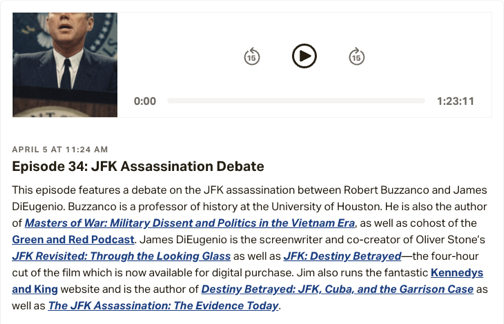
  • American Exception Episode 34: JFK Assassination Debate

    American Exception Episode 34: JFK Assassination Debate


    Click here to listen to the debate on the podcast site.


  • Cleaning up after My Debate with Buzzanco

    Cleaning up after My Debate with Buzzanco


    As our readers know, I wrote a column not long ago on Noam Chomsky’s appearance on a podcast called Green and Red. Chomsky and the podcast co-host, Bob Buzzanco, were fulminating about how Oliver Stone’s recent media appearances were misleading the left about both President Kennedy and the whole issue of what America’s role was in Vietnam. I replied to both of them. (Click here for that column) When Buzzanco later challenged the people behind JFK Revisited to a debate, I decided to oblige him. I would not do so on his show, since it would help him raise his audience, which I had moral reservations about. I said I would do so on Aaron Good’s American Exception podcast, a neutral site.

    That debate did take place. (Click here for that debate) When Oliver Stone heard it, he immediately called me, as he was excited about the result. The problem with debates, of course, is trying to balance out the positive points you wish to make with the necessity of playing defense, that is negating the charges being made by the other side. Therefore, in addition to doing a follow up show with Aaron on this, I would like to make some comments on that score here.

    First of all, to dispose of the last part of the debate, Buzzanco had said that there was little discovered about Oswald’s intelligence ties since the days of the House Select Committee (HSCA), which is an utterly false statement. John Newman wrote a whole book about this area which, contrary to what Buzzanco tried to imply, was not directly explored by the HSCA. In Oswald and the CIA, Newman discovered that both the CIA and FBI had anti Fair Play for Cuba Committee campaigns ongoing in the summer of 1963, which, of course, Oswald’s activities in New Orleans would seem to fit neatly into both. In addition to missing this, there was no place in those volumes where Oswald’s relationship with either the CIA or FBI was examined in any formal way. It turns out that the work of the HSCA’s Betsy Wolf, who was studying Oswald’s relationship with the CIA, was not declassified into the new millennium. To put it mildly, her work created a new plateau in this field. (Click here for details)

    In the last part of the debate, it is hard to comprehend how someone who likes to pontificate about the impact of JFK’s murder could declare he knows little or nothing about the actual circumstances of his assassination, but like Noam Chomsky, such is the case. Suffice it to say that what happened during Kennedy’s autopsy—both the main one and the supplementary—would appear to indicate just what Chomsky says did not occur: a high-level plot. In the film JFK: Destiny Betrayed, we show that:

    1. The photos of Kennedy’s brain cannot be of Kennedy’s brain, simply not possible.

    2. In all probability, General Curtis LeMay was in attendance that night and tried to disguise how he got there.

    Buzzanco is apparently ignorant of all this, as is Chomsky, which is no surprise really. What they lack in knowledge, they make up for in arrogance and snark.

    Like so many leftist critics of Kennedy, Buzzanco said that somehow I should watch myself in talking about JFK’s civil rights program. This shows that, in addition to swallowing Chomsky, he has bought into the almost incessant and deceptive MSM campaign to bury what Kennedy did on civil rights. I made it a purpose of mine to go back into the record and find out what the truth was about this issue. Why? Because a while back, someone said to me words to the effect: Jim what you did with Kennedy’s foreign policy, you could probably do with all the other aspects of his presidency.

    That turned out to be accurate. After a long four-part analysis, which surveyed literally dozens of books on the subject, I concluded that President Kennedy had done more for civil rights in less than three years than Presidents Roosevelt, Truman, and Eisenhower did in three decades. In fact, it was not even close. Kennedy went to work on the issue the night of his inauguration. He was disappointed that there were no African Americans in the Coast Guard parade that day. He called up Secretary of the Treasury Douglas Dillon and asked him about it. When Dillon said he had no idea why that was, Kennedy told him: Well, find out what the problem is.

    The result of this was two affirmative action orders within a year. The first taking place in March, just two months after his inauguration. That first order dealt with employees in the federal government. There was a second one about purchases by the federal government, that is any contracting, with say the Pentagon or State Department, by a private vendor made that company also responsible for affirmative action guidelines.

    What had happened was this: Kennedy was disappointed with the Civil Rights Commission set up by Senate Majority Leader Lyndon Johnson while he was in the senate. Although Kennedy voted for it, he thought it was toothless. So, he decided to enlist the Commission’s lawyer, Harris Wofford, as a campaign advisor in 1960. After Kennedy was elected, he instructed Wofford to write out a program for civil rights. Wofford specifically wrote that the president should not even think of trying to pass an overall bill in the first or even the second year since it would be stymied by the southern filibuster. Wofford advised Kennedy to try and get some momentum through executive orders, the Justice Department and perhaps the courts.

    And that is what Kennedy did. For example, differing with Dwight Eisenhower and Richard Nixon, Attorney General Robert Kennedy said the administration would support the Brown vs. Board decision. Bobby Kennedy then indicted the Secretary of Education in Louisiana for resisting that ruling. In Prince Edward County Virginia, the state would not support an integrated school system. The Kennedys collected contributions from wealthy donors and William Vanden Huevel actually built a new school system from scratch—superintendent, principal, counselors, teachers, and buildings—so that the local children could register for classes. (Click here for that story)

    I could go on and on, for example funding voting drives, integrating both state and private universities in the south, filing suits against voting rights violations. No previous president went as far on as many fronts than JFK did. It’s not even close. And this was before he submitted his omnibus civil rights bill to congress in February of 1963. (For all the details, click here) As with Indochina, Buzzanco drank the Kool-Aid on this one.

    Buzzanco also said that in my claim that Kennedy was much more reformist than what is made out to be, all I had to back me was Richard Mahoney’s book JFK: Ordeal in Africa, which shows that Buzzanco has not read this site very often. On the concept of President Kennedy’s reformist foreign policy, Robert Rakove’s book, Kennedy, Johnson and the Non-Aligned World is one of the best. That was published in 2013, decades after Mahoney’s 1989 book. On just the area of Africa, there is Philip Muehlenbeck’s fine work, Betting on the Africans. That volume was published in 2012, again decades after Mahoney. Decades prior to Mahoney, there was Roger Hilsman’s book To Move A Nation, which was astute on Kennedy’s foreign policy ideas, particularly about Indonesia. About the 1965 Indonesian upheaval, there is Bradley Simpson’s book Economists with Guns. Simpson says in that 2010 book, as he did for Oliver Stone in JFK: Destiny Betrayed, the epochal overthrow of Sukarno would not have happened if Kennedy had lived. Greg Poulgrain says the same thing in his book, JFK vs Allen Dulles: Battleground Indonesia, which was published in 2020.

    As far as Indochina goes, it is just as bad for Buzzanco. Since the film JFK came out, there have been books by Howard Jones, David Kaiser, James Blight, and Gordon Goldstein which all agree with the views of that film: that Kennedy was withdrawing from Vietnam at the time of his death. There is also John Newman’s second edition of his milestone work JFK and VIetnam. In my view, that version is even better than the 1992 edition. There is also Richard Parker’s biographical work on John K. Galbraith. Galbraith was one of the strongest influences advising Kennedy on this issue, and the president took his advice to begin his withdrawal plan. (Click here for details)

    Considering all this new scholarship, what is hard to understand is this: Why is Buzzanco still abiding by Noam Chomsky’s badly dated and intellectually shabby 1993 book? Because in the face of over 800 pages of new information declassified by the ARRB, no one else is. Need I add that since Chomsky’s book came out, both Secretary of Defense Robert McNamara and National Security Advisor McGeorge Bundy (posthumously) published scholarly tomes in which they said the same thing: Kennedy was not going into Vietnam. Just how much evidence, how many witnesses, and how many scholars does one need in this regard?

    Like the late Alexander Cockburn, Buzzanco wants us to think that somehow President Kennedy was involved in the Ramadan Revolution of February 1963. This was the overthrow of the Iraq leader Karim Qasim and his (temporary) replacement by the Baath party. Since I found Cockburn about as convincing as Chomsky on the issue of Kennedy’s foreign policy, I did some research on this. I read three works on the issue—one book and two Ph. D. dissertations—and none of them agreed with either Cockburn or later the work of Vincent Bevins on this score. All three writers stated that, unlike Eisenhower, the Kennedy administration was not all that interested in Qasim. For instance, the interagency committee Eisenhower had on Iraq was more or less dropped under Kennedy. And by late 1961, Qasim had turned on the communists, so there was no Cold War motive to dethroning him.

    Where Qasim got into trouble was with the British and the Kurds. The former was over an oil rights dispute, the latter was over a territorial rebellion in the north. After the Kurds inflicted some defeats on the army, the Baath Party infiltrated the military and negotiated with the Kurds. And that is what set the stage for the overthrow in February of 1963. There is no credible evidence that the CIA or State Department commandeered the plot. (Peter Hahn, Missions Accomplished? p. 48) And unlike what Cockburn tried to imply, Saddam Hussein was not even in the country at that time. (For a longer treatment click here and scroll to part 6)

    Buzzanco also brought up the overthrow in Brazil. It is true that Kennedy was worried about Brazil, but this is due to the horrible advice he was getting from Lincoln Gordon, who he should never have approved as ambassador. But it’s also true that he sent Bobby Kennedy to Brazil to advise Joao Goulart to moderate his government to avoid any conflict. Gordon had actually told JFK that Brazil was in danger of becoming a new Red China. (See Merco Press, April 8, 2022) We do not know what Kennedy would have eventually done in Brazil, but it was President Johnson and Warren Commissioner John McCloy who actually arranged for the overthrow in 1964. The Brazilian military was given aid by Vernon Walthers of the CIA. Operation Brother Sam was done hand-in-glove with the Rockefeller interests in Brazil, which is why McCloy was the front man for it. (The Chairman, by Kai Bird, pp. 550–53) I would like to add that, in reference to Latin America, Kennedy did not recognize rightwing takeovers in either Dominican Republic or Honduras. Also, unlike what Buzzanco said, the American embargo of Cuba did not start under Kennedy. Its initial stages began first in 1958, under Eisenhower. Ike extended it in 1960 to include most exports. Kennedy expanded it again in 1962. It’s quite surprising that a history professor could be inaccurate about something as simple as this.

    My last point would be about the concept of what Rakove called “engagement.” This was his word for how Kennedy approached the concept of neutrality. Kennedy felt that if a country wanted to remain neutral in the Cold War, that was their decision. We could still send them aid and, in fact, we should send them as much as possible in order to keep them away from the communists. As Rakove notes, this was a large jump from John Foster Dulles, who did not want to deal with the concept of neutrality at all. With him, there was no neutral ground in the Cold War: you were either for the USA or against the USA. (See Rakove, pp. 6–11). A good example of this would be Kennedy’s attitude toward Nasser in Egypt versus Foster Dulles’ and, later, Johnson’s stance toward the charismatic pan-Arab leader. Any history scholar should be able to discern this wide difference. Nasser certainly did, as did most of the leaders in Africa. (Muehlenbeck, pp 227–228) For Buzzanco to say I agreed with him on this issue shows a combination of political spin and his lack of knowledge on who Foster Dulles was.

    I would like to append one last point about how leftist ideology clouds the picture of who Kennedy was. Peter Scott wrote an essay for the Gravel Edition of the Pentagon Papers back in 1971. That essay was one of the earliest efforts to detect that Kennedy was withdrawing from Vietnam at the time of his death. The editors of that series were Chomsky and Howard Zinn. They did not want to print that essay, because to them it would indicate that whoever is president makes a difference. I do not know any clearer way of showing that Chomsky’s concept amounts to writing history according to ideology. And to me, that is not writing history. Its polemics.

    John F. Kennedy was not a perfect president. We have never had a perfect president and there never will be one, but the best brief characterization of Kennedy was made by Richard Mahoney. He used Edward Gibbon’s description of the Byzantine general Belisarius as a point of comparison: “His imperfections flowed from the contagion of the times; his virtues were his own.”

  • Review of Greg Poulgrain’s JFK vs Allen Dulles: Battleground Indonesia

    Review of Greg Poulgrain’s JFK vs Allen Dulles: Battleground Indonesia


    “Dulles is a legendary figure, and it’s hard to operate with legendary figures.”

    -President Kennedy

    Let us state the preconditions for the drama that historian Greg Poulgrain is going to compose in his stellar volume, JFK vs Allen Dulles: Battleground Indonesia. Sukarno led Indonesia to independence against both the Dutch and the Japanese. After World War II, he became the first leader of an independent Indonesia. He then became one of the foremost spokesmen for the Non-Aligned Movement, that is, the Third World leaders who did not wish to get involved in American/Russian Cold War struggles but wished to navigate their own foreign policy choices free of those entanglements. Some of his partners in this enterprise were Nehru of India and Gamal Abdel Nasser of Egypt. In fact, the first meeting of this group was in Bandung, Indonesia in 1955.

    At the time Sukarno was leading this movement, the two men supervising American foreign policy were the Dulles brothers. John Foster as Secretary of State and Allen as Director of the Central Intelligence Agency. To put it mildly, they did not appreciate the attempts at neutralism in the Third World. (Robert Rakove, Kennedy, Johnson and the Nonaligned World, pp. 10–11) They believed that there was no such thing as neutrality in what they cast as a rigid, dogmatic Cold War world outlook.

    Partly due to this, the CIA tried to overthrow Sukarno in 1958. At that time, this was perhaps the largest Agency operation ever. Ostensibly, it was not successful. And American participation in the attempt was exposed by the shooting down of CIA pilot Allen Pope. To put it gently, Sukarno did not appreciate what the Dulles brothers had tried to do. He also did not like the fact that the United States would not help him in his quest to attain West Irian from the Dutch. Sukarno thought that territory was entitled to Indonesia and should have been turned over at independence.

    Thus, another layer of intrigue is placed over the situation. As Poulgrain notes, Allen Dulles and the Dutch knew something about West Irian that Sukarno did not. In 1936, there had been a joint Dutch/American mountain expedition to the highest point in West Irian, this included Dutch geologist Jean Jaques Dozy. Dozy’s report was discovered in 1960 by Forbes Wilson of Freeport Sulphur. Wilson sponsored a second expedition. Both groups found out that there were immense deposits of gold, silver, and copper in the Carstensz Pyramid, in a place called the Ertsberg. Two miles away, in an alpine meadow, was another huge deposit in an area called the Grasberg. The combined value of the mineral resources in those two places staggered the imagination. To make just one statement about it: This was the largest repository of gold in the world at that time. And it is why the Dutch did not wish to give up the area. Allen Dulles was trying to find a way to let American interests exploit both the Ertsberg and the Grasberg.

    Besides Sukarno and Allen Dulles, the third major character involved in Poulgrain’s epic tragedy is John F. Kennedy, both as a senator and as president. In 1957, Kennedy made a speech on the floor of the Senate which startled the Dulles brothers, President Dwight Eisenhower, and Vice-President Richard Nixon. He made clear his disagreement with the administration over their support for France in its attempt to keep the North African colony of Algeria as part of the French empire. (Allen Nevins, editor, The Strategy of Peace, pp. 66–80) Kennedy opened that speech by saying that people around the world wanted to be independent and that the enemy of independence was imperialism. Kennedy was saying he understood that the era of European colonialism was ending and he was willing to side with the Third World nationalists in Algeria against the longtime American ally in Paris. Sukarno and the Non-Aligned Movement now had a potential ally in Kennedy. In the election of 1960, that potential was realized.

    When Kennedy took office, he arranged a deal. Sukarno would return Pope to the USA and Bobby Kennedy, along with diplomat Ellsworth Bunker, would convince the Dutch to give Sukarno West Irian. This was called the New York Agreement and it was signed at the United Nations in late summer of 1962. The Dutch were out of the picture concerning the Ertsberg, but Dulles still understood what the real situation was. Kennedy and Sukarno did not. With the assassination of Kennedy in 1963 and the overthrow of Sukarno in 1965, Dulles achieved his original goal for his backers, the Rockefellers. How those last two steps were achieved form the backbone of Poulgrain’s work, because they depict the triumph of both Dulles and Freeport Sulphur, which later became the giant mining conglomerate Freeport-McMoran. They also depict one of the most horrible of modern-day atrocities: the attempted extermination of the PKI, the Indonesian communist party, which resulted in the expulsion of Sukarno and the rise of the military dictatorship of General Suharto, who would rule Indonesia for three decades.

    [The above prologue was by James DiEugenio]

    It’s a rare thing when an author achieves a comprehensive and penetrating analysis of a long-forgotten historical episode, while delivering his story with a pace more apropos to a thriller novel than a groundbreaking addition to the historiography of the C.I.A. at mid-century. Dr. Greg Poulgrain’s sweeping and important book is one of the most exciting reads in recent memory—equal parts Indiana Jones, Ian Fleming novel, and geopolitical tour de force—with keen attention paid to the inner personalities of two of the most iconic figures of the 1960s, Allen Dulles and John F. Kennedy. We watch as they played their delicate chess game to determine the future of the Indonesian government; and, by extension, control of the nation’s vast offshore petroleum reserves, along with the largest gold deposit ever discovered in human history.

    Poulgrain’s book stands out for a number of reasons, not least for the flair he possesses as a stylist. Often books on subjects such as this plod through the historical data, citing numerous and turgid anecdotes and stenographic notes from dry briefings that largely put one to sleep. I’ve always found this unfortunate, as the real history of the C.I.A. during the 1960s contains the stuff of the greatest fiction, the greatest cinema. And Poulgrain seems to have noticed. While never shying away from the archives and the documented record, his achievement lies first in his framing of the chance 1936 discovery of the Ertsberg mother lode by a daring prospector working for a Dutch petroleum company as a dramatic hook. He then juxtaposes this earlier timeline against the colorful backdrop of the later power struggle playing out between a freshly elected President Kennedy and his soon to be nemesis, C.I.A. Director Allen Dulles, all the while filling in the relevant gaps to guide the reader through this powerful climactic showdown, which includes a chapter on UN Secretary General Dag Hammarskjold.

    Moreover, Poulgrain was able to meet with Jean-Jacques Dozy, the prospector who struck gold in 1936, as well as with key political figures relevant to the later political drama in Indonesia during the overthrow of Sukarno in 1965. He conducted a series of interviews from the late 1970s to the late 1980s. And he weaves together his personal notes from these interviews to enrich and enliven the story even further, lending a sort of murder-mystery air to the book in high fashion. How much gold was really in the Ertsberg? Were the explorer and his team complicit in the initial coverup? Who really held the keys to Indonesia’s future? Were internal forces and internecine Indonesian strife responsible for the fated events that unfolded over the next three decades? Or were Dulles and friends in Langley solely to blame for another bloody coup by proxy? Such are the questions the author explores in his fine work.

    A special notice should go to the portrayal of the night of September 30, 1965. That evening may rank with the Night of the Long Knives as to pure treachery and diabolical aim. Many historical commentators have tried to figure out what really happened on that evening, which created such a reversal of Indonesian history. Due to the interviews he did with some of the survivors of that dark episode, Poulgrain gives us the best explication ever written unraveling that mystery. The book is worth reading just for that chapter. (See Chapter 7)

    As most readers of this genre understand by now, Allen Dulles represented an iconic, often sinister, and looming figure in the grand tapestry of mid-century America. From his longstanding ties to the giant law firm of Sullivan and Cromwell, to his role in the creation of the Treaty of Versailles, to his vast Rolodex of spies, assassins and international contacts, to his close friendships and admiration for postwar Nazi war criminals like Reinhard Gehlen, he presents an impenetrable and often sociopathic personality, someone who, in his own words, enjoyed the sound of a rat’s neck breaking as the spring trap snapped shut.

    Driven in large part by pure imperialistic greed and deception, and at other times by what appears to be a genuine aversion to anything resembling socialism, collectivism, or non-alignment with U.S. anti-communism, Dulles was the perfect foil to the pro-Third World, pro-decolonization John F. Kennedy. Three years prior to his close victory over Richard Nixon, Kennedy delivered impassioned speeches on the Senate floor, championing the freedom of the Algerian people against the French:

    I am concerned today that we are failing to meet the challenge of imperialism—on both counts—and thus failing in our responsibilities to the free world. (Remarks of Senator John F. Kennedy in the Senate, Washington D.C., July 2, 1957, John F. Kennedy Library)

    Yet, in many ways, Sullivan and Cromwell was about imperialism. If one is representing the Rockefellers, as Allen Dulles was, then one is involved with an imperialistic system of beliefs. This ideological impasse between two irreconcilable worldviews serves as the tense thematic backdrop against which the book’s many detours add both color and historical perspective to the dramatic saga of the Indonesian archipelago at the beginning of the decolonization era. As Poulgrain notes, “Kennedy realized during his first year in office that much of the advice on Indonesia from DCI Dulles was premised on the belief that Sukarno’s leadership was Indonesia’s fatal flaw.” (JFK vs. Allen Dulles, p. 46)

    While most scholars seem to place the singular showdown between Dulles and Kennedy at the Bay of Pigs debacle—designed to fail by Dulles and associated C.I.A. cohorts in order to force Kennedy to commit U.S. carrier air support—Battleground Indonesia, the subtitle of Poulgrain’s book, presents a fascinating window into a largely overlooked, but critically important, episode in the Pacific. This episode would represent, along with the Congo Crisis, some of the last gasps of pure unfettered imperialism in its most crystalline form, a quixotic adventure involving obscure shell corporations operating illegally under C.I.A. protection, powerful moneyed interests from the shadow world, familiar names from the later Kennedy assassination plot like George de Mohrenschildt and L. Fletcher Prouty, and corrupt Indonesian officials and splinter groups with their own diverse interests. All of this played out under the wary eye of a sitting U.S. president who intimated that some of his closest intelligence advisors were obfuscating and distorting the situation to suit their own agendas. It is, at once, a tragic and incredible story that has been largely lost in the dizzying array of C.I.A. exploits the world over and, as Poulgrain observes, “into this matrix of intelligence entanglements, Kennedy proceeded unawares.” (JFK vs. Allen Dulles, p. 9)

    The attraction of this work also lies in another achievement that is often forgotten in books of the genre, namely, the personal touch. Frequently, Poulgrain plays the role—commandingly—of amateur psychologist and adds in important depth and essence to the characters involved in this grand undertaking to gain control of the Ertsberg and its associated billions of dollars of ore, to name but one of the numerous story arcs in JFK vs. Allen Dulles. Too often, we forget that human beings, no matter what their titles or powers, are still just that, human beings and, as such, are often fallible, naive, ruthless, proud, furtive, bold, corrupt, cowardly, impetuous, sanguinary, honorable, and countless other adjectives. They are rarely the simple paper cutouts in the annals of history in the extensive catalog of books attempting to detail their exploits.

    This book lives up to its title: JFK vs. Allen Dulles, while tying together a grand panoply of monied interests, international power players, secret agents, and heads of state, ultimately still reads like a battle of two central personalities: President John F. Kennedy, the fresh and enterprising ingenue, filled with a sincere conviction to deliver on his promises to liberate the oppressed people of the developing world—perhaps the last sitting president to legitimately champion the ostensible slogans of the United States overseas and at home—against the Old Guard hardline anti-Communist Director of Central Intelligence Allen Welsh Dulles, Kennedy’s eventual nemesis and the likely architect of his untimely demise in the backseat of a limo in Dealey Plaza. It’s a brilliant dramatic conceit and, when combined with the copious and fresh source material and alluring insights of a first-rate researcher like Dr. Greg Poulgrain, makes for one of the best reads in its genre.

  • CounterPunch Whiffs Again!

    CounterPunch Whiffs Again!


    On July 15th, CounterPunch did it again.  The occasion was an article comparing the final withdrawal of American troops from Afghanistan with the American debacle in Indochina.  Author David Schultz used the famous line, this time attributed to Hegel, that the only lesson we learn from history is that we do not learn from history. He wrote that as the Taliban now takes over some of us “wonder if this is not Déjà vu all over again and that what we thought we had learned from the Vietnam War proved to be a fleeting lesson.”

    Schultz goes on to note the Kent State shooting, helicopters over the embassy in 1975, the domino theory, over 58,000 dead American soldiers, tens of billions wasted.  He then mentions some of the literature on the Vietnam War.  First off is Francis FitzGerald’s Fire in the Lake which tried to accent how different the culture of Vietnam was and how the American military did not understand it.  Then, of course, since this is CounterPunch, Schultz has to mention David Halberstam and The Best and the Brightest.

    Here is how Schultz quantifies Halberstam’s book.  He writes that it pointed to:

    ….the arrogance of the Kennedy administration in failing to understand that Vietnam was more about colonial independence than it was about communism and Cold War rivalry.

    As I have indicated too many times to enumerate here, this misses two major points about Halberstam.  First, Halberstam completely revised his view of Vietnam between his first book, The Making of a Quagmire, and his second book on the subject The Best and the Brightest.  In that first book, Halberstam  criticized Kennedy for not being militant enough in Vietnam. In 1965, Halberstam said that Kennedy should have gotten America in earlier. In fact, that book is an utterly coruscating critique of American policy in Vietnam until 1965. The hero of the book is Colonel John Paul Vann.  Why?  Because Vann knew how to win the war! (See Chapter 11) Halberstam is even more explicit about this later when he declares, “Bombers and helicopters and napalm are a help, but they are not enough.” (p. 321)  He then gives us his Schultzian lesson about Vietnam: “The lesson to be learned from Vietnam is that we must get in earlier, be shrewder, and force the other side to practice self-deception.” (p. 322)

    Halberstam’s role model in 1965, Vann, thought that if America was going to win the war, American troops were needed. (See the Introduction to the 2008 edition by Daniel Singal, p. xi) Well, Lyndon Johnson gave Vietnam about 500,000 American troops and it did not work out very well. Since Halberstam started writing The Best and the Brightest in about 1968, when this had all clearly turned out to be a disaster, the author decided to cover his tracks.  Back in 1963, Kennedy did not like what Halberstam and Vann were trying to do––which was move toward escalation by criticizing what they saw as JFK’s timidity. (David Kaiser, American Tragedy, p. 261) So therefore, even though America had been involved in Vietnam for eleven years prior to Kennedy’s inauguration, Halberstam focused a large part of 1972’s The Best and the Brightest on the years 1961-63, virtually ignoring what the Eisenhower administration had done to secure a commitment to Vietnam.  Eisenhower had, in fact, created a new country there, one that had not existed prior to 1954. And since America had created it, then America was obliged to defend it.

    By relying on Halberstam’s museum piece, Schultz gets the other part he writes about wrong also. President Kennedy did comprehend what the Vietnam war was about.  He understood the true circumstances because of his association with Edmund Gullion going back to Saigon in 1951. (Click here for details) This is why he refused to commit combat troops in theater. During the crucial debates in November of 1961, Air Force Colonel Howard Burris took notes. They are contained in James Blight’s book, Virtual JFK (pp. 282-83)

    Kennedy argued that Vietnam was not a case of aggression as was Korea. Therefore, America would be subject to intense criticism from even her allies. He then argued that the French had spent millions there with no degree of success. He also argued that the circumstances were such that even Democrats in Congress would have a hard time defending such a commitment. Further, one would be fighting a guerilla force, “sometimes in phantom-like fashion.” That would mean whatever base of operations American troops had would be insecure. Burris noted that during the debate, Kennedy turned back attempts by Dean Rusk, Robert McNamara, McGeorge Bundy and Lyman Lemnitzer to derail his train of thought.

    I don’t see how one can locate a more defining moment, or show how well Kennedy really understood what the facts of the war were than this.  One can argue that Ed Lansdale had been the first person to suggest inserting combat troops into Vietnam, something Kennedy refused many, many times. (John Newman, JFK and Vietnam, first edition, p. 20; Gordon Goldstein, Lessons in Disaster, p. 52) After Kennedy’s death, when Lansdale returned to the White House, he recommended sending John Paul Vann back to Vietnam. Vann did return in 1965, when Lyndon Johnson overturned Kennedy’s policy by sending tens of thousands of combat troops into Vietnam. (David Kaiser, American Tragedy, p. 384). Using David Halberstam today as any measure of what happened in Vietnam would be like cranking up a Model T Ford to make a cross country trip.  Halberstam was the author who called 1964, the “lost year” in Vietnam. Geez Dave, wasn’t the Tonkin Gulf Resolution kind of important? (For more on Halberstam click here”>)

    Another issue with the article is its comparison with how America got into Vietnam and how America got into Afghanistan. Schultz writes that America got into the latter as a result of the attacks of 9/11. Which is only partly true.  America was involved even before the Russian invasion of Afghanistan in December of 1979. President Carter had allowed the CIA to operate in the country at his National Security Advisor’s request. The late Zbigniew Brzezinski predicted that such aid would likely induce a Soviet invasion and that would give the USA an opportunity to hand Russia its own Vietnam. (January, 1998, interview with Le Nouvel Observateur)  As most people know, the CIA now began to back the struggle of the Islamic radicals against the Russians. This included Osama Bin Laden. Much of this aid went through Pakistan.  And in return, America agreed to look the other way as that country built a nuclear weapon. (James DiEugenio, The JFK Assassination: The Evidence Today, p. 386)

    Unlike America’s commitment to Vietnam, the Russians never had more than 120,000 troops in theater. Mikhail Gorbachev recommended a peace agreement before the Russians formally withdrew in 1989. The concept was to leave behind Mohammad Najibullah as president and he would form a coalition government with some of the more moderate tribes. The goal was to marginalize the Islamic fundamentalists. For whatever reason, the USA would not sign onto this sensible agreement. (The New Yorker, 9/29/2009, article by Steve Coll) There were warnings from people like the late Benazir Bhutto that were quite frank and accurate.  She said, “You are creating a Frankenstein.” (Newsweek, 10/1/2001, article by Evan Thomas)

    Bhutto was correct.  Unlike the Tom Hanks depiction of the late congressman Charlie Wilson, the congressman backed this decision. (DiEugenio, p. 387) America actually gave aid to some of these deplorable fundamentalists, e.g., Jalaluddin Haqqani and Gulbuddin Hekmatyar. The one decent tribal leader in the area, Ahmad Shah Massoud, only got a fraction of what those two men received. (Alternet, 12/20/2007, article by Melissa Roddy)

    As Bhutto and Gorbachev predicted, the country descended into a horrifying civil war. After three years, Najbullah was dislodged.  Pakistan then sent in its own charges, the Taliban, who backed Sharia Law. Najbullah was taken prisoner, mutilated and killed in late 1996. Massoud held out for years until he was assassinated two days before the 9-11 attacks.

    This is not just an interesting story for what it says about Tom Hanks and his cartoonish movie Charlie Wilson’s War. But also because, after Massoud’s demise, the Taliban took over the country.  It became a hiding place for Osama Bin Laden.  More specifically, the Battle of Tora Bora, featuring American special forces, took place there in December of 2001. The result was, again for whatever reason, Bin Laden escaped into Pakistan.

    On October 7, 2001, George W. Bush launched his invasion of Afghanistan, which dislodged the Taliban. President Obama reduced this operation significantly. And now President Biden will, perhaps, finally end it.

    One can argue that, in all this, America was still fighting the Cold War, except this time it was in Afghanistan, not Indochina.  But was there really a reason to do this? Especially in light of Gorbachev’s peace offering? To me, that is the real resemblance of the two situations. In the first instance, America created a country in the name of the Cold War. In the second, America decided to radically Islamize a country in the name of the Cold War.

    In the first instance, we know Kennedy did not agree with the policy and was withdrawing at the time of his death.  With what this author has discovered about Kennedy and the Middle East, I doubt very much he would have sided with the radical Moslems. (Click here as to why )

    But that is a story CounterPunch could never tell.

  • Jonathan Chait meets Michael Kazin

    Jonathan Chait meets Michael Kazin


    Almost any notice in the media about John F. Kennedy will supply an excuse for someone in the MSM to write a derogatory article about him. As we have seen, Michael Kazin used the occasion of a recent book about Kennedy to do a hit piece on him in The New York Review of Books. (Click here for details) Recently, a panel of scholars for C-SPAN did a poll ranking past presidents, including Donald Trump. Journalist Jonathan Chait didn’t like it. Why? Because Kennedy ended up in eighth place. Chait thinks this was unwarranted. Therefore, New York Magazine let him do a Kazin: that is a hit job on the slain president. (June 30, 2021)

    What is immediately noticeable about these rants is this: None of the writers knows very much about Kennedy or his presidency. But they pretend they do. For instance, Chait writes that Kennedy made some promises on civil rights in his presidential campaign, but abandoned them when he saw this would offend southern conservatives. The thinking being that it would stop the passage of his other domestic programs.

    As I have explained before, this is a liberal orthodoxy that has a serious problem with it. It isn’t true. This author spent months studying the issue for a four-part series about the Kennedys and civil rights. (Click here for that series)

    Kennedy did not abandon civil rights at all. He was advised by his specialist on the issue, Harris Wofford, that it would be very difficult to pass an omnibus civil rights bill in his first year and probably even in his second year. After all, there had been nine different attempts to pass such a bill since 1917 and they all failed. (Irving Bernstein, Promises Kept, p. 39) Wofford therefore advised Kennedy to issue executive orders and also to rely on the court system, through the Attorney General, to further the cause. The hope being that this would create a furor over the issue that would tilt the balance in the House and Senate. That would then make it possible to pass such a bill.

    That is what Kennedy did; and that is what happened. Anyone can read about this in more than one book (e.g. Wofford’s Of Kennedys and Kings, or Irving Bernstein’s Promises Kept). (Bernstein, pp. 40–41, 48–50)

    To list all the things that Kennedy did for civil rights in just his first year illustrates the utter fallacy of what Chait is trying to sell. Right out of the chute, JFK and his brother intervened in the New Orleans school segregation court case, something that President Eisenhower had avoided. (Jack Bass, Unlikely Heroes, p. 122) Eisenhower’s failure to act allowed the state legislature to pass laws attempting to curtail and avoid the court’s decision to implement Brown v Board. When Bobby Kennedy got the news about this scheming he replied, “We’ll have to do whatever is necessary.” (Bass, p. 131)

    The Kennedy administration did something that the Eisenhower administration would never have dreamed of doing. The Attorney General filed charges against the state Secretary of Education, Shelby Jackson. The idea was to stop the governor’s attempt to cut off funding for integrated schools. (Bass, p. 135) When a trial date was set, Jackson backed off and said he would not interfere. This episode began in February of 1961, a month after Kennedy’s inauguration.

    A similar case occurred in Prince Edward County, Virginia. Due to scheming by the governor and legislature, Prince Edward County had no schools to attend. Again, Eisenhower said he could not do anything about it. Shockingly, he even said states were not required to maintain a school system and, therefore, the president was “powerless to take any action.” (Brian Lee, Ph. D. thesis, A Matter of National Concern, p. 50)

    Again, the Kennedys reversed Eisenhower’s course. The president now began to remake the 4th Circuit Court of Appeals governing Virginia and nearby states. (Lee, p. 6) But the Kennedys also began doing two things that were, again, unprecedented. First, they joined the NAACP lawsuit as a plaintiff, not a friend of the court. Secondly, realizing the court reworking would take time, they appointed family friend William Vanden Heuvel to raise a large amount of money. The idea was to build, from scratch, a free school system to educate the African American students, so they would not fall further behind. (Lee, pp. 145–50)

    Did Chait miss all of this? Well, no surprise, since he also missed those two executive orders that Kennedy signed for affirmative action. The first was written in his first year, which again, no president had ever done before. (Bernstein, p. 56) Finally, Attorney General Bobby Kennedy made it a point to speak at the University of Georgia Law School. He spent half the address talking about civil rights. He said he would enforce the Brown v. Board decision. As historian Carl Brauer wrote, this was the first time anyone could recall an Attorney General speaking out on the issue in the South. (Carl Brauer, John F Kennedy and the Second Reconstruction, p. 95)

    That was in May of 1961. Again, we are to assume that Chait missed all of this, which is weird, since it was all unprecedented in the field. But that was just the beginning of a crescendo that led to the submission of Kennedy’s omnibus civil rights bill in February of 1963. (For the rest of the story, click here)

    Chait leads off his article by saying that Kennedy was elected due to his youth and his campaigning about the missile gap. He leaves out the fact that there was only a four-year difference in age between himself and his opponent Richard Nixon. Considering his second point, in Kennedy’s acceptance speech in Los Angles at the Democratic convention, there was no mention of a missile gap. He talked about things like separation of church and state, racial discrimination, the plight of the poor, and said this was no time to try and uphold a status quo that was not working. (Click here for the address) At a famous speech in September, which he gave before the Liberal Party in New York, again one will find no mention of a missile gap. But one will find the following: Kennedy tried to define what he thought the word liberal meant in a political sense, as opposed to how the Republicans defined it:

    But if by a Liberal, they mean someone who looks ahead and not behind, someone who welcomes new ideas without rigid reactions, someone who cares about the welfare of the people—their health, their housing, their schools, their jobs, their civil rights and their civil liberties—someone who believes that we can break through the stalemate and suspicions that grip us in our policies abroad, if this is what they mean by a Liberal, then I’m proud to say that I’m a Liberal.

    Kennedy went on to say that he also believed “…in a government which acts, which exercises its full powers and full responsibilities.” He continued by saying that when government “has a job to do, I believe it should do it.” This was then exemplified by his above actions in his first year on the civil rights issue, which, as I showed, were starkly different than Eisenhower’s. (For the whole speech click here)

    One of the nuttiest things that Chait writes is that Kennedy was a man out of his time period, because he thought there were no great problems to solve, no great dragons to slay, and no great compromises to be made. That Chait could borrow that comment from one of the worst biographers of Kennedy, the late Richard Reeves, tells you just what his game is, because Kennedy says just the opposite in both of these speeches. A constant refrain is his haranguing the GOP for not facing up to the problems as he perceives them: of the urban poor, of dispossessed farmers, of creating an imaginative foreign policy. And he clearly implies that a party of Coolidge, Hoover, and Taft simply could not really do anything about these dilemmas. He contrasted that with people like FDR, who chose to act in a time of crisis. And he compared the 1960 election to that of 1932. In other words, the Democrats could do something and would use government to solve problems.

    Chait tries to define Kennedy’s foreign policy by using the Bay of Pigs as an example. He then says, in regards to the Missile Crisis, that the president bungled his way into a nuclear showdown over Cuba. I hate to confront Mr. Chait with the facts, but I must. It was the Russians who placed a first strike capability in Cuba. This featured all three arms of the nuclear triad: long and medium range missiles, bombers, and submarines. In addition, they had 45,000 troops on the island and had also given Fidel Castro tactical atomic weapons. (James DiEugenio, Destiny Betrayed, second edition, p. 66) These would have annihilated any large invading force. This was all done in secret, knowing that Kennedy had insisted there be no offensive weapons in Cuba. And when, due to U2 photography, Kennedy inquired about them, the Soviet foreign minister lied to him about their presence. (Ernest May and Philip Zelikow, The Kennedy Tapes, p. 169) When it came time to confront the situation, Kennedy chose the least provocative action: no invasion, no air strikes, but a blockade. Choosing that option gave each side time to resolve the crisis peacefully. Anyone can read the transcripts of these taped conversations. Clearly, Kennedy was keeping the hawks at bay almost throughout. For a good example, read the record of his meeting with the Joint Chiefs, especially note their derisive comments about the president after he leaves the room. (May and Zelikow, pp. 173–88)

    As we can see, Chait’s article, like Kazin’s, is not factually based. His real point is to try and reverse the concept that somehow there was a step down in class and achievement from Kennedy to Lyndon Johnson. For instance, he writes that two programs that Kennedy was trying to get passed, but could not, were federal aid to education and health care for the elderly. As Irving Bernstein has written, Kennedy did get federal aid to education through the senate in October of 1963. (Bernstein, p. 241) Kennedy failed to get a Medicare bill through in 1962, but what Chait leaves out is that Kennedy was bringing it back for consideration through powerful congressman Wilbur Mills in 1963. And on the morning of November 22, 1963, Kennedy’s congressional liaison, Larry O’Brien wrote that “with Mill’s objections met, the passage of Medicare was assured.” (Bernstein, p. 258) In other words, Kennedy had set the table for Johnson on these two bills.

    This meme is continued when Chait lists the Civil Rights Act of 1964, the Voting Rights Act of 1965, and the War on Poverty as Johnson’s achievements, giving no credit to Kennedy or anyone else. As I have mentioned several times, the idea that Johnson got the Civil Rights Act of 1964 passed is a myth supported by establishment figures like Robert Caro. Clay Risen, who wrote a book about the passage of the act, has shown why it is a myth. (Click here for details)

    President Johnson told Martin Luther King that he could not get the Voting Rights Act passed on his own. The only way he could so was if King did something to give him the torque to implement it. King did so by staging the Selma demonstration, which he was already arranging before Johnson told him this. (Louis Menand, “The Color of Law”, The New Yorker, 7/1/2013)

    The War on Poverty began after Kennedy read Dwight MacDonald’s review of Michael Harrington’s The Other America. (Thurston Clarke, JFK’s Last Hundred Days, pp. 242–43) In June of 1963, JFK was already thinking past the Civil Rights Act he had submitted to congress. So he called in his chief economic advisor, Walter Heller, and they began to formulate a plan to counteract pockets of poverty. After Kennedy was assassinated, Heller told Johnson about this plan he and Kennedy had formulated. In other words, the War on Poverty was not Johnson’s concept. It was Kennedy’s. In his jihad to inflate LBJ and downgrade Kennedy, this is how anti-historical Chait becomes.

    If one can comprehend it, Chait even tries to elevate LBJ at Kennedy’s expense over what became Johnson’s disaster in Indochina. With all we know about Vietnam today, I would have thought no one would even think of doing this. But one should never underestimate the stubbornness and perversity of the MSM. Chait begins by saying that it is an unproven assumption that Kennedy would have pulled out of Vietnam. That worn out standby is not sustainable today. With all the information that the Assassination Records Review Board declassified, combined with the work of writers like Gordon Goldstein, Howard Jones, David Kaiser, Jim Douglass, James Blight, and the revised version of John Newman’s JFK and Vietnam, there is little or no question about the issue: Kennedy was getting out of Vietnam. We have a veritable cornucopia of evidence to prove it. And he was going to enact that withdrawal around the 1964 election. (Click here for details)

    Johnson was aware of this plan and within 48 hours of the assassination he started to reverse it. (James Blight, Virtual JFK, p. 310; also see Chapter 23 of the 2017 version of Newman’s JFK and Vietnam.) Contrary to Kennedy, Johnson’s concept was to work his escalation plan around the 1964 election. In other words, as he was saying things like he wished no wider war and he did not want to send American boys to die in a war that Asian boys should be fighting, he was arranging to do just that. This has been proven by too many scholars to belabor the point here. But to name just three: Gordon Goldstein’s Lessons in Disaster, Fredrik Logevall’s Choosing War, and Edwin Moise’s Tonkin Gulf and the Escalation of the Vietnam War.

    Chait now writes that Kennedy’s policies laid the groundwork for Johnson’s escalation; due to the calculation that no Democrat could lose a territory to communist expansion. I threw my arms up at this one. If Kennedy was withdrawing at the time of his death and Johnson stopped that withdrawal, planned on going to war in Indochina, effectively declared war on Vietnam, and then invaded the country with hundreds of thousands of combat troops—how did Kennedy lay the groundwork for that? In November of 1961, with NSAM 111, Kennedy drew the line: he refused to send combat troops to Indochina. He never crossed that line. There was not one more combat troop in Vietnam on the day he was killed than on the day he entered office. Johnson not only sent half a million combat troops there, he also initiated one of the largest American air wars ever devised, Rolling Thunder, to try to bomb North Vietnam into submission. Does any credible person think that Kennedy would have countenanced these things, let alone allowed them to happen?

    This relates to Chait’s other point about the fear of “losing Vietnam.” Kennedy simply did not think that Vietnam was worth going to war over. Just like he did not want to commit combat troops to Laos, even though Eisenhower had advised him he might need to do so. (Newman, p. 9) Kennedy was a more sophisticated thinker about the Cold War than Johnson was. For him, Berlin was a flash point, since he was not going to let the Atlantic Alliance be challenged, but Vietnam was simply not worth the price. And this indicates how uninformed Chait is about JFK. Kennedy understood just how hopeless an imperial conflict would be in Vietnam. He comprehended this due to his relationship with diplomat Edmund Gullion in Saigon way back in the early fifties, where he saw firsthand the doomed French effort to recolonize the area. (Click here for details) He also understood the problem from his Ambassador to India, John K. Galbraith who wrote him a memo to counter the hawks who wanted him to intercede in 1961. (Click here for more)

    Compare that to LBJ. Johnson actually said that, if he left Vietnam, he would be doing what Neville Chamberlain did at Munich with Hitler and Mussolini. He then compared losing Vietnam to losing China and that the former would be even worse than the latter. He concluded that reverie with the following:

    Losing the Great Society was a terrible thought, but not so terrible as the thought of being responsible for America’s losing a war to the Communists. Nothing could possibly be worse than that. (Blight, p. 211)

    Can anyone conceive of Kennedy saying such things? There is no evidence for it. In fact, as I noted in my review of John Newman’s revised version of JFK and Vietnam, Kennedy told many people that Vietnam was a hopeless struggle, which America could not win. Therefore, he was getting out. (James Douglass, JFK and the Unspeakable, p. 183) What is so incredible about Chait’s abomination is that, at the end, he concludes that Kennedy’s rating in the poll is due to a lack of analysis. We have just seen what analysis does to Chait.

    Make no mistake, Chait’s handiwork is not an accident. As Jeff Morley wrote in his recent e book about his lawsuit against the CIA, no one ever got ahead in the journalistic world trying to expose new facts about Kennedy’s assassination. Well, since 2013, the same figure applies to Kennedy’s presidency, especially in light of the fact that we now know what happened in Indochina as a result of his death. And since that switch in policy came so fast, perhaps—just perhaps—the two events were related. And if such was the case, how could the MSM have missed it with such completeness?

    As noted at the start, I recently wrote about Michael Kazin’s similar hatchet job about Kennedy’s presidency, disguised as a review of Fredrik Logevall’s book JFK: Coming of Age in the American Century. Well, if one looks back to 2013, Kazin did the same in the pages of The New Republic. At that time, he was allegedly reviewing Thurston Clarke’s book JFK’s Last Hundred Days. (July 15, 2013) As was the case of Kazin with Logevall, it was a review that was not a review. It was a way to downgrade Kennedy and wonder out loud: Geez, why does anyone pay any attention to this guy at all? The title of the article was: “On the Fiftieth Anniversary of JFK’s Assassination Don’t Bother with the Tributes.”

    As I have written before, the MSM drive to conceal who Kennedy really was has become as systematic and assiduous as the attempt to cover up the circumstances of his assassination. As noted above in regards to Vietnam, it’s pretty obvious as to why.

    Mr. Chait meet Mr. Kazin. Future employment for both is secured.

    Action suggested:

    Contact at twitter: https://twitter.com/jonathanchait

    The editor of New York Magazine is David Haskell, david.haskell@gmail.com


    See also Brian E. Lee’s Ph.D. thesis from 2015 on the Kennedy administration efforts to restore public education to Prince Edward County, VA.

  • Deep Fake Politics: Empire and the Criminalization of the State

    Deep Fake Politics: Empire and the Criminalization of the State


    In the two previous installments of this review of Can’t Get You Out of My Head (CGYOMH) by Adam Curtis, I covered his poor handling of things like financial chicanery, monetary policy, oil markets, the JFK assassination, and “conspiracy theories” in general. To conclude this review, I am going to cover some of the ways in which Adam Curtis beguiles the audience on crucial issues such as state criminality, the dual state, geopolitics, Western imperialism, and the West’s adversaries—Russia and China specifically. Finally, I conclude with a brief summation of the CGYOMH and an exhortation for us all to take a large grain of salt with anything produced by this BBC pied piper.

    A Shallow Take on the Deep State

    Curtis has a strange way of grappling with US imperialism and the country’s secret government which emerged after World War II. In the fifth episode of CGYOMH, Curtis mentions that the CIA had been manipulating political systems and overthrowing governments around the world without the knowledge of the US public. He then brings up the illustrious Hans Morgenthau and his assessments of the American shadow government. This whole section is baffling to me. First, Curtis identifies Morgenthau as “one of the most senior members of the US State Department.” Then he says that Morgenthau “had given this hidden system of power a name, […] the dual state.” According to Curtis, Morgenthau deemed this duality necessary because of the realities of international power politics. These dark clandestine tactics needed to be hidden from the public because acknowledging them would undermine Americans’ beliefs in their democracy and in their exceptionalism—beliefs that were necessary in the Cold War.

    Curtis states that the US in the Cold War ran covert operations to overthrow 26 foreign governments in 66 attempts. Morgenthau, it is stated in CGYOMY, believed that this secrecy was creating a dangerous time bomb at the heart of America. Beginning in the 1960’s, these secrets began to be exposed by writers like former CIA officer Miles Copeland. In this section, Curtis even runs footage of a trailer from the original film adaptation of The Quiet American. The trailer is a montage featuring narration and clips from the movie which depict an American agent sowing chaos and violence “across all the Orient.” The film is certainly relevant to the discussion. That said, Curtis could have told the audience that the protagonist of the book and film is widely understood to be based on the activities of infamous CIA officer Edward Lansdale. Furthermore, Curtis could have also told the audience that Lansdale himself—acting on behalf of the CIA—was involved in the production of the film adaptation. To that end, the plot of the film was changed in such a way as to obscure the titular Quiet American’s responsibility for a terror bombing. The episode illustrates how the secret government was even manipulating the public through Hollywood—going so far as to alter those rare, informed critiques of US neocolonial imperialism in literature and film.

    Morgenthau, the Rockefellers and The University of Chicago

    But I digress. As mentioned above, Curtis’ treatment of Morgenthau and the dual state is strange. For one thing, Morgenthau did not give the dual state its name. The term comes from a German émigré named Ernst Fraenkel and his 1941 book, The Dual State: A Contribution to the Study of Dictatorship. The book described how alongside the normative state which operated lawfully, there emerged a prerogative state which operated lawlessly to serve as the guardian of the normative state.[1] Furthermore, Morgenthau is not most notable for being “one of the most senior members of the US State Department.” As far as I know, he never actually occupied a high position in the state department, though he did work there as a consultant under different US presidential administrations. Morgenthau is, however, quite famous for being the modern seminal classical realist philosopher in the field of international relations—a subdiscipline of political science. Why Curtis omits this is a mystery.

    In fact, Morgenthau’s actual academic position during those years is very relevant to Curtis’ discussion of the dual state—i.e., CGYMONH’s exploration of the lawlessness of America’s postwar secret government, because Morgenthau was a professor at the University of Chicago. Famously described as Standard Oil University by Upton Sinclair, the University of Chicago has a unique relationship to the right-wing brain trust that has informed many imperial US strategies in terms of foreign policy and political economy. Perhaps most infamously, the University served as an incubator of sorts for the neoconservative, right-wing imperialists who were heavily influenced by German émigré Leo Strauss.

    Strauss, who I will return to, himself first received Rockefeller funding thanks to the intervention of Carl Schmitt[2]—the jurist, political theorist, and prominent Nazi whose ideas informed the legal thinking of the Third Reich. In his exploration of the dual state, Curtis would have been better served looking at Carl Schmitt in order to situate the lawless US pursuit of “security.” Summarizing Schmitt, I have written elsewhere[3] that he

    …wrote famously, “Sovereign is he who decides on the exception.”[4] The state of exception “is not codified in the existing legal order.” It is “characterized as a case of extreme peril, a danger to the existence of the state.” The gravity of the state of exception is such that “it cannot be circumscribed factually and made to conform to a preformed law.”[5] Sovereignty for Schmitt is defined by the ability to decide when the state of exception exists and how it may be eliminated. Any liberal constitution can hope, at best, to mandate the party with which sovereignty rests.[6]

    In other segments of CGYOMH, Curtis mentions the critiques of Western leftists who argued that the essence of fascism had not been extinguished with the Allied victory in World War II. In the prior installment of this review, I covered Curtis’ shortcomings in terms of exploring this perspective. In his treatment of lawlessness and the dual state, Curtis compounds those errors. With Carl Schmitt and his University of Chicago descendants, there is a fairly clear German antecedent to the institutionalization of American state criminality that was established with the outbreak of the Cold War and never abandoned (i.e., an historical precursor to the lawlessness of a nominal constitutional republic). The reader may recoil at such a comparison, but the analogy is not particularly hard to grasp, psychic resistance notwithstanding. Even in terms of their respective creations, both were borne of bogus pretexts which conjured an existentially threatening Communist menace. The exceptionalist or legally unconstrained Nazi state took its mature form in the wake of the Reichstag Fire, a terror spectacle which the Nazis likely facilitated.[7] Likewise, much of the early postwar hysteria over the Soviet Union derived from erroneous Anglo-UK accusations that Stalin had grossly violated the postwar terms regarding Eastern Europe which had been negotiated at Yalta.

    All this is not to say the US is a new Nazi Germany. Only Nazi Germany was Nazi Germany, just as only the US empire is the US empire. That said, it is worth noting that in key national security documents like NSC 68, Cold War US policymakers explicitly argued for an exceptionalist approach to combating the supposedly existential threat posed by the Soviet Union.[8] I have written that such documents, in effect, served to grant

    …authority to the state to covertly conspire to violate the law. Since the US Constitution’s supremacy clause establishes that ratified treaties are “the supreme law in the land” and the US-ratified UN Charter outlaws aggression or even the threat of aggression between states, CIA covert operations are carried out in a state of exception. Given that the authority for these operations has never been suspended and the operations have been a significant structural component of the US-led world order, [I coined] the term exceptionism […] to describe the historical fact of institutionalized state criminality.[9]

    Schmitt, Strauss, and the Cold War

    To explain the duality and lawlessness of modern Western states, it is practically essential to discuss Carl Schmitt. In the German case, the Weimar Republic gave rise to a despotic dualism that quickly devoured the Republic, such as it was. In the US, the state’s lawful/lawless duality arose from the Cold War national security state which had been empowered by the supposed existential threat posed by communism. In the US case, the lawful democratic state (or public state) was never completely subsumed by authoritarian forces. This remains true, even if—as I have argued—anti-democratic forces in US society have consolidated so much wealth and power as to constitute a deep state that exercises control and/or veto power over democracy and the national security state. In my dissertation, I describe a tripartite state comprised of the public state, the security state, and a deep state.[10]

    Let us return to Leo Strauss, Morgenthau’s colleague at the University of Chicago. Strauss was an anti-Enlightenment thinker whose affinity for liberal democracy went only so far as to acknowledge that it served an important mythical function in legitimizing the hegemonic US project. One German commentator summarizes Strauss’ thinking about democracy:

    [L]iberal democracies such as the Weimar Republic are not viable in the long term, since they do not offer their citizens any religious and moral footings. The practical consequence of this philosophy is fatal. According to its tenets, the elites have the right, and even the obligation, to manipulate the truth. Just as Plato recommends, they can take refuge in “pious lies” and in selective use of the truth.[11]

    To summarize, Strauss and his mentor (of sorts) Carl Schmitt were both essentially Hobbesians. In the tradition of English thinker Thomas Hobbes, they saw the world as a dangerous and threatening place, the peril of which necessitates the creation of—and submission to—“the sovereign” or more simply, the state. The overriding imperative of the state is security, because without it, all of society is imperiled. Therefore, any measures necessary to secure the state are not just acceptable, but basically necessary. Germany infamously took Schmitt’s Hobbesian logic to a notable conclusion. Writing largely after World War II in the US, Strauss in essence advocated for state duality. He grudgingly accepted liberal democratic myths and formal institutions, while at the same time advocating for wise men like himself and his acolytes to counsel leaders, deceive instrumentally, and effect desired political outcomes in a top-down fashion. It is a mystery as to why Curtis does not mention Strauss given that the philosopher was a central figure in his interesting, but flawed, documentary series, The Power of Nightmares.

    Let us return now to CGYOMY’s treatment of Morgenthau. Curtis offers a brief summation of the realist philosopher’s thinking on the dual state that is, at best, very incomplete—and quite likely wrong. Previously and elsewhere, I wrote about Morgenthau in the same context that Curtis situates him in.

    As a 20th century analog of Thomas Hobbes, Schmitt elucidated a grim, illiberal understanding of the true nature of power within the state. Recognizing this same illiberal essence, other theorists described the “state of exception” and the securitization of politics as a slippery slope that would create authoritarianism, perhaps with pseudo-democratic trappings.[12] In the early years of the Cold War, seminal realist Hans Morgenthau would comment on these illiberal forms emerging within the American political system. He identified a change in the control of operations within the U.S. State Department. The shift was toward rule according to the dictates of “security.” Morgenthau wrote, “This shift has occurred in all modern totalitarian states and has given rise to a phenomenon which has been aptly called the ‘dual state’” In a dual state, power nominally rests with those legally holding authority, but in effect, “by virtue of their power over life and death, the agents of the secret police—coordinated to, but independent from the official makers of decision—at the very least exert an effective veto over decisions.”[13] Thus does Morgenthau describe a dynamic akin to Schmitt’s conception of sovereignty.

    To wit, Morgenthau did expound on Schmittian ideas about the sovereign and he addressed the dual state concept derived from two of the Germans discussed above: Carl Schmitt and Ernst Frankel.[14] To my knowledge, however, Morgenthau’s most noteworthy exploration of the subject was the 1955 New Republic article cited above. In this essay, he did not argue that the emergence of this dual state was positive or necessary. Rather, he bemoaned how the US State Department had been decimated by the dictates of an overweening security apparatus and he explicitly situated this dual state in the context of totalitarianism. The Nazi example would have been obviously at the forefront of Morgenthau’s mind. At the very least, Curtis should have mentioned the New Republic article and its critique, since it was written in a major US magazine. More recently, the 1955 Morgenthau essay was discussed in a scholarly article on the subject of the deep state by Swedish scholar Ola Tunander in 2009.[15]

    Curtis touches on the institutionalized lawlessness and thus the duality of the state in the US, but he fails to hash out the implications. With his blinkered treatment of Morgenthau, his omission of Schmitt and Strauss, and with his treatment of the JFK assassination, the filmmaker cannot bring himself to confront the American deep state and the cataclysmic historical episodes in which it was decisive. Discussed in greater depth in the previous installment of this review, Dallas was a coup d’état profounde—a stroke of the deep state. It is nonetheless interesting that Curtis spent any time at all covering the assassination and the deep state.[16]

    Imperial Security

    The historical limited hangout approach deployed by Curtis permeates the accounts of Western imperialism in CGYOMH. At one point, the film briefly covers the assassination of Congo’s first elected prime minister, Patrice Lumumba. To his credit, Curtis acknowledges CIA involvement in Lumumba’s death. He acknowledges that the US installed the brutal puppet Joseph Mobutu, but for some reason he fails to mention that it was Mobutu’s forces who arranged the execution of Lumumba. He states that the abrupt Belgian withdrawal plunged Congo into crisis. But he neglects to mention that this was by design—part of a plot to break away from Congo its most resource rich province of Katanga.[17] Curtis credulously reports that the US was worried that without intervention, Congo’s copper might fall into communist hands. He neglects to mention that it was the West’s refusal of help which forced Lumumba to seek Soviet aid. There is reason to believe that this was done by design, as it then gave Allen Dulles the pretext to assassinate Lumumba—an action which Eisenhower went on to authorize.

    The assassination was carried out in such a time and fashion as to indicate that people like Dulles feared a change in policy under the incoming Kennedy administration. Kennedy’s policy was much more sympathetic to Lumumba than that of Eisenhower and Dulles, but the young Congolese prime minister was killed 72 hours before Kennedy had been sworn in as president. With the facts selected and presented as they are in CGYOMH, the reader gets the impression that policies such as this were decided on the basis of myopic, but earnest, anticommunism. With Curtis, the obvious economic interests are ignored or minimized. But with Curtis, the implication is that another set of those darn bureaucrats are once again too much enthrall to another set of wrongheaded ideas.

    When one takes the longer view, this explanation falls apart. As one of the most resource-rich places in the world, Congo was brutally exploited and expropriated by Europeans for more than a century before the Cold War. During the Cold War, the plunder continued, overseen by the US-installed puppet following the assassination of Lumumba, the man who famously asserted that the resource wealth of Congo should be used for the benefit of the Congolese people. After the Cold War and up to the present day, the Congolese have been subjected to unspeakable violence on a massive scale, while the pillage of its resources has continued apace. But since Curtis filters everything through his anti-leftist lens, he cannot present cogent analysis, even when the episodes under discussion are pregnant with weighty implications.

    The Dark Art of Western Geopolitics

    In CGYOMH, Curtis looks at numerous examples of Western imperialism in places like Iraq, China, and Africa. The series would have benefitted from a discussion of geopolitics—specifically the theories of Halford Mackinder and the more contemporary policymakers and scholars who have examined Mackinder’s ideas and their applications. The Brit Mackinder looked at the world and saw that Europe, Asia, and Africa were really one massive “world island” containing most of the world’s resources and productive capacity. With Britain located on the periphery of the world island, its imperial strategists needed to assert control over key areas and destabilize or Balkanize regions to preclude any counter-hegemonic force from uniting the enormous landmass.

    The British applied this logic throughout their imperial reign. Both world wars can be seen, in part, as consequences of the applications of Mackinder’s theses. As one example, the Anglo establishment was much alarmed by Germany’s proposed Berlin-Baghdad railway. This project would have integrated Germany, Central Europe, the Balkans, and the oil-rich Middle East into a massive German-led industrial powerhouse. Interestingly, the radical historian Guido Preparata sees a Russian hand in the assassination of Franz Ferdinand and Russia was, of course, Britain’s ally at the time.[18] Prior to World War II, the Soviet Union’s existence threatened the great powers in Western Europe and the US. This no doubt informed the thinking of Anglo-US elites who helped rebuild and fuel, respectively, the German and Japanese war machines. With other factors at work—and with geopolitics not being an exact science—the anti-Soviet Anglo-American elites did not get their preferred outcome. Germany chose softer targets first before launching their ultimately ruinous campaign against the Soviet Union almost two years later.

    When the Japanese got into military conflict with the Soviets in 1939, they were soundly defeated at Nomohan. In the aftermath, Japan signed a non-aggression pact with the USSR. This would prove crucial in shaping the war’s outcome. In 1941, the Germans invaded Russia and were headed for Moscow. Since there was little threat of a Japanese invasion, the Soviets were able to send divisions from the Far East and stop the Germans just short of the capitol. The Soviet-Japanese non-aggression pact held until the last days of the war when Soviet forces swept through Manchuria, actually killing more Japanese than the atomic bombings. Though in Western historical memory, Hiroshima and Nagasaki quickly overshadowed the Soviet invasion, considerable evidence indicates that it was the crushing Japanese defeat in Manchukuo—along with the threat of an impending Soviet attack on the main islands—that actually prompted the Japanese surrender to the Americans.[19]

    As historian Alfred McCoy points out, a central strategy of the postwar US empire was to rebuild the defeated Axis powers and make them essentially US satellites. With Germany and Japan reconstructed as largely demilitarized, capitalist industrial powerhouses, the US controlled both “axial ends” of Eurasia, Mackinder’s “world island.”[20] Trade and capital flows went across the Atlantic and across the Pacific, making the US the richest empire in world history. This was by design. In retrospect, the US war in the Pacific was particularly a war for postwar hegemony. And some have argued the dual atomic bombs kept Russia out of Japan.

    The American Century

    American claims to legitimate possession over Hawaii and the Philippines—where the Japanese attacked the US—were dubious at best. They are part of a history that goes all the way back to the 1850’s. Following the imperialist Mexican-American War and the US acquisition of California, enterprising officials and businessmen looked to the Pacific to enrich the US and themselves. Starting as early as Matthew Perry’s 1853 expedition to Edo, US trade and investment in the Pacific were too lucrative to pass up. Hence, we have the absurd fact that in the Spanish-American War, ostensibly fought for Cuban independence, the first shots were fired as the US attacked the Spanish Philippines.

    Prior to US entry into World War II, Life magazine publisher Henry Luce made a case for American empire. As a mouthpiece for the Wall Street-dominated Council on Foreign Relations, Luce made the argument in his “American Century” essay, laying out the case for US hegemony over the postwar capitalist world. While much of his essay was couched in “liberal” rhetoric, in one passage he was quite candid about Asia.

    Our thinking of world trade today is on ridiculously small terms. For example, we think of Asia as being worth only a few hundred millions a year to us. Actually, in the decades to come Asia will be worth to us exactly zero—or else it will be worth to us four, five, ten billions of dollars a year. And the latter are the terms we must think in, or else confess a pitiful impotence.[21]

    Geopolitics, control of resources, markets, financial and political systems…these are the aspects of the US hegemonic reign that allow us to make sense of the activities of the intelligence agencies, the military, the business elites, and the public officials who serve these constituencies. Curtis fails to offer cogent analysis of these deep political issues. Thus, the quirky myopia of his commentary on things like covert operations, the dual state, and “humanitarian intervention.” It is worth asking whether British state television would ever sponsor an honest, penetrating documentary film that would bring the reality of our crumbling systems to a vast audience. Does the BBC exist to act in the public interest by providing the range and depth of programming needed for enlightened democratic public debate? Or does the prestige media outlet serve to entertain and manufacture consent?

    Losing the Great Game on the Eurasian Chessboard

    The most famous contemporary adherent of Mackinder’s geopolitical theories was Zbigniew Brzezinski. Co-founder of David Rockefeller’s Trilateral Commission and US National Security Advisor under Carter, Brzezinski expounded on post-Cold War geopolitics with his 1997 book, The Grand Chessboard: American Primacy and Its Geostrategic Imperatives. In it, he argued that “keep[ing] the barbarians from coming together” was a “grand imperative of imperial geostrategy.”[22] By “barbarians,” Brzezinski was referring to Russia and China. These two countries have indeed come much closer together in the intervening years, largely in response to their shared grievances under US hegemony. Termed the “rules-based liberal international order” by US officials and their media/academic courtiers, the Post-Cold War era of unipolar US dominance has by-and-large allowed the US to essentially make—and break—the “rules” of international politics according to its whims. A small number of countries have resisted US dominance with varying degrees of success. In the 21st century, three of them—Afghanistan, Iraq, and Libya—saw their governments overthrown and their societies devastated. In Eurasia, an “axis of resistance” has emerged which includes most notably China, Russia, Iran, and Syria—with Iraq in the wings as the US still refuses to honor the Iraqi parliament’s request to withdraw US military forces from the country.

    In this context, it should be noted that much of Curtis’ previous documentary series, Hyper-Normalization, devoted much screen time to denigrating two Western targets—Libya and Syria—in a multitude of dubious ways. True to form, the real villains in CGYOMH are (surprise!) Russia and China. The countries, according to Curtis, have one thing in common: they believe in nothing. Curtis states this repeatedly, though he contradicts himself, somewhat, by also stating that the Chinese only believe in money. The BBC should spring for some kind of editor to make sure that Curtis’ chauvinism is at least internally consistent, but, alas, such is not the case.

    The Soviet Union of CGYOMH appears to be the most depressing society that ever existed. Stock footage is used to depict a country of hopeless, nihilistic, victims of communism. While the post-Soviet era of Boris Yeltsin is acknowledged as a disaster, Curtis minimizes the extent to which the shock therapy privatization was a Western operation that enriched Western finance—along with that class of underworld-connected figures who became known as the oligarchs following their seizure of the Russia’s patrimony. Curtis also does not adequately explore the US interference on behalf of Boris Yeltsin in the 1996 Russian election. Portrayed in a glowingly brazen fashion on the cover of Time magazine, those US operations were of a scale far greater than even the most fanciful accusations of Russian interference in the 2016 US election.

    The true Russian villain of CGYOMH, predictably, is Vladimir Putin. To my surprise, and to the credit of Adam Curtis, he does largely dismiss Russiagate. Without spending too much time on the subject, Curtis suggests that Russiagate paranoia was symptomatic of US anomie, insecurity, and paranoia. On the one hand, it is good that even with his highly negative take on Russia, Curtis doesn’t stoop to regurgitating Russiagate claims that are thoroughly debunked—most notably by Aaron Mate in outlets like The Nation magazine and The Grayzone website. Too bad Curtis doesn’t look at the role of the dual/deep state in concocting and maintaining the hoax. CGYOMH spends a good amount of time addressing various intelligence capers. It could have been illuminating to see the Russiagate saga portrayed in a well-produced documentary film.

    Putin: That Dirty Guy!

    Instead, Curtis tells us that the dream of turning Russia into a liberal democracy went wrong and a new rapacious oligarchy came to power. At the highest levels of power, did the US ever want to see Russia become a prosperous democracy? Russia was subjected to structural economic changes that much of the rest of the world has experienced under US hegemony—privatization, austerity, massive upward transfer of wealth, and capital flight. Given the negative results of neoliberalism in the last 40+ years, why is it not assumed that those outcomes are intentionally brought about to further enrich US/Western elites and immiserate most people on purpose?

    Furthermore, with Russia, there are additional reasons to suspect that US elites deliberately wrecked and polarized Russian society. After the Gulf War, neoconservative Paul Wolfowitz said, “[W]e’ve got about 5 or 10 years to clean up those old Soviet regimes—Syria, Iran [sic], Iraq—before the next great superpower comes on to challenge us.”[23] Subsequent covert and overt US actions in the Balkans, Georgia, Libya, Ukraine, and Syria all demonstrate how the US has time and again launched military interventions in ways that threatened post-Soviet Russia’s national interests. US elites and the corporate media were major supporters of Boris Yeltsin, whose reign was an unmitigated disaster for the Russian people. These same actors now despise Vladimir Putin, a statesman who—shortcomings notwithstanding—has presided over an era in which conditions in Russia have much improved from the situation he inherited. The US media treatment of the two Russian leaders belies any claims of made about US leaders being concerned about the well-being of the Russian people in the Putin era.

    In episode six of CGYOMH, Curtis states that Putin was selected by the Russian oligarchs to rule Russia. My understanding was that he was first handpicked by Boris Yeltsin—an historical oddity given how the two men seem like polar opposites. At the time of his anointing, Curtis tells us, Putin “was an anonymous bureaucrat running the security service and a man who believed in nothing.” Having installed the nihilist Putin as president, the oligarchs thought they would continue to dominate the country. Then, as Curtis so often tells us, “something unexpected happened.” A nuclear submarine exploded and sank to the ocean floor in August of 2000. The uncertainty about the fate of the crew and the eventual news of their deaths served to outrage Russians.

    Eventually, Vladimir Putin came to Murmansk to address the public and the grieving families. Curtis tells us that Putin, “to save himself, turn[ed] that anger away from himself and towards the very people who put him in power,” i.e., the oligarchs. Putin told Russia that it was the corrupt oligarchs in Moscow who, by stealing everything, had destroyed the Russian military and Russian society. Instead of suggesting that Putin was using his office to address legitimate grievances on behalf of the vast majority of the population, Curtis tells us that Putin had instead merely “discovered a new source of power”—the anger of the people.

    Even with his new source of power, Putin continued to believe in nothing and to have no goals according to CGYOMH. A Russian journalist is quoted talking about how under Putin there is no goal, no plan, no strategy…only reactive tactics with no long-term objectives. Later, Curtis quotes another Russian journalist who claimed that what Putin had really done was to take the corruption of the oligarchs and move some of into the public sector so that Putin and his cronies in the government could get in on the corruption: “The society Putin had created was one in his own image. It too believed in nothing.” The journalist was later murdered, outrage ensued, yet things did not improve. However, oil prices soon exploded, serving to ignite a bonanza of Russian consumerism. Cue the footage of a cat wearing a tiny shark hoodie, sitting atop a Roomba, gliding over a kitchen floor, pursuing a baby duck. This, presumably, is some kind of metaphor for the directionless nihilism of Russia. Take heart, Anglo-Americans: Whatever our problems, we have yet to see such horrors in the freedom-loving West.

    Curtis goes on to check all the obligatory boxes regarding Putin and Russia. The group Pussy Riot makes an annoying appearance. Alexi Navalny, a figure with very little popular following in Russia, is credited by Curtis with “chant[ing] a phrase that redefined Russia” for a, theretofore, apolitical generation. “Party of crooks and thieves!” chanted Navalny. This, we are told, made Putin furious at the ungrateful new middle class. In response, a paranoid Putin “shapeshifted again.” He created the “Popular Front,” a Russian nationalist organization. Worse: “He summoned up a dark, frightening vison from Russia’s past,” saying that “Eurasia was the last defense against a corrupt West that was trying to take over the whole world.” Putin was articulating “a great power nationalism that challenged America’s idea of its exceptionalism.” Putin, Curtis tells us, was promoting “Russian exceptionalism!” Flash to footage of the Nighthawks, a gauche pro-Putin motorcycle gang of Russian nationalists. Curtis then asserts that the Nighthawks are promoting a “paranoid conspiracy theory” that the West, led by the US, is trying to destroy Russia.

    Adam Curtis: Reality Check I

    Where to begin with Curtis’ treatment of Russia? Putin as alleged nihilist is simply a cheap shot. The man is obviously a nationalist. This cannot be lost on Curtis, but he refuses to grant Putin even that. Instead, Putin’s moves to curb the oligarchs’ power and his efforts to resist Western geopolitical moves are all presented as crass opportunism in the service of personal aggrandizement. What should Putin and the Russians have done after Yeltsin? Curtis cannot answer this question, so he never poses it. Putin is indeed a figure that can be criticized on a number of fronts. Most significantly, his measures against the oligarchs went nowhere near far enough. The legitimacy of their vast holdings is dubious at best. If Russia were to function on a more democratic basis, one of the most popular measures would be to nationalize or otherwise redistribute what are widely perceived as the ill-gotten gains of these propertied elites. But since Curtis is first and foremost an anti-leftist, there is no discussion of such possibilities.

    Nor is there any discussion of the steps Putin did take against particular oligarchs that he deemed (with at least some justification) to be acting against the national interest. At least Curtis does not endorse Russiagate. Nor does he mention the implausible Novichok poisonings that Western security services attribute to Putin himself. These omissions are interesting in and of themselves. What of Putin’s assertion that Eurasia is the last bulwark against a US-led West bent on world domination? Curtis mocks the very notion. He does not mention that Zbigniew Brzezinski explicitly made the same argument about Eurasia over twenty years ago. Keep in mind that Brzezinski was, in my estimation, part of the more sober wing of the US imperial hivemind. He could be characterized an Establishment liberal imperialist in contrast to the unhinged neoconservative imperialists.

    Going back further in US-Russian relations, the US Joint Chiefs of Staff wanted JFK to endorse a preemptive nuclear strike on the Soviet Union to be carried out in the final months of 1963. Kennedy opposed such an unprecedented act of human barbarism. Notably, Kennedy himself was assassinated under suspicious circumstances during that same proposed window of time. Many commentators have noted how NATO has seemed to move closer and closer to Russian borders.[24] The late Robert Parry wrote often about the role of the US Embassy during the uprising in Ukraine.[25] In short, there is much historical and contemporaneous evidence that the US has sought to encroach Russia—or to at least deprive the country of any ability to impede US global hegemony. Realizing that such is the case, Russia under Putin has allied itself with its historical rival, China.

    Curtis, with China in his Sights

    At this point, it should be clear that Curtis is going to rubbish China, the most long-lived civilization in human history. Like many things in his film, Curtis does not appear to be an expert on Chinese history. On China, CGYOMH is at its most schizophrenic. Curtis acknowledges how the British devastated Chinese society with the Opium Trade and the Opium Wars. He actually soft-pedals much of this. For example, he could have mentioned that Western imperialism led to the social crises which spawned the Taiping Uprising, a conflict that killed perhaps as many as 15 million Chinese around the time of the US Civil War. Or he could have spent more time talking about the indemnities that poor China had to pay to the rich West after the Opium Wars and the so-called “Boxer Rebellion.” As I understand it, the Chinese paid over a trillion dollars’ worth of gold in today’s values as per the terms of the Boxer Protocol. This was for resisting British imperialism! The debt had only grown larger with interest before it was cancelled during World War II, when China allied with the US and British against Axis Japan. Nor is there any mention of how Japanese imperialism against China in the 1930’s was aided by the West. Such was the case up until 1940, when the US put an embargo on Japan after the Japanese invaded French Indochina. The embargo is what led to the attack on Pearl Harbor. All told, the Chinese may have lost 20 million people in the war with Japan.

    What about China after 1949? It being a communist country, Curtis is a harsh critic. Yet true to form, his critique is quirky and idiosyncratic. CGYOMH does not much mention the disastrous Great Leap Forward. Curtis discusses the Cultural Revolution, but does not explain it very well at all. Instead, it is depicted as a bizarre power play by Mao vis-à-vis his ambitious and megalomaniacal wife, Jiang Qing. The amount of time Curtis spends on Jiang Qing is completely out of proportion to her historical importance. To my understanding, she is a deeply unpopular figure in China and she comes across worse to Western students of this period of Chinese history.

    At a time when a deeper understanding of Chinese history in the West is desperately needed, Curtis does a great disservice with CGYOMH. With his cursory mentions of the Opium Wars and later of the racist Fu Manchu movies, he attempts to place a type of multicultural fig leaf over his smug imperial chauvinism. The fall of Dynastic China and the struggles of the People’s Republic of China are never properly contextualized. China was hopelessly disadvantaged against the technologically superior West in the last century of the Qing Dynasty. Due to the predations of the Western powers—and then those of the West’s Asian imitator, Japan—China was in such a horrendous state as to experience the rarest of events: a successful social revolution.

    China after 1949

    Though nominally Marxist, there was no clear way for the victorious Chinese communists to apply Marxist principles to the situation that Mao inherited. Marx saw communism as something that was a progression: from feudalism to capitalism…and eventually to communism. He explicitly stated that a communist revolution could not succeed in China or Russia, because they did not have the necessary levels of development to create the class dynamics necessary to seize the means of production. Those requisite industrialized means of production had not yet come into being outside of the Western European world, thus Marx thought that Germany was the most likely place for Communism to arise. By the 1960’s, with China having suffered some spectacular setbacks, Mao launched the Cultural Revolution. Part political struggle, part cultural crusade—it marked a time of tremendous upheaval in Chinese society. Across China, problems of the revolution were attributed to those elements of the millennia-old Chinese culture that hadn’t been discarded. As a result, the Cultural Revolution produced many tragic spectacles, including the destruction of untold numbers of great and small works of art and architecture as part of a campaign to exorcise a multitude of historical traumas.

    In this context, CGYOMH is frankly offensive in its repeated assertion that the Chinese, like the Russians, believe in nothing. Western imperialism—practiced by Europeans and then the Japanese—wrought unimaginable misery in China. It led to enormous political and cultural upheavals that most Westerners cannot fathom. In the wake of the Cultural Revolution, Deng Xiaoping took over the role as China’s helmsman. The free-market reforms introduced in this era served to slowly modernize China by integrating it into the international economy. This development also caused social dislocations and instability, with matters coming to a head of sorts during the so-called “Tiananmen massacre.”

    In the wake of the events of 1989, Chinese leaders had to grapple with the fact that the legitimizing communist ideology was insufficient. The Cultural Revolution had disoriented the Chinese people. In some sense, it robbed them of their cultural heritage. But the history, myths, legends, and spiritual practices of the past were decidedly incompatible with Marxist ideology. Furthermore, the 1989 reality of vast industrial production for the international market economy was incompatible with Marxism as well as with traditional Chinese culture wherein merchants were regarded ambivalently, at best. In response, China began to grapple anew with the past even as present conditions were changing at a dizzying pace. In the wake of that tumultuous 1989, the Chinese Communist Party commissioned a television production of the Ming Dynasty novel (set at the end of the Han Dynasty), Romance of the Three Kingdoms. Such was the dramatic disavowal of Cultural Revolution era efforts to de-Sinify China. China’s cultural inheritance was rehabilitated in the service of Chinese unity.

    Adam Curtis: Reality Check II

    For Curtis, none of this historical context is necessary. China, like Russia, is to be understood as a profoundly depressing society. Again, as Curtis would have it, China today believes in nothing while also believing only in money. Chinese organized crime is out of control. China is excessively militarized. The Chinese Communist Party is terrified of its own countrymen. The Chinese state surveilles and oppresses the citizenry. Average Chinese people have no good prospects because “the princelings” (the children of Chinese elites) are hoarding all opportunities thanks to “ultra-corruption.” This is the China presented in CGYOMH.

    Adam Curtis wants us to bear witness to the rise and fall of the Chinese official, Bo Xilai. Frankly, I cannot even figure out what CGYOMH is trying to say about Bo Xilai. I followed the story a bit when it was an international scandal in the news. I could never arrive at any salient take on the saga and Curtis does not clarify matters here. Bo did have some populist appeal. And he did seem to have some Anglophile tendencies and associations that the state would not have welcomed given Bo’s position. The whole thing seems like inside baseball—Chinese Communist-style. Perhaps this is the point: China is to be understood as an inscrutable, mysterious Oriental despotism.

    Were Curtis to be objective, he would need to inform the audience that the only significant tangible improvements in the well-being of humanity during the last 40 years are due to Chinese progress. The rest of the world—largely following US-dictated economic prescriptions and models—has stagnated or regressed with the exception of the superrich. Meanwhile in China, a billionaire class did emerge, but not without socio-economic conditions for the general population steadily improving. Unlike in the West, Chinese adults who believe that their children will be more prosperous than themselves are not delusional. China’s “militarism” seems not at all unreasonable given the US military bases encircling the country. Furthermore, China spends much less on the military that the US in both relative and absolute terms.

    For a Westerner to decry Chinese organized crime is laughable given the US governments’ partnerships with underworld figures like Meyer Lansky, “Lucky” Luciano, Santo Trafficante, Sam Giancana, the KMT, the anti-Castro Cubans, Gulbuddin Hekmatyar, the Contras, Ramon Guillen Davila, etc, etc, etc. And while there are, no doubt, privileged Chinese “princelings,” at least the Chinese can plausibly argue that their well-heeled heirs are not part of a class project to perpetually keep the bulk of the population in a state of material insecurity. In the US (and Curtis’ UK is not that much different), every aspect of life—food, housing, education, health care—is an avenue for rent-seeking and profiteering. And while aspects of the Chinese surveillance state are indeed Orwellian and alarming, it is worth keeping in mind that Western depictions of its adversaries are invariably unreliable and incomplete. Furthermore, and as Ed Snowden revealed, the US is no slouch when it comes to totalitarian surveillance. And even with the vast wealth in the US, we still lead the world in depriving our citizens of liberty in the harshest way: In both absolute and per capita terms, no country incarcerates more of its own citizens than the US.

    The Garden Paths of Adam Curtis

    In conclusion, I cannot recommend Can’t Get You Out of My Head except as a case study in sophisticated propaganda. The filmmaking talents of Adam Curtis are, as ever, impressive. However, the film’s commentary on the West is marred by a consistent failure to acknowledge the class interests that—when properly understood—illuminate so much of the unfortunate foolishness that Curtis attributes to bureaucrats and other members of the middle circles of power. The film’s deeply flawed explanations of financial/monetary matters represent a missed opportunity to explain crucial information to a badly misinformed public. Curtis’ treatments of Kerry Thornley and the JFK assassination are inexcusable, given all that we know now. His superficially revelatory discussion of the dual state represents a lost opportunity to demonstrate how the state has become our world’s most impactful and prolific lawbreaking entity. Lastly, when Curtis skewers entire swaths of humanity like Russia or the Chinese, the viewer should not lose sight of the fact that the filmmaker is on state television defaming the state’s enemies.

    Imperialism, in a word, is what Curtis can’t deal with. All the aspects of CGYOMH which I criticize in these reviews—they all pertain to Curtis and his failure to call an imperial spade a spade. I would like to assign Curtis a few books on the subject. Michael Parenti would be a good place to start. He defined imperialism as “the process whereby the dominant politico-economic interests of one nation expropriate for their own enrichment the land, labor, raw materials, and markets of another people.”[26] Compared to Curtis’ muddled ideology, Parenti’s definition can much better explain what CGYOMH bungles—namely: post-Bretton Woods dollar hegemony, the oil shocks, the Third World debt crises, neoliberalism, anti-communism, CIA covert operations, so-called “humanitarian” wars,” the postwar rise of America’s secret government, the Iraq War, and the various financial crises which always end up benefiting those “dominant politico-economic interests.” Since Curtis cannot bring himself to acknowledge the imperial elephant in the room—except obliquely or in the distant past—he cannot properly explain how the empire has devoured the republic. Without addressing the central thrust of America’s drive for global hegemony, Curtis cannot understand how this enormous concentration of wealth and power has transformed the state.

    Therefore, Curtis cannot illuminate the goings-on in the higher circles. Notably, he cannot hope to understand or explain the JFK assassination. Kennedy, for all his Cold Warrior posturing and/or pronouncements, did understand imperialism. In 1957, he gave a speech condemning French imperialism in Algeria. Said Kennedy on the Senate floor:

    [T]he most powerful single force in the world today is neither communism nor capitalism, neither the H-bomb nor the guided missile—it is man’s eternal desire to be free and independent. The great enemy of that tremendous force of freedom is called, for want of a more precise term, imperialism. […] Thus the single most important test of American foreign policy today is how we meet the challenge of imperialism, what we do to further man’s desire to be free. On this test more than any other, this Nation shall be critically judged by the uncommitted millions in Asia and Africa.[27]

    Much of the shift from colonialism to neocolonialism occurred in the 1950’s and 60’s. It was managed, often through covert operations, by the United States. Kennedy, as seen above, sparred with the Eisenhower administration (most notably, the Dulles brothers) over these policies. He supported the Third World nationalists who wanted their countries’ resources to improve the lives of their own impoverished citizens. Though Kennedy was against communism—sometimes opportunistically so—I believe the evidence today shows that he sought to end the Cold War. He pursued such a course in part to remove the threat of nuclear annihilation. But Kennedy also must have realized that the Cold War was an overriding structural constraint to any serious progressive reforms—both in the US and in the world. As long as every conflict was viewed in the Manichean, zero-sum terms of the Cold War, no US President had freedom to pursue any kind of reasonable foreign policy without encountering tremendous resistance. One can make a good argument that for his threat to the empire, Kennedy was killed. And it makes Curtis look an even bigger fool. Can he really not know that Kerry Thornley despised Kennedy over JFK’s devotion to what Lumumba stood for: a unified, independent, non-imperial Congo. President Johnson returned the US to the CFR/Acheson/Eisenhower/Dulles imperial consensus, reversing JFK’s policies in some of the world’s largest and most resource-rich countries. LBJ’s America would go on to attack the formerly colonized countries of Congo, Brazil, Vietnam, and Indonesia. Only Vietnam was able to hold on to its national sovereignty, but at an enormous cost.

    Curtis cannot grapple with JFK, just as he cannot deal squarely with those other aspects of Anglo-US imperialism. His pitiful rubbishing of the empire’s enemies seems to be his way of saying, in the midst of the collapse of US hegemony, “Look! Look at them! They have bad systems of power too—worse even!” In these tumultuous times, this is not what is needed for British or American audiences. We do not need to be fixated on what our leaders tell us is bad about our much less powerful “enemies.” These are fatal flaws in his filmography. While parts of Adam Curtis films like The Century of the Self and The Power of Nightmares are well-done, they invariably lead the viewer down garden paths in such a way as to muddle understanding and obscure responsibility. Can’t Get You Out of My Head continues in this tradition. All of this is a long-winded—yet by no means exhaustive—way of saying, again, that we need to get Adam Curtis out of our heads.

    see Deep Fake Politics (Part 1): Getting Adam Curtis Out of Your Head

    see Deep Fake Politics (Part 2): The Prankster, the Prosecutor, and the Para-political


    And listen now to:

    Deep Fake Politics—Historiography of the Cold War, the Clandestine State, and Political Economy of US Hegemony with Aaron Good


    [1] Ernst Fraenkel, The Dual State: A Contribution to the Study of Dictatorship (New York, NY: Oxford University Press, 1941).

    [2] Gerhard Sporl, “The Leo-Conservatives,” Spiegel International, April 8, 2003.

    [3] Aaron Good, “American Exception: Hegemony and the Dissimulation of the State,” Administration and Society 50, no. 1 (2018): pp. 4–29.

    [4] Carl Schmitt, Political Theology, trans. George Schwab (Chicago, IL: University of Chicago Press, 1985), p. 5.

    [5] Schmitt, Political Theology, p. 6.

    [6] Schmitt, Political Theology, p. 7.

    [7] The fact that this is a controversial statement is an interesting data point for understanding the sociology of Western historiography, especially in light of events such as the Cold War Gladio bombings in Europe. For a comprehensive exploration of Nazi culpability, see: Benjamin Carter Hett, Burning the Reichstag: An Investigation into the Third Reich’s Enduring Mystery (New York, NY: Oxford University Press, 2014).

    [8] Aaron Good, “American Exception: Hegemony and the Tripartite State,” (Temple University, 2020), pp. 235–6.

    [9] Good, “American Exception: Hegemony and the Tripartite State,” (Temple University, 2020), p. 236.

    [10] Aaron Good, “American Exception: Hegemony and the Tripartite State,” (Temple University, 2020).

    [11] Sporl, “The Leo-Conservatives.”

    [12] For examples, see: Harold D . Lasswell, “The Garrison State,” The American Journal of Sociology 46, no. 4 (1941): pp. 455–68; Peter Dale Scott, The Road to 9/11: Wealth, Empire, and the Future of America (Berkeley, CA: University of California Press, 2007); Sheldon Wolin, Democracy Incorporated: Managed Democracy and the Specter of Inverted Totalitarianism (Princeton, NJ: Princeton University Press, 2008).

    [13] Hans Morgenthau, “A State of Insecurity,” The New Republic 132, no. 16 (1955), p. 12.

    [14] Fraenkel, The Dual State: A Contribution to the Study of Dictatorship.

    [15] Ola Tunander, “Democratic State vs. Deep State: Approaching the Dual State of the West,” in Government of the Shadows: Parapolitics and Criminal Sovereignty, ed. Eric Wilson (New York, NY: Pluto Press, 2009), pp. 56–722.

    [16] He uses the term dual state, but it is bears much in common with scholarly works on the deep state produced in works like Tunander, “Democratic State vs. Deep State: Approaching the Dual State of the West”; Scott, The Road to 9/11: Wealth, Empire, and the Future of America; and Good, “American Exception: Hegemony and the Dissimulation of the State.”

    [17] That imperialist project, as you may recall, was near and dear to Kerry Thornley’s heart. JFK’s opposition to the operation further fueled Thornley’s hatred of the president.

    [18] Guido Giacomo Preparata, Conjuring Hitler: How Britain and America Made the Third Reich (New York, NY: Pluto Press, 2005), pp. 20–21.

    [19] Oliver Stone and Peter Kuznick, The Untold History of the United States, 2nd ed. (New York, NY: Gallery Books, 2019).

    [20] Alfred W. McCoy, In the Shadows of the American Century: The Rise and Decline of US Global Power (Chicago, IL: Haymarket Books, 2017).

    [21] Henry Luce, “The American Century,” Life, February 17, 1941.

    [22] Zbigniew Brzezinski, The Grand Chessboard: American Primacy and Its Geostrategic Imperatives (New York, NY: Basic Books, 1997), p. 40.

    [23] Glenn Greenwald, “Wes Clark and the Neocon Dream,” Salon, November 26, 2011.

    [24] Joshua R. Itzkowitz Shifrinson, “Op-Ed: Russia’s got a point: The U.S. broke a NATO promise,” LA Times, May 30, 2016.

    [25] Robert Parry, “The Ukraine Mess That Nuland Made,” Truthout, July 15, 2015.

    [26] Michael Parenti, Against Empire (San Francisco, CA: City Lights Books, 1995), p. 1.

    [27] John F. Kennedy, “Remarks of Senator John F. Kennedy in the Senate,” John F. Kennedy Presidential Library and Museum (Washington D.C.), July 2, 1957.