Tag: FIDEL CASTRO

  • Obituary for a Fake Intel Source

    Obituary for a Fake Intel Source


    Florentino Aspillaga in an undisclosed location
    circa 1995 (© RTV Marti)

    The Cuban defector Florentino Aspillaga, TOUCHDOWN in CIA parlance, died from heart disease at age 71 last month. On October 23, Miami-based Radio TV Martí broke the news with the ersatz statement that he was the head of the Cuban Intelligence Services (CuIS) in Czechoslovakia. The former CIA desk analyst Brian Latell had already aggrandized him beyond all modes of reason as being a key witness for proving Fidel Castro’s foreknowledge of the JFK assassination.

    The Jaimanitas Story

    Dr. Latell heard about it straight from the horse’s mouth in 2007 and brought it up in his book Castro’s Secrets (Macmillan, 2012, 2013). Aspillaga also revealed having told the CIA the whole story in 1987 during his after-defection debriefing.

    To believe Aspillaga, on November 22, 1963, the barely 16-year-old Cuban counterintelligence ingénu Aspillaga would have been busy monitoring CIA Headquarters and its station JM/WAVE in Miami from a listening post at Jaimanitas, a small beach town near Castro’s main residence, dubbed as Point Zero, seven miles west of Havana. Around 9:30 am (EST) Aspillaga would have received the order “to stop all CIA work” and to redirect the antennas “toward Texas.” He was told he must report back immediately “if anything important occurs.” A few hours later, he “began hearing broadcasts on amateur radio bands about the shooting of President Kennedy in Dallas.” The teenage radio wave hunter inferred: “Castro knew. They knew Kennedy would be killed.”

    Uncommon Nonsense

    It’s hard to swallow that Castro would have resorted to a radio counterintelligence prodigy or any other means of electronic intelligence (ELINT) to learn something that would have been instantly available through mass media. In 1963, info about anything occurring in Dallas during the JFK visit simply meant broadcast reports interrupting soap operas on the three national TV networks, and radio stations giving breaking news furnished by reporters covering live.

    Aspillaga was in fact a self-defeating storyteller. He told Dr. Latell: “It wasn’t until two or three hours later that I began hearing broadcasts on amateur radio bands about the shooting of President Kennedy.” [emphasis added] Radio amateurs must have just been chatting about what the commercial media had already reported. Moreover, a unique witness had given conclusive evidence against Aspillaga in 1963.

    French journalist Jean Daniel wrote a first-hand account in his article “When Castro Heard the News” (The New Republic, December 7, 1963). As Kennedy’s emissary, Daniel was talking with Castro in Varadero Beach the very day of the assassination. After a phone call by Cuban President Osvaldo Dorticós, Castro got all the news “from the NBC network in Miami.” Daniel also recounted Castro was utterly shocked and turned to him saying—about the plans for rapprochement—that everything was going to change. Which contradicts Aspillaga’s story.

    Autopsy of an Outright Lie

    On November 18, 2013, Dr. Latell was the main speaker for a lecture entitled “Castro and the Kennedy Assassination”. It was held at the Institute for Cuban and Cuban-American Studies (ICCAS) at the University of Miami. He felt sure about “Aspillaga’s most sensational revelation” because he had read it in both the English and Spanish versions of Aspillaga’s unpublished memoirs. Apparently, Dr. Latell did not realize that the talking source is the same source writing in English and also the same source writing in Spanish.

    The CIA did not come forward with the Jaimanitas story to the Assassination Records Review Board (ARRB). The Agency Release Panel responded to a FOIA request on June 28, 2013, that “the CIA can neither confirm nor deny the existence or nonexistence” of JFK-related records in Aspillaga’s debriefing. Even so, the latter is not to be found among the documents—either declassified or withheld—from the National Archives and Records Administration (NARA). A very strage set of affairs if Latell is correct about Aspillaga.

    Touchdown

    After 25 years and 13 medals in CuIS, Aspillaga had risen to the rank of Major when he took advantage of his first noteworthy assignment abroad in order to defect to the West. In November of 1986, he flew to a third-rate CuIS post in Bratislava (the capital of Slovakia, then part of Czechoslovakia) under the cover of an official from Cubatecnica, a state company in charge of Cuban workers abroad. Then, on June 7, 1987, Aspillaga crossed the border into Austria.

    His case was included in the Historical Dictionary of Sexspionage (Scarecrow Press, 2009) by British historian Rupert Allason, pen name Nigel West, because of an intimate relationship incidental to it. Aspillaga defected along with a teenage girl named Marta. The CIA station chief in Vienna, James Olson, thought this was Aspillaga’s daughter, but she turned out to be his girlfriend.

    Anyway, the walk-in Aspillaga fits better into James Olson’s definition of a “let’s cut a deal kind of guy.” In return for handing over documents stolen from the first-rate CuIS station in Prague and being squeezed by CIA and FBI debriefers, Aspillaga got a deluxe resettlement package in the United States.

    In 2012, Dr. Latell wrote that “the CIA cryptonym assigned to [Aspillaga] remains classified [and] constitutes a private, inside-Langley boast of just how highly the CIA had scored against Cuban intelligence”. Latell was again aggrandizing Aspillaga. In fact, in Olson’s book Fair Play (Potomac Books, 2006) the reader knew Aspillaga was codenamed TOUCHDOWN. But the CIA score was pathetic. Aspillaga furnished the intel that, if not all, then most of the Cuban agents recruited by the CIA from 1960 onward were working for Castro.

    The Sound of Silence

    In July and August 1987, Aspillaga gave interviews to Radio Marti, which were reported by Associated Press, The New York Times, Time Magazine, and others. There was not a single reference to the Jaimanitas story, but a lot about Castro:

    • He had a home in each of Cuba’s provinces, a fleet of yachts, and even a Swiss bank account for his personal whims.
    • He had four children luxuriously living and studying in Moscow, although only his first-born son, Fidelito, was officially acknowledged.
    • He used Panamanian General Manuel Antonio Noriega to send arms to Nicaragua, El Salvador, Honduras and Colombia, as well as to acquire U.S. high technology items and to traffick in drugs.

    In June 1988, Aspillaga referred to Castro 69 times during a radio interview with Tomas Regalado (WQBA, Miami). But there was not one reference to Kennedy. Aspillaga remained silent about Castro’s foreknowledge of the JFK assassination even when Georgie Anne Geyer interviewed him in Washington, on April 14, 1988, for her book about the untold story of Castro (Guerrilla Prince, Little, Brown and Company, 1991).

    On September 19, 1988, news came from London that Cuban diplomat Carlos Manuel Medina had fired shots at Aspillaga. He said that Aspillaga had tried to strong-arm him into defecting. After the shooting, Medina and the Cuban Ambassador, Oscar Fernandez-Mell, were expelled. However, Aspillaga went again to Regalado and, on October 7, WQBA twice broadcast an interview in which he asserted: “I have never spent a moment anywhere in England.” Aspillaga also boasted for the fun and revelry of gullible Cuban exiles in Miami: “Castro will not fall, we will kick him out.”

    Epitaph

    Apart from Dr. Latell, only former CIA case officer Bob Baer dared to broach Aspillaga’s testimony about “Castro knew it” his hallucinatory TV series “JFK Declassified: Tracking Oswald” (History Channel).

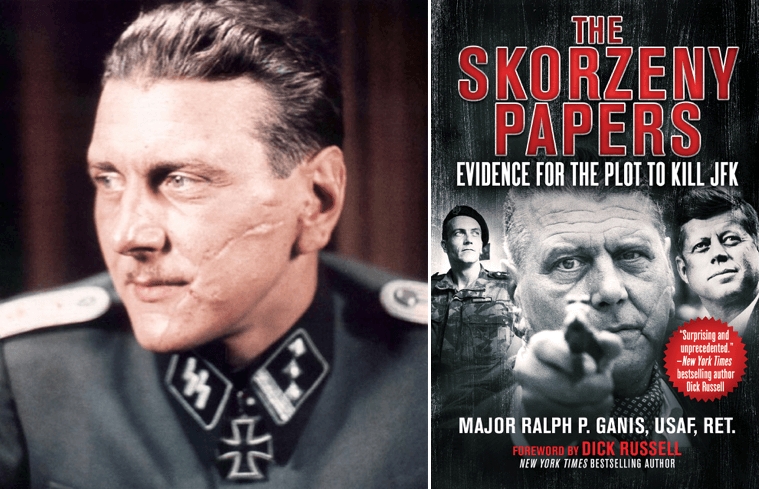
  • Major Ralph P. Ganis, The Skorzeny Papers: Evidence for the Plot to Kill JFK

    Major Ralph P. Ganis, The Skorzeny Papers: Evidence for the Plot to Kill JFK


    I

    When I heard that a previously undiscovered collection of personal correspondences from SS Colonel Otto Skorzeny had recently surfaced, I was truly interested. Besides his famous exploits in WWII, including the daring mountaintop rescue of Benito Mussolini and the kidnapping of Hungarian regent Miklós Horthy’s son from his Bucharest palace, Skorzeny was infamous for his postwar dealings with a number of intelligence agencies the world over. As a child, my grandfather, Marcel, a French resistance fighter, used to tell me stories of Otto’s exploits during car rides. I thought I was in for a real treat when I found this book. That Skorzeny could have had a hand on the team that killed President Kennedy was also an interesting hook.

    The subtitle of this book is “Evidence for the Plot to Kill JFK,” and therein lies its true problem: if by evidence we are referring to clear-cut forensics, incriminating memos, newly declassified documents, newly discovered tapes, or reliable eyewitness testimonies that place Skorzeny either at the scene or in a position directly responsible for the assassination of JFK, then we have little to no “evidence” to justify the book’s subtitle. What the author of the book, Major Ralph Ganis, USAF (retired) seems to suggest is largely tangential to the actionable plot that took Kennedy’s life; that is, Skorzeny, from his position in Madrid as a jack of all trades with ties to postwar Nazis, Texas oil moguls, the Mossad, and French intelligence operatives, could have been a link in a long and winding chain of figures who eventually connected to those who executed the crime of the century. And yet, as we will see, even that supposition is largely based on fantastical leaps of logic, a primary source base that we are never allowed to verify—or see a picture of, or direct reference to—and a conclusion that is not only ridiculous but insulting to the JFK research community.

    Dick Russell, who wrote the introduction to The Skorzeny Papers, rightly claims that the book provides a “chronological tracing of the dark alliances that sheds fresh light on how long-suspicious CIA officials like William Harvey and James Angleton wove Otto Skorzeny into their tangled web, or vice versa.” I will give Ganis and Russell that—most of the book is largely this, an extremely dry, almost colorless list of dozens and dozens of figures who were responsible for placing Skorzeny in a secure position from which to run his operations after the war: within only a few pages in chapter seven we have “Enter Major General Lyman L. Lemnitzer and the NATO Link,” “Enter Clifford Forster,” “Enter Don Isaac Levine.” I like to think I have a pretty good memory, but the sheer volume of second- and third-string players in this book is bewildering, with connections seemingly drawn from any and all personnel affiliated with anything remotely clandestine, few of which are ever revisited, and none of which seem truly important given the book’s central thesis, which is that Otto Skorzeny was somehow a key aspect of the Kennedy assassination.

    The so-called “Skorzeny Papers,” which Ganis acquired through an American auction house bid in 2012, are alleged correspondences between Skorzeny and some of these underworld and intelligence-based figures, along with letters to his wife, who aided him in his dirty work to some degree. “As the story goes, many of the papers were burned over time, but a fragmentary grouping of documents (the ones used for the research in this book) survived. The archive ranges from 1947 to around the period of Skorzeny’s death.” (xv).

    But since we are not allowed to view them or translate them from the German ourselves, we must take the author’s word that they are not mistranslated or even fraudulent.

    Ganis begins his book’s preface with a bold proclamation: “Why was President John F. Kennedy killed and who carried it out? All of the investigations, commissions, and academic works have not answered these questions. This book integrated startling new information that does resolve the mystery.” (p. xxi) Let’s unpack that for a moment. Not all commissions are equal. The Warren Commission is not the same as Jim Garrison’s investigation of Clay Shaw, the HSCA, or the later ARRB. The latter three found quite compelling evidence that a domestic intelligence outfit indeed murdered JFK. The former was staffed by Allen Dulles and was essentially a disinformation campaign whose objective was to obfuscate the truth and put the story to bed for the nightly news, which had also been compromised through the Central Intelligence Agency’s media liaisons. As much has been exhaustively detailed in scholarly works, from John Newman’s Oswald and the CIA, to Jim DiEugenio’s Destiny Betrayed, to Jim Douglass’ JFK and the Unspeakable. That we cannot say with certainty who pulled the trigger on the fatal shot so vividly captured in the Zapruder film is ultimately inconsequential; for all intents and purposes, given the time elapsed since that fateful November afternoon fifty-five years ago, we do have a clear picture of the likely suspects behind the plot’s orchestration, along with compelling motives for why JFK was targeted. Bold claims like Ganis’s require even bolder evidence, and to open with a whopper like that, one would presume that Skorzeny’s purported personal papers contain something akin to the map of Dealey Plaza’s sewer system that investigators found in Cuban exile Sergio Arcacha Smith’s apartment, or a handwritten “thank you” note from James Angleton after the Warren Commission had ended for services Skorzeny rendered to the CIA. And yet not only is Otto Skorzeny himself only a tangential part of a book entitled The Skorzeny Papers, but the “evidence for the plot to kill JFK” is awkwardly squeezed into the last two pages of a 346-page work, with a final revelation that made me both angry for investing hours of my life reading the tome, and confused as to how an author with a true breadth of working knowledge about postwar intelligence networks could presume so myopic an assassination motive.


    II

    Otto Skorzeny was an Austrian by birth who joined the Nazi party somewhat reluctantly, mainly as a way to make a living as the outbreak of the Second World War ramped up in the late 1930s. A mechanic by trade, and a semi-professional fencer, his notorious scar across his face from a missed parry and his 6’4 stature made him something of an icon in the German army. Skorzeny was known for his fearlessness, guile and unconventional approach to commando warfare. As he once said in a postwar interview, “My knowledge of pain, learned with the sabre, taught me not to be afraid. And just as in dueling when you must concentrate on your enemy’s cheek, so, too, in war. You cannot waste time on feinting and sidestepping. You must decide on your target and go in.” (Charles Whiting, Skorzeny, 1972, p. 17) In many ways, his belief that small units could actually move world history in a similar or even greater fashion than regiments and divisions was affirmed after his thirty-man glider-borne SS unit spirited away Mussolini from the Gran Sasso Hotel with not even a single shot fired. Even Winston Churchill heaped praise on him for his bravery in the face of incredible odds.

    Rearranging signposts during The Battle of the Bulge, his commandos, who wore captured American uniforms and spoke fluent English with almost no accent, attempted to sow chaos behind Allied lines, seeking to misdirect troops and armored units away from key areas. While the entire Wacht am Rhein [“Watch Along the Rhine”] operation, which was the German code name for Hitler’s last desperate gamble to capture the Belgian port of Antwerp and cut the British and American forces in two, was ultimately a futile dying gasp of an already-defeated Nazi war machine, it proved so devastating to Allied morale (and killed 75,000 Americans) that some planners did reconsider whether the war would be over any time soon. And when a handful of Skorzeny’s men were captured in their false uniforms during that bitterly cold winter of 1945, panic spread throughout SHAEF (Supreme Headquarters Allied Expeditionary Force), leading to a comical scene in which General Eisenhower frantically argued with his staff who insisted he station twenty guards with sub machine guns around his Paris office at all times in case Skorzeny tried to kill or abduct him. In the middle of the night, the future Director of the CIA, Walter Bedell Smith, Eisenhower’s aide-de-camp, ran out with his staff in pajamas and started firing his carbine into the brush just beyond the headquarters’ window.

    He and his men later found the dead cat that had been scurrying about in the dark, but the legend of Otto Skorzeny had taken hold.

    Dubbed “the most dangerous man in Europe,” Skorzeny finally surrendered to the Allies in occupied Germany, after seeing the futility of carrying out Hitler’s final order for his “werewolves” to continue the war after the end of hostilities. He was summarily booked and processed, and awaited trial for his role as a top Nazi official and a one-time personal bodyguard of Adolf Hitler. He was later approached by OSS officers as he languished in his holding cell at Darmstadt Prison and it is from this first contact that Ganis believes the true exploits of Skorzeny began. While stories differ as to the mechanics of his escape—Skorzeny claimed in his memoirs that he stole away in the trunk of a car and had a German driver unwittingly smuggle him through the checkpoints; while Arnold Silver, his American point of contact and debriefer said he was released on official terms—he nonetheless was a free man by 1948. After relocating to Paris, where he was unofficially used as a conduit through which CIA officials could monitor communist activity in postwar Europe, Skorzeny was quickly identified due to his conspicuous face and looming profile, and was outed by the French press during one of his many strolls down the Champs-Elysée with his wife Ilse.

    Relocating to Madrid, it is here that Ganis believes his real work began, work that—Ganis believes—would ultimately find him involved with dark forces that killed JFK a decade later. Set up in a comfortable office that saw Skorzeny ostensibly managing a construction company that also handled imports and exports of mechanical parts to places in Central Africa and elsewhere, he for all outward purposes seems to have lived a quiet life. Writing memoirs, consulting with foreign governments for a variety of clandestine work, and running a low-key commando training school whose members included some of his former comrades from the SS, French OAS soldiers, American special forces officers, and a rogue’s gallery of other unsavory characters, his postwar life had little in common with his daring exploits during WWII.

    The bulk of The Skorzeny Papers deals with the nebulous formation of both the CIA and its shell companies from the remains of the OSS, with familiar figures like Frank Wisner, Arnold Silver, Bill Harvey, and William Donovan featured prominently in Ganis’ narrative. The central portion of the book meanders from French anti-communist hit teams and their American handlers, to the also newly-formed Mossad and its eventual use of Skorzeny for the removal of Egyptian nuclear scientists, to a whole host of West German ex-Nazi intelligence personnel and their largely dull exploits passing mostly fabricated evidence of an impending Soviet invasion to Washington in exchange for their freedom and a career on the American payroll. Somewhere in this tangled web, Ganis situates Skorzeny who, because of his extensive contacts and personal daring during the Second World War, seems—in Ganis’ estimation—uniquely positioned to wrangle these disparate forces into something of a rogue network that is totally off the books. Ganis reiterates this throughout the book, seeking to distinguish ostensible layers of the spy world from what he considers its truly dark realm, which he identifies as a series of assassination teams bankrolled through corporate shell organizations like SOFINDUS, which eventually morphed into the World Commerce Corporation (WCC). In The Skorzeny Papers the WCC is akin to SPECTRE from the old James Bond novels; a looming, impenetrable evil menace whose tentacles reach into almost every aspect of Cold War politics and planning, Ganis spends a considerable amount of the book detailing its creation, key operators, possible ties to international Nazi groups and ultimately its potential role as the dark budget from which Skorzeny was able to fund his various international commando operations after the war. In reality, while I’m sure this is all very interesting to someone truly looking for an exhaustive account of postwar dirty money, it has very little to do with Skorzeny, and almost nothing to do with the domestic assassination of John F. Kennedy in Dealey Plaza.

    The book then delves into the French OAS, focusing on the enigmatic Captain Jean René Souètre, who of course was allegedly deported from Fort Worth, TX, the afternoon of the JFK assassination. And while I am not denying that Souètre could have indeed been on the ground in Texas in some capacity, Ganis goes to great lengths—even putting him on the book’s cover next to Skorzeny and Kennedy—to implicate him in the plot: “The actual sniper, or team of snipers, was directed by Jean René Souètre, the former OAS officer wanted by French security services for an attempt on the life of President Charles de Gaulle in 1962.” While Souètre was a known paramilitary outlaw who hated the idea of Algerian independence from France—which Kennedy firmly championed from the Senate floor in the mid 1950s—he seems from the available evidence to have been a rogue player who drifted through these turbulent times, training commandos, taking exotic posts with his OAS buddies, and advising the CIA on a handful of ultimately uninteresting developments in the Third World. To suggest, as Ganis does, that he was the lynchpin of the ground operations in and around Dealey Plaza, while ignoring the more probable Cuban exile culprits, seems strained.

    The Souètre chapter ends with a few lines that reveal a frustrating and repeated aspect of this book, where the author assumes that one’s proximity to a situation necessarily guarantees association and willing complicity. For example, Ganis argues:

    The movements of Skorzeny during this period point to his being in attendance at the Lisbon meeting between Souètre and the CIA. In fact, Skorzeny made several trips to Portugal between March and July 1963 concerning his businesses. With the OAS cause now unsustainable, it appears Souètre left the meeting with a new option for employment, signing on with Skorzeny. Captain Jean René Souètre was now a soldier of fortune working for Otto Skorzeny in one of the most guarded secret organizations in the history of American intelligence.” (p. 248, italics added)

    It’s not at all clear that these conclusions can be verified, and as Skorzeny’s whereabouts are only deduced from “the Skorzeny Papers,” which are never directly quoted—here or anywhere in the book to my knowledge—one must once again have faith that Ganis is being honest and accurate.

    III

    The book then spends a considerable amount of time on the Third World and its myriad decolonization movements, with a quite lengthy digression into Ganis’ analysis of the Congo Crisis, exploring the potential for Skorzeny to have been the mysterious QJ/WIN assassin the CIA hired to kill Patrice Lumumba. Ganis takes a fairly condescending approach to his analysis of Lumumba’s rise to power, claiming “As well-founded as Lumumba’s words may have been, they were politically ill-advised. This tense atmosphere was further compounded by the lack of a plan for the organized transition to power.” (p.279). As I have detailed in my article, “Desperate Measures in the Congo,” the United States destroyed any hope for a free Congo before Lumumba had risen to anything nearing real power. In fact, both Belgium and the CIA had planned on separating Katanga, the Congo’s richest area, from the country before it became independent. Belgium had stolen the country’s gold reserves, brought them to Brussels and refused to return them. President Eisenhower refused to meet with Lumumba after the Belgians had landed thousands of paratroopers inside the country. By the time Lumumba’s plane had landed back in Africa, Allen Dulles and friends all but marked Lumumba for death. For Ganis to say he had no plan for an “organized transition to power” smacks of paternalism: given his eloquence, popular appeal and vision of a new dawn for his recently unshackled nation, Lumumba may well have succeeded if he had not been undermined in advance.

    The assassination mission was later aborted when the CIA and Belgian intelligence aided Katangese rebels with Lumumba’s capture after he fled his UN protection in a safe house. While I can see where Ganis is going, and how it could be possible, given that Skorzeny seems to have been in the Congo around this time, to my knowledge it’s been pretty strongly established that QJ/WIN, the CIA digraph of one of two selected assassins for the Congo plot, was actually Jose Marie Andre Mankel. To have sent a person as instantly recognizable as Otto Skorzeny into an unfolding international crisis involving the Soviet Union, Belgian and Congolese troops, U.N. officials from multiple nations, and American station personnel seems, to put it mildly, unwise. Indeed, WI/ROGUE, another CIA-sponsored hit man and agent sent on the assignment, had had plastic surgery and was said to be wearing a toupee during his visit. No matter Skorzeny’s connections to Katanga Province’s mining operations, which were real, he was more likely a visiting business opportunist rather than an actionable agent during the Congo Crisis, if he was present there those critical weeks surrounding Lumumba’s capture and execution at all.

    Ganis then details Skorzeny’s one brief interview with a Canadian television program in September 1960, in which he boasts about being in high demand by both the enemies of Fidel Castro and Fidel himself, explaining a plot which he takes credit for being the first to discover. This was Operation Tropical, in which the CIA was allegedly training Skorzeny and his commandos for a kidnapping of the Cuban premier in early 1960. Ganis bases his description on an unnamed newspaper clipping found in the papers he secured in his winning auction bid. Curiously, I happened upon Operation Tropical in a perusal of the CIA’s online reading room months before I’d read this book, and searched in vain for the newspaper they cite as having outlined the plot, which they claim is the Sunday supplement edition of the Peruvian newspaper, La Cronica, dated August 7, 1966. I would be interested to read it if anyone can secure a copy. It would go a long way in verifying the validity of Ganis’ main body of evidence, and would be an interesting find for researchers more broadly. In any case, with the aborted Castro plot and a mainstream boilerplate description of the “failed Bay of Pigs invasion,” which of course Ganis attributes to Kennedy’s refusal to release nearby carrier-based air support (something Kennedy staunchly forbade before the operation was underway, a point which Ganis’ omits), we now enter the final stretch of the book, which looks directly at Skorzeny’s role in the JFK assassination.

    Spoiler alert—there is none.


    IV

    “General American Oil Company,” “Colonel Gordon Simpson,” “Algur Meadows,” “Sir Stafford Sands,” “Colonel Robert Storey,” “Jacques Villeres,” “Permindex,” “Judge Duvall,” “Paul Raigorodsky,” “Thomas Eli Davis III,” “ Robert Ruark,” “Jake Hamon,” and about twenty other sub-headings flash across the first dozen or so pages of the final chapter of The Skorzeny Papers. The organization of the book centers on these disjointed, one-to-two-page sub-chapters which give the reader the disorienting and queasy feeling of reading it through glasses with the wrong prescription. Not only did Ganis miss the opportunity to style the life and times of Nazi Germany’s most infamous commando personality along the lines of a thrilling narrative, with exotic locales and shady deals over drinks and cigars, but he arranged the book in so awkward a fashion that he constantly has to end sentences with “and we will get back to him shortly,” or “and I will show you how this ties in later.” Even if one were to storyboard his entire panoply of tertiary personalities, it would look more like a Jackson Pollock art installation than a coherent plot with a compelling impetus culminating in the JFK assassination as we understand it. A story should be clear enough to draw the reader in with its simple facts, and should sensibly unfold on its own accord so as to prevent the need to constantly handhold during the descent into the labyrinth.

    Conspicuously absent in The Skorzeny Papers are any substantial sub-headings detailing Cuban exiles, Allen Dulles, the Joint Chiefs of Staff, or any of the genuine suspects of the JFK assassination, save for meanderings on James Angleton’s and Bill Harvey’s roles in the creation of Staff D, the CIA’s executive action arm. Ruth and Michael Paine are nowhere to be found. Neither is a description of the aborted Chicago plot, or any substantive explanation of how Lee Harvey Oswald was moved into the Texas School Book Depository, or a note about David Phillips’ role in the whole affair from his Mexico City station. While these very real aspects of the actual JFK plot are infrequently touched upon in passing—Ganis cannot ignore the entire body of evidence, despite his best efforts—he insists on crow-barring his newfound “primary source data” into a story that at this point doesn’t permit much unique interpretation. It’s safe to say, in 2018, that President Kennedy was assassinated by a domestic, military-industrial-intelligence apparatus that viewed his foreign policy as anathema to both the “winning” of the Cold War and to their image of the United States’ role in world affairs. That Kennedy was a staunch decolonization advocate, a friend and champion of Third World leaders like Sukarno in Indonesia, Nasser in Egypt, Lumumba in the Congo, and sought diplomatic solutions to prevent the impending nuclear Armageddon with Nikita Khrushchev’s Soviet Union is all but ignored in Ganis’ conclusions as to why JFK was shot in Dallas. None of it is suggested. What ultimately led to the tragedy in Dealey Plaza, according to Ganis, is something much bigger.


    V

    It all comes down to JFK’s sexual indiscretions, folks. That’s right. Jack Kennedy just couldn’t resist the advances of the hundreds of femme fatales who threw themselves at him, and according to Ganis, the high command had to take him out when he cavorted with the ultimate Cold War honeypot.

    I wish I were kidding. But unfortunately I’m not.

    The author submits to the reader that the act to assassinate President Kennedy was carried out for reasons that far exceeded concerns over U.S. National security. In particular, they arose out of a pending international crisis of such a grave nature that the very survival of the United States and its NATO partners was at risk. At the source of this threat was breaking scandals that unknown to the public involved President Kennedy. To those around the President (sic) there was also the impact these scandals had on the president’s important duties such as control of the nuclear weapons and response to nuclear attack. It also appears the facts were about to be known. The two scandals at the heart of this high concern were the Profumo Affair and the Bobby Baker Scandal. (p.294)

    I will spare anyone reading this a rebuttal of the relevance of this assertion, but suffice it to say, Ganis places the final straw at Kennedy’s—demonstrably disproven—affair with Eastern Bloc seductress Ellen Rometsch. Ganis claims, “Historians are taking a hard look at this information, but preliminary findings indicate Rometsch was perhaps a Soviet agent.” (p.295) He continues, “Her potential as a Soviet agent is explosive since Baker had arranged for multiple secret sexual liaisons between her and President Kennedy.” (p. 295)

    He then scrapes together a weird narrative of how Attorney General Robert Kennedy was pleading with J. Edgar Hoover and the FBI to withhold these revelations in a “desperate effort to save his brother and the office of the presidency.” (p.296), He argues that “As President Kennedy was arriving in Dallas, Texas, on November 22, 1963, a very dark cloud of doom was poised over Washington, and the impending storm of information was hanging by a thread.” (p. 296). That’s when Skorzeny—from Madrid—was activated to save the Western world. It seems pointless to add that retired ace archive researcher Peter Vea saw the FBI documents on this case. The agents had concluded there was no such liaison between the president and Rometsch. In other words, to save himself, Baker was trying to spread his racket to the White House. Bobby Kennedy called his bluff.

    Ganis pretentiously concludes, “In the end, the assassination network that killed JFK was the unfortunate legacy of General Donovan’s original Secret Paramilitary Group that included as a key adviser from its early inception—Otto Skorzeny. Furthermore, the evidence would seem to indicate Skorzeny organized, planned and carried out the Dallas assassination, however, we may never know what his exact role was.” (p. 342)

    Indeed we may never, because there does not seem to be any. Ganis continues, “On November 22, 1963, an assassination network was in place in Dallas; it was constructed of associates of Otto Skorzeny and initiated by his minders in the U.S. Government and clandestine groups within NATO.” Wrapping up, the author reiterates, “The events that led to this killing were triggered by a limited group of highly placed men in the American government. They were convinced that the West was in imminent danger and posed to suffer irreparable damage, and, for some of them, imminent exposure to personal disgrace beckoned. All of this sprang from reckless debauchery in the White House and beyond. With the situation breached by Soviet intelligence and ripe for exploitation, it became untenable for this group. They took action.”

    I’ll give you a few minutes now to wipe the tears from your eyes. Okay, good. Are you still with me? Overall, The Skorzeny Papers could, I suppose, serve as something like a compendium or glossary for those who just have to know the minutest details of the inner workings of this or that shell corporation that may or may not have had a hand in some world affair during the Cold War. But there are much better books on that. Ultimately, Ganis’ book is an uncomfortable, freewheeling careen down strange dead-end tracks, with unannounced detours through cold dark streets full of faceless characters, and later, journeys through mirror-filled fun houses of speculation, with a final twist and turn that spits you out right over Niagara Falls, barrel and all.

  • JFK Declassified: Tracking Oswald, Part 7

    JFK Declassified: Tracking Oswald, Part 7


    Part 6

    Part 5

    Part 4

    Part 3

    Part 2

    Part 1


    The 2017 release of JFK assassination files has shown that the national security agencies are not subject to the JFK Records Act (1992) and we, the people, have no right to know their secrets, but must settle for mostly or entirely redacted and even illegible materials. An accessory to the fact is the mainstream media, whose willful deception would have us believe that “there’s nothing here” or, if there is something, it should be a Red conspiracy.

    The History Channel did its bit by extending the infamous series JFK Declassified: Tracking Oswald 1 with a seventh part that is an in-your-face flipped bird to the public. The ineffable Bob Baer reentered the game of deception as “one of the most intelligence minds in the world.” He boasted about having his own network of former CIA and FBI agents who “can tell me what I should be looking at and what to dismiss” within the complex milieu of the newly declassified JFK files. Poor Bob. He needs to set up his own front group to mislead the global media audience about a crucial American tragedy. The Warren Commission critics going through each and every document can’t be trusted.


    Foreknowledge?

    Among the stories indicating awareness of the coming JFK assassination2, Baer purposely picked the blatant lie of Cuban defector Florentino Aspillaga3 and a dubious phone call trickily turned into an explosive discovery in the light of a memo from Jim Angleton, CIA Counterintelligence Chief, to FBI Director Hoover. It was dated on November 26, 1963 (NARA 104-10079-10262) and the gist reads thus: “At 18:05 GMT [12:05 Dallas] on 22 November [1963] an anonymous telephone call was made in Cambridge, England, to the senior reporter of the Cambridge News. The caller said only that the Cambridge News reporter should call the American Embassy for some big news and then rang off.”

    Baer’s discovery is a trick since both Angleton’s memo and the original CIA cable of 23 November 1963 from London (NARA 1993.07.22.14:03:15:250530) were already available to the HSCA forty years ago. Moreover, the British Security Service (MI-5) has never revealed the identity of the reporter, if any, who picked up the phone. The story itself has been neither published by the Cambridge newspaper nor even addressed as a topic of conversation by its staffers.4

    Since there is no quantum of proof for discerning within the range of possibilities5—from a prank with coincidental timing to a conspiratorial move—Baer’s mix of the Cambridge uncertainty with Aspillaga’s falsehood is likely the worst approach to understand who would have been behind Kennedy’s death.


    A Missing Link?

    In the fourth part, “The Cuban Connection,” Baer and his partner, former police officer Adam Bercovici, dealt with Antonio Veciana’s6 account of having seen Maurice Bishop with Oswald in Dallas in the late summer of 1963. Bercovici blurted out: “There’s your co-conspirator. He [Oswald] had on-the-ground assistance in Dallas.” Nonetheless, they withheld the critical info that Bishop was David Atlee Phillips, a covert action officer running anti-Castro operations at the CIA Station in Mexico City by that time.7

    In the seventh part, they avoid keeping track of Phillips and resort to a “document [that] alone could destroy any conversation about Oswald being a lone wolf.” Not all that much, Bob. Your document (NARA 180-10141-10191) reduces to a handwritten note from October 2, 1967, by Bernardo de Torres, the first CIA agent to infiltrate D.A. Jim Garrison’s office.8 The note merely states that some Rene Carballo, a Cuban refugee living in New Orleans, “thinks head of training camp at [Lake] Ponchartrain was ‘El Mexicano’ [who] accompanied LHO to Mex[ico] City.”

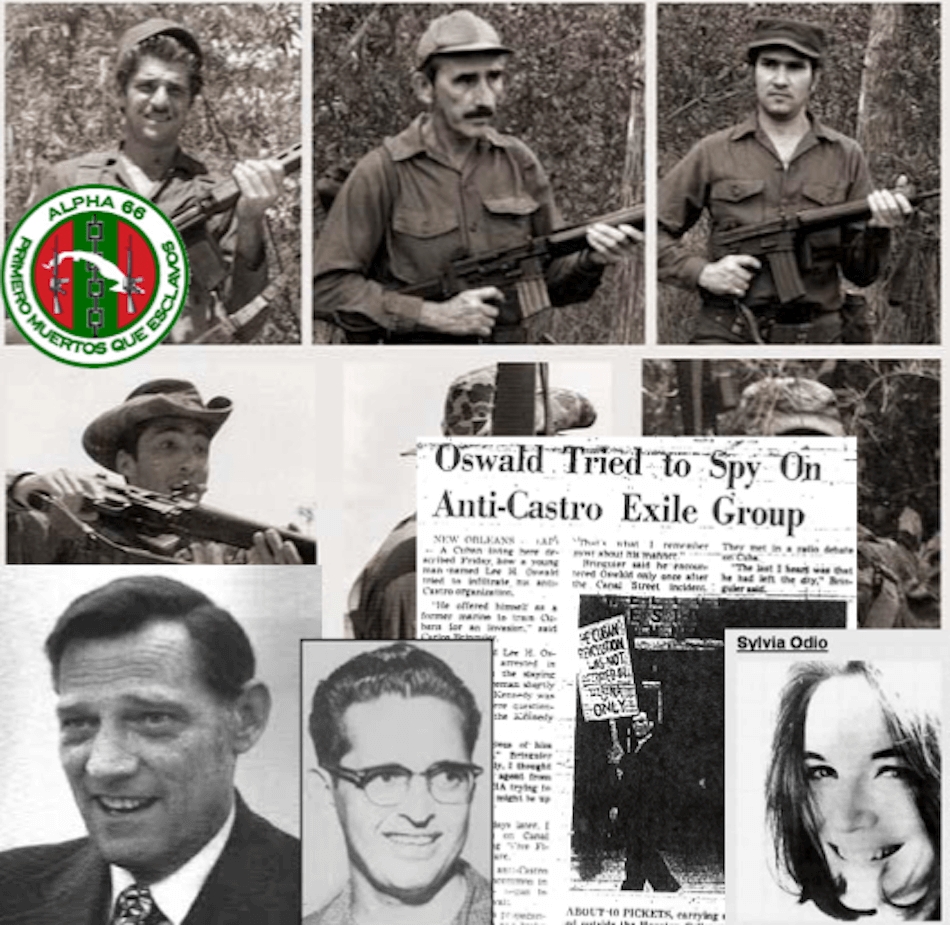
    This note was also available to the HSCA, so Baer should have used it earlier, but he even missed the primary source: the main FBI Headquarters file [62-109060] on the JFK assassination. It contains a teletype from May 11, 1967 (Section 131, pp. 19-20) about Carlos Bringuier9 advising the FBI in New Orleans that Carballo “was conducting his own investigation into the death of President Kennedy and had determined that Richard Davis was not actually in charge of the anti-Castro training camp near Lake Ponchartrain, but it was actually run by a man known as ‘El Mexicano.’ Carballo opined it was this man, ‘El Mexicano,’ who accompanied Lee Harvey Oswald to the Cuban Embassy in Mexico City.”

    The Cuban refugee Francisco Rodriguez-Tamayo, a.k.a. “El Mexicano” [The Mexican],10 is a delusional choice for both an Oswald companion11 in Mexico City and a head of a training camp elsewhere. No “fellow traveler” has been identified in the alleged Oswald’s route from New Orleans to Mexico City or during his stay there. Likewise, Richard Davis comes across the story because of the training camp at Lacombe, set up in 1962 for the Intercontinental Penetration Force (INTERPEN) and operated in the summer of 1963 by an amorphous anti-Castro group.12

    Baer had already plunged into confusion during the third part, “Oswald Goes Dark,”13 trying to shed light on him as an ex-Marine engaged in paramilitary exercises with Cuban exiles. Baer and his team went to the training camp at Belle Chasse, headquarter of the CIA operation JM/MOVE, run by Higinio “Nino” Diaz (AM/NORM-1) in 1961. In those days, Oswald was living in Minsk (Belarus).

    As leaders of the training camp at Lacombe, the Garrison probe identified Davis, Laureano Batista (AM/PALM-2) and Victor Paneque (AM/RUG-5), but in no way “El Mexicano.”14 Although any sensible citizen would prefer Garrison over Carballo, Baer recklessly keeps on forging his missing link to Oswald by attributing to “El Mexicano” a dual nature of professional assassin and Castro agent.

    For the former, Baer musters an FBI report from June 28, 1968 (NARA 124-90158-10027) about an informant saying that “El Mexicano” had been arrested in Caracas, Venezuela, “on a charge of an alleged assassination attempt against an unknown individual.” Baer doesn’t give a damn about the additional info. There was “no sufficient evidence to prosecute the case (…) except that [“El Mexicano”] had apparently entered the country illegally.”

    For the latter, Baer applies the same clumsy rule of evidence. He deems as “smoking gun” a CIA internal memo from March 19, 1963 (NARA 104-10180-10247) about the following intel furnished by “an untested source.” In El Principe prison (Havana), the source spoke briefly with death row inmate Roberto Perez-Cruzata, who asked him to tell the U.S. authorities that “El Mexicano” was “a paid agent of the Cuban government in Miami.” Perez-Cruzata added he had learned it from Major Efigenio Ameijeiras during an interrogation. Ameijeiras also told him that his anti-Cuban government activities had been reported by “El Mexicano.”

    Baer does not seem at all to be intrigued by the curious case of Major Ameijeiras, chief of Castro’s National Revolutionary Police (PNR), burning a Castro agent before a Brigade 2506 prisoner under interrogation.15 Nor did he pay attention to the follow-up by CIA, FBI, and Immigration and Naturalization Service (INS). Instead of remaining under a cloud of suspicion as Castro agent, “El Mexicano” was reported talking about bombing a ship bound for Cuba, delivering silencers along with Luis Posada-Carriles (AM/CLAVE-15) and even trafficking drugs with Ricardo “The Monkey” Morales (AM/DESK-1).


    A Russian-Cuban Probe?

    With the preconceived idea that the KGB and the Cuban Intelligence Services (CuIS) worked in tandem to kill Kennedy, and that the FBI Director Hoover covered it up to avoid a nuclear WW III, Baer continues his far-fetched story about KGB officer Valery Vladimirovich Kostikov—who served at the Soviet Embassy in Mexico City under the official cover of vice-consul—in order to pass off an ill-founded allegation as the greatest worry: “The fact that Oswald is essentially being handled by Kostikov.”

    Since the first two parts, “The Iron Meeting” and “The Russian Network,” Baer had been trying to present the Kostikov-Oswald connection as emerging from hitherto little known evidence. Yet in 1964, the Warren Report identified Kostikov as KGB officer (page 309) and established that Oswald “had dealt with [him]” (page 734). Moreover, the CIA informed the Warren Commission that “Kostikov is believed to work for Department Thirteen (…) responsible for executive action, including sabotage and assassination (Commission Document 347, p. 10).

    As a somehow sparklingly brand-new item, Baer shows a CIA memo of 23 Nov 1963 (NARA 104-10015-10056) that was partially, but well enough declassified in 1995. It was prepared by the acting chief of the CIA Soviet Russia Division, Tennent “Pete” Bagley, who linked Kostikov as officer of “the KGB’s 13th Department” with Oswald as “a KGB agent on a sensitive mission [who] can (sic) be met in official installations [as the Soviet Embassy in Mexico City] using as cover (…) some sort of open business [like requesting an entry visa in the Soviet Union].” Baer again has simply left the audience in the dark.  Both of these assumptions led straight to a Red conspiracy theory which has long been discredited and may be deemed defunct.

    For the sake of argument, let’s accept Kostikov was “head of Department Thirteen”, as Baer affirms and stresses with a flashback scene from Oleg Nechiporenko’s interview in part two. Baer conveniently forgets that his interviewee—who met Oswald as well in his capacity of KGB counterintelligence officer under official cover of vice consul—rebutted Bagley’s assumption about Oswald, which presupposes he would have been recruited before meeting Kostikov. Nechiporenko not only emphatically denied this,16 but also demonstrated that the two very brief Oswald contacts with Kostikov did not add up to agent handling. They were nothing more than the coincidental meeting of an American visa applicant with a competent Soviet consular official.17

    Both the FBI and CIA were tracking Kostikov before Oswald showed up in Mexico City, but by June 25, 1963, Angleton assured Hoover that the CIA “could locate no information” indicating he was an officer of Department Thirteen.18

    If there had been any serious concern about Oswald meeting Kostikov, Langley would have advised strengthening surveillance on both after receiving this piece of intel from the CIA station in Mexico City: “American male who spoke broken Russian said his name LEE OSWALD (phonetic), stated he at SOVEMB on 28 Sept when spoke with consul whom he believed be Valery Vladimirovich Kostikov” (MEXI 6453, 8 Oct 1963). Quite the contrary, Langley abstained from giving such an instruction and even omitted any reference to Kostikov while providing ODACID (State Department), ODENVY (FBI) and ODOATH (Navy) with the intel (DIR 74673, 10 Oct 1963).

    The following month, Oswald broke the news as prime suspect of the JFK assassination without having been grilled by the FBI, the CIA or the Secret Service about his travel to Mexico. In tune with Bagley’s allegation, Angleton changed his mind about Kostikov to deflect the attention from a CIA failure to a KGB plot. On February 6, 1976, however, Angleton recanted before the Church Committee: “There’s never been any confirmation [that Kostikov] was 13th Department.”19

    The connection between Kostikov and Oswald surfaced in a phone call to the Soviet Embassy in Mexico City on October 1, 1963. The call was taped by the CIA operation LIENVOY and made—according to its transcriber Boris Tarasoff—by “the same person who had called a day or so ago [namely Saturday 28th of September] and spoken in broken Russian:”20

    • Caller: Hello, this LEE OSWALD speaking. I was at your place last Saturday and spoke to a Consul, and they say that they’d send a telegram to Washington, so I wanted to find out if you have anything new? But I don’t remember the name of that Consul.
    • Soviet guard: KOSTIKOV. He is dark?
    • Caller: Yes. My name is OSWALD.

    Baer ignores the proven facts that since Oswald spoke fluent Russian and the FBI deduced it was not his voice on the tapes, Oswald was impersonated during both phone calls, and that CIA officer Anne Goodpasture, dubbed “the station’s troubleshooter” by Phillips, made up a fake story—which has passed into history as “The Mystery Man”—about Oswald at the Soviet Embassy, as well as hid from Langley Oswald’s visit to the Cuban Embassy. This series of facts lead immediately to the debunking of Baer’s and all other Red conspiracies. Based on the newly declassified November 24, 1963 FBI report about Oswald’s murder by Ruby (NARA 180-10110-10104), Baer emphasizes that Hoover covered up after the assassination; but the whole series deliberately overlooks that—before the assassination—the CIA had already engaged in a cover-up that had nothing to do with fear of nuclear war.

    Ironically, Baer’s suspect Fidel Castro posed the most immediate and critical challenge to Hoover’s decision to close the case after Ruby killed Oswald:

    As if it were a matter not of the President of the United States, but of a dog killed in the street, they declared the case closed with 48 hours. The case was closed when the case was becoming less closeable, when the case was becoming more mysterious, when the case was becoming more suspicious, when the case was becoming worthier of investigation from the judicial and criminal point of view.21

    Baer tries to muddle through somehow by doing a pathetic pirouette. The Soviets “hand off Oswald to the Cubans” after he showed up in Mexico City as “an opportunity” that the KGB couldn’t seize, “because there was no plausible deniability.” Sure Bob, sure. The KBG offloaded Oswald on Cuban G-2 knowing the latter had no plausible deniability either, since Oswald had visited the Cuban Embassy, which was under CIA surveillance as heavy as at the Soviet Embassy.

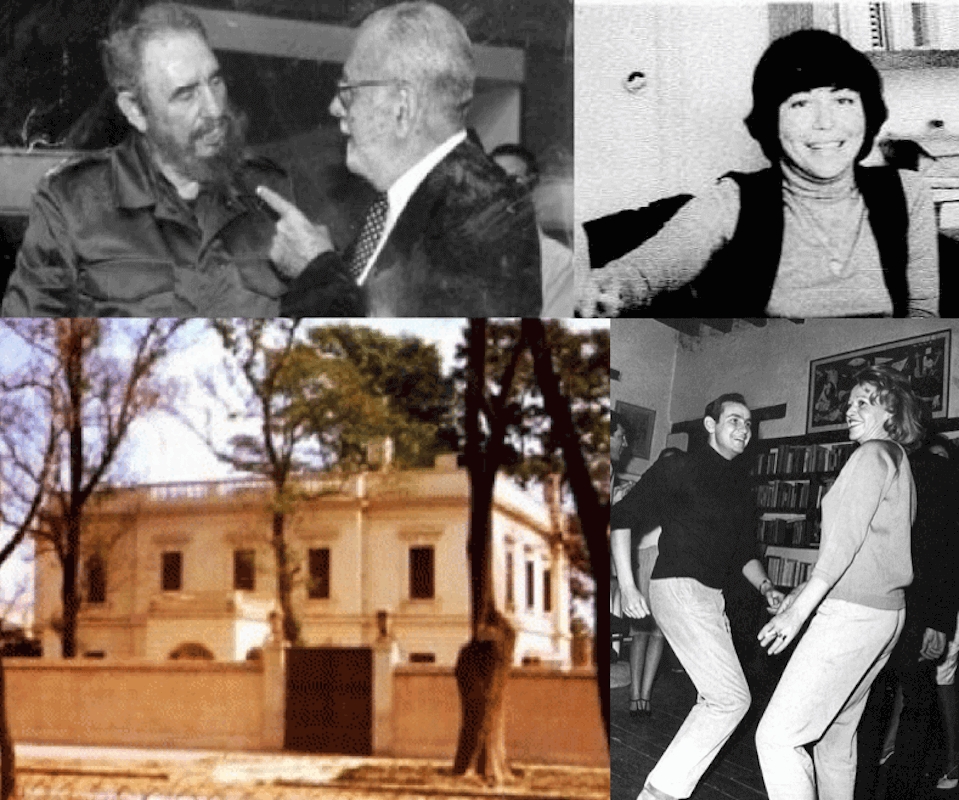
    So, far removed from common sense, Baer repeats the same old and silly song from Part Three22 about Mexican consular clerk Silvia Duran being a CuIS agent who met American visa applicant Lee Harvey Oswald outside the Cuban Consulate at a twist party … to put him up to killing Kennedy! Baer simply replaced the original mouthpiece for this story, the late Mexican writer Elena Garro, with her nephew Francisco Garro, as if a false allegation might come true by repetition.


    A Self-Destructive Production?

    Unwilling to delve into the body of evidence, Baer misses the chance to prevent extremely botched scenes like the discussion around Kostikov. After the voice-over narrator notes that his CIA Personality File [201-305052] “had never been released,” the telephone rings.  A 167-page portion (1965-1975) of the Kostikov 201 file (NARA 104-10218-10032) has been finally declassified, although the camera focuses on a different file number [201-820393]. Baer brought former FBI analyst Farris Rookstool III to dig deeper into the lack of coordination between the FBI and the CIA, but Kostikov was in fact under well-coordinated surveillance by both agencies. Kostikov was handling a German national living in Oklahoma, Guenter Schulz, who was a double agent codenamed TUMBLEWEED by the FBI and AEBURBLE by the CIA. Bagley’s allegation that Kostikov worked for Department Thirteen was indeed based on the intel that—together with Oleg Brykin, “a known officer” of said department—he had been “pinpointing objectives for sabotage” to Schulz. Instead of the travels to Oklahoma City listed in the index of the referred volume, Rookstool points out the travels to San Diego and Baer makes up from who knows what information that Kostikov had been there planning “some sort of assassination or sabotage.”

    In order to suggest that the KGB and the CuIS may have engaged in “massive coordination”23 to kill Kennedy, Baer brought in another media puppet, The Guardian (U.K.) foreign correspondent Luke Harding, who broached a false analogy with a joint operation by the KGB and Bulgarian State Security.  On September 7, 1978, the Bulgarian dissident Georgi Markov was mortally wounded in London by a ricin-filled pellet shot from a silenced gun concealed inside an umbrella. The problem is that this so-called “Umbrella Murder” was a far cry from the highly unlikely assassination of a Western official by the KBG and its allied services,24 and even less similar to Castro’s strategy against the U.S. dirty war. Thanks to his system-centered thinking style, Castro prevailed by carving out an ironclad personal security against the CIA assassination plots and infiltrating to the core both the CIA and the Cuban exile community.

    In this seventh part, Baer utters: “I’m not doing this for the camera.” He’s damn right. Not so much due to poor TV production, but essentially because it is self-evident that he is just muddying the waters, even at the humiliating cost of lingering over the soft-headed folly that Castro wasn’t aware of an obvious fact:  that killing a sitting U.S. President wouldn´t solve anything25—for by 1963, Operation Mongoose had been terminated—while it would surely risk everything.

    Since 1963, the CIA has been trying to blame the Kennedy assassination on Cuba.  Each time the claim has been exposed to scrutiny, it has collapsed.  It is disheartening to see that, on the occasion of the final declassification of the JFK files, 54 years on, Baer is still beating that dead horse.


    NOTES

    1 See the six-part review on this website.

    2 Some of these stories are plausible, as the tape-recorded prediction by right-wing extremist Joseph Milteer in Miami, or the incidents related to Silvia Odio in Dallas and Rose Cherami in Louisiana.

    3 See “An Apocryphal Story as Baer’s Cornerstone” in JFK Declassified: Tracking Oswald, Part 6.

    4 Cf. “Did Cambridge News reporter really take a call before the JFK assassination?,” Cambridge News, 27 Oct 2017.

    5 See Mark Bridger’s analysis, “Foreknowledge in England,” Dealey Plaza Echo, Vol. 9, Issue 2, pp. 1-16.

    6 For a biographical sketch, see Antonio Veciana: Trained to Kill Kennedy Too?

    7 On November 3, 2017, four of Phillips’ files were released. His 358-page Office of Personnel file has neither the fitness reports from 1956 to 1965 nor a single record from 1961 to 1965. The other three may be operational files, but they are so heavily redacted that no relevant data is to be found.

    8 De Torres was a private detective who worked under David “El Indio” Sanchez Morales for the CIA Station in Miami (JM/WAVE). He served as Chief of Intelligence for the Brigade 2506 and was captured during the Bay of Pigs invasion. After being released, he resumed work in the private sector. Early in the Garrison probe, he offered help dropping the name of Garrison’s friend and Miami D.A. Richard Gerstein. Shortly after Garrison asked him to find Eladio del Valle, the latter was found murdered inside his car in Miami. Garrison eventually realized De Torres was undermining the JFK investigation and working for JM/WAVE.

    9 Bringuier was a Cuban exile affiliated with the CIA-backed Student Revolutionary Directorate (DRE – AM/SPELL for the CIA). On August 9, 1963, he confronted Oswald handing out pro-Castro leaflets in New Orleans. Shortly after, he debated with Oswald on radio WDSU about the Fair Play for Cuba Committee (FPCC). He was instrumental in the first printed JFK conspiracy theory. On November 23, 1963, a special edition of DRE’s monthly magazine Trinchera [Trenches] linked Oswald to Castro under the headline “The Presumed Assassins.”

    10 On December 14, 1959, Castro lashed out against “El Mexicano” during the trial of Major Hubert Matos (AM/LIGHT-1): “Who was the first to accuse us of Communists? That captain of the Rebel Army who was arrested for abusing and getting drunk, known as ‘El Mexicano’ (…) He came to Havana, entered a military barrack, conferred on himself the rank of captain again, and as soon as he realized that his situation was untenable, he left for the United States and made the first statement of resignation from the army because the revolution was communist.” On June 25, 1959, “El Mexicano” told Stanley Ross, editor of the Spanish-language newspaper El Diario de Nueva York, that Castro had embezzled 4.5 million Cuban pesos raised for the revolution.

    11 Baer is not the first to entertain this canard. In autumn 1964, a certain Gladys Davis advised the FBI that a “El Mexicano” had brought Oswald to her former marital residence in Coral Gables, Florida, “about August or September of 1959 or possibly 1960.” “El Mexicano” replied he never had contact with Oswald. The case was put to rest because Mrs. Davis was lying in an attempt to get FBI help in a custody dispute against her former husband. Cf. FBI 105-82555 Oswald HQ File, Section 220, pp. 95 ff.

    12 “Playboy Interview: Jim Garrison,” Playboy Magazine, October 1967, p. 159 (NARA 104-10522-10109).

    13 See “Rocking the Refugee Boat” in JFK Declassified: Tracking Oswald, Part 3.

    14 Cf. Garrison Investigation – Volume I, pp. 43 ff. (NARA 1994.05.06.08:43:35:150005).

    15 Perez-Cruzata was a former PNR sergeant sentenced to fifteen years imprisonment for killing Dr. Rafael Escalona Almeida on January 10, 1959, while the latter was under arrest. Perez-Cruzata escaped from La Cabana prison on July 1, 1959, and took refuge in the U.S. His extradition was denied (Ramos v. Diaz, 179 F. Supp. 459 / S.D. Fla. 1959). He ventured to return to Cuba with the Brigade 2506 and after a summary trial in Santa Clara (central Cuba), he ended up being one of the only five prisoners executed by a firing squad on September 9, 1961.

    16 The CIA should have known it since the defection of KGB officer Yuri Nosenko on April 1964. He claimed having seen the KGB files compiled on Oswald during his stay in the Soviet Union and found Oswald was neither recruited nor used as agent. However, Nosenko’s chief handler, Pete Bagley, suspected he was a plant to convey false intel. The newly released file (NARA 104-10534-10205) about the case study on Nosenko shows he was “a bona fide defector [who was not] properly handled, [since] the variety of techniques used (…) did not conform to any generally accepted sense of the term methodology.”

    17 Cf. Nechiporenko’s book Passport to Assassination (Birch Lane/Carol Publishing, 1993, pp. 28-29, 66-81). On September 27, Kostikov promptly handed off Oswald to counterintelligence officer Nechiporenko, right after checking his documents and learning he was a re-defector from the Soviet Union. On September 28, Oswald was attended by consul Pavel Yatskov. Kostikov just walked in and briefed Yatskov about Oswald’s previous visit. Then Nechiporenko arrived, but did not take part in the meeting. The scene dramatized with Oswald at a table before three Soviet officials is simply a botch job.

    18 Admin Folder-X6: HSCA Administrative Folder, CIA reports LHO, p. 51 (NARA 124-10369-10063).

    19 Testimony of James Angleton, pp. 62 f. (NARA 157-10014-10003).

    20 Since the Mexican security police known as DFS was the CIA’s partner in the wiretapping operation, the transcripts of this and four more CIA taped calls related to Oswald are available in Spanish and some in English (NARA 104-10413-1007).

    21 Cf. live speech by Castro at the University of Havana on November 27, 1963 (Commission Exhibit 2954).

    22 See “The Twist Party” in JFK Declassified: Tracking Oswald, Part 3.

    23 Both agencies did engage in massive coordination precisely in Harding’s homeland, after around 100 KGB officers under diplomatic cover were expelled from London in September 1971. The CuIS took over some KGB operations in the UK, but none related to assassination of foreign leaders. Cf. Christopher Andrew and Oleg Gordievsky, “KGB: The Inside Story of its Foreign Operation from Lenin to Gorbachev”, Sceptre, 1991, p. 514.

    24 Cf. “Soviet Use of Assassination and Kidnapping” (NARA 104-10423-10278). Rather than killing statemen, the KGB did its best to encourage the idea that the CIA had been involved in the JFK assassination and even that its methods to kill Castro had been taken into consideration against other foreign leaders. Indira Gandhi, for instance, became obsessed with it.  Cf. Christopher Andrew and Vasili Mitrokhin, The World Was Going Our Way, Basic Books, 2005, p. 18.

    25 In 1984, Castro ordered that President Reagan be advised about an extreme right-wing conspiracy to kill him. CuIS furnished all the intel to U.S. Security Chief at United Nations. The FBI quietly proceeded to dismantle the plot in North Carolina. Cf. Nestor Garcia-Iturbe’s account in “Cuba-US: Cuban Government Save Reagan’s Life.”

  • Bill Davy at the VMI Seminar

    Bill Davy at the VMI Seminar

    Alan Dale:

    I have the honor of being your host, your emcee. I’d like to begin by introducing our first speaker. William Davy is a longtime researcher and writer, a respected contributor to Probe Magazine. He’s been published as an essayist and reviewer. He’s the author of a monograph on Clay Shaw, which he further developed into his illuminating and much admired work, Let Justice Be Done: New Light on the Jim Garrison Investigation. Please welcome Bill Davy.

    Bill Davy:

    Thank you. Thank you, thank you, Lee, and good evening everybody. Just give me a second to get settled here and get my eyes on. Okay. All right.

    The topic of my presentation tonight are the new documents and the Season of Inquiry. By the Season of Inquiry, I’m talking about essentially the 1970s. It really was a season of inquiry. We have Watergate, of course, the Pike Committee, the Rockefeller Commission, the Church Committee, and House Select Committee on Assassinations. It seemed like at the time the politicians in the country in general were more interested in uncovering the political state. Pardon the term. Present company excluded, of course.

    We’re going to go into some of the documentary evidence, but oftentimes when I’ve given talks to, say, a less sophisticated audience, just to start off, I’ve asked the question, “What do you feel is the government’s official position on the JFK assassination?” and people will say something like, “Well, Oswald did it,” or, “That Warren Commission thing.” I say, “No, that’s not the official position at all. The official position of the federal government is that JFK was killed by a conspiracy.”

    It’s right there. That is the copy … Or it’s right here. It’s the final report of the House Select Committee on Assassinations. God knows there’s all kinds of problems with the HSCA. You can do a whole symposium on some of the in-fighting and backstabbing and so forth.

    But that aside, they did some good work, and a lot of that good work found its way into the report itself. I just want to take a quick look at some of the findings of the report. I hate talking at people because everybody can read, but a few of these are worth noting.

    First, “The committee believes on the basis of the evidence available to it that President John F. Kennedy was probably assassinated as result of a conspiracy.” Further, “The committee found that, to be precise and loyal to the facts it established, it was compelled to find that President Kennedy was probably killed as a result of a conspiracy.” Compelled to find, pretty strong language, even though they keep slipping the ‘probably’ in there.

    We’re talking about the scientific evidence here. The evidence available to the committee indicated that it was “probable that more than one person was involved in the president’s murder. That fact compels acceptance.” Again, with the compelling. “And it demands a reexamination of all that was thought to be true in the past.”

    Further, they conclude, “Neither Oswald nor Ruby turned out to be loners, as they’d been painted in the 1964 investigation,” and indeed in the media, ongoing as a matter of fact.

    “The committee found that the CIA-Mafia-Cuban plots had all the elements necessary for a successful assassination conspiracy: people, motive, and means; and the evidence indicated that the participants might well have considered using the resources at their disposal to increase their power and alleviate their problems by assassinating the president.”

    Again, talking about the scientific evidence. “Scientific acoustical evidence establishes a high probability that two gunmen fired at President John F. Kennedy. Other scientific evidence does not preclude the possibility of two gunmen firing at the president.” They’re talking about the stuck open mic of the motorcycle policeman who essentially recorded the assassination as it happened.

    Further, in talking about the photographic evidence, “A fleshtone comparison performed by analyzing measurements of color values,” and this is on Willis photograph number five. “A fleshtone comparison performed by analyzing measurements of color values on an object located behind the west end of the retaining wall,” this is on the grassy knoll, “confirmed that the image perceived was actually a human being.” They found photographic evidence of a human being behind the retaining wall on the grassy knoll.

    “The panel did perceive ‘a very distinct straight-line feature’ near the region of this person’s hands, but it was unable to deblur the image sufficiently to reach any conclusion as to whether the feature was in fact a weapon,” but they found a person and they found what appeared to be a weapon behind the grassy knoll.

    “During the course of its investigation, the committee developed several areas of credible evidence and testimony indicating a possible association in New Orleans and elsewhere between Lee Harvey Oswald and David W. Ferrie.” I’ll assume most people know who David Ferrie is, so we don’t have to go down that road.

    “The committee found that the Clinton witnesses … ” This may require a little explanation. What they’re talking about here is the town of Clinton, Louisiana, which is just outside of Baton Rouge. It was uncovered during the Garrison Investigation and the subsequent Shaw trial that Lee Harvey Oswald was seen in Clinton, Louisiana at a voter registration incident with not only David Ferrie but Clay Shaw as well.

    “The committee found that the Clinton witnesses … ,” and there was a whole cross-section of people up there testifying to this. “The committee found that the Clinton witnesses were credible and significant. It was the judgment of the committee that they were telling the truth as they knew it.”

    “If the witnesses were not only truthful but accurate as well in their accounts,” they’re talking about the Clinton witnesses, “they established an association of an undetermined nature between Ferrie, Shaw, and Oswald less than three months before the assassination.” “The committee was, therefore, inclined to believe that Oswald was in Clinton, Louisiana in late August, early September ’63 and that he was in the company of David Ferrie, if not Clay Shaw.”

    “The committee also found that there was at least the possibility that Oswald and Guy Banister were acquainted.” Banister, Ferrie, and Shaw were a triumvirate of suspects and intelligence operatives that had come into the orbit of the Garrison investigation. Anybody who’s seen Oliver Stone’s film, JFK, certainly knows who these players are. The committee found that there was at least a possibility that Oswald and Banister were acquainted. We’ll show later that that was more than a possibility.

    “The committee obtained independent evidence that someone might have posed as Oswald in Mexico in late September and early 1963.” This was the imposter down in Mexico City. Dr. Newman will probably be covering some of that later.

    On the Warren Commission, the committee found that it “failed to investigate adequately the possibility of a conspiracy to assassinate the president”, that it “presented as conclusions in its report in a fashion that was too definitive”. It “overstated the thoroughness of its investigation”, and that “It is a reality to be regretted that the commission failed to live up to its promise.”

    A summary of the House Select Committee’s conclusions. President Kennedy’s assassination was the result of CIA-Mafia-anti-Castro conspiracy. A gunman fired from the grassy knoll. Oswald was associated with Ferrie, Shaw, and Banister. Oswald was impersonated in Mexico City. The Warren Commission was a failure. Does that remind you of anybody? The House Select Committee’s conclusions vindicated Jim Garrison.

    Further vindication of Garrison comes in the form of the Church Committee. This is a rather misleading title document of Oswald in New Orleans. It’s 155 pages and there’s very little in it on Oswald in New Orleans. Again, this comes from the files of the Church Committee. This is the cover sheet: Oswald in New Orleans. One that’s of importance for us here is this interview with Wendell Roach.

    Now Mr. Roach at that time was in charge of the INS in New Orleans. That was the Immigration and Naturalization Service. It’s since become part of DHS, known as ICE and Customs and Border Patrol. But back before 9/11, it was known as INS. Wendell Roache was in charge of the New Orleans office. They interviewed Roach and … According to Roache, the INS’ role was to determine who was an alien and prevent unauthorized border crossings, et cetera. As part of their duties, they had the responsibility of surveilling these various Cuban groups in New Orleans, and there were a ton of them at the time, mainly these anti-Castro groups.

    The INS had them under surveillance. Included in the surveillance was the group of nuts, as he calls them, headed by David Ferrie. Roache knew the details of Ferrie’s dismissal from Eastern Airlines, various sordid details of his private life, et cetera. As part of surveilling these Cuban groups, they picked up surveillance on David Ferrie because he was closely aligned with these anti-Castro groups.

    As they were surveilling Ferrie and the anti-Castro groups, they picked up surveillance of Lee Harvey Oswald. As we can see here, Roache revealed that during the course of their surveillance, they picked up Lee Harvey Oswald going into the offices of Ferrie’s group. The offices of Ferrie’s group was at 544 Camp Street, which was Guy Banister’s office. Oswald had used that address and stamped that address on the literature that he was handing out in New Orleans. He was seen going into the offices of Ferrie’s group, Banister’s office, and Oswald was known to be one of the men in the group.

    Here you have an investigative body of the United States government in the person of Wendell Roache admitting that in the course of their surveillance, routine surveillance, they picked up David Ferrie associating with Lee Harvey Oswald, and the two of them going into Guy Banister’s office. Let’s see if we can blow this up a little bit.

    He also said that the anti-Castro Cubans have been trained by a six-foot ex-marine out of Lake Pontchartrain. He could be referring to Gerry Patrick Hemming here. Just throw that out there because he mentions … He goes out of his way mentioning a six-foot ex-marine.

    His take on Garrison was that Garrison had something: I read his reports in the newspaper, and they were correct. He received good intelligence, whether he was using it for politics or not. Roache noted that Garrison was all eyes and ears in the French Quarter.

    Further, he adds a little something extra to the Oswald story. When Oswald was arrested for the street scuffle with Carlos Bringuier in the summer of 1963, he was taken into custody. As the official record shows, the first thing he did he asked for an FBI agent, which was suspicious in and of itself.

    But there was an extra part of this story that hadn’t been revealed, at least I’d never heard of it until I found this document, and that is when they took him into custody, Oswald would only speak in Russian. When the NOPD had him, they assumed he was a Russian. They called INS. Of course, they would have responsibility for foreign aliens and so forth.

    One of Roache’s associates, this guy, David Smith, went to the police station, and he recognized Oswald as being part of the Banister-Ferrie group and said, “Look, this guy’s an American.” Once Oswald had been outed, he stopped with the Russian. It was then at that point he asked to see an FBI agent, but it was not until the INS guy had come in and said, “We recognize him from our surveillance of David Ferrie and Guy Banister.”

    When the Church Committee investigators finally tracked down Roache and they finally got a hold of him, this is what he said: “I’ve been waiting 12 years for you guys. I’ve been waiting for 12 years to talk someone about this.” No one ever bothered to run him down, talk to him. Maybe he didn’t volunteer the information either, but it’s rather shameful that the FBI and the Warren Commission, who were assigned to investigate the New Orleans angle, didn’t even come across this, and this is a representative of the federal government.

    As they were interviewing him over the phone, the Church Committee investigator was letting him go on and Roache began talking about Oswald. He said, “I saw him around frequently. I recall that he had an office in … ” As you can see, the interviewer cut him off. I was thinking to myself, “What are you doing?” Oswald was just obviously getting ready to say … I’m sorry. Roache was getting ready to say that they had seen Oswald had an office in Guy Banister’s building. It was obviously where he was going with that, but the investigator cut him off.

    Unfortunately that is about it in the files for Roache. I could not find any more follow up from the Church Committee. There was no transition of this evidence over to the House Select Committee. It’s just a shameful lack of follow up on this committees and that we’ve got a body of the federal government, the INS, who had seen Oswald in the company of David Ferrie and Guy Banister. Again, vindicating what Jim Garrison had been saying all along.

    Now what I want to do here is shift gears a little bit in that I’ll talk about … Again, this is out of the files of the Church Committee, because I think that’s been an unmined area for a lot of the researchers.

    This is the testimony of Scott Breckenridge. Scott Breckenridge was a counsel for the CIA. He had written the inspector general’s report on the CIA assassination plots. It was written by Breckenridge and Greer and signed off by the IG Ehrman .

    It came out of a Drew Pearson column that had appeared in The Post at the time. It was in response to a newspaper column by Drew Pearson, which had talked about Castro plots and how they may have backfired on the president, and Bobby Kennedy may be haunted by this. At any rate, the IG began their investigation of the assassination plot against Castro. This is some of what they came up with in the testimony of Breckenridge.

    First of all, he states that the only person to have seen that report was Richard Helms. It was written for Helms. Ehrman was the inspector general who signed off on it and Greer was the other author of it. Helms returned the report to the inspector general.

    What actually happened was they had one original and one copy. Helms ordered the copy destroyed and the one original got put in Helm’s safe at CIA headquarters. It left one copy of the IG report. For obvious reasons, Helms did not want that getting out.

    First of all, Helms didn’t like the report. One of the IG’s conclusions was that they concluded that the elimination of a dominant figure in government will not necessarily cause the downfall of the government. In other words, they’re saying assassination will not necessarily cause the downfall of a government. Helms didn’t like that. He liked assassinations. He thought it could lead to the downfall of a government.

    Further on, they’re talking about Phase I and Phase II plots against Castro. Phase I were the CIA-Mafia plots pre-JFK and ended under Eisenhower. Phase II were also CIA-Mafia plots. They began around November ’61, some time between November ’61 and April ’62. This is the William Harvey ZR/RIFLE-type plots.

    Some of the earlier plots to assassinate Castro were concurrent with the Bay of Pigs invasion. In other words, at the Bay of Pigs operation, a major component of that was the assassination of Castro. This information was never shared with the president, as it goes on here. Was that ever authorized by the White House, the president, and the Department of Defense? Answer: We have no record for it. Castro assassination plots, with the Bay of Pigs: not authorized. This goes on. This speaks, again, about the Bay of Pigs and the assassination plots.

    Breckenridge says, “I don’t think we ever found a clear record of the original authorization.” Senator Baker then asks, “Is it fair to say that Phase I of this operation included a plan for assassination of the leader of a foreign state without any authority from any agency or branch of government outside of the CIA?” Answer: “It is fair to say that our records did not disclose such authority.”

    On the question of presidential authority for these plots, as I note in my marginalia here, the answer is unequivocal. There was none. The president did not authorize any of this activity, and this is coming right from the CIA’s own inspector general report. That’s why this is key, I believe.

    Further, they’re talking about Sheffield Edwards. This is the briefing of Phase II by Helms and Sheffield Edwards to Robert Kennedy. They told him at the time that phase I was obviously pre-JFK and had stopped and that phase II, they did not notify him about, even though it was an ongoing operation. They told him that there were no current assassination plots.

    Then they’re asking who within the CIA approved the making of these false statements to Attorney General Kennedy, making of the false statements to RFK? Sheffield Edwards and Helms knew and approved making false statements to RFK. This would indicate that Colonel Edwards knew and that Mr. Helms knew, and knew that they were making false statements to RFK when they told him that phase I had been switched off and there was no phase II going on. Let’s see who we have here.

    This is CIA Director McCone. He had not been advised of any of the CIA assassination plots. In other words, they were worried that he would have stopped the assassination plots had he known, McCone. .. .so they didn’t tell him. It was just the director of the CIA. Helms and Sheffield Edwards and Harvey withheld all this information from the CIA director.

    Outside of phase I and phase II, there were other Castro assassination plots. As you can see, Breckenridge says yes in response to that. There was one plot about blowing up an electric plant in Havana while trying to get into position to assassinate Castro. That was an adjunct to these Phase I and Phase II plots, a sort of off the books, off the shelf kind of thing.

    There was another CIA plot where there was an assassin who tried three times and didn’t get into Cuba. After the Bay of Pigs occurred, he went on to some other activity. That was all that Breckenridge had, but there were other CIA plots to kill Castro prior to the Bay of Pigs with this one assassin trying three times.

    Again, they’re talking about other plots here, dropping in Cuban rifles with silencers to be used to kill Castro, correct. Also talking about the syringe with poison. This was actually a poison pen that was given to a CIA assassin. He was told that he had the approval, the tacit approval, of RFK to proceed with the assassination of Castro. That was Desmond Fitzgerald who was telling this to AMLASH, Rolando Cubela, code name AMLASH.

    Here they’re talking about other miscellaneous schemes prior to August 1960. It was when Kennedy wasn’t even in office yet. Again, Castro assassination plots ongoing prior to JFK even taking office.

    “We find no evidence of any of these schemesap proved at any level higher than division, if that.” Breckenridge: “That is correct.” There was no approvals as we see. There was no approval by the executive for any of these operations.

    This was something I didn’t know about. “Our record is not too conclusive, but when Mr. Colby,” they’re talking about William Colby taking over as CIA director in August of ’63, “instructed that if it had not already been terminated, it should be terminated.” They’re talking about the ZR/RIFLE assassination plots within the CIA.

    Apparently, as late as 1973, this was still an ongoing operation. It was still on the books. They didn’t know if it had been switched off or not. We’ll touch a little bit more on ZR/RIFLE in just a second.

    One thing I want to mention here, this gets brought up a lot in the context of Garrison and Garrison being mobbed up under the thumb of various mafiosos. They like to cite thi:s that the CIA knew about Garrison talking with Johnny Roselli in Las Vegas, and it was disturbing to them.

    First of all, Garrison was investigating the assassination of the president. He should be talking to Johnny Roselli. Certainly, the House Select Committee wanted to talk to him, and they did. After that, his remains ended up in an oil barrel floating outside of Miami. At any rate, what they were disturbed about was not that Garrison was mobbed up, they were concerned that Roselli was probably spilling the beans on the Castro plots to Garrison.

    It says here, they’re quoting from another CIA document, “Unhappily, it now appears that Garrison may also know this.” They’re talking about the Castro plots. Garrison may also know it because Roselli was spilling the beans to him. That’s what they were worried about, not that he was mobbed up, which he was not. That’s what they were disturbed about.

    They’re talking about Desmond Fitzgerald and the AMLASH plot and the poison pen that was given to AMLASH, and told that he had the assurances of Robert Kennedy, this was approved by RFK. F.A.O. Schwarz Jr., who was a counsel, asks, “There was no approval sought from Robert Kennedy?” Breckenridge: “That is correct.” They didn’t even ask for approval from RFK. They just went ahead and did it.

    This goes on to mention that there was a contingency fund of about $100,000 that could be used for these type of operations, off the book-type operations, unvouchered funds that could be used for assassination plots, foreign or domestic, and no one would be the wiser.

    This is actually one of the pages from the IG report itself. In the report, they ask, “Can the CIA state or imply that it was merely an instrument of policy?” CIA: “Not in this case. While it was true that phase II was carried out in an atmosphere of intense Kennedy pressure, such is not true of the earlier phase. Phase I was initiated in ’60 under the Eisenhower administration.” Again, phase II was never revealed to RFK or JFK. That’s just the second page of that. I just want to move on quickly.

    I mentioned the ZR/RIFLE program. That was the assassination program run by William Harvey. This is a document from the CIA. In 1976, probably as the HSCA was ramping up, they did a review of the ZR/RIFLE file. In so doing, they found these various ZR/RIFLE files, and note the early date pre-JFK. There’s a ZR/RIFLE administrative financial folder dated October 13th, 1960, and they’re talking about using one of their assets QJ/WIN back in 1959. As you can see, the ZR/RIFLE program predates JFK by quite a significant period. That’s just a continuation of that.

    Hale Boggs was a member of the Warren Commission. He was a congressman from New Orleans. A lot of people like to cite him as one of the Warren Commissioners who didn’t believe the conclusions, didn’t believe the magic bullet theory.

    Well, the FBI released these documents. In 1967, Boggs asked for a meeting with Deke DeLoach, who was J. Edgar Hoover’s right hand, if you will. He met with the Boggs in Boggs’ office. Boggs stated Garrison was making New Orleans and Louisiana the laughing stock of the world. He, Boggs, next praised the FBI and indicated that he had always been completely satisfied regarding the FBI’s thoroughness. He said that he wouldn’t be certain that Garrison had nothing which might bring disgrace upon him, Boggs, and his home state, et cetera.

    Here Boggs has reread much of the Warren Commission report just to make absolutely certain there were no loopholes. He stated he had found none. Boggs was no advocate of the Warren Commission and he was certainly no advocate of Garrison as he was informing on him to the FBI.

    Further discreditation of Garrison in the critical community came in a 1967-1968 broadcast by CBS. It was hosted by Dan Rather, Walter Cronkite, and their Dallas CBS reporter, Eddie Barker. It turns out that Eddie Barker was an FBI informant. “On this date, Eddie Barker, special agent in charge of contact, and news director of KBLD Radio and TV Dallas, advised me confidentially that CBS was planning a five-hour documentary. He stated the primary purpose of this was to take the books which are critical of the Warren report, particularly Rush to Judgment, and tear them apart.”

    He indicated in this document that he was not going to be critical of the FBI and, in fact, would support the Warren Report. He requested that this information be kept confidential and that he would give more details at a later date. Very accommodating of CBS.

    Finally, I’ll just conclude here something that’s not out of the files, but was actually in Vanity Fair magazine a few years ago. Yeah, 2009 actually. In it, they’re talking about William Manchester who wrote the book The Death of a President. Earl Warren went to Manchester and gave him the first draft of the commission’s report, of the Warren Report, and said, “Here. We’d like you to read it and approve its findings on behalf of the Kennedys.” Now is that any way to run an investigation? You’re having the Warren Report, the report with your name on it, vetted by the family of the murdered president? That’s a disgrace, frankly.

    This I apologize for the illegibility of, but this was an article from a magazine called Marin Life in 1977. It was written by a reporter named Richard Raznikov. Jim DiEugenio, who’ll be on later, can vouch, as I can, that if Raznikov dug this up, it’s as good as gold.

    What he revealed … It’s a little hard to read; it’s a little hard to read here … Earl Warren had attended a judicial conference in the State of Florida. At that conference, he confided to Raznikov’s source, who was a federal judge and a friend of Warren’s, that he, Warren, was ashamed of himself and of what the Commission had done and that the whole thing had been a whitewash, and he had been coerced into it by President Lyndon Johnson, which we knew.

    Again, this is from an unnamed source, but I have every confidence in this report of Richard Raznikov. If he’s got a source that said it, you can be pretty damn sure that he said it. You even have Earl Warren, the man whose name is on the cover of the Warren report, revealing that the whole thing was a cover up, a whitewash, and that he was actually ashamed.

    I was reading the inscription on the way in today out there, and it says, “Your services as informed citizens will be necessary to the peace and prosperity of the world.” That really touched me, and I hope that my little presentation tonight has helped you be a more informed citizenry. Thank you for your time. Thank you.


    This transcript has been edited for grammar and flow.


  • JFK Declassified: Tracking Oswald, Part 6

    JFK Declassified: Tracking Oswald, Part 6


    Part 7

    Part 5

    Part 4

    Part 3

    Part 2

    Part 1


    How The History Channel Did Not Track Oswald


    The series “JFK Declassified: Tracking Oswald”1 has revealed itself to be a deception, one almost as blatant as the magic bullet, conducted not in six seconds, but over six episodes:

    • “The Iron Meeting” that never happened in Mexico City, since …
    • “The Russian Network” immediately wrote Oswald off as a nut job;
    • “Oswald Goes Dark” in New Orleans—after displaying his pro Castro activism in broad daylight on the streets and even on the radio—to establish …
    • “The Cuban Connection” with Alpha 66—a virulent paramilitary group of Cuban exiles organized and backed by the CIA—for the common purpose of killing Kennedy;
    • “The Scene of the Crime” is mounted upon junk-science tests aimed at fixing Oswald as the lone gunman, and a far-fetched escape route for cooking up evidence about alleged Castroite Oswald being helped by anti-Castroite Alpha 66; and finally …
    • “The Truth” reached by former CIA case officer Bob Baer is just an old CIA deceit about Castro’s foreknowledge of Oswald’s criminal intent.

    An Overview of Baer’s First Four Installments

    Before commenting on the last episode, let us revisit some of the earlier segments, in order to accent both what was in them and what was missing.

    The first episode, about Oswald in Mexico City, was largely based upon a dubious book arranged by American journalist Brian Litman while he was living in Moscow in the late eighties. Colonel Oleg Nechiporenko’s Passport to Assassination seemed designed to counter two sources. First, what CIA officer David Phillips said in a debate with Mark Lane, namely, that when all the records were in, there would be no evidence Oswald was at the Russian consulate. (See Plausible Denial, p. 82) Second, what the Lopez Report describes: namely, that the CIA could provide no tapes or pictures of Oswald at either the Russian or Cuban consulates. The Litman/Nechiporenko book said Oswald was at the Russian consulate anyway. And even more made to order, the portrait it drew of Oswald was one of an unstable, almost suicidal character who fears the FBI is hunting him down. Which, as we know, is contradictory to the actual Oswald who, even under arrest for murder in Dallas, was a pretty cool customer. The Litman/Nechiporenko creation is much more in line with the Warren Commission’s sociopathic portrait. Baer never notes this discrepancy.

    What is even worse, in part 2, Baer tells the audience that before he met with the colonel, he had no idea what Nechiporenko knew about Oswald. Are we to buy the concept that Baer never heard of his book? Are we supposed to believe the note of surprise in Baer’s voice when the colonel tells him he met with Oswald in Mexico City? That book was published in 1993, well over twenty years ago. So when, after speaking with the colonel, Baer says, “This puts the case in a whole new light”, what on earth is he talking about? And who does he think he is kidding? Certainly not anyone who knows something about the JFK case.

    But further, in his usual portentous tones, Baer constantly compares Oswald meeting with Russian KGB agents in 1963 to someone meeting with ISIS today. As if ISIS had embassies that people can walk into and request information about visa applications. Again, this is so exaggerated as to be ludicrous. When did the KGB ever perform executions on camera? The spy wars back then were more sophisticated, more assiduous and cerebral in their planning and objectives than the war with terror today. That is one reason why it was called the Cold War.

    Let us describe another crevice in Baer’s early presentation. One of the very few documents Baer shows the audience which actually was declassified by the Assassination Records Review Board was a transcript of a call between President Johnson and FBI Director J. Edgar Hoover. In it, LBJ asks for information about Oswald in Mexico City. The call was made on the morning of November 23rd. Baer does not tell the audience that, as Rex Bradford discovered, there is no tape recording of this call, we only have a transcript. But he also does not tell his viewers that right after LBJ asked for more information, Hoover told the president that the audio tape and the picture they have of Oswald did not correspond to the man the FBI was interrogating in Dallas. In other words, the guy the CIA says was in Mexico City is not the man electronically captured by the CIA surveillance devices. (Jim Douglass, JFK and the Unspeakable, p. 80) Are we to believe that Baer read that transcript but missed that crucial piece of information? Or if he did not, he thought that it somehow was not important?

    Let us mention another less-than-candid practice of “Tracking Oswald”. Time after time, Baer intones that he has studied the JFK case for ten years and read the entire 2 million page declassified record of the Assassination Records Review Board. In fact, he (unconvincingly) tries to insinuate that he has scanned the two million pages into his own personal database. Yet, if that were so, why does he show us pages printed from the Warren Commission Report as being redacted? Which they are not. He does this more than once, at least three times. Is he trying to present old, mildewed information as somehow spankingly brand new?

    After speaking with Oleg Nechiporenko, Baer decides that his idea from Part 1, that somehow Oswald met with KGB agents in Mexico City in 1963 and they plotted to kill President Kennedy is faulty. Yet the original evidence he based this on was flawed to begin with. Baer said that the FBI got hold of some postcards that Oswald allegedly purchased in Mexico City. One of them depicted a bullfight. Therefore, Baer deduced that Oswald met some KGB agents at a bullfight and planned the killing of JFK. No joke.

    The idea that if you buy a postcard with a bullfight on it, then you went to a bullfight is not logically sound. Tourists buy all kinds of postcards in foreign countries concerning places they do not actually go to. It is true that Marina Oswald said that her husband told her that he went to a bullfight in Mexico City. (WR, p. 735) But this is in direct contradiction to the fact that she had previously denied he was in Mexico City to the Secret Service during their first interview. And she denied it twice. (Secret Service report of Charles Kunkel from 11/24-11/30)

    Contrary to what the program asserts, the evidence of Oswald in Mexico City—a Spanish-English dictionary, blank postcards, etc.—was not immediately seized and turned over to the FBI. And contrary to what Baer says, the Russians did not give him the postcard in evidence. These pieces of evidence—including the postcards—were adduced into the record a week after the assassination by Marina Oswald’s companion Ruth Paine. (Reclaiming Parkland, by James DiEugenio, p. 344) That Baer relies so much on these postcards without telling the viewer about their provenance tells us a lot about both his honesty and his knowledge base. Or perhaps both. Because the truth is that the Warren Commission had a hard time placing Oswald in Mexico City. Months later, in August, Priscilla Johnson, who replaced Ruth Paine as Marina’s companion, was still surfacing evidence about Oswald’s bus rides in Mexico City. This drove Warren Commission lawyer Wesley Liebeler up the wall. (ibid)

    Baer also makes much play about Soviet diplomat Valery Kostikov meeting with Oswald at the Russian consulate in Mexico City. At the end of Part One, he tries to proffer it as evidence that hardly anyone ever knew about. If Baer really believes that, then he did not read the Warren Report, because Kostikov’s name appears there on page 734. And he is named as a KGB agent on that same page. In other words, it was open to the public back in 1964.

    Once the KGB colonel tells him the Russians had no espionage interest in Oswald, Baer drops that line of inquiry. He now goes back to Mexico City and “discovers” the name of Sylvia Duran in his two million page declassified database. Again, he somehow sounds surprised when he finds the name of Sylvia Duran in there, even though, as anyone could have told him—except perhaps his staff—her name is also in the Warren Report. (See p. 734) And again, he continues in his shocked syndrome with, “This file completely changes the course of this investigation.” Who does Bob think Oswald talked to in the Cuban consulate, Che Guevara? Again, Baer is seemingly stunned when he finds out the Warren Commission did not talk to Duran. Which again shows his lack of knowledge of the real declassified record. The ARRB declassified the Commission’s Slawson/Coleman report in the Nineties. It was very clear from this Mexico City trip report of the Warren Commission that the CIA and FBI kept those two men on a short leash. By never referring to it, Baer escapes this question: Why did the Bureau and the Agency firmly regulate what Commission lawyers David Slawson and Bill Coleman saw and read? And why did the Commission not demand more freedom and access?

    Ultimately, what can one say about a program called “Tracking Oswald” that never mentions or details the following names: Ruth and Michael Paine, George Bouhe, George DeMohrenschildt, David Ferrie, Guy Banister, Clay Shaw, or Kerry Thornley? These people largely controlled the last 17 months of Oswald’s life after his return from Russia. The first four did so in the Dallas/Fort Worth area; the second quartet in New Orleans. If you never examine any of those persons then how are you tracking Oswald? And contrary to what Baer says about his (ersatz) access to the ARRB declassified files, there have been many pages released about those people. And there are still pages that will be released on them in October of this year.

    Baer’s presentation is so restricted, so empty, and at the same time his approach is so hammily bombastic, that it leads an informed viewer to suspect an agenda. That agenda is to make believe he has consumed 2 million pages of documents for the viewer. Then to present virtually nothing from those pages. After performing this shell game, he tells his audience: Hey, I saw them, and guess what? Oswald still did it.

    Sure Bob, sure.


    The Final Chapter

    The title for the final episode conceals the fact that Baer’s conclusion—Castro knew it—has been drawn from two false premises: (1) Oswald was the lone gunman who killed Kennedy firing both a magic bullet and a fatal shot to the head; (2) Oswald was openly telling his criminal intention to members of Alpha 66, which was riddled with agents of the Cuban Intelligence Service (CuIS) who reported back to Castro.

    Since Baer refuses to explain how CuIS moles would have known much more about Oswald than the CIA officers and agents working closely with Alpha 66 since its inception in 1962, let’s make a clean break with his conspiracy theory. There is no shred of evidence refuting Castro’s statement about Oswald during his Radio/TV appearance in Havana the day after the assassination:2 “We never in our life heard of the existence of this person.”


    An Apocryphal Story as Baer’s Cornerstone

    Shortly before airing the series, Baer revealed to Time magazine staffer Olivia B. Waxman:3 “What really got me into it was meeting a defector from Cuba and one of the best agents the CIA has ever had. He said that on the 22nd of November 1963, four hours before the assassination, he was at an intelligence site in Havana when he got a call from Castro’s office, saying, ‘Turn all of your listening ability to high frequency communications out of Dallas because something’s going to happen there.’”

    In front of the camera Baer provides a second-hand version of this story by CuIS defector Enrique García, who affirmed that another CuIS defector, Florentino Aspillaga, had told him such a story. The latter had also given it as an anecdote à la carte for the book Castro’s Secrets (Macmillan, 2012, 2013),4 written by former CIA desk analyst Dr. Brian Latell.

    Together with Aspillaga and Latell, García and Baer end up forming a crew who carry the banner “Castro knew Kennedy would be killed.” It’s silly that Castro would have resorted to a radio counterintelligence prodigy or any other means of electronic intelligence (ELINT) in order to learn something that would have been instantly available through the mass media. In 1963, instant info about anything occurring in Dallas during the JFK visit simply meant broadcast reports interrupting soap operas on the three national TV networks and radio stations breaking news furnished by reporters covering the live event.

    Pathetically, Baer mounts a charade with Adam Bercovici broadcasting local info from Dallas, Baer himself boosting it through short-wave radio as some Alpha 66 operator would have done, and two guys in a boat picking up the signal in international waters near a Cuban ELINT radio tower. They are unaware that Aspillaga, codenamed TOUCHDOWN by the CIA,5 became a self-defeating storyteller6: “It wasn’t until two or three hours later that I began hearing broadcasts on amateur radio bands about the shooting of President Kennedy.” Radio amateurs must have just been chatting about what the commercial media had already reported. Indeed, a unique witness—French journalist Jean Daniel—had given conclusive evidence against Aspillaga since the very day of the assassination. After a phone call by Cuban President Osvaldo Dorticós, Castro got all the news “from the NBC network in Miami.”7 Plus, we know from Daniel—who was serving as Kennedy’s emissary to Castro on the day of the assassination—that Fidel was utterly shocked when he heard the news that Kennedy had been shot. Later, when Castro got the news that JFK was dead, he turned to Daniel and said—referring to their plans for rapprochement—that everything was going to change. (Jim Douglass, JFK and the Unspeakable, pp. 89-90)

    Aspillaga’s story is spurious not only because it’s silly but because, as shown above, its rebuttal can be traced back to Daniel’s on-site account. The crux of the matter is that Aspillaga confided to Latell in 2007 he had previously told the story only to the CIA during his debriefing after defection in 1987.8 Thus, it must have been declassified or withheld under the terms of the JFK Records Act (1992). However, Aspillaga’s story appears neither among the millions of pages declassified by the ARRB nor among the around 1,100 records still withheld by the CIA at the National Archives and Records Administration (NARA).9


    Tracking Oswald Seriously

    In Dallas, Baer and his team attempt to reconstruct a planned Oswald escape after the last shot. He imagines having made an unbelievable discovery: there were, get this, six houses of Cuban exiles along the road to a present-day bus stop on a route matching the dubious 1963 transfer ticket found in Oswald’s shirt pocket when he was arrested. Even as simply linking Oswald to a safe house, this evidence is fishy.

    Baer absolutely trusts an informant who told the Dallas Police Department (DPD) about seeing Oswald with Cuban exiles in a house at 1326 Harlandale Avenue. It was rented by Jorge Salazar, lieutenant to Manuel Rodríguez Orcabarrio [sic], head of the Dallas Alpha 66 chapter, and served as a meeting place. However, Peter Scott pointed out that Orcabarrio “looked so much like Oswald that he was mistaken for him.”10 A point that somehow, in all his alleged document review, Baer missed. Yet, this was backed up by another reputable JFK researcher. In his book, The Secret Service (Fine Communications, 2002), the late Philip H. Melanson further provided that it was “independently confirmed by the FBI [that Orcabarrio] bore a resemblance to Lee Harvey Oswald” (page 83). And Larry Hancock argues that there is some evidence that the information was later negated. A source later “told the FBI Oswald had never been there.”11

    Baer ignores all of this and goes on by cherry-picking info out of context. To make it crystal clear that Alpha 66 was deeply infiltrated by CuIS, defector García stated that its Chief of Operations was a Castro dangle. In fact, CuIS officer José Fernández-Santos, a.k.a. “El Chino” [The Chinese], became Alpha 66 Chief of Naval Operations, but just after illegally leaving Cuba in late 1968. To reinforce the image of Oswald obsessed with killing Kennedy, Baer makes use of the Sylvia Odio incident as if it were a prelude in Dallas on the road to Mexico City, instead of a quantum of proof about Oswald’s impersonation here or there.12

    Under an illusion about another “explosive discovery”, Baer raves on about Oswald returning from Mexico to fulfil “his promise” and running into people as furious with Kennedy as himself: Alpha 66. Thus, Baer and his team lost the real trail marked by the CIA’s “keen interest in Oswald, held very closely on the need-to-know basis.”13

    Three CIA teams never stopped tracking Oswald all the way from Moscow (1960) to Dallas (1963). Info about him—more than 40 different documents: FBI reports, State Department cables, intercepted personal letters and others—usually passed from the CIA Counterintelligence (CI) Special Investigation Group (SIG) to the CI Operation Group (OPS) to the Counter-Espionage Unit of the Soviet Russia Division (CE-SR/6).

    • The CIA opened a personality file (201-289248) on “Lee Henry Oswald” on 9 December 1960. His documentary record began with the Halloween 1959 UPI story “An ex-Marine asks for Soviet citizenship.”
    • Since May 25, 1960, “Lee Harvey Oswald” appeared in another file at the Covert Operations Desk, based on the report by FBI Special Agent John Fain in Dallas after talking with Oswald’s parents about “Funds Transmitted to Residents of Russia.”
    • A third CIA index card for “Lee H. Oswald” was attached to file (100-300-011) about the Fair Play for Cuba Committee (FPCC) on October 25, 1963. FBI Special Agent Warren De Brueys had reported from New Orleans that Oswald confessed being “a member of the alleged New Orleans chapter of FPCC,” a pro-Castro group listed as subversive.

    These cards were used in a threesome for making different legends of the same re-defector, who arrived in the U.S. with his wife and their 4-month-old daughter on June 13, 1962, thanks to a $435.71 loan from the State Department. S.A. Fain debriefed him in Fort Worth twice. His final report, dated on August 30, 1962, stated Oswald “agreed to contact the FBI if at any time any individual made any contact of any nature under suspicious circumstances with him.”

    Surprisingly, the CIA cable traffic in early October 1963 demonstrates that the Station in Mexico City and the Headquarters in Langley hid from each other their intel about Oswald’s connections with Cuba: His visit to the Cuban Consulate on September 27, 1963, and his pro-Castro activism in Dallas and New Orleans, respectively.

    The CIA got shockingly involved in a conspiracy of silence about a former Marine, re-defector from the Soviet Union and self-pronounced Marxist, who was identified by the FBI as a pro-Castro activist in Dallas and New Orleans, spotted by the CIA in Mexico City visiting both the Cuban and Soviet embassies, and finally missed by both the FBI and the CIA as a security risk in Dallas at the moment of truth. A former CIA case officer must be aware of all this, but Baer overlooks the hard facts in lieu of resorting to camouflage with “Castro knew it.”


    Castro versus Kennedy

    In the interview with Waxman, Baer dragged and dropped that Castro “had every reason in the world” to want JFK dead. In the series, Baer assumes that Castro “was very happy” when his moles in Alpha 66 briefed him about Oswald being set up to kill Kennedy. Since Castro did nothing to prevent JFK’s death, Baer foists a conspiracy of silence on him.

    This is an utter distortion of history done for the History Channel. Because Castro had every reason to want Kennedy alive and well. On Christmas Eve 1962, the American lawyer Jim Donovan boarded the last flight with the Bay of Pigs prisoners airlifted to Miami as result of his negotiation with Castro. Just before departure, Castro’s aide Dr. Rene Vallejo broached the subject of re-establishing diplomatic relations. Upon learning of this communication, Kennedy commented “it looked interesting.”14

    With JFK’s death Castro was going to gain nothing else than LBJ in the White House, who offered no promise of more favorable U.S. policies toward Cuba. The Soviet bloc’s diplomats in Havana were aware of Castro’s preference. On March 31, 1963, Hungarian Ambassador János Beck set out in a secret report to Budapest that Castro was convinced “Kennedy is the best” option among the possible candidates for the U.S. presidency in 1964.15 Furthermore, ABC newswoman Lisa Howard interviewed Castro in April 1963 and reported he considered a rapprochement with Washington desirable.16 The same message was conveyed in August 1963 by one María Boissevain, wife of a former Dutch Ambassador to Cuba.17

    Even so, the CIA was dismayed that Kennedy continued to favor a compromise with Castro. On November 5, 1963, CIA Deputy Director for Plans Dick Helms suggested to “war game” the Castro détente in a meeting of the Special Group.18 Kennedy opted for sending French reporter Jean Daniel as secret envoy to Castro. On November 19, Daniel was already talking with him, while Kennedy was waiting for an agenda proposal by Castro to “decide what to say [and to] do next.”19

    On September 7, 1963, Castro had attended a reception at the Brazilian Embassy in Havana. He talked with Associated Press correspondent Dan Harker, who quoted him saying: “U.S. leaders should think that if they are aiding terrorist plans to eliminate Cuban leaders, they themselves will not be safe.”20 According to the crew of “Castro sorta did it,” he wanted Kennedy’s death and gratuitously broadcasted his intention to the whole world. In fact, Kennedy had expressed the same idea on November 1961. After meeting with reporter Tad Szulc, who noted him “under terrific pressure from advisors (…) to okay a Castro murder,” Kennedy discussed the issue with his aide Richard Goodwin and remarked: “If we get into that kind of thing, we’ll all be targets”.21

    Castro summed up his ethical pragmatism thusly: “Ethics is not a simple moral issue (…) It produces results.”22 If he would have had foreknowledge—from Alpha 66 or any other source—of Oswald or whoever else was threatening to kill Kennedy, he would have reacted just as in 1984 with a U.S. President he deemed much worse than Kennedy. After being advised about an extreme right-wing conspiracy to kill Ronald Reagan in North Carolina, Castro ordered his spymaster at the Cuban Mission to the UN to furnish all the intel to the U.S. Security Chief at the UN, Robert Muller. The FBI quietly dismantled the plot.23


    Abuse of History

    Baer’s intent appears to be to keep on muddying the waters. He even said to Waxman: “We don’t know exactly what the Cubans told him in Mexico City,” although the CIA did know that they only talked about an in-transit visa. The acting consul, Alfredo Mirabal, was also a CuIS officer, identified by the CIA as “Chief of Intel”24. Before the HSCA, Mirabal adamantly stated having judged Oswald’s visit to the Cuban consulate on September 27, 1963, as “a provocation.”25

    That day the CIA listening post LIENVOY recorded two calls between Cuban and Soviet consular staffers about an American citizen seeking—illegally—an in-transit visa to Cuba on his way to Soviet Russia. On the second call’s transcript, Station Chief Win Scott noted: “Is it possible to identify?”26

    This normal reaction was followed by an anomaly. In the LIENVOY operational report for September 1963, Scott referred to “two leads of operational interest:” a female professor from New Orleans calling the Soviet Embassy, and a Czech woman calling the Czech embassy.27 In gross violation of the CIA protocol, the U.S. citizen in Mexico City who was allegedly Oswald was not reported to Langley.

    Ironically, the conspiracy of silence foisted in a fact-free manner by Baer on Castro proved to be factually correct in reference to the CIA. With Castro as vantage point instead of the CIA, Baer was not tracking Oswald to articulate a true picture of the past, but to drive the historical truth away.


    NOTES

    1 After two episodes, the series was cancelled in the U.S., but continued in Canada. The History Channel has informally stated it will come back to the States in a timely fashion.

    2 JFK Exhibit F-684.

    3Former CIA Operative Argues Lee Harvey Oswald’s Cuba Connections Went Deep,” Time, April 25, 2017.

    4 See the book review “The End of An Obsession.”

    5 After 25 years and 13 medals in the CuIS, Aspillaga defected from his third-rate post in Bratislava [Slovakia] to Vienna in early June 1987. The CIA Station Chief there, James Olson, thought his companion was Aspillaga’s daughter, but she was actually Aspillaga’s girlfriend. The British historian Rupert Allason, a.k.a. Nigel West, made an entry for the case in his Historical Dictionary of Sexspionage (Scarecrow Press, 2009). Anyway, Aspillaga got a deluxe package of resettlement in the U.S. in return for handing over valuable documents stolen from the first-rank CuIS Station in Prague and for being squeezed by CIA debriefers. He furnished the key intel that almost all the Cubans recruits by the CIA from 1960 onward were double agents loyal to Castro.

    6 Brian Latell, Castro’s Secrets, Macmillan, 2013, 103.

    7 Jean Daniel, “When Castro Heard the News,” The New Republic, December 7, 1963.

    8 Instead of taking the road to clarification, the CIA engaged in a conspiracy of silence. The Agency Release Panel responded to a FOIA request on June 28, 2013: “The CIA can neither confirm nor deny the existence or nonexistence” of JFK-related records in Aspillaga’s debriefing.

    9 Neither Aspillaga nor TOUCHDOWN brings any result by searching one after the other, or both, at the National Archives web site. By entering “JFK Assassination” in the search box, the first relevant result would be “About JFK Assassination Records Collection.” By clicking on it, then on “JFK Assassination Records Collection Database”, and finally on “Standard Search”, a “Kennedy Assassination Collection Simple Search Form” appears. After entering the terms “Aspillaga” (first line) OR “Touchdown” (second line), no hit will be retrieved.

    10The CIA’s Mystery Man,” The New York Review of Books, Volume 22, Number 12, July 17, 1975.

    11 The last name is often misspelled as Orcabarrio or Orcaberrio. In the CuIS files, he is registered as Manuel Rodríguez Oscarberro. On the evening of November 22, 1963, DPD detective Buddy Walthers knew about someone looking very much like Oswald going into this house since October because his mother-in-law was living next door. Walthers reported it and the FBI did no more than confirm that Oscarberro and other Cuban exiles had been there and departed. Nonetheless it was noted that a source inside Alpha 66, who later moved to Puerto Rico, had furnished the information that Oswald was not associated with the group in any way and had never been to the house. Since Oscarberro did move to Puerto Rico, it is possible he was the FBI source clearing Oswald.

    12 Both occurrences overlapped in time, but left the same trail. Along with two Cuban exiles, a Leon Oswald visited Mrs. Odio in Dallas. The day after, one of the Cubans phoned her and discussed Oswald as an excellent shooter, who believed President Kennedy should have been assassinated after Bay of Pigs. Meanwhile, a Lee Harvey Oswald visited the Cuban Embassy in Mexico City and yelled on his way out: “I’m going to kill Kennedy!”

    13 As CIA Counterintelligence (CI) officer Jane Roman told John Newman on November 2, 1994.

    14 FRUS, XI, Doc. 275, 687 f.

    15 Declassified top secret document from the Hungarian Ministry of Foreign Affairs. At Cold War History Research Center Budapest, click on “Archives”, then on “Selected Hungarian Documents on Cuba, 1960-1963,” and finally on “Talks between Cuba and the USA (March 31, 1963).

    16 “Castro’s Overture,” War/Peace Report, September 1963, 3-5.

    17 NARA Record Number: 104-10310-10244.

    18 NARA Record Number: 104-10306-10024.

    19 Peter Kornbluh, “JFK and Castro,” Cigar Aficionado, September – October 1999, pp. 3 ff.

    20 “Castro Blasts Raids on Cuba,” New Orleans Times-Picayune, September 9, 1963.

    21 Richard Mahoney, JFK: Ordeal in Africa, Oxford University Press, 1983, p.135.

    22 My Life: A Spoken Autobiography, Simon and Schuster, 2008, 211.

    23 Nestor Garcia-Iturbe, Cuba-US: Cuban Government Saved Reagan’s Life, June 6, 2015.

    24 NARA Record Number: 1994.05.03.10:31:46:570005.

    25 HSCA Report, pp. 173-78.

    26 NARA Record Number 104-10413-10074

    27 NARA Record Number: 104-10052-10083.

  • JFK Declassified: Tracking Oswald, Part 5

    JFK Declassified: Tracking Oswald, Part 5


    Part 1

    Part 2

    Part 3

    Part 4

    Part 6

    Part 7


    For the fifth episode of the series “JFK Declassified: Tracking Oswald,” former CIA case officer Bob Baer and his team moved from New Orleans to Dallas seeking to prove Oswald “had help in accomplishing his mission.” Aren’t they putting the cart before the horse by widening the net in search of accomplices before having determined whether Oswald was the perpetrator? They are indeed doing so, because Baer does have a mission: Keeping the CIA out of the picture.

    After mixing Oswald with the anti-Castro and CIA-backed paramilitaries of Alpha 66 in a weird pot made of “special intent to kill President Kennedy soup”, Baer keeps on blighting a big-budget TV show by ignoring the body of the evidence. The latter supports the same assessment given by J. Edgar Hoover to Lyndon B. Johnson the morning after the assassination: “The case as it stands now isn’t strong enough to be able to get a conviction. ”1

    The Warren Commission (WC) has manufactured the case against Oswald with at least a wrong murder weapon (CE 139), a wrong bullet (CE 399), and a wrong shell (CE 543). Instead of weighing the evidence, Baer and his team commit a kind of Only Game in Town Fallacy: If a second shooter is not at hand, then that leaves Oswald as the lone gunman.


    Bogus Testing

    To throw out the prima facie evidence —in the Zapruder film2— of gunfire from the right front, Baer simply replaces Luis Alvarez’s melon with what they call an encased gel ordinance head. Which goes backwards after being struck by a bullet fired from behind.

    A Nobel Prize winner in Physics (1968), Alvarez got involved in a test with a taped-up melon to verify that the backward snap of Kennedy’s head was consistent with a shot from behind due to a jet-propulsion-like recoil.3 But, as Gary Aguilar showed in his reply to Luke and Mike Haag, another test conducted by research physical scientist Larry Sturdivan at the Aberdeen Proving Grounds in 1964 proved otherwise. Ten skulls were shot with a Mannlicher-Carcano and all of them moved away from the rifle in the same direction of the bullet. The Commission suppressed these findings and plainly reported that President Kennedy was struck in the head and “fell to the left into Mrs. Kennedy’s lap.”  (Click here for that article)

    Alvarez’s test was misleading because a taped-up melon has neither the sheer strength nor the thickness close to that of a human skull. By the same token, Baer’s ballistic test is just another rigged attempt to support the discredited WC lone-gunman theory with a childish jet effect. We cannot do better than let Milicent Cranor comment at length on this ludicrous so-called “experiment”.


    History Channel – or Saturday Night Live?

    By Milicent Cranor

    This segment of the History Channel’s special on the Kennedy Assassination seems like a low-budget skit from Saturday Night Live!

    An “expert sniper” goes through the motions of recreating the shot to Kennedy’s head. The idea is to prove that one shot from the presumed Oswald location can cause the reaction we see on the Zapruder film: the head moving to the back and to the left.

    It’s not clear what they’ve dug up to use for the head.  The sniper describes it vaguely as a human head filled with ordinance gel, and throughout his little talk, he refers to that gel.  As in “shooting from behind the ballistics gel” and “I’ve got the ballistics gel on target.”  Maybe he hopes to convey the impression of a gelatinous brain causing the head to spring backwards. 

    The demonstration is just amazing. it is far more revealing than the show’s creators realize:

    We only get a side view of the action – and are not allowed to see the back or front of the head, not even after the shooting.

    The limited view of the head shows no damage whatsoever.

    The head moves back, but not to the left.  Then it pops right back up to its original position! 

    Something, possibly vaporized gel, seems to come out of the head (or from a smoke machine behind the head) – but only from the mouth area. 

    So he looks like a man leaning back with pleasure as he smokes a fine cigar, oblivious to the characters behind him.

    The sniper’s explanation for what happened is even more amazing: 

    “…the bullet enters the back of the head and the terminal ballistics will come here — [indicates area of right eye and forehead] – causing the head to go back and to the left.”

    cranor a

    “The terminal ballistics will come here”?  Terminal ballistics is defined as “the study of the behavior and effects of a projectile when it hits its target and transfers its energy to the target.”

    The sniper can’t explain what happened, but he seems to think that by naming the field of study concerned with such phenomena, the audience will be fooled.

    cranor b

    It is especially funny that he points to the area of the right eye: (1) In real life, the bullet is supposed to have exited from the top of the head on the right; (2) the gel-filled head in the demonstration seems to have no damage to that area, and it would show in a right profile view; and (3) all the exiting stuff representing brain matter comes out of the mouth.  Neither JFK nor the head in this demo is supposed to have had an exit wound in the mouth.

    Conclusion: The creators of this segment must have gel for brains. Or they think their audience does.

    cranor d
    THE SMOKING MAN

    Watch the segment on YouTube


    As the reader can see, this is not a studious, scientific attempt to duplicate the circumstances that befell Kennedy at 12:30 PM in Dealey Plaza, in Dallas.  And for Baer to try and pass it off as such speaks very poorly of both him and his show.

    But Bob Baer is not done.  Not by a long shot. For now he goes on and conducts what he calls an acoustics test. According to him, dozens of ear witnesses4 who heard shots coming from the Grassy Knoll were actually confused due to “the amphitheater effect.” The real sound coming from the Texas School Book Depository (TSBD) would have echoed at the so-called triple underpass and other hard structures in Dealey Plaza.

    To construct this “explosive theory,” Baer went to the crime scene with sound engineers and equipment that “nobody used before”. He just forgot to adjust the experiment setting to the standards of historical reconstruction.5 Not a single person was placed where a certain witness had been watching the presidential motorcade, and the sounds of the shooting weren’t generated by firing the rifle at the sniper nest. They were recorded elsewhere and played thereafter from near the TSBD.  No kidding.

    What is kind of shocking about this so-called acoustics test is that Baer completely ignores its far superior predecessor. During the proceedings of the House Select Committee on Assassinations, (HSCA) that body did an acoustics test in Dealey Plaza.  Except their testing was live and they brought riflemen into the plaza. And from that and their work with and analysis of the 11/22/63 dictabelt recording from Dealey Plaza by a Dallas policeman on a motorcycle, they concluded the following: 1.) Someone fired from the grassy knoll, and 2.) There were five shots fired that day. (Which, as Don Thomas reveals in his book Hear No Evil, for political reasons, Chief Counsel Robert Blakey reduced to four.)

    But, if one can comprehend it, Baer completely ignored the HSCA precedent, which included two teams of the finest audio scientists in the country. Among their members was Dr. James Barger of the firm Bolt, Beranek, and Newman. Barger had done acoustical research for the Navy in the field of submarine sonar detection, and had been involved in testing tapes of the 1970 Kent State shooting in Ohio. Barger did scientific testing of the actual sound wave patterns produced in Dealey Plaza at that time.  Barger’s findings were passed on to Professor Mark Weiss and his associate Ernest Aschkenasy. They did the final presentation for the committee. To imply, as Baer does, that those three men spent as much time and testing as they did and could not separate an echo from a live shot is ridiculous. But Baer and his program are so agenda driven that it is as if these previous tests never happened.  He brings in some audio recordings, some computer programmers, pays them a few bucks and with these stage props he has somehow eliminated the second gunman in the JFK case. Pure and utter poppycock. Baer’s level of science here would not pass muster at a good high school’s Science Fair. 


    An Inescapable Second Shooter

    On December 12, 1963, the Secret Service (SS) did a crude recreation. Its black and white footage plotted three shots on the JFK limousine. The bystander James Tague —wounded by a bullet ricocheting off the curb about 260 feet away from the limousine— destroyed the prior three-shots-three-hits scenario. Then, the magic bullet emerged not from evidence, but as an out-of-the-blue solution engineered to sustain the lone gunman theory.

    The FBI-SS reenactment on 23-24 May 1964 was a re-adjustment to preserve the willful closing of the case against Oswald. It also provided the notorious photo (CE 309) of Commission junior counsel Arlen Specter indicating with a metal rod the trajectory of the lie. However, an apparently insignificant detail provides a quantum of proof for demolishing any attempt—including Baer’s—to realign the shoots with the WC Report.

    For the 1964 recreation, Specter used the same jacket worn by Governor Connally on November 22, 1963, but he did not use President Kennedy’s. Otherwise he couldn’t have aligned the bullet entrance hole in the back of both Kennedy’s jacket and shirt with the exit wound at his throat.6

    The bullet holes are positioned 5 3/8” down from the collar line on the back of the jacket. They are consistent with the JFK death certificate, signed by his personal physician, Dr. George Burkley, who examined a back wound at the level of the third thoracic vertebra, about 4-6 inches below the point where the shoulders meet the neck.

    At this level, a bullet coming downward from the TSBD would not be able to exit the throat. But the Commission acolytes do not care about the death certificate7 and dismiss the jacket and the shirt as material evidence with the claim that both bunched up. Let’s connect the dots in a simple test.

    • Baer is invited to come dressed in suit and tie, along with John McAdams, Max Holland, Gerald Posner, Phillip Shenon et. al.;
    • They will remove their jackets and shirts to mark the position of the bullet hole in Kennedy’s, and will also mark on their bodies the back wound given by the WC;
    • They will put on their jackets and shirts, and will take a back seat in a car8;
    • They will get their jackets and shirts to ride up until the mark on each one matches the mark of the back wound. This crucial moment will be photographically captured;
    • They will compare the photos with the Zapruder film to find not even the faintest resemblance of JFK’s tailored suit jacket and buttoned shirt bunching up as theirs.

    They will surely face a dilemma. If the Warren Commission accurately placed the back wound, then JFK’s jacket and shirt were replaced, hence conspiracy; if the jacket and shirt are authentic, then the WC gave a false representation of JFK’s back wound, hence conspiracy or cover-up. There is not one whiff of any of these factors in the entire “Tracking Oswald” series, for if they did present it, the show would have to be called, “Trying to Find who Killed Kennedy.”  The Warren Commission did not want to do that.  Neither does Baer.


    Oswald’s Escape and Another Crime Scene

    After surreptitiously taking for granted that Oswald was the lone gunman, Baer applies his on-the-ground field officer expertise to assemble Oswald’s plan of escape with a concealed route, an Alpha 66 safe house, and some anti-Castro Cuban exiles as accomplices. No clue is given about how Oswald could have learned in advance the presidential motorcade’s schedule in order for him to have planned the assassination by firing a rifle with telescopic sight from his very place of employment.9  In that regard, Baer also ignores the following. That morning, Oswald asked fellow worker James Jarman why all the people were assembled in the plaza below.  When Jarman replied that President Kennedy was going to pass through in a motorcade, Oswald asked him which way it was proceeding.  Kind of wrecks Baer’s idea of Oswald’s planning.  Which is probably why he ignores it. (See Syliva Meagher, Accessores After the Fact, Vintage Books, 1992, pp. 37-38)

    For all of what follows, Baer relies on the bus ticket found in Oswald´s shirt pocket.  The former CIA officer somehow never discerns the difference between getting to and from work, and around the Dallas area, on the one hand, and escaping from the scene of a high profile murder case amid hundred of witnesses on the other. But Baer uses the ticket to infer a getaway route from the TSBD to an Alpha 66 safe house. On the way, Baer loses the evidentiary trail that—since Sylvia Meagher´s research in 1967—has put the ticket and other circumstances of Oswald’s escape under a cloud of suspicion (Accessories After the Fact, pp. 70-93).

    Baer deduces that, from his years of experience in the CIA, in a situation like this, the assassin(s) needed to have an escape route planned in advance. Our host does not want to admit that what the Commission says Oswald did after the shooting would suggest that he had no such plan in mind. Or that the latest research on this matter clearly indicates he was not on the sixth floor at all. (See Barry Ernest’s book, The Girl on the Stairs. Click here for a review) For the idea that a man who just killed the president would now search out public transportation to flee the scene of the crime amid hundreds of spectators and scores of policemen is simply not credible. But that is what the official story says. And that is what Baer is supporting.

    In any real planning situation one would rely on one of two factors for escape amid a multitude of spectators. The first alternative would be disguise—of which there is no evidence in this case. The other would be speed. That is, the longer one stays at or near the scene, the longer one risks the possibility of exposure and/or capture. Concerning this subject, one could do as Josiah Thompson did at the end of Six Seconds in Dallas. That is, present the testimony of policeman Roger Craig. Craig says he saw Oswald running down the embankment after the shooting. He then jumped into a Rambler driven by a dark skinned man. That would sound like an escape plan utilizing speed.  But probably because of that, Baer ignores it.  So in his scenario, Oswald boards a bus, gets off the bus, then walks a few blocks, and hails a taxi. But before he enters, he offers it to a little old lady standing next to him. (Meagher, p. 83) With a straight face Baer pronounces this an “escape plan”.

    Furthermore, Baer explains that Oswald ended up in the Texas Theater because of the run-in with Police Officer J.D. Tippit on East 10th Street, about 100 feet eastward from Patton Avenue. At that point, the escape plan was supposedly disrupted and Oswald failed to think clearly and rationally.  However, as in the case of his alleged shooting of the President, the evidence against Oswald in Tippit’s murder is shoddy.10 And Baer ignores that shoddiness.

    The crime scene is almost a mile away from Oswald’s rooming house at 1026 N. Beckley. His landlady Earlene Roberts saw him waiting for a bus at 1:04 PM after he left his room. Temple Ford Bowley arrived at the crime scene when Officer Tippit was already on the ground and some bystanders were milling around the police car. Bowley looked at his watch and the time was 1:10 PM. The Commission ignored Bowley. Why? Because clearly Oswald couldn´t have walked almost a mile in less than 6 minutes. They then reported that Tippit was killed circa 1:15 PM, despite the fact that is the time he was pronounced dead at Methodist Hospital. To keep up appearances, a typed FBI memo stretched out Tippit’s agony at the hospital until 1:25 PM.

    This case against Oswald for the Tippit shooting further weakens due to the three-wallets enigma.11 At the crime scene, Channel 8 staffer Ron Reiland filmed a policeman showing an open wallet to an FBI agent. According to FBI agent James Hosty, his fellow Bob Barrett revealed that this wallet contained IDs for both Oswald and Alek Hidell. But Dallas Police Officer Paul Bentley confiscated a second wallet from Oswald after he was arrested at the Texas Theater.  And another one was found among Oswald´s belongings at Ruth Paine´s house in Irving. These are all facts. They strongly suggest some evidence against Oswald was planted. They are ignored by Baer.

    Let us add another point about the two constant refrains by Baer during the program.  First, the continuing assumption that Oswald is the guilty party. This, as we have seen, he achieves only by ignoring the evidence, especially the new evidence declassified by the Assassination Records Review Board (ARRB). And that relates to the second refrain:  that Baer has read through the two million pages of declassified documents by the ARRB.  Yet this program offers no evidence from that declassification process. For instance, Baer presents a four-decades-old police report that Oswald was seen at an Alpha 66 safehouse in the Dallas area. The other document used in this episode is the famous testimony of Antonio Veciana of him seeing Oswald with Maurice Bishop at the Southland Building in Dallas.  Again, that information extends back to the seventies.  And it does not at all connect Oswald with Alpha 66. Veciana was arriving to meet with his case officer Bishop at the time.  He was early, and he saw Bishop with Oswald.  Oswald left shortly after he arrived.  In other words, Oswald was there with Bishop, not with Alpha 66 leader Veciana.  And as Veciana later admitted—just three years ago—Bishop was David Phillips.

    Now if Bob Baer was really interested in furnishing the public with new information, he could have done at least a couple of things with that crucial admission.  First, he could have said that the ARRB discovered that Phillips (along with James McCord) was running the CIA’s counter-intelligence programs against the Fair Play for Cuba Committee, of which Oswald was the only member in New Orleans. When one combines that with the fact that Oswald worked out of the same building that former FBI agent Guy Banister did, 544 Camp Street; and he printed that Camp Street address on more than one of his flyers, then that meeting with Phillips gets interesting.  Why would an alleged communist like Oswald be meeting with a CIA officer and working with a former FBI agent?

    The other aspect that could have been made up of new information would have been Phillips running the Cuban desk in Mexico City while Oswald was allegedly there.  Baer could have told the public:

    The man Oswald was meeting with,  David Phillips, told the HSCA that there were no tapes or pictures of Oswald in Mexico City. Yet there was such a tape that FBI agents listened to in Dallas while Oswald was under arrest for murder. Those agents told FBI Director J. Edgar Hoover that this tape was not the voice of the man in detention. We are going to explore that apparent quandary tonight.

    But, of course, Baer could not do that since he began the show by using a lot of questionable material about the Russians controlling Oswald in Mexico City, when the declassified Lopez Report strongly suggests that Oswald was impersonated in Mexico City. So the true identity of Oswald is kept under wraps, and some mythical association with Alpha 66 is now manufactured out of next to nothing.


    Coda

    More than fifty years and zero evidence after the JFK assassination, Baer is oddly not interested in or ignorant of what has been proven and debunked. He simply pushes back to square one—the lone gunman who shot a magic bullet—by concocting a light version (Castro knew it) of the oldest CIA backstop (Castro did it) through the fact-free hypothesis of Oswald linked somehow to Alpha 66 in the killing.


    Notes

    1 White House Telephone Transcripts, 23 November 1963, LBJ Library.

    2 In his remark to Attorney General Robert Kennedy about two people involved in the shooting, CIA Director John McCone wasn’t speculating. He had been briefed by Art Lundahl, head of the National Photographic Interpretation Center (NPIC), where leading photo analyst Dino Brugioni and his team examined the Zapruder film, made still enlargements of select frames, and mounted them on briefing boards. See Dan Hardways “Thank you, Phil Shenon” (AARC, 2015).

    3 Thus, Alvarez joined the crew of dueling experts devoted to defending the WC at any cost, after the Zapruder film was available for the first time to a mass audience on March 6, 1975, thanks to HSCA consultant Robert Groden and JFK activist Dick Gregory, who brought it to Geraldo Rivera’s ABC show “Good Night America.”

    4 Baer uses his own statistics, but the most reliable study, 216 Witnesses, by Stewart Galanor, found that 52 heard a shot from Grassy Knoll, 48 from TSBD, 5 from both places and 4 elsewhere. Other 37 witnesses could not tell and 70 more were not asked.

    5 The WC acolytes always incur this failure. For instance, it’s well-known since Mark Lane’s Rush to Judgement (The Bodley Head, 1966) that WC’s firearms experts were unable to duplicate what Oswald did, but Vincent Bugliosi replied in Reclaiming History (W. W. Norton & Company, 2007) that CEs 582 to 584 “shows two hits were scored on the head” (p. 1005) – only that both were scored using iron sights instead of scope.

    6 The FBI Supplemental Report from January 13, 1964, contains Exhibits 59 and 60 showing the bullet entrance holes in the back of Kennedy’s jacket and shirt, respectively. They weren’t included in any of the 26 volumes of Commission Exhibits. The initial draft of the WC report stated:  “A bullet had entered his back at a point slightly above the shoulder to the right of the spine.” WC member Gerald Ford wanted it to read: “A bullet had entered the back of his neck slightly to the right of the spine.” After the ARRB declassification, the discrepancy emerged. Ford told reporters: “My changes were only an attempt to be more precise.” (AP, July 3, 1997).

    7 Specter neither produced it nor interviewed Admiral Burkley, who as JFK’s personal physician was the only doctor present both at the Parkland Hospital (Dallas) in the emergency room and at Bethesda Medical Center (Maryland) during the autopsy.

    8 It could be the Cadillac used by Specter instead of the presidential limousine (Lincoln Continental 1961).

    9 For these and other similar issues, see A.M. Fernandez’s “Why the Warren Commission got scared with Castro”.

    10 Joseph McBride, Into the Nightmare, Hightower Press, 2013, pp. 244 ff.

    11 James DiEugenio, Reclaiming Parkland, Skyhorse Publishing, 2013, pp. 101 ff.

  • JFK Declassified: Tracking Oswald, Part 4

    JFK Declassified: Tracking Oswald, Part 4


    Part 1

    Part 2

    Part 3

    Part 5

    Part 6

    Part 7


    Written by Frank Cassano and Arnaldo Fernandez


    The CIA never recovered from its perfect failure at the Bay of Pigs. It generated a sort of obsession with Castro that led to an ultimate defeat in times of dirty war; but also to a carnivalesque approach to Castroist Cuba. A facet of this carnavalization became manifest in the fourth part of the series JFK Declassified: Tracking Oswald. The episode is entitled “The Cuban Connection,” but illustrates how former CIA case officer Bob Baer is disconnected from historical truth.

    The Wizard of Ozzie

    Baer opened this episode with a memo from HSCA first Deputy Counsel, Robert Tanenbaum,1 about Oswald’s involvement in New Orleans with Cuban exiles—and some non-Cuban soldiers of fortune—recruited and trained by the CIA to overthrow Castro. Thusly, he is setting the stage for a hell of a sleight of hand. Former Marine “Ozzie” Oswald, re-defector from the Soviet Union and pro-Castro activist in Dallas,2 will turn into a leftist wannabe killer of Kennedy.

    It’s easy to predict that the conjuring trick will continue with Castro knowing in advance Oswald’s criminal intent, since everything going on in the anti-Castro belligerent milieu in the U.S. was reported to him by the Cuban Intelligence Service (CuIS). On the other hand, the CIA did have the luxury of missing Oswald as a security risk, since it funded the black ops against Castro, but it ran them from afar with “little oversight”. It doesn’t matter that since April 24, 1963, the vey leader of Alpha 66 in Dallas, Manuel Rodríguez Oscarberro, had been reported to the Secret Service as security risk to President Kennedy.3

    Big-budget paraphernalia—underwater sonar, a diver, metal detector for canvassing the forest—are displayed again, as if the episode were about artifacts instead of new milestones in the well-known historical trail of the CIA dirty war against Castro. However, Baer forgot to include a crap detector and claimed that nobody else had ever really looked into the connection between Oswald, the Cubans, and the CIA. It would mean that—just for instance—New Orleans D.A. Jim Garrison never started an investigation in late 1966 or Harold Weisberg never wrote Oswald in New Orleans: Case for Conspiracy with the CIA (Canyon Books, 1967). But by skipping those authors, Baer does not have to bring up the names of David Ferrie, Clay Shaw and Guy Banister.

    The legerdemain with Ozzie included the Tourette’s-Syndrome-style reiteration that he shot Kennedy and he did it “with the same rifle” ordered by mail on March 12, 1963, and used to shoot at General Edwin Walker on April 10. Baer forgot what Tanenbaum stated in his ARRB Testimony (1996): “I don’t think from my experience that Lee Harvey Oswald could be convicted in any courtroom in America.” As it happened, the Warren Commission engaged in acts of evidentiary wizardry to do so:

    • The bullet recovered by the Dallas Police Department (DPD) from the Walker shooting was changed to incriminate Oswald as able “to carry out a carefully planned killing of another human being.”4 DPD officers Van Cleave and McElroy described a steel-jacketed 7.62 mm (30.06) bullet in their General Offense Report file the same day of the attack. Those fired against President Kennedy were copper-jacketed 6.5 mm bullets.
    • The $21.45 money order for the rifle mailed by Ozzie from Dallas was supposed to have arrived at Klein’s Sporting Goods in Chicago on March 13, less than 24 hours after it was sent from Dallas. It was then deposited on the same day of arrival at the First National Bank.5
    • The 36-inch, 5.5 pound Mannlicher Carcano carbine ordered by Ozzie does not match the murder weapon entered into evidence by the Dallas Police: a 40.2 inch, 7.5 pound Mannlicher Carcano short rifle.6 And there is no evidence of any weapon being picked up by Oswald at the post office in Dallas.7

    Down to Miami

    Baer evidently wants to travel instead of reading any books on the subject he is addressing in the TV series. As even beginners know, the “key to this whole operation” in New Orleans lies in the Miami CIA station (JM/WAVE). Hence Baer and his team go to South Florida. They track down former CIA contractor Marshall Golnick, who has “inside information” from a half century ago. They also do another archaeological search in Key Largo around a military facility.

    Golnick states that the Cuban exiles trained in New Orleans were dropped off by bus in Miami and received money and weapons. They were ready to stage raids into Cuba to destroy any infrastructure in sight; but this all ended with the fiasco at Bay of Pigs (thereby forgetting about Operation MONGOOSE). Golnick then reinforced the historical lie used by Baer himself to justify why Cuban exiles hated Kennedy: The latter ordered the Bay of Pigs invasion, but then withheld air support.

    The invasion was a so-called CIA covert operation that was unleashed with a Pearl-Harbor-style air bombing against three Cuban air force bases. Since these bombings were attributed to Castro’s defectors, they could not return to bomb again without destroying the plausible deniability required by the White House to prevent condemnation at the UN.8 And further, as Peter Kornbluh demonstrates in Bay of Pigs Declassified, the alleged D-Day air strikes were not part of the original plan. They were to be launched from an airstrip on the island after a beachhead was secured. The latter never happened.

    Finally, Golnick drops his own bomb about Oswald: likely aligned with the most radical fringe groups such as Alpha 66 and Omega 7. It does not matter that Alpha 66 was founded in 1962 and Omega 7 in 1974. According to the program, all these groups wanted to kill Kennedy and so did Oswald. Baer hammers the point home: “Oswald is a pronounced Marxist who praised Communist ideals.” Therefore, he and the radical Cuban exile groups worked together to achieve the common goal of killing JFK. Such a coincidence of contraries was strong enough to prevent the fierce anti-Castro Alpha 66 fighters from reacting to Oswald’s Castroist inclinations. By skipping authors like Weisberg and Garrison, Baer does not have to bring up the names of David Ferrie, Clay Shaw and Guy Banister.

    Amid the extremist Cuban exile paramilitary subculture, Oswald flaunted his Fair Play for Cuba Committee [FPCC] militancy in New Orleans from mid-June to late August 1963. But only members of the Student Revolutionary Directorate (DRE) cadre, Carlos Bringuier and two cohorts, confronted him in a minor fracas at Canal Street on August 9, when Oswald was distributing the sold-out 1961 first edition of FPCC pamphlet The Crime Against Cuba (1961).9 Which had Banister’s 544 Camp Street address stamped on it. Oswald had described the scuffle—including being arrested by the police—in a letter to the FPCC dated August 1st and postmarked August 4th. In other words, before it happened.

    The CIA in Limbo

    Although all the anti-Castro groups in New Orleans and Miami were CIA brainchildren, Baer and his partner, former police officer Adam Bercovici, do not give a damn about how the CIA wasn’t aware of an Oswald-Alpha 66 common goal. Instead, they do some brainstorming to find Oswald’s deeper motivation. And they discover it. Oswald had an “I’ll show them” mindset.

    They also discover, this time on the computer, that the man behind Alpha 66 was Maurice Bishop. But they don’t identify him as David Philips, who in 1963 was playing a CIA dual role: Chief of the Cuban Desk in Mexico City and Chief of Covert Ops against Cuba in Langley. They only resort to the well-known statement by Antonio Veciana about having seen Bishop with Oswald in Dallas in the late summer of 1963. Bercovici concludes: “There’s your co-conspirator. He had on-the-ground assistance in Dallas.”

    Back on the computer, they bump into the famous, late September Sylvia Odio incident.10 It’s prima facie evidence of Oswald being impersonated in Dallas while visiting Mexico City, or vice versa. But Baer limits his explanation as to why the FBI didn’t track the event in Dallas: “Because they missed it.” Indeed, they did. On October 9, 1963, the FBI cancelled the security flash on Oswald,11 but on October 10, 1963, Langley omitted in a cable (DIR 74673) to the FBI that “Lee Oswald” had spoken with Soviet Consul Valeriy Kostikov in Mexico City, Baer’s main character of the first episode (“The Iron Meeting”). Such a piece of intel would have been enough to restore the flash. This cable also provided a false description of a presumed American entering the Soviet Embassy and the related photo taken by a CIA site wasn’t Oswald’s. In other words, during these weeks, it was Murphy’s Law that pertained: Everything that could have gone wrong, did go wrong between Oswald, the FBI and the CIA.

    In closing the episode, Baer and Bercovici swallow whole Marina Oswald’s testimony about her husband shooting at General Walker. They search the DPD files on the case. Oswald appears to have never been brought up even as a person of interest by the police prior to the creation of the Warren Commission. But they focus in on the two cars seen leaving from the alley behind General Walker’s house, concluding Oswald had likely been driven in and out by accomplices.

    The preview of the fifth part, “Scene of the Crime,” showed a re-enactment of the shooting at Dealey Plaza. A rifle is fired from above and behind at a rubber head, which goes backwards after being shot. As in the Walker shooting, Oswald will surely have get-away accomplices.


    Notes

    1 In a fictionalized account (Corruption of Blood, Dutton, 1995) of his HSCA experience, Tanenbaum referred to a black-and-white silent 8 mm home movie showing military exercises. The viewer can see the pinpoints of fire from rifles and the shimmering gouts of muzzle blast from machine guns. Among the people in the film, Tanenbaum identified David Ferrie in a close-up; Oswald “in his ball cap and black T-shirt;” Antonio Veciana “in civvies this time, holding a .45 and smiling;” and “another guy in civilian clothes,” who Tanenbaum believes was David Atlee Phillips, alias Maurice Bishop (pages 143-46). Jim DiEugenio asked Tanenbaum: “Was it really as you described in the book, with all the people in that film? Bishop was in the film?” Tanenbaum replied: “Oh, yeah. Absolutely! They’re all in the film. They’re all there. But, the fact of the matter is the [HSCA] began to balk at a series of events” (Probe, Vol. 3, No 5, July-August 1996). In fact, the film vanished after Tanenbaum’s departure from HSCA.

    2 Shortly before Oswald moved to New Orleans, the FBI office in Dallas received info about him passing out pamphlets of the Fair Play for Cuba Committee [FPCC] on Main Street and wearing a placard around his neck reading, “Hands Off Cuba, Viva Fidel.” It occurred on April 15, 1963. SA Agent James Hosty reported it on September 10. See Warren Commission, Vol. XXVI, CE 2718.

    3 Eventually, a CuIS informant furnished the intel Rodríguez Oscarberro had told him that “if his involvement in the assassination was uncovered, he was a dead man, given that he was an Alpha 66 delegate in Dallas and knew too much.” See Escalante, Fabian: JFK: The Cuba Files, Ocean Press, 2000, 170 f.

    4 Warren Report, 406.

    5 Ibidem, 119. It implies that, in about 24 hours in 1963, the U.S. Post Service picked up the money order from a mailbox in Dallas and transported it to a post office where it was sorted and shipped out to the airport. Then it flew 700 miles to Chicago, was picked up there and driven to the main post office, where it was sorted, placed on a truck and driven to the regional post office. Here it was given to a route carrier who delivered it to Klein’s. After being sorted out again, Klein’s delivered it to the First National Bank of Chicago to be deposited in Klein’s account.

    6 Armstrong, John: Harvey and Lee, Quasar Ltd., 2003, 477.

    7 DiEugenio, James: Reclaiming Parkland, Skyhorse, 2013, 62.

    8 When Eisenhower approved the CIA policy paper A Program of Covert Action Against the Castro Regime on March 17, 1960, he made crystal clear to CIA Director Allen Dulles: “Our hand should not show in anything that is done” (Memorandum of Conference with the President, March 17, 1960. FRUS, Vol. VI, Doc. 486). Kennedy stuck to the script and ruled out an intervention of the U.S. armed forces under any condition, as he clearly stated at a press conference at the State Department on April 12, 1963 (Cf.: Johnson, Haynes: The Bay of Pigs, W. W. Norton and Co., 1964, 72).

    9 By that time, the CIA had ordered 45 copies. DiEugenio, James: Destiny Betrayed, Skyhorse, 2012 158 f.

    10 In late September, Mrs. Odio was visited by two Cubans (Leopoldo and Angelo) along with an America introduced as Leon Oswald. They would be “working in the underground” and looking for her help regarding funds for the Cuban exile group JURE. The next day, Leopoldo phoned Mrs. Odio and discussed Oswald, saying he was an excellent shot and had said that President Kennedy should have been killed after Bay of Pigs. When JFK was murdered in Dallas, Mrs. Odio fainted upon hearing the news and recognizing Oswald. Her account was corroborated by her sister Annie, who had briefly seen the visitors. It reached the FBI and later the Warren Commission, but the latter ultimately dismissed it because its chronology put Oswald on his way to Mexico City on the same dates.

    11 Because of that, Hoover disciplined Lambert Anderson, Marvin Gheesling, and sixteen other agents.

  • JFK Declassified: Tracking Oswald, Part 3

    JFK Declassified: Tracking Oswald, Part 3


    Part 1

    Part 2

    Part 4

    Part 5

    Part 6

    Part 7


    How The History Channel is Tracking Oswald Twistedly

    Written by Frank Cassano and Arnaldo M. Fernandez


    The History Channel series JFK Declassified: Tracking Oswald has been curtailed in the U.S. Maybe the ratings were too low, but History Canada continues airing it on Sundays at 10 p.m. (East). Maybe it had to take a break in the U.S. after two self-contradictory episodes: “The Iron Meeting” inside a bullring in Mexico City should have never happened since “The Russian Network” didn´t care about recruiting Oswald.1 The third part, “Oswald Goes Dark,” starts following in the footsteps of the CIA by trying to link the Mexican consular clerk Silvia Duran and the American visa applicant Lee Harvey Oswald outside the Cuban Consulate.2

    The Twist Party

    For this purpose, host Bob Baer recycled as “new memo”: the entirely discredited “Thomas Report”3 about Duran and Oswald at a twist party, and this was then exploited by the replacement of the Russian Network—the Cuban Intelligence Service (CuIS)—to put Oswald up to killing JFK. Using a mobile lab, Baer and his team also tracked down a witness, Francisco Guerrero Garro, who had kept his silence for more than half century, but now swears having seen Oswald and even a Cuban consul at a twist party. Oswald could have been invited by his “friend” Duran. However, a false testimony does not become a fact by repetition.

    Such a twist party4 was the ludicrous brainchild of Francisco’s aunt, the late Mexican writer Elena Garro de Paz. After having exhaustively interviewed her and her daughter twice in November 1964, the Legal Attaché (FBI) at the U.S. Embassy in Mexico City put the case at rest, simply because they “failed to substantiate the allegations.”5

    CIA Station Chief Win Scott passed along the info to CIA headquarters at Langley. On the memo, Scott’s deputy Allen White wrote down: “I don’t know what FBI did in November 64, but the Garros have been talking about this for a long time and she is said to be extremely bright.” Scott dismissed White’s remark with a lapidary handwritten comment: “She is also nuts.”6

    Garro de Paz drove others nuts as well. The late Charles W. Thomas, a political officer at the U.S. Embassy, talked with her in 1965 and raised her false story with the Secretary of State William Rogers in 1969. Baer has just joined this fruity party. It includes sound effects from the Cold War: “If we can prove that the Cubans were involved, that’s an act of war against the United States.” Thusly he is definitively “scaling the walls of high camp”, like Philip Shenon with A Cruel and Shocking Act (Henry Holt and Co., 2013).7

    A Motive to Kill?

    Baer applied another nutty scheme to put Oswald up to killing Kennedy. FBI spy Jack Childs (SOLO) managed to talk with Castro and reported to his boss J. Edgar Hoover, who summed up to Warren Commission General Counsel, J. Lee Rankin, that “no further action is contemplated by this Bureau”8 about SOLO’s report. Baer attempts to twist the intel furnished by SOLO into smoking gun evidence of Oswald’s criminal intent.

    On May 20, 1964, Jack Childs flew from Moscow to “THE BEACH” [Cuba] in the SOLO Mission 15. He spent ten days there. The gist of his report reads thus:

    “Castro said ‘I was told this by my people in the Embassy exactly how he (Oswald) stalked in and walked in and ran out. That in itself was a suspicious movement, because nobody comes to an Embassy for a visa (they go to a Consulate). [Castro] stated that when Oswald was refused his visa at the Cuban Embassy in Mexico City, he acted like a madman and started yelling and shouting on his way out, ‘I’m going to kill this bastard. I’m going to kill Kennedy’”9

    The HSCA nipped the problem in the bud: “Nothing in the evidence indicated that the threat should have been taken seriously, if it had occurred, since Oswald had behaved in an argumentative and obnoxious fashion.”10 By insisting in muddying the waters, Baer misses a proper research problem that John Newman has formulated as a mystery.11

    Both Duran and the incoming (Alfredo Mirabal) and outcoming (Eusebio Azcue) Cuban consuls were adamant before HSCA that Oswald didn’t vow such a threat at the Cuban Consulate.12 Two Cuban officials—Guillermo Ruiz and Antonio García—from the Commercial Office, located upstairs, were also eyewitnesses of Oswald’s making a scene at the Consulate and claimed they didn’t hear a threat against Kennedy.

    The Lopez Report deciphered the apparent mystery. The Consulate “was in a separate building from the Embassy.”13 In 1963, the Cuban diplomatic compound in Mexico City was at Francisco Marquez Street (Colonia Condesa) with two main entrances: One to the Embassy, on the corner of Tacubaya Alley, and the other to the Consulate, on the corner of Zamora Street. No wonder the CIA surveillance post (LIONION) in a third-floor apartment across Francisco Marquez Street employed an agent—Cesar Rodriguez Gallegos—at one window for photographing the Embassy, while a pulse camera covered the Consulate from another window.

    SOLO himself reasonably commented to Hoover that “the Cuban Embassy people must have told Oswald something to the effect that they were sorry that they did not let Americans into Cuba because the U.S. government stopped Cubans from letting them in, and that is when Oswald shouted out the statement about killing President Kennedy.” It goes without saying that Oswald was told to apply anyway for a visa at the Consulate.

    Oswald must have entered the Cuban diplomatic compound at the corner of Tacubaya Alley shortly after arriving in Mexico City on September 27, 1963. In fact, there is a clue about it besides Castro’s statement. On January 1964, FBI Special Agent Nathan L. Ferris was advised by Mexican informants that Elizabeth Mora [American-born Mexican artist Elizabeth Catlett-Mora] had spilled the beans about a conversation with Cuban Cultural Attaché Teresa Proenza. The latter confided to Mora “that Oswald walked in ‘cold’ to the Cuban Embassy. [She] was the first person he talked to [and] turned him over to the nearest person higher in rank and who spoke English.” Proenza added that Oswald had come to the Embassy for “a visa to go to Russia.”14

    Newman told Jim DiEugenio that the threat “is almost surely a forgery.” The Childs report to Hoover is part of a letter to Gus Hall, leader of the Communist Party USA (CPUSA), and “this kind of information would not be part of that letter [since] SOLO was too experienced to do that.” Notwithstanding, SOLO also reported “that he later discussed CASTRO’s statements with BEATRICE JOHNSON, the CPUSA representative in Cuba.” A forged report wouldn’t ever include a third party for running the risk of denial.

    Rocking the Refugee Boat

    From Mexico City, Baer and his well-equipped team switched their focus to Louisiana, where they pretended having uncovered certain gaps in Oswald’s timeline between August and October 1963. During his period, specifically from late August to early September, two key incidents occurred and were finally reported to HSCA.

    • Antonio Veciana met David Philips in downtown Dallas earlier than originally planned and Antonio had a brief sighting of a young man who said nothing and left. He turned out to be Oswald.15
    • Oswald was spotted in Clinton16, about 130 miles from New Orleans, during a CORE voter registration drive. He was accompanied by the rabidly anti-Communist and partner of hard line anti-Castro exile Sergio Arcacha Smith, David Ferrie, and the New Orleans businessman Clay Shaw, a part-time contract agent of the CIA with a security clearance since 1949.

    With regard to HSCA, Baer limited himself to telling his partner, former police detective Adam Bercovici, it was “the follow-up investigation to the Warren Commission.” He did not refer to Ferrie or Shaw, much less to Oswald´s close contact with Guy Bannister, head of the Anti-Communist League of the Caribbean. He was just content to assert that Oswald went off the grid so that it became easier for Baer to detonate an explosive device: The Cuban radical exiles were Oswald´s “accomplices.”

    The team drove out of New Orleans to the nearby town of Belle Chasse and reached a remote area, surrounded by swamps and thick vegetation, with some decrepit buildings still standing. They found evidence of it being a training facility and weapon arsenal. A “military-grade operation,” surmised Baer, as if nobody knew the Bay-of-Pigs-related CIA operation JM/MOVE was headquartered there in 196117, while Oswald was working at a factory in Minsk (Belarus).

    But let’s give the duo some credit. They raised the issue that Oswald was working with intelligence agencies in a secret government operation and left us with one final, juicy morsel. According to Baer, “the more we get into this the more it appears this guy was not a lone wolf. There’s overwhelming evidence to assume he had accomplices.”

    No doubt the fourth part, “The Cuban Connection”, will be breathtaking. Baer surely will twist the facts again. Oswald will appear linked to a belligerent anti-Castro group, organized and backed by the CIA, but Baer will try to perform the analytical piroutte that Castro, not the CIA, learned about Oswald’s intention to kill Kennedy, since the anti-Castro group had been infiltrated by CuIS agents who were reporting everything back to Castro.


    Notes

    1 See the previous reviews “How The History Channel is Tracking Oswald Non-Historically” and “How The History Channel is Tracking Oswald Pathetically”.

    2 At the request of the CIA Station Chief, Duran was arrested by the Mexican Federal Security Directorate (FDS) the day after the assassination. The line of questioning sought her confession of having entrapped and lured Oswald with sexual favors into a conspiracy to kill Kennedy. See McKnight, Gerald: Breach of Trust, University Press of Kansas, 2005, 78.

    3 NARA Record Number: 104-10404-10325

    4 In 1963, the twist dance craze was sweeping Mexico thanks to Bill Haley and His Comets with Twist Español, Florida Twist and other hits under the record label Orfeon. As cousin of Silvia Duran’s husband, Elena Garro de Paz would have attended such parties within the family circle. She claimed having seen Oswald at the home of her cousin Ruben Duran. Silvia never denied the possibility of being at a twist party in the house of her brother-in-law with Elena present, but always denied having met Oswald after September 27, 1963, much less outside the Cuban Consulate. Silvia agreed to be interviewed by HSCA, while Elena refused.

    5 Memo of 27 December 1965 from LEGAT (Nathan Ferris) to the Ambassador (NARA Record Number: 104-10007-10043).

    6 NARA Record Number: 104-10404-10320

    7 See the review by James DiEugenio.

    8 Warren Commission Document 1359.

    9  FBI Records: The Vault – SOLO (http://vault.fbi.gov/solo), Part 63, pp. 58-59).

    10 The Final Report of HSCA, Washington: U.S. Government Printing Office, 1979, 122.

    11 Oswald and the CIA, Skyhorse Publishing, 2008, p. 428.

    12 See JFK Exhibit F-440 A (Duran) and HSCA Report, Vol. III, pp. 173-78 (Mirabal) and 127-58 (Azcue).

    13 Lopez Report, pp. 26 f. [http://history-matters.com/archive/jfk/hsca/lopezrpt_2003/html/LopezRpt_0025a.htm]

    14 NARA Record Number: 124-10003-10386 [http://www.maryferrell.org/mffweb/archive/viewer/showDoc.do?docId=61273]

    15 Veciana, Antonio and Carlos Harrison: Trained to Kill, Skyhorse Publishing, 2017, 122.

    16 Fonzi, Gaeton: The Last Investigation, Skyhorse Publishing, 2013, 140.

    17 A diversionary force commanded by Nino Díaz (AMNORM-1) was organized, equipped and trained in great haste at Belle Chasse. After all, the mother ship couldn’t reach the intended beach 30 miles east of Guantanamo (Eastern Cuba). Cf. CIA Clandestine Service Historical Paper No. 105 (1961), 22 f.

  • JFK Declassified: Tracking Oswald, Part 2

    JFK Declassified: Tracking Oswald, Part 2


    How The History Channel is Tracking Oswald Pathetically

    The second part—“The Russian Network”—of the History Channel series “JFK Declassified: Tracking Oswald” brought with it a bunch of malarkey, as anticipated in the previous review. Moreover, this airing has left Bob Baer at an unavoidable crossroads in terms of his motivation: either he is deliberately trying to “De-Face-the-Nation” with fake news about a historical tragedy, or he is unable to deal with the body of evidence about the JFK assassination.

    While advertising ad nauseam that his “new investigation” uncovers “new evidence”, Baer remains tethered to a pair of fallen trees: The Warren Commission Report and the Red conspiracy theory masterminded by the CIA. Both have long been knocked down by successive findings in a line of research that extends from Mark Lane’s Rush to Judgment (1966) to Jeff Morley’s The Ghost (2017).

    All Quiet on the Eastern Front

    Baer flew to Moscow to find out whether “Oswald was working with the KGB.” That’s a fictitious research problem, since the solution is known beforehand and has conclusively emerged from multiple sources.1 Another goal was to establish a “chronology of Oswald’s movements” there, as if neither the comprehensive Mary Ferrell Chronologies nor Peter Vronky’s specific timeline of Oswald in Russia were available on line.

    Baer set out to shock again with a high-tech device designed to find anomalies in walls. He did find some in Oswald’s room at Hotel Metropole and inferred they dated from more than half century ago, just to prove an axiom: Oswald’s room was wired. Journalist Priscilla Johnson was pretty aware of that without using any detector when she interviewed Oswald right there on November 12 or 13, 1959.

    So as to open another window on Moscow, Baer draws upon Oswald’s diary and deems it as “never released,” despite its inclusion in “The Defector Study” published by the HSCA on March 1979 (Vol. XII, pp. 435-73). Furthermore, Baer boasts about his “unprecedented access” to retired KGB Colonel Oleg Nechiporenko, but at the outset makes a surprising statement: “I have no idea what this guy knows.” So, Baer has not had time to read Nechiporenko’s Passport to Assassination (Birch Lane, 1993), even though he advertises himself as a researcher with “over a decade” of experience on Oswald.

    In front of the cameras, Nechiporenko told the same old story from his book. He, Pavel Yatskov, and Valeriy Kostikov did meet Oswald in Mexico City, but the KGB had no intention of recruiting him. Baer simply agreed with his “credible source.” Except that this seems to contradict the first part of the series, which says that Oswald had picked up something on a visit to the Russian Embassy from an alleged encounter with Valeriy Kostikov at the Soviet Embassy in Mexico City. This led to an urgent talk—iron meeting—about political assassination in a bullring.

    Notwithstanding, Baer uses the scene at the Soviet Consulate described by Nechiporenko—Oswald pulling a loaded pistol and weeping tears of “I can’t stand it anymore” due to FBI harassment—as a quantum of proof about Oswald’s proclivity “to political violence.” Most people who have studied Oswald look at this whole episode from the book with a jaundiced eye. First, because the whole scene does not at all resemble Oswald. For instance, in his violent encounter with Cuban exiles in New Orleans, Oswald remained cool throughout. While being paraded through the corridors of the Dallas Police Department, again, Oswald seemed calm and collected, even though he was being accused of a double homicide. And second, why would Oswald think he would have to shoot it out with the FBI in Mexico City? All he was doing was applying for an in-transit visa, through Cuba to Russia. What was criminal about this act?

    Marching West

    Since Baer must muddle through his Red conspiracy theory without any shred of evidence, now comes the turn of the Cuban Intelligence Service (CuIS). Baer paves the way for an easy-to-predict gambit—“Castro sorta done it”—by shifting the focus from Kostikov the Terrible2 to Silvia Duran, a Mexican clerk at the Cuban Consulate in Mexico City. To that effect, Baer spins a yarn: This “mysterious woman [was] more than a clerk, [actually] a possible [Oswald] accomplice, [since] the U.S. asked for her arrest [the day after the assassination], the CIA Director John McCone ordered her not to answer any questions [about herself] and the Warren Commission completely ignored her.”

    • Silvia Duran is a “mysterious woman” for Baer, but she was well-known to the CIA Station in Mexico City. Its photo logs from October-November 1962 referred to her “leaving” the Cuban Embassy.3 On January 9, 1963, a memo to Langley reported she had been convinced by Cuban diplomat Teresa Proenza “to resign her position as Director” of the Mexican-Cuban Institute for Cultural Relations.“4
    • For the CIA, she was really “more than a clerk,” but not in the sense suggested by Baer. A memo dated on November 25, 1963, by Legat (FBI) in Mexico City reported to J. Edgar Hoover: “According to CIA, Silvia Duran is a communist and during time Carlos Lechuga (…) served here as Cuban Ambassador, Duran was not only his secretary, but also his mistress.”5
    • For being a “possible accomplice” of Oswald, the CIA must have hard evidence, but its own wiretap transcripts6 prove that both Oswald and Duran were impersonated on Saturday, September 28, 1963. Around noon, the Soviet Consulate received a call from a woman who identified herself as Silvia Duran, at the Cuban Consulate, along with an American who said:

    AMERICAN: I was just now at your Embassy and they took my address.

    SOVIET: I know that.

    AMERICAN: [Translator comment: speaks terrible, hardly recognizable Russian] I did not know it then. I went to the Cuban Embassy to ask them for my address, because they have it.

    SOVIET: Why don’t you come again and leave your address with us. It is not far from the Cuban Embassy.

    AMERICAN: Well, I’ll be there right away

    Surprisingly, the American didn´t show up at the Russian Embassy. And before the HSCA panel that interviewed her on June 6, 1978,7 Duran was adamant that she did not make such a call nor did Oswald visit the Cuban Consulate again after being attended to three times on September 27.

    On Tuesday, October 1, two phone calls were placed to the Soviet consulate by a man trying to follow up on his call from September 28. In the second call, the man specifically identified himself as Lee Oswald. He asked about his visa request, even though the Soviets had given him a loud and clear message about waiting several months. The caller coaxed his conversation partner into providing Kostikov’s name by claiming a previous encounter with that consul. The CIA transcriber Boris Tarasoff remarked that Lee Oswald was “the same person who had called a day or so ago and spoken in broken Russian.” After giving a hint about a CuIS safe house on Saturday, on Monday Lee Oswald ended up giving his name and establishing a link to Kostikov.

    • “U.S. asked for her arrest,” because the Chief of Station (COS) in Mexico City had to ensure that Duran—linked to Oswald in three tapped phone calls—would “be arrested immediately and held incommunicado”8 until she provided everything she knew about Oswald. After Chief of Station Win Scott saw Oswald’s photos on TV the night of the assassination, he informed Langley about his suggestion to Gustavo Ortiz (LITEMPO-2) that Duran must be arrested and grilled by the Mexican Federal Security Directorate (Spanish acronym FDS).9
    • “McCone ordered her not to answer” any question about herself since the CIA did not want it to get out that she never met with Oswald on September 28. McCone did not want “any American to confront Silvia Duran or be in contact with her”10. He succeeded. A key witness about Oswald in Mexico City was never questioned by any American until Ron Kessler interviewed Silvia Duran thirteen years after the JFK assassination.11
    • “The Warren Commission completely ignored her,” although the CIA Station in Mexico City informed Langley “she was perfectly willing to travel to U.S. to confront Oswald if necessary.”12 A comment on the same memo explains why: “Present plan in passing info to Warren Commission is to eliminate mention of telephone taps, in order to protect continuing ops.” Former CIA agent Bob Baer didn’t get what CIA Counterintelligence Chief Jim Angleton meant when he said the point was “to wait out the Commission.”13

    After being interviewed by Kessler in 1976 and giving her testimony before a HSCA panel in 1978, the only secret relevant to Silvia Duran has already been revealed: after the assassination, it became clear that CIA officers knew Oswald had been impersonated in Mexico City during his visit. Thus, he had been set up for the assassination and the CIA didn’t prevent the killing.

    The Upcoming Twist

    Baer sticks to the pattern of the Red conspiracy theories by blurring the facts. He misrepresents a call made by Silvia Duran from the Cuban Consulate on September 27 as if it were the fake call attributed to her on September 28. He also places the dramatic scene by Oswald in his third visit to the Cuban Consulate—after Consul Eusebio Azcue made crystal clear no in-transit visa to Cuba would be given to him soon—as if it occurred during his first visit, when Duran asked him to get the mandatory photos for the visa application. However, these are just peanuts compared with the pathetic Shenonist move Baer has planned for the third part of the series: having Duran as a Cuban intel agent who invited Oswald to a twist party.


    Part 1

    Part 3

    Part 4

    Part 5

    Part 6

    Part 7


    Notes

    1 On January 5, 1977, the KGB Chief of Station in Havana, Major General Piotr Voronin, furnished intel on Oswald at the request of the Cuban State Security Department (DSE). He stated the KGB “had no operative interest in Oswald and his wife”. In May 1989, DSE’s former head and current historian, Major General Fabian Escalante, met in Moscow with a KGB Colonel (retired) from the First Directorate [Foreign Intelligence], Pavel Yatskov. He told Escalante having fortuitously met Oswald in Mexico City. A consulate guard notified that an American was insisting on seeing a Soviet official, although it was Saturday and the consulate was closed. Yatskov assisted Oswald, who narrated “a strange story [about being] a member of the CPUSA and a Cuba support committee [Fair Play for Cuba Committee].” Oswald wanted to visit Havana and asked for a Soviet visa because the USSR would be his final destination. He was told to make an application and to wait 4-6 months, since any Soviet visa to U.S. citizens must be granted by Moscow. He reacted by leaving without even filling in the official form.

    After the assassination, Yatskov discussed the Oswald case with KGB officers of the Second Directorate [Counterintelligence]. They confirmed having nothing to do with him. As the Church Committee brought the case into the spotlight, it was discussed again at the KGB First Directorate. It was said that “Oswald had been a U.S. intelligence agent.” Yatskov added that when Oswald revealed his intention to return to the U.S., the GRU [Military Intelligence] “was in charge of the matter. It was a GRU First Directorate practice to at least attempt an initial working agreement in all cases of citizens wishing to return to their countries of origin, and Oswald would not have been any exception.”

    2 Nechiporenko nodded when Baer asked about Kostikov as head in North America of the 13th Department, devoted to wet affairs (Mokriye Dela in KGB jargon) meaning ops that involve bloodshed.

    3 NARA Record Number: 104-10189-10453

    4 NARA Record Number: 104-10073-10391

    5 NARA Record Number: 104-10428-10082.

    6 NARA Record Number: 104-10413-10074.

    7 JFK Exhibit F-440 A.

    8 NARA Record Number: 104-10102-10145.

    9 NARA Record Number: 104-10422-10090.

    10 DIR 85318, 11-27-63, in [Duran’s] Information – NARA Record Number: 104-10102-10145, p. 14.

    11 Washington Post, November 26, 1976, A7.

    12 NARA Record Number: 104-10020-10018.

    13 NARA Record Number: 1993.06.24.14:59:13:840170.

  • JFK Declassified: Tracking Oswald

    JFK Declassified: Tracking Oswald


    How The History Channel is Tracking Oswald Non-Historically

    The six-part series “JFK Declassified: Tracking Oswald” (History Channel, Tuesdays, 10 PM EDT) went on the air this week. To give weight to the presentations, the host is a former CIA agent, Bob Baer. Baer boasts that no one else, except him, has analyzed the more than two million pages of declassified documents about the JFK assassination which the Assassination Records Review Board has released.

    Not everyone who reaches back into history can survive intact. Baer doesn’t make it because of Shenonism.1 At the very beginning of the series he more or less announces this by presenting long-known facts as somehow exciting new findings. He then conveys them to the viewer as a big deal, because the Warren Commission couldn’t grasp them. Baer simply overlooked or—even worse—swept under the carpet all the sound research performed after the JFK Records Act (1992).

    The first part of the series—“The Iron Meeting” (zheleznaya yavka in Russian, designating a standard KGB procedure for an urgent talk)—proves to be more than enough to realize that Baer dives into subjunctive history; namely the history imagined in the mood used when something may or may not have happened. He circumvents all the quanta of proof that do not fit his biased view of Oswald as the lone gunman shooting a magic bullet, and with the Soviets and the Cubans behind him.

    Baer starts by arrogating to himself the discovery of a CIA document, dated the day after the assassination, about a J. Edgar Hoover/Lyndon B. Johnson phone conversation revealing that Oswald met with Soviet officials in Mexico City. Except that the CIA station learned about such a meeting well before the assassination. According to their records, they taped an October 1, 1963 call through their Mexico City based listening post codenamed LIENVOY. According to these records, a call to the taped phone 15-60-55 at the Soviet Embassy contained this passage:

    —Hello, this is LEE OSWALD speaking. I was at your place last Saturday and spoke to a Consul, and they say that they’d send a telegram to Washington, so I wanted to find out if you have anything new? But I don’t remember the name of that Consul.

    —KOSTIKOV. He is dark?

    —Yes. My name is OSWALD.

    Trying to make an impression, Baer resorts to an analogy between ISIS and the Soviet Union—as the main U.S. enemy at different times—for asking rhetorically what we should believe if an American citizen met with ISIS officials abroad, came back and killed the sitting U.S. President. Baer refuses to take on the more obvious question. Which is this: if the CIA knew that an American citizen met with Soviet officials in Mexico City, why was he allowed to return to the U.S. without being subsequently handled as a security risk? Even though the CIA had immediately learned2 about his visit not only to the Soviet Embassy, but also to the Cuban diplomatic compound on September 27, 1963.


    The CIA and Oswald in Mexico City

    The Lopez Report (1978) seems to remain outside the scope of Baer´s self-proclaimed pioneering analysis. Which is a little amazing since he has already announced that he read the 2 million pages of declassified documents of the ARRB, and that board was established as a result of the JFK Act. One of the Board’s early targets was the Lopez Report, concerning the subject of Oswald in Mexico City. Instead, Baer devotes himself to the “working theory” about Oswald receiving a walk-in package from the KGB as soon as he visited the Soviet Embassy. Baer does not deal with the fact that the CIA has never produced a recording of Oswald’s actual voice or a photo of Oswald at either embassy, despite having both the Soviet and Cuban embassies under bugging and photo surveillance3. This lack, especially of evidence from phone taps, would have an impact on the validity of the conversation he quotes. Further, the Lopez Report does not refer to Oswald picking up any package at the Soviet Embassy. And that report is, far and away, the most voluminous and thorough investigation ever done about Oswald’s alleged activities in Mexico City.

    The viewers are left in the dark about how John Newman has convincingly demonstrated in Oswald and the CIA (1995) that the Agency was closely and constantly tracking Oswald from 1959 to 1963. Baer also abstained from warning the viewers about Oswald being impersonated by phone in Mexico City, as Bill Simpich has proven beyond any reasonable doubt in State Secret (2013).

    But first and foremost, Baer dodged the oh-so-intriguing fact that the CIA concealed or misrepresented key data on Oswald before the assassination. The LIENVOY report for September 19634 referred only to “two leads of operational interest:” a female professor from New Orleans calling the Soviet Embassy, and a Czech woman calling the Czech embassy. The so-called October cables between the CIA Station there (MEXI) and CIA HQ at Langley (DIR-HDQS) provide additional evidence about a conspiracy of silence at a time when no one could know, except if there were plotters, what was coming.

    • October 8. MEXI 6453 reported to Langley that “an American male who spoke broken Russian” had said his name was “Lee Oswald.” He was at the Soviet Embassy on September 28 and spoke with Consul Vareliy Kostikov. This cable described a presumed American male who had entered the Soviet Embassy at 12:16 hours on October 1, but it wasn´t Oswald.
    • October 10. DIR 74830 replied that Lee Oswald “probably” was “Lee Henry Oswald.” This cable specified: “Latest HDQS info was ODACID [State Department] report dated May 1962” on Oswald as “still US citizen [returning] with his Soviet wife [and] their infant child to USA.” Langley omitted two 1963 FBI reports from Dallas (September 24) and New Orleans (October 4) on Oswald’s leftist activism, including his militancy in the Fair Play for Cuba Committee (FPCC) and his scuffle with Cuban exiles in New Orleans on August 9, 1963. Instead, the cable quoted a 1962 report by the U.S. Embassy in Moscow: “Twenty months of realities of life in Soviet Union had clearly had maturing effect on Oswald.”
    • October 10. DIR 74673 disseminated to ODACID, ODENVY (FBI), and ODOATH (Navy) the description provided in MEXI 6453 for the presumed American male, but omitted the crucial hint that Oswald had spoken with Soviet Consul Vareliy Kostikov.

    Why did MEXI 6453 hide all information from Langley about Oswald visiting the Cuban diplomatic compound? Why did DIR 74830 hide from MEXI all information about Oswald’s pro-Castro activism in Dallas and New Orleans? Why did Langley lower Oswald’s security profile by quoting—as latest info available—a May 1962 memo from the U.S. Embassy in Moscow? Why did Langley go further by excluding Department of State, FBI and Navy from the information furnished by MEXI about an eventual contact between Oswald and KGB officer Kostikov? Instead of dealing with these relevant whys, Baer invites the History Channel viewers to a bullring in Mexico City.


    KGB Tradecraft

    Diving into the subjunctive history, Baer imagines that Oswald entered the Soviet Embassy and received a KGB walk-in package with four postcards of landmarks in Mexico City. One of them, a bullring, was the perfect location for a covert meeting, since the CIA bugging at the Soviet Embassy prevents KGB officers from talking freely about political murder. Thus, we have a rezidentura very concerned about bugging, but so unconcerned about photo surveillance that its officers will follow up a case knowing that the person of interest had not been photographed by the CIA either entering or exiting the embassy.

    Thereupon Baer and two fellow travelers engage in a sort of children’s game aimed to prove that finding Oswald after entering a bullring and taking his seat for a covert meeting would be like looking for a needle in a haystack. The outcome is obvious, but the attentive observer wonders why the CIA Station in Mexico City wasn’t shadowing Oswald after having listened to a call—on September 27 at 4:00 p.m.—from the Cuban to the Soviet Consulate5 regarding “a U.S. citizen who had requested a transit visa to Cuba because he is going to URSS.”

    Having proven that an iron meeting may have taken place at a bullring in Mexico City on Sunday, September 29, 1963, Baer attempted again to amaze the viewers with a discovery. Apparently unaware of the CIA transcript from the October 1, 1963 tapped phone call, Baer ran a high-tech device designed to find “hidden links” among many documents. It matched a “Comrade KOSTIN”—mentioned in a typed letter (Commission Exhibit 15) to the Soviet Embassy in Washington, dated on November 8 or 9, 1963, and signed by Lee H. Oswald—with the surname Kostikov listed in the staff of the Soviet Embassy in 1963.

    Baer asserted “it´s not a coincidence” having both Oswald and Kostikov in Mexico City at the same time. He´s right. It wouldn’t have been a coincidence that Oswald met Kostikov. The latter was a consul assigned to the Soviet Embassy in Mexico City since September 19, 1961, and the former was trying to get a Soviet visa. It´s not a coincidence either that Bear takes for granted what CIA Deputy Director of Plans Richard Helms told the Warren Commission (Commission Document 347) about Kostikov: “[He] is believed to work for Department Thirteen of the First Chief Directorate of the KGB. It is the Department responsible for executive action.” Ignoring that the Kostikov-Oswald connection was debunked long ago by, among others, Peter Scott in his essay on “CIA files and the pre-assassination framing of Lee Harvey Oswald” (March 1994), Baer simply confirms his shift in focus from history to story. And on top of an unsubstantiated exchange of postcards, Baer leaves out another key point, this time about Oswald and the bullring. On page 735, the Warren Report attributes the information about Oswald being at a bullfight to Marina Oswald. What the Commission left out was this integral fact: at her first Secret Service interview, in the days immediately after the assassination, Marina repeatedly and forcefully denied that Oswald had ever been to Mexico! (James DiEugenio, Reclaiming Parkland, p. 280)


    Expect More Malarkey

    Baer doesn’t seem to care whether what he says is true or false, or if some of the things he says are directly opposed by other, earlier evidence. Rather, he only seems to care whether or not his viewers can be persuaded. Thus, the second part, and the rest of the series, is pretty predictable. Baer will follow in the footsteps of Dr. Brian Latell, showing that Castro knew about it. Without any shred of evidence about Soviet or Cuban agents training Oswald or providing him with guns or money, Baer will move the burden of dealing with Oswald from the KGB to the Cuban Intelligence Services (CuIS). He will also transfigure Oswald into a Castroite true-believer.


    Part 2

    Part 3

    Part 4

    Part 5

    Part 6

    Part 7


    Notes

    1 The term was coined by Jim DiEugenio in his review of Philip Shenon’s book A Cruel and Shocking Act (2013).

    2 See the CIA transcripts of five taped calls linked to Oswald from September 27 to October 1, 1963 (NARA Record Number 104-10413-1007).

    3 By 1963, the CIA Station was running two phone tap operations in Mexico City: LIENVOY, focused on the embassies, and LIFEAT, aimed rather at homes. Under the program LIEMPTY, three photo bases were operating around the Soviet Embassy: LIMITED, LILYRIC, and LICALLA. Another (LIONION) was set in front of the Cuban diplomatic compound.

    4 NARA Record Number: 104-10052-10083

    5 The Lopez Report (1978) gently deemed as not “accurate” the blatant lie given by the CIA Inspector General in 1977 to HSCA: “It was not until 22 November 1963 [that the] Station learned (…) Oswald had also visited the Cuban Embassy.” (p. 123)