Tag: FIDEL CASTRO

  • The Missile Crisis: Writing on the Wall

    The Missile Crisis: Writing on the Wall

    The Missile Crisis: Writing on the Wall

    By Jerry Fresia, Ph.D.

    Martin Sherwin’s Gambling with Armageddon, the story of the Cuban Missile Crisis, is nothing short of a powerful, gripping tale. I’ve read a few accounts of those much-discussed thirteen days, but none come close to the palatable sense of drama and suspense that Sherwin delivers.

    As readers of this site will likely know, as soon as President Kennedy became aware that Khrushchev had placed offensive missiles in Cuba, he assembled many of his close advisers who would then meet daily with the president to flesh out new developments and possible responses. This group of decision-makers has come to be known as the Executive Committee of the National Security Council or ExCom. Luckily for us, these meetings were secretly recorded and constitute our best way of grasping the reality of the ebb and flow of the individual participants thinking.

    In addition, there were also side meetings. These occurred in the Oval Office, the Pentagon, and the State Department. There were also revelations brought to light through memoirs, interviews, anniversary meetings, subsequent articles, and, of course, similar accounts offered by Soviet participants. 

    I mention this in order to explain what makes Sherwin’s style so engaging. Sherwin leads the reader through this labyrinth chronologically. Hour by hour, day by day, we watch the unfolding and changing positions, the points of view articulated inside smaller group meetings, but hidden or modified when the actors are re-assembled as a whole. Along the way, there are surprises, new crises, wisdom and insight, maturity, reckless posturing, a heavy dose of misinformation, and a touch or two of plain old madness. 

           Interestingly, Sherwin believes that to understand the Missile Crisis, one needs to understand the Cuban revolution. This is insightful because Sherwin is implicitly drawing a through-line with the liberation or reform efforts of Mosaddeq, Árbenz, and Castro, and Kennedy who, while not administering reform, blocks, repeatedly, the CIA’s effort to effect regime change in Cuba. I shall argue that there is in this episode a power dynamic that is foundational to understanding the assassination of President Kennedy.

    Liberation Movement Cuba [1]

    By opening the door to an examination of the Cuban revolution,[2] Sherwin is allowing us to view the Missile Crisis as a conflict between two distinct systems of power: one source of power are those forces committed to the preservation of colonial regimes and the other is the forces resisting that preservation in order to effect national liberationThis puts JFK in a bind. Simultaneously, by virtue of his position as president alone, he would be compelled to use his military to elevate corporate interests and squash liberation movements. This, in effect, is his presidential responsibility, his job. And yet we see him feverishly working to block his military from restoring a colonial government on the Cuban island. Let’s follow Sherwin’s lead, then, taking a peek at the Cuban revolution and the reform efforts of Mosaddeq in Iran and Árbenz to which Sherwin also calls our attention.

    Under Batista, 70 percent of Cuba’s arable land was owned by foreigners. Castro’s first priority was the redistribution of land through his Agrarian Reform act. Most of the sugar industry was owned by Americans. In addition, Castro’s reforms included education, health care, housing, and road building in rural zones. Some American ranches were nationalized, and the Cuban government ordered foreign refineries to refine Soviet crude oil. American refineries refused, and Castro nationalized them in response. The US government then ended its sugar quota, which gave Castro a good reason to nationalize all American properties. An embargo followed while Castro went on to seize all Mafia casinos, broke up drug and prostitution rings, and effectively ended the Mafia-politician corruption centered in Havanna. 

    Liberation Movement: Iran

    “Mohammad Mosaddeq, the elected prime minister of Iran, had nationalized the assets of the Anglo-Iranian Oil Company, a British enterprise that had refused to cooperate with the Iranian government’s demand for access to its books. Agents from M16, Britain’s CIA equivalent, suggested a joint operation to overthrow Mosaddeq, and President Eisenhower endorsed the idea.”[3]

    Liberation Movement: Guatemala

    “Jacobo Árbenz, the president of Guatemala who….[following] through on his economic and social reform campaign promises… threatened the landholdings of the United Fruit Company…[which had affiliations with both John Foster and Allen Dulles]….President Eisenhower authorized a…“psychological warfare and political action, ” “subversion,” and “assassination,” all cobbled together as Operation PBSUCCESS.” The operation did not run smoothly. CIA-trained fighters were pinned down until CIA planes bombed Guatemala City. Árbenz was able to flee the country.[4]

    In each of these movements[5] we find the material interests of the most powerful jeopardized. Or, if we continue examining these events in terms of clashing systems of power, we might say, using economic terms, that the surplus takerswere being overtaken by the people from whom the surplus was being taken, the expropriated. Further, a key element in this dynamic was the progressive leadership by a head of state. From the point of view of American corporate titans newly ascended–following WWII– to world hegemonic power, each of these national liberation movements would be seen as a five-alarm fire. Note the position of the CIA, which played the key role in suppressing the liberation movements in Iran, Guatemala, and Cuba: liberation movements present “The gravest danger to the US….(my emphasis).” [6] Why the gravest? Because the US believed in and feared “Soviet expansionism,” which in turn was perceived as frustrating the US hegemonic ability to expropriate colonized wealth and resources throughout the world. Note too, Eisenhower’s Secretary of State John Foster Dulles’ fear: “The poor always want to plunder the rich; there is a rising tide all over the world wherethe common man aspires to higher and wider horizons [and where] Russia is able to expand her influence over the earth by associating with these dangerous currents.”[7]

    The Eisenhower Factor

    “Russia is definitely out to communize the world. We face a battle to extinction between the two systems.” So wrote Dwight D. Eisenhower in his diary in 1946. In 1958, Eisenhower told Greece’s Queen Frederika  that “To accept the Communist doctrine and try to live with it would cost too big a price to be alive.” While we may have been led to believe that Allen Dulles was the rabid anti-Communist ideologue, Sherwin believes that it was actually Eisenhower (my emphasis). Argues Sherwin, Allen Dulles was “the mouthpiece, almost a puppet for Eisenhower (my emphasis).”[8]  

    So we find that even before Kennedy became president, he wasn’t trusted, given his views expressed in the Senate chamber on western imperialism. That he arranged to send to every member of the Senate, Burdick and Lederer’s The Ugly American, a book which may have made cold warriors wince.  Not surprisingly, Eisenhower was terribly upset with JFK’s victory in 1960 (his blood pressure “soaring to dangerous levels”). He was convinced that Kennedy had allowed communism to thrive just off the Florida coast and that he would “do almost anything to avoid turning the country over to ‘the young genius.’ ”[9]   It was “the repudiation of everything I’ve done for eight years.”[10]

    “It is now clear  from available evidence,” writes Sherwin, “that he would impose on his successor” a way to ensure that he would be saddled with the commitment to “eliminate Castro and his government” from Cuba.[11] This desire, not surprisingly, was consistent with a group of corporate leaders with business interests in Cuba (surplus takers) who had met with CIA Director Allen Dulles. They wanted Dulles to pass a message on to Eisenhower: “Get off of dead center and take some direct action against Castro.”[12] Eisenhower understood his orderAt an NSC meeting he “decided that Castro should join Mosaddeq and Árbenz as yet another CIA Cold War trophy.”[13] This “new plan, a full-fledged invasion would be delivered to former Navy lieutenant, JFK, as an action program approved by the 5 star general-president who had organized and commanded the invasion of Normandy.”[14]

    The reader may be familiar with the rest of the Bay of Pigs story, but it is necessary to retell it in the context of the missile crisis. 

    Due to a recent declassification of thousands of pages from the CIA in 2011 (50th anniversary of the Bay of Pigs Invasion), it is now known that the CIA task force in charge of the paramilitary assault knew the operation could not succeed without becoming an open invasion supported by the U.S. military. According to Peter Kornbluh, this was the most important revelation of the declassification of the official history of the CIA. [15]

    Thomas L. Hughes, a former intel specialist, told Sherwin: the entire operation was intended to “entrap” JFK, who repeatedly warned the Bay of Pig planners that under no circumstances would he authorize American combat forces to become involved in the operation.[16] And so he didn’t, and the revolutionary-minded Castro and his government survived, the only one by the way, to survive the relentless onslaught of American military power since 1917. 

    But there would be one more chance for the corporate surplus-takers and their banished allies to get their resources and power re-established in Havana. It would be the Missile Crisis.

    Thirteen Days

    Perhaps the one thing in reading Sherwin’s tale that grabbed my attention was the story of Senator Kenneth Keating from New York. The official story is that on 14 October 1962, photo-intelligence analysts discovered that Khrushchev had placed offensive surface-to-surface nuclear ballistic missiles on the island of Cuba. The information was relayed to President Kennedy on 16 October 1962, and on 29 October, Khrushchev agreed to withdraw his missiles, hence the Cuban Missile Crisis of thirteen days.

    But a Republican Senator from New York, Kenneth Keating, had been insisting since 1 September that, indeed, Soviet missiles had been placed on the island, and this was a full month before President Kennedy was presented with evidence. Further, John McCone, CIA Director, also was insisting on the delivery of missiles to Cuba. But playing his cards closely, McCone said he had no source, merely that his pronouncements were a “hunch.”

    Keating, who died in 1975, never revealed his source, but after years of pressuring, even by Senator Ted Kennedy, Keating only would say that his mystery source had provided conclusive evidence and that he was an official intelligence source within the DOD. Interesting, too, is that on October 16, when Kennedy assembled his team of advisors to deal with the crisis, “his advisers speculated that an official in the Defense Department served as Keating’s source. They named him, but the person’s name has been deleted from the official transcript of the meeting and remains classified.”[17]

    The gravity of the crisis, one would assume, would have required an immediate notification of the president. Further, that a CIA Director would just happen to have a hunch, which just happens to mirror reality precisely, strains credulity.  A more likely explanation is that this was another effort to entrap the President: he had to act since the missiles were already installed and loaded. Further, it shows that the initiation of hostility would have been welcomed by members of the JCS and others: a pretext to eliminate the Castro menace once and for all and, finally, the island could be returned to the corporate surplus takers who had ruled there since 1900. 

    The Chomsky Factor

    Let us pause for a moment to consider the Noam Chomsky perspective to help understand the power dynamics in this saga.   Chomsky has claimed that if the Nuremberg laws were applied, then every post-war American president would have been hanged for committing atrocities. The reason why is this: the CIA has had the responsibility to crush liberation movements around the globe. The surplus takers must win; investors and wealth accumulators must win. The people on the bottom, the expropriated, must lose. It’s a system of power. This is why Chomsky will say that presidents really don’t make policy. The policies flow from institutions, and presidents just get on board and execute the policy handed to them.

    But what happens if a president like Kennedy keeps pushing for peace and doesn’t get on board when his closest advisors push hard to support covert wars that keep colonial systems in place? 

    Armageddon Nears

    Other than on the very first day when Kennedy said that they might have to take military action and “wipe them out,” Adlai Stevenson, UN Ambassador, countered no. A diplomatic solution is possible. From that point forward, Kennedy never wavered in his belief that a peaceful resolution was the only sensible one. Yet, the Joint Chiefs of Staff and its Chairman and many others were ferociously committed to removing Castro by military force. Kennedy was lucky to have the UN Ambassador in the group who suggested a blockade as a way. This approach was useful in stalling the implementation of the policy favored by the Hawks.

    As with the Bay of Pigs fiasco, the contempt for Kennedy was not disguised. Admiral George Anderson Jr., Chief of Naval Operations, felt that the blockade was a “lame response by a president who ducked military intervention in the Bay of Pigs.” Anderson was also furious when Kennedy insisted on having total control over military operation decision-making and that he, the president, was crossing “a bright red line.”[18]

    McCone reported Eisenhower’s position, which was “as hawkish as the Chiefs all out military action.” Kennedy didn’t respond, believing that Eisenhower was “out of touch with the world.”[19]

    Undersecretary of State George Ball’s position was that the situation was a “test of will” that required that the US respond with decisive military force in order to maintain the confidence of our allies.”[20]

    Treasury Secretary Douglas Dillion said that, “A military strike is our only solution. Survival of the free world fabric is at stake.” [21]

    General Taylor, Chairman of the JCS, intoned: “All the commanders and the Chiefs want a military assault and then invasion, take it out with one hard crack.”[22]

    Chief of Staff of the Air Force General Le May declared: “This blockade and political action, I see leading into war….This is almost as bad as the appeasement at Munich.”[23]

    President Kennedy sharing an insight with General Wheeler mused,  “Cuba added to the Soviet arsenal didn’t add particularly to our danger. The real danger is the use of nuclear weapons.”

    General Wheeler: “Am I clear that you are addressing yourself as to whether anything at all should be done?”

    President Kennedy: “That’s right.” [24]

    Aftermath

    James Douglas points to the Cuban missile crisis as a turning point in the presidency of John Kennedy. During the last year of his life, he saw a more confident, more imaginative, peace-driven president emerge, pointing to the following bold peace initiatives that flowed from his missile crisis experience: 

    1) His audacious peace speech in June of 1963, where he states again his belief, as he did during the ExComm meetings, that while we probably would not change our minds about each other’s economic systems, we could live peacefully together; 

    2) He engineered the passage of the Partial Nuclear Test Ban Treaty; 

    3) He proposed a way to withdraw from Vietnam with NSA Memorandum 263; and 

    4) he had established a covert dialogue with Fidel Castro. And if that were not enough, I would add his proposal to collaborate with the Soviets in placing a man on the moon.[25]

    Concluding Thoughts

    • The story of the Cuban Missile Crisis is, in important ways, an explanation of JFK’s assassination. Most of his advisors were flat out moving in a warlike position, as he was holding firm. He had established a direct back channel with Khrushchev in 1961, which he used to ask (the “enemy”) for help in blocking his general’s efforts. Afterward, he had also established back-channel talks with Castro in hopes of achieving a US-Cuba détente. 
    • Daniel Ellsberg noted that when the missile crisis was over, there was a “fury” within the Air Force. “There was virtually a coup atmosphere in Pentagon circles. Not that I had the fear there was about to be a coup – I just thought it was a mood of hatred and rage. The atmosphere was poisonous, poisonous.”[26]
    • The JCS, so committed to finding a path toward war, were out-maneuvered and instead were left not just with a peaceful solution, which they despised, but also a commitment by JFK to Khrushchev not to invade Cuba, ever. Further, Kennedy’s successful diplomacy also turned on meeting the second demand by Khrushchev that Kennedy dismantle the Jupiter nuclear missiles in Turkey, placed there by Eisenhower. Kennedy kept this capitulation secret, given the complexity of the negotiation at the time and the risk of the [27]JCS succeeding in pushing their agenda to the fore. Writes Sherwin: “If a diplomatic solution was still possible, he would have to pursue Khrushchev’s offer privately.” [28]
    • Kennedy ended Operation Mongoose at the conclusion of the crisis. The CIA, however, hoping for a slip into overt military action, kept the program going throughout the thirteen days and beyond.
    • The US intelligence was not terribly accurate. Instead of 10,000 Soviet troops in Cuba, there were 40,000. Also, the US was unaware that some of the nuclear weapons were operational and that missile crews were under orders to launch their missiles were the US to attack. Therefore, every single military response put forward by ExComm members apart from the blockage, if carried out, would have likely resulted in a nuclear war.
    • Often, Kennedy is lauded for his diplomatic skills but chided for having created the crisis in the first place. Khrushchev has said that he put the missiles into Cuba for two reasons: 1) to prevent an invasion, and 2) to respond in kind to the missiles put on the border of the Soviet Union in Turkey and also those in Great Britain. We now know that both the attempted invasion and the placement of missiles in Turkey and Great Britain were under the orders of Eisenhower, who arrived in office with 1,200 nuclear missiles in the US arsenal and left with 22,000. [29]

    Who Was Kennedy?

    In a campaign speech in October 1960, Senator Kennedy said: “I want to talk with you tonight about the most glaring failure of American foreign policy today – about a disaster that threatens the security of the whole Western Hemisphere – about a Communist menace that has been permitted to arise under our very noses, only 90 miles from our shores.” Yet just two years later, Kennedy said in a speech to the Inter-American Press Association, “A small band of conspirators …[had made] Cuba a victim of foreign imperialism… an instrument of the policy of others, a weapon in an effort dictated by external powers…. Without it, everything is possible.[30]

     In the first statement, he sounds like one of his own JCS generals. In the second, anti-communism is soft; his understanding of the plight of those suffering under the weight of foreign wealth extraction could have been made by Árbenz or even Castro. Was this the turn that Douglass speaks about? Yes, a change in confidence, perhaps. But I think it always was the private Kennedy, hidden when he chose to run to the right of Nixon during the McCarthy era. His private conversations and his public commitment to peace not only show him not to be an anti-communist ideologue, they show him, as president, to be a threat to the national security interests of the US.  Writes Sherwin, “It is fantastic to watch Kennedy’s mind, how he thinks about things. It’s so different from the rest of his advisors, how those same people, in smaller private meetings just wanting to know when they can start bombing.”[31]

    Chomsky states, “The thesis is understood to imply that JFK would not have responded to the changing conditions in the manner of his closest advisers and war mongers. If true, the thesis is important, lending weight to the belief that Kennedy was indeed a remarkable if not unique figure.”[32]

    This statement was made in relation to JFK’s Vietnam policy. But I think the sentiment would apply equally to his handling of the missile crisis. 

    ________________________________________

    Footnotes

    [2] Aleksandr Fursenko and Timothy Naftali, Hell of a Gamble: Khrushchev, Castro, and Kennedy.

    [3] Martin Sherwin’s Gambling with Armageddon, the story of the Cuban Missile Crisis (New York: First Vintage Books Edition, February 2022), p. 140-1.

    [4] Sherwin, p. 141-2; PB was the CIA cryptonym for Guatemala.

    [5] And we could add the “regime prevention” in the Belgian Congo with the CIA assassination of Patrice Lumumba days before Kennedy assumed office as well as the regime change in Chile in 1973 when the CIA orchestrated regime change installed General Pinochet and ousted popularly elected president, socialist Salvador Allende who committed suicide rather than being captured to the coup forces.

    [6] Noam Chomsky, Rethinking Camelot, JFK, the Vietnam War, and US Political Culture, (Noam Chomsky, 1993), p.50.

    [7] Chomsky, p.26.

    [9]  Ibid,p. 122-125.

    [10] Ibid, p. 123.

    [11] Ibid, p. 144.

    [12] Ibid, p. 124.

    [13] Ibid, p. 142

    [14] Ibid, p. 145.

    [15] “Top Secret CIA ‘Official History’ of the Bay of Pigs: Revelations.” Nsarchive2.gwu.edu. Retrieved 2019-03-01.

    [16] Sherwin, p. 156.

    [17] The Historian as Detective: Senator Kenneth Keating, the Missiles in Cuba, and his Mysterious Sources https://www.jstor.org/stable/24911742

    [18] Sherwin, p. 362.

    [19] Ibid, p.  274.

    [20] Ibid, p.  267.

    [21] Ibid, p.  245.

    [22] Ibid, p.  248.

    [23] Ibid, p.  290.

    [24] Ibid, p. 194.

    [25] James W. Douglas, JFK and the Unspeakable, Why He Died and Why It Matters (New York: Simon & Schuster, Inc> 2008), p. 326.

    [26] Daniel Ellsberg, The Doomsday Machine, Confessions of a Nuclear War Planner (New York: Bloomsbury Publishing) pp. 201-222.

    [27] Ibid, pp.  201-22.

    [28] Sherwin, p. 422.

    [30] Douglass, p.251

    [32] Chomsky, p. 81.

  • Into the Storm, by John Newman

    Into the Storm, by John Newman


    John Newman has finished his third volume on the JFK case. This entry is called Into the Storm. As readers of this site will know, I have already reviewed the first two volumes in the unprecedented series. (Click here for the first review and click here for the second)

    In foreign policy, the third volume focuses on the year 1962, up until the Missile Crisis. These events include the initiation of Operation Mongoose in Florida, the submission of the Northwoods provocation plans to Kennedy, the removal of Lyman Lemnitzer as Joint Chiefs chairman, and the assumption of that position by General Maxwell Taylor. These are all important developments. And one can argue that they may have had an impact of what happened to Kennedy in Dallas, but surprisingly the major part of the writing about them comes near the end of the book. And the weight of that description and analysis is outdone by the subjects the author deals with previously. For me, it made for an uneven and, in some ways, puzzling result.

    Prior to getting to those rather salient points, the author deals with four major topics at length. These are the activist group CORE and their Freedom Ride demonstrations in the south; the KGB/CIA spy wars over men like Pyotr Popov, Oleg Penkovsky, and Yuri Nosenko; the intelligence career of Cuban exile Antonio Veciana; and, finally, the false accusations of Agency officer Sam Halpern implicating the Kennedys in the CIA/Mafia plots against Fidel Castro.

    I

    Newman includes two chapters on the outburst of the race issue under the Kennedy administration. These amount to about 55 pages of text in a 400 page book. The vast majority of those pages deal with two topics: Martin Luther King’s arrest in Atlanta during the 1960 election and the Freedom Rides and the accompanying violence they incurred in 1961. This material has been dealt with many times in the past by several different authors. Newman maintains that they are integral to any story about Kennedy’s demise, since JFK would not have been president if not for the Kennedy brothers’ role in releasing Martin Luther King from a Georgia prison before the election. (p. 15)

    This may or may not be true. There have been several interpretations about how Kennedy won his narrow popular victory in 1960, which was wider in the Electoral College. This includes Robert Caro’s explanation of Lyndon’s Jonson’s campaigning in the south. But even if one were to grant the author his premise, I don’t see how that necessitates including them in a book that is subtitled “The Assassination of President Kennedy.” If, at the end of his series, Newman convincingly shows us how this racial strife somehow impacted Kennedy’s murder, I will be glad to make amends and thank him for his insight.

    In Chapter 2, the author brings up what I think is a more relevant subject, which he does not deal with at the length he does his four main fields of interest. This is the undeclared war of the Wall Street Journal—and all that powerful publication represented—against the introduction of Kennedy’s policy plans, both foreign and domestic. As Newman notes, that newspaper viciously attacked Kennedy right out of the gate, on both his domestic spending plans and level of foreign aid. (p. 39) One reason for this is because Kennedy’s policies posed a juxtaposition with President Eisenhower’s. But secondly, Kennedy had always been concerned about levels of joblessness and the length of unemployment benefits to those who could not find work. He was worried about the cumulative impact of structural unemployment on the economy.

    The author briefly deals with the rather controversial appointment of Douglas Dillon as Secretary of Treasury. (p. 43) Many liberals wondered about this, since Dillon had been a mainstay of Eisenhower and worked at three different positions in his administration. Newman then comments on Kennedy’s counterbalancing of the conservative Dillon with the liberal Keynesian Walter Heller at the Council of Economic Advisors (CEA). There can be little doubt that Heller’s ideas worked. The performance of the American economy was remarkable under JFK: in three years Kennedy doubled economic growth and increased GNP by 20 per cent. (See for example, John F. Kennedy: The Promise Revisited, by Paul Harper and Joann Krieg, pp. 169–224; Irving Bernstein, Promises Kept, pp. 118–217)

    The author also counteracts the accepted CW that Kennedy was unsuccessful at getting his proposals through congress. By late 1961, Kennedy had gotten 35 of his 55 bills passed. (p. 47) He declares that Kennedy had clearly sided with Heller and the CEA and his goals were to keep interest rates and mortgage rates low. (pp. 50–51). None of this success calmed down the attacks by the Wall Street Journal, especially when, recalling Franklin Roosevelt, Kennedy began to implement economic programs as a way of dealing with social problems. This meant things like placement services to find jobs for those seeking work and extending unemployment benefits from 26 to 39 weeks.

    In summing up Kennedy’s economic achievement, Newman writes that prices remained stable in a way they had not under Eisenhower, while wholesale industrial prices actually declined. Both happened under a rapidly expanding economy. (p. 59) My one complaint about this section of the book is that there was no mention of the rather important figure of James Saxon, Kennedy’s Comptroller of the Currency. It seems clear to me that Kennedy was relying on both Saxon and Heller to effectively counter the innate conservatism of both the Federal Reserve and Dillon. In my online discussions with British researcher Malcolm Blunt, he seemed to agree with me. (Click here for details)

    II

    One of Newman’s preoccupations, both in this book and in his public appearances, has been his disagreement with the late Cuban exile Antonio Veciana. To anyone who knows anything about the JFK case, I should not have to remind them that Veciana was first interviewed by Church Committee investigator Gaeton Fonzi. At that time, Gaeton was working under the Church Committee’s Senator Richard Schweiker. Fonzi was then transferred over to the House Select Committee on Assassinations (HSCA) by attorney Robert Tanenbaum. Senator Schweiker showed Tanenbaum some of what Fonzi had accomplished under his stewardship and the New York prosecutor was favorably impressed. (Fonzi, p. 431) Gaeton decided to stay on the HSCA even after both Tanenbaum and the first Chief Counsel, Richard Sprague, had left.

    There, partnered with another Tanenbaum hire—New York detective Al Gonzalez—the two pursued various leads out of Miami, Dallas, and New Orleans. These are vividly captured in Fonzi’s fine book on the case, The Last Investigation. In that volume, Gaeton described his first meeting with Veciana and then his following relationship with the man all the way through the closing of the HSCA. Fonzi details the difference in his belief in Veciana and the committee’s disagreement with that belief. This includes Veciana being shot at—four times—after the appearance of the HSCA Final Report. (Fonzi, pp. 392–93)

    In that book, Fonzi meets up with Veciana as he is being released from prison on what the Cuban believed was a trumped-up drug charge. (Fonzi, pp. 123–24) Veciana had a degree in accounting from the University of Havana. He was good at what he did and ended up working closely with Julio Lobo. Lobo was a millionaire known as the Cuban Sugar King prior to the Castro revolution. Since Veciana became one of the most militant of the exile leaders and was associated with Alpha 66, Fonzi asked him who he was tied in with as part of the American government. This turned out to be a man named Maurice Bishop. At one of their meetings, he said that he had seen Lee Oswald with Bishop in Dallas around the beginning of September, 1963. (Fonzi, pp. 125–26). This became the famous Southland Building meeting, where Veciana had arrived a bit early and had seen Bishop chatting with Oswald. When Veciana approached, Bishop disposed of Oswald rather quickly. Fonzi had a police artist sketch a picture of Bishop along the lines of the description that Veciana had given. Veciana and Fonzi spent hours working on the sketch with the illustrator. When this was later shown to Schweiker, he said it looked to him like CIA officer David Phillips. (Fonzi, p. 158) Later, when Gaeton showed the sketch to a brother of David Phillips, he exclaimed “Why, that is amazing! That certainly does look like David!” His office secretary said the same. Then his daughter, David Phillips’ niece, said “What that’s Uncle David!”(Fonzi, p. 315)

    Gaeton then decided to search for sources who had been in the Agency who could confirm that Phillips had used the alias of Bishop on occasion. He ended up finding three such sources. (Fonzi, pp. 308, 364) Former CIA Director John McCone told the HSCA that he did recall a Maurice Bishop who worked for the Agency. (Fonzi, p. 434. The CIA later made McCone walk back the statement.)

    It should be noted: throughout The Last Investigation, Veciana never flatly states that Bishop is Phillips. In fact, there are instances where he denied it. (Fonzi, p. 251) This included a face to face meeting between the two. (Which, as Fonzi notes, Phillips lied about. See p. 276) At the end of the book, Veciana admits that, if it was Phillips, he could not admit it without Phillips’ approving it. (Fonzi, p. 396)

    Gaeton’s widow, Marie Fonzi, wrote to Veciana after her husband’s death in 2012. She was preparing a new version of The Last Investigation. Marie asked permission from Antonio to quote him about Gaeton’s honesty and dedication in pursuit of truth. He agreed to do so. At this time, Veciana was working as an accountant for his son’s marine supply store in Miami.

    The next year, 2013, Marie asked Antonio to identify Bishop. She did not mention Phillips in that request. Veciana’s son typed the letter to her finally saying that Phillips was Bishop. His son asked Veciana if he was sure about what he was doing. Antonio said it was time. Marie alerted journalist Jerry Policoff to this fact and he wrote an online piece, which was picked up by other JFK sites; but got little if any MSM exposure. The following year, Veciana showed up at the 2014 AARC seminar and discussed what he wrote in public. (Email exchange with Marie Fonzi, 9/16/2021)

    There is more I could write about Fonzi’s work on Veciana. For instance about the personal profile he assembled about Bishop (pp. 155–56) and Bishop’s ultimate pay off to Veciana as witnessed by his wife. (p. 150) But I would just suggest that if you have not read The Last Investigation, you should.

    III

    Before beginning any discussion of Newman’s disagreement about the Veciana/Bishop relationship, I think it is important to state what is not in his argument. John never talked to Marie Fonzi or visited her home to look through what she still had left of her husband’s files. Even though Veciana died last year, he had time to talk to Antonio through his daughter who is a professional journalist. As most readers know, this reviewer has shown that Clay Shaw repeatedly lied on the witness stand at his trial. He also lied in public about his relationship with the CIA. This reviewer also believes that Shaw was part of the plot to set up Oswald in the murder of President Kennedy and this is why he called attorney Dean Andrews to go to Dallas to defend Oswald. But in spite of that, I interviewed three of Shaw’s four lawyers. I could not talk to Ed Wegmann, since he had passed on prior to starting the research on my first book.

    There are two main areas that Newman finds fault with in Veciana’s statements to Fonzi and others. The first is that, in his initial utterances, Antonio said that he first met up with Bishop in Cuba in 1960. As the author notes, Veciana later changed this to 1959. The first person to find a problem with this was Fabian Escalante. (Newman, p. 67) At the time of Kennedy’s murder, Escalante was part of Castro’s counterintelligence force. He eventually rose to helm Cuban state security forces. Probably no one on the island knew as much about anti-Castro CIA operations and Phillips as Escalante did. According to his information, Phillips had left Cuba in February of 1960. To his knowledge, he did not come back. (Newman, pp. 67–71)

    Newman’s other main point of contention is that, contrary to what Veciana told Fonzi, he was not primarily associated with the CIA. After leaving Cuba in October, 1961 Veciana was associated with the MRP. In late 1961, he was approved for CIA use in other operations, but did not like working for the Agency. The reason being that he wanted little or no restrictions placed on him. (Newman, p. 293)

    In Puerto Rico, Veciana helped create a group called Alpha 66. And he gained sponsorship from Army intelligence in November of 1962. (Newman, p. 299) The author concludes that, from his timeline, Veciana was working for the Army while he was participating in Alpha 66 activities. And he concludes that when Veciana told the Church Committee that the man behind Alpha 66 strategy was Maurice Bishop, he was being deceitful. (Newman, p. 313)

    John has done some good work with this and I think some of it is valuable. And he probably is not done yet. But let me point out what I see as a bit problematic. The author brings out his information about Veciana, Alpha 66, and Army Intel as if it had been buried underground. Yet it was written about as far back as ten years ago.

    In 2011, Larry Hancock penned a brief but valuable book called Nexus. In Chapter 11 of that work, he writes about how the success of Alpha 66 had drawn the interest of the Army in October of 1962. The CIA and G-2 then shared what information they had collected on the group’s projects. Cyrus Vance of the Army drafted a proposal for very select missions, but Vance’s proposal is marked “Not Used.” Everyone knows that after the Missile Crisis, the actions against Cuba were greatly slowed down and decreased. And, at Kennedy’s insistence, the little that was left was mostly moved off shore. (James DiEugenio, Destiny Betrayed, Second Edition, p. 70)

    The Missile Crisis concluded as a great success for Kennedy, but the Cuban exiles looked at it differently. The rumor in Miami was that somehow the Russians were lying and Castro was cheating. There were still missiles in Cuba and two defecting Russian officers were there willing to talk. As Hancock mentions both in Nexus and Someone Would Have Talked, the main source for this appears to have been Eddie Bayo of Alpha 66. (Respectively, p. 86, p. 337) If that group was only a G-2 operation at that time, 1963, then why did the reaction to this Alpha 66 rumor turn into a purely CIA project? I am referring of course to Operation Tilt, sometimes called the Bayo/Pawley mission. William Pawley was a zealous sponsor of the excursion into Cuba and presented it to CIA. Dick Billings of Life magazine was involved in this mission on Pawley’s yacht since Life was giving publicity to both the DRE and Alpha 66.

    Newman admits that there was a female contact who worked for Veciana, who communicated messages to him from Phillips. (Newman, p. 83) Delores Cao had been Veciana’s secretary and she recalled messages from a man who used the name Bishop. According to Hancock, in 1963, there was another woman who was used for messaging later. Veciana recalled her name as Prewett. This has to be be Virginia Prewett, who Phillips worked with in propaganda operations. (Hancock, Someone Would Have Talked, p. 177) John also admits that some CIA agents stayed on the island after the revolution. And Veciana named one of them who appeared to be an associate of Phillips, but he rules out the possibility that Phillips would have ever returned, because he had no diplomatic immunity since he was not under state department cover.

    IV

     One of the major themes that the author spends many pages on is the controversy surrounding the espionage battles between the KGB and CIA in the fifties and early sixties. This includes figures like Pyotr Popov, Oleg Penkovsky, George Blake, Anatoliy Golitsyn, and Yuri Nosenko, among others. In my discussions with John and in one of the talks I have seen him give, his assessment is going to be contra authors Tom Mangold and David Wise. What he appears to be saying is that there really was a high level mole inside the CIA, Golitsyn was somehow a credible source, and that Nosenko was a false defector.

    In 1992, British journalist Tom Mangold published a long biography of James Angleton and his reign over the CIA’s counterintelligence staff for two decades. That reign ended in 1974, when he was forced to resign by CIA Director Bill Colby, who had replaced Richard Helms. Mangold’s book was really the first full scale biography of Angleton. For too many reasons to mention here, it did not present an attractive portrait. In his review of CIA literature, in house historian Cleveland Cram praised the book as being honest and accurate. (October, 1993, Center for the Study of Intelligence, “Of Moles and Molehunters”)

    Much of Mangold’s valuable work focused on how Allen Dulles and Dick Helms had allowed Angleton to establish what was essentially his own fiefdom within the CIA, including his personal filing system which was not integrated with the Agency’s system. It is not much of an exaggeration to say that those two men allowed the very rightwing Angleton to more or less run roughshod, with little or no oversight. Another major theme of the book was Angleton’s firm belief in virtually anything that Golitsyn told him. Complimentary to that belief were the monetary rewards that Angleton bestowed on the man—no matter how wrong his predictions turned out to be. And many of them were.

    Within a year after Mangold’s book was released, much respected journalist David Wise—who had developed a reputation for dealing with intelligence matters—published his own book dealing with Angleton. This was called Molehunt. Wise traced all the organizational and personal damage to careers that Angleton had wrought in his search for what he thought was the mole in the CIA. This unhinged search was largely based on Golitsyn and the fact that he said the mole’s last name began with a K. To make a long story short, this resulted in the wreckage of CIA officer Peter Karlow’s career; along with Paul Garbler’s and Richard Kovich’s. And by agreeing with Golitsyn’s prophecy—that anyone who followed him would be ersatz—later defectors were either discounted or looked on with suspicion. This went on even beyond Angleton, with a man named Adolf Tolkachev, who later turned out to be a very valuable informant on Russian defense technology. His offer was turned down three times. President Carter later signed a bill called the Mole Relief Act in order to recognize and compensate Angleton’s victims. (Click here for more details)

    Nosenko had first tried to defect in 1962, but he wanted to act as an agent in place, so he stayed in the USSR. But after the assassination, he did defect at Geneva in January of 1964. His message was that while he was in Russia, and as part of the KGB, he was responsible for the Oswald file. The KGB had no interest in the Marine defector and little knowledge of his military background. They were still not interested even after Oswald married a Russian girl. (Michael Benson, Who’s Who in the JFK Assassination, pp. 316–17)

    Today, Newman is convinced that Nosenko was a false defector, to the point that he once told me that Bruce Solie, the CIA officer who helped rescue Nosenko from three years of torture and imprisonment, might have been the mole. What seems odd about all this to this reviewer is that the author also writes that the KGB had nothing to do with President Kennedy’s murder. (Newman, p. 339) Which means to me that, at worst, the Russians were trying to convince the USA that they had nothing to do with turning Oswald while he was in the USSR, or ultimately Kennedy’s murder.

    A lot of what the author writes in this section of the book is based on the works of Tennent “Pete” Bagley. An important part of what Newman writes about the longtime CIA officer concerns his relationship with esteemed British researcher Malcolm Blunt. This reviewer has material of value to add to their exchange over Oswald’s file that is not in the book under review.

    The Brit Malcolm became friendly with Bagley while the former agent was living in Brussels. By 2012, Malcolm had done some work on the declassified HSCA files of Betsy Wolf. One of her assignments was to investigate the Oswald file at CIA. Betsy was a thorough and conscientious researcher. One of the oddities about Oswald’s file that puzzled her was the fact that no 201 file had been opened on the man after he had defected in 1959. Betsy began to inquire with other CIA officers and to look up certain division charters. She found out that in not opening that file, the Agency was violating its own internal rules.

    The other problem she pondered was that Oswald’s files did not go where they should have gone, which was the Soviet Russia (SR) division. Instead, they went to the Office of Security (OS). The more people she talked to, the weirder this situation got. She came to suspect that somehow, someone had rigged the system so that no 201 file would be opened on Oswald. As she dug deeper, she realized such was the case. For OS did not open 201 files. This is why certain outside agencies were sending multiple copies of files on Oswald to CIA, but they were not getting distributed. After months of research work on this, Betsy interviewed the man who was the then present Chief of Security, Robert Gambino. He told her that the office of Mail Logistics is alerted in advance of where certain files should be headed in the system. She concluded that this is what had happened: someone had instructed that office in advance to misdirect Oswald’s files. (Click here for details, plus a diagram of how Oswald files were routed)

    Malcolm drew for Bagley the diagram of how Oswald’s incoming files were routed in 1959. That is, not going to where they should have been going, namely the SR division, where Pete had worked, but instead being diverted to OS where no 201 file would be opened. After looking at the diagram, Bagley asked Malcolm if Oswald was a witting or unwitting defector. Malcolm did not want to reply, but Bagley pushed him on the question telling him he had to know the answer. Malcolm said, “Okay, unwitting.” Bagley instantly countered with, “Oh no, he had to be witting!” (Newman, p. 339) What makes this even more interesting is that Bagley thought Oswald had killed Kennedy. So you had, for the first time, a veteran CIA counter intelligence officer—who thought Oswald had killed Kennedy—saying that the man was a witting false defector.

    V

    I would like to close this discussion on a high point, actually two of them.

    Newman’s analysis of how the CIA switched back their plots to kill Castro onto the Kennedy White House is very well done. In fact, it is unmatched in the literature. As the author explicates it, this deception started with Director of Plans Dick Bissell; it was then continued, expanded, and elongated by William Harvey’s assistant Sam Halpern. The author proves that both men knowingly lied about the subject. It is important, because this whole mythology became a way to confuse what had happened in the JFK case. The myth that arose from it was that Kennedy was trying to get Castro, but Castro got him. When, in fact, neither clause was true. And neither was the corollary: JFK dug the hole for his own death.

    Bissell was the first person who created the chimera that somehow “the White House” urged him to create an executive action capability. (Newman, p. 182) In fact, Bissell first told this story to William Harvey in 1961. But under examination by the Church Committee, Bissell said six times that he could not recall who the person at the White House was who first asked him to do this. Someone in the administration calls you about such a subject and you cannot recall who it was?

    But on its face, this was not credible. Because the CIA’s Staff D—which included this function—had already been created by then. Plus the CIA/Mafia plots were already in motion. The former began in October of 1960, the latter in August of 1960. And, in fact, it was Bissell’s idea to reach out to the Mafia. (Newman, p. 187) After doing depositions with Bissell, Harvey, and McGeorge Bundy, the Church Committee concluded that Kennedy had filed no such request with CIA and none had been discussed with him. (Newman, p. 191) In fact, the Church Committee was forced to ask Bissell: If the White House tasked you with that, why didn’t you reply that such actions were already proceeding?

    The reason that Bissell wanted to use this fabrication of White House approval was to egg on the Mafia plots in order to salvage the Bay of Pigs operation. This is most likely because he understood from the two designers of that operation—Jake Esterline and Jack Hawkins—that it would not succeed due to the revisions that had been made in their plans. In fact, they wanted to resign, since they sensed a debacle was upcoming. Bissell understood if that happened, he would be left holding the bag, since he was the main supervising officer. (Newman, pp. 191–92).

    Halpern took this fabrication and made it his own, with two alterations. First, he switched the pushing of the plots from JFK to RFK and he used a CIA man he knew, Charles Ford, as RFK’s “accessory.” What was quite revealing about the Church Committee inquiry was that Dick Helms did not seem to know much at all about Halpern’s RFK/Ford schemes. And what he did know was through Halpern. (Newman, pp. 237–39)

    The giveaway about Halpern was his frequent assertion that RFK deliberately left no paper behind about his dealings with Ford. This turned out to be utterly false. And as the author points out, for Seymour Hersh to have accepted this from Halpern for his 1997 book, The Dark Side of Camelot, tells you all you need to know about Hersh’s piece of rubbish.

    In fact, Charles Ford testified twice before the Church Committee. For whatever reason, we only have his second deposition. But it is clear from the references he makes to the lost first interview that he never did what Halpern said he was doing. That is acting as a liaison for RFK to the Mob for the purpose of killing Castro. Considering Bobby Kennedy’s war on the Mafia, this was preposterous on its face. But as the author points out, we have documents from both sides today—RFK’s and Ford’s—as to what Ford was doing for Bobby. The idea was that he was supposed to check out some American representatives of anti-Castro groups in Cuba and also explore ways to retrieve the prisoners from the failed Bay of Pigs project. (Newman, pp. 260—67). These prove that Halpern was passing gas on two levels.

    But the capper about this is that Halpern knew about it, since he signed off on one of Ford’s memos. In fact, Ford was working with Halpern and Harvey in 1961. And since Ford worked under those two men in 1961, within their domain at CIA, he could not have been working under Bobby Kennedy. The Church Committee examined Ford’s testimony afterwards and found it to be accurate. (Newman, p. 276)

    Perhaps the sickest statement that Halpern made to Hersh was this: “Bobby Kennedy’s primary purpose is dealing with Charles Ford was to do what Bill Harvey was not doing—finding someone to assassinate Fidel Castro.” As Hersh could have found out through declassified documents available at that time, this was an ugly lie. Harvey had found someone he was working with to kill Castro. That was John Roselli. And the CIA had lied to Bobby Kennedy about the existence of this plot. (Newman, p. 279)

    Does it get any worse than that?

    VI

    The book closes with what is a testament to its title. The author notes that Dwight Eisenhower and his National Security Advisor Gordon Gray had thought of using a false flag operation at Guantanamo Bay in the waning days of Ike’s administration. That is, they would employ Cuban exiles to simulate an attack on the base and that would suffice as an excuse to invade Cuba. In fact, Eisenhower had told Joint Chiefs Chairman Lyman Lemnitzer that he had little problem with that scenario, as long as they could manufacture something “that would be generally acceptable.” (p. 372)

    As the author then writes, it is clear that Lemnitzer recalled Eisenhower’s approval of this concept, since both he and Edward Lansdale, who was running Operation Mongoose, were going to try and push it on President Kennedy. As Newman, and many others have written, once Mongoose—the secret war against Cuba—was up and running in February of 1962, the three men supervising it were not well-suited for each other. That would be Lansdale, William Harvey, and Bobby Kennedy. RFK was there at his brother’s request. Since after the Bay of Pigs, the president did not trust the so-called experts anymore. Lansdale did not like this. He actually asked CIA Director John McCone for complete control over Mongoose. A request that was promptly denied. On top of this, Lansdale and Harvey despised each other and Harvey hated RFK. (Newman, pp. 376–77)

    Lansdale was quite imaginative—and deadly—in his plans to shake up things on the island. He thought up outlandish schemes like Task 33. This was a plan to use biological warfare against Cuban sugar workers, but this was only part of an even more wild menu: to create a pretext to attack Cuba. Lansdale now brought back the idea of staging a fake Cuban attack at Guantanamo to provoke an American invasion. There were two other scenarios that Lansdale thought up for this purpose.

    As the reader can see, what Lansdale had in mind actually preceded what the Joint Chiefs were going to propose to President Kennedy, which was the infamous Operation Northwoods. The problem was that President Kennedy not only did not want to provoke American direct intervention, he did not even want to hear about it. (Newman, p. 385) But yet, on March 13, 1962 the Joint Chiefs proposed Northwoods to the White House. This was a series of play acted events designed to manufacture chaos in Cuba in order to provoke an attack by American forces. One was a staging of a “Remember the Maine” scenario: blowing up a ship in Guantanamo Bay and blaming it on Castro. Another was to create a communist Cuban terrorism wave on cities like Miami. Kennedy rejected these proposals.

    Newman closes the book with Kennedy’s searing disagreements with Lemnitzer over both Cuba and Vietnam. About the latter, Lemnitzer said that Kennedy’s policy would lead to “communist domination of all of the Southeast Asian mainland.” In regard to Cuba, Lemnitzer would not let up on the idea of American intervention. This led to his eventual rebuke by Kennedy in mid-March of 1962. (Newman, pp. 391–94) If there was any doubt that Lemnitzer was leaving—and there was not much—this settled it.

    Kennedy did kick him out of the White House, but he sent him to NATO, which, of course, was secretly guiding the Strategy of Tension under Operation Gladio. In other words, the terrorist plan Lemnitzer had been turned down on with Cuba, he was now going to be part of in Europe.

  • Exposing the FPCC, Part 1

    Exposing the FPCC, Part 1


    Introduction

    In January 2019, a petition began circulating where, among other startling affirmations, the 2500 signatories, including prominent JFK assassination experts, agreed that, “As the House Select Committee on Assassinations concluded in 1979, President John F. Kennedy was probably killed as the result of a conspiracy. In the four decades since this congressional finding, a massive amount of evidence compiled by journalists, historians and independent researchers confirms this conclusion. This growing body of evidence strongly indicates that the conspiracy to assassinate President Kennedy was organized at high levels of the U.S. power structure, and was implemented by top elements of the U.S. national security apparatus using, among others, figures in the criminal underworld to help carry out the crime and cover-up.”

    The destruction of classified documents pertaining to the JFK assassination and the refusal to release others 58 years after the assassination only strengthens the perceptions of the conspiracy researchers.

    One of the premises that is key to this scenario is that when ex-marine Oswald entered the Soviet Union in 1959 and spent two and a half years there, he did so as a false defector within a program called REDSKIN.1

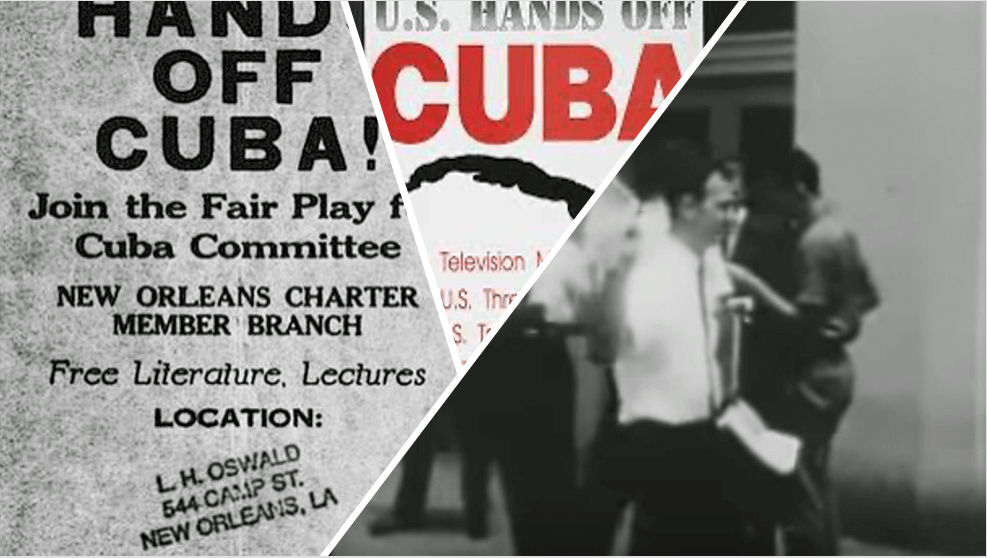
    Given the above, shouldn’t the most plausible premise for Oswald launching the Fair Play for Cuba Committee chapter in New Orleans, perhaps the most hostile city for such an endeavor at a time when the FPCC was in a downward spiral, be that it was also an intelligence operation?

    Oswald’s strange dance with the FPCC in the months leading up to the assassination is not scrutinized enough––as this quest put Oswald right in the realm of those who would later accuse him of being Kennedy’s killer.

    What do we really know about the Fair Play for Cuba Committee? It lacks scrutiny even though, like his adventure in Russia, the evidence of intelligence is everywhere. However, context and insight about the FPCC is lacking, even though it should have been turned inside out by the WC and the HSCA. But it was not, thanks largely to Allen Dulles, George Joannides and other spies who knew what to hide and were perfectly placed to obstruct real investigations.

    Research into the FPCC will help lay the groundwork for what should have been a leading hypothesis that should have guided the investigations:  that is, that Lee Harvey Oswald was again following orders when he penetrated the FPCC, thereby turning him into an ideal patsy for the assassination of the President.

    The FPCC: A Brief History

    In 1993, author Van Gosse wrote Where the Boys Are: Cuba, Cold War America and the Making of the New Left. It gives one of the more complete accounts of this odd association.

    The FPCC was founded in the spring of 1960 by Robert Taber and Richard Gibson––CBS newsmen who covered Castro’s ascent to power––as well as Alan Sagner, a New Jersey contractor. Its original mission was to correct distortions about the Cuba revolution. It was first supported by writers, philosophers, artists and intellectuals such as Norman Mailer, Truman Capote and Jean-Paul Sartre. It also touched a chord with university students. Some estimates place its African American membership at one third of its roster. In April 1960, Taber and Gibson ran a full-page ad in the New York Times.

    Around Christmas time 1960, it organized a huge tour to Cuba, which led to a travel ban to the country by early 1961. According to Gosse, its high point was after the failed Bay of Pigs invasion. There was no official membership headcount, but organizers claimed the FPCC had between 5 and 7 thousand members and 27 adult chapters, almost all in the Northeast, a few on the West Coast and only one in the Southeast in Tampa.

    When it became clear that the U.S. would not tolerate the revolution, it began dissipating. After a short-lived peace demonstration binge during the missile crisis in 1962, its spiral downwards was accelerated and the FPCC died not long after one of its members allegedly killed JFK.

    The FPCC was characterized as “Castro’s Network in the U.S.A.” by the HUAC. Membership within this anti-U.S. organization was described during hearings as an effective door opener to enter Cuba via the Cuban Embassy in Mexico City and Cubana Airlines. Though the HUAC had been seriously rattled by the McCarthy-era witch hunts, Castro was breathing some new life into this outfit for political showcasing of American patriotism. The FBI may even have bribed an FPCC insider to testify that a launch ad placed by the FPCC was financed by Cuba.

    The Senate Internal Security Subcommittee (also known as the Eastland Committee) questioned Dr. Charles Santos-Buch, a young Cuban physician, who was a self-described FPCC organizer. On January 6, 1961, Santos-Buch told chief prosecutor Julian Sourwine that he and Taber had received the needed money from “eight different people.” The documents reveal that Santos-Buch changed his story on January 9 at a subsequent executive session, and that he was also given a promise that the CIA would help get a number of family members out of Cuba. He changed his story, at least in part because of his desire to extricate his family from Cuba. On January 10, Santos-Buch publicly testified that he and Robert Taber obtained $3,500 from the Cuban government through the son of Cuba’s Foreign Minister Raul Roa. This money, along with $1,100 in funds from FPCC supporters, paid for the full-page FPCC ad in the April 6, 1960, edition of the New York Times. A week later, Jane Roman from James Angleton’s counterintelligence office in the CIA reported that security concerns made it too dangerous for the CIA to keep its promise to Santos-Buch.

    According to one of its national leaders, Barry Sheppard, the Socialist Workers Party (SWP) was very involved with the FPCC: “We came to be part of the leadership of the FPCC partly as the result of a crisis in the organization. The original FPCC leadership was somewhat timid, and shied away from forthright defense of the revolution as it radicalized. In response, Cuban members of the 26th of July Movement living in the U.S. aligned with the SWP and some other militants, and took over the leadership of the Committee.”

    Sheppard’s memoir shows that the SWP was much larger than the FPCC. He describes protest mobilization during the Missile Crisis in 19622 this way:

    We stood up to it. The PC discussed and approved the thrust of a statement to appear in the next issue of The Militant. It ran under the headline, “Stop the Crime Against Cuba!” We alerted SWP branches and YSA (Young Socialists of America) chapters that night to mobilize to support the broadest possible actions against the threat. In New York, there were two major demonstrations. One was called by Women Strike for Peace and other peace groups. We joined some 20,000 protesters at the United Nations on this demonstration. Then the Fair Play for Cuba Committee held its own action, more specifically pro-Cuba in tone, of over 1,000 people, also near the UN.

    The following points concerning the July 1963 SWP convention cast even more suspicion around the timing and motives of the already suspiciously late openings of FPCC chapters in the deep south by Santiago Garriga in Miami and Oswald in New Orleans and the continued involvement with the FPCC by other odd subjects:

    At the convention, a meeting of pro-Cuba activists discussed the situation in the Fair Play for Cuba Committee. Cubans living in the United States who supported the 26th of July Movement had helped us build the FPCC. Now most of them had returned to Cuba. In most areas, the FPCC had dwindled down to supporters of the SWP and YSA. Since we did not want the FPCC to become a sectarian front group, the meeting decided to stop trying to build it. The FPCC then existed for a while as a paper organization, until the assassination of President John Kennedy dealt it a mortal blow.3

    FBI reports confirm that FPCC National Chapter meetings plummeted from 25 meetings a year to 3 in its last year of existence.

    Red Scares, the HUAC and McCarthyism

    The first Red Scare in the U.S. took place in 1919-20 because of the Russian Revolution in 1917 and the fear of this movement spreading to the United States as well as the influx of immigrants that did include a small number of anarchists. In one case, a bomber blew himself up by accident in an attempt to assassinate John Rockefeller and J.P. Morgan. Because of this, the General Intelligence Division (the forerunner of the FBI) was formed and J. Edgar Hoover was chosen to lead it.

    In 1938, The House Committee on Un-American Activities (HCUA) was formed to investigate individuals, groups and organizations considered subversive or disloyal with a special focus on communist-leaning credos.

    The second Red Scare is considered to have begun shortly after World War II in 1947, when President Truman signed an order to screen government employees, and lasted 10 years. Through the propaganda and grandstanding of politicians, working in symbiosis with the press and the FBI, panic and hysteria was omnipresent. The HUAC went into overdrive, with Senator Joe McCarthy as its poster boy and with the Communist-hating Hoover eager to oblige.

    By 1956, after overstepping and ruining hundreds of lives, McCarthy was taken down by lawyer Joseph Nye Welchin his heroic “Have you no decency” retort during the Army-McCarthy hearings.

    This, however, did not stop the anti-communist fervor of the FBI and CIA. They just became even sneakier with no regard for the rule of law.

    COINTELPRO and AMSANTA

    The Church report,4 in its section “USING COVERT ACTION TO DISRUPT AND DISCREDIT DOMESTIC GROUPS,” describes the illegal activities of the FBI that were put in motion between 1956 and 1971 under the acronym COINTELPRO [Counter Intelligence Program], which claimed to have as a motive the protection of National Security.

    The FBI acted as a vigilante by not just breaking the laws but by taking the law into its own hands against both violent and nonviolent targets. Some of the targets were law-abiding citizens who were advocating change, but were labelled as domestic threats unilaterally by the FBI, e.g., Martin Luther King. Others were violent groups such as the Black Panthers and the Klan, where due process was ignored. Once the FBI started down this dangerous path, they not only targeted the kid with the bomb but also the kid with the bumper sticker!

    Organizational targets fell under five umbrella groups: The Communist Party; The SWP; White Hate groups; Black Hate groups; and the New Left. This opened the floodgates to investigate any group that had a potential for violence, including nonviolent groups such as The Southern Christian Leadership Conference, which was labelled as a Black Hate Group, as well as sponsors, civil-right leaders, students, protesters; and the list goes on …

    The FBI used five main methods during COINTELPRO: infiltration; psychological warfare; harassment via the legal system; illegal force; undermining of public opinion.5 

    These actions stepped up in the wake of the Communist takeover in Cuba. Church Committee members exposed the dimensions of the mail opening program, and discovered that the CIA and FBI had placed the names of 1.5 million Americans in the category of “potentially subversive.” Together, both agencies opened about 380,000 letters.6

    Larry Hancock, in Someone Would Have Talked, describes the FBI program called AMSANTA:

    The program was initiated by the FBI as part of its effort targeting the FPCC as a subversive group and involved the CIA in briefing, debriefing and possibly monitoring travel of assets through Mexico City to and from Cuba. The program began in late 1962, had one major success in 1963 and appears to have been abruptly terminated in fall 63.

    According to John Newman (Oswald and the CIA)7, the CIA, led by David Phillips and James McCord (of Watergate fame), began monitoring the FPCC in 1961. In December 1962, the CIA joined with the FBI in the AMSANTA project.  A September 1963 memo divulged an FBI/CIA plan to use FPCC fake materials to embarrass Cuba.

    There are strong indicators that the CIA efforts to penetrate and use the FPCC were local and illegal––such as spying on U.S. citizen/members of the FPCC. As a David Phillips asset stated, it was “At the request of Mr. David Phillips” that, “I spent the evening of January 6 with Court Wood, a student who has recently returned from a three-week stay in Cuba under the sponsorship of the Fair Play for Cuba Committee.”8

    The opening of a Miami FPCC chapter in 1963 by Santiago Garriga is more evidence of illegal domestic espionage on or through the FPCC by the CIA. According to Bill Simpich, author of State Secret, Garriga’s resumé was perfect for patsy recruiter/runners––interaction with Cuban associates in Mexico City; seemingly pro-Castro behavior; and his crowning achievement: like Oswald in 1963, he opened an FPCC chapter in a market deemed very hostile for such an enterprise.

    Garriga is the potential fall guy who is the most clearly linked with intelligence. Like Oswald, he could be portrayed as a double agent by those who packaged him. What makes Garriga so unique are, as Simpich writes, his pseudonym and close links with William Harvey’s (CIA Cuban Affairs) team. To cover this intriguing lead, it is best to cite a few excerpts from State Secret:

    During October 1963 Garriga worked with other pro-Castro Cubans to set up a new chapter of the Fair Play for Cuba Committee in Miami  … Although it appears that Garriga’s ultimate loyalty was with the Castro government, it’s likely that Garriga’s FPCC activity was designed by Anita Potocki (Harvey’s chief aide at the wiretap division known as Staff D) to set up a flytrap for people like Oswald.  Maybe even Garriga himself was considered as a possible fall guy.

    However, in the days before 11/22/63, the FBI ran an operation that investigated the Cuban espionage net that included Garriga and shared the take with the CIA. The CIA referred to this investigation as ZRKNICK. Bill Harvey had worked with ZRKNICK in the past … The memos that identify Garriga were written by Anita Potocki.

    Was there something sinister in this effort to set up FPCC Miami? It certainly looks ominous, given that AMKNOB-1 is the main organizer and that Anita Potocki is one of his handlers. The FPCC leadership recognized that it was dangerous to set up such a chapter in Miami due to the possibility of reprisals by Cuban exiles. For just these reasons, the FPCC leadership had discouraged Oswald from publicly opening an FPCC chapter in the Southern port town of New Orleans.

    The fingerprints of AMSANTA and COINTELPRO were also all over Oswald.

    Targeting the FPCC 

    By the time Oswald opened his Crescent City chapter of the FPCC, it was under the intense scrutiny which had started in 1960, the year of the national launch. An FBI report9 in response to NSAM 43 and 45 to the attorney general, dated April 24, 1961, outlines steps taken by then to counter pro-Castro organizations. It was already a full-court blitz.

    In this document, the FBI makes it clear that the Castro movement is a serious threat to the U.S. The FPCC is underlined as a key target pursuant to Executive Order 10450. The overall coverage of pro-Castro activities in the U.S. is described as having begun in November 1955 when Castro came to the U.S. looking for financial support for the rebel cause, and the 26th of July Movement started up in the U.S. When Castro took power in January 1959, the FBI had files on this organization as well as lists of members it shared with other intelligence agencies and sharply expanded its surveillance operations. Spying on Cuban diplomatic institutions, questioning defectors and the infiltration of pro- and anti-Castro groups with informants, are listed as key Intel tactics.

    By the time the report was written10, the FBI numbers the pending matters at 1000 and information sources at over 300. The FBI had by then identified 140 Castro supporters in the U.S. who constituted a threat to security. “We are maintaining close coverage of the various Cuban establishments as well as pro-Castro groups and their leaders,” which was shared generously with other intelligence groups. The FPCC is described as the most important such group, and received support from Cuba as well as the SWP and CP, according to the report.

    The FBI claimed that Cuban agents were receiving assistance from their surveillance targets and that Cubana Airlines was an important tool for their activities. The FBI was keeping close tabs on pro-Cuba propaganda. Covert informants were given a T symbol,11 preceded by a location identifier such as NY for New York, followed by a number. Also identified were the locations they could report on and the subject matter. Some informants were government employees, post-office workers, intelligence assets on assignment (June Cobb was assigned to spy on Richard Gibson and slander Oswald in Mexico City)12 and freelancers (as we will see later Ruth Paine quite possibly was a provider of FPCC intelligence), etc., who could oversee documentary movement around targets. Others infiltrated FPCC chapters and were present during meetings. These would report on who was present, who said what, and the materials shown and exchanged. License plates of parked cars of meeting attendees were recorded. In some cases, chapter officers were key sources: Thomas Vicente (National), Harry Dean (Detroit), Harrold Wilson (Tampa), John Glenn (Indiana) were all definite or likely snitches for the FBI.

    In April 1963, aided by Thomas Vicente, the FBI broke into FPCC NY offices for a black bag operation.  FBI files indicate that NY alone had over 25 covert informers who were being used along with other sources. Tampa had at least 11 informants carrying the TP-T code.

    The CIA also was all over the FPCC.  Two days after the FPCC ad in the NY Times, William K. Harvey, head of the CIA’s Cuban affairs, told FBI counterintelligence chief Sam Papich: “For your information, this Agency has derogatory information on all individuals listed in the attached advertisement.” Other files confirm that Jane Roman and James Angleton were also monitoring the FPCC.

    Recipients of intel included the Secret Service, the CIA, Customs Bureau, the Immigration and Naturalization Service, the Post Office Department, the Aviation Agency, the Federal Communications Commission, the Department of Health, Education and Welfare, the U.S. Information Agency, the Treasury Department, the U.S. Information Agency, the Bureau of Foreign Commerce. The report also stresses the importance of coordinated efforts with other intel agencies as well as local FBI offices.

    After the failed Bay of Pigs and the Missile Crisis, we can assume that when Oswald, already notorious for his Russian adventure, opened an FPCC chapter in, of all places, New Orleans by the middle of 1963, he was a known quantity.

    Frank S. DeBenedictis on the Tampa FPCC

    In 2002, Frank S. DeBenedictis submitted a thesis13 about the Cold War coming to Ybor City, and the Tampa FPCC, for his Master of Arts at Florida Atlantic University.  DeBenedictis adroitly points out that the reason FPCC files have been very difficult to access is that after the assassination of JFK, these files were categorized as classified JFK assassination files instead of Cold War files.

    The following represents some of the key information/passages from his thesis.  It is based largely on government and intelligence investigations of the FPCC, declassified JFK assassination documents, Van Gosse’s research, newspaper articles as well as FPCC propaganda and correspondence. Almost all of the FPCC chapters were situated in the North of the U.S. or along the West Coast. The reason Tampa was unique in hosting an important FPCC chapter was because it had a large Cuban exile population who were anti-fascist and had fled the brutal Marchado and Batista regimes. In 1955, Castro raised money there for his rebellion and had satellite followers to his 26th of July Movement. Ybor City (part of Tampa) was known for its Latino culture and its cigar industry.

    By 1961, Eisenhower cut all ties with Castro, and the 26th of July Movement ceased activity in the U.S. It was being replaced by the FPCC. As Frank writes, “It was somewhat different from the older pro-Castro groups, since it came about after Castro was already in power. When Cuba formed ties with the Soviet bloc, the FPCC and its defense of Castro increasingly became part of the Cold War. By late 1961 the very active Tampa chapter had established its own newsletter, and drew attention from both Castro supporters outside Florida, and anti-Castro Cuban exiles and a variety of government operatives.”

    The influx of anti-Castro Cuban exiles (including Batista followers as well as other Cubans who were disappointed by Castro’s political and economic systems as well as his strong-arm tactics) took refuge in large numbers in Florida and were ready to counter the FPCC on all fronts––with the support of intelligence forces. Violence among Cubans ensued: riots, intimidation, vandalism directed at FPCC sympathizers were the order of the day. Hosting chapters in the deep south became perilous, with strong anti-Castro sentiment coming from Latinos, business, government, intelligence and Americans from all walks of life.

    “An organization formed in rebellion at this time, against the Castro regime. It called itself the Cuban Front. The group was made up of Cuban exiles and residents, which at this early date of disaffection with Castro, was composed primarily of Batista supporters. Since Cuba and the United States had by early 1961 experienced two years of deteriorating diplomatic relations, the Cuban Front’s strategy was to raise the specter of communism coming to Cuba.” One violent confrontation called the Marti Park Incident featured CRC leader Sergio Arcacha Smith, who entered Oswald’s universe in 1963.

    The Bay of Pigs invasion commenced on April 17, 1961, and FPCC chapters organized protests against the U.S. action. Five days before the invasion, Tampa chapter leader V.T. Lee wrote a letter to the Tampa Tribune deriding both the Tampa daily and the Senate Internal Security Subcommittee, which was investigating the organization. His letter lambasted Senators Thomas Dodd and James 0. Eastland, whose strident anti-communism began accusations that the FPCC was run by a foreign government.

    On April 22, 1961, when FPCC-led public protests against the Bay of Pigs operation became prevalent on a daily basis, the Kennedy administration’s National Security Council passed National Security Action Memo [NSAM] 45. This memo ordered the Attorney General and the Director of Central Intelligence to “examine the possibility of stepping up coverage of Castro activities in the United States.” On April 27, 1961, J. Edgar Hoover issued a general order for FBI agents to report on pro-Castro agitation. Hoover noted that the Fair Play for Cuba Committee’s actions showed the capacity of a national group organization to mobilize its efforts.

    Florida Congressman William C. Cramer testified on April 3, 1963. A primary subject was, in the words of the Senate Committee, “the flow of subversives through the open door of subversion, the Cuban Embassy in Mexico City, by way of Cubana Airlines.’’

    For the Tampa FPCC, in large part this meant that the Florida Legislative Investigative Committee [aka––Florida Johns Committee] became involved in investigating the activities of the pro-Castro group. Its investigation of the pro-Castro 26th of July Movement and Fair Play for Cuba Committee began in 1959 and continued into 1964.

    Local police intelligence unit “red squads” and state investigative committees filled the anti-Communist void in the post-McCarthy era. Florida’s Johns Committee had a counterpart in Louisiana, which was the Louisiana Un-American Activities Committee [LUAC].

    The following passage by DeBenedictis explains the degree of FBI infiltration of an FPCC chapter, and the stunningly high number of informants per FPCC meeting attendee ratio.

    A January 30, 1964, FBI report told of meetings the pro-Castro group had at the Tampa residence of Christine and Manuel Amor. Information about this meeting came from October 13, 1963, reports by FBI Special Agents Charles C. Capehart and Fredrick A. Slight. This data was gathered by taking down automobile license plate numbers registered to individuals in attendance. Eight cars were at the Amor residence. An FBI informant inside reported that a meeting cancellation notice had been sent to members, but several still showed up. Slide presentations and a tape recording of V.T. Lee’s Cuba trip were planned on this October date. Background reports provided data on FPCC members past affiliations with the Communist and Proletarian Parties. Jose Alvarez, who in June 1962 was elected the organization’s financial secretary, was identified by TP T-7 as a Communist Party member in Tampa in 1943. Other members, at late 1963 FPCC meetings, were listed as protestors and supporters of radical causes. Among these causes were opposition to the McCarran Act, and support of Cuba’s right to have Soviet missile stations. In addition, these members had links to the Communist Party in northern cities. FPCC informants were given the cryptonyms TP T-1 through TP T-11. Among them was TP T-2, who was identified as M. Miller, Superintendent of Mails at Ybor City’s post office. The FBI’s mail surveillance program complemented the CIA’s HT/LINGUAL mail opening program. FBI agents relied extensively on informants in the Tampa FPCC.

    The key with Tampa is that it served as a model for Oswald’s agitation activities as well as FPCC countering strategies for many of the people Oswald would network with in New Orleans.

    The FPCC in New Orleans

    At least three city police intelligence units kept files and conducted surveillance on the Tampa FPCC. These included Miami, Tampa, and New Orleans. In addition, the police units also cooperated with each other and with the U.S. Senate Committee investigating the organization.14

    Perhaps the most interesting of the police intelligence correspondence is the one between the Tampa Police Intelligence Unit and its New Orleans counterpart. The NOPD Intelligence Unit collected data about the FPCC from March to September 1961 from newspaper articles. In 1962 this changed when the NOPIU initiated a chain of correspondence with the TPIU. Sgt. J.S. de Ia Llana, supervisor of the TPIU, replying to a December 1962 information request on the Tampa Fair Play for Cuba Committee chapter, informed P. J. Trosclair (NOPIU): “The Tampa Chapter (of the FPCC) is very active in Tampa, these members hold secret meetings and distribute various types of literature. Also, movies are shown. Enclosed are some of the circulars which are distributed. This unit maintains a current file on the local chapter and its members.” The Tampa PD Intelligence Unit enclosed several circulars for its NOPD counterpart, and promised them its full cooperation.15

    Early in 1963, the Tampa PD would write to New Orleans, giving them information about a Dr. James Dombrowski, a left-wing activist in New Orleans, claiming that he was an active FPCC member. The NOPD investigation of the FPCC collected a copy of Tampa Fair Play; a list of 202 travelers to Cuba, which can also be found in FBI files, and Florida Johns Committee files.  Also included are the pre-Kennedy assassination arrest records and post-assassination warnings on Lee Harvey Oswald.  For the NOPD, their late-1962-initiated correspondence to Tampa was odd since New Orleans had no known FPCC chapter in late 1962 and early 1963. Also unusual was the NOPD inquiry to Tampa about FPCC activity in New Orleans!

    Oswald and the FPCC in Dallas

    According to an FBI report, there is evidence that Oswald agitated for the FPCC in Dallas before moving to New Orleans. Dallas confidential informant T-2 advised that Lee H. Oswald of Dallas, Texas, was in contact with the Fair Play for Cuba Committee. According to T-2, Oswald had a placard around his neck reading, “Hands off Cuba Viva Fidel.”

    The following day (April 19), Oswald wrote to the FPCC in New York and said:

    I do not like to ask for something for nothing but I am unemployed. Since I am unemployed, I stood yesterday for the first time in my life. with a placard around my neck. passing out Fair Play for Cuba pamphlets, etc. I only had 15 or so. In 40 minutes they were all gone. I was cursed as well as praised by some. My homemake [sic] placard said: ‘Hands OFF CUBA! V IVA Fidel’ I now ask for 40 or (50) more of the fine, basic pamplets-14. Sincerely, Lee H. Oswald16

    The following lead merits investigation. One of the Cuban exiles who was cursing during the so-called skirmish involving Oswald and Carlos Bringuier was Celso Hernandez, who may have met Oswald before. According to Bill Simpich’s research, the CIA examined Celso Hernandez as a Castro penetration agent.  There is an intriguing report of FPCC member Oswald being arrested with Celso Hernandez in New Orleans in late 1962. The ID of Hernandez was made years later and is admittedly shaky. The ID of Oswald is more substantive, as he identified himself to the police as an FPCC member––but he was living in the Dallas area. The story is that the two men were picked up at the lakefront in Celso’s work truck, owned by an electronics firm that was Celso’s employer.17

    FBI agency file number 97-2229-7 even states that Oswald was the FPCC organizer and chairman in TEXAS!
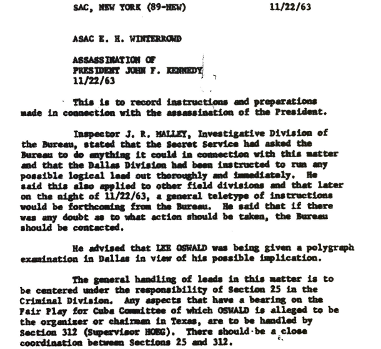
    FBI agency file number 97-2229-7

    (Note: also explosive in this document is the statement that Oswald was being polygraphed on November 22––sounds like another offshoot, sigh!)

    Oswald’s first attempt at interacting with the FPCC may have been as early as late summer 1962, when the head of the FPCC at the time, Richard Gibson, responded to a request for information from a Lee Bowmont from Fort Worth, Texas. Gibson felt he may have been in a group of three Trotskyites he had met shortly after.18

    And then we have the following mind-boggling correspondence(s)  courtesy of Malcolm Blunt:
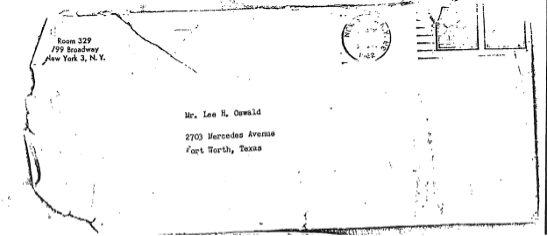
    Oswald FPCC envelope return address

    This envelope, with the FPCC return address, as it stands is difficult to analyze because of the unclear postmark and its content has not been revealed as far as I know (which would once again represent obstruction of justice if this were the case).  However, we do know Oswald lived at the above address from about July to October of 1962. This confirms that Oswald/FPCC relations began clearly before 1963. The following May 5, 1961 letter is food for thought:
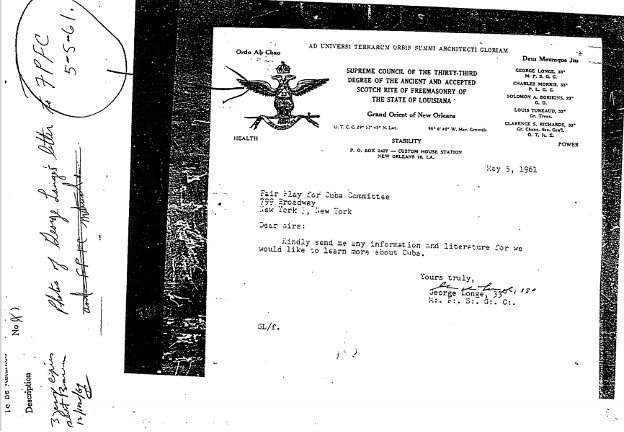
    May 5, 1961 letter

    It was not only Oswald who was interested in the FPCC before he went to New Orleans; others from the Big Easy were gathering information. Guy Banister was also a member of the Scotch Rite19 which figures on the letterhead. What on earth is this organization doing corresponding with the FPCC in 1961?
    May 5, 1961 letter, letterhead close-up

    Oswald and FPCC Worst Practices

    Location, Location, Location!

    As we have seen by chronicling the demise of the FPCC, Oswald’s sense of timing was horrendous when he launched the New Orleans chapter in the summer of 1963. His choice for a location was even worse.

    The two most dangerous places to open chapters in the U.S. at the time were probably Miami and New Orleans. Dallas would not have been far behind. New Orleans perhaps stood out as the worst because of its dependence on North-South trade. Its proximity to Cuba caused many sleepless nights during the October 1962 missile crisis. V.T. Lee had urged Oswald to avoid New Orleans.

    When the HSCA published its completed Final Report in 1979, it showed two areas related to the FPCC that the Warren Commission failed to investigate adequately. One overlooked area was the identity of occupants at the address Oswald used for his FPCC literature distribution. The address 544 Camp Street appeared on materials that Oswald was handing out. This address was the New Orleans Newman Building. The Warren Report stated that, at an earlier date, the building was occupied by an anti-Castro group, but the name was not revealed in the final report. Later it was found to be the Cuban Revolutionary Council. Another resident of the Newman Building was the private detective agency of Guy Banister. He also was not mentioned in the Warren Report. Banister was the retired FBI Special Agent in Charge of the Chicago FBI field office. After his FBI retirement in the mid-1950s, he moved to New Orleans and helped set up that city’s police intelligence unit. Guy Banister, a staunch anti-communist, continued his anti-subversion work well after his official ties with the FBI were severed. The HSCA determined in their investigation that in 1961 Banister and Sergio Arcacha Smith of the CRC were working together in the anti-Castro cause.20

    The 544 Camp Street address, which Oswald foolishly stamped on some of his handouts, was also surrounded by intelligence organizations, including the ONI, CIA, Secret Service and the FBI.

    The HSCA did take a closer look at the Camp Street enigma. Here were some of the findings:

    (467) During the course of that investigation, however, the Secret Service received information that an office in the Newman Building had been rented to the Cuban Revolutionary Council from October 1961 through February 1962.

    (466) The investigation of a possible connection between Oswald and the 544 Camp Street address was closed. The Warren Commission findings concurred with the Secret Service report that no additional evidence had been found to indicate Oswald ever maintained an office at the 544 Camp Street address.

    (469) The committee investigated the possibility of a connection between Oswald and 544 Camp Street and developed evidence pointing to a different result.

    (482) The overall investigation of the 544 Camp Street issue at the time of the assassination was not thorough. It is not surprising, then, that significant links were never discovered during the original investigation. Banister was involved in anti-Communist activities after his separation from the FBI and testified before various investigating bodies about the dangers of communism. Early in 1961, Banister helped draw up a charter for the Friends of Democratic Cuba, an organization set up as the fundraising arm of Sergio Arcacha Smith’s branch of the Cuban Revolutionary Council.

    (489) The long-standing relationship of Ferrie and Banister is significant since Ferrie became a suspect soon after it occurred.

    (491) Witnesses interviewed by the committee indicate Banister was aware of Oswald and his Fair Play for Cuba Committee before the assassination. Banister’s brother, Ross Banister, who is employed by the Louisiana State Police, told the committee that his brother had mentioned seeing Oswald hand out Fair Play for Cuba literature on one occasion.

    (492) Ivan F. “Bill” Nitschke, a friend and business associate and former FBI agent, corroborates that Banister was cognizant of Oswald’s leaflet distributing.

    (494) Delphine Roberts, Banister’s long-time friend and secretary, stated to the committee that Banister had become extremely angry with James Arthus and Sam Newman over Oswald’s use of the 544 Camp Street address on his handbills.

    (495) The committee questioned Sam Newman regarding Roberts’ allegation. Newman could not recall ever seeing Oswald or renting space, to him … Newman theorized that if Oswald was using the 544 Camp Street address and had any link to the building, it would have been through a connection to the Cubans.

    Roberts claimed Banister had an extensive file on Communists and fellow travelers, including one on Lee Harvey Oswald, which was kept out of the original files because Banister “never got around to assigning a number to it.”

    (514) Significant to the argument that Oswald and Ferrie were associated in 1963 is evidence of prior association in 1955 when Ferrie was captain of a Civil Air Patrol squadron and Oswald a young cadet. This pupil-teacher relationship could have greatly facilitated their reacquaintance and Ferrie’s noted ability to influence others could have been used with Oswald.

    (515) D. Ferrie’s experience with the underground activities of the Cuban exile movement and as a private investigator for Carlos Marcello and Guy Banister might have made him a good candidate to participate in a conspiracy plot. He may not have known what was to be the outcome of his actions, but once the assassination had been successfully completed and his own name cleared, Ferrie would have had no reason to reveal his knowledge of the plot.

    On page 145 of its final report, the HSCA states that “it was inclined to believe that Oswald was in Clinton, August – early September 1963, and that he was in the company of David Ferrie, if not Clay Shaw. The Committee was puzzled by Oswald’s apparent association with David Ferrie, a person whose anti-Castro sentiments were so distant from those of Oswald, the Fair Play for Cuba Committee campaigner.”

    Research since this very accusatory report has only re-enforced this conclusion.  We now know for certain that Clay Shaw was a well-paid CIA asset, something that he vehemently denied during the Garrison inquiry. He was also using the alias Clay Bertrand and that he was seen in the company of Oswald in Clinton.

    Birds of a Feather

    If Oswald’s sense of timing and choice of location for opening an FPCC chapter were awful, his networking strategies were catastrophic … if you believe he was serious about promoting Fair Play for Cuba.

    Jim Garrison had already pointed out how Oswald’s hobnobbing with White Russians in Dallas was diametrically opposed to his supposed pro-Marxist credo. His universe of contacts in New Orleans was even worse––unless he was involved in something else, like infiltrating pro- and anti-Castro groups to help the FBI in their oversight objectives. Let us highlight a few (for a more in-depth coverage of Oswald’s contacts read this author’s article Oswald’s Intelligence Connections: How Richard Schweiker clashes with Fake History):

    David Ferrie
    David Ferrie
    David Ferrie

    Oswald’s first intel connection is one of the most important for confirming Schweiker’s assertion. David Ferrie plays an important role in Oswald’s fate during two phases of Oswald’s short life. In 1955, both Ferrie and Oswald were members of the Louisiana Civil Air Patrol where Ferrie taught, among other things, aviation. Ferrie later became a contract CIA agent flying bombing missions over Cuba. During the summer of 1963, Ferrie and Oswald linked up once again at 544 Camp Street. During this period, Ferrie was frequently seen in the building and elsewhere, in the company of Banister, CIA agent Clay Shaw, the CIA-connected Sergio Arcacha Smith, Oswald and others of this ilk who became key suspects in the Garrison investigation.


    Kerry Thornley
    Kerry Thornley
    Kerry Thornley

    When Oswald was stationed back to California in 1959, Thornley wrote a book about him before the assassination called The Idle Warriors, and then another in 1965. In the summer of 1963, Thornley popped backed into the picture in New Orleans where several witnesses saw him with Oswald either in public or at Oswald’s apartment. There is evidence that Thornley picked up Fair Play for Cuba flyers for Oswald. An FBI memo states that Thornley and Oswald went to Mexico together. And despite preliminary denials, he eventually admitted links to David Ferrie, Guy Banister, Carlos Bringuier and Ed Butler.


    Victor Thomas Vicente

    When Lee Oswald wrote his first letter to the Fair Play for Cuba Committee HQ in New York in April 1963, he asked for “forty to fifty” free copies of a 40-page pamphlet. The author of the pamphlets, Corliss Lamont, turned out to be holding a receipt for 45 of these pamphlets from the CIA Acquisitions Division. These pamphlets were mailed to Oswald by FPCC National Chapter worker Victor Thomas Vicente. Vicente was a key informant for both the CIA and the FBI’s New York office.

     John Martino

    John Martino
    John Martino

    Martino showed pre-knowledge of the assassination and also admitted observing Oswald during the summer of 1963. Martino certainly did have CIA connections in 1963, primarily to David Morales and Rip Robertson.

    William Monaghan and Dante Marichini

    During the summer of 1963 in New Orleans, Oswald gained employment at the Reilly Coffee Company, an organization of interest because of its links to Caribbean anti-communist politics. The Reilly brothers backed Ed Butler’s INCA (the CIA-linked Information Council of the Americas, which factors heavily in Oswald’s later Marxist PR activities) and the CRC (Cuban Revolutionary Council).
    Reilly Coffee Co
    Reilly Coffee Co

    William Monaghan was the V.P. of Finance there who ended up firing Oswald. He was also an ex-FBI agent. He was listed as a charter member of INCA in a 1962 bulletin. Other employees there of interest to researchers included four of Oswald’s co-workers who joined NASA during the summer of 1963. Dante Marichini, who was a friend of David Ferrie’s and the neighbor of Clay Shaw, was one of these.

    Guy Banister
    Guy Banister
    Guy Banister

    What emerges from all we know about 544 Camp Street is that Oswald was assisting Banister, a known communist hunter, in identifying Castro-sympathizers and that Banister was deeply involved in activities supplying weapons to anti-Castro groups like Alpha 66––a key organization of interest in the assassination.

    Clay Shaw
    Clay Shaw
    Clay Shaw

    Thanks to Jim Garrison, we were introduced to a key person of interest in Clay Shaw. The HSCA investigation concluded that New Orleans district attorney Jim Garrison and his office ”had established an association of an undetermined nature between Ferrie, a suspect in the assassination of President Kennedy, and Clay Shaw and Lee Harvey Oswald.”

    In Destiny Betrayed, Jim DiEugenio underscores other Shaw links with the CRC and with Banister, CIA-cleared doctor Alton Ochsner, and Ed Butler, who are all connected to the Information Council of the Americas, which appears to have played a role in the sheep-dipping of Oswald (see Ed Butler). He also shows that Shaw was cleared for a project called QK/ENCHANT during the Garrison investigation. Howard Hunt also belonged to this project, which was part of the CIA’s Domestic Operations Division, according to CIA insider Victor Marchetti.

    William Gaudet
    William Gaudet
    William Gaudet

    Gaudet had worked for the CIA before he crossed paths with Oswald. He most likely continued freelancing for it. He worked virtually rent-free out of Clay Shaw’s International Trade Mart. It seems plausible that Gaudet played a part in monitoring Oswald, perhaps for the benefit of Shaw.

    Dean Andrews
    Dean Andrews
    Dean Andrews

    Lawyer Dean Andrews was called by Shaw, under the pseudonym Clay Bertrand, and given instructions to represent Oswald, as told by Garrison in his famous interview with Playboy.


    Sergio Arcacha Smith
    Sergio Arcacha Smith
    Sergio Arcacha Smith

    The CIA selected him to be a key leader of Cuban exiles as a representative of the Cuban Revolutionary Council. That group was created by Howard Hunt as an umbrella organization of many Cuban exile groups such as Alpha 66 and the DRE. The FDC was allegedly organized for his benefit, and it  borrowed Oswald’s name when he was in Russia. It is in this role that he associated closely with Clay Shaw, Guy Banister, David Ferrie and Doctor Alton Ochsner. Gordon Novel claims that David Phillips participated in at least one meeting where Smith and Banister were in attendance.

    At the time of the working relationship between Banister and CRC leader Sergio Arcacha Smith, the CRC became involved in Tampa’s Marti Park demonstrations against the FPCC. (Frank S. DeBenedictis thesis).

    Carlos Bringuier, Carlos Quiroga, Celso Hernandez and Frank Bartes
    Carlos Bringuier
    Carlos Bringuier

    Bringuier was part of the DRE, a militant right-wing, anti-Communist, anti-Castro, anti-Kennedy group. Bringuier, based in New Orleans, was placed in charge of DRE publicity and propaganda. According to Bringuier, the following summarizes his strange encounters with Oswald:

    On August 9, 1963, Oswald, while leafleting FPCC flyers on Canal Street, drew the ire of Bringuier and his Cuban associates Celso Hernandez and Miguel Cruz. Bringuier did the swinging while Oswald tried to block his blows. Oswald was then interviewed on a Bill Stuckey show along with Bringuier where his Marxist and FPCC credentials were discussed for all to hear.

    According to E. Howard Hunt, the DRE was started by David Phillips, who is the CIA career employee with the most links with Oswald. The DRE was eventually overseen in 1963 by George Joannides, who helped sabotage the HSCA investigation.
    Smith, Gil and Quiroga
    Arcacha Smith, Manuel Gil,
    & Carlos Quiroga

    A Jim Garrison polygraphed interrogation of Quiroga, plus other research, proved that Quiroga knew Banister and Sergio Arcacha Smith, had met Oswald more than once, and had supplied Oswald with Fair Play for Cuba literature on the orders of Carlos Bringuier. One of the Cuban exiles arrested during the so-called skirmish was Celso Hernandez, who may have met Oswald before. According to Bill Simpich’s research, the CIA examined Celso Hernandez as a Castro penetration agent.

    While Oswald and Bringuier were in court after their altercation, a sympathizer and friend of Bringuier’s, Frank Bartes, showed up to offer moral support. This Cuban exile went on to conduct anti-Castro press relations. Bartes followed Smith as the CRC leader in New Orleans based in the Newman building with Banister. In 1993, the ARRB released files confirming that Bartes was an informant for the FBI agent who just happened to be monitoring Oswald: Warren DeBrueys.

    Jesse Core

    Core was Clay Shaw’s right-hand man who was present during the incident on Canal Street and Oswald’s leafleting in front of the Trade Mart. He contacted Shaw’s friends at WDSU TV. He also is the one who warned his team about Oswald’s blunder of placing Banister’s address on some of the literature he was handing out.  Jesse Core’s reports about Oswald made their way to intelligence outfits.

    John Quigley and Warren DeBrueys

    Warren DeBrueys
    Warren DeBrueys

    After the altercation with Bringuier, while under arrest, Oswald made a bizarre request. He asked to see an FBI agent. The FBI sent agent John Quigley, who spent somewhere between 90 minutes and three hours with Oswald. It’s safe to say that they were not discussing Bringuier simply being mean to the alleged communist. Quigley stated that Martello told him that Oswald wanted to pass on information about the FPCC to him. Joan Mellen’s research finds that Oswald actually asked specifically for Warren DeBrueys. DeBrueys, who ran Bartes as an informant, would further nail down the real reason Oswald started an FPCC chapter in a hostile place like New Orleans. William Walter, an employee at the New Orleans FBI office, claimed to have seen an FBI informant file on Oswald with DeBrueys’ name on it.

    Arnesto Rodriguez and family

    Before his approach to Bringuier, Oswald had contacted the head of a local language school, Arnesto Rodriguez Jr., expressing an interest in learning Spanish. One of Arnesto’s closest associates in New Orleans was Carlos Bringuier, and both men acted as sources for the FBI (Arnesto aka Ernesto was assigned FBI source number 1213 S).

    The father of the Rodriguez family, Arnesto Napoleon Rodriguez Gonzales, had his own intelligence connections, having worked for the Office of Naval Intelligence during World War II; he had also served as an on-island source for the CIA before leaving Cuba. In terms of Lee Oswald’s being known to JFK conspirators, the most important point is that Arnesto’s father and Arnesto Jr. were both in routine touch with a relative in Miami, a CIA officer deep within JM/WAVE intelligence operations. That individual (son to Arnesto Sr; brother to Arnesto Jr.) was Emilio Americo Rodriguez Casanova (crypt AMIRE-1). Emilio was a close friend to both David Morales and Tony Sforza as well as a number of other SAS and JM/WAVE officers. He had also worked with, and appears to have been in contact with, David Phillips in 1963.21

    Orestes Peña, Joseph Oster, David Smith, and Wendell Roache
    Orestes Peña
    Orestes Peña

    Curiously, the evidence that Oswald collaborated with Customs is stronger than with almost any other agency. Cuban exile Orestes Peña testified that he saw Oswald chatting on a regular basis with FBI Cuban specialist Warren DeBrueys, David Smith at Customs, and Wendell Roache at INS. Peña told the Church Committee that Oswald was employed by Customs. Informant Joseph Oster went farther, saying that Oswald’s handler was David Smith at Customs. Church Committee staff members knew that David Smith “was involved in CIA operations.” Orestes Peña’s handler Warren DeBrueys admitted he knew David Smith.

    Ed Butler and Bill Stuckey
    Butler & Bringuier
    Butler & Bringuier

    The Canal Street incident led to Oswald being part of a debate on WDSU reporter Bill Stuckey’s weekly radio program called Latin Listening Post. Later, Butler and Carlos Bringuier were also invited to debate Oswald about his Marxist views on a show called Conversation Carte Blanche.

    To fully comprehend the significance of Oswald’s media exposure during his debate with Carlos Bringuier on WSDU, it is critical to have some insights on Ed Butler and INCA as well as Bill Stuckey and WSDU. These were dissected by Jim DiEugenio22:

    INCA was, in essence, a propaganda mill that had as its targets Central and South America, and the Caribbean. It would create broadcasts, called Truth Tapes, which would be recycled through those areas and, domestically, stage rallies and fund raisers to both energize its base and collect funds to redouble its efforts. By this time, as Carpenter and others point out, Butler was now in communication with people like Charles Cabell, Deputy Director of the CIA, and Ed Lansdale, the legendary psy-ops master within the Agency who was shifting his focus from Vietnam to Cuba. These contacts helped him get access to Cuban refugees whom he featured on these tapes. Declassified documents reveal the Agency helped distribute the tapes to about 50 stations in South America by 1963. There is some evidence that the CIA furnished Butler with films of Cuban exile training camps and that he was in contact with E. Howard Hunt––under one of his aliases––who supervised these exiles in New Orleans. Some of the local elite who joined or helped INCA would later figure in the Oswald story e.g. Eustis Reilly of Reilly Coffee Company, where Oswald worked; Edgar Stern who owned the local NBC station WDSU where Oswald was to appear; and Alberto Fowler, a friend of Shaw’s; plus future Warren Commissioner Hale Boggs who helped INCA get tax-exempt status. Butler also began to befriend ground-level operators in the CIA’s anti-Castro effort like David Ferrie, Oswald’s friend in New Orleans; Sergio Arcacha Smith, one of Hunt’s prime agents in New Orleans; and Gordon Novel, who worked with Banister, Smith and apparently, David Phillips, on an aborted telethon for the exiles.

    Two other acquaintances of Butler were Bill Stuckey, a broadcast and print reporter, and Carlos Bringuier, a CIA operative in the Cuban exile community and leader of the DRE, one of its most important groups in New Orleans. 

    Stuckey claimed that his show helped destroy the FPCC in New Orleans. It is during this show that Oswald let slip that he was under the protection of the government while in Russia.

    So, as we can see, the arrival of Oswald in New Orleans, his behavior and his network were very closely linked to the demise of the FPCC and his own tragic fall, as well as a ploy to blame Castro.

    His short stint in the Big Easy was not only a godsend for right-wing fanatics; it was planned and welcomed. FBI files discovered by Malcolm Blunt, as well as Stuckey’s testimony to the Warren Commission, confirm that the radio host was making inquiries about whether or not the FPCC was present in New Orleans as early as 1961. In other words, Stuckey was not just a free-lance journalist.
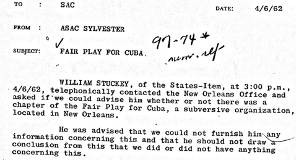
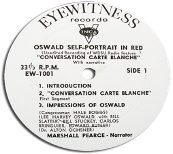
    FBI-Stuckey

    INCA WDSU
    INCA WDSU
    “Conversation Carte Blanche”

    Both Butler and Stuckey were briefed in advance about Oswald’s defection to Russia: Stuckey by the FBI, Butler by the House Un-American Activities Committee (HUAC). Therefore, they were able to ambush Oswald and expose him as a Soviet defector, which compromised his debate position as one who desired “fair play” for Cuba. The records of this show were used immediately after the assassination (through Butler and Bringuier) to paint Oswald as the lone-nut Marxist. In fact, Butler was flown up to Washington within 24 hours to talk to the leaders of the HUAC.

    According to author Ed Haslam, Butler also became the secret custodian of Banister’s files years after his death.23

    see Part 2


    Notes

    1 AEBALCONY_0005.pdf (cia.gov).

    2 Barry Sheppard, The Party, p. 83.

    3 Sheppard, The Party, p. 103.

    4 Church Report, p. 211, Section: “Using Covert Action to Disrupt and Discredit Domestic Groups.”

    5 Brian Glick, War at Home.

    6 See n. 13 below.

    7 Newman, Oswald and the CIA, location 1329, Kindle.

    8 Newman, location 3122.

    9 FBI report (CR-109-12 210-2990).

    10 FBI report (CR-109-12 210-2990).

    11 FBI document James Kennedy Report 11/29/1963.

    12 FBI file 124-10324-10098.

    13 Frank S. DeBenedictis, Cold War comes to Ybor City: Tampa Bay’s chapter of the Fair Play for Cuba Committee (Ph.D. diss., Florida Atlantic University, 2002).

    14 DeBenedictis, Cold War comes to Ybor City.

    15 DeBenedictis, Cold War comes to Ybor City.

    16 John Armstrong, Harvey & Lee,  p. 542.

    17 https://www.opednews.com/populum/page.php?f=THE-JFK-CASE–THE-TWELVE-by-Bill-Simpich-120825-173.html.

    18 CIA file, NBR 89970 Dec 18, 1963.

    19 William Guy Banister (1901-1964) – Find A Grave Memorial.

    20 DeBenedictis, Cold War comes to Ybor City.

    21 Hancock, Tipping Point, part 4, “Oswald in Play.”

    22 James DiEugenio, “Ed Butler: Expert in Propaganda and Psychological Warfare“ (2004).

    23 Haslam, Dr. Mary’s Monkey, pp. 161-165.

  • Public Relations and the JFK Case

    Public Relations and the JFK Case


    (Click here to open the document in another page.)

  • Destitute Cuban Studies Institute on the JFK Assassination

    Destitute Cuban Studies Institute on the JFK Assassination


    The Executive Director of the so-called Cuban Studies Institute (CSI), Pedro Roig, presents himself as an attorney and historian in posting “Castro’s Complicity in Kennedy’s Assassination.” The piece leaves much to be desired of Roig’s expertise in both legal and historic studies. It exposes the CSI as a sanctuary of shameless and mindless anti-Castro propaganda. Let’s review Roig’s endeavor to persuade without regard for truth.

    Oswald Contact with Cuban Security Agents

    • “It is now evident that Oswald made contact with Cuban intelligence officers while stationed at El Toro Marine Air Base in Santa Ana, California.”

    No, it’s not. The FBI interviewed 26 U.S. Marines acquainted with Oswald at El Toro. None of them connected Oswald to the budding Castro’s foreign intelligence. Roig cherry-picked Nelson Delgado and disguises his presumptions as quantum of proof.

    • “Under oath, Delgado stated that ‘Oswald told him he was receiving mail from Cubans and had developed contact with Cuban government officials in Los Angeles. Delgado recalled that Oswald met with an unknown visitor … and they spent about one and a half, two hours talking.’”

    Let’s summarize what Wesley J. Liebeler, assistant counsel of the Warren Commission, got from Delgado under oath, upon which Roig dares to even suggest that a Cuban handler came to a U.S. military base at night to talk with his agent Oswald.

    Liebeler: You never asked Oswald who this fellow was that he talked to?

    Delgado: No, no.

    Q: Did you connect this visit that Oswald had at that time with the Cuban Consulate?

    A: Personally, I did, because I thought it funny for him to be receiving a caller at such a late date time … After he started to get in contact with these Cuban people, he started getting little pamphlets and newspapers.

    Q: Did you have any reason to believe that these things came to Oswald from the Cuban Consulate?

    A: Well, I took it for granted that they did after I seen the envelope…

    Q: What was on this envelope that made you think that?

    A: Something like a Mexican eagle, with a big, impressive seal, you know. They had different colors on it, red and white … But I can’t recall the seal. I just knew it was in Latin, United, something like that.

    Q: You don’t know for sure whether it was from the Cuban Consulate?

    A: No. But he had told me prior, just before I found that envelope in his wall locker, that he was receiving mail from them.

    Q: Did he tell you what his correspondence with the Cuban Consulate was about?

    A: No, he didn’t.

    As earwitness, Delgado didn’t know who visited Oswald one night at El Toro; as eyewitness, he described an impressive seal that could be anything but Cuban stuff. Roig has simply recycled the failed 1975 CIA trick of giving Delgado evidential weight to dispel the growing cloud of suspicion over the CIA itself and to point the finger at Castro. Thus, Roig has only proven that the CSI comes to the JFK research community with the spurious arguments of a previous generation.

    In Oswald and the CIA (Carroll & Graf, 1995, 627 pages / Skyhorse, 2008, 696 pages), retired Major John M. Newman, who spent 20 years in U.S. Army Intelligence and became executive assistant of the National Security Agency (NSA), killed the two Delgado birds flown by the CIA with one stone. The ex-Marine Gerry Patrick Hemming told his 1960 CIA debriefers that he had met Oswald at the Cuban Consulate in Los Angeles and then confronted him about it outside the gate at El Toro the night before flying to Washington. In an interview by Dick Russell, Hemming destroyed the wild presumption of a 1959 link between Oswald and the budding Castro’s intelligence services:

    I ran into Oswald in Los Angeles in 1959, when he showed up at the Cuban Consulate. The coordinator of the 26th of July Movement [Castro’s political group] called me aside and said a Marine officer had showed up, intimating that he was prepared to desert and go to Cuba to become a revolutionary. I met with the Marine … I thought he was a “penetrator” [and] I told the 26th of July leadership to get rid of him. (Argosy, Vol. 383, No. 3, April 1976)

    In contrast to Oswald, Hemming did manage to join Castro’s army; in line with Oswald, he also exemplifies the adventurous spirit among many Americans in the early days of the triumphant Cuban revolution. Oswald was released by the U.S. Marine Corps at El Toro on September 11, 1959. On September 3-4, 1959, U.S. Ambassador Phillip Bonsal still expressed “the general sympathy with objectives of Cuban revolution and similarity with many of our own aims and aspirations.” (Foreign Relations of The U.S., 1958–1960, Volume VI, Cuba, Document 359)

    Roig hides this Zeitgeist to portray Oswald as a fully dedicated soldier for Castro: “[Delgado] testified that Oswald kept on asking him ‘how he could help Castro’”. Roig stops here, but the beat goes on with Delgado explaining: “We were on friendly terms with Cuba, you know, so this wasn’t no subversive or malintent”. Delgado clearly revealed the adventurous spirit:

    [W]e had a head start, you see. We were getting honorable discharges, while Morgan [Delgado meant Major William Morgan, who also had been infatuated with the Cuban revolution and ended up executed by firing squad under charge of rebellion against Castro] got a dishonorable discharge from the Army and he went to Castro and fought with Castro. So, we could go over there and become officers and lead an expedition to some of these other islands and free them too … [W]e would do away with Trujillo [The dictator of Dominican Republic, the Caribbean nation that shares the island of Hispaniola with Haiti].

    However, Roig keeps on building a body of evidence about a Castroite Oswald, in a way that resembles the fate of the Cuban character “Chacumbele,” who killed himself. After acknowledging that “defectors like Oswald [were] under close surveillance” by the KGB, Roig broaches a “suspicious coincidence.” In Minsk (Belarus), Oswald was directed to enroll in a Foreign Language School “adjacent to the KGB Academy, attended by Cuban security personnel.”

    The coincidence is not suspicious, but absolutely irrelevant. There is not a shred of evidence in reference to Cuban security personnel and Oswald in his KGB file, which includes daily reports of intensive surveillance, even through a peephole into his bedroom. In addressing this lack of evidence, Roig has concocted an undrinkable cocktail: Marina Oswald “testified that Oswald bragged that he had gotten close to some of the Cubans [and] remembered the Cubans with pleasant memories.”

    Marina clearly stated that Oswald knew “a Cuban family” and she had heard about 300 Cubans in Minsk, “but I never knew even a single one.” In fact, Oswald knew a man named Alfred (last name unknown) from Cuba and a picture of them together is provided by [Warren] Commission Exhibit 2612. Newman demonstrated Alfred does not provide scope for suspicions. He was a student at the University of Minsk and his parents visited him. Oswald knew him through Anita Zieger, who was courted by Alfred. She and her family—of Argentinian origin—were friends of the Oswalds in Minsk.

    Oswald’s Alleged Visits to the Cuban Consulate in Mexico City

    Roig continues his deceptive handling of the facts by masking Oswald as “a militant advocate of the Fair Play for Cuba Committee.” He also labels the FPCC “as a Communist front that supported the Castro’s Marxist-Leninist revolution.” Ironically, this remark closes his new avenue of deception for good.

    In the Spring 1963, Oswald formed a one-man New Orleans chapter of FPCC. Although its leadership warned him about “unnecessary incidents,” Oswald walked into a lair of the anti-Castro Student Revolutionary Directorate (DRE) to offer help. On August 9, he was handing out pro-Castro leaflets in downtown New Orleans. A brawl with DRE militants eventually ensued, but it was staged. Oswald had described the incident in a letter to FPCC postmarked five days before. Less than two weeks thereafter, Oswald and the local DRE head, Carlos Bringuier, met again on a debate at WDSU radio.

    Bringuier exposed Oswald as a re-defector from the Soviet Union. Oswald turned the tables by boasting about his stay there as “excellent qualification to repudiate charges that the FPCC is Communist controlled.” He stressed: “It is inconsistent with my ideals to support Communism … We do not feel that we are supporting international Communism in supporting Fidel.”

    Within a week, Oswald wrote to the Communist Party USA (CPUSA), in order to leave a paper trail of the very linkages he had denied on the air: “I am the secretary of the local brach (sic) of the FPCC, a position which, frankly, I have used to foster communist ideals.” A prime soldier for Fidel Castro does not stab him in the back.

    Roig circumvents the most burning question about Oswald in Mexico City by quoting from the unpublished autobiography of Winston Scott [CIA Chief of Station]: “Every piece of information concerning Oswald was reported immediately … These reports were made on all his contacts, with both the Cuban Consulate and the Soviets … Persons watching these embassies photographed Oswald as he entered and left; and clocked the time he spent on each visit.”

    The core factual issue is that the CIA has never produced either a photo of Oswald nor a tape with his voice on it from Mexico City. Win Scott himself overlooked Oswald in his September 1963 report on the CIA telephone tapping program LIENVOY, although an American in phone contact with both Cuban and Soviet embassies was ipso facto of operational interest. In his attempt to escape from the facts, Roig falls into a preposterous dual story:

    In March 1968, President Lyndon Johnson … requested from his close associate (sic) Marty Underwood to meet with Scott in Mexico City. The timing was excellent … In the meeting with Underwood, Scott stated that early in the morning of November 22, 1963, a small Cuban airplane landed at the Mexico City Airport. The passenger transferred to another plane, that immediately took off for Dallas, Texas. Later that evening, the same plane returned from Dallas and the individual transferred to the Cuban aircraft the flew back to Havana. After many months of investigation, the CIA was confident that the individual was Fabian Escalante.

    Just the timing reveals Roig’s ignorance. Underwood’s only trip to Mexico City occurred in 1966. During his brief meeting with Scott, according to Underwood’s own notes, there was not the slightest reference to November 22, 1963. As a White House advance man, Underwood sought help from Scott for Johnson’s upcoming visit to Mexico. (ARRB Final Report, p. 136) And Escalante—as counterintelligence officer in the Section Q of Castro’s G-2—was so busy in 1963 watching anti-Castro fighters inside Cuba or in exile that he couldn’t have timed a wet operation, id est, involving spilling blood.

    It is incredible that Roig would fall for the deceased Underwood. Because, as noted above, Underwood was exposed for telling fairy tales back in 1998 when the Final Report of the Assassination Records Review Board was published. Not only was his canard about Scott then revealed, but he had also been telling tall tales to Gus Russo and Sy Hersh for the deceitful Judith Exner. And those two willingly gobbled them up. (Ibid)

    State Department: “Do Not Implicate Cuba”

    From the bamboozler Underwood, Roig jumps to Thomas Mann, U.S. Ambassador to Mexico, who “has the answer” about what happened to the CIA files on Oswald in Mexico City. Mann “was personally ordered by the State Department, a few days after Oswald murdered President Kennedy, to shut down any investigation that would implicate Cuba’s involvement.” Roig added that a top CIA official, Tom Karamessinger (sic), memoed Scott: “Arrest of Sylvia Duran is extremely serious matter which could prejudice (us) … Request you ensure that her arrest is kept absolutely secret, that no information from her is published or leaked.”

    Roig is muddying the waters as if the report Oswald, the CIA, and Mexico City (1978), written by HSCA staffers Dan Hardway and Edwin Lopez, hasn’t gone through rounds of declassification since 1993. It became clear that the CIA knew Oswald had been impersonated by phone on September 28 and October 1. Duran was also impersonated on September 28.

    That Saturday, a caller to the Soviet Consulate identified herself as Duran and announced that “an American that was just at the Soviet Embassy … is going to talk with you.” The CIA transcriber, Boris Tarasoff, commented that the American “speaks terrible, hardly recognizable Russian.” On October 1, a caller to the Soviet Consulate identified himself as Lee Oswald. Tarasoff noted he was “the same person who had called a day or so ago and spoken in broken Russian.” Duran was arrested and harshly interrogated by the Mexican Police on November 23 and November 28. The info taken from her included that she neither met Oswald nor made any call to the Soviet Consulate on September 28.

    Duran emphasized “she had no fear [of] extradition to the United States to face Oswald.” On the contrary, the CIA was afraid [that] “any Americans [might] confront Silvia DURAN or […] be in contact with her” [DIR 85318, 11-27-63, in [Duran’s] Information – NARA Record Number: 104-10102-10145, p. 14]. That’s why neither the eyewitness Duran nor the earwitness Tarasoff were ever questioned about the call by the Warren Commission. The CIA itself, not the State Department, shut down any further investigation on a Cuban connection after its Mexico City station not only produced both a tape and a photo that weren’t Oswald’s, but also spread stories—all of them debunked—of Communist conspiracies:

    • Mexican writer Elena Garro de Paz transformed Duran from the Mexican employee, who handled Oswald’s visa request at the Cuban Consulate, into the intelligence officer of Castro, who met Oswald again at a twist party in order to put him up to killing Kennedy.
    • Nicaraguan secret agent Gilberto Alvarado watched Oswald taking $6500 in the Cuban Embassy to kill Kennedy, while Mexican credit examiner Pedro Gutierrez saw Oswald taking money outside the Cuban Embassy.
    • Cuban Embassy employee Luisa Calderon expressed foreknowledge of JFK’s assassination…

    Fidel Castro vs. John F. Kennedy

    Roig comes to his overarching issue with an “unavoidable” clash between Castro and JFK. As veteran of the Brigade 2506, he is as misguided in his analysis now as he was as a member of the force that failed twice in making a diversionary landing near Guantanamo in mid-April 1961. Roig rarefies JFK’s oath—in the December 29, 1962, ceremony at the Orange Bowl stadium (Miami) with the participants in the Bay of Pigs invasion just released from Castro’s prison—that the flag of the Assault Brigade 2506 was to “fly again in a free Havana.”

    For Roig, it was the spark that ignited Castro to engage in “a personal fight to the end” against Kennedy but that’s an utter cognitive distortion of history. On Christmas Eve 1962, the American lawyer Jim Donovan boarded the last flight with the Bay of Pigs prisoners airlifted to Miami as result of his negotiation with Castro. Just before departure, Castro’s aide Dr. Rene Vallejo broached the subject of re-establishing diplomatic relations between the two countries.

    Let’s suppose Castro was, indeed, trying to lure Kennedy. Even so, killing the sitting U.S. President offered nothing else to gain than having Johnson in the White House with no hope of more favorable U.S. policies toward Cuba. The Soviet bloc’s diplomats in Havana were aware of it. On March 31, 1963, Hungarian Ambassador János Beck set out in a secret report to Budapest that Castro was convinced “Kennedy is the best” option among the possible candidates for the U.S. presidency in 1964 (“Talks between Cuba and the USA, March 31, 1963,” in Selected Hungarian Documents on Cuba, 1960-1963,” Cold War History Research Center [Budapest]).

    The anti-Castro fighter Roig is not aware yet of who his greatest enemy was. Castro knew that killing JFK wouldn´t solve anything and entailed risking everything. His personal fight was system-centered. Accordingly, he proceeded to infiltrate both the CIA and the Cuban exile community. Thus, Castro managed to win in the dirty USA-Cuba war.

    Rolando Cubela Secade (sic): The Double Agent Chosen to Kill Fidel Castro

    Nonetheless, Roig obsessively resorted to the neither logically nor circumstantially justified hypothesis brought by Senator Robert Morgan (D / N.C.) of the Church Committee: “JFK was assassinated by Fidel Castro or someone under his influence in retaliation for our efforts to assassinate him [and] this fellow [Cubela] was nothing but a double agent.”

    This fellow [AMLASH-1 for the CIA] was involved in two assassination plots against Castro. His key co-conspirators were the CIA officer Desmond FitzGerald [Chief of the anti-Castro Task Force known as Special Affair Staff (SAS)] and the CIA golden boy Manuel Artime [Chief of the anti-Castro paramilitary group Revolutionary Recovery Movement (MRR)]. Cubela does not fit at all into the facts as double agent loyal to Castro.

    • For unveiling the Artime-Cubela plot, Castro burned his intelligence officer Juan Felaifel, who had infiltrated the CIA in 1963. Another officer, Erasmo Terrero, was gathering evidence against Cubela in Paris. On March 11, 1966 Cubela was sentenced to 25 years.
    • For unveiling the FitzGerald-Cubela plot, Castro had to wait for a July 16, 1976, report by his State Security Department (DSE) stating that the “counterrevolutionary inmate” Cubela was the CIA agent AMLASH-1 who surfaced at the Church Committee. Before that, Castro lacked intel on this 1963 CIA plot.

    At the XI World Festival of Youth and Students in Havana, Castro set up an agitprop court to prosecute the crimes committed by Yankee imperialism. On August 2, 1978, Cubela confessed to both CIA assassination plots against Castro and spelled an inconvenient truth for Roig: “It is absurd to think that a double agent would have spent 12 years in jail.” Cubela also testified before an HSCA panel in Havana. Castro rewarded him by granting the parole legally prescribed after serving half the sentence.

    The Cuban Exile Clandestine Operations

    As a fugitive from history, Roig runs so fast that he misses the two-track policy of the Kennedy administration towards Cuba after the debacle of Operation Mongoose. Roig just follows the track of (sometimes) autonomous operations by select Cuban exile groups, backed, in any event, by the CIA, and forgets the parallel track of accommodation with Castro. In fact, due to the ARRB, we now know just how feeble this activity was. For the incoming president Lyndon Johnson, CIA officer Desmond Fitzgerald wrote a report on what these operations consisted of at the time. He wrote that in the entire second half of 1963, there had been a total of five raids against Cuba. There were only fifty men involved in three cadres. In this letter, Fitzgerald admitted it was completely unrealistic to think that such a meager force would result in any real change in Cuba. He stated that they had now become counter productive, since they could not be taken seriously. And he advised they be discontinued. (Letter from Fitzgerald to McGeorge Bundy, 3/6/64)

    Ignoring this factual aspect, Roig can please himself with a pharisaic righteousness: Kennedy remained “true to his commitment to get rid of Fidel Castro,” thus ignoring Kennedy’s crackdown on other anti-Castro belligerent exiles groups. How the administration was going to overthrow Castro with fifty men is the author’s secret. Perhaps Roig was modeling his essay on the Peter Sellers comedy The Mouse that Roared?

    “Listen to Communications from Texas”

    After such an intermezzo, Roig next stages an act against intellectual integrity. The protagonist is the late Cuban defector Florentino Aspillaga, who back in 1963 was working for Castro at a listening post in Jaimanitas [a small beach town near Castro’s main residence, dubbed as Point Zero, seven miles west of Havana]. The script reads thus:

    On Friday morning, November 22, 1963, Aspillaga received precise orders: “The leadership wants you to stop all your CIA work, (repeat), All your CIA work” and listen to communications from Texas. Around 1:30 (Havana Time), “I began hearing broadcast on amateur radio bands about the shooting of President Kennedy in Dallas.”

    Roig drops the question: “Did Fidel Castro know Kennedy would be killed?” instead of asking: “Who would believe such a tale?” Castro would have never resorted to electronic intelligence to learn something that would have been instantly available through mass media. In 1963, info about anything occurring in Dallas during the JFK visit meant broadcast reports interrupting soap operas on the three national TV networks, and radio stations giving breaking news.

    Aspillaga was in fact a self-defeating storyteller. Radio amateurs must have just been chatting about what the commercial media had already reported. In late 1963, a unique witness gave conclusive evidence contradicting Aspillaga’s claim. French journalist Jean Daniel wrote a first-hand account (“When Castro Heard the News,” The New Republic, December 7, 1963). As Kennedy’s emissary, he was talking with Castro in Varadero Beach the very day of the assassination. After a phone call by Cuban President Osvaldo Dorticós, Castro got all the news “from the NBC network in Miami.” Daniel also recounted Castro was utterly shocked and turned to him saying—about the plans for rapprochement—that everything was going to change.

    Aspillaga told Dr. Brian Latell in 2007 that the CIA had learned the Jaimanitas’ story during his debriefing in 1987. However, it is not to be found among the documents—either declassified or withheld—from the National Archives and Records Administration (NARA) on the JFK assassination. The CIA would not have objected to furnishing a carefully redacted Aspillaga debriefing to the Assassination Records Review Board (ARRB).

    The Paris Meting (sic): Assurance of American support

    In this intermezzo, Roig again addresses Operation AMLASH to reinforce the discredited notion of Cubela as fake conspirator. The Castroite General Directorate of Intelligence (DGI) did not control but rather watched Cubela with a certain inefficiency. Before the Church Committee, the CIA moved to transfigure him into a double agent, even a provocateur, to hide its own shortcoming in recruiting a heavy-drinking, loquacious, third-rate Castro official who couldn’t provide any valuable service.

    The DGI manipulated Oswald’s Violent Outburst at the Cuban Consulate in Mexico City?

    Roig stages this act with an outright lie:

    Oswald requested at the Cuban Consulate in the City of Mexico a transit visa to Russia via Cuba and was denied. Oswald turned violent and began screaming “I am going to kill Kennedy.”

    As FBI super-spy Jakob “Jack Childs” informed J. Edgar Hoover, Castro himself recounted:

    I was told this by my people in the Embassy exactly how he (Oswald) stalked in and walked in and ran out. That in itself was a suspicious movement, because nobody comes to an Embassy for a visa (they go to a Consulate) [W]hen Oswald was refused his visa at the Cuban Embassy in Mexico City, he acted like a madman and started yelling and shouting on his way out, “I’m going to kill this bastard. I’m going to kill Kennedy” [Castro]was speaking on the basis of facts given to him by his embassy personnel, who dealt with Oswald, and apparently had made a full, detailed report to Castro after President Kennedy was assassinated.

    The Consulate was in a separate building from the Embassy. The Cuban diplomatic compound in Mexico City was located at Francisco Marquez Street (Colonia Condesa) with two main entrances: one to the Embassy, on the corner of Tacubaya Alley, and the other to the Consulate, on the corner of Zamora Street. Both the outgoing (Eusebio Azcue) and incoming (Alfredo Mirabal) consuls testified before HSCA that they did not hear Oswald threatening Kennedy’s life. Neither did the Mexican employee Sylvia Duran, who was consistent about it in both her interrogation by Mexican Police and her interview by the HSCA, nor did two other witnesses who had come downstairs from the Commercial Office.

    Roig’s opera seria continues as a vaudeville with a substandard duet: DGI defector Vladimir Rodriguez [dispatched by his own CIA debriefer, Harold Swenson, as lacking “any significant information” on Oswald] and Oscar Marino [an alleged former Cuban intelligence officer imported from the bestiary described by Gus Russo and Stephen Molton in Brothers in Arms (Bloomsbury USA, 2008)]. Roig closes the act by foisting two “outrageous lies [on Castro as] part of a premeditated deniability perfidy[:] that he knew nothing of Oswald’s existence before the Dallas assassination and that he was never informed of Oswald’s threatening remarks against Kennedy in the Cuban Consulate in Mexico City”. The latter is refuted by Childs’ report; the former is still wanting for any evidence.

    Fidel Castro Got Kennedy First

    Before the curtain falls, Roig concocts a Castroite Oswald with a Castro prone to react to the CIA plots against him in the spaghetti western manner summed up by Lyndon Johnson: “Kennedy was trying to get Castro, but Castro got to him first.” Such a fact-free approach thrives only on claques of people who cannot think logically or will not think logically, because they have a fanatical and counterproductive anti-Castro agenda.

  • Review of Stephen Kinzer, Poisoner in Chief:  Sidney Gottlieb and the CIA Search for Mind Control (Henry Holt and Co., 2019)

    Review of Stephen Kinzer, Poisoner in Chief: Sidney Gottlieb and the CIA Search for Mind Control (Henry Holt and Co., 2019)


    I

    In his latest book on the Central Intelligence Agency’s history of dirty tricks, longtime historian Stephen Kinzer attempts to paint a picture of the vast and shadowy tapestry that was the American intelligence apparatus at mid-century, using one of its most infamous henchmen, Dr. Sidney Gottlieb, head of the Technical Services Division of the CIA, as its focal point. While the title would suggest that Kinzer has unearthed new biographical information about this sinister character, I found little that was not already available in other surveys of the field. Knowing the quotidian details of Sid’s family life, his habits, and his strange charm really did not advance a story, which was essentially a rehash of known facts repackaged as a biography of what Kinzer deems the CIA’s “Poisoner in Chief.” While there is some survey value in this book regarding the technical perspective of how the CIA dreamt up its machinations of torture, mind-control, psychological warfare, and exotic poisons, its real strength is in Kinzer’s narrative flair. I read it in a single, very uncomfortable sitting. And for that, I feel it does play a valuable role in the historiography of this unsettling topic, one of which most Americans are barely aware, or at best, would rather forget, despite its present-day relevance.

    Kinzer begins his book with a stark postwar vignette:

    White flags hung from many windows as shell-shocked Germans measured the depth of their defeat. Hitler was dead. Unconditional surrender had sealed the collapse of the Third Reich. Munich, like many German cities, lay in ruins. With the guns finally silent, people began venturing out. On a wall near Odeonsplatz, someone painted:  “CONCENTRATION CAMPS DACHAU—BUCHENWALD—I AM ASHAMED TO BE GERMAN.” (p.13)

    The Allies were faced with some of their most trying decisions after the Soviet Union’s capture of Berlin and the subsequent surrender of all Nazi forces in Europe. Many Allied officials knew that ideologies as entrenched, compelling, and destructive as fascism died hard. Just because their nation was in ruins, leaderless, and at the mercy of rampaging Red Army troops on one end and embittered, battle-weary Americans on the other, this did not necessarily mean the German people would go quietly into the night and embrace ideas like peaceful co-existence with their European brethren, or even American-style “democracy.” Some, like Roosevelt’s Secretary of the Treasury, Henry Morgenthau, wanted Germany reduced to an agricultural backwater with no future prospect of industrial production, military rearmament, or political clout in a world they had only years earlier sought to conquer and rule. Others had different ideas.

    As the OSS would soon discover, clandestine warfare and the implied threat of biological warfare had played a major role in both the Japanese and German governments’ early chess moves. As new to the game, that spy agency was only beginning to understand these matters. While Roosevelt begrudgingly fulfilled Winston Churchill’s 1944 request for half a million bomblets filled with anthrax, by the time the batch was coming off the production lines of a converted factory in Indiana, the Nazis had surrendered.

    In the ensuing discoveries made in the wake of German capitulation, however, word soon spread that Nazi doctors like Kurt Blome had weaponized dozens of biological agents, diseases, and plagues. Further, that he had been in friendly competition with the sadistic Japanese scientist and biological researcher Shiro Ishii, whose Unit 731 committed human atrocities on captured Allied and Chinese soldiers and civilians that would have made Caligula wince. Much like in their technical advances in rocketry, jet propulsion, tanks, artillery, and submarines, the Nazis were apparently leaps and bounds ahead of the United States in this dark field too. OSS officers on the ground were curious and would soon make a choice that would color and shape the moral landscape of the newly formed CIA in the years to come. As Kinzer notes:

    Nazi doctors had accumulated a unique store of knowledge. They had learned how long it takes for human beings to die after exposure to various germs and chemicals, and which toxins kill most efficiently. Just as intriguing, they had fed mescaline and other psychoactive drugs to concentration camp inmates in experiments aimed at finding ways to control minds or shatter the human psyche. Much of their data was unique, because it could come only from experiments in which human beings were made to suffer or die. That made Blome a valuable target—but a target for what? Justice cried out for his punishment. From a U.S. Army base in Maryland, however, came an audaciously contrary idea:  instead of hanging Blome, let’s hire him. (p.14)

    The author then continues:

    For a core of Americans who served in the military and in intelligence agencies during World War II, the war never really ended. All that changed was the enemy. The role once played by Nazi Germany and Imperial Japan was assumed by the Soviet Union and, after 1949, “Red China.” In the new narrative, monolithic Communism, directed from the Kremlin, was a demonic force that mortally threatened the United States and all humanity. With the stakes so existentially high, no sacrifice in the fight against Communism—of money, morality, or human life—could be considered excessive. (p.25)

    The psychic shock of totalitarian ideologies, unleashed in those roughly five and a half brutal years of WWII, was an enduring one for the case officers and assets that now made up the fledgling CIA. And with President Truman’s signing of the National Security Act in 1947, clandestine operations were essentially ratified in legal writ, with the stamp of the highest offices of government, a decision Truman would famously lament in his retirement. As Kinzer shows, the nebulous and ill-defined limits circumscribing this new shadow warfare were quickly pushed to their logical end by those who seemed to believe nothing was too extreme when the fate of the “free world,” as they understood it, was concerned. Given an unprecedented opportunity to play James Bond, an almost unlimited budget to fund new and exciting ways to overthrow governments, assassinate leaders, poison food supplies, and expose innocent people to mind-shattering substances in their search for mind control, they took the ball and ran with it. Things fell into place. Truman left office in 1953 and President Eisenhower and his Secretary of State, John Foster Dulles, were all too willing to use the CIA to achieve political ends. With John’s brother, Allen Dulles, now appointed as head of the Central Intelligence Agency, the circle was complete:  foreign policy would be a spy’s game, with very real conventional wars interspersed for flavor, but essentially, a secret and enduring war in the shadows. And to play the game, they needed the tools.

    Kinzer’s ability as a storyteller is pronounced in these early chapters. The book at this point reads like a John Le Carré novel, as much as it does a well-researched, thoroughly footnoted monograph of the early Cold War. Familiar names are given a face, a voice, a temper:  Wild Bill Donovan, Bill Harvey, Ira Baldwin, and of course, a young Jewish man from the Bronx named Sid with a club foot and a stammer who was studying biology back in the States.

    II

    Lysergic acid diethylamide, LSD, or “acid” on the street, plays a central role in Kinzer’s book, with many chapters devoted to the CIA’s explorations into its potential to manipulate human beings for political and social engineering ends. Wilson Greene, an officer of the United States Chemical Corps, discovered scattered reports and rumors of a Swiss doctor named Albert Hoffmann, who Kinzer believes is the first person ever to have had an acid trip. Though Hoffmann, who worked for the Swiss pharmaceutical company Sandoz, had taken this journey in 1943, it would not reach Washington until 1949. Kinzer describes the thesis of Greene’s paper to government officials, entitled:  “Psychochemical Warfare:  A New Concept of War:”

    Their will to resist would be weakened greatly, if not entirely destroyed, by the mass hysteria and panic which would ensue. The symptoms which are considered to be of value in strategic and tactical operations include the following:  fits or seizures, dizziness, fear, panic, hysteria, hallucinations, migraine, delirium, extreme depression, notions of hopelessness, lack of initiative to do even simple things, suicidal mania. Greene proposed that America’s military scientists be given a new mission. At the outer edge of imagination, he suggested, beyond artillery and tanks, beyond chemicals, beyond germs, beyond even nuclear bombs, might lie an unimagined cosmos of new weaponry:  psychoactive drugs. Greene believed they could usher in a new era of humane warfare. (p.29)

    This, along with reports of recently-returning soldiers from the Korean War who seemed to sympathize more with the enemy they were sent to kill than their American brethren, led some policy planners in Washington to suspect that the Reds were up to more than conventional propaganda. That, as Kinzer notes, none were actually “brainwashed” as Washington suspected, but simply critical of what they viewed as a hypocritical, unjust, capitalistic and segregated mid-century America, didn’t matter in the binary option set of hard line anti-communists like CIA officers Dulles, James Angleton, Richard Helms, and their colleagues. These were the same people who essentially green-lit what would eventually turn into the MK-ULTRA program, whose directive was to probe the limits of the human psyche, with the express aim to eventually discover how a fully functional person could be “depatterned” and remade, as it were, in the image of his or her handler for any number of field-deployable roles.

    While that program is exhaustively detailed elsewhere, Kinzer does add some colorful vignettes to the story that seem like they jumped from the pages of a Thomas Pynchon novel rather than the historical record:  secretly dosing colleagues at dinner parties, most famously Frank Olson, who of course “jumped or fell” from a 13-story Manhattan hotel room after having an acid-induced nervous breakdown and frantically seeking an exit from the intelligence field, paying crooked cops in cash to sit behind two-way mirrors in rented San Francisco brothels to watch prostitutes try to illicit sensitive information from acid-dosed patrons, injecting an elephant at an Oklahoma zoo with a lethal dose of LSD, releasing “benign” but actually toxic bacterial aerosols off the coast of California (Operation Seaspray) to test their dispersal pattern on an unaware American population getting their Sunday morning newspapers. The list goes on and only gets more absurd as it does.

    What Kinzer accomplishes in Poisoner in Chief is to show just how unscientific so much of what we call MK-ULTRA and its hundred-plus “sub-projects” really were. With little oversight, and an actual legal license to kill, torture, abduct, and abscond, the early case officers and assets tasked to the CIA’s biological and mind-control initiatives were dangerously out of control, yet in some sense, legally justified, given the vague language and imperatives of the National Security Act which legitimized their activities. As George White, the crooked cop mentioned earlier, said years later in a grateful letter to his mentor and boss, Sidney Gottlieb, “… it was fun, fun, fun. Where else could a red-blooded American boy lie, kill and cheat, steal, deceive, rape, and pillage with the sanction and blessing of the All-Highest?” (p.155)

    Indeed. Where else but in the CIA?

    III

    Poisoner in Chief proceeds predictably enough through the sixties and seventies, with the major uses of Gottlieb’s Technical Services Division of the CIA highlighted against the backdrop of a given foreign policy episode. Crafting ever sillier ways to kill Fidel Castro—boots laced with thallium to make his mighty beard fall out, exploding ornate seashells to catch his eye on one of his frequent scuba dives, and botulin-laced cigars that only needed to be held between the lips for seconds to kill—Gottlieb and his junior staff of kids from local technical colleges and workshops were never out of ideas. Poisoned tubes of toothpaste for the first democratically elected leader of the Congo? No problem. “Joe from Paris” (Gottlieb’s code-name in the Congo operation) will arrive in Leopoldville shortly. So will QJ/WIN, the backup shooter. Standby.

    This is an exciting part of the book and provided a rare glimpse into the devil’s workshop that was TSS (Technical Services Staff). But, at the same time, it contains some critical oversights that must be addressed. Namely viewing President Kennedy as a younger, fresh-faced continuation of Eisenhower, and someone who laid the groundwork for Johnson, rather than as someone opposed to either of his executive bookends. A president who was rather unique in his conciliatory vision of peaceful coexistence; a president who, unbelievable as it may sound today, had genuine empathy for the developing nations of the world. This is not a debatable point in 2019, despite the MSM’s dogged, fifty-five-year smear campaign against a most promising U.S. leader, as any reader at Kennedys and King should know by now.

    Yet there is a real political vacuum in this section of the book. In his tracing of the Gottlieb attempts to poison Patrice Lumumba of the Congo, there is no mentioning of how these plots were hurried in late 1960 after John F. Kennedy won the election. Yet, there are authors who have come to this conclusion after reading the cable traffic. (John Morton Blum, Years of Discord, pp. 175-76) Almost everyone agrees today that Kennedy clearly favored Lumumba in his struggle to free Congo from European imperialism. And it appears that the CIA knew that.

    As most authors also realize today, the CIA plots with the Mafia to assassination Fidel Castro did not have presidential sanction. This was the conclusion expressed by the Church Committee in 1975 and is fortified by the release by the Assassination Records Review Board of the CIA Inspector General Report on that subject. Yet, in the face of all this, plus the declassified files of the Assassination Records Review Board, former New York Times reporter Kinzer claims,

    Plotting against Castro did not end when Eisenhower left office at the beginning of 1961. His successor, John F. Kennedy, turned out to be equally determined to “eliminate” Castro. The spectacular collapse of the CIA’s 1961 invasion of Cuba at the Bay of Pigs intensified his determination. Kennedy and Attorney General Robert Kennedy, his brother, relentlessly pressured the CIA to crush Castro and repeatedly demanded explanations of why it had not been accomplished. Samuel Halpern, who served at the top level of the covert action directorate during this period, asserted that “the Kennedys were on our back constantly … they were just absolutely obsessed with getting rid of Castro.” Richard Helms felt the pressure directly. “There was a flat-out effort ordered by the White House, the President, Bobby Kennedy—who was after all his man, his right-hand man in these matters—to unseat the Castro government, to do everything possible to get rid of it by whatever device could be found,” Helms later testified. “The Bay of Pigs was a part of this effort, and after the Bay of Pigs failed, there was even a greater push to try to get rid of this Communist influence 90 miles from United States shores … The principal driving force was the Attorney General, Robert Kennedy. There isn’t any question about this.” (p.122)

    First, to take the testimony of a practiced liar like Richard Helms regarding his sworn enemies, the Kennedy brothers, at face value, is almost comical. Richard Helms ordered Sidney Gottlieb to shred every accessible document pertaining to MK-ULTRA before congressional investigations discovered his illegal program’s dirty paper trail. Helms famously walked into the Oval office with a rifle, plopped it on JFK’s desk, and said the CIA had just discovered (through acid-based swaths), a Soviet serial number on the stock, and that the gun was from Cuba, strengthening, so he thought, his case that Kennedy should immediately invade the island before the Russians had time to reinforce Castro. Kennedy asked to see more proof, since Helms said the magic acid test only worked for a few seconds and then destroyed the numbers it allegedly revealed. Kennedy then waved him out of the office to finish opening his daily mail. Not exactly hell-bent, as Kinzer would have us believe.

    Allen Dulles and Richard Bissell planned the Bay of Pigs to fail, stacking the initial invasion waves with the lowest quality, most poorly trained groups of the Cuban exiles slated for the assault. They did this anticipating that Kennedy would cave once reports got back to him that they could not get off the beach and capture strategic inland objectives without naval and air support (and, in all likelihood, the landing of U.S. Marines). Kennedy later understood this and complained about it. But the lie was fortified when Allen Dulles and E. Howard Hunt commissioned a ghost-written article in Fortune that created the narrative Kinzer and others have fraudulently promulgated:  JFK got cold feet and “called off” the air support, leaving those poor Cuban exiles stranded on the beach. Kennedy inherited the operation from Eisenhower, reluctantly green-lit it only because the CIA was lying to him at every step, and when he realized its quixotic goals were impossible without escalation and the commitment of non-clandestine U.S. forces, sat anxiously in his briefing room as it fell apart. He then quietly fired Dulles, Bissell, and Cabell.

    Similarly, to say that Robert Kennedy was hell bent on killing Castro is to fail to acknowledge the declassification of the CIA’s Inspector General report on the CIA/Mafia plots. That long report states that Robert Kennedy had to be briefed about the plots by the CIA after the FBI accidentally discovered them. Obviously, if the Kennedys had been in on them, there would have been no briefing necessary. But making it worse, the CIA told Robert Kennedy that they would now put a halt to them, since RFK was very upset by the briefing. This was a lie. The plots continued along without his knowledge, pairing mobster John Roselli and CIA officer Bill Harvey. (The Assassinations, edited by James DiEugenio and Lisa Pease, pp 327-28) The obvious question that Kinzer does not ask is:  Why would the CIA have to lie to RFK, if he was in agreement with the plots? Kinzer also overlooks the apparent understanding of Castro’s own feelings towards the matter. He ignores the fact that it was largely Robert Kennedy, through Soviet back channels during the Cuban Missile Crisis, who averted what looked almost certainly to be a nuclear Armageddon. That incident provided a perfect opportunity to invade Cuba and overthrow Castro. Afterwards, Castro suggested a détente with Washington and JFK obliged him. It’s easy to see why the CIA hated both of the brothers. And while this misreading of history is only a few paragraphs of an otherwise fairly well researched and engaging book, it provides a disappointing and misleading aspect that readers unfamiliar with the true history of the Kennedys’ views about the developing world. If anyone disagrees, it would be good for them to fact-check for themselves. Reading the IG report would be a good place to start. (Click here for that link)

    Overall, while largely a repackaging of long-known facts, the book is an interesting introduction for those unacquainted with the dark side of the CIA at mid-century and into the latter years of the Cold War. Gottlieb remains a mysterious, infrequently quoted figure in the book, with a few interspersed interviews with his children and friends. Perhaps most interesting is Kinzer’s chapters on Gottlieb’s attempted retirement and disappearance from the TSS, floating around abroad, in a leper colony in India and other exotic hideouts. His very face and name would have remained unknown to the general public and, likely, the research community had it not been for late 70s probes like the Church Committee. Kinzer does a fine job here and this probably represents the only unique aspect of the book, focusing as it does on their attempts to see how deep the CIA’s rabbit hole was when they stumbled upon the last surviving documents detailing projects like MK-ULTRA and MKNAOMI.

  • John Newman, Countdown to Darkness, Volume 2

    John Newman, Countdown to Darkness, Volume 2


    John Newman has just released the third part of his series on the murder of John F. Kennedy. Titled Into the Storm, we are running an excerpt from it on our site, while linking to another excerpt. This review deals with the second volume, Countdown to Darkness. It is indefinite as to how long this series will be. I originally heard it would be a five-volume set. But now I have heard from other sources it may be six. (I will comment on this length factor later.)

    Countdown to Darkness assesses several subjects. Some of these the author deals with well. Some of his treatments disappoint. The point is the book is wide-ranging in scope, as I imagine the rest of the series will be. It does not just deal with topics relating to the JFK murder. There are subjects dealt with that are more in keeping with a history of Kennedy’s presidency. Therefore, the book is broad based.

    Countdown to Darkness begins with the peculiar arrangement surrounding the dissemination of Oswald’s file at CIA. This valuable information is a combination of Newman’s examination of the file traffic, plus insights gained by the estimable British researcher Malcolm Blunt. Those insights were achieved through Blunt’s discussions with the late CIA officer Tennent Bagley. In this analysis, Newman repeats his previous thesis that although the first Oswald files went to the Office of Security, they should have gone to the Soviet Russia Division. (p. 3; all references to the e-book version) He expands on this by saying this pattern appears to have been prearranged. The mail distribution form was altered in advance to make this happen. (p. 2) One effect of this closed off routing was that there was little chatter about Oswald’s implied threat to surrender radar secrets. When Blunt talked to Bagley, Malcolm told him about this dissemination pattern. Bagley asked Blunt if he thought this was done wittingly. When Malcolm said he was not sure, the CIA officer replied he should be—because it was set up that way in advance. Blunt said that this disclosure was “a significant departure from Bagley’s normal cautious phrasings.” (p. 30)


    II

    From here, the book turns to Cuba and President Dwight Eisenhower’s intent to overthrow Castro. CIA Director Allen Dulles with Vice President Richard Nixon first discussed this idea in 1959. The initial planning on the project was handed to J. C. King and Richard Bissell; the former was Chief of the Western Hemisphere, the latter was Director of Plans. (p. 32) The author traces the familiar story of how the original idea—to integrate a guerilla force onto the island to hook up with the resistance—began to evolve into something larger in January of 1960. This was coupled with the Allen-Dulles-inspired embargo, which extended to include weapons from England. This was meant to force Castro to go to the Eastern Bloc and the USSR for arms. (pp. 36-37) Dulles also wanted to sabotage the sugar crop, but Eisenhower turned that request down.

    Bissell turned over the architecture of the overthrow plan to CIA veteran officer Jake Esterline. (p. 48) Esterline had been a deputy on the 1954 task force in the coup against Arbenz in Guatemala. Like David Talbot before him, the author points out the fact that warnings about the overall design problems, and how the objective differed from Guatemala, were deep-sixed. (p. 55) By March of 1960, Eisenhower started talking about a different approach, a strike force type invasion. The president wanted OAS support for this plan. And here the author introduces something new to the reviewer: his concept of Eisenhower’s Triple Play. That is, in order to achieve such outside support, the White House and CIA would rid Latin America of a thorn in its side, namely, the bloodthirsty dictator of the Dominican Republic, Rafael Trujillo. (p. 90) This will later expand into an attempt to also get NATO behind the overthrow. Hence, Ike’s Triple Play will include the assassination of Patrice Lumumba of Congo.

    One of the contingencies upon which Eisenhower based his overthrow of Castro was the establishment of a government in exile. This consisted of the banding together of several individual groups of Cuban exiles under an umbrella called the Revolutionary Democratic Front, or FRD. (p. 127) This endeavor ended up being quite difficult, for two reasons. First, some prominent exile members, like Tony Varona, did not want to join. Second, a principal officer involved for the CIA, Gerry Droller (real name Frank Bender), had rather poor organizational skills. The author gives us more than one example of this trait. (pp. 129-32)

    As the operation morphed from a guerilla-type incursion into a brigade invasion concept, more managers were grafted onto the project. The author first names Henry Hecksher. (p. 140) Hecksher worked with David Phillips on the Arbenz overthrow, then went to Laos, and then was assigned to Howard Hunt’s favorite exile, Manuel Artime, in 1963-64. (pp. 142-44) Another person named by the author as part of this expansion is Carl Jenkins.(p. 147) Jenkins worked at the Retalhuleu military base in Guatemala. A base was also set up in Nicaragua and some of the Alabama National Guard pilots were enlisted.

    As the brigade concept was escalating, false information was entered into the information flow. Undersecretary of State Douglas Dillon said only 40% of the Cuban populace would end up supporting Castro. (p. 170) Which, to put it mildly, turned out to be almost ludicrously wrong. Castro now began to import a flow of Eastern Bloc arms through Czechoslovakia. (p. 171) As this occurred, Eisenhower, through Dulles, began to activate the Trujillo aspect of the Triple Play. This appears to have been set in motion between February and April of 1960. (p. 172)

    When Castro began to seize oil companies like Texaco, Esso and Shell, Vice President Nixon began to urge Eisenhower into action. He recommended “strong positive action” to avoid becoming labeled, “uncle Sucker” throughout the world. (p. 174) National Security Advisor Gordon Gray said much the same thing: “… the U.S. has taken publicly about all it can afford to take from the Castro government ….” (p. 174)

    On July 9, 1960, Nikita Khrushchev threatened the USA with ICBMs over Cuba. Eisenhower replied that America would not be intimidated by these threats. (p. 176) The author mentions that at this time there was an attempt by the Agency to solicit a Cuban pilot to assassinate Raul Castro. Newman scores author Evan Thomas for distorting this as the pilot’s idea, when the impetus was clearly from the CIA. (p. 182) General Robert Cushman, working on the staff of Richard Nixon, urged Howard Hunt to use as much skullduggery as possible to get rid of Castro. (pp. 184-85)

    But as the Inspector General report by Lyman Kirkpatrick later revealed, the attempt to arm and supply the dissidents on the island was not working. In fact, at times, it was counter-productive, since Castro’s forces would recover the supplies and arms. As the threat grew, Russia sent in more arms to the island: tanks, mortars, cannons. With these advantages Castro began to close in on the resistance. And this was another reason the original guerilla plan was modified into a brigade-sized invasion. (p. 185)


    III

    We now come to what this reviewer feels is probably the highlight of the first two books in the series: the author’s work on the assassination of Patrice Lumumba of the Congo. Newman devotes four chapters to this subject. In my opinion the result is one of the best medium-length treatments of the Congo crisis I have read. As noted above, Eisenhower felt that by getting involved in Belgium’s colonial problems, this would encourage NATO allies to stand by him in his attempt to overthrow Castro. After all, the NATO alliance began in 1948 with the Brussels Treaty.

    As early as May 5, 1960 Allen Dulles was aware that Belgium was attempting to set up a breakaway state in the Congo called Katanga. This was two months before the ceremony formalizing the Belgian withdrawal from its African colony. (p. 153) Katanga was the richest region in Congo, and perhaps one of the richest small geographical areas in the world. If the Katanga secession were successful, it would do much to benefit Belgium and its covert ally England, at the same time that it would damage the economy of the new state of Congo.

    Dulles was predisposed to favor Belgium because of his prior career as a corporate lawyer with the global New York law firm of Sullivan and Cromwell. That firm represented many companies that benefited from low wage conditions in the Third World. Therefore Dulles and his deputy Charles Cabell began to smear independence leader Patrice Lumumba at National Security meetings in advance of his assuming power. Combined with the fact that the Belgian departure was not total, this pitted Lumumba against both the former imperialists and the growing malignancy of the USA. (p. 154)

    Lumumba’s stewardship was not just hurt by the Katanga secession, but also by the fact that Belgium had removed Congo’s gold reserves and placed them in Brussels prior to independence being declared. (p. 155) With little cash on hand, Lumumba’s army mutinied and spun out of control. This created the pretext for Belgium to send in paratroopers. The Belgians now began to fire on the Congolese. On July 11th, Katanga declared itself a separate state. By July 13, 1960, two weeks after independence, the Belgians occupied the Leopoldville airport and Lumumba decided to break relations with Brussels. The next day the United Nations, under Secretary General Dag Hammarskjold, passed a resolution to send troops to Congo. In the meantime Allen Dulles was working overtime to tell anyone on the National Security Council and in the White House that Lumumba would tie Congo to Egypt’s Gamal Abdel Nasser, Castro and the Communist Bloc. (pp. 162-63)

    This tactic worked. When Lumumba arrived in Washington to ask for supplies, loans and aid in expelling the Belgians, Eisenhower was not on hand to greet him. Instead, Lumumba talked to Secretary of State Christian Herter and Under Secretary Douglas Dillon. They lied to him by saying they were working through Hammarskjold. (p. 220) This left Lumumba little choice but to ask Russia for supplies. The USSR sent him transport planes and technicians. (p. 222)

    When the Russians sent Lumumba the military aid, it sealed his fate. On August 18, 1960 Leopoldville station chief Larry Devlin sent a cable that was drawn in the most hyperbolic terms imaginable. Devlin told CIA HQ that Congo was now experiencing a classic communist takeover, and there was little time to avoid another Cuba. (p. 223) This was clearly meant as a provocation. It worked. On the day this cable arrived, Eisenhower instructed Dulles to begin termination efforts against Lumumba. This was kept out of the meeting record. It was not revealed until the investigations of the Church Committee. The recording secretary to the meeting, Robert Johnson, told the committee that it was too sensitive to be included in the minutes. (p. 227)

    The plot began the next day. Director of Plans Dick Bissell told Devlin to begin action to replace Lumumba with a pro-Western leader. On August 26, Allen Dulles sent an assassination order to Devlin that authorized a budget of $100,000 to terminate Lumumba, the equivalent of close to a million dollars today. (p. 236) Bissell now called in the head of the Africa Division, Bronson Tweedy, and they began to assemble a list of assets they could employ in order to do the job. (p. 246) One of these was the infamous Dr. Sydney Gottlieb, who began to prepare poisons for use in the assassination. Devlin also got President Joseph Kasavubu to remove Lumumba from his position as prime minister. At this point Hammarskjold sent his own emissary, Rajeshwar Dayal, to Congo to protect Lumumba.

    This was necessary because, in addition to Gottlieb, Devlin now bribed the chief of the army, Josef Mobutu, to also assassinate Lumumba. (p. 265) At around this time, two CIA-hired killers, codenamed QJ WIN and WI ROGUE, both arrived in Leopoldville. Not knowing each other, they both stayed at the same hotel. Gottlieb then arrived in Congo. (p. 268) In September of 1960, with a multiplicity of lethal assets on hand, Tweedy now cabled Devlin to produce an outline of how he planned on terminating Lumumba.

    The use of the two codenamed assassins in Congo marks the beginning of the ZR/Rifle program. This was the CIA’s mechanism for exterminating foreign leaders. It began under Eisenhower in September of 1960. (p. 280) The next month it was taken over by CIA officer William Harvey. ZR/Rifle was sort of like the reverse side of Staff D, which was a burglary program to break into embassies and steal codebooks. Harvey and his assistant Justin O’Donnell recruited safe crackers, burglars and document forgers for that part of the program. (pp. 284-85) When Harvey testified before the Church Committee, he lied about the use of ZR/Rifle in the Lumumba case. He was fully aware of what the two men were doing in Congo. (p. 290)

    Mobutu now tried to arrest Lumumba, but Dayal blocked the attempt. Three things happened in November of 1960 that penned the final chapter. CIA officer Justin O’Donnell arrived in Congo to supervise the endgame. John Kennedy, who the CIA knew sympathized with Lumumba, was elected president. And third, America and England cooperated in seating Kasavubu’s delegation at the United Nations. This last event provoked Lumumba into escaping from Dayal’s house arrest. O’Donnell had decided that the CIA should not actually murder Lumumba. But they would help his enemies do the deed. Therefore, Devlin cooperated with Mobutu to cut off possible escape routes to Lumumba’s base in Stanleyville. He was captured, imprisoned and transferred to Elizabethville in Katanga. (p. 295) Lumumba was executed by firing squad and his body was soaked in sulphuric acid. When the acid ran out, his corpse was incinerated. (p. 296) Thus was the sorry end of the first democratically elected leader of an independent country in sub-Saharan Africa.

    As I said, for me, this section on Lumumba is the highlight of the first two volumes.


    IV

    Another topic that the author spends significant time on is the CIA/Mafia plots to kill Castro. The author traces this idea from Allen Dulles to Dick Bissell. He believes that Eisenhower gave his tacit approval to the plots. He also believes that Bissell dissembled in his testimony on how the plots were hatched, and he mounts several lines of evidence to demonstrate this. (p. 327) Bissell dissembled in order to conceal the fact that it was he who approved of giving the assignment to the Mafia through CIA asset Robert Maheu. By mid-August of 1960, the CIA’s Technical Services Division was at work manufacturing toxins to place in Castro’s cigars.

    Maheu offered gangster Johnny Roselli $150, 000 to kill Castro. (p. 331) Both Allen Dulles and his deputy Charles Cabell were briefed on this overture in late August by Chief of Security Sheffield Edwards, who was part of the Mafia outreach program. Meetings were arranged with Roselli in Beverly Hills and New York City. Maheu and CIA support officer Jim O’Connell masqueraded as American businessmen who wanted to protect their interests by getting rid of Castro. But Maheu eventually told Roselli that O’Connell was CIA. Therefore, the veneer of plausible deniability was lost. (p. 333) Roselli now began to recruit Cubans in Florida for the murder assignment. He also arranged a meeting in Miami for Maheu to be introduced to Sam Giancana and Santo Trafficante, respectively the Mafia dons for Chicago and Tampa. When this occurred the author writes that, because of the reputations and history of these two men, the plots and the association should have been reassessed and approval cancelled. They were not.

    They should have been. Because the recruitment of Giancana was a huge liability. Not just because of his history of being a hit man; but also because of his inability to keep a secret. Feeling emboldened, since he was now in the arms of the government, he bragged about his role in the plots to at least two people. From there the word spread to others, including singer Phyllis McGuire. Giancana revealed both the mechanism of death—poison pills—and the projected date of the assassination—November of 1960. (p. 334-35) Through his network of informants, FBI Director J. Edgar Hoover found out about Giancana’s dangerous chatter. But Hoover did not know that the CIA had put him up to it. The Director told Bissell about it, but Bissell did not inform Hoover about his role as recruiter.

    Maheu now arranged to have McGuire’s room wired for sound in Las Vegas. This was done for two reasons. First, to see if she was talking about the plots; and second, as a favor to Giancana, who suspected she was cheating on him with comedian Dan Rowan. The police discovered this illegal bugging. In addition to the security problem, this all had disturbing repercussions when Attorney General Robert Kennedy began his crusade against organized crime in 1961. (p. 336)

    Along with these assassination plots, on November 3, 1960, National Security Officer Gordon Gray came up with the idea of using Cuban exiles dressed as Castro soldiers to stage an attack on Guantanamo Bay as a pretext for an invasion. (p. 346) As the author suggests, the very fact that the murder plots and this false flag operation were contemplated show that those involved in managing the strike force invasion understood that its chances for success were low. (pp. 345-46) To further that miasma of doubt, at this same meeting, a question was asked about “direct positive action” against Fidel, his brother Raul and Che Guevara.

    There was good reason for both the doubt and the fallback positions, because about two weeks later, CIA circulated a memo admitting that there would not be any significant uprisings on the island due to any incursion, and also that the idea of securing an air strip on the island was also not possible unless the Pentagon was part of the attempt. (p. 348) This memo was not shared with the incoming President Kennedy. The author deigns that it was not shared because the internal uprising myth was used to manipulate Kennedy into going along with the operation. It thus became part and parcel with the new “brigade strike force” concept. (pp. 352-53)

    On January 2, 1961, Castro broke relations with the United States. The favor was returned two days later. These actions caused the training of the exiles in Central America to be expanded, and also for the action against Trujillo to be accelerated. (p. 355) On January 4th, Chief of the CIA paramilitary section wrote a memo to one of the operation’s designers, Jake Esterline. The memo said the invasion would be stuck on the beach unless an uprising took place or there was overt military action by the USA. (p. 355) As the author notes, this is another indication that the people involved at the ground level understood that, left to its own devices, the prospects for the invasion were fey. Hawkins added that Castro’s military forces were growing. They would soon include featured tanks, artillery, heavy mortars and anti-aircraft batteries. Given those facts, Hawkins warned that:

    Castro is making rapid progress in establishing a communist-style police state that will be difficult to unseat by any means short of overt intervention by US military forces. (p. 356, Newman’s italics)

    Since Bissell was a supervisor of both the assassination plots and the invasion, one wonders if he was banking on the murder of Castro to bail out what looked like an upcoming failure on the beach. In fact, as the author notes, at NSC meetings of January 12 and also January 19, the idea of overt intervention was brought up again. What made the time factor even more pressing was that the CIA had information that the shiploads of these munitions would reach Cuba in mid-March and continue with daily arrivals after that. This is why Hawkins urged that the invasion be launched in late February and no later than March 1. (p. 356) This would not happen, since Kennedy rejected the first proposal for the operation, namely the Trinidad landing site.


    V

    Kennedy had two meetings on the subject during his first week in office. At neither did he appear enthusiastic about it. On February 3, 1961 the Joint Chiefs wrote a ten-page report in which they viewed the plan favorably. This was something of a reversal from their previous assessments. But they cautioned that the plan was reliant on indigenous support from the island, meaning defections from Castro. They foresaw that if the force retreated to the mountains it might need overt American intervention. But even with these reservations, the executive summary at the end was positive. (pp. 363-64) Newman comments that one way to explain this reversal is that the Joint Chiefs felt that if the CIA plan failed, they would be called in to save the day and collect the glory.

    Kennedy now chimed in with his reservations about having the operation look too much like a World War II amphibious assault. He asked if it were possible to configure it more like a guerilla operation. (p. 366) This was a harbinger of what was to come from the president, who clearly never liked the operation in the first place. Knowing this, those pushing the plan tried to convince Kennedy that the strike force would ignite a rebellion on the island, even though they knew that such was not the case. (p. 383) Newman writes that this manipulation was done so that JFK would not cancel the operation—the gamble being that he would feel obligated to send in the Pentagon once he saw the invasion faltering. This hidden agenda to the Bay of Pigs episode was pretty well established in 2008 by Jim Douglass in his fine book JFK and the Unspeakable.

    At White House insistence, the location of the plan was moved away from Trinidad, 170 miles southeast of Havana, at the foothills of the Escambray Mountains. (p. 389) The reason for the switch was that Trinidad had a population of about 26,000 people. This decreased the odds of surprise and opened up the possibility of civilian casualties. Trinidad also did not have a proper length airfield for B-26 bombers. For these reasons, the locale was shifted to the Bahia de Cochinos (Bay of Pigs), east of the Zapata Peninsula. The CIA now went to work tailoring a plan for the new location.

    There was a serious problem with these delays. The longer it took to launch the operation, the more time Castro had to import weaponry from the USSR. The arms supplies began arriving in earnest on March 15. After that, one or two ships would unload per day. (p. 392) At this point, both Esterline and Hawkins wanted to leave the project.

    As the author notes, another important alteration was that the air cover and assaults were gradually whittled down in frequency and scope. This was owed to the reluctance of Kennedy and Secretary of State Dean Rusk to reveal the hand of American involvement. The first Hawkins-Esterline plan featured well over one hundred sorties in five different waves. (p. 390) When Kennedy asked Bissell how long it would take for the invasion force to work its way off the beachhead, he replied about ten days. In light of what actually happened, this was absurd, since no beachhead was ever established to break out of.

    As late as an April 4 meeting, Kennedy was still trying to argue for an infiltration plan. Inserting groups of 200-250 men and developing a build-up from there. Kennedy was trying to make it appear less as an invasion and more as an internal uprising. The CIA replied that this would only alert Castro, and each group would then be eliminated. (p. 394) The next day Kennedy asked assistant Arthur Schlesinger what he thought of the project. Schlesinger said he opposed it. He felt that Castro was too entrenched to be displaced by a single landing force. And if the landing did not cause uprisings, logic would dictate American intervention. The author notes the late date of this cogent observation: ten days before the launch from Central America. Newman also notes the fact that no one from the Pentagon pointed this out at the meeting; just as there was no real discussion of the air cover plan. Making it all the worse: Kennedy had instructed Bissell to tell the brigade leaders that no American military forces would participate or support the invasion in any way. (p. 393)

    But further, Kennedy drastically cut back on the amount of air sorties he would allow. And this is what had Esterline and Hawkins ready to depart the project. (p. 396) As stated previously, they insisted there had to be five waves of air strikes and over 100 individual sorties. Kennedy and Rusk opposed this aspect. Newman blames the Joint Chiefs for not stepping in and pointing out the difference between the Esterline/Hawkins design and what was happening to it. The author, citing Bissell, now says that what was left was the strikes scheduled the day before, and also the D-Day air strikes. Newman, citing Bissell, says that Kennedy then cancelled the latter the day before they were scheduled. (pp. 399-400) I was surprised to see the author adopt this interpretation of the controversial issue. This is a point of dispute which I will delve into later.

    The invasion was an utter failure and the battle was decided within the first 24 hours. There was no surprise. There were no defections. And in the first 24 hours there was no Allen Dulles. Bissell had encouraged him to keep a speaking engagement in Puerto Rico. Dulles did keep it. Newman makes an interesting observation about this. Dulles kept the engagement to give the appearance that the operation was really Bissell’s. Therefore, after the Navy saved the day, he should be forced to resign while Dulles kept his job. (p. 402)

    What no one thought would happen did happen at midnight on April 18. Joint Chiefs Chairman Lyman Lemnitzer and Navy Chief Arleigh Burke tried to convince the president that he must intervene. (p. 403) Kennedy turned down this last attempt to get him to commit American power into the failed beachhead. Dulles’ plan to overthrow Castro and save his position had failed.

    Burke was relieved of duty in August of 1961. Later in the year, Dulles, Bissell and Cabell were also terminated. Lyman Lemnitzer was moved to NATO command and replaced by General Maxwell Taylor. In a conclusion, the author writes that after doing the research for this book, he has now downgraded his opinion about Eisenhower as a president. (pp. 404-405) After doing my own work on the man, I would have to agree. But I would make this judgment not just on foreign policy but also with civil rights. Eisenhower had some remarkably good circumstances accompanying his presidency; for instance, a growing economy, positive net trade balance in goods and services, a great military advantage over the USSR, and a unified populace behind him. In retrospect, he had a lot of political capital to make some daring decisions with, both abroad and on the domestic scene. For whatever reason, he chose not to. He passed those decisions on to his successor.


    VI

    I might as well begin the negative criticism with the subject of the Bay of Pigs. As the reader can see from my above synopsis, the author advocates for the stance put forth by Allen Dulles and Howard Hunt in their Fortune magazine article, saying that Kennedy cancelled the D-Day air strikes. (September, 1961, “Cuba: The Record Set Straight”) And that somehow this was the fatal blow delivered to the enterprise. (Newman, p. 400)

    I would have thought that by now, this stance would have been discredited. In the penetrating report delivered by CIA Inspector General Lyman Kirkpatrick, he poses the hypothetical: Let us assume that Castro’s air corps had been neutralized. That would have left about 1,500 troops on the beach against tens of thousands of Castro’s regular army, reinforced by a hundred thousand or more men in reserve. And the Russians had been delivering shiploads of artillery, mortars and tanks every day for over a month, the very weapons one uses to stop an amphibious invasion on the ground. (Peter Kornbluh, Bay of Pigs Declassified, pp. 41, 52. This book contains most of the Kirkpatrick Report and its appendixes.) What made this aspect even worse is something Newman barely mentions: the element of surprise. One reason Kennedy moved the operation out of Trinidad is that the area was too populated, which would mitigate against that element. The Zapata peninsula was sparsely populated and the CIA said there was no paramilitary patrol there. This turned out to be false. There was a police force at Playa Giron beach the night of the landing. (Kornbluh, p. 37) They alerted Havana. Castro had his troops, with armor and artillery, on the scene within ten hours. But it’s actually worse than that. Castro had so thoroughly penetrated the operation by his intelligence sources that he knew when the last ship left Guatemala. (Kornbluh, p. 321) Therefore, on high alert, he was literally waiting for the landing. To top if off, the other element that the CIA said would be important to the invasion’s success, mass defections from the populace, was non-existent. In fact, Castro later crowed about how even the small number of people on the scene had backed him against the exiles. (Kornbluh, pp. 321-22) Therefore, with no defections, no surprise, being massively outnumbered, and with mortars, tanks and artillery shelling the force on the beach, as Kirkpatrick wrote: What difference would it have made with or without Castro’s air corps in operation?

    But I would further disagree with the author’s presentation. There is today an ample body of evidence that the so-called D-Day air strikes were not actually cancelled. They were contingent on being launched from an airfield on the island, which is one reason the Zapata Peninsula was chosen. Prior to the invasion, the CIA had agreed to this in their March 15th outline of the plan. In fact, they mention the issue three times in that memo. (Kornbluh, pp. 125-27) Further, both the Kirkpatrick Report and the White House’s Taylor Report mention this stipulation. (Kornbluh, p. 262; Michael Morrisey, “Bay of Pigs Revisited”, The Fourth Decade, Vol. 1 No. 2, p. 20) In the latter, the report states that National Security Advisor McGeorge Bundy explicitly told CIA Deputy Director Charles Cabell that such would be the case. (p.23)

    This speaks to another issue directly related to the alleged cancellation of the D-Day air strikes. Newman says that both Cabell and Bissell went to the office of Dean Rusk and pleaded their case for the strikes. Rusk was against it and he then got Kennedy on the line and he was also against it. This disagrees with both Dan Bohning’s book, The Castro Obsession, and Peter Kornbluh’s fine volume, Bay of Pigs Declassified. Both of those works say that Rusk offered to get Kennedy on the line, but the offer to talk to JFK in person was turned down. (Bohning, p. 48, Kornbluh p. 306) There is a good reason why Cabell would not want to talk to Kennedy about this subject. It comes from an unexpected source, namely Howard Hunt. In his book on the subject, Give Us this Day, he describes being at CIA headquarters monitoring the operation. He writes that Cabell actually stopped the D-Day strikes from lifting off. Cabell did so because he knew this was not part of the final plan! (Hunt, p. 196)

    Newman’s source for much of this rather controversial material is Dick Bissell’s memoir, Reflections of a Cold Warrior. To put it mildly, between his role in the CIA/Mafia Castro plots and the Bay of Pigs—and his dissembling about both—one would think that any author would look at what Bissell had to say about those topics with an arched eyebrow. Larry Hancock, who is quite familiar with the Bay of Pigs, actually called Bissell an inveterate liar on the subject. For instance, he kept on lying to Esterline and Hawkins about his meetings with Kennedy and about the cutting down of the air strikes. He also told them that if there was too much cut back, he would abort the project. He did not. (e-mail communication with Hancock, 2/23/19)

    If for some reason the author feels all of this information is wrong and Bissell was correct, then he should have at least acknowledged the discrepancy and explained why he felt such was the case.

    But probably worse than this are the two chapters Newman devotes to Judith Exner, Sam Giancana and Kennedy. Before I read this book, I would have thought I would have never seen anything like that topic in a book penned by Newman, for the simple reason that he has almost always been circumspect about the sources he uses for his writing. What caused him to drop his guard on this topic is inexplicable to this reviewer. But whatever the reason, he did.

    And he dropped it all the way down. He buys into just about everything Exner ever authored. To the point that he actually writes that the Church Committee allowed her to get away with lying to them. But that somehow, some way, she did tell the truth to—of all people—Seymour Hersh for his hatchet job on JFK, The Dark Side of Camelot. (p. 203) And I should add, it is not just Hersh. The author’s sources for these two chapters include people like Tony Summers on both Exner and Frank Sinatra, and Chuck Giancana on Sam Giancana. I don’t know how he missed the likes of Randy Taraborrelli and Sally Bedell Smith.

    If one is going to buy Exner’s stories, one has to examine them in order and be complete about the inventory, or relatively so. The first time she ever spoke in public about her affair with JFK was in her book, My Story, published in 1977. That book was co-authored by Ovid Demaris, an experienced crime author who wrote a fawning book about J. Edgar Hoover called The Director. He also co-wrote a book called Jack Ruby, which pretty much takes the stance toward Oswald’s killer that the Warren Commission did. In that work, he also went out of his way to criticize the Warren Commission critics, like Mark Lane. So right from the beginning, one could at least find evidence that Exner was being used as a vehicle.

    My Story was 300 pages long. Demaris was anti-JFK, and he made this clear in his own introduction. If Exner had anything significant to say beyond her Church Committee testimony, she had the opportunity and, in Demaris, the correct author to do it with. She did not. But eleven years later, she did. In a February 29, 1988 cover story for People magazine, Exner was now billed as “the link between JFK and the Mob.”

    What did that title signify? Exner was now telling America that, since she knew both Giancana and Kennedy, they were using her as a messenger service for things like buying elections and also the CIA/Mafia plots to kill Castro. But this was all done with Exner being unaware of what she was doing. Newman writes that Exner likely first talked about this in 1992 with talk show host Larry King. (Newman, p. 203) The author apparently never looked up this 1988 story. This allows him to miss some important aspects of the Exner saga.

    There was another key point in the Exner tales. This came in 1997 with a double-barreled blast from both Liz Smith in Vanity Fair and Hersh in his hatchet job. All one needed to do is compare the installments for an internal analysis to see if they were consistent with each other. One easily finds out they are not. For instance, in 1977 Exner said the idea that she had an abortion was a lie spread about her by the FBI. She denies it in the most extreme terms. She actually said she wanted to kill the agent for slandering her. (The Assassinations, edited by James DiEugenio and Lisa Pease, p. 336) But in 1997, she now said she did have an abortion and beyond that, it was JFK who impregnated her. Major revisions like that should raise serious doubts in anyone’s mind about Exner and how she was being used.

    But that’s not all. For People magazine, Exner said she was not cognizant of her role as a message carrier. She never bothered reading any of the messages between Giancana and Kennedy, or opening any of the containers. But as Michael O’Brien later wrote, this was contradicted in 1997 for Smith, to whom she said that Kennedy showed her what was in one of the large envelopes. Supposedly it was $250,000. Somehow, in 1983, she forgot about being shown that much money. (Washington Monthly, December 1999, p. 39)

    There is another whopper in this trail of horse dung. In 1992, when asked by Larry King if Bobby Kennedy had anything to do with this message-carrying service or if she had any kind of relations with him at all, she said no she did not. Either Exner lost track of all the lies she told, or her handlers didn’t give a damn, because in 1997 this was reversed. Now she said that when she was at the White House having lunch with JFK, Bobby would come by and pinch her on the neck and ask if she was comfortable carrying those messages back and forth to Chicago for them. (Washington Monthly, p. 39)

    If Newman had done his homework on this, he would have discovered just how and why the 1983 fantasy version started. Exner knew she could make money off her story. Contrary to what Newman writes, she ended up making hundreds of thousands of dollars selling her tall tales to the anti-Kennedy press. (DiEugenio and Pease, p. 330) She was paid $50,000 to sit down with Kitty Kelley for the People story in 1983. (O’Brien, p. 40)

    As biographer George Caprozi later revealed, the two did not get along at all. The problem was that Kelley kept on trying to pump Exner for information about Frank Sinatra. She was preparing one of her biographies about him at the time. Exner did not like this and so the two fought like cats and dogs. Nothing productive came out of the meetings. Since they had to pay both women, the editors decided that they themselves would pen the story. (DiEugenio and Pease, p. 334) I should not have to ask Newman, or anyone reading this review, who owns People magazine. The purview of the cover story would come under the aegis of Time-Life. The people who hid the Zapruder film for eleven years; who edited the stills from the film so as not to reveal the head snap; the same people who, on February 21, 1964, placed a dubious photo of Oswald on their cover with the alleged weapons he used to kill Officer Tippit and JFK. In 1983, the time of the story’s publication, the principals were all dead: Sam Giancana, John Roselli and John F. Kennedy. With Exner bought off, the story was libel-proof.

    Finally, to prove that Exner was being used as an anti-Kennedy vehicle, consider the Martin Underwood appendage to the saga. By 1997, Exner had gone hog-wild with her mythology. She now said she was carrying money and messages to Chicago from the White House and she would deliver them to a train station with Giancana waiting for her. This was so silly on its face that Hersh knew he needed a corroborating witness for it. So apparently, with help from Gus Russo, he tried to recruit Martin Underwood to accompany Exner in this film noir scenario. Underwood had worked for Mayor Richard Daley in Chicago and then did some advance work in 1960 for the Kennedy campaign. But the Exner follies now collapsed. Under questioning from the Assassination Records Review Board, Underwood would not go along with the scheme and said he knew nothing about such train travel or Judith Exner. (O’Brien, p. 40; see also “ Who is Gus Russo?”)

    I could go on and on. But I think the above is enough to expose Judy Exner for what she was: a lying cuss. Someone who would sell her soul for money and tinsel to the likes of Hersh, Smith and Time-Life. She did not deserve one sentence in this book, let alone two chapters.

    Let me make one final overall criticism. I have reviewed parts one and two of the series. Countdown to Darkness ends with the debacle at the Bay of Pigs. That took place in April of 1961. Kennedy had been in office for all of three months. I don’t have to tell the reader how long this series could be if the author keeps up this pace. The overall title of the series is The Assassination of President Kennedy. That is not what the series is really about. The book is really about the Kennedy administration. For instance, Volume 3, Into the Storm, features chapters on the association of the Kennedy administration with Martin Luther King. Unless the author is going to say the Klan killed Kennedy, I fail to see how that fits the overall rubric.

    When I was talking about and reviewing Vincent Bugliosi’s elephantine Reclaiming History, I wrote that because something is bigger does not make it better. In my opinion, with an astute and sympathetic editor, these first two volumes could easily have been collapsed into one—with the Exner garbage completely cut. More does not automatically connote quality. Sometimes it’s just more. I had the same complaint about Doug Horne’s five volumes series. Our side does not have to compete with the late Vince Bugliosi to exhibit our knowledge or bona fides. This is a long way of saying that I really hope Newman contains himself, or finds a decent editor who he respects and will listen to. He should stop at five volumes.

    There is a saying among actors: Sometimes, less is more.


    SEE ALSO: