When I was asked to do a review of this book, I was quite hesitant. I do not like to comment on other people’s work, especially when a lot of effort has been put into it. The reason I accepted this time is that it was related to research I have been doing over the last two years on prior plots to assassinate JFK and the framing of other potential patsies.
Some who have read my articles wondered why I had not included an attempt in Washington in my analysis. Paul Blake Smith’s book subtitles itself as The Explosive Theory of Oswald in D.C. I felt this could perhaps add yet another plot to the long list of those already exposed. However, Blake Smith’s pitch that he would present compelling evidence that Oswald was in Washington as part of a squad of shooters taking aim at Kennedy from the Willard Hotel is just one of the things he promises to deliver. He states that his book is unique in that it “utilizes the revealing treasury report on Oswald-at-the-Willard”, and many other small clues: “The document is the lynchpin that holds together a solid conspiracy theory and is nearly a Rosetta Stone for deciphering the overall scope of the historic mystery.” The book would also reveal how Mafia chieftain Carlos Marcello was behind this plot and the eventual, successful Dallas assault plan. Extravagant promises, tempered by his admission that we need more facts and that a lot of his evidence is circumstantial.
I had been expecting to read a tightly knit exposé of a Washington cabal. Instead, when the book arrived, I was faced with 433 pages that covered so much ground about not only the alleged plot, but a whole parallel look into the Lincoln assassination, the similarities between the two, and the author’s analysis of who was behind JFK’s assassination—from the orchestrators to the shooters.
In the introduction (p. 5), the author takes precautions not to be labeled a conspiracy theorist: “In other historic dramas, like the RFK or MLK murders in mid-1968, there doesn’t seem to have been any conspiracy at all, just a true lone gunman responsible. I certainly do not see conspiracies behind every bush …”
This is really too bad because the author has blocked himself off from potential comparative case analysis where the conspiracies behind them are perhaps as easy to demonstrate as with the JFK assassination. The MLK assassination was also judged a conspiracy by the HSCA and the RFK assassination was proven one by the autopsy alone. Even the late Vincent Bugliosi was greatly troubled by the RFK investigation. By negating these plausible conspiracies, the author has blocked off a source of information that relates to the JFK assassination—certainly when it comes to analyzing motive, media cover-up and shoddy investigations. Many of the authors Blake Smith lists in his bibliography have just signed a petition to have these cases, along with Malcolm X’s murder, re-opened. Lisa Pease just launched her book about RFK’s assassination, A Lie Too Big to Fail, which has received excellent reviews from no less than the Washington Post. In it, she presents Robert Maheu’s and John Roselli’s links to that case. Sound familiar?
Also on the back cover, the author promotes another of his books, MO-41: The Bombshell Before Roswell. I took the time to do a little web research and found Amazon comments on it: some good and some less so. This comment got my attention:
The narrative flows along, but there are no footnotes; and there is too much hearsay reported, especially from online chat rooms and email, which is not substantiated. More needs to be done, before I’ll buy this book’s premise/theory. The Roosevelt information is another matter altogether. The author asserts that F.D.R. shot himself due to his knowledge of the aliens, etc. of the UFO events previously described in the previous chapters.
I had to put the book down many times and fight off my instincts to pre-judge it because I could see that it quickly staked out positions that were diametrically opposed to where I stand on the case. By the time I was through the first chapter I was dejected and regretted my decision to accept this mandate. However, a promise is a promise, so I read on. The more I read, the less I regretted taking on this endeavor, not because this was by any means a masterpiece. It is not. However, there is useful information which the author deserves credit for underscoring.
After thinking somewhat about how to evaluate his work, I decided to focus on three basic theories that he advances: 1) That there was a plot in the works to terminate JFK in Washington in early October 1963; 2) That Oswald was in Washington leading this mission at around this time; and 3) That Carlos Marcello was the leading figure behind this plot and the eventual assassination in Dallas, “with some insider help”.
So before analyzing the author’s evidence, let’s first get an idea of what some of his key positions are, which I must admit is not easy, as many seem to evolve from chapter to chapter and sometimes from page to page. We will first look at his views on the nature of the conspiracy.
A Mob-led conspiracy
At the beginning of chapter 1, Carlos Marcello’s famous rant is quoted: “Yeah I had that Sonuvabitch killed”, and then the author states shortly after: “This book aims to tell more precisely how Carlos got just what he wanted”.
As for motive, we are given the usual litany of mob frustrations with the Kennedys. They helped get JFK elected and instead of having their guy in the White House, they were double-crossed when Bobby aggressively went after them; Marcello had been exiled to Guatemala by Bobby in 1961, etc.
Therefore, “Carlos was determined to pay back the young president (and his cocky brother) in the most violent and extreme way he could think of: By having John F. Kennedy gunned down right at his precious White House, maybe even from the very same attractive Willard Hotel of 61”. He explains the importance of choosing cold-blooded, scummy killers that were not traceable to the Mafia: “It was just a matter of finding the most greedy, unprincipled persons” (p. 22) Remember this last line when we explain why Blake Smith believes the assassins had Kennedy in their sights from the Willard Hotel but decided not to shoot.
He goes on to state that Carlos got buy-in from a few of the top hoodlums and came to realize he needed to hire a guilty-looking oddball who could not be tied directly to the Marcello “outfit”. By page 31, Blake Smith begins presenting a Mafia/KKK partnership since they also shared a hatred of Kennedy.
On page 33, he makes the following statement: “Thus it seems pretty accepted today that Marcello recruited his oldest Mafia contacts, Giancana and Trafficante, to help him rub out the president.”
The author has taken it upon himself to identify Marcello, Giancana and Trafficante as “the Big Three” of the Mafia in the early sixties. This seems both arbitrary and questionable, as it eliminates men like Meyer Lansky, and all the heavy hitters from the East Coast. In fact, none of these men were members of the governing commission of the Mafia at this time. (HSCA, Volume 9, p. 18) Marcello was not particularly tight with Giancana. He was actually in competition with Trafficante for the drug traffic in the Gulf area. Why propose a hit to someone who will have leverage over you?
The CIA in all this? In 1960, the Big Three:
… accepted CIA cash in exchange for assassinating Castro, but instead they took the money, gave lip service in return but no real effort and then chocked up [sic] another marker to call in for future schemes. A kind of blackmail to expose unless the CIA cooperated on certain future Mafia proposals: Like murdering their own commander in Chief. (p. 37)
Actually, they did not give lip service. As the CIA Inspector General Report shows, there were three different attempts to poison Castro and the last one may have worked had the CIA not screwed it up by putting Tony Varona on ice during the Bay of Pigs landings. (These are described in the CIA Inspector General Report, pp. 31ff, and are termed the Phase 1 plots.) In addition, the mobsters refused to take any payment for their efforts. (p. 16)
Blake Smith then broadens out to say a rotten apple was recruited from within the Secret Service to help in the plot. However, the number grows significantly in a couple of later chapters.
When it comes to describing Lee Harvey Oswald, the author is consistent, direct and does not pull any punches.
Blake Smith takes everything negative ever said about the alleged assassin and kicks it up a notch: “rat-faced fellow from Marcello’s New Orleans”; “Perpetually unemployed Marxist-spouting, ex-Marine defector”; “Had problems getting along with others, the high-strung abusive oddball, was obsessed with the anti-American hero … pro Fidel Castro”; “Lonely Lee”; “Lazy Lee”; “Handed out pro-Marxist sheets making a fool of himself”; “Arrogant L.H. Oswald was of course the same southern-fried, rifle-clutching, wife-beating school drop-out”; “Miscreant Lee in the summer of 63 was so obsessed with Soviet-linked Castro he spoke only Russian at home”; “LHO often padded around “The Big Easy” with his old military training manual … and around house with his .38 caliber pistol … plus his Mannlicher Carcano …”; “a lazy little mouse who wanted to roar”; “Lee really didn’t have the size, education, the guts and strength to accomplish anything positive”; “Puny Lee craved money, recognition, respect”… “Chronic Creep Lee had to get out of Dallas that mid-April to escape the heat from his brazen attempted assassination of retired General Edwin Anderson Walker”; “Lee had himself photographed by his wife posing with a pistol and a rifle and communist literature”; “Anyone who criticized and threaten his beloved Castro was an imperial fascist who deserved to be shot …” The author also shows us some of his prowess in psychiatry by diagnosing Oswald as semi-psychotic: a qualifier he uses throughout the book. This comes in handy, because now he can explain almost anything Oswald does henceforth in his exposé, no matter how illogical.
According to the author, Oswald was brainwashed into killing Kennedy by figures connected to Marcello, by telling him the president wanted Castro dead and the American Mafia out of power for good.
The Warren Commission could not find any motive for Oswald. Blake Smith spells out what it missed: Oswald would “help kill Kennedy to save Castro and expect rewards including legal passage to Cuba as an accepted resident there outside of extradition.”
Blake Smith opines that Oswald did fire twice at Kennedy and then once at Connally, nailing both men in the back (page 324). His third shot hit the curb. He then killed Officer Tippit before Marcello had Ruby rub him out. And there is this peculiar statement: “Lee’s shots were in reality only to get people—especially JFK’s Secret Service Agents—to look the wrong way, a distraction for the knoll gunman’s crucial kill shot.” Never mind that it appears the throat shot from the front preceded the back wound shot.
Lee Harvey Oswald in Washington
Concerning this aspect of the Willard Hotel plot, the author does not waste any time summarizing ten clues in Chapter 1 that “reveal the reality of Lee Oswald in Washington and some aspects of the two planned “Willard Hotel Plots” in Washington.
These include:
- What he calls a formerly buried Willard Hotel Secret Service report.
- The Joseph Milteer tape where the white supremacist can be heard predicting the assassination.
- Richard Case Nagell’s letters warning the FBI of a Washington plot towards the end of September.
- Lee Harvey Oswald’s letters talking about moving to Washington at this time.
- J. Edgar Hoover’s memos stating that Oswald had been in Washington.
- David Ferrie’s rants about killing Kennedy in Washington.
- Statements made by a Cuban exile made in Miami before the assassination.
- Documents retrieved from a pile of burned leaves in Pennsylvania.
- A scorched memo sent to a researcher that “supposedly” was retrieved from James Angleton’s fireplace.
- A Secret Service report on Marina Oswald.
After reading the whole book, my opinion is that there is a good argument to be made that there were many contingency plans in place to kill JFK at locations he visited throughout the last three quarters of 1963 and perhaps even earlier. That Washington was on the list is probable and can be based not only on the author’s (and others) writings, but by the numerous other plots that have been documented. The idea that Oswald was being maneuvered to be a patsy there is plausible. However, Oswald’s pro-Marxist behavior was a matter of sheep-dipping by intelligence and not, as the author writes, an expression of his ideology. Washington was not the original plot to bump off JFK as claimed by the author, as cabals in L.A. and Nashville preceded it. Finally, the proof that Oswald was in fact in Washington in late September and early October 1963, as laid out in this book, is a lot weaker than what the author argues. We will discuss this later, as well as the case made about the Willard Hotel being a place that the shooters actually occupied when they had Kennedy in their sights.
Summary
I don’t think kennedysandking readers need me to find arguments against much of the author’s often debunked and rehashed mob-led conspiracy theory. Many of the arguments the author presents in his “Marcello mastermind” scenario only demonstrate mob involvement as a very junior partner in the conspiracy. As a matter of fact, he could have put more emphasis on Ruby’s probable visit to Trafficante in Cuba, the analysis of his phone calls during the days leading up to the assassination, as well as the fact that one of Ruby’s first visitors while in jail was alleged Dallas mobster Joe Campisi. Other arguments the author presents are on shaky ground. When it comes to the hierarchal structure of the coup, his pecking order needs revising. If he is looking for arguments to do so, I will refer him later to his own sources.
In this day and age, the fact that the author does not even want to entertain the notion that Oswald may not have been a commie nut is faintly ludicrous, and has been ever since the following famous statement was published:
We do know Oswald had intelligence connections. Everywhere you look with him, there are fingerprints of intelligence.
~ Senator Richard Schweiker, The Village Voice, 1975
From 1975 to 1976, Schweiker was a member of the United States Senate Select Committee to Study Governmental Operations with Respect to Intelligence Activities. According to Blake Smith, Oswald would kill any who would dare threaten Fidel Castro. Yet Oswald spent the latter years of his life in the Marines, with White Russians, and right wing extremists like David Ferrie and Guy Banister, Cuban exiles hostile to Castro, perhaps with Mafiosi who wanted the island back, CIA contacts … the crème de la crème of Castro hostiles. When he was arrested on Canal Street, Oswald asked to meet with FBI agent Warren de Brueys, who was responsible for monitoring the Fair Play for Cuba Committee and Cuban exiles. This may be why Gerald Ford wrote about a Warren Commission meeting presenting information that Oswald was a government informant.
One would also wonder whom from the Mafia, or the Secret Service, would even risk exposing themselves and their roles in a plot by conferring so much responsibility to such a loose cannon. Blake Smith also speculates Oswald is capable of quite the accomplishments for such a loser: sending one or two of his doubles down to Mexico City to set up an alibi, receiving inside information from Secret Service agents in Washington, placing two shots in the back of both JFK and Governor Connally with a terrible weapon …
Schweiker was not alone in having his doubts about Oswald’s Warren Commission persona, and who was really behind the assassination. HSCA Chief Counsel Richard Sprague, attorney Mark Lane, investigator Gaeton Fonzi and New Orleans DA Jim Garrison all expressed similar opinions. These later snowballed into a consensus that we can now read in the recently written Truth and Reconciliation joint statement, signed by many of the researchers Blake Smith refers to. In it, you will not see a whiff of consent around a mob-led conspiracy scenario. You will see that these writers think the mob figures were themselves being led! The first paragraph speaks for itself:
In the four decades since this Congressional finding, a massive amount of evidence compiled by journalists, historians and independent researchers confirms this conclusion. This growing body of evidence strongly indicates that the conspiracy to assassinate President Kennedy was organized at high levels of the U.S. power structure, and was implemented by top elements of the U.S. national security apparatus using, among others, figures in the criminal underworld to help carry out the crime and cover-up.
We will return to flaws in the author’s logical construction later. I did find some positive contributions in this work, at least points useful in my own investigative objectives. Here is what I feel are some of the stronger points of the book:
- The author does cover either numerous areas that reminded me of interesting anecdotes or issues I had read a while back but I had forgotten about, and some I had not heard of.
- He presented arguments around the work of some reliable researchers that have convinced me that there could well have been a plot to assassinate Kennedy in Washington that would have framed Oswald. This is of strong interest to me because of my research in the prior plots to assassinate Kennedy.
- Related to this point, the author presents some context on the goings on in D.C. during the period Oswald was scheduled to be there.
- While his attempts to link the KKK to a Mafia-led plot are weak, his writings allowed me to better understand some of the history and structure of American hate groups and the arguments others have put forth about their alleged contribution to the coup.
- Some of the writings around the mob, and I say some, could be interesting to novice readers.
- I, along with a growing number of researchers, concur with his conclusions that Oswald never visited Mexico City. I also applaud his attempt to answer the obvious question that arises because of this: Where was Oswald during these crucial dates? This is an important debate that researchers must have.
- While his writings about Secret Service participation are at times contradictory, he did a smart thing in relying heavily on Vince Palamara in his research, which resulted in two of his best chapters.
Unfortunately, these also included two major negatives. He contaminated them somewhat with some of the worst of the Dark Side of Camelot and other TMZ-style gossip about Kennedy’s private life. And then, for some very weird, unexplained reason, he decided to use the pseudonym Trip-Planner Perry to identify (or hide) one of his leading suspects from the Secret Service. I will speculate later on why I think he chose this very unfortunate writing strategy. Whatever the reason, as a reader I felt very manipulated and frustrated.
I also have written about how the CIA, Mafia and Cuban exile network involved in the assassination had roots going back many decades. I am now interested in how the Secret Service could have logistically worked with this network. Blake Smith does present some good leads to follow up on.
My philosophy about reading in general is that if, at the end of a book, I have learned something new and important, or my view about an issue has evolved, there has been progress. However, the struggle to get there can be often very demoralizing—talk about mixed emotions!
Research and analysis
One of my frustrations with Blake Smith’s book was trying to make sense of the author’s sources. His footnote management is very inconsistent; his exhibits, especially the documents, are poorly identified and made almost impossible to read because of poor reproduction; his sources are difficult to consult and he is often guilty of citation malpractice. Trying to figure out the soundness of his research was quite time-consuming and represented a heavy burden for readers like me who like to evaluate the solidity of the argument or dig to find out more. Throughout the book, I felt the author was playing a game of hide-and-seek with his primary data. I will give a few examples later. If you are going to make a case on circumstantial evidence, you really need to back up your observations with solid, easy to consult references.
Blake Smith’s sources and evidence are often so scrambled, mysterious and sketchy that the real sleuthing related to this work is trying to figure out what they are. All too often, you cannot try to expand your knowledge or verify the authenticity of the evidence. We are left to trust his evaluation of evidence that we cannot explore. On many occasions, he uses the National Enquirer technique of presenting an unidentified source as his basis for making a claim. We are left guessing who-the-heck said what and how credible this informer is.
Here are some examples of the vagueness and lack of sourcing that goes on throughout the book: “On May 15th, 2006, five knowledgeable JFK assassination experts were invited to a special conference …” (we never find out who); exhibit on page 17—FBI report about Marcello that is illegible; page 17, incriminating quotes made by Marcello with no footnotes. Then there is this citation: “He wanted that particular American leader dead in 1963 and hired others to do the job. (source: an FBI report dated the following 3/7/85); “Some legal and media investigations have shown that Marcello had upset the Kennedys; At one point in 1963, researchers have now learned, the devious Mafia plan was becoming so increasingly whispered; According to biographers, for a few weeks spiteful, unstable Oswald ran wages and numbers to gamblers for Murrett; Undoubtedly some Cuban refugees and two key private investigators also worked on Lee Oswald that summer, hammering away at his psyche”—with not one footnote to the entire passage. This is just chapter one. Sometimes, when we are lucky, a whole book is mentioned as the source.
The author could have profited from a reliable editor, one who would have helped with grammar, fact checking and general guidance. I cannot say how many times this has helped me for articles I have written that are less than one tenth the length of his book. Even though the author has an energetic, whimsical style that can be entertaining, the number of punctuation errors, faulty page breaks, misspelled words (assasin, guiilt, coup d’eta to name but a few) and especially name identification errors (Dan Hardway becomes Don Hardaway, Douglas Dillon is at times Douglass, Douglas Horne is also spelled Douglass, Hersh is Hirsh, Harold Weisberg is Weisburg, ZR Rifle is at times just Rifle, and Robert Maheu is misspelled Mahue throughout). This laxness permeates the entire book.
A good editor would have also helped with fact checking and helped avoid blunders, or strongly urged the author to provide the evidence for some of the questionable claims that are often made. The next two sections furnish examples.
The Sylvia Odio incident (page 90):
Blake Smith: (at Odio’s residence on September 25) “Leopoldo and Angelo spoke in Spanish on his (Oswald’s) behalf around sundown, talking about how loco he was in his pro-Castro, anti-Kennedy views.”
Now compare this to what Sylvia Odio said in her testimony to Wesley Liebeler in 1964:
He (Leopoldo) did most of the talking. The other one kept quiet, and the American, we will call him Leon, said just a few little words in Spanish, trying to be cute, but very few, like “Hola,” like that in Spanish.
… I unfastened it after a little while when they told me they were members of JURE, and were trying to let me have them come into the house. When I said no, one of them said, “We are very good friends of your father.” This struck me, because I didn’t think my father could have such kind of friends, unless he knew them from anti-Castro activities. He gave me so many details about where they saw my father and what activities he was in. I mean, they gave me almost incredible details about things that somebody who knows him really would or that somebody informed well knows. And after a little while, after they mentioned my father, they started talking about the American.
He said, “You are working in the underground.” And I said, “No, I am sorry to say I am not working in the underground.” And he said, “We wanted you to meet this American. His name is Leon Oswald.” He repeated it twice. Then my sister Annie by that time was standing near the door. She had come to see what was going on. And they introduced him as an American who was very much interested in the Cuban cause. And let me see, if I recall exactly what they said about him. I don’t recall at the time I was at the door things about him.
I recall a telephone call that I had the next day from the so-called Leopoldo, so I cannot remember the conversation at the door about this American.
I asked these men when they came to the door—I asked if they had been sent by Alentado, became I explained to them that he had already asked me to do the letters and he said no. And I said, “Were you sent by Eugenio,” and he said no. And I said, “Were you sent by Ray,” and he said no. And I said, “Well, is this on your own?”
And he said, “We have just come from New Orleans and we have been trying to get this organized, this movement organized down there, and this is on our own, but we think we could do some kind of work.” This was all talked very fast, not as slow as I am saying it now. You know how fast Cubans talk. And he put the letter back in his pocket when I said no. And then I think I asked something to the American, trying to be nice, “Have you ever been to Cuba?” And he said, “No, I have never been to Cuba.”
And I said, “Are you interested in our movement?” And he said, “Yes.”
This I had not remembered until lately. I had not spoken much to him and I said, “If you will excuse me, I have to leave,” and I repeated, “I am going to write to my father and tell him you have come to visit me.”
And he said, “Is he still in the Isle of Pines?” And I think that was the extent of the conversation. They left, and I saw them through the window leaving in a car. I can’t recall the car. I have been trying to. …
So Blake Smith has the residence meeting all wrong. Let us see how he does with the follow-up call (which he speculates was made from the Willard Hotel) where he states: “That on the evening of the 27th (48 hours later), one of the two Cubans with Oswald called Sylvia Odio and said Oswald wanted to shoot the president.”
Here is Odio’s testimony:
The next day Leopoldo called me. I had gotten home from work, so I imagine it must have been Friday. And they had come on Thursday. I have been trying to establish that. He was trying to get fresh with me that night. He was trying to be too nice, telling me that I was pretty, and he started like that. That is the way he started the conversation. Then he said, “What do you think of the American?” And I said, “I didn’t think anything.”
And he said, “You know our idea is to introduce him to the underground in Cuba, because he is great, he is kind of nuts.” This was more or less—I can’t repeat the exact words, because he was kind of nuts. He told us we don’t have any guts, you Cubans, because President Kennedy should have been assassinated after the Bay of Pigs, and some Cubans should have done that, because he was the one that was holding the freedom of Cuba actually. And I started getting a little upset with the conversation.
And he said, “It is so easy to do it.” He has told us. And he (Leopoldo) used two or three bad words, and I wouldn’t repeat it in Spanish. And he repeated again they were leaving for a trip and they would like very much to see me on their return to Dallas. Then he mentioned something more about Oswald. They called him Leon. He never mentioned the name Oswald.
Mr. LIEBELER. He never mentioned the name of Oswald on the telephone?
Mrs. ODIO. He never mentioned his last name. He always referred to the American or Leon.
Mr. LIEBELER. Did he mention his last name the night before?
Mrs. ODIO. Before they left I asked their names again, and he mentioned their names again.
Mr. LIEBELER. But he did not mention Oswald’s name except as Leon?
Mrs. ODIO. On the telephone conversation, he referred to him as Leon or American. He said he had been a Marine and he was so interested in helping the Cubans, and he was terrific. That is the words he more or less used, in Spanish, that he was terrific. And I don’t remember what else he said, or something that he was coming back or something, and he would see me. It’s been a long time and I don’t remember too well, that is more or less what he said.
And then there is this:
Mr. LIEBELER. Now, a report that we have from Agent Hosty indicates that when you told him about Leopoldo’s telephone call to you the following day, that you told Agent Hosty that Leopoldo told you he was not going to have anything more to do with Leon Oswald since Leon was considered to be loco?
Mrs. ODIO. That’s right. He used two tactics with me, and this I have analyzed. He wanted me to introduce this man. He thought that I had something to do with the underground, with the big operation, and I could get men into Cuba. That is what he thought, which is not true.
When I had no reaction to the American, he thought that he would mention that the man was loco and out of his mind and would be the kind of man that could do anything like getting underground in Cuba, like killing Castro. He repeated several times he was an expert shotman. And he said, “We probably won’t have anything to do with him. He is kind of loco.”
When he mentioned the fact that we should have killed President Kennedy—and this I recall in my conversation he was trying to play it safe. If I liked him, then he would go along with me, but if I didn’t like him, he was kind of retreating to see what my reaction was. It was cleverly done.
In a nutshell, the author in just a few lines of copy, confuses who spoke, what was said during the meeting at the residence, when the follow-up call took place, the claim that Oswald was described as pro-Castro, and while Leopoldo claimed that Oswald said that the Cubans should have killed Kennedy because of the failed Bay of Pigs, he did not say Oswald wanted to shoot the president.
In fact, he is depicted as one who could kill Castro. (WC Vol. 11, p. 377) On the surface, why would three persons seeking (or pretending to seek) to collaborate with an organization that has as its objective the overthrow of Castro, and talk to a person whose father is languishing in a Cuban prison, present Leon as pro-Castro? It is more likely that they were hoping to link the future patsy with JURE an organization favored by the Kennedys for when a potential overthrow took place, but clearly despised by the intelligence apparatus and the other stakeholders.
Throughout the book, the author often distorts evidence, to the point that it appears he has not examined the primary data closely and wants it to point to Oswald being pro-Castro at the Willard Hotel in late September. This tendency is recurrent to the point that the presentation becomes biased and exaggerated.
Jack Ruby and the Mob
On page 376, he makes the claim that Ruby’s motivation to kill Oswald (in part) was his own impending death: “Oswald’s stalker—murderer had been diagnosed with cancer before Kennedy came to Dallas”. His source: talk show host Morton Downey Jr. (1932-2001), who claimed to have interviewed Dr. Alton Ochsner, who would have diagnosed Ruby with cancer in August 1963. Consequently, he knew his time on earth was limited. Never mind that Ruby was based in Dallas and Ochsner in New Orleans, or that there is no corroboration in the literature for this information. Need I also point out that Downey is known for having pioneered Tabloid TV?
In addition, a solid editor would have suggested that he leave out many of his stories that were based on hearsay, outdated evidence and are often irrelevant. I believe that his focus should have been a 200-page analysis of the Washington plot instead of 420 pages on every anecdote there is about the assassination, no matter how wild.
In reading his bibliography, I began to understand why his writings are skewed towards the discredited Mafia-did-it theory. It contains a long list of some 60 books. Among the authors referred to, you will find Waldron, Stone, Chuck Giancana, Shenon, Davis, Hersh, Janney, Aynesworth and Bugliosi. Having read some of the work he includes such, as JFK and the Unspeakable, The Devil’s Chessboard and Survivor’s Guilt, I could not understand his conclusions about the assassination motive or logistics. If he did read them, he seems to have very little regard for the evidence they put forth, since it is at odds with his theories of the crime. Books that seemed to have made a strong impression on him include Double Cross, some of Robert Morrow’s work and Ultimate Sacrifice, since these are among the most referenced. The Robert Blakey (HSCA) quotations he uses are the ones that most support his theory, certainly not the ones Blakey made after coming to terms with the fact that the CIA had duped him by placing obfuscator George Joannides as CIA liaison during the HSCA investigation. This probably goes a long way in explaining his “the Mafia killed Kennedy” view of things.
That bibliography is also notable for what it does not include: None of the work by Newman, Prouty, Simpich, Hancock, DiEugenio, Mellen, Davy, Armstrong, Fonzi, McBride, Ratcliffe, or Lane is listed! How most of these highly respected researchers are not in one’s top sources is difficult to fathom. It explains, in my opinion, why this author’s analysis is mired in the past.
The author’s key theories under the microscope: A Marcello-led Plot
On page 23, the author relates this old tale to us: “You must get a nut to do it.” Marcello allegedly told an FBI informant, who reported those words back to the Bureau and eventually to the press. On page 25, he quotes Marcello as saying he wanted it done so that it could not easily be traced back to him. “If you cut off the tail of a dog, he lives. But if you cut off his head he dies,” Marcello famously explained to his trusted visitor.
For some reason, as he often does, the author presents no footnotes, does not tell us who the informant was and accepts this story at face value. I wondered why a Mafioso would incriminate himself so pointlessly.
According to a 1993 Washington Post article, the informant alluded to here was Las Vegas “entrepreneur” Ed Becker. The following lines prove this: Ed Becker was told by Marcello in September 1962 that he would take care of Robert Kennedy, and that he would recruit some “nut” to kill JFK so it couldn’t be traced to him, according to several accounts. Marcello told Becker that “the dog (President Kennedy) will keep biting you if you only cut off its tail (the attorney general)” but the biting would end if the dog’s head was cut off. Becker’s information that Marcello was going to arrange the murder of JFK was reported to the FBI, though the FBI says it has no records of the Marcello or the Trafficante threats, nor of wiretapped remarks of Trafficante and Marcello in 1975 that only they knew who killed Kennedy.
Becker, who became a key source in Ed Reid’s 1969 book, The Grim Reapers, was shown to be problematic by the HSCA. Here are a few key lines that seriously undermine Becker (follow the link for the whole report on the debunked Marcello threats):
ALLEGED ASSASSINATION THREAT BY MARCELLO
- As part of its investigation, the committee examined a published account of what was alleged to have been a threat made by Carlos Marcello in late 1962 against the life of President Kennedy and his brother, Robert, the Attorney General. The information was first set forth publicly in a book on organized crime published in 1969, “The Grim Reapers,” by Ed Reid. (160) Reid, a former editor of the Las Vegas Sun, was a writer on organized crime and the coauthor, with Ovid Demaris, of “The Green Felt Jungle,” published in 1963.
- In a lengthy chapter on the New Orleans Mafia and Carlos Marcello, Reid wrote of an alleged private meeting between Marcello and two or more men sometime in September 1962. (161) His account was based on interviews he had conducted with a man who alleged he had attended the meeting. (162)
- According to Reid’s informant, the Marcello meeting was held in a farmhouse at Churchill Farms, the 3,000-acre swampland plantation owned by Marcello outside of New Orleans.(163) Reid wrote that Marcello and three other men had gone to the farmhouse in a car driven by Marcello himself. (164) Marcello and the other men gathered inside the farmhouse, had drinks and engaged in casual conversation that included the general subjects of business and sex. (165) After further drinks “brought more familiarity and relaxation, the dialog turned to serious matters, including the pressure law enforcement agencies were bringing to bear on the Mafia brotherhood” as a result of the Kennedy administration. (166)
Reid’s book contained the following account of the discussion:
It was then that Carlos’ voice lost its softness, and his words were bitten off and spit out when mention was made of U.S. Attorney General Robert Kennedy, who was still on the trail of Marcello. “Livarsi na petra di la scarpa!” Carlos shrilled the cry of revenge: “Take the stone out of my shoe!” “Don’t worry about that little Bobby, son of a bitch,” he shouted. “He’s going to be taken care of!” Ever since Robert Kennedy had arranged for his deportation to Guatemala, Carlos had wanted revenge. But as the subsequent conversation, which was reported to two top Government investigators by one of the participants and later to this author, showed, he knew that to rid himself of Robert Kennedy he would first have to remove the president. Any killer of the Attorney General would be hunted down by his brother; the death of the president would seed the fate of his Attorney General. (167)
No one at the meeting had any doubt about Marcello’s intentions when he abruptly arose from the table. Marcello did not joke about such things. In any case, the matter had gone beyond mere “business”; it had become an affair of honor, a Sicilian vendetta. Moreover, the conversation at Churchill Farms also made clear that Marcello had begun to move. He had, for example, already thought of using a “nut” to do the job. Roughly 1 year later President Kennedy was shot in Dallas—2 months after Attorney General Robert Kennedy had announced to the McClellan committee that he was going to expand his war on organized crime. And it is perhaps significant that privately Robert Kennedy had singled out James Hoffa, Sam Giancana, and Carlos Marcello as being among his chief targets.
FBI investigation of the allegations:
- The memorandum goes on to note that a review of FBI files on Reid’s informant, whose name was Edward Becker, showed he had in fact been interviewed by Bureau agents on November 26, 1969, in connection with the Billie Sol Estes investigation. (185) While “[i]n this interview, Marcello was mentioned * * * in connection with a business proposition * * * no mention was made of Attorney General Kennedy or President Kennedy, or any threat against them.” (186)
- The memorandum said that the agents who read the part of Reid’s manuscript on the meeting told the author that Becker had not informed the Bureau of the alleged Marcello discussion of assassination. (187) In fact, “It is noted Edward Nicholas Becker is a private investigator in Los Angeles who in the past has had a reputation of being unreliable and known to misrepresent facts.” (188)
- Two days later, in an FBI memorandum of May 17, 1967, the Special Agent in Charge (SAC) of the Los Angeles office reported some additional information to Hoover. (194) In the memorandum, the Los Angeles office set forth some alleged information it had learned regarding Becker, who, the memo noted, claimed to have heard “statements supposedly made by Carlos Marcello on September 11, 1963, concerning the pending assassination of President Kennedy.”(195) The FBI memo stated that 1 day after the Bureau first learned of the Reid information, its Los Angeles office received information regarding Edward Becker which was allegedly damaging to his reputation. (196) According to the information, Sidney Korshak had been discussing Becker and:
Korshak inquired as to who Ed Becker was and advised that Becker was trying to shake down some of Korshak’s friends for money by claiming he is the collaborator with Reid and that for money he could keep the names of these people out of the book. (197)
- The memorandum also stated that Sidney Korshak had further stated that “Becker was a no-good shakedown artist,” (198) information which in turn became known to the Bureau. (199)
- Where Becker is referred to as an “informant,” it should be noted that this applies to his relationship to Reid and not to a Federal law enforcement agency.
- On May 31, 1967, according to the same memorandum, a special agent of the Los Angeles office was involved in a visit to Reid’s (208) in a further effort to persuade him of Becker’s alleged untrustworthiness. (209) During this visit, the Bureau’s possible confusion over the time periods involved in the matter was further evidenced in the memorandum, which said that “in November 1969” Becker had “not mentioned the reputed * * * statements allegedly made by Marcello on September 11, 1963.” (211) Again, both Reid and Becker have maintained consistently that they made clear that the meeting was in September 1962, rather than September 1963 (212), and that the specific reference in the Reid book stated “September 1962.” (213) Additionally, the Bureau’s own files on Becker (while not containing any references to assassination) clearly indicated that Becker had been interviewed by agents in November 1962, following a trip through Louisiana that September. (214) Committee investigation of the allegation.
- Becker was referred to in a second FBI report of November 21, 1962, which dealt with an alleged counterfeiting ring and a Dallas lawyer who reportedly had knowledge of it. (222) This report noted that Becker was being used as an “informant” by a private investigator in the investigation (223) and was assisting to the extent that he began receiving expense money. (234) The Los Angeles FBI office noted that the investigator working with Becker had “admitted that he could be supporting a con game for living expenses on the part of Becker * * * but that he doubted it,” as he had only provided Becker with limited expenses. (225)
- The November 21, 1962, Bureau report noted further that Becker had once been associated with Max Field, a criminal associate of Mafia leader Joseph Sica of Los Angeles. (226) According to the report, “It appears that Becker * * * has been feeding all rumors he has heard plus whatever stories he can fit into the picture.” (227)
- On November 26, 1962, Becker was interviewed by the FBI in connection with its investigation of the Billie Sol Estes case on which Becker was then also working as a private investigator. (228) Becker told the Bureau of his recent trips to Dallas, Tex., and Louisiana, and informed them of the information he had heard about counterfeiting in Dallas. (229) At that point Becker also briefly discussed Carlos Marcello:
He [Becker] advised that on two occasions he has accompanied Roppolo to New Orleans, where they met with one Carlos Martello, who is a long-time friend of Roppolo. He advised that Roppolo was to obtain the financing for their promotional business from Marcello. He advised that he knew nothing further about Marcello. (230)
- Becker was briefly mentioned in another Bureau report, of November 27, 1962, which again stated that he allegedly made up “stories” and invented rumors to derive “possible gain” from such false information. (231)
- Three days later, on November 30, 1962, another Bureau report on the Billie Sol Estes case made reference to Becker’s trip to Dallas in September and his work on the case (232). The report noted that Becker was apparently associated with various show business personalities in Las Vegas (233). Further, a man who had been acquainted with Becker had referred to him as a “small-time con man.” (234)
And the report goes on and on in undermining this entertaining but dubious saga.
Becker’s reliability took another sharp turn for the worse just recently when in December 2018, on BlackOp Radio, a show Blake Smith should listen to in order to evaluate his sources, Len Osanic interviewed Geno Munari. Geno knew someone who met Carlos Marcello with a very nervous Edward Becker. In that interview, Geno explains how his acquaintance met Marcello and got to interview him years after the assassination, how he was accompanied by Becker and how it was quite obvious that Becker and Marcello had never met before.
In itself, this casts much doubt on the Marcello accusations which have circulated for decades and that Blake Smith has rehashed as one of his foundational arguments. This analysis, along with the Sylvia Odio section, point to another problem I have with the author’s research efforts: He does not seem to seek corroboration from primary sources when this is easily available. Furthermore, neither Reid nor Becker (who later co-wrote a book on John Roselli) are in his bibliography. So one must ask, with this many layers between the author and the primary data, where does he get his information?
It is very difficult to recount what the author’s position on a subject can be, because he speculates in so many directions that it can leave your head spinning. Here are some examples:
- If Marcello wanted to create distance between the assassination and the Mafia, you would think this would be reflected in the hit-team that was put together. In his top ten suspects in Dallas, the author names in fourth place Johnny Roselli, in fifth place Sam Giancana’s top enforcer Charles Nicoletti and Trafficante’s personal bodyguard Herminio Garcia Diaz is in third.
- Blake Smith expresses doubt that Alpha 66 leader Antonio Veciana ever met David Phillips because he only confirmed this after Phillips passed away. He does not believe the Veciana claim of having seen Oswald with Phillips in Dallas (p. 105). However, to prove that Oswald was never in Mexico City, he relates how Veciana said that Phillips offered him a large sum of money to lie about Oswald visiting a relative in Mexico City, and concludes that if Oswald were in Mexico City, why would one need to bribe someone to lie about it?
- And remember Marcello’s short list of cold-blooded, scummy killers that would be recruited to do the job? Here is one of the author’s reasons the hit team decided not to fire when they had Kennedy in their sights with his family close by: “one would think that women and children would be off limits to any shooter with an ounce of self-respect, when pondering firing a kill shot at the president, from afar or just from the sidewalk, behind the fencing. A sniper with a clear shot could not very well plant a bullet into the skull of a president in front of his loving spouse and offspring and expect safe quarter from any citizen or sympathetic anti-Kennedy supporter in the aftermath, when trying to escape capture. The whole country would have turned on such a heartless, coldblooded villain. Thus the “South Lawn Plot” was a total flop.” (p. 398)
- On page 164, he further confuses matters by writing: “But it had to be the president who had to be lured into place too, into the open somehow, in this scenario. Perhaps at an outdoor welcoming ceremony, or concert, or playtime with the children.”
- The author also states that a reason for the failure was that Oswald chickened out (page 321). Question: Did all the shooters chicken out simultaneously? Other question: What made Marcello think that he would not chicken out again firing from his place of work in Dallas?
- Then we have the October Surprise: “anyone who longed to gun down the president, at the White House or in his Washington parade. And it was all due to the power of chlorophyll: a healthy bright green. Nature’s green leaves and thick shrubbery saved the day” … ”Very large, full trees lined the South Lawn in particular, blocking the view from the sturdy Willard Hotel, and even in some locations the ground-level views from the sidewalk.” … “foiled by foliage.”
I do not even know where to begin with this one. How long did it take for these Keystone-Cops plotters casing the joint since September 26 to figure this out? Would the leaves having begun to turn orange improved the view that much? Not where I come from! Finally, living significantly farther north than Washington D.C., I highly doubted that the leaves begin changing colors a full two weeks before those in Quebec City. This is what is confirmed on any website for autumn tourists: “Fall is especially beautiful in the District of Columbia, Maryland, and Virginia. Leaves begin to turn red and yellow in the middle of October. The timing and intensity of colour depend on temperature and rainfall. The peak of fall colors can be seen till the end of October, and then the trees start losing leaves.”
- As for his one bad apple in the Secret Service: this is a point he makes in his relatively good work in his Secret Service chapters and elsewhere. But the list kept growing to include Trip-Planner Perry, Kellerman, Greer and possibly others. And even here, the author tends to fall into the trap of using debunked sources, something that happened to me in some of my early writings.
Way back, I too fell for the Mafia-connected Judith Campbell hoax. Campbell claimed to be Kennedy’s mistress who acted as courier between Sam Giancana and Kennedy. One of the persons who edited my work convinced me to put a stop to this because she simply could not be trusted. In a list of ten outrages, the author explains why some in the Secret Service turned on JFK, including his alleged affairs with Mary Meyer and Judith Campbell, involvement in group sex and homemade porn, hotel hookers, the president’s gay lover, and drug abuse. While he does use the word “alleged” at times and also the qualifier “according to”, he rarely shows an inclination to explore the debunking of these sensationalistic claims. Not to say that JFK was a choirboy, but after reading “The Posthumous Assassination of John F. Kennedy—Judith Exner, Mary Meyer and Other Daggers” by Jim DiEugenio, I realized how much I had fallen for some of the worst exaggerations out there. Blake Smith continues to do so.
- In his chapter 4, on hate groups, he underscores links between them and the Mafia-linked persons of interest, such as the alleged ones between Joseph Milteer and Guy Banister that we will talk about below. Since I had not looked into this area very closely in the past, I found myself interested in the anecdotes presented. But here again the author provides little primary data when it comes time to proving meaningful links between them and the Marcello gang. It all becomes tenuous and fragile.
- Sometimes the author uses a source and then candidly puts on the brakes to point out serious credibility problems with the source. But he then keeps coming back to it. On page 196, he tells us about how Terri Williams, in a small town in Mississippi, remembered her classmates and teachers whooping it up after learning of the JFK assassination. The excited principal went from class to class proudly announcing his death. The principal even singled out a ten year-old boy’s father’s expert marksmanship in Dallas. And the Williams family was also congratulated for their Uncle Albert Guy Hollingsworth being part of the team. Terri’s story goes on to implicate the unstable, ex-marine uncle. She claims he became the Zodiac Killer. Since the Zodiac Killer was never caught, the author opines, “Who knows? Miss Williams might be right”. Terri did, however, “concede that her uncle was in reality a lousy shot, having once blown off one of his own toes.”
This goes on for seven pages, then eventually the author transparently states: “Her tale is compelling but she has not produced a shred of evidence to back it up … Some other online allegements [sic] by Terri Williams seem to become more suspect and farfetched-sounding [sic].”
Seven pages on an online source like that … Really! What’s worse is that after completely undermining her credibility, he still goes back to her at least twice in later sections to emphasize points. Now guess who makes it on to his list of top ten suspects in Dallas? In eighth place: Al Hollingsworth!
- His attitude towards the CIA’s involvement with this whole cabal is difficult to pin down. Sometimes we get the feeling that they are just a little bit pregnant, but then he will anecdote-drop key points that he leaves undeveloped and fluffs over their significance. On page 296, he dabbles a little bit in William Harvey, who helmed the ZR Rifle assassination program and who was close to John Roselli and hated the Kennedys. However, he then comes to a sudden stop around this intelligence subject. On page 248, he uses The Devil’s Chessboard to allude to Dulles perhaps conniving with Treasury Department head Douglas Dillon, but does not develop it much further. He alludes to some suspicious behavior by the CIA’s David Phillips around the Mexico City charade (p.81).
It now appears that Jim Garrison has been vindicated with respect to Clay Shaw, whose role as a well-paid CIA asset has been confirmed; moreover, many witnesses, judged credible by the HSCA, saw him in the company of Oswald and David Ferrie. Yet Clay Shaw is barely mentioned. He does describe the Bethesda military autopsy room on the night of the assassination as being filled with military men, but without understanding the implications.
Had he taken a little trouble to reflect on these important observations and added to them a consideration of both the timely propaganda efforts conducted in the blink of an eye by key CIA assets such as Hal Hendrix, Ed Butler and DRE members, all in synch with one another, as well as the ensuing cover-up, he would have seen that there is little probability this conspiracy was Marcello-led.
The Willard Hotel Plot
It goes without saying that I have issues with the author’s overall scenario. However, my interest in his book had more to do with his theory that there was a planned Washington plot in the works and that Oswald was there with a team of shooters who were in position at and around the Willard Hotel to fire away at the president. Let us see how he does in these areas.
We do not have to wait very long for the author to make his case. The author deserves credit for describing the goings-on in the Capital during the time that Oswald was scheduled to move there. The fact that there was a motorcade on October 1 with Ethiopia’s Haile Selassie is important. The discussion around the Kennedy use of the South Lawn for ceremonies, playtime with the children and other activities is also useful. The descriptions of what the two possible Willard Hotel plots —one involving triangulated firing at the motorcade, the other involving sniping at JFK on the South Lawn from the Willard Hotel and locations close to it—these deserve our attention and are a first step for us to debate a potential Washington plot.
One area that I found interesting was the actual description of the Willard Hotel and its potential for such plots. The author sometimes uses vague expressions like “potentially” or “in theory” in ways that made me believe he had not done much groundwork in sizing up the feasibility of actually carrying out an assault from a place in proximity to the White House. I was skeptical about the mere notion that a president could be picked off like a sitting duck from a hotel window near his home. I would have liked to see more pictures of the hotel and the views it offered as well as diagrams and distance measurements. I would have welcomed more information about the standard security arrangements to counter such an obvious, omni-present threat. I would have appreciated knowing more about the getaway challenge. It would have been good if the author had conducted his own interviews of hotel workers and even current Secret Service representatives. Steps like these are what made James Douglass’ description of the Chicago plot persuasive. The author visited potential patsy Thomas Arthur Vallee’s place of work and covered Secret Service agent Abraham Bolden’s account of security sabotage in detail. When you consider that the Willard Hotel figures prominently in the title and throughout the book, you would think that the geography and spatial relationships of the edifice deserved more scrutiny.
In chapter one he provides his list of ten clues. Let us look at some of the main ones:
(1) The Joseph Milteer tape (Page 47)
Here the author quotes the following passages from this right wing extremist when he talked to an informant (William Somersett) about the assassination he predicted: “It’s in the works” “with a high powered rifle” “in Washington” from “a hotel across from the White House” … “when he steps out on the veranda”.
Then he follows up on this by alluding to possible links with Guy Banister through their common links to brutal extremist groups. The problem is that no one has ever been able to produce any direct link between the two men. Jeffrey Caufield wrote a 700 page book on his inquiry into a Radical Right plot to kill Kennedy. He never even touched the subject of a direct link between the two.
Instead of talking about Terri Williams for seven pages or providing a bonus chapter, the author really should have reproduced the complete exchange:
Somersett: … I think Kennedy is coming here on the 18th … to make some kind of speech … I imagine it will be on TV.
Milteer: You can bet your bottom dollar he is going to have a lot to say about the Cubans. There are so many of them here.
Somersett: Yeah, well, he will have a thousand bodyguards. Don’t worry about that.
Milteer: The more bodyguards he has the easier it is to get him.
Somersett: Well, how in the hell do you figure would be the best way to get him?
Milteer: From an office building with a high-powered rifle. How many people does he have going around who look just like him? Do you now about that?
Somersett: No, I never heard he had anybody.
Milteer: He has about fifteen. Whenever he goes anyplace, he knows he is a marked man.
Somersett: You think he knows he is a marked man?
Milteer: Sure he does.
Somersett: They are really going to try to kill him?
Milteer: Oh yeah, it is in the working. Brown himself, [Jack] Brown is just as likely to get him as anybody in the world. He hasn’t said so, but he tried to get Martin Luther King.
Milteer: Well, if they have any suspicion they do that, of course. But without suspicion, chances are that they wouldn’t. You take there in Washington. This is the wrong time of the year, but in pleasant weather, he comes out of the veranda and somebody could be in a hotel room across the way and pick him off just like that.
Somersett: Is that right?
Milteer: Sure, disassemble a gun. You don’t have to take a gun up there, you can take it up in pieces. All those guns come knock down. You can take them apart.
Milteer: Well, we are going to have to get nasty …
Somersett: Yeah, get nasty.
Milteer: We have got to be ready, we have got to be sitting on go, too.
Somersett: Yeah, that is right.
Milteer: There ain’t any count-down to it, we have just go to be sitting on go. Countdown, they can move in on you, and on go they can’t. Countdown is all right for a slow prepared operation. But in an emergency operation, you have got to be sitting on go.
Somersett: Boy if that Kennedy gets shot, we have got to know where we are at. Because you know that will be a real shake …
Milteer: They wouldn’t leave any stone unturned there. No way. They will pick somebody within hours afterwards, if anything like that would happen, just to throw the public off.
Somersett: Oh, somebody is going to have to go to jail, if he gets killed.
Milteer: Just like Bruno Hauptmann in the Lindbergh case, you know.
Not only does this admittedly eerie conversation take place on November 9th after the purported Washington plot; you can see that Milteer knows nothing about Oswald, Dallas, Marcello, or any definite plans about Washington. Washington is simply name-dropped as a hypothetical example of where it could potentially be done.
(2) The FBI memos
Most researchers by now are aware of Hoover’s communications to Lyndon Johnson and other information that has emanated from the Lopez Report, which has convinced most of us that Oswald was impersonated in Mexico City and that he quite possibly never even went there. But with this clue, the author makes an incredible claim: In another memo from hours after the assassination, Hoover dropped an even bigger bombshell: “Oswald has visited the Soviet Embassy in Washington D.C.” He repeats this claim on page 98. “And finally the coup de grace: It was learned in that an unsigned FBI memo was sent to new President Lyndon Johnson in the hours after the murder … One of those stunning facts was that Lee H. Oswald had visited the embassy in Washington D.C.”
No timing, context or peripheral info about the purported meeting, nor anything around the document itself. Question: As was the claim in Mexico City, were the cameras pointed on the Washington embassy also malfunctioning?
If ever a detailed footnote, or a full memo exhibit, or a link to a bombshell piece evidence was needed, this was it. But the author decided to leave out a cornerstone of his argument. He does not even print a full transcript. Out of the hundreds of points he tries to make in his book, this would have been the most important to cover in a serious, detailed fashion.
Why had I not ever heard of this memo? I went into a mad scramble trying to find it—without success. I did find reports that spoke of Oswald making contact with the embassy by mail in 1962 to take care of issues pertaining to Marina; another report about a likely fake letter implicating Oswald and the Russians sent to the Russian embassy just a few days before the assassination. This letter was shown to be suspect by Russian representatives who correctly argued that it was the only typed letter Oswald ever sent them (Douglass, JFK and the Unspeakable, page 231). I had no luck confirming, or coming close to confirming, that Hoover had made such an explosive claim.
So I tried networking. I got in contact with Larry Hancock, one of the top experts in documentary analysis in connection with this case and a writer of noted books on the assassination, communicated the following to me:
Hi Paul, I’m afraid I can’t help you on the Soviet embassy visit; personally I would be very suspicious of such a document for a variety of reasons, including the fact that Hoover would have loved to tie Oswald to the Commies and actually asked LBJ to let him put something of that nature in the FBI report on the assassination. Johnson just ignored him. I think if he had a document as described we would have seen it … and there is nothing terribly suspicious about it given that Oswald had written them and was clearly trying to get Marina back into Russia (or at least give that impression, not sure how much she knew about his efforts).
Forgive me for not taking this documentary clue for granted. If the author, or someone out there, can produce this document, I am certain it will be much appreciated by the research community.
(3) The Nagell letters
Before analyzing this clue, let me begin by quoting a passage from Dick Russell’s The Man Who Knew Too Much:
Who was Richard Case Nagell? A decorated Korean War veteran, Nagell was in a plane crash in 1954 which left him in a coma for weeks. Despite this, he was subsequently granted a Top Secret clearance and served for several years in Counter-Intelligence in the Army. Was Nagell’s later strange behavior a sign of brain damage or psychological difficulties, or was he sheep dipped for a role in undercover work?
The Nagell story is truly one of the strangest in the JFK assassination literature. Critics of it point to Nagell’s inconsistencies, his failure to ever come up with the hidden-away evidence he claimed he had, and his tendency to “let out” information just at a time where he might have acquired it through public channels. But some of his knowledge remains unexplained. The FBI inquired of the CIA about seven names found in a notebook in Nagell’s possession at the time of his arrest. A review determined that all of them were involved in intelligence, and the CIA wrote back to the FBI asking “How the above names came into the possession of Nagell.” The question was never answered.
Dick Russell is certainly the author who knows the most about Nagell, having interviewed him a number of times. There is compelling evidence that links Nagell to Oswald. Nagell even fired shots in a bank to have himself arrested and protected from being implicated in the JFK assassination. He then waited around to make sure he was arrested.
Blake Smith recounts how Nagell claimed to have tried to talk Oswald out of the Washington plot and how he typed up warning letters sent by registered mail in mid-September stating that “Lee Harvey Oswald of New Orleans” was currently taking part in a scheme “to shoot the president”, probably “in Washington” “in late September”.
This is important information to argue that there was a plan in the works, but this should be tempered by what Dick Russell confirmed to me just recently: These letters were never seen by researchers.
(4) Oswald’s letters
Here the author refers to LHO letters stating his intention to move to Washington. He refers to a September 1 letter to the American Communist Party inquiring about how to contact “the Party in the Baltimore/Washington area, to which I will locate in October” (page 92). Another letter was sent to the SWP saying he wanted to get in touch with “their representatives in the Baltimore/Washington area,” where “I and my family are moving in October.”
These letters dovetail with the Nagell claims and are significant in arguing that a plot for Washington was being planned. To many it smacks of Oswald being set up to leave traces of his fake Marxist persona that could tie the SWP, ACP and FPCC to him if something went down.
Therefore, while these last two clues are evidence of a possible plot brewing for Washington, they in no way prove that Oswald ended up there.
(5) Marina’s Secret Service report
This clue is interesting in that the documents do exist and the Secret Service asked Marina about Oswald’s trips to Washington and Mexico City. Her response, according to the author, showed no knowledge of his journey to the capital.
Here are some judicious comments from Larry Hancock on this issue:
What we do know is that Oswald wrote a series of letters at the end of August to CPUSA and SWP, maintaining he was moving to the DC area and offering his services, even volunteering to do photographic and layout work for publications, brochures etc. Beyond that, he actually asked CPUSA for advice on going underground. Based on those letters we certainly know he was at least thinking about Washington. Another item of documentation is that in the very first FBI interview with Marina after the assassination, specific questions were asked about Oswald’s travel to both Washington D.C. and Mexico City. We have no concrete idea of what prompted the questions but it may have been that they came from the FBI’s having obtained one or more of the letters.
More than one author, including James Douglass, who Blake Smith admires, agree with the following denouement of the planned Washington plot as described on page 154 of JFK and the Unspeakable:
Nagell’s shots in the El Paso bank gave his FBI letter a public exclamation point … Up to that point Oswald had apparently been scheduled to be moved into position in the Washington D.C.—Baltimore area … After Nagell was arrested in El Paso, Oswald was redirected to Dallas.
Another problem around the Oswald in Washington theory between September 26 and October 2 comes from the recollections of Sylvia Odio’s friend and confidant, Father Walter Machann, who was interviewed by Gayle Nix Jackson and who places the date of the Leon visit with his Cuban colleagues to Odio on September 27. Machann said:
The one thing I did tell them was that I remember that date because Sylvia and Lucille were going to a celebrity party with that actress (Janet Leigh) … and I felt slighted. I wondered why they didn’t ask me to go. I would have liked to have gone. I just remembered when she called and told me … I connected it to that party I didn’t go to … I do know she told me the day she said they came was the day they were going to the party.
Gayle found a Tuesday, September 24, 1963, newspaper report on the Galaxy Gala Ball that was scheduled for the following Friday, September 27, setting the date of the visitors with some precision.
Even this account requires inspection, as the Odio encounter was supposed to have happened at around 9 in the evening and Odio believed that Leopoldo’s call was the next day after she had come back from work. More would have to be known about the gala hours and if Odio worked on Saturdays.
(6) David Ferrie’s rant
Here the author refers to what he saw in the movie JFK by Oliver Stone where, after a night of drinking, David Ferrie rants at a party, with Oswald, Clay Shaw, and some Cuban exiles. Ferrie says, “I’ll kill him! Right in the (expletive) White House.” This is based on the recollections of Garrison witness Perry Russo. I don’t think we can base too much on a drunken rant about where he would kill Kennedy from this account. The more important point was the intention of murder being discussed with a person of interest like Clay Shaw present. This hardly constitutes a plan, and does not even come close to placing Oswald in Washington D.C.
Now let us look at the clue that gets top billing, used on the back cover of his book to promote it:
The Treasury Department report
(7) The Willard Hotel Secret Service report
This particular document is reproduced in the book in its entirety (page 44). It is quite difficult to read because of small font size, blurriness and poor contrast. I wonder how many readers would take the time to go through it. After buying a magnifying glass, I did. I later found it on a website. It seems to have been originally posted by Vince Palamara on his website on September 14, 2017. In an Education forum exchange he says it is courtesy of Bill Simpich.
This document is important in my view, but for very debatable reasons. Reasons that many readers cannot figure out because of a very confusing writing strategy the author uses which we will discuss later. This almost caused me to overlook a critical element of information that the author could have pounced on. However, by doing so he would undermine the argument that Oswald was in fact in Washington D.C. in late September 1963.
I strongly suggest that the reader take the time to read and interpret the article in the following link, before going on. We will see what is said by the author about the document, compare it to what is written and I will propose what I think it really means.
- The author identifies it as the Willard Hotel Secret Service report on page 43. Much later he says the file is named Harvey Lee Oswald (page 141), whereas the actual name is:
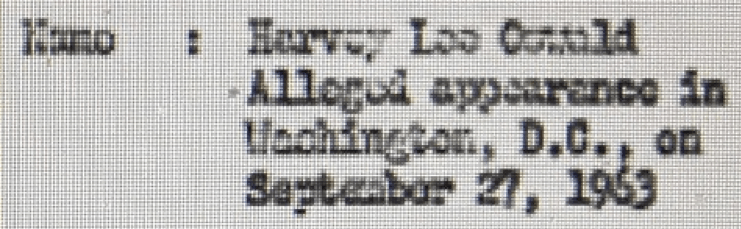
Comment: Note the word alleged.
- He describes the witness as a trusted chauffeur (Bernard Thompson) for a Kennedy Cabinet Secretary.
Comment: Kennedy’s chauffeur Greer, and other Secret Service people of interest, were also “trusted.”
- The witness describes an encounter where an agitator stuck out as very high-strung:

- Blake Smith then states that the chauffeur even selected Lee Harvey Oswald’s photo from a stack of suspect pictures, convinced he was the stranger in question, nearly in the shadow of the U.S. Treasury Building. He then speculates that this strongly indicates that Oswald or one of his handlers was being tipped off with insider information.
Comment: The last point is very speculative and presumes that this is in fact Oswald. There is nothing surprising that he picked out Oswald because when he saw Oswald’s picture after the assassination he thought he recognized him.


On page 141 Blake Smith states that “President Kennedy’s accused and slain assassin was once seen by three different government employees on a street in Washington D.C. on Friday afternoon, September 27” of 63. A government chauffeur. A policeman. And a Secret Service agent—(not certain how he knows the occupation). This really gives the impression that three people identified Oswald in front of the Willard Hotel. Now read the report:

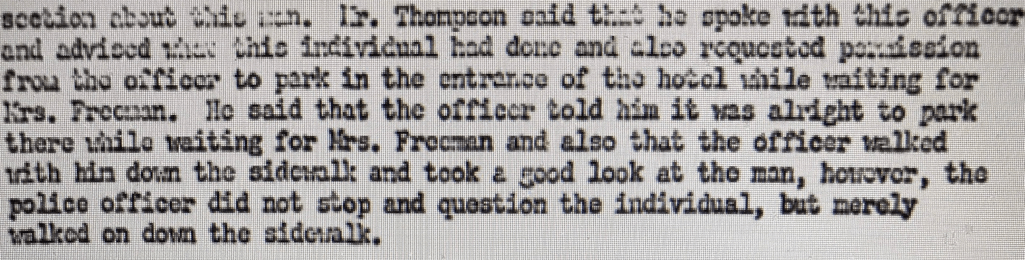
Comment: The description of the incident should state that the chauffeur thought he recognized Oswald and thought that a picture of Oswald shown to him closely resembled the agitator. This claim would also be more accurate: though Thompson knew of two people he felt closely saw the agitator (a Policeman and a possible Secret Service agent)—no one is known to have corroborated that the agitator was in fact Oswald in Washington D.C. on November 27, 1963.
So while this document is important, the author gives it his usual bend by cherry-picking and distorting what it relates instead of just letting the facts speak for themselves. On why the author is certain this agitator could not have been an impostor: “A fake Lee Oswald, a double, would likely have fit the pattern of overt bragging about money he was going to come into soon, or how much he loved Russia and or Cuba over America and how much he wanted to kill the president … This was the real Lee Harvey Oswald alright.”
Question: Why would the real Oswald, a person who, according to the author, may have been getting inside information in this area from Secret Service traitors, make himself so visible in front of the very place he planned to shoot the president from?
Blake Smith makes a point “that agent Floyd Murray Boring took this information on LHO in D.C. very seriously in early December of 63, interviewing the main eyewitness. (Agent Boring has been described as an extremely serious, experienced lawman, wanting to be like his two older brothers, who patriotically served their country in the military)”…“The witness was a U.S. government chauffeur and also a trusted friend to agent Boring.” We can see that it was important for the author to establish the credibility of the interviewer and the interviewee. Like the author, I am a fan of Vincent Palamara; his studies on the Secret Service are unmatched. I remembered vaguely an article he wrote about Boring: not a very positive one, but it was vague. I decided I would explore this later.
The author did not have much else to say about him … or did he?
Let us flash forward to the two best chapters of the book. Those that focus on the Secret Service. In these chapters I felt he was on more solid ground referring often, and rightly so, to Palamara’s excellent work. Here, he talks about how Kennedy came to suspect people close to him were plotting against him. He takes us through ten steps that were taken to weaken security. He chronicles how the Russians suspected there was a conspiracy involving weakened security. He references previous plots, how the FBI cancelled special security surveillance of Oswald, how Oswald was seen getting packages from possible agents in New Orleans, how the Secretary of the Treasury, Douglas Dillon, was in communication with Allen Dulles. He summarizes how Secret Service agents manipulated evidence.
He also points out the roles of persons of extreme interest. Greer, Kellerman and, tum ta ta tum, Our Number One Suspect, “in collaborating with the Mafia-based public assassination plan”. Here is where something really weird happens: the author decides to exclusively use the pseudonym Trip-Planner Perry to identify him! The only time he does something like this in the entire book.
He clearly does not trust Trip-Planner Perry:
- He was very much involved in setting up the president like a bowling pin;
- His motivation was likely patriotism, to remove the “National Security threat”;
- This was a very real Treasury Department employee;
- A high-ranking 48-year-old Secret Service man who had close access to the president and agency files in planning JFK motorcades;
- … had served Roosevelt, Truman and Eisenhower;
- … had been aghast at the adulterous president;
- Had used his .38 to shoot and kill a man in defense of a past president;
- He sure seems to be the main federal agent who arranged John F. Kennedy’s complete lack of safety in Dallas;
- He even makes it on the top ten list as possible shooters in Dallas;
- The author suggests Perry is misleading in saying that he found “nothing unusual” to protect Kennedy in his Texas visit;
- He also volunteered to protect Kennedy in Washington D.C.;
- He also handled security in Chicago;
- Perry denied totally he had anything to do with security in Dallas—a blatant lie;
- The author suspects Perry of getting the FBI to scale back security;
- He believes that he may have been contacted by someone like Banister;
- He led the cover-up efforts;
and so on and so forth.
So who was this lying, murderer, key plotter, traitor? I think that if you rely on Vince Palamara’s research or read the Wikipedia profile, you can only conclude that Trip-Planner Perry and Floyd Boring are one and the same: One of the people whose credibility is crucial in the whole Secret Service report about Oswald in D.C.!
By hiding the real identity of Trip-Planner Perry, most readers are left with the impression that the agent who interviewed the chauffeur was reliable, as he is portrayed when identified as Floyd Boring. This artificially augments the perceived value of Boring’s acquaintance’s testimony. It blocks all critical thinking one can have around this whole scenario which perhaps was another of many ruses to frame the supposed Marxist Oswald.
The significance of this masked information seems to have been on the mind of none other than Vince Palamara during his online exchange:
Posted September 20, 2017
As I detail in my first and third books, there were credible threats to JFK’s life on 3/23/63 (Chicago), 11/2/63 (Chicago again), and Florida on 11/18/63 (technically, 11/9/63 onward—the Joseph Milteer prediction/threat, etc.). This statement—ORIGINATED BY AGENT FLOYD BORING, of all people—just adds more grist for the mill, so to speak.
Was this the real Oswald?
Was it an impostor setting an Oswald trace, in a plan that had been aborted?
Was it a miss-identification?
Was it a fabricated story made by an acquaintance under the direction of Boring?
Was Boring trying to close up loose ends when the W.C. was fully in lone-nut mode? For now, this is open to interpretation.
Was Oswald in Washington on September 27, 1963? Perhaps—since he was most likely not in Mexico City, we do not know where he was. As the author points out (p. 407): LHO “told no one about his Washington D.C. trip.” There are no photos, film footage, documents or witnesses that can corroborate what an acquaintance of a suspicious Floyd Boring recollected. To go from the clues the author puts forth and opine that there was a plot in the works for Washington is logical, to actually place Oswald there is a long stretch but possible, to go on and describe a full-fledged aborted attempt on October 1, 1963 from the Willard Hotel is pure speculation at its wildest.
A new lead?
When I tried to find the FBI memo the author referred to, I came upon a report that underscored a startling piece of information I had not seen before. Jim Douglass did write about how a singularly-typed letter (supposedly by Oswald) had been sent to the Washington Soviet embassy that contained incriminating writings that could serve as evidence to show that Oswald was guilty, had met the head of assassinations (Kostikov) in the Soviet consulate in Mexico City, and how the Russians were complicit.
This recently released report adds even more meat to the frame-up strategies and for a second time connects Oswald to a Soviet assassination operative. According to this FBI memo—the letter was addressed to the “man in the Soviet Embassy in charge of assassinations”:

This, over and above the Mexico City hoax, seems like a brazen attempt to connect Russia to the assassination as per the ZR Rifle assassinations template.
For now, I am just throwing this out there. At the time of this writing, I have not been able to confirm its authenticity or whether it has been analyzed in the past. I am currently awaiting comments from some esteemed researchers. Perhaps the readers can weigh in.