Possible hoax: Daughter of Former NYPD Officer Says Malcolm X Assassination Letter is Fake

As I have noted throughout, Litwin’s continual reliance on some of the most dubious-in some cases, scurrilous-sources in the literature seems to indicate what his objective was. Hugh Aynesworth has admitted his goal has always been to deny a conspiracy in the JFK case. (Click here for details) As one can see from that linked article, he openly threatened the Warren Commission in order to intimidate them into a lone gunman conclusion. This was months before the Commission’s 26 volumes of evidence were published!
Hugh wanted the Commission to portray Oswald as a homicidal maniac who was going to kill Richard Nixon. Through his friend and colleague Holland McCombs at Time-Life he learned about Garrison’s inquiry. As one can see, from the beginning, he secretly plotted to thwart the DA. He also became an FBI informant. We previously saw how he attempted to tamper with Clinton/Jackson witness John Manchester. Shaw’s lead lawyer, Irvin Dymond was very appreciative of the huge amount of work Aynesworth did for his client, which went as far as eliminating troublesome aspects to the point they did not surface at the trial.(Columbia Journalism Review, Spring 1969, pp. 38–41) In light of this sorry record, Litwin calls him a “great reporter”. That comment says much more about Litwin than it does the FBI informant who did not want his name revealed to the public.
Another Litwin source is Harry Connick Sr. Litwin features a picture of Connick in the Introduction to his book and says he was a source for how Jim Garrison operated as a DA. That is as far as the description goes. As with Aynesworth, its what Litwin leaves out that covers both his and Connick’s tail.
In 1973, in a close election, Harry Connick defeated Jim Garrison for DA. Over time, under Connick, New Orleans became “the city with the highest murder per capita ratio in the US.” (Probe Magazine Vol. 2 No. 5) But that’s not all. Gary Raymond, an investigator on his staff, was asked to check into the case of a local priest suspected of sodomizing children and young adults. Gary did so, and he accumulated evidence, including tapes and affidavits. The investigator recommended Connick prosecute the case. But nothing happened. Meanwhile Gary encountered one of the kids on the tapes. He asked him if he wanted to go on the record. The victim replied that his abuser had threatened his life. Raymond now wrote a three page memo outlining the case. This angered Connick because it created a paper trail. Raymond then encountered the DA at a St. Patrick’s day parade and asked him when the perpetrator would be indicted. Connick placed his finger in Gary’s chest and said, “He won’t be. Not as long as I am the DA. And you can’t do a thing about it.” Raymond had no choice but to go to the press. This began a series on what became the infamous Father Dino Cinel child abuse scandal. (Ibid, based on personal interview with Raymond)
For obvious reasons, as mentioned throughout, one would think that this sorry episode would be mentioned by the author. As with John McCloy’s failure to intercede with the Nazi extermination program against the Jews of Eastern Europe, you will not find it in the book.
But that’s not all. Connick was reproached by the US Supreme Court twice for violations of the Brady rule. (NY Times editorial of 2/16/2015; Slate, 4/1/2015, article by Dahia Lithwick) That rule maintains that the DA’s office must turn over any exculpatory materials it has to the defense. The cases were Connick vs. Thompson, and Smith vs Cain. (Click here for details) In the first case, the exculpatory material resulted in the defendant’s eventual acquittal. The ethical abuse in the second case was so bad that the conviction was reversed. Connick’s excuse for sending innocent people to prison for life was, “I stopped reading law books …when I became the DA.”
This record, and the fact that Connick served as the Washington liaison to the Shaw trial, is rather consistent. Because once he was in office, he went to work setting aflame the evidence Garrison had left behind. That is not figurative language. He carted it to the incinerator. When someone protested, Connick’s reply was “Burn this sonofabitch and burn it today.” (Op. Cit, Probe Magazine) Make no mistake, Connick literally wanted every single file left on the Kennedy case torched. This reviewer is certain of that. For when he visited Connick in 1994, the DA was shown an index to a file cabinet in his office made by the HSCA. Connick called in an assistant to check if it was still there. When he was told it was, his face took on a look of surprise and he said, “We still have that stuff?” Harry Connick is a major reason we have such an incomplete record of the Jim Garrison investigation into the JFK assassination. The excision of these key factors is another instance of Litwin’s plastic surgery practices.
I don’t know what is worse: if Litwin was ignorant of all the above, or if he knew it and decided not to tell the reader about it. In either case, Connick is in no position to tell any DA how to operate his office.
II
With that firmly established, the third part of the book deals with the HSCA, Oliver Stone, Permindex, and people like this reviewer. That is people who have written newer books on the Clay Shaw inquiry.
Litwin’s chapter on the HSCA is so sketchy that its almost embarrassing. For instance, he writes that the HSCA forensic pathology panel wrote that Kennedy was shot from behind. (Litwin, p. 238) Gary Aguilar, among others, has shown that this was again achieved by the HSCA classifying key information that indicated the contrary. As he has written, “…the HSCA misrepresented the statements of its own Bethesda autopsy witnesses on the location of JFK’s skull defect.” (Trauma Room One, by Charles Crenshaw, p. 209) In other words, with the information now declassified, both sets of witnesses-those who saw Kennedy’s body in Dallas, and those who examined it at Bethesda-were on the record as depicting a rather large blown out hole in the rear of Kennedy’s skull, strongly indicating a shot from the front. What makes this worse is that when Gary did some questioning of who was responsible for writing the contrary in the HSCA report, no one would admit to it. (HSCA Vol. 7, p. 37) This would include Chief Counsel Robert Blakey, the lead medical investigator Andy Purdy, and the chair of the pathology panel Michael Baden. (Aguilar interview for the documentary, JFK: Destiny Betrayed)
After slipping on this banana peel, Litwin now goes ahead and depicts the association of Garrison with the HSCA. He tries to impute this relationship as beginning under Blakey. Which shows he never interviewed Bob Tanenbaum, who was the first Kennedy Deputy Chief Counsel. Tanenbaum is still alive and talks to people on the phone about the JFK case. Apparently, Litwin did not think that step was historically important. This reviewer has talked to Tanenbaum many times. He was the one who approved the HSCA inquiry into New Orleans. It was he who assigned Jon Blackmer as the lead lawyer and Larry Delsa as the investigator. Delsa then recommended Bob Buras, another police detective, as his partner. They then decided to consult with Garrison, who shared what he had in his remaindered files with this team.
In this chapter, Litwin trots out an old chestnut originated by Jim Phelan many years ago and repeated by Patricia Lambert. Namely that Bertrand’s name was implanted into Perry Russo under truth serum. What Shaw’s defense had done—and Phelan was a part of that team—was mislabel the order of the sodium pentothal sessions. As Lisa Pease noted, when read in their proper order, it’s very clear that it was Russo who brought up the name of Bertrand on his own. (Probe Magazine, Vol. 6 No. 5) This reviewer has shown these transcripts to other researchers from other fields, and once shown them, they agree. (See DiEugenio, p. 413, footnote, 116)
Litwin concludes this chapter by using a book later written by Blakey and Billings to score Garrison. (Litwin p. 251) In other words, he passes over the origins of the HSCA New Orleans inquiry, skips over Tanenbaum, and then jumps to a “Mafia did it” book-without telling the reader it’s a Mafia did it book. Or that, in 1981, the original title of the volume was The Plot to Kill the President. If you talk to Blakey today he will tell you that there was a second shot from the front of Kennedy. This reviewer knows this since he was in email contact with him while proofreading American Values by Bobby Kennedy Jr.
In the updated 1992 version of the 1981 book, renamed Fatal Hour, Billings refers to an episode Garrison described in On the Trail of the Assassins. This depicted Billings, the Life reporter who had gone on the famous Pawley/Bayo raid to Cuba, questioning the DA about an organized crime figure in Covington. (Garrison, pp. 163–64) Garrison questioned people in his office and they did not know who the man was. Billings used this lack of knowledge as an excuse to portray Garrison as a lax crimefighter. When Fatal Hour came out, this was now revised to say the name Billings gave Garrison was Carlos Marcello. We are to assume then that somehow Garrison had never heard of Marcello. In the files released by the ARRB, this reviewer found Garrison’s notes to this conversation. The name was not Marcello, not even close. (Personal files given to Bill Davy for an update to his book)
What this points out is an utterly crucial issue: the sea change that took place with the HSCA after the first Chief Counsel, Dick Sprague, had been forced out. Litwin avoids this entire episode pretty much completely. Sprague and Tanenbaum were going to run a genuine homicide investigation. And both men were very experienced doing that: Sprague in Philadelphia and Tanenbaum in New York. As did Garrison, they both had quite positive records in court. (DiEugenio, pp. 173, 326) Respectively, neither the CIA, nor the FBI wanted this kind of real criminal inquiry into either the JFK case or the murder of Martin Luther King. (Personal interview with congressman Tom Downing, 1993, in Newport News) Therefore the MSM created a faux controversy over Sprague, and he was forced out in rather short order. Tanenbaum became the acting Chief Counsel.
But the problem was, after what happened to Sprague, no one wanted the job. Sprague’s forced resignation was clearly meant as a warning shot. Or as HSCA photographic consultant Chris Sharrett said to me, “It was Garrison all over again.” (DiEugenio and Pease, p. 59) As Chief of Homicide in New York, Tanenbaum said he understood how false the Warren Report was; and he had been alerted to this first by Senator Richard Schweiker who had worked on the Church Committee. (Speech by Tanenbaum, at Chicago Midwest Symposium in 1993) The three leaders of the first phase of the Kennedy side of the HSCA-Sprague, Tanenbaum and Al Lewis-were all experienced criminal attorneys. None of them bought the Warren Report. With his background as a DA, when Lewis inspected the autopsy materials in the JFK case, he was shocked. (DiEugenio and Pease, p. 57)
Dick Billings was not a criminal lawyer. Yet he helped write the Final Report of the HSCA concerning the JFK inquiry. In and of itself, that helps the reader understand what happened to that committee. This is the story that Litwin, almost by necessity, excludes from his book. Namely that Schweiker, Sprague, Tanenbaum, and Lewis were all on the same page. Garrison was correct, the JFK case was a conspiracy, we are now going to solve it. In fact, Schweiker told Tanenbaum that the CIA was involved in the assassination. (2019 interview with Tanenbaum by Oliver Stone and Jim DiEugenio) And, like Garrison, that effort was crushed. You won’t be able to unfold that rather sad saga if you don’t talk to anyone involved. And you certainly won’t find it in the papers of Sylvia Meagher or Patricia Lambert.
III
Litwin spends about 30 pages on the making of Oliver Stone’s film JFK. Again, I looked in his references for indications that he talked to anyone of importance in the making of the film. That is Oliver Stone, co-screenwriter Zach Sklar, any of the co-producers, or even an important consultant like John Newman. There was no evidence he did.
Litwin begins with the writing of Garrison’s book, the early drafts that eventually became On the Trail of the Assassins. He tells the shopworn story of how Sylvia Meagher was hired by a major book publisher to proof Garrison’s original manuscript for publication. She thought it was a worthy effort, but she then objected to his tenet that the motorcade route was changed. This formed a big part of the rejection of Garrison’s book by that publisher. (Litwin, pp. 259–60) As her lifelong fan, the late Jerry Policoff said, due to her innate bias, Sylvia should have never been handed that assignment. But once handed it, she should have never accepted it. (Click here for details)
Through the valuable work of Vince Palamara, we know today that Garrison was correct on this and Meagher was wrong. The motorcade route was altered. (Vince Palamara, Survivor’s Guilt, pp. 98–108) In fact, the Commission witness who Sylvia used to criticize Garrison, Forrest Sorrels, was one of the two men involved with the change—the other being Winston Lawson. It was then Lawson who stripped back the number of motorcycles riding in the motorcade, especially those bracketing either side. Further, the police were told to ride to the rear of the car. They were puzzled at this direction which was given to them at Love Field. (Palamara, pp. 131–38) As a result of Palamara’s work, the best one can say today about the Secret Service and their performance in Dallas is that it was extremely negligent. As time goes on, it more and more appears that Meagher’s expertise on the case was confined to the textual analysis of the Commission volumes
Getting to Stone’s film itself, taking out his dog whistle, Litwin calls it a depiction of a homosexual conspiracy. (Litwin, p. 254) Which, again I think is a bizarre statement. Because, after watching the film several times, I don’t see it as that. The plot that I see is based on a military and Power Elite objection to Kennedy’s policies in Vietnam and Cuba, in that order. And, in everything I have seen or read, Shaw and Ferrie were not concerned about Indochina. In fact, this is what Garrison thought. He also believed that what he had uncovered, topped by Guy Banister, was only the local New Orleans level of the plot. In a documentary first broadcast on Pacifica radio in 1988, he said as much. He added that the character he thought was the main hand behind it all was Allen Dulles.
Litwin must understand this because now he goes after the Stone/Garrison portrait of Kennedy not being a Cold Warrior. But not even that is enough. If the reader can believe it—and you sure as heck can by now—Litwin also says that Lyndon Johnson continued Kennedy’s policy in Vietnam! (Litwin, pp. 270–71) I didn’t know whether to laugh or cry at this. But, since it was Litwin, I chuckled. The idea that Kennedy was withdrawing from Vietnam at the time of his death was announced, not just by Oliver Stone, but back in 1997 by the New York Times and the Philadelphia Inquirer. Both papers had headlines on this ARRB created story: The former said “Kennedy Had a Plan for early exit in Vietnam.” The latter was “Papers support theory that Kennedy had plans for Vietnam pullout.” (Probe Magazine, Vol. 5, No. 3)
The occasion for this confirmation of the thesis supplied to Oliver Stone by Fletcher Prouty and John Newman was the declassification of the records of the May 1963, SecDef conference. At this meeting in Hawaii, all arms of the American presence in Vietnam-military, CIA, State-offered their withdrawal schedules to Secretary of Defense Robert McNamara, who had previously requested them. When he had them in hand, he looked them over. He then looked up and said the schedules were too slow, they had to be speeded up. Kennedy had taken John Kenneth Galbraith’s advice and decided to leave Indochina. (Click here for details)
But what we have today is even stronger than that. Because again, through the ARRB, we now have Johnson’s opposition to JFK and McNamara: In his own words on tape. (Tape of 2/20/64 phone call):
I always thought it was foolish for you to make any statement about withdrawing. I thought it was bad psychologically. But you and the president thought otherwise, and I just sat silent.
It then got worse for McNamara. Two weeks later, Johnson requested that McNamara take back what he said about a thousand man withdrawal plan in December of 1963 as being part of a complete withdrawal by the end of 1965. (Virtual JFK by James Blight, p. 310) I could go on, because it gets even worse. But the point is made. Not only did LBJ know he was breaking with Kennedy, he was trying to cover his tracks in doing so. That is, as lawyers term it, consciousness of guilt. Again, if Litwin did not know this, then he should not be writing about it. If he did know this and he deliberately concealed it then it points to the kind of writer he is and the quality of his book.
But ignoring this new evidence on Indochina is not enough for Litwin. Again, in defiance of the new work on Kennedy, he tries to say JFK was a Cold Warrior. This is as untenable as there being no breakage in policy on Vietnam. What Kennedy was trying to do in his overall foreign policy was get back to FDR: a modus vivendi with the Soviets and a policy of neutralism in the Third World. The newest research on this subject, by Robert Rakove, Greg Poulgrain and Philip Muehlenbeck has redrawn the map on this point. It has been done so effectively that this reviewer is now convinced that the attempt to cloud that particular issue was done more deliberately than the actual cover up of Kennedy’s assassination. (Click here and here and here for details) The last instance, Johnson changing policies in Indonesia, was proclaimed by Roger Hilsman back in 1967. (To Move A Nation, p. 409) Hilsman resigned the State Department over that alteration and Johnson’s escalation of the Vietnam War. We are supposed to think that Litwin was unaware of all this.
IV
Taking his lead from the late Robert Sam Anson’s hoary article for Esquire, printed back in November of 1991, Litwin goes ahead and assails Fletcher Prouty on just about every score that Anson, and later Edward Epstein, could think of. Including the ridiculous accusation that Prouty did not know that Leonard Lewin’s The Report from Iron Mountain was meant as a satire. With the help of Len Osanic, I have addressed all of these goofy charges as made by Epstein. (Click here and go to the last section for details)
Prouty was involved in the drafting of the McNamara/Taylor report in Washington. This was the plan that Kennedy was going to use to justify his withdrawal from Vietnam. Prouty’s revelations about this are bolstered by Howard Jones’ book, Death of a Generation. Except Jones states that this was done before the trip to Saigon. Jones writes that the departing party received large binders of material as they boarded the plane, “including a draft of the report they were to write afterward.” (Jones, p. 370) That material included the conclusions they were to present the president, along with statistics. This is a key piece of information. (My thanks to Paul Jolliffe for pointing this out to me.) Needless to say, Litwin does not list any of the new books about the issue of Kennedy, Johnson and Vietnam—either in his bibliography or his references. This makes sense since they rely on new documents and new interviews to further the case originally made by Prouty, Newman and Stone.
Litwin also uses Fletcher’s interview with the ARRB against him. (Litwin, pp. 271-72) He could have easily called Len Osanic about this matter. Osanic is the web master of the best Prouty web site there is. He knew Fletcher as well as anyone. He visited him at his home in Alexandria, Virginia. When I asked him about the perceived problems the ARRB had with Prouty, he informed me of the full context. (Click here for details) Fletcher had been interviewed by both the Rockefeller Commission and the Church Committee. He was not happy with either experience. In his interview with the former, dated May 5, 1975, its odd that when Prouty started getting into matters dealing with the CIA, the interviewer wanted to go off the record. (See page four of the interview)
When Fletcher went in for his pre-interview with the House Select Committee, he was rather surprised. The reason being that George Joannides was there. And it appeared that he was actually taking part in the investigation. Prouty was one of the few people who instantly understood what this meant. He decided he was only going to give a brief statement and not do the interview.
Which brings us to the ARRB appearance that Litwin likes to use against the man. Prouty understood from the first couple of questions what the agenda was. So he decided to play along and give them what they wanted. He then called Len and informed him about it. Let us just discuss two issues. The first will be the whole trip to the South Pole as depicted in the film JFK. The unusual aspect about that was that Ed Lansdale was the officer who sent in his name for the mission. Lansdale was not his commanding officer. That was Victor Krulak. So why did Lansdale offer his name?
The other point is about the lack of military protection for Kennedy in Dallas. When asked by the ARRB if he had any notes on this, Fletcher said he did not. (See page 6 of the ARRB summary of the interview) Fletcher did have the notes of the call. And Len Osanic has seen them. Prouty’s informant said that, as late as January 1964, when he reported to the 316th Field Detachment—which was very close to the 112th Military Intelligence Group in San Antonio—there were still arguments between the two commanders about why they were not detached to go to Dallas. (ARRB interview with Col. Bill McKinney 5/2/97) Especially since some of the officers there had been trained in presidential protection at Fort Holabird. McKinney called Prouty about it since Fletcher would likely have arranged the air transportation for the unit. After all, it’s a four drive from San Antonio to Dallas. Also, after the film was released, a daughter of one of the high level officers called Len. She told him that, over the assassination weekend, there was an argument at her home over this particular issue. Namely why there was no military protection forwarded to Dallas. (Interview with Osanic, 2/6/2021)
Fletcher Prouty was vividly played by Donald Sutherland in the film JFK. During that walk he took from the Lincoln Memorial with Costner/Garrison, for the first time, the American public was given loads of information about what the CIA was doing for decades in the name of spreading democracy abroad. It turned out they were not spreading democracy. They were actually overthrowing democratically elected republics e.g. Iran, Guatemala and Congo. And in the case of Congo, planning assassination plots. This information was all communicated with exceptional cinematic skill. The Powers That Be did not like the fact that Fletcher-an inside the beltway officer-was partaking in such an exercise. And not only was he telling the public that he knew Kennedy was exiting Vietnam, but he had worked on the plans. All one has to know about how valuable he was to the disclosure of the secret government is that James McCord despised him.
When Fletcher Prouty passed away, he was given full military honors. This included a band with a bugler playing Taps, a 21 gun salute, his body carried to chapel by caisson, and the flag folded up into a triangle and given to his widow. Like Kennedy, he was buried at Arlington. We are all lucky that a man with that standing gave so many insights to the general public. Because no one else at that level ever did.
V
Litwin’s book is designed to conceal who Clay Shaw really was. Therefore he does something I have never seen anyone do before; I don’t even recall Gerald Posner doing it. Right in front of the reader’s eyes he changes the spelling of a word—contract to contact—in a long hidden CIA document. He then alters the wording, concerning Shaw’s payments, to make it read as he wishes. (Litwin, p. 289) In other words, J. Kenneth McDonald, the Chief of the CIA’s History Staff, was writing a memo to CIA Director Robert Gates, and with the file in front of him, somehow he got it wrong—but Litwin got it right? (CIA Memorandum of 2/10/1992)
But it’s worse than that. What Litwin does not tell the reader is that the CIA was so desperate to hide their association with Shaw that, as previously mentioned, they tampered with his file. Bill Davy first discovered this, and then Manuel Legaspi of the ARRB confirmed it and furthered it. (Legaspi to Jeremy Gunn, 11/14/1996; Davy, p. 200) So from what is left of the CIA records we know that Shaw was a highly paid contract agent and he had a covert security clearance for Project QKENCHANT. (For the latter, see Davy, p. 195) All of this discovery has been made possible by the ARRB. In a letter from Gordon Novel to Mary Ferrell in 1977, he revealed that the CIA had been trying to cover up their relationship with Shaw for well over a decade. (Personal Files sent to Bill Davy)
Another of Shaw’s CIA associations is with the mysterious European entity, CMC/Permindex. This was first revealed back in the sixties, and Shaw actually admitted to it for his entry in Who’s Who in the Southwest for 1963–64. Yet, that was Shaw’s last entry in that rather illustrious series. For whatever reason, his name does not appear after the 1963-1964 edition.
As most people know, when this organization was announced in 1956 in Switzerland, it was later booted out of the country due to a crescendo of negative newspaper articles. One of the reasons for the adverse reception was the attempt to conceal the main financial backing of the project. The State Department intervened and did some investigatory work. They found out that the true principal funding was through J. Henry Schroder’s, a bank that was closely associated with Allen Dulles and the CIA. In fact, Dulles had worked for the bank as General Counsel. (Davy, pp. 96–97) As Maurice Philipps has revealed, Ferenc Nagy, one of the key organizers of the enterprise, was a cleared CIA source and his file contained several references to his association with the World Trade Center, that is Centro Mondial Commerciale, the parent for Permindex. (Click here for details)
The project stalled, but the State Department kept up its inquiry, now referring to it as the Permindex “scheme”. John Foster Dulles knew about the “scheme” and made no objections to it. (Michele Metta, CMC: The Italian Undercover CIA and Mossad Station, p. 114) In 1958, State now said that the model for the company was the New Orleans International Trade Mart. Further, that Shaw had shown interest in the project. (Cables of April 9, July 18, 1958) The enterprise then moved to Rome. Litwin makes reference to a 1959 CIA document saying that Nagy offered to place a CIA agent on the staff. He then says that since Shaw joined the board in 1958, the dates do not match. (Litwin, p. 293) First, placing someone on the staff is not the same as a member of the Board, and I have a hard time believing Litwin does not understand this. Secondly, we don’t know from the document when Nagy first wrote the CIA about the employment offer.
Phillips made two groundbreaking discoveries. First, as already mentioned, about Nagy and the CIA. Secondly by going through the Louis Bloomfield archives in Canada, he found out that corporate lawyer Bloomfield served as a legal representative of the company and was soliciting funds for Permindex. What made that even more fascinating was, in doing so, he was in contact with the wealthiest families in the world at that time e.g. the Rockefellers and the Rothschilds. None of this had been previously disclosed.
When one adds in the work of Michele Metta, then the mix gets more bracing. Let me say this upfront: in my opinion, Metta’s book is one of the finest pieces of work I have ever read in English on the Italian political scene of the sixties and seventies. Metta discovered that Gershon Peres was on the Board of Permindex from 1967-70. (Metta, p.114; see also article by Paz Marverde, at Medium, 12/12/17) Peres was the brother of Shimon Peres, on and off the Prime Minister of Israel for three years, and then president of Israel from 2007-14. In what is probably the only positive contribution by Litwin in his entire book, he appears to clear Permindex member George Mandel of being in the Jewish refugee racket. (Litwin, pp. 295–97) The problem with this is that Metta shows that Mandel was working with the Israeli spy service for years and years. (Metta, p. 114)
I cannot begin to summarize all the quite relevant material in Metta’s book. But perhaps the most important, at least to me, is that another CMC member was instrumental in the rise of Licio Gelli, the infamous leader of the utterly fascist Propaganda Due (P2) lodge. But further, CMC and P2 shared the same office space! (Metta, p. 120, see also Marverde) Suffice it to say that with these kinds of revelations, Philip Willan, an expert on Operation Gladio, now entertains the possibility that P2 and Permindex may have been a part of that concealed “stay behind” NATO network. Which puts it above the level of the CIA.
How does Litwin counter these powerful revelations? First, he barely mentions Metta’s book. Second, he uses Max Holland’s article in Daily Beast to say that, somehow, the Permindex story was all part of a KGB propaganda plot, issued through communist leaning papers in Italy. Holland’s article was published at the height of Russiagate mania, which has now been exposed as being, to put it mildly, a false alarm, to put it bluntly, a hoax. Holland swam right into that wave. Secondly, nothing I have referred to above relies on that material. Obviously, Phillips did not. Metta’s book is well documented and in his discoveries about CMC, are largely original research. Third, the underlying basis for Holland is the Mitrokhin archives. The well paid Russian defector has turned out to be, well, kind of unreliable. Especially on the JFK case. (Click here for details)
The other way Litwin tries to distract from all of this is by picking up his second dog whistle. His first is homophobia; his second is anti-Semitism. Because Bloomfield was Jewish, he uses that to play the anti-Semite card. I was nauseated at Litwin’s shameless hypocrisy. As I noted in the very first part of this series, what John McCloy did on the Jewish/Nazi issue during and after World War II was unfathomable. Somehow, Litwin did not find any of that even notable. Just as Jim Garrison never said anything about Shaw being a homosexual during the two years of that being a live case, Garrison has never written anything about Bloomfield being Jewish. And although Litwin writes that Bloomfield was not in the OSS, John Kowalski, who has been through the Bloomfield archives, says he did see letters between the legendary World War II Canadian/British intelligence officer William Stephenson and Bloomfield.
VI
The last chapter of the book is entitled “Conclusion: The Attempt to Rehabilitate Jim Garrison”. Here, Litwin groups Bill Davy, Joan Mellen and myself under one rubric in order to belittle and attack respectively, Let Justice be Done (1995), A Farewell to Justice (2005) and Destiny Betrayed, Second Edition (2012).
First he says the three books are incestuous. My book has over 2000 footnotes to it. Less than 2% of the references are to Bill Davy’s prior book. And even less than that are to Mellen’s A Farewell to Justice. The Davy book has about 650 references to it, evens less of his notes apply to my work in any form e.g. including essays I wrote for publication in various journals, particularly Probe Magazine. It’s preposterous to do that same comparison to Mellen’s book. For the simple reason that she employed the superb archives researcher Peter Vea, who was the Malcolm Blunt of his day. Therefore the figures for her are even smaller.
What Litwin is trying to avoid is this: the three books are based on research, data and facts that became newly available through the ARRB. And how that unprecedented event led to more searches through phone and personal interviews, field investigation, and materials mining at other centers e.g. the AARC. This combined effort, by many more people than he lists, resulted in a plethora of new information on New Orleans. Enough to pen three books clocking in at about a thousand pages.
Therefore, the idea of “rehabilitation” is demonstrably false. What these volumes do is redefine New Orleans, Garrison’s inquiry and its suspects. To the point that they have made books like Kirkwood’s look like a museum exhibit. And it’s not just those three works. For instance, my book uses John Newman’s Oswald and the CIA, which has important new material in it on New Orleans. It also uses Joe Biles’ work, In History’s Shadow, which did much to reopen the case of Kerry Thornley. In this particular review, I have utilized Michele Metta’s volume, which takes a quantum leap forward with Permindex/CMC. One of the main sources for my book was Probe Magazine, which I used far more than Bill Davy or Joan Mellen. That journal did many articles based upon new archival materials about New Orleans. I could go on, but my point is that Litwin’s attempt to narrow the field is simply not an accurate description as to how the database has been altered geometrically and exponentially on the subject.
His attempt to characterize the three books as being similar in subject and theme is also inaccurate. Let Justice be Done is narrowly focused on New Orleans and Clay Shaw. So when Litwin writes that all three deal with ending the Cold War, withdrawing from Vietnam and Kennedy ushering in “a new era of peace and prosperity”, that simply does not apply to the text of Davy’s book. (Litwin, p. 311, not numbered) It only relates to the Afterword by a different author, Robert Spiegelman. It was not part of Davy’s research, themes or his ultimate aim. Mellen’s book only deals with the subject of JFK and his policies in one half of one chapter (See Chapter 11) My book is the only one that assays this topic at any length or detail. But the concept that Lyndon Johnson drastically altered Kennedy’s foreign policy is today an established fact. And Litwin can only deny it by not mentioning scholars like Robert Rakove, Greg Poulgrain, Philip Muehlenbeck, Richard Mahoney, Brad Simpson, Gordon Goldstein, David Kaiser, and James Blight—among others. Again, if he knew of this work and did not tell the reader about it, then he is not being forthright. If he didn’t know, then he should not be writing about it.
In this final chapter, he also tries to deny, as he does throughout the book, that Shaw was Bertrand. As I have shown in the last installment, there is nothing to argue on this point anymore: Shaw was Bertrand. This is a fact. And in all probability Shaw’s defense team knew it. As we have seen, former FBI agent Aaron Kohn later made up one of his fables for the HSCA in order to disguise it. If the Bureau had been aiding Garrison, Shaw would have been decimated on the stand over this.
In quoting Jon Blackmer’s memo on his interview with Garrison about Shaw being a part of the conspiracy or a “cut out” to the plot, he writes that I did not place it in its proper context. He then adds that it’s not a part of the HSCA Final Report. (Litwin, p. 318)
This is another Litwin effort at a shell game. What I write about Blackmer’s memo is simple and straightforward, but it’s not part of Litwin’s agenda. And it explains why Blackmer’s work is not only absent from the Final Report, but why he was then absent from New Orleans. What I wrote is that Jon Blackmer did not matter once the leadership of the HSCA changed. (DiEugenio, p. 332) And anyone who knows this case understands that. As Gaeton Fonzi has written, once Sprague and Tanenbaum were gone, the focus shifted from the Cuban exiles and the CIA, to the Mafia. In fact, as Wallace Milam informed me back in the nineties, Blackmer was shifted out of New Orleans and his name was on a couple of autopsy memoranda. As Joan Mellen discovered when she approached him, Blackmer would not talk about his HSCA experience with her. Try and find any of this important material in Litwin’s book.
Another part of the story that Litwin wants to eliminate in this chapter is the massive interference with Garrison’s inquiry. To show how desperate he is, in the part of my book that deals with Louis Gurvich and his work for the CIA, he says I was writing about his brother, William. He then says my source was a JFK critic and he talked to Gurvich’s niece. (Litwin, p. 318) Again, these are both wrong. My source was a military veteran and he did not say he talked to Gurvich’s niece, and neither do I. (DiEugenio, p. 331) He then says there is no evidence that Gordon Novel was being used by Allen Dulles to spy on Garrison’s office. Anyone can read the sources I use for this in my book. One of them is Novel’s own deposition for his lawsuit against Playboy magazine. There he mentioned his many and long conversations with Allen Dulles. In that sworn deposition he also admitted he communicated by telegram with Richard Helms. (DiEugenio, p. 429) In my footnotes, I also source a police interview in which Gordon admitted he stole pieces of evidence from Garrison’s office.
Litwin also writes that the CIA did nothing to interfere with Garrison’s inquiry. (Litwin, p. 321) In my book I go into detail with declassified documents showing how the Agency planned and executed this interference. (DiEugenio, pp. 269–78)
Litwin has to do this because this massive interference-which came on the instructions of no less than Richard Helms-would suggest the Agency was worried about what Garrison would turn up to incriminate them. (DiEugenio, p. 270) I describe how the CIA then prevented subpoenas from being honored; they directed witnesses against Shaw be talked out of their stories; and how Bob Tanenbaum saw documents from Helms’ office that directed Garrison’s witnesses be surveilled and harassed. Which they were. (DiEugenio, pp. 271–98, 294)
Incredibly, Litwin tries to say that Shaw’s lawyers got no cooperation from either the CIA or the FBI. Perhaps Litwin did not know about the Angleton’s office “black tape” operation, revealed here for the first time. He he also leaves out the fact that Shaw’s lead lawyer, Irvin Dymond, met with the CIA station chief in New Orleans with approval from CIA HQ. (DiEugenio, p. 277) This was apparently done because in the fall of 1967 Ray Rocca, Jim Angleton’s point man on Garrison, predicted that Shaw would be convicted if all proceeded as it was. (DiEugenio, p. 270) After Dymond’s meeting, the CIA sent out memos about how they were now committed to this effort and task forces would be set up, including tasks to be done by the local New Orleans office. (DiEugenio, p. 277) The FBI joined in this by the aforementioned wiretapping of Garrison’s office. And on the eve of the Shaw trial they agreed to help the defense (DiEugenio, p.293) This covert aid is something that Shaw’s lawyers would not admit to. I know because Irvin Dymond lied to me about it in his office in 1994.
The way that Litwin frantically dodges this issue reminded of the old adage: if a tree falls in the forest and no one hears it, did it fall? Yes it did. And Litwin can deny it all he wants. But its right there for anyone with eyes and ears to witness.
At the end of this sorry book, if one knows what really happened in New Orleans, one has to ask: What kind of a mind and sensibility would go to such lengths to camouflage it all? Who today would trust people like Rosemary James or Shaw’s lawyers? What kind of a writer would go out of his way to use the political dog whistles of homophobia and anti-Semitism to the unprecedented extent Litwin does? When, in fact, Garrison never brought up the first, and there was no reason for him to bring up the second?
Those questions can only be answered by reviewing Litwin’s first book, which is about his political conversion. Looming in the background of that psychic transformation is the figure of David Horowitz. With the dropping of that name, I now understood that Litwin’s work is not meant to be data or research based. It is fundamentally political. Fred Litwin is a culture warrior.
Click here for Fred Litwin, On the Trail of Delusion – Part Two.
Click here for Fred Litwin: Culture Warrior.

As noted at the end of Part 1, the excisions Litwin makes to whitewash David Ferrie from accusations of perjury and suspicion in the JFK case extends to key information that implicates the FBI in the JFK cover-up. In my view, what he does to exculpate Clay Shaw from any suspicion, and to eliminate his perjury, might be even worse.
To show Litwin’s plastic surgery, let us take his treatment of Shaw’s trial. One would think that if anyone were to write about that proceeding today, two things would have to be paramount in the discussion. One would be the testimony of Pierre Finck. The prosecution’s medical expert, Dr. John Nichols, had done a good job using the Zapruder film to indicate a crossfire in Dealey Plaza. In fact, this part of the case was so effective that the defense decided to call in one of the three pathologists––Dr. Finck––who performed the very questionable autopsy on President Kennedy. The author quotes Sylvia Meagher as saying that Garrison was inept and ineffective in challenging the Warren Report at Shaw’s trial. (Litwin, p. 129) Which shows how out to lunch Meagher was on the subject of anything dealing with Jim Garrison. The reason he can include that embarrassing statement by Meagher is simple: in his entire chapter on Shaw’s trial there is no mention of Finck’s testimony. I wish I was kidding. I’m not.
Finck’s testimony alone burst open the Warren Report. All one has to do to understand that is to read the reaction to his testimony in Washington. As Doug Horne and others on the ARRB revealed, Finck’s testimony was so devastating to the official story it rocked the Justice Department back on its heels. As revealed by the ARRB, the two men in the Justice Department who were supervising the disguise over Kennedy’s criminally bad autopsy were Carl Belcher and Carl Eardley. In 1966, under the direction of Attorney General Ramsey Clark, they were responding to requests by Warren Commission lawyers David Slawson and Wesley Liebeler. Those two Commission counsels requested aid in order to somehow, some way, do something to counter the mounting criticism of the Warren Report. (“How Five Investigations Got It Wrong”, Part 2) The Justice Department seemed amenable. For instance, in a photographic inventory review in that year, Belcher knew that certain autopsy pictures were missing. He got two of the pathologists and the official autopsy photographer to sign a document in which they knowingly lied about this fact. He then had his own role erased from the charade by taking his name off the document. (Horne, Inside the ARRB, Vol. 1, pp. 146-47)
Realizing what the game was, upon hearing what Finck was saying on the stand in New Orleans, Eardley hit the panic button. In the second edition of Destiny Betrayed, I spend four pages describing some of Finck’s shocking disclosures at the Shaw trial. (pp. 300-03) One of the most compelling is that the pathologists were prohibited from dissecting President Kennedy’s back wound, since they were told by one of the many military higher ups in attendance not to. Because of that failure, no one will never know if that wound transited the body, or be certain what its trajectory was through Kennedy.
According to Dr. Thornton Boswell, when Eardley heard that Finck was actually telling the truth about what happened the night of JFK’s autopsy, he was really agitated. He called another of Kennedy’s pathologists, Boswell, into his office and said, “Pierre is testifying and he’s really lousing everything up.” (DiEugenio, p. 304) The idea was to send Boswell to the Shaw trial and have him discredit Finck as “ a strange man.” Boswell actually did fly to New Orleans. When ARRB Chief Counsel Jeremy Gunn heard this testimony from Boswell, he asked: “What was the United States Department of Justice doing in relationship to a case between the district attorney of New Orleans and a resident of New Orleans?” Boswell replied that clearly, “the federal attorney was on the side of Clay Shaw against the district attorney.” (ibid) As the reader will understand by now, this crucial part of the story is missing from this book. In fact, as we shall later see, Litwin is buddies with a man, Harry Connick, who was part of the hidden political machinery that arranged it.
Connick was the US Attorney in New Orleans at the time. At Eardley’s request, Connick reserved a hotel room for Boswell. Boswell was then escorted to Connick’s office and shown Finck’s disastrous two days of testimony. The doctor spent the evening studying it, but ultimately was not called. As Gary Aguilar has said, that was probably because Finck was better qualified in forensic pathology than Boswell, and Garrison would have pointed that out with both men under oath. (DiEugenio, p. 304)
The other point that is extremely relevant about Shaw’s trial today is the provable perjuries that Shaw recited under oath. Many of these corresponded to things he said to the press in the lead up to his trial. One was that he did not use the alias of Clay or Clem Bertrand. What Litwin does to help Shaw escape from this lie would be funny if it were not painful to read.
As Bill Davy, Joan Mellen and I myself have enumerated, not only did Jim Garrison have witnesses to show Shaw was Bertrand; so did the FBI. When combined together, the number is in the teens. For Garrison, and others, the interest in this came through the issuance of the Warren Commission volumes and the testimony of New Orleans attorney Dean Andrews. Andrews said Oswald had been in his office with some gay mexicanos. The latter had been sent to him by a man named Clay Bertrand. (WC Vol. 11, p. 326) He was then called on 11/23/63 by Bertrand to go to Dallas to defend Oswald.
Hoover and the FBI used every trick in the book to make this phone call go away. Even though these have been discredited, on cue, Litwin rolls them back out. As Bill Davy showed with hospital records, Andrews was not drugged at the time of the call. (Davy, p. 52). The call was also not imaginary, since three witnesses who Andrews talked to corroborated that he had told them about it. These witnesses not only said that Andrews seemed familiar with Bertrand, but Oswald had been in his office also. (Davy, pp. 51-52) Further, Andrews could not have been so familiar about details concerning Lee and Marina Oswald unless someone had told him about them. (Sylvia Meagher, Accessories After the Fact, pp. 375-76) It is true that Andrews changed his story about his description of Bertrand, once saying he was married with four kids, but this was clearly because of the pressure the FBI had placed on him, plus the fact his life had been threatened. (Mellen, A Farewell to Justice, p. 197) Andrews relayed that threat to both Mark Lane and Anthony Summers, in addition to Garrison. (Bill Turner, “The Inquest,” Ramparts 6/67: 24; Summers, Conspiracy, p. 340; Garrison, On the Trail of the Assassins, p. 82). I don’t see how that repeated threat can be discounted. Because Andrews obviously did not.
But, beyond that, it appears the FBI was looking for Bertrand before their interview with Andrews. (Davy, p. 194) Further, in declassified FBI documents, the FBI has admitted that Shaw’s name came up in their original Kennedy inquiry back in December of 1963. That memo, written by Cartha DeLoach, said that several parties had furnished them information about Shaw at that time. (FBI Memorandum of March 2, 1967) Ricardo Davis, active in the Cuban exile community in New Orleans, told Harold Weisberg that the FBI had shown him a picture of Shaw the day after the assassination. (DiEugenio, p. 265) In a March 2, 1967 memo, the FBI admits that on February 24th, they had gotten information from two sources that Shaw is identical with Bertrand. Larry Schiller, an FBI informant on Mark Lane, told the Bureau that he had gay sources in two cities––San Francisco and New Orleans––who said that Shaw used aliases, one of them being Bertrand. (FBI memo of March 22, 1967)
Harold Weisberg wrote an unpublished book in which he stated that Andrews told him that Shaw was Bertrand. But, consistent with the death threats, he swore him to secrecy about it. This is contained in the manuscript “Mailer’s Tales of the JFK Assassination.” (see Chapter 5, p. 13, available at the Hood College Weisberg archives) What Litwin does with this information is, even for him, bracing. He writes that Joan Mellen once wrote to Weisberg and the critic did not say this nearly as clearly as he wrote in his unpublished book. (Litwin, p. 313) What Litwin does not reveal is that one sentence later, Weisberg does make it clear. (Mellen, A Farewell to Justice, p. 197; see p. 551 for the separate references) Did Litwin stop reading before that one sentence? Mellen sources this to an interview she did with Weisberg on July 27, 2000, which Litwin ignores. I have not seen this kind of Rafael Nadal topspin since the days of Gerald Posner.
But in the Kennedy case, things are always worse than you think they are. And thanks to Malcolm Blunt, we now know the depths of dreadfulness that Shaw’s legal team was steeped in. There has long been available an FBI memo of March 2, 1967, referred to above, issued the day after Shaw was arrested. But it had only been released in redacted form. The memo was from William Branigan to Bill Sullivan. It contained a brief biography of Shaw and said the Bureau had information in their files about Shaw’s sexual tendencies, including sadism and masochism. What had been redacted was the following information: Aaron Kohn knew that Shaw was Bertrand! In fact, in this unredacted version of the memo the FBI handprinted below the first paragraph that Shaw was also known as Clay Bertrand.
This is startling in more than one way. First, as mentioned previously, the memo reveals that Kohn, along with another source, had told them Shaw was Bertrand on February 24, 1967. Did Kohn know that Shaw was going to be arrested? Secondly, this reveals that Shaw’s team had to know their client was lying. Because, as anyone who knows that case understands, Kohn was an integral part of that defense. It simply is not credible that he would not inform Shaw’s attorneys, the Wegmanns and Irvin Dymond, of this key fact. Third, this shows that, as I long suspected, Kohn created the whole Clem Sehrt mythology: that a lawyer Marguerite Oswald knew was known as Bertrand. He did this in consultation with the HSCA in order to detract from the fact that he himself knew Shaw was Bertrand. (see HSCA Vol. IX, pp. 99-101)
In other words, today it is a fact that Shaw was Bertrand. The problem with the classification of the information, the lying about it, and the threats to Andrews was that Garrison could not ask Shaw the key question: Why did you call Andrews and ask him to defend Oswald? Because of this new revelation I have a question for Litwin: Did he think he was going to find this crucial information in Aaron Kohn’s files?
I am not going to go through all the perjury that Shaw committed under oath. But I want to point out another instance of the HSCA trying to conceal key information about Shaw in order to bring Garrison into question. In the HSCA Final Report, the authors vouch for the Clinton/Jackson witnesses––that is, the people who saw Oswald with Ferrie and Shaw in those two villages in the late summer of 1963 about 115 miles northwest of New Orleans. Oswald first visited two persons in the area, Edwin McGehee and Reeves Morgan. He then was seen by numerous people in line to register to vote. He was then witnessed by at least four people inside the hospital at Jackson applying for a job there. This has all been established beyond a shadow of a doubt by Garrison’s inquiry, the HSCA’s further investigation, and by private interviews done by Bill Davy, Joan Mellen and myself.
But to show what the HSCA was up to, in that same report, a couple of pages later, out of the blue, they try and question whether it was really Shaw that was seen there. (HSCA Final Report, p. 145) That report was co-authored by Dick Billings, a man Litwin trusts and freely uses in his book. Originally, the HSCA secret files were classified until 2029. The furor around Oliver Stone’s film JFK opened them in the mid-nineties. What the HSCA report does not reveal is that the identification of Shaw was quite solid. And it is hard to comprehend how the authors of the report didn’t know it. This is due to a fact that, like other important evidentiary points, the HSCA decided to classify at the time. There was an HSCA executive session interview held with one of the key witnesses to the voter registration. Sheriff John Manchester testified that he approached the driver of the car and asked him to identify himself. The driver gave Manchester his license and told him he worked for the International Trade Mart. The license corresponded to the name the driver gave Manchester, which was Clay Shaw. (HSCA Executive Session of 3/14/78)
Litwin’s pal, Hugh Aynesworth––who worked for Shaw’s lawyers for two years––understood just how credible these witnesses were. Through his plants in Garrison’s office, he had a copy of Manchester’s statement to the DA. Hugh drove up to Clinton with his partner, FBI informant Jim Phelan. (DiEugenio, pp. 244-45; Mellen, A Farewell to Justice, p. 235). They located Manchester. Litwin’s “great reporter” Mr. Aynesworth attempted to bribe the sheriff. He offered him a job as a CIA handler in Mexico for $38,000 per year, quite a ducal sum back then. That offer suggests who the “great reporter” was connected to. Manchester replied negatively in a rather terse and direct manner: “I advise you to leave the area. Otherwise I’ll cut you a new asshole.” (Mellen, p. 235)
Because the HSCA found the Clinton/Jackson incident so credible, Litwin tries to say such was not the case. Like Lambert, he has to find a way to question the picture Garrison investigator Anne Dischler found. This depicted a car in proximity to the voter registration office with the New Orleans crew in it. Like Lambert, he says it could have been used as a “powerful brainwashing tool.” (Litwin, p. 121) This is ridiculous. First, that picture had to have been taken by one of the bystanders at the time of the voter registration. Under those circumstances, how could it be termed a brainwashing tool? Second, the Clinton/Jackson witnesses did not surface for Jim Garrison. They talked about the incident previously for congressman John Rarick and publisher Ned Touchstone of The Councilor. (Mellen, A Farewell to Justice, p. 227; Davy, p. 115) Reeves Morgan who, along with his two children, was the second witness to meet Oswald, called the FBI and informed them about it right after the assassination. The reply was that the Bureau was already aware of this incident. (Davy, pp. 102-03) There was clearly an agreement from the top down in the Bureau that they would deny the episode in order not to bolster Garrison and continue to hide their own negligence. But today there is little doubt that this guilty Bureau knowledge is how Oswald’s application at the hospital rather quickly disappeared. And we have this now from people in the FBI. (Mellen, A Farewell to Justice, pp. 232-34). No less than four people saw Oswald inside the hospital, directed him to the personnel office, saw him inside the office, and actually saw the employment application he filled out. (DiEugenio, p. 93)
But for me, the capper that certifies this strange but powerful episode is this: Oswald knew the names of at least one, and more likely two, of the doctors who worked at the Jackson State Hospital. And again, the HSCA secret files proved such was the case. When Oswald was questioned by registrar of voters Henry Palmer, Palmer asked him if he had any associates or living quarters in the area. As a result of the JFK Act, amid all the documentation released on the incident, we know that Oswald replied with two names: Malcolm Pierson and Frank Silva. When the HSCA retrieved the 1963 roster of treating physicians at the hospital, both those names were on the list. (Davy, p. 107) How could Oswald have known this? One way would have been through Shaw’s well established relationship with CIA asset Dr. Alton Ochsner, who had a connection to the Jackson hospital. (Davy, p. 112)
As I said above, I am not going to go through the entire litany of lies that Shaw uttered in order to mislead the public prior to his trial, and the jury in his testimony under oath. If the reader is interested in that aspect, he will not find the discussion in Litwin’s book. But you will be able to find it here.
Please note that the majority of material used in that presentation was made available by the ARRB. In other words, the FBI and CIA were concealing much information which would have been valuable to Garrison. In fact, in the case of the FBI, they literally verified what Garrison was saying about both Ferrie and especially Shaw. So here is my question to Litwin: if the FBI confirmed what Garrison was investigating, then how could Garrison have been “deluded”? Was the FBI also “deluded”? Was the CIA also “deluded”? In fact, the CIA was so desperate to conceal their relationship with Shaw that they altered and destroyed much of his file. (Davy, p. 200; ARRB memo of 11/14/96 from Manuel Legaspi to Jeremy Gunn) Question: Did Litwin think he was going to find that kind of information in the files of Dick Billings or George Lardner? I think the readers can make up their own mind on that score.
But let me pose the question in a more concrete manner. As we can see from above, Jeremy Gunn was surprised by the fact the Department of Justice was interfering with a local trial conducted by a DA. The reason being that such is usually not the case. Usually, when asked, the federal authorities will do what they can to aid a local investigation. Because of the cover-up instituted by the FBI and the CIA in the Kennedy case, that did not happen here. As the reader can see from that linked PowerPoint presentation, that cover-up applied to Shaw directly.
Now, with all that in the record––which the author could not find in the papers of Irvin Dymond––here is my question to Fred: What if the circumstances had been normal? That is, what if Washington had been helping the DA instead of obstructing him? For example, consider Shaw saying he never used the alias of Bertrand. If Garrison had the FBI document referred to above and showed it to Shaw on the stand, can one imagine the reaction? Can one imagine the follow-up questions? “Mr. Shaw, would you say that Mr. Kohn has been aiding your defense?” And the follow up to that would be: “And he did so knowing you were lying?” The culminating question would have been: “Now that we know you are lying: Why did you call Andrews and tell him to go to Dallas to defend Oswald?” In this author’s measured and informed opinion, under those normal circumstances, Shaw would have been convicted. The problem with the JFK case is that the political circumstances around it make it so radioactive that it clouds the standard rules of evidence and procedure. In fact, as far as the normal rules of investigation and evidence go, the JFK case is the equivalent of the Bermuda Triangle.
My interview with Phil Dyer certifies the defendant’s knowing perjury even further. After Shaw was safe, that is after the judge had thrown out Garrison’s subsequent perjury case against Shaw––which Garrison would have likely won––Shaw met up with an interior designer he knew early one Sunday afternoon in late 1972. Dyer went along with his designer pal to meet Shaw and a female friend. Phil knew a bit about the JFK case and recalled the Shaw trial. Realizing he was out of the woods, Shaw felt free to admit what had really happened. When Phil asked him if he knew Oswald, Shaw replied yes he knew him fairly well, and he was kind of quiet around him. When asked about Oswald’s culpability, and if he could have gotten those shots off as the Warren Commission said he did, Shaw replied that Oswald was just a patsy, and also a double agent. This alone demolishes Shaw’s entire defense at his trial. And Litwin’s book along with it.
But the worst part of all of this Litwinian/Wegmann/Dymond mystification is that people in New Orleans understood it was such at the time. For example, Carlos Bringuier knew that Garrison was on to something big, and that high persons were involved in the assassination. He also knew something else. That Shaw felt confident because “he knew that these high persons would have to defend him.” (DiEugenio, p. 286) Which, as I have proven above, the FBI and CIA did. Here is the unfunny irony: Litwin uses Bringuier as a witness against Garrison in his book. (see Chapter 11: “A Tale of Three Cubans”)
This is one reason why I fail to see the point of Litwin using early Commission critics like Paul Hoch, David Lifton and Sylvia Meagher to knock Garrison (one could add Josiah Thompson to this list). To my knowledge, at that time, none of them had access to Garrison’s files, none of them had visited New Orleans to do any field investigation, and none of them could have possibly had access to the secret FBI and CIA files that were valuable to Garrison’s case. To top it off, to my knowledge none of them later used the Freedom of Information Act to try and attain them. With those qualifications, their comments amount to sheer bombast. Therefore, what was or is the forensic value of Litwin using them in his book? Very early, actually in grade school, students learn the basic axioms of arithmetic. One of them is that since zero has no value, it does not matter how many of them you add to each other: The sum at the end of the addition is still zero. Adding Hoch to Meagher to Lifton, one still comes up with the forensic value of nothing.
But in some ways, the use of these early critics is worse than that, because they not only bought into the MSM line on New Orleans, but with Meagher and Lifton, they contributed to it.
Which brings us to Litwin’s writings on Kerry Thornley. Litwin’s chapter on Thornley is one of the worst chapters I have read in recent years. And I don’t just mean about Thornley. It’s the worst about any subject in the recent JFK literature that I have read. The majority of his references here come from the writings of Thornley’s friend David Lifton, Adam Gorightly’s pathetic apologia for Thornley, Caught in the Crossfire, and the writings of Thornley himself. Again, what did Litwin think he was going to get from these sources? When you add in the author’s own massive bias, it makes it all the worse. For instance, Litwin tries to explain away Thornley’s extreme rightwing political views by calling him a libertarian. (p. 179) Calling Thornley a libertarian would be like calling Marjorie Taylor Greene a Republican. Thornley was so far right that an acquaintance of his in New Orleans, Bernard Goldsmith, refused to discuss politics with him. (Joe Biles, In History’s Shadow, p. 57)
Litwin also does a neat job of downplaying Thornley’s testimony before the Commission. He doesn’t quote any of it. That’s a good way to make something of important evidentiary value disappear. No one who knew Oswald in the service supplied anywhere near the psychological/pathological/political disposition for Oswald to kill Kennedy as Thornley did––no one was even close. Thornley’s deposition in Volume 11 was 33 pages long and it was separated from the affidavits of those who knew Oswald in the service, both in Japan and at Santa Ana, California. In fact, Thornley’s highly pejorative testimony was grouped with that of New Orleans radio host Bill Stuckey, who––as we have seen––helped bushwhack Oswald in a radio debate; an affidavit by Ruth Paine, whose home produced so much incriminating evidence against Oswald; and another by Howard Brennan, the man the Commission used to place Oswald in the sixth story window of the Texas School Book Depository. That should tell the reader just how the Commission viewed Thornley––what with his depiction that Oswald wanted to die knowing he was a somebody, and Oswald wanted to go down in history books so people would know who he was 10,000 years from now. (Vol. 11, pp. 97, 98)
This is what Kerry was there to do, and Commission lawyer Albert Jenner admitted it with Thornley right in front of him. (Vol. 11, p. 102) Jenner said he wanted Thornley to give them a motivation for Oswald. Which Kerry supplied in excelsis. To excise this is another example of Litwin’s plastic surgery. But in addition to milking Thornley to smear Oswald, the Commission also covered up areas that they should have investigated about the witness. This included topics like: did Thornley communicate with Oswald after they left each other in the service; did Thornley tell Oswald about Albert Schweitzer College in Europe, a place where Oswald was supposed to have applied to, but never attended; did Oswald meet with Thornley in New Orleans; and why did Thornley suggest that Oswald was about five inches shorter than he was when, in fact, they were approximately the same height? You will not find any of these key evidentiary points in Litwin’s chapter. But they help explain why Thornley was tracked down by both the FBI and Secret Service within about 36 hours of the assassination. Thornley himself said that the agencies had just cause to suspect he was involved in the assassination, though that line of inquiry was quickly dropped. But incriminating Oswald so thoroughly before the Commission gave him the opportunity to urinate on Kennedy’s grave at nearby Arlington Cemetery. (Garrison, On the Trail of the Assassins, p. 78)
Litwin is so incontinent to smear Garrison that he recites the whole mildewed rigamarole about the DA suspecting that somehow John Rene Heindel––who talked to Oswald once at Atsugi air base in Japan––was lying to him and the DA was laying a perjury trap for the man through Thornley. (Litwin p. 177) This idea was furthered by Gorightly. If one reads the grand jury transcript of Heindel, it is exposed as pure bunk. What was really happening is that Thornley was so off in what he was saying about Heindel that it caused Garrison to suspect that Thornley was part of the cover-up––which he was. And Thornley did not just do his act before the Commission. In one of his many perjuries before Jenner, Thornley said that he had seen the Butler/Bringuier debate tape with Oswald while he just happened to be standing in a TV studio in New Orleans. (Volume 11, p. 100)
Wisely, Jenner did not pursue that statement. Because it turned out to be a lie. Through the testimony of radio program director Cliff Hall, Garrison discovered that Thornley was not just loitering around WDSU TV in the wake of the assassination. He was doing the same thing his pals Bringuier and Butler were doing in the immediate aftermath of Kennedy’s murder. He was smearing Oswald as a communist in a TV interview at the station. Around this opportune time, Thornley made similar pejorative statements to the New Orleans States Item newspaper. He said Oswald was made a killer by the Marines and the accused assassin was also schizophrenic and a “little psychotic.” (New Orleans States Item, 11/27/63) This is months before his appearance before the Commission.
But Cliff Hall said something that is probably even more relevant to the subject at hand, and it exposes Litwin’s avoidance even further. He said that he and Thornley went out for a drink after that TV interview. Before the Commission, Kerry told Jenner he had not seen Oswald in New Orleans in the summer of 1963. (WC Vol. 11, p. 109) He confessed to Hall that this was another lie. He had seen Oswald in New Orleans that summer. When Hall asked if he knew Oswald well, Thornley––like Clay Shaw––replied that he did. (Hall interview with Richard Burness, January 10, 1968)
But in the Kennedy case, just when you think they can’t, things always get worse. And it reveals another perjury by Thornley. As I have indicated above, Thornley’s raison d’être for testifying before the Commission was to dutifully produce his portrait of Oswald as the dedicated Marxist. He came through in spades. Yet Thornley knew that this was also false. He told two witnesses that Oswald was not a communist. (see Biles, pp. 58, 59)
As per the idea that Thornley could have been the model used in the infamous backyard photographs, no one will ever really know the truth about that aspect. But the idea that it could be Thornley was not just Garrison’s. Many years ago, in Las Vegas, it was told to a reporter for Probe magazine, Dave Manning. The information was supplied by none other than Jack Ruby’s acquaintance Breck Wall. Ruby called Wall––the local head of the American Guild of Variety Artists––four times in November of 1963. (Michael Benson, Who’s Who in the JFK Assassination, p. 469) As Bill Davy writes, “Ruby’s last long distance phone call during a weekend of frenzied phone call activity was to Breck Wall in Galveston.” (Davy, p. 46) Wall had arrived in Galveston just a few minutes after David Ferrie.
The above points out one of the worst aspects of this book. To anyone who knows New Orleans, Litwin’s portraits of important personages are simply not realistic. They are in fact cheap caricatures. This is acceptable for someone like the late Steve Ditko, who drew Marvel comic books. It is not acceptable for someone who is passing his book off as a work in the non-fiction crime genre. This caricaturing also underlines that, as others have alerted me, Litwin likes to troll on certain forums. One message he left is that Garrison did not give his files to any archives since it would have exposed them as being empty. This is a doubly false statement. Garrison gave many of his files to Bud Fensterwald at the Assassination Archives and Research Center (AARC). Secondly, the materials used above to impeach Thornley came from Garrison’s files. Besides Hall, there are four other witnesses who saw Oswald with Thornley that summer in New Orleans. (For a further demolition of this chapter, with more of Garrison’s files, see this article)
Thornley was lying about his association with Oswald. He was also lying about his association with those in the network around Oswald that summer in New Orleans. What is important from what I have demonstrated so far about Ferrie, Shaw and Thornley is this: When someone is lying under oath in order to exculpate themselves, those statements are not supposed to be set aside or ignored. Leaving the chimerical world of Litwin/Hoch behind, let us quote a real life colloquy from two experienced professionals on the subject:
Q: False exculpatory statements are used for what?
A: Well, either substantive prosecution or evidence of intent in a criminal prosecution.
Q: Exactly. Intent and consciousness of guilt, right?
A: That is right. (CNBC story by Arriana McLymore, 7/7/2016)
That piece of dialogue was between two veteran prosecutors: the questioner was Trey Gowdy, the respondent was James Comey. Comey was a federal prosecutor for about 18 years and then Director of the FBI. Gowdy was a federal and state prosecutor for a combined 16 years. Through their provable lies, the consciousness of guilt was there in the cases of Thornley, Shaw and Ferrie. I don’t see how it gets worse than looking for evidence that places you with Oswald, or your own defense team covering up the truth about your alias. The point was that Garrison never got to show what the intent of the lies were. But that exchange reminds us all of what proper legal procedure is, and how it has been utterly lost in the JFK case. It was distorted beyond recognition by people with political agendas. And it began with J. Edgar Hoover and those on the Commission, like Thornley’s pal Mr. Jenner.
After suffering through Litwin’s phantasmagoria with Thornley, I was ready to walk the book out to the trash bin behind my apartment. Instead, I decided to take a few days off. I had to in order to recover my damaged sensibilities. I gutted it up and got a second wind. I then managed to finish the book. I hope the reader appreciates that sacrificial effort.
In the second part of the book, besides Thornley, the author deals with Carlos Bringuier, Sergio Arcacha Smith, Carlos Quiroga, Clyde Johnson, Edgar Eugene Bradley, Thomas Beckham and Robert Perrin.
All one needs to know about the first three is this: I could detect no mention of Rose Cherami in the book. Why is that important? Because Arcacha Smith was later identified as being one of the two men in the car who disposed of Cherami near Eunice, Louisiana on the way to Dallas right before Kennedy was killed. As everyone knows, including Litwin, Cherami predicted the JFK assassination before it happened. That uncanny prognostication was based upon what Smith and his cohort, fellow Cuban exile Emilio Santana, were discussing in the car. (DiEugenio, p. 182) What made this even more fascinating was that the HSCA learned that the Dallas Police had found diagrams of the sewer system under Dealey Plaza in Arcacha Smith’s apartment after the assassination. (The Assassinations, edited by James DiEugenio and Lisa Pease, p. 237) In a 1998 Coalition on Political Assassinations conference, John Judge revealed that Penn Jones actually did crawl through that sewer system in the sixties. One should then add in the evidence that Ferrie had a map of Dealey Plaza in his desk drawer at work. (DiEugenio, p. 216) To most people, right there you have more evidence of a conspiracy. All of it made possible by Garrison’s investigation. Which leads to the question one has to ponder: Who the heck is deluded here? As we shall see, it’s not Garrison.
Quiroga and Bringuier were associated with Oswald through the famous Canal Street confrontation between Oswald and Bringuier. The latter was the head of the DRE in New Orleans and Quiroga was his aide-de-camp. In early August, Oswald met Bringuier at his retail clothing store, insinuating he could help his anti-Castro organization. (John Newman, Oswald and the CIA, pp. 323-24) Later, when Bringuier heard Oswald was leafleting pro-Castro literature on Canal Street, he rode over and violently confronted him about this alleged betrayal. Oswald and Bringuier were arrested. Even though it was Bringuier who accosted Oswald, he posted bail, pleaded innocent and eventually walked. Oswald pleaded guilty, was booked and jailed, and was later fined in court. One of the flyers Oswald passed out on Canal was stamped with the address 544 Camp Street, Guy Banister’s office. Further, the DRE was conceived, created and funded by the CIA under the code name AMPSPELL. (Newman, pp. 325, 333)
As indicated above, the episode is much more interesting, much more multi-layered, than what Litwin presents it as. First off, Oswald wrote about it on August 4th, five days before it happened. (Tony Summers, Conspiracy, p. 303) Second, Bringuier maintained that he had sent Quiroga over to Oswald’s apartment to return a couple of dropped leaflets and to infiltrate his group. Both Quiroga and Bringuier screwed up the timing of this mission to the Warren Commission. They said this event occurred after Oswald’s next street leafleting episode, on August 16th in front of the International Trade Mart. It happened before that. (Ray and Mary LaFontaine, Oswald Talked, p. 162) This is made more interesting by another misrepresentation. Oswald’s landlady said that when Quiroga arrived, he did not just have one or two leaflets. She described what he had as a stack perhaps 5 or 6 inches high. (LaFontaine, p. 162)
As noted previously, things always get worse in the JFK case. When Richard Case Nagell, who tried to stop the assassination from happening, was first interviewed by Garrison’s office, he made a rather compelling revelation. He told Garrison’s representative, William Martin, that he had an audiotape of four men in New Orleans talking about an assassination plot against Kennedy. He named one of them as Arcacha; he would only describe another of the men as “Q”. Which would strongly denote Quiroga. (NODA Memo of 4/16/67 from William Martin to Garrison)
Instead of the above, what does the author give us? More sludge from writers like Gus Russo, Shaw’s lawyers and Aaron Kohn. This includes nonsense like the claim Gordon Novel was hired by Walter Sheridan to introduce the TV producer to people in the city, and smears of Garrison’s inquiry by FBI informant Merriman Smith, who Litwin does not reveal is working with the Bureau against Garrison. (see the letter by Smith to Cartha DeLoach of 3/6/67) Or bizarre material about Garrison’s attempt to interview Arcacha Smith in Dallas, which leaves out the prime role of Aynesworth in protecting the suspect. (see LaFontaine, pp. 341-45) The capper to it all is that Litwin writes that Ferrie’s anti-Castro activities ended in 1961, when, in fact, Ferrie admitted he was involved with Operation Mongoose, which began in 1962. (NODA Interview with Herbert Wagner 12/6/67)
As far as Clyde Johnson’s meeting with Shaw under the alias of Alton Bernard in Baton Rouge, Litwin relies on––I am not joking––Aynesworth to say Ruby was not in the city at the proper time. His other source for this, and again I am serious, is Ruby’s sister Eva Grant. (Litwin, p. 196) He also adds that there is no proper source for Johnson being beaten to a pulp on the eve of his taking the stand at the Shaw trial. In fact, the source for this is an unpublished manuscript by a former Garrison volunteer named Jim Brown. His manuscript, titled Central Intelligence Assassination, was full of inside information on the workings of Garrison’s office, including the fact that Garrison was so worried about Johnson being attacked before his appearance that he hid him outside the city at a college dormitory.
The surveillance on Garrison’s office was so thorough that, even under those conditions, the witness was located and beaten. This may have been due to either the previously noted FBI wiretapping, or the CIA’s ultra-secret ‘black tape’ operation. This was a project originating from the office of counter-intelligence chief James Angleton. It began in September of 1967 and continued until March of 1969, at the trial’s completion. According to Malcolm Blunt, the heading ‘black tape’ indicates that it was very closely held at CIA HQ––on a need-to-know basis––and there was no field office access. The folders originally stated they would not be moved from counter-intelligence (CI) and, incredibly, not released to the public until 2017––and then only with CI approval. Which means, they were most likely deep-sixed. This is a sorry part of the story that Litwin avoids at all costs: namely the surveillance and assaults on Garrison’s witnesses before, during and immediately after the trial. This included Johnson, Nagell, police officer Aloysius Habighorst, two of the Clinton/Jackson witnesses and Dealey Plaza witness, Richard Randolph Carr. (DiEugenio, p. 294; Alex P. Serritella, Johnson Did It, p. 279)
The cases of Perrin and Bradley were faux pas that were largely the result of another facet of the infiltration which permitted the harassment just described, and which again Litwin discounts. This would be the horrendous influence on Garrison by CIA infiltrator William Wood aka Bill Boxley. In fact, one can pretty much say that without Boxley those two episodes would not have occurred. There is little doubt today that Boxley was an agent. And in my review of his role in my book, where I included the Perrin and Bradley cases––along with other areas––I proffered substantial evidence that such was the case. (DiEugenio, pp. 278-85)
As per Thomas Beckham and his cohort Fred Crisman, no one will ever know the truth about them. Larry Haapanen, who––surprisingly––wrote a blurb for Litwin, was not the only investigator of the duo. Former CIA pilot Jim Rose also did work on them, especially Crisman. The problem with this subject area is a common theme with the Garrison inquiry––those files, like many others, have largely disappeared. Garrison said that Boxley had taken them. (Litwin, p. 216). The DA also referred to this in the fine John Barbour documentary The Garrison Tapes. But the late JFK photo analyst Richard Sprague told this reviewer that this was not the end of their exit from the record. Sprague said that in the cache of documents the DA donated to Bud Fensterwald and the AARC, the Crisman records also managed to walk away. (1993 personal interview with Sprague in Virginia)
I must add that I did get to see some of the late Jim Rose’s documents about Crisman and Beckham when Lisa Pease and I interviewed him in San Luis Obispo in 1996. To say the least, Crisman appeared to be an interesting character. I saw no indication in Litwin’s text describing Crisman, or in his related notes, that he ever saw these documents. Which means, to put it kindly, his analysis and conclusions in the area are incomplete. As we have seen, for Litwin, that is actually an improvement.
Click here for Fred Litwin, On the Trail of Delusion – Part One.
Click here for Fred Litwin, On the Trail of Delusion – Part Three.

“One of the many blessings of this project was getting to know Hugh Aynesworth … He’s one of the great reporters in America, and it’s been an honor to know him.” ~Fred Litwin
Anybody who is familiar with the John Kennedy assassination should realize that a writer who could make the above statement has severe objectivity problems as far as the JFK case goes. Aynesworth is the man who once said that refusing a JFK conspiracy was his life’s work. Employing Aynesworth on the Kennedy case would be like using Donald Trump on the issue of where Barack Obama was born. Yet, the above statement is a quote from the Acknowledgements section of Fred Litwin’s book about the Jim Garrison inquiry. I would like to give that quote a page number but I can’t. The reason being that those pages––and some others which have text on them––do not contain numbers. Which, in my long reviewing career, is actually a first for me. But this is just the beginning of enumerating the bizarre features of this bizarre book.
For every Breach of Trust or JFK and the Unspeakable, there are at least a dozen volumes in the JFK field that are just plain shabby––or worse. Back in 1999, Bill Davy and I reviewed Patricia Lambert’s volume about Jim Garrison, False Witness. That was a particularly unpleasant experience. In fact, the estimable Warren Commission critic Martin Hay (deservedly) placed that book on his list of the ten all-time worst on the JFK case. But in light of Fred Litwin’s latest, Martin may have to revise and replace Lambert’s entry with Litwin’s On the Trail of Delusion. For Litwin has done something I did not think was possible: he wrote a book that is even worse than Lambert’s.
If the reader knows anything about New Orleans and the Jim Garrison inquiry, it is fairly easy to see what Litwin is up to. The problem is––and I cannot make this point forcefully enough––too many writers and interested parties think they know the Garrison inquiry and New Orleans, when they really do not. Many of these self-proclaimed “authorities” have never even been to the city. Many more have never even bothered to look at Jim Garrison’s files. But this never stopped them from voicing their biased and rather ignorant viewpoints: e.g., the late Sylvia Meagher. This was and is a serious problem among critics, and it has caused many people to be misled about the New Orleans aspects of the case. I will further elucidate this factor later in this review.
The above warning is apropos to what Litwin has produced. If I had to compare his latest to another volume in a related field it would probably be Thomas Reeves’ book on John Kennedy, A Question of Character. In my two part article, “The Posthumous Assassination of John F Kennedy”, I wrote that what Reeves had actually done was to compile a collection of just about every negative Kennedy book and article that came before him. He then assembled it together by chapter headings. He never fact-checked or source-checked what was in those materials and, as far as I could see, he never talked to anyone in order to clarify, or qualify, what he wrote; for example, the case of the deceitful Judith Exner. This allowed him to go exponentially further than anyone had done up to that time in smearing Kennedy. Because I knew the field and understood the game he was playing, I called it out for being what it was: so godawful that it ended up being pretty much a humorless satire.
The difference between the JFK field of biography and Jim Garrison and New Orleans is the time element. In my above mentioned JFK essay, I noted that the character assassination of Kennedy did not begin in any serious way until after the Church Committee hearings in 1975. This was not what happened with Jim Garrison. In his case it began very soon after the exposure of his investigation by local New Orleans reporter Rosemary James. As we shall see, in one way, it began with Aynesworth.
In my book, the second edition of Destiny Betrayed, I portrayed the real manner in which Rosemary James exposed Garrison’s inquiry. Contrary to what James tried to imply, it is not at all what Garrison wanted to occur (pp. 221-23). In fact, it was a serious body blow to his efforts. Yet, to this day, she still attacks Garrison. But again, to anyone who knows New Orleans, the smears are transparent. For instance, on a show she did In New Orleans with film-maker Steve Tyler and historian Alecia Long, she said that as soon as Shaw was indicted by Garrison, the wealthy Stern family of New Orleans dropped him like a hot potato. This is provably wrong. The Stern family hosted dinner parties for reporters sympathetic to Shaw’s defense once they arrived in New Orleans. What is surprising about this howler is that the contrary information is available throughout the forerunner to Lambert and Litwin, namely James Kirkwood’s obsolete relic of a book American Grotesque (see pp. 47, 88, 111). That book was published back in 1970.
But beyond that hospitality function, the Sterns owned the local NBC television affiliate WDSU. Ric Townley, who labored on the infamous 1967 NBC hatchet job on Garrison, worked for WDSU. That show’s producer, Walter Sheridan, worked through that station while he was in New Orleans. (William Davy, Let Justice be Done, pp. 78, 156) In addition to that, the Stern family helped start the Metropolitan Crime Commission, a private local watchdog organization. They also lobbied to bring in former FBI agent Aaron Kohn to be its first manager. Kohn took a large and important role in the effort to undermine Garrison; working hand in hand with Sheridan, Townley and Shaw’s lawyers. (Davy, p. 156) As we shall see, Kohn covered up an important piece of information about Shaw that would have strengthened Garrison’s case and shown the defendant to be a perjurer. So here is my question: After all this, who could use Rosemary James as a credible source on either Shaw or Garrison? The answer is, Fred Litwin can. He uses her frequently in his book. And as Thomas Reeves did, he does so without any qualifications or reservations. In other words, he doesn’t prepare the readers by informing them of the above.
What Litwin does is a bit more ingenious than what Reeves did. In addition to his secondary sources, like James and Kirkwood, he visited certain archives. What most of these archives have in common is that they house the papers of Garrison’s critics; for instance. Life reporter Dick Billings, Washington Post reporter George Lardner, and Shaw’s friend, author James Kirkwood. He then augments this by using the papers of Shaw’s legal team, Irvin Dymond and the Wegmann brothers, Ed and William. Some of these collections, like the Historic New Orleans Collection, were found by the Assassination Records Review Board (ARRB) to be highly sanitized. (ARRB memo from Laura Denk to Jeremy Gunn, 6/7/96) Which leads to another question: What did Fred think he was going to find in these places? Something objective? Something revelatory about Shaw’s secret intelligence background with the CIA? Something about Guy Banister’s career of covert infiltration of liberal groups in New Orleans? Nope.
There is something to this cherry picking that makes Litwin look even worse. The Wegmanns did know about the Banister undercover aspect, because Bill Wegmann worked at the law firm which handled some of Banister’s projects. In fact, Bill Wegmann notarized the papers for the incorporation of Banister’s so-called detective agency. (DiEugenio, p. 390) And that piece of quite relevant information was declassified in the nineties by the CIA, under the direction of the ARRB, even though the document dated back to 1958––that is, it took well over 30 years for it to see the light of day. This shows that Shaw’s own lawyers knew that Garrison was correct about Guy Banister. But it’s even worse than that. Bud Fensterwald later discovered through a New Orleans attorney that Banister, Shaw and former ONI operative Guy Johnson made up the intelligence apparatus for New Orleans. (Davy, p. 41) In the fifties, Guy Johnson worked with Bill Wegmann at the above-referenced law firm. Therefore, not only did Shaw’s defense team know about Banister, they likely knew about Shaw. And they still let him deny in public, and on the stand, that he was ever associated with the CIA.
In addition to James and Aynesworth, this leads to a third complaint to the reader: Try and find this rather important connection in Litwin’s book. Any objective person would understand that this declassified evidentiary point is important to Litwin’s subject matter. Both for what it says about Banister, and what it reveals about Shaw’s attorneys. Knowing that, anyone with an ounce of objectivity would realize that the Wegmanns would not have kept it in their archives.
Right after his acknowledgements to people like Aynesworth, and a listing of the archives the author will use, Litwin begins his narrative. He does so in a way that naturally follows from these prefatory matters. He describes a report from the military which eventually allowed Garrison to be discharged from the service on his second tour in 1951. Garrison had served on very dangerous air reconnaissance missions during World War II. At a very low altitude and speed, his team searched out enemy artillery sites. They flew so low, they could have been hit by rifle fire. And once they were sighted, they were attacked by much faster German fighter planes. (Joan Mellen, Jim Garrison: His Life and Times, pp. 18-19) They therefore sustained high fatality rates.
When Garrison reenlisted during the Korean conflict, he reported for sick call at Fort Sill. It turned out that he suffered from what used to be called “battle fatigue”, what we today call PTSD. (DiEugenio, p. 168; Mellen, pp. 36-37). What Litwin does with this is again, bizarre, but telling. He brings it up in the first paragraph of his text (p. 3, another non-numbered page). Less than one page later, Garrison is the DA of New Orleans. Clearly, what the author is trying to indicate is that somehow a mentally disabled person is now in high office. One way he does this is by leaving out the fact that after he left the service Garrison was recruited by the mayor of New Orleans, Chep Morrison. He was assigned to run the Public Safety Commission which supervised Traffic Court. (Mellen, p. 41). To put it mildly, Garrison did a crackerjack job. Mellen spends three pages showing, with facts and figures, that Garrison was such an excellent administrator that he just about revolutionized that branch. He was so good that Morrison offered him a judgeship over that court, which Garrison turned down. He said he would rather be on the DA’s staff, which Morrison then appointed him to. (Mellen, p. 44) It would appear to most objective people that Garrison had overcome any functional disability from his PTSD. Litwin eliminates this remarkable performance. I leave it up to the reader to figure out why.
At the DA’s office, Garrison handled a variety of criminal cases: burglary, lottery operations, prostitution, homicide and fraud. (Mellen, pp. 44-45) Again, this would indicate that Garrison had overcome his PTSD. Again, Litwin eliminates it.
Once Garrison enters into the DA’s office, we begin to understand why Litwin began his book as he did. Again, ignoring all the reforms and tangible improvements he made in the office and the praise he received for doing so, Litwin is going to strike two major themes in order to smear Garrison and his tenure. Both of these have been used before, they are nothing original. But Litwin tries to amplify them to the point of using chapter subheads to trumpet them. They are: 1) That Garrison spent much time prosecuting homosexuals; and 2) That the DA was a paranoiac about surveillance over his investigation.
Concerning the first, this motif was first utilized by Kirkwood in his aforementioned book. What Litwin does not reveal is that Clay Shaw commissioned that book. I discovered this through a friend of novelist James Leo Herlihy on a research trip down south. Lyle Bonge knew Herlihy from his college days. Shaw asked Herlihy to write a book about Garrison and the trial. Herlihy declined, but he suggested his young friend Kirkwood. All three men were gay, and that is not a coincidence. Shaw wanted a book that would portray Garrison as having no case against him. Therefore, the product was designed to suggest Garrison was simply out to prosecute Shaw because he was a homosexual. Anyone who reads Kirkwood’s useless relic will understand this was his mission: the denigration of Garrison, and the canonization of Shaw.
To further this concept, Litwin quotes a passage from the book on Garrison’s case co-authored by Rosemary James. The passage says that Garrison charged someone for being in a place that served liquor because the person was a homosexual. And that Garrison did this in order to attain a string of homosexual informants. (Litwin, pp. 8, 21) One would think from the reference that this information originated with reports from a primary source. When one looks it up, that is not the case. The source is Bill Stuckey. (James and Jack Wardlaw, “Plot or Politics?” pp. 21-22) Litwin does not reveal this either in his text or his references, which frees him from telling the reader who Stuckey was.
As Bill Simpich writes, Stuckey was both a CIA and FBI informant. He was the host for two interviews that Oswald did in the late summer of 1963 in New Orleans. These were originally arranged for by Carlos Bringuier of the CIA funded Cuban Student Directorate (DRE) branch in the Crescent City. The second debate featured Bringuier and CIA asset/propaganda expert Ed Butler facing off against Oswald.
Prior to the second debate, Stuckey was in contact with the FBI and they read him parts of Oswald’s file, including the information about his defection to the USSR. It was that information which was used to ambush Oswald since he was supposed to be representing the Fair Play for Cuba Committee. The defection exposed him as being not a fair participant but a communist. Stuckey crowed about how the debate ruined the FPCC in New Orleans. (DiEugenio, p. 162) Within 24 hours of the assassination, the DRE produced a broadsheet connecting Oswald to Castro and blaming the latter for Kennedy’s murder. In light of all this, would anyone besides Fred Litwin call Stuckey a neutral observer of the Kennedy case? But the reader does not know this because of Litwin’s excision.
The Stuckey non-mention is by no means an outlier. At the beginning of Chapter 2, Litwin prints an FBI memo. It originates with someone in Louisiana state Attorney General Jack Gremillion’s office. It strikes the same chord that Stuckey does above: Garrison was somehow doing a shakedown operation with homosexuals in New Orleans. Gremillion’s office wanted the FBI to do something about it.
I had to giggle while reading this. For two reasons. First of all, back in 1967, who would go to J. Edgar Hoover and the FBI on such an issue? If the point was genuine one would go to an agency like the ACLU. Or, since the state AG was above the local DA in New Orleans, why not pursue the case oneself? Which leads to my second reason for chuckling. Jack Gremillion was one of the most reactionary state AG’s there was at the time. Considering the era, that is really saying something (go here and scroll down). If there was a Hall of Shame for state AG’s not standing up for minority groups, he would be in it.
Again, to anyone who knows the New Orleans milieu of the period, this is clearly the residue left over from the famous James Dombrowksi case. Dombrowksi ran a pro-civil-rights group called the Southern Conference Educational Fund (SCEF). It operated out of New Orleans. The SCEF was clearly a left-leaning group, and Dombrowski was a communist sympathizer. There was nothing illegal or unconstitutional about what he did. So the rightwing forces in the area, including Banister, Gremillion and Mississippi Senator James Eastland––encouraged by Hoover––decided to create a law in order to prosecute Dombrowksi. It was called the Communist Control Law. The idea was to somehow show that groups advocating for civil rights emanated from Moscow. So Gremillion raided the SCEF and arrested Dombrowski and two assistants. Garrison decided to take over the case since the SCEF was in New Orleans and he did not want Gremillion to do so. As Garrison critic Milton Brener later said, Garrison did as little as possible in order to get the case to the Supreme Court where he knew it would be thrown out. Which it was. Gremilion and his ilk did not like it. Hence the retaliatory smear. (Mellen, pp. 162-69).
This leads to more unintentional humor. Litwin is so desperate to do something with the homosexual angle that he displays a cover from the pulp magazine Confidential (p. 85). The cover depicts Shaw waving from a car, and the title denotes some kind of homosexual ring killed Kennedy. Litwin says the author of the article, Joel Palmer, worked for Garrison. Having gone through Garrison’s extant files, I can find no evidence for that statement. What the files reveal is that Palmer, a reporter who was planning a book on the case, worked with Bill Boxley, a CIA plant in Garrison’s office. (See Garrison blind memo of 2/21/70) And he worked on furthering certain leads with Boxley that ended up being ersatz, like Edgar Bradley. (DiEugenio, pp. 278-85)
Litwin pushes the homosexual angle so hard and down so many cul de sacs that he ends up reminding one of the Keenan Wynn/Bat Guano character in the classic film Dr. Strangelove. If one recalls, Guano thought that the attack on the military base was ordered because the commanding general had learned about a mutiny of “preverts” under him. Wynn said this with a straight face. So does Litwin. (See the first part of this film clip)
For the record, there is not one memo I have read that shows Garrison ever outlined such a homosexual-oriented plot. At the beginning of the inquiry, there is evidence that Garrison was suspecting a militant rightwing plot. And as Garrison developed cases against Shaw and Ferrie, he was checking out leads that would connect them in the gay underworld. But nothing that either Peter Vea or Malcolm Blunt ever uncovered shows what Litwin is trying to impute to Garrison. Those two men are the two best pure archival researchers ever on the JFK case. And Vea specialized in the Garrison files.
Beyond that, I have had authors who have written about Kirkwood call me in utter bewilderment about his book. They have asked me where he got some of the stuff he wrote about, since they could not find any back-up for it. And I have patiently explained to them what Kirkwood was up to, and how he deliberately distorted things, with Clay Shaw pushing him along. In fact, Shaw was indirectly putting out stories about Garrison being a homosexual to the FBI as early as mid-March of 1967. (FBI memo of March 16, 1967) Was the idea behind this to impute that Shaw was charged over some homosexual rivalry or rejection? That is how nutty this angle gets. This is how far Shaw would go to escape suspicion and denigrate Garrison.
In his further attempt to smear the DA, Litwin subheads a section of the book with the following: “The Paranoia of Jim Garrison”. This is largely based on Garrison’s belief that the FBI was monitoring his phone calls. Litwin tries to dismiss this charge through––try not to laugh––Hugh Aynesworth. (p. 32) The declassified record reveals that the FBI was monitoring Garrison’s phone. (DiEugenio, p. 264) As we shall see, so was the CIA. When I revealed the name, Chandler Josey, as one of the FBI agents involved, former FBI agent Bill Turner recognized it and said he had been directly infiltrated into certain phone companies to do the tapping. What makes this worse is that Shaw’s defense team knew this was happening early on. In a multi-layered scheme, their ally, former FBI agent Aaron Kohn, was privy to the transcripts. (DiEugenio, p. 265) The reason for this was simple: Hoover did not like what Garrison was discovering since it showed up his phony investigation of the JFK case.
Gordon Novel, who was working for Allen Dulles, had also wired Garrison’s office. (DiEugenio, pp. 232-33) Novel had sold himself as a security expert to Garrison through their mutual friend, auto dealer Willard Robertson. In a sworn deposition, Novel revealed his close relationship with Dulles. But he also said that the FBI would be at his apartment every day in order to get a briefing on what was going on at Garrison’s office. This is how worried Hoover was at the exposure of his rigged investigation of the Kennedy case. (DiEugenio, p. 233). So, in light of the declassified record, just what is there that is fanciful about Garrison saying he was being surveilled by the FBI?
There is also nothing fanciful about another statement Litwin utilizes to smear Garrison: namely, that many of the lawyers for the other side were being paid by the CIA. Again, this has turned out to be accurate. We know today that the CIA helmed a Cleared Attorneys Panel in major cities, and there was one in New Orleans. (Letter from attorney James Quaid to Richard Helms, 5/13/67) Quaid had heard about this easy employment from his law partner Ed Baldwin. Baldwin enlisted in the anti-Garrison campaign and was busy defending people like Walter Sheridan, Ric Townley and later Kerry Thornley. There is further evidence of this in another ARRB disclosure. This one was a CIA memo of 3/13/68 which reveals that Shaw’s former partner at the International Trade Mart, Lloyd Cobb, was on the panel. Corroborating this, under oath, Gordon Novel did not just admit his cooperation with Allen Dulles, he also admitted he had lawyers who were being “clandestinely renumerated” [sic]. (DiEugenio, p. 263) So again, what is the basis for implying this statement is fanciful? The CIA itself admitted it in declassified documents.
But Litwin is not done with his character smears. Another one of his subheads reads: “Garrison the Irrational Leftist”. (p. 24) Again, anyone who studies this case and knows New Orleans understands that Garrison was in no way a leftist prior to his involvement with the Kennedy case. He was a moderate. For instance, he was anti-ACLU. He once said that it had “Drifted so far to the left it was now almost out of sight.” (Mellen, p. 217) Even more demonstrative, he favored the Cold War. He once said in a speech that the US had to counteract communist aggression in Korea and Vietnam. (Mellen, p. 208) This is an “irrational leftist”? What changed his view on these matters was his investigation of the Kennedy case.
As we have seen, in a variety of ways, the initial part of Litwin’s book is a rather blatant and barren attempt at character assassination. For anyone who knows New Orleans, it does not stand up to scrutiny. Therefore, we can term it an attempt to confuse the uninformed reader. We will now get to Litwin’s description of Garrison’s stewardship of the Kennedy case and the evidence underlying it. But before we do, this reviewer should comment a bit more on the format of the book.
Litwin has placed the overwhelming majority of his reference notes at the rear, with no numbers. The standard academic procedure is to link the note at the rear to the book’s pagination. Litwin does not do this. So one has to search for the proper note by the textual lead in the chapter. Because of this unusual sourcing method, I did something I found morally offensive: I bought the paperback version of the book, for it had become too time consuming to hunt for the textual references by shifting back and forth in the electronic book version. To top it off, the book has no index. Thus, for purposes of review, unless one takes notes, this makes it difficult to locate information.
But it is even worse than that. Because in his reference notes, he will often refer to his source with a rubric like “The Papers of George Lardner, Library of Congress”; or “Papers of the Metropolitan Crime Commission”. Again, this is not acceptable. In these kinds of references, the proper method is to annotate the information to a box number and folder title at that archives. Does Litwin really expect the reviewer to search through the online listing to find the information and then check if it is available? In sum, without an index, it’s hard to locate information; with this kind of nebulous referencing, it’s even harder to check out the information. With that in mind, let us proceed.
Litwin begins his assault on Garrison’s methods by writing that the DA stacked the grand jury with his friends and colleagues, many from the New Orleans Athletic Club. I expected to see some primary source back-up for this, like names and terms of service. When I looked up the reference it turned out to be David Chandler (see p. 345, not numbered). Again, because Litwin doesn’t, one has to explain why this is problematic.
Chandler was a part of the whole journalistic New Orleans wolfpack, which included Jim Phelan, Aynesworth, Billings and Sheridan. After the James disclosure, they went to work almost immediately at defaming Garrison in the press, thereby handing a pretext for governors not to extradite witnesses to New Orleans. Chandler was one of the very worst at inflicting the whole phony Mafia label on Garrison. That was another smear which turned out to be completely false. (Davy, pp. 149-67). In fact, the infamous Life magazine story of September 8, 1967 implicating Garrison with the Mob was largely written by Billings and Chandler. Chandler was a close friend of Shaw. When Garrison wanted to call Chandler in for questioning about the sources for his article, Life magazine did something rather interesting. The editors called up the governor of the state. They told him to make Chandler a part of the state trooper force thus granting him immunity. There was an ultimatum attached to the demand: if he did not do it, they would write a similar article about him. He caved. (1997 interview with Mort Sahl)
Again, for the record, urban grand juries in Louisiana are chosen similarly to the way trial juries are chosen. They are picked randomly from voting rolls. (Louisiana Law Review, vol. 17, no. 4, p. 682) Further, Garrison did not choose or run the grand juries. He assigned that function to his deputies who ran them on a rotating basis. (1994 interview with ADA William Alford)
But Litwin is not done with Chandler. He uses him to say that Garrison started his Kennedy investigation out of boredom. (p. 12) As we should all know, Garrison began his inquiry back in 1963 over a lead about David Ferrie. Ferrie had driven to Texas with two friends on the day of the assassination. His excuse was he wanted to go duck hunting and ice skating. The problem was that after Garrison investigated the strange journey he found out that Ferrie did not bring shotguns, and he never put on skates at the rink. He stood by a public phone and waited for a call. This took two hours. (DiEugenio, p. 176) What made it all the more fascinating is that Ferrie had called the rink owner a week before. (Davy, p. 46). Suspicious about Ferrie’s story, he turned him over to the FBI. The FBI dismissed it all and let Ferrie go. Three years later, on a plane ride with Senator Russell Long, the subject of the assassination came up. Long expressed extreme doubts about the efficacy of the Warren Report. This provoked the DA to order the report and its accompanying 26 volumes of evidence. As any criminal lawyer would, the DA found gaping holes, along with many unanswered questions. (Davy, pp. 57-58) The same reaction was later duplicated by experienced criminal lawyers Richard Sprague, Al Lewis and Robert Tanenbaum when they helmed the first phase of the House Select Committee on Assassinations. (interview with Bob Tanenbaum; interview with Richard Sprague; 1996 Interview with Al Lewis) This is what caused Garrison now to reject the FBI dismissal of Ferrie and reopen his own inquiry. Which would eventually cost him his office. It was not out of Chandlerian boredom.
The above marks a good point at which to bring up another strange presentation by Litwin. As mentioned above, in reality, Garrison was only focused on David Ferrie in his aborted 1963 inquiry. He then passed him on to the FBI. The Bureau allowed Ferrie to depart.
This is not how Litwin presents it in his book. On page 39 he writes that the FBI and Jim Garrison were trying to find Clay Bertrand in late 1963. He then repeats this on page 41. The obvious question is: How could Garrison be looking for Bertrand in 1963 if he did not know about him? As noted above, Garrison had not studied the Commission volumes at that time, for the good reason that they would not be published until a year later. The only way I could explain this Twilight Zone temporal confusion is that Litwin is so hellbent on trying to show that Garrison was bereft of any reason to suspect anything about either Shaw or Ferrie, that he mixed the two elements together. He then minimized what had really happened or just cut it out.
For example, Litwin writes that after Garrison questioned him, Ferrie told the FBI that Oswald might have been in his CAP unit at the time, he just was not sure. (Litwin, p. 37) He leaves it at that. This is stunning because Ferrie repeatedly perjured himself in his statement to the FBI. He said he never owned a telescopic rifle, never used one, and would not know how to use one––a blatant lie, since we know Ferrie was a trainer for both the Bay of Pigs and Operation Mongoose. (DiEugenio, p. 177) He also said he had no relations to any Cuban exile group since 1961. For the same reason as just given, this was another lie.
In the FBI report Ferrie––and Litwin––try to have it both ways about knowing Oswald. Let us quote the report:
Ferrie stated that does not know LEE HARVEY OSWALD and to the best of his knowledge OSWALD was never a member of the CAP Squadron in New Orleans during the period he was with that group. Ferrie said that if OSWALD was a member of the squadron for only a few weeks, as had been claimed, he would have been considered a recruit and that he (FERRIE) would not have had any contact with him. (CD 75, p. 286)
When someone says, “to the best of his knowledge,” most people would consider that a denial. Litwin doesn’t. And in his footnote he uses the work of the late Stephen Roy to say that, well, Ferrie had literally hundreds of CAP students and he might have just forgotten about Oswald. (Litwin, p. 346)
For a moment, let us forget the people who saw Ferrie with Oswald that summer, and this includes two INS agents among others. (Mellen, A Farewell to Justice, p. 48) From the day of the assassination, Ferrie was looking for evidence that would link him to Oswald. In the wake of the assassination, this happened three times. On the day of the assassination, he went to Oswald’s former landlady, Jesse Garner. He wanted to know if anyone had been to her home referring to his library card being found on Oswald. (HSCA interview of 2/20/78) Within days of the assassination he repeated this question with a Mrs. Doris Eames. Again, he wanted to know if Oswald, who her husband had talked to at the library, had shown him Ferrie’s library card. (NODA memorandum of Sciambra to Garrison, 3/1/68) On November 27th, Ferrie was on the phone calling the home of his former CAP student Roy McCoy. He wanted to know if there were any photos at the house depicting Ferrie in the CAP. He also asked if the name “Oswald” rang a bell. Mr. McCoy called the FBI about this episode and he quite naturally told them he thought that Ferrie was looking for evidence that would depict him with Oswald. (FBI report of 11/27/63)
Attorneys call this kind of behavior “consciousness of guilt”. But that does not just refer to Ferrie, it also refers to the FBI. With the report by Mr. McCoy they knew Ferrie was lying to them. It is a crime to lie to an FBI agent while you are under investigation. The fact that Ferrie committed perjury did not interest J. Edgar Hoover. If it had, with a little initiative, he would have discovered the other instances indicating the lie, and he would have found the picture revealing Ferrie with Oswald that PBS discovered in 1993. What this clearly shows is that Hoover was not interested in the Kennedy case. In other words, right after Kennedy was killed, Ferrie was lying on numerous material points, and the FBI was covering up for him.
Try and find any of this in Litwin’s book. Let me know when you locate it.
Click here for Litwin and the Warren Report.
Click here for Fred Litwin, On the Trail of Delusion – Part Two.

Sam Pollard’s MLK / FBI is a new documentary addressing the extensive surveillance apparatus established by the FBI and directed at Dr. Martin Luther King Jr. and others in his organization during the 1960s. The film has been generally lauded by the mainstream press and therefore enjoys a higher profile in the cultural pecking order than may be enjoyed by other projects tackling controversial issues involving government wrongdoing. While mainstream endorsement might encourage skepticism, MLK / FBI generally supports positions long held by the critical community, despite a glaring tendency to hand the FBI the benefit of the doubt.
The film is based on historian David Garrow’s book The FBI and Martin Luther King, Jr: From ‘Solo’ To Memphis, but it seems to have been specifically generated by the 2017–18 release into the National Archives of a series of summaries of FBI surveillance transcripts. These summaries cast an extremely negative light on King’s character with their salacious, but unverified, detail. They were first publicized in 2019—by Garrow—in controversial fashion.[1] However, although these summaries are referred to specifically at both the beginning and end of the film—as well as obliquely at times between—they are not exactly representative of the documentary’s content. That overall subject matter is primarily concerned with the process by which the FBI would seriously violate King’s constitutional rights and, by extension, let a federal investigative agency intervene directly in domestic politics.
It’s important at this point to bring in more textural background on the issue than the film does. As the Bureau’s Director of Domestic Intelligence, William Sullivan, told the Church Committee, Hoover had secretly wiretapped King for years. (Harris Wofford, Of Kennedys and Kings, pp. 214–15) He had done this because he had suspected two close associates of King were communists: Stanley Levison and Jack O’Dell. His goal was to show that, somehow, King and the civil rights movement were Moscow inspired; his other surveillance goal was to show that King was embezzling large amounts of money. Either way, King would be discredited.
Despite the egregious nature of the FBI’s wiretapping of King, ostensibly begun in 1962, MLK / FBI delves into this history with a notable tendency to emphasize the FBI’s viewpoint, described at times as “seeing events through (the agency’s) eyes.” This leads to, for instance, something like an acceptance that the FBI had sound reason to determine that King’s advisor Stanley Levison was in fact a communist agent, even as one of the narrators (Garrow) lays out the weakness of such determination. This, in turn, serves to buttress the FBI’s later developing position that the wiretaps were justified because King had somehow “misled” President Kennedy when he supposedly agreed to sever his ties to Levison. A more astute review of the FBI’s position might see the King/Levison controversy as entirely a pretext, particularly as the ties between the two had lasted years without generating attention and that King’s presumed “dishonesty” to Kennedy was tied to an assessment of Levison which King knew to be incorrect.
This narrative strategy—allowing the FBI the benefit of the doubt (or even allowing the doubt in the first place)—leads the film to describe the unearthing of King’s extra-marital relationships, through wiretaps on his colleague Clarence Jones, as “accidental”. Again, a more realistic analysis might see—as noted above—that the FBI’s program was always specifically intended to “dig up dirt” on King, so as to compromise his leadership position should it become necessary. It is generally conceded that Hoover endorsed such practices and had amassed a fairly extensive collection of kompromat on dissidents and mainstream politicians alike. Although the film takes care to correctly portray the status quo of mid-century America as decidedly Caucasian and male, the film’s narrative strategies, at least through its first half, serves to avoid grappling in detail with the extensive active role of federal agencies in enforcing this status quo. This serves to reinforce a longstanding ideological consensus that deviations from constitutional norms are always best understood as “unfortunate mistakes.”[2]
Similarly, there are associative edits which serve to subtly undermine the good character of both RFK and King, a technique not similarly applied to FBI officials. In the first instance, the film’s coverage of Robert Kennedy’s decision, in his position as Attorney General, to support the FBI’s request to wiretap King is immediately followed by newsreel footage of RFK eloquently espousing his support for Black America’s aspirations. Later, after the reality of King’s extra-marital relationships are discussed, the films cuts immediately to an MLK appearance on a Merv Griffin television program where he describes himself as a “Baptist preacher” not interested in New York City’s “fun side.” While this may be considered an effective shorthand means to reflect the complexities of both men, the associations are manufactured by the editor, as there is no direct linking context of the newsreel/Griffin clips to the discussion they follow.
And again, there is an important context that is missing. By 1963, Bobby Kennedy was pressing Hoover to have the FBI take a stronger role in civil rights cases, especially against the Ku Klux Klan. (Wofford, p. 215) As Sullivan noted, as this pressure increased, Hoover incessantly badgered Kennedy to wiretap King. The implicit threat being that he would go to the press with his rumors of communist influence. As most commentators have concluded, since Hoover was already tapping and surveilling King, this was done simply as a pretext to get RFK on board. Hoover now had the potential to smear them both. (Wofford, p. 215) Finally, Bobby Kennedy gave in and the wiretapping was approved on October 21, 1963. (Ibid, p. 217) Kennedy applied a 30-day contingency to the plan. It would be reviewed at that time to see if anything substantive had been captured. We all know what happened a month later in Dallas. As many commentators have noted, with his brother gone, Bobby Kennedy lost control over the FBI. And when Hoover’s friend Lyndon Johnson came into office, the FBI campaign against King was greatly expanded. (Gerald McKnight, The Last Crusade, p. 2)
That said, and just as this reviewer was fearing the worst for this film, at about the halfway mark MLK / FBI moves on from its at-times muddled narrative strategies to find a clearer tone. A strong sequence associating notions of “Black deviancy” with long-standing racialist white conservative obsessions is followed by a deservedly harsh condemnation of the FBI’s so-called “suicide letter” (and related recording) which had been sent to King’s home. This was an alleged “sex tape” of King accompanied by a warning that unless he either resigned or ended his life, the tape would be given to the press.
This is followed by another strong sequence covering King’s political activities in 1967–68. Then, reversing the sequential linear exposition, the recently released summaries (dating from 1964), presumedly featuring MLK’s participation in coercive sexual acts, are reviewed. In this instance, Garrow’s certainty of the credibility of the transcript contents are effectively undermined by the other narrators.
In a concluding coda, anticipating the 2027 release of the controversial transcripts, much is made of personal “complexity” (while the FBI agent among the several narrators argues that the transcripts should not see the light of day at all). However, despite contradictory narrative threads and effective cancellations of firm constitutional principle—expressed with far more vigor and certainty when the FBI programs against King were revealed during the 1970s—this film does, in fact, open up a lot of space for receptive viewers to consider these events in ways outside of the revisionist establishment narrative the film toys with in its first half. Not many mainstream films have time for William Pepper’s 1967 Ramparts article “Children of Vietnam”, let alone allowing Andrew Young—who reflects a strong gravitas with his remarks throughout the film—opine “I don’t think James Earl Ray had anything to do with Dr King’s assassination.”
If anything, what the film is missing is a wider exploration of morality. While King’s “moral leadership” of the civil rights movement is frequently referred to and eventually contextualized through the lens of sexual infidelity (and found “complex”), morality is more accurately a broader conception of good/bad right/wrong against which the FBI’s unconstitutional programs in defense of an ossified status quo could be properly considered. For instance, the FBI did give the “sex tapes” to a reporter working for The Washington Post. Editor Ben Bradlee told Justice Department official Burke Marshall and Marshall complained to Johnson about it. Now, LBJ told Hoover that Bradlee could not be trusted and the Director then spread smears about Marshall being a liar. (Wofford, p. 220) As it stands, the film concludes that the FBI is also “complex,” as is the support for it by “mainstream society.”
That last observation is rather interesting and may help situate the position of the filmmakers. Assuming the intended audience is a largely (liberal) mainstream one—and given the general applause for the film by mainstream media—an adversarial position directed at the FBI from the film’s start might not be a wise strategy at the vantage of post-Trump America. The successful contemporary positioning of the FBI, and other agencies, as noble “whistle-blowers” who assisted the effort to blunt Trump’s presidency has led to a crest in the agency’s popular reputation (deserved or not). Further, the appellation of the dread term “conspiracy theory” has also risen to an effective peak in its ability to discredit or dismiss alternative or uncomfortable viewpoints.[3]
To what extent the filmmakers consciously decided to tap dance their way around this problem—by, for example, going out of their way to express the FBI’s presumed point-of-view in the film’s first half—this reviewer is not aware. But the issue cannot be ignored by those who strive to tackle controversial topics while maintaining a popular forum. Sometimes a prudent framing of the issues at hand allows the expression of viewpoints outside establishment consensus, without the gatekeepers even noticing. On the whole, a generous view of this film is warranted and the widest distribution to a mainstream audience should be encouraged in anticipation that to the receptive viewership will seek out more information.
[1] This was discussed by the reviewer in a 2019 article for Kennedys and King: “Garrow’s Interpretive Guesswork Presumes The Worst”.
[2] This point of view—i.e. “mistakes”—depends on the omission of uncomfortable facts, many of which appear only years after events in question. Recently released documents, for example, suggest Hoover’s FBI to have been a far more direct participant in the state-directed assassination of Chicago Black Panther Fred Hampton than has to date been understood. New Documents Suggest J. Edgar Hoover Was Involved in Fred Hampton’s Murder.
[3] The contemporary FBI, in context of potential “domestic terrorism”, warns of beliefs which “attempt to explain events or circumstances as the result of a group of actors working in secret to benefit themselves at the expense of others” and which are “usually at odds with official or prevailing explanations of events.” Note that the FBI, in this context, avows that it cannot “initiate an investigation based solely on First Amendment based activity”—as history shows, not least with Dr. King but also seen more recently with FISA abuses, pretexts can and will be manufactured in the interest of interrupting precisely activity subject to constitutional protections. The degree to which this has always been the case is one of the least acknowledged factors in American political history. “FBI Document Warns Conspiracy Theories Are A New Domestic Terrorism Threat”.

Thanks to the help and encouragement of Stanley Marks’ daughter, Roberta, Murder Most Foul! and Two Days of Infamy are now coming back into print for the first time since the late 1960s. That is right: Fifty year later. The timing seems apt. Throughout his oeuvre, Marks warned time and again of the growing threat of fascism in America, pointing repeatedly to figures like Allen Dulles, J. Edgar Hoover, and Ronald Reagan: all handmaidens in the march toward the right wing that continued in the decades after the assassination.[1] And now, in the incarnation of the forty-fifth president of the United States, we have a figure who doesn’t even bother to disguise his naked grab for power, and the phrase “coup d’état” is being spoken openly, even in the mainstream media.

So much of where we are today is foreshadowed in the writing of Mr. Marks: in particular, the fueling of racism and xenophobia, the attempted erosion of civil rights, and the empowerment of the oligarchy and its principal tool of control, the police state. Speaking directly to the readers of a future generation, in 1969 Marks wrote:
The balance of this small volume now attempts to enter the “dark world” that is slowly, oh, so slowly, being lit, although full light may take until the year 2038—if the “basic principles of American justice” have the strength to remain as principles guiding this long-suffering nation.
This still remains a big “if”—as the nation continues to suffer while awaiting a firmer grounding in those “basic principles.”
II
Shortly after reading Murder Most Foul!, in his essay “The Kennedy / Dylan Sensation,” Jim DiEugenio wrote that Marks’ early “condemnation” of the Warren Report in 1967 “is a far cry from, say, Josiah Thompson, who at the end of his book [Six Seconds in Dallas; also published in 1967] said he was not really sure that the evidence he adduced justified a conspiracy.”
It wasn’t until many months later that either of us realized just how astute a remark that really was. For, in Stanley’s second JFK-assassination book, Two Days of Infamy: November 22, 1963; September 28, 1964 (which neither of us had read yet, due to its rarity), Stanley writes:
As will be shown, the Warren Commission proved the innocence of Lee Harvey Oswald, but his innocence can only be found if the person reading the “Report” will read the testimony in the “Hearings” or the evidence in the National Archives.
Thus, a defense lawyer on Oswald’s behalf, because of the prestige associated with the seven commissioners, would be reduced to assume the burden that his client, Oswald, was innocent “beyond a reasonable doubt.” The author of Six Seconds In Dallas fell into this trap, for he wrote that although he believed there was more than one assassin, Oswald had to be guilty because he could not prove he was innocent! Hence, the burden of proof, as they say in law, shifted from the prosecution––the Commission––to the shoulders of Oswald. This, of course, is contrary to every principle of Anglo-American jurisprudence upon which this nation is founded.
Now, more than fifty years after the publication of both Murder Most Foul! (September 1967) and Two Days of Infamy (March 1969), one is left to wonder to what extent Marks was aware of his own gift of prescience. And we should add that, in this March 1969 text, he was already using the term “conspirators” when referring to the assassins of the Kennedys and King. He states unequivocally: “All three were murdered as the end result of three interrelated conspiracies,” adding: “History has shown that an invisible coup d’état occurred when President Kennedy was murdered.” In 1972, after the author Joachim Joesten learned of Stanley’s work, he credited him with being one of the first Americans who dared to use the word “coup” in this context: “To my knowledge, nobody but Jim Garrison and an obscure West Coast writer named Stanley J. Marks has ever endorsed before my unswerving contention that the murder of John F. Kennedy was nothing short of a camouflaged coup d’état.”

Stanley’s work was accomplished in the early days, well before the release of millions of pages of documents that were pried from government archives as a result of the President John F. Kennedy Assassination Records Collection Act (effective October 26, 1992). That legislative act led to the creation of the Assassination Records Review Board (ARRB). The ARRB made it possible for an author such as Gerald McKnight to create a classic tome on the Warren Commission deception, Breach of Trust (2005), with its in-depth look behind the scenes of the WC drama. But in reading through Stanley’s work, published decades earlier—although it lacks many of the details that would emerge only later—one is struck by how much in parallel his conclusions are with those of contemporary scholars such as McKnight, James Douglass (JFK and the Unspeakable; 2008), Jim DiEugenio (Destiny Betrayed, Second Edition; 2012), and Lisa Pease, whose book A Lie Too Big to Fail (2018) deals with the RFK case.
Marks followed Two Days of Infamy with Coup d’État! Three Murders That Changed the Course of History. President Kennedy, Reverend King, Senator R. F. Kennedy (February 1970). And then, perhaps inspired by the release of Oliver Stone’s film on JFK, in his seventieth-eight year, Marks released his last assassination-related title, Yes, Americans, A Conspiracy Murdered JFK! This appeared in June 1992: just a few months before the Assassination Records Collection Act became effective. Thus, the year 1992 marks a milestone not only in JFK research, thanks to the ARRB, but in the passing of an intellectual torch from the old guard to the new.[2] One also cannot help but wonder what conclusions Stanley may have drawn if he had access to such voluminous records earlier in his life. He died seven years later, in 1999.

While Murder Most Foul! remains his most seminal work, as well as the most avant-garde in terms of stylistic approach, his subsequent texts continue to expand upon many of the points first raised in that book, as well as introducing fresh ideas and perspectives to the case. Therefore, it’s important to view Murder Most Foul! in the context of Marks’ complete oeuvre. For example, picking up on a theme first introduced in MMF—that is, the collective cynicism born as a result of the lies published in the Warren Commission Report, which would eventually accumulate like a growing poison in the national psyche—in Two Days of Infamy he writes:
Perhaps it was the cynicism, inherent in citizens of all nations, that convinced the American citizenry that the “Report” issued by the Warren Commission was supported by rotten timbers incapable of supporting the truth. The suspicion increased in the same ratio and in the same speed as smog increased with the density of automobiles on a Los Angeles freeway. The American people were becoming deeply convinced that the Commission had perpetrated a gigantic, gruesome hoax the like of which concealed a conspiracy that reached into the very gut of American government and society. Today, that hoax, that whitewash feared by the people has been exposed to the light of day, for the citizenry were, and are, absolutely right in their assessment of the Warren Commission. There now exists overwhelming evidence, provable in a court of law, that the Warren Commission, either willfully or negligently, concealed the conspiracy that murdered President John F. Kennedy. This deed was committed by the Commission in “the interests of national security.”
Later on, Marks returns to the subject of perfidy committed in the name of “national security.” And he adds that, even if Oswald was “part and parcel of the conspiracy,” he represents no more than a “piece of string [tied] around the conspiracy package.” He concludes:
The dilemma faced by the Commission resulted in a solution based not on fact or on law, but on a phrase: “in the interests of national security.” The Commission published a series of deliberate lies, not to protect the “national interests” of the American people, but to protect those interests that had interests contrary to the interests of the president of the United States, who had the interests of all the American people whom he represented.
That being the dilemma, it would have been far better for the Commission to have proclaimed the conspiracy even though it be directly connected to the right-wing fascist elements in the United States than have this nation live a lie.
Thus, it was “‘in the interests of national security’ that the Commission was under an obligation to destroy any testimony regarding the possibility of shots not coming from the Book Depository.”
This is just one example of a far-reaching, “bigger picture” perspective that Marks should be remembered for. And now, decades after these remarks first appeared, we have the latest personification of an attempt to overthrow an election in America in the figure of President Trump, whose circus-like legal actions are merely the endpoint of a line first drawn on November 22, 1963.
It’s also tempting to reinterpret Marks’ phrase “not to protect the ‘national interests’ of the American people, but to protect those interests that had interests contrary to the interests of the president of the United States”. Did Stanley mean that JFK’s interests included the fates of those nations that were struggling to reject the yoke of neocolonialist domination, much to the chagrin of multinational corporate, oligarchic interests that had billions of dollars to lose if Kennedy was allowed to live? As far as this reactionary group was concerned, it would be out of character to make an exception for John Kennedy, when far less threatening figures were being gunned down during the global war on the left that transpired, often in a clandestine manner from 1945 to 1990 and still continues—with far less fanfare—to this day.
Marks adds to cynicism another deadly poison: loss of faith in the media, because of its betrayal. Back in 1967, Marks was already noting that there was no way of knowing “how many agents of the CIA now work for various organizations in the mass communication media” (MMF). In Two Days of Infamy, he again picks up this theme, adding: “The investigators of the ‘Report’ have presented the result of their investigations to the public; but the silence of the press lords to further an investigation of the Commission’s allegations has led to a further decline of the general public’s faith in all forms of mass communication.”
Again, keep in mind that this statement was published in March of 1969. Since then, we have seen a snowballing––and then an avalanche––of mistrust in what we now refer to as the MSN; and this has occurred on both sides of the aisle, left and right. But Marks goes on to blame not only the MSN and the Warren Commission, but the critics themselves for what followed. He refers to the first generation of researchers when he says:
The critics’ primary failure was their repeated implication that the murder of President Kennedy could not be solved unless, at the same time, they proved a conspiracy. The critics have constantly proclaimed that unless the Zapruder film, the X-Rays, and other photographic evidence was released from the National Archives, no solution could be obtained. Their demands obscure the main issue: “Was Lee Harvey Oswald the ‘sole and exclusive assassin of President Kennedy’ as charged by the Warren Commission?”
The film, X-rays, and other photographic evidence is not the prime evidence in securing an affirmative or negative answer. That evidence is secondary.
The prosecution, in this case the Warren Commission, must affirmatively prove three elements: (1) Lee Harvey Oswald was at the 6th floor S.E. corner window at the time the shots were fired; (2) those bullets which caused the death of President Kennedy came from a weapon he used at that time and (3) the rifle allegedly used was a functional operating lethal weapon from which those bullets were discharged.
As we witness time and again in his assassination-related publications, no matter how far afield Marks goes to explore “bigger picture” implications, as a trained attorney, he always circles round and returns to the case at hand. Thus, two of his principal concerns are to show why Oswald could not have been convicted of being a “sole assassin” in any law court that followed the basic principles of American justice; and to prove this with specific facts, on a nuts-and-bolts legal level:
In a court of law those three elements must be proved beyond a reasonable doubt by the evidence in the possession of the Warren Commission. Each of the three must be proved; not just one, or two, but all three.
Thus, if Oswald was not at the S.E. corner window at the exact time those three bullets were fired, he could not be found “guilty” even though the remaining two elements be proved in the affirmative.
If element (2) be proved in the affirmative but element (1) in the negative, then a trial judge would rule Oswald “not guilty.” If element (3) was proved affirmatively, the trial judge would still rule Oswald “not guilty” if (1) or (2) not be proven by the evidence given in court. Further, if (2) be proven but (3) proves that the rifle could not discharge those bullets because it was defective and incapable of firing bullets through its barrel, then Oswald would be found “not guilty.” A consensus does not operate in a criminal courtroom.
Peppered throughout the text are examples of straightforward forensic evidence that any lawyer worth his salt would present to demonstrate his case against the WC conclusions. “Any attorney defending Oswald on the charge of being the ‘sole and exclusive assassin’ of President Kennedy would have an easy task to obtain a ‘not guilty’ verdict with the testimony of the physicians and federal agents that proved beyond a reasonable doubt that President Kennedy was struck in the back by a bullet striking him from an angle of fire between 45 and 60 degrees. This proved that such an angle of fire could only come from a window of the Dal-Tex Building or the County Building but not from the 6th floor of the Book Depository. Oswald was innocent.” And it is the presentation of such clear evidence that allows Marks to then expound on the risible nature of the Commission’s groundless theories:
In spite of the testimony of the physicians and the federal agencies, the Commission decided to confuse the people by outdoing Baron Munchhausen—a paragon among liars. The Commission therefore proceeded to “produce” a “Tale of Bullet No. 399.” This “bullet,” sayeth the Commission Barons, first entered the president’s back, hesitated a moment, reversed itself, flew up his back, made a 90 degree turn, turned downward into the back of his neck, went through his neck, made another angle turn, entered the governor’s body, “tumbled” through the wrist, entered his rib cage, and came to rest when the “tumbling” lacked inertia, in his thigh! The leading Baron aide was a man by the name of Specter.
Even after decades of rehashing the magic bullet fiasco in the voluminous assassination literature, Marks’s version leaves one with the impression of a fresh and lively spin.
III
Just as he does in Murder Most Foul!, by the end of Two Days of Infamy, Marks turns much of his ire on commissioner and former CIA Director Allen Dulles and for good reason. Like a prosecuting attorney delivering a summation through the use of rhetorical device, Marks’ refrain, echoed repeatedly in an imaginary courtroom, is the incredulous: “No conspiracy, Mr. Dulles?” And at one point, with a slight change in modulation, he adds: “The same Dallas police also testified that although Tippit’s clipboard was attached to his dashboard they never looked at it or read it! Do you believe that, Mr. Dulles?” (My italics.) Such passages also exemplify Marks’ lively, provocative, arch yet charming humor: a hallmark of the author’s writing that serves as a counterpoint to the sometimes strident, rage-fueled cadences that mark his discourse with an undertone of righteous indignation.
Marks’ disdain for Dulles may be traced back to an article that appeared in Look magazine in July 1966, in which Dulles remarks: “If they found another assassin, let them name names and produce their evidence.” Stanley first quotes this in MMF, where he follows it with the remark: “This contemptuous statement directed at the American citizenry revealed the attitude of the Commission.” In Two Days of Infamy, he further qualifies it as “The most contemptuous statement ever issued by a member of any governmental commission investigating the murder of the head of his government.” But Marks cites this quote not merely to inform us of its existence, but to take up Dulles’ challenge. Indeed, the deeper one reads into Marks’ work, the more easily one can imagine that the impetus to produce such tomes grew directly from the outrage spawned by this outrageous declaration. After citing one example after another in which the Commission is caught with its pants down––or, perhaps more fittingly, called out for being an Emperor without any clothing––Marks rests his case by stating:
The author has produced the evidence; it was the duty of Mr. Dulles and his commissioners to name the names of the assassins and the conspirators.
That failure is theirs, not the responsibility of the American citizen.
But Marks finds no solace in reaching this conclusion. Rather, he reminds us of a terrible truth:
History has proven that once assassination has become the weapon to change the government, that style and form of government preceding the assassination falls beneath the hard-nailed boots of the assassins. Both right and left favor no democratic spirit in the people. The cold of Siberia and the gas ovens of the concentration camps have proved it.
The tragedy of the Warren Commission is that they helped set those boots on the road to the destruction of American democracy.
And how could so many have fallen prey to such a deceit? In part, this turning of a blind eye to the possibility of a conspiracy occurred because the citizens of the United States are “living in a dream world concocted by the mass communication systems.”
One should also note that not all the ire falls upon Dulles. That other intractable head of so-called intelligence, J. Edgar Hoover, is the subject of so much justifiable vitriol that Marks was certain to have had a file opened on him by the FBI as a result. He lambasts Hoover for declaring just five months after the assassination of Bobby Kennedy that “Justice is incidental to law and order,” and adds:
Mr. Hoover’s belief in “law and order” is on the exact same level as Hitler’s “law and order”; Stalin’s “law and order”; Mussolini’s “law and order”; Tojo’s “law and order”; Batista’s “law and order”; the Greek Colonel’s “law and order, 1968 version”; and so forth. Mr. Hoover’s basic philosophy is identical with the philosophy of any other “police state” objective.

But Marks also views Hoover as something of a foxy figure. Since the Bureau’s memoranda and reports on the assassination were often as truthful as they were deceitful, and since the official FBI assassination report often contradicts the Warren Commission Report, Marks speculates that Hoover was attempting to have it both ways: protecting himself and the Bureau no matter what the final outcome. Indeed, Hoover’s performance was rather sly and of the type that only an attorney could truly appreciate. For example, speaking of the Mannlicher-Carcano rifle supposedly owned and used by Oswald for the assassination, Marks highlights Hoover’s brilliant use of legalese:
In the official FBI Reports, Vol. 1 to 5, there is no statement by the Bureau that that rifle given to them was ever “used” by any rifleman. The FBI constantly referred to this rifle as being “owned” by Lee Oswald; never did they state that he “used” it for any purpose. How can a rifle discharge three bullets when the rifle has never been used?
Note that fine line between truth and deceit: whether or not this rifle was really “owned” by Oswald, the Bureau nonetheless betrays the Commission by refusing to take that extra step of stating that it was “used” by him.
Marks attempts to summarize this paradox of the Bureau’s seemingly shifting, alternating allegiances in the following manner:
The federal agency that is the paradox, the Chinese puzzle, in the entire investigation is the Federal Bureau of Investigation. As has been stated in previous chapters, that Bureau overwhelmed the Commission with evidence that proved Oswald innocent in both murders. What is the puzzle is the fact although the Bureau time and time again warned the Commission that its “conclusions” would not stand the scrutiny of the light of day, that agency then turned right around and conducted itself in a manner implying they had something to hide––to conceal their possible involvement in the assassination. The Bureau was involved in suppressing the same evidence they had originally uncovered and exposed to the world! […]
The Bureau’s conduct can only lead to a conclusion that the Bureau was operating on both sides of the fence, in the slim hope that any investigation of the “Report” would not be undertaken by a serious investigator of that “Report.” “Heads or tails,” the FBI could prove that they had given evidence, or uncovered evidence, disproving the Commission’s accusation that Oswald was the “sole and exclusive killer of President Kennedy.” What is perplexing is Mr. Hoover’s defense of the Commission in the face of that evidence and his various statements, which were obtuse or contradictory, that did nothing to add to the honor of the FBI.

IV
Marks’ phrase “two days of infamy” refers to the date of JFK’s murder and, ten months later, to the release of the Warren Commission Report. By grafting FDR’s “infamy” term onto these more recent dates of iniquity, the author is reminding us of the rage and indignation that rise up within many who lived through both the attack on Pearl Harbor and the coup d’état of November 22, 1963. This outrage extends beyond the personal figure of JFK and the experience of his loss. For, as Marks warns in the first chapter of Two Days: “A nation can be destroyed if its leaders can be murdered with impunity.” As a result of the Warren Commission hoax perpetrated by those ignoble seven commissioners, “The truth was never ascertained; the evidence never evaluated; and the truth uncovered was covered. Never was so much done by so many that produced so little.” Later on, with typical Marksian aplomb and incisiveness, he adds:
The historical verdict of the Warren Commission is that the Commission proclaimed a precedent whereby it is now permissible for the president of the United States to be murdered by men who believe that the vice president, who becomes the president upon the death of the president, would be more amenable to the philosophies of the murderers.
* * *
As we were putting the final touches onto the new edition of Murder Most Foul!, Roberta Marks went through an old box in her garage that contained some of her father’s papers. Lo and behold, she unearthed a precious––and curious––document. Just a few years after Robert Kennedy’s death, Stanley Marks had received an unexpected request. On March 12, 1973, the JFK Library wrote Marks a letter requesting information on how to purchase a copy of Murder Most Foul! for their collection. And from this we may surmise that RFK’s trusted colleague, Dave Powers, who served as JFK’s personal assistant and whom RFK later placed in charge of assembling materials for the official JFK Library, would probably have been familiar with at least the title of Marks’ book.
How to explain such an interest in this little-known work?

Thanks to Vincent Palamara’s Survivor’s Guilt: The Secret Service and the Failure to Protect President Kennedy, I recently learned that Powers had long maintained a skeptic’s view of the Warren Commission Report. In discussing the possibility of Secret Service involvement in the conspiracy, in Survivor’s Guilt Vince writes that, in 1996, ARRB Director Tom Samoluk informed him that Dave Powers “agreed with your take on the Secret Service.” If Powers held this belief, it might explain why this unusual purchase of Murder Most Foul! was authorized for the JFK Library.
A photo of this letter addressed to Marks, composed on U.S. General Services Administration stationery, is reproduced here and in the new edition of MMF.
Purchase info for Two Days of Infamy here.
Purchase info for Murder Most Foul! here.
[1] In Two Days of Infamy, Stanley writes of Governor Ronald Reagan: “If it be morally correct for the Czech students to defy Stalinism, should not it be morally correct to defy Reaganism?”
[2] One could also argue that since Destiny Betrayed was first published in 1992 and then completely rewritten a decade later, it serves as a symbolic bridge between the Old World of JFK research and the New.
(Special thanks to Al Rossi.)

(Click here if your browser is having trouble loading the above.)

Part I: A Murder Most Foul
In September 1967, Stanley Marks attempted to position himself at the forefront of a soon-to-be cresting wave of JFK assassination research when he released Murder Most Foul! This self-published paperback represents a full-frontal attack against the official story promulgated by the Warren Commission (WC) and its lackeys in the media, but it’s also much more than that.
Giving it a quick first glance, a contemporary reader might easily pass over the book. After more than sixty years of study and the release of millions of pages of government documents related to the assassination, a reexamination of the WC hardly seems necessary. Yet a more careful examination reveals that, in many ways, Marks was ahead of his time. While most of the Q&A’s comprising the first 136 pages of Murder Most Foul! serve to puncture holes in the Warren Commission Report and thus illustrate why it was a sham, there are also passages that go well beyond the usual framework of early WC critiques. Consider, for example, Q&A #46: “What is meant by ‘against the national interest’? The Warren Commission has never defined this undefinable phrase. However, after the publication of the Warren ‘Report,’ many commentators and historians interpret that phrase to mean that whenever a future president is murdered, his killers can escape capture and punishment if a future investigating committee decides their capture would be ‘against the national interest.’” Marks’ wry irony flourishes throughout, and this excerpt represents just one of many instances of the author’s trademark style of humor mixed with outrage, born from insight. And his reference to the “national interest” has been largely replaced by a term that we’ve seen with ever-increasing frequency over the last few decades: “National Security” with its concomitant erosion of civil rights; violation of human rights; and censoring of information that belongs in the hands of citizens.
Like other reputable texts on the assassination, MMF! did not arise sui generis. It’s likely that Marks was inspired to borrow his “juridical” approach from Mark Lane, whose first essay on the assassination took the form of an imaginary “legal brief” in defense of Lee Harvey Oswald. But Marks was also a stylistic innovator. Instead of a straight narrative that dissects events in the manner of a typical researcher, he shaped his investigation into a “question-and-answer book” composed of 975 queries and replies, most of them taking the form of quick, rapid fire, staccato bursts of ammunition, which hit their target with a no-nonsense precision. In a blunt statement of intention, in the Preface he says: “The contents of this book have been arranged in the manner of an attorney representing a client in a criminal court and in the manner that a district attorney would present his case against the alleged criminal” (the latter being the Warren Commission). This was a fitting role, since Marks was trained as an attorney. He boldly concludes: “It is the proposal of this book to reveal the attempts of the Warren Commission to befuddle, delude, and deceive the American people who sincerely desire the answer to the question, ‘Who murdered President John F. Kennedy?’”
Although the work of early researchers has been absorbed and superseded by that of subsequent authors, Marks still remains ahead of the curve when it comes to the larger picture that he paints at the conclusion of his book, which enters into a broader philosophical speculation regarding what will happen to the collective psyche of America as a result of the magic trick performed in Dealey Plaza in 1963. But first, Marks picks his way through the evidence and attempts to shock the reader into a new awareness—prosecutorial question by question—relieved only by a series of black comedic asides that remind one of the rants of a Mort Sahl or a Lenny Bruce; or that mimic the goofy stage whispers of a Groucho Marx. Perhaps he felt this was the only thing appropriate enough to level against an equally goofy “logic” exhibited by those seven wise men who formed the Commission. Therefore, he breathes fresh life into the manner in which we reassess the case. This is also reflected in the wry humor of his chapter headings. For example, chapter three: “Rifles, Rifles, Everywhere,” which refers to the different firearms that were first located in the Texas School Book Depository (TSBD), one of which would have served as a far more reliable weapon than the rusty Mannlicher-Carcano rifle supposedly owned by Oswald, which had undoubtedly been planted there. In Coup d’État! Three Murders that Changed the Course of History. President Kennedy, Reverend King, Senator R. F. Kennedy, a book Marks published in February 1970, he titles his second chapter: “The Fraudulent Autopsy, Or How to Lie in a Military Manner.” His humor is also displayed in chapter four of Coup d’État!, which bears the heading: “The Non-existing Paper Bag, Or How to Manufacture Evidence” (referring to a false claim that Oswald had slipped a rifle into a paper bag, then snuck it into work on the day of the assassination).
One of the most ironic statements to appear in the Warren Commission Report is: “In fairness to the alleged assassin and his family, the Commission … requested Walter E. Craig, president of the American Bar Association, to participate in the investigation and to advise the Commission whether in his opinion the proceedings conformed to the basic principles of American justice.” (My italics) This was reported in Esquire magazine in 1965 and is reproduced in other early assassination texts. In turn, Marks seizes upon the absurdity of the phrase and runs with it. In fact, an entire chapter of MMF is devoted to this topic: “The Commission & Basic Principles of American Justice!” There, Marks asks: “Did the Commission adhere to those principles?” Answer: “No. The Commission permitted outright hearsay; it permitted perjury.” He concludes: “How can the interpretation of the phrase: “Basic Principles of American Justice” be made in reference to the Commission? On both Moral and Legal plateaus, the Commission was a disgrace to ‘Basic Principles of American Justice.’”
In a recent post on the Education Forum, Jim DiEugenio remarks: “It’s one thing to attack the Warren Commission … but it’s another thing to try to explain what really happened.” This leads us to ask: did Marks go beyond a mere WC critique and enter into that more challenging arena of attempting to explain what actually happened (and why) on November 22? Bearing this in mind, I will highlight a few of the ways in which Marks does so in his unique manner, as well as place his work in the context of other books from the time. And unlike authors such as Sylvia Meagher or Harold Weisberg—who were unjustifiably critical of what District Attorney Garrison actually accomplished—Stanley not only appreciated Garrison’s efforts; he was also prescient in his analysis of how the Power Elite would attempt to foil the D.A.
In chapter seven, Marks issues a warning that even researchers today would be wise to heed: “How many ‘Hearings,’ ‘Witnesses,’ and Affidavits were produced? The FBI inundated the Commission with 25,000 reports; in fact, the FBI gave the Commission so many reports of its ‘investigations’ that the FBI created a ‘fog’ over the work of the Commission. It now seems to have been deliberate for, in a period of 9 months, no group of 14 lawyers could have read, digested, and analyzed each report to see what each report would have on an overall picture of the conspiracy.” Let’s put this “fog” into context by examining an interview published seven months after MMF first appeared, in the April 1968 NOLA Express.. Citing a source associated with the CIA, Mark Lane says that a number of false leads or “clues” were purposely left “scattered around Dealey Plaza like leaves on an autumn day.” The leaves led to “false sponsors” of the assassination. About a year later, in a May 1969 interview with a European publication, Jim Garrison spoke about the “distribution of an endless amount of irrelevant information to cause confusion in the minds of those who might attempt a serious inquiry.” In his first book about the assassination, A Heritage of Stone (1974), Garrison seems to be referencing Lane directly: “False sponsors are created by prior planning and by the planting of leads trailing away from the intelligence organization … At a more superficial level, an abundance of leads is planted by prior planning to provide a frame-up of the pre-selected scapegoat.”[1] And in the mid-Seventies, shortly before Gaeton Fonzi began his work as a researcher for the House of Representatives Select Committee on Assassinations, Fonzi was warned by Vince Salandria (a lawyer and an early WC critic) that they would attempt to bury him with such pointless minutia.
In chapter fourteen, Stanley takes CIA Director Dulles to task. He begins by quoting Dulles from an article that appeared in Look magazine in 1966: “If they found another assassin,” says Dulles, “let them name names and produce their evidence.” Marks replies: “This contemptuous statement directed at the American citizenry revealed the attitude of the Commission. The Commission did not praise the president; they gave him a funeral and used his shroud to conceal his murderers.” Taking a further dig at Dulles, Marks rhetorically asks: “Mr. Dulles, how can other assassins be named if material is NOT in the National Archives? Was there a conspiracy, Mr. Dulles? Of course there was!” At this point, the author offers a blunt appraisal of not only how the plot was covered up, but of why and how it happened: “The inception of the Conspiracy that murdered President Kennedy can be, and will be eventually, traced back to the disastrous ‘Bay of Pigs.’ The president relied upon the CIA, headed by Allen Dulles, whose information was one hundred percent wrong in the CIA’s assessment of Castro’s Cuba. Heads rolled but the CIA had many heads and the heads that remained never forgave President Kennedy […] Thus, in the wreckage of the ‘Bay of Pigs’ were parts and persons of the CIA apparatus who had directed that operation. The hatred of this apparatus for President Kennedy was to cease only when these forces fired four bullets into his body.”
That’s a pretty direct a view of what the author thinks really happened and one that goes beyond a superficial WC critique. Next, he introduces the subject of Kennedy’s foreign policy—according to Marks, the most probable reason he was killed: “With the relaxation of tensions between the U.S. and the USSR after President Kennedy’s confrontation with the Soviets in the Cuban Missile Crisis, the Batista—Cuban exile organization, with many members on the CIA payroll, decided that Kennedy must go.” Three years later, in A Heritage of Stone, Jim Garrison would extrapolate on this theme of JFK’s attempt to end the Cold War and how it may have led to his undoing. But Garrison was already drawing this connection a few years earlier, as can be seen by certain interviews he conducted, which we shall explore in a moment.
Although Marks couldn’t have known the full extent of the connection between various assassination attempts on De Gaulle and the Kennedy assassination, his instinct—coupled with his in-depth knowledge of European history—was already leading him in this direction: “As History has shown a conspiracy spreads rumors. The various assassination attempts upon President De Gaulle were always preceded by rumors and the French Agencies took care to track them down. Yet, in spite of this, De Gaulle narrowly escaped death when the attempted killers received word one hour before the attempt.” In fact, a figure linked to the numerous attempts on De Gaulle’s life was lurking in Fort Worth and Dallas at the same time that JFK visited those two cities during his final day on earth. As Henry Hurt explains in Reasonable Doubt (1987), a man claiming to be Jean Souètre, a French army deserter and member of the Organisation Armée Secrète (a right-wing French paramilitary group linked to attempts against De Gaulle) was apprehended by American officials in Dallas shortly after Kennedy’s murder and immediately expelled from the country.[2]
After ascending a scaffolding replete with such incongruous official “facts,” we then encounter a broader perspective. Chapter thirteen begins with four final Q&A’s. The first two sum up the principal thrust of the book: “What did the Warren Commission prove? That a Conspiracy murdered John F. Kennedy. What did the Commission believe? They believed that those who could read would not read; that those who could see would not see; that those who could talk would not talk; and those who would investigate would not investigate.” Marks then dispenses with his numbered Q&As and, for the next seventeen pages, shifts into straight narrative. The titles of these final chapters give the reader a no-hold-barred window into the author’s apoplectic indignation. For example, this one is fittingly dubbed: “The Rape of the American Conscience.” And he places the blame directly up on the Commissioners: “The members of the Commission did not achieve their status in the American social, economic, and political scale by being stupid; therefore one can only conclude that these seven had some understanding, whether spoken or implied, that this Nation of 195,000,000 souls would be torn asunder if the Commission reported to them that a Conspiracy had murdered President John F. Kennedy. Yet, these seven men place their honor upon a Report that would wilt in the noonday sun.” Thus, the Commissioners—who certainly weren’t “stupid” —must have assumed that the American people were. After quoting Harry S. Truman’s dictum, “The buck stops here,” Marks concludes: “That the Commission was negligent and slothful in its responsibility has been proven beyond a reasonable doubt.”

Murder Most Foul! title page
Marks raises a point that should be carefully considered, especially in light of what would follow over the next half century: “When … the critics are attacked on the basis of personality instead of the measure of their facts, then it is a sign that the criticism has been correctly established.” As we would later learn from a declassified CIA memo, it was the CIA itself that first floated the strategy of attacking WC critics as mere “conspiracy theorists.” The author then poses a chilling question: “To whom does the American public go to seek the truth?” The answer is even more horrifying: “It can now be said that the American people do not believe anything stated in the ‘Report.’ Due to this lack of belief, a cynicism has now gathered among the Citizenry that bodes ill for the Nation. A nation whose moral fiber has been torn and shattered cannot long live; for when the Nation’s spirit is destroyed, no Nation will live.” Stanley repeatedly emphasizes the fact that four principles enumerated in the Preamble to the Constitution—justice, domestic tranquility, promoting the general welfare, and securing liberty were blasphemously violated by the conspirators as well as the Commissioners (at least one of which—Allen Dulles—was one and the same). Therefore, the Commission’s message to the American people is that justice, domestic tranquility, promoting the general welfare, and securing liberty will now no longer be taken for granted. The author concludes: “People, in all nations, must stand for an ideal. The United States of America was not born on the idea that its President could be shot like a dog in the street and his murderers be ‘shielded from this day on’ because it would be ‘against the National Interests.’” This line clearly resembles one from Dylan’s own “Murder Most Foul” when he sings: “shot down like a dog in broad daylight.”
With the murder of an idealistic president comes the death of our own youthful idealism: “The Spirit has in this year of 1967 been replaced by cynicism of everything ‘American’ … The Youth … which a Nation must have to exist, had a feeling within them that the nation did not care for the future. There is no Spirit today. How can there be? A Congress that laughs at black children, brown children, white children being bitten by the rats of the slums? This is the Spirit of America? A Congress that passes a law which drafts only the poor, white or black?” Note how Stanley capitalizes both Nation and Youth, as if to highlight their equivalence and remind us that these are potentially sacred forces, crucial to society’s future well-being. Later on, he will also capitalize another term normally rendered in lower-case: Citizen.
The author includes several remarks that appear to be aimed directly at Ronald Reagan, a future president of the United States who was then governor of California (where Marks currently resided): “A Governor that destroys an educational system? A Governor who believes that only the youth who has parents with money should enter the Universities and Colleges of his state? A Governor that believes mental health can be cured with pills?” Such challenges remain with us now, not just in one state but across the entire nation: racial injustice; poverty; unequal educational opportunity; and mental illness problems that are addressed with government approved pill popping, which in various other publications Marks links directly to the stress caused by lack of economic opportunities and the widespread cynicism that engulfed America. At the same time, Agency-asset Timothy Leary encouraged young people to use streets drugs to “tune in, turn on, and drop out.” And he specifically instructed his acolytes to avoid politics: “The choice is between being rebellious and being religious. Don’t vote. Don’t politic. Don’t petition.”[3] For the Establishment, Woodstock was preferable to a half million protestors showing up at the National Mall. The result of all this was that by the late Sixties and early Seventies “sex, drugs, and rock’n’roll” became a new opiate of the masses. While South American youth were tortured and killed because of their political beliefs, North Americans were often “disappeared” on a purely psychological level, via drug abuse.
Marks would later make a direct reference to such matters in his study on monotheism, Jews, Judaism and the United States, where he warns: “Both the U.S. and the USSR have been using ‘mind-controlling’ drugs since 1970! However, various states have also been using such drugs to control “unruly” children (see S. J. Marks’ Through Distorted Mirrors, 1976).”[4] Thus, as early as the mid-1970s—decades before the widespread public indignation over the use of Ritalin to control schoolchildren—Marks was broaching the issue of the pharmaceutical industry’s abuse. (We’ll never know to what extent the market for psychotropic medication came as a result of a youth culture that had been encouraged to destroy their own psychic equilibrium with street drugs … as a true “Lost” Generation.) In the last book that Marks published, just three years before his death, he again took up this theme. If This be Treason (1996) is, in part, an exposé of the “Reagan-Bush administration’s involvement, through the CIA-Contra movement, in the distribution and sale of hard drugs to Afro and Latin American youths.” And although Marks doesn’t enter into the subject of LSD abuse in his early work, in Coup d’État! he employs the term as a metaphor to signify the illusions spun by the Warren Commission. Hence, Coup’s chapter five is titled: “LSD–Hallucinations and Charades.”
Very much in the spirit of Publilius Syrus (“The judge is condemned when the guilty is acquitted”), Marks concludes the penultimate chapter of MMF by addressing Allen Dulles; and, with a lovely touch, issues his own verdict against both Dulles and the Commission: “No, Mr. Dulles, it was not the responsibility of the American Citizen to find and name the assassins; that was your task. Your lack of responsibility to the task is the cause for your failure. You issued the “Report” under your name; you had at your disposal the entire operating machinery of the Government of the United States. We citizens have only what you and your fellow commissioners wrote. We read, we looked, we analyzed, we thought; and we, nearly 70% of us, now deliver a verdict on your work: The Warren Commission was a failure.”
The Postscript of MMF is graced by the title: “Jim Garrison, ‘St. George’ Versus the ‘Dragon’!” Unlike other researchers who were snookered by the mainstream media’s drumbeat assault upon Garrison (one that we now know was orchestrated by the CIA), Marks realized that Garrison, as St. George, was up against a State-sponsored dragon. The author begins with this statement: “By the time this book appears in print, the Kennedy Conspiracy may claim another victim; none other than Jim Garrison, the District Attorney of New Orleans, whose ‘lance of truth’ has pierced vital organs of the Conspiracy That Murdered President Kennedy.” Was Marks correct? Yes, if we consider “character assassination.” On the final page of MMF, Marks makes a prediction that, sadly, comes to pass: “As the day for the [Clay Shaw] trial approaches, the greater the use of the media for the perpetration of the lie increases. If the forces behind the Conspiracy cannot destroy Mr. Garrison’s case, they may decide to destroy the man, either physically or by reputation.” Indeed, this proved to be the case: the powers-that-be went after Garrison’s reputation and attempted to sully it. As Gaeton Fonzi discusses in The Last Investigation, the Agency had long since perfected its craft of sullying and destroying the reputation of world leaders who refused to tow the line; and such black arts were applied even in the early 1950s. Character assassination would also prove to be a second, posthumous conspiracy launched against JFK. Regarding the media’s obsequious role in all this, Marks adds: “Various members of the mass communication media bribed witnesses, hid witnesses, issued fraudulent interviews … [and] produced nation-wide television programs which upheld the findings of the Warren Commission. How incredible! Why? The answer to ‘why’ can be found in the fact that many of the inactive and active participants of the Conspiracy will be found in the ranks of the government and the economic strata of our Nation.” Marks now introduces the crucial subject of the ruling economic elite, which exists one level above the CIA. This concept was rarely broached by assassination researchers until Fletcher Prouty published The Secret Team (1972). In a Preface to the second edition, Prouty says the Agency’s real task is to serve as a “willing tool of a higher level Secret Team … that usually includes … certain cells of the business and professional world.” This line of thought was further probed by Donald Gibson, who notes that the finger-pointing cannot stop at the level represented by the CIA or military intelligence, because above and beyond this there lurks an economic Power Elite (as it was dubbed by C. Wright Mills in a book by that same title, published in 1956).
Such concepts would certainly not have been alien to Marks. In his 1971 attack on the Nixon administration, Watch What We Do, Not What We Say! he includes a chapter titled “The Establishment” in which he sums it up nicely: “It can be said that not more than 8,000 persons … comprise the Establishment. They control every major decision, foreign and domestic, made in the nation. It is not a ‘conspiracy’ but a ‘meeting of the minds.’ They sincerely believe that ‘what is good for them is good for the country.’” “At the foreign policy level, the ‘Establishment’ works through the following four agencies: (1) the Council of Foreign Affairs; (2) the Committee for Economic Development; (3) The National Security Council; and (4) the CIA.” Much of the rest of this chapter is comprised of lists of other organizations, foundations, and corporations funded by Establishment forces and tasked with “the movement of policy directed by the Establishment.”[5] All this has a direct bearing on Dulles, who worked as a partner on the law firm of Sullivan and Cromwell (along with his brother, John Foster Dulles), a firm that represented leading multinational corporations and interests such as those of the oligarchic Rockefellers. As a principal law partner there, Dulles was positioned at the apex of a visible pyramid of power. But above this first structure one can also imagine a second, inverted pyramid: one far less visible and inhabited by those éminence grises discussed here.[6] The Dulles brothers served as interlocutors between these two structures, via institutions such as Sullivan and Cromwell.
To jump ahead for a moment: although Marks was not familiar with the name “Operation Gladio” (which remained secret until 1990), he was aware of Clay Shaw’s involvement with the Centro Mondiale Commerciale (CMC) and with Permindex, organizations that both appear to have served as funding mechanisms in a global war on the left. In Coup d’État!, Marks discusses the connection between CMC and Permindex and the assassination attempts on De Gaulle. Therefore, by raising the issue of De Gaulle, Marks places Kennedy’s death into a broader perspective: the worldwide war on the left, sanctioned and manipulated by an economic elite. Marks was also aware of the CIA’s chicanery south of the border. Shortly after Chile’s Salvador Allende became the first Marxist president in Latin America (assuming office on November 30, 1970), Stanley published his critical attack on the Nixon presidency, Watch What We Do, Not What We Say! During a discussion on the dangers of the Agency, almost as an aside, he accurately predicts what will happen next in Chile; and he does so by tying the fate of that nation to Vietnam: “After the extermination of the Indo-Chinese nations as nations, the CIA will then proceed to ‘exterminate’ another nation–Chile. The Establishment’s propaganda is already being published with the same old trite and dreary slogans: ‘The Chileans pose a threat to our security.’ A nation that is more than 5,000 miles away from the territorial mainland of the United States, with no navy, army, or air force that cannot even drop leaflets on our mainland! Thus, with the CIA ‘protecting’ the people from ‘invasions’ and the FBI maintaining its ever-vigilant status over the ‘dissenters,’ the people calmly lockstep their way into a prison of their own making.”[7] Two years after this was published, on September 11, 1973 the Agency organized and staged the coup that would overthrow the democratically elected government of Allende and usher in a murderous right-wing dictator, General Pinochet, who dissolved all remnants of democracy and replaced them with a junta that ruled by fear, torture, and the “disappearance” of those who had the courage to resist. Stanley saw it coming, because his in-depth historical research had trained him to recognize broader historical patterns. On the penultimate page of MMF, Marks condenses everything discussed here regarding the economic forces behind the media’s manipulation into a remark: “To whom does the mass communication system owe its loyalty? To the people who have fought, are fighting, and will continue to fight for the ideas of the ‘freedom of the press’; or to its advertisers?”
In conclusion, Marks invokes a fellow lawyer and philosopher who served as the third American president and whose words Marks uses to plead his case. “Thomas Jefferson once said that the most important factor in a democracy is a free press; he did not say a ‘privileged’ press. The hideous activity of NBC, CBS, ABC, and other organs of the mass communication media can lead to a conclusion that certain members of that media know that President Kennedy was murdered by Conspirators and the Conspiracy must never be allowed to face the light of day.” Stanley ends on a note that continues to resonate, because what he calls the “light of day” has yet to emerge—for reasons we know all too well. We are still facing the same challenge.
In his second book about the assassination, Two Days of Infamy: November 22, 1963; September 28, 1964 (published in March 1969), Marks would briefly expand on these themes. “The citizens,” he says, are “living in a dream world concocted by the mass communications systems” which has convinced them that such a “secret could not be kept” despite the fact that the public usually remains in the dark unless the actual conspirators are apprehended. Although we may not be able to “name the assassins, “A Conspiracy has been proven beyond a reasonable doubt. But what was the purpose of the Conspiracy?”[8] Twenty-five years after he published MMF, Stanley would tie the strands of economics and media together in a single statement in his final book about the assassination, Yes, Americans, A Conspiracy Murdered JFK! (1992): “Many persons cannot understand the reason why the powerful newspapers and … television and radio chains have kept a constant drumbeat against the critics of the Warren Commission. The reason is quite simple–when the president was murdered the Power Structure shifted both economically and politically.”[9]
Part II: Footprints of the Bear: A Brief Biographical Sketch
One of the only clues I possessed about the identity of Stanley Marks was printed on the back cover of MMF: a note saying that he’d previously authored a book called The Bear that Walks Like a Man. A Diplomatic and Military Analysis of Soviet Russia. Once I ordered a copy, I discovered another clue on the acknowledgments page: a note to “my wife, Ethel, and my daughter, Roberta, for their encouragement and inspiration.” With this information, I was able to locate a record of Stanley in a 1940 Federal Census, where our biographical tale begins. Not long afterward, I successfully tracked down Stanley’s daughter, Roberta, who kindly provided enough information to fill in the gaps that, until then, had remained a mystery.
According to the census, Marks was born in Waukegan, Illinois in 1914, just three years before the birth of JFK. When he was four years old, his parents died from the 1918 influenza pandemic that infected a third of the world’s population. The names of his biological parents are not known. According to Roberta, after their death, Stanley was placed in the care his foster parents, Sarah and Samuel Markowitz, from whom he took his surname, later changing it to “Marks.” One of the few things Roberta knows about her father’s upbringing is that Stanley often said “he never had enough food. When you see pictures of him as a youth, he was bone-thin.” One is tempted to surmise that his privations and experience with hunger on Chicago’s hardscrabble streets may have helped to open his eyes to a certain political awareness—or at least, helped to mold him into a lifelong FDR New Dealer.
Shortly after his twenty-second birthday, Stanley married Ethel Milgrom, a nineteen-year-old Chicago native. Ethel would later “co-author” several of his books, although primarily she served as his editor, helping to polish Stanley’s sometimes awkward, strident prose.[10] After attending the University of Illinois in 1937, he graduated from the affiliated John Marshall Law School, which is still Chicago’s only public law school. Thanks to a yearbook posted on Ancestry, we have two professionally composed photos of Stanley. One is a traditional portrait, which captures a bespectacled young man bearing a bright-eyed, notably intellectual look. The other features full-length figures of eight young men and two young women in the midst of a debate, broadcast by a Chicago radio station. Stanley is positioned before an old-fashioned stand-up mic, dressed in a smartly tailored suit.
Marks graduated during a precarious moment in history; and perhaps this explains why a law school graduate was working as a salesman. The Great Depression was still in progress and would continue its devastation for another couple of years, until America’s entry into WWII, when the defense industry kicked into place. In March 1933, at the peak of the Depression, fifteen and a half million were unemployed–over a quarter of the work force. It was a time of raging debate about capitalism versus alternate political systems. As John Kenneth Galbraith later remarked in a paper on U.S.–Soviet relations, “The Great Depression, when it came, suggested an intractable weakness in capitalism.”[11] Galbraith adds that a fear of its collapse may have served to energize those more dictatorial, right-wing elements that believed the only way to prop it up was to curtail civil rights. But in order to preserve the system, FDR made accommodations to the left rather than take a dictatorial turn to the right. In the midst of this whirligig of change, Stanley’s political allegiances were cast.

Yearbook photo, 1937. SJM third from left.
Stanley and his wife were sharing a household with Ethel’s father, Joe Milgrom, who had immigrated to the U.S. from Poland in 1913; and Ethel’s mother, Eva Wolovoy, who arrived from Russia that same year. What the census doesn’t mention is that, by 1939, Stanley had begun research on what would eventually become a 340-page book about Soviet Russia; so one cannot help but wonder how his views may have been enriched by conversations with Ethel’s mother, a native of Kiev. One of the remarkable things about this accomplishment is that he put the finishing touches on this tome while employed at a wholesale company that manufactured billboards. This fact is noted in The Billboard, the well-known music industry magazine. Its March 13, 1943 edition features a piece that contains some crucial biographical data:
Salesman Author Making Plans for Second Book Soon
Stanley J. Marks, sales representative of Gardner & Company here, is the author of a book that has received creditable mention by reviewers. The Gardner firm manufactures sales boards.
The title of the book is The Bear That Walks Like a Man and is published by Dorrance & Company, Philadelphia. Marks says he spent four years in research and study of the foreign policy of Soviet Russia as a preparation for writing the book, which deals with the strength of the Red Army, its organization, tactics, and strategy. Marks is also known as an aviator and commentator on foreign and national affairs.
Among those who have recently reviewed the book are Sterling North, of the Chicago Daily News, A. C. Spectorsky, of the Chicago Sun, and the book reviewers of the New York Herald Tribune and the New York Times.
The publishers report that present sales are encouraging.
Marks is working on a second book which deals with military science as practiced by the United States Army.
According to the Bear’s inside dust jacket, “the author discusses the tragedies that have resulted from the policy of isolating Russia from normal intercourse with the rest of the world.” Bringing a Russian “Bear” into a normalized channel of communication—and no longer insisting upon its isolation—would prove to be one of the most important efforts made by President Kennedy. Soviet Premier Khrushchev even spelled it out for JFK in a telegram delivered October 26, 1962 in the midst of the Cuban Missile Crisis, when Khrushchev bluntly stated: “Let us normalize relations.” In his book, Marks issues a clear warning against isolationism: “There has been a growing tendency among the Anglo-Saxon nations to treat the Soviet and Chinese people as poor relations.”[12]
What led this intelligent, well-adapted member of society—a lawyer, to boot—to fall prey to the allure of JFK assassination research? Was it the same unwavering belief in justice that compelled so many others to step into a void that should have been filled by some earnest, government sponsored mission? If we can judge anything from the idealism that drives the narrative of the Bear, a good guess might be an unmitigated passion for truth, and a steadfast belief in the value of its importance. However, there may have been additional factors at play; for, as we shall see, Stanley was himself victimized by the government’s encroachment on the civil rights of its citizens. And the event that triggered this was the publication of his first book.
The Bear was copyrighted in 1943, a couple of months before the author’s twenty-ninth birthday. Shortly afterward, copies were circulated among journalists in the mainstream press. One of the first reviews it received appeared in the February 28, 1943 edition of the Democrat and Chronicle Sunday Magazine (Rochester, NY). It’s a glowing and lengthy treatment, featured prominently between a review of an H. L. Menken’s memoir and a review of William Saroyan’s latest novel. But Stanley receives more column space than either of these celebrated authors. Titled “A Forceful Espousal of Russia’s Cause,” it opens: “With a partisan enthusiasm which first affronts and then convinces his reader, Stanley J. Marks uses his diplomatic and military analysis of Soviet Russia … to show that had the Western democracies not isolated the USSR there needn’t have been a world alliance of heavily armed forces to chase Hitler and Tojo back to their lairs.” In a telling summation that foreshadows why Stanley would soon get into trouble, the reviewer adds: “In no less fulsome manner does Marks praise everything Russian, its strategy, its fighting qualities, its armed forces, its economic power, and above all its diplomacy, which at all times protected Russia against the ‘inevitable’ day when Hitler threw the might of his triumphing army against the Soviet’s strength.”
One month later, on March 28, the Chicago Tribune featured a major review by the highly accomplished Harvard graduate John Cudahy, a World War I veteran who served in the American Infantry against the Bolsheviks in Russian’s Civil War. He later authored a book critical of U.S. involvement in Russia: Archangel–the American war with Russia. Cudahy’s credentials were impressive; he served under FDR as ambassador to Poland, Ireland, and Belgium; and as minister to Luxembourg. By 1941, Cudahy had published five other books. That same year, Life magazine commissioned him to interview Hitler. Although Cudahy’s review is mainly a summary of the book, he adds: “It is a detailed recitation of Soviet past grievances against the Democratic Powers–all the more painful for being irrefutably true.” Gaining the attention of a reviewer of Cudahy’s status in a major newspaper was no small accomplishment.
The following week, the Hartford Courant published an essay titled “New Facts about Russia.” The reviewer opens by stating: “Stanley J. Marks’ leaning toward communistic philosophy is apparent” (a remark that, in itself, would have been enough to bring Stanley to the attention of the FBI), but then adds, “but this in no way detracts from the value of the book. His diplomatic and military analysis of Soviet Russia may not tell the whole truth, but then the whole truth is impossible at this stage of the game, and he does acquaint the reader with a great deal of fact with which the American public is unacquainted.” Thus, despite certain caveats, the author continued to be received favorably. I was able to trace notices, reviews, or full-scale essays in over twenty mainstream papers and one journal. The only negative piece appeared in the form of a one-line dismissal in the predictably conservative Foreign Affairs journal, which merely states: “An only moderately successful summary of recent diplomatic history and an analysis of the Soviet’s military strength.” Yet, even here, the reviewer felt compelled to include the adjective “successful.” A first-time author could not have asked for a better reception for his thankless labor. Even the professional journal of the U.S. Army, The Command and General Staff School Military Review (April 1943), notes that Stanley’s book had been added to their library. What made Stanley’s accomplishment all the more noteworthy is that his publisher, Dorrance, was a vanity press. And, even more exceptional, his contract with Dorrance indicates that it was the publisher, and not the author, who footed the printing bill. When I recently contacted an executive at Dorrance and explained the terms of the contract, his reaction of surprise confirmed for me that this arrangement was highly unusual.
Perhaps as a result of such success, Stanley decided to leave his job as a sales rep and instead pursue a teaching career at the Abraham Lincoln School, which opened in Chicago in the spring of 1943. The venue was a perfect fit for a man of his beliefs. It was founded by William Patterson, an African American civil rights activist, who sought to establish a “nonpartisan school for workers, writers, and their sympathizers” that would assist African Americans who were migrating from the South, to work in Chicago’s factories.[13] Artists and writers such as Rockwell Kent, Howard Fast, and Paul Robeson lent their support; and Chicago-based authors such as Nelson Algren and Richard Wright were invited to lecture there. As we shall see, all this would lead to the kind of attention that was guaranteed to drive another nail into the author’s vocational coffin.
Marks also became engaged in a brief career as a reviewer and essayist for the Chicago Defender, a widely celebrated African American newspaper. Politically speaking, the Defender was another perfect fit. Founded in 1905 by a young African American named Robert Abbott, the Defender gradually rose in prominence to become one of the most important periodicals for African Americans in America, and it would play a vital role in the Civil Rights Movement. During the Second World War, the editors of the Defender and other Black press leaders promoted the “Double V Campaign”: a proposed “Dual Victory” over both foreign and domestic “enemies” who remained opposed to racial equality and justice for all. Double V baseball games, “victory gardens,” and dances were organized by African American communities; and Double V clubs staged protests, met with Congressmen, and pressured businesses to halt discriminatory hiring practices. As a result, J. Edgar Hoover—who considered such acts to be “treasonous”—almost convinced Roosevelt to allow him to prosecute Black press leaders under the Sedition Act.
The Defender articles give us a direct glimpse into both the author’s philosophy as well as the larger issues that engulfed the nation in the early Forties. For example, in a review published on May 8, 1943, Stanley begins with a fiery summation of two titles, Germany’s Master Plan by Borkin and Welsh; and The Coming Showdown by C. Dreher: “A detailed picture of the methods by which various business and industrial interests in this country either sold out for were ‘duped’ by the Axis cartel system into slowing down U.S. war production is given in these two volumes.” He also discusses topics such as “how American business was tied hand and foot to I. G. Farben” With his banking ties to Nazi and Fascist business interests, Allen Dulles would not have been thrilled to read about this. As David Talbot discusses in his Dulles biography, The Devil’s Chessboard, “the Dulles brothers had helped launder Nazi funds during the war,” and Allen’s wartime position as Swiss Director of the OSS helped him to do so.[14] Nor would Senator Prescott Bush care to be reminded of such embarrassing contretemps. As the Guardian newspaper reported decades later, the father of President H. W. Bush was a “director and shareholder of companies that profited from their involvement with the financial backers of Nazi Germany”; and “his company’s assets were seized in 1942 under the Trading with the Enemy Act.”
Two years later, on April 15, 1945, a notice appeared in the Fort Worth Star-Telegram, sourced from an AP dispatch. Under the heading “Army Writer at Camp Hood,” we read: “Pvt. Stanley J. Marks, author of ‘The Bear That Walks Like a Man’ and a 750-page ‘History of the U.S. Army and Military Science,’ is in training at the Tank Destroyer Replacement Training Center, Camp Hood.” By now, it’s clear that Stanley’s research on this history text was being commissioned by the Army, since another article states that the War Department has given its permission for the book to be published after the war. Similar articles appeared on this same day in several other Texan papers, such as the Kilgore News Herald (“Colonels Don’t Tell This Private Much,” the implication being that Stanley knows more about military-science history than his superiors); Victoria Advocate (“Army Private is Army Authority”); and the Taylor Daily Press (“This Rookie ‘Knows it All’”). Four days later, the Llano News in Llano, Texas, featured an in-depth piece on Marks: “Camp Hood Man Authority on Military Tactics.” Besides mentioning his new 750-page tome, it adds that while Stanley was researching his book on Russia he received assistance from none other than Secretary of State Cordell Hull, who gave Stanley direct access to State Department files. Hull was the longest-serving Secretary of State in U.S. history, under FDR. Seven months after this article appeared, Hull received a Nobel for his central role in establishing the UN. Roosevelt even called Hull “The Father of the United Nations.” The Llano article also provides one of the best extant sources of data on Marks’ professional life:
The Tank Destroyer Replacement Training Center is now training one new soldier who has a distinct advantage over fellow-trainees during classes in Army history, tactics, and administration.
He is Pvt. Stanley J. Marks, 31-year-old-Chicagoan and also author of the best-selling “The Bear That Walks Like a Man” and a 750-page “History of the U.S. Army and Military Science.”
Marks spent three years putting together his “Bear,” a book about the diplomatic and military career of Soviet Russia, gathering much of his material from the files of the State Department, opened to him by Secretary Hull, and the vast military library of the Command and General Staff School at Fort Leavenworth, Kansas. Reprints of the book are still selling three years after publication and a chapter on the Red Army was reprinted by a national digest.
His history of the Army has been published in part and the War Department has given permission to print it as a whole after the war. The book includes chapters on the military arms and tactics of other nations as well as the United States, and sections on sea power, logistics, and military administration. It took two years to write.
Marks attended the University of Chicago, was graduated from the University of Illinois, and also John Marshall Law School in Chicago.
His varied career has included service as personnel manager for a Chicago company employing 800 persons, teaching military science at the Abraham Lincoln School in Chicago, writing for the Chicago Sun and Daily News, and serving occasionally as a commentator for the Columbia Broadcasting System. His hobbies include piloting his own plane and reading from a library of 5,000 volumes, on mainly military and political subjects, that he has accumulated.
For a time he worked for an aircraft company, writing technical manuals illustrated with “explosion” drawings of famous warplanes and cargo aircraft. The manuals are used by the Army and Navy in the field. He thinks there will be great opportunity for writers in this field after the war. During the last three national political campaigns, Marks was on the Democratic National Committee, engaged in writing publicity.[15]
After all this glowing media attention, the author seems to vanish from public view from 1945 to 1966. I began to wonder if he’d been blacklisted; for this period overlaps with the witch hunts of the House Un-American Activities Committee (HUAC) in the Forties, as well as the subsequent plague known as McCarthyism in the Fifties (1950-54). When I shared my suspicion with my colleague Jim Lampos, a local historian who’s conducted extensive research on post-WWII politics, he found the answer in less than a minute: “Stanley’s name turns up in a House Un-American Activities Committee hearing in 1944, and it cites his book on Russia.”[16] A search at Internet Archive unearthed a document titled Investigation of Un-American Propaganda Activities in the United States (U.S. Government Printing Office, 1944) in which Marks’ name appears on three separate pages.[17] His “crimes” include working as an instructor at the progressive Abraham Lincoln School; composing “articles for labor papers”; and “having written favorably about the Soviet Union.” The HUAC report even includes an entire chapter on the Abraham Lincoln School (pp. 292-309), and it notes that the school “makes a special effort to cater to members of trade unions.”

HUAC’s investigation was neatly prepared by an obliging exposé published on October 12, 1943 in the Chicago Tribune. Under a glaring banner, “Red Teachers on Faculty of Lincoln School,” a reporter breathlessly intones that the school “represents one of the most ambitious attempts yet made by the internationalists allied with advocates of communism to train a large corps of expert propagandists to further their attacks against the American republic.” A subsequent search for material on the Lincoln Brigades yielded a 1948 publication prepared by the California State Legislature: the Fourth Report of the Senate Fact-Finding Committee On Un-American Activities, in which Stanley’s name again appears, in a section titled “Communist Front Organizations.” Under the subsection “Abraham Lincoln School,” we read: “This Communist institution was established in the early part of 1943.”[18] (The same 1948 report that blacklisted Stanley includes nine pages on author Dalton Trumbo’s “Communist” record. (Author of Johnny Got His Gun, Trumbo was one of the “Hollywood Ten” who refused to testify before HUAC.) During this period, Ronald Reagan, then president of the Screen Actors Guild, was secretly cooperating with the FBI as an informant, handing over names of fellow actors whom he deemed to be “Communist sympathizers.” By then, HUAC’s Hollywood hearings were in full swing and getting plenty of press coverage. As Marilyn Monroe’s husband, the playwright Arthur Miller, remarked, what better way to get news coverage than to talk about “Commie” movie-star celebrities? Two years later, on September 2, 1950, an article linking Stanley’s school to the Red Scare appeared in Billboard, the very magazine that had once given his Bear such a boost. In an article titled, “Subversive Groups–Duck ‘Em,” it features a list of “Communist” organizations. At the very top of the list, we read: “Abraham Lincoln School, Chicago.” By this time, the Bureau had opened files on the school and its members. The National Security Agency (NSA) also had an eye on the school. In a June 3, 1953 memorandum, “Affiliation or Association with Organizations Having Interests in Conflict with Those of the United States,” the Abraham Lincoln School is sandwiched between a listing of the Abraham Lincoln Brigade and the Action Committee to Free Spain Now.
This same Billboard features an article about how Brigadier General David Sarnoff positioned had himself at the head of a frontline attack against those dirty, filthy Commies (“U.S. Media Can Lick Red Lie”). How nimbly–and predictably–the actors assume their proper role on stage! In 1929, Sarnoff became president of RCA, which later became the “technological base of the National Security Agency (NSA).”[19] He also organized NBC, in 1926. A good friend of Allen Dulles (as this cozy Cold Warrior correspondence demonstrates so well),[20] he frequently served as a CIA tool. David and his brother Robert (the latter was NBC’s longest serving president) stood at the forefront of media attacks against Jim Garrison.
In any case, by the mid-Forties Marks’ final footprints appear all the more ominous because, suddenly, he disappears from view. The political tide was changing, and the blacklistings of HUAC would eventually morph into McCarthyism. Thus, Stanley’s life mirrors in microcosm what was happening all across a broader political spectrum. He was caught in a vise between an old liberal FDR guard and an increasingly powerful right-wing, the latter embodied by the likes of the Dulles brothers; Hoover; the whole Eisenhower / Nixon clique; and the burgeoning force of a clandestine intelligence community. Although he was blacklisted by such overly zealous forces in 1944, he may have simultaneously been benefitting from his contacts within the Democratic Party throughout 1945, when his status in the military may have seemed secure. After all, how many Army privates have any contact with figures such as Secretary Hull? And how many receive the sort of media attention that Stanley garnered—despite being slandered by HUAC?
The House Un-American Activities Committee was originally founded in 1938 and continued its uniquely un-American existence until 1969, at which point it became known as the House Committee on Internal Security. By the early Sixties, however, the effects of the blacklist were beginning to wane. One incident that played a significant part in this sea change occurred in December 1960, when a newly elected President Kennedy crossed an American Legion picket line to view the film Spartacus. The movie featured a screenplay by Trumbo and is based on an eponymously titled novel by Howard Fast, another blacklisted author. (As a result of being blacklisted, Fast was forced to self-publish Spartacus, which underwent seven printings and sold 48,000 copies before being reissued by a major publisher.) According to social activist Danny Goldberg, author of In Search of the Lost Chord, “The new president effectively ended the blacklist that had excluded hundreds of left-wing writers, actors, and directors from working in Hollywood films and network television, thereby creating the space for a more rebellious and diverse mass audience.”[21]
After Marks was given the honor of being labeled “un-American,” the trail grows thin and peters out. We know that he served under General MacArthur only because he makes note of it on several of his later book covers. One says he was stationed in the Armed Forces, “SoWesPac T.O. under General MacArthur.” SoWesPac refers to the South West Pacific theatre, a principal battleground after the bombing of Pearl Harbor. “T.O.” stands for the Territories of Papua and New Guinea. MacArthur was appointed Supreme Commander, South West Pacific Area, in 1942 (the Territories comprised one of the seven principal regions of SoWesPac). Since the Fort-Worth article from April 1945 is very detailed and includes all sorts of biographical data but says nothing about the author serving under MacArthur, it’s probable that he arrived in the Pacific after April. And according to the back cover his If This be Treason, he was “honorably discharged in 1946.” Some of these questions were answered when I finally received my first call from Roberta. She did recall Stanley speaking on several occasions about MacArthur and she verified that, while he was in the service, he’d been stationed in the Philippines. “He used to joke … because I don’t think he saw any actual warfare there. Instead, they put him in the publicity office. He wrote and edited a staff newspaper.” The day after we spoke, Roberta forwarded an artist’s sketch of Stanley that was originally composed in the Philippines, dated 1945.
Shortly before her twenty-first birthday, in 1963 Roberta moved to LA. Her father visited during a business trip just a couple of weeks after the president’s assassination. Roberta recalls his reaction: “He was very depressed. We were all depressed. It was such a traumatic time. There was an overall heaviness and gloom. Everyone was heartbroken; it was devastating. And anyone who was a normal person would be depressed. Like most people, my father felt the election of Kennedy was like a breath of fresh air. Someone younger, to move the country forward. My impression is that he was totally enchanted by JFK.”
Artist’s sketch of Stanley J. Marks, Philippines, 1945.
Once Roberta’s parent’s realized that their only child wasn’t returning home, they decided to join her. In December 1964, Ethel briefly remained in Chicago to tie up loose ends while Stanley flew to LA. He resurfaced in the public arena when his first ad for Murder Most Foul! appeared in a December 1, 1967 edition of the Los Angeles Free Press: an underground paper that was affectionately referred to as the “Freep.” Although he would never again receive the kind of high-profile accolades sparked by his first book, the publication of MMF did not go unnoticed. Ever aware of the need for publicity, the inside cover features reviewers’ blurbs from ten different periodicals. The following year, on January 12, 1968, The Berkeley Barb (another widely read “hippie” paper, known for its combination of psychedelia and radical politics), featured a half-page review. In the spirit of the times, the reviewer uses the term “mind-blowing”; compares MMF to William Manchester’s Death of a President (referring to the latter text as an “epic rationalization that Oswald killed Kennedy”); and ends with a suggestion: “read Marks’ book and toss and turn the rest of the night.” Hoping to kick-start MMF, Stanley placed ads in three subsequent editions of the Freep, all the way into February 1968. One is tempted to speculate that Dylan or one of his associates may have become aware of MMF as a result of scanning through such popular countercultural papers.
In March 1969 (about a year after the assassination of Dr. King, and fifteen months after the murder of Bobby Kennedy), Stanley published Two Days of Infamy: November 22, 1963; September 28, 1964, the latter “date of infamy” being the day the WC released its report. In this text, he was already using the term “conspirators” when referring to the assassins of these leaders. And he adds: “History has proven that once assassination has become the weapon to change the government, that style and form of government preceding the assassination falls beneath the hard-nailed boots of the assassins […] The tragedy of the Warren Commission is that they helped set those boots on the Road to the Destruction of American Democracy.[22] This represents relatively early point in time reach such a conclusion. One of the ways he arrived at this was to do precisely what Jim Garrison always recommended: study the reoccurring patterns. In February 1970, he published Coup d’État!, his third assassination-related title. That same month, the Freep hosted an article titled: “Assassination Story Slowly Disintegrates,” which is based largely on Stanley’s latest book. The story focuses on how Dallas Police Chief Curry, who had publically supported the WC, was now admitting that he’d given a press conference shortly after the assassination during which he’d stated that no fingerprints or palm prints of Oswald had ever been found, and that there weren’t any witnesses who could place Oswald “at the same sixth-floor window prior, during, or after the president’s murder.” The article claims that Curry was now admitting all this because “Curry had obtained information that his testimony given under oath before the Warren Commission in 1964 was to be published in a forthcoming book, Coup d’État! written by Stanley J. Marks.” As if providing a hermetic foreshadowing of the Dylan / Marks connection that will emerge decades later, an ad for D.A. Pennebaker’s Bob Dylan: Don’t Look Back is displayed right below the article’s closing paragraph.
And as early as 1970, Marks was already discussing Kennedy’s foreign policy in places other than Vietnam, Cuba, or the USSR. In the second paragraph of Coup d’État!, he writes: “The reasons for his murder can be traced to his conduct of his internal and external program. His ideas for a Test Ban on the use of Atomic Weapons, his groping and initial steps toward Red China, his attempt to secure a détente with the Soviet Union, and even his slight seemingly step to bring some small normalization between Cuba and the United States met with tremendous opposition. Opposition came not from the great majority of the people but from the military, economic, and fascist groups.” How many researchers in 1970 even thought about Kennedy’s China policy? A bright light was later shone on this topic by an adviser to President Kennedy, Roger Hilsman, who had served in the OSS as a guerrilla leader in the Pacific theatre. In a 1983 interview, Hilsman said that, as far back as 1961, JFK had informed him that he wanted to move toward a diplomatic recognition of Red China.
Part III: The Usurpation of Humanism by Terrorism
In June 1968, during the closing moments of the California Democratic Primary and shortly before Robert Kennedy was slain in the Ambassador Hotel, Mark Lane was being interviewed by a TV station in Washington. When asked why RFK had not spoken out against the findings of the Warren Commission, Lane claimed that Senator Kennedy had sent several of his “emissaries” to discreetly meet with Jim Garrison. He added that when Garrison asked them why Kennedy wasn’t publically speaking out against the Warren Commission Report, “Each emissary answered with the same phrase: He [Robert Kennedy] knows that there are guns between him and the White House.”
I recently discovered an even more startling interview conducted with Jim Garrison by Art Kevin of WHJ radio, in Los Angeles. It appears to be preserved in only two places: the first document I chanced upon was a July 3, 1968 edition of the Great Speckled Bird, an underground paper from Atlanta, which features an abridged version of Garrison’s remarks. A subsequent search unearthed what appears to an unabridged transcript published in a Liberation News Service dispatch on June 25, 1968, under the heading: “Garrison says any leader who speaks out effectively against the war will be assassinated.” And Garrison affirms the statement attributed to him a few days before by Mark Lane:
Kevin begins by asking, “Is that a true statement by Mark Lane?” Garrison replies: “Yes. That’s essentially true; the only thing is, I would use different words in a few senses. For example, ‘emissaries.’ We had mutual friends that came down to visit from time to time, and, as a result, I finally came to understand Senator Kennedy’s silence. He was silent, it became apparent, because he realized the power that lay behind the forces that killed his brother.” Garrison adds that these mutual friends had visited separately, not together. “One of them did … when I brought up the question of [Kennedy’s] continued silence, point it out that [there] were these forces still active in America, the same forces that killed his brother—that Bobby Kennedy, as he put it—was very much aware that there were many guns between him and the White House. And the way he put it, I think it was Bobby Kennedy’s quotation—from him.” Then Garrison goes a big step further. What follows may represent the first time that the district attorney publically proposed a link between the murders of JFK, MLK, and RFK, when he says that Senator Kennedy “knew of this force in America which is disposing of any individuals who are opposed to the Vietnam war, our involvement with the Vietnam war, or any sort of involvement in the Cold War.” Garrison draws a clear, unambiguous connection between the assassinations and the opposition to the Vietnam War and the Cold War mentality. This would be further expanded upon in A Heritage of Stone. And what he means by the word disposing will be made clear in a moment.
Kevin then asks what he fittingly calls a $64 question: “Are you prepared to say that the same elements responsible for the death of John F. Kennedy were responsible for the deaths of Senator Robert F. Kennedy and perhaps even Martin Luther King?” Garrison answers with six unambiguous words: “Well, you can remove the perhaps.” What follows is an affirmation of this dire reality as well as an insightful remark regarding the principal motivation behind President Kennedy’s desire to lead our nation: “I don’t think there’s any question about the fact that the same forces removed everyone. Every one of these men were humanists. They were concerned about the human race. They were not racist in the slightest way; and above all, they were opposed to the evolution of America into an imperialist empire-seeking warfare state. Which it has become, I’m afraid. And now there aren’t too many, now there aren’t too many leaders left to talk out loud against the war in Vietnam. They’re eliminating them, one by one. Always a ‘lone’ assassin.”
Garrison puts a final touch on this “bigger picture” perspective when he’s asked if the truth is ever going to emerge–either in regard to the Shaw case or the assassinations as a whole. In response, he widens his lens to include a panoramic view: “The truth was not as difficult to come across, [or] for us to find, as it is to communicate.” Garrison was already aware that the American media was functioning simply to censor, suppress, and malign him. He continues: “We know the truth, I think quite precisely, but to communicate it is almost impossible because of the steady brainwashing now from the administration, [and] from some organs of the press … The truth is, to put it simply … it begins with the time … that Jack Kennedy was stopping the Cold War and getting ready to dismantle the CIA. By then, the CIA was too powerful to dismantle, and it dismantled him, instead.” He concludes by condemning the Agency’s role in the assassination of Dr. King: “Any leader in this country who speaks out effectively against the war in Asia or against the continuation of the Cold War machine or against the continued development of power by the military war complex, will be assassinated. And it will be announced that it was by a lone assassin […] And if you became a successful political leader and you spoke out effectively against the war in Vietnam, they’d kill you, too. But it would be announced that it was a lone assassin and evidence would be produced and most of the people in the country would never be allowed to see any of the details.” Garrison therefore makes a clear connection between the recurring pattern and the question of “why,” which can be answered only by obtaining this broader view garnered by a more holistic vantage point. (For the complete interview: see pp. 13 / 14 / 15 / 16.)
* * *
As can be gleaned from his titles on religion, history, and politics, Marks was a highly cultured autodidact. He was certainly aware of the Shakespearian reference to the term “murder most foul.” It’s also likely that he’d seen Walter Lippmann’s article, “Murder Most Foul,” published on November 26, 1963 (in MMF, Marks quotes from a 1938 Lippmann piece). Lippmann was one of the most famous journalists in America. He was also closely associated with Operation Mockingbird, the CIA’s propaganda machine. While Lippmann publically supported the findings of the WC, privately, he told a friend that JFK had probably been killed as the result of a conspiracy. In this same “Murder Most Foul” article (in which Lippmann places all the blame on Oswald), he states: “But I do have much hope in the healing arts of Lyndon Johnson.”[23] Johnson, the very man who nearly tore the country in two over a bloodbath he imposed on a small country 8,568 away, named Vietnam. And as usual, the media played its part in this deviant act.
On December 4, 1963, after a congressman read the text of Lippmann’s “Murder Most Foul” deception into the Congressional Record, this was followed by another article that was also made part of the official record: a piece by Joseph Alsop, a man whom many consider to be a Master of Ceremonies for the Economic Elite. Donald Gibson calls Alsop “one of the country’s best-known columnists and one of the most important promoters of Establishment policies.” (Alsop was also “owned” by Operation Mockingbird.) For decades, Alsop possessed an unerring manner of appearing on the chessboard at just the right time. And this includes his conversation with LBJ on November 25, when he convinced Johnson to form not an “investigative body” but one that would produce “a public report on the death of the president.”[24] This was the seed for what later became the Warren Commission. In any case, on November 27, Alsop penned a fabrication printed by the New York Herald Tribune in which he had the gall to claim that “false friends” of President Kennedy as well as “false friends” of Vice President Johnson “did everything in their power to poison the Kennedy–Johnson relationship,” adding: “It is a tribute to the character of both men that the attempt always failed.”[25] Fiction, indeed; for there was never any love lost between these two adversaries. (Were Jacqueline Kennedy and RFK to be considered “false friends” of the president? Each reserved some of their finest venom for LBJ.) Clearly, the purpose of this piece read into the record was to endorse once again President Johnson and the decisions he would make that would soon rend the nation asunder.
* * *
One of the principal contributions that Bob Dylan has made by releasing his song, “Murder Most Foul,” is to remind his listeners that what occurred in Dealey Plaza is akin to a magic trick. But lest we forget, Part One of Jim Garrison’s first book about the assassination, A Heritage of Stone, was titled “Illusion.” (“Our invisible government begins and ends with deception.”)[26] The district attorney was already referring to this illusion when, in his 1969 European interview, he said: “The problem is essentially one of perceiving reality, and the American people thus far have been unable to obtain a clear view of reality with regard to the assassination of President Kennedy and with regard to American foreign policy.” He also reminds us that we must ask: What is the purpose of this magic? At the moment he was being interviewed in 1969, the war machine was grossing “eighty-billion dollars a year in America.” The “resource wars” conducted in subsequent decades in places such as Afghanistan and Iraq continued in the same vein (adding to the till the profits of stolen oil and precious mineral rights); and the reasons for Kennedy’s removal can be seen just as clearly when we analyze the foreign policy agenda of most of the presidents who have followed in his wake. And instead of benefitting from rapacious profit, Kennedy’s foreign policy views were driven not only by idealism but by humanism. Recall what Garrison said earlier about the leading figures who were felled by the Sixties assassinations: “Every one of these men were humanists.” In opposition to this humanist sensibility, Garrison would posit a thinly veiled inhumanity that came to characterize the American government and the jingoistic war hawks who were in charge of its operation. He arrives at this simply by following the money trail.
In conclusion, I would like to tie these remarks about humanism into the literary fabric woven by Marks. Beginning in 1972, the Markses collaborated on several texts about the intersecting topics of secular and religious history. To view this in proper context, one should bear in mind that the Seventies had hosted the publication of many woolly-eyed books about New Age spirituality, many of which conveniently provided divertissement from more pressing political problems. As if to effect a counterpoint, Marks began to publish works on the history of religion that never neglected to present his subject in a political dimension. To cite a few examples, Three Days of Judgment (1981), a play, “takes the reader from the desert of Sinai to the present where the CIA … became involved in the Vatican politics of selecting the last three Popes.” The final page of this text even reproduces a declassified CIA memo. And in Judaism Looks at Christianity, his opening gambit reads: “Pauline Christianity and Soviet Communism are two scorpions locked in a nuclear a bottle of their own making! Each knowing that both die regardless of which one uses its stinger first, for the convulsions of the dying will destroy the one who struck first.”[27] Marks also reserves some of his sharpest invective for the “Christian” Fundamentalist poseurs and their rhetoric, which was being channeled from the Reagan White House. But just as his writings about religion were political, his political books feature exposés on the abuse of spirituality. On the opening page of A Year in the Lives of the Damned! Reagan, Reaganism, 1986, he nails it in a single sentence when he bemoans a president who “fully accepts the Fundamentalist Scripture which states that since no human being will live after ‘Armageddon,’ the present generation has no need for education, employment, medicine, clothing, food, and shelter.” In this text from 1988, he offers us a direct glimpse into his political philosophy and allegiance. First he quotes from FDR’s 1937 Inaugural Address: “I see one-third of a nation ill-housed, ill-clad, ill-nourished … The test of our progress is not whether we add more to the abundance of those who have much; it is whether we provide enough for those who have too little.” Marks concludes: “The goal set forth by President Roosevelt was converted under Reaganism to ‘Suffer, little children, suffer!’” thus “convert[ing] the American Dream into the American Nightmare.”
One of the Markses’ volumes on religion, Through Distorted Mirrors, received high praise from both Arnold Toynbee and Herbert Marcuse. In Toynbee’s blurb, which is printed on the back cover, he calls the work a “remarkable tour de force.” This is followed by that of Marcuse: “This book is not a history book, nor a religious book […] Rather, it is one that deals with Man’s Humanity toward Man and, at the same time, dealing with Man’s inhumanity toward Man. A book that will stimulate and aggravate the reader.”[28] A belief in what man is capable of; of what narrow-mindedness he might fall victim to; and of how change must come through visions that inspire as well as through rhetoric that provokes are all things that were also shared by the Kennedy brothers and Sixties leaders such as Dr. King. And so, it’s perhaps no coincidence that Garrison chose that word when he attempted to explain what was driving John Kennedy and why this humanist approach posed a threat to the dark forces that finally swarmed round and closed in.
Just as Murder Most Foul! is more than just a dry, factual chronicle of Warren Commission misdeeds, the biography of Stanley Marks transcends the author’s personal idiosyncrasies and, instead, reflects larger, macro political currents that comprise our twentieth-century zeitgeist. For one can easily see that, in many ways, Stanley’s story is a story of our times. An orphaned first-generation American who graduated from law school during the Great Depression, he furthered his education by accumulating a 5,000 book library, conducted research with the approval of a Secretary of State, published a widely reviewed bestseller, taught at a remarkably avant-garde school, composed essays for an African American newspaper that played a key role in the Civil Rights Movement, served under General MacArthur, and was rewarded for such efforts by being blacklisted by HUAC. He later settled in LA and, undaunted, proceeded to publish at least twenty-two other books. On March 28, 1979, Murder Most Foul! was included in the Library of Congress’s The Assassination of President John F. Kennedy: A Chronological Bibliography. On the same day, the House of Representatives’ Select Subcommittee on Assassinations issued a report that cites five assassination-related titles authored by Marks.[29]
The books Murder Most Foul! and Coup d’État! also came to the attention of two other prominent researchers. In the May 1, 1972 edition of his mimeographed “Truth Letter,” former Newsweek correspondent Joachim Joesten (who authored one of the best early books about the assassination) paid Stanley a compliment of sorts. After chancing upon an essay written by a right-wing John Birch Society member who concludes that JFK was killed by a government-sponsored assassination, Joesten remarks: “To my knowledge, nobody but Jim Garrison (and an obscure West Coast writer named Stanley J. Marks) has ever endorsed before my unswerving contention that the murder of John F. Kennedy was nothing short of a camouflaged coup d’état.” But as we saw earlier, with the March 1969 appearance of Two Days of Infamy and the February 1970 publication of Coup d’État!, Marks had gone a step further, because he was one of the first to conclude that there was a connection between all three assassinations. And by the end of 1970, Marks authored A Time to Die, A Time to Cry: “A three-act play concerning the three murders that changed the course of history.” The play is indexed in Tom Miller’s bibliographical guide, The Assassination Please Almanac (1977). And, in a later edition of his Forgive My Grief series, Penn Jones enthusiastically cites both Two Days of Infamy and Watch What We Do … Not What We Say!

Stanley Marks and Ethel Milgrom, circa 1936.
Six months after his eighty-fifth birthday, Marks passed away in Los Angeles in 1999. Ethel died three years later. Over the last twenty years, their work has fallen into obscurity. With the release of Dylan’s “Murder Most Foul,” interest in the Markses may soon be reawakened. After just one week, Dylan’s song rose in popularity to become the number one download in the Rock Digital Song Sales chart (with 10,000 purchases). And in less than a month, there were an additional 220,000 hits on the official Youtube “Murder Most Foul” channel. This has resulted in renewed interest about the assassination as well as reviving curiosity about the 1967 publication of Murder Most Foul! On April 2, the Forward newspaper featured an article about the song “MMF,” which briefly mentions the possibility of a connection to Stanley’s book. This represents the first time in seventy-five years that Marks’ name has again been featured in the mainstream press. The author, Seth Rogovoy, concludes: “It is likely that Dylan read the book; he has a long history of writing songs inspired by his reading.” Although I don’t believe it’s possible to prove conclusively that Dylan was aware of Marks’ book, we can at least make an educated guess; and the place to look is indeed his past history of songwriting techniques and processes. Dylan is known to be a voracious reader and researcher. As one example, he haunts library archives and reads firsthand accounts and newspaper stories from the Civil War era. Not only does he research deeply; it does it by himself. Therefore, it’s likely that he absorbed as much as he possibly could in preparation for this song (and the results illustrate this). He’s also known to have a particular love of memorabilia from the 1940s – l960s, including paperbacks, magazines, and newspapers, which he collects. This makes it likely that he may have seen one of the many ads for MMF in the underground press, or one of the articles that covered Stanley’s assassination titles. It’s also an established fact that Dylan not only knows his Shakespeare; the marginalia of his early manuscripts contain numerous notes about the Bard. Therefore, it’s possible that just seeing the title of Marks’ book may have set off a creative spark that triggered the song itself. And while Marks is more of a polemicist than Dylan ever was (since the singer instead relies on poetic expression), with this particular song Dylan certainly shares Marks’ visceral rage. “MMF” is by far the most polemical of his songs, with “Masters of War” coming in a close second. Although his lyrics are usually clear in terms of narrative, they do possess an artful manner of defying a singular, set interpretation. Yet, atypically, the polemical “MMF” features some rather direct statements. Lastly, the Q&A format of Marks’ MMF may have appealed to Dylan for a number of reasons. Often, his song lyrics are composed like a collage, with scraps of information coming from here and there, then juxtaposed in a manner that results in a surreal contrast of elements. The Q&A format of MMF provides a list of information that could easy be skimmed, allowing an artist to select various tidbits and then reassemble them into a new vision.
Epilogue
A letter from Roberta Marks to Rob Couteau, May 27, 2020:
“Finished reading the first draft of your essay late yesterday. Damn fine piece.
Unlike a lot of my dad’s writing, I could understand what you were saying. Strangely, what has interested me the most is Garrison. I need to get hold of the Kennedy film. I actually cannot believe I am saying this. I have to admit seeing my dad through your eyes has made me want to pick up MMF and take a look at it more carefully. And it is very apparent to me now, how forward thinking my dad was. But much of what my dad said about the future was so depressing I tuned him out. Who wants to hear this when you are in your 20’s with your whole life in front of you? Now in my 70’s, seeing what the world, and especially America has become, it saddens me to say he was right. In a way, I am glad that he and my mother are no longer alive during these horrifying times with our totally corrupt government.”
Part One: The Dylan/Kennedy Sensation, by James DiEugenio
Special thanks to Roberta Marks for kindly providing many valuable tips as I attempted to unravel the sometimes-confusing threads of her father’s intriguing life. Roberta also shared many wonderful stories, photos, and documents.
[1] Jim Garrison, A Heritage of Stone (New York: G. P. Putnam’s Sons, 1970), p. 90.
[2] See Henry Hurt, Reasonable Doubt (New York: Henry Holt and Company, 1987), “The French Connection,” pp. 414-419. According to Hurt, it’s unclear whether this was actually Souètre or one of his OAS colleagues: an equally dangerous deserter named Michel Roux, who was known to be present in Fort Worth on November 22. (Souètre often used Roux’s name as an alias).
[3] “Leary’s rap was such an affront to the radical community that at one point … the editors of the Berkeley Barb urged antiwar activists to demonstrate against the acid guru.” Martin A. Lee; Bruce Shlain, Acid Dreams: The Complete Social History of LSD: The CIA, the Sixties, and Beyond (New York: Grove Weidenfeld, 1992), pp. 159, 166-167.
[4] Jews, Judaism, and the United States or the Impact of Judaism upon the American People, by Stanley J. and Ethel M. Marks (San Marino, CA: Bureau of International Affairs, 1990), f. 2, p. 199.
[5] Stanley and Ethel Marks, Watch What We Do, Not What We Say! (Los Angeles: Bureau of International Affairs, 1971), pp. 164, 172-173.
[6] The “pyramid model” discussed here came to light during an Italian Senate investigation into Propaganda Due (P2), a Masonic lodge whose members were linked to Gladio’s terrorist operations in Europe. Philip Willan, Puppetmasters: The Political Use of Terrorism in Italy (Lincoln, NE: Author’s Choice Books, 1991), pp. 49, 55. (See my interview with Willan on K&K here)
[7] Stanley and Ethel Marks, Watch What We Do, Not What We Say!, p. 157.
[8] Two Days of Infamy: November 22, 1963; September 28, 1964 (Los Angeles: Bureau of International Affairs, March 1969), p. 159, 161.
[9] Stanley and Ethel Marks, Yes, Americans, A Conspiracy Murdered JFK! (San Marino, CA: Bureau of International Affairs, June 1992), p. 15.
[10] Roberta Marks believes that Stanley’s work would have been better received if he’d sought outside editorial assistance, since her mother was by no means a professional editor. But when she suggested this to her father, he simply brushed the idea aside. She agreed that his need to maintain complete control over his final product was probably the main motivating factor behind establishing his own imprint.
[11] John Kenneth Galbraith, “The United States and the Soviet Union: Change and the Vested Interest in Tension.” (Unpublished typescript, circa 1987-89, deposited at jfklibrary.org), p. 6.
[12] The Bear That Walks Like a Man: A Diplomatic and Military Analysis of Soviet Russia (Dorrance and Company, 1943), p. 338.
[13] Ian Rocksborough-Smith, Black Public History in Chicago: Civil Rights Activism from World War II into the Cold War (Champaign, IL: University of Illinois Press, 2018) pp. 31-40.
[14] David Talbot, The Devil’s Chessboard: Allen Dulles, the CIA, and the Rise of America’s Secret Government (New York: HarperCollins, 2015), p. 162.
[15] Stanley’s contacts within the Democratic National Committee may have helped to bring the Bear to the attention of the media.
[16] A local historian whose books normally focus on the Revolutionary War period, Lampos is also author of a study on the 1973 Chilean coup, Chile’s Legal Revolution (1984), originally a thesis sponsored by the noted British sociologist Ralph Miliband. I’m also heavily indebted to Lampos for his insights concerning Dylan’s creative process, explored at the conclusion of this essay.
[17] Investigation of Un-American Propaganda Activities in the United States, App. Part IX pages 261-1048 (U.S. Government Printing Office, 1944). Marks is cited on pp. 296, 297, and 303.
[18] Fourth Report of the Senate Fact-Finding Committee On Un-American Activities: Communist Front Organizations. (The California Senate, Sacramento, CA, 1948), p. 95.
[19] Mal Jay Hyman, Burying the Lead (Walterville, OR: Trine Day, 2008), p. 68.
[20] The Sarnoff–Dulles correspondence from 1957 remains partially redacted after sixty-three years. See “Letter To (Sanitized) From Allen W. Dulles,” cia.gov/library/readingroom/document/cia-rdp80r01731r000700010018-9.
[21] Danny Goldberg, In Search of the Lost Chord: 1967 and the Hippie Idea, (Brooklyn, NY: Akashic Books, 2017), p. 66.
[22] Two Days of Infamy, p. 158.
[23] Walter Lippmann, “Murder Most Foul,” New York Herald Tribune, November 26, 1963. The term “cold war” gained wider traction with the publication of Lippmann’s book, The Cold War (New York: Harper & Row, 1947).
[24] Donald Gibson, The Kennedy Assassination Cover-Up (Huntington, NY: 2000), pp. 58, 62.
[25] Congressional Record: Proceedings and Debates of the United States Congress (U.S. Government Printing Office, 1963), p. A7396.
[26] Jim Garrison, A Heritage of Stone, p. 90.
[27] Stanley J. and Ethel Marks, Judaism Looks at Christianity, 7 B.C.E.–1986, (San Marino, CA: Bureau of International Affairs, 1986), p. iv.
[28] One of the reasons Toynbee may have felt compelled to offer Marks such a powerful endorsement is that, right after Marks discusses Toynbee’s 1939 anti-Semitic remark–that the Jew is but a “fossil” of history–he then encourages the reader to accept Toynbee’s 1959 apology for making such a short-sighted statement, adding: “One need only read Toynbee’s ten volumes of history to understand how dramatically he had shifted his position 180 degrees between 1939 and 1959. He should be honored for having the courage to do so.” See Stanley and Ethel Marks, Through Distorted Mirrors! The Impact of Monotheism–One God–Upon Modern World Civilization, by Stanley (Los Angeles: Bureau of International Affairs, 1972), p. 18-19.
[29] The Assassination of President John F. Kennedy: A Chronological Bibliography, Library Congress, March 28, 1979, p. 770. Appendix to Hearings, Select Subcommittee on Assassinations, March 28, 1979, volume 12, p. 695.

On February 9, 1965, less than two weeks before he was murdered, Malcolm X was prevented from entering France. Police met him at the airport and denied him entrance into the country, forcing him to fly back to England where he had been speaking.
This was not because the French government was afraid of Malcolm X.
It was because Charles De Gaulle, the French President, was worried that the CIA would kill Malcolm while he was in the country and France would get the blame. As reported by Jim Douglass in his excellent essay, “The Murder and Martydom of Malcolm X,” the reasoning was revealed by a North African diplomat to journalist Eric Norden a couple of months later. “Your CIA is beginning to murder its own citizens now,” the diplomat said.[1]
That story, and a great many other things, have been left out of streaming giant Netflix’s new six-part documentary Who Killed Malcolm X? In theory, this should be the kind of thing we should cheer about: For an estimated cost of $1.2 million, featuring a terrific theme song and fine craftsmanship behind the camera, the documentary has made such a splash that there is talk it may actually reopen the case. Great, right? Let’s light up cigars. Especially since, unlike the “other” major assassinations of the 1960s—JFK, MLK, and RFK—there is a substantial lack of mainstream interest. Most people, if they know anything at all about the man, assume that he was a violent man reaching a violent end, no more worthy of interest than intra-gang or mob warfare. (I have found this to be true even among political researchers, who also often demonstrate no interest in the COINTELPRO war against the Black Panthers.) If Who Killed Malcolm X? can get a more mainstream audience to pay attention to Malcolm’s story, this is terrific news.
Unfortunately, this series falls short in most other aspects.
So the first thing that seemed strange is that it lacks any major scholars who have dealt with Malcolm X in a comprehensive way. If somebody gave me money to make a documentary on Malcolm X, the first thing I’d want to do is make sure we get Karl Evanzz. And Baba Zak Kondo. And Dr. Jared Ball. And the aforementioned Jim Douglass. For starters. This series only features Zak Kondo. Now the filmmakers do get a number of folks—eyewitnesses and people on the ground—who are fascinating in the stories they have to tell, but the documentary doesn’t have any input from anyone who could put these stories into a bigger picture. Which is because, for whatever reason, the directors Phil Bertelsen and Rachel Dretzin choose to frame everything around the investigation of one man: Abdur-Rahman Muhammad.
Abdur-Rahman Muhammad tells us right out that he is just a regular guy, an average person who took an interest in the case and studied it for thirty years. The case never sat right with him and he was determined to get at the truth. So this series makes out Muhammad to be their Jim Garrison. Which is a fair enough approach, all things considered. And one thing he is good at is getting people to go on-camera. His status as someone from the neighborhood, as well as his Muslim faith, gives him an edge to anyone else trying to do the man-on-the-street investigation he tries to do. However, what Muhammad does throughout the series, over and over through six parts, is continually tease the uncovering of the TRUTH, just around the next corner. This leads one to believe that the sixth part in this series will be a humdinger, the thing that will develop all the various themes into a strong finish. It doesn’t, but it will take a little explanation to understand why.
For the first episode I was willing to go along with the ride. It seemed like it was at least citing some of the major aspects of the case. However, somewhere through the course of the second episode, it began to dawn on me that this was going nowhere. Part of this is a question of emphasis, but unfortunately there is a large element of omission.
MALCOLM X IN HISTORY
The story of Malcolm X and his assassination requires some knowledge of his background and the background of black civil rights. To begin at the beginning, Malcolm Little was born in Omaha, Nebraska, in 1925. His father was murdered by white supremacists—the Klu Klux Klan. His father, a preacher, had been a supporter of Marcus Garvey. This is an important point, because the Garveyites were separationists. Garvey created the ‘Black Star Line,’ which was supposed to transport black people back to Africa. Garvey had given up on assimilation; in his eyes, only a return to the Homeland could make African Americans come back into their own dignity, as equals with one another. For a variety of reasons, the Black Star Line never worked—one of the principal ones being that the ships were often barely usable, and Garvey eventually lost his grip on reality.[2] It is ultimately a tragic story.
It’s also an incredibly important story, not the least of which because it underlines the two main approaches that would be taken over the course of the century—one line essentially assimilationist and another separationist. On the assimilationist side was Garvey’s rival W. E. B. DuBois, the first black man to graduate from Harvard with a doctorate. DuBois proffered a theory of the “talented tenth,” the idea that black political equality and civil rights would be gained through the achievements of the best and brightest among the people. It was the sort of theory one might expect from a man with a Harvard doctorate and one unlikely to ever win mass popular support. (DuBois was a strong proponent of the “great man” theory of history, writing short profiles of men he felt were especially important. This included Abraham Lincoln and Joseph Stalin.)
On the separationist side, Garvey founded the United Negro Improvement Association (UNIA), an organization which—following the Bolshevik Revolution of 1917—grew large enough to attract the attention of a 22-year-old J. Edgar Hoover. Under President Woodrow Wilson, at the direction of John Lord O’Brian, Hoover went to work for the Alien Enemy Bureau. As would become a repeated pattern through the years, government agents were sent to infiltrate UNIA and retrieve intelligence. By 1919, Hoover himself grew to be the head of the General Intelligence Division of the Bureau of Investigation.[3] The next year he joined the Federal Lodge No. 1 in Washington, D.C. and by 1924 he was director—at the age of 29. That is to say, Hoover’s personal history mirrors the rise of black civil rights movements of the 20th century and his first connection with it was conflated with Communism and anti-Americanism.
Returning to Malcolm, he would wind up in prison in 1946. As related in his classic autobiography, as “told to” Alex Haley, he met a man called John Bembry in prison who converted him to the Nation of Islam (NOI). He became an American Muslim. This is not the same thing as mainstream Muslim faith, but a peculiar strain of Islam with somewhat tenuous connections to other strains.
Malcolm Little became Malcolm X, disposing of his “slave name.” The NOI, led by the Honorable Elijah Muhammad, dictated that adherents get rid of their surnames since they had nothing to do with their origins but rather served as a kind of American costume. It was no accident that so many American founder names grew to become stereotypically “black” names—Jefferson, Washington, Franklin, and the like. It is natural to bestow a name of distinction on oneself, lacking other options; however, in the case of black Americans, this state of affairs did not emerge from an adoption but from a kidnapping.
THE DOCUMENTARY
This is roughly the point at which the documentary begins. It details the rise of Malcolm X as a public figure from the late 1950s to his ultimate murder in 1965. Malcolm, later Malik El-Shabazz, gave everything to the Nation of Islam and received everything in return—his home, his wife, his place in the community. However, Malcolm became so popular that he eventually posed a threat to Elijah Muhammad and his sons and they broke with one another. Eventually, there were threats and actual violence as Malcolm revealed that Elijah Muhammad had slept with several of his young secretaries and fathered children with them. This revelation had little effect on his believers, except to galvanize their opposition to Malcolm.
And it’s this internal Muslim conflict that drives the film. In interview after interview shown in the documentary, Abdur-Rahman pursues the questions that personally bother him, which involve (for the most part) concerns about the importation of New Jersey mosque members to murder Malcolm. Curiously, however, he does not explore the fact that the current head of the NOI, Louis Farrakhan, has a connection. The former Louis Walcott, Farrakhan wrote and distributed a document which spelled out his feelings following Malcolm’s betrayal of his former master:
The die is set, and Malcolm shall not escape, especially after such evil, foolish talk about his benefactor (Elijah Muhammad) … Such a man as Malcolm is worthy of death and would have met with death if it had not been for Muhammad’s confidence in Allah for victory over the enemies.[4]
There is no doubt of a climate of hate surrounding Malcolm with respect to his former associates within the Nation of Islam. However, there was also continual harassment and violence emanating from the police and FBI.
To take one example, in January of 1958 a pair of detectives working for the NYC police went to Malcolm’s apartment without a warrant to search for a woman called Margaret Dorsey. Malcolm told the detectives he wanted to see a warrant. Instead, the detectives opened fire on the apartment where his pregnant wife was also living. Although they did not hit anyone, this brought home the level of danger surrounding the minister even at this relatively early date.[5]
However, in addition to these direct assaults, there were plots being developed within the government. CIA Director Richard Helms had made tracking Malcolm a “priority” beginning in 1964.[6] Strikingly, this was three years before the CIA began its own MH/CHAOS program, which was designed to track and destroy left wing and black resistance movements, and which began via the involvement of Helms and another name familiar to JFK researchers: James Jesus Angleton.[7]
Further plots arose out of COINTELPRO[8], a program designed specifically to overthrow, neutralize, or kill black leaders and replace them with FBI-approved figures. (In other words, to mirror domestically what covert operations had been doing successfully in other countries.) William Sullivan, J. Edgar Hoover’s handpicked assistant for all investigative operations, helmed the project. Sullivan, through COINTELPRO, successfully infiltrated and damaged left-wing movements in the period between 1956 and 1971.
In 1964, Sullivan circulated a memo proposing that a “new national Negro leader” be selected after first destroying their three main targets: Elijah Muhammad, Malcolm X, and MLK. Sullivan even had an idea for their replacement: a corporate lawyer named Samuel R. Pierce, Jr.[9]
Later that same year, a rumour circulated that “Black Muslims” were planning to assassinate Lyndon Johnson. According to news reports, Malcolm X was wanted for questioning. Malcolm immediately realized what was going on—and although he had been meeting Alex Haley to discuss his life, he did not want to discuss the Johnson assassination rumor. If ever there was a day to be a little frightened, that would have been the day. He would have realized the scale of the forces aligned against him.
Karl Evanzz notes that Elijah Muhammad would have understood the meaning as well:
For Muhammad, the meaning of the report was readily apparent. He knew that the allegations were a fabrication, but he also realized the underlying message: if the FBI leaked a story linking Malcolm X with Lee Harvey Oswald and the Fair Play for Committee, Muhammad would once again find himself in Washington facing the microphones of the House Un-American Activities Commission. Another HUAC probe could land both him and Malcolm X in prison … There was no way he could permit Malcolm X to return to the Nation of Islam.[10]
Similarly, in July of 1964, Malcolm went to an outdoor restaurant in Cairo. His food tasted strange to him and he realized that he recognized his waiter from having seen him before in New York. He had been poisoned. He was rushed to the hospital, had his stomach pumped, and barely survived. Malcolm of course understood that the Nation of Islam did not have global agents. This had to be a U.S. government operation.[11]
THE NIGHT OF THE ASSASSINATION
For the most part, the documentary shows the basic facts of the actual murder of Malcolm X with reasonable fidelity, although once again there are serious omissions. The assassination took place on February 21, 1965, in the Audubon Ballroom in New York City. Malcolm had been invited to give a speech at this location.
The Audubon consisted of a long hall. Malcolm was on one side on a stage with a podium.
At the other end of the hall, facing him, was the main entrance to the building. In between some folding chairs had been set up.
Before the talk begins, as Malcolm arrived at the podium, there was a fake altercation between two men—that drew people’s attention to them. One of the men yelled, “Get your hands out of my pockets!” Meanwhile, a smoke bomb was thrown into the room.
First, one man with a shotgun ran up to Malcolm and shot him. He then ran out a side door.
Then, two men with .45 caliber pistols ran up and shot Malcolm some more, while he was on the ground. They fled out the back way, out the main entrance. One of the men who ran out the back was caught by the people outside, who proceeded to beat him almost to death.
The documentary makes a big deal out of revealing the identity of William X Bradley as the man with the shotgun who murdered Malcolm X. However, this is not a reveal to anyone who followed the case. Also, the fact that he lived in the neighborhood and had been brought up on charges was well known. One of the bright spots in Manning Marable’s book, for all its flaws, is that Marable points out that Bradley appears to have been protected by the government—even years later:
On April 11, 1968, the Livingston National Bank of Livingston, New Jersey, was robbed by three masked men brandishing three handguns and one sawed-off shotgun. They escaped with over $12,500. The following year Bradley and a second man, James Moore, were charged with the bank robbery and were brought to trial. Bradley, however, received privileged treatment and he retained his own attorney separate from Moore. The charges against him were ultimately dismissed; meanwhile, after a first trial ending in a hung jury, Moore was convicted in a second trial.
Bradley’s special treatment by the criminal justice system in 1969-1970 raises the question of whether he was an FBI informant, either after the assassination of Malcolm X or very possibly even before. It would perhaps explain why Bradley took a different exit from the murder scene than the two other shooters, shielding him from the crowd’s retaliation. It suggests that Bradley and possibly other Newark mosque members may have actively collaborated on the shooting with local law enforcement and/or the FBI.[12]
One of the real missed opportunities of the documentary is the stunning interviews with Senator Corey Booker and Lieutenant Governor Sheila Oliver in episode five of the series. The filmmakers spring the news to Booker that Bradley, the alleged assassin of Malcolm X, appeared in one of his campaign videos. When asked whether he knows Bradley, Booker says yes and that he’s a wonderful man in the community. Booker looks shocked and purports not to have ever heard of the fact that Bradley had a connection to Malcolm X.
Except that in the other interviews in the documentary, individuals repeatedly assert that everyone in the community knows about Bradley. They just choose to “leave it alone.” However, instead of asking any follow up questions, the documentary moves on to other matters. It’s incredible. They just let Booker off the hook as soon as they catch him on it.
Now, normally there were a lot of police officers when Malcolm X spoke anywhere, but there were none on the day of the assassination. The lack of police presence was notable and the documentary has interviews with witnesses who confirm this. They also describe how lackadaisical the police were in their response afterward to the shooting.
What is glossed over is the fact that numerous FBI infiltrators were present in the Ballroom that day. One of them, John X. Ali, met with one of the shooters the day before the shooting. Another FBI man, Gene Roberts, was the man who got to the body of Malcolm X before anyone else and attempted CPR to revive him.[13] Meanwhile, Betty Shabazz screamed and tried to get to her husband.
It is interesting that Roberts was the man who got to Malcolm X first, because it fits a pattern of other assassinations. Three years later, when Dr. Martin Luther King was murdered in Memphis, the first person to get to his body was an FBI informant named Marrell McCullough. McCullough later went on to work for the CIA.[14] Then, in December 1969, when the Black Panther organizer Fred Hampton was murdered by Chicago police, the man who drugged Hampton so he wouldn’t wake up was the BPP treasurer and also, an FBI informant.[15] When the assassinations take place, it seems efforts are made to have the FBI asset confirm the deceased.
FINAL THOUGHTS
Malcolm X was killed at about 3 PM.
That night, the Audubon Ballroom was scheduled to host the George Washington Celebration.
Instead of canceling the event, the body was removed, the blood cleaned off the floor, and by 7 PM the party went on as scheduled. Four hours after he was killed, people were dancing literally on the spot he died. They danced in honor of George Washington.
Symbolism doesn’t get any more obvious than that. Or, as Malcolm himself put it: “The job of the Negro civil rights leader is to make the Negro forget that the wolf and the fox both belong to the same family. Both are canines; and no matter which one of them the Negro places his trust in, he never ends up in the White House, but always the doghouse.”[16]
About a month before he was assassinated, Malcolm met with the poet and activist Amir Baraka. In that meeting, Malcolm proposed that activists needed to concentrate on making “…politically viable a Black united front in the U.S.” As Baraka points out: “This is the opposite of the religious sectarianism of the Nation of Islam. It is an admission that Islam is not the only road to revolutionary consciousness and that Muslims, Christians, Nationalists, and Socialists can be joined together as an anti-imperialist force in the U.S.”.[17]
Malcolm was opening up in that last year of his life, which terrified the reactionary elements in the U.S. government who arranged his assassination. Any documentary worth its salt has to take that as its starting point and move forward from there, because it is frankly obvious. It also becomes even more obvious when the greater context of the other assassinations, the movements, and the specific government operations for which voluminous documentation exists. The ultimate message of Who Killed Malcolm X? sacrifices clarity and context by treating the assassination like an ordinary murder, chasing individual suspects and missing the underlying political structures. Unfortunately, that means the six hours of this series wind up in disappointment, as for the most part it relies on the most unedifying aspects of the story.
But perhaps it’s to be expected. It was always unlikely that Netflix was going to bankroll something that really rocks the boat. In fact, we know what happens to people who try. The filmmaker Louis Lomax, in 1968, who originally brought The Hate that Hate Produced to the attention of Mike Wallace in the Fifties, wanted to make a film about Malcolm X. A film in which the intelligence agencies, not the Nation of Islam, would be blamed for the murder. In other words, it was an attempt to make an Executive Action-style film, an extremely radical project.[18]
The film never got made. The brakes on Louis Lomax’s car stopped functioning one day in July 1970. Lomax died in the resulting crash.[19] That too, alas, is familiar.
In the wake of the new documentary series, Jared Ball has also registered his dissent with it:
New Netflix Documentary Avoids the Why in Favor of the “Who Killed Malcolm X?
[1] DiEugenio, Jim, and Lisa Pease, ed. The Assassinations (Feral House: Los Angeles CA 2003), 404.
[2] Grant, Colin, “Negro With a Hat: The rise and fall of Marcus Garvey,” The Independent, 10 February 2008.
[3] Powers, Richard, The Life of J. Edgar Hoover: Secrecy and Power (The Free Press: New York 1987), 50.
[4] Carson, Clayborne, Malcolm X: The FBI File (Carroll & Graf: New York 1991), 43.
[5] Evanzz, Karl, The Judas Factor: The Plot to Kill Malcolm X (Thunder’s Mouth Press: New York), 73.
[6] Randeree, Bilal, “The Malcolm X Story Lives On,” Alajazeera News, 28 April 2010.
[7] Rafalko, Frank J., MH/CHAOS: The CIA’s Campaign Against the Radical New Left and the Black Panthers (Naval Institute Press: Annapolis, MD 2011), 15.
[9] Evanzz, 172.
[10] Evanzz, 175.
[11] DiEugenio and Pease, 396.
[12] Marable, Manning, Malcolm X: A Life of Reinvention (Viking: New York 2011), 475.
[13] Marable, 439.
[14] DiEugenio, Jim, “The 13th Juror,” (review).
[15] Green, Joseph E. “The Open Assassination of Fred Hampton,”
[16] X, Malcolm, The End of White World Supremacy (Arcade Publishing: New York 2011), 137.
[17] Baraka, Amir, “Malcolm as Ideology,” Malcolm X in Our Own Image (St. Martin’s Press: New York 1992), 29.
[18] Canby, Vincent, “Two Studios Plan Malcolm X Films: James Baldwin and Louis Lomax writing scripts,” The New York Times, 8 March 1968.
[19] Evanzz, 319.


I will be sharing with you how the DPD, Secret Service, and FBI dealt with the rifle evidence they gathered, as they gathered it, and how Hoover’s FBI, with the help of the US Postal Service, steered this evidence toward Oswald.
Forensics with firearms includes examining those things that make the firearm unique, which is one of two ways to authenticate our evidence. Authentication, in the law of evidence, is the process by which documentary evidence and other physical evidence is proven to be genuine and not a forgery. Generally, authentication can be shown in one of two ways. First, a witness can testify as to the chain of custody through which the evidence passed from the time of the discovery up until the trial. Second, the evidence can be authenticated by the opinion of an expert witness examining the evidence to determine if it has all of the properties that it would be expected to have if it were authentic.

The Roman numeral XVIII (18) and the bottom of TERNI do seem ground off—yet we can’t be 100% sure. 1940 only needed adding if the original was from a different year or the entire year and Roman numerals were removed. If the rifle had been a 1939 or 1938, there is a greater likelihood it was a 7.35mm FC carbine.
Luciano Riva, or someone else, did grind some things off and added others. The rifles were so unsound, that without first checking them, the first batches sold for use caused horrific accidents and even deaths. It is from Crescent (Louis Feldsott’s sister business to Adams Consolidated) that retail orders are first forwarded to Fred Rupp, a licensed gun dealer who was enlisted to check, then fix, and/or replace defective rifles, noting the change on the enclosed packing slips. Our 10 slips show no changes, no substitutions, and still represent the shipments from Italy to Crescent in NYC.
We have 2 – 6.5 stamped Fucile Corto Barrels and an image from CE541. This is the ONLY image of the caliber on a rifle claimed to be CE-139. I welcome any detailed images of the carbine caliber prior to this image. As you will see, the 6.5 and 7.35 FC rifles are virtually identical.
The 7.35 Fucile usually had the caliber burned into the butt of the stock on the side with the sling mount. In 1940, when the Army goes back to 6.5mm, it is stamped on the fixed rear sight, in order to help avoid an ammunition mix-up. In the 15-20 years since their use, the parts and pieces of numerous rifles used for parts, can be found in a single, finished weapon.
We have a wonderful image of Lt. Day carrying the rifle from the TSBD. It is both very large and very clear. Since we’ve never seen an image of the rifle prior to the FBI exhibit images, the possibility of a rifle with no CAL markings prior to the FBI acquiring it – is not so far fetched.

Early reports from Italy claim the rifle in question is a 7.35 M91/38. Without a clear image of the CAL designation, the 6.5mm shells on the floor – especially in their condition – may have had little to do with the rifle. The white versus black numbers will be a reoccurring theme.
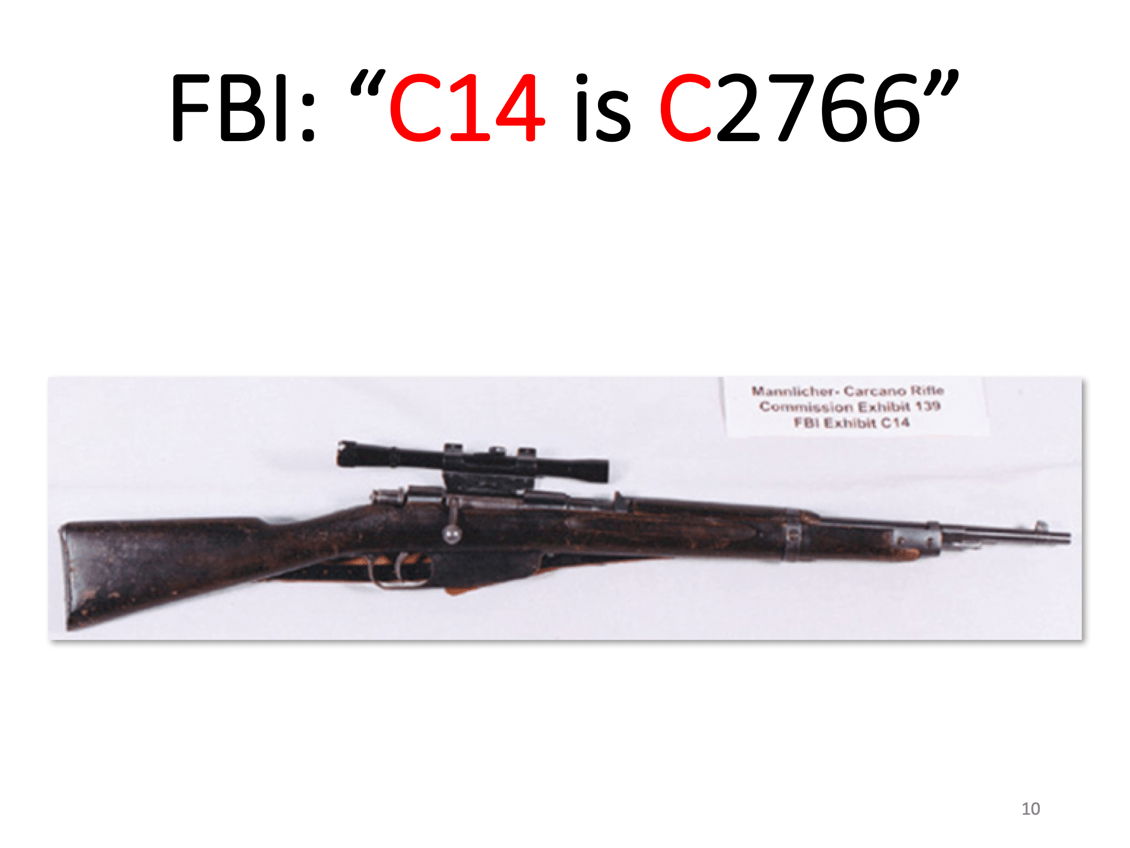
“C14 is C2766” is a FBI fib used to incriminate Oswald. This declaration came in early December. The report from William Harvey’s Italy said it was a 7.35 model 91/38, among all sorts of interesting things that never made their way into the Warren Commission Report (WCR). Instead, we are told by the FBI that C14 is C2766. Hail Hoover. C14 ≠ C2766b>. On March 27, 1964, Alfred Finish, “professional gunsmith at the Empire Wholesale Sporting Goods,” Montreal, Canada, “assisted in taking critical measures” of the rifles then shipped to Mr. Ouimet. Mr. Ouimet claims to be the owner of Empire Wholesale (aka Century International Arms) owned by William Sucher and source for 700 identical rifles to the one pictured above. We’ll return to Mr. Sucher and Century International Arms (C.I.A.). Mr. Ouimet gives these measures of an “identical model” of the rifle used in the JFK assassination: total length 40 3/16″ – stock 34 3/4″ – barrel and action 28 15/16″ – barrel only 21 1/8″ – rear to receiver 26 1/2.” He underscores the Carcano he had examined during the years “had no set pattern regarding serial numbers.”

For argument sake, let’s agree with “C2766” identifying that rifle uniquely. It’s much easier to create paper copies of copies than to stamp a rifle.

Given Texas in 1963, how did they fall upon Feldsott in NYC?

FBI SA Nat Pinkston is listed as a TSBD employee in the WCR index. He was an FBI agent. His testimony only dealt with Oswald’s clipboard from December 2. His name is on this report having spoken to Al Yeargan about the rifle at the H.L. Green Company (a local department store selling surplus WWII weapons), yet he is never asked about the conversation. 40 years later, H. L. Green is no longer included. We go from Titche-Goettinger right to Klein’s. What SA Pinkston did in 1963/4 and recounts years later bear little resemblance to each other. His recent revelations are uniquely his and are not authenticated or corroborated by any other evidence.
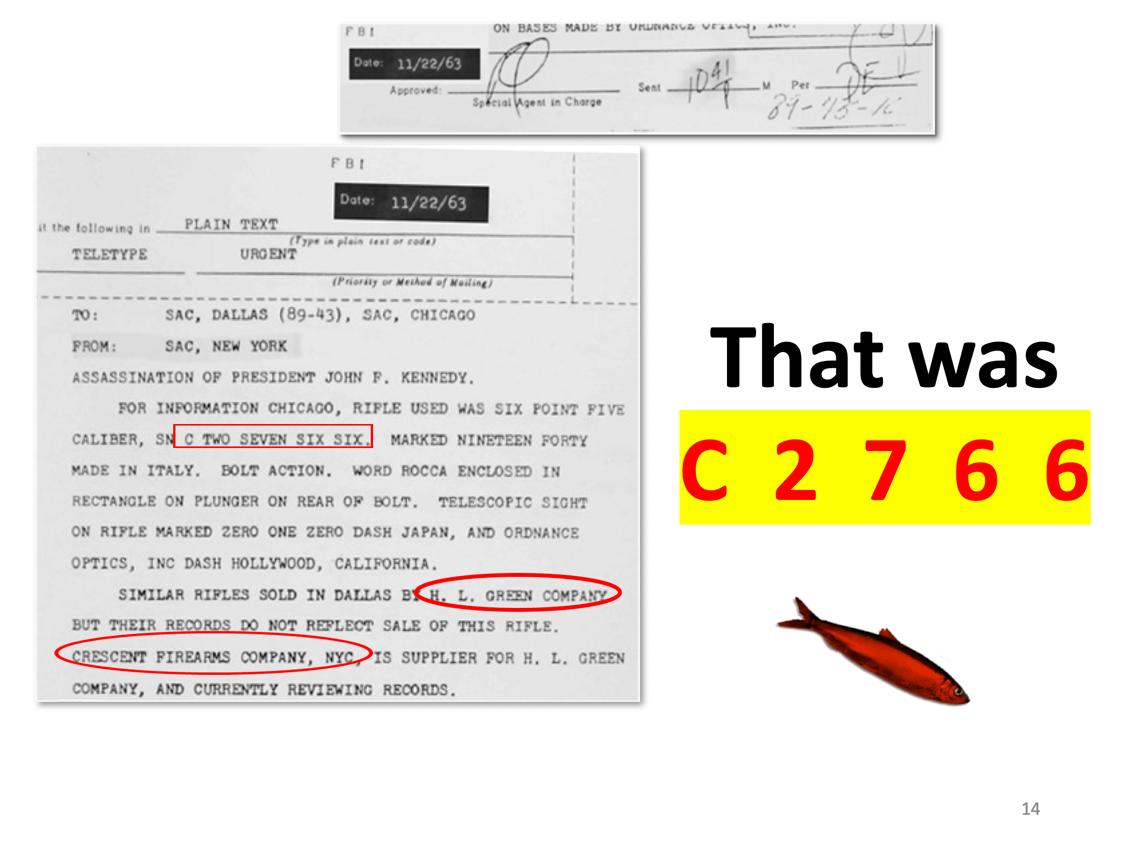
The SAC in New York City is talking about the records of H. L. Green in Dallas to Chicago 7 hours after the fact. Green says they get their stuff from Crescent Firearms in New York City. Again, info on a 6.5mm C2766 takes 7 hours to convey thru New York City to Chicago, so the Chicago FBI can go to Klein’s?

Here is the famous affidavit and, not so famous, Rankin note that came with it. Rankin sends Al Feldsott a completed affidavit for his signature and notarization in July 1964. The same thing happens with the H. L. Green employees. This concludes that C 2766 was, indeed, sold to Klein’s Sporting Goods on June 18, 1962, and this info was conveyed to the FBI on the night of November 22. Subsequently, other records are turned over as well.

On the evening of November 22, the FBI has its evidence. “Mr. White in the study with a candlestick” à la the game, Clue. Crescent to Klein’s on June 18th with C2766.
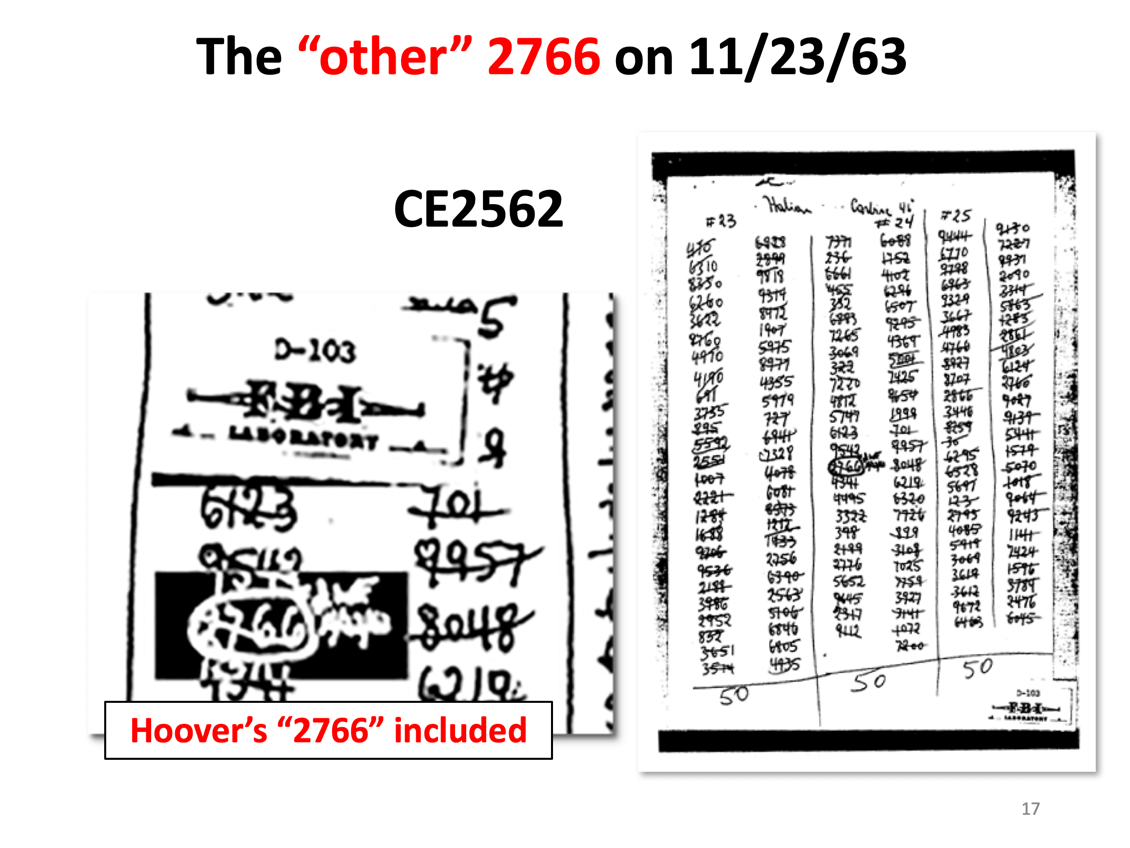
William Sucher, owner of Century International Arms, Inc., and Empire Wholesale are the sources to the FBI that the serial numbers on World War 2 surplus rifles are by no means unique. Not one of the 700 has a letter prefix identified. As I discovered, James Ouimet, who is referred to as the “President” of Century Arms, was actually a figurehead, put in place by Sucher and his associates to run Century on their behalf. (G. Murr Education Forum post of 11/26/17) Owner: Empire Wholesale & International Firearms Limited, now known as Century International Arms, CIA.

We also learn that they are the exact same rifles as the Century 700. “38E” internationally known and “T-38” domestically known as Carcano Fucile Corto rifles. The Klein’s customer invoice copies are simply the duplicates of the original 1960 shipments to Crescent from Italy.
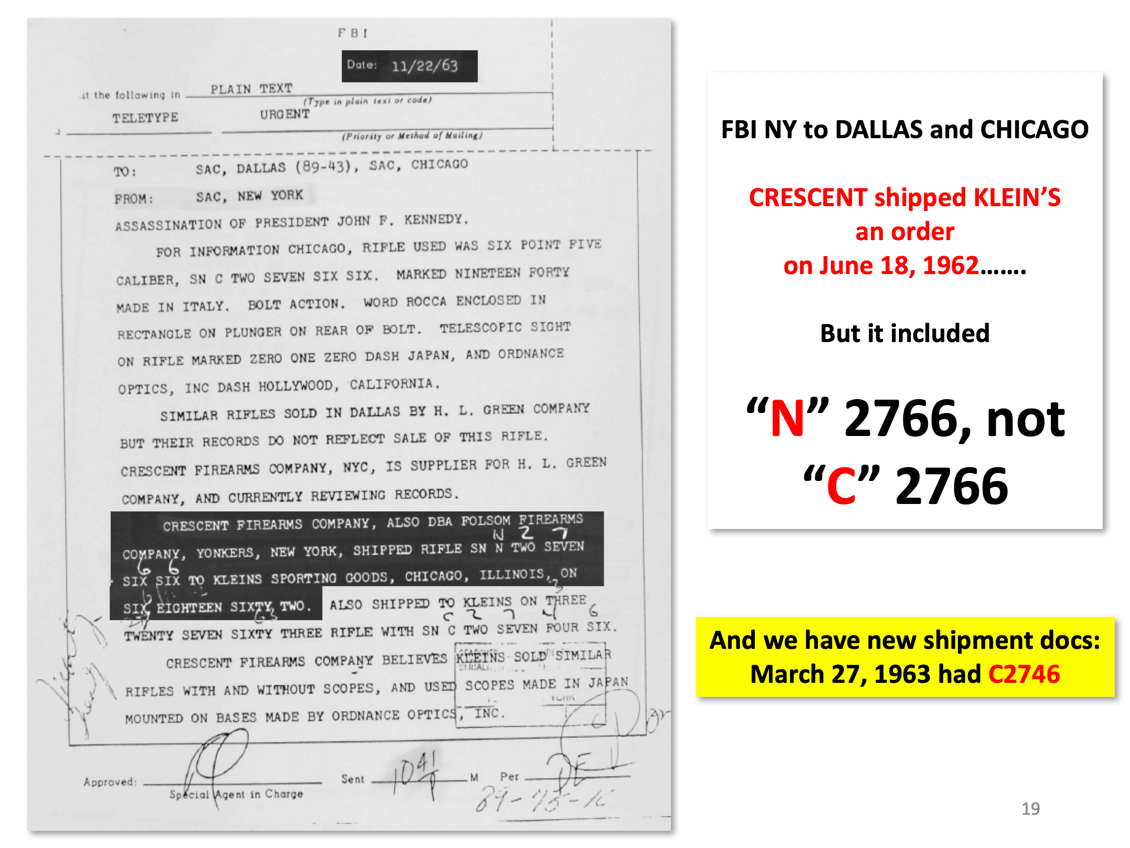
The rest of that November 22 memo confirms a June 18, 1962, shipment sent to Klein’s, yet the rifle listing only includes an N 2766, not C.

The New York City FBI SAC confirms with the FBI lab that the rifle in question has 5 digits: C 2766. The records of Klein’s from the night before shows they received “N 2766”. What is the FBI at Klein’s to do now?

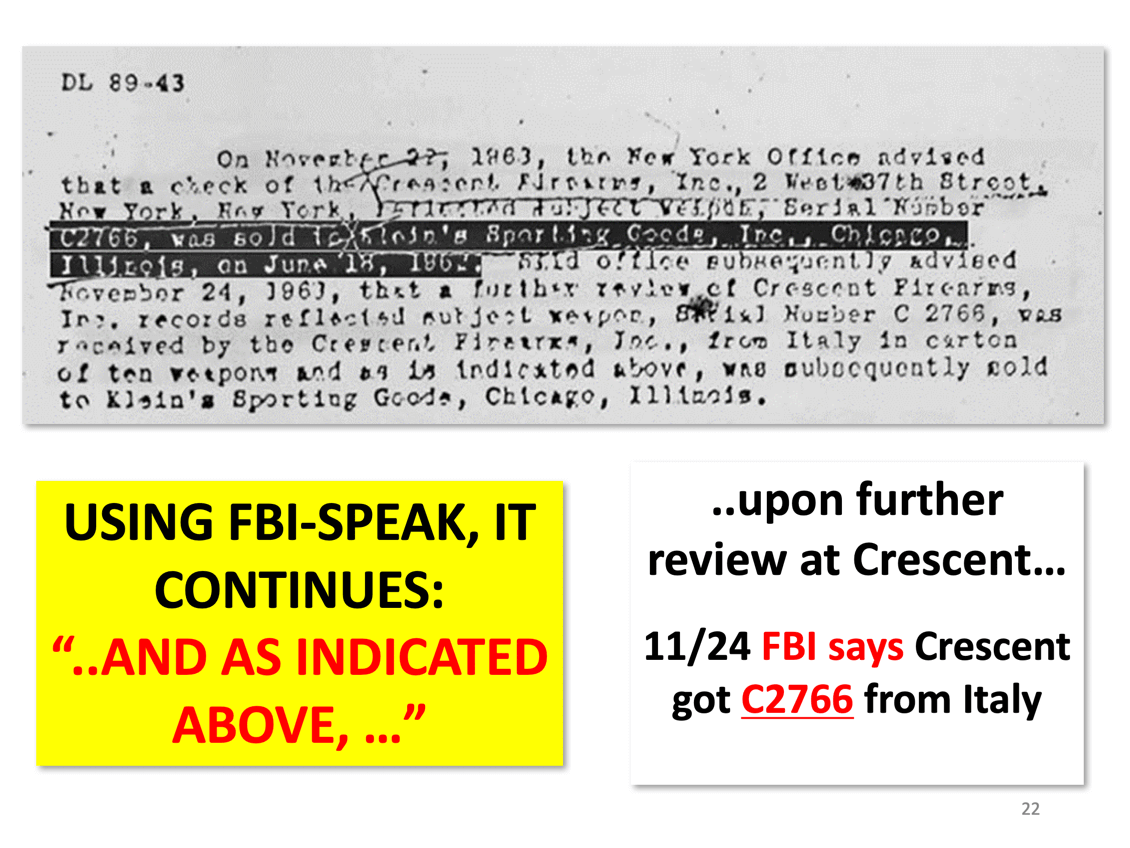
The New York City FBI revises their story on the November 24, confirming that C2766 was received by Crescent from Italy. Thank you, Sherlock Holmes. That it was sold to Klein’s “subsequently” as indicated above, on June 18, 1962. Yet somehow, 2 days earlier, SA Dolan and Waldman and Scibor from Klein’s find the order blank on microfilm.

Does the FBI know something we didn’t that needed proof by November 24?

N 2766 does not appear anywhere in the WCR. June 18, 1962, is on the Feldsott contact sheets, an affidavit, and reconfirmed a number of times in FBI documentation.

This single sheet of paper related to a February 1963 delivery is based upon 10 packing slips sent from Italy to Crescent for Adams Consolidated and in the possession of the FBI on Friday evening, according to the evidence. Notice the 1259 in the top right-hand corner. Yet, the order was 1243, as testified to by General Manager Michael Scibor and Klein’s VP William Waldman. It is very possible the original order written on this page was 1259. As we saw, there were orders in June 1962 and March 1963 in the Klein’s and Crescent records, not February 22, 1963.
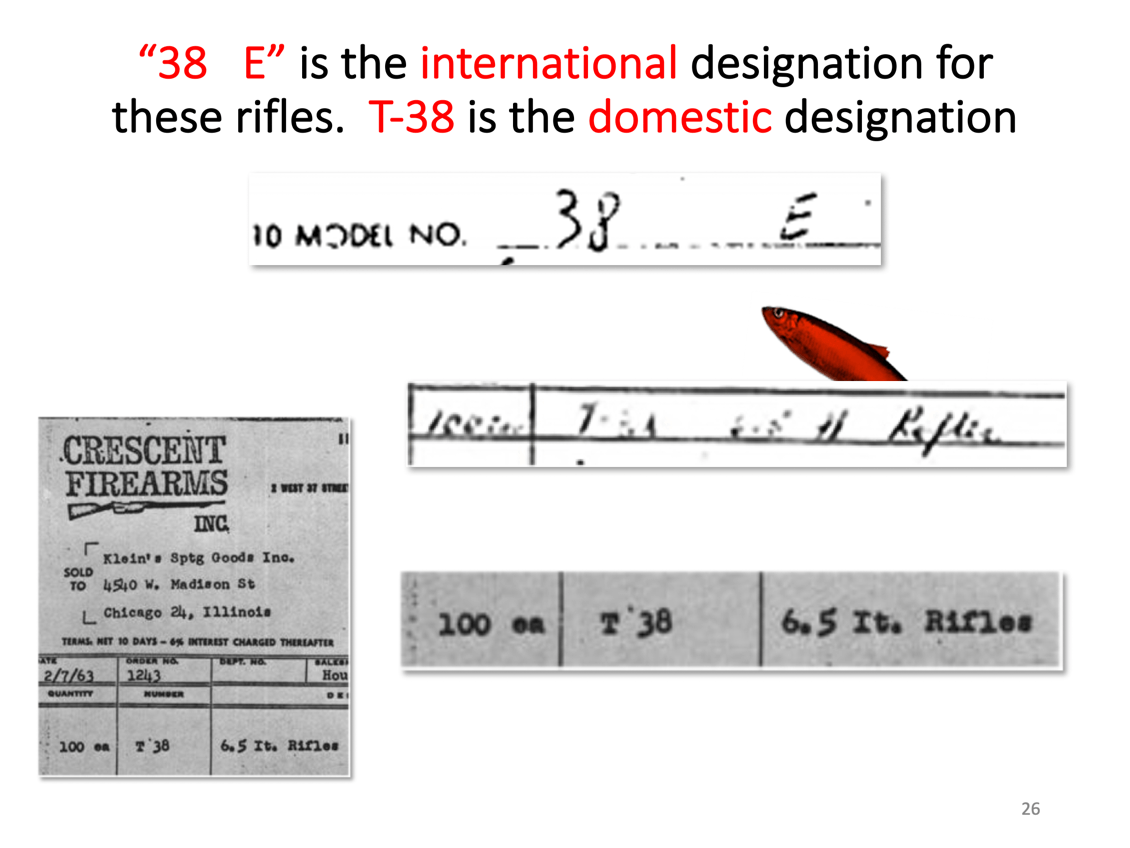
The 10 Feldsott slips would not have been sent to Klein’s as part of their order. Sadly though, we do not know what they would send, for all we have are these 10 slips referring to 38 E, not T-38. It is a small detail I know, yet another brick in the wall.
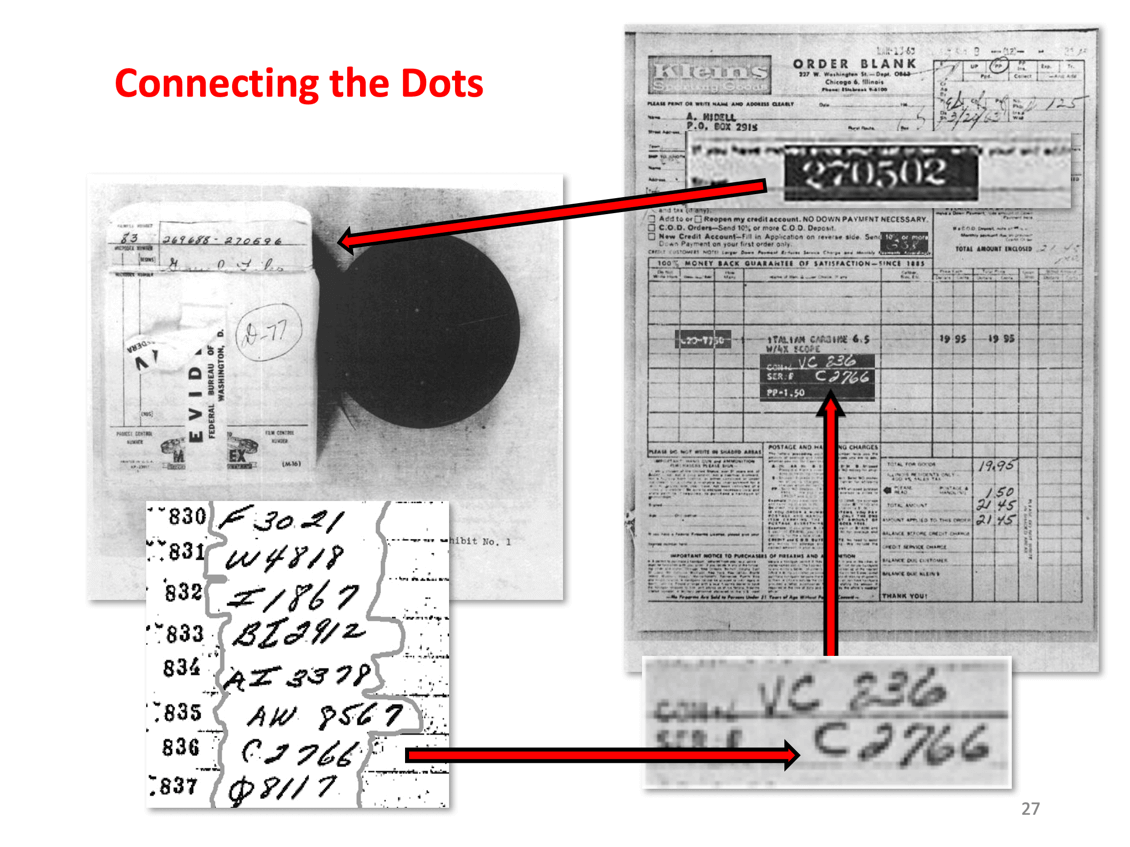
Here’s the evidence, the microfilm creates the order blank. The order blank’s handwriting connects the rifle with the list and nothing else. The “VC=Serial # list” claimed to be kept in a master ledger by Klein’s General Manager Michael Scibor, is claimed to be Klein’s way of tracking serial numbers on rifles. When a shipment comes in, the next blank VC# is used to start listing the rifle serial numbers in the shipment. Unless we can see another VC=Serial # list that actually matches real rifles with real orders or any other order showing any one of these 99 rifles, the data on this page could conceivably have been created that night. The details of the evidence will bear this out. At this point, the “VC List Evidence” simply corroborates itself and only for this one rifle. There were 99 more in inventory.


With just those 2 pieces of evidence, the FBI is able to connect the receipt of C2766 with an order sent to Klein’s in February 1963. Yet, the FBI also told us on the 22nd about the March 1963 order with C2746. On November 22 and 23, there was no mention of a February 1963 order at either Crescent or Klein’s. There is more to it than that, but you’ll need to read my paper, The Klein’s Rifle.

This is page 2 of 2 for order 1243. The original order number from January 1962. It also says “1259 Page 2 of 2 pages”. A subsequent order becomes the February 1963 order now containing C2766.
How did they use the information that Crescent supplied the rifle to find this customer order? (Does this make any logical sense?)

The receiving records from vendors would make it much easier to locate a shipment from a vendor, whereas how does one even begin to locate a sales order with only the serial number and vendor? Those 2 memos on the 22nd and 23rd left the FBI kinda screwed.
Remember that on Friday and Saturday there are no records for C2766.

Or that Crescent sent them orders in June of 1962 and March of 1963, not February 1963.

After Friday evening into Saturday morning, 3 FBI Special Agents including Dolan put their names on a report (WCD7, page 187). SA’s Toedt and Mahan will provide virtually nothing else to the Warren Commission Documents.

The next page of the report/memo does not have any signatures, but does tell us that Waldman kept the microfilm.
Virtually the same report is found on the next page (WCD7, page 189), yet the outcome is completely different. This time only Dolan writes a report, in which he claims to have taken the microfilm and provided Waldman with a receipt. The chain of custody for this microfilm is now a hot mess.

Months later, in testimony, Waldman is no longer talking about his safe and being subpoenaed. He gave that microfilm to the FBI. I’m told by those who went, the microfilm itself is no longer in its box at the archives. Just an empty box. If only a copy of the film was made.

FBI SA Dolan alone claimed he took the microfilm by the morning of the 23rd. What we come to learn is that copies of this film are made in the weeks after November 22. Dolan gives a copy back to Waldman and once again it is said that Dolan acquired the film from Waldman on the 23rd. Originals with the FBI and copies to the Warren Commission were standard FBI operating procedure. With the original in the FBI’s hands from November 23 until the first copy is returned on December 6, there is no way to know what transpired with that film. I wonder if the copy and the FBI original have the same things on them?
The microfilm creates the Order Blank. The Order Blank connects to the February Klein’s shipment via 1 piece of paper. What was on the original microfilm is simply no longer knowable.


Waldman tells us he removed the remaining stock of “assassination” rifles on Monday the 25th. In 1978, we learn the FBI had Klein’s mount scopes on at least 12 rifles, that 40″ rifles were not scoped, and some rifles have no inscription at all. Sharp is not called to the Warren Commission.

It’s as if those 100 rifles were never at Kleins in the first place.
None of the people who were actually involved in receiving/shipping this product are interviewed, while Dolan remains an integral part.

Westra concurs with Sharp about scoping 40″ rifles, but then is set straight. Since the 40″ rifle at the archives is scoped, y’all must have done it. Any information on Lido Luccesi would be appreciated.

Given the mountain of paper we are given in this case, it remains an obvious “mystery” how Oswald can go through his paces from January 1963 to November 1963: order, pay for, and get delivered both a rifle and a pistol—and yet not have a single page written about those occurrences in any report from any agency prior to November 22nd.
At the end of the day, the only things with a print of Oswald’s are a box and some paper. The rest is Lieutenant Day being helpful.
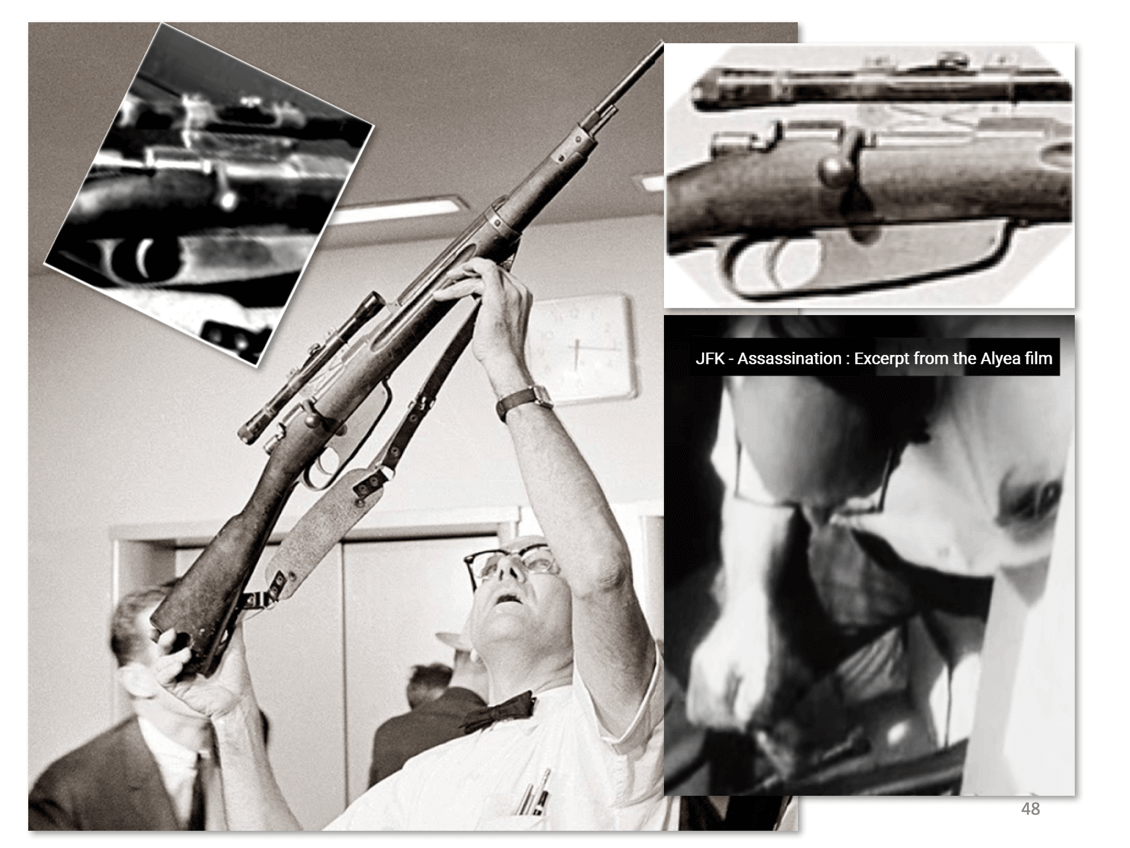
It is not until well after Oswald is dead, that these fingerprint lifts even get consideration at the FBI.

The rifle goes to Washington DC with SA Vincent Drain on the night of the 22nd, only to be returned and taken again on the 26th. Amazingly, the prints travel from one side of the trigger guard to the other.
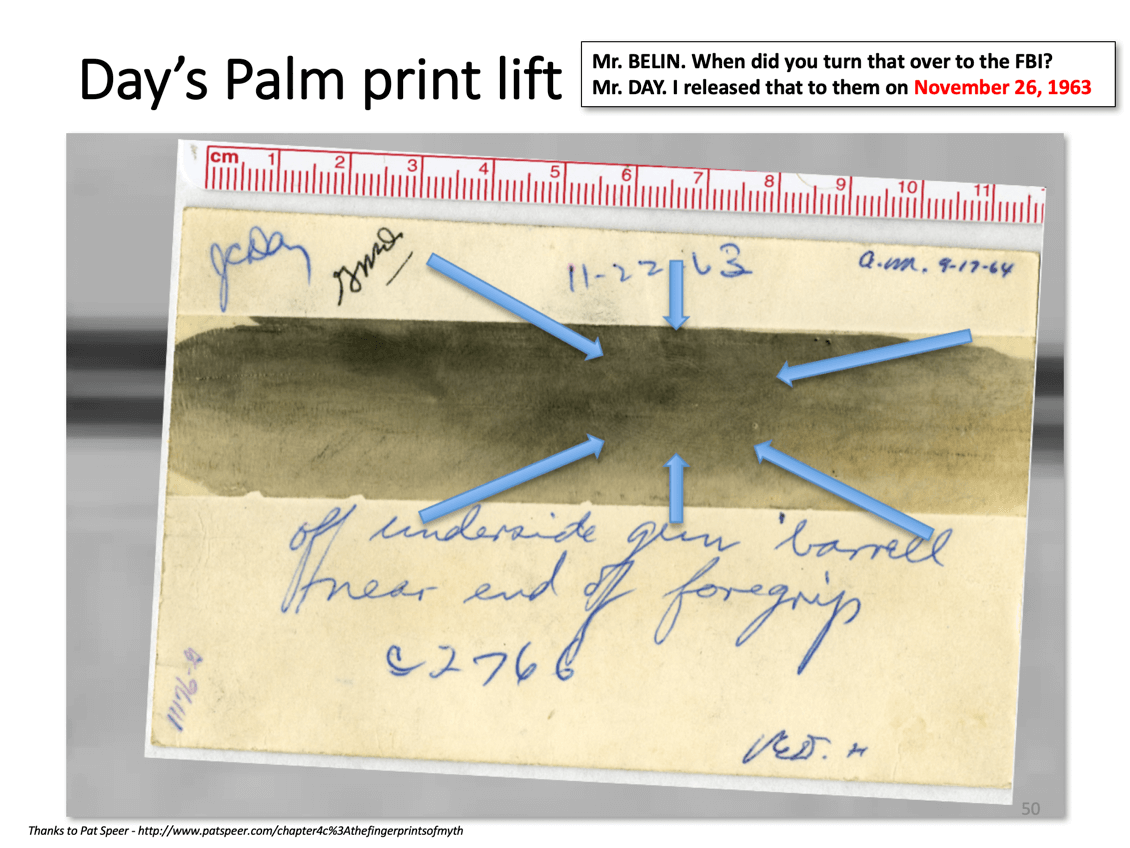
Having taken no photos of the print where it was found, there is only a photo of the lift which was not sent to the FBI with everything else that night.

There is no part of the barrel showing from the underside of the rifle. Day’s palmprint appears to exist only to suggest Oswald assembled and disassembled the rifle. Despite numerous smooth metal parts including the shells and clip, Day’s prints are highly suspicious.

Lt. Day needed to explain quite a few things that went awry that first day. Claiming he was told to stop working on the rifle, he claims that’s exactly what he did in mid stroke. Subsequent reports are filled with his excuses.

In 1978, the HSCA requested to see this “lift”, seeing it was part of the evidence Drain takes again on the 26th. Yet again, we have Day stating all the evidence was taken the 22nd. This palmprint cannot be found—the official reason states:

In other words, they lost it.
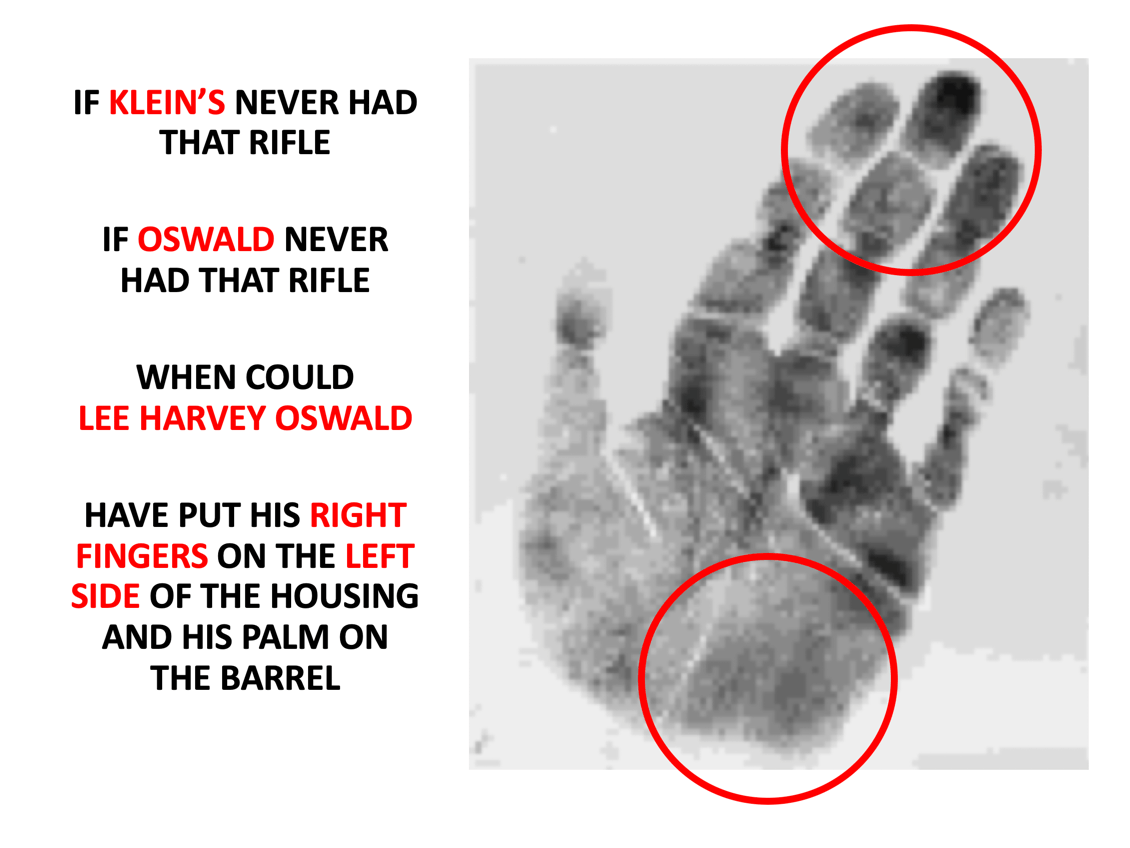
In the 50’s, the FBI copied and planted prints regularly, along with lying about informants, as well as, virtually all manner of evidence.

What if there was no money order, like there was no February order? But the FBI needed evidence of one.

The evidence shows the Postal Money Order (PMO) found on 3 different timelines.

The first is in Kansas City by the Secret Service

The second is reverse engineered by Holmes and gang by looking at magazines and guessing about shipping. “Now you thumb through those,” I said, “and when you come to Klein’s Sporting Goods, let’s see what it looks like.” It wasn’t but a couple of minutes that one of the girls hollered, “Here it is!” So I looked at it and down at the bottom of the ad it said that that particular rifle was such and such amount. But if it could not be carried on a person, such as a pistol, like a shotgun or a rifle, then it was $1.25 or $1.37 extra. Shipping charges were also added, so I added those together, took that figure and called around to all the different stations and the main office where these crews were checking stubs. It wasn’t ten minutes that they hollered, “Eureka!” They had the stub!

The third, and most interesting, is that of the FBI’s in Alexandria, Virginia. You can read all about it in the Rifle Money Order Timeline. For our purposes, the most important things to know about this money order are:
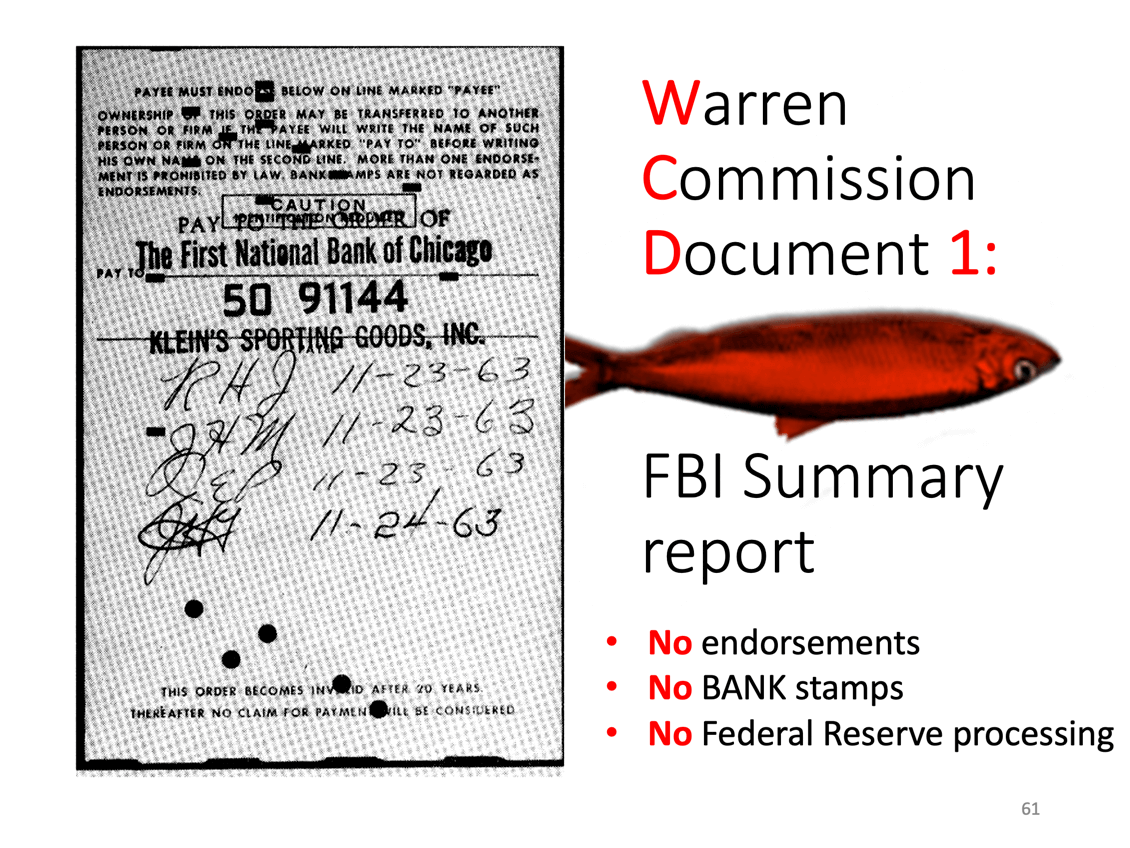
Remember, the year is 1963. Who saw Catch Me If You Can? Passing bad checks was easier then, because the process took so long and was not computerized.

We have a number of proofs outside of the Warren Commission Report. J. Harold Marks—the same man—testified in 1960 about tracking Postal Money Orders “as paid through the Federal Reserve Bank.” Another 1960 bit of evidence is this New York Federal flyer explaining how Postal Money Orders are to be accepted as cash items.
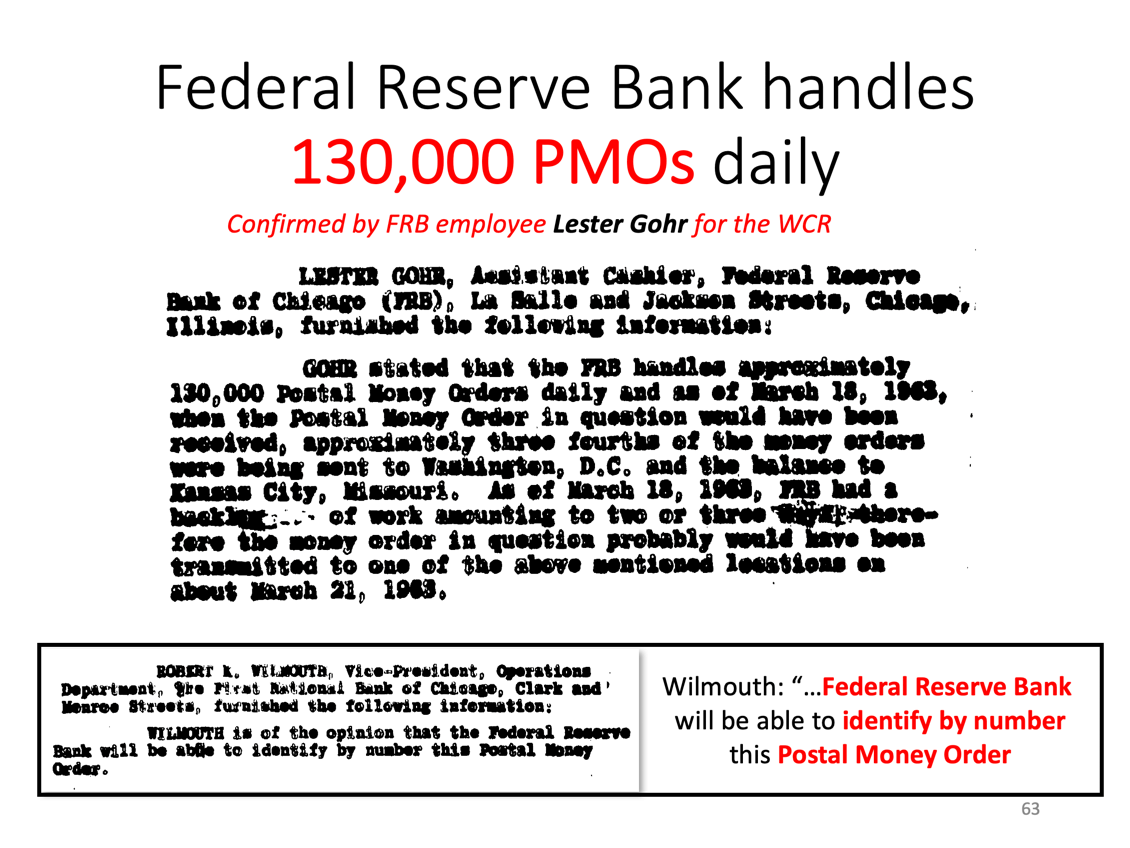
And finally, in the Warren Commission Documents themselves, with Lester Gohr of the Federal Reserve and Wilmouth of Chicago 1st National reconfirming that Postal Money Orders are processed and recorded by these banks for very specific reasons.


I’d like to begin finishing up with some of the evidence which suggests there were never any shipments of merchandise to Oswald. At his Dallas Post Office Box, Hidell was not listed. Given what was going on with the Dodd investigations (a Senate Committee investigating mail order pistol and rifle sales in the US—Klein’s and Seaport were 2 of their targets), it would seem that a 5′ carton addressed to the wrong person constitutes “where possible”. In the weeks after the assassination, VP Waldman will tell his “partner in microfilm crimes”, SA Dolan, that Senator Dodd’s Committee “was on his back.” It was known that Dodd used “cut-outs” to order rifles as part of his investigation—some surmise that Oswald may have been one of these cut-outs using the name Hidell.

Given the reality of this and how this rifle suddenly appears after November 22, it defies common sense and logic to believe this goes unnoticed.

In fact, a box of that size would have triggered the mailing of a notice for Oswald to come claim his oversized package. Yet the package is addressed to Hidell.
With the need to generate this notice, the rules and regulations are put to an even more stringent test. As we now know, none of this happened.

I’d like to end today with some more evidence, which I see betraying the conspiracy. The evidence shows that he took 2 small bags with him, when leaving Magazine Street after Ruth leaves with Marina. Yet, the rifle is placed at the Paine’s in October. There’d be only 1 way to get it there.

If Ruth was supposed to help incriminate Oswald, this didn’t help.
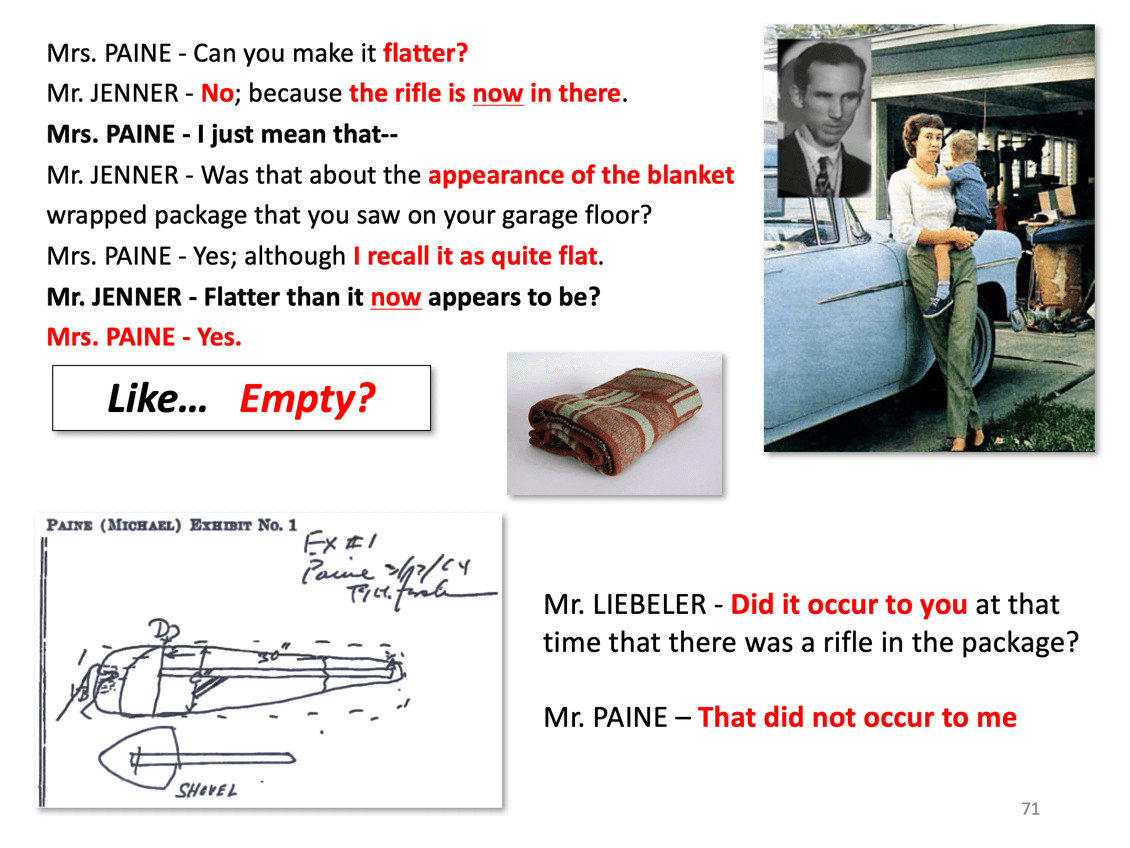
Neither did this and neither does Michael.

While many have erroneously injected themselves into this storyline for personal gain or profit, we must look to those who suffered at the hands of the FBI for telling an inconvenient truth.
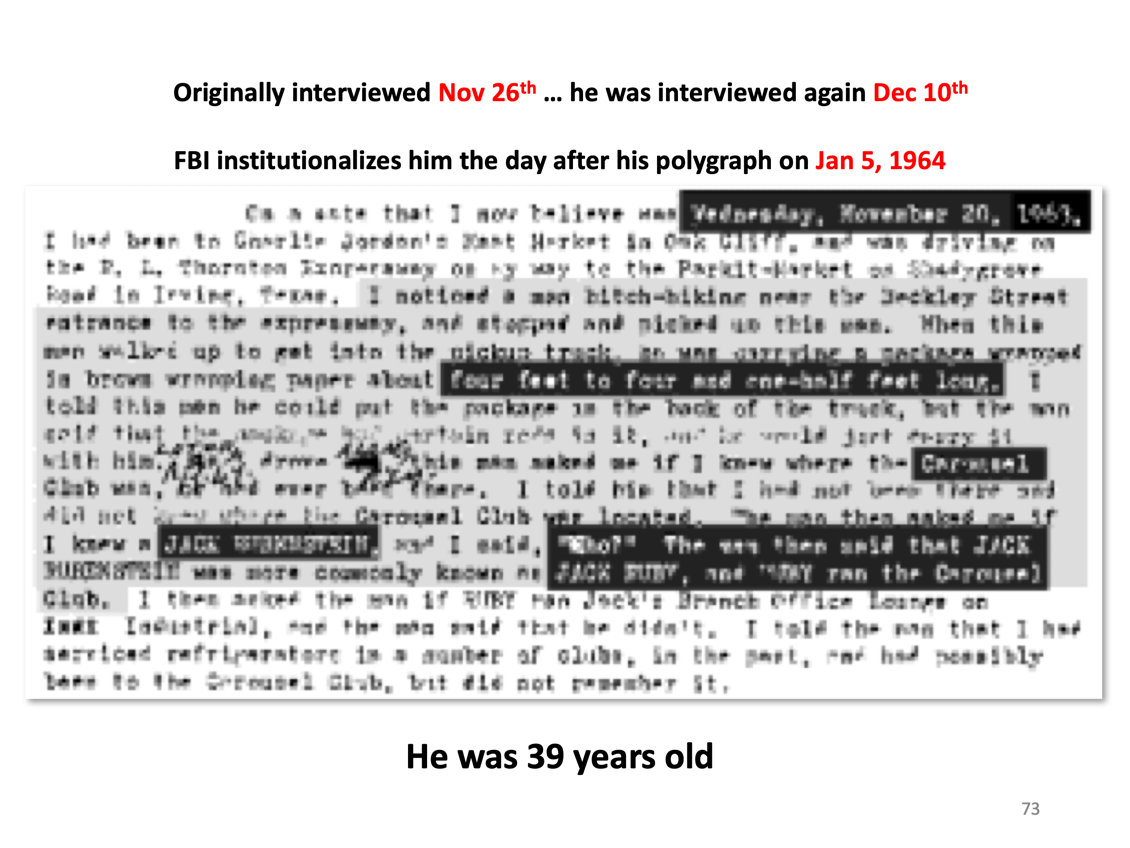
Abraham Bolden comes to mind. FBI recalls Yates for a polygraph January 4, 1964: “No significant emotional responses were recorded.” The FBI could therefore not reach a conclusion about Yates. On January 5, 1964, at the insistence of the FBI, Yates begins 11 years of mental institutionalization. “They told me that he was telling the truth [according to the polygraph machine], but that basically he had convinced himself that he was telling the truth. So that’s how it came out. He strongly believed it, so it came out that way.” (Dorothy Yates Walker 2006)

Despite being the object of numerous 3 letter agencies, we find nothing in the evidence related to these weapons prior to November 22nd.
