
Has anyone ever been more conscious, from birth to death, of his coming murder? Malcolm X saw his own violent death in advance just as clearly as his mother Louise Little saw the imminence of his father’s death, on that afternoon in 1931 when her husband Earl left their house and began walking up the road toward East Lansing, Michigan.
“If I take the kind of things in which I believe, then add to that the kind of temperament that I have, plus the one hundred percent dedication I have to whatever I believe in … These ingredients would make it just about impossible for me to die of old age.”
“It was then,” Malcolm says in his autobiography, “that my mother had this vision. She had always been a strange woman in this sense, and had always had a strong intuition of things about to happen. And most of her children are the same way, I think. When something is about to happen, I can feel something, sense something.”1
His mother rushed out on the porch screaming. She ran across the yard into the road shouting, “Early! Early!” Earl turned around. He saw her, waved, and kept on going.
That night Malcolm awakened to the sound of his mother’s screaming again. The police were in the living room. They took his mother to the hospital, where his father had already bled to death. His body had been almost cut in two by a streetcar. Earl Little had been an organizer for Marcus Garvey’s United Negro Improvement Association, the largest black nationalist movement in American history. Malcolm was told by blacks in Lansing that his father had been attacked by the white racist Black Legion. They put his body on the tracks for a streetcar to run over.
Malcolm believed that four of his father’s six brothers were also killed by white men. Thus the pattern of his own life seemed clear. “It has always been my belief,” he told his co-author Alex Haley, “that I, too, will die by violence. I have done all that I can to be prepared.”2 Malcolm prepared for death by living the truth so deeply that it hastened death. This is the theme of Malcolm X’s autobiography. “To come right down to it,” Malcolm said to Alex Haley, “if I take the kind of things in which I believe, then add to that the kind of temperament that I have, plus the one hundred percent dedication I have to whatever I believe in … These ingredients would make it just about impossible for me to die of old age.”3
As the story neared its end, with Malcolm more and more totally surrounded by forces that wanted him dead, he no longer saw himself as among the living. “Each day I live as if I am already dead … I do not expect to live long enough to read this book in its finished form.”4 And he was right: he died in Harlem on the same day he had originally intended to visit Alex Haley in upstate New York to read the final manuscript.
The assassination of Malcolm X on February 21, 1965, at the Audubon Ballroom in New York City was carried out through the collaboration of three circles of power: the Nation of Islam (NOI), the New York Police Department (NYPD), and U.S. intelligence agencies. Malcolm was, as he knew, surrounded at the end by all three of these circles. In terms of their visibility to him and their relationship to one another, the circles were concentric. The Nation of Islam was the nearest ring around Malcolm, the less visible NYPD was next, and the FBI and CIA were in the outermost shadows. The involvement of these three power circles in Malcolm’s murder becomes apparent if we trace his pilgrimage of truth through his interactions with all three of them.
 |
| Malcolm X and Alex Haley |
In writing this essay, I have been guided especially by the works of five authors. The first three are Karl Evanzz, Zak Kondo, and Louis Lomax. Washington Post online editor Karl Evanzz is the author of The Judas Factor: The Plot to Kill Malcolm X5 and The Messenger: The Rise and Fall of Elijah Muhammad.6 Evanzz’s two books complement each other brilliantly in presenting a full picture of Malcolm’s assassination, the first emphasizing the U.S. government’s responsibility and the second, that of Elijah Muhammad and the Nation of Islam. Zak A. Kondo, a professor at Bowie State College, does it all in one book, Conspiracys: Unravelling the Assassination of Malcolm X,7 which follows an unusual (though strangely accurate) title with a complex analysis of the three murderous circles: NOI, NYPD, and U.S. spy agencies. His self-published, out-of-print book that is almost impossible to find has 1266 endnotes, all of which deserve to be read. Then there is Louis Lomax’s To Kill a Black Man,8 first published in 1968, two years before Lomax’s own death in a car accident. As both a faithful friend to Malcolm and a writer wired to what was happening, Lomax already pointed to a solution of Malcolm’s assassination.9 I said I have five guides. The last two are Malcolm X and the man who lived to tell his tale, Alex Haley.
The Autobiography of Malcolm X is the transforming work of both. Haley in his epilogue hints at what Malcolm in his last days realized and was on the verge of shouting—that it was the government, not Elijah Muhammad, and Malcolm’s African connection, not his NOI rejection, that were the primary agent and motivation behind the plot. Malcolm is the ultimate guide to understanding his own murder.
In a memorandum, written four years after Malcolm’s death, the Special Agent in Charge of the FBI’s Chicago office stated that:
Over the years, considerable thought has been given and action taken with Bureau’s approval, relating to methods through which the NOI, could be discredited in the eyes of the general black populace. … Or through which factionalism among the leadership could be created … Factional disputes have been developed—the most notable being MALCOLM X LITTLE.10
 |
| Malcolm X and Elijah Muhammad |
The FBI developed the factional dispute that led to Malcolm’s death by first placing at least one of its people high within the Chicago headquarters of the Nation of Islam. Its infiltrator then worked to widen a division between Elijah Muhammad and Malcolm X. To the FBI’s alarm, this process was inadvertently described, and the FBI man identified, in the 1964 book When The Word Is Given, written by Louis Lomax.
In the paragraph that gave away the FBI’s game, Lomax began by observing that Elijah Muhammad had moved from Chicago to Phoenix, Arizona, for the sake of his health. Lomax then described a significant shift of power. Elijah he said had delegated to his Chicago office not only the NOI’s finances and administration, but also “the responsibility for turning out the movement’s publications and over-all statements,” thus taking away from Malcolm X his critical control over the NOI’s flow of information.
“at one time carried some of these responsibilities, particularly the publishing of the Muslim newspaper..,. And many observers thought they saw an intra-organizational fight when these responsibilities were taken from him and given to Chicago.11
The thing that dismayed the FBI most was the paragraph’s final sentence, which disclosed a hidden factor in this abrupt transfer of power away from Malcolm. The sentence stated that “this decision by Muhammad was made possible because John X, a former FBI agent and perhaps the best administrative brain in the movement, was shifted from New York to Chicago.12
Lomax’s sentence about “John X, a former FBI agent” set off alarm bells in FBI counterintelligence, especially in the office of William C. Sullivan. Assistant FBI Director Sullivan was in charge of the illegal Counterintelligence Program (COINTELPRO) designed to develop a “factional dispute” between Elijah and Malcolm. Sullivan was a high-level commander of covert action. Among his projects was an all-out FBI campaign “aimed at neutralizing [Dr. Martin Luther] King as an effective Negro leader,” as Sullivan put it in a December 1963 memorandum.13
 |
| COINTELPRO chief William C. Sullivan |
On March 20, 1964, COINTELPRO chief Sullivan was alerted by an “airtel” from the FBI’s Seattle field office to the objectionable passage in When The Word Is Given.14 The hardcover edition of the book had been published in late 1963, only a few months before what Sullivan must have regarded as a COINTELPRO success story, Malcolm’s March 8, 1964 announcement of his split with Elijah Muhammad. The problem was that to a discerning reader of both the Lomax paragraph and the news of the split, the FBI could be recognized as a key disruptive factor.
 |
| John X Ali Simmons announcing Malcolm X suspension from the Nation of Islam |
An FBI official recommended in a memorandum to Sullivan that “the New York Office should be instructed to contact Lomax to advise him concerning the inaccurate statement contained in this book regarding [John X Ali] Simmons. … And that he be instructed to have this statement removed from any future printings of the book.”15 FBI Director J. Edgar Hoover added his personal “OK” to this recornmendation.16 Lomax, however, ignored the FBI’s pressure as well as John Ali’s anger at his having made the statement. He never retracted it. In his later book, To Kill a Black Man, he repeated it, and said that John Ali knew it was true.17 In the six years leading to his death, Lomax never clarified what he meant by the term “former FBI agent.” He may have been giving Ali the benefit of a doubt as to his having severed his FBI connection by the time Lomax mentioned it in 1964. In any case, the FBI had other informants in the Nation of Islam to take his place.
Wallace Muhammad, Elijah Muhammad’s independent-minded son, also believed that FBI informants were manipulating NOI headquarters at the time Malcolm and Elijah became antagonists:
The FBI had key persons in the national staff, at least one or two maybe. They were preparing for the death of the Honorable Elijah Muhammad [in terms of determining his successor]. I believe that the members of the Nation of Islam were influenced to do the things that they were doing not just by the national staff and my father but also by the intelligence department.18
Wallace Muhammad was in a position to know at first hand the FBI’s process of working with NOI informants. The FBI considered him one of them. Karl Evanzz, in researching his biography of Elijah Muhammad entitled The Messenger, discovered from FBI documents that in addition to John Ali, at least three other people were regarded by FBI agents as “reliable sources” close to Muhammad. The first man was Abdul Basit Naeem, a Pakistani journalist who served as an NOI publicist. Then there is Hassan Sharrieff, Elijah Muhammad’s grandson and Wallace Muhammad. Evanzz concludes that the FBI thought “Wallace and Hassan fit the bill because they had provided the Bureau with information it considered crucial to inciting violence between Muhammad’s camp and Malcolm X.”19 Wallace’s and Hassan’s reasons for talking with the FBI seem to have been simply to seek protection from members of their own family, who threatened to kill them for going against Elijah. The FBI then recycled their information for its own use in plotting against Malcolm and Elijah.
“I believe that the members of the Nation of Islam were influenced to do the things that they were doing not just by the national staff and my father but also by the intelligence department.” ~Wallace Muhammad
It was Louis Lomax’s revelation of the FBI’s covert process within the NOI that so concerned the Bureau. Lomax’s statement had given his readers a glimpse into a critical part of the FBI’s COINTELPRO strategy to divide and destroy the Nation of Islam, thereby silencing as well its most powerful voice, Malcolm X.
FBI documents show that the Bureau had been monitoring Malcolm X as far back as 1950, when he was still in prison.20 The Bureau began to focus special attention on Malcolm in the late ’50s, when it realized he had become Elijah Muhammad’s intermediary to foreign revolutionaries. From Malcolm’s Harlem base of operations as the minister of the NOI’s Temple Number Seven, he was meeting regularly at the United Nations with Third World diplomats. In 1957 Malcolm met in Harlem with visiting Indonesian President Achmed Sukarno, whom the CIA had targeted for removal from power. Sukarno was extremely impressed by Malcolm.21 As early as eight years before Malcolm’s death, the FBI and CIA were watching the subversive international connections Malcolm was making.
 |
| Abdul Basit Naeem |
In 1957 when Malcolm X was becoming the NOI’s diplomat to Third World leaders, Abdul Basit Naeem was developing into Elijah Muhammad’s public relations man in the same direction.22 Naeem was a Pakistani journalist living at the time in Brooklyn. His first project with Elijah was a 1957 booklet that combined international Islamic affairs with coverage of the Nation of Islam.23 Evanzz discovered that Abdul Basit Naeem became extremely cooperative. Not only was he cooperative with the FBI but also with the New York Police Department’s intelligence unit, “BOSSI” (the acronym for Bureau of Special Service and Investigation).24 BOSSI would later succeed in planting one of its cover operatives in Malcolm’s own security team. The FBI and BOSSI would prove to be linking agencies in the chain of events leading up to Malcolm’s assassination.
At this time Malcolm had also become the apparent successor to Elijah Muhammad, who then loved and respected his greatest disciple more than he did his own sons. Accordingly, the FBI’s Chicago field office, which was monitoring all of Elijah’s communications, told J. Edgar Hoover in January 1958 that Malcolm had become Elijah’s heir apparent.25 Evanzz has described the impact of this revelation on the FBI’s COINTELPRO section:
The secret to disabling the [NOI] movement, therefore, lay in neutralizing Malcolm X.26
Evanzz suggests the FBI began its neutralizing of Malcolm in 1957 by utilizing a police force with which it worked closely on counterintelligence, the New York Police Department.
 |
| Malcolm in NYC (1957) “No man should have that much power” |
The NYPD was already in conflict with Malcolm. In April 1957 in Harlem, white policemen brutally beat a Black Muslim, Johnson X Hinton, who had dared question their beating another man. The police arrested the badly injured Hinton and took him to the 28th Precinct Station on 123rd Street. When the station was confronted by a menacing but disciplined crowd, Malcolm X demanded on their behalf that Hinton be hospitalized. The police finally agreed, and were shocked by Malcolm’s dispersal of the 2,600 people with a simple wave of his hand. They concluded with alarm that he had the power to start as well as stop a riot. The city and police also had to pay Hinton $70,000 as a result of an NOI lawsuit.27 A police inspector who witnessed Malcolm’s dispersal of the crowd said, “No man should have that much power.”28
On May 24, 1958, four months after Hoover was told that Malcolm was Elijah’s successor, two NYPD detectives and a federal postal inspector invaded the Queens apartment house in which Malcolm and his wife, Betty Shabazz, lived in one of the three apartments. They shared the house with two other NOI couples, including John X Ali and his wife, Minnie Ali. In 1958, John Ali was not only the secretary of Malcolm’s Mosque Number Seven but also his top advisor, his close friend, and his housemate.29
Brandishing a warrant for a postal fraud suspect who did not live there, the detectives barged into the house and ran directly to Malcolm’s office on the second floor. They fired several shots into it. Fortunately Malcolm was away from the house, but the bullets narrowly missed the terrified women and children in the next room. One detective arrested Betty Shabazz, who was pregnant, and Minnie Ali. He threatened to throw the women down the stairs if they didn’t move faster. The detectives, on the first floor, were confronted and beaten by a crowd of angry neighbors. Police reinforcements arrested six people, including Betty Shabazz and Minnie Ali, who were charged with assaulting the two detectives.30
In response to the attack, an enraged Malcolm X employed a brilliant media strategy against the NYPD that he would develop later against the U.S. government. To expose this case of New York police brutality against blacks, he drew on the support of his new friends at the United Nations. Malcolm wrote an open letter to New York City Mayor Robert Wagner in which he promised to shame the city unless it redressed the grievance:
Outraged Muslims of the African Asian World join us in calling for an immediate investigation by your office into the insane conduct of irresponsible white police officers … Representatives of Afro-Asian nations and their press attachés have been besieging the Muslims for more details of the case.31
 |
| Betty Shabazz |
In their March 1959 trial that lasted two weeks, the longest assault trial in the city’s history, Betty Shabazz, Minnie Ali, and the other defendants were all found not guilty by a Queens jury. They filed a $24 million suit that was settled out of court.32
In a first effort to kill or intimidate Malcolm X, the New York Police Department (and perhaps the FBI as instigator) had failed. As in the beating of Hinton, the NYPD was once again discredited by Malcolm. Both the FBI and the city police had come to regard Malcolm increasingly as their enemy. It may also have been through the pressures of this ordeal that the FBI succeeded in establishing its covert relationship with John Ali. At the time Malcolm was unaware of any such development. To Elijah Muhammad he recommended his friend John Ali for the next position he would hold as national secretary in Chicago of the Nation of Islam.
By 1963 conflicts between Elijah Muhammad and Malcolm X were becoming obvious. When Louis Lomax had the courage to ask Malcolm about a news report of a minor difference between himself and Elijah Muhammad, Malcolm denied it:
It’s a lie. Any article that says there is a ‘minor’ difference between Mr. Muhammad and me is a lie. How could there be any difference between The Messenger and me? I am his slave, his servant and his son. He is the leader, the only spokesman for the Black Muslims.33
As Malcolm knew, the news report was understated. There were more differences than one between “leader” and “servant,” and they were becoming major. A root conflict was the question of activism. During the creative turmoil of the Civil Rights Movement, more and more black people were heard questioning the Nation of Islam’s inactivity. They would say, “Those Muslims talk tough, but they never do anything, unless somebody bothers Muslims.”34 Malcolm cited this common complaint to Alex Haley, because he agreed with it. He was pushing for the NOI to become more involved. Elijah Muhammad was committed, however, to a non-engagement policy.
While continuing his response to Lomax’s vexing question, Malcolm resorted to NOI theology to admit that there was in fact a difference:
But I will tell you this, the Messenger has seen God. He was with Allah and was given divine patience with the devil. He is willing to wait for Allah to deal with this devil. Well, sir, the rest of us Black Muslims have not seen God, we don’t have this gift of divine patience with the devil. The younger Black Muslims want to see some action.35
A second difference between Malcolm and Elijah arose from Malcolm’s increasing celebrity status. Although Malcolm always prefaced his public statements with “The Honorable Elijah Muhammad says,” it was Malcolm who more often proclaimed the word and gained the greater public attention. Elijah Muhammad coined a tricky formula to reassure Malcolm that this was what he wanted: “Because if you are well known, it will make me better known.”36 But in the same breath, the Messenger warned Malcolm that he would then become hated, “because usually people get jealous of public figures.”37 Malcolm later observed dryly that nothing Mr. Muhammad had ever said to him was more prophetic.38
Malcolm’s rise in prominence as NOI spokesperson, while Elijah Muhammad retreated to Arizona for his health, caused a backlash in Chicago headquarters. When John Ali was appointed to National Secretary, the office was managed by members of Elijah’s family. It was already becoming notorious for its wealth and corruption at the expense of NOI members. In the name of Elijah, John Ali and the Muhammad family hierarchy moved to consolidate their power over Malcolm’s. Herbert Muhammad, Elijah’s son, had become the publisher of the Nation’s newspaper, Muhammad Speaks. He ordered that as little as possible be printed about Malcolm and finally nothing at all.39 With Elijah’s consent from Arizona, Malcolm was being edged out of the picture.
The most serious conflict between the two men occurred when Malcolm became more conscious of rumors concerning his mentor’s affairs with young women. Malcolm conferred with a trusted friend, Wallace Muhammad. Wallace said the rumors were true. Malcolm spoke with three of Elijah Muhammad’s former secretaries. They said Elijah had fathered their children. They also said, as Malcolm related in the autobiography,
Elijah Muhammad had told them I was the best, the greatest minister he ever had, but that someday I would leave him, turn against him—so I was ‘dangerous.’ I learned from these former secretaries of Mr. Muhammad that while he was praising me to my face, he was tearing me apart behind my back.40
 |
| Wallace W.D. Muhammad with Malcolm X |
All these developments were being monitored closely by the FBI through its electronic surveillance and undercover informants. The Bureau’s COINTELPRO was also using covert action to destroy Elijah Muhammad in a way it would develop even further against Martin Luther King Jr. On May 22, 1960, Assistant FBI Director Cartha DeLoach approved the sending of a fake letter on Elijah’s infidelities to his wife, Clara Muhammad, and to NOI ministers.41 The rumors Malcolm heard were being spread by the FBI.
On July 31, 1962, COINTELPRO director William C. Sullivan approved another scheme whereby phony letters on Elijah’s philandering would be mailed to Clara Muhammad and “selected individuals.” He cautioned the Chicago Special Agent in Charge: “These letters should be mailed at staggered intervals using care to prevent any possibility of tracing the mailing back to the FBI.”42 While Malcolm X was investigating the secretaries’ charges against Elijah Muhammad, the FBI was trying to deepen his and the Messenger’s differences so as to finalize their split, assuming at the time that their divorce would weaken the power of both men.
“It doesn’t take hate to make a man firm in his convictions. There are many areas to which you wouldn’t give information and it wouldn’t be because of hate. It would be your intelligence and ideals.”
Malcolm struggled to remain loyal to the spiritual leader who had redeemed him from his own depths in prison, but it was only a matter of time before the two men would split over all these issues. The occasion for their break was John F. Kennedy’s assassination. Elijah Muhammad ordered his ministers to refrain from commenting on it. On December 1, 1963, after a speech Malcolm gave in New York City, he was asked his opinion on the President’s murder. He later described his response:
Without a second thought, I said what I honestly felt—that it was, as I saw it, a case of ‘the chickens coming home to roost.’ I said that the hate in white men had not stopped with the killing of defenseless black people, but that hate, allowed to spread unchecked, finally had struck down this country’s Chief of State. I said it was the same thing as had happened with Medgar Evers, with Patrice Lumumba, with Madame Nhu’s husband.43
On the day he saw the headlines on Malcolm’s remark, Elijah Muhammad told his chief minister he would have to silence him for the next 90 days to disassociate the Nation from his blunder. Malcolm said he would submit completely to the discipline. The FBI saw this period as its golden opportunity.
Two FBI agents visited Malcolm on February 4, 1964.44 Malcolm knew they were coming. He had a tape recorder hidden under the sofa in his living room, and recorded the conversation.
The agents admitted that the FBI had chosen that particular time to contact Malcolm because of his suspension by Elijah Muhammad. They hoped that bitterness on Malcolm’s part might move him to become an informant. Such bitterness was understandable, they said sympathetically. The agents even handed Malcolm a facile rationalization for cooperating in their undercover crime of undermining Elijah, while compromising him:
It would not be illogical for someone to have spent so many years doing something, then being suspended.45
Malcolm: No, it should make one stronger. It should make him realize that law applies to the law enforcer as well as those who are under the enforcement of the enforcer.46
After failing to get anywhere with Malcolm, one of the agents said, “You have the privilege [of not giving the FBI information]. That is very good. You are not alone. We talk to people every day who hate the Government or hate the FBI.” Then he added, with a stab at bribing Malcolm, “That is why they pay money, you know.”47
Malcolm ignored the bribe and went to the heart of the question: “That is not hate, it is incorrect to clarify that as hate. It doesn’t take hate to make a man firm in his convictions. There are many areas to which you wouldn’t give information and it wouldn’t be because of hate. It would be your intelligence and ideals.”48
Malcolm had learned that he was forbidden by Elijah Muhammad even to teach in his own Mosque Number Seven, and that the Nation had announced further that he would be reinstated “if he submits.” The impression was being given that he had rebelled.
Looking back at the announcement, he said to Haley, “I hadn’t hustled in the streets for nothing. I knew when I was being set up.”49 Malcolm realized the ground was being laid by NOI headquarters to keep him suspended indefinitely. A deeper realization came when one of his Mosque Seven officials began telling the men in the mosque that if they knew what Malcolm had done, they’d kill him themselves. “As any official in the Nation of Islam would instantly have known, any death-talk for me could have been approved of, if not actually initiated, by only one man.”50 Malcolm knew that Elijah Muhammad, the spiritual father whom he had revered and served for 12 years, had now sanctioned his murder.
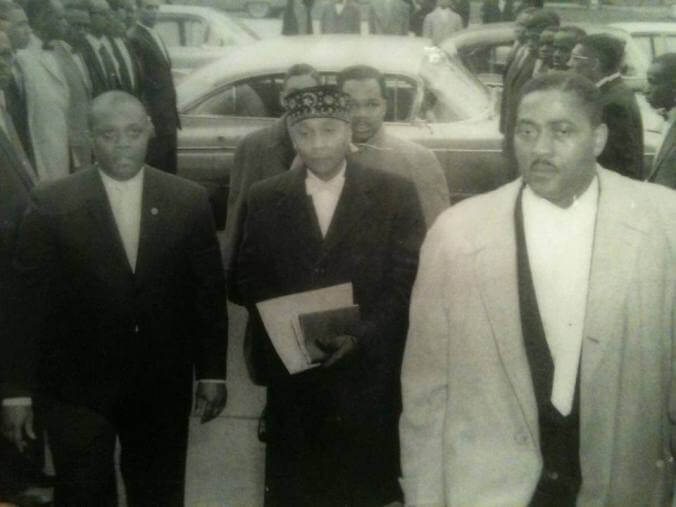 |
| Captain Joseph X Gravitts (to the left of Elijah Muhammad) |
Then came a first death plot. One of Malcolm’s own Mosque Seven officials, Captain Joseph X Gravitts, following higher orders, told an assistant to Malcolm to wire his car to explode when he started the engine. The man refused the assignment, told Malcolm of the plot, and saved his life.51 He also freed Malcolm from his attachment to the Nation of Islam. Malcolm was forced to recognize that the NOI’s hierarchy and structure, extending right down into his own mosque, was committed to killing him. He could already see a first ring of death encircling him, comprised of the organization he had developed to serve Elijah Muhammad. From that point on, Malcolm said, he “went few places without constant awareness that any number of my former brothers felt they would make heroes of themselves in the Nation of Islam if they killed me.”52
On March 8, 1964, with less than a year to live, Malcolm X announced his departure from the Nation of Islam. He said he was organizing a new movement because the NOI had “gone as far as it can.” He was “prepared to cooperate in local civil-rights actions in the South and elsewhere. “53 Malcolm also passed out copies of a telegram he had sent to Elijah Muhammad, in which he stated:
Despite what has been said by the press, I have never spoken one word of criticism to them about your family … 54
In spite of everything, Malcolm was trying not to split the NOI, and therefore muffled his criticisms of Elijah Muhammad.
Two days later, the Nation of Islam sent Malcolm a certified letter telling him and his family to move out of their seven-room house in East Elmhurst, Queens. The Elmhurst house had been home for Malcolm, Betty Shabazz, and their growing family (now with four daughters) since the early days of their marriage when Malcolm and Betty were in the house with John and Minnie Ali. One month after the certified letter, the secretary of Malcolm’s old Mosque Number Seven filed suit in a Queens civil court to have Malcolm and his family evicted. Malcolm would fight for the legal right to stay in the only home he had to pass on to his wife and children, especially since he might soon be killed by the same forces trying to take their house away.55
On March 12, Malcolm held a press conference in New York and said internal differences within the Nation had forced him out of it. He was now founding a new mosque in New York City, Muslim Mosque, Inc. With a conscious effort to avoid repeating the mistakes of Elijah Muhammad, he said in his “Declaration of Independence” that he was a firm believer in Islam but had no special credentials:
I do not pretend to be a divine man, but I do believe in divine guidance, divine power, and in the fulfillment of divine prophecy. I am not educated, nor am I an expert in any particular field—but I am sincere, and my sincerity is my credentials.56
He opened (wide) the door to working with other black leaders, with whom he had traded criticisms, most notably with Martin Luther King Jr. “As of this minute, I’ve forgotten everything bad that the other leaders have said about me, and I pray they can also forget the many bad things I’ve said about them.”57 He then immediately chased King away by saying black people should begin to form rifle clubs to defend their lives and property.
He concluded:
We should be peaceful, law-abiding—but the time has come for the American Negro to fight back in self-defense whenever and wherever he is being unjustly and unlawfully attacked. If the government thinks I am wrong for saying this, then let the government start doing its job.58
Malcolm was aware that the government might think it was its job to silence him.
Much more threatening to the government than Malcolm’s rifle clubs, which never got off the ground, was the visionary campaign he then initiated to bring U.S. violations of African-Americans’ rights before the court of world opinion in the United Nations. In his April 3, 1964, speech in Cleveland, “The Ballot or the Bullet,” Malcolm began to articulate his international vision:
We need to expand the civil-rights struggle to a higher level—to the level of human rights. Whenever you are in a civil-rights struggle, whether you know it or not, you are confining yourself to the jurisdiction of Uncle Sam … Civil rights comes within the domestic affairs of this country. All of our African brothers and our Asian brothers and our Latin-American brothers cannot open their mouths and interfere in the domestic affairs of the United States. … But the United Nations has what’s known as the charter of human rights, it has a committee that deals in human rights … When you expand the civil-rights struggle to the level of human rights, you can then take the case of the black man in this country before the nations in the UN. You can take it before the General Assembly. You can take Uncle Sam before a world court. But the only level you can do it on is the level of human rights.59
In the spring of 1964, Malcolm X had come up with a strategy to internationalize the Civil Rights Movement by re-defining it as a Human Rights Movement, then enlisting the support of African states. Malcolm would proclaim to the day of his death the nation-transcending word of human rights, not civil rights, for all African-Americans. He would also organize a series of African leaders to work together and make that word flesh in the General Assembly of the United Nations. In breaking his bonds to Elijah Muhammad, Malcolm had freed himself to unite African and African-American perspectives in an international coalition for change. For the rest of his life, he was on fire with energy to create that working partnership spanning two continents.
In breaking his bonds to Elijah Muhammad, Malcolm had freed himself to unite African and African-American perspectives in an international coalition for change.
The FBI began to realize it had made a major miscalculation. Its COINTELPRO that helped precipitate the divorce between Malcolm X and Elijah Muhammad had, it turned out, liberated Malcolm for a much larger mission than anything he could conceivably have accomplished under Elijah Muhammad. He was suddenly stepping onto an international stage in what could become an unwelcome scenario to the U.S. government. Nevertheless, the Chicago NOI connections that the Bureau had made so carefully in John Ali and other informants could still salvage the COINTELPRO goal of neutralizing Malcolm. Since Malcolm had “rebelled” against Elijah and Chicago, he could now, with Chicago’s help, be forced into silence forever.
The FBI had a second, growing concern. Despite Malcolm’s offputting talk of rifle clubs, his evolving strategy for an international ballot, not the bullet, was catching the attention of a potential ally whose power went far beyond that of Elijah Muhammad: Martin Luther King Jr.
Malcolm and Martin met for the first and only time in the nation’s capital on March 26, 1964. They had both been listening to the Senate’s debate on civil rights legislation. Afterwards they shook hands warmly, spoke together, and were interviewed. He grinned and said he was there to remind the white man of the alternative to Dr. King. King offered a militant alternative of his own, saying that if the Senate kept on talking and doing nothing, a “creative direct action program” would start. If the Civil Rights Act were not passed, he warned, “our nation is in for a dark night of social disruption.”60
 |
| Malcolm and Martin (March 26, 1964) |
Although Malcolm and Martin would continue to differ sharply on nonviolence and would never even see each other again in the 11 months Malcolm had left, there was clearly an engaging harmony between the two leaders standing side by side on the Capitol steps. Given Malcolm’s escalation of civil rights to human rights and King’s emphasis upon ever more disruptive, massive civil disobedience, their prophetic visions were becoming more compatible, even complementary. The FBI and CIA, studying the words and pictures of that D.C. encounter in their midst, could hardly have failed to recognize a threat to the status quo. If Malcolm X and Martin Luther King Jr. were to join efforts, they could ignite an explosive force for change in the American system. The FBI and CIA had to face a question paralleling that of the New York police who had witnessed Malcolm’s crowd dispersal. Should any two men have that kind of power against the system?
On the same day Malcolm and Martin shook hands in Washington, the FBI’s NOI connections were proving to be an effective part of an action in Chicago to further isolate Malcolm, setting him up for his murder.
Philbert X Little, Malcolm’s brother, was Elijah Muhammad’s minister in Lansing, Michigan. The Messenger and his NOI managers ordered Philbert to report to Chicago, where they arranged a press conference for him on March 26 of 1964. John Ali then handed Philbert a prepared statement. Ali told Philbert to read it to the media. Philbert had never seen the text before. As he read it for the first time (aloud and in a monotone) he heard himself denouncing Malcolm in terms that threatened Malcolm’s converts from the Nation of Islam.
I see where the reckless efforts of my brother Malcolm will cause many of our unsuspecting people, who listen and follow him, unnecessary loss of blood and life.61 … the great mental illness which beset my mother whom I love and one of my brothers … may now have taken another victim … my brother Malcolm.62
Malcolm responded to the news of his brother’s apparent attack on him by saying,
We’ve been good friends all our lives. He has a job he needs; that’s why he said what he did … I know for a fact that they flew him in from Lansing, put a script in his hand and told him to read it.63
Philbert himself confirmed years later that “the purpose of making that statement was to fortify the Muslims. That’s why I was brought to Chicago. When I got ready to make my statement, John Ali put a paper in front of me and told me I should read that. So I read the statement that was very negative for my mother. And it was negative against Malcolm. I wouldn’t have read it over the air, you see, if I had looked at it. I asked John Ali about it and he says, ‘That’s just a statement that was prepared for you to read.’ He said, ‘I know the Messenger will be very pleased with the way you read it,’ and that was it.”64
The vision to which Malcolm X was converted by his experience at Mecca determined the way in which he would meet his death. He called that vision ‘brotherhood’.
Elijah Muhammad’s vengeance toward Malcolm was still being fueled by the FBI’s COINTELPRO. At the time of “Philbert’s statement,” the FBI sent Elijah one of its fake letters complaining about his relationships with his secretaries. The letter succeeded in making Elijah suspect Malcolm had written it. On April 4, 1964 an FBI electronic bug recorded Elijah telling one of his ministers, who had also received a copy of the letter, that the presumed writer Malcolm “is like Judas at the Last Supper.”65
In recognition that his 12 years proclaiming the word of Elijah Muhammad had left him poorly prepared for his new mosque’s ministry, Malcolm decided to re-discover Islam by making his pilgrimage to Mecca.
 |
| Malcolm at Mecca (1964) |
In a life of changes, Malcolm’s most fundamental change began at Mecca. At the conclusion of his pilgrimage, he was asked by other Muslims what it was about the Hajj that had most impressed him. He surprised them by saying nothing of the holy sites or the rituals but extolling instead the multi-racial community he had experienced.
“The brotherhood!” he said, “The people of all races, colors, from all over the world coming together as one! It has proved to me the power of the One God.”66
The vision to which Malcolm X was converted by his experience at Mecca determined the way in which he would meet his death. He called that vision “brotherhood.” Had he lived a while longer, he would have added “and sisterhood.” In his final months, Malcolm also began to change noticeably in his recognition of women’s rights and leadership roles. His conversion at Mecca was to a vision of human unity under one God. From that point on, his consciousness of one human family, in the sight of one God, sharpened his perceptions, deepened his courage, and opened his soul to whatever further changes Allah had in store for him. Consistent with all those changes, Malcolm’s experience of the truth of brotherhood radicalized still more his resistance to racism. His conversion to human unity was not to a phony blindness to the reality of prejudice, but on the contrary, to a greater understanding of its evil in God’s presence. He was even more determined to confront it truthfully. Concluding his answer to his fellow pilgrims on his Hajj, Malcolm returned to his lifelong focus on racism, set now in the context of the experience he had at Mecca of his total acceptance by pilgrims of all colors.
“To me,” he said, “the earth’s most explosive and pernicious evil is racism, the inability of God’s creatures to live as One, especially in the Western world.” 67
 |
| Malcolm & Kwame Nkrumah; with Prince Faisal |
Following his pilgrimage to Mecca, Malcolm met with two influential heads of state, Prince Faisal of Arabia and President Kwame Nkrumah of Ghana. They acknowledged Malcolm as a respected leader of black Americans, who now represented also a true Islam. Prince Faisal of oil-rich Arabia made Malcolm a guest of the state. Ghana’s anti-colonialist Kwame Nkrumah, a leader of newly independent African states, told his African-American visitor something Malcolm said he would never forget:
Brother, it is now or never the hour of the knife, the break with the past, the major operation.68
Nkrumah’s sense of the hour of the knife was right, but his hope that it would be a knife of freedom cutting through a history of oppression would go unfulfilled. Only nine months later, Malcolm would be murdered.
A year after that, Nkrumah, upon publishing his book Neo-Colonialism: The Last Stage of Imperialism, dedicated to “the Freedom Fighters of Africa, living and dead,” would be overthrown by a CIA-backed coup.69
“The case to be presented to the world organization … would compel the United States Government to face the same charges as South Africa and Rhodesia.”
Malcolm also visited Egypt, Lebanon, Nigeria, Liberia, Senegal, Morocco, and Algeria. Upon his return to the U.S. on May 21, 1964, the New York Times published an article on his trip that further alerted intelligence agencies to Malcolm’s quest for a UN case against the U.S. Malcolm told reporters he had “received pledges of support from some new African nations for charges of discrimination against the United States in the United Nations.”
“The case to be presented to the world organization,” he asserted, “would compel the United States Government to face the same charges as South Africa and Rhodesia.”70
While Malcolm was working abroad to put the U.S. on trial at the UN, the New York Police Department was infiltrating his new Muslim Mosque with its elite intelligence unit, the Bureau of Special Service and Investigation (BOSSI). To the cold warriors in the ’60s who knew enough beneath the surface to know at all about BOSSI, the NYPD’s undercover force was regarded as “the little FBI and the little CIA.” The accolade reflected the fact that the information gathered by BOSSI’s spies was passed on regularly to federal intelligence agencies.71
 |
| BOSSI operative Tony Ulasewicz |
The BOSSI men who ran the deep cover operation in Muslim Mosque were detectives Tony Ulasewicz and Teddy Theologes. Four years after Tony Ulasewicz’s undercover work on Malcolm X, “Tony U,” as he was known, would retire from the NYPD to go to work as President Richard Nixon’s private detective. He would then take part in a series of covert activities that would be brought to light in the Senate Watergate Hearings and memorialized in his own book, The President’s Private Eye,72 which is also a valuable resource on BOSSI. Both in his book and his life, Tony U moves with ease between the overlapping undercover worlds of the New York Police Department, federal intelligence agencies, and the White House. In the BOSSI chain of command, Tony U was a field commander. He had to keep his operators’ identities totally secret as he ran their surveillance and probes of various sixties organizations ranging from the Revolutionary Action Movement (RAM) to the American Nazi Party. Equally important, he had to keep his own behind-the-scenes identity completely separate from theirs, with his name never linked to the report of any agent of his. Otherwise he might be called to testify in court, opening up an operation, an event to be avoided at all costs.73 Tony U’s deep cover men were therefore, in the last analysis, on their own.
Teddy Theologes acted in the BOSSI command, in Tony U’s words, “as a cross between a drill sergeant and a priest.”74 Reflecting on his career decades later in an interview, Theologes said some of the BOSSI deep cover recruits “needed constant attention. I would have to sit down with them, and almost be a father, brother, psychiatrist, and doctor.75 From the standpoint of agents risking their lives who knew their superiors would never admit to knowing them, the need for such a relationship can be understood.
 |
| Gene Roberts |
On April 17, 1964, four days after Malcolm left New York on his pilgrimage to Mecca, Ulasewicz and Theologes sent their newly sworn-in, 25-year-old, black detective Gene Roberts on his undercover journey into the Muslim Mosque, Inc. Gene Roberts had just completed four years in the Navy. Roberts was interviewed by Tony Ulasewicz and Teddy Theologes when he passed the police exam. He was asked to become a deep cover agent in a militant organization under Malcolm X. Roberts had heard of Malcolm X but knew little about him. As a military man, he accepted the order to infiltrate Malcolm’s group without questioning it. On April 17, he was sworn in as a police officer and given his badge. A few hours later, Teddy Theologes took the badge away from him. He was on his own. Then his BOSSI superiors sent Roberts out on his mission in Harlem.76
Gene Roberts has described how he proceeded step by step into becoming one of Malcolm’s bodyguards:
Basically they said, go up to 125th Street—where Malcolm had his headquarters—and get involved. And that’s what I did. I ended up getting involved in a couple of riots. The main thing was I was there. I met members of his organization. They accepted me. My cover was I worked for a bank. I told them about my martial arts experience, so I became one of Malcolm’s security people. When he came back from Mecca and Africa, I went wherever he went, as long as it was in the city.77
Since he was supposedly a bank worker, Roberts followed a schedule of typing up his BOSSI reports, at his Bronx home during the day. He typed reports on what he had learned by being “Brother Gene” with Malcolm and his community during the night.78 As Roberts suspected and would later confirm, he was not the only BOSSI agent in the group, although he had gained the greatest access to Malcolm. When Ulasewicz and Theologes received his and other deep cover dispatches, they passed them up the line to BOSSI Supervisor Barney Mulligan. It was Lieutenant Mulligan’s responsibility to file all the undercover information (without ever identifying the informants) at BOSSI headquarters. While there, BOSSI’s secret fruit was shared generously with the FBI.
On May 23, 1964, Louis Lomax and Malcolm X took part in a friendly debate at the Chicago Civic Opera House. As Lomax began his opening speech and looked down from the stage, he was struck with fear. For there in the audience staring back up at him was John Ali, accompanied by a group of NOI men who were being deployed at strategic locations in the hall.79 Ali had become the nemesis of Lomax as well as Malcolm because of Lomax’s having written about Ali’s FBI connection. Malcolm’s, Ali’s, and Lomax’s lives were intertwined. When John Ali was Malcolm’s top advisor and housemate, he had arranged the first meeting between Malcolm and Lomax. The three men had then worked together on the first issues of the NOI newspaper. When Malcolm’s and Ali’s home was invaded by the New York police, Louis Lomax had written the most thorough story on it.80
In his Chicago speech, given only two days after his return from Mecca and Africa, Malcolm sounded open to white people as well as blacks, as impassioned as ever, and in the terms he used, even radically patriotic:
My pilgrimage to Mecca … served to convince me that perhaps American whites can be cured of the rampant racism which is consuming them and about to destroy this country. In the future, I intend to be careful not to sentence anyone who has not been proven guilty.
I am not a racist and do not subscribe to any of the tenets of racism. In all honesty and sincerity it can be stated that I wish nothing but freedom, justice and equality: life, liberty and the pursuit of happiness—for all people. My first concern is with the group of people to which I belong, the Afro-Americans, for we, more than any other people, are deprived of these inalienable rights.81
However, in his post-Mecca life, this radically open Malcolm X was once again a target, as he and Lomax could see when they looked down into the eyes of John Ali and his companions. At the debate’s conclusion, Malcolm and Lomax departed from the rear of the hall under a heavy Chicago police escort.82 It was one in a series of occasions when Malcolm would gladly accept the protection of a local police department that was genuinely concerned about his safety.
Also near the end of May 1964, the five men who would kill Malcolm X in the Audubon Ballroom nine months later came together for the first time. We know the story, thanks to the confession of the only one of the five who would ever go to jail for the crime, Talmadge Hayer. According to Hayer’s affidavit, sworn to in prison in 1978 to exonerate two wrongly convicted co-defendants,83 it all began when he was walking down the street one day in Paterson, New Jersey. A car pulled up beside him. Inside it were two men who, like Hayer, belonged to the Nation of Islam’s Mosque Number 25 in Newark—Benjamin Thomas and Leon Davis, known to Hayer as Brothers Ben and Lee. They asked Hayer to get in the car so they could talk. “Both of these men,” he said, “knew that I had a great love, respect, and admiration for the Honorable Elijah Muhammad.”84
While the three men drove around Paterson, Hayer learned from Thomas and Davis that “word was out that Malcolm X should be killed.” Hayer said in his confession he didn’t know who had passed that word on, but he thought Ben knew. He in fact had good grounds for thinking Ben knew, inasmuch as Benjamin Thomas was the assistant secretary of the Newark Mosque and knew well the NOI chain of command. Hayer also said it was Ben who had spoken first to Leon, before the two of them spoke with him. After hearing from them how Malcolm X was spewing blasphemies against Mr. Muhammad, he said what they wanted to hear, “It’s just bad, man, something’s got to be done,”85 and agreed to take part in the plot.
As Hayer told Malcolm biographer Peter Goldman in a prison interview,
I didn’t ask a whole lot of questions as to who’s giving us instructions and who’s telling us what, because it just wasn’t a thing like that, man. I thought that somebody was giving instructions: ‘Brothers, you got to move on this situation.’ But I felt we was in accord. We just knew what had to be done.86
Thomas, Davis, and Hayer soon got together with two more members of the Newark Mosque who also knew what had to be done, William X and Wilbur X. As male members of the Nation of Islam, all five men belonged to the Fruit of Islam (FOI), a paramilitary training unit.87 FOI training was meant ideally for self-defense. However, with its combination of discipline, obedience, and unquestioning loyalty to the Messenger, it had degenerated into an enforcement agency for the will of Elijah Muhammad and the NOI hierarchy. Malcolm X, with his certain knowledge that FOI teams like the five men in Newark were being organized to kill him, said sharply in a June 26, 1964, telegram to Elijah Muhammad:
Students of the Black Muslim Movement, know that no member of the Fruit of Islam will ever initiate an act of violence unless the order is first given by you. … No matter how much you stay in the background and stir others up to do your murderous dirty work, any bloodshed committed by Muslim against Muslim will compel the writers of history to declare you guilty not only of adultery and deceit, but also of Murder.88
In his affidavit, Talmadge Hayer said the five men from the Newark Mosque began meeting to decide how to carry out the killing. Sometimes, he said, they would just drive around in a car for hours talking about it.89 Since Malcolm was on the verge of making another even longer trip to Africa, they would have to bide their time. In the meantime, there were other killing teams who were united in the same purpose. Several would almost succeed. But in the end, it would be the five Newark plotters who would finally do what had to be done at the Audubon Ballroom.
It is a temptation to sentimentalize Malcolm, but Malcolm did not sentimentalize himself. He knew what he was capable of doing, what he had done, and what he had trained the Fruit of Islam to do. They were now prepared to do it, as he knew, to him.
On June 13, 1964, the NOI’s suit to force Malcolm and his family out of the East Elmhurst house began to be heard in Queens Civil Court. The courtroom was divided into two hostile camps, Malcolm’s supporters and the NOI contingent. At this point the police department clearly acknowledged in action the immediate danger to Malcolm’s life. It had 32 uniformed and plainclothes officers present, “surrounding him so impermeably,” as reporter Peter Goldman put it, “that he could barely be seen from the gallery.”90 Some of the press remained skeptical of the threat to Malcolm. He insisted to reporters that he knew the NOI men were capable of murder “because I taught them.”91
This statement that Malcolm repeated about his NOI past was apparently no exaggeration. Dr. Alauddin Shabazz, who was ordained by Malcolm as an NOI minister, told me in an interview: “Malcolm had had people killed. When Malcolm found a guy in the nation who was an agent, Malcolm didn’t hesitate to do something to him. I have seen Malcolm take a hammer and knock out the bottom bridges of a guy’s teeth.
[An undercover police agent] was once caught setting up an [electronic] bug in the wall of the office. Malcolm was questioning him. And Malcolm had a funny way of questioning people. He would stand with his back to you, like he didn’t want to look at your disgusting face—if he thought you were doing something to aid BOSSI or the agencies. And this guy had been caught. Malcolm turned around. He had a hammer on the desk. He turned around with the hammer and hit him in the face. I was there. It was in the early ’60s.92
It is a temptation to sentimentalize Malcolm, but Malcolm did not sentimentalize himself. He knew what he was capable of doing, what he had done, and what he had trained the Fruit of Islam to do. They were now prepared to do it, as he knew, to him.
The Queens eviction hearing was especially significant for what Malcolm chose to reveal during his June 16 testimony: “[T]hat the Honorable Elijah Muhammad had taken on nine wives.”93 At about the same time as Malcolm made the issue public, one of Elijah Muhammad’s sons made a statement that was in effect a warrant for Malcolm’s death. It was prompted by a phone call from someone claiming to be “Malcolm.” This person told the NOI that Elijah Muhammad would be killed while giving his speech the following day.94 In response to this provocation (in conflict with the real Malcolm’s pleas to his followers to avoid a confrontation), Elijah Muhammad Jr. told a meeting of the Fruit of Islam at a New York armory:
That house is ours, and the nigger don’t want to give it up. Well, all you have to do is go out there and clap on the walls until the walls come tumbling down, and then cut the nigger’s tongue out and put it in an envelope and send it to me, and I’ll stamp it approved and give it to the Messenger.95
The judge would rule three months later that the house belonged to the Nation of Islam, and that Malcolm and his family had to leave. Malcolm appealed, which delayed the eviction until the final week of his life.
On June 27, 1964, the FBI wiretapped a phone call in which Malcolm X asked an unidentified woman (an office worker … Betty Shabazz?) if Martin Luther King’s attorney Clarence Jones had called him.96 The woman said, yes, she had a message from Jones asking Malcolm to call him back. The reason Jones wanted to speak with Malcolm, she said, was “that Rev. King would like to meet as soon as possible on the idea of getting a human rights declaration.” She then emphasized to Malcolm, “He is quite interested.”97
However, in the 12 short days left before Malcolm departed again for Africa, he and King were not able to arrange a meeting to explore their mutual interest in a human rights declaration. Nor would they ever manage to see each other again in the three months remaining in Malcolm’s life once he returned to the U.S., though they would just miss doing so in Selma, Alabama. Nevertheless, through its electronic surveillance of both men, the FBI knew that Malcolm X and Martin Luther King Jr. were hoping to connect on the human rights issue that could put the U.S. on trial in the United Nations.
On June 28, 1964, Malcolm announced his formation of the Organization of Afro-American Unity (OAAU), with its headquarters at the Theresa Hotel in Harlem. Whereas the Muslim Mosque, Inc. was faith-oriented, the OAAU would be politically oriented.98 The OAAU would be patterned after the letter and spirit of the Organization of African Unity established by African heads of state the year before at their meeting in Ethiopia. The OAAU’s founding statement emphasized that “the Charter of the United Nations, the Universal Declaration of Human Rights, the Constitution of the U.S.A. and the Bill of Rights are the principles in which we believe.”99 The intended outreach of Malcolm’s organization was transcontinental, including “all people of African descent in the Western Hemisphere, as well as our brothers and sisters on the African continent.”100 Yet the organizing would also be local and civic:
The Organization of Afro-American Unity will organize the Afro-American community block by block to make the community aware of its power and potential; we will start immediately a voter registration drive to make every unregistered voter in the Afro-American community an independent voter.101
Thanks to Mecca, Malcolm had broken free from his old allegiance to Elijah Muhammad’s idea of a separate black state. He was now organizing an international campaign for Afro-American liberation based on the principles of the U.S. Constitution and the UN Charter. He had become a faith-based organizer on an international scale. His OAAU founding statement, while consistent with the Civil Rights Movement, took the struggle into a new arena, the United Nations. Malcolm would now seek further support for his UN human rights campaign by a July-November barnstorming trip through Africa.
In addition to NYPD and FBI surveillance, the Central Intelligence Agency was also following Malcolm. The Agency knew Malcolm planned to appeal to African leaders at the second conference of the Organization of African Unity (OAU).
At 11:37 p.m., on July 3, 1964, Malcolm phoned the New York Police Department to report that “two Black Muslims were waiting at his home to harm him. … But he sped off when they approached his car.”102 Malcolm knew the name of one of the two men, and gave it to the police.103
The NYPD refused to believe Malcolm. They passed on their official skepticism in a July 4 teletype to the FBI: “Police believed complaint on an attempt on Malcolm’s life was a publicity stunt by Malcolm.”104 By its phone tap, the FBI had heard Malcolm make his report at the same time the NYPD did. The Bureau summarized the event with its own judgment on Malcolm: “Information [on 7/4/64] that MALCOLM and his followers were attempting to make a big issue out of the reported attempt on Macolrn’s life in order to get the Negro people to support him.105
Thus began the official NYPD and FBI line that Malcolm was fabricating attempts on his life for the sake of publicity. This disclaimer would be made publicly by the NYPD in the week before Malcolm’s murder, in an effort to justify the withdrawal of police protection at the time of escalating threats on his life.
On July 9, Malcolm departed from New York on the African trip that would consume four and a half of the remaining seven and a half months of his life. It was to be the final, most ambitious project of his short life. As his plane lifted off from JFK Airport on its way to Cairo, Malcolm was happily unaware of what John Ali was saying that same night on a Chicago call-in radio program:
Malcolm X probably fears for his safety because he is the one who opposes the Honorable Elijah Muhammad. The Holy Koran, the book of the Muslims, says “seek out the hypocrites and wherever you find them, weed them out.” … There were people who hated Kennedy so much that they assassinated him—white people. And there were white people who loved him so much they would have killed for him. You will find the same thing true of the Honorable Elijah Muhammad … I predict that anyone who opposes the Honorable Elijah Muhammad puts their life in jeopardy … 106
“… after every one of my trips abroad, America’s rulers see me as being more and more dangerous. That’s why I feel in my bones the plots to kill me have already been hatched in high places. The triggermen will only be doing what they were paid to do.”
In addition to NYPD and FBI surveillance, the Central Intelligence Agency was also following Malcolm. The Agency knew Malcolm planned to appeal to African leaders at the second conference of the Organization of African Unity (OAU), which he was attending in Cairo in July as an honored observer. No other American was allowed in the door. In a July 10 CIA memorandum, an informant stated that Malcolm X was “transporting material dealing with the ill treatment of the Negro in the United States. He intends to make such material available to the OAU in an effort to embarrass the United States.”107
In Cairo, Malcolm was constantly aware of agents following him. They made their presence obvious in an effort to intimidate him. Then on July 23, as Malcolm prepared to present his UN appeal to Africa’s leaders, he was poisoned. He described the experience later to a friend:
I was having dinner at the Nile Hilton with a friend named Milton Henry and a group of others, when two things happened simultaneously. I felt a pain in my stomach and, in a flash, I realized that I’d seen the waiter who served me before. He looked South American, and I’d seen him in New York. The poison bit into me like teeth. It was strong stuff. They rushed me to the hospital just in time to pump the stuff out of my stomach. The doctor told Milton that there was a toxic substance in my food. When the Egyptians who were with me looked for the waiter who had served me, he had vanished. I know that our Muslims don’t have the resources to finance a worldwide spy network.108
The friend who witnessed this event, Detroit civil rights attorney Milton Henry, warned Malcolm that his UN campaign could mean his death. Henry later felt in retrospect that it did: “In formulating this policy, in hitting the nerve center of America, he also signed his own death warrant.”109 Malcolm, being Malcolm, recognized the truth of Henry’s warning, and went right on ahead with his campaign.
At the OAU conference, Malcolm submitted an impassioned, eight-page memorandum urging the leaders of Africa to recognize African-Americans’ problems as their problems and to indict the U.S. at the UN:
Your problems will never be fully solved until and unless ours are solved. You will never be fully respected until and unless we are also respected. You will never be recognized as free human beings until and unless we are also recognized and treated as human beings. Our problem is your problem. It is not a Negro problem, nor an American problem. This is a world problem, a problem for humanity. It is not a problem of civil rights but a problem of human rights. In the interests of world peace and security, we beseech the heads of the independent African states to recommend an immediate investigation into our problem by the United Nations Commission on Human Rights.110
 |
| Malcolm at OAU |
Malcolm was encouraged by the response he received from the OAU. Although the resolution the conference passed in support of the African-American struggle used only moderate language, Malcolm told Henry that several delegates had promised him their official support in bringing up the issue legally at the United Nations.111
 |
| OAU Founders |
Malcolm then built on the foundations he had laid at the African summit. For four months he criss-crossed Africa, holding follow-up meetings with the leaders who encouraged him most in Cairo. He held long discussions with President Gamal Abdel Nasser of Egypt, President Julius Nyerere of Tanzania, President Jomo Kenyatta of Kenya, Prime Minister Milton Obote of Uganda, President Azikiwe of Nigeria, President Kwame Nkrumah of Ghana, Prime Minister Ahmed Ben Bella of Algeria, and President Sekou Toure of Guinea.112 There were other African heads of state Malcolm talked with, he said, “whose names I can’t mention.”113 At the height of the Cold War, Malcolm X had gained access to Africa’s most revolutionary leaders on a politically explosive issue.
 |
| The neutralist leaders (Nehru, Nkrumah, Nasser, Sukarno, Tito) |
Reflecting on these meetings, Malcolm told a friend in London shortly before his death,
Those talks broadened my outlook and made it crystal clear to me that I had to look at the struggle in America’s ghettos against the background of a worldwide struggle of oppressed peoples. That’s why, after every one of my trips abroad, America’s rulers see me as being more and more dangerous. That’s why I feel in my bones the plots to kill me have already been hatched in high places. The triggermen will only be doing what they were paid to do.114
U.S. intelligence agencies were in fact monitoring Malcolm’s campaign in Africa with increasing concern. The officials to whom they reported these developments began to express their alarm publicly. As a New York Times article, written in Washington revealed on August 13, 1964, “The State Department and the Justice Department have begun to take an interest in Malcolm X’s campaign to convince African states to raise the question of persecution of American Negroes at the United Nations.”
After recapitulating Malcolm’s appeal to the 33 OAU heads of state, the Times article stated:
[Washington] officials said that if Malcolm succeeded in convincing just one African Government to bring up the charge at the United Nations, the United States Government would be faced with a touchy problem. The United States, officials here believe, would find itself in the same category as South Africa, Hungary, and other countries whose domestic politics have become debating issues at the United Nations. The issue, officials say, would be of service to critics of the United States, Communist and non-Communist, and contribute to the undermining of the position the United States has asserted for itself as the leader of the West in the advocacy of human rights.115
The Times reported that Malcolm had written a friend from Cairo that he did indeed have several promises of support from African states in bringing the issue before the United Nations. According to another diplomatic source, Malcolm had not been successful, “but the report was not documented and officials here today conceded the possibility that Malcolm might have succeeded.”116
The article also said somewhat ominously;
Although the State Department’s interest in Malcolm’s activities in Africa is obvious, that of the Justice Department is shrouded in discretion. Malcolm is regarded as an implacable leader with deep roots in the Negro submerged classes.
“[He] has, for all practical purposes, renounced his U.S. citizenship.” ~ Benjamin H. Read, assistant to Dean Rusk, insisting the CIA investigate Malcolm X
These two sentences, which were removed from the article in the national edition of the Times,117 where an oblique reference to concerns about Malcolm then being expressed not only by the State and Justice Departments but also by the CIA, FBI, and the Johnson White House. These concerns are revealed by a memorandum, written two days before the Times article, addressed to the CIA’s Deputy Director of Plans (covert action) Richard Helms. As researchers know, the desk of Richard Helms—a key player in CIA assassination plots—was perhaps the most dangerous place possible for a report on a perceived security risk to end up. According to the August 11, 1964, CIA memorandum to Helms, the Agency claimed it had learned from an informant that Malcolm X and “extremist groups” were being funded by African states in fomenting recent riots in the U.S. The State Department, the CIA memo continued, “considered the matter one of sufficient importance to discuss with President Johnson who, in turn, asked Mr. J. Edgar Hoover to secure any further information which he might be able to develop.”118
As Malcolm analyst Karl Evanzz has noted,
In fact, the CIA knew the allegations were groundless. In an FBI memorandum dated July 25, a copy of which was sent to [the CIA’s] Clandestine Services, an agent specifically stated that the informant’ said he didn’t mean to imply that Africans were financing Malcolm X.119
The CIA’s August 11 memo also stated that Benjamin H. Read, an assistant to Secretary of State Dean Rusk, wanted the CIA to probe both Malcolm X’s domestic activities and “travels in Africa” to determine “what political or financial support he may be picking up along the way.” The CIA memo’s author had told Read, coyly, in response that “there were certain inhibitions concerning our activities with respect to citizens of the United States.” Read had overridden the objection, insisting the CIA act because, “after all, Malcolm X has, for all practical purposes, renounced his U.S. citizenship.”120
As of no later than August 11, 1964 (and perhaps before), the CIA’s Deputy Director of Plans had been authorized to act on Malcolm X. Malcolm was perceived, for all practical purposes, to have renounced his U.S. citizenship and to have become a touchy problem to the U.S. government if he gained so much as one African state’s support for his UN petition. Malcolm had not read any such CIA documents on himself, but he had seen the August 13 Times article. He could read his future between its lines, just as Milton Henry had already done in terms of the sensitivity of Malcolm’s UN campaign.
 |
| John Lewis |
John Lewis, a leader in the Student Nonviolent Coordinating Committee (SNCC) who would go on to become a member of Congress, was then touring Africa to connect with the freedom movement there. Lewis and the SNCC friends who were with him knew all too well that Malcolm was also in Africa. As soon as they met anyone in Africa, the first question they would inevitably be asked was: “What’s your organization’s relationship with Malcolm’s?”121 The men discovered that no one would listen to them if they were seen as being any less revolutionary than Malcolm, who seemed to have taken all of Africa by storm. On his return to the U.S. Lewis wrote in a SNCC report: “Malcolm’s impact on Africa was just fantastic. In every country he was known and served as the main criteria for categorizing other Afro-Americans and their political views.”122
Lewis was startled to run into Malcolm in a café in Nairobi, Kenya, as he had thought Malcolm was traveling in a different part of Africa at the time. Malcolm, recognizing Lewis, smiled and asked what he was doing there. Reflecting on their encounter in his memoir, Walking With the Wind, Lewis thought Malcolm was very hopeful from the overwhelming reception he had received in Africa “by blacks, whites, Asians and Arabs alike.” It “had pushed him toward believing that people could come together.”123
However, something else Malcolm shared with the SNCC group “was a certainty that he was being watched, that he was being followed … In a calm, measured way he was convinced that somebody wanted him killed.”124 John Lewis’ meeting with Malcolm in Kenya would be the last time he would see him alive.
 |
| Louis Farrakhan (1965) |
Malcolm kept extending his stay in Africa. He had planned to be away six weeks. After 18 weeks abroad, he finally flew back to New York on November 24, 1964. He was confronted, soon after his return, with a December 4 issue of Muhammad Speaks. The issue featured an attack upon him by Minister Louis X, of the NOI’s Boston mosque. Louis X had not long before been a friend and devoted disciple to Malcolm. Now calling Malcolm “an international hobo,” Louis X made a statement against Malcolm that would haunt the speaker for the rest of his life, under his better-known name, Minister Louis Farrakhan:
The die is set, and Malcolm shall not escape, especially after such evil, foolish talk about his benefactor, Elijah Muhammad, in trying to rob him of the divine glory which Allah had bestowed upon him. Such a man as Malcolm is worthy of death, and would have met with death if it had not been for Muhammad’s confidence in Allah for victory over his enemies.125
Louis Farrakhan has never admitted to having participated in the plot to kill Malcolm. He has acknowledged from 1985 on that his above words “were like fuel on a fire” and “helped create the atmosphere” that moved others to kill Malcolm. Farrakhan made essentially the same carefully worded statement to four interviewers: Tony Brown in 1985, Spike Lee in 1992, Barbara Walters on 20/20 in 1993, and Mike Wallace on 6o Minutes in 2000. His words to Spike Lee were: “I helped contribute to the atmosphere that led to the assassination of Malcolm X.”126
His clearest statement on Malcolm’s murder may be at question. In a 1993 speech to his NOI congregation, Minister Farrakhan, referring to Malcolm, asked bluntly, “And if we dealt with him like a nation deals with a traitor, what the hell business is it of yours?”127
 |
| Alex Quaison-Sackey |
The timing of Malcolm’s late November return to the U.S. seemed providential in terms of his work at the United Nations. On December 1, his close friend, Alex Quaison-Sackey of Ghana, was elected President of the UN General Assembly. Following Malcolm’s lead, Quaison-Sackey was becoming increasingly outspoken against U.S. policies. Quaison-Sackey gave Malcolm’s human rights campaign a further boost by arranging for him to open an office at the UN in the area that was used by provisional governments.128
The FBI’s New York field office pointed out to J. Edgar Hoover in a December 3 memo the alarming facts that Malcolm X and newly elected UN leader Quaison-Sackey had been friends for four years, and that they had also met several times recently. The New York office, which worked closely with the NYPD’s undercover BOSSI unit, suggested to Hoover “that additional coverage of [Malcolm X’s] activities is desirable particularly since he intends to have the Negro question brought before the United Nations (UN).”129
During December’s UN debate on the Congo, Malcolm’s influence began to be heard in the speeches of African leaders. For example, Louis Lansana Beavogui, Guinea’s foreign minister, asked why “so-called civilized governments” had not spoken out against “the thousands of Congolese citizens murdered by the South Africans, the Belgians, and the [anti-Castro] Cuban refugee adventurers. Is this because the Congolese citizens had dark skins just like the colored United States citizens murdered in Mississippi?”130
In a January 2, 1965, article, the New York Times described the Malcolm X impetus behind this challenging turn in African attitudes. It noted that the policy proposed by Malcolm that “linked the fate of the new African states with that of American Negroes” was being adopted by African governments. The article said, “the African move profoundly disturbed the American authorities, who gave the impression that they had been caught off-guard.”131
Those working behind the scenes were not caught off guard, however, as the knowledgeable author of the article, M.S. Handler, was quick to suggest. Handler had also written the August 13 Times piece from Washington. He went on to repeat what he had reported then, that “early last August the State Department and Justice Department began to take an interest in Malcolm’s activities in North Africa”—accompanied, as we know, by a parallel interest and stepped-up actions by the CIA and FBI. Handler traced the heightened government interest to Malcolm’s opening “his campaign to internationalize the American Negro problem at the second meeting of the 33 heads of independent African states in Cairo, which convened July 17.”132
When the January 2 Times article appeared, Malcolm had seven weeks left to live. Much of the remaining time was devoted to his constant speaking trips throughout the U.S., up to Canada, and over to Europe. Malcolm lived each day, hour, and minute as if it were his last, for he knew how committed the forces tracking him were to killing him. Within the U.S., Fruit of Islam killing squads were waiting for him at every stop. Malcolm knew it was only a matter of time.
On January 28, 1965, Malcolm flew to Los Angeles to meet with attorney Gladys Towles Root and two former NOI secretaries who were filing paternity suits against Elijah Muhammad.133 Malcolm felt personally responsible for having put the two women in a position of vulnerability to Elijah Muhammad. He told a friend, “My teachings converted these women to Elijah Muhammad. I opened their mind for him to reach in and take advantage of them.”134 He had come to Los Angeles, in preparation for testimony in support of the women, “to undo what I did to them by exposing them to this man.”135
From the time Malcolm arrived at the Los Angeles Airport in mid-afternoon until his departure the next morning, he was trailed by the Nation of Islam. The two friends who met him, Hakim A. Jamal and Edmund Bradley, had alerted airport security to a possible NOI attack. As Jamal and Bradley waited at the gate, they noticed a black man seated behind them inconspicuously reading a newspaper. The man was John Ali. Although Malcolm’s Los Angeles trip had been a closely held secret, someone monitoring his conversations was feeding the information to Ali. Malcolm’s arrival gate was switched at the last moment, and security police rushed him and his companions safely through the airport to a car.136
At his Statler Hilton Hotel, Malcolm repeatedly had to run a gauntlet of menacing NOI men stationed in the lobby. Bradley saw John Ali and the leaders of an NOI mosque in Los Angeles get out of a car in front of the hotel. Malcolm, Jamal, and Bradley left quickly in their own car to meet with the two secretaries and attorney Root. When Bradley drove Malcolm back to the airport in the morning, two carloads of NOI teams started to pull alongside their car. Malcolm picked up Bradley’s cane and stuck it out a window like a rifle. The two cars fell back. Police waiting at the airport escorted Malcolm safely to his plane.137
During his next three days in Chicago, Malcolm was under the steady guard of the Chicago police. He was also under the watchful eyes of 15 NOI men who lingered at the entrance to his hotel. In their presence, Malcolm whispered to a Chicago police detective, “Those are all Black Muslims. At least two of them I recognize as being from New York. Elijah seems to know every move I make.”138 Malcolm would realize later that it had to be someone more powerful than Elijah who was making it possible for his troops to always be one step ahead of Malcolm.
Malcolm testified before the Illinois Attorney General, who was investigating the Nation of Islam. The next day in a television interview, Malcolm described efforts to kill him. He said he had a letter on his desk identifying the persons assigned to kill him.139 He was accompanied everywhere by the Chicago police, who finally took him back safely to O’Hare Airport for his flight to New York.
Later that week, Malcolm X once again almost connected with Martin Luther King Jr. The place was Selma, Alabama. The date was February 4, 1965, 17 days before Malcolm’s death, and three years and two months before Martin’s.
The night before, Malcolm had spoken to 3000 students at Tuskegee Institute, 75 miles from Selma. Many of the students invited Malcolm to join them in the next day’s demonstration at Selma, where more than 3,400 arrests had already been made in the course of voter registration marches.
 |
| Malcolm at Selma AL with Coretta Scott King |
Malcolm’s sudden arrival in Selma on the morning of February 4 panicked the leaders of Martin Luther King’s Southern Christian Leadership Conference (SCLC). The younger SNCC radicals were urging that Malcolm be allowed to speak to the crowd gathering in the Brown Chapel AME Church for the demonstration. However, the SCLC ministers didn’t even have the voice of Martin Luther King, who was in a Selma jail, to balance the fiery oratory of Malcolm, who they feared would spark a riot. As Malcolm listened in bemusement to what he might be permitted to say, he commented, “Nobody puts words in my mouth.”140 They finally decided to let Malcolm speak, but called in Coretta King to talk after him and put out the fire. Mrs. King was instead inspired by Malcolm to see a transforming hope of convergence between him and her husband.
In his talk, Malcolm widened the scene of struggle from Selma to the world. He told the crowd that civil rights were human rights, and that the U.S. government by failing to uphold their rights was thereby in violation of the United Nations Charter. Standing in the pulpit, pointing his right index finger at the demonstrators, he said they should “wire Secretary General U. Thant of the United Nations and charge the federal government of this country, behind Lyndon B. Johnson, with being derelict in its duty to protect the human rights of 22 million Black people.”141 He prayed that God would bless them in everything that they did, and “that all the fear that has ever been in your heart will be taken out.”142
Coretta King followed Malcolm with a short, inspirational talk on nonviolence. He sat behind her, listening intently. When Coretta and Malcolm spoke together afterwards, he gave her a message for Martin. She was impressed by the gentle way in which he said,
Mrs. King, will you tell Dr. King that I had planned to visit with him in jail? I won’t get a chance now because I’ve got to leave to get to New York in time to catch a plane for London, where I’m to address the African Students’ Conference. I want Dr. King to know that I didn’t come to Selma to make his job difficult. I really did come thinking that I could make it easier. If the white people realize what the alternative is, perhaps they will be more willing to hear Dr. King.143
She thanked Malcolm, and said she would convey his words to Martin. She did so at the Selma jail that day. She said later that by the time Malcolm was killed, two and a half weeks later, she and Martin had reassessed their feelings toward him:
We realized that since he had been to Mecca and had broken with Elijah Muhammad, he was moving away from hatred toward internationalism and against exploitation.144
As the FBI and CIA knew by their close monitoring of both Malcolm X and Martin Luther King, the two catalysts of supposedly opposite revolutions were pondering cooperation.
A highly placed North African diplomat … told Norden that his country’s intelligence apparatus “had been quietly informed by the French Department of Alien Documentation and Counter-Espionage that the CIA planned Malcolm’s murder, and France feared he might be liquidated on its soil.”
After Malcolm’s trip to London, on February 9 he flew to Paris for another speaking engagement. At Orly Airport, French police surrounded him and said he was barred from entering the country. Malcolm’s speech, authorities felt, threatened to provoke “demonstrations that would trouble the public order.”145 He turned around and flew back to London.
Malcolm was shocked. He had thought France one of Europe’s most liberal countries. He had also visited and spoken there three months before without a problem. At first he felt the U.S. State Department must have been responsible for the French decision. However, his exclusion had come from a government whose president, De Gaulle, did not ordinarily cave in to U.S. pressures. Malcolm continued to puzzle over his refusal by France. The day before his death, he would tell Alex Haley that he’d begun to realize that what happened to him in France was a clue to his impending murder.
Malcolm’s intuition was right. A journalist who investigated Malcolm’s death, Eric Norden, was given an answer to the French puzzle in April 1965. A highly placed North African diplomat, who insisted on anonymity, told Norden that his country’s intelligence apparatus “had been quietly informed by the French Department of Alien Documentation and Counter-Espionage that the CIA planned Malcolm’s murder, and France feared he might be liquidated on its soil.”146
France had passed on its knowledge of the CIA plot against Malcolm to the diplomat’s country because Malcolm had also visited it. He might have chosen to fly there after being barred from France. The French were warning them that the CIA might kill him within their borders, scapegoating them. The North African diplomat who gave Norden this chilling information then said, “Your CIA is beginning to murder its own citizens now.”147
It is probably safe to say that, even under the Freedom of Information Act, no one will ever be handed a government document that states U.S. intelligence agencies assassinated Malcolm X. However, we do have a document that states U.S. intelligence agencies (which have assassinated other leaders) were given detailed information of Malcolm’s itinerary for his February 1965 trip to England and France. On February 4, 1965, FBI Director J. Edgar Hoover sent a confidential memorandum detailing Malcolm’s travel plans to the CIA Director, the Deputy Director of Plans (the CIA office under which Cold War assassinations were carried out), the Army’s Assistant Chief of Staff for Intelligence, the Director of Naval Intelligence, the Chief of the Air Force Counterintelligence Division, an office in London whose name was so sensitive that it was deleted from the document and another such office in Paris.148 At the same time, the CIA was reportedly planning to murder Malcolm and his travels to England and France were being tracked by practically the entire U.S. intelligence network.
While Malcolm was being barred from France for reasons unknown to him, back in the U.S. the NOI newspaper, Muhammad Speaks, was announcing Elijah Muhammad’s final judgment on Malcolm. The paper’s propaganda barrage seemed like a preamble to Malcolm’s assassination. Abdul Basit Naeem, the FBI’s second reliable informant in the NOI’s inner circle, wrote anti-Malcolm articles in the February 5, 12, and 19 issues, culminating in his “Hypocrites Cannot Alter Muhammad’s Divine Destiny.”149 FBI asset Naeem seemed to be laying a foundation for a divine judgment on Malcolm. Elijah himself wrote in the February 12 issue that “Malcolm—the Chief Hypocrite—was beyond the point of no return.” He added what would soon prove to be true, that he “would no longer have to suffer Malcolm’s attacks.”150 Naeem’s and Muhammad’s articles proclaiming the end of Malcolm were like divine prophecies in the hands of their readers during the final week of Malcolm’s life.
On Saturday afternoon, February 13, 1965, Malcolm flew back from London to New York to face an eviction from his home. The Queens Civil Court had already ordered him and his family to vacate their house in East Elmhurst. Malcolm had filed an appeal that was due to be heard on Monday the 15th.151 At 2:45 a.m. on Sunday the 14th, as Malcolm and his family were sleeping, the house was firebombed. Bottles of gasoline with fuses had been thrown through the front windows, setting the house ablaze. Malcolm staggered into consciousness. He rushed Betty, who was six months pregnant with twins, and their four daughters through the kitchen door. They all escaped into the 20-degree February night. Had it not been for the failure of one poorly aimed firebomb, the entire family could have burned to death. The apparent pattern of the thrown Molotov cocktails was to block every exit. One, however, glanced off the window of three of Malcolm’s daughters’ bedroom. It burned out harmlessly in the grass.152
 |
| After firebombing of Malcolm’s house in Queens |
After the fire department extinguished the blaze, a deputy police inspector and a deputy fire inspector opened an investigation by questioning Malcolm in a police squad car. Malcolm’s friend and co-worker Earl Grant was present also. Grant said the officers “asked Malcolm how could anyone else but him have burned his house.”153 This began the charges, soon to be made public, that Malcolm had started the fire to get publicity. It is significant to say that the first move in this game was made by a police and fire inspector. The allegation that Malcolm had tried to burn down his house to gain sympathetic headlines would be used in the press to discredit him and disparage threats to his life in the days leading up to his assassination.
On Monday the NOI’s Captain of Mosque Seven, Joseph X, began the public attack by telling reporters he believed Malcolm had set off the firebombs himself “to get publicity” and sympathy.154 Joseph X was the same Mosque Seven official who, the year before, in the first NOI plot on Malcolm’s life, had ordered an assistant to wire Malcolm’s car to explode.155 He was also later identified to Karl Evanzz by former members of his mosque as being part of the team of assassins who had actually firebombed Malcolm’s home.156 When Spike Lee was so bold as to ask Joseph X (then Yusuf Shah) in a 1992 interview who bombed Malcolm’s house, he replied, “What do you want me to say? … that was the parsonage. Malcolm didn’t think so, but John Ali and I had the deeds … [The house got bombed] by some mysterious people.”157 However, before he died in 1993, Captain Joseph finally admitted he participated in the firebombing of the Malcolm X home.158
Two days after the firebombing, police detectives who were investigating it told the media that a whisky bottle containing gasoline had been found “intact and upright on top of a baby dresser” in the house.159 The obvious implication was that Malcolm was the source of the bottle of gasoline. The detectives did not mention that it was Betty Shabazz who, on returning to the gutted house to salvage belongings, had found the bottle on her baby’s dresser. She had pointed it out to firemen. How had it gotten there?
Malcolm had been saying, “My house was bombed by the Black Muslim movement upon the orders of Elijah Muhammad.”160 When Betty discovered the bottle of gasoline on the dresser and the police raised it publicly, she and Malcolm knew the plot went beyond the NOI to include the police. A coordinated effort was being made by the police and the NOI to scapegoat them. They were being set up for something worse. In such a scheme, it was the police, not the NOI, who ran the show. And who was it who ran the police’s show? Betty said, “Only someone in the uniform of a fireman or a policeman could have planted the bottle of gasoline on my baby’s dresser. It was to make it appear as if we had bombed our own home.”161
“That was a bad scene, brother. The sickness and madness of those days—I’m glad to be free of them. It’s a time for martyrs now. And if I’m to be one, it will be in the cause of brotherhood. That’s the only thing that can save this country.”
On Wednesday, Malcolm received a confirmation of this scenario. After a speaking engagement in Rochester, he met an African-American fire marshal, Vincent Canty, at the Rochester Airport. Canty told Malcolm that a fireman had set the bottle of gasoline on the dresser. Malcolm made Canty’s revelation public at a press conference the following afternoon. He demanded an investigation by the FBI into a conspiracy “entered into at the local level between some police, some firemen, and some press to cover up for Elijah and his followers to give the public the impression that we set the house on fire ourselves.”162 At the same press conference Malcolm said he had sent a telegram to the Secretary of State insisting on an investigation to determine why the American embassy did not intervene when he, while in possession of an American passport, was denied entry into France.163
It sounds as if Malcolm X was seeing conspiracies everywhere. In fact even Malcolm, who was moving quickly toward enlightenment, was being naïve to see them on such a small scale. He was naïve, first of all, to think the planting of the bottle of gasoline was only a conspiracy entered into at the local level, or to think the FBI, of all people, would be of any help in investigating it. And little did he know that his American passport belonged to a man whom the State Department had turned over the previous summer to the CIA because “Malcolm X has, for all practical purposes, renounced his U.S. citizenship.”164 As a U.S. citizen insisting on his rights, Malcolm X was in reality a man without a country, about to be gunned down in a conspiracy that went beyond anyone’s imagination except those who were controlling it.
Malcolm concluded his Thursday afternoon press conference by stating, “The police in this country know what is going on—this conspiracy leads to my death.”165 Malcolm did know what was going on. He had simply not yet connected all the dots.
 |
| Audubon Ballroom |
In the meantime, a dry run of Malcolm’s assassination had already occurred at the Audubon Ballroom. This was witnessed by the WPM BOSSI infiltrator, Gene Roberts, who was Malcolm’s security guard. By this time, Roberts had also become Malcolm’s friend and admirer. He was taking his role as Malcolm’s bodyguard more seriously than his BOSSI superiors had wanted.
On the night of the dry run, Monday, February 15, Malcolm spoke to 700 people at the Audubon Ballroom. Many years later, Gene Roberts described what was for him the most significant part of the evening:
I was part of what we call “the front rostrum guard.” We stood in front of the stage. If anybody tried to get to Malcolm, we’d take them out or whatever. I’m on Malcolm’s right. … There’s a noise in the middle of the audience. There’s a young individual walking down the aisle. I moved toward him, and he sat down. Then everything was back to normal. But I’m saying, “I don’t like this.” I just had a bad gut feeling.166
Roberts had seen a preview of what would happen the following Sunday: a fake disruption in the audience designed to draw everyone’s attention, then a movement elsewhere toward Malcolm which on Sunday would include three shooters firing simultaneously.
Malcolm’s own reaction to the dry run can be found in a published transcript of his Monday night talk:
What’s up? [Commotion in audience.] Okay. Y’all sit down and be cool. [Laughter] Just sit down and be cool.167
Roberts said he called his supervisors when the Monday meeting was over:
I says, “Listen. I just saw the dry run on Malcolm’s life.” I told them I felt like it was going to happen at the meeting [scheduled for the Audubon Ballroom] the following Sunday. I told them if it’s going to happen, it’s going to go down Sunday. And they said, okay, we’ll pass it on.168
What they did with it I don’t know … I don’t think they really cared.169
Roberts also said Malcolm’s own security people got together with him in the middle of the week to prepare for the Sunday meeting at the Audubon:
A lot of his other people said, “Can we carry guns?” He said, “No!” He was emphatic about that. He said, “No!” Then there was [the question], “Can we search?” He said, “No way.” Again he was emphatic—no searching. So that was the way it went.170
On Friday February 19, Malcolm dropped in unexpectedly at the home of his friend, Life photographer Gordon Parks. Malcolm was in a reflective mood. The two men talked of Malcolm’s years with the Nation of Islam, which Parks had helped photograph. Malcolm began to recall the vicious violence he had taken part in (that Alauddin Shabazz described to me). Malcolm said,
That was a bad scene, brother. The sickness and madness of those days—I’m glad to be free of them. It’s a time for martyrs now. And if I’m to be one, it will be in the cause of brotherhood. That’s the only thing that can save this country. I’ve learned it the hard way—but I’ve learned it. And that’s the significant thing.171
Describing this last meeting with Malcolm, Parks said he was struck by the change in the Malcolm he had known: “He was caught, it seemed, in a new idealism. And, as time bore out, he had given me the essence of what was to have been his brotherhood speech—the one his killers silenced. It was this intentness on brotherhood that cost him his life. For Malcolm, over the objections of his bodyguards, was to rule against anyone being searched before entering the hall that fateful day: ‘We don’t want people feeling uneasy,’ he said. ‘We must create an image that makes people feel at home.’”172
“You don’t offer somebody like that protection.” ~NYPD headquarters officer
Malcolm’s final edicts against guns on his bodyguards (not obeyed by all of them), and against searching at the Audubon’s door because it made people uneasy, have been lumped together with the NYPD’s claim that Malcolm refused police protection. It is important to examine this claim, as well as any evidence to the contrary.
The NYPD process had begun, the police told author Peter Goldman, with BOSSI intelligence analysts recognizing the truth of what their sources were telling them: a serious attempt was about to be made on Malcolm’s life. Accordingly, the BOSSI analysts drew up a scenario—essentially for their own protection, not Malcolm’s. What they knew, first of all, was that they didn’t want to protect Malcolm. “The guy had a bad sheet,” as one headquarters officer put it to Goldman, “You don’t offer somebody like that protection.”173 Nevertheless, following a prudent game plan, they formally offered Malcolm protection, assuming he would almost certainly have to refuse it for political reasons. As a BOSSI man told Goldman, “Representatives of the New York police department made three approaches during the final two weeks to Malcolm or to men presumed to speak for him and offered to put him under round-the-clock guard. These offers were made formally and before witnesses. In each case, also following the BOSS[I] scenario, Malcolm or his people refused. The refusals were duly noted in the Malcolm File. “As far as I was concerned,” the man from BOSSI told Goldman, “that took us off the hook.”174
These carefully witnessed offers of protection protected the NYPD. Thus Deputy Police Commissioner Walter Arm could say in the wake of the assassination, with “proof” if anyone wanted it, that Malcolm had refused the department’s offer to protect him.175 Alex Haley wrote, however, that he knew from many of Malcolm’s associates that during the week before his death, “Malcolm X complained repeatedly that the police would not take his requests for protection seriously.”176 As we have seen, Malcolm had in fact welcomed the protection of the Los Angeles and Chicago police, who only a few days before spirited him through airports and shielded him from assaults. He evidently thought the New York Police Department had a similar responsibility. So did BOSSI undercover agent Gene Roberts, who warned his superiors of precisely what to expect, and when and where to expect it—and expected them to prevent a killing. It didn’t happen.
Assuming the police did speak “to Malcolm or to men presumed to speak for him,” their offer may have been made to individuals who they could count on to say no in Malcolm’s name. They could also have made the offer to Malcolm in such a way as to guarantee his refusal. The police’s self-confessed purpose in any case, was not to protect “a guy with a bad sheet” but simply to take them “off the hook.”
The most serious argument against the police’s claim that they were even minimally serious in wanting to protect Malcolm is their behavior in response to the firebombing. The police were complicit in the planting of the bottle of gasoline on the dresser. They then used that planted evidence to scapegoat Malcolm for the firebombing of his own home. Far from wanting to protect Malcolm, those in command of the NYPD were evidently in league with the other forces seeking his death.
The assassination of Malcolm X on Sunday afternoon, February 21, 1965, at the Audubon Ballroom in Harlem proceeded like an execution, for that is what it was. As we have already seen from the Hoover memorandum, of February 4, 1965, Malcolm, on his trip to England and France, was being followed by an intelligence network. A network that included the FBI, the CIA Director, the CIA’s Deputy Director of Plans (read covert action and assassinations), the Army’s Assistant Chief of Staff for Intelligence, the Director of Naval Intelligence, the Chief of the Air Force Counterintelligence Division and two foreign offices too sensitive to be identified. These were the chickens Malcolm was talking about in his JFK comment that launched him into independence from Elijah Muhammad. Now after Malcolm’s pilgrimage to Mecca and revolutionary Africa, the same chickens were coming home to roost for him.
Malcolm realized, as he said to Alex Haley, that the NOI was now serving as a proxy, much like how the CIA used the Mafia as their go-between in the attempted killing of Castro and furnished plausible deniability and a showy scapegoat. In what appears to have been a COINTELPRO or perhaps joint FBI-CIA operation, the Nation of Islam was being used as a religious Mafia.
BOSSI’s young black infiltrator, Gene Roberts, was caught in the middle of this covertly managed execution. Roberts had been won over by Malcolm. “I learned to love the man; respect him,” Roberts said to a reporter in the ’80s long after it was all over. “I think he was a good person.”177
For the rest of his life, Roberts would recall that Sunday again and again. It began with a conflict he had with his wife over Malcolm. While Roberts was at home putting on his new gray suit for his Audubon guard duty, Joan Roberts told him she was going to the meeting too. He argued no, the department wouldn’t like it. Joan wouldn’t give ground. She had never seen Malcolm X speak. She was curious. Gene finally gave in. But he told her to at least keep a low profile, and to take a seat in the back. She chose a seat in the front of the ballroom, next to some reporters.178
Malcolm had stayed over Saturday night at the New York Hilton Hotel in Manhattan. Soon after he checked in, three black men asked for his room number. Hotel security was alerted, and focused its attention on Malcolm’s 12th floor. On Sunday morning, he was awakened by the phone, which rang at exactly eight o’clock. What he identified as a white man’s voice said, “Wake up, brother,” and hung up. Malcolm felt it was a veiled message from a system larger than the NOI, telling him that today would be the day. He had been feeling that already.179
He spoke on the phone with his sister, Ella, in Boston. His last words to her were:
“You pray for me, Ella, because I firmly believe now I need it more than I’ve ever needed it before. So you ask Allah to guide me, because I feel they may have me doomed for this day.”
“Not this day,” Ella protested.
“Yes, this day,” Malcolm said.180
He also phoned Betty and asked if she could come to the meeting that afternoon with all four children. She said she would.
As we know from Talmadge Hayer’s confession, the five men from Newark’s Mosque Number 25 had checked out the floor plan of the Audubon Ballroom at a dance held there on Saturday night. We also know that John Ali was in town. As he had been at the LA airport three weeks previous, as he had been shortly after at the LA hotel, now John Ali was in New York on the weekend of Malcolm’s murder. At this time, Hayer states the final assassination plans were being laid.
According to information that briefly surfaced at the 1966 trial of Hayer and his two co-defendants, John Ali “had come in from Chicago on February 19th, checked into the Americana Hotel in midtown Manhattan and checked out on the evening of February 21st.” (Goldman, p. 314, NY Times 3/3/66, p. 24) According to this testimony, Ali arrived just in time for the final rehearsal in advance of the murder.
A confidential March 3, 1966 FBI report bolsters the testimony. An FBI memo from the Special Agent in Charge (SAC), New York, to the Director, cites a witness whose name has been deleted as saying, “John Ali met with Hayer the night before Malcolm X was killed.” (Hayer denied this to Peter Goldman, per Goldman p. 432) The FBI reports say that the state never called this witness because the witness was later arrested for theft. Yet a criminal background presented no barrier to the state’s calling of other witnesses. More probable is the fact that for people in the know, an Ali-Hayer meeting on the eve of the murder would have been explosive. It could very possibly mean that Hayer and his cohorts were being controlled by an agent of the Bureau. It is not surprising that an FBI document would back the state’s judgment in passing over a witness who would open up that door to the FBI. After that all-too-brief opening at the trial, the state shut all further federal government connections to the murder.
Malcolm realized the overall dynamics of a police operation without being aware of the details. He said repeatedly during his final week that he knew the Nation of Islam was full of police. So even when he was emphasizing initially that the Black Muslims were to blame for bombing his house, he was not excluding the NYPD or federal agencies that were complicit with them. Because he knew the NOI was riddled with agents, Malcolm understood that it was their controllers who really held the keys to his life. It was not the NOI that was directing a plot, which included planting a bottle of gasoline in his fire-gutted house. He referred to this directly in a speech of February 15th:
Don’t you think that anything is going down that [the police] don’t know about. The only thing that goes down is what they want to go down, and what they don’t want to go down they don’t let go down.
Malcolm realized, as he said to Alex Haley, that the NOI was now serving as a proxy, much like how the CIA used the Mafia as their go-between in the attempted killing of Castro and furnished plausible deniability and a showy scapegoat. In what appears to have been a COINTELPRO or perhaps joint FBI-CIA operation, the Nation of Islam was being used as a religious Mafia.
On Sunday afternoon, they carried out the strategy they had drawn up. If there was searching at the door, they would turn around and leave. Because there was no search, the men went in with their guns under their coats. Talmadge Hayer and Leon Davis sat down in the front row on the left side. Hayer had a .45 automatic, Leon a Luger. William X and Benjamin Thomas sat a few rows behind them. William X was carrying a sawed-off, double-barrel shotgun under his coat. Ben Thomas, sitting beside him, did not have a shooting role. Thomas was the group’s organizer. As the assistant secretary to the Newark mosque, he was also their sanctioning authority. Seated near the rear of the ballroom was Wilbur X, who would create the diversion to start the action. Wilbur would pretend someone was picking his pocket, then would throw a smoke bomb. The three shooters would fire, and everyone would run for the street. Their car was parked a few blocks away, on a street headed for the George Washington Bridge. Thanks to the absence of police, four of the five men would escape safely. They would never spend a day in jail for killing Malcolm.181
“[T]he more I keep thinking about this thing, the things that have been happening lately, I’m not all that sure it’s the Muslims. I know what they can do, and what they can’t, and they can’t do some of the stuff recently going on. … the more I keep thinking about what happened to me in France, I think I’m going to quit saying it’s the Muslims.”
Malcolm had said on the previous Tuesday to his friend and aide James Shabazz, “I have been marked for death in the next five days. I have the names of five Black Muslims who have been asked to kill me. I will announce them at the [Sunday] meeting.”182 As he waited to be introduced on Sunday afternoon, Malcolm had the names of his five assassins written on a piece of paper in his pocket.
Before walking out on the stage, Malcolm told his assistants that he was going to stop saying it was the Muslims. Things had been happening that went beyond what they could do.183 He also said he was going to tell the black man to stop fighting himself. That was a part of the white man’s strategy, to keep the black man fighting each other. “I’m not fighting anyone, that’s not what we’re here for.”184
Gene Roberts had been a part of the afternoon’s first rostrum security, during a preliminary speech by Malcolm’s assistant, Benjamin Goodman. When Roberts was relieved of his duty, he sat down in the back of the ballroom. Benjamin Goodman introduced Malcolm to the audience of 400 people as “a man who would give his life for you.”
After receiving a long standing ovation, Malcolm greeted everyone—including the five assassins he assumed were present—with “As-salaam alaikum.” (“Peace be with you.”) The response came back, “Wa-laikum salaam.” (“And with you peace.”)
Wilbur began his ploy by yelling at the man seated next to him, “Get your hand out of my pocket, man!”
Malcolm responded to the sounds of a beginning fight by stepping out from behind the podium and walking to the front of the stage, thus making himself a perfect target. An audio cassette was found with him saying, just before the shots, “Now, now, brothers, break it up. Hold it, hold it, hold it … “185
Gene Roberts, recognizing the same diversion he’d seen the Tuesday before, stood up and started down the aisle. Ahead of him, William X began moving toward Malcolm. Wilbur ignited the smoke bomb in the rear, creating a panic in the crowd. At a distance of 15 feet from Malcolm, William X fired the shotgun in a roar, hitting Malcolm with a dozen buckshot pellets that made a circle on his chest. The shotgun roared again. Hayer and Davis were standing and firing their pistols again and again at Malcolm’s body lying on the stage.186 Then they were all running for the street.
Gene Roberts picked up a chair. Hayer looked at him, aimed, and fired his .45. The bullet pierced Roberts’ suit coat, missing his body. He threw the chair at Hayer, knocking him down. Hayer got up limping. Another security guard shot Hayer in his left thigh. Hayer kept on limping, hopping, and made it out the front door. A crowd encircled him, and began beating him.
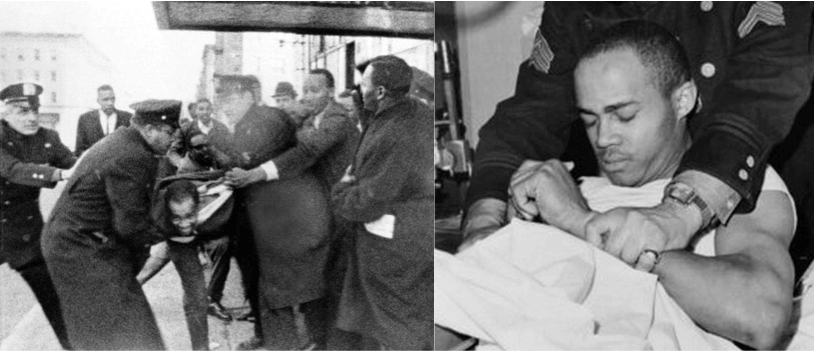 |
| Thomas Hagan AKA Talmadge Hayer apprehended |
Thomas Hoy was the only police officer stationed outside the ballroom. He managed to pull Hayer away from the crowd. A police car cruising by stopped. Sergeant Alvin Aronoff and patrolman Louis Angelos helped Hoy save Hayer’s life by pushing him into the car. They took him to the Wadsworth Avenue Police Station.187 Roberts had gone up on the stage. He found Malcolm still had a pulse. Roberts began giving Malcolm mouth-to-mouth resuscitation, trying to revive him. Malcolm died on the stage.188
Over the next 24 hours, Gene Roberts went through a series of BOSSI debriefings on the assassination. His superiors were incredulous at his attempt to save Malcolm’s life on the stage. “What did you do that for?” he was asked.
And I told them, Roberts said, “Well, I’m a cop. And this is what cops are supposed to do—save people.”189
 |
| Gene Roberts: “This is what cops are supposed to do—save people.” |
When Malcolm was shot, Joan Roberts had gone to Betty Shabazz, who had thrown her body over her children. Joan tried to hold her. Betty struggled to get free, throwing Joan against the wall, and ran to Malcolm’s side. Gene eventually helped Joan, who was shaken, to a taxicab.190
Gene Roberts was the precursor to Marrell McCullough in the assassination of Martin Luther King. In a famous photo, McCullough can be seen with a stricken look kneeling over King’s body on the balcony of the Lorraine Motel in Memphis, April 4, 1968. McCullough belonged to a Memphis black power youth group working with King. He was the first person to reach him after he was shot. Unknown to King’s associates for another decade, Marrell McCullough was also a deep cover operative for the Memphis Police Department.191
 |
| The LIFE issue on the assassination of Malcolm X |
Talmadge Hayer, Norman Butler, and Thomas Johnson were tried for Malcolm’s murder from January 21 to March 11, 1966. Butler and Johnson were two well-known New York “enforcers” for the Nation of Islam whom the police had picked up in the week following the assassination. A series of shaky witnesses, several contradicting their own grand jury testimony, testified to having seen Butler and Johnson take part in the murder. Butler and Johnson claimed they hadn’t even been in the Audubon Ballroom that afternoon. Butler had three supporting witnesses and Johnson two, to their each having been at home during the shooting. In the years to come, many of Malcolm’s people would emphasize that Butler and Johnson as well-known local NOI enforcers would have been quickly identified and watched closely had they entered the ballroom that day. They simply weren’t there. Talmadge Hayer agreed. In the trial’s most dramatic moments, Hayer took the stand, confessed his own participation in the assassination, and said Butler and Johnson had nothing to do with it. However, because Hayer refused to identify his real co-conspirators, his testimony was discredited. All three men were convicted and sentenced to life imprisonment. Hayer’s more detailed 1978 confession, naming the other four men in his group, was too late to help Butler and Johnson. They each served more than 20 years. The only man who has ever confessed to the murder of Malcolm X, Talmadge Hayer (who has become Mujahid Abdul Halim), has also made another confession:
I remember some of the ministers used to say that time reveals all things. Malcolm used to say it himself—time will tell. And for the longest time, I always thought that time would tell what that man was saying was wrong. Well, time has told. Time has told that a lot of things he said was true.192
 |
| Benjamin Goodman Karim |
Benjamin Goodman, in a 1978 affidavit supporting Butler and Johnson’s innocence, provided an insight into the coercion of trial witnesses. Goodman said that in 1965, he was summoned to a New York police station where detectives questioned him about Butler and Johnson. When he told the detectives repeatedly that Butler and Johnson had not been in the Audubon Ballroom that afternoon, the detectives became angry. Later in 1965, Goodman was summoned to another interview, this time from assistant District Attorney Stern. Goodman told them that:
I knew Butler and Johnson, they had not been present at the ballroom that day, and that I had not seen the actual shooting. When I said this, Mr. Stern became angry and said that he knew I had previously said that I had seen the shooting through an open dressing room door. This was not true and I had never said this to anyone. In his anger, Mr. Stern threatened me and asked me, have you ever been to jail? How would you like to go to jail?
Goodman was not called to testify at the trial.193
Besides Hayer, the most significant trial witness was black police officer Gilbert Henry. Before the prosecution could get him off the stand, Henry revealed the strange way the NYPD had deployed its forces on February 21st. Henry said he had been stationed in the Ballroom’s Rose Room that afternoon, at a distance from Malcolm’s location in the main auditorium. He and his partner, Patrolman John Carroll, had been given specific instructions by their superior officer, Sergeant Devaney, “to remain where [they] would not be seen.” If anything happened, Patrolman Henry was to call for help on a walkie-talkie the two men had with them. It was connected with another walkie-talkie held by an officer at the Presbyterian Medical Center on the other side of the street. When Henry heard shots, he tried calling on the walkie-talkie but got no response. He then ran into the main auditorium, but was too late to see anyone with a gun. He said he saw no other uniformed officers in the auditorium.194
Malcolm’s unofficial photographer, Robert Haggins, was one of the witnesses never called in the trial who could have testified farther to the odd behavior of the police that afternoon. Haggins told Spike Lee he had seen the anteroom of the ballroom filled with police: “If I took a guess, I’d say 25. It was filled with cops. Cops who must’ve waited until after he was shot to file into the ballroom.”195
Earl Grant saw the police come in. He said that about 15 minutes after Malcolm was shot, “a most incredible scene took place. Into the hall sauntered about a dozen policemen. They were strolling at about the pace one would expect of them if they were patrolling a quiet park. They did not seem to be at all excited or concerned about the circumstances.
I could hardly believe my eyes. Here were New York City policemen, entering a room from which at least a dozen shots had been heard, and yet not one of them had his gun out! As a matter of absolute fact, some of them even had their hands in their pockets.”196
The best witness we have to the assassination of Malcolm X remains Malcolm X, as recorded by Alex Haley.
On Saturday afternoon, February 20, 24 hours before he would walk to the podium of the Audubon Ballroom, Malcolm phoned Alex Haley at his home in upstate New York. It was to be their last conversation. Malcolm ended it with what Haley, in his epilogue to the autobiography, calls a “digression.” Malcolm was speaking of his impending murder:
I’m going to tell you something, brother—the more I keep thinking about this thing, the things that have been happening lately, I’m not all that sure it’s the Muslims. I know what they can do, and what they can’t, and they can’t do some of the stuff recently going on. Now, I’m going to tell you, the more I keep thinking about what happened to me in France, I think I’m going to quit saying it’s the Muslims.197
Malcolm had one final thought. In the last sentence he would ever say to Alex Haley—which Haley describes as “an odd, abrupt change of subject”—Malcolm said why he thought he was about to be killed:
You know, I’m glad I’ve been the first to establish official ties between Afro-Americans and our blood brothers in Africa.198
He then said good-bye and hung up.
 |
| Nasser and Nkrumah |
In the midst of his African campaign the previous August, Malcolm had sent a letter from Cairo to friends in Harlem that foreshadowed his last words to Alex Haley. One month after he was poisoned at the Nile Hilton, Malcolm wrote:
You must realize that what I am trying to do is very dangerous because it is a direct threat to the entire international system of racist exploitation…. Therefore, if I die or am killed before making it back to the States, you can rest assured that what I’ve already set in motion will never be stopped … Our problem has been internationalized.199
At the time Malcolm wrote this letter, his friend and ally Egyptian President Gamal Abdel Nasser was taking with extreme seriousness the ongoing threat to Malcolm’s life from U.S. intelligence agencies. He had two Egyptian security men posted outside Malcolm’s hotel room door at all times.200
Alex Haley, a great author who gave Malcolm a prose platform from which he could address the world, buried in his epilogue what may have been the most significant words Malcolm ever said to him. Malcolm’s “digression” was a revelation, which he would share also with his assistants on Sunday afternoon, and his “change of subject” a coherent climax to his life. Malcolm was willing to give his life for the sake of a unity between Africans and African-Americans that he hoped would change the course of history. In his final year, Malcolm had become a witness to the truth he had experienced in his pilgrimage to Mecca—that all of humankind was one family of brothers and sisters under Allah. But he radically focused that truth on Africa and America. Africa was where our one family had begun, and America where much of it had been sent into slavery. He envisioned and was organizing a mutually supportive African-American movement for human rights on both continents. “But,” as Malcolm said 12 days before his death to a friend in London, “the chances are that they will get me the way they got [Congo’s revolutionary leader Patrice] Lumumba before he reached the running stage.”201 Malcolm was right. And in his final words to Alex Haley, he had already solved the crime of his murder a day before it happened.
“Muslims don’t carry guns.” (Malcolm X to Charles Kenyatta, shortly before his death)
Near the end of his life, Malcolm began to think about guns as a question of faith. In his last week, he see-sawed between wanting to apply for a permit to carry a pistol and wanting to confront his killers with no guns on either himself or his followers. He ended by choosing no guns. It seemed a strange final decision for Black America’s most articulate advocate of armed self-defense. Why did Malcolm take such a stand at the hour of his death?
Malcolm’s co-worker, Charles 37X Kenyatta, has told a revealing story about the man whose life was one continuous turn toward the truth as he saw it. Charles said he and Malcolm were riding in a taxicab to the Chicago airport. They suddenly realized they were being taken instead into the stockyards. The driver had a sinister purpose of his own. Charles, however, had a pistol. He used it to make the driver stop the cab and get out. Charles and Malcolm drove quickly to the airport, and got on their plane.
Malcolm then told Charles he had lost his religion. Three decades after Malcolm’s death, Charles Kenyatta continued to puzzle over his teacher’s strange words. Malcolm said to him: “Muslims don’t carry guns.”202
As a deep believer in Islam, Malcolm chose to die as a martyr. After the attacks of September 11, 2001, and a wave of suicide bombers in Israel, Americans have tended to think of the Islamic concept of martyrdom as counter-violent. That was not, however the kind of martyr that Malcolm told Gordon Parks he wanted to be. Nor was it what he learned from the Islamic tradition he embraced on his pilgrimage to Mecca. In response to his assassins, whose identity he said he knew in advance, Malcolm gave his life to Allah “in the cause of brotherhood,” without trying to snatch away the lives of those taking his own.
He also chose not to go into exile to avoid martyrdom. 12 days before his death, Malcolm listened patiently in a London hotel room, while a friend, Guyan writer Jan Carew, summoned every word at his command to persuade Malcolm not to return to the United States and almost certain death. Carew even invoked the authority of their ancestral spirit world, “the ghosts in our blood,” against the folly of martyrdom.
Those ancestral spirits whisper warnings, whenever we’re about to do something reckless or foolhardy. Right now they should be whispering to you that, perhaps, surviving for our cause is more important then dying for it.203
Malcolm answered:
The spirit world’s fine but I want our folk to be free in the world of the living.204
And the unspoken thought: So for the sake of the living, I’ll live the truth freely and openly all the way, regardless of the consequences.
In Malcolm’s eyes, that was freedom. By living and speaking freely, Malcolm denied to the system that assassinated him the victory of taking away his life. He instead gave it freely in the cause of brotherhood and sisterhood. “It’s a time for martyrs now,” as he told Gordon Parks, “And if I’m to be one, it will be in the cause of brotherhood. That’s the only thing that can save this country.”
In his final days, Malcolm transformed the death by violence that had haunted him all his life. Recognizing its imminence, he embraced it in terms of his faith. He did so in a way that was in tension with some of his own public rhetoric. Although Malcolm continued to insist vehemently right up to his death on armed self-defense as a fundamental right for black people and for all other people as well, he died without wanting his followers to resort to that right for himself. In a life of profound changes, Malcolm’s ultimate choice of how he wanted to die, nonviolently in the cause of brotherhood, was perhaps the most remarkable change of all.
A “martyr” is literally a witness. Malcolm’s final action, in stepping forward to reconcile two brothers in a fight, made him not only a target for murder but also a witness to brotherhood.
As he said to us all, “As-salaam alaikum.”
Notes
1. The Autobiography of Malcolm X, as told to Alex Haley (New York: Ballantine Books, 1973), p. 9.
2. Ibid., p. 2.
3. Ibid., p. 378.
4. Ibid., p. 381.
5. Karl Evanzz, The Judas Factor: The Plot to Kill Malcolm X (New York: Thunder’s Mouth Press, 1992).
6. Karl Evanzz, The Messenger: The Rise and Fall of Elijah Muhammad (New York: Pantheon, 1999).
7. Zak A. Kondo, Conspiracys: Unravelling the Assassination of Malcolm X (Washington: Nubia Press, 1993).
8. Louis Lomax, To Kill a Black Man (Los Angeles: Holloway House, 1987). Although we have reached different conclusions on the conspiracy to kill Malcolm X, I want to acknowledge the help of a sixth author. In both his book, The Death and Life of Malcolm X (Urbana, Illinois: University of Illinois Press, second edition, 1979) and the kind interview he gave me, Peter Goldman has been a great resource and source of encouragement. His book provides dimensions of both the death and life that remain indispensable for a pilgrim into either.
9. Evanzz underlines Lomax’s importance in The Judas Factor p. xxiv. Lomax also had early insights into the murder of the second subject of his book, Martin Luther King Jr.
10. Memorandum from SAC [Special Agent in Charge], Chicago, to Director, FBI, 1/22169, page 1; in Petition to the Black Caucus, U.S. House of Representatives, of Muhammad Abdul Aziz (Norman 3X Butler) and Khalil Islam (Thomas 15X Johnson), April, 30, 1979; in the Walter E. Fauntroy Papers, Gelman Library, George Washington University.
11. Louis E. Lomax, When the Word Is Given (New York: Signet Books, 1964), p. 82.
12. Ibid.
13. Memorandum from William Sullivan to Alan Belmont, December 24, 1963. Church Committee Final Report, Book III, p. 134.
14. FBI HQ file on Lomax. Evanzz, Judas, p. 198.
15. Ibid.
16. Ibid.
17. Lomax, To Kill, p. 199.
18. Author’s interview with Wallace Muhammad, now W. D. Mohammed, August 2, 1999.
19. Evanzz, Messenger, p. 317.
20. Malcolm X scholar Zak Kondo obtained a March 16, 1954, Detroit FBI Report, captioned MALCOLM K. LITTLE, which cites from a 1950 prison letter written by Malcolm. Fonda, pp. 42, 292 endnote 847.
21. Messenger, p. 183.
22. Ibid.
23. Ibid.
24. Ibid., p. 557 endnote 39. Evanzz speculates that Abdul Basin Naeem may have been pressured to cooperate with the FBI and BOSSI due to his immigrant status. Ibid.
25. FBI HQ file on Elijah Muhammad; FBI NY file on Malcolm X; cited by Evanzz, Messenger, p. 186.
26. Ibid., p. 187.
27. Goldman, pp. 55-59. Judas, pp. 70-71.
28. Autobiography, p. 309.
29. To Kill, p. 103,
30. Messenger, pp. 187-88.
31. Cited by Evanzz, Ibid., p. 188.
32.Messenger, p. 192. Judas, p. 73.
33. Lomax, When the Word, p. 179.
34. Autobiography, p. 289.
35. When the Word, Ibid.
36. Autobiography, p. 265.
37. Ibid.
38. Ibid.
39. Ibid., p. 292.
40. Ibid., p. 297.
41. FBI HQ file on Elijah Muhammad, section 5, memo dated May 20, 1960; approved by Cartha DeLoach, May 22, 1960. Cited by Evann, Messenger, p. 218.
42. FBI HQ file on Elijah Muhammad. Ibid., pp. 249-50.
43. Autobiography, p. 301.
44. John Henrik Clarke, who published a transcript of the conversation, “A Visit from the FBI,” in Malcolm X: The Man and His Times (New York: Macmillan, 1975), pages 182-204, wrote in a footnote on page 182 that it happened on May 29, 1964. That date is too late, given the references in the conversation to the Clay-Liston fight in Florida as a future event. Clayborne Carson in Malcolm X: The FBI File (New York: Carroll & Graf, 1993), pages 252-53, presents an FBI document that indicates the visit took place on February 4, 1964.
45. Clarke, p. 195.
46. Ibid.
47. Ibid., p. 202.
48. Ibid., pp. 202-3.
49. Autobiography, p. 302.
50. Ibid., p. 303.
51. Ibid., pp. 308-9. Kondo, p. 73.
52. Autobiography, p. 316.
53. Malcolm X Speaks, edited by George Breitman (New York: Pathfinder, 1990), p. 18.
54. Kondo, pp. 63, 259 endnote 375.
55. Goldman, pp. 159-60, 191.
56. Malcolm X, “A Declaration of Conscience,” March 12, 1964; Malcolm X Speaks, p. 20.
57. Ibid.
58. Ibid., p. 22.
59. Malcolm X, “The Ballot or the Bullet,” April 3, 1964; Malcolm X Speaks, pp. 34-35.
60. Judas, pp. 226-27.
61. Cited by Evanzz, Judas, p. 225.
62. Ibid.
63. Messenger, p. 292.
64. Abdul Aziz Omar, formerly Philbert X Little; in William Strickland, Malcolm X: Make It Plain (New York: Viking, 1994), p. 174.
65. FBI HQ file on Elijah Muhammad, memo dated April 12, 1964; cited by Evanzz, Messenger, pp. 292-93.
66. Autobiography, p. 338.
67. Ibid.
68. Malcolm told Julian Mayfield and Leslie Lacy what Nkrumah had said. Leslie Alexander Lacy, “African Responses to Malcolm X,” in Black Fire, edited by Leroi Jones and Larry Neal (New York: William Morrow, 1968), p. 32.
69. 12 years after Kwame Nkrumah’s overthrow, Seymour Hersh reported the CIA’s involvement in the coup in a New York Times article based on a brief description in a book by ex-CIA agent John Stockwell and confirming interviews by “first-hand intelligence sources.” Seymour M. Hersh, “C.I.A. Said to Have Aided Plotters Who Overthrew Nkrumah in Ghana,” New York Times (May 9, 1978), p. 6. John Stockwell, In Search of Enemies (New York: W W Norton, 1978), p. 160 footnote.
70. “Malcolm Says He is Backed Abroad,” New York Times (May 22, 1964), p. 22.
71. Frank Donner, Protectors of Privilege (Berkeley: University of California Press, 1990), p. 155.
72. Tony Ulasewicz with Stuart A. McKeever, The President’s Private Eye (Westport, Connecticut: MACSAM Publishing, 1990), p. 145.
73. Ibid., p. 151.
74. Ibid.
75. Author’s interview with Teddy Theologes, June 29, 2000.
76. Elaine Rivera, “Out of the Shadows: The Man Who Spied on Malcolm X,” Newsday (July 23, 1989).
77. Author’s interview with Gene Roberts, July 7, 2000.
78. Rivera, Ibid.
79. To Kill, pp. 198-99.
80. Ibid., p. 199.
81. Malcolm X Speaks, pp. 58-59.
82. To Kill, p. 200,
83. Talmadge Hayer filed two affidavits on Malcolm’s murder, the first in November 1977, and the second in February 1978. It is the second, which goes into greater detail, that is cited here. Both affidavits are in Petition to the Black Caucus. Michael Friedly includes them as an appendix in his book, Malcolm X: The Assassination (New York: Carroll & Graf, 1992), pp. 215-18.
84. Ibid.
85. Peter Goldman, The Death and Life of Malcolm X (Urbana, Illinois: University of Illinois Press, second edition, 1979), p. 416.
86. Ibid.
87. Evanzz, Messenger, p. 96.
88. Malcolm’s telegram to Elijah Muhammad was published as an open letter in the June 26, 1964, edition of the New York Post. Cited by Kondo, pp. 74 and 269 endnote 467.
89. Hayer affidavit, Ibid.
90. Goldman, p. 195.
91. Ibid.
92. Author’s interview with Dr. Alauddin Shabazz, January 8, 1999.
93. Goldman, p. 19S.
94. Kondo, p. 147. Kondo hypothesizes that this provocative June 1964 phone call to the NOI was from an FBI or BOSSI provocateur, which would be consistent with the FBI’s COINTELPRO to keep Elijah and Malcolm at each other’s throats.
95. Goldman, p. 414; Kondo, p. 147.
96. The FBI transcript of the June 27, 1964 phone conversation is on page 480 of Malcolm X: The FBI File.
97. Ibid.
98. Judas, p. 241.
99. “Statement of Basic Aims and Objectives of the Organization of Afro-American Unity,” appendix in George Breitman, The Last Year of Malcolm X (New York: Pathfinder, 1989), p. 106.
100. Ibid.
101. Ibid., p. 109.
102. Kondo, pp. 43 and 239 endnote 249; citing FBI document.
103. Ibid., endnote 250; citing FBI document.
104. Malcolm X: The FBI File, p. 482.
105. Ibid.
106. John Ali was interviewed by Wesley South on the Chicago radio program Hotline on July 9, 1964. Ali’s analogies to JFK’s assassination, cited by Evanzz in The Judas Factor (pp. 247-48), were in response to a caller who “asked Ali whether it was true that the Black Muslims were trying to assassinate Malcolm X.” Ibid., p. 247. Ali also used espionage analogies, comparing Malcolm to Benedict Arnold and to Julius and Ethel Rosenberg, who were executed on the grounds that they handed over U.S. nuclear secrets to the Soviet Union. Ibid.
107. Cited by Evanzz, Judas, pp. 249-50.
108. Jan Carew, Ghosts in Our Blood (Chicago: Lawrence Hill Books, 1994), p. 39.
109. Eric Norden, “The Assassination of Malcolm X,” Hustler (December 1978), p. 98.
110. “Appeal to African Heads of State,” Malcolm X Speaks, pp. 75-77.
111. Ibid., p. 84.
112. “There’s A Worldwide Revolution Going On,” Malcolm X: The Last Speeches, edited by Bruce Perry (New York: Pathfinder, 1989), p. 116. Carew, Ghosts, p. 83.
113. Carew, Ibid.
114. Ibid., p. 115.
115. M. S. Handler, “Malcolm X Seeks U.N. Negro Debate,” New York Times (August 13, 1964), p. 22.
116. Ibid.
117. The missing sentences are included in the citation of the original Times article on page 86 of Malcolm X Speaks.
118. August 11, 1964, CIA memorandum for Deputy Director of Plans, titled “ACTIVITIES OF MALCOLM POSSIBLE INVOLVEMENT OF AFRICAN NATIONS IN U.S. CIVIL DISTURBANCES,” cited by both Kondo, pp. 49 and 242 endnote 280, and Evanzz, Judas, p. 254.
119. Evanzz’s citation of FBI HQ file on Malcolm X, Ibid.
120. Judas, p. 254.
121. John Lewis, Walking With the Wind (New York: Simon 8c Schuster, 1998), p. 286.
122. Malcolm X Speaks, p. 85.
123. Lewis, p. 287.
124. Ibid., p. 288.
125. Louis X, “Boston Minister Tells of Messenger Muhammad’s Biggest Hypocrite,” Muhammad Speaks (December 4, 1964), p. 11. Kondo, p. 159. Goldman, pp. 247-48. Cited also on Tony Brown’s Journal, “What Did Farrakhan Say and When Did He Say It?” (Spring 2000).
126. Spike Lee, By Any Means Necessary: The Trials and Tribulations of the Making of Malcolm X (New York: Hyperion, 1992), p. 56. Farrakhan’s statements to Tony Brown, Barbara Walters, and Mike Wallace are included in “What Did Farrakhan Say …?”
127. “What Did Farrakhan Say …?”
128. Messenger, p. 293,
129. Judas, pp. 263-64.
130. Judas, p. 267.
131. M. S. Handler, “Malcolm X Cites Role in U.N. Fight,” New York Times (January 2, 1965), p. 6.
132. Ibid.
133. Malcolm X: The FBI File, p, 81.
134. Hakim A. Jarnal, From the Dead Level (London: Andre Deutsch, 1971), p. 223.
135. Ibid.
136. Ibid., pp. 212-15, 228-29.
137. Haley, p. 425.
138. Ibid.
139. Ibid.
140. Taylor Branch, Pillar of Fire (New York: Simon & Schuster, 1998), p. 578.
141. Malcolm X, The Final Speeches: February 1965 (New York: Pathfinder, 1992), p. 26.
142. Ibid., p. 28.
143. Coretta Scott King, My Life With Martin Luther King, Jr.; revised edition (New York: Henry Holt, 1993), p. 238.
144. Ibid., p. 240,
145. Goldman, p. 254.
146. Eric Norden, “The Murder of Malcolm X,” The Realist (February 1967), p. 12.
147. Ibid.
148. J. Edgar Hoover’s February 4, 1965, memorandum read: “… Information has been received that Malcolm Little plans to travel to England and France during the early part of February. He will reportedly depart this country on February 5, 1965, and will return about February 11, 1965. In this connection, there is enclosed one copy of a memorandum dated February 1, 1965, at New York, which contains available information of the subject’s contemplated travel.” Kondo, pp. 271-72 endnote 491. In addition to the intelligence agencies I have noted, Hoover’s memorandum was also sent to the Assistant Attorney General, the Acting Attorney General, and the Foreign Liaison Unit. Ibid.
149. Kondo, p. 162.
150. Ibid.
151. Kondo, p. 76. Goldman, p. 263.
152. Goldman, p. 262. Judas, pp. 289-90. Kondo, p. 76. M.X. Handler, “Malcolm X Flees Firebomb Attack,” New York Times (February 15, 1965), p. 1. Malcolm X, Final Speeches, pp. 133-34.
153. Earl Grant, “The Last Days of Malcolm X,” Malcolm X: The Man and His Times, edited by John Henrik Clarke (NewYork: Macmillan, 1975), p. 86.
154. “Malcolm Accuses Muslims of Blaze; They Point to Him,” New York Times (February 16, 1965), p. 18.
155. Autobiography, pp. 308-9. Kondo, p, 73,
156. Messenger, pp. 318-19.
157. Lee, p. 63.
158. On Brother Minister: The Assassination of Malcolm X, a 1997 film directed by Jack Baxter and Jefri Aallmuhammed.
159. “Bottle of Gasoline Found on a Dresser in Malcolm X Home,” New York Times (February 17, 1965), p. 34.
160. He said this, for example, on Monday night, February 15, 1965, in his talk at the Audubon Ballroom, “There’s a Worldwide Revolution Going On.” Final Speeches, p. 124.
161. Norden, “Murder,” p. 12,
162. In his statement to the press, February 18, 1965, “We Are Demanding an Investigation,” Final Speeches, p. 179.
163. Ibid.
164. See endnote 118.
165. Norden, “Murder,” p. 12.
166. Author’s interview with Gene Roberts, July 7, 2000.
167. “There’s a Worldwide Revolution Going On,” Final Speeches, p. 123.
168. Author’s interview.
169. Gene Roberts to Elaine Rivera on his efforts to tell his BOSSI supervisors about the dry run. Rivera, “Out of the Shadows.”
170. Author’s interview.
171. Gordon Parks, “I was a Zombie Then—Like All [Black] Muslims, I Was Hypnotized,” Life (March 5, 1965), p. 28.
172. Ibid.
173. Goldman, p. 261,
174. Ibid., p. 262.
175. Haley, p. 438.
176. Ibid.
177. Rivera, “Out of the Shadows.”
178. Ibid.
179. Haley, p. 431. Grant, “The Last Days,” p. 92.
180. Norden, “The Murder,” p, 13.
181. Talmadge Hayer amplified his written confession, with further details that are included here, in an interview on Tony Brown’s Journal, “Malcolm and Elijah,” February 21, 1982. Cited by Kondo, pp, 169-70.
182. Haley, p. 428. Judas, pp. xiii, 293.
183. Haley, p. 433.
184. Ibid.
185. Kondo, p. xviii.
186. Goldman, p. 274.
187. Several witnesses claim two suspects were arrested by the police. Omar Ahmed, who was on Malcolm’s guard detail at the time, thought there were two men arrested outside of the ballroom. Interview by Kondo, p. 84. Earl Grant makes the same claim in “The Last Days of Malcolm X,” p, 99.
The New York Herald Tribune‘s early edition of February 22, 1965, reported two arrests. Its article said that one suspect, Hayer, was “taken to Bellevue Prison Ward and was sealed off by a dozen policemen. The other suspect was taken to the Wadsworth Avenue precinct, where the city’s top policemen immediately converged and began one of the heaviest homicide investigations this city has ever seen.” New York Herald Tribune (February 22, 1965; city edition) article by Jimmy Breslin, “Police Rescue Two Suspects”; cited by Kondo, p. 83. The Tribune‘s late city editions make no mention of the second suspect. Ibid. The New York Times in its early and late city editions follows the same pattern. Kondo, Ibid.
Peter Goldman explains the inconsistencies in terms of separate debriefings of Thomas Hoy and Alvin Aronoff: “Hoy and Aronoff were debriefed separately at the time, Hoy at the scene and Aronoff at the stationhouse, and the early editions of the next day’s papers reported that there had been two arrests. The two policemen, as it developed, were talking about the same man …” Goldman, p. 276.
When Alex Haley wrote his 1965 ‘Epilogue” to the Autobiography, he was still raising the possibility of two arrested suspects and the hope of identifying the second. Haley, p. 438.
188. Author’s interview.
189. From Gene Roberts interview in Brother Minister.
190. Rivera, “Out of the Shadows.”
191. William F. Pepper, Orders to Kill (New York; Carroll & Graf, 1995), pp. 129-30. Pepper identifies McCullough as being at the same time a member of Army intelligence. Ibid., p. 443.
192. Kondo, p. 202.
193. Benjamin Goodman Affidavit, May 19, 1978; in Petition to Black Caucus.
194. Herman Porter, “The Trial,” in The Assassination of Malcolm X, edited by Malik Miah (New York: Pathfinder Press, 1988), p. 93. Norden, “The Murder,” p. 14. William M. Kunstler’s December 19, 1977, deposition in Petition to the Black Caucus, pp. 25-26.
195. Lee, p. 42,
196. Grant, p. 96.
197. Haley, pp. 430-31.
198. Ibid., p. 431.
199. Malcolm X, “A Letter from Cairo,” By Any Means Necessary (New York: Pathfinder, 1991), p. 110.
200. David DuBois to Spike Lee; in Lee, p. 38.
201. Carew, p. 36.
202. Charles 37X Kenyatta in Brother Minister.
203. Carew, p. 57.
204. Ibid.

