Tag: EYEWITNESSES

  • Why CBS Covered Up the JFK Assassination, Part 1

    Why CBS Covered Up the JFK Assassination, Part 1


    Part One

    When Warren Commission critic Roger Feinman passed away in the fall of 2011, he was freelancing as a computer programmer. That was not his original choice for a profession. Roger started out in life as a journalist. In fact, while in college, he actually submitted reports on campus anti-war disturbances to local radio stations. When he graduated, he got a job at the local New York City independent television station WPIX. In 1972, at the rather young age of 24, he began working for CBS News in New York. There, among other things, he assisted in producing “The CBS World News Roundup with Dallas Townsend.” Under normal circumstances, Roger could have expected a long career at CBS, a few promotions, a nice salary, a munificent benefits package, and a generous pension. He never got any of that. In fact, he was terminated by his employers in the fall of 1976.

    Roger Feinman

    Why? Because in 1975, Roger saw the CBS News Department preparing for another multi-part special defending the Warren Report. The reader should be aware that this was the third time in 11 years that CBS had used its immense media influence to propagandize the public into thinking all was right with the official version of President Kennedy’s assassination. Back in 1964, upon the Warren Report’s initial release—actually the evening of the day it was published—CBS preempted regular programming. Walter Cronkite, assisted by Dan Rather, devoted two commercial-free hours to endorsing the main tenets of that report.

    But something happened right after Cronkite and Rather did their public commemoration. Other people, who were not in the employ of the MSM, also looked at the report and the accompanying 26 volumes. Some of them were lawyers, some were professors, e.g., Vincent Salandria and Richard Popkin. They came to the conclusion that CBS had been less than rigorous in its review. By 1967, the analyses opposing the conclusions of both CBS and the Warren Report had become numerous and widespread. Books by Edward Epstein, Mark Lane, Sylvia Meagher and Josiah Thompson had now entered into public debate. Some of them became best sellers. Thompson’s book, Six Seconds in Dallas, was excerpted and placed on the cover of the wide circulation magazine Saturday Evening Post. Lane was actually appearing on popular talk shows. Jim Garrison had announced a reopening of the JFK case in New Orleans. The dam was threatening to break.

    Therefore, in the summer of 1967, CBS again came to the aid of the official story. They now prepared a four-hour, four night, extravaganza to, again, endorse the findings of the Warren Commission. As in 1964, Cronkite manned the anchor desk and Rather was the main field reporter. And again, CBS could find no serious problems with the Warren Report. The critics were misguided, CBS said. Walter and Dan had done a seven-month inquiry. At the time of broadcast, it was the most expensive documentary CBS ever had produced. And they found the following: Acting alone, Oswald killed President Kennedy and police officer J. D. Tippit. Acting alone, Jack Ruby killed Oswald. And Oswald and Ruby did not know each other. All the controversy was Much Ado about Nothing. Cronkite was going to “shed light” on these questions for those in the public who were confused.

    To show how much “light” Cronkite was going to shed, he began the first installment by saying that there was no question that Oswald ordered the rifle in evidence. Yet, as John Armstrong and others have shown, there are many doubts about whether or not Oswald ordered this rifle. Apparently, among other things, Walter and Dan didn’t notice that the money order allegedly used to pay for the rifle never went through the Federal Reserve system.

    Eight years after this broadcast, in 1975, two events occurred to raise interest in the JFK case again. First, the Church Committee was formed to explore the crimes of the CIA and FBI. The committee revealed that, way before Kennedy was killed, the CIA had farmed out the assassination of Fidel Castro to the Mafia. Yet, the Warren Commission was never told about this. Even though Allen Dulles—the CIA Director when these plots were formulated—was on the Commission. Secondly, in the summer of 1975, in primetime, ABC broadcast the Zapruder film. This was the first time that the American public had seen the shocking image of President Kennedy being hurled back and to the left by what appeared to be a shot from his front and right. A shot Oswald could not have fired. The confluence of these two events caused a furor in Washington. A congressional resolution was passed to form the House Select Committee on Assassinations (HSCA), a reopening of the JFK case.

    CBS decided they were going to try and influence the outcome of the HSCA in advance. So they now prepared still another special about the JFK case. (And since the congressional resolution forming the HSCA sanctioned an inquiry into the Martin Luther King case also, CBS was going to a do a special on that assassination too.)

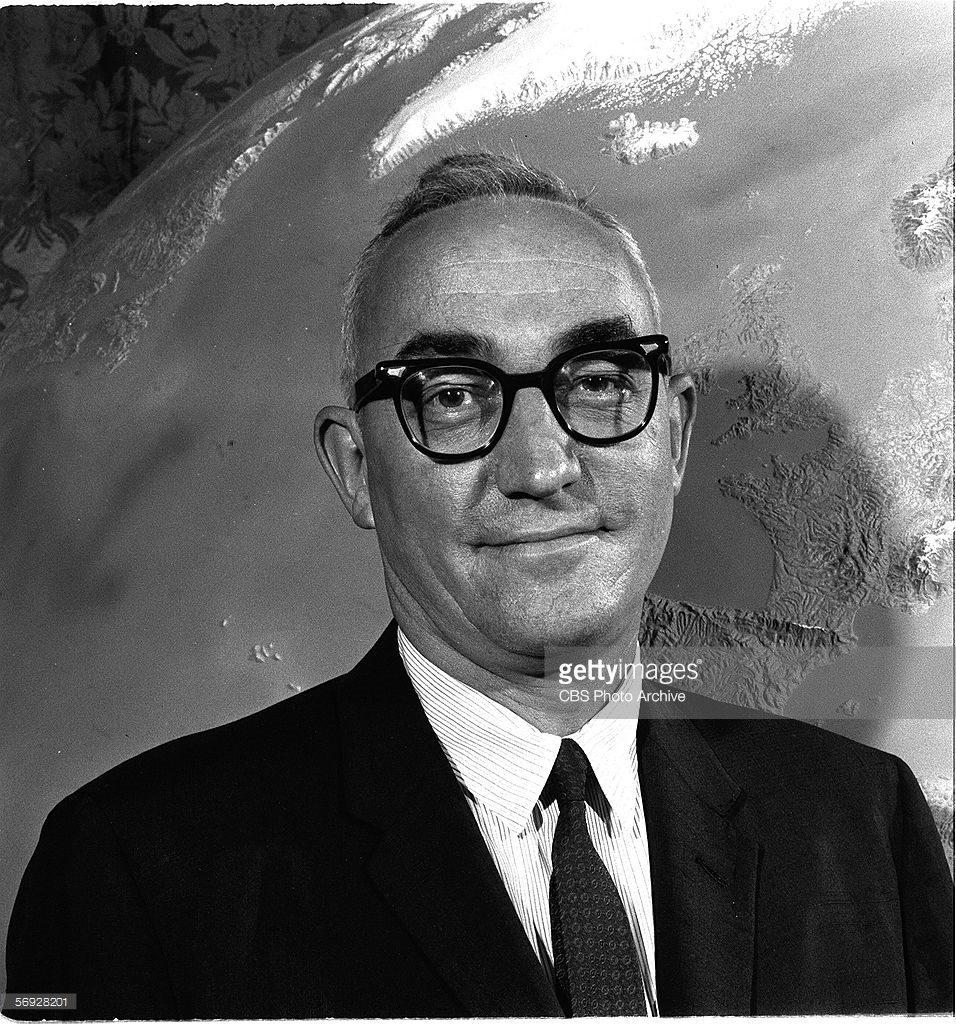
    Richard Salant, former president of CBS
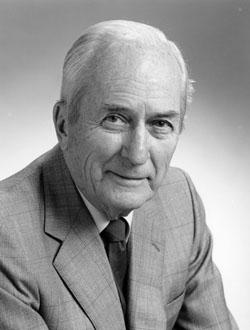
    William J. Small, former president of NBC News and executive with CBS for 17 years

    There was a small problem. Roger Feinman had become a friend and follower of the estimable Warren Commission critic Sylvia Meagher. Therefore, he knew that 1) The Warren Commission produced a deeply flawed report, and 2) CBS had employed some questionable methods in the 1967 special in order to conceal those flaws. Since Roger was working there in 1975, he began to write some memoranda to those in charge warning them that they had repeated their poor 1967 performance in November of 1975. His first memo went to CBS president Dick Salant. Many of the other memos were directed to the Office of Standards and Practices.

    In preparing these memos Roger had researched some of the rather odd methodologies that CBS used in 1967, and again in 1975. Since, in 1975, he had been there for three years, he got to know some of the people who had worked on that series. They supplied him with documents and information which revealed that what Cronkite and Rather were telling the audience had been arrived at through a process that was as flawed as the one the Warren Commission had used. Roger requested a formal review of the process by which CBS had arrived at its forensic conclusions. He felt the documentary had violated company guidelines in doing so.

    As Roger’s memos began to circulate through the executive and management suites—including Salant’s and Vice-President Bill Small’s—it was made clear to him that he should cease and desist from his one-man campaign. But he would not let up. CBS now moved to terminate their dissident employee.

    On September 7, 1976, CBS succeeded in terminating Roger Feinman. But the collection of documents he secured through his sources was, to my knowledge, absolutely unprecedented. This remarkable evidence allowed us, for the first time, to see how the 1967 series was conceived and executed. But further, it takes us into the group psychology of a large media corporation when it collides with controversial matters of national security.

    Daniel Schorr

    One of the most remarkable discoveries Roger made was this: the initial proposal for the special was made from certain employees inside CBS. The proposal was originally sent to Salant by CBS Vice-President at the time, Gordon Manning. Two men who had relayed the idea to him were Daniel Schorr and Bill Small. Later on, Les Midgley would join the effort.

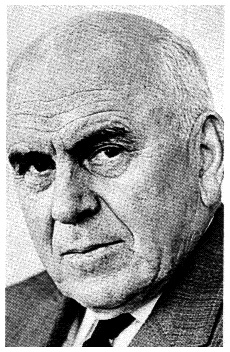
    Gordon Manning, executive at CBS, NBC and Newsweek

    Small was the CBS Washington Bureau Chief from 1962-74 who was now vice-president. Schorr had joined CBS in 1953 and worked under the legendary Edward R. Murrow as a reporter. Manning was hired away from Newsweek to CBS by executive Fred Friendly in 1964. By 1967 he had also become a vice-president. Midgley had also started in print media. But by 1963, he had become a top prime time news producer at CBS.

    The first proposal was sent to Salant by Manning in August of 1966. It was declined. Manning tried again in October. This time he suggested an open debate between the critics of the Warren Report and former Commission counsels. It would be moderated by a law school dean or the president of the ABA.

    One month after Manning’s debate proposal, Life Magazine published a front-page story in which they questioned the Warren Commission verdict with photographic evidence from the Zapruder film (which they owned). They also interviewed Texas Governor John Connally who disagreed that he and Kennedy had been hit by the same shot. That idea, the Single Bullet Theory, was the fulcrum of the Warren Report. Without it, the Commission’s verdict was rendered spurious. The story ended with a call to reopen the case. In fact, Life had actually put together a small journalistic team to do their own internal investigation.

    Les Midgley, CBS producer

    A few days after this issue appeared, Manning again pressed for a CBS special. This time he suggested the title, “The Trial of Lee Harvey Oswald”. Here, a panel of law school deans would review the evidence against Oswald in a mock trial setting. Including evidence that the Warren Commission had not included.

    At this time, Manning was joined by producer Les Midgley. Midgley had produced the two-hour 1964 CBS special. His suggestion differed from Manning’s. He wanted to title the show “The Warren Report on Trial”. Midgley suggested a three night, three-hour series. One night would be given over to the commission defenders, one night would include all the witnesses the commission overlooked or discounted. The last night would include a verdict conducted by legal experts. On December 1, 1966, Salant wrote a memo to John Schneider, president of CBS Broadcast Group. He told him that he might refer the proposal to the CNEC. That acronym stood for CBS News Executive Committee. According to information Roger gained through discovering secret memos, plus through secondary sources, CNEC was a secretive group that was created in the wake of Edward R. Murrow’s departure from CBS.

    Edward R. Murrow

    Murrow was a true investigative reporter who became famous through his reports on Senator Joe McCarthy and the treatment of migrant farm workers. The upper management at CBS did not like the controversy that these reports attracted from certain segments of the American power structure. After all, they were part of that structure. Salant went to Exeter Academy, Harvard, and then Harvard Law School. He had been handpicked from the network’s Manhattan legal firm by CBS President Frank Stanton to join his management team. From 1961-67, Stanton was chairman of Rand Corporation, a CIA associated think tank. During World War 2, Stanton worked in the Office of War Information, the psychological warfare branch. President Eisenhower had appointed Stanton to a small committee to organize how the USA would survive in case of nuclear attack. The other two members of CNEC were Sig Mickelson and founder Bill Paley. Mickelson had preceded Salant as president of CBS News. He then became director of Time-Life Broadcasting. Mickelson said nothing when founder Bill Paley—who had also served in the psywar branch of the Office of War Information, in World War 2—met with CIA Director Allen Dulles and agreed to have CBS overseas correspondents informally debriefed by the Agency.

    Frank Stanton, former CBS president and chairman of the Rand Corporation from 1961-67

    When Salant had reached his crossroads with CNEC, the writing was on the wall for any fair minded, objective treatment of the JFK case at CBS. For as Roger wrote, “The establishment of CNEC effectively curtailed the news division’s independence.” Further, Salant had no journalistic experience and was in almost daily communication with Stanton. As Roger further wrote, Salant “frequently exercised editorial supervision over CBS news broadcasts.” And further, his memoirs did not mention the supervision of CNEC. Or the Warren Commission documentaries made under his watch. These hidden facts “belied Salant’s frequent public assertions of CBS News’ independence from corporate influence.”

    Sig Mickelson, former president of CBS News and director of Time-Life Broadcasting

    The day after Salant informed the CNEC about the proposal, he told Manning that he was wavering on the mock trial concept. Salant’s next move was even more ominous. He sent both Manning and Midgley to California to talk to two lawyers about the project. One of the attorneys was Edwin Huddleson, a partner in the San Francisco firm of Cooley, Godward, Castro and Huddleson. Huddleson attended Harvard Law with Salant. Like Stanton he was on the board of Rand Corporation. The other lawyer the men saw was Bayless Manning, Dean of Stanford Law School. Both men told the CBS representatives that they were against the network undertaking the project on the grounds of “the national interest” and because of “political implications”. Gordon Manning reported that both attorneys advised them to ignore the critics of the Warren Commission, or to even appoint a panel to critique their books. Huddleson even recommended having scientist Luis Alvarez as a consultant to counter the critics. Which CBS actually did.

    On his return to CBS headquarters, Gordon Manning realized what was happening. He suggested a new title for the series, “In Defense of the Warren Report”. He now wrote that CBS should dismiss “the inane, irresponsible, and hare-brained challenges of Mark Lane and others of that stripe.” Gordon Manning’s defection left Midgley out on a limb. Salant, with the help of the White House, was about to cut it off.  (Bayless Manning had played a significant role in reversing the aim of the program.  It is perhaps of interest here to note that in 1971, David Rockefeller made Bayless Manning first president of the Council on Foreign Relations.)

    Unaware of what Salant was up to, on December 14, 1966, Midgley circulated a memo about how he planned on approaching the Warren Report project. He proposed running experiments that were more scientific than “the ridiculous ones run by the FBI.” He still wanted a mock trial to show how the operation of the Commission was “almost incredibly inadequate.”

    William S. Paley, creator of CBS television, and founder of CNEC

    In response, Salant now circulated an anonymous, undated, paragraph-by-paragraph rebuttal to Midgley’s attack. The secret author of that memo was none other than Warren Commissioner John McCloy—then Chairman of the Council on Foreign Relations. Ellen McCloy, his daughter, was Salant’s administrative assistant. In this memo, McCloy wrote that “the chief evidence that Oswald acted alone and shot alone is not to be found in the ballistics and pathology of the assassination, but in the fact of his loner life.” [emphasis added] As most Warren Commission critics had written, it was this approach—discounting or ignoring the medical and ballistics evidence, but concentrating on Oswald’s alleged social life—that was the fatal flaw of the Warren Report. From this point on, Ellen McCloy would be on the distribution list for almost all memos related to the Kennedy assassination project. She would now serve as the secret back channel between CBS and her father in regards to the production and substance of the project.

    John J. McCloy. His daughter, Ellen, who was Salant’s administrative assistant, admitted to acting as his clandestine liason with CBS during the production of the 1967 Warren Report special.

    Clearly, the tide had turned and Salant was now in McCloy’s corner. For Salant then asks producer Midgley, “Is the question whether Oswald was a CIA or FBI informant really so substantial that we have to deal with it?” Midgley, still alone out on the limb, replies, “Yes, we must treat it.”

    This clandestine relationship between Salant and McCloy was known to very few people in 1967. In fact, as Feinman later deduced, it was likely known only to the very small circle in the memo distribution chain. That Salant deliberately wished to keep it hidden is indicated by the fact that he allowed McCloy to write these early memos anonymously. For as Feinman also concluded, McCloy’s influence on the program was almost certainly a violation of the network’s own guidelines. Which is probably another reason Salant kept it hidden. In fact, as we will see, Salant was actually in denial about the relationship.

    After Feinman was terminated he briefly thought of publicizing the whole affair (which he eventually decided against doing). So he wrote McCloy in March of 1977 about the CFR chair’s clandestine role in the four night special. McCloy declined to be interviewed on the subject. He also added that he did not recall any contribution he made to the special.

    But Feinman persisted. About three weeks later, on April 4, 1977, he wrote McCloy again. This time he revealed that he had written evidence that McCloy had participated extensively in the production of the four night series. Very quickly, McCloy now got in contact with Salant. McCloy wrote that he did not recall any such back channel relationship. Salant then contacted Midgley. He told the producer to check his files to see if there was any evidence that would reveal the CBS secret collaboration with McCloy. Salant wrote back to McCloy saying that at no time did Ellen McCloy ever act as a conduit between CBS News and McCloy.

    This, of course, was false. And in 1992, in an article for The Village Voice, both Ellen McCloy and Salant were confronted with memos that revealed Salant was lying in 1977. McCloy’s daughter admitted to the clandestine courier relationship. Salant finally admitted it also, but he tried to say there was nothing unusual about it. Which leaves the obvious question: If that were the case then why was it kept secret from almost everyone? Including the public. (See further “JFK: How the Media Assassinated the Real Story”)

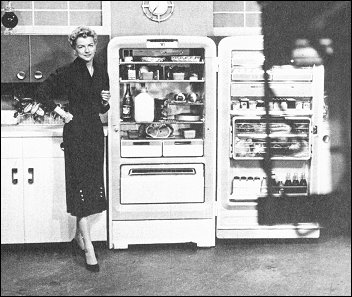
    Betty Furness doing a Westinghouse ad

    As alluded to previously, there was still work to be done with the last holdout, producer Les Midgley. While the four-night special was in production, Midgley became engaged to one Betty Furness. Furness was a former actress turned television commercial spokesperson. At this time, President Lyndon Johnson now appointed her his special assistant for consumer affairs. Even though her only experience in the field had been selling Westinghouse appliances for eleven years on television. She was sworn in on April 27, 1967, about two months before the CBS production first aired. Two weeks after it was broadcast, Midgley and Furness were married. We should note here, as Kai Bird’s biography of McCloy, The Chairman, makes clear, Johnson and McCloy were both friends and colleagues.

    But there is another point to be made about how Midgley was convinced to go along with McCloy’s view of the Warren Commission. Around the same time he was married to Furness, he received a significant promotion. He was now made the executive editor of the network’s flagship news program, “The CBS Evening News with Walter Cronkite”. This made him, in essence, the number one news editor at CBS. Such a decision could not have been made without consultation between Salant, Cronkite and Stanton. And very likely the CNEC.

    We have now seen—in unprecedented detail—how the executive level of CBS completely altered a proposal to present a fair and balanced program about the murder of President Kennedy to the public, and at a very sensitive time in history. Consulting with their lawyers, they decided such a program would not be in “the national interest” and would have “political implications”. We have also seen how the president of CBS News secretly brought in a consultant, John McCloy, whose participation was a violation of the standards and practices of the network. We have seen how both McCloy and Salant then lied about this secret back channel, which was never revealed to the public. We have also seen how Gordon Manning and Les Midgley, through a combination of the carrot and stick treatment, were made to go along with the Salant/McCloy, CNEC agenda.

    We should now look at the impact this secret relationship would have on what CBS was going to broadcast to an unsuspecting public. For their widely trumpeted “examination” of the Warren Report was anything but.


    Go to Part 2

  • Why CBS Covered Up the JFK Assassination, Part 2

    Why CBS Covered Up the JFK Assassination, Part 2


    Part Two

    In the first part of this article we saw that, as the controversy over the JFK assassination rose in 1966, some employees at CBS News wanted to deal with the subject in a fair and objective way. Specifically, in either a debate or mock trial format, with both sides—both critics and advocates of the Warren Report—represented equally. But CBS President Richard Salant, in consultation with the CNEC—the secret executive committee at CBS—took control of this proposal, and more or less hijacked it. Salant and the CNEC brought in his own consultant to the proposal. One who would not abide by the critics being allowed a fair and equal voice in this debate. Former Warren Commissioner John McCloy would now have a powerful voice about the upcoming special. His back channel to the show would be through his daughter, Ellen McCloy, who worked for Salant. Not only would this be kept under wraps, but also when CBS moved to terminate Roger Feinman in 1975, Salant would deny any such relationship.

    Once McCloy was brought on board, the complexion of both CBS and their programs—both in 1967 and 1975—were altered. The amount of time given over to the critics of the Warren Report would be severely curtailed. But beyond that, CBS would now employ other consultants, besides McCloy, for both their 1967 and 1975 programs. Men who would be rabidly pro-Warren Report. Some of them would appear on the shows as guest speakers. Some would be hidden in the shadows. But in no case would CBS make clear just how biased these men were. In addition to the clandestine role of McCloy, some of these consultants included Dallas police officer Gerald Hill, reporter Lawrence Schiller, physicist Luis Alvarez, and urologist John Lattimer.

    Gerald Hill

    Gerald Hill was just about everywhere in Dallas on November 22, 1963. He was at the Texas School Book Depository, he was at the murder scene of Officer J. D. Tippit, and he was at the Texas Theater—the place where Lee Harvey Oswald was arrested. Hill appears on the 1967 show as a speaker. But Roger Feinman found out that Hill was paid for six weeks work on the 1967 show as a consultant. During his consulting, Hill revealed that the police did a “fast frisk” on Oswald while in the theater. They found nothing in his pockets at the time. Which poses the question as to where the bullets the police said they found in his pockets later at the station came from. That question did not arise during the program, since CBS never revealed that statement. (Click here and go to page 20 of the transcript.)

    John Lattimer

    During World War II, John Lattimer traveled with Patton’s Third Army across France. He treated the wounded during the D-Day invasion. At the end of the war, he was the court-appointed doctor for the Nazis accused of war crimes at Nuremburg. As researcher Milicent Cranor discovered, Lattimer was J. Edgar Hoover’s physician. Fittingly then, he had been defending the Commission since at least 1966 in the pages of the Journal of the American Medical Association. In 1972, he became the first doctor allowed to enter the National Archives and inspect the autopsy evidence in the JFK case. He reaffirmed the Warren Commission verdict without telling the public that Kennedy’s brain was missing from the archives. In 1975, Dr. James Weston was the on-camera witness for the medical evidence. Lattimer consulted with Weston and prepared some visual aids for him. Lattimer spent a large part of his career writing articles and performing dubious experiments propping up the Warren Report. (Click here, and here)

    Luis Alvarez

    Luis Alvarez worked on refinements in radar detection during World War II. He then had a role on the Manhattan Project. He actually witnessed the destruction of Hiroshima from an observation plane, the B-29 The Great Artiste. In 1953, Alvarez was on a CIA-appointed study group for UFO’s called the Robertson Panel. In the sixties, he was part of the JASON Advisory Group; this was a powerful organization of top-level scientists that advised the military on things like fighting the Vietnam War. Along with people like Henry Kissinger, Ronald Reagan and George Schultz, he was a member of the secretive and quite conservative Republican private club, the Bohemian Grove. Alvarez was part of the Ruina Panel, which was put together to conceal evidence of Israel exploding nuclear devices. (Click here) Like Lattimer, Alvarez spent a considerable amount of time lending his name to articles and questionable experiments supporting the Warren Report. In fact, as demonstrated by authors like Josiah Thompson (in 2013) and Gary Aguilar (in 2014), Alvarez actually misrepresented his data in some of his JFK experiments. (Click here and go to the 37:00 mark for Aguilar’s presentation.)

    Lawrence Schiller

    The same year of the 1967 CBS broadcast, Lawrence Schiller had co-written a book entitled The Scavengers and Critics of the Warren Report. This was a picaresque journey through America where Schiller interviewed some of the prominent—and not so prominent—critics of the report and caricatured them hideously. The book was simultaneously published in hardcover and softcover, and was also accompanied by an LP record album. But this constituted only Schiller’s overt actions on the JFK case. Secretly, he had been an informant for the FBI for many years on people like Mark Lane and Jim Garrison. These documents were not declassified until the Assassination Records and Reviews Board was set up in the nineties. (See Destiny Betrayed, Second Edition, by James DiEugenio, p. 388) How bad was Schiller? He attacked New Orleans DA Jim Garrison even though he himself had discovered witnesses who attested that Garrison’s suspect, Clay Shaw, actually used the alias of Clay Bertrand. Which was a major part of Garrison’s case against the man. (ibid)

    As the reader can see, with this cast of consultants, the 1967 CBS Special was wrongly titled as “A CBS News Inquiry: The Warren Report”. For the last thing these four men, plus McCloy, wanted to do was to unearth the methodology and process by which the Warren Commission had come to its conclusions. For if that had been done, the results would have shown just how superficial, how haphazard, how agenda-driven the Commission really was. What CBS was going to do was—come hell or high water—endorse the Warren Report. And this became obvious right at the start of the program in the summer of 1967.

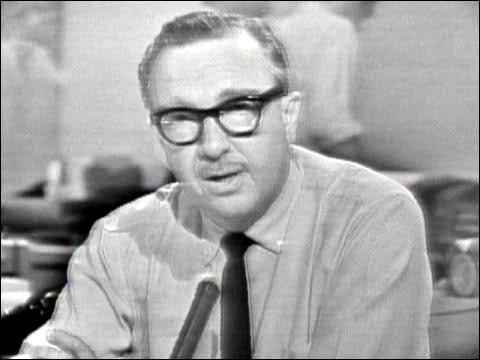
    Walter Cronkite

    For instance, Walter Cronkite intoned that, as a crowd of people rejoiced at the sight of President Kennedy approaching Dealey Plaza, “another waited”. Cronkite then said that, faced with dangerous conditions, President Johnson appointed the Warren Commission. Yet, Johnson never wanted a blue ribbon panel from Washington. He wanted a Texas-based investigation founded upon an FBI report. People outside the White House, like Yale Law School Dean Eugene Rostow and columnist Joseph Alsop, foisted the idea of the Warren Commission upon him. (see The Assassinations, edited by James DiEugenio and Lisa Pease, pp. 7-16) Cronkite then names the men on the Warren Commission while showing their pictures on screen, affirming that this inquiry would be made “by men of unimpeachable credentials”. Needless to say, Cronkite does not mention the fact that President Kennedy had fired Commissioner Allen Dulles in 1961 for lying to him about the Bay of Pigs.

    Cronkite then got to the crux of the program. After stating that the Warren Report assured the public the most searching investigation in history had taken place, he now began to show books and articles that were critical of the Commission. He then revealed certain polling results that demonstrated a majority of Americans had lost faith in the Warren Report. This signalled what the program had now become. It was the first network special that took aim at the work of those critical of the Warren Commission. Its raison d’être was to take on the work of the critics and reassure the public that these people could not be trusted. They had given the Warren Report a bum rap.

    Cronkite then went through a list of points that the critics had surfaced after reading the report and its 26 volumes of evidence. These were:

    1. Did Oswald own a rifle?
    2. Did Oswald take a rifle to the book depository building?
    3. Where was Oswald when the shots were fired?
    4. Was Oswald’s rifle fired from the building?
    5. How many shots were fired?
    6. How fast could Oswald’s rifle be fired?
    7. What was the time span of the shots?

    To shorten a four-hour story: CBS sided with the Warren Report on each point. Oswald fired three shots from the sixth floor with the rifle attributed to him by the Warren Commission. Two of three were direct hits—to the head and shoulder area—within six seconds. Not only that, but using men like Alvarez they came up with novel new ways to endorse the Warren Report. But as we shall see, and as Feinman discovered, CBS was not candid about these newly modified methods.

    One way that CBS fortified the case for just three shots was Alvarez’ examination of the Zapruder film—which the program did not actually show. This was Abraham Zapruder’s 26-second film of Kennedy’s assassination taken from his position in Dealey Plaza. Alvarez proclaimed for CBS that by doing something called a “jiggle analysis”, he computed that there were three shots fired during the film. What this amounted to was a blurring of frames on the film.

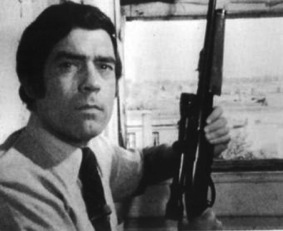
    Dan Rather

    Dan Rather took this Alvarez idea to a Mr. Charles Wyckoff, a professional photo analyst in Massachusetts. Agreeing with Alvarez, at least on camera, Wyckoff mapped out the three areas of “jiggles”. The Alvarez/Wyckoff formula was simple: three jiggles, three shots. But as Feinman found out through unearthed memos, there was a big problem with this declaration. Wyckoff had actually discovered four jiggles, not three. Therefore, by the Alvarez formula, there was a second gunman, and a conspiracy. But as the entire executive management level of CBS had committed to McCloy and the Warren Report, this could not be disclosed to the public. Therefore Wyckoff’s on-camera discussion of this was cut out and not included in the official transcript. It is interesting to note just how committed Wyckoff was to the CBS agenda, for he tried to explain the fourth jiggle as Zapruder’s reaction to a siren. As Feinman noted, how Wyckoff could determine this from a silent 8 mm film is rather puzzling. Even more damning is the fact that, as Life Magazine had deduced, there were actually six “jiggles” in the Zapruder film, and they only allotted one to a “startle reaction”. (See Josiah Thompson, Six Seconds in Dallas, Appendix F) But the point is, this (censored) analysis did not actually support the Commission. It undermined it.

    And in more than one way. For Wyckoff and Alvarez placed the first jiggle at around Zapruder frame 190, or a few frames previous to that. As most people who have studied the case know, this would have meant that Oswald would have had to be firing through the branches of an oak tree—which is why the Commission moved this shot up to frame 210. But CBS left themselves an out here. They actually said there was an opening in the tree branches at frame 186, and Oswald could have fired at that point. This is patently ridiculous. The opening at frame 186 lasted for 1/18th of a second. To say that Oswald anticipated a less than split second opening, and then steeled himself in a flash to align the target, aim, and fire—this is all stuff from the realm of comic-book super heroes. Yet, in its blind obeisance to the Warren Report, this is what CBS had reduced itself to.

    Another way that CBS tried to aid the Commission was through Wyckoff purchasing five other Bell and Howell movie cameras. (CBS was not allowed to handle the actual Zapruder camera.) The aim was to cast doubt on the accepted speed of the Zapruder camera, and suggest it might have been running slow (so that there would have been more time to get off three shots). The problem was that both the FBI and Bell and Howell had tested the speed of Zapruder’s actual camera, and they both decreed it ran at 18.3 frames per second. Wyckoff proceeded to time these other cameras using the same process that Lyndal Shaneyfelt and Bell and Howell did: by aiming the cameras at a large clock with a second sweep hand, and running them for a determinate number of frames. Wycoff announced the results for these timings as 6.90, 7.30, 6.70, 8.35, and 6.16 seconds. Rather concludes this interview by asking, “So, under this theory, the shooter, or shooters, of the shots could have had up to how many seconds to fire?” And Wyckoff replies, “They could have had, according to this, up [to] as much as eight and thirty-five hundreds [sic] of a second–which is a pretty long time.” (CBS Transcript, Part 1, p. 19) Thompson points out that CBS did not clarify here that they had computed these timings from a run of 128 frames, not 103. In other words, they begged the question concerning frame 186. If they had not played fast and loose with the public, they would have told them that at 18.3 fps, Zapruder’s camera would have run through 128 frames in 6.9 seconds (as opposed to 5.6 for 103 frames), thus making the difference between Zapruder’s camera and the slowest running of the other five considerably less remarkable with respect to the total running time for the supposed three-shot sequence. In fact, Zapruder’s camera seems to be running at an average speed, if one combines the other cameras’ running speeds and divides by five (op. cit., pp. 293-294). As Thompson states, the whole experiment really proves nothing about whether the camera was running slow. Even Dick Salant commented that it was “logically inconclusive and unpersuasive.” But it stayed in the program.

    Why did Rather and Wyckoff have to stoop this low? Because of the results of their rifle firing tests. As the critics of the Warren Report had pointed out, the Commission had used two tests to see if Oswald could have gotten off three shots in the allotted 5.6 seconds revealed in the Warren Commission, through the indications on the Zapruder film. These tests ended up failing to prove Oswald could have performed this feat of marksmanship. What made it worse is that the Commission had used very proficient rifleman to try to duplicate what the Commission said Oswald had done. (See Sylvia Meagher, Accessories After the Fact, p. 108)

    So CBS tried again. This time they set up a track with a sled on it to simulate the back of Kennedy’s head. They then elevated a firing point to simulate the sixth floor “sniper’s nest”, released the target on its sled and had a marksman fire his three shots.

    In watching the program, a question most naturally arises. CBS had permission to enter the depository building for a significant length of time, because Rather was running around on the sixth floor and down the stairs. In the exterior shots of Rather, it appears that the traffic in Dealey Plaza was roped off. So why didn’t CBS just do the tests right then and there under the exact same circumstances? It would appear to be for two reasons. First, the oak tree would have created an initial obstruction for the first shot. Second, there was a rise on Elm Street that curved the pavement. This was not simulated by CBS.

    CBS first tried their experiment in January of 1967. They used a man named Ed Crossman. Crossman had written several books on the subject and many articles. He had a considerable reputation in the field. But his results were not up to snuff—even though CBS had enlarged the target size! And even though they gave him a week to practice with their version of the Mannlicher Carcano rifle. (Again, CBS could not get the actual rifle the Warren Report said was used by Oswald.) In a report filed by Midgley, he related that Crossman never broke 6.25 seconds, and even with the enlarged target, he only got 2 of 3 hits in about 50% of his attempts. Crossman stated that the rifle had a sticky bolt action, and a faulty viewing scope. What the professional sniper did not know is that the actual rifle in evidence was even harder to work. Crossman said that to perform such a feat on the first time out would require a lot of luck.

    Since this did not fit the show’s agenda, it was discarded: both the test and the comments. To solve the problem, CBS now decided to call upon an actual football team full of expert riflemen—that is, 11 professional marksmen—who were first allowed to go to an indoor firing range and practice to their heart’s content. Again, this was a major discrepancy with the Warren Report, since there is no such practice time that the Commission could find for Oswald.

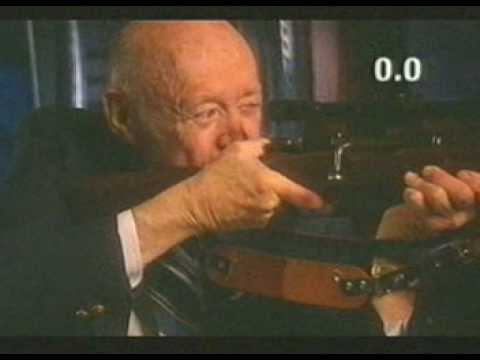
    The eleven men then took 37 runs at duplicating what Oswald was supposed to have done. There were three instances where 2 out of 3 hits were recorded in 5.6 seconds. The best time was achieved by Howard Donahue—on his third attempt. His first two attempts were complete failures. It is hard to believe, but CBS claimed that their average recorded time was 5.6 seconds. But this did not include the 17 attempts CBS had to throw out because of mechanical failure. And they did not tell the public the surviving average was 1.2 hits out of 3, and with an enlarged target. The truly striking characteristic of these trials was the number of instances where the shooter could not get any result at all. More often than not, once the clip was loaded, the bolt action jammed. The sniper had to realign the target and fire again. According to the Warren Report, that could not have happened with Oswald.

    There is one more point about this experiment. Neither at this stage, nor any other, was there any mention of the hit to James Tague. On his one miss, the Warren Commission said that Oswald’s shot hit the curb beneath bystander James Tague. This then bounced up off his face, drawing blood. Perhaps they avoided this because Tague was on a different street than Kennedy and about 260 feet away from the limousine. How could Oswald have missed by that much if he was so accurate on his other two shots? Further, the FBI found no copper on the curb where Tague was hit. This defies credulity, because the ammunition used in the alleged rifle is copper coated. (James DiEugenio, Reclaiming Parkland, pp. 228-29) Again, this was surgical-style censorship by CBS.

    Related to the ballistics evidence is what CBS did with the medical evidence. The two chief medical witnesses on the program were Dr. Malcolm Perry from Parkland Hospital in Dallas, where Kennedy was taken after he was hit; and James Humes, the chief pathologist at the autopsy examination at Bethesda Medical Center that evening.

    In their research for the series, CBS had discovered a document that the Warren Commission did not have. The afternoon of the assassination, Perry had given a press conference along with Dr. Kemp Clark. Although it was filmed, when the Commission asked for a copy or a transcript, the Secret Service said they could not locate either. (Doug Horne, Inside the ARRB, Vol. 2, p. 647) This was a lie. The Secret Service did have such a transcript. It was delivered to them on November 26, 1963. The ARRB found the time-stamped envelope.

    Robert Pierpont

    But Feinman discovered that CBS had found a copy of this transcript years before. White House correspondent Robert Pierpont found a transcript through the White House press office. One reason it was hard to find was that it should not have been at the White House; it should have been at the Kennedy Library. But as Roger Feinman found out, it had been relabeled. It was not a Kennedy administration press conference anymore; but the first press conference of the Johnson administration. So it ended up at the Johnson Library.

    None of this was revealed on the program by either Cronkite or Rather. And neither the tape nor transcript was presented during the series. In fact, Cronkite did his best to camouflage what Perry said during this November 22nd press conference, specifically about the anterior neck wound. Perry clearly said that it had the appearance to him of being an entrance wound. And he said this three times. Cronkite tried to characterize the conference as Perry being rushed out to the press and badgered. Not true, since the press conference was about two hours after Perry had done a tracheotomy over the front neck wound. The performance of that incision had given Perry the closest and most deliberate look at that wound. Perry therefore had the time to recover from the pressure of the operation. And there was no badgering of Perry. Newsmen were simply asking Perry and Clark questions about the wounds they saw. Perry had the opportunity to answer the questions on his own terms. Again, CBS seemed intent on concealing evidence of a second assassin. For Oswald could not have fired at Kennedy from the front.

    Commander James Humes did not want to appear on the program. He actually turned down the original CBS request to be interviewed. But Attorney General Ramsey Clark pressured him to appear on the show. (This may have been done with McCloy’s assistance.) As Feinman discovered, the preliminary talks with Humes were done through a friend of his at the church he attended. There were two things that Humes said in these early discussions that were bracing. First, he said that he recalled an x-ray of the president which showed a malleable probe connecting the rear back wound with the front neck wound. Second, he said that he had orders not to do a complete autopsy. He would not reveal who gave him these orders, except to say that it was not Robert Kennedy. (Charles Crenshaw, Trauma Room One, p. 182)

    Like the Perry transcript, this was exceedingly interesting information. Concerning the malleable probe, the problem is that no such x-ray depiction exists today. As CBS stated, Humes had been allowed to visit the National Archives and look at the x-rays and photos prior to his appearance. Needless to say, the fact that this x-ray was missing is not mentioned on the program. Because of that, the pubic would have to wait almost 30 years—until the creation of the Assassination Records Review Board—to find out that other witnesses also saw a malleable probe go through Kennedy’s back. But neither pictures nor x-rays of this are in the National Archives today. The difference is that these other witnesses said that the probe did not go through the body, since the wounds did not connect. This may be the reason they are missing today. (DiEugenio, Reclaiming Parkland, pp. 116-18)

    On camera, Humes also said that the posterior body wound was at the base of the neck. Dan Rather then showed Humes the drawings made of the wound in the back as depicted by medical illustrator Harold Rydberg for the Warren Commission. This also depicts that wound as being in the neck. Humes agreed with this on camera. And he added that they had reviewed the photos and referred to measurements and this all indicated the wound was in the neck.

    Even for CBS, and John McCloy, this is surprising. In the first place, the autopsy photos do not reveal the wound to be at the base of the neck. It is clearly in the back. (Click here and scroll down) The best that one can say for CBS is that, apparently, they did not send anyone with Humes to visit the archives. Which is kind of puzzling, since good journalistic practice would necessitate two witnesses to such an important assertion. And beyond that, CBS should have sent its own independent expert, because Humes clearly had a vested interest in seeing his autopsy report bolstered, especially since it was under attack by more than one critic.

    The second point that makes Humes’ interview surprising is his comments on the Rydberg drawings’ accuracy. These do not coincide with what Mr. Rydberg said later. To this day, Rydberg does not understand why he was chosen to make these drawings for the Commission. Rydberg was only 22 at the time, and had been drawing for only one year. There were many other veteran illustrators in the area whom the Commission could have called upon. But Rydberg came to believe that it was his very inexperience that caused the Commission to direct the doctors to him. For when Humes and Dr. Thornton Boswell appeared before him, they had nothing with them: no photos, no x-rays, no official measurements. Everything they told him was from memory. And this was nearly four months after the autopsy. (DiEugenio, Reclaiming Parkland, pp. 119-22) The Rydberg drawings have become almost infamous for not corresponding to the pictures, measurements, or the Zapruder film. For Humes to endorse these on national television, and for CBS to allow this without any fact checking—this shows what a National Security project the special had become. In fact, the Justice Department had scripted the Humes/Rather interview in advance. (ibid, pp. 125-26)

    As noted, CBS also knew that Humes said that he had been limited in his autopsy pathology for the Kennedy autopsy. This would have been another powerful scoop if CBS had followed it up. Since they did not, the public had to wait another two years for the story to surface. This time it was at the trial of Clay Shaw in New Orleans, when autopsy doctor Pierre Finck took the stand in Shaw’s defense. Finck said the same thing: that Dr. Humes was limited in what autopsy procedures he was permitted to follow on Kennedy (ibid, p. 115). This story would have had much more exposure and vibrancy if CBS had broken it, because the press bias against Garrison was very restrictive and controlling. But, as we have seen, the Justice Department control over Humes and CBS was also restrictive—the difference being that CBS was a much more powerful institutional entity than the rather small DA’s office of a medium sized city.

    What CBS did with the Humes/RFK story should be followed up on to show just how badly CBS was willing to mangle the truth.

    In early 1975, when the JFK case was heating up again, Sixty Minutes decided to do a story on whether or not Jack Ruby and Lee Oswald knew each other. After several months of research, Salant killed the project. Those investigative files were turned over to Les Midgley, and became the basis for the 1975 CBS special, which was entitled The American Assassins. Originally this was planned as a four-night special: one night each on the JFK, RFK, Martin Luther King and the George Wallace shootings. But at the last moment, in a very late press release, CBS announced that the first two nights would be devoted to the JFK case. Midgley was the producer, but this time Cronkite was absent. Rather took his place behind the desk.

    Franklin Lindsay

    In general terms, it was more of the same. The photographic consultant was Itek Corporation, a company that was very close to the CIA. In fact, they helped build the CORONA spy satellite system. Their CEO in the mid-Sixties, Franklin Lindsay, was actually a former CIA officer. With Itek’s help, CBS did everything they could to move up their Magic Bullet shot from about frame 190 to about frames 223-226. Yet Josiah Thompson, who appeared on the show, had written there was no evidence Governor Connally was hit before frames 230-236. Moreover, there are indications that President Kennedy is clearly hit as he disappears behind the Stemmons Freeway sign at about frame 190: his head seems to collapse both sideways and forward in a buckling motion. But with Itek in hand, this now became the scenario for the CBS version of the Single Bullet Theory. It differed from the Warren Commission’s in that it did not rely upon a “delayed reaction” on Connally’s part to the same bullet.

    Milton Helpern

    CBS also employed Alfred Olivier. Olivier was a research veterinarian who worked for the Army wound ballistics branch and did tests with the alleged rifle used in the assassination. He was a chief witness for junior counsel Arlen Specter before the Warren Commission. (See Warren Commission, Volume V, pp. 74ff.) For CBS in 1975, Olivier said that the Magic Bullet, CE399 was not actually “pristine”. For CBS and Dan Rather, this makes the Single Bullet Theory not impossible but just hard to believe. Therefore, it could have happened. Apparently, no one explained to Rather that the only deformation on the bullet is a slight flattening at the base, which would occur as the bullet is blasted through the barrel of a rifle. There is no deformation at its tip. And there is only a tiny amount of mass missing from the bullet. In other words, as more than one author has written, it has all the indications of being fired into a carton of water or a bale of cotton. And if CBS had interviewed the legendary medical examiner Milton Helpern of New York, that is pretty much what they would have heard. (Henry Hurt, Reasonable Doubt, p. 69) It is odd they did not do so, since CBS Headquarters is in New York, and Helpern was still alive in 1975.

    James Weston

    As we have seen, Dr. James Weston would be the on camera medical witness in 1975. Both Weston and Lattimer had seen the medical exhibits before the show was filmed. Taking that into consideration, what they said is not surprising; it is what they left out that is. Predictably, Weston said that there were only two shots, both from the rear. Yet Weston makes no mention of the brain being missing, a fact that both he and Lattimer had to know. Without that exhibit, there was no proof of the brain being sectioned, which is the standard procedure for tracking bullets inside the skull. If this was not done, there is no proof of directionality. Further, there was no mention of the new feature to the x-rays that was found in a Justice Department review in 1968: this was a disk-shaped 6.5 mm fragment in the rear of the skull. Its size fits perfectly the ammunition caliber of the Mannlicher Carcano rifle. It was not seen the night of the autopsy by any of the pathologists. Third, in that same Justice Department review, particle fragments Humes described in his report as going upward from the entry wound, low in the back of the skull, had disappeared on the x-ray. Weston mentioned none of these changes in the evidence. One wonders if he actually read the autopsy report, or just relied on his briefing by Lattimer.

    George Burkley

    Finally, Rather realizes, without being explicit, that something was wrong with Kennedy’s autopsy. He actually said to the audience that the autopsy was below par. And he also reversed field on his opinion of Humes. After praising his experience in 1967, Rather now says that neither Humes nor Boswell were actually qualified to perform Kennedy’s autopsy, and that certain things were actually botched. In other words, what Humes told CBS through a third party in 1967 was accurate. But, in contradiction to Humes’ denial that it was Bobby Kennedy who did so, Rather claims that it was Kennedy physician George Burkley who actually controlled the autopsy. Burkley could not have done any such thing unless it was approved by RFK. And Robert Kennedy had given orders to do a full autopsy. That same order was co-signed by Burkley. (Crenshaw, ibid, p. 182) In this author’s opinion, this piece of disinformation sounds like it was created by Lattimer.

    In its perniciousness, in its “blame the victims” theme, Rather’s comment echoes what John McCloy said to Cronkite on camera in 1967. McCloy said that if the Commission made a mistake, it was in not demanding the autopsy materials for their examination, adding that these were under the control of the Kennedy family. If anything shows how “in the tank” CBS and Cronkite were to McCloy, this exchange does. First of all, the medical exhibits were not in control of the Kennedys in 1964. They were under control of the Secret Service that year. Secondly, the Commission did have these exhibits. And McCloy had to have known that. (Gerald McKnight, Breach of Trust, p. 171)

    Let us make no mistake about what CBS was up to here. The entire corporate upper structure—Salant, Stanton, Paley—had completely overrun the lower management types like Midgley, Manning and Schorr. And the lower managers decided not to utter a peep to the outside world about what had happened. There was only one recorded instance where CBS let on to how they had fixed their proceedings. In 1993, CBS did another special endorsing the Warren Report. This time, as in 1975, Rather was the host. He called both Bob Tanenbaum of the HSCA, and David Belin of the Warren Commission, to Dealey Plaza. They both discussed their differing views of the case. But Tanenbaum stated that, unlike, Belin, he had tried well over a hundred felony cases through to verdict. Evidently, Rather was impressed with Tanenbaum’s honesty and experience. When the camera was off, Rather stated quietly to the former prosecutor: “We really blew it on the JFK case.”

    Not only Cronkite and Rather participated in this appalling exercise; so too did Eric Sevareid. He appeared at the end of the last show and said that there are always those who believe in conspiracies, whether it be about Yalta, China, or Pearl Harbor. He then poured it on and said some of these people still think Hitler is alive. He concluded by sneering that, anyway, it would be utterly impossible to cover up such a thing. (Watch it here)

    No it would not Eric. You, your network, and your cohorts just gave us an object lesson in how to do it. Only Roger Feinman, who was not at the top, or anywhere near it, had the guts to try and get to the bottom of the whole internal scandal. And he got thrown under the bus for trying. In that valiant but doomed effort, he showed what hypocrites the top dogs at CBS were, how easily they were cowed and cajoled by their bosses. Everyone then took the Mafia vow of silence about what they had done. Which is despicable, but considering the magnitude of the crime they committed, also understandable.


    (This essay is largely based on the script for the documentary film Roger Feinman was in the process of re-editing at the time of his death in 2011. The reader can view that here)


    Addenda

    A.  The CBS rifle tests

    The author has been informed by Josiah Thompson that the deception by CBS went even further than Roger Feinman knew. CBS line producer Bob Richter revealed some fascinating information to author Thompson after the 1967 special was broadcast.  CBS stated for the internal record that many of their rifle attempts were faulty since the weapon jammed or malfunctioned. Thus was not the case.  This misreporting deliberately concealed the fact that in the majority of those instances, the marksman just could not duplicate what the Commission said Oswald did. CBS simply did not want to admit those failures, and add them to the ones they did admit to.  (04/26/2017)


    B.  Documents

    Thanks to the efforts of Pat Speer, some of Roger’s documentation can again be examined. The hard-to-find reproductions can be found at Pat’s’ website. These are screenshots taken from a copy of Roger’s original PowerPoint presentation. For this reason, a few of them are unfortunately legible only with difficulty. But the reader will see that they represent in substance the story recounted here. We are grateful to Pat for making these available.


    Back to Part 1

  • Ed Souza, Undeniable Truths


    I was looking forward to Ed Souza’s book on the JFK case. Souza has had a long career in the field of law enforcement. He has served as a police officer, a homicide investigator, and today he works as an instructor. It’s always good to get a viewpoint on the JFK case from a man who has spent his professional life in the field of forensics. For the simple reason that, in the normal course of murder investigations, the myriad anomalies that appear all over the JFK case, don’t occur. Therefore, I was eager to see how a professional in the ranks would confront them. As Donald Thomas showed in his book Hear No Evil, the previous course of some law enforcement professionals had been to avoid or discount those anomalies at all costs. To the point of revising the strictures of previous professional practice.

    I

    At the beginning of his book, Undeniable Truths: The Clear and Simple Facts Surrounding the Murder of President John F. Kennedy, I was pleased by Souza’s approach. And also on the evidence he was relying upon to prove his points. For example, in his introduction he reveals that, unlike some other previous investigators, Souza had actually visited Dallas more than once. While there he took many photographs with which he illustrates his book. And from his experience there on the ground, he had concluded “one man with a rifle could not have committed this crime alone.” He then comments that the sixties turned out to be the “decade of death”, not just for three important and progressive leaders – John Kennedy, Martin Luther King, and Bobby Kennedy – but also for the United States as we knew it. Most people would agree, the author is off to an auspicious start.

    Souza opens Chapter 1 by proclaiming that neither the Dallas Police nor the Secret Service fulfilled their first professional duty at the venue of the crime. Neither one of them secured the crime scene. The Texas School Book Depository was not immediately locked down. And the Secret Service actually took a pail and sponge to the presidential limousine at Parkland Hospital. (p. 1, all references to e book version.) He also notes that for the official version to be true, with Oswald firing from behind President Kennedy, the mass of blood and tissue from Kennedy – or a large part of it – should have gone forward, onto the rear of the front seat, and the backs of the two Secret Service agents in front of him. Yet, once one looks at the extant photos of the limousine, much of this matter seems to be behind the president and beside him. (p. 3) Souza writes that things like this strike him as odd. Because in all the years he investigated homicides for the LAPD, he never encountered the laws of physics violated as in the JFK case. (p. 5)

    He continues in this vein by saying, if the official version is true – that is, all the shots coming from the rear – then why was the back of Kennedy’s head blown out? (ibid) And, beyond that, why is the president’s face intact? (p. 9) He brings up a point that has received scant attention. If one goes to Dealey Plaza and looks at the kill zone from, say, a block or two away from the side, the angle from the sixth floor to the first shot seems too steep for what the Warren Commission says it is. And recall, in the FBI report on the autopsy, the angle of the back wound into Kennedy is registered as 45 degrees, or more than twice the dimensions the Commission says it is. (p. 7) And like Ryan Siebenthaler, and Doug Horne, Souza brings up the possibility that there may have been more than one wound in Kennedy’s back. (Click here and scroll down) He completes Chapter 1 by bringing up two more salient points. First, from his military records, Oswald had no training at all in aiming at and hitting moving targets. (p. 10) Secondly, there appears to be a time lapse between when Kennedy experiences his throat wound and the instant that John Connally is being hit for the first time. (He could have added here, that in the intact film – with the excised frames restored – it appears that JFK is hit before he disappears behind the Stemmons Freeway sign.)

    Again, so far, so good. These all seem to me to be truths that are pretty much backed up by the evidentiary record. And they contravene the official story.

    In Chapter 2, Souza now begins to hone in on the medical evidence, an aspect of the case that has become a real thorn in the side of Warren Commission advocates. He begins by quoting some of the Parkland Hospital witnesses, those who saw Kennedy immediately after the assassination in the emergency room. Dr. Gene Coleman Akin said that the throat wound appeared to be one of entrance, and the rear of Kennedy’s skull, at the right occipital area, was shattered. He further added that this head wound had all the earmarks of being an exit wound. (pp. 19-20) Nurse Diana Bowron talked about a large hole in the rear of Kennedy’s skull. (p. 23) Dr. Charles Carrico also witnessed a large, gaping wound in the right occipital/parietal area that was 5-7 centimeters in diameter, and was more or less circular in shape. (pp. 24-25)

    As Milicent Cranor has pointed out, Kemp Clark is an important witness. For the simple facts that he was a neurosurgeon and he officially pronounced Kennedy dead. Souza dutifully quotes Clark as describing a large, avulsive wound in the right posterior part of the skull, with cerebral and cerebellar tissue being damaged and exposed. (pp. 26-28)

    Souza concludes this part of his case with Margaret Hencliffe and Ronald Jones. Nurse Hencliffe stated that the bullet hole in the neck was an entrance wound. Doctor Jones also stated the neck wound was one of entrance and the rear head wound was an exit. Or to be explicit, Jones said: “There was a large defect in the backside of the head as the president lay in the cart with what appeared to be brain tissue hanging out of his wound ….” (p. 32)

    In summing this all up, the author states that twenty witnesses in Dallas said there was a hole in the back of Kennedy’s head. Further, at least seven of these witnesses saw cerebellum, which means the wound in the rear of the skull extended low in the head. Not only does this indicate a shot from the front, but if Kennedy had been shot from the rear, there would have been an exit in the front of the skull. Yet, on the autopsy photos, there is no such wound. (p. 33)

    From here, Souza now goes to the civilian witnesses in Dealey Plaza. He begins with two deceptive quotes from the Warren Report. The first is this one: “No credible evidence suggests that the shots were fired from the railroad bridge over the triple underpass, the nearby railroad yards, or any other place other than the Texas School Book Depository.”

    The second one is as follows: “In contrast to the testimony of the witnesses who heard and observed shots from the Depository, the Commission’s investigation has disclosed no credible evidence that any shots were fired from anywhere else.” (p. 42)

    Souza calls both of these statements lies. He then lists several witnesses who proffered evidence of shots from the front, specifically the grassy knoll: Sam Holland, Richard Dodd, patrolman J. M Smith (who really is not a civilian), James Simmons, Austin Miller, and , of course, the capper to all of this, the railroad crane worker, Lee Bowers. Bowers, of course, goes beyond giving evidence of shots from the front. With his observations of the phased timing of three cars coming in behind the picket fence and in front of the railroad yard, Bowers may have actually seen some of the preparations for the hit team operation. (See pp. 43-50)

    Souza then lists witnesses who say the second and third shots were fired almost on top of each other. And some of these men are police officers – Seymour Weitzman and Jesse Curry – and one was an unintended victim; John Connally. Others he lists as indicating shots came from the front are either spectators or part of the motorcade: Bill and Gayle Newman, Dave Powers, Ken O’Donnell, and J.C. Price. He notes that Powers and O’Donnell, worked for Kennedy, and were intimidated into changing their testimony. Price actually saw a man running from the fence to the TSBD, and was not called as a witness by the Commission. (See pp. 50 ff.)

    Again, all of this is fine. Like a responsible legal investigator, Souza has collected valid physical evidence from the crime scene, linked it with the autopsy evidence, and then corroborated it with witness statements. Its been done before, but Souza performs it with skill and brio and he brings in a few witnesses others have ignored.

    II

    Unfortunately, we have now reached the high point of the book. And we are only about twenty per cent into the text. For here, in my view, Souza now makes a tactical and strategic error. He shifts gears ever so slightly. He now begins to try and go one step up the investigative ladder. That is, how did the actual operation work? For about the next fifty pages the book now becomes a decidedly mixed bag – which the first fifty pages were not. Also, mistakes now begin to creep into the book – mistakes which should have been rather easily detected if a proofreader or fact checker had been employed.

    Let us begin with the better material. In order to show that something was going on inside the TSBD, the author uses witnesses like Arnold Rowland, Carolyn Walther and Toney Henderson to reveal the possibility that there may have been more than one gunman in the building Oswald worked in, and that they may have been elsewhere in the Texas School Book Depository. Most readers are familiar with Rowland and Walther, who both say they saw suspicious persons elsewhere than the sixth floor. Henderson said she saw two men on the sixth floor about five minutes before the shooting, and one had a rifle. We know it was five minutes before the shooting because she said an ambulance had just left the front of the building. This had to have been the transport for the man who had the epileptic seizure. And that occurred at 12:24 PM (p. 59)

    Souza then moves to the presence of Secret Service officers in Dealey Plaza post-assassination, when in fact none were actually there at that time. He uses law enforcement witnesses like DPD patrolman Joe Smith and Sgt. D. V. Harkness to demonstrate this point. And he culminates his case against the Warren Commission by using Chief of Police Jesse Curry to criticize the incredibly bad autopsy given to President Kennedy. (p. 117)

    But in this section of the book, the author now begins to do two things that will mar the rest of the work. He begins to rely on some rather dubious witnesses – who he apparently does not know are dubious. And he also begins to make some errors. Concerning the former, it is one thing to use a dubious witness, but if one is going to do so, one must be willing to shoulder the load of rehabilitating him or her. Souza does not do that. Therefore, when he used the rather controversial Gordon Arnold, and coupled that with the even more controversial Badgeman photo, I began to frown. (Click here for a brief expose of this controversy. Click here for a discussion of the Gordon Arnold debate.)

    He then mentioned the testimony of a man whose evidence he did not footnote. He calls him Detective De De Hawkins. Souza says this officer met two men in suits outside the TSBD who said they were from the Secret Service. (see p. 69) I had never seen this name anywhere. So I went searching for it. I could not find it in the Warren Report. I could not find it in Walt Brown’s The Warren Omission, which lists every single witness interviewed by the Commission. I began to panic when I could not find him in Michael Benson’s quite useful encyclopedia Who’s Who in the JFK Assassination. After looking in Ian Griggs’ book No Case to Answer and Jim Marrs’ Crossfire I was about to give up, since those books are strong on the Dallas Police aspect. I then decided to look at the late Vince Bugliosi’s behemoth Reclaiming History, which, although not a good book, has a very good index to its over two thousand pages of text. I came up empty again. Either Souza made a serious error, or he found someone who no one else has found. If the latter, he should have noted the interview.

    But if this was a mistake, it’s not the only one in the book. Not by a long shot. On page 89, Souza begins a brief discussion of the controversy between FBI agent Vince Drain and DPD officer J. C. Day about a print being found on the alleged rifle used in the assassination – except, it’s not, as Souza writes, a fingerprint, but a palm print. On page 95 of his book, he puts quotation marks around words attributed to Pierre Finck discrediting the magic bullet. When I looked up his source, the words were not in quotes; they were a paraphrase. (Benson, p. 137)

    In Chapter 6, properly entitled “The Autopsy Cover Up”, Souza makes three errors in the space of about one page. He says the autopsy doctors wrote that the president had a small hole in the upper right rear of his skull, which was an entrance wound. The hole was in the lower part of the right rear. He then says that there was a large hole in the right front part of the president’s head. According to the autopsy, it’s on the right side of the head, forward and above the ear. He also says that Dr. Charles Crenshaw was the first attending physician at Parkland Hospital to work on the president. (p. 100) But in looking at Crenshaw’s book, Trauma Room One, one will read that, before Crenshaw ever got inside the emergency room, Malcolm Perry and Chuck Carrico had already placed an endotracheal tube down the president’s throat. (Crenshaw, p. 62) Once Crenshaw got there, Perry made an incision for a tracheotomy.

    It was in this chapter that I felt that Souza began to lose control of his subject. Since the release of Oliver Stone’s film JFK, there has been a deluge of books and essays published on the medical aspects of the Kennedy case. In fact, Harrison Livingstone quickly published a sequel to High Treason called High Treason 2. David Lifton’s Best Evidence, the book and DVD, was back on the shelves.

    Why? Because, Stone, for the first time, exposed a large public audience to the utter failure of the Kennedy pathologists. Largely relying on the devastating testimony of Dr. Pierre Finck at the trial of Clay Shaw in New Orleans, hundreds of thousands of viewers now began to see that President Kennedy’s autopsy was not meant to find the cause of death. Because the pathologists were controlled by the military, neither Kennedy’s head wound nor his back wound was tracked for transience or directionality. For many people, including the autopsy doctors, it was a shocking thing to witness.

    Now, some of this subsequently published material on the autopsy material has been good and valuable. But there has been so much of it that it is easy to lose track of where the weight of the evidence lies. For example, Souza uses Paul O’Connor to say there was no brain in Kennedy’s skull to remove. (Souza p. 102) Yet many witnesses at Parkland Hospital said that, although Kennedy’s brain was damaged, a sizable portion of it was still present. And James Jenkins, among several others, who was at Bethesda that night, says about two thirds of it was intact. Here, Souza is relying on an outlier, not the weight of the evidence. (For a catalog of these witnesses see James DiEugenio, Reclaiming Parkland, p. 137) Further, Souza seems overly reliant on the work of Lifton. This was understandable decades ago, but today, there are several other authors who have done very good work on the medical side of the JFK case e.g. Milicent Cranor, David Mantik, Gary Aguilar. I could find none of these very respectable names in Souza’s book. I don’t understand why they aren’t there.

    III

    And to me, from here on in, the bad begins to outweigh the good in Undeniable Truths. Thus rendering the book’s title ironic.

    In Chapter 7, in a discussion of the attempted shooting of General Edwin Walker, Souza calls him a “former right-wing radical.” In 1963, Walker was anything but a “former” extremist. He then says the Walker shooting happened “just prior to the assassination ….” (Souza, p. 113) I think most people would say that a time-span of nearly eight months is not “just prior” to the assassination. According to the work of Secret Service authority Vince Palamara, the presidential motorcade route was not finally decided upon by the Secret Service and Dallas Mayor Earl Cabell’s office. (Souza, p. 115) It was decided upon by the Secret Service, and a small delegation from the White House, including advance man Jerry Bruno and presidential assistant Ken O’Donnell.

    From approximately this point on, Souza now begins to try and dig into the how, why, and who behind the assassination. And for me, the more he tried to do this, the more his book dissipated. This kind of exploration has to be handled quite gingerly, for the simple fact that the Kennedy assassination literature is not formally peer reviewed. Further, there is no declassified library for the likes of Sam Giancana or H. L. Hunt. One therefore has to be very discerning, scholarly and careful in picking over this evidence. It constitutes a giant swamp with large areas of quicksand beneath. To put it mildly, I was disappointed that Souza exhibited very little discernment in this part of his book.

    One startling example: he actually takes the book Double Cross by Chuck Giancana seriously as a source. This 1992 confection was clearly a commercially designed project; one that was meant to capitalize on the giant national controversy created by Oliver Stone’s film. And the idea that Sam Giancana was behind the JFK murder is simply a non-starter today. That book is currently considered a fairy tale. Yet Souza uses it as a source, and even recommends it to the reader. (See pp. 183, 295)

    Souza also considers the long series made by British film-maker Nigel Turner, The Men Who Killed Kennedy, as “one of the best documentaries on this subject.” (See pp. 300-02) I could hardly disagree more. Moreover, Souza heartily recommends Turner’s segment in the series called “The Guilty Men”, which featured none other than Barr McClellan. Apparently Souza missed the fact that in McClellan’s book, Blood. Money and Power, the author had Oswald on the sixth floor of the depository firing a shot at Kennedy, which elsewhere Souza says Oswald could not have done, because Oswald was not on the sixth floor. (p. 165)

    Souza is so enamored with the untrustworthy and irresponsible Nigel Turner that he can write, “It is a clear and solid fact that Malcolm Wallace’s fingerprint was found in the so-called sniper’s nest on the sixth floor ….” (p. 223) No, it is not such a fact. And, with state of the art computer scanning, Joan Mellen will show that in her upcoming book. But further, Souza is so uncritical about the Kennedy literature that he does not even take Turner to task for buying into the discredited Steve Rivele’s French Corsican mob concept in his first installment, and then switching horses and buying into Barr McClellan’s Texas/LBJ concept in his 2003 series. To me, Nigel Turner wasted one of the best opportunities anyone ever had in the Kennedy field to get a large segment of the truth in this case out to the public. Instead, Turner settled for the likes of Tom Wilson, Judy Baker, Rivele, Barr McClellan, et al. But Souza stands by this dilettante and poseur. And I shouldn’t even have to add the following: by this part of the book, Souza is also vouching for the likes of Madeleine Brown.

    If you can believe it, Souza says that Howard Hunt operated out of 544 Camp Street in 1963. (Souza, p. 175) This is a ridiculous overstatement. There is some evidence that Hunt was in New Orleans to set up the Cuban Revolutionary Council with Sergio Arcacha Smith, but that was not in 1963. (William Davy, Let Justice be Done, p. 24) And the idea that he “operated” Guy Banister’s office in 1963 is completely divergent from the adduced record. Yet Souza is so feverish in his conspiratorial invention that he doesn’t realize he is also writing that Sam Giancana enlisted Guy Banister in setting up Oswald. (See p. 182) That is due to his reliance on Chuck Giancana and Double Cross. How “all in” is Souza with this facetious book? He also quotes Giancana as saying that he knew George DeMohrenschildt, and the Chicago mobster enlisted George in helping to set up Lee Harvey Oswald. If someone can show me any evidence of this outside of the Chuck Giancana fantasy, I would like to see it.

    Now, right on this same page, and in this same section, Souza – in a book on the JFK case – groups Howard Hunt with Richard Nixon as potential players in the JFK case. Like the work of John Hankey, who Souza is now beginning to resemble, the author bases this simply on the fact that Hunt was one of the burglars caught at the Watergate complex in 1972. Souza then quickly shows that he is as circumspect on Watergate as he is on the overview of the JFK case. For he now says that Nixon ordered the Watergate break-in. Like many of his weighty disclosures, he does not footnote this. Probably because there is simply no credible evidence ever found by either the court system or the Senate Watergate Committee that Nixon did any such thing. Souza then compounds this by writing that Charles Colson was one of the planners of the break-in who Nixon hung out to dry. Again, there has never been any credible evidence adduced to substantiate this claim.

    I don’t have to go any further do I? As the reader can see, a book that started out promising, obeying the laws of criminal forensics, has now all but sunk in the lake of specious Kennedy assassination folklore. Souza’s book now began to remind me of nothing more than that monumental, nonsensical and misleading tract commonly called the Torbitt Document, more precisely entitled Nomenclature of an Assassination Cabal. As I argued in the second edition of Destiny Betrayed, that pamphlet looks today like a deliberate attempt at misdirection. It was designed to confuse and to stultify by amassing a large number of names and agencies in front of the reader and stirring them up in a blender. The problem being that there was very little, if any, connective tissue to the presentation, and even less genuine underlying evidence. (See Destiny Betrayed, second edition, pp. 323-24)

    I can assure the reader that I am not exaggerating by drawing that comparison. Just how unsuspecting is Souza? Because Chuck Giancana used Dallas police officer Roscoe White in his fable Double Cross, Souza uses White as one of the assassins in Dealey Plaza! (See page 187) The whole Roscoe White matter was exposed as another financially motivated fraud back in the nineties in an article entitled “I Was Mandarin” in Texas Monthly (December 1990). And that was not the only place it was exposed. Apparently, Souza was not aware of these exposures. Or if he was, he wanted to keep the mythology alive. Either way, it does not reflect very well on his professional scholarship or the quality of his book.

    As I have often said, what we need today is more books based upon the declassified files of the Assassination Records Review Board. And any book that does not utilize those records to a significant degree should be looked upon with an arched eyebrow. I have also said that, if everyone killed Kennedy – the Mob, LBJ, Nixon, the Dallas Police, the CIA – then no one killed Kennedy. Giving us a smorgasbord plot is as bad, maybe worse, than saying that Oswald killed Kennedy. It leads to a false conclusion that, in its own way, is just as pernicious as the Warren Commission’s.

    About the first fifty pages of Undeniable Truths is pretty much undeniable. The next fifty pages are a decided mixture of truth and question marks. Most of the last 200 pages do not at all merit the title. In fact, that part is, in large measure, nothing more than conjecture. And much of that conjecture is ill-founded.

  • Oswald on November 22, 1963

    Oswald on November 22, 1963


    One of the few things I can say is an original thought and argument of mine is the questioning and examination of the timing of events that need to occur for Oswald to have even been considered as involved in the assassination.

    Let’s assume for the sake of this discussion that Oswald was indeed at the SE 6th floor window at 12:30, and shots from there are fired by him, AND that he planned to kill JFK with the Mannlicher Carcano rifle. He surely could not have killed JFK with a rifle that was not there in the first place. Oswald has a few items of information he MUST have in order to pull this off, the most important being the knowledge that the motorcade and JFK’s limo would pass within shooting distance of the building. Where would he get such information, and what would that info say specifically?

    Commission Exhibit 1362 is the Nov 19th Dallas Times Herald article revealing the route the motorcade would take… “The motorcade will pass thru downtown on Harwood and then west on Main, turning back to Elm at Houston and then out Stemmons Freeway to the Trade Mart” AHA! Oswald, if he read or was aware of this article would now know that the motorcade would pass directly beneath the TSBD… in essence the motorcade was bringing JFK to his doorstep… Good thing he decided to take the lower paying TSBD job in October, right?

    This is TUESDAY Nov 19th. The article prefaces with the fact that the formal announcement of the trip was made in Washington DC at 4pm… Could Oswald the Lone Nut have known that JFK would pass by the TSBD before that? I don’t see how. Security according to Chief Curry was not even planned until Tuesday the 19th. This must have been the evening edition of the paper.

    Is there any evidence from anyone in the building or anyone close to Oswald that he knew about the motorcade route that day?

    According to Marina, on the night before the assassination, she asked him about Kennedy’s upcoming visit the next day. Oswald seemed totally in the dark about when or where the motorcade would pass. (WC Vol. 18, p. 638)

    Junior Jarman told the Commission that he did not learn about the motorcade passing in front of the Depository until that morning at about 9 AM. About an hour later, Oswald was standing near a window looking out at the gathering crowd. He asked Jarman what the people were there for. After Jarman told him, he asked which way the motorcade was coming. Which reveals, unlike the Commission assumption, that Oswald did not read the November 19th Times Herald (WC Vol. 3, p. 201).

    Between the evening of Nov 19th and Thursday Nov 21 Oswald decides to get to the home of Ruth and Michael Paine to get his rifle out of the garage and bring it to work on Friday so he can do the deed. Does he make sure to ask Texas School Book Depository colleague Wesley Frazier for a ride home that day? For if he doesn’t get home by Thursday night how can he get the rifle to work Friday?

    Mr. FRAZIER – Well, I say, we were standing like I said at the four-headed table about half as large as this, not, quite half as large, but anyway I was standing there getting the orders in and he said, “Could I ride home with you this afternoon?”

    And I said, “Sure. You know, like I told you, you can go home with me any time you want to, like I say anytime you want to go see your wife that is all right with me.”

    Good thing Wesley was so accommodating… Asking Thursday for a ride home, a ride that would make or break his plan to kill JFK Friday seems cutting it a bit close… And he’d have to bring that paper bag he made to hold/hide the rifle with him… yet the man who sits by the paper dispenser never leaves his desk, eats his lunch at his desk and testifies to not being away from that area… yet somehow Oswald accomplishes this construction project with no one seeing him do it… and gets it home that Thursday in the car with Wesley… maybe hidden in his pants, or shirt, or jacket, or sweater, maybe???

    Marina and Ruth are very surprised to see Oswald on that Thursday as he usually gives them fair warning…

    Mr. JENNER – Let’s proceed with the 21st. Did anything occur on the 21st with respect to Lee Harvey Oswald, that is a Thursday?

    Mrs. PAINE – I arrived home from grocery shopping around 5:30, and he was on the front lawn. I was surprised to see him.

    Mr. JENNER – You had no advance notice?

    Mrs. PAINE – I had no advance notice and he had never before come without asking whether he could.

    Mr. JENNER – Never before had he come to your home in that form without asking your permission to come?

    Mrs. PAINE – Without asking permission; that is right.

    It is here we are treated to Ruth Paine’s story about the garage door and light being left on… she never sees Oswald in the garage, never hears him… and even goes on to tell reporters:

    Mrs. PAINE – I said I did not see how he could have taken the gun from the garage without my knowing it.

    As noted researcher Carol Hewett pointed out, evidently Ruth did not know that Marina said Lee was with her that night in her room and fell asleep. Yet somehow, he got into the garage, into the blanket, disassembled the rifle, placed it in the paper bag and made it ready for his leaving the following morning… if the OSWALD PLAN to kill JFK can even occur… maybe all this happened in the morning?

    Mr. JENNER – You heard no moving about on his part prior to your awakening?

    Mrs. PAINE – No moving about on his part at all when I looked when I awoke.

    Mrs. OSWALD. Yes. He then stopped talking and sat down and watched television and then went to bed. I went to bed later. It was about 9 o’clock when he went to sleep. I went to sleep about 11:30. But it seemed to me that he was not really asleep. But I didn’t talk to him.

    In the morning he got up, said goodbye, and left, and that I shouldn’t get up–as always, I did not get up to prepare breakfast. This was quite usual.

    So the entire household was awake at 9pm when Oswald goes to sleep… and there is no mention of the time or sounds involved in what Oswald needed to do to get his 40″ rifle into that bag…

    But he must have at some point as he walks to the Frazier’s with this large bag in his possession… which we come to learn must be at least 34″ long to hold the largest piece of the broken down rifle. Also in this bag are the clip, the ammo, the scope and the barrel with firing mechanism… Metal and wood adding up to 7.5 lbs, with nothing to keep it from banging into itself, tearing this bag, or anything else.

    Surely the people at the Frazier household see this bag? And they do and testify to it…

    Mrs. RANDLE. No, sir; the top with just a little bit sticking up. You know just like you grab something like that.

    Mr. BALL. And he was grabbing it with his right hand at the top of the package and the package almost touched the ground?

    Mrs. RANDLE. Yes, sir.
    (this 5’9″ man holding his arm at his side carrying the bag, and this 34″ piece did not touch the ground…ok)

    Mr. BALL. Now, was the length of it any similar, anywhere near similar?

    Mrs. RANDLE. Well, it wasn’t that long, I mean it was folded down at the top as I told you. It definitely wasn’t that long.

    Mrs. RANDLE. I measured 27″ last time.

    Mr. BALL. You measured 27″ once before?

    Mrs. RANDLE. Yes, sir.

    Hmmm… maybe she didn’t get a good look… what does Wesley say about this bag?

    Mr. FRAZIER – Well, I will be frank with you, I would just, it is right as you get out of the grocery store, just more or less out of a package, you have seen some of these brown paper sacks you can obtain from any, most of the stores, some varieties, but it was a package just roughly about two feet long.

    So it appears that Oswald is able to carry a 34″-40″ rifle in a bag quite a bit smaller… yet measurements can be deceiving… maybe they underestimated; they MUST HAVE since the Lone Nut Oswald did get the rifle from the garage; where it had never been seen by anyone in the house; to the TSBD on the morning of the 22nd in the back seat of Wesley’s car. And was able to tuck this rifle under his arm and carry it into the TSBD… Did anyone see Oswald when he arrived that morning?

    One man, Edward Shields, claims he is told by his “friends” that they see Wesley drop Oswald off at the back door… yet this is 2nd hand hearsay and virtually impossible to prove… Luckily Mr. Dougherty was not only at the back entrance when Oswald arrives, but see whether or not anything is in his hands at the time…

    After the same question about Oswald is asked and answered a number of times we finally have as evidence:

    Mr. BALL – In other words, you would say positively he had nothing in his hands?

    Mr. DOUGHERTY – I would say that—yes, sir.

    Is there anyone other than Wesley and his sister that claims they see Oswald with a package, bag, rifle or anything in his hands that morning? Nope. Yet he MUST HAVE since his plan was to kill JFK as he passed by later that day… and we get back now to the timing from that day.

    After slipping by everyone with the package he stows it… where? Where does Oswald place this 27 to 40 inch bag with rifle parts in it so that it is undisturbed and available when he is ready to execute his plan. Maybe behind some boxes on the 6th floor? Since he knows there is work being done up there and the place is in disarray, no one would notice it… Maybe the 1st floor domino room? A hall closet? Well, no matter, it had to have been somewhere since this same rifle (supposedly) is found on the 6th floor, fully assembled at 1:22pm.

    Back now to his knowledge of the motorcade route and the timing. What information is available to this Lone Nut master planner of JFK’s death as to WHEN the motorcade would pass by the TSBD? He’d have to know this to at least be looking out a window at the time so as to take a shot… right?

    We come to find that Secret Service agent Winston Lawson tells Chief Curry that the luncheon was to begin at 12:15… that the plane was to land at 11:30 and after a 45 min motorcade thru Dallas, arrive at the Trade Mart. VIP invitations had been sent and received which stated the Luncheon was to start at 12 NOON.

    Invitation

    So basically even if he was able to know about what Lawson said to Curry, or had seen an invitation to the event, to this LONE NUT KILLER the motorcade would have to pass by the TSBD between 11:55 and 12:10… well before 12:30 in any case. At the same time he knew he had to retrieve the bag with the rifle in it, reassemble the rifle and be at some window facing Elm when he drove by or miss out on his chance for immortality. We make the assumption that Oswald MUST determine a time for the limo and JFK to pass by his place of work; otherwise how can he carry out his plan?

    So, is there any corroborated sightings of Oswald during this time? It seems that Eddie Piper, who was with Junior Jarman and Harold Norman, sees Oswald on the 1st floor around noon… no bag, no rifle. Oswald even mentions seeing these 2 men in statements attributed to him. Carolyn Arnold claims to have seen him around 12:15 also on a lower floor… all the while Arnold Rowland eventually testifies that a man with a rifle is in the SW 6th floor window around 12:15… SOMEONE knew when to expect the motorcade… Concurrently Bonnie Ray Williams is eating his lunch 10 feet from the SE corner of the 6th floor sometime between 12 and 12:15.

    Mr. WILLIAMS. It was after I had left the sixth floor, after I had eaten the chicken sandwich. I finished the chicken sandwich maybe 10 or 15 minutes after 12. I could say approximately what time it was.

    Mr. BALL. Approximately what time was it?

    Mr. WILLIAMS. Approximately 12:20, maybe.

    Mr. BALL. Well, now, when you talked to the FBI on the 23d day of November, you said that you went up to the sixth floor about 12 noon with your lunch, and you stayed only about 3 minutes, and seeing no one you came down to the fifth floor, using the stairs at the west end of the building. Now, do you think you stayed longer than 3 minutes up there?

    Mr. WILLIAMS. I am sure I stayed longer than 3 minutes.

    Mr. BALL. Do you remember telling the FBI you only stayed 3 minutes up there?

    Mr. WILLIAMS. I do not remember telling them I only stayed 3 minutes.

    Why would the FBI lie about that? According to them, no one sees Oswald between 11:50 and 12:30. If Williams is on the 6th floor only a few yards from the sniper’s window, surely he would hear the assembling of a rifle or the moving of boxes to encircle the “nest.” With Williams leaving at 12:15 or just after, and leaving via the elevators next to the stairs, Oswald, whose only knowledge of the motorcade timing can come from those he is in contact with between 11:30 (when the plane was supposed to land) and 11:55 (when the plane actually lands), MUST have passed him either on the stairs, on the 6th floor, or was already on the 6th floor at 12:00 with the bag and rifle. Yet we’ve already proven that he was on the first floor around 12:00… Maybe he arrives at the 6th floor just as Williams arrives at the windows of the 5th floor?

    Williams finally meets up with pals Harold Norman and Junior Jarman on the 5th floor since, as he put it:

    Mr. DULLES. You were all alone as far as you knew at that time on the sixth floor?

    Mr. WILLIAMS. Yes, sir.

    Mr. DULLES. During that period of from 12 o’clock about to–10 or 15 minutes after?

    Mr. WILLIAMS. Yes, sir. I felt like I was all alone. That is one of the reasons I left–because it was so quiet.

    The man who finds out about JFK passing by his window just 3 days before and goes through a variety of activities to insure he is at ANY window facing Elm when he KNOWS JFK is passing by… appears completely unconcerned about the motorcade and timing as late as 12:15… and most definitely not involved in preparing for this event PRIOR to 12:00. He has gone home, out of the ordinary; walked to Frazier’s rather than get picked up, out of the ordinary; is carrying a bag which has to contain a 34″ piece of rifle with other rifle parts/ammo, out of the ordinary; find a place to stow this weapon for later retrieval, out of the ordinary; and has an idea as to when the limo carrying JFK will be within range so he can be ready.

    Between 11:50 and 12:20 there are people on the back elevators and stairs either coming down for lunch, retrieving cigarettes, going up for lunch, going up to view the parade, coming down to join friends. While the plan may be sound, the opportunity simply never presents itself. From all the available evidence, Oswald is either in the 1st or 2nd floor lunchrooms at around 12:00 and must be concerned that his plan to kill JFK requires him to vanish unnoticed only to appear ready to fire at the correct time. The correct time… one of the largest holes in Oswald’s plan for immortality. From the time, 3 days prior, that Oswald learns that JFK is passing by his workplace, until he places the bagged rifle in a safe hiding place for retrieval at the appointed time, there remains little if any evidence to support any of the actions necessary were ever carried out. And now, at 12:00 on the fateful day, this small, never-amount-to-anything man with the US intelligence community swirling around him for the past 2-4 years, is just sitting calmly eating his lunch.

    When WAS the limo going to pass by, for real?

    We come to find that Mrs. Reid talks to her husband who is listening to the radio which states that the plane arrived late and the limo did not leave Love field until 11:55… how fortuitous for the assassin who is obviously pressed for time to get to a window when he BELIEVES, when any information available to this loner tells him the limo should pass by.

    Mrs. REID. Well, I left, I ate my lunch hurriedly, I wasn’t watching the time but I wanted to be sure of getting out on the streets in time for the parade before he got there, and I called my husband, who works at the records building, and they had a radio in their office and they were listening as the parade progressed and he told me they were running about 10 minutes late.

    Yet how would Oswald know this? There is not a single bit of evidence that is shared by anyone who claims to have told Oswald anything about a radio broadcast and the delay in the motorcade… it is also not until 12:20 at the very least that Mrs. Reid finally decides to leave the lunchroom and attend the parade.

    Mr. BELIN. All right. Do you know about what time it was that you left the lunchroom, was it 12, 12:15?

    Mrs. REID. I think around 12:30 somewhere along in there

    Is it possible that Oswald was still in the same lunchroom as Mrs. Reid? Did she see any men in the lunchroom when she finally decides to leave, KNOWING that the parade is running a bit late…?

    Mr. BELIN. Were you the last person in the lunchroom?

    Mrs. REID. No; I could not say that because I don’t remember that part of it because I was going out of the building by myself, I wasn’t even, you know, connected with anyone at all.

    Mr. BELIN. Were there any men in the lunchroom when you left there?

    Mrs. REID. I can’t, I don’t, remember that.

    Up to this point in the questioning, and for the rest of the questioning, Mrs. Reid has remained calm and answered directly and easily… and then she is asked if she is the last person in the room… “No,” she claims and rather than finally answering the question about any MEN in the room when she left… she states:

    Mrs. REID. I can’t, I don’t, remember that.

    Mr. BELIN. All right.

    Mrs. REID. I can’t remember the time they left.

    If indeed Oswald was in that lunchroom; and there is evidence he was for his lunch around 12:00; then he was there when Mrs. Reid leaves the room… If this is NOT Oswald… where is he given his plan to have the rifle ready to fire from a South facing window between 12:00 and 12:30.

    Let’s give him the benefit of the doubt… at a little after noon on the 22nd Oswald has to accomplish the following: Retrieve the rifle, assemble the rifle, assemble the sniper’s nest in the SE 6th floor corner without leaving a prints on any of these 20+ 40 lb boxes, hope that no one is on the 6th floor at the time, and do so without being seen or heard by anyone… for as we have the testimony… no one hears any of this happen or sees any of this occurring…

    What is seen are men on the 6th floor at 12:15, one on the SW with a rifle and one on the SE looking out a window… neither of these men are Oswald… and both of these men are seen by a number of witnesses.

    But no matter… since he MUST HAVE been able to accomplish all this within 15 to 20 minutes without actually knowing any of the timing details… we have to give him kudos for a good plan, even though there is virtually nothing to prove that any of these necessary steps were taken by Oswald.

    Within 2 minutes of the shots being fired he is supposedly stopped in the lunchroom on the 2nd floor… yet that’s not what Officer Marrion Baker writes on 11/22 and signs on 11/22 in his AFFIDAVIT IN ANY FACT.

    “As we reached the third or fourth floor I saw a man walking away from the stairway. I called to the man and he turned around and came back toward me. The manager said, “I know that man, he works here.” I then turned the man loose and went up to the top floor. The man I saw was a white man approximately 30 years old, 5’9,” 165 pounds, dark hair and wearing a light brown jacket.”

    No 2nd floor, no door to the lunchroom, no window in the door, no pulling of his pistol, none of this story to be is recorded on the afternoon of the killing by the Officer who stopped someone coming down the stairs 1-2 flights higher up and from where the shots were supposedly fired… the lunchroom scene does not materialize until the testimony of Roy Truly and Officer Baker, and in fact takes what would have been a much shorter time period for Baker’s affidavit; “we reached the third or fourth floor I saw a man walking away from the stairway.” The content of this first hand first day recollection is ignored by the WC, which creates a scenario to avoid identifying whoever it was that Baker and Truly intercept coming down the stairs.

    Despite all this we still have Oswald firing 3 times from this window with “that” rifle. For Oswald to have accomplished this amazing feat of shooting and to corroborate with witnesses, the barrel of the rifle was protruding from the window…

    Mr. EUINS. The man in the window. I could see his hand, and I could see his other hand on the trigger, and one hand was on the barrel thing.

    Mr. SPECTER. All right. Now, at the time the second shot was fired, where were you looking then?

    Mr. EUINS. I was still looking at the building, you know, behind this–I was looking at the building.

    Mr. SPECTER. Looking at anything special in the building?

    Mr. EUINS. Yes, sir. I was looking where the barrel was sticking out.

    Mr. SPECTER. And how long was the piece of pipe that you saw?

    Mr. EUINS. It was sticking out about that much.

    Mr. SPECTER. About 14 or 15 inches?

    Mr. EUINS. Yes, sir.

    Mr. BELIN. Could you tell whether or not it had any kind of a scope on it?

    Mr. BRENNAN. I did not observe a scope.

    Mr. BELIN. How much of the gun do you believe that you saw?

    Mr. BRENNAN. I calculate 70 to 85 percent of the gun.

    Three men, Norman, Williams and Jarman where positioned on the 5th floor directly beneath the SE corner not 15 feet from the muzzle of the rifle. These three men just feet below the SE window are subject to a rifle blast that produces over 150dB of sound/shockwave. Studies show that this level of sound, even down to 120dB, will render a person temporarily deaf, cause ringing in the ears and be quite painful for some time afterward… and not only does it happen once but 2 more times… yet one of these men claims to be able to hear the working of the bolt and clinking of the shells on the floor above… A sound this loud, repeated twice more from the same location and these men can only “think” or “believe” someone is shooting at the president… It stretches the bounds of credibility… but it MUST have happened that way…

    Mr. NORMAN. I believe it was his right arm, and I can’t remember what the exact time was but I know I heard a shot, and then after I heard the shot, well, it seems as though the President, you know, slumped or something, and then another shot and I believe Jarman or someone told me, he said, “I believe someone is shooting at the President,” and I think I made a statement “It is someone shooting at the President, and I believe it came from up above us.”

    Well, I couldn’t see at all during the time but I know I heard a third shot fired, and I could also hear something sounded like the shell hulls hitting the floor and the ejecting of the rifle, it sounded as though it was to me.

    Given what we now know about what Oswald could have known, and that we agree that he must have had a plan, even if only created three days before on Tuesday once he learns JFK is coming to Dallas and passing under his place of employment… It stretches the bounds of credibility to accept that this plan includes not knowing when the limo is to pass by and in turn having to be in a position to use the rifle he took such pains to bring to as well as hide in the TSBD. None of Oswald’s necessary activities are offered by the WCR to support such a plan. It’s all tautological: He must have been there because he had to be in order to fire the shots.

    The Evidence is the Conspiracy…

    When I originally offered the concept in August of 2010 on the Spartacus Education Forum it was well received and completely blows the WCR scenario out of the water… it remains impossible for the events to have happened the way they were described and not even possible to be considered by any thinking person.

    As Vince Bugliosi says, although he wishes you conclude the opposite, this is indeed the most complicated murder of all time, and the WCR proves it to be so. Talking about the “evidence” as if it indicates anything related to the assassination is a hoax and a cruel joke on anyone who continues to play the game… The magician’s trick of getting you to look here while the deception is happening over there…


    The Evidence IS the Conspiracy, Table of Contents


  • Robert Groden, Absolute Proof


    Robert Groden occupies a rather illustrious position in the research critical of the Warren Commission. First, he is undoubtedly one of the very foremost experts on the photographs and films in the JFK case. From the past, only people like the late Richard Sprague were in his league. Today, only say a Robin Unger, or Richard Trask can navigate in his territory. (See Unger’s collection.)

    Secondly, Groden was the man who began showing first class copies of the Zapruder film in the early seventies. This culminated in his appearance with Dick Gregory on national television in 1975. On an ABC program hosted by Geraldo Rivera, Groden first revealed to all of America what was on the Zapruder film. Images that Time-Life, Henry Luce, Clare Booth Luce and C. D. Jackson wanted to conceal from the public. Namely that President Kennedy’s entire body rockets backward at Z frame 313, simultaneous with him getting struck in the head from what appears to be a projectile from the front. That signal event, which Gregory and Groden deserve much credit for, was largely responsible for creating a firestorm of controversy throughout the nation. That firestorm quickly led to the creation of the House Select Committee on Assassinations (HSCA). Groden served as chief photo consultant for the HSCA for its duration.

    Groden was later a consultant for Oliver Stone on his film JFK. And then he served as a chief talking head on the TV series The Men Who Killed Kennedy. In 1993, at Abby Rockefeller’s Harvard Conference, he showed the complete Zapruder film, i.e. with no frames missing. That convinced this reviewer that Kennedy was undoubtedly hit before he went behind the freeway sign. Which meant the shot could not have been fired by Oswald, since his vision was obstructed by the branches of an oak tree at that time.

    Groden then moved to Dallas to set up shop to sell his wares in Dealey Plaza. He was a counterweight to the propaganda put out by Gary Mack and The Sixth Floor. Since then the Power Elite in Dallas has harassed him legally by ticketing him over 80 times and actually arresting him. They have not been able to make the charges stick. And Groden has a lawsuit pending against the city at this time. Groden is clearly a heroic figure in the cause of demonstrating the truth about the JFK murder to the public.

    All of which makes me really wish I could like his new book, Absolute Proof, more. Undoubtedly, there are many good things in the oversized, profusely illustrated, coffee table type of book. And I will mention some of those good things in this review. But there are also some very questionable things in the book. Ultimately, the volume comes out as a very mixed bag.

    I

    Groden leads off his book with what is by now the hotly debated McCone-Rowley document. He does here what he did at the Cyril Wecht Conference in Pittsburgh in October. He states that he thinks it is a genuine document. Others, to put it mildly, disagree. For example, Gary Buell has done much good work on it. (See his blog.)

    Besides the document itself, in that link, please note the fax from the National Archives to attorney Jim Lesar. It says that they the archivist checked and there is no such document listed in their index with that date or title on it. Secondly, a document with this kind of information in it, namely that Oswald was trained for espionage work by the CIA and the Navy, would not be classified as just Confidential. Which this is. Because that is the lowest security clearance. Something like the McCone-Rowley document would be classified with the highest security clearance. Which, to my knowledge, is Above Top Secret, For Yours Eyes Only. Third, as Oswald expert John Armstrong has pointed out to this reviewer, in paragraph five, where McCone tells Rowley that Oswald was at Camp Peary in September and October of 1958, Armstrong’s files reveal this not to be the case. Oswald was in the Far East at that time. (E mail from Armstrong, February of 2014.)

    In paragraph six, McCone seems to admit that certain agents of the CIA were involved in what he calls the “Dallas Action.” This is incredible. First, why would McCone ever admit to this in writing? Second, as most observers of the CIA know, McCone was not an insider, or part of the Old Boys Network. He was Kennedy’s personal appointee. The idea that those involved would either 1.) Tell him they were part of the plot, or 2.) Leave a trail that he could attribute it to them, that is, for this reviewer, kind of preposterous.

    In paragraph 8, a real red flag leaps out. The document reads, “It is possible that Oswald, given his instability, might have been involved in some operation concerning Hoffa…” First, as an undercover agent, Oswald displayed little “instability”. From what chroniclers of his intelligence career note, he basically did what he was told. Also, what on earth could be the operation against Hoffa? Why would the FBI or Justice Department need someone like Oswald to use against Jimmy Hoffa? This is so nonsensical that, in and of itself, it should lend a pall of suspicion across the document. Finally, there is the common problem with these suspect documents: there is really nothing in the document information wise which one can verify as being new. Which would have to be the case if McCone really had unearthed the genuine secret files on Oswald.

    In his text, Groden states that this document first surfaced during the Church Committee investigation of the CIA and FBI in 1975. But if the reader clicks through to the discussion of the document on the Randi forum, one will see that it seems to have first appeared in that year also. Originating with a tabloid reporter named James L. Moore. In his book, Groden proffers a document from the Church Committee requesting information from the Secret Service. (p. 8) But there is no proof he produces to show that they sent back this particular document upon the Church Committee’s request. In fact, that the Secret Service would do so seems quite far-fetched. Especially when one realizes the furor that the Church Committee created at the time e.g. with its exposure of the CIA-Mafia plots to kill Castro, and Frank Church calling the CIA an “out of control rogue elephant.”

    In light of all the countervailing evidence suggesting the document is ersatz, the author gets a bit strained when, on page 13, he relies on the McCone-Rowley document to knock down specific “lies and denials’ about Oswald’s ties to intelligence. It gets worse when he then relies for corroboration upon the famous story leaked by the Commission about Oswald having an FBI payroll number of 179. (p. 15) Since many people also suspect that story to be suspect.

    But if the McCone-Rowley document is dubious, it also appears another piece of evidence Groden features near the beginning of the book is also suspect.

    II

    For at least the last 3-4 years Groden has trumpeted a new witness who he says gives Oswald an absolutely airtight alibi. This reviewer actually heard the author talk about this person at the COPA Conference in Dallas three years ago. He again discusses this witness in Chapter 2 of Absolute Proof. Here, he calls this witness Geraldine Reid.

    He begins his discussion by saying that Mrs. Robert Reid, who the Warren Commission interviewed, was named Delores Reid. He then says there was a second Mrs. Reid who also worked on the second floor of the Texas School Book Depository and her name was Geraldine Reid. (Groden, p. 20) It is important to detail from his book the importance that Groden gives Geraldine Reid. He writes that the Commission “avoided mentioning this Mrs. Reid like the plague.” Why? Because she was flown to Washington and interrogated by the Commission but her testimony “was so devastating to their preconceived conclusions of Oswald’s guilt that they buried all references to her.” (ibid) Referring to an interview he did with her, Groden writes, “I was threatened to keep my mouth shut, or else.” He then says that the Commission tried to keep Geraldine a secret and concealed the fact there were actually two Mrs. Reids. He then quotes more fully from his interview with the second Mrs. Reid which took place before she passed away relatively recently.

    There were some unusual circumstances to the interview Groden did with this woman. For instance, no tapes were permitted, and Groden was not allowed to refer to her testimony before she passed away. Reid told Groden that about one minute before the shots rang out, Oswald walked into the office on the second floor across from the snack room. He needed some change for the soda machine. He went to Geraldine and gave her a dollar and asked her for change. At that moment they both heard the sound of gunshots. But, oddly, neither of them said anything about the sounds. She continued giving him change and he walked toward the snack room. She concluded her story with, “That’s the last time I saw him until he passed by me a few minutes later as he was leaving the building.” (Groden, p. 21) By this time she had learned what happened and told him that Kennedy had been shot.

    Groden then says he was introduced to Geraldine Reid and her story by a man names David Thiess, a former investigator for the Office of Naval Intelligence. Thiess told him he knew she had been interviewed by the Commission and they had suppressed her story and wiped her out of the record. But further, he had seen the concealed documents about her. Both Reid and Theiss died, Theiss as Absolute Proof was going to press. (ibid)

    After the book was published, Richard Gilbride talked about the Geraldine Reid story at Greg Parker’s fine forum, Reopen Kennedy Case. As the reader can see by reading this fascinating review of the facts, it appears that, to begin with, Groden got some of the details wrong. There was no Delores Reid working in the Depository Building. The Mrs. Robert Reid Groden refers to was first named Geraldean (at times spelled Jeraldean). And she passed away in 1973. So it turns out that there was no Geraldine Reid also, at least with his exact spelling.

    What appears to have happened is that in an FBI report made on November 24th, a Mrs. Sanders talked about Geraldean Reid but the FBI agent incorrectly spelled it as “Geraldine”. But the giveaway is that Sanders gave the agents the phone number of Mrs. Geraldine/Jeraldean Reid, a key point Groden apparently missed. So they were talking about the same person. Obviously, if this was the only Geraldean/Geraldine Reid at the Depository, and she died in 1973, then this could not be the person that Groden talked to several years ago, and who died relatively recently.

    What appears to have happened here is that Mr. Theiss, who conveniently died right before the book came out, somehow concocted a hoax to play on the research community. This is a problem that has plagued the community since 1964. And Groden did not do the proper follow-up to prevent himself from falling for the phony “Geraldine Reid” playlet. We owe thanks to Greg Parker and the frequenters of his forum for correcting the record on this issue.

    III

    Groden also apparently believes in the phenomenon called Badgeman. (See p. 302. I had not really investigated this issue until the 50th anniversary. About a month after that MSM pig out, Oliver Stone got in contact with me and gave me a short list of items he wanted clarified in the wake of that singular and monumental orgy of denial. One of the items on his list was Badgeman. Therefore, I actually began to investigate Badge Man in earnest for the first time.

    For the record, Badge Man first came to the limelight in a big way on Nigel Turner’s original series The Men Who Killed Kennedy. The first go round for the now discredited Turner was broadcast in America in 1991. On that show, the soon to be turncoat Gary Mack, and the late Jack White greatly enlarged, enhanced and colorized an aspect of the famous Mary Moorman photograph which depicts the grassy knoll at the time of the fusillade in Dealey Plaza. After spending several days researching this image I wrote Mr. Stone a memo of about 1.5 pages. I will now excerpt from that memo since Groden accepts Badgeman as an image of a Dallas cop (or someone wearing the uniform)atop the knoll.

    “The last matter you wanted me to look at was Badgeman. I am glad I did since I did not understand all of the problems with this image…it is not an easy matter to decipher.

    First, there is a debate about where the Badgeman figure actually is. At first glance, it appears not to be behind the stockade fence, but behind the shorter retaining wall on the knoll, but not atop it.

    If that is the case, then the problem is simple: How did no one see this guy if he is supposed to be doing what he is doing: shooting at Kennedy? Clearly, someone should have seen a policeman with a rifle there on the grass. The other problem is that when one sees the image here, the top part, head and shoulders, appear too small to be a normal sized person.

    Because of these significant problems at this location – and it sure does seem to me to me to be the correct location – some have said that Badgeman is not really there. He is really behind the stockade fence. In other words, one must add depth perspective. But again, this creates problems. First of all, if one postulates this new position, its not where most observers, including me, think the actual shooting location was. I for one think the actual location was further down the fence, near the triple underpass. Where the fence juts out creating a kind of crease over a sewer grate. To me, that is the best position for an assassin on the stockade fence. This adjusted location for Badgeman is much more further down the knoll, toward the Depository, allowing for a more oblique angle. So much so that I am not sure if the “back and to the left” reaction, which was a keystone of your film, would apply.

    Second, if one postulates this other position, then the problem of having him too small in the foreground now becomes reversed: for now the exposed portions appear much too large to be showing a above the fence line. Therefore, some defenders have provided explanations, like the man is standing on a car bumper further behind the fence.

    Although Lee Bowers did not see what he testified to at this location, but the one further down, if someone had been on a car bumper, it would have been almost right in front of him here. Hard to believe Bowers did not see that.

    It is a really complicated puzzle. Because of all the work done on Badgeman photographically by Jack White and Gary Mack, I agree the photo is suggestive. But I simply do not see how it can be viable with all these inherent problems attached to it.”

    Groden does not even begin to mention these problems with the image. He simply vouches for it as being genuine.

    All of this seems to me to bring up another problem with the book, a lack of sources. Which would be acceptable if the prose was just descriptive of the pictures, and did not relate to any other information besides the photos. But such is not the case. For example, the author places the infamous Dan Rather/Walter Cronkite CBS special in 1966. It aired in 1967. (p. 84) In discussing the treatment of Kennedy at Parkland Hospital, the author says some people turned over the body and saw the back wound. (p. 142) Something like that needed to be profusely annotated. Its not. Apparently under the influence of Philip Nelson, Groden writes that it was Lyndon Johnson who ordered Kennedy’s body to be removed from Parkland Hospital before an autopsy could be performed. (p. 145) Again, this needed to be annotated. Because much of the evidence says this was actually done by the Secret Service, on orders of the Kennedy entourage, e. g. Ken O’Donnell.

    Groden also writes that the Harper Fragment, which many suspect was from the rear of Kennedy’s skull, was found 54 feet to the left rear of the point of impact. (p. 159) Yet in the first FBI reports about the discovery of the fragment, the description attributed to the man who discovered it was that he found it 25 feet to the south of the limousine. Which puts the location to the front of the car. (See this map for the fragment location and the Badgeman height problem.)

    In his discussion of the autopsy, Groden proclaims that Robert Knudsen actually took a second series of photographs of Kennedy’s body. In my opinion, as I discussed in my review of Doug Horne’s book Inside the ARRB, this simply overstates the evidence for forgery. Knudsen may have done this, but it is far from a proven case. (Groden p. 162) Groden also says that Lt. Commander Bruce Pitzer filmed the entire autopsy on 16 mm black and white film. He was working on an edit when he was murdered in his office on October 29, 1966. He then adds that “the murderer stole the film and it hasn’t been seen since.” (ibid, p. 301) It took Pitzer three years to edit an autopsy film? But beyond that, the men Groden relies upon for this version of the Pitzer story, Dan Marvin and Dennis David, have some credibility problems. No one has done more work on the Pitzer case than the estimable Allan Eaglesham. And his final essay on the subject reveals the problems with the testimony of these two men.

    Then there are the problems with Groden’s macro view of the conspiracy. He writes that Carlos Marcello was part of the CIA/Mafia plots to kill Castro. (p. 199) Not according to the Church Committee. This was actually added on later by Dan Moldea, a source I would avoid at almost all costs. Groden then writes like Bob Blakey and says that Oswald and Guy Banister were being supervised by Marcello in the summer of 1963. He offers no proof of this, and this reviewer, who has done much work on New Orleans, believe its balderdash.

    After this, the author now turns to Dallas. Groden buys into the whole Murchison ranch assassination party scenario. (pgs. 201-02) And he buys into the most extreme versions, that is as rendered by LBJ did it zealots like Harrison Livingstone and Barr McClellan. That is he puts J. Edgar Hoover, Richard Nixon, H. L. Hunt and John McCloy in the midst of the festivities. Along, of course, with LBJ’s oh so late arrival. This is all recycled by these authors through none other than Madeleine Brown. And Groden adds that Brown’s son, Steven, was LBJ’s offspring. Yet, he does not reveal that mother and son waited until after LBJ was dead for 14 years to sue Lady Bird Johnson. (Dallas Morning News, June 19, 1987) That case was dismissed when Steven failed to show in court.

    But years before that, Madeleine and Steven sued another man, lawyer Jerome Ragsdale, on the same charge: that Ragsdale was Steven’s father. Question: What is the worth of a witness like this? Who when the first lawsuit failed, which it did, then sues a “second” father and now begins to talk about the second father’s role in the Kennedy murder. I would say, it’s not worth very much at all. And we should not be dealing with such tales today.

    IV

    As I said, there are good things in the book. Groden was the first to demonstrate–with photos of witnesses indicating the rear of the skull–where they saw a blasted out hole in the back of Kennedy’s head. That is in this book also. Except the author actually extends the number of medical witnesses who say they saw this phenomenon. One which would be impossible if the Warren Commission was correct. These photos of witnesses pointing to the rear of the skull extend from page 149 of the book to page 155. Groden snapped pictures of over 20 of them who saw this damage to the back of Kennedy’s skull. He then uses testimony of some witnesses he could not actually photograph, like Nurse Diana Bowron. Instead he uses a sketch by Bowron of the back of Kennedy’s head. She then wrote that she saw a large wound in the lower right quadrant. She said it was so large she could almost put her fist through it. (p. 152) Another example of testimony used by the author are the words of Petty Officer Chester Moyers at Bethesda Hospital. He said, to the HSCA, that he saw a massive wound of the dimensions of 3 inches by 3 inches in the rear of the head. (p. 156) All in all, the author has collected the testimony of close to 80 witnesses in this regard. Undoubtedly, some skeptics will question some of these people e.g. Jim Tague. But the overwhelming majority of these witnesses seem to me to be credible. When one combines this work with that of Dr. Gary Aguilar on the declassified HSCA depositions on the matter, then the evidence for this gaping rear hole in the rear skull seems to me to be simply overwhelming. This might be the strongest part of the book and the most relevant to the case.

    Groden is a traditionalist in his method of deconstructing the Single Bullet Theory. That is, instead of arguing the provenance of CE 399, he relies on the absurdities of the trajectory analysis. Here he adds in a piece of evidence that is very often absent from the debate: the clothing of Governor John Connally. The entrance hole in the back is way to the right of the jacket, it actually seems beyond the shoulder seam. While the exit is well below the lapel in the front. But further, the author couples these with the Arlen Specter/FBI reconstruction of the motorcade. Clearly, someone told the lawyer about the true location of the back wound, since it was marked well below the president’s jacket collar. (p. 146) And the wound to the extreme right of Connally’s jacket is also marked accurately. Therefore, the question becomes: How did a bullet traveling from right to left hit Kennedy near the middle of the back, slightly to the right of the midline, and then emerge going rightward all the way over to the outside of Connally’s right shoulder? Connally’s comments to Groden about this is quotable. He told the author that the SBT was “absolutely ridiculous”. (p. 147)

    Today’s excuse for this bizarre flight path is the Bugliosi/Dale Myers concoction of Connally sitting inward of Kennedy by six inches. That was pretty much vitiated by Pat Speer when he got the limousine schematic diagram which explicitly showed that the jump seat in front of Kennedy was only 2.5 inches inward from the door. But Groden here goes beyond that. Through a series of photos taken throughout the motorcade, some by Dave Powers who was traveling just behind Kennedy, he shows that Kennedy and Connally were pretty much lined up in tandem to each other. And any discrepancy between the two was pretty minimal. Certainly not enough to account for the bizarre flight path outlined above. (See the photos and discussion on pages 38, 47-48, p. 249 and on pgs. 255-56. This last series of photos seem to me to be quite convincing.)

    Continuing with the medical and ballistics evidence, Groden shows the document which states that there was an FBI receipt for a missile recovered from JFK at the autopsy. (p. 86) He also displays a newspaper article I had never seen before. Here, Dr. George Burkley, the White House doctor, said Kennedy died of a bullet wound in the right temple. (ibid) This was from the Chicago Daily News of November 22, 1963.

    Concerning the SBT, Groden also notes that Dr. Jim Humes wrote notes from messages he got from Parkland Hospital about the diameter of the throat wound as seen by Dr. Malcolm Perry in Dallas. Those notes say the wound was 3-5 mm. (p. 86) Which, if the Warren Commission was right, make the exit wound smaller than the entrance wound in the back. If so, this was pretty much unheard of prior to the Kennedy assassination.

    In more than one place throughout the book, the author shows blown up photos of Kennedy’s back wound. (See pgs. 91, 97-99, p. 144) He makes an interesting argument that 1.) The actual pictures appear to show two wounds, and 2.) The HSCA doctored the original photos in their artistic renditions to show only one wound. Groden argues that the hole on top is an exit wound from the shot to the throat. The hole below it, by about 1.5 inches, is the entrance wound in the back. Groden adds that Humes took the projectile out of this wound and it’s the “missile receipt” mentioned above. I must say, Groden’s photos are so large and clear that this argument, which I had never really encountered before, has some cogency to it.

    The author has always maintained that certain photos and frames from the Zapruder film do show a hole in the back of Kennedy’s skull. He does that here again with an extreme blow up of the Mary Moorman photograph. And it does seem to show some kind of cavity in the back of Kennedy ‘s head during the shooting sequence. (p. 179)

    Groden has always been a believer in the acoustics evidence. This was a dictabelt motorcycle tape recording made in Dealey Plaza, supposedly of the shots ringing out. Professor Don Thomas gave the acoustics evidence some ballast when he published a peer reviewed paper supporting that evidence. Since then Thomas has jousted with critics of his work several times. By any objective means, he has defended himself adequately. Groden brings up the argument that if one buys the acoustics evidence, the shots are arranged too close together to be fired by Oswald. The time interim separating two of the shots is 1.7 seconds. Yet, when the FBI tested the rifle, it took them 2.3 seconds to recycle the weapon. (p. 82)

    In relation to this point, Groden prints an FBI document from the day of the murder. It was from the agent in charge in Dallas, Gordon Shanklin. This document clearly implies that Shanklin is referring to two separate bullets which struck Kennedy and Connally. It was written before the cover story about the SBT had been enacted. (p. 253)

    Furthering this quandary about the ballistics evidence, Groden chimes in on the debate begun by Noel Twyman concerning just how many shells and live rounds were found by the Dallas Police on the sixth floor of the Texas School Bok Depository. Through the work of Allan Eaglesham and his interviews with photographer Tom Alyea, we know that the crime scene as depicted in the Warren Commission photos was made up after the fact. It does not show what was really there in the early minutes after the shooting. (Destiny Betrayed, Second Edition, by James DiEugenio, p. 343) Groden devotes three pages to this issue. (Groden, pgs. 273-75) He features five photos and five documents. He makes a rather interesting case that there were two spent rounds and one live round found on the sixth floor, not three shells. For this author, this point has become an issue of real and vital contention in the evidentiary record.

    Another good point Groden makes is about he configuration of witnesses in Dealey Plaza, and which way they ran once the shots were heard. Propagandists like John McAdams and Dave Reitzes try to say that there really was not much of a difference between the number of witnesses who heard shots from the grassy knoll, and those who heard them from behind the president. But the problem with this is that the FBI never made a systematic attempt to track down each and every witness in Dealey Plaza and elicit their best recollection about the direction and number of the shots. Clearly, what J. Edgar Hoover and the Warren Commission did was to cherry pick the witnesses who testified before the Commission in order to cover up what the real ear witness testimony would have been. Because, as Groden shows in his book, and as he did in Black Op Radio’s 50 Reasons for 50 Years segment, is that the vast majority of witnesses ran to the grassy knoll area once they heard the shots ring out. And it does not seem to even be really close in number to those who ran to points behind the limousine. (See the photos from pgs. 68-75)

    There are also good things in the book about the media. Groden touches on the relationship between Bill Paley of CBS and the CIA. And he especially hones in on the recent wave of dubious documentaries (which should actually be called mockumentaries) on cable television, e.g. the Discovery Channel .

    As I said, Bob Groden has been a true champion of the case for the public. He has devoted much of his adult life trying to show that the Warren Commission was nothing but a sham meant to conceal the true facts of Kennedy’s death. His current book is a decidedly mixed bag of virtues and liabilities. But taken as a trilogy, his last three books – this one, The Killing of a President, and The Search for Lee Harvey Oswald – form what is the best photo library available in book form on this case. Although this volume, as demonstrated above, is not up to the standard of the previous two, the series as a whole is very much worth having.

  • In Search of a JFK Second Shooter


    A second shooter at Dealey Plaza on November 22, 1963, is part of a major problem. At the sniper’s nest in the Texas School Book Depository (TSBD), Tom Alyea (WFAA-TV) filmed a 40.2″ bolt action short rifle Mannlicher-Carcano with telescopic sight, but the Warren Commission (WC) reported that Oswald got a 36″ Mannlicher-Carcano carbine ordered by mail to Klein’s Sporting Goods (Chicago), which placed scopes on the carbines, not on the short rifles.

    An expert in rifles with scopes, Fidel Castro, ascertained that “Oswald could not have fired three times in succession and hit the target” in the available time, since “once a rifle with telescopic sight is fired against a target, it gets lost due to the shot itself and the shooter needs to find it again, moreover in case of a bolt action rifle.” Thus, searching for a second shooter should not cloud that even the first shooter has not been established beyond any reasonable doubt.

    Trying to dismiss a second shooter, the lone gunman theorist John McAdams (Marquette University) came through with the two main directions from which the shots would have come: the TBSD and the Grassy Knoll, according to 64 and 33 earwitnesses, respectively. Among these latter ones, 21 were law enforcement officers experienced in firearms and crime scene investigation, including Dallas Police Chief Jesse Curry. As Jeff Morley noted, these 21 cops were dispersed within 150 feet from JFK when the shots rang out and would have heard different echo patterns, but unanimously reacted by going to search the grassy knoll.

    Dealing with the Sources

    According to Anthony Summers, none of the previously named plotters has the qualifications of Cuban henchman Hermino Díaz, a.k.a. Herminito, for shooting a gun accurately from behind the stockade fence on the grassy knoll.

    Marking the fiftieth anniversary of JFK’s death, the updated edition of Summer’s book Not in Your Lifetime brought to light his 2007 interviews with the late Reinaldo Martínez, a former Cuban political prisoner who came to Miami in the 1980 Mariel boatlift. He had called former HSCA Chief Counsel George Robert Blakey to get something off his chest before dying. He sounded credible and was interviewed vis-a-vis by Blakey and Summers. Both agreed on having found “the first, perhaps plausible, claim to identify a previously unknown gunman.” What did they base this on?

    As an inmate, Martínez worked at the infirmary in a Castro prison and treated the anti-Castro commando Tony Cuesta. They happened to have a common acquaintance with Herminito, who along with Cuesta had infiltrated Cuba on May 29, 1966, for the purpose of killing Castro. Herminito died on the spot and Cuesta was seriously wounded in a gunfight 10 miles off the coast.

    Cuesta told Martínez that, while waiting for the landing, Herminito had confided to him of having taken part in the JFK assassination. Cuesta did not elaborate and Martínez abstained to press him, because in a Castro prison you couldn’t converse too much even “with your own shadow.”

    Shortly after arriving in Miami, Martínez met his old friend Remigio “Cucú” Arce, a veteran anti-Castro fighter, who had actually introduced Herminito to him in pre-Castro Cuba. Arce dropped in his cups: “Listen, the one who killed the President was our little friend, Herminio.” Martínez furnished the info to the FBI, but the duty officer “did not seem interested.”

    Martínez admitted he had “no evidence to know whether it was true” what Cuesta and Arce told him. During a visit to Cuba in 2005, he would have even discussed the issue with retired General Fabián Escalante, former head and current historian of the Cuban State Security. At a meeting with JFK historians in Nassau Beach Hotel on December 7-9, 1995, Escalante identified Herminito as “one of the people we feel was most definitely involved in the plot against Kennedy.” He added that in early 1978 Cuesta referred to Eladio del Valle as a plotter, but “we didn’t know if it was true or not.”

    Escalante must have corroborated the intel, since he flatly stated in the Cuban-Brazilian TV documentary ZR Rifle (1993) that “according to our investigations, the participants in the shooting were: Lenny Patrick, David Yaras, and Richard Gaines, all members of the Chicago Mafia, and Eladio del Valle Gutiérrez and Herminio Diaz-Garcia, Cubans and CIA agents.” The Minister of Foreign Affairs Roberto Robaina told Reuter that Cuba had waited so long to produce a theory on the JFK assassination because the investigations had been long and thorough.

    Herminito’s résumé

    There was a printed version of Escalante’s findings, ZR Rifle (Ocean Press, 1994). This was written by Brazilian journalist and filmmaker Claudia Furiati who consulted extensively with Escalante. Here, the “long and thorough” documented case of the quintet of shooters does not come across as such

    Escalante didn’t argue his claim that fifty-year-old hoods Yaras and Patrick were “expert riflemen.” Del Valle had appeared as JFK shooter in W.R. Morris’ The Men Behind the Guns (Angel Lea Books, 1975) and in Double Cross (Warner Books, 1992. The latter was by a half-brother (Chuck) and a nephew (Sam) of Chicago mob boss Sam Giancana. These latter authors also mentioned another JFK shooter identified (and misspelled as Gaines) by Escalante: Richard Cain, a police officer and made man in the Chicago Outfit.

    Herminio Diaz stands out for his curriculum vitae, but it’s unlikely that a very fresh Cuban exile had been recruited for such a very sensitive plot as killing a sitting U.S. President. Lamar Waldron states in Legacy of Secrets (Counterpoint Press, 2009) that Herminito “had left Cuba in July 1963, first going to Mexico City, where David Atlee Phillips ran Cuban operations” (page 268). Herminito actually entered the U.S. (INS File A 13319255) with his wife Alicia Teresa Mackenzie and their infant daughter on July 3-4, 1963. They arrived at Port Everglades (Florida) aboard the SS Maxima, the last ship bringing Cuban civilians as part of the Castro-Donovan agreement for releasing the Brigade 2506 prisoners after the Bay of Pigs fiasco.

    The CIA station in Miami was advised that Herminito (CIA Personality File 201-203040) was “fond of gambling and committing any crime for money.” At the refugee debriefing center in Opa Locka, he was spotted either as KUDESK agent or MHAPRON asset. MHAPRON coordinated operations focusing in the rift among Cuban militaries and even a coup d’état; KUDESK enrolled refugees as intermediaries for recruiting people in Cuba.

    Herminito was close to Efigenio Ameijeiras, former Chief of Castro’s Police. He alleged that Major Ameijeiras was part of “a small passive group” against the Commies in the Cuban government, although not personally opposed to Castro.

    Diaz had been bodyguard of Mafia boss Santo Trafficante Jr. and worked afterward as security chief (1959-60) at Havana Riviera Hotel, but was demoted to cashier. At the time of Bay of Pigs, he was incarcerated for 70 days. On March 1962, he was imprisoned again for 20 days by Castro G-2. He earned respect as a marksman in the gang Revolutionary Insurrectionary Union (known by its Spanish acronym UIR), to which Fidel Castro himself belonged. UIR leader Emilio Tró was riddled in the massacre of Orfila on September 15, 1947. The gang split and Herminito headed a faction. He avenged Tró’s death by killing former deputy chief of Cuban secret police, Rogelio “Cucú” Hernandez, at the Cuban consulate in Mexico City on July 17, 1948, and allegedly escaped to Cuba with the help of Mexican artist Diego Rivera.

    Apart from several shootings in Havana, Herminito was involved in plots against the Dominican dictator Rafael Trujillo (Havana Police Report 1185, April 16, 1949) and the Cuban dictator Fulgencio Batista (Havana Urgency Court, Case 318, June 6, 1956). He sought asylum at the Haitian embassy in Havana on June 28, 1956, and ended up flying into exile in Costa Rica. Here he would be arrested on May 17, 1957, under charges of conspiracy for kidnapping President José Figueres. The legend says Herminito was released thanks to Ameijeiras’ arrangement.

    Monte Barreto

    On May 29, 1966, he got on board a boat at Marathon Key (Florida) together with Tony Cuesta, Armando Romero, Eugenio Zaldívar, Guillermo Álvarez and Roberto Cintas. The Cuban army and militia were still in combat readiness after the killing of a border guard by U.S. Marines at Guantanamo Bay on May 21, 1966.

    Herminito and Romero went ashore in Monte Barreto, near the former Comodoro Yacht Club, in the residential Havana suburb of Miramar. They ran to Fifth Avenue in order to take position for shooting Castro on his usual way. However, the former club was now housing a fishing school full of Castro militiamen. They killed Herminito and Romero. The others re-embarked, but were intercepted by two patrol boats. Álvarez and Cintas were missing in action; Cuesta and Zaldívar were wounded and captured.

    Escalante feels that Herminito was sent to Cuba for the purpose of getting rid of him as a man who knew too much. Nonetheless, he had revealed to FBI Special Agent George E. Davis on January 27, 1966, the plan of another mission against Castro on his own, after an “only for propaganda” attack on Havana on November 14, 1965. Herminito told Davis that the Cuban Representation in Exile (RECE) will provide financial support and that, once his mission was accomplished, Major Ameijeiras will cooperate in a new government.

    Coda

    Making the Cuesta case murkier is that when Escalante explained in Nassau why the written report on Cuesta can’t be supplied: “It is a Cuban document.” Likewise, two U.S. files on Cuesta were “postponed in full,” id est: they wouldn’t be declassified until October 2017 under the JFK Assassination Records Act (1992). A full disclosure of records is needed on both sides of the Florida Straits, because Cuesta is not a reliable source.

    After being released on October 21, 1978, Cuesta told Tom Dunkin the specious story that he wasn’t driven straight to the airport because Castro asked to see him. Cuesta affirmed: “I was forced by circumstances to shake the hand of the one man in the whole world whom I most wanted to kill.” The circumstances included sitting on a deep-pile sofa, smoking a huge cigar, drinking scotch on the rocks, and Castro talking “in a low, soft, sweet, gentle tone.” Cuesta crowned his story with a tribute to vanity: “I stiffened my spine, taking advantage of the phenomenon that had always galled him. I was a half inch taller (…) He knew I had lost the hand in a last attempt to kill him (…) The only reason he had not executed me 12 years ago was his fear of my power as a martyr.”

    There is one piece of evidence that does help the Blakey/Summers case. As “mulatto” (Waldron, page 107) or “mestizo” (File 30-1949, Cuban Police), Herminito would even fit the dark-skinned man seen by witnesses Arnold Rowland and Ruby Henderson at the TSBD (Summers, page 38). On February 15, 1966, the FBI provided a photo to the Secret Service, due to his “potentially dangerous” background and connections with groups “inimical” to the U.S. This “daring person [was] a fearless individual [ready] to assassinate Fidel Castro.” That photo appears at his Spartacus Educational’s bio. Summers shows another in the video of his 2007 interview with Martinez, but it zoomed in on Cuesta, instead of Herminito, who stands on Cuesta’s left. The confusion spread.

  • Sherry Fiester, Enemy of the Truth: Myths, Forensics, and the Kennedy Assassination

    Sherry Fiester, Enemy of the Truth: Myths, Forensics, and the Kennedy Assassination


    The great enemy of truth is very often not the lie-deliberate, contrived, and dishonest-but the myth, persistent, persuasive, and unrealistic.”

    – John F. Kennedy

    The Oxford dictionary describes myth as “a widely held but false belief or idea.” thefreedictionary.com states a myth is “a belief or set of beliefs, often unproven or false, that have accrued around a person, phenomenon, or institution.” Cambridge dictionary describes myth as “a commonly believed but false idea.” Enemy of the Truth suggests the Kennedy assassination contains myths that lack historical or scientific sustenance. The author, Sherry Fiester addresses these unproven but widely accepted beliefs concerning the Kennedy assassination with reproducible, contemporary forensic information and techniques. She also provides possible explanations as to how the myths may have originated.

    Fiester make clear that what one person makes as their personal “truth” may be in opposition to another’s “truth.” For example, when several people witness a traffic accident they may have differing accounts concerning some details. If the accident was caught on film, all parties may be surprised to find their version of the “truth” as to what occurred is slightly different from the reality caught on film. The author states, “Philosophies, knowledge, and experiential bias all shape the truth. Consequently, truth is often a matter of perspective-not irrefutable fact.” The author attempts to explain how bias can make people view singular events differently. Moreover, she describes how what is regarded as fact can change as technology and new information advance knowledge about a subject.

    Each chapter is a stand-alone examination of a particular myth concerning the assassination. The chapter headings are the stated myth, followed by a detailed examination of how forensic information, research, and analysis can either confirm the statement or expose it as false. In each chapter, the author, a retired professional forensic investigator, proceeds from established forensic investigative research and/or protocol. Science, not speculation, leads to the correct analysis, dispelling the myth, which, as President Kennedy himself stated, is always the enemy of the truth.

    Readers will appreciate the author’s meticulous attention to detail in a book written in the language of the professional crime scene investigator, with each subject introduced in a manner to allow the reader complete understanding of the subject. With 233 citations supporting the information provided in Enemy of the Truth, Fiester provides many opportunities for confirmation of the research material presented.

    The ballistics, blood spatter pattern interpretation, and trajectory reconstruction procedures used by the author are based on the most current techniques used in the field. Her conclusions are methodical, accurate, and what should be expected, especially when considering the crime scene investigation procedures used on and after that fateful day. It is regrettable such a poor job was done by the first responders in securing the scene, the detectives in their investigation of the scene, and the medical examination of the wounds received by President Kennedy and Governor Connally. Any Crime Scene Reconstructionist would have a difficult time accurately interpreting the information collected in this case. The author makes a valiant effort in painstakingly interpreting and using the available information to educate the reader so he can form his own opinion as to the number of shooters, how many shots were fired, and in determining the origin of the gunshots.

    The author states that her objective was to filter long held, but questionable beliefs in the Kennedy assassination through contemporary, reliable, established scientific disciplines. To meet that objective she selected eight commonly held theories and provided forensic information that would allow the reader to determine if the questioned concept was forensically sound. The chapter titles reflect the myth addressed, not necessarily the scientific findings of the subject introduced. The abundant references reflect current research and supporting examples of her findings. The results of her work, presented in eight self-contained chapters, should be of importance to anyone with an interest in the Kennedy assassination.

    Crime scene forensics can be a complicated subject. However, the author provides the reader with easily understood, accurate information. The book is so comprehensive in its approach, it is the opinion of reviewer LeBlanc that it can be used in the instruction of all new crime scene investigators nationwide.


    Chapter 1: Dallas PD Followed Protocol

    It may appear the author is contradicting herself when she first indicates the 1963 Dallas Police Department was comprised of men doing the best they could to solve crime and protect the community; then details the numerous instances in which their investigation of the assassination was inadequate. However, even the best of men, while possessing the best of intentions, make mistakes and use poor judgment. While some may assume the poor investigation was an intentional plan to cover the existence of a conspiracy, the author suggests alternatives: poor work habits, poor supervisory decisions, and confirmation bias. This last issue is quite important. Confirmation bias occurs when someone selectively focuses on evidence to support a pre-determined assumption, instead of integrating all evidence to form an impartial conclusion.

    The author posits that the lack of adherence to Dallas Police Department and national protocols may have been due to poor work habits, confirmation bias, and poor supervisory decisions; assigning the responsibility of the poor crime scene investigation to the supervisors of the investigation. Taking the reader through the crime scene investigation of the Texas School Book Depository, she systematically details the individual standards in place in 1963, and reflects upon the actions of the Dallas Police Crime Unit referencing those standards. The documentation of errors is staggering.

    The most basic investigative goal, to protect the scene from contamination, was woefully lacking in execution. Importantly, access to the scene was not limited to proper investigative personnel. Inexplicably, it appears there was no restriction, or documentation of persons who were present on the sixth floor during the active processing of the crime scene.

    The author quotes an FBI affidavit by police photographer Robert Studebaker in which he describes who was on the sixth floor of the Texas School Book Depository while he was working there on the day of the assassination:

    There were literally dozens of news media representatives from radio and television stations, newspapers, and magazines on the sixth floorâĦas far as he knew there were no restrictions on newsmen and law enforcement officers from moving freely about the sixth floorâĦ.any of these individuals may have possibly handled the four cardboard boxes that were sent to the FBI Laboratory for examinationâĦ.on Saturday, November 23, newsman were all over the buildingâĦgenerally looking for and examining anything that might have been related to the shooting of President Kennedy and Governor John B. Connally (CE 3131, 26H807).

    A successful crime scene search is orderly and systematic. This one was not. There is no information indicating who was responsible for documenting when, where, or what items were found. Frankie Kaiser’s late discovery of Oswald’s blue jacket and a clipboard purportedly used by Oswald reflects the failure of the Dallas Police Department to conduct a methodical and organized search of the Texas School Book Depository.

    Crime scene photographs should depict the scene and evidence in an accurate manner. The author illustrates how some evidence was not photographed and other evidence moved and then replaced for the completion of staged photographs. Of note are the boxes in the sniper window, the shell casings, the brown paper bag that may have concealed the rifle as it was brought into the building, and a strip of wood from the window ledge believed to be the window used by the shooter. Photography and sketching of these items was either staged or omitted.

    Both Deputy Sheriff Mooney and Detective Johnson testified that photographs shown to them were not representative of the shell casing locations as they observed them on the sixth floor the day of the assassination. Deputy Sheriff Luke Mooney and news photographer Tom Alyea both stated they observed Fritz pick up the casings. Alyea says Fritz handed the casings to Studebaker who just threw the casings down in front of the window and photographed them.

    Testimony and photographic evidence support the suggestion that the crime scene may have been recreated, photographed, and the photographs submitted under the guise of an un-altered scene. The author indicates 1963 national investigative standards required a chain of custody to form a continuous record documenting who collected and retained possession of the evidence. The author reveals multiple inconsistencies raising questions concerning the reliability of collected evidence and the professionalism of the department.

    The author states:

    Based on the testimony of Moody, Day, and Sims, it cannot be established by whom, when or where the casings were initially recovered from the Texas School Book Depository. Since the chain of custody for the casings is also suspect, we cannot positively state the casings entered into evidence are the same casings collected from the sixth floor (p 46).

    Enemy of the Truth indicates fingerprinting evidence in 1963 relied on chemicals and powders. At the time of the assassination, chemical development of latent fingerprints on paper or other porous surfaces ordinarily included the use of silver nitrate, ninhydrin, or iodine. The included citations indicate silver nitrate, which the FBI used, had been in use since 1891. However, the official record indicates only powders were used to develop latent prints on the boxes collected from the sniper’s nest. The DPD’s success in processing the cardboard boxes was limited to one latent print and one palm print developed with black powder. Using the silver nitrate method, the FBI reported they developed 27 identifiable latent prints from the four cardboard boxes and collected them all as evidence.

    The book relates Studebaker’s limited, on-the-job photography training and seven weeks of hands-on experience, and Day’s testimony regarding his fingerprint training. Startlingly, FBI experts found Studebaker’s prints all over the scene. In other words, the DPD officer in charge of the scene did not put on gloves to avoid scene contamination; he used powder, not chemicals to lift prints, mishandled evidence, failed to properly photograph the scene, and staged some photographs.

    Consistent with Fiester’s claim of a lack of adherence to protocols, poor work habits, confirmation bias, and poor supervisory decisions; an unsupervised, untrained newbie was left to “develop latent fingerprints, photograph, and collect evidence in the homicide investigation of the President of the United States” (p 37).


    Chapter 2: Ear Witnesses:

    The author tells us spatial hearing or localization is the ability to recognize the source or location of a particular sound. Fiester asks,

    Is it possible, for some witnesses (emphasis added) on that day in Dealey Plaza, that ability was faulty? (p. 58)

    The book explains that with spatial hearing, we can usually determine the direction and distance of sounds correctly; however, there are times when direction can be easily misinterpreted. Echoes and reverberation outside result in difficulty in determining sound localization as exterior environments have surfaces that differ in absorption and sound reflective characteristics. Furthermore, the brain integrates visual and audible information to establish the origin of sounds. Therefore, errors in determining localization increase dramatically without correct visualization. In fact, the role vision plays in auditory localization is so strong it commonly overrides hearing when determining where a sound originated, even when the visual input is incorrect.

    The author explains that gunshots produce several distinct and separate noises of varying intensities. She also describes how a shooter can manipulate the sound of gunshots through the environment selection, subsonic ammunition, suppressors, and muzzle flash protectors. Any of these techniques can influence the perception of a gunshot location source by changing sound characteristics. Additionally, wind, air temperature, and relative humidity can all affect correct assessment of localization.

    The author is careful to state that making a determination of where a shooter was located based exclusively on witness hearing is not reliable:

    Locating the source of gunshots within Dealey Plaza was complex. The sounds were likely distorted by echo or reverberation from the various reflective surfaces. Sound waves reached listeners in unanticipated and erratic manners. As a result, basing the location of possible shooters in Dealey Plaza solely) on the statements of ear witnesses is categorically unreliable. (p 84, emphasis added)

    Acoustic characteristics in the Plaza served to confuse directionality of sound. Witnesses’ ability to determine the number and source of gunshots would depend upon their perception of the received sound wave’s angle, elevation, distance and reflection or absorption. The most significant influence is distance, so the further away the hearer was from the shooter, the less likely he was to identify the shooter’s correct location. Witnesses named the Depository or the North “Grassy Knoll” but not the South. To disregard a shooter from the south end of the overpass, we must disregard Robert “Tosh” Plumlee. We must also disregard the wizardry of Mitch WerBell, the CIA/Military master arms developer who was responsible for early innovations in silencer/suppressor technology. Importantly, readers must remember the absence of evidence is not evidence of absence.


    Chapter 3: Blood in Zapruder is Faked

    Care must be taken to acknowledge that Enemy of the Truth does not question the authenticity of the Zapruder film in its entirety. The only frames of the film the author addresses are the frames containing blood spatter. The white area visible on Kennedy’s right temple is identified as a bone avulsion, and is explained in detail in several chapters:

    Since the brain is encased by the closed and inflexible structure of the skull, breaking the skull open is the only way temporary cavity pressure can be relieved. The fractured skull may, or may not, remain intact. If the scalp tears from the force of the temporary cavitation, bone fragments may be ejected from the skull. In this event, blood and tissue will forcefully exit from the opening created by the missing bone fragment. If a portion of the scalp adheres to the dislodged bone fragment, a bone avulsion is produced (p 96)

    Avulsions are also described on pages 222 and 250. This is likely the injury Dr. Charles Baxter was referring to when he described the “temporal parietal plate of bone laid outward to the side.” Dr. Malcolm Perry referenced that injury when he stated he observed “a large avulsive wound of the right parietal occipital area.” Dr. Robert N. McClelland stated he observed “parietal bone protruded up through the scalp.”

    Although the author is a court certified expert in the field with over 30 years of experience, she is careful to provide a large number of collaborating references to support her analysis. Enemy of the Truth introduces both back spatter (blood exiting the entry wound) and forward spatter (blood expelled from skull openings created after initial penetration of the bullet to the head). Backspatter appears and disappears in milliseconds-and is documented in Zapruder in precisely the manner expected with a frontal shot circa Z-312/313. To support that claim, frames from videos taken at 10,000 frames per second of bullets impacting bloody targets are included for the reader to examine.

    This chapter is a prime example of how the application of new technology and research can alter what is depicted as truth. Scientific journals, books, and research published since the early 1990s indicate the blood observed in the Zapruder film displays accurate characteristics of back spatter. Yet some claim it was “left in by forgers” or “painted in” to prove a rear shot. This is very unlikely as backspatter was not identified and analyzed before 1982, by which time all of the speculative shenanigans at Hawkeyeworks/NPIC referenced by writers like Costella, Lifton, Horne, etc. was in the can.

    The stumbling block for many readers of the book is understanding the identifying characteristics of the individual spatter patterns, the directionality of the two patterns, and the inability to visualize the forward spatter in the Zapruder film. The author’s explanations may not have been clear or detailed enough, as some readers appear to have misinterpreted that portion of the material.

    Both patterns are created within a few milliseconds of each other, yet only one is readily observed. Back spatter is slow moving; conversely, forward spatter is very fast. The Midwest Forensics Resource Center, a National Institute of Justice sponsored facility at Iowa State University, studied the formation of bloodstain patterns by using a high-speed digital video (HSDV) camera. The research recordings were taken at 10,000 feet per second, meaning each frame represents 1/237000 of a second. The film shows a bullet captured within a sponge with both back and forward spatter. The emerging forward spatter is observed at a distance from the target equal to the existing back spatter, even though the projectile had not exited. Moreover, within 0.000100 of a second, forward spatter is projected away from the target at a greater distance than the back spatter. The misconception that forward spatter would only travel to the rear of the President is wrong and a clear indication the reader is not understanding the characteristics of the forward pattern correctly.

    Points that are of particular note include visualization of the blood spatter, which is comprised of blood droplets that could be as small as the diameter of a 0.5 mm lead pencil.

    • Blood leaves both the entry and exit wounds moving in every conceivable direction. Since the skull had openings due to bone avulsions, expelled bone fragments, and fractures, blood exiting as forward spatter would have been deposited in a 360 degree, semi-hemispheric fashion. In other words, the blood and tissue deposited on the limousine hood and trunk, the motorcycle officers and the follow-up vehicle are all portions of the singular forward spatter pattern. The forward spatter is thus identified by the distance, volume, and particulate matter distributed in those areas. Of course, the easily observed white streak observed in the film that is believed to be a bone fragment is a portion of the forward spatter.
    • Research by Michael Sweet, a now deceased Canadian analyst, indicates forward spatter can travel up to 3.5 times the speed of the object striking the blood. This results in high-speed ammunition, traveling over 2000 feet per second, to discharge blood at speeds and travel distances that would diminish the density of the pattern, consequently making visualization more difficult.


    Chapter 4: The Limo Stop

    Enemy of the Truth indicates forensic research can explain the inconsistency in bystanders’ observations concerning the limo stop by understanding how the brain identifies time. Fear induced distortion of time allows us to remember with specific detail what we experience. The perception of time is based on the quantity of data remembered; therefore, memory experiences inundated with detail are perceived as happening more slowly. The basis for believing the limousine stopped rests solely on witness statements; the Zapruder film, the Nix film and the Muchmore film all show the vehicle simply slowing.

    The author stipulates the limo did not stop, technically. Witnesses report in their scores of a slowing of a dramatic nature. The author describes an identified psychological condition reported by professional first-responders in crisis of an uncanny slowing of the rollout of events-literally events happening in slow motion.

    Enemy of the Truth does not state the limo came to a complete stop; but does offer a possible explanation of why others may-perhaps erroneously-believe it did. The author states this concerning time dilation:

    Perhaps for those few witnesses during the extraordinary moments of the assassination of President Kennedy, the rest of the world did fade away. For those few bystanders in Dealey Plaza, time stood still (p. 123, emphasis added).

    “For people in Dealey Plaza, observing the death of President Kennedy may have been one of those moments” (p.124, emphasis added)

    If attention, arousal, or valance can be applied to the Kennedy assassination, it is possible eyewitnesses sustained time distortion (p.129, emphasis added).

    Hearing gunshots, being unsure of their origin, and witnessing the homicide of another human being would certainly qualify as a life threatening, highly charged emotional event. That circumstance creates the perfect opportunity for time perception errors (p 130, emphasis added).

    A paper by George Michael Evica, “The Surrounding Silence: The Terrible First Sound in Dealey Plaza” (1993) suggests the initial report was designed to freeze the action. The epileptic “seizure” and ambulance, the “sound of fireworks”, the smoke and gunpowder smell at the Grassy Knoll, the magician was at work distracting. Brake lights and Greer’s looking back until the headshot may indicate a slowing rather than a stop per se. Accounts in the record by a handful of researchers describe a version of Zapruder seen by them depicting a full limo stop. The reader will not see even that in the extant Zapruder.

    The author simply concludes with the statement “Based upon research, Dealey Plaza witnesses may have experienced the extraordinary perception of slowed time; a credible explanation for erroneously believing the limousine stopped” (p 137).


    Chapter 5: Ballistics Prove One Shooter

    Here’s one of three eye-catchers: The Firearm Analysis and Tool Mark Panel of the HSCA fired ammunition through the Mannlicher Carcano in anticipation of using the bullets as a standard for comparison identifications. Bullets the firearms panel fired from the rifle did not match either the FBI test cartridges of those found on the sixth floor of the Texas School Book Depository; nor did they match the bullet found on the stretcher at Parkland Hospital. The striking discovery was the test bullets fired by the HSCA panel through the Mannlicher Carcano rifle did not even match each other.

    In 1977 Guinn told the HSCA antimony in Mannlicher Carcano ammunition was consistent, a conclusion used to pronounce the official version of events. Yet in two years Guinn found wide variance in antimony in individual Carcano bullets. Guinn fits somewhere between the White Knight and the Red Queen. His expertise allowed him to testify that the FBI spectrograph expert John Gallagher was inexperienced, and Mannlicher Carcano ammunition’s “concentration range from bullet-to-bullet is tremendous”-Guinn and Gallagher two of the seven blind men used to determine the characteristics of the elephant.

    In 2004, the Committee on Scientific Assessment of Bullet Lead Elemental Composition and Comparison in the report of Clifford Spiegelman found fragments could have come from three or more separate bullets. Stewart Wexler’s work called Guinn’s conclusions into question on a range of issues. In short, the ballistics “evidence” was an ad hoc solution to an a priori conclusion, not the result of an investigation in the sense of the professional.


    Chapter 6: The Grassy Knoll Headshot

    Thomas Noguchi showed us Robert F. Kennedy was killed, not by a patsy in front, but by a hidden killer behind. Fiester now presents the case that John F. Kennedy was not killed by a patsy from behind, but by a hidden shooter in front. Her thesis is a double-helix of interlocking observations: First, that a shot from the front entered at the right temple and blew out the right occipital, taking with it much of the right hemisphere.

    To the lay person the overlay of observation is stunning: radial and concentric fracturing at the site of entry, appearance and disappearance of backspatter within milliseconds, a trail of metal fragments on the lateral x-ray from the entry, the two-inch forward movement in the initial milliseconds followed by the dramatic back and to the left movement similar to a billiard-shot response.

    Contemporary shooting reconstruction indicates a series of steps to reconstruct a murder for the purpose of locating a shooter. Enemy of the Truth walks the reader through those steps in an easy to understand manner, allowing them to reach his own conclusions, long before the author actually states her position: The grassy knoll is mathematically and physically excluded from being the source of a shot entering at the right temple, causing massive damage to the head, but not traversing the mid-line of President Kennedy’s skull.

    The steps for determining the shooter position are as follows:

    • Determine the wound locations
    • Determine the direction the bullet was travelling when striking the President
    • Determine possible angles of trajectory
    • Determine Kennedy’s location and position within the Plaza
    • Extend those angles into Dealey Plaza

    Each of the steps are explained in detail. As throughout the book, the author is not stating to the reader “just trust me: this is the answer, after all, I am the expert.” Conversely, the reader is provided with comprehensive instructions so the conclusions are understandable and the data upon which they are based is clear.

    The author does not attempt to describe a straight-line trajectory from a single entry and exit wound. Instead, she identifies the entry wound as the right front quadrant of the head and the exit wound as the right rear quadrant. Not that she is saying the wounds were that large, but that the areas represent all possible entry and exit wound locations. In doing so, Enemy of the Truth presents a logical, systematic development of a trajectory cone, which presents possible locations for the origin of the head shot.

    fiester Enemy ch.6


    The Warren conclusion was a priori; its trajectory “analysis” was result-oriented, as was the cable program referenced in the text (dispatched on ctka.net by Jim DiEugenio and in detail in this work). The primary problem with the Warren Commission’s trajectory procedure is that it does not identify the shooter’s location; it merely measures the angle between the presumed location of the shooter and President Kennedy at the time of the head shot. The reenactment team did not perform a trajectory analysis nor did they truly re-create the shooting. They simply provided a measurement for a trajectory they falsely asserted to be true.

    Enemy of the Truth lists five methods for determining the fatal shot was from the front of the President:

    1. Beveling
    2. Fracturing Sequencing
    3. Target Movement
    4. Blood Spatter Patterns
    5. Bullet Fragment Patterns

    The author reminds us the Clark Panel Report found the majority of metallic fragments located in the front and top of the head. Secondly, the panel determined the second grouping of fragments is located below the badly fragmented frontal and parietal bones, just in front of the coronal suture. All indicating a single front shot based upon modern research, as bullet fragments are distributed in a conical shape, with the apex near the entry wound.

    There are standardized procedures for trajectory reconstruction that provide an accurate method to define where shooters are located. However, neither the Warren Commission, nor the House Select Committee on Assassinations used those uniform processes for trajectory analysis. ARRB counsel Gunn deposing x-ray tech Custer:

    Gunn: So, it’s your opinion that the trauma to the head began at the front and moved towards the back of the head?

    Custer: Yes, sir. Absolutely (Custer, 1997)

    It is well worth repeating the author’s comment concerning radial and concentric fracturing: (pp.196-7):

    Kennedy’s x-rays depict radial fractures that appear to originate in the frontal bone. Concentric fractures are located predominately near the front of the head. Kennedy’s autopsy x-rays have distinct radial fractures propagating from the front of the head, with the preponderance of concentric fractures located at the front. This results in smaller fragments nearer the point of entry, enlarging in size as they move toward the exit wound. Current research indicates Kennedy’s fracturing pattern corresponds with an entry wound located in the frontal bone, which correlates to a projectile striking the front of the head.

    In addition, on page 218, she points out an appalling failing of both government “investigations”.

    There are standardized procedures for trajectory reconstruction that provide an accurate method to define where shooters are located. However, neither the Warren Commission, nor the House Select Committee on Assassinations used those uniform processes for trajectory analysis.

    The chapter conclusion states:

    Utilizing those recommended and recognized standards, the results indicate the shooter was likely near the south end of the triple overpass or the parking lot adjacent to that portion of the overpass. Addressing the location for the shooter, for that shot with proven scientific concepts, proves mathematically what areas are viable for locating a potential shooter, and it does not include the Grassy Knoll (p 223).

    Followers of the methods of Sherlock Holmes of old books and cinema and new television will appreciate the removal of the impossible, the observation of the actual, and the summary analysis in determining the trajectory vector. The President at the moment of impact, say Z-312/313, is looking left X degrees, down Y degrees; this orientation is aligned on an axis to the Zapruder camera in the limo on Elm and a 35-degree range allowing the right-hemisphere shot centers on the juncture of the south end of the overpass and the adjacent parking lot.

    Voila, a solution one hundred eighty degrees from the Warren (Dulles) Commission repeated ad nauseam by the Clark Panel, the HSCA, Humes at the ARRB, and various cherry pickers in print. Finally, a forensic expert proves conspiracy, something we have believed to be true for almost 50 years.


    Chapter 7: Two Headshots

    The author relies on several issues to support a single gunshot to the head from the front: the forward movement, the rear movement, blood patterns, beveling, skull fracture patterns, and the distribution of the bullet fragments.

    The Itek Corporation report concluded Kennedy’s head moved forward approximately 2.3 inches and his shoulder about 1.1 inches at Frames 312 and 313. Following that forward movement, Itek reported President Kennedy’s head move rearward from Zapruder 314 to 321 (Itek, 1976) (p 232).

    Current forensic wound ballistic research indicates the forward movement of a target follow by a rearward movement is consistent with a single gunshot. Research by Karger (2008), Radford, (2009) and Coupland (2011) prove initial transfer of energy causes the target to swell or move minutely into the force and against the line of fire.

    Once the bullet enters the skull, if the design of the projectile limits penetration by distortion or fragmentation, the bullet immediately loses velocity. The loss of velocity results in the transfer of kinetic energy demonstrated by the instantaneous generation of temporary cavitation. The higher a projectile’s velocity upon impact, the more kinetic energy is available to transfer to the target. The amount of kinetic energy transferred to a target increases with faster projectile deceleration. This initial transfer of energy causes the target to swell or move minutely into the force and against the line of fire. The greater the transferred energy, the more pronounced the forward movement (Karger, 2008; Coupland, 2011;l Radford, 2009) (p 245)

    This phenomenon is documented in published scientific research and publically posted internet high-speed videos recording shooting of ballistic gelatin targets. The reaction of the gelatin targets, specifically the creation of the temporary cavity and the target movement is congruent with published forensic works addressing head wounds cited in Enemy of the Truth.

    The book brings a credible explanation as to the contrasting movement of Kennedy’s head and the trauma recorded on the Zapruder film. Once again demonstrating how new knowledge can be used to de-mythologize the assassination.


    Chapter 8: The Single Bullet Theory

    What do we know now that Arlen Specter didn’t back in 1964? The answer is quite a bit. Enemy of the Truth opens the Single Bullet Theory chapter with this statement: “the remarkable flight of Warren Commission Exhibit 399 is mysterious and convoluted” (p 266). Yet the author’s comprehensive analysis of this archaic explanation by the Warren Commission is likely one of the best available. Readers will find the most thorough destruction-in-detail of this essential element of the Big Lie behind the most significant murder of the Twentieth Century.

    The Single Bullet Theory fails on multiple grounds expounded in the 67-page climactic chapter. The author has faulted Dallas Police for failure to observe forensic protocols, protect the crime scene, develop the evidence, document the chain of evidence through drawings, photographs, and written reports; all this is supremely crucial in the “Theory of Theories” in the Crime of the Century.

    Readers may be familiar with the doubt about the authenticity of CE 399 per the previous work of Robert Harris, Jim DiEugenio and others. Pathologist Humes found the end of the back wound could be felt by his finger, and the President’s physician, Adm. Burkley, located it at the third thoracic vertebra. Gerald Ford moved the wound by “altering” the draft of the Commission report from “entered his back at a point slightly above the shoulder to the right of the spine” to “entered the back of his neck at a point slightly to the right of his spine.” That subsequent wound movement was to conform to the already determined lone gunman, three bullets, two men, and seven wounds via the Magic Bullet.

    The Single Bullet Theory, the hallucination Specter conjured to account for seven wounds in two men after Tague’s cheek subtracted from the three shots allowed, is not merely dead; it is most sincerely dead. In addition, at root and at last, that is what the eclipse of the Republic is all about, a murder misrepresented.

    The Warren Commission’s trajectory for the SBT is a shallow construct parroted by the HSCA and supposedly “replicated” by a cable program-which showed a bullet exiting John Connally’s chest (perhaps a “Fordism” for “throat”) What difference does it make? As Harold Weisberg would say, “we’re only talking about the President.” Fiester does him proud.


    Conclusion

    Author Sherry Fiester is uniquely qualified to critique the crime scene investigation of the official entities over the course of the past fifty years. Her approach is that of the professional, the use of established science-based protocols to determine events and causalities; not to search for manufactured support of an a priori conclusion.

    Her model is the exposure of eight identified myths in the spirit of the opening comment by the thirty-fifth President, that such are the “enemy of truth”-and truth, after all, is the only antidote for the existential shadow hanging over the Republic for the past half century.

    Picture if you will the unspeakable evil of a government that would produce an intelligence operative replete with demonizable legend. Position him as patsy to conceal the Jackal-like elimination of the inconvenient temporary occupant of the White House and parade an endless procession of Stephen King clowns in official drag to insist upon the impossible. That one man with a defective weapon accomplished fantastic ballistic feats and the lack of any conspiracy dictates records will remain sealed in service to a national security defined in a world created by Lewis Carroll.

    Contrast that fairytale with wound analysis, blood spatter analysis, and a trajectory analysis yielding the inconvenient conclusion: murder by person or persons unknown abetted by accessories in high places at every stage of the crime.

    Enemy of the Truth: Myths, Forensics, and the Kennedy Assassination was written by Sherry Fiester, a forensic specialists, and one of the few writers in the research community who are certified court experts providing insight based upon their unique field of expertise. Sherry Fiester: ally of the truth.


    About the co-reviewer:

    Phil Dragoo, veteran JFK researcher, consultant, and book reviewer, is a respected and influential social commentator, an independent thinker whose unique prose style and keen essays on power and corruption are considered by many in the community to be worthwhile reading.

  • Barry Ernst, The Girl on the Stairs


    Accidental History: The Girl on the Stairs, by Barry Ernest

    Reviewed by Joseph E. Green and Jim DiEugenio


    At first she thought it was firecrackers. But when she saw the chaos and the terror on all the faces below, she knew it was something far worse. She turned from the window and grabbed the arm of a co-worker. “Come on.” She whispered.”Let’s find out what’s going on down there.” In this split second, her innocence – and that of a nation’s – came to an end.


    The above is how Barry Ernest begins his interesting and unusual book, The Girl on the Stairs. The JFK assassination, like any historical event, had a ripple effect on the history of the country and, indeed, the world. And while many of these effects were foreseeable – for example, the expansion of the war in Vietnam – there were an infinite number of others that were not. Some of the most tragic stories that emerged in the wake of the assassination concern the deaths of those who became accidental players by hearing and seeing things they were not supposed to, and whose documentation began with Penn Jones in his Forgive My Grief series. Still others involved those who were not murdered, but instead were forced into a life of hiding and jumping at shadows.

    Barry Ernest’s book tells two stories. One is about himself: his journey from being a believer in the Warren Report to that of being a fierce critic of that now, quite discredited, volume. Therefore he begins the book at a rather appropriate place and time. In fact, it is actually beyond appropriate. It is almost symbolic. Barry was a student at Kent State in 1967. This is the college where the expansion of the Vietnam War would, in three short years, lead to the infamous shooting of students by the National Guard and produce one of the most iconic photographs of that tumultuous era. The first scene of the book is him sitting outside the cafeteria. A fellow student named Terry approaches and asks him about a dialogue from a previous class where Barry actually defended the Warren Report. The student then asks Barry if he had ever seen or heard of the Zapruder film, and if he had read the entire 26 volumes of the Warren Commission. Barry said no to each. The student left him a copy of an interview by Mark Lane, and said, “Read this.” Barry did – right then and there. Hours later, in twilight, he then went to a bookstore and searched for Lane’s book, Rush to Judgment. This is how the first story – that of personal discovery and evolution – begins.

    And it was through Lane’s book that Barry was introduced to the heroine of the second story he will tell. That second story is about the plight of one of these ordinary people who was swept up by events: Victoria Adams, the notable “girl on the stairs.” She was an employee who worked in the same building as one Lee Harvey Oswald. The problem caused by her presence is very simple and easily summarized. Adams, along with her friend Sandra Styles, stood on the fourth floor of the Texas School Book Depository at the moment of the murder. She testified to hearing three shots, which from her vantage point appeared to be coming from the right of the building (i.e., from the grassy knoll). She and Styles then ran to the stairs to head down. This was the only set of stairs that went all the way to the top of the building. Both she and her friend took them down to the ground floor. She did not see or hear Oswald. Yet, she should have if he were on the sixth floor traveling downwards. Which is what the Commission said he did after he shot Kennedy.

    This is the first problem, in a nutshell. Why did Adams not see a scrambling Oswald, flying down the stairs in pursuit of his Coca-Cola? Because of the Warren Commission’s timeline, we know Oswald had to have gone down the stairs during this period in order to be accosted in time by a motorcycle policeman. In addition, as we are later to discover, Adams also reports seeing Jack Ruby on the corner of Houston and Elm, “questioning people as though he were a policeman.”

    From here the parallel stories broaden out. For Barry began to read more books critical of the Commission. And he would then compare what was in these books with the testimony and evidence in the 26 volumes. Like many people before him, he found something rather disturbing: the evidence and testimony did not completely back up the summary conclusions in the Warren Report. The Commission had selectively chosen evidence to make their case. And they had deliberately tried to discredit witnesses and testimony that contradicted their guilty verdict about Oswald. And the witness that they did this to that really kindled Barry’s curiosity was Victoria Adams. As the author writes at the end of Chapter 1, “What if she was right?”

    Adams did not find the government eager to hear her story. This is why they badgered her day and night: the FBI, Secret Service, Dallas Police, and the Sheriff’s Department. And Victoria noticed something discriminatory about all the attention she was getting: the other witnesses in her office did not receive it, e.g., Sandy Styles who ran down the stairs with her, or Elsie Dorman or Dorothy May Garner who watched the motorcade with her.

    The attention didn’t stop. In fact, even when she moved to a different address these agents followed her. Even though she had left no forwarding address and her new apartment was not in her name. But they still found her. They followed her when she went to lunch. They followed her when she walked around town. When she sent a letter to a friend in San Francisco describing what she saw and did that day as a witness, the friend never got the letter. The question they posed was always the same: When did you run down the stairs after the shooting?

    Then, another odd thing happened. When David Belin and the Warren Commission requested her to testify, it was her alone. Sandra Styles was not with her. In fact, Barry could find no evidence that the Commission questioned Styles at all. Further, during her appearance, Belin had handed her a diagram of the first floor of the Texas School Book Depository, the place where she and Oswald worked at that time. He asked her to point out where she saw two other employees (i.e., William Shelley and Billy Lovelady) when she arrived at the bottom of the stairway. When Barry went to look up this exhibit in the Commission volumes – Commission Exhibit 496 – he discovered something odd. It was not the document in the testimony. It was a copy of the application form Oswald filled out for his job at the Depository.

    Further, although Styles did not testify that day, or at all, both Lovelady and Shelley did. And as Barry read their testimony it appeared to him that the Commission was making use of them to discredit Adams. Commission lawyer Joe Ball made sure he asked Shelley when and if he saw Adams after the shooting. And when Barry read Lovelady’s testimony his mouth flew open. Lovelady brought up Adams’ name before Ball did! And he called her by her nickname, “Vickie.” Barry was puzzled as to what prompted this spontaneous reference to Adams. Did Lovelady know in advance that Ball was going to specifically ask about her?

    Indeed, when she read her own testimony in the Warren Commission – and the Commission’s use of it – Adams was startled to find major discrepancies, including the time interval as to when she started down the stairs after she heard the shots. This began for her a lifelong burden of living in the shadows, avoiding any publicity dealing with her testimony or her treatment at the hands of the Commission. When her employer, publishing house Scott Foresman, offered her a chance to transfer out of Dallas to Chicago in 1966, she took it. (p. 35) While there, she actually now began to read the Warren Report. She now noted what they had done with Lovelady and Shelley. This stupefied her. Because she did not recall seeing either man after he and Styles arrived on the first floor. (p. 36)

    However, although the book drops in on her from time to time – and it builds towards Barry’s hunt for her, discovering documents that bear out her veracity, and interviewing her in a climactic scene – the principle narrative is the journey of the author himself, who was a teen-ager at the time of the assassination, and went on to became acquainted with some of the earliest critics. He and Terry became working partners at deciphering the fraud of the Warren Report. They would visit each other’s dorms to discus the latest deception they found in the volumes, e.g., how the Commission cut corners and accepted false witnesses to place Oswald on the sixth floor at the time of the shooting; the dubious way they reconstructed his movements after he left the Depository; the quality of the witnesses to the Tippit shooting, etc. These all begin to fuel doubts in him about his former belief in the Warren Commission.

    In fact, Barry became so obsessed with this mystery that he ignored his studies. He flunked out of Kent State. (p. 33)

    II

    Going home to Altoona, Pennsylvania, he could not find the 26 Commission volumes there. So he began to read the works of the first generation critics – every one of them. (Read about the first generation critics in John Kelin’s highly-acclaimed Praise from a Future Generation.)

    He then decided to visit Dallas. There he met a man named Eugene Aldredge. Aldredge had found a bullet mark on the sidewalk near Elm, which showed a missed shot. He told the FBI about it, but they ignored it. (p. 37) He interviewed Roy Truly a manager of the Depository about the incident right after the shooting where he and policeman Marion Baker encountered Oswald on the second floor drinking a Coke. (p. 41) And he learned something odd during their talk: No one other than employees were allowed onto the sixth floor. (p. 42) But Barry did go to the second floor. Here he examines the lunchroom area around where Truly and Baker allegedly encountered Oswald. (p. 43) Here he begins a quite interesting discussion about how Baker could have seen Oswald through the window of the pneumatic door. He makes somewhat the same argument that Howard Roffman did in his excellent book Presumed Guilty. Truly said he saw no one as he proceeded up the stairs in front of Baker. (ibid) So a question now emerged: “If that door already was closed as Truly passed in advance of the policeman, why would Oswald stand stationary behind it until Baker appeared?” (ibid) For this is how Baker said he noticed Oswald, through the window of the door. The author comes to the same conclusion that others who had read Roffman: If one takes Baker at his word, Oswald had to have come up to the lunchroom from another set of stairs, a one flight stairway from the first floor for Baker to have seen him as he said he did. This bolstered Victoria Adams’ story for Barry. He tried to visit her on this trip but found out she had left for Chicago already. (p. 44)

    He then made a visit to Penn Jones In Midlothian, Texas. Jones, who had two sets, sold him the 26 volumes for $76.00. (p. 39) Penn introduced him to Roger Craig, and he also became involved with Harold Weisberg early on. Both Jones and Weisberg immediately see something in him and venture to tap his skills to assist them; Weisberg as a researcher, Jones to interview people who would not talk to him because he was too well known. He also knew David Lifton long before he came onto the scene with Best Evidence. This is all quite intriguing, although the portraits of these men are a bit sketchy and lacking in depth. Jones sends Barry to interview a couple of witnesses. But they seem quite scared and apprehensive. S, M. Holland agreed to meet with him, but brought two men with him since he felt had had been abused and taken advantage of in the past. (p. 53) He talks to Carolyn Walther, a witness who told the FBI she had seen two men, one with a rifle, in either the fourth or fifth floor southeast window that day. Yet she had not been called to testify by the Commission. (p. 54) But she told Barry that she also told the FBI that she had seen two black men below where the man with a rifle was. This would put the two men on the sixth floor, since the black employees were on the fifth floor. She kept this to herself at the time since she thought the two men were some kind of guards. She said that after the shooting she encountered an acquaintance, Abraham Zapruder, who told her Kennedy had been shot from the front and pointed to his forehead. (p. 55)

    Barry then visited the scene of policeman J. D. Tippit’s shooting. Here, he meets a witness that no agent of government had talked to, a Mrs. Higgins who lived nearby. She offered him some very important information. She had heard the shots and ran out her front door to see Tippit lying in the street. Barry asked her what time it was. She said it was 1:06. He asked her how she recalled that specific time. She said because she was watching TV and the announcer said it. So she automatically checked her clock when he said it and he was right. Barry concludes that it was not possible that Oswald could have traversed the distance from his apartment to the scene of Tippit’s murder in time to do the shooting. (p. 58) This is when she heard the shots. She also said she got a look at a man running form the scene with a handgun. When Barry asked her what he looked like she replied it was definitely not Oswald. (p. 59)

    Barry then timed the Commission’s story on how long it would take Oswald to get to the Texas Theater from 10th and Patton, the Tippit murder scene. This, the Commission said, took 24 minutes. Yet it was shorter by a third than Oswald’s walk from his apartment to 10th and Patton. Yet it took twice as long for Oswald to traverse? (ibid) The Commission says it took Oswald 24 minutes to walk that distance. It took Barry ten minutes.

    When Barry got back to Pennsylvania he investigated a strange case near to his home, in Martinsburg. A woman named Margaret Hoover told agents she had discovered a discarded piece of paper in her back yard. On the paper were the handwritten words, “Lee Oswald” “Jack Ruby” “Rubenstein” and “Dallas, Texas”. The problem was that this discovery occurred not after the assassination but before. (p. 63) She had a brother who tipped off the FBI to this event. The woman told the Bureau that she had also found a railroad company ticket from Miami dated 9/25/63 to Washington. Both papers were found near where the trash was burned by a resident in her apartment house. This resident was Dr. Julio Fernandez, a Cuban refuge and a local junior high teacher. According to the FBI report, she furnished the FBI with the envelope and ticket stub, but not the scrap of paper with the names.

    When Barry tracked this story down, it turned out that Hoover showed the papers to her daughter and her daughter also recalled the name “Silver Bell” or “Silver Slipper.” But the FBI got the daughter to partially retract: she now said she only saw the names of Ruby and Dallas, and she was not quite sure of even that. When they interviewed Hernandez, he explained the ticket as being for his son to come north to see him from Miami. (p. 64)

    Barry wrote to Mrs. Hoover. He found out that the FBI had lied: the woman had given them the paper with the names on it. She also added that Fernandez had worked in Washington before moving to Pennsylvania. He had worked for the CIA after escaping Cuba post-Castro. (p. 65)

    He and Terry now decided to visit the National Archives to view the Zapruder film. Like everyone else they were shocked by what it depicted. But further, they were angered by the fact that the Commission had never mentioned the backward movement of Kennedy’s head and body, which was contrary to what would have happened if Oswald had shot the president from behind. Surely they had seen the film. Why did they ignore it? (p. 69)

    It was this event that evaporated any belief Barry maintained in the Commission. But it did something worse to Terry. The man who had first instigated Barry’s interest in that blind belief was now sapped and disgusted. He decided it was the end of the road for him. He gave up. Barry never heard from his after this trip.

    III

    At the National Archives, he located the November 24th FBI report that Victoria Adams had given. It was remarkably consistent with her later one on March 23rd. She said that she had immediately gone down the stairs with Styles after the shooting. And there was no mention of her seeing Shelley or Lovelady. (p. 75)

    Barry did some further digging into her testimony and statements. It turned out that the Dallas Police questioned her also. This was on February 17th. Way after the FBI and Warren Commission had taken over control of the case from the DPD. In reading this statement, Barry discovered that it was this report that inserted Lovelady and Shelley into her story. It was written by none other than the avuncular, smiling Jim Leavelle. The man who accompanied Oswald out of police HQ to be killed by Jack Ruby. (p. 76) But further, Barry noticed that there was no questioning of the other three women who were watching the motorcade with Adams: Styles, Elsie Dorman, and Dorothy Garner. He thought this was odd since they could confirm if Adams left the window quickly, as she said she had.

    Barry also discovered something else that was odd. The FBI did time-reconstructions to simulate Oswald coming down the stairs. They also did one to simulate Truly and Baker coming up the stairs. But he could find none that tried to replicate Adams coming down the stairs. (p. 78) Even though they were keenly aware of the problem she posed to their verdict about Oswald. So much so that counselors Joe Ball and David Belin wrote a memo about this subject that ended: “We should pin down this time sequence of her running down the stairs.” But Barry could find no evidence that they did. (p. 79)

    At the Archives, Barry met Harold Weisberg. Weisberg asked him to do some work for him. He thought that people would be more eager to talk to someone like him, since he had a low profile. So when he visited Dallas again in August of 1968, he did so. He asked some questions of Sheriff Bill Decker. One of them was if he had kept any more than the 92 pages of files he gave to the Commission. Weisberg did not buy that one. That question ended the interview. (p. 83)

    Barry also got the opportunity to meet Roger Craig via Penn Jones. Craig wanted to meet Barry outside Dallas. And he did at his sister’s house. Once there Barry asked him about all the secrecy. Craig replied that his problems began in 1965 when the first essays began to appear critical of the Commission. Many had his name in them. Then people wanted to talk to him, but Decker gave him strict orders not to talk to anyone. Then in July of 1967, Decker fired him. Then, in November of that year, there was an assassination attempt against him. (p. 93)

    Craig went on to repeat the famous story of Oswald getting in a Rambler station wagon and escaping down Elm Street with a Latin looking fellow driving. Craig then said he saw Oswald at the station later and Fritz asked him about the car Craig saw him run off in. Oswald replied that the car belonged to Mrs. Paine and then exclaimed with disgust, “Everyone will know who I am now.” (p. 94) When Barry asked him if he was sure the man he saw entering the car was Oswald, Craig said yes he was. And he added that the Commission had altered his testimony in 14 separate instances. (p. 95) Craig added something quite interesting about the lawyer who examined him, David Belin:

    When Belin interrogated me… he would ask me certain questions and, whenever an important question would come up… he would have to know the answer beforehand, he would turn off the recorder and instruct the stenographer to stop taking notes. Then he would ask for the question, and if the answer satisfied him, he would turn the recorder back on, instruct the stenographer to start writing again, and he would ask me the same question, and I would answer it.

    However, while the recorder was off, if the answer did not satisfy him… he would turn the recorder back on and instruct the stenographer to start writing again and then he would ask me a completely different question.

    He then added that none of these interruptions were noted in the transcript as entered in the Warren Commission. (p. 95)

    On the way back from Craig’s sister’s house, the police stopped their car. The pretext was that the car had gone through a red light. When Barry insisted the light was green, the cop came around to the passenger window and asked him for his ID. Noting he was from out of state, he asked him what he was doing in Texas. Barry replied that he was visiting friends. The two policemen then went to the front of the car out of earshot. They returned and said they would let it go this time. Craig look relieved. When Barry told the story to Penn Jones, Penn said that he was lucky Barry was with him. (p. 98)

    While in Dallas, Barry visited with newsman Wes Wise. He tells him a story about Ruby being in Dealey Plaza that Saturday before he shot Oswald. The reason he gave Wes was he wanted to see the wreath and flowers that were being laid there for Kennedy. But Wes expected a different reason. The county jail was nearby, which Oswald was going to be transferred to. But yet Garret Hallmark, a parking garage attendant said Ruby used his phone that day before proceeding to Dealey Plaza. He told the man on the other end that he had information the transfer would take place on Saturday, that afternoon. Garret got the impression that Ruby was looking for corroboration for that information. Ruby then said that because of all the people carrying flowers, the transfer could be delayed. (p. 101) Ruby’s odd Saturday activities were further described by policeman D. V. Harkness who saw Ruby at the entrance to the county jail that day. (p. 102) But when Harkness brought this interesting point up, Belin dropped it instantly.

    SOP for the Commission.

    IV

    On this trip, Barry tried to locate Adams. He searched various residences and left a message with Roy Truly, but nothing turned up.

    Adams had gone to college in California and attained a degree in Business Administration. She had graduated summa cum laude and gone into real estate. But one day in the library she came upon a set of Warren Commission volumes. She began to go over them very carefully this time. She recalled that a messenger had delivered her testimony to her at work and she was given the opportunity to make corrections. She did so. But now she saw they were not entered. (p. 106) She also noted that at the end of her appearance it said she waived her right to review her testimony. This was not so. And she noted that her own testimony had her actually talking to Shelley and Lovelady. But they were not on the first floor when she got there. (ibid) Further, she did not recall the Shelley/Lovelady stuff in the copy she had corrected in Dallas.

    Barry had enlisted in the Naval Reserve and had been overseas. When he returned it was after Garrison had lost the Clay Shaw trial. The critics were now divided against each other, e.g., Jones had accused Weisberg of being a CIA agent. (p. 128) America was withdrawing from Vietnam after losing the war. The movie Jaws was about to change Hollywood. And to top it off, Warren Commissioner Jerry Ford was now president. To the victors belong the spoils.

    Barry went back to college, got married, and had a son. One day he picked up Belin’s book defending the Warren Commission, November 22, 1963: You are the Jury. In leafing through it he saw that Belin used the testimony of Lovelady and Shelley to discredit Adams. This is the way it worked: Shelley and Lovelady had left the building and gone over to the railway yards about a block away. They then returned and said they saw Adams on the first floor. If this was accurate then the likelihood was that Adams came down the stairs later than she said, when Oswald would have been in the lunchroom already. (p. 129) Belin used these two men without referring to the fact that Lovelady seemed cued in advance. In fact, he spent three pages on the matter.

    Just when Barry thought the Kennedy case, and Victoria Adams, were now finis, something happened to change all that. In 1975, Geraldo Rivera showed the Zapruder film on national television. It caused a minor earthquake across the land. Now came the inquiries into CIA scandals by Representative Otis Pike and Senator Frank Church. With the exposure of the CIA–Mafia plots to kill Castro, and the writing of the Schweiker-Hart report about how poorly the Warren Commission and FBI performed their duties in the investigation of President Kennedy’s death, the time was ripe for a new investigation of the murder. Unfortunately, the House Select Committee on Assassinations was a disappointment. The author does a nice job briefly summarizing many of their shortcomings. Barry wrote them about Victoria Adams and Sandra Styles. He never got anything back. (p. 132)

    But now the nation was faced with two verdicts on the JFK case. The HSCA had concluded, however limply, that the murder was a result of a conspiracy. But now the critics were even more divided and scattered. Barry began to think that maybe Terry was right. It was time to quit.

    Victoria Adams had moved to Seattle. And she had become a successful businesswoman who was now listed in Who’s Who of American Women and Who’s Who in the World. Now she and her husband decided to travel the country back and forth in a five-wheel trailer. They did that for six years. (p. 142) She also wrote a newsletter called Principles in Action, a chronicle of what she saw and heard on her travels. She also wrote a cookbook called No More than 4 Ingredients. Ironically, she liked Pennsylvania so much, she and her husband stayed there for several months, near Harrisburg. Which is where Barry was living in 1991. Then Oliver Stone’s film JFK came out. This caused the creation of the Assassination Records Review Board.  After a visit with Weisberg, Barry decided to look through some documents. (p. 145) He also began to read through the HSCA volumes. After reviewing them thoroughly, and summarizing their major findings for us, he notes that they never found and reinterviewed Adams. (p. 148)

    From here, the book slows down – takes a detour so to speak – as Barry now looks back at the work of the Warren Commission through the declassified Executive Sessions. Barry also now reviews some of the newly declassified medical evidence showing that there was a hole in the back of Kennedy’s head. He also tried to get in contact with Francis Adams, one of the Warren Commission senior counsel. Adams worked for about a month and then left. His duties were assumed totally by Arlen Specter. It was never clear as to why. And when Lee Rankin, the Commission executive director, was asked about Adams, he replied he should have fired him the first day. (p. 171) Further, there was nothing left behind to explain exactly why he left. Nothing until a quote about leaving showed up in 1966 that said that he was too busy at his law firm and that he had a “different concept of the investigation.” (p. 172) There was no reply to any of Barry’s queries to Adams. But when he died, Barry wrote his surviving wife. He got a call back form his daughter Joyce Adams. She first wanted to know if Barry had spoken to ‘Specter.’ She said the name like the late Jean Hill would intone it. Barry said he had not. Joyce laughed when she heard about the “too busy at the law firm” excuse. He would have never joined up if that were the case. She thought the real reasons was he did not like the way they were proceeding, “If he didn’t think it was being run properly, he would be the type to leave.” (p. 173)

    Barry then asked if her father had many any notes, or writings or kept personal papers from his days with the Commission. Joyce quietly said that he had. They were kept in longhand. Barry asked to review the file. Joyce said this was in her sister Judith’s possession. She said she had to talk to her sister first and would get back to him after. She never did. It is unfortunate that this information was not turned over to the ARRB, for whatever was in those files would have been very important to discover.

    V

    In the nineties, Barry discovered a document from the Warren Commission that very much bolstered the Adams testimony. Addressed to Rankin, it summarized the corrections she wanted in her testimony – the ones that were not made. But it also helped explain why the Commission never talked to any of the possible corroborating witnesses who watched the motorcade with her. In the letter, the very last sentence says “Miss Garner, Miss Adams’ supervisor, stated this morning that after Miss Adams went downstairs she (Miss Garner) saw Mr. Truly and the policeman come up.” (p. 176)

    Obviously, if they had come up after, then Adams had left when she said she did. Barry notes that he felt like someone had punched him in the gut when he read this. The date of the letter was June 2, 1964. But even with this in their hands, the Commission went ahead and did all they could to discredit Adams. They wrote “…she actually came down the stairs several minutes after Oswald and after Truly and Baker as well.” (ibid) This was written in spite of the fact they had this new evidence in their hands saying the opposite. And this is why the Commission never formally deposed the three corroborating witnesses.

    When the author showed this letter from Marcia Joe Stroud, the Dallas US Attorney, to Weisberg, Harold told him to write a book about Adams. The author then makes one more try to find Adams or her corroborating witnesses. He visits Dallas and talks to Gary Mack, who Harold referred him to. Mack says he cannot help him.

    It was not until 2002, when his son convinced him to buy a computer to type his book, that he found Adams via email. What follows, in Chapters 27 through 29, is a fascinating, long interview with Adams, now aged 61. She goes over her experience that day in full detail: arriving at work, waiting for the motorcade, running down the stairs, seeing Ruby in suit and hat talking to people like a reporter, etc. This interview is really the high point of the book. What it reveals about Leavelle, the Dallas Police, and David Belin is powerful stuff. Adams concludes that Oswald could not have been on those stairs. He was not on the sixth floor at the time of the shooting, he was on a lower floor. (p. 211)

    Beginning to master the Internet, Barry then finds Sandra Styles. (p. 217) She confirms Adams. She says the two left the window when Secret Service agent Clint Hill jumped on the back of the car. (p. 218) And she said she neither saw nor heard anyone on the stairs on the way down. And she did not recall Lovelady or Shelley on the ground floor when they got there either. (p. 219) Styles said the only interview she gave was to the FBI and it was not in depth or probing.

    The book ends on a sad note. Adams died of cancer in 2007 at the rather young age of 66. We are lucky that Barry found her before she passed.

  • Sherry P. Fiester, Enemy of the Truth: Myths, Forensics and the Kennedy Assassination

    Sherry P. Fiester, Enemy of the Truth: Myths, Forensics and the Kennedy Assassination


    JFK X-rays, Headshots, and the Zapruder Film: A Demythologizing Book Review


    We must continually re-examine what we perceive to be true and hold it accountable to new information, research, and technological advances.”

    – Fiester (p. xv)

    “Thousands of young men are willing to die for the truth. But few are willing to study for five years [to learn] what the truth is.”

    – Fyodor Dostoyevsky [1]

    “One thing that happens to theories that hang around past their time is that they’re nibbled to death by ‘routine findings.’”

    –Jerry Fodor and Massimo Piattelli-Palmarini [2]


    Abstract: This is a valiant book that sometimes stumbles and falls short of its proclaimed goal, especially as expressed in the first quotation above. On the other hand, the author does a skillful job on several core topics: the incompetence of the Dallas police, the unreliability of ear witnesses, the unreliability of skull beveling, the futility of neutron activation analysis (for the JFK case), and the single bullet theory.

    I especially applaud the author for the renewed focus on the south side of the triple overpass (opposite the Grassy Knoll) for a possible headshot – the same site often nominated for the throat shot. She may even be right about seeing back spatter in Z-313. Since we are largely in agreement on these issues, I say little about them in this review.

    However, I disagree strongly on some other fundamental matters, as detailed below. For impatient readers, I list these disagreements more concisely in the Conclusions. In the following discussion I use subtitles as they appear in the book (underlined here). Statements from the book are in italics and enclosed by quotation marks. I also use italics for my own emphases.


    [Introduction:] The Magic of Myth

    Enemy of the Truth (EoT) defines myth (p. xv) as “… lacking historical or scientific sustenance.” A rather different definition is traditionally used in folklore:

    …a traditional [usually pre-scientific and pre-literate] story of ostensibly historical events that illustrates the world view of a people or explains a practice, belief, or natural phenomenon. [3]

    EoT clearly avoids this folkloric definition: instead the author uses “myth” as a pejorative – meaning a misconception, false belief, or mistake. To avoid this semantic bog she might instead have used one of these latter words.

    EoT claims that “myths” and “facts” are irreconcilable (p. xvi), i.e., in the author’s (black and white) view myths are false and facts are true. While the author does not distinguish between facts and theories, that distinction is also nonetheless critical to this discussion: “facts” can be defined as claims that are both true and verifiable (this restricts them to finite portions of space-time). On the other hand, scientific theories (which are not restricted to local portions of space-time) can in principle be false (e.g., the geocentric model).

    Furthermore, theories can be superseded – without necessarily re-labeling them as “myths.” For example, even though Newtonian physics is now a special case of Einstein’s theory of relativity, no historian or scientist would therefore describe Newton’s Laws as “myths.” It is curious though, that in making her case, the author actually assumes the unqualified applicability of Newton’s laws, even though these laws (since they have been replaced by relativity) might well meet her definition of a myth. [4]

    Even more troubling though is this: myths can be inspired by facts. As examples, Troy (Heinrich Schliemann), Ur (Sir Leonard Wooley), and Minos (Sir Arthur Evans) were once regarded as myths, but today these sites are widely accepted as archaeological reality (although the stories are another matter). Therefore, if facts can become myths and myths can be recognized as fact-based, perhaps EoT should not so quickly conclude that myth cannot become truth.

    This semantic confusion burrows even deeper, however. One of EoT’s alleged “myths” is that the Zapruder film does not represent reality. [5] At the very least, EoT should regard this as an hypothesis rather than as a myth; in particular, it is an hypothesis that can be subjected to experiment – and therefore to possible disproof. For example, just recently I viewed yet more objective evidence that strongly suggests alteration in several frames. (This quantitative data will likely be reported later this year.) Many readers, like me, will therefore be disconcerted by EoT’s unwarranted and unnecessary verdict on the extant Z-film. On the contrary, will we again see “myth” turn into reality?

    Another EoT claim tends to trivialize the difference between truth and reality – the author implies that assertions or characterizations about reality may not actually correspond to the way things are: “Consequently, truth is often a matter of perspective – not irrefutable fact” (p. xv). If the author truly believes this (as the subsequent discussion seems to imply), then she has joined the post-modernists, who doubt the existence of objective physical reality. [6]

    This is a serious issue, for if truth need not reflect reality, then the entire basis for EoT begins to evaporate. And such discussion about “truth” and “reality” – in opposition to myths and misconceptions – then assumes a different level of meaning, i.e., it seems that one myth is simply replaced by another (in such a post-modernist scheme).

    Chapter 1. Dallas PD followed Protocol

    “The Dallas Police Department in the 1960s was comprised of men who were doing the best job they possibly could” (p. 4). Almost the same statement appears again (p. 50).

    “… the Dallas Police Department’s crime scene work is decisively inadequate; discounting forever the myth, they followed contemporaneous protocol and standards …” (p. 57).

    In view of the severe criticism of the DPD throughout this chapter, what can EoT possibly mean by the high praise in the first quotation here, especially since it is repeated near the end of the chapter? And if the author truly believes that the DPD was a first-rate organization in the 1960s, what evidence is cited? The answer is – none at all.

    EoT claims that fingerprints are unique to each individual (p. 33). Even if that is theoretically true, however, a critical revolution in matching prints has occurred over the past decade. These new findings view fingerprints in a totally new light. See my book review of John McAdams. [7]

    The author states that latent fingerprints can be developed with silver nitrate (p. 35) via a reaction with silver chloride deposited by the body in any print. (If that were true, instead of killing Aztecs in his search for silver, Hernan Cortes could instead merely have fingerprinted them!) Of course, “silver chloride” should read “sodium chloride.”

    Chapter 2. Ear Witnesses

    This chapter cites the acoustic experiments of the House Select Committee on Assassinations (HSCA) and concludes that subsequent studies have been conflicting. On the contrary, if the reductio ad absurdum argument produced by Linsker and Garwin [8] is accepted (which seems inescapable), then this issue has been settled – the acoustics data are irrelevant. (It is only a matter of understanding the argument, which does require a little effort.) Believers in the acoustic data cite the 5% (i.e., low) probability that (in effect) a lone gunman did it. As a comparison, however, for the opening coin flip in five consecutive Super Bowls (2009-2013), heads came up each time. [9] The chances of this are 1 in 32 (3%), which is even less than the 5% chance cited for a lone gunman – yet these coin tosses supposedly happened by pure chance and for no other reason.

    Furthermore, in nine consecutive Super Bowls (1998 – 2006), tails came up eight times; the probability of getting eight tails in nine tries (in any order) is less than 2%. [10] Moreover, as John Ioannidis explains, via a convincing mathematical argument, many scientific (especially medical) claims are false. [11] I strongly suspect that the acoustic data fall into this category, i.e., 5% claims most certainly can be wrong (by chance alone). That is why physicists demand much higher levels of certainty – witness the announcement of the Higgs boson on July 4, 2012. [12] I can only fantasize that medicine will also some day require higher levels of certainty. Many patients have already paid a price for not requiring it. These wrong medical results have typically come from randomized, controlled clinical trials – often claimed to be the best that medicine can offer.

    In this same chapter on ear witnesses we read:

    “This means that witnesses in Dealey Plaza close to the path of the bullet were very likely incorrect in their judgment on the source of the sound and the placement of the shooter” (p. 82).

    What is striking (and paradoxical) here is that EoT later cites (pp. 219-221) ear witnesses who support the author’s proposal of a gunman on the south side of the triple overpass (opposite the Grassy Knoll). [13] But if ear witnesses are so unreliable (as seems likely) how then can the author justify using them to support her case?

    Chapter 3. Blood in Zapruder is Faked

    “… the assertion that the blood in the Zapruder film is faked is absolutely identified as a myth” (p. 120).

    EoT concludes that the bloody mist in Z-313 is back spatter (which may be true), while leaving unexamined the curious bright reflection (e.g., in Z-335 and Z-337) on JFK’s pre-auricular/temple area. [14] At chapter’s end, the reader is left uncertain about the author’s opinion of this bright spot. Is it also blood? Was this faked? If it is real, why is its movement in the film so erratic? And why did no one see anything unusual in this area at Parkland? [15]

    EoT seems uninterested in this puzzling issue; despite this, however, the author proclaims that faked blood (presumably including this bright site) in the Z-film is a myth – with “absolute” certainty. (This degree of certainty goes well beyond even the enthusiasm of most physicists for their favorite physical theories. [16]) One observer who clearly disagreed with EoT (regarding this area), is Dr. Roderick T. Ryan, an Eastman Kodak Gold Medal Award Winner, who told Noel Twyman that this object looked as though it had been painted in. [17]

    Insofar as the mist in front of JFK, EoT cites Bill Newman, who described this as about two feet in diameter (p. 340). Oddly enough, in his video interview with Douglas Horne (July 9, 2011), Dino Brugioni viewed the mist in the extant film and recalled (with great certainty) that the mist was larger in the (original) film that he had seen during the weekend of the assassination (November 23-24, 1963).

    In this video, I watched him outline on a projected image of Z-313 how much larger this mist had been in 1963. [18] Unfortunately, EoT was too incurious to ask Newman if the size of the mist in the extant film agreed with his own recollections. [19] Furthermore, Brugioni recalled that the mist he had seen in the (original) Z-film in 1963 had been white, not red. If Brugioni’s recollection is correct, then the red mist in Z-313 is artwork – not authentic back spatter – that was painted on an animation cell during the film’s alteration (possibly using an optical printer modified to perform aerial imaging visual effects). This image might even have been copied from a later portion of the Z-film. In that case, this image would bypass EoT’s argument that no one knew how to create backspatter in 1963. (However, even if Z-313 supposedly depicts the sole headshot, a profound paradox emerges when the particle trail on the lateral X-ray film is scrutinized; this is discussed below.)

    Remarkable evidence, including (altered) surveyor’s data sheets, [20] exists for a headshot distinctly farther down Elm Street, i.e., closer to the stairs that ascend the Grassy Knoll. As another example, Newsweek displayed a map (from the Warren Commission (WC)) showing just such a shot (Figures 1A and 1B). [21]

    Figures 1A and 1B. Newsweek (November 22, 1993), p. 74. The final head shot is shown at 30-40 feet beyond Z-313, based on early reenactments, data tables and documents; all were ignored by the Warren Commission.

    Figures 2A and 2B. This Secret Service photograph was taken shortly after the assassination. Traffic cones mark the supposed three shots on Elm Street.But the final cone (red arrow) is well beyond Z-313, as can be seen by the large floral memorial that alignswith the blue arrow closer to Z-313 (Harold Weisberg, Whitewash II (1966), p. 248). [22]

    So the question naturally arises: Were two headshots conflated? We shall return to this question. But an even more profound question is this: What really happened at Z-313 ? [23]

    But here is my chief criticism of this chapter: If back spatter is so obvious in the film (as may be true), why then is forward spatter so hard to see? According to Figure 5 in EoT (the MFRC video), forward and back spatter are visible in the same frame. [24] So where is the forward spatter in the Z-film? To further highlight this paradox, note that EoT quotes Hargis as easily seeing (during the actual event) such forward spatter (p. 341):

    “He described to me how the blood left the back of the President’s head in copious amounts. He stated that as the expelled blood hung in the air, he drove into it, thereby getting blood and bits of bone and brain on his motorcycle, clothing, and person. … he said, ‘It was as if a bucket of blood was thrown from the back of his head; it spread out and hung in the air for a minute.’ “

    EoT even reports that Hargis’s wife, too, noticed solid matter on Hargis when he returned home (p. 341). But about the absence of such forward spatter in the Z-film, EoT remains oddly silent. [25]

    Costella’s analysis of the streaking fragments (in successive frames) suggests that the bullet impact likely occurred “… just after the end of the exposure of Frame 312, which is about half a frame before the start of the exposure of Frame 313.” [26] If so, then it is even more likely (since both spatter events occur promptly with the bullet strike, according to EoT) that both events should be visible in Z-313. In fact, EoT states that back spatter dissipates faster than forward spatter (p. 102, item 5). If so, then where is the forward spatter in Z-313? After all, it should appear at about the same time as back spatter and it should last longer.

    Another issue that entirely escapes the author’s attention is the distance that the back spatter supposedly traveled: according to Frazier (pp. 114, 342-344), both sides of the windshield, the entire exterior, and the hood ornament (at the front of the limousine) were all coated with tissue debris. On the other hand, according to EoT, back spatter only travels four feet (p. 101) or perhaps just three feet (p. 118). [27] But the distance from JFK to the hood ornament is way over four feet – and the wind was blowing (strongly) toward the rear of the limousine (see the coats of Moorman and Jean Hill in the Muchmore film [28]).

    So the problem is obvious: How did back spatter reach the hood ornament? [29] (Recall that EoT insists on only one headshot.) But perhaps we should change focus here: Do exploding bullets behave differently from the (apparently) metal-tipped bullet shown in EoT’s figures? In particular, do such exploding bullets fail to produce forward and back spatter? Could they produce enough debris to cover the limousine and its occupants? Regrettably, this question is not addressed anywhere in EoT.

    The cited witnesses (Frazier at pp. 110, 114, [30] 342-344 and Clint Hill at pp. 109, 114) also recall that the trunk was well covered with tissue debris (and perhaps blood), none of which is seen in the Z-film. Hill, in particular, describes it as “all over the rear portion of the car.” So where did it go? Was it selectively erased during (illicit) film editing, so as not to suggest a shot from the front? EoT does not address this issue, although the author does admit that no extant photographs show blood on the exterior of the vehicle – even though blood on the interior was obvious in photographs (p. 343).

    EoT argues (p. 114) that tissue debris is not seen on the limousine trunk because dried blood is difficult to spot on a dark surface (although JFK’s blood would still have been fresh). But Thompson displays a photograph of obvious debris on the trunk, as seen in the Nix film. [31] So the question is obvious: Why don’t we see this debris in the Z-film?

    A different question might also be asked: If forgers were at work, why did they not also erase the incriminating mist in Z-313? The answer may well lie in the state of knowledge in 1963 (as EoT notes – pp. 235 and 243): in their innocence, the forgers may have interpreted the mist in Z-313 as forward spatter and therefore as evidence of a shot from the rear. Such a shot, of course, was acceptable to them because Oswald was behind the limousine. It would be interesting today to ask them how they interpreted the mist.

    Chapter 4. The Limo Stop

    In this chapter, EoT introduces an hypothesis (subjective time deceleration for witnesses under stress) but then this hypothesis, without further ado, is promptly promoted into a conclusion. [32] The subjective slowing of time and the simultaneous remarkable awareness of detail are certainly real (as they have been for me personally), but how do we know that this happened to nearly every eye witness in Dealey Plaza? The fact is that we don’t know this. What is worse, there is no way that we can ever know this. Just because something might have happened is no proof that it did happen.

    Consider this: as an historical parallel, during the shooting of Archduke Ferdinand, the motorcade stopped. Does EoT also wish to imply that this stop was an illusion? After all, this event closely parallels the Dealey Plaza event. [33] If so, what else in history might be false, merely based on the notion of subjective time deceleration? Such a revision of history might go on endlessly. To my knowledge (after reviewing many books on historiography) no historian has ever made such a suggestion.

    All four of the closest motorcyclists recalled the limousine stop. An actual stop would surely have caused some instability in their bikes – most likely they had to work to keep their bikes balanced while the limousine paused. Does EoT truly suppose that these men were mistaken in recalling how they managed their bikes during such a stop? Why would the psychological slowing of time have contemporaneously produced inaccurate memories in these men – about stabilizing their own bikes?

    Here is another question not asked (or answered) by EoT: Why do first-time viewers of the Z-film fail to comment on the limousine stop (or at least report a dramatic slowing)? Why are they not likewise affected by the psychological slowing of time? Is seeing such an event on film different from a live event? [34] EoT offers no comments on these perplexing issues.

    The author does admit (p. 132) that most Dealey Plaza observers agreed that the limousine slowed, but is this what first-time viewers of the extant Z-film report? (After showing the Z-film many times to students, that has not been my impression.) Readers might also ask this: Were they themselves personally impressed by a remarkable slowing of the limousine the first time they saw the Z-film? Or better yet: Did they recall an actual stop after first viewing the extant Z-film? After all, that is what so many Plaza witnesses did recall.

    Although EoT claims that few witnesses recall a limousine stop, this is clearly misleading. I have previously listed the ten closest witnesses [35] to the limousine (including motorcyclist Hargis). They all recalled a stop (their most common response) or they said that it “hesitated.” The reader is strongly encouraged to review their direct words, as EoT’s conclusion surely does not agree with these witnesses. Furthermore, Vince Palamara has compiled over 50 witnesses who also reported an event different from the extant Z-film. [36] Many Dealey Plaza witnesses also recall the abrupt acceleration after the stop. That, also, is not typically reported by viewers of the extant film.

    To her credit the author does agree that the Muchmore film shows the brake lights on for about nine frames. [37, 38] But then EoT cites the Nix and Muchmore films as evidence against a limousine stop. Unfortunately, that evidence is heavily tainted, as I have previously noted. [39] Gayle Nix told Inside Edition that her grandfather believed that the government had altered his film, though she did not know the truth. [40]

    In a conversation (May 1993) with Millicent Cranor, Gayle stated that her grandfather believed that frames had been removed. [41] Insofar as the Muchmore film is concerned, Robert Groden notes that, while UPI had the original, it “was cut or mutilated at the frame that showed the moment of the headshot.” [42] The original cannot be located. In a technical report (21 December 1995) Charles Mayn states that the copy in the Archives is not the camera original.

    Z-film alteration is not merely suggested by eyewitnesses [43] but, on the contrary, is based on a great deal of objective data. I cite only one example here, as described by John Costella. He cites Z-232 and shows that the image is physically impossible: either the entire limousine or the entire background should be blurred by an obvious amount (which he displays in his Figure 20). [44] On the contrary, such blurring is not seen. Thus, this frame represents an actual image from the original Z-film only if the limousine had come to a stop. Believers in Z-film authenticity have been reluctant to address this paradox.

    Multiple witnesses have seen a Zapruder-like film that is different from the extant Z-film. Brugioni is a recent addition to this list. [45] Just two others are Rich Della Rosa [46] and Scott Myers. There are more. [47] Does EoT truly believe that each one of these individuals is lying – or unbelievably mistaken (often in the same way)?

    In order for EoT’s explanation of the limousine stop to work, virtually all of these (limousine stop) witnesses must have experienced the same psychological sense of time deceleration, but this cannot be true – after all, many did not even know it was an assassination. For example, some thought that firecrackers were going off, while others described the backfire of a motorcycle. [48] And then we have the remarkable recollection of Abraham Zapruder himself: [49]

    … and I was walking back toward my office and screaming … and the people that I met on the way didn’t even know what happened and they kept yelling, “What happened, what happened, what happened?” It seemed that they had heard a shot but they didn’t know exactly what had happened as the car sped away, and, I kept on just yelling …

    We can only wonder: Did these witnesses – who did not know that an assassination had occurred – also experience a dramatic subjective slowing of time? If so, why?

    EoT also cites Alvarez as not supporting a limousine stop – merely because he calculated that the limousine slowed from 12 to 8 mph in the extant film. But that quite misses the point – what the Dealey Plaza witnesses reported was a stop (or a near stop), not a decrease by 1/3 in speed. To assess for an authentic stop, Alvarez’s calculations (and the physicists who agreed with him) are quite irrelevant. After all, Alvarez never addressed (and probably never even imagined addressing) the question we face today: Was the Z-film altered?

    Chapter 5. Ballistics Prove One Shooter

    Of course, despite the chapter title here, EoT does not support the lone gunman scenario. On the contrary, the author focuses here primarily on the neutron activation analysis data, which no longer support the lone gunman scenario, even though Robert Blakey once described it as the “linch-pin” of the case. I agree with the author’s conclusions.

    EoT notes that traces of copper were found on JFK’s shirt (p. 148). Although the author later (p. 282) reminds us that minute traces of copper were found on JFK’s jacket, she omits (in this later discussion) to remind us that it had also been found on the shirt.

    Chapter 6. The Grassy Knoll Headshot

    “However, there is no credible evidence to support identification of a specific, definitive point of entry or exit wound to the head” (p. 169).

    On the contrary, the trail of metallic debris across the top of JFK’s skull (on the X-rays) strongly suggests a bullet trajectory. (To add grist to the mill, EoT always assumes a single straight line trajectory. [50]) For the general case, EoT states (p. 206):

    “The fragment distribution pattern identifies the projectile’s direction of travel. The fragment pattern begins near the point of entry … “

    If this is true in general, why is JFK’s trail not a candidate for just such a trajectory? [51] Furthermore, many eyewitnesses recall a frontal entry wound (near the hairline above the right eye) that matches the X-ray trail astonishingly well: Malcolm Kilduff, Charles Crenshaw, Ronald Jones, David Stewart, Robert McClelland, Tom Robinson, Dennis David, Joe O’Donnell (a friend of Robert Knudsen), and others. [52]

    Of course, the autopsy photographs show an incision (not an entry wound) at exactly this site. This is most peculiar because the Parkland witnesses saw no such incision. In other words, precisely where we would expect to see an entry wound, the autopsy photographs now show an incision (likely produced by the pathologists). Is this mere chance, or was it deliberate? [53]

    We now come to a moment of truth: Is this trail of metallic debris on the X-rays consistent with a frontal shot at Z-313? Note that agreement between these two items is the fundamental – and never-questioned – assumption throughout EoT. But the answer is truly disturbing: No, this X-ray trail cannot derive from a frontal shot (from the overpass) at Z-313! [54] Here is why. First note JFK’s head orientation in Z-312 (p. 178 in Fiester – but also displayed here in Figure 3); then compare this image to the trail of metallic debris on the X-rays (Figures 4 and 6). [55]

    Figure 3. Z-312 (left) and Warren Commission Exhibit CE-388. An entry site shown here (in CE-388) is probably correct.
    Figure 4. JFK lateral skull X-ray. The trail of debris here is far above the entry site in CE-388, which suggests a second headshot, most likely frontal.

    An immediate paradox arises: for a shot from the triple overpass (specifically for EoT, the South Knoll) after Z-312, the orientation of the expected trail of debris is radically different from what the X-rays show. To be more precise, since EoT claims (p. 218) that the top of the limousine and the top of the overpass (the handrail) are at nearly the same elevation, then the trajectory for this proposed frontal shot should appear on Z-312 as a nearly horizontal line. In Z-312 such a trajectory would pass through JFK’s upper orbit and also through his ear canal (Figure 5).

    Placing that horizontal trajectory on CE-388 (Figure 5) shows that this trajectory is almost parallel to the WC’s trajectory, but inferior to it. (The directions are opposite, of course. [56]) But here is the point: the author’s expected trajectory is a gross mismatch to the metallic trail on the lateral X-rays. [57] So the unavoidable conclusion faces us: Although Z-313 may show a headshot, the particle trail on the X-rays definitely cannot result from this headshot!

    If the author cannot resolve this paradox, then at least two headshots (total) are required. Just one headshot is quite inadequate to the task. This conclusion delivers a severe blow to EoT, which concludes that just one headshot explains everything. That simply cannot be true.

    Figure 5. The solid red arrow (in both images here) shows the approximate path of a bullet in Z-312 (a nearly horizontal trajectory) for a shot from the South Knoll, as proposed by the author. The yellow arrow represents the trail of metallic debris on the JFK lateral X-rays. This is a gross paradox. The solid red arrow must be wrong. But the yellow trajectory (which is real) could not have resulted from a shot at Z-312; instead it must have occurred when JFK was more nearly erect, well after Z-312.
    Figure 6. The yellow arrow represents the trail of metallic debris on this JFK lateral skull X-ray. The cyan arrow identifies the 7 x 2 mm metal fragment – removed by Humes at the autopsy. The dark blue arrow identifies the small fragment at the rear, which is seen as a phantom image through the 6.5 mm object on the AP skull X-ray. The beige arrow locates the orbit, while the green arrow identifies the EOP (external occipital protuberance). The violet arrow locates the ear canal, and the orange arrow approximately locates the orange-sized hole reported by most witnesses. I have explained elsewhere why such a hole would likely not be visible on a lateral skull film. [58]

    But we are still not done with this issue. Let us agree that this trail of debris (Figure 6) does represent a bullet trajectory. (No one has seriously challenged the authenticity of these metallic particles – nor can I.) This trail is inconsistent with several other fundamental pieces of data in this JFK case, as follows: [59]

    • It is inconsistent with the orange-sized hole in JFK’s right rear skull (Figure 6) that was so widely reported, both at Parkland and at Bethesda. The debris trail is far too superior.
    • It is truly inconsistent with the location of the 7×2 mm fragment above JFK’s right eye (the same fragment that Humes likely removed). This 7×2 mm fragme
    • It disagrees utterly with the beveled skull site near the EOP (Figures 5 and 6) that the pathologists took for the entry of a posterior bullet. The debris trail is simply far too superior. [60]

    A third headshot could solve this impasse (see Figure 7):

    • (Yellow in Figure 7). That someone shot from the rear is nearly universally accepted – after all, James Tague was struck by something. A shot from the rear (e.g., from a lower story of the Dal-Tex building) may have entered at the pathologists’ beveled site just right of the external occipital protuberance (EOP). My reconstruction of the Harper fragment, with the lead deposit precisely at the pathologists’ site, may be considered objective proof of their honesty and accuracy on this issue. [61] If additional metal fragments were deposited with this shot, they were removed before the official autopsy began. [62]

    The autopsy report describes a fragment trail from the EOP to the right parietal bone. This trail is not present in the extant X-rays, but perhaps such a trail did exist before these fragments were removed, i.e., perhaps Humes told the truth in his autopsy report! It is even possible, if not likely, that the 7×2 mm metal fragment above the right orbit was part of that trail. [63] There is also eye witness evidence for a successful posterior headshot: early viewers of the film described a brief and abrupt leftward “jerk” of JFK’s head (no longer seen in the film). Such a rotation could have been induced by a shot striking the right rear of the skull (the torque would have been appropriately counterclockwise). [64]

    It is even possible, if not likely, that early viewers of the film took this jerking motion as evidence for a successful shot. [65] On the other hand, a frontal shot from the South Knoll, i.e., the south end of the triple overpass, could not have caused such a rotation unless it struck the left skull, e.g., behind the left ear, but no evidence suggests such a shot.

    Another posterior shot (different from the one that hit near the EOP), one that first struck the street, is also strongly implied – by four clues: (a) a metallic fragment in the left scalp (visible on most public images of the skull X-rays), (b) the metallic fragment in the posterior scalp (Figure 6 – dark blue arrow) that appears as a phantom image inside the 6.5 mm object on the AP X-ray, [66] (c) an unknown projectile that caused the superficial back wound, and (d) five witnesses (including three cited in the WC) who recalled a shot that struck the street (an event that may have produced these ricochet fragments that hit JFK) [67]. The final argument for a successful posterior shot is the presence of debris on the inside of the windshield and on the hood ornament. Forward spatter from a posterior shot might explain this debris, but a frontal shot almost certainly cannot. [68]

    • (Red in Figure 7). A frontal shot most likely produced the particle trail on the X-rays. This entered high on the right forehead, near the hairline (where the incision is seen in the autopsy photographs). For a shot from (anywhere on) the overpass, the observed particle trail is really only possible when JFK’s head is nearly erect, i.e., it cannot occur with the forward head orientation in Z-312 (or in Z-313). [69] If JFK’s head had been rotated to the left (as in EoT’s scenario), then this particle trail might derive from a South Knoll shot, although not immediately after Z-312. On the other hand, since the moment of this shot is not precisely known, so is JFK’s head orientation also unknown at this moment. That leaves open the possibility that the shot might have come from elsewhere, e.g., the north side of the overpass. However – and this is critical – this shot cannot explain the orange-sized hole at JFK’s right rear (the one that so many witnesses recalled)-after all, the particle trail is much too superior.
    • (Green in Figure 7.) Another frontal bullet may have struck tangentially [70] (e.g., either (1) from the north end of the triple overpass – perhaps from the storm drain, or (2) from somewhere behind the fence on the Grassy Knoll) [71], entered anterior to the right ear, and then exited to yield the orange-sized hole at the right rear. It is quite unlikely that such a tangential headshot could have deposited the 7×2 mm fragment, however. Such a tangential shot would have entered too far posterior (as well as too far inferior) to leave that fragment behind. This shot (#3) could well have produced the forward spatter that Hargis encountered. On the other hand, shot #2 is an unlikely candidate for that spatter. If shot #2 (from the South Knoll) had produced forward spatter, that spatter should have gone to the right rear, which does not match the witness reports. Clint Hill’s recollection [72] implies that this shot (#3) was the last shot. Finally, most witnesses quite specifically recall that JFK’s final movement was to “slump” forward. [73]
     

    Figure 7. Schematic illustration of three possible headshots. Entry sites are only approximate. Each color defines a different shot. [74]

    It is far beyond the scope of a book review to address these complex matters in much more detail. [75] Yet I would make several observations: Tom Robinson watched as the pathologists removed about ten small metal fragments from the brain (these are not in the official record) [76] and put them into a test tube or vial; the largest was about one quarter of an inch. [77] And Dennis David typed a memo that described enough bullet fragments to constitute more than one bullet [78] (perhaps the 7×2 mm fragment was accidentally overlooked by these nefarious collectors).

    Consistent with shot #3 above, Dr. Kemp Clark (neurosurgeon) described a tangential strike, and several close witnesses (e.g., Bill and Gayle Newman, and also Abraham Zapruder) saw trauma in front of JFK’s right ear, perhaps caused by this bullet’s entry. Gayle Newman also recalled that JFK grabbed his right ear (p. 339). [79] Also note Clint Hill’s comment about the “upper right rear of the right ear” (footnote 72).

    Then there is the memo of A. H. Belmont (at FBI headquarters), dated November 22, 1963, with a handwritten annotation of the time as 9:18 PM:

    I told SAC Shanklin that Secret Service had one of the bullets that struck President Kennedy and that the other is lodged behind the President’s ear [emphasis added] and we are arranging to get both of these. [80]

    In retrospect, a Belmont bullet (behind the ear) may have caused the tangential strike (shot #3 above); if so, then that bullet [81] was removed (or its fragments were removed) by the pathologists. In fact, the disappearance of 2-3 skull X-rays (p. 330) may well be further evidence for this conclusion – i.e., these missing X-rays (taken shortly after the body arrived) showed the pathologists precisely what fragments needed to be collected before the official autopsy began; if so, it was then critical (for a successful cover-up) for these early X-rays to disappear. [82] Although others may wish to pursue this issue, it is well beyond my purposes here to propose specific sequences for multiple headshots. [83]

    Oddly, EoT does not actually pinpoint the site of origin (on JFK’s skull) for either forward spatter from JFK (which is cited on page 102) or for back spatter. [84] The autopsy photographs in particular show no obvious site of origin for either back spatter or for forward spatter, but EoT skips over both of these issues. We might ask the film forgers a similar question: If they believed, as seems likely, that the mist (in Z-313) represented forward spatter, then exactly where on JFK’s head did that spatter exit, based on the autopsy photographs?

    EoT then goes on to recall that, for the HSCA, Humes raised his posterior skull entry site by 10 centimeters; the author implies that this was his final verdict (p. 175). That of course is false, because Humes later shamelessly reverted to his original site, near the EOP. [85]

    EoT also states that the HSCA concluded that no evidence suggested a second shooter (p. 187). On the contrary, the main HSCA conclusion was just the opposite – the acoustic evidence strongly implied (to them) a second (but inaccurate) shooter behind the fence on the Grassy Knoll.

    On another issue, EoT brings us current on skull beveling: once considered the “gold standard,” it is now considered less reliable (pp. 198, 211-212, and 248-249). [86] For example, a [bone] fragment can break off and leave behind (at that site) apparent beveling, quite unrelated to entry or exit. In further support of this, I have previously cited the experiments conducted for Roger McCarthy, in which he noticed random beveling that was unrelated to entry or exit. [87] The beveled skull site identified as an exit by the HSCA was likely an example of such irrelevance. After all, in their autopsy report, none of the pathologists had identified it as an exit. [88] To further confound us, the HSCA has identified this beveled site as lying within frontal bone [89] (pp. 184-185; 1HSCA253), which is actually absent (on the skull X-rays)! [90]

    In support of the South Knoll headshot, EoT then focuses on JFK’s head orientation at Z-312 (pp. 213-218). For this, the author adopts the work of Dale Myers: JFK was rotated away from Zapruder at 25.7° past profile (left), tilted left 18.1°, and nodding forward (pitch) 27.1°. EoT states the margin of error as 2°, but notes (p. 213) that the HSCA disagreed with Myers regarding the pitch. In particular, Myers’s angle is 16° steeper than Canning’s (for the HSCA)! [91] That is not a small amount.

    Chapter 7. Two Headshots

    EoT claims that the presence of back spatter in Z-313 proves that this frame (at least) is authentic. However, this assertion overlooks the possibility that the mist was merely borrowed from a later frame and superimposed onto an original image. (The mist might also merely have been copied, e.g., by hand, based on a later image.)

    The author concludes this chapter with a presumptuous claim (p. 265):

    “Current forensic research supports a single gunshot originating in front of the President, and front is not the Grassy Knoll. All other explanations are myths and are to be discounted as such.”

    I agree that a successful Grassy Knoll shot is not supported by the medical evidence. However, so long as EoT is unwilling to discount the acoustics data (which implied a gunman on the Knoll), how then can the author conclude that no shooter (even one who missed) stood on the Grassy Knoll? For that matter, any gunman who missed (from whatever site) cannot easily be excluded, no matter how often the author uses the word “myth.” (I am not close-minded about an inaccurate shooter on the Knoll, even though the acoustics data cannot be used as evidence for one. As usual, we must turn to the witnesses for such evidence.)

    EoT claims (p. 225) that some projectiles can remain within the target. Does this describe the particle trail in the X-rays? Is forward spatter absent because nothing exited from the back of JFK’s head with this particular shot? (Maybe so.) Based on the fuzzy borders of these particles (I have observed these many times at the National Archives, with quite myopic eyes), I have asked if they derived from an exploding mercury bullet. I also wonder: Would exit debris usually be absent with a mercury bullet? (I don’t know.) If two frontal headshots occurred, then perhaps the tangential one did cause forward spatter (as encountered by Hargis) – but then this spatter was subsequently excised from the film by felons who (illegally) altered it; after all, their goal was to erase any evidence of a frontal shot.

    EoT places great emphasis on the retrograde (toward the shooter) movement of ballistic gelatin (pp. 250-253), and offers this as an explanation for the initial forward movement of JFK’s head in the Z-film. The chief problem with this, of course, is that JFK’s head was not gelatin – after all, the brain was surrounded by a bony skeleton, which is quite another matter. [92] To be fair, though, EoT does cite (p. 203) Robin Coupland, who apparently used “model” skulls filled with gelatin. A “bulge” was observed in the skull where the bullet entered. In my opinion, however, this is quite different from the entire skull moving toward the bullet.

    Chapter 8. The Single Bullet Theory

    EoT claims (p. 294) that vertebral body T1 was fractured. But that was not the conclusion of the Clark Panel radiologist. (I agree with him.) The Panel concluded that only artifacts were seen at that site. [93]

    EoT carefully presents (p. 294) the trajectory through JFK. For additional (corroborating) anatomic information, see my essay on this subject. [94]

    The Witnesses (this final chapter is unnumbered)

    I have already cited several of the witnesses from this chapter. I would in addition, however, refer the reader to the many witness statements that suggest two (or more) headshots. [95]

    A Potpourri of Curiosities in EoT (my comments)

    1. Despite the frequent references to back spatter in the Z-film, only two tiny figures (pp. 178 and 228) show any Z-frames – and these are in black and white, with low resolution.
    2. EoT contains no index. This was a major handicap during my review.
    3. “When scientific methods prove a theory true, it becomes a fact. When scientific methods prove a theory false, it becomes a myth” (p. 331). Here again we see the conflation of “truth” with “fact.” This is careless use of language. More puzzling though is this: the current attitude in science is quite different from EoT’s. Most scientists would agree that even widely accepted theories (e.g., Maxwell’s classical electrodynamics of the 1800s) were not considered immutable, but were rather always open to falsification – and never finally proved. Furthermore, older theories are not always considered myths. For example, although Newton’s Laws have been superseded by Einstein’s relativity, these Laws are still useful for launching satellites into the solar system – and Maxwell’s Equations still find wide application today. Surely these accomplishments of Newton and Maxwell should not be called myths.
    4. “Physics is a complicated subject” (p. 259). On the contrary, physicists would say that sociology, economics, and psychology are complicated subjects. Models in physics can be reduced to bare essentials, thereby simplifying the problems and allowing testable predictions. Such an approach rarely works in these other disciplines, just because of their inherent complexity.
    5. “Newton’s Second Law of Motion [96] states that when a force acts on an object, it causes the object to move” (p. 205). Of course, “move” should read “accelerate” [force = mass x acceleration]. “Move” is better reserved for “velocity.” The statement itself reflects the (incorrect) thinking of Aristotle, i.e., in his opinion even a constant velocity was impossible without a continuous force.
    6. EoT persistently cites Oliver (p. 180) as a participant in shooting experiments at the Edgewood Army Arsenal. In fact, Oliver was a professor of classical philology at the University of Illinois, who had written an article about Oswald, titled “Marxmanship in Dallas.” [97] The man who participated in the shooting experiments was Alfred Olivier. [98, 99]

    Copy Editing in EoT

    1. These pages have misspellings: pp. 98, 116, 132, 153, 154, 184, 251, 264, 265, 271, 281, 310, 314, 330, and 335.
    2. These pages contain mangled syntax (or missing words, or incorrect words, or repeated words): pp. 35, 89, 91, 99, 102, 118, 119, 146, 177, 198, 199, 214, 253, 273, 291, 301, 303, 315, and 331.
    3. Nearly the same MFRC image is shown on too many pages: 100, 103, 117, 231, 253, and 291.
    4. Radiating fracture lines are repeatedly discussed, in almost identical phrases: pp. 97-99, 199, and 226-227. [100]
    5. An almost identical discussion of cavity formation occurs on pp. 98, 227, and 254-255.
    6. Radiating fracture lines in the skull are repeatedly shown (with nearly the same image): pp. 99, 200, 250, and 255.
    7. Differences and similarities between back spatter and forward spatter are discussed over and over, in virtually the same language (which gives the reader a curious case of deja vu): pp. 101, 209-210, and 232-233.
    8. Thicknesses of skull bones are (unnecessarily) cited twice: pp. 197 and 249.
    9. In the Bibliography, beginning with the second appearance of AFTE (p. 362), eighteen references are repeated (i.e., it is their second coming).
    10. Figure 31 is discussed (p. 291), but the displayed image is clearly the wrong one. The correct one does not appear anywhere.
    11. Z-312 supposedly shows spatter (p. 91), but then, paradoxically, Z-312 is said (p. 186) to have been exposed before the headshot! This twisted my mind for a while – after all, how could spatter appear before the headshot? – but I suspect that the first appearance here of Z-312 is a typo and that it should read Z-313. If not, some serious conceptual challenges await us. [101]

    My Conclusions (just the unpleasant ones)

    [Note: I have listed my agreements with EoT in the opening abstract.]

    1. The title would be better served by using “fallacies” instead of “myths.”
    2. The author should clearly state her own view of the external world: Does she indeed side with the post-modernists?
    3. The acoustical data are red herrings.
    4. The extant Z-film misleads us about tissue debris – on the contrary, much other evidence places it in the air (especially to the left rear) and all over the outside of the limousine. In addition, the mist in the extant Z-313 may not agree with the original Z-313. Perhaps the mist was copied (by hand) imprecisely, i.e., from a later Z-frame. If so, that could explain why it looks like back spatter. (The forgers may have regarded it as forward spatter from a shot from the rear.)
    5. Even if Z-313 shows back spatter, that alone cannot prove that the entire Z-film is authentic. It may not even prove that Z-313 is wholly authentic.
    6. A shot from (anywhere on) the overpass immediately after Z-312 is grossly inconsistent with the trail of metallic particles on the X-rays. If Z-313 displays a headshot, then that shot cannot cause the particle trail in the X-rays. That trail must have arisen from a different headshot, more likely later when JFK’s head was more erect.
    7. Multiple headshots occurred (Figure 7) – in radical disagreement with EoT. However, at least two of these shots were likely separated by well over one or two Z-frames; unfortunately, EoT only considers a very short time interval. Multiple headshots are also strongly suggested by many witnesses – likewise separated by well over one or two Z-frames.
    8. The skull X-rays (not considered by EoT), when correlated with all of the evidence, provide very powerful, perhaps even irrefutable, evidence of multiple headshots. The set of three headshots (Figure 7) is the only one to date that correlates all of the X-ray evidence with the Z-film and the eyewitnesses.
    9. The absence of forward spatter (from a frontal shot) in the Z-film is an enigma – curiously nowhere even discussed by EoT. If the bullet that produced the particle trail on the X-rays did not exit (which may be true) then that could explain the absence of forward spatter (for that shot). Or if government-employed felons deliberately erased evidence of forward spatter (i.e., from shot #3 above – the tangential shot) then that forgery could account for its absence (from that shot). EoT does not discuss any of these issues.
    10. Most likely the limousine actually did stop, although only briefly. Subjective time deceleration cannot explain away all of these witnesses. (There is also photographic evidence – not discussed in this review [102] – of at least a dramatic slowing of the limousine.)
    11. Only artifacts are seen near the T1 vertebra on the neck X-rays. They contribute nothing to this case.
    12. If another printing of this book is planned, then a copy editor with a critical eye should be hired. Finally, an index would be priceless.

    Acknowledgments

    Because this essay metamorphosed well beyond a standard book review, I must thank the following individuals. Jim DiEugenio initially persuaded me to read (and to review) the book. Greg Burnham offered his historical knowledge of the Zapruder film, was a careful listener to my theses, and made specific suggestions for increased clarity. Tim Nicholson provided precise quantitative analyses that provoked further thoughts; he also commented on the retrograde movement of gelatin targets. Jim Fetzer’s editorial skills led to a more readable format; Jim also proposed some of the illustrations. Gary Aguilar inspired some new ideas about the movement of JFK’s head at a critical moment (based on Thompson’s graph). Douglas Horne once again displayed his profound knowledge of this case via frequent invaluable and critical insights. As a result, this review is more lucid, more nuanced, and richer in detail than it would otherwise have been. Unfortunately, all of the left over mistakes are mine. I only wish I knew where they were.

    25 August 2013
    Coronado, California


    Notes

    1. Although I have been unable to locate the original source, Doug Fabian attributes this to Dostoyevsky. If Fyodor did not say this, then he should have: http://www.humanevents.com/2013/07/03/the-liquidation-cycle-and-wall-street-fireworks/.
    2. Jerry Fodor and Massimo Piattelli-Palmarini, What Darwin Got Wrong (2010), p. 55. I was thinking here not just about the lone gunman theory, but also about Zapruder film authenticity.
    3. Adapted from Wikipedia.
    4. “When scientific methods prove a theory true, it becomes a fact. When scientific methods prove a theory false, it becomes a myth” (Fiester, p. 331).
    5. Paradoxically, Jim Marrs (Foreword) states: “There are even legitimate arguments that the famous film of Abraham Zapruder has been altered from the original.” EoT definitely does not say that.
    6. See the breathtaking hoax by physicist Alan Sokal, cited in my review of Vincent Bugliosi’s Reclaiming History (2007) (http://www.assassinationscience.com/v5n1mantik.pdf). Sokal has stated: “And I’m a stodgy old scientist who believes, naively, that there exists an external world, that there exist objective truths about that world…” (http://en.wikipedia.org/wiki/Alan_Sokal). Post-modernists take exception to this, in surprising agreement with EoT.
    7. “How to Think Like John McAdams” (http://www.ctka.net/reviews/McAdams_Mantik.html).
    8. See my review of Don Thomas’s book: http://www.ctka.net/reviews/mantik_thomas_review_pt1.html. Enrico Fermi once called Richard Garwin the only true genius he had ever met (William J. Broad, “Physicist and Rebel is Bruised, Not Beaten,” New York Times, November 16, 1999. http://www.nytimes.com/1999/11/16/science/scientist-at-work-richard-l-garwin-physicist-and-rebel-is-bruised-not-beaten.html?pagewanted=all&src=pm). In 1952, Garwin designed the plan for the first hydrogen bomb.
    9. http://www.docsports.com/super-bowl-coin-toss-history.html.
    10. Click here.
    11. “Why Most Published Research Findings are False,” PLoS Med 2, No. 8 (2005): e124. Also see The Half-Life of Facts (2008), Samuel Arbesman, chapter 8 and “Sifting the evidence – what’s wrong with significance tests?” by Jonathon A. C. Sterne, British Medical Journal 2001; 322 (7280): 226-231.
    12. “Each experiment quotes a likelihood of very close to ‘5 sigma,’ meaning the likelihood that the events were produced by chance is less than one in 3.5 million. Yet in spite of this, the only claim that has been made so far is that the new particle is real and ‘Higgs-like.’ The existing data set is still too small to statistically determine with precise accuracy that the data is consistent with the standard model.” (Click here for more.)
    13. If their recollections were actually useful, most of these witnesses could also be cited to suggest a shot from the north side of the overpass – i.e., their statements are usually not specific for the south side. (In this review, this south side is sometimes called the South Knoll.)
    14. In High Treason II (1992), p. 363, Harry Livingstone describes a “blob,” which is “half a foot wide.” The object in question here though is the very bright area just anterior to the ear, only several inches across.
    15. In June 1970, Lifton viewed the frames after Z-334 (the last one published by the Warren Commission) and discovered that the supposed right facial wound of JFK (not seen by anyone at Parkland) was enormous – and that it appeared merely to be artwork. Provoked by this, Lifton then studied “Insert Matte Photography” and suggested that the “blacking out” effect [e.g., in Z-317] might also be artwork (“Pig on a Leash,” David S. Lifton, The Great Zapruder Film Hoax (2003), edited by James Fetzer).
    16. “We now understand that all physical theories are merely effective theories that describe nature on a certain range of scales. There is no such thing as absolute scientific truth…” (Quantum Man: Richard Feynman’s Life in Science (2011), Lawrence Krauss, chapter 17).
    17. Noel Twyman, Bloody Treason (1997), p. 160.
    18. Also see Brugioni’s comments in Mary’s Mosaic (2012) by Peter Janney, pp. 287-293, 477.
    19. Readers can, however, do their own investigations: just draw a two foot circle on an enlarged (or projected) image of Z-313 and then determine whether that matches the size of the visible mist.
    20. “The JFK Assassination Re-enactment” by Chuck Marler, in Assassination Science (1998), edited by James Fetzer, pp. 249-261. This astounding summary is essential reading.
    21. Clint Hill also recalls seeing the results of a head shot a discernible time interval after Z-313: http://www.veteranstoday.com/2011/07/25/jfk-whos-telling-the-truth-clint-hill-or-the-zapruder-film/.
    22. Also see Weisberg 1966, p. 243 for the official surveyor’s map.
    23. The December 6, 1963 survey (CE-585) places three “X” marks on Elm Street (to represent three shots) at Z-208, Z-276, and Z-358. Note that Z-313 is missing! (Fetzer 1998, p. 252 – this is from Marler’s paper, cited in footnote 20.) Now look again at the Newsweek image: Z-313 is also missing there.
    24. This appears to be the video cited by EoT:

      https://www.mfrc.ameslab.gov/files/index.php?folder=Qmxvb2RsZXR0aW5nIE1lY2hhbmlzbSBWaWRlb3M=7Ab1 .44 cal bullet impacting bloodied sponge from 182 cm.avi.

      Note (a) the near simultaneous appearance of back spatter and forward spatter, (b) the persistence of the mist (in both directions) until the video stops at 0.023 seconds (one Z-film exposure is 0.025 seconds), and (c) the very similar size of the mist in both directions. Then ask yourself this question: Why is forward spatter not seen in the Z-film? Viewing this MFRC video, especially with these questions in mind, is strongly encouraged.

    25. There may be one enigmatic exception (p. 102): “Blood spatter analysts observed forward and back spatter in the Zapruder film. Forward spatter had a greater velocity than back spatter and moved away from the immediate area of the President much faster than back spatter. One easily identified portion of the forward spatter in the Zapruder film is the whitish object projected from the head, forward [sic] of the President.”

      I find this most perplexing because EoT has previously defined forward spatter as traveling in the direction of the exiting bullet (i.e., away from the back of JFK’s head) – not forward of JFK, as is stated here. For my part, I do not see obvious forward spatter in the Z-film, i.e., any mist traveling toward the rear of the limousine (from the back of JFK’s head), even though that should be visible based on (a) the MFRC video, (b) Hargis’s statement, (c) surveyors of Dealey Plaza, shortly after the assassination, who saw such debris in multiple frames, (d) witnesses who saw (a great deal of) debris on the limousine trunk, and (e) those who saw debris fly to the left rear (both in Dealey Plaza and on Zapruder-like films).

    26. “A Scientist’s Verdict: the Film is a Fabrication,” by John P. Costella, in The Great Zapruder Film Hoax (2003), edited by James Fetzer, p. 186.
    27. In this same paragraph, the author strangely confuses “momentum” with “distance.”
    28. Josiah Thompson, Six Seconds in Dallas (1967), p. 187.
    29. Kellerman (in the right front seat of the limousine) also recalled that he had “stuff” all over his coat (p. 113). He sat well over 3-4 feet from JFK. Nellie Connally also saw debris falling on herself and all over the limousine (p. 109).
    30. Strangely, the end of Frazier’s quotation (p. 114) cites Finck, not Frazier!
    31. Thompson 1967, p. 99.
    32. Somewhat paradoxically, on this same page, we find this statement: “A belief is trustworthy information we evaluate as accurate because it originates in a reliable cognitive process: primarily that process is vision.” If the author truly believes that “vision” is so reliable, then why does she not want to believe the limousine stop witnesses?
    33. “Paradoxes of the JFK Assassination: The Zapruder Film Controversy” by David W. Mantik, in Murder in Dealey Plaza (2000), edited by James Fetzer, p. 326.
    34. EoT cites a reference (top of page 360) to “Emotion and time perception: effects of film-induced mood.” If merely watching a film can indeed induce a sense of time deceleration (as this paper concludes), then first-time observers of the extant Z-film should be just as likely to report a limousine stop as did the Dealey Plaza witnesses. On the contrary, it is my strong impression that first-time viewers do not report a stop (or even a dramatic slowing) – nor do they report the dramatic acceleration after the stop (that the Dealey Plaza witnesses recall). I have read this paper closely and it does indeed conclude that time slows (modestly) when subjects are first primed by viewing a film designed to induce a fearful mood.
    35. Fetzer 2000, pp. 341-342.
    36. “59 Witnesses: Delay on Elm Street,” by Vincent Palamara, ibid., p. 119.
    37. I first described this in Fetzer 1998, p. 301.
    38. http://www.youtube.com/watch?v=hrX8lsb2WTk.
    39. Fetzer 1998, pp. 302-304. Although EoT places great confidence in the accuracy of films (p. 132), the author seems unaware of the widespread use of film alteration for propaganda purposes – ever since 1894! See my discussion (with references) of this unholy marriage of film and half-truths in Fetzer 2003, pp. 291-307.
    40. Richard B. Trask, Pictures of the Pain (1994), p. 197. His source is Inside Edition [Television Program] 12/27/1991.
    41. Cranor told me this in a personal conversation.
    42. Robert Groden, The Killing of a President (1993), p. 37.
    43. Even Zapruder is one of these witnesses. He reported filming the limousine as it turned from Houston onto Elm Street (Fiester, pp. 86-87), a turn that is absent from the extant film. (Some viewers of a Zapruder-like film have seen this turn.) Furthermore, when testifying before the WC, Zapruder seemed confused about the images he was shown – from his own film – which he recalled watching so often that weekend that he had nightmares about it. He even described several events not seen in the extant film (http://www.jfk-info.com/wc-zapr.htm), e.g., “That’s correct. I started shooting – when the motorcade started coming in, I believe I started and wanted to get it coming in from Houston Street.”
    44. Fetzer 2003, pp. 180-181.
    45. In the same video cited above, Brugioni is certain that the mist was visible for longer (in the original film) than in the extant film, both of which he examined frame by frame. About the extant film (while watching it as a movie) he says, “That just doesn’t look right” and “It doesn’t shock me like it did when I first saw it; I just gasped – so did everyone else” and “Something has been cut out of this” and “I saw more matter in the air than that” and “I thought there were missing frames” and (regarding the black patch over JFK’s head in Z-317) “That’s an anomaly.” He also stated (regarding the mist), “It was white, not red,” a color difference that EoT does not discuss (although the author may not have been aware of it).
    46. http://www.youtube.com/watch?v=XrRbkY9gEnQ.
    47. Fetzer 1998, pp. 299-300 and Fetzer 2003, pp. 463-465. Millicent Cranor has described her 1992 experience in Fetzer 1998, p. 299. Just this week I have spoken to two others; both recalled the final shot being farther down Elm Street than Z-313. My impression is that these multiple viewers do not contradict one another on any point, although they do not all recall exactly the same details.
    48. Fifty (50) witnesses described firecrackers, while nineteen (19) described backfire in Murder from Within (1974) by Newcomb and Adams, p. 86.
    49. http://www.jfk-info.com/wc-zapr.htm.
    50. This assumption may not be universally true, however. DiMaio states: “Thus [for headshots], internal ricochet is fairly common, occurring in anywhere from 10 to 25% of the cases, depending on the caliber of the weapons and the diligency [sic] with which the evidence of internal ricochet is sought. As a general rule, internal ricochet is more commonly associated with lead bullets and bullets of small caliber” (Vincent J. M. DiMaio, Gunshot Wounds (1985), p. 219).
    51. EoT notes that most of these particles lie in the anterior half of the skull (p. 212) – which implies that they arose from a frontal shot. I agree. I would also note that two of the largest particles lie in the posterior half of the skull. Since heavier particles travel farther, this is yet one more argument that the trail represents a frontal shot. That these particles most likely represent a bullet trail was also supported by Dr. John J. Fitzpatrick, the forensic radiologist for the Assassination Records Review Board (ARRB): http://www.maryferrell.org/mffweb/archive/viewer/showDoc.do?docId=145280&relPageId=225.
    52. Fetzer 2000, pp. 249-252.
    53. Douglas Horne, Inside the ARRB, Volume III, pp. 732-733, 764-765.
    54. Since JFK’s head is tilted so far forward in Z-312, this statement covers both ends of the overpass.
    55. Z-312 here is a surrogate for Z-313. An image of Z-313 appears on page 228 (Fiester).
    56. The WC’s trajectory is also outrageously misaligned with the metallic trail, but no one noticed that because the X-rays were not available.
    57. I first publicly presented this observation a long while ago (probably decades ago), but its profound significance is still often overlooked today, as here in EoT. One source is “How the Film of the Century was Edited,” Fetzer 1998, p. 286.
    58. http://www.ctka.net/reviews/mantik_speer.html. In particular, the defect left by the Harper fragment would not be expected to be visible on this lateral X-ray.
    59. None of these paradoxes is confronted in EoT.
    60. Someone could conceivably argue that the pathologists’ beveled site represents the exit of the (single) head shot espoused by EoT, rather than the entrance site proposed by Humes. However, such an exit site (along with a forehead entry) would still require a trajectory that was radically inconsistent with the trail of metallic particles – so the paradox would persist. There is no escape by that scenario.
    61. Fetzer 2000, p. 227. My updated essay on the Harper fragment is pending.
    62. Horne, Volume IV, pp. 1000-1013.
    63. On the overhead view of the skull (7HSCA230), note that this 7×2 mm metal fragment must lie very close to (if not actually on) the (extrapolated) trail from the EOP to Angel’s exit site (adjacent to the coronal suture). Angel’s images are also here: http://www.history-matters.com/essays/jfkmed/ADemonstrableImpossibility/ADemonstrableImpossibility.htm.
    64. Fetzer 1998, pp. 298-299.
    65. See “Interviews with Former NPIC Employees: the Zapruder Film in 1963,” by Douglas P. Horne, Fetzer 2000, pp. 311-324.
    66. http://www.ctka.net/reviews/mantik_speer.html, Figure 3.
    67. Bonar Menninger, Mortal Error (1992), pp. 67-78.
    68. Dr. Robert Grossman executed a wound diagram for the ARRB in 1997 (Horne, Volume I, Figure 23) that depicted a “trap door” (that could open and close) due to a right parietal bone flap. Although no one at Parkland except Grossman recalled this, it would explain the (1) vertical head explosion described by Brugioni and (2) the debris on both sides of the windshield and all over the occupants of the limousine. Such an explosion through the top of the skull might well be expected due to cavitation from any headshot.
    69. Fetzer 1998, p. 286.
    70. Even EoT seems to consider a tangential strike (p. 198).
    71. Recall that ear witnesses to an overpass shot did not discriminate well between the north and south ends (if they are to be believed at all).
    72. Clint Hill: “As I approached the vehicle there was a third shot. It hit the President in the head, upper right rear of the right ear, caused a gaping hole in his head ….”
      (http://www.veteranstoday.com/2011/07/25/jfk-whos-telling-the-truth-clint-hill-or-the-zapruder-film/).
    73. Fetzer 1998, pp. 285-295.
    74. A curious, but now increasingly credible story from Clarence Israel was related by Janie Taylor, a biologist at NIH, across the street from the Bethesda Hospital. Israel’s brother (now deceased), one of two orderlies in the morgue that night, reported that one doctor was waiting in the autopsy room for some time before the body (or any other physicians) arrived. “When the body arrived, many people were forced out of the room and the doctor performed some type of mutilation of three bullet punctures to the head area. The doctor was working at a very ‘hurried’ pace and was done within a few minutes, at which point he left the autopsy room.” (Horne, Volume IV, pp. 1063-64).
    75. Gary Aguilar, MD, has recently advised me, based on Josiah Thompson’s position graphs of JFK’s head (Thompson 1997, p. 91 – or see Harrison Livingstone, Killing Kennedy and the Hoax of the Century (1995), p. 139), that the head moved most rapidly near Z-328. (Livingston had made this observation long ago; see his p. 138). At these frames, JFK is nearly vertical (i.e., not tilted forward or backward, although he is tilted toward Jackie).

      In this review, I have (again) stated that the particle trail in the X-rays could only occur for a frontal shot while JFK was nearly erect (meaning not tilted forward, in particular). And here is another coincidence (or maybe not): Clint Hill reached the limousine at about this same moment (Z-328) – and only then did he hear his “third” (and final) shot – long after Z-313. So we can now ask: Is this when the final shot (#3 above) struck? I discussed this possibility 15 years ago in Fetzer 1998, pp. 285-295.

    76. http://www.maryferrell.org/mffweb/archive/viewer/showDoc.do?docId=711&relPageId=3.
    77. http://www.maryferrell.org/mffweb/archive/viewer/showDoc.do?docId=327&relPageId=9.
    78. In the Eye of History (2005), William Law, pp. 12-13. Curiously, Harrison Livingstone, High Treason (1998), pp. 562-563, even displays a photograph of a bullet fragment said to have been removed from JFK.
    79. Note that this movement by JFK’s hand is not seen in the extant Z-film, but Gayle was not alone: based on 75 viewings of the Z-film, William Manchester reported that JFK lifted his hand to his head in The Death of a President (1967), p. 158. Even Jackie said, “And then he sort of did this [indicating], put his hand to his forehead and fell in my lap” (5H180).
    80. http://www.jfklancer.com/hunt/mystery.html, Figure 6.
    81. Douglas Horne adds this comment (e-mail of August 22, 2013): “On Nov 29th Hoover and LBJ had a long phone call, which (the part I refer to) is reproduced verbatim on page 54 of Michael Beschloss’s book Taking Charge. In that conversation Hoover tells LBJ that ‘A complete bullet rolled out of the President’s head.’ That has bothered me for many years, since no one else ever said that, to my knowledge, and here was the nation’s top law enforcement officer saying it. For years I have thought that this was proof of his complete senility and incompetence. In this conversation with LBJ, Hoover says that the complete bullet fell out of JFK’s head during cardiac massage at the hospital, and was found on his stretcher. So what we know from this conversation is that, IN HOOVER’S MIND, this was the source of the ‘stretcher bullet,’ even though it is NOT the explanation offered up by his own agents Sibert and O’Neill, who quoted Humes’s speculation (in their FD-302) that it fell out of JFK’s BACK during cardiac massage. For years I thought Hoover was a senile idiot who didn’t even know the basic facts in this case. BUT WHAT IF HE KNEW ALL ABOUT THE BELMONT BULLET DESCRIBED IN THE MEMO, and for that reason (forgetting that it was not ‘in the official record’), got it confused with the stretcher bullet that Humes announced (to S & O) had obviously fallen out of JFK’s back? This must be the case, because I am not aware of anyone the day of the assassination speculating that the stretcher bullet came from JFK’s head. In other words, Hoover is still an idiot, but the nature of his slip here when speaking to LBJ may very well indicate that he was privy to evidence removed during clandestine surgery at Bethesda, and got confused (because he was getting senile) and simply said the wrong thing about the stretcher bullet when speaking to LBJ…indicating only to us, years later, that he must have been thinking of the bullet Belmont wrote about.”
    82. Note that, although Belmont is FBI, his source is not the two FBI agents (Sibert and O’Neill), who were assigned to the morgue that night. Most likely the FBI was not permitted in the morgue when the pathologists collected these initial fragments – and illegally failed to report them. (Also see Dr. Humes’s comments, about the absence of the FBI in the morgue, in the CBS memo of January 10, 1967 (http://www.maryferrell.org/mffweb/archive/viewer/showDoc.do?docId=145280&relPageId=184). If Sibert and O’Neill had actually been there, it would mean that they also illegally failed to report these fragments.

      In an e-mail of August 24, 2013 from Douglas Horne, he states his sense of the characters of S & O: Based on observing them during several hours of questioning during their ARRB depositions they were innocents – honest men sent to the autopsy simply to obtain bullet fragments – and they were not concealing any autopsy evidence collected after 8 PM, when they were belatedly admitted to the morgue. In particular, Horne believes that they told the truth – under oath – that they saw only two minuscule metal fragments removed from JFK’s cranium.

      In support of this scenario, the FBI report makes no mention of these many earlier fragments (i.e., those of Robinson, David and Belmont). Douglas Horne has discussed this scenario (the Belmont memo and the exclusion of S & O) in great detail (Horne, Volume III, pp. 705-708, 713-726). Another possible origin for the bullet behind the ear is the EOP shot (#1 above). Of course, Dennis David’s report (of fragments constituting more than one bullet) suggests that Humes collected fragments from both the EOP shot (#1) and the tangential shot (#3), which may be true.

    83. Inquisitive souls might begin with Clint Hill’s report of the “third shot” as he reached the limousine – while also noting that he reached the limousine well after Z-313. See the Clint Hill footnote above (#72).
    84. Tim Nicholson has performed a detailed analysis of the physics of the Z-313 streaks, although the following comments are my own. Extrapolating the two largest streaks backward on Z-313 strongly suggests that they converge – at the same point – on JFK’s forehead (Commission Exhibit 390, WC Volume XVI, p. 986). Oddly, however, the forehead was actually intact (according to both the witnesses and the autopsy photographs) so the forehead therefore is not a likely source for these bone fragments (to say nothing of two fragments from the same point – at the same moment).

      To further perplex us, the physical anthropologist (Angel) for the HSCA (likely correctly) identified the largest, late arriving bone fragment (found in the limousine, according to Humes and Kellerman – but see Horne, Volume III, pp. 710-711) as frontal bone, where these two streaking fragments also supposedly originated! So the question becomes: How could all three of these bone fragments originate from the same site in the skull? But there is yet one more puzzle: Why would one of these bone fragments merely fall into the limousine while the other two zoomed off at high speeds (p. 257)? Possible answers include (1) two different headshots were at play, or (2) the streaks are not authentic, or (3) as Horne suggests, perhaps the large bone fragment was removed by Humes during his illicit surgery.

      Witnesses in Dealey Plaza and early viewers of the Z-film offered a different scenario, e.g., ” …and one fragment, larger than the rest, rises over Kennedy’s falling shoulders and seems to hang there and then drift toward the rear (William Manchester, The Death of a President (1967), p. 160.) This fragment may actually be visible in Mary Moorman’s famous photograph, on top of JFK’s right shoulder. Jackie also saw a piece of the skull (5H180) – an unlikely event if it traveled at the high speeds of the streaks in Z-313. Charles Brehm is another who saw a skull fragment flying to the left rear (Thompson 1967, p. 99.) There are more such witnesses.

    85. Breo DL. JAMA, 267:2794. Reproduced in ARRB Medical Document #22, see p. 2794.
    86. Ibid. Humes pompously proclaimed that his beveling rule was valid forever: “It happens 100 times out of 100, and I will defend it until I die. This is the essence of our autopsy, and it is supreme ignorance to argue any other scenario. This is a law of physics and it is foolproof – absolutely, unequivocally, and without question.” Humes is now dead, and so is his so-called law.

      For more on the utility (or futility) of beveling, see footnote 352 in “How Five Investigations into JFK’s Medical Autopsy Evidence Got It Wrong” by Gary L. Aguilar, MD, and Kathy Cunningham (May 2003): http://history-matters.com/essays/jfkmed/How5Investigations/How5InvestigationsGotItWrong_6.htm#_edn351.

    87. Livingstone 1995, p. 313.
    88. In the Military Review of January 1967 they were, however, persuaded to change their minds; they signed the document that had been prepared for them by the Justice Department. In this document a beveled exit wound was reported at the junction of the frontal and parietal bone, at the periphery of the large skull defect. Before the ARRB, when pressed by Jeremy Gunn (at Horne’s suggestion) about this change, Humes put his head in his hands, stared down at the document, and said, “I don’t know who wrote this” (Horne e-mail of July 9, 2013).
    89. See Figure H-4 by John Hunt, which is a copy of HSCA Exhibit F-66. This figure shows the frontal bone intact all the way back to the coronal suture (http://www.history-matters.com/essays/jfkmed/ADemonstrableImpossibility/ADemonstrableImpossibility.htm).
    90. I have often discussed this misinterpretation by the HSCA. John Hunt has listed those who report absent frontal bone: Boswell, Finck, Canning, and McDonnel (ibid.). See my sketch here: Fetzer 2000, p. 251. Dr. John J. Fitzpatrick, the forensic radiologist for the ARRB, also agreed with me that the frontal bone was present only up to the hairline. Although Angel would have agreed with him, the HSCA would not have welcomed Fitzpatrick’s conclusion (http://www.maryferrell.org/mffweb/archive/viewer/showDoc.do?docId=145280&relPageId=225).
    91. Tim Nicholson notes (e-mails of August 12 and 22, 2013) that he has “JFK’s head orientation as 27-33° nodded forward [pitch], turned left 10°, tilted left 15-30° (see Moorman photo). Sherry [Fiester] says the head is turned 25° to the left. She apparently does not specify the other angles. In the attached images [of Z -312] the forward tilt of the skull is 27° and 33°.” Nicholson’s major disagreement with Fiester appears to be JFK’s leftward rotation: 10° (Nicholson) vs. 25° (Fiester). That is significant, particularly as this angle determines whether the particle trail could have originated from the South Knoll. On reviewing Nicholson’s images I was struck by how subjective these conclusions are – and how imprecise these angles must be (for any observer).
    92. Tim Nicholson has offered this assessment (e-mail of August 11, 2013): “The gelatin does deform when the bullet hits it, showing this retrograde effect. This happens because of internal pressure and because there is nothing constraining the gelatin from such deformation. If it were inside a closed inflexible container you would not see this effect.”
    93. Aguilar and Cunningham (May 2003); see Section III (The Clark Panel), paragraph 1: “Metal Fragments Present in JFK’s Neck X-rays.”
    94. Fetzer 2000, pp. 252-260.
    95. Fetzer 1998, pp. 285-295.
    96. EoT cites this Law as if it were currently used in physics. That assumption, however, contains an unintentional irony, i.e., according to EoT, because this Law has been replaced by relativity, it should be considered a “myth.”
    97. http://www.revilo-oliver.com/rpo/Warren_Commission_Testimony.html.
    98. http://www.jfk-info.com/fragment.htm. Bizarrely enough, however, this website states: “Dr. Oliver [sic] shot the wrists of cadavers for the Commission. Olivier [sic] was a supervisory research veterinarian …” One can only wonder who was shooting whom for the WC. With typos flying almost as thick as bullets, perhaps we should ask whether “veterinarian” was supposed to be “vegetarian.”
    99. Aguilar and Cunningham (May 2003). This is a wonderful review of the government’s relentless incompetence at investigating JFK’s murder. Olivier (but not Oliver) is cited here. (To add further unneeded confusion, Cunningham has married Evans, and now uses that name, even when searching for silver ingots.)
    100. Although EoT renounces any specific entry site for its sole frontal head shot (p.169), each one of these images places an entry exactly where the metallic trail of debris on the X-rays fits best. This is also the same site where the forehead incision is seen in the autopsy photographs.

      Is the author subconsciously aware that this is indeed a very specific (and likely correct) entry site – and may even fit with a shot from her favored site, i.e., the South Knoll? If so, she does not tell us. (Of course, this trail could not have resulted from a shot at Z-312 – or at Z-313 – but might have occurred later, when JFK’s head was nearly erect.)

    101. I eventually discovered one final comment on this matter (p. 206): “Frame 312 [sic] also reveals blood spatter leaving the head because of a gunshot wound to the head” [sic]. I am now hopelessly confused. May I even ask: Just which head shot caused spatter in Z-312?
    102. Fetzer 1998, pp. 301-302.

  • The Lost JFK Tapes


    Of the three new documentaries broadcast over the last JFK anniversary, National Geographic Channel’s The Lost JFK Tapes was clearly the best. It had to be. It was not on Discovery Channel. As readers of this site know, that channel has become the media ghetto for those who still adhere to the discredited Warren Commission. Which was turned into mythology over four decades ago. But through a kind of institutional agreement with another body that lies about the JFK case, The Sixth Floor Museum in Dallas, Discovery is involved in producing propaganda tracts like Inside the Target Car,The Ruby Connection, and Did the Mob Kill JFK? These have all been thoroughly exposed as deliberate deceptions elsewhere on this site. Along with Discovery Channel’s phony contraptions that try to support the lies of the Commission, that channel also chooses to withhold from the public the voluminous declassified files made available by the Assassination Records Review Board (ARRB). These were the tens of thousands of documents declassified in the wake of Oliver Stone’s film JFK. These documents further reveal that the Warren Commission was nothing but an elaborate cover-up, often in the Commissioners’ own words. But you won’t even hear about the ARRB on the Discovery Channel.

    You won’t hear about the ARRB on The Lost JFK Tapes either. But at least you won’t have to suffer through the god-awful Dale Myers type manipulation of fact that produces an unsupportable conclusion. What this show does is present the record of that tragic weekend of November 22-24th of 1963. It treats that film and audio record with respect and lets it speak in its own words. Whether it complies with the 1964 Commission official story or not. And because that weekend was so tumultuous, so solemn, so epoch changing, the program has a quiet power to it – a power that comes from commemorative reverie. The people who made it respected the event. And they were out to preserve and honor it for what it was. For certain segments described later, its not the type of film you will see on Discovery Channel, or even featured at the Sixth Floor. The latter is too busy promoting atrocities like Oswald’s Ghost (See here for the reasons why).

    The film bills itself as being made up largely of unseen footage from that weekend. Yes, a lot of it was. But some of it I had seen before. I should also note that some of the new tapes are audio. And as we shall see later, the fact may be that they were not lost, they were suppressed. But nonetheless, it was all adroitly, and at times poetically, put together.

    It begins with a beautiful overhead shot from the clouds as Air Force One descends into Fort Worth. Along with this aerial shot we hear some Errol Morris style documentary background music on the sound track: both pulsating and vibrant. After their arrival, we see the breakfast at the Hotel Texas in Fort Worth with President Kennedy making his famous jokes about the attractiveness of his wife, “No one wonders what Lyndon and I are going to wear.” We then cut to the arrival in Dallas, and we see a problem the Secret Service had with Kennedy. After the Fort Worth breakfast and upon the arrival in Dallas, the president went ahead and walked into the awaiting crowds to shake hands. As the commentator adds, this made it difficult for the Secret Service to enforce a stricture of theirs: anyone shaking hands with the president had to have both hands exposed in advance.

    We then cut to an aerial shot of the motorcade route through Dallas. But not before we see the famous black and white footage of the visibly upset Secret Service agent Henry Rybka being asked by Emory Roberts to leave the escort detail at Love Field.

    The actual assassination sequence is also skillfully done. The editors intercut black and white stills with color motion picture footage to convey the impact. Some of the motion picture footage is of those dozens of bystanders running toward the grassy knoll and the sound of the shots. The program then shows regular programming being interrupted on local station WFAA-TV while program director Joe Watson announces the shooting of President Kennedy and Governor Connally. We then cut to Parkland Hospital with doctors arriving and people crying outside. Senator Ralph Yarborough stated that he found a Secret Service agent outside of Parkland hospital pounding the car in despair. He himself said that what had happened is “Too gruesome to describe.”

    We then watch as the Newman couple – Bill and Gayle – are called to local television to tell the public what had happened. This clip reveals why they are not mentioned in the Warren Report and although interviewed by the FBI, were not called to testify before the Warren Commission. (Jim Marrs, Crossfire, p. 70) The Newmans were standing on the north side of Elm Street, just west of the Stemmons Freeway sign. Bill Newman told the TV audience that, as Kennedy was hit, he heard shots come from behind him. This, of course, would have been up on the grassy knoll, behind the picket fence.

    The program then cuts to the Texas School Book Depository a few minutes after the assassination. They say attention was attracted there by the testimony of photographers Malcolm Couch and Robert Jackson who said they saw a rifle barrel being withdrawn from a window on the fifth or sixth floor. Very quickly about two dozen police cars are parked near the intersection of Elm and Houston, with police standing outside the building with shotguns. There is a roof to basement search while employees like Danny Arce and Bonnie Ray Williams are escorted away as witnesses. I should also note in this regard, the show depicts at least two other people being arrested by the police: one for the murder of Officer Tippit, and one for the assassination.

    At about this point, Dallas Police inspector J. Herbert Sawyer speaks in front of a TV camera. He says that the assassin’s rifle shells were found on the fifth floor. (In Michael Benson’s book, Who’s Who in the JFK Assassination, he incorrectly quotes Sawyer as saying the shells were found on the third floor. p. 409) Right after this Watson is interviewing WFAA cameraman Ron Reiland. Reiland tells the audience that the weapon discovered at the Depository was an Argentine Mauser. Two more startlers follow: a broadcaster says the shots came form the fifth floor (matching the location of the shells), and the police say they had given the president’s trip the maximum security arrangements possible. Which, in retrospect, and with the testimony of Deputy Sheriff Roger Craig, is a little humorous.

    The next stage of the film is the reporting of the death of Tippit in Oak Cliff. It is interesting to note here that the immediate reaction of the police to this report is this: Whoever shot Tippit, had to have been Kennedy’s assassin. So I wish the program had shown Reiland’s film of a wallet containing Oswald’s ID being passed among the law enforcement officers at the Tippit scene. Meanwhile, the narrator could have announced that the police were taking his wallet from Oswald on the way to City Hall.

    After this the police report says that an armed man had entered the Texas Theater. It is not explained how they knew the an was armed. Oswald is then apprehended and policeman Paul Bentley addresses the reporters about his arrest. Oswald is then driven to City Hall and arrives at about 1:55 PM. The charge at this time is only the murder of Officer Tippit. One of the things that I thought was memorable about this sequence is the number of times that Oswald denied his guilt in either of the shootings. He complains about being given a hearing “without legal representation.” When asked if he shot Kennedy, he says, “I did not shoot anybody.” His answers are always cool, clipped, with nearly no hesitation.

    Oswald’s demeanor is contrasted in the film with what can only be called the utter bedlam of police HQ. This is rendered almost palpable in this film. That the police let all these bystanders into HQ at this time is simply unfathomable. There seemed to have been no control on this until Sunday morning. To have their most famous and important prisoner in inexplicable. Because, as the film also makes clear, that very afternoon the legend that Oswald had built up began to be circulated through the press with a speed that was startling. The whole thing about moving to Russia, his membership in the FPCC, his being fined for an altercation with anti-Castro Cubans in New Orleans, all this gets circulated into the local media. Both incriminating him and creating bias in the minds of the public.

    The film now shows Kennedy’s body being removed from Parkland Hospital and transported to the airport. We watch the casket being uploaded onto Air Force One while Judge Sarah T. Hughes swears in LBJ. As we watch the plane lift off into the sky, a newsman appropriately intones that this is “One of the blackest days in the history of the United States.”

    After the plane arrives in Washington and Johnson speaks from Andrews Air Force Base, the film returns to the Dallas Police HQ. The police have called and maintained a Justice of the Peace there late at night since they are going to charge Oswald with Kennedy’s assassination. And at this point, the film begins to take up the litany of certainty about Oswald’s guilt that DA Henry Wade, Capt. Will Fritz, and Police Chief Jesse Curry began to drum into the media. And through them to the public. For example, Curry says that the police can place Oswald on that floor at the time of the murder, that they can put him in the window, and that he ordered a “similar rifle”. Well, the first two are simply false, and the third is a queer choice of words. Did Curry still think the actual weapon was a Mauser? Henry Wade proclaims that no one else was involved in the shootings but Oswald. Which rules out the possibility of accomplices within ten hours of Oswald’s arrest. Meanwhile, we see Oswald still denying the alleged “air tight” case against him and still requesting legal representation.

    The film then moves to Saturday and Mayor Earle Cabell declaring it a day of mourning in Dallas and that all churches and synagogues stay open. We then listen as the news comes down that Governor Connally will recover. We learn that Connally asked his wife Nellie about the president. She told him he was dead and he replied, “That’s what I was afraid of.”

    On this day, the famous backyard photographs are now in evidence and the FBI says that it has the documentation about Oswald’s ordering of the rifle. Curry again declares Oswald as “the man who killed the president.” He then describes him as very arrogant during questioning. A reporter then asks Wade how many time he has requested the death penalty. He replies 24 times. He s then asked how many times he achieved it. He replies 23. Oswald is being prepared by the DA for the gallows. Right after this, a reporters prophetically asks Curry if he is worried about Oswald’s safety considering the high level of feeling against him in Dallas. Curry replies that no he is not. The proper precautions will be taken and he didn’t think anyone in Dallas would try and do away with Oswald.

    The film then moves to Sunday at City Hall. The reporters comment on the precautions taken by the police: cars are being checkedbefore entering the basement, no on can get in without press or police ID. We then watch as Oswald is escorted out the elevator, through the office, down the corridor, and shot by Jack Ruby. Incredibly, one newsman named Bob Huffaker says that he thought Ruby was a Secret Service man. What a Secret Service man would be doing in the parking lot at that time is a mystery. And right after this, we see the cover up about Ruby beginning in the ranks of the DPD. For, as most informed observers know, half the police in the parking lot knew who Ruby was. But all the police say is that the assailant was a resident of Dallas, and known to some of the police but his name will not be revealed at this time.

    Now that Oswald is dead, the local media, like Bob Walker, immediately proclaim him “the assassin.” Then, in defiance of what we just saw, Walker declares that the police had provided more caution and protection for Oswald than any other prisoner in their history. Then, just as absurd, the police finally pronounce Jack Ruby as the “suspect” in Oswald’s murder. To top it off, policeman Jim Leavelle says he recognized Ruby, “If in fact he did it.” This is the cop who stood right next to Oswald as Ruby shoved a gun into his stomach.

    After this, one of the most startling pieces of reportage in the entire program is revealed. The report comes on that one of the only clear things said among the police is that none of them “believes [Ruby] killed Oswaldäout of patriotic fervorä.it is for one reason and that is to seal his lips.” This, of course, directly contradicts the future verdict of the Warren Commission. And it reveals that there was a vow of silence taken within the DPD shortly after. Its that kind of revelation that have led Tina Brown’s investigative reporter Gerald Posner to try and counter this film. (See here.)

    The program winds down by showing us the internments and funerals of Tippit, Oswald and Kennedy. Then we watch as on the 27th, Johnson addressed a joint session of Congress and made his famous statement, “All I have I would give gladly not to be standing here today.”

    In the last several years, this is the only documentary on the subject that I have seen that is both objective and worth watching. The producers, Tom Jennings and Ron Frank, deserve our thanks and encouragement. They have treated a serious subject with respect and skill. One of the achievements of the film is that I have left many fine human-interest touches out of this description. There is a memorable moment when the news of Kennedy’s death comes into the Trade Mart where he was to speak. A black waiter begins to quietly weep and then wipe away his tears. After, a man quietly takes down the seal of the president on the podium where Kennedy was to address the crowd.

    Let me close with another fine moment from the film. The afternoon of the murder, a reporter was roving in Dealey Plaza trying to get the general feeling of the populace to what had happened. A young man states, “Why would anyone shoot President Kennedy. He’s done so much for us.” A woman then says that it’s one of the most terrible things to ever happen. A young woman comments that “This is doom for our city.” Finally, a middle-aged man with the gift of seeing into the future states: “A great man is gone. We are all going to suffer for this. And we all should.”