Tag: EYEWITNESSES
-

Was Oswald a Serial Wife Batterer?
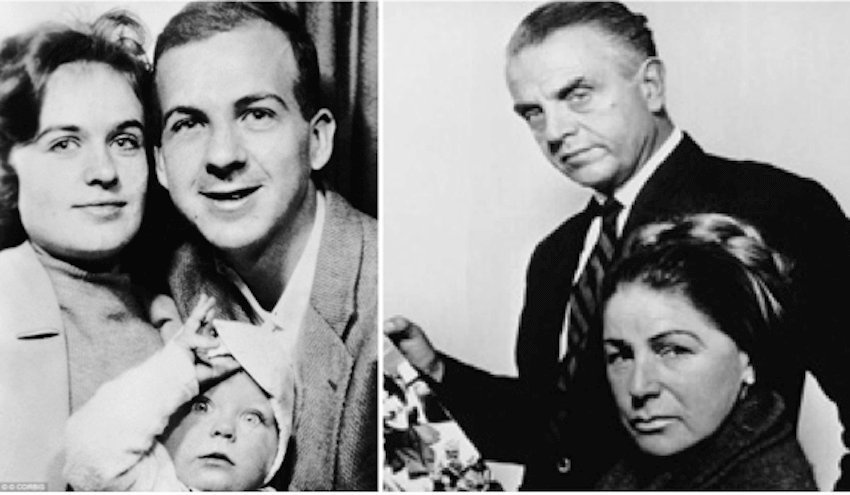 One of the main difficulties that the Warren Commission had in portraying Lee Harvey Oswald as the dual killer of President Kennedy and police officer J. D. Tippit was that, up until then, Oswald did not show any record of past violent acts. Therefore the Commission set to work to fill that lacuna. One obvious way they did so was by accusing him in the unsolved case of the April 10, 1963 shooting of General Edwin Walker. That was a case in which, during a time period of over seven months, Oswald had never even been considered a suspect. Author Gerald McKnight, in his fine book Breach of Trust, demonstrates that the indictment made against Oswald by the Warren Commission was genuinely dubious. (See pp. 48-59) Which explains why he was not a suspect in the shooting prior to November 22, 1963. The accusation rests largely on the questionable testimony of Marina Oswald.
Another way in which this was done was through the accusation that Oswald was a chronic wife beater. This was achieved almost exclusively through the testimony of the members of the White Russian community in the Dallas-Fort Worth area. Upon their return from the Soviet Union, the Oswalds were introduced into this enclave by Russian translator Peter Gregory and the enigmatic George DeMohrenschildt. DeMohrenschildt and his family came from Russia and he was an active member of this community. He had also been in contact with the local Dallas CIA chief J. Walton Moore since at least 1957. The closeness of his relationship with DeMohrenschildt was a fact that Moore tried to cover up. (James DiEugenio, Destiny Betrayed, Second Edition, p. 153) As the late Philip Melanson has written, many of the White Russians had been aided in their entry into the USA by the Tolstoy Foundation, an anti-communist lobby that received yearly stipends from the CIA. The Oswald biographer then added, “The Russian Orthodox Church, a centerpiece of the very conservative and religious White Russian community, also received Agency philanthropy.” (Spy Saga, p. 79) One of the enduring contradictions about the allegedly communist Oswald is that upon his return from Russia in June of 1962 he associated so strongly with two distinctly anti-Communist groups: the anti-Castro Cubans in New Orleans and the White Russians in Dallas. The former wished to overthrow Fidel Castro and the latter wanted to overthrow the Communist dictatorship in the USSR.
As noted, it was through the latter that the Warren Commission depicted the Oswald who showed violent tendencies toward his wife Marina. (Warren Report, p. 417) And many Warren Commission supporters have used this characterization to convict Oswald as a serial spouse abuser. And also to portray this White Russian community as a collection of avuncular guardians who tried to protect and shelter Marina from her brutal husband.
Robert Charles-Dunne was a longtime poster at John Simkin’s Spartacus Educational web site, which has a JFK Assassination Debate forum. In May of 2013 he decided to go ahead and do a systematic analysis of this issue. He examined the testimony of 19 witnesses on the subject. With his usual acuteness, he managed to perform a tour de force of separating the wheat from the chaff on the issue. When the subject came up again recently, Tom Scully salvaged his post on the Wayback Machine. We present it here for the edification of our readers.
~ Jim DiEugenio
First, let’s clear the decks of the obvious padding.
Mahlon Tobias and his wife have already been dispatched to the remainder bin, as they both testified they personally neither saw nor heard anything except complaints from other tenants of their building. That leaves 18.
Ilya Mamantov (IX: 107)
Mr. Jenner.
Have you ever seen Marina Oswald in your life prior to that moment (in the DPD HQ on November 22)? Knowingly?
Mr. Mamantov.
No; sir.
Mr. Jenner.
Had you ever met her prior to that time?
Mr. Mamantov.
No, sir; I met her after that, accidentally.
Mr. Jenner.
No; this is prior–up to that moment, you had had no contact, no acquaintance whatsoever with her?
Mr. Mamantov.
That’s correct.
Needless to say, people who had never met either of the Oswalds are hardly in a position to testify to anything about them, no matter how many times Paul Trejo pads his list with their names. Now we’re down to 17.
Igor Vladimir Voshinin (VIII: 466)
Mr. Jenner.
Did you ever meet either Lee or Marina Oswald?
Mr. Voshinin.
No, sir; thank God!
Thank you, Igor. We are down to 16.
John Ray Hall (VIII: 412)
Mr. Liebeler.
During that period of time that you knew Oswald, did you become aware of the fact that he and Marina were having difficulties with their marriage?
Mr. Hall.
We heard that she was living with someone else at one time, I don’t know who. My wife can probably tell you. And we also heard that he beat her up one time.
Mr. Liebeler.
Did you ever see any indication that be had beaten her up?
Mr. Hall.
I didn’t; no.
Mr. Liebeler.
Was it your impression that the Oswalds were having marital difficulties at the time Marina lived in your house or in Mrs. Hall’s house in Fort Worth?
Mr. Hall.
No.
Mr. Liebeler.
The only reason that Marina lived there at that time was because Oswald didn’t have an apartment in Dallas, is that correct?
Mr. Hall.
To give him a chance to get settled; yes.
One notes Hall’s observation: “And we also heard that he beat her up one time.” We’ll stipulate that John Hall was a lesser witness, as he had less interaction with the Oswalds. Nonetheless, we are now down to 15.
Mrs. Igor Vladimir Voshinin (VIII: 444)
Mr. Jenner.
Now, if you can remember any more, I wish you would tell us about De Mohrenschildt’s comments with respect to the Oswalds and the impressions that you gained of the Oswalds—as to how they got along whether he treated her well or poorly?
Mrs. Voshinin.
Oswalds—his wife?
Mr. Jenner.
Yes.
Mrs. Voshinin.
Treated very poorly. Because De Mohrenschildt told us that he was beating her. Then, she ran away from him and De Mohrenschildt tried to help her, you know, to settle down and to separate somehow, but then, they reconciliated (sic). And after the reconciliation, Jeanne mentioned twice that Marina had blue eyes–was beaten again, you know.
Mr. Jenner.
Black and blue eyes?
Mrs. Voshinin.
Yes.
No doubt Mrs. Voshinin repeated accurately what she had been told. But she saw nothing with her own two eyes and could offer only hearsay testimony. Now we’re down to 14.
Max E. Clark Vol. (VIII: 345-46)
Mr. Liebeler.
Did your wife have the impression that there had been marital difficulties between the Oswalds at that time?
Mr. Clark.
Yes.
Mr. Liebeler.
Can you tell us any specific reasons why your wife thought that?
Mr. Clark.
None other than the conversations and the fact that Marina, seemed quite happy with him gone, more than the fact that she did not seem to miss him and the fact that he wasn’t there.
Mr. Clark saw nothing, nor could he cite his wife having seen anything, regarding battery of Marina Oswald. His testimony contained the fact that he had heard about such an incident, but knew nothing of it first-hand, or even second hand from his wife. Mr. Clark is now excused, and we’re down to 13.
Gary E. Taylor (IX: 82-86)
Mr. Jenner.
It was, therefore, your impression, I take it, that your invitation was not tendered because of any difficulties between Marina and Lee, but rather to afford her a place to live temporarily until Lee became established elsewhere?
Mr. Taylor.
That’s right. In Dallas.
Mr. Jenner.
I mean, my statement is a fair statement of the then atmosphere?
Mr. Taylor.
Yes; I, at that time, was not aware that there was any marital disharmony.
……………………….
Mr. Jenner.
All right. Tell us about that.
Mr. Taylor.
As I remember it, shortly after they moved, Mrs. De Mohrenschildt—-
Mr. Jenner.
They moved where? Into your home or from your home?
Mr. Taylor.
Moved into their apartment here in Dallas–the first apartment they had, on Elsbeth.
Mrs. De Mohrenschildt came by and told us that she had seen Marina and that she had a black eye, I believe, and was crying and said that she and Lee had had a fight over the lessons and they had been taken from her, and—-
Mr. Jenner.
Lee had struck her?
Mr. Taylor.
Yes; that Lee had struck her.
Mr. Jenner.
She said that to you?
Mr. Taylor.
Yes; this is Mrs. De Mohrenschildt now. This is not Marina that said that.
Again, Mr. Taylor was unaware of “any marital disharmony” when Marina lived in his home, but later heard about Lee abusing Marina from his stepmother-in-law. Second-hand hearsay testimony is inadmissable. We’re now down to an even dozen.
Mrs. Helen Leslie (IX: 163)
Mr. Jenner.
How did these people, Lee Oswald and Marina Oswald act toward each other on the occasion when you saw them?
Mrs. Leslie.
I will tell you something–I don’t know if Bouhe told you or others too. When she was out at a place–she had a black eye and she has her tooth out, one tooth was out, so a second, man it was raised a question how she had this black eye and so on, and she said, “Oh, I hit the kitchen door. The baby was crying and I didn’t want to make a light, the door was open and I hit it–the kitchen door.”
And then, later, I heard from Mrs. Meller that he beat her, he was beating her, that he was always beating her and everybody was sympathetic with her. Frankly now, it is understandable. She was Russian, you know, it is some kind of a feeling of a Russian toward a Russian and they were mad at him and how he could beat his wife this is not proper–to beat his wife.
Mr. Jenner.
Well, now, we don’t approve of that in America.
Mrs. Leslie.
No. All I say now is what other people like Mellers and like Fords told me that once he beat her so hard and threw her out in the street, so she took her baby as a result in just a little blanket–she didn’t know where to go and she came to Mellers and she said, “I don’t know where to go,” that she wasn’t talking good English and he wanted to talk Russian at home, so she didn’t know what to do and the Mellers are very nice people, so they took her in their house and she stayed there a few days until they found a place for her. I don’t remember, but they said “Oh, the awful things,” and they took her–I think, you know, that she was staying with them.
I didn’t know she was staying with Fords. I didn’t know when, because I lost trace of her and so that’s all I know about Oswalds. Actually, I didn’t see her until when she was on television.
“…she had a black eye and she has her tooth out.” Marina seems to have given an explanation for her black eye—whether true or not—but it is troubling when a man beats a woman so hard she loses a tooth.
Only, the missing tooth wasn’t the result of marital discord, but provides a sterling example of how groundless gossip gets amplified with each re-telling and morphs into something else entirely Here is what happened to that tooth, courtesy of the former Mrs. Gary Taylor, with whom Marina briefly stayed:
Mrs. Donald Gibson (XI: 126-131)
Mr. Jenner.
You said that Marina was to receive some dental care?
Mrs. Gibson.
That is right.
Mr. Jenner.
Did she remain in the apartment all day after she arrived?
Mrs. Gibson.
After she came back from the dentist, she stayed there, I think she had a tooth, one or two pulled, and she stayed there that afternoon, after she came back from the dentist.
Mrs. Leslie saw nothing with her own eyes and repeated gossip heard from the Fords and Mrs. Meller, part of which was demonstrably untrue. It will prove interesting when we get to their own testimony. In the meantime, Mrs. Leslie is excused and we’re down to eleven remaining witnesses. Let’s get right to Mr. Ford:
Declan P. Ford (II: 325)
Mr. Liebeler.
Did Mrs. Oswald have any bruises on her at that time?
Mr. Ford.
Yes, she did. On her face.
Mr. Liebeler.
On her face. Was there any conversation about that?
Mr. Ford.
Not directly with me. My wife told me that Mrs. Oswald told her it was due to some accident of running into a door at nighttime while she was getting up to see what–the baby crying, something like that.
Thank you, Declan. You’ve reduced the number of witnesses to 10. Let’s hear from your wife, Mrs. Ford:
Katya Ford (II: 299-300)
Mr. Liebeler.
Tell us what Marina told you while she was staying there about her relations with Lee Oswald and particularly as to why she separated from him and what the difficulties were in their marriage?
Mrs. Ford.
I think mostly it was a mistreatment by him that she couldn’t stand any longer, she was saying.
Mr. Liebeler.
Mistreatment by him?
Mrs. Ford.
Mistreatment by him; yes. That is what she was saying.
Mr. Liebeler.
Did she tell you any more specifically than that what the problem was?
Mrs. Ford.
No; she didn’t really. She did not elaborate. She did not go into explanations of their living together.
Mr. Liebeler.
Did she mention that Lee Oswald was jealous of the Russian friends that Marina had?
Mrs. Ford.
Yes; she did. She told me that, that he was.
Mr. Liebeler.
Did they argue about that?
Mrs. Ford.
Well, I didn’t know if they were arguing about that. I know she said that he was very jealous of them helping Marina and jealous for the reason that he wasn’t able to provide her at the time with any of the things that they were giving Marina, clothes, and baby clothes, and I think that he was–it was making him rather mad because he said he was unable to buy the things for her at the time, and I know that he was not accepting things people were giving him. He was telling her not to take them but she was taking them because she needed them. I suppose they were arguing about that but I don’t remember the particulars.
Mr. Liebeler.
Did you form an impression at the time that Marina lived with you for that week as to what the cause of their difficulties might be?
Mrs. Ford.
She mentioned one time that soon after marriage he told her he didn’t love her any more in any way. So I don’t know what is the difficulty, I don’t know if that is what she mentioned. She did not explain and didn’t go into explanations of this.
Mr. Libeler.
Do you think, did you form an opinion as to whether this separation and the difficulties they were having was primarily the result of Oswald’s behavior or did you think Marina might have been partially responsible for it, what did you think?
Mrs. Ford.
My own opinion was that Marina was responsible for it. I think Marina was and I think now she is a rather immature girl.
The Chairman.
She is what?
Mrs. Ford.
I think she is rather immature in thinking.
The Chairman.
Oh, yes.
Mrs. Ford.
And a lot of times she agreed herself about provoking him in a way by arguing about his mother or things of some sort.
Mrs. Ford could not elaborate on the problems in the Oswald’s marriage, despite Marina living with her, and despite the fact that others claimed Mrs. Ford had told them about Marina being beaten. Since that seems to have come from gossip, rather than her own first-hand experience, or even what she might have been told by Marina, we are once again dealing with hearsay. We have nine witnesses remaining, and Mrs. Meller should go next, given that she was also among those who told Mrs. Leslie and others about the beatings:
Anna Meller (VIII: 390-91)
Mr. Liebeler.
Did you ever form an opinion as to who was responsible for these marital difficulties the Oswalds were having? Did you think it was mostly Lee Harvey’s fault or did you think it was partly her fault, or what?
Mrs. Meller.
It was not easy to judge but I think since we do not know them very close and very long, let’s say this way but it seems to me again that Lee Oswald was not normal because later I heard from somebody that he beat Marina and he did one time, I think even Marina told to me that when they moved in apartment the bulb is burned through and she has to put new lamp in it. He demanded when the master is home the bathtub supposed to be full with water so he can take bath before he sit down to eat and one time he come home and it was dark and she has to put lamp in the room, she did not have time to put water in the tub and he find tub was without water and he beat her.
Mr. Liebeler.
Marina told you that?
Mrs. Meller.
I think she told me that or somebody from our group; I do not recall who, but I remember that and I was shocked. I thought that something must be wrong with man if he is every time running to beat her.
Yes, there is something wrong with a man who beats his wife all the time. There’s also something wrong with a witness who contends such a thing without having seen it, or even being able to remember who told her, second or third hand. Please re-read Mrs. Meller’s shocking testimony and see if you can definitively identify where she learned this. We’re down to eight witnesses. Hopefully, we’ll soon encounter somebody who actually saw something.
Valentina Ray (VIII: 417)
Mr. Liebeler.
Did you talk to Mrs. Ford about the reasons for the Oswalds marital difficulties?
Mrs. Ray.
I asked her what was matter and she said he was mean to her; he beat her up and she left him because of that. I felt terrible sorry for her because Mrs. Ford described to me she could not speak English and didn’t know anybody there. That’s the only reason given to me that he struck her or beat her up.
Mr. Liebeler.
Mrs. Ford didn’t go into any greater detail as to what reason for beating her up?
Mrs. Ray.
No, no; when Marina came to my house I hated to butt in since she was only with me 1 day and 2 days and didn’t spend night. I don’t like to question somebody right away what is trouble, why did you leave–I am not that nosey.
Interesting. In her own testimony, Mrs. Ford claimed that Marina hadn’t disclosed the nature of the difficulties between her and her husband, but here’s Mrs. Ray—among others listed and yet to come—who claim that Mrs. Ford was the source of gossip about her being beaten. Mrs. Ray chose not to make inquiries when Marina stayed with her, so didn’t even have second-hand information. Thank you, Valentina, you may now step down so we can hear from the remaining seven witnesses.
Elena Hall (VIII: 395-396)
Mr. Liebeler.
About the time that Marina lived in your house, did you understand that the Oswalds were having any marital difficulties?
Mrs. Hall.
Well, I think she was stubborn, and he was just cruel to her, and they would argue for nothing, just nothing. And he would beat her all the time.
Mr. Liebeler.
Beat her?
Mrs. Hall.
Oh, yes. In fact, first time when she came to my house with George Bouhe, she had black and blue over half of her face and I didn’t ask at that time, but after she moved in my house, I said, Marina, what was on your face? And she told me that he beat her.
Mr. Liebeler.
The first time that Marina came to your house, can you remember exactly when that was?
Mrs. Hall.
In July. Sometime in July.
Mr. Liebeler.
And you noticed even in July that she had been bruised, is that correct?
Mrs. Hall.
Yes.
Mr. Liebeler.
But it wasn’t until October or November—-
Mrs. Hall.
October when she moved.
Mr. Liebeler.
That you learned that she had gotten those bruises as a result of her husband beating her, is that right?
Mrs. Hall.
Yes.
Mr. Liebeler.
At the time in October that Marina lived in your house, did she discuss with you her marital relations with Oswald?
Mrs. Hall.
Yes. Well, she is, I think she is very nice girl. And I told her, “Marina, you are in such a difficult financial situation, you’d better not have children for quite a while, and when you have a better financial situation, you can have them.” And she said, “Well, I don’t know.”
And I told her, “If you want to, I have a lady doctor, Dr. Taylor. If you want me, I will take you there. She will give you some things.” And she said, “No; I don’t think so.”
She said, “Our married life is so strange that I don’t think I ever will have any children any more,” because he was very cold to her.
Mr. Liebeler.
Did Marina indicate at that time that she and Oswald did not have normal sexual relations.
Mrs. Hall.
Very seldom. The thing that she told me, “Very seldom.”
Mr. Liebeler.
Tell me everything that you can remember about that subject that Marina told you.
Mrs. Hall.
That was the only thing that was worrying me, her to not have children, because they are in such bad shape, and that is the only thing she told me.
And I said, “If you think you want any more.” So it is none of my business, you know.
Mr. Liebeler.
Is that all that Marina said about that subject?
Mrs. Hall.
We didn’t talk any more, because it was my suggestion to her to not have children, and she told me that, and that was all.
Mr. Liebeler.
Did she ever tell you that Oswald would–was not very much of a man in that sense?
Mrs. Hall.
Yes. That is what she told me.
Mr. Liebeler.
They very seldom had sexual relations?
Mrs. Hall.
Yes, sir.
Mr. Liebeler.
Did you ever discuss that question with her any other time?
Mrs. Hall.
No.
Mr. Liebeler.
Did you form an impression as to how Lee and Marina were getting along with each other at the time that Marina lived in your house, other than what we have already talked about?
Mrs. Hall.
No. Couple of times I told her, “Why do you argue with him about little things,” and she said, “Oh, because he is not a man.” That is what she told me. For instance, I like hot peppers and he didn’t like it. Well, is nothing wrong with a man who doesn’t like peppers. John doesn’t like it at all. And at the table they were eating, and I ate the peppers, and he wouldn’t touch, and she said, “He is afraid of everything, hot peppers.”
And he said, he don’t like it, and they had argument about that. And after he left I said, Marina, you shouldn’t do that because, well, some people like them and some don’t.”
Well, things like that, she would start with him and they had an argument. Probably if I wouldn’t be there, they would have a fight or something.
Mr. Liebeler.
Did you ever have the feeling that Marina was a good wife to Oswald, or did you have the feeling that she was not particularly a good wife?
Mrs. Hall.
Well, she is a little bit lazy one, and she can sleep 48 hours a day. That is the only thing. And maybe they had trouble because of this and little things, like I said about the peppers and so on.
Mr. Liebeler.
Did you ever see or hear of Marina making fun of Oswald in front of other people?
Mrs. Hall.
Who?
Mr. Liebeler.
Marina making fun of Lee?
Mrs. Hall.
Oh, yes; she would do it.
Mr. Liebeler.
Can you think of any specific examples?
Mrs. Hall.
She always was complaining about him. He was not a man. He is afraid. I don’t know, not complete, I guess, or something like that. Not complete man.
Mr. Liebeler.
This may not seem to be too important, but we are not just curious, it might have a bearing on the Commission’s determination of what kind of man Oswald was and what kind of person he was.
Did Marina make fun of Oswald’s sexual inability in front of other people, or was it a more general thing?
Mrs. Hall.
Generally. I never heard sexual nothing; no. Only when I asked her about this, she told me. And that was, we don’t talk any more about this. I didn’t hear it. Maybe somebody else did. I didn’t.
Mr. Liebeler.
You had the feeling, I gather from what you said, that if there were difficulties in the Oswald marriage, they were not entirely Lee Oswald’s fault? It also would be some of the fault of Marina?
Mrs. Hall.
Yes.
Mr. Liebeler.
What is your opinion?
Mrs. Hall.
I think that she is stubborn, real stubborn, and she would pick up something little and go on and have an argument for nothing.
So, Mrs. Hall noticed half of Marina’s face was bruised, but didn’t initially ask why, when Marina first visited with George Bouhe. Perhaps it’s because an explanation had already been proffered. George Bouhe, one of the remaining six witnesses, may provide us assistance:
George A. Bouhe (VIII: 364-365)
Mr. Liebeler.
During the period in October and November of 1962, when, as I recall it, Marina and Lee Oswald were having a certain amount of marital trouble or difficulties, did you say that you gained Marina’s confidence about those matters?
Mr. Bouhe.
Not I.
Mr. Liebeler.
She didn’t tell you about her marital difficulties with Oswald?
Mr. Bouhe.
No; she talked to other people who told me.
Mr. Liebeler.
Who were these other women?
Mr. Bouhe.
Well, certainly to Anna Meller.
Mr. Liebeler.
Mrs. Ford?
Mr. Bouhe.
Mrs. Ford, undoubtedly.
Mr. Liebeler.
Do you think she confided in Anna Ray to any extent?
Mr. Bouhe.
Could have, although I was not present, but they had long sessions together, just girls.
Mr. Liebeler.
You spoke about these parties with Mrs. Ford and Anna Meller and Anna Ray.
Mr. Bouhe.
Well, the only time I have been bringing that up is when I saw or heard that she had a black eye.
Mr. Liebeler.
When did you see that?
Mr. Bouhe.
I would say within the first 2 weeks of September. One Saturday several of us arrived at their house.
Mr. Liebeler.
At Oswald’s house?
Mr. Bouhe.
Yes.
Mr. Liebeler.
Where was that house located at that time?
Mr. Bouhe.
On Mercedes Street.
Mr. Liebeler.
In Fort Worth?
Mr. Bouhe.
Yes; and she had a black eye. And not thinking about anything unfortunate, I said: “Well, did you run into a bathroom door?” Marina said, “Oh, no, he hit me.”
Mr. Liebeler.
Was Oswald there at that time?
Mr. Bouhe.
No.
Perhaps sensing that he was peddling gossip, about which he only knew what he’d been told by “Mrs. Ford and Anna Meller and Anna Ray,” he stated “the only time I have been bringing that up is when I saw or heard that she had a black eye.”
Which was it? Did he see it? Hear about it? Both? Neither? Same instance or different ones?
The allusion to “running into the bathroom door” in Bouhe’s testimony closely parallels Marina’s own explanation “Oh, I hit the kitchen door,” given to Leslie and others. Are several instances being telescoped into a single one, or is a single instance being extrapolated into more?
In any event, neither Hall nor Bouhe seemed overly disturbed in their testimony; Hall so little that she didn’t inquire what had happened to Marina, and in Bouhe’s account so little that he treated it as a joke and did not think it “anything unfortunate.” Certainly nobody called the police. Or suggested that Marina should do so.
Neither having witnessed anything first-hand, we are down to our final five witnesses. Before we get to two of them, here is what Igor Vladimir Voshinin—previously cited, who had met neither Oswald—says about them:
(Igor Vladimir Voshinin)
Mr. Jenner.
You had the impression, did you not–or did you–that the De Mohrenschildts saw the Oswalds frequently and were attempting to assist them?
Mr. Voshinin.
Yes; he was–only one time he was very bitter about Oswald when he beat up his wife.
Mr. Jenner.
Tell us about that.
Mr. Voshinin.
Well, once we saw De Mohrenschildt and his wife and he said, “Well, he doesn’t behave like he should. What does he think he is, beating his wife?” But Mrs. De Mohrenschildt said, “Well, don’t just judge people without knowing what’s behind them.” She said, “You always, George, you jump to conclusions. We don’t know what happened.”
I understand that she liked Lee much more than he did.
Mr. Jenner.
That Mrs. De Mohrenschildt liked Lee much more than George did?
Mr. Voshinin.
Yes.
Two counter-intuitive things shine through: Mrs. DeMohrenschildt told her husband he didn’t know what had actually happened, and that she was thought to favor Lee over Marina. Do either of these seem congruent with how a woman regards a known wife-beater? Hereafter, the relevant parts of the testimony:
George S. De Mohrenschildt (IX: 231ff.)
Mr. DE MOHRENSCHILDT.
Well, George Bouhe, started telling me that “George, Lee is beating Marina. I saw her with a black eye and she was crying, and she tried to run away from the house. It is outrageous.”
And he was really appalled by the fact that it actually happened. And Jeanne and I said, let’s go and see what is going on George Bouhe gave me their address, as far as I remember, there in Oak Cliff, because, I didn’t move them—it was my daughter who moved them, I think.
So we drove up there to that apartment, which was on the ground floor, and indeed Marina had a black eye. And so either my wife or I told Lee, “Listen, you cannot do things like this.”
Mr. Jenner.
Was he home at this time?
Mr. DE MOHRENSCHILDT.
I think he was. Or maybe he wasn’t. I just am not so sure. Maybe he was, maybe he wasn’t. But anyway, he appeared a little later.
Mr. Jenner.
While you were still there, he appeared?
Mr. DE MOHRENSCHILDT.
Yes.
Mr. Jenner.
And when you entered that apartment on the first floor, you observed that she had a black eye?
Mr. DE MOHRENSCHILDT.
A black eye, and scratched face, and so on and so forth.
Mr. Jenner.
Did you inquire about it?
Mr. DE MOHRENSCHILDT.
Yes.
Mr. Jenner.
What did she say?
Mr. DE MOHRENSCHILDT.
She said, “He has been beating me.” As if it was normal–not particularly appalled by this fact, but “He has been beating me”, but she said “I fight him back also.”
So I said, “You cannot stand for that. You shouldn’t let him beat you.”
And she said, “Well, I guess I should get away from him.”
Now, I do not recall what actually made me take her away from Lee.
Mr. Jenner.
Now, Mr. De Mohrenschildt. there has to be something.
Mr. DE MOHRENSCHILDT.
Yes, I know.
I do not recall whether she called us in and asked us to take her away from him or George Bouhe suggested it. I just don’t recall how it happened. But it was because of his brutality to her. Possibly we had then in the house and discussed it, and I told him he should not do things like that, and he said, “It is my business”–that is one of the few times that he was a little bit uppity with me.
And then again George Bouhe told me that he had beaten her again. This is a little bit vague in my memory, what exactly prompted me to do that. My wife probably maybe has a better recollection.
Mr. DeMohrenschildt seems to recall very little with absolute certainty—down to conversations with Oswald that might not have happened because he might not have been there. He remembered taking Marina “away from Lee,” but not the reason why. Again, he had seen nothing with his own eyes, and knew only what he’d been told by George Bouhe, and even about that he was less than certain. He defers to his wife, one of four remaining names.
Jeanne De Mohrenschildt (IX: 309)
Mrs. DE MOHRENSCHILDT.
Well, you see, he mistreated his wife physically. We saw her with a black eye once.
Mr. Jenner.
And did you talk to him and to her about it?
Mrs. DE MOHRENSCHILDT.
Yes; we did. I called him just like our own kids, and set them down, and I said, “Listen, you have to grow up, you cannot live like that. This is not a country that permits such things to happen. If you love each other, behave. If you cannot live with each other peacefully, without all this awful behavior, you should separate, and see, maybe you really don’t love each other.”
Marina was, of course, afraid she will be left all alone, if she separate from Oswald–what is she going to do? She doesn’t know the language, she had nobody to turn to. I understand they didn’t get along with Oswald’s family.
Mr. Jenner.
Now, this is what you learned in talking with them?
Mrs. DE MOHRENSCHILDT.
Yes, yes; through them actually, by facing them.
Mr. Jenner.
I want you to identify your sources of information.
Mrs. DE MOHRENSCHILDT.
Yes, yes.
Mr. Jenner.
You learned through Marina and Oswald, also, that they didn’t get along well with their—-
Mrs. DE MOHRENSCHILDT.
I cannot say through them, because maybe people talked about it, you know. She couldn’t live in her sister-in-law’s home, they didn’t get along. And I understand that later on somebody mentioned that the reason was that she was just too lazy. She slept in the morning.
Mrs. DeMohrenschildt speaks of what seems to be a single occasion, and it was the cause for her and her husband to separate Marina and Lee. An occasion on which Marina said either that it was a nighttime accident, or that she’d been beaten, depending on which version one credits as correct.
The DeMohrenschildts each seemed eager to see Lee and Marina separate, first arranging for Marina to stay with a daughter, then various other friends in the White Russian community. It was through George DeMohrenschildt that the Oswalds met Ruth Paine, who would aid the continued separation of Oswald and wife.
The DeMohrenschildts played upon the sympathies and generosity of the White Russian community in Dallas in Marina’s name and to her benefit. In the period that she guestroom-surfed in various homes, she was given small sums of money, two cribs, various household items and something approximating 100 dresses, according to sworn testimony. As the DeMohrenschildts played up Oswald’s purported abuse, the sympathy increased to Marina’s benefit. The testimony on this is clear, if one but bothers to read it. Visiting any of the pages of testimony I have cited above contributes to a keener sense of what was at play.
It is also clear that several of the benefactors who took in Marina and her child, or provided money and material goods to her, later felt they’d had their generosity abused. Perhaps it was because she was just a lousy house-guest. Or perhaps they had come to realize their sympathies had been over-played upon by DeMohrenschildt for the specific purpose of keeping Marina and Oswald apart.
Despite their hearsay testimony, neither DeMohrenscildt witnessed an actual instance of abuse of Marina by Lee. Now down to three witnesses, we come to the daughter with whom Marina initially stayed—also the former Mrs. Gary Taylor and by the time of her testimony she was Mrs. Donald Gibson. Perhaps she can offer some insight:
Mrs. Donald Gibson (XI: 126-131)
Mr. Jenner.
Would you tell us about this lack of rapport between Marina and Lee Harvey Oswald?
Mrs. Gibson.
Well, they fought quite a bit. They fought in Russian, always verbally when I saw them, but when she was living with Mrs. Hall in Fort Worth, I was told that he beat her up on numerous occasions, physically assaulted her, and that Mrs. Hall and her, oh, I don’t know what you would call him, her fiancee, Alex–
Mr. Jenner.
Is that Alex, Alexander Kleinlerer?
Mrs. Gibson.
I guess so. I don’t know his name.
Mr. Jenner.
Describe him to us.
Mrs. Gibson.
Describe him?
Mr. Jenner.
Physically.
Mrs. Gibson.
He was short, very dark, moustache, black moustache, European dresser, an accent, very much the gangster type in his looks, very oily looking, very oily in personality, actually a rather creepy customer. He spoke Russian fluently. I think he spoke quite a few languages fluently. He, I believe, was born or originated in Paris. I have no idea what his occupation was. But he did not get along with Lee at all. He had numerous arguments with him over Marina and how he beat her.
Mr. Jenner.
Did any of this occur in your presence?
Mrs. Gibson.
One afternoon he was telling Lee off very, very–
Mr. Jenner.
Tell us where this occurred?
Mrs. Gibson.
This occurred in Mrs. Hall’s home in Fort Worth.
Mr. Jenner.
You were present?
Mrs. Gibson.
And my husband; we were both present.
Mr. Jenner.
And who else please?
Mrs. Gibson.
Mrs. Hall and Marina were in the other room. Lee and Alex, and he was telling Lee off in no uncertain terms about how he beat up Marina, and about his whole outlook on life. He was really giving him a tongue lashing.
Mr. Jenner.
And what response did he obtain from Lee?
Mrs. Gibson.
Very sullen, very sharp answers. In fact I thought there was going to be a fight there for a minute.
Mr. Jenner.
Did Lee deny at that time in your presence, these accusations being uttered by Alexander Kleinlerer?
Mrs. Gibson.
He said it was none of his business.
Mr. Jenner.
But he didn’t deny that he had done this?
Mrs. Gibson.
No.
Mr. Jenner.
He just said it was none of Kleinlerer’s business?
Mrs. Gibson.
That is right.
Mr. Jenner.
Had either you or your husband ever–did either you or your husband ever talk to Lee Oswald about his treatment of Marina?
Mrs. Gibson.
No; we never talked to him about beating his wife.
And so it is that we finally come to the second last witness, the redoubtable Alexander Kleinlerer.
It is to his credit that he forcefully came to Marina’s aid, thinking she’d been repeatedly beaten. And he is unique among all the witnesses, for he swore he had witnessed an instance wherein Oswald slapped his wife, the only one to do so. In the final affidavit used by the Warren Commission, the tale had expanded in key respects when compared to his original statement. But in both versions of his tale, he was the only one who witnessed an episode of violence by Lee toward Marina.
He is also unique for another reason. The Commission deposed and took testimony—much of it hearsay—from each of the 19 “witnesses” with one exception: Kleinlerer. The Commission could not, for whatever reasons, manage to depose Kleinlerer in person. Perhaps there was a perfectly valid reason for their inability to obtain an audience with Kleinerer, but in the absence of such an explanation, one is left to assume that the single-most valuable witness to Oswald’s temper was not thought important enough to interview in person. This is doubly odd, for his affidavit was taken and sworn in Texas, while Commission counsel was in-state, thus making his inability to testify for said counsel more than a little mysterious.
But there may be a reason for the Commission’s reticence. Kleinlerer’s affidavit contained something—a passing comment—that could have demolished the carefully constructed and nurtured depiction of the Oswalds’ tawdry relationship, had he inadvertently mentioned it during testimony as he did in his affidavit.
It is in his affidavit—Vol. XI, p. 122—and clearly states a suspicion anathema to the Commission’s attempt to blacken Lee Oswald’s name, and certainly at polar extremes from Paul Trejo’s conjectures:
“25. I expressed to Mrs. Hall and to my friend George Bouhe, and to others that I thought that they were only worsening things because the Oswalds did not appear appreciative of what was being done for them. He acted as though the world owed him a living. I had the impression from time to time that Marina was pretending and acting.”
Consequently, even the one person who presumably—but not demonstrably—witnessed Oswald slap his wife “had the impression from time to time that Marina was pretending and acting.” And why shouldn’t she embellish her tale of woe? Every time she alleged she’d been abused, she was showered with more of the things she desired.
Despite this fact, Kleinlerer thought both spouses were undeserving of the White Russians’ largesse due to a lack of appreciation for what had been provided to her: “because both Oswalds did not appear appreciative of what was being done for them.”
We are now down to our final witness on the list of nineteen: Marina Oswald.
I will be uncharacteristically brief and suggest only that one takes seriously what this witness has to say at one’s own peril. For in key respects, of all the Commission’s witnesses, nobody’s narrative has been more flexible, elastic, malleable, changeable, than Marina’s.
Physical abuse of spouses is no laughing matter, irrespective of gender, class, religion, et al. It should be condemned at every turn.
It is remarkable that so few of the above nineteen witnesses bothered themselves to do so.
Equally remarkable is that not one of them, including the victim, thought to notify the police.
It is conceivable that the entire group of them didn’t care enough, but that is belied by their generosity to and solicitude toward Marina.
The alternative, needless to say, is that the issue was blown out of all proportion—for a specific purpose—when Oswald was alive, and magnified even further by the Commission for its own purpose after his death, in taking testimony of those who could only offer hearsay conjecture, while inexplicably giving the cold shoulder to the only puported witness to Oswald slapping his wife.
That this fraud continues to be cited as probative today only illustrates the intellectual and moral bankruptcy of those who traffick in this fiction.
Originally posted on the Education Forum, 12 May 2013, 07:13 PM
[Reprinted here with slight corrections and reformatted for legibility.]
-
JFK assassination: Cameraman followed police as they searched for sniper
From 2013: Tom Alyea filmed the inside of the TSBD minutes after Kennedy was assassinated. He witnessed shoddy police work, but he says … they still got the right man?
~Jim DiEugenio
-
JFK assassination: Cameraman followed police as they searched for sniper
From 2013: Tom Alyea filmed the inside of the TSBD minutes after Kennedy was assassinated. He witnessed shoddy police work, but he says … they still got the right man?
~Jim DiEugenio
-

A Coup in Camelot
Considering the large number of films and TV specials about the assassination of President Kennedy that have appeared over the last ten or fifteen years, genuinely worthwhile documentaries on the subject are sadly few and far between. The likes of Mark Lane’s Rush to Judgement and Chip Selby’s Reasonable Doubt were fine for their day but given the wealth of information and technological tools that have become available in the time since those films were produced they appear more than a little outdated now. Sadly, the majority of well budgeted, slickly produced documentaries of the 21st century have been created solely to push the delusory mythology of the Warren Commission. Aside from Shane O’Sullivan’s mostly worthwhile Killing Oswald there has been very little of note that has even attempted to counter the MSM’s seemingly endless deluge of propaganda with reliable evidence and solid reasoning. A Coup in Camelot clearly aims to fill that void. Unfortunately, however, it falls considerably short of the mark because it consistently confuses theory with fact.
The film begins strongly enough with a ten minute introduction that briefly discusses Kennedy’s intention to withdraw American troops from Vietnam then outlines the reasons for his trip to Dallas and explains how, within hours of the assassination, Lee Harvey Oswald was fingered as the lone nut assassin. From there A Coup in Camelot moves swiftly into one of its strongest segments, featuring respected author and researcher Vince Palamara as its main talking head. Over the years, through his diligent hard work in locating and interviewing members of the Secret Service, Palamara has made himself the go-to expert on the subject of President Kennedy’s protection―or lack thereof―in Dallas. I must admit that I have never been convinced the Secret Service was actively involved in the assassination. Yet Palamara’s work most certainly gives reason to at least consider the idea that JFK’s protection on November 22, 1963, was intentionally compromised.

Secret Service authority
Vince PalamaraPalamara details just how many of the Secret Service’s usual practices were not followed that day. For example, it was standard procedure during an open motorcade for agents to be walking or jogging alongside the Presidential limousine. In fact there were two hand rails in place for agents to hold onto as they stood on the rear running boards of the car. As Palamara points out, “Secret Service agents are powerless to really do much of anything if they’re not close to the President.” And yet there were no agents on or near the limousine in Dallas. Defenders of the official mythology have long claimed that Kennedy himself had ordered the agents off the back of the car because he wanted the public to get a good look at him. But when Palamara spoke with Gerald Behn, the Special Agent in charge of the White House detail, Behn told him in no uncertain terms that he had never heard any such request from the President. Palamara then contacted numerous other Secret Service agents and White House aides and each one of them told him the same thing: Kennedy had not ordered the agents off of the car.
Lone nut mythologists also tend to blame Kennedy for the fact that the limousine’s plexiglass bubble top was not used that day. Although the bubble top was not bullet proof or resistant it was, as Palamara notes, “a psychological deterrent because most people assumed it was bullet proof…The bottom line what the bubble top would have done is it would have obscured an assassin’s view via the sun’s glare.” To discover whether or not Kennedy really had ordered its removal, Palamara spoke with Special Agent Sam Kinney who was the driver of the Secret Service follow-up car. “Sam Kinney adamantly on three different occasions told me that President Kennedy had nothing to do with it; it was solely his responsibility.”

Houston, 11/21/63 Another procedure not followed in Dallas involved the additional protection customarily provided by local law enforcement. Whenever and wherever there was to be a motorcade, the Secret Service would usually work hand in hand with local police who would provide a motorcycle escort of six to nine officers that would ride in a wedge formation in front of and beside the Presidential limousine. This formation had been in place on all of the previous stops along Kennedy’s Texas trip. Yet in Dallas the escort was reduced to just four motorcycle officers who ended up riding behind the limo instead of beside it. As Palamara notes, “The formation was meaningless. It offered no protection at all…They left Kennedy a sitting duck.”
II
Having detailed these and many other irregularities in JFK’s protection, A Coup in Camelot moves on to a discussion of the “Blood, Bullets & Ballistics”, focusing largely on the conclusions of retired crime scene investigator, Sherry Fiester. It is Fiester’s contention that the massive spray of blood seen in frame 313 of the Zapruder film represents “back spatter” from a frontal shot. She further asserts that, despite numerous witnesses believing they heard shots or saw smoke coming from behind the fence on top of the “grassy knoll”, her own trajectory analysis excludes it as the source of the head shot. The actual source of the shot, she claims, was on the other side of Elm Street at the southern end of the triple overpass. But despite her impressive credentials and her 30 years experience with the Dallas police, Fiester’s conclusions fail to convince.
Medical, scientific and ballistics experts such as Dr. Cyril Wecht, Dr. Gary Aguilar, Dr. Donald Thomas, and Larry Sturdivan agree that, by itself, the explosion of blood, bone and brain matter seen in the Zapruder film actually tells us very little about the direction in which the projectile was travelling. That is because it does not occur at the point of entrance or exit but near the mid-point of the bullet’s trajectory. Rifle wounds of the skull can be a very different matter than gunshot wounds to other parts of the body. The skull is a closed vessel containing fluid contents that cannot be compressed. The energy and momentum imparted to the skull by the passage of the bullet creates a temporary cavity. The result of cavitation in an enclosed skull containing blood and brain is a hydraulic pressure applied to the cranium causing it to burst open. As Aguilar and Wecht explain, the resultant “spew” of blood and tissue is “radial to the bullet’s path and is separate from the inshoot and outshoot splatter.” (Aguilar & Wecht, Letter to the Editor, AFTE Journal, Volume 48 Number 2, p. 76) This is what is known as the “Krönleinschuss” effect―named for the German ballistics expert who first demonstrated it using skulls filled with clay.
This type of effect was demonstrated during filmed simulations performed in the Biophysics laboratory at Edgewood Arsenal in 1964 when rifle bullets were fired into numerous skulls filled with ballistic gelatin. Describing a typical example Sturdivan writes, “The bullet entered the back of the skull and exited in a small spray at the front in the space of one frame of the high-speed movie. Only after the bullet was far down-range did the internal pressure generated by its passage split open the skull and relieve the pressure inside by spewing the contents through the cracks. A similar type explosion would have taken place if the bullet had gone through in the opposite direction. The only way to distinguish the direction of travel of the bullet is to examine the cratering effect on the inside of the skull on entrance and on the outside of the skull at exit.” (Sturdivan, The JFK Myths, p. 171)
The empirical evidence, therefore, demonstrates that Fiester is mistaken in believing the explosive spray of matter we see in the Zapruder film is back spatter. In fact, forward spatter and back spatter are not seen in the film; probably because of the limitations of Zapruder’s camera. The film of the Edgewood simulation shows little to no back spatter and only a very small amount of forward matter which, as Sturdivan explains, was only visible “because of the strong lighting, a close-up view, and (especially) a very high framing rate…over 200 times the framing speed of the Zapruder movie…” (ibid. p. 174)
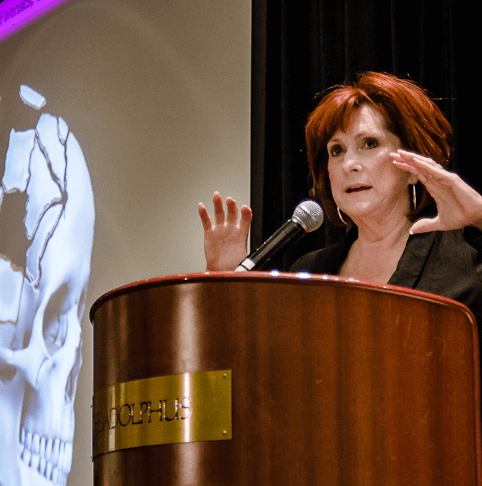
Sherry Fiester Fiester’s trajectory analysis is also deeply flawed because it assumes something there is no reason to assume. Namely, that the bullet followed a straight path through the skull. In 1978, when the House Select Committee on Assassinations (HSCA) hired a NASA scientist to perform the same type of backward projection analysis, the committee’s forensic pathology panel cautioned against placing too much faith in it. The panel noted that, in their experience, “if a missile strikes an object capable of creating a shearing force, such as the skull, the bullet’s pathway in the body might be significantly different from the line of its trajectory prior to impact.” (7HSCA168) In other words, a bullet striking a dense, resistant skull bone is likely to become deformed and be deflected. Sturdivan writes that “The path of a deformed bullet through a body is never straight…Of the thousands of examples of yawed, deformed, and broken rifle bullets fired into gelatin tissue simulant at the Biophysics Division lab and other similar facilities, none had a perfectly straight trajectory. Few were even close.” (ibid. p. 208) So drawing a line between the presumed entrance and exit points in JFK’s skull will not tell us where the gunman was located no matter how far that line is extended into Dealey Plaza.
Far from being excluded as Fiester asserts, the grassy knoll remains the most likely location for a frontal shooter. Not only because it was the location to which numerous witnesses pointed, but also because two teams of America’s top acoustical scientists agreed that the Dallas Police dictabelt recording they analyzed on behalf of the HSCA contained the acoustic fingerprint of a gunshot fired from the knoll. And the dictabelt recording synchronizes perfectly with the Zapruder film when―and only when―the knoll shot is aligned with frame 313.
Featured alongside Fiester’s theories in this segment of A Coup in Camelot is the claim that President Kennedy was shot in the throat from the front. Yet aside from a brief reference to the way the wound was “described by doctors at Parkland Hospital”, no detail is provided to substantiate this assertion. As most readers will no doubt be aware, the Parkland physicians were indeed under the initial impression that the wound might have been an entrance; describing it as small, round, clean cut, and measuring little more than 5 mm in diameter. But those who hold these descriptions up as proof that a bullet entered the throat need to deal with the fact that studies have shown emergency room doctors to be frequently wrong in their assessment of bullet wounds. This is precisely why the premiere textbook for trauma room physicians, Rosen’s Emergency Medicine, cautions that “Clinicians should not describe wounds as ‘entrance’ or ‘exit’ but should document, using appropriate forensic terminology, a detailed description of the wound, including its appearance, characteristics, and location without attempting to interpret the wound type or bullet caliber. Exit wounds are not always larger than entrance wounds, and wound size does not consistently correspond to bullet caliber.” (Rosen’s Emergency Medicine: Concepts and Clinical Practice, p. 828)
Those who propose that a bullet entered the throat must also deal with the fact that said bullet would have had to have disappeared entirely almost immediately after piercing the skin. Because not only was there no exit in the rear and no bullet found anywhere in the body, there was also no damage to the spine as there would almost certainly have had to have been had a missile entered Kennedy’s throat near the midline. It is for these reasons that, despite its appearance, the wound is extremely unlikely to have been one of entrance.
III
A Coup in Camelot moves from Dallas to Bethesda for a lengthy discussion of JFK’s autopsy, centred largely around the highly controversial theories of Douglas Horne. In a nutshell, Horne believes that Kennedy’s gunshot wounds were altered to hide evidence of a frontal shooter. This, of course, is not a new idea. It was first popularized by author David Lifton in his 36-year-old book, Best Evidence. But whereas Lifton postulated that unknown conspirators had hijacked the President’s body en route to Bethesda and altered his wounds to fool the autopsy surgeons, Horne suggests that the prosectors themselves altered the head wound during a secret “pre-autopsy” at the Navy morgue. For what purpose and to fool whom is never really made clear.
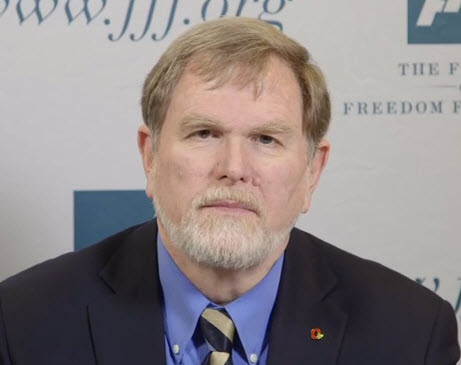
Doug Horne At the very heart of Horne’s hypothesis is a comment made by Tom Robinson―an embalmer who was present for most of the autopsy―during a 1996 interview for the Assassination Records Review Board. When shown a photo displaying a large defect in the top of Kennedy’s head Robinson recalled that this was “what the doctors did”. He then explained that the autopsy surgeons had cut the scalp open and “reflected it back in order to remove bullet fragments.” (ARRB MD180) He also recalled seeing that “some sawing was done to remove some bone before the brain could be removed.” (ibid) What Robinson described is, of course, a perfectly normal part of an autopsy and he himself called what he saw a “normal craniotomy procedure.” (ibid) Yet somehow Horne construes Robinson’s remarks as evidence of some clandestine pre-autopsy activity. Why?
The reason, according to Horne, is that “Dr. Humes always denied having to saw the skull open, he always maintained that the wound was so big that he just removed the brain with a minimum of cutting of the scalp; he never had to cut any bone.” However, as this passage from Hume’s sworn deposition for the ARRB demonstrates, Horne is entirely mistaken :
GUNN: But just let me start out first: Where was the first incision made?
HUMES: I believe, of course, the top of the skull to remove the skull plate of the brain. To remove what remained of the calvarium and to approach the removal of the brain.
GUNN: And was that incision simply of the scalp, or did you need to cut –
HUMES: No, we had to cut some bone as well. [my emphasis]
* * *
GUNN: Where did you cut the bone?
HUMES: I find that–it’s hard to recall. Once we got the scalp laid back, some of those pieces could just be removed, you know, by picking them up, picking them up because they were just not held together very well, other than by the dura, I suppose. So other than that, we probably made it like we normally do, in a circumferential fashion from books, like right above the ear around. But it was a real problem because it was all falling apart, the skull. And I can’t recall the details of exactly how we managed to maneuver that, because it was a problem. (ARRB Deposition of James J. Humes, pgs. 101-102)
As the reader can see, not only did Humes not deny having to saw the skull, he specifically testified to doing so. But Horne does not quote Humes himself and instead refers to a report written in 1965 by autopsy surgeon Dr. Pierre Finck―who did not arrive at Bethesda until after the brain had already been removed―in which Finck recalled being told that “no sawing of the skull was necessary”. What this means, therefore, is that the basis of Horne’s claim that “Humes always denied having to saw the skull open” is not any direct quotation from Humes himself, but the hearsay claim of a man who wasn’t even present when the brain was removed. This type of methodology is extremely difficult to defend. And what makes it all the more confounding is that Horne himself was actually present for the deposition during which Humes specifically swore to cutting the skull bone.
Sadly, this is not the only instance in A Coup in Camelot in which Humes’ words are misconstrued in support of pre-autopsy surgery. The film’s co-writer, Art Van Kampen, suggests that “Something had to have happened to that body before the photos were taken”, and in the case of some photos that is indeed true. But Van Kampen claims that “Dr. Humes is very clear that no autopsy work had been done on the President’s skull before either photos or X-rays were taken.” This, again, is a clear misinterpretation of what Humes actually said. When asked during his ARRB deposition whether or not any incisions were made before the photographs were taken, Humes responded, “Well, depending on which photographs you’re talking about. We didn’t photograph the wound in the occiput until the brain was removed, you know. Sure, we had to make an incision to remove the brain and so forth, but no, generally speaking, no, we didn’t make any incisions at all [my emphasis].” (ibid. p. 95) Humes was then shown the photographs of the top of the head and asked whether or not, before the photo was taken, he had pulled the scalp back “in order to be able to have a better look at the injury” to which he responded “Yes, I probably did.” (ibid. p. 162) So, as should be perfectly clear, Humes confirmed that “generally speaking” most of the photographs were taken before any incisions took place but that some were indeed taken during the course of the autopsy. He also said essentially the same thing as Tom Robinson, which is that the photographs of the top of the head were taken after the scalp had been manipulated. There is, then, no meaningful discrepancy between what the autopsy pictures show and what Humes testified to.
There has been confusion over Kennedy’s head wounds ever since the Warren Commission issued its findings. In large part this is due to there being two entirely different descriptions of the wounds on record. By and large the doctors at Parkland Hospital recalled seeing one fairly large hole that was located near the right rear of the head. Yet the autopsy report describes a massive defect involving almost the entire right side of the cranium. It was to explain this discrepancy that the body alteration hypothesis was first offered. However, as Dr. Aguilar has noted, “that the wound was described as larger at autopsy than noted by emergency personnel is not proof that it was surgically enlarged. Wounds picked apart during an autopsy are often found to be larger than they first appeared to emergency personnel.” (Murder in Dealey Plaza, p. 187)
There is a simpler, far more reasonable explanation than clandestine alteration. One that, ironically enough, is touched upon in A Coup in Camelot. Shortly before discussion of the autopsy begins, the film’s narrator correctly informs viewers that “In the Zapruder film, a flap of skull can be seen opening up after the head strike. During the frantic ride to Parkland Hospital the flap had been folded back into place where the blood acted like glue and sealed the wound.” Indeed, Jackie Kennedy later testified to trying to hold her husband’s skull together on the way to the hospital. As Dr. Aguilar writes, “It is not hard to imagine the possibility that during the time it took the Presidential limousine to get to Parkland Hospital, clot had formed gluing a portion of disrupted scalp down making JFK’s skull defect appear smaller to treating surgeons than it later would to autopsy surgeons.” (ibid) In other words, because the flap had been closed up, the emergency room staff only saw the rearmost portion of the wound.
IV
The idea that something out of the ordinary occurred at Bethesda is buttressed by stories of multiple coffins being brought into the morgue on the night of the autopsy. At Parkland Hospital, Kennedy’s body had been placed into an ornamental bronze casket. However, in A Coup in Camelot it is alleged that the body actually arrived at Bethesda in an aluminium shipping casket at around 6:35 pm. This means that when the bronze casket was brought into the morgue at 7:17 pm it was, unbeknownst to the FBI agents who accompanied it, completely empty. Or so we are told. Horne further alleges that for some reason the Dallas casket then “made a second entry that night…at 20:00 hours military time.”
Once again the evidence does not support the theory. As presented in the film, the idea that Kennedy’s body arrived in an aluminium shipping casket is based on the recollection of Naval petty officer, Dennis David, who recalled helping carry one into morgue. Yet, as the summary of his ARRB interview states, David “emphasized that he had no direct knowledge, by observation, that President Kennedy was in the gray shipping casket…” (ARRB MD177) The reality is that, being as Bethesda was a morgue, there is no reason to believe that Kennedy’s body was the only one to be brought there that night. In fact, FBI agent Francis O’Neill specifically recalled being told that one of the four drawers in the anteroom adjacent to the autopsy room contained the body of a child “that had died that day.” (O’Neill ARRB deposition, p. 57)
Perhaps more importantly, the claim that the bronze casket was empty when brought into the mortuary is belied by the testimony of both O’Neill and his FBI colleague, James Sibert. These two agents who helped unload the casket from the ambulance swore that they stayed with it until it was opened and saw with their own eyes the President’s body taken out. O’Neill stated without hesitation during his ARRB deposition that there was “no time” from the time he first saw the casket “until the time it was opened and the body taken out that the casket was not in my view…” (ibid. p. 59) Similarly, when asked whether or not there had been any time between being unloaded from the ambulance and being opened that the casket had been out of his sight, Sibert responded, “I was there until it was opened.” (Sibert ARRB deposition, p. 45) There is, therefore, no basis for claiming that the casket was “certainly empty” as Horne does.
Finally, the supposed 20:00 re-entry of the casket is based on a time notation which appears in an unsigned, undated document titled “The Joint Casket Bearer Team.” This document describes the activities of a group containing one officer and seven enlisted men “from each branch of the Armed Forces” who were “trained to carry the casket to and from the ceremony sites and to fold the flag which draped the casket following the internment service.” (ARRB MD163) This team, as A Coup in Camelot correctly informs, was also known as the “honor guard”. It appears quite apparent that, far from being proof of a second entry for the bronze casket, the 20:00 hours time notation on this document is nothing more than a mistake. Why? Because despite the film’s claim that Sibert and O’Neill had carried the casket into the morgue at 7:17 pm alongside Secret Service agents Roy Kellerman and William Greer, O’Neill explained in his ARRB deposition that, in actual fact, it was the honor guard who had physically lifted the coffin at that time. (O’Neill deposition, p. 57) So unless anyone wants to believe that the honor guard carried it in twice, they are going to have to accept that the unknown writer of the document was in error and there was only one entry for the bronze casket.
A coup in Camelot intermingles these stories of casket-swapping and wound tampering with claims that the autopsy X-rays and photographs have also been altered. This, once again, is not a new theory. In fact it has been a commonly held belief amongst students of the assassination for decades. And yet nothing approaching proof of alteration has ever emerged. The most commonly cited reason for believing the photos have been tampered with, the one repeated in A Coup in Camelot, is that the pictures appear to show the back of the head completely intact. This is, of course, at odds with the testimony of the Parkland physicians who recalled seeing a large wound in the right rear. But as autopsy surgeon J. Thornton Boswell explained to both the HSCA and the ARRB, the reason the rear skull damage is not seen in the photographs is because the scalp is being held up and “pulled forward up over the forehead, toward the forehead.” (Boswell ARRB deposition, p. 150) This has the effect of hiding the wound underneath.
Those who choose to ignore Boswell’s words are still stuck with the reality that the autopsy photographer, John Stringer, authenticated the photographs during his own ARRB deposition, repeatedly stating that he had no reason to believe the existing photographs were anything other than the ones that he himself took on the night of the autopsy. The same is true of the X-rays. The technician responsible for taking them, Jerrol Custer, repeatedly swore to the accuracy and authenticity of the existing X-rays for the ARRB. For example, when shown the anterior/posterior view:
GUNN: Is there any question in your mind whether the X-ray that’s in front of you right now is the original X-ray taken at the autopsy?
CUSTER: No question.
GUNN: And the answer is––
CUSTER: It is the original film. (p. 122-123)
And when shown the right lateral skull X-ray:
GUNN: … Mr. Custer, can you identify the film that is in front of you right now as having been taken by you on the night of the autopsy of President Kennedy?
CUSTER: Correct. Yes, I do, sir.
GUNN: And how are you able to identify that as being––
CUSTER: My marker in the lower mandibular joint. (p. 124)
With the men who took them―and all three autopsy doctors―swearing to their authenticity, there seems little doubt that the autopsy photographs and X-rays would have been admitted into evidence were there to be a trial in the Kennedy case. And with questions of validity settled, a more important question would be asked: What do the skull X-rays actually show? The answer to that, as a number of experts including neuroscientist Dr. Joseph Riley and radiologist Dr. Randy Robertson have attested, is that the official theory of a single shot from the rear simply cannot be true.
As Dr. Humes explained in his Warren Commission testimony, the pathologists found an entrance wound that was 2.5 cm to the right, and “slightly above” the external occipital protuberance―a small bump located very low down in the rear of the skull―and “a huge defect over the right side” involving “both the scalp and the underlying skull…” After a “careful examination of the margins of the large bone defect” on the right side, the doctors were unable to find a point of exit, which Humes put down to the fact that they “did not have the bone.” However, the pathologists concluded that a single bullet was responsible for all the damage, having entered the rear and exited the right side. In support of this contention, Humes implied that the path of the bullet was laid out by a trail of metallic fragments that could be seen on the X-rays “traversing a line from the wound in the occiput to just above the right eye…” (Warren Commission Hearings, Vol. II, p. 351-353)

Unfortunately for Dr. Humes, the X-rays do not show what he claimed. The entrance wound in the lower rear of the skull is indeed visible. So too is the trail of bullet fragments. But the two are in no way related. In fact, the trail lies along the very top of the skull, several inches above the entrance site. Therefore, those fragments could not have been left behind by a bullet which entered near the external occipital protuberance. As Aguilar and Wecht have noted, “…the fragment trail alone almost completely eliminates the official theory JFK was struck from above and behind by a single bullet that entered his skull low…” (Aguilar & Wecht, Op. cit. p. 78) Dr. Joseph Riley, who has a Ph.D in neuroscience and specializes in neuroanatomy and experimental neuropathology, noted decades ago that the medical evidence as it stands is only compatible with two separate bullet strikes. It is for that very reason that I see little logic in suggesting that the X-rays have been altered to support the official story.
V
These largely specious claims about the medical evidence form the centrepiece of A Coup in Camelot and, clocking in at nearly 40 minutes, comprise well over a third of the film’s running time. For those who are familiar with the facts that are being misinterpreted and/or overlooked, this time will not pass quickly. Things do pick up, however, for the final 20 minutes of the film which deals partially with the enigmatic Lee Harvey Oswald. Whether or not Oswald was on the sixth floor of the Texas School Book Depository with a rifle in his hands at the time of the assassination has never been conclusively established. But A Coup in Camelot demonstrates, through the pioneering research of former investigative reporter Barry Ernest, that in all likelihood Oswald was where he claimed to be when the shots were fired; on the first floor of the building eating lunch.

Barry Ernest Ernest centred his research on an often overlooked witness named Victoria Adams who had viewed the assassination from a fourth floor window of the depository building. As most students of the case know, Oswald was seen by his boss Roy Truly and police officer Marion Baker in the second floor lunch room approximately 90 seconds after the shots were fired. Baker was on his way to the roof where he believed the gunman might be located but, upon spotting Oswald alone in the lunch room, he halted his ascent and demanded Oswald identify himself. Truly quickly informed Baker that Oswald was an employee and the pair then continued their dash up the stairs. Oswald later told police that he had gone from the first floor to the second in order to purchase a Coke. But, of course, the Warren Commission claimed that he had actually rushed down from the sixth floor immediately after shooting the President.
In that regard, Victoria Adams was a problematic witness for the Commission. After watching the motorcade pass by with three co-workers, she had stayed at the fourth floor window for what she said was around 15 to 30 seconds and then quickly made her way down to the first floor. What this means, as Ernest explains, is that “she would have been on the stairs at the same time Oswald was descending from the sixth floor.” The problem is “…she did not see or hear anyone on the stairs during that period.” The Commission’s handling of her story typified its approach to the investigation. It did not bother to question any of those who had stood at the window with her to watch the motorcade―not even Sandra Styles who had accompanied Adams down the stairs―and instead suggested that she was simply mistaken about the time she left the fourth floor window.

Victoria Adams In support of this contention, the Commission alleged that Adams had testified to seeing two other employees of the building, William Shelley and Billy Lovelady, when she arrived on the first floor. And because Shelley and Lovelady had testified to being outside on the depository steps during the shooting and not re-entering the building until several minutes later, the Commission claimed that Adams’ “…estimate of the time when she descended from the fourth floor is incorrect, and she actually came down the stairs several minutes after Oswald and after Truly and Baker as well.” (Warren Report, p. 154) The problem with the Commission’s argument is that when Ernest tracked Adams down she “flat-out denied” ever saying she had seen Shelley and Lovelady on the first floor. In order to confirm or refute her assertions, Ernest searched the National Archives for the stenographic tape of Adams’ testimony. Not surprisingly, however, he soon discovered that there is no record of her April 7, 1964, testimony and the stenographic tape has gone mysteriously “missing.”
But in 1999 Ernest discovered a bombshell document in the Archives in the form of a June 2, 1964, letter written by Assistant United States Attorney, Martha Joe Stroud, to Warren Commission Chief counsel, J. Lee Rankin. This letter contains the only known reference in the Commission’s files to an interview with Dorothy Garner, who was Adams’ supervisor and one of those with whom she had stood at the fourth floor window. The letter notes matter-of-factly that “Miss Garner…stated this morning that after Miss Adams went downstairs she (Miss Garner) saw Mr. Truly and the policeman come up.” Thus Garner provided complete corroboration for Adams’ testimony. Just as she swore, Adams had indeed descended those old wooden steps at the same time Oswald was supposed to have been on them. And the corroboration of this fact was completely ignored by the Commission who made no mention of Garner’s interview whatsoever.
As Ernest details in his indispensable book, The Girl on the Stairs, he went on to locate and interview Garner for himself. He asked her about her own activities following the assassination and Garner explained to him that as Adams and Styles made their way downstairs, she herself went to a storage area by the stairway. It was from there that she was able to see Baker and Truly ascend the stairs. Garner said that she was “right behind” Adams and Styles in leaving the window and although she didn’t actually see them enter the stairway, she heard them “after they started down” because “the stairs were very noisy.” (The Girl on the Stairs, p. 268) Garner, it appears, had arrived on the fourth floor landing area only seconds after Adams and was there long enough to see Baker and Truly. Quite obviously, then, if Oswald had descended from the sixth floor during that time as he would have had to have done in order to make it to his second floor encounter with Baker, then Garner was in a position to see him. Yet, as she told Ernest, “I don’t remember seeing him at all that day…except on TV.” (ibid)
It is impossible to overstate how damaging all of this is to the case against Oswald. It is clear that he could not have made it down to the second floor ahead of Adams because he did not have the time. This means he would have had to have descended long enough after Adams for her not to have heard his footsteps. Yet if he was 10 or 15 seconds behind her on the stairwell, it seems highly unlikely that he would not have been spotted by Garner who did not see or hear him on the noisy old stairs, even though she stayed on the fourth floor landing area long enough to see Truly and Baker. The most logical conclusion to be drawn is that when Oswald arrived at his second floor meeting with Baker, he had not come from the sixth floor but from the first, just as he said he had. And that would mean that, whatever else he did that day, Oswald did not shoot President Kennedy.
VI
A Coup in Camelot finishes with a brief discussion of how Kennedy’s plans to pull American military personnel out of Vietnam were reversed after his death and how private US contractors profited from the all-out war that followed. However none of this is explored in any detail and no attempt is made to show how it can be directly connected to the assassination. Had the writers and producers chosen to focus more heavily on these areas they may well have created a more valuable and compelling film than this one.
It is clear that the filmmakers wanted to offer forensic proof of a conspiracy and, in fact, at the end of the film it is claimed they have done just that. “We have proven through modern forensics”, narrator Peter Coyote says, “that a shot or shots were fired from the front.” Yet, as I have demonstrated above, proof of such is not offered in A Coup in Camelot. What is provided instead is a bloodspatter theory that, whilst plausible on the surface, is entirely contradicted by empirical evidence. Instead of relying on the opinions of one individual, the filmmakers should have consulted with other, perhaps better qualified experts to ensure that what was being proposed had really been put to the test. How else can one claim to have proven something? There are numerous medical and scientific professionals who are well-versed in the facts of the assassination―such as Doctors Wecht, Aguilar, Robertson, and Thomas―who, I am sure, would have been more than happy to share their expertise.
As I see it, this is the fatal flaw of A Coup in Camelot. Theory is all too readily accepted and promoted by the filmmakers without any independent verification or even basic fact-checking. How difficult would it have been to have had somebody actually read Dr. Humes’ various testimonies to see if he really had “always denied having to saw the skull open”? Or to have studied the deposition of Francis O’Neill to discover who had physically carried the casket into the morgue at 7:17 pm? A clearer understanding of these two points alone would have been enough to call into serious question the highly dubious claims of multiple casket entries and wound tampering at Bethesda.
Theories about the Kennedy assassination―many of them nutty―have been promulgated for far too long and they are not convincing anyone outside of the so-called “research community”. When you attempt to counter the ballistics experiments and slickly-produced computer simulations featured in mainstream lone gunman documentaries with something as bizarre-sounding and ill-founded as the body alteration hypothesis you are not likely to win many converts amongst the general population. What is needed is real expert opinion and cold, hard evidence presented in a compelling manner. A Coup in Camelot is skilfully produced on what appears to have been a reasonable budget and if the filmmakers had consulted the right individuals and doubled down on their facts they could well have produced something of real value. For that reason the film strikes me as a wasted opportunity.
-
A Coup in Camelot
Considering the large number of films and TV specials about the assassination of President Kennedy that have appeared over the last ten or fifteen years, genuinely worthwhile documentaries on the subject are sadly few and far between. The likes of Mark Lane’s Rush to Judgement and Chip Selby’s Reasonable Doubt were fine for their day but given the wealth of information and technological tools that have become available in the time since those films were produced they appear more than a little outdated now. Sadly, the majority of well budgeted, slickly produced documentaries of the 21st century have been created solely to push the delusory mythology of the Warren Commission. Aside from Shane O’Sullivan’s mostly worthwhile Killing Oswald there has been very little of note that has even attempted to counter the MSM’s seemingly endless deluge of propaganda with reliable evidence and solid reasoning. A Coup in Camelot clearly aims to fill that void. Unfortunately, however, it falls considerably short of the mark because it consistently confuses theory with fact.
The film begins strongly enough with a ten minute introduction that briefly discusses Kennedy’s intention to withdraw American troops from Vietnam then outlines the reasons for his trip to Dallas and explains how, within hours of the assassination, Lee Harvey Oswald was fingered as the lone nut assassin. From there A Coup in Camelot moves swiftly into one of its strongest segments, featuring respected author and researcher Vince Palamara as its main talking head. Over the years, through his diligent hard work in locating and interviewing members of the Secret Service, Palamara has made himself the go-to expert on the subject of President Kennedy’s protection―or lack thereof―in Dallas. I must admit that I have never been convinced the Secret Service was actively involved in the assassination. Yet Palamara’s work most certainly gives reason to at least consider the idea that JFK’s protection on November 22, 1963, was intentionally compromised.
Secret Service authority
Vince PalamaraPalamara details just how many of the Secret Service’s usual practices were not followed that day. For example, it was standard procedure during an open motorcade for agents to be walking or jogging alongside the Presidential limousine. In fact there were two hand rails in place for agents to hold onto as they stood on the rear running boards of the car. As Palamara points out, “Secret Service agents are powerless to really do much of anything if they’re not close to the President.” And yet there were no agents on or near the limousine in Dallas. Defenders of the official mythology have long claimed that Kennedy himself had ordered the agents off the back of the car because he wanted the public to get a good look at him. But when Palamara spoke with Gerald Behn, the Special Agent in charge of the White House detail, Behn told him in no uncertain terms that he had never heard any such request from the President. Palamara then contacted numerous other Secret Service agents and White House aides and each one of them told him the same thing: Kennedy had not ordered the agents off of the car.
Lone nut mythologists also tend to blame Kennedy for the fact that the limousine’s plexiglass bubble top was not used that day. Although the bubble top was not bullet proof or resistant it was, as Palamara notes, “a psychological deterrent because most people assumed it was bullet proof…The bottom line what the bubble top would have done is it would have obscured an assassin’s view via the sun’s glare.” To discover whether or not Kennedy really had ordered its removal, Palamara spoke with Special Agent Sam Kinney who was the driver of the Secret Service follow-up car. “Sam Kinney adamantly on three different occasions told me that President Kennedy had nothing to do with it; it was solely his responsibility.”
Houston, 11/21/63 Another procedure not followed in Dallas involved the additional protection customarily provided by local law enforcement. Whenever and wherever there was to be a motorcade, the Secret Service would usually work hand in hand with local police who would provide a motorcycle escort of six to nine officers that would ride in a wedge formation in front of and beside the Presidential limousine. This formation had been in place on all of the previous stops along Kennedy’s Texas trip. Yet in Dallas the escort was reduced to just four motorcycle officers who ended up riding behind the limo instead of beside it. As Palamara notes, “The formation was meaningless. It offered no protection at all…They left Kennedy a sitting duck.”
II
Having detailed these and many other irregularities in JFK’s protection, A Coup in Camelot moves on to a discussion of the “Blood, Bullets & Ballistics”, focusing largely on the conclusions of retired crime scene investigator, Sherry Fiester. It is Fiester’s contention that the massive spray of blood seen in frame 313 of the Zapruder film represents “back spatter” from a frontal shot. She further asserts that, despite numerous witnesses believing they heard shots or saw smoke coming from behind the fence on top of the “grassy knoll”, her own trajectory analysis excludes it as the source of the head shot. The actual source of the shot, she claims, was on the other side of Elm Street at the southern end of the triple overpass. But despite her impressive credentials and her 30 years experience with the Dallas police, Fiester’s conclusions fail to convince.
Medical, scientific and ballistics experts such as Dr. Cyril Wecht, Dr. Gary Aguilar, Dr. Donald Thomas, and Larry Sturdivan agree that, by itself, the explosion of blood, bone and brain matter seen in the Zapruder film actually tells us very little about the direction in which the projectile was travelling. That is because it does not occur at the point of entrance or exit but near the mid-point of the bullet’s trajectory. Rifle wounds of the skull can be a very different matter than gunshot wounds to other parts of the body. The skull is a closed vessel containing fluid contents that cannot be compressed. The energy and momentum imparted to the skull by the passage of the bullet creates a temporary cavity. The result of cavitation in an enclosed skull containing blood and brain is a hydraulic pressure applied to the cranium causing it to burst open. As Aguilar and Wecht explain, the resultant “spew” of blood and tissue is “radial to the bullet’s path and is separate from the inshoot and outshoot splatter.” (Aguilar & Wecht, Letter to the Editor, AFTE Journal, Volume 48 Number 2, p. 76) This is what is known as the “Krönleinschuss” effect―named for the German ballistics expert who first demonstrated it using skulls filled with clay.
This type of effect was demonstrated during filmed simulations performed in the Biophysics laboratory at Edgewood Arsenal in 1964 when rifle bullets were fired into numerous skulls filled with ballistic gelatin. Describing a typical example Sturdivan writes, “The bullet entered the back of the skull and exited in a small spray at the front in the space of one frame of the high-speed movie. Only after the bullet was far down-range did the internal pressure generated by its passage split open the skull and relieve the pressure inside by spewing the contents through the cracks. A similar type explosion would have taken place if the bullet had gone through in the opposite direction. The only way to distinguish the direction of travel of the bullet is to examine the cratering effect on the inside of the skull on entrance and on the outside of the skull at exit.” (Sturdivan, The JFK Myths, p. 171)
The empirical evidence, therefore, demonstrates that Fiester is mistaken in believing the explosive spray of matter we see in the Zapruder film is back spatter. In fact, forward spatter and back spatter are not seen in the film; probably because of the limitations of Zapruder’s camera. The film of the Edgewood simulation shows little to no back spatter and only a very small amount of forward matter which, as Sturdivan explains, was only visible “because of the strong lighting, a close-up view, and (especially) a very high framing rate…over 200 times the framing speed of the Zapruder movie…” (ibid. p. 174)
Sherry Fiester Fiester’s trajectory analysis is also deeply flawed because it assumes something there is no reason to assume. Namely, that the bullet followed a straight path through the skull. In 1978, when the House Select Committee on Assassinations (HSCA) hired a NASA scientist to perform the same type of backward projection analysis, the committee’s forensic pathology panel cautioned against placing too much faith in it. The panel noted that, in their experience, “if a missile strikes an object capable of creating a shearing force, such as the skull, the bullet’s pathway in the body might be significantly different from the line of its trajectory prior to impact.” (7HSCA168) In other words, a bullet striking a dense, resistant skull bone is likely to become deformed and be deflected. Sturdivan writes that “The path of a deformed bullet through a body is never straight…Of the thousands of examples of yawed, deformed, and broken rifle bullets fired into gelatin tissue simulant at the Biophysics Division lab and other similar facilities, none had a perfectly straight trajectory. Few were even close.” (ibid. p. 208) So drawing a line between the presumed entrance and exit points in JFK’s skull will not tell us where the gunman was located no matter how far that line is extended into Dealey Plaza.
Far from being excluded as Fiester asserts, the grassy knoll remains the most likely location for a frontal shooter. Not only because it was the location to which numerous witnesses pointed, but also because two teams of America’s top acoustical scientists agreed that the Dallas Police dictabelt recording they analyzed on behalf of the HSCA contained the acoustic fingerprint of a gunshot fired from the knoll. And the dictabelt recording synchronizes perfectly with the Zapruder film when―and only when―the knoll shot is aligned with frame 313.
Featured alongside Fiester’s theories in this segment of A Coup in Camelot is the claim that President Kennedy was shot in the throat from the front. Yet aside from a brief reference to the way the wound was “described by doctors at Parkland Hospital”, no detail is provided to substantiate this assertion. As most readers will no doubt be aware, the Parkland physicians were indeed under the initial impression that the wound might have been an entrance; describing it as small, round, clean cut, and measuring little more than 5 mm in diameter. But those who hold these descriptions up as proof that a bullet entered the throat need to deal with the fact that studies have shown emergency room doctors to be frequently wrong in their assessment of bullet wounds. This is precisely why the premiere textbook for trauma room physicians, Rosen’s Emergency Medicine, cautions that “Clinicians should not describe wounds as ‘entrance’ or ‘exit’ but should document, using appropriate forensic terminology, a detailed description of the wound, including its appearance, characteristics, and location without attempting to interpret the wound type or bullet caliber. Exit wounds are not always larger than entrance wounds, and wound size does not consistently correspond to bullet caliber.” (Rosen’s Emergency Medicine: Concepts and Clinical Practice, p. 828)
Those who propose that a bullet entered the throat must also deal with the fact that said bullet would have had to have disappeared entirely almost immediately after piercing the skin. Because not only was there no exit in the rear and no bullet found anywhere in the body, there was also no damage to the spine as there would almost certainly have had to have been had a missile entered Kennedy’s throat near the midline. It is for these reasons that, despite its appearance, the wound is extremely unlikely to have been one of entrance.
III
A Coup in Camelot moves from Dallas to Bethesda for a lengthy discussion of JFK’s autopsy, centred largely around the highly controversial theories of Douglas Horne. In a nutshell, Horne believes that Kennedy’s gunshot wounds were altered to hide evidence of a frontal shooter. This, of course, is not a new idea. It was first popularized by author David Lifton in his 36-year-old book, Best Evidence. But whereas Lifton postulated that unknown conspirators had hijacked the President’s body en route to Bethesda and altered his wounds to fool the autopsy surgeons, Horne suggests that the prosectors themselves altered the head wound during a secret “pre-autopsy” at the Navy morgue. For what purpose and to fool whom is never really made clear.
Doug Horne At the very heart of Horne’s hypothesis is a comment made by Tom Robinson―an embalmer who was present for most of the autopsy―during a 1996 interview for the Assassination Records Review Board. When shown a photo displaying a large defect in the top of Kennedy’s head Robinson recalled that this was “what the doctors did”. He then explained that the autopsy surgeons had cut the scalp open and “reflected it back in order to remove bullet fragments.” (ARRB MD180) He also recalled seeing that “some sawing was done to remove some bone before the brain could be removed.” (ibid) What Robinson described is, of course, a perfectly normal part of an autopsy and he himself called what he saw a “normal craniotomy procedure.” (ibid) Yet somehow Horne construes Robinson’s remarks as evidence of some clandestine pre-autopsy activity. Why?
The reason, according to Horne, is that “Dr. Humes always denied having to saw the skull open, he always maintained that the wound was so big that he just removed the brain with a minimum of cutting of the scalp; he never had to cut any bone.” However, as this passage from Hume’s sworn deposition for the ARRB demonstrates, Horne is entirely mistaken :
GUNN: But just let me start out first: Where was the first incision made?
HUMES: I believe, of course, the top of the skull to remove the skull plate of the brain. To remove what remained of the calvarium and to approach the removal of the brain.
GUNN: And was that incision simply of the scalp, or did you need to cut –
HUMES: No, we had to cut some bone as well. [my emphasis]
* * *
GUNN: Where did you cut the bone?
HUMES: I find that–it’s hard to recall. Once we got the scalp laid back, some of those pieces could just be removed, you know, by picking them up, picking them up because they were just not held together very well, other than by the dura, I suppose. So other than that, we probably made it like we normally do, in a circumferential fashion from books, like right above the ear around. But it was a real problem because it was all falling apart, the skull. And I can’t recall the details of exactly how we managed to maneuver that, because it was a problem. (ARRB Deposition of James J. Humes, pgs. 101-102)
As the reader can see, not only did Humes not deny having to saw the skull, he specifically testified to doing so. But Horne does not quote Humes himself and instead refers to a report written in 1965 by autopsy surgeon Dr. Pierre Finck―who did not arrive at Bethesda until after the brain had already been removed―in which Finck recalled being told that “no sawing of the skull was necessary”. What this means, therefore, is that the basis of Horne’s claim that “Humes always denied having to saw the skull open” is not any direct quotation from Humes himself, but the hearsay claim of a man who wasn’t even present when the brain was removed. This type of methodology is extremely difficult to defend. And what makes it all the more confounding is that Horne himself was actually present for the deposition during which Humes specifically swore to cutting the skull bone.
Sadly, this is not the only instance in A Coup in Camelot in which Humes’ words are misconstrued in support of pre-autopsy surgery. The film’s co-writer, Art Van Kampen, suggests that “Something had to have happened to that body before the photos were taken”, and in the case of some photos that is indeed true. But Van Kampen claims that “Dr. Humes is very clear that no autopsy work had been done on the President’s skull before either photos or X-rays were taken.” This, again, is a clear misinterpretation of what Humes actually said. When asked during his ARRB deposition whether or not any incisions were made before the photographs were taken, Humes responded, “Well, depending on which photographs you’re talking about. We didn’t photograph the wound in the occiput until the brain was removed, you know. Sure, we had to make an incision to remove the brain and so forth, but no, generally speaking, no, we didn’t make any incisions at all [my emphasis].” (ibid. p. 95) Humes was then shown the photographs of the top of the head and asked whether or not, before the photo was taken, he had pulled the scalp back “in order to be able to have a better look at the injury” to which he responded “Yes, I probably did.” (ibid. p. 162) So, as should be perfectly clear, Humes confirmed that “generally speaking” most of the photographs were taken before any incisions took place but that some were indeed taken during the course of the autopsy. He also said essentially the same thing as Tom Robinson, which is that the photographs of the top of the head were taken after the scalp had been manipulated. There is, then, no meaningful discrepancy between what the autopsy pictures show and what Humes testified to.
There has been confusion over Kennedy’s head wounds ever since the Warren Commission issued its findings. In large part this is due to there being two entirely different descriptions of the wounds on record. By and large the doctors at Parkland Hospital recalled seeing one fairly large hole that was located near the right rear of the head. Yet the autopsy report describes a massive defect involving almost the entire right side of the cranium. It was to explain this discrepancy that the body alteration hypothesis was first offered. However, as Dr. Aguilar has noted, “that the wound was described as larger at autopsy than noted by emergency personnel is not proof that it was surgically enlarged. Wounds picked apart during an autopsy are often found to be larger than they first appeared to emergency personnel.” (Murder in Dealey Plaza, p. 187)
There is a simpler, far more reasonable explanation than clandestine alteration. One that, ironically enough, is touched upon in A Coup in Camelot. Shortly before discussion of the autopsy begins, the film’s narrator correctly informs viewers that “In the Zapruder film, a flap of skull can be seen opening up after the head strike. During the frantic ride to Parkland Hospital the flap had been folded back into place where the blood acted like glue and sealed the wound.” Indeed, Jackie Kennedy later testified to trying to hold her husband’s skull together on the way to the hospital. As Dr. Aguilar writes, “It is not hard to imagine the possibility that during the time it took the Presidential limousine to get to Parkland Hospital, clot had formed gluing a portion of disrupted scalp down making JFK’s skull defect appear smaller to treating surgeons than it later would to autopsy surgeons.” (ibid) In other words, because the flap had been closed up, the emergency room staff only saw the rearmost portion of the wound.
IV
The idea that something out of the ordinary occurred at Bethesda is buttressed by stories of multiple coffins being brought into the morgue on the night of the autopsy. At Parkland Hospital, Kennedy’s body had been placed into an ornamental bronze casket. However, in A Coup in Camelot it is alleged that the body actually arrived at Bethesda in an aluminium shipping casket at around 6:35 pm. This means that when the bronze casket was brought into the morgue at 7:17 pm it was, unbeknownst to the FBI agents who accompanied it, completely empty. Or so we are told. Horne further alleges that for some reason the Dallas casket then “made a second entry that night…at 20:00 hours military time.”
Once again the evidence does not support the theory. As presented in the film, the idea that Kennedy’s body arrived in an aluminium shipping casket is based on the recollection of Naval petty officer, Dennis David, who recalled helping carry one into morgue. Yet, as the summary of his ARRB interview states, David “emphasized that he had no direct knowledge, by observation, that President Kennedy was in the gray shipping casket…” (ARRB MD177) The reality is that, being as Bethesda was a morgue, there is no reason to believe that Kennedy’s body was the only one to be brought there that night. In fact, FBI agent Francis O’Neill specifically recalled being told that one of the four drawers in the anteroom adjacent to the autopsy room contained the body of a child “that had died that day.” (O’Neill ARRB deposition, p. 57)
Perhaps more importantly, the claim that the bronze casket was empty when brought into the mortuary is belied by the testimony of both O’Neill and his FBI colleague, James Sibert. These two agents who helped unload the casket from the ambulance swore that they stayed with it until it was opened and saw with their own eyes the President’s body taken out. O’Neill stated without hesitation during his ARRB deposition that there was “no time” from the time he first saw the casket “until the time it was opened and the body taken out that the casket was not in my view…” (ibid. p. 59) Similarly, when asked whether or not there had been any time between being unloaded from the ambulance and being opened that the casket had been out of his sight, Sibert responded, “I was there until it was opened.” (Sibert ARRB deposition, p. 45) There is, therefore, no basis for claiming that the casket was “certainly empty” as Horne does.
Finally, the supposed 20:00 re-entry of the casket is based on a time notation which appears in an unsigned, undated document titled “The Joint Casket Bearer Team.” This document describes the activities of a group containing one officer and seven enlisted men “from each branch of the Armed Forces” who were “trained to carry the casket to and from the ceremony sites and to fold the flag which draped the casket following the internment service.” (ARRB MD163) This team, as A Coup in Camelot correctly informs, was also known as the “honor guard”. It appears quite apparent that, far from being proof of a second entry for the bronze casket, the 20:00 hours time notation on this document is nothing more than a mistake. Why? Because despite the film’s claim that Sibert and O’Neill had carried the casket into the morgue at 7:17 pm alongside Secret Service agents Roy Kellerman and William Greer, O’Neill explained in his ARRB deposition that, in actual fact, it was the honor guard who had physically lifted the coffin at that time. (O’Neill deposition, p. 57) So unless anyone wants to believe that the honor guard carried it in twice, they are going to have to accept that the unknown writer of the document was in error and there was only one entry for the bronze casket.
A coup in Camelot intermingles these stories of casket-swapping and wound tampering with claims that the autopsy X-rays and photographs have also been altered. This, once again, is not a new theory. In fact it has been a commonly held belief amongst students of the assassination for decades. And yet nothing approaching proof of alteration has ever emerged. The most commonly cited reason for believing the photos have been tampered with, the one repeated in A Coup in Camelot, is that the pictures appear to show the back of the head completely intact. This is, of course, at odds with the testimony of the Parkland physicians who recalled seeing a large wound in the right rear. But as autopsy surgeon J. Thornton Boswell explained to both the HSCA and the ARRB, the reason the rear skull damage is not seen in the photographs is because the scalp is being held up and “pulled forward up over the forehead, toward the forehead.” (Boswell ARRB deposition, p. 150) This has the effect of hiding the wound underneath.
Those who choose to ignore Boswell’s words are still stuck with the reality that the autopsy photographer, John Stringer, authenticated the photographs during his own ARRB deposition, repeatedly stating that he had no reason to believe the existing photographs were anything other than the ones that he himself took on the night of the autopsy. The same is true of the X-rays. The technician responsible for taking them, Jerrol Custer, repeatedly swore to the accuracy and authenticity of the existing X-rays for the ARRB. For example, when shown the anterior/posterior view:
GUNN: Is there any question in your mind whether the X-ray that’s in front of you right now is the original X-ray taken at the autopsy?
CUSTER: No question.
GUNN: And the answer is––
CUSTER: It is the original film. (p. 122-123)
And when shown the right lateral skull X-ray:
GUNN: … Mr. Custer, can you identify the film that is in front of you right now as having been taken by you on the night of the autopsy of President Kennedy?
CUSTER: Correct. Yes, I do, sir.
GUNN: And how are you able to identify that as being––
CUSTER: My marker in the lower mandibular joint. (p. 124)
With the men who took them―and all three autopsy doctors―swearing to their authenticity, there seems little doubt that the autopsy photographs and X-rays would have been admitted into evidence were there to be a trial in the Kennedy case. And with questions of validity settled, a more important question would be asked: What do the skull X-rays actually show? The answer to that, as a number of experts including neuroscientist Dr. Joseph Riley and radiologist Dr. Randy Robertson have attested, is that the official theory of a single shot from the rear simply cannot be true.
As Dr. Humes explained in his Warren Commission testimony, the pathologists found an entrance wound that was 2.5 cm to the right, and “slightly above” the external occipital protuberance―a small bump located very low down in the rear of the skull―and “a huge defect over the right side” involving “both the scalp and the underlying skull…” After a “careful examination of the margins of the large bone defect” on the right side, the doctors were unable to find a point of exit, which Humes put down to the fact that they “did not have the bone.” However, the pathologists concluded that a single bullet was responsible for all the damage, having entered the rear and exited the right side. In support of this contention, Humes implied that the path of the bullet was laid out by a trail of metallic fragments that could be seen on the X-rays “traversing a line from the wound in the occiput to just above the right eye…” (Warren Commission Hearings, Vol. II, p. 351-353)
Unfortunately for Dr. Humes, the X-rays do not show what he claimed. The entrance wound in the lower rear of the skull is indeed visible. So too is the trail of bullet fragments. But the two are in no way related. In fact, the trail lies along the very top of the skull, several inches above the entrance site. Therefore, those fragments could not have been left behind by a bullet which entered near the external occipital protuberance. As Aguilar and Wecht have noted, “…the fragment trail alone almost completely eliminates the official theory JFK was struck from above and behind by a single bullet that entered his skull low…” (Aguilar & Wecht, Op. cit. p. 78) Dr. Joseph Riley, who has a Ph.D in neuroscience and specializes in neuroanatomy and experimental neuropathology, noted decades ago that the medical evidence as it stands is only compatible with two separate bullet strikes. It is for that very reason that I see little logic in suggesting that the X-rays have been altered to support the official story.
V
These largely specious claims about the medical evidence form the centrepiece of A Coup in Camelot and, clocking in at nearly 40 minutes, comprise well over a third of the film’s running time. For those who are familiar with the facts that are being misinterpreted and/or overlooked, this time will not pass quickly. Things do pick up, however, for the final 20 minutes of the film which deals partially with the enigmatic Lee Harvey Oswald. Whether or not Oswald was on the sixth floor of the Texas School Book Depository with a rifle in his hands at the time of the assassination has never been conclusively established. But A Coup in Camelot demonstrates, through the pioneering research of former investigative reporter Barry Ernest, that in all likelihood Oswald was where he claimed to be when the shots were fired; on the first floor of the building eating lunch.
Barry Ernest Ernest centred his research on an often overlooked witness named Victoria Adams who had viewed the assassination from a fourth floor window of the depository building. As most students of the case know, Oswald was seen by his boss Roy Truly and police officer Marion Baker in the second floor lunch room approximately 90 seconds after the shots were fired. Baker was on his way to the roof where he believed the gunman might be located but, upon spotting Oswald alone in the lunch room, he halted his ascent and demanded Oswald identify himself. Truly quickly informed Baker that Oswald was an employee and the pair then continued their dash up the stairs. Oswald later told police that he had gone from the first floor to the second in order to purchase a Coke. But, of course, the Warren Commission claimed that he had actually rushed down from the sixth floor immediately after shooting the President.
In that regard, Victoria Adams was a problematic witness for the Commission. After watching the motorcade pass by with three co-workers, she had stayed at the fourth floor window for what she said was around 15 to 30 seconds and then quickly made her way down to the first floor. What this means, as Ernest explains, is that “she would have been on the stairs at the same time Oswald was descending from the sixth floor.” The problem is “…she did not see or hear anyone on the stairs during that period.” The Commission’s handling of her story typified its approach to the investigation. It did not bother to question any of those who had stood at the window with her to watch the motorcade―not even Sandra Styles who had accompanied Adams down the stairs―and instead suggested that she was simply mistaken about the time she left the fourth floor window.
Victoria Adams In support of this contention, the Commission alleged that Adams had testified to seeing two other employees of the building, William Shelley and Billy Lovelady, when she arrived on the first floor. And because Shelley and Lovelady had testified to being outside on the depository steps during the shooting and not re-entering the building until several minutes later, the Commission claimed that Adams’ “…estimate of the time when she descended from the fourth floor is incorrect, and she actually came down the stairs several minutes after Oswald and after Truly and Baker as well.” (Warren Report, p. 154) The problem with the Commission’s argument is that when Ernest tracked Adams down she “flat-out denied” ever saying she had seen Shelley and Lovelady on the first floor. In order to confirm or refute her assertions, Ernest searched the National Archives for the stenographic tape of Adams’ testimony. Not surprisingly, however, he soon discovered that there is no record of her April 7, 1964, testimony and the stenographic tape has gone mysteriously “missing.”
But in 1999 Ernest discovered a bombshell document in the Archives in the form of a June 2, 1964, letter written by Assistant United States Attorney, Martha Joe Stroud, to Warren Commission Chief counsel, J. Lee Rankin. This letter contains the only known reference in the Commission’s files to an interview with Dorothy Garner, who was Adams’ supervisor and one of those with whom she had stood at the fourth floor window. The letter notes matter-of-factly that “Miss Garner…stated this morning that after Miss Adams went downstairs she (Miss Garner) saw Mr. Truly and the policeman come up.” Thus Garner provided complete corroboration for Adams’ testimony. Just as she swore, Adams had indeed descended those old wooden steps at the same time Oswald was supposed to have been on them. And the corroboration of this fact was completely ignored by the Commission who made no mention of Garner’s interview whatsoever.
As Ernest details in his indispensable book, The Girl on the Stairs, he went on to locate and interview Garner for himself. He asked her about her own activities following the assassination and Garner explained to him that as Adams and Styles made their way downstairs, she herself went to a storage area by the stairway. It was from there that she was able to see Baker and Truly ascend the stairs. Garner said that she was “right behind” Adams and Styles in leaving the window and although she didn’t actually see them enter the stairway, she heard them “after they started down” because “the stairs were very noisy.” (The Girl on the Stairs, p. 268) Garner, it appears, had arrived on the fourth floor landing area only seconds after Adams and was there long enough to see Baker and Truly. Quite obviously, then, if Oswald had descended from the sixth floor during that time as he would have had to have done in order to make it to his second floor encounter with Baker, then Garner was in a position to see him. Yet, as she told Ernest, “I don’t remember seeing him at all that day…except on TV.” (ibid)
It is impossible to overstate how damaging all of this is to the case against Oswald. It is clear that he could not have made it down to the second floor ahead of Adams because he did not have the time. This means he would have had to have descended long enough after Adams for her not to have heard his footsteps. Yet if he was 10 or 15 seconds behind her on the stairwell, it seems highly unlikely that he would not have been spotted by Garner who did not see or hear him on the noisy old stairs, even though she stayed on the fourth floor landing area long enough to see Truly and Baker. The most logical conclusion to be drawn is that when Oswald arrived at his second floor meeting with Baker, he had not come from the sixth floor but from the first, just as he said he had. And that would mean that, whatever else he did that day, Oswald did not shoot President Kennedy.
VI
A Coup in Camelot finishes with a brief discussion of how Kennedy’s plans to pull American military personnel out of Vietnam were reversed after his death and how private US contractors profited from the all-out war that followed. However none of this is explored in any detail and no attempt is made to show how it can be directly connected to the assassination. Had the writers and producers chosen to focus more heavily on these areas they may well have created a more valuable and compelling film than this one.
It is clear that the filmmakers wanted to offer forensic proof of a conspiracy and, in fact, at the end of the film it is claimed they have done just that. “We have proven through modern forensics”, narrator Peter Coyote says, “that a shot or shots were fired from the front.” Yet, as I have demonstrated above, proof of such is not offered in A Coup in Camelot. What is provided instead is a bloodspatter theory that, whilst plausible on the surface, is entirely contradicted by empirical evidence. Instead of relying on the opinions of one individual, the filmmakers should have consulted with other, perhaps better qualified experts to ensure that what was being proposed had really been put to the test. How else can one claim to have proven something? There are numerous medical and scientific professionals who are well-versed in the facts of the assassination―such as Doctors Wecht, Aguilar, Robertson, and Thomas―who, I am sure, would have been more than happy to share their expertise.
As I see it, this is the fatal flaw of A Coup in Camelot. Theory is all too readily accepted and promoted by the filmmakers without any independent verification or even basic fact-checking. How difficult would it have been to have had somebody actually read Dr. Humes’ various testimonies to see if he really had “always denied having to saw the skull open”? Or to have studied the deposition of Francis O’Neill to discover who had physically carried the casket into the morgue at 7:17 pm? A clearer understanding of these two points alone would have been enough to call into serious question the highly dubious claims of multiple casket entries and wound tampering at Bethesda.
Theories about the Kennedy assassination―many of them nutty―have been promulgated for far too long and they are not convincing anyone outside of the so-called “research community”. When you attempt to counter the ballistics experiments and slickly-produced computer simulations featured in mainstream lone gunman documentaries with something as bizarre-sounding and ill-founded as the body alteration hypothesis you are not likely to win many converts amongst the general population. What is needed is real expert opinion and cold, hard evidence presented in a compelling manner. A Coup in Camelot is skilfully produced on what appears to have been a reasonable budget and if the filmmakers had consulted the right individuals and doubled down on their facts they could well have produced something of real value. For that reason the film strikes me as a wasted opportunity.
-
Adele Edison passes away at 88
“A New Oswald Witness Goes Public”. Originally posted Wednesday, December 30, 2009
By William Kelley, At: JFK Countercoup
Adele Edison has passed away at age 88. She was an instructor in physiology at several colleges and universities in a long academic career. But she was also a fascinating JFK witness who told her story to the FBI very soon after the JFK assassination. Please read the attached story for the details.
~Jim DiEugenio
-
Adele Edison passes away at 88
“A New Oswald Witness Goes Public”. Originally posted Wednesday, December 30, 2009
By William Kelley, At: JFK Countercoup
Adele Edison has passed away at age 88. She was an instructor in physiology at several colleges and universities in a long academic career. But she was also a fascinating JFK witness who told her story to the FBI very soon after the JFK assassination. Please read the attached story for the details.
~Jim DiEugenio
-

Dr. Michael Marcades, with Norma J. Kirkpatrick, Rose Cherami: Gathering Fallen Petals
Melba Christina Youngblood was born in Texas in 1923. Her only son, Michael Marcades, has now written a book about his mother, who was posthumously made famous by film director Oliver Stone in his 1991 film JFK. If one recalls, that film opens with Dwight Eisenhower making his epochal Farewell Address warning of the rise of the Military Industrial Complex. The film proper then opens with a long credit sequence. Near the end of the credits, the film crosscuts between Kennedy arriving in Dallas and a woman being thrown out of a car on a lonely highway. We then see her in a hospital. She seems hysterical with fear warning that the men who threw her out of the car are going to kill Kennedy in Dallas. The doctor mumbles that she seems high as a kite on something, therefore implying that her warning will be ignored. Which it was—until after the assassination.
The woman was named Rose Cherami in Stone’s film. This was accurate since this is the final alias that she used in her life. And that was the name through which New Orleans DA Jim Garrison discovered her. Her Cassandra-like warning had been ignored by the Dallas Police, even though they were fully aware of it. It had then laid dormant for the FBI and the Warren Commission. In the seventies, it had been pursued by the House Select Committee on Assassinations. In fact, one of their most famous reports, written by researcher Patricia Orr, incorporated some of Garrison’s information with some new work that committee had done. In the annotated screen play of JFK entitled The Book of the Film, it was revealed that the script relied on Orr’s report for their information.
It was not until the Assassination Records Review Board declassified the HSCA files that we finally got many of the records that the committee used in order to compose that report. In a handy appendix to Rose Cherami: Gathering Fallen Petals, the authors supply several of these helpful documents. But the book goes much further than that. Because Marcades was so interested in finding out more about a mother he barely knew, but had read about in several sources, he decided to spend many years doing research in order to write the first full scale biography of Melba Youngblood, who only lived to be a bit over forty years old.
For a multiplicity of reasons, this was not an easy task. First, from a forensic viewpoint, many of the important personages had passed from this world. Also, as this reviewer has mentioned previously, many of the files of the late Jim Garrison have been lost, stolen or incinerated. Third, since Youngblood led such an offbeat, itinerant, peripatetic life, there was not a lot of paper data or tangible leads to follow. But Marcades stuck it out. And with the help of two others, including journalist Norma Kirkpatrick, he has put it together in book form.
Melba Youngblood grew up on a farm in a small town called Fairfield in east Texas. Her father was named Tom Youngblood; her mother was Minnie Bell Stroud. She was the eldest of three sisters, the other two being named Mozelle and Grace. Melba’s nickname growing up was Crit. The father was a stern disciplinarian and the girls were expected to do farm chores in addition to attending school and going to church on Sunday.
From the rather young age of fourteen, Crit was unsatisfied with the simple, dirt farming rural life. At that time, she actually ran away after hitching a ride with the milkman. Her parents managed to find her in a nearby small town. The street waif had been taken in by a kindly old couple.
A couple of years later, the family moved to Aldine, which was near Houston. There, Tom managed a tenant farm for the owner. They lived in a home that was much larger and modern. The father worked a second job on construction. But even with the improved circumstances, Melba was unsatisfied. She ran away for the second time at age 16. This time, she ended up in Houston. She found work as a waitress at first. But it is at this point that she fell into a life of hard partying in both Houston and Galveston. And with the wrong people.
She met a man named Al who gave her a job in his restaurant. It was in this time period, 1941-42, that she fell into a serious heroin habit. But, even worse, she met a bartender named Johnny who now began to hire her to do illegal errands for him. This included delivering drugs, liquor and cigarettes to soldiers on military bases. Sick of this kind of life, she decided to split by stealing his car. She did not think he would call the police because of his illicit black market dealing. But he did. And what made it all the worse was that she did not contact her parents to help her once she got apprehended.
She was extradited to Shreveport, Louisiana since that is where Johnny actually lived. Since she had no independent legal counsel, she did not know how to deal with the court. For example, she could have made a deal with the prosecutor for immunity and a pardon by turning state’s witness against Johnny. She did not. And she did not contact her parents until after she was incarcerated. Since she was in northern Louisiana, she was sent to infamous Angola. There, because she was shapely and attractive she found out about being on the “cordiality detail”. This meant going up to the big house on the hill and attending parties with guests of the state. She was released after two years in 1944.
Once she was out, she visited her parents. She got a job as a switchboard operator, and was married for the first time. She stayed clean and led a normal life for two years. But she left her husband and went, first to Dallas, and then to New Orleans. She became a stripper at a club called the Blue Angel. It was here where she met a man named Edward Joseph Marcades. Eddie ended up being her second husband and the father of Michael, who was born in 1953. But again, this marriage did not last very long. Melba left her husband and took Michael to New Orleans. After not hearing from her for awhile, her parents went looking for her. She was living in such dilapidated standards that they decided to take Michael home with them. A point that his mother did not strongly dispute.
It was around this time, the late fifties, that Melba began to work as a stripper for Jack Ruby at a place called the Pink Door. As Vincent Bugliosi states in his book Reclaiming History, there is no official record of Ruby ever owning a club by this name. He ignores the possibility that Ruby could either have been a silent partner, or owned a minority share of it. Bugliosi also does not inform his readers of Ruby’s activities at this same time, the late fifties. Maybe it’s because they provide a reason for a disguised ownership. And they also match the kinds of things that Melba Christine was described as doing in this phase of her life. Ruby’s activities include the smuggling of narcotics across state lines, a call girl ring, and the transfer of pornographic films. Ruby was very serious about this and he did research on how it could be done. He went into business with a man named Jim Breen. In fact, some of the call girls actually talked to the FBI to inform them of this activity. (See Warren Commission exhibits 1761-62 in Volume 23) Ruby’s activities in this regard later evolved to include gun running. There are several FBI reports from different witnesses—for example, Blaney Mack Johnson and Ed Browder—that describe this in Volume 26 of the Commission exhibits. (See especially exhibits 3055-3066) These exhibits also include reports of businesses—hotels and bars—that Ruby had an interest in but for which there is no record of him formally owning, at least not in the Warren Commission volumes.
It was around this time period—late fifties, early sixties—that Melba Christine began to use the alias of Rose Cherami. And it was under this name, and as part of drug, guns and prostitution runs from Dallas to Miami that Cherami became involved in the incident that Stone depicted in his film, that Orr wrote a report on, and that numerous writers—including this reviewer—have exhaustively described. I won’t detail the incident at any length, since most readers are already familiar with it. I will just summarize it. At a sleazy bar called the Silver Slipper Lounge, Cherami’s two Latin cohorts began a vociferous argument with her. She was thrown out by the bartender, Mac Manual, and began hitchhiking on route 190. She was hit by a car and the driver transported her to a hospital. On two occasions, with two different witnesses, she said the two men with her had talked about killing Kennedy. Both of these declarations occurred prior to November 22nd. But no one took it seriously; they chalked it up to the ravings of a junkie in need of a fix. After the assassination, it was a different story. Louisiana State Trooper Francis Fruge, who had accompanied her to a state hospital, got permission from his superiors to turn her over to the Dallas Police. But the police did not want to hear from her. The doctor who talked to her in the hospital, while on a hunting trip revealed to a friend what she said. And it was through this friend that Jim Garrison found out about her case. But by then she had passed away.
The authors are firmly in the camp that Cherami was murdered. They believe that she was shot on one of these drug runs in 1965. That the killer then ran her over to try and disguise her death as a matter of hit and run. That the man who eventually found her body on the road, Jerry Don Moore, did not actually strike her. (The investigating police officer did not think he did either.) Further, they show that there was apparently something wrong with the hospital report on her death, i.e., the report says she was DOA, yet this is provably false. She was worked on in the ER room and then transferred to a private room and survived for about eight hours in critical condition.
Michael Marcades put together the book by interviewing several surviving family members. He also found a grocery bag full of letters that Rose wrote. And he has also read much of the source material on her case, though I was surprised he did not include Todd Elliot’s prior brief book on the subject, A Rose by Many other Names (actually a pamphlet). Elliot discovered two other witnesses who heard his mother mention the Kennedy assassination prior to it happening. This was at Moosa Hospital in Eunice prior to Fruge arriving. But Elliot’s work was not anywhere near a full-scale biography as this book is.
I would be remiss if I did not make a formal criticism of the book, as I did with Fernando Faura’s volume, The Polka Dot File. Marcades and Kirkpatrick decided to use a lot of reconstructed dialogue in the scenes they drew. Some of this is acceptable since they probably got it from family members who interacted with Rose. But some of it is hard to fathom since it’s done without any surviving witnesses, at least that I know of. Also, sometimes this extends into a stream of consciousness, where we actually read the thoughts of a character. If I had been editing the book I would have advised the authors to be less liberal with this aspect of narrative license.
The photos in the volume are extraordinary. Almost all of them have never been seen before. And the document annex, mostly made up from the ARRB declassification process is valuable. Michael Marcades wanted to find his mother, whom he had met only three times before she died. The last meeting was at a picnic at a lake. It was a time-consuming and courageous undertaking. I should also add the word honesty to that voyage. For he gives us a picture of this unfortunate woman warts and all.
-
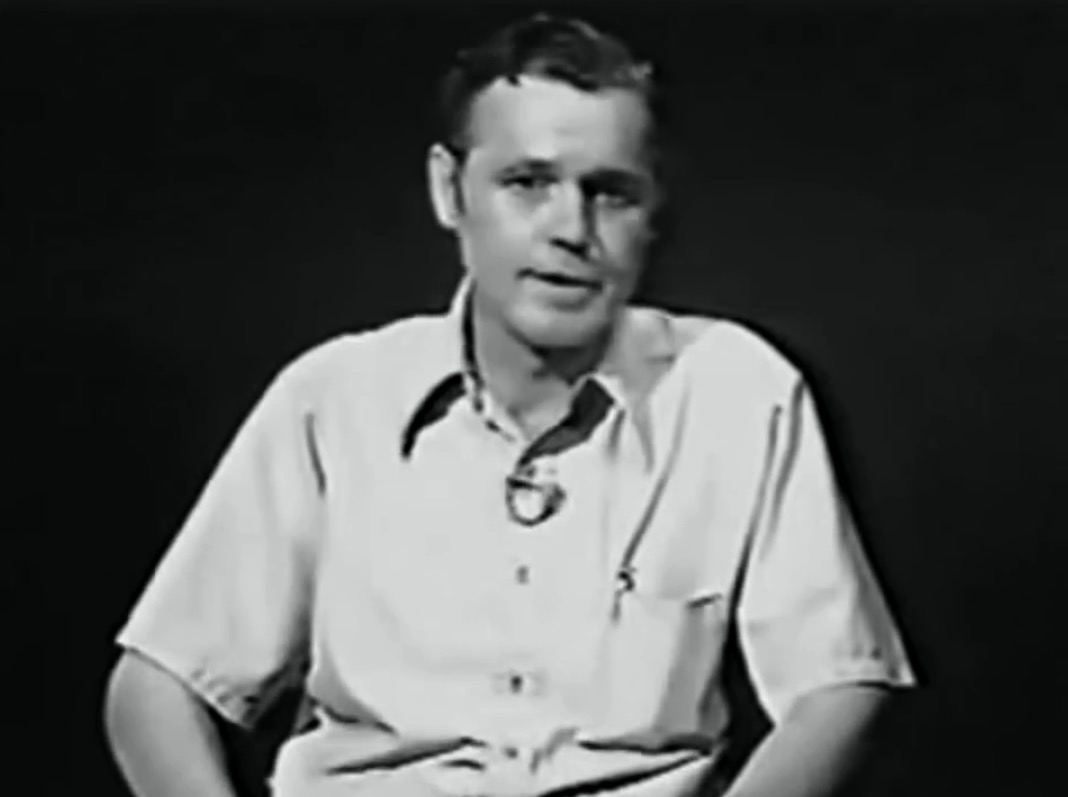
JFK and the Unforgivable: How the historians’ version of the JFK assassination dishonors the historical record – Part 1
In April 2016 CTKA published this author’s article[i] that revealed how history books portray the JFK assassination as a crime perpetrated by Oswald alone and how authors’ sources are restricted to the Warren Commission and a few books that mostly support the Lone Nut scenario. Information and conclusions coming from other major investigations and pro-conspiracy authors are almost completely ignored.
The article went on to show how the historians violate their own code of conduct on this issue and looked into possible outside influences that may have affected their work and mindsets. The unfortunate result of the lack of diligence on this issue is that captive audiences of young students have been unfairly exposed to a biased, unsound and incomplete account of the Kennedy assassination in most history textbooks.
Another point that came out was that many historians find that independent researchers that write about possible conspiracies lack credibility. There has been much propaganda to discredit them and their work. They are called zany, dishonest, and greedy and their claims are said to be baseless and off the wall. Furthermore they are accused of undermining their own institutions, government and country. Before a serious historian can zero in on whom the reliable researchers are and focus on the soundness of their arguments, they have to cut through clutter caused by hostile, omnipresent anti-conspiracy messaging as well as the cast of shaky researchers peddling low quality work.
This article focuses on what interested historians can easily learn from the official investigations and the opinions and statements from the actual investigators, lawyers, and staff members who were involved in six investigations that were mostly (all but one) government initiated and managed. The Warren Commission was the first one, the one most historians count on almost entirely for their writings, and as we will see, it is the most obsolete and least reliable.
For an historian who finds research on this issue very daunting, this should serve as a starting point – especially for those who, as they did with the Warren Commission Report, have faith in their government institutions and their representatives. What follows is what can be learned from not only the official investigation reports but from the mouths of those who were direct participants in them … the real insiders: Those who were mandated and given special powers to access witnesses and evidence! It therefore discounts the theories and opinions of independent authors.
It may prove difficult to fluff off these sources as being zany, dishonest and greedy … Doing so would suggest a far-fetched governmental conspiracy to deceive its own people and undermine important American institutions.
It is this author’s opinion that historians are disrespecting the American Historical Association statement of conduct about honoring the historical record when they assert that Oswald alone assassinated the president based on the conclusions of the Warren Commission. If they read this article and continue to do so, their actions cannot be blamed on mere ignorance of the facts, or confusion caused by obfuscators. Thereafter, if the historian does not feel compelled to dig deeper to find out what really happened, then the word unforgivable should be added to the word subservient – at least on this issue – when describing their performance. Especially when one considers the age of the subjects who are victimized in what is supposed to be a learning environment.
If they continue to cite the Warren Commission as their key source, they may want to consider taking up smoking cigarettes; after all some of the first studies about this product concluded that it was good for your health.
The President’s Commission on the Assassination of President Kennedy (aka The Warren Commission)
Established on November 29, 1963, it was set up by President Lyndon Johnson to investigate the November 22, 1963 assassination of President Kennedy. The Commission presented an 888-page report[ii] and twenty-six volumes of evidence on September 24, 1964. Its major conclusions were that Lee Harvey Oswald acted alone in killing JFK and that nightclub owner Jack Ruby also acted alone in killing Oswald two days later.
The Commission had “not found evidence” linking either Oswald or Ruby to a conspiracy. (WR, p. 21)
The first hint of dissension among the members of the commission is the following bewildering statement in the report which points to a rift concerning the Single Bullet theory and Connally’s testimony: “Although it is not necessary to any essential findings of the Commission to determine just which shot hit Governor Connally, there is very persuasive evidence from the experts to indicate that the same bullet which pierced the President’s throat also caused Governor Connally’s wounds. However, Governor Connally’s testimony and certain other factors have given rise to some difference of opinion as to this probability but there is no question in the mind of any member of the Commission that all the shots which caused the President’s and the Governor’s wounds were fired from the sixth floor of the Texas School Book Depository.” (WR, Page 19)
What is not being said directly here is that certain members of the Commission, as well as John Connally and his wife, did not believe that a single bullet caused all seven wounds, which is in fact necessary to the essential conclusions. Because if one bullet caused Kennedy’s head wound and another caused bystander James Tague’s injury, then for Oswald to be the lone shooter, he would have had to have caused all remaining seven wounds with his only other shot, because even the Warren Commission acknowledges that Oswald could not have fired more than three shots.
Statements and opinions of Warren Commission members, consultants and investigators
While most historians continue to place their faith in the Warren Commission, it is most noteworthy that an important number of important participants in the investigation had serious doubts about crucial elements in the report.
Roger Craig – Dallas Deputy Sheriff
Roger Craig was very well regarded up until the assassination. He was on duty and in Dealey Plaza at the time of the assassination. In a number of interviews he explains what he witnessed on November 22, 1963: He was in the Book Depository when the alleged murder weapon was found which he confirmed as a Mauser and not the Mannlicher-Carcano that the Warren Commission claimed Oswald owned. (Contrary to what some have written, the brand name Mauser and the calibre are stamped on some editions of the Mauser rifle; see here The Mauser, the Carcano and the Lt. Day Rifle ) Furthermore Craig claimed to have seen Oswald entering a station wagon a few minutes after the assassination, which would contradict the Warren Commission’s chronology of Oswald’s movements and implicated a getaway driver – the following is part of his Warren Commission testimony:
Roger Craig: I drove up to Fritz’ office about, oh, after 5 … about 5:30 or something like that and talked to Captain Fritz and told him what I had saw. And he took me in his office … I believe it was his office … . it was a little office, and had the suspect sitting in a chair behind a desk … beside the desk. And another gentleman, I didn’t know him, he was sitting in another chair to my left as I walked in the office. And Captain Fritz asked me “was this the man I saw” and I said, “Yes,” it was.
David Belin: All right. Will you describe the man you saw in Captain Fritz’ office?
Roger Craig: Oh, he was sitting down but he had the same medium brown hair; it was still … well, it was kinda wild looking; he was slender, and what I could tell of him sitting there, he was … short. By that, I mean not myself, I’m five eleven … he was shorter than I was. And fairly light build.
David Belin: Could you see his trousers?
Roger Craig: No; I couldn’t see his trousers at all.
David Belin: What about his shirt?
Roger Craig: I believe, as close as I can remember, a T-shirt … a white T-shirt.
David Belin: All right. But you didn’t see him in a lineup? You just saw him sitting there?
Roger Craig: No; he was sitting there by himself in a chair … off to one side.
David Belin: All right. Then, what did Captain Fritz say and what did you say and what did the suspect say?
Roger Craig: Captain Fritz then asked … . “What about this station wagon?” And the suspect interrupted him and said, “That station wagon belongs to Mrs. Paine” … I believe is what he said. “Don’t try to tie her into this. She had nothing to do with it.”
In Craig’s 1971 book When They Kill a President, he describes that many in the DPD despised Kennedy, and how the DPD was excluded from security duties the day of the assassination. The following is David Ratcliffe’s summary of the Book:
… He was a member of a group of men from Dallas County Sheriff James Eric “Bill” Decker‘s office that was directed to stand out in front of the Sheriff‘s office on Main Street (at the corner of Houston) and “take no part whatsoever in the security of that motorcade.” Once he heard the first shot, Roger Craig immediately bolted towards Houston Street. His participation in the formative hours of the investigation during the rest of that day and into the evening included observations and experiences that would have singlehandedly destroyed the entire Warren Commission fairy tale before a grand jury or a Congressional investigation.
Roger Craig was named the Dallas Sheriff‘s Department “Officer of the Year” in 1960 by the Dallas Traffic Commission. He received four promotions while he was Deputy Sheriff. Among the most important events he witnessed: At approximately 12:40 p.m., Craig was standing on the south side of Elm Street when he heard a shrill whistle coming from the north side of Elm and turned to see a man—wearing faded blue trousers and a long sleeved work shirt made of some type of grainy material—come running down the grassy knoll from the direction of the TSBD. He saw a light green Rambler station wagon coming slowly west on Elm Street, pull over to the north curb and pick up the man coming down the hill. By this time the traffic was too heavy for him to be able to reach them before the car drove away going west on Elm.
Roger Craig After witnessing the above scene, Deputy Craig ran to the command post at Elm and Houston to report the incident to the authorities. When he got there and asked who was involved in the investigation, a man turned to him and said “I‘m with the Secret Service.” Craig recounted what he had just seen. This “Secret Service” man showed little interest in Craig‘s description of the people leaving, but seemed extremely interested in the description of the Rambler to the degree this was the only part of the recounting that he wrote down. Immediately after this Craig was told by Sheriff Decker to help the police search the TSBD. Deputy Craig was one of the people to find the three rifle cartridges on the floor beneath the window on the southeast corner of the sixth floor. Originally, all three were no more than an inch or two apart. One of the three shells was crimped on the end which would have held the slug. It had not been stepped on but merely crimped over on one small portion of the rim. The rest of that end was perfectly round.
He was among those present after the rifle was found. And, along with Deputy Eugene Boone who had first spotted the weapon, was immediately joined by police Lt. Day, Homicide Capt. Fritz, and deputy constable Seymour Weitzman, an expert on weapons who had been in the sporting goods business for many years and was familiar with all domestic and foreign makes. Lt. Day briefly inspected the rifle and handed it to Capt. Fritz who asked if anyone knew what kind of rifle it was. After a close examination, Weitzman declared it to be a 7.65 German Mauser. Capt. Fritz agreed with him. At the moment when Capt. Fritz concurred with Weitzman‘s identification of the rifle, an unknown Dallas police officer came running up the stairs and advised Capt. Fritz that a Dallas policeman had been shot in the Oak Cliff area. Craig instinctively looked at his watch. The time was 1:06 p.m. (The Warren Commission attempted to move this time back beyond 1:15 to create a plausible claim Oswald had reached the Tippit murder scene in a more humanly possible time-frame than would be the case if Tippit had the encounter with his murderer earlier.)
Later in the afternoon Craig received word of Oswald‘s arrest and that he was suspected of being involved in Kennedy‘s murder. He immediately thought of the man running down the grassy knoll and made a telephone call to Capt. Will Fritz to give him the description of the man he had seen. Fritz said Craig‘s description sounded like the man they had and asked him to come take a look. When he saw Oswald in Fritz‘s personal office Deputy Craig confirmed that this was indeed the man, dressed in the same way, that he had seen running down the knoll and into the Rambler. They went into the office together and Fritz told Oswald, “This man (pointing to me) saw you leave.” At which time the suspect replied, “I told you people I did.” Fritz, apparently trying to console Oswald, said, “Take it easy, son—we‘re just trying to find out what happened.” Fritz then said, “What about the car?” Oswald replied, leaning forward on Fritz‘s desk, “That station wagon belongs to Mrs. Paine—don‘t try to drag her into this.” Sitting back in his chair, Oswald said very disgustedly and very low, “Everybody will know who I am now.”
The fact that Fritz said ‘car’ and this elicited Oswald‘s outburst about a station wagon—that no one else had mentioned—confirms the veracity of Roger Craig‘s story.
Junior counsel for the Warren Commission Dave Belin, was the man who interviewed Roger Craig in April of 1964. After being questioned in what Craig recounts as a very manipulative and selective way, Belin asked “Do you want to follow or waive your signature or sign now?” Craig noted, “Since there was nothing but a tape recording and a stenographer‘s note book, there was obviously nothing to sign. All other testimony which I have read (a considerable amount) included an explanation that the person could waive his signature then or his statement would be typed and he would be notified when it was ready for signature. Belin did not say this to me.” After Craig first saw the transcript in January of 1968 he discovered that the testimony he gave had been changed in fourteen different places.
Deputy Sheriff Roger Craig never changed his account of what he witnessed and experienced on Friday, November 22, 1963. The passage where he describes the methodology employed by David Belin in selectively recording his testimony is highly illuminating and provides us with a glimpse of how the Commission interviewed witnesses in a very controlled way. (And is echoed by the experience of Victoria Adams, another key witness, as described in Barry Ernst’s book, The Girl on the Stairs.) Craig remained convinced, for the rest of this life, that the man entering the Rambler station wagon was Lee Harvey Oswald. He was fired from the Sheriff‘s office on July 4, 1967, and from that day forward he never again could find steady work. Multiple attempts were made on his life, his wife finally left him, and in the end, he allegedly shot himself on May 15, 1975.

Jesse Curry (Chief of Dallas Police) Jesse Curry – Dallas Chief of Police
Curry who was in the motorcade just in front of the president and interviewed Oswald after the assassination is on the record for saying: “There is a possibility that one (a shot) came from in front of us … By the direction of the blood and the brains of the president from one of the shots, it just seems it would have to be fired from the front … I can’t say that I could swear that there was one man and one man alone, I think that there is the possibility that there could be another man … “. He also stated they were never able to place Oswald on the sixth floor with the rifle in his hands.
James Sibert and Francis O’Neill – FBI agents
Sibert and O’Neill witnessed the autopsy in Bethesda and wrote a report about it which disproves the Single Bullet theory and explains why junior counsel Arlen Specter, who interviewed them, prevented them from talking to the Warren Commission and also kept their report hidden.
The eventually declassified report, Sibert’s deposition to the ARRB and his interview with William Matson Law for his 2005 book In the Eye of History: Disclosures in the JFK Assassination Medical Evidence do not help Specter’s case whatsoever:
James Sibert (FBI) Law: Here’s a piece I don’t know what to think of. He said – Custer again – he’s talking about finding a bullet fragment in the autopsy room. I’ve talked to quite a few people and no one else remembers this: “I called one of the pathologists over and said, ‘Hey, we have a bullet here.’ As soon as they heard that, they came down off the raised platform, they ran over and then picked it up. Then Sibert and O’Neill also came over and said, `Well, we want that.’
Sibert: We never … the only thing we took position of, William, was a little jar with bullet fragments that had been removed from the brain. You know, metal particles?
Law: That’s the only thing I’ve ever had reported to me, and Mr. Custer has since passed away.
Sibert: I don’t remember anything about a bullet – you know they couldn’t find that bullet wound in the back – and they probed that and there was no exit. So, I said, “Well, let me go and call over at the lab, see if there is any kind of an ice bullet that might have fragmentized completely.” That was when I called agent Killion over at the lab, and he said, “Have you learned about the bullet they found under the stretcher over at Parkland?” Now, I came back and reported that to Humes, the chief pathologist, and that’s the only – I never saw that bullet. They were sending that bullet in, but it didn’t come into the autopsy room. I think they flew it into the Washington area, and that went directly to the FBI laboratory, the firearms section.
Law: I’ve talked to Mr. O’Neill quite a bit about this and asked him about his belief in the single-bullet theory, and he said, “Absolutely not, it did not happen!”
Sibert: Well, you can put me in the same category! Have you read Arlen Specter’s latest book, Passion For Truth?”
Law: No, I haven’t. I do not believe in the single-bullet theory from all I’ve read, and how can …
Sibert: I told them before they asked me to come up for the [ARRB] deposition, I said: “Well, before I come up, I want to tell you one thing: I don’t buy the single bullet theory.” And they said, “We don’t expect you to.”
Law: Yes, when I talked to Mr. O’Neill, he was adamant that it did not happen.
Sibert: In the first place, they moved the bullet wound, the one in the back. See, I don’t know if you recall, but over at Parkland, they weren’t even aware of the back wound, because they had a big fight over there as to who had jurisdiction. Texas had a law that any kind of a murder done in Texas, the autopsy had to be performed there. They didn’t know about the back wound. But they get to Bethesda – here’s the pathetic part – they found the wound in the back, of course, they took the wound in the neck as a straight tracheotomy and they didn’t find out that it was a bullet wound until the next morning when they called Parkland.
Law: Do you think it was a straight tracheotomy?
Sibert: Oh! They said over there that the … I forget who the doctor was there but he said he made that tracheotomy right over a bullet wound.
Law: That was Malcolm Perry.
Sibert: Perry, yeah. And you know, a lot of them over there said first that they thought it was an entrance wound. So, you had Parkland not knowing about the back wound, you had Bethesda not knowing about the bullet wound in the neck, taking it as a tracheotomy; which really gets you off on the right foot.
Law: Were you surprised you weren’t called before the Warren Commission?
Sibert: I was at the time, but now I can understand why.
Law: Why do you think you weren’t called?
Sibert: Why? In other words, with that single-bullet theory, if they went in there and asked us to pinpoint where the bullet entered the back and the measurements and all that stuff, how are you going to work it? See, the way they got the single-bullet theory, was by moving that back wound up to the base of the neck.
… Law: I was going to ask you to tell me your thoughts on Mr. Specter and the single-bullet theory.
Sibert: Well I – that single-bullet theory – when they had me come up to the ARRB deposition there at College Park, I said, “Well before I come up there, I want you to know one thing. I’m not an advocate of the single-bullet theory.” I said, “I don’t believe it because I stood there two foot from where that bullet wound was in the back, the one that they eventually moved up to the base of the neck. I was there when Boswell made his face sheet and located that wound exactly as we described it in the FD 302.” And I said, “Furthermore, when they examined the clothing after it got into the Bureau, those bullet holes in the shirt and the coat were down 5 inches there. So there is no way that bullet could have gone that low then rise up and come out the front of the neck, zigzag and hit Connally and then end up pristine on a stretcher over there in Dallas.”
Law: You don’t believe in the single-bullet theory. Period.
Sibert: There is no way I will swallow that. They can’t put enough sugar on it for me to bite it. That bullet was too low in the back.
Law: Where do you remember seeing it, exactly? Your partner, Frank O’Neill, if I remember right, credits you with finding the bullet hole in the back.
Sibert: Well, let me clarify that. When they had the body over at Parkland, they had a shoving match between the fellow who was going to do the autopsy who said that the autopsy had to be done in Texas – and they were going to do it there – and you had Kellerman telling them that he had orders from the Secret Service and also from Bobby Kennedy that it was going to be done in Washington. At Parkland, they never knew there was a bullet wound in the back. That body left there and they did not know about the bullet wound in the back. Then, Bethesda did not know there was a bullet wound where the tracheotomy was made. So that is a pathetic situation. It could have been handled if they had made a phone call. The smart thing to have done – if there hadn’t been such animosity between the partners over there – put one of those Parkland doctors on Air Force One to come right into Bethesda and say, “Here’s what we did.” And the clothing should have come in with the body. But they held the clothing – they didn’t even undo the tie over there at Parkland and there was a nick in the knot – and here you had this entrance or exit wound in the throat where the tracheotomy was.
Law also interviewed O’Neill:
Law: Were you surprised you were not called before the Warren Commission?
O’Neill: Yes. Because we had pertinent information and the information that was given to the Warren Commission as a result of our interview with Mr. Specter was not a hundred percent accurate ….
Law: I have your testimony to the ARRB. They asked you about the bullet wound in the throat and you said, “Well, I question it. I’ll tell you more later.” Why did you question the bullet wound to the throat?
O’Neill: Because there was no such thing as a bullet wound in the throat at that particular time. We only learned about the bullet wound in the throat in particular – well, let me see – we learned about that after the doctors – not “we” – but it was learned by the doctors who performed the autopsy after they had called down to Dallas to speak to the hospital. Ah, I think it was Malcolm Perry?
Law: Malcolm Perry was the attending physician.
O’Neill: That’s the only time that they became aware that there was a bullet wound in the throat.
Law: Do you believe there was a bullet wound in the throat?
O’Neill: I have no idea. It was not a question – I mean it was a question – there was not a question in my mind about a bullet wound in the throat, it just never came up. It was a tracheotomy, period, until we found out that it was performed over the bullet wound – over a wound – because they weren’t sure it was a bullet wound at that time.

As Law concluded, “O’Neill and Sibert are adamant that the single-bullet theory is wrong. ‘That’s Arlen Specter’s theory,’ O’Neill told me. It’s quite evident from my conversations with them that they have no respect for the one-time assistant counsel to the Warren Commission, now Senator from Pennsylvania. When I questioned Jim Sibert about the single-bullet theory and Arlen Specter, he went as far as to say, ‘What a liar. I feel he got his orders from above – how far above I don’t know.’”
The single-bullet theory is key to the “lone-nut” scenario. If, in fact, a bullet did not hit Kennedy in the back, come out his throat, hit Governor Connally in the back, exit his right chest, slam into his right wrist, breaking the bone and cutting the radial nerve, and then pierce his left thigh and fall out in remarkably pristine condition onto a stretcher at Parkland Hospital, then there was more than one assassin and, hence, conspiracy. The single-bullet theory is the linchpin of the government case against Lee Harvey Oswald. If the theory is false, the lone-assassin concept crumbles to dust.
Alex Rosen – Former FBI Assistant Director
Alex Rosen told the Committee (Church Committee testimony) that the FBI was not actively investigating a conspiracy, but was “in the position of standing on the corner with our pockets open, waiting for someone to drop information into it … “ (Source: Mary Ferrell Foundation)
Charles Shaffer – Staff member – Former Justice Department Investigator
In a 2014 Washington Post interview Charles Shaffer admitted that he now thinks that JFK was assassinated as a result of a mob-related conspiracy involving Santos Trafficante and Carlos Marcello. He also claimed that Warren’s biggest blunder was not allowing Ruby to testify in Washington where he may have exposed a conspiracy.
Alfredda Scobey – Staff member – Law assistant to court of appeal State of Georgia
Scobey wrote down notes taking the position of what a defense lawyer for Oswald could have argued with respect to the evidence presented by the Warren Commission. Her observations underscore many problems the prosecution would have faced including: The denial of Oswald’s right to legal counsel; the inadmissibility of his wife’s testimony; the poor quality of Helen Markham as witness to the Tippit assassination; the number of witnesses that refused to identify Oswald as Tippit’s assassin; the lack of pertinence of the Walker incident; the evidence obtained from the Paines’ without a warrant; the chain of possession of the rifle, etc.
Burt Griffin and Leon Hubert – Assistant counsels
Burt Griffin and Leon Hubert were charged with investigating Jack Ruby and while they had not concluded that Ruby was involved in a conspiracy, they were clearly not satisfied with the investigation and information transferred to them by the FBI or CIA. This is made clear by memos written by them and answers Judge Griffin gave in his HSCA testimony.
Lisa Pease, in an August 1995 Probe article, gives a good summary of the memos:
… Assistant counsels to the Warren Commission Burt Griffin and Leon Hubert wrote, in a memo to the Warren Commission members dated March 20, 1964, that “the most promising links between Jack Ruby and the assassination of President Kennedy are established through underworld figures and anti-Castro Cubans, and extreme right-wing Americans.” Two months later, Griffin and Hubert wrote another memo to the Commission, significantly titled “Adequacy of the Ruby Investigation” in which they warned, “We believe that a reasonable possibility exists that Ruby has maintained a close interest in Cuban affairs to the extent necessary to participate in gun sales or smuggling.”
Ruby had talked about it himself while in jail, reportedly telling a friend, “They’re going to find out about Cuba. They’re going to find out about the guns, find out about New Orleans, find out about everything.” Tales of Ruby running guns to Cuba abounded in the FBI reports taken in the first weeks after the assassination, yet neither the Warren Commission nor the House Select Committee pursued those leads very far. Griffin and Hubert expressed concern over this, saying that “neither Oswald’s Cuban interests in Dallas nor Ruby’s Cuban activities have been adequately explored.”

Burt Griffin Hubert and Griffin expressed in their memo of May 14 to Rankin that “we believe that the possibility exists, based on evidence already available, that Ruby was involved in illegal dealings with Cuban elements who might have had contact with Oswald. The existence of such dealings can only be surmised since the present investigation has not focused on that area.” They expressed concern that “Ruby had time to engage in substantial activities in addition to the management of his Clubs” and that “Ruby has always been a person who looked for money-making ‘sidelines’.” They even suggested that since the Fort Worth manufacturer of the famous “Twist Board” Ruby was demonstrating the night after the assassination had no known sales, and was manufactured by an oil field equipment company, that “[t]he possibility remains that the ‘twist board’ was a front for some other illegal enterprise.” But what Griffin and Hubert kept coming back to is that there was “much evidence” that Ruby “was interested in Cuban matters”, citing his relationship to Louis McWillie; his attempted sale of jeeps to Castro, his reported attendance of meetings “in connection with the sale of arms to Cubans and the smuggling out of refugees“; and Ruby’s quick correction of Wade’s remark that Oswald was a member of the Free Cuba Committee, a group populated with such notables as Clare Booth Luce, Admiral Arleigh Burke, and CIA journalistic asset Hal Hendrix: “Bits of evidence link Ruby to others who may have been interested in Cuban affairs.”
During his HSCA testimony, Griffin made it clear that the requests to investigate Ruby further were not followed up on.
In the documentary The Killing of President Kennedy, Griffin is even blunter: “I feel betrayed … the CIA lied to us …” He goes on to state CIA concealed their efforts to kill Castro and their links with the mafia, which would have been very important for the investigation. Griffin is also on the record as saying: “In any area where Oswald’s relation to the FBI … We could not trust Hoover”. This is important because the Warren Commission had very little investigative resources and relied heavily on the FBI for information gathering.
Senator Richard Russell – Warren Commissioner
Senator Russell in a stunning phone conversation with LBJ on September 18, 1964 voiced his disagreement with the Single Bullet theory very directly:

Sen. Richard Russell “They were trying to prove that the same bullet that hit Kennedy first was the one that hit Connally, went through him and through his hand, his bone, into his leg and everything else. … The commission believes that the same bullet that hit Kennedy hit Connally. Well, I don’t believe it.” … “And so I couldn’t sign it. And I said that Governor Connally testified directly to the contrary, and I’m not going to approve of that. So I finally made them say there was a difference in the commission, in that part of them believed that that wasn’t so. And of course if a fellow was accurate enough to hit Kennedy right in the neck on one shot and knock his head off in the next one … and he’s leaning up against his wife’s head … and not even wound her … why, he didn’t miss completely with that third shot. But according to their theory, he not only missed the whole automobile, but he missed the street! Well, a man that’s a good enough shot to put two bullets right into Kennedy, he didn’t miss that whole automobile.”
Just before his death Russell said publically that he believed that someone else worked with Oswald.
Senator John Cooper – Commissioner

Sen. John Sherman Cooper Senator John Cooper is also on the record for having written about the Single Bullet theory: “it seems to me that Governor Connally’s statement negates such a conclusion.” He later confirmed his stance in an interview for the BBC documentary The Killing of President Kennedy.
Congressman Hale Boggs – Commissioner
Boggs was neither convinced that Oswald was the assassin, nor that Ruby acted alone. According to legal advisor Bernard Fensterwald:
Rep. Hale Boggs “Almost from the beginning, Congressman Boggs had been suspicious over the FBI and CIA’s reluctance to provide hard information when the Commission’s probe turned to certain areas, such as allegations that Oswald may have been an undercover operative of some sort. When the Commission sought to disprove the growing suspicion that Oswald had once worked for the FBI, Boggs was outraged that the only proof of denial that the FBI offered was a brief statement of disclaimer by J. Edgar Hoover. It was Hale Boggs who drew an admission from Allen Dulles that the CIA’s record of employing someone like Oswald might be so heavily coded that the verification of his service would be almost impossible for outside investigators to establish.”
According to one of his friends: “Hale felt very, very torn during his work (on the Commission) … he wished he had never been on it and wished he’d never signed it (the Warren Report).” Another former aide argued that, “Hale always returned to one thing: Hoover lied his eyes out to the Commission – on Oswald, on Ruby, on their friends, the bullets, the gun, you name it.”
Congressman Gerald Ford – Warren Commissioner

Pres. Valéry
Giscard-d’EstaingIn public Gerald Ford was a staunch defender of the Warren Commission’s findings and conclusions, describing the report as a Gibraltar of factual literature. However, in private he seems to have held a very different discourse.

Gerald Ford Valérie Giscard D’Estaing, ex-president of France, claimed the following in an interview he gave to RTL:
Gerald Ford (president of the United States from 1974 to 1977, editor’s note) was a member of the Warren Commission», he resumes. «Once I was making a car trip with him, he was then President as I was myself. I said to him: ‘Let me ask you an indiscreet question: you were on the Warren Commission, what conclusions did you arrive at?’ He told me: ‘It’s not a satisfactory one. We arrived at an initial conclusion: it was not the work of one person, it was something set up. We were sure that it was set up. But we were not able to discover by whom.’»
In 1997 the Assassination Records Review Board (ARRB) released a document that revealed that Ford had altered the first draft of the Warren Report to read: “A bullet had entered the base of the back of his neck slightly to the right of the spine.”
LBJ – President
In a 1969 interview with Walter Cronkite, Lyndon Johnson said that he had not completely discounted the possibility of international connections to the murder.
Comments about the Warren Commission
As we can see, the conclusions of the Warren Commission are far from convincing, for they are belied by many of those who played important and direct roles in the investigation. Far from the Gibraltar that Gerald Ford referred to, it was on weak footing from the outset and things only went downhill from there.
It is clearly unsound for historians to refer to the Warren Commission as their key and only source when describing Ruby and Oswald as lone perpetrators of the crimes related to the November 22, 1963 tragedy. Considering the other government investigations that followed which impeach its modus operandi and many of its conclusions, it is like ignoring a judgement reversal after an appeal and only citing the discredited judgement of the original trial.
The Jim Garrison Investigation
Starting in 1966, New Orleans DA Jim Garrison investigated the assassination. This led to the 1969 trial of Clay Shaw, a well-known local businessman, who was accused of being part of a conspiracy. While the jury found Shaw not guilty, according to Mark Lane – who had advised Garrison – most jurors felt there had nevertheless been a conspiracy.
This investigation shed light on many, up to then under-reported, issues. Let us consider some of them:

Pierre Finck - Garrison demonstrated that Oswald, while in New Orleans in the spring and summer of 1963, was seen handing out Fair Play for Cuba flyers. For which he received a lot of negative publicity in conservative New Orleans. However, in what seems to have been a blunder, some of these flyers had the address of 544 Camp Street on them. That faux pas placed his supposed office virtually within Guy Bannister`s detective office, which was, according to Garrison, really a CIA-linked hub for organizing Cuban exile paramilitary operations to overthrow Castro, and also Communist witch-hunts.
- Many witnesses confirmed associations of Oswald with Bannister, David Ferrie and Clay Shaw, who Garrison linked with the CIA.
- Garrison argued that Oswald`s learning of the Russian language while a marine, and his journey into the USSR demonstrated his links to intelligence. He also concluded that Oswald’s Fair Play for Cuba role was an attempt to sheep-dip him as a pro-Castro villain.
- Garrison was also probably the first person to cast doubt on a strange trip Oswald allegedly made to Mexico in September 1963.
- Pierre Finck, who was part of the Bethesda autopsy team, during his testimony at the Clay Shaw trial demonstrated just how incompetently the autopsy was conducted and how the pathologists were being controlled by high-level military officers.
- During the Shaw trial, for the first time, Garrison showed the jury the Zapruder film, and demonstrated the weaknesses of the lone shooter claim.
Francis Fruge – Garrison case investigator – Louisana State Police Lieutenant
Francis Fuge’s entry into the case actually began a few days before the assassination when he first encountered and questioned Rose Cheramie, a heroin addicted call girl and drug courier, who predicted the assassination, and talked about her links with Jack Ruby while she was hospitalized from November 20-22, 1963. He met her again right after the murder. Fruge later became an important investigator for Jim Garrison. His account of this extremely incriminating story was summarized in a thoroughly documented July 1999 Probe Magazine article:
As Fruge so memorably recalled to Jonathan Blackmer of the HSCA, Cheramie summed up her itinerary in Dallas in the following manner: “She said she was going to, number one, pick up some money, pick up her baby, and to kill Kennedy.” (p. 9 of Fruge’s 4/18/78 deposition)
At the hospital, Cheramie again predicted the assassination. Again, before it happened on November 22nd, to more than one nurse. The nurses, in turn, told others of Cheramie’s prognostication. (Memo of Frank Meloche to Louis Ivon, 5/22/67). Further, according to a psychiatrist there, Dr. Victor Weiss, Rose “…told him that she knew both Ruby and Oswald and had seen them sitting together on occasions at Ruby’s club.” (Ibid., 3/13/67) In fact, Fruge later confirmed the fact that she had worked as a stripper for Ruby. (Louisiana State Police report of 4/4/67.)
Fruge had discounted Cheramie’s earlier comments to him as drug-induced delusions. Or, as he said to Blackmer, “When she came out with the Kennedy business, I just said, wait a minute, wait a minute, something wrong here somewhere.” (Fruge, HSCA deposition, p. 9)
He further described her in this manner:
“Now, bear in mind that she talked: she’d talk for a while, looks like the shots would have effect on her again and she’d go in, you know, she’d just get numb, and after awhile she’d just start talking again.” (Ibid.)
But apparently, at the time of the assassination Cheramie appeared fine. The word spread throughout the hospital that she had predicted Kennedy’s murder in advance. Dr. Wayne Owen, who had been interning from LSU at the time, later told the Madison Capital Times that he and other interns were told of the plot in advance of the assassination. Amazingly, Cheramie even predicted the role of her former boss Jack Ruby because Owen was quoted as saying that one of the interns was told “…that one of the men involved in the plot was a man named Jack Rubinstein.” (2/11/68) Owen said that they shrugged it off at the time. But when they learned that Rubinstein was Ruby they grew quite concerned. “We were all assured that something would be done about it by the FBI or someone. Yet we never heard anything.” (Ibid.) In fact, Cheramie’s association with Ruby was also revealed to Dr. Weiss. For in an interview with him after the assassination, Rose revealed that she had worked as a drug courier for Jack Ruby. (Memo of Frank Meloche to Jim Garrison, 2/23/67) In the same memo, there is further elaboration on this important point:
“I believe she also mentioned that she worked in the night club for Ruby and that she was forced to go to Florida with another man whom she did not name to pick up a shipment of dope to take back to Dallas, that she didn’t want to do this thing but she had a young child and that they would hurt her child if she didn’t.”

Francis Fruge These comments are, of course, very revealing about Ruby’s role in both an intricate drug smuggling scheme and, at the least, his probable acquaintance with men who either had knowledge of, or were actually involved in, the assassination. This is a major point in this story which we will return to later.

Rose Cheramie Although Fruge had discounted the Cheramie story on November 20th, the events of the 22nd made him a believer. Right after JFK’s murder, Fruge “…called that hospital up in Jackson and told them by no way in the world to turn her loose until I could get my hands on her.” (Fruge’s HSCA deposition, p. 12.) So on November 25th, Fruge journeyed up to Jackson State Hospital again to talk to Cheramie. This time he conducted a much more in-depth interview. Fruge found out that Cheramie had been traveling with the two men from Miami. He also found that the men seemed to be a part of the conspiracy rather than to be just aware of it. After the assassination, they were supposed to stop by a home in Dallas to pick up around eight thousand dollars plus Rose’s baby. From there Cheramie was supposed to check into the Rice Hotel in Houston under an assumed name. Houston is in close proximity to Galveston, the town from which the drugs were coming in. From Houston, once the transaction was completed, the trio were headed for Mexico.
How reliable a witness was Cheramie? Extermely. Fruge decided to have the drug deal aspect of her story checked out by the state troopers and U. S. Customs. The officers confirmed the name of the seaman on board the correct ship coming into Galveston. The Customs people checked the Rice Hotel and the reservations had been made for her under an assumed name. The contact who had the money and her baby was checked and his name showed that he was an underworld, suspected narcotics dealer. Fruge checked Cheramie’s baggage and found that one box had baby clothes and shoes inside.
Fruge flew Cheramie from Louisiana to Houston on Tuesday, the 26th. In the back seat of the small Sesna 180, a newspaper was lying between them. One of the headlines read to the effect that “investigators or something had not been able to establish a relationship between Jack Ruby and Lee Harvey Oswald.” (Fruge’s HSCA deposition p. 19) When Cheramie read this headline, she started to giggle. She then added, “Them two queer sons-of-a-bitches. They’ve been shacking up for years.” (Ibid.) She added that she knew this to be true from her experience of working for Ruby. Fruge then had his superior call up Captain Will Fritz of the Dallas Police to relay what an important witness Cheramie could be in his investigation. Fruge related what followed afterwards:
Colonel Morgan called Captain Fritz up from Dallas and told him what we had, the information that we had, that we had a person that had given us this information. And of course there again it was an old friend, and there was a little conversation. But anyway, when Colonel Morgan hung up, he turned around and told us they don’t want her. They’re not interested.
Fruge then asked Cheramie if she wished to try telling her tale to the FBI. She declined. She did not wish to involve herself further.
Aftermath of the Garrison case and general comments
Perhaps no other person who believed there was a conspiracy was vilified more than Jim Garrison. He has been called a charlatan, a publicity-seeker and crazy, among other things. With time however, many of his claims have been vindicated. While some described his case as a farce, it is often overlooked that Garrison had presented his evidence beforehand to a three-judge panel who concluded that he was justified to bring it to court, and that the subsequent HSCA investigation concluded that Garrison and his office “had established an association of an undetermined nature between Ferrie, a suspect in the assassination of President Kennedy, and Clay Shaw and Lee Harvey Oswald” – a devastating blow to Garrison detractors.
Other information from later investigations reveals that his efforts were sabotaged by adversaries who infiltrated his volunteer team and weakened his efforts; well-orchestrated propaganda attacking both his case and reputation; refusals to his subpoenas for out-of-state witnesses and the harassment, turning and untimely deaths of some of his key witnesses, including the suspicious deaths of star-witness David Ferrie and the murder of Eladio Del Valle. Other evidence that began to emerge showed that Clay Shaw, despite his denials, was in fact a CIA asset and part of a CIA organization of interest called Permindex.
To form their own opinion about Garrison, historians who are not of a pre-judging nature or overly stubborn are advised to read his highly revealing Playboy interview and his book: On the Trail of the Assassins.
The United States President’s Commission on CIA Activities within the United States (The Rockefeller Commission)
After a 1974 New York Times report on illegal acts committed by the CIA, Gerald Ford set up the Rockefeller Commission headed by his Vice-President Nelson Rockefeller in 1975. It publicized the CIA MK/Ultra mind control experiments and revealed its illegal mail opening and US protester surveillance programs (MH/Chaos). It also held a very narrow investigation into the Kennedy assassination focusing on the Zapruder film, some of the medical evidence and whether Frank Sturgis and E. Howard Hunt, who had just gained notoriety because of their roles in the Watergate scandal, were involved in the assassination. In a short eighteen-page chapter about the assassination it concluded that the CIA had not been involved and that only three shots were fired from behind the motorcade.
Many distrusted this Commission because of the involvement of key Warren Commission members such as Ford and David Belin. It was largely superseded by the Church and HSCA committees that succeeded it and that were much farther reaching.
It was during this period that, as Daniel Schorr later wrote, Ford let slip the bombshell that the CIA had been involved in assassinations. Which, as we saw previously, he probably learned about on the Warren Commission. But CIA Director Bill Colby then spun this to mean the assassination of foreign leaders.
United States Senate Select Committee to Study Governmental Operations with Respect to Intelligence Activities (The Church Committee)
This U.S. Senate Committee was chaired by Senator Frank Church and issued 14 reports in 1975 and 1976 after interviewing hundreds of witnesses and studying thousands of files from the FBI, CIA and other agencies.
It delved into U.S. assassination plots against foreign leaders, which were a key component of CIA regime control or change operations. Their targets included Congo’s Lumumba, Castro of Cuba, the Diem brothers of Vietnam, Gen. Schneider of Chile, President Trujillo of the Dominican Republic. Ex CIA leader Allen Dulles’ pact with the mafia to assassinate Castro was also part of their findings. This information, which could have impacted the Warren Commission investigation, was kept secret by Dulles while he was one of its commissioners.
Volume 4 of the report sheds light on HT/LINGUAL, the illegal mail intercept programs involving both the CIA and the FBI.
The Committee also reported on the extent the CIA partnered with media and academia, in an effort to control the media, later called Operation Mockingbird: “The CIA currently maintains a network of several hundred foreign individuals around the world who provide intelligence for the CIA and at times attempt to influence opinion through the use of covert propaganda. These individuals provide the CIA with direct access to a large number of newspapers and periodicals, scores of press services and news agencies, radio and television stations, commercial book publishers, and other foreign media outlets.”
Lead by Senators Gary Hart and Richard Schweiker, the Church Committee also conducted a focused investigation (Book 5) of the Kennedy assassination, concentrating on how the FBI and CIA supported the Warren Commission. Its report was very critical of these agencies: ” … developed evidence which impeaches the process by which the intelligence agencies arrived at their own conclusions about the assassination, and by which they provided information to the Warren Commission. This evidence indicates that the investigation of the assassination was deficient.”
If this conclusion does not shake historians blind faith in the Blue Ribbon Warren Commission, perhaps comments from the sub-committee leaders might help create some doubt.
Senator Gary Hart
An interview Hart gave to the Denver Post after his stint on the committee clearly showed that he did not buy the Warren Commission depiction of Oswald, nor did he find that the FBI and the CIA were transparent with what they knew:
“Who Oswald really was – who did he know? What affiliation did he have in the Cuban network? Was his public identification with the left-wing a cover for a connection with the anti-Castro right-wing?”
Hart believed that Oswald was a double agent which was one of the reasons why the FBI and CIA had made “a conscious decision to withhold evidence from the Warren Commission.”
During the fiftieth anniversary of the Kennedy assassination Hart was interviewed by the Huffington Post and one can only deduce that his views about the inadequacy of the Warren Commission investigation and mainstream media’s efforts into getting to the bottom of things had hardened based on the following statements:
“It’s amazing to me that American journalism never followed up on that story very much, because if you found out who killed those two guys, you might have some really interesting information on your hands.”
“I went down to Miami when [Johnny] Roselli was killed and talked to this Dade County sheriff from the Miami Police Department, and they showed me pictures of him being fished out of the water in the barrel and how he’d been killed — nightmarish stuff. And [Momo Salvatore] Giancana was killed in his own basement with six bullet holes in his throat with a Chicago police car and an FBI car outside his house.”
“I was always amazed in that particular instance of the CIA-Mafia connection and the Cuban connection 12 years — coming up 12 years — after Kennedy was killed that somebody didn’t go after that story … New York Times, Washington Post, anybody. And they didn’t. They reported the deaths and that was it, and the strange quirky coincidence, you know, but nothing more.”
“You don’t have to be a genius to believe that they knew something about the coincidence of events — Cuba, Mafia, CIA and Kennedy — that somebody didn’t want that out in the public 12 years later.”

Sen. Gary Hart The article also underscores the following intriguing insight: According to Hart, the Warren Commission — the presidential commission charged with investigating Kennedy’s assassination that concluded Lee Harvey Oswald acted alone — remained unaware of the connections between Cuba, the CIA, the Mafia and Kennedy. Only then-CIA director Allen Dulles, who was on the commission, knew, according to Hart, but Dulles said nothing to the other members.
During a day-long symposium in May 2015 featuring former Church Committee members and staff, held by the Brennan Center for Justice at NYU School of Law at the Constance Milstein and Family Global Academic Center of the New York University in Washington, D.C, Hart on a panel with former Church Committee Colleague Senator Mondale, added this powerful affirmation:
” … THE THREE MAFIA FIGURES INVOLVED IN THE CASTRO PLOT WITH THE CIA. WE HEARD FROM ONE OF THEM TWICE. THE 2nd TIME – THE 1st TIME HE CAME AND WENT WITH NO PUBLIC NOTICE AT ALL. HIGHLY SECRET. THE QUESTIONS OBVIOUSLY WERE WHO ORDERED CASTRO KILLED, WHAT ROLE DID YOU PLAY SO FORTH. I FELT AT THE TIME THAT HE WAS GENERALLY FORTHCOMING HE STILL KNEW A LOT HE WASN’T TELLING US. HE WENT HOME TO MIAMI AND DISAPPEARED AND ENDED UP DEAD. HE WAS IN HIS 70s. AND MAFIA TIMES IN THOSE DAYS THAT WAS RETIREMENT. FOR THE REST OF US NOW IT’S MIDDLE-AGED. THE 2nd FIGURE WAS PROBABLY THE TOP MAFIA FIGURE IN AMERICA. PREPARED TO SUBPOENA HIM WITH THE HOUSE COMMITTEE. HE WAS KILLED IN HIS BASEMENT. KILLED IN HIS BASEMENT WITH SIX BULLET HOLES IN HIS THROAT. NEITHER OF THESE CRIMES HAVE BEEN SOLVED. NOW, BY AND LARGE THE MEDIA INCLUDED WITH THESE WERE DISMISSED AS MAFIA STUFF. THERE IS NO DOUBT IN MY MIND THEY WERE KILLED IN CONNECTION WITH OUR COMMITTEE. THE QUESTION IS WHY? WHO DID IT AND WHY? “
Sen. Richard Schweiker

Sen. Richard Schweiker Schweiker’s comments are even more explosive.
In 1975 he made the following statement to the Village Voice: “We do know Oswald had intelligence connections. Everywhere you look with him, there are fingerprints of intelligence.”
In 1976 he told CBS News that the CIA and FBI lied to the Warren Commission and that the case could be solved if they followed hot new leads. He also claimed that the White House was part of the cover up.
In a BBC documentary the Killing of President Kennedy he made the following blistering statement about the Warren Commission investigation:
“The Warren Commission has in fact collapsed like a house of cards and I believe it was set up at the time to feed pabulum to the American people for reasons not yet known, and one of the biggest cover-ups in the history of our country occurred at that time.”…
“The most important thing was that the intelligence agencies did all the wrong things if they were really looking for a conspiracy or to find out who killed John Kennedy.”…
“The key is why did they let him (Oswald) bring a Russian-born wife out contrary to present Russian policy, he had to get special dispensation from the highest levels to bring his Russian-born wife out, that in itself says somebody was giving Oswald highest priority either because we had trained and sent him there and they went along and pretended they did not know to fake us out, or they had in fact inculcated him and sent him back and were trying to fake us out, but he had gotten a green light no other American had gotten.”
In the documentary he goes on to say that the highest levels of government were behind him and his committee being mislead, and were continuing the cover-up and also that Oswald was clearly involved with pro-Castro and anti-Castro groups, which smacks of an intelligence role as a double agent, and that these relationships were not investigated.
In an interview Bob Tanenbaum (first Deputy Counsel for the HSCA) gave to Probe Magazine, here is how he describes an exchange he had with Schweiker where the senator directly accuses the CIA:
Q: One of the more interesting subjects you’ve mentioned in some of your talks is this meeting you had with Senator Schweiker which, I’m assuming, you give a lot of weight to, because of the evidence and because of who it was coming from.
A: Well, it was shocking! I went up there with Cliff Fenton and Schweiker told me in his opinion the CIA was responsible for the assassination. That’s a heck of a statement to come from a United States Senator and one who had even been Ronald Reagan’s running mate in 1976, even though they didn’t make it.
Q: Was it just you in the room when he told you that?
A: Yeah, it was just the two of us. I was stunned! He had asked Cliff to leave and he had his own staff people leave. I had that material he had given us which contained all that information about Veciana and the Alpha 66 group and this Bishop character.
Q: When I interviewed Schweiker, one of the last questions I asked him was if he had been on the oversight committee, for which he had not been nominated, which avenue would he have pursued. And he said, “I would have gone after Maurice Bishop.”
A: Well, as I said, I was stunned. Even after investigating this case, I’m not going to say that the CIA did it. He was saying it definitively. What the evidence suggested when we were in Washington was there were certain rogue elements who were involved with Bishop and others, the “plumber” types in the Nixon White House, who were involved with Oswald, who were substantially involved with anti-Castro Cubans who, the evidence suggests, were involved in the assassination. I keep saying that the evidence suggested it because we weren’t there long enough to make the case. So, there was a short-circuiting that occurred. But, that’s the area we were moving inexorably toward. And then I spoke with Gaeton Fonzi and Gaeton would corroborate this to the extent that he worked with Schweiker, he knew what Schweiker’s feelings were and he knew all about that file on Veciana. And that’s when we asked Gaeton to come on board, because he had worked on the Church senate oversight committee and he had a lot of connections that would be very helpful. And he’s a very honest guy.
Comments about the Church Committee
Any conscientious historian who has reached this point in the article and continues to cite the Warren Commission as the key historical record in their textbooks read by unsuspecting students to conclude that Oswald acted alone, that person deserves the scorn of all who entrust academia to help shape the minds of our youth. The case against the Warren Commission made by Government officials so far is devastating; things are about to get even worse. The HSCA investigation into the assassination will turn Gerald Ford’s Gibraltar into a bowl of Jello.
[i] The JFK Assassination According to the History Textbooks, Part 1, Parts 2 and 3
[ii]http://www.history-matters.com/archive/contents/wc/contents_wr.htm
Go to Part 2
Go to Addendum