Tag: EYEWITNESSES

  • Last Second in Dallas, part 2

    Last Second in Dallas, part 2


    Another dispute Thompson had with Vince Salandria was the author’s theory about the small hole in JFK’s throat. On the day of the assassination, Dr. Malcolm Perry said to the public that this appeared to be an entrance wound. Thompson’s idea is that it was a piece of either brain or metal ejected from Kennedy’s skull. And he includes a diagram of this on page 98. The trajectory of this projectile is hard to fathom, especially since it would be traveling through soft tissue. But also, once it went into the throat area, it would be entering into all kinds of small bones and thicker cartilage. So in addition to the trajectory, it found an exit path through that maze?

    Thompson takes Howard Brennan at his word. (pp. 98-99) Which he also did in his previous JFK book. I am not going to go into the myriad problems with Brennan as a witness. That would be redundant of too many good writers. Let me say this: today, the best one can say about Brennan is that he was looking at the wrong building. The worst one could say is that he was rehearsed and suborned. As Vince Palamara wrote in Honest Answers, Brennan refused to appear before the House Select Committee on Assassinations. Beyond that, he would not answer written questions. When they said they would have to subpoena him, he replied he would fight the subpoena. Does this sound like a straightforward, credible witness? (Palamara, pp. 186-89)

    To supplement the dubious Brennan, the author uses the testimony of the three workers underneath the sixth floor. Vincent Bugliosi used one of them in a mock trial of Lee Oswald in England in 1986. I addressed the serious problem with using these men––in Bugliosi’s case it was Harold Norman––in my book The JFK Assassination: The Evidence Today. (pp. 54-55) To make a long story short, after they were interviewed by the FBI, their stories were altered by the Secret Service. At that mock trial, Norman could have been taken apart and spat out if defense lawyer Gerry Spence had been prepared––which he was not. (For a long version of how and why this happened, see Secret Service Report 491)

    Let me add one key point about this. One of the Secret Service agents involved in this mutation was Elmer Moore, a man who––since the declassifications of the ARRB––has become infamous in the literature. There is little doubt today, in the wake of the declassified files, that Moore was an important part of the coverup. (DiEugenio, pp. 166-69) Therefore, in my view, Thompson missed another pattern––one which could have been indicated to him by Gary Aguilar or Pat Speer, in addition to myself.

    The middle part of the book narrates much of the case history from the early to late seventies. For Thompson, this means the first showings of the Zapruder film by Bob Groden at conferences, then the big national showing on ABC in 1975. This was one of the factors that spurred the creation of the HSCA in 1976. Thompson says that he was invited to the so called HSCA “critics conference.” He says this was where he first heard of the dictabelt tape of a motorcycle recording of the assassination. He takes the opportunity to tell us how the HSCA actually recovered the tape. He also explains how it worked and some of the technology behind it. (pp. 147-51) Keeping with his personal journey aspect, in this part of the book he also tells us how he decided to give up his professorship at Haverford and become a private investigator.

    From 1979 until 2006 the author tells us he was very little involved with the case. (pp. 182-83) This is kind of surprising when one thinks about it. Thompson all but leaves out the yearlong furor that took place over the release of Oliver Stone’s film JFK. Which is odd, since that was the largest period of focused attention the case got since 1975. All he says is that he was called to testify by the Assassination Records Review Board about their purchase of the Zapruder film. And he testified, properly I think, that once the Secret Service knew about the film it should have gone to Abraham Zapruder’s home and taken possession of it right there as a piece of evidence in a homicide case. (pp. 189-90) About any of the rather startling disclosures of the ARRB, I could detect little or nothing.

    He spends several pages on a conference organized by Gary Aguilar in San Francisco which featured Eric Randich and Pat Grant. It was these two men who broke open the whole mythology of Vincent Guinn’s Neutron Activation Analysis, today called Comparative Bullet Lead Analysis. I was at that conference and Thompson does a good enough job summing up their scientific findings. (pp. 190-96). As the author notes, this “junk science” had been important to the HSCA in its findings that somehow Oswald alone did the shooting, and the acoustical second shot from the front missed.


    II

    In the second half of the book Thompson more or less forsakes the personal journey motif. He concentrates on what he sees as three important pieces of evidence, which he figures are crucial to the case. I will deal with each of these as candidly and completely as I can.

    Thompson devotes Chapter 16, well over twenty pages, to the medical evidence in the JFK case. He begins this part of his book by declaring that the JFK autopsy was “botched,” in other words, whatever shortcomings there were in that procedure, they were not by design. I was rather surprised by this supposition, for the simple reason that Dr. Pierre Finck said under oath at the trial of Clay Shaw that the reason the back wound was not dissected is because the military brass in the room stopped them from doing so. He also said that James Humes, the chief pathologist, was not running the proceedings. They were being so obstructed that Humes literally had to shout out, “Who’s in charge here?” Finck testified that an Army general replied, “I am.” Finck summed up the situation like this:

    You must understand that in those circumstances, there were law enforcement officials, military people with various ranks, and you have to coordinate the operations according to directions. (James DiEugenio, Destiny Betrayed, p. 300, italics added)

    The Department of Justice––among other groups––was monitoring the Clay Shaw trial in close to real time. When Carl Eardley, the Justice Department specialist on the JFK case, heard this, he almost had a hernia. He called up another of the pathologists, Thornton Boswell, and sent him to New Orleans, since they now had to discredit Finck for revealing what had happened. Eardley later thought better of this, probably because by any standard measure, Finck had better qualifications as a forensic pathologist then Boswell did. (ibid, p. 304)

    One cannot overrate the importance of this testimony. To give just one indication of its importance: I did a pre-interview with Dr. Henry Lee for Oliver Stone’s new documentary on the JFK case. I asked him this specific question, directly related to Finck’s testimony: Can you figure out a firing trajectory without a tracking of the wound? He said that under those circumstances, it was very difficult to do. Here is a man who has worked about 8000 cases all over the world and is recognized as one of the best criminalists alive.

    The same situation applies to the skull wound, except in this case, the situation is more complex. If one talks to Lee or Cyril Wecht they will tell you there is no evidence of a brain sectioning. But the Review Board did an inquiry into this subject, and Jeremy Gunn and Doug Horne came up with some evidence that such an examination may have been done. Under the scope of this particular review, this is not the place to do an expansive analysis of their evidence. Suffice it to say I found Thompson’s excuse for this lack rather strained: the doctors did not have the time to do so such a thing. (Thompson, p. 259) Yet in the Commission’s volumes there is a brain examination, dated 12/6/63. (CE 391) And there is no mention of sectioning; two weeks was not long enough? Yet without sectioning, how can one determine the bullets’ paths? On this matter, Lee was quite animated. He put his right hand up in front of his face and said words to the effect: You have this bullet coming in at a right to left angle: it then reverses itself and goes left to right? The lack of dissection in this instance is even more perplexing because the head wounding was how Kennedy was killed. And this is why Lee’s hand was piercing the air in bewilderment.


    III

    Thompson wrote something later that stunned me. On page 258 he says that the first time the autopsy doctors learned of a tracheostomy over the anterior neck wound was when they read about it in the next day’s newspapers. That passage is undermined by Nurse Audrey Bell’s 1997 testimony to the Review Board. Bell told them that Dr. Malcolm Perry complained to her the next morning (on Saturday, November 23rd) that he had been virtually sleepless, “because unnamed persons at Bethesda had been pressuring him on the telephone all night long to get him to change his opinion about the nature of the bullet wound in the throat, and to redescribe it as an exit, rather than an entrance.” (See DiEugenio, The JFK Assassination: The Evidence Today, pp. 167-68; also this discussion)

    In a very late discovery by writer Rob Couteau, Bell’s testimony was both certified and expanded. In the days following the assassination, many reporters were milling around Dallas, and some found their way to Malcolm Perry’s home, for the reason that he and Dr. Kemp Clark had held a press conference on the day of the assassination where Clark said there was a large, gaping wound in the back of Kennedy’s skull, and Perry said the anterior neck wound appeared to be one of entrance. One of the reporters who migrated to Perry’s home was from the New York Herald Tribune and his name was Martin Steadman. He asked Perry about this issue and Perry was frank. He affirmed that it was an entrance wound. But beyond that he said he was getting calls through the night from Bethesda. They wanted him to change his story. He said that the autopsy doctors questioned his judgment about this and they also threatened to call him before a medical board to take away his license. (See further “The Ordeal of Malcolm Perry”) To put It mildly, I disagree with Thompson’s next day thesis on this point.

    Another surprising aspect of this chapter is that Thompson agrees with the Ramsey Clark Panel. That panel’s findings were released on the eve of the Clay Shaw trial. They upheld the original autopsy’s conclusions about two shots from behind; but they made about four major changes that were rather bracing. One of them was that they raised the entrance wound in the rear of Kennedy’s skull 10 mm upward, into the cowlick area. (Thompson, p. 248)

    The way Thompson mentions this in passing was, again, jarring to the reviewer, one reason being that, in all likelihood, it was Six Seconds in Dallas which caused both the Clark Panel to be formed and the rear skull wound to be raised to the cowlick area. (DiEugenio, The JFK Assassination, p. 150). As Russell Fisher, the panel’s chief pathologist later said, Attorney General Ramsey Clark got hold of an advance copy of Six Seconds in Dallas. On page 111 of that book, Thompson shows that Kennedy’s head––as depicted in the Warren Commission to illustrate the fatal wound––is not in the correct posture as shown in Zapruder frame 312. The Commission had the film; therefore, all the indications are that they fibbed about this key point.

    How did the Clark panel elevate that wound into the cowlick area? Since Thompson does not show the anterior/posterior X-ray, the reader is in the dark about this point. The answer is they largely based it on a disk-shaped white object in the rear of the skull that stands out plain as day on the X-ray. The problem with this piece of evidence is that none of the autopsy doctors, or the two FBI agents in attendance, saw it on the X-rays in the morgue the night of the autopsy; and it is not in the 1963 autopsy report. All of which is incredible, for two reasons. First, it is by far the largest fragment visible; and second, its dimensions of 6.5 mm precisely fit the caliber of ammunition Oswald was allegedly firing. (DiEugenio, The JFK Assassination, pp. 153-54)

    I could go on from there, but I won’t. As the reader can see, I did not find this chapter at all satisfactory.


    IV

    One of the key points Thompson wants to make in this book is something he has been talking about for a rather long time. It is the work of Dave Wimp on what the author calls “the blur illusion.” In fact, Thompson calls Chapter 14, “Breaking the Impasse: The Blur Illusion.” Since I took Thompson at his word about this, several years ago, at a JFK Lancer conference, I mentioned Wimp and his work. I said the forward bob by Kennedy preceding the rearward head snap did not really exist. Almost immediately after I finished my address, first Art Snyder and then John Costella disagreed with me. Snyder disagreed with me on the mathematical analysis Wimp had done. Costella disagreed on whether or not this was really an illusion. In other words: did Kennedy’s head really bob forward before jetting backward? The two disagreements gave me pause. Why? Because both men are physicists.

    Back in the sixties, Thompson first learned of this forward bob between Zapruder frames 312-313 from one of the earliest students of the film, Ray Marcus. (See page 112 of Six Seconds in Dallas, footnote 2) The author and Vince Salandria then studied this in combination with the more dramatic and lengthier rearward slam at the Archives. (Six Seconds, pp. 86-87) The issue is one of the most interesting aspects of Thompson’s first book. He goes through a few explanations of how this could have occurred. He then decides on a term that became rather famous in the critical community––the “double hit” or “double impact.” (pp. 94-95) In other words, two projectiles hit Kennedy’s skull almost instantaneously: one from behind and one from the front. The first moved him forward, the second rocked him backward. He then adds that S. M. Holland had told him the third and fourth shots sounded like they were fired almost simultaneously. He backs this up with other witnesses who heard the same thing. Thus the double impact was credible.

    Why did Thompson change his tune on this point? There seem to be three reasons for this. The first is that he felt his first thesis allowed for too precise a synchronization of the shots. No firing team could be that well trained. The second and third are complementary: Dave Wimp’s work coincided with his gravitation towards the acoustics evidence.

    Since Thompson decided to go with the acoustics, he had to dump the “double hit” he wrote about in his earlier book, because the acoustics evidence allows for only one shot from the front at Zapruder frame 312. The following shot comes from behind at Zapruder frame 328. Dave Wimp aided this new scenario by somehow making the forward bob disappear, being dismissed as an illusion.

    But if such was the case, then why did the two physicists disagree with my statement about the Wimp thesis? Snyder objected to it on mathematical grounds. He did not think that Wimp’s work had absolutely proved his thesis. He told me that there was about a 20% chance Wimp was wrong. Snyder turned out to be correct, because in a reply to Nick Nalli’s review of Last Second in Dallas, Wimp admitted his calculations were not correct. He wrote:

    That I have a blur illusion hypothesis is the result mostly of people failing to distinguish between what people are saying and what people are saying people are saying, which seems to be a pervasive problem. The issue is not about illusions but rather about bad methodology.

    Today, Wimp now seems to admit that Kennedy’s head did go forward by about an inch. Evidently, Thompson oversold this idea to at least one person: me. And since he still insists on it in his book, perhaps others.

    Costella explained why Wimp made an error in a more practical, applicable sense:

    Wimp has always made a valid observation about trying to measure the position of a single (rising or falling) edge, in the presence of blur. That is fraught, especially in the presence of unavoidable nonlinearities. What he never seems to have considered, as far as I can tell, is that if you have two opposite edges (rising then falling, or vice versa) of an object, then it is quite simple to align the center of mass of the object between any two frames, even if the edges are blurred. You can do this even if the two frames are blurred differently––that’s effectively what all stabilized versions of the film do (including his own!). It’s even simpler if you either deblur the blurred 313 to match 312 (like I did back in the day, per my animation on my website), or else blur 312 to match 313 …. What I never did is put an exact number of inches on the forward head movement. I have no idea if his smaller number is accurate or not, because I didn’t quantify. What is certain, just from the visuals, is that the head moves forward in the extant Z film. (Email of 6/15/21)

    How proficient is Costella in his study of the film? After he approached me at JFK Lancer, he took out his cell phone and showed me how he had deblurred Zapruder and the forward head bob was still there. Yes, John is a man who carries his work with him.

    G. Paul Chambers, another physicist, probably has the most sensible explanation for this aspect of the case. He has told Gary Aguilar that what likely happened is that the first shot through Kennedy’s back likely paralyzed him. When the car began to brake, his limp body then went forward. (Phone call with Gary Aguilar, 7/18/21)


    V

    “Jim, there is no motorcycle where the HSCA says there is.”

    The above quotation is taken from a phone conversation in 1994 between this reviewer and the late Dick Sprague. I chose to lead this part of my review with it because, as with the head bob, I once believed in the acoustics evidence. So when the famous photo analyst Dick Sprague said the above to me, I was surprised.

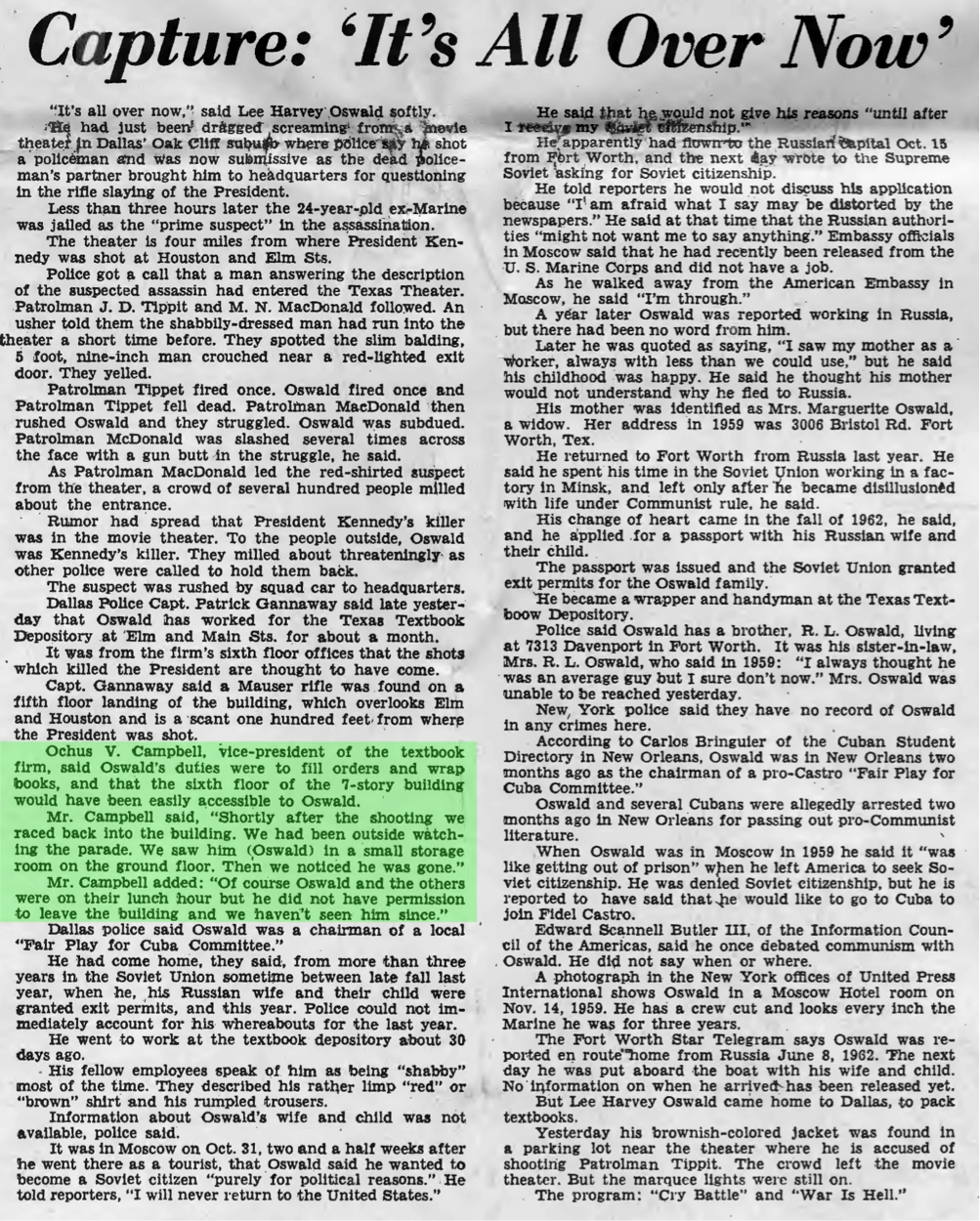
    Let me explain why I had that reaction. When I visited the now deceased HSCA attorney Al Lewis at his office in Lancaster Pennsylvania, he told me about something his former boss had done in the early days of that congressional committee. Chief Counsel Richard A. Sprague had arranged a day-long study of the photographic evidence in the JFK case. There were three presenters on hand: Bob Cutler, Robert Groden, and Dick Sprague. They went in that order. Before Cutler began, the chief counsel turned to those in attendance and said, “I don’t want anyone to leave unless I leave, and I don’t plan on leaving.” As Lewis related to me, Cutler’s presentation was about 35 minutes. Groden’s was over 90 minutes, close to two hours. Dick Sprague’s went on for four hours. By the end of Sprague’s demonstration, 12 of the 13 staff lawyers believed Kennedy had been killed by a conspiracy. (James DiEugenio and Lisa Pease, The Assassinations, p. 57)

    Such was the photographic mastery of Dick Sprague. At that time, no one had a more expansive collection of films and photos than he did. In that phone call, he told me that Robert Blakey, the second chief counsel, only called him once. It was to ask him if there was a motorcycle where the acoustics experts said there had to be one. Dick spent a lot of time going through his massive collection. He eventually replied that no, there was not. It was Groden who said that there was.

    To this day this issue has not been settled to any adequate degree. And there is simply no papering it over. Because the motorcycle has to be at a precise point near the intersection of Houston and Elm for the acoustics evidence to be genuine. Modern experts on the motorcade, like Mark Tyler, insist that Sprague was correct. And Mark argues that point effectively at the Education Forum. (See his post of June 9th) What I found severely disappointing about Thompson’s book is this: he barely deals with the issue at all. This is what he says about the highly controversial but crucial point: he writes that he and author Don Thomas found the correct motorcycle in the films of Gary Mack. Afterwards, they had a few beers and called it a night. (p. 304)

    I could hardly believe what I was reading. I actually wrote “WTF” in the margin of my notes. Somehow, this trio, not experts on the photo evidence, easily accomplished something that Dick Sprague––who was the leading authority in the field––could not do? The cavalier way Thompson deals with this important point––throwing in the phrase “having a few beers and calling it a night”––underscores just how unconvincing his treatment of it is. If it was this easy to locate and demonstrate, then why is there no picture of the proper motorcycle in proper context to accompany the “few beers and calling it a night”––straight out of Sam and Diane at Cheers––motif? I was so puzzled by this carelessness, leaning toward avoidance, that I went back and read up on the acoustics evidence.

    These sound recordings first entered the legal case during the days of the HSCA. They were offered up by Texas researchers Gary Mack and Mary Ferrell. Thompson does a good job in explaining the rather primitive technology which the Dallas police used in these recordings. There were two channels being recorded that day, simply labeled Channel 1 and Channel 2. The latter used a Gray Audograph powered by a worm gear which drives a needle into a vinyl disk. (Thompson, pp. 304-06). Channel 1 “was done by a Dictaphone that used a stylus inscribing a groove onto a blue plastic belt called a Dictabelt mounted on a rotating cylinder.” (Thompson, p. 148). Channel 1 was used for basic police operations. Channel 2 was for special events, like Kennedy’s motorcade. Back at headquarters, the dispatcher would announce each minute that passed, and each time the dispatcher spoke to a unit he would announce the time. (p. 149)

    The HSCA did two tests of the acoustics. The first was by a company called Bolt, Beranek, and Newman. The main scientist on this was James Barger, who supervised a reconstruction test in Dealey Plaza. After doing this, Barger said that there was about a 50% chance of a shot from the Grassy Knoll. The HSCA then gave those results to another team of acoustic experts: Mark Weiss and Ernest Aschkenasy . After examining this data they decided there was a much higher probability, 95%. The HSCA announced this in their final days.

    Because he is wedded to this evidence for the finale of his book, Thompson has nothing but scorn for what is today called the Ramsey Panel. The Department of Justice asked the National Academy of Sciences to review the work of the HSCA. They set up a committee named after Harvard physicist Norman Ramsey. Alvarez ended up serving on this committee. Alvarez told Barger that no matter what he said he would vote against him. (Thompson, p. 287) The panel was biased from the start and the author does a good job proving that point. For Thompson, this is why they ended up rejecting the HSCA result.

    But I want to note two things about the closing 80 or so pages of Last Second in Dallas and how an author making himself a character in his book is a double-edged sword. Thompson mentions a 2013 debate he did for CNN moderated by Erin Burnett; his opponent was Nick Ragone. (p. 276) If one can comprehend it, Ragone brought up Gerald Posner’s discredited book Case Closed. Thompson says he did not do well since he did not have any new evidence to reply with. I don’t want to toot my own horn, but if I had been there, I would have had a lot of new evidence to throw back. This is how I would have replied:

    Nick, that book came out in 1993. Which was one year before the ARRB was set up. They declassified 2 million pages of documents. Have you read them? I read a lot of them, and here is what they said.

    When asked the old chestnut, “Well why didn’t someone squeal?”, Thompson could have mentioned Larry Hancock’s book Someone Would Have Talked. He then could have said: “Larry shows that two people did talk, Richard Case Nagell and John Martino. If you don’t know about them, that is a failure of the MSM.” As a point of comparison, when Oliver Stone and I did an interview this past June with Fox, I brought about eight of these new ARRB documents with me. Fox filmed me showing them while I described what they said. They then had me send them in email form. Whether or not they will exhibit them on the show, I don’t know. But I had enough rocks in hand to play David with his slingshot.


    VI

    But the reason I think Thompson plays up the CNN experience is that he wants to show that if the acoustics evidence had been reexamined, he could have mentioned that. As noted, Thompson harshly critiques the Ramsey Panel, and much of this is warranted. But he only briefly mentions how the Weiss/Aschkenasy ––hereafter called WA––verdict was rather hastily granted a stamp of approval by the HSCA.

    What makes this kind of odd is that the author mentions Michael O’Dell more than once in the book. But he does not go into O’Dell’s rather bracing criticism of WA. O’Dell is a computer scientist and systems analyst. O’Dell wrote that the WA conclusion was based upon a motorcycle rider having his Channel 1 microphone button stuck open for a continuous five minute period. This was thought to be H. B. McLain, who first said it was and then said it was not him. What O’Dell was trying to do was to replicate what WA had done, except with much more powerful computer tools, not available back then. He wrote a report called “Replication of the HSCA Weiss and Aschkenasy Acoustic Analysis.” In his report, he found that:

    Numerous errors have been found with the data provided in the report, including basic errors involved in the measurement of delay times, waveform peaks and object position. Some of the errors are necessary to the finding of an echo correlation to the suspect Dictabelt pattern. The Weiss and Aschkenasy report does not stand up to even limited scrutiny, and the results it contains cannot be reproduced. (p. 2)

    O’Dell revealed that WA had relied on a millimeter ruler and string to map out their bullet paths on a map of Dealey Plaza. O’Dell used Adobe Photoshop to scan the same map as WA and transferred the measurements into pixels after lining them up in Excel. He found multiple critical errors in WA’s work, including those of distance measurement of buildings from other objects like the stockade fence. (See p. 3) O’Dell wrote that the microphone was positioned in the wrong place by WA. (p. 9) There were errors in the original paperwork independent of a transfer to a virtual model. For the buildings list in Dealey Plaza, items 16 and 20 were described as the same object. (p. 4) He also found out that one of the bullet paths was supposed to rebound off of object 23, yet there were only 22 structures WA had listed. (p. 5). There were objects listed in the WA table that O’Dell could not find on the map. (p. 8) But perhaps the most bracing criticism O’Dell made was that

    … the values presented in Table 4 for the Dictabelt pattern do not appear to be valid measurements of the peaks in the recording. A test that supposedly identifies a gunshot on the Dictabelt recording must, at a minimum, correctly measure the sound being tested on the Dictabelt. (p. 11)

    I could go on. But before anyone comes back at me by saying, “Why would you use something like this after what Dale Myers did with his phony cartoon based on the Zapruder film?” After all, Jim, Myers went on ABC TV and said the single bullet theory was really the single bullet fact. All I can do is reply with the following. I used O’Dell because Thompson used him. In communicating with the man I found out that Thompson had signed him to a non-disclosure agreement about his book. It ended when the work was published.

    Another series of problems with this evidence was written about by Charles Olsen and Lee Ann Maryeski in June of 2014 for Sonalysts, Inc. out of Waterford, Connecticut. They stated that although McLain had claimed he had opened up his cycle to a continuous high speed after the shooting, that is not what they determined by placing the sound on a graph: “What Figure 1 shows is a motorcycle that variously speeds up and slows down and idles during this latter period.” (6/6/2014, Olsen and Maryeski, pp. 3-4)

    Let me add one other comment. As both O’Dell, and especially Dave Mantik have pointed out, one of the virtues attributed to this evidence is the so called “order in the data.” Or as Don Thomas puts it in his book, the best test matches correspond to a topographic order in Dealey Plaza and with the dictabelt. (Hear No Evil, p. 583) But as Mantik informed me, if one looks at Thompson’s own table, if the HSCA had chosen the bullet sound at the 144.90 point in the tape, they would have had two matches to the School Book Depository that very closely matched the one to the knoll area. (Thompson, p. 155) The same thing occurred at 137.70; the TSBD could have been chosen over the knoll. (interview with Mantik, 6/26/21)

    In addition to all the above, Thompson essentially brushes over the issue of heterodyne tones. (p. 296) This is an important point that the Sonalyst report examined. It’s important because it can result in words being scrambled in pronunciation as one listens to them. Meaning that they can sound like one phrase to one person and another phrase to someone else. And this has happened. (Olsen and Maryeski, p. 9)

    Even his heralded discovery, that voices saying “Hold everything” and “I’ll check it,” occur around the assassination is odd. First, the object is to show whether or not the bullet echo correlation is real, not the voices. Also, to get a more distinct peak for “I’ll check it,” Richard Mullen, Barger’s protégé, used a narrower sampling PCC (Pattern cross correlation) window of 64. Therefore Thompson concludes this is what should have been used from the start. Yet for “Hold everything,” a wider sampling window of 512 yielded a larger net peak than did a smaller sampling window of 64. Thompson offers no explanation for this seeming paradox. (See Figures 22-6 and 22-7; 6/26/21 interview with Mantik)

    If the “Hold everything secure” phrase is at the time of the assassination, then the acoustics is invalid, since this is spoken after the assassination. “I’ll check it” would be around the time of the shots. So the two phrases are in conflict if both were valid. The first phrase is at the wrong time, the latter one is at the right time. So Thompson argues that the “Hold” phrase has been altered and is really an overdub. (Thompson, pp. 345-47)

    This has also been placed in doubt by O’Dell. (See Dictabelt Hums and the “hold everything secure” Crosstalk) The “Check” phrase, as has been argued by many, is not really crosstalk at all. The same sound does not appear on both channels. (Email communication with O’Dell, 7/25/21). And further, Sonalysts showed that the spectrograms of the phrase differ on Channel 1 and 2. (Olsen and Maryeski, p. 6)

    I could go on. But I think the point has been made. There are simply too many uncertain variables with the acoustics evidence to rely on it as having a 95% probability. Much of this is due to the innate poor quality of the recordings themselves.

    When we were making JFK Revisited, producer Rob Wilson asked me to incorporate a section on the acoustics evidence. I recommended against it. I simply noted that with all the above problems with that evidence we would be making ourselves into a bull’s eye on a target range; a whole gallery of persons would take out their bows and arrows and start unloading their quivers on us.

    As I said in Part 1, there are good things in Last Second in Dallas. And as a responsible critic I have described them. In my opinion, they are important and valuable and have stood the test of time. But it is also my opinion that there are a lot of things which seem to me to be liabilities, including what the author thinks is the culminating arc of his book––and I have described those deficits also. This is why Last Second in Dallas is a decidedly mixed bag.

    Return to Part 1

  • Clue to When JFK Was Shot in Back


    Previously I posted an article here on the significance of S.S.A. Glen Bennett’s statement:  He saw Kennedy shot in the back—and, as you will see from the story, this had to have happened at least two seconds after he was hit in the throat (see the link above).

    This could explain the puzzling nature of JFK’s back wound—the way its abrasion collar suggests a shot coming from below.  Some have explained it by insisting JFK was hit while he was leaning over.

    As anyone can see from films, JFK was not leaning over at the time he first began to react.

    But if Glen Bennett was telling the truth when he said he was looking at JFK’s back the instant he was struck in the back, photographic evidence shows this had to have happened after Kennedy was already hit.

    The interesting thing is, seconds after that first hit, Kennedy actually did begin to lean forward. And so no wonder the abrasion collar was on the bottom edge of the back wound.

    This is further proof that Kennedy was first hit in the throat, then in the back, but only after he began to sag in his seat.


  • Lisa Pease, A Lie Too Big to Fail: The Real History of the Robert Kennedy Assassination

    Lisa Pease, A Lie Too Big to Fail: The Real History of the Robert Kennedy Assassination


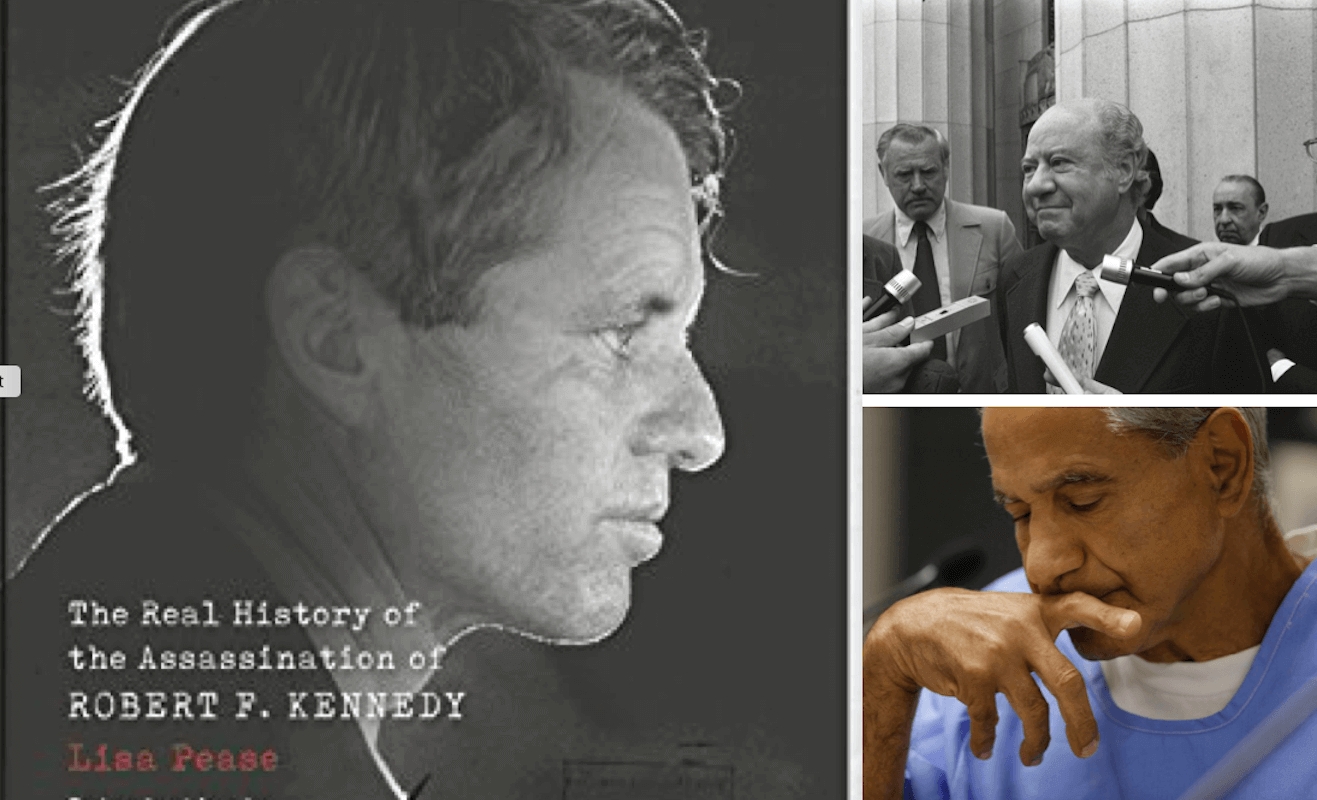
    pease le flemIt’s a rare thing indeed when a book actually delivers everything you could wish for—and then some. I can count on one hand the number of books in recent memory that have achieved this. Incorporating over twenty years of research, personal interviews, deep archival digging, and a comprehensive survey of nearly all the extant literature and articles surrounding Robert Kennedy’s encounter with the unspeakable in the pantry of the Ambassador Hotel on the night of Jun 5, 1968, A Lie too Big to Fail will no doubt stand the test of time as the definitive book on the RFK murder. Pease establishes not only the most compelling case against the LAPD’s compromised (non-)investigation of the case to date, but reveals startling new discoveries, including previously unexplored forensic evidence, new witnesses to multiple shooters, and evidence of foul play at the highest levels of the United States political apparatus.

    Digging deep into the court records and transcripts of the also-compromised defense attorney who sold the 24-year old Sirhan Sirhan down the river before he ever had a chance at anything approaching a fair trial, Pease presents a firm case for why his fate—as he sits locked up in a California prison for life—cannot be justified in a democratic society. That Sirhan is still alive and paying for a crime he never committed brings a necessary urgency to her plea that the case be reopened. Because not only did Robert Kennedy’s murder signal the death knell of true progressivism in the United States political arena, but it served as perhaps the most arrogant abuse of power by a hidden hand that, for five decades, hijacked the United States’ foreign and domestic policy. Written with a gripping, driving cadence, the author’s narrative gifts are as pronounced as her investigative acumen. And with this book as her lifetime achievement on a case that still remains relatively obscure in light of the JFK assassination, she will likely establish herself as the preeminent authority on the subject for years to come.


    II

    Officially, minutes after delivering his victory speech in the Embassy Ballroom of the Ambassador Hotel in Los Angeles just after midnight, Senator Kennedy—to the cheers of his teeming supporters and staff—excused himself from the podium, proceeded backstage through a small passage leading to large double doors, entered the hotel’s kitchen pantry, shook hands with cooks and a busboy, and was shot to death. The sole perpetrator was held to be Sirhan Bishara Sirhan, a 24-year-old Palestinian immigrant who appeared in the confusion of the crowded space in front of the senator and fired a .22 caliber revolver at Kennedy, mortally wounding him and injuring five other people with his eight-shot discharge.

    Kennedy died almost a day later. He had multiple brain surgeries and finally succumbed to the massive damage of the shattered bullet fragments: his heart rate lowered to barely a pulse, then stopped. His funeral ceremony was one of the most highly attended in U.S. history. For people like Tom Hayden, original author of the Port Huron Statement, who sat crying in a church pew upon learning of the death of his hero, the senator’s untimely death was also the death of hope for a generation seeking to take their nation on a course of peace and social justice. With Richard Nixon’s victory all but assured in the confused scrambling of the Democratic Party to promote their second tier candidates, the United States was going to fundamentally change.

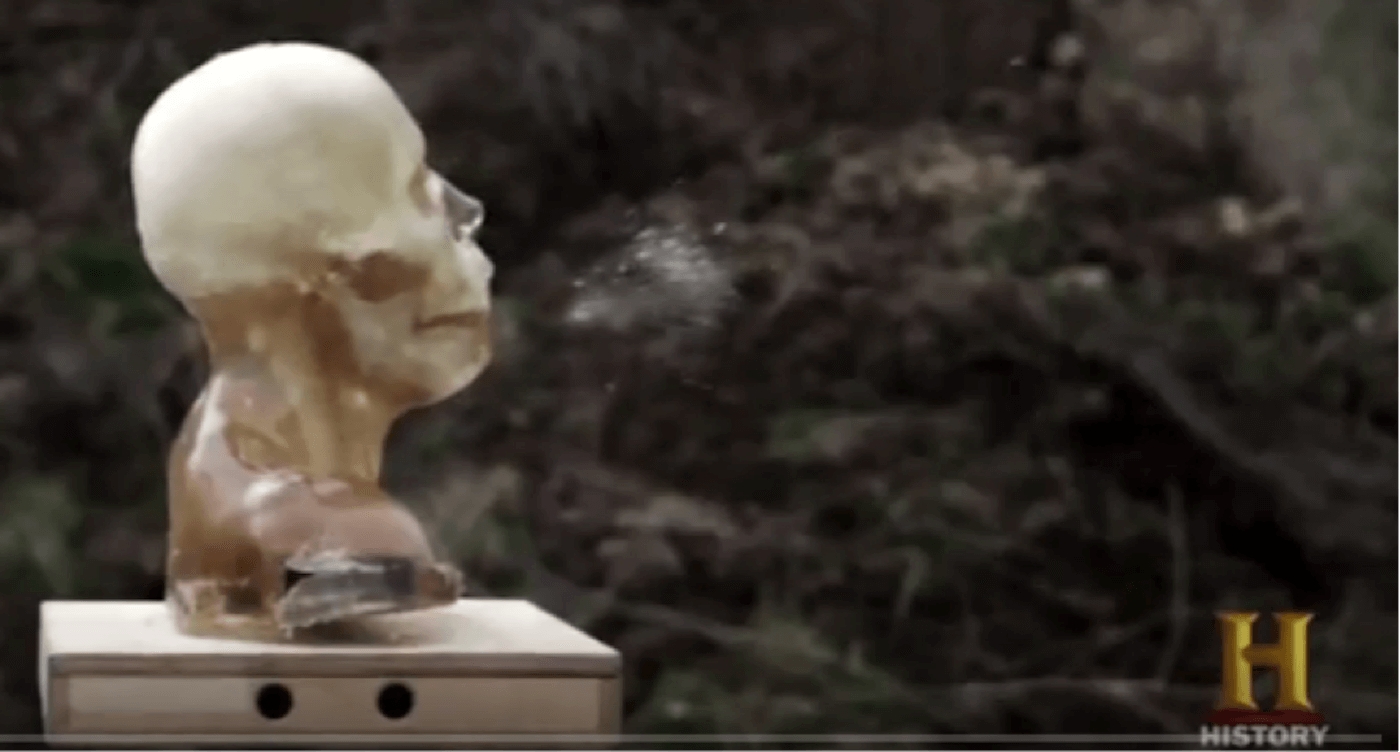
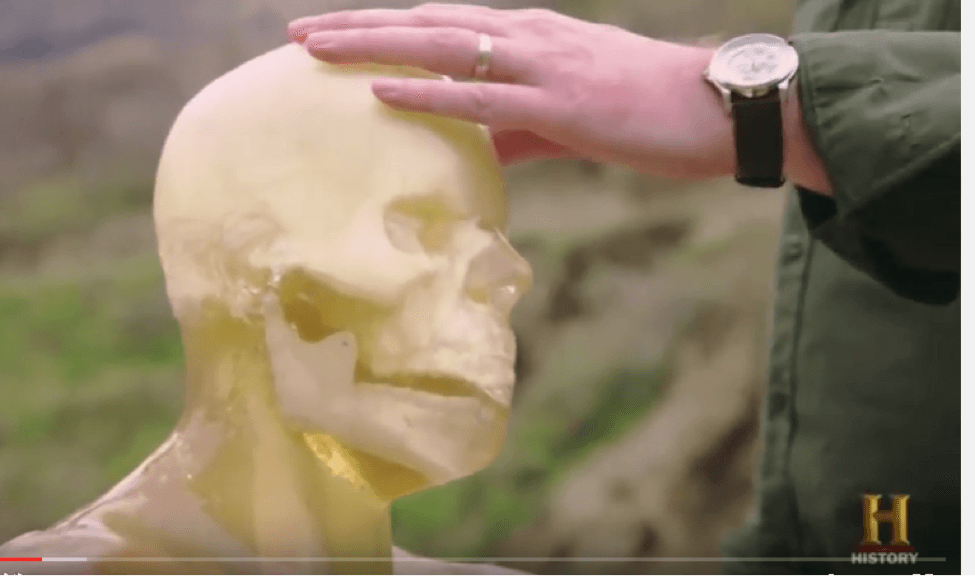
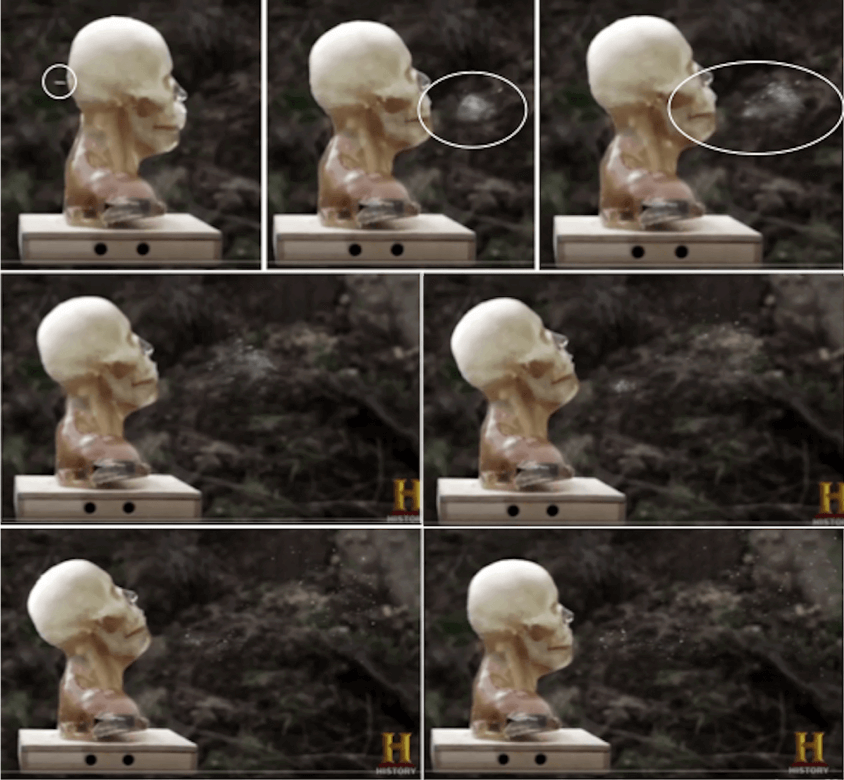
    That’s the official version of events we teach our kids in school and repeat ad nauseum in the mainstream media. The problem, of course is that when Thomas Noguchi, the LA County coroner who was tasked with performing Robert Kennedy’s autopsy, was finished, he discovered that the fatal shot, just behind his right ear into the victim’s brain, was fired with the gun barrel at contact range, which could not have been more than three inches. This was demonstrable, as Kennedy’s neck exhibited tell-tale signs of powder burn tattooing, or stippling, which Noguchi took great pains to demonstrate by setting up a test-firing at the LA Police Academy on mock human skulls made of latex and pig ears after the autopsy. Each officer was asked to fire at his respective target from six ranges: barrel-pressed against the target, a quarter inch, half inch, two inches, three, and finally four. Only at three inches, did the stippling dispersal pattern match that on Kennedy’s corpse. Of the nearly seventy witnesses in the pantry that night, none placed Sirhan closer than three feet, and most average a distance of approximately five to six feet. Equally troubling was the fact that the three shots which struck Kennedy were fired from behind and at equally sharp vertical angles, from low to high, which makes it physically impossible for them to have come from Sirhan’s gun, which even before he was attacked and restrained by bystanders, was by all accounts pointed directly at Kennedy in a flat, arm-outstretched fashion. We know Kennedy only perceived a threat from the front by the fact that numerous witnesses recall his hands defensively coming up to cover his face at seeing an approaching Sirhan before he fell to his knees, wounded, and then slumped to the floor where he lay dying in a pool of gathering blood from his fatal head wound.

    The immediate aftermath of the shooting is another one fraught with contradictory claims. Officially, the LAPD concluded—or as we will see, decided actively to conclude, with the urging of two former CIA interrogation experts who took over the investigation within days of the murder—there was no conspiracy. Sirhan was apprehended, everyone saw him shoot, Kennedy went down, case closed. And yet, as Lisa Pease aptly demonstrates, that is not at all what witnesses reported. Almost thirty separate people placed Sirhan in the company of a young lady in a polka dot dress, along with several male accomplices. Many of them saw her in the pantry, seemingly holding Sirhan, and having the same sickly smile on her face as they claim he did before he lurched forward with gun outstretched to make his move. Witness Sandy Serrano places her in the immediate aftermath of the shooting running down the fire escape to the back parking lot with her male companion—both of whom Serrano witnessed entering the hotel via this very fire escape with Sirhan Sirhan earlier in the evening. Serrano said she was exuberantly shouting, “We shot him!” When asked by Sandy who did she kill, the girl responded, “Kennedy! We killed him!”. They were overheard by the Bernsteins, an elderly couple in the parking lot who reported the incident to first-responder Paul Sharaga, of LAPD. When Sharaga put out an APB for these two suspects, he was told moments later by a superior at Ramparts station that, “We don’t want them to get anything started on a big conspiracy.” (Larry Hancock, “Incomplete Justice, Part One: At the Ambassador Hotel,” 5/19/2007) The APB was subsequently pulled, allowing any accomplices ample time to make their escape.

    Lisa Pease details this familiar chain of events and the controversy surrounding the clearly real accomplices, sited by dozens of witnesses throughout the ballroom and surrounding areas that night. With regard to figures like the infamous girl in the polka dot dress, she brings some fascinating new insights to the case: including the likely use of multiple teams and multiple polka dot women who were also part of the plot. Many have wondered: What would have happened had Kennedy exited via a different route? The author is quick to note that he was marked for death that night by the sheer number of likely assassins actually positioned in the Ambassador Hotel that evening. While as many as three shooters could have been in the pantry, the LAPD was immediately told to stand down in their pursuit of leads concerning anyone but Sirhan’s immediate family and friends. Therefore, we will probably never be able to say conclusively who these people were. Lisa Pease provides some excellent considerations though, and that is perhaps one of the most exciting parts of her new findings, along with some of her personal interviews which to my knowledge she is sharing here for the first time in print. That, plus the fact that SUS officers at Ramparts station also burned over 2,400 photos taken at the Ambassador ballroom in a hospital incinerator, removed and later destroyed key ceiling and door panels containing bullet holes because they “didn’t have room to store them,” and both discredited and intimidated major credible eyewitnesses: all this smacks of a systematic cover-up.


    III

    Stylistically, A Lie To Big To Fail achieves a fine balance between the immense complexity of the case—with its thousands of files, its many bizarre suspects and characters, its hypno-programming realities, and other strange but relevant source data—and the inherent drama of the event. We begin with an almost Raymond-Chandler-styled portrait of those fateful California nights spent with folks like director of The Manchurian Candidate John Frankenheimer (talk about situational irony) and other supporters, then progress to the primary victory speech at the Ambassador Hotel. The book is instantly engaging, no matter how familiar readers might be with the case. The accessibility of the book is another commendable feat Pease has pulled off; experts who have studied the case for decades will still find evidence and propositions they had never seen or considered, while a friend I loaned the book to—who had never examined the case—could just as easily engage with the text. That is no small feat. Too often a book in the assassination field presumes a level of familiarity with the subject material that is beyond the scope of most readers, while those that are more accessible often gloss over the depth and complexity of the subplots, and also motives and new information gleaned from recent declassifications. A Lie to Big to Fail does neither, and presents an eminently readable, thoroughly substantiated story that, in many respects, is stranger than fiction.

    Covering the gamut of the LAPD’s Special Unit Senator files, along with newly discovered archival footage from places like the California State Archive and local news agencies, Pease’s book is probably the most comprehensive I have ever read on this case, incorporating not only the limited but extremely useful secondary literature from the 1970s, 80s and recent times, but also combing the entire primary source record of the case as well. The author poured thousands of hours of personal research into the book. And it shows. Sources are meticulously detailed and annotated, in the classical manner with the references at the bottom of the page. This allows anyone with an internet connection to fact check most of her findings; some must be accessed in person in Sacramento and elsewhere.

    The other thing that really stands out in the book is the author’s refusal to argue she’s definitively solved the case. Don’t get me wrong: if anyone has come close to figuring out exactly what happened that night, it’s Lisa Pease. What I mean is that too often plots of this magnitude, which require not only clandestine funding, months of planning, a deeply complex cover-up often stretching decades, and the complicity of many high-level officials and planners, are traced to a single source: the mob, the CIA, the Minutemen, Nixon. What seems to be the case, and I will let readers reach their own conclusions, is that, as Lisa notes, there were aspects of both underworld crime liaisons, private military contractors, and off-the-books involvement of the Central Intelligence Agency in the persons of say Hank Hernandez and Manny Peña (USAID/CIA), and of course Robert Maheu (Howard Hughes Corporation/CIA). Thane Cesar has been and still is a prime suspect, given his anti-Kennedy, pro-segregation views and convenient placement as RFK’s escort in the pantry. That he “retired” from Ace Security, a job he’d had for only a few weeks, as he sarcastically stated during his exit interview with the LAPD, is also extremely suspicious. (RFK LAPD Microfilm, Volume 122, Reporters Daily Transcripts, Reinvestigative Files 1974—1978) p. 314). That Nixon was basically handed the presidency does not, of course, implicate him personally; though as the end of the book suggests, there is anecdotal evidence his brother Don was indeed apprised of the events surrounding the assassination and informally debriefed shortly thereafter. In a diary entry that Pease personally procured from John Meier, a Howard Hughes top aide from 1966 to 1970, Meier wrote on June 6, 1968:

    Bob Maheu called to ask about the Don Nixon meeting and suggested 8:30 breakfast at the Desert Inn Country Club (in Las Vegas). I went to the club. Maheu was all smiles, and Don Nixon walks in an all smiles. What followed next had to be seen to be believed. They embraced each other and Don Nixon said, “Well that prick is dead,” and Maheu said, “Well it looks like your brother is in now.” (Pease, p. 493)

    This book also presents perhaps the most balanced look at the controversy surrounding the potential and very likely programming Sirhan underwent before his arrival on the scene. Drawing from both familiar and quite obscure cases, where people were indeed exposed as hypno-programmed assets operating against their will with no working knowledge of how or why they performed various acts and crimes, she gives those in the research community a solid footing on which to stand in what amounts to the hardest part of the case for the MSM to digest. Given the CIA’s millions of dollars of research into its MK-ULTRA and related mind control experiments, along with the accounts provided in Pease’s later chapters, even the most skeptical critics will be hard pressed now to discredit this exotic but very real use of actionable hypnosis.


    IV

    Sirhan remains languishing in prison to this day, narrowly avoiding the gas chamber by a lucky break which saw California abolish the death penalty in 1972. Despite his good behavior, insistence that he has no memory of the events in the pantry, his numerous and sincere interviews with new therapists and hypno-suggestive experts, his fate remains sealed. William Pepper, the attorney and barrister who represented the King family during their 1999 civil trial against Lloyd Jowers, in which a Shelby County jury determined Martin Luther King had been assassinated as a result of a conspiracy, has joined attorney Laurie Dusek in a bid to free Sirhan from a crime we know he could not possibly have committed.

    Senator Kamala Harris, who served as the California Attorney General until 2017, and who was also the DA of San Francisco from 2004 to 2011, insisted since the parole hearing reached her desk in 2012 that Sirhan is still guilty. Following the release of an audio tape found in the California State Archives which captured what acoustics expert Philip Van Praag believes is thirteen distinct shots in the pantry, Harris was confronted by the very real possibility that Sirhan was not a lone gunman. Harris calls Van Praag’s analysis “pure speculation.” (Martinez and Johnson, “Prosecutors, attorneys argue: Was there a second gun in RFK assassination?” CNN, 3/12/2012)

    Similarly, despite the very real fact that hypno-programming has been successfully deployed in military, civilian, and criminal plots, and other special operations dating back to the early 20th century, Harris refuses to accept its possible use on Sirhan in the RFK saga. Upon reading the adamant testimony of Harvard professor of forensic psychiatry and hypnosis, Dr. Daniel Brown—who spent over sixty hours interviewing Sirhan—Harris claimed, “The theory that a person could be hypnotized into planning and committing a murder against his will is a controversial (if not fantastic) one and has not been adopted by most of Brown’s peers, including the American Psychological Association.” She continues, “Thus, even if Sirhan could show that some psychologists believe in mind control or hypno-programming, his showing of actual innocence is nevertheless based on a debatable theory that is not universally accepted in the psychology community.” (CNN, 3/12/2012) Brown, in a signed 2011 affidavit, stated, “I have written four textbooks on hypnosis, and I have hypnotized over 6,000 individuals over a 40-year professional career. Mr. Sirhan is one of the most hypnotizable individuals I have ever met, and the magnitude of his amnesia for actions under hypnosis is extreme.” (Tom Jackman, “The Assassination of Bobby Kennedy: Was Sirhan Sirhan hypnotized to be the fall guy?” Washington Post, 6/4/2018)

    What is actually a debatable theory, in reply to DA Harris’ conclusions, is that three bullets fired at very close range and one at contact range (the fatal head shot behind the right ear), all from behind and at a steep upward angle are supposed to have come from a weapon that was always at least three feet in front of the target. Or that at least thirteen bullets were fired from a gun which could only hold eight, and which likely fired no real bullets, just blanks. These are solidly based facts of the case, yet they are treated as conjectures. If other major legal cases were handled with this much disregard for forensic evidence, lawyers would be disbarred. And if Sirhan had been offered a fair trial—another exceptional chapter of A Lie Too Big to Fail—it is almost certain he would be a free man. But the special logic applied by those seeking to obfuscate the sinister implications of the final major assassination of the 1960s continues to hold fast, at least at the legal level.

    Things are changing though, and it would seem that the concerted efforts of those like Lisa Pease, along with the recent public denial of the official version of events by none other than Robert Kennedy Jr., may be turning the tide towards the real evidence which supports a concerted high-level conspiracy to remove a potential president. It was with a real sigh of relief that I read a recent Washington Post summary of Lisa’s new findings, one that, for a change, actually took her argument seriously and did not attempt to reduce her thesis to fringe theory. In the fifty-one years of relative silence surrounding the case, dotted here and there by books and talks by people like Allard Lowenstein, Ted Charach, Philip Melanson and others, that’s a true testament to the work of informed citizens uncovering the darker chapters of their nation’s history. As journalist Tom Jackman’s article notes, “Robert F. Kennedy Jr., the son of the slain senator, said he thought Pease was ‘a great researcher.’ Similarly, Kennedy said that his own investigation, which included meeting with Sirhan in prison in December 2017, showed that ‘Sirhan could not and did not fire the gun that shot and killed my father.’” (Jackman, “CIA may have used contractor who inspired ‘Mission Impossible,’ to kill RFK, new book alleges,” Washington Post, 2/9/2019)


    V

    A Lie Too Big To Fail is more than a window into one of the most fascinating and disturbing assassinations of the sixties. It is a work whose implications are relevant to anyone trying to understand how the United States devolved into a shell of a country whose tenets of equality, freedom and justice have gone by the boards, leaving us with a paper-thin facade of a democracy embodied by charlatans who wear red and blue uniforms but who essentially represent the same corporate and military-industrial overlords, or what Colonel Fletcher Prouty once referred to as “The Secret Team:”

    It is a sinister device of opportunity and contrivance. What does exist is the mechanism. What exists is the automatic system, much like a nervous system or an electrical system. More properly, what exists is like a giant electronic data processing machine … which has its own power to grow, to reproduce, and to become more insidiously effective and efficient as it operates. It is a great intra-governmental infrastructure that is fed by inputs from all sources. It is big business, big government, big money, big pressure, and headless—-all operating in self-centered, utterly self-serving security and secrecy. (Prouty, The Secret Team: The CIA and its Allies in Control of the United States and the World, p. xvii)

    It was Jim Garrison who eerily predicted this in an obscure and brief interview less than a month after the RFK slaying. Art Kevin, host of Los Angeles’ KHJ Radio, asked the New Orleans District Attorney,

    AK: Jim … are you prepared to say that the same elements responsible for the death of John F. Kennedy were responsible for the deaths of Senator Robert F. Kennedy and perhaps even Martin Luther King?


    JG: Well, you can remove the perhaps. The answer is “of course,” except that in the case of Senator Kennedy, they apparently interposed a cover organization.

    A bit later:

    JG: But there’s no, I don’t think there’s any question about the fact that the same forces removed everyone. Every one of these men were humanists. They were concerned about the human race. They were not racist in the slightest way, and above all, they were opposed to the evolution of America into an imperialist empire-seeking warfare state. Which it has become, I’m afraid. And now there aren’t too many, now there aren’t too many leaders left to talk out loud against the war in Vietnam. They’re eliminating them, one by one. Always a lone assassin. (“Jim Garrison says RFK was Hip to Murder Plots,” San Francisco Express-Times, 7/3/1968)

    Entrenched in an almost two-decade long foreign policy disaster in the Middle East and Afghanistan, riddled with crippling, insurmountable debt, with young people more despondent and driven to self-medication and violence, the United States of 2019 is unquestionably the dark legacy of those tiny .22 caliber slugs flying through the pantry that fateful July night. As political philosopher Sheldon Wolin described it, the United States in the past half-century has come to resemble an inverted totalitarian government. By that he means, a state run not by a traditional dictator like Stalin, Mao or Mussolini, but one even more ruthlessly efficient at quelling dissent and spreading disinformation through a diffuse and impossible-to-pin-down network of powerful and manipulative factors, from the corporate media to lobbyist groups, to the hollow candidates propped up every four years for the election circus:

    Antidemocracy, executive predominance, and elite rule are basic elements of inverted totalitarianism. Antidemocracy does not take the form of overt attacks upon the idea of government by the people. Instead, politically it means encouraging what I have earlier dubbed ‘civic demobilization,’ conditioning an electorate to being aroused for a brief spell, controlling its attention span, and then encouraging distraction or apathy. The intense pace of work and the extended working day, combined with job insecurity, is a formula for political demobilization, for privatizing the citizenry. It works indirectly. Citizens are encouraged to distrust their government and politicians; to concentrate upon their own interests; to begrudge their taxes; and to exchange active involvement for symbolic gratifications of patriotism, collective self-righteousness, and military prowess. Above all, depoliticization is promoted through society’s being enveloped in an atmosphere of collective fear and of individual powerlessness: fear of terrorists, loss of jobs, the uncertainties of pension plans, soaring health costs, and rising educational expenses. (Wolin, Democracy Incorporated, p. 239)

    Indeed, many of these issues, which could have been addressed in Dr. King’s Poor People’s March—which RFK conceived and encouraged MLK to undertake—have never been seriously resolved in the last fifty years of American history. The powerful and vigorous aspirations of those like Tom Hayden, which burned briefly and flickered out with RFK’s assassination, have not been rekindled. After Robert Kennedy’s death, there have not been any significant, ideologically divergent political candidates offering real change or practical solutions to basic entrenched issues in the United States. What we got was Richard Nixon, Gerald Ford, Jimmy Carter. It then got worse with the full-blown neoconservative movement’s apotheosis in the persons of Ronald Reagan, followed by George H. W. Bush, and W. In effect, the antithesis of everything which people like Martin Luther King, JFK, Malcolm X, and Robert Kennedy represented.

    But we must not lose hope, however bleak the future looks. And it is our responsibility not to. As Lisa Pease has so expertly done in her recent book, everything is in our power to expose the lie which still surrounds RFK’s untimely end. As the author concludes in her final passages, “He spent the last years of his life tilting at the windmills of greed and self-interest that ultimately cut him down. But his song lives on in all of us who strive, in whatever ways we can, to reach those unreachable stars.” (Pease, p. 504)


    Some related items:

  • Harold Weisberg on Howard Brennan and Marrion Baker

    Harold Weisberg on Howard Brennan and Marrion Baker


    The following interview was recorded on December 21, 1966 at the studio of Pacifica outlet KPFK in Los Angeles. Harold Weisberg discusses the dubiousness of two key witnesses for the Warren Commission: Howard Brennan and policeman Marrion Baker. Both are key for the Commission. Brennan is the sole witness who places Oswald in the sixth floor window, and Baker says he encountered Oswald in the second floor lunchroom after the shooting. It should be noted, Weisberg is alone among the early critics in questioning Baker’s story since he somehow had Baker’s first day affidavit, where he makes no mention of a second floor lunchroom.


    O’Connell:

    This is William O’Connell, and we’re talking again today about The Warren Commission Report on the assassination of President Kennedy. And we have in the studio, Harold Weisberg, the author of Whitewash, and an even newer book called Whitewash II, which is subtitled, “The FBI-Secret Service Coverup”. Mr. Weisberg is a newspaper and magazine writer, and a former Senate investigator, and also an intelligence and political analyst. His earlier specialties included cartels and economic and political warfare, and then during the early days of World War II I believe, your personal investigations and writings were credited with laying a foundation for the taking over of enemy property, and foreign funds controls. Is that correct?

    Weisberg:

    Yes, and the government got a pretty good income from some of the cases.

    O’Connell:

    One of the things that I especially wanted to go into in treating, as we are now some of the evidence in the case, in great detail and with thoroughness, I wonder if we could examine the reconstructions by the commission of the assassination itself from the Depository area on Elm Street, and also the reconstruction that the commission gave to the slaying of Officer Tippit. And to lead into that, I wanted to ask you about a statement that you make, and ask how you justify so categoric a statement, when you say that Oswald could have killed no one.

    Weisberg:

    I add one thing to it. According to the commission’s best evidence. And I believe on this subject, the commission’s best evidence is quite credible. The commission established Oswald’s innocence because of the bankruptcy with which it approached the effort to establish his guilt. Everybody is familiar with the more dramatic aspects of this. For example, the witness Howard Brennan. Perhaps the least credible witness in any official proceeding. This is a man who qualified himself as a witness by saying that he lied when it served his convenience. He was taken to a lineup to identify Oswald, and he is presumably the source of the description, and yet at the lineup, he said he couldn’t identify Oswald.

    O’Connell:

    When you say the description, you mean the description that went out over the police radio, with reference to a suspect in the President’s slaying?

    Weisberg:

    Yes, now this addresses, this simple thing of the description that went out over the police radio, in a very comprehensible way, addresses itself to the integrity of everybody involved. We’re led to believe that this description came from Brennan. Recognizing the improbability of it, the commission said, “Most probably.” Now here we have a man, who is the source of the identification of an assassin. A presidential assassin. The police presumably are going to solve this crime. And they get a description from him and they broadcast the description. But strangely enough, the police don’t know who gave them the description, so when the case comes to trial as presumably it was always intended to, they have no way of producing the eyewitness.

    Either Brennan was the eyewitness who gave them the description that was broadcast, or he was not. Either the description that was broadcast came from an eyewitness or it did not. Now if it came from an eyewitness, how in the world were the police going to produce him if they didn’t know his name? How are they going to have a witness for the trial? The description that is broadcast is not that of Brennan. It contains information that Brennan did not give, if any of this can be regarded as information.

    O’Connell:

    There was no information as to the nature of the clothes worn by the suspect in the broadcast that was give out as-

    Weisberg:

    Correct, but Brennan did give such data, and it contained information on a weapon, which Brennan did not give.

    O’Connell:

    Now where was Brennan standing in relation to the Depository building?

    Weisberg:

    When we get to Brennan, I will qualify everything by saying, “according to.”

    O’Connell:

    All right.

    Weisberg:

    Because this is the least credible man in the world.

    O’Connell:

    All right then, instead of beginning with Brennan, let’s go back and see if we can retrace in some kind of sequence the reconstruction, and then you take it back to, as earlier point then the 22nd if you like Mr. Weisberg, in terms of what the commission alleges in terms of the reconstruction as to the weapon, and the paper bag, and so on and so forth. But I think we should treat this in some detail, and preferably, chronologically if that’s all right with you?

    Weisberg:

    Well, since we’ve already started with this thing of Brennan, let me finish with that first, because the reader of the report is led to believe that even though the commission almost disavows him, Brennan is the identifier of Oswald, and Congressmen Ford, in his own writing for profit, identifies Brennan as the most important witness before the commission. The truth of the matter is, that the important witness here was a Dallas Police officer, Marrion L. Baker, whose credibility was in the same class as Brennan’s. I have in both my books, traced many of Baker’s statements. The thing that distinguishes him from all other witnesses that I have studied, and I’ve studied most of them, is that on none of the many occasions he was interviewed did he ever give the story that he gave before the commission.

    O’Connell:

    Now, who are you speaking of now?

    Weisberg:

    Baker. Marrion L. Baker, the Dallas police officer, who had this famous gun in the gut encounter with Oswald in the second floor lunchroom of the Texas School Book Depository building. Now, it is Baker who tends to make credible Brennan’s story that he saw Oswald in the sixth floor window. And it is Baker that did in fact, have an encounter with Oswald. There can be no question about this. There was …

    O’Connell:

    Now where was Baker in the motorcade?

    Weisberg:

    Baker was in one of the follow-up motorcycles. He was not flanking the President. He was behind him. And according to his testimony, he had just turned from Main Street, down which the motorcade had gone through downtown Dallas.

    O’Connell:

    Was he immediately behind the presidential car?

    Weisberg:

    Several cars behind. He, I think that his testimony will place pretty much where he was. The motorcade turned from Main Street to the right, or to the north on Houston, and then turned to the left down Elm Street, which in a sense flanks Main. It was Baker’s testimony that he had just turned from Main into Houston, when a gust of wind hit him – and there was a strong wind there that day, It almost blew Mrs. Kennedy’s hat off at the same corner – and just after he turned the corner, he heard the first sound that he identified as a rifle shot. He testified that he revved up his motorcycle and got close to the Depository, jumped off and dashed into the building. In the building, he picked up Roy Truly, the manager, who was a credible witness, and they rushed upstairs, intending to go to the roof.

    Because what attracted Baker’s attention to the building, was not anybody in the window and he had at least as good a view as Brennan, and I tell you a better one because Brennan was close to the building, he was looking upward at too sharp an angle. When they got to the second floor, there-

    O’Connell:

    Too sharp an angle to …

    Weisberg:

    To really see well. Because he was looking sharply upward. Baker was looking at a more flat angle, because he was looking, not from far away, but from a little bit of a distance.

    O’Connell:

    I see.

    Weisberg:

    Brennan said that the man he saw was leaning up against a wall, and Baker as I say, was looking closer to straight on. Now it’s six stories high, but the distance from between Elm and Houston is sufficient, so that the angle of Baker’s vision included more than the angle of Brennan’s vision. I make this point simply to point out, that with Baker having had his attention attracted by the first shot, and having looked at the building, he reports having seen nothing in that window.

    O’Connell:

    I see.

    Weisberg:

    And his attention was attracted to immediately above the window to the roof. And he testified that the flight of pigeons from the roof made him suspect that something might be there. And it was for this reason, not because he saw anybody in the window, that he dashed into the building. And he picked up Mr. Truly, the manager, and they rushed to the second floor. Now to give you an idea of how they rushed, everybody who testifies about it in effect says that Baker was bowling people out of the way. They hit the two way door, the double hinged door on the first floor, that’s so common in offices, just a waist high door, so hard and so fast that the mechanism wouldn’t operate. And they rushed to the second floor.

    Now the stairway in the school book depository building is an open stairway.

    O’Connell:

    This is the front stairway, I think it’s-

    Weisberg:

    No, this is the back stairway.

    O’Connell:

    This is the back stairway.

    Weisberg:

    Listen, I’m talking now about where they were going up in the building. They got into the building, they went through the double hung door, and at Truly’s lead, they went to the back of the building.

    O’Connell:

    This is in the …

    Weisberg:

    First floor.

    O’Connell:

    The first floor and it’s in the …

    Weisberg:

    Rear.

    O’Connell:

    The western, the northwestern corner of the depository, is it?

    Weisberg:

    Yes, yes. Now they’re elevators there, but both of the elevators were up in the upper floors, so Truly led Baker up the stairs and they were really running. Truly was ahead of Baker. When Truly was going from the second to the third floor, he became aware of the fact that Baker was not behind him. And he retraced his steps, and he found that Baker was inside a lunch room.

    O’Connell:

    Mr. Truly is the manager of the building, yes?

    Weisberg:

    Manager of the building.

    O’Connell:

    And he was standing where at the time of the assassination?

    Weisberg:

    Out in front of the building.

    O’Connell:

    I see.

    Weisberg:

    And incidentally, he in common with most of the men who were employed by the building thought the shots had come to the right of where they were standing, and they were standing almost directly underneath the sixth floor window.

    O’Connell:

    And to the right would have been in the area of what-

    Weisberg:

    Of what has come to be known as the grassy knoll. A raised place along Elm Street. Now, when Truly retraced his steps to look for Baker, he found Baker inside a lunchroom. This lunchroom has access through two doors, one of which is set at a 45 degree angle, and has what amounts to a peep hole in it, not much larger than a book. Baker’s subsequent testimony was, that he saw something through this window. Now had he seen something through the window, somebody would have had to have been there to attract his attention. Because the angle is entirely contrary to the testimony. The angle at which he could have seen something would have shown him a blank wall, unless Oswald had just walked in. But this is hardly probable, unless Oswald walked in and just stood still. Because the door had an automatic closure on it, and the door was entirely closed when first Truly and then Baker went past.

    O’Connell:

    Well now they were mounting the stairs, not to go into the lunchroom but to go to a higher floor.

    Weisberg:

    To the roof. Now meanwhile, these stairs, had Oswald been on the sixth floor, the only way he could have gotten to the second floor was down these stairs. Which means that he had to have gotten into the lunchroom before he would have been visible to Truly. And this is an open stairway, remember, and with wide passages around it that were used for storage, desks where there, and so forth. It was a large area. So Oswald have had to have been inside the lunchroom and the door had to have closed, before Truly reached the second floor. And I say before he reached the second floor because I’ve emphasized it’s an open stairway.

    Now as I say, I have at least a half dozen statements by Baker. In not one case did he say what he testified to. He placed Oswald, I’m sorry, he placed his encounter with Oswald up to the fourth floor. He placed it at various points along the second floor, in and out of a lunchroom, and in fact he said Oswald was holding a Coke in his hand.

    O’Connell:

    Well now, did he testify to this before the commission, or in his initial interrogations?

    Weisberg:

    What I’m talking about is all of the various interrogations which both preceded and even follow – a very strange thing – followed his testimony before the commission.

    O’Connell:

    He was interrogated after he appeared before the commission?

    Weisberg:

    He was actually interrogated the very day before the report was issued. I can make absolutely no sense out of this, it is the most rudimentary kind of interrogation and I reproduce it in Whitewash II. There’s an FBI handwritten report, I’m sorry, a handwritten statement taken by an FBI agent in the presence of a witness. He took one from Truly that day, and one from Baker. And this is a well-spaced, single page in length. It’s perhaps a hundred and fifty words. A very rudimentary thing.

    O’Connell:

    Well, how does it differ from what he told the commission?

    Weisberg:

    It differs what from what he told the commission in two respects. First, Baker says in this statement, that he was on the second or third floor, which is not at all the same thing as saying he was inside the lunchroom on the second floor. And it shows the indefiniteness of his recollection, even after he had testified. And further he said-

    O’Connell:

    He was more precise before the commission, in other words.

    Weisberg:

    Well yes indeed, he said exactly what the commission required. He said things that the commission required and he was led to say things that the commission required, that he could have no knowledge of.

    O’Connell:

    What in your opinion did the commission require then, as you put it?

    Weisberg:

    The commission required that Baker establish that he could have got into the encounter with Oswald, after Oswald reached the lunchroom. Now before we go into that, let me say that the second thing in this statement of September 23rd, 1964, the very day before 900 printed pages were given to the President, is that Oswald was standing there drinking a Coke. Now-

    O’Connell:

    Yes, that was popularly circulated in the press everywhere at the time.

    Weisberg:

    At the time, right. And then subsequently denied. And the commission goes to great length with a woman witness, Mrs. Reid, to have her recall after many months, out of all the things on that tragic day that Oswald was holding in his hand, and a fresh Coke that he hadn’t started, because the commission didn’t have these few seconds. The time required for Oswald to have gotten a coin, operate the slot machine that dispensed the Coke, and to open it to start drinking it was time, no matter how few in seconds, the commission just didn’t have. That’ll become clear as I tell this story.

    O’Connell:

    Well, excuse me for interrupting at this point. Didn’t the Chief Justice himself pace off the distance from the so called sixth floor perch of the assassin, to the lunchroom, and didn’t he clock himself or time himself?

    Weisberg:

    Yes. Right, right.

    O’Connell:

    And what did he determine as a result of that?

    Weisberg:

    That the commission’s story was possible.

    O’Connell:

    I see.

    Weisberg:

    The truth is, that the commission’s story was false and I doubt if the Chief Justice was aware of the elements of falsity. Mr. Dulles at one point suspected it, because he asked of Mr. Baker, “Did the time reconstruction start with the last shot?” And Baker said, “No, the first shot.” Dulles said, “The first shot?” And Baker said, “Yes, the first shot.” And Dulles then said, “Oh.” And it’s a very eloquent “Oh” because it is quite obvious that the assassin’s timing could not begin with the first shot but had to begin only after the last shot. In other words, he had these additional shots. The commission says two, to fire. Again, we’re dealing here with seconds, and that’s what makes this so important. So, not only did Baker begin at the wrong time, but it’s clear–and again Mr. Dulles is quite helpful–perhaps without so intending, in establishing the fact that the timing of Baker began also at the wrong place by about a hundred feet. So in this way, the Baker end of the reconstruction was considerably helped.

    O’Connell:

    How do you mean, wrong by a hundred feet?

    Weisberg:

    Well you see the problem was to get Oswald to the scene of the crime, I mean to the scene of the encounter, before Baker got there. So they started Baker farther away to give him more time. And then they slowed him down, and they slowed him down in two different ways. There were two reconstructions involving Baker. One was a walking reconstruction, which is pure fraud. Because it’s just no question about the fact that Baker was running as fast as he could. Not only did he so testify, and not only did everybody else testify that way, but how in the world would he have possibly been rushing up to the top of a building, to catch someone he thought might be killing a president… and walking? Not even for Dallas police is this an acceptable standard.

    O’Connell:

    Was there some testimony by spectators standing on the front of the steps of the building, to the effect that he was either running or walking? What was that testimony?

    Weisberg:

    Certainly. He bowled right through them. He scattered them in all directions. This is what I began by saying, that he bowled people over.

    O’Connell:

    Yes, I remember.

    Weisberg:

    So, you see, by beginning Baker at the more distant point, and at the more distant time, a hundred feet too far away, and two shots two far away, they increased the time it took him to get to the second floor. By having him walk, they again increased the time. But of course, the walk was pure fraud. So they engaged in an additional counterfeit, which have him in his words, go at a, “kind of a trot.” Now, Baker also did not go at a kind of a trot. He just ran like the dickens. So this is the way they stretched out the time that it took Baker to get there.

    And on the other hand, they had a reenactment of Oswald. And this was a very gentlemanly reenactment, because they didn’t want Oswald to soil his hands, or to disturb the array of his clothing. The story is that Oswald hid the rifle, and the commission prints a number of pictures, all of which are indistinct and unclear, of the rifle where it was found on the-

    O’Connell:

    He hid the rifle.

    Weisberg:

    That’s what the commission says. I tell you he did not. Now this rifle was not just tossed off someplace. Arlen Specter, the now district attorney of Philadelphia, says in some of his private interviews and Mr. Specter–like Mr. Liebeler in Los Angeles, and so many of the other commission counsel–are quite selective in who they will speak to and who they will debate. They usually pick either people who know less about this story than is possible to be known, or reporters who are knowingly sympathetic. They consciously avoid unreceptive audiences. Mr. Specter says that Oswald gave his rifle a healthy toss. Now that is just in defiance of all fact and reality. Because the rifle was hidden behind the barricade of boxes, school book boxes and cartons of school books, about five feet high. And it was not only hidden behind it, but it was standing in the same position in which it is held when it is operated. It was carefully placed. This is not all.

    O’Connell:

    Well they are photographs of the position of the rifle when it was found in The Warren Commission Report, I know that.

    Weisberg:

    Yes indeed, but these are incompetent photographs, because the commission found that it was better for some of his pictures to be less clear than they could have been. I went to the original source of the pictures, in the commission’s files. And I reproduced the picture, one of the many pictures, and there’s a whole incredible story here we can come back to about the kind of photography, the photographer getting himself in the picture and making fingerprints all over the place. But this rifle, in addition to that, was put under a bridge of boxes. There are two 60 pound cartons of boxes which overlap and form a bridge, and it was underneath these boxes, inside the barricade, that the rifle was hidden. Now he went to this detail, simply-

    O’Connell:

    The boxes weigh how much?

    Weisberg:

    Sixty pounds apiece on the average. This came out subsequently when the commission wanted to know how heavy the boxes were, because some boxes were moved. They were repairing the floor that day, and a considerable number of boxes had been moved and stacked in places they ordinarily were not kept. So Oswald had to scale the barricade, about five feet high. Very carefully place the rifle on the floor. Very carefully push it underneath the bridge formed by two boxes, one of which rested on the other with an open space underneath them. Then come out. In the course of doing this, I will anticipate myself a little bit. In the course of doing this, the subsequent investigation by the police established another qualification: and he had to leave no fingerprints.

    Now Mr. Truly was asked, you will not find it in the report, but I have that report. I have the FBI report on this. Why the commission left this out, only the commission can answer. But the question came up about gloves. And all-

    O’Connell:

    The commission said he wore no gloves, did they not?

    Weisberg:

    It was more than just that. None of the employees there used any gloves. None of the employees on the sixth floor.

    O’Connell:

    When I say he, of course I meant Oswald.

    Weisberg:

    Yes. Now however, these boxes were checked for fingerprints by the Dallas police. Now here we have an entire barricade of boxes, four sides, five feet high. And the boxes inside, under which the rifle was hidden, and strangely enough, they bore not a single fingerprint. Not any kind of a fingerprint.

    O’Connell:

    Whereas the cartons at the window, or near the sixth floor window, did bear certain fingerprints. What fingerprints were found on those boxes?

    Weisberg:

    Oswald’s, the fingerprint of the Dallas police investigative officer, Officer Studebaker. FBI people. I think there were more FBI prints than anything else.

    O’Connell:

    Well now you argue in your book, and it seems to quite reasonable, you maintain that there’s no reason why Oswald’s fingerprints should not have been on those cartons at that particular time. He was supposed to be moving cartons on the sixth floor of the Depository.

    Weisberg:

    He was paid to do it. It’s very clear, that most of his work was on the sixth floor. Each of the employees specialized in the books of a particular publisher, and Oswald’s function was largely with books published by Scott Foresman, and they were stored exactly where the boxes that had his fingerprints were. So there’s nothing at all unusual about that. What is unusual is boxes without fingerprints. We’ve got an entire barricade made. Oswald supposed to have gone over it to put the gun behind it, and he had to come out because he wasn’t there. And no fingerprints on this barricade of boxes.

    So when the commission reenacted the time it would have required Oswald to go from the sixth floor to the second floor, they found it expedient for someone else, not Oswald, to dispose of the rifle. I mean this is so much of a charade, it’s just so unbelievable that I involuntarily laugh. There’s absolutely-

    O’Connell:

    Did you say they found someone else to dispose of the rifle?

    Weisberg:

    Oh yes, they just didn’t time Oswald going over the barricade. He just handed the rifle as he walked past. Just handed it to another. The man who took Oswald’s place was a John Joe Howlett, the Secret Service agent regularly stationed in the Dallas Office. So as he walked through- and he had to walk they couldn’t have Oswald run because there were three employees underneath and they’d heard nothing.

    O’Connell:

    So you’re speaking of the man who duplicated what the commission said Oswald was supposed to have done, and his name was Howlett?

    Weisberg:

    Correct, John Joe Howlett, the Secret Service agent of the Dallas Office. Now the sixth floor was so thoroughly stacked with books that it wasn’t possible to take a diagonal from the southeast corner to the northwest corner. So in reenactment, Howlett winded his way a lot faster I’m sure than Oswald could have, had he been there, and I again say he was not there. And when he got to the stack of boxes, it was as though he said, “Please kind sir, will you take this?” And handed the rifle and then he walked on down the stairs. Now, this is one of the ways in which Oswald’s time was shortened. Because the problem was to get Oswald to the encounter before Baker. If he didn’t get there, not only before Baker, but before Truly could even have seen him as Oswald was coming down the stairs.

    O’Connell:

    And Truly was in advance of Baker, yes.

    Weisberg:

    And Truly’s going up. Then the whole story’s false, which of course it is.

    So, Oswald couldn’t be running, because underneath Oswald, allegedly, on the fifth floor were three employees of the Depository. And these were men with remarkably acute hearing. They could hear the shells drop as the gun was firing. That’s not the only thing remarkable about these men. They were able to attract to themselves, variations in the law of nature. They were able to alter the law of nature so that the commission story could be helped. So, I’ll give you an example of these remarkable powers, because all of this is a remarkable story.

    There was Bonnie Ray Williams, who was looking out the window. His head was through the window. There are existing pictures, you may remember Dillard’s pictures, the photographer in Dallas.

    O’Connell:

    Yes, the Dillard photographs, yes.

    Weisberg:

    They very clearly show that, at the time of the assassination, Williams head was through the window. Now this was not a wall like in a house. This was a foot and a half thick wall. And Williams had his head out of that. But, the testimony of these men is, that the explosion of the shots above them, which didn’t deafen their ears, they could hear the shells fall, was of such great power that in this very durably built warehouse building, where thousands, and thousands, and thousands of pounds of books were in small areas of a floor, the explosion of this one small shell, because the bullet’s only about a quarter of an inch in diameter was sufficient to jar dust and debris loose from the ceiling of the fifth floor, which is of course part of the floor of the sixth. And it fell down and it fell on Williams’ head.

    Now in order to do this, it had to have an L shaped fall. Mr. Newton was not consulted.

    O’Connell:

    Now who’s Mr. Newton?

    Weisberg:

    Isaac Newton and the law of gravity.

    O’Connell:

    I see.

    Weisberg:

    This debris must have fallen, not only straight down, but then it must have executed a 90 degree turn and gone out into the face of the incoming wind from the open window, and to have deposited itself upon Mr. Williams’ head.

    O’Connell:

    Well now you’re basing this on your study of the … well it isn’t a study. All you have to look at is the Dillard photograph and determine-

    Weisberg:

    And read the testimony.

    O’Connell:

    Yes. Well the Dillard photograph was taken during the assassination, is that correct?

    Weisberg:

    Within seconds.

    O’Connell:

    Mr. Dillard was approaching the Depository on Houston Street.

    Weisberg:

    He was in about the sixth car, and he was on Houston Street, and he looked up.

    O’Connell:

    So he got a clear view, straight ahead.

    Weisberg:

    Yes. And he snapped one picture instinctively, and he then, when the car got to the corner, he jumped out and changed lenses and snapped another picture.

    O’Connell:

    Well he snapped the Depository, he felt that there was a gun or a rifle.

    Weisberg:

    He thought that he had seen something stick out, I’ve forgotten now. Either he or another one of the newsmen in the car saw a projection from the sixth floor window, and he immediately snapped it. And this is the way newspaper photographers work.

    So we have Oswald, in reenactment, leaving. He can’t run, and he doesn’t put the rifle away, and he goes down the stairs. With all of this, the time of Oswald and the time of Baker, with Baker at only a kind of trot, with all of these errors in favor of the situation the commission was trying to create, they still couldn’t get Baker to the second floor lunchroom after Oswald. The difference was perhaps a second. I don’t want to quote statistics and be wrong, but I think the difference was something like one minute and 14 seconds, and one minute and 15 seconds.

    Now this one second difference, even if we accede to the 100 foot error in Baker’s beginning point, and the two shot error in Baker’s beginning point in addition to that, and if we forget all about this great magic attributed to Oswald, the scaling barricades and hiding rifles without taking any time and without leaving any fingerprints. With all of this, with only a one second interval, it just isn’t possible, because remember there was Roy Truly in advance, and there was the open stairway. Roy Truly could have seen the lunchroom door when he was only halfway from the first floor to the second floor.

    O’Connell:

    Is there any testimony to suggest from people who worked in the Depository who were there in the building that particular day, that they heard anyone running down the stairs or descending the stairs?

    Weisberg:

    To the contrary. All the people who were questioned say exactly the opposite, that no one went down the stairs, no one went down the elevators. There was one employee on the fifth floor, Jack Dougherty, who was right at both the elevators and stairs because they’re side by side, and he said at that time he was there and nobody went past. So the commission just ignores that.

    O’Connell:

    Now, Jack Dougherty was the …

    Weisberg:

    He figures in another story that we’ll come to.

    O’Connell:

    Was the person that saw Oswald enter the building.

    Weisberg:

    The only person who saw Oswald enter the building that morning was Jack Dougherty, and he swore that Oswald carried nothing. This is misrepresented regularly by the report and the commission counsel, who say that Dougherty thought he saw nothing, and thought he saw Oswald enter the building. Dougherty’s testimony was explicit. He said, “Absolutely,” and he was asked this word.

    O’Connell:

    Now with reference to the paper bag, I want to ask you a question. When Oswald arrived at the Depository that morning, he was in company of Wesley Frazier who drove him from Irving.

    Weisberg:

    May I suggest a rephrasing?

    O’Connell:

    Yes.

    Weisberg:

    When they arrived at the parking lot, they were together, but Oswald left in advance.

    O’Connell:

    But what happened after they arrived at the parking lot?

    Weisberg:

    Well, in order to tell you what happened when they arrived, I’m going have to depart from the report, because the report finds it expedient to make a slur, to make an entirely invalid inference. That inference is there was something sinister in that for the first time, on a number of occasions, on which Frazier had driven Oswald to the Depository building where they both worked. Oswald had a need to leave ahead of Frazier.

    O’Connell:

    Well you make very clear in your book, you quote the testimony to the effect, Frazier was driving an old car, and that he decided to remain in the car for a few minutes to …

    Weisberg:

    Charge his battery.

    O’Connell:

    Charge his battery, yes.

    Weisberg:

    Now this is in the testimony, but it’s not in the report. The report makes the sneaky inference I was just giving you. I think we should back up a little bit on Frazier, and take the story more chronologically if you don’t mind, so the people will understand.

    O’Connell:

    Please.

    Weisberg:

    We’re talking about this additional piece of magic, the homemade bag in which in defiance of 100% of the testimony, the commission avers that Oswald took a disassembled rifle into the building. I think we ought to begin this story the day before, and to say that Buell Wesley Frazier, a young man who was Oswald’s co-worker, lived with his sister who lived a block away from the residence of Ruth Paine in Irving, Texas, a suburb of Dallas, where Marina lived all the time and where Oswald spent weekends. And he listed it as his residence, and as a matter of fact, the police acknowledged it as his residence. The rooming house that he had in Dallas was a temporary thing, or the room in the rooming house.

    The night before the assassination, according to the testimony, and this is only Frazier’s because remember, Oswald was denied testimony by the simple expedient of allowing him to be murdered. And this is no exaggeration, Oswald was murdered, only because the police made it possible. Oswald said he wanted to go to Irving, and Frazier said of course he’d take him, and this is the way Oswald normally went back and forth. Subsequently, when Frazier was interrogated by the commission, he made it explicit that Oswald had nothing with him and that on none of the occasions that he had taken Oswald to Irving from Dallas, had Oswald ever carried anything.

    In defiance of this, which is 100% of his testimony, the commission alleges in the report, that Oswald took a bag that he had fashioned from the wrapping materials in the depository to Irving. Now this bag is clearly visible in the commission’s photographs. A remarkable bag. We have remarkable bullets, remarkable reconstructions, everything is remarkable. What’s remarkable about this bag? That it would hold creases. Hold them for months. But it wouldn’t hold stains, it wouldn’t hold fingerprints. It wouldn’t hold the markings of a rifle.

    O’Connell:

    This was the testimony of Cadigan, was it the FBI …

    Weisberg:

    In part, yes.

    O’Connell:

    Is he an FBI expert?

    Weisberg:

    Yes, he’s an expert in this sort of technical information. Now the pictures of this bag show it was folded into squares that look to be about 10 inches square. And I suggest this will not fit into anybody’s pocket. So that when Frazier said that Oswald was carrying nothing, I think his testimony is credible, because a 10 inch package, even if it’s a small package, I mean if you ask a man, did so and so have a newspaper, he’ll remember that small.

    O’Connell:

    Now you refer to a 10 inch package?

    Weisberg:

    It’s approximately a 10 inch square into which the bag was folded. I say approximately because the report doesn’t tell us. They find it expedient to make no reference to it.

    O’Connell:

    Well now you deal with the testimony and the attempt to test the recollection on the part of the commission, to test the recollection of the witnesses Frazier and Randle as to the size or rather the length of the bag.

    Weisberg:

    As Oswald was carrying it. So in defiance of its only testimony, the commission says Oswald took the bag to Irving, Texas. Now again, we have this strange strangeness.

    O’Connell:

    He took the bag to Irving, Texas you say.

    Weisberg:

    An empty bag that he had fashioned from wrapping materials at the Depository. No I do not say it, I say he did not, but the report says it. They had to get the bag there, in order to get the rifle into the bag, to get the bag and the rifle into the building so the President could get killed in their version.

    O’Connell:

    Could you tell how the bag was constructed?

    Weisberg:

    Well I can tell you how they say it was constructed. I do not vouch for it and I do not believe it. The bag is supposed to have been made from wrapping paper, taken from a roll of wrapping paper, that was then currently used in the Book Depository building, and to have been shaped by folding and to have been sealed by paper tape that is used to wrap packages to seal them. Now there was one man, and only one man who was in charge of the wrapping table. And he was unlike most of the other employees of the Texas School Book Depository. A man who was almost lashed to his work bench.

    O’Connell:

    This was Troy Eugene West?

    Weisberg:

    Troy Eugene West. The commission, which has so much trouble with the testimony on the bag, and which had to use testimony, which was diametrically opposed to its conclusion, decided that it had best forget all about the testimony of Troy Eugene West, and he is not mentioned in the report. But it was the testimony of West that he got to work early, filled a pot with water so he could make coffee, and thereafter never left his work bench, the wrapping table, for the rest of the day.

    O’Connell:

    What day was that?

    Weisberg:

    The day of his testimony, I don’t recall, but he-

    O’Connell:

    No I mean, when did he … he’s referring to his arrival at the Depository.

    Weisberg:

    Every day.

    O’Connell:

    I see.

    Weisberg:

    This was his custom. He never left his work bench, he said. And he said that Oswald was never there, that Oswald never got any paper, that he never had access to any paper. He testified 100% against the interests of the commission’s story that Oswald was the assassin.

    O’Connell:

    Now you point out in your study, Whitewash, that the tape that would be used in fashioning the bag, came from a dispenser in a wet condition.

    Weisberg:

    That’s correct. Again, this is from the testimony of West. Because the tape from which this bag was made bore the cutting edge marks of the dispenser. When tape is dispensed, and it’s torn off or cut off, there is a mark left, and it’s identifiable. It’s saw toothed usually. Sometimes it’s not, and in this case, the tape on one end, which really means two ends bore the mark and the tape at the other end did not, like it was torn, you know by hand. But the mark of the cutter is there. So West was asked about this, because after all, the commission counsel wanted to show that Oswald could have done it. So West said, “There is no way of taking tape from this machine without it being wet, and without it bearing the mark of the cutting edge without disassembling the machine.”

    Now if the tape is dispensed through the machine, and I’ve used many of these as perhaps you have, they all have one thing in common. There is a reservoir of water and a brush like device which rests in the water, and by capillary action, water is fed up to where the tape is. And the tape slides across, brushes across the top of this brush, and thereby becomes wet. So that when it comes out of the machine and is dispensed, it’s in condition to use. And this invariably is so, unless as West said, you disassemble the machine, and when you disassemble the machine, you don’t have the marks of the cutting edge. So here again, West is totally destructive to the commission’s evidence.

    Now we’ll get back to Oswald, about to commit this crime, and despite all this evidence, which is 100% opposite to its conclusions, the commission, by its own special kind of evidence, has him in Irving, Texas. Where nobody sees him with a bag, nobody sees him with a rifle. Nobody sees him take a rifle apart. Nobody sees him put a rifle, taken apart or not taken apart into this bag, and nobody sees him leave the Paine residence with it. Instead, what actually happened is that Oswald went to bed early that night, and he was so completely untroubled by this awful deed he was preparing, that he slept through the alarm clock the next day. He not only slept long, but he slept well. And about 20 minutes after the alarm clock went off, Marina woke up, and this is her story. Because after all, we still have no Oswald story, because the police never kept any record according to their story, of the interrogations.

    So, Marina tells us that she awakened Oswald about 10 minutes after seven and his ride usually left at 20 after, sometime 25. And she offered to make breakfast for Oswald, and he said no, that he’d take care of it himself, and he said you stay behind and take care of the babies. So, Oswald ran downstairs and didn’t make any breakfast, and went down to the Randle residence in the next block.

    O’Connell:

    Do we have any testimony as to whether he made a lunch? Wasn’t he often supposed to have taken lunch with him?

    Weisberg:

    This time he did not.

    O’Connell:

    He did not?

    Weisberg:

    This time he did not. And there’s an additional importance to this.

    O’Connell:

    Where do we learn that?

    Weisberg:

    I believe it is in both the testimony of Frazier, I don’t recall now. But there was no evidence that I can remember… I might be wrong on this but I don’t remember Oswald having taken a lunch that day. He had only one package, and it was a rather large package. It was about 24 inches long. There was some testimony that indicates it might be as much as 27. But because the commission’s interest was in stretching the length of the bag, I’m inclined to believe 24. So, Oswald having overslept and having been awakened by his wife, who was subsequently quoted by the commission as saying he never ate breakfast, this time she said she’d make it for him. Then she said she was distressed when she found out he hadn’t even made himself a cup of coffee. And he walked down the street to the home of Linnie May Randle, the married sister of Wesley Buell Frazier. These are both young people.

    According to Mrs. Randle, she was in the kitchen and they were breakfasting when she saw Oswald coming down the street, and he was carrying a package. Her testimony is specific, it’s graphic. It’s the kind of testimony lawyers seek, because it has in it, exactly those kind of incidents by which people in real life do remember things. She said, “This looked like a grocery bag.” That Oswald was carrying it, having curled and crunched up the top. He was carrying it by that at his side, swinging it at his side. And that the bag just barely cleared the grass. Now this pretty much fixes the maximum length on the bag at about two feet. She said that Oswald, when he got to her home and then opened the back door of her brother’s car, put the package on the seat, and then himself got into the front seat.

    It is Frazier’s testimony that when he got out of the home and entered the car and said good morning to Oswald, he saw the package on the back seat, and has a clear recollection of where it was. And he subsequently, with great consistency, showed exactly how far from one side the package extended. And it was on the seat mind you, not on the floor. The commission doesn’t go into this but I’d like to suggest it has some importance. If there’s a disassembled rifle in flimsy bag with sharp, metal projections, and even the wood projections are sharp, loose screws, one sudden stop of that, and a telescopic sight. A fragile thing like a telescopic sight attached. A sudden stop of the car would have sent the package crashing from the seat onto the floor, and if it didn’t break the package and reveal its contents, it certainly would have not benefited the functioning of the telescopic sight. And this is one that needed all the benefit it could have.

    O’Connell:

    Now the commission put to the test, of both Randle, and Mrs. Randle, and Frazier, with reference to the length of the bag, and in each case, their recollection was, they made them fold the bag, in before the interrogating body, did they not?

    Weisberg:

    Yes indeed, and let me describe this testimony for the benefit of the listeners before I explain it. The more the commission tried to destroy these two witnesses, the more they reinforced the story of both witnesses. And I’m telling you that the most serious kind of efforts were made to destroy the witnesses. For example, Frazier was arrested and taken to the police station and sweated. He was given a lie detector test and if you believe these things, the lie detector test proved he was telling the truth. The more the witnesses were wheedled and cajoled, and efforts made in effect to intimidate them, the more they reaffirmed their story and recalled specific things which made their stories even more credible.

    Let me give you an example of this. The commission counsel kept asking Mrs. Randle to place a length of the package, and there are a number of incidents during which the counsel never says how long her representation is. There comes a point at which he seems satisfied.

    O’Connell:

    Who, the …?

    Weisberg:

    The commission counsel, and he says, I’ve forgotten, was this Ball?

    O’Connell:

    I believe it was Joseph Ball, I’m not certain.

    Weisberg:

    And he says, “Well, we’ll measure that,” and they measure that, and it’s 28 inches. And Mrs. Randle volunteered, “Twenty seven last time.” And he said, “What’d you say?” And she said, “Twenty seven last time. I’ve done this many times and it usually comes to 27 inches.” So all of her reenactments-

    O’Connell:

    Oh she had reenacted this before for-

    Weisberg:

    Oh, you know that all the police went over it with her time and time again, if the commission counsel didn’t. With her brother, we begin with this misrepresentation by the report, that there was something sinister on this one particular unique occasion by Oswald, leaving in advance. Not at all was this the case, because Frazier testified that after he’d revved up his motor a little bit and left what he thought was a sufficient starting charge in the battery, he walked behind Oswald toward the Book Depository. My recollection is that they were about two blocks away. And he said, if he hadn’t known Oswald was carrying a package, he might not have noticed it. Because Oswald had it cupped in the palm of his right hand, and tucked under his armpit.

    O’Connell:

    Well, isn’t that consistent then to say that Jack Dougherty, who was the person that saw Oswald enter the building …

    Weisberg:

    Would have seen something?

    O’Connell:

    Well, no, that he would not have seen something. That conceivably Oswald was, that this is consistent.

    Weisberg:

    Except for one thing, that Frazier was looking from the back, and Dougherty from the front. Frazier was behind Oswald, and Dougherty was in front of Oswald. Dougherty was in the doorway as Oswald entered, and they were face to face. Now, this could have been true if perhaps Oswald had been carrying something as small as a yardstick, but not for a package of a rifle. And the width of the package-

    O’Connell:

    Well then the question immediately arises, what happened to the bag that Oswald brought to the building?

    Weisberg:

    Well in the absence of any search by the government, or at least a reflection of any search, we have no way of knowing. You know they finally asked Roy Truly about it. I think we should tell the listeners what Frazier said Oswald said was in the package: curtain rods. And when the commission made an effort through its counsel to point out that they didn’t think it was curtain rods, Frazier took issue with them. He said he worked in a department store and he’d handled packages of curtain rods, and this seemed to him like precisely that, a package of curtain rods.

    O’Connell:

    Well are you saying then that the curtain rods were sequestered somewhere before Oswald entered the building?

    Weisberg:

    I really don’t know. Because again, I won’t endorse any of the commission’s testimony of this sort. It’s the most dubious sort of thing. But what I will tell you is this, that with this story of Oswald having carried curtain rods toward, if not into the building, and with the inability of public authority to get those curtain rods inside the building, there is absolutely no search. Now there’s all sorts of storage areas around there. One attached to the building. Sheds. It wasn’t until the following August that an investigation was made, and this is the flimsiest kind of an investigation. A letter was written to Mr. Roy Truly, the manager of the building. Were any curtain rods found? Now you might think that the police, and the FBI, and the Secret Service, and the various detectives would have been interested in this. No interest. I suggest that the reason is obvious.

    But in any event, months later, Roy Truly was asked and he replied, “All curtain rods found are brought to me.” In effect, as though there was a special department of the Book Depository looking for mislocated curtain rods. Now there’s nothing honorable about this. The obvious thing was to check that story out in complete detail. The obvious thing because public authority bears a responsibility. Most people don’t know it Mr. O’Connell, but let me tell you, that the responsibility of a prosecutor under the canons of the bar association are not to convict people, but to establish justice. His function is dual. He is the prosecutor, but his obligation is justice. And there is absolutely no evidence that I have found that anybody ever thought to check out whether or not, Oswald had a package other than the rifle. Whether or not there were curtain rods, and as we know, all sorts of other Oswaldianna, if we can call it that, was not found until months later, weeks later, and then under the most mysterious and dubious circumstances, so there was no search for the package Oswald carried.

    So we have this testimony that Mrs. Randle saw Oswald going to the car with a package. That Frazier saw the package in the car, and saw Oswald leaving toward the building with it. And that he followed them. Now again, the most serious and strenuous kinds of efforts were made to get Frazier to testify to what he would not testify to. He was a very stalwart young man to stand up to all this pressure beginning with arrest. And according to Frazier’s testimony, there was real misrepresentation of what happened. Because he corrected the counsel on several occasions. For example, the difference between measuring a round package with a tape measure and a yardstick. Now this was an eight inch wide package, and even with a bulky overcoat, and Oswald’s arm, and he didn’t have one on by the way, he had a close fitting jacket. There’s no possibility of an eight inch package.

    O’Connell:

    Yes, well the commission nonetheless feels incumbent to, feels that it is incumbent upon them to draw the conclusion, or I should say the inference that if Oswald, and it has been clearly established that he did have a bag with him, and that he was entering the Depository with a bag, or approaching the Depository with a bag, that indeed he did carry one in with him, because they maintain that such a bag was found.

    Weisberg:

    You will not find in the report that, at the entrance to the Depository building, there is an entrance to a shed. You will find it in pictures. When you have the official surveyors charts and three different versions are in the same thing in the one burden of evidence. Instead of the dimension of the building, instead of its outline, you have a child’s representation of a line, like children are playing games. Every effort is made to not make available to the people, the knowledge that there was a shed at that point, but I tell you there was. And I’m sure your own recollection, from your own investigation is that there is one, right alongside the building. The FBI reports of various sort, talk about the end of the building proper, and the most obvious thing was to have checked there. I am quite confident that the police did check there, and I’m quite confident that they found nothing or avoided what they found.

    But there is no doubt about it. The only one man in the entire world who saw Oswald enter the building according to the record, swore specifically and vehemently that Oswald had nothing. Now with this very questionable evidence, I think we can forgive the commission for making no effort to trace Oswald from the back of the first floor to the front of the sixth floor, with or without a package. Even though the building was at that point, loaded with all of the employees just reporting to work, or just beginning to work, and uniquely, something out of the ordinary for that building, the focus of work was on the sixth floor where a new floor was being laid. And all of these people working there, not one was asked, “Did you see Oswald at eight o’clock when he reported to work? Did you see him carrying a package?”

    Now in another context, Mr. O’Connell, I have checked through the duplicated interrogations of about 63 employees of the School Book Depository on what they saw that day, and not one was asked this question. The Secret Service did it. I have found no evidence that the Secret Service asked the question. The FBI subsequently did it, and this was done repeatedly, and not one was asked that question. And I think that because the commission had to go 100% against all of its testimony, we may forgive them for not jeopardizing their case even farther. The commission’s solution was very simple. They just said 100% of their evidence was wrong. Their own preconception was right, and thus did the rifle get to the sixth floor. Thus was it there for an entire half a day, with all of these people working there and nobody saw it.

    O’Connell:

    Well, now because of the requirements of time, I wonder if we could necessarily make somewhat of a jump, and I wanted you to address yourself to the when the commission maintains a bag was found on the sixth floor, when did that turn up?

    Weisberg:

    There’s a little bit of indefiniteness about this, and here again, I think we perhaps had best be charitable and forgive them. Because the police identification squad immediately went to work and they have their own unique way of working. The first thing they did when they got into the building was to move everything. They got up to the sixth floor. And Studebaker’s testimony on this is explicit, they scattered things right and left. There was a stack of boxes, remember, that the report says was used as a gun rest.

    O’Connell:

    You reproduce those in your book?

    Weisberg:

    Indeed, I do. Those is right. I only reproduce some of those, because I wanted to use facing pages so the reader could see everything with one view, and I have only four of these pictures. But having initially followed this unique Dallas science and police work, moved everything. And then according to Mr. Studebaker and others, put them back precisely where they were. Precisely? Each one is disproved by all of the others, and all four are wrong, and all of the others that I didn’t include in Whitewash are also wrong, because the commission does reproduce them. Now it depends on which time you listen to which witness, how many pictures were taken. But it is officially certified that there were anything from 35 to 50 pictures and you can take your choice. In any event, taking the lowest number, 35, we have a rather generous supply of photographs of the area. Not one includes a bag.

    O’Connell:

    Well there’s a-

    Weisberg:

    It’s not because they didn’t know the bag was there, because it is the testimony of Studebaker that he found it.

    O’Connell:

    There is one of the photographs contains dots where the commission says the bag was found, even though-

    Weisberg:

    We’re back-

    O’Connell:

    I beg your pardon.

    Weisberg:

    We’re back in the child’s world again. Yes there were dots drawn into a photograph of that corner showing where the bag was found. It was found by the photographer who took pictures of everything else but not that. It was endorsed by a photographer, Lieutenant Day, who was the boss and the Chief of the Identification Squad, the boss of Studebaker, who went farther. He said he recognized its importance immediately, and he endorsed it with a time and place and so forth in his name. But this again, is a magical bag, a truly magical bag, because it didn’t have the fingerprints of Day, and it didn’t have the fingerprints of Studebaker.

    O’Connell:

    It did have some fingerprints of Oswald in it.

    Weisberg:

    I believe it was a thumbprint, and on the inside.

    O’Connell:

    On the inside of the bag?

    Weisberg:

    On the inside as the bag was fabricated. You know I think fabricated is just exactly the right word. Now, I have recently in my work, in the commission’s files, which hither to are secret, found that the FBI refers to this too, but not as a bag. As wrapping paper. For the first several days, the FBI account is not that of a bag, but as a wrapping paper. So we have all of this magic with one incident. Magical boxes that don’t hold fingerprints, magical boxes that do hold fingerprints, but the wrong ones, and unidentified ones. We have this magic of Oswald and scaling and leaving no record behind. We have the magic of the bag that isn’t there, but is there. Of the pictures that are taken, but do not show it.

    O’Connell:

    What was the testimony of expert Cadigan with reference to whether the bag could have contained a rifle?

    Weisberg:

    It bore no markings of any rifle. It did not have any oil or any stain, and yet the commission says Marina testified that Oswald kept his rifle well oiled.

    O’Connell:

    Well didn’t J. Edgar Hoover maintain that also, that the rifle was well oiled?

    Weisberg:

    Oh yes, oh yes, it was.

    O’Connell:

    Well what was the later FBI evaluation of whether the rifle was well oiled or not?

    Weisberg:

    I don’t recall them ever saying it wasn’t, but they did say at one point there was a little bit of rust. But it’s my recollection that even that point of rust was covered by, “Oh, this was something in the bolt assembly.” Now, the rifle, the middle of the rifle had more than the normal amount of access to the wrapping, because remember, the rifle, according the commission, and on this they didn’t even dare take testimony because it couldn’t possibly have been any such testimony. The rifle was about 35, 36 inches long disassembled. The maximum length it could have been to have met the description of the witnesses was 24 inches, so we give them a few more inches and make it 27 to 28. And when the rifle was put into a bag, a duplicate bag and Frazier was a witness and reluctantly he was forced to show how Oswald would have carried it, the rifle came up almost to the top of Frazier’s head. And he said, “You see, I told you,” when the counsel said, “Why that’s above your ear.” He said, “You see, I told you.”

    So again, not only did it not have any stains, but while months later it still preserved the creases into which presumably had been folded for transportation empty. It didn’t contain the markings of the rifle, in which he had been dragging it all around Irving and Dallas, according to the commission’s old story. But again, the bag is a magical one, like they have magical bullets and they have magical witnesses. And it’s really black magic.

    O’Connell:

    I wonder in the very few minutes remaining to us, Mr. Weisberg, if you could tell us something about the cartridge casings that were found on the sixth floor. What markings did they have on them?

    Weisberg:

    They were magical, they were magical. They had no fingerprints. They were magical. They had multiple markings. The commission was profoundly uninterested. Imagine, Mr. Hoover said that, “These cartridge cases had been in this weapon previously, and in weapons that were not this weapon.” In other words, these cartridge cases all bore additional markings. They were not just in this weapon one time.

    O’Connell:

    You’re saying that they had been loaded into another weapon or weapons?

    Weisberg:

    And unloaded, and this one and unloaded. Now we have no way of knowing when they were fired. It’s quite conceivable from the scientific evidence that the cartridge cases were fired on another occasion, put back into the rifle, and then just put in and ejected without anything being fired from them. But there’s one, that absolutely was marked by a weapon, not this one. Now this type of marking is as unique as fingerprints. And the FBI’s competence in this field is I think, without question.

    O’Connell:

    Expert.

    Weisberg:

    Oh absolutely, the best.

    O’Connell:

    From who did we get that testimony?

    Weisberg:

    That’s Mr. Hoover’s. He gave this in a report to the commission. And I don’t think there’s any question about Mr. Hoover knowing the FBI business, he invented it.

    O’Connell:

    Thank you. We’ve been talking this morning with Harold Weisberg, the author of Whitewash. Mr. Weisberg, as I mentioned, is an author from Hyattstown, Maryland. A newspaper and magazine writer, and a former Senate investigator. I want to thank you for coming to the studio today, Mr. Weisberg, and I hope that you’ll come back and that we might address ourselves to Whitewash II, your second book, at a later date. Thank you so much.

    Weisberg:

    I’m looking forward to it, thank you.


    This transcript was edited for grammar and flow.


  • More Proof JFK Was Hit From the Front

    More Proof JFK Was Hit From the Front


    Many people are now analyzing the newly-released documents concerning the assassination of John F. Kennedy, and most are hoping to find scraps of information that will help reveal Who Done It? But some of us are still intrigued by a different puzzle: What exactly They Done.

    We continue to ponder this issue because so much of what we have been told by the government has been contradicted by key witnesses, those who were closest to the action, and whose testimony was the most detailed and specific.

    One such person is Glen Bennett, a Secret Service agent who rode in the back seat of the follow-up car just behind Kennedy on the day of the assassination. If what he said is true, then he saw something small but extraordinary—something that would mean that at least one bullet came from the front.

    SS Agent Glen Bennett at Love Field
    (Image courtesy of Vince Palamara)

    Bennett said he was looking right at Kennedy’s back at the very moment he heard a shot, a second shot, and he saw it hit.

    It’s not what Bennett saw, but when he saw it, that is key: Photographic evidence shows that if he indeed saw this strike, it had to have happened after JFK was already reacting to an earlier strike. That earlier strike—by a separate bullet—led to an obvious reaction: Kennedy seemed to be grabbing at his throat.

    And, if the throat wound is not related to the back wound—then it has to have been an entrance.


    What Bennett Said He Saw

    Bennett said he saw Kennedy hit in the back “about four inches down from the right shoulder.”

    He said it in a formal typed statement, as well as in his notes written by hand while he was on the plane returning to Washington—that is, before the autopsy, presumably before anyone else had known about that wound. The emergency room doctors in Dallas’s Parkland Memorial Hospital said they never turned the body over and were unaware of the wound. So it does seem that Bennett actually saw this strike. The relevant part of his statement:

    About thirty minutes after leaving Love Field, about 12:25 P.M., the motorcade entered an intersection and then proceeded down a grade. At this point, the well-wishers numbered but a few; the motorcade continued down this grade en route to the Trade Mart. At this point, I heard what sounded like a firecracker. I immediately looked from the right/crowd/physical area/ and looked towards the President who was seated in the right rear seat of his limousine open convertible. At the moment I looked at the back of the President I heard another firecracker noise and saw the shot hit the President about four inches down from the right shoulder. A second [sic] shot followed immediately and hit the right rear high of the President’s head. [If he heard two “firecracker” sounds earlier, the headshot has to be the third shot he heard, not the “second.” ~M.C.]  I immediately hollered “he’s hit” and …

    Promoters of the official story say Bennett could not have seen that shot because he was too far away. But you can see from the pictures that he was not so far.

    They also say such a wounding would be too small to see. Wrong again. You can perform your own experiments to see what is visible, and at what distances.

    Bennett did not describe in detail what he saw, but such a shot would look like a sudden, inward tenting in the jacket.


    When He Saw It

    I see no visible clue on films that suggests JFK is being hit in the back. It could have happened soon after the throat shot – or several seconds later, during what many described as a “flurry” when JFK was shot in the head.

    On the other hand, reactions to the first and last shots are easy to see. Evidence of the first is unambiguous at Zapruder frame 224.

    But he had to have been hit before that.The sound of the shot would have come after the bullet hit, but before JFK showed any reaction.

    A photo taken by Major Phillip L. Willis, a bystander, captures this moment. As he put it,

    “The shot caused me to squeeze the camera shutter, and I got a picture of the President as he was hit with the first shot. So instantaneous … the crowd hadn’t had time to react.”

    Willis Photo No. 5

    Nor did Glen Bennett have time to react. He is in this photo and, as you can see, his upper body is turned to the right as he watches the crowd on the north side of Elm Street. According to his statement (see above), he would not yet be looking at Kennedy.

    If he heard the same shot Willis reacted to, he still would not yet be reacting as of this moment. But, like many other witnesses, it’s possible Bennett didn’t even hear this shot. (Some didn’t even hear the second one, yet they heard more than one later, during the head wounding. But that’s another story.)

    About three seconds later, James W. Altgens, an Associated Press photographer, also took a photo of the motorcade. The strange thing is, Altgens said he took that picture almost simultaneously with what he called “the first shot.”  When questioned closely about the timing, Altgens swore that he heard no other shots or noises that could have been shots before this “first” one.

    Altgens Photo No. 6

    Glen Bennett is also in this photo. People say he is still turned to his right here, but I have trouble seeing him at all. In any case, if Bennett, like Altgens, had not heard a shot before this moment, then I would not expect him to have reacted yet.

    Jackie Kennedy apparently did not hear all the shots, and she had an explanation: the noise of the motorcycles put-put-putting. And Bennett was very close to them. (Please go here for more on the acoustical evidence, and other bewildering mysteries of this case, including the fact that Mary Moorman heard a shot for the first time when JFK’s head exploded, which she captured on her famous Polaroid photo.)


    An Attempt to Discredit Glen Bennett

    Glen Bennett was never asked to testify before any of the official investigating bodies, like the Warren Commission or the House Select Committee on Assassinations. This is no surprise. Kennedy’s own physician, George Burkley—a man who was with him in the Dallas emergency room, and at his autopsy in Washington—was also never asked to testify. Whatever Burkley witnessed gave him the impression that more than one shooter was involved in the assassination. (Please go here to see more on that.)

    Thanks to David Lifton, author of the best-selling book, Best Evidence, many assassination researchers ignore Bennett’s comments.

    Lifton—who believes that all shots came from the front, despite Connally’s back wound and other evidence—claims Bennett was lying. (See pages 77, 284-7, and 510-511 in the 1988 edition of his book). Lifton’s proof? The Willis and Altgens photographs. They both show Bennett looking off to his right.

    But Willis said he snapped his photo when the first shot was fired. How could Bennett be already facing the front at that moment? The same applies to the Altgens photo. Even if Bennett had heard the same “first” shot Altgens heard, how could he be reacting already? He would have been facing the front at the time of the second shot (the second shot he heard)—not the first.

    If I had to guess, I’d say JFK was hit in the back during the “flurry” at the end. Too bad we can’t question Bennett about it.

    Ironically, what Lifton considers proof that Bennett lied, is actually proof, though indirect, of a shot that came from the front.

  • JFK Declassified: Tracking Oswald, Part 7

    JFK Declassified: Tracking Oswald, Part 7


    Part 6

    Part 5

    Part 4

    Part 3

    Part 2

    Part 1


    The 2017 release of JFK assassination files has shown that the national security agencies are not subject to the JFK Records Act (1992) and we, the people, have no right to know their secrets, but must settle for mostly or entirely redacted and even illegible materials. An accessory to the fact is the mainstream media, whose willful deception would have us believe that “there’s nothing here” or, if there is something, it should be a Red conspiracy.

    The History Channel did its bit by extending the infamous series JFK Declassified: Tracking Oswald 1 with a seventh part that is an in-your-face flipped bird to the public. The ineffable Bob Baer reentered the game of deception as “one of the most intelligence minds in the world.” He boasted about having his own network of former CIA and FBI agents who “can tell me what I should be looking at and what to dismiss” within the complex milieu of the newly declassified JFK files. Poor Bob. He needs to set up his own front group to mislead the global media audience about a crucial American tragedy. The Warren Commission critics going through each and every document can’t be trusted.


    Foreknowledge?

    Among the stories indicating awareness of the coming JFK assassination2, Baer purposely picked the blatant lie of Cuban defector Florentino Aspillaga3 and a dubious phone call trickily turned into an explosive discovery in the light of a memo from Jim Angleton, CIA Counterintelligence Chief, to FBI Director Hoover. It was dated on November 26, 1963 (NARA 104-10079-10262) and the gist reads thus: “At 18:05 GMT [12:05 Dallas] on 22 November [1963] an anonymous telephone call was made in Cambridge, England, to the senior reporter of the Cambridge News. The caller said only that the Cambridge News reporter should call the American Embassy for some big news and then rang off.”

    Baer’s discovery is a trick since both Angleton’s memo and the original CIA cable of 23 November 1963 from London (NARA 1993.07.22.14:03:15:250530) were already available to the HSCA forty years ago. Moreover, the British Security Service (MI-5) has never revealed the identity of the reporter, if any, who picked up the phone. The story itself has been neither published by the Cambridge newspaper nor even addressed as a topic of conversation by its staffers.4

    Since there is no quantum of proof for discerning within the range of possibilities5—from a prank with coincidental timing to a conspiratorial move—Baer’s mix of the Cambridge uncertainty with Aspillaga’s falsehood is likely the worst approach to understand who would have been behind Kennedy’s death.


    A Missing Link?

    In the fourth part, “The Cuban Connection,” Baer and his partner, former police officer Adam Bercovici, dealt with Antonio Veciana’s6 account of having seen Maurice Bishop with Oswald in Dallas in the late summer of 1963. Bercovici blurted out: “There’s your co-conspirator. He [Oswald] had on-the-ground assistance in Dallas.” Nonetheless, they withheld the critical info that Bishop was David Atlee Phillips, a covert action officer running anti-Castro operations at the CIA Station in Mexico City by that time.7

    In the seventh part, they avoid keeping track of Phillips and resort to a “document [that] alone could destroy any conversation about Oswald being a lone wolf.” Not all that much, Bob. Your document (NARA 180-10141-10191) reduces to a handwritten note from October 2, 1967, by Bernardo de Torres, the first CIA agent to infiltrate D.A. Jim Garrison’s office.8 The note merely states that some Rene Carballo, a Cuban refugee living in New Orleans, “thinks head of training camp at [Lake] Ponchartrain was ‘El Mexicano’ [who] accompanied LHO to Mex[ico] City.”

    This note was also available to the HSCA, so Baer should have used it earlier, but he even missed the primary source: the main FBI Headquarters file [62-109060] on the JFK assassination. It contains a teletype from May 11, 1967 (Section 131, pp. 19-20) about Carlos Bringuier9 advising the FBI in New Orleans that Carballo “was conducting his own investigation into the death of President Kennedy and had determined that Richard Davis was not actually in charge of the anti-Castro training camp near Lake Ponchartrain, but it was actually run by a man known as ‘El Mexicano.’ Carballo opined it was this man, ‘El Mexicano,’ who accompanied Lee Harvey Oswald to the Cuban Embassy in Mexico City.”

    The Cuban refugee Francisco Rodriguez-Tamayo, a.k.a. “El Mexicano” [The Mexican],10 is a delusional choice for both an Oswald companion11 in Mexico City and a head of a training camp elsewhere. No “fellow traveler” has been identified in the alleged Oswald’s route from New Orleans to Mexico City or during his stay there. Likewise, Richard Davis comes across the story because of the training camp at Lacombe, set up in 1962 for the Intercontinental Penetration Force (INTERPEN) and operated in the summer of 1963 by an amorphous anti-Castro group.12

    Baer had already plunged into confusion during the third part, “Oswald Goes Dark,”13 trying to shed light on him as an ex-Marine engaged in paramilitary exercises with Cuban exiles. Baer and his team went to the training camp at Belle Chasse, headquarter of the CIA operation JM/MOVE, run by Higinio “Nino” Diaz (AM/NORM-1) in 1961. In those days, Oswald was living in Minsk (Belarus).

    As leaders of the training camp at Lacombe, the Garrison probe identified Davis, Laureano Batista (AM/PALM-2) and Victor Paneque (AM/RUG-5), but in no way “El Mexicano.”14 Although any sensible citizen would prefer Garrison over Carballo, Baer recklessly keeps on forging his missing link to Oswald by attributing to “El Mexicano” a dual nature of professional assassin and Castro agent.

    For the former, Baer musters an FBI report from June 28, 1968 (NARA 124-90158-10027) about an informant saying that “El Mexicano” had been arrested in Caracas, Venezuela, “on a charge of an alleged assassination attempt against an unknown individual.” Baer doesn’t give a damn about the additional info. There was “no sufficient evidence to prosecute the case (…) except that [“El Mexicano”] had apparently entered the country illegally.”

    For the latter, Baer applies the same clumsy rule of evidence. He deems as “smoking gun” a CIA internal memo from March 19, 1963 (NARA 104-10180-10247) about the following intel furnished by “an untested source.” In El Principe prison (Havana), the source spoke briefly with death row inmate Roberto Perez-Cruzata, who asked him to tell the U.S. authorities that “El Mexicano” was “a paid agent of the Cuban government in Miami.” Perez-Cruzata added he had learned it from Major Efigenio Ameijeiras during an interrogation. Ameijeiras also told him that his anti-Cuban government activities had been reported by “El Mexicano.”

    Baer does not seem at all to be intrigued by the curious case of Major Ameijeiras, chief of Castro’s National Revolutionary Police (PNR), burning a Castro agent before a Brigade 2506 prisoner under interrogation.15 Nor did he pay attention to the follow-up by CIA, FBI, and Immigration and Naturalization Service (INS). Instead of remaining under a cloud of suspicion as Castro agent, “El Mexicano” was reported talking about bombing a ship bound for Cuba, delivering silencers along with Luis Posada-Carriles (AM/CLAVE-15) and even trafficking drugs with Ricardo “The Monkey” Morales (AM/DESK-1).


    A Russian-Cuban Probe?

    With the preconceived idea that the KGB and the Cuban Intelligence Services (CuIS) worked in tandem to kill Kennedy, and that the FBI Director Hoover covered it up to avoid a nuclear WW III, Baer continues his far-fetched story about KGB officer Valery Vladimirovich Kostikov—who served at the Soviet Embassy in Mexico City under the official cover of vice-consul—in order to pass off an ill-founded allegation as the greatest worry: “The fact that Oswald is essentially being handled by Kostikov.”

    Since the first two parts, “The Iron Meeting” and “The Russian Network,” Baer had been trying to present the Kostikov-Oswald connection as emerging from hitherto little known evidence. Yet in 1964, the Warren Report identified Kostikov as KGB officer (page 309) and established that Oswald “had dealt with [him]” (page 734). Moreover, the CIA informed the Warren Commission that “Kostikov is believed to work for Department Thirteen (…) responsible for executive action, including sabotage and assassination (Commission Document 347, p. 10).

    As a somehow sparklingly brand-new item, Baer shows a CIA memo of 23 Nov 1963 (NARA 104-10015-10056) that was partially, but well enough declassified in 1995. It was prepared by the acting chief of the CIA Soviet Russia Division, Tennent “Pete” Bagley, who linked Kostikov as officer of “the KGB’s 13th Department” with Oswald as “a KGB agent on a sensitive mission [who] can (sic) be met in official installations [as the Soviet Embassy in Mexico City] using as cover (…) some sort of open business [like requesting an entry visa in the Soviet Union].” Baer again has simply left the audience in the dark.  Both of these assumptions led straight to a Red conspiracy theory which has long been discredited and may be deemed defunct.

    For the sake of argument, let’s accept Kostikov was “head of Department Thirteen”, as Baer affirms and stresses with a flashback scene from Oleg Nechiporenko’s interview in part two. Baer conveniently forgets that his interviewee—who met Oswald as well in his capacity of KGB counterintelligence officer under official cover of vice consul—rebutted Bagley’s assumption about Oswald, which presupposes he would have been recruited before meeting Kostikov. Nechiporenko not only emphatically denied this,16 but also demonstrated that the two very brief Oswald contacts with Kostikov did not add up to agent handling. They were nothing more than the coincidental meeting of an American visa applicant with a competent Soviet consular official.17

    Both the FBI and CIA were tracking Kostikov before Oswald showed up in Mexico City, but by June 25, 1963, Angleton assured Hoover that the CIA “could locate no information” indicating he was an officer of Department Thirteen.18

    If there had been any serious concern about Oswald meeting Kostikov, Langley would have advised strengthening surveillance on both after receiving this piece of intel from the CIA station in Mexico City: “American male who spoke broken Russian said his name LEE OSWALD (phonetic), stated he at SOVEMB on 28 Sept when spoke with consul whom he believed be Valery Vladimirovich Kostikov” (MEXI 6453, 8 Oct 1963). Quite the contrary, Langley abstained from giving such an instruction and even omitted any reference to Kostikov while providing ODACID (State Department), ODENVY (FBI) and ODOATH (Navy) with the intel (DIR 74673, 10 Oct 1963).

    The following month, Oswald broke the news as prime suspect of the JFK assassination without having been grilled by the FBI, the CIA or the Secret Service about his travel to Mexico. In tune with Bagley’s allegation, Angleton changed his mind about Kostikov to deflect the attention from a CIA failure to a KGB plot. On February 6, 1976, however, Angleton recanted before the Church Committee: “There’s never been any confirmation [that Kostikov] was 13th Department.”19

    The connection between Kostikov and Oswald surfaced in a phone call to the Soviet Embassy in Mexico City on October 1, 1963. The call was taped by the CIA operation LIENVOY and made—according to its transcriber Boris Tarasoff—by “the same person who had called a day or so ago [namely Saturday 28th of September] and spoken in broken Russian:”20

    • Caller: Hello, this LEE OSWALD speaking. I was at your place last Saturday and spoke to a Consul, and they say that they’d send a telegram to Washington, so I wanted to find out if you have anything new? But I don’t remember the name of that Consul.
    • Soviet guard: KOSTIKOV. He is dark?
    • Caller: Yes. My name is OSWALD.

    Baer ignores the proven facts that since Oswald spoke fluent Russian and the FBI deduced it was not his voice on the tapes, Oswald was impersonated during both phone calls, and that CIA officer Anne Goodpasture, dubbed “the station’s troubleshooter” by Phillips, made up a fake story—which has passed into history as “The Mystery Man”—about Oswald at the Soviet Embassy, as well as hid from Langley Oswald’s visit to the Cuban Embassy. This series of facts lead immediately to the debunking of Baer’s and all other Red conspiracies. Based on the newly declassified November 24, 1963 FBI report about Oswald’s murder by Ruby (NARA 180-10110-10104), Baer emphasizes that Hoover covered up after the assassination; but the whole series deliberately overlooks that—before the assassination—the CIA had already engaged in a cover-up that had nothing to do with fear of nuclear war.

    Ironically, Baer’s suspect Fidel Castro posed the most immediate and critical challenge to Hoover’s decision to close the case after Ruby killed Oswald:

    As if it were a matter not of the President of the United States, but of a dog killed in the street, they declared the case closed with 48 hours. The case was closed when the case was becoming less closeable, when the case was becoming more mysterious, when the case was becoming more suspicious, when the case was becoming worthier of investigation from the judicial and criminal point of view.21

    Baer tries to muddle through somehow by doing a pathetic pirouette. The Soviets “hand off Oswald to the Cubans” after he showed up in Mexico City as “an opportunity” that the KGB couldn’t seize, “because there was no plausible deniability.” Sure Bob, sure. The KBG offloaded Oswald on Cuban G-2 knowing the latter had no plausible deniability either, since Oswald had visited the Cuban Embassy, which was under CIA surveillance as heavy as at the Soviet Embassy.

    So, far removed from common sense, Baer repeats the same old and silly song from Part Three22 about Mexican consular clerk Silvia Duran being a CuIS agent who met American visa applicant Lee Harvey Oswald outside the Cuban Consulate at a twist party … to put him up to killing Kennedy! Baer simply replaced the original mouthpiece for this story, the late Mexican writer Elena Garro, with her nephew Francisco Garro, as if a false allegation might come true by repetition.


    A Self-Destructive Production?

    Unwilling to delve into the body of evidence, Baer misses the chance to prevent extremely botched scenes like the discussion around Kostikov. After the voice-over narrator notes that his CIA Personality File [201-305052] “had never been released,” the telephone rings.  A 167-page portion (1965-1975) of the Kostikov 201 file (NARA 104-10218-10032) has been finally declassified, although the camera focuses on a different file number [201-820393]. Baer brought former FBI analyst Farris Rookstool III to dig deeper into the lack of coordination between the FBI and the CIA, but Kostikov was in fact under well-coordinated surveillance by both agencies. Kostikov was handling a German national living in Oklahoma, Guenter Schulz, who was a double agent codenamed TUMBLEWEED by the FBI and AEBURBLE by the CIA. Bagley’s allegation that Kostikov worked for Department Thirteen was indeed based on the intel that—together with Oleg Brykin, “a known officer” of said department—he had been “pinpointing objectives for sabotage” to Schulz. Instead of the travels to Oklahoma City listed in the index of the referred volume, Rookstool points out the travels to San Diego and Baer makes up from who knows what information that Kostikov had been there planning “some sort of assassination or sabotage.”

    In order to suggest that the KGB and the CuIS may have engaged in “massive coordination”23 to kill Kennedy, Baer brought in another media puppet, The Guardian (U.K.) foreign correspondent Luke Harding, who broached a false analogy with a joint operation by the KGB and Bulgarian State Security.  On September 7, 1978, the Bulgarian dissident Georgi Markov was mortally wounded in London by a ricin-filled pellet shot from a silenced gun concealed inside an umbrella. The problem is that this so-called “Umbrella Murder” was a far cry from the highly unlikely assassination of a Western official by the KBG and its allied services,24 and even less similar to Castro’s strategy against the U.S. dirty war. Thanks to his system-centered thinking style, Castro prevailed by carving out an ironclad personal security against the CIA assassination plots and infiltrating to the core both the CIA and the Cuban exile community.

    In this seventh part, Baer utters: “I’m not doing this for the camera.” He’s damn right. Not so much due to poor TV production, but essentially because it is self-evident that he is just muddying the waters, even at the humiliating cost of lingering over the soft-headed folly that Castro wasn’t aware of an obvious fact:  that killing a sitting U.S. President wouldn´t solve anything25—for by 1963, Operation Mongoose had been terminated—while it would surely risk everything.

    Since 1963, the CIA has been trying to blame the Kennedy assassination on Cuba.  Each time the claim has been exposed to scrutiny, it has collapsed.  It is disheartening to see that, on the occasion of the final declassification of the JFK files, 54 years on, Baer is still beating that dead horse.


    NOTES

    1 See the six-part review on this website.

    2 Some of these stories are plausible, as the tape-recorded prediction by right-wing extremist Joseph Milteer in Miami, or the incidents related to Silvia Odio in Dallas and Rose Cherami in Louisiana.

    3 See “An Apocryphal Story as Baer’s Cornerstone” in JFK Declassified: Tracking Oswald, Part 6.

    4 Cf. “Did Cambridge News reporter really take a call before the JFK assassination?,” Cambridge News, 27 Oct 2017.

    5 See Mark Bridger’s analysis, “Foreknowledge in England,” Dealey Plaza Echo, Vol. 9, Issue 2, pp. 1-16.

    6 For a biographical sketch, see Antonio Veciana: Trained to Kill Kennedy Too?

    7 On November 3, 2017, four of Phillips’ files were released. His 358-page Office of Personnel file has neither the fitness reports from 1956 to 1965 nor a single record from 1961 to 1965. The other three may be operational files, but they are so heavily redacted that no relevant data is to be found.

    8 De Torres was a private detective who worked under David “El Indio” Sanchez Morales for the CIA Station in Miami (JM/WAVE). He served as Chief of Intelligence for the Brigade 2506 and was captured during the Bay of Pigs invasion. After being released, he resumed work in the private sector. Early in the Garrison probe, he offered help dropping the name of Garrison’s friend and Miami D.A. Richard Gerstein. Shortly after Garrison asked him to find Eladio del Valle, the latter was found murdered inside his car in Miami. Garrison eventually realized De Torres was undermining the JFK investigation and working for JM/WAVE.

    9 Bringuier was a Cuban exile affiliated with the CIA-backed Student Revolutionary Directorate (DRE – AM/SPELL for the CIA). On August 9, 1963, he confronted Oswald handing out pro-Castro leaflets in New Orleans. Shortly after, he debated with Oswald on radio WDSU about the Fair Play for Cuba Committee (FPCC). He was instrumental in the first printed JFK conspiracy theory. On November 23, 1963, a special edition of DRE’s monthly magazine Trinchera [Trenches] linked Oswald to Castro under the headline “The Presumed Assassins.”

    10 On December 14, 1959, Castro lashed out against “El Mexicano” during the trial of Major Hubert Matos (AM/LIGHT-1): “Who was the first to accuse us of Communists? That captain of the Rebel Army who was arrested for abusing and getting drunk, known as ‘El Mexicano’ (…) He came to Havana, entered a military barrack, conferred on himself the rank of captain again, and as soon as he realized that his situation was untenable, he left for the United States and made the first statement of resignation from the army because the revolution was communist.” On June 25, 1959, “El Mexicano” told Stanley Ross, editor of the Spanish-language newspaper El Diario de Nueva York, that Castro had embezzled 4.5 million Cuban pesos raised for the revolution.

    11 Baer is not the first to entertain this canard. In autumn 1964, a certain Gladys Davis advised the FBI that a “El Mexicano” had brought Oswald to her former marital residence in Coral Gables, Florida, “about August or September of 1959 or possibly 1960.” “El Mexicano” replied he never had contact with Oswald. The case was put to rest because Mrs. Davis was lying in an attempt to get FBI help in a custody dispute against her former husband. Cf. FBI 105-82555 Oswald HQ File, Section 220, pp. 95 ff.

    12 “Playboy Interview: Jim Garrison,” Playboy Magazine, October 1967, p. 159 (NARA 104-10522-10109).

    13 See “Rocking the Refugee Boat” in JFK Declassified: Tracking Oswald, Part 3.

    14 Cf. Garrison Investigation – Volume I, pp. 43 ff. (NARA 1994.05.06.08:43:35:150005).

    15 Perez-Cruzata was a former PNR sergeant sentenced to fifteen years imprisonment for killing Dr. Rafael Escalona Almeida on January 10, 1959, while the latter was under arrest. Perez-Cruzata escaped from La Cabana prison on July 1, 1959, and took refuge in the U.S. His extradition was denied (Ramos v. Diaz, 179 F. Supp. 459 / S.D. Fla. 1959). He ventured to return to Cuba with the Brigade 2506 and after a summary trial in Santa Clara (central Cuba), he ended up being one of the only five prisoners executed by a firing squad on September 9, 1961.

    16 The CIA should have known it since the defection of KGB officer Yuri Nosenko on April 1964. He claimed having seen the KGB files compiled on Oswald during his stay in the Soviet Union and found Oswald was neither recruited nor used as agent. However, Nosenko’s chief handler, Pete Bagley, suspected he was a plant to convey false intel. The newly released file (NARA 104-10534-10205) about the case study on Nosenko shows he was “a bona fide defector [who was not] properly handled, [since] the variety of techniques used (…) did not conform to any generally accepted sense of the term methodology.”

    17 Cf. Nechiporenko’s book Passport to Assassination (Birch Lane/Carol Publishing, 1993, pp. 28-29, 66-81). On September 27, Kostikov promptly handed off Oswald to counterintelligence officer Nechiporenko, right after checking his documents and learning he was a re-defector from the Soviet Union. On September 28, Oswald was attended by consul Pavel Yatskov. Kostikov just walked in and briefed Yatskov about Oswald’s previous visit. Then Nechiporenko arrived, but did not take part in the meeting. The scene dramatized with Oswald at a table before three Soviet officials is simply a botch job.

    18 Admin Folder-X6: HSCA Administrative Folder, CIA reports LHO, p. 51 (NARA 124-10369-10063).

    19 Testimony of James Angleton, pp. 62 f. (NARA 157-10014-10003).

    20 Since the Mexican security police known as DFS was the CIA’s partner in the wiretapping operation, the transcripts of this and four more CIA taped calls related to Oswald are available in Spanish and some in English (NARA 104-10413-1007).

    21 Cf. live speech by Castro at the University of Havana on November 27, 1963 (Commission Exhibit 2954).

    22 See “The Twist Party” in JFK Declassified: Tracking Oswald, Part 3.

    23 Both agencies did engage in massive coordination precisely in Harding’s homeland, after around 100 KGB officers under diplomatic cover were expelled from London in September 1971. The CuIS took over some KGB operations in the UK, but none related to assassination of foreign leaders. Cf. Christopher Andrew and Oleg Gordievsky, “KGB: The Inside Story of its Foreign Operation from Lenin to Gorbachev”, Sceptre, 1991, p. 514.

    24 Cf. “Soviet Use of Assassination and Kidnapping” (NARA 104-10423-10278). Rather than killing statemen, the KGB did its best to encourage the idea that the CIA had been involved in the JFK assassination and even that its methods to kill Castro had been taken into consideration against other foreign leaders. Indira Gandhi, for instance, became obsessed with it.  Cf. Christopher Andrew and Vasili Mitrokhin, The World Was Going Our Way, Basic Books, 2005, p. 18.

    25 In 1984, Castro ordered that President Reagan be advised about an extreme right-wing conspiracy to kill him. CuIS furnished all the intel to U.S. Security Chief at United Nations. The FBI quietly proceeded to dismantle the plot in North Carolina. Cf. Nestor Garcia-Iturbe’s account in “Cuba-US: Cuban Government Save Reagan’s Life.”

  • JFK Declassified: Tracking Oswald, Part 6

    JFK Declassified: Tracking Oswald, Part 6


    Part 7

    Part 5

    Part 4

    Part 3

    Part 2

    Part 1


    How The History Channel Did Not Track Oswald


    The series “JFK Declassified: Tracking Oswald”1 has revealed itself to be a deception, one almost as blatant as the magic bullet, conducted not in six seconds, but over six episodes:

    • “The Iron Meeting” that never happened in Mexico City, since …
    • “The Russian Network” immediately wrote Oswald off as a nut job;
    • “Oswald Goes Dark” in New Orleans—after displaying his pro Castro activism in broad daylight on the streets and even on the radio—to establish …
    • “The Cuban Connection” with Alpha 66—a virulent paramilitary group of Cuban exiles organized and backed by the CIA—for the common purpose of killing Kennedy;
    • “The Scene of the Crime” is mounted upon junk-science tests aimed at fixing Oswald as the lone gunman, and a far-fetched escape route for cooking up evidence about alleged Castroite Oswald being helped by anti-Castroite Alpha 66; and finally …
    • “The Truth” reached by former CIA case officer Bob Baer is just an old CIA deceit about Castro’s foreknowledge of Oswald’s criminal intent.

    An Overview of Baer’s First Four Installments

    Before commenting on the last episode, let us revisit some of the earlier segments, in order to accent both what was in them and what was missing.

    The first episode, about Oswald in Mexico City, was largely based upon a dubious book arranged by American journalist Brian Litman while he was living in Moscow in the late eighties. Colonel Oleg Nechiporenko’s Passport to Assassination seemed designed to counter two sources. First, what CIA officer David Phillips said in a debate with Mark Lane, namely, that when all the records were in, there would be no evidence Oswald was at the Russian consulate. (See Plausible Denial, p. 82) Second, what the Lopez Report describes: namely, that the CIA could provide no tapes or pictures of Oswald at either the Russian or Cuban consulates. The Litman/Nechiporenko book said Oswald was at the Russian consulate anyway. And even more made to order, the portrait it drew of Oswald was one of an unstable, almost suicidal character who fears the FBI is hunting him down. Which, as we know, is contradictory to the actual Oswald who, even under arrest for murder in Dallas, was a pretty cool customer. The Litman/Nechiporenko creation is much more in line with the Warren Commission’s sociopathic portrait. Baer never notes this discrepancy.

    What is even worse, in part 2, Baer tells the audience that before he met with the colonel, he had no idea what Nechiporenko knew about Oswald. Are we to buy the concept that Baer never heard of his book? Are we supposed to believe the note of surprise in Baer’s voice when the colonel tells him he met with Oswald in Mexico City? That book was published in 1993, well over twenty years ago. So when, after speaking with the colonel, Baer says, “This puts the case in a whole new light”, what on earth is he talking about? And who does he think he is kidding? Certainly not anyone who knows something about the JFK case.

    But further, in his usual portentous tones, Baer constantly compares Oswald meeting with Russian KGB agents in 1963 to someone meeting with ISIS today. As if ISIS had embassies that people can walk into and request information about visa applications. Again, this is so exaggerated as to be ludicrous. When did the KGB ever perform executions on camera? The spy wars back then were more sophisticated, more assiduous and cerebral in their planning and objectives than the war with terror today. That is one reason why it was called the Cold War.

    Let us describe another crevice in Baer’s early presentation. One of the very few documents Baer shows the audience which actually was declassified by the Assassination Records Review Board was a transcript of a call between President Johnson and FBI Director J. Edgar Hoover. In it, LBJ asks for information about Oswald in Mexico City. The call was made on the morning of November 23rd. Baer does not tell the audience that, as Rex Bradford discovered, there is no tape recording of this call, we only have a transcript. But he also does not tell his viewers that right after LBJ asked for more information, Hoover told the president that the audio tape and the picture they have of Oswald did not correspond to the man the FBI was interrogating in Dallas. In other words, the guy the CIA says was in Mexico City is not the man electronically captured by the CIA surveillance devices. (Jim Douglass, JFK and the Unspeakable, p. 80) Are we to believe that Baer read that transcript but missed that crucial piece of information? Or if he did not, he thought that it somehow was not important?

    Let us mention another less-than-candid practice of “Tracking Oswald”. Time after time, Baer intones that he has studied the JFK case for ten years and read the entire 2 million page declassified record of the Assassination Records Review Board. In fact, he (unconvincingly) tries to insinuate that he has scanned the two million pages into his own personal database. Yet, if that were so, why does he show us pages printed from the Warren Commission Report as being redacted? Which they are not. He does this more than once, at least three times. Is he trying to present old, mildewed information as somehow spankingly brand new?

    After speaking with Oleg Nechiporenko, Baer decides that his idea from Part 1, that somehow Oswald met with KGB agents in Mexico City in 1963 and they plotted to kill President Kennedy is faulty. Yet the original evidence he based this on was flawed to begin with. Baer said that the FBI got hold of some postcards that Oswald allegedly purchased in Mexico City. One of them depicted a bullfight. Therefore, Baer deduced that Oswald met some KGB agents at a bullfight and planned the killing of JFK. No joke.

    The idea that if you buy a postcard with a bullfight on it, then you went to a bullfight is not logically sound. Tourists buy all kinds of postcards in foreign countries concerning places they do not actually go to. It is true that Marina Oswald said that her husband told her that he went to a bullfight in Mexico City. (WR, p. 735) But this is in direct contradiction to the fact that she had previously denied he was in Mexico City to the Secret Service during their first interview. And she denied it twice. (Secret Service report of Charles Kunkel from 11/24-11/30)

    Contrary to what the program asserts, the evidence of Oswald in Mexico City—a Spanish-English dictionary, blank postcards, etc.—was not immediately seized and turned over to the FBI. And contrary to what Baer says, the Russians did not give him the postcard in evidence. These pieces of evidence—including the postcards—were adduced into the record a week after the assassination by Marina Oswald’s companion Ruth Paine. (Reclaiming Parkland, by James DiEugenio, p. 344) That Baer relies so much on these postcards without telling the viewer about their provenance tells us a lot about both his honesty and his knowledge base. Or perhaps both. Because the truth is that the Warren Commission had a hard time placing Oswald in Mexico City. Months later, in August, Priscilla Johnson, who replaced Ruth Paine as Marina’s companion, was still surfacing evidence about Oswald’s bus rides in Mexico City. This drove Warren Commission lawyer Wesley Liebeler up the wall. (ibid)

    Baer also makes much play about Soviet diplomat Valery Kostikov meeting with Oswald at the Russian consulate in Mexico City. At the end of Part One, he tries to proffer it as evidence that hardly anyone ever knew about. If Baer really believes that, then he did not read the Warren Report, because Kostikov’s name appears there on page 734. And he is named as a KGB agent on that same page. In other words, it was open to the public back in 1964.

    Once the KGB colonel tells him the Russians had no espionage interest in Oswald, Baer drops that line of inquiry. He now goes back to Mexico City and “discovers” the name of Sylvia Duran in his two million page declassified database. Again, he somehow sounds surprised when he finds the name of Sylvia Duran in there, even though, as anyone could have told him—except perhaps his staff—her name is also in the Warren Report. (See p. 734) And again, he continues in his shocked syndrome with, “This file completely changes the course of this investigation.” Who does Bob think Oswald talked to in the Cuban consulate, Che Guevara? Again, Baer is seemingly stunned when he finds out the Warren Commission did not talk to Duran. Which again shows his lack of knowledge of the real declassified record. The ARRB declassified the Commission’s Slawson/Coleman report in the Nineties. It was very clear from this Mexico City trip report of the Warren Commission that the CIA and FBI kept those two men on a short leash. By never referring to it, Baer escapes this question: Why did the Bureau and the Agency firmly regulate what Commission lawyers David Slawson and Bill Coleman saw and read? And why did the Commission not demand more freedom and access?

    Ultimately, what can one say about a program called “Tracking Oswald” that never mentions or details the following names: Ruth and Michael Paine, George Bouhe, George DeMohrenschildt, David Ferrie, Guy Banister, Clay Shaw, or Kerry Thornley? These people largely controlled the last 17 months of Oswald’s life after his return from Russia. The first four did so in the Dallas/Fort Worth area; the second quartet in New Orleans. If you never examine any of those persons then how are you tracking Oswald? And contrary to what Baer says about his (ersatz) access to the ARRB declassified files, there have been many pages released about those people. And there are still pages that will be released on them in October of this year.

    Baer’s presentation is so restricted, so empty, and at the same time his approach is so hammily bombastic, that it leads an informed viewer to suspect an agenda. That agenda is to make believe he has consumed 2 million pages of documents for the viewer. Then to present virtually nothing from those pages. After performing this shell game, he tells his audience: Hey, I saw them, and guess what? Oswald still did it.

    Sure Bob, sure.


    The Final Chapter

    The title for the final episode conceals the fact that Baer’s conclusion—Castro knew it—has been drawn from two false premises: (1) Oswald was the lone gunman who killed Kennedy firing both a magic bullet and a fatal shot to the head; (2) Oswald was openly telling his criminal intention to members of Alpha 66, which was riddled with agents of the Cuban Intelligence Service (CuIS) who reported back to Castro.

    Since Baer refuses to explain how CuIS moles would have known much more about Oswald than the CIA officers and agents working closely with Alpha 66 since its inception in 1962, let’s make a clean break with his conspiracy theory. There is no shred of evidence refuting Castro’s statement about Oswald during his Radio/TV appearance in Havana the day after the assassination:2 “We never in our life heard of the existence of this person.”


    An Apocryphal Story as Baer’s Cornerstone

    Shortly before airing the series, Baer revealed to Time magazine staffer Olivia B. Waxman:3 “What really got me into it was meeting a defector from Cuba and one of the best agents the CIA has ever had. He said that on the 22nd of November 1963, four hours before the assassination, he was at an intelligence site in Havana when he got a call from Castro’s office, saying, ‘Turn all of your listening ability to high frequency communications out of Dallas because something’s going to happen there.’”

    In front of the camera Baer provides a second-hand version of this story by CuIS defector Enrique García, who affirmed that another CuIS defector, Florentino Aspillaga, had told him such a story. The latter had also given it as an anecdote à la carte for the book Castro’s Secrets (Macmillan, 2012, 2013),4 written by former CIA desk analyst Dr. Brian Latell.

    Together with Aspillaga and Latell, García and Baer end up forming a crew who carry the banner “Castro knew Kennedy would be killed.” It’s silly that Castro would have resorted to a radio counterintelligence prodigy or any other means of electronic intelligence (ELINT) in order to learn something that would have been instantly available through the mass media. In 1963, instant info about anything occurring in Dallas during the JFK visit simply meant broadcast reports interrupting soap operas on the three national TV networks and radio stations breaking news furnished by reporters covering the live event.

    Pathetically, Baer mounts a charade with Adam Bercovici broadcasting local info from Dallas, Baer himself boosting it through short-wave radio as some Alpha 66 operator would have done, and two guys in a boat picking up the signal in international waters near a Cuban ELINT radio tower. They are unaware that Aspillaga, codenamed TOUCHDOWN by the CIA,5 became a self-defeating storyteller6: “It wasn’t until two or three hours later that I began hearing broadcasts on amateur radio bands about the shooting of President Kennedy.” Radio amateurs must have just been chatting about what the commercial media had already reported. Indeed, a unique witness—French journalist Jean Daniel—had given conclusive evidence against Aspillaga since the very day of the assassination. After a phone call by Cuban President Osvaldo Dorticós, Castro got all the news “from the NBC network in Miami.”7 Plus, we know from Daniel—who was serving as Kennedy’s emissary to Castro on the day of the assassination—that Fidel was utterly shocked when he heard the news that Kennedy had been shot. Later, when Castro got the news that JFK was dead, he turned to Daniel and said—referring to their plans for rapprochement—that everything was going to change. (Jim Douglass, JFK and the Unspeakable, pp. 89-90)

    Aspillaga’s story is spurious not only because it’s silly but because, as shown above, its rebuttal can be traced back to Daniel’s on-site account. The crux of the matter is that Aspillaga confided to Latell in 2007 he had previously told the story only to the CIA during his debriefing after defection in 1987.8 Thus, it must have been declassified or withheld under the terms of the JFK Records Act (1992). However, Aspillaga’s story appears neither among the millions of pages declassified by the ARRB nor among the around 1,100 records still withheld by the CIA at the National Archives and Records Administration (NARA).9


    Tracking Oswald Seriously

    In Dallas, Baer and his team attempt to reconstruct a planned Oswald escape after the last shot. He imagines having made an unbelievable discovery: there were, get this, six houses of Cuban exiles along the road to a present-day bus stop on a route matching the dubious 1963 transfer ticket found in Oswald’s shirt pocket when he was arrested. Even as simply linking Oswald to a safe house, this evidence is fishy.

    Baer absolutely trusts an informant who told the Dallas Police Department (DPD) about seeing Oswald with Cuban exiles in a house at 1326 Harlandale Avenue. It was rented by Jorge Salazar, lieutenant to Manuel Rodríguez Orcabarrio [sic], head of the Dallas Alpha 66 chapter, and served as a meeting place. However, Peter Scott pointed out that Orcabarrio “looked so much like Oswald that he was mistaken for him.”10 A point that somehow, in all his alleged document review, Baer missed. Yet, this was backed up by another reputable JFK researcher. In his book, The Secret Service (Fine Communications, 2002), the late Philip H. Melanson further provided that it was “independently confirmed by the FBI [that Orcabarrio] bore a resemblance to Lee Harvey Oswald” (page 83). And Larry Hancock argues that there is some evidence that the information was later negated. A source later “told the FBI Oswald had never been there.”11

    Baer ignores all of this and goes on by cherry-picking info out of context. To make it crystal clear that Alpha 66 was deeply infiltrated by CuIS, defector García stated that its Chief of Operations was a Castro dangle. In fact, CuIS officer José Fernández-Santos, a.k.a. “El Chino” [The Chinese], became Alpha 66 Chief of Naval Operations, but just after illegally leaving Cuba in late 1968. To reinforce the image of Oswald obsessed with killing Kennedy, Baer makes use of the Sylvia Odio incident as if it were a prelude in Dallas on the road to Mexico City, instead of a quantum of proof about Oswald’s impersonation here or there.12

    Under an illusion about another “explosive discovery”, Baer raves on about Oswald returning from Mexico to fulfil “his promise” and running into people as furious with Kennedy as himself: Alpha 66. Thus, Baer and his team lost the real trail marked by the CIA’s “keen interest in Oswald, held very closely on the need-to-know basis.”13

    Three CIA teams never stopped tracking Oswald all the way from Moscow (1960) to Dallas (1963). Info about him—more than 40 different documents: FBI reports, State Department cables, intercepted personal letters and others—usually passed from the CIA Counterintelligence (CI) Special Investigation Group (SIG) to the CI Operation Group (OPS) to the Counter-Espionage Unit of the Soviet Russia Division (CE-SR/6).

    • The CIA opened a personality file (201-289248) on “Lee Henry Oswald” on 9 December 1960. His documentary record began with the Halloween 1959 UPI story “An ex-Marine asks for Soviet citizenship.”
    • Since May 25, 1960, “Lee Harvey Oswald” appeared in another file at the Covert Operations Desk, based on the report by FBI Special Agent John Fain in Dallas after talking with Oswald’s parents about “Funds Transmitted to Residents of Russia.”
    • A third CIA index card for “Lee H. Oswald” was attached to file (100-300-011) about the Fair Play for Cuba Committee (FPCC) on October 25, 1963. FBI Special Agent Warren De Brueys had reported from New Orleans that Oswald confessed being “a member of the alleged New Orleans chapter of FPCC,” a pro-Castro group listed as subversive.

    These cards were used in a threesome for making different legends of the same re-defector, who arrived in the U.S. with his wife and their 4-month-old daughter on June 13, 1962, thanks to a $435.71 loan from the State Department. S.A. Fain debriefed him in Fort Worth twice. His final report, dated on August 30, 1962, stated Oswald “agreed to contact the FBI if at any time any individual made any contact of any nature under suspicious circumstances with him.”

    Surprisingly, the CIA cable traffic in early October 1963 demonstrates that the Station in Mexico City and the Headquarters in Langley hid from each other their intel about Oswald’s connections with Cuba: His visit to the Cuban Consulate on September 27, 1963, and his pro-Castro activism in Dallas and New Orleans, respectively.

    The CIA got shockingly involved in a conspiracy of silence about a former Marine, re-defector from the Soviet Union and self-pronounced Marxist, who was identified by the FBI as a pro-Castro activist in Dallas and New Orleans, spotted by the CIA in Mexico City visiting both the Cuban and Soviet embassies, and finally missed by both the FBI and the CIA as a security risk in Dallas at the moment of truth. A former CIA case officer must be aware of all this, but Baer overlooks the hard facts in lieu of resorting to camouflage with “Castro knew it.”


    Castro versus Kennedy

    In the interview with Waxman, Baer dragged and dropped that Castro “had every reason in the world” to want JFK dead. In the series, Baer assumes that Castro “was very happy” when his moles in Alpha 66 briefed him about Oswald being set up to kill Kennedy. Since Castro did nothing to prevent JFK’s death, Baer foists a conspiracy of silence on him.

    This is an utter distortion of history done for the History Channel. Because Castro had every reason to want Kennedy alive and well. On Christmas Eve 1962, the American lawyer Jim Donovan boarded the last flight with the Bay of Pigs prisoners airlifted to Miami as result of his negotiation with Castro. Just before departure, Castro’s aide Dr. Rene Vallejo broached the subject of re-establishing diplomatic relations. Upon learning of this communication, Kennedy commented “it looked interesting.”14

    With JFK’s death Castro was going to gain nothing else than LBJ in the White House, who offered no promise of more favorable U.S. policies toward Cuba. The Soviet bloc’s diplomats in Havana were aware of Castro’s preference. On March 31, 1963, Hungarian Ambassador János Beck set out in a secret report to Budapest that Castro was convinced “Kennedy is the best” option among the possible candidates for the U.S. presidency in 1964.15 Furthermore, ABC newswoman Lisa Howard interviewed Castro in April 1963 and reported he considered a rapprochement with Washington desirable.16 The same message was conveyed in August 1963 by one María Boissevain, wife of a former Dutch Ambassador to Cuba.17

    Even so, the CIA was dismayed that Kennedy continued to favor a compromise with Castro. On November 5, 1963, CIA Deputy Director for Plans Dick Helms suggested to “war game” the Castro détente in a meeting of the Special Group.18 Kennedy opted for sending French reporter Jean Daniel as secret envoy to Castro. On November 19, Daniel was already talking with him, while Kennedy was waiting for an agenda proposal by Castro to “decide what to say [and to] do next.”19

    On September 7, 1963, Castro had attended a reception at the Brazilian Embassy in Havana. He talked with Associated Press correspondent Dan Harker, who quoted him saying: “U.S. leaders should think that if they are aiding terrorist plans to eliminate Cuban leaders, they themselves will not be safe.”20 According to the crew of “Castro sorta did it,” he wanted Kennedy’s death and gratuitously broadcasted his intention to the whole world. In fact, Kennedy had expressed the same idea on November 1961. After meeting with reporter Tad Szulc, who noted him “under terrific pressure from advisors (…) to okay a Castro murder,” Kennedy discussed the issue with his aide Richard Goodwin and remarked: “If we get into that kind of thing, we’ll all be targets”.21

    Castro summed up his ethical pragmatism thusly: “Ethics is not a simple moral issue (…) It produces results.”22 If he would have had foreknowledge—from Alpha 66 or any other source—of Oswald or whoever else was threatening to kill Kennedy, he would have reacted just as in 1984 with a U.S. President he deemed much worse than Kennedy. After being advised about an extreme right-wing conspiracy to kill Ronald Reagan in North Carolina, Castro ordered his spymaster at the Cuban Mission to the UN to furnish all the intel to the U.S. Security Chief at the UN, Robert Muller. The FBI quietly dismantled the plot.23


    Abuse of History

    Baer’s intent appears to be to keep on muddying the waters. He even said to Waxman: “We don’t know exactly what the Cubans told him in Mexico City,” although the CIA did know that they only talked about an in-transit visa. The acting consul, Alfredo Mirabal, was also a CuIS officer, identified by the CIA as “Chief of Intel”24. Before the HSCA, Mirabal adamantly stated having judged Oswald’s visit to the Cuban consulate on September 27, 1963, as “a provocation.”25

    That day the CIA listening post LIENVOY recorded two calls between Cuban and Soviet consular staffers about an American citizen seeking—illegally—an in-transit visa to Cuba on his way to Soviet Russia. On the second call’s transcript, Station Chief Win Scott noted: “Is it possible to identify?”26

    This normal reaction was followed by an anomaly. In the LIENVOY operational report for September 1963, Scott referred to “two leads of operational interest:” a female professor from New Orleans calling the Soviet Embassy, and a Czech woman calling the Czech embassy.27 In gross violation of the CIA protocol, the U.S. citizen in Mexico City who was allegedly Oswald was not reported to Langley.

    Ironically, the conspiracy of silence foisted in a fact-free manner by Baer on Castro proved to be factually correct in reference to the CIA. With Castro as vantage point instead of the CIA, Baer was not tracking Oswald to articulate a true picture of the past, but to drive the historical truth away.


    NOTES

    1 After two episodes, the series was cancelled in the U.S., but continued in Canada. The History Channel has informally stated it will come back to the States in a timely fashion.

    2 JFK Exhibit F-684.

    3Former CIA Operative Argues Lee Harvey Oswald’s Cuba Connections Went Deep,” Time, April 25, 2017.

    4 See the book review “The End of An Obsession.”

    5 After 25 years and 13 medals in the CuIS, Aspillaga defected from his third-rate post in Bratislava [Slovakia] to Vienna in early June 1987. The CIA Station Chief there, James Olson, thought his companion was Aspillaga’s daughter, but she was actually Aspillaga’s girlfriend. The British historian Rupert Allason, a.k.a. Nigel West, made an entry for the case in his Historical Dictionary of Sexspionage (Scarecrow Press, 2009). Anyway, Aspillaga got a deluxe package of resettlement in the U.S. in return for handing over valuable documents stolen from the first-rank CuIS Station in Prague and for being squeezed by CIA debriefers. He furnished the key intel that almost all the Cubans recruits by the CIA from 1960 onward were double agents loyal to Castro.

    6 Brian Latell, Castro’s Secrets, Macmillan, 2013, 103.

    7 Jean Daniel, “When Castro Heard the News,” The New Republic, December 7, 1963.

    8 Instead of taking the road to clarification, the CIA engaged in a conspiracy of silence. The Agency Release Panel responded to a FOIA request on June 28, 2013: “The CIA can neither confirm nor deny the existence or nonexistence” of JFK-related records in Aspillaga’s debriefing.

    9 Neither Aspillaga nor TOUCHDOWN brings any result by searching one after the other, or both, at the National Archives web site. By entering “JFK Assassination” in the search box, the first relevant result would be “About JFK Assassination Records Collection.” By clicking on it, then on “JFK Assassination Records Collection Database”, and finally on “Standard Search”, a “Kennedy Assassination Collection Simple Search Form” appears. After entering the terms “Aspillaga” (first line) OR “Touchdown” (second line), no hit will be retrieved.

    10The CIA’s Mystery Man,” The New York Review of Books, Volume 22, Number 12, July 17, 1975.

    11 The last name is often misspelled as Orcabarrio or Orcaberrio. In the CuIS files, he is registered as Manuel Rodríguez Oscarberro. On the evening of November 22, 1963, DPD detective Buddy Walthers knew about someone looking very much like Oswald going into this house since October because his mother-in-law was living next door. Walthers reported it and the FBI did no more than confirm that Oscarberro and other Cuban exiles had been there and departed. Nonetheless it was noted that a source inside Alpha 66, who later moved to Puerto Rico, had furnished the information that Oswald was not associated with the group in any way and had never been to the house. Since Oscarberro did move to Puerto Rico, it is possible he was the FBI source clearing Oswald.

    12 Both occurrences overlapped in time, but left the same trail. Along with two Cuban exiles, a Leon Oswald visited Mrs. Odio in Dallas. The day after, one of the Cubans phoned her and discussed Oswald as an excellent shooter, who believed President Kennedy should have been assassinated after Bay of Pigs. Meanwhile, a Lee Harvey Oswald visited the Cuban Embassy in Mexico City and yelled on his way out: “I’m going to kill Kennedy!”

    13 As CIA Counterintelligence (CI) officer Jane Roman told John Newman on November 2, 1994.

    14 FRUS, XI, Doc. 275, 687 f.

    15 Declassified top secret document from the Hungarian Ministry of Foreign Affairs. At Cold War History Research Center Budapest, click on “Archives”, then on “Selected Hungarian Documents on Cuba, 1960-1963,” and finally on “Talks between Cuba and the USA (March 31, 1963).

    16 “Castro’s Overture,” War/Peace Report, September 1963, 3-5.

    17 NARA Record Number: 104-10310-10244.

    18 NARA Record Number: 104-10306-10024.

    19 Peter Kornbluh, “JFK and Castro,” Cigar Aficionado, September – October 1999, pp. 3 ff.

    20 “Castro Blasts Raids on Cuba,” New Orleans Times-Picayune, September 9, 1963.

    21 Richard Mahoney, JFK: Ordeal in Africa, Oxford University Press, 1983, p.135.

    22 My Life: A Spoken Autobiography, Simon and Schuster, 2008, 211.

    23 Nestor Garcia-Iturbe, Cuba-US: Cuban Government Saved Reagan’s Life, June 6, 2015.

    24 NARA Record Number: 1994.05.03.10:31:46:570005.

    25 HSCA Report, pp. 173-78.

    26 NARA Record Number 104-10413-10074

    27 NARA Record Number: 104-10052-10083.

  • JFK Declassified: Tracking Oswald, Part 5

    JFK Declassified: Tracking Oswald, Part 5


    Part 1

    Part 2

    Part 3

    Part 4

    Part 6

    Part 7


    For the fifth episode of the series “JFK Declassified: Tracking Oswald,” former CIA case officer Bob Baer and his team moved from New Orleans to Dallas seeking to prove Oswald “had help in accomplishing his mission.” Aren’t they putting the cart before the horse by widening the net in search of accomplices before having determined whether Oswald was the perpetrator? They are indeed doing so, because Baer does have a mission: Keeping the CIA out of the picture.

    After mixing Oswald with the anti-Castro and CIA-backed paramilitaries of Alpha 66 in a weird pot made of “special intent to kill President Kennedy soup”, Baer keeps on blighting a big-budget TV show by ignoring the body of the evidence. The latter supports the same assessment given by J. Edgar Hoover to Lyndon B. Johnson the morning after the assassination: “The case as it stands now isn’t strong enough to be able to get a conviction. ”1

    The Warren Commission (WC) has manufactured the case against Oswald with at least a wrong murder weapon (CE 139), a wrong bullet (CE 399), and a wrong shell (CE 543). Instead of weighing the evidence, Baer and his team commit a kind of Only Game in Town Fallacy: If a second shooter is not at hand, then that leaves Oswald as the lone gunman.


    Bogus Testing

    To throw out the prima facie evidence —in the Zapruder film2— of gunfire from the right front, Baer simply replaces Luis Alvarez’s melon with what they call an encased gel ordinance head. Which goes backwards after being struck by a bullet fired from behind.

    A Nobel Prize winner in Physics (1968), Alvarez got involved in a test with a taped-up melon to verify that the backward snap of Kennedy’s head was consistent with a shot from behind due to a jet-propulsion-like recoil.3 But, as Gary Aguilar showed in his reply to Luke and Mike Haag, another test conducted by research physical scientist Larry Sturdivan at the Aberdeen Proving Grounds in 1964 proved otherwise. Ten skulls were shot with a Mannlicher-Carcano and all of them moved away from the rifle in the same direction of the bullet. The Commission suppressed these findings and plainly reported that President Kennedy was struck in the head and “fell to the left into Mrs. Kennedy’s lap.”  (Click here for that article)

    Alvarez’s test was misleading because a taped-up melon has neither the sheer strength nor the thickness close to that of a human skull. By the same token, Baer’s ballistic test is just another rigged attempt to support the discredited WC lone-gunman theory with a childish jet effect. We cannot do better than let Milicent Cranor comment at length on this ludicrous so-called “experiment”.


    History Channel – or Saturday Night Live?

    By Milicent Cranor

    This segment of the History Channel’s special on the Kennedy Assassination seems like a low-budget skit from Saturday Night Live!

    An “expert sniper” goes through the motions of recreating the shot to Kennedy’s head. The idea is to prove that one shot from the presumed Oswald location can cause the reaction we see on the Zapruder film: the head moving to the back and to the left.

    It’s not clear what they’ve dug up to use for the head.  The sniper describes it vaguely as a human head filled with ordinance gel, and throughout his little talk, he refers to that gel.  As in “shooting from behind the ballistics gel” and “I’ve got the ballistics gel on target.”  Maybe he hopes to convey the impression of a gelatinous brain causing the head to spring backwards. 

    The demonstration is just amazing. it is far more revealing than the show’s creators realize:

    We only get a side view of the action – and are not allowed to see the back or front of the head, not even after the shooting.

    The limited view of the head shows no damage whatsoever.

    The head moves back, but not to the left.  Then it pops right back up to its original position! 

    Something, possibly vaporized gel, seems to come out of the head (or from a smoke machine behind the head) – but only from the mouth area. 

    So he looks like a man leaning back with pleasure as he smokes a fine cigar, oblivious to the characters behind him.

    The sniper’s explanation for what happened is even more amazing: 

    “…the bullet enters the back of the head and the terminal ballistics will come here — [indicates area of right eye and forehead] – causing the head to go back and to the left.”

    cranor a

    “The terminal ballistics will come here”?  Terminal ballistics is defined as “the study of the behavior and effects of a projectile when it hits its target and transfers its energy to the target.”

    The sniper can’t explain what happened, but he seems to think that by naming the field of study concerned with such phenomena, the audience will be fooled.

    cranor b

    It is especially funny that he points to the area of the right eye: (1) In real life, the bullet is supposed to have exited from the top of the head on the right; (2) the gel-filled head in the demonstration seems to have no damage to that area, and it would show in a right profile view; and (3) all the exiting stuff representing brain matter comes out of the mouth.  Neither JFK nor the head in this demo is supposed to have had an exit wound in the mouth.

    Conclusion: The creators of this segment must have gel for brains. Or they think their audience does.

    cranor d
    THE SMOKING MAN

    Watch the segment on YouTube


    As the reader can see, this is not a studious, scientific attempt to duplicate the circumstances that befell Kennedy at 12:30 PM in Dealey Plaza, in Dallas.  And for Baer to try and pass it off as such speaks very poorly of both him and his show.

    But Bob Baer is not done.  Not by a long shot. For now he goes on and conducts what he calls an acoustics test. According to him, dozens of ear witnesses4 who heard shots coming from the Grassy Knoll were actually confused due to “the amphitheater effect.” The real sound coming from the Texas School Book Depository (TSBD) would have echoed at the so-called triple underpass and other hard structures in Dealey Plaza.

    To construct this “explosive theory,” Baer went to the crime scene with sound engineers and equipment that “nobody used before”. He just forgot to adjust the experiment setting to the standards of historical reconstruction.5 Not a single person was placed where a certain witness had been watching the presidential motorcade, and the sounds of the shooting weren’t generated by firing the rifle at the sniper nest. They were recorded elsewhere and played thereafter from near the TSBD.  No kidding.

    What is kind of shocking about this so-called acoustics test is that Baer completely ignores its far superior predecessor. During the proceedings of the House Select Committee on Assassinations, (HSCA) that body did an acoustics test in Dealey Plaza.  Except their testing was live and they brought riflemen into the plaza. And from that and their work with and analysis of the 11/22/63 dictabelt recording from Dealey Plaza by a Dallas policeman on a motorcycle, they concluded the following: 1.) Someone fired from the grassy knoll, and 2.) There were five shots fired that day. (Which, as Don Thomas reveals in his book Hear No Evil, for political reasons, Chief Counsel Robert Blakey reduced to four.)

    But, if one can comprehend it, Baer completely ignored the HSCA precedent, which included two teams of the finest audio scientists in the country. Among their members was Dr. James Barger of the firm Bolt, Beranek, and Newman. Barger had done acoustical research for the Navy in the field of submarine sonar detection, and had been involved in testing tapes of the 1970 Kent State shooting in Ohio. Barger did scientific testing of the actual sound wave patterns produced in Dealey Plaza at that time.  Barger’s findings were passed on to Professor Mark Weiss and his associate Ernest Aschkenasy. They did the final presentation for the committee. To imply, as Baer does, that those three men spent as much time and testing as they did and could not separate an echo from a live shot is ridiculous. But Baer and his program are so agenda driven that it is as if these previous tests never happened.  He brings in some audio recordings, some computer programmers, pays them a few bucks and with these stage props he has somehow eliminated the second gunman in the JFK case. Pure and utter poppycock. Baer’s level of science here would not pass muster at a good high school’s Science Fair. 


    An Inescapable Second Shooter

    On December 12, 1963, the Secret Service (SS) did a crude recreation. Its black and white footage plotted three shots on the JFK limousine. The bystander James Tague —wounded by a bullet ricocheting off the curb about 260 feet away from the limousine— destroyed the prior three-shots-three-hits scenario. Then, the magic bullet emerged not from evidence, but as an out-of-the-blue solution engineered to sustain the lone gunman theory.

    The FBI-SS reenactment on 23-24 May 1964 was a re-adjustment to preserve the willful closing of the case against Oswald. It also provided the notorious photo (CE 309) of Commission junior counsel Arlen Specter indicating with a metal rod the trajectory of the lie. However, an apparently insignificant detail provides a quantum of proof for demolishing any attempt—including Baer’s—to realign the shoots with the WC Report.

    For the 1964 recreation, Specter used the same jacket worn by Governor Connally on November 22, 1963, but he did not use President Kennedy’s. Otherwise he couldn’t have aligned the bullet entrance hole in the back of both Kennedy’s jacket and shirt with the exit wound at his throat.6

    The bullet holes are positioned 5 3/8” down from the collar line on the back of the jacket. They are consistent with the JFK death certificate, signed by his personal physician, Dr. George Burkley, who examined a back wound at the level of the third thoracic vertebra, about 4-6 inches below the point where the shoulders meet the neck.

    At this level, a bullet coming downward from the TSBD would not be able to exit the throat. But the Commission acolytes do not care about the death certificate7 and dismiss the jacket and the shirt as material evidence with the claim that both bunched up. Let’s connect the dots in a simple test.

    • Baer is invited to come dressed in suit and tie, along with John McAdams, Max Holland, Gerald Posner, Phillip Shenon et. al.;
    • They will remove their jackets and shirts to mark the position of the bullet hole in Kennedy’s, and will also mark on their bodies the back wound given by the WC;
    • They will put on their jackets and shirts, and will take a back seat in a car8;
    • They will get their jackets and shirts to ride up until the mark on each one matches the mark of the back wound. This crucial moment will be photographically captured;
    • They will compare the photos with the Zapruder film to find not even the faintest resemblance of JFK’s tailored suit jacket and buttoned shirt bunching up as theirs.

    They will surely face a dilemma. If the Warren Commission accurately placed the back wound, then JFK’s jacket and shirt were replaced, hence conspiracy; if the jacket and shirt are authentic, then the WC gave a false representation of JFK’s back wound, hence conspiracy or cover-up. There is not one whiff of any of these factors in the entire “Tracking Oswald” series, for if they did present it, the show would have to be called, “Trying to Find who Killed Kennedy.”  The Warren Commission did not want to do that.  Neither does Baer.


    Oswald’s Escape and Another Crime Scene

    After surreptitiously taking for granted that Oswald was the lone gunman, Baer applies his on-the-ground field officer expertise to assemble Oswald’s plan of escape with a concealed route, an Alpha 66 safe house, and some anti-Castro Cuban exiles as accomplices. No clue is given about how Oswald could have learned in advance the presidential motorcade’s schedule in order for him to have planned the assassination by firing a rifle with telescopic sight from his very place of employment.9  In that regard, Baer also ignores the following. That morning, Oswald asked fellow worker James Jarman why all the people were assembled in the plaza below.  When Jarman replied that President Kennedy was going to pass through in a motorcade, Oswald asked him which way it was proceeding.  Kind of wrecks Baer’s idea of Oswald’s planning.  Which is probably why he ignores it. (See Syliva Meagher, Accessores After the Fact, Vintage Books, 1992, pp. 37-38)

    For all of what follows, Baer relies on the bus ticket found in Oswald´s shirt pocket.  The former CIA officer somehow never discerns the difference between getting to and from work, and around the Dallas area, on the one hand, and escaping from the scene of a high profile murder case amid hundred of witnesses on the other. But Baer uses the ticket to infer a getaway route from the TSBD to an Alpha 66 safe house. On the way, Baer loses the evidentiary trail that—since Sylvia Meagher´s research in 1967—has put the ticket and other circumstances of Oswald’s escape under a cloud of suspicion (Accessories After the Fact, pp. 70-93).

    Baer deduces that, from his years of experience in the CIA, in a situation like this, the assassin(s) needed to have an escape route planned in advance. Our host does not want to admit that what the Commission says Oswald did after the shooting would suggest that he had no such plan in mind. Or that the latest research on this matter clearly indicates he was not on the sixth floor at all. (See Barry Ernest’s book, The Girl on the Stairs. Click here for a review) For the idea that a man who just killed the president would now search out public transportation to flee the scene of the crime amid hundreds of spectators and scores of policemen is simply not credible. But that is what the official story says. And that is what Baer is supporting.

    In any real planning situation one would rely on one of two factors for escape amid a multitude of spectators. The first alternative would be disguise—of which there is no evidence in this case. The other would be speed. That is, the longer one stays at or near the scene, the longer one risks the possibility of exposure and/or capture. Concerning this subject, one could do as Josiah Thompson did at the end of Six Seconds in Dallas. That is, present the testimony of policeman Roger Craig. Craig says he saw Oswald running down the embankment after the shooting. He then jumped into a Rambler driven by a dark skinned man. That would sound like an escape plan utilizing speed.  But probably because of that, Baer ignores it.  So in his scenario, Oswald boards a bus, gets off the bus, then walks a few blocks, and hails a taxi. But before he enters, he offers it to a little old lady standing next to him. (Meagher, p. 83) With a straight face Baer pronounces this an “escape plan”.

    Furthermore, Baer explains that Oswald ended up in the Texas Theater because of the run-in with Police Officer J.D. Tippit on East 10th Street, about 100 feet eastward from Patton Avenue. At that point, the escape plan was supposedly disrupted and Oswald failed to think clearly and rationally.  However, as in the case of his alleged shooting of the President, the evidence against Oswald in Tippit’s murder is shoddy.10 And Baer ignores that shoddiness.

    The crime scene is almost a mile away from Oswald’s rooming house at 1026 N. Beckley. His landlady Earlene Roberts saw him waiting for a bus at 1:04 PM after he left his room. Temple Ford Bowley arrived at the crime scene when Officer Tippit was already on the ground and some bystanders were milling around the police car. Bowley looked at his watch and the time was 1:10 PM. The Commission ignored Bowley. Why? Because clearly Oswald couldn´t have walked almost a mile in less than 6 minutes. They then reported that Tippit was killed circa 1:15 PM, despite the fact that is the time he was pronounced dead at Methodist Hospital. To keep up appearances, a typed FBI memo stretched out Tippit’s agony at the hospital until 1:25 PM.

    This case against Oswald for the Tippit shooting further weakens due to the three-wallets enigma.11 At the crime scene, Channel 8 staffer Ron Reiland filmed a policeman showing an open wallet to an FBI agent. According to FBI agent James Hosty, his fellow Bob Barrett revealed that this wallet contained IDs for both Oswald and Alek Hidell. But Dallas Police Officer Paul Bentley confiscated a second wallet from Oswald after he was arrested at the Texas Theater.  And another one was found among Oswald´s belongings at Ruth Paine´s house in Irving. These are all facts. They strongly suggest some evidence against Oswald was planted. They are ignored by Baer.

    Let us add another point about the two constant refrains by Baer during the program.  First, the continuing assumption that Oswald is the guilty party. This, as we have seen, he achieves only by ignoring the evidence, especially the new evidence declassified by the Assassination Records Review Board (ARRB). And that relates to the second refrain:  that Baer has read through the two million pages of declassified documents by the ARRB.  Yet this program offers no evidence from that declassification process. For instance, Baer presents a four-decades-old police report that Oswald was seen at an Alpha 66 safehouse in the Dallas area. The other document used in this episode is the famous testimony of Antonio Veciana of him seeing Oswald with Maurice Bishop at the Southland Building in Dallas.  Again, that information extends back to the seventies.  And it does not at all connect Oswald with Alpha 66. Veciana was arriving to meet with his case officer Bishop at the time.  He was early, and he saw Bishop with Oswald.  Oswald left shortly after he arrived.  In other words, Oswald was there with Bishop, not with Alpha 66 leader Veciana.  And as Veciana later admitted—just three years ago—Bishop was David Phillips.

    Now if Bob Baer was really interested in furnishing the public with new information, he could have done at least a couple of things with that crucial admission.  First, he could have said that the ARRB discovered that Phillips (along with James McCord) was running the CIA’s counter-intelligence programs against the Fair Play for Cuba Committee, of which Oswald was the only member in New Orleans. When one combines that with the fact that Oswald worked out of the same building that former FBI agent Guy Banister did, 544 Camp Street; and he printed that Camp Street address on more than one of his flyers, then that meeting with Phillips gets interesting.  Why would an alleged communist like Oswald be meeting with a CIA officer and working with a former FBI agent?

    The other aspect that could have been made up of new information would have been Phillips running the Cuban desk in Mexico City while Oswald was allegedly there.  Baer could have told the public:

    The man Oswald was meeting with,  David Phillips, told the HSCA that there were no tapes or pictures of Oswald in Mexico City. Yet there was such a tape that FBI agents listened to in Dallas while Oswald was under arrest for murder. Those agents told FBI Director J. Edgar Hoover that this tape was not the voice of the man in detention. We are going to explore that apparent quandary tonight.

    But, of course, Baer could not do that since he began the show by using a lot of questionable material about the Russians controlling Oswald in Mexico City, when the declassified Lopez Report strongly suggests that Oswald was impersonated in Mexico City. So the true identity of Oswald is kept under wraps, and some mythical association with Alpha 66 is now manufactured out of next to nothing.


    Coda

    More than fifty years and zero evidence after the JFK assassination, Baer is oddly not interested in or ignorant of what has been proven and debunked. He simply pushes back to square one—the lone gunman who shot a magic bullet—by concocting a light version (Castro knew it) of the oldest CIA backstop (Castro did it) through the fact-free hypothesis of Oswald linked somehow to Alpha 66 in the killing.


    Notes

    1 White House Telephone Transcripts, 23 November 1963, LBJ Library.

    2 In his remark to Attorney General Robert Kennedy about two people involved in the shooting, CIA Director John McCone wasn’t speculating. He had been briefed by Art Lundahl, head of the National Photographic Interpretation Center (NPIC), where leading photo analyst Dino Brugioni and his team examined the Zapruder film, made still enlargements of select frames, and mounted them on briefing boards. See Dan Hardways “Thank you, Phil Shenon” (AARC, 2015).

    3 Thus, Alvarez joined the crew of dueling experts devoted to defending the WC at any cost, after the Zapruder film was available for the first time to a mass audience on March 6, 1975, thanks to HSCA consultant Robert Groden and JFK activist Dick Gregory, who brought it to Geraldo Rivera’s ABC show “Good Night America.”

    4 Baer uses his own statistics, but the most reliable study, 216 Witnesses, by Stewart Galanor, found that 52 heard a shot from Grassy Knoll, 48 from TSBD, 5 from both places and 4 elsewhere. Other 37 witnesses could not tell and 70 more were not asked.

    5 The WC acolytes always incur this failure. For instance, it’s well-known since Mark Lane’s Rush to Judgement (The Bodley Head, 1966) that WC’s firearms experts were unable to duplicate what Oswald did, but Vincent Bugliosi replied in Reclaiming History (W. W. Norton & Company, 2007) that CEs 582 to 584 “shows two hits were scored on the head” (p. 1005) – only that both were scored using iron sights instead of scope.

    6 The FBI Supplemental Report from January 13, 1964, contains Exhibits 59 and 60 showing the bullet entrance holes in the back of Kennedy’s jacket and shirt, respectively. They weren’t included in any of the 26 volumes of Commission Exhibits. The initial draft of the WC report stated:  “A bullet had entered his back at a point slightly above the shoulder to the right of the spine.” WC member Gerald Ford wanted it to read: “A bullet had entered the back of his neck slightly to the right of the spine.” After the ARRB declassification, the discrepancy emerged. Ford told reporters: “My changes were only an attempt to be more precise.” (AP, July 3, 1997).

    7 Specter neither produced it nor interviewed Admiral Burkley, who as JFK’s personal physician was the only doctor present both at the Parkland Hospital (Dallas) in the emergency room and at Bethesda Medical Center (Maryland) during the autopsy.

    8 It could be the Cadillac used by Specter instead of the presidential limousine (Lincoln Continental 1961).

    9 For these and other similar issues, see A.M. Fernandez’s “Why the Warren Commission got scared with Castro”.

    10 Joseph McBride, Into the Nightmare, Hightower Press, 2013, pp. 244 ff.

    11 James DiEugenio, Reclaiming Parkland, Skyhorse Publishing, 2013, pp. 101 ff.

  • The 2017 Houston Mock Trial of Oswald

    The 2017 Houston Mock Trial of Oswald


    On November 16 and 17th, the South Texas College of Law (STCL) in Houston will be hosting a two-day mock trial titled “State of Texas vs. Lee Harvey Oswald.” For the first time, this mock trial will use 21st-century technology and apply what has been learned from the Innocence Project and the 2009 National Academy of Science (NAS) report about forensic evidence to the JFK assassination.

    Forensic evidence is used in criminal prosecutions to match a piece of evidence to a particular person or weapon. The NAS report1 determined that the absence of precise and objective national criteria and methodologies as well as peer-reviewed published studies coupled with the highly subjective nature of the forensic disciplines renders this type of evidence highly suspect, unreliable and extremely prone to manipulation. The forensic methods that were found to lack sufficient scientific basis included firearms/bullets, fingerprints, hair and fiber analysis and tool marks. This kind of evidence was critical to the determination of the Warren Commission and the House Select Committee on Assassinations that Lee Oswald was the assassin of President Kennedy and calls into question the very foundations of the case against Lee Oswald.

    The STCL is not the first mock trial of the JFK assassination but it will differ from the prior events. Following is a summary of those mock trials.


    1967 Yale Law School

    This 1967 mock trial was held at Yale Law School before 500 spectators. Jacob D. Fuchsberg, a New York lawyer, served as the judge. Unfortunately, he barred a CBS television crew from filming the event. Therefore, the only reports available about this mock trial are a couple of short news clips and an article published in the April 1967 issue of the Yale Alumni Magazine.

    Law students served as defense counsel and prosecutors. A law student portrayed Oswald and testified in his own defense. The Oswald defense team argued that there was reasonable doubt Oswald was the actual assassin. The witnesses were principally law students and used the actual testimony that witnesses gave to the Warren Commission. The evidence included reproductions of photographs, bullet fragments, blood-stained clothing worn by the late President, and the alleged murder weapon.

    The bulk of the prosecution’s case centered on the testimony of Dr. James J. Humes, who had been in charge of the autopsy and prepared the autopsy report. Over the course of one-and-a-half hours of direct and cross-examination, “Dr. Humes” provided detailed testimony on his examination of the president’s body, the location of the wounds and if the wounds supported the single-bullet theory. Pointing to tests conducted under the supervision of the FBI, Humes testified that a single bullet could have inflicted the throat wound of the President as well as the chest, wrist, and thigh injuries of Governor Connally. On cross-examination, the defense tried to score points by having “Dr. Humes” admit he did not have experience with gunshot wounds and that he had not performed any ballistic tests.

    The defense also relied on eyewitnesses to introduce evidence about the number and the origin of the shots. Defense witnesses featured “Lee Bowers”, the railway switchman, who claimed to see strangers milling around the wooden stockade on the grassy knoll and later said he saw a puff of smoke or flash of light in that area. Defense witness “Bonnie Ray Williams” testified he went up to the sixth floor of the depository at noon to eat lunch and did not see Oswald or anyone else on that floor. Other defense witnesses included “Governor Connally”, who maintained that he had been hit by a separate shot from President Kennedy, “Dr. Malcolm Perry”, who testified that he thought the throat wound was an entry wound, and “Ronald Simmons”, Chief of the Infantry Weapons Evaluation Branch of the Ballistics Research Laboratory of the Department of the Army, who tested the assassination rifle and discussed problems with the telescopic sight, bolt and trigger mechanism.

    In its summation, the defense reviewed the doubts about the shots, the wounds, and Oswald. The defense closed with an acknowledgement that Oswald fled the assassination scene, concluding, “It is a heinous crime to gun down the President of the United States. It is a heinous crime to find an innocent man guilty.”

    The prosecution began its summation with the undelivered Dallas speech of President Kennedy about “not listening   to   nonsense,”   and   urged the jury to ignore the nonsense of the defense theory. The prosecution then reviewed the “hard” evidence: the shells, bullet fragments, the bag in which Oswald allegedly carried the murder weapon. As the prosecutor talked, he dissembled the rifle to show that it could have been carried in the paper bag. As the last screws came apart, he held the rifle apart and held it aloft for a moment and then passed the scope, stock, and barrel to the jury for its examination.

    A jury of 12 with two alternates comprised of volunteers from a North Haven Presbyterian Church listened to the seven hours of argument. It was 2 AM when the judge completed his charge to the jury on the two counts: first degree murder and assault with intent to kill the President. After approximately 75 minutes, the jury informed the judge that they were unable to agree on a verdict. Six jurors felt Oswald was guilty; three believed that, while he had taken part, there was reasonable doubt he had fired the fatal shot. Three thought there was reasonable doubt as to his participation in the crime at all.


    1986: London

    This is the mock trial many people recall. A four-day made-for-TV mock trial entitled “On Trial: Lee Harvey Oswald” was held in London in July, 1986. The Showtime cable network subsequently culled a condensed two-part, five and one-half hour program from this production in November, 1986. Former Los Angeles Deputy District Attorney Vincent Bugliosi served as prosecutor and Gerry Spence served as defense counsel. The jury consisted of 12 Dallas citizens who had been flown in to London. Some of the actual witnesses associated with the JFK assassination and the shooting of officer J.D. Tippit testified, along with certain medical experts and some members of the HSCA.2 After 12 hours of deliberation, the jury returned a guilty verdict. It is generally agreed upon by lawyers that Spence was not prepared for this mock trial and that his performance made a mockery of the event. (For a detailed examination of the program’s shortcomings, see Chapter 3 of Jim DiEugenio’s book, Reclaiming Parkland.)


    1992: ABA in San Francisco

    In August 1992, the American Bar association conducted a two-day mock trial at its annual Meeting in San Francisco titled the “Trial of the Century: The United States vs Lee Oswald.”3 Evidence was based on testimony derived from the Warren Commission Report and the Report of the House Select Committee on Assassinations. Actors portrayed the witnesses. The prosecution witnesses were Marrion Baker, Domingo Benavides, Howard Brennan, Wesley Frazier, Helen Markham, Harold Norman, Marina Oswald and William Scoggins. Evidence also involved computer animation and enhancement of the Zapruder film.

    The prosecution team was comprised of attorneys Jim Brosnahan, Joe Cotchett and John Keke. Representing the defense were Tom Barr, David Boies and Evan Chester. Two federal judges and a state court judge took turns presiding over the trial. The entire proceeding was televised nationwide by Court TV.

    A key witness for the prosecution was Dr. Martin Fackler, a ballistics expert. He testified that the bullet found at Parkland Hospital, fragments recovered from the president’s limousine and cartridges taken from the sixth floor of the Texas School Book Depository all, came from Oswald’s rifle. He also testified that the casings found near Patrolman Tippit’s body came from Oswald’s revolver. He then discussed how bullets move in the human body and explained the movement of

    the bullet that passed through President Kennedy and into Governor John Connally. Another important prosecution witness was Dr. Robert Piziali of Failure Analysis. He testified about the computer reconstruction developed by his firm and how it demonstrated that the shots that hit President Kennedy came from the sixth floor of the Texas School Book Depository.

    The defense team told the jury that while Kennedy’s assassination has been the most investigated killing in history, every item of evidence ever assembled against Oswald is still open to doubt.

    A key defense witness was Roger McCarthy, another ballistics expert who said the shots that killed Kennedy could not have come from the sixth floor of the school book depository. Dr. Cyril Wecht testified that the president’s wounds had come from more than one gunman.

    Prior to the mock trial, the 17 potential jurors were selected from a list of San Francisco area residents. They were paid for their participation and did not know the nature of the trial before they were asked to complete a questionnaire. Included were two questions: (1) How much they agreed with the statement that Lee Oswald assassinated President Kennedy and (2) How much did they agree he acted alone. Sixteen of seventeen jurors indicated they were neutral, or agreed that Oswald assassinated the president. Most of the potential jurors also agreed or were neutral that Oswald acted alone.

    The lawyers could strike a total of five jurors: three for the prosecution and two for the defense during voir dire. At the conclusion of the trial, the jury deliberated for 2 ½ hours, but after several ballots was unable to reach a verdict. Seven of the jurors voted to convict Oswald while five favored acquittal. The five jurors that were removed during voir dire constituted a surrogate or shadow jury. They sat through the trial and saw the same evidence as the jury. This group of dismissed jurors voted 3 to 2 for acquittal.

    Earlier that year, the jury in a mock trial by the Arts & Entertainment network, found Oswald innocent. No information was available about this proceeding.


    2013: Texas

    Three mock trials were held in Texas in 2013. One was by the State Bar of Texas, one by the Dallas Bar Association and one by the Bench Bar Conference for the Eastern District of Texas. The case was prosecuted as a federal crime, even though killing a president was still a state crime in 1963.4 The Dallas event was held at the Old Criminal Courts Building.

    Toby Shook represented the defense in each of these proceedings. For the Dallas event, U.S. Attorney for the Northern District of Texas, Sarah Saldaña, served as the prosecutor and State District Judge Martin Hoffman presided.

    The mock trials only lasted three hours each, so the attorneys were limited on the number of witnesses and evidence that could be used. Included in the evidence was: the Zapruder film, clips of Oswald speaking to the media, autopsy drawings, and a replica of the assassination rifle.

    Because of the time constraints, Shook was limited to cross-examining the prosecution witnesses and was not allowed to put on witnesses to establish the various conspiracy theories. For example, when the prosecution offered that Oswald’s prints on boxes near the so-called sniper’s nest were evidence he was the assassin, Shook countered that Oswald’s job was to move boxes, so it would be natural for his prints to be there.

    All three proceedings ended up in hung juries. About three-fourths of the 150 who watched the trial in Dallas County’s Old Criminal Courts Building indicated by a show of hands that they did not believe the gunman acted alone.


    2016: Michigan

    The Macomb County Bar Foundation and the Society for Active Retirees organized two mock trials in the fall of 2016. The mock trials were two hours. Both sides stipulated that the rifle found on the Sixth Floor was Lee Oswald’s rifle and that he had fired three shots that day. In other words, the question of Oswald’s innocence was not in dispute. There was a single witness who was a local judge who had read numerous books on the assassination. The sole question to be determined by the attendees who served as a grand jury was whether they believed Oswald acted alone or as part of a conspiracy. Given the sparse evidence before them, it is not surprising that both audiences voted overwhelmingly that Oswald was the lone gunman.


    Logistics for the STCL mock trial are still being finalized. The presiding judge for the Harris County Criminal Court, Honorable Jay T. Karahan will preside with attorney Gus Pappas serving as prosecutor. The defense team will be led by California lawyer Bill Simpich and New York lawyer Larry Schnapf. Continuing legal education credits will be offered. There will be a dinner following the first day of the mock trial. The planning committee is hoping to announce a very prominent keynote speaker. The event organizers hope to stream the mock trial. The two JFK conferences that will be held that weekend in Dallas are considering live streaming the mock trial. Stay tuned for more details.


    NOTES

    1 “Strengthening Forensic Science in the United States: A Path Forward”.

    2 The witnesses included Marion Baker, Eugene Boone, Charles Brehm, Johnny Brewer, Ted Callaway, Nelson Delgado, Buell Wesley Frazier, Vincent Guinn, James Hosty, Seth Kantor, Cecil Kirk, Edward Lopez, Monty Lutz, Bill Newman, Harold Norman, Paul O’Connor, Ruth Paine, Charles Petty, Lyndal Shaneyfelt, Tom Tilson, Cyril Wecht, The five- hour broadcast and a 90-minute highlights film are available at: http://on-trial-lho.blogspot.com/ and at: https://www.youtube.com/playlist?list=PL0O5WNzrZqIOubam491Q_OKBOBzfH7RDi.

    3 Excerpts from this trial are available at: https://drive.google.com/file/d/0BzWAr91aL-BEZlZyb1NKS3YzMXc/view.

    4 An excerpt of the mock trial held in Dallas is available at: https://drive.google.com/file/d/0BzWAr91aL-BEY01nZEdIdFE1Y0E/view.

  • Anatomy of the Second Floor Lunchroom Encounter (excerpts)

    Anatomy of the Second Floor Lunchroom Encounter (excerpts)


    Last year at the JFK Lancer Conference in Dallas, Bart Kamp was awarded the New Frontier award. The citation stated that his work in reexamining the second floor encounter of Oswald with Texas School Book Depository foreman Roy Truly and motorcycle officer Marrion Baker utilized “a broad array of new data, including documents and statements of the participants and a variety of TSBD witnesses.” We agreed with this award and the description of the achievement. The second floor lunch encounter is a thread-worn shibboleth of the Warren Report that – like Oswald’s mail order rifle – the first generation of critics simply passed on; the notable exception being Harold Weisberg in his book Whitewash II. In Reclaiming Parkland, I began to question it, largely based on Marrion Baker’s first day affidavit, where the officer does not even mention the episode – or Oswald or Truly.  Even though, as he wrote the affidavit, Oswald was sitting across from him in the rather small witness room. In other words, after he had just stuck a gun in his stomach, Baker didn’t recognize him.

    But Bart Kamp goes much further than that in his analysis. We are presenting a small part of that long essay here, with a link to the longer version at the admirable group Dealey Plaza UK. The new revised version of the essay, from which this part is adapted, will be posted there soon and we will link to it then. This is the kind of work, daring and original, questioning accepted paradigms with new and provocative evidence, that KennedysandKing.com stands for.

    ~ Jim DiEugenio


    The current, updated version of the full essay can be read here.


    If the 2nd-floor lunchroom encounter did not happen,

    then was Oswald encountered somewhere else?


    Some researchers think Oswald walked up the stairs inside the first floor vestibule, went through the corridor on the second floor, passed the door, moving from right to left, and got his coke. This is possible, but the news reports and statements, which come in various guises, show Oswald was encountered on the first floor instead, while trying to leave the building. It is even possible that Baker never saw Oswald until he was brought in while Baker was giving the affidavit taken by Marvin Johnson.

    Bob Considine of the Hearst Press, for example, was told that Oswald had been questioned inside the building “almost before the smoke from the assassin’s gun had disappeared.” That hardly sounds like an encounter on the second floor does it? It points more to an altercation on the first floor, just where Oswald had claimed to be. Various newspapers made reference to this so-called first floor encounter instead of the second floor lunch room encounter.

    Roy Truly was overheard by Kent Biffle, who reported in the November 23 edition of the Dallas Morning News:

    In a storage room on the first floor, the officer, gun drawn, spotted Oswald. ‘Does this man work here?’, the officer reportedly asked Truly. Truly, who said he had interviewed and had hired Oswald a couple of months earlier reportedly told the policeman that Oswald was a worker.”

    01

    Biffle mentions overhearing Truly again in the Dallas Morning News, edition from November 21, 2000:

    “Hours dragged by. The building superintendent showed up with some papers in his hand. I listened as he told detectives about Lee Oswald failing to show up at a roll call. My impression is there was an earlier roll call but it was inconclusive inasmuch as several employees were missing. This time, however, all were accounted for but Oswald. I jotted down all the Oswald information. The description and address came from company records already examined by the superintendent. The superintendent would recall later that he and a policeman met Oswald as they charged into the building after the shots were fired.”

    Ochus Campbell, the vice president of the TSBD, stated in the New York Herald Tribune on November 22:

    “Shortly after the shooting we raced back into the building. We had been outside watching the parade. We saw him (Oswald) in a small storage room on the ground floor. Then we noticed he was gone.” Mr. Campbell added: “Of course he and the others were on their lunch hour but he did not have permission to leave the building and we haven’t seen him since.”

    02

    Detective Ed Hicks is quoted in the London Free Press on November 23, and in various other newspapers, saying:

    As the Presidential limousine sped to the hospital the police dragnet went into action. Hicks said at just about that time, Oswald came out of the front door of the red bricked warehouse. A policeman asked him where he was going. He said he wanted to see what all the excitement was all about.

    03

    In addition, from Jack White’s archive at Baylor in a document called “Escape”, city detective Ed Hicks, after intensive investigation of the slaying, drew this picture of the hour surrounding the tragedy:

    “As Oswald left the building, he was stopped by Dallas police, Oswald told them he worked in the building and was going down to see what was going on.” [AP, 1:45 a.m. CST]

    In the Washington Post of November 23, Dallas Police Chief Jesse Curry is quoted:

    “As an officer rushed into the building Oswald rushed out. The policeman permitted him to pass after the building manager told the policeman that Oswald was an employee.”

    04

    The first officer to reach the six-story building, Lieutenant Curry said, found Oswald among other persons in a lunchroom. New York Times, Nov 24thDallas, [11/23], Donald Jansen (from Jack White’s archive at Baylor in a document called “Escape”)

    The Sydney Morning Herald of November 24 reports:

    Police said that a man who was identified as Oswald walked through the door of the warehouse and was stopped by a policeman. Oswald told the policeman “I work here” and when another employee confirmed that he did, the policeman let Oswald walk away, they said.

    05

    Henry Wade, during a press conference, which by the looks of it was published unedited in the New York Times on November 26, states:

    “A police officer, immediately after the assassination, ran in the building and saw this man in a corner and tried to arrest him; but the manager of the building said he was an employee and it was all right. Every other employee was located but this defendant of the company. A description and name of him went out to police to look for him.”

    06

    J. Edgar Hoover, in a telephone conversation with LBJ, states:

    at the entrance of the building he was stopped by police officers, well he is alright, he works here, you needn’t hold him. They let him go.”

    In Gary Savage’s book, First Day Evidence, Baker states:

    “Shortly after I entered the building I confronted Oswald. The man who said he was the building superintendent said that Oswald was all right, that he was an employee there. We left Oswald there, and the supervisor showed me the way upstairs.”

    07

     {youtube}9tjgH8o4Adw{/youtube}

    Dallas Police Chief Jesse Curry’s press conference of November 23, 1963


    Dallas Police Chief Jesse Curry gave a press conference on November 23, 1963, during which he stated a few things that are very interesting:

    At 5:25:

    Reporter: Could you detail for us what lead you to Oswald?

    Chief Curry: Not exactly except uh in the building we uh, when we uh went to the building, why, he was observed in the building at the time but the manager told us that he worked there and the officers passed him on up then because the manager said he was an employee…”

    At 6:41:

    Reporter: Did you say chief that a policeman had seen him in the building?

    Chief Curry: Yes

    Reporter: After the shot was fired?

    Chief Curry: Yes

    Reporter: uh why didn’t he uh arrest him then?

    Chief Curry: Because the manager of the place told us that he was an employee, ‘said he’s alright he’s an employee.”

    Reporter: Did he look suspicious to the policeman at this point?

    Chief Curry: I imagine the policeman was checking everyone he saw as he went into the building.

    At 10:42:

    Reporter: And you have the witness who places him there after the time of the shooting.

    Chief Curry: My police officer can place him there after the shooting.

    Reporter: Your officer wanted to stop him and then was told by the manager that he worked there.

    Chief Curry: Yes.

    So let’s get this straight: Truly and Campbell, TSBD employees, are recorded by the newspapers while at the TSBD. Various ranking officers of the Dallas police are quoted in the corridors of the DPD. And even Hoover and LBJ discuss it!


    Oswald’s alibi given just before and just after the shooting


    In the second part of this study I will focus exclusively on the interrogation of Lee Oswald; here I will review the parts relating to the second floor lunch room encounter. These are the notes and reports by Robbery and Homicide Captain Will Fritz, FBI agents James Hosty and James Bookhout, Postal Inspector Harry Dean Holmes (who was an informant for the FBI), and Thomas Kelley of the Secret Service. These people were all present during the interrogations either Friday, Saturday and/or Sunday morning.

    08Captain Will Fritz interrogated Lee Oswald for roughly a dozen hours. Fritz claimed he took no notes, but in fact there were some (probably kept as a souvenir…); these were submitted anonymously in the mid-90’s to the ARRB after Fritz had died. These notes had been ‘buried’ for more than 33 years; until they appeared, researchers had to make do with Fritz’s statement from November 22 and his Warren Commission testimony.

    Fritz’s interrogation notes contain a few gems when it comes to Lee’s location just before, during and just after the assassination:

    On page 1 is found:

    claims 2nd floor Coke when

    off came in

    Oswald had a coke from the 2nd floor when the officer came in. Came in where? 1st? 2nd?

    to first floor had lunch

    Oswald had lunch on the 1st floor.

    out with Bill Shelley

    in front

    Oswald knew Shelley was standing in front of the building. And that is before the shooting, not after! As Shelley had departed almost immediately after the shooting from the TSBD steps.

    09
    Page 1 of Captain Fritz’s Notes

    On page 3 of the same set of Fritz’s interrogation notes:

    says two negro came in

    one Jr + short negro – ask? for lunch says cheese

    sandwiches + apple

    Oswald saw Jarman and possibly Norman come into the Domino Room while he was having his lunch.

    Lunch consisted of a cheese sandwich and an apple.

    10
    Page 3 of Captain Fritz’s Notes

    Looking at both these pages, one thing becomes evident: a new sentence does not always start on a new line, but midway as well. This leaves his notes open to interpretation.

    In his report to Chief Curry from November 23, 1963, Fritz says:

    “We also found that this man had been stopped by Officer M.L. Baker while coming down the stairs. Mr. Baker says that he stopped this man on the third or the fourth floor on the stairway, but as Mr. Truly identified him as one of the employees he was released.”

    The undated draft of Fritz’s report states:

    “I asked him what part of the building he was in when the president was shot, and he said that he was having his lunch about that time on the first floor. Mr. Truly had told me that one of the police officers had stopped this man immediately after the shooting near the back stairway, so I asked Oswald where he was when the police officer stopped him. He said he was on the second floor drinking a coca cola when the officer came in.”

    Fritz’s Warren Commission testimony:

    Mr. BALL. Did you ask him what happened that day; where he had been?

    Mr. FRITZ. Yes, sir.

    Mr. BALL. What did he say?

    Mr. FRITZ. Well he told me that he was eating lunch with some of the employees when this happened, and that he saw all the excitement and he didn’t think, I also asked him why he left the building. He said there was so much excitement there then that “I didn’t think there would be any work done that afternoon and we don’t punch a clock and they don’t keep very close time on our work and I just left.”

    Mr. BALL. At that time didn’t you know that one of your officers, Baker, had seen Oswald on the second floor?

    Mr. FRITZ. They told me about that down at the bookstore; I believe Mr. Truly or someone told me about it, told me they had met him, I think he told me, person who told me about, I believe told me that they met him on the stairway, but our investigation shows that he actually saw him in a lunch room, a little lunch room where they were eating, and he held his gun on this man and Mr. Truly told him that he worked there, and the officer let him go.

    Mr. BALL. Did you question Oswald about that?

    Mr. FRITZ. Yes, sir; I asked him about that and he knew that the officer stopped him all right.

    Mr. BALL. Did you ask him what he was doing in the lunch room?

    Mr. FRITZ. He said he was having his lunch. He had a cheese sandwich and a Coca-Cola.

    Mr. BALL. Did he tell you he was up there to get a Coca-Cola?

    Mr. FRITZ. He said he had a Coca-Cola.

    Although he learned from a conversation with Roy Truly at the “bookstore” [sic] that they met Oswald on the stairway, his own investigation shows it was inside the second floor lunch room instead! It has also only recently come to light that Martha Joe Stroud corresponded with the Warren Commission, relating that Fritz was not happy with his statement and that he wanted it changed. So there seem to be two versions of his statement. I would love to see the difference between the two! (This was recently posted by Robin Unger.)

    James Hosty and James Bookhout of the FBI state in their joint November 23 report:

    “OSWALD stated that he went to lunch at approximately noon and he claimed he ate his lunch on the first floor in the lunchroom; however he went to the second floor where the Coca-Cola machine was located and obtained a bottle of Coca-Cola ‘for his lunch. OSWALD claimed to’ be on the first floor when President JOHN F. KENNEDY passed by his building.”

    This report does not mention the specific location of Oswald on the first floor at the time of the assassination, nor does it mention any encounter involving Oswald, a police officer and Truly.

    In the solo report by James Bookhout (dated November 24, after Oswald was dead), things are turned around a bit, but not for the better.

    “Oswald stated that on November 22 1963, at the time of the search of the Texas School Book Depository building by Dallas police officers, he was on the second floor of said building, having just purchased a Coca-Cola from the soft-drink machine, at which time a police officer came into the room with pistol drawn and asked him if he worked there.

    Mr. Truly was present and verified that he was an employee and the police officer thereafter left the room and continued through the building. Oswald stated that he took this Coke down to the first floor and stood around and had lunch in the employee’s lunch room. He thereafter went outside and stood around for five or ten minutes with foreman Bill Shelley.”

    First, he mentions “officers”, when Baker was the only police officer in that building for a fair amount of time (5 to 10 minutes is a reasonable assumption); everyone else on the force was busy in the railroad yard. Or is this an indication that Oswald was in the building much later than he has been credited for?

    Second, Oswald had purchased a coke, which from a timing perspective makes it already “interesting” (getting the correct change out, putting it in the machine and waiting for the bottle to appear and to take the cap off). But what is more important is that neither Truly nor Baker saw anything in his hands.

    Third, Oswald stood around and had lunch after the shooting, and even stood outside with Bill Shelley for 5 to 10 minutes after having had his lunch. So how long was he in that building? According to this second report, for quite some time, which makes one wonder how the bus-to-cab ride transpired, how he changed his clothes, ‘grabbed his gun’ and walked towards 10th and Patton to blow Tippit away. This is impossible from the timing perspective described by James Bookhout! Plus Shelley left immediately after the shooting and did not come back until at least 5 minutes after leaving.

    Hosty writes in Assignment Oswald about an exchange he had with Oswald during his questioning while in police custody. No second floor lunch room encounter whatsoever.

    Okay now, Lee, you work at the Texas School Book Depository, isn’t that right?

    Yeah, that’s right.

    When did you start working there?

    About October fifteenth.

    What did you do down there?

    I was just a common laborer.

    Now, did you have access to all floors of the building?

    Of course.

    Tell me what was on each of those floors.

    The first and second floors have offices. The third and fourth floor are storage. So are the fifth and sixth.

    And you were working there today, is that right?

    Yep.

    Were you there when the president’s motorcade went by?

    Yeah.

    Where were you when the president went by the book depository?

    I was eating my lunch in the first floor lunchroom.

    What time was that?

    About noon.

    Were you ever on the second floor around the time the president was shot?

    Well, yeah. I went up there to get a bottle of Coca-Cola from the machine for my lunch.

    But where were you when the president actually passed your building?

    On the first floor in the lunchroom.

    And you left the depository, isn’t that right?

    Yeah.

    When did you leave?

    Well, I figured with all the confusion there wouldn’t be any more work to do that day.

    Hosty tried to pin Oswald’s location down decades after the fact, based on memory and also probably the interrogation report signed by him and James Bookhout, since it coincides neatly with the so-called recollection above. Oswald has gone for lunch and stayed in the Domino Room after he had gotten his coke from the second floor. Many must have seen him, since the ladies from the office all started to have their lunch at 12:00 upstairs in the second floor lunchroom. Some people will claim that this pins Oswald on the first floor, and that he went upstairs via the front of the building and ended up passing the window in the door leading to the small area in front of the lunchroom, thus being spotted by Baker. But why would he do that? The Domino Room was in the back at the east end, where the infamous back stairs were perhaps a little closer, affording more direct access.

    The Secret Service was present too. Forrest Sorrels and Thomas J. Kelley were there during some of Lee Oswald’s interrogations.

    Thomas J. Kelley is the only one who supplies an interrogation report that actually goes so far as to claim that Oswald explicitly admitted to not having watched the motorcade. In his First interview with LHO, he states:

    I asked him if he viewed the parade and he said he had not. I then asked him if he had shot the President and he said he had not. I asked him if he has shot governor Connally and he said he had not.”

    None of the notes or reports – by Fritz, Bookhout, Hosty or even Harry Dean Holmes, who was actually present during that final interrogation of Oswald alongside Kelley – back up the statement highlighted above.

    According to Vince Palamara, Kelley perjured himself during the HSCA hearings.

    Finally, Postal Inspector and FBI informant Harry Dean Holmes, on page 4 of his report dated December 17, 1963:

    “the commotion surrounding the assassination took place and when he went downstairs, a policeman questioned him as to his identification and his boss stated ‘he is one of our employees’, whereupon the policeman had him step aside momentarily”.

    In his statement and his testimony (see below), Oswald is being asked to step aside.

    Holmes’ Warren Commission testimony:

    Mr. BELIN. By the way, where did this policeman stop him when he was coming down the stairs at the Book Depository on the day of the shooting?

    Mr. HOLMES. He said it was in the vestibule.

    Mr. BELIN. He said he was in the vestibule?

    Mr. HOLMES. Or approaching the door to the vestibule. He was just coming, apparently, and I have never been in there myself. Apparently there is two sets of doors, and he had come out to this front part.

    Mr. BELIN. Did he state it was on what floor?

    Mr. HOLMES. First floor. The front entrance to the first floor.

    And later on during the very same testimony:

    Mr. BELIN. Now, Mr. Holmes, I wonder if you could try and think if there is anything else that you remember Oswald saying about where he was during the period prior or shortly prior to, and then at the time of the assassination?

    Mr. HOLMES. Nothing more than I have already said. If you want me to repeat that?

    Mr. BELIN. Go ahead and repeat it.

    Mr. HOLMES. See if I say it the same way?

    Mr. BELIN. Yes.

    Mr. HOLMES. He said when lunchtime came he was working in one of the upper floors with a Negro. The Negro said, “Come on and let’s eat lunch together.” Apparently both of them having a sack lunch. And he said, “You go ahead, send the elevator back up to me and I will come down just as soon as I am finished.” And he didn’t say what he was doing. There was a commotion outside, which he later rushed downstairs to go out to see what was going on. He didn’t say whether he took the stairs down. He didn’t say whether he took the elevator down.

    But he went downstairs, and as he went out the front, it seems as though he did have a coke with him, or he stopped at the coke machine, or somebody else was trying to get a coke, but there was a coke involved. He mentioned something about a coke. But a police officer asked him who he was, and just as he started to identify himself, his superintendent came up and said, “He is one of our men.” And the policeman said, “Well, you step aside for a little bit. Then I just went on out in the crowd to see what it was all about.”

    Step aside, which does not point to a second floor encounter, as Baker and Truly did a 180-degree turn after this alleged “lunch date”.

    Lee Oswald did not lie when he claimed he was on the first floor when the president passed by the TSBD. Not only did Holmes relay this; so did Fritz in his interrogation notes, as did Bookhout and Hosty in their joint report.

    James ‘Junior’ Jarman told the HSCA that Billy Lovelady told him that he had personally witnessed Oswald being allowed out of the front entrance by a policeman shortly after the assassination, and that Truly had said he was alright. (See HERE and HERE.)

    This is, of course, hearsay – just as Pauline Sanders’ support for Mrs. Reid’s encounter with Oswald in his t-shirt is equally hearsay. But it is worth mentioning. What also needs to be taken into consideration is that Lovelady left for the railroad yard almost straight after the shooting had stopped, and said he went back in through the side entrance and ended taking police officers up in the elevator. Yet Lovelady is filmed standing outside on the TSBD steps afterwards by John Martin and Robert Hughes at about 12:50. And it looks like he is waiting to get in. Danny Garcia is there, as is Bonnie Ray Williams. Did Lovelady see Oswald leave then? Which would mean he left much later than has been acknowledged. Lovelady was extremely economical with the truth during his Warren Commission testimony as I already pointed out earlier.

     {youtube}_vIbHH8CYMk{/youtube}


    James Earl Jarman and Harold Norman saw Howard Brennan talking to a police officer. This by itself shows how quickly they made their way down from the fifth floor.

    According to Harold Norman’s HSCA testimony, he states that after starting their descent from the fifth floor, they stopped on the fourth floor for a couple of minutes, because they saw the ladies looking through the windows at the railroad yard activity shortly after the shooting.

    This is during the same interval in which Dorothy Garner stayed behind, after “following” Victoria Adams and Sandra Styles, when they started their descent; Garner was then joined by other women from those fourth floor offices. Norman’s HSCA testimony strengthens Dorothy Garner’s statements and also shows that the three African American men, Williams, Jarman and Norman, did not encounter anyone, not even Truly and Baker while they made their descent. Or did they wait much longer? Baker states in his HSCA testimony that he was spotted by them while they hid behind boxes on the 5th floor. Norman had no recollection of this during his testimony, and couldn’t attest to when he saw Truly after coming down to the first floor.

    11


    {youtube}Jk0toNwH7rc{/youtube}