Tag: E HOWARD HUNT

  • Mark Lane, Part II: Citizen Lane

    Mark Lane, Part II: Citizen Lane


    When Mark Lane’s autobiography was published in 2012, I was working on my rewrite of Destiny Betrayed.  Right after that, I started in on Reclaiming Parkland. I tried to get someone else to review Citizen Lane, but there were no takers.  In retrospect, I am sorry that I could not get anyone interested. And I also understand why no one in the MSM reviewed the book.  It is, in quite simple terms, both a marvelous read and an inspiring story.

    Too often in the JFK field, we focus solely on the work of the author or essayist on the assassination itself.  In my view, this is mistaken.  It’s important to me to know who an author is outside of the field.  To give one example, Robert Tanenbaum—who wrote the thinly disguised roman a clef about the HSCA, Corruption of Blood—was a graduate of Boalt Hall School of Law. He then became a prosecutor under the legendary New York DA Frank Hogan.  He rose to become head of the homicide division. Tanenbaum never lost a felony case in his nearly decade long career in that office. Therefore, he cannot be dismissed as a tin foil capped conspiracy theorist.  The late Philip Melanson rose to become the head of the political science department at the University of Massachusetts-Dartmouth.  He then built an RFK archives at his university, the best such repository on the east coast.  He wrote 12 non-fiction books, including an excellent one on the Secret Service.

    In my elegy for the recently deceased Mark Lane, I alluded to some of the things he had accomplished outside the Kennedy assassination field: his work for the alleged killer of Martin Luther King, James Earl Ray; his book on the fey, chaotic Chicago Democratic Convention of 1968; and his prime role in freeing an innocent man from death row, James Richardson.  Little did I know how much I was still leaving out. I, and many others, clearly shortchanged the career of a truly remarkable attorney. 

    I have belatedly read Lane’s autobiography, Citizen Lane.  Let me say two things at the outset.  Everyone should read this book.  It is the testament of a man who dedicated his legal career to a lifelong crusade for the causes he believed in.  And, as we will see, Lane did this almost right at the beginning of his career. It is clear that no obituary of Lane came close to doing him justice, because there seemed to be a unified MSM  boycott about this book.  Without reading it, no one can come close to fairly summarizing his career. 

    Lane was born in New York in 1927, two years before the stock market crash.  His father was a CPA, and his mother was a secretary to a theatrical producer.  All three of their children went to college and graduated, which is quite an achievement for that time period.  Lane’s older brother became a high school mathematics teacher and a leader of the teachers union in New York. His younger sister became a history professor who eventually took over the Women’s Studies Department at the University of Virginia. She built it from virtually nothing to the point where it had fifty majors, and the areas of concentration were expanded.  (See here https://news.virginia.edu/content/ann-j-lane-first-director-women-s-studies-uva-has-died)

    After serving in the army in Europe during World War II, Mark Lane returned home and decided to become an attorney.  He attended Brooklyn School of Law. It was founded in 1901, and is highly rated today by the National Law Journal.  That particular publication rates law schools by return on investment.  That is: how many of the graduates sign on with the top law firms in the United States.  According to that rubric, Lane’s alma mater is in the top 15% of law academies.  But Lane did not intend on cashing in on his law degree. 

    Lane decided that what he wanted to do was to offer legal services to those who did not have access to them but, in fact, really needed them.  So he began as a member of the leftist National Lawyers Guild, and working in an office with the later congressional representative Bella Abzug.  Lane started out as little more than a researcher and court stand-in for his boss when he was behind schedule.  But one day he happened to walk by a court in session while the great Carol Weiss King, founder of the National Lawyers Guild, was defending a client.  Lane heard her say, “Just who does this government think it is that it can violate the law with impunity, that it can traduce the rights of ordinary people, that it can tell us that the law doesn’t count because these are extraordinary times? ” (p. 27) 

    From that propitious moment on Lane decided he was not going to be a gopher for anyone anymore.

    II

    He now set up an office on the second level of an apartment building in Spanish Harlem. Because few other attorneys were there, people began to come to him with their most dire needs.  Prior to Lane’s arrival, when there was a gang shooting, the young Latin accused of the crime almost automatically was executed or got life imprisonment.  With Lane there this all changed, even in instances when the victim was white and the assailant was Puerto Rican.  Lane was one of the first to assail what was called the Special Jury System.  (pgs. 43-44)  In New York, under these circumstances, the jury master could choose a jury, instead of having one picked at random.  Therefore, the accused was not judged by a jury of his peers. Later, Lane was instrumental in getting this system abolished.

    Once he developed a higher profile, Lane would set up legal clinics for the public in high school auditoriums. One of his specialties was advising local renters on how to set up tenant councils and, if necessary, conduct rent strikes. (p. 48) He even arranged to have a legal clinic at the offices of the local Hispanic newspaper. With their help, Lane helped save the concept of rent control in New York City. (p. 49)

    Lane was also an active member of the National Lawyers Guild. Like many young lawyers in the late forties and fifties, Lane thought the ABA did not take a strong enough stand against Richard Nixon and the House Un-American Activities Committee or the demagogue Joe McCarthy.  He volunteered to organize a benefit show for the Guild.  When the main targeted performer refused to sign on, Lane went to the blacklisted folk singer Pete Seeger.  Seeger invited the jazz artist Sonny Terry.  Lane also invited female folk singer Martha Schlamme.  Every ticket was sold, with scores of people paying for standing room only. Lane went on to do two more of these shows for Seeger.  They went over so well that the young attorney briefly thought of becoming a musical impresario. (p. 36)  But, lucky for us, he did not. Lane married the talented and attractive Schlamme, who unfortunately, died of a stroke in 1985.

    By this time, the mid fifties, Lane had been in practice for just six years.  But yet, his reputation as a champion of lost causes was so prevalent that a young man named Graciliano Acevedo walked into his office one day. He was an escapee from a young adult prison.  Except it was not called a prison.  It was called Wassaic State School for Mental Defectives. Acevedo began to recite a virtual horror story to the young lawyer.  He told him that Wassaic was not really a school.  It was a prison camouflaged as a school.  Acevedo had been committed there without access to an attorney and not given a hearing or a trial.  He did not want to return. He said there was no real schooling going on there, and that the guards were incompetent and sadistic and would beat up some of the prisoners.  In fact, one guard actually killed an 18-year-old prisoner. (p. 58)

    Lane took Acevedo to a psychiatrist.  When his IQ was tested it turned out to be 115.  So much for him being a mental defective. Lane decided he was not going to turn him over.  He now enlisted two local reporters to his side: Fern Marja and Peter Khiss.  Marja ran a three-day series on the abuses of this “school,” which culminated with an editorial plea for it to be cleaned up.  Which it was.  There was no more solitary confinement, books were now made available, academic tests were now given in Spanish, guards were fired (some were prosecuted), and hundreds of the inmates were released.

    It is hard to believe, but at this time, Lane was just 28 years old.

    III

    Lane was interested in improving the community he worked in, as were some other talented people.  So, through his defense of a parishioner, he met with the famous reverend, Eugene St. Clair Callender.  After getting the young man off, he and Callender decided to work on creating a drug treatment center at the Mid-Harlem  Community Parish. (p. 79)  Once the two men got the center up and running, they passed its management on to one of the former patients. That center ended up treating 25,000 patients.  After a meeting with baseball star Jackie Robinson, a company he was affiliated with agreed to hire some of the rehabilitated drug addicts.  To culminate their success story, Lane and Callender invited a young rising star of the civil rights movement to come north and speak in Harlem. Martin Luther King spoke in front of the Hotel Theresa in 1957.  Lane supplied the power for the sound system through a nearby nightclub run by boxing great Sugar Ray Robinson. (pgs. 86-87)

    From social problems, Lane now turned toward the political field. The young attorney did not think the Democratic Party of New York was representing Spanish Harlem anywhere near as well as it should.  So Lane decided to organize his own version of the party.  He got the backing of Eleanor Roosevelt in this effort. At the beginning, he said that if he won his race for the state legislature, he would only serve one term.  He then wanted to pass the seat on to a local Hispanic.  With the help of his sister, brother and Eleanor Roosevelt, the Lane campaign registered over four thousand new voters. At the same time he was running for office, he was managing the local campaign of Senator John Kennedy for president.

    On Election Day, his backers patrolled the ballot boxes to make sure no one from outside the district tried to vote.  Lane won and celebrations broke out. As promised, after he served one term, he passed the seat on to a local Latino community organizer he knew.

    At around this time, the early sixties, the struggle for civil rights was heating up to a fever pitch. The election of John Kennedy and the appointment of his brother Robert F. Kennedy as Attorney General, inspired long delayed public demonstrations to attain equality for black Americans.  Callender decided to join in one of these actions, the Freedom Riders movement, by sending Lane and local black activist/lawyer Percy Sutton south to join in them. (p. 138)

    In Jackson, Mississippi, before they could even participate in the protest, both  men were arrested for sitting next to each other at an airport terminal. The charge was disorderly conduct. They were convicted without trial and sentenced to four months in prison.  They were released on bail and promptly interviewed by the New York Times and New York Post. (p. 144)  After the bad publicity, the two men returned south to stand trial. Wisely, the prosecutor moved for a directed verdict of not guilty.

    IV

    We now come to a part of Citizen Lane that most of our readership will be partly familiar with.  That is, Lane’s writing of his famous National Guardian essay proclaiming doubt about the guilt of Lee Harvey Oswald for the murder of President Kennedy.  What inspired Lane to write his essay were the pronouncements of Dallas DA Henry Wade after Oswald had been killed.  This was suspicious in itself, since Jack Ruby killed Oswald live on national TV in the basement of City Hall. In spite of that, perhaps because of it, Wade held a press conference and stated that, even though he was dead, and would not have an attorney, or a trial, Oswald was still guilty. (p. 150)  Lane studied the charges levied by Wade. He now decided to respond to the DA’s bill of indictment.  Although he offered his work to several outlets e.g. The Nation, Look, Life, the Saturday Evening Post, none of them would publish it.  Finally, James Aronson of the left leaning National Guardian called. He had heard of the essay through the publishing grapevine.  Lane told him he could have it for now, but not to publish it yet.  In the meantime, he went to Jimmy Weschler of the New York Post.  The Post had helped him with the Wassaic scandal, and covered his political campaign fairly.  Weschler turned it down. After final approval for Aronson, it became a mini-sensation.  Aronson had to publish several reprints.  Weschler never spoke to Lane again.  (p. 152)

    This essay was not just hugely popular in America, it also began to circulate through Europe and even Japan. Therefore, with the money Aronson made through the $100 dollar sale of the rights from Lane, he arranged a speaking tour abroad for the author.  With Lane’s dissident profile rising, the head of the ABA and future Supreme Court Justice Lewis Powell wanted him disciplined because of his defense of Oswald.  (p. 155)  But Marguerite Oswald had read Lane’s work and wanted him to defend her deceased son, which Lane agreed to do.  But the Warren Commission would not tolerate anything like that, by Lane or anyone else.  In fact, following through on Powell’s suggestion, Commission Chief Counsel J. Lee Rankin filed a complaint with the New York City bar.  Lane had to get an attorney to represent him and the complaint was dismissed.  (p. 157)

    Even though Rankin would not tolerate a formal defense of Oswald before the Warren Commission, Lane now established his Citizens Commission of Inquiry (CCI) to informally investigate the Kennedy case through a wide network of volunteers.  Through his lecture tours he raised enough  money to fly to Dallas and talk to witnesses. He also rented a theater in New York and began to appear on college campuses.  When he was invited to travel to Europe, the American embassies abroad tracked his appearances and tried to talk his backers out of their sponsorships.  At one appearance in Vienna, they planted a translator who deliberately misspoke what he was saying.  When the crowd started objecting, an American living there took over the duties. (p. 159)

    When Lane returned to the States, he tried to get a book published based upon the Warren Report and the accompanying 26 volumes of evidence.  But the FBI visited some of the prospective publishers and talked them out of working with Lane.  They also visited local talk radio hosts and tried to discourage them from having him on the air.  The Bureau then tapped the phones of the CCI so they would know when and where Lane would be traveling in order to investigate the case.  He was also placed on the “lookout list” so that when he arrived back from a foreign speaking tour, the FBI would know he had returned.

    Because he was working for nothing but expenses, and he had neglected his private law practice for the Kennedy case, Lane was extremely low on funds at this time.  Finally, a British publishing house, the Bodley Head, decided to publish his manuscript called Rush to Judgment. A man named Ben Sonnenberg went to the company and volunteered his services to edit the book. When Lane saw his suggestions, he thought they were weird.  It later turned out that Sonnenberg was a CIA agent who was relaying information to the Agency about what was in the book.  (p. 165)

    The book did well in England and the Bodley Head began to look for an American publisher.  They contacted Arthur Cohen of Holt, Rinehart and Winston.  Cohen was very interested but, probably through Sonnenberg, the CIA found out how explosive the book was. Although it did not implicate them, they tried to talk Cohen out of publishing the book anyway.  Cohen told them if they did not leave him alone, he would double the advertising budget.  (p. 165)  Norman Mailer did a good review of the book in the New York Herald Tribune and the volume became a smashing best seller in America.

    Lane began to tour the country from coast to coast as the book caught on like wildfire.  In St. Louis, he got a phone caller on a talk show who said he wanted to talk to him offline.  He then told him that he needed to talk to him out of the studio.  So he directed him to a phone booth nearby.  When Lane got there, he now instructed him to go to another phone booth a few miles away.  Lane, who had received numerous death threats before was now getting worried.  But it turned out that the caller was alerting him to an assassination attempt on his life.  He told Lane that this would take place in Chicago, outside of a hotel room he would be staying in and he actually gave him the room number he would be at.  He then added that there would be a studio across the street.  Lane would cross the street to get there at a precise time, and then there would be an attempt to run him over with a truck.  (p. 169)  Lane asked him how he knew all of these details.  The man said that he had been hired to drive the truck, but he refused to kill an American on American soil.  He then added that he would now send a taxi to pick Lane up and return him to his hotel, which he knew the name of.  When Lane got to Chicago, all the details the assassin told him were accurate.  So he changed his room number, and then arrived at the interview via a circuitous route.


    {aridoc engine=”iframe” width=”560″ height=”315″}https://www.youtube.com/embed/3XoAg-FeU9I?rel=0&showinfo=0{/aridoc} 
    Mark Lane appears on Firing Line with William F. Buckley Jr. Although many people had been
    skeptical of the Warren Report’s conclusion that Lee Harvey Oswald acted alone in
    the assassination of President Kennedy, Lane’s book Rush to Judgment was the first to
    lay out the argument seriously. He defends himself ably in this spirited exchange.

    After Rush to Judgment became a national bestseller, documentary film director Emile De Antonio got in contact with him to a do a film based upon the book.  So the two traveled to Dallas to interview some witnesses.  One of them, Sam Holland, told them that he had been alerted in advance about them coming.  And he had also been told by the police not to talk to them. Further, he had been threatened with the loss of his job if he did so. When Lane asked him if those were the circumstances, then why he was talking to him, Holland replied with words that have become hallowed in the annals of JFK assassination literature:  “When the time comes that an American sees his president being killed and he can’t tell the truth about it, that’s the time to give the country back to the Indians—if they’ll take it.”  As Lane reports, Holland had tears in his eyes as he said this.

    I should add one more detail about their work on this film, one that does not come from this book, but from Lane’s 1968 volume A Citizen’s Dissent. While at work on the film, the two struck a deal with CBS to look at their outtakes from their 1964 two-hour special on the Warren Report.  The first night they watched five hours of film.  They understood it would eventually run to 70 hours—for a two-hour documentary?  Lane and De Antonio found something shocking that first night.  CBS was, as Lane put it, filming from a script.  If any witness diverted from that scenario, the interviewer yelled cut. The witness was then instructed with new information so as to alter their answer for the camera.  The witness then gave the revised answer. Only the rehearsed parts were shown to the public.  Needless to say, after their first night, CBS called the librarian and said the agreement they had was null and void.  (Mark Lane, A Citizen’s Dissent, pgs. 75-79)

    V

    While on a speaking tour in northern California in 1968, Lane picked up a magazine and read the story of James Joseph Richardson.  Richardson was a resident of  Arcadia, Florida, who was charged with killing his seven children with poison.  (Citizen Lane, p. 187)  Lane happened to have another speaking engagement upcoming in Florida. While there, he found that Richardson had been convicted.  Lane got in contact with Richardson’s attorney and then with Richardson.  After this he and three of his friends and working associates—Carolyn Mugar, Steve Jaffe and Dick Gregory—conducted an eight-month investigation, after which he published a book about the case called, appropriately, Arcadia.  This managed to attract some attention to the case and place some pressure on local officials. 

    The book strongly suggested that Richardson had been framed and that the local police chief and the DA had cooperated in manufacturing evidence. This turned out to be the case.  Lane got TV host David Frost interested in the case and he did a jailhouse interview with Richardson.  Dick Gregory got a story in Newsweek.  Lane called a press conference on the steps of the state capital after he had acquired a copy of the master case file.  These documents proved the accusations he had made in his book.  The governor now ordered a special hearing into the case and the new facts were now entered into the record.  Janet Reno had been assigned the case as a special prosecutor.  Lane was allowed to make his case to vacate the previous judgment.  Reno made a short presentation which, in essence, agreed with all the facts Lane had presented.  She also agreed the verdict should be vacated.  The judge agreed also and Richardson was set free. (pgs. 206-07)  Lane later called the day Richardson was freed after 21 years of incarceration the greatest day of his professional life.

    Mark Lane (left) with Jane Fonda

    It would seem almost destined that an attorney like Lane would get involved with the long and arduous attempt to end the Vietnam War.  Lane did. With actress Jane Fonda and actor Donald Sutherland, he helped arrange the famous Winter Soldier Investigation.  This was a three-day conference in Detroit in 1971. It was designed to publicize the atrocities and crimes that the Pentagon had committed in its futile attempt to defeat the Viet Cong and the regular army of North Vietnam.  A documentary film was made of the event and the transcript was entered into the Congressional Record by Sen. Mark Hatfield. 

    Both President Richard Nixon and his assistant Charles Colson despised the conference, as did the Pentagon and the FBI. They therefore began counter measures to neutralize its impact. Lane wrote a book about the subject called Conversations with Americans. Consulting with the Pentagon, New York Times reporter Neil Sheehan wrote an article saying that since some of Lane’s interviewees were not listed in Pentagon records, then the persons must be ersatz.  When Lane tried to call Sheehan and enlighten him on this issue, Sheehan never returned his calls.  Lane understood that some of the soldiers would not want their actual names entered into the book for fear of retaliation.  Therefore, he had entered the real information about the subjects on a chart and given this information to a former lawyer for the Justice Department.  (See pages 219-221) Sheehan apparently never wanted this information.  And neither does former professor John McAdams because he still runs a link to Sheehan’s false article to discredit Lane. 

    Neil Sheehan was a former acolyte of Col. John Paul Vann. Vann had been part of the American advisory group that President Kennedy had sent to Vietnam to assist the ARVN. Vann became convinced the war could not be won unless direct American intervention was applied.  In this, he was in agreement with New York Times reporter in Vietnam, David Halberstam.  Kennedy disliked them both since he had no intention of inserting American combat troops in Indochina.  Somehow, 42 years after the fall of Saigon, McAdams still does not understand what made it such a disaster. It was partly because of writers like Sheehan and military men like Vann.

    But that is not all Lane did to try and stop the war.  He also read up on the laws concerning conscientious objectors and provided counseling to scores of young men who wanted to use that aspect of the law to either avoid service or leave the service.  (p. 236)  In addition to that, because Lane had achieved a high profile on the war, one day a Vietnamese pilot training in Texas got in contact with him.  He said he did not want to be part of these Vietnamese Air Force missions, since most of them targeted civilians. So he asked Lane if he could be granted political asylum in America so as not to go back and do bombing runs.  Lane did some work on the issue.  He told him that he did not think he would be successful petitioning for asylum in America, but he thought he could do so in Canada.  Therefore, along with his lifelong friend Carolyn Mugar, the two set up a kind of underground railroad into Canada. Carolyn would stop her station wagon before the border checkpoint. Lane and the man he calls Tran (along with two other trainees) jumped out of the car and circled around into a snowy, thin forest.  After Carolyn passed the border, she then drove along a narrow road to pick up the pair on the Canadian side. Because of its success, Lane duplicated this along with Mugar several times.  He later talked to a Royal Canadian Mounted Policeman who said that they were on to what he was doing. but they actually were in agreement with him.  (p. 283)

    VI

    One of the most gripping chapters in the book is Lane’s description of his participation in the defense of Russell Means and Dennis Banks of the American Indian Movement (AIM) during the siege at Wounded Knee, South Dakota, in 1973.  AIM had organized an effort to impeach tribal president Richard Wilson who they felt was a totally corrupt pawn who was actually abusing the tribe. The area was cordoned off with FBI agents and US Marshals. During the siege, several people were shot and at least one disappeared.  After the siege was lifted, Banks and Means went on trial for conspiracy and assault.  They were defended respectively by Lane and William Kunstler.

    The trial began in January of 1974.  Lane motioned for a change of venue to St. Paul, Minnesota, which the court granted.  It became very obvious early on that the FBI had illegally wiretapped the phone at the reservation and that they had suborned perjury from their star witness. (p. 267)  Although one of the jurors became ill before a final verdict was voted on, the judge accepted an acquittal to one charge and threw out the other because of prosecutorial misconduct. That ruling was accepted on appeal.

    Most of us know about Lane’s participation in the Martin Luther King case.  He and Dick Gregory wrote a good book about the murder of King.  It was originally titled Code Name Zorro and then reissued as Murder In Memphis.  In this volume, Lane only discusses his work with Grace Stephens.  Stephens was at Bessie’s Boarding House with her common law husband, Charlie Stephens, when King was shot.  She saw a man run out of the communal bathroom.  Yet, she would not say it was James Earl Ray, the accused assassin, even though she was sober and got a good look at him.  Charlie was stone drunk at the time and was not a witness to the man running out. He did not even have his glasses on. (p. 290) But since he would say it was Ray, he was used as a witness to extradite the alleged assassin from England.

    When Lane started investigating the case, he asked around for Grace.  No one knew where she was or why she was never called as a witness.  Finally, Lane got some information that she was squirreled away in a sanitarium.  He went there and looked for her. When he found her, he sat down next to her, took out a tape recorder, and asked her about the man she saw.  She said she did get a good look at him.  And when she was shown pictures of Ray, it was not him.  Lane left the place and then played the tape on local Memphis radio.  He then got a hearing called in order to free Grace Stephens. (p. 294)

    In the fall of 1978, Lane was asked by his friend Donald Freed to go to Jonestown in Guyana.  James Jones wanted Freed to lecture there on the King case.  Freed figured that since Lane knew much more about it than he did, he would let him do the talking.  Lane was well received and he was invited back in November.  Before he left, he got a call from a congressional lawyer in Washington. He inquired about how many news media would be there, and if the congressional delegations of Leo Ryan and Ed Derwinski would be small. He was assured that there would be no media and that just one assistant would accompany both congressmen. (p. 305)  He had inquired about this because he felt that if everything was kept small scale, he could serve as a mediator if Jones got too paranoid about being investigated.  Lane was either misinformed or he was lied to on both points.

    Jones did feel threatened by the rather large delegation and Lane could not control things.  After watching and intervening in a murder attempt on congressman Ryan, Lane advised the representative from northern California  to leave the scene. Jones had seen Ryan bloodied and the newsmen were trying to take photos. (p. 310)  Lane convinced Ryan to go. He told him he would interview the people his constituents were inquiring about.

    After Ryan left for the airport—where he and others would be killed on the tarmac—Lane and the People’s Temple lawyer Charles Garry were placed in a cell.  Lane talked to one of his guards and convinced him that he would be the perfect author to tell the truth about the colony. Miraculously, the two lawyers made it through the jungle to Port Kaituma where they were rescued by the military.  They then sought refuge in the American Embassy.  Lane concludes this chapter by agreeing with most authors:  Jonestown was not a mass suicide.  It was at least partly a mass murder.  (Please read Jim Hougan’s three-part series on Jones to gain some understanding of what really happened at Jonestown http://jimhougan.com/JimJones.html)

    As shown in the video clip above, many people know that Mark Lane opposed William F. Buckley on his show Firing Line about the JFK case.  What very few people knew, including me, was that Lane also opposed him in court on four counts of defamation.  Buckley had sued Willis Carto for libel because he had called him a neo-fascist and a racist.  Carto’s first lawyer took a powder on him and so he turned to Lane in desperation: Buckley was requesting $16 million dollars in damages.  Even though the judge was clearly biased towards Buckley, Lane did very well.  He simply used words that Buckley had written in his own magazine, National Review  to show that Buckley had clearly sided with the forces of segregation in the south way past the time when King and Rosa Parks began their campaign to integrate the area.  He also showed that Buckley encouraged the prosecution of African American congressman Adam Clayton Powell, and that he was also in favor of the poll tax.  The $16 million was reduced to $1,001.00.  (pgs. 321-28)

    It is also instructive to compare the work Lane did in life with what the counsels of the Warren commission did. Did David Belin ever take on a case of abusive landlords? Did Wesley Liebeler ever hold free legal clinics on how to organize rent strikes? Not to my knowledge.

    Two other things I did not know about Lane that are in this book.   He successfully argued a case before the Supreme Court against Jack Anderson.  This again involved a libel case in which Anderson had libeled Carto.  The district judge had thrown the case out.  Lane argued it should be reinstated.  He won the case and Carto settled for a withdrawal of the charges and a token payment to a charitable cause.  (p. 336) 

    Second, Lane had a radio show. He made an appearance on a radio program in New Jersey in 2004 to talk about the JFK case.  He did so well that he was invited back.  He was then offered a job five days a week, which he declined. But he agreed to do the show once  a week with a co–host.   The show was called Lane’s Law and I really wish I had known about it since it sounds very funny. Lane had a great time making fun of pompous fools like Sen. Bill Frist. (p. 346)

    When Lane’s sister Anne became ill and had to resign her Department Chair at Virginia, Lane moved to Charlottesville to be close to her. She later recovered and moved to New York to attend her children and grandchildren.  Mark decided to stay in Virginia.  Coincidentally, all three siblings passed away in a period of four years, from 2012-16.

    Unlike what Bob Katz once wrote about him, Mark Lane was not an ambulance chaser.  In each high profile case he entered, he was requested to do so: from the JFK case to the Buckley case, and all of them in between, including Wounded Knee and the King case. It is also instructive to compare the work Lane did in life with what the counsels of the Warren commission did.  Did David Belin ever take on a case of abusive landlords?  Did Wesley Liebeler ever hold free legal clinics on how to organize rent strikes?  Not to my knowledge.

    Mark Lane was such an effective defense lawyer he could have made millions a la Dick DeGuerin defending the likes of Robert Durst.  Instead, he decided to be an attorney for the wretched and the damned.  A counsel for the downtrodden and the lost. But they happened to be, like Wounded Knee and the JFK case, just causes.  And Lane acquitted himself well, considering the forces arrayed against him.  I know of very few lawyers who could have written a book like this one.  Lane’s life stands out as a man who did what he could to correct the evil and injustice in the world around him, with no target being too small or too large in that regard. This book stands out like a beacon in the night. It shows both what a citizen should be, and what an attorney can be. Buy it today.

  • Master Class with John Hankey, IV: Corson, Trento, Hankey, and Their Zhou En-Lies


    The frustrating thing about being a writer is sometimes things don’t make the final cut. Such was the case when I wrote up a mini article for Jim DiEugenio to use in his review of Dark Legacy. I recall; I sent it to him after the horse had bolted. This was not helped by my decision to exclude it in my second article “Onward and Downward With John Hankey.

    I had wanted to expand on a point made by Jim during his Murder Solved forum back and forth with John Hankey (JH) (a very revealing insight into his solipsistic mind). One of the angles Hankey has used to stump his “Prescott Bush the real power of the CIA” myth is the CIA’s 1955 attempt on the life of Chinese leader Zhou Enlai (for background on the CIA’s operation against EnLai click here). He believes Prescott Bush (PB) ran the CIA because he supposedly denied Allen Dulles information from the committee reviewing the attempted assassination of Mr En-Lai.

    As we shall see Hankey is distorting this scenario; hence, exaggerating once again. He is also exposing the shallowness of his reasoning and research for the umpteenth time.

    Hankey Pankey at Murder Solved

    After my Hankey piece, I ended my stint at the Murder Solved Forum. I still hold the vast majority of the people there in high regard, and they were great fun. Indeed, while I do not share Wim Dankbaar’s take on several things (PB in particular) their tolerance of my positions was humbling. Indeed, Murder Solved stands as the only current staging point for any moderated debate between a CTKA representative, (Jim, who stepped in after I left) and John Hankey.

    What piqued my interest at the time was a comment made by Hankey below.

    “Prescott Bush was sent to investigate. And, says Trento, Dulles asked for an update, and was told that he didn’t have sufficient clearance. My points are two-fold: 1) the fact that Dulles was director, and therefore in the public spotlight, suggests that he would have been a figurehead so that things could go on behind the scenes, directed by truly powerful parties unknown, and 2) this story of Trento’s suggest that Prescott was the power behind the scenes.”

    This is a gross misappropriation of the author (Trento) and his comments by Hankey. It also opened up a can of worms that Hankey, in his desperation to distort for his own purposes, missed.

    Trento and Corson Translated for Mr Hankey

    Let us now re-examine Hankey’s rather game changing sentence…

    “And, says Trento, Dulles asked for an update, and was told that he didn’t have sufficient clearance.”

    Trento actually wrote the following, and the parallels with Hankey’s absurd fantasies with the Bush/CIA document are all too obvious.

    “Bush pressed Corson about whether there had been any out of the ordinary communications preceding the ill-fated assignment. Corson told Bush that Allen Dulles had made attempts to find out what Truscott’s operatives were doing. I explained to him that I thought Dulles was unhappy because he was not told operational details when his agency had to provide logistical support. That seemed to satisfy Bush.”

    If PB really did fly to Hong Kong and discuss the operation with Corson, then he made it very clear he wanted to find out about Dulles. Dulles, for his part, purportedly wants to know about what Colonel Lucian Truscott’s operatives were doing. The last part is so straightforward it is mind –boggling that Hankey could have distorted it as he did. Dulles only wants to know what was happening so he could supply the expertise and equipment. There is no indication of Dulles being cut out of the loop, and there is no indication of Bush being in on it. Nor is there any evidence of some banal committee meeting. In fact, it is just the opposite, the “that seemed to satisfy Bush” line indicates Corson had brushed him off. No matter what Hankey has said, he clearly is wrong about this. Just as he distorted the McBride/Hoover/Bush memo. However, as we will see, Trento was conned, as well.

    Bill Corson: Angleton’s Rebellious Limited Hangout Truth Teller William Corson is an intriguing figure. While he posed as something of a rebel, I liken him to James Bamford. He is essentially a guy cut loose to be a limited hangout exponent. Corson worked for Dulles, and while maintaining his stance as a CIA outsider, he introduced Trento to James Angleton.

    How many CIA rebellious “outsiders” recommend authors to people like Jim Angleton? Corson also cooked up the story to Trento that Dulles petitioned LBJ to be on the Warren Commission (Trento “Secret History of the CIA” pages, 268-269). Although, as Donald Gibson brilliantly surmised in “The Assassinations”, the data indicates there would not have been a Warren Commission without a guarantee of Dulles on it. Dulles clearly wasn’t begging anyone.

    Corson, for all of his CIA critiques, was a dyed in the wool Angleton supporter. In the 80’s, he co-wrote a book with Robert Crowley, Angleton’s friend at the CIA. This book was called “The New KGB: Engine of Soviet Power”. It argued that, contrary to what many thought was going on in the Soviet Union at the time—the ascension of Mikhail Gorbachev—nothing had changed at all, and the KGB was actually running the country. Which, as we know today, is so wrong as to be ludicrous and dangerous. Corson was putting out a propaganda line, with some help from Crowley and Angleton. Still, Hankey somehow cannot see how this throws backward light on the Hong Kong story.

    Really, Corson like any limited hangout specialist, was more than prepared to distribute BS and spread a little bit of truth when he could. His angle concerning GHWB being moulded by Dulles, is one of his more credible claims. Although, I have to be careful of cherry picking here. Corson spoke a lot of BS. There is nothing outside of him to indicate any special status bestowed upon GHWB by Dulles. Allen already had his own beautiful children: Dick Helms and Jim Angleton. As for PB, as one will see throughout this article there is little verification, even anecdotal, for the role Corson puts him in. Indeed, the roots of the bogus all-powerful PB angle today seem to stem solely from his direction.

    The Dubious Meeting with Prescott in Hong Kong

    John Hankey, who never figured this out on his own, is likely to try and say we are defending the Bush family (again). This is stupid. PB was a blue blood of his age. He had no problems with Nazi money, was an ardent supporter of the CIA, and he was a Bonesman, which gave him some useful contacts. He only was never as high up the chain of command as John Hankey fantasizes, not even close. The comment below from Corson is more important and more dubious than anything JH has said about PB and EnLai.

    “I was unaware that the senator was at that altitude. I didn’t know anyone outside the White House who knew about these operations. That’s how I learned that he (Prescott) was Ike’s adviser on the most secret covert operations.” (Page 11)

    Corson is referring to the Senate Armed Services Committee, which Prescott Bush allegedly sat on. Yet, this committee is not White House brass; it is made up entirely of bipartisan groups of politicians of which even a cursory glance on Google will tell you Bush was not even a chair. If perchance Bush were involved, this hodgepodge group would have been out of their league in dealing with the CIA. Their monitoring of the agency was not even in their mandate for starters.

    Thus, I find it hard to believe Corson, a veritable alley cat, would not have known about the NSC (National Security Council) NSC 5412/1 and 2 committees set up in 1955 not to mention the rather more secretive “President’s Board of Consultants on Foreign Intelligence Activities.” Nevertheless, this kicked off in early January of 1956 . (John Ranelagh, “The Agency”, page 279).

    The reprinted version of “The Secret History of the CIA” which came out in 2005 does not mention PB, while GHWB barely gets any coverage. When Trento discusses En-Lai in the former, he uses an interview with Donald Denesyla, “Corsons Armies of Ignorance”, and Miles Copeland’s “Game of Nations: The Amorality of Power Politics”. Corson’s account is the only one that mentions PB. Hence, what I find interesting in Trento’s “Prelude to Terror”, which was also released that year, is Trento, who was obviously coy on Corson’s PB story, in “The Secret History of the CIA”. He seems to have noted “evil and discredited Bush family” books sold like hot cakes. He simply added the PB story he initially ignored due to its implausibility to make a buck in “Prelude to Terror”.

    Therefore, I must give credit to Russ Baker here. He too dealt with the Zhou En-Lai angle and got sucked into Corson’s PB line. However, he never really tried definitively pushing the PB insider angle as much as Trento had. Besides, he was nowhere near as off the wall as Hankey was.

    A Suspicious Mind is Never Satisfied

    Here are just a few things that bug me about Corson’s account.

    • Regardless of their being no evidence anywhere in any Eisenhower biography, or in the Eisenhower Library concerning PB being intelligence adviser to Eisenhower, why not just send Corson home or get someone else to debrief him in Washington?
    • Why didn’t PB simply call up Truscott?
    • Why didn’t he take a stroll and have a cup of tea with Allen?
    • While it is feasible, PB may have snuck into Hong Kong, the idea of a well-known and highly visible 6 foot 4, U.S. Politician, playing a game of golf on a popular course after a very important clandestine event with a known covert operator 6km across from Red China is simply stupid.
    • Bush taking a journey of some 7,892 miles (11,265,408 km) for a ridiculously short chat and a round of golf is worse than anything Hankey could dream up.

    These queries further detract from Corson’s dubious tale. Furthermore, if Dulles were not waiting on Truscott for anything. If there were not some mythical committee that somehow held Dulles accountable. If PB were never in this mystical group or partook, in the,NSC1-2 meetings, it stands to reason the people chasing the evidence were not getting anything substantial. Why, because Corson is having a yarn.

    Sympathy for the Hankey

    I can understand Hankey’s confusion here, Trento, and Baker, the two blokes who have made the most of the tale in recent years, for whatever reason, ignored the bigger picture. Hence, Hankey can legitimately blame people for leading him astray (to a small degree) for once. This is a small consolation for gross ineptitude, and incompetence.

    The aforementioned General Lucian Truscott was not part of some Eisenhower group watching over Dulles. Nor was he the loyal General fearing for Eisenhower being embarrassed by a Dulles operation as Corson and Trento claim (Trento, “Secret History of the CIA”, page 494). What no one will tell you is Truscott was CIA all the way, and a close associate of Dulles. He was a no bullshit guy, and he wouldn’t have taken any crap from a minor league politician like PB. In his biography, “Dog Face Soldier”, the Zhou operation is discussed (Page 281), but there is no mention of Corson’s stroll on the green with Bush. Which Truscott would certainly have heard about; indeed, there is no mention of PB anywhere in the book.

    As said, there are no credible sources anywhere for PB’s ascension to Eisenhower’s inner intelligence sanctum. Corson is the alpha and omega on the issue, and as we have seen the man is someone to be extremely cautious of. None of the (or for that matter the worst) studies of the CIA mention PB, nor do any of the intelligence investigations of the 70’s. Moreover, the “worst” point really says something about Trento, and Hankey on this PB angle. How bad does one have to be to get smashed by Phil Nelson? I’ll say something for his horrific “LBJ did it” book (which I have the equally horrific job of reviewing). That fool never went down this road either.

    Prouty, another of Hankey’s misquoted and abused heroes, appeared to be interested in, but generally paid PB little notice. This is significant since his insights into Dulles and the CIA, and the Cold War is extensive. Moreover, Prouty’s work on Dulles is amongst his most verifiable, valuable, and accurate work. I’d trust him way before Corson, yet oddly Hankey does not. Yet, if we take Hankey to his most pathetic extreme. Is he now saying people like Prouty are wrong for not buying into the PB kingpin angle?

    Don’t worry, he will make up some absurd and lame excuse. Please read on as I have a lovely little angle – ton (pardon the pun) he can use for free.

    Forget Hankey, Remember Angleton

    Everyone is overlooking the fact that Corson’s book came out in 1977 at the time when the HSCA was convening. It was also some months after Bush retired from as DCI of the CIA. So let us look at what Angleton was doing.

    • Corson hooked Trento up with Angleton. Via this relationship, the story of Hunt in Dealey Plaza trying to prevent a Russian hit was let slip.
    • During the HSCA, Angleton was also fooling around with Epstein pressuring George DeMohrenschildt to go with an oil men plot.
    • Trento, unwittingly or not, created another layer to the Prescott Bush intelligence guru angle by quoting a dubious story by an old mate.

    Ironically, while GHWB was CIA, DeM was contacting him to call off Angleton’s harassment campaign. GHWB effectively gave him his burn notice. Yet, being a master plotter and shooter GHWB decided to keep his contact with DeM in the records. Clever guy that Bush isn’t he? Hankey drops the GHWB dart gun in Hoover’s office angle to make him an arrested shooter in the depository (amongst other hilarity discussed in Parts 1-3). The aforementioned lack of documentation for Bush being in Eisenhower’s intelligence apparatus will lead some excitable folk like John to say documents have been destroyed. The reality is if an acolyte of Angleton like Corson is pimping Bush with next to no evidence, he is clearly not doing it for the cause of truth.

    However, JH will likely now seize the opportunity to leap in, as there is an angle here. Furthermore, seeing as JH likes debating inanimate recordings and putting words in people’s mouths they never said, I have taken it upon myself to have this little debate. Unlike JH, I have even given him the last word.

    Seamus Coogan’s point of view concerning Angleton, Corson and PB.

    “Angleton was probably making a veiled threat to Bush, via this phoney story to enforce on GHWB how far back his ties to the agency really went. Bush was moving into the political sphere and in years would be the vice President. His CIA role would always bug him. Angelton knew all the scabs to pick. Yet, it was not just GHWB (who obviously feared Angleton immensely, by the way) Angleton targeted. His limited hangout stooges took punts right across the bow of U.S politics and intelligence. Not all of his targets necessarily had anything to do with JFK. Angleton, was involved in and knew of numerous criminal activities across the gamut of Washington and beyond.”

    John Hankey’s take on Angleton, Corson and PB

    “Angleton, like Hoover, also knew those Bush scumbags killed Kennedy. So what does he do? He tells Corson; that’s he does. And by doing that he’s saying to Bush “I know you killed JFK you little bastard. And I know your Nazi Dad was really running the CIA. Why? Because I was working for Dulles, and we all knew about PB’s secret security group he ran for Eisenhower.”

    Were this one of his God-awful videos, one can imagine the shooting script. Cue: Cheap, shitty, Flash animations of Angleton with a pythonesque mouth jabbering away. Fade in picture of Bush family with Hitler moustaches, swastika,’s holding poorly photo shopped dildo’s in their hands. I shall leave it up to you the reader to decide who is in charge of the facts.

    A Little Something Extra

    Here is part of Jim’s reply to JH, which also adds another nail in his arguments’ coffin. Whichever shape it may be. It is from their exchange at Murder Solved Forum:

    “As Seamus showed in his essay, there is no mention of this Bush for Dulles substitution in either of the two standard reference books on the CIA. So what does Hankey now do? He says that Prescott Bush was on a committee of inquiry in the Chou En Lai assassination affair. Dulles asked him for the status of the inquiry and Prescott declined to tell him. Therefore, Prescott was really the power behind Dulles at CIA. This is a totally illogical deduction. Every so often, there is an internal inquiry at CIA. During the Dulles years, there were, for example, the Bruce-Lovett report and the Lyman Kirkpatrick report on the Bay of Pigs. If Dulles has asked David Bruce, Robert Lovett or Kirkpatrick to divulge anything from their reports before it was done, and they had refused, would that mean that these three men were really in charge at CIA and not Allen Dulles? Of course not. The very question seems ridiculous. But these are the illogical lengths that Hankey will go to in twisting evidence to buttress his baseless theory.”


    Part 1

    Part 2

    Part 3


    “The Dark Legacy of John Hankey”

    “Onwards and Downwards with John Hankey”

    Hankey/DiEugenio Debate Murder Solved

    DiEugenio’s Review Update of “Dark Legacy”

    Coogan Reply to Fetzer at Deep Politics Forum

  • Master Class with John Hankey, II: The Debate Debacle: An Introduction


    If you have not caught Part I, you will see John Hankey has featured in three previous CTKA articles. Including this new batch of essays, he now has a grand total of six studies detailing his myriad pratfalls.

    Last year Hankey and Gary King were pestering Jim DiEugenio for a live debate concerning CTKA’s articles on Hankey. They appeared to be at odds with Jim’s appearance on Black Op Radio discussing my article. Indeed, for some rather callow folk it appears that Jim’s discussing my article means I did not write it and Jim did. I take it as a compliment. I always aim to be as diligent as Jim DiEugenio.

    Jim appeared on Black Ops Radio simply because I did not want to go on. Jim is an old hand with interviews, and I felt he would better present my case. Furthermore, Len Osanic and Jim go way back and they are adept at each other’s styles. Clearly, Hankey’s work had me riled. Quite clearly, John has no idea of how things work here at CTKA.

    Jim did a lot for of my first ever CTKA piece. Because he and John Kelin had to edit some fifty thousand words of text and then HTML format the finished article. As I had little access to Jim Hougan, and the best Watergate literature, Jim helped me out with the faux Nixon, Hunt, and Bush stuff Hankey used. This is not unique. Should Hankey ever write for CTKA (something of a longshot, admittedly) he would get Jim’s helpful expertise, as all contributing writers, in particular baby faces as I was, received. Now, depending on the topic I occasionally help people out with their first time articles. It is a small community and it is what we do.

    The Ballad of the Rejected Prima Donna

    If we count, the introduction t the debate by Fetzer and John Hankey’s presentation, the show is nearly two hours long. What is funny about all of Hankey’s cries of victimization is the fact he can jump on any crank supporting radio show, write on any crank blog, and debate his case. What perturbs Hankey however, is that this crank nexus is shallow. His ideas are just as good as the next hack that comes along.

    CTKA is highly regarded by genuine JFK researchers. Serious researchers do not engage with the likes of John Hankey, nor his pals at the “Oswald Innocence Project.” Apparently, John Hankey really wanted to be a name. He fooled himself into believing he was one until he got snapped out by those who really understand the field and really are careful about the facts of the JFK case. I have likened his behaviour to that of some deluded amateur singer shot down on X-Factor. As a result of his rejection, he certainly made a name for himself. Just not in the deluded way he had imagined.

    To save you the pain of listening to Hankey’s rather loose interpretation version of a debate, I have listed the highlights as I heard them. So sit , grab a coffee, tea, or beer, and giggle along with us.

    Name the Time and Date

    Radio host Gary King really wanted to make a splash for the 50th by having Jim or I debate John Hankey. We were very busy at the time. Indeed, we both emailed him saying when either of us were able that we would be more than willing to debate him. I did not have the energy for it debate preparation, and the last thing I wanted at the time was to do more JFK stuff. Sure, anything involving Hankey is some fun, but in many ways, it is also exhausting because of the sheer amount of crap shovelling.

    Then I eventually got a second wind and prepared for the debate. But I noticed someone affiliated to Hankey and King had put a profile of me on Zimbio as the DCI of the CIA. I suspected something was up, and after listening to Gary’s show, I felt his promises of a moderated debate were empty and Hankey would run rough on him. I was out of there… at least until now. If John wants a piece, I will give him all the CTKA he can handle.

    Hell, I will even find a decent neutral venue for us to chat if he so wants. Sorry John and Gary but after being named as head of the CIA by your rabid pals it just would not feel right to cooperate with you. At the end of this overlong piece, (which you can blame on almost two hours of Hankey’s rant) I was left with a host of questions I would like to have answered in a debate with him.

    Questions for a Debate With Mr Hankey

    Were I to debate the man, I would like the following questions to be tabled for moderation. I will probably kick myself for not remembering more; however, he has made so many calls it is impossible to keep track of them all. These questions come from CTKA’s original reviews and essays, not to mention Hankey’s new rants. I anticipate this list will grow.

    Hankey’s Deletions

    • Why did Hankey (JH) drop his Roman numerals line for “J” equalling three (i.e., Barbara III GHWB’s plane in WWII) did CTKA have anything to do with this?
    • Why has JH never admitted splicing interview footage of Governor Connally?
    • Why has JH dropped the angle of Connally being involved in the assassination, but when he was debating Jim on the Murder Solved forum, he still backed it. Where is that position now and did CTKA force his re-evaluation?
    • Why has JH apparently dropped the bogus body alteration in the plane idea he pushed in “JFK II” and “Dark Legacy.”
    • Why has JH not explained how it was he who proved it was GHWB in the Hoover/Bush memo before Joseph McBride in 1985 – 1988?
    • Why did Hankey insist the Bay of Pigs was launched from around Cal Say when it was launched from Guatemala and Nicaragua? Why did he drop this angle?
    • Why has Hankey dropped the Nixon/LBJ phone call as evidence of Nixon discussing the plot.
    • Why does Hankey rely on a known unreliable source like Paul Kangas?

    John Hankey on Literature & Documents

    • How could JH say I misquoted Gaeton Fonzi on Murder Solved when it was clear JH had never even read Fonzi’s book “The Last Investigation?”
    • Why did JH say David Talbot’s book “Brothers” confirmed JH’s thesis of mafia/CIA plots against Castro when Talbot used sources known since the 70’s?
    • Was JFK II, cited in Talbot’s book?
    • Why did Hankey say he only made one mistake concerning the CIA in Guatemala a few years ago but now admits two more errors with Nixon while denying all the rest? Yet, he now denies he made a mistake about Guatemala again?
    • Why did Hankey confuse “Rush to Judgement” with” Plausible Denial” in a written piece after all these years of chattering on about the latter?
    • Why is JH so special he can read the supposedly hidden messages behind the Hoover/Bush memo when Mark Lane and Joseph McBride cannot?
    • If the Hoover/Bush memo was so important, why didn’t GHWB track it down and destroy it as head of the CIA, before it ever got out?

    Prescott Bush/George Bush and Dealey Plaza

    • What evidence does JH have for George Bush being part of a hit team in Dealey Plaza? Surely, he is not using the photo?
    • Why didn’t George give a false job if he was arrested as Jim Braden (Eugene Hale Brading) was?
    • If PB were the architect of Kennedy’s demise, why would he entrust the mission to his son as who then faced arrest?
    • Where is the evidence his son trained covert operational mechanic?
    • Marita Lorenz is dubious as she has never mentioned meeting or seeing GWHB, nor did Frank Sturgis or Hunt.
    • The CIA did not use just two boats in the BOP invasion as JH said. Did GHWB name the others?
    • When has CTKA said GHWB was not involved with the CIA?
    • Why did JH misrepresent Joseph Trento and Bill Corson concerning Zhou En-Lai and PB?
    • Why did Hankey change the dinner dates and reasons behind the dinner Mellon arranged for Dulles and let PB tag along with?
    • Why did JH give fake identities to members of GHWB’s fellow Skull and Bones peers?
    • Why has JH dropped his Skull and Bones angle? Did CTKA have anything to do with it?
    • Why did JH say no Kennedy family members have spoken out about a plot to kill Kennedy when a cousin had, not to mention Talbot’s book. Had Hankey read “Brothers” at the time?
    • What evidence does JH have for Allen Dulles only getting the job as head of the CIA simply because he was a Nazi sympathizer?
    • Why does he ignore evidence of Dulles extensive history in intelligence work?
    • What evidence did JH have for their being no CIA operatives in the Nixon Whitehouse?
    • Why does JH call Jim DiEugenio “Jim Deeyouhayneo.”
    • Why have Mark Lane and the late Fletcher Prouty, while believing Bush was involved in the BOP never said he was running the operation?
    • Where is the documented evidence of GHWB running the Bay of Pigs?
    • Where did Mark Lane say he had never heard of George Bush?

    The Prouty/Lane Blame Game

    • Why does JH blame Lane and Prouty for his own mistakes, when there are numerous other sources Hankey has used, yet, he does not blame for his information.
    • Why does JH criticise CTKA on irrelevant points and arguments; nevertheless, he feels free to includes actor Bruce Willis’ opinions on a conspiracy to kill JFK?

    Miscellaneous Questions for Mr Hankey

    • Why could John Hankey not correct or answer one by one all the questions I asked of him at Murder Solved?
    • What evidence other than CTKA disagreeing with his analysis does JH have to prove we are CIA? Has he heard of libel?
    • Why does JH think that misappropriating Operation 40 with Alpha 66, and Operation Mongoose are irrelevant?
    • Why did JH claim he has been researching for 49 and 50 years at least 2-3 years before the 50th anniversary?
    • When has CTKA ever endorsed Barr McClellan, or Johnson and Hoover being plotters in the crime?
    • Why does JH blame CTKA for distributing his video when it was widely available years before CTKA reviewed it and Hankey was promoting it?
    • Why would Lisa Pease want to distribute JH work?
    • Why did JH not admit to sending his video to Alex Jones?
    • Why did JH hide his reply to Jim DiEugenio’s 20 mistakes he observed in the first half of his debate at “Murder Solved” on his website; furthermore, why did he delete Jim’s 20 point argument?
    • Why did JH feel the need to misrepresent Jim making up a comment JH actually made on Black Ops Radio?

    Part 1

    Part 3

    Part 4


    “The Dark Legacy of John Hankey”

    “Onwards and Downwards with John Hankey”

    Hankey/DiEugenio Debate Murder Solved

    DiEugenio’s Review Update of “Dark Legacy”

    Coogan Reply to Fetzer at Deep Politics Forum

  • Master Class with John Hankey, I: A Note for the Hankey Noviates

    Master Class with John Hankey, I: A Note for the Hankey Noviates


    Jim DiEugenio and I had no idea what we would kick up when I wrote my first article for CTKA. Since then my name and CTKA’s have been nearly synonymous with John Hankey. I do not know how I feel about that. I personally prefer that people discuss my article on James Bamford, or JFK and the MJ-12 hoax. One thing I do know is that Hankey hates being associated with Jim, CTKA, and myself. Considering how bizarre Hankey’s work has been of late, I really don’t know how to interpret that. This present essay was going to be short piece. But it ended up as a three-part essay discussing the latest hilarious installments in Hankey’s (and Jim Fetzer’s) career.


    Here are the three Hankey related articles and a reply to one of Mr. Fetzer’s silly articles.

    “The Dark Legacy of John Hankey”

    “Onwards and Downwards with John Hankey”

    Hankey/DiEugenio Debate Murder Solved

    DiEugenio’s Review Update of “Dark Legacy”

    Coogan Reply to Fetzer at Deep Politics Forum

    There are another three new additions (including this) I shall link to later.


    Veterans Today a new Hankey Haven

    In Part I, we learn he has teamed up with Jim Fetzer and written a spectacularly ridiculous article on the silly “Veterans Today” site. We discuss his new positions and get feedback from Joseph McBride. In Part II, to celebrate the 50th last year he debated a tape recording of Jim DiEugenio and still lost the argument. Part III discusses his interpretation of the Zhou En-Lai assassination attempt and his delusions concerning Prescott Bush, whom according to Hankey, was the real power behind the CIA.

    Fetzer, Hankey’s Ally against CTKA Oppression

    CTKA, essentially set Fetzer’s JFK agenda in all of this Hankey imbroglio. And almost anything we criticize Fetzer seems to admire e.g. Philip Nelson, Russ Baker. So much so, he writes about us much at Veteran’s Today. At last count, he has at least five articles defending the honor of numerous jokers we have attacked. He also has two Hankey inspired essays.

    The first article “Was George Bush Involved in the Assassination of JFK?” was a belated reply to the Bush articles we have posted here. Hankey co-authored the piece with Fetzer. My reply to Mr Fetzer’s lame critique is linked above. You will note that Mr Fetzer could not reply to any of my questions concerning his own argument against me. Furthermore, the reader will see Fetzer asked Jim to call me off in the very fight that he started, with his silly article.

    Hankey: The Gift That Just Keeps Giving

    John Hankey’s central illusion revolves around a certain FBI memo which, according to him, contains mystical properties. These properties have elevated GHWB into the realms of Kennedy assassination kingpin. Nevertheless, the person who discovered it has recently challenged Hankey’s interpretation of the document.

    Before I get to that tasty morsel, let us explore some new Hankeyian standards.

    First, perhaps in reaction to CTKA, he has dropped many of his bogus angles. To list all of the stuff he has changed since we began tracking him closely back in January 2010, is just plain boring. He is still misappropriating Mark Lane’s work badly, so badly he now believes Lane’s Rush to Judgement was the book that mentioned the Hunt and Bush connection. Consider the following:

    “But then Mark Lane, in Rush to Judgment, did the fabulous work of demonstrating, and in fact persuading a jury, that E. Howard Hunt, a major lieutenant in the CIA’s “misguided anti-Castro Cuban” program, was in Dallas and involved in the assassination. With this background – with this framework to guide the researcher-it was then possible to assemble the evidence linking Bush to Hunt.”

    The book he is discussing is not Rush to Judgment, It’s actually Plausible Denial. If he had said this in an interview, I could understand; we all make mistakes live. What I do not understand is he actually wrote this down and has included a photo of the reprinted 1992 version. Everyone knows Rush to Judgement was based off Lane’s posthumous defense brief for Oswald. Hankey’s excuse will be there is some mention of the Hunt case in a new edition of Rush to Judgement. Which is ludicrous as it is hardly the book’s topic. Here is a shot of his comment.

    Table 1: Hunt’s Trial Main Point of Rush to Judgment

    seamus 01

    Hankey simply does not know the contents of the book. Anyhow, what is scary is my examination of John Hankey’s new angles has barely started. After this short essay, I have an interview to annotate and Bill Corson to straighten out.

    Bogus George Bush, the Vengeful Nut Sack, and Ed Lansdale

    Hankey now leaps onto Russ Baker’s book. He is trying to pull Russ’s old line about Bush using his political campaign in 1963 as a figleaf for his covert activities that day. Hankey has never really pushed this angle too heavily. Indeed, I recall he initially dismissed the Bush outside the depository angle, and I admired him for that. Yet he now clutches at straws about an old statement from Roger Craig discussing the arrest of an “Independent oil operator from Houston.”

    “Jim also asked me about the arrests made in Dealey Plaza that day. I told him I knew of twelve arrests, one in particular made by R. E. Vaughn of the Dallas Police Department. The man Vaughn arrested was coming from the Dal-Tex Building across from the Texas School Book Depository. The only thing which Vaughn knew about him was that he was an independent oil operator from Houston, Texas. The prisoner was taken from Vaughn by Dallas Police detectives and that was the last that he saw or heard of the suspect.”

    Considering how many oilmen from Houston there are to call him “Bush” is slightly selective. Indeed, Hankey’s expert analysis begs some questions…

    • Vaughn offered no physical description whatsoever. How could anyone know who this man was?
    • In Hankey’s debacle of a debate, he insists GHWB was arrested with a “frigging gun in his hand” departing dramatically from his VT article.
    • If Bogus Bush got arrested outside the Daltex building why is he supposedly outside the Texas School Book Depository un-cuffed.
    • Why does the blurred image not give any indication of a bloke in a suit and tie, Bogus
    • George’s white shirt would have stuck out in the shadows?
    • Would Russ Baker approve of this take on his ID?
    • In the Garrison book, On the Trail of the Assassins (page 205-206). Garrison describes the arrest of two men one was arrested running out of the Daltex building was picked up by Police and disappeared. This is supposedly a panicked GHWB in Hankey land. The other man arrested was inside the building, Jim Braden, whose real name was Eugene Hale Brading. He claimed he was there on oil business and was based in LA. He was obviously lying if so why didn’t bogus George give a phony business are we led to believe the police took his real name.

    Hankey has now added the alleged photos of Ed Lansdale in Dealey Plaza that day into his lexicon. Jim DiEugenio is a little more skeptical concerning photo identifications in Dealey Plaza than I am. I have always been a little more open to the idea some images may depict Ed Lansdale and another depicting Orlando Bosch. However, I happily sit on the fence with these images, my belief in a conspiracy does not hinge on their being in these photos.

    Hence, where I agree with Jim is that for every balanced observation of a suspect there are a host of irresponsible writers making all kinds of discoveries. An example of cheapening the Lansdale ID is the addition of an individual who is clearly not GHWB. However, this is just the tip of the iceberg; it seems as if every major U.S. Cold War era crook can be identified as being there, not to mention every character in the Oswald saga.

    Another problem is some like to have their cake and eat it with any photo or film. A case is Fetzer’s hypocritical and goofy OIP (Oswald Innocence Project). Fetzer insists upon the veracity of the Lansdale and Bush images. Yet if the conspirators supposedly rubbed Oswald’s face off the steps at the TSBD (a main point of the OIP) then surely, the defacement of suspects like Lansdale and Bush to protect their identities would be a matter of routine.

    Hankey rounds off another emphatically poor performance with Bruce Willis’ belief in a conspiracy. This is another favourite party trick of his. Bar a celebrity having the balls to discuss the topic. Willis is cosmically irrelevant to JH premise about anything what Bruce Willis believes about a conspiracy. Yet, the maestro somehow has the temerity to call the mass of evidence we use to bury him under irrelevant?

    Hooke, Lies, and Stinker

    Much of this information the sophomoric Richard Hooke discussed in his laughable article “Did George Bush Coordinate a JFK Hit Team”, it will be covered in my upcoming review of Phil Nelson’s book. Nevertheless, he is worth a quick mention as it was Hooke’s coloration of the Altgen’s image that gave us the multi headed blue nut sack called Bogus George and identifying George ‘W’ Bush himself in Dealey Plaza! Now if that is not ridiculous enough, Hooke also claims Mac Wallace was a Skull & Bones man alongside George Bush. Hankey once had a real fetish for the Skull & Bones angle before CTKA came along.

    Hooke’s evidence is a photo of someone who looks vaguely similar to Wallace. After looking around, I deduced the person to be one the following individuals: John Erwin Caulkins, William James Connelly, Jr, George Cook III, Richard Elwood Jenkins, Howard Sayre Weaver, and one Richard Gerstle Mack.

    Well as it turns out, I was able to contact the relatives of Mr. Gerstle Mack.

    “Dick was a member of Skull and Bones and was my uncle. He is the 3rd person on the left in the Skull and Bones photo you all are speculating about.” (Email Gerstle and Sloss Family Reunion 8/4/2014)

    I was then given the rundown on who Gerstle Mack was. He was one of the first Jewish people to join Skull and Bones. He didn’t rule the world either. He invented a baby carrier called the “Hikeapoose.” The Bush family would help him out with his medical expenses in later life. Wow, he sounds, and looks like Mac Wallace doesn’t he?

    Hooke, a man truly qualified to stand beside Fetzer and Hankey, has no evidence of Wallace attending Yale; dare I say there is no evidence of Wallace at Yale. Furthermore, Bonesmen are all tapped from the same year. Most of the lads back in the day were blue bloods that had familial connections to previous Bones members. Wallace was born in 1921, and George in 1924. Hence, it is impossible for Wallace and Bush to have been playmates.

    There is a good takedown (bar the incorrect date) of this ludicrous scenario at the “Oswald Innocence Campaign is a Fraud.”

    “Just long enough for him to be accepted to Yale in the first place, of which there is no proof, and then accepted into the Skull and Bones society, of which there is no proof, just long enough to be photographed for the 1947 edition of the Skull and Bones society? And then he said, okay, I got into the photograph, bye-bye, and went back to Texas? He didn’t stick around and graduate from Yale? He decided the Univ of Texas at Austin was a better school?”

    I could not have said it better myself.

    Hankey is now trying to forge himself something of a new identity as an anti-LBJ did it researcher. Unfortunately his reputation has been ruined by his inane dabbling in the Bush zones. From what I have seen, he has been cribbing a lot of his anti-LBJ stuff from CTKA anyway. Nevertheless, this is not the point. The main issue is Fetzer’s acceptance of Hankey’s stance.

    Addendum: John Please Read The Following

    Here it is my grand finale… at least for Part I anyway.

    John Hankey has long been fixated with the supposed mystical properties of the discovery by Joseph McBride of a Bush/CIA document. But Hankey has misconstrued this memo and Mark Lane’s book “Plausible Denial” that published it so often and so badly, he has created his own nearly solipsisitc unvierse.

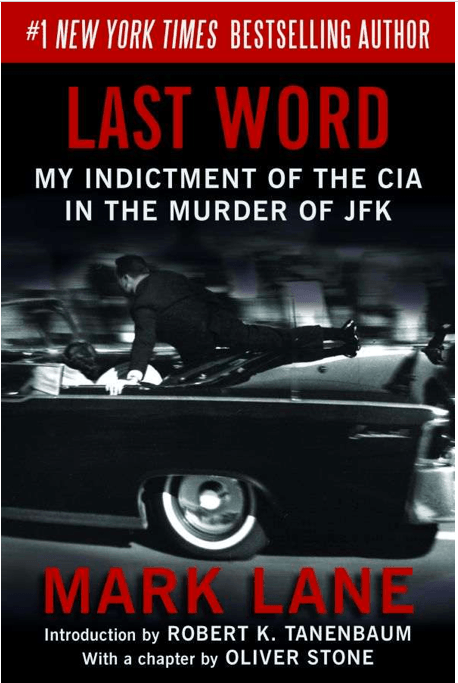
    Mark Lane

    Answering questions on a 2/4/2012 thread at the Education Forum Mark Lane said the following concerning Bush’s non-appearance in Rush to Judgement, the Hoover/Bush memo, and E Howard Hunt’s role that day.

    “No, I did not mention George Herbert Walker Bush in Rush to Judgment. I did report in Plausible Denial (pp. 329-33) the facts about Bush, the former director of the CIA and later president, and his suspicious engagement which demonstrates that he had been involved in the CIA before the assassination of President Kennedy — a statement that he falsely denied — as well as his likely involvement during 1961 with the CIA’s planned Bay of Pigs invasion. I was asked why I have not spoken much about that subject. I published it in full in the New York Times bestselling book, Plausible Denial, and I discussed it during lectures on the Kennedy Assassination. Since I was not asked by network TV to discuss anything in Plausible Denial, I did what I could.”

    Lane also commented on E Howard Hunt’s role. Note he does not back the idea of Hunt being a sniper. Or actually being in Dealey Plaza that day despite the Trento memorandum, Lane appears to believe it was a limited hangout.

    “I don’t know where Hunt and Sturgis were during the shooting, but I know they were in Dallas the day before the shooting helping to plan the operation. If they had any sense of self preservation, they got out of town before the shots were fired.”

    Now ain’t that a kick in the head for Hankey’s hypothesis all based on Lane’s book?

    Joseph McBride

    The Deep Politics Forum is a fascinating place with some crackling reseaerchers, including Joe McBride. McBride is a jouralist/author in the vein of the illustirous Jim Hougan. In The Dark Legacy of John Hankey I quoted the following from Joe:

    “Bush’s duties with the CIA in 1963 – whether he was an agent for example or merely an “asset” – cannot be determined from Hoover’s memo.”

    At the DPF I emailed Joe at the start of the year and asked him about Hankey’s use of the document that he (McBride) had unearthed. This is what he said in reply: “I have read the Hankey piece. It is bizarre what he has done with the information.”

    If you do not believe me John, contact Joe. I am sure he would love to hear about how after all the hard work he did identifying it as GHWB, that it was actually you who destroyed the idea of the memo not referring to him. Can you remember saying the following…

    “I will give myself props for destroying Bush’s claim that the memo did not refer to him.”

    Prop away John, prop, prop, prop away, and deny you ever said it.


    Part 2

    Part 3

    Part 4

  • Saint John Hunt, The Bonds of Secrecy


    The lives of CIA spouses and children often make for compelling reading. A good example being Frank Olson’s children and their quest for truth concerning the secrecy about his death. Not to mention the nature of his work. Ian Shapira of the Washington Post wrote an excellent article concerning sons and daughters of other deceased agents who were left wondering what Mum and Dad did for a buck. It is important, touching riveting stuff. Unfortuantely, such is not the case after reading Saint John Hunt’s book about the dubious confessions of his father in the JFK case. Bonds of Secrecy does not come close to be touching or riveting.

    For instance there are accounts from his sister Kevan and Lisa who have disowned Saint John Hunt and brother David (more about him later). Now, that would have made for a more credible tale. Hunt needed as a ghost writer a person ready to ride hard on Hunt’s tale (and tail). With that, the book could have been something of an underground hit. As it stands the original PDF book is merely poor; the Kindle version is a bloated, tacky and unappealing roadside attraction.

    During my time with CTKA, I have become dubious of books with elongated prefaces, forewords and introductions. These are usually included to give the book an air of credibility. They don’t work. And I don’t know anybody who follows CTKA who would find Doug Caddy a credible commentator. Jesse Ventura would also have been better advised to steer clear of the book. I also think these came as something of a letdown to Saint John Hunt. Despite the dubious and often contradictory information his work contains, the original flows pretty well and has an air of ‘take it or leave it’ to events.

    Conspirahypocrite Feeding Frenzy

    However, conspirahypocrites just cannot help themselves.

    In the Kindle edition, there are some 52 pages of fluff praising the dubious credibility of E. Howard Hunt’s story at the beginning. This is hyperbolic overkill. Ventura, while slightly more measured in his appraisal of E. Howard Hunt, like Caddy, seems to buy into the banal LBJ involved/kingpin thesis. As CTKA has proven many times over, the LBJ angle simply does not have a lot of credibility to it-at leasat not yet. So let us return to Mr. Caddy, who was briefly Howard Hunt lawyer at the time of Watergate. Caddy has also been active with an LBJ disinformation guru: He is Billy Sol Estes’ attorney. Thus it is no surprise he stumps for LBJ. Nor is it any revelation he endorses the myth of Hunt being a naive patriot betrayed during Watergate.

    Caddy admits to having worked for William F. Buckley in the founding of the Young Americans for Freedom. This was way back in the late fifties and early sixties, in his high school days. Caddy was the first National Director of the group, which had been founded on the Buckley estate in Connecticut. Caddy states that when he met Hunt at the Mullen Company in Washington, Hunt told him that Buckley had been a CIA agent under Hunt in Mexico City. This was after Buckley had graduated from Yale. This is not exactly accurate. For as HSCA investigator Dan Hardway discovered, Buckley was actually a CIA officer and he was at about Hunt’s level, not beleow him. According to Caddy, he was at the Mullen Company working the PR desk for General Foods, who he was a counsel for at the time. Then Robert Bennett bought the company. Bennett now became president, and Hunt became Vice-President. Bennett had been part of the Hughes Corporation account there. Considering what we know about Hughes at the time, this roughly means that the company was then being run by the CIA. Considering also, that, as even Caddy admits, Hunt never actually retired from the Agency as he said he did in 1970. Hunt also admitted his continuing employment to Canadian journaist David Giammarco when Giammarco was negotiating with Hunt to do a documentary about his life and possible involvement in the JFK case. That fact, of course, tells us much about Watergate. Since it was from the Mullen Company that Hunt then emigrated over to the White House to work with another “retired” CIA officer, James McCord, on the Plumbers Unit. Why a Vice-President of a major PR firm in Washington would do such a top to bottom transfer is anyone’s guess. Caddy then quit the Mullen Company and went to work for a Washington law firm that later represented Hunt. Caddy was then Hunt’s first lawyer when he was arrested for the Watergate break-in. Caddy actually writes that the hush money raised by Herbert Kalmbach for the Watergate defendants was somehow justified since Judge John Sirica was so biased against Caddy and the defendants.

    After Ventura’s short and Caddy’s very long prefaces, the thrid person involved with this book is Eric Hamburg, who reportedly helpd Hunt write the book. Eric used to work for Oliver Stone and ended up being a producer for the film Nixon. Hamburg later wrote the book based on his experience with Stone JFK, Nixon, Oliver Stone and Me. For his part, Hamburg decides to add many, many pages of his rather meandering musings in the Afterword. Adding this to the already sloppy 52 page start the book has, we have well over a hundred pages of well, what? Let us call it, to be kind, rather undistinguished material. We should also discount 11 pages of Saint John Hunt’s eulogy at his father’s funeral in Chapter Sixteen (this was the first Chapter in the original). Then throw out the two final chapters detailing Saint John Hunt’s opinions on “The Conspiracy” and “Watergate” (in both versions). The grand total of non narrative, which now includes, Ventura, Caddy, Hamburg and Saint John Hunt and his dealings with his father; amounts to well over 150 pages. This padding takes up just under half the Kindle book.

    Contradictions and Exagerations

    Oh Brother where art thou?

    Before I checked the inconsistencies between Saint John Hunt’s Rolling Stone interview and his book, I came across these comments he made about his brother David Hunt in Bonds of Secrecy.

    “Shipped off to live in Miami with his Godfather, the ex Bay of Pigs leader Manuel Artime, he quickly found solace and purpose in the glamorous life of a rich Miami cocaine dealer.”

    Later Saint John Hunt states:

    “Attorneys came and took David away. The only explanation they gave was that they (my father) felt it would be a better environment for him if he moved in with his godparents in Miami. This would prove to be a huge mistake; Miami would soon be the cocaine capital of the world, and David was right smack in the middle of it. He would be raised with few good influences and no real love.”

    Yet, in his reply to a piece by Carol J Williams, David takes offense at Williams’ depiction of his godparents.

    “Spin: I am a partner in a successful Los Angeles business and reside in Beverly Hills. The years I spent with my godfather and second family were some of the happiest and most loved times of my life. It sounds as if I was in some crazed military camp to make my involvement look suspect and desperate.”

    As it turns out he was also talking smack, at one point of his diatribe he says:

    “Unfortunately neither Austin nor Hollis were present during the interviews. This was a condition set by my father who kept his second family isolated from his previous life. It was an opportunity for a second chance. He had gotten out of jail, married an innocent civilian and spent his remaining 27 years trying to live a normal life.”

    The last refers to the fact that Hunt’s first wife Dorothy died in a famous plane crash during Watergate. Howard Hunt was then jailed. When he got out he remarried, and the childen he had with his seocnd wife were not nearly as aware of who he was as his older children. This whole E. Howard Hunt’s innocent second family ‘interefering constantly’ is also a constant theme in this book. However, Hunt keeping his former life secret from his second wife Laura is not really kosher. In an interview with Slate in 2004, Laura the ‘innocent’ certainly knew a few of E. Howard’s old mates (calling one notorious exile Felix Rodrieguez by his first name). And Howard had no problems discussing his background in front of her. Consider the following grisly detials about the murder of Che Guevara:

    “Hunt: I have no idea. But I talked with Felix about it. I said, “You were there when Che expired.” He said they had taken him into this room, and they shot him there and killed him. And they had kind of a medical examination table. They put his body on that and cut off his hands. They fooled around for a day or so before they disposed of the body. And that was done in a very sloppy fashion. The colonel had a shallow grave dug and his remains were dumped in there.

    Laura Hunt: [Interjects] For all we know, Felix [Rodriguez] did shoot him.”

    Thus for all this flipping and spinning, I would like to know what Dave thought a year later, when he read his brother’s book? Quite clearly Saint John Hunt was as ill-informed about his younger brother’s time with people like the rabid rightwing anti-Castro Cuban Manuel Artime. as was Carol J Williams who had conducted the interview. It gets even more peculiar though. David says he arranged the meeting and not only that, he praises Eric Hamburg, Hunt’s aforementioned ghost writer, for being the guiding light of the project.

    Papa was a Rolling Stone and Mum too

    One of the oddities about Hunt’s book is that it differs in content to the Rolling Stone interview he conducted in April of 1997. Let’s examine some of his comments in the magazine, starting with those about his Mum.

    “Saint John feels that he never got to know her. She told him that during World War II, she’d tracked Nazi money for the U.S. Treasury Department, and Saint John believes that early in her marriage to his father, she may have been in the CIA herself, “a contract agent, not officially listed.”

    But he isn’t sure about any of it, really.

    “In our family, everything was sort of like a mini-CIA,” he says. “Nothing was ever talked about, so we grew up with all of these walls, walls around my father, walls around my mother, walls around us kids, to protect and insulate us. You grow up not knowing what really happened. Like, who was my mom, for Christ’s sake? Was she a CIA agent? What was her life really like?”

    I think there is enough independent evidence to suggest Hunt’s first wife, may well have had agency connections. Thus, his testimony in his book about his mother’s intelligence ties is likely credible and interesting. However, rather than grab one’s curiosity as it should, it ridicules itself. If there were so many walls and the children so insulated, why did his parents expose him to so many dangers in the book? Were they truly that inept?

    “I remember one day when my mother and I went out for a ride on the horses, she told me that Papa was not actually working for a public relations company, but was really working for the Nixon White House, doing some secretive things that had her quite worried. She said that against her advice, he was going ahead with an operation that was being directed at the very highest levels of government. He was now so imbedded in this mess that she could not be sure of its operational security. There were men whom she didn’t trust. He had gotten in with people that weren’t themselves aware of what was required of them, professionally speaking. “Amateurs” she said angrily. “Your father, as smart as he is, can’t see the forest from the trees.”

    It’s amazing the recall Saint John Hunt has here, since the above was nowhere in the interview. Did his memory improve over time? Well probably not. Because when Hunt was employed by the PR firm the Mullen Company, he was not working for the Plumbers Unit at the White House. White House hatchet man Charles Colson and Bennett arranged that after constant lobbying by Bennett. Perhaps we can chalk this up to Saint John Hunt’s former life. The guy had a history as a drug abuser, including LSD, cocaine and meth—for the better part of his teenage and adult life. He actually dealt meth. Meth is notorious for causing brain damage and memory loss, in particularl after long term abuse. And don’t let it bother you either, that an intelligence professional, could call others ‘amateurs’ after blurting out details of a sensitive ongoing operation to her son.

    But it also calls into question the author’s credibility. His mother by all accounts in the aftermath of Watergate appeared to be an extremely competent individual. She also had no problem working with his Dad’s pals. The author skips the part where she helped organize the banquet in the Continental on the 26th of May, 1972. This banquet was disguised as a meeting for Ameritas Insurance and was a cover the first official break in of the Watergate. Which for whatever reason, was put off till the 17th of June , when Hunt’s father got caught (Jim Hougan, Secret Agenda, pg 140).

    Thus Saint John Hunt’s comments about his family in the build up up to Watergate, seem a bit off kilter. In the April 5, 2007 article in Rolling Stone he stated …

    “They had lots of marital problems, but when it came down to it, she had his back, and she could hang in there with the big dogs.”

    Yet, things get more dramatic in the book. Apparently, for all the ‘marital problems’ his parents rarely fought. Not only that, Dad left his spy gear and fake I.D’s lying around in the master bedroom.

    “I had heard them fighting at night and I wondered what this was about. My parents rarely fought. I was curious, and one day when they were gone, I snuck into their bedroom at the rear of the house and looked around. What I found was some ID’s with my fathers’ picture on it, but his name was not E. Howard Hunt. It was Edward J. Hamilton. I also found a reddish wig. This is the famous wig that my father was reported to have worn when he interviewed Dita Beard for John Mitchell, the attorney general of the United States.”

    My Dad the spy wasn’t the Best Parent

    In the Rolling Stone interview, Hunt’s portrayal of his father was generally that of a cruel, authoritarian person.

    “Like Saint John says, he never felt guilt about anything: “He was a complete self-centered WASP who saw himself as this blue blood from upstate New York. ‘I’m better than anybody because I’m white, Protestant and went to Brown, and since I’m in the CIA, I can do anything I want.’ Jew, nigger, Polack, wop — he used all those racial epithets. He was an elitist. He hated everybody.”

    In the interview he also recalls his father as ‘that fucker’ concerning his alibi the day of the assassination. The following essentialy says that Hunt lied under oath about where he was on the say of Kennedy’s murder. Hunt said he was putting together a Chinese dinner with his wife.

    “He was always looking at things like he was writing a novel; everything had to be just so glamorous and so exciting. He couldn’t even be bothered with his children. That’s not glamorous. James Bond doesn’t have children. So my dad in the kitchen? Chopping vegetables with his wife? I’m so sorry, but that would never happen. Ever. That fucker never did jack-squat like that. Ever.”

    Hunt also recounted for Rolling Stone how his father unnerved him when trying to get him into a high-class prep school St Andrews during a school dinner. At dinner near the school, Hunt refused to let his son go to the bathroom. And so he urinated on himself. This tale of humiliation does not make it into this book. Nor does Hunt’s tale to Rolling Stone of being sexually abused while at another school, St James. Apparently, his father E. Howard got wind of the evil deed, withdrew Saint John from the school and the teacher was never seen again. This was after Howard Hunt came to the place with with “a carload of guns”…

    The bogeyman presented in the Rolling Stone interview is near non-existent in Saint John’s book. In the previous article, the son said that Howard Hunt “was a mean-spirited person and an extremely cruel father.” But here, his portrayal throughout is that of a flawed, stern yet ultimately heroic person. On page two of the PDF version Hunt writes

    “HOW CAN I EXPLAIN A LOVE SO POWERFUL AND TRUE THE MAN THAT I HAVE TRIED TO BE IS THE MAN I SEE IN YOU.”Sure it is bad form to talk ill of the dead, but Hunt’s dramatic turn around, after Rolling Stone makes one a bit skeptical.

    Howard Hunt and his Assassination Confession

    Another issue brought up in the Rolling Stone interview, was Howard Hunt’s interactions with Kevin Costner. The story pumped by the Hunt brothers since, is that after Costner offered Hunt five million dollars, he then insulted and harassed Howard Hunt. And then, although the five million was stil floating around, Costner lowered the offer to a hundred dollars per day for his time. Saint John found that insulting and he turned down Costner. Yet, the story presented in Rolling Stone by Saint John is incomplete.

    The man reallly responsible for Hunt’s rather dilatory attempt to make a clean breast of whatever his role was in the JFK case was not really Costner. It was not really Saint John. It was David Giammarco. Since the late eighties, the Canadian journalist had an interest in the JFK case. And he had interviewed several people about the matter. He eventuallly got around to Howard Hunt. Like a good journalist, he tried to cultivate a trusting relationship with Hunt. He talked to him on many, many occassions. He often flew down to Miami to do so. In conversations with Jim DiEugenio, David said that he really got into a very interesting and revealing friendship with Hunt. This did not happen over a matter of months. It took over several years to do so. Inevitably, Hunt talked to him about President Kennedy and Bobby Kennedy. He despised them both. Hunt was very bitter about the Bay of Pigs. He once said about President Kennedy in that regard, “JFK, may he rest in pieces.”

    Over time, Giammarco got around to asking Hunt about his possible role in the JFK case. For which there is some interesting evidence. Since Giammarco was pals with Costner, the actor suggested doing a documentary on the topic. Hunt seemed interested at first. Costner and Giammarco said things would be OK as long as everyone kept it secret and Hunt agreed to talk on camera about what he knew about the Kennedy assassination. But then, in 2002, Hunt seemed to back track on the idea. Both Costner and Giammarco were surprised. But the journalist persisted in talking to the spy. And Hunt relented. Hunt would do three interviews. One in Miami, one in Los Angeles and one in Dallas, in Dealey Plaza. Hunt told Giammarco about the outline of a plot led by Lyndon Johnson. It then extended down to CIA officer Cord Meyer. The project would be run out of London. The plotters included William Harvey, David Phillips, Dave Morales, Frank Strugis , Tony Veciana, and Lucien Sarti as the main assassin. Sarti was firing from a storm drain. It was now informally agreed that the three-Costner, Giammarco and Hunt-would be equal partners in a documentary. Once the project was sold, they would all share in whatever money it fetched.

    The problem was twofold. First, Hunt told his attorney about the proposal. He and his lawyer now prepared a lenghty counter offer. Secondly, Hunt wanted to be paid a quarter million in advance. As far as Giammarco and Costner were concerned, this was a no-no. Because it would look like they were practicing checkbook journalism. And that would impact the credibility of the documentary. Further, Hunt wanted the funds mailed to a Swiss bank account. And he wanted 24 hour security protection before and after the documentary aired for an indefinite time. Again, Giammarco and Costner both did not want to advance the funds since it would look like they were paying for the information. As the project began to collapse, Hunt now began to discount what he knew about the conspiracy. He even said that perhaps he should novelize it.

    There is much controversy about not just what happened with the project, but also about the contents of what Hunt actuallly says happened. Giammarco told DiEugenio that he always felt that Hunt was not telling him the whole story. Which shows good insight on Giammarco’s part. Hunt was always involved with the action oriented part of the Agency. Whereas Meyer was really a propaganda specialist. Since the fifties and the CIA coup in Guatemala, Hunt had worked with people like Tracy Barnes, Phillips, and Director Allen Dulles. This carried down to the Bay of Pigs. Since Hunt spoke fluent Spanish, he was responsible for constructing the CIA’s government in exile. When Kennedy insisted on making Manuelo Ray part of that group, Hunt resigned. Ray was too liberal for Hunt, who was extremely conservative. But, as Jim DiEugenio shows in his book, Destiny Betrayed, the Second Edition, Hunt was supposed to return if the project succeeded! Therefore, he would be part of putting together the new Cuban government. And further, the CIA had secret plans to make sure Ray would not be part of it. Hunt and the Agency would put in power their favorites, like Artime. And, in fact, Operation Forty included an assassination mechanism to not just get rid of the present Cuban governmnet, but also any moderates and liberals that Kennedy wanted in power. (See DiEugenio, Chapter 3, “Bay of Pigs: Kennedy vs. Dulles.” This is probably the best short treatment of that affair in book form.)

    After the project capsized, Hunt then worked for Dulles. In two ways. To defend him against the investigation in the White House led by General Maxwell Taylor. And to ghost write the Dulles book, The Craft of Intelligence. Hunt was then detailed to the DOD, Domestic Operations Division, run initially be Barnes. Which, of course, the CIA was not supposed to be doing. Since their charter prohibits operating on the homefront. It appears that Clay Shaw was also cleared to work in this division. Victor Marchetti said that DOD was “into some very bizarre things.” So bizarre that Marchetti did not want to artiuclate them. (DiEugenio, p. 166)

    And then, of course, there is the whole Angleton/Hunt memroandum episode. This was a memo written by Angleton to Richard Helms in 1966. It said that they needed to consturct an albi for Hunt since he was in Dallas on the day of Kennedy’s murder. (ibid, p. 363) As it turned out, when Hunt sued over this story, it turns out he actually did not have an alibi for where he was on the day of the assassination. (ibid) Therefore, for Hunt to say, as he did in his so-called confession, that Sturgis asked him if he wanted to be part of the plot, that seems both self-serving and illogical. If anyone was going to ask anyone, it would be the other way around. As Hunt recurited Cubans for Watergate. One of them being Sturgis.

    Watergate Ramblings

    For a time Jim Hougan, and his book Secret Agenda, was the essential tome in understanding, or at least grasping, some of the fallout from Watergate. It was that book that first brought into question who Hunt and Jim McCord were really working for while with the Plumbers Unit in the White House. It also exposed them both as lying when they said they did not know each other prior to that assignment. And it raised the ultimate question about the whole affair: Were Hunt and McCord deliberately sabotaging the Plumbers the night of the break-in? Was the goal to really topple Nixon? And is this why McCord threatened the White House in December of 1972? He wrote Jack Caufield that if President Nixon fired CIA Director Helms, and if Nixon tried to blmae the CIA for Watergate, “every tree in the forest will fall. It will be a scorched desert. The whole matter is at the precipice right now … if they want it to blow, they are on exactly the right course.” McCord was offered money and executive clemency if he would plead guilty and stay quiet. He refused the offer. Nixon then did fire Helms.

    A month later, McCord wrote his letter to Judge John Sirica. He said that perjury had been committed in his court room. Witnesses testified under pressure and duress. In a meeting with Sirica, McCord said that the witnesses and defendants lied at the behest of the White House, specifically Attorney General John Mitchell and White House counsel John Dean. McCord said that although the Cubans, recruited by Hunt, may think that the CIA had something to do with Watergate, the Agency really did not. It was this act which exploded the Watergate affair just when it was about to go gently into the night. As Hougan writes in his wonderful book, there was something peculiar about McCord working for the Committee to Re-elect the President (CREEP). In his office, he did not have a photo of Nixon on the wall. He had a picture of Helms there. It was signed “With the deepest affection.” Further, McCord worked the security detail at Langley. He was known as a first rate, black bag man. That is, he was good at secretly breaking into places. Yet, it was McCord who acually retaped the door after the security guard first removed the tape on it. It was that inexplicable act which guaranteed the break-in would be discovered and the police would be called. When people in the CIA heard about what McCord did, they understood something was up. Someone that good would not do something that stupid. Hence the title of Hougan’s revolutionary book, Secret Agenda. And in that fine book, Hougan also accuses Hunt of being part of the secret Helms operation inside the Plumbers.

    Now, in the Rolling Stone article, Saint John says that his father retired from the CIA some time after the Bay of Pigs. He then went ahead and joined the Plumbers Unit at the White House. That summary does not seem to jibe with what Hougan dug up about Hunt through his research. Or what Hunt told Giammarco. Hunt appears to be employed by the Agency throughout this time period. Which, combined with what we have learned about McCord, makes a strong case that neither McCord nor Hunt was really working for either CREEP or Nixon at the time of the Watergate break-in. In the Rolling Stone article, the son has the father waking him up in the middle of the night after the Watergate break-in. Howard then has him help him throw some bugging and surveillance equipment into the C & O Canal near the Potomac River. The point though is that in Hougans’s book he has Hunt taking this stuff to McCord’s house, since it was his equipment. In the article, the son says that Hunt did all this because he had botched the break-in. Which, as we have seen, is a highly debateable point. Neither McCord’s nor Hunt’s bizarre actions that night were ever explored by the Senate Committee led by Sam Ervin, or the Watergate prosecution led by Leon Jaworksi. The CIA connections to the crime were not explored until the Pike Committee was disbanded in the House of Representatives. Later, congressman Lucien Nedzi did do an inquiry into CIA participation in Watergate. This helped form the basis for Hougan’s work. So based on Hougan’s book, maybe Hunt should have made a confession about Watergate instead of the JFK assassination.

    However, as big a fan as I am of Jim’s investigative work, it had the misfortune of examining multiple threads in a confused Watergate quagmire. Some of which were dead ends. For example, it was many years after Hougan’s book came out, that Mark Felt was named as the near mythical ‘Deep Throat’. While Hougan hit on a lot of interesting information, with regards to call girl rings, it appears that ultimately that part of the story only had legs in it’s initial phases. Yet it did not really pan out regarding John Dean and his wife. As Jim DiEugenio explained in an e-mail in March of this year.

    “When they went to court, Philip Bailey ended up being a poor witness. And that whole call girl angle ended up being very questionable. Today, I think its the worst part of Hougan’s book.

    What they appeared to want out of Spencer Oliver’s desk was his strategy for stopping McGovern. He was the guy in charge of that effort. This is new stuff that Bob Parry dug up.

    What they wanted from O’Brien was anything they could get on him because of Hughes to negate any thing they would try to connect Hughes to Nixon with.”

    Consortium News Journalists Robert Parry and Lisa Pease have slightly different appraisals, needless to say. Watergate is a complex business and the truth of the matter lies somewhere between these the musings of Hougan, DiEugenio, Parry and Pease, all of them skilled researchers. Yet none of their intelligent analysis is found anywhere in the pages of Hunt’s Kindle book (bar some quotes from Hougan). So I discourage anyone from going to Bonds of Secrecy for any lessons on Watergate. (Hougan is reportedly working on a sequel to his book focused on the call girl ring and John Dean. So this may not be the last word on that issue.)

    United Airlines Flight 533

    The United Airlines flight 533, in December 1972 was a tragic air accident that claimed the life of Dorothy Hunt, among with over forty others. It is a matter of some debate as to what really happened. Dorothy was carrying thousands of dollars with her as she was in the process of paying money to certain witnesses to stay quiet. Needless to say I find little, if anything, Saint John or his buddies say about it as credible. What’s interesting is that Hunt apparently had his wife take out 250,000 dollars worth of flight insurance payable to E. Howard Hunt.

    It is also interesting to note that, as mentioned previously, it appears Dorothy was CIA (one of the few verifiable and relevant observations in the book). Hunt Junior believes his mother was killed by the Nixon administration. Now, this line was pushed by the late Sherman Skolnick for years, and to the author’s credit, he doesn’t go there. Skolnick shot the line that the reason for Dorothy Hunt’s being eliminated was due to information she had about Nixon’s role in plotting the Kennedy assassination. Which, if Hunt’s confession is true, Nixon had no part in. Skolnick was capable of some good work. However his stuff on Watergate, and the airline crash is a little dated now. For instance, Sherman wrote that Dorothy had over 2 million dollars in her suitcase. Everyone else says it was more like ten grand.

    So much has been made of this crash. Hougan believes something suspicious could have happened. So did Carl Ogelsby. Jim DiEugenio believes it was likely a fluke. I have to say I do not know. I lean on the side of something dodgy myself. Charles Colson stated to Time in the 1974, article “Colson’s Weird Scenario” that he felt the CIA and Hunt where behind it. Unsurprisingly, the official version via Time was that Colson was covering for Nixon and blaming the agency. A good debate as to whether or not Nixon felt like a scapegoat of the agency, is not present in this book. Although there was no sign of sabotage found, and the communications were recovered, there was some interesting maneuvering after the crash. White House aide Egil Krogh was made Undersecretary of Transportation. Alexander Butterfield, another White house aide, became the new chief of the FAA. Dwight Chapin, Nixon’s appointments secretary became a top executive with United Airlines.

    None of this makes it anywhere in this book. Which, as said, goes out of its way to try selling the line of the loyal American Cold Warrior. Except he was sold out by the leaders of his country whom he served. This lame sentiment is shared by the famous William F Buckley Jr, a close friend of E Howard and one time cohort of his at the CIA. Buckley was hanging around Hunt and his family in the aftermath of Watergate and the tragedy. Yet, of course, this sort of fascinating detail is nowhere in this book. Was Buckley babysitting Hunt fo rhsi former employer? If so, why?

    Conclusion

    Near the end, in an attempt to establish credibility, Hunt and Hamburg go for a Peter Scott style enigma ending i.e. of there being multiple conspiracies to do away with Kennedy. The point of this concept is, of course, that somehow LBJ’s plot worked. Or did they all spontaneously collude on the day? This is what I cannot fathom about the concept of a JFK pot pourri assassination. Is it too abstract for people to realize that Kennedy had many enemies and that the assassins took advantage of this, and coordinated a centralized and highly organized strike? Would Hunt’s superiors Dulles, Angleton and Helms have allowed such a mess? Doubtful, however the lame “LBJ did it with Nixon” is the sort of story to the conspiracy that they would have covered it up with.

    E Howard Hunt, was one of the most cynical and streetwise guys to have ever worked the US intelligence beat. To turn him into some kind of ‘cult’ intelligence hero, betrayed by those on top does not seem to wash. The people who ran Howard Hunt, were ostensibly individuals like Dulles, Helms Barnes, and to a much lesser extent, Angleton. You won’t hear much of that in either his or his son’s books. In fact in his book Undercover, which was the autobiography Hunt wrote after Watergate, Hunt more or less skipped the years from 1962-64. This current lame effort is just another of the many weak treatises out there at this time. Saint John Hunt’s book is not credible enough to give any decent review about. Indeed, I have discussed his lack of credibility before in four essays prior to this one.

    Alex Jones on the Kennedy Murder: A Painful Case (part 1)

    Alex Jones on the Kennedy Murder: A Painful Case (part 2)

    Jesse Ventura’s Conspiracy Theory on JFK

    Evaluating the Case against Lyndon Johnson

    It could have been much better with more careful handling and judgement. Hunt’s life, in the wake of the tragedies that engulfed his family, his downward spiral and his kicking meth (something, I respect him for), all these elements had the potential to be an interesting and moving narrative. Everybody likes the story of a rogue making good. Even more interesting would be getting verified accounts of his parents, then using the Kennedy assassination and Watergate to serve as backdrops. What, for example, did his Mum and Sisters make of JFK or Bobby Kennedy? In the early days after the Rolling Stone article appeared, it appears that he and his brother actually had a good deal of skepticism towards what their father had told him about the mechanics of the assassination.

    What happened to that skepticism? Possibly a movie deal with someone less scrupulous than Costner tempted him? As stated above, Hunt’s personal story, with some good supplementary research about his father and mother, could have been politically interesting and personally compelling. But as noted above, it didn’t come out that way.

  • Mark Lane, Last Word: My Indictment Of The CIA In The Murder of JFK

    Mark Lane, Last Word: My Indictment Of The CIA In The Murder of JFK


    I want to begin this review by stating that I have a huge a mount of respect for Mark Lane. As a lawyer of over fifty years Lane has an undeniable history of looking out for the little guy. He represented numerous African Americans in civil rights cases in the south and was arrested for opposing segregation as a “Freedom rider”. He has been a dedicated antiwar protester and during his term as a New York State Legislator he worked to abolish capital punishment. Lane represented the American Indian Movement at the Wounded Knee Trial and helped establish the rights of women to bring actions for sexual harassment. Even Vincent Bugliosi admitted that Lane’s “bona fides as a skilled and dedicated soldier in the fight for civil liberties” are “unquestioned”. (Reclaiming History, p. 1011)

    Perhaps more relevant to this review, Lane was one of very few prominent citizens speaking out on Lee Harvey Oswald’s behalf in 1963, and within weeks of Oswald’s murder at Dallas Police HQ he had the courage to pen a defense brief for the alleged assassin. At Marguerite Oswald’s request he attempted to represent her son’s interests before the Warren Commission and after the request was denied he testified before the commission and shared details he had uncovered during his own investigation of the assassination. His first book on the subject, Rush to Judgement, was a devastating critique of the Warren report that undermined all of the commission’s central conclusions. Lane gave numerous lectures on the assassination, and assisted New Orleans District Attorney Jim Garrison during his much maligned investigation and prosecution of Clay Shaw. He played a key role in establishing the House Select Committee on Assassinations and faced E. Howard Hunt in court where he presented evidence of CIA complicity in the assassination before the jury.

    By any standards, Lane’s resume is impressive, and as I stated above, I have a great deal of respect for the man. So it is with heavy heart that I must say his latest and most likely his last book on the murder of JFK, Last Word, is—for me at least—a little disappointing. In nearly 300 pages he presents little that is really new. And he gives the impression of being largely unaware of some of the more interesting research published in the years since the Assassination Records Review Board (ARRB) pried open thousands of crucial documents from the hands of US intelligence agencies. Somewhat surprisingly the book is, at times, awkwardly written and poorly edited; there are numerous typographical errors, there is no index, and worst of all, the book is poorly sourced. In fact, there are times when the author makes controversial statements for which he offers no citation at all. In no way do I mean to suggest the book is without merit; Lane offers many interesting facts, insights and anecdotes; and his ultra sharp wit is very much in evidence throughout the text. But if this is truly to be his “Last word” on the subject, I can’t help wishing it had been a little more substantial.

    I

    Last Word is divided into five books; the most interesting of which is, for my money, book two: “The Media Response”. Part of what makes it interesting is that Lane takes the opportunity to hit back at some of his critics and exposes some of the lies that have been spread about him and his work on the assassination. Mark lane is, after all, the man Warren Commission apologists love to hate and with the exception of the late great Jim Garrison, no commission critic has suffered as many baseless personal attacks as Lane. For example, in his mammoth waste of paper, Reclaiming History, Vincent Bugliosi spends an entire chapter attempting to undermine and discredit Lane and his brilliant book, Rush To Judgement. But despite spending twelve fun-filled pages employing every smear tactic available, Bugliosi never actually gets around to pointing out any of the “distortions or outright fabrications” he claims are in the book. The closest he comes is this:

    Lane was so bold and blatant in distorting the truth that he even gives citations to the Warren Commission volumes that he knows directly contradict his own arguments. For instance, he states that the Warren Commission’s firearms experts were unable to duplicate on the range what Oswald had done. “none of them,” he says, “struck the enlarged head or neck on the target even once.” But an examination of the citations given by Lane himself (Commission Exhibit Nos. 582 to 584, Warren Commission volume 17, pages 261 to 262) shows two hits were scored on the head. (Reclaiming History, p. 1005)

    But the distortion of truth is Bugliosi’s not Lane’s.

    Knowing that Oswald was a poor shot, the Warren Commission made it clear that it believed he had been able to pull off the assassination by utilizing the telescopic sight on his cheap mail-ordered rifle. In that regard and under the heading “The Nature of the Shots”, the commission’s report quotes FBI firearms expert Robert Frazier as stating that “when you shoot at 175 feet or 260 feet, which is less than 100 yards, with a telescopic sight, you should not have any difficulty in hitting your target…I mean it requires no training at all to shoot a weapon with a telescopic sight once you know that you must put the crosshairs on the target and that is all that is necessary” [my emphasis](Warren Report p. 190) The above passage and subsequent ones make it clear that the commission attributed to Oswald the use of the scope. In fact, the report even goes as far as to suggest that a defect in the scope “was one which would have assisted the assassin aiming at a target which was moving away”! (p. 194) With this in mind, the reader is invited to check Commission Exhibits 582 and 584 for themselves. They will see that the two head shots were scored by using the iron sights and not the defective scope, which means that Lane was correct; none of the expert riflemen had duplicated Oswald’s alleged feat.

    Lane turns the tables on Bugliosi, writing that his “book, page after page, swarms with hundreds of demonstrably inaccurate assurances”, (Last Word, p. 143) and unlike Bugliosi he actually provides instances that support his contention. For example, Bugliosi claims that in a taped telephone conversation with Helen Markham, the Warren Commission’s star witness to the murder of J.D. Tippit, Lane had identified himself “as Captain Fritz of the Dallas Police Department” before making a “blatant attempt to improperly influence, almost force an uneducated and unsophisticated witness to say what he wanted her to say.” (Reclaiming History, pgs. 1006 & 1009) As Lane makes clear, this is simply not true, and Bugliosi had to know it. Firstly, the transcript of the telephone conversation to which Bugliosi makes reference begins, “My name is Mr. Lane. I’m an attorney investigating the Oswald case.” And secondly, “The statement that I tried to put words into Markham’s mouth, an original Bugliosi fabrication, is belied by a review of the facts. Since Markham had told reporters, long before I had spoken with her, that the man she had seen shoot Tippit was ‘short’ (Oswald was not short) that he was “stocky” (Oswald was thin) and that he had “bushy hair” (Oswald had thinning hair and a receding hairline), I called her to discuss her original description. She in part conceded the accuracy of her original assessment of the shooter and in part rejected it. The original words were hers, not mine, as Bugliosi knew but declined to reveal.” (Lane p. 148) Bugliosi also omitted the fact that this description of Tippit’s killer is similar to the initial description given to Dallas police officer Gerald Hill: “5’8”, 160 pounds, wearing a jacket, a light shirt, dark trousers, and sort of bushy brown hair [my emphasis]. (7H47)

    Lane also defends himself against the unscrupulous attacks made by another high profile defender of the official fairy tale, Max Holland. Back in 2006, Holland took us all back in time when he attempted to undermine Lane’s research in the pages of The Nation by dragging out the tried and true (and slightly outdated) “commie smear” tactic. Holland as we all know, and as Lane points out, is little more than a mouthpiece for the CIA who regularly writes articles for the official CIA website “supporting and defending the CIA and attacking those who dare to disagree”. (Lane p. 112) For his 2006 piece titled “The JFK Lawyers’ Conspiracy”, Holland stated that the KGB was secretly funding Lane when he researched and lectured on the assassination and wrote his best-selling book, Rush to Judgment. As Lane wrote in a letter to The Nation, “It was secret all right. It never happened…No one ever made a sizeable contribution with the exception of Corliss Lamont who contributed enough for me to fly one time from New York to Dallas to interview an eyewitness. The second largest contribution was $50.00 given to me by Woody Allen.” (p. 111) When Lane made it clear that he had kept records of all contributions, Holland suggested, somewhat desperately, that the money could have been given in very small amounts. “Perhaps”, Lane sardonically replies, “when I was discussing the case each night for months from the stage of a small theater in New York, a couple of hundred Russian agents, wearing long leather coats, slipped in unnoticed and each paid a dollar for admission.” (p. 94)

    Holland comes under additional fire in a chapter contributed by Oliver Stone in which the film maker responds to Holland’s claim that the KGB was behind the 1967 Paese Sera story naming Clay Shaw as a board member of Centro Mondiale Comerciale—an organization that had been booted out of Italy amid charges that it was front for the CIA. Holland argues laughably in his article, The Lie that Linked the CIA to the Kennedy Assassination, that it was the Paese Sera articles that led Jim Garrison to believe the CIA was behind the assassination and that the whole thing was the result of a KGB disinformation scheme. But Holland’s silly story falls flat on both counts. Firstly, the entire claim that the KGB was behind it all rests on one handwritten note by KGB defector Vasili Mitrokhin referring to a disinformation scheme that resulted in the publication of a false story in New York. “The note”, Stone writes, “supposedly summarizing a KGB document that Holland has never seen, does not mention Clay Shaw, Centro Mondiale Comerciale, Jim Garrison, or any specific New York publication.” And secondly, “Garrison’s book On the Trail of the Assassins describes in detail how his uncovering of various pieces of evidence actually led him to the conclusion that the CIA was involved.” His suspicions of Agency involvement began when he investigated—among other things—Oswald’s background, his associations with CIA-connected people like David Ferrie and George De Mohrenschildt, and discovered “the fact that Oswald was working out of an office that was running the CIA’s local training camp for Operation Mongoose…No doubt the Paese Sera series was another piece of the puzzle for Garrison, but it was not the centerpiece of his thinking that Holland makes it out to be.”(pgs. 73-75)

    On the subject of Jim Garrison, Lane relates an intriguing story that seriously undermines the conventional view that Bobby Kennedy saw no value in Garrison’s investigation. It is usually said that once Garrison’s probe became public, RFK had dispatched Walter Sheridan to New Orleans to see if there was any substance to his charges and that Sheridan had quickly reported back that Garrison was a “fraud.” We are usually told that Kennedy accepted Sheridan’s assessment and author Joan Mellen even goes so far as to charge that “Bobby Kennedy did everything he could to stop Jim Garrison” and that “Destroying Garrison’s investigation became Bobby’s obsession.” (A Farewell to Justice, pgs. 259, 382) However, Lane writes that one evening in 1968 over drinks in New Orleans’ famous French quarter Garrison confided that Kennedy had sent him a message through a mutual friend. “He said ‘Keep up the good work. I support you and when I’m president I am going to blow the whole thing wide open.’” (Lane, p. 42) Garrison had expressed concern that by telling people in private what he planned to do, RFK was putting his life in danger and reasoned that he would be safer if he announced his intentions publicly. Two days later the mutual friend relayed that Bobby had thought it over and decided that if he won the California primary he would go public with his doubts about the official verdict. Kennedy did, of course, win the primary, but he did not live long enough to call for a new investigation.

    II

    As someone who has long found the official investigations of the Kennedy assassination almost as interesting as the assassination itself, I very much enjoyed reading Lane’s somewhat egocentric recollection of the formation and early days of the House Select Committee on Assassinations (HSCA). In contrast to the Warren Commission, which we all know by now began with its lone assassin/no conspiracy conclusion already firmly in place, the HSCA had the potential to conduct a genuine investigation that might well have uncovered the true facts of the case. But powerful forces in Washington stood in its way.

    In 1975, Lane writes, he moved to Washington, D.C., to organize 180 chapters of the “Citizen’s Commission of Inquiry” whose purpose was to urge congress to conduct a new investigation of the assassination and its subsequent cover-up. Whilst continuing to lecture on the subject he prepared a resolution calling for the establishment of a Select Committee and began calling upon members of the House of Representatives for their support. A year later, with over one hundred congressional sponsors and over a million letters, telegrams and signatures on petitions sent to members of congress, the resolution was set for a vote. According to Lane, when the bill passed, Representative Don Edwards looked at him and remarked, “This should be called the Mark lane resolution.” (Last Word, p. 215) Once the HSCA was authorized and given a down payment for its budget, members of the committee suggested he take the job of Chief Counsel. “I said that even I would object”, Lane writes, “since my objectivity had long since evaporated in view of the undeniable evidence.” (p. 216)

    Eventually, a brilliant and respected Philadelphia prosecutor named Richard Sprague was chosen for the job. As committee investigator Gaeton Fonzi writes, “Sprague had run up a record of 69 homicide convictions out of 70 prosecutions, and he was known as tough, tenacious and independent. There was absolutely no doubt in my mind when I heard of Sprague’s appointment that the Kennedy assassination would finally get what it needed: a no-holds barred, honest investigation. Which just goes to show how ignorant of the ways of Washington both Sprague and I were.” (The Last Investigation, p. 176) Sprague chose as his Deputy Chief Counsel a veteran homicide attorney from the New York District Attorney’s Office named Robert K. Tanenbaum who was, according to Fonzi, “the epitome of the quick-thinking, fast-talking prosecutor.” (p. 179) As Lane puts it, “he had a fine reputation…Both Sprague and Tanenbaum were honest, intelligent and skillful lawyers committed to learning the truth.” (Last Word, pgs. 220-221) Indeed it was the skill, integrity and dedication of both men that would put them off the committee before its work had truly begun.

    Sprague had made it obvious that he wanted to conduct an honest and independent investigation that would uncover the truth—whatever that may be. He knew that he could not rely on the same agencies that the Warren Commission had (i.e. the FBI and the CIA) as his investigators, since those very agencies might themselves be under suspicion. So he insisted on hiring his own investigators. Pretty quickly the CIA began stonewalling the Committee’s requests for information—especially those relating to Lee Harvey Oswald’s alleged Mexico City sojourn—and insisting that Sprague sign a secrecy agreement which he refused to do, asking how he could “possibly sign an agreement with an agency I’m supposed to be investigating.” (p. 217) Instead, Sprague responded that he would subpoena the CIA for all relevant materials. What followed, predictably enough, was a media smear-campaign led by Agency assets that essentially resulted in congress refusing to reauthorize the committee until Sprague was removed. As Fonzi writes, “Sprague had early on offered to resign if it meant the difference in keeping the Committee alive” and near midnight of the evening before the House vote, “Sprague realized that…the ground was being shoveled out from beneath him.” Thinking it was the only way to save the committee, he called his secretary and dictated a two-sentence letter of resignation. (Fonzi, p. 194) Tanenbaum followed shortly after.

    Sprague’s replacement as Committee Chief Counsel, G. Robert Blakey, was fairly contrary to him. A 41-year-old law professor who, as he admitted to Tanenbaum, had never tried a case, Blakey knew exactly what was expected of him in Washington, since he had worked on previous Congressional committees. In his first address to the Committee staff, Blakey made it clear that their top priority was not to conduct a criminal investigation, it was to produce a report on time and within budget. Blakey had promised that the Committee would produce a report by December 31, 1978, and he informed the staff that there was no chance the committee would be extended beyond that deadline. As Fonzi recalled, “with that pronouncement, I got a revealing insight into Bob Blakey’s character…He saw nothing incongruous in accepting a basic and crucial limitation to conducting ‘a full and complete investigation’ of one of the most important events in this country’s history.” (Ibid, p. 210) Blakey also had no problem with signing (and insisting that staff members sign) a secrecy agreement before being given access to CIA documents. Nor with sealing the Committee’s voluminous files so that they would be kept from public scrutiny for 50 years. As Lane puts it, “Blakey relied upon the judgment of the CIA and the FBI, who placed their operatives on his staff and who provided only those documents that they wanted the Congress to see. The congressional committee had been captured.” (Lane, p. 232)

    In composing his report, Blakey placed a great deal of importance on the scientific evidence—trajectory analysis, ballistics comparison, medical studies etc.— and insisted that it proved Oswald’s guilt. But the linchpin of his case, the Neutron Activation Analysis of the ballistics evidence, has since been proven to be so unreliable that the FBI has abandoned its usage in court. In fact, even Blakey now refers to the HSCA’s NAA analysis as “junk science”. But perhaps his biggest folly was trusting the CIA and allowing it to appoint career Agency man George Joannides as its liaison to the Committee. In 1978, when he was assigned to the HSCA, Joannides was allegedly retired. But in November of 1963 he was serving as chief of psychological warfare operations in the CIA’s Miami station and his main job was to provide funds and support for to the anti-Castro group “Directorio Revolucionario Estudiantil” (DRE). As journalist Jefferson Morley explains, by 1962, “the DRE was perhaps the single biggest and most active organization opposing Fidel Castro’s regime. In Miami, Joannides was giving the leaders of the group up to $25,000 a month in cash for what he described as ‘intelligence collection’ and ‘propaganda.’” (Morley, The Man Who Didn’t Talk and Other Tales from the New Kennedy Assassination Files) In August 1963, the New Orleans chapter of the DRE had a number of very public run-ins with Lee Harvey Oswald. After Oswald offered to help train DRE commandos, “the DRE boys saw him on a street corner passing out pamphlets for the Fair Play for Cuba Committee (FPCC), a notoriously pro-Castro group”. (ibid.) DRE spokesman Carlos Bringuier rushed to the scene to confront him in what a police officer would later describe as a “staged event”, and later visited Oswald’s home before debating him on a local radio program.

    As Lane explains, “Almost immediately after the shots were fired in Dallas, the Joannides-guided group launched a media campaign to connect Fidel Castro to the murder…One DRE leader called Clair Booth Luce and assured her that the directorate knew Oswald was part of a Cuban hit team organized by Castro…Thus it was the CIA and Joannides that paid for, organized and published the very first conspiracy theory about the assassination”. (Lane, p. 234) When documents released by the ARRB in 1998 revealed Joannides’ secret activities with the DRE, Blakey claimed to be outraged stating that had he known of Joannides’ role he would have been “interrogated under oath by the staff or the committee”. But, in light of his past actions, Lane finds this more than a little hard to swallow. He also poses the question of whether or not Blakey is merely playing dumb. Did he know all along who he was dealing with? Or was Blakey “so inept an investigator that he could not even discover who was his own main source?” The HSCA reported that it had not have been able to identify the second gunman or “the extent of the conspiracy” but as Lane points out Blakey was somehow “able to state with absolute authority that he knew who” was not involved when he “declared that the CIA and the FBI were innocent.” As Lane concludes, it appears that Blakey “met his commitment to those who hired him”. (p. 235)

    III

    When it comes time to address Oswald’s alleged visit to Mexico City in September, 1963, I believe Lane ultimately drops the ball. He correctly points to many crucial holes in the official story and casts understandable doubt on the notion that Oswald ever made the trip. But he seems to misunderstand the motivations of those who engineered the whole episode and mischaracterizes the effect it had in Washington and how it ultimately led to a cover-up.

    The official version of events, as laid out in the Warren Report, has Oswald leaving New Orleans for Mexico City on September 25, 1963, and arriving on September 27, 1963. Soon after his arrival, the Commission said, he visited the Cuban Embassy to apply for a visa to visit Cuba on his way to Russia. But he was told that the he could not get a Cuban visa until he had received one from the Soviets and this would take several months. At that point, “Oswald became greatly agitated, and although he later unsuccessfully attempted to obtain a Soviet visa at the Soviet Embassy in Mexico City, he insisted that he was entitled to the Cuban visa because of his background, partisanship, and personal activities on behalf of the Cuban movement.” Oswald got into a loud and memorable argument with the consul who continued to refuse him a visa and remarked that far from helping the Cuban Revolution, Oswald “was doing it harm.” “Disillusioned”, Oswald left Mexico City and made his way back to Texas. At least, that was the version Earl Warren put in his report. Behind closed doors, a different story was being told.

    On the very weekend of assassination, the White House was receiving reports from the CIA’s Mexico City station about Oswald’s activities in Mexico City. In this version of events, when Oswald had called the Russian embassy, he had asked to speak to “comrade Kostin,” a codename for Valery V. Kostikov who, according to the CIA, was a KGB officer responsible for carrying out assassinations in the Western Hemisphere. This was quickly followed on Monday, November 25, by a cablegram asserting that CIA station chief Winston Scott had uncovered evidence that Castro, with possible Soviet support, had paid Oswald to assassinate President Kennedy. (Gerald McKnight, Breach of Trust, p. 24) At the same time, as noted above, George Joannides’ DRE group was informing the press that Oswald was part of a hit team organized by Castro. The CIA was trying to place the blame for the assassination at Castro’s feet, and President Johnson’s later remarks would reveal that he fell for it.

    The CIA was the initial source of all information placing Oswald in Mexico City, and Lane contends that “The entire story about Oswald being in the Cuban embassy was a fiction created by the CIA. Oswald had never been to Mexico City.” (Lane, p. 205) The legend was dependent on Sylvia Duran, the Cuban consul with whom Oswald allegedly spoke, but the Commission never saw fit to call her as a witness. Why? Because when she was first questioned Duran denied ever seeing him there. The CIA wasted no time in directing its assets in the Mexico City police department to place her under arrest, put her in isolation, and keep the arrest a secret. “After a period of solitary confinement, Duran agreed to sign a statement prepared by the CIA that identified Oswald as the person in the Cuban embassy” (p. 204) When she was released from prison, Duran was understandably outraged and began speaking out against the Mexican police, unaware that the Agency was behind it all. The CIA then ordered her rearrested, and in a cable marked “priority”ordered the Mexican authorities “to take responsibility for the whole affair.” (ibid.) By not calling her to give testimony, the Commission avoided having these inconvenient facts cluttering up their report.

    The CIA also claimed to have photographs of Oswald entering the Soviet embassy and a tape recording of a phone call but neither turned out to be true. When the photo materialized, it showed a middle-aged man who did not resemble Oswald in the slightest. The tape recording of the man identifying himself as “Lee Oswald” was listened to by the seven different FBI agents who interviewed Oswald on November 22 and 23, and all agreed, according to a memo written by J.Edgar Hoover himself, that the voice on the tape “Was NOT Lee Harvey Oswald.” (p. 206) When David Phillips, who ran the CIA’s Mexico City Cuban desk in 1963—and was largely responsible for the Mexico city legend—was called to testify in the early days of the HSCA, he swore that he was unable to provide the tape recordings because they had been destroyed before the assassination as a matter of routine. Upon hearing this, Lane went to the committee offices to see Bob Tanenbaum. He handed him an envelope containing a copy of the Hoover memo, and told him that, once he read it, he would know what to do. And he did. Phillips was called back for further questioning and asked again to explain why he could no longer provide the tapes, to which he restated his previous testimony: that they were routinely destroyed before November 22. At that point, Tanenbaum pulled out the Hoover memo proving this to be a lie and handed it to Phillips. Phillips read the document, folded it up, put it in his pocket, then silently stood and walked out of the room. “At that moment”, Lane notes, Phillips was “guilty of obstructing Congress and numerous counts of perjury and uttering false statements.” (p. 228)

    Phillips had clearly lied to the HSCA. But, according to Lane, he was ready to tell the truth some years later during a debate at the University of Southern California. At one point, when Phillips was claiming to regret the CIA attempts to destroy Lane and opining on the difficulties of being an employee of the Agency, a student in the audience yelled out, “Mexico City, Mr. Phillips. What is the truth about Mexico City?” Phillips replied, “…I will tell you this, that when the record comes out, we will find that there was never a photograph taken of Lee Harvey Oswald in Mexico City…let me put it, that is a categorical statement, there, there, we will find out there is no evidence, first of all no proof of that. Second there is no evidence to show that Lee Harvey Oswald ever visited the Soviet embassy.” (p. 229) Curiously, although Lane first reported this exchange in his 1991 book Plausible Denial, this seeming confession has gone largely ignored by both defenders of the official story and those critical of it.

    Unfortunately, although Lane does a good job of showing that the CIA fabricated the Mexico City legend, he doesn’t seem to know what to do with that revelation. In fact, he admits to being “puzzled” about why the CIA seemingly told two different stories; one in which Oswald was the lone assassin and one in which he acted at the behest of Castro. But the confusion stems from Lane’s misunderstanding of the original intent of the Mexico City escapade, his belief that they were giving the two differing accounts simultaneously, and his desire to place the blame for the Warren Commission cover-up squarely on the CIA.

    Lane writes incorrectly that a memo of a January 20, 1964, Warren Commission staff meeting, authored by assistant counsel Melvin Eisenberg, is the “most relevant report about a meeting at which the CIA presented its carefully constructed legend to Warren”. (p. 200) In fact, despite the impression Lane attempts to convey, the Eisenberg memo does not even mention the CIA at all. What it actually reveals is that Earl Warren initially declined chairmanship of the Commission but gave in under pressure from President Johnson:

    The President stated that rumors of the most exagerrated [sic] kind were circulating in this country and overseas. Some rumors went as far as attributing the assassination to a faction within the government wishing to see the Presidency assumed by President Johnson. Others, if not quenched, could conceivably lead the country into a war which could cost 40 million lives. The President convinced him that this was an occasion on which actual conditions had to override general principles.”

    It is well documented that Johnson went to his grave believing JFK’s assassination was the result of a conspiracy and although he seemingly went back and forth on who he felt was behind it, immediately after the assassination he was convinced that Castro had masterminded the plot. He apparently still gave credence to this notion in 1970 when he told CBS newsman Walter Cronkite that Kennedy had died in retaliation for the numerous American efforts to assassinate the Cuban leader. The source of Johnson’s belief was undoubtedly the aforementioned false reports the CIA was feeding the White House in the days following the assassination. As the “40 million lives” remark reveals, Johnson believed that if the American people knew what the CIA was telling him, there would be a public outcry demanding a confrontation with Cuba. But following the events of the Cuban Missile Crisis, and the secret assurances Kennedy had given Soviet Premier Nikita Kruschev, any action taken against Cuba could well lead to nuclear war with the USSR, and LBJ was unwilling to take that risk. When Johnson and FBI director Hoover made it clear that, as far as they were concerned, the buck was going to stop with Oswald, the CIA backed off. It stuck to its story that Oswald had been in Mexico City but it stopped relating false allegations about Oswald’s Soviet and Cuban contacts.

    Johnson’s fear of a nuclear exchange had put a halter to the ultimate goal of those responsible for orchestrating the Mexico City charade—the very reason it was staged in the first place—an invasion of Cuba and the downfall of Castro’s government. It is well documented that many of the militant Cuban exile groups and their sponsors in the CIA felt betrayed by President Kennedy after the Bay of Pigs and blamed him for the failed invasion. After the Cuban Missile Crisis their violent hatred of Kennedy grew as they began to believe he had no intention, despite his assurances, of unseating Castro and liberating the island. And when word got around that Kennedy had taken part in back channel communications with Castro, seeking to make peace with the Cuban leader, their worst fears were realized. Mexico City was the perfect way to precipitate the invasion that the CIA and the Cuban exiles so desperately craved. Which is precisely why David Phillips and the CIA’s Mexico City station engineered the whole thing two months before the assassination. If Lane had accepted the record as it stood, and not let his eagerness to find the CIA entirely responsible for the cover-up cloud his judgment, he may have been a little less “puzzled” over the CIA’s actions after November 22.

    IV

    I was somewhat disheartened to find that 18 years after the publication of his second JFK book, Plausible Denial, Lane is still touting the saga of Marita Lorenz. When Lane defended Liberty Lobby against a defamation suit brought by CIA officer E. Howard Hunt, he attempted to prove that Hunt was involved in the assassination. Lorenz, a former girlfriend of Fidel Castro who was involved in a CIA-led attempt to assassinate him, was Lane’s star-witness. Under oath, Lorenz claimed that in November 1963 she traveled to Dallas in a two-car caravan that included Frank Sturgis, Gerry Patrick Hemming and two brothers named Novo and Pedro Diaz Lanz. Unbeknownst to Lorenz, of course, the purpose of the trip was to kill Kennedy, and Hunt was the paymaster. They arrived in Dallas on November 21 but, having a bad feeling about the whole thing, Lorenz left the others at a motel and flew back to Miami. Sometime later, Sturgis told her that if she hadn’t gotten cold feet she could have been “part of history.” They had, after all, “killed the president that day.” (Lane, p. 62)

    It’s a fancy little story, but Lorenz has serious credibility issues and it is not to his credit that Lane chose not to divulge them here, or in his book written largely about the trial, Plausible Denial. Respected HSCA investigator Edwin Lopez told author Gerald Posner that “Mark Lane was taken in by Marita Lorenz. Oh God, we spent a lot of time on Marita…It was hard to ignore her because she gave us so much crap, and we tried to verify it, but let me tell you—she is full of shit. Between her and Frank Sturgis, we must have wasted over one hundred hours. They were dead ends…Marita is not credible.” (Case Closed, p. 467) In The Last Investigation Gaeton Fonzi chronicles his time investigating the assassination for both the Schweiker Subcommittee and the HSCA. He goes into some detail about many of the leads he was fed that ultimately appeared as if they were designed simply to waste the time and resources of both committees. In the end, Fonzi placed Lorenz’s various stories in that category.

    In 1977, before she claimed knowledge of the assassination, Lorenz was giving Fonzi details about her anti-Castro activities in Miami with Frank Sturgis. She related a story about heading down to the Florida keys in a two-car caravan that included Sturgis, Gerry Patrick Hemming, Alex Rorke, and “Rafael Del Pino or Orlando Bosch” to launch a gun-running mission to Cuba. When Sturgis realized he had forgotten something, “We turned all the way around and went back” to Miami. (Fonzi, p. 90) A year and a half later, she was telling the HSCA the same story about two cars, full of the same people, this time heading to Dallas to kill Kennedy. By the time of the Liberty Lobby trial, she had bumped Del Pino and Bosch in favour of Novo and Pedro Diaz Lanz.

    Whether Lane was “taken in” by Lorenz or simply used her testimony as a means to an end, he nonetheless withheld important details about her account from his readers. When the gun running trip morphed into an assassination story, she added Lee Harvey Oswald into the mix. According to her testimony at the Liberty Lobby trial Oswald—whom she knew as “Ozzie”—traveled in “the other car, back-up car” during their two-day trip from Miami to Dallas. Of course, as any first year student of the assassination knows, this simply cannot be because Oswald’s actual whereabouts during this time are fully accounted for. He was working his job filling book orders at the depository during both days and he spent the entire evening and night of November 21 by his wife’s side at the Paine residence in Irving.

    The capper is Lorenz’s claim that she first met Oswald in a safehouse in Miami in late 1960 and again in the Everglades in early 1961 when they were both training for the Bay of Pigs. The failed Bay of Pigs invasion, of course, occurred in April 1961—over one year before Oswald returned from nearly 18 months living in the Soviet Union. Not only was Oswald not in Miami in late 1960 or the Everglades in early 1961, he wasn’t even in the United States! When she tried to feed this garbage to the HSCA they confronted her with the facts and forced her to recant her fraudulent testimony. Yet she again told the same stories under oath at the Liberty Lobby trial. Knowing full well, as Lane must, that these details discredit her story, he hides them from his readers by carefully excising all references to Oswald when he quotes from her testimony. As I noted above, this is not to his credit.

    V

    The fifth and final book of Last Word is titled “The Indictment” and, although I make no claim to be expert in legal matters, I remain unconvinced that Lane has presented evidence of CIA complicity that would lead to an indictment. He details prior acts of assassination by the Agency which I’m sure are perfectly relevant and presents a motive via JFK’s stated intention of “dismantling” the CIA, as well as his intention to pull out of Vietnam, and his efforts at rapprochement with Castro. But he also wastes 16 pages discussing the CIA’s MKULTRA program, without explaining how it could be directly relevant to the assassination.

    One of the more interesting facts that Lane relies upon was first revealed by Jim Douglass in his excellent book JFK and the Unspeakable. It is widely accepted that moments after a bullet tore through President Kennedy’s head, Dallas policeman Joe Marshall Smith confronted a fake Secret Service agent behind the picket fence atop the grassy knoll. As Smith stated in his Warren Commission testimony, after he heard the shots, “…this woman came up to me and she was just in hysterics. She told me, ‘They are shooting the President from the bushes.’ So I immediately proceeded up there…I looked in all the cars and checked around the bushes.Of course, I wasn’t alone. There was some deputy sheriff with me, and I believe one Secret Service man when I got there. I got to make this statement, too. I felt awfully silly, but after the shot and this woman, I pulled my pistol from my holster, and I thought, this is silly, I don’t know who I am looking for, and I put it back. Just as I did, he showed me that he was a Secret Service agent…he saw me coming with my pistol and right away he showed me who he was.” (7H535) Commission lawyer Wesley Liebeler, who took Smith’s deposition, did not ask for a description of the man with the Secret Service credentials because, as Liebeler well knew, there were no genuine Secret Service personnel on foot in Dealey Plaza. Although Commission apologists like Vincent Bugliosi have attempted to blunt Smith’s testimony by asserting that he “doesn’t say how the person showed him who he was” and therefore he could have been mistaken because he probably just saw a badge and “assumed it was a Secret Service badge” (Bugliosi, p. 865), this ignores what Smith told author Anthony Summers: “The man, this character, produces credentials from his hip pocket which showed him to be Secret Service. I have seen those credentials before, and they satisfied me and the deputy sheriff.” (Summers, italics added, Conspiracy, p. 37)

    There is no doubt that the man on the grassy knoll seconds after the shooting was brandishing fake Secret Service credentials. The question is, who in 1963 had the know-how to create them? The answer, as Douglass reveals, is the CIA. Douglass quotes from a document written by Stanley Gottlieb, chief of the CIA’s Technical Services Division, that was finally declassified in 2007 in response to a 15-year-old Freedom of Information Act lawsuit: “…over the years” the TSD “furnished this [Secret] Service” with “gate passes, security passes, passes for presidential campaign, emblems for presidential vehicles; a secure ID photo system.” (JFK and the Unspeakable, p. 266) This is a remarkable revelation, and could be said to show that the CIA and its Cuban exile guerrillas not only had the motive, but had the means to pull off the assassination in broad daylight, and then to escape unhindered. But for me, the Mexico City legend aside, this as good as Lane gets when it comes to filling in the details and connecting the CIA to the assassination.

    In his indictment, Lane makes no mention of Oswald’s associations with Guy Banister, David Ferrie and Clay Shaw—three men who were up to their eyeballs in CIA connections, or Oswald’s campaign to discredit the FPCC, or his trips to Clinton and Jackson—all of which put Oswald at the very center of intelligence intrigue. He does not note that Oswald “defected” to the Soviet Union at the very time the CIA was running a fake defector program, nor the unbelievable ease with which Oswald returned home accompanied by a Russian wife. And although she was responsible for securing Oswald the job at the Texas School Book Depository, which put him in place to take the fall for Kennedy’s murder, he does not make even a passing reference to Ruth Paine, let alone to the fact that Marina Oswald was advised by the Secret Service to sever contact with Ruth because she was “sympathizing with the CIA.” (Douglass, p. 173)

    It may be that Lane felt much of this was too circumstantial. Or it may be that he simply does not feel it is relevant to his case, but it is because of the wealth of information that Lane leaves out that I feel he ultimately fails to provide a convincing indictment against the CIA in the murder of Jack Kennedy.

    So, all things considered, Lane’s new book is a decidedly mixed bag.

  • John Hankey Marches Onward and Downward


    with Frank Cassano


    Introduction

    As readers will recall, Seamus Coogan did a long analytical piece on Hankey’s documentary, JFK II. That negative critique stung Hankey and his followers – yes, he does have some, though not quite as many after as before. Hankey posted a reply at the web site: JFK Murder Solved, and then Jim DiEugenio replied and there was then a rebuttal round.

    On that forum, Hankey admitted that he was embarrassed by the sheer number of errors – over 20 – that he had made in an 85 minute film, that was supposed to be “a documentary.” He then said that he could not hire a fact-checker. Yet, as Jim pointed out: What had prevented him from going to the library and picking up say, three books on the JFK case? This would have saved him the subsequent embarrassment. He then tried to save the day by saying that the accumulation of mistakes exposed by Seamus did not touch on his major thesis. Anyone who reads Seamus’ essay will understand that this is a dubious and face-saving assertion.

    At first, Hankey apparently did not understand the hit his credibility had sustained; though later he did, since he now has shifted tactics. He now says that he only made – please sit down before you read this – all of one error! This is simply a deception on his part. As anyone can comprehend by reading Coogan’s essay. The litany of errors he made is staggering. And understand, that essay was cut down by about 20 pages on the grounds of overkill. The total amount of pratfalls was more like 50. A fact Hankey cannot admit to today.

    His other new tactic is to actually accuse Jim DiEugenio – again, sit down before you read this – of being a CIA operative. This is simply nutty. No one writing today has accused the CIA more often and more strongly of being behind the JFK murder. Can Hankey really be ignorant of this? If so, it indicates why his work is so full of errors. But because CTKA published Seamus’ essay, this is what Hankey is reduced to. Even though it was Coogan – not DiEugenio – who wrote the original piece.

    Hankey’s new tactics were revealed on an Internet radio show called The Corbett Report. After his appearance, several readers let us know about what he had said. Frank Cassano (and others) wrote the host a letter and Jim DiEugenio left a call. On January 2nd of the new year, Mr. Corbett then granted Jim and Seamus an opportunity to respond. (Click here to download an mp3 file of Jim’s and Seamus’ appearance on The Corbett Report.)

    John Hankey’s statement below, made in an interview with podcast host James Corbett, shows the limited scope of his logic, and is a fine way to begin this brief examination of Hankey’s latest faux pas on the show of December 4th, 2010. For those of you new to this debate, I refer you to my review of Hankey’s appalling documentary, JFK II and Jim DiEugenio’s reviews of Dark Legacy and Hankeyan clone Russ Baker’s Family of Secrets.

    The Hankeyan Strategy:  “Everything I get – all the major points – are from Plausible Denial.”

    Mark Lane’s book Plausible Denial was published in 1991. Since that time there have been many published JFK books and much updated research. Lane’s book is an important contribution that did much to sharpen the point that E. Howard Hunt did not have an alibi for where he was on 11/22/63. Which leads to the question: Why did he need one? When combined with the fact that his friend and colleague, David Phillips, admitted to his brother that he was in Dallas that day – well, that is quite interesting. When you add in a third point, that it was James Angleton that proffered the memo saying that Hunt did need such an alibi – well, that is even more than interesting. It’s compelling. Hankey, however, completely leaves out the latter two facts. He then tries to connect Hunt, not to Phillips or Angleton, but to Richard Nixon and George Bush. Even though Hunt did not work for Nixon until ten years after the assassination. And there is no proof that Bush and Hunt worked with each other at all. It is only a Hankeyan presumption.

    Now, although Nixon figures prominently in the Hankey film as part of the JFK plot, contrary to what Hankey says above, he is not part of the plot – in any way – in Lane’s book. (Hankey seems to have borrowed his material on Nixon from Paul Kangas, a notoriously unreliable and sensationalistic researcher.) But Hankey tried to save the day by telling Corbett that Lane’s book also implicates George Bush in the JFK case – a distortion that Corbett seemed to accept.

    The problem is that Lane does not mention George Bush in the main text of the book. And that is where he actually discusses his investigation of the JFK case. He only mentions him in the Epilogue. And he references here the famous Joseph McBride articles in The Nation. McBride, of course, talked about the J. Edgar Hoover memo which showed Bush’s ties to the Central Intelligence Agency. (And those of you familiar with my earlier treatment of Hankey will know he mangled that memo beyond all normal usage.) What Hankey did with Corbett was to extract one sentence from this Epilogue to provide as evidence that Lane and he are actually “soul brothers.” In this Epilogue, Lane was trying to jab up present interest in the JFK case. So he asked if there was any person on the scene today with a relation to the “Kennedy drama.” (Lane, p. 329) He then discusses Bush and the McBride articles. And he adds that Bush knew George DeMohrenschildt and Bush may have been involved in the Bay of Pigs. (Ibid, pgs. 332-33) And that is it. So for Hankey to state that somehow Lane’s book presaged his interest in, and use of, Nixon and Bush in the JFK assassination is simply not accurate.

    Hankey has adopted an interesting strategy of naming respected sources such as Fletcher Prouty and Lane and then claiming that people like Jim DiEugenio and myself are unwilling to criticize them, choosing instead to pick on him – which is stretching things. Since in my original article, I did jab at Lane for using Marita Lorenz at face value. Hankey also tries to insinuate that we are antagonistic towards them, another patently false allusion since CTKA respects the work of both authors as seen in numerous articles. Finally, his last recourse is exceptionally creative: He seeks to combine these factors and then literally blame it all on Lane and Prouty:

    And anyone as brilliant about his facts as Seamus is, knows it. But he attacks me, and pretends that Mark Lane and Fletcher Prouty have nothing to do with any of this. I don’t blame him for not wanting to take on Mark Lane. But this pretense is not merely cowardly. It is fundamentally, and darkly, dishonest.

    In retrospect, we really shouldn’t have edited out some points in the original Hankey piece. But due to the originals mammoth 52 pages, some things went to the cutting room floor. One of the things deleted was another thing Hankey has failed to give serious thought to: If Prouty’s assertions about the Bush connection in the naming of the Bay of Pigs vessels as the Barbara and Houston are correct, Prouty never made a big song and dance about it. Nor did Prouty elevate Bush into the realms of the planners for the Kennedy assassination. But Hankey has. Prouty showed common sense with his allegations and didn’t go off on tangents. It is people like Hankey who inadvertently damage reputations like Prouty’s by taking Prouty’s positions to extremes that were never intended.

    Finally, there is this: Prouty and Lane have brought to the table much of benefit to all serious researchers. Lane has written three valuable books on the case: Rush to Judgment, A Citizen’s Dissent, and Plausible Denial. Prouty has written a classic book on the CIA – The Secret Team – and a good book on Kennedy’s assassination and his intent to withdraw from Vietnam – JFK: The CIA, Vietnam, and the Plot to Assassinate John F. Kennedy. There is much, much more to both men than simply Hunt, Nixon being depicted with a rifle in hand, George Bush being named in a Hoover memo, allegations that Bush named some boats used in the Bay of Pigs, and the Christchurch Star. Hankey, who has brought next to nothing to the table, grossly misrepresented or overstated what they and other authors have said or written. This is a far more serious offense than any small differences of opinion with them over the naming of two ships used in the Bay of Pigs invasion.

    Another bizarre and immature Hankey strategy is to admit fault in his data collection, but then to say DiEugenio and I are either nit-picking over minor details that don’t threaten his main thesis, or to greatly minimize the number of errors he made in JFK II. These two issues intersect each other: because if you make literally dozens of errors, as Hankey did in JFK II, who can trust what you say at all? One thing that Hankey is aware of, and hoodwinks his few supporters into ignoring, is that every “minor” detail we pick up on, no matter how divergent (and he gets pretty diverse in his multiplicity of errors), is a building block to the foundation of his overall conclusion. And that he himself has included it, not us. When we include other pieces of information it is to show what Hankey has missed.

    Let us give the reader an idea of how Hankey has tried to counter the exposé of his error-filled film. When my long review first appeared, a discussion of it surfaced at the web site: JFK Murder Solved. An indiscriminating radio host named Michael Dell tried to minimize the myriad errors Hankey had made. (Dell had hosted Hankey, and obviously was stung by the fact that somehow he had not caught any of his litany of errors.) Hankey joined the discussion and admitted that he should have done a better job in his fact-checking. But somehow he did not have the budget for a researcher. Jim DiEugenio chimed in and added words to the effect: Well, can’t you drive to the nearest public library and pick up a few books to prevent you from taking so many pratfalls?

    On the Corbett show, Hankey has now organized a different defense against his failure to fact-check. He now tries to insinuate that the only mistake he made was that he said the CIA had killed Mossadgeh in the Iran coup of 1953. Let us call this for what it is: A deliberate lie to save face in public. That may be strong, but it is wholly justified. Why? Because just in that particular section of the early edit of JFK II, it was pointed out that he made another error: He implied that Jacobo Arbenz had died in the CIA coup the following year. Again, this was false. He did not die until 1971. Further, he also tried to imply that Prescott Bush was the guiding hand behind those two coups, plus the murder of Patrice Lumumba in 1961 – which, for anyone who knows anything about the CIA, is patently false. Clearly, the Dulles brothers guided the first two operations, and Allen himself supervised the last.

    To show just how dishonest Hankey was on the Corbett show in this regard, let us go back to the thread on JFK Murder Solved. In the exchange with Hankey and Dell, Jim DiEugenio examined only the first 45 minutes of the film. From my review, he extracted nearly 20 factual errors! Or almost one per minute. And, as Jim further noted, the second half of the film is even more error-strewn than the first half, e.g., Hankey puts words in Bill Colby’s mouth that he never told the Church Committee. So for Hankey to say in public that he made only one error is simply knowingly deceitful.

    Another ploy that Hankey and some of his followers (like Michael Green) have developed is to call my essay “a hit piece.” This is ridiculous. In its traditional usage, that term means that a journalist or reporter is called in by his superiors and told words to the effect: Go out and wreck this story, or impugn this guy’s character – or both. In the traditional media, this often occurred. For example, the Los Angeles Times appointed a task force to go after the late Gary Webb and his generally accurate story about cocaine smuggling into Los Angeles by the Contras. Further back, in 1967, Walter Sheridan and NBC deliberately set out to wreck Jim Garrison’s case against Clay Shaw. (Click here for the details.) No such thing happened here. After watching Hankey’s film, I was appalled by the many factual errors in it. I relayed some of them to Jim DiEugenio, not telling him they were a part of Hankey’s film. After about four of these, Jim asked me “Where are you getting these whoppers from?” I told him. I then suggested I do an essay on the film. So the process was just the opposite of what is considered a “hit piece.” Hankey’s film was so just so poor that it inspired a writer to correct the record. I was commissioned to do so by no one. I just wanted to set the record straight, and I wanted to raise the bar for the research community to shoot for. The surprise is that it took so long for anyone to do that – which tells you something about the quality control in the field.

    Another Hankey tactic is to portray critical comments as down-playing certain individuals’ roles or credentials, like say Oswald’s intelligence connections. I hate to tell him, but it isn’t a big deal anymore that Oswald was a low-level CIA operative and FBI informant. It’s no big deal Bush was associated with the CIA before he admitted he was; and therefore that the Hoover memorandum is not such a big deal either. Why? Because better researchers than Hankey have pored over this stuff for years and have drawn much the same conclusions. Conclusions utterly divergent from Hankey’s fantasies, e.g., fantasies like George Bush and two Cubans storming into Hoover’s office and threatening him with a flechette gun (a truly nutty proposition which Hankey prudently cut from the final edit of his film).

    10:44: “No members of the Kennedy’s family ever alleged there was an assassination plot.”

    Untrue, Kerry McCarthy spoke out about it at JFK Lancer in 1997.

    This is shaping up to be a vintage performance from Hankey here and this is an utterly hilarious statement. In my review of Hankey, there’s a statement by The King of Comedy in which he attested to a fan that David Talbot’s book Brothers backed his findings in the case.

    If you thought the above comments were a little exaggerated, then check this one out. It comes from an email exchange between Hankey and an online fan:

    I’m grateful that you called me at all. But it sounds like I’m better off to shut my mouth about what you’ve told me, since, like many true stories, it’s so incredible and the other evidence is there in plain sight anyway. This new book, Brothers, further corroborates all the CIA-trained Cubans and Mafia material in JFK II.

    Does he really think that his video JFK II was the first to expose the CIA-Mafia plots and their possible coordination with Cuban exiles? Did Hankey ever hear of Anthony Summers’ valuable book, originally titled Conspiracy? It was first published many, many years – even decades – before JFK II began to circulate. Further, how was David Talbot’s Brothers inspired by Hankey’s research? You will not see Hankey’s name in Talbot’s index. But you will see Summers’ name. (p. 476) But even that gives Hankey too much credit. For the Talbot book does not really outline any such conspiracy to kill President Kennedy.

    There’s further evidence that Hankey has never even read Brothers. The entire book is based on the evidence from RFK’s closest confidants that he believed there was a high level conspiracy to kill his brother.

    16:57: Dulles, the Chief Sponsor of the Kennedy Hit

    The above section concerning Prescott’s dominion over Dulles (a key theme running throughout Hankey’s work) is very interesting stuff because Hankey soon back-flips and admits (extremely begrudgingly by the sound of his tone) that Dulles had been the king-pin of the JFK coup. This may be due to the drubbing given him by myself, Jim DiEugenio, and likely numerous others after his comments on Black Op Radio in 2009 that Dulles was Bush’s puppet.

    19:44: “I’ve been attacked recently by some very, very reputable people.”

    Apparently this is “rather chilling” because Hankey’s “evidence” is apparently “clear and overwhelming” – according to himself and “lots and lots of people who agree with me that if somebody’s challenging that, it throws into question their credibility.” This is astounding in its delusionary rationalization. The idea that Jim DiEugenio’s reputation in the research community, or at large, or CTKA’s credentials, or my own are in some way going to suffer when our work is compared to Hankey’s – well, what can one say to such nonsense?

    21:33: James Jesus Angleton Memorandum about Hunt

    Hankey gets something correct again. James Angleton did supply the Hunt memorandum about Howard Hunt needing an alibi for Dallas. But what he won’t like is that this is a correction that came from my piece. Re: 40:13 into his film:

    First, he says that the famous CIA memorandum explaining how they must provide Howard Hunt with an alibi for 11/22/63 was written by Director of Plans, Richard Helms. Yet according to his own source, it was written by James Angleton, Chief of Counter-Intelligence. (Lane, p. 145)

    Of course Hankey has no idea that this memorandum (purportedly dated back to 1966) was leaked out during the closing phases of HSCA; nor that by 1978 Helms and Angleton were not formally employed by the agency. I should also add that in the same sentence I mentioned above, I also recall that I have never heard Hunt admit that he was an assassin. Hankey makes this vacant claim at a later stage of his “documentary.”

    23:34: Mark Lane writes, “All of the participants are dead except George Bush.”

    As mentioned above, this is not accurate. When Plausible Denial was published in 1991, two figures considered prominently involved in the assassination were alive: E. Howard Hunt and Richard Helms. Lane says so in the book on page 235, a few sentences before he even mentions George Bush. He never named Bush as a participant in the plot. But in the “Kennedy drama,” which is not the same thing. Hunt’s trial occurred in 1987 (a year Hankey, the Mark Lane devotee, could not even name at one point). At the time of writing this book, Lane believed Bush was somewhere around the scene and he believes Bush named the boats (as we have said, fine, he has every reason to think so). But that is about it. And the idea that Bush was a businessman asset used in the Bay of Pigs invasion is something that is defensible and logical. Like Prouty, Lane didn’t offer much more than that. They both had bigger fish to fry. But Hankey wrote this in his bizarre and needlessly convoluted argument on JFK Murder Solved. It concerns the much vaunted CIA memo (which is discussed in-depth in my actual review):

    Coogan pretends that I am alone in my position that this Bush-supervised group was directly involved. But that is precisely the principal thesis of Mark Lane’s Plausible Denial (the content of which is outrageously misrepresented by Coogan); and Gaeton Fonzi, cited by Coogan, has said that this is the most important area for further investigation into the murder.

    I don’t know if John ever read the same book everyone else did, but as I said earlier, George Bush is not mentioned in Lane’s book as part of the conspiracy. He never forges any relationships in Plausible Denial between Bush, Marita Lorenz, Gerry Hemmings, Hunt, and Frank Sturgis. He actually corrected himself because of Jim DiEugenio, who posted this reply about Hankey’s above spiel:

    This is pure balderdash. The Cubans Bush was allegedly associated with in the memo are never named in the memo. So what is the evidence that they are the same as those in Lorenz’s group? He produces none. And to conflate Fonzi with Lane on this issue is fundamentally dishonest. As Seamus pointed out, Fonzi in his fine book The Last Investigation, showed why Lorenz was not to be trusted on this point. He came to the conclusion she was trying to sell a screenplay. He explains why in detail on pages 83-107. Fonzi’s book came out in 1993, two years after Lane’s. Lane may have been unaware of this evidence against her. But Hankey should not have been. And used her tall tale anyway. After all, he needed some Cubans, any Cubans.

    25:03: Unintelligible Ramble

    Okay he’s getting into his famous memo here but he’s misappropriated something. In fact, he’s babbling on about an imminent invasion of Cuba and that somehow Hoover knew all about it and that Fabian Escalante was a Cuban Intelligence Officer, etc., etc. Oh boy, where does it end? I ask anyone: Does the Hoover document he’s discussing mention an invasion anywhere? (Click here to read it yourself.) It mentions the possibility of an “unauthorized raid” by some misguided anti-Castro Cubans. But next up and true to form, he’s discussing an imminent invasion of Cuba after the Kennedy assassination as discussed by Fabian Escalante – or did he? It’s all very unclear. Escalante and Cuban intelligence thought there was definitely the potential for it. The CIA had been pumping a story that Castro’s agents did it and that Oswald was an operative. But in an odd twist, Hankey, who had said earlier that the Mafia was not involved, yet mentions that Escalante has the invasion backed by “the Mob and United Fruit.”

    The invasion that Hankey discusses is not a central tenant of Escalante’s 2006 book, JFK: The Cuba Files, in any way, shape, or form. Escalante’s chief concern, indeed, the theme of his book, were the leads Cuban intelligence had developed in the case. The judgement by most researchers is that, though interesting in some regards, he was fairly off in terms of who organized it all. But Hankey picks up tidbits wherever he can.

    27:42: Jim Di-you-hay-neo

    John Hankey pronounces the surname of Jim DiEugenio (pronounced dee-you-jee-neo) in what seems like Spanish vowels. He obviously thinks Jim is Hispanic. The problem is, that with so many things, he is wrong. He overlooked that the DiEugenio surname is of Italian origin and is taken to mean “Son of Eugenio.”

    Nor can he even say the name of DiEugenio’s book correctly. It’s real title is The Assassinations. He calls it The Assassins. He gives no indications that this is his second book, his first being Destiny Betrayed. Judging by his mispronunciation of DiEugenio’s last name, Hankey also has no idea that Jim DiEugenio was a consultant to Stone on the DVD re-release of JFK and featured in a segment on new evidence declassified by the ARRB. Or that he has appeared as a guest in several documentaries on this case. Or that he has done literally scores of radio shows.

    28:00: DiEugenio, “The Operator,” and Mr. Bush Goes to Washington… Again

    At 28:00 minutes we are greeted with this slanderous tirade from Citizen Hankey about Jim DiEugenio:

    He’s a guy of great repute, and you hear intelligent people, who I believe are honest, and so on, referring to him with great deference, and… I think that he’s an operative. He’s certainly attacking the conclusions that I’ve drawn in a wildly unprofessional and unintelligent fashion. I mean, the guy has written extensively. He’s very, very well versed. He’s very knowledgeable, and nothing I’ve ever seen that he’s written has been incredibly stupid… [emphasis added]

    Now this is what we have come to expect from Hankey. Hankey say’s nothing negative about DiEugenio, except that he is “an operative.” In other words, that he is a CIA plant within the research community. And his evidence for this cheap smear? Well, it is that “he’s certainly attacking the conclusions that I’ve drawn in a wildly unprofessional and unintelligent fashion.” This is the sum of the evidence against DiEugenio. He disagreed with both the factual data in his film and the overall conclusion. Did Hankey ever read DiEugenio’s review of Ultimate Sacrifice? Say this for Lamar Waldron and Tom Hartmann: They never reduced themselves to slander to counteract a negative review. Further, is there anyone on the current scene who has accused the CIA more strongly and more often of being involved in the JFK murder than Jim DiEugenio? Finally, why is Hankey going after DiEugenio in the first place? He did not write that review of his film. I did.

    Within seconds, Hankey then confuses himself by saying that Hoover is supervising the Cubans. Luckily for Hankey, Corbett corrects him once again (not for the last time). Hankey gets back on track, but then he goes back to the idea of this memo advocating an invasion of Cuba (which it does not do). And then get this one. Really lean back and concentrate. For we are now in for another Hankeyan leap of logic. Even though the Hoover memo does not mention any kind of USA sponsored invasion, Hankey then says does notand that Hoover is writing the memo because Bush is the guy in charge of the possible invasion! It then gets worse: Hoover’s report constitutes a warning to Bush saying, in effect, “You’re busted,” and to shut it down. Why else, according to Hankey, would the FBI contact him? At this point it is a good idea to provide another link to the document. Please read it closely. Now compare what it says to what Hankey is aggrandizing it into for his own solipsistic purposes.

    Is there anything in the memo that mentions any kind of invasion? Or hints that it is CIA or state sponsored? What it actually says is that the FBI has heard that the State Department is worried that, in the wake of Kennedy’s murder, “some misguided anti-Castro group… might undertake an unauthorized raid against Cuba… .” In fact, the memo goes on to say that the FBI sources in Miami say they “knew of no plans for unauthorized action against Cuba.” So what is Hankey talking about? This seems to be nothing but pure and irresponsible hyperbole.

    Hankey clearly doesn’t understand how intelligence works. For if the memo really said what he is inflating it to say, some FBI heavy-hitter like William Sullivan or Cartha DeLoach would be sent out to talk with some CIA representative, say someone like Richard Helms or Tracy Barnes or Desmond Fitzgerald (all of them way above and beyond George Bush). And this discussion would be off the record. It would not be written up at all. As Warren DeBrueys told Jim DiEugenio in his home in Metarie, whenever the FBI stumbled across a CIA operation, they did not interfere with it. If the situation was volatile enough, the report from such a meeting would likely wind up in Hoover’s personal files and not routed through the system, as this was. Larry Hancock explained as much in my review. If Bush is so important and if this was word of an “invasion,” then why did it get written up in the first place?

    Hankey then makes another enormous leap and mentions the utterly fictional meeting between Hoover and Bush at the FBI. This is precisely the angle he got attacked on by myself and which he erased out of Dark Legacy (before our first review appeared). But he brings it back up again. This encounter never ever happened. With regards to this, in his outing on JFK Murder Solved, he accused me of illicitly procuring a copy of JFK II, in which the demonstrably fraudulent meeting between Bush and Hoover is depicted. The joke here is that Hankey has numerous versions depicting this ridiculous scene all over the internet, and has done so for a rather long time.

    31:28: Mallon and Bush Send for Dulles

    What is it with official documents that John Hankey doesn’t get? Because the lies and distortions of the historical record just keep on a rolling in. In JFK II and Dark Legacy, Hankey unearths a letter from Neil Mallon to Allen Dulles. In the draft version of my review I had paid some attention to this. As I said earlier, it was one of the things that didn’t make it in. In the Mallon memo, which is by itself an interesting little document (if one can squint they can see it), Mallon is thankful that a friend, “Tiny,” (it’s what it looks like to me), has “convinced” Dulles to come to the Carlton (presumably the Ritz Carlton in Georgetown, Washington) at 7:00 pm to celebrate the Anniversary. (Not sure precisely what they were celebrating, but Hankey, in his zeal to prove a point, doesn’t recognize that the date appears to be mid-April, near enough to the date of the Bay of Pigs invasion. Needless to say, I regret bringing this up because Hankey will now change his tack and make numerous other claims.) This location was chosen by Mallon (who is going to stay at the DuPont Plaza) because it was the most convenient place for Dulles to go to. He also says he has someone else is coming, whose name is indiscernible, and he has also invited Prescott Bush. Mallon wants Dulles to “listen in” on their “Pilot Project in the Carribean.”

    Hankey describes this memo as Bush and Mallon “sending” for Dulles, as if he is a notch above the hotel concierge in status. In JFK II, moments before we view the Mellon/Dresser Industries document, Hankey had shown a memo in which Bush had sent a letter to C. D. Jackson recommending his pal Mallon for a position, and he mentions that he had been recruiting people for Allen Dulles and the CIA. Allen Dulles is regarded as the father of the agency by any and all researchers (bar John Hankey). Thus most reasonable people would assume that Mallon was, for all intents and purposes, Dulles’ follower.

    Most people would also clearly see that Mallon had pestered Dulles to come along. Of all the people attending, the location was named as being the most convenient for Dulles. As for Bush sending for Dulles, this is ludicrous. He’s been invited and seems to have had no problem wanting to be in Dulles’ presence. There’s nothing indicating Bush sent for him or demanded his presence in any way. If he had planned it with Mallon, which is a distinct possibility, they focused all attention on Dulles. Dulles was the man they needed, not the other way around. It’s as clear as daylight. Another thing that is pretty clear is the date of the document, which Hankey ignores while claiming to Corbett that the Pilot Project in the Carribean is “George Bush and the Bay of Pigs.” The problem here is that the document looks like it is dated in April of 1963. The Bay of Pigs occurred in 1961 – two years earlier.

    36:40: Prouty Picked up a Newspaper in Australia

    Part way through this ramble, Hankey says Fletcher Prouty was involved in NSAM 273, the order to withdraw 1000 troops from Vietnam by Christmas 1963. In fact, it was NSAM 263 which contained this order – and all troops by the end of 1965. NSAM 273 was the beginning of Lyndon Johnson’s reversal of NSAM 263, which ultimately resulted in the deployment of 185,000 troops into Vietnam by the end of 1965.

    Now Prouty figures fairly prominently in Oliver Stone’s film JFK. Who can forget the scene where Mr. X encounters Jim Garrison in Washington and tells him about picking up a newspaper and instantly thinking there was a cover story put out about Oswald? As it turns out, Hankey can. He forgot what country Fletcher Prouty was in, and the famous name of the newspaper he picked up. Corbett had to correct him again. Prouty was not in Hankey’s Australia, but in New Zealand and the paper was the Christchurch Star. But Hankey isn’t done. He then calls Prouty a CIA operative. This is JFK 101 level stuff and Hankey is flunking. In the film, Mr. X explicitly denies this. Everybody knows that Colonel Prouty was a high-level liaison between the Pentagon and the CIA. If Hankey were as big an advocate of Prouty as he says he is, he would know that Prouty never worked for the Agency.

    John, let’s stop here and take a quick breather. Are these horrific mistakes irrelevancies to you? Are these minor matters, or mistakes that do not interfere with your overall analysis that the Bush family orchestrated the assassination? If so John, let’s take you – no, let’s walk you – back to the start. The irrelevancies we discuss are the irrelevancies you bring up. Not us. Understand this. We simply clean up your errors – big and small. What has Fletcher Prouty in New Zealand got to do with anything regarding your grand scheme? Did George Bush send him there John? Well you seem to think so. Why on earth would you say stuff along the lines of: “It’s clear they moved Prouty out of the country to move Bush into Dallas to supervise his troops.” And later on when discussing Bush’s phone call to the FBI in Tyler, Texas, why would you joke that he should have placed the call from New Zealand?

    Fletcher Prouty never actually said New Zealand got the story ahead of the rest of the planet. After spending five years examining the Star (unlike your 5 minutes), I agree with Prouty that there was a probable cover story. This went out around the world. None of the potential conduits of this information have any bearing on the Bush family. It has more to do with individuals like Joe Goulden, Hal Hendrix, and David Atlee Phillips. Persons you think are not relevant. While you are at it, please tell us that Prescott Bush invented Operation Mockingbird, which was a major part of the plot that day.

    39:10: George Bush’s Impossible Phone Call in Tyler, Texas

    Hankey’s mysterious conflict with documentation again rears its ugly head. But before we tap this rich vein of Hankeyism, let us note that he says that Bush cannot remember where he was that day. This is a myth. Paul Kangas is the spiritual father to Hankey, which, considering his grip on facts, makes perfect sense. He seems to have come up with the idea of “Bush, The Amnesiac.” In this excerpt from a draft for another project, Kangas provided no sources for the following 1991 diatribe in his piece The Kennedy Assassination: The Nixon Bush Connection:

    On the day of the assassination Bush was in Texas, but he denies knowing exactly where he was. Since he had been the supervisor for the secret Cuban teams, headed by former Cuban police commander Felix Rodriguez, since 1960, it is likely Bush was also in Dallas in 1963. Several of the Cubans he was supervising as dirty-tricks teams for Nixon, were photographed in the Zagruder film.

    Only Hankey could be influenced by someone who calls the most famous home movie ever, the “Zagruder film,” and then calls George’s dad “Preston.” And to make it a trifecta, Kangas says “Preston” (he, of course, should have said “Prescott”) ran his son’s non-existent campaign for the Senate in 1962. That Hankey and Russ Baker have both fallen for this line says much about their “rigorous research standards.” (And yes, Jesse Ventura was criticized by me as well for this.) Hankey then tries to say here that Bush was not really in Tyler, Texas at the time! How? He says there was only seven minutes for him to make a call to the FBI about Thomas Parrot. As if seven minutes were not enough time to call the FBI. Yet, the FBI document says that Bush called at 1:45. George Bush actually had something like 15 minutes to make the phone call. It is there in black and white in the document he so astoundingly says gave Bush 7 minutes to make the call. Hankey’s excuse – and he always has one – will be something like the call would have taken time to get through and so on. I’m sorry, but it’s all there and it looks like an extremely simple operation to any rational person looking at the document in question. (Click here for a view.)

    56:07: Madeleine Brown, The Prostitute

    Hankey’s right to be skeptical of Madeleine Brown. However, he’s not prepared to go all the way. He seems to believe that the mystical Murchison assassination-eve party occurred. It’s not clear to me if he does or not. But he goes all the way and smears the dead woman by calling her a prostitute. I have seen no evidence which suggests she was a prostitute. Yet based on the fact that she attended some upper-echelon Dallas parties, the woman is called a prostitute: “Why do you think they keep inviting her?” Hankey asks. In the midst of Brown’s purported whoring, Hankey, in his excitement, forgets the name of the prominent Wall Street figure on the Warren Commission who was supposed to be there also. John J. McCloy was the name you were after John. Gad, you “expert” you.

    1:13:41: Hankey, The Eternal Victim

    James Corbett clearly wanted Hankey on his show to discuss Dark Legacy. But what it turned into was a rambling diatribe against CTKA. The debate on Murder Solved is an interesting case in point. In the final stages of his interview, Corbett asks Hankey if he has formulated a response to “Delhayneos” CTKA “hit piece” on him. (Even though I – not Jim – wrote it.) Hankey’s reply, as per usual, was all over the place and yet deeply revealing:

    Hankey: The way I’ve been dealing with it is to address it where it’s raised and to ignore it when it’s…. and I haven’t raised it on my website because I don’t think that 99 percent of the population are familiar….and, and god, I mean have you read it?

    Corbett: Yes, I actually have.

    Hankey: Yes…..well congrats … you know, what is it 25 pages?

    Corbett: Yeah, it’s quite voluminous.

    Hankey: And it’s horrible I think….um and I find it impenetrable, [Yes, after myriad silly and petty assaults at it, he’s finally figured it out] and it’s…anyway, anyway you can find my rebuttals at JFK Murder Solved, because they raised it ah at JFK Murder Solved and so I asked DiYouhayneo…..will you know allow me to respond? And he said nooo ha ha ha, okay alright… so now what?

    Now, let us do our usual Hankeyan breakdown. First of all, Hankey has raised the issue on his web site. We have seen it. But what he does is quite slick. In order to preserve his fig leaf that he really didn’t make that many errors in the film, he eliminates any reference to Jim’s second post there. Why? Because Jim listed the 20 errors he made in the first half of the film. Secondly, as Jim later explained when he was allowed to reply on Corbett’s show, CTKA has a general rule that we don’t allow authors to counter the reviews we place, for the simple reason that we negatively review so many books, essays, and DVD’s that it would take up much too much time. (There has only been one exception to this rule, a reply to my discussion of Alex Jones.)

    But let’s continue Hankey’s “comeback special” tirade, where he is a bit more candid:

    Um and… anyway to me it’s such a stupid ugly, ah, rabbit hole that I don’t bring it up at my place. I do have a link I can send you if you like where I have Coogan’s statement, my response, DiYouhayneo’s response and my response they’re all at JFK Murder Solved. Um I have them on a hidden page at my website but I don’t put them out front. Because I don’t think that’s really that much of a problem…

    Yes, John. That’s why you’re saying you’re hiding it when it’s a public forum. That totally makes sense. But in the next sentence you completely give the game away:

    Right I mean I didn’t make my movie for those people…those the………what percent of the population I dunno the small percent of the population that um read 25 page…..25 page hit pieces on a little known documentary about Bush’s involvement.

    As we have explained, my piece was not a “hit piece.” It was a painstaking correction of a litany of literally scores of errors. If Hankey would have done his homework, he would not have been embarrassed, as he himself admitted at JFK Murder Solved. Incredibly, he never even turned the film over to a fact-checker who was more well-versed in the JFK case than he was – which is just irresponsible.

    Hankey’s JFK II is not a little video by any account. In fact, by all accounts it has gone viral and brought Hankey quite a lot of attention. Thus, when Hankey plays victim, he’s either deluded or making a fantastic marketing pitch.

    1:16:15: J in Latin is I-I

    He then uses an example of CTKA’s correcting his use of the boat named Barbara in the Bay of Pigs. The boat we explained was the Barbara J, not simply, the Barbara. Now Hankey ignored the middle initial because it damaged his point. (Which he’ll blame now on Prouty and then us for going against Prouty-foul betrayers; we are as you will see in the grand finale). Barbara Bush was George Bush’s wife, but Barbara has no middle name. So perhaps he was wrong to insinuate the ship was named after her? He now tries to reclaim ground by making the bizarre claim that the “J in Latin is I-I.”

    Hankey’s excuse for all of this:

    Now Bush being the classest classicist, a classic devil worshipper if, you’ll, you’ll allow me to go there, you know what I am saying these guys are into that sort of …….his, his Skull and Bones name I believe is “Beelzebub” but they’re into that weird crap. So it’s legitimate to suggest that it is called the Barbara II. Because ‘J’ in Latin is double ‘I’. I’m not going into all that.

    Now, Hankey spent a good deal of time in his film discussing Bush’s association with Skull and Bones. In the CTKA review, he was roundly shredded because of his inaccuracies. Hankey, “the S&B expert,” should have known that Bush’s name was “Magog.” As for the conversion of ‘J’ into Roman numerals, it is a half truth. Is he really trying somehow to equate Roman numerals with the letter value of ‘J’ ? If he took a quick look on Google, it would have shown him that there was little numerical usage in replacing ‘J’ with an ‘I’ or ‘i’, and it definitely didn’t equal two of them.

    In any case, Prouty said it… “first-hand knowledge, in this codified fashion.”

    Hankey reaches a new all-time low with regard to misappropriating Fletcher Prouty – who never ever said anything of the “codified” sort in his discussions about the Bay of Pigs.

    In a field abounding with some truly bad research and researchers, John Hankey scoops the pool. To even call Hankey a researcher is to shame what the term means. Real researchers, when they are criticized, do not have to hide behind the skirts of their elders and betters, and then scream they are being singled out and victimized. They defend their work on its own terms.

    Hankey cannot. So he hides.


    “The Dark Legacy of John Hankey”

    Hankey/DiEugenio Debate Murder Solved

    DiEugenio’s Review Update of “Dark Legacy”

    Coogan Reply to Fetzer at Deep Politics Forum


    Master Class with John Hankey, Part 1

    Master Class with John Hankey, Part 2

    Master Class with John Hankey, Part 3

    Master Class with John Hankey, Part 4

  • A Letter to James Corbett


    Dear James Corbett:

    This letter is in regard to your interview with John Hankey which was broadcast on December 4, 2010.

    I am a student of the JFK assassination and an interested and impartial observer.

    I just finished re-listening to the interview this morning when it became obvious that the end portion of the interview has since been edited out. Removed.

    It cuts out just as you can be heard redirecting Mr. Hankey to “the CTKA hit piece” put out by Jim DiEugenio.

    Fortunately, I held on to the original-length version!

    I don’t know which was more hilarious – Hankey saying that by 1972 he had “made himself an expert” in the JFK case, or the part where Hankey says that he “dropped out of college to get an education.” I’m going to have to remember that one in case I’m ever asked to deliver a speech to aspiring students – it’ll undoubtedly save them large on pesky tuition fees.

    Hankey’s harangue of Jim DiEugenio kicks in around the 27 minute mark. By the way, it’s pronounced “Dee U Geenio”… not “Dee U Haynio.” The name is Italian, not Spanish. How do I know this? Well, it’s because I’m familiar with the work of both DiEugenio and Hankey.

    Here is the fair and balanced way in which Hankey introduces DiEugenio:

    He’s a guy of great repute, and you hear intelligent people, who I believe are honest, and so on, referring to him with great deference, and…I think that he’s an operative. He’s certainly attacking the conclusions that I’ve drawn in a wildly unprofessional and unintelligent fashion. I mean, the guy has written extensively. He’s very, very well-versed. He’s very knowledgeable, and nothing I’ve ever seen that he’s written has been incredibly stupid…

    An operative? Wildly unprofessional? Unintelligent? Are we talking about the same Jim DiEugenio here?

    Since Hankey brought it up, kindly allow me to point out the many times Hankey strayed during this interview. Talk about being unprofessional? Wrong names. Wrong dates. Wrong numbers. Wrong memos. Wrong automobiles. And personal smears galore.

    By the way, throughout most of the interview I couldn’t help but notice the sound of a baby crying. Who was that – Hankey’s fact checker?

    Errors made by Hankey:

    • Jim DiEugenio’s book is called The Assassinations, not The Assassins.
    • Hankey mistakenly says that Hoover supervised the Cubans. Host Corbett had to correct him that he (Hankey) actually meant George H.W. Bush – not Hoover.
    • When Hankey talks about Fletcher Prouty reading the famous newspaper article in Australia, Host Corbett points out that the article in question appeared in the Christchurch Star in New Zealand – not Australia. To which Hankey reacts: “Um, OK, very good. Thank you very much. I’m sure that you’re correct.” [LOL!]
    • Hankey then says that Prouty wrote NSAM 273 (which Hankey refers to as “273”), which Hankey says outlined Kennedy’s intentions of withdrawing 1,000 troops out of Vietnam by Christmas. In fact, it was NSAM 263 which detailed Kennedy’s intentions of withdrawing 1,000 troops out of Vietnam by Christmas 1963 – and all troops by the end of 1965. NSAM 273 was a REVERSAL of NSAM 263, which ultimately resulted in the deployment of 185,000 troops into Vietnam by the end of 1965.
    • Hankey says that Oswald was seen leaving the TSBD in a green Studebaker by Roger Craig. In reality, the car was a light green Rambler.
    • On the topic of the E. Howard Hunt “deathbed” confession, he says that Hunt points the finger at, “…a guy named McCord? No, that’s Cord.” (Hunt was clearly referring to Cord Meyer.) When Host Corbett asks Hankey if he means “Frank McCord,” Hankey then says: “No…um…if you’re very, very familiar – since you asked the question, I’d be counting on you to be very familiar with the Hunt confession…” [LOL! Um, exactly who is the host here and who is the expert? It seems that in this interview the roles are reversed.]
    • During his next exchange, Hankey rambles on (I’m not sure if it was a ramble…could have been a Studebaker, I suppose) about some Republican woman (whom Hankey gladly volunteers was “a little bit drunk”), and the CFR, when he says after a long silence: “Um…I forget what question I’m answering.” Host Corbett then reminds Hankey that they were still on the topic of the Hunt confession. “Right!” exclaims Hankey – the sound of the penny finally dropping must have been loud enough to be heard clear across the next county over.
    • Hankey then quickly switches the topic to Madeleine Brown. In attempting to describe her to the host, he says, “…I wanted to call her a prostitute…she’s on the History Channel…” When Host Corbett points out that Madeleine was LBJ’s mistress, Hankey says, “so-called, yes…I don’t mean to say that she’s a liar, um, but if you listen to her story, she talks about how she got invited to all these Texas millionaires’ parties. Well, you know, why do you think they keep inviting her? (Chuckles.) Because she’s such a brilliant conversationalist?”
    • Still on the topic of Madeleine, he says: “She says she’s there with Johnson, and that Johnson comes walking out of a meeting with these guys, and… I can never remember this… the name of this individual… but she comes… she comes walking out of a meeting… at least one of whom is CFR. He’s the CFR guy who was on the Warren Commission. He’s a Rockefeller thug who was on the Warren Commission. Um, and I can nev–… I… you know, I’ve looked his name up twenty times but I can never make it stick to the tip of my tongue. Anyhow!” [LOL!]
    • Towards the end of the interview, Hankey talks about a supposed death photo of author Gary Webb. Hankey goes on to say how he showed the photo to a “bed buddy” of Webb’s, someone who was, in Hankey’s opinion, “way too close” of a friend.

    And there you have it, Mr. Corbett.

    Not only is John Hankey notorious for getting his facts wrong, and being completely unprepared (not to mention misinformed), but he also seems to take great pleasure in smearing everybody he mentions along the way.

    Perhaps you’ll keep this in mind the next time you consider asking him to appear on your show.

    Sincerely,

    Frank Cassano

  • John Hankey, Dark Legacy, aka JFK2 – JFK 2 Updated


    As Seamus Coogan noted in his deconstruction of John Hankey’s deleterious and delirious quasi-documentary JFK 2, Hankey has since gotten some advice and pro bono work from Hollywood. This resulted in a more professional version of the film. The title of the redo is Dark Legacy.

    This time around, at least the presentation is smoother and slicker. Some of the music has been improved. There are more modern graphics and effects, like fades and dissolves. The overall effect is to make the film easier on the eyes. And a little easier on the ear. (At times, Hankey still puts in his old acoustical folk song.)

    And someone prevailed upon Hankey to remove three of the worst howlers in the film. First, the immortally camp scenario of George Bush going into J. Edgar Hoover’s office with two Cuban thugs and threatening him with a flechette gun is gone. Second, the phony dialogue put in the mouth of Bill Colby about knowing George Bush and Howard Hunt were involved in the assassination in Dallas is also gone. Another egregious error about Kennedy letting the Russians search for Cuban training camps in the USA after the Missile Crisis is removed.

    Hankey has also added a new opening that focuses on the attributes of Kennedy’s presidency. He notes here the Steel Crisis, his civil rights program, his disarmament pledge, among others.

    But, still, even after the technical improvements and the surgery on some of the worst segments of the first version(s), it’s surprising how many errors were left intact. In other words, after all those years it was out, Seamus Coogan was the only person who took the time and effort to go after the film with a fine toothcomb. Which, of course, speaks well for CTKA, and poorly for the rest of the research community. Are we the only people doing fact checking? It appears that way. Which, of course, doesn’t say much for the so-called JFK research community.

    One would think the man would look up the proper spellings of names if one was going to depict those names on the screen. Hankey doesn’t, therefore names like Robert Blakey, and George Burkley and Aubrey Rike are spelled wrong. One would also think that the cutting of the film would match up correctly. Well, the two HSCA acoustic experts, Mark Weiss and Ernest Aschkenasy never testified before the Church Committee. And related to this, he depicts Dallas DA Henry Wade as Texas Attorney General Waggoner Carr.

    Hankey still includes the whole incredible 13 shot fusillade scenario. Unlike what Hankey intones as narrator, Richard Helms never testified at the trial of Howard Hunt and he never admitted that Marita Lorentz was a spy. (See Mark Lane, Plausible Denial, pgs. 214-225)

    With his usual penchant for overstatement, Hankey says that the above trial depicted in the Lane book showed that Hunt was guilty of killing president Kennedy. As Coogan showed, it did not. And Richard Nixon never said to Bob Haldeman that the whole “Bay of Pigs thing” message he sent to Helms meant the Kennedy assassination. This was a deduction later made by Haldeman. Guy Banister’s secretary Delphine Roberts never testified to the Warren Commission. And she never told anyone she saw Oswald at the training camp at Lake Pontchartrain. Strangely, Hankey adds in this version that parking lot manager Adrian Alba was Oswald’s closest associate in New Orleans. Yet, reportedly, all he did was read some magazines in his office.

    I could go on and on. But the point is that although three of the worst faux pas are gone, the great majority of the errors Coogan enumerated are still there. And let me add that concerning his case against George Bush, Hankey now adds the Parrott memorandum. I discussed this at length in my Russ Baker review. Bush at first denied and then could not recall his call about James Parrott to the FBI. My question: If you were an ambitious and successful Texas politician, would you want to admit you had some rightwing nut in your campaign headquarters a few months before JFK was killed? And that this man had threatened Kennedy after the Bay of Pigs? And unlike what Hankey insinuates, Bush was not in Dallas at the time of the shooting; he was in Tyler, Texas campaigning in front of a Kiwanis Club gathering.

    All in all, although the new version is a slight improvement, this is still an inferior film that does not do our cause any good.


    “The Dark Legacy of John Hankey”

    Hankey/DiEugenio Debate Murder Solved

    “Onwards and Downwards with John Hankey”

    Coogan Reply to Fetzer at Deep Politics Forum


    Master Class with John Hankey, Part 1

    Master Class with John Hankey, Part 2

    Master Class with John Hankey, Part 3

    Master Class with John Hankey, Part 4

  • John Hankey, Dark Legacy, aka JFK2 – replies


    A response from Jim DiEugenio

    posted by Bob (Fox) on Tue Mar 23, 2010 12:40 pm

    Originally I was not going to reply to John Hankey’s response about Seamus Coogan’s incisive and well-researched critique of JFK 2. But since both he and his henchman Michael Dell could not confine themselves to the facts of that critique, but have now launched a smear of the personal motives and trustworthiness of myself, Lisa Pease, Seamus and the site in general, I feel it necessary to do so.

    Why? Because on Black Op Radio, I have taken the time to praise this forum and to single out certain people on it. I have not done that with Spartacus, JFK Lancer, or DPF. Since I went out on a limb, I don’t want it sawed off below me by people like Hankey and Dell.

    I had no idea that Seamus was going to submit that essay on that subject until it was almost completely written. But some hints conveyed to me in advance were questions like the following: 1.) “Jim, didn’t Kennedy know the Bay of Pigs was going to be launched in advance?” 2.) “Did Delphine Roberts know Oswald was at the Lake Ponchatrain training camp?” 3.) “Who hired Hunt at the White House?” and 4.) “Have you ever heard anything about Prescott Bush actually running the CIA while Dulles was DCI?” My answers in order were: Yes, No, Colson, and No. When I asked Seamus what he was working on, he said it was a review of Hankey’s documentary. Hankey’s answer to those questions were No, Yes, Nixon and Yes. I said, “Are you serious?” He said, “Yes, I am. Its that bad.”

    I had seen Hankey’s video many years ago. I dismissed it as rather amateurish in technique, sophomoric in content, and specious in its scholarship. In the last it owed much to Paul Kangas, a man who I once lectured at a seminar with in San Francisco. And who Gary Aguilar warned me in advance about. He told me, “He’s our weak link.” In fact, Hankey’s penchant for accenting the dubious role of Nixon in the JFK case, and the false idea that Kennedy didn’t know about the Bay of Pigs invasion are borrowed from Kangas. Hankey does much borrowing, and all of it is indiscriminate. In fact the only things that may be actually Hankey’s are the things he makes up. Which I will discuss later.

    Let’s take Hankey’s opening paragraph as an example of his slick rhetorical technique. He says Seamus “concedes” the Hoover memo was about George Bush. This is ridiculous, as he does no such thing. Everyone realized this was so after the Joseph McBride articles appeared in the Nation, way back in 1988. And I find it odd that Hankey has so much trouble giving McBride credit for first publicizing the memo and then writing two good essays about Bush and the CIA. Why is it so hard for him to write McBride’s name, and date and source the articles properly? He actually tries to attribute them to Mark Lane, when Lane actually properly sources them to McBride as appendixes in Plausible Denial.

    He then states that “these misguided anti-Castro Cubans were in Dealey Plaza and shot Kennedy. Coogan pretends that I am alone in my position that this Bush-supervised group was directly involved. But that is precisely the principal thesis of mark Lane’s Plausible Denial…and Gaeton Fonzi….” This is pure balderdash. The Cubans Bush was allegedly associated with in the memo are never named in the memo. So what is the evidence that they are the same as those in Lorenz’s group? He produces none. And to conflate Fonzi with Lane on this issue is fundamentally dishonest. As Seamus pointed out, Fonzi in his fine book The Last Investigation, showed why Lorenz was not to be trusted on this point. He came to the conclusion she was trying to sell a screenplay. He explains why in detail on pages 83-107. Fonzi’s book came out in 1993, two years after Lane’s. Lane may have been unaware of this evidence against her. But Hankey should not have been. And used her tall tale anyway. After all, he needed some Cubans, any Cubans.

    The third point Hankey pulls out of a hat. He talks about a call to the FBI by Bush that is related to the James Parrot matter. He then says that Seamus concedes the point with his silence. John: Take a look at your film JFK 2 again. The Parrot matter is not in it. That is why Seamus is silent about it. You didn’t mention it there.

    As in his film, Hankey is very good at avoiding the central point: his film is full of factual errors, distortions, and illogic. To the point where he actually creates things that did not happen. In other words, as Seamus wrote, it is solipsistic, not realistic. How does he explain all these large and pitiful mistakes? In two ways.

    He needed a fact checker and could not hire one. And second, the errors he made are not of substance, they are minor.

    Concerning the first: Used books are not expensive, and neither is the Internet. I went through Seamus’ article with a fine tooth comb. The vast majority of his sources I found in my personal library or on the web. Somehow we are to believe that Hankey could not find out through any low cost source that there was no such thing as the “Senate Select Committee on Assassinations”? How about calling someone on the phone and asking them. He didn’t know that Delphine Roberts never claimed to see Oswald at that Cuban exile training camp? How about going to the library and checking out Tony Summers’ book Conspiracy. He really thought that the only source Hoover had about the CIA training camps in New Orleans was Oswald? How about calling up former FBI agent Warren DeBrueys and asking him if the Bureau knew about CIA covert ops and were warned to steer clear of them. None of these are expensive or time consuming. They consist of picking up a phone or driving to the local library. Hankey chose not to do them. He then complains about someone pointing out his myriad errors and blames it on lack of funds. When Seamus is a struggling graduate student.

    From here, without any foundation, he then begins his smear of Seamus. He attributes the fact that Seamus found his video chockfull of major errors—like one every two minutes—to the fact that he must have a dark and hidden motive. He is –get this—protecting the Bushes!! No John, nobody with any knowledge of modern history will do that. And if they did so I would not print the article. Seamus was very clear about that issue at the end. And he named just one of their crimes, the election heist of 2000. Your film detracts attention from their true crimes, in trying to impaste upon them one for which there is no credible evidence. As he said, what McBride wrote about proves that Bush lied when he said upon becoming CIA Director that he had no previous relationship with the Agency. And that is all the memo proves. It was you who went way beyond the actual words in the memo. Hankey then tries to say that he never tried to take credit for something he did not discover. Take a look at the subhead in the essay, which says, “Did you really do all that John?” These are quotes that have Hankey’s name attached to them. So he cannot deny he wrote them. He says it was he who proved that Bush was the man Hoover referred to in the memo. Nope. It was McBride who did so. He then wrote that he pointed out that the memo names Bush as a supervisor of the anti-Castro groups. It does not. He then says that that David Talbot’s Brothers further corroborates the material in his film about CIA trained Cubans and the Mafia. Yet Hankey is not even mentioned in the Talbot book. And try and find either Lorenz or Bush Sr. in that book. Seamus was correct on this score.

    He then tries to say that Mark Lane was the first to implicate George Bush Sr. in the JFK case. All that Lane did was reprint the McBride articles in his book. Period. He does not work them into the text. All he says is that Bush’s activities in the sixties are worthy of note. (p. 329) It was Hankey who took Lane’s sentence, and the memo, and accused the Bush family of being the prime movers behind the JFK assassination. He then tries to say that Fletcher Prouty was also a purveyor of this theory. All Prouty did was insinuate that Bush was involved in the Bay of Pigs operation. He probably was, but—as Seamus showed– Prouty was wrong about the name associations he used i.e. the ships and the name Zapata. So Lane made an error with Lorenz, Prouty did with the names. We all do. But instead of investigating those faulty points, Hankey built a false edifice from those errors. Which is one reason his film cannot be taken seriously.

    He then says he won’t take up the many small and silly objections Seamus makes, since he terms them misdirection and distraction. Really? Making up a scene in which Bill Colby is talking about Hunt and Bush being in Dallas and part of the hit team on Kennedy—when in fact there is no evidence for him either saying this or thinking it? That is not small and silly; it’s a huge and serious falsification. So is making up another scene where Bush Sr. walks into Hoover’s office with a couple of thugs and threatens him with a poison dart gun unless he writes the memo about him. (Did Michael Dell miss that?) That is the climax to the whole video. And Hankey has not one iota of evidence that it ever happened. It is a huge and misleading invention on his part. And Seamus was right to call him on it. In fact, when I read the essay I could not believe what I was reading. So I watched the video all the way through. Seamus was right about that scene, and the rest of it.. And it was one of the things that convinced me to print the essay. Work this bad—like say Waldron’s Ultimate Sacrifice– should not go unchallenged. And this is a main function of CTKA. To show why certain conspiracy oriented material should not be trusted. Because it makes us look stupid and silly. Can you imagine what say, Sixty Minutes, could do with JFK 2?

    Which brings us to Michael Dell. Who mysteriously showed up on the forum right after Seamus’ essay was published. And he started defending Hankey and attacking Seamus and CTKA. Why? Probably because he has had Hankey on his show more than once. And actually accepted these wild scenarios as credible. Dell did not ask Hankey: “John, what is your proof for Bush threatening Hoover with a poison dart gun after the JFK murder?” Or: “John, when did Colby ever say that Hunt and Bush were in Dallas and part of the hit team?” Or: “Why would Kennedy let the CIA launch the Bay of Pigs invasion without his approval?” Seamus did ask the questions that Dell did not. And for this, Dell attacks Seamus for doing what he should have done.

    Which leads into the whole thing about questioning me, Lisa and CTKA. Hankey hints at this but Dell takes it the length of the field. I love this one: “CTKA has no legitimate standards and is susceptible to producing..inferior material..I will no longer trust them….” etc. etc. Mr. Dell, if you could not ask Hankey about his source for the Bush pointing a gun at Hoover scene, its you with no standards. Unlike forums, our articles are peer reviewed. By people like Gary Aguilar, Mili Cranor, Dave Mantik etc. You probably have not heard of them, since they are good researchers. We are the only such peer-reviewed site out there. Which is why we have a lot of stature and respect. We get many submissions. And we turn down many of them, since they are rejected in the vetting process. Hankey’s video would have been returned to him politely with a short critique pointing out a sampling of his major errors. And I wager he would have ignored the points and facts so elucidated.

    And no we do not run rebuttals. Why? Because we negatively review too many articles, books, TV shows and DVD’s. I don’t want to spend anymore of my time—or my readers’– getting into point-counterpoint arguments with the likes of Lamar Waldron and David Kaiser. Or John Hankey. And Hankey’s reply here proves my stance correct.

    Finally, let me add one last point. Dell tries to save the day by saying that Seamus is wrong about Hankey because Horne proved Lifton’s thesis in Inside the ARRB. I wonder if Dell actually read the whole series, or if, like many others in the research community, he is relying on what someone wrote as a post on a forum. I also wonder how much time Dell has spent studying the medical evidence in this case. Finally, I wonder if he has consulted with experts in that field, like Mili Cranor or Aguilar about Lifton’s theory. I doubt if any of the above are true. He just wants to smear Seamus. There will be a multi-part review upcoming on CTKA about Inside the ARRB. Yet we demand, unlike other sites, that the reviewer read the entire work, and show mastery of the material. Its very much up in the air if Horne did what Dell said he did. But, as I said, that doesn’t matter to Dell.

    But it does matter to me.

    JIM DIEUGENIO


    Re: A response from Jim DiEugenio

    by Michael Dell on Tue Mar 23, 2010 4:32 pm

    Mr. DiEugenio,

    Thank you very much for taking the time to enter the discussion. However, I will take issue with your referring to me as a “henchman.”

    I’ve gone over this before, but the reason I “mysteriously” joined the message board was because I felt a wrong was committed, and I didn’t see anyone standing up for Mr. Hankey’s work. I didn’t start the topic. I joined it to voice my opinion. Nor did I “smear” Mr. Coogan. Again, I invite anyone to go back and reread the thread. My posts were nothing but respectful to Mr. Coogan. Yet he greeted my concerns with insults, personal attacks, and paranoia.

    You’re right. I had interviewed John Hankey. And I found him to be a fine fellow. He has been nothing but kind and respectful in our dealings. He’s a high school teacher in one of the poorest neighborhoods in Los Angeles. He’s a good man trying to do what’s right at a great sacrifice. He deserves more respect than Mr. Coogan or CTKA afforded him.

    If there are mistakes in Mr. Hankey’s work, it’s right and necessary to point them out. I want to learn what those mistakes are so I don’t repeat them. Yet it’s impossible to learn anything of substance when Mr. Coogan pens a review full of ad hom attacks, sarcastic comments, and condescension. Such a review would have been fine if it was on a personal blog. But I would like to think a serious investigative body like CTKA would have higher standards. That’s my opinion. You’re free to disagree with it. And, as you and Mr. Coogan have already displayed, you’re also free to insult me for it. But it doesn’t make that opinion less valid.

    And, as you can clearly see if you’ve been reading the thread, I’m not alone.

    You’re also correct in assuming I’m not a serious JFK researcher. Because I’m not, nor have I ever claimed to be. I actually have a life outside of this. I’m a student and a writer, both journalism and fiction. My interests are numerous and varied, from sports to Russian literature to consciousness studies to meditation and physics. I’m also fairly well read on countless conspiracy topics. However, I’m by no means an expert on JFK. That’s why I need to depend on, and am grateful for, the works of men like yourself, Mr. Coogan, and Mr. Hankey. That’s also why I need to know whom I can trust.

    In the past, I’ve trusted you and CTKA. I trust Black Op Radio. I trust Jim Marrs. So when I hear those people talking about Doug Horne and his work, I know I can put my faith in it. Again, I’m not a professional JFK researcher, I don’t have the time to read every book that comes out on the subject. That’s why trust is so important. And that’s why your jab at me for probably not having read Horne’s entire work is so preposterous.

    Exactly what were you trying to accomplish with that remark? So you’re saying I shouldn’t believe Doug Horne? You’re saying body alterations never took place? Because you realize that’s what Mr. Coogan said in his review of Mr. Hankey’s work, right? Yet you jump on me for believing Doug Horne without reading his entire work when my belief is based on listening to experts like yourself support Doug Horne. So once more, are you saying I shouldn’t trust you, Black Op, Jim Marrs, etc?

    And let me single out this line from that same paragraph…

    [i]”Yet we demand, unlike other sites, that the reviewer read the entire work, and show mastery of the material.”[/i}

    Really? Like the way Mr. Coogan reviewed the latest edition of Mr. Hankey’s film? Oh, wait. He didn’t. And he stated as much early in his review, rendering the rest of it completely meaningless. But I guess that must have slipped through the ol’ peer review process too.

    And your harping on the bit in Mr. Hankey’s film where he shows George Bush threatening Hoover with a poison dart gun is yet another strawman in your ever growing field of scarecrows. Mr. Hankey never says that’s what happened. He’s saying that’s what COULD have happened. It’s only his theory. And anyone watching the movie understands that. Trying to pretend otherwise is silly.

    But getting back on topic, I want to still be able to trust you and CTKA. That’s why I need you to help me and others like me. Instead of meeting our concerns with insults and pride, how about some professionalism and understanding?

    We’re on the same team here. Which once again brings me back to my original post on the subject. And I will ask the same questions of you that I asked of Mr. Coogan.

    1. If your goal is truth, why wouldn’t you and your group of peers reach out to Mr. Hankey and express your concerns before writing such a review?

    2. Why didn’t you ask Mr. Hankey to explain why he believes the things he does? If he’s wrong, you could help him understand why. It’s a teaching opportunity.

    3. Why didn’t you present Mr. Hankey with a copy of the review to get his response before publication?

    4. Why didn’t you even have the courtesy to inform Mr. Hankey the review was published?

    Again, if your goal is truth, shouldn’t you be working with people like John Hankey? He’s one of the good guys. If you think his research is flawed or he’s going down the wrong path, extend a helping hand, not a closed fist.

    Nothing you have said has changed my opinion of Mr. Coogan’s review. The quality of that piece remains the same and can be judged on its own merits. I still believe it to be an agenda-filled hit piece. The tone of the article and the language used makes it impossible for me to see it differently. My stating that opinion is in no way “smearing” Mr. Coogan. Besides, I believe Mr. Coogan has done a good enough job of that on his own with his behavior towards me.

    Finally, I will gladly extend an olive branch. Our shared goal is finding truth, no? I want to work with people like you to achieve that goal. I’d like to bring the community together, not fracture it. So I would be honored if you could come on the little podcast I do and hash things out. We can even try and get Mr. Hankey to come on too, and we can bury the hatchet once and for all and put all this ugliness behind us. I realize you’re no doubt a busy fella, but we can work around your schedule and record something at your convenience. The invitation is there if you’re willing to accept it.

    Namaste.


    Re: Seamus Coogan on John Hankey

    by Bob (Fox) on Tue Mar 23, 2010 4:43 pm

    This thread is why this forum is the best JFK assassination forum on the Net. Lots of great arguments and discussion here. I appreciated Jim D responding like he did. The same goes with John Hankey. I’m sure more will be said later as well. Most of you know this, as Jim has mentioned this on BOR (Black Op Radio), plus I’ve mentioned it here as well, but I will hopefully have an article that will be on CTKA soon. Jim has mentioned this forum on BOR as well, giving us some kudos for our work. As most of you also know, Seamus and I have had some pretty vigorous debates about the Bu$hes role in the JFK assassination and other events, like 9/11. Like I’ve said before…debate is good. That is what this thread is all about. Now, in terms of the article by Seamus, as I’ve said before, he did uncover some mistakes and some invalid assumptions that John had in JFK II. The story was long and well researched. Was Seamus a bit overzealous and harsh in his review of John’s film? Perhaps. To be fair to John, he has upgraded JFK II to a newer version called Dark Legacy, which I have only seen parts of. I think we all should view that film before we make any final conclusions. That being said, I do think John’s overall premise was correct in JFK II. Could it have been produced more effectively? No doubt. But that is why John has upgraded the film to it’s latest version. Now I do disagree with Seamus about the way he ended the article. This is what I said earlier in this thread…

    Finally in his essay, Seamus sees no connection between the JFK assassination and 9/11. Seamus is also from New Zealand and not from the United States, so understand his perspective. But in my opinion, he is wrong. The biggest evidence of that CLEAR connection is Operation Northwoods…

    http://whatreallyhappened.com/WRHARTICL … woods.html

    Take a good look at the plan. A REAL good look. This was a plan that ALL the joint chiefs wanted to take place. It was also endorsed by Allen Dulles and the Bu$h boys as well. This plan was given to JFK in March of 1962. JFK refused to implement this horrific idea. But an incompetent dolt that stole an election in 2000 named Dumbya Bu$h didn’t refuse. Operation Northwoods was almost a blueprint for the events that happened on 9/11/2001. Instead of Cuba in 1962, it was Afghanistan and Iraq in 2001. It is now 2010, and we are still there. The CIA is happy. The war profiteers are happy. The military industrial complex is happy. Meanwhile, the MSM still sleeps, just like they have since the JFK assassination.

    Now that is my belief. Do I have any concrete proof? No. But there are a lot of pieces of the puzzle that fit.

    Now in terms of Michael Dell, Michael did have John on his radio show. I think that is the biggest reason he defended the review by Seamus. Also, I have listened to a number of shows that Michael has done, and although the format of his show isn’t strictly politics, it is clear that Michael is on the CT team.

    I was recently on one of his shows as well, and although we talked briefly about the JFK assassination, most of the show was about hockey and football. We talked about the magic bullet theory and how ridiculous it is, plus what Gerald Ford on the Warren Commission did to raise the wound on JFK’s back to make it fit the silly theory.

    We also talked about the head wound the doctors saw at Parkland immediately after the assassination. It was clear to them that the large hole in the back of JFK’s head was an exit wound.

    We talked a bit about Operation Northwoods and the Cuban Missile Crisis and also the great new books by Jim Douglass and Doug Horne.

    No mention of Seamus’ article. No mention of John Hankey.

    Bottom line, we all need to take a deep breath and remember we are all on the same team. Like I said earlier, the lone nut team never debates the disinformation they put out there. Why? Their heads are in the sand, they drink the kool aid and they are bought off.

    We on the CT team however, are always searching for the truth. We have disagreements at times. We have theories that are laughed at…at first. But we keep digging. Folks like Mark Lane, Jim Marrs, Robert Groden, Jack White, Jim DiEugenio, Lisa Pease, Wim Dankbaar, Jim Fetzer, Tom Rossley, John Judge, Dick Russell, David Lifton, Michael Calder and company lead the way.

    The new books by Douglass and Horne have gotten us closer to the real truth about 11/22/1963 then we have ever been before.

    We have a political voice as well in Jesse Ventura.

    Gil Jesus has done a fantastic job on You Tube and I’ve seen others there who also have put out excellent work.

    The JFK assassination forums have done great work as well, especially ours. All of you should take bows.

    We try to educate and learn. We also debate. That is what a forum does. All sides need to be heard. That is what this thread has done.

    Just choose your words carefully and be respectful.

    WE ARE ALL ON THE SAME TEAM.

    And we are going to WIN!


    Re: Seamus Coogan on John Hankey

    by Dealey Joe on Tue Mar 23, 2010 5:01 pm

    Mr. Dell

    Why not have John Hankee and Seamus Coogan on your show?

    makes more sense to me.


    Re: Seamus Coogan on John Hankey

    by Michael Dell on Tue Mar 23, 2010 5:33 pm

    Dealey Joe wrote: “Mr. Dell – Why not have John Hankee and Seamus Coogan on your show? makes more sense to me.”

    Well, from my past experiences with Mr. Coogan, I’m not sure he’d be open to such an invitation. But I have no animosity towards Mr. Coogan. And if he’d be willing, I’d be happy to have him on the show…


    Re: Seamus Coogan on John Hankey

    by Michael Dell on Tue Mar 23, 2010 5:34 pm

    Bob wrote: “Just choose your words carefully and be respectful. WE ARE ALL ON THE SAME TEAM.”

    Well said, sir. And that’s the point I’ve been trying to make from the start…


    Re: Seamus Coogan on John Hankey

    by ThomZajac on Tue Mar 23, 2010 6:04 pm

    From my perspective, this mostly boils down to a matter of delivery.

    Certainly there will never be complete agreement regarding every key point.

    The real issue becomes how we choose to discuss and disagree and make our points.

    As Bob has said many times, we can be passionate without being disrespectful.

    Coogan’s hit piece on Hankey was disrespectful- and there was no need for it to be. I’ve been publishing a newspaper for 25 years and I couldn’t imagine writing a critical story about someone or some business without contacting them for comment before publishing. Hankey is accessible. For Coogan to write such a mean-spirited piece without the professional courtesy of contacting him so that he might address some of the criticisms is simply unforgivable. Add to that the policy of not allowing equal time or even a rebuttal, and you’ve got the lowest kind of ‘journalism’ that there could ever possibly be- no matter how valid the article’s points.

    I’d like to think that we demand more of ourselves than that.

    Let’s follow the fine examples set by Bob, and Michael Dell.


    Re: Seamus Coogan on John Hankey

    by Michael Dell on Tue Mar 23, 2010 6:33 pm

    ThomZajac wrote: “I’d like to think that we demand more of ourselves than that.  Let’s follow the fine examples set by Bob, and Michael Dell.”

    Thank you, sir.

    And Thom brings up an important point. Perhaps it’s merely a question of background and perspective. Thom has a journalism background. Bob is a journalist. I’m a sportswriter and a fiction writer. We’re seeing the review from that perspective. Mr. Coogan and Mr. DiEugenio are no doubt ace researchers, but perhaps they don’t understand or appreciate concerns expressed about the delivery of the facts they present.

    I’m guessing Mr. Coogan and Mr. DiEugenio are rather focused in their pursuits, and maybe they don’t pay as much attention to the use of words and language as they should. By the same token, perhaps Mr. Hankey doesn’t know as much about their respective strengths in researching and sourcing.

    But to bury Mr. Hankey for his flaws and then take no responsibility for your own is, in my opinion, reckless. And it doesn’t advance our shared cause.

    Which brings me back to my original point. I simply don’t understand why CTKA wouldn’t reach out to Mr. Hankey and work together. It would seem to be a natural pairing. Mr. Coogan and Mr. DiEugenio have the expert knowledge of obscure source material and researching skills. Mr. Hankey knows how to present things in an easily accessible, entertaining way. Why not work together and help each other out?

    And I’m sorry, but the decisions to not reach out to Mr. Hankey, to not contact him about the review, and to not even alert him the review was published, to me, all betray an agenda. Like Thom said, that’s not how journalism works. And if you conduct yourself in such a way, you must be willing to accept criticism for it.

    I just hope everyone, myself included, can learn from this entire exchange. And remember, we’re in this together. Be the change you want to see in the world. If you want people to treat you and your colleagues with more respect, extend that same respect to others, even those who disagree with you.

    Namaste.


    Re: Seamus Coogan on John Hankey

    by Bob (Fox) on Wed Mar 24, 2010 2:29 am

    This will be the final post on this thread. It’s the last reply from Jim D. After this…I am done with this subject. We have had our chances to voice our opinions in this thread. They are here for all to see. I would like to say more as well…trust me…but decorum prevents me from doing so. It’s time to move on. Jimmy Files would appreciate this…this isn’t Joliet…but we now have a lockdown here at our forum…


    Mr. Dell, I really do not see how anyone can take seriously your resistance to being called a henchman for John Hankey in this affair. Especially when you state that “a wrong was committed” against him. In my view, after editing Seamus’ long essay, and checking his sources thoroughly, the wrong was by Mr. Hankey and the victim was the historical record. Which is clearly something you did not check before you had him on your show. But, now you attack Seamus because he did check the record. Hmm.

    And what is the reason you are so outraged against Seamus and CTKA? Because you met Mr. Hankey and “I found him to be a fine fellow. He has been nothing but kind and respectful in our dealings…He’s a good man trying to do what’s right at great sacrifice. He deserves more respect than Mr. Coogan or CTKA afforded him”

    Mr. Dell, what is deserving of respect is not a man’s charm, or niceness, or his job. What deserves respect in CTKA’s eyes is the quality of a man’s work. That is, the thoroughness of his scholarship, the rigor of his logic, the quality of his perceptions, the number of important interviews he does, and the important documents he uncovers. In that regard, Hankey’s film is so mistake riddled, so illogical, so full of deductive errors of reasoning, that what is shocking is that no one had skewered it sooner. Certainly, you were not going to. Hankey is just too nice.

    How do you deal with the sorry string of errors in JFK 2? With this: “If there are mistakes in Mr. Hankey’s work, its right and necessary to point them out.” So you want to have it both ways. You say “If there are…” Which in light of Seamus’ essay is a ridiculous statement. There are literally dozens of errors of every kind in the pseudo documentary. So many that it is actually shocking. Just consider:

    1. Mossadegh and Arbenz were not killed in CIA overthrows.
    2. Ganges was not a doctor in 1963
    3. Who believes that 13 bullets were fired in Dealey Plaza, and what is the evidence for that ballistically or acoustically?
    4. Roy Kellerman was not looking in the back seat at the time of the shooting.
    5. What is the evidence for Connally seeing Kennedy choking on a bullet and being shot in the head?<
    6. It is not true that there was no evidence against Oswald by the evening of the murder.
    7. The mystery of who shot JFK is not “easier to answer than you think”.
    8. The CIA memo about supplying an alibi for Hunt on 11/22/63 was not written by Helms.
    9. Operation Zapata was not named after Bush’s oil company.
    10. There is no evidence that either the ships Barbara or the Houston were named by Bush Sr.
    11. Nixon did not bring Hunt into the White House.
    12. There is no credible evidence that Nixon was in on the JFK plot, so why picture him with a rifle pointed at Kennedy in the limo?
    13. The Rubenstein document is very likely a forgery. And it was not “recently discovered”.
    14. There is no evidence, let alone proof, that LBJ blackmailed Nixon about his role in the JFK case on a phone call.
    15. There is no evidence, let alone proof, that Nixon hired Connally because they worked on the JFK hit together.
    16. Hoover was not a crack investigator or heroic anti-Fascist. Just look at what he did in the Palmer Raids. Or the McCarthy years.<
    17. Hunt was not found guilty of murder at the Liberty Lobby trial.
    18. There is no evidence, let alone proof, that Prescott Bush picked Nixon out of crowd and decided to be the prime backer of his early political career.
    19. There is no evidence, let alone proof, of any sinister connection between Nixon and Hunt in 1963 on the JFK plot
    20. There is no evidence, let alone proof, that Prescott Bush was the real power behind DCI Allen Dulles at CIA.

    Let me digress on this last point. Because it reveals Hankey’s methods in the use of evidence. As Seamus showed in his essay, there is no mention of this Bush for Dulles substitution in either of the two standard reference books on the CIA. So what does Hankey now do? He says that Prescott Bush was on a committee of inquiry in the Chou En Lai assassination affair. Dulles asked him for the status of the inquiry and Prescott declined to tell him. Therefore Prescott was really the power behind Dulles at CIA. Which is a totally illogical deduction. Every so often there is an internal inquiry at CIA. During the Dulles years there were, for example, the Bruce-Lovett report and the Lyman Kirkpatrick report on the Bay of Pigs. If Dulles has asked David Bruce, Robert Lovett or Kirkpatrick to divulge anything from their reports before it was done, and they had refused, would that mean that these three men were really in charge at CIA and not Allen Dulles? Of course not. The very question seems ridiculous. But these are the illogical lengths that Hankey will go to in twisting evidence to buttress his baseless theory.

    Now I stopped at 20 serious errors. Yet I only got halfway through the show. I would have gotten to about forty in an 88 minute presentation. And I should note, I edited Seamus’ essay down from 54 pages to 34 pages. Simply because I thought it was overkill. So unedited, it would have come to at lest 50 errors. Which is simply unacceptable and intolerable for an 88 minute documentary. And that is the key word. This is supposed to be a documentary. Which is what makes the error rate shocking. So for Dell to use the phrase, “If there are mistakes in Mr. Hankey’s work”, this is simply an attempt to whitewash the truth. There are so many errors that they should offend any serious person’s sensibilities. Yet they are not offensive at all to Mr. Dell. After all Hankey is a “fine fellow” who has been “kind and respectful in or dealings”. And that excuses an academic debacle like JFK 2.

    I don’t know what he means about Horne’s work. CTKA has not published any part of the upcoming five-part review of Inside the ARRB. And I have said very little about it on Black Op Radio. To read a book(s) that long takes weeks, maybe a month. And then to compose one’s thoughts and write it out, that takes almost as long. But having read much of it, and having followed the controversy about Lifton’s book for many years, it’s not correct to say that somehow Horne’s book “proves” Best Evidence. Only someone with sub standard scholarly standards would say so. And only someone who has not consulted with the best medical people in the field. And, although I like him and Crossfire is a good overview book, Marrs is not a medical authority. (Ever hear of “The Signal and the Noise”?)

    I love how you tried to score us on not reviewing Dark Legacy with JFK 2. Seamus explained this upfront. If you read his essay—which you are trying to ignore the contents of, he said many, many more people have seen JFK 2 than Dark Legacy. Because it has been around much longer and since it is online. So I told Seamus that I would buy Dark Legacy later and review it with Baker’s Family of Secrets. Since the whole Parrot episode that Hankey uses there is dealt with at length in the Baker book. So CTKA will have reviewed the whole Bush trio at length and in depth. Who else has done so? (By the way, you broke your own rule here. You did not ask me beforehand if I planned on reviewing Dark Legacy before you attacked me. Strange double standard you have.)

    This last point relates to you rather odd view of critical procedure. You take me to task for not consulting with Hankey or “reaching out ‘ to him before publishing Seamus’ article. Or giving him a copy of the review beforehand. I don’t know where you learned this strange procedure. There have been about 13 reviews published of my two JFK books. In not one instance has anyone ever consulted with me beforehand, reached out to me, or even sent me a review. Never. This is why publishers have clipping services.

    I love the point you make about the Bush threatening Hoover scene with a poison dart gun being excusable since it only “could happen”. Mr. Dell, almost anything “could happen”. I mean Roscoe White could have been firing at Kennedy from the roof of the TSBD with a uranium bullet in a sabot. He could have then jumped down into a rubber blanket held by three accomplices on the Dallas police force in civilian clothes. That “could have happened”. Do you think it did happen? Would you like to see it in a documentary on the JFK case? It is the job of the documentary filmmaker to show us what DID happen, or if not, the closest approximation of what happened with the best and most reliable evidence available. What evidence is there for this preposterous product of a fevered imagination? Is it in any book on Hoover? Are there witnesses who saw it? Are there witnesses who heard about it? Was it in Hoover’s appointments book to meet with George Bush after the assassination? Did his longtime secretary Helen Gandy ever tell anyone about it? Did Tolson? Did DeLoach? So why use such a wild and fantastic scene at all? Especially in a documentary film? And why would you defend it, and then say that its CTKA that has no standards? Wow.

    Finally, I will pass on the podcast. I don’t think we are “on the same team here.” Not by a longshot. Just wait until you see my review of Dark Legacy.

    Over and out. No more posts by me on Mr. Dell or Hankey.

    JAMES DIEUGENIO


    Re: Seamus Coogan on John Hankey

    by John Hankey on Thu Mar 25, 2010 9:55 pm

    There isn’t now, nor has there ever been any issue raised by DiEugenio or Coogan that is worth discussing except one:

    Does the evidence support the finding that George HW Bush was involved in the assassination. All else is obfuscation.

    DiEugenio and Coogan concede that the Bush of the memo is our very own George HW. McBride (all praise and glory to him; blessed be his name) located another George Bush at CIA and got a statement from him that he wasn’t the Bush of the memo. That, says, DiEugenio, settles the question and “proves” it was our George. Fine and dandy. I felt it wasn’t sufficient, and tried to gather the circumstantial evidence to prove the point more definitively. But fine. It was him.

    DiEugenio and Coogan (henceforth D&C) say that’s all it means. It doesn’t connect Bush to the assassination or to the “misguided anti-Castro Cubans”. So let me ask you, Jim, or Seamus, and any one else, to take up these following points, which are relevant to the issue; and to skip the bullshit:

    1) The title of the memo in question is, “Assassination of President John Fitzgerald Kennedy”. The title is NOT “Misguided anti-Castro Cubans”; or “Response to State Dept. Inquiry”; or any of dozens of other possible titles. Hoover thought it was relevant to the assassination, obviously. D&C don’t think so; they don’t want you to think so; and they attack me for drawing what seems to me a starkly obvious conclusion: that a memo, titled “Assassination of President John Fitzgerald Kennedy”, that named Bush as a member of the CIA, ties him to the assassination. I mean, are these not ludicrous points for me to have to make? Why the Bleep do you, D&C, think Mark Lane saw fit to include the memo in his book??? Why The Bleep did he feel it was relevant to a book about Hunt, Lorenz, and the assassination??? I may have holes in my socks. My underwear may need changing. I haven’t vacuumed my carpet in a couple of weeks. Attack me for that. But good grief!! For me to suggest that this memo links Bush to the assassination is not something that deserves to be attacked with the air of disregard both of you have brought to this debate. I think the entire discussion group should be offended. And say so. For an important number of researchers, the minute Hunt told the Washington Post “I’m a CIA assassin,” their immediate reaction was “OMG. He killed JFK!” I was a teenager when I attended a speech by Donald Freed entitled, “From Dallas to Watergate.” He connected Hunt to the misguided anti-Castro Cubans and then to the assassination; and he did it without the benefit of the Hoover Bush memo.

    2) The Hoover Bush memo says that the FBI requested that the CIA send representatives to receive this report. If the report had been presented telephonically, Hoover’s memo would have said so. Bush received the report in person. No reasonable doubt. The report was given by a man in the FBI’s upper echelon. I presume, therefore, that it was given at FBI headquarters in Washington. That would be standard. If it was given somewhere else, I think we might assume that Hoover would have mentioned it. But it’s not an important point. The critical point is that if the FBI calls you up and says they want to give you a report, you don’t send the teenager who walks your dog. Jim is a school teacher. If the FBI calls the principal and says that they have a report that the English teachers are using bootleg copies of some textbook, and they want the principal to send someone to receive their report of the results of their investigation, who is the principal going to send? The janitor? A PE teacher? Or the English Department chair? Duh! Again, it is an obvious point. Not quite so obvious as the first. But it is an extremely reasonable extrapolation to say that the memo powerfully suggests that Bush was supervising these Cubans. So why the attack upon me for doing so?

    3) “So!” say D&C, “what is the evidence that they are the same as those in Lorenz’s group? He produces none.” (That is an exact quote, by the way) Well, if I had provided no other evidence than the implications of the memo itself, I think the points 1&2 above are sufficiently powerful so as to suggest that the allegation of Bush’s connection to the assassins is worth considering. Don Freed figured that if you were in the CIA in ‘63, you were suspect. D&C characterize the following as “none”.

    a) Bush and Hunt came to the White House within a few months of each other, to work for Nixon. Bush insisted on a White House office, very unusual for a UN ambassador. Again, regardless of D&C’s objections and obfuscations, Haldeman says that no one could figure out how Hunt got an office in the White House. OK. They both worked in the White House at the same time. DiEugenio would not dispute that Watergate was a CIA operation. He probably would dispute that Bush was a high ranking CIA officer at this time. But it’s obvious that he was. I’m sure DiEugenio would say, that doesn’t connect him to Hunt! He would have you believe that Bush had nothing to do with Watergate. Or if he did, that doesn’t connect him to Hunt. Or if it did, that doesn’t connect him to Hunt in Dallas in 1963. We’ll get to that in a minute. D&C both continue to ignore Haldeman’s statement that when Nixon told the FBI not to investigate Hunt, because “you’ll uncover the whole Bay of Pigs thing”, that Nixon was talking about the Kennedy assassination. Come on Jim. Take this up. It links Nixon to the assassination. It shows that he knew Hunt was involved! But DiEugenio tries desperately to make the point that Colson, not Nixon, hired Hunt. The implication is that Nixon knew nothing about Hunt, because Colson hired him. Well who the Bleep told Nixon that Hunt was connected to the Kennedy assassination? Jim? Can you help us out? Do you want to suggest that Colson told him? Based upon what? Colson had no connection to CIA operations. But, as I point out in the movie, Bush was involved in the same operation, the Bay of Pigs, at the same time, in the same location, that Hunt was. DiEugenio, on Black Op radio 463, raises the strawman, that I said Nixon hired Hunt; and that means, according to DiEugenio, that I say that Hunt was serving Nixon’s interest. Of course I never said any such thing. If I were asked, I’d say that Hunt was working for Bush during Watergate, as he was at the Bay of Pigs, and in Dallas on November 22, 1963. Well, there can scarcely be any doubt whatsoever about two of those. In the context of the Hoover memo, its title, and its naming of Bush, there can scarcely be any doubt about any of them. How can anyone honestly characterize this as “no evidence”. They can’t. DiEugenio is not who he pretends to be; he is not who I, until a little over a week ago, I thought he was. At very least, he’s vastly dishonest in the defense of Bush.

    b) I linked Connally to the assassination. Well, you buy that or you don’t. The day of the assassination, Connally said he saw the president slump before he was shot. That was a lie. The film shows he did not see Kennedy before he was shot. He said it, I supposed, to counter the numerous witnesses who said JFK was thrown violently backwards by a bullet from the knoll. And then months later, on cue, Connally changed his story to accord with the single bullet theory. In addition, Connally says the recognized the first shot as an assassin’s rifle shot; but the Zapruder film shows him sitting there calmly, holding his Stetson. You make of that what you will. D&C thinks it means nothing. I think it links Connally to the assassination. And Haldeman says Connally said, “You can’t bring me to the White House until you find something for Bush.” Ok. Pretty weak. I’ve actually cut it out of the latest version. But it’s not nothing. It’s clutching at straws. And it’s a straw. But it’s not nothing. It’s worthy of discussion. It reveals an otherwise invisible, that is secret, connection between Bush and (to me) a clear assassination participant.

    c) Bush’s co-founder in Zapata Oil, Bill Liedtke, provided the hush money that was paid to Hunt. It’s another connection between Hunt and Bush. No doubt. Well, no doubt in anyone’s mind but D&C. They can’t even see it. To them, it’s not weak evidence. To them, it doesn’t exist.

    d) When CIA agent Felix Rodriguez went to Ramon Rodriguez, the cocaine money launderer, to ask for money, he said, “Bush sent me.” Ramon had written the checks for Hunt, with the money from Liedtke. Felix didn’t know Ramon. But obviously Bush did. How? I suggest that Bush knew Ramon because he was in charge of getting the hush money for Hunt from Liedtke, and to Hunt through Ramon Rodriguez. If it weren’t for all the other stuff, this would be pretty slim. Taken altogether, I think this wraps up Bush pretty tightly with Hunt, before, during, and after Dallas ‘63. The Kennedy assassination is the most tightly held CIA operation in all of history. Given that, we should expect to find nothing. In that context, this is a load of evidence. But forget all that.

    e) The FBI memo, recording Bush’s phone call the day of the assassination, claiming he was in Tyler Texas, but explaining that he would be in Dallas that night. Russ Baker in Family of Secrets, reveals that the Dallas Morning News carried an ad saying Bush was speaking in Dallas the night before. DiEugenio called this truly wonderful book “vaporous”, whatever that means. But it’s not a nice word. I raised this book and the evidence in it in my first response. And what is DiEugenio’s response? Read for yourself:

    “He (Hankey) talks about a call to the FBI by Bush that is related to the James Parrot matter. He then says that Seamus concedes the point with his silence. John: Take a look at your film JFK 2 again. The Parrot matter is not in it. That is why Seamus is silent about it. You didn’t mention it there.”

    No Jim? I suppose. I needed Wim Daankbar to hook me up with this FBI memo (thanks Wim!). And in every rehash, of the four or five I’ve done the last six years, it’s been there. But, OK, Seamus didn’t see it. He’s off the hook on that one. But you’re not. Where’s your response to this memo, putting Bush in Dallas, on duty, the day of the assassination??? Your response is to call this powerful list of connections between Bush and Hunt “none”. What are we to make of this? What are we to think about a person capable of such lies, and in such a dubious cause.

    I have, until this episode, been a huge fan of Jim’s. When it comes to dismantling the Warren report and it’s defenders, he is incomparable. No? Or that was my opinion. What the hell happened? Why is he defending Bush in this insanely dishonest fashion? Mike Ruppert was my hero before he persuaded me he was an evil prick. DiEugenio actually makes a favorable mention of Ruppert on Black Op radio 463. I thought I was going to be physically ill when I heard this. So on Black Op he promotes Ruppert. But in his rebuttal in this forum, he doesn’t make any mention of Ruppert, or my charges against him and Lisa Pease for their role in denying Gary Webb an autopsy. How about that, Jim? Care to weigh in on a Bush critic who shoots himself in the head twice, with a .38, and doesn‘t get an autopsy? No. You’re right to shut the bleep up on that score.

    In his rebuttal on this forum DiEugenio makes this stunning remark: “So Lane made an error with Lorenz.” This remark is stunning on a number of counts.

    1) It is stunning, for a person of Diegueno’s (now-apparently ill-deserved) status to be so evasive and deceptive. The issue is not really Lorenz credibility. It is Mark Lane’s. It is Lane who says Hunt is guilty; and Lane cites Lorenz, as part of a vast array of evidence in support of that finding. I said this in my original remarks, that it is Lane who said Hunt was guilty. DiEugenio misdirects your attention away from the primary “Lane says Hunt is guilty” thesis towards the “Lane believes Lorenz” thesis. Lorenz is a distraction. And DiEugenio, for good reason, avoids confrontingm Lane’s central thesis in order to harp on a single piece of evidence for that thesis: Lorenz.

    2) DiEugenio gives us “So Lane made an error with Lorenz;” and what does he offer in support? Zip. We are to discard Lane in favor of DiEugenio based upon what? DiEugenio’s incomparable credibility? Not anymore, I hope. Destroying DiEugenio’s credibility is my central goal at the moment. Have I accomplished it yet?

    3) DiEugenio was on Black Op radio to promote Coogan’s attack on me on Feb. 28 (463), But a week later, Lane was on, minutes before DiEugenio came on (this is 464). They shared the same show (though not simultaneously). During his portion of the show, Lane pointed out that Lorenz had cited Sturgis and Hemmings as being in the cars that drove to Dallas for the assassination. And Lane, on the show, says that both Sturgis and Hemmings have corroborated that story, saying that they were there and involved in the assassination. So Jim, Mark Lane has the statements of two of the killers to back up his belief in Lorenz’s story. And you have what?

    Finally, during his time on Black Op Radio #463, Jim also attacks somebody’s website for not allowing rebuttals. He laughs about it. It’s ridiculous to him. And then he writes in his rebuttal to me “And no we do not run rebuttals.” Well, I won’t dispute the wisdom of that policy when applied to Warren Commission defenders. However, I’m not a Warren Commission defender. But I’m interested in much more than attacking the Warren Commission. I’m interested in getting beyond the obvious point that Oswald didn‘t act alone, getting at who was behind the killing, and going after them. How can you possibly fail to distinguish between the two? I think that is an essential question for us, your former fans, in trying to divine your motives. Everything you have said on the subject of Bush’s guilt is fundamentally dishonest, in that even when you are right on some minor point, you utterly misrepresent the significance as being somehow fundamental. The good thing is we have learned something important about who you really are. The terrible thing is that you have been a spokesman for the assassination community on important other matters, and you have utterly undermined our faith in your honesty.

    ******************

    That’s a rousing close; and I hate to bring this up, instead of ending there. But in divining who Jim DiEugenio is, and what is going on, I think it’s worth noting: The person representing themselves as Seamus has gotten his hands on a disk that doesn’t contain the Hoover memo, and does contain all this other stuff about Oswald and ice darts and whatnot. That’s interesting. There probably never were more than a dozen such disks on the planet. Maybe fewer. I sent one to Kris Millegan; who offered some suggestions for corrections, which I incorporated; and he referred me to Wim; and I sent him one. And he made some additional suggestions, including getting rid of the Bush-with-the-ice-dart story; and incorporating the Ruby Nixon memo, and the Bush FBI memo from the day of the assassination. And I immediately incorporated those changes, before offering the disk to the public at large, ever. So I would guess that absolutely no one who actually dragged themselves all the way through to the end of Seamus’s hatchet job recognized what he was talking about. Now I know Seamus didn’t get this early early version from Wim. Or from Kris. He’s in bleeding New Zealand for Krike’s sake; or so the story goes. But I smell a big fat rat. And I call on Seamus to explain himself. Where’d you get it Seamus? From the FBI? It reminds me of Bush’s phone call the day of the assassination. I love it when smart asses screw themselves up, being so damn clever. By the way, I’d be happy to sell a copy of the latest version. Wait! He knows the latest version exists. He knows it’s “slick”. So why the hell is he using a six-year old version? To what purpose? And where’d he get it?

    ***************************************

    Anyone who cares to can take up for themselves the myriad irrelevant details that DiEugenio raises in objecting to my work, and decide for themselves if they have any merit. But he raises four as being major, and they’re easily dispensed with, so let me take them up, after pointing out that they indict him more than me, for suggesting that they in any way relate to the case against Bush.

    He says 1.) “Jim, didn’t Kennedy know the Bay of Pigs was going to be launched in advance?” This is an utterly irrelevant distraction from the question at hand; but it is a vitally important point, I think, in terms of understanding History, and current affairs. And for that reason, it seems appropriate to me that DiEugenio should rail about it, from the wrong side. That is, I see him as a key disinformer, so if he portrays this as key, it might be – just not in the way he suggests.

    I understand that the vast majority of expert opinion is that Kennedy approved the invasion and then refused to provide air cover. This includes experts like Fletcher Prouty, who had a very inside view from which to judge. But I don’t find the story that Kennedy approved the invasion plausible on a number of scores. But my opinion is beside the point, in the face of cold hard evidence:

    Days after the assassination, Kennedy called Maxwell Taylor out of retirement and assigned him and Bobby to conduct an investigation into what happened at the Bay of Pigs. They conducted a series of depositions with leading players, including frontline CIA officers on board the Houston and the Barbara J, and Cubans, and cabinet officers. The transcripts of these depositions was published under the title Operation Zapata, about 20 years ago. I think I encountered a reference to it in Fabian Escalante’s book, or in ZR Rifles. In any case, I found the actual US Gov. publication in the local library. The transcripts reveal that when the CIA proposed the invasion, Kennedy turned it down flat. He said he didn’t want any “D-day sort of invasion” (his exact words), but that if the agency wanted to sneak some guerillas into the mountains at night, that would be acceptable. One of the cabinet officials tried to claim that the large invasion had been approved at one particular meeting, and Bobby interrupted him to let him know that he (Bobby) was there and there was no such discussion. One of the CIA officers in command of one of the ships explained that he had been instructed to tell the Cubans, after they were all loaded up and on their way, that the invasion had been called off; and to make sure that they mutinied and went ahead with it anyway. There is real drama in all this. Dulles is sitting there. His underling is ordered, by Maxwell Taylor, the highest rank in the military, to rat Dulles out. The underling looks at Dulles, then at Taylor, and then tells this detailed story of how Dulles planned to get around Kennedy’s rejection of the invasion by pretending to call it off at the last minute, and then blaming it on a Cuban “mutiny”. The officer explained how he had been instructed not to wear side arms, and to be sure to encourage the Cubans to mutiny. But, he said, the Cubans weren’t having any part of a mutiny, and he had to explain the entire scenario to them and assure them that it wasn’t really a mutiny, that they had the complete backing of the US, and that had to proceed. Which they reluctantly did, now unnerved by this attempted charade.

    You could argue that this document is somehow dishonest. But I don’t find this plausible on a number of counts. First, why would create this false document, and then tell absolutely no one. I have never encountered anyone who has heard of it. Second, I find the story more than plausible. The Pentagon had approved the CIA’s plan, stupid as it was. But none of the generals got fired. If Dulles, Bissell, and Cabell got fired, it could not have been for offering a bad opinion, could it? You see, if the President agreed to the invasion, it was his opinion too. That’s just not how things work. You don’t fire knowledgeable people because you and your advisors all decided to take their advice. But if Dulles etc. went ahead with an invasion plan that Kennedy had explicitly rejected, that’s quite another matter, isn’t it? The notion that Kennedy would approve the invasion in the first place is also implausible. Kennedy believed in the right of people to choose their own form of government, and he was sympathetic with Castro’s populism. Bobby, in particular, would have been hugely sympathetic to what Castro did to the Mafia. This first is a critical point. Kennedy was not willing to fight a popular movement in Vietnam, even if it was communist; because it was popular. Kennedy was genuinely pro-democracy. He was also against murdering foreign leaders, whether it was Diem or Castro or Khruchev. And finally, Kennedy objected to the notion that the giant power of the US should be brought to bear upon this tiny little island. He said so, in so many words.

    This is not a small deal. It is thoroughly revealing about the extent to which we watch a shadow show, and the extent to which 99.99999999999% of the population may be left in the dark about really large and critical issues (like whether Kennedy approved the initial invasion or not). I think it relates to a number of issues. Clinton says he knew nothing about the genocide in Rwanda. Romeo Dillaire and many others attacked Clinton bitterly for his failure to take low-cost zero-threat actions to scare the killers (like jamming their radio station, threatening the leaders by name over their own radio, and buzzing the treetops of the capital with jets). Clinton’s National Security Advisor, Anthony Lake, a Kissinger protégé, apparently didn’t tell Clinton, though Lake had complete information on events in the first minutes that they began. I believe the Fort Hood shooting was an op. But I think the evidence shows powerfully that Obama wasn‘t involved in it. Obama has been attacked by the PNAC crowd for refusing to call this Islamic Terrorism; and he ordered the FBI to investigate itself about how they could have failed to open a file on the shooter, Malik Hasan. And the day Obama received their report, he took one sniff and called William Webster out of retirement (see Maxwell Taylor above) to conduct a new investigation, and ordered everyone involved to stop leaking the manufactured background of Hasan-as-Islamic-terrorist. I think this shows that Obama, like JFK at the Bay of Pigs, was not in on the plot.

    DiEugenio’s ignorance on this point would be excusable if I hadn’t shown the title of the book, Operation Zapata, and the actual pages with the quotes, in my video. As I’ve said, I held him in the highest regard, but he’s just half-assed on this point.

    (There is a point I have to make parenthetically. JFKMURDERSOLVED fans will appreciate it. James Files describes how Nicoletti told him that the CIA had called off the assassination at the last minute, but that he and Nicoletti decided to mutiny and go ahead with it anyway. Ring a bell? This is totally Dulles’ modus operandi.)

    More from Jim

    2.) “Did Delphine Roberts know Oswald was at the Lake Ponchatrain training camp?” I said she knew and that she said so. I spent 20 minutes online and can’t find the source for Delphine Roberts saying this. I spent another 20 going through my books. Garrison didn’t say it, Lane didn’t say it, Marrs didn’t say it. I didn’t just make it up. Perhaps Sutton or Hinkle. But it’s the most very minor point. Peter Dale Scott says Oswald was there at the camps. (www.acorn.net/jfkplace/03/JA/DR/.dr10.html – Deep Politics – 251) Scott may have gotten the information from Robert Tanenbaum, the original Deputy Chief of the House Select Committee on Assassinations, who resigned saying the HSCA wasn’t interested in the truth. He says he saw a film of Pontchartrain showing Bannister and Oswald. http://www.acorn.net/jfkplace/03/JA/DR/.dr10.html Explain to us, Jim: If Oswald was there, if such rock solid sources say he was, why are you even raising this point, much less making a huge issue out of it? (D&C: “I said, ‘Are you serious?’ He said, ‘Yes, I am. Its that bad.’) That’s pretty bad. I said the secretary said. Maybe she did. Maybe she didn’t. Maybe she lied. Maybe she didn’t. But Tanenbaum is vastly more credible, and says he saw incontrovertible evidence. I should have used Tanenbaum instead of Robets. OK. Score a big point for D&C for misdirection.

    More from Jim

    3.) “Who hired Hunt at the White House?” I said Nixon. DiEugenio says Colson. Colson worked for Nixon. There can be no dispute about that. Did Colson hire Hunt on behalf of Nixon? Of course. So were dealing with misdirection here, as usual. And now check this from Haldeman’s The Ends of Power:

    p. 12 Erlichman to Haldeman the morning after the break-in “He (Colson) doesn’t know anything (sic) about Watergate, and he hasn’t seen Hunt in months.”

    Colson to Haldeman: “he (Hunt) was off my payroll. You gotta believe me, Bob. It wasn’t me. Tell the President that. …Hunt left my office months ago, like I said.” So to say that Colson hired Hunt, as DiEugenio does, is useless. In what sense did Colson hire him, if he didn’t pay him? and Hunt didn’t work for him? And more to the point, MUCH MORE to the point, who was Hunt working for? Who was he answering to? Is there any doubt in anyone’s mind that Hunt was answering to the CIA? And what CIA officer was closest to him, with a White House office? Bush. No possible question. Now D&C want to insist that somehow this doesn’t constitute a connection between Hunt and Bush. And in order to distract you from this obvious connection, they raise silliness like “Nixon didn’t hire Hunt. Colson did.” Which is not only silly; and not only a dark misinformative piece of misdirection; but it’s essentially wrong.

    and finally from Jim 4.) “Have you ever heard anything about Prescott Bush actually running the CIA while Dulles was DCI?” And if Prescott ran the CIA from the shadows, you’d expect to have heard of it? I answered this in my first rebuttal, to Coogan. Briefly, then, Joseph Trento tells how, when Dulles inquired about Prescott’s activities investigating an assassination attempt by the agency against Chou En Lai, Dulles was told he didn’t have sufficient security clearance. But how is this an important question? First of all, I never said Prescott was Dulles’ boss, though I suggested that it was possible. So saying I did is more misdirection and straw man-obfuscation. But if I had said it, so what? It’s not essential. There’s evidence to support it. But the real question is, which of these men, Dulles or Prescott, is highest rank in the Rockefellers’ army? Because that’s all the CIA is or ever was, the publicly funded, officially sanctioned, covert army of the Rockefellers. So does Dulles or Prescott Bush rank higher? Answer that and you will have answered the question, “who was the boss of whom?” But who the hell cares?

    I thought I’d include that, reviewing Haldeman’s book, I encountered an incident where Connally calls Nixon and says “burn the tapes.” Bush Jr. did burn the Nixon tapes, in case you missed it. When experts suggested new technology might be able to recover the erased segments, little George ordered the 18 minute segment removed and destroyed. Go ahead, Jim. Explain how that one doesn’t connect George Sr. to Hunt or to the “whole Bay of Pigs thing.”


    “The Dark Legacy of John Hankey”

    DiEugenio’s Review Update of “Dark Legacy”

    “Onwards and Downwards with John Hankey”

    Coogan Reply to Fetzer at Deep Politics Forum


    Master Class with John Hankey, Part 1

    Master Class with John Hankey, Part 2

    Master Class with John Hankey, Part 3

    Master Class with John Hankey, Part 4