Tag: DOROTHY KILGALLEN

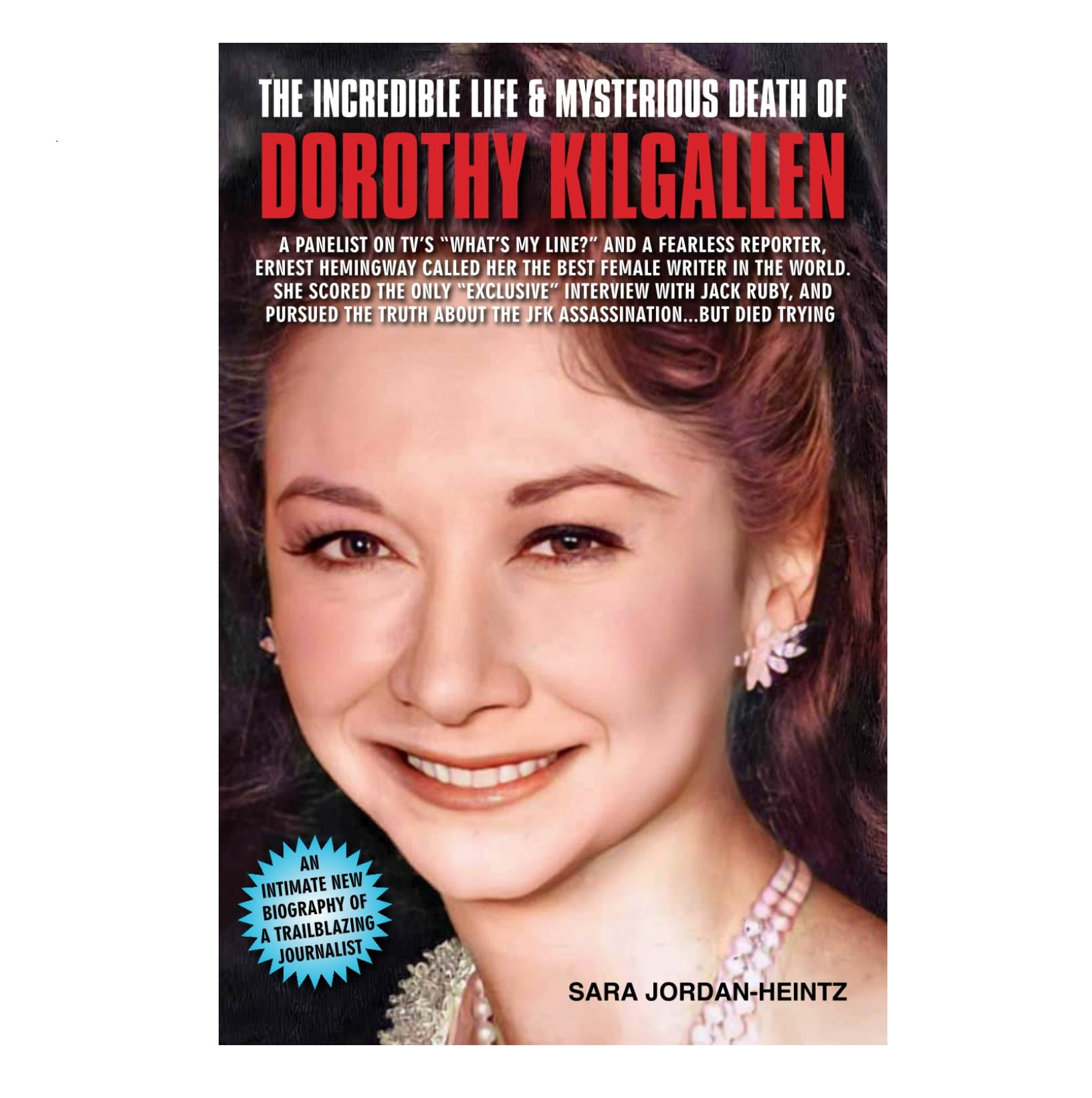
  • The Incredible Life and Mysterious Death of Dorothy Kilgallen

    The Incredible Life and Mysterious Death of Dorothy Kilgallen


    The Incredible Life and Mysterious Death of Dorothy Kilgallen

    by Sara Jordan-Heintz

    Let us first give the author her past due.  In 2007, Sara Jordan wrote a fine article about the demise of journalist and TV personality Dorothy Killgallen for Midwest Today. This was then reprinted in a color online version in 2015, at the 50th anniversary of Kilgallen’s death. (Click here for that version.) That original article was a milestone in the literature on this subject. In this new book, Jordan reveals that she was all of 17 years old when the article appeared (Jordan-Heintz, p. 384) Which makes it the most precocious piece of writing on the Kennedy case since Howard Roffman published his book Presumed Guilty at the age of 22.

    The author has now expanded her distinguished essay into a book.  At the start, she tries to explain why she did so, strongly indicating the works of author Mark Shaw which followed. She says that although she was glad about the article’s popularity she was:

    …dismayed to see Dorothy’s story turn into a cottage industry for one author in particular, whose book, in my opinion, contains reams of repetition, wild theories  and self-aggrandizement.  Much of his original information came from my article, after he contacted me several years ago requesting an interview.  Not all of this is appropriately credited. (p. 1)

    If anything this is mild. As I noted in one of my reviews of Shaw’s “cottage industry” books, not only has Shaw tended to discount Jordan-Heintz’ work, but also the woman who Sara got in contact with for her essay, namely Kathryn Fauble.  But her (understandable) frustration with Shaw is one of the reasons she decided to write this book.

    II

    On the night of November 7, 1965 journalist Kilgallen performed as a panelist in her last What’s My Line program. In a belated revelation, her butler and maid, said she came home that night with a man, and they heard the back door closing. This is a bit hard to comprehend since in addition to the Clements couple, James and Evelyn, there were three other men at the townhouse: her husband Richard Kollmar, her son Kerry, and his tutor Ibne Hassan. (Ibid, pp. 4-5) The following morning she was found dead in her home, the cause was a drug and alcohol overdose. Complicating matters was this: her papers for a later book proposal on the JFK case were gone.  She had made at least one trip to New Orleans,  a second more secretive one, and one to Miami. Charles Simpson, one of her hairdressers—the other being Marc Sinclaire—quoted her as saying the following:

    I used to share things with you guys—but after I have found out now what I know, if the wrong people knew what I know, it would cost me my life.  And she was dead about nine months later. (Ibid, p. 5)

    In addition to a file, and her journeys, she had two interviews with Jack Ruby in person during his trial. She also was in receipt of Ruby’s Warren Commission testimony and she printed this in her newspaper, the Journal American. It was printed over three days and Kilgallen provided a critical commentary (pp. 223-25)

    Since this book is a biography, it details Kilgallen’s life from her birth in Chicago in 1913, and the influence of her journalist father in starting her in a career in the newspaper business.  A big career boost was the 1936 “race around the world” against fellow reporters Leo Kieran and H. R. Ekins. She lost to Ekins but—at age 23– it was a great publicity machine for her. She became the second woman, after Nellie Bly,  to circle the globe. (Ibid, p. 11) It gave her a brief visit to Hollywood, where she acted in a film and sold a concept picture based on the contest, it was entitled Fly Away Baby.

    In 1938 she started her famous column, “The Voice of Broadway”. Three years later, based on its success, CBS gave her a radio show of the same name.  She did another later radio show with her husband, Richard Kollmar, who was a Broadway producer and actor. After marrying Richard, Dorothy quickly had two children, Richard Jr in 1941 and Jill, in 1943. (ibid, pp. 16-19, she had a third child in 1964 named Kerry.) In 1950 she became a regular on the popular TV show What’s My Line? That game show was broadcast live on Sunday nights. Because she was a triple threat—radio, TV, newspapers– she made a lot of money each year.  In 1953 the couple purchased a 13,000 square foot townhouse at 46 E. 68th Street, a block away from Central Park. To demonstrate the kind of money she was making, that  townhouse sold for 17 million in 2021. (Ibid, p. 30)

    The story that really gave Kilgallen’s career a rocket boost was her coverage of the Sam Sheppard murder case (ibid, pp. 34-35). Sheppard was a doctor in Cleveland who was accused of killing his wife in the summer of 1954. Sheppard insisted he had fallen asleep downstairs and she was killed upstairs by an intruder who knocked him unconscious when he tried to rescue her. Due, in part, to a highly prejudiced press, he was convicted. Lee Bailey eventually took over the appeal process. In a first rate performance Bailey had the conviction overturned, partly because the judge had told Kilgallen, “Well, he’s guilty as hell.  There’s no question about it.” And also because the jury was not sequestered as it clearly should have been. The retrial took place in 1966, after Kilgallen’s death. Bailey represented Sheppard at trial and had him acquitted.

    Another famous murder she covered was the Tregoff/Finch case of 1959.  Dr. Raymond Finch was having an affair with a woman named Carole Tregoff.  He wanted to divorce his wife Barbara and marry Carole, but the California community property laws discouraged him from doing so—his wife would have taken too much money and property. Therefore, the couple plotted to kill Barbara. They first tried to hire someone to do it, but he backed out. So they then did the deed themselves at Finch’s West Covina home. Even though the evidence against them was very convincing, there was a mistrial. They were tried again, and inexplicably, there was another mistrial. On the third go round, they were finally convicted. (ibid, pp. 56-57)

    Both of these sensational cases are covered in Kilgallen’s posthumously published book, Murder One.

    III

    A serious difference between the Jordan-Heintz book and Mark Shaw’s first volume The Reporter Who Knew Too Much, is that this new book spends a lot more time and space on the actual assassination of President Kennedy than Shaw did. And that might be understating things. I would estimate that there is almost as much material on the death of JFK as there is on the mystery of Kilgallen’s demise. But further the author uses much material that is not from the Warren Commission volumes or the Warren Report.  It’s an open question as to how much of the 26 volumes that Kilgallen read.  But, of course, it would have been impossible for her to have read what did not surface until after her death in 1965.  And we can only speculate what she had filed away, since that disappeared after her demise.  And no one really knows about her two short interviews with Jack Ruby, since she never revealed to anyone what Oswald’s killer told her. 

    But, for whatever reason, Sara Jordan-Heintz has decided to place in her book a lot of JFK murder information that did not come out until many years, actually, decades later.  To me, it’s fine for her to detail things the doctors saw at Parkland Hospital about the baseball sized hole in the rear of Kennedy’s skull. (p. 90). It’s also fine to quote local reporters Mary Woodward and Connie Kritzberg as to how their work was altered or parts were pulled. (pp. 94-95)  Because these were things that happened right then and there, and Kilgallen could have at least theoretically found out about them.  But then when the writer states that photos were faked and “it also became shockingly clear there had been alterations to JFK’s corpse by the time the formal autopsy began at Bethesda Naval Hospital that night” we are now getting into areas that it is unlikely that Kilgallen could have even speculated about back in 1965.  And I beg to disagree but it is not “shockingly clear” that Kennedy’s body had been altered before the autopsy began. (p. 92). She even goes further than this—shades of Sean Fetter– suggesting that the body was transferred to another casket before Air Force One left Dallas. (p. 98)

    This ignores the interview that the late Harrison Livingstone did with Nurse Diana Bowron who actually helped place the corpse into the casket at Dallas. (See the end of the first part of my review of Fetter’s book https://www.kennedysandking.com/john-f-kennedy-articles/under-cover-of-night-by-sean-fetter) For her rather wild concept–and like Fetter–she also relies on the Boyajian Report, although she does not name it, for an early arrival of Kennedy’s casket at 6:35 PM at Bethesda Medical Center.

    I don’t know how many times I have to repeat this, but I will keep on doing so as long as I have to. Roger Boyajian and his so called report are not reliable evidence in this case. I have demonstrated this twice before and I now have to do it again. That report does not state that the casket picked up by Roger Boyajian’s detail was Kennedy’s casket.  It only refers to it as “the casket”.  The obvious question is this: if Boyajian knew it was Kennedy’s casket, would he not have acknowledged that?

    Secondly, the report was not signed by Boyajian, and there is no hint as to why he did not sign it. To make matters worse, there is a second page to the report that lists the 10 others in the detail—and none of them signed it either. But even that is not the end of it. For when the Assassination Records Review Board (ARRB) interviewed Boyajian about the matter, that is picking up Kennedy’s casket, he could not recall doing so. In fact, he could not recall much about that day–period. Finally, the document the Board had does not appear to be the original.  This makes one wonder if it was ever filed with the military. (Harrison Livingtsone,  Kaleidoscope pp. 140-46)

    To make it even worse she writes that:

    There is general agreement among most JFK assassination researchers that the two casket scenario took place and that Kennedy’s body was probed for bullets (which were presumably removed) and surgical procedures done to conceal that he was fired upon by more than one shooter.(ibid, p. 99)

    There was and is no such general agreement.  In fact, the late Cyril Wecht—a forensic pathologist—never thought such was the case.  Neither does Dr. Randy Robertson, neither does Pat Speer, or Dr. Gary Aguilar.  At no JFK seminar I have ever attended—from 1991 to 2023—have I ever seen any panel devoted to this subject. The writer who formulated this scenario and wrote a popular book about it —David Lifton—could never make any real headway with it inside the critical community, and he himself admitted that.  Its not that he didn’t try, he did. But these attempts failed with rancorous feelings between those involved.

    This angle is made worse when she brings in the tall tales about embalmer John Liggett that were first broadcast by the discredited  Nigel Turner. (p. 106) Liggett’s brother filed a legal action against The History Channel over these ersatz claims and forced a settlement. (South Florida Sun Sentinel, 3/19/2005) It appears that this  bizarre Liggett angle might have been turned up by Billy Sol Estes, a man who sold more baloney on the JFK case than the Hormel company. (See the 2004 book Billie Sol Estes, pp. 155-57)

    As I have said many times about the JFK case, we must follow the Sagan rule: Extraordinary claims demand extraordinary evidence. The above does not, in any way, constitute extraordinary evidence. Kilgallen could not have known about them and I doubt if she would have bought into any of them.

    IV

    I don’t wish to leave the impression that all the many pages Jordan-Heintz devotes to the JFK case itself should be dismissed.  That would not be fair or accurate. She does bring in credible evidence of extra bullets being discovered e.g. Randy Robertson’s evidence about Dr. James Young. (See the film  JFK: Destiny Betrayed.) She also notes that there are photographic images missing from the autopsy collection, which there are. And her use of FBI agents, Jim Sibert and Frank O’Neill is appropriate. (Jordan-Heintz, p. 119) As is the memo written by Deputy Attorney General Nick Katzenbach. (ibid, p. 121)  Her description of the murder of Oswald by Ruby with Captain Fritz breaking formation to allow it is apropos and she mentions the editing out of the horn sounds. (pp. 137-38)

    She adroitly shifts to a column written by Kilgallen after the shooting of Oswald. In that piece the reporter said that Kennedy’s assassination was bad enough but now, after the murder of Oswald, people who have never been there feel like they have just witnessed a Texas lynching. (p. 143) She assailed the fact that Ruby was allowed to walk in and out of the Dallas police headquarters, which was supposed to be keeping a security guard around Oswald. She poignantly wrote that the murder of the suspect prevented due process: “When that right is taken away  from any man by the incredible combination of Jack Ruby and insufficient security, we feel chilled.” She added, “That is why so many people are saying there is ‘something queer’ about the killing of Oswald, something strange about the way his case was handled, and a great deal ‘missing’ in the official account of his crime” (p. 144) In a mid-December 1963 article she said Ruby may have been allowed access since members of the police force “partied at Ruby’s strip club.” She added that “there were jam sessions at which Dallas cops joined in the fun, some playing musical instruments others doing turns as singers and comedians….” (pp. 164-65)

    About a week later, on December 23, she wrote about the upcoming film Seven Days in May.

    The producers of the forthcoming film Seven Days in May have every right to think that life imitates art in the most tragic way. Long before President Kennedy was assassinated in Dallas, they finished their picture about a military group hatching plans to overthrow the President of the United States.  In the movie, the ‘secret base” where the plot against the Chief Executive reaches its climax is a place in Texas.(p. 166)

    She gives coverage to the Parkland Hospital press conference on the day of the assassination with Malcolm Perry and Kemp Clark.  She adds that this conference, added to PR man Malcolm Kilduff’s gesture that the fatal bullet struck Kennedy in the right temple, these undermined the future cover up. She notes that Perry said the anterior neck wound appeared to be one of entrance. Which would eliminate Oswald. (p. 145). Then, apparently based on Barbara Shearer’s documentary, What the Doctors Saw, she writes “that after the news conference, the doctor was accosted by a man in a suit and tie who grabbed his arm and warned him menacingly, “Don’t you ever way that again!” She then adds that this agent was Elmer Moore of the Dallas Secret Service. (ibid)

    This appears to be incorrect.  From the information that several writers have accumulated—Gary Aguilar, and Pat Speer among them—Moore was on the West Coast on the day of the assassination. On the same day, he was then shifted to Washington for what appears to be a briefing.  He was then detailed to Dallas on November 29th. (James DiEugenio, The JFK Assassination: The Evidence Today, pp. 166-67) She is correct about Moore’s assignment being to get the Parkland doctors to change their accounts, and about Moore being a rabid Kennedy hater. She then reinforces this point with the belated revelation by journalist Martin Steadman, namely that Perry revealed to him that he was getting calls during the evening of the assassination to change his statement about a front shot to the neck.

    She notes that JFK was trying to forge a rapprochement with Fidel Castro in 1963. But she then adds that Bobby Kennedy had approved a partnership with the Mob to furnish assassins to murder Castro. (p. 151). The CIA Inspector General report on the plots to kill Castro was finally declassified by the Assassination Records Review Board in the mid -nineties. It remains the most definitive and complete accounting of those plots. Right in that report the authors declare that no administration had any knowledge of the plots from their inception to their ending.  Which means from 1959-65. (See CIA-IG Report, pp. 132-33) This is why Director Richard Helms kept exactly one copy, the ribbon copy, in his safe. And when President Johnson read it, he concluded that the CIA had a role in Kennedy’s assassination. (Washington Post, December 12, 1977)

    V

    After many, many pages on the JFK murder, Dorothy Kilgallen finally arrives in Dallas in February of 1964 to cover the trial of Jack Ruby. She wrote a column on February 22.It began like this:

    One of the best kept secrets of the Jack Ruby trial is the extent  to which  the federal government is cooperating with the defense.  The unprecedented alliance between Ruby’s lawyers and the Department of Justice in Washington may provide the case with the one dramatic element it has lacked: MYSTERY. (p. 189)

    She then adds a rhetorical question:  why has the government decided to supply Ruby’s defense with all sorts of information as long as they do not request anything on Oswald?  She continues in this vein:

    Why is Oswald being kept in the shadows, as dim a figure as they can make him, while the defense tries to rescue his killer with the help of information from the FBI?  Who was Oswald, anyway? (p. 191)  

    The book then goes into several pages of an Oswald biography. We then refer back to Kilgallen’s comments on his absence at the trial, which the reporter thought was unusual in her experience of criminal trials:

    It appears that Washington knows or suspects something about Oswald that it does not want Dallas and the rest of the world to know or suspect….That Lee Harvey Oswald has passed on not only to his  shuddery reward, but to the mysterious realm of classified persons whose whole story is known only to a few government agents. (p. 200)

    In returning to the trial itself, one of  Ruby’s lawyers, Joe Tonahill, told the reporter that Ruby wanted to speak to her. (p. 203) Therefore a brief exchange took place at the defense table.  About a month later, Kilgallen asked to speak to Ruby again without the court appointed bodyguards around.  The judge granted the request.  So Tonahill, Ruby and Kilgallen walked into a small office during the noon recess.  Although Tonahill was interviewed about this many years later, he did not offer any specifics, besides saying it was an agreeable conversation. (p. 205) Kilgallen never told anyone about this conversation either.

    At the end of the trial, with Ruby convicted, Kilgallen wrote that the whole truth was not told.  And that neither the state nor the defense placed all the evidence before the jury.  (p. 207). That verdict was later vacated and Jordan-Heintz describes how Ruby passed on before his retrial in Wichita Falls and she does a nice job describing the character and career of Louis J. West, a CIA affiliated doctor who was, inexplicably, allowed to visit Ruby before he passed away in January of 1967. (p. 208)

    In July of 1964 Kilgallen published Ruby’s testimony, four months before it would appear in the Commission volumes. Readers were struck by Ruby’s ignored pleas to go to Washington for the interview. She also asked in her commentary: how could Tippit not know Ruby? In another column published in August, she got hold of an internal Dallas Police report and used it to strongly criticize the performance of the police both in the immediate aftermath of the JFK murder and in the transfer of Oswald.(p. 228)

    VI

    The book closes with the death of Kilgallen.  Jordan-Heintz, like Mark Shaw, focuses on the strongest possible suspect, namely the late Ron Pataky, who died in 2022. Lee Israel, the reporter’s first biographer, revealed the affair Kilgallen was having with the much younger journalist from Ohio. Israel did not name him but referred to him as the “Out of Towner”. (p. 242) Jordan -Heintz was the first writer to name him in her Midwest Today article back in 2007.

    What follows in the book  is a concise biography of Pataky as a Naval ROTC officer at Stanford who was, either kicked out or dropped out, of the university in April of 1955. (p. 243) He was using fake ID cards and was arrested. He then transferred to Ohio State and graduated in 1958. He eventually got a job as an entertainment writer for the Scripps Howard chain, at the Columbus Citizen Journal until it folded in December of 1985. Pataky was also a poet and songwriter.

    By the time Pataky met Dorothy he was married and divorced. He appears to have been quite the ladies man.  The book features pictures of him with actresses Sandy Dennis and Alexis Smith.  He also had an affair with singer Anna Maria Alberghetti. He and Kilgallen met while on a film press junket to Europe. (pp. 247-48) Although Pataky maintained that their relationship was Platonic and not sexual, there is evidence that such was not the case. (p. 251) The author juxtaposes his budding relationship with Kilgallen and her doing more work on the JFK case. For instance, in late September of 1964, she revealed that witnesses who did not identify Oswald at the scene of the murder of Patrolman J. D. Tippit were told to be quiet.

    The author notes that Kilgallen did report on the kindly Quaker couple, Ruth and Michael Paine and their incriminating comments about Oswald.  She also notes a fascinating piece of information I had never encountered before. In commenting on the Roger Craig testimony about Oswald jumping into a Rambler station wagon after the assassination, she says that Ruth Paine’s station wagon was a Chevy. But that someone who did own a four door Rambler station wagon was New Orleans businessman/CIA agent Clay Shaw.

    He insured the Dallas-based vehicle (buying only the required liability policy) through an out-of-town agency for his “son” (though he didn’t have one), then canceled the policy after the assassination and presumably disposed of the vehicle.  Correspondence from the insurance agent confirms all this. (p. 261)

    Quite intriguing if its accurate.

    During the last year of her life, the reporter made few if any newspaper references to the JFK assassination. But according to more than one source, she was still at work on the Kennedy case. And she was arranging a second visit to New Orleans. She was going to meet with a source that she did not know, but would recognize. Ron Pataky said that the man she met with was Jim Garrison. (pp. 317-18) But further, Pataky said that he had met with Garrison, two weeks after he had previously met with Mark Lane. And, according to Pataky, he met with Lane before the reporter did. The author suggests that this shows that Pataky was likely on assignment during his days with Kilgallen.

    On the evening of her death, Kilgallen was seen at the Regency, her favorite hotel bar, after midnight with a male companion. Pataky says it was not him and that he only talked to her by phone in that 24 hour period. (p. 329) One of the weirdest dichotomies about her death is that the butler, James Clement, maintains that he found her body in the bathroom. (p. 333) But hairdresser Mark Sinclaire said he first found her body in the third floor bedroom, where she never slept. Jordan-Heintz tries to address this paradox in the evidence. She asks, just what happened between the hours when Clement says he saw the body and when Sinclaire discovered it in the bedroom. Clement also said that men in suits carted off her files. (p. 338)

    Lee Israel noted that the police did next to nothing about this case. They should have interviewed everyone she talked to the night before, but there is no evidence they did so. But Pataky said he actually was interviewed. (p. 339)

    The book closes with the very odd circumstances of Kilgallen’s autopsy. The official version was she died of “acute barbiturate and alcohol intoxication, circumstances undetermined.” (p. 350) But the man who did the autopsy, did not sign the death certificate.  And the person who signed was not even stationed in Manhattan, where she died, but in Brooklyn. It also turned out that there was evidence  of Nembutal on her drinking glass, a drug which she had not been prescribed (she had only been prescribed Seconal). There was also evidence of a third drug in her system: Tuinal. The chemist who did the drug testing said he was told by his superior to keep the case under his hat because it was big.(pp. 351-52)

    The book tries to place Pataky in New York on the night Kilgallen died. The author bases this on the fact that his paper ran his review of the film The Pawnbroker two days later.  But according to IMDB, that films was released in April, six months prior.  So although this is suggestive, it is not probative of Pataky being in New York at that time.

    The mystery of Kilgallen’s death continues. The incompetence, or indifference, of the authorities was simply astounding.

  • Mark Shaw Insults Allen, Texas: Part 2

    Mark Shaw Insults Allen, Texas: Part 2


    Two years ago, in a slightly agitated aftermath of reading Mark Shaw’s then new publication, Collateral Damage, I wrote a lengthy and critical review of his literary effort. I published that review on my website Marilyn From The 22nd Row; and Jim DiEugenio kindly published the review on his fine website, Kennedys and King. Recently, a video presentation that Shaw delivered at the Allen Public Library in Allen, Texas, appeared on my YouTube feed. Reluctantly, I watched and created a transcription of his presentation, primarily a commercial for his book. I was not quite as agitated by his Texas presentation as I was by his book; but that fact notwithstanding, in the name of historical and factual accuracy, I am compelled to offer a few comments.

    The first half of Shaw’s presentation focused on Dorothy Kilgallen. Shaw’s fanboy fascination with the star of What’s My Line crossed, at some point in time, into a goofy type of worship that approximates a goofy form of idolatry leading Shaw to engage in hyperbole. According to Shaw, Dorothy was quite possibly thegreatest journalist who ever lived […] Walter Cronkite and David Brinkley rolled into one.Shaw realized that Dorothy had, in fact, achieved the big time because the producers of The Flintstones featured her in an episode broadcast in 1961.And you know you’ve made it, Shaw opined, when you’re on a Flintstones episode. According to Shaw, Dorothy appeared in “The Little White Lie,” the title of the episode, as Dorothy Kilgranite. Not so. She appeared as Daisy Kilgranite, just one of several errors Shaw made regarding the Flintstone episode. Admittedly, it is possible that I am making a mountain out of a cartoon mole hill; but considering the errors Shaw made regarding a twenty-six minute cartoon, readily available for his review, is there any wonder that he made more than a few egregious errors regarding the complicated life of a person as complex as Marilyn Monroe?

    In my lengthy criticism of Collateral Damage, I identified most of Mark Shaw’s errors, but not all of them. I could list them here; but I think the better approach is simply to provide links to my original evaluation of Shaw’s publication: Marilyn From The 22nd Row; link to Kennedys and King.

    Still, there are a couple of assertions made by Shaw during his video presentation that I need to discuss directly: 1) the big clue that Shaw allegedly discovered; and 2) Shaw’s assertion that Collateral Damage does not contain any ofhis opinions or speculations.

    The Big Clue. What follows is what Shaw asserted:

    […] this is the big clue. What did I do here? Well, I was in trouble because I wanted to show that Bobby could have been involved in Marilyn’s death but he wasn’t in Los Angeles at the time. He had an alibi. He was in the San Francisco area, OK. But I just couldn’t believe that he was and so I started looking into things and I found this ledger [security log]at 20th Century-Fox. […] what does it say? That at 11 o’clock on August 4th, 1962, the same day that Marilyn died, Bobby Kennedy and Peter Lawford arrive in a helicopter there. Alright. So he’s in Los Angeles […].

    With the preceding, Mark Shaw clearly took credit; claimed that he and only he uncovered a document, an August the 4th Fox security ledger or log, which proved that Robert Kennedy and Peter Lawford landed at the studio in a helicopter at 11 AM; proved that the Attorney General was in Los Angeles; and by extension, this ledger proved that Robert Kennedy visited Marilyn on August the 4th and that he was, therefore, involved in her murder. But, and there always is, how did Collateral Damage report the explosive big clue?

    In his book, Shaw reported that Bobby had what appeared to be an airtight alibi, one which placed him in the San Francisco Bay Area at the time Marilyn died. Shaw even referenced an Associated Press story confirming that Robert, Ethel, his wife, and four of their children arrived in San Francisco on Friday afternoon, August the 3rd. He even admitted that the Kennedys traveled to the Bates Ranch. Even so, as he also admitted, Shaw did not believe any of the eye-witness, first hand testimony provided by the Bates family and others present that weekend. Shaw did not believe that the ten photographs taken throughout the day, published by Susan Bernard in 2011, proved anything about Robert Kennedy’s location on August the 4th. Shaw did not believe the AP story or a 1985 NYT interview with the senior John Bates, referenced by Shaw, which confirmed that the attorney general never left the Bates ranch. Instead, Shaw accepted the mysterious security log and the testimony of one Frank Neill.

    According to Shaw, the actual security log read as follows:

    Before 11 a.m. on August 4, 1962, a helicopter landed at the Twentieth Century Fox studio’s helipad near Stage 14. Studio publicist Frank Neill, working that Saturday morning, said he saw Robert Kennedy jump out of the helicopter and rush to a dark gray limousine waiting nearby. Neill said he got a glimpse of movie star Peter Lawford, brother-in-law to the Kennedys, sitting inside.

    To begin with, in his Texas presentation, Mark Shaw asserted that both Robert Kennedy and Peter Lawford arrived at Fox’s lots in a helicopter on August the 4th. The alleged security log, on the other hand, indicated that the attorney general arrived in a helicopter while his brother-in-law, Peter Lawford, waited in a nearby limo, a clear contradiction. Which account should we accept as factual?

    Additionally and obviously, the form and wording of the security log strikes the reader as a bit odd. Clearly, a person other than Frank Neill recorded what the studio publicist allegedly said; therefore, who actually wrote down what Neill said? Shaw’s big clue was actually hearsay.

    Why was it necessary to include that Neill was a studio employee; and, by the way, who and what was Frank Neill?

    While I was a practicing architect, I encountered many security offices and security logs at corporate offices, large building material manufacturers and security trailers at fenced, and sometimes guarded, construction sites. Usually, the exact time of one’s arrival had to be recorded. The indefinite arrival time stipulated in the text of the alleged security log confused me. Before 11 AM? Also, usually a precise purpose for one’s visit had to be declared on a security log, something omitted from the Fox log. Moreover, completing a security log is usually only required when a person actually enters secured areas. But evidently, Robert Kennedy never entered the actual Fox lot; at least, that is, Shaw’s log was rather vague on that particular point. The Attorney General entered an awaiting limo which then quickly drove away. Would this necessitate an entry in a security log? And when companies require security clearances, they issue a security badge to visitors and they require the visitor to return to the Security Office, to log out–to enter a precise departure time and to return the security badge. Shaw’s mysterious security log did not include a log out time.

    Finally, the wording of this security log surprised me. Security logs that I’ve encountered required brevity; but the text of Shaw’s security log read more like an excerpt or a description that was lifted, borrowed from a larger narrative.

    Why?

    Hoping to resolve at least some of the preceding issues, and answer some of my questions, while also identifying Frank Neill and clarifying his association with Marilyn Monroe, I spent several days reviewing more than a few pertinent publications. Within the text of Collateral Damage, Shaw was particularly laudatory about one biography, Marilyn: The Tragic Venus, written by Edwin P. Hoyt. Shaw wrote:

    Published in 1965, Hoyt’s biography of Marilyn was released at a time when facts about her life and times and death were not polluted with phony sensationalism, as would be the case with many articles and books in the future. His account certainly appears credible due to the large number of primary sources […] (85).

    I began my review of books about Marilyn with Edwin Hoyt’s biography: Frank Neill did not appear therein. In fact, two decades would elapse before Anthony Summers, in his Marilyn pathography Goddess, would finally mention Frank Neill. According to Summers’ 1985 source notes, Marilyn’s Irish pathographer actually interviewed Frank Neill. From the source notes:Landing at Fox: int. Frank Neill, 1983, and former policeman on pension, who requires anonymity. According to Summers:

    Two fragmentary reports, one from a police source, one from a former member of the Twentieth Century-Fox staff, Frank Neill, suggest Kennedy arrived in the city by helicopter, putting down near the studio’s Stage 18, in an open space then used by helicopters serving the area near the Beverly Hilton. According to these sources, the President’s brother arrived in the early afternoon (350).

    Summers’ 2012 update of Goddess repeats the preceding account verbatim; and nowhere in either version of Goddess did Summers even mention a security log! Also, Summers did not provide any biographical information regarding Fox’s former staff member, Frank Neill; and once again, we have encountered a few contradictions.

    According to Summers’ account of his interview with Frank Neill, the President’s brother did not arrive during the morning: he arrived in the early afternoon. Shaw’s alleged security log stated that Robert Kennedy’s whirlybird landed on a helipad near Stage 14 while Summers reported that the helicopter put down near Stage 18 in an open space […] near the Beverly Hilton. Why the contradictions? Besides, if Frank Neill was involved in the preparation of a security log in 1962, why oh why did he fail to mention that to Anthony Summers during their interview in 1983?

    In 1991, James Spada published The Man Who Kept the Secrets. This was a Peter Lawford biography, sprinkled liberally with the spice of Marilyn and the Kennedys along with many yarns pronounced by the pathological fantasists, Robert Slatzer and Jeanne Carmen. Spada’s literary effort reported the following account:

    Frank Neill, a former employee of Twentieth Century-Fox, later stated that Bobby arrived by helicopter at a landing pad near the studio’s stage eighteen, which was often used by the Beverly Hilton Hotel for that purpose. A confidential police source supports this story(353).

    Not quite identical to Summer’s account but eerily similar. Perhaps the similarity can be explained by Spada’s following admission in his source notes: I drew many of the details of Marilyn Monroe’s last few months from Anthony Summers’s superb investigatory biography of Monroe, Goddess (533). In short, James Spada simply rephrased Summers’ account.

    With the passing of two years, in 1993, Peter Brown and Patte Barham published Marilyn: The Last Take. The first mention of a security log appeared therein. The authors reported:

    On Saturday afternoon, August 4, a Fox security guard squinted through the morning fog to catch a glimpse of the huge government helicopter that hung in the sky above the studio. Waving a fluorescent orange flashlight, the guard directed the chopper toward some hastily drawn landing marks. […] The chopper had been approved to land at just after 11 A.M., as duly noted in the studio’s security log. A dark grey limousine was parked to the side, its driver standing at attention. Studio publicist, Frank Neill, whose office was near the landing pad, wasn’t surprised to see the familiar figure of Bobby Kennedy leap from the helicopter and dash to the limousine. […] Through the open door, Neill caught a glimpse of the carefully tanned face of Peter Lawford(349-350).

    In Brown and Barham’s account, their huge government helicopter landed just after 11 o’clock in the morning; and it landed on what was evidently a makeshift, hand drawn landing target, not a helipad. However, the authors must have been confused regarding the landing time: if the chopper landed just after eleven in a morning fog, how does “Saturday afternoon” fit in? Be that as it may, the authors’ source notes contained the following curiosity: The helicopter landing on the Fox lot was discussed by Robert Slatzer and Lee Hanna, who heard of it from Frank Neill (465). Evidently, Brown and Barham did not actually interview Frank Neill. The authors received their information from either the ubiquitous Robert Slatzer or Lee Hanna, a person with whom I am unfamiliar. If Brown and Barham did not interview Frank Neill, how did they know he was not surprised by the presence of Bobby Kennedy? Well, they could not have known.

    But here is what I find truly odd. If Slatzer knew that Robert Kennedy had landed on Fox’s lot in a helicopter, why did he withhold that information from Anthony Summers during all the interviews the author allegedly conducted with one of his primary sources? I reviewed Slatzer’s 1974 publication, The Life and Curious Death of Marilyn Monroe. There, Slatzer did not mention Kennedy’s arrival by helicopter. Slatzer mentioned Frank Neill with regard to topics unrelated to the topic of this article and asserted that he had met Neill in 1952 on the sets of Niagara. In Slatzer’s The Marilyn Files, published in 1993, Frank Neill likewise appeared with regard to topics unrelated to the topic of this article. Also, Slatzer thanked Neill, and many others, for their invaluable contribution over the years (n9). Slatzer left their contribution unspecified. I can only conclude that their invaluable contribution was their assistance with Slatzer’s masquerade as Marilyn Monroe’s faux second husband.

    Several additional publications that I reviewed did not invoke the name of Frank Neill, and several did. Donald Wolfe’s The Assassination of Marilyn Monroe, published in 1998, and his 2012 update, The Last Days of Marilyn Monroe, presented the following account:

    Early Saturday afternoon, the roar of a helicopter echoed off the sound-stage walls at the Fox studios. A Fox security guard squinted into the bright blue sky as it began its descent into the heliport near Stage 14 […]. As noted in the studio’s security log, the helicopter had received approval to land shortly after 11 a.m. A dark gray limousine waited in the shade as the helicopter touched down in a whirl of dust. Studio publicist Frank Neill, who was working on the lot that Saturday, […] was surprised to see Bobby Kennedy leap from the helicopter and dash to the limousine. As the limousine door opened and Bobby jumped in, Neill caught a glimpse of Peter Lawford (564).

    Wolfe magically transformed the chopper’s landing spot from an open space with some hastily drawn marks, not into just a helipad, but a full scale heliport. The landing transpired in different weather conditions than those mentioned by Brown and Barham. Obviously, Wolfe preferred to have the chopper land under a blue sky in bright sunlight, not a morning fog. And while in the Brown and Barham account, Neill was not surprised to see Bobby Kennedy, in Wolfe’s account the appearance of Bobby did surprise Neill. How did Wolfe know about Neill’s surprise? It is clear that Wolfe did not actually interview Frank Neill. According to his source notes pertaining to page 564: Roar of a helicopter: Summers, p. 350; Brown, p. 303. It is also clear that Wolfe combined the accounts in Goddess and Marilyn: The Last Take to create a hybrid that included a security log which Anthony Summers, who actually interviewed Frank Neill, did not mention.

    Finally, fifty years after Marilyn’s tragic death, Darwin Porter published Marilyn at Rainbow’s End. In Porter’s seamy literary effort, the author transfigured Frank Neill into an implied authority on Fox’s security:Frank Neill, a security guard at Fox,Porter declared, said he saw Bobby arriving by chopper at the helipad on the studio’s lot, which was often used by the Beverly Hilton Hotel for their VIPs (457). But Porter did not mention a security log.

    Returning to the questions that I posed earlier in this article, who and what was Frank Neill and what was his actual association with the world’s most famous blonde actress? Well, Neill was either a former newspaperman, a former police reporter, a garden variety Fox publicist or a unit publicity man for the film Niagara. Not one publication that I reviewed clarified who or what the man actually was, and not one of those publications clarified his association or relationship with Marilyn Monroe. Unfortunately, my efforts to determine the who, what and why of Frank Neill proved to be futile. I could not even locate an obituary.

    So, this question remains: did Mark Shaw uncover–did he and only he discover a mysterious security log or ledger which proved that Robert Kennedy was in Los Angeles on Saturday, August the 4th in 1962? Most certainly he did not. Many other writers have mentioned that mysterious security log; and Shaw did not offer any real proof that the log actually existed. He, like all the sensationalistic conspiracist writers before him, did not publish the actual log. And he did not display a photograph of it during his Texas presentation. A fact which leads me to conclude that he did not and does not possess the security log; and that fact leads me to the real difficulty with Shaw’s assertion.

    Considering that the log was created in 1962, virtually six decades prior to the publication of Collateral Damage, is it even remotely possible that such a document would have been retained by 20th Century-Fox, retained for fifty-nine years? Would such a document have survived to see the 21st century? Speaking only for me, of course, I think not. Taking into consideration all the contradictory accounts regarding the mysterious log, taking into consideration that the actual log has never been published, never been seen, I cannot stretch my gullibility, my credulity quite that far. Speaking only for me, of course, I do not believe Shaw’s story. In fact, I do not believe that the mysterious security log ever existed. I must repeat once again: Shaw’s ledger, the security log, the alleged document has never been published. What Shaw presented in Allen, Texas, was an amalgamation of the many stories written about Robert Kennedy’s whirlybird arrival at Fox studios, an arrival witnessed by a shadow named Frank Neill. Based on actual facts, based on firsthand testimony of persons who were with Bobby that Saturday and based on documentary evidence, we know that the Attorney General was not in Los Angeles on Saturday, August the 4th.

    And finally, to put a period on this philippic, Shaw’s contention that Collateral Damage did not contain any of his opinions or speculations just might be the most absurd conceit uttered by the self-proclaimed Marilyn historian. The text of Shaw’s publication is filled with opinion and speculation; it is also filled with innuendo. For example, on page 562, Shaw wrote:

    Basically a coward in the ilk of his father, RFK would never have had the guts to poison Marilyn on his own initiative. That meant he had, it would seem, two choices: either enlist operatives to do it or engage through an intermediary, perhaps Greenson of Engelberg to do it for him. […] RFK, either on his own or through intermediaries, could have “squeezed” Greenson […] into becoming an operative in the death of Marilyn.

    In Shaw’s goofy world, the preceding does not qualify as speculation. Truly amazing.

    I could present many more examples of Shaw’s opinionating and speculative prowess. But the most incredible example begins on page 613, Shaw’s contrived scenario of how Marilyn was possibly murdered, a scenario that is gross speculation of what most likely may have happened to Marilyn during the night of August the 4th.

    Accosted by two intruders sent by the attorney general, with the president’s approval, asserted Shaw, and stunned with a chloroform-sealed cloth, Marilyn was either dragged or carried into her bedroom, stripped, deposited nude on her newly carpeted floor and callously murdered by a rectal infusion of drugs using a bulb syringe of some sort. The attorney presented absolutely no evidence to support his contrived scenario; and Shaw excused his lack of evidence as follows:

    Of course, as with any theory like this based on circumstantial evidence after so many years have passed, questions will be asked, with answers unfortunately speculative in nature. […] Such observations about Marilyn’s death provide a stop-and-think, food-for-thought considerations as to how Marilyn met her maker and by whose actions […]. If Robert Kennedy’s complicity in Marilyn’s death, through whatever means, had been exposed, causing him to be charged in a court of law, there would never have been a JFK assassination by RFK’s enemies in 1963(624).

    There was not, and there is not, one shred of actual evidence proving that Robert Kennedy was romantically involved with Marilyn Monroe, or that he was involved in any way with her death. In fact, the available evidence proves that actress and attorney general were not involved romantically. Further, Marilyn’s autopsy proves that she was not killed with some sort of bulb syringe: she ingested the drugs that killed her.

    Mark Shaw’s gross speculation that John Kennedy’s assassination could have been prevented by bringing charges against his brother for killing Marilyn Monroe is absolute nonsense of the most preposterous sort. Perhaps Mark Shaw should have stopped and thought before writing a book like Collateral Damage. Perhaps he should have asked a few more questions, like he admonished his video audience to do, before putting his pen to paper.


    Go to Part 1

  • Mark Shaw’s Fighting for Justice

    Mark Shaw’s Fighting for Justice


    Mark Shaw has (ostensibly) written six books about the assassination of John F. Kennedy. Four of those have been published in the last seven years. Which means his current output is one book on an average of less than two years. This reviewer has written, or co-written, four books on the case in thirty years. If Shaw wrote books based on the newly declassified documents that have been dripping out due to the strictures of the 1992 JFK Records Collection Act, then fine. But as we shall see, such is not the case.

    When I reviewed Shaw’s Denial of Justice, I noted that for all that was new in that book, Shaw could have simply written a long blog post on his website. (Click here for that review) To expand his parameters what Shaw has done is added another subject—which was hinted at in that book. So instead of Dorothy Kilgallen and John Kennedy, Shaw opened up a new area of inspection in his next book, Collateral Damage. That new area was Marilyn Monroe. As Don McGovern showed in his two part review, Shaw’s writing was remarkably unconvincing about the late film star. (Click here for that review) As Don demonstrated at length, not only did Shaw reveal a lack of analytical insight, he could not even interpret photographs accurately. His excuse for glomming on to Monroe was that she was allegedly a close friend of Kilgallen. As McGovern explained, among many others Shaw made, that statement was inaccurate.

    In his new book, inaptly named Fighting for Justice, Shaw now says he has gotten literally hundreds of letters asking if there was any connection between the deaths of JFK, Kilgallen and Monroe. (Shaw, p. 149) Which is an odd statement. For example, this reviewer has been researching the JFK case full time for the last three decades. I never got one such question, let alone a letter, asking me about that topic. I have attended literally dozens of conferences, and I never heard anyone from the audience ask anything like that. I have been a semi-regular on Len Osanic’s Black Op Radio program for over ten years, and have fielded hundreds of questions from the audience—but never that one. As we shall see—and as McGovern hinted—there appears to be another reason for Shaw’s insistence on now including the Monroe case in his writing.

    Some people like to hear themselves talk. Shaw apparently likes to type. But typing is not writing. About the first fifty pages of this book have little or nothing to do with the alleged subject matter. It is purely autobiographical. So if you want to hear about why Mark Shaw moved from Indiana to Colorado to California, this is your book. Since I was not interested, to me this was just filler.  

    The last part of the book, Chapters 20 and 21—where Shaw excerpts a long phone call between President Johnson and FBI Director J. Edgar Hoover—could have been cut at least in half. And that is not all that should have been cut. For Shaw repeats much of his prior biographical work on Dorothy Kilgallen. He also recycles his half-baked—if that—ideas on the JFK assassination. For instance, he praises the HSCA for examining every nuance of the Kennedy and Oswald killings. (p. 65) Many would disagree. He then writes that there were three shots fired, with the second and third bullets hitting Kennedy. (p. 66) Yet everyone knows the HSCA concluded there were four shots, based upon the acoustics evidence. He now repeats an allegation he made in Denial of Justice that the HSCA report said the Kennedys went after organized crime because mobsters impinged on the success of their father’s bootlegging.(p. 66) I read the HSCA volumes on organized crime, Books 5 and 9, and found no such thing. Let me quote myself:

    If one goes through those volumes, especially volumes 5 and 9, where this Mafia angle is explored, the reader will find no mention of Joe Kennedy’s alleged bootlegging. But in book five, it is noted that, by 1963, the Mafia was falling apart due to Bobby Kennedy’s unrelenting pressure tactics. (HSCA, Vol. 5, p. 455) And make no mistake, the House Select Committee pulled out all the stops in investigating this Mob-did-it angle. They used all kinds of official records, not just in Washington, but also from various local police departments. Again, did no one do any editing of this book?

    So Shaw wanted to write another book. And apparently it did not matter how he filled in the pages. So how does he do it? He prints and then replies to questions and comments from people who read his books, or watched his online presentations. And from what I could discern, the quality of the comments did not matter. There is a letter from a man whose father knew Joe Cody, a former police officer in Dallas. It turns out that Cody bought Jack Ruby the revolver he used to kill Oswald. After relating this information, Shaw pats himself on the back for uncovering “an historical piece of evidence”. (p. 125)

    It would have been natural of Shaw to have clicked his search bar. If so he would have found out that this “historical’ piece of evidence has been around since at least 2008. Since it was described in two obituaries for Cody, one in the Dallas Morning News of July 7th and one at the TV site for KTBS on July 3rd.

    I don’t even want to talk about another one which features Carlos Marcello, Mac Wallace, and Jack Ruby in the same restaurant in Dallas in the summer of 1963. It then gets better. A show girl with Marcello calls Shaw’s witness later in 1977. She says she has a picture of the real JFK assassin emerging from a sewer. Uh, OK. (pp. 119-20).

    But it’s not just stuff like this that Shaw uses to fill in pages of what is supposed to be a book. He now goes back to older books and describes them. One of them is from 1973 and is called The Kennedy Neurosis by Nancy Clinch. If a negative book on the Kennedys gets blasted by The New York Times well, that is notable. (See review by Robert Claiborne of 2/25/73) The book is what Clinch called psychohistory. As Claiborne wrote, this is tough to do even when one has the credentials to do so. Clinch majored in Political Science and did studies of housing in South Korea while in Army intelligence. She tried to explain the Bay of Pigs fiasco by saying it was due to “psychic dynamics” and “unconscious motivations” were “a typically American overconfidence and a typically American indifference toward the responses of the enemy.”

    Claiborne properly labels this as nonsense. But we know what happened with the Bay of Pigs today. It had nothing to do with a “Kennedy neurosis”. It had everything to do with the president being deliberately lied to by the CIA, namely Director Allen Dulles and Director of Plans Dick Bissell. (Destiny Betrayed, second edition, by James DiEugenio, pp. 34-56)

    But strangely, this is something that is almost off limits to Shaw. You will see very little, if anything, about Kennedy’s disputes with the Pentagon or the CIA in any of his books. Even though this particular deception by the CIA caused Kennedy to fire Dulles, Bissell and Charles Cabell, the Deputy Director. I would personally think that would be more important than an ancient story about Joe Cody. Especially when its combined with the fact that the CIA also betrayed Kennedy by assassinating Patrice Lumumba, and backing an overthrow of Charles DeGaulle in 1961. (See David Talbot, The Devil’s Chessboard, pp. 382-89; pp 412-24) This all gets the back of Shaw’s hand, rendered unimportant. Even though when Dulles was appointed to the Warren Commission, at their first executive session meeting, he passed out a book saying that all American presidential assassinations were the work of one man. (David Lifton, Document Addendum to the Warren Report, pp. 89-90)

    What is important to Shaw? Not the new documents. He sloughs those off in a couple of pages. And when I say slough, I mean it. He finds credible a CIA document saying that Sam Giancana was still running the Chicago outfit in December of 1977. Uh Mark, Giancana was killed in 1975. That is almost as bad as him buying into a CIA document from 1998 negating any connection of Oswald to the Agency’s “Office of Operations.” (pp. 106-07) Apparently Shaw is ignorant of what Malcolm Blount did with the papers of the HSCA’s Betsy Wolf. And how her work resulted in CIA officer Pete Bagley declaring that Oswald was a witting false defector in 1959. (Click here, and see John Newman’s speaking of Bagley in Oliver Stone’s JFK : Destiny Betrayed)

    As the reader can see, Shaw is not an astute or prolific researcher on the newly declassified documents. So what does he build his book around? Two things. First, what he broadcasts as an utterly momentous, earthquake type of discovery. It is this: he thinks that Warren Commissioner John Sherman Cooper gave Dorothy Kilgallen the Commission’s Ruby testimony in advance, which she printed in her newspaper. Shaw spends about a dozen pages on this toward the end. He has no direct source, its an inference and a circumstantial case through a man named Morris Wolff. He then uses this as some kind of springboard that Cooper did not buy the Warren Commission from the start.

    Mark we kind of knew that. And the work has been done through more than one person on Cooper’s cohort Senator Richard Russell. Russell, Cooper and Hale Boggs made up the southern wing of the Commission, as opposed to the Wall St./Washington troika of Dulles, Jerry Ford and John McCloy. I wrote about this at length many years ago. (DiEugenio, The JFK Assassination: The Evidence Today, pp. 315-320). This is why there was no stenographer at the last meeting of the Commission to record the southern wing’s dissent. And why Cooper said in a British documentary, way back in 1978, that he did not buy the Single Bullet Theory. Cooper as dissenter is not hot news. And I am still trying to figure out what the impact was of printing Ruby’s testimony early? As I am still trying to figure out how Kilgallen cracked the case if no one knows what she had in her files?

    Let us go to the other key point that Shaw insists on writing about. His new point of interest, which is really quite old: the alleged cover-up around the death of Marilyn Monroe. As Don McGovern showed in his review of Collateral Damage, Shaw went as far as misinterpreting photos implicating Bobby Kennedy in the death of Monroe. McGovern and Donna Morel pretty much wrecked Shaw’s new witness on the Monroe case: actor Gianni Russo. Russo had a hard time getting his age straight as to when he began his alleged relationship with Monroe—at first it was when he was about 12. This did not seem to bother Shaw. And neither did the problem of where Russo said Marilyn was living in 1959, Russo said it was the Waldorf Astoria. It was not.

    To put it mildly, Russo presented some problems for Collateral Damage. So now Shaw brings in writers like Sy Hersh and Frank Capell. But he does not give the reader the proper information about these two men. Hersh fell for a fraudulent legal document that was supposed to be signed by Marilyn and the Kennedys. More than one person said the signatures attached to the document were questionable. Hersh went forward with it anyway until it was shown that zip codes did not exist when the document was executed. (Click here)

    Frank Capell was brought up on charges, along with two other men, in a conspiracy to commit libel against Republican Senator Thomas Kuchel. Prior to that, Capell had been arrested twice for accepting bribes as a government employee. (Click here) I don’t recall Shaw writing about any of these compromising incidents in relation to Capell or Hersh. I find it hard to comprehend he would not know of them.

    But alas, Shaw uses the testimony of LAPD officer Jack Clemmons to say there was no drinking glass in Monroe’s room the night she overdosed. (Shaw, p. 156) As McGovern has proven there was such a glass in her room. (Click here for proof)

    Clemmons was an accomplice in the libel conspiracy charges that Capell was charged with and had to settle. As part of the settlement, Clemmons left the force. Again, this seems to me to be important information and Shaw should have revealed it before committing the factual error with the glass.

    But that is not all. Shaw continues to use a CIA memorandum allegedly signed off on by James Angleton concerning Marilyn, JFK and UFO’s. Many years ago, John Newman, a former intelligence officer, showed how that memo had to be a fake. (The Assassinations, edited by James DiEugenio and Lisa Pease, pp. 360-61). In his devastating critique of Collateral Damage, McGovern brought in another source, Nick Redfern, who also shows the document to be a forgery. So why is Shaw still using it? Or Russo for that matter?

    Another problem: Shaw says that years after Monroe’s death, when her dwelling was purchased by actress Veronica Hamel, it was discovered that the FBI had installed a listening system in the roof of the home. ( Shaw, p. 171) Don McGovern told me that Monroe’s home had no attic, so was the wiring in the walls? How could Marilyn have not known about it then? (Email of 2/24/23) I got in contact with Gary Vitacco Robles, one of the most credible biographers of Monroe. He informed me that in the third volume of his book Icon, which is coming out soon, he will show that this really was a rewiring of the home, due to the fact that the phone wires were antiquated. After all the house was built in the twenties. (Email communication with Gary, 2/24/23)

    I am not going into the scenario that Shaw puts together as to how Robert Kennedy was actually in Los Angeles the day Marilyn passed on. He was not, and this is provable. (Susan Bernard, Marilyn: Intimate Exposures, pp. 186-87) Neither will I critique his scenario about a rectal enema theory, which McGovern showed was simply not plausible. Or the accompanying “spillage” that Eunice Murray was busy machine washing when the police arrived. As McGovern showed, there was no washer/dryer in the home; Monroe sent everything out to be dry cleaned and pressed. (McGovern, Murder Orthodoxies, p. 550) When an author continually makes these kinds of factual errors, and then trusts unreliable sources and documents—I won’t even talk about the book by June DiMaggio that Shaw uses—one begins to wonder about what his true agenda is. Its pretty clear that Shaw has gone around the bend on the MM imbroglio. He has joined the ranks of Milo Speriglio, Robert Slatzer, and Jeanne Carmen.

    And for him to say that somehow Monroe would not have taken her life or not have died from an accidental overdose, this is more Slatzer-like fruitiness. (Shaw, pp. 280-83) As every serious biographer of Monroe has admitted, she tried to take her life at least four prior times. (McGovern, pp. 8-9) She was, plain and simple, a barbiturate abuser. In the less than 2 months before she died, she had gone through about 790 pills. (McGovern, p. 533) Including, among others, Seconal, Tuinal and Nembutal. Tuinal is not available in the USA today; and Nembutal is used for euthanasia by veterinarians. She had a blank check at Schwab’s so to speak. Monroe had been married and divorced three times before she was 35. She had been through three psychoanalysts in about five years. To put it mildly, she did not have an idyllic childhood: she never met her half-sister until she was 18, she likely never met her father, her mother was institutionalized. And she did not like Hollywood. Which is one reason she and her third husband, Arthur Miller, moved to the east coast. I fail to see how any of the above was due to Robert Kennedy.

    What one feels at the end of this book is not Shaw fighting for justice. If so, why did he leave out the above in lieu of a likely forged UFO document, Clemmons and Gianni Russo? An informed reader is disturbed at the almost boundless and unwarranted vitriol aimed at John and Robert Kennedy. Who cannot reply. But Shaw’s publisher at Post Hill, Anthony Ziccardi, was part of Newsmax Media. So Shaw has now found a home for his venom, and his all too frequent—and quite dubious—books.

    Update

    Mark Shaw’s latest is such a hapless effort that it made me go back and look at his career from the beginning. As we all know he has taken on the cause of Dorothy Kilgallen with all the fervor of a jihadic warrior. Exalting her to a degree so extreme that, at times, he seems just silly.

    But what is odd about all this sound and fury is this: Mark Shaw did nothing of the kind in his first two books, which, in their latest editions, amount to about 700 pages. In his first book, a biography of Melvin Belli, he hardly mentions her. (see page 148) What makes that unusual is that there, since Belli was his defense counsel, Shaw writes five chapters about the trial of Jack Ruby. Kilgallen attended that trial and met with Ruby twice privately. Yet Shaw could only muster 49 words on his (later) Joan of Arc journalist.

    In his next book on the case, there was a slight uptick. He devotes a bit more than two pages to Kilgallen—all of it from Lee Israel’s biography.

    This begs the question: What happened in Shaw’s writing career that made him, literally, alter course? The best and most logical answer I can come up with is this: the reprint of Sara Jordan’s long article on Kilgallen’s death in Midwest Today. That fine piece originally ran in 2007. But it was reprinted with a much more graphic, illustrative format in 2015 for the anniversary of Kilgallen’s death. (Click here for that essay) Jordan was assisted by investigator Kathryn Fauble in that version. By the end of the next year, Shaw began his four book series on the reporter. And in that first effort, The Reporter Who Knew Too Much, he gave Jordan and Fauble credit. As time has gone on, he does that less and less.

    With all this in mind, an incident of Shaw’s self-righteousness about Kilgallen stands out even more. Before his book came out, he appeared at a JFK Lancer Conference which I attended. I recall him saying how he thought Kilgallen had been ignored by the critics and he took a personal blast at Jim Douglass for not writing about her in his book. With what we know today, we could ask Mark: if not for Jordan and Fauble, would you have written books on Kilgallen? Your first two volumes do not indicate that.

    The problem with that subject though is this: Once you get outside the parameters of Kilgallen’s mysterious death, there just is not very much there. Shaw likes to say that when she went to New Orleans it was to investigate Carlos Marcello. This is just guesswork on his part. At the trial of Jack Ruby, Kilgallen wanted to know why there was so little being presented on Oswald. She complained about that in one of her columns. Since Oswald lived in New Orleans that summer of 1963, she could just have easily have been inquiring about what he was doing there.

    Realizing that he was at a cul de sac with Kilgallen, Shaw decided to add Marilyn Monroe to his mix. His excuse, that they were friends, has been undermined by Don McGovern and biographer Gary VItacco Robles. As McGovern noted at length, there are so many holes in Shaw’s work on Monroe that you could drive several 16 wheeled semis though it. (Click here) As I pointed out in my article on Sy Hersh, the whole Giancana election rigging scenario from Double Cross—which Shaw relies on– is so faulty that no one could keep their story straight about it. Plus it does not hold up by its own numbers.(Click here) If you add in what McGovern noted what was wrong about Monroe in that book—the Mob never owned her contract—Double Cross has been reduced to a novel.

    Between his reliance on that fairy tale book, his running out of gas on Kilgallen, and his appalling work on Monroe, what does Mark Shaw have to offer to the critical community? How can he say he is fighting for justice? That Coast to Coast maintains him as their semi regular guest on the JFK case is inexplicable. I, for one, think their 3 million listener audience deserves better. A lot better.