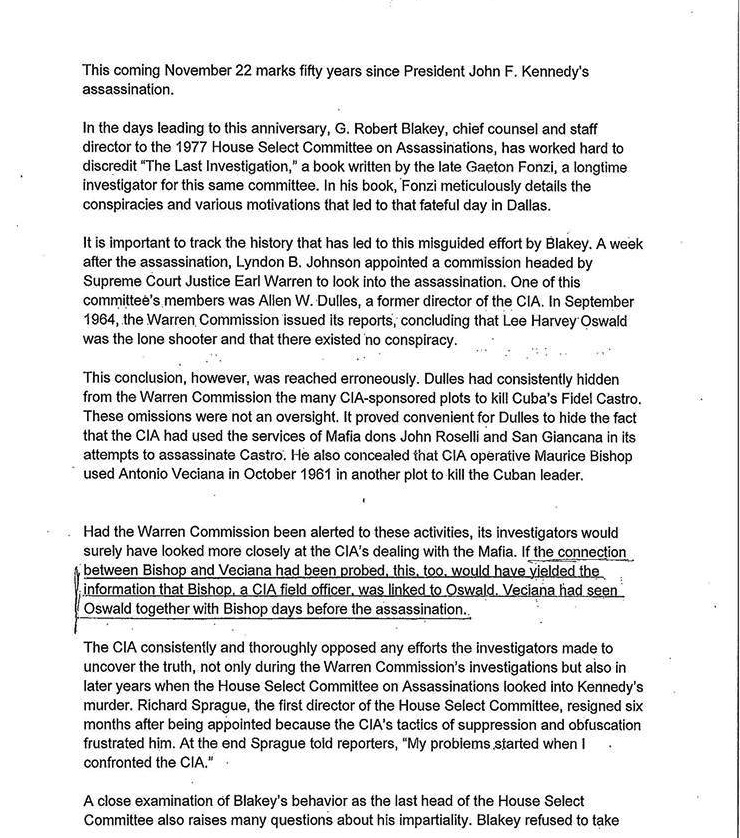
When he first confirmed that David Atlee Phillips was the CIA contact known as “Maurice Bishop,” Cuban exile leader Antonio Veciana did so tacitly. But Veciana’s meaning was so clear, and his guile so transparent, there was no doubt; both he and House Select Committee investigator Gaeton Fonzi began laughing.
Now, decades later, Veciana has explicitly stated that Phillips (right) was indeed Bishop, and that he did indeed see Phillips with Lee Harvey Oswald in September 1963 – thus formally linking a high ranking CIA officer with the JFK assassination.
Veciana’s admission came in a written statement issued November 22, 2013, the fiftieth anniversary of the assassination. In a letter to Fonzi’s widow Marie, Veciana, the elderly, former leader of Alpha 66, said, “Maurice Bishop, my CIA contact agent was David Atlee Phillips. Phillips or Bishop was the man I saw with Lee Harvey Oswald in Dallas on September 1963.”
Fonzi wrote of his encounters with Veciana in his 1993 book The Last Investigation, which describes his experience with the House Select Committee on Assassinations in the 1970s.
At the time of his first meetings with Veciana, Fonzi was a staff investigator for Sen. Richard Schweiker (R-Pa.), a member of the Senate Select Committee on Intelligence and co-chair of the Sub-committee on the John F. Kennedy Assassination. Fonzi told Veciana he was exploring links between government agencies and Cuban exile groups.
On March 2, 1976, Veciana told Fonzi that two months before the assassination he rendezvoused with his CIA contact “Maurice Bishop” in the lobby of a downtown Dallas office building. Bishop was already there when he arrived, Veciana said, and in the company of a young man he later recognized as Lee Harvey Oswald, the alleged JFK assassin.
In subsequent HSCA testimony, however, Veciana did not identify Phillips as Bishop. But Fonzi independently determined that “Bishop” and Phillips were one and the same.
Phillips was also called before the HSCA, and under oath, denied both using the name Maurice Bishop and knowing Veciana. That ended the matter. Although Fonzi believed they could make a case for perjury, HSCA Chief Counsel G. Robert Blakey declined to bring charges against Phillips.
In the early 1960s Alpha 66 was a leading anti-Castro organization, funded by the CIA. During the course of their meetings Veciana never explicitly told Fonzi that Bishop was really Phillips. Fonzi believed that Veciana would not make the identification because he thought Bishop/Phillips could further aid him in his goal of toppling Cuban leader Fidel Castro.
David Atlee Phillips was a CIA officer for 25 years. At the time of the assassination he was Chief of Cuban Operations, based in Mexico City. He died in 1988.
Initial reports of Veciana’s 2013 statement erroneously said Veciana had died.
CTKA obtained a copy of the statement from former HSCA staff member Dan Hardway, who got it from Marie Fonzi.
The bulk of this account is derived from the Appendix to Hearings Before the Select Committee on Assassination of the U.S. House of Representatives, Vol. X, pp. 37-56, and from The Last Investigation, by Gaeton Fonzi, Chapters 16 and 44.
I want to begin this review by stating that I have a huge a mount of respect for Mark Lane. As a lawyer of over fifty years Lane has an undeniable history of looking out for the little guy. He represented numerous African Americans in civil rights cases in the south and was arrested for opposing segregation as a “Freedom rider”. He has been a dedicated antiwar protester and during his term as a New York State Legislator he worked to abolish capital punishment. Lane represented the American Indian Movement at the Wounded Knee Trial and helped establish the rights of women to bring actions for sexual harassment. Even Vincent Bugliosi admitted that Lane’s “bona fides as a skilled and dedicated soldier in the fight for civil liberties” are “unquestioned”. (Reclaiming History, p. 1011)
Perhaps more relevant to this review, Lane was one of very few prominent citizens speaking out on Lee Harvey Oswald’s behalf in 1963, and within weeks of Oswald’s murder at Dallas Police HQ he had the courage to pen a defense brief for the alleged assassin. At Marguerite Oswald’s request he attempted to represent her son’s interests before the Warren Commission and after the request was denied he testified before the commission and shared details he had uncovered during his own investigation of the assassination. His first book on the subject, Rush to Judgement, was a devastating critique of the Warren report that undermined all of the commission’s central conclusions. Lane gave numerous lectures on the assassination, and assisted New Orleans District Attorney Jim Garrison during his much maligned investigation and prosecution of Clay Shaw. He played a key role in establishing the House Select Committee on Assassinations and faced E. Howard Hunt in court where he presented evidence of CIA complicity in the assassination before the jury.
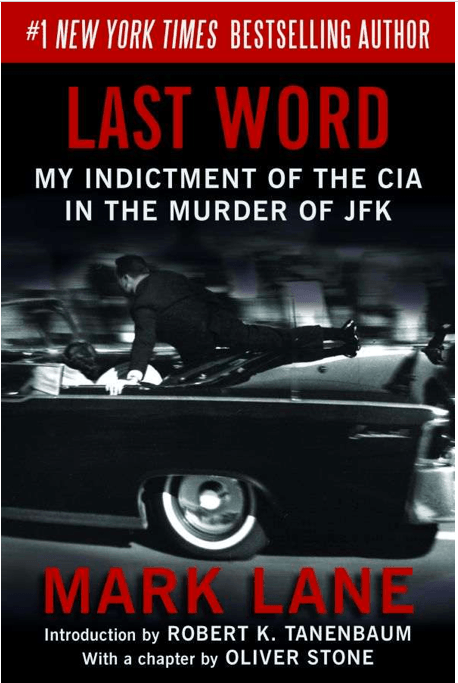
By any standards, Lane’s resume is impressive, and as I stated above, I have a great deal of respect for the man. So it is with heavy heart that I must say his latest and most likely his last book on the murder of JFK, Last Word, is—for me at least—a little disappointing. In nearly 300 pages he presents little that is really new. And he gives the impression of being largely unaware of some of the more interesting research published in the years since the Assassination Records Review Board (ARRB) pried open thousands of crucial documents from the hands of US intelligence agencies. Somewhat surprisingly the book is, at times, awkwardly written and poorly edited; there are numerous typographical errors, there is no index, and worst of all, the book is poorly sourced. In fact, there are times when the author makes controversial statements for which he offers no citation at all. In no way do I mean to suggest the book is without merit; Lane offers many interesting facts, insights and anecdotes; and his ultra sharp wit is very much in evidence throughout the text. But if this is truly to be his “Last word” on the subject, I can’t help wishing it had been a little more substantial.
I
Last Word is divided into five books; the most interesting of which is, for my money, book two: “The Media Response”. Part of what makes it interesting is that Lane takes the opportunity to hit back at some of his critics and exposes some of the lies that have been spread about him and his work on the assassination. Mark lane is, after all, the man Warren Commission apologists love to hate and with the exception of the late great Jim Garrison, no commission critic has suffered as many baseless personal attacks as Lane. For example, in his mammoth waste of paper, Reclaiming History, Vincent Bugliosi spends an entire chapter attempting to undermine and discredit Lane and his brilliant book, Rush To Judgement. But despite spending twelve fun-filled pages employing every smear tactic available, Bugliosi never actually gets around to pointing out any of the “distortions or outright fabrications” he claims are in the book. The closest he comes is this:
Lane was so bold and blatant in distorting the truth that he even gives citations to the Warren Commission volumes that he knows directly contradict his own arguments. For instance, he states that the Warren Commission’s firearms experts were unable to duplicate on the range what Oswald had done. “none of them,” he says, “struck the enlarged head or neck on the target even once.” But an examination of the citations given by Lane himself (Commission Exhibit Nos. 582 to 584, Warren Commission volume 17, pages 261 to 262) shows two hits were scored on the head. (Reclaiming History, p. 1005)
But the distortion of truth is Bugliosi’s not Lane’s.
Knowing that Oswald was a poor shot, the Warren Commission made it clear that it believed he had been able to pull off the assassination by utilizing the telescopic sight on his cheap mail-ordered rifle. In that regard and under the heading “The Nature of the Shots”, the commission’s report quotes FBI firearms expert Robert Frazier as stating that “when you shoot at 175 feet or 260 feet, which is less than 100 yards, with a telescopic sight, you should not have any difficulty in hitting your target…I mean it requires no training at all to shoot a weapon with a telescopic sight once you know that you must put the crosshairs on the target and that is all that is necessary” [my emphasis](Warren Report p. 190) The above passage and subsequent ones make it clear that the commission attributed to Oswald the use of the scope. In fact, the report even goes as far as to suggest that a defect in the scope “was one which would have assisted the assassin aiming at a target which was moving away”! (p. 194) With this in mind, the reader is invited to check Commission Exhibits 582 and 584 for themselves. They will see that the two head shots were scored by using the iron sights and not the defective scope, which means that Lane was correct; none of the expert riflemen had duplicated Oswald’s alleged feat.
Lane turns the tables on Bugliosi, writing that his “book, page after page, swarms with hundreds of demonstrably inaccurate assurances”, (Last Word, p. 143) and unlike Bugliosi he actually provides instances that support his contention. For example, Bugliosi claims that in a taped telephone conversation with Helen Markham, the Warren Commission’s star witness to the murder of J.D. Tippit, Lane had identified himself “as Captain Fritz of the Dallas Police Department” before making a “blatant attempt to improperly influence, almost force an uneducated and unsophisticated witness to say what he wanted her to say.” (Reclaiming History, pgs. 1006 & 1009) As Lane makes clear, this is simply not true, and Bugliosi had to know it. Firstly, the transcript of the telephone conversation to which Bugliosi makes reference begins, “My name is Mr. Lane. I’m an attorney investigating the Oswald case.” And secondly, “The statement that I tried to put words into Markham’s mouth, an original Bugliosi fabrication, is belied by a review of the facts. Since Markham had told reporters, long before I had spoken with her, that the man she had seen shoot Tippit was ‘short’ (Oswald was not short) that he was “stocky” (Oswald was thin) and that he had “bushy hair” (Oswald had thinning hair and a receding hairline), I called her to discuss her original description. She in part conceded the accuracy of her original assessment of the shooter and in part rejected it. The original words were hers, not mine, as Bugliosi knew but declined to reveal.” (Lane p. 148) Bugliosi also omitted the fact that this description of Tippit’s killer is similar to the initial description given to Dallas police officer Gerald Hill: “5’8”, 160 pounds, wearing a jacket, a light shirt, dark trousers, and sort of bushy brown hair [my emphasis]. (7H47)
Lane also defends himself against the unscrupulous attacks made by another high profile defender of the official fairy tale, Max Holland. Back in 2006, Holland took us all back in time when he attempted to undermine Lane’s research in the pages of The Nation by dragging out the tried and true (and slightly outdated) “commie smear” tactic. Holland as we all know, and as Lane points out, is little more than a mouthpiece for the CIA who regularly writes articles for the official CIA website “supporting and defending the CIA and attacking those who dare to disagree”. (Lane p. 112) For his 2006 piece titled “The JFK Lawyers’ Conspiracy”, Holland stated that the KGB was secretly funding Lane when he researched and lectured on the assassination and wrote his best-selling book, Rush to Judgment. As Lane wrote in a letter to The Nation, “It was secret all right. It never happened…No one ever made a sizeable contribution with the exception of Corliss Lamont who contributed enough for me to fly one time from New York to Dallas to interview an eyewitness. The second largest contribution was $50.00 given to me by Woody Allen.” (p. 111) When Lane made it clear that he had kept records of all contributions, Holland suggested, somewhat desperately, that the money could have been given in very small amounts. “Perhaps”, Lane sardonically replies, “when I was discussing the case each night for months from the stage of a small theater in New York, a couple of hundred Russian agents, wearing long leather coats, slipped in unnoticed and each paid a dollar for admission.” (p. 94)
Holland comes under additional fire in a chapter contributed by Oliver Stone in which the film maker responds to Holland’s claim that the KGB was behind the 1967 Paese Sera story naming Clay Shaw as a board member of Centro Mondiale Comerciale—an organization that had been booted out of Italy amid charges that it was front for the CIA. Holland argues laughably in his article, The Lie that Linked the CIA to the Kennedy Assassination, that it was the Paese Sera articles that led Jim Garrison to believe the CIA was behind the assassination and that the whole thing was the result of a KGB disinformation scheme. But Holland’s silly story falls flat on both counts. Firstly, the entire claim that the KGB was behind it all rests on one handwritten note by KGB defector Vasili Mitrokhin referring to a disinformation scheme that resulted in the publication of a false story in New York. “The note”, Stone writes, “supposedly summarizing a KGB document that Holland has never seen, does not mention Clay Shaw, Centro Mondiale Comerciale, Jim Garrison, or any specific New York publication.” And secondly, “Garrison’s book On the Trail of the Assassins describes in detail how his uncovering of various pieces of evidence actually led him to the conclusion that the CIA was involved.” His suspicions of Agency involvement began when he investigated—among other things—Oswald’s background, his associations with CIA-connected people like David Ferrie and George De Mohrenschildt, and discovered “the fact that Oswald was working out of an office that was running the CIA’s local training camp for Operation Mongoose…No doubt the Paese Sera series was another piece of the puzzle for Garrison, but it was not the centerpiece of his thinking that Holland makes it out to be.”(pgs. 73-75)
On the subject of Jim Garrison, Lane relates an intriguing story that seriously undermines the conventional view that Bobby Kennedy saw no value in Garrison’s investigation. It is usually said that once Garrison’s probe became public, RFK had dispatched Walter Sheridan to New Orleans to see if there was any substance to his charges and that Sheridan had quickly reported back that Garrison was a “fraud.” We are usually told that Kennedy accepted Sheridan’s assessment and author Joan Mellen even goes so far as to charge that “Bobby Kennedy did everything he could to stop Jim Garrison” and that “Destroying Garrison’s investigation became Bobby’s obsession.” (A Farewell to Justice, pgs. 259, 382) However, Lane writes that one evening in 1968 over drinks in New Orleans’ famous French quarter Garrison confided that Kennedy had sent him a message through a mutual friend. “He said ‘Keep up the good work. I support you and when I’m president I am going to blow the whole thing wide open.’” (Lane, p. 42) Garrison had expressed concern that by telling people in private what he planned to do, RFK was putting his life in danger and reasoned that he would be safer if he announced his intentions publicly. Two days later the mutual friend relayed that Bobby had thought it over and decided that if he won the California primary he would go public with his doubts about the official verdict. Kennedy did, of course, win the primary, but he did not live long enough to call for a new investigation.
II
As someone who has long found the official investigations of the Kennedy assassination almost as interesting as the assassination itself, I very much enjoyed reading Lane’s somewhat egocentric recollection of the formation and early days of the House Select Committee on Assassinations (HSCA). In contrast to the Warren Commission, which we all know by now began with its lone assassin/no conspiracy conclusion already firmly in place, the HSCA had the potential to conduct a genuine investigation that might well have uncovered the true facts of the case. But powerful forces in Washington stood in its way.
In 1975, Lane writes, he moved to Washington, D.C., to organize 180 chapters of the “Citizen’s Commission of Inquiry” whose purpose was to urge congress to conduct a new investigation of the assassination and its subsequent cover-up. Whilst continuing to lecture on the subject he prepared a resolution calling for the establishment of a Select Committee and began calling upon members of the House of Representatives for their support. A year later, with over one hundred congressional sponsors and over a million letters, telegrams and signatures on petitions sent to members of congress, the resolution was set for a vote. According to Lane, when the bill passed, Representative Don Edwards looked at him and remarked, “This should be called the Mark lane resolution.” (Last Word, p. 215) Once the HSCA was authorized and given a down payment for its budget, members of the committee suggested he take the job of Chief Counsel. “I said that even I would object”, Lane writes, “since my objectivity had long since evaporated in view of the undeniable evidence.” (p. 216)
Eventually, a brilliant and respected Philadelphia prosecutor named Richard Sprague was chosen for the job. As committee investigator Gaeton Fonzi writes, “Sprague had run up a record of 69 homicide convictions out of 70 prosecutions, and he was known as tough, tenacious and independent. There was absolutely no doubt in my mind when I heard of Sprague’s appointment that the Kennedy assassination would finally get what it needed: a no-holds barred, honest investigation. Which just goes to show how ignorant of the ways of Washington both Sprague and I were.” (The Last Investigation, p. 176) Sprague chose as his Deputy Chief Counsel a veteran homicide attorney from the New York District Attorney’s Office named Robert K. Tanenbaum who was, according to Fonzi, “the epitome of the quick-thinking, fast-talking prosecutor.” (p. 179) As Lane puts it, “he had a fine reputation…Both Sprague and Tanenbaum were honest, intelligent and skillful lawyers committed to learning the truth.” (Last Word, pgs. 220-221) Indeed it was the skill, integrity and dedication of both men that would put them off the committee before its work had truly begun.
Sprague had made it obvious that he wanted to conduct an honest and independent investigation that would uncover the truth—whatever that may be. He knew that he could not rely on the same agencies that the Warren Commission had (i.e. the FBI and the CIA) as his investigators, since those very agencies might themselves be under suspicion. So he insisted on hiring his own investigators. Pretty quickly the CIA began stonewalling the Committee’s requests for information—especially those relating to Lee Harvey Oswald’s alleged Mexico City sojourn—and insisting that Sprague sign a secrecy agreement which he refused to do, asking how he could “possibly sign an agreement with an agency I’m supposed to be investigating.” (p. 217) Instead, Sprague responded that he would subpoena the CIA for all relevant materials. What followed, predictably enough, was a media smear-campaign led by Agency assets that essentially resulted in congress refusing to reauthorize the committee until Sprague was removed. As Fonzi writes, “Sprague had early on offered to resign if it meant the difference in keeping the Committee alive” and near midnight of the evening before the House vote, “Sprague realized that…the ground was being shoveled out from beneath him.” Thinking it was the only way to save the committee, he called his secretary and dictated a two-sentence letter of resignation. (Fonzi, p. 194) Tanenbaum followed shortly after.
Sprague’s replacement as Committee Chief Counsel, G. Robert Blakey, was fairly contrary to him. A 41-year-old law professor who, as he admitted to Tanenbaum, had never tried a case, Blakey knew exactly what was expected of him in Washington, since he had worked on previous Congressional committees. In his first address to the Committee staff, Blakey made it clear that their top priority was not to conduct a criminal investigation, it was to produce a report on time and within budget. Blakey had promised that the Committee would produce a report by December 31, 1978, and he informed the staff that there was no chance the committee would be extended beyond that deadline. As Fonzi recalled, “with that pronouncement, I got a revealing insight into Bob Blakey’s character…He saw nothing incongruous in accepting a basic and crucial limitation to conducting ‘a full and complete investigation’ of one of the most important events in this country’s history.” (Ibid, p. 210) Blakey also had no problem with signing (and insisting that staff members sign) a secrecy agreement before being given access to CIA documents. Nor with sealing the Committee’s voluminous files so that they would be kept from public scrutiny for 50 years. As Lane puts it, “Blakey relied upon the judgment of the CIA and the FBI, who placed their operatives on his staff and who provided only those documents that they wanted the Congress to see. The congressional committee had been captured.” (Lane, p. 232)
In composing his report, Blakey placed a great deal of importance on the scientific evidence—trajectory analysis, ballistics comparison, medical studies etc.— and insisted that it proved Oswald’s guilt. But the linchpin of his case, the Neutron Activation Analysis of the ballistics evidence, has since been proven to be so unreliable that the FBI has abandoned its usage in court. In fact, even Blakey now refers to the HSCA’s NAA analysis as “junk science”. But perhaps his biggest folly was trusting the CIA and allowing it to appoint career Agency man George Joannides as its liaison to the Committee. In 1978, when he was assigned to the HSCA, Joannides was allegedly retired. But in November of 1963 he was serving as chief of psychological warfare operations in the CIA’s Miami station and his main job was to provide funds and support for to the anti-Castro group “Directorio Revolucionario Estudiantil” (DRE). As journalist Jefferson Morley explains, by 1962, “the DRE was perhaps the single biggest and most active organization opposing Fidel Castro’s regime. In Miami, Joannides was giving the leaders of the group up to $25,000 a month in cash for what he described as ‘intelligence collection’ and ‘propaganda.’” (Morley, The Man Who Didn’t Talk and Other Tales from the New Kennedy Assassination Files) In August 1963, the New Orleans chapter of the DRE had a number of very public run-ins with Lee Harvey Oswald. After Oswald offered to help train DRE commandos, “the DRE boys saw him on a street corner passing out pamphlets for the Fair Play for Cuba Committee (FPCC), a notoriously pro-Castro group”. (ibid.) DRE spokesman Carlos Bringuier rushed to the scene to confront him in what a police officer would later describe as a “staged event”, and later visited Oswald’s home before debating him on a local radio program.
As Lane explains, “Almost immediately after the shots were fired in Dallas, the Joannides-guided group launched a media campaign to connect Fidel Castro to the murder…One DRE leader called Clair Booth Luce and assured her that the directorate knew Oswald was part of a Cuban hit team organized by Castro…Thus it was the CIA and Joannides that paid for, organized and published the very first conspiracy theory about the assassination”. (Lane, p. 234) When documents released by the ARRB in 1998 revealed Joannides’ secret activities with the DRE, Blakey claimed to be outraged stating that had he known of Joannides’ role he would have been “interrogated under oath by the staff or the committee”. But, in light of his past actions, Lane finds this more than a little hard to swallow. He also poses the question of whether or not Blakey is merely playing dumb. Did he know all along who he was dealing with? Or was Blakey “so inept an investigator that he could not even discover who was his own main source?” The HSCA reported that it had not have been able to identify the second gunman or “the extent of the conspiracy” but as Lane points out Blakey was somehow “able to state with absolute authority that he knew who” was not involved when he “declared that the CIA and the FBI were innocent.” As Lane concludes, it appears that Blakey “met his commitment to those who hired him”. (p. 235)
III
When it comes time to address Oswald’s alleged visit to Mexico City in September, 1963, I believe Lane ultimately drops the ball. He correctly points to many crucial holes in the official story and casts understandable doubt on the notion that Oswald ever made the trip. But he seems to misunderstand the motivations of those who engineered the whole episode and mischaracterizes the effect it had in Washington and how it ultimately led to a cover-up.
The official version of events, as laid out in the Warren Report, has Oswald leaving New Orleans for Mexico City on September 25, 1963, and arriving on September 27, 1963. Soon after his arrival, the Commission said, he visited the Cuban Embassy to apply for a visa to visit Cuba on his way to Russia. But he was told that the he could not get a Cuban visa until he had received one from the Soviets and this would take several months. At that point, “Oswald became greatly agitated, and although he later unsuccessfully attempted to obtain a Soviet visa at the Soviet Embassy in Mexico City, he insisted that he was entitled to the Cuban visa because of his background, partisanship, and personal activities on behalf of the Cuban movement.” Oswald got into a loud and memorable argument with the consul who continued to refuse him a visa and remarked that far from helping the Cuban Revolution, Oswald “was doing it harm.” “Disillusioned”, Oswald left Mexico City and made his way back to Texas. At least, that was the version Earl Warren put in his report. Behind closed doors, a different story was being told.
On the very weekend of assassination, the White House was receiving reports from the CIA’s Mexico City station about Oswald’s activities in Mexico City. In this version of events, when Oswald had called the Russian embassy, he had asked to speak to “comrade Kostin,” a codename for Valery V. Kostikov who, according to the CIA, was a KGB officer responsible for carrying out assassinations in the Western Hemisphere. This was quickly followed on Monday, November 25, by a cablegram asserting that CIA station chief Winston Scott had uncovered evidence that Castro, with possible Soviet support, had paid Oswald to assassinate President Kennedy. (Gerald McKnight, Breach of Trust, p. 24) At the same time, as noted above, George Joannides’ DRE group was informing the press that Oswald was part of a hit team organized by Castro. The CIA was trying to place the blame for the assassination at Castro’s feet, and President Johnson’s later remarks would reveal that he fell for it.
The CIA was the initial source of all information placing Oswald in Mexico City, and Lane contends that “The entire story about Oswald being in the Cuban embassy was a fiction created by the CIA. Oswald had never been to Mexico City.” (Lane, p. 205) The legend was dependent on Sylvia Duran, the Cuban consul with whom Oswald allegedly spoke, but the Commission never saw fit to call her as a witness. Why? Because when she was first questioned Duran denied ever seeing him there. The CIA wasted no time in directing its assets in the Mexico City police department to place her under arrest, put her in isolation, and keep the arrest a secret. “After a period of solitary confinement, Duran agreed to sign a statement prepared by the CIA that identified Oswald as the person in the Cuban embassy” (p. 204) When she was released from prison, Duran was understandably outraged and began speaking out against the Mexican police, unaware that the Agency was behind it all. The CIA then ordered her rearrested, and in a cable marked “priority”ordered the Mexican authorities “to take responsibility for the whole affair.” (ibid.) By not calling her to give testimony, the Commission avoided having these inconvenient facts cluttering up their report.
The CIA also claimed to have photographs of Oswald entering the Soviet embassy and a tape recording of a phone call but neither turned out to be true. When the photo materialized, it showed a middle-aged man who did not resemble Oswald in the slightest. The tape recording of the man identifying himself as “Lee Oswald” was listened to by the seven different FBI agents who interviewed Oswald on November 22 and 23, and all agreed, according to a memo written by J.Edgar Hoover himself, that the voice on the tape “Was NOT Lee Harvey Oswald.” (p. 206) When David Phillips, who ran the CIA’s Mexico City Cuban desk in 1963—and was largely responsible for the Mexico city legend—was called to testify in the early days of the HSCA, he swore that he was unable to provide the tape recordings because they had been destroyed before the assassination as a matter of routine. Upon hearing this, Lane went to the committee offices to see Bob Tanenbaum. He handed him an envelope containing a copy of the Hoover memo, and told him that, once he read it, he would know what to do. And he did. Phillips was called back for further questioning and asked again to explain why he could no longer provide the tapes, to which he restated his previous testimony: that they were routinely destroyed before November 22. At that point, Tanenbaum pulled out the Hoover memo proving this to be a lie and handed it to Phillips. Phillips read the document, folded it up, put it in his pocket, then silently stood and walked out of the room. “At that moment”, Lane notes, Phillips was “guilty of obstructing Congress and numerous counts of perjury and uttering false statements.” (p. 228)
Phillips had clearly lied to the HSCA. But, according to Lane, he was ready to tell the truth some years later during a debate at the University of Southern California. At one point, when Phillips was claiming to regret the CIA attempts to destroy Lane and opining on the difficulties of being an employee of the Agency, a student in the audience yelled out, “Mexico City, Mr. Phillips. What is the truth about Mexico City?” Phillips replied, “…I will tell you this, that when the record comes out, we will find that there was never a photograph taken of Lee Harvey Oswald in Mexico City…let me put it, that is a categorical statement, there, there, we will find out there is no evidence, first of all no proof of that. Second there is no evidence to show that Lee Harvey Oswald ever visited the Soviet embassy.” (p. 229) Curiously, although Lane first reported this exchange in his 1991 book Plausible Denial, this seeming confession has gone largely ignored by both defenders of the official story and those critical of it.
Unfortunately, although Lane does a good job of showing that the CIA fabricated the Mexico City legend, he doesn’t seem to know what to do with that revelation. In fact, he admits to being “puzzled” about why the CIA seemingly told two different stories; one in which Oswald was the lone assassin and one in which he acted at the behest of Castro. But the confusion stems from Lane’s misunderstanding of the original intent of the Mexico City escapade, his belief that they were giving the two differing accounts simultaneously, and his desire to place the blame for the Warren Commission cover-up squarely on the CIA.
Lane writes incorrectly that a memo of a January 20, 1964, Warren Commission staff meeting, authored by assistant counsel Melvin Eisenberg, is the “most relevant report about a meeting at which the CIA presented its carefully constructed legend to Warren”. (p. 200) In fact, despite the impression Lane attempts to convey, the Eisenberg memo does not even mention the CIA at all. What it actually reveals is that Earl Warren initially declined chairmanship of the Commission but gave in under pressure from President Johnson:
“The President stated that rumors of the most exagerrated [sic] kind were circulating in this country and overseas. Some rumors went as far as attributing the assassination to a faction within the government wishing to see the Presidency assumed by President Johnson. Others, if not quenched, could conceivably lead the country into a war which could cost 40 million lives. The President convinced him that this was an occasion on which actual conditions had to override general principles.”
It is well documented that Johnson went to his grave believing JFK’s assassination was the result of a conspiracy and although he seemingly went back and forth on who he felt was behind it, immediately after the assassination he was convinced that Castro had masterminded the plot. He apparently still gave credence to this notion in 1970 when he told CBS newsman Walter Cronkite that Kennedy had died in retaliation for the numerous American efforts to assassinate the Cuban leader. The source of Johnson’s belief was undoubtedly the aforementioned false reports the CIA was feeding the White House in the days following the assassination. As the “40 million lives” remark reveals, Johnson believed that if the American people knew what the CIA was telling him, there would be a public outcry demanding a confrontation with Cuba. But following the events of the Cuban Missile Crisis, and the secret assurances Kennedy had given Soviet Premier Nikita Kruschev, any action taken against Cuba could well lead to nuclear war with the USSR, and LBJ was unwilling to take that risk. When Johnson and FBI director Hoover made it clear that, as far as they were concerned, the buck was going to stop with Oswald, the CIA backed off. It stuck to its story that Oswald had been in Mexico City but it stopped relating false allegations about Oswald’s Soviet and Cuban contacts.
Johnson’s fear of a nuclear exchange had put a halter to the ultimate goal of those responsible for orchestrating the Mexico City charade—the very reason it was staged in the first place—an invasion of Cuba and the downfall of Castro’s government. It is well documented that many of the militant Cuban exile groups and their sponsors in the CIA felt betrayed by President Kennedy after the Bay of Pigs and blamed him for the failed invasion. After the Cuban Missile Crisis their violent hatred of Kennedy grew as they began to believe he had no intention, despite his assurances, of unseating Castro and liberating the island. And when word got around that Kennedy had taken part in back channel communications with Castro, seeking to make peace with the Cuban leader, their worst fears were realized. Mexico City was the perfect way to precipitate the invasion that the CIA and the Cuban exiles so desperately craved. Which is precisely why David Phillips and the CIA’s Mexico City station engineered the whole thing two months before the assassination. If Lane had accepted the record as it stood, and not let his eagerness to find the CIA entirely responsible for the cover-up cloud his judgment, he may have been a little less “puzzled” over the CIA’s actions after November 22.
IV
I was somewhat disheartened to find that 18 years after the publication of his second JFK book, Plausible Denial, Lane is still touting the saga of Marita Lorenz. When Lane defended Liberty Lobby against a defamation suit brought by CIA officer E. Howard Hunt, he attempted to prove that Hunt was involved in the assassination. Lorenz, a former girlfriend of Fidel Castro who was involved in a CIA-led attempt to assassinate him, was Lane’s star-witness. Under oath, Lorenz claimed that in November 1963 she traveled to Dallas in a two-car caravan that included Frank Sturgis, Gerry Patrick Hemming and two brothers named Novo and Pedro Diaz Lanz. Unbeknownst to Lorenz, of course, the purpose of the trip was to kill Kennedy, and Hunt was the paymaster. They arrived in Dallas on November 21 but, having a bad feeling about the whole thing, Lorenz left the others at a motel and flew back to Miami. Sometime later, Sturgis told her that if she hadn’t gotten cold feet she could have been “part of history.” They had, after all, “killed the president that day.” (Lane, p. 62)
It’s a fancy little story, but Lorenz has serious credibility issues and it is not to his credit that Lane chose not to divulge them here, or in his book written largely about the trial, Plausible Denial. Respected HSCA investigator Edwin Lopez told author Gerald Posner that “Mark Lane was taken in by Marita Lorenz. Oh God, we spent a lot of time on Marita…It was hard to ignore her because she gave us so much crap, and we tried to verify it, but let me tell you—she is full of shit. Between her and Frank Sturgis, we must have wasted over one hundred hours. They were dead ends…Marita is not credible.” (Case Closed, p. 467) In The Last Investigation Gaeton Fonzi chronicles his time investigating the assassination for both the Schweiker Subcommittee and the HSCA. He goes into some detail about many of the leads he was fed that ultimately appeared as if they were designed simply to waste the time and resources of both committees. In the end, Fonzi placed Lorenz’s various stories in that category.
In 1977, before she claimed knowledge of the assassination, Lorenz was giving Fonzi details about her anti-Castro activities in Miami with Frank Sturgis. She related a story about heading down to the Florida keys in a two-car caravan that included Sturgis, Gerry Patrick Hemming, Alex Rorke, and “Rafael Del Pino or Orlando Bosch” to launch a gun-running mission to Cuba. When Sturgis realized he had forgotten something, “We turned all the way around and went back” to Miami. (Fonzi, p. 90) A year and a half later, she was telling the HSCA the same story about two cars, full of the same people, this time heading to Dallas to kill Kennedy. By the time of the Liberty Lobby trial, she had bumped Del Pino and Bosch in favour of Novo and Pedro Diaz Lanz.
Whether Lane was “taken in” by Lorenz or simply used her testimony as a means to an end, he nonetheless withheld important details about her account from his readers. When the gun running trip morphed into an assassination story, she added Lee Harvey Oswald into the mix. According to her testimony at the Liberty Lobby trial Oswald—whom she knew as “Ozzie”—traveled in “the other car, back-up car” during their two-day trip from Miami to Dallas. Of course, as any first year student of the assassination knows, this simply cannot be because Oswald’s actual whereabouts during this time are fully accounted for. He was working his job filling book orders at the depository during both days and he spent the entire evening and night of November 21 by his wife’s side at the Paine residence in Irving.
The capper is Lorenz’s claim that she first met Oswald in a safehouse in Miami in late 1960 and again in the Everglades in early 1961 when they were both training for the Bay of Pigs. The failed Bay of Pigs invasion, of course, occurred in April 1961—over one year before Oswald returned from nearly 18 months living in the Soviet Union. Not only was Oswald not in Miami in late 1960 or the Everglades in early 1961, he wasn’t even in the United States! When she tried to feed this garbage to the HSCA they confronted her with the facts and forced her to recant her fraudulent testimony. Yet she again told the same stories under oath at the Liberty Lobby trial. Knowing full well, as Lane must, that these details discredit her story, he hides them from his readers by carefully excising all references to Oswald when he quotes from her testimony. As I noted above, this is not to his credit.
V
The fifth and final book of Last Word is titled “The Indictment” and, although I make no claim to be expert in legal matters, I remain unconvinced that Lane has presented evidence of CIA complicity that would lead to an indictment. He details prior acts of assassination by the Agency which I’m sure are perfectly relevant and presents a motive via JFK’s stated intention of “dismantling” the CIA, as well as his intention to pull out of Vietnam, and his efforts at rapprochement with Castro. But he also wastes 16 pages discussing the CIA’s MKULTRA program, without explaining how it could be directly relevant to the assassination.
One of the more interesting facts that Lane relies upon was first revealed by Jim Douglass in his excellent book JFK and the Unspeakable. It is widely accepted that moments after a bullet tore through President Kennedy’s head, Dallas policeman Joe Marshall Smith confronted a fake Secret Service agent behind the picket fence atop the grassy knoll. As Smith stated in his Warren Commission testimony, after he heard the shots, “…this woman came up to me and she was just in hysterics. She told me, ‘They are shooting the President from the bushes.’ So I immediately proceeded up there…I looked in all the cars and checked around the bushes.Of course, I wasn’t alone. There was some deputy sheriff with me, and I believe one Secret Service man when I got there. I got to make this statement, too. I felt awfully silly, but after the shot and this woman, I pulled my pistol from my holster, and I thought, this is silly, I don’t know who I am looking for, and I put it back. Just as I did, he showed me that he was a Secret Service agent…he saw me coming with my pistol and right away he showed me who he was.” (7H535) Commission lawyer Wesley Liebeler, who took Smith’s deposition, did not ask for a description of the man with the Secret Service credentials because, as Liebeler well knew, there were no genuine Secret Service personnel on foot in Dealey Plaza. Although Commission apologists like Vincent Bugliosi have attempted to blunt Smith’s testimony by asserting that he “doesn’t say how the person showed him who he was” and therefore he could have been mistaken because he probably just saw a badge and “assumed it was a Secret Service badge” (Bugliosi, p. 865), this ignores what Smith told author Anthony Summers: “The man, this character, produces credentials from his hip pocket which showed him to be Secret Service. I have seen those credentials before, and they satisfied me and the deputy sheriff.” (Summers, italics added, Conspiracy, p. 37)
There is no doubt that the man on the grassy knoll seconds after the shooting was brandishing fake Secret Service credentials. The question is, who in 1963 had the know-how to create them? The answer, as Douglass reveals, is the CIA. Douglass quotes from a document written by Stanley Gottlieb, chief of the CIA’s Technical Services Division, that was finally declassified in 2007 in response to a 15-year-old Freedom of Information Act lawsuit: “…over the years” the TSD “furnished this [Secret] Service” with “gate passes, security passes, passes for presidential campaign, emblems for presidential vehicles; a secure ID photo system.” (JFK and the Unspeakable, p. 266) This is a remarkable revelation, and could be said to show that the CIA and its Cuban exile guerrillas not only had the motive, but had the means to pull off the assassination in broad daylight, and then to escape unhindered. But for me, the Mexico City legend aside, this as good as Lane gets when it comes to filling in the details and connecting the CIA to the assassination.
In his indictment, Lane makes no mention of Oswald’s associations with Guy Banister, David Ferrie and Clay Shaw—three men who were up to their eyeballs in CIA connections, or Oswald’s campaign to discredit the FPCC, or his trips to Clinton and Jackson—all of which put Oswald at the very center of intelligence intrigue. He does not note that Oswald “defected” to the Soviet Union at the very time the CIA was running a fake defector program, nor the unbelievable ease with which Oswald returned home accompanied by a Russian wife. And although she was responsible for securing Oswald the job at the Texas School Book Depository, which put him in place to take the fall for Kennedy’s murder, he does not make even a passing reference to Ruth Paine, let alone to the fact that Marina Oswald was advised by the Secret Service to sever contact with Ruth because she was “sympathizing with the CIA.” (Douglass, p. 173)
It may be that Lane felt much of this was too circumstantial. Or it may be that he simply does not feel it is relevant to his case, but it is because of the wealth of information that Lane leaves out that I feel he ultimately fails to provide a convincing indictment against the CIA in the murder of Jack Kennedy.
So, all things considered, Lane’s new book is a decidedly mixed bag.
Jefferson Morley was one of the very few writers in the mainstream press who actually tried to print stories that indicated there was more to the John Kennedy assassination than the Warren Commission claimed. In his long tenure at the Washington Post he actually was responsible for getting into that publication two stories that showed there was more to the Oswald story than met the eye. Specifically, these were the long 1994 story on John Elrod and Lee Oswald, and a later story on the work of John Newman who was working on his book Oswald and the CIA. Two other stories that he worked on while at the Post were the attempts by Michael Scott to secure the purloined manuscript of his father, CIA officer Winston Scott, and the cover-up by the CIA of the role of George Joannides with the Cuban exile group the DRE in New Orleans in the summer of 1963.
These last two form the framework for his recent book Our Man In Mexico: Winston Scott and the Hidden History of the CIA. Morley was an acquaintance of the attorney for Michael Scott who was trying to get the manuscript of his father’s book, entitled Foul Foe. There were things in the manuscript the CIA clearly did not want disseminated to the public. The long struggle ended with a little more than half the manuscript being handed over to the son. The way Morley integrates the other aspect of his quest is through Lee Harvey Oswald’s activities in the summer and fall of 1963. Joannides was the Agency case officer for the Cuban exile group called the Directorio Revolucionario Estudantil (DRE). In addition to making raids into Cuba for the Agency, this group interacted with Oswald in New Orleans in the summer of 1963. Most famously through the personage of Carlos Bringuier. Bringuier got into a famous tussle with Oswald on Canal Street that led to some local press attention since they were both arrested. After this, Bringuier debated Oswald on a local radio show with host Bill Stuckey. Aided by the contacts of their friend and mentor Ed Butler, the two cohorts ambushed Oswald with information about his defection to the Soviet Union. This helped compromise his local chapter of the Fair Play for Cuba Committee, of which he was the only member. Bringuier issued more than one press release after the debate. (Morley p. 174) But even more significant is the fact that Bringuier and the DRE recycled the story and the releases right after President Kennedy’s assassination. As Morley notes, this got front-page placement in major newspapers throughout the land. (p. 207) And so the legend of the alienated Cuban and Soviet sympathizer now began to take hold with the public. And this was used by the Warren Commission to somehow explain Oswald’s motivation for allegedly killing Kennedy.
This New Orleans aspect is linked to Oswald’s strange and legendary trip to Mexico, where Scott was the CIA station chief at the time. So by telling the story of the DRE, he links it to the story of Scott’s job of surveying the Cuban and Russian embassies in Mexico City. Morley is then able to show us what the Warren Commission did with this material. So the book becomes not just a biography of Scott, but an opportunity to show how the CIA and the Warren Commission handled the alleged commie sympathizer in the months leading up to the murder of JFK. And afterwards. Morley is a skilled enough writer, about at the level of David Talbot. So he manages to cobble this together in an adroit and manageable way. The book is never really profound or moving. But it’s never dull or cumbersome either.
II
A little bit more than the first third of the book deals with the life and early career of Winston Scott. Scott was not a Boston Brahmin like Ben Bradlee or Des Fitzgerald. Nor was he a born member of the Eastern Establishment/CFR crowd like Allen Dulles or Jock Whitney. He was born in Alabama in 1909 near the Escatawpa River. The “house” was made up of discarded railroad boxcars. His hometown of Jemison was northwest of Mobile. Hid father worked for the railroad and the Scotts lived right next to the tracks where Morgan Scott toiled. (p. 15) During the week Win Scott and his siblings trekked three miles to school in the town of Brookwood. And like most southern families they went to church every Sunday. An early indication of Scott’s romanticism and his desire to escape these humble circumstances occurred at age 13. He and two friends decided to run away to New Orleans. The objective was to catch a freighter to France and join the French Foreign Legion. They were stopped on their journey by a friendly policeman who made a phone call and they were returned home.
Scott won a scholarship to attend college in Birmingham. There he met his first wife Besse Tate who he impulsively married by making his father awaken a Justice of the Peace at four in the morning. Win Scott had a head for numbers so he first became a math instructor at the University of Alabama. A paper he did on the algebraic possibilities of disguising message codes caught the attention of J. Edgar Hoover. Hoover sent one of his envoys to recruit him and Scott joined the FBI in 1941. He was first stationed in Pittsburgh and then Cleveland.
In 1944, Scott began the journey that would eventually lead to the CIA, Oswald, and Mexico City. He decided to switch over to the Office of Strategic Services, the World War II forerunner of the Central Intelligence Agency. While in Europe, he met the youngest OSS Chief of Station, a man named Jim Angleton who worked out of Italy. After the war, both OSS officers were befriended in Washington by British intelligence agent Kim Philby. Morley notes that Scott eventually suspected that Philby was a Russian double agent. Future counter intelligence chief Angleton did not. And this may have led to the eventual paranoia about CIA infiltration by the KGB, which later plagued Angleton and ended in his eventual forced resignation by Director Bill Colby.
Along with Allen Dulles, Scot campaigned to create the Central Intelligence Agency and to grant it the power to sanction covert operations. So when the CIA was eventually established and Dulles became Deputy Director, he brought his friend and ally Win Scott into the agency that he would now stamp indelibly with his own imprint. Although Scott was not actually part of the overthrow of the Arbenz government in Guatemala in 1954, he was familiar with the players involved including an officer on the rise, one David Phillips. Through his friendship with Allen Dulles, Scott asked the Director for a job outside the United States. He wanted to be station chief in Mexico City. Dulles obliged him and Scott began his thirteen-year tenure there in 1956.
It is here that Morley introduces the figure of Anne Goodpasture (p. 83). Goodpasture is an ubiquitous character in that she has clear but rather undefined ties to Scott, Angleton, and Phillips. Like Scott she was born in the south, in her case, Tennessee. Like Scott, she served in the OSS during the war, except she was stationed in the Far East with people like Dick Helms and Howard Hunt. After the war, she moved to Washington where she came to the attention of Angleton. And this is where I have my first complaint about the book. Goodpasture is a most fascinating character. And Morley interviewed her for two days in 2005. (See page 305) Either he does not find her very intriguing, or he took most everything she said at face value. John Newman, Ed Lopez, Dan Hardway, Lisa Pease and myself disagree. Lopez and Hardway – under the supervision of Mike Goldsmith – wrote the absolutely excellent Mexico City Report for the House Select Committee on Assassinations. Now Goodpasture was supposed to be working for and under Winston Scott in Mexico City. When the Mexico City Report – sometimes called the Lopez Report – was first declassified by the Assassination Records Review Board, I interviewed Lopez at his home in Rochester, New York. Since this was the first time I had seen the woman’s name repeatedly emphasized, I asked Lopez who she was. Surprisingly, he said that “She worked for Phillips when he got stationed down there … she handled all his projects for him.” (Emphasis added.) When I asked Ed what Phillips was doing there, he said, “He had some bullshit title, but he was in charge of almost all the Cuban operations from there at the time.” He then expanded on this by saying that since Phillips was constantly traveling from Washington to JM/Wave in Miami and to Mexico City, Goodpasture was the officer who guided his operations emanating from Mexico in his absence. In and of itself, this is extraordinarily interesting. It would make her a front tier figure in any book on the Kennedy assassination that focuses on both Mexico City and Phillips. Which this book does. But there is even more to the woman. It was Angleton who sent her to Mexico City on a counter-intelligence case. And he never lost touch with her. She worked on the famous CI case of Rudolf Abel in New York City. (The Assassinations, p. 174) Abel was convicted in 1957, and exchanged for Gary Powers in 1962. So the ties to Angleton were ongoing. In fact, Angleton stated that she was always in on the most sensitive cases. (Ibid) Further, she worked on Staff D. This was one of the most secret and clandestine operational units within the CIA. It dealt with both coups and assassination attempts.
Now Goodpasture is a clever operator of course. So, like many operators she pleads that she was only downstairs playing the piano at the time. She wasn’t aware there was a bordello operating on the second floor. To Jeremy Gunn and the ARRB she said she was only a secretary for Staff D. She duplicated papers and copied materials. The problem with that is the fact that Angleton also said that Goodpasture was “very close” to Bill Harvey. Harvey was part of Staff D and one of the major players in the CIA plots to kill Castro under Richard Helms. (Ibid) And when Goodpasture received a career achievement award, it was on the recommendation of David Phillips. He cited her for having discovered Oswald at the Cuban Embassy. A citation rich in irony of course, since it did nothing to help prevent the murder of President Kennedy. (Ibid)
Almost all of this, and more, is missing from Morley’s book. Goodpasture comes off as essentially a loyal civil servant who writes interesting reports about the history of the Mexico City station. Her ties to Phillips are hardly mentioned. Her connections to Angleton and his huge and powerful CI division are basically minimized.
III
This sets the stage for the ascension to power of John F. Kennedy. In this part of the book, I had another problem with the presentation. And it began fairly early. In regards to the Bay of Pigs, Morley writes that Kennedy had no objections to the plan. (p. 108) In Peter Kornbluh’s Bay of Pigs Declassified, the author briefly notes how Kennedy changed both the proposed landing site and the air support offered to the exiles. (Kornbluh, p. 8) Kornbluh writes that several CIA officials noted that Kennedy’s decisions severely hurt the operation’s chances for success. Two of them went to project coordinator Dick Bissell and offered to resign since they decided Kennedy’s limitations almost guaranteed its failure. Bissell assured them it would not and their concerns would be met. When the attack failed the two officials decided they had been misled, along with President Kennedy. (Ibid)
A few pages later, Morley uses Kennedy’s famous quote about splintering the CIA into a thousand pieces after the debacle of the Bay of Pigs. (p. 112) He then adds, “He was just venting.” Oh, really. Consider Kennedy’s actions in the wake of the Bay of Pigs debacle:
Appointed the Taylor Commission, an executive inquiry into exactly why the operation failed. His representative on the committee was RFK.
Signed NSAM’s 55, 56, 57. These were all aimed at forcing the Pentagon into giving him more and better advice over covert paramilitary operations. And they took away responsibility for planning overt paramilitary operations from the Agency. As John Newman writes about them, they were “the first significant chink in the CIA’s covert armor since its creation.” (JFK and Vietnam, p. 99)
Created an alternative intelligence apparatus called the DIA.
Sent out a memorandum stating that the ambassador in a foreign country, and not the CIA, should have ultimate control over American policy in that nation.
When the Taylor Commission results were submitted, Kennedy fired CIA Director Allen Dulles, Deputy Director Charles Cabell, and Director of Plans, Bissell. This clearly put the onus for the failure on the CIA. This result was quite natural since Kennedy and his brother became convinced through the inquiry that the three fired officers had deliberately misled JFK about the plan.
As David Corn notes in his book on Ted Shackley, Kennedy now moved his brother into a supervisory role over many covert operations.
As many commentators have noted, Kennedy was actually trying to exercise some degree of control over an Agency that had not really had any since its inception. Morley, I believe, downplays this aspect. And this plays into another characteristic of the book which I will note later.
Complementing this curious and curtailed view of JFK is his even more curious treatment of Richard Helms. I can only term the substance of Morley’s portrayal of the new Director of Plans as exalted. The portrait of Helms that comes through is essentially that of a conscientious bureaucrat who has been through it all, knows the ins and outs of the political world and is a kind of fatherly figure to the Kennedys (especially RFK). This, of course, has always been the sales image that Helms has tried to convey to the public. And it was clearly evident in his autobiography of 2003, which Morley uses to a surprising degree. The problem with accepting this public view of Helms at face value is that it contrasts with the private view that, unfortunately, some reliable people have seen close up. For instance, in my aforementioned interview with Ed Lopez, he asked me if I had seen the movie A Few Good Men. Mildly surprised at what I thought was a non-sequitir, I said that I had. He said, “Remember the scene near the end with Jack Nicholson on the stand? Him screaming, “You can’t handle the truth!” I said yes. He replied, “That was Richard Helms with us in executive session. He was laughing at us, sneering at us, shoving it in our face. He had no respect for anything. To him, we were a joke.” Reportedly, when Helms emerged from that session and reporters asked him more questions about Oswald he replied, “Your questions are as stupid as the committee’s” In filmed testimony, when Chris Dodd pressed him on the CIA’s barbaric treatment of Russian defector Yuri Nosenko, Helms response was, “Well, we could put them up at the Hilton.” This is the man who, in his private writings on the JFK case, Richard Case Nagell has nicknamed “Dirty Dick.” (See Probe, Vol. 3 No. 1)
Furthering this view, when I interviewed former CIA agent Carl McNabb before he died, he showed me a file from his days at JM/Wave. In his personal notes was a notation, “Zap Man”. I asked him what that meant. He said that one of the officers told him this was the term given to Helm’s private assassin. So I think that foot soldiers inside the Agency might have a bit of disagreement with the picture of Dick Helms that emerges here.
Given Morley’s slant, it was not surprising to me that he could write: “Helms also had to indulge Bobby’s demands for a plan to assassinate Castro.” (p. 159) This is the kind of sentence that could be written by Helms’ official biographer, the tendentious and shameless Thomas Powers. (Who, incidentally, wrote a blurb on the back of the book.) This completely ignores both the findings of the Church Committee, and the detailed information in the CIA’s own Inspector General Report. Which was overseen by Helms himself. These plots began in the Eisenhower administration and they continued into the Johnson administration. They were deliberately kept from the Kennedys. And RFK found out about them by accident. When he did find out about them, according to his calendar, he called Helms into his office. When questioned about this meeting, Helms conveniently contracted selective amnesia. He couldn’t recall a thing about it. (For an overview of this matter, see The Assassinations pgs. 327-329) But RFK aide John Siegenthaler did recall RFK’s response to Helms and John McCone when he found out. He told them he thought it was disgraceful and had to be stopped. (Ronald Goldfarb, Perfect Villains, Imperfect Heroes p. 273)
To be charitable to Morley, whenever one is doing a biography of a CIA officer, this kind of imbalance tends to be a problem. The reason being is that one has to consult books about these people. The books tend to be authorized, therefore sanitized. For further example, Morley uses the official biography of Allen Dulles, Peter Grose’s all too kind volume Gentleman Spy. The reason this is done is that the alternative, a really painstaking, unauthorized view of these men takes time, money, and entails dangers. Donald Gibson recalls talking to an author who tried to do such a book about Dulles. It was never published. Gibson asked him why it was not. He said, “Do you want to hear about a big conspiracy?” The other problem involved is the fact that higher-level officers or managers will not go on the record with anything not complementary to the official story. It is difficult to find those willing to talk candidly about failures, coups, assassinations, blackmail, drug-running etc. Morley does not really navigate this problem very well.
IV
The best part of the book deals with Oswald’s alleged visits to the Cuban consulate and Russian Embassy in Mexico City in the fall of 1963. This section of the work owes itself to the disclosures of the ARRB. More specifically to the Lopez Report and to John Newman’s important book Oswald and the CIA.
Morley does a decent enough job in setting the stage for this crucial episode by detailing the policy towards Cuba in late 1962 and 1963. He goes through Operation Northwooods, the Pentagon plan to create a phony provocation to launch an invasion, and how JFK turned it down. He then details some of the disputes between the Kennedys and the CIA over what should be done with Cuba. People in the Agency, like Nestor Sanchez, wanted more action. The Kennedys did not. He tries to explain this by saying perhaps the Kennedys were “just using the agency and its personnel for cover as they edged toward coexistence with Castro.” (p. 158) This seems to be what JFK was doing. But its not made clear to the reader because, in another curious lacunae, Morley never mentions JFK’s back channel diplomacy with Cuba through people like Lisa Howard, William Attwood, and Jean Daniel.
With this backdrop, Morley outlines the four secret programs through which Oswald had to come into contact with the CIA in 1963. They were codenamed AMSPELL, LIERODE, LIENVOY, and LIEMPTY. The first two programs were run by Phillips, the last two by Scott. AMSPELL was the name given inside the CIA to the DRE. So it would seem obvious that there would be documents about this interaction forwarded to either Joannides or Phillips. But as Morley notes, there are 17 months of reports–from 12/62 to 4/64– the CIA has yet to declassify on AMSPELL. (Elsewhere on this site, you can read about his struggle with the CIA to get these documents.) LIERODE refers to the camera surveillance on the Cuban consulate in Mexico City. LIENVOY refers to the wiretapping of phone lines at the Soviet Embassy, and LIEMPTY to the photo surveillance of that embassy.
Besides the seventeen months of missing reports, the results of the other three programs are also either lacking or questionable. As many know, to this day, the CIA has yet to produce a photograph of Oswald either entering or leaving either compound. And the photo they turned over to the Warren Commission in this regard does not even resemble Oswald. (In the Lopez Report-which is scathing about her–Anne Goodpasture tries to state that she did not realize this grievous error about the wrong photo of Oswald. until 1976. The authors make it clear that they find this suggestion not credible, as they do much of her testimony.) Since Oswald frequented the compounds a total of five times, there were ten opportunities to photograph him. What happened, and why there has never been a picture produced, is one of the great mysteries of this case. The CIA has taken decades of criticism and suspicion about Oswald’s visit to Mexico City, and much of it is based on these missing photographs. It has led some people to believe that perhaps Oswald did not actually go to Mexico City, or an imposter actually made the visits. Or both. Morley tries to forward the argument that maybe there actually was a picture. He does this by quoting the testimony of Daniel Watson and Joe Piccolo in the Lopez Report. These two CIA officers related that they had either seen or heard of a photo of Oswald in Mexico City. But in the case of Watson, the witness said it was a shot from behind, “basically an ear and back shot.” And he qualified it by saying he thought it was of Oswald. The implication being the angle made it hard to be positive. (Lopez Report, p. 97) The case of Piccolo was similar. The shot was from behind at an angle. Someone in the Agency had shown it to him saying it was Oswald. When the HSCA found this man, he said he did not ever recall having such a photo of Oswald. (Ibid pgs 103-106)
Further, the Lopez Report states that the investigators interviewed many CIA officers who were stationed in Mexico City, or worked at Langley in support of the Mexico City operation. They all stated that “the station had not obtained a photograph of Oswald from the photo surveillance operations in Mexico City.” (Ibid, p. 108) On top of that, the report adds that the investigators could not find any evidence of a photo of Oswald being sent to Langley from Mexico City at the time. (Ibid, p. 109) If one reads the report closely, the only testimony that is unequivocal about the CIA having a photo of Oswald at the time he was there is that of Winston Scott. He could not be cross-examined since he died in 1971. But what makes this fact so interesting is three things. First, Watson testified that Scott was capable of “phonying a photo if asked to produce one. I never believed Win Scott the first time he told me something.” (Ibid, p. 99) Second, that right after Scott died, James Angleton flew to Mexico City and told his widow in no uncertain terms that he wanted the contents of Scott’s safe. It was there that Scott was supposed to have stashed the photos and the tapes of Oswald in Mexico City. Angleton had been tipped of to the safe’s contents by Goodpasture. Angleton’s trip and his theft of the evidence were authorized by Richard Helms. (Morley, p. 286) Finally, Clark Anderson, the FBI legal attachÈ in Mexico City once referred to the Oswald photos as “deep snow stuff”. (Probe, Vol. 4 No. 2, p. 28) So, if the photos were fakes, that fact could never be exposed since Scott took them to his grave. Angleton snatched them up and all of Angleton’s JFK files were destroyed when he left the CIA in late 1974. (Morley, p. 201)
The fate of the tapes of Oswald’s alleged phone calls is also part of this huge enigma. On page 117 of the Lopez Report, the authors list at least nine calls the CIA should have taped. (They also write that there may have been one or two more.) But in looking at this list, and then reading some descriptions of the calls as related to the translators who heard them, two immediate problems arise. According to the Warren Commission witnesses, Oswald spoke fluent Russian. But the voice on some of the calls is described as speaking broken Russian, or barely decipherable Russian. Second, on over half the calls, the caller speaks in Spanish. But as the authors of the Lopez Report note, the weight of the evidence says Oswald could not speak Spanish. (Lopez Report, p. 119) Morley discusses these language issues, albeit briefly, and adds one of his own. Incredibly, the Warren Commission never interviewed Silvia Duran who talked to Oswald at the Cuban consulate. There was a call made from the Cuban consulate to the Russian Embassy on a Saturday. Yet Duran always said that after his Friday visit, Oswald never came back to their consulate. So who made that call? ( Ibid p. 236)
There are two other points about this absolutely crucial episode that Morley mentions, although not at length. First is the delay in getting the first cable to CIA HQ about Oswald visiting the Soviet Embassy. This took over a week. It has never been adequately explained. (When I asked Lopez about this strange delay, he replied: “Jim, they were using Pony Express.”) Second, the famous memo of October 10th sent to Win Scott by Langley concerning Oswald. This memo states that it contains the latest HQ information on Oswald. It did not. Morley writes that the memo was meant to keep Scott in the dark about Oswald’s recent past. (Morley p. 192) Morley also notes how many CIA staffers at HQ signed off on the false memo, and how some of them had to have known it was false since the CIA had newer information about Oswald and the DRE and the FPCC in its hands at the time. Jane Roman, one of the staffers who signed the false memo stated that its treatment indicated they had a keen interest in the subject of the memo. Roman then added that this interest was being “held very closely on the need-to-know basis.” (Ibid p. 197) She also agreed that the interest was probably operational. This fact may also explain why the cable had to go so high in the hierarchy to be sent. It went all the way up to Tom Karamessines. Who was Helms’ deputy at the time. Everyone Morley interviewed about this particular issue thought that was odd–except the co-author of Helms’ autobiography. Did the cable keep on getting kicked upstairs because people like Roman knew it was false? And then did Helms OK its dispatch through his Deputy without having to place his name on it?
Strangely, though Morley does a good job with this memo, he completely ignores a fact directly related to it that is probably just as important. The CIA prepared two cables at this time. One that was extremely different than this one. This second memo had even less information on Oswald and it actually gave a false description of him. This particular memo went to the rest of the intelligence agencies. (Lopez Report pgs 145-146) When one sees the two cables side by side, the effect is jarring. It is hard not to conclude that certain people inside the CIA did not want to alert anyone else that Oswald was in Mexico City.
Morley does a good enough job on the Oswald in Mexico City incident. I just wish it had been fuller and more graphic.
V
The last part of the book deals with the Warren Commission inquiry, Scott’s last years in Mexico City, his retirement and his death.
As most informed students of the assassination know, the Warren Commission inquest into Oswald’s activities in Mexico City was mildly risible. The Commission sent David Slawson, Bill Coleman and Howard Willens to Mexico City. The result of their inquiry was a rather brief composition called the Slawson-Coleman report. It was declassified in 1996. I exaggerate only slightly when I state the following: comparing it to the Lopez Report is like comparing a fifth grade reader to a novel by Henry James. The trip the Commission lawyers took was arranged by Richard Helms, who thought it would be a good idea if the representatives of the Commission had a CIA case officer to escort them on their journey to Mexico. It is clear from reading the report that the trip was a set up. The three lawyers never investigated anything themselves. For instance, it was Clark Anderson who gave them the information that Oswald was allegedly at the Hotel del Comercio. Yet it took Anderson and his FBI friend several trips to find anyone there who recalled Oswald. And of the two witnesses they found, they doubted one of them. Yet Slawson accepted this. The FBI could not find a witness to a transaction for a silver bracelet that Oswald bought for his wife. They found a witness who said Oswald was at the Cuban consulate. But this witness could not identify Oswald in a photo leafleting in New Orleans. Finally, they were escorted into Scott’s company. Scott made them swear that anything he showed them had to be discussed only with the permission of his superiors at Langley. He then played them a tape of Oswald. Slawson later commented that the tape was of poor quality and he could not identify Oswald’s voice. (Probe Vol. 4 No. 1) In spite of this the Warren Commission wrote that the CIA was not aware of Oswald at the Cuban consulate until after the assassination. (See page 777) This is really all you need to know about the Warren Commission and Mexico City. Helms, who had complete control over what the Warren Commission investigation in Mexico City, seems to have got what he wanted.
Years later, Goodpasture decided to do a complete chronology about Oswald and Mexico. After Scott read it, he decided to leave the CIA. (Morley, p. 263) His last big assignment was covering up the true circumstances of the famous student riots in Mexico City in 1968, which led to the Plaza de las Tres Culturas massacre. In 1969, Helms gave him a distinguished service award. He then retired and set up his own lucrative consulting service for those doing business with Mexico.
Morley ends the book with some cogent comments about Angleton. He reveals that Angleton had files on the RFK assassination in his office. Including autopsy photos. This made no sense. JFK yes, but RFK? Oddly, Morley writes that a Palestinian waiter killed Robert Kennedy. (p. 282) Sirhan was never a waiter at the Ambassador Hotel. And the sentence assumes Sirhan was the actual assassin. Which jibes with the curious and unexplained statements in the book-made more than once– that Oswald shot Kennedy.
At the very end, Morley writes that the tapes in Scott’s safe survived at least until the seventies. This is according to the testimony of CIA officer Paul Hartman. (p. 291) After Michael Scott began to request information on his dad’s manuscript, Morley suspects– from information given to Scott’s attorney– that the CIA destroyed what Hartman saw in 1987. And with it, the last and best hope anyone had in figuring from direct evidence what really happened to Oswald in Mexico City.
This year is the 45th anniversary of the JFK assassination, and the 40th anniversary of the RFK murder. Consequently, in addition to a flurry of new books on these two cases – plus the MLK case – publishers have decided to reissue three important books from the past. They are Gaeton Fonzi’s The Last Investigation, John Newman’s Oswald and the CIA, and Robert Blair Kaiser’s RFK Must Die. Since these three books are all important volumes, and all worth buying, I will write about each of them consecutively. Since they are all at least thirteen years old, I will not review them at length or in depth. But I will try and advise the reader of the quality, content, and scope of each work. He can then make up his mind as to whether he would like to take the time and money to invest in the tome.
In my opinion, every person who does not have Gaeton Fonzi’s The Last Investigation, should buy the reissue. As the reader can see by perusing this list, I consider this book one of the ten best ever published on the JFK assassination. Even those who have the original might be interested in this new edition, which has everything in the first edition, plus a new Preface by Bernard McCormick, and a new eight-page Epilogue by Gaeton Fonzi. (Reissued by the Mary Farrell Foundation, it can be bought here.)
The Last Investigation was originally published by Thunder’s Mouth Press in 1993. Unfortunately it ran into the teeth of the media buzz saw created by Gerald Posner’s ridiculous and atrocious Case Closed. Few people knew who Robert Loomis – the man who recruited Posner to do the job– was at the time. (Although Probe found out later.) So they could not foresee how he could orchestrate such a campaign. Therefore, Fonzi’s remarkable book did not get the opportunity to cross over and become a mainstream success.
That is unfortunate. Not just for Fonzi, but for the public at large. They should feel cheated. Fonzi began his career as a writer in Philadelphia. Being located in Philly in the sixties, he had the opportunity to get in contact with two celebrated attorneys: Vincent Salandria and Arlen Specter. In the wake of President Kennedy’s assassination, these two intelligent, resourceful, and energetic men would become fierce antagonists. For from almost the day it happened, Salandria smelled a rat. He was one of the first writers to take the Commission to task in harsh terms. And in January of 1965, just a few months after the Warren Commission volumes were distributed, he wrote his milestone two-part article for the periodical Liberation. This long essay is still worth reading today as a historical landmark in the study of the medical and ballistics evidence, and as an expose of the inanities of the single-bullet-theory.
After visiting Salandria, Fonzi went to visit Specter. Unlike the rest of the press, Salandria had armed Fonzi with facts. Fonzi’s description of his meeting with Specter, the Warren Commission counsel who authored the SBT, is one of the highlights of the volume. When Fonzi asked some informed questions of the slick, glib prosecutor, he was surprised at the reaction: “I couldn’t believe the hemmings and hawings, the hesitations and evasions I got … I had caught him off guard.” As Fonzi notes, Specter understood he had been exposed. So he later developed more ingenious rationales for what he had done. But that encounter with Specter was enough to convince Fonzi that JFK had been killed by a conspiracy. (p. 18) Further, Fonzi also concluded from his discussions with Specter, that the Commission began with the assumption of Oswald’s guilt. And they assigned Specter the job to “handle the fundamentals to support that conclusion.” (Ibid) In other words, there had not been any real investigation.
What this book does is trace Fonzi’s journey into the next two government investigations of the crime: namely the Church Committee, and the House Select Committee on Assassinations. Not as a reporter, but as a participant. Pennsylvania Senator Richard Schweiker asked Fonzi to join his staff on the Church Committee, which was investigating abuses of the intelligence community. Schweiker and Senator Gary Hart both had an interest in the assassination of President Kennedy. So they were allowed to set up a sub-committee to investigate the reaction of the FBI and CIA to the assassination and how this impacted the Warren Commission. One of the most memorable parts of the book is Salandria’s warning to Fonzi before he goes to Washington. He tells him, “They’ll keep you very, very busy and eventually they’ll wear you down.” (p. 29)
Fonzi ignored Salandria’s prophetic words and decided to go anyway. Almost immediately he found out that, as Salandria had warned, there would be sand traps put in his path. Clare Booth Luce sent him on a wild goose chase for a man who did not exist. He later found out she was talking to CIA Director Bill Colby at this time, and further, she was a member of the Association of Former Intelligence Officers, newly organized by David Phillips. He went on another wild goose chase in Key West for a reported sighting of Oswald with Jack Ruby. Fonzi later found out that this man also worked for the CIA. (p. 65) Finally, Fonzi memorably describes his meeting up with both Marita Lorenz and Frank Sturgis. This episode, with Lorenz answering her apartment door with a rifle, calling her agent about a movie offer, and Sturgis eventually getting arrested, is vivid low comedy.
From here, the book begins to build its powerful argument for conspiracy in the JFK case. Fonzi’s chapter on Sylvia Odio’s meeting with Oswald – or his double – in Dallas is one of the very best in the literature. (Chapter 11) I would rank it up there with Sylvia Meagher’s work on that absolutely crucial witness, except Fonzi can reveal an aspect to her travail that Meagher could not. Namely that the Warren Commission actually joked about her, and never had any intention of taking her seriously. He combines this with the report of the Alpha 66 safehouse in Dallas where Oswald was reportedly seen. He then uses this to describe the background and activities of that particular Cuban exile group.
And this is used to segue into his fateful meeting with Alpha 66 ringleader Antonio Veciana. Veciana had just been released from prison on a drug conspiracy charge at the time Fonzi looked him up. And, as Fonzi will note later, Veciana believed that it was his CIA handler Maurice Bishop who was behind that frame-up. Fonzi learned from Veciana that he had seen Bishop with Oswald at the Southland Center in Dallas in the late summer of 1963. In the wake of the assassination, Veciana kept his mouth shut about this of course. And when a government agent named Cesar Diosdato visited him after the murder to ask if he knew anything about Oswald or the assassination, he was even surer to do so.
From the physical description Veciana gave, the Church Committee came up with an artist’s sketch of Bishop. When Schweiker saw the sketch, he told Fonzi that the face strongly resembled CIA officer David Phillips. And from all the activities that Veciana described to Fonzi, the investigator matched them up with where Phillips was at the time and with what he was doing. And here let me add something important. Most research done in the JFK critical community is made up of reading archival releases, perusing books and periodicals, and doing phone interviews. Reading this book, one understands the difference between that kind of work and what an actual field investigation is. They are worlds apart. People who are good at one, are not necessarily good at the other. They take different skills. The latter necessitates knocking on doors, making appointments, getting leads from one person that lead to another, taking notes and reading them at night, and finally and probably most importantly: knowing how to interview. This kind of sustained and relentless inquiry is what literally jumps off the page of this book. And to really appreciate it, you have to have done it. Fonzi is a first class field investigator. One of the best ever in the JFK field.
Fonzi arranged for Veciana to meet Phillips face to face. Phillips acted like he never had seen him or heard of him before. (p. 169-170) This is incredible. Why? Because Phillips, along with his friend and colleague Howard Hunt, was so close to many Cuban exile groups, including Alpha 66. At this meeting, Phillips was so intent on feigning Veciana as a stranger that he asked Fonzi if Veciana was part of the Church Committee staff!
Partly due to the Veciana testimony and the compelling Schweiker-Hart Report, the Church Committee gave birth to the House Select Committee on Assassinations. Another triumph of The Last Investigation is that it is an insider’s view of just how shabby that Committee’s work was. Fonzi details how it almost capsized at its inception due to the battle between Representative Henry Gonzalez and Chief Counsel Richard Sprague. Another memorable chapter from the book concerns the author’s attempt to interview Oswald’s close friend in Dallas, the enigmatic George DeMohrenschildt. Within 24 hours of serving him with a summons in Florida, DeMohrenschildt was dead. At this point, with Sprague being shown the door due to incessant attacks in the press, Fonzi could not even arrange interviews with DeMohrenschildt’s daughter – who he was living with at the time – or journalist Edward Epstein, who was simultaneously paying DeMohrenschildt hundreds of dollars for interviews. Those interviews were for a book called Legend, which was inspired in part by CIA counter-intelligence chief James Angleton. To say the very least, there are many questions that have never been satisfactorily answered about the circumstances surrounding the death of this most important witness. (For just one sample among many, see Jerry Rose’s essay on the subject in The Third Decade Vol. 1 No. 1 p. 21) The HSCA had an opportunity, in fact an obligation, to at least try and answer some of them. That it completely failed in that crucial endeavor says a lot about its efficacy and its legacy.
Right after this, Fonzi relates an episode that shows us why it did not. Robert Tanenbaum, Sprague’s Deputy Chief Counsel, was out one night with some members of congress trying to collect votes to get full funding for the committee. A Republican representative, and future candidate for president, John Ashbrook approached him about that subject. He said, “Well, we really don’t mind funding the Kennedy assassination, although I didn’t think much of the man … but we’ll be damned if we’re going to fund that nigger King’s.” (Pgs. 204-205) Later, at home, Tanenbaum got a call from columnist Jack Anderson. Anderson wanted confirmation that Ashbrook had used that particular ethnic slur about Martin Luther King. The lawyer refused to confirm it. Then Ashbrook called him and tried to deny he had used the word. This was the three-ring circus the HSCA had become at this time. And as Fonzi notes, Anderson was one of the major outside forces reducing it to that sideshow.
At this point, the new Chief Counsel Robert Blakey entered the picture. Blakey centralized the entire operation around him and his new JFK Deputy Gary Cornwell. Blakey and Cornwell were organized crime specialists. And, as Fonzi notes, their ambition was that if they found a conspiracy they would impute it to the Mob. But, above all, they would issue an authoritative sounding report. Everything else would be shoved aside in pursuit of that aim. Bases would be touched, issues would be engaged. But none of them to the point of actually being resolved. In other words, the substance of the report did not really matter. As Cornwell so memorably put it: “Congress gave us a job to do and dictated the time and resources in which to do it. That’s the legislative world. Granted it may not be the real world, but it’s the world in which we have to live.” (p. 222) Fonzi objected to this approach, saying that realistically that meant they could never actually complete a serious investigation. To which Cornwell happily replied in his immortal phrase, “Reality is irrelevant!” For all intents and purposes, this exchange sums up what happened to the HSCA after Sprague. It also explains why so much of their work in crucial areas e.g. the autopsy, ballistics, New Orleans etc. is so dubious today.
But Fonzi soldiered on. He was able to find some sympathetic allies in Al Gonzalez, Eddie Lopez, and Dan Hardway. And those Four Musketeers helped produce much of the hidden substance of the HSCA’s work. I say hidden, since the fruits of their labors were either camouflaged or remained classified until the Assassination Records Review Board finally declassified it. In that regard, Fonzi relates his meeting with a man he calls “Carlos”. Through declassified files, we have since found out that this character is Bernardo DeTorres. DeTorres was suspected of being in Dealey Plaza the day of the assassination and actually having pictures of the crime. (See Probe Vol. 3 No. 6) Further, according to information unearthed by Fonzi and Gonzalez, DeTorres knew Oswald was not involved because he knew who actually was involved. He knew this because “they were talking about it before it even happened.” (p. 239)
Needless to say, when Carlos/DeTorres was questioned in executive session he denied everything with impunity. He actually said: “I never worked for the CIA. I never talked to anybody associated with the CIA.” (p. 233) As he usually does, Fonzi caps this chapter with a zinger. He managed to secure Carlos/DeTorres phone calls from immediately after the time he was summoned by the committee. He had made many calls, “but the one that stuck out was the one to McLean, Virginia. I knew that billings on calls to CIA headquarters are listed under that town … .” (p. 242)
Another interesting witness who Fonzi notes is CIA Director Richard Helms. As I noted in my review of Jefferson Morley’s book, according to Eddie Lopez, Helms was insufferably arrogant when called as a witness. When he walked outside to talk to reporters, he told George Lardner that no one would ever know who or what Lee Harvey Oswald represented. When he was asked about Oswald’s ties to the KGB or CIA, Helms said with a laugh, “I don’t remember.” When he was pressed on this point by a reporter he said, “Your questions are almost as dumb as the Committee’s.” (p. 302) Fonzi ties this in beautifully with how Blakey was either unwilling or unable to get to the bottom of Oswald’s ties to US intelligence. For instance, he points out that, among other holdings, Blakey never saw all of Oswald’s 201 file. (p. 301)
Fonzi’s chapter on Mexico City is sterling. After briefly summarizing what the Warren Commission said about this trip (pgs 281-282), the author quotes David Phillips as telling a reporter that it was a good thing the CIA reported on Oswald being “here in September”. (p. 284) This is a fascinating statement, especially in regards to the Warren Commission. Because on page 777 of the Warren Report it says that the fact that Oswald has been to the Cuban Embassy was not known until after the assassination. Since one of his stations at the time was Mexico City, what did Phillips help report to Washington at the time that produced such misinformation? And did he know that the statement in the report was, apparently, false? If so, why did he not try to correct it? Further, in an interview Phillips did with the CIA friendly reporter Ron Kessler right before his HSCA testimony, Phillips made some interesting statements. He said he heard one of the tapes made in the Soviet embassy. He also saw a transcript. He said Oswald was trying to make a deal with the Soviets. He actually quoted Oswald as saying, “I have information you would be interested in, and I know you can pay my way.” (p. 285)
Phillips had also claimed that all the tapes of Oswald’s calls to both embassies had been routinely destroyed a few days after they had been made. But as Fonzi notes, the problem with this is that the FBI had heard a tape of one of Oswald’s calls with the Russian embassy. Their agents determined it was not Oswald’s voice. This was after the assassination. And as the author further notes, Warren Commission attorneys David Slawson and William Coleman both said that they had heard tapes of a man who was supposed to be Oswald while they were in Mexico City investigating Oswald’s activities there. This was many months after Phillips said they were destroyed. (pgs. 286-287) There were other things that HSCA lawyer Dan Hardway surprised Phillips with. For instance, every source in both Miami and Mexico City who linked Oswald with some kind of Cuban plot emanating from Mexico City was one of Phillips’ assets. (pgs 292-293) According to the CIA, they learned of Oswald at the Russian embassy on Oct. 1st. Yet the cable on this was sent to CIA HQ on Oct. 8th. Phillips said he had signed off on it. (This is when, according to Phillips, Oswald made the “offer” he mentioned to Kessler.) Hardway had read the transcript and no such offer was mentioned. The routing slip indicated that Phillips had not read the transcripts. Further, in checking his scheduling, Hardway found out that Phillips could not have signed off on the cable since he was not in Mexico City at the time. (p. 293) Hardway came to believe that this cable had been created after the fact. And as Fonzi so memorably notes, Hardway’s questioning and his clear skeptical attitude about his Mexico City tale clearly had Phillips mentally dissheveled: he lit up a cigarette even though he already had two going. (p. 278)
Much of the rest of the book chronicles: 1.) Fonzi’s confirmation of Phillips as Bishop 2.) His introduction into the literature of Dave Morales, and 3.) His chronicling the decline into ineptitude of the HSCA. Concerning the first, I really do not think there can be any question today that Bishop was Phillips. The number of witnesses who acknowledge Bishop and put him in exactly the place he should be according to Veciana is impressive. (See pgs. 319-320) One can question whether Veciana saw Oswald with him in Dallas. But not whether Phillips was Bishop. And Fonzi concluded that Phillips had Veciana set up on his drug charge, and may have had him shot right before the HSCA issued its final report. Interestingly, Fonzi brings up the figure of John Martino, who figures in books by Larry Hancock and David Kaiser. Fonzi interviewed both his widow and his son Edward. He writes that they told him that Martino never talked to either of them about anti-Castro Cubans being involved in the JFK case. (p. 325) Somehow this got reversed with Anthony Summers and others much later.
Fonzi, with the help of Bob Dorff and Brad Ayers, located some friends of the late Dave Morales. Morales had been Ted Shackley’s Chief of Staff at JM/WAVE in Miami. He also worked in the infamous Phoenix Program in Vietnam. After interviewing Ruben Carbajal and Robert Walton, they relate to Fonzi the drunken tirade Morales went into at the mention of JFK’s name. It concluded with “Well, we took care of that sonofabitch didn’t we?” (p. 390) Fonzi, bless him, leaves it at that. He takes it not one foot further than the quote itself. Later writers, like David Talbot, and especially Shane O’Sullivan, have mutated and expanded this thing into Morales being directly involved in not just the JFK murder but in Bobby Kennedy’s as well. Yet this original quote says no such thing. It does not even impute direct involvement to Morales in the JFK case. (O’Sullivan even tried to place Morales – along with two other CIA officers – inside the Ambassador Hotel on the night RFK was killed.)
Let me add one more compliment to this wonderful book. It is not just well-written. In some places it rises to the level of extraordinarily well-written. Almost every chapter is well-planned and organized. And the book as a whole contains a completed aesthetic arc to it. In that regard, let me close this discussion with a quote by Sylvia Odio. She explained why, in the nineties, she actually talked to PBS after refusing to talk to anyone for over a decade: “I guess it is a feeling of frustration after so many years. I feel outraged that we have not discovered the truth for history’s sake, for all of us.” (p. 406) She then continued with a telling perception: “I think it is because I’m very angry about it all – the forces I cannot understand and the fact that there is nothing I can do against them … We lost … we all lost.”
An exquisite quote with which to close an exquisite book.
From the November-December 1998 issue (Vol. 6 No. 1) of Probe
Because CTKA was started largely as a result of the successful Chicago Symposium on the case back in 1993, and because Jim [DiEugenio] has been focusing on the HSCA in the past and current issues of Probe, we thought it would be good to share two speeches from former HSCA participants. Both of these speeches have been minimally edited for clarity. Bob Tanenbaum followed former Warren Commission member Burt Griffin to the stage. Tanenbaum responded to Griffin as he took the stage. [Note: Only Tanenbaum’s speech is online. The other speech by Eddie Lopez is available in the print version of this publication.]
I’m in somewhat stunned disbelief to hear some of the rationalizations about what happened with the Warren Commission, and suggest that maybe we should have three lawyers with a small staff get involved in trying to decide whether or not we have a legitimate government or an illegitimate government.
(APPLAUSE)
I had the opportunity to meet with Oliver Stone and his people. And they’re wonderful people. I disagree with the premise. That doesn’t mean I’m right and they’re wrong. I just – I wasn’t able to prove any of that.
But I have no quarrel with Oliver Stone. He’s an artist. We don’t go to movies to learn about American history. What we do is, when we read about a commission like the Warren Commission that has said the government of the United States is saying that Lee Harvey Oswald is the murderer of the president, what is obscene is not Oliver Stone. What is obscene is deceiving the American people with a makeshift investigation wherein their own investigators couldn’t be trusted.
What does that tell you about the integrity of what went on in the Warren Commission? It’s not enough for me to sit here and listen and say it’s OK. We had young lawyers who were well intentioned, who were good and decent people, who thought it was wise to have as their investigators FBI, CIA, who they didn’t trust.
Who are they going to get their information from? How are they going to investigate the case? And this issue about if we really found the truth, there could have been thermonuclear war. Well, let me tell you something. I was at Berkeley in 1963. And there was a war. And monks were immolating themselves in the streets of Saigon. And there were teach-ins at Cal. And 50-some-odd thousand Americans died needlessly in Vietnam. So we were close to thermonuclear war. What we needed was the truth.
(APPLAUSE)
And when I was in Washington, I had occasion to speak with Frank Mankiewicz. I didn’t invite him into my office. He called me and he came in. He put his feet up on the table, he said, “It’s government property. It’s OK if I put my feet on the table.” That’s Frank Mankiewicz.
I said, “What can I do for you?” He said, “Well, I wanted to talk to you.” I said, “What, you’re a front-runner for the Kennedy family? You know, we’ve called Senator Kennedy innumerable times. Never had the decency even to respond once.” I said, “You want to find out here if we’re conspiratorial-minded, if we’re establishment-oriented, if we read the New York Times, Rolling Stone, if we’re suspect creatures.”
(LAUGHTER)
I said, I want to know from you the question that was raised. What did the attorney general, Robert Kennedy, have to do about this whole business? If after all, common knowledge is and common experience is, you know, would Bobby Kennedy permit the CIA or anybody else, underworld, overworld characters to have assassinated his brother and stood silently by?
And his response was that Bobby Kennedy couldn’t put a sentence together about the assassination. And then on one evening, the closest he ever got to anything to do with the assassination was he was asked by Bobby Kennedy not to have any coverage of putting the brain back into the president’s coffin. And that if anybody leaked what was going to take place, then Mankiewicz was in serious trouble.
That was the only time he said he ever was able to hear anything from his lips about the assassination. So the reason I raise these points is that, you know, unlike the doctors who were testifying – who know everything, it’s incredible – their degree of certitude about life is absolutely fascinating to me. Because in the hundreds of cases I’ve prosecuted in helping run the homicide bureau of the New York County D.A.’s office, and running the criminal courts, I always have a lot of questions. A lot more questions unanswered than otherwise. But I will tell you, what is disturbing about this whole case is somewhat of a cavalier notion that we’re going to sit down and we hope we find the conspiracy, but we’re going to use FBI people and CIA people who very well might be involved, who we don’t trust. And by golly, we don’t want to smear anybody, in case we’re wrong. But there’s always Lee Harvey Oswald. We can do whatever the hell we want to him.
(LAUGHTER AND APPLAUSE)
Coming from a D.A.’s office where – that really was a Ministry of Justice which is no more. When Frank Hogan was district attorney, and his predecessor was Tom Dewey – notwithstanding any elective politics, Tom Dewey was a damn good lawyer, and he was a top-notch D.A. As was Frank Hogan.
Hogan was larger in life than his legend. He was D.A. for 32 years. He was a lifelong Democrat, always had Republican, liberal, conservative party support in New York County, which is the island of Manhattan. And that’s saying something in New York City.
When I went into that office, I was one of 17 accepted out of 800 applications. And there was a training period for years. Not days, not a few afternoons. But for a couple of years, before you ever got near a serious case.
And when you dealt with these cases, there was only one issue: Did the defendant do it? Is there factual guilt? And if there is, is there legally sufficient evidence to convict beyond a reasonable doubt to a moral certainty?
Now, if anyone interfered with that investigation – and I handled assassinations of police officers, the murder of Joey Gallo and so on – no one would have been immune from having to answer legally if they interfered with the investigation.
Now, if you’re talking about honestly going forward in a murder case that happens to involve Martin Luther King and the president of the United States, do you think you would have less of standard? Would there be less of a standard? Would you permit, for example, the FBI to clear your people if you’re the legislative branch?
If the legislative branch is now saying we are going to investigate this case, what is the reason to have the FBI and/or the CIA tell you you could hire Jones, you can’t hire Smith. You can hire Walter, but you can’t hire Sally. You can hire Jane. Wait, did they take Clearing 101, that I didn’t, when I was at Berkeley?
(LAUGHTER)
When they look at documents and they talk about this great sensitivity that exists, that Eddie Lopez talked about redaction. You know what that’s like? You have a document here and it says, “The Investigation,” and down at the bottom is says “Lee Harvey Oswald.” Everything else is black.
(LAUGHTER)
And then you surrender your notes. What we’re talking about here which is disturbing is what Adlai Stevenson talked about, someone I admired a great deal. He actually carried my neighborhood in Brooklyn, although we lost the rest of the country five to one.
(LAUGHTER)
I’ve been out of step a long time. And that is, we have to tell the American people the truth. And if there was no Adlai Stevenson, there never would have been a JFK.
So what we’re talking about here is tampering with American history. And that’s the sin that’s been perpetrated. It’s not Oliver Stone, it’s not Kevin Costner. It’s not the staff that worked on “JFK.” And it’s certainly not people who have taken a tremendous amount of their own time to write about – to create the library of over 600 books on the assassination.
Some of them may be right, some may be wrong. And it is not the obligation of private people to come up with an alternative – another theory. When I heard that this morning from the medical panel, a panelist about, well, you know, after all, we came up with our theory. What do you got?
(LAUGHTER)
It’s sort of like looking at the jury, well, we had nobody else to prosecute today. And this guy happens to be here. And if I could convict an otherwise innocent person, I’m a hell of a trial lawyer.
(LAUGHTER)
So somewhere along the line, we’ve lost the sense of balance and understanding about what we’re doing in this business. And it doesn’t mean you make popular decisions. But it does mean you make the professional decision.
And if in the case, for example, of Phillips, who testified before the committee before Eddie Lopez came on board and he testified about this conversation that allegedly took place in Mexico City on or about October 1; and of course, you all know about the telex and the wrong person who appears on the photograph of the telex.
And he said, well, understanding that we photograph everybody who goes into a Communist embassy, the Communists do the same thing to us. And by the way, that’s how they know each other. None of these guys ever get knocked off. They’re taking photographs. They know each other. And they’re also listening. They’re eavesdropping. They’re wiretapping phones and eavesdropping in various rooms.
And so he said under oath, well, at that particular time, our camera system went out. You know, human error can take place. But what happened to the tape? Well, we destroyed the tape. Why did you do that? Because we recycled our tapes…
(LAUGHTER)
… every seven or eight days. For economy, I assume. This is this, oh, you know, what the CIA has done with respect to not being accountable to the Congress. What we’re saying here, in essence, is that 10 days after this alleged conversation, the tape would have been recycled, gone.
Mind you, of course, we had this telex that came out about this Lee Henry Oswald. Interesting how this middle name somehow got mixed up in everything. And so the tape was gone.
Interestingly, when I was on the committee, I had occasion to speak with Garrison and to speak with Mark Lane. I did not know either of these two gentlemen. I had basically negative impressions about them because of the coverage that they had received throughout the course of this whole period of time. Both of them, I will tell you, whether you like to hear it or not, were very cooperative with the committee when I was there. They did not, under any stretch of the imagination, offer any kind of course one should move in. An agenda that – or a road map, or a theory. They simply wanted to respond to questions that were being asked. And Mark Lane handed me a document that he had obtained, which was dated November 23. And it was a document that stated, in substance, the following. I’m sure you’re familiar with it. But it relates directly to the Phillips issue and to the issue about why the Congress cannot investigate this case.
And it’s not maybe just the Congress. But it’s a mindset. And on this document of November 23, it stated from J. Edgar Hoover to supervisorial staff, we have – we, the agents, who have been questioning Lee Harvey Oswald in custody for the past 17, 18 some-odd hours, have listened to the October 1 tape in Mexico City of the person who allegedly was Lee Oswald. And our people questioning Oswald in custody have concluded that the voice on the tape was not the same as the person in custody.
Now in order to pursue that, one has to have a confrontation under oath with Mr. Phillips. This is simple stuff, isn’t it? You don’t have to go to Yale Law School to figure this stuff out.
(LAUGHTER)
And you don’t need Bill and Hillary to figure this out. You can do – we could do it ourselves. And you hit resistance. And when you hit resistance, and you want to say let’s discuss this with the CIA, and let’s discuss with the FBI, there’s nothing to discuss with them. This is not an encounter session when you’re trying to find evidence out.
(LAUGHTER)
And you don’t rationalize, gee, I might create a thermonuclear war if I find out the truth.
(APPLAUSE)
Well, I agree in large – you know, I agree in large measure – I have a great deal of respect for Earl Warren. He was the tough D.A. of Alameda County and governor of the state of California. And no one expected when President Eisenhower appointed him to the bench that he would ever do what he did, starting with Brown v. Board of Education in 1954, overruling Plessy v. Ferguson and a whole revolution of criminal justice up through the 60s, which of course was a hundred-some-odd years later than it should have ever happened.
But he recognized, in large measure, himself this dilemma he was in. Which is one of the reasons why he didn’t want to be part of this commission. And he did write that existing conditions may have to override principle. And what was he talking about?
He did not believe, I believe – and this is sheer speculation – that anybody of his integrity would have thought that everybody here, that the Sylvia Meaghers of this world and the Cyril Wechts and others who contributed to the library of inquiry of truth would have existed if he did from his – the historical record of Earl Warren, I don’t believe for one second he ever would have been in charge of this commission. And never would have permitted it to proceed the way it did.
And it’s a shame on his career that he is so associated with his name on a report that’s a complete sham. And that is what is so disturbing. And why do I say that? Because I get right down to basics. You listen to the medical testimony about micro-invasions of the anterior cerebral left portion of the skull.
The question is, from the very beginning, how do the police get to the defendant? These are not difficult questions that you have to answer. That is to say, if you cannot prove the truth of your case from inception, why are you getting involved in all of these theories that came down that, but for various pieces of evidence, never would have flourished?
By that, I mean, if there were no Zapruder film, I can tell you there never would have been a one-bullet theory. I myself have been responsible for thousands of cases, acting as the head on many occasions the homicide bureau in the New York County D.A.’s office, where we had about 1,000 homicides a year. All of England had about 126 during that period of time.
(LAUGHTER)
This is on the island of Manhattan. In no case, in no case did anybody ever allege that A and B were shot by one bullet. Where you had two people shot, you went through the normal kinds of investigative technique with experts. But you know why they had to come up with the one-bullet theory. Because that film becomes a clock on the assassination.
If you use the – given the murder weapon they’re using, which is somewhat different than was described initially…
(LAUGHTER)
… then you have to come up with a one-bullet theory to make this thing stick. And I’m still have trouble figuring out why Tippitt, on an evidentiary record, stopped Oswald. I looked at those Hughes photographs. I saw how that window ajar very slightly. And I don’t recall anybody standing up on that window heroically stating “I just murdered the president,” throwing his rifle down, so that everybody can see him. I see a window and photographs, some very short time, within a minute or so, before and after, nobody in it, slightly ajar.
And if you accept the “Sniper’s Nest” theory, you don’t have someone standing up at all, do you? You have very, very partials of someone’s face. Very difficult to give a description of height, weight, facial characteristics. And particularly be definite about giving it to Secret Service people at a time when it went out over an alarm when there were no Secret Service people to give it to.
So the trial of Lee Harvey Oswald in any court in America, I would suggest to you, given my limited experience of trying several hundred cases to verdict as a prosecutor would be very, very difficult, and almost embarrassing. To present the evidence on behalf of the people, in every aspect of the evidentiary record.
And what is disturbing to me, what is disturbing in Washington, is that if you can’t do this job, then say it. Don’t walk around and publish 26 volumes and expect that the New York Times, without even reading it, or seeing the evidence, is going to endorse it and say this is the gospel truth, when you know, as an American, as a professional, that what you did was a sham.
There’s no excuse for that. And if the Congress of the United States is going to argue, which they did – they had countless hours of this, until I got fed up and like Paddy Chayevsky, I couldn’t take it any more – and they say, well, you know, we got to work with the rest of the membership. And we need funding for other issues. Hey, well, why did you call me down here?
(LAUGHTER)
I’m the wrong guy for this. I can’t go around to 435 people, who were elected, and have to tell them what the investigation is and their staffs, their AAs, their LAs and all these other jokers running around. Because there was a perversion that took place.
People are expecting to hear the truth. Which is miraculous in itself, given the nature of what’s going on. And if the American public, which I hope C-SPAN ultimately provides for everyone, demonstrates what really goes on in the House of Representatives and/or the Senate during their sessions, where you have people read articles about Richard Sprague, for example, that were published in the Chattanooga Courier into the record as a piece of evidence, then maybe we’ll see some real reform about what goes on there.
But it is disturbing to discuss various issues that occurred when people weren’t psychologically, professionally, philosophically committed to the truth-finding process. That doesn’t mean it can’t happen. To the contrary, I’m an optimist. I believe it can happen. But it has to happen under some very, very important conditions present before going forward. And that is a total commitment to finding out what occurred. And if, in fact, there are people who are contemptuous, as there were on our committee – and by the way, when I would sit at some of these hearings and hear some of the members of the committee – not Lou Stokes, who’s a very dear friend of mine – but others say how much cooperation the committee has gotten from the CIA and the FBI, I had to clear the record and clarify it.
That didn’t endear me to the membership. There was a minority membership. There were some good people on that committee. Stu McKinney from Connecticut, who was the minority ranking member. And Richardson Preyer from North Carolina, who was the ranking member on the Kennedy side. These were good people. And Lou.
And I understand why the Congress could not investigate this. But I chose not to be a part of it, because at that time, I had a three-year-old daughter. I now have three children. And I didn’t want her to read about an American history that I knew was absolutely false, that her father might have participated in.
I learned a little differently at PS 238 in Brooklyn. And I believe that in my heart of hearts, we owe – we, the people who care, owe it to the entire public that the truth finally be investigated in a highly professional, independent fashion. And wherever the facts lead, not looking for conspiracy. That sounds like – it’s a word that lingers out there in the netherland, along with “circumstantial evidence.” If in fact there were two or more people who engage in an illegal enterprise, so be it. Tell the truth.
Does anybody really believe that certain people in the executive intelligence agencies are more equipped to handle the truth than the American people? If so, then we will redefine the nature of our democracy. And that’s something I’m not prepared to do.
From the July-August, 1996 issue (Vol. 3 No. 5) of Probe
Robert K. Tanenbaum was chosen by Richard Sprague to be the House Select Committee’s first Deputy Counsel in charge of the John Kennedy murder investigation. Last year he wrote a fictionalized account of that experience entitled Corruption of Blood.The book was released as a mass market paperback this year in a million copy print run, the first highly successful release in the field since Case Closed. He was recently the keynote speaker at the 1995 COPA Conference in Washington.
Bob attained his law degree at UC Berkeley’s distinguished Boalt Hall in 1968. In New York he served under legendary DA Frank Hogan where he rose to Deputy Chief of the Homicide Bureau, garnering an unbeatable record: he never lost a murder case.
Bob felt morally resigned to leave the HSCA after Sprague’s forced departure. He has stated, “at that time I had a three year old daughter. . .and I didn’t want her to read about American history that I knew to be absolutely false, that her father may have participated in.”
In Los Angeles, he has had a multi-faceted career. Although he is still in private practice, he recently served as Mayor of Beverly Hills. He has also written several books based on his legal career. Two of them were non-fiction, The Piano Teacher and Badge of the Assassin. The latter became a film starring James Woods and includes two detectives Tanenbaum used on the HSCA: Cliff Fenton and L. J. Delsa. Bob has written six fictional books based on his Butch Karp character, a New York City Assistant District Attorney. Bob kindly granted Probe’s Jim DiEugenio an interview at his home in Beverly Hills, which he shares with his wife of 29 years and two children. The following are only excerpts from a candid 85 minute talk that can be obtained in the current catalog.
JD: In the book, you describe this meeting with a guy named Crane, who we guess is probably Dick Sprague. Is that how it actually happened? Did Dick Sprague call you to come down to Washington?
BT: Well, keep in mind the book is all fiction. But the way I went to Washington was that Dick Sprague, who was then in private practice in Philadelphia was named Chief Counsel and he asked me if I wanted to come down as Deputy Chief and take over the Kennedy side of the investigation, because the House Select Committee was investigating the assassinations of both Martin Luther King and President Kennedy.
JD: So, how did you know Sprague?
BT: I didn’t know him. I never knew him, I never met him, I never spoke to him. I’d heard about him as a top-notch D.A. in Philadelphia. He was chief assistant and he’d been in that office about seventeen years or so. And of course he’d tried the Tony Boyle case, the United Mine Workers, so he was a great D.A. and a terrific trial lawyer.
JD: If you take a look at the structure of the first phase of the House Select Committee as opposed to what is generally considered to be the second phase, when Blakey came in, you guys had a lot of first-class investigators, attorneys, etc. and it really appeared for the first time that it was going to be a real murder investigation.
BT: That’s what we expected. That’s the only reason we went down there. After all, we were coming out of the homicide bureau of the New York County D.A.’s office and we had tried scores and scores and scores of murder cases. And Sprague was going down there for the same reason. When I met the committee members that’s what they said this was all about, before I said I was going to go down there. So, that’s what we expected. And if the evidence was that Oswald did it and did it alone, we were going to say that. But if he didn’t and the evidence said he didn’t, then we were going to say that. That is what the committment was.
JD: Did you actually know much about the case before you got into it?
BT: No, I knew nothing about the case. I had read none of the books, I didn’t follow any of it, I had read all of the negative publicity about Garrison and really had no understanding of what was going on other than the fact that the Warren Commission had concluded that Oswald did it and did it alone.
JD: So, you really didn’t have an opinion, one way or the other?
BT: I had no opinion.
JD: I interviewed a friend of yours down in New Orleans, L.J. Delsa. He said that he felt that one of the reasons the Congress turned against the Committee was, because of Sprague’s approach. It could have set a precedent in Washington to have really serious investigations instead of fact-finding commissions. Did you get any feeling about that?
BT: In my opinion, Congress never wanted to go forward with these investigations at all. That’s just based upon my having spoken with a lot of the membership of the House as I was asked to do by the Committee, in order to get funding. That’s something I never thought would be an issue before I went down there. They sort of politicized into it with some very distinguished members of Congress who were retiring in 1976, requesting that the Kennedy portion be investigated because they had seen Groden’s presentation of the Zapruder film and were very persuaded by it. Then the Black Caucus got involved and said well, investigate the murder of Dr. King. It was an election year and they said, “Ok, why not? We’ll do that.” But there was no commitment to really do it, unfortunately, which regrettably we found out while we were in the midst of investigating the case. They pulled our budget, they pulled our long-distance phone privileges, our franking privileges, we couldn’t even send out mail. And all of this was happening at a time when we were making some significant headway. So, L. J. may be right with respect to his perception, but at the same time I don’t believe they were ever committed to it. Tip O’Neill, who was the Speaker, was never committed to it. Only many, many years later did he realize that he’d made a tragic mistake.
JD: When you mentioned retiring members of Congress, was one of the persons you were referring to Downing?
BT: Yes. Downing from Virginia, right.
JD: Was his leaving a blow to the Committee?
BT: Absolutely, because of his prestige. As you know, teaching Civics 101 to a certain extent as you do, it all matters who you are and the power and friendships and the debts that are owed you in Washington, as far as things happening positively. The nature of Congress is, everything is political and they move forward by way of compromise. There was no way to compromise on the investigation of a murder case. There is no Democrat or Republican way to evaluate evidence. You can’t compromise on truth. That’s why the Congress should not be investigating these kinds of cases, particularly if they are going to short circuit an investigation when they realize they’re really doing what they’re supposed to be doing.
JD: So, by implication you’re saying Gonzalez didn’t have the kind of stature that Downing had?
BT: From what we learned in Washington there’s no question that that was the case. Gonzalez had never been the chairman of a committee before. But, the answer is basically that he was removed, which was unprecedented.
JD: One of the problems you mentioned in the book and you’ve mentioned in the talks I’ve heard you give, is that the special status of the Committee made money a real problem.
BT: Like everything in Washington, you can’t get the engine running without dollars. They didn’t fund us. The Committee started its work in late ’76 and then had to be reestablished, reconstituted and funded in ’77. That didn’t happen until the end of March, 1977. That affected us as far as our ability to have investigators and do the kinds of things you have to do, like travel. This case was not going to be solved in Washington, it happened in Dallas. So, you can’t just stay in Washington, obviously. Although, a lot of things happened in Washington, unfortunately, which resulted in the assassination in Dallas.
JD: It was a Special Committee, right?
BT: It was a Select Committee instead of a standing committee, exactly. Standing committees automatically reconstitute after the congress convenes, select committees have to be reestablished. And that should have happened the first or second week in January, pro forma. There shouldn’t have had to be a debate.
JD: So, basically you were being a lobbyist.
BT: Unfortunately, I was asked by the Committee to go and speak to the entire membership of the House to try and get them to vote for this Committee. And if I’d known that going down, I never would have gone down there, for all the obvious reasons. We weren’t going down there to conduct a political investigation or to be part of a political action committee, or anything else. We were apolitical. The Republicans could have asked us, the Democrats could have asked us. The issue was, were we going to focus on what the evidence was in the investigation, which is what we were trained to do. So, in order to get funding, I was asked by the Committee to go around and speak to the membership, individually and in groups. I met with some individually.
JD: Go ahead and describe your meeting with Jim Wright.
BT: I met with Jim Wright, obviously as one of the individuals with whom I had to meet at the time. He was the House Majority Leader. And fortunately, with staff people present, I was sitting at the edge of his desk in front of his desk and he was leaning back in his chair with his foot pressed against his desk drawer, listening. And I was explaining to him that the anti-Castro Cuban connection to the case was substantial. And thrusting forward in his chair from his relaxed position, his eyebrows shooting up all over the place, he said, “You mean to tell me that Sirhan Sirhan was involved with anti-Castro Cubans?!” And I said, “Mr. Wright, this may be part of the problem we’re having getting funding for this Committee, because we’re investigating the murder of President Kennedy not Senator Kennedy.” He sort of realized he had blundered and said, “Oh yes, of course, of course!” Keep in mind this conversation took place some time in March, is my recollection, and this had been a front-page story and there had been hit-pieces done on Sprague since his selection, which were outrageous. Various newspapers had hired people just to do negative reporting on him.
JD: You’ve singled out some members of the Committee, particularly Richardson Preyer and Stew McKinney, as being people with whom you enjoyed working and who were very sincere in their efforts to progress with the case. Weren’t there actually some members of the Committee who voted against it?
BT: There were some less than honorable people on the Committee, yes.
JD: Did that give you pause at the outset?
BT: When I say less than honorable, I was somewhat surprised that these Committee members were making comments about the cooperation of the executive intelligence agencies with the Committee, which was non-existent. That is to say, the executive intelligence agencies gave us no cooperation. And at public meetings, these members would simply go out of their way, as if we were watching a scene out of The Godfather where the senator from Utah gets up and makes some silly, gratuitous comment about the Al Pacino character, while he’s being called before the Congress. Out of the clear blue a couple of these members, in a non-sequitur fashion, make comments on how great the CIA and the FBI are in helping the Committee. So, I’m saying to them, they must be working for a different Committee because they’re certainly not helping us! They’re not giving us any information, they’re thwarting us in every aspect of what we’re trying to do and we had to deal with them in court, which was probably the only way we were going to successfully deal with them.
JD: That’s what you had planned on doing with them?
BT: Absolutely. We were not interested in receiving documents that were redacted. We were only interested in seeing who questioned a witness, what evidence they received and what they did. Period. We’re not interested in their little sources and methods. We’re not interested in “Mission Impossible” here. We’re interested in who investigated the murder cases, what did they find out, who they found it out from and what did they do if anything in follow-up. That’s what we wanted to find out. This is the Congress. It’s a tripartheid, co-equal branch of government. Why couldn’t the Congress get that material from the executive branch? There is no reason for executive branch intelligence agencies to “clear” members of Congress. That’s preposterous! Particularly, when you are investigating aspects of what they did or didn’t do, not for the purposes of any indictments, but for the purpose of trying to find out what happened.
JD: It was you who originally invited Dr. Michael Baden down to Washington, right?
BT: Oh, yeah. Dr. Baden along with Cyril Wecht, is the finest forensic pathologist in the country. I knew Mike because he was deputy chief medical examiner in New York and we had worked on scores and scores of murder cases, together. And he is a brilliant, wonderful person. When Mike was with me and the Committee, using the Z film, we demonstrated that Kennedy did not turn his head at the time of impact, which would have suggested that the shot came from the right front. Mike Baden was satisfied with this conclusion at that time. But, after I left Baden changed his opinion. He didn’t change it in bad faith, in my opinion.
JD: You’ve mentioned previously the photographs taken of the sixth floor window at the time and the problem of how someone could be at the window and then disappear from the window in 3 or 4 seconds.
BT: Well, even if it were 15 to 30 seconds, what we see there is a window open maybe 12″ and an opaque wall of maybe 4′ from where the window starts. It’s not a window from floor to ceiling. At best, you could see just a partial of a shooter’s face, if in fact someone was shooting. Because what we know is, as you look at the photographs, whoever shot from that window, if anyone, did not wait around and say, “I just murdered the President! Thank you very much!” There was this covert operation. The person who shot from there immediately left. Now, that being the case, the question is how did the Dallas police, at 12:48pm, just about 18 minutes after the assassination, get the description of someone who was in that window?
JD: One of the more interesting subjects you’ve mentioned in some of your talks, is this meeting you had with Senator Schweiker which, I’m assuming, you give a lot of weight to, because of the evidence and because of who it was coming from.
BT: Well, it was shocking! I went up there with Cliff Fenton and Schweiker told me in his opinion the CIA was responsible for the assassination. That’s a heck of a statement to come from a United States Senator and one who had even been Ronald Reagan’s running mate in 1976, even though they didn’t make it.
JD: Was it just you in the room when he told you that?
BT: Yeah, it was just the two of us. I was stunned! He had asked Cliff to leave and he had his own staff people leave. I had that material he had given us which contained all that information about Veciana and the Alpha 66 group and this Bishop character.
JD: When I interviewed Schweiker, one of the last questions I asked him was if he had been on the oversight committee, for which he had not been nominated, which avenue would he have pursued. And he said, “I would have gone after Maurice Bishop.”
BT: Well, as I said, I was stunned. Even after investigating this case, I’m not going to say that the CIA did it. He was saying it definitively. What the evidence suggested when we were in Washington was there were certain rogue elements who were involved with Bishop and others, the “plumber” types in the Nixon White House, who were involved with Oswald, who were substantially involved with anti-Castro Cubans who, the evidence suggests, were involved in the assassination. I keep saying that the evidence suggested it because we weren’t there long enough to make the case. So, there was a short-circuiting that occurred. But, that’s the area we were moving, inexorably toward. And then I spoke with Gaeton Fonzi and Gaeton would corroborate this to the extent that he worked with Schweiker, he knew what Schweiker’s feelings were and he knew all about that file on Veciana. And that’s when we asked Gaeton to come on board, because he had worked on the Church senate oversight committee and he had a lot of connections that would be very helpful. And he’s a very honest guy.
JD: You actually invited him on board?
BT: Yeah. With Sprague. I basically staffed the Committee and Dick basically rubberstamped everything I wanted to see happen, after explanation, of course. But, Gaeton turned out to be what I expected he was: a very honest, hardworking, serious person. And a good person.
JD: Another thing you’ve discussed and it’s featured in your book, is this incredible movie of the Cuban exile training camp.
BT: To the best of my recollection, we found that movie somewhere in the Georgetown library archives. The movie was shocking to me because it demonstrated the notion that the CIA was training, in America, a separate army. It was shocking to me because I’m a true believer in the system and yet there are notorious characters in the system, who are being funded by the system, who are absolutely un-American! And who knows what they would do, eventually. What if we send people to Washington who they can’t deal with? Out comes their secret army? So, I find that to be as contrary to the constitution as you can get.
JD: Was it really as you described in the book, with all the people in that film? Bishop was in the film?
BT: Oh, yeah. Absolutely! They’re all in the film. They’re all there. But, the fact of the matter is the Committee began to balk at a series of events. The most significant one was when [David Atlee] Phillips came up before the Committee and then had to be recalled because it was clear that he hadn’t told the truth. That had to do with the phony commentary he made about Oswald going to Mexico City on or about October 1st, 1963.
JD: Would you describe that whole sequence, because I feel that is one of the real highlights of your book.
BT: As I said, I had never followed the sequence of these events and I wasn’t aware of any of this, before I went to Washington. If you had told me all this before I went, I would have said, “This is madness. Talk to me about reality!” So, Phillips was saying that an individual went to Mexico City on or about October 1st and the CIA was claiming this was Lee Harvey Oswald, just as the Warren Commission claimed. However, the following occurred: “Oswald” goes to the Russian Embassy and identifies himself as Lee Henry Oswald. He wants to fake everybody out by changing his middle name. There were tapes of what he said because the CIA was bugging the Embassy the same as they were doing to the U.S. Embassy, according to Phillips. And the CIA was photographing people going in and out of the Embassy, the same as they were doing to the U.S. (We found out, from our own sources that the CIA had a contract employee named Lee Henry Oswald, in their files.) Phillips testimony was that there was no photograph of “Oswald” because the camera equipment had broken down that day and there was no audio tape of “Oswald’s” voice because they recycled their tapes every six or seven days. The problem with his story was, we had obtained a document, it was from the desk of J. Edgar Hoover, it was dated November 23rd, 1963, the very next day after the assassination. This document was a memo to all FBI supervisorial staff stating, in substance, that FBI agents who have questioned Oswald for the past 17 hours approximately, have listened to the tape made on October 1st, by an individual identifying himself as Lee Henry Oswald inside the Russian Embassy, calling on the phone to someone inside the Cuban Embassy and the agents can state unequivocally that the voice on the tape is not the voice of Lee Harvey Oswald, who is in custody.
JD: Did you have this document while you were questioning Phillips?
BT: No. It was a whole separate sequence of events that occurred. But, I wanted to get him back before the Committee so we could confront him with this evidence, because we were in a position to demonstrate that that whole aspect of the Warren Report, and what he had testified to, was untrue. And of course, the Committee was not interested in doing that.
JD: You guys actually did get Trafficante before the Committee, because I’ve read the transcript and I remember the first question that Sprague asked him was, ” Mr. Trafficante, have you ever been a contract employee of the CIA?” So, you were on to the whole CIA-Mafia connection at a very early date, weren’t you?
BT: Oh, absolutely. Once we got down to Washington, we were trying to play catch up early on, trying to get as much material as we could. If there had been a connection between organized crime and the assassination, we would have said so. But, based upon what our information was, that wasn’t the case. We clearly wanted to question Trafficante but he wasn’t going to answer anything.
JD: You’ve said that you’ve actually seen a CIA document that says they were monitoring and harrassing Jim Garrison’s witnesses.
BT: Right. We had that information. I was shocked to read that because I remember discounting everything Garrison had said. I had a negative point of view about Garrison based upon all the reportage that had gone on. And then I read all this material that had come out of Helm’s office, that in fact what Garrison had said was true. They were harrassing his witnesses, they were intimidating his witnesses. The documents exist. Where they are now, God only knows. It’s a sad commentary on the lack of oversight on the executive intelligence agencies.
JD: I read something about you to the effect that during the brief period you ran the Committee, after Sprague left, one of the areas that really interested you was New Orleans and its connection to JM/Wave and Miami. Also, Delsa told me, as far as he was concerned, that was one of the most productive areas they were working.
BT: That’s correct. The meeting in Clinton and the Clay Shaw connection and the fact that the government was lying about Clay Shaw and the aliases and so on. That the fact that the government and the executive intelligence agencies, not Garrison, were lying about that, was definitely an area to probe to find out what the justification for that was. Why were they involved in all this, if in fact, nothing had occurred? If it was meaningless, why get involved in creating a perjurious situation for a prosecutor in New Orleans? What was he really on to?
JD: How long did you stay on after Sprague left? BT: Until about mid-summer I guess. About three months.
JD: What’s interesting about the day that Sprague resigns, is that’s the day De Mohrenschildt is found dead.
BT: Right. The night before the Committee vote, we had sent an investigator to serve him a subpoena. The night of the day he received the subpoena from the Committee is when he was found dead.
JD: I guess the Committee was so crippled at that time, that it couldn’t really pursue whatever investigation there may have been into his murder. And he was a key witness, right?
BT: Right. We desperately wanted to find out what happened. He was someone who had not been subpoenaed before, certainly not by the Warren Commission. [CTKA note: he was questioned, but not subpoenaed.] And you’re right, he was a key player.
JD: Another thing you guys were on to that Blakey never seemed to be on to, was the connection between the people in the background of the assassination and the scandal that had just happened in Washington – namely, Watergate.
BT: Right. E. Howard Hunt, Frank Sturgis. Interestingly, some of them had been with Castro in the Sierra Maestra during the revolution and became players after the revolution. And then wound up in the Nixon White House as the “plumbers.”
JD: You’ve stated that the Committee never got any cooperation from the Kennedys.
BT: We called Senator Kennedy 20-30 times. He never responded once to an inquiry. I found that to be astounding, because after all, he is a member of this legislative branch of government. He conducts probes, he engages in fact-finding missions. How could he stonewall from his brethren in the other chamber? He could have just simply acknowledged a phone call. How could he know what information we wanted? The fact of the matter was, as a matter of courtesy, we wanted to let him know we knew he was around and we wanted to discuss with him areas that he felt we should look into and get his opinions. We certainly felt that they would be valid. So, we were very disappointed in that regard. Frank Mankiewicz came by as a representative of the Kennedy family, wanted to see whether or not Sprague and I had two or three heads. He told us, interestingly, Bobby Kennedy couldn’t put a sentence together about the assassination, he couldn’t even think about it, he couldn’t focus on it. Which explains, in large measure why the Kennedy family was willing to accept what the Warren Commission said, without concern. The event was so horrific, in and of itself, they really weren’t concerned with bringing someone to justice other than what the Warren Commission had said. In their minds, from what Mankiewicz said, if it wasn’t Oswald-some nonperson-then it was some other nonperson. What difference would it make?
JD: When the attacks on Sprague began, most notably in the New York Times and a few other newspapers, did you begin to see a parallel between what was happening to Sprague and what had happened to Jim Garrison?
BT: Of course. But, I didn’t pay much attention to it because it didn’t mean anything to me. I’m not moved to any great extent, by what people write in newspapers. They were trying to cause controversy. But, we were on a mission to do a job and nothing some dope in the New York Times or any other newspaper was going to write, that was blatantly untrue, was going to interfere with what we were doing. Whether it was a positive article or a negative article, it didn’t matter.
JD: Did anybody ever call you for an interview?
BT: All the time. I just summarily rejected them all.
JD: Oh, you never did any? Was that just a matter of policy?
BT: No. I was there to do the job, I wasn’t interested in being interviewed. Dick was being interviewed left and right, by everybody.
JD: Was that a strategy, Dick would talk to the press and you would do most of the work behind the scenes?
BT: Basically, right. Exactly.
JD: If you had to do all over again, would you go down and try to do it again?
BT: Only if we had the authority, the backing and if we had the ability to convene a grand jury. In essence, be a special prosecutor, accountable to the courts, who, I believe, would be a lot more independently directed and focused than any political organization in Washington.
JD: Bob, thank you very much. It was very entertaining and most informative.
Gaeton Fonzi has written a book that details his search for Maurice Bishop called The Last Investigation. To Fonzi’s detailed summary of reasons that David Atlee Phillips was indeed the Maurice Bishop that Veciana saw with Oswald, there is a more recent addition. In the back of his updated paperback version of Conspiracy, Anthony Summers tells of Jim Hougan’s talk with CIA agent Frank Terpil. Jim Hougan will be familiar to Probe readers from our last issue. He’s the author of the best book on Watergate, Secret Agenda.
Hougan got to know Terpil rather well while making a PBS documentary about him. In a tape-recorded interview, Hougan asked why Terpil was going on and on about David Phillips and the AFIO. Among other things, Terpil alleged (as have others) that Phillips’ “retirement” from the CIA was phony, and that he continued to work for the CIA through the AFIO. Hougan asked Terpil why he kept talking about Phillips-was it personal, or political? Political, Terpil replied. Hougan asked where Terpil and Phillips had met. Terpil’s answer is astonishing, and terribly important. Terpil had met him in Florida while living there with Hal Hendrix’s daughter. Really? Asked Hougan. Yeah, said Terpil, Phillips used to come around with Hal Hendrix, but he wasn’t using his real name. He was using an alias. What alias? Bishop, Terpil said, Something Bishop. Maurice Bishop? Hougan asked. Yeah, Terpil replied, Maurice Bishop. Hougan wanted to be sure Terpil wasn’t putting him on, but came away convinced that Terpil did not understand the significance of what he was saying and that Terpil was answering honestly. Hougan asked how Terpil knew Bishop was Phillips. Terpil said he had run Bishop through the agency’s file system in the CIA’s Miami headquarters to find out who this Bishop character was. The name that came out: David Atlee Phillips.
When Probe asked Hougan about this incident, he responded, “Now, in my opinion, Terpil was telling the truth about this-because, frankly, the subject of David Phillips’ background and alias would never have come up if I hadn’t grown irritated with Terpil’s constant kvetching about the AFIO.” As a follow-up, Hougan contacted both Seth Kantor, who confirmed his call to Hendrix, and Hendrix’s daughter, who Hougan says “seems to be as big a spook as her father was.” She issued an “I’m afraid I don’t remember” when queried about having lived with Terpil, which, as Hougan noted, “is not a denial.”
In 1975, Seth Kantor, a Scripps-Howard reporter and one of the first journalists to report on Oswald’s background immediately following the assassination, noticed that one of the Warren Commission documents still being suppressed from the public was a record of his own calls the afternoon of the assassination. Kantor was curious what could have been so sensitive among those calls to require such suppression, and starting actively seeking the document. Listed in the FBI report he finally got released-but not listed in the report of his calls published in the Warren Commission volumes-was a call Kantor made, at the request of his managing editor in Washington, to another reporter named Hal Hendrix, then working out of the Miami office. Hendrix was about to leave for an assignment in Latin America but had told the Washington office he had important background information on Oswald to relay. Kantor received from Hendrix a detailed briefing of Oswald’s defection to the Soviet Union, his pro-Castro leafleting activities and other such details. Kantor didn’t think, at the time, to ask Hendrix where he got his information. Years, later, he wished he had, as Hendrix was quite an interesting character.
Hal Hendrix had a claim to fame for his insightful reporting on the Cuban Missile Crisis in 1962. His efforts garnered him a Pulitzer Prize. It was perhaps because of his deep sources that Hendrix was nicknamed “The Spook.” Or perhaps it was for his near clairvoyance. In a Scripps-Howard piece dated September 23, 1963, Hendrix wrote a colorful article about the toppling of the Dominican Republic’s president Juan Bosch. The only problem was, the coup didn’t happen until a day later.
In 1976, Hendrix pleaded guilty to charges of withholding information when a Senate Committee was looking into the corporate ties of ITT to the Chilean coup. Hendrix had worked for ITT in Chile at the time ITT was working with the CIA to bring about the fall of Chilean president Salvador Allende. David Phillips was in charge of the CIA’s end of that operation. It is therefore of the greatest significance that Terpil puts Bishop/Phillips in the presence of Hendrix, and that Veciana puts Bishop in the presence of Lee Harvey Oswald. Add the new revelation that a “Mr. Phillips” was “running the show” in conjunction with Sergio Arcacha Smith and Guy Banister in New Orleans, and we know where the Assassination Records Review Board should be devoting the utmost attention.
“If the CIA has taken over one large corporation, then how many others, perhaps smaller and less likely to be noticed, might it already have taken over? At this moment just how many American corporations are being used at home and abroad to carry out the CIA’s nefarious schemes?”
– Writer and editor Kirkpatrick Sale, referring to the Hughes Corporation, in a presentation for the Conference on the CIA and World Peace held at Yale University on April 5, 1975, published in Uncloaking the CIA, Howard Frazier, ed. (NY: The Free Press, 1978)
During my recent interview of MR. JAMES J. PLAINE of Houston, Texas, MR. PLAINE informed me that he had been contacted by a MR. WHITE of Freeport Sulphur in regards to a possible assassination plan for Fidel Castro.
– New Orleans District Attorney (NODA) Memo from Andrew Sciambra to Jim Garrison, dated 10/9/68
A memo in the GUY BANISTER file indicates that there is information which reports that DICK WHITE, a high official of Freeport Sulphur, and CLAY SHAW were flown to Cuba probably taking off from the Harvey Canal area in a Freeport Sulphur plane piloted by DAVE FERRIE. The purpose of this trip was to set up import of Cuba’s nickel ore to a Canadian front corporation which would in turn ship to the Braithwaite nickel plant. The plant was built by the U.S. Government at a cost of about one million dollars. – New Orleans District Attorney (NODA) Memo from Sciambra to Garrison, dated 10/9/68
One man whose name we first thought to be WHITE apparently is WIGHT, Vice President of Freeport Sulphur who reputedly made the flight. Currently an effort is being made to locate WIGHT, who lives in New York. Despite the fact that the original source of this information was JULES RICCO KIMBLE, a man with a record, this lead keeps growing stronger. From the very outset it had been reported that the flight had something to do with the import of nickle following the loss of the original import supply from Cuba. Recent information developed on WIGHT in a separate memo indicated that he is now on the Board of Directors of the Freeport Nickel Company, a subsidiary of Freeport Sulphur. – NODA Clay Shaw Lead File note, no date
[Ken] Elliot then changed the subject and stated that he has a lot of information that he could give to the D.A. but that unless he was assured that he would not be publicly brought into the investigation or be served, he would not come forward. He stated as an example that SHAW and two other persons either purchased or attempted to purchase a nickel ore plant in Braithwaite, Louisiana, after the company was closed because of broken trade relations with Cuba. At this time DAVID FERRIE flew SHAW and his two partners to Canada in an attempt to receive the ore from Cuba but through Canada. – NODA Memo from Sal Scalia to Garrison, 6/27/67
Cogswell says the Bishop sketch resembles the former president of a Moa Bay subsidiary, Freeport Sulphur of New Orleans. Cogswell doesn’t remember the name of that officer, but says he knew he had very powerful connections and came from Texas. – HSCA Outside Contact Report dated 7/6/78, Gaeton Fonzi’s interview of James J. Cogswell III.
Mr. Phillips stated that he “probably” did have some contacts with someone or some persons associated with the Moa Bay Mining Company, but he did not recall any specific names. He also “must have” had some contact with Freeport Sulphur people. “I was fairly socially active at the time and the name of the company is familiar to me.” – HSCA notes from an HSCA interview with David Atlee Phillips, dated 8/24/78.
The quotes at left [above] should raise some serious eyebrows. Could an American-based multinational corporation such as Freeport Sulphur, now Freeport McMoRan, have been involved, however peripherally, in anti-Castro activities in the sixties? Could Freeport have provided cover to employees of the Central Intelligence Agency, employees such as David Atlee Phillips? Could we have imagined there would be a company connecting both Phillips and Clay Shaw, the man Jim Garrison charged with being part of the conspiracy to assassinate President Kennedy?
The House Select Committee on Assassinations (HSCA) in the late ’70s pursued this strange lead. It seemed more than mere coincidence that both Clay Shaw’s name and that of Phillips’ purported alias, Maurice Bishop, would show up in conjunction with a little publicized company known then as Freeport Sulphur. Interestingly, in the last few months, Freeport has been making headlines in the Los Angeles Times, Texas Observer, The Progressive and the Austin Chronicle due to allegations of human rights abuses and environmental degradation.
The HSCA suppressed the files surrounding the investigation of David Phillips’s alleged connection to Freeport Sulphur’s Cuban subsidiary, the Moa Bay Mining Company. The document quoted at left, referencing David Phillips and Freeport Sulphur, has been quietly circulating through the research community, although it had been technically unreleased. The secrecy surrounding David Atlee Phillips and every document, interview, tape and reference to him must end. He is a key suspect, having been fingered by several as the Maurice Bishop that Antonio Veciana saw talking to Oswald in Texas. As the reader will see, the connections here are too compelling to go unexplored. The Assassination Records Review Board (ARRB) must make every effort to secure the remaining pieces of the investigation of the Freeport Sulphur-David Phillips connection, as well as all documents and testimony relating to the identity and role of Maurice Bishop/David Atlee Phillips in the events surrounding the Kennedy assassination.
Bill Davy, in his well-documented monograph Through the Looking Glass: The Mysterious World of Clay Shaw, put forth the first public information on Freeport Sulphur’s peripheral relation to a key figure in the investigation of the assassination of President Kennedy. Here, we flesh out the information surrounding this company, as it hosts a startling set of heavy hitters whose policies crossed swords with those of President John F. Kennedy in significant ways.
Probe is not going to state that Freeport Sulphur was in any way involved in the planning or execution of the Kennedy assassination. But this is a company that connects the CIA, the Rockefellers, Clay Shaw and David Phillips. The company had serious clashes with Castro over an expensive project, and with the Kennedy administration over matters of great monetary significance to Freeport. Allegations of a Canadian connection with New Orleans, and Cuban nickel mining and processing operations fit neatly into Shaw’s reported activities. And this is a company which had at least one director reportedly talking about killing Castro.
Because this is such an important story, and there is so much to it, this article has been broken into two parts, the second of which will be in the next issue of Probe. There is no quick way to tell this story, as the history and players all need backgrounds to put the nature of the implications in the fullest possible context. So we go back to the beginning.
Freeport Sulphur’s Early Years with John Hay Whitney
Freeport Sulphur was born in Texas in 1912. The company later moved the headquarters office to New York. Originally, the principal business was mining sulphur. By 1962, Freeport Sulphur was the nation’s oldest and largest producer of sulphur. In 1962, the fertilizer industry used 40% of the sulphur produced in the world. Other business segments that use sulphur in the production process are chemical, papermaking, pigment, pharmaceutical, mining, oil-refining and fiber manufacturing industries. For most of this period, Freeport was headed by John Hay Whitney.
In 1927, Payne Whitney, one of America’s richest multimillionaires, died, leaving his only son and future Freeport president an estate valued at over $179 million. At the young age of 22, John Hay Whitney became one of the country’s richest men. Nonetheless, “Jock,” as the press later called him, took a job at Lee Higginson and Co. on a salary of $65 a month. There, he made a fateful friendship with another onetime Lee Higginson employee named Langbourne Williams. Langbourne’s father had originally founded Freeport Texas, then lost control of the business. Langbourne enlisted Jock’s boss at Lee Higginson-J. T. Claiborne-to help in a proxy fight for control of Freeport. Claiborne urged the young Jock to join their efforts. Jock did-to the tune of a half a million dollars. By 1930, the Claiborne-Williams-Whitney team had won control of Freeport.
Without Jock Whitney’s influence-and of course, money-the future of Freeport may have been gravely different. The Whitney family fortune was legendary not just for its size, but for the power that the Whitneys wielded with it. Republican Whitney money, for example, founded The New Republic. Carroll Quigley, in Tragedy and Hope, has written:
The best example of this alliance of Wall Street and Left-wing publication was The New Republic, a magazine founded by Willard Straight, using Payne Whitney money. . . . The original purpose for establishing the paper was to provide an outlet for the progressive Left and to guide it quietly in an Anglophile direction. . . . The first editor of The New Republic, the well-known “liberal” Herbert Croly, was aware of the situation. . . Croly’s biography of Straight, published in 1914, makes perfectly clear that Straight was in no sense a liberal or a progressive, but was, indeed, a typical international banker and that The New Republic was simply a medium for advancing certain designs of such international bankers, notably to blunt the isolationism and anti-British sentiments so prevalent among many American progressives, while providing them with a vehicle for expression of their progressive view in literature, art, music, social reform, and even domestic politics. . . . The chief achievement of The New Republic, however, in 1914-1918 and again in 1938-1948, was for interventionism in Europe and support of Great Britain.
Put another way, the Whitney family was accustomed to covert uses of corporate institutions, and especially the media.
The Whitneys had also been powerful within the government. Whitney’s grandfather, for example, had served under President Grover Cleveland as Secretary of the Navy. Jock Whitney himself followed the path of his predecessors, joining with Nelson Rockefeller in 1942 to take charge of American WWII propaganda in Latin America through the Rockefeller-controlled Office of the Coordinator of Inter-American Affairs (CIAA). Due to the confluence of interests and the similarity in substance, at one time, there was talk of merging the Rockefeller-Whitney CIAA operation with the OSS (Office of Strategic Services). Nelson Rockefeller, however, did not wish to relinquish his fiefdom, and the merger never happened. (The history of Nelson Rockefeller’s Latin American operations are well detailed in the book Thy Will Be Done, by Gerard Colby and Charlotte Dennett.)
Whitney himself had significant ties to the OSS and the CIA. During World War II, Whitney had been temporarily detailed to “Wild Bill” Donovan of the OSS. During this time, he was captured by the Nazis, but escaped in a daring jump from a moving train.
Whitney was second cousin to the famous CIA officer Tracy Barnes, known in the agency as Allen Dulles’s “Golden Boy.” Barnes eventually headed the CIA’s Domestic Operations Division long before it was legal for the CIA to operate domestically. Whitney and Barnes became friends while both were attending the Army Air Corps’ intelligence school in Harrisburg, Pennsylvania.
Another lifelong Whitney friend and business associate was William H. Jackson, who briefly served as second in command at the newly formed CIA as Deputy Director under Walter Bedell Smith.
Perhaps it was these associations, or perhaps it was his relationship with the CIA-involved Nelson Rockefeller which persuaded Whitney to collaborate with the Agency on several occasions. For example, the Whitney Trust was financed in part with money from the Granary Fund. The Granary Fund was a CIA conduit.
Another of Whitney’s many companies, the Delaware corporation Kern House Enterprises, housed the CIA front company Forum World Features, a foreign news service used to disperse CIA propaganda around the world. Forum writer Russell Warner stated that Forum World Features was “the principal CIA media effort in the world.” As for Kern Enterprises, in The Cult of Intelligence, by John Marks and Victor Marchetti, chapter five begins with a comment about Delaware corporations.
“Oh, you mean the Delaware corporations,” said Robert Amory, Jr., a former Deputy Director of the CIA. “Well, if the agency wants to do something in Angola, it needs the Delaware corporations.”
By “Delaware corporations” Amory was referring to what are more commonly known in the agency as “proprietary corporations” or, simply, “proprietaries.” These are ostensibly private institutions and businesses which are in fact financed and controlled by the CIA. From behind their commercial and sometimes non-profit covers, the agency is able to carry out a multitude of clandestine activities-usually covert-action operations. Many of the firms are legally incorporated in Delaware because of that state’s lenient regulation of corporations, but the CIA has not hesitated to use other states when it found them convenient.
The present incarnation of Freeport Sulphur, Freeport McMoRan, is incorporated in Delaware.
In keeping with the Whitneys’ long-standing British proclivities, Forum World Features was run with the “knowledge and full cooperation of British Intelligence.” Whitney’s friendliness with the British ultimately led to his appointment as Ambassador to Great Britain in 1957. At that time Whitney also controlled, as publisher and later as Editor-in-Chief, the New York Herald Tribune. Whitney worked media deals with Katherine Graham of the Washington Post, and Graham held a 45% share of the New York Herald Tribune’s stock, with an option for 5% more upon Whitney’s death.
John Hay Whitney and Freeport Sulphur
Whitney’s solid Eastern Establishment credentials, as well as his cooperation with the CIA, make his long tenure at Freeport Sulphur-both as Director and eventually Chairman of the company-rather interesting. It was Whitney who pushed for diversification of Freeport Sulphur into other concerns. The first diversification move Whitney put through was the purchase of the Cuban-American Manganese Corporation and its manganese reserves in Cuba. Manganese oxide production there ran from 1932-1946, at which point the reserves had been exhausted by the war effort. In late 1943, Freeport opened its Nicaro Nickel Company subsidiary in Nicaro, Cuba. Through its Cuban-American Nickel Company subsidiary, Freeport also developed another subsidiary: Moa Bay Mining Company.
By the early ’60s, Freeport had divisions and subsidiaries that were diverse and profitable. Freeport Oil Company, a division of Freeport Sulphur, racked up $1,122,000 in 1961, over and above its $772,000 earnings the year before. Freeport International, Inc., a wholly-owned subsidiary of Freeport Sulphur, set out to explore and develop new industrial ventures overseas in Europe, Australia, India and elsewhere. With one other company, Freeport Sulphur shared equally in a 95 per cent share in the National Potash Company, whose earnings in 1961 were triple that of the previous year.
A company with the diverse assets of Freeport Sulphur, with the ability to provide cover to agents worldwide, would naturally be of intense interest to the CIA. Not surprisingly, there have been allegations of CIA involvement with the Moa Bay Mining Company, Freeport’s Cuban nickel mining subsidiary.
Nickel Mining in Cuba, Processing in New Orleans
According to Cuban lawyer Mario Lazo, whose firm represented Freeport Sulphur in Cuba, the Nicaro project was conceived just two months after Pearl Harbor. The strange Cuban nickel-cobalt ore required a special extraction process. Freeport had developed a new chemical process-and Washington approved the financing-to aid the development of nickel (used in the manufacturing of steel) for the war effort. The Nicaro nickel plant cost American taxpayers $100,000,000. At one point, the plant produced nearly 10% of all the nickel in the free world.
New Orleans became home to a special plant Freeport set up just outside the city to process the nickel-cobalt ore. When the Moa Bay Mining project was conceived, Freeport Nickel, a wholly owned Freeport Sulphur subsidiary, put up $19,000,000 of $119,000,000 to develop the Cuban nickel ore. The rest of the money came from a group of American steel companies and major automobile makers. (Freeport’s pattern of putting in a small portion of total cost is a recurrent one.) $44,000,000 of the original funds went into Louisiana for the development of the New Orleans nickel processing facility at Port Nickel.
Batista, Castro and the Moa Bay Mining Company
In 1957, two things happened that allowed Freeport to develop nickel not just through the government-owned Nicaro nickel plant, but for itself. The first was a break on taxes, won through negotiations with Batista, for the proposed Moa Bay Mining Company. The second was a government contract in 1957 in which the U.S. Government committed itself to buying up to $248,000,000 worth of nickel. Both of these would lead to public criticism of Freeport in the years to come. The tax break led to charges that the U.S. Ambassador to Cuba and Langbourne Williams of Freeport Sulphur made a special deal with Batista. (See the box on page 19.) The contract would eventually lead Freeport into a Senate investigation and a confrontation with President Kennedy over the issue of stockpiling.
Phillips, Veciana, Moa Bay Mining Company and Cuba
During the Church committee hearings, Senator Richard Schweiker’s independent investigator Gaeton Fonzi stumbled onto a vital lead in the Kennedy assassination. An anti-Castro Cuban exile leader named Antonio Veciana was bitter about what he felt had been a government setup leading to his recent imprisonment, and he wanted to talk. Fonzi asked him about his activities, and without any prompting from Fonzi, Veciana volunteered the fact that his CIA handler, known to him only as “Maurice Bishop,” had been with Lee Harvey Oswald in Dallas not long before the assassination of Kennedy. Veciana gave a description of Bishop to a police artist, who drew a sketch. One notable characteristic Veciana mentioned were the dark patches on the skin under the eyes. When Senator Schweiker first saw the picture, he thought it strongly resembled the CIA’s former Chief of the Western Hemisphere Division-one of the highest positions in the Agency-and the head of the Association of Former Intelligence Officers (AFIO): David Atlee Phillips.
In an HSCA interview of David Phillips, an unnoted committee member wrote-in a document circulated throughout the research community-the following:
When asked about his relationsip [sic] with Julio Lobo, he became a bit upset and said he thought he had covered that adequately in his deposition. He says as far as he can recall he met Lobo only one time, perhaps it was even in Madrid and not Havana, he doesn’t recall, and he had no substantial dealings with him.
Julio Lobo was a Cuban banker and sugar king who later lived in Spain. He was also Veciana’s employer at the time Veciana first met Bishop. He gave funding to the DRE, set up by a man named Ross Crozier for the CIA as part of the operations against Cuba. Crozier says he did not, however, set up the New Orleans branch and that that was run by Carlos Bringuier. Crozier, referred to as “Cross” by the HSCA, was one of the people who identified David Atlee Phillips as Maurice Bishop. With this established, Phillip’s next recorded comment immediately after being asked about Lobo is significant:
He [Phillips] wanted to know if Veciana’s story about Bishop is still being considered and if any decision about his being Bishop had be [sic] conclusively arrived at. He said he doesn’t like living under the fear and tension of possibly being called before the television cameras and having Veciana suddenly stand up and point his finger at him and say that he is Bishop and that he saw him with Oswald.
Why would Phillips be so worried if there was no chance he was Bishop?
Veciana, in his earliest interviews, spoke of receiving his intelligence training in an office building in which a mining company’s name was displayed and which also housed a branch of the Berlitz School of Languages. Could that mining company have been Nicaro Nickel, or Moa Bay Mining Company? And in one of those curious coincidences that infest the Kennedy assassination, Steve Dorrill, a writer for the British magazine Lobster, noted that in Madrid, a recent director of the Berlitz School of Languages was CIA officer Alberto Cesar Augusto Rodriguez, who was also the man responsible for the photographic surveillance of the Cuban Embassy at the time of the “Oswald” visit there. Recall that the CIA sent the Warren Commission pictures of a man who could never be mistaken for Oswald as evidence that Oswald had been to the Cuban embassy.
Probe recently interviewed a former CIA pilot who knew Veciana from the Miami area and reported that Veciana was a guy whose word among the exile community was “as good as gold.” Fonzi felt that Veciana-by that time well out of prison and eager to get back into anti-Castro action-might lie out of loyalty to his greatest benefactor, “Maurice Bishop.” Veciana gave indications that Phillips was Bishop, but refused to identify him as such. (For yet another identification of David Atlee Phillips as Maurice Bishop, see Maurice Bishop and “The Spook” Hal Hendrix.)
Perhaps because of the following account, David Atlee Phillips was questioned by the HSCA about his possible relationship with both Freeport Sulphur and Moa Bay Mining Company. While working for the HSCA, Fonzi interviewed James Cogswell III, in his home in Palm Beach, Florida. Cogswell presented Fonzi with various leads he felt were important to the case, one of which was the following:
Cogswell says the Bishop sketch resembles the former president of a Moa Bay subsidiary, Freeport Sulphur of New Orleans. Cogswell doesn’t remember name of that officer, but says he knew he had very powerful connections and came from Texas.
When Phillips, who came from Texas, was asked about Freeport, the HSCA staffer noted this response:
Mr. Phillips stated that he “probably” did have some contacts with someone or some persons associated with the Moa Bay Mining Company, but he did not recall any specific names. He also “must have” had some contact with Freeport Sulphur people. “I was fairly socially active at the time and the name of the company is familiar to me.”
Note that Phillips did not deny an association, but left it to the investigators to find more. Steve Dorrill reported in the Lobster article mentioned previously that one of the pilots of the Moa Bay Mining Company was Pedro Diaz Lanz, a hotshot pilot who defected from the head of Castro’s air force and subsequently befriended both Frank Sturgis and E. Howard Hunt, both of whom have also been closely associated with David Phillips. Another employee of the Moa Bay Mining Company, Jorge Alfredo Tarafa, listed Freeport Nickel Company, Moa Bay Cuba as his place of employment from 9/21/59 to 4/8/60 on his job resume. Tarafa was identified as a delegate of the Cuban Revolutionary Front (FRD) in New Orleans, headed by Sergio Arcacha Smith. The FRD was the group that E. Howard Hunt set up with exiled Cuban leader Tony Varona to sponsor anti-Castro activities.
Arcacha, Banister, and “Mr. Phillips”
Probe has turned up a long lost transcript of a deposition of a person whose name would be instantly recognized by anyone who has studied the Kennedy assassination. It is our hope to reveal the source of this deposition to the ARRB if and when they come to the West Coast.
In this deposition, we find the following startling information. Picking up where the witness was telling how Sergio Arcacha Smith, one of Garrison’s original suspects in the Kennedy assassination planning, had invited the witness to a meeting in Guy Banister’s office:
Q: Did you go alone to that meeting?
A: As I recall, I did, yes.
Q: Who was there?
A: Mr. Banister, Mr. Arcacha Smith, and Mr. Phillips.
Q: Do you know his first name [meaning Phillips]?
A: No.
Q: Had you seen him before?
A: No.
Q: Was he a Latin?
A: No.
Q: What was his interest in the meeting?
A: He seemed to be running the show.
Q: Telling Banister and Arcacha Smith what to do?
A: His presence was commanding. It wasn’t in an orderly military situation, you know. It was just they seemed to introduce Mr. Phillips.
Q: How old a man was he?
A: I would say he was around 51, 52 [Note: the speaker is young.]
Q: American?
A: American.
Q: Was he identified as to his background?
A: No.
Q: Were hints dropped as to his background?
A: Just that he was from Washington, that’s all.
Q: Did you assume from that he was with the CIA?
A: I didn’t assume anything, I never assume anything. . . .I think someone mentioned something about this conversation isn’t taking place.
The project that Banister and Arcacha and Mr. Phillips were working on, according to the witness, was to be a televised anti-Castro propaganda program, something that would have been in the direct purview of David Phillips as chief of propaganda for Cuban operations at that time.
The Seizing of the Moa Bay Mining Company by Castro
Unfortunately for Freeport’s board (see Board members on page 24), the Moa Bay Mining company was short-lived in Cuba. With $75,000,000 invested in that operation, one can see how vital the special tax exemption leftover from Batista’s reign was to Freeport’s Moa Bay operation. And since the deal was negotiated under Batista’s regime, one can also see how this must have stuck like a craw in the throat of Castro’s revolutionaries as they took control of Cuba in 1959. The Castro government wanted to end the special tax exemption. Freeport wanted to keep it. By March of 1960, Freeport Nickel (parent of Moa Bay Mining, subsidiary of Freeport Sulphur) threatened the Cuban government with an ultimatum: If their special tax status was revoked, the Moa Bay and Nicaro nickel facilities would be shut down.
Freeport knew that Cuba needed the jobs and even partial income that Freeport’s nickel operations provided. Freeport must have thought it could bluff this one through, largely due to the particular quality of the Moa Bay ore. The ore was an unusual combination of cobalt and nickel, elements which needed to be separated through a highly complex chemical process, handled at that time by Freeport’s New Orleans processing plant. Industry observers were quoted as saying the best thing Cuba could do was to negotiate a compromise, because Cuba could not afford to build the kind of plant Freeport owned. Even the instructions for the process were not kept in Cuba.
Deliberations with the new Cuban government fell apart in August of 1960. According to an “unimpeachable source” in the New York Times, the Cuban government felt negotiations should be suspended because of the tense situation between Cuba and the United States. Cuba performed what they characterized as an “intervention,” a temporary measure of stepping in and taking control of the mining facility, rather than outright nationalization. This was reported as Cuba trying to leave the door slightly open for some sort of negotiated settlement. But Freeport considered the takeover a battle cry and wanted to invoke international law to protect its rights to the plant.
Cuba ended up retaining the plant, and the United States ending up attempting to invade Cuba under the ill-fated Bay of Pigs operation. One of the planners of the Bay of Pigs, as well as an advocate for assassinating Castro, was Admiral Arleigh Burke. Burke later become a director of Freeport Sulphur.
“Mr. White” of Freeport Sulphur
During New Orleans District Attorney Jim Garrison’s investigation of Clay Shaw, evidence developed that connected Shaw to Freeport Sulphur. James Plaine of Houston, Texas, told Andrew Sciambra, one of Garrison’s assistants, that a Mr. “White” of Freeport Sulphur had contacted him regarding a possible assassination plan for Fidel Castro. Plaine also said that he distinctly remembered either Shaw or David Ferrie talking about some nickel mines which were located at the tip of Cuba. Corroboration for an association between Shaw, Ferrie and “White” came from a witness whose CIA file has only been seen by the CIA and HSCA: Jules Ricco Kimble. Kimble told Garrison’s office that “White” had flown with Shaw in a plane believed to be piloted by David Ferrie to Cuba regarding a nickel deal. Another source, a former New Orleans newscaster, told Garrison’s team that Shaw and two other persons were attempting to purchase, or had already purchased, an ore processing plant in Braithwaite, Louisiana in the aftermath of the U.S. Government’s decision to break off trade relations with Cuba. He said that Ferrie had flown Shaw and two partners to Canada to attempt to arrange for the import of Cuban ore through Canada, as Canada was continuing its trade with Cuba.
The New York Times of March 8, 1960, confirms that the Freeport Louisiana special ore processing plant was to be shut down:
Freeport Nickel Company, known in Cuba as the Moa Bay Mining Company, confirmed yesterday that it was closing down operations at its $75,000,000 nickel-cobalt mining and concentrating facilities at Moa Bay in Cuba’s Oriente province.The company, a wholly owned subsidiary of Freeport Sulphur Company, said a recently passed Cuban mining law together with “other Cuban developments” had made it impossible to obtain the funds necessary to continue operations.Robert C. Hills, president of Freeport Nickel, said the company had invested $44,000,000 in related refining facilities in Louisiana. These facilities also will be made idle, as a result of the Cuban situation, he indicated.
In this light, the most significant Garrison memo is one which says that Freeport Sulphur, Shaw and “White” were together going to buy the Braithwaite plant (built with U.S. government money) to process ore that would be purchased through a Canadian front company, and then shipped back to the Louisiana plant for processing.
Finding Mr. Wight
Garrison finally found the key to “Mr. White,” and wrote it up for the Clay Shaw lead file under the heading “Shaw’s Flight to Canada (or Cuba) with Ferrie:
One man whose name we first thought to be WHITE apparently is WIGHT, Vice President of Freeport Sulphur who reputedly made the flight. An effort is being made to locate WIGHT, who now lives in New York, by a contact of Mark Lane’s. Despite the fact that the original source of this information was JULES RICCO KIMBLE, a man with a record, this lead keeps growing stronger. From the very outset it had been reported that the flight had something to do with the import of nickel following the loss of the original import supply from Cuba. Recent information developed on WIGHT in a separate memo, indicates that he is now on the Board of Directors of Freeport Nickel Company, a subsidiary of Freeport Sulphur.
Charles A. Wight was Chairman of the Executive Committee and a Director of Freeport Sulphur, according to his Who’s Who in America entry from 1954-1955. Yale educated, he had previously been a Vice President for Bankers Trust Company, first in the London office from 1931-1935, then in the New York headquarters office 1936-1948 (see the Whitney, the Ambassador, and Batista’s Tax Break for Freeport Sulphur for a curious Bankers Trust link to the Bay of Pigs operation.) The 1963 Moody’s guide lists Wight as Vice Chairman under Langbourne Williams. Wight was a key person at Freeport Sulphur. He was still with the company when the HSCA looked into it, in 1977.
It would be hard to imagine that Freeport, under the circumstances, did not work any deals with members of the CIA in an attempt to find a way around its-in the words of its president-“Cuban situation.” One should recall here that John McCone, former CIA director and at the time a board member of ITT, told a Senate committee quite frankly that yes, he had discussed getting rid of Allende in Chile, when ITT’s properties were at risk due to nationalization efforts. Corporate leaders voicing concerns and urging “executive action” against leaders in other countries is neither new nor, unfortunately, particular shocking. Witness the recent report (Washington Post 1/30/96) where members of the CFR were complaining openly about provisions prohibiting actions supportive of coup attempts against foreign leaders and calling for the lifting of existing restrictions on the CIA.
Given the evidence that Freeport’s Wight may have been pursuing a Castro assassination plot, we cannot overlook this item from Peter Wyden’s book Bay of Pigs: The Untold Story. According to the CIA’s own Inspector General report, Johnny Rosselli was one of the CIA’s mobsters involved in Castro assassination plots. According to Wyden, at one of his earliest meetings after having taken on the task of getting rid of Castro, Rosselli told his Cuban contacts that he represented Wall Street financiers who had “nickel interests and properties around in Cuba.” Was Rosselli ever paid by or through Freeport Sulphur or any of its subsidiaries? Or had he just been given the reference as a cover? Had he pulled nickel interests out of a hat? Only more file releases on Rosselli can hope to answer those questions.
In Thy Will Be Done, there is another startling implication of a Freeport/anti-Castro/CIA collaboration: Castro was targeted for assassination as early as December 11, 1959, by Nelson’s old friend from the CIA days, J. C. King, now the CIA’s Chief of Clandestine Services in the Western Hemisphere. Even before Castro had forced Fulgencio Batista to flee Havana, King and Adolf Berle had met to ponder the fate of Freeport Sulphur Company’s mining project at Nicaro, in Oriente province. Now the Nicaro deposits and sugar plantations were facing nationalization. It was clear to King that a “far left” government existed in Cuba. “If permitted to stand,” he wrote CIA Director Allen Dulles, it would encourage similar actions against American companies elsewhere in Latin America. One of King’s “recommended actions” was explicit:
“Thorough consideration [should] be given to the elimination of Fidel Castro. None of those close to Fidel, such as his brother Raul or his companion Che Guevara, have the same mesmeric appeal to the masses. Many informed people believe that the disappearance of Fidel would greatly accelerate the fall of the present Government.”
Which brings us to a crucial point. Freeport Sulphur is a company Wall Street considers a “Rockefeller” company. There are numerous Rockefeller ties to the board of directors (see Freeport Sulphur’s Powerful Board of Directors). There is a significant tie that led to the stockpiling investigation. And Adolph Berle and J. C. King, as well as John Hay Whitney, were all very closely tied to Nelson Rockefeller himself. So the revelation that J. C. King and Adolph Berle were conversing about the fate of a Rockefeller-controlled company is significant, credible, and highlights the ties between these players and the CIA, where J. C. King-and in later years David Atlee Phillips-presided as Chiefs of the Western Hemisphere Division. In a strange twist of fate, Rockefeller’s good friend King was the authenticating officer on a cable giving authority to kill Castro’s brother Raul. Interestingly, Whitney’s cousin and friend Tracy Barnes sent the cable rescinding the original order a couple of hours later.
Freeport versus Kennedy: The Stockpiling Investigation
Already reeling from its losses over Castro’s appropriation of the Moa Bay plant, Freeport found itself under attack from a new quarter: a Senate investigation into stockpiling surpluses, requested by President Kennedy himself.
In 1962, President Kennedy asked Congress to look into the war-emergency stockpiling program, stating it was “a potential source of excessive and unconscionable profits.” He said he was “astonished” to discover that the program had accumulated $7.7 billion worth of stockpiled material, exceeding projected needs by $3.4 billion. Kennedy also pledged full executive cooperation with the investigation, mentioning specifically $103 million in surplus nickel.
The Senate pursued an investigation into stockpiling surpluses. Special attention was paid to three companies in which the Rockefeller brothers had substantial holdings: Hannah Mining, International Nickel, and Freeport Sulphur. A December 18, 1962 headline in the New York Times read “U.S. Was Pushed into Buying Nickel, Senators Are Told.” The article opened with this:
A federal official told Senate stockpile investigators today that the U.S. Government got a bad deal in a 1957 nickel purchase contract with a potential $248,000,000 obligation.
John Croston, a division director in the General Services Administration, testified that he had strongly opposed the contract with the Freeport Sulphur Company.
But, he said, officials in the agency “knew that the contract was in the bag from the beginning.” Pressure for it, he said, came from the Office of Defense Mobilization, then headed by Arthur S. Flemming.
Dr. Arthur S. Flemming was regularly a part of the National Security Council under Eisenhower. Right after Ike’s election, in November of 1952, Dr. Flemming served with Ike’s brother Milton on the three-member President’s Advisory Committee on Government Organization, headed by Nelson Rockefeller. Perhaps it was his friendship with Nelson that caused some to accuse Dr. Flemming of some arm-twisting on Freeport’s behalf. The New York Times (12/19/62), reported:
The subcommittee was told yesterday by officials of several Government agencies that they opposed the contract because they felt the need for nickel was exaggerated.
These officials said, however, that Dr. Arthur S. Flemming, then head of the Office of Defense Mobilization, was determined that the contract be signed.
One witness said Mr. Flemming had indicated that competition against the International Nickel Company, the giant in the field, should be encouraged.
But what Flemming apparently didn’t know, or hadn’t shared if he did, was that both Freeport and International Nickel Company (INCO) shared some of the very same investors: the Rockefellers.
Croston said he had opposed the contract with Freeport from the beginning, stating “there was no real shortage of nickel at any time” and that cobalt “was running out of our ears.” Freeport’s earlier 1954 contract with the government caused the U.S. to spend $6,250,000 to help build that special Louisiana nickel-cobalt ore processing plant so necessary to the Cuban mining operations. Another contract obligated the government to buy up to 15,000,000 pounds of nickel at a premium price, as well as 15,000,000 pounds of cobalt.
The committee’s head, Senator Stuart Symington, reported that it was John Whitney who exerted his influence from Freeport’s end to get the government contract for the nickel.
Freeport’s Chairman, Langbourne Williams, defended the contract, claiming the contract had saved the Treasury money, and had not been entered into for the purposes of stockpiling, but rather to increase nickel production capacity. He contended that the government ended up not having to purchase any nickel under the contract because Freeport had been able to sell to other buyers the nickel and cobalt produced at Moa Bay before Castro took it over.
But the controversy flowed over into 1963, and Press Secretary Pierre Salinger stated that the Kennedy administration planned to make stockpiling an issue in the 1964 campaign. As we know, JFK didn’t live long enough to fulfill that promise.
Original Probe article
(Click here if your browser is having trouble loading the above.)