Tag: DAVID ATLEE PHILLIPS

  • JFK Declassified: Tracking Oswald, Part 5

    JFK Declassified: Tracking Oswald, Part 5


    Part 1

    Part 2

    Part 3

    Part 4

    Part 6

    Part 7


    For the fifth episode of the series “JFK Declassified: Tracking Oswald,” former CIA case officer Bob Baer and his team moved from New Orleans to Dallas seeking to prove Oswald “had help in accomplishing his mission.” Aren’t they putting the cart before the horse by widening the net in search of accomplices before having determined whether Oswald was the perpetrator? They are indeed doing so, because Baer does have a mission: Keeping the CIA out of the picture.

    After mixing Oswald with the anti-Castro and CIA-backed paramilitaries of Alpha 66 in a weird pot made of “special intent to kill President Kennedy soup”, Baer keeps on blighting a big-budget TV show by ignoring the body of the evidence. The latter supports the same assessment given by J. Edgar Hoover to Lyndon B. Johnson the morning after the assassination: “The case as it stands now isn’t strong enough to be able to get a conviction. ”1

    The Warren Commission (WC) has manufactured the case against Oswald with at least a wrong murder weapon (CE 139), a wrong bullet (CE 399), and a wrong shell (CE 543). Instead of weighing the evidence, Baer and his team commit a kind of Only Game in Town Fallacy: If a second shooter is not at hand, then that leaves Oswald as the lone gunman.


    Bogus Testing

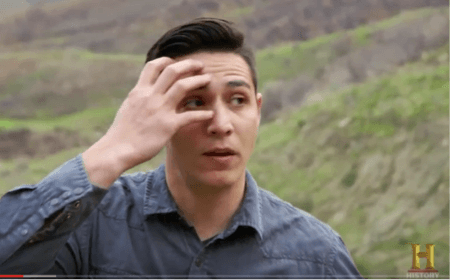
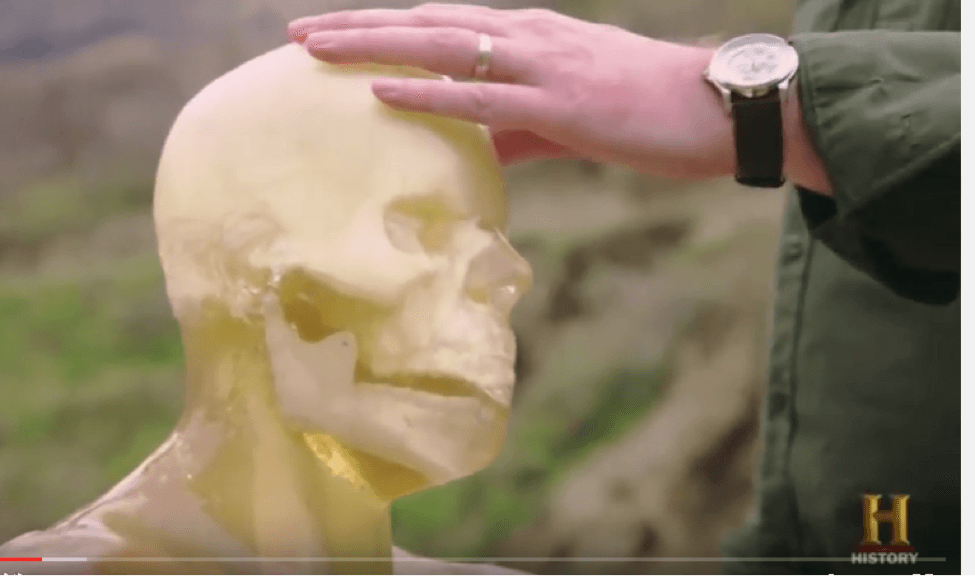
    To throw out the prima facie evidence —in the Zapruder film2— of gunfire from the right front, Baer simply replaces Luis Alvarez’s melon with what they call an encased gel ordinance head. Which goes backwards after being struck by a bullet fired from behind.

    A Nobel Prize winner in Physics (1968), Alvarez got involved in a test with a taped-up melon to verify that the backward snap of Kennedy’s head was consistent with a shot from behind due to a jet-propulsion-like recoil.3 But, as Gary Aguilar showed in his reply to Luke and Mike Haag, another test conducted by research physical scientist Larry Sturdivan at the Aberdeen Proving Grounds in 1964 proved otherwise. Ten skulls were shot with a Mannlicher-Carcano and all of them moved away from the rifle in the same direction of the bullet. The Commission suppressed these findings and plainly reported that President Kennedy was struck in the head and “fell to the left into Mrs. Kennedy’s lap.”  (Click here for that article)

    Alvarez’s test was misleading because a taped-up melon has neither the sheer strength nor the thickness close to that of a human skull. By the same token, Baer’s ballistic test is just another rigged attempt to support the discredited WC lone-gunman theory with a childish jet effect. We cannot do better than let Milicent Cranor comment at length on this ludicrous so-called “experiment”.


    History Channel – or Saturday Night Live?

    By Milicent Cranor

    This segment of the History Channel’s special on the Kennedy Assassination seems like a low-budget skit from Saturday Night Live!

    An “expert sniper” goes through the motions of recreating the shot to Kennedy’s head. The idea is to prove that one shot from the presumed Oswald location can cause the reaction we see on the Zapruder film: the head moving to the back and to the left.

    It’s not clear what they’ve dug up to use for the head.  The sniper describes it vaguely as a human head filled with ordinance gel, and throughout his little talk, he refers to that gel.  As in “shooting from behind the ballistics gel” and “I’ve got the ballistics gel on target.”  Maybe he hopes to convey the impression of a gelatinous brain causing the head to spring backwards. 

    The demonstration is just amazing. it is far more revealing than the show’s creators realize:

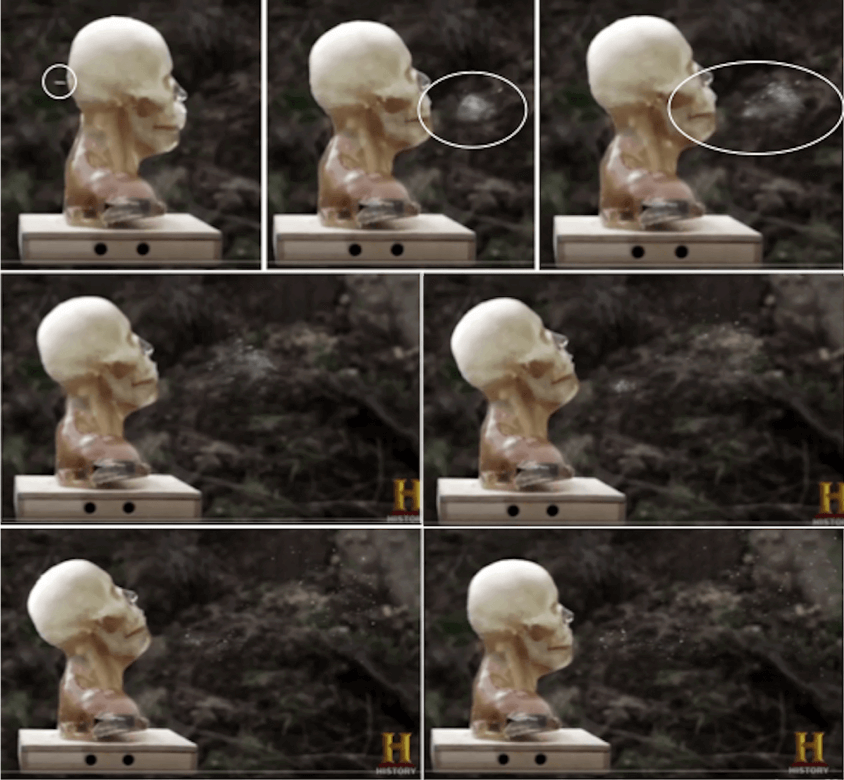
    We only get a side view of the action – and are not allowed to see the back or front of the head, not even after the shooting.

    The limited view of the head shows no damage whatsoever.

    The head moves back, but not to the left.  Then it pops right back up to its original position! 

    Something, possibly vaporized gel, seems to come out of the head (or from a smoke machine behind the head) – but only from the mouth area. 

    So he looks like a man leaning back with pleasure as he smokes a fine cigar, oblivious to the characters behind him.

    The sniper’s explanation for what happened is even more amazing: 

    “…the bullet enters the back of the head and the terminal ballistics will come here — [indicates area of right eye and forehead] – causing the head to go back and to the left.”

    cranor a

    “The terminal ballistics will come here”?  Terminal ballistics is defined as “the study of the behavior and effects of a projectile when it hits its target and transfers its energy to the target.”

    The sniper can’t explain what happened, but he seems to think that by naming the field of study concerned with such phenomena, the audience will be fooled.

    cranor b

    It is especially funny that he points to the area of the right eye: (1) In real life, the bullet is supposed to have exited from the top of the head on the right; (2) the gel-filled head in the demonstration seems to have no damage to that area, and it would show in a right profile view; and (3) all the exiting stuff representing brain matter comes out of the mouth.  Neither JFK nor the head in this demo is supposed to have had an exit wound in the mouth.

    Conclusion: The creators of this segment must have gel for brains. Or they think their audience does.

    cranor d
    THE SMOKING MAN

    Watch the segment on YouTube


    As the reader can see, this is not a studious, scientific attempt to duplicate the circumstances that befell Kennedy at 12:30 PM in Dealey Plaza, in Dallas.  And for Baer to try and pass it off as such speaks very poorly of both him and his show.

    But Bob Baer is not done.  Not by a long shot. For now he goes on and conducts what he calls an acoustics test. According to him, dozens of ear witnesses4 who heard shots coming from the Grassy Knoll were actually confused due to “the amphitheater effect.” The real sound coming from the Texas School Book Depository (TSBD) would have echoed at the so-called triple underpass and other hard structures in Dealey Plaza.

    To construct this “explosive theory,” Baer went to the crime scene with sound engineers and equipment that “nobody used before”. He just forgot to adjust the experiment setting to the standards of historical reconstruction.5 Not a single person was placed where a certain witness had been watching the presidential motorcade, and the sounds of the shooting weren’t generated by firing the rifle at the sniper nest. They were recorded elsewhere and played thereafter from near the TSBD.  No kidding.

    What is kind of shocking about this so-called acoustics test is that Baer completely ignores its far superior predecessor. During the proceedings of the House Select Committee on Assassinations, (HSCA) that body did an acoustics test in Dealey Plaza.  Except their testing was live and they brought riflemen into the plaza. And from that and their work with and analysis of the 11/22/63 dictabelt recording from Dealey Plaza by a Dallas policeman on a motorcycle, they concluded the following: 1.) Someone fired from the grassy knoll, and 2.) There were five shots fired that day. (Which, as Don Thomas reveals in his book Hear No Evil, for political reasons, Chief Counsel Robert Blakey reduced to four.)

    But, if one can comprehend it, Baer completely ignored the HSCA precedent, which included two teams of the finest audio scientists in the country. Among their members was Dr. James Barger of the firm Bolt, Beranek, and Newman. Barger had done acoustical research for the Navy in the field of submarine sonar detection, and had been involved in testing tapes of the 1970 Kent State shooting in Ohio. Barger did scientific testing of the actual sound wave patterns produced in Dealey Plaza at that time.  Barger’s findings were passed on to Professor Mark Weiss and his associate Ernest Aschkenasy. They did the final presentation for the committee. To imply, as Baer does, that those three men spent as much time and testing as they did and could not separate an echo from a live shot is ridiculous. But Baer and his program are so agenda driven that it is as if these previous tests never happened.  He brings in some audio recordings, some computer programmers, pays them a few bucks and with these stage props he has somehow eliminated the second gunman in the JFK case. Pure and utter poppycock. Baer’s level of science here would not pass muster at a good high school’s Science Fair. 


    An Inescapable Second Shooter

    On December 12, 1963, the Secret Service (SS) did a crude recreation. Its black and white footage plotted three shots on the JFK limousine. The bystander James Tague —wounded by a bullet ricocheting off the curb about 260 feet away from the limousine— destroyed the prior three-shots-three-hits scenario. Then, the magic bullet emerged not from evidence, but as an out-of-the-blue solution engineered to sustain the lone gunman theory.

    The FBI-SS reenactment on 23-24 May 1964 was a re-adjustment to preserve the willful closing of the case against Oswald. It also provided the notorious photo (CE 309) of Commission junior counsel Arlen Specter indicating with a metal rod the trajectory of the lie. However, an apparently insignificant detail provides a quantum of proof for demolishing any attempt—including Baer’s—to realign the shoots with the WC Report.

    For the 1964 recreation, Specter used the same jacket worn by Governor Connally on November 22, 1963, but he did not use President Kennedy’s. Otherwise he couldn’t have aligned the bullet entrance hole in the back of both Kennedy’s jacket and shirt with the exit wound at his throat.6

    The bullet holes are positioned 5 3/8” down from the collar line on the back of the jacket. They are consistent with the JFK death certificate, signed by his personal physician, Dr. George Burkley, who examined a back wound at the level of the third thoracic vertebra, about 4-6 inches below the point where the shoulders meet the neck.

    At this level, a bullet coming downward from the TSBD would not be able to exit the throat. But the Commission acolytes do not care about the death certificate7 and dismiss the jacket and the shirt as material evidence with the claim that both bunched up. Let’s connect the dots in a simple test.

    • Baer is invited to come dressed in suit and tie, along with John McAdams, Max Holland, Gerald Posner, Phillip Shenon et. al.;
    • They will remove their jackets and shirts to mark the position of the bullet hole in Kennedy’s, and will also mark on their bodies the back wound given by the WC;
    • They will put on their jackets and shirts, and will take a back seat in a car8;
    • They will get their jackets and shirts to ride up until the mark on each one matches the mark of the back wound. This crucial moment will be photographically captured;
    • They will compare the photos with the Zapruder film to find not even the faintest resemblance of JFK’s tailored suit jacket and buttoned shirt bunching up as theirs.

    They will surely face a dilemma. If the Warren Commission accurately placed the back wound, then JFK’s jacket and shirt were replaced, hence conspiracy; if the jacket and shirt are authentic, then the WC gave a false representation of JFK’s back wound, hence conspiracy or cover-up. There is not one whiff of any of these factors in the entire “Tracking Oswald” series, for if they did present it, the show would have to be called, “Trying to Find who Killed Kennedy.”  The Warren Commission did not want to do that.  Neither does Baer.


    Oswald’s Escape and Another Crime Scene

    After surreptitiously taking for granted that Oswald was the lone gunman, Baer applies his on-the-ground field officer expertise to assemble Oswald’s plan of escape with a concealed route, an Alpha 66 safe house, and some anti-Castro Cuban exiles as accomplices. No clue is given about how Oswald could have learned in advance the presidential motorcade’s schedule in order for him to have planned the assassination by firing a rifle with telescopic sight from his very place of employment.9  In that regard, Baer also ignores the following. That morning, Oswald asked fellow worker James Jarman why all the people were assembled in the plaza below.  When Jarman replied that President Kennedy was going to pass through in a motorcade, Oswald asked him which way it was proceeding.  Kind of wrecks Baer’s idea of Oswald’s planning.  Which is probably why he ignores it. (See Syliva Meagher, Accessores After the Fact, Vintage Books, 1992, pp. 37-38)

    For all of what follows, Baer relies on the bus ticket found in Oswald´s shirt pocket.  The former CIA officer somehow never discerns the difference between getting to and from work, and around the Dallas area, on the one hand, and escaping from the scene of a high profile murder case amid hundred of witnesses on the other. But Baer uses the ticket to infer a getaway route from the TSBD to an Alpha 66 safe house. On the way, Baer loses the evidentiary trail that—since Sylvia Meagher´s research in 1967—has put the ticket and other circumstances of Oswald’s escape under a cloud of suspicion (Accessories After the Fact, pp. 70-93).

    Baer deduces that, from his years of experience in the CIA, in a situation like this, the assassin(s) needed to have an escape route planned in advance. Our host does not want to admit that what the Commission says Oswald did after the shooting would suggest that he had no such plan in mind. Or that the latest research on this matter clearly indicates he was not on the sixth floor at all. (See Barry Ernest’s book, The Girl on the Stairs. Click here for a review) For the idea that a man who just killed the president would now search out public transportation to flee the scene of the crime amid hundreds of spectators and scores of policemen is simply not credible. But that is what the official story says. And that is what Baer is supporting.

    In any real planning situation one would rely on one of two factors for escape amid a multitude of spectators. The first alternative would be disguise—of which there is no evidence in this case. The other would be speed. That is, the longer one stays at or near the scene, the longer one risks the possibility of exposure and/or capture. Concerning this subject, one could do as Josiah Thompson did at the end of Six Seconds in Dallas. That is, present the testimony of policeman Roger Craig. Craig says he saw Oswald running down the embankment after the shooting. He then jumped into a Rambler driven by a dark skinned man. That would sound like an escape plan utilizing speed.  But probably because of that, Baer ignores it.  So in his scenario, Oswald boards a bus, gets off the bus, then walks a few blocks, and hails a taxi. But before he enters, he offers it to a little old lady standing next to him. (Meagher, p. 83) With a straight face Baer pronounces this an “escape plan”.

    Furthermore, Baer explains that Oswald ended up in the Texas Theater because of the run-in with Police Officer J.D. Tippit on East 10th Street, about 100 feet eastward from Patton Avenue. At that point, the escape plan was supposedly disrupted and Oswald failed to think clearly and rationally.  However, as in the case of his alleged shooting of the President, the evidence against Oswald in Tippit’s murder is shoddy.10 And Baer ignores that shoddiness.

    The crime scene is almost a mile away from Oswald’s rooming house at 1026 N. Beckley. His landlady Earlene Roberts saw him waiting for a bus at 1:04 PM after he left his room. Temple Ford Bowley arrived at the crime scene when Officer Tippit was already on the ground and some bystanders were milling around the police car. Bowley looked at his watch and the time was 1:10 PM. The Commission ignored Bowley. Why? Because clearly Oswald couldn´t have walked almost a mile in less than 6 minutes. They then reported that Tippit was killed circa 1:15 PM, despite the fact that is the time he was pronounced dead at Methodist Hospital. To keep up appearances, a typed FBI memo stretched out Tippit’s agony at the hospital until 1:25 PM.

    This case against Oswald for the Tippit shooting further weakens due to the three-wallets enigma.11 At the crime scene, Channel 8 staffer Ron Reiland filmed a policeman showing an open wallet to an FBI agent. According to FBI agent James Hosty, his fellow Bob Barrett revealed that this wallet contained IDs for both Oswald and Alek Hidell. But Dallas Police Officer Paul Bentley confiscated a second wallet from Oswald after he was arrested at the Texas Theater.  And another one was found among Oswald´s belongings at Ruth Paine´s house in Irving. These are all facts. They strongly suggest some evidence against Oswald was planted. They are ignored by Baer.

    Let us add another point about the two constant refrains by Baer during the program.  First, the continuing assumption that Oswald is the guilty party. This, as we have seen, he achieves only by ignoring the evidence, especially the new evidence declassified by the Assassination Records Review Board (ARRB). And that relates to the second refrain:  that Baer has read through the two million pages of declassified documents by the ARRB.  Yet this program offers no evidence from that declassification process. For instance, Baer presents a four-decades-old police report that Oswald was seen at an Alpha 66 safehouse in the Dallas area. The other document used in this episode is the famous testimony of Antonio Veciana of him seeing Oswald with Maurice Bishop at the Southland Building in Dallas.  Again, that information extends back to the seventies.  And it does not at all connect Oswald with Alpha 66. Veciana was arriving to meet with his case officer Bishop at the time.  He was early, and he saw Bishop with Oswald.  Oswald left shortly after he arrived.  In other words, Oswald was there with Bishop, not with Alpha 66 leader Veciana.  And as Veciana later admitted—just three years ago—Bishop was David Phillips.

    Now if Bob Baer was really interested in furnishing the public with new information, he could have done at least a couple of things with that crucial admission.  First, he could have said that the ARRB discovered that Phillips (along with James McCord) was running the CIA’s counter-intelligence programs against the Fair Play for Cuba Committee, of which Oswald was the only member in New Orleans. When one combines that with the fact that Oswald worked out of the same building that former FBI agent Guy Banister did, 544 Camp Street; and he printed that Camp Street address on more than one of his flyers, then that meeting with Phillips gets interesting.  Why would an alleged communist like Oswald be meeting with a CIA officer and working with a former FBI agent?

    The other aspect that could have been made up of new information would have been Phillips running the Cuban desk in Mexico City while Oswald was allegedly there.  Baer could have told the public:

    The man Oswald was meeting with,  David Phillips, told the HSCA that there were no tapes or pictures of Oswald in Mexico City. Yet there was such a tape that FBI agents listened to in Dallas while Oswald was under arrest for murder. Those agents told FBI Director J. Edgar Hoover that this tape was not the voice of the man in detention. We are going to explore that apparent quandary tonight.

    But, of course, Baer could not do that since he began the show by using a lot of questionable material about the Russians controlling Oswald in Mexico City, when the declassified Lopez Report strongly suggests that Oswald was impersonated in Mexico City. So the true identity of Oswald is kept under wraps, and some mythical association with Alpha 66 is now manufactured out of next to nothing.


    Coda

    More than fifty years and zero evidence after the JFK assassination, Baer is oddly not interested in or ignorant of what has been proven and debunked. He simply pushes back to square one—the lone gunman who shot a magic bullet—by concocting a light version (Castro knew it) of the oldest CIA backstop (Castro did it) through the fact-free hypothesis of Oswald linked somehow to Alpha 66 in the killing.


    Notes

    1 White House Telephone Transcripts, 23 November 1963, LBJ Library.

    2 In his remark to Attorney General Robert Kennedy about two people involved in the shooting, CIA Director John McCone wasn’t speculating. He had been briefed by Art Lundahl, head of the National Photographic Interpretation Center (NPIC), where leading photo analyst Dino Brugioni and his team examined the Zapruder film, made still enlargements of select frames, and mounted them on briefing boards. See Dan Hardways “Thank you, Phil Shenon” (AARC, 2015).

    3 Thus, Alvarez joined the crew of dueling experts devoted to defending the WC at any cost, after the Zapruder film was available for the first time to a mass audience on March 6, 1975, thanks to HSCA consultant Robert Groden and JFK activist Dick Gregory, who brought it to Geraldo Rivera’s ABC show “Good Night America.”

    4 Baer uses his own statistics, but the most reliable study, 216 Witnesses, by Stewart Galanor, found that 52 heard a shot from Grassy Knoll, 48 from TSBD, 5 from both places and 4 elsewhere. Other 37 witnesses could not tell and 70 more were not asked.

    5 The WC acolytes always incur this failure. For instance, it’s well-known since Mark Lane’s Rush to Judgement (The Bodley Head, 1966) that WC’s firearms experts were unable to duplicate what Oswald did, but Vincent Bugliosi replied in Reclaiming History (W. W. Norton & Company, 2007) that CEs 582 to 584 “shows two hits were scored on the head” (p. 1005) – only that both were scored using iron sights instead of scope.

    6 The FBI Supplemental Report from January 13, 1964, contains Exhibits 59 and 60 showing the bullet entrance holes in the back of Kennedy’s jacket and shirt, respectively. They weren’t included in any of the 26 volumes of Commission Exhibits. The initial draft of the WC report stated:  “A bullet had entered his back at a point slightly above the shoulder to the right of the spine.” WC member Gerald Ford wanted it to read: “A bullet had entered the back of his neck slightly to the right of the spine.” After the ARRB declassification, the discrepancy emerged. Ford told reporters: “My changes were only an attempt to be more precise.” (AP, July 3, 1997).

    7 Specter neither produced it nor interviewed Admiral Burkley, who as JFK’s personal physician was the only doctor present both at the Parkland Hospital (Dallas) in the emergency room and at Bethesda Medical Center (Maryland) during the autopsy.

    8 It could be the Cadillac used by Specter instead of the presidential limousine (Lincoln Continental 1961).

    9 For these and other similar issues, see A.M. Fernandez’s “Why the Warren Commission got scared with Castro”.

    10 Joseph McBride, Into the Nightmare, Hightower Press, 2013, pp. 244 ff.

    11 James DiEugenio, Reclaiming Parkland, Skyhorse Publishing, 2013, pp. 101 ff.

  • JFK Declassified: Tracking Oswald, Part 4

    JFK Declassified: Tracking Oswald, Part 4


    Part 1

    Part 2

    Part 3

    Part 5

    Part 6

    Part 7


    Written by Frank Cassano and Arnaldo Fernandez


    The CIA never recovered from its perfect failure at the Bay of Pigs. It generated a sort of obsession with Castro that led to an ultimate defeat in times of dirty war; but also to a carnivalesque approach to Castroist Cuba. A facet of this carnavalization became manifest in the fourth part of the series JFK Declassified: Tracking Oswald. The episode is entitled “The Cuban Connection,” but illustrates how former CIA case officer Bob Baer is disconnected from historical truth.

    The Wizard of Ozzie

    Baer opened this episode with a memo from HSCA first Deputy Counsel, Robert Tanenbaum,1 about Oswald’s involvement in New Orleans with Cuban exiles—and some non-Cuban soldiers of fortune—recruited and trained by the CIA to overthrow Castro. Thusly, he is setting the stage for a hell of a sleight of hand. Former Marine “Ozzie” Oswald, re-defector from the Soviet Union and pro-Castro activist in Dallas,2 will turn into a leftist wannabe killer of Kennedy.

    It’s easy to predict that the conjuring trick will continue with Castro knowing in advance Oswald’s criminal intent, since everything going on in the anti-Castro belligerent milieu in the U.S. was reported to him by the Cuban Intelligence Service (CuIS). On the other hand, the CIA did have the luxury of missing Oswald as a security risk, since it funded the black ops against Castro, but it ran them from afar with “little oversight”. It doesn’t matter that since April 24, 1963, the vey leader of Alpha 66 in Dallas, Manuel Rodríguez Oscarberro, had been reported to the Secret Service as security risk to President Kennedy.3

    Big-budget paraphernalia—underwater sonar, a diver, metal detector for canvassing the forest—are displayed again, as if the episode were about artifacts instead of new milestones in the well-known historical trail of the CIA dirty war against Castro. However, Baer forgot to include a crap detector and claimed that nobody else had ever really looked into the connection between Oswald, the Cubans, and the CIA. It would mean that—just for instance—New Orleans D.A. Jim Garrison never started an investigation in late 1966 or Harold Weisberg never wrote Oswald in New Orleans: Case for Conspiracy with the CIA (Canyon Books, 1967). But by skipping those authors, Baer does not have to bring up the names of David Ferrie, Clay Shaw and Guy Banister.

    The legerdemain with Ozzie included the Tourette’s-Syndrome-style reiteration that he shot Kennedy and he did it “with the same rifle” ordered by mail on March 12, 1963, and used to shoot at General Edwin Walker on April 10. Baer forgot what Tanenbaum stated in his ARRB Testimony (1996): “I don’t think from my experience that Lee Harvey Oswald could be convicted in any courtroom in America.” As it happened, the Warren Commission engaged in acts of evidentiary wizardry to do so:

    • The bullet recovered by the Dallas Police Department (DPD) from the Walker shooting was changed to incriminate Oswald as able “to carry out a carefully planned killing of another human being.”4 DPD officers Van Cleave and McElroy described a steel-jacketed 7.62 mm (30.06) bullet in their General Offense Report file the same day of the attack. Those fired against President Kennedy were copper-jacketed 6.5 mm bullets.
    • The $21.45 money order for the rifle mailed by Ozzie from Dallas was supposed to have arrived at Klein’s Sporting Goods in Chicago on March 13, less than 24 hours after it was sent from Dallas. It was then deposited on the same day of arrival at the First National Bank.5
    • The 36-inch, 5.5 pound Mannlicher Carcano carbine ordered by Ozzie does not match the murder weapon entered into evidence by the Dallas Police: a 40.2 inch, 7.5 pound Mannlicher Carcano short rifle.6 And there is no evidence of any weapon being picked up by Oswald at the post office in Dallas.7

    Down to Miami

    Baer evidently wants to travel instead of reading any books on the subject he is addressing in the TV series. As even beginners know, the “key to this whole operation” in New Orleans lies in the Miami CIA station (JM/WAVE). Hence Baer and his team go to South Florida. They track down former CIA contractor Marshall Golnick, who has “inside information” from a half century ago. They also do another archaeological search in Key Largo around a military facility.

    Golnick states that the Cuban exiles trained in New Orleans were dropped off by bus in Miami and received money and weapons. They were ready to stage raids into Cuba to destroy any infrastructure in sight; but this all ended with the fiasco at Bay of Pigs (thereby forgetting about Operation MONGOOSE). Golnick then reinforced the historical lie used by Baer himself to justify why Cuban exiles hated Kennedy: The latter ordered the Bay of Pigs invasion, but then withheld air support.

    The invasion was a so-called CIA covert operation that was unleashed with a Pearl-Harbor-style air bombing against three Cuban air force bases. Since these bombings were attributed to Castro’s defectors, they could not return to bomb again without destroying the plausible deniability required by the White House to prevent condemnation at the UN.8 And further, as Peter Kornbluh demonstrates in Bay of Pigs Declassified, the alleged D-Day air strikes were not part of the original plan. They were to be launched from an airstrip on the island after a beachhead was secured. The latter never happened.

    Finally, Golnick drops his own bomb about Oswald: likely aligned with the most radical fringe groups such as Alpha 66 and Omega 7. It does not matter that Alpha 66 was founded in 1962 and Omega 7 in 1974. According to the program, all these groups wanted to kill Kennedy and so did Oswald. Baer hammers the point home: “Oswald is a pronounced Marxist who praised Communist ideals.” Therefore, he and the radical Cuban exile groups worked together to achieve the common goal of killing JFK. Such a coincidence of contraries was strong enough to prevent the fierce anti-Castro Alpha 66 fighters from reacting to Oswald’s Castroist inclinations. By skipping authors like Weisberg and Garrison, Baer does not have to bring up the names of David Ferrie, Clay Shaw and Guy Banister.

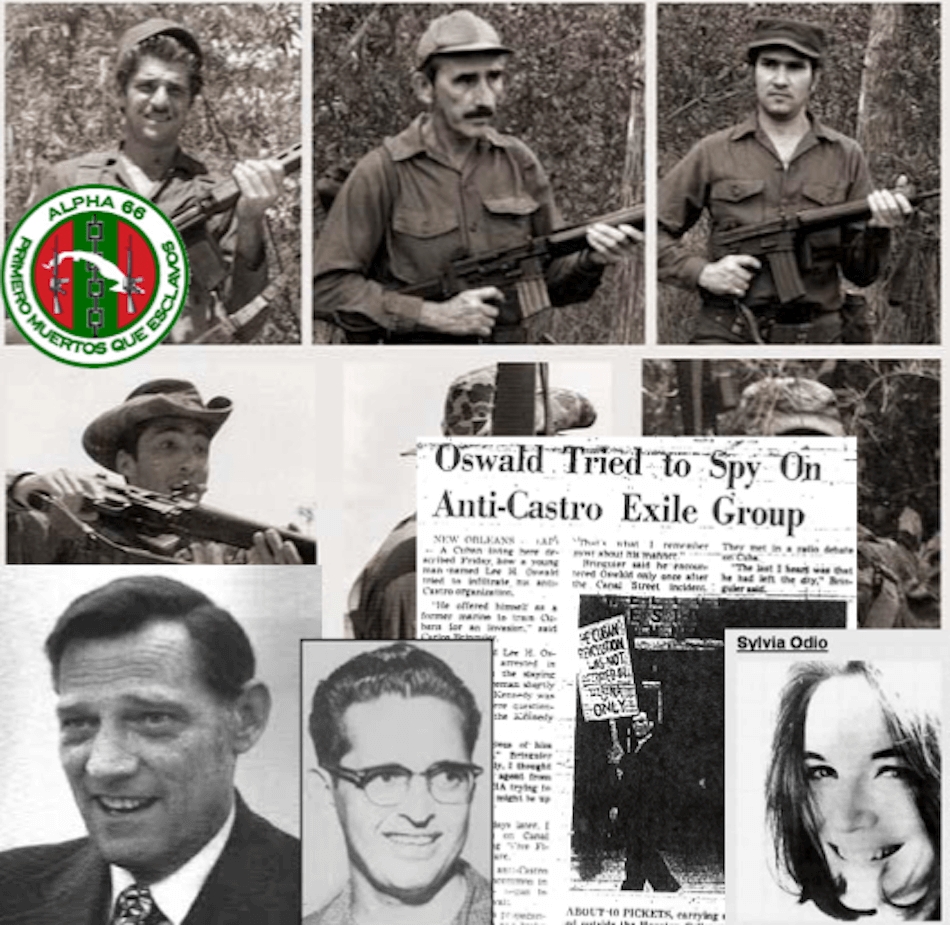
    Amid the extremist Cuban exile paramilitary subculture, Oswald flaunted his Fair Play for Cuba Committee [FPCC] militancy in New Orleans from mid-June to late August 1963. But only members of the Student Revolutionary Directorate (DRE) cadre, Carlos Bringuier and two cohorts, confronted him in a minor fracas at Canal Street on August 9, when Oswald was distributing the sold-out 1961 first edition of FPCC pamphlet The Crime Against Cuba (1961).9 Which had Banister’s 544 Camp Street address stamped on it. Oswald had described the scuffle—including being arrested by the police—in a letter to the FPCC dated August 1st and postmarked August 4th. In other words, before it happened.

    The CIA in Limbo

    Although all the anti-Castro groups in New Orleans and Miami were CIA brainchildren, Baer and his partner, former police officer Adam Bercovici, do not give a damn about how the CIA wasn’t aware of an Oswald-Alpha 66 common goal. Instead, they do some brainstorming to find Oswald’s deeper motivation. And they discover it. Oswald had an “I’ll show them” mindset.

    They also discover, this time on the computer, that the man behind Alpha 66 was Maurice Bishop. But they don’t identify him as David Philips, who in 1963 was playing a CIA dual role: Chief of the Cuban Desk in Mexico City and Chief of Covert Ops against Cuba in Langley. They only resort to the well-known statement by Antonio Veciana about having seen Bishop with Oswald in Dallas in the late summer of 1963. Bercovici concludes: “There’s your co-conspirator. He had on-the-ground assistance in Dallas.”

    Back on the computer, they bump into the famous, late September Sylvia Odio incident.10 It’s prima facie evidence of Oswald being impersonated in Dallas while visiting Mexico City, or vice versa. But Baer limits his explanation as to why the FBI didn’t track the event in Dallas: “Because they missed it.” Indeed, they did. On October 9, 1963, the FBI cancelled the security flash on Oswald,11 but on October 10, 1963, Langley omitted in a cable (DIR 74673) to the FBI that “Lee Oswald” had spoken with Soviet Consul Valeriy Kostikov in Mexico City, Baer’s main character of the first episode (“The Iron Meeting”). Such a piece of intel would have been enough to restore the flash. This cable also provided a false description of a presumed American entering the Soviet Embassy and the related photo taken by a CIA site wasn’t Oswald’s. In other words, during these weeks, it was Murphy’s Law that pertained: Everything that could have gone wrong, did go wrong between Oswald, the FBI and the CIA.

    In closing the episode, Baer and Bercovici swallow whole Marina Oswald’s testimony about her husband shooting at General Walker. They search the DPD files on the case. Oswald appears to have never been brought up even as a person of interest by the police prior to the creation of the Warren Commission. But they focus in on the two cars seen leaving from the alley behind General Walker’s house, concluding Oswald had likely been driven in and out by accomplices.

    The preview of the fifth part, “Scene of the Crime,” showed a re-enactment of the shooting at Dealey Plaza. A rifle is fired from above and behind at a rubber head, which goes backwards after being shot. As in the Walker shooting, Oswald will surely have get-away accomplices.


    Notes

    1 In a fictionalized account (Corruption of Blood, Dutton, 1995) of his HSCA experience, Tanenbaum referred to a black-and-white silent 8 mm home movie showing military exercises. The viewer can see the pinpoints of fire from rifles and the shimmering gouts of muzzle blast from machine guns. Among the people in the film, Tanenbaum identified David Ferrie in a close-up; Oswald “in his ball cap and black T-shirt;” Antonio Veciana “in civvies this time, holding a .45 and smiling;” and “another guy in civilian clothes,” who Tanenbaum believes was David Atlee Phillips, alias Maurice Bishop (pages 143-46). Jim DiEugenio asked Tanenbaum: “Was it really as you described in the book, with all the people in that film? Bishop was in the film?” Tanenbaum replied: “Oh, yeah. Absolutely! They’re all in the film. They’re all there. But, the fact of the matter is the [HSCA] began to balk at a series of events” (Probe, Vol. 3, No 5, July-August 1996). In fact, the film vanished after Tanenbaum’s departure from HSCA.

    2 Shortly before Oswald moved to New Orleans, the FBI office in Dallas received info about him passing out pamphlets of the Fair Play for Cuba Committee [FPCC] on Main Street and wearing a placard around his neck reading, “Hands Off Cuba, Viva Fidel.” It occurred on April 15, 1963. SA Agent James Hosty reported it on September 10. See Warren Commission, Vol. XXVI, CE 2718.

    3 Eventually, a CuIS informant furnished the intel Rodríguez Oscarberro had told him that “if his involvement in the assassination was uncovered, he was a dead man, given that he was an Alpha 66 delegate in Dallas and knew too much.” See Escalante, Fabian: JFK: The Cuba Files, Ocean Press, 2000, 170 f.

    4 Warren Report, 406.

    5 Ibidem, 119. It implies that, in about 24 hours in 1963, the U.S. Post Service picked up the money order from a mailbox in Dallas and transported it to a post office where it was sorted and shipped out to the airport. Then it flew 700 miles to Chicago, was picked up there and driven to the main post office, where it was sorted, placed on a truck and driven to the regional post office. Here it was given to a route carrier who delivered it to Klein’s. After being sorted out again, Klein’s delivered it to the First National Bank of Chicago to be deposited in Klein’s account.

    6 Armstrong, John: Harvey and Lee, Quasar Ltd., 2003, 477.

    7 DiEugenio, James: Reclaiming Parkland, Skyhorse, 2013, 62.

    8 When Eisenhower approved the CIA policy paper A Program of Covert Action Against the Castro Regime on March 17, 1960, he made crystal clear to CIA Director Allen Dulles: “Our hand should not show in anything that is done” (Memorandum of Conference with the President, March 17, 1960. FRUS, Vol. VI, Doc. 486). Kennedy stuck to the script and ruled out an intervention of the U.S. armed forces under any condition, as he clearly stated at a press conference at the State Department on April 12, 1963 (Cf.: Johnson, Haynes: The Bay of Pigs, W. W. Norton and Co., 1964, 72).

    9 By that time, the CIA had ordered 45 copies. DiEugenio, James: Destiny Betrayed, Skyhorse, 2012 158 f.

    10 In late September, Mrs. Odio was visited by two Cubans (Leopoldo and Angelo) along with an America introduced as Leon Oswald. They would be “working in the underground” and looking for her help regarding funds for the Cuban exile group JURE. The next day, Leopoldo phoned Mrs. Odio and discussed Oswald, saying he was an excellent shot and had said that President Kennedy should have been killed after Bay of Pigs. When JFK was murdered in Dallas, Mrs. Odio fainted upon hearing the news and recognizing Oswald. Her account was corroborated by her sister Annie, who had briefly seen the visitors. It reached the FBI and later the Warren Commission, but the latter ultimately dismissed it because its chronology put Oswald on his way to Mexico City on the same dates.

    11 Because of that, Hoover disciplined Lambert Anderson, Marvin Gheesling, and sixteen other agents.

  • Antonio Veciana, with Carlos Harrison, Trained to Kill (2)

    Antonio Veciana, with Carlos Harrison, Trained to Kill (2)


    Antonio Veciana: Trained to Kill Kennedy Too?


    The Cuban exile and former CIA asset (AMSHALE-1) Antonio Veciana, 89, stole the show at the AARC Conference on “The Warren Report and the JFK Assassination” (2014) by admitting:

    “In the early 1960’s, I believed John F. Kennedy was a traitor to the Cuban exiles and to this country. Yet, over time, I came to recognize that President Kennedy was not a traitor (…) I couldn’t go from this world without saying that John F. Kennedy was a great man and a great president who had a great vision for this country and the world.”

    Neither will Veciana go from this world without making his memoirs available to readers. Co-authored by the Pulitzer Prize-winning (1991) journalist Carlos Harrison, his biographical account Trained to Kill (Skyhorse Publishing, 232 pages) hits the book market on April 18, 2017, with the subtitle “The Inside Story of CIA Plots against Castro, Kennedy, and Che.” David Talbot wrote the foreword.

    A Borgesian Garden of Forking Paths

    In his conversion from hater to admirer of JFK, Veciana denies having taken part in the assassination, but agrees it “was a coup, an internal conspiracy.” As HSCA staffer Eddie Lopez told James DiEugenio, “this conspiracy was like a giant spider web, and in the middle of it was [David Atlee] Phillips.” But given Phillips recruited Veciana in 1960 and was his handler until 1973, always under the alias of Maurice Bishop, the former head and current historian of the Cuban State Security Department, Major General Fabian Escalante, takes seriously the possibility that Veciana was indeed involved in the plot.

    Following either of these paths, Veciana’s story incriminates Phillips. Before the assassination, he claims Bishop asked him about the procedure for obtaining a visa at the Cuban Consulate in Mexico City, knowing that his cousin Hilda Veciana was married to the commercial attaché there, Guillermo Ruiz. After the assassination, he claims he asked him to recruit Ruiz as a defector who would testify that the Cuban Intelligence Services (CuIS) had given Lee Harvey Oswald precise instructions to kill Kennedy (p. 125). A little later, Bishop told Veciana to forget about recruiting Ruiz. That would be the last time Veciana ever spoke with him about Oswald. Veciana added that after the assassination a Customs agent working for CIA, Cesar Diosdado (AMSWIRL-1), did ask him if he knew Oswald. Before the HSCA, Diosdado denied having worked for the CIA and questioning anyone about Oswald.

    Veciana deemed it a mistake to get involved in something which did not concern him. That’s why he neither asked Bishop about the JFK assassination nor told anyone about having seen Oswald until Fonzi interviewed him in 1976. Nonetheless, Escalante has a point against the claim of no involvement. Before the assassination, Hilda Veciana was walking from her nearby house to the Cuban Embassy in Mexico City and came upon a wad of dollars on the sidewalk. A Mexican approached and told her, “Lady, this money is yours”. She got scared and ran for the embassy. Just in front was a CIA photo-surveillance post (LI/ONION). According to Escalante, the CIA tried in this way to compromise her in order to recruit Guillermo Ruiz by threatening him with photos of his wife grabbing the money.

    Since that incident occurred before the assassination, Escalante thinks that Veciana is voicing only a half-truth. His close encounter with Bishop in Dallas (TX) in late August or early September 1963 may have gone beyond the brief sighting of a young man who said nothing and turned out to be Oswald (p. 122). It may instead have been a meeting among plotters to coordinate both the recruiting of Ruiz and the visa for Oswald in Mexico City. Crucial to this scenario are Oswald’s whereabouts at that time. Although it has been argued that Oswald was in New Orleans when Veciana claimed to have seen him in Dallas, there are some curious indications that Oswald was absent from New Orleans in late August and early September 1963.

    Mary Ferrell expressly highlighted in her chronologies (Volume 3, p. 57) that the FBI couldn’t authenticate Oswald’s signature on two forms filled out under his name on August 27 and September 9 at the Department of Economic Security (DES) office in New Orleans. The same is true for the signatures on two TEC warrants cashed under his name on August 28 and September 6 in a Winn-Dixie store at 4303 Magazine. Oswald was living at 4907 Magazine and his rent was due on September 9, but he didn’t pay it. That very Monday, he cashed a TCE warrant in a Winn-Dixie store at 3920 S. Carrolton. The FBI verified the signature was his.

    Intermezzo: Oswald in Mexico City

    The FBI reviewed Oswald’s documents from August to October 1963. Its calligraphers affirmed the authenticity of the signature on his visa application of September 27, 1963, at the Cuban Consulate in Mexico City. If this is accurate, then it would be strong evidence of Oswald being there, without prejudice to the body of evidence about an impostor by phone in Mexico City and some doubles like “Leon” Oswald at Silvia Odio´s house in Dallas during the same time frame.

    Before the House Select Committee on Assassinations (HSCA), Cuban Consul Alfredo Mirabal asserted that the Oswald apprehended in Dallas and seen in the news reports of November 22 was the same man at the Consulate in Mexico City. The other consul, Eusebio Azcue, and the Mexican consular clerk, Sylvia Duran, disagreed. Notwithstanding, two other eyewitnesses—Commercial Attaché Guillermo Ruiz and his assistant Antonio Garcia-Lara—agreed with Mirabal. Since Ruiz spoke better English, Azcue himself asked him to explain to Oswald why the visa couldn’t be granted. Garcia-Lara heard a noisy discussion and could see Oswald leaving the premises.

    The Access Path to the Truth

    The right quantum of proof about the Bishop-Veciana-Oswald connection may be hidden among the 1,100 long-suppressed CIA records related to the JFK assassination, including four of Phillips’ operational files and Veciana’s routing and record sheet. The Warren Commission did not mention Phillips in any of its volumes, but his fingerprints are scattered everywhere.

    Just remember the passage in The Last Investigation (1993), by Gaeton Fonzi, on HSCA staffer Dan Hardway asking Phillips some awkward questions. Although he already had a cigarette burning, hands shaking, Phillips went ahead and lit up a second. He lied so blatantly about Oswald in Mexico City that the HSCA prepared an indictment for him on two perjury counts.

    A lesser known anecdote illustrates Phillips’ hatred of JFK. By 1966 he recruited—under the alias of Harold Benson—a high official of the Cuban Ministry of Construction, Nicolás Sirgado, who had been entrusted since 1962 by the CuIS to penetrate the CIA. Castro honored him at the memorial service for the victims of the 1976 Cuban passenger jet bombing in Barbados. After retiring in 1991 with the rank of Lieutenant Colonel, Sirgado appeared in the Cuban TV documentary ZR Rifle (1993). He remembered that Benson “told me [about having] seized the opportunity to urinate on Kennedy’s grave, since he considered Kennedy a damned Communist.”

    Even The Third Time Wasn’t a Charm

    As for Lopez concerning Kennedy, Phillips was the key man for Escalante concerning Fidel Castro. During an interview with Fonzi in late 1995, Escalante remarked that Phillips “was our major enemy [and] the mastermind of a great many Castro assassination plots.” In three of them, Veciana was the organizer.

    • Firing a bazooka—from an apartment rented by Veciana’s mother-in-law on the eighth floor of the building at 29 Misiones Street—at the speaker’s rostrum on the north terrace at the Presidential Palace, where Castro would be delivering a speech on October 4, 1961. The plot failed (p. 105). The Cuban G-2 smelled a rat and flooded the crowds, buildings and rooftops with agents and militiamen. When the hitmen approached the building, they felt overwhelmed by Castro’s forces and strolled back.
    • Shooting Castro with a gun hidden in a TV camera during a press conference in Santiago de Chile on November 1971. The would-be assassins were Cuban exiles Marcos Rodríguez and Antonio Domínguez, who entered Chile disguised as cameramen from the Venezuelan television network Venevisión. Both backed out of the plot fearing the ironclad security around Castro (p. 173).
    • Shooting Castro with a rifle at Quito International Airport (Ecuador). Veciana knew that Castro’s return flight from Santiago de Chile to Havana included a stopover there. He gave continuity to the Chilean job by bringing the right weapon to Quito and asking Luis Posada-Carriles to fly from Caracas to fire it at Castro at the right time. The plot came to nothing since the support team—two defectors from Castro’s Air Force—claimed it would be suicidal.

    Veciana didn’t give up. By himself, he masterminded a fourth attempt against Castro in New York. As Chairman-in-Office of the Non-Aligned Movement, Castro was scheduled to address the U.N. General Assembly on October 12, 1979. A contact bomb of softball size and appearance would be thrown against his limousine on the way from the airport to the Cuban U.N. Mission. The FBI prevented it (p. 198). The bombmaker had gone too far with his comments and his utterly terrified wife called the authorities.

    Veciana attributes the above-mentioned, and almost all the other failures, to a single main efficient cause: “Many Cubans wanted Castro dead, but all of them wanted to watch his funeral, too.”

    He had joined the Castroite 26th of July Movement against the putschist General Fulgencio Batista, but turned against Castro shortly after he took power and became embroiled in a nationalization process that would reach its climax on October 1960 (p. 89). Veciana was convinced that if Castro died, the so-called Cuban revolution would end (p. 102). But his anti-Castro service record exceeds by far the four assassination plots.

    The War Inside

    Overcoming poverty and asthma, Veciana had graduated from the University of Havana and became a wonder boy in the Cuban world of accounting. At age 25 he got a job at the National Bank, a kind of equivalent to the Federal Reserve. He would go on to head the Cuban Association of Public Accountants (p. 37).

    In 1958, Julio Lobo, dubbed the “Cuban Sugar King”, employed Veciana as comptroller in his finance company, Banco Financiero, which was doing business with Hotel Capri, partly owned by film actor George Raft, and other Havanan hotels controlled by the mob’s accountant Meyer Lansky. Castro took actions against these and other of Lobo’s businesses.

    On December 17, 1960, Lobo told CIA officer Bernie Reichardt that he had heard that Veciana “was systematically destroying the bank’s records and the machine bookkeeping equipment in the bank. Also, he felt that there had been some planning on Veciana’s part for the wholesale sabotage of his sugar mills”. By that time, Phillips had successfully recruited Veciana.

    Phillips had approached Veciana posing as a potential bank customer, the Belgian businessman Maurice Bishop. Veciana underwent a polygraph test, truth serum and interrogation (pp. 45-58), before being trained in espionage, handguns and explosives (pp. 63-68). He was even given a suicide pill just in case he was captured, but he refused to be an infiltrator into Castro’s regime.

    When Bishop left Havana to get ready for the Bay of Pigs, he gave Veciana ripped up dollar bills and Veciana then realized how Machiavellian his handler was. Veciana had already started a psywar against Castro with a confiscation warning which created a run on the banks. It was initially branded as a hoax by Cuban President Osvaldo Dorticós, but it would end up coming true on October 13, 1960 (pp. 71-80). Since November 25, 1959, Che Guevara had been presiding over the National Bank. He wanted Veciana to help with the task of nationalizing the banks and asked him to bring in accountants (p. 83-86).

    As Guevara rose to the top of the Cuban banking system, Castro’s Minister of Public Works, Manuel Ray, stepped down. By May 1960, he formed the Revolutionary Movement of the People (Spanish acronym: MRP). Veciana joined it and forged ahead until becoming Chief of Action and Sabotage.

    Veciana plotted a series of bombings with explosive devices—known as petacas—provided by the CIA (p. 96). On April 13, 1961, his team of saboteurs delivered the most devastating blow prior to the Bay of Pigs invasion, destroying the largest department store in Havana (El Encanto).

    Veciana also conspired with the CIA in Operation Pedro Pan (p. 90). It brought over 14,000 unaccompanied Cuban minors to the US from December 1960 to October 1962, after a rumor spread—backed by the CIA forgery of a supposed forthcoming law—to make Cubans believe the State would usurp parental control for the purpose of indoctrinating all their children.

    After the Bay of Pigs—Veciana offers a good summary of the fiasco (p. 100)—Castro struck another annihilating blow against his foes. On July 5, 1961, he decreed a monetary exchange that turned into worthless paper more than 400 million pesos held abroad by Cuban exiles. The in-country bank deposits were limited to 10,000 pesos per person. Veciana’s days in the underground were numbered. Shortly before the date set for the attempt with the bazooka, Bishop urged him to leave Cuba (p. 105). He did so with his mother-in-law in a small boat and entered the U.S. at Key West on October 7, 1961.

    Alpha and Omega

    Veciana met Bishop in Miami. They signed an agreement—or pledge of allegiance—in front of two unidentified witnesses, but Veciana got no copies. The CIA informed the HSCA there was “no Agency relationship with Veciana,” but he filled out an employment application with the CIA and a Provisional Operational Approval (POA) was requested for him on December 29, 1961. It was granted on January 29, 1962, and canceled in November. From then on and up to July 1966, Veciana was listed in the Army Information Source Registry.

    Bishop asked Veciana to organize a paramilitary group. In February of 1962, in Puerto Rico, he founded Alpha 66 as Bishop’s brainchild. (pp. 108 ff). Alpha symbolized the beginning of the end of Castro, while 66 represented the number of fellow accountants Veciana had initially drafted.

    Veciana focused on fund-raising and recruited Eloy Gutierrez Menoyo as Military Chief. The latter had led the anti-Batista guerrillas known as II Frente in the Escambray Mountains, but ended up defecting to the US on January 27, 1961. By October 1962, Alpha 66 and II Frente were united.

    Trying to force Kennedy to act resolutely against Castro, Bishop gave orders to hit ships going in and out of Cuba. On September 10, 1962, Alpha 66-II Frente started a series of raids by attacking two Cuban ships and a British freighter at the northern port of Caibarién, 200 miles east of Havana.

    At the peak of its naval operations, in March 1963, Alpha 66-II Frente sunk one Russian vessel at Isabella de Sagua and crippled another at Caibarién. By doing so, Bishop was trying to torpedo the Kennedy-Khrushchev peaceful solution to the Missile Crisis. Veciana held a press conference and The New York Times reported the Kennedy administration “was embarrassed” (pp. 112-20). But the outcome was quite different than intended.

    Instead of moving against Castro, Kennedy ordered a crackdown against the Cuban exile paramilitary groups, and put more pressure on British authorities to enforce the law in the Bahamas. In May 1963, Alpha 66-II Frente entered alliance with MRP. All efforts were devoted to military preparation for Plan Omega, meaning the end of the Castroite regime. Veciana strategically changed from raids to infiltration.

    It turned out, however, that before Veciana could get there, Castro had already beaten him to it. Alpha 66-II Frente-MRP was closely monitored—and in some cases manipulated—by Castro spies who had been in place for years. On January 23, 1965, Menoyo himself was captured in Cuba (p. 126). In fact, a Castro agent, Noel Salas, was part of Veciana’s infiltration team. Veciana quit, went to Puerto Rico and became a sports and concert promoter (p. 128).

    Intermezzo: How Castro Dealt with Assassination Attempts

    Alpha 66-II Frente-MRP was not an isolated case. In an interview for Tad Szulc’s book Fidel: A Critical Portrait (1986), Cuban Minister of Interior Ramiro Valdés confirmed: “There wasn’t anything in motion that we didn’t know about it, because we got undercover agents at all levels”. Apart from an ironclad personal security force against assassination plots, infiltrating the CIA and the Cuban exile community was instrumental to Castro’s surviving the Agency’s dirty war. AMLASH, for instance, was finally foiled due to intelligence furnished by CuIS agents ADELA (in France) and Juan Felaifel, who worked for three years with the CIA in Miami.

    A soft-headed folly revived by Philip Shenon—the Kennedy brothers and the CIA compelled Fidel Castro to take preemptive lethal action against a sitting U.S. President—is not just far removed from common sense, since Castro was fully aware that killing JFK wouldn´t solve anything and entailed risking everything. It also ignored the fact that Castro’s thinking style was system-centered. He would have never taken the “spaghetti western” approach to Kennedy that Lyndon Johnson popularized by raving “Kennedy was trying to get to Castro, but Castro got him first.”

    Consider the following. Castro triggered his revolution on July 26, 1953. On that day, the dictator Batista was attending a regatta at Varadero Beach. Some middle ranks insisted on blending in with the spectators and killing Batista there. Castro stuck to his principles and attacked the Moncada barracks as planned. He disapproved of the assault on the Presidential Palace by the Student Revolutionary Directorate on March 13, 1957. Castro reasoned: “It would have been easier to kill Batista than wage two years of guerrilla war, but it would not have changed the system.”

    Similar reasoning led Castro to advise Reagan about an extreme right-wing conspiracy to kill him in 1984. Castro ordered the CuIS to furnish all the intelligence to the U.S. Security Chief at United Nations, Robert Muller, and the FBI proceeded to dismantle the plot in North Carolina.

    In the same line of sheer nonsense, Dr. Brian Latell joined Shenonism by asserting that Castro warned the Kennedy brothers and the CIA—and the rest of the world—with an advertising piece of his personal bailiwick: “U.S. leaders should think that if they are aiding terrorist plans to eliminate Cuban leaders, they themselves will not be safe”. This statement made by Castro during a reception at the Brazilian Embassy in Havana on September 7, 1963 was quoted by Associated Press reporter Dan Harker and has since become well-known. But in November 1961, Kennedy himself had entertained the same idea. After meeting with Szulc, who noted he was “under terrific pressure from advisors (…) to okay a Castro murder,” Kennedy discussed the issue with his aide Richard Goodwin and remarked: “If we get into that kind of thing, we’ll all be targets”. Both were right. The “Castro did it” troupe didn’t get it.

    The Decline and Fall of Practically Every Rapport

    In Puerto Rico, Veciana used some assets to spy on Castroite agents. The agents found out and tried to kill him with a bomb at a sports event (p. 131). They also came to get him at his house in La Paz, Bolivia, where he worked as consultant to the Central Bank from the spring of 1968 until mid-1972.

    The US Agency for International Development (USAID) hired Veciana for this job thanks to Bishop. Veciana’s office, devoted to capital development, was in the Passport Division of the American Embassy. In fact, Veciana did little banking and spent most of the time working for Bishop (pp. 134-37).

    In an interview by the late Jean-Guy Allard on May 22, 2005, General Escalante gave a confusing statement: “In 1966 and 1967, Felix Rodriguez is in charge of the task force the CIA sent to Bolivia against Ernesto ‘Che’ Guevara. He used several names. He is there and he ends up participating directly in the murder of Che. Also there, in another position, is Antonio Veciana. He is there as a bank consultant in La Paz, but he runs the center which is coordinating intelligence gathering in the rear guard, working with the Bolivian intelligence services.”

    Rodriguez was not in charge of the CIA task force. Another Cuban exile, Gustavo Villoldo, claims to have been the lead agent in the field and dismissed Rodriguez as just a radio operator. Beyond dispute, they both had the same “Jim” as their CIA case officer. Besides that, Veciana arrived in La Paz about six months after Guevara’s death. Nevertheless, he provided a piece of information that goes counter to the official history about how Che’s diary was secretly delivered to Castro. The Bolivian Interior Ministry, Antonio Arguedas, wouldn’t have made such an unexpected decision because of congeniality. Rather, he followed a recommendation by his Cuban-American adviser and CIA agent, Julio García, who suggested the move to divert attention from the contradictory statements given by the Bolivian Armed Forces about Che’s death (p. 148).

    Veciana claims that—from his post in La Paz—he helped Bishop to undermine Salvador Allende’s administration in Chile (p. 156). As mentioned above, he also organized a second attempt against Castro under Bishop’s direction at that time. However, the fellow plotters in Venezuela schemed to blame the assassination on Soviet agents without tipping off Veciana. Bishop found out about it and accused Veciana of being part of the scheme. Their longer-than-a-decade relationship was now over (p. 174).

    Veciana returned to the US and resumed his work as a sports and concert promoter (p. 175). On July 26, 1973, he met Bishop in the parking lot of the Flagler Dog Track in Miami. Veciana asserts that Bishop gave him a suitcase containing $253,000 in cash, presumably as compensation for his anti-Castro efforts over the years. However, that summertime became dreadful for Veciana (pp. 181-87 passim).

    On August 10, he was indicted for conspiracy to distribute narcotics, possession with intent to distribute, and distribution of about seven kilos of cocaine. On August 18, he got discouraged with the anti-Castro militancy in Miami. Scarcely 300 people attended Juan Felipe de la Cruz’s funeral, although he had been branded as an exile hero. De la Cruz had died shortly after noon on August 2, 1973, when a bomb went off as he was assembling it in his room at Hotel Oasis in Avrainville, 15 miles south of Paris, France. The target was Cuban cabinet member Ramiro Valdes, hosted in a nearby chalet. Veciana was involved in the plot.

    On January 14, 1974, Veciana was convicted after a five-day trial in the Southern District of New York. Judge Dudley B. Bonsal, who happened to be the brother of former (1959-60) US Ambassador to Cuba Philip W. Bonsal, sentenced Veciana to concurrent terms of seven years on each count, followed by a three-year special parole term. The Court of Appeals (Second Circuit) upheld Bonsal’s ruling, but Veciana would serve just over two years. On March 2, 1976, Church Committee investigator Gaeton Fonzi met with him, and the Oswald-Bishop connection first surfaced, most likely because Veciana believed Bishop had set him up. The search for Maurice Bishop now began and the rest is history, well-told by Fonzi in The Last Investigation (1993) and encompassed in the Volume X (pp. 37-56) of the HSCA Appendix to the Hearings.

    On the same day—21st September 1979—that Fonzi gave him the HSCA staff report on him, Veciana was shot while driving home from his office in Miami (pp. 194 f). Four shots were fired, one hit the rearview mirror and a fragment of the bullet imbedded just above Veciana’s left ear. His relatives and friends speculated it was an attempt by Castro agents. Veciana did not rule out a CIA plot.

    During the HSCA proceedings, Veciana helped an artist to create a “pretty good”—according to Veciana himself—composite sketch of Bishop. It was shown to Phillips, who said, “It looks like me.” In turn, a photo of Phillips was shown to Veciana. His response wasn’t conclusive. He was then taken to see and speak with Phillips at a luncheon meeting in Reston (VA) on September 17, 1976. At this time, he said Phillips was not Bishop.

    Veciana restated this in his sworn testimony before the HSCA on April 26, 1978, although he admitted Phillips and Bishop bore a “physical similarity”. The day before, Phillips had testified he had never used the alias Maurice Bishop and had never met Veciana before the occasion in Reston. But on the 50th anniversary of the JFK assassination, Veciana authorized Fonzi’s widow, Marie, to publish the following statement: “Maurice Bishop, my CIA contact agent, was David Atlee Phillips. Phillips or Bishop was the man I saw with Lee Harvey Oswald in Dallas on September 1963.” Veciana elaborated further through other admissions and revelations at the AARC Conference on September 26, 2014.

    Today, an almost nonagenarian Veciana regrets having disregarded his family for politics. In the 1960’s, he founded B&F Marine, a small fiberglass repair shop and selective marine accessory retail store. The company became a dealership for Johnson & Mercury motors and other big brand names during the 1970s. It expanded to four locations, but they were successively closed as good times went by. In August 2016, the family-owned business filed again for bankruptcy after having sailed out of it in 2012 thanks to financial restructuring under the leadership of his son, Antonio Veciana, Jr. In 2017, we now have his book about his past (literally) explosive history.


    See also the review by Joseph Green

  • Antonio Veciana, with Carlos Harrison, Trained to Kill (1)

    Antonio Veciana, with Carlos Harrison, Trained to Kill (1)


    Pulp Nonfiction: Trained to Kill by Antonio Veciana with Carlos Harrison


    In September of 1979, Antonio Veciana was driving in Miami when an unknown assailant began shooting at him with a .45. The bullets blew out his car window, struck him in the head, his arm, his stomach, but he survived. Recovering in the hospital with a bullet embedded above his left ear,1 he first thought it might have been a CIA hit. But it was an awfully clumsy attempt, and he had earlier been told that Cuban leader Fidel Castro put him on a hit list.

    So he decided to get back at Castro with a model airplane and some C4.

    Now Veciana is the kind of guy who knows how to get explosives if he needs to, and this isn’t the first time he’s been part of an operation to assassinate Castro. So he starts working on his plan, and a few days later an FBI agent greets him on his front porch. The upshot of their conversation is that the agent knows he’s been trying to get some explosives. Then the agent says he already talked to Veciana’s explosives expert and knows he already has the C4.

    Veciana tells the agent to get lost. The agent had to be lying, because he hadn’t given his explosives guy the C4 yet. As a matter of fact it was hidden under the house, not far from where they were having the conversation.2

    Trained to Kill: The Inside Story of CIA Plots Against Castro, Kennedy, and Che is the incredibly improbable memoir written by Veciana (with Carlos Harrison), and the most incredible thing is how much of the story is demonstrably true. Already a major presence in books by HSCA investigator Gaeton Fonzi and well-respected researcher Dick Russell, the author takes the opportunity to tell his own story in his own clear, direct manner.

    This is a man who began life in a shack in the wake of the Great Depression, before growing up to work for Cuba’s richest banker. A hard left turn later, he became the leader of the CIA-backed revolutionary army, Alpha 66, ending up as a peripheral witness to the mechanics behind the assassination of John F. Kennedy.

    However, before we go into his story, let’s take a brief look at the background of American foreign policy in this time period. What changed after World War II? How did funding and training paramilitary groups and overthrowing countries become key functions of the American intelligence services?

    For that, I want to start with one Sir Ian Fleming.

    A DINNER PARTY

    On March 13, 1960, the novelist and intelligence agent Ian Fleming met his friend Mary Leiter (whose husband provided the name for Bond’s CIA friend Felix Leiter) in Washington, D.C. Leiter, driving around town, happened to spot a friend walking on P Street: Senator John F. Kennedy, who would in a few months become President of the United States. She asked the Senator if it would be all right to bring her guest to dinner. A fan of James Bond, and in particular the novel From Russia, with Love, he eagerly assented.3

    Fleming, now world famous as the inventor of James Bond, had a long career in “special services” and left his mark on U.S. intelligence history. During World War II, as a secretary of Admiral John Godfrey (then Director of Naval Intelligence of the Royal Navy), he served as a liaison to MI6 (British intelligence) and was something of an “idea man” with respect to covert operations. He was in the know to arguably the biggest secret of the war: that Alan Turing and his Bletchley Park colleagues had cracked the German Enigma Code. He had even proposed a plan to get an Enigma machine early in the process, but the plan, Operation Ruthless, was never realized, to the frustration of the Bletchley mathematicians.4 Fleming’s plan was as follows:

    I suggest we obtain the loot by the following means:

    1. Obtain from Air Ministry an air-worthy German bomber.
    2. Pick a tough crew of five, including a pilot, W/T operator and word-perfect German speaker. Dress them in German Air Force uniform, add blood and bandages to suit.
    3. Crash plane in the Channel after making S.O.S. to rescue service in P/L.
    4. Once aboard rescue boat, shoot German crew, dump overboard, bring rescue boat back to English port.

    In order to increase the chances of capturing an R. or M. with its richer booty, the crash might be staged in mid-Channel. The Germans would presumably employ one of this type for the longer and more hazardous journey.5

    Researchers in parapolitics will recognize this sort of operation. It was the kind of thing that would become standard in the American intelligence services. It is perhaps most associated with CIA planner Edward Lansdale of Operation Mongoose, dedicated to the removal of Fidel Castro. (Lansdale famously was thought to have been the model for Graham Green’s The Quiet American, with some cause.) It was in these elaborate plots that names familiar to JFK researchers appear: Allen Dulles, Richard Helms, James Jesus Angleton, Bill Harvey, David Morales, and many others.

    Fleming himself served as a liaison to Wild Bill Donovan, the famous first head of the Office of Strategic Services (OSS) that itself grew out of U.S. Naval intelligence (ONI). Indeed, he wrote a 72-page outline that would serve as a foundational document for the OSS and the Central Intelligence Agency. For his efforts, Fleming was awarded a Colt revolver with the inscription “For Special Services.” (In another odd connection, the friend – Mary Leiter – who introduced Fleming to Kennedy in 1960, lived on an estate in Langley, Virginia, owned by her husband’s father. That estate would end up being purchased by the government and converted into CIA headquarters.)6

    In any event, at that March 13, 1960 dinner, Kennedy would have known that his dinner guest was no mere spy novelist. A lively conversation ensued among the group, which also included the reporter Joseph Alsop and a CIA operative named John Bross. Bross had been the assistant general counsel to the U.S. High Commissioner to Germany, John J. McCloy, from 1949 to 1951. One of the things that Bross did was help McCloy make certain key decisions such as – for example – declining to pursue Klaus Barbie and other hardcore Nazis. Bross remained an important voice in the organization for decades; at the time of his death in 1990, CIA Director Richard Helms reflected on how often he had relied on his “wise counsel.”7 Meanwhile, Alsop would later be the man who planted the seed in Lyndon Johnson to form the Warren Commission instead of using local authorities to investigate the Kennedy assassination. Donald Gibson points out in his excellent essay that Alsop, in the transcript of a conversation with Johnson less than a day after Oswald’s shooting by Jack Ruby, baldly states that a formal commission will agree to keep out of the investigation things that the FBI will want to keep out.8 What those things might be is unspecified.

    Fleming, although fairly sedate during the course of the discussion, became aroused as talk turned around to Cuba. What should the U.S. do about Fidel Castro? For this, Fleming had a three-step plan, which shows a familiar pattern of thinking:

    1. The United States should send planes to scatter Cuban money over Havana, accompanying it with leaflets showing that it came with the compliments of the United States.
    2. Using the Guantanamo base, the United States should conjure up some religious manifestation, say a cross of sorts, in the sky which would induce the Cubans to look constantly skyward.
    3. The United States should send planes over Cuba dropping pamphlets, with the compliments of the Soviet union, to the effect that owing to American atom-bomb tests the atmosphere over the island had become radioactive; that radioactivity is held longest in beards; and that radioactivity makes men impotent. As a consequence the Cubans would shave off their beards, and without bearded Cubans there would be no revolution.9

    One might imagine that Fleming had his tongue in cheek when making that last suggestion, except the CIA invented equally absurd plans, including a scheme to make Castro’s beard fall out using thallium.10 Within half an hour of the dinner party ending, CIA Director Allan Dulles heard about Fleming’s visit and expressed dismay that he hadn’t been able to discuss Cuba with him in person.11 During the War, Dulles had shared office space with the “Man Called Intrepid,” the famous spy William Stephenson. Stephenson had a “license to kill,” and in fact was one of the inspirations for the character of James Bond.12 Dulles was so intrigued with James Bond that he actually tried to duplicate some of the spy’s gadgets. Mostly he seemed fond of the image of Bond, a man who will resort to violence to accomplish great ends in the line of duty.13

    It is common to speak of the United States and Great Britain having a “special relationship,” and it is no clearer than in the spy business. Even if Fleming’s document had more to do with the form than the letter of what American intelligence would be, it nonetheless carried an enormous influence. From its Ivy League origins and Wall Street orientation, to its determination to meddle in the affairs of other sovereign states, to its emulation of a superficial kind of “class.” Allen Dulles maintained outward respectability, smoked a pipe, and made the decision to obtain Russian intelligence from a Nazi, Reinhard Gehlen. Due to the Gehlen Operation’s inflated reports of Russian weaponry, it is not too far from the point to say that these men invented the Cold War. For his part, Gehlen referred to Dulles as the “Gentleman.”14 Gehlen also took credit for the American success of the Cuban Missile Crisis while simultaneously deploring Kennedy’s approach to solving it.15

    ENTER KENNEDY

    John F. Kennedy became President in the context of a burgeoning covert operations business used to destabilize and overthrow foreign governments, as well as “wet work” used to assassinate foreign leaders. Just as the British Crown had seen India and Africa as possessions, so did the United States gaze upon Latin America. This enormous intelligence apparatus, modeled on British intelligence, had grown to the extent that it represented a parallel government in many ways run out of the office of Allen Dulles.16

    The great “successes” of the 1950s included the overthrow of Mohammad Mossadeq in the Iranian coup of 1953 and Jacob Arbenz in Guatemala in 1954, among other atrocities.17 To give some idea of what continuity was like in the government, the original plan to overthrow Arbenz had been approved by Harry Truman and then continued under Dwight Eisenhower with no ideological objections along the way.18

    CUBA

    On January 1, 1959, Fidel Castro’s revolution, which had been a four-year guerilla struggle against the dictator Fulgenico Batista, successfully overthrew the government. Batista fled to the Dominican Republic.

    To the extent that Americans today know much about the Cuban revolution, it is assumed that Castro had always been a Communist. This is actually a much-debated point. At the time of the insurrection, the Atlantic Monthly informed its readers that there was “abundant evidence” that Castro was not a Communist.19 During a visit to the United States just six months previously, Castro had indicated he was not, and got favorable press. The ex-pitcher grabbed a hot dog at Yankee Stadium and was referred to by no less than Dean Acheson as the “first democrat in Latin America.”20 However, in 1958 Allen Dulles had told President Eisenhower that he did not think a Castro victory would be good for the United States. Meanwhile, Castro’s right-hand man Che Guevara had been in Guatemala during the Arbenz overthrow and undoubtedly carried that distrust with him to Cuba.21

    Fidel Castro’s overthrow and takeover of the Cuban government had widespread effects for being such a tiny island. In addition to legal trade with the United States, there was considerable mafia influence. Meyer Lansky had rolled into Miami in 1933, and during the War made inroads into Havana. By the time the 1950s came around, Santo Trafficante was running the (illegal) show in Cuba. The operation grew so large that he delegated Havana to his son, Santo Jr. The elder Trafficante and Batista became close.22 Batista had opened his doors to Trafficante and the Mafia to foster a welcome business environment for gambling and heroin.23

    And then in one fell swoop, the entire business was upended and the old arrangements went the way of the Dodo. (The effects of Castro’s overthrow are effectively dramatized in Francis Coppola’s film The Godfather Part II). It was also bad news for U.S. foreign policy since Cuba was a short distance from Florida. At least if you were in the hawkish frame of mind of the Pentagon and the intelligence services. And it was in this milieu that the son of Spanish immigrants, a young man named Antonio Veciana, found himself a budding revolutionary.

    VECIANA’S STORY

    Antonio Veciana was no James Bond. He was an asthmatic, lapsed-Catholic accountant who had gone to the University of Havana at the same time as Fidel Castro, although the latter studied law.24 He claims to have distrusted Fidel from the moment he first met him, seeing in him an inclination toward fascism rather than Communism. Fidel had tried to take control of the university, participating in assassinations and assaults on campus.25 Later, of course, in 1953, Castro would lead a failed coup attempt in Santiago de Cuba, winding up in prison only to be released two years later. Castro would head to Mexico with Ernesto ‘Che’ Guevara for a year, only to return on a boat to begin his revolutionary path – legend has it with less than twenty men and only two rifles.

    Castro’s eventual victory in 1959 was astonishing. Equally astonishing, Veciana – the asthmatic accountant, would instigate a plot to fire a bazooka at Se &‌#241; or Fidel Castro.

    However, Veciana had no sympathy for Batista. In May 1953 Veciana married, and two months later his best man Boris Luis Santa Coloma was tortured to death by Batista government thugs. Later that same year, the young man accepted a position with the Banco Nacional, which he described as “Cuba’s federal reserve,” even as Batista’s atrocities increased. At the same time, the revolutionary movement known as the July 26 movement, led by Castro and Che Guevara, began to expand.26

    In late September of 1959, a man named Maurice Bishop came to visit Veciana. At this time, Veciana worked for a bank owned by Julio Lobo, by some accounting the richest man in Cuba. This gave him some visibility. Veciana notes that, perhaps “coincidentally,” Maurice Bishop came to visit him a few days after a certain Jack Ruby left the island, according to their records.27

    This was the beginning of a relationship that lasted for many years. And there was something about Bishop that fired a spark in Veciana. Bishop made a vague proposal that he should help him defeat Castro, and he found himself agreeing, even without details or knowing which intelligence agency Bishop worked for. Although his first guess was CIA.28

    This relationship would also set off one of the most intriguing mysteries of the Kennedy assassination. Because through largely the efforts of HSCA investigator Gaeton Fonzi, Valencia came to believe that Maurice Bishop’s real name was David Atlee Phillips. A former playwright, Phillips had been recruited into the CIA. He had correctly guessed in 1958 that Castro would come to power.29 Veciana states in this book his certainty that Bishop was in fact Phillips, but we will come back to that.

    Bishop invited Veciana to work for him. He tells Veciana there will be many things he won’t know, and he can’t tell anyone, but he is eager to join, even with so many uncertainties. The initial process involves a grueling question-answer session lasting several hours. He gets past the first hurdle and is invited to go to another session. This second time, he is told to swallow a pill, which Veciana assumed was some sort of truth serum. It made him dizzy. At this second interrogation, he was asked many personal questions, including numerous inquiries about his sexuality – seemingly to find out whether he was gay.30

    He passed the test and went to work for the American intelligence apparatus, with the goal of overthrowing or assassinating Fidel Castro.

    THE BAY OF PIGS

    On April 17, 1961, the United States launched the failed Bay of Pigs invasion against Cuba. Veciana, through his contact Bishop, had received payment and training for the Cuban insurgency against Castro, and also had weapons provided. However, the invasion was a disaster, often blamed in history books as precipitated by Kennedy’s failure to provide “air cover.” However, as L. Fletcher Prouty observed, the plan did not have air cover as a kind of backup operation. If the Cuban planes were not destroyed, the invasion was not supposed to have gone forward.31 Indeed, there were many problems with how the plan was explained to Kennedy, as it was first presented in the context of a necessary Cuban uprising and then later without the uprising happening (to match the reality of a lack of popular will to overthrow Castro).32 And Veciana knew this to be true as well: “Agency officials told Kennedy that the people would rise up once the invasion began. That wasn’t true. It wasn’t close to true. The Pentagon knew it wasn’t.”33 The whole history of the Bay of Pigs has, in essence, been rewritten in a long section in Destiny Betrayed.

    Veciana describes the ridiculous situation like so:

    Twelve hundred men landed. Castro had two hundred thousand. The CIA knew that beforehand … What CIA director Allen Dulles was counting on was his ability to pressure young president John F. Kennedy into launching an all-out U.S. military invasion of the island after the Bay of Pigs brigade got bogged down on the beaches. But Kennedy shocked Dulles and the other gray-haired military and intelligence advisors by refusing to buckle. JFK had told them all along that he didn’t want a “noisy” invasion, and he refused to expand the CIA operation into an all-out war, even if it meant sacrificing the brave brigadistas.34

    Following the failed invasion, Veciana notes that Bishop began to describe Kennedy in negative terms. Bishop tells him: “It’s easy to be a liberal when your belly’s full.”35

    U.S. money began flowing to the terrorist group Alpha 66. The plan – according to Veciana’s reportage of what Bishop was telling him – was that they were trying to force Kennedy’s hand. The idea was that if the President failed to take action to remove Castro, he would be on a collision course with Krushchev and the Soviets.36 Bishop then tells Veciana to focus on attacking ships arriving into Cuba, which prompts this exchange:

    “When the Soviets start complaining and rattling their sabers, Kennedy has to act,” he said.

    “What if he doesn’t take aim at Cuba?” I asked, “What if he takes aim at the CIA?”

    “That’s exactly why we have Alpha 66. When they accuse us, we’ll tell him that we had nothing to do with it. It’s a bunch of anti-Castro exiles acting on their own.”37

    Alpha 66 was not the only one of these groups who were acting against Castro on behalf of the government. For example, Dave Morales was head of CI at the CIA Miami station, a hotbed of anti-Castro activity, and their stated mission was – among other things – to infiltrate the 26th of July movement.38 For his part, Veciana does not talk about the work of agency assets like Morales or anyone outside the scope of his activities. It’s one of the things that make his book so useful, in that it is both efficiently told and limited in outlook. Veciana does not tend to talk about things he did not experience personally, which lends greater weight to his encounters with Che Guevara, for example, and his rather startling statement that he met Lee Harvey Oswald in the company of Maurice Bishop.39 He had told investigator Gaeton Fonzi that Bishop had taught him how to recognize faces. He was positive it was Lee Oswald he had seen that day – or a double. “Exacto, exacto,” he told Fonzi.40

    CHILE

    In addition to these nuggets, Veciana discusses the U.S. government’s involvement with the Chilean coup of 1973 against Salvador Allende. According to the author, when Allende took office, Bishop’s focus went to Chile.41 Meanwhile, in 1967 Phillips had been made Chief of the Cuban Operations Group in the CIA’s Western Hemisphere Division. The Church Committee found that with regard to Chile, there had been a Track Two plot to start an insurrection against Allende – one that cost the U.S. government millions of dollars. Coincidentally, Phillips led that project.42

    The overthrow of Allende is interesting due to its broad similarities to the Kennedy assassination, as the author had previously told researcher Dick Russell. For Allende, there was a patsy lined up who would be killed shortly after the assassination with papers on him indicating he was a Russian Castro agent.43

    WAS MAURICE BISHOP DAVID ATLEE PHILLIPS?

    Bishop lines up with David Atlee Phillips in important ways. For example, Phillips was the Chief of Covert Action from 1961 to 1963 in Mexico City. Phillips had been involved in propaganda operations during the Bay of Pigs and became Chief of Cuban Operations just before the Kennedy assassination, interestingly.44 As Fonzi points out, that means Phillips should have known all the answers with regard to Lee Harvey Oswald’s alleged movements in Mexico City.45 When it came time for Phillips to testify to the House Select Committee on Assassinations, his testimony was a disaster. He was forced to admit he had simply invented a story about Oswald, although he insisted some elements of his testimony were true.46

    There are other small details. Phillips’s 1977 autobiography, Night Watch, cites a particular Cuban restaurant as his favorite eating spot. It was the same restaurant that Veciana mentioned to Fonzi – more than a year before Phillips’s book came out – as a casual meeting ground between himself and ‘Bishop.’47

    Certainly JM/WAVE, the CIA’s Miami station led by Ted Shackley, located on the campus of the University of Miami, would have been a logical place to practice the assassination. We know that Operation Mongoose operated out JM/WAVE.

    “[The CIA] had created an operations headquarters in Miami that was truly a state within a city – over, above, and outside the laws of the United States, not to mention international law, with a staff of several hundred Americans directing many more Cuban agents in just such types of actions, with a budget in excess of $50 million a year, and an arrangement with the local press to keep operations in Florida secret except when the CIA wanted something publicized.”48

    As noted, this is far from the complete story, but this is the main part of the story that reflects on Veciana. The author adopts a straightforward prose style and appears to be doing his best to give the truth as he sees it. For that he deserves some kudos. And though I have touched on many of the themes in the book, there is a great deal more of information regarding the nuts and bolts of the operations.

    EPILOGUE

    I began this essay talking about Ian Fleming and his influence on the American intelligence services. This did not end with his formal contributions to the charters of those agencies. In his books, James Bond is a tough customer who enjoys casual misogyny and has some bizarre notions (Fleming uses the vulgar term “chigroes” to refer to what he calls “Chinese negroes” and seems to think that gay men cannot whistle).

    It is a little striking to reflect on the former American spies who wrote pulp novels. The American CIA agent William F. Buckley, famous for his work at the National Review, wrote a series featuring his spy Blackford Oakes in battle with the evil Soviets. His friend E. Howard Hunt (they served together in Mexico City in the fifties) similarly churned out pulp novels with titles like Bimini Run. In fact, when Arthur Bremer shot George Wallace, and a “diary” was discovered in Bremer’s apartment, Gore Vidal wrote that he recognized Hunt’s literary style in the diary. In that famous essay, Vidal also dissected several Hunt novels and found the same casual racism and sexism within, along with the two-fisted America First attitude.49

    David Atlee Phillips didn’t write pulp spy novels. But his brother did.

    James Atlee Phillips, under the pen name Phillip Atlee, wrote hard-boiled pulp with the same points of view evidenced in Fleming, Hunt, and Buckley. In one of his novels, his hero Joe Gall knows he is in Mexico because he smells Mexicans.50 You get the idea.

    Atlee started his writing career publishing The Green Wound Contract in 1963. In this novel, his hero Joe Gall begins by investigating a murder in the sleepy town of Laredo, Texas. That investigation later leads him to New Orleans. Those two locations are, by themselves, interesting in relation to the JFK assassination already.

    Then, when Gall is inevitably captured by the villain Azmodeus, the latter gives a villain speech listing all the disasters of the CIA: “… in 1961 you armed and trained a pro-Batista force and sent it to the Bay of Pigs, losers. Bo Dai, Rhee, Diem, Nosavan, Pahlevi, Nasser, Castillo Armas, Castro. Am I in error yet, Mr. Gall?” Gall tells him no, so he continues. “ … Gehlen the ex-Nazi in your employ, the gentleman who armed the Hungarian patriots, and Radio Free Europe, which piped them out to be butchered … when the Peronistas got half the vote, you agreed that if the Argentines are going to vote like that, the whole election should be canceled.”

    Gall concedes the points, then clobbers the guard with an ashtray.51

    When, at the end of the book, weary from his adventures and having mailed in his report, he is given another possible mission, he gets contemplative:

    In the meantime, an interesting situation had arisen in one of the new desert republics. The United States had recognized this republic, and Carl said they have confirmation on a murder plot against Tallal, head of the new country. Unfortunately, the plot was being financed by two Arab kings who were ostensibly our allies; therefore the whole matter was delicate.

    A fee was involved, $250,000, cash … They wanted me to ambush and assassinate the assassin.

    From a technical point of view, it was interesting. Kicking at the log smoldering in the fireplace, I wondered what would be the best way to handle it. From the inside out, or the other way around …

    Just the same, it did beat selling insurance; that smiling for a living makes your face hurt. And even if I got caught, drawing a bear down the scope sight I’m sure they would understand that nobody can impugn the motives of a real Christian. Not if his heart is pure.52

    I don’t want to make too much about this point, but it is interesting. We know, for example, that Dwight Eisenhower was enthusiastic about psychological warfare, including the use of the arts.53 Perhaps – and this is just a thought – but it may be that as Reinhard Gehlen was producing internal propaganda from his network to keep the Cold War going from the inside, these CIA-connected novelists were doing the same thing for public consumption.

    All of this apparatus, including the part that Antonio Veciana reports on from the front lines, was already in place when these operations, aimed at foreign targets, suddenly were diverted to a domestic assassination. Once Kennedy declined to take the bait arranged for him during the Cuban Missile Crisis in October of 1962 – and now I enter into the realm of informed speculation – it appears that forces within the government decided to move forward with his assassination. A memorandum dated March 4, 1963 reads: “The President does not agree that we should make the breaking of Sino/Soviet ties a non-negotiable point. We don’t want to present Castro with a condition he obviously cannot fulfill.”54 He wants to improve relations with Cuba. He wants to pull out of Vietnam. The evidence for the latter is now overwhelming.

    As a practical matter, the people doing the killing had already established an industry of propaganda operations, assassination teams, and operational plans. The same people, and the same style of operations, would be involved. There was no need to reinvent the wheel to kill a President, and they didn’t.


    See also the review by Arnaldo Fernandez


    Notes

    1 Williams, Dan. “Anti-Castro Leader Shot in the Head.” The Miami Herald, September 22, 1979.

    2 Veciana, Antonio, with Carlos Harrison. Trained to Kill: The Inside Story of CIA Plots Against Castro, Kennedy, and Che. Skyhorse Publishing: New York, 2017, 195-196.

    3 Pearson, John. The Life of Ian Fleming (McGraw-Hill: New York, 1966), 321.

    4 Cox, David. “The Imitation Game: How Alan Turing Played Dumb to Fool US Intelligence.” The Guardian (The Guardian), February 22, 2017. https://www.theguardian.com/science/blog/2014/nov/28/imitation-game-alan-turing-us-intelligence-ian-fleming

    5 Memo from Ian Fleming to Director of Naval Intelligence, September 12, 1940, British National Archives.

    6 CIA. “What Do James Bond, Downton Abbey, and the CIA Have in Common?” 2015. Accessed February 3, 2017. https://www.cia.gov/news-information/featured-story-archive/2015-featured-story-archive/james-bond-downton-abbey-and-cia.html

    7 “John Bross Dies at 79.” The Washington Post. October 17, 1990. Accessed February 10, 2017. https://www.washingtonpost.com/archive/local/1990/10/17/john-bross-dies-at-79/473069e8-372d-426f-8f55-adfbb5194f22/?utm_term=.decc0326d6d9

    8 DiEugenio, James, & Lisa Pease, ed. The Assassinations: Probe Magazine on JFK, MLK, RFK and Malcolm X. Los Angeles, CA: Feral House,U.S., 2002, 11-16.

    9 Pearson, 322.

    10 St. Clair, Jeffrey, “Roaming Charges: The CIA’s Plots to Kill Castro,” Counterpunch, December 2, 2016. http://www.counterpunch.org/2016/12/02/roaming-charges-the-cias-plots-to-kill-castro/

    11 Pearson, 323.

    12 Talbot, David. The Devil’s Chessboard: Allen Dulles, the CIA, and the Rise of America’s Secret Government. HarperCollins: New York, 2015, 21-22.

    13 Kinzer, Stephen. The Brothers. Times Books – Henry Holt and Company: New York, 2013, 274.

    14 Talbot, 276-279.

    15 Gehlen, Reinhard. The Service: The Memoirs of General Reinhard Gehlen. Popular Library Edition: New York, 1972, 257.

    16 Talbot, 366-367.

    17 Dehghan, Saeed Kamali and Richard Norton-Taylor. “CIA Admits Role in 1953 Iranian Coup.” The Guardian (The Guardian), August 19, 2013. https://www.theguardian.com/world/2013/aug/19/cia-admits-role-1953-iranian-coup.

    18 “CIA and Assassinations: The Guatemala 1954 Documents.” Accessed January 24, 2017. http://nsarchive.gwu.edu/NSAEBB/NSAEBB4/.

    19 Ajaka, Nadine, Noah Gordon, Rumana Ahmed, The Editors, Elaine Godfrey, David Epstein, ProPublica, et al. “Castro is not a communist or a Dupe.” The Atlantic, December 31, 2014. https://www.theatlantic.com/international/archive/2014/12/castro-is-not-a-communist-or-a-dupe/384110/.

    20 Glass, Andrew and Jack Shafer. Politico. “Fidel Castro Visits the U.S., April 15, 1959.” April 15, 2013. Accessed February 25, 2017. http://www.politico.com/story/2013/04/this-day-in-politics-april-15-1959-090037.

    21 Luxenberg, Alan H. “Did Eisenhower Push Castro into the Arms of the Soviets?” Center for Latin American Studies at the University of Miami, Journal of Interamerican Studies and World Affairs, Vol. 30, No. 1 (Spring, 1988), 41-44. http://www.jstor.org/stable/165789

    22 McCoy, Alfred. The Politics of Heroin: CIA Complicity in the Global Drug Trade. Lawrence Hill: Chicago, IL, 1991, 41.

    23 Escalante, Fabián. JFK – the Cuba Files: The Untold Story of the Plot to Kill Kennedy. Melbourne: Ocean Press, 2006, 19.

    24 Veciana, Antonio, with Carlos Harrison. Trained to Kill: The Inside Story of CIA Plots Against Castro, Kennedy, and Che. Skyhorse Publishing: New York, 2017, 24.

    25 Ibid, 35.

    26 Ibid, 28-29.

    27 Ibid, 40.

    28 Ibid, 45.

    29 Ibid, 32.

    30 Ibid, 56.

    31 Ratcliffe, David T. Understanding Special Operations: And Their Impact on the Vietnam War Era. Rat Haus Reality Press: Santa Cruz, CA, 1999, 65-66.

    32 DiEugenio, James. Destiny Betrayed, Second Edition. Skyhorse Publishing: New York 2012, 42.

    33 Veciana, 99.

    34 Ibid, 100.

    35 Ibid, 101.

    36 Ibid, 112.

    37 Ibid, 113.

    38 Memorandum for the record, Interview with Dave Morales, June 2, 1961. https://www.maryferrell.org/showDoc.html?docId=16200&relPageId=38

    39 Ibid, 124.

    40 Fonzi, Gaeton. The Last Investigation. United States: Sky Pony Press, 2016, 142.

    41 Veciana, 157.

    42 Fonzi, 271-272.

    43 Russell, Dick. On the Trail of the JFK Assassins: A Groundbreaking Look at America’s Most Infamous Conspiracy. New York: Skyhorse Publishing, 2008, 150.

    44 Veciana, 190.

    45 Fonzi, 266.

    46 Simpich, Bill. State Secret. The Mary Ferrell Foundation, Chapter 5: The Mexico City Solution.” https://www.maryferrell.org/pages/State_Secret_Chapter5.html

    47 Russell, Dick. The Man Who Knew Too Much. 2nd ed. New York: Carroll & Graf Publishers, 2003, 270.

    48 Blum, William. Killing Hope: U.S. Military and C.I.A. Interventions Since World War II–Updated Through 2003. 2nd ed. Monroe, Me: Common Courage Press,U.S., 2003, 197.

    49 Vidal, Gore. “The Art and Arts of E. Howard Hunt.” The New York Review of Books, December 13, 1973. http://jfk.hood.edu/Collection/Weisberg%20Subject%20Index%20Files/V%20Disk/Vidal%20Gore/Item%2001.pdf

    50 Atlee, Phillip. The Death Bird Contract. Fawcett World Library: 1966, 5.

    51 Atlee, Phillip. The Green Wound Contract. Fawcett World LibraryL 1963, 128-129.

    52 Ibid, 205-206.

    53 Wilford, Hugh. The Mighty Wurlitzer: How the CIA Played America. Harvard University Press: Cambridge, Massachusetts: 2008, 153.

    54 Douglass, Jim. JFK and the Unspeakable. Orbis Books: Maryknoll NY: 2008, 56.

  • Castro’s death has revived a Castroite Oswald

    Castro’s death has revived a Castroite Oswald


    James Piereson is a conservative scholar who serves as Chairman of the Center for the American University at The Manhattan Institute for Policy Research. He is the author of Camelot and the Cultural Revolution: How the Assassination of John F. Kennedy Shattered American Liberalism (Encounter Books, 2007). Shortly after Castro passed away in Havana on November 25, 2016, Piereson deemed it worthy of recalling that “Castro played a large role in the 1963 assassination of President John F. Kennedy.” This arrant nonsense would have as a preliminary factual basis:

    • Dallas Police (DP) identified the rifle used in the assassination as belonging to Oswald;
    • Ballistic tests confirmed that the bullets that killed JFK were fired from this rifle.

    From such “hard evidence,” Piereson jumped “to Oswald as the assassin with his motives linked somehow to Castro, the Soviet Union, and the Cold War”. He further explains that “Oswald was a communist” who by 1963 had transferred his political allegiance to Castro’s regime in Cuba. “He was a creature of the far left … on the lookout for opportunities to act out his radical convictions”; for instance: taking “a shot at retired General Edwin Walker [with] a scoped rifle later used to shoot President Kennedy.”

    For arguing that Oswald’s motives “were almost certainly linked to his desire to block Kennedy’s campaign to assassinate Castro or to overthrow his government,” Piereson relies on Edward Jay Epstein’s Legend (McGraw-Hill, 1978), and concludes: “It was, after all, one of Castro’s supporters who killed President Kennedy—and there is the lingering possibility that Oswald may have been something more than just a supporter.”

    A bunch of malarkey

    First and foremost, Piereson’s hard evidence vanishes, since there is neither a rifle identified as Oswald’s nor a ballistic validation that the killer bullets were fired from the rifle in evidence.

    • The latter is a scoped 40.2″ Mannlicher-Carcano short rifle; the Warren Commission (WC) Report states that Oswald had ordered a 36″ Mannlicher-Carcano carbine via coupon to Klein’s Sporting Goods (Chicago). Moreover, HSCA testimony revealed that Klein’s placed scopes on the carbine, not on the short rifle. The WC Report also says that Oswald mailed his money order from Dallas on March 12, 1963, and it was deposited the next day in Klein’s account at the First National Bank of Chicago. Such expeditious service was highly improbable in 1963.
    • Let us leave alone that the Magic Bullet (CE 399) could not have remained virtually intact—as it appears in evidence—after hitting Kennedy’s neck and Governor Connally’s chest and wrist. The dented shell CE 543—allegedly found in the sniper nest—had marks on it indicating it had been loaded and extracted three times before; however, just one mark could be linked to the rifle in evidence. CE 543 came from the magazine follower, which marks only the last shell in the clip, but it wasn’t the last shell, since the clip seized by the police contained a live round.

    Piereson nonchalantly ignores the findings of sound research by the late Howard Donahue, Gary Aguilar, Josiah Thompson, John Hunt, Robert Harris, Chris Mills, David Josephs and many others who have revealed that the so-dubbed “hard evidence” is a bunch of malarkey. Similar fate has befallen the allegation of Oswald firing against General Walker.

    The WC used the Walker incident to set a behavioral precedent for Oswald’s determination “to carry out a carefully planned killing,” but the DPD had been investigating that case since April 4, 1963, and Oswald had never even been brought up as suspect before the JFK assassination.

    On top of that, the bullet recovered from Walker’s home was described by DPD officers Van Cleave and McElroy as a steel-jacketed 30.06 (7.65 x 63 mm) round, which is very different from the 6.5 x 52 mm ammunition for the Mannlicher-Carcano.

    Left-winger LHO working for Castro?

    Oswald’s critical portrait as a U.S. intelligence asset is clearer nowadays than when the late Philip Melanson published Spy Saga (Prager, 1990). The CIA was watching Oswald all the way from Moscow (1960) to Dallas (1963), accumulating a thick file with index cards for the Covert Operations Desk [since May 25, 1960], a Personality File (201-289248) [since December 9, 1960] and a file (100-300-011) on the Fair Play for Cuba Committee (FPCC) [since October 25, 1963]. Even so, Piereson remains stuck on the Oswald-Castro connection, an old and debunked conspiracy theory first spread by the CIA-backed anti-Castro belligerent group, the Cuban Student Directorate (known in Spanish as the DRE).

    Let there be no illusions. If Oswald was a real communist and Castro was somehow behind Oswald in killing JFK, Piereson must explain why a former Marine couldn’t be spotted as a security risk in Dallas if the CIA knew—before the assassination—that he had defected to the USSR and re-defected to the U.S., had subscribed to the red newspaper The Worker, and handed out FPCC flyers wearing a placard which read “Hands Off Cuba, Viva Fidel.” To make matters worse, Oswald had been detected by the CIA in Mexico City visiting both the Soviet and Cuban embassies and even trying to illegally travel to Cuba. Piereson seems to be gratuitously unaware of some key facts:

    • The CIA Station in Mexico City has never produced either a picture or a voice recording of Lee Harvey Oswald, despite having a) both the Cuban and Soviet embassies under heavy photo surveillance, which were visited by him three and two times, respectively, on September 27, 1963; and b) the transcripts of two tapped phone calls made to the Soviet Consulate on September 28 and October 1 by a man who, speaking in broken Russian, impersonated LHO, even saying—in the second call—he was Lee Oswald;
    • In their October 1963 cable traffic, the CIA Station in Mexico City and the Headquarters in Langley hid from each other their respective data on LHO’s relationships with any Cubans; on Christmas Eve 1963, CIA Counterintelligence Chief Jim Angleton prevented—with the approval of Deputy Director Dick Helms—John Whitten, Mexico Desk Chief, from investigating LHO’s contacts with both pro- and anti-Castro Cubans.
    • The Lopez Report (1978) on “Oswald, the CIA, and Mexico City” revealed that the CIA Inspector General lied by stating: “It was not until 22 November 1963 [the] Station learned [that] Oswald had also visited the Cuban Embassy.” CIA officers David Phillips and Anne Goodpasture also lied to the extent that HSCA was ready to indict them.
    epstein
    Edward J. Epstein

    Piereson’s lack of knowledge can’t be filled with Epstein’s legend about “the secret world” of LHO. In a 1993-review of counterintelligence literature, Cleveland Cram, a researcher at the CIA in-house think tank Center for the Study of Intelligence (CSI), discerned two books in Epstein’s Legend (McGraw-Hill, 1978): one about Soviet defector Yuri Nosenko and the other about the American re-defector Oswald. They were assembled to support the conspiracy theory that the Kremlin masterminded the JFK assassination, under the presumption that Nosenko would have been dispatched by Moscow in order to decouple Oswald from the KGB.epstein angleton

    Since Epstein reported so much intel about Nosenko, the leak was easily traced to CIA Counterintelligence Staff. Cram concluded that Epstein was taking part in a disinformation campaign orchestrated by Angleton. Piereson simply joins this ghost tour under Epstein’s guidance and comes to a halt at a Castroite Oswald strongly reacting against Kennedy.

    Nevertheless, raids and seizures against anti-Castro Cubans exiles were common in the JFK administration from the spring of 1963 on. Let’s review just an arbitrary sample:

    • April 10. Tad Szulc reported that the Florida refugee groups subsidized by the CIA exploded with bitterness, charging Kennedy with “coexistence” with Castro;
    • April 19. Under the headline “Cuban Exile Chief Quits With Attack on Kennedy,” The New York Times published the full statement by Dr. Miro Cardona on his resignation from the Cuban Exile Council. By the same token, Nixon criticized JFK before the American Society of Newspaper Editors in Washington;
    • July 27. St. Louis Globe Democrat informed that Washington had pressured London into stopping Cuban exiles from using bases in the Bahamas for raids against Castro;
    • August 1. The Times-Picayune reported an FBI raid in Lacombe (Lake Pontchartrain, New Orleans) that seized more than a ton of dynamite, 20 bomb casings, napalm material, and other devices at the home of anti-Castroite William Julius McLaney.

    Piereson would have us believe that Oswald threw all this press info away and got mad just by reading the AP Dan Harker’s piece, “Castro Blasts Raids on Cuba,” which The Times-Picayune conveyed on September 9, 1963. Harker quoted Castro at the Brazilian Embassy in Havana: “U.S. leaders should think that if they are aiding terrorist plans to eliminate Cuban leaders, they themselves will not be safe”. JFK had had the same idea around November 1961, while talking with aide Dick Goodwin about the pressure from other advisors to okay a Castro murder. The President commented: “If we get into that kind of thing, we’ll all be targets.” (Mahoney, Richard: Sons & Brothers, Arcade Publishing, 1999, p. 135). But Piereson likes to walk among ghosts.

    Inside the company

    He is not alone in this. Regnery Publishing—its compelling slogan is “the leader in conservative books”—has had the audacity to publish a muddy account by Robert Wilcox (Target JFK, Regnery History, 2016) based on “secret diaries” kept by the late O.S.S. [CIA forerunner] operative Douglas DeWitt Bazata. The most shocking revelation is that Bazata’s O.S.S. fellow Réné Dussaq told him: “We will kill your Kennedy [because he] had authorizing the killing of Castro”. Under Castro’s political influence, Dussaq would have masterfully conducted Operation Hydra K, which includes firing by himself the fatal shot against Kennedy and turning Oswald into a patsy.

    targetJFKWilcox’s proof for validating Bazata’s remarks on Dussaq is a 1976-diary entry that referred to an obscure Cuban exile in Mexico City, José Antonio Cabarca, who came to light after the 1995 ARRB declassification. It included a CIA report about a phone call made by Cabarca on November 24, 1963, to anti-Castro rabble-rouser Emilio Nuñez in Miami. The gist of the call was: “Plan of Castro carried forward. Bobby is next.”

    Certainly, knowing about Cabarca in 1976 does not prove Dussaq’s involvement in the JFK assassination. Bazata had many fellow CIA contacts from whom he could have learned about Cabarca before the ARRB releases. On the routing and record sheet of the mentioned report at the CIA Station in Miami (JM/WAVE), a marginal note reads thus: “This call was heard by lots of people.”

    There is also a signature of David Phillips dated November 25, 1963. By that time, David Atlee Phillips was wearing a three-cornered CIA hat: Covert Action, Cuban Desk, and Staff D (SIGNINT). HSCA staffer Eddie Lopez told James DiEugenio: “Jim, this conspiracy was like a giant spider web, and in the middle of it was Phillips.”

    david atlee phillips allen dulles 300x202
    David Atlee Phillips
    and Allen W. Dulles

    Likewise, Major General Fabian Escalante—former head of the Cuban intelligence services (CuIS)—told HSCA staffer Gaeton Fonzi: “Phillips was the key man. He was our major enemy [and] mastermind of many Castro assassination plots.”

    Let’s recall the passage in Gaeton Fonzi’s The Last Investigation (Thunder’s Mouth, 1993) on Phillips’ being interrogated by HSCA staffer Dan Hardway. Although Phillips already had a cigarette burning, he went ahead—hands shaking—and lit up a second. A lesser known anecdote is perhaps more illustrative. After retiring in 1991 with the rank of Lieutenant Colonel, CuIS dangle Nicolas Sirgado appeared in the Cuban TV documentary ZR Rifle (1993) and narrated that his CIA handler Harold Benson, aka David Phillips, had “told me [that during a visit to Arlington Cemetery] he had seized the opportunity to urinate on Kennedy’s grave, since he considered Kennedy a damned Communist.”

    Under the alias of Maurice Bishop, Phillips was also the CIA handler of true anti-Castro militant Antonio Veciana. Two major assassination plots against Castro arose from their bond: firing a bazooka at his speaker’s rostrum in Havana (1961) and shooting him with a gun hidden in a TV camera in Santiago de Chile (1971). Veciana has said that both attempts failed because—like almost all other cases—those willing to kill Castro wanted to see his funeral.

    Veciana went public about the conspiracy against JFK, too. He recounts that arriving at a meeting with Bishop in downtown Dallas in September 1963, the latter was with a young man who immediately left; after the assassination, Veciana realized this young man was Oswald. Veciana added that his cousin Hilda was married to Guillermo Ruiz, Cuban Commerce Attaché in Mexico City, and Bishop tried to take advantage of it to learn how to get a visa at the Cuban Consulate and to recruit Ruiz in order to present him as a defector who would reveal CuIS had given Oswald precise instructions to kill Kennedy. General Escalante thinks Veciana was part of the plot, since the CIA tried to recruit Ruiz before the assassination.

    The CIA retains four of Phillip’s operational files that comprise some 600 pages and should be declassified in October 2017, unless the CIA chooses to ask for—and President Trump grants—another delay in the release. Meanwhile, as if Phillips-Bishop-Benson had never existed, Piereson and other conservative species dip into the absurd hypothesis that “Castro did it” to whitewash what in reality was the planned gambit of a Castroite Oswald in New Orleans and Mexico City who became a lone gunman shooting a magic bullet in Dallas.

  • Castro’s death has revived a Castroite Oswald

    Castro’s death has revived a Castroite Oswald


    James Piereson is a conservative scholar who serves as Chairman of the Center for the American University at The Manhattan Institute for Policy Research. He is the author of Camelot and the Cultural Revolution: How the Assassination of John F. Kennedy Shattered American Liberalism (Encounter Books, 2007). Shortly after Castro passed away in Havana on November 25, 2016, Piereson deemed it worthy of recalling that “Castro played a large role in the 1963 assassination of President John F. Kennedy.” This arrant nonsense would have as a preliminary factual basis:

    • Dallas Police (DP) identified the rifle used in the assassination as belonging to Oswald;
    • Ballistic tests confirmed that the bullets that killed JFK were fired from this rifle.

    From such “hard evidence,” Piereson jumped “to Oswald as the assassin with his motives linked somehow to Castro, the Soviet Union, and the Cold War”. He further explains that “Oswald was a communist” who by 1963 had transferred his political allegiance to Castro’s regime in Cuba. “He was a creature of the far left … on the lookout for opportunities to act out his radical convictions”; for instance: taking “a shot at retired General Edwin Walker [with] a scoped rifle later used to shoot President Kennedy.”

    For arguing that Oswald’s motives “were almost certainly linked to his desire to block Kennedy’s campaign to assassinate Castro or to overthrow his government,” Piereson relies on Edward Jay Epstein’s Legend (McGraw-Hill, 1978), and concludes: “It was, after all, one of Castro’s supporters who killed President Kennedy—and there is the lingering possibility that Oswald may have been something more than just a supporter.”

    A bunch of malarkey

    First and foremost, Piereson’s hard evidence vanishes, since there is neither a rifle identified as Oswald’s nor a ballistic validation that the killer bullets were fired from the rifle in evidence.

    • The latter is a scoped 40.2″ Mannlicher-Carcano short rifle; the Warren Commission (WC) Report states that Oswald had ordered a 36″ Mannlicher-Carcano carbine via coupon to Klein’s Sporting Goods (Chicago). Moreover, HSCA testimony revealed that Klein’s placed scopes on the carbine, not on the short rifle. The WC Report also says that Oswald mailed his money order from Dallas on March 12, 1963, and it was deposited the next day in Klein’s account at the First National Bank of Chicago. Such expeditious service was highly improbable in 1963.
    • Let us leave alone that the Magic Bullet (CE 399) could not have remained virtually intact—as it appears in evidence—after hitting Kennedy’s neck and Governor Connally’s chest and wrist. The dented shell CE 543—allegedly found in the sniper nest—had marks on it indicating it had been loaded and extracted three times before; however, just one mark could be linked to the rifle in evidence. CE 543 came from the magazine follower, which marks only the last shell in the clip, but it wasn’t the last shell, since the clip seized by the police contained a live round.

    Piereson nonchalantly ignores the findings of sound research by the late Howard Donahue, Gary Aguilar, Josiah Thompson, John Hunt, Robert Harris, Chris Mills, David Josephs and many others who have revealed that the so-dubbed “hard evidence” is a bunch of malarkey. Similar fate has befallen the allegation of Oswald firing against General Walker.

    The WC used the Walker incident to set a behavioral precedent for Oswald’s determination “to carry out a carefully planned killing,” but the DPD had been investigating that case since April 4, 1963, and Oswald had never even been brought up as suspect before the JFK assassination.

    On top of that, the bullet recovered from Walker’s home was described by DPD officers Van Cleave and McElroy as a steel-jacketed 30.06 (7.65 x 63 mm) round, which is very different from the 6.5 x 52 mm ammunition for the Mannlicher-Carcano.

    Left-winger LHO working for Castro?

    Oswald’s critical portrait as a U.S. intelligence asset is clearer nowadays than when the late Philip Melanson published Spy Saga (Prager, 1990). The CIA was watching Oswald all the way from Moscow (1960) to Dallas (1963), accumulating a thick file with index cards for the Covert Operations Desk [since May 25, 1960], a Personality File (201-289248) [since December 9, 1960] and a file (100-300-011) on the Fair Play for Cuba Committee (FPCC) [since October 25, 1963]. Even so, Piereson remains stuck on the Oswald-Castro connection, an old and debunked conspiracy theory first spread by the CIA-backed anti-Castro belligerent group, the Cuban Student Directorate (known in Spanish as the DRE).

    Let there be no illusions. If Oswald was a real communist and Castro was somehow behind Oswald in killing JFK, Piereson must explain why a former Marine couldn’t be spotted as a security risk in Dallas if the CIA knew—before the assassination—that he had defected to the USSR and re-defected to the U.S., had subscribed to the red newspaper The Worker, and handed out FPCC flyers wearing a placard which read “Hands Off Cuba, Viva Fidel.” To make matters worse, Oswald had been detected by the CIA in Mexico City visiting both the Soviet and Cuban embassies and even trying to illegally travel to Cuba. Piereson seems to be gratuitously unaware of some key facts:

    • The CIA Station in Mexico City has never produced either a picture or a voice recording of Lee Harvey Oswald, despite having a) both the Cuban and Soviet embassies under heavy photo surveillance, which were visited by him three and two times, respectively, on September 27, 1963; and b) the transcripts of two tapped phone calls made to the Soviet Consulate on September 28 and October 1 by a man who, speaking in broken Russian, impersonated LHO, even saying—in the second call—he was Lee Oswald;
    • In their October 1963 cable traffic, the CIA Station in Mexico City and the Headquarters in Langley hid from each other their respective data on LHO’s relationships with any Cubans; on Christmas Eve 1963, CIA Counterintelligence Chief Jim Angleton prevented—with the approval of Deputy Director Dick Helms—John Whitten, Mexico Desk Chief, from investigating LHO’s contacts with both pro- and anti-Castro Cubans.
    • The Lopez Report (1978) on “Oswald, the CIA, and Mexico City” revealed that the CIA Inspector General lied by stating: “It was not until 22 November 1963 [the] Station learned [that] Oswald had also visited the Cuban Embassy.” CIA officers David Phillips and Anne Goodpasture also lied to the extent that HSCA was ready to indict them.
    epstein
    Edward J. Epstein

    Piereson’s lack of knowledge can’t be filled with Epstein’s legend about “the secret world” of LHO. In a 1993-review of counterintelligence literature, Cleveland Cram, a researcher at the CIA in-house think tank Center for the Study of Intelligence (CSI), discerned two books in Epstein’s Legend (McGraw-Hill, 1978): one about Soviet defector Yuri Nosenko and the other about the American re-defector Oswald. They were assembled to support the conspiracy theory that the Kremlin masterminded the JFK assassination, under the presumption that Nosenko would have been dispatched by Moscow in order to decouple Oswald from the KGB.epstein angleton

    Since Epstein reported so much intel about Nosenko, the leak was easily traced to CIA Counterintelligence Staff. Cram concluded that Epstein was taking part in a disinformation campaign orchestrated by Angleton. Piereson simply joins this ghost tour under Epstein’s guidance and comes to a halt at a Castroite Oswald strongly reacting against Kennedy.

    Nevertheless, raids and seizures against anti-Castro Cubans exiles were common in the JFK administration from the spring of 1963 on. Let’s review just an arbitrary sample:

    • April 10. Tad Szulc reported that the Florida refugee groups subsidized by the CIA exploded with bitterness, charging Kennedy with “coexistence” with Castro;
    • April 19. Under the headline “Cuban Exile Chief Quits With Attack on Kennedy,” The New York Times published the full statement by Dr. Miro Cardona on his resignation from the Cuban Exile Council. By the same token, Nixon criticized JFK before the American Society of Newspaper Editors in Washington;
    • July 27. St. Louis Globe Democrat informed that Washington had pressured London into stopping Cuban exiles from using bases in the Bahamas for raids against Castro;
    • August 1. The Times-Picayune reported an FBI raid in Lacombe (Lake Pontchartrain, New Orleans) that seized more than a ton of dynamite, 20 bomb casings, napalm material, and other devices at the home of anti-Castroite William Julius McLaney.

    Piereson would have us believe that Oswald threw all this press info away and got mad just by reading the AP Dan Harker’s piece, “Castro Blasts Raids on Cuba,” which The Times-Picayune conveyed on September 9, 1963. Harker quoted Castro at the Brazilian Embassy in Havana: “U.S. leaders should think that if they are aiding terrorist plans to eliminate Cuban leaders, they themselves will not be safe”. JFK had had the same idea around November 1961, while talking with aide Dick Goodwin about the pressure from other advisors to okay a Castro murder. The President commented: “If we get into that kind of thing, we’ll all be targets.” (Mahoney, Richard: Sons & Brothers, Arcade Publishing, 1999, p. 135). But Piereson likes to walk among ghosts.

    Inside the company

    He is not alone in this. Regnery Publishing—its compelling slogan is “the leader in conservative books”—has had the audacity to publish a muddy account by Robert Wilcox (Target JFK, Regnery History, 2016) based on “secret diaries” kept by the late O.S.S. [CIA forerunner] operative Douglas DeWitt Bazata. The most shocking revelation is that Bazata’s O.S.S. fellow Réné Dussaq told him: “We will kill your Kennedy [because he] had authorizing the killing of Castro”. Under Castro’s political influence, Dussaq would have masterfully conducted Operation Hydra K, which includes firing by himself the fatal shot against Kennedy and turning Oswald into a patsy.

    targetJFKWilcox’s proof for validating Bazata’s remarks on Dussaq is a 1976-diary entry that referred to an obscure Cuban exile in Mexico City, José Antonio Cabarca, who came to light after the 1995 ARRB declassification. It included a CIA report about a phone call made by Cabarca on November 24, 1963, to anti-Castro rabble-rouser Emilio Nuñez in Miami. The gist of the call was: “Plan of Castro carried forward. Bobby is next.”

    Certainly, knowing about Cabarca in 1976 does not prove Dussaq’s involvement in the JFK assassination. Bazata had many fellow CIA contacts from whom he could have learned about Cabarca before the ARRB releases. On the routing and record sheet of the mentioned report at the CIA Station in Miami (JM/WAVE), a marginal note reads thus: “This call was heard by lots of people.”

    There is also a signature of David Phillips dated November 25, 1963. By that time, David Atlee Phillips was wearing a three-cornered CIA hat: Covert Action, Cuban Desk, and Staff D (SIGNINT). HSCA staffer Eddie Lopez told James DiEugenio: “Jim, this conspiracy was like a giant spider web, and in the middle of it was Phillips.”

    david atlee phillips allen dulles 300x202
    David Atlee Phillips
    and Allen W. Dulles

    Likewise, Major General Fabian Escalante—former head of the Cuban intelligence services (CuIS)—told HSCA staffer Gaeton Fonzi: “Phillips was the key man. He was our major enemy [and] mastermind of many Castro assassination plots.”

    Let’s recall the passage in Gaeton Fonzi’s The Last Investigation (Thunder’s Mouth, 1993) on Phillips’ being interrogated by HSCA staffer Dan Hardway. Although Phillips already had a cigarette burning, he went ahead—hands shaking—and lit up a second. A lesser known anecdote is perhaps more illustrative. After retiring in 1991 with the rank of Lieutenant Colonel, CuIS dangle Nicolas Sirgado appeared in the Cuban TV documentary ZR Rifle (1993) and narrated that his CIA handler Harold Benson, aka David Phillips, had “told me [that during a visit to Arlington Cemetery] he had seized the opportunity to urinate on Kennedy’s grave, since he considered Kennedy a damned Communist.”

    Under the alias of Maurice Bishop, Phillips was also the CIA handler of true anti-Castro militant Antonio Veciana. Two major assassination plots against Castro arose from their bond: firing a bazooka at his speaker’s rostrum in Havana (1961) and shooting him with a gun hidden in a TV camera in Santiago de Chile (1971). Veciana has said that both attempts failed because—like almost all other cases—those willing to kill Castro wanted to see his funeral.

    Veciana went public about the conspiracy against JFK, too. He recounts that arriving at a meeting with Bishop in downtown Dallas in September 1963, the latter was with a young man who immediately left; after the assassination, Veciana realized this young man was Oswald. Veciana added that his cousin Hilda was married to Guillermo Ruiz, Cuban Commerce Attaché in Mexico City, and Bishop tried to take advantage of it to learn how to get a visa at the Cuban Consulate and to recruit Ruiz in order to present him as a defector who would reveal CuIS had given Oswald precise instructions to kill Kennedy. General Escalante thinks Veciana was part of the plot, since the CIA tried to recruit Ruiz before the assassination.

    The CIA retains four of Phillip’s operational files that comprise some 600 pages and should be declassified in October 2017, unless the CIA chooses to ask for—and President Trump grants—another delay in the release. Meanwhile, as if Phillips-Bishop-Benson had never existed, Piereson and other conservative species dip into the absurd hypothesis that “Castro did it” to whitewash what in reality was the planned gambit of a Castroite Oswald in New Orleans and Mexico City who became a lone gunman shooting a magic bullet in Dallas.

  • On its 50th Anniversary: Why the Warren Report Today is Inoperative, In Five “Plaques”


    Introduction to the Series

    In late September and October of this year, the nation will observe the 50th anniversary of the issuance of, respectively, the Warren Report and its accompanying 26 volumes of evidence. There are certain forms of commemoration already in the works. For instance, there is a book upcoming by inveterate Warren Report apologists Mel Ayton and David Von Pein. And undoubtedly, with the MSM in complete obeisance to the Warren Report, Commission attorney Howard Willens will undoubtedly be in the spotlight again.

    At CTKA, since we report on the latest developments in the case, and are very interested in the discoveries of the Assassination Records Review Board, we have a much more realistic and frank view of the Warren Report. In the light of the discoveries made on the case today, the Warren Report is simply untenable. In just about every aspect. About the only fact it got right is that Jack Ruby shot Lee Harvey Oswald in the basement of the Dallas Police Headquarters. The Commission could not miss that since it was captured live on television. But, as we shall see, it got just about everything else related to that shooting wrong.

    Today, to anyone who knows the current state of the evidence in the JFK case, the Warren Report stands as a paradigm of how not to conduct either a high profile murder investigation, or any kind of posthumous fact finding inquiry. In fact, just about every attorney who has looked at the Kennedy case since 1964 in any official capacity has had nothing but unkind words about it. This includes Jim Garrison, Gary Hart and Dave Marston of the Church Committee, the first attorneys of record for the HSCA, Richard Sprague and Robert Tanenbaum, as well as the second pair, Robert Blakey and Gary Cornwell, and finally, Jeremy Gunn, the chief counsel of the ARRB. This is a crucial point-among many others– that the MSM ignored during its (disgraceful) commemoration of the 50th anniversary of President Kennedy’s assassination.

    On the other hand, CTKA’s role is one of recording fact oriented history and criticism about President Kennedy’s murder. Therefore, we wish to assemble a list of reasons why, today, the Warren Report and its verdict has the forensic impact of a pillow slap.

    In spite of that, we predict, come September, the MSM will carry virtually none of what is to follow. Even though everything you are about to read is factually supported and crucial as to why the Warren Report is so fatally flawed. The fact you will hear very little of the following, or perhaps none of it, tells you how dangerously schizoid America and the MSM is on the subject of the murder of President Kennedy. It also might give us a clue as to why the country has not been the same since.

    The following starts a continuing series which will be added to on a regular basis until late October of this year. The series will be arranged in plaques or sets. These are composed of separate, specific points which are thematically related and will be briefly summarized after all the points in a plaque are enumerated. This first set deals with the formation of the Warren Commission. And we show just how hopelessly compromised that body was from the instant it was created. We strongly urge our readers to try and get the their local MSM outlets to cover some of these very important facts that are in evidence today, but, for the most part, were not known to the public back in 1964.

    [For convenience, we have embedded the five originally separate articles into this single article.  – Webmaster]


    PLAQUE ONE: Hopelessly stilted at the start.

    Posted June 20, 2014

    1. Earl Warren never wanted to head the Commission and had to be blackmailed into taking the job.

    Due to the declassified records made available by the ARRB, we now know that Chief Justice Earl Warren initially declined to helm the Commission. After he did so, President Johnson summoned him to the White House. Once there, LBJ confronted him with what he said was evidence that Oswald had visited both the Cuban and Russian consulates in Mexico City. Johnson then intimated that Oswald’s previous presence there, seven weeks before the assassination, could very well indicate the communists were behind Kennedy’s murder. Therefore, this could necessitate atomic holocaust, World War III. Both Johnson and Warren later reported that this warning visibly moved the Chief Justice and he left the meeting in tears. (See James Douglass, JFK and the Unspeakable, pgs. 80-83; James DiEugenio, Destiny Betrayed, Second Edition, pgs. 358-59)

    2. Clearly intimidated by his meeting with Johnson, Earl Warren had no desire to run any kind of real investigation.

    Due to the declassification process of the ARRB, we now have all the executive session hearings of the Commission. Because of that, we know how effective Johnson’s chilling warning to Earl Warren was. At the first meeting of the Commission, Warren made it clear that he 1.) Did not want the Commission to employs its own investigators. 2.) They were just to evaluate materials produced by the FBI and Secret Service. 3.) He did not want to hold public hearings or use the power of subpoena. 4.) He even intimated that he did not even want to call any witnesses. He thought the Commission could rely on interviews done by other agencies. He actually said the following: “Meetings where witnesses would be brought in would retard rather than help our investigation.”

    As the reader can see, Johnson’s atomic warning had cowed the former DA of Alameda county California, Earl Warren. He had no desire to run a real investigation.

    3. Warren communicated Johnson’s warning about the threat of atomic warfare to his staff at their first meeting.

    At the Commission’s first staff meeting, attorney Melvin Eisenberg took notes of how Warren briefed the young lawyers on the task ahead, i.e. trying to find out who killed President Kennedy. Warren told them about his reluctance to take the job. He then told them that LBJ “stated that rumors of the most exaggerated kind were circulating in this country and overseas. Some rumors went as far as attributing the assassination to a faction within the Government” that wanted to install LBJ as president. These rumors, “if not quenched, could conceivably lead the country into a war which could cost 40 million lives.” (Emphasis added, Memorandum of Eisenberg 1/20/64)

    Warren then added “No one could refuse to do something which might help to prevent such a possibility. The President convinced him that this was an occasion on which actual conditions had to override general principles.” (Emphasis added) In discussing the role of the Commission, Warren asserted the “importance of quenching rumors, and precluding future speculation such as that which has surrounded the death of Lincoln.” Warren then added this, “He emphasized that the Commission had to determine the truth, whatever that might be.”

    It is those 14 words that Commission staffers, like the late David Belin, would dutifully quote for The New York Times. We now know that, by leaving out the previous 166 words, Belin was distorting the message. Any group of bright young lawyers would understand that Warren was sending down orders from the White House. The last 14 words were simply technical cover for all that had come before. When Warren said, “this was an occasion on which actual conditions had to override general principles”, he could not be more clear. In fact, that phrase is so telling that, in his discussion of the memo, Vincent Bugliosi leaves it out of his massive book Reclaiming History. (See Bugliosi, p. 367, and Reclaiming Parkland by James DiEugenio, pgs. 253-54)

    But there is further certification that the staffers got the message and acted on it. For in her first interview with the Church Committee, Sylvia Odio talked about her meeting with Commission lawyer Wesley Liebeler. After taking her testimony in Dallas, he told Odio, “Well, you know if we do find out that this is a conspiracy you know that we have orders from Chief Justice Warren to cover this thing up.” (Odio’s Church Committee interview with Gaeton Fonzi, of 1/16/76)

    4. Hoover closed the case on November 24th, the day Ruby Killed Oswald.

    On that day, FBI Director J. Edgar Hoover called Walter Jenkins at the White House. He said that he had spoken with assistant Attorney General Nicolas Katzenbach already, and that they both were anxious to have “something issued so we can convince the public that Oswald is the real assassin.” (The Assassinations, edited by James DiEugenio and Lisa Pease, p. 4)

    It was on this day that Oswald was killed by Jack Ruby live on television. How could Hoover have completed an investigation of that particular murder on the day it happened? To do such an inquiry, Ruby’s entire background would have to be checked, all the people he dealt with and spoke to in the preceding weeks would have to be located and spoken to, the Dallas Police force would have to be interviewed to see if he had help entering the City Hall basement, and all films, photos and audio would have to be reviewed for evidentiary purposes. This point would be crucial: if Ruby was recruited, this would indicate a conspiracy to silence Oswald. That whole investigation was done in less than a day?

    Nope. And, in fact, not only was the murder of Oswald not fully investigated at the time Hoover closed the case, but just 24 hours earlier, Hoover had told President Johnson that the case against Oswald for the JFK murder was not very good. (ibid) This all indicates that Hoover was making a political choice, not an investigatory one. It suggests everything the Bureau did from this point on would be to fulfill that (premature) decision. Which leads us to the next point.

    5. The FBI inquiry was so unsatisfactory, even the Warren Commission discounted it.

    In fact, you will not find the FBI report in the Commission’s evidentiary volumes. Even though the Commission relied on the Bureau for approximately 80% of its investigation. (Warren Report, p. xii) Why? First, Hoover never bought the Single Bullet Theory. That is, the idea that one bullet went through both President Kennedy and Governor John Connally, making seven wounds, smashing two bones, and emerging almost unscathed. The Warren Commission did end up buying into this idea, which later caused it so many problems.

    But second, the FBI report sent to the Commission was inadequate even for the Commissioners. We know this from the declassified Executive Session transcript of January 22, 1964. The Commissioners were shocked about two things. First, the FBI is not supposed to come to conclusions. They are supposed to investigate and present findings for others to form conclusions. But in this case, they said Oswald killed Kennedy and Officer J. D. Tippit without accomplices. That Ruby killed Oswald with no accomplices or aid. And the two didn’t know each other. In other words, this report was a fulfillment of Hoover’s message to Walter Jenkins of November 24th. (See Point 4) The Commissioners, who were lawyers, saw that the FBI had not run out anywhere near all the leads available to them. As Commission counsel J. Lee Rankin exclaimed, “But they are concluding that there can’t be a conspiracy without those being run out. Now that is not my experience with the FBI.” (James DiEugenio, Reclaiming Parkland, p. 219)

    In other words, in his zeal to close the case, Hoover broke with established FBI practice not once, but twice. In sum, the FBI report was so poor, the Commission decided it had to call witnesses and use subpoena power.

    6. Hoover knew the CIA was lying about Oswald and Mexico City. He also knew his report was a sham.

    President Johnson relied on the CIA for his information about Oswald in Mexico City. As we saw in Point 1, he used it to intimidate Warren. As we saw in Points 2 and 3, Warren then communicated this fear to the Commission and his staff.

    But what if that information was, for whatever reason, either wrong, or intentionally false? Would that not put a different interpretation on the information, its source, and Johnson’s message to Warren?

    Within seven weeks of the murder, Hoover understood that such was the case. Writing in the marginalia of a memo concerning CIA operations within the USA, he wrote about the Agency, “I can’t forget the CIA withholding the French espionage activities in the USA nor the false story re Oswald’s trip to Mexico, only to mention two instances of their double dealings.” (The Assassinations, p. 224, emphasis added) In a phone call to Johnson, Hoover revealed that the voice on the Mexico City tape sent to him by the Agency was not Oswald’s, “In other words, it appears that there is a second person who was at the Soviet Embassy down there.” (ibid) Needless to say, if Oswald was being impersonated in Mexico, this transforms the whole import of Johnson’s original message to Warren.

    Knowing this, Hoover went along with what he knew was a cover-up. And he admitted this in private on at least two occasions. He told a friend, after the initial FBI report was submitted, that the case was a mess, and he had just a bunch of loose ends. In the late summer of 1964, he was asked by a close acquaintance about it. Hoover replied, “If I told you what I really know, it would be very dangerous to this country. Our political system would be disrupted.” (Reclaiming Parkland, p. 222)

    7. Nicolas Katzenbach cooperated with Hoover to close the case almost immediately.

    As we saw in Point 4, on November 24th, Hoover had closed the case. But he had also talked to Acting Attorney General Nicolas Katzenbach that day about getting something out to convince the public Oswald was the sole killer. As we saw, Hoover did this with his makeshift FBI report.

    Katzenbach also did this with the famous Katzenbach Memorandum. (Which can be read here.) As one can see, there is evidence that Hoover actually drafted the memo for Katzenbach. It says that the public must be satisfied Oswald was the lone killer and he had no confederates still at large. It does not say Oswald was the lone killer. After all, Ruby had just killed him the day before. How could there be any conclusions reached about the matter in 24 hours? Katzenbach wants to rely on an FBI report to convince the public Knowing that the previous day Hoover had told him he was closing the case already. This memo was sent to the White House, and Katzenbach would later become the Justice Department liaison with the Commission. In fact, he attended their first meeting and encouraged them to accept the FBI report. Which they did not. (Executive Session transcript of 12/5/63)

    8. Howard Willens actually thought the CIA was honest with the Warren Commission.

    As the Commission liaison, Katzenbach appointed Justice Department lawyer Howard Willens to recruit assistant counsel to man the Commission. Willens then stayed with the Commission throughout as an administrator and Katzenbach’s eyes and ears there.

    In his journal, on March 12, 1964, Willens wrote the following: “I consider the CIA representatives to be among the more competent people in government who I have ever dealt with. They articulate, they are specialists, and they seem to have a broad view of government. This may be, of course because they do not have a special axes (sic) to grind in the Commission’s investigation.”

    Recall, former Director Allen Dulles sat on the Commission for ten months. He never revealed the CIA-Mafia plots to kill Castro. Richard Helms also was in direct communication with the Commission. He did not reveal the existence of the plots either.

    CIA counter-intelligence chief James Angleton was designated by Helms to be the point person with the Commission on Oswald. Tipped off by Dulles, he rehearsed with the FBI to tell the same story about Oswald’s lack of affiliation with both agencies. (Peter Grose, Gentleman Spy, pgs. 547-48) Today, of course, many informed observers believe that Oswald was an agent provocateur for the CIA and an informant for the FBI. There is ample evidence for both. (See Destiny Betrayed, Chapters 7 and 8, and John Newman’s Oswald and the CIA.) But you will not find any of it in the Warren Report.

    9. When senior lawyers started leaving, Howard Willens hired law school graduates to finish the job.

    As noted in Point 8, Howard Willens hired most of the counselors for the Commission. Surprisingly, many of these lawyers were not criminal attorneys. They had a business background or education e.g. David Belin, Melvin Eisenberg, Wesley Liebeler. But beyond that, by the summer of 1964, many of the senior counselors started to leave. Mainly because they were losing money being away from private practice. To replace them, Willens did a rather odd thing. He began to hire newly minted law school graduates. In other words, lawyers who had no experience in any kind of practice at all. In fact, one of these men, Murray Lauchlicht, had not even graduated from law school when Willens enlisted him. (Philip Shenon, A Cruel and Shocking Act, p. 404) His field of specialty was trusts and estates. When he got to the Commissions offices, Lauchlicht was assigned to complete the biography of Jack Ruby. Another recent law school graduate who had clerked for one year was Lloyd Weinreb. The 24 year old Weinreb was given the job of completing the biography of Oswald. (ibid, p. 405)

    Needless to say, these two aspects of the report, the biographies of Oswald and Ruby have come to be suspect since they leave so much pertinent material out. In fact, Burt Griffin told the House Select Committee on Assassinations, senior counsel Leon Hubert left because he did not feel he was getting any support from the Commission administrators, or the intelligence agencies, to understand who Ruby really was. (HSCA, Volume XI, pgs. 268-83) Obviously, someone who had not even graduated law school would not have those kinds of compunctions. Willens probably knew that.

    10. The two most active members of the Commission were Allen Dulles and Gerald Ford.

    As we have seen from Points 1-3, from the moment that Johnson conjured up the vision of 40 million dead through atomic warfare, Earl Warren was largely marginalized as an investigator. He was further marginalized when he tried to appoint his own Chief Counsel, Warren Olney. He was outmaneuvered by a combination of Hoover, Dulles, Gerald Ford and John McCloy. Not only did they manage to jettison Olney, they installed their own choice, J. Lee Rankin. (Gerald McKnight, Breach of Trust, pgs.41-45)

    Within this milieu, with no effective leadership, the two most active and dominant commissioners turned out to be Dulles and Ford. (Walt Brown, The Warren Omission, pgs. 83-85) Which is just about the worst thing that could have happened. As we have seen, Dulles was, to be kind, less than forthcoming about both Oswald, and the CIA-Mafia plots to kill Castro. As has been revealed through declassified records, Ford was, from almost the outset, a Commission informant for the FBI. (Breach of Trust, pgs. 42-44)

    Later on, in the editing of the final report, Ford did something unconscionable, but quite revealing. In the first draft, the report said that the first wound to Kennedy hit him in the back. Which is accurate. Ford changed this to the bullet hit Kennedy in the neck. (ibid, p. 174) Which reveals that he understood that the public would have a hard time accepting the trajectory of the Single Bullet Theory. When the HSCA made public some of the autopsy photos, it was revealed the bullet did hit Kennedy in the back. Lawyers, like Vincent Bugliosi, call an act like that “consciousness of guilt”.

    11. The Warren Report only achieved a unanimous vote through treachery i.e. tricking its own members.

    One of the best kept secrets of the Commission was that all of its members were not on board with the Single Bullet Theory. In fact, as we know today, there was at least one member who was not ready to sign off on the report unless certain objections were in the record. The man who made these objections was Sen. Richard Russell. Sen. John S. Cooper and Rep. Hale Boggs quietly supported him behind the scenes. These three not only had problems with ballistics evidence, they also questioned the FBI version of just who Lee and Marina Oswald actually were. Russell was so disenchanted with the proceedings that he actually wrote a letter of resignation-which he did not send-and he commissioned his own private inquiry. (Reclaiming Parkland, p. 258)

    Realizing that Russell was going to demand certain objections be entered into the record at the final meeting, Rankin and Warren did something extraordinarily deceitful. They stage-managed a presentation that featured a female secretary there; but she was not from the official stenography company, Ward and Paul. (McKnight, p. 294) She was, in essence, an actress. Therefore, there is no actual transcript of this meeting where Russell voiced his reservations.

    This fact was kept from Russell until 1968. Then researcher Harold Weisberg discovered it. When he alerted Russell to this internal trickery, the senator became the first commissioner to openly break ranks with his cohorts and question what they had done. (ibid, pgs. 296-97) Russell was later joined by Boggs and Cooper. Hale Boggs was quite vocal about the cover-up instituted by Hoover. He said that “Hoover lied his eyes out to the Commission.” (Reclaiming Parkland, p. 259)

    12. In its design and intent, the Commission was a travesty of legal procedure, judicial fairness and objectivity.

    One of the boldest lies in the Warren Report appears in the Foreword. There, the Commission declares that although it has not been a courtroom procedure, neither has it proceeded “as a prosecutor determined to prove a case.” (p. xiv) No one who has read the report and compared it with the 26 volumes believes this. For the simple reason that, as many critics pointed out, the evidence in the volumes is carefully picked to support the concept of Oswald’s guilt and Ruby acting alone. Sylvia’s Meagher’s masterful Accessories After the Fact, makes this point in almost every chapter. The Commission ignored evidence in its own volumes, or to which it had access, which contradicted its own predetermined prosecutorial conclusions.

    A good example, previously mentioned, would be what Gerald Ford did with the back wound. (See Point 10) Another would be the fact that in the entire report–although the Zapruder film is mentioned at times–there is no description of the rapid, rearward movement of Kennedy’s entire body as he is hit at Zapruder frame 313.

    Although it was helmed by a Chief Justice who had fought for the rights of the accused, the Commission reversed judicial procedure: Oswald was guilty before the first witness was called. We know this from the outline prepared by Chief Counsel Rankin. On a progress report submitted January 11, 1964, the second subhead reads, “Lee Harvey Oswald as the Assassin of President Kennedy.” The second reads, “Lee Harvey Oswald: Background and Possible Motives.” (Reclaiming Parkland pgs. 250-51) This was three weeks before the hearings began! Clearly, the Commission was arranged at this time as an adversary to Oswald. But there was no defense granted to the defendant. None at all.

    This is a point that the Commission again misrepresents in its Foreword. They write that they requested Walter Craig, president of the ABA, to advise whether or not they were abiding by the basic principles of American justice. And he attended hearings and was free to express himself at all times. As Meagher pointed out, this arrangement lasted only from February 27th to March 12th. And not once did Craig make an objection in Oswald’s defense. (Meagher, p. xxix) After this, Craig and his assistants did not participate directly. They only made suggestions. Further, neither Craig nor his assistants were at any of the hearings of the 395 witnesses who did not appear before the Commission, but were deposed by Warren Commission counsel.

    As more than one writer has noted, the Nazis at Nuremburg were provided more of a defense than Oswald. This fact alone makes the Warren Report a dubious enterprise.

    13. As a fact finding body, the Commission was completely unsatisfactory.

    For two reasons. First, usually, as with congressional hearings, when such a body is assembled, there is a majority and minority counsel to balance out two points of view. That did not happen here. And it was never seriously contemplated. Therefore, as we saw with Russell in Point 11, there was no check on the majority.

    Second, a fact finding commission is supposed to find all the facts, or at least a good portion of them. If they do not, then their findings are greatly reduced in validity in direct proportion to what is missing from the record.

    To cite what is missing from the Warren Report would take almost another 26 volumes of evidence. But in very important fields, like the medical evidence and autopsy procedures, like Oswald’s associations with American intelligence, as with Ruby’s ties to the Dallas Police and to organized crime, in all these areas, and many more, what the Warren Report left out is more important than what it printed. In fact, there have been entire books written about these subjects-respectively, William Law’s In the Eye of History, John Newman’s Oswald and the CIA, Seth Kantor’s Who was Jack Ruby?-that completely alter the depiction of the portraits drawn of those subjects in the report. And when we get to other specific subjects, like Oswald in New Orleans, or the Clinton/Jackson incident, Mexico City, or the killing of Oswald by Ruby, the Warren Report today is completely and utterly bereft of facts. Therefore, its conclusions are rudderless since they have no reliable scaffolding.

    Conclusion from Plaque One: The Warren Commission was hopelessly biased against Oswald from its inception. Actually before its inception, as we have seen with he cases of Warren, Hoover and Katzenbach. And since each of those men had an integral role to play in the formation and direction of the Commission, the enterprise was doomed from the start. As a criminal investigation, as a prosecutor’s case, and as a fact finding inquiry. The Commission, in all regards, was like the Leaning Tower of Pisa: structurally unsound at its base. Therefore, all of its main tenets, as we shall see, were destined to be specious.


    PLAQUE TWO: The Worst Prosecutorial Misconduct Possible

    Posted July 23, 2014.

    Introduction

    As we have seen in Plaque 1, since there was no internal check on it, and no rules of evidence in play, the Warren Commission was essentially a prosecution run amok. And when a prosecutor knows he can do just about anything he wants, he will fiddle with the evidence. We will now list several examples where the Commission altered, discounted, or failed to present important exculpatory evidence in the case against Oswald.

    14. Arlen Specter buried the testimony of FBI agents Jim Sibert and Frank O’Neill.

    Commission counsel Specter had a difficult job. He had to camouflage the medical evidence in the JFK case to minimize the indications of a conspiracy. Sibert and O’Neill were two FBI agents assigned by Hoover to compile a report on Kennedy’s autopsy. Their report and observations would have created insurmountable problems for Specter. Among other things, they maintained that the back wound was actually in the back and not the neck, that this wound did not transit the body, and it entered at a 45-degree angle, which would make it impossible to exit the throat. Years later, when shown the back of the head photos of President Kennedy – which depict no hole, neatly combed hair, and an intact scalp – they both said this was not at all what they recalled. For example, O’Neill and Sibert both recalled a large gaping wound in the back of the skull. Which clearly suggests a shot from the front. (William Matson Law, In the Eye of History, pgs. 168, 245) Neither man was called as a witness, and their report is not in the 26 volumes of evidence appended to the Warren Report. Specter told Chief Counsel J. Lee Rankin that Sibert made no contemporaneous notes and O’Neill destroyed his. These are both false. (James DiEugenio, Reclaiming Parkland, p. 121) But they allowed a cover for prosecutor Specter to dispense with evidence that would have vitiated both the Single Bullet Theory and the idea that all shots came from the back.

    15. Arlen Specter never interviewed Admiral George Burkley or produced his death certificate.

    Burkley was an important witness. Not just because he was the president’s personal physician. But because he was the one doctor who was present at both Parkland Hospital and Bethesda Medical Center. (See Roger Feinman’s online book, The Signal and the Noise, Chapter 8.) As Feinman details, Burkley was in the room before Malcolm Perry made his incision for a tracheotomy. Therefore, he likely saw the throat wound before it was slit. But further, on his death certificate, he placed the back wound at the level of the third thoracic vertebra, which would appear to make the trajectory through the throat – and the Single Bullet Theory – quite improbable. (ibid) He also signed the autopsy descriptive sheet as “verified”. This also placed the back wound low (click here). The third thoracic vertebra is about 4-6 inches below the point at which the shoulders meet the neck. As we saw in Plaque One, Gerald Ford revised a draft of the Warren Report to read that the bullet went through the neck, not the back. Burkley’s death certificate would have seriously undermined Ford’s revision.

    How troublesome of a witness could Burkley have been? In 1977, his attorney contacted Richard Sprague, then Chief Counsel of the HSCA. Sprague’s March 18th memo reads that Burkley “. . . had never been interviewed and that he has information in the Kennedy assassination indicating others besides Oswald must have participated.” Later, author Henry Hurt wrote that “. . . in 1982 Dr. Burkley told the author in a telephone conversation that he believed that President Kennedy’s assassination was the result of a conspiracy.” (Hurt, Reasonable Doubt , p. 49)

    16. The Warren Report distorted the November 22nd impromptu press conference of Dallas doctors Kemp Clark and Malcolm Perry.

    This press conference was particularly troublesome for the official story. Among other things, Dr. Malcolm Perry said three times that the throat wound appeared to be an entrance wound. This would indicate a shot from the front, and therefore a second assassin. Therefore, on page 90 of the Warren Report, a description of Perry’s comments appears which is simply not honest. The report says that Perry answered a series of hypotheticals, he explained how a variety of possibilities could account for JFK’s wounds, and he demonstrated how a single bullet could have caused all of the wounds in the president. This is, at best, an exaggeration.

    On the next page, quoting a newspaper account, the report states that Perry said it was “possible” the neck wound was one of entrance. Perry never said this. And the fact that the report quotes a newspaper account and not the transcript gives the game away. Clearly, the report is trying to negate Perry’s same day evidence of his work on the throat wound, since he had the best view of this wound (click here). In modern parlance, this is called after-the-fact damage control. Attorneys searching for the truth in a murder case should not be participating in such an exercise.

    17. In the entire Warren Report, one will not encounter the name of O. P. Wright.

    Considering the fact that the report is over 800 pages long, this is amazing. Why? Because most people consider Commission Exhibit (CE) 399 one of the most important – if not the most important – piece of evidence in the case. Wright was the man who handed this exhibit over to the Secret Service. This should have made him a key witness in the chain of possession of this bullet. Especially since CE 399 is the fulcrum of the Warren Report. Sometimes called the Magic Bullet, Specter said this projectile went through both Kennedy and Governor Connally making seven wounds and smashing two bones. Without this remarkable bullet path, and without this nearly intact bullet, the wounds necessitate too many bullets to accommodate Specter’s case. In other words, there was a second assassin. So Specter did all he could to try and make the wild ride of CE 399 credible.

    This included eliminating Wright from the report. Why? Because Wright maintained that he did not turn over CE 399 to the Secret Service that day. While describing what he did to author Josiah Thompson, Thompson held up a photo of CE 399 for Wright to inspect. Wright immediately responded that this was not the bullet he gave to the Secret Service. CE 399 is a copper-coated, round-nosed, military jacketed projectile. Wright said that he gave the Secret Service a lead-colored, sharp-nosed, hunting round. (Thompson, Six Seconds in Dallas, p. 175)

    Needless to say, with that testimony, in any kind of true legal proceeding, the defense would have moved for a mistrial.

    18. The drawings of Kennedy’s wounds depicted in the Warren Commission are fictional.

    After the Warren Commission was formed, pathologists James Humes and Thornton Boswell met with Specter about 8-10 times. (DiEugenio, Reclaiming Parkland, p. 119) Specter then arranged a meeting between a young medical artist, Harold Rydberg, and the two pathologists. To this day, Rydberg does not understand why he was chosen to do the medical illustrations for the Warren Commission. (Law, In the Eye of History, p. 293) He had only been studying for about a year. There were vastly more experienced artists available in the area.

    But further, when Humes and Boswell showed up, they had nothing with them: no pictures, no X-rays, no official measurements. Therefore, they verbally told Rydberg about Kennedy’s wounds from memory. Rydberg later deduced that this was done so that no paper trail existed. For the drawings are not done in accordance with the evidence. First, presaging Gerald Ford, the wound in Kennedy’s back is moved up into his neck. Then a slightly downward, straight-line flight path links this fictional neck placement with the throat wound. (See WC, Vol. 16, CE 385, 388)

    The head wound is also wrong. Humes and Boswell placed Kennedy’s head in a much more anteflexed position than the Zapruder film shows. In fact, Josiah Thompson exposed this as a lie when he juxtaposed the Rydberg drawing with a frame from the film. (Thompson, p. 111) Beyond that, the Rydberg drawing of the head wound shows much of the skull bone intact between the entrance, low in the rear skull, and the exit, on the right side above the ear. Yet, in Boswell’s face sheet, he described a gaping 10 by 17 cm. defect near the top of Kennedy’s skull. When Boswell testified, no one asked him why there was a difference between what he told Rydberg and what he wrote on his face sheet. (WC Vol. 2, p. 376 ff)

    19. The most important witness at the murder scene of Officer Tippit was not interviewed by the Warren Commission.

    According to his affidavit, Temple Ford Bowley arrived at the scene of the murder of Officer Tippit when the policeman was already on the ground and appeared dead to him. The key point he makes there is that he looked at his watch and it said 1:10 PM. (Joseph McBride, Into the Nightmare, p. 247)

    This is important because the last known witness to see Oswald before the Tippit shooting was Earlene Roberts, his landlady. She saw him through her window. He was outside waiting for a bus – which was going the opposite direction of 10th and Patton, the scene of the Tippit murder. But she pegged the time at 1:04. (ibid, p. 244) It is simply not credible that Oswald could have walked about 9/10 of a mile in six minutes. Or less. Because Bowley told author Joe McBride that when he arrived at he scene, there were already spectators milling around Tippit’s car.

    Bowley’s name is not in the index to the Warren Report, and there is no evidence that the Commission interviewed him.

    20. Two other key witnesses to the Tippit murder were also ignored by the Commission.

    Jim Garrison thought the most important witness to the murder of Tippit was Acquilla Clemons. (On the Trail of the Assassins, p. 197) She said that she saw two men at the scene. One was short and chunky and armed with a gun she saw him reload. The other man was tall and thin. They were in communication with each other, and the shorter man was directed to run the other way from the scene as the taller man. (McBride, p. 492)

    Barry Ernest interviewed another woman named Mrs. Higgins. She lived a few doors down from the scene. When she heard the shots she ran out the front door to look and saw Tippit lying in the street. She caught a glimpse of a man running from the scene with a handgun. She told Barry the man was not Oswald. She also said the time was 1:06. (The Girl on the Stairs, E book version, p. 59)

    Defenders of the Commission have tried to undermine Higgins by saying Tippit radioed in at 1:08. As Hasan Yusuf has pointed out, this depends on which of the radio chronologies submitted to the Warren Commission one picks to use. For in the final version of the radio log, submitted by the FBI, Tippit’s last call in appears to be at about 1:05. (CE 1974, p. 45)

    21. The Commission cannot even accurately tell us when Tippit was pronounced dead.

    How shoddy is the Warren Commission’s chronology of Tippit’s murder?

    They say Tippit was killed at about 1:15 PM. (WR, p. 165) Yet this is the time he was pronounced dead— at Methodist Hospital! Realizing they had a problem, they went to a secondary FBI record. The Bureau had submitted a typed memo based on the records at Hughes Funeral Home. In that typed FBI memo, it said Tippit was pronounced dead at Methodist Hospital at 1: 25.

    There is no attempt in the report to reconcile this memo with the actual hospital record. (Click here and scroll down).

    22. There is not a whiff in the Warren Report about the second wallet left at the scene of the Tippit murder.

    One of the first things any high profile, public murder case should do is secure any and all audio or video recordings at the scene. Those exhibits should then be gone over minute by minute in order to secure any important evidence. This was not done in this case. Or if it was done, either the Warren Commission or the FBI failed to make all the results part of the record.

    On the afternoon of the assassination, Channel 8 in Dallas showed a film by station photographer Ron Reiland. Taken at the scene of the Tippit murder, it depicted a policeman opening and showing a billfold to an FBI agent. That the Commission never secured this film for examination speaks reams about its performance. Because, years later, James Hosty revealed in his book Assignment Oswald that fellow FBI agent Bob Barrett told him that the wallet contained ID for Oswald and Alek Hidell! The problem with this is that the Warren Report tells us that the police confiscated Oswald’s wallet and ID in a car transporting him to city hall. (DiEugenio, Reclaiming Parkland, pgs. 101-102) This creates a huge problem for the official story. For it clearly suggests that the DPD deep-sixed the wallet from the Tippit scene to escape the implication that 1.) Someone planted Oswald’s ID at the Tippit scene 2.) Because–as Bowley, Clemmons, and Higgins indicate–Oswald was not there.

    23. There is not a whiff in the Warren Report about the Babushka Lady.

    This is the name given to a woman in a trench coat, with a scarf over her head. She is positioned on the grass opposite the grassy knoll, near prominent witnesses Charles Brehm, Jean Hill and Mary Moorman. In other words, to Kennedy’s left. She appears in several films and photographs e.g. the Zapruder film, Muchmore film and Bronson film. The fact that she appears in all of those films and the Commission never appeared to notice her is quite puzzling. But it is made even more so by the following: She has in her hand what appears to be either a still camera or movie camera. And she was using it during the assassination. Because of her location–opposite of Abraham Zapruder–what is on that film may be of the utmost importance. Because you could have a film taken to match up with Abraham Zapruder’s from an opposite angle. It may even contain views of possible assassins atop the knoll.

    There is no evidence that the Commission ever made an attempt to track this witness down through any of its investigative agencies.

    24. The Commission did everything it could to negate the testimony of Victoria Adams.

    Victoria Adams was employed at the Texas School Book Depository on the day of the assassination. Within seconds after hearing the shots, she ran out her office door and down the stairs. Her testimony was always immutable: she neither heard nor saw anyone on those stairs. This posed a serious problem for the Commission. Because their scenario necessitated Oswald tearing down those same stairs right after he took the shots. If Adams did not see or hear him, this clearly indicated Oswald was not on the sixth floor at the time of the shooting.

    So the Commission went about trying to weaken and obfuscate her testimony. David Belin asked her to locate where she stopped on the first floor when she descended. But as Barry Ernest discovered, this exhibit, CE 496, does not include a map of the first floor. (DiEugenio, Reclaiming Parkland, p. 93) The report says she left her office within a minute of the shooting, when she actually left within a few seconds. (ibid) The Commission then failed to question her corroborating witness Sandy Styles, the girl who followed her out and down the stairs. They then buried a document written by her boss, Dorothy Garner, which further substantiated the fact that she was on the stairs within a few seconds of the shooting. (ibid)

    Adams put a spear through the heart of the Commission’s case. The Commission made sure it didn’t reach that far.

    25. The Commission screened testimony in advance to make sure things they did not like did not enter the record.

    There is more than one example of this. (See Reclaiming Parkland, pgs. 232-33) But a vivid and memorable example is what David Belin did with sheriff’s deputy Roger Craig. Craig told author Barry Ernest that when he examined his testimony in the Commission volumes, it was altered 14 times. Craig told Barry the following:

    “When Belin interrogated me – he would ask me questions and, whenever an important question would come up – he would have to know the answer beforehand. He would turn off the recorder and instruct the stenographer to stop taking notes. Then he would ask for the question, and if the answer satisfied him, he would turn the recorder back on, instruct the stenographer to start writing again, and he would ask me the same question and I would answer it.

    However, while the recorder was off, if the answer did not satisfy him, he would turn the recorder back on and instruct the stenographer to start writing again and then he would ask me a completely different question.” Craig added that none of these interruptions were noted in the transcript entered in the Commission volumes. (The Girl on the Stairs, E book version, p.95)

    26. The Warren Commission changed the bullet in the Walker shooting to incriminate Oswald.

    There was no previous firearms violence in Oswald’s past to serve as behavioral precedent for the murders of Kennedy and Tippit. General Edwin Walker had been shot at in April of 1963. The case was unsolved by the Dallas Police as of November, and Oswald had never even been a suspect. In fact, his name appears to have never even been brought up. But if one turns to the Warren Report, one will see that the Commission uses the Walker incident to “indicate that in spite of the belief among those who knew him that he was apparently not dangerous, Oswald did not lack the determination and other traits required to carry out a carefully planned killing of another human being…” (WR, p. 406)

    There is one major problem with this verdict (among others). If Oswald misfired at Walker, it would have to have been done with a rifle different than the one the Commission says he used in Dealey Plaza. Because the projectile recovered from the Walker home was described by the Dallas Police as being a steel-jacketed 30.06 bullet. (See Gerald McKnight, Breach of Trust, p. 49 and the General Offense Report of 4/10/63 filed by officers Van Cleave and McElroy.)

    There is no evidence Oswald ever had this kind of rifle. And the Warren Report never notes this discrepancy in the ammunition used in the Walker shooting versus the Kennedy murder.

    Conclusion

    This section could go on and on and on. Because the record of evidence manipulation by the Commission and its agents is so voluminous as to be book length. But what this plaque does is show that the bias demonstrated in Plaque 1 was then actively implemented by the Warren Commission. To the point that it accepted altered exhibits, allowed testimony to be censored and screened, and deep-sixed important testimony and evidence it did not want to entertain.

    Therefore, the Commission can be shown to be untrustworthy in its presentation of facts and evidence. Especially revealing is that none of this seems random or careless. All of these alterations point in one direction: to incriminate Oswald. As New York Homicide chief Robert Tanenbaum once said about the Warren Commission, he was taken aback by the amount of exculpatory evidence that the Warren Report left out, and also the major problems with the breaks in the evidentiary trail. (DiEugenio, Reclaiming Parkland, p. 65) What makes this even more shocking is that every single member of the Commission was a lawyer, as was every staff member. In their almost messianic zeal to convict Oswald, they all seem to have utterly forgotten about the rules of evidence and the canon of legal ethics.


    PLAQUE THREE: The Warren Commission Manufactures the Case Against Oswald

    Posted July 30, 2014

    Introduction

    In Plaque 1, we showed the insurmountable bias the Warren Commission had against Oswald at the very start. Nor was there a minority to check the excesses of a majority fact finding function. The last did not exist because what constituted the minority; Sen. Russell, Rep. Boggs, Sen. Cooper; were completely marginalized. In fact, we now have this in writing. On his blog, Commission administrator Howard Willens, has posted his diary. In his discussion of a Secret Service matter, Willens writes the following. “Apparently at least Congressman Ford and Mr. Dulles felt that PRS is not adequate to do the job. The two remaining members of the Commission, the Chief Justice and Mr. McCloy disagreed on this issue.” (italics added) Can it be more clear? If the remaining members besides Dulles and Ford were Warren and McCloy, then for Willens, the Commission did not include Russell, Boggs and Cooper. That takes marginalization as far as it can be taken. There simply was no internal check on the majority who were hell bent on railroading Oswald.

    In Plaque 2, we showed that the Commission, because of its innate bias, would then manipulate, discount or eliminate evidence. We will now show how the evidentiary record was fabricated to make Oswald into something he was not: an assassin.

    27. Oswald’s SR 71 money order.

    The SR 71 was the fastest plane that ever flew. It achieved speeds up to, and over, Mach III. Unfortunately for the Warren Report, the post office never used this plane to carry mail from one city to another.

    The Warren Report tells us that Oswald mailed his money order for a rifle on March 12, 1963. It then tells us that the money order arrived at Klein’s Sporting Goods in Chicago and was deposited at its bank the next day. (WR, p. 119) This is how Oswald allegedly ordered the rifle that killed Kennedy.

    Chicago is about 700 miles from Dallas. Recall, 1963 was way before the advent of computer technology for the post office. It was even before the advent of zip codes. But we are to believe the following: The USPS picked up a money order from a mailbox. They then transported it to the nearest post office. There, it was sorted and shipped out to the airport. It flew to Chicago. It was picked up at the airport there and driven to the main post office. There, it was sorted, placed on a truck and driven to the regional post office. It was then given to a route carrier and he delivered it to Klein’s. After its arrival at Klein’s it was then sorted out according to four categories of origin (John Armstrong, Harvey and Lee, p. 451) Klein’s then delivered it to their financial repository, the first National Bank of Chicago. There it was deposited in Klein’s account.

    The Warren Report says that all of this happened in a less than 24 hour period. To which we reply with one word: Really?

    28. The invisibly deposited money order.

    This money order was made out for $21.45. Robert Wilmouth was a Vice-President of the First National Bank of Chicago. According to him, the money order should have had four separate stamps on it as it progressed through his bank and the Federal Reserve system. (ibid)

    If such was the case, when one turns to look at this money order, one is surprised at its appearance. (See Volume 17, pgs. 677-78) For it bears none of the markings described by Wilmouth. The only stamp on it is the one prepared by Klein’s for initial deposit. Needless to say, Wilmouth did not testify before the Commission.

    But further, if one looks in the Commission volumes for other checks deposited by Oswald, e.g. from Leslie Welding, Reily Coffee, and Jaggers-Chiles-Stovall, one will see that these are properly stamped. (See, for example, Vol. 24 pgs. 886-90)

    29. The invisible money order drop off.

    From the markings on the envelope, the money order was mailed prior to 10:30 AM on March 12, 1963. The problem is that Jaggers-Chiles-Stovall, where Oswald was working at the time, recorded each assignment an employee did during the day. They also recorded how much time he spent on each assignment. When one checks on his assignment sheet for March 12th, one will see that Oswald was continually busy from 8:00 AM until 12:15 PM. (Commission Exhibit 1855, Vol. 23, p. 605) Further, as Gil Jesus has discovered, the HSCA inquiry said the post office where Oswald bought the money order from opened at 8:00 AM. (Box 50, HSCA Segregated CIA files.)

    So when did Oswald mail the money order? Even though Oswald’s time sheet is in the volumes, the Warren Report does not point out this discrepancy. Let alone explain it.

    30. The invisible rifle pick up.

    It’s hard to believe but it appears to be true. In its ten-month investigation, the Warren Commission, the FBI, the Secret Service, and the post office could never produce a single postal employee who gave, or even witnessed the transfer of the rifle to Oswald. (DiEugenio, Reclaiming Parkland, p. 62, Armstrong, p. 477) In fact, there is no evidence that Oswald ever actually picked up this rifle at the post office. For instance we don’t even know the day on which the rifle was retrieved.

    Maybe that is because the transaction should not have occurred the way the Commission says it did. The rifle was ordered in the name of A. Hidell. But the post office box it arrived at was in the name of Lee Oswald. (ibid) Postal regulations at the time dictated that if a piece of merchandise addressed to one person arrived at a different person’s box; which was the case here; it was to be returned to the sender. Therefore, this rifle should have never gotten to Oswald’s box.

    The Commission had an ingenious way to get around this problem. They wrote that the portion of the postal application Oswald made out listing others who could pick up merchandise at his box was thrown out after the box was closed in May. (WR, p. 121) The report says this was done in accordance with postal rules. Yet, if this was so, why did the post office not discard his application for his New Orleans box?

    Because the Commission was lying. Stewart Galanor wrote the post office in 1966 and asked how long post office box applications were kept in 1963. The answer was for two years after the box was closed.

    31. The rifle the Commission says Oswald ordered is not the rifle the Commission says killed Kennedy.

    This one is shocking even for the Warren Commission. The Commission says that Oswald ordered a 36-inch, 5.5 pound Mannlicher Carcano carbine rifle. But this is not the rifle entered into evidence by the Dallas Police. That rifle is a 40.2 inch, 7.5 pound Mannlicher Carcano short rifle. Again, this discrepancy is never noted by the Commission nor is it in the Warren Report. (Armstrong, p. 477)

    This issue is so disturbing for Commission defenders that they now say that Klein’s shipped Oswald the wrong rifle because they were out of the 36 inch carbine. To which the reply must be: And they never advised him of this first? When a mail order house is out of a product, they usually tell the customer that, and ask him if he wishes to change the order. At least that is this writer’s experience. There is no evidence or testimony in the record that any such thing happened in this case. Even in interviews of the executives from Klein’s.

    There is evidence the Warren Commission knew this was a serious problem. This is why they entered into the record an irrelevant page from the November, 1963 issue of Field and Stream. This issue did carry an ad for the 40 inch rifle. But the magazine the commission decided Oswald ordered the rifle from was the February 1963 issue of American Rifleman. (Armstrong, p. 477, WC Vol. 20, p. 174)

    32. Arlen Specter did not show Darrell Tomlinson CE 399.

    As we showed in Plaque 2, O. P. Wright’s name is not in the Warren Report. But Arlen Specter did question Darrell Tomlinson. He was the hospital employee who recovered CE 399 and gave it to Wright. In the reports of the questioning of Tomlinson, and in his Warren Commission testimony, there is no evidence that Specter ever showed Tomlinson CE 399. (WC Vol. 6, pgs. 128-34)

    To say this is highly irregular is soft-pedaling it. Wright and Tomlinson are the two men who recovered CE 399 and started it on its journey to the Secret Service and then the FBI lab that night. To not ask the two men who began the chain of possession; in fact, to totally ignore one of them; to certify their exhibit is more than stunning. It invites suspicion. The next point illustrates why.

    33. The Warren Commission accepted a lie by Hoover on the validity of CE 399.

    This was a mistake of the first order. Because it was later discovered that the FBI fabricated evidence to cover up the falsification of CE 399. As Gary Aguilar and Josiah Thompson later discovered, the man who the FBI said got identifications of CE 399 from Wright and Tomlinson was agent Bardwell Odum. According to Commission Exhibit 2011, when Odum showed the bullet to these two hospital employees, their reply was it “appears to be the same one” but they could not “positively identify it.” (The Assassinations, edited by Jim DiEugenio and Lisa Pease, p. 282)

    That in itself was a nebulous reply to an important question. But it turned out that it concealed something even worse. For when Aguilar and Thompson visited Odum and asked him about this identification, he denied it ever happened. He said he never showed any bullet to any hospital employees concerning the Kennedy assassination. And if he did he would have recalled it. Because he knew Wright and he also would have filed his own report on it. Which he did not. (ibid, p. 284)

    34. Hoover lied about Elmer Lee Todd’s initials.

    There was another lie Hoover told about CE 399. He said that agent Elmer Lee Todd initialed the bullet. (WC Vol 24, p. 412) This turned out to be false. The Commission never examined the exhibit to see if Todd’s initials are on the bullet. Many years later, researcher John Hunt did so. He found they were not there (click here).

    35. Robert Frazier’s work records proved the lie about CE 399, and the Commission never requested them.

    But beyond that, Hunt’s work with Frazier’s records revealed something perhaps even more disturbing. Todd wrote that he got the bullet from Secret Service Chief Jim Rowley at 8:50 PM. He then drove it to Frazier at the FBI lab. But Frazier’s work records say that he received the “stretcher bullet” at 7:30. How could he have done so if Todd was not there yet? (DiEugenio, Reclaiming Parkland, p. 227)

    From this evidence, either CE 399 was substituted or there were two bullets delivered, and one was made to disappear. Either way, the Commission fell for a phony story by Hoover (click here).

    36. CE 543 could not have been fired that day.

    The Commission tells us that there were three shells found near the sixth floor window, the so-called “sniper’s nest.” But one of these shells, CE 543, could not have been fired that day. As ballistics expert Howard Donahue has noted, this shell could not have been used to fire a rifle that day. For the rifle would not have worked properly. (DiEugenio, Reclaiming Parkland, p. 69) It also contains three sets of identifying marks which reveal it had been loaded and extracted three times before. It also has marks on it from the magazine follower. But the magazine follower only marks the last cartridge in a clip. Which this was not. (Thompson, p. 145)

    Historian Michael Kurtz consulted with forensic pathologist Forest Chapman about this exhibit. He then wrote that the shell “lacks the characteristic indentation on the side made by the firing chamber of Oswald’s rifle.” (Kurtz, Crime of the Century, second edition, p. 51) Chapman concluded that CE 543 was probably dry loaded. The pathologist noted “CE 543 had a deeper and more concave indentation on its base…where the firing pin strikes the case. Only empty cases exhibit such characteristics.” (ibid, p. 52)

    This was certified through experimentation by British researcher Chris Mills. He purchased a Mannlicher Carcano and then experimented repeatedly. The only way he achieved a similar denting effect was by using empty shells. And then the effect only appeared infrequently. Mills concluded this denting effect could only occur with an empty case that had been previously fired, and then only on occasion. (op cit. DiEugenio, p. 69)

    37. In addition to the Commission presenting the wrong rifle, the wrong bullet and the wrong shell, it’s also the wrong bag.

    The Commission tells us that Oswald carried a rifle to work the day of the assassination in a long brown bag. Wesley Frazier and his sister said the bag was carried by Oswald under his arm. The problems with this story are manifold. For instance, there is no photo of this bag in situ taken by the Dallas Police. The eventual paper bag produced by the police had no traces of oil or grease on it even though the rifle had been soaked in a lubricant called Cosmoline for storage purposes.(DiEugenio, Reclaiming Parkland, p. 177) Though the rifle had to be dissembled to fit under Oswald’s armpit, the FBI found no bulges or creases in the paper.

    Further, after a long and detailed analysis by Pat Speer, it appears that the bag in evidence did not match the Depository paper samples. (ibid, p. 179) Further, the police did not officially photograph the alleged gun sack until November 26th!

    All this strongly indicates that the bag the police brought outside the depository is not the same one in evidence today. (Click here for proof).

    38. The Commission now had to alter testimony in order to match the phony evidence of the wrong gun, the wrong bullet, the wrong shell and the wrong bag. They did.

    It was now necessary to place Oswald on the sixth floor in proximity to the southeast window. The Commission’s agents therefore got several people to alter their testimony. For instance, Harold Norman was on the fifth floor that day. He said nothing about hearing shells drop above him in his first FBI interview. Coaxed along by Secret Service agent Elmer Moore, he now vividly recalled shell casings dropping for a convenient three times.(DiEugenio, Reclaiming Parkland, pgs. 30-31.)

    In his first DPD and FBI interviews, Depository worker Charles Givens said he had seen Oswald on the first floor lunchroom at about 11:50 AM, after he had sent up an elevator for him while they were working on the sixth floor. But when he testified before the Commission, Givens now added something completely new. Now he said that he forgot his cigarettes and went up to the sixth floor for them. There he conveniently saw Oswald near the southeast window. As many researchers, including Sylvia Meagher and Pat Speer have shown, it’s pretty clear that the Dallas Police, specifically, Lt. Revill got Givens to change his story. The Commission, which was aware of the switch, accepted the revised version. (ibid, p. 98).

    Carolyn Arnold was a secretary working in the depository. She was interviewed by the FBI after the assassination. She told them she saw Oswald on the first floor at about 12:25. Years later, reporter Earl Golz showed her what the FBI had written about her. She was shocked. They had altered her statement to read that she saw him “a few minutes before 12:15 PM.” (ibid, p. 96)

    With Oswald now transported up to the sixth floor, there was only Marina Oswald left. In her first Secret Service interviews, she had told the agents she had never seen a rifle with a scope. In fact, she did not even know such rifles existed. Which created a problem. Because the weapon in question did have a scope. Threatened with deportation, when she arrived for her Warren Commission testimony she was confronted with the scoped rifle. She now proclaimed “This is the fateful rifle of Lee Oswald.” (ibid, pgs.62- 63)

    39. The WC never found any evidence that Oswald picked up the handgun with which it says Tippit was killed.

    This weapon was shipped through the Railroad Express Agency. REA was a forerunner to private mail companies like Federal Express. When one looks at the evidence exhibits in the Warren Report one will see something strange. There is no evidence that Oswald ever picked up this revolver. In fact, the evidence trail stops right there. That is, at the point one would report to REA, show some ID, pay for the weapon, sign off on a receipt, and get a matching one. (WR, p. 173)

    In fact, from the evidence adduced in the report, it does not even appear that the FBI visited REA. Which would be unfathomable. It is more likely they did visit and encountered the same situation there as at the post office with the rifle: No receipts, or witnesses, to attest to the pick-up.

    40. The ballistics evidence in the Tippit case is fishy.

    As many have noted, including Jim Garrison, the Dallas Police could not get the bullets expended in the Tippit case to match the alleged handgun used. (Garrison, On the Trail of the Assassins, p. 199) They only sent one bullet to Washington, even though four were fired at Tippit. Further, on the day of the murder, Dallas police made out an inventory of evidence at the scene. That inventory did not include cartridge cases of any kind. (ibid, p. 200) These were not added until six days after the police got a report that he FBI could not match the bullets to the weapon.

    Just as odd: the shell casings do not match the bullets. Three of the bullets were copper coated and made by Winchester. One bullet was lead colored and made by Remington. But two of the cartridges were from Winchester and two were made by Remington. (ibid, p. 201)

    There is evidence that the shells found at the scene are not those in evidence. Sgt. Gerald Hill allegedly instructed Officer J. M. Poe to mark two of the shells. When Poe examined them for the Commission, he could not detect his markings on the shells. (ibid)

    As Garrison suggested, this sorry trail indicates that once the police could not get a match for the bullets, they then fired the handgun to make sure they had a match for the shells. Even if they were not the same ones found at the scene. The Commission accepted this.

    Conclusion

    The Warren Commission misrepresented its own evidence. As we saw in Plaque 1, from its inception, the Commission had an overwhelming bias against Lee Oswald. And since Oswald was given no defense, and there were no restraints placed upon its bias, the Commission became a runaway prosecution. One which altered testimony and evidence, and accepted the most outlandish proclamations without crosschecking them.

    There is actually internal documentary evidence to prove this point. In late April of 1964, staff administrator Norman Redlich wrote a memo to Chief Counsel J. Lee Rankin. Discovered by researcher David Josephs, it is a startling letter, one which shows that the Commission literally made up its case as it went along. In discussing the three shot scenario, Redlich is still maintaining that all three shots hit targets: the first into Kennedy, the second into Gov. Connally, and the last into Kennedy’s skull. Yet, this will not be what the Warren Report concludes.

    But Redlich also writes that “As our investigation now stands, however, we have not shown that these events could possibly have occurred in the manner suggested above.” He also writes that the first shot was probably fired at Zapruder frame 190. This was also changed in the final report since it would have necessitated firing through the branches of an oak tree. He concludes with this: “I should add that the facts which we now have in our possession, submitted to us in separate reports from the FBI and Secret Service are totally incorrect, and if left uncorrected will present a completely misleading picture.”

    The problem is this: the FBI and Secret Service were the two prime sources of information for the Commission. (WR, p. xii) Responsible for about 90% of the raw material they had. If these were “incorrect,” then what would the Commission do to “correct” them?

    This memo can be read here.


    PLAQUE FOUR: Specter covers up the Medical Evidence

    Posted September 7, 2014

    Introduction

    With what is known about the medical evidence in the JFK case today, looking back at what the Warren Commission did with it in 1964 is almost staggering. Today, with the work of writers like Gary Aguilar, David Mantik, Milicent Cranor, William Law, Pat Speer, and Cyril Wecht, no objective person can deny that something went seriously wrong at the Kennedy autopsy in Bethesda, Maryland. In light of that, the work that the Commission did with this evidence in ’64 needs to be analyzed to appreciate just how careful Arlen Specter was in navigating a minefield.

    41. Although President Kennedy was killed by a bullet wound to the skull, that wound was never dissected by lead pathologist James Humes.

    This fact is unbelievable. In any high profile homicide case in which the victim is killed by a bullet wound, it is standard procedure to track the trajectory of the fatal wound through the body. This has to be done in order to trace the bullet path, to test if the wound is a transiting one, and to note where it entered and exited. All of this information would be crucial as forensic evidence during a legal proceeding.

    The problem is that the Warren Commission was not at all forensic, nor was it a legal proceeding. It was not even a respectable fact finding commission. Shockingly, outside of printing some primary documents, the medical aspects of this case are dealt with in just seven pages in the Warren Report. (pgs. 85-92) In that section, it is not revealed why the head wound was not sectioned. In fact, the report does not even admit there was no sectioning of the brain. In Volume II of the Commission evidence, Arlen Specter never brings up the lack of sectioning of the brain in his examination of James Humes.

    And to add further to the incredulity, the supplemental report to the autopsy, which deals with the skull wound, also does not admit there was no sectioning. (See WR pgs. 544-45)

    42. Without comment, the Warren Report says that President Kennedy’s brain weighed 1500 grams.

    In that supplemental report, it says that after formalin fixation, Kennedy’s brain weighed 1500 grams. (WR, p. 544) There is no comment on this in the 800 pages of the Warren Report. There should have been much comment about it. Why? Because the average weight of a brain for a 40-49 year old man is 1350 grams. Even allowing for the formalin fixing, Kennedy’s brain weight has more volume than it should.

    Which is surprising considering the reports on the condition of the brain. FBI agent Frank O’Neill said half the brain was gone and a significant portion was missing from the rear. (James DiEugenio, Reclaiming Parkland, p. 137) Dr. Thornton Boswell, Humes’ fellow pathologist, said about a third of the brain was missing. Humes himself said about 2/3 of the cerebrum was gone. (ibid) Floyd Reibe, a photographic assistant, said only about half the brain was left when he saw it removed. Jim Sibert, O’Neill’s fellow FBI agent at the autopsy said, “you look at a picture, an anatomical picture of a brain and it’s all there; there was nothing like that.” (ibid) The list of witnesses to how disrupted the brain was could go on and on.

    The point is, given all this testimony, plus what we see happening in the Zapruder film–a terrific head explosion, with matter ejecting high into the air; how could the volume of the brain be what it is reported as? That is, larger than normal.

    If you can believe it, and you can by now, in the entire examination of James Humes, Arlen Specter never even surfaced the issue of the extraordinary weight of the brain. (WC Vol. II, pgs. 348-376) Neither did it come up in the examinations of assistants Thornton Boswell or Pierre Finck. (ibid, pgs. 376-84) Since it was in the record for all concerned to see, that fact clearly suggests deliberate avoidance.

    43. Kennedy’s back wound was not dissected.

    As noted in point 41, Kennedy’s fatal skull wound was not sectioned. Neither was the other wound the Commission says he sustained, the wound to his back. (Which as we saw, Gerald Ford transferred to his neck.) Again, this has to be the first, perhaps only, high profile murder case by gunfire, in which neither wound sustained by the victim was tracked.

    In the examinations of Humes, Boswell, and Pierre Finck, this question is never brought up by Specter. That is: Why did none of the doctors dissect the track of this back wound. Again, this was crucial in determining directionality, if the wound was a transiting one, and if it was, points of entrance and exit. Because there has been so much debate about the nature of this wound, in retrospect, this was a key failing of an autopsy procedure which many have called, one of the worst ever. And that includes Dr. Michael Baden of the HSCA. (DiEugenio, op. cit, p. 114)

    The reason Specter never asked why finally surfaced in 1969 at the trial of Clay Shaw in New Orleans. Called as a witness by Shaw’s defense team, under cross-examination by assistant DA Al Oser, Finck exposed much of the secrecy and subterfuge around the autopsy.

    Finck revealed that the three autopsy doctors were not really in charge. He said that there were a number of military officers there; a fact which Humes covered up in his Commission testimony; and they actually limited what the doctors were doing. (See James DiEugenio, Destiny Betrayed, Second Edition, p. 300) To the point that a frustrated Humes asked, “Who is in charge here?” An Army General then replied, “I am.” (ibid)

    When Oser tried to get Finck to answer the question Specter had deliberately ignored–namely why was the back wound not tracked–Finck clearly did not want to answer the question. Oser had to pose the query eight times. He even had to ask the judge to direct the witness to reply. Finck finally said, “As I recall I was told not to but I don’t remember by whom.” (ibid, p. 302) One can imagine the impact that confession would have had if it had been printed in the Warren Report. The obvious question then would have been: Why did certain people in the autopsy room not want the back wound dissected? Specter was sure to avoid that Pandora’s Box.

    44. Arlen Specter’s questioning of Thornton Boswell was a travesty.

    As Walt Brown notes in his book, The Warren Omission, Specter asked Boswell a total of 14 questions. When one subtracts the formalities, like tracing his education, that number is reduced to 8. (WC, Vol. II, p. 377)

    Which is shocking. Because, for instance, of the controversy surrounding the face sheet which he allegedly prepared. That sheet places the posterior back wound well down into the back. In fact, in a place which corresponds to the evidence of the blood and holes in Kennedy’s back and shirt. It also allows for a rather large wound in the skull. This wound is not visible in either the autopsy photos or x-rays.

    To ask such a key witness, who had such crucial information, just 8 relevant questions tells us what we need to know about Arlen Specter and his intentions as attorney for the Warren Commission. He was on a mission to conceal, not reveal.

    45. The Commission slept through some of James Humes’ most revealing testimony.

    In Volume II of the Commission volumes, James Humes made some puzzling and disturbing comments.

    In responding to comments by Sen. John Cooper about determining the angle of the bullets from the Texas School Book Depository for the head shot, he said that this could not be done with accuracy, since the exit hole was too broad. But yet, this was not the question. The question was if he could determine the angle from the position Kennedy was in when he was struck. (p. 360) According to the Commission, they knew where this shot was fired from, and Humes indicated where it struck on the rear of the skull. (See Vol. 2, p. 351)

    When Allen Dulles then tried to nail the location down by asking if the bullet was inconsistent with a shot from either behind or from the side, Humes made a reply that is mysterious to this day. He said, “Scientifically, sir, it is impossible for it to have been fired from other than behind. Or to have exited from other than behind.” (ibid, italics added) If the bullet exited from behind it was fired from the front. Stunningly, no one asked him to clarify what he meant by this. In fact, the next question, from John McCloy, was if he thought the head wound was a lethal one. Recall, the Commission had seen the Zapruder film several times.

    As some have said, you couldn’t make this stuff up if you tried.

    46. Humes and Specter cooperated on a cover story as to why Humes destroyed the first draft of his autopsy report.

    James Humes originally stated that the reason he burned the first draft of his autopsy report was because he did not want the blood stained report to come into the possession of some cheap souvenir hunter. (WC, Vol. II p. 373)

    Over three decades later, in 1996, under questioning by Chief Counsel Jeremy Gunn of the Assassination Records Review Board, this story fell apart. Because Gunn honed in on the fact that the report was written in the privacy of his own home. It is hard to believe that Humes did not wash up before he left the morgue. (Gerald McKnight, Breach of Trust, p. 165)

    But further, it was revealed that Humes also burned his unsoiled notes along with the first draft. Deeply agitated, and now outside the friendly patty cake of Specter’s cooperation, Humes began to come unglued. He offered up the startling excuse that, “it was my own materials.” (ibid)

    This leaves two problems. First, what was the real reason Humes burned his report? Second, if he burned his notes, then how does one compare what is in the report with what it is supposed to be based upon?

    47. The Commission lied about not having possession of the autopsy materials.

    On January 21, 1964, Commissioner John McCloy asked J. Lee Rankin if the Commission had all the autopsy materials, including color photographs, in their offices. Rankin replied that yes they did. (See p. 36 of transcript) But according to Warren Commission historian Gerald McKnight, this information was kept hidden from most all of the Commission staff. (McKnight, p.171) The exception being Specter who was shown a photo by Secret Service agent Elmer Moore, Earl Warren’s “bodyguard.” (Specter alluded to this at Cyril Wecht’s Duquesne Symposium in 2003)

    Rankin’s reply to McCloy is disturbing. Because at almost every opportunity in the intervening decades, the Commissioners and counsel had denied they had the materials. But further, they tried to say they did not have them because the Kennedy family denied them access. This was simply not possible. Because these materials, including photos and x-rays, were in the possession–and under the control–of the Secret Service at that time. Which is how Moore had them. So the Commission had to have gotten them from the Secret Service.

    48. In the entire Warren Report, there is no mention of the Harper Fragment.

    The Harper fragment is a crucial piece of forensic evidence. It was named after Billy Harper, the person who found this piece of bone in Dealey Plaza while taking photos on the 23rd. He brought it to his uncle, Dr. Jack Harper, who took it to Dr. A. B. Cairns, chief of pathology at Methodist Hospital in Dallas. Cairns determined it was occipital bone, from the rear of JFK’s head. He also had quality color slides made of both sides of the fragment. This is fortunate, since this piece of evidence has now disappeared.

    Among the important points to remember about the Harper fragment is that, if it is occipital, then it strongly suggests a shot from the front. Secondly, when the House Select Committee tried to place the Harper fragment in their own reconstruction, situated to the front right side of the skull, it did not fit. And the HSCA tried to then ditch the evidence proving it did not. (See Who’s Who in the JFK Assassination, by Michael Benson, p. 173; John Hunt, “A Demonstrable Impossibility” at History Matters website)

    For the Commission to try and determine the nature of Kennedy’s head wounds without even noting this piece of evidence is irresponsible.

    49. James Humes lied about the diameter of Kennedy’s anterior neck wound in his testimony.

    Under examination by Specter, Humes said the neck wound measured a few millimeters in diameter. (See WC, Vol. II, p. 362) Since this wound was slit at Parkland Hospital in Dallas for purposes of a tracheotomy, Humes could not have garnered this information on his own. It turns out he got it from Dr. Malcolm Perry, the man who did the tracheotomy. But when one looks at the notation made about this information, it does not say a few millimeters. It says 3-5 mm. (See James Rinnovatore and Allan Eaglesham, The JFK Assassination Revisited, p. 26 for the note)

    The probable reason Humes fudged his testimony was that he had testified that the posterior back wound was 7 x 4 mm. (WC Vol. II, p. 351) This would have meant the entrance wound was larger than the exit wound. Something that could only happen in the solipsistic world of the Warren Commission.

    50. James Humes and Arlen Specter cooperated on a cover story to conceal the true location of Kennedy’s back wound for the Commission.

    Under questioning by Specter, Humes said that the bullet holes in Kennedy’s jacket and shirt line up well with Commission Exhibit 385. (WC, Vol II, p. 366) The bullet holes in those two clothing exhibits both depict the wound to have entered in JFK’s back about six inches below the collar. Which Humes admits to. Anyone can see that CE 385 depicts that wound much further up, near where the neck meets the back. (Click here)

    So how do Specter and Humes explain this deliberate misrepresentation? They say Kennedy was heavily muscled and waving at the crowd. (WC, op. cit) Kennedy was not heavily muscled. He was about 6′ 1″ and 175 pounds. Anyone who has seen photos of him in a swimsuit or at autopsy will tell you he was rather slender. And there is no way in the world that the very mild wave Kennedy performs before he goes behind the freeway sign could account for the raising of that six inch differential. In fact, when Kennedy starts waving, his elbow is on the car door. (Click here)

    These misrepresentations are deliberately designed to cover up the fraud of CE 385. And, in turn, to make the wild fantasy of the Single Bullet Theory palatable.

    Conclusion

    Arlen Specter clearly understood that there were serious problems with the evidence of the autopsy in the JFK case. Which is why, as previously noted, he deep-sixed the Sibert-O’Neill report made by the FBI.

    The questioning of the three pathologists by Specter was a masterpiece of avoidance. Or, in plain language, a cover up. The true facts of this horrendous autopsy did not begin to be exposed until the trial of Clay Shaw–five years later in New Orleans. There, under a real examination, Pierre Finck first revealed that the doctors were not running the autopsy. The scores of officers in the room were. This explains why the back wound was not dissected and the brain not sectioned. Without those two practices, we do not know the direction of the bullets through the skull, throat and back; nor do we know how many bullets struck; nor do we know if all the wounds were transiting.

    Because of Specter, we also did not discover the real circumstances of Dr. Humes burning his first autopsy draft and notes. And because of Specter and Humes cooperation on a deception, the true nature of Kennedy’s back wound, and the problems in connecting it with the throat wound, were camouflaged. All of these dodges, and more, were meant to disguise evidence of more than three shots. And therefore, more than one assassin.

    If the Commission had been a true legal proceeding, Specter’s actions would have been just cause to begin a disbarment case against him.


    PLAQUE FIVE: The Conspiracy the Commission Couldn’t Find

    Posted September 24, 2014

    Introduction

    In this final series, we will center on information that most certainly indicated a plot, or at least suggested a conspiratorial set of associations in the JFK case. Almost all the material discussed here was available back in 1964. The problem was that the agencies that the Commission relied upon were not forthcoming in forwarding the facts to the Commission. In other words, the Commission was more or less at the mercy of men like J. Edgar Hoover at the FBI, James Rowley and Elmer Moore at the Secret Service, and Richard Helms and James Angleton at the CIA. Since those three agencies provided the overwhelming majority of information to the Commission, the investigation was doomed from the start.

    51. Within 72 hours of the assassination, David Ferrie was trying to deny his association with Oswald. And he broke the law to do so.

    After Jim Garrison turned Ferrie over to the FBI, Oswald’s longtime friend and CAP colleague lied his head off to the Bureau. He said he never owned a telescopic rifle, or used one, and he would not even know how to use one. Considering his activities as a CIA trainer for the Bay of Pigs and Operation Mongoose, these were clear deceptions.

    He also said he never knew Oswald and that Oswald was not a member of a CAP squadron in New Orleans.

    He then said he did not know Sergio Arcacha Smith from 544 Camp Street, and he had no association with any Cuban exile group since 1961. (James DiEugenio, Destiny Betrayed, p. 177)

    Every one of these statements was a lie. Further, it is a crime to perjure yourself to an FBI agent in an investigation. (ibid) That Hoover did not indict Ferrie, shows that 1.) He did not give a damn about Kennedy’s murder and 2.) The Commission was at his mercy.

    52. The FBI knew about Ferrie’s friendship with Oswald through CAP member Chuck Francis, and they knew about the association of Oswald with Ferrie and Shaw in the Clinton-Jackson area.

    What makes Point 51 above even worse is that the Bureau had the evidence to prove Ferrie was lying to them. After the assassination, CAP member Chuck Francis was interviewed by the Bureau. Francis took the now famous CAP photo depicting Ferrie with Oswald at a picnic. (ibid, p. 233) How could Ferrie have denied that evidence? In fact, he was worried about it. Since in the days following the assassination, he called various CAP members to see if they had any pictures of him with Oswald. The FBI knew about these frantic calls also. (ibid) As Vincent Bugliosi would say, the perjury by Ferrie plus his attempt at obstruction of justice would indicate a “consciousness of guilt.”

    Through the work of Joan Mellen, we know that the Bureau had a report by Reeves Morgan that Oswald had been in the Clinton/Jackson area that summer with two men who fit the description of Ferrie and Clay Shaw. The FBI then visited the hospital personnel office where Oswald went to apply for a job. (ibid)

    There is no evidence that Hoover forwarded any of this important information to the Commission.

    53. Both the CIA and the FBI had counter-intelligence programs active in 1963 against the Fair Play for Cuba Committee.

    At the 20th anniversary of the Kennedy assassination, Commission counsel David Belin was one of the featured guests on a Nightline segment. During the telecast he made an astonishing declaration: He proclaimed he had seen every CIA document on the Kennedy case. If he was telling the truth, then why did he not say that the Agency, as well as the Bureau, had counter-intelligence programs arrayed against the FPCC in 1963, and that David Phillips headed the CIA operation? (DiEugenio, Reclaiming Parkland, p. 236)

    This would seem to most to be of extreme evidentiary importance. Because Oswald formed his own one-man operation for the FPCC in New Orleans while working out of Guy Banister’s office. In fact, he even put Banister’s address on some of his FPCC flyers. And the FBI knew that also. (Destiny Betrayed, p. 102) Needless to say, this would all seem to suggest that perhaps Oswald was not really a communist; but at work, through Banister’s office, for Phillips’ anti-FPCC campaign.

    Which leads us to an amazing fact.

    54. You will not find the name of David Phillips in the 19,000 pages of the Commission volumes.

    In retrospect, this is startling. Why? Because today Phillips is seen as one of the chief mid-level suspects in the Kennedy case. Oswald was seen with Phillips at the Southland Building in Dallas in late summer of 1963. Phillips occupied the Cuban desk in Mexico City while Oswald was allegedly there in late September and early October, 1963. And if Oswald was an agent provocateur for the CIA infiltrating the FPCC, then Phillips had to have known about his activities in New Orleans that summer. Since he was in charge of coordinating them.

    In other words, Phillips seems to have been in direct proximity to Oswald throughout 1963. In fact, he told his brother James before he died that he was in Dallas the day JFK was killed. (DiEugenio, Destiny Betrayed, p. 364)

    55. There is direct evidence and testimony linking Phillips to suspects in the JFK case in New Orleans.

    After Gordon Novel first met Sergio Arcacha Smith, Arcacha invited him to a meeting in Guy Banister’s office. The subject was arranging a telethon in New Orleans to support the anti-Castro cause. Joining the trio was a fourth man, a Mr. Phillips. In a sworn deposition, Novel’s description of Mr. Phillips closely aligns with David Phillips. (See William Davy, Let Justice be Done, pgs. 22-24)

    Secondly, in the aftermath of the Bay of Pigs disaster, the CIA made a report on the Belle Chasse training camp south of New Orleans. Ferrie and Arcacha Smith were both heavily involved in this camp’s activities. (ibid, p. 30) That report is detailed in all aspects of the history of the camp including when it opened, who was trained there, how many were trained, and what they were trained in. Only someone with firsthand knowledge of its activities could have written the memo. At the end, the memo reads, “the training camp was entirely Agency controlled and the training was conducted by Agency personnel.” The memo was signed by Phillips. (ibid, p. 31)

    Third, during the preparations for Operation Mongoose, another camp was opened across Lake Pontchartrain. Ferrie was a drill instructor at this camp also. (ibid, p. 30) When Bob Tanenbaum was Deputy Chief Counsel of the HSCA, he saw a film that was probably from this camp. He brought in witnesses to view it to get positive identifications. Three of the identified men were Oswald, Banister and Phillips. (ibid, p. 30)

    As the reader can see, we now have evidence linking the people on the ground around Oswald in the summer of 1963, with a man one or two steps upward in the CIA’s chain of command. This would be an important development if one were seeking out a conspiracy.

    56. The names of Rose Cheramie and Richard Case Nagell are not in the Warren Report.

    Along with Sylvia Odio, this trio forms perhaps the most important evidence of a conspiracy before the fact. In fact, Jim Garrison once wrote that Nagell was the most important witness there was. (DiEugenio, Destiny Betrayed, Second Edition, p. 94) Nagell was a CIA operative who was hired out of Mexico City by the KGB. They heard there was a plot brewing to kill Kennedy. They thought they would be implicated in it. They hired Nagell to track it down. (ibid, pgs. 95-96) By the fall of 1963, Nagell was hot on the trail of David Ferrie, Sergio Arcacha Smith, and Carlos Quiroga. He was convinced that Oswald, who the KGB had given him a photo of at the start, was being set up by these men. (ibid, p. 97)

    Rose Cheramie predicted the assassination in advance. She had been abandoned by two men who were talking about the plot as the trio was enacting a drug deal. After she was abandoned, she was having withdrawal symptoms. But she predicted to the officer who picked her up and drove her to a state hospital that Kennedy would be killed in Dallas shortly. (ibid, p. 78) When this turned out to be true, the officer returned to her and got more details.

    There is no evidence the Commission ever investigated Cheramie. But Jim Garrison did. He got identifications of Cheramie’s companions. They turned out to be Sergio Arcacha Smith and CIA operative Emilio Santana.

    57. The Commission’s investigation of Oswald in Mexico City was so skimpy as to be negligent.

    Declassified in 1996, this was called the Slawson-Coleman report, named after staff attorneys David Slawson and William Coleman. The man who coordinated with the Commission about their visit to Mexico City was CIA Deputy Director Richard Helms. (Probe Magazine, Vol. 4, No. 1, p. 14) Helms advised that every step they took in Mexico that Slawson and Coleman deal “on the spot with the CIA representative.” (ibid) Consequently, this 37-page report does not mention Anne Goodpasture, or the Tarasoffs. Goodpasture has become an incredibly important figure today. Because she controlled the tapes and photo surveillance files from the Cuban and Russian consulates for suspect David Phillips. The Tarasoffs were the married couple that did the Russian translations from the surveillance tapes. Further, the Commission never interviewed Silvia Duran, the receptionist in the Cuban embassy who actually spent the most time with Oswald; or whoever this person was.

    Why do I say that? Because the Slawson/Coleman report never reveals the following information: 1.) Duran talked to an “Oswald” who was short and blonde, not the real Oswald (DiEugenio, Destiny Betrayed, Second Edition, p. 349) 2.) The record says Oswald visited the embassies a total of five times. There should be ten pictures the CIA took of him entering and exiting the buildings. There are none. 3.) The FBI heard tapes the CIA said were of Oswald. The agents interviewing Oswald in detention said the man they talked to was not the man on the tapes. (ibid, p. 357) Which poses the question: was Oswald in Mexico City?

    Maybe, but maybe not. Either way, it is doubtful he did the things the Commission said he did. In fact, the HSCA prepared two perjury indictments for the Justice Department to serve on this issue. One was for Phillips and one for Goodpasture. The Mexico City report issued by the HSCA, authored by Dan Hardway and Ed Lopez; which was 400 pages long– enumerates numerous lies told to the Committee by those two. And it strongly indicates someone was manipulating the surveillance record. If that is so, then one has to wonder if it was a coincidence that this was done to the man who would be accused of killing Kennedy in advance of the assassination.

    58. The chief witnesses against Oswald were Ruth and Michael Paine.

    As Walt Brown notes in his book, The Warren Omission, the Paines were in the witness chair on a combined nine days. In total, they were asked well over 6,000 questions. In fact, Ruth was asked the most questions of any single witness. (See Brown, pgs. 262-63) Yet, except for Senator Richard Russell, not one commissioner ever posed any queries as to who they really were, what they did in this case, and why the Commission used them so extensively. (DiEugenio, Destiny Betrayed, Second Edition, p. 195) But there is a telltale piece of evidence about all that. It appears that Allen Dulles solicited old friends of his from the Eastern Establishment to give the couple public endorsements as early as December of 1963; which was well before any witnesses were called, Or the Commission’s case took shape. (ibid)

    But Dulles went even further about this connection. In private, he commented that the JFK researchers “would have had a field day if they had known…he had actually been in Dallas three weeks before the murder…and that one of Mary Bancroft’s childhood friends had turned out to be a landlady for Marina Oswald.” (ibid, p. 198) The Mary Bancroft Dulles was referring to had been an OSS agent he had run during World War II. Mary was a lifelong friend with Ruth Forbes, Michael Paine’s mother.

    To make a long story short, both Ruth and Michael Paine came from family backgrounds that are intertwined with the power elite and the CIA. For instance, Ruth’s sister, Sylvia Hoke worked for the Agency in 1963, a fact the CIA and Ruth tried to keep from Jim Garrison. Sylvia’s husband worked for the Agency for International Development, which was closely affiliated with the Agency. Later in life, Ruth admitted to a friend her father worked for the CIA also. And during the Contra war in Nicaragua, many American Sandinista sympathizers on the scene saw Ruth’s activities there as being CIA sponsored. (ibid, pgs. 197, 199) There is also evidence that a man fitting the description of Michael Paine was at a restaurant adjacent to SMU trying to sniff out students who were sympathetic to Castro. Further, there were early reports that Dallas deputy Sheriff Buddy Walthers, in his search of the Paine household, discovered several “metal filing cabinets full of letter, maps, records, and index cards, with names of pro-Castro sympathizers.” (ibid, p. 198) There is also evidence that the Paines played a role in manufacturing the case against Oswald. For instance, they claimed the Minox spy camera found in Oswald’s belongings really belonged to Michael. (ibid, p. 207.) For a survey of the case against the Paines see, James DiEugenio’s Destiny Betrayed, Second Edition, pgs. 155-56, 194-208. (Also, click here for a visual essay). This declassified record makes the Paines appear fishier than an aquarium.

    59. There is no mention of Carl Mather of Collins Radio in the Warren Report.

    Carl Mather and his wife were good friends with Officer Tippit and his wife Marie. In fact, they went over to the Tippit home to console Marie at about 3:30 PM. (Joseph McBride, Into the Nightmare, p. 527) What makes that so interesting is what happened about 2 hours earlier.

    In Oak Cliff, on Davis Street horns were blaring and police cars moving within an hour of the assassination due to the murder of Tippit in that area. A veteran auto mechanic named T. F. White saw a man in a car looking suspicious, like he was trying to hide himself. This was in the parking lot of the El Chico Restaurant across the street from his auto garage. Which was about six blocks from the scene of the Tippit murder. White went over to the car and got a better look at the man and took down the license plate. When he got home that night and watched TV, he told his wife that the man in the car was Oswald. (ibid, p. 526)

    When reporter Wes Wise heard about the story, he got the license plate number checked out. It belonged to Carl Mather. Thus began the mystery of how either Oswald, or a double, got in a car after the assassination with a license plate belonging to Tippit’s friend Mather. To make it worse, Mather worked for a CIA related company called Collins Radio. Collins did work for the White House, had contracts in Vietnam and worked with Cuban exiles on ships used in raids on Castro’s Cuba. (ibid, pgs. 527-28)

    That the Warren Report does not mention this pregnant lead is incredible.

    60. The Warren Report says that Jack Ruby had no significant connections to organized crime figures.

    Since they did not know about the CIA-Mafia plots to kill Castro, maybe the Commission did not think Santo Trafficante was significant. But Trafficante was one of the three mobsters the CIA contacted in order to do away with Fidel Castro (the other two were John Roselli and Sam Giancana.) There were reliable reports, from more than one source, that Ruby visited Trafficante while he was imprisoned by Castro at Tresconia prison in late 1959. One eyewitness even said that he saw Ruby serving the mobster a meal. (Michael Benson, Who’s Who in the JFK Assassination, pgs. 455-56)

    Another witness said that on this trip to Cuba, Ruby was also seen with Lewis McWillie. McWillie was a former manager of Trafficante’s gambling casinos in Havana. Ruby actually shipped handguns to McWillie in Cuba. By all accounts Ruby idolized McWillie; and would do almost anything for him. (ibid, p. 272)

    61. Officer Patrick Dean lied about how Ruby could have gotten into the city hall basement on Sunday November 24th to kill Oswald.

    Dean was in charge of security for the transfer of Oswald that day. He told Burt Griffin of the Commission that Ruby would have needed a key to get into a door that ran along the alleyway behind the building. Griffin suspected Dean was lying about this point. Griffin wrote a memo saying he had reason to think that Ruby did not come down the Main Street ramp. But Dean was urging Ruby to say this as a part of a cover up. Commission Chief Counsel J. Lee Rankin would not back Griffin on this and succumbed to pressure out of Dallas, especially from DA Henry Wade. (DiEugenio, Reclaiming Parkland, pgs. 205-06)

    It turned out that Dean was lying on this point. When the HSCA investigated this issue they found out that Ruby did not need a key to enter that door. They further found out that Dean flunked his polygraph test administered by the Dallas Police; even though he wrote his own questions! When the HSCA went looking for this test, it was nowhere to be found. (ibid, p. 205)

    62. The FBI falsified Jack Ruby’s polygraph test.

    The HSCA appointed a panel of polygraph experts to examine the records of Jack Ruby’s lie detector test for the Warren Commission. This was done by an FBI expert named Bell Herndon. The Commission accepted Herndon’s verdict that Ruby had passed the test. The HSCA panel did not. In fact, they exposed the test as being so faulty as to be about worthless. The panel said that Herndon violated at least ten basic protocols of polygraph technique. These ranged from having too many people in the room; which would cause diversions and false readings; to asking way too many questions. There were over 100; which is about six times as many as there should have been. (ibid, p. 244)

    This was crucial. Because as the panel explained, liars become immune to showing physiological stimuli if questioned for too long. In other words, the subject could lie and get away with it. Herndon also confused the types of questions; relevant, irrelevant, and control questions; so that it was hard to arrange a chart based on accurate readings. (ibid)

    Finally, Herndon completely altered the proper methods of using the Galvanic Skin Response machine (GSR). He started it at a low point of only 25% capacity, and then lowered it. The panel said the machine should never have been set that low. But it should have been raised, not lowered, later. (ibid, p. 245) This is interesting because when Ruby was asked, “Did you assist Oswald in the assassination?”; to which he replied in the negative; it registered the largest GSR reaction in the first test series. (ibid, pgs. 245-46)

    63. The Dallas Police hid the best witness to the killing of Oswald by Ruby.

    Sgt. Don Flusche was never examined by the Warren Commission. There are indications that the DPD did not want the Commission to know about him. (ibid, p, 204) Flusche was in a perfect position to watch the ramp from Main Street. He had parked his car across the street and was leaning on it during the entire episode of Ruby shooting Oswald. Further, he knew Ruby. He told HSCA investigator Jack Moriarty that “There was no doubt in his mind that Ruby did not walk down the ramp and further did not walk down Main Street anywhere near the Ramp.” (ibid, p. 203)

    Conclusion

    Much of the above evidence was kept from the Commission. Which shows how weak and controlled the whole exercise was. Without independent investigators, the Commission was reliant on the good will of bodies like the FBI and Dallas Police; who both had much to hide in regards to the murders of Kennedy, Tippit and Oswald.

    But the clear outlines of a conspiratorial design is obvious in the evidence above. One in which Oswald is unconsciously manipulated by those around him in New Orleans and Mexico City e.g. Ferrie and Phillips. He then returns to Dallas where he and his wife are in the clutches of their false friends, Ruth and Michael Paine. Kennedy is killed, and the CIA brings in its old ally the Mafia. McWillie and Trafficante find the perfect man, one with prolific ties to the police, to polish off Oswald before he can talk.

    Is this what happened? We don’t know that for sure since this scenario was never investigated at the time. But we know today that it is perfectly plausible; much more so than the wild fantasy proposed in the Warren Report.

    We will stop at 63 pieces of evidence, for two reasons. First that is ten more than Vincent Bugliosi brought up in Reclaiming History to indict Oswald. And ours are much more solid and convincing than his. Second, it’s the year Kennedy was killed. And as many studies have shown e.g. Larry Sabato’s in The Kennedy Half Century; the vast majority of Americans felt that something went awry with America after Kennedy’s murder.

    We agree. So although we could easily go to one hundred, 63 is a good number to stop at.
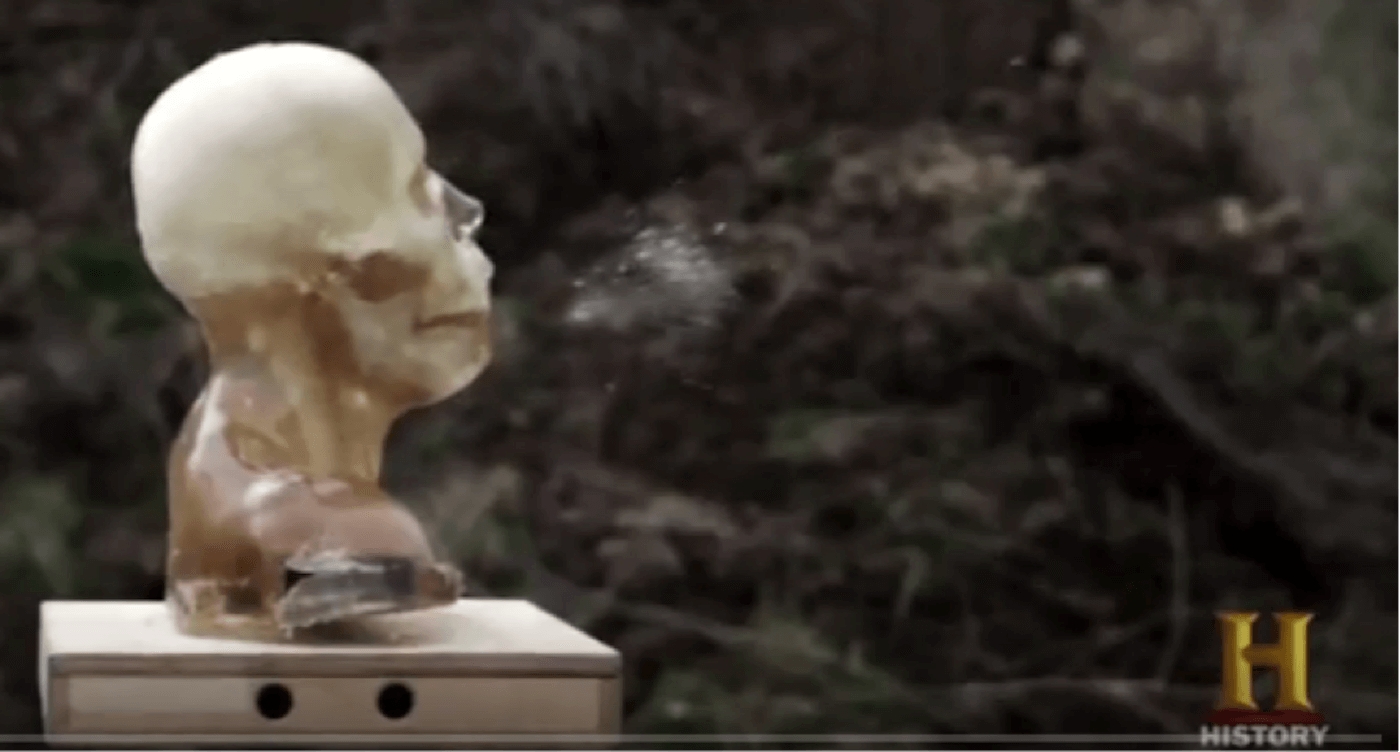
  • Master Class with John Hankey, III:  The Podcast

    Master Class with John Hankey, III: The Podcast


    This session of Fetzer’s podcast begins with Fetzer and King discussing how CTKA didn’t show up for the debate. They have their reality we have our own. Regardless of their claims that we backed off, one can see here in Part II I would be more than happy to oblige them should JH be willing to participate with the aforementioned questions.

    11 Min: Outtake of “The Jim Garrison Tapes”

    Gary King adds a segment from John Barbour’s “The Garrison Tapes” production. It discusses the Bay of Pigs invasion and uses Garrison, Prouty, and David Phillips. The segment has nothing whatsoever to do with GHWB but it serves to make out as if Hankey will somehow defend and champion Garrison and Fletcher Prouty’s cause. The problem is we do not have any real problems with either. Once again, people familiar with CTKA and our material will see through this diversion.

    14 Min: “And he’s Away.”

    Important Note: Hankey says he will go through the evidence point by point. Yet he does not run through a list of the topics discussed or give the reader a general time – frame. This is standard for a presentation because that is what Hankey’s rambling approach is. To call this farcical approach a debate of any weight is a grievance against standard debate procedure.

    Straight out of the blocks Hankey begins discussing the trials and tribulations Gary had getting us on. Without including the CIA agent baiting mentioned before. Wow, I thought this was about GHWB? Anyhow, salivating with sarcasm he thanks Jim Di and his friends (namely Frank Cassano and I) for attacking him, because, we have forced him to look at his positions. Cassano is involved because Hankey accused Jim of being a CIA agent on the aforementioned James Corbett show. Cassano and I called in to complain. But Hankey now says that after his re-evaluation, he now realizes his position was actually much stronger than he realized. (Yes, and I am the reincarnation of Mao Zedong).

    He now uses his old “Jim amasses a ton of irrelevant information to discredit me and never confronts the main stuff” routine. Which is a new take on his “my evidence was incorrect but my conclusions were correct” bull. This is interesting on two counts. First, Jim did not write the article he is contesting. I did. Jim only edited that article and most of what he did was edit for length. The actual substance is about 90% my own. Second, as noted, he has now changed his defense. On the “Murder Solved Forum”, he admitted to almost all of the mistakes I pointed out in my piece. And he was even repetant about most of them. But his defense there was he was still correct on his main thesis about Bush. Which obviously sidesteps the issue of: how can a guy who makes so many errors about so many topics be correct about a major thesis? When in fact, the standard of this kind of thesis is: Extraordinary claims demand extraordianry evidence.

    15 Min: How Many Years have you Been Researching John?

    “I’ve been researching the assassination in a pretty serious fashion for about forty years.”

    This is a vast improvement from JH claiming he had been a researcher for 50 years four years before the 50th anniversary.

    “It took me nearly 40 years to find these memos; and nearly another ten to figure out what they mean. Believe me, I’m not bragging. But I am advocating patience”

    JH will try denying this by saying we made it up (have a look at the 56:57 passage for a stellar example). Sadly for JH its right here 40 + 10 = 50. (http://911blogger.com/node/19864)

    As I explained in my first essay, Hankey says he got involved in about 1999 after JFK Jr’s plane crash. IMDB say JFK II came out in 2003 (I said 2004 originally). Hankey’s movie is officially 12 years old and John has been perfecting his stand-up routine for 15. He had only spent some 2-3 years looking at the case before he decided come through the curtain and be a big star. That is a rather substantial difference of 25 years in terms of his 40 years of research.

    Hell, at least he has dropped his banal story about holding talks at different campuses concerning the JFK case. Judging by what he is spouting now, those discussions would have been awful (if they ever happened).

    15 – 16 Min: Memo Madness

    On top of all we have written about his insane memo fetish and the denouncement of JH’s interpretation by Joseph McBride the man who found the documents. I really do not need to go on. Except to say Bush was not the head of the CIA in 1972. His tenure was from January 1976 to 1977.

    Wait… did he just say the memo states that George Bush is the supervisor of the killers again? Damn, I was hoping he would announce that he was bullied and had an unhappy childhood. That might explain his over engaged fantasy world and his distortion of the JFK case.

    18 Min: No Thanks to CTKA

    Hankey mentions the famous memo Angleton let Trento have a peak at which placed Hunt in Dealey Plaza that day. However, he won’t say anything about us correcting him on the issue. He originally said Helms wrote the memo, not Angleton. Remember, this is from “Plausible Denial”, a book he supposedly pores over, and then recently called “Rush to Judgement”. Indeed, JH as one will see, has apparently co-opted a lot of CTKA material with which he used to lecture us about.

    19 Min: The Bush Dulles Meeting

    Hankey has a particular obsession for a dinner Prescott Bush had with Allen Dulles. I discussed this meeting in my last Hankey article. JH had told radio host James Corbett that the “Pilot Project” was about “George Bush and the Bay of Pigs.” However, he is now saying the project refers to George Bush setting up his oil company. Both are hilariously off the ball. The document is dated April 1963. That’s two years after the Bay of Pigs, and to cap it off Bush Jr had set up his oil business in 1953-54.

    It is no big deal Prescott Bush was friendly with Dulles. A whole heap of wealthy elitiest were friends with Allen. For he was one of the them; hence, why be does JH get so excited over the association with Prescott? Was Prescott as close to Dulles as Helms, Phillips, Hunt, Edwards, Truscott, Bissell, Cabell, Angleton or CD Jackson. That is an extremely closed group of pals. I would like to know how Bush interacted with this group?

    As I said, if Hankey is going to try and use bluestering langauge he can at least get his facts right and keep his story straight. He can also get real about the relationships Dulles had with his intelligence cronies. As one will note throughout the guy can do none of this.

    20 Min: Hunt and Bush

    JH says the Bay of Pigs was where Bush met E Howard Hunt. He has said this for a long time. If perchance, Bush was involved in some of the smaller aspects of anti-Castro operations the two could have met. We have never said it was impossible; nevertheless, when one has an editor (which Hankey does not) we cut little pieces that didn’t ram home the point in “The Dark Legacy of John Hankey.” I wrote…

    “The viewer may have noted that in skipping over the nefarious American activities in Latin America at the time. Hankey has presented absolutely no evidence of Hunt and Bush working together on anything other than the Bay of Pigs, and even that is an unproven and indirect relationship.”

    I should have kept the line “the two could have met” and then added “but even that is an unproven and indirect relationship” in my first Hankey piece. It is hardly an admission and it changes nothing. The problem we have is that Hunt was a big player, an out and out intelligence hard core operative. Bush maybe was essentially a CIA business liaison with political ambitions. The CIA, like any intel agency, uses compatmentalization and delegates agents and contractors based on their abilities. You don’t just become a covert operator, you get chosen.

    In the past Hankey has tried to intimate Bush would have been higher up the chain for the Bay of Pigs than Hunt. He seems to have dropped this angle (for the time being at least) preferring to now say Bush was in charge of Dallas (check out the inanity some 24:00 minutes in). He has even gone so far to say Bush was a shooter!

    Of course, listening to JH we had nothing to do with his modifying this aspect of the story. Nor did my first article have anything to do with his abandoning the notion Bush and Hunt used Hunt’s oil platform at Cal Say as the staging point for the Bay of Pigs. Now he has something else to learn from us. JH ludicrously believes the CIA launched the Bay of Pigs with only two boats “Houston” and “Barbara.” In fact, there were four others.

    Atlántico, Rio Escondido, Caribe, and Braggart.

    Furthermore, one does not need to misquote Mark Lane concerning what Fletcher Prouty said about the Bush/BOP connection to prove Hunt and Bush could have known each other.

    Hunt potentially bumping into Bush is no big deal.

    21 Min: The old “Why aren’t you Attacking Lane/Prouty it’s his/their fault” Line

    Hankey pulls this old chestnut out again. Our reasoning, as I have said before, is very simple. I ask the reader to look at Mark Lane’s history and record compared to JH’s. Lane has bought some good work to the table, as has Fletcher Prouty. Hankey on the other hand provides accidental comedy. We have criticized Lane before. Indeed, we did in the very first Hankey review and we were slightly disappointed with his last book. But further, neither Lane nor Poruty have ever taken the Bush/Hoover memo nearly as far as Hankey has. That is, to have made a whole film about it. If they would have, and it was anything like Hankey’s, we would have criticized them also.

    What is hilarious is not once has he turned on Jim and I saying “Why don’t you attack Paul Kangas, Jim Fetzer, Russ Baker, or Murder Solved. I got my stuff from those sources.”

    Thus, if Hankey were ever to debate (and trust me I am very game). We want his beloved fall back line “Why don’t CTKA attack blah, blah” to be one of the questions.

    24 Min: Bush out of the BOP in Charge of Dallas

    We know there is a decent chance Howard Hunt, and David Phillips were in or near Dealey Plaza that day. Hunt’s appearance came via the Angleton memo, and his ninety percent dubious testimonies in his book and to his son. David Phillips came thanks to his brother. One has to ask why this bunch of pipe swinging intelligence professionals would hand the Dallas project over to an office junior like George. Because that’s what JH is saying around about now.

    The Parrot Memo (http://jfkmurdersolved.com/images/bushwarning.jpg) becomes a particular sticking point for JH here. Why isn’t there any FBI documentation of Hunt, and Phillips calling in for their alibis or calling up people to name as false suspects? Indeed, why didn’t they run advertisements they were in town giving speeches against fighting Communism? The whole scenario is juvenile and schoolyard. Bush, the supposed team leader in Dallas, has to call in with a fake report to create an alibi for killing the headmaster to his mother. That is what the whole thing plays out like.

    I would imagine the assassins of Kennedy being somewhat less accountable to the FBI than dear George appears to be. Hankey’s angle that Jim DiEugenio has kept quiet on Bush’s phone call is a boldfaced lie. Jim discussed and destroyed the Parrot Memo silliness and the idea of Bush leading a squad in his review of Russ Baker’s book.

    25 Min: Hankey’s Ever Changing Landscape and Bush a Shooter

    JH now discusses the Craig/Vaughn account he gave in his VT article concerning Bogus George arrest outside the Dal Tex building. He says he has known about the account for a long, long time. If so, he never used it until he got desperate for options. Adding new information is perfectly okay in a presentation like this but there are parameters. If JH had a shred of honesty, he would say to his listeners…

    “Jim and Seamus did not raise these points in their articles and interviews at the time but I would like to add…”

    He never does this and he brings up the Parrot memo. I never discussed the above Parrot phone call in my review because Hankey did not bring it up in the version of his documentary I watched.

    Anyhow, JH has added the Bush TSBD angle to his repertoire. Again, this was not in his catalogue of marital aids at the time I was first encountering him. CTKA reacted to JH, as we would to any bad JFK product. He got a bad review befitting the horror he created. He then got snarky (ridiculously so as you can see). Had he bought this dubious material up back then he would have received the same treatment he is getting now. So his attempts at intimating that somehow we missed something, for reasons stated above, fall flat.

    Anyhow, let us cap off a stunning barrage of fibs concerning CTKA, Bush’s arrest and his Parrott phone call. Hankey, almost beside himself with self-righteousness, now announces something absolutely shocking in its arrogance:

    “Bush was caught with a frigging gun in his hand.”

    Maybe this is just a figure of speech. I hope it is. For the man cannot be serious. Vaughn never said that to Craig. Indeed, we need a brief summary of Hankeyian events from 24-25 minutes to refocus, as there is so much wonderful, factual, and logical information to absorb.

    • Bush the leader of the hit squad is arrested with a gun outside the Dal Tex building. So was he shooting at JFK with a pistol?
    • Obtaining a quick release from the police GHWB then poses in a suit and tie outside the TSBD for a picture.
    • Then he leaps in a car and goes to the Blackstone Hotel in Tyler Texas where places a telephone call to the FBI concerning dissident James Parrott precisely ten minutes later.

    I am not saying all of this is impossible, noooo I would never say that. It is just incredibly improbable. I mean, take the third point. Tyler, Texas is something like 97 miles from Dallas. The driving time is about 90 minutes. Yet, this is John Hankey and therefore in his alternative universe, anything really is possible. As long as it makes George Bush a part of the JFK assassination.

    29 Min: Hunt a Sniper in China and Morales ran JM WAVE

    As one can see from the above rubric, this is turning into a vintage performance from the old master. Not even Saint John Hunt (his son) mentioned E. Howard training as a sniper in China and that guy can talk a lot of gunk. Sure Hunt was a killer, all active CIA black op types are. Nevertheless, if Hankey understood operations, he would know that to be a presidential level sniper Hunt would have had to be training every day for hours on end. Nothing in Hunt’s life and his activities in covert planning indicate the required marksmanship dedication.

    It appears judging by some of Hankey’s later comments concerning Bush being a , well any idiot can become an assassin. As for the ludicrous idea of Morales running JM WAVE, well that is to be expected of JH’s quest for accuracy and evidence. Unbeleivable carelessness. Ted Shackley ran JM WAVE.

    30 Min: Beatles Songs – Interval

    Thank you Jim Fetzer, your research is appalling but I have never appreciated the Beatles more.

    The first quarter is over, and it has been a torrid battle. Not between Jim and John. Hell, the chief hasn’t even made his appearance. It seems that Hankey has done a stellar job of beating himself up. If this train wreck does this to himself, one has to wonder what on Earth will happen when he battles samples of Jim?

    36 Min: Jim Finally Gets a Bite

    Prior to Jim’s debut JH insinuated that Jim is hard to follow because he goes off on tangents and jumps around topics. Hankey really needs to make like Michael Jackson and talk to the “Man in the mirror.” He also needs to “Beat it” because a number of the samples he has chosen are deliberately cut to make Jim come across as a blithering madman. Sadly, for JH there is only one blithering idiot and he is not moon walking out of this one.

    Anyhow, Jim discusses the problem of people over identifying suspects in the pictures and films of Dealey that day. When he mentions names, he is paying no particular attention to any one suspect. Nor is he actually saying none of them are there. It is a position bar one or two slight differences I share with Jim. Namely if we put everybody’s suspects into the mix, we have a grossly inefficient and rather silly conspiracy. Incidentally, the kind JH’s Godfather, JIm Fetzer, adores.

    37 Min: Hankey, Fletcher Prouty’s Brave Champion

    Hankey replies and states categorically that all the subjects Jim names are in there. However, it soon gets crazier. He discusses Ed Lansdale’s possible sighting as if he has been a long-time advocate. However, as with the Bush outside the TSBD his new Lansdale angle occurred well after my first and second articles, not to mention Jim’s BOR interview.

    As said in Part I, I am open to the Lansdale picture but I refuse go to the bank on any photo ID. JH now launches a grossly hypocritical diatribe about CTKA’s insensitivity towards all things Prouty. If CTKA is so insulting to the Colonel, I have to ask why Len has Jim on Black Ops Radio every other week. Surely Hankey knows Len’s background with Prouty? I mean Len had the charity to have Hankey on his show once. An interesting aside is a claim by Fetzer that Jim is running BOR. The result being Hankey and himself have been turfed. If Jim ran BOR, he certainly would not have Fetzer’s pal Mark DeValk on. Plain and simple, Len also got a lot of complaints about JH and Fetzer. Hence, it was a no brainer not to have them back. Further, Fetzer has begun to attack len in print. Why should Len genuflect to someone who is trashing him? Finally, Fetzer, with his participation in the zany OIP, his obsession with Zapruder film alteration, and his attacks on Tink Thompson, and his belief in the likes of Judith Baker and now Hankey and also Peter Janney, with all this, Fetzer has now occupied the very far out reaches of the JFK community. Black Op Radio is not about those Outer Limits. Its about what is provable in this case by the standard of civil law. That is, would a jury vote 9-3 in favor of the critical case in front of them. That later work of Fetzer, and now that of Hankey, does not qualify as such.

    40 Min: Sanctimonious + Insanity = Hypocrisy

    Hold the phone Martha! JH’s let loose another ripper. He’s scolding Jim for dismissing people without looking at the evidence adding, “Jim never does that.” My God, JH is pulling out all the hypocritical stops he can. The sound bites he has selected of course do not let Jim build any argument or evidence. JH also all forgets about the screeds of writing we have at CTKA dissecting his stuff, and on top of that, Jims Black Op Radio interview, and our stint on the Corbett Report. Jim by the way has written and edited four books. He has also written and edited hundreds of articles. If JH really wants proof there is a website called CTKA, the one you the reader are visiting right now, then he also needs to read this article an dmaybe, just maybe, learn something about journalistic standeards and th rules of logic and evidence.

    42-43 Min: Nixon Hired Hunt and other Fantasies

    What is interesting is that JH has dropped his inane Connally – Nixon angle. The one he assiduously pushed in his first documentary. Indeed, he was still pushing the Connally angle when Jim encountered Hankey over at Murder Solved.

    The Nixon angle is in my first article on JH. He completely ignores the points and evidence in that section, or does he? Hankey now says he agrees that Hunt set up Nixon, as if he has known that all along. If he did, surely a man of his integrity would have included this point in his documentaries. However, Hankey is not knowledgeable or honest. He only learned this from the original CTKA article I wrote and Jim’s interview. Hence, all JH can do now is scream something along the lines that “Nixon knew he was employing Hunt, because he hired him” Which is an illogical sentence to begin with.

    I wrote,

    For instance, Hankey states that Nixon brought Howard Hunt into the White House. Not accurate. As Jim Hougan points out in his brilliant and revolutionary Secret Agenda, prior to being hired by Charles Colson – not Nixon – Hunt worked at a CIA front called the Mullen Company. This was ostensibly an advertising and public relations firm. It was closely aligned with Howard Hughes. It was presided over at the time by CIA asset Robert Bennett. It was Bennett who mentioned Hunt’s name to Colson; Hunt then offered his services to him; and then Colson hired Hunt. (Hougan p. 33) It was an act that Colson came to regret. Why? Because Hunt appears to have been a CIA infiltrator in the White House who, along with James McCord, deliberately sabotaged the Plumbers at Watergate and helped collapse Nixon’s presidency. (ibid, pgs. 270-75)”

    It is clear Nixon learned of Hunt while he was at the Mullen Company, and then in the White House. And it is clear he did use him from time to time. And Nixon did mention Hunt on the White House tapes before the was hired. But there is still no proof or real evidence that Nixon hired Hunt. If I was Nixon and I was unsuspecting of his true motives too ultimately screw me I would have not done so as well. Hunt was a pro. Nevertheless, if Hankey was not such a knee jerk reactionary his comment concerning why Nixon would have a suspect in the Kennedy assassination hanging around the White House would actually merit discussion. Because it seems clear to some, like Hougan, that the CIA was infiltrating Nixon’s White House, the Plumbers, and CREEP. And as Jim DiEugenio and Lisa Pease have argued, one can make a credible thesis that many of the players invovled in murdering Kennedy, were also involved with removing Nixon.

    Indeed, Jim Hougan and Jim DiEugenio have discussed Watergate on Black Ops Radio. So too has Hankey’s new archenemy in his pantheon of victimisation Lisa Pease (check out Hankeys grand finale at 1H: 52).

    During JH sermon, about Nixon it is obvious he is once again trying to position CTKA to points of view we have either never held or have actually discussed before. Hence, we have another thing JH can add to his future arguments. Nixon apparently met Hunt during his trip to Latin America in 1958.

    44-45 Min: I Only Made Two Mistakes and CTKA Endorses Barr McClellan!

    JH is angry because Jim and I took the mickey out of him for his unfunny picture of Nixon holding a gun in Dealey Plaza. He begrudgingly admits this was a mistake and he should not have done it. Later he admits he made a mistake with the Nixon – Ruby memo (see below at 51-52 minutes). Declaring he only made these two mistakes. However, he will not tell you he has dropped his classic Prescott Bush funded Nixon into the White House gag. Not to mention a misdated photo he has of them shaking hands with Nazi armbands. Indeed, I spent over some 1000+ words explaining JH’s Nixon follies. He also won’t tell the reader that on his website he has a version of his debate with Jim in which he omits Jim’s post outlining some 20 errors he noted in the first half of JH’s JFK II. I mentioned this in my follow up article some years ago.

    He then asks what Nixon was doing in Dallas if not to kill JFK. Well Johnny Boy, Nixon was in Dallas for a Pepsi Cola Bottlers Convention. There was very little hoopla at all. He was not there merely to give speeches and bump Kennedy off as Hankey implied. Nixon’s comment about Johnson and his removal off the JFK ticket was essentially in passing to the press. Nixon could have made his statements anywhere; nevertheless, I personally think Nixon was not there by accident or by his design either. Hence, his presence that day provided another additional layer of mystery. Essentially, he was a red herring.

    CTKA Endorses the Johnson Hypothesis

    I thought this deserved a title. Simply because it is so ludicrous one must take note. Neither Jim nor I have ever fully advocated for the Kennedy ticket dumping Johnson in 1964. That is really up in the air as the sources for his scandals at the time have been poor and compromised. We have no doubt Johnson was dodgy to a degree. However, what Texas politician of the era, bar the odd Ralph Yarbrough, was not? As much of a liability as he was, LBJ was essential for Kennedy’s success in the South. Jim and I have written about this ad nauseam. Hankey, for the umpteenth time, appears to be lifting information off us and trying to lecture Jim about issues long known to CTKA.

    It is a shame he is so dodgy because he makes the point about Barr McClellan’s ties to GWB, a point of view people have. This is actually a clever use of the information I got from Alex Constantine’s site. I mentioned it in my article on Alex Jones. However, this was after apparently reading my article on Alex Jones (Hankey is not a good enough researcher to find this sort of good information himself). He then seemingly babbles on about Jim and I endorsing Barr McClellan. We have never endorsed McClellan. Nor any of the recent LBJ did it cul de sacs. Indeed, we have numerous articles discussing why we do not.

    Therefore, why is Jim Fetzer the kingpin of all the worst LBJ did it dross, endorsing Hankeys stance? He clearly hates us enough to have Hankey dump on his argument. Clever guy that Jim Fetzer. A man who has clearly lost his was from his former academic standards. Now, apparently, the end justifies the means.

    51-52 Min: Why Doesn’t Jim Attack Prouty

    It’s time for the old “Why do they always pick on me” routine. Hankey says he got the bogus Nixon – Ruby memo from Prouty. So why aren’t we attacking Prouty? Well, it is for the same reason we don’t go for Lane. Prouty has enriched the case, not detracted from it. The man could make one or two mistakes; he earned that right. Hankey has not earned that privilege and he likely never will. Furthermore, JH is responsible for the information he chooses to use. His deferment of responsibility is very immature and unprecedented in the field. One is not supposed to pass on questionable material, no matter who the source is. A true critical thinker cross checks materials that seem to good to be true.

    56:57 Min: Hankey’s Implausible Denial (You Have to Read This Folks)

    Now, until here, there have been some jaw dropping and hilarious moments. Nevertheless, this is the highlight of the entire charade. Hankey now plays an important segment of Jim’s BOR interview. This discusses Hankey’s ineptitude concerning Allen Dulles and his deep background in the spy trade.

    “I am not sure what it is that he’s (Jim) trying to say here, I mean besides that I’m incredibly ignorant, and that is his main point which is always his main point, always.”

    JH is correct about something: he is “incredibly ignorant.” He then rambles on about Dulles getting the CIA job, only because of his Nazi ties. This belittles the sound research many others have done concerning Dulles’ post WWII background. JH says these facts are niggling little annoyances that do not apparently amount to much. Nevertheless, JH’s actions at the 57 minute, mark indicate he took these niggling facts rather seriously.

    Hankey plays an excerpt from Jim’s interview in which Jim quotes Hankey from my piece.

    “Prescott Bush is the guy who during WWI was with Army Intelligence. Dulles was not with army intelligence during WWI and it’s a little bit surprising that he would be put in charge of the CIA instead of Prescott, given that they are more or less parallel in their power up until that time.”

    Hankey abruptly states …

    “He’s making that quote up! But never mind let’s move on.”

    I quoted Hankey directly from Black Op Radio on show 424, May 2009. The show is in Len’s archives. Why on Earth did he choose that particular statement and then act as he did? Was it to try to wound Jim’s credibility, or to save his own? Either way, he not only shoved a foot in his mouth, but he shoved the other in there also. And why did Fetzer accept this at face value?

    58:30 Min: If the Head of the CIA is a Front why the Boner about GHWB

    JH is angling for his old Prescott Bush was the power behind the throne line. To be honest he has not bought PB up yet; however, he starts pondering aloud inane stuff like “The head of the CIA is a front”, he is not naming names but he is clearly saying this about Dulles as he has used this line many times before in relation to Prescott, and he discusses him at 1H:02.

    If the head of the CIA is a puppet then why does he make such a huge deal about GHWB and his one-year gig as DCI? Furthermore, Prescott Bush must have been tripping on acid to let his son, whom never trained as a sniper take a shot at President Kennedy, as Hankey now insinuates. Indeed, if you hark back to 24-45, minute mark GHWB’s shooting at Kennedy was not the only dumb thing George did that day. He says his hypothesis “is a can of worms.” I can think of a few things to call it and it is not worms; thus, I can only wonder what Russ Baker is thinking. Baker tried vainly to bring credibility to the Bush did it hypothesis. I wonder how he feels to have his efforts smeared by JH.

    1H: 02 Min: Hankey and Zhou En-Lai

    This is very long so I have made it into a separate article, which can be found here [need link here]. Thank the lord for the Beatle interlude once again.

    1H: 30 Min: Hoover Beatles.

    The next 12 minutes or so is a bizarre ode to J Edgar Hoover. Hankey has long believed the CIA pressured Hoover concerning the Kennedy assassination. CTKA has known and understood all of the angles JH discusses, but more besides. JH has never read Anthony Summers work (and that’s just an entree). Thus, he fails to understand what 99 percent of researchers believe that Hoover did not need much cajoling to participate in the cover up. He also tries to swing it that CTKA endorsed the idea of Hoover as a main plotter. That might be good enough for Peter Dale Scott, Phil Nelson, or Jim Fetzer; but that type of analysis is not good enough for CTKA.

    1H:42 Min: “This Guy is so Full of Shit”

    So says the master of the art form after a snippet in which Jim disagrees with JH delusions about the memo. Hankey retorts “If Bush was contacted it was because he was in charge of the anti-Castro Cubans.” Remember what McBride said to me at the end of Part I folks. I don’t need to remind you all that we have written.

    1H:44 Min: David Morales JM Wave Boss Again

    Morales was good pals with his boss Ted Shackley. Hankey’s pals at Murder Solved must be blue in the face explaining this sort of stuff to him. They have a write up about him here.

    1H:48 Min: “All This Shit About Dulles”

    “Jim has gone on with all of this shit about whether Dulles really had any intelligence background or not I mean what has that got to do with anything? And when do we get to the real substance of the movie the mountain of evidence I am putting together”

    There are a lot of fools out there dribbling all manner of gibberish. Nevertheless, even individuals as inept as Fetzer do not find Dulles’ extensive intelligence background irrelevant. It was not Dulles’ ties to the Nazis that got him the DIrectorship. It was his long experince as an intel officer in World War I and II, the plan he submitted to Walter B. Smith to reorganize the CIA after World War 2 (which prompted Smith to make him Deputy DCI), and finally Smith falling ill and his brother, Secretary of State John Foster Dulles, convincing Eisenhower to make Dulles the new Director. All of this material is in the record on the several books about the Dulles brothers. But not only has Hankey not read them. He actually seems to think its not even important for him to do so! And its arrogance and presumptuousness like this that allowed him to make over 40 errors of fact in the first version of his film. As for JH’s mountain of evidence he is putting together: he has to be kidding. He has not structured even a hillock.

    1H:49 Min: “What the Fuck”

    Hankey declares “What the fuck?” after a brief snippet of Jim explaining that Bush’s links to the agency and Cubans were hardly unique amongst the blue blood set. Jim names Clare Booth Luce and Bill Pawley as examples. This leaves an exasperated JH bellowing…“ But these guys didn’t get mentioned in this memo.” He forgets the fact George Bush does not have his name redacted. This indicates to anyone with half a brain he was hardly a CIA higher up. Since Hoover was very sensitive to such matters. Even if he was, it is hardly sensitive information if Captain William Edwards of the DIA was running the Cubans? Was Agent F.T Forsyth? They are mentioned as well. Also, if Hankey saying that there were no communications at all with the FBI, CIA, DIA, NSA, about any Cuban renegade attack on Castro to any backers of any Cuban cadres in the wake of JFK’s death?

    If Bush was head of the CIA in 1976, why didn’t he destroy this memo? Surely, someone of his all seeing, all evil pedigree would eradicate all vestiges of his earlier wrongdoings running the Anti-Castro Cuban programme. Hell the guy couldn’t even get rid of his banal correspondence with George DeMohrenschildt. I have to say it is rather odd Hankey has not bought that old chestnut up yet. Is it because CTKA crushed that dream before he could grab it?

    1H:52 Minutes: Hankey’s Last Stand

    JH has been building for this for close to two hours, or has it been his entire life?

    What follows is a ramble that will echo through eternity. Its power is such that it conjures up an image of an illusionist actually believing he is the Human Torch, and then setting himself alight, and leaping off the TSBD to fly away. Is it a bird? Is it a plane? No folks it is just JH crashing and burning. Again.

    Anyhow, for your enjoyment, here are the highlights of what he screamed on the way down…

    Fuck you Jim DeYouhayneo! For Making me Think.

    “Fuck you Jim Deyouhayneo! He is not honest, he, he is not… an honest researcher and you shouldn’t pay any attention to anything that he says except that he may occasionally raise a point that is in fact worth investigating.

    And in fact makes us think about something harder than perhaps we have in the first place.”

    Hankey is essentially saying, “Fuck you Jim for making me think.” It is certainly an odd way of showing one’s appreciation. But shouldn’t John have done some thinking before he put together his film. And again, the article was not Jim’s. It was mine. Jim was just reading it.

    Hoover: the Subtle Hero of the Bush Memo

    “But Hoover wrote one memo and the memo that he wrote named George Bush and frankly I just love that he managed to write it in such a way he made it so innocent that it survived.”

    Wow, so is he actually saying that the document reads as it looks. If so, that is a complete somersault. He is now saying Hoover carefully coded the message so it could slip through Bush’s fingers. It’s a message only JH can see.

    Mark Lane Never Heard of GHWB

    “Mark Lane said he saw this memo when it was first discovered and he didn’t make anything of it because he had never heard of George Bush before. It didn’t draw Mark Lane’s attention in the least… but that’s why it survived.”

    Okay, Mark Lane is a prominent political and civil rights activist and lawyer. JFK is only one of his many interests. He has had more scrapes with the CIA than JH has had hot dinners. Yet Hankey is trying to say in the period 1985-1988 a time when knowledge of the document was growing, Lane had never heard of the ex-head of the CIA or George Bush, Reagan’s second, and Presidential candidate. With that logic, JH probably thinks Mondale won. He now returns to Hoover’s cunning ploy…

    Jim is “Full of Shit,” but Hoover is “Frigging Brilliant

    “Now if Hoover was in on the assassination why did he write this memo and well… Jim is just so full of shit. I can’t believe it. He does draw our attention into that question I think, at least he drew my attention to that question. That I haven’t thought about in a long time. Why did Hoover write this memo? You know that when Hoover died his files were immediately seized and destroyed. If he had put it in his files it wouldn’t have survived but he made it sound innocent and he sent it out again to all these people. I think the guys frigging brilliant.”

    I couldn’t be bothered telling the reader that earlier he had congratulated Hoover’s investigative ability. Something considered a joke in the modern era to all but JH. Nonetheless, we can see he is very keen on Hoover’s subtle abilities that once again all but JH the mystic can see or translate. But beyond that, consider this a bi tmore deeply. Is Hankey really saying what he seems to be saying? That Hoover wanted to expose the actual plotters of JFK’s death? Again, this is what happens when writers leap into the sea of the JFK case without doing their homework. Or even going to the corner library to pick up a book or two.

    Nothing could be furhter from the truth in this case. From the first day, Hoover was hard at work molding the cover up from the ground up. He never let up the pressure on framing Oswald. Not from the beginning until the end. At the end, he was trying to disguise what the Sylvia Odio story really meant. To go through every instance in which he did this would take a small book. In fact, many people think that the exposure of the FBI cover up in this case was the beginning of the end of Hoover’s impenetrable image as a crime stopper. (Of which, most would say he never really was. Except maybe Johnny Boy.) But now, all of that work by say Tony Summers and Curt Gentry will have to reevaluated. Because John Hankey says the FBI memo has a much deeper meaning than anyone has ever given it. Even Joe McBride. Hoover was talking in codes I guess. Codes that only Hankey could decipher. And maybe Fetzer.

    John Hankey the Measure of Rationality

    Then comes something that really had to be heard to be believed. Consider the following:

    “Generally speaking I try to avoid saying things that I think that are so out there that they will reflect badly on everything else that I say.”

    Can Hankey really have this little self-knowledge? I hate to say it John but that horse has already bolted. And it left you on the ground. Indeed anybody who has read Parts I & II of this article, and three others at CTKA would see the bizarreness of the above statement. It was nice to know that before JH made this hilarious comment, you agreed with Jim that your theory of Bush threatening Hoover in his office with a dart gun was irresponsible and stupid.

    The Ridiculous CTKA Conspiracy

    But he is not done. Hankey’s final tirade accuses CTKA of launching a conspiracy against him. He bizarrely claims that different versions of his videos were not available at the time I wrote my first article. As you will see I am in awe of JH saying this stuff. It is a sociopathic, face saving and utterly dishonest argument. As one will see, JH himself was the very person who sent out his documentary and created different versions of it.

    The Ring Master Lisa Pease Part 1

    Why Hankey gets angry about anyone distributing his videos is curious. Is he secretly ashamed? He alleges Lisa Pease disseminated the video. This begs the question: why would Lisa want to promote anything of his. She, like any CTKA contributor, thinks Hankey’s work sucks. Was she distributing the video to discredit JH?

    Now again, please sit down before you read this wild conspiracy theory. It makes Lamar Waldron look like an amateur.

    For Hankey now claims Lisa then sent the video to Jim, and during his interview with Len, Lisa was handing him notes.( Lisa and Jim were in different parts of LA that night.) Yet, despite Jim’s reviewing his lame “Dark Legacy”, he then claims Jim has never seen his movie “JFK II”? What on earth is he trying to suggest here? If Jim actually sat down and watched the film, he would agree with JH? Wow, that is incredible logic considering Jim has seen both “JFK II” and “Dark Legacy.” Jim edited my articles and rechecked my facts. Threefore, it is impossible for him not to have watched JFK II. And he did at at my instigation, not Lisa’s. Hankey is not just delusional about whe he is, he is now creating wild paranoid plots to distract from the shoddiness of his own work.

    “For the record, and to repeat what jim has said on the air, this is how I came to write my first essay on Hankey’s film. One night I began to send Jim a series of questions based upon my viewing of Hankey’s documentary. Even though I was not as well versed in Kennedy matters back then, I sensed some of the facts in the film were either wrong or hyperbolic. So I sent a series of questions about these disputed matters to Jim so he could settle the matters. After about four of my queries I saw that indeed, my doubt was well founded since Jim, in each instance, stated that the info I was sending to him was wrong. Finally, in exasperation, he said, “Where are you getting this malarkey?”

    I told him: “Its from Hankey’s film.”

    Jim then watched the film, and we decided that someone had to critique this since it would mislead to many people. This is one of the functions of CTKA. To expose flatulence and pretension on both sides: the Krazy Kid Oswald types, and those who advocate ill founded conspiracies.

    He Doesn’t Mention Prison Planet

    There were five people in total he sent the movie to Lisa Pease, his brother, Kris Millegan, and Wim Dankbaar. He plays dumb and say’s “I think I mentioned them all.” The fifth was Alex Jones and Prison Planet. If not JH is probably wondering how their logo got on the front of his production.

    Lisa Pease Ring Master Part II (This is Even More Nutty).

    He now says I, the writer of the article that drove him mad, I am just a straw man in all of this. Apparently there is no way I could have seen it without Lisa sending it to me. In other words, I was part of Lisa’s conspiracy.

    According to the Wayback Machine, the version of JH’s JFK II that I used to review “JFK II” and linked to Google Video, has now disappeared rather suspiciously. One can see it had been posted to Google Video in at least 2006. (See the screen shot below)

    Table 2: Hankey’s Deleted Video Posted on 2006

    seamus 02

    On the Education Forum there is a post dating from August 2006 from a guy called Wade Rhodes discussing the very “JFK II” video. Rhodes, by the way, had used the same link I had. It is also important to note what Rhodes asks concerning Alex Jones and the Prison Planet disclaimer on Hankey’s earlier versions.

    Table 3: JFK II-2007 on Google Video

    seamus 03

    Anyhow, just do a Google video search for “JFK II: The Bush Connection.” The earliest YouTube entry now appears to be Jan 9, 2007. Note underneath there are different versions by different people. Furthermore, there is one from Mar 12, 2009.

    All of the above dates I have discussed, 2006, 2007, and March 2009 are way, way, way before I began my first Hankey take down, which CTKA published in early 2010. I had worked on JH for 3-4 months prior, in 2009. I have no idea how it got viral in the period 2003-2006. Jones’ operation was still growing. One presumes it was posted to a forum or linked to his webpage at some point. Some crazed people obviously liked it and bingo.

    Two major problems

    1. JH has accused us at one time or another of circulating unreleased editions that we somehow apprehended. As seen, JH has had “JFK” out and about for some time. Who created all the different versions that were available before September-October 2009 when I began? Were JH’s fans so concerned about JH’s content they made their own subtractions, or were they concerned about time? I don’t know. But the idea of Lisa Pease, cutting up JH’s video’s to make a better presentation or decrease its length is absurd (see the different lengths below)
    2. Problem one, assumes JH was not also promoting JFK II prior to my starting to write my first CTKA essay in September-October. Noooo JH never promoted JFK II at all according to the great man. It was us, Lisa Pease or CTKA.

    Table 4: Different Lengths of “JFK” all Publically Available

    seamus 04

    Well it turns out John Hankey was promoting JFK II. On Black Op Radio twice circa 2005, 2006, and also 2009. It was the latter recording on BOR (show # 424 that eventually helped spur me into what I am still doing now: correcting the ersatz record of JH.

    Conclusion on JH’s JFK II Videos

    People reply to criticism in different ways. Some take it upon themselves to improve. Some take it personally and resent the message. Hankey is in the latter group. For he now maligns Lisa Pease to cover his own behind. He has been less than candid about who distributed the videos since this information seems to be in plain sight. He seems to have edited the videos himself on the advice of others. John Hankey was also promoting his film two years before he released it. I am sure he made noises elsewhere, but I cannot be bothered tracking them down. Nothing should surprise me about John Hankey anymore – but this “CTKA conspiracy angle” is bizarre behavior even for him.

    Here Endeth the Lesson

    Well thankfully, it is over. Fetzer as deluded as ever, and without a trace of sarcasm, now announces, “Hankey prevailed in this exchange.” The reality is one can clearly see JH was defeated by mere voice samples. In his battle with an inanimate adversary, one can see he manufactured events, and corrupted CTKA’s own research for his own means. He then exaggerated, abused, smeared and manufactured again.

    I wish this was all over and initially it was fun. But it is extremely tedious and I feel sorry for Hankey.

    I will catch you up when I discuss JH and Zhou En – Lai.


    Part 1

    Part 2

    Part 4


    “The Dark Legacy of John Hankey”

    “Onwards and Downwards with John Hankey”

    Hankey/DiEugenio Debate Murder Solved

    DiEugenio’s Review Update of “Dark Legacy”

    Coogan Reply to Fetzer at Deep Politics Forum