By 1967, Jim Garrison became the Prometheus to the Achesonian Olympus.
– Robert Spiegelman
I. Garrison Unbound
About three years ago, at the Lancer “November in Dallas” conference, Jim DiEugenio gave an address entitled “Historical Revisionism and the JFK Case”, in which he defended his criticism of a few recent theories of the assassination, criticism which some – quite mistakenly, in this writer’s opinion – interpreted as counter to the spirit of free inquiry. The main point of his presentation was that revisionism should not denote a quest for novelty at the expense of accuracy. If we are to have any hope of coming to terms with what happened on November 22, 1963, we must take care to remain focused on the evidence. The reissue of Destiny Betrayed is extremely timely in this respect. I would fancy that when DiEugenio gave this talk, the need for an updated edition of his 1992 book had already crystallized in his thinking; but as we enter the 50th anniversary year it has become ever more urgent, as his lecture suggested, to revisit the breakthroughs made during the first decade and a half after John Kennedy’s death, and to build on them using the knowledge and insight we have since acquired. This thoroughly rewritten study does precisely that.
No single person uncovered as many clues1 in that early period of the JFK investigation as did Jim Garrison. And it is impossible for the reader not to take away from Destiny Betrayed a sense of indebtedness to those leads. But the reader also cannot help but be impressed by the imposing factual edifice that is erected upon them. In that same lecture, DiEugenio paraphrased Garrison concerning what an investigator should hope to achieve in this case: “… a paradigm that would be justified internally by the evidence yet [whose] overall design would fit the shape of the plot.” This book fulfills Garrison’s prescription by offering an abundance of details – more so than perhaps any other reconstruction of the crime – that fit the players and their activities together into a coherent picture.
It does so in large part through the constant confrontation of old information with the new. From the seemingly inexhaustible font of documents declassified by the ARRB have flowed forth revelations in a number of areas explored by the author: Vietnam, the Bay of Pigs, Mexico City, James Angleton’s role in the setup of Oswald, Shaw and his legal team’s CIA connections, the Clark Panel and HSCA medical cover-ups, the complicity of the media and the federal government in sabotaging Garrison’s investigation – to name just a few highlights from the wide scope of this book. Further, the author’s own interviews during the mid-90s, his 1994 inspection of the DA’s files (he was the first person outside his staff allowed to copy Garrison’s files), along with the work of John Newman, John Armstrong, Bill Davy, and Jim Douglass, as well as a host of articles published in Probe by others such as Lisa Pease and Donald Gibson: these are all mustered to good effect in support of Garrison’s case. The corroborative weight of this evidence is quite compelling. Yet the author never ceases to remind us, as did the twelfth-century schoolmaster Bernard of Chartres, that if we can see farther, it is because we are dwarves standing on the shoulders of giants (and in particular, one giant, jolly and green though he may have been deemed).
This study not only offers convincing confirmation for Garrison’s hypotheses, but also ratifies Garrison’s more general suspicions concerning the clandestine interference with his investigation, and the direction in which the country was heading. In preparing this review, this writer had occasion to reread Garrison’s interview given to Playboy magazine in October 1967, and was impressed by the lucidity, force, and uncanny relevance of his final remarks:
our Government is the CIA and the Pentagon, with Congress reduced to a debating society … We won’t build Dachaus and Auschwitzes; the clever manipulation of the mass media is creating a concentration camp of the mind that promises to be far more effective in keeping the populace in line … I’ve learned enough about the machinations of the CIA in the past year to know that this is no longer the dream world America I once believed in … Huey Long once said, “Fascism will come to America in the name of anti-fascism.” I’m afraid, based on my own experience, that fascism will come to America in the name of national security.
Recall, this was 1967!2 At a distance of 50 years, where half of one’s readership has no memory of the event, the question of relevance naturally arises; but such relevance is not realized by fishing for links between the assassination and personages responsible for recent political crimes or abuses, as some of the authors criticized in DiEugenio’s lecture do, for these mostly end up having the consistency of gossamer. As Garrison alerted us, it is to the institutional consequences of the assassination that we must look, because, as Lisa Pease opines in her preface to the book, “the same operational template can be run again” (and indeed has been, repeatedly). Destiny Betrayed does not bludgeon the reader with this message; it makes the point cogently by showing rather than by telling.
For a number of reasons, this is not a typical book on the JFK assassination. As DiEugenio himself has declared (see, for instance, his remarks at the beginning of his well-known review of JFK and the Unspeakable), it was already his intention with the first edition to bring assassination research out of the ghetto. What he had in mind was a broadening of perspective beyond the mechanics of Dealey Plaza or the suspicious goings-on at Bethesda, and this is precisely the manner in which the reader is made to enter the maze:
The events that exploded in Dallas on November 22, 1963, had their genesis in Washington on a February day in 1947.
Much as with the traditional novel, one can almost unpack the remaining four-hundred-odd pages from that single opening assertion. The quest for the appropriate context in which to decipher JFK’s presidency and death is one of the principal tasks undertaken by the author. But his formal choices also transform his engagement with these events from a simple act of sleuthing into a veritable essay in the hermeneutics of history.
To illustrate what I mean by this, let me begin by observing that a dialogue of past and present is inscribed in the book through the interplay of narration and commentary. The narrative building-blocks are ordered mainly along chronological lines, leading from the initial post-war articulations of U.S. foreign policy, through JFK’s presidency, the activities in New Orleans and Dallas preceding his death, and the subsequent domestic investigations, to conclude with some reflections about the continuing impact of the assassination and its cover-up on the political climate of the United States today. This basic organization is, however, selectively adjusted for thematic purposes; for instance, Oswald’s activities in New Orleans (chpts. 5-6) are separated from his return to the U.S. and his final days (chpt. 8) by a flash-back dealing with his early life and defection (chpt. 7), thus lending, by its central position, an explanatory prominence to his intelligence training. (I should add here that these latter two chapters form the best concise treatment of Oswald I have yet to read.) The last three chapters also break with the preceding linear progression (more on this below). But emerging from within this broadly forward sweep are also narrative swirls and eddies where the author interrupts his story in order to indicate a noteworthy nexus which will be handled more fully later, or which involves knowledge we now possess but which was unavailable then. Far from obscuring or confusing the chain of events, this weaving in and out of strict chronology – and its attendant modulation between points of view – is adroitly handled and lends a sense of continuous integration to the reader’s journey.
Another narrative technique, related to and often conjoined with the preceding one, is that of the leitmotif. For instance, we meet a corporation called Freeport Sulphur in the very first chapter with respect to mining concessions in 1950s Cuba. We return to that company in the context of Garrison’s discovery of a Freeport link between Shaw, Ferrie and Banister (chpt. 10); then again in terms of Gaeton Fonzi’s reinvestigation of those leads for the HSCA (chpt. 15). And then finally, in the fullest and most crushing context, with that ignoble corporation’s role in the Indonesian coup, related in the penultimate chapter. Another example of this technique centers on the CIA’s turn to drug-running money after Kennedy defunded Mongoose, which we first read about in Chapter 6, and then again in Garrison’s discovery of the Ruby-Oswald-Cheramie connection (chpt. 10), with further confirmation via reference to Douglas Valentine’s discovery (2004) of the CIA’s infiltration of U.S. Customs, followed by a discussion of the Hubert-Griffin memo (see Section III below), putting Sergio Arcacha Smith, whose name peppers the pages of this book, decidedly in the middle of it all. Leitmotif is also used with respect to one of the cardinal figures in this story, Bernardo DeTorres. He is first discussed in the context of how news of the back channel to Castro was divulged among the Cuban exiles (chpt. 4), then with respect to his infiltration of Garrison’s inchoate investigation (chpt. 11), and then again with reference to his independent discovery by Fonzi through Rolando Otero which led to his wider connection to the probable operational faction of the plot (chpt. 15).
The artful use of such devices lends to Destiny Betrayed a concern with the intimate connection between meaning and expository process shared by few other books on this subject, the vast majority of which are simply organized by topic. More specifically, these literary techniques do not serve as mere artifice, extraneously imposed on the material, but emerge naturally from it, as the author winds and unwinds his thread through the Daedalian intricacies of a story that ultimately is revealed to have explicated itself. For over the retrospective span of the intervening decades, events have indeed disclosed their own significance before our very eyes, not only through documentary releases, but by the repeated pattern of the actions of their protagonists. One of the theses of the book is that the JFK assassination and the destruction of Garrison were interlocking covert operations, in which some of the same players were involved. Another theme, which runs in parallel, is that Kennedy’s presidency blocked the progress of economic globalism, which was then restored after his death. We are made conscious of these relationships, not just through a series of momentary epiphanies, but ultimately through participation in a larger unfolding. In a profound sense, this book claims that the meaning of November 22, 1963, lies as much in what subsequent occurrences have affirmed as in the case that can be constructed directly from the facts and circumstances of the crime.
This conviction manifests itself finally in the book’s broadest architecture, one based on recapitulation. The concluding chapters generate a triad of embedded arches – or perhaps even concentric rings: the outermost (chpts. 1-4, plus 17) deals with Cold War policy and JFK, echoed by a discussion of foreign policy changes under LBJ; inside that, we have a similar structure (chpts. 5-8, plus 16) addressing the significance of Garrison’s discoveries about New Orleans and Oswald and ending with Mexico City, the importance of which Garrison clearly understood, but the full truth about which was concealed from his view. This leaves the innermost tripartite (and most drama-like) sequence (chpts. 9-10, 11-13, 14-15) tracing Garrison’s career and entry into the case, the government and media campaign against him, and the actions subsequent to Shaw’s acquittal, including how the same forces deployed against Garrison made a shambles of the House Select Committee on Assassinations. (Chapter 18 completes the composition, serving as a coda to the entire book).
At the center stands, of course, Jim Garrison, the oracular voice decrying national calamity and a knowing participant in his own professional ruin, whose vindication is as much a part of the story DiEugenio tells as is the exposure of the powers which removed JFK from office. It is, in fact, this dovetailing of two lives, this fateful encounter of purpose, that gives Destiny Betrayed its dramatic design. The book’s felicitous title, retained for this second edition, suggests an underlying logic impelling actions toward their “dénouement” (the title of the final chapter); a process, to take the author at his etymological word, to be perceived as the untying of a knot. The book’s title not only implies (somewhat paradoxically) the deliberate theft of what should have been, both in terms of U.S. foreign policy and in terms of bringing (at least one) of the perpetrators to justice; it also hints at how the unraveling of five decades has “betrayed” – that is, revealed – the character of both John Kennedy and Jim Garrison, despite monumental exertions to conceal or distort the truth.
The Afro-Asian revolution of nationalism, the revolt against colonialism, the determination of people to control their national destinies … in my opinion the tragic failure of both Republican and Democratic administrations since World War II to comprehend the nature of this revolution, and its potentialities for good and evil, has reaped a bitter harvest today—and it is by rights and by necessity a major foreign policy campaign issue that has nothing to do with anti-communism.
– John F. Kennedy, from a speech given during the Stevenson campaign, 1956
II. JFK, the Cold War Establishment, and Cuba
As mentioned in the preceding section, the first four chapters of the book, along with the penultimate one, raise a fundamental issue: whether JFK was ever a “Cold-Warrior”, and whether the assassination had any effect on the policies he had been pursuing. Seriously posing this question has long been anathema to mainstream writers on both the Left and the Right, some choosing to feign perplexity at the so-called “enigma” that was John F. Kennedy. At the very least we may observe that historians have been burdened by a considerable amount of preconceived baggage regarding what Kennedy’s politics could or could not have been. Yet I think John Newman put his finger on the crux of the matter in his masterful JFK and Vietnam: if one concentrates on the rhetorical indirections of his public statements – which JFK felt compelled to practice, for better or for worse, out of fear of vitiating his political efficacy – then one may derive the picture of a man who is mostly in conformity with the ideological matrix of his time. But as Newman teaches us, that is not the best way to understand his presidency. For, in the end, it is what he actually did and did not do which tells the more authentic tale. DiEugenio is not insensitive to the political pragmatist in Kennedy; but speaking of his desire to bolster his anti-communist credentials, especially during the 1960 campaign, the author insists that “below the level of campaign rhetoric, John Kennedy was not simply a more youthful version of Eisenhower” [19]3. Even James Douglass, with whose marvelous book this one aptly bears comparison (more on this momentarily), can be led astray by this side of JFK into believing that he changed his foreign policy stance in some essential way while he was president. With Destiny Betrayed, I believe we are finally given firmer footing for posing this question properly.
In order to do so, one must look to origins. That is where the first chapter, Legacy, begins. From the opening allusion to the request from the British Embassy asking Secretary of State Marshall for aid in quelling insurrection in Turkey and Greece, through the Truman Doctrine, the Marshall Plan, NATO and the National Security Act, we witness the fateful passage from republic to empire as the United States assumes custody of former European colonial interests in the name of containing putative Communist aggression and the Domino Theory. For DiEugenio, the key which unlocks what follows is this implicit marriage of ideology with economic interest. Out of that unholy alliance is born, through the midwifery of Allen Dulles, the de facto executive arm of neo-colonialism in the guise of a drastically metamorphosed CIA. In Dulles, in fact, these two lines – a hard-core view of the Soviet Union (which he shared with Nazi intelligence chief Reinhard Gehlen, whose vast network Dulles, while chief of the Berlin OSS office, helped retain with Gehlen in control), and a globalist perspective held in common with the Rockefeller corporate interests (which he and his brother John served as senior partners at the Wall Street firm of Sullivan and Cromwell) – converged perfectly and literally became one. To quote DiEugenio, “With Allen Dulles, the acronym ‘CIA’ came to stand for ‘Corporate Interests of America’” [6]. By the time of the Bay of Pigs, so the long buried Lovett-Bruce report tells us, 80% of the CIA’s budget was going to covert operations [49].
While belief in the necessity of a nuclear deterrent is certainly one component of Cold War ideology, this Dulles-Rockefeller view of the Third World as their own economic protectorate is equally, if not more, critical. So, too, these two elements should bear at least equal weight when we assess the Kennedy presidency. DiEugenio’s treatment of the assassination plot shares a great deal of ground with that of Douglass’s JFK and the Unspeakable, but it gives us a sharper picture of what made JFK so different from his peers by concentrating much more single-mindedly on this second pane of the Cold War lens. Though Douglass does write incisively about Kennedy’s resistance to the national security agenda in his Cuba and Vietnam decisions, his claim that JFK underwent an Augustinian moment in the garden during the Missile Crisis is, from the wider angle sought by DiEugenio, overstated (and the only feature which mars Douglass’s otherwise convincing treatment of Kennedy). Rather than conversion, DiEugenio’s chosen trope for JFK’s coming into his own is that of education, which he borrows from Richard Mahoney’s seminal work, JFK: Ordeal in Africa (1984).4 Taking his cue from that study, DiEugenio locates the decisive moment in Kennedy’s 1951 tour of the Far East and his meeting with Edmund Gullion, senior official at the American Embassy in Saigon (and later appointed by Kennedy as Ambassador to the Congo), an encounter which Robert Kennedy said had a major effect on his brother’s thinking [21-22].
From there the counterpoint between JFK’s views and the actions of the Dulles circle becomes increasingly evident. Kennedy even criticized his own party (Truman and Acheson) for their intellectual indolence in this area. In 1953 he wrote then Secretary of State John Foster Dulles a letter with forty-seven specific questions about what the U.S. aims in Vietnam were, asking how a military solution (including use of atomic weapons) could actually be feasible. While the Eisenhower government secretly conspired to undermine the Geneva accords and have the U.S. assume France’s role in Saigon, Kennedy began to give more speeches about the struggle of African and Asian peoples to throw off the yoke of oppression. The culminating moment in all this came in 1957 when he defended Algerian independence on the floor of the Senate, much to the disapprobation not only of about two-thirds of the major newspapers, but also of one of the Democrats farthest to the left, for whom he had in fact campaigned in 1956: Adlai Stevenson [22-28]. The author is correct to lament the lack of attention given to this speech in the assassination literature. Where Douglass, with good reason, sees the American University speech delivered in June of 1963 as a pivotal event in JFK’s Cold War diplomacy, DiEugenio is surely also right to consider the Algeria speech the Rosetta Stone for what JFK would later do and not do in the Oval Office. In fact, it would have been a good idea to excerpt the entire speech as an appendix in order to show just how far out of the mainstream Senator Kennedy was before he became president.
One of the author’s virtues is his determination to avoid isolating any one foreign policy decision from all the others. For the total picture eloquently proves Kennedy’s substantial divergence, not just from the Dulles coterie, but also from his own advisers. It is unnecessary to dwell at length here on what has become familiar since Newman’s 1992 opus, because it has been clamorously confirmed by the ARRB’s declassification of documents: Kennedy’s plans for withdrawal from Vietnam began in 1962 and were made official in May of 1963. DiEugenio does a fine job summarizing this “Virtual JFK” material, demonstrating the stark reversal of policy which occurred a mere forty-eight hours after the assassination, and which LBJ strove to disguise [365-371]. What the book adds to all this is a series of before-and-after snapshots from other areas of JFK’s Third-World policy, images which capture the same panorama.
In the Congo, for instance, Kennedy favored the nationalists against the Belgian and British allies who wished to see the mineral-rich Katanga province secede. It is more than probable that Lumumba’s assassination was instigated by Allen Dulles to occur just before Kennedy took office [28-29]. President Kennedy thereafter interceded twice with the U.N. to convince them to maintain peacekeeping forces in the region, which they did. Kennedy’s preferences, backed by the U.N., for how to train the Congolese were nevertheless subverted by the Pentagon in its support of eventual dictator Mobutu Sese Seko. LBJ, on the other hand, clearly allied the U.S. with Belgium, and in 1964 allowed right-wing Rhodesians and South Africans to join in this supposed war on a “Chinese inspired Left”, the economic consequences of which were a tremendous boon to Mobutu and the West but disaster for the Congolese [371-373].
JFK’s Indonesian policy follows a similar course. On behalf of Standard Oil and other Rockefeller interests, the CIA had unsuccessfully attempted a Guatemala-like coup there in the late 50s; Kennedy not only broke with this direction, but went well beyond it, befriending the PKI-allied (i.e., “Communist”) Sukarno, and in a parallel with the Congo, also obtaining U.N. support for the return of West Irian, another mineral-rich region coveted by Euro-American corporations, from the Netherlands to the Indonesians [31-33]. JFK’s Indonesian aid bill was never signed by LBJ. A chain reaction, begun by LBJ’s siding with the British over the creation of Malaysia, followed by Indonesia’s withdrawal from the World Bank and IMF, finally resulted in a CIA-prompted bloodbath of genocidal proportions foreshadowing Operation Phoenix. Like Mobutu in the Congo, the new Indonesian government under Suharto brokered mining rights off to the highest bidder [373-375].
Third in this litany of exploitation unleashed by Kennedy’s death is Laos. Newman, David Kaiser and others have recounted JFK’s adamant refusal to intervene unilaterally and his support for a coalition government there (this was an even more visibly pressing issue than Cuba in the first months of 1961). The CIA and military consistently undermined this position, particularly through Air America, the CIA’s covert air force. They destabilized the Laotian economy with forged currency and forced the Pathet Lao into retaliatory action, which turned into a civil war responsible for untold decimation. The economic fruit of all this was an immensely profitable heroin trade [375-377]. One could further include here LBJ’s analogous handling of situations in the Dominican Republic, Brazil, Iran, and Greece.
This general pattern of reversal is striking enough. But frequently the players involved have a recurring familiarity that is hard to dismiss as coincidental. For instance, John McCloy is the man who David Rockefeller and the CIA sent in to fix the Brazil situation after Kennedy’s death. Then there is LBJ’s campaign support from Augustus Long and Jock Whitney of Freeport Sulphur, a company with links to Shaw’s International Trade Mart, and which ended up making billions from Indonesian concessions. (Long established a group called the National Independent Committee for Johnson, which included the likes of Robert Lehman of Lehman Brothers and Thomas Cabot, Michael Paine’s cousin.) But of course, proof of conspiracy does not (and cannot) rest merely at this speculative level. And while all of this provides a credible background against which to delineate what occurred in Dallas, DiEugenio never claims it as more than that. From the weight of the evidence, the true catalyst for the assassination still must be considered to be the powder keg of Cuban affairs.
Which also fits into the foregoing template. The book’s chapters on Cuba are unparalleled in the field. From their mini-history of Cuba before the revolution, what fairly jumps off the page is the reduction of the island to financial slavery by American corporate interests and Wall Street banking. This was made possible thanks to Batista’s lifting of taxes, a tremendous negative trade-balance (two thirds of Cuba’s needs were provided by American imports), and a spiraling indebtedness through short-term loans. We learn that by 1959, American investment in Cuba was greater than in any other Latin American country save oil-rich Venezuela [7-10]. When Castro sets out to rectify this through nationalization of agricultural and mining concerns (like the Moa Bay company), and turns to the Soviet Union in order not to bow to IMF strictures, Eisenhower and the CIA begin to organize against him, recruiting financiers, military leaders and other ex-members of the Batista regime in exile. It is out of this miasma that the personnel of this drama begins to take shape: the DRE [Directorio Revolucionario Estudiantil], under the auspices of David Phillips; Guy Johnson arranging for Sergio Arcacha Smith’s escape; who joined with José Miro Cardona and Tony Varona into another group which Howard Hunt, authorized to form a Cuban government in exile by Tracy Barnes, augmented with Manuel Artime and turned into the FRD [Frente Revolucionario Democratico] and eventually CRC [Cuban Revolutionary Council] [14-16; 38-39].
But even more essential is DiEugenio’s exposition of the Bay of Pigs subterfuge. Drawing on several newer books on this topic, along with recently released documents which more than hint at perfidy on the part of the CIA, he outlines how Jake Esterline’s Trinidad plan, originally conceived as a small-scale penetration by a group of guerrilla-trained exiles, morphed into a full-blown D-Day assault under Dick Bissell’s supervision. It was this mutation, a development that Dulles and Bissell tried to obfuscate, which Kennedy in March 1961 nevertheless saw enough of to ask that it be scaled down. Dulles clearly understood Kennedy’s reluctance to commit, and tried to use the “disposal problem” (what to do with all these exiles?) as leverage, further offering him entirely false assurances about popular support for an uprising and the ability of the brigade to regroup in the mountains should they get pinned down on the beaches, and all the while denying him vital intelligence and refusing to allow him to inspect the details of the plan. JFK appears to have committed only because he was convinced of the essentially guerrilla nature of the action. A new site, the Playa Giron, was in fact chosen because it seemed very unlikely that the landing would encounter resistance there. Kennedy also added the requirement that any air strikes on the day of the invasion were to be conducted by the Cuban brigade after a beachhead had been secured – that is, from Cuban soil. He even asked Bissell if the recommended preliminary surgical strikes against Castro’s T-33 fighters were absolutely necessary, and Bissell assured him they would be minimal. But a CIA memo released in 2005 establishes that Bissell knew from November 1960 onwards that the entire plan was unworkable without the aid of the Pentagon. That memo was never forwarded to the President’s desk [34-37; 44-45].
What happens next is a series of tactical foul-ups followed by efforts to nudge Kennedy into military intervention. Not all of Castro’s T-33’s were taken out prior to the landing because Castro, who knew the invasion was coming, had dispersed them around the island. The main forces were crippled by the sinking of two supply ships. The whole operation was very poorly planned, and Castro managed to regain two of the three landing sites by the third day. At that point Deputy Director Charles Cabell tried to get Victor Marchetti to relay to Kennedy the false story of MiGs strafing the beaches (which Marchetti never delivered). Kennedy had made clear from the outset his refusal to deploy U.S. military force, but the CIA gave orders anyway to fly bombing missions over Castro’s airfields, which did not occur only because of fog [41].
Most decisive in its analysis of this episode is a fact which the book makes unequivocal – that Kennedy never withdrew air support, because the so-called D-Day strikes had never been authorized to begin with; they were not part of the revised plan. McGeorge Bundy reiterated Kennedy’s restriction on them to Cabell the night before the landing, and the next day, he and Bissell tried to argue the point with Dean Rusk. But when Rusk gave the CIA the chance to phone the White House and request such strikes the morning of the invasion, the CIA declined the invitation. On the third day, Cabell and the CIA similarly refused to request a naval escort to resupply the brigade with ammunition. In a conversation with Rusk and Adlai Stevenson the day of the invasion, Kennedy again said he had not approved any such strikes from Nicaragua [44, 46].
After ordering the Taylor inquiry (during which the Joint Chiefs basically tried to hang all the blame on the CIA) and consulting with Robert Lovett, co-author of the Lovett-Bruce report, who laid bare the true nature of the CIA, convincing him to fire Dulles, along with Bissell and Cabell, it became obvious to Kennedy that he had been snookered. Today we may reasonably share his opinion that the operation was a planned failure aimed at backing him into a corner and coercing him into an all-out invasion.
It is also patent that a Cuban-driven initiative to oust Castro was transformed into a CIA-controlled enterprise, one with callous disregard for the Cubans themselves, not only in the way they were knowingly turned into so much cannon fodder in a ploy to wrest the island back for American interests, but even in the way the political spectrum of the participants was managed by Hunt so as to exclude the left wing of the exile community, in particular Manolo Ray and JURE – a maneuver which Kennedy challenged by having Bissell explicitly instruct Hunt to include Ray in the CRC; Hunt nominally resigned his position just before the invasion in order to avoid having to deal with him [39-40]. Ray, in fact, was not in favor of the strike-force invasion. But Hunt and his group had plans of their own. First, there was the contingency to have the operational leaders imprisoned and the assault taken over by “renegade Cubans”, in case Washington called off further action [47-48]. And then, there was Operation 40, calling for the liquidation of the leftist contingent during the early stages of the takeover of the island [50-51]. After the debacle, this manipulation was given a new, and ultimately deadly, twist: the incitement of hatred among the Cubans for the Cold War Establishment’s number-one stumbling block.
And it is another achievement of the book that the author pinpoints how this was done, because to my knowledge, no one else has. It was first accomplished by an inflammatory cover story about the so-called cancelled air strikes, a tall tale concocted by Dulles and Hunt. This phony story was reported in Fortune through Dulles’ personal friend Charles Murphy. The purpose was to take the heat off the CIA by setting the blame for the failure at Kennedy’s door. Although it was a false story, it nevertheless stirred up hatred among the Cuban exile community for JFK’s supposed “betrayal”. As CIA anger grew during Mongoose – which William Harvey probably was correct in viewing as the administration’s half-hearted bone tossed to the hard-liners and which was effectively ended by the Missile Crisis – Cuban groups like Alpha 66 were enlisted by the Agency into activities well outside of Mongoose’s purview. This included raids on Russian ships in the Caribbean, faking an invasion of Cuba, and renewed plans to assassinate Castro. All these were intended to defeat the no-invasion pledge and to disrupt JFK’s move toward rapprochement [64-66]. Meanwhile, Kennedy’s end-run around his advisors, the CIA and the Pentagon, which he had found necessary in negotiating with Khrushchev, was repeated with Castro. During 1963 there was a sequence of back-channel communications involving journalist Lisa Howard, William Attwood (U.N. aide and former ambassador to Guinea), Cuban ambassador to the U.N. Carlos Lechuga, and French journalist Jean Daniel, with a view to initiating talks on the normalization of Cuban-American relations. I will not repeat here the full story (or the revealing statement Kennedy made to Daniel about U.S. complicity in Cuba’s enslavement under Batista), but simply stress that the exiles could have gotten wind of this only through their CIA managers, who, despite their having been locked out by Kennedy, had access to the NSA’s wiretaps. (It is also possible that McGeorge Bundy, who was in on some of these discussions, communicated them to his CIA contacts – he was a friend of Dulles. Helms also monitored progress in this area, as Douglass has shown.) Not only did David Morales’s counterintelligence group know of it [71]; as referred to previously, Rolando Otero revealed to Fonzi that he knew of the back channel through Bernardo DeTorres, declaring that at that point, “something big was being planned”. That this “dangerous knowledge” was held by the anti-Castro Cubans is confirmed by Fabian Escalante’s report of Felipe Vidal Santiago’s statement that the exiles, realizing their cause was doomed, began to hatch a plot to get rid of Kennedy and blame it on Castro. Vidal spoke with his CIA handler, Col. William Bishop. Shortly thereafter, a CIA official – very likely David Phillips – addressed a group of exiles in a Miami safe house, saying, “You must eliminate Kennedy” [393]. What is further remarkable about how the evidence for this angle fits together – and once again how symmetrically designed the book is – is revealed earlier [97]: working independently, Richard Case Nagell also discovered that the Cubans knew of the back channel and that “something big” was in the works. Attwood’s own fears that news would leak down, through the CIA, to the Cubans, and with dire consequences, appear not to be unjustified.
III. Many Mansions: Garrison’s evidence today
Whatever one may believe about Garrison, it is difficult today to argue that his investigation was marginal. The early leads he uncovered were all connected with Oswald or Ruby, and demonstrated foreknowledge of, or involvement in, the plot, or at least a concern over Oswald’s arrest. The sheer number of New Orleans-related incidents is impressive: Rose Cheramie’s story, the Clinton-Jackson incident, 544 Camp Street, Banister thrashing Jack Martin, Clay Bertrand requesting legal assistance for Oswald from Dean Andrews, Ferrie frantically searching for his library card and photos from the Civil Air Patrol, and so forth. And all of these facts were already known at the time of the first official inquiry, but were “concealed, discounted, or tampered with by the authorities. And the Warren Commission did nothing with them. Therefore, they laid dormant for four years,” writes DiEugenio [100].
A full account of the evidence adduced in Destiny Betrayed cannot possibly be given here. To do so would mean replicating it nearly page by page, for there is very little fat to trim away. Moreover, the broad outlines of the conspiracy in New Orleans and Dallas involving the setup of Oswald as patsy is without a doubt already familiar to the present reader. I think it therefore most useful to pass under review a number of the pieces in the puzzle whose position has been clarified since the DA’s time. That is, after all, one of the main goals of the book under discussion. What follows is a short list of fifteen of the more salient points.
-
In 1993, a photo of Oswald and David Ferrie from the Civil Air Patrol was shown on Frontline. Let me remind the reader that every newspaper editorial I can recall from 1991-1992 lambasted Oliver Stone’s film by spouting that no such evidence of their acquaintance existed [see DiEugenio’s mini-biography of Ferrie, 82-85].
-
One of Garrison’s most important findings was Oswald’s presence at Banister’s office at 544 Camp/531 Lafayette Street. Since Garrison, others such as Weisberg, Summers and Weberman have contributed to our knowledge of this node in the conspiracy, but no one tells it with the command DiEugenio has over this material, bringing to it his own field work, enhanced by released HSCA documents and files of the DA’s office (see in particular Chapter 6). I mention just two points of interest here. First, he confirms Tommy Baumler’s assertions that Shaw, Guy Johnson, and Banister constituted the intelligence apparatus in New Orleans [209-210; 274-275]. Second, he amplifies Sergio Arcacha Smith’s importance beyond his role in the Rose Cheramie – Jack Ruby drug run. As Francis Fruge stated to Bob Buras, Smith seems to have been the linchpin between New Orleans and Dallas; maps of the Dealey Plaza sewer system were actually found in his apartment [180-182; 329].
-
Davy’s and DiEugenio’s legwork has also reinforced Fruge’s and Dischler’s original discoveries about Shaw, Ferrie and Oswald in Clinton-Jackson. The author cites a large array of witnesses which leave no doubt that Shaw (and not Banister) was there as Oswald stood in line to register to vote. A sustained discussion of this incident sheds further light on its purpose: to get Oswald a job at the East Louisiana State Hospital (the same psychiatric hospital that Cheramie was later taken to), then switch the records to make it appear he was actually a ward. Oswald’s familiarity with the names of the doctors may have come through the acquaintance of Tulane Medical School’s chief of surgery, Alton Ochsner, who did LSD and electrode implantation research and was an INCA informant, with both Shaw and Banister; or it could have been through Arcacha Smith [88-93; 156-157; 185-187].
-
The Oswald chapters make good use of the seminal background research of John Newman and John Armstrong. I extract here only two nuggets from this very rich vein, having to do with his role as false defector:
After being given the runaround by CIA and military intel, State Department security analyst Otto Otepka sent Bissell a request for information distinguishing false from real defectors; this got funneled through Jim Angleton to staffers who were told to stay away from certain names; Oswald’s was marked SECRET. Shortly thereafter, but thirteen months after his defection, the CIA created a 201 file on him. Had Otepka not inquired, all of Oswald’s files would likely have stayed hidden in the Counter Intelligence/SIG sector under Angleton’s eyes. Otepka’s safe was later drilled and his career destroyed; he was removed from his post on November 5, 1963 [164-165; see also 143-144].
Donald Deneselya’s recollection of a CIA debriefing of Oswald in New York was reported on Frontline in 1993, but Helm’s disingenuous denials were there given the last word. John Newman then found a CIA memo wherein the chief of the Soviet Russia division wrote of such a debriefing as motivated by an “operational interest in the Harvey [Oswald] Story” [149-150].
-
DiEugenio also casts further light on Oswald’s activities as agent provocateur in New Orleans. Again, I offer only two of his more telling conclusions:
From the earliest critiques of the Warren Report (see, for instance, Meagher, Accessories after the Fact), but especially after Harold Weisberg obtained through the FOIA a transcript of the closed-door Warren Commission session discussing Oswald’s potential role as intelligence agent, the claim he was an FBI informant has repeatedly surfaced. DiEugenio builds a strong case for Warren DeBrueys as Oswald’s FBI handler in New Orleans. The FBI destroyed the files on Orestes Pena, witness to one of their meetings, just prior to the creation of the HSCA. It was DeBrueys that Oswald asked to see after his arrest following the leafleting incident. William Walter found an informant file on Oswald with DeBrueys’ name on it. DeBrueys most certainly knew of Oswald’s association with Banister before the assassination. FBI agent James Hosty later told Church Committee witness Carver Gayton that Oswald indeed was an informant [109; 158-160].
The other side of the coin to the FBI’s interest in Oswald is suggested by Hosty’s probable prevarication that he learned Oswald left Dallas for New Orleans in mid-May; Newman has shown there are at least seven instances during this period when the FBI should have known where he was and also about his dealings with the FPCC. The reason for this sleight-of-hand was that the FBI, which had its own anti-FPCC program, was probably told not to interfere with a parallel CIA-run operation in which Oswald appeared to be a key player. The existence of such a CIA discreditation program, run by David Phillips and James McCord, was revealed by the ARRB. This explains why the CIA ordered 45 copies of the first printing of Corliss Lamont’s pamphlet, “The Crime Against Cuba,” in June of 1961; it was either Banister who then requested these from CIA, or someone, perhaps Phillips again, provided them as part of the program he was running with McCord [158-162; also 347-348, 356].
-
In connection with this CIA-directed anti-FPCC charade, there is evidence that Oswald’s Marine acquaintance, Kerry Thornley – the only one to finger him as a “true believer” –, frequented Oswald and Marina in New Orleans and partnered with him in the leafleting activity. DiEugenio gives a detailed portrait of this dubious fellow, from his two books about Oswald through his right-wing and intelligence connections, his retraction on the eve of the HSCA investigation of earlier denials made to Garrison concerning his knowledge of Banister, Ferrie, Shaw and the latter’s friend at Time-Life, David Chandler, and his subsequent diversionary yarns about his unwitting involvement in the plot. Weisberg (Never Again, 1995) tells how the Secret Service was blocked by the FBI from discovering Oswald had an accomplice in New Orleans, and tracked down witnesses identifying Thornley as this person. Then there is also Thornley’s own curious trip to Mexico City in July/August, just ahead of Oswald’s putative visit there [132; 187-193].
-
Philip Melanson followed the trail of the ties between the CIA and the White Russian community in Dallas, and more specifically between Dulles and George DeMohrenschildt, who was cleared to meet Oswald through J. Walton Moore, the head of the Dallas CIA office. Supplementing this discussion with additional information Garrison did not have – drawn in particular from the work of Carol Hewitt, Steve Jones and Barbara LaMonica – DiEugenio makes evident not only the more than casual acquaintance between the DeMohrenschildts and the Paines, but also the numerous links of both Michael’s and Ruth’s families to the CIA and Dulles. Again, this is a real achievement, since this fascinating information has not appeared in any previous book. Michael’s mother, Ruth Forbes, was close friends with Mary Bancroft, an OSS agent with whom Dulles had intimate professional and personal ties. Michael’s stepfather was one of the creators of Bell Helicopter, while his mother’s family descended from the Boston Forbes and Cabots, executives and board members of United Fruit and Gibraltar Steamship (a CIA front for David Phillips’s Radio Swan). Ruth Paine’s father and her brother-in-law both worked for AID, another CIA front, and her sister Sylvia Hyde was employed at Langley prior to 1963 as a psychologist. Both Michael and Ruth were themselves involved in undercover work. One document released by the ARRB reveals that Michael Paine engaged in infiltration activities at SMU in Dallas similar to those of Oswald; the Warren Commission was aware of filing cabinets found at the Paine residence containing data on pro-Castro sympathizers, which they downplayed in the “Speculations and Rumors” part of the report [193-200].
-
A “coincidence of cosmic proportions,” as DiEugenio phrases it, is the link revealed by declassified ARRB documents between Robert Maheu, who ran a cover company in D.C. for the recruitment of assassins to kill Castro, and Guy Banister, via Carmine Bellino. Bellino, who shared offices with Maheu, also partnered with Banister and helped him get started in New Orleans. Walter Sheridan brought Bellino onto the RFK “get Hoffa” squad. “It seems a bit ironic that a trusted aide of Robert Kennedy had been the partner of the man who helped set up the fall guy in the murder of his brother,” writes DiEugenio [257-258].
-
A declassified memo from 1964, written by Leon Hubert and Burt Griffin, stated that “underworld figures, anti-Castro Cubans and extreme right-wing” elements were the most promising leads with respect to a Dallas-based gun-smuggling ring. The memo also suggests that Oswald’s Cuban connections in Dallas were never explored. Garrison himself was interested in Manuel Rodriguez Orcarberro, the head of the Dallas wing of Alpha 66. We now know, through Buddy Walthers’ informants, that a group of Cubans met at a safe house at 3128 Harlendale for months up until about a week before the assassination, when they vacated it; Oswald was also seen there [213].
-
Another declassified HSCA document, a 1977 memo from Garrison to L.J. Delsa and Bob Buras, recounts the story of Clara Gay, a client of Attorney G. Wray Gill whose office David Ferrie shared. She happened to call Gill right after Ferrie was interviewed by Garrison and the FBI and overheard the secretary deny Gill’s knowledge of Ferrie’s activities. Clara then went to the office, and noticed on Ferrie’s desk a diagram of Dealey Plaza with “Elm Street” on it, which she unsuccessfully tried to snatch in order to turn over to the FBI. What she recounted to Garrison can be put together with Jimmy Johnson’s claim to have seen a manila envelope, which Ferrie referred to as “The Bomb”, containing a diagram for a Castro assassination, and with the fact that Ferrie had studied the ejection angles of cartridges from various types of rifles. This suggests that the New Orleans group may have been involved in some of the actual planning of the crossfire, not just Oswald’s framing [215-216].
-
DiEugenio calls the “most ignored piece of key evidence” a package addressed to Oswald, but bearing a sticker with a non-existent address, which lay around the dead letter section of the Dallas post office unnoticed for twelve days (discussed in Meagher, 63-64). Surprisingly, the FBI did not apply solvents to the label in order to expose the probable original address beneath. Inside was a sheet of brown wrapping paper resembling the one recovered at the Book Depository, inside which Oswald supposedly smuggled the rifle into the building. There were absolutely no latent fingerprints on it. What is of further interest is the fact that the police found a postage-due notice at the Irving post office for a package sent on November 20 to a Lee Oswald at the Paine’s address, 2515 W. Fifth Street. Ruth tried to claim this was for magazines; this form is curiously attached to a postage due notice for George A. Bouhe, supposedly one of Marina’s English tutors, and neighbor of Jack Ruby. DiEugenio surmises that when an attempt to get Oswald’s fingerprints on an incriminating piece of evidence by having him open the package when he went to Irving the evening preceding the assassination failed because of postage due, the non-existent address was applied so as to route the package into oblivion [205-207].
-
I have already referred to Bernardo DeTorres, who was the first of the Garrison infiltrators. Garrison sent DeTorres to Miami on what turned out to be a fruitless investigation. Fonzi, Ed Lopez and Al Gonzalez all suspected him of being a conspirator. He is particularly noteworthy in that he was cross-posted between CIA and military intelligence, and for his link to Mitch Werbell, the arms expert some think designed the weapons used in Dealey Plaza. DeTorres also admitted to having been enlisted [sic!] by the Secret Service to guard Kennedy on his November 1963 Miami trip. He claimed to an informant of the HSCA that he possessed pictures taken during the assassination [226-228]. I myself wonder if DeTorres was the one who originally leaked news of Garrison’s investigation to reporter Jack Dempsey. I also wonder, given DeTorres’s coziness with Trafficante, whether the latter’s famous statement that Kennedy would be hit came from the same source.
-
We now come to one of the “smoking guns” in this case, Mexico City. Two extremely important documents were declassified by the ARRB in this area: the Slawson-Coleman report and the Lopez-Hardway report. The former shows how the Warren Commission’s investigators obligingly permitted themselves to be guided by the CIA; the explosive content of the latter (which is over 300 pages long) proves why it was censored for fifteen years. (An annex, entitled “Was Oswald an Agent of the CIA?,” has yet to be released.) A number of authors have more or less successfully navigated this material (John Newman and James Douglass are exemplary), but I recommend Chapter 15 of Destiny Betrayed for the well-lit path it cuts through a murky bit of business. The long and short of it is that it is doubtful Oswald was even there; but if he was, the appearances at the Cuban Consulate and Russian Embassy were very likely by impostors. There are, remarkably, no photos of him, despite routine daily takes from CIA surveillance cameras, and the man who spoke with Sylvia Duran does not fit Oswald’s physical description; moreover, this person was reportedly fluent in Spanish, which there is no evidence Oswald knew, but apparently struggled with Russian, of which Oswald had a good command. But the truly explosive part of the story is what John Newman revealed in his book Oswald and the CIA, and what DiEugenio refers to as “the dog that didn’t bark”. Thanks to the bifurcation of Oswald’s CIA files, the information concerning Oswald’s supposed meeting with Valery Kostikov (in his capacity as head of KGB assassinations) was kept out of his operational dossier, so that the connection between the two would not be made until the very day of the assassination. Oswald’s undisturbed return to Dallas was further guaranteed by the fact that the FBI’s FLASH warning on him was cancelled on October 9, just hours before the cable from the Mexico City station concerning his visit arrived in Washington. The story the CIA gave to the FBI about an anti-FPCC campaign in foreign countries may account for this [346-354]. It is not hard to discern here the earmarks of entrapment, which explains Hoover’s immediate cover-up of the FBI’s prior knowledge of Oswald’s activities.5
-
The post-assassination epilogue to the Mexico City episode is equally scorching in its implications. It is a cautionary tale that snafus can happen to the most diabolical schemes. Since a phone call made by Duran to the Russian Embassy did not clearly mention Oswald’s name, a fake call had to be made. Using a tape of this call was risky, because Oswald had been exposed on the media that summer in New Orleans. For some reason, Anne Goodpasture, Phillips’s trusted associate at the Mexico City station, sent the tape to FBI agent Eldon Rudd on the evening of the 22nd. After Hoover was told that the voice on it was not Oswald’s, Goodpasture and Rudd invented a cover story that the tape actually had been routinely erased, a story belied by other sources, and even by the person whom Helms replaced with Angleton as liaison to the Commission, John Whitten. Luckily, LBJ either did not draw the obvious conclusions from Hoover’s revelations, or decided not to act on them, but instead played along by using this phony evidence of a foreign plot to keep the lid on the investigation. What was later revealed was that Mexico City station chief Winston Scott had copies of this material, including the tape, in his safe, which Angleton flew down personally to recover when Scott passed away. All of this newer information serves to endorse Garrison’s opinions as expressed by a memo discovered by DiEugenio. In that memo Garrison wrote that he: 1) Doubts the existence of any photo of Oswald, because it would have certainly appeared in the Report; 2) Asks why consulate employees did not recognize photos of the real Oswald; 3) Notices that Duran’s name is printed in Oswald’s notebook; 4) Wonders why there is no bus manifest for Oswald’s trip; 5) Notes there are no fingerprints on Oswald’s tourist card. As DiEugenio asserts, Garrison was the only investigator at that stage to recognize the proof of the plot in this Mexican episode [357-364].
-
The last set of observations has to do with Clay Shaw. First, Ramsey Clark’s 1967 slip-up to the press about the FBI investigating Shaw in 1963 was based in fact. For the FBI had indeed run a check on Shaw then; it is uncertain whether they ever communicated this to the Commission [388]. Next, and as previously stated, Gaeton Fonzi rediscovered the connection, first uncovered by Garrison, between Shaw, Ferrie and Banister through Freeport Sulphur, Moa Bay and Nicaro Nickel. Freeport tried to arrange the transport of nickel to Canada from Cuba, with the ore refined in Louisiana. Shaw was on the exploratory team. When Castro threatened takeover of these concerns, an assassination plot was proposed inside Freeport’s ranks. Fonzi found that the executive board of Freeport included Godfrey Rockefeller, Admiral Arleigh Burke and the chairman of Texaco, Augustus Long. Donald Gibson has noted that four of the directors of Freeport were also on the Council on Foreign Relations – as much representation as DuPont and Exxon. Shaw was not just part of this group, but also of a wider net of globalist concerns such as the International House and the Foreign Policy Association of New Orleans [208-209; 330; 383-384]. On the other side of these corporate connections lay Shaw’s long-time links to CIA. William Davy discovered from a declassified CIA note that one of the files on him had been destroyed. In 1994 Peter Vea also uncovered a document in the National Archives dating from 1967 (during the period Garrison was investigating him) giving Shaw covert security approval in the project QKENCHANT. Victor Marchetti clarified that routine domestic contact service does not require this kind of clearance. He speculated Shaw was involved in the Domestic Operations Division, one of the most secret subsectors of Clandestine Services, which once had been run by Tracy Barnes, and which Howard Hunt was working for at that time. We also now possess further confirmation of Shaw’s involvement with Permindex, which had ties to the Schroeder Banking Corporation and thereby with Heinrich Himmler’s onetime network, and which supported the French renegade military outfit, the OAS. We also know from the declassification process that Shaw’s lawyers had nearly unlimited cooperation from the FBI, the CIA and the Justice Department, and that one of the reasons for their repeated delay tactics was to allow this covert assistance to do its job [383-391].
It is enlightening to watch as Garrison’s discoveries, transposed through this newer information, are accorded even more strength. It shows how good his and his main investigators’ instincts were, despite the infiltration of his team by CIA plants who tried to lead them astray.
History may not repeat itself, but often it rhymes.
– Mark Twain (attr.)
It’s Garrison all over again.
– Chris Sharrett, HSCA staffer
IV. The Rhyme of Two Investigations
Thanks to declassification, we can now assert with confidence that mass media and government agencies collaborated in a concerted program to sabotage Garrison’s investigation and to damage his reputation so that he would forever after be politically crippled. We also know that something quite similar occurred when the House Select Committee’s staff started heading down the same path under Dick Sprague’s and Bob Tanenbaum’s able and determined leadership.
Before addressing this topic, I would like to advert the reader to the chapter presenting Garrison’s biography and early career (Chapter 9). It is a welcome antidote to the received wisdom about him, which was a product of the lurid portrait painted by the mainstream press.6 I will not deal with that except to state that anyone who reads this material can no longer rationally believe, if they ever did, that Garrison was motivated by pecuniary gain or careerism, or that he was a tool of the Carlos Marcello syndicate with whom he allegedly was in cahoots. Not always a crusader, and moderate in his political views, Garrison’s consciousness was profoundly altered by the JFK case.
Garrison made a number of regrettable and costly tactical errors. Not arresting Ferrie earlier had the most conspicuously disastrous consequences. When the press initially got wind of the investigation, the DA’s reaction was not one of equanimity; he first denied everything, then after no longer being able to deny it, parried the attacks with a bluster about having solved the case which today we may forgive him for but which unfortunately allowed him to play right into the press’s hands [220-224; 260-261]. He was also too trusting when it came to accepting the help of volunteers, which enabled the infiltration of his office. In terms of the trial itself, his major blunder was not to use all his witnesses. The number of these who averred that Bertrand was Shaw, for instance, is considerable (see DiEugenio’s review of the DA’s files [290-291]).
By and large, however, Garrison was undone by forces beyond his control. Once again, to retrace this story in detail would amount to reproducing the book, so we will concentrate on the larger picture. But it must be stated here that no one has elucidated this program as clearly or in as much detail previously. On the basis of interviews and declassified documents, DiEugenio argues that there was a three-stage program to destroy Garrison and his case against Shaw. First, there were the “singleton” penetrations of his office. Second, there was a media blitz orchestrated by Walter Sheridan and his intelligence and journalistic assets, such as James Phelan and Hugh Aynesworth, leading up to the NBC special aired on June 19, 1967. Finally, when Garrison fought back, Angleton and Helms got directly involved [229].
From CIA documents, the HSCA found that there had been, at one time or another, nine undercover agents in the DA’s office [229]. The first of these, as we already mentioned, was Bernardo DeTorres. The second was William Gurvich, a local private investigator who offered Garrison his services in late 1966. Gurvich’s polygraph expert tried to intimidate prosecution witness Perry Russo. Garrison discovered after several months that Gurvich had been working with Sheridan, and when Gurvich formally defected from the DA’s ranks in June of 1967, he took a copy of Garrison’s master file with him. He later went to work for Shaw’s lawyers. Gurvich may have been recruited by Sheridan, but the third mole, Gordon Novel, was deliberately put there by Allen Dulles. Novel was a CIA explosives and electronics expert who had been involved in the Bay of Pigs. By 1959 he had come to know Ferrie, Shaw and Dean Andrews, and in 1966 he met Dulles. Once Garrison hired him, Novel started to convene with Sheridan. Novel had direct knowledge of all the principals of Garrison’s case, and Shaw had a phone number of Novel’s in Reno which very few people knew. When Garrison subpoenaed Novel to testify before the March 16, 1967 grand jury, he fled New Orleans to a safe house in Ohio. It was at that point that Dulles and Langley inserted Gordon into a network of CIA-friendly journalists, and Sheridan arranged for a phony polygraph test for him to bolster his credibility. On the basis of the latter, Sheridan then launched a propaganda barrage in the major media, furnishing governors and judges justification for ignoring extradition requests and not serving subpoenas originating from the New Orleans DA’s office [230-235]. Sheridan also sent Gurvich to RFK to try to influence his opinion of Garrison. As DiEugenio remarks, what is astonishing is the fact that these three infiltrations began nearly six months before Garrison even accused the CIA of complicity in the assassination [233].
In terms of the second phase, its impresario, Walter Sheridan, can no longer be taken, as he commonly has been, to be a Kennedy loyalist acting with the sanction of the former Attorney General. DiEugenio elucidates his true affiliations. While at the super-secret NSA, he worked out of the Office of Security, and later as Assistant Chief of the Clearance Division. That position is roughly analogous to Angleton’s at CIA, and as DiEugenio shows, it is hard to believe they did not know each other. When he was with the Hoffa squad, the agency they outsourced work to was, according to a Senate investigator, owned by the CIA [256-257]. We have already mentioned his link to Maheu through Carmine Bellino. From another set of declassified documents we know that Sheridan, through his lawyer Herbert Miller, was in contact with Langley concerning the arrangement of a trip to Washington for Al Beauboeuf, one of Ferrie’s companions on the Houston-Galveston trip the weekend of the assassination. Sheridan’s probable association with Angleton explains his willingness to incorporate the CIA’s perspective into the NBC show he was producing in 1967 [237-238]. Needless to say, NBC, Sheridan’s employer, and its parent company, RCA, had longtime associations through Robert and David Sarnoff with the ONI, the NSA, and the Rockefeller Brothers Fund on foreign policy [255-256].
Sheridan’s strategy was fourfold: (1) to “flip” key witnesses; (2) to accuse Garrison of unethical practices; (3) to use allies of Shaw and the CIA to give a very slanted view of the prosecution’s case; (4) to engineer the presentation to look as though Garrison, not Shaw, were on trial. An affidavit released by the ARRB shows how far he was willing to go in suborning testimony. Fred Leemans, the final interviewee on Sheridan’s program, signed this sworn statement denying the accusations of bribery he made on the program [240-241].
Sheridan’s allies in the press also had intelligence ties. DiEugenio devotes separate sections to both Jim Phelan [243-249] and Hugh Aynesworth [249-255]. He demonstrates their complicity in the cover-up at length, relying in both cases, once again, on recently released documents. Again, the section on Phelan is a landmark contribution. No one has ever taken this ersatz journalist apart like this before. Phelan’s denials of having communicated with the FBI are clearly disproven by this new information. The lies he spread concerning Russo’s being drugged, or of Russo’s having retracted his statements to Sciambra – these and other deceptions are now exposed as knowing misrepresentations. In fact, Phelan also confessed to having tried to convince Russo that he had mistaken Banister for Shaw [309]. Aynesworth’s connections to the CIA have also come out. We now know that he had an ongoing relationship with J. Walton Moore of the Dallas CIA office, and had applied for a job with the Agency. Another FOIA document obtained by Gary Mack shows Aynesworth informing Hoover and President Johnson of Garrison’s intent to indict the FBI and CIA. Aynesworth, primed by Gurvich, impeded Garrison’s attempt to interview Sergio Arcacha Smith by suggesting to the Cuban exile that he request the presence of police, along with assistant district attorney Bill Alexander, for an interview with Garrison’s assistant Jim Alcock. Aynesworth was also in contact with Shaw’s lawyer, Ed Wegmann, through 1971, writing intelligence briefs on Garrison’s witnesses for him.
The most important revelations to come from declassification, however, have to do with the third stage. J. Edgar Hoover, according to Gordon Novel, had a counterintelligence operation going on. He had Garrison’s office under surveillance. Some of this illegal eavesdropping was certainly being relayed to Shaw’s legal staff via the Wackenhut investigative agency [262-265]. But it is with a September 1967 meeting of Shaw’s lawyers Ed Wegmann and Irvin Dymond with Nathaniel Kossack, an acquaintance of Sheridan’s in the Criminal Division of the Justice Department, that a direct appeal for help went out. At this point, we see the formation of the “Garrison Group” at CIA, involving Ray Rocca of Angleton’s staff, plus six other high-level officers. There is no official record of the subsequent meetings, which, according to Victor Marchetti, were moved behind closed doors. But Rocca’s database on Garrison, examined by Bill Simpich, is very extensive [269-271]. One sign of what was going on was the intensified propaganda campaign conducted from early 1968 onward, involving David Chandler, Sandy Smith, Richard Billings and Robert Blakey. The idea was to smear Garrison by claiming he was tied to the Mafia and Marcello [274-277]. But even more damaging was the subversion of the legal process itself. Not only were extradition requests (such as for Arcacha Smith) defeated, but subpoenas were thwarted at both ends – New Orleans and Washington – thanks to cooperative judges [271-273]. The documentation mentioned above regarding Sheridan’s collaboration with the CIA showed there was a panel of CIA-cleared lawyers already working in New Orleans, one that was used by Shaw’s lawyers to assign attorneys to Garrison suspects and witnessess, whom they managed to turn; at this point a clandestine channel was set up directly between CIA and Shaw’s lawyers [277-278]. A final CIA-related penetration also occurred at this time in the figure of William Wood/Bill Boxley. Boxley was responsible for injecting all manner of disinformation into Garrison’s office, from his fingering of Nancy Perrin Rich’s husband as the grassy knoll assassin, to his wild goose chase involving Edgar Eugene Bradley, and his mediation of the Farewell America hoax, whose main sponsor Harold Weisberg discovered to be Philippe de Vosjoli, a double agent who worked for Angleton. Aside from this waste of valuable time and resources, this low point in Garrison’s investigation is both sad and comically absurd [278-283].
There were further interventions by federal authorities during the trial itself. There seems to have been an orchestrated attempt to intimidate witnesses from testifying (for example, Richard Case Nagell and Clyde Johnson). Another notable intervention involved sending Dr. Thornton Boswell down to clean up the mess created by Col. Finck’s unexpectedly truthful medical testimony. Boswell had already compromised himself by signing a letter which made it look like the Clark Panel originated from a request he had made. When Boswell revealed his trip to New Orleans to Jeremy Gunn of the ARRB, Gunn memorably wondered: What was the Justice Department’s jurisdiction in a case between the District Attorney and a resident of New Orleans? [299-305].
Turning now to the early days of the HSCA: the information passed on to Deputy Counsel Robert Tanenbaum from the Church Committee through Senator Richard Schweiker immediately put them on the trail of CIA collusion. Tanenbaum organized teams for both New Orleans (L. J. Delsa, Bob Buras, Jon Blackmer) and Miami (Gaeton Fonzi, Al Gonzalez). And their work started to pay off very early on. What they uncovered were links to the next level of conspirators. Fonzi identified the Maurice Bishop who was Antonio Veciana’s CIA contact and who Veciana saw with Oswald in Dallas as none other than David Phillips (see The Last Investigation). But, as we have seen, he also traced DeTorres to Werbell and reopened the leads to Freeport Sulphur. After Fonzi, Delsa, Blackmer, Garrison and others conferred in the late summer of 1977, Blackmer reported: “We have reason to believe Shaw was heavily involved in the anti-Castro efforts in New Orleans in the 1960s and [was] possibly one of the high level planners or ‘cut out’ to the planners of the assassination” [328-332].
Like Garrison, Sprague recognized he had made some errors of judgment, mostly with respect to how much Congress had his back after the retirement of Rep. Thomas Downing, who had authored the bill to form the House committee upon viewing the Zapruder film [326-327]. But it was no doubt the direction in which the investigation had started to go that brought down the walls around him. In his book, Fonzi further clarifies that Sprague and Tanenbaum refused to sign any non-disclosure agreements with the Agency, since the CIA was a prime suspect. From that point on, Sprague was subjected to the same kind of media barrage as Garrison was, even accusing the prosecutor, whose probity was on the same order as Garrison’s, of having mob associates [332-334]. The moment of transition from Sprague to Blakey is also marked by the intriguing death of George DeMohrenschildt. The author does a fine job in sketching the possible explanations for it; but whether he was hounded by Edward Epstein and Willem Oltmans, or by his own sense of guilt, into taking his own life, or whether he was actually liquidated, the event signals the beginning of the end of the HSCA’s viability [334-338].
DiEugenio characterizes the second Chief Counsel, Robert Blakey, as exhibiting a “protectiveness towards the CIA”: he turned over evidence to them and even ignored Agency advice not to use them to clean their own house when their employee Regis Blahut was caught burglarizing the safe containing the autopsy photos. Blakey, of course, immediately redirected all the committee’s energies into his pet Mafia-did-it theory, making sure that other kinds of leads were not followed, and eliminating or burying some of the evidence which was uncovered. For instance, he used selective or unreliable testimony to separate Oswald from Banister and Ferrie, and then kept evidence to the contrary classified. He also severely clamped down on the re-investigation of the Clinton-Jackson incident. When the New Orleans team polygraphed, at their own expense, a witness supporting Garrison’s claims, Blakey decided to replace them with his own lackeys. Blakey later admitted that the committee could not find any real underworld links to Oswald other than the extremely thin one through his uncle Dutz Murrett, who actually had gotten out of the bookmaking business in 1959. One of Sprague’s staff attorneys, Ken Brooten, who resigned in 1977, wrote Harold Weisberg that the committee “had compromised itself to such an extent that their final product has already been discredited” [340-344]. But no matter: the ghosts of 544 Camp Street had successfully been evicted from the halls of the Capitol.
Human history becomes more and more a race between education and catastrophe.
– H. G. Wells
The world’s history is the world’s judgment.
– Friedrich von Schiller
V
At the end of 1967, Garrison had the following working view of the plot:
A group at the operational level — the Cuban exiles — with real reasons to want Kennedy dead. A group at the organizational level — the CIA — with resources and experience to plan and execute such an operation. Both had access to the kind of marksmen necessary to pull off the lethal, military-style ambush in Dealey Plaza. From this perspective, Oswald’s odd associations with people like DeMohrenschildt, the Paines, and Ferrie fit in. So did the call from “Bertrand,” and Ruby’s final, culminating murder. [219]
In the final chapter of Destiny Betrayed, DiEugenio voices his contention that Garrison “was one step away from the next level of the conspiracy. This was the real reason for their wanting to stop him” [395]. While in most cases DiEugenio only implicitly signals who the occupants of this level might be (certainly Angleton and Phillips were involved in Oswald’s setup, with very possibly Hunt and Helms monitoring the operational end), he does make one explicit claim:
One of the main tenets of this book is that Allen Dulles was one of the top-level active agents in both the conspiracy to kill Kennedy and the disgraceful official cover up of his death. … Why Lyndon Johnson appointed Dulles to the Warren Commission remains a mystery that has never been satisfactorily solved. As mentioned in the previous chapter, Johnson had a rather hidden relationship with the Rockefellers, especially Nelson. As revealed by Donald Gibson in a groundbreaking essay, he was also badgered into creating the Commission by other Eastern Establishment stalwarts like Eugene Rostow, Joe Alsop, and Dean Acheson. [394].
Whether this claim would hold up in a courtroom is of course a moot question; but it is this reviewer’s opinion that the weight of the evidence, circumstantial as it may be, falls on DiEugenio’s side.
Destiny Betrayed departs from recent trends in that it does not try to render a totalizing image of the assassination in one epic swoop of a thousand-plus pages, but instead keeps its sights trained on what can be in some manner related to Garrison’s findings. For example, although DiEugenio does touch on problems presented by the forensic and medical evidence, this occupies only about a dozen pages out of the whole, and arises directly from his exposition of the Shaw trial. And though what Garrison uncovered in that area was and still is quite extraordinary – namely, that the autopsy was directed by the military chain of command towards pre-established conclusions –, the precise relationship of these orders to those responsible for the operation on the ground is left provocatively suspended. Similarly, while I believe Garrison had his own misgivings about the role of the Secret Service in Dallas, that aspect of the plot is not explored. But again, I am sure this was done so as not to lose the focus of the book.
For that reason the book is also a tantalizing springboard for further discussion. One such consideration crossed this writer’s mind while reading the material in the penultimate chapter concerning Johnson’s ramp-up to the Gulf of Tonkin. As I was reminded of the centrality of the Bundy brothers in this process, my thoughts leapt to Air Force One, en route from Love Field to Andrews Air Force Base, and the famous communiqué from the White House Situation Room (which was under McGeorge Bundy’s control) that the assassination was the work of one person. Now as DiEugenio notes at the end of his chapter on Mexico City,
When Lopez and Hardway digested all these false stories, they discovered that most of them came from assets of David Phillips. So it would seem that the actual managers of the plot tried to stage an invasion of Cuba in order to head off Kennedy’s attempt at détente with Castro. With his fear of World War III, Johnson put the brakes to this. In fact, through his aide Cliff Carter, it appears he got the local authorities not to charge Oswald as being part of a communist conspiracy because it could cause World War III. [362]
But this point of view may not have been unique to LBJ. There may have been others who thought it wise to clamp down on the more dangerous element introduced by the players referred to above. One faction of the plot may have wanted an invasion of Cuba or even an attack on Russia; but another faction, to which the Bundys may have belonged, may have wanted simply to remove JFK, knowing they would eventually get the Vietnam War. The more radical gambit may thus have been squelched by the “cooler” heads. I would further point out that both of these conjectured factions link again to Dulles: Bundy on one side, Hunt on the other.7
Over the nearly half century that the assassination has been written about, it has become a commonplace in the literature critical of the official story to conclude with an appeal for truth.8 It is also common to speak of how some large percentage of Americans does not believe the Warren Report, and instead believes in conspiracy. But what does that belief mean to them? And what “truth” are we talking about? The idea that a few underworld figures took care of a president who double-crossed them? That there was a power play, in the manner of some Merovingian palace murder, motivated by the unbridled ambition of a Vice President, as in a latter-day reprise of Macbeth? The particular truth which books like this one (or Douglass’s) force the citizenry of this country to contemplate is a more difficult one to swallow. Because it pierces through the mystifications of the high-school civics lesson and all the indoctrination which that entails. And it does not rely on anecdotal evidence, or the ravings of a senile old man.
The author explicitly revisits this rhetorical commonplace when he speaks of how the question of truth (in the sense of the public’s belief) continues to plague our national psyche. But in so doing he eschews the usual bromides about truth being the daughter of time. Nor does he engage us with the facile rhetoric of exorcism, the easy promise that we can presently restore the body politic to mythic wholeness by simply casting out this demon. The stance he adopts in the final pages of this work is more of chronicler than of political advocate. In relating Garrison’s 1968 warning to Johnny Carson’s audience, he breaks the narrative frame with the urgency of the present tense (“… if they do not demand to know …”), then returns us, through the use of third-person indirect speech, into anticipatory sympathy with them via future-in-the-past (“the country as they knew it would not survive”), but finally ends squarely in the perfect tense which contains the entire moment (“Garrison said … Jim Garrison understood it in 1968”). The insinuation being that the opportunity for deliverance might actually lie behind us. For we did not listen to our Cassandra when we were told that indifference would be our nation’s demise. No doubt, as with Cassandra, it was the powers that be who ensured that most would not take Garrison seriously. But that is precisely the tragedy of history.
At the end of his previously mentioned review of JFK and the Unspeakable, DiEugenio wrote that Jim Douglass’ book was the best in the field since Gerald McKnight’s. The author’s own book has a dual distinction. It is the best book on Garrison yet written, and it is the best work on the JFK case since the Douglass book.
Endnotes
[1] This assessment of course is not meant to diminish the seminal work done by other first-generation critics, most notably Mark Lane, Harold Weisberg, and Sylvia Meagher; Garrison’s contribution, which relied on their painstaking critical evaluation of the Warren Commission Exhibits and Hearings, was to open up new avenues actually capable of leading to a solution of the crime.
[2] For further reflection on where Garrison was headed with his thinking, see the afterword by Robert Spiegelman to William Davy’s Let Justice Be Done: New Light on the Jim Garrison Investigation(Reston, VA: Jordan Publishing, 1999). It should be noted that one of the first-generation critics, Vincent Salandria, has from the outset been telling us much the same thing.
[3] Henceforward, square brackets refer, unless otherwise noted, to page numbers in Destiny Betrayed, 2nd ed.
[4] The titles of the first two chapters of Destiny Betrayed pay tribute to the first two in Mahoney, in reverse order. The title of Chapter 17 similarly plays off of the titles of the last two chapters, again in reverse order, of JFK and the Unspeakable.
[5] The proposal by other researchers that Oswald was on a “legitimate” mission in Mexico City which got waylaid by outsiders who knew how the internals of CIA surveillance worked seems rather flimsy from this standpoint. As for the CIA’s FPCC program, whatever it may have been in 1961, by 1963 it seems to have turned into a sham for the benefit of manipulating Oswald and keeping the FBI at bay. Douglass (66 and n. 67; 178-179) suggests that the FBI’s own efforts at discreditation by that time had been so successful that the CIA would have had little to target.
[6] It is not the purpose of this review to compare this book with the work of Joan Mellen. I would refer the interested reader to DiEugenio’s own appraisals of Mellen’s two efforts, A Farewell to Justice, and Jim Garrison: His Life and Times.
[7] Today, I would, however, note the following. A year after writing this review/essay, I attended the AARC 2014 conference. When someone asked if McGeorge Bundy had prior knowledge of the assassination, John Newman said he didn’t think Bundy knew because there is language in NSAM 273 that looks like it was intended for Kennedy, attempting to convince him of a different course of action from NSAM 263.
[8] Douglass, for instance, ends his book, quite movingly, with an allusion to John 8:32, “You shall know the truth, and the truth shall make you free” (perhaps also as a tacitly ironic acknowledgment of the fact that this very motto appears at the entrance of the CIA’s Langley headquarters, placed there by its founders with much the same cynicism, I dare say, as the “Arbeit Macht Frei” inscription gracing the entrance to Auschwitz I).


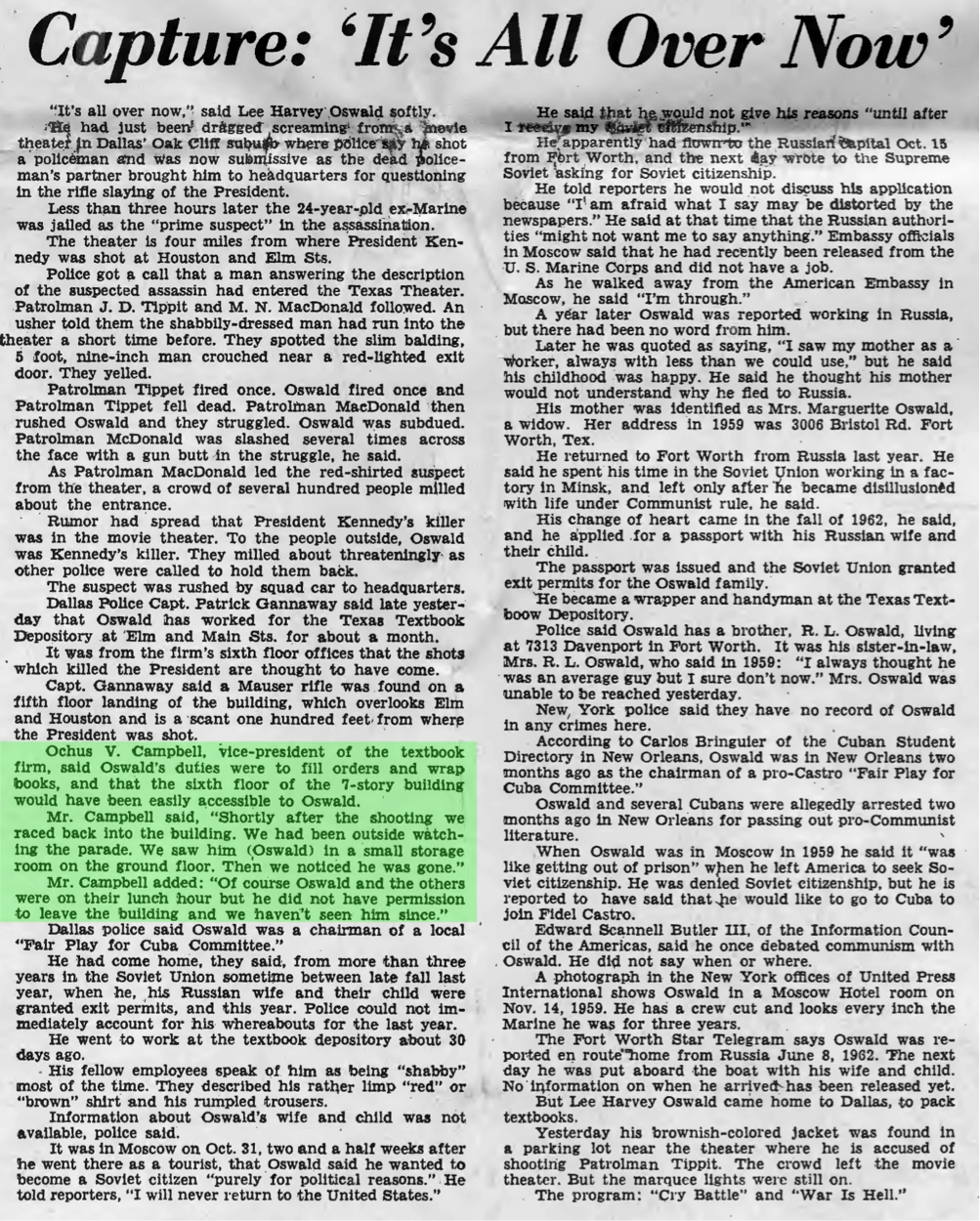


 Captain Will Fritz interrogated Lee Oswald for roughly a dozen hours. Fritz claimed he took no notes, but in fact there were some (probably kept as a souvenir…); these were submitted anonymously in the mid-90’s to the ARRB after Fritz had died. These notes had been ‘buried’ for more than 33 years; until they appeared, researchers had to make do with Fritz’s statement from November 22 and his Warren Commission testimony.