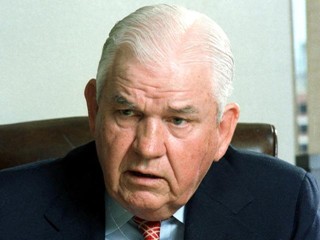
DALLAS – As district attorney of Dallas for an unprecedented 36 years, Henry Wade was the embodiment of Texas justice.
A strapping 6-footer with a square jaw and a half-chewed cigar clamped between his teeth, The Chief, as he was known, prosecuted Jack Ruby. He was the Wade in Roe v. Wade. And he compiled a conviction rate so impressive that defense attorneys ruefully called themselves the 7 Percent Club.
But now, seven years after Wade’s death, The Chief’s legacy is taking a beating.
Henry Wade
Nineteen convictions ‹ three for murder and the rest involving rape or burglary ‹ won by Wade and two successors who trained under him have been overturned after DNA evidence exonerated the defendants. About 250 more cases are under review.
No other county in America ‹ and almost no state, for that matter ‹ has freed more innocent people from prison in recent years than Dallas County, where Wade was DA from 1951 through 1986.
Current District Attorney Craig Watkins, who in 2006 became the first black elected chief prosecutor in any Texas county, said that more wrongly convicted people will go free.
“There was a cowboy kind of mentality and the reality is that kind of approach is archaic, racist, elitist and arrogant,” said Watkins, who is 40 and never worked for Wade or met him.
‘Not a racist’
But some of those who knew Wade say the truth is more complicated than Watkins’ summation.
“My father was not a racist. He didn’t have a racist bone in his body,” said Kim Wade, a lawyer in his own right. “He was very competitive.”
Moreover, former colleagues ‹ and even the Innocence Project of Texas, which is spearheading the DNA tests ‹ credit Wade with preserving the evidence in every case, a practice that allowed investigations to be reopened and inmates to be freed. (His critics say, of course, that he kept the evidence for possible use in further prosecutions, not to help defendants.)
The new DA and other Wade detractors say the cases won under Wade were riddled with shoddy investigations, evidence was ignored and defense lawyers were kept in the dark. They note that the promotion system under Wade rewarded prosecutors for high conviction rates.
In the case of James Lee Woodard ‹ released in April after 27 years in prison for a murder DNA showed he didn’t commit ‹ Wade’s office withheld from defense attorneys photographs of tire tracks at the crime scene that didn’t match Woodard’s car.
“Now in hindsight, we’re finding lots of places where detectives in those cases, they kind of trimmed the corners to just get the case done,” said Michelle Moore, a Dallas County public defender and president of the Innocence Project of Texas. “Whether that’s the fault of the detectives or the DA’s, I don’t know.”
‘Win at all costs’
John Stickels, a University of Texas at Arlington criminology professor and a director of the Innocence Project of Texas, blames a culture of “win at all costs.”
“When someone was arrested, it was assumed they were guilty,” he said. “I think prosecutors and investigators basically ignored all evidence to the contrary and decided they were going to convict these guys.”
A Democrat, Wade was first elected DA at age 35 after three years as an assistant DA, promising to “stem the rising tide of crime.” Wade already had spent four years as an FBI agent, served in the Navy during World War II and did a stint as a local prosecutor in nearby Rockwall County, where he grew up on a farm, the son of a lawyer. Wade was one of 11 children; six of the boys went on to become lawyers.
He was elected 10 times in all. He and his cadre of assistant DAs ‹ all of them white men, early on ‹ consistently reported annual conviction rates above 90 percent. In his last 20 years as district attorney, his office won 165,000 convictions, the Dallas Morning News reported when he retired.
In the 1960s, Wade secured a murder conviction against Ruby, the Dallas nightclub owner who shot Lee Harvey Oswald after Oswald’s arrest in the assassination of President Kennedy. Ruby’s conviction was overturned on appeal, and he died before Wade could retry him.
Wade was also the defendant in the 1973 landmark Roe v. Wade Supreme Court decision legalizing abortion. The case began three years earlier when Dallas resident Norma McCorvey ‹ using the pseudonym Jane Roe ‹ sued because she couldn’t get an abortion in Texas.
Cases overturned
Troubling cases surfaced in the 1980s, as Wade’s career was winding down.
Lenell Geter, a black engineer, was convicted of armed robbery and sentenced to life in prison. After Geter had spent more than a year behind bars, Wade agreed to a new trial, then dropped the charges in 1983 amid reports of shoddy evidence and allegations Geter was singled out because of his race.
In Wade’s final year in office, the U.S. Supreme Court overturned the death sentence of a black man, Thomas Miller-El, ruling that blacks were excluded from the jury. Cited in Miller-El’s appeal was a manual for prosecutors that Wade wrote in 1969 and was used for more than a decade. It gave instructions on how to keep minorities off juries.
A month before Wade died of Parkinson’s disease in 2001, DNA evidence was used for the first time to reverse a Dallas County conviction. David Shawn Pope, found guilty of rape in 1986, had spent 15 years in prison.
Watkins, a former defense lawyer, has since put in place a program under which prosecutors, aided by law students, are examining hundreds of old cases where convicted criminals have requested DNA testing.
‘Protecting a legacy’
Of the 19 convictions that have been overturned, all but four were won during Wade’s tenure. In two-thirds of the cases, the defendants were black men. None of the convictions that have come under review are death penalty cases.
“I think the number of examples of cases show it’s troubling,” said Nina Morrison, an attorney with the Innocence Project, a New York-based legal group affiliated with the Texas effort. “Whether it’s worse than other jurisdictions, it’s hard to say. It would be a mistake to conclude the problems in these cases are limited to Dallas or are unique to Dallas.
Former assistant prosecutor Dan Hagood said The Chief expected his assistants to be prepared, represent the state well and be careful and fair.
“Never once ‹ ever ‹ did I ever get the feeling of anything unethical,” Hagood said. He denied there was any pressure exerted from above ‹ “no `wink’ deals, no `The boss says we need to get this guy.’”
But Watkins said those who defend The Chief are “protecting a legacy.”
In November of 2006 the citizens of Dallas elected Craig Watkins their first African-American DA. The 40-year-old Democrat defeated his Republican rival Toby Shook in a close election even though he was outspent by a factor of 18-1. Clearly, Watkins benefited by the wave generated against the Bush administration. But he also ran a reform-minded campaign that clearly appealed to a segment of the population.
Watkins vowed to place as much focus on crime prevention and redemption of criminals as possible. Many in the district attorney’s office resisted this. Many of them worked for Shook. Shook was perceived as the heir apparent to retiring DA Bill Hill. Hill, in turn, represented the legacy of longtime DA Henry Wade. Wade, of course, was the DA at the time of the Kennedy assassination who — within 36 hours — broadcast to the world that he had no doubt Oswald was the killer of President Kennedy. Wade’s office once issued a memo instructing assistant DA’s not to take Jews, Negroes, Dagoes, Mexicans or members of other races on a jury, no matter how rich or well educated.
Unlike many other candidates who promise reform, Watkins has, so far, followed through, to the point where many of the lawyers in the office who backed Shook have left. For instance, Watkins set up a task force to partner with the Innocence Project of Texas to do DNA testing for convicts on death row. Several of them have had their verdicts overturned. He also issued new guidelines on how Dallas DA’s would perform interrogations and how line-ups would be conducted, two procedures with which Kennedy researchers were quite familiar with. He even fired those who were not content with his accent on protecting the rights of the accused.
Now, as the accompanying story details, Watkins has focused his reform attitude on the assassination of President Kennedy. He has made public the existence of a secret stash of both exhibits and 15, 000 pages of documents that his office has been holding for over forty years. The trivial media has made much of a supposed transcript between Ruby and Oswald discussing the murder of President Kennedy on 10/4/63 at the Carousel Club. This document is clearly some kind of play on the dubious testimony of attorney Carroll Jarnagin. Some problems with this testimony are 1.) Jarnagin admitted he was drunk that night 2.) His companion did not recall any such conversation 3.) He failed a polygraph test. (See Seth Kantor, The Ruby Cover-Up, pp. 391-392).
This has distracted from the real question that should be asked about this disclosure. Namely, why did neither Wade nor Hill turn over this evidence in the decades preceding? They could have done it on at least four separate occasions: in 1964 to the Warren Commission, in 1977 to the House Select Committee on Assassinations, and in the nineties, to local and federal agencies.
In January of 1992, the Dallas City Council passed a resolution directing the City Manager to collect all documents related to the Kennedy assassination in the Dallas Police Department, Sheriff’s Department and the Dallas DA’s Office. They were to be turned over to the Secretary of the Records Management Division at city hall. There they were archived and indexed by the city archivist Cindy Smolovik. There was much publicity generated by this event since it was the first such collection done in the wake of Oliver Stone’s film JFK. The DA’s office was disobeying the City Council and hiding artifacts from the City Manager. But then later, in 1993, the Assassination Records Review Board was constructed. They actually visited Dallas, held a public hearing, and asked for cooperation from anyone who had any more hidden documents or evidence. Obviously, the DA was not listening or forthcoming. Even though this hidden collection is actually larger than the one archived by Smolovik.
It’s a sorry tale. Over forty years after the fact and the public is still learning that trusted officials are keeping private potentially important records dealing with the unsolved murder of President Kennedy. And pundits and politicians wonder about why the citizenry has grown cynical about the process. At his press conference, Watkins said that he never believed Oswald acted alone. He added, “I believe in conspiracies. I think that’s just too simple of an explanation.”
Finally, after 44 years, the people of Dallas get a DA who thinks like the majority of them do.
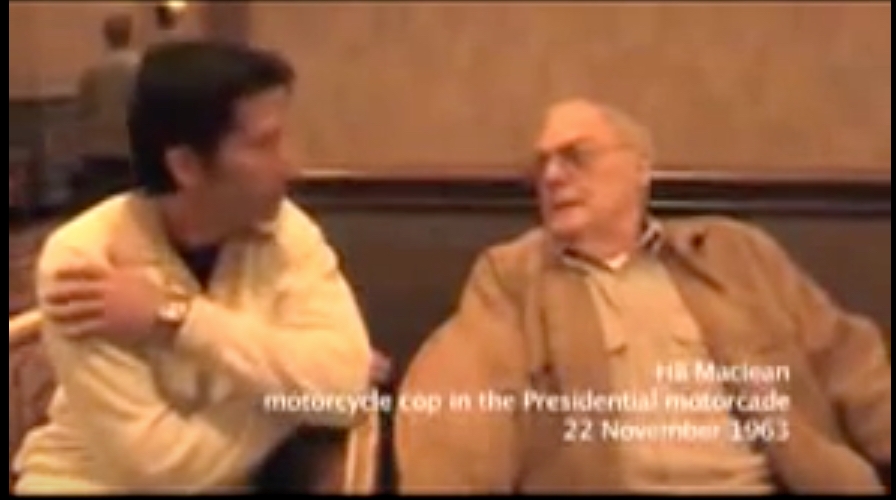
In 1963, H.B. McLain was a veteran motorcycle cop on the Dallas police force, who on November 22 found himself assigned to President Kennedy’s motorcade.
Officer McLain did not appear before the Warren Commission. But when the House Select Committee on Assassinations re-investigated the case in the 1970s, McLain’s activities in 1963 got renewed attention. The Committee identified McLain as the officer whose police radio was stuck in the “on” position during the assassination, resulting in an audio recording of police transmissions that acoustics experts said included four gunshots. This evidence was central to the Committee’s conclusion that there had been a conspiracy.
Those acoustics findings have since been disputed, although a 2000 study tends to support them.
It is not the purpose of this article to re-examine the issues related to the acoustics evidence. Rather, we present an excerpt from a videotaped interview with McLain, in which the by-then retired officer addresses, for the first time, certain issues related to the assassination.
The interview was conducted at the JFK November in Dallas conference in 2006.
Officer McLain told the HSCA he only heard one shot.
Transcript
H.B. McLain: My thought was, when I heard the shot, and all them pigeons flew out from behind that building, I just said to myself, “Wow, somebody’s shooting at the pigeons today.” It didn’t even dawn on me that they were shooting at him.
We took him to Parkland. We got her out of the car, and they carried him in. I walked her inside Parkland. I turned around and come back outside.
Seamus: Do you believe in the Warren Commission’s official version, or do you think something else may have happened?
H.B. McLain: I don’t think they knew what they were even talking about.
Seamus: So I don’t need to ask any more questions?
(I said this because I was fearful of pushing a little too hard. I really felt for the guy, but what I got next was kinda like an explosion).
H.B. McLain: They did not investigate any thing. They told you what happened and that’s the way they wrote it down
Seamus: And it doesn’t concur with what you believe happened?
H.B. McLain: (looking down at his feet) Nope…and it didn’t concur with what did happen!
Seamus: And it may lead people to say that you believe in a conspiracy … a possible conspiracy.
H.B. McLain: (Looks away to his left.) …Well, I think there was.
Seamus: Is that the first time you’ve ever been asked that question?
H.B. McLain: (Begins smiling.) Nope. It’s just the first time I’ve ever answered it.
Seamus: Shit, that’s pretty heavy.
(H.B. McLain starts to laugh at my shock as if a weight has just come off of his shoulders. The transformation was amazing from the man we first saw that evening. I think from how he spoke that he was scared to talk for an extremely long time. I think he saw what happened to Jesse Curry and Roger Craig for speaking their minds..)
From the November-December, 1996 issue (Vol. 4 No. 1) of Probe
Almost every JFK assassination researcher is aware that the Dallas police found and inventoried a tiny hi-tech Minox camera amongst Oswald’s personal effects during the search of Ruth and Michael Paine’s home after the assassination.This camera was later omitted from an inventory list once the FBI took over the investigation. What is not generally known is the Paines’ role in the “appearance-disappearance”charade.
There were 3 separate inventory lists itemizing the evidence from the Paine household. This is typical of the routine procedures used by law enforcement in establishing chain of custody of physical evidence. First, there was the Dallas police list identifying a “small German camera and black case on chain and film”. A pedometer and camera timer were also itemized; there was no mention of a light meter but there was mention of a “brown case (camera) with long chain”.1 Then there was the joint DPD and FBI list which was prepared in response to the FBI’s assertion of jurisdiction over the crime. The camera is described in aggregate Item #375 as a “Minox camera” together with a pedometer and a camera timer; there is no mention of a light meter. Rolls of undeveloped Minox film and two rolls of exposed Minox film were also inventoried as Item #377. An unidentified electronic device in a brown case was listed as an unsubmitted and unnumbered item as having come from the Beckley Street rooming house.2 When the evidence was taken to Washington, D.C., the FBI Lab prepared its very own inventory by way of a third list; any reference to the Minox camera would disappear from this third list.3
There were four separate sets of photographs of the items removed from the Paine household and Beckley Street residence. First, there were the photos made by the Dallas Police Crime Lab before the evidence was turned over to the FBI which shows the evidence grouped together on the floor of the police station and which depicts the Minox camera.4 At the joint police and FBI inventory of November 26th, a second set of photographs were taken depicting each individual item or selectively grouped items with the numbered photos corresponding to the numbered items. The items ranged from #1 through #455 and required 5 rolls of film. It was understood that the FBI Lab would develop these 5 rolls of film and furnish a set to Police Chief Curry. This intact set of photos from the original 5 rolls have disappeared from the National Archives – assuming that the FBI even turned them over to the Warren Commission or the Archives in the first place.5
The third set of photos consist of 2 rolls of microfilmed photos which the FBI Lab made after developing the photos jointly taken in Dallas; this microfilmed series was furnished to the Dallas Police which in turn furnished copies to other agencies, including the Secret Service.6 In a letter dated December 3, 1963, Police Chief Curry advises the FBI that items #164 through #360 were missing and apparently did not record; he requests the FBI to re-photograph the items.7 The fourth set of photos consist of the FBI’s “re-photographed” items which were sent to the Dallas police to supplement the missing photos.8
Not only were there missing frames but some of those that existed had been altered. The Minox camera itemized in #375 of the joint inventory list ceased to exist in the set of microfilmed photos first returned to the Dallas Police by the FBI. Photo #375 which was supposed to be a group photo of the Minox – along with several other camera items – is now just a Minox light meter.9
It is generally unknown in the research community that much, if not all, of the evidence seized from the Paine household and Beckley Street residence was “loaned” to the FBI on the weekend of the assassination even before the FBI took charge of the crime. The FBI assigned number #Q-5 to the Minox camera and/or Minox film at that time. The evidence was returned to the Dallas police after the FBI’s inspection. It was then turned over once again to the FBI on November 26th when the FBI assumed jurisdiction.10 We know that the Minox film recovered from the Paine household was in possession of the FBI as of November 25th because on that date the FBI requested a comparison of the Minox film as recovered from the possessions of Oswald with Minox film designated as Specimen Q5. The laboratory results were that Minox film Q5 was not taken with the same camera as the other Minox film.11 Was the FBI comparing the Minox film later designated as Item #377 with the cassette still remaining in the Minox camera recovered by the Dallas police?
The FBI’s early efforts to conceal the existence of the Minox camera did not stay secret for long. According to author Gary Savage, a controversy ensued within the first two months following the assassination when news reporters received information that the FBI had altered the inventory list. Furthermore, the FBI had pressured Dallas police detective Gus Rose to change his recollection of what he had found from a Minox camera to a Minox light meter. Detective Rose steadfastly refused to alter his findings and insisted that he found the camera in Oswald’s seabag the weekend after the assassination.12
The FBI was now squarely in the middle of an evidence tampering dilemma before the Warren Commission investigation was barely underway. One solution would be to produce the original camera, or any Minox camera for that matter, in order to resolve the discrepancy. This is precisely what the FBI did.
We now know that the controversy over the Minox camera reached the highest levels of the FBI because on January 27, 1964, Mr. William A. Branigan, Chief of the FBI’s espionage section, telephoned SAC Gordon Shanklin in Dallas to point out the inconsistency in the inventory lists. Branigan also advised Shanklin that the FBI Lab in Washington did not have the Minox camera in its possession.13 On January 28, 1964 Shanklin responded by advising FBI Inspector Moore of the FBI Lab that no such Minox camera had been found – only a Minox light meter.14 This, of course was an outright lie on Shanklin’s part. FBI Director J. Edgar Hoover apparently found this reply unacceptable because on January 30, 1964, Hoover sent a teletype to Shanklin advising once again that the FBI Lab had all Minox related items except for the Minox camera. Hoover then instructed SAC Shanklin to immediately investigate this matter and to contact the Dallas Police, Mrs. Oswald and Mrs. Paine, if necessary.15
In an effort to “locate” the camera, Dallas FBI Agent Bardwell Odum on January 30, 1964, contacted Ruth Paine to inquire into whether the Paines owned a Minox camera.16 Ruth recollected that her husband had a Minox which he had dropped into salt water several years ago; she was sure that he had thrown it away but she would ask him about it and get back to him. She also stated that the police took a Minox camera case along with a light meter belonging to Michael which may or may not have been a Minox light meter.17 The next day on January 31, 1964, Ruth Paine called Odum to tell him that her husband still had the camera and that it was in a coffee can in the garage.18 If this was true, one would have to conclude that the local police not only did a poor job of searching the garage the weekend of the assassination but also fabricated the Minox camera on both its original inventory list and joint DPD/FBI list. Since this was not the case, the collusion of the Paines is readily apparent.
…
The rest of this article can also be found in The Assassinations, edited by Jim DiEugenio and Lisa Pease.
Notes
1The first DPD inventory list, undated, was obtained from the Dallas Police Archives. It is attached to an undated joint statement of the officers which in turn is followed by a supplementary report dated 11/23. The inventory list does not seem to distinguished between those items recovered on the 22nd, and those items recovered on the 23rd pursuant to a search warrant. With respect to felonies, police officers have the power to search and seize what is in plain view. Closed containers, such as Lee Oswald’s boxes, envelopes, suitcases, and seabags, etc. would require a search warrant. While the weekend reports are somewhat sloppy in this regard, the undisputable fact remains that the Minox camera was recovered at that time regardless of whether it was the 22nd or the 23rd. This author has entertained the possibility that the police officers’ search on the 22nd went beyond proper legal limits and this was “rectified” by obtaining a search warrant the next morning.
2 See Commission Exhibit #2003 at Vol. 24, p. 340. The evidence was delivered to the Dallas FBI office on 11/26. On forms supplied by the Dallas police, a detailed inventory list was prepared by police property clerk H.W. Hill and witnessed by FBI Agent Warren De Brueys and police captain J. M. English. The Minox camera is identified on Receipt No. 11192-G as one of the items voluntarily given to the police by Ruth Paine and Marina Oswald on the 22nd suggesting that the first police search went beyond its permissible scope as is often the case in criminal proceedings. The listing of the electronic device in the brown case from the Beckley Street address (set forth in the joint list at Receipt No. 11199-G) further clouds the issue of what items came from where and when – at least insofar as the weekend police search is concerned. The police department version in the Dallas Police Archives differs from the FBI’s list of the 26th in only one respect: the Dallas list contains the signatures of the FBI agents receiving the property. The accompanying affidavit of Dallas officer H. H. Hill describes the process by which a joint inventory was made wherein FBI Agent De Brueys called out the items, one by one.
3 See evidence list set out in CD 735. Item 375 has been altered to omit the Minox camera and turn it into a Minox light meter. For some reason this list contains the Dallas field office file number instead of the Headquarters file number suggesting that the FBI’s own property list was prepared in Dallas before departure to Washington, D.C. We do know from an FBI document that Agent DeBrueys delivered the evidence to the FBI Lab on November 27th. Another document suggests that a 4th list was prepared by the FBI Lab which superseded all prior lists.
4 JFK First Day Evidence by Gary Savage, pp.208, 210.
5 See 11/26/63 report of FBI Agent Ronald E. Brinkley describing how the photos were made with the DPD photo-record camera. 5 rolls of photos were taken using 35mm Kodak High Contrast Copy microfilm. FBI agent James P. Hosty states in his recent book, Assignment: Oswald, p.77 that the photos were taken with a Minox camera. This is a mistake or falsehood on his part as Minox cameras use only Minox film. The documents setting forth the joint photo session with the Kodak film were supplied by Researcher John Armstrong and were obtained from the Dallas Police files. At Mr. Armstrong’s request, the National Archives searched for these 5 rolls of photos and could not locate them.
6 See FBI agent Robert Barrett’s report of statement from Assistant Chief of Police, Charles Batchelor, dated 7/6/64, and available from the microfilmed collection of Dallas Police Archives. See also FBI memo dated 11/29/63 from Branigan to Sullivan.
7 Curry’s 12/3/63 letter from the Dallas Police Archives furnished by Mr. Armstrong.
8 Author’s conversation with John Armstrong whose opinion is based in part upon an undated FBI document bearing Agent Wallace Heitman’s name, referencing dates of 1/23/64 and 2/4/64 and referring to 85 photographs of Oswald’s belongings.
9 Indeed there are two separate photos of #375, one still in the possession of the Dallas Police Archives showing the surrounding items covered up by scraps of paper and the one in the National Archives showing a blow up of the Minox light meter all by itself; copies furnished to author by John Armstrong. The National Archives also has a copy of the same DPD group photos that Gary Savage depicts in his book. However, these photos were enlarged, then cropped to omit the Minox camera featured in the top 1/3 of the original photograph. A copy of the NARA cropped photo was furnished to the author by Anna Marie Kuhns-Walko.
10 See deposition of FBI Lab expert, James C. Cadigan, NARA: HSCA Record No. 124-10086-10013.
11 The author’s copy of this document was furnished to her by John Armstrong without the benefit of a RIF cover sheet from the NARA. It appears to be part of report prepared by Dallas FBI agent, Robert Gemberling. Note that the Minox film analysis was filed away in a New York City FBI field office file #65-22483 of the Espionage-Russia division. According to John Armstrong, a FOIA request failed to turn up this file.
12 See Savage pp. 212-215,and transcript of Gus Rose’s statement to the HSCA made on 4/13/78.
15 FBI #105-82555-1580, teletype dated 1/30/64, RIF citation omitted. This teletype also clarifies the fact that there were two Minox cassettes, one of which contained film.
16 Dallas FBI field office file, #100-10461, Odum report of 1/30/64 interview with Ruth dictated on 1/31/64 and typed on 2/3/64
31 See Warren Commission Vol. 10, p.313 and p.325. It is not clear if Shasteen’s relationship with Odum originated with the FBI investigation into the assassination or if it was pre-existing.