Tag: DALLAS POLICE

  • The Tippit Case in the New Millennium

    The Tippit Case in the New Millennium


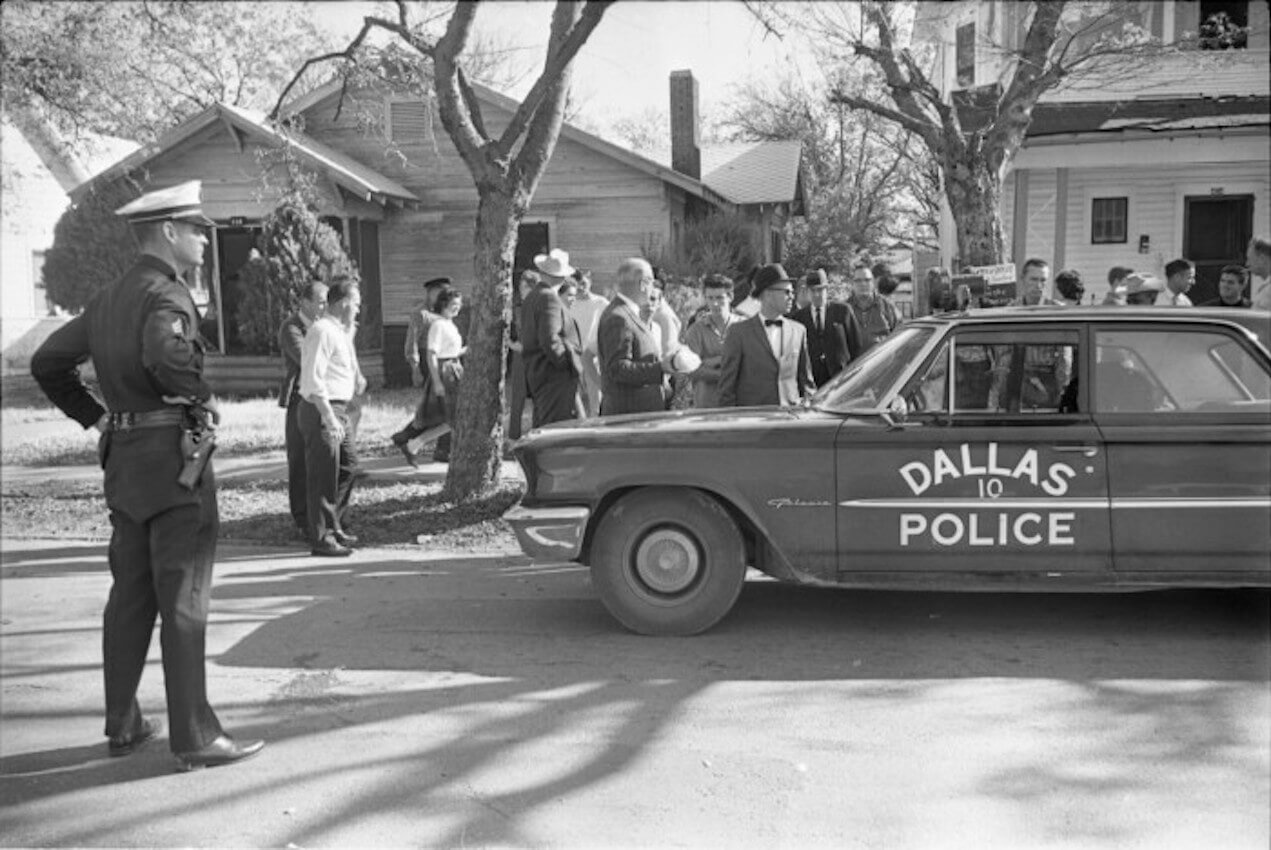
    Original black and white photographic negative taken 
     by Dallas Times Herald and United Press International
    photographer Darryl Heikes.

    Up until the earthquake caused by Oliver Stone’s film JFK, there was an accepted paradigm in the critical community regarding the murder of Dallas Police patrolman J. D. Tippit. Two good examples of what that case looked like under critical scrutiny could be accessed in Henry Hurt’s book Reasonable Doubt, and Jim Garrison’s memoir, On the Trail of the Assassins. The former was published in 1985, and the latter in 1988. Garrison asked some cogent questions about the ballistics evidence in the case, which, in turn, cast aspersions on the honesty and efficacy of the handling of the evidence.
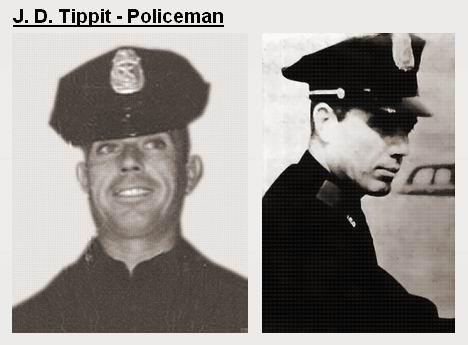
    As Garrison wrote, the Warren Commission version of the Tippit shooting said that Oswald alone killed Tippit at about 1: 15 PM. After President Kennedy’s assassination, Oswald departed work at the Texas School Book Depository and took a taxi to his boarding house. The official story then has Oswald walking to the crime scene at 10th and Patton from his rooming house at 1026 North Beckley in the Oak Cliff area of Dallas, a distance of around 9/10 of a mile. In itself, as both Hurt and Garrison noted, this created a problem. It began with Oswald’s landlady testifying that she had seen him standing on the corner across the street from the rooming house waiting for a bus after he went into his room at about 1:00 PM. When asked what time she saw him there—waiting for a bus that would take him in the wrong direction from 10th and Patton—she replied it was about 1:04. (Garrison, p. 194; Hurt p. 144) The idea that someone could traverse the nearly one mile distance from the rooming house to the crime scene in something like 11 minutes is hard to swallow. I know two researchers—both of them much taller than Oswald—who tried to negotiate that distance and actually walked the route. Neither of them came close to equaling what the Commission said Oswald did. And neither of them walked normally; they both power-walked the distance. As Henry Hurt added, no one saw Oswald running that distance, or walking for that matter. Recall, this is about a half hour after President Kennedy’s assassination. If Oswald had been running, wouldn’t someone have noticed him? (Hurt, p. 145)

    But, as both Garrison and Hurt showed, the idea that Tippit was shot at the 1:15 PM time is not supported by the weight of the evidence. For instance, Mrs. Donald Higgins was later interviewed by Barry Ernest for his book, The Girl on the Stairs. She told Barry that the time of the shooting was 1:06. And she lived only a couple of doors down from the crime scene. (See the e-book version, p. 58.) Roger Craig said that, when the news of the shooting came over the radio, he looked at his watch, which said 1:06. (Garrison, p. 194) Even Helen Markham, who became hysterical after the shooting, said Tippit was shot at the latest about about 1:07 PM. (Hurt, p. 144) As Hurt notes, T. F. Bowley came on the scene after the shooting, with Tippit’s body lying in the street. He had to stop his car, and then walked over to the abandoned Tippit car, and he then picked up the radio. He said that the time on his watch after he arrived at the scene and stopped his car was 1:10. It is important to hold in mind that the Warren Commission did not interview either Mrs. Higgins or Mr. Bowley. (Garrison, p. 196) In fact, the Warren Report actually says that another witness, Domingo Benavides, made the call to the police that Bowley actually made. (WR, p. 166) The late Larry Ray Harris was probably the foremost authority on the Tippit case at the time of his death in a car accident in 1996. When I spoke to him at an earlier seminar in Dallas, he told me that the most likely time of the shooting was probably 1:08 PM.

    This, of course, is a key evidentiary point. Because if it is hard to believe that Oswald was at the scene at 1:15, it is not possible to think he could be there at 1:08 PM—that is, unless someone drove him there, and no evidence of that has surfaced in over fifty years. Consider this fact: Just 9 years earlier Roger Bannister became the first man to run the mile in less than four minutes. The idea that Oswald could do something similar—in street clothes, on cement sidewalks—and that no one would recall him doing so, that would be absurd. I doubt if even Dan Rather could have swallowed it. This may be the reason that Bowley and Higgins were not interviewed.

    But the riddle of the time of death is even more complex. Because the legal death certificate document pronounced Tippit dead at 1:15. This was done by Dr. Richard Liquori at Methodist Hospital.
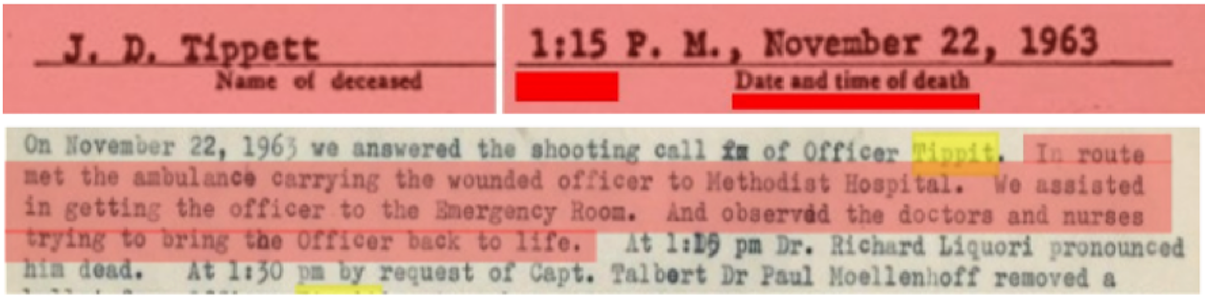
    Tippit death certificate
    (note the time of decease 1:15 pm typed over
    what appears originally to be 1:09)

    If one allows for the time for the ambulance to get to the scene of the crime and return, this would appear to back up Mrs. Higgins’ claim that the shooting occurred at 1:06 PM.

    What made the situation worse was this: the witness who was closest to the actual shooting scene could not identify Oswald as the shooter. This was Domingo Benavides. (Hurt, p. 145) This is compounded by the fact that the Dallas Police never even took Benavides to a lineup in order to identify Oswald. (WR, p. 166)

    Warren Reynolds was also an eyewitness. He also could not identify Oswald as the killer. He worked about a block away from the scene. When he heard the shots, he ran out on a patio and peered in that direction. He said he saw a gunman running towards him stuffing a handgun under his belt. He began to follow him, but after a block, he lost him when he ducked into a building. Reynolds gave interviews to the press and his name was in the news for about two months. Yet no official investigator talked to him in this time period. Finally, in late January, the FBI interviewed Reynolds. He said he could not feel free to offer a positive identification of the man as Oswald. Two days later, Reynolds was shot through the head. He miraculously survived. Evidently, the down time did his memory some good. He now was ready to identify the fleeing man as Oswald. (Hurt, pp. 147-48)

    With these kinds of witnesses, the Commission felt they had to rely upon Helen Markham for probative value. (Sylvia Meagher, Accessories After the Fact, p. 256) At this point in time, I do not think it is necessary to pile on this poor woman. But what I would like to accentuate here is the following fact: the Warren Commission understood what a liability she was to their case, before they published. They used her anyway. At a public debate in Los Angeles in 1964, Commission lawyer Joe Ball characterized her testimony as full of errors and called her an “utter screwball”. (Anthony Summers, Conspiracy, p. 87). Neither Ball nor fellow lawyer Wesley Liebeler wanted to use her in the first place. Liebeler labeled her testimony with the ultimate insult. He called it “worthless”. (Edward Epstein, The Assassination Chronicles, pp. 142-43) The men doing the heavy lifting in the trenches were clearly overruled from above.

    Why did the Warren Commission overrule their own working lawyers and decide to make Markham the chief witness in the Tippit case? One problem was that a witness they billed as being a direct eyewitness to the crime was not. This was taxi driver William Scoggins who had his view of the shooting obstructed by hedges. (Joseph McBride, Into the Nightmare, p. 455) When Scoggins was shown a few pictures of Oswald, he narrowed it down to two. He then picked the wrong one. (WC 3, p. 335) Another problem was that his identification took place during the infamous Dallas Police lineups. Scoggins was at the same lineup as another cab driver, William Whaley. Whaley said about this proceeding: “You could have picked Oswald out without identifying him, by just listening to him because he was bawling out the policemen, telling them it wasn’t right to put him in line with these teenagers.” Whaley continued by saying Oswald told the police they were trying to railroad him and he wanted his lawyer. Whaley concluded, “Anybody who wasn’t sure could have picked out the right one just for that.” But further, when asked their names and occupations, the others in the lineup—who were policemen—gave fictitious answers. Oswald said his true name and that he worked at the Texas School Book Depository. (Meagher, p. 257)

    Another witness who said he saw Oswald fleeing the scene was Ted Callaway. The problem with his testimony is that Benavides worked for him at a car lot. Callaway asked Benavides if he saw the man escaping. Benavides said he did. Before he took off looking for him, Callaway asked his employee: Which way did he go? As Meagher asks, is not Callaway’s testimony therefore paradoxical? Why did he have to ask his employee where the guy went if he already saw him? (Meagher, p. 258) In addition to that, before Callaway viewed the lineup, he was given some input by Leavelle. He was told that the police wanted to wrap up the Tippit case real tight since they thought the man who killed Tippit also killed Kennedy. (Joseph McBride, Into the Nightmare, p. 474) As Hurt points out, time after time, witnesses to a man fleeing the scene were not questioned until late January. And at that late date they were only shown one photograph: Oswald’s. (Hurt, p. 147) This was two months after the media had begun its daily pounding of the public consciousness with the idea that Oswald was Kennedy’s killer. (As we shall see, the FBI went even further in this case in its violations of investigative protocol.)


    II

    The ballistics evidence in the Tippit case is also a morass. First of all, there is the enigmatic message sent out over the police radio by the ubiquitous Sgt. Jerry Hill. A message Hill actually tried to deny before the Warren Commission but which he admitted to decades later. Further, Hill once told a writer that the shells were arrayed within a hand towel of each other. Such was not the case, since they were recovered yards apart from each other. (See Bill Simpich, “Jerry Hill’s Lies: The Heart of the J. D. Tippit Shooting,” 3/12/16)

    Hill reported that one of the shells at the scene indicated “that the suspect is armed with an automatic .38 rather than a pistol.” This was shortly after another Dallas cop described the man escaping the scene—who did not match Oswald’s description—as being armed with an automatic. (Garrison, p. 198) Michael Griffith wrote in a review of Dale Myer’s book about the Tippit case that, in 1986, Hill admitted he had picked up one of the casings for examination This is important because the shells are marked with ‘.38 AUTO’ at the base. And Hill said he specifically looked on the bottom.

    As Garrison went on to explain, an automatic is clip loaded from its handle and its spring action ejects cartridge cases from the spent round. A revolver keeps the cartridge shells in the chamber as the turret rotates to the next round. As several authors have shown, including Garrison, it is hard to believe that experienced policemen could mistake an automatic handgun and ammo for a revolver. (For a telling visual presentation of this key point, see Robert Groden’s book Absolute Proof, p. 298) Especially since the Dallas police used .38 Special ammo and the shells were marked at the bottom. (see again Simpich, “Jerry Hill’s Lies”) This is an important point to recall as we progress through the ballistics evidence, and later, the issue of possession of the weapon.

    Of the bullets taken from Tippit’s body, three are Winchester Western manufactured and copper-coated. The last is a lead bullet made by Remington-Peters. As Garrison noted, this seemed to suggest that two men might have fired at Tippit. (Garrison, p. 199) But further, the shells did not match the bullets. Two of the shells were made by Remington and two by Winchester. (Garrison, p. 201) This has led some to think that perhaps there was a shot that missed and a shell that was not recovered. The House Select Committee on Assassination suggested this but labeled it as speculation. (McBride, p. 256)

    But the automatic/revolver dispute and the mismatching of the manufacturers and the ammo is only the beginning of the problems with the ballistics evidence. On the day of the shooting, the police made out an inventory of the evidence found at the scene. There was no mention of cartridge cases of any kind. (Garrison, p. 200) Moreover, it is also standard police procedure to send the bullets and shells to the FBI lab the day of the crime to have them identified and matched to the weapon. In the Tippit case, the authorities sent only one bullet to the Bureau. The police said this was the only projectile recovered from the victim’s body. (Joseph McBride, Into the Nightmare, p. 244) The FBI could not match this bullet to the weapon allegedly taken from Oswald later at the Texas Theater. And further, that bullet was described by the FBI as “so badly mutilated that there is not sufficient individual microscopic characteristics present for identification purposes.” (WC 24, p. 263)

    There was a complicating factor to this issue. As Henry Hurt explained in Reasonable Doubt, and John Armstrong amplified on in Harvey and Lee, the Smith and Wesson .38 revolver in evidence had been altered by its purchaser George Rose and Company, located in Los Angeles. The company sent 500 of these guns to its gunsmith in Van Nuys, California. Among the modifications made were the re-chambering of the cylinder so the weapon could accommodate a .38 Special cartridge. This altered chamber made for a slight slippage upon firing and thus did not allow the usual markings to be placed on the bullet. (Armstrong, p. 482; Hurt, p. 143)

    When they could not get a match on the first bullet, in March of 1964, the Commission sent FBI technician Cortlandt Cunningham to Dallas to find the other bullets. The police said they had misfiled them. But they turned up in the dead files, a point that the Commission tried to paper over. (McBride, p. 254) Predictably, four months later, the same thing happened: the bullets did not match. (Garrison, p. 199)

    Thus, the emphasis was now on the shells. It was not until six days after the police sent the first bullet to the FBI that they finally marked the evidence inventory sheet with four shells. These the FBI were able to match to the weapon. The delay in getting the shells on the inventory list and the failure to send all the ammunition exhibits promptly to the FBI has led some to suspect that the police fiddled with the evidence—to the extent that it suggests that the original weapon perhaps really was an automatic. This is not at all a critic’s meandering speculation. Warren Commissioner Hale Boggs himself expressed similar reservations about the delay. Boggs asked Commission counsel Melvin Eisenberg, “What proof do you have though that these are the bullets?” (McBride, p. 258)

    But even that is not the end to the problems with the Tippit ballistics. Benavides had found two cartridge cases at the scene. He handed them to Officer J. M . Poe. Hill told Poe to mark the shells with his initials. His marks were not evident when the policeman inspected the exhibits for the Commission. (Hurt, pp. 153-54) Further, when the witnesses who found the other two shells were asked by the FBI to identify them as the ones they originally recovered, they could not. (WC 24, p. 414)

    One would think it could not get any worse. But, in the JFK case, it usually does. When McBride interviewed Detective Jim Leavelle in 1992, the crusty old cop tried to put the whole issue of police identification to rest by throwing a giant curveball at it. He now said that neither Poe, nor the man Poe gave the shells to, Sgt. Barnes, ever marked the cartridge cases at all. (McBride, p. 256) Consider the ramifications of this charge. First, Poe is now a liar. But by labeling him as such, it attempts to rid the Dallas Police of the substitution of evidence accusation. What it really does, however, as McBride notes—as if it had not been done already—is it makes the whole “chain of custody on the shells highly suspect.” (McBride, p. 256)


    III

    As noted above, Jim Garrison came to suspect that there were probably two assailants. His judgment relied on the mismatching ballistics and the testimony of witnesses not in the Warren Commission.

    Acquilla Clemmons worked as a caretaker for an elderly woman on the next block. She ran down the street after she heard the shots. She saw two men, one with a gun. The gunman was “kinda chunky, he was kinda heavy, he wasn’t a very big man. He was a kinda short guy.” (McBride, p. 492) The gunman’s accomplice, who was tall and thin, then waved at the shooter and told him to “go on.” The two men left the scene heading in different directions. Two days after the shooting, a man Clemmons thought was from the DPD visited her and told her she should not talk about what she saw. If she did, she might get hurt. So when a reporter visited her with a camera, she refused the interview. After giving a long and filmed interview to Mark Lane in 1966, Clemmons apparently disappeared. (McBride, p. 492) It seems clear from looking at who was brought before the Commission and who was not that, as Jim Garrison pointed out, the Warren Commission had an agenda as to who they would and would not hear. (Garrison, p. 197) In fact, after Garrison was interviewed for Playboy, an anonymous writer mailed in a letter that was printed in the January 1968 issue. He said that, like Clemmons, he had seen two men shoot Tippit and they both ran off in different directions. Neither man was Oswald. (p. 11)

    As if the witness censorship and the oddities with the ballistics evidence were not suspect enough, let us now turn to the radio transcripts. As most of us know, there were three versions of the radio messages that were eventually delivered to the Warren Commission. Sylvia Meagher pointed out that the first transcript the police turned over did not include what was perhaps the most important instruction given to Tippit that day. That was the order for him to move into central Oak Cliff at 12:45 PM. (Meagher, p. 260) This was about 15 minutes after President Kennedy was killed. But as has been noted by others, this order created some serious evidentiary problems. First, there were three DPD witnesses the Commission had already heard from on the issue of Tippit’s location. They were at a loss to explain why Tippit was in Oak Cliff, about four miles out of his area. None of them proffered this order at 12:45 as the reason for it. (Meagher, p. 261) Second, just prior to this message, the dispatcher had said, “Attention all squads, report to downtown area Code 3 to Elm and Houston with caution.” (WCE 705, p. 397) Which, of course, makes perfect sense. (The police tried to disguise this order in the first transcript, but the FBI actually listened to the tapes and this was their accurate transcription. Police Chief Jesse Curry confirmed this in a letter to the Warren Commission, see WCD 1259, p. 3)

    In fact, one can reverse the question for effect: Why at this time would the police detail anyone to any location except Dealey Plaza? Further, why would the dispatcher take the time to give out such a superfluous order in the immediate wake of the tumult that followed the biggest crime ever committed in the history of the city? Yet the Commission accepted this since it was one way to explain the fact that Tippit was out of his assigned territory at the time he was shot. (Hurt, p. 161) And, one might add, what on earth was so important about central Oak Cliff? No one had radioed in any disturbance in the area.

    But that does not end the controversy. On the transcripts, there is no acknowledgement of this order, even though it was given to two men, Tippit and R. C. Nelson. (WCE 1974, p. 26) What’s more, the police already had a man in Oak Cliff. His name was William Mentzel. (McBride, p. 427) In other words, at a time when cars were being directed from the outermost areas to Elm and Houston for Kennedy’s assassination, not one, but two cars are being directed to Oak Cliff—when there is already a patrol car there. And, in fact, the dispatcher does not try and contact Mentzel to check on his location before he sends in two other cars.

    But that is not the capper about this order. The capper, at least for me, is that Nelson did not head to Oak Cliff. He went to Dealey Plaza. As Henry Hurt noted, there was nothing said about this apparent discrepancy by the Commission; indeed, neither the Warren Commission, nor the House Select Committee on Assassinations, called Nelson as a witness. (Hurt, p. 162)

    At 12: 54, Tippit stated he was at Lancaster and 8th. The dispatcher replied with—considering what had happened and what was about to happen—one of the strangest police radio instructions imaginable. Murray Jackson told Tippit to, “Be at large for any emergency that comes in.” (Meagher, p. 263) As we will see, what makes this exchange even more notable is that Tippit might not have been at Lancaster and 8th.

    We now come to the message at 1:08. Between 12:45 and that time there were four messages involving Tippit. Three went from the dispatcher to the patrolman and one allegedly came in from Tippit; this was at 1:08. In one version of the messages, Tippit called the dispatcher twice and got no answer. In the FBI version, Tippit’s call number at that time, 78, is missing: the message is assigned to No. 488. The FBI notes the sound is garbled and No. 488 is not identified by his name, and there is no other message that is assigned to whoever this person is. Tippit researcher Bill Drenas, who wrote an interesting essay, “Car #10 Where are You?”, did a thorough examination of the tape and transcripts. He concluded that the voice is not Tippit’s either. But he disagrees with who the real caller is. He says it is call number 388. Which would be from the Criminal Investigative Division.

    From this perspective, Mrs. Higgins’ time for the shooting, 1:06, may be correct. If that is so, then the other salient point she told Barry Ernest is also relevant. Higgins said that after the shots rang out, she went out to her porch. She saw a man fleeing the scene. It was not Oswald. (James DiEugenio, Reclaiming Parkland, p. 125)


    IV

    The above is the author’s attempt to present a précis of what the evidence in the Tippit case consisted of in the early nineties. For after the tsunami caused by Stone’s JFK, the calculus of the Tippit case was altered.

    The first tremor occurred in 1995 when Dallas FBI agent James Hosty published his book on the Kennedy case entitled Assignment Oswald. In that book he revealed a stunning piece of information, one that had been concealed for 32 years. Hosty wrote that his FBI colleague Bob Barrett had told him something unusual occurred at the scene of the Tippit murder. Barrett told him that one of the policemen, Captain Westbrook, asked him if he had ever heard of a Lee Harvey Oswald. When Barrett said he had not, he then asked him: How about an Alek Hidell? Again, Barrett replied he had not. As Barrett was answering the questions, Westbrook was leafing through a wallet found at the scene.

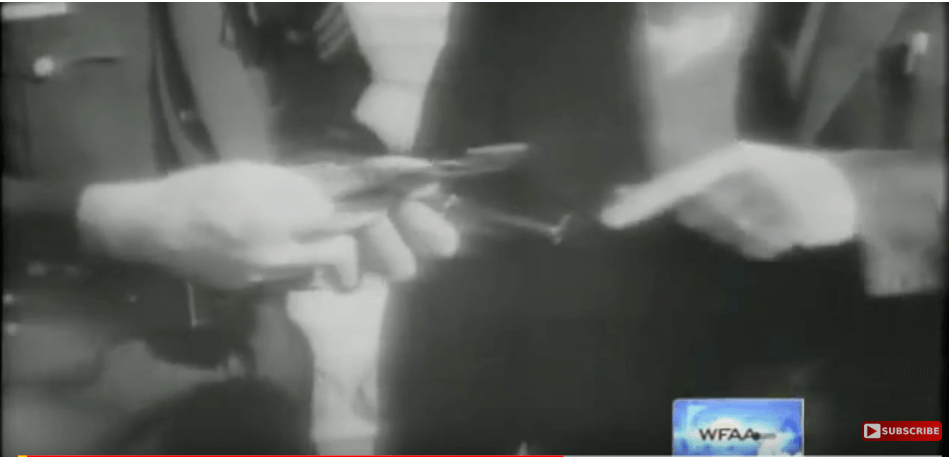
    This extraordinary development was raised from the realm of memory into that of fact when a film from TV station WFAA was later uncovered. That film shows three policemen handling the wallet at the scene of the Tippit murder.
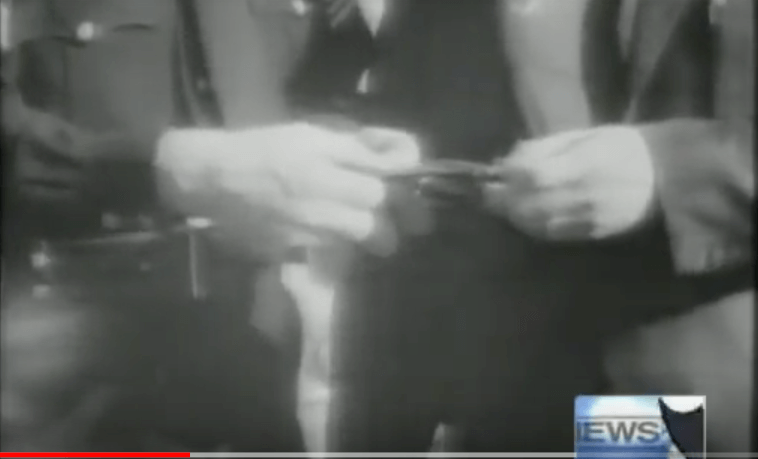
     

    WFAA footage of police handling wallet

    These images were captured at 01:24 and 02:50 of this ABC news feature from 2013.

    This reinforcement drove diehard defenders of the official story into overdrive in a mad attempt to camouflage the damage it did. For the question now became: Who carries three wallets? The Warren Report has Oswald’s wallet being taken from him in the police car after he was apprehended at the Texas Theater. The report also says Oswald left a wallet at the home of Ruth and Michael Paine, where his wife Marina was staying, that morning. (DiEugenio, p. 126) The late Vincent Bugliosi tried to squirm out of the dilemma by saying the wallet was most likely Tippit’s. This explanation is effectively neutered since three Dallas police officers were sent to Methodist Hospital to recover Tippit’s effects at 2:00 PM. They delivered them to the station at 3:25. Among the artifacts was Tippit’s wallet. (DiEugenio, p. 126) But, even further, at a JFK Lancer seminar several years ago, intrepid researcher Martha Moyer told this author that she had talked to another officer at the scene, patrolman Leonard Jez. He told her not to let anyone bamboozle her: it was Oswald’s wallet.

    The implication of the wallet at the crime scene would be that someone dropped it there in order to implicate Oswald. Beyond that, since the official story had Oswald ordering a handgun and rifle in the name of Alex Hidell, it would demonstrate he ordered the weapons and then used them to kill both policeman Tippit and President Kennedy. But from that hypothesis extends another problem. According to researchers John Armstrong and Bill Simpich, no one ever saw the wallet on the ground. The best estimates are that the film of the wallet being shown to others was taken at about 1:30-1:40 PM. With the ambulance arriving and departing, with patrol cars there, with so many bystanders on hand by that time, how could so many people have missed the wallet on the pavement? And in point of fact, some of the witnesses actually said there was no wallet on the ground. (See Bill Simpich, “Who Found Oswald’s Wallet,” 4/21/14)

    Therefore, under examination, this new evidence seems to indicate the possibility that someone brought the billfold to the scene. That idea now focused attention on three people who had been more or less ignored prior to the discovery of the WFAA film. Those three are Westbrook, reserve officer Kenneth Croy and witness Doris Holan.

    409 10th Street, where Doris Holan
    resided at the time of the shooting

    Holan was never called by the Warren Commission. Nor is there any evidence she was ever interviewed by either the Dallas Police or the FBI. Like many important witnesses in the JFK assassination, she was discovered by private citizens many years after the fact. Local Dallas researchers Bill Pulte and Michael Brownlow were the first to talk to her. Which is weird since she lived only one door down from the crime scene, at 409 10th Street, on the second floor. This placed her in a perfect position to see what she was about to disclose. The most remarkable information to come to the fore in the two interviews she granted was this: As she looked out her window upon hearing the shots, she saw a second police car at the scene. It was in the driveway between 404 and 410 East Tenth. This was adjacent to the spot on the street where Tippit’s car stopped. Knowingly or unknowingly, Tippit had blocked the driveway, which led to an alley at mid-block. She said a man got out of the car, looked at Tippit’s body and then went back down the driveway. He was alongside the car, which was retreating back toward the alley. She also saw a man fleeing the scene in a different direction. (McBride, pp. 494-95)

    Brownlow had previously found a second witness to the police car. This was Sam Guinyard, a porter at a used car lot at 501 East Jefferson. And as McBride further notes in his book-length study of the Tippit case, Virginia Davis had said that when she heard the shots and ran out, the police were already there. Years before he talked to Holan, another witness who wished to remain anonymous related to Pulte that he had been told there was a man in the driveway who approached Tippit. (see Harrison Livingstone, The Radical Right and the Murder of President Kennedy, p. 348)

    Diagram courtesy of David Josephs

    To my knowledge, the Holan testimony made its first appearance in book form in the 2006 Livingstone reference just cited. This was late but fortunate, since Holan had passed on in the year 2000. Holan’s revelation opened up a new vista for the Tippit case. Now writers began to focus on Westbrook and Croy, since Croy was the first known person to handle the wallet and Westbrook was the last. Of course, the Warren Commission did no inquiry into the existence of the Oswald wallet at 10th and Patton, even though there was a film available. And, as mentioned, they were oblivious to Holan. But, in retrospect, there were still some notable things to be garnered from the Commission testimony of both William Westbrook and Kenneth Croy.


    V

    The first is that neither man was a detective or a patrolman. Yet both were at the scene of the Tippit murder quite quickly. In fact, Croy was reportedly the first man there. Westbrook was the chief of the personnel department. (WC 7, p. 110) That is, he handled background inquiries for applications and investigated complaints. He did not even wear a uniform. On the day of the assassination, Westbrook sent his men to the Texas School Book Depository. After the office was empty and he was the only one there, Westbrook told the Commission he got antsy, so—and he fittingly prefaced the following with “believe it or not”—he decided to walk to the Depository alone. He also added that, even though he had a radio, he would stop occasionally to get an update on a transistor radio from groups of people standing on the sidewalk. The distance between the police station and the depository is about one mile. If one adds in the stopping to listen to civilians with radios, one could say that Westbrook’s unaccounted time here could amount to as much as 20 minutes or more.

    Capt. William Ralph Westbrook

    Westbrook testified that while he was at the depository, he heard someone say an officer had been shot in Oak Cliff. He felt —and again this may also be hard to swallow—that since he was in personnel he should investigate the homicide. (WC 7, p. 111) Although Westbrook mentioned Barrett in his Commission testimony, he never noted the wallet he questioned the FBI agent about. Strangely, Barrett did not appear before the Commission.

    While at the scene of the Tippit murder, Westbrook said the word about a suspect at the Texas Theater came over the radio. So Westbrook got a ride to the theater with another officer and Barrett. Almost immediately upon arrival there someone tipped him off as to where the suspect was sitting. Westbrook witnessed his arrest and directed he be escorted out of the theater and to the station. (WC 7, p. 113) Westbrook said that after this he went back to his desk at personnel.

    In other words, it was all in a personnel officer’s workday. Thanks to being bored at his personnel desk, Westbrook became one of the few officers who showed up at the depository, the Tippit murder scene and the Texas Theater. But this does not actually do his busy day justice. As former British detective Ian Griggs has noted, Westbrook is also credited with finding the Tippit killer’s jacket and going to a nearby library to investigate a false alarm about the assailant being there. (Ian Griggs, No Case to Answer, p. 131-32) As Griggs points out, although he is credited with finding the jacket, Westbrook actually denied he did so. He said some other policeman gave it to him—but he cannot recall his name. Further, he did not place the discovery of the jacket on the report he gave to the Commission. Attorney Joseph Ball had to ask him, “Did you ever find something?” (WC Vol. 7, p. 115) Westbrook immediately said he did not find it; some other officer did.
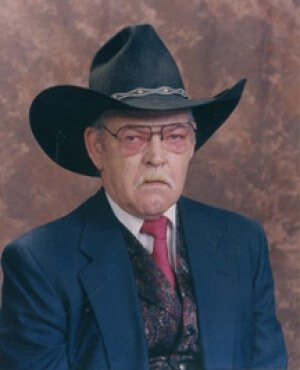
    Kenneth Croy

    That declaration of not knowing who gave an officer an important piece of evidence applies to Croy also. But before getting to that point, we should, as we did with Westbrook, review Croy’s Warren Commission testimony. And we should keep in mind that, as with Westbrook, the Commission never challenged Croy, nor tried to corroborate what he said.

    First of all, Croy was not a regular officer. He was a reserve officer. He drove patrol car duty perhaps once a month. (WC 12, p. 195) On the day of the assassination, Croy said he was just off of Main street when he heard President Kennedy was shot.

    Croy was just a few blocks from Dealey Plaza at this time. He then said that he drove to the nearby courthouse to see if the police might need some help. (WC 12, p. 200) Considering the circumstances, it is hard to believe that Croy had to ask this question, or that the police would say no if he did. But Croy said he could not recall whom he asked, and Commission counsel Burt Griffin did not probe the answer to Croy’s question on November 22, 1963. Croy added that, amid all the tumult going on a few blocks away, he decided to go home. He then said that he heard a call about an officer being shot.

    As the reader can see, there really is no way so far to corroborate Croy’s whereabouts from the time of the assassination to the time of him arriving at the scene of the Tippit shooting. And Croy insisted he was the first policeman there. (WC 12, p. 201) From his description, once he was there, he talked to Helen Markham. But as Griffin questioned him about his discussion with Markham, a surprising admission came into the record. Croy claimed he did not file a report on his activities that day. Once Griffin elicited this piece of information, he just passed it by, making no comment or inquiry about it. Which is remarkable considering Croy’s insistence he was the first officer at the scene.

    Croy stated he was at 10th and Patton for approximately 30 minutes, perhaps a bit more. (WC 12, p. 202) When Griffin asked him what he did after he left, Croy answered that he went to get something to eat. He also said he stayed home the rest of the day. Again, Griffin let this pass. There was no question as to why Croy did not go to the station to pen a written report or give an oral report. When Griffin asked Croy if there were any officers at the scene that he knew, Croy replied in a curious way: “There were several officers there that I knew. I don’t know their names.” (WC 12, p. 203) He went on to say that he only knew them by sight. In other words, we are led to believe that even if Croy had written a report he would not have been able to relate it to any other officer.

    As Croy left 10th and Patton, he said he drove near the Texas Theater and saw squad cars around the building. He decided not to stop since he felt the situation was well in hand. After first telling Griffin he was going to get something to eat and go home, he then said that he actually met his estranged wife at Austin’s Barbecue. (WC 12, p. 205) And this is where Croy’s story gets even more retroactively bizarre. He now added that right after Kennedy’s assassination, the cops he did talk to told him he was not needed. The wife from who he was separated happened to drive up next to him and he asked her if she wanted to get something to eat. Consider this fact: Croy was in uniform. He was just off Dealey Plaza; sirens, and scores of policemen are pouring into the area; searches are being organized of the depository building and the area behind the picket fence.
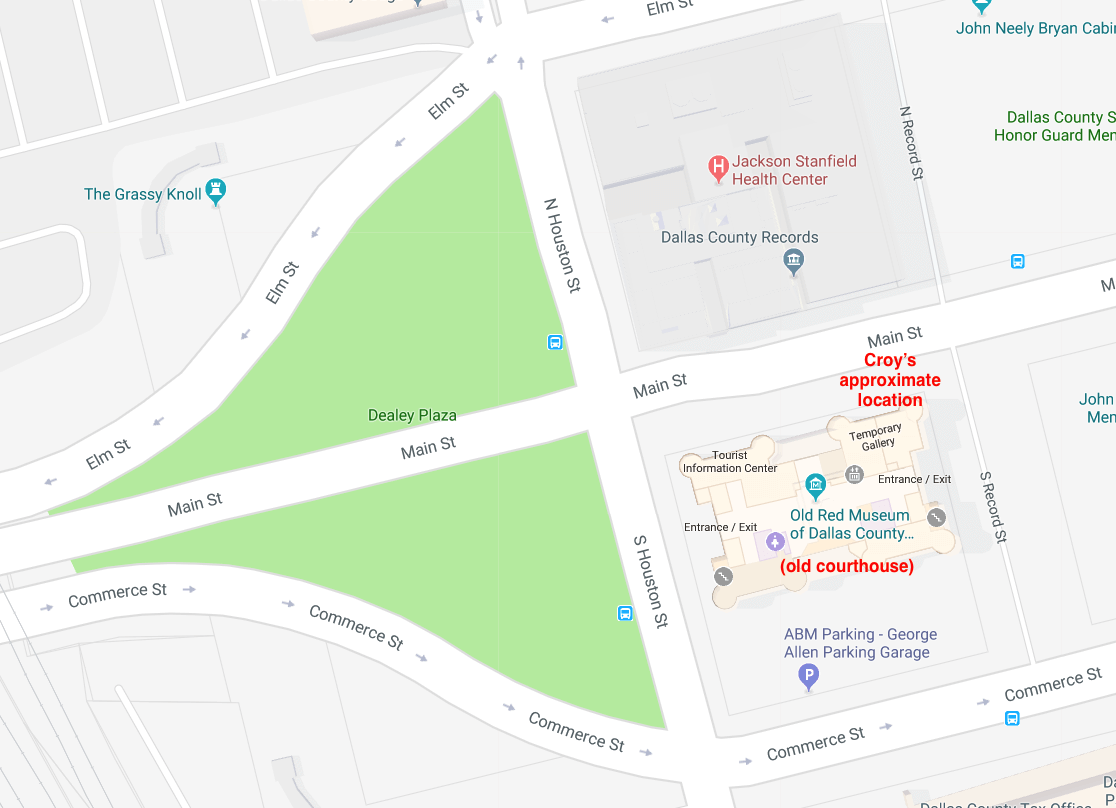
    Approximate location of Croy when he and his estranged wife arranged to meet for lunch after the assassination. If this really happened, it would make for a good SNL skit.

    Croy now added something even more puzzling. He said that before going to the diner, he intended to go to his parents’ house to change his clothes. Presumably, this was when he heard about the Tippit shooting. Due to his job duties, he was late for the dinner with his estranged wife. He colorfully adds that she was angry. Apparently sharing a hamburger was more important than the murder of a police officer. (This writer is not aware if Griffin ever called her to confirm this tale.)

    Croy is important because when the story about the wallet finally did break, he was the policeman who was credited with first handling it. His story was that he was handed the wallet by a civilian. Of course, Croy never asked the name of this witness. (See again Simpich, “Who Found Oswald’s Wallet”)

    Considering his modus operandi that day, it was as if Croy were operating in a fog. To show how thick the fog was, Croy once told one researcher that he did not examine the contents of the wallet. He then told another researcher that there were seven different ID’s in it and none were Oswald’s. (See part 2 of Hasan Gokay Yusuf’s review of Myers’ book)

    With a hapless performance such as his, whether that fog was designed or accidental is a natural question to pose.


    VI

    With the new evidence arrayed as it is above, the question most objective observers would ask is: What would have happened if you had a real investigation in the Tippit case instead of the somnolent Warren Commission? To show the difference that would have made, consider a speech that former HSCA Deputy Counsel Robert Tanenbaum made in Chicago in 1993. Tanenbaum was an experienced prosecutor who rose to Chief of Homicide in New York City. He never lost a murder case. After listening to a highly sophisticated and complex debate over the medical evidence, Tanenbaum stepped to the podium and said words to the effect: I like to get down to basics. My opening question for an investigation would be: Why did Tippit stop Oswald?

    Which is an interesting query. As most people know, the official story attributes a description of the alleged assassin to Dealey Plaza witness Howard Brennan. The Commission said that by his looking upward from about a hundred feet away, and through a window six stories up that he managed to convey a description of the man he saw down to his height and weight. Add in the fact the window was only partly open and as Tanenbaum said, it was not a floor to ceiling window. So how could that description be accurate? The professional prosecutor also added that if one goes with the Commission’s sniper’s nest scenario, then how could Brennan see anything but a partial view of the subject? Further, not only did Brennan not identify Oswald in the police lineup that evening; there is a serious question whether Brennan was even at the lineup. (Griggs, pp. 90-96)

    Moreover, it is simply not possible to verify a chain of communication from Brennan’s alleged description of a man who was 5’ 10” and 165 pounds to the Dallas Police. The official story has Brennan giving his description to Inspector Herbert Sawyer. But Sawyer would not confirm Brennan was the man. (WC 6, pp. 322-25) Also, Brennan did not identify Sawyer. (WC 3, p. 145) Nevertheless, in the face of this, writers like Gerald Posner still insist that the description came from Brennan to Sawyer. (Posner, Case Closed, p. 248) Yet when one looks at the footnote Posner refers to, one can read that Sawyer testified that he based his broadcast description from evidence that did not make it clear whether the sniper had been on the fourth or fifth floor, or even in the building. (WC 6, p. 322) So how could this be Brennan?

    The FBI spent many weeks trying to find out who the source for the description was. They gave up and J. Edgar Hoover decided to label the source as an unidentified citizen. (FBI memo of 11/12/64 from Richard Rogge.) The HSCA chose not to rely on Brennan in any way. (Summers, p. 79) But what makes the description even more odd is that it also included the information that the suspect was armed with a rifle: namely, either “a 30-30 or some type of Winchester.” (WC 6, p. 321) So why would Tippit stop someone clearly armed without calling for a back-up first? But, of course, we know that whoever shot Tippit did not likely have a rifle. So, again, why did Tippit stop the person?

    This lacuna in the official story has driven the other side into overdrive. As with the tall tale of the wallet being Tippit’s, they offer a palliative explanation: that Oswald changed directions on 10th Street, and because that action looked suspicious, Tippit thus stopped the man who killed him. But as Michael Griffith has ably pointed out, to do this one must rely on witnesses who altered their testimony, plus testimony offered 14 years after the fact by a witness who saw something that no one else saw. As Griffith noted, none of the police or Secret Service initial reports found any witnesses who said this occurred. They all said the assailant was walking west, toward the patrol car, not away from it. (Michael Griffith, “Did Oswald Shoot Tippit?”)

    This puzzling hole in the evidence allows for the alternative that Tippit did not pull the man over because of the radio message. If in fact Doris Holan was correct, Tippit stopped his car almost right in front of the driveway where the second police car was situated. That would leave open the suggestion that Tippit was being lured, not just out of his proper area, but onto some kind of disguised trapdoor.

    At this point in our analysis, it would be appropriate to chronicle the rather strange itinerary that Tippit’s life took during its last hour. Before I begin to trace this schedule, I wish to stress that the reader will find none of the following information in the Warren Report. This tells us all we need to know about the Commission’s completeness and honesty. The source I will use for this information is Joseph McBride’s Into the Nightmare; that book is, in my view, the best compendium of information on the Tippit case today.

    Between the hours of approximately noon and 12:35, Tippit was most likely on a shoplifting call and then home for lunch. (McBride, pp. 506-17) At approximately 12:40, he was seen in his car by five witnesses at a GLOCO filling station. Interviewed by author William Turner, the witnesses said Tippit appeared to be watching the Houston viaduct, which crosses over from Dealey Plaza. That viaduct connects to the Kennedy crime scene within ninety seconds. (McBride, p. 441) We should recall that, at about this time, the order came on the radio: “Move into Central Oak Cliff area.” Yet, according to five credible witnesses, that was not really what Tippit was doing.

    Another piece of the millennium’s new evidence now enters the equation. Just a few moments after this, Tippit pulled over a car driven by insurance agent James Andrews. Andrews told a Dallas researcher that Tippit drove in front of him and cut him off on the 300 block of West Tenth. Tippit jumped out of his car, walked forward and inspected the space between the front and back seat. Perplexed, Andrews looked at the officer’s nameplate. Without saying anything, Tippit got back in his car and drove away. Andrews commented that Tippit “seemed to be very upset and agitated and acted wild” (McBride, p. 448)

    Tippit was next reported at the Top Ten Records store at 338 West Jefferson Boulevard. Two witnesses, Dub Stark and Louis Cortinas, saw him there. Cortinas said that Tippit was in a hurry and asked people to move aside. Tippit, whom he knew fairly well, then commandeered the phone, called someone, and apparently did not get an answer. He then hung up and walked off, looking worried or upset about something. (McBride, p. 451) At around this time, 1:00 PM, the dispatcher called Tippit and got no answer.

    As McBride comments, it seems logical to assume that—unless this was the first time he ever saw the viaduct—Tippit was waiting for someone to cross over by car or bus. He then actually did stop a car, apparently to look for someone hiding in the back. Frustrated at both places, he then tried to make a phone call in order to get further directions. Finally, he proceeded to his death at 10th and Patton, driving his car very slowly, as if he were looking for someone. (WC 3, pp. 307, 324) In this new light, it is possible to see his death more fully and accurately than either Henry Hurt or Jim Garrison did.


    VII

    One of the most interesting parts of McBride’s book is the fact that he interviewed someone no one else did. That would be Edgar Lee Tippit, father of the patrolman. Through that long interview, McBride attained some new background information on Tippit and his family. This and other research the author performed revealed a much fuller picture of Tippit than allowed by the Commission. As Sylvia Meagher once said, the portrait drawn in the Warren Report reduces Tippit to little more than a cipher. (Meagher, p. 253) There was almost no background investigation done for the report. As Meagher pointed out, it did not even appear that they talked to his widow.
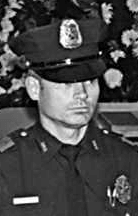
    William D. Mentzel

    Edgar Lee did talk to Marie Tippit. He told McBride, “They called J.D. and another policeman and said he [Oswald] was headed in that direction. The other policeman told Marie.” (McBride, p. 426) But he added something more. Marie also told him, “The other boy stopped—he would have got there but he had a little accident, a wreck. They both started but J. D. made it. He’d been expecting something. The police notified them Oswald was headed that way.” (McBride, p. 427) Marie said this information was given to her by the other officer. McBride concluded that the officer who spoke to Marie was William D. Mentzel. As noted above, Mentzel was in the area already and he told the HSCA that he responded to an accident at a bit after 1:00. As we have seen, there is at least one instance where Tippit did use a phone, and as McBride notes, Mentzel also reported that he contacted the station by phone, not by his police radio.

    In an interview McBride did with Gary Revel, he stated further that Wade told him that “Somebody reported to me that the police already knew who Oswald was, and they were looking for him.”

    For someone to have put together the wallet Croy initially produced at the scene, the contents of which Westbrook described to Barrett, implies that some special part of the DPD had been alerted to who the patsy was earlier than the rest of the police force. After all, when Jerry Hill announced on the radio at 1:52 that Oswald had been apprehended at the theater, it was only in relation to the Tippit case, not the JFK case. (Griggs, p. 138) Because the information about the wallet did not become known until the mid-nineties, in their examinations of the Tippit case, neither Garrison nor Hurt mentioned Westbrook or Croy. (Although, to his credit, Garrison did write that it seemed probable to him that part of the Dallas police colluded in the crime before it happened: see Garrison, p. 203)

    But both Garrison and Hurt did mention the name of officer Jerry Hill. Like Westbrook, Hill holds the distinction of being one of the very few cops who maintains he was at the three main scenes: the Depository, 10th and Patton, and the apprehension of Oswald at the Texas Theater. In addition, he was in the unmarked car that escorted Oswald to the station. If the reader recalls, Hill was the policeman who first reported from the Tippit scene that the shells fired there were from an automatic. When Henry Hurt confronted him with this discrepancy, along with the fact that, even though Hill instructed Poe to mark the shells with his initials, those markings had disappeared, Hill responded with one of the most farcical comments available in the literature. Hill said that he could not imagine any kind of evidence manipulation because the Dallas Police Department was so clean it scared him. (Hurt, p. 155)
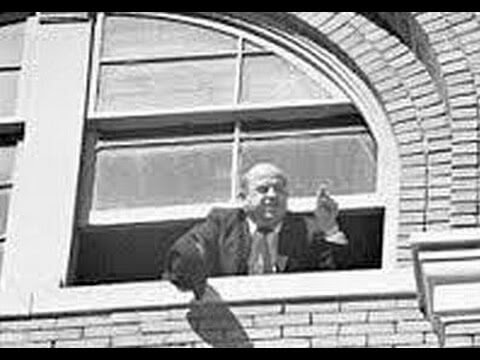
    Hill at the TSBD

    Surely the reader must know that statement is so contrary to the facts that it actually lends suspicion to Hill. As this author wrote in his examination of Vincent Bugliosi’s elephantine book Reclaiming History, the contrary is true:

    No other county in America—and almost no state, for that matter—has freed more innocent people from prison in recent years than Dallas [Tarrant] County where Wade was DA from 1951 through 1986. (James DiEugenio, Reclaiming Parkland, p. 196)

    Henry Wade, of course, was the DA who supervised the Kennedy and Tippit cases. What makes this even more deplorable is that none of this would have ever been exposed except for the power shift that took place in 2006. That year, the city elected its first African American DA in over a half century. Craig Watkins was not from the good-ole-boys network. He never worked for Wade or met him. In fact, he said of the previous regime, “There was a cowboy kind of mentality and the reality is that kind of approach is archaic, racist, elitist and arrogant.” He began a review of prior convictions. Literally dozens of innocent people were set free. In three cases, the charge was murder. As Watkins said, many of Wade’s cases “were riddled with shoddy investigations, evidence was ignored, and defense lawyers were kept in the dark.” In other words, the combination of Wade and lead detective Will Fritz made for a thoroughly corrupt local law enforcement system—in pure numbers, the worst in America at that time.

    Take the following example. More than one witness said that that Tippit’s killer leaned into the police car, touching it with his hands. So the police had the car dusted for prints. The DPD said the prints were not legible. But it turned out that the HSCA discovered there were actually two sets of prints taken, and the second one was legible. Dale Myers took the prints to a reputable analyst. After comparing them to Oswald’s, he said they did not match. This was about par for the course for the DPD in defending the rights of the accused. (James DiEugenio, Reclaiming Parkland, p. 126)

    And Jerry Hill knew about it; in fact, he was part of it in 1963. As stated above, Hill was a member of the police team that apprehended Oswald at the Texas Theater. In 1967, he was hired by CBS as a consultant for their four-part series on the Warren Commission. As part of his duties on that show, he did a long interview with correspondent Eddie Barker. In that interview, he said the police did a “fast frisk” on Oswald at the theater and found nothing in his pockets at the time. This poses a serious problem for both Hill and the police, because they later claimed that Oswald had five live bullets in his pockets at the station. Since Oswald was handcuffed at the theater, where did they come from? (See my “Why CBS Covered up the JFK Assassination, Part 2”)

    In October of 1963, Hill went on what he called a “special assignment”. He was detailed over to the personnel division to work under Westbrook. (WC 7, p. 44) There was never any question by Commission lawyer David Belin about why this happened at that time, a notable omission in light of the fact that Westbrook already had six people working for him. (Griggs, p. 15)

    According to the Warren Commission, it was Hill who had possession of the handgun taken from Oswald upon the arrival of the suspect at the police station. But as Gokay Hasan Yusuf has pointed out in his essay, “Gerald Hill and the Framing of Lee Harvey Oswald”, there is some confusion about who actually took a handgun from Oswald at the theater and when it was transferred to Hill. When Hill arrived at the station, he placed the gun in Westbrook’s office while he wrote a report. This was so odd that Westbrook himself admitted to the Commission that the gun should not have been there. (WC 7, p. 118) Concerning this point, Hill testified that he had tried to turn over the gun to Lt. T. L. Baker, but for some reason Baker did not accept it at that time. (WC 7, p. 51) It would have been nice if the Commission had asked Baker about the matter and why he did not accept the weapon, but when Baker did testify, he was only asked eight questions, none about this episode. (WC 4, p. 248)

    One last point about this .38 Smith and Wesson. According to the Warren Report, that weapon was ordered by Oswald and was delivered not by the post office but by a private company called Railway Express Agency (REA). This was a forerunner of FedEx. They required certain legal restrictions on firearms delivery, specifically on small firearms, like pistols and revolvers. For instance, one had to show an ID, and an affidavit of good character. (James DiEugenio, Reclaiming Parkland, p. 128) This was to be done at the REA office in Dallas. So the procedure should have been that REA would send a card to Oswald’s post office box first. Then Oswald would pick it up and walk over to REA office. He would then show his ID and affidavit, pay for the revolver, get a receipt and the transaction would be recorded by REA.

    To make a long story short, there is no proof that any of this happened. In other words, there is no paper trail that leads from the card being picked up by Oswald to the transaction being processed by REA. In fact, there is not even any proof that the FBI ever went to the REA office. The Warren Report glides over this without referring to it, leaving yet another of its innumerable lacunae. The Commission does not even ask: Why would Oswald order the weapon under an alias, namely Hidell, knowing the summons card by REA had to go to a post office box in his real name? But the bottom line is that there is no proof Oswald ever picked up the gun. So how do we know he had it?


    VIII

    According to Hill, while he was making out his report, Captain Westbrook told him he should change the report to say that Oswald was the suspect in not just the Tippit case, but also the murder of President Kennedy. (WC 7, p. 60) There is no trace in the transcript that the Commission lawyer batted an eyelash at that jarring disclosure, let alone asked Hill to detail the reason Westbrook told him to do that. And again, in going through Westbrook’s testimony, this author could find no cross-check on that exchange, that is, no inquiry as to whether Westbrook actually told Hill to do this, and if he did, what the reason was behind it. Hill was part of the circle of policemen who stated that Oswald somehow tried to fire a handgun at the theater. This was proven false by Cortlandt Cunningham of the FBI for the Commission. (WC 7, p. 61; McBride, p. 202) It would have been an important part of the case to have the names and interrogations of the 24 spectators in the theater at this time. But after giving the order to collect that information, Westbrook said he did not know what happened to the list. (WC 7, p. 118; Griggs, p. 137)

    That afternoon, at approximately 5 PM, Hill did an interview on the radio that went national. It is important to note that Hill was an experienced print and TV journalist who, as Bill Simpich discovered, had worked the Dallas police beat out of an office at the station. (WC 7, p. 44) During this interview with Sacramento’s KCRA host Bob Whitten, Hill did about everything he could to incriminate Oswald in the public mind. This was before Oswald had been arraigned on either charge, before the FBI had linked him to the weapons, and before the Bureau had tested for fingerprints, or ballistics. Hill accused Oswald of being a violent person who may have shot another policeman previously—an accusation that he seems to have manufactured out of thin air. Hill also said that Oswald would not even admit he pulled the trigger on the gun in the theater. Which, as Cunningham showed, he did not. He then said that Oswald had admitted during interrogation he was an active communist. Hill talked about Oswald’s time in Russia, how he had defected and returned with a Russian bride. How Hill attained this (mostly false) information is unclear, as is his motive for conveying it on the air. But his story was that he got some of it from Westbrook. (WCD 1210; “Gerald Hill and the Framing of Lee Harvey Oswald”)

    As most people familiar with the JFK case understand, there is usually a punch line in these kinds of mysterious and unexplained matters. In this one it is the following: Within a year of the publication of the Warren Report, Westbrook resigned the force. He then became an advisor to the security forces in Saigon. That assignment was handled through the Agency for International Development. Those who follow the JFK case know that AID often worked under the auspices of the CIA. (Gokay Hasan Yusuf, “A few Words on former DPD Captain, William Ralph Westbrook”, 9/13/14)

    In light of these latter revelations, the murder of J. D. Tippit takes on a new evidentiary significance. There had been hints of what it all really meant before. As Deputy DA Bill Alexander once said to Henry Hurt: he knew that the man who killed Tippit had killed Kennedy. (Hurt, p. 157)

    As Evan Marshall, a former 20-year homicide investigator, told the late Harrison Livingstone:

    The Tippit shooting has always been to me a Red Herring of the first order. As someone who spent 20 years as a big city cop, I can assure you that nothing affects a cop like the murder of a brother officer. Perhaps the hope was that the officers who responded to the theater would kill him there. (Livingstone, The Radical Right and the Murder of John F. Kennedy, p. 339)
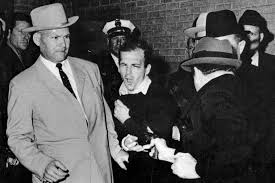
    Detective Jim Leavelle stares
    as Ruby shoots Oswald

    When Joe McBride was researching his book on the Tippit murder, Marshall’s comments were both amplified and certified by another lawman, Detective Jim Leavelle of the Dallas police. In commenting on the differences between the murder of President Kennedy and Tippit, he described the first as such:

    As the old saying goes back then, “It wasn’t no different than a south Dallas nigger killin’.” When you get right down to it—because it was just another murder inside the city limits of Dallas that we would handle. It was just another murder to me. And I’ve handled hundreds of ‘em. So it wasn’t no big deal. (McBride, p. 240)

    Leavelle differentiated that case from Tippit’s with the following: “What some people don’t realize is that when a police officer gets killed, that takes precedence over the shooting of the president, because that’s close to home.” (McBride, p. 241)

    As I have tried to show here, this seems to be what happened. Of course, I cannot prove it beyond a reasonable doubt. Not even close to that standard. However, as Tanenbaum said in the speech referred to above, it is not the duty of private citizens to do the work that should have been done by the FBI, the Warren Commission and the HSCA. But I have little doubt that if someone like HSCA chief counsel Dick Sprague had been running the Warren Commission, and he had this information, he would have honed in on Westbrook, Croy and Hill like a laser. He would have moved heaven and earth to find out the source for the assassin’s description which, in all likelihood, did not come from Howard Brennan. He would have been at the scene with Doris Holan, walking her through what she saw. He then would have looked for corroboration. And those witnesses would have been provided protection. He personally would have gone to both the post office and REA to try to figure out how the heck Oswald got that handgun.

    That, and much more, would have all been part of what a real investigation of the Tippit case would have been like. None of that is in the same universe with what really happened. And as a result, the people who really arranged for and killed Tippit succeeded tactically in a spectacular way. For within about 30 minutes after the ambulance carted Tippit’s body away, more than a half-dozen police cars descended on the Texas Theater in response to a reported infraction—the infraction being that some unknown person had gone into the theater without paying. That was enough to lower the noose around Oswald’s neck. Once apprehended and handcuffed, Westbrook ordered the arresting officers to get Oswald in the car and take him to the station. (Griggs, p. 138) At 1:52, under Radio Call Sign 550-2, Jerry Hill made the announcement that they had their man in the murder of officer Tippit. As we have seen, Westbrook—the man who would soon be working with the CIA—then told Hill to add President Kennedy as the other victim.

  • Anatomy of the Second Floor Lunchroom Encounter (excerpts)

    Anatomy of the Second Floor Lunchroom Encounter (excerpts)


    Last year at the JFK Lancer Conference in Dallas, Bart Kamp was awarded the New Frontier award. The citation stated that his work in reexamining the second floor encounter of Oswald with Texas School Book Depository foreman Roy Truly and motorcycle officer Marrion Baker utilized “a broad array of new data, including documents and statements of the participants and a variety of TSBD witnesses.” We agreed with this award and the description of the achievement. The second floor lunch encounter is a thread-worn shibboleth of the Warren Report that – like Oswald’s mail order rifle – the first generation of critics simply passed on; the notable exception being Harold Weisberg in his book Whitewash II. In Reclaiming Parkland, I began to question it, largely based on Marrion Baker’s first day affidavit, where the officer does not even mention the episode – or Oswald or Truly.  Even though, as he wrote the affidavit, Oswald was sitting across from him in the rather small witness room. In other words, after he had just stuck a gun in his stomach, Baker didn’t recognize him.

    But Bart Kamp goes much further than that in his analysis. We are presenting a small part of that long essay here, with a link to the longer version at the admirable group Dealey Plaza UK. The new revised version of the essay, from which this part is adapted, will be posted there soon and we will link to it then. This is the kind of work, daring and original, questioning accepted paradigms with new and provocative evidence, that KennedysandKing.com stands for.

    ~ Jim DiEugenio


    The current, updated version of the full essay can be read here.


    If the 2nd-floor lunchroom encounter did not happen,

    then was Oswald encountered somewhere else?


    Some researchers think Oswald walked up the stairs inside the first floor vestibule, went through the corridor on the second floor, passed the door, moving from right to left, and got his coke. This is possible, but the news reports and statements, which come in various guises, show Oswald was encountered on the first floor instead, while trying to leave the building. It is even possible that Baker never saw Oswald until he was brought in while Baker was giving the affidavit taken by Marvin Johnson.

    Bob Considine of the Hearst Press, for example, was told that Oswald had been questioned inside the building “almost before the smoke from the assassin’s gun had disappeared.” That hardly sounds like an encounter on the second floor does it? It points more to an altercation on the first floor, just where Oswald had claimed to be. Various newspapers made reference to this so-called first floor encounter instead of the second floor lunch room encounter.

    Roy Truly was overheard by Kent Biffle, who reported in the November 23 edition of the Dallas Morning News:

    In a storage room on the first floor, the officer, gun drawn, spotted Oswald. ‘Does this man work here?’, the officer reportedly asked Truly. Truly, who said he had interviewed and had hired Oswald a couple of months earlier reportedly told the policeman that Oswald was a worker.”

    01

    Biffle mentions overhearing Truly again in the Dallas Morning News, edition from November 21, 2000:

    “Hours dragged by. The building superintendent showed up with some papers in his hand. I listened as he told detectives about Lee Oswald failing to show up at a roll call. My impression is there was an earlier roll call but it was inconclusive inasmuch as several employees were missing. This time, however, all were accounted for but Oswald. I jotted down all the Oswald information. The description and address came from company records already examined by the superintendent. The superintendent would recall later that he and a policeman met Oswald as they charged into the building after the shots were fired.”

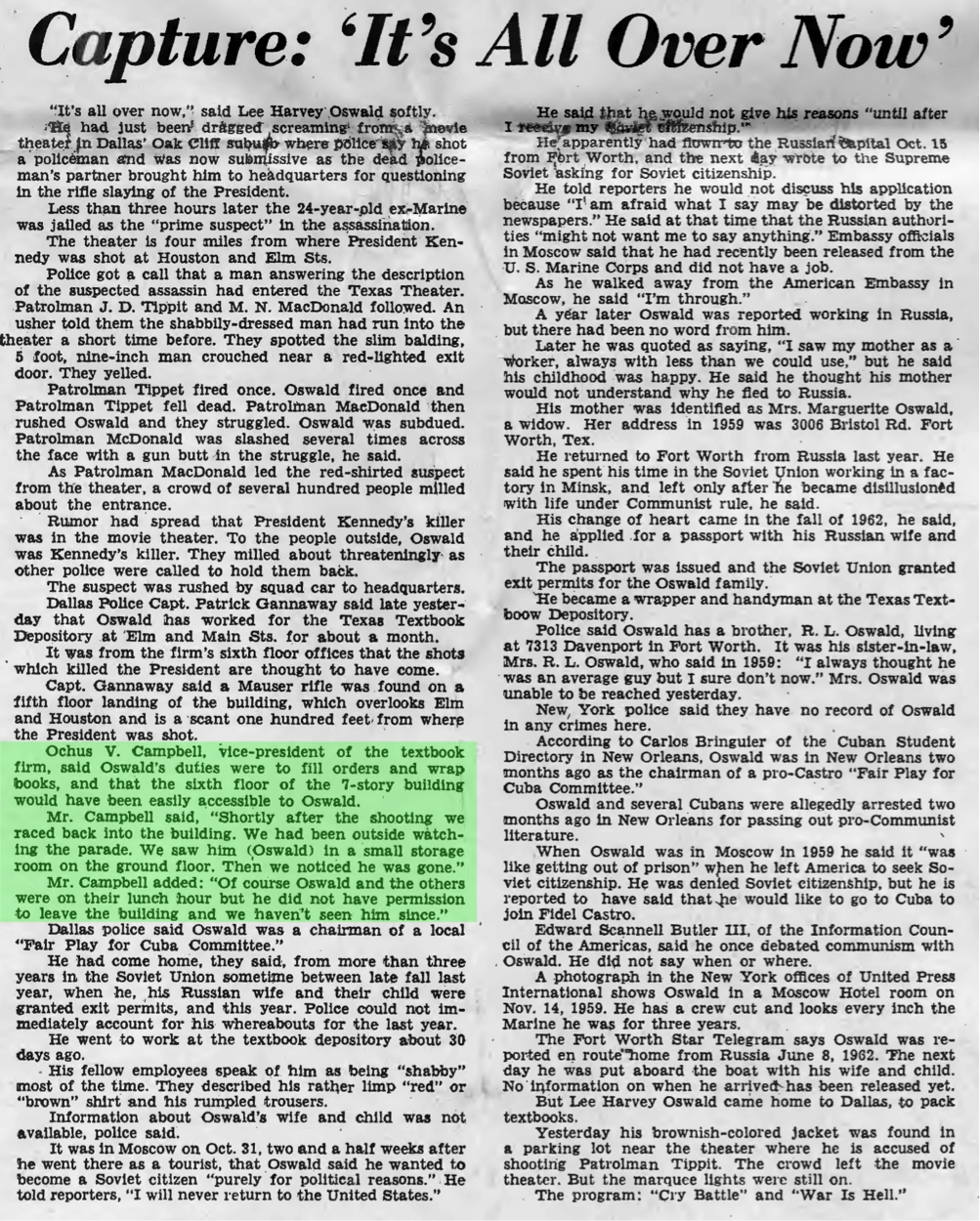
    Ochus Campbell, the vice president of the TSBD, stated in the New York Herald Tribune on November 22:

    “Shortly after the shooting we raced back into the building. We had been outside watching the parade. We saw him (Oswald) in a small storage room on the ground floor. Then we noticed he was gone.” Mr. Campbell added: “Of course he and the others were on their lunch hour but he did not have permission to leave the building and we haven’t seen him since.”

    02

    Detective Ed Hicks is quoted in the London Free Press on November 23, and in various other newspapers, saying:

    As the Presidential limousine sped to the hospital the police dragnet went into action. Hicks said at just about that time, Oswald came out of the front door of the red bricked warehouse. A policeman asked him where he was going. He said he wanted to see what all the excitement was all about.

    03

    In addition, from Jack White’s archive at Baylor in a document called “Escape”, city detective Ed Hicks, after intensive investigation of the slaying, drew this picture of the hour surrounding the tragedy:

    “As Oswald left the building, he was stopped by Dallas police, Oswald told them he worked in the building and was going down to see what was going on.” [AP, 1:45 a.m. CST]

    In the Washington Post of November 23, Dallas Police Chief Jesse Curry is quoted:

    “As an officer rushed into the building Oswald rushed out. The policeman permitted him to pass after the building manager told the policeman that Oswald was an employee.”

    04

    The first officer to reach the six-story building, Lieutenant Curry said, found Oswald among other persons in a lunchroom. New York Times, Nov 24thDallas, [11/23], Donald Jansen (from Jack White’s archive at Baylor in a document called “Escape”)

    The Sydney Morning Herald of November 24 reports:

    Police said that a man who was identified as Oswald walked through the door of the warehouse and was stopped by a policeman. Oswald told the policeman “I work here” and when another employee confirmed that he did, the policeman let Oswald walk away, they said.

    05

    Henry Wade, during a press conference, which by the looks of it was published unedited in the New York Times on November 26, states:

    “A police officer, immediately after the assassination, ran in the building and saw this man in a corner and tried to arrest him; but the manager of the building said he was an employee and it was all right. Every other employee was located but this defendant of the company. A description and name of him went out to police to look for him.”

    06

    J. Edgar Hoover, in a telephone conversation with LBJ, states:

    at the entrance of the building he was stopped by police officers, well he is alright, he works here, you needn’t hold him. They let him go.”

    In Gary Savage’s book, First Day Evidence, Baker states:

    “Shortly after I entered the building I confronted Oswald. The man who said he was the building superintendent said that Oswald was all right, that he was an employee there. We left Oswald there, and the supervisor showed me the way upstairs.”

    07

     {youtube}9tjgH8o4Adw{/youtube}

    Dallas Police Chief Jesse Curry’s press conference of November 23, 1963


    Dallas Police Chief Jesse Curry gave a press conference on November 23, 1963, during which he stated a few things that are very interesting:

    At 5:25:

    Reporter: Could you detail for us what lead you to Oswald?

    Chief Curry: Not exactly except uh in the building we uh, when we uh went to the building, why, he was observed in the building at the time but the manager told us that he worked there and the officers passed him on up then because the manager said he was an employee…”

    At 6:41:

    Reporter: Did you say chief that a policeman had seen him in the building?

    Chief Curry: Yes

    Reporter: After the shot was fired?

    Chief Curry: Yes

    Reporter: uh why didn’t he uh arrest him then?

    Chief Curry: Because the manager of the place told us that he was an employee, ‘said he’s alright he’s an employee.”

    Reporter: Did he look suspicious to the policeman at this point?

    Chief Curry: I imagine the policeman was checking everyone he saw as he went into the building.

    At 10:42:

    Reporter: And you have the witness who places him there after the time of the shooting.

    Chief Curry: My police officer can place him there after the shooting.

    Reporter: Your officer wanted to stop him and then was told by the manager that he worked there.

    Chief Curry: Yes.

    So let’s get this straight: Truly and Campbell, TSBD employees, are recorded by the newspapers while at the TSBD. Various ranking officers of the Dallas police are quoted in the corridors of the DPD. And even Hoover and LBJ discuss it!


    Oswald’s alibi given just before and just after the shooting


    In the second part of this study I will focus exclusively on the interrogation of Lee Oswald; here I will review the parts relating to the second floor lunch room encounter. These are the notes and reports by Robbery and Homicide Captain Will Fritz, FBI agents James Hosty and James Bookhout, Postal Inspector Harry Dean Holmes (who was an informant for the FBI), and Thomas Kelley of the Secret Service. These people were all present during the interrogations either Friday, Saturday and/or Sunday morning.

    08Captain Will Fritz interrogated Lee Oswald for roughly a dozen hours. Fritz claimed he took no notes, but in fact there were some (probably kept as a souvenir…); these were submitted anonymously in the mid-90’s to the ARRB after Fritz had died. These notes had been ‘buried’ for more than 33 years; until they appeared, researchers had to make do with Fritz’s statement from November 22 and his Warren Commission testimony.

    Fritz’s interrogation notes contain a few gems when it comes to Lee’s location just before, during and just after the assassination:

    On page 1 is found:

    claims 2nd floor Coke when

    off came in

    Oswald had a coke from the 2nd floor when the officer came in. Came in where? 1st? 2nd?

    to first floor had lunch

    Oswald had lunch on the 1st floor.

    out with Bill Shelley

    in front

    Oswald knew Shelley was standing in front of the building. And that is before the shooting, not after! As Shelley had departed almost immediately after the shooting from the TSBD steps.

    09
    Page 1 of Captain Fritz’s Notes

    On page 3 of the same set of Fritz’s interrogation notes:

    says two negro came in

    one Jr + short negro – ask? for lunch says cheese

    sandwiches + apple

    Oswald saw Jarman and possibly Norman come into the Domino Room while he was having his lunch.

    Lunch consisted of a cheese sandwich and an apple.

    10
    Page 3 of Captain Fritz’s Notes

    Looking at both these pages, one thing becomes evident: a new sentence does not always start on a new line, but midway as well. This leaves his notes open to interpretation.

    In his report to Chief Curry from November 23, 1963, Fritz says:

    “We also found that this man had been stopped by Officer M.L. Baker while coming down the stairs. Mr. Baker says that he stopped this man on the third or the fourth floor on the stairway, but as Mr. Truly identified him as one of the employees he was released.”

    The undated draft of Fritz’s report states:

    “I asked him what part of the building he was in when the president was shot, and he said that he was having his lunch about that time on the first floor. Mr. Truly had told me that one of the police officers had stopped this man immediately after the shooting near the back stairway, so I asked Oswald where he was when the police officer stopped him. He said he was on the second floor drinking a coca cola when the officer came in.”

    Fritz’s Warren Commission testimony:

    Mr. BALL. Did you ask him what happened that day; where he had been?

    Mr. FRITZ. Yes, sir.

    Mr. BALL. What did he say?

    Mr. FRITZ. Well he told me that he was eating lunch with some of the employees when this happened, and that he saw all the excitement and he didn’t think, I also asked him why he left the building. He said there was so much excitement there then that “I didn’t think there would be any work done that afternoon and we don’t punch a clock and they don’t keep very close time on our work and I just left.”

    Mr. BALL. At that time didn’t you know that one of your officers, Baker, had seen Oswald on the second floor?

    Mr. FRITZ. They told me about that down at the bookstore; I believe Mr. Truly or someone told me about it, told me they had met him, I think he told me, person who told me about, I believe told me that they met him on the stairway, but our investigation shows that he actually saw him in a lunch room, a little lunch room where they were eating, and he held his gun on this man and Mr. Truly told him that he worked there, and the officer let him go.

    Mr. BALL. Did you question Oswald about that?

    Mr. FRITZ. Yes, sir; I asked him about that and he knew that the officer stopped him all right.

    Mr. BALL. Did you ask him what he was doing in the lunch room?

    Mr. FRITZ. He said he was having his lunch. He had a cheese sandwich and a Coca-Cola.

    Mr. BALL. Did he tell you he was up there to get a Coca-Cola?

    Mr. FRITZ. He said he had a Coca-Cola.

    Although he learned from a conversation with Roy Truly at the “bookstore” [sic] that they met Oswald on the stairway, his own investigation shows it was inside the second floor lunch room instead! It has also only recently come to light that Martha Joe Stroud corresponded with the Warren Commission, relating that Fritz was not happy with his statement and that he wanted it changed. So there seem to be two versions of his statement. I would love to see the difference between the two! (This was recently posted by Robin Unger.)

    James Hosty and James Bookhout of the FBI state in their joint November 23 report:

    “OSWALD stated that he went to lunch at approximately noon and he claimed he ate his lunch on the first floor in the lunchroom; however he went to the second floor where the Coca-Cola machine was located and obtained a bottle of Coca-Cola ‘for his lunch. OSWALD claimed to’ be on the first floor when President JOHN F. KENNEDY passed by his building.”

    This report does not mention the specific location of Oswald on the first floor at the time of the assassination, nor does it mention any encounter involving Oswald, a police officer and Truly.

    In the solo report by James Bookhout (dated November 24, after Oswald was dead), things are turned around a bit, but not for the better.

    “Oswald stated that on November 22 1963, at the time of the search of the Texas School Book Depository building by Dallas police officers, he was on the second floor of said building, having just purchased a Coca-Cola from the soft-drink machine, at which time a police officer came into the room with pistol drawn and asked him if he worked there.

    Mr. Truly was present and verified that he was an employee and the police officer thereafter left the room and continued through the building. Oswald stated that he took this Coke down to the first floor and stood around and had lunch in the employee’s lunch room. He thereafter went outside and stood around for five or ten minutes with foreman Bill Shelley.”

    First, he mentions “officers”, when Baker was the only police officer in that building for a fair amount of time (5 to 10 minutes is a reasonable assumption); everyone else on the force was busy in the railroad yard. Or is this an indication that Oswald was in the building much later than he has been credited for?

    Second, Oswald had purchased a coke, which from a timing perspective makes it already “interesting” (getting the correct change out, putting it in the machine and waiting for the bottle to appear and to take the cap off). But what is more important is that neither Truly nor Baker saw anything in his hands.

    Third, Oswald stood around and had lunch after the shooting, and even stood outside with Bill Shelley for 5 to 10 minutes after having had his lunch. So how long was he in that building? According to this second report, for quite some time, which makes one wonder how the bus-to-cab ride transpired, how he changed his clothes, ‘grabbed his gun’ and walked towards 10th and Patton to blow Tippit away. This is impossible from the timing perspective described by James Bookhout! Plus Shelley left immediately after the shooting and did not come back until at least 5 minutes after leaving.

    Hosty writes in Assignment Oswald about an exchange he had with Oswald during his questioning while in police custody. No second floor lunch room encounter whatsoever.

    Okay now, Lee, you work at the Texas School Book Depository, isn’t that right?

    Yeah, that’s right.

    When did you start working there?

    About October fifteenth.

    What did you do down there?

    I was just a common laborer.

    Now, did you have access to all floors of the building?

    Of course.

    Tell me what was on each of those floors.

    The first and second floors have offices. The third and fourth floor are storage. So are the fifth and sixth.

    And you were working there today, is that right?

    Yep.

    Were you there when the president’s motorcade went by?

    Yeah.

    Where were you when the president went by the book depository?

    I was eating my lunch in the first floor lunchroom.

    What time was that?

    About noon.

    Were you ever on the second floor around the time the president was shot?

    Well, yeah. I went up there to get a bottle of Coca-Cola from the machine for my lunch.

    But where were you when the president actually passed your building?

    On the first floor in the lunchroom.

    And you left the depository, isn’t that right?

    Yeah.

    When did you leave?

    Well, I figured with all the confusion there wouldn’t be any more work to do that day.

    Hosty tried to pin Oswald’s location down decades after the fact, based on memory and also probably the interrogation report signed by him and James Bookhout, since it coincides neatly with the so-called recollection above. Oswald has gone for lunch and stayed in the Domino Room after he had gotten his coke from the second floor. Many must have seen him, since the ladies from the office all started to have their lunch at 12:00 upstairs in the second floor lunchroom. Some people will claim that this pins Oswald on the first floor, and that he went upstairs via the front of the building and ended up passing the window in the door leading to the small area in front of the lunchroom, thus being spotted by Baker. But why would he do that? The Domino Room was in the back at the east end, where the infamous back stairs were perhaps a little closer, affording more direct access.

    The Secret Service was present too. Forrest Sorrels and Thomas J. Kelley were there during some of Lee Oswald’s interrogations.

    Thomas J. Kelley is the only one who supplies an interrogation report that actually goes so far as to claim that Oswald explicitly admitted to not having watched the motorcade. In his First interview with LHO, he states:

    I asked him if he viewed the parade and he said he had not. I then asked him if he had shot the President and he said he had not. I asked him if he has shot governor Connally and he said he had not.”

    None of the notes or reports – by Fritz, Bookhout, Hosty or even Harry Dean Holmes, who was actually present during that final interrogation of Oswald alongside Kelley – back up the statement highlighted above.

    According to Vince Palamara, Kelley perjured himself during the HSCA hearings.

    Finally, Postal Inspector and FBI informant Harry Dean Holmes, on page 4 of his report dated December 17, 1963:

    “the commotion surrounding the assassination took place and when he went downstairs, a policeman questioned him as to his identification and his boss stated ‘he is one of our employees’, whereupon the policeman had him step aside momentarily”.

    In his statement and his testimony (see below), Oswald is being asked to step aside.

    Holmes’ Warren Commission testimony:

    Mr. BELIN. By the way, where did this policeman stop him when he was coming down the stairs at the Book Depository on the day of the shooting?

    Mr. HOLMES. He said it was in the vestibule.

    Mr. BELIN. He said he was in the vestibule?

    Mr. HOLMES. Or approaching the door to the vestibule. He was just coming, apparently, and I have never been in there myself. Apparently there is two sets of doors, and he had come out to this front part.

    Mr. BELIN. Did he state it was on what floor?

    Mr. HOLMES. First floor. The front entrance to the first floor.

    And later on during the very same testimony:

    Mr. BELIN. Now, Mr. Holmes, I wonder if you could try and think if there is anything else that you remember Oswald saying about where he was during the period prior or shortly prior to, and then at the time of the assassination?

    Mr. HOLMES. Nothing more than I have already said. If you want me to repeat that?

    Mr. BELIN. Go ahead and repeat it.

    Mr. HOLMES. See if I say it the same way?

    Mr. BELIN. Yes.

    Mr. HOLMES. He said when lunchtime came he was working in one of the upper floors with a Negro. The Negro said, “Come on and let’s eat lunch together.” Apparently both of them having a sack lunch. And he said, “You go ahead, send the elevator back up to me and I will come down just as soon as I am finished.” And he didn’t say what he was doing. There was a commotion outside, which he later rushed downstairs to go out to see what was going on. He didn’t say whether he took the stairs down. He didn’t say whether he took the elevator down.

    But he went downstairs, and as he went out the front, it seems as though he did have a coke with him, or he stopped at the coke machine, or somebody else was trying to get a coke, but there was a coke involved. He mentioned something about a coke. But a police officer asked him who he was, and just as he started to identify himself, his superintendent came up and said, “He is one of our men.” And the policeman said, “Well, you step aside for a little bit. Then I just went on out in the crowd to see what it was all about.”

    Step aside, which does not point to a second floor encounter, as Baker and Truly did a 180-degree turn after this alleged “lunch date”.

    Lee Oswald did not lie when he claimed he was on the first floor when the president passed by the TSBD. Not only did Holmes relay this; so did Fritz in his interrogation notes, as did Bookhout and Hosty in their joint report.

    James ‘Junior’ Jarman told the HSCA that Billy Lovelady told him that he had personally witnessed Oswald being allowed out of the front entrance by a policeman shortly after the assassination, and that Truly had said he was alright. (See HERE and HERE.)

    This is, of course, hearsay – just as Pauline Sanders’ support for Mrs. Reid’s encounter with Oswald in his t-shirt is equally hearsay. But it is worth mentioning. What also needs to be taken into consideration is that Lovelady left for the railroad yard almost straight after the shooting had stopped, and said he went back in through the side entrance and ended taking police officers up in the elevator. Yet Lovelady is filmed standing outside on the TSBD steps afterwards by John Martin and Robert Hughes at about 12:50. And it looks like he is waiting to get in. Danny Garcia is there, as is Bonnie Ray Williams. Did Lovelady see Oswald leave then? Which would mean he left much later than has been acknowledged. Lovelady was extremely economical with the truth during his Warren Commission testimony as I already pointed out earlier.

     {youtube}_vIbHH8CYMk{/youtube}


    James Earl Jarman and Harold Norman saw Howard Brennan talking to a police officer. This by itself shows how quickly they made their way down from the fifth floor.

    According to Harold Norman’s HSCA testimony, he states that after starting their descent from the fifth floor, they stopped on the fourth floor for a couple of minutes, because they saw the ladies looking through the windows at the railroad yard activity shortly after the shooting.

    This is during the same interval in which Dorothy Garner stayed behind, after “following” Victoria Adams and Sandra Styles, when they started their descent; Garner was then joined by other women from those fourth floor offices. Norman’s HSCA testimony strengthens Dorothy Garner’s statements and also shows that the three African American men, Williams, Jarman and Norman, did not encounter anyone, not even Truly and Baker while they made their descent. Or did they wait much longer? Baker states in his HSCA testimony that he was spotted by them while they hid behind boxes on the 5th floor. Norman had no recollection of this during his testimony, and couldn’t attest to when he saw Truly after coming down to the first floor.

    11


    {youtube}Jk0toNwH7rc{/youtube}


  • Was Dorothy Kilgallen Murdered over the JFK Case?

    Was Dorothy Kilgallen Murdered over the JFK Case?


    leaderThe above question is posed by author Mark Shaw in his new book, The Reporter Who Knew too Much. But for anyone interested in the JFK case, the questions about Kilgallen’s death are not new. Investigators like Penn Jones and Mark Lane first surfaced them in fragmentary form decades ago. And according to more than one report, Lane was actually communicating with Kilgallen when the latter was doing her inquiry into the JFK case from 1963 to 1965. This reviewer briefly wrote about her death in a footnote to the first edition of Destiny Betrayed. (See page 365, note 15) With the rise of the Internet, various posters, like John Simkin, kept the Kilgallen questions popping up on Kennedy assassination forums.
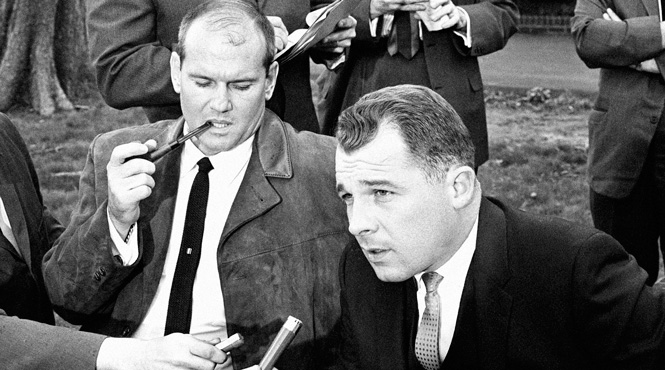
    Dorothy Kilgallen’s
    posthumous book

    Prior to Shaw’s book, there had been three major sources about Kilgallen’s life and (quite) puzzling death. The first was Lee Israel’s biography titled Kilgallen. Published in hardcover in 1979, it went on to be a New York Times bestseller in paperback. As we shall later see, although Israel raised some questions about Kilgallen’s death in regards to the JFK case, she held back on some important details she discovered. In 2007, Sara Jordan wrote a long, fascinating essay for the publication Midwest Today Magazine. Entitled “Who Killed Dorothy Kilgallen?”, Jordan built upon some of Israel’s work, but was much more explicit about certain sources, and much more descriptive about the very odd crime scene. For instance, the autopsy report on Kilgallen says she died of acute ethanol and barbiturate intoxication. But it also says that the circumstances of that intoxication were “undetermined”. Jordan appropriately adds, “for some reason the police never bothered to determine them. They closed the case without talking to crucial witnesses.” (Jordan, p. 22) A year later, in the fall of 2008, prolific author and journalist Paul Alexander had his book on the subject optioned for film rights. The manuscript was entitled Good Night, Dorothy Kilgallen. Reportedly, one focus of Alexander’s volume was how the JFK details Kilgallen wrote about in her upcoming book, Murder One, were cut from the version posthumously published by Random House. Neither Alexander’s book, nor the film, has yet to be produced. Which is a shame, since the available facts would produce an intriguing film.

    I

    Dorothy Kilgallen was born in Chicago in 1913. She graduated from Erasmus High School in 1930. At Erasmus she had been the associate editor of her high school newspaper. (Shaw, p. 3) Her father, James Kilgallen, was a newspaperman who worked for the Hearst syndicate in Illinois and Indiana. She spent a year in college in New York City. While there, her father got her a reporter tryout with the New York Evening Journal. She dropped out of college, and this became her lifelong career and position.

    While at the Evening Journal, she carved out a place for herself on the criminal courts beat. She especially liked reporting on murder trials, the more sensational the better. For example, one case involved a wife killing her husband by placing arsenic in his chocolate pudding. (ibid, p. 6) Another trial she covered was the notorious Anna Antonio murder for hire case, where the wife hired hit men to kill her husband for insurance money. (ibid, p. 7) In 1935, at the age of 22, she covered the most sensational case of the era: the trial of Bruno Hauptmann for the kidnapping of Charles Lindbergh’s infant son. (ibid) Shortly after this, Kilgallen entered a Race Around the World contest. That race generated tremendous publicity since it involved three reporters for major newspapers. In 24 days, she finished second to Bud Ekins. But, more importantly, she wrote a book about this experience that was then made into a movie. (Jordan, p. 17)

    The Original “What’s My Line?” Panel (1952)

    O. O. Corrigan passed away in 1938. For years, he had maintained a very successful column called The Voice of Broadway. Shortly after his death, Kilgallen was given his position. (Lee Israel, Kilgallen, p. 104) In that column she covered politics, crime and the theater scene in New York. In 1940 she married actor/singer and future Broadway producer Richard Kollmar. They had three children, Richard, Kerry and Jill. She became, in 1950, one of the regulars on the game show What’s My Line? The other regular panelists were actress Arlene Francis, and publisher Bennett Cerf; the host was John Daly.

    In 1954, Kilgallen covered another sensational legal proceeding. This was the murder trial of Dr. Sam Sheppard. In July of 1954, the doctor and his wife were entertaining guests at their lakefront home in suburban Cleveland. While watching a movie on TV, Sheppard fell asleep. His wife Marilyn escorted the guests out a bit after midnight. (Kilgallen, Murder One, p. 238) Just before dawn, Sheppard called the mayor of the town of Bay Village, the Cleveland suburb where he lived. The mayor and his wife came over. Sheppard was slumped over in the den with a medical kit open on the floor. He appeared to be in shock. He mumbled: “They killed Marilyn.” The couple went up the stairs and saw her bloodied body in the bedroom. (ibid, p. 239) Sheppard said he had been awakened by Marilyn’s screams. He ran upstairs to the bedroom and saw an intruder in the shadows. The assailant knocked him out with a blunt object. When he came to, he heard the intruder downstairs on the porch. He ran down, chased him off the property, and he struggled with him on the lakeshore—where he was bludgeoned unconscious again. (ibid, pp. 239-40)

    When she arrived in Cleveland, Kilgallen was struck by both the weakness of the prosecution’s case, and by the powerful bias of the media against Sheppard. But in the face of the latter, the judge failed to sequester the jury. In December, after four days of deliberations, the jury convicted Sheppard of murder. Kilgallen was shocked. In her view, the prosecution had not proven Shepard guilty any more than they had “proved there were pin-headed men on Mars.” (ibid, p. 300)

    Sam Sheppard & F. Lee Bailey

    Years later, after Sheppard’s original lawyer, William Corrigan, had passed away, F. Lee Bailey took on his appeal. At a book signing in New York, he had heard Kilgallen speak about her in-chambers interview with the judge in the Sheppard case. He contacted her about this and she gave Bailey a deposition. In that deposition, she revealed that, before the trial began, she was granted an interview with the judge. He asked her what she was doing in Cleveland. She said that she was there to report on the mystery and intrigue of the Sheppard case. The judge replied, “Mystery? It’s an open and shut case.” Kilgallen said she was taken aback by this remark. She told Bailey, “I have talked to many judges in their chambers—they don‘t give me an opinion on a case before it is over.” She continued that the judge then said Sheppard was “guilty as hell. There’s no question about it.” (ibid, pp. 301-02) This deposition was quoted in the final decision of the U. S. Supreme Court which, in 1966, granted Sheppard a new trial.

    At the 1966 trial, Sheppard was acquitted. Bailey’s criminologist, Dr. Paul L. Kirk, presented evidence that there was a third type of blood in Marilyn’s bedroom, not the doctor’s or the victim’s. Further, Kirk concluded the blows that killed Marilyn came from a left-handed person. Sheppard was right handed. (ibid, p. 304)

    The Sheppard case dragged on for so long, creating so much controversy, making so many headlines, that it reportedly became the basis for the TV series The Fugitive, starring David Janssen. For our purposes, the important thing to recall about it, and the reason I have spent some time on it, is that Kilgallen was correct about the verdict. And further, her role in the case helped set free an innocent man. Although that last act did not occur until after her own death in November of 1965.

    II

    The first real inquiry into Dorothy Kilgallen’s death was by the late author Lee Israel. This was done for her best-selling biography, titled Kilgallen, a book still worth reading today. Since that book was not published until 1979, this means that neither the NYPD, nor the House Select Committee on Assassinations did any kind of serious review of the case. This is odd since the circumstances surrounding Kilgallen’s demise clearly merited an inquest. But beyond that, and as we will see, there appears to have been an attempt to cover up the true circumstances of her death.

    Kilgallen, with Jack Ruby defense attorneys
    Joe Tonahill (center) & Melvin Belli (right),
    at the Ruby trial (February 19, 1964)

    Lee Israel did a good job in her book in describing just how much Kilgallen wrote about the failings of the Warren Commission. She also described some of Kilgallen’s extensive contacts with early researcher Mark Lane. It is safe to say that no other widely distributed columnist in America wrote as often, or as pointedly, about the JFK case as Kilgallen did. She flew to Dallas to cover the trial of Jack Ruby in early 1964. While there, she secured two private interviews with the accused. She never divulged what was revealed to her in those interviews. Instead, the notes from these meetings went into her ever expanding JFK assassination file—which more than one person saw since, at times, she actually would carry it around with her. (Israel, p. 401)

    From the contacts she attained in covering the Ruby trial, Kilgallen broke two significant JFK stories. First, someone smuggled her the testimony of Jack Ruby before the Commission. After convincing her editors to print the purloined hearing, her paper ran the story over three consecutive days. And they allowed her to append comments and questions to the colloquy. (Israel, p. 389) Her Dallas sources also secured her an early copy of the DPD radio log. With this she pointed out that Police Chief Jesse Curry had misrepresented to the public his real opinion as to what the origin point of the shots were. He had told the public he thought they came from the Texas School Book Depository, but on the log he said they came from the rail yards, behind the picket fence, atop the grassy knoll. (Israel, p. 390)

    When documents on Oswald were denied to Ruby’s defense team, again Kilgallen chimed in pungently:

    It appears that Washington knows or suspects something about Lee Harvey Oswald that it does not want Dallas and the rest of the world to know or suspect. . . Lee Harvey Oswald has passed on not only to his shuddery reward, but to the mysterious realm of “classified” persons whose whole story is known only to a few government agents.

    Why is Oswald being kept in the shadows, as dim a figure as they can make him, while the defense tries to rescue his alleged killer with the help of information from the FBI? Who was Oswald, anyway? (Israel, p. 366)

    She also ran a story suggesting that there were witnesses who saw Oswald inside Ruby’s Carousel Club. (Shaw, pp. 66, 67) Based upon that, she once said, “I don’t see why Dallas should feel guilty for what one man, or even 3 or 5 in a conspiracy have done.” (Shaw, p. 68)

    When the Ruby case was decided and he was found the sole guilty party—a verdict that would later be reconsidered—Kilgallen, again, wrote about it quite resonantly:

    The point to be remembered in this historic case in that the whole truth has not been told. Neither the state of Texas nor the defense put all of its evidence before the jury. Perhaps it was not necessary, but it would have been desirable from the viewpoint of all the American people. (Israel, p. 372)

    In fact, as Israel wrote, Kilgallen actually became a funnel for men like Lane and Dallas reporter Thayer Waldo to run information through, in order for it to garner a wider audience. (Israel, p. 373)

    She went even further. Kilgallen ran experiments with her husband holding a broomstick to replicate the alleged sighting by Warren Commission witness Howard Brennan. Brennan was the Commission’s chief witness as to a description of Oswald as the sixth floor assassin. She stood approximately where Brennan stood in front of her five-story townhouse. And she told her husband to go ahead and kneel, as the Warren Commission said Oswald was behind a box. She came to the conclusion that there was “no way in the world that such a description could have been accurately determined by Brennan.” (p. 391) She further came to the conclusion that there was a real question as to the type of weapon that was found in the building, a Mannlicher-Carcano or a Mauser. She was also tipped off as to the ignored testimony of witness Acquila Clemmons. Contrary to the Warren Report, Clemmons claimed to have seen two men involved in the murder of Officer J.D. Tippit, not one, and neither resembled Oswald. These stories were mentioned in her newspaper column in September of 1964. (Israel, p. 395)

    The FBI visited her to find out how she got Ruby’s testimony before the Warren Commission. She made them tea but told the two agents that she could never reveal how she got that exhibit or who gave it to her. And when the Warren Report was released in September of 1964, Kilgallen made it fairly evident how she felt about it:

    I would be inclined to believe that the Federal Bureau of Investigation might have been more profitably employed in probing the facts of the case rather than how I got them …. At any rate, the whole thing smells a bit fishy. It’s a mite too simple that a chap kills the President of the United States, escapes from that bother, kills a policeman, eventually is apprehended in a movie theater under circumstances that defy every law of police procedure, and subsequently is murdered under extraordinary circumstances. (Israel, p. 396)

    What she said and did in private on the JFK case was even more extreme than her public actions. After her experience with the FBI she concluded that Hoover had tapped her home phone line. She told Lane that, “Intelligence agencies will be watching us. We’ll have to be very careful.” She decided to communicate with Lane via pay phones and even then by using code names. She then added, “They’ve killed the president, the government is not prepared to tell us the truth, and I’m going to do everything in my power to find out what really happened.” (Israel, pp. 392-93) She told her friend Marlin Swing, a CBS TV producer and colleague of Walter Cronkite, “This has to be a conspiracy.” (ibid, p. 396) To attorney and talent manager Morton Farber, she characterized the Warren Commission Report as “laughable.” She then added, “I’m going to break the real story and have the biggest scoop of the century.” (Israel, p. 397) She made similar statements to another TV producer Bob Bach, and another talent manager, Bill Franklin. (Israel, p. 396) All this, of course, was contra what almost all of her professional colleagues were involved with at the time: namely praising and venerating the fraud of the Warren Report. For instance, in June of 1965, Kilgallen was invited to do an ABC news show called Nightlife with Les Crane. Since Bach had helped arrange the appearance she thought she would be speaking about the Warren Report, so she brought parts of her JFK file with her. But she was informed by one of the show’s producers, Nick Vanoff, that they did no want her to address that subject. He told her it was “too controversial”. (Israel, p. 401)

    Between the time of the release of the Warren Report—September of 1964—and her passing—November of 1965—she was in the process of taking and planning flights to both Dallas and New Orleans. (For the former, see Israel, p. 402; for the latter, see Jordan, p. 20) These do not appear to be job related. They appear to be for the purpose of advancing her own inquiry into Kennedy’s assassination. For instance, she told What’s My Line? makeup artist Carmen Gebbia that she was excited about an upcoming trip to New Orleans to meet a source she did not know. She said it was all cloak and daggerish. And she concluded that, “If it’s the last thing I do, I’m going to break this case.” (Jordan, p. 20)

    Marc Sinclaire

    Marc Sinclaire worked for Kilgallen as her major hairdresser. Many years after her death he revealed that he went to New Orleans with her in October of 1965. Sinclaire went down on a separate plane and stayed in a different hotel. They had dinner together the night he arrived. The next morning he was preparing to go to her place to work on her hair. She called him and said that was cancelled: she had purchased a ticket for him and he was to return to New York. Further, he was not to tell anyone he had been there with her. Her second hairdresser, Charles Simpson, said she used to tell him things about her work, but now things were different. She proclaimed “I used to share things with you … but after I have found out now what I know, if the wrong people knew what I know, it would cost me my life.” (ibid)

    III

    Two of the problems with the circumstances of Kilgallen’s death are that first, the cause was misreported by her own newspaper, and second, no one can pinpoint exactly when her body was first discovered. Using her father as a source, the Journal American reported that Dorothy Kilgallen had died of an apparent heart attack. (Israel, p. 410) As we shall see, that was not the case. But even more puzzling, there is a real mystery as to when the corpse was first discovered.

    The official police record states that the body was found between noon and 1 PM by Marie Eichler, Kilgallen’s personal maid. (Israel, p. 416) But Israel talked to an anonymous source who was a tutor to the Kilgallen children and was there on the morning of November 8, 1965. That source told Israel that the body was found much earlier, before ten o’clock. Sara Jordan later revealed the tutor was Ibne Hassan. Hassan’s information turned out to be correct. From the information on hand today, the first known person to discover Kilgallen’s body was Sinclaire. And his (unofficial) testimony has powerful relevance. He said that he was stunned when he found Kilgallen sleeping on the third floor. Because she always slept on the fifth floor. He found her sitting up in bed with the covers pulled up. He walked over to her, touched her, and knew she was dead. In addition to being on the wrong floor, she was wearing clothes that she simply did not wear when she went to bed. Further, she still had on her make up, false eyelashes, earrings, and her hairpiece. (Jordan, p. 21)

    A book was laid out on the bed. It was Robert Ruark’s recent volume The Honey Badger. Yet, according to more than one witness, Kilgallen had finished reading this book several weeks—perhaps months—prior. Also, she needed glasses to read; Sinclaire said there were none present. The room air conditioner was running, yet it was cold outside. Plus the reading lamp was still on. Sinclaire added, her body was neatly positioned in the middle of the bed, beyond the reach of the nightstand. (ibid)

    The questions raised by Sinclaire’s description are both obvious and myriad. The setting suggests that Kilgallen’s body was positioned both on a floor she did not sleep on and in a way that was completely artificial. In other words, it was posed. If this was done, it was performed by someone not familiar with her living routine and in a hurry to leave, probably for fear of awakening someone. But this is not all there is to it. Sinclaire said there was also a drink on the nightstand. (As we shall see, there more likely were two glasses there.) When Sinclaire called for the butler, he came running up the stairs, very flustered. Sinclaire then left through the front door. He said that there was a police car there, with two officers inside. They made no attempt to detain him. That morning, a movie magazine editor named Mary Branum received a phone call. The voice said, “Dorothy Kilgallen has been murdered”, and hung up. (ibid)

    Charles Simpson

    When Sinclaire got home he called his friend and colleague Charles Simpson. He told him that their client was dead. He then added, “And when I tell you the bed she was in and how I found her, you’re going to know she was murdered.” Simpson later said in an interview, “And I knew. The whole thing was just abnormal. The woman didn’t sleep in that bed, much less the room. It wasn’t her bed.” (ibid. These video taped interviews were done by researcher Kathryn Fauble. The Jordan article owed much to her research, and so does Shaw. See Shaw, p. 113)

    From Sinclaire’s description, there seems to have been a prior awareness of Kilgallen’s passing: e.g., the police car in front of the door. But as of today, Sinclaire is the best testimony as to when the body was actually found. About three hours later, two doctors arrived at the townhouse: James Luke and Saul Heller. The latter pronounced her dead. But the former did the medical examination, which as we shall see, was incomplete.

    About a week after her death, Luke determined that she was killed by “acute barbiturate and alcohol intoxication, circumstances undetermined.” (ibid, p. 22) Roughly speaking, this means she died of an overdose, but the examiners could not determine how the drugs were delivered. Usually, the examiner will write if the victim was killed by accident, suicide or homicide. That was not done in this case. The main reason it was not done is because there was no investigation of the crime scene, or of any witnesses who saw and had talked to her in the previous 24-48 hours. For example, phone calls were not traced, her home was not searched for drug containers, and there was no investigation as to how she arrived home that evening or if anyone was with her.

    Lee Israel was shocked when she discovered this fact. She was looking through the Kilgallen police file for reports labeled DD 5 and DD 15. The former is a supplementary complaint report that records activities pursuant to a complaint. The latter is a request to the Medical Examiner for a Cause of Death notice. Israel said that, although the investigating detective said he saw this, it was missing from the file. (p. 428) Therefore, there appears to have been no investigation done to determine how the drugs were administered. This was so bewildering to Israel that she wrote that there may have been another, unofficial channel, of communication between the police department and the medical examiner’s office on the Kilgallen case.

    There does seem to be cause for such speculation. In her book, Israel mentioned another anonymous source from the toxicology department of the medical examiner’s office. (Israel, pp. 440-41) This man was a chemist under Charles Umbarger, director of toxicology at the NYC Medical Examiner’s Office. This source met with Israel personally and told her that Umbarger believed that Kilgallen had been murdered. Umbarger had evidence that would indicate this was the case but he kept it from the pathology department as part of the factionalism in the office. The idea was to retain this secret evidence in reserve over chief Medical Examiner Milton Halpern and Luke. Jordan discovered this secret source was a man named John Broich. (Jordan, p. 22) Broich told Jordan, as he told Israel, that he did new tests on the glasses, and tissue samples, both of which Umbarger had retained. He found traces of Nembutal on one of the glasses. The new tests discovered traces of Seconal, Nembutal and Tuilan in her brain.

    This was an important discovery, for more than one reason. First, the police could not find any evidence of prescriptions for the last two drugs by Kilgallen. Her doctor only prescribed Seconal. Second, no doctor would prescribe all three to one patient at one time since the mix could very well be lethal. (Shaw, p. 116) Third, the prescription Kilgallen had for Seconal had run its course at the time of her death. Umbarger, of course, knew this. When Broich reported back to him about his new chemical discoveries, Umbarger had an unforgettable reaction. He grinned at his assistant, and then said the following: “Keep it under your hat. It was big.” (Jordan, p. 22)

    IV

    As we have seen, neither the New York Police Department nor the medical examiner’s office was forthcoming or professional in the Kilgallen case. The House Select Committee on Assassinations (HSCA) only performed a very cursory look at her death. But it appears it was the HSCA that got her autopsy report into the National Archives. (Shaw, p. 277) That cursory look seems odd for the simple reason that the HSCA’s chief pathologist, Dr. Michael Baden, was working in the Medical Examiner’s office at the time of Kilgallen’s passing. In fact, Baden’s name is listed as an observer for Luke’s autopsy report. (Shaw p. 102) Baden was also a source for Israel’s book. In 1978, while the HSCA was ongoing, he told Israel that, from what he could see, the evidence would indicate that Kilgallen had fifteen or twenty 100 mg capsules of Seconal in her system. (Israel, p. 413) Why Mark Shaw did not make more of this point in his book eludes this reviewer.  Because Baden’s opinion would seem to be incorrect, for the simple reason that, as stated above, Kilgallen likely would not have had that many Seconals left in her prescription at the time of her death. But a fewer number of Seconals, mixed with the two other drugs, would very likely have produced the fatal result.

    Because of the (screamingly) suspicious circumstances of her death, it does not at all seem logical to consider either of the other alternatives—that it was accidental, or she took her own life. How could she accidentally end up in the wrong bed on the wrong floor with the covers pulled up? As per the second option, as stated above, there seems to not have been enough left of her Seconal prescription for her to take her own life. According to her doctor, Kilgallen was prescribed 50 pills per month. There are two reports, one from the police, one from her doctor, but the estimates are that she took between 2-4 pills per night. (Israel, p. 425) Since the prescription was last filled on October 8th, how could there possibly be enough pills available for her to plan her death? The indications seem to suggest this was a homicide.

    Kilgallen, Richard Kollmar
    & their son, Kerry (1964)

    If that were the case—and Israel, Jordan, and Shaw certainly seem to agree it is the strongest alternative—then who was responsible? One possible suspect is her husband Richard Kollmar. As Israel and Shaw outline, neither spouse was faithful to the other at this stage of the marriage. Richard was involved in several one-night stands, and Dorothy had a love affair with singer Johnny Ray, which had concluded at around the time of Kennedy’s assassination.

    Further, Richard was not doing nearly as well financially as Dorothy was. Israel had direct access to their accountant, Anne Hamilton. And from that interview, it appears that Shaw overstates their wealth significantly. (See Israel, especially p. 356) But there can be little or no doubt that at the time of her death, Kilgallen was the major breadwinner in the family. Therefore, in case of her death, Richard would be in position to inherit a significant amount of money in cash and property, well over a million dollars today. Further, and another point I could not find in Shaw’s book, Richard had his own access to Tuinal. (Israel, p. 438)

    But still, there are serious problems with holding Richard as the prime suspect. First, if such were the case, then why would there be such an almost appallingly negligent investigation? Cases of spouses killing their partners must have appeared every week in a city as large as New York. And, if so, how would Richard have the influence to cause such a large system failure—one that took place in the police department, the DA’s chambers, and in the office of the medical examiner? Secondly, no one who knew Kollmar thought he was capable of doing such a thing. Both Israel and Shaw agree on this point. But third, if Kollmar had planned the whole thing, how could he possibly have left as many holes in his plot as he did— many of them wide enough to drive the proverbial tractor through? Could he really have not known where his own wife slept? What she wore when she retired? What book she was reading? That when she read, she wore glasses? And so on and so forth. The case does not appear to be an inside job. Because if Marc Sinclaire had not left that morning, he could have detonated it in about two minutes.

    Ron Pataky & Kilgallen

    Both Israel and Jordan seemed to center their suspicions on a man that the former referred to as the Out of Towner. Israel referred to him by that rubric because he lived and worked in Columbus, Ohio. His real name is Ron Pataky. In her Midwest Review essay, Sara Jordan was explicit about his name and printed a photo of him standing next to Kilgallen. There are several reasons why Ron Pataky’s presence creates suspicion in this case. One has to do with the closeness of his relationship with Kilgallen at the time. After she and Johnnie Ray decided to break up, it appears that Pataky became Kilgallen’s romantic interest. They called each other frequently, saw each other on occasion, and wrote letters and notes to each other. A very odd thing happened in late October on the set of What’s My Line? Before the show began taping, an announcement came on the public intercom. The voice said, “The keys to Ron Pataky’s room are waiting at the front desk of the Regency Hotel.” Quite naturally, this shook Dorothy up. Why didn’t someone just bring her a note? Pataky denied being in New York at that time. If so, was someone trying to tell the reporter that they knew something about her private life? (Jordan, p. 20) On the weekend of her death, Kilgallen had an hour-long call with Sinclaire. During this call, she said her life had been threatened (she later said she might have to purchase a gun). Sinclaire told her that the only new person in her life was Pataky. And she had shared her interest in, and information about, the JFK case with him. He suggested that she confront him with those facts. Two days later, Kilgallen was dead. (Shaw, p. 242)

    Both Israel and Shaw discuss interviews they had with Pataky. In more than one place it appears that the subject is being less than candid. For instance, he says that he was never at Kilgallen’s townhouse. But he says that he knew Kilgallen drank and popped pills. When asked how he knew that, he says he saw the pills in a medicine cabinet. Unless Dorothy carried a medicine cabinet with her, how did he know about it if he was never in her home? Pataky also said in 2014 that the New York police talked to him about Dorothy’s death based upon a note they discovered at the home. Yet there is no evidence of any such interview or note in any police file. (Shaw, pp. 239-40) Another example would be one of his alibi witnesses. Pataky has always maintained that he was in Columbus when he got the news of Dorothy Kilgallen’s death. He said fashion editor Jane Horrocks read the notice off the news wire to him. But researcher Kathryn Fauble later talked to Horrocks. She remembered Pataky vividly since they shared an office at the Columbus Citizen-Journal. She also recalled him getting calls from Kilgallen there. But she added on the day the news broke about Kilgallen’s death she wasn’t in the office, she was on assignment in California. (Shaw, p. 237)

    Perhaps the most interesting aspect of any interview with Pataky was the one Israel did with him about Kilgallen’s final hours. Sara Jordan, Israel and Shaw have attempted to reconstruct what Kilgallen did the evening before she was discovered dead by Sinclaire. After taping What’s My Line?, she and producer Bob Bach went to the restaurant/bar P. J. Clarke’s for a drink. (Jordan, p. 21) Both Bach and Sinclaire have stated that Kilgallen separately told them she was to meet with someone at the Regency Hotel later that evening. Therefore, after she left P. J. Clarke’s, she arrived at the Regency, which is about six blocks from her home. In a videotaped interview with an associate of Kathryn Fauble, it was revealed that Kilgallen was seen in the corner of the cocktail lounge by a woman named Katherine Stone. Stone had been a contestant on the show that night. (ibid) Press agent Harvey Daniels also recalled seeing Kilgallen with a man at the Regency that night. So did piano player Kurt Maier. (ibid) She left the Regency at about 2 AM. According to Israel, when the news of her death broke, several people working at the Regency discussed her presence there the night before. (Israel, p. 432)

    Pataky has always denied he was with her that evening. He has always denied he was in New York that night. The most he would say is that she called him that evening. But Pataky firmly declared that he was in Columbus that evening, not in New York. Israel had taped her call with him. She turned it over to former CIA officer George O’toole. O’toole was one of the leading Agency analysts for the Psychological Stress Evaluator, commonly known as the PSE. This device measures stress in the voice in response to questioning. That measurement may reveal the subject is lying about a sensitive point. O’toole wrote an interesting book on the subject in relation to the JFK case, The Assassination Tapes. In that book he explains in detail how the device works and its reputation for accuracy. An absence of stress in the voice would indicate that the subject is telling the truth. If the stress is high, it may reveal tension due to deception. When O’toole analyzed the part of the conversation in which Pataky denied being in New York that night, he wrote that the PSE hit level F and G gradients. These are the highest levels of stress the machine will measure. When Pataky discusses how he actually found out about Kilgallen’s death, again the machine hit the F level. (Israel, p. 435)

    Pataky had designs to be a songwriter. He had confided in Kilgallen about this. The verses of a song are, in many ways, like a poem. So years later, Pataky posted some of his poems online. Both Shaw and Jordan found them interesting. First there is one called “Never Trust a Stiff at a Typewriter”. It reads as follows:


    There’s a way to quench a gossip’s stench

    That never fails

    One cannot write if zippered “tight”

    Somebody who’s dead could “tell no tales.”


    As to its suggestiveness to the topic, this needs no comment. The second Pataky poem is called “Vodka Roulette Seen As Relief Possibility”.


    While I’m spilling my guts

    She’s driving me nuts

    Please fetch us two drinks

    On the run.


    Just skip all the nois’n

    Make one of them poison

    And don’t even tell me

    Which one!


    Shaw goes on for four paragraphs on this poem. But again, its suggestiveness needs little explication in relation to the subject at hand.

    Let us close the discussion of Pataky with another piece of information allegedly supplied by Israel, but which today is in dispute. John Simkin used to own and operate the JFK Assassination Debate forum at Spartacus Educational web site. He had an abiding interest in the Kilgallen case. In a discussion at Simkin’s site in 2005, he enlisted Israel to participate. During this discussion it was revealed that in 1993 a college student in Virginia did what Israel did not do in her book. He actually revealed Pataky’s name. And he further wrote that the management of the Regency Hotel had forbidden its employees to discuss Kilgallen’s presence there that night. But even more interesting, Israel said that she found out that Pataky dropped out of Stanford in 1951 and later enrolled in the School of the Americas in Panama. This, of course, is the infamous CIA training ground for many Central American security forces who were later involved in various kidnappings and assassinations in the fifties and sixties. In the Midwest Today article by Sara Jordan, Israel denied she made this statement. (But Jordan found out that Pataky did drop out of Stanford after one year. Jordan, p. 23) Yet to this day, that statement exists in black and white on that site. It’s kind of a reach to say Simkin invented it. And we know that Israel was sensitive about what she wrote about Pataky, or else she would have named him in her book.

    V

    After writing all the above I would like to say that Mark Shaw wrote an admirable and definitive volume about Kilgallen and her death. Unfortunately, I cannot do so. One reason is obvious from my references. A lot of the information in Shaw’s book can be found in either Israel’s tome or the Sara Jordan essay in Midwest Today. The interviews with Sinclaire and Simpson were done by the indefatigable Kathryn Fauble. Shaw does a nice job in reporting on the autopsy. And his interviews with Pataky are informative. But some of the book seems padded, consisting of chapters about four pages long. (See Chapter 34) Sometimes, the author repeats information, as with Sinclaire finding the body. And like writers who partake in biography, Shaw tends to exaggerate the achievements of his subject.

    This last is done in two ways. He tends to exaggerate Kilgallen’s stature as a journalist. For example, he calls her the first true female media icon. (p. 294) Did the author forget about Dorothy Thompson? Or Adela Rogers St. Johns? They certainly ranked with Kilgallen in popularity and as role models. And Thompson left behind a body of work at least equal in stature to Kilgallen’s and, by any rational measure, exceeding it. Shaw also quotes Ernest Hemingway as calling Kilgallen, “One of the greatest women writers in the world”. I could not find a source for this quote. But on what grounds would such an expansive judgment hold water? And why would Shaw want to use it? Kilgallen wrote two books. She actually co-wrote them. The first was about her trip around the world, which she wrote with Herb Shapiro in 1936. Murder One was published posthumously by an editor based on her notes. This plus her voluminous columns are the sum total of her literary output. Does that compare with the achievements of say Isak Dinesen, Katherine Anne Porter or Rebecca West?

    The second way Shaw inflates his subject is by discussing what her impact would have been on the JFK case. This is completely unwarranted and amounts to nothing but pure speculation. For the simple reason that no one is ever going to know what Kilgallen discovered, or what her talks with Ruby were about. Therefore, the database from which to measure her achievement is simply non-existent. But, to put it mildly, this does not hinder Shaw. In a perverse sort of way, it enables him. Near the end of the book he writes that, “If Kilgallen had lived … the course of history would have been altered.” (Shaw, p. 288) Since, as stated above, there is no database to support that statement with, this reviewer is puzzled as to how Shaw arrived at this outsized conclusion.

    Which leads to two other related problems with Shaw’s book. First, the author’s footnotes would not pass muster in a sophomore English class. Time after time he refers to newspapers without adding a date to them. Time after time, he refers to books without supplying a page number. This, of course, makes it difficult to crosscheck his work. Secondly, he repeatedly refers to the mystery of how Dorothy’s JFK file disappeared after her death. Yet in Sara Jordan’s essay, she quotes a conversation between the Bachs and Richard Kollmar after Dorothy’s death. They asked him, “Dick, what was all that stuff in the folder Dorothy carried around with her about the assassination?” Richard replied, “Robert, I’m afraid that will have to go to the grave with me.” (Jordan, p. 22) What this means is anyone’s guess. But it could mean that he somehow recovered it and destroyed it.

    One of the worst aspects of The Reporter who Knew Too Much is how Shaw’s inflation is somewhat self-serving. For instance, when I saw the author speak at last year’s JFK Lancer conference he made a couple of rather odd statements. He said that since Kilgallen had gone to New Orleans with Sinclaire, this meant that she was investigating Carlos Marcello for the JFK case. Again, for reasons stated above, there is no factual way that Shaw could know such a thing. But further, how does New Orleans automatically deduce Marcello? New Orleans is honeycombed with a multitude of leads on the JFK case. Lee Oswald spent about six months there from the spring to the fall of 1963, less than two months before he was killed. To say that what he did there would automatically lead to Marcello betrays an agenda that is not really dealing with Kilgallen.

    That agenda traces back to a book Shaw wrote in 2013. It was called The Poison Patriarch. This reviewer did not critique it since it was simply not worth discussing. But Shaw synopsizes it here in order to attribute what Kilgallen was going to do if she had lived. Shaw’s previous work is a feat of Procrustean carpentry that ranks with the likes of Peter Janney and Philip Nelson. And like those authors, Shaw used an array of dubious witnesses to achieve his feat of alchemy. In short, he said that JFK was killed because Joseph Kennedy insisted on Bobby Kennedy as Attorney General. The father had underworld ties, should have known that RFK was going to do battle with the Mafia, and this caused a revenge tragedy to be performed. To scaffold this utterly bizarre thesis, Shaw trotted out a virtual menagerie of dubious witnesses like Tina Sinatra, Frank Ragano, Toni Giancana, Sy Hersh and Chuck Giancana. The book was a recycling and revision of Chuck Giancana’s science fiction fable Double Cross. (See pages 179-180 of the present book.)

    Well, in The Reporter Who Knew Too Much, Shaw pens his imaginary conclusion to Kilgallen’s investigation. He writes that after she made her second trip to New Orleans, the reporter produced a series of articles connecting Oswald, Ruby and Marcello. This series triggered a grand jury inquiry. This culminated in indictments of Marcello for the murders of both Kennedy and Oswald. But Kilgallen’s evidence went further. It also managed to indict J. Edgar Hoover for obstruction of justice, and he resigned his position. As a result, Kilgallen’s disclosures changed the way that the JFK case was discussed in history books.

    I wish I could say that what I just described is an exaggeration or parody of what Shaw wrote in his book. Unfortunately it is not any such thing. If the reader turns to page 289, he can read it for himself. To say that such writing is a fantasy really does not do it justice. The idea that Kilgallen was going to take on the entire power structure of the USA and overturn it with a series of newspaper columns is almost too ridiculous to consider. As many authors have proven, the JFK cover-up was interwoven throughout the entire structure of the American government at that time: the White House, the Justice Department, the Secret Service, the CIA, and the FBI. The Power Elite was involved in it through organs like the New York Times, CBS, and Life magazine. The idea that Kilgallen was going to upend this whole colossal structure is a bit ludicrous. As mentioned, she could not even discus the JFK case on Les Crane’s talk show. Which was a harbinger of what was going to happen to Jim Garrison in 1968 on The Tonight Show. I hate to inform Mark Shaw, but the Sam Sheppard murder case is not the Kennedy assassination.

    If Shaw would have restrained himself, or if he had an editor who would have pointed out the problems with his design, then this would have been a good and valuable book. It would have been really about Dorothy Kilgallen: who she really was, what we know and do not know about her death. But as shown above, such was not the case. Thus I would actually recommend to the interested party Sara Jordan’s informative and objective essay instead.


    The recommended essay can be found here:

    Sara Jordan, “Who Killed Dorothy Kilgallen?” (2007)

  • JFK assassination: Cameraman followed police as they searched for sniper


    From 2013: Tom Alyea filmed the inside of the TSBD minutes after Kennedy was assassinated. He witnessed shoddy police work, but he says … they still got the right man?

    ~Jim DiEugenio

  • JFK assassination: Cameraman followed police as they searched for sniper


    From 2013: Tom Alyea filmed the inside of the TSBD minutes after Kennedy was assassinated. He witnessed shoddy police work, but he says … they still got the right man?

    ~Jim DiEugenio

  • The Pistol


    (Click here if your browser is having trouble loading the above.)


    The Evidence IS the Conspiracy, Table of Contents


  • The Backyard Photographs


    (Click here if your browser is having trouble loading the above.)


    The Evidence IS the Conspiracy, Table of Contents


  • A new look at the enigma of the Backyard Photographs, Part 5

    A new look at the enigma of the Backyard Photographs, Part 5


    Part 5:  Michael Paine and the Backyard Photos

    Ruth and Michael Paine responded exactly the same way when news broke that shots were believed to have originated from the Texas School Book Depository: they both immediately assumed that Oswald was involved. During a phone call placed at one pm November 22, 1963, Michael Paine calling from his office at Bell Helicopter to Ruth at home in Irving, this assumption receives a qualification: “the male voice was heard to comment that he felt sure LEE HARVEY OSWALD had killed the President, but did not feel OSWALD was responsible, and further stated, “We both know who is responsible.”1 Whoever it is Michael Paine believed “responsible” for the assassination it has remained closely held, as neither he or Ruth Paine have faced official scrutiny since 1968.

    Michael Paine intersects with the backyard photo story at least six ways, surprising since the official story portrays him as akin to a bystander, simply caught up in events. Michael Paine was one of a handful of known visitors to 214 West Neely Street. The Imperial Reflex camera said to have taken the backyard photos was apparently stored at his house in the autumn of 1963. He saw a backyard photo at the Dallas Police station the night of the assassination. The backyard photos known as 133-A and 133-B were discovered at his house the following day. He was involved in the delivery of a box of records, from which the de Mohrenschildt backyard photo would be later discovered. Michael Paine, with his wife Ruth, had dinner with the de Mohrenschildts soon after the photo was discovered in 1967. Years later, around the time of Oliver Stone’s JFK, Paine began claiming that Oswald actually showed him a backyard photo when he first visited the West Neely Street apartment in April 1963.

    April 1963: Michael Paine Visits 214 West Neely

    Mr LIEBELER: Did you ever make the acquaintance of Lee Harvey Oswald?

    Mr PAINE: Yes.

    Mr LIEBELER: Would you tell us briefly the circumstances under which that occurred?

    Mr PAINE: My wife invited Lee and his wife over to supper one evening.

    Michael Paine arrived by automobile at 214 West Neely Street around 6 PM in the late afternoon of April 2, 1963.2 He was there by arrangement, to pick up Lee and Marina Oswald and their young daughter, and transport them to the Paine’s home in Irving for a dinner engagement. At the time, Lee Oswald had begun his final week of employment at Jaggars-Chiles-Stovall, having previously received his notice. Allegedly, the backyard photos had been exposed two days before. Paine was brought upstairs to the Oswald’s modest second-floor apartment. According to him, “Marina took about half an hour to pack all the things for Junie. Meanwhile, I was talking to Lee at their house there.”3

    The subsequent thirty minute delay, or conversation, or briefing, is portrayed as a chance event allowed by the circumstance of Marina’s packing bags for the trip to Irving. The two men started up a conversation based on Oswald’s experiences in the Soviet Union. Michael Paine: “I asked him what he was doing, his job … I asked him about Russia … I wanted to know why he had gone to Russia and why he had then come back … I asked him how was it they so readily accepted (him) … he spoke more with disfavour of the Soviet Union … I wasn’t sure whether he was speaking derogatively in order to win my good graces or thinking he would win my friendship that way … I was asking him questions, taking his answers.” (WCH II, pp. 393-398)

    Michael Paine’s account of the conversation held during the half-hour delay at the Neely Street apartment fills ten transcript pages in the Commission Hearings (WCH II pp 393-402). As he concludes this detailed account, largely concerned with Oswald’s experiences in Russia, he tells the Commission: “What you have heard now occurred mostly in the first half hour when I was speaking directly to him when I met him … in all the subsequent conversations, you are going to get less information in what he said.” (WCH II, p. 398) Paine would maintain he and Oswald had a total of four conversations in the spring and autumn of 1963.

    General Walker ’s name came up later during the April 2 visit, apparently during or subsequent to the dinner at the Paine home in Irving.4 Paine: “I was still trying to find common ground with him, and I think we probably spoke critically of the far right. It seems to me we may have mentioned Walker … My memory is very foggy … a friend of ours … just achieved her citizenship papers … and General Walker had been invited to lead the singing [sic] … she was rather sorry that Walker should take it upon himself to define … what this country stands for. So I think I mentioned this episode to him … and I think (Oswald) smiled and nodded his assent … I don’t think he made any important remarks about Walker … that is the only time, probably the only time we mentioned Walker.” (WCH II, p. 402)5

    Michael Paine drove Lee, Marina and daughter June back to Neely Street to conclude the evening. He claimed he did not see Lee Oswald again until October. Paine would provide material support for Ruth Paine’s efforts in housing Marina Oswald, and transporting her to and from New Orleans, ostensibly as a means to brush up her Russian language skills. The Imperial Reflex camera which took the backyard photos was probably transported to New Orleans in May, in Ruth Paine’s station wagon, included with the Oswald belongings or on her own initiative.

    The New Orleans photo set, taken by that camera, features eleven photos, which could be said to represent a single twelve exposure roll of film. The eleven photos consist of similar versions of effectively four separate poses or views, suggesting the photographer was intent on shooting out the roll of film on this occasion. The Oswald and Paine families enjoyed a New Orleans tourist day on Sunday May 12, but no photos were taken on that occasion. If Ruth Paine was responsible for the New Orleans set, then the likeliest date was Monday May 13, when Oswald was at work. It is possible that Ruth Paine did not reveal to Lee that the hard-to-forget Imperial Reflex camera was in her possession, or else it was uncovered as the Oswald possessions were moved into the Magazine Street apartment. It is possible the roll of film was already in the camera. Ruth Paine may have returned to Irving with this camera, as there are no other personal photographs in the Oswald record dated after May 1963.6

      The eleven New Orleans photos feature four groups of similar views.  

    October 1963: Oswald, Michael Paine and the ACLU

    November 10, 1963, the Sunday of a long weekend, the last weekend he would in fact spend with his family, and Lee Oswald, according to Ruth Paine’s timeline, “spent the entire day … watching television.”7 Michael Paine remembered this occasion before the Warren Commission: “ I think that weekend I remember stepping over him as he sat in front of the TV … thinking to myself for a person who has a business to do he certainly can waste the time. By business I mean some kind of activity and keeping track of right-wing causes and left-wing causes or something. I supposed that he spent his time as I would be inclined to spend more of my time if I had it, trying to sense the pulse of various groups in the Dallas area.” (WCH II, p. 412)

    Oswald, September 1963

    The inquiries of Commission counsel Wesley Liebeler switched at this point to topics related to the informal driving lessons Lee was receiving from Ruth Paine, leaving aside the curious aspects to Michael Paine’s observation: Oswald had a “business to do”, he had “activity … keeping track of right wing causes and left-wing causes”, an inclination shared by Michael Paine, “trying to sense the pulse of various groups in the Dallas area.” Was this a hobby for both or either men? Was this activity more exactly described as a “business to do”? If it was a business, monitoring political activity, which Paine was inclined to do more of but had time constraints, might his annoyance with Oswald be generated from having sub-contracted, so to speak, some of this “keeping track” to Oswald? Paine was questioned by the FBI in June 1964 over a report he had talked about Cuba and Oswald with students of Southern Methodist University at Luby’s Cafeteria in April or May 1963. Paine said he was in the habit of eating lunch on Sundays at Luby’s, and would engage in “intellectual conversations or debates concerning world affairs with various SMU students … he did not specifically recall discussing (Oswald) with any of these SMU students … although he could very well have since at this time he was acquainted with OSWALD and OSWALD’s background. (CD 1245, p. 196)

    On October 2, 1963, Oswald had resurfaced in Dallas, after seeing off Marina, June and Ruth Paine in New Orleans on September 23.8 Oswald stayed at the YMCA for two nights, and then spent the weekend of October 4-6 at the Paine home in Irving. The following week, Oswald rented a room at Mary Bledsoe’s Oak Cliff rooming house, while he searched in Dallas for a new job. Bledsoe would later tell the FBI that Oswald told her at least twice “he was attempting to obtain work at Texas Instruments and Collins Radio.”9

    On Sunday night October 13, although Ruth Paine’s timeline says “OSWALD was at the PAINE home all during this day and night,” (CE 2124) Oswald, or someone identical to him, was seen sitting at the back of the room at a meeting sponsored by the Student Directorate of Cuba (DRE) (CD 205, p. 646). “This individual spoke to no one but merely listened and then left.” General Walker was also in attendance at this meeting. How Oswald knew of, or traveled to this meeting and then back to Irving, is not known.

    Ruth Paine took Oswald into Dallas the following morning, and Oswald moved from Bledsoe’s to a rooming house at 1026 North Beckley. Two days later, Oswald began work at the Texas School Book Depository. Two days after that, Lee Oswald turned 24 years old. On Sunday night, October 20, Marina went into labour and daughter Rachel was born. This began a busy week for Oswald.

    On Wednesday October 23, Oswald attended a “United States Day” right-wing political rally featuring General Walker, a response to the Adlai Stevenson United Nations Day event scheduled for the following evening. That next night, as Stevenson spoke in Dallas, the event suffered a vigorous protest by right-wing demonstrators organized in part by Larrie Schmidt. Stevenson would be struck by a placard. Michael Paine would express to the Warren Commission his understanding that Oswald was in attendance at this protest. Paine, for his part, attended a John Birch Society meeting on this same night.10 He would explain: “I have been to a number of rightist meetings and seminars in Texas.” (WCH II, p 389) Michael Paine would say of Oswald: “ I gathered he was doing more or less the same thing … I didn’t inquire how he spent his free time but I supposed he was going around to right wing groups … familiarizing himself for whatever his purposes were as I was.” (WCH II, p. 403)

    Ruth Paine’s timeline features the following entry for October 25, 1963: “LEE OSWALD came out after work with WESLEY FRAZIER and saw his wife and baby for the first time after they had left the hospital.” Oswald soon left with Michael Paine, to attend a Dallas meeting of the American Civil Liberties Union. Paine: “I took him in my car, he and I alone, and on the way, which takes about 35 minutes, described the ACLU to him, and he didn’t know about it, and described its purpose.” (WCH II, p. 407)11 During the meeting, Oswald stood and challenged an opinion from the moderators regarding the religious tolerance of the right-wing. Paine: “Lee at this point got up, speaking loud and clear and coherently … reporting that he had been to this meeting of the right-wing group … two nights before and he refuted this statement, saying names and saying how that people on the platform speaking for the Birch Society had said anti-Semitic things and also anti-Catholic statements … ” (WCH II, p. 408) Oddly, Michael Paine uses a generality (Oswald “saying names”), instead of reporting that Oswald referred specifically to General Walker, as Paine’s co-worker Frank Krystinik, also invited to this meeting, observed.12

    As the meeting broke to informal discussion, Krystinik, who had been informed earlier that Oswald was a Marxist, engaged in a debate on economics with Oswald and another older man. Michael Paine: “in this … argument that he had with Frank and a third person, on the way home he asked me if I knew that third person and whether I thought he was a Communist, Lee thought the third person was a Communist, and he gave me some reason … a receptivity to some words spoken about Castro. And I thought that was such a feeble reason … he must be out of it if that is the way he has to find his fellow travellers.” (WCH IX, p. 456)

    Shortly thereafter, Oswald wrote to Communist Party USA newspaper The Worker, a letter postmarked November 1: “Through a friend, I have been introduced into the American Civil Liberties Union Local chapter, which holds monthly meeting on the campus of Southern Methodist University. The first meeting I attened (sic) was on October 25th, a film was shown and afterward a very critical discussion of the ultra-right in Dallas … Could you advise me as to the general view we have on the American Civil Liberties Union? And to what degree, if any, I should attempt to highten (sic) its progressive tendencies? … some of those present showed marked class-awareness and insight.” (Johnson Exhibit 7)

    On the same day, previous to mailing this letter, Oswald rented a new Dallas post office box and listed both the Fair Play For Cuba Committee and the American Civil Liberties Union on the postal form (Holmes Exhibit 1).13 Oswald mails a membership application to the ACLU that same day. He includes two dollars in cash for the membership fee and lists his occupation as “photographer”. He adds a handwritten letter which requests notification on how to contact “ACLU Groups in my area,” even as he already knows they hold monthly meetings at SMU. (CE 783) Michael Paine had been an ACLU member for some years, and Ruth Paine was the local treasurer.

    Following the assassination, the ACLU had to react defensively after Dallas Bar Association president H. Louis Nichols met with Oswald on Saturday afternoon November 23, then appeared on television to reveal Oswald was an ACLU member and requested an ACLU lawyer if John Abt was not available. By Wednesday November 27, a reporter from the Dallas Times Herald had been informed of the Oswald postal form listing the ACLU along with Fair Play for Cuba Committee as the assassin’s specified organizations. By that afternoon, the ACLU executive were anticipating “danger in the future, as a result of the tragedy of last Friday, that civil liberties will be under increased stress.” (CD 205, pp. 704-708)

    November 22, 1963: Michael Paine Is Shown A Backyard Photo By the Dallas Police

    According to Michael Paine, he was asked at the Dallas Police station Friday night November 22, 1963, if he could “identify the place where Lee was standing when he was holding this rifle … I identified the place by the fine clapboard structure of the house … the house has an unusually small clapboard.“ This, taken at face value, reveals an alert observational skill set and excellent memory retention as, according to Paine, he had only visited 214 West Neely Street once, almost eight months previous.14

    Paine’s excellent retention skills are particularly admirable given the “fine clapboard structure” of the Neely Street house, as seen in the backyard photos, is visible but hardly dominates the frame the way the staircase and its support beams do. The clapboard can be seen behind and below the staircase on the left side of the frame. If the photo viewed by Michael Paine on Friday night was 133-C, it is the individual backyard photo showing the least detail of the clapboard structure. If 133-C was possessed by the Dallas police in the format of a “drugstore print”, then still less detail would be visible as the photo would be cropped on its horizontal edges, as well as appearing in its small 3”x3” size.

    Considering that the backyard photos, according to the official story, would not be discovered until the following afternoon, it is interesting that it is Warren Commission counsel Wesley Liebeler who brings the subject up during Paine’s testimony. Liebeler, at that time, is seeking to establish some other point, related to the rifle, and does not seem to realize that Paine is describing being shown something which officially had not yet been found. (WCH IX, p. 444)

    Michael Paine and the de Mohrenschildt Backyard Photo

    Everett Glover was separated from his wife at the start of 1963, and had arranged to share his house with two fellow employees at Magnolia Oil, Richard Pierce and Volkmar Schmidt. Everett Glover was a friend of George de Mohrenschildt, and also with Michael and Ruth Paine. Michael Paine: “We met the Glovers at madrigal singing, we liked to sing madrigals and he was part of the group … he showed up once or twice at a single adult party dance of the Unitarian Church.” (WCH IX, pp. 451-452)

    Folk dancers and madrigal singers: a hotbed of intrigue?

    In February, Glover, along with Volkmar Schmidt and others, met Lee and Marina Oswald at George de Mohrenschildt’s home, and they were supposedly impressed enough to arrange their own social occasion and invite the Oswalds. Through their friendship with Glover, the Paines would be invited to this Magnolia Oil party held on February 22,1963, which was the President’s Day holiday. Everett Glover provided the transportation for the Oswalds. The party was said to feature George de Mohrenschildt’s Central American walking tour slideshow, but it really seemed about presenting the Oswalds to new people.15 Michael Paine: “Everett Glover invited us knowing that Ruth was studying Russian … they were presented to us as an American who had defected to Russia and decided he didn’t like it and came back and brought a Russian wife with him. Would we like to meet these people? Yes, that sounded interesting.” (WCH II, p. 404)

    Sometime after this party, a record player lent to Glover by the de Mohrenschildts was, at their request, in turn lent to Marina Oswald, and delivered to the Neely Street apartment by Glover and roommate Richard Pierce. Jeanne de Mohrenschildt had also lent Marina a few instructional English/Russian language LPs to go with this player. Some weeks later, after the Oswalds had moved to New Orleans, Everett Glover was contacted by one of the Paines regarding this record player:

    Mr. GLOVER. I got a call on the telephone, I am not sure whether it was Mr. or Mrs. Paine, in which they said the record player – I believe it was the same one I had given or taken over to (Marina) that belonged to the De Mohrenschildts, was there at their house … I think at this time I learned through them that Marina had gone to join (Lee) in New Orleans.

    Mr. JENNER. Was anything said about Mrs. Paine having taken Marina to New Orleans?

    Mr. GLOVER. Nothing was said about her taking her to New Orleans, but I do believe I knew at that time that Marina had stayed with her. I think I learned it through conversation with them. I don’t remember having heard from or seen the Paines since the time they were at my house until the time that I have learned Marina had gone to New Orleans and had previously stayed with Ruth. And until the time that Mike came over and delivered the record player. I think Mike was the one who brought the record player, and I don’t remember the circumstances on that …

    Months later, Glover is contacted again by the Paines:

    Mr. GLOVER … the only other connection I had with them was that later than that … I got a call from one of the Paines saying they had records that the De Mohrenschildts had given Marina. These were for Russian speaking people learning English, I believe, that they had, and what to do with them? And I said, bring them over here and I will store them … and I remember Michael Paine brought the records over to me and came in the house, and I talked with him a little bit. At this time Michael Paine told me the last information I had about (the Oswalds). He told me that, I am not sure whether he said they were back, Marina was coming back, or Marina had already come back to Dallas, that Lee had lost his job and that Lee was coming back, and that was in the time I believe.

    Mr. JENNER. Was coming back to live or was visiting?

    Mr. GLOVER. Well, was coming back. Presumably he lost his job and was coming back here.

    The backyard photo known as deMohrenschildt-A, a first generation print which shows information from the original negative cropped from the “drugstore print” 133-A, and which features handwritten inscriptions on its backside, was discovered within the sleeve of one of these language LPs when the deMohrenschildt’s returned to Dallas in 1967. Accepting Glover’s Warren Commission testimony, this photo was presumably inside the LP sleeve when the language albums were returned at about the beginning of October 1963. Presumably, these LPs had travelled with Marina Oswald to New Orleans and then back to Irving, even as they could not be played since the record player had possibly been returned months earlier, as established during Glover’s questioning by Commission counsel Albert Jenner (although when exactly Michael Paine dropped off the record player is not explicitly stated). Conceivably, the backyard photo known as deMohrenschildt-A could have been inserted into the LP sleeve by Oswald at any time between April and September. Or, inserted by the Paines, or someone associated with the Paines, just before the records were returned to Everett Glover. Or, since Everett Glover is uncertain of the circumstances, perhaps the record player was not returned in May but actually at about the beginning of October, and Glover was confused between the record player and the LPs. There is no indication any investigatory agency went to have a look at these LPs after Glover’s testimony, even as important evidence had been uncovered inside other items associated with the Oswalds.

    A month after Glover’s appearance, during testimony from George de Mohrenschildt, Commission counsel Jenner would suggest the LPs were actually found in the Paine’s home:

    Mr. De MOHRENSCHILDT. We gave (Marina) some records to study English – not mine, but my wife’s and her daughter’s records, of Shakespearian English, how to learn English, and they obviously still have those records.

    Mr. JENNER. Yes, they were found in Mrs. Paine’s home.

    Mr. De MOHRENSCHILDT. We even gave them a phonograph, I think, a cheap phonograph, to play the records.

    Stovall Exhibit A lists the property “taken from” the Paine house in Irving on November 22. The list includes “3 Brown metal boxes 12” x 4” containing phonograph records”. If the language LPs lent to Marina Oswald were among these “phonograph records,” then they would have been taken to Dallas Police HQ, and apparently later that night sent to the FBI lab in Washington. If Oswald had stashed the de Mohrenschildt backyard photo inside a record album later seized at the Paines, it would in all probability been discovered by the Dallas police or by the FBI. If these LPs were found at the Paine home after the assassination rather than delivered to Glover weeks earlier, then the backyard photo must have been inserted into the sleeve after being returned from the custody of the FBI sometime in 1964. Glover, who had assumed much of the de Mohrenschildt’s furniture on their departure for Haiti in April 1963, moved many of these items into a storage locker early in 1964, and it is in this locker the language LPs with the backyard photograph were found.

    Glover left Dallas before the de Mohrenschildt’s return, and there have been indications that Ruth Paine had access to the storage locker in the meantime. When the de Mohrenschildt’s discovered the backyard photo, they called the Paines, despite having only been introduced to Ruth once, years before. During an ensuing meeting between both couples, over dinner, the newly found backyard photo was a topic of conversation as well as discussion “generally, of events.”16 In his manuscript “I Am a Patsy”, George de Mohrenschildt described Ruth Paine as “a perfectly charming, charitable Quaker … (who) helped the Oswalds out of pure humanitarian impulses … She and her husband were simply admirable people.” (HSCA Volume XII, p. 260) Paragraphs earlier, de Mohrenschildt disparages Marina Oswald’s deportment following the assassination. He was under the incorrect impression that it was Marina who wrote “Hunter of fascists ha-ha-ha” on the back of the discovered photo.

    1993: Michael Paine Claims That Oswald Himself Showed Him A Backyard Photo

    “Almost the next thing he does is to pick up this eight-by-ten glossy photo of himself in black with a rifle and a couple of pamphlets … it was very different from what I had expected to find … I had been told he was a communist and I kind of expected a social idealist and couldn’t see the connection between this picture of a guy with his rifle there in black clothing. But he was obviously proud of that picture ….” (Michael Paine, quoted in Gus Russo, Live By The Sword, interview conducted 1993)

    “When I first met him … the first thing he showed me was a picture of himself holding a rifle and I could see he was proud of that picture. I had the strong impression that it was an icon of himself that he liked.” (Michael Paine, ABC News, “Beyond Conspiracy”, 2003)

    In 1993, Michael Paine began telling interviewers that Oswald had showed him a backyard photo when they first met in the Spring of 1963. If Michael Paine’s relatively recent claim is actually true, then his Warren Commission testimony is severely compromised, a fact which appears to have escaped many mainstream journalists and network research departments. If Oswald showed Michael Paine a backyard photo in the Spring of 1963 it must have been, according to Paine’s timeline, during the visit to the Neely Street address when Paine arrived to drive the Oswald’s to dinner in Irving. This event, if true, is entirely absent from Paine’s long and detailed description of his half hour with Oswald as told to the Warren Commission. If true, and Oswald was offering Michael Paine visual evidence of an apparent tendency to violent fanaticism, it is not at all clear why this troubling information was not passed to Ruth Paine as she continued to forge her friendship with Marina. Ruth Paine claimed to the Warren Commission that she did not know Lee owned a rifle and would not have accepted the presence of a rifle in the same home as her children.

    Most critically, if true, it calls into question Michael Paine’s extensive deliberations during his Warren Commission testimony on the supposed “camping equipment” inside a rolled blanket amongst Oswald’s possessions in his garage at the Paine residence in Irving. During Paine’s first appearance before Warren Commission attorneys Wesley Liebeler and Norman Redlich on March 17, 1964, a total of seven transcript pages describe his interaction with a rolled blanket, wrapped with string, lying on the floor of the garage. (WCH IX, pp. 437-443) The Warren Commission would determine that the murder weapon used in the assassination had been wrapped inside this blanket, which had been stored on the garage floor without the Paines’ knowledge of what was in it. Michael Paine’s efforts to explain why he did not make any effort to understand what may have been wrapped, (or allegedly wrapped), in this blanket are strained and tend to over-thinking:

    Paine: “ I picked up this package and the first time I picked it up I thought it was camping equipment and thought to myself they don’t make camping equipment of iron anymore … I supposed it was camping equipment because it was wrapped in this greenish rustic blanket and that was the reason I thought it was a rustic thing … there was also a certain wideness at one end and then I thought of a folding tool I had in the Army, a folding shovel and I was trying to think how a folding shovel fit with the rest of this because that wasn’t quite, the folding shovel was too symmetrical … I first thought it was tent poles and then I thought there are not enough poles here, enough to make a tent … I visualized a pipe or possibly two, and with something coming off, that must have come off kind of abruptly a few inches at 45° angle … I wasn’t thinking of a rifle. Definitely that thought never occurred to me … I would lift the package up, move it, put the package down and one time I was trying to puzzle how you could make camping equipment out of something – this is only one pipe in the package … if I had been the least bit curious I could have at least felt of this blanket but I was aware of personal privacy … ”

    Instead of a rifle, Michael Paine visualized tent poles and folding shovels.

    Neither Liebeler or Redlich asked Paine why, if he was not curious, did he expend so much intellectual energy visualizing tent poles and folding shovels in an effort to understand what might be inside this blanket. He was not asked if he was aware the Oswalds had ever been camping. He was not asked why he did not simply inquire of Oswald what was up with the blanket, which had been in Paine’s way as he worked in the garage (Oswald presumably could be found in front of the television set). Although neither Liebeler or Redlich could know this, if Michael Paine had indeed previously been shown a backyard photo, then all of his supposed puzzling over what was in the blanket is utter nonsense.

    It is possible that Michael Paine is simply completely mistaken, and since 1993 has been relating what amounts to a false memory. It is also possible that the story of being shown a backyard photo by Oswald in the spring of 1963, was deliberately concocted by Michael Paine to assist in buttressing the official portrayal of Oswald as a lone nut assassin – a portrayal which had at that time faced renewed public skepticism with the release of Oliver Stone’s JFK. The inclusion and positioning of Paine’s backyard photo claim, in books and network documentaries supportive of the Warren Commission’s findings, favors the latter view. If this is the case, then Michael Paine can be regarded as less the simple madrigal-singing Quaker unwittingly caught up in historic events, and more a conscious collaborator assisting the project of framing Oswald, at least in the public mind, as the lone nut assassin. At the very least, the eagerness by which mainstream publications and broadcasts have presented Michael Paine’s revisionist account, despite the obvious damage this claim does to his Warren Commission testimony and other tenets of the official story, is a demonstration of just how shoddy and agenda-driven these histories really are.

    Michael and Ruth Paine were interviewed at their home by Dallas television station WFAA on Sunday November 24, 1963. They both shared their impression that Oswald was the lone assassin of President Kennedy, motivated, Ruth Paine suggested, by a realization “that he had an opportunity to no longer be a little guy, but to be someone extraordinary.” Michael Paine would echo: “I think it was a lone wolf thing, the opportunity presented itself to him and he probably wanted to make a mark on society by – suddenly it occurred to him that he could.” The Warren Commission would later presume Oswald’s motivation using similar language.

    Fifty some years later, the informed benign version of what occurred in 1963 would concede the Paines’ involvement with the Oswalds had purposes other than officially stated, but which did not necessarily directly relate to an assassination plot directed against JFK, although the Paines did assist in the post-assassination framing of Oswald, in deference to the authorities and by intuiting what was really happening.17 This view is supported by the intercepted phone call from the afternoon of November 22, 1963, where Michael Paine speculates that Oswald may have been involved but was not “responsible.” If the Paines had been directly involved in an assassination plot, this phone call would not have happened.

    One pm November 22, 1963 – “We both know who is responsible”

    During his questioning of Michael Paine on March 18, 1964, Warren Commission counsel Wesley Liebeler addressed the issue of a particular phone call which was referred to in FBI records. Liebeler handled this issue in a notably lawyerly fashion:

    MR LIEBELER. Now, there has been a report that on November 23, 1963, there was a telephone call between a man and a woman, between the numbers of your residence and the number of your office, in which the man was reported to have said in words or substance, “We both know who is responsible for the assassination.” Have you been asked about this before?

    MR PAINE. I had heard that – I didn’t know it was associated with our numbers. I had heard a report that some telephone operator had listened in on a conversation somewhere, I don’t know where it was. I thought it was some other part of the country.

    MR LIEBELER. Did you talk to your wife on the telephone at any time during Saturday, November 23, on the telephone?

    MR PAINE. I was in the police station again, and I think I called her from there.

    MR LIEBELER. Did you make any remark to the effect that you knew who was responsible?

    MR PAINE. And I don’t know who the assassin is or was; no, so I did not.

    MR LIEBELER. You are positive in your recollection that you made no such remark?

    MR. PAINE. Yes.

    Liebeler makes reference to a “report”, within which the date of the phone call is established as November 23, 1963. Liebeler should have known that subsequent information, including phone records, corrected the report to which he refers, and established the actual date of the phone call as November 22. Inside a lengthy collection of FBI reports dated February 11,1964, a sub-section is titled ‘Investigation Regarding Alleged Telephone Call Between CR 5-5211, Arlington, Texas and BL 3-1628, Irving, Texas on November 23, 1963” (the telephone numbers identified are Michael Paine’s Bell helicopter office in Arlington, and the Paine household in Irving). Part of this investigation is a January 25, 1964 report by FBI Special Agent Robert Lish listing long distance phone calls charged to the Paine’s number in Irving, from late October to mid-December 1963. These records, made available from the Southwestern States Telephone Company, establish the phone call in question was made on November 22. (FBI 105-82555 Oswald HQ File, Section 83, p. 127) Both Michael and Ruth Paine told the Warren Commission, several times, that a phone call between themselves, from the same locations, occurred on November 22, 1963 at about one pm. Liebeler’s questions to Michael Paine have the dismissive effect of labelling a supposed November 23 phone call, discussing “who is responsible,” as something like an unestablished rumor.

    The initial report on this phone call was generated by Special Agent Lish on November 26, 1963. It summarizes an interview with Captain Paul Barger of the Irving Police Department, who had “received information that a male voice was overheard in a conversation,” during a telephone call held on “November 23”. Barger provided both the Arlington number from Michael Paine’s office, and the Paine’s residential number in Irving. “Captain BARGER advised that the male voice was heard to comment that he felt sure LEE HARVEY OSWALD had killed the President, but did not feel OSWALD was responsible, and further stated, “We both know who is responsible.” Barger does not identify the source of his information. (FBI 105-82555 Oswald HQ File, Section 67, p. 51)

    This information is repeated, essentially word-for-word, in the FBI Gemberling Report of January 7, 1964, but instead of naming Paul Barger, the source is identified as Confidential Informant Dallas T-4 (CD 206, p. 66). Why this designation when there was nothing confidential about Barger’s identity or original statement? Barger is interviewed again by the FBI’s James Hosty on January 17, 1964, where this question seems to come up, as Barger says he “had no objection to the use of his name in connection with information he furnished … ” (CD 329, p. 91) Barger claims “he made extensive inquiry in an effort to identify the name of the individual who furnished him with the information concerning a telephone conversation … He said he had an unusually large amount of work assignments during that period and these assignments kept him from recalling the time of day that this information was received.” Barger said he was assigned to “obtain a list of telephone tickets, or other helpful information” from the Southwestern States Telephone Company. “He felt sure the information he furnished SA LISH had come from some telephone company sources, but he was still unable to identify the individual who related it to him … ”

    Additionally, Barger claimed the information he passed to Lish in November was based on his “personal recollection”, as he did not have his handwritten notes at the time. In what he identified to Hosty as his original handwritten note, the overheard dialogue from the male caller is presented as: “Oswald wouldn’t have any reason to do it, but when you get right down to it, the only guilty person is that bastard himself.” That is significantly different from the information provided on November 26, such that even “an unusually large amount of work assignments” cannot account for the disparity. If Barger actually received the information as first reported, from a source at Southwestern States Telephone Company sometime during the assassination weekend, his response to such potentially explosive information is notably muted and casual.18

    The Gemberling report specifying Confidential Informant Dallas T-4 was classified and not shared with the Warren Commission. It was declassified in 1976, and Bernard Fensterwald of the Committee to Investigate Assassinations determined that “confidential informant T-4 is almost undoubtedly a wiretap recording. The nomenclature is widely used by the FBI to indicate to their own agents the wiretap source of a piece of information without having to reveal the source to outsiders.”19 Fensterwald’s allegations were repeated by Congressmen Thomas Downing and Henry Gonzalez, who publicized the Paine’s “we know who is responsible” conversation on the House floor. In a 1976 Dallas Times Herald article written to refute the allegations of a wiretap on the Paine’s residential line, Hugh Aynesworth interviewed Paul Barger, then working for the Irving Independent School District. Barger claimed the source of his original report was known to him after all, and was a telephone repairman who by chance, “due to some mechanical difficulties … he was checking out the line” and inadvertently listened in on the conversation. Barger, supposedly, did not identify the man back in 1963 over concerns of reprimand. Barger added he “did not believe the FBI had any wiretap on the Paine house, ‘If they did,’ he said, ’they wouldn’t have been asking me for what happened.’” (FBI 62-109060 JFK HQ File, Section A28, p. 71-72). The phone call itself, and its content, are not denied.

    Michael Paine denied the content of the call during an interview conducted December 23, 1963 by FBI Special Agent Bardwell Odum. “Mr. PAINE advised that on November 23, 1963, he did not make any statement to anyone that he felt sure LEE HARVEY OSWALD had killed the President but did not feel OSWALD was responsible … Mr. PAINE advised that what he did say, in fact, in a conversation with his wife, was that he was not sure that OSWALD had killed the President because at that time he had no facts at his command … Mr PAINE flatly denied at any time saying that he felt he knew who was responsible for the President’s death other than OSWALD.” (CD 206, p. 67)20 Paine’s Warren Commission testimony to Liebeler – that he did not know the “who is responsible” conversation was associated with his telephone numbers – is challenged by this report.21

    Paul Barger’s 1976 story of a telephone repairman, as well as his initial stories of being so busy on the assassination weekend that he could not recall either the source of the information or when it arrived to him, do not seem credible in the absence of cross-examination. The January 7 Gemberling identification of Confidential Informant Dallas T-4 is probably not referring to Barger, since Barger had been identified by name in an FBI report from weeks earlier, and there was no confidential necessity to that interview. Barger’s handwritten note presented on January 17 is unconvincing, and was not pursued. The Warren Commission was apparently unaware that telephone records established the phone conversation in question occurred on November 22 instead of the following day. These unsatisfactory efforts suggest that the Paine telephone conversation was indeed captured through a wiretap on the Paine’s residential phone, that Paul Barger assisted in covering up the source of the information by fudging his recollection and attributing an incorrect date to the phone call in question, and that Gemberling revealed the true source (Dallas T-4) for internal FBI use.

    Michael Paine has yet to be asked directly who he thought, at one pm on November 22, 1963, “was responsible” for the assassination.


    Notes

    1  FBI 105-82555 Oswald HQ File, Section 83, p. 75. John Armstrong discusses this phone call in Harvey and Lee, pp. 832-835.

    2  Oswald’s J-C-S timesheet shows him, on April 2, finishing his work day at 5PM (CE 1856). During his second session with Warren Commission, March 18, 1964, Paine would place the supper date as April 10, which would have provided Oswald an alibi against his alleged involvement with the Walker shooting. (WCH II, p. 393) But Paine is a bit vague, and he defers to Ruth Paine’s calendar which, for events beginning March 1963, becomes for the Warren Commission a sort of master-clock determining who went where when. Ruth Paine’s calendar says dinner on April 2 was at 7 PM.

    3  This pickup had been pre-arranged, so Marina Oswald’s lack of preparation sticks out, as does the total of about 30 minutes to gather and pack for an outing of just a few hours. Perhaps every contingency had to be accounted for, but Ruth Paine also had young children and would have had similar items waiting at her home. Marina’s story of the origin of the backyard photos also has her “really busy” with child-related chores. Seeing as the official narrative features numerous events which seem to be combinations or merging of separate stories and incidents, it is not far-fetched to ask if Michael Paine took the backyard photos during this half hour. This scenario would require the dinner get-together occur on a Sunday in March or after April 6, Oswald’s last day at J-C-S, when Paine could arrive closer to four pm than six (as the shadows in the backyard photos indicate they were exposed mid-to-late afternoon.

    4  At the time of this dinner, the Warren Commission held that Oswald had already spent several weeks surveilling Walker’s home as part of a meticulously planned assassination attempt, had ordered and received a rifle by which to carry out this plan, had been spending time practicing with the rifle, and had posed for the backyard photos.

    5  Marina Oswald would later tell the Commission that Lee had told her he and Paine had attended a meeting at which Walker was present. This information resulted in a further deposition for Michael Paine on July 23, 1964 (WCH XI). Paine could not explain Marina’s remark, but allowed that he had once attended an event where Walker spoke – a National Indignation Committee meeting December 13, 1961.

    6  If Ruth Paine took these pictures, she may not have had them developed when she returned to Irving. One roll of exposed 620 film is listed as having been found in a metal index card box found November 23, 1963, or so it appears on the typed list created November 26, 1963 by the FBI after these items had already been sent to the FBI lab in Washington and then returned to Dallas (CE 2003; WCH Vol. XXIV, p. 337). There are two typed lists from this date, on the other the description is “one roll 620 plus x film exposed (?)” (FBI JFK HQ files, Section 150, p. 125) In the original list of items taken from the Paine house (Stovall Exhibit A), rolls of film are listed but not always identified and not associated with the two file boxes on the list. These items were seized on November 22 not on the 23rd. The New Orleans photo set was not included with the initial batches of photos shown Marina Oswald.

    7  Oswald was said to enjoy football, and chances are that’s what he spent the day watching. The hometown Dallas Cowboys, then in their fourth NFL season, played in San Francisco against the lowly 49ers that afternoon. As a west coast start, the game would have started about 3-3:30 PM Dallas time, and lasted on toward the dinner hour, which would have contributed to the perception Oswald was in front of the television the “entire day.” Although ahead 21-7 in the second quarter, the Cowboys would be outscored 21-3 in the second half and lose the game. It was a memorable afternoon in Cowboy’s history, as quarterback Don Meredith would throw for 460 yards, a franchise record at the time.

    8  Oswald, supposedly, had been preparing to search for work in Houston and maybe Philadelphia, and therefore his return to the Dallas area could not be expected or anticipated. Everett Glover, however, would tell the Warren Commission that Michael Paine indicated to him Oswald would return to Dallas sometime early in October.

    9  FBI interview November 23, 1963, report dated November 24. see Oswald 201 file, Volume 3, Folder 9B, p. 92. A year earlier, George de Mohrenschildt had inquired for Oswald about possible employment at Collins Radio. Curiously, Robert Surrey, General Walker’s confidant, told the FBI that the vehicle seen parked in front of Walker’s home in photograph CE5, with the license plate cut out, “appears identical” to one owned by Charlie Klier, a frequent visitor to Walker’s home, and who was employed by Texas Instruments. (CD 1245, p. 104)

    10  “It was rather sparsely attended, most of them were down spitting at Stevenson.” (WCH II, p. 388)

    11  Oswald supposedly knew nothing of the ACLU, but did know the FPCC, SWP, CPUSA, Hall-Davis Defense Committee, et al, and was “familiarizing” himself with right-wing outfits “for whatever his purposes.” This is an example of how disjointed Michael Paine’s testimony can be. It is curious that a 30 minute conversation from April 1963 can produce pages of testimony, but this 35 minute drive to the ACLU meeting followed by a second 35 minute drive back to Irving produces just two recollections, including the spurious notion that Oswald needed to have the ACLU explained to him, which, according to Paine, happened on both ends of the journey.

    12  Just minutes before this, during his testimony, Paine had been questioned closely about Oswald and Walker. Krystinik: “The first notice I made of Oswald is when he stood up and made a remark about General Walker in reference to him not only being anti-Catholic but anti-Semitic in regard to his comments about the Pope. Then he made further comments that a night or two nights before he had been at the General Walker meeting here in Dallas.” (WC testimony March 24, 1964)

    13  The home address listed on this form – “3610 N. Beckley” – was non-existent. Previously, when filling out such forms, Oswald used actual addresses. A change of address card dated October 11, 1963 listed the Paine’s Irving home as a forwarding address (Holmes Exhibit 3-A), although the card has a New Orleans postmark, and does not appear to be Oswald’s handwriting.

    14  This skill set is not always evident, as Paine’s Warren Commission testimony has its share of hazy memory moments. Paine was evidently fully engaged during the Neely Street introduction, retaining precise recollection of details of the house, along with apparently complete recall of the initial conversation.

    15  Everett Glover had met Lee and Marina, through George de Mohrenschildt, several times before this party. Stories about the party, particularly on the topic of Ruth Paine’s introduction to Marina Oswald, are fuzzy and contradictory. De Mohrenschildt, for example, would tell the Warren Commission that he could not observe Ruth Paine or the Oswalds because it was dark in the room to facilitate his slideshow. Everett Glover, on the other hand, would say that the de Mohrenschildt’s were only there for a few minutes, and he does not refer to a slideshow. Volkmar Schmidt would claim he arranged the event but could not attend, while others like de Mohrenschildt and Glover say he was there.

    16  See Ruth Paine Orleans Parish Grand Jury testimony April 18, 1968, pp. 7-8, and de Mohrenschildt manuscript, “I Am A Patsy”, HSCA Volume XII, pp. 253- 258.

    17  This is the “benign” version, which does not account for the Imperial Reflex camera’s use in New Orleans. Based solely on the official record, a far less benign version can also be constructed. Compare what happened with the Paines following the Warren Commission, to what happened to George de Mohrenschildt, who had made several statements, privately, to the effect that Oswald may have in fact been a patsy. The Paines walked away, while de Mohrenschildt complained, ahead of his alleged suicide, that he had been ruined.

    18  Paul Barger was also the Irving Police representative to whom Ruth Paine personally delivered the Russian book which she wanted sent to Marina, and in which the so-called Walker note was discovered. FBI 62-109060 JFK HQ File, Section 150, p. 97.

    19  Fensterwald’s analysis has been confirmed through release of more FBI documents and background over the years. Confidential Informants have been identified as both human and mechanical in the FBI documents. If a wiretap had been placed on the Paine residential phone line, it likely was the result of Marina Oswald’s presence, rather than specific interest in either of the Paines.

    20  At the time of this conversation, one pm on November 22, the President’s death was known only to a few people at Parklands Hospital.

    21  See also the James Hosty FBI report on Michael Paine December 30, 1963, CD 263, p. 7. This is the original filed report on the Paine interview of December 23, 1963. The interview is mostly concerned with Paine’s relationship with his father. The denial of stating others were responsible appears as a single sentence concluding the brief report.


    Series Bibliography

    • Warren Commission Hearings, Exhibits and Documents
    • House Select Committee Report and Appendixes
    • Sylvia Meagher, Accessories After The Fact
    • Dick Russell, The Man Who Knew Too Much
    • Peter Dale Scott, Deep Politics and the Death Of JFK
    • John Newman, Oswald and the CIA
    • John Armstrong, Harvey And Lee
    • Edward Epstein, Legend: The Secret World of Lee Harvey Oswald
    • Gus Russo, Live By The Sword