Tag: DALLAS POLICE

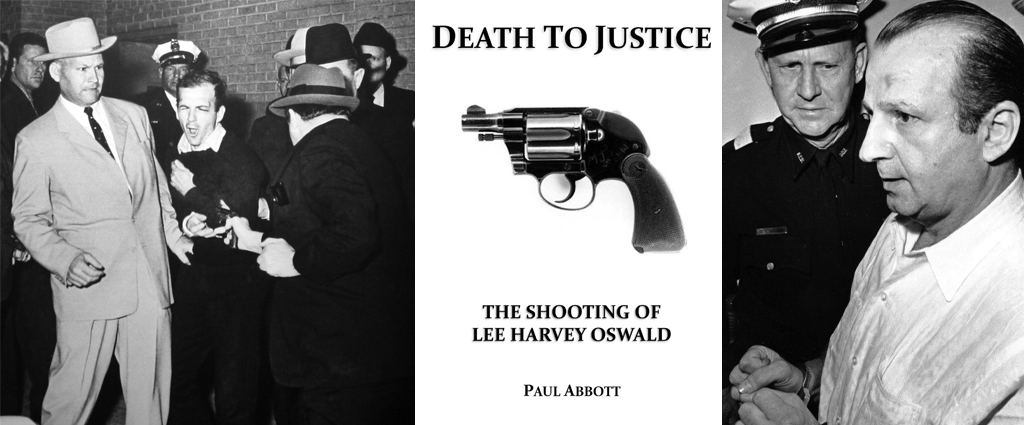
  • Death to Justice: The Shooting of Lee Harvey Oswald – Part 1

    Death to Justice: The Shooting of Lee Harvey Oswald – Part 1


    Foreward

    by Paul Bleau

    Paul Abbott and I live at opposite ends of the world – he in Australia and I in Canada. We got to know one another because of the Garrison Files. After reading some ten thousand pages of these, I knew that hidden away in this collection, there were gems that were not on the radar when it came to analyzing the JFK assassination. Just one example is how Garrison was on the trail of Latinos, with likely links to Guy Banister, who frequently escorted Oswald.

    I knew that if others went through these, they could pick up on clues I may have missed. Paul reached out and provided the community with a research booster that is an archive asset of great value: the Garrison Files Master Index. Garrison’s unfairly dismissed primary research can now be referenced with ease digitally by info ferrets.  It took Paul over a year to build the index, and he deserves our thanks.

    So, when Paul asked me to write a foreword for his book, I felt an obligation to do so. This was risky, in a way, as I refuse to plug material of mediocre quality. What if I did not like it?

    You have guessed by now that I like this book… a lot. Thousands of books have been written about the Kennedy assassination. A few classics have been written about the Tippit murder, which is often covered in more JFK-focused writings. Question to the reader: What do you know about the other murder of that weekend? In my case, it was not much. Yet it, as much as the JFK murder, has all the fingerprints of a conspiracy. It matches the JFK assassination when it comes to poor security. The elimination of Oswald sealed the lips of the most important witness. The shooter likely had assistance to get to the victim and was clearly mob-linked.

    There are many ways one can zero in on the leaders of the JFK assassination conspiracy; Work your way up the ladder around the equally suspicious prior plots to kill JFK; Find out who pulled strings with the media ineptness and the botched autopsy or the Warren Commission charade; Solve the Rosselli, Giancana murders; Figure out who Cubanized Oswald and organized his impersonations… There is a good chance that we will draw vectors pointing in the same direction to the string pullers.

    Ask yourself who organized the removal of the witness who, with his life on the line, could have revealed everything we have painstakingly come to know, suspect about him and his associations and obviously those who conspired to kill Kennedy would be the prime suspects. Yet what do we really know about this crime. Certainly, the Warren Commission’s lame explanation around a series of unfortunate mishaps that led to his unfortunate death should carry even less weight than their impeached whitewash of the JFK assassination. I mean really, two misguided lone nuts… Give me a break!

    Who were the witnesses? What did they say? What was the series of events that led this obvious ruse to obstruct justice? How could this murder have been carried out? Who are the persons of interest? This book delves into all of this and a lot more. Factually, brilliantly and clearly! 

    It is amazing how one Australian on the opposite end of the planet from Dallas can say ten times more about this murder than the FBI, CIA, Warren Commission and Dallas Police Department combined.

    The man who gave us the master index to the Garrison files has now provided us with the all-defining book around the unsolved murder of the most important witness of the twentieth century, which will stand as the go-to reference on the most ignored murder of that infamous weekend in November 1963 in Dallas and shed light coming from an ignored source on the mother of all conspiracies.

    (End of foreward by Paul Bleau)

    Read an excerpt in Part Two

  • Death to Justice: The Shooting of Lee Harvey Oswald – Part 2

    Death to Justice: The Shooting of Lee Harvey Oswald – Part 2


    CIVILIANS OVERLOOKED

    Having laid out the geography of City Hall and the Annex Building basement levels and examining the many points not guarded, therefore could be accessed through, it is now important to focus on the accounts of those present in and around the basement prior to and during Lee Oswald’s shooting.  Given there were just under three hundred statements made regarding the Oswald shooting, it will be useful to group as many present as possible into categories: citizens, law enforcement, and media. And beyond those, specific instances and locations of events. With this approach, we can focus in depth on the many narratives that took place across City Hall during the hours leading up to Oswald’s shooting. 

    The most under-represented cohort of witnesses that day were the civilian employees of both City Hall and the Dallas Police Department. While it is true that none were present to directly witness Jack Ruby shooting Oswald, their testimonies regarding the preparations for the transfer and the aftermath provide important pieces to the overall picture of the puzzle, as it were. However, other than in records of the DPD investigation and the Warren Commission, there is little to no reference to be found regarding these people and their stories – until now. 

    Below is the list of non-Police and media personnel that were at or outside City Hall that morning and who provided at least one statement to the subsequent investigations:


    Fred Bieberdorf – First Aid Attendant

    Wilford Ray Jones – Bystander

    Frances Cason – Dispatcher

    Edward Kelly – Maintenance

    Napoleon Daniels – Former police officer

    Louis McKinzie – Porter

    Nolan Dement – Bystander 

    Johnny F. Newton – Jail Clerk

    Doyle Lane – Western Union Supervisor

    Edward Pierce – Engineer

    Harold Fuqua – Parking Attendant

    Alfreadia Riggs – Porter

    Michael Hardin – Ambulance Driver

       John Servance – Head Porter


       Jerry D. Slocum – Jail Clerk


    Any reasons behind the seemingly random nature of who was and was not interviewed by which investigation remains anybody’s guess particularly when it came to who the DPD did not interview. Consider, for instance, how crucial the testimonies of Dallas locals Fred Bieberdorf, who provided Oswald with first aid after he had been shot, and Michael Hardin, who drove the ambulance that rushed Oswald to Parkland Hospital, ought to have been considered but were not taken. 

    That aside, we will first focus on a group of workers who were employed to ensure the smooth running of all infrastructure across both buildings of the City Hall complex including the basement car park. They were:

    Harold ‘Hal’ Fuqua

    Alfreadia Riggs

    Edward Kelly

    John Servance

    Louis McKinzie

    Edward Pierce

    For the porter and parking workers, their base of work was clearly the car park in the City Hall basement. Their jobs were focused on keeping the area in order, getting police personnel cars parked or ready for use and keeping the general public from parking down there – which was most prevalent when it came to jail inmate arrivals and departures. For the maintenance and engineer workers, their work would take them to all parts of both buildings including the utilities spaces across the sub-basement level. There was also a female standing with the workers who was identified as a telephone operator by the name of Ruth – surname unknown – and it is not evident what her movements were after that point. 

    Once the search of the basement began, all media personnel were apparently cleared out but the City Hall workers remained in the far eastern end of the basement where the stairs and elevators went up to the Annex Building, having already stopped work to watch the comings and goings in preparation for the transfer. To this point, Harold Fuqua even testified to the FBI of observing car trunks being opened and searched.(1)

    Edward Pierce also thought they could stay and watch the proceedings that morning up to and including Oswald’s transfer if they kept out of the way. On the face of it, this was a fair assumption given where they were all positioned: nowhere near the transfer route and out of sight of the television cameras. But they were ordered to clear out of the basement and not just for the time it took police personnel to search it. In his own testimony to the DPD, it was Reserve Officer Brock who gave these orders.(2) And presumably this was done a few minutes after he arrived in the basement for assignment at around 9:30am.

    Collectively, it is clear that the workers followed this directive by taking the service elevator up to the First Floor of the Annex Building. This was because the two public elevators had their power cut and were not functioning. Porter, Louis McKinzie, who was responsible that day for running the service elevator took the group up that way to the First Floor. From there the group would walk across to the City Hall Building to find a place to watch the transfer. Soon, Brock called for McKinzie to bring the service elevator back down so he (McKinzie) could escort, according to Brock’s own testimony to the Warren Commission, ‘one of the TV men over there, (who) wanted to go up the fourth – fifth floor to do some kind of work with the equipment there.’ Both Brock and McKinzie would corroborate that the repair man only spent a few minutes doing whatever it was he was doing up in the upper floors of the Annex Building before being brought back down by McKinzie. There is no testimony from any of the media personnel present that day to explain who this person was and what it was they were doing. After that, Brock told McKinzie to leave the service elevator locked on the First Floor and not bring it back down to the basement. McKinzie did so by locking it in place with a key, then hung it on a hook within as was common practice. In his testimony to the Warren Commission, the time was 10:00am.(3) He then walked along the hallway on the First Floor of the Annex Building to the City Hall Building. McKinzie confirmed in his testimony to the Warren Commission that there were three ‘passageways’ that connected the two buildings. They were on the First (Ground), Second and Third Floor and each could be locked with a metal, accordion-style expanding gate. Over nights and on the weekends, these gates were routinely locked so it is easy to imagine that they were in all probability locked on that day too and that is when Edward Pierce noticed as much and at least unlocked it so he and the others could get through.

    Once in the City Hall Building, the workers, not wanting to miss any of the happenings surrounding Oswald’s transfer, had stayed on the First Floor, and walked to the Commerce Street entrance. From there, behind the locked glass doors they stood and watched the activity outside on Commerce Street and waited to watch Lee Oswald be driven away. This is where Louis McKinzie would rejoin them. 

    It appears that the group stayed together in this location for up to one hour. At which point, Harold Fuqua(4) and Alfreadia Riggs(5) decided to leave to find a television to watch the coverage of the transfer instead. 

    A Circuitous Journey

    Having decided to leave the other workers at the Commerce Street entrance, Harold Fuqua and Alfreadia Riggs set off to find a television. Having both been long-serving employees of City Hall (Fuqua – 6 years, Riggs – 7 years) they would have known that the nearest television was down in the Locker Room in the sub-basement level – two floors directly below. However, given they had been ordered out of the basement as a security measure, and Oswald had still not been transferred, it is understandable that they chose to avoid taking a direct route to the Locker Room as it would have likely resulted in them being turned away or worse, in trouble.

    Instead, they retraced the way they had come with the other workers from the Annex Building. From there, they continued along the First Floor of the Annex Building to the far eastern end where the elevators and stairwell were. As McKinzie had left the service elevator locked on the First Floor, it was in position for them to walk through it and exit through the rear door and out to the fire escape and passage that led directly to the outer door. According to both Riggs and Fuqua in their testimonies to the Warren Commission, it was Riggs who used the keys that McKinzie had left hung up in the elevator to unlock the outer door. He kept them with him but said that he made sure the alleyway door was locked by shaking on the door handle. This is an important point that we will revisit later. 

    Riggs and Fuqua walked through an alleyway to Main Street and began to walk west – along the front of the Annex Building. They then came to the top of the ramp that led from the street down to the basement. This is where Officer Roy Vaughn had been standing guard for at least the last hour. And it was this point where Jack Ruby was most commonly purported as entering the basement in time to shoot Oswald. We will also revisit this location and the comings and goings of people there in more detail. However, Vaughn did confirm in his testimony that ‘some city hall janitorial’ staff approached on foot from the east (6) – which is the direction Riggs and Fuqua would have come from. And they said they stopped at the top of the ramp for only a few moments to look down into the basement before walking on. Vaughn also corroborated this. 

    Riggs and Fuqua rounded the corner of Main and Harwood Streets and stopped below the steps up to City Hall. According to Riggs, Fuqua asked him to go down the steps and check to see if ‘it would be all right for us to go down because we (they) were under the impression they had the police – had a police officer on the door.’ Riggs did so and discovered that there weren’t any officers guarding the basement entrance from there into City Hall so he turned around and told Fuqua to come down. This further reiterates the fact that all public entrances into City Hall that morning were not guarded and therefore secure. Riggs and Fuqua walked down the hallway and got as far as the door before the jail office. There they got close enough to see all of the media assembled. They turned right and headed down the corridor that led to the Records Room, Assembly Room, and the stairs down to the Locker Room. Once down there they encountered someone who was all alone. Let’s pick it up with Riggs’ recollection to the Warren Commission’s counsel, Leon Hubert with what happened next:

    Hubert:  You mean you went down into the locker room? That is where all the policemen have their lockers and there’s a recreation room and television and —

    Riggs:     Yes, sir, and television and – and there was a jail attendant down there, actually he didn’t work in the jail office, he’s not a policeman, but he works in the jail office. 

    Hubert:  What is his name? Do you know?

    Riggs:     No, sir. I really don’t. He told us that he didn’t think they were going to show it on television. He imagined they were going to run a tape and show it later on. Said, “Well, we should have stayed up there. Maybe we could have seen him when they brought him out—”

    Riggs and Fuqua testified to the Warren Commission on the same day – April 1st 1964. This was no coincidence as witnesses were organised into categories, particularly when the WC lawyers travelled to take testimonies. Riggs gave his testimony at 10:30am that day and Fuqua, at 3:55pm. Yet Counsel Hubert, who interviewed both men, did not pursue the question of the unidentified man in the Locker Room with Fuqua. But thankfully, Fuqua corroborated the encounter with the man and that he said he thought the transfer would be shown as reruns only. Yet, Hubert did not ask Fuqua if he could identify him. It can only be chalked up as another thread of questioning that was cut frustratingly early at the quick. So, we are left with some clear questions to consider: 

           Who was the man Riggs and Fuqua encountered in the Locker Room? Per Riggs’ speculation it well could have been any kind of a police officer that he saw or associated with the jail office. And this could feasibly have been any officer from reserve to patrol officer to detective – as all had reason to be there during normal times of operation. But, as we will uncover in later chapters, there is a clear candidate for who the man was that Riggs and Fuqua encountered.

           Why would the man urge Riggs and Fuqua to go somewhere else to observe Oswald’s transfer? The locker room was large enough for them all to sit and watch whatever coverage was broadcast so what was the big deal with redirecting Riggs and Fuqua away?

    Riggs bought a can of chilli from a vending machine, and he ate from it as he and Fuqua left there to go back upstairs. According to both men, they stood in the Harwood Street hallway and were there when Oswald was shot. They both would testify to not seeing it take place, just to hearing and seeing the chaos that broke out. In terms of other people mentioned so far in this book, their position was approximately a couple of metres behind cameraman, James Davidson. 

    After the shooting, Riggs and Fuqua kept out of the way but were able to note that all entrances had been sealed. When things had calmed down, Fuqua testified to the WC that he asked Captain George Lumpkin to escort he and Riggs across the basement car park to the service elevator and stairwell. None of the seven City Hall workers listed earlier in this chapter were interviewed for the Dallas Police investigation, despite being among the most accessible of people to do so. Perhaps, it was because they were all presumed to have not been in the immediate vicinity of the shooting. But Riggs and Fuqua were mentioned in others’ testimony to the DPD such as Roy Vaughn. And others in the basement hallway would have seen them to identify them if only for the uniforms Riggs and Fuqua were wearing. Yet they were still not noted and considered for interviewing. But this does not diminish the fact that their movements reinforce the point of how lax security was across multiple points of the City Hall complex. 

    The Attorney

    Dallas Attorney, Tom Howard’s law firm was situated in one of the buildings across Harwood Street from City Hall. On the morning of Oswald’s transfer, as he would have done, no doubt, many times before, he walked over to the City Jail. On this occasion, he would tell the FBI, he did so because he had received a call from someone in the jail office on behalf of someone else, presumably an inmate.(7) He was able to enter down into the basement level of City Hall from Harwood Street – down the same steps that Harold Fuqua and Alfreadia Riggs had. He did so with the intention of taking the elevator up to the Fifth Floor from the jail office. The obvious inference being that the main entrance from Harwood Street would have been locked – like the ones on Commerce and Main Streets. 

    Having walked down to the jail office, Howard testified that he did get to the elevator there and punch the button to go to the Fifth Floor. He said that he then turned to someone he presumed was a detective and asked if they were ‘fixing to take him (Oswald) out of here?’ Oddly, Howard couldn’t recall if the detective said anything in response. 

    In any event, Howard did not go up in the elevator. Instead, he found his way back out into the hallway. Soon he would notice a ‘sudden jostling and shoving among the newsmen’ and then he heard a shot. He did not see Lee Oswald or Jack Ruby or any of the shooting. Instead, according to his own words, he turned around and simply walked back along the corridor he had entered from, then out onto Harwood Street and stood on the sidewalk. There he would confer with his legal partner, Coley Sullivan, before returning over the road to their offices. 

     Using the testimony of others, we can apply some firm question marks to Howard’s one and only account of his movements in the City Hall basement in the moments prior to Oswald emerging and being shot. 

    Detective Homer McGee told both the DPD(8) and FBI investigations(9) that he was standing inside the jail office. There was an information desk and window which was opposite the elevator that faced out into the hallway. He noticed Tom Howard walk up to the window out in the hallway from either the Commerce or Harwood Street doors. Recall the layout of the basement because, even at that junction, it really was possible to access the basement level from the steps that ran down under both the Commerce and Harwood Street steps. According to McGee, Oswald then emerged from the elevator to be led out for the transfer. As that was happening, McGee said that Howard waved through the window, said that he’d seen all he’d needed to see and walked back up the hallway. Moments later, Oswald was shot. 

    Detective H. Baron Reynolds was the only other person to positively identify Tom Howard in the ‘lobby’ outside of the jail office in the moments just prior to the shooting.(10) And all Reynolds could add was that Howard was standing behind two uniformed officers. Tom Howard is just another case that exemplifies how easy the basement in City Hall was to access, right up to when Oswald was shot. However, what is even more strange about the case of Howard is the fact that, in barely a matter of hours, he would be acting as Jack Ruby’s lawyer. 

    If  Detectives McGee, and to a lesser degree, Reynolds, are to be believed, they put massive holes in Howard’s account of him being in the jail office, getting as far as the elevator, saying something to a ‘detective’ but not recalling what was said to him. So, if Howard was lying about his movements in the crucial moments prior to the shooting, the question must be asked, why? His stake in the events of the day would apparently only come into play after Ruby had shot Oswald. He and his movements were allegedly of no consequence before that point of time. He could have had genuine reason, as a defence attorney, for being at City Hall Jail. His offices were across the road and clients of his were in the jail. But the coincidence of him being there at that point in time and his saying that he had ‘seen everything he had needed to see’ before exiting certainly is curious. 

    We will revisit the matter of Tom Howard in a later chapter but while we are focusing on the vicinity of the jail office, let’s account for the two civilian clerks that were working in there on the morning of Oswald’s shooting.

    The Rest

    Johnny F. Newton(11) and Jerry D. Slocum(12) were not police officers – both were civilian clerks for the jail office. According to their testimonies, that morning was business as usual in terms of the processing of incoming and outgoing jail inmates. Neither testified to venturing away from their workstations, down to the Locker Room for instance, or that they had received any special instructions nor experienced any changes to their workplace. Only Newton would comment about the build-up of police officers and media and his impressions of the shooting aftermath. However, one of his and Slocum’s colleagues, Information Desk clerk, Melba Espinosa, according to Detective Buford Beaty, was not allowed to enter the jail office, where she worked.(13) Frustratingly and confusingly, she would be turned away near the basement car park giving her claim as one of the few people on the receiving end of any kind of strict police guard work that morning. 

    Nolan Dement was one of many civilians who had stopped on Commerce Street across from the ramp opening. It appears that the DPD chose to interview him because he had a camera, and they wanted to ascertain if he had been in the basement and taken any pictures there. He testified that he had not entered the basement and that he did not take any pictures ‘or have anything of worth for the investigation’.(14) He was one of only two bystanders who were interviewed. One can only wonder again why, if Dement was deemed important enough to interview, then why were a multitude of others who witnessed the before, during and aftermath of the shooting overlooked? The other bystander interviewed, Wilford Jones, wandered between the Main Street and Commerce Street ramp openings before and after the Oswald shooting. He was interviewed by the DPD and stated that he was near the Main Street ramp entrance before walking around City Hall to the Commerce Street entrance.(15) When the shooting took place, he walked to a nearby parking lot for no apparent reason before going back to the Main Street entrance where he saw former police officer, Napoleon Daniels, who we will focus on in a later chapter. Interestingly, he recalled then seeing Attorney Tom Howard telling reporters that he heard of the Oswald shooting while on his way home.

    The remaining civilians listed in the table earlier in this chapter will be discussed in the context of what they were interviewed for by at least one of the subsequent investigations. However, as we have already touched on, there are numerous people that witnessed the events that enveloped the shooting of Lee Oswald but were not called on for any of the investigations. So, as we continue to peel back the layer of the onion by scrutinising the many narratives that took place across Dallas City Hall on the morning of November 24, those that have lain obscured will finally be focused on to help piece together more of the overall puzzle. 

  • The Dallas Police Convicted Oswald without a Trial – Part 2/2

    The Dallas Police Convicted Oswald without a Trial – Part 2/2


    Let us continue with the pervasive and relentless attempt by the local authorities to convict Lee Harvey Oswald, a man without a lawyer.

    KRLD-TV Interview of Jesse Curry.

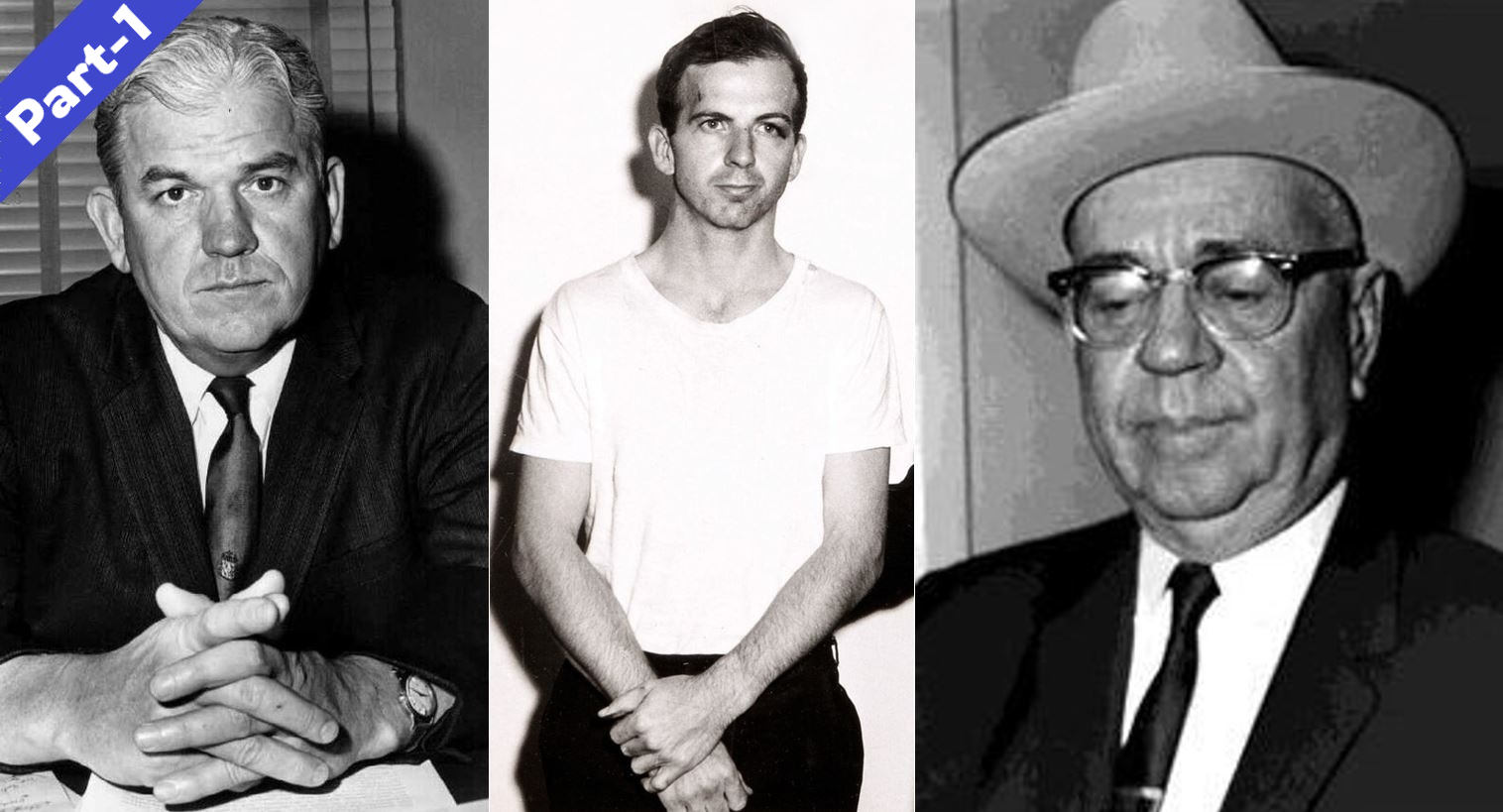
    In an interview with KRLD-TV on November 23rd , Jesse Curry revealed that Lee Harvey Oswald was charged with the attempted murder of Governor John B. Connally.

    Curry. We have one more thing. We have filed on him for assault to murder—
    Q. Assault to what?
    Curry. Assault to murder against Governor John B. Connally. That charge had been filled. (CE2150, Volume XXIV; p. 782.)

    This decision introduces a significant aspect to the case, particularly when contrasted with the Dallas Police’s emphasis on Oswald’s alleged attempt to ‘kill’ Officer Nick McDonald during his arrest—although Oswald was never formally charged with McDonald’s attempted murder.

    Testimonies highlight the incident involving McDonald: Gerald Hill reported that “the gun was fired one time by the suspect but luckily it misfired, the pin hit the shell but did not fire” (Volume XXIV; CE2160; p.804)

    Henry Wade noted that Oswald “struck at the officer, put his gun against his head, and snapped it, but the bullet did not go off.” (Volume XXIV; CE2168; p.820)

    Additionally, Jesse Curry confirmed that “Oswald was attempting to shoot one of the officers in the theater and did snap the pistol.” (See this)

    WFAA-TV Press interview of Jesse Curry.

    Q. Has he named an attorney?
    Curry. I understand now that he is trying to contact attorney Abt, I believe, A-B-T, I believe out of New York… it’s my understanding that this attorney, Abt, had been involved in some of the defense of some communists. (Volume XXIV, CE2152. p. 786.)

    Interview of Louis Nichols, WFFA TVPicture1

    Nichols Testimony to the Warren Commission.

    H. Louis. Nichols, President of the Dallas Bar Association was permitted a short audience with Oswald in his cell on the fifth floor of the Dallas City Jail. Nichols, who publicly stated he did not practice criminal law, was permitted this time with Oswald, rather than the ACLU, whom Oswald was a member and who was a preference for representation. Many people have charged, that this proves that Oswald did not want legal representation, as Oswald declined the services of Nichols, but ask yourself this question: If you were in Oswald’s position, accused and vilified as a communist, presidential assassin, would you not want the absolute best defense available to you? Also, there is another important caveat to this narrative, Oswald would have no way of knowing that this would be his final chance at legal assistance, because in less than 24 hours, he too would be dead.

    For clarity this section has been written in narrative form.

    Nichols. (Do you have) a lawyer,
    Oswald. Well, I really didn’t know what it was all about, (I have) been incarcerated, and kept incommunicado.
    Nichols. (I am here to) see whether or not (you) had a lawyer, or wanted a lawyer.
    Oswald. (Do you) know a lawyer in New York named John Abt.
    Nichols. I don’t know him.
    Oswald. Well, either Mr. Abt or someone who is a member of the American Civil Liberties Union…I am a member of that organization, and I would like to have somebody who is a member of that organization represent me and If I can find a lawyer here who believes in anything I believe in, and believes as I believe, and believes in my innocence as much as he can, I might let him represent me.”
    Nichols. I’m sorry, I don’t know anybody who is a member of that organization…what I am interested in knowing is right now, do you want me or the Dallas Bar Association to try to get you a lawyer?
    Oswald. No, not now. You might come back next week, and if I don’t get some of these other people to represent me, I might ask you to get somebody to represent me.

    Nichols then testified; “My inquiry was intentionally very limited. I merely wanted to know whether he had a lawyer, if he had a lawyer then I had no problems.”

    November 24, 1963.

    Kevin Costner as Jim Garrison. “Who grieves for Lee Harvey Oswald? Buried in a cheap grave, under the name Oswald? Nobody.” (Oliver Stone; JFK)

    WFAA-TV Press interview of Captain Will Fritz. 11/23

    Q. Captain, is there any doubt in your mind that Oswald was the man who killed President Kennedy?
    Fritz. No, sir, there is no doubt in my mind about Oswald being the man. Of course, we’ll continue to investigate and gather more and more evidence, but there is no question about it.
    Q. Is the case closed or not, then, Captain?
    Fritz. The case is cleared… (Volume XXIV, CE2154. P. 788)

    WFAA-TV. NBC. KHLD. WBAP. Press Conference of Henry Wade.

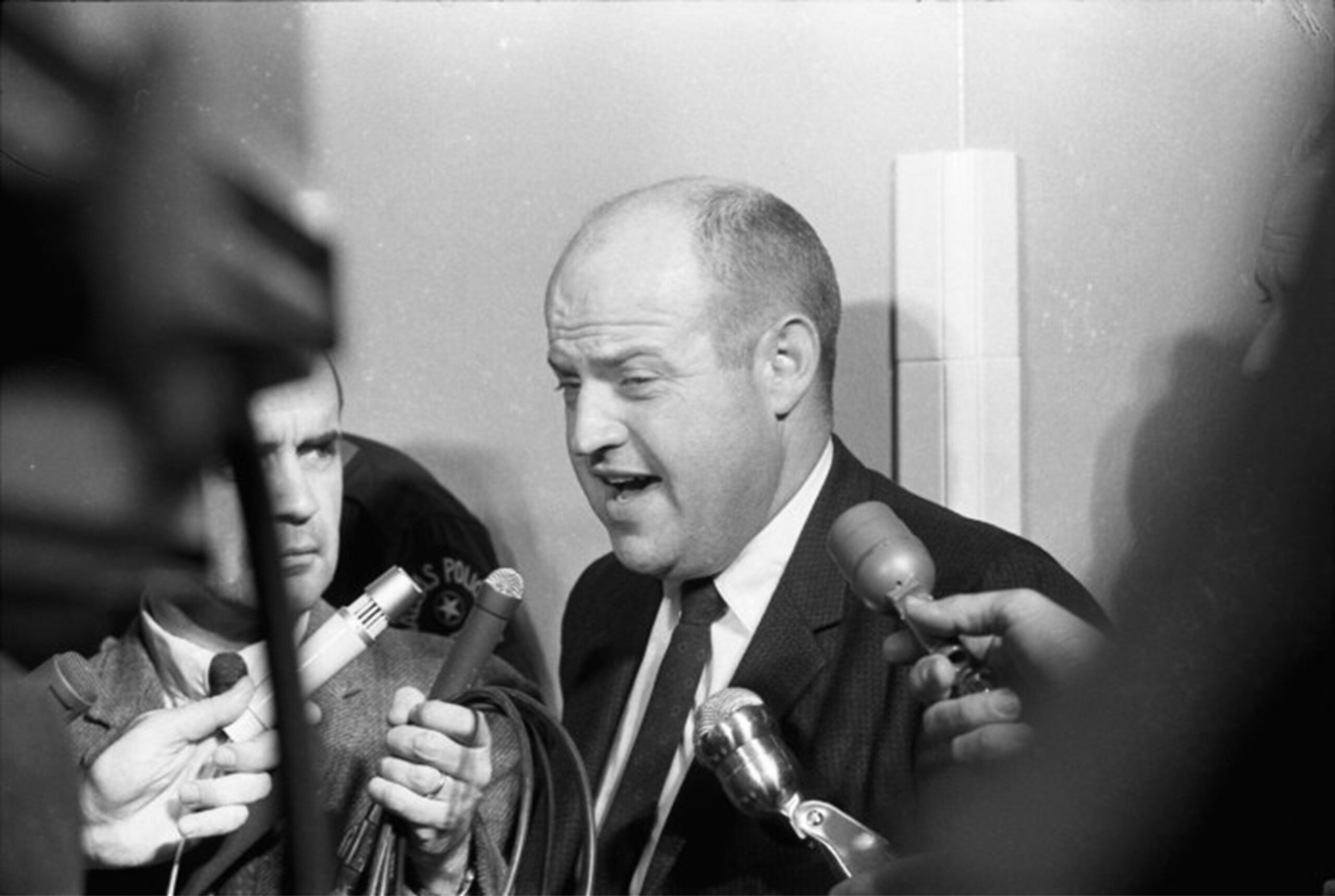
    Sylvia Meagher. District Attorney Henry Wade held a press conference on Sunday night after Oswald was murdered, of which it has been said that he was not guilty of a single accuracy. (Accessories After the Fact; p. 75)

    Before Oswald’s body had even grown cold, District Attorney Henry Wade stood before the assembled television cameras at the Dallas City Jail to ostensibly ‘detail some of the evidence against Oswald for the assassination of the President.’ In this briefing, Wade delivered several dramatic assertions that further skewed the already precarious case against the accused. This press conference, fraught with such distortions, has been meticulously dissected by Mark Lane in ‘A Lawyer’s Brief.’ Lane’s critical examination reveals how Wade’s statements not only tainted public opinion but also demonstrated a stark disregard for the principles of judicial integrity. (See this)

    Wade asserted that a palm print identified as Oswald’s was found on a box situated near the sixth-floor southeast corner window of the Texas School Book Depository.

    Wade. On the box that the defendant was sitting on (around the sixth floor, southeast corner window), his palmprint was found and was identified as his.

    However, this evidence was later significantly qualified. Commission lawyer Wesley Liebeler, in a radio interview on December 30, 1966, pointed out a crucial flaw: “The fact that Oswald’s fingerprints were on cartons has no probative value whatsoever on the issue of whether he was in the window or not, because he worked at the Depository, he could have put his prints there at any time.” (Accessories After The Fact; p. 13)

    Q. Would you be willing to say in view of all this ‘evidence’ that it is now beyond a reasonable doubt at all that Oswald was the killer of President Kennedy?
    Wade. I would say that without any doubt he’s the killer—the law says beyond a reasonable doubt and to a moral certainty which I—there’s no question that he is the killer of President Kennedy.
    Q. The case is closed in your mind?
    Wade. As far as Oswald is concerned, yes.
    Q. How would you evaluate the work of the Dallas Police in investigating the death of the President?
    Wade. I think the Dallas Police done an excellent job on this and before midnight on when (JFK) was killed had (Oswald) in custody and had sufficient evidence what I think to convict him.
    Q. Is there any doubt in your mind that if Oswald was tried that you would have, have him convicted by a jury? With the evidence you have?
    Wade. I don’t think there is any doubt in my mind that we would have convicted him…
    Q. As far as you are concerned, the evidence you gave us, you could have convicted him?
    Wade. I’ve sent people to the electric chair on less. (CE2168, Volume XXVI, p. 819- 823-826.)Picture2

    KRLD-TV Press interview with Jesse Curry.

    Q. Could you tell us sir, (of) the possibility that somebody else might be involved? We’ve had statements in the last couple of days saying; “This is the man, and nobody else”.
    Curry. This is the man, we are sure, that murdered the patrolman and murdered—and assassinated the President. (CE2147. Volume XXIV, p-772.)

    KRLD-TV, Press interview with Jesse Curry.

    Henry Wade. I told them that the man’s wife said the man had a gun or something to that effect… that isn’t admissible in Texas. You see a wife can’t testify. It is not evidence, but it is evidence, but it is inadmissible evidence. (Volume V; p. 223)
    Curry. (We) felt yesterday morning that we were capable of presenting our case to the court and had ample evidence for a conviction…
    Q. What do you consider the high points?
    Curry. We have been able to do this. We have been able to place this man in the building, on the floor at the time the assassination occurred. We have been able to establish the fact that he was at the window that the shots were fired from. We have been able to establish the fact that he did order a weapon… and we feel (this) is the weapon that was used. We have been able to establish the fact that we do have the murder weapon… this is the gun that fired bullets that killed President Kennedy and wounded the Governor.
    Q. How much importance do you attach to this picture?
    Curry . Well, it’s important to us. Whether or not we will be able to introduce it as evidence will be left up to the attorney and judge, of course, but it establishes beyond a reasonable doubt in our mind that he is our man with our guns. (CE397; Volume XVII; p.780-781)

    In point 20 of ‘Assassination 60,’ this issue is addressed; “The question of whether Marina Oswald could have legally testified against her husband, Lee Oswald, raises interesting forensic considerations for the case. Under Texas law, spouses are generally permitted to serve as witnesses for each other in criminal cases. However, a crucial exception exists they cannot testify against each other unless one spouse is being prosecuted for an offence committed against the other. In the context of Oswald’s hypothetical trial, Marina’s testimony would have been excluded based on this spousal privilege. This means that the controversial backyard photographs, which were allegedly linked to Lee, could not have been admitted into evidence to be used against him. This is because Marina’s testimony, which was the sole source of corroboration for the photographs, would have been inadmissible due to the spousal privilege.”

    The Federal Bureau of Investigation.

    In a declassified document from Alan Belmont to Clyde Tolson, Belmont lays out the plan to convince the public of Oswald’s guilt.

    “We will set forth the items of evidence which make it clear that Oswald is the man who killed the President. We will show that Oswald was an avowed Marxist, a former defector to the Soviet Union and an active member of the FPCC, which has been financed by Castro.

    Despite the fact that Oswald is dead, this evidence will be necessary to back up any statement that Oswald was the man who killed the President. At 4:15pm Mr. DeLoach advised that Katzenbach wanted to put out a statement, we are now persuaded that Oswald killed the President…” (See this)

    For a detailed examination of the circumstances surrounding Oswald’s murder, please refer to part 2 of ‘Assassination 60.

    Widespread Condemnation of the Dallas Police.

    The concessions to the media resulted in Oswald being deprived not only of his day in court, but of his life as well. American Civil Liberties Union.

    Theodore Voorhees, chancellor-elect of the Philadelphia Bar Association Stated that Lee H. Oswald had been “lynched” by the Dallas Police & Prosecutorial officials. Although some concern was expressed that Oswald be provided counsel, he said, no member of the legal profession protested the publication of the evidence, the 24-hour interrogation and the violations of the prisoners’ rights. (New York Times, Dec. 5th, 1963, p. 32)

    Ben. K. Lerer, President of the Bar Association of San Francisco. We believe that television, radio and the press must bear a portion of the responsibility which falls primarily on the Dallas law-enforcement officials. Both press media and law enforcement officials must seek to protect the rights of accused persons against the damage to them, and consequently to our system of justice, which can come from revealing information concerning the accused at times when the revelation might inflame the public. (New York Times, Dec. 28th, 1963, p. 23)

    Percy Foreman, Texas Attorney. Federal decisions for at least five years have held that a defendant has a right to legal counsel at every level including arraignment before a justice of the peace. It’s not being done in Texas, but it’s the law, and (Oswald) is entitled to counsel whether he requests it or not.

    Another legal doctrine requires that an appellant show that an alleged abridgement of his rights caused him substantial harm. Foreman stated this could be shown if Oswald is persuaded to sign a confession before he has had the benefit of legal counsel. Foreman said a lawyer should be advising Oswald to insist on an examining trial, as a preliminary hearing is called in Texas. An examining trial requires the state to produce its witnesses and lay out its line of evidence against the accused.

    Foreman said Oswald might be able to show that his trial was prejudiced by inflamed public opinion if he is brought to trial before a lapse of, say, two years. Television and press are far more persuasive than the bill of rights or the code of criminal procedure. Try (Oswald) a month from now, and you might just as well march him out on the courthouse lawn and lynch him.” (St LouisPost Dispatch, 11/24/1963, p.10)

    John De J. Lamberton Jr. Executive Director of the American Civil Liberties Union.

    The American Civil Liberties union charged yesterday that the police and prosecuting officials of Dallas committed gross violations of civil liberties in their handling of Lee H. Oswald, the accused assassin of President Kennedy. The ACLU said that it would have been simply impossible for Oswald, had he lived, to have obtained a fair trial because he had already been tried and convicted by the public statements of Dallas law enforcement officials.

    The ACLU indicted television, radio and the press for the pressure they exerted on Dallas officials. They described the transfer of Oswald from the city jail as a theatrical production for the benefit of the television cameras. The ACLU hold the Dallas police responsible for the shooting of Oswald, saying that minimum security considerations were flouted by their capitulation to publicity.

    If Oswald had lived, he would have been deprived of all opportunity to receive a fair trial by the conduct of the police and prosecuting officials in Dallas. From the moment of his arrest until his murder, two days later, Oswald was tried and convicted many times over in the newspapers, on the radio and over television by the public statements of Dallas law enforcement officials. Time and again high-ranking police and prosecution officials stated their complete satisfaction that Oswald was the assassin.

    As their investigation uncovered one piece of evidence after another, the results were broadcast to the public. All this evidence was described by the Dallas officials as authentic and incontestable proof that Oswald was the president’s assassin. The cumulative effect of these public pronouncements was to impress indelibly on the public’s mind that Oswald was indeed the slayer. With such publicity, it would have been impossible for Oswald to get a fair trial in Dallas or anywhere else in the country, the trial would have been nothing but a hollow formality. (New York Times, December 6th 1963, p.18)

    Harvard Law School. Released a statement in the New York Times, commenting on the deplorable incidents in the Dallas Police station ending in the death of Lee Oswald. From Fri, Nov. 22, through Sunday (24th) the shocking manner in which are processes of criminal justice are often administered was exhibited to ourselves and to the world. The process of investigation and accusation can only be described as a public spectacle, carried on in the Dallas Police station with its halls and corridors jammed with a noisy, milling throng of reporters and cameramen.

    Precisely because the president’s assassination was the ultimate in defiance of law, it called for the ultimate vindication of law. The law enforcement agencies, in permitting virtually unlimited access to the news media, made this impossible. 

    Not only would, it have been virtually impossible to impanel a jury which had not formed its own views on those facts which might come before it, but much of the information released such as statements by Mrs Oswald might have been legally inadmissible at trial. 

    It is ironic that the very publicity which had already made it virtually impossible for Oswald to be tried and convicted by a jury meeting existing constitutional standards of impartiality should, in the end, have made such trial unnecessary. 

    For the fact is that justice is incompatible with the notion that police, prosecutors, attorneys, reporters and cameraman should have an unlimited right to conduct ex-parte public trials in the press and on television.

    (New York Times, December 1st, 1963, p. 10E.)

    New York Times Editorial, The Spiral of Hate.

    The shame all America must bear for the spirit of madness and hate that struck down President John F. Kennedy is multiplied by the monstrous murder of his accused assassin while being transferred from one jail in Dallas to another.

    The primary guilt for this ugly new stain on the integrity of our system of order and respect for individual rights is that of the Dallas police force and the rest of its law-enforcement machinery.

    The Dallas authorities, abetted and encouraged by the newspaper, TV and radio, press, trampled on every principle of justice in their handling of Lee H. Oswald. It is their sworn duty to protect every prisoner, as well as the community, and to afford each accused person full opportunity for his defense before a properly constituted court. 

    The heinousness of the crime Oswald was alleged to have committed made it doubly important that there be no cloud over the establishment of his guilt.

    Yet—before any indictment had been returned or any evidence presented and in the face of continued denials by the prisoner, the chief of police and the district attorney pronounced Oswald guilty. “Basically, the case is closed,” the chief declared. The prosecutor informed reporters that he would demand the death penalty and was confident “I’ll get it.”

    After two days. of such pre-findings of guilt, in the electrically emotional atmosphere of a city angered by the President’s assassination and not too many decades removed from the vigilante tradition of the old frontier, the jail transfer was made at high noon and with the widest possible advance announcement. Television and newsreel cameras were set in place and many onlookers assembled to witness every step of the transfer-and its tragic miscarriage.

    It was an outrageous breach of police responsibility—no matter what the demands of reporters and cameramen may have been—-to move Oswald in public under circumstances in which he could so easily have been the victim of attack. The police had even warned hospital officials to stand by against the possibility of an attempt on Oswald’s life.

    Now there can never be a trial that will determine Oswald’s guilt or innocence by the standards of impartial justice that are one of the proudest adornments of our democracy. (New York Times, Nov. 25th, 1963, p. 18)

    J Edgar Hoover, Director of the FBI. I dispatched to Dallas one of my top assistants in the hope that he might stop the Chief of Police and his staff from doing so damned much talking on television. Curry, I understand, cannot control Capt. Fritz of the Homicide Squad, who is giving much information to the press.… we want them to shut up. All the talking down there might have required a change of venue on the basis that Oswald could not have gotten a fair trial in Dallas. There are bound to be some elements of our society who will holler their heads off that his civil rights were violated—which they were. (see this)

    Warren Commission.

    The Commission agrees that Lee Harvey Oswald’s opportunity for a trial by 12 jurors free of preconception as to his guilt or innocence would have been seriously jeopardized by the premature disclosure and weighing of the evidence against him.

    The news policy pursued by the Dallas police, endangered Oswald’s constitutional right to a trial by an impartial jury. Neither the press nor the public had a right to be contemporaneously informed by the police or prosecuting authorities of the details of the evidence being accumulated against Oswald….It would have been a most difficult task to select an unprejudiced jury, either in Dallas or elsewhere. The disclosure of evidence encouraged the public, from which a jury would ultimately be impaneled, to prejudge the very questions that would be raised at trial. (WCR, pp. 238-240)

    The American Bar Association.

    The widespread publicizing of Oswald’s alleged guilt, involving statements by officials and public disclosers of the details of ‘evidence’ would have made it extremely difficult to impanel an unprejudiced jury and afford the accused a fair trial. It conceivably could have prevented any lawful trial of Oswald due to the difficulty of finding jurors who had not been prejudiced by these public statements.

    Official laxity resulting in excessive, and prejudicial publicity reached its climax in the pre-announced removal of Oswald from the City jail, and the spectacle of his murder– literally in the arms of police officers, and before the eyes of the television audience. (CE2183, Volume XXVI; pp. 856-857)

    Nicholas Katzenbach.

    The Dallas police have put out statements on the Communist conspiracy theory, and it was they who were in charge when (Oswald) was shot and thus silenced. The matter has been handled thus far with neither dignity nor conviction. Facts have been mixed with rumour and speculation. We can scarcely let the world see us totally in the image of the Dallas police when our President is murdered. (see this)

    Henry Wade.

    Wade testified that on November 23, various lawyers reached out to him, expressing their concern and outrage over the handling of Lee Oswald.

    Henry Wade. “Saturday November 23. we had calls from various people and most of them was from people here in the East calling lawyers there in Dallas rather than me, and them calling me.”
    Lee Rankin. “ What were they saying to you about that?”
    Henry Wade. “Well, they were very upset, one, in looking at American justice where the man didn’t have an attorney, as apparently, and two, that too much information was being given to the press too, by the police and by me.” (Volume V; p. 239)

    Ruby, The Hero?

    The depth of the animosity towards Oswald, cultivated by the Dallas police, is starkly illustrated by the flood of congratulatory telegrams sent to Jack Ruby following his murder of Oswald. These messages prompt a disconcerting reflection on the state of justice in America: Have we really descended to a point where such an act is celebrated? Is this what we consider justice? (see this)Picture3

    Picture4DA of Dallas County, Craig Watkins.

    Prosecutors in Dallas have said for years, any prosecutor can convict a guilty man, it takes a great prosecutor to convict an innocent man. Melvyn Carson Bruder. (See this)

    Craig Watkins, who was the first African American in history to be elected as Dallas District Attorney in 2006, stated in a 2008 interview that the DA’s office under Henry Wade’s tenure was rife with; “Negligence, prosecutorial misconduct and faulty witness identification. It’s just been a mindset of conviction at all costs around here.

    Q. You talk about the mindset of winning convictions at all costs. The legendary Dallas prosecutor Henry Wade, who held the job you now hold for many, many years, embodied that philosophy. He’s known to have actually boasted about convicting innocent people—that convincing a jury to put an innocent man in jail proved his prowess as a prosecutor.

    Watkins. Oh yeah, it was a badge of honor at the time—to knowingly convict someone that wasn’t guilty. It’s widely known among defense attorneys and prosecutors from that era. (See this)

    Win At All Costs.

    Attorney Kenneth Holbert. “(Wade) was a brilliant attorney. He got the maximum that was available. The maximum is what he always got.

    Dallas Assistant District Attorney Edward Gray “Even in cases where evidence was weak, Wade would go all out, go for broke, be super-competitive.”

    Innocence Project of Texas. “ When someone was arrested, it was assumed they were guilty. I think prosecutors and investigators basically ignored all evidence to the contrary and decided they were going to convict these guys.” (See this)

    Below I have highlighted the legacy of injustice which occurred under the tenure of DA of Dallas County, Henry Wade.

    Randall Dale Adams (1976): Wrongfully convicted of the murder of Dallas police officer Robert Wood. His conviction was overturned in 1989 after new evidence emerged from the documentary The Thin Blue Line.

    Adams describes an all too familiar story regarding his interrogation at the hands of the Dallas Police;

    “The day they picked me up, December 21st, they took me upstairs—they put me in a little room. Gus Rose walked in; he had a confession there he wanted me to sign. He said that I would sign it, he didn’t give a damn what I said, I would sign this piece of paper he’s got. I told him I couldn’t. I don’t know what the hell you people expect of me but there’s no way I could sign that. He left, he came back in 10 minutes and threw a pistol on the table. Asked me to look at it. Which I did, I looked. He asked me to pick it up. I told him no; I wouldn’t do that. He threatened me, again I told him no. He pulled his service revolver on me, we looked at each other, to me seemed like hours, I do not like looking down the barrel of a pistol. I do not like being threatened… I kept telling them the same thing, they did not want to believe me. Never once was I allowed a phone-call. Never once was an attorney there. I don’t know how long this had been, I know I had smoked two packs of cigarettes, I had been out for a long time. (See this)

    Lenell Geter (1982): Convicted of armed robbery and sentenced to life imprisonment. His conviction was overturned in 1983 after investigative journalism by CBS News and others demonstrated his innocence. (See this) Guilty of Innocence|The Lenell Geter Story 1987

    James Woodard (1981): Convicted of murder and spent 27 years in prison. Exonerated in 2008 through DNA testing. (See this)

    Thomas McGowan (1985): Wrongfully convicted of rape and burglary based on misidentification. Exonerated in 2008 after DNA evidence proved his innocence. (See this)

    David Shawn Pope (1986): Sentenced to life in prison for a rape he did not commit. Exonerated in 2001 through DNA evidence. (See this)

    Joyce Ann Brown (1980): Brown was wrongfully convicted of a fur store robbery and the murder of the store employee. She was exonerated in 1990 after proof emerged that Wade had withheld critical evidence from the defense. (See this)

    Richard Miles (1994): Though slightly after Wade’s tenure, this case reflects ongoing issues from practices during Wade’s era. Miles was wrongfully convicted of murder and attempted murder based on weak evidence and prosecutorial oversights. He was released in 2009 and officially exonerated in 2012. (See this)

    Johnnie Earl Lindsey (1983) was wrongfully convicted for a rape he did not commit, a verdict which was significantly influenced by flawed eyewitness identification procedures, particularly the use of a photographic line up. In this lineup, Lindsey and one other individual were the only two shirtless men depicted, a factor that had unduly influenced the victim’s identification. This line up process, which lacked procedural safeguards, was a pivotal factor leading to Lindsey serving over 26 years in a Texas prison. His innocence was finally proven through DNA testing facilitated by the Innocence Project, leading to his exoneration in 2009. (See this and this)

    Tommy Lee Walker (1955):Tommy Lee Walker was undeniably innocent, yet his life was tragically taken due to the deeply flawed and corrupt practices under Henry Wade’s tenure as Dallas County DA. The aggressive pursuit of convictions over fairness, a hallmark of Wade’s leadership, led to a gross miscarriage of justice in Walker’s case. This wrongful execution was carried out despite the complete absence of physical evidence and relied heavily on a confession that was coerced without legal representation. L.A. Bedford, Dallas County’s first black judge and a respected attorney, expressed profound outrage over the case, describing it as the “greatest injustice I have ever seen in my life.”

    During Tommy Lee’s interrogation, the Dallas Police used tactics similar to those later employed against Buell Frazier. Captain Fritz, who led the questioning, spent hours grilling Lee who said that; “Fritz told him he had received a phone call implicating him in the murder of Venice Parker. Fritz had received no such call. Fritz said that there were witnesses and that police knew what he had done. Fritz had a reputation for being unusually effective at wringing admissions of guilt out of suspects, and his techniques worked in this case as well. Years later, we know much more about how often false confessions occur and what can trigger them—fear, cultural differences, sleep deprivation, and feelings of hopelessness, all of which played a role in this case.”

    “Tommy Lee said later that he was intimidated when Fritz shouted at him again and again that he was lying about the murder. He said Fritz asked repeatedly if he had to bring in the men from upstairs when Tommy Lee balked at signing a confession. He believed that was a reference to the two officers he’d earlier seen beating a man. (see this and this)

    Since 2001, there have been a total of 44 exonerations in Dallas, according to the District Attorney’s office, while 100s of cases are still waiting to be reviewed. (See this)

    Summation.

    “No one has ever been able to put Oswald in the Texas School Book Depository with a rifle in his hand.” Jesse Curry. (Dallas Morning News-11/6/1969)

    While in the grasp of the Dallas Police, Oswald’s life was significantly diminished, it was reduced to being a central figure in a highly charged and publicized criminal case, without the benefit of the usual legal protections afforded to a suspect. Under intense scrutiny, both by law enforcement and the media, Oswald was paraded before cameras, leading to widespread speculation and judgment by the public. This spectacle overshadowed his rights and dignity, casting him as a villain in a predetermined narrative rather than a suspect with the right to a fair trial.

    Moreover, Oswald’s ability to defend himself or to present his side of the story was virtually non-existent, as he was quickly labelled the assassin of President Kennedy before any trial could take place. The immediate and overwhelming presumption of his guilt, coupled with the hostile and chaotic environment of the Dallas Police headquarters, meant that Oswald was deprived of the presumption of innocence. His life, in those final days, became a mere footnote in a broader national tragedy, overshadowed by the grief and anger of the entire world.

    Mark Lane once posed this question;If Oswald is innocent—and that is a possibility that cannot now be denied—then the assassin(s) of President Kennedy remain(s) at large.” (See this)

    More by Johnny Cairns.

    Assassination 60

    Our Lady of the Warren Commission

    A Presumption of Innocence: Lee Harvey Oswald

    Deanne Stillman’s American Confidential Exposed


    Go to Part 1 of 2

  • The Dallas Police Convicted Oswald without a Trial – Part 1/2

    The Dallas Police Convicted Oswald without a Trial – Part 1/2


    “The dead cannot cry out for justice. It is a duty of the living to do so for them.” – Lois McMaster Bujold

    History is replete with injustice, which often blooms from the seed of tragedy. In the tumultuous aftermath of the Dealey Plaza catastrophe, the roots of such an injustice would weave itself tightly around Lee Harvey Oswald, accused assassin of President John F. Kennedy.

    In little under the 48 hours from his arrest to his violent execution, within the bowels of the Dallas City Jail, Oswald found himself ensnared in a caricature of justice at the hands of the Dallas Police. Faced with concocted accusations and deprived of his right to counsel, Oswald’s final hours were characterized not by the proclamations of a political assassin, but by the desperate protestations of his innocence.

    “I don’t know what dispatches you people have been given but I emphatically deny these charges. I have nothing against anybody, I have not committed any acts of violence.” (See this)

    Yet, amidst these protests, the authoritative voices in Dallas relentlessly pronounced his guilt. They nourished the fears of the American public with a narrative designed for convenience rather than for justice.

    However, the case of the lone assassin is not founded on a bedrock of empirical evidence, but rather it is entrenched in a brew of circumstantial conjecture and outright fabrication. The case stands as a carefully crafted facade tailored to meet the demands of expediency. Under scrutiny, it falls, as Senator Richard Schweiker said, like a house of cards.

    As you navigate the vast array of guilt-laden assertions, consider these critical questions: During his all-too-brief detention, did the Dallas Police ever uphold Oswald’s constitutional right to be presumed innocent? Could Oswald have received a fair trial in Dallas? Or anywhere in the United States for that matter? Or had the actions of the Dallas officials made Oswald’s hypothetical trial a perfunctory charade devoid of justice? You decide.

    November 22, 1963

    Picture1A Perpetual Rush to Judgement.

    Sylvia Meagher. The Dallas Police are not so bad. Look how quickly they caught Jack Ruby.(Accessories After the Fact; p. xxvi)

    Within just 76 minutes of his arrest, Lee Oswald was publicly identified as a suspect in the assassination of President John F. Kennedy.Brandishing a photograph of Oswald for the television cameras, a newsman declared, “This is what the man charged with the assassination of the President looks like.” This rapid transition—from a man “sneaking” into a movie theater to being universally acclaimed as a communist Presidential assassin—was nothing short of remarkable. (WCR; p. 241; WCR, p. 206)

    The media worked fast, broadcasting to an anxious nation the erroneous events surrounding Oswald’s arrest.

    “Here in Dallas the man that all America is looking at this time is 24-year-old Lee H. Oswald, being interrogated at the Dallas City Police building. At the time of his arrest in a theater of the Oak Cliff section of Dallas he was subdued after ‘killing’ a Dallas Police Officer with a snub-nosed revolver. Struggling with another officer and striking him with that pistol and during that struggle he was heard to shout It’s all over now. I’ve got me a President and a cop, and I’ll try for two more. A fanatic in every sense of the word.” (See this)

    Air Force One was informed of Oswald’s sole guilt in the murder as it transported the body of the martyred President back to Washington. The narrative carried was unequivocally dismissive of any well-orchestrated conspiracy behind Kennedy’s murder, preferring to lay the heinous crime squarely on the shoulders of a ‘lone-nut assassin’.

    Simultaneously, the plane carrying President Kennedy’s cabinet members from Honolulu back to DC, was fed the same story. As Pierre Salinger details in With Kennedy. Salinger was provided with extensive information about Oswald’s background, his ‘defection’ to the Soviet Union and his affiliations with the Fair Play for Cuba Committee.(Praise From A Future Generation; by John Kelin p.5, With Kennedy p; 28)

    The Line-Ups.

    As I documented in point 24 of “Assassination 60”, the line-ups Lee Oswald was subjected to by the Dallas Police should be regarded as “utterly worthless.”Yet, the most outrageous incident occurred during the parade attended by witnesses Ted Calloway, Sam Guinyard, and Cecil McWatters. Calloway testified that before their viewing of the suspects, he was told by the Dallas Police that:”We want to be sure. We want to try and wrap him up real tight on killing this officer. We think he is the same one that shot the President, and if we can wrap him up tight on killing this officer, we have got him.( WC Volume III; p. 355)

    As Gerry Spence quipped to Calloway during the London mock trial of Lee Oswald,“Do you think that’s a fair and impartial way to make a line-up on somebody? I mean if you were standing in the line-up, innocent, charged with a crime and somebody said, we want to wrap him up real tight— because if we can show he killed the Officer, we got the man who killed the President, do you think you would have got a fair shake?” (For more on the line-ups, please see point 24 of Assassination 60. And this)

    NBC Press Interview with Sergeant Gerald Hill.

    In this interview, Sergeant Gerald Hill discusses Oswald’s insistence on his rights and firmly asserts his absolute conviction of Oswald’s guilt in both the Kennedy and Tippit murders.

    Hill. Oswald started demanding that he be allowed to see a lawyer…and demanding his rights.
    Q. Do you believe that he is the same man who killed the police officer?
    Hill. Having been in it from the very beginning, as far as the officer’s death is concerned, I am convinced that he is the man that killed the officer. I am convinced that the man we have is the man who shot the officer.

    Yet, Hill knew fine well that hours before this interview, he had declared to the police dispatch that:the shell at the scene indicates that the suspect is armed with an automatic .38 rather than a pistol. (WC Volume XXIII; CE1974-78; p. 870)

    Why is this significant? Because the weapon alleged to have been taken from Oswald at the Texas Theatre was a revolver, not an automatic.

    The interview then pivots to the capabilities of the cannibalized and defective WWII, Mannlicher Carcano, the alleged rifle used in the murder of President Kennedy. Hill assures the newsmen that it required ease, rather than extraordinary skill, to obtain from the Carcano the performance required to accomplish the assassination single-handedly.

    Hill. (From the Texas School Book Depository, Oswald) would have had a clear shot, and with a scope it would have probably been real easy.
    Q. (President Kennedy) was struck from behind, wasn’t he?
    Hill. I understand that he was, yes, sir. That the shots were fired from behind. ( WC CE2160, p. 804-805)Picture2

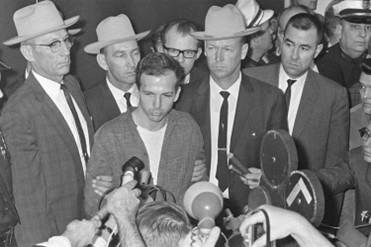
    Picture3Despite these critical revelations by Hill, the true shock emerges from the admissions of Assistant District Attorney William ‘Bill’ Alexander. Known as a staunch right-winger infamous for his provocative rhetoric, Alexander shocked many in 1968 when he advocated publicly for the hanging of Chief Justice Earl Warren. Notably, he likely would have served as the prosecutor in Oswald’s trial for the Tippit murder.
    Alexander admitted to author Henry Hurt that; “Once Oswald was charged as the assassin of President Kennedy, the District Attorney’s office ceased collecting evidence in the Tippit case.”

    This abrupt abandonment of due process is startling, yet Alexander continued: “The Tippit case just went by the boards. When Oswald was killed two days later, official interest in developing evidence in the Tippit case ceased altogether. There was never an indictment in the case or further investigation.”

    Alexander then told Hurt this whopper; “We all knew the same man who killed the President had killed Tippit. We had made up our minds by the time we got to (10th and Patton, scene of the Tippit murder). The two acts were so similarly drastic and unusual that it was virtually impossible that they were committed by separate killers.” (Henry Hurt, Reasonable Doubt, p.157)

    This premature judgment underlines a miscarriage of justice, where subjective assumptions supplanted a rigorous investigation. How could such critical legal determinations be made with such disregard for factual accuracy and fairness?

    Further compounding the investigative failures, the public assertions Hill made about the bullet trajectories in Dealey Plaza predated the autopsy of President Kennedy. So how could Hill know that all the wounds suffered by the president would jibe with the results of the autopsy?

    The autopsy was so poorly conducted that it prompted Dr. Milton Helpern, the highly respected and decorated Chief Medical Examiner of New York City—once described as’Sherlock Holmes with a microscope’—to comment on the utter incompetence of the career Navy forensic pathologists, Dr. James Humes and Dr. Thornton Boswell, who performed President Kennedy’s autopsy. Dr. Helpern likened their skills to:“It’s like sending a seven-year-old boy who has taken three lessons on the violin over to the New York Philharmonic and expecting him to perform a Tchaikovsky symphony. He knows how to hold the violin and bow, but he has a long way to go before he can make music.” (NY Times, 4/23/1977; p. 22)

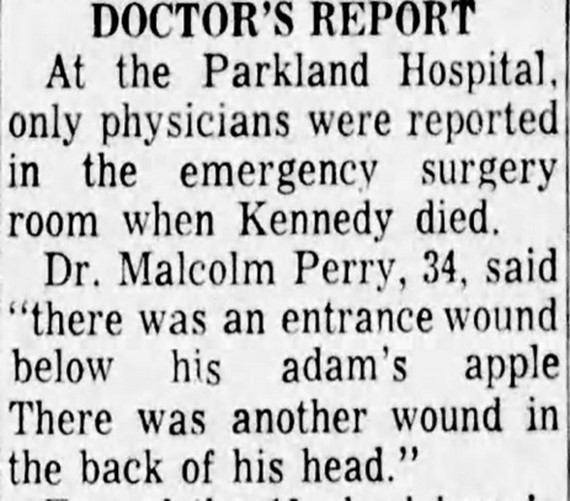
    Moreover, in a recently uncovered video by Secret Service expert Vince Palamara, Dr. Malcolm Perry describes the neck wound of President Kennedy on November 22 as;“a small penetrating wound, which appeared to be the entrance wound of one of the missiles.” (See this)

    (For a deeper look into the President’s autopsy, please refer to part 3 of Assassination 60.)

    The Procession of the Rifle.

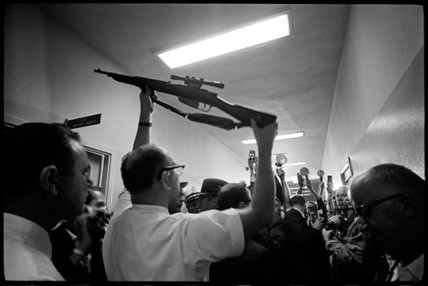
    Picture4Newsman. “This is room 317 of the homicide bureau, here at the Dallas Police station. As you see, they are bringing the weapon that was allegedly used in the assassination of President John F. Kennedy, this afternoon at 12:30pm here in Dallas. This is the weapon that was used. A rather well-worn military rifle, with a scope.” (See this)
    In the claustrophobic corridors of the Dallas City Jail, the 6.5 Mannlicher Carcano, incontrovertibly labelled as the death weapon of President Kennedy, was ostentatiously displayed before a throng of avid television and newspaper reporters. Cameras snapped relentlessly as journalists jostled to capture images of the notorious rifle, which Lieutenant Day brandished.

    The intentional public display of the Carcano was not merely a lapse in protocol—it was a deliberate strategy to influence public opinion and prematurely brand Oswald as the assassin of President Kennedy. This act effectively sidestepped the judicial process by contaminating the jury pool. Which depends on a neutral panel to carefully examine the evidence.

    Mayor Earle Cabell.

    Dallas Mayor Earle Cabell, whose brother Charles Cabell was the Deputy Director of the Central Intelligence Agency and was dismissed by President Kennedy following the Bay of Pigs debacle, appeared on national television to assert Lee Oswald’s sole responsibility for the assassination of President Kennedy.

    Mayor Cabell described the assassination as “the irrational act of a single man” and went on to depict Oswald as someone with “a deranged mind,” further embedding this narrative into the public consciousness. (See this and this)

    Buell Wesley Frazier.

    Detectives Gus Rose and Richard Stovall from the Dallas Police Department had arrested and had under interrogation at the Dallas City jail, 19-year-old Buell Wesley Frazier, a co-worker of Oswald’s at the Texas School Book Depository.

    The young and vulnerable Frazier was not informed of any rights he had nor was he offered the opportunity to have an attorney present. During the interrogation, officers Rose and Stovall ruthlessly bombarded him with repetitive questions, aiming to catch him in a contradiction. Frazier vividly recalled the ordeal, noting, “They asked the same questions, over and over…they were trying to see if they could trip me up”,After they had exhausted their tactics, another team of detectives took over, prolonging the gruelling interrogation for several more hours.

    The pressure intensified when Dallas Police Captain Will Fritz presented Frazier with a pre-typed confession as to his involvement in the assassination.: “In his hand was a sheet of white paper. He sat it down in front of me with a pen and said, sign this. I quickly realized this was a confession.”Stunned and appalled, Frazier stood his ground, asserting to Fritz, “I’m not signing this, this is ridiculous.” Enraged by Frazier’s refusal, Fritz menacingly raised his hand as if to strike him. Frazier bravely retorted,“There’s some policemen outside that door but before they get in here, we’re gonna have one hell of a fight.” Fritz then snatched the confession, wadded it up and stormed out of the room.” (Frazier, Steering Truth; p. 48-49)

    This episode starkly exemplifies the Dallas Police Department’s propensity to deploy deeply unethical tactics in their investigative processes. The fact that 19-year-old Frazier was not informed of any rights he had and was subjected to hours of repetitive questioning without legal counsel is a glaring indicator of the coercive strategies employed by the police. As assistant DA Bill Alexander confirmed to Larry Sneed in No More Silence, “What most people don’t realize is that we had Miranda in Texas before the Miranda decision.” (p. 553)

    This method of interrogation—relying on intimidation and psychological pressure—aims to wear down an individual to the point of vulnerability, increasing the likelihood of extracting a confession, regardless of its veracity. As Greg Parker pointed out, it is popularly termed the Reid technique, after its originator John Reid, a polygraph expert and former Chicago police officer.

    The incident with Frazier is not an isolated one but rather a snapshot of a systemic issue within the Dallas Police Department. As further detailed through multiple cases, these underhanded tactics appear to be a standard operating procedure rather than exceptions. The repetition of such methods across different cases demonstrates a disturbing pattern of behavior, pointing to a deeply ingrained culture of disregard for legal norms and civil rights.

    This pervasive abuse prompts a deeply unsettling question: when Buell Frazier was subjected to such harsh treatment, what kinds of threats and tactics were employed against Lee Oswald to coerce a confession or an admission of guilt from him?

    Assistant DA William ‘Bill’ Alexander.

    Around 10 p.m., in the office of Capt. Fritz, Bill Alexander, received a phone call from Joe Goulden, a seasoned reporter formerly associated with the Dallas Morning News.

    Joe Goulden. What’s going on down there?
    Bill Alexander. This Communist son of a bitch killed the President!
    Joe Goulden. Well, I can’t run with that.
    Bill Alexander. Well, I’m getting ready to write the complaint, how about if I wrote up did then and there, voluntarily, and with malice aforethought, take the life of John F. Kennedy in furtherance of a Communist conspiracy? Could you run with that?
    Joe Goulden. You got it.

    Picture5Alexander’s motivations for leaking this information to Goulden were later revealed to Larry Sneed, where Alexander expressed his desire; “to expose Oswald for what he was, a Communist.” Regarding the public’s reaction to John Kennedy’s murder, Alexander was disdainfully dismissive: “And as far as anybody giving a particular rat’s ass about John Kennedy getting his ass wiped in Dallas, who cares? A goddamn Yankee comes off down here and gets killed, for whatever reason, big deal!” (No More Silence; pp. 550/554)
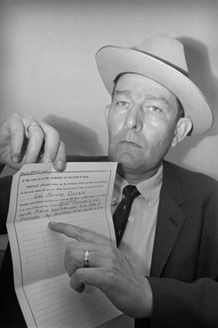
    Tragically, this remarkable perspective was pretty widespread within Dallas law enforcement. Detective Jim Leavelle, who was handcuffed to Oswald during his murder, expressed a similarly indifferent attitude towards the President’s murder in a 1992 conversation with author Joe McBride. “(The Assassination of President Kennedy) wasn’t no different than a South Dallas nigger killin’…It was just another murder to me, and I’ve handled hundreds of ‘em, so it wasn’t no big deal. (Into The Nightmare; p.240)

    The American Civil Liberties Union.

    Commission Conclusion. On Friday evening, representatives of the American Civil Liberties Union visited the police department to determine whether Oswald was being deprived of counsel. They were assured by police officials and Justice of the Peace (David) Johnston that Oswald had been informed of his rights and was being allowed to seek a lawyer.” (WCR, p.201)

    At approximately 10:30pm, Gregory Lee Olds, the President of the Dallas chapter of the American Civil Liberties Union (ACLU), initiated contact with Captain Fritz to discuss Oswald’s rights and his entitlement to legal counsel. Fritz’s response, which suggested Oswald had declined legal representation, was the first in a series of unsettling assurances that painted a picture of a suspect uninterested in his fundamental rights. And as documented in point 17 of Assassination 60, “Oswald consistently expressed his desire for legal representation during his detention.” (see this)

    Sam Stern: Did Captain Fritz say that Oswald did not want counsel at that time, or that he was trying to obtain his own counsel?
    Greg Olds : What I was told, that he had been given the opportunity and had not made any requests.

    Mr. Olds, not satisfied with this explanation, sought direct confirmation from Oswald and, along with three other attorneys, arrived at the Dallas City Jail around 11:35pm, aiming to engage with Oswald directly. Yet, their pursuit of justice was stonewalled under the pretext that Oswald, now charged with the assassination of President Kennedy, had knowingly waived his right to an attorney.

    Greg Olds: Captain King (assistant to Chief Curry) assured us that Oswald had not made any requests for counsel. Justice of the Peace David Johnston…assured us that Oswald’s rights had been explained, and he had declined counsel. Chief Curry was quoted to us as having said that Oswald had been advised of his rights to counsel…We felt fairly well satisfied that Oswald probably had not been deprived of his rights, so, we then broke up.

    These assurances from police officials, painted a misleading and complacent picture of Oswald’s understanding and waiver of his rights. These reassurances were enough to momentarily placate the ACLU representatives, leading them to disband— a decision that would soon be cast in a regrettable light.

    In a twist of fate, Olds was present when Oswald made a public declaration of his desperate need for legal assistance—a plea he issued not once, not twice, but three times during the famous midnight press conference. For a few moments, Oswald addressed the American public, where he would declare his innocence.

    Lee Oswald: I positively know nothing about this situation here. I would like to have legal representation. Well, I was questioned by a judge however I protested at that time that I was not allowed legal representation during that very short and sweet hearing. I really don’t know what this situation is about, no one has told me anything except I am accused of murdering a policeman. I know nothing more than that and I do request someone to come forward to give me a legal assistance. (See this)

    Picture6Oswald’s public plea contradicted the police narrative and highlighted a chilling disregard for his rights. Yet, despite Oswald’s membership in the ACLU and his clear request for help, no immediate action was taken to ensure his access to legal representation.
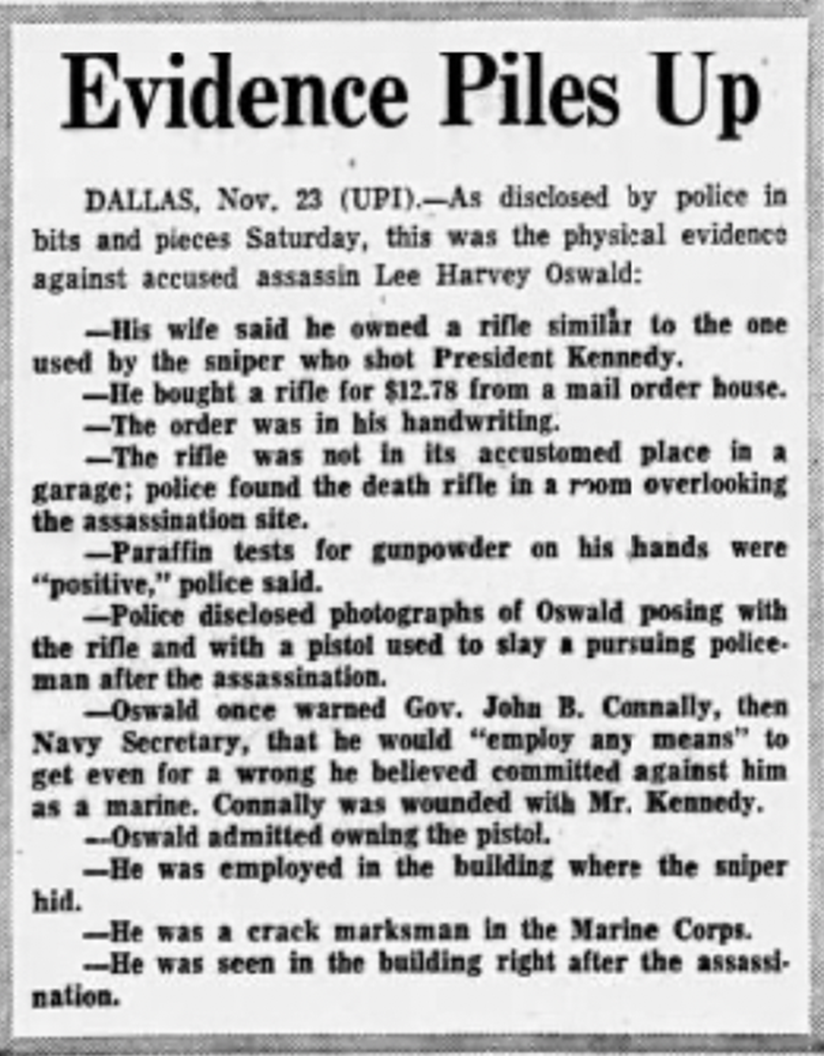
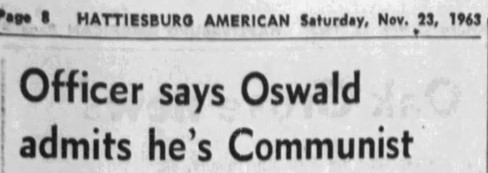
    This oversight—a missed opportunity for advocacy at a critical juncture—later emerged as a profound regret for Olds, who acknowledged the failure to engage with Oswald directly as a significant misstep. “I have always been sorry that we didn’t talk with Oswald…which I think was a mistake on my part.” (Volume VII; p. 322-325)

    Press interview with Chief Jesse Curry, Capt. J. Will Fritz and DA Henry Wade.

    Commission Conclusion. Wade told the press on Saturday that he would not reveal any evidence because it might prejudice the selection of a jury. On other occasions, however, he mentioned some items of evidence and expressed his opinions regarding Oswald’s guilt.” (WCR; p. 235)

    Q. Do you think you have got a good case?
    Wade. I figure we have sufficient evidence to convict (Oswald).
    Q. Was there any indication that this was an organized plot or was there just one man?
    Wade. There’s no one else but him…(Oswald) has been charged in the State court with murder with malice. The charge carried the death penalty which my office will ask in both cases.
    Q. Sir, can you confirm the report that his wife said he had in his possession as recently as last night, or some recent time, the gun such as the one that was found in the building?
    Wade. Yes, she did…she said that he had a gun of this kind in his possession.
    Q. A rifle? Last night?
    Wade. Last night. The reason I answer that question—the wife in Texas can’t testify against her husband…
    Q. Do you think you’ve got a good case against him?
    Wade. I think we have sufficient evidence.
    Q. Sufficient evidence to convict him of the assassination of the President?
    Wade. Definitely. Definitely. (Volume XXIV, CE2142, CE2169 p. 750-751, 829-830-837-838-840.)

    November 23rd, 1963.

    J. Edgar Hoover. “This man in Dallas. We, of course, charged him with the murder of the President. The evidence that they have at the present time is not very, very strong…The case as it stands now isn’t strong enough to be able to get a conviction.” (See this)

    NBC Press interview of Jesse Curry.

    Q. Chief Curry, how would you describe (Oswald) is he a prime suspect?
    Curry. Yes.
    Q. Is he the only suspect?
    Curry . Yes.
    Q. (Oswald) was yelling and complaining about no attorney. Does he have an attorney here now?
    Curry. Not that I know of.
    Q. Chief, are you convinced this is the man?
    Curry. Well, we don’t have positive proof. We feel he is a prime suspect.
    Q. What do you think personally?
    Curry. Personally, I think we have the right man.( Volume XXIV, CE2143, p. 753-754.)

    WFAA-TV. Press interview of Jesse Curry.

    Commission Conclusion. “ Curry stated that Oswald had refused to take a lie detector test, although such a statement would have been inadmissible in a trial. The exclusion of such evidence, however, would have been meaningless if jurors were already familiar with the same facts from previous television or newspaper reports.” (WCR; p.238)

    Q. Chief, was the subject of a polygraph, a lie detector test, broached with Oswald, and if so, what was the outcome?
    Curry. I understood that it was offered to him, and he refused it.
    Q. Did he give any reason for refusing to take the lie detector test?
    Curry. I understand he said he didn’t have to take it and he didn’t want to.(Volume XXIV; CE2144. p.755-756)

    WFAA-TV. Press interview of Captain Will Fritz.

    Q. Captain, can you give us a resume of what you know concerning the assassination of the President and Mr Oswald’s role in it?
    Fritz . I can tell you that this case is cinched— that this man killed the President. There’s no question in my mind about it.
    Q. Well, what is the basis for that statement?
    Fritz. I don’t want to get into the basis. In fact, I don’t want to get into the evidence. I just want to tell you that we are convinced beyond any doubt that he did the killing. (CE2153. Volume XXIV, p. 787.)

    KRLD-WFAA-TV- Press interview with DA Henry Wade.

    Commission Conclusion. “The disclosure of evidence was seriously aggravated by the statements of numerous responsible officials that they were certain of Oswald’s guilt…Wade told the public that he would ask for the death penalty.” (WCR; p. 239)

    Q. What sort of man is he? How would you describe Oswald?
    Wade. I, I couldn’t say. I can’t describe him any other than—the murderer of the President…since I have been District Attorney I’ve tried 24 death-penalty cases, in which we asked for the death penalty.
    Q. And how many verdicts did you get?
    Wade. Twenty-three.
    Q. Are you going to try this personally?
    Wade. Yes sir, yes sir…this is a proper case for the death penalty.
    Q. Well, from what you have seen, how do you sum (Oswald) up as a man? Based on your experience with criminal types?
    Wade. Well, I think he’s the man that planned this murder weeks or months ago and has laid his plans carefully and carried them out and has planned at that time what he’s going to tell the police that are questioning him at present. (CE2170, Volume XXIV, p. 842-843-844.)

    Press Interview in the Office of Jesse Curry.

    Q. (Is Oswald) Communist or Marxist?
    Curry. They say he said he was a communist.

    Regarding surveillance on Oswald prior to the President’s visit to Dallas, Curry stated that The FBI “usually let us know when these communist sympathisers or subversives come into the city and why they hadn’t got round to informing us of this man, I don’t know.”

    When asked about Oswald’s movements before and after the assassination, Curry stated, ” a man (Buell Frazier) brought (Oswald) to work yesterday morning and (Oswald) had a large package with him which we believe to be the rifle.” Regarding Oswald’s movements after the assassination, Curry asserts that: “(Oswald)shot our officer over in Oak Cliff.”

    Curry then qualifies Oswald as an“Expert Marksman”, when in reality Oswald was considered “a rather poor shot”,whilst serving in the U.S. Marine Corps. (See this)

    Q. What did you find in his apartment Chief? Did you find some communist literature…
    Curry. Yes we did. (See this)

    The Paraffin Test.

    Commission Conclusion.Wade might have influenced prospective jurors by his mistaken statement that the paraffin test showed that Oswald had fired a gun. The tests merely showed that he had nitrate traces on his hands, which did not necessarily mean that he had fired either a rifle or a pistol.” (WCR; p. 238-239)

    Henry Wade.

    Q. What about the paraffin tests?
    Wade. Yes, I’ve gone into that. The paraffin tests showed (Oswald) had recently fired a gun. It was on both hands. (CE2168; 821)

    Jesse Curry.

    Q. Chief, we understand you’ve had the results of the paraffin tests which were made to determine whether Oswald had fired a weapon. Can you tell us what those tests showed?
    Curry. I understand that it was positive…it only means he fired a gun.
    Q. That he fired a gun, Chief, not the rifle or the pistol.
    Curry. That’s right…

    Jesse Curry.

    Q. What does the paraffin test prove then Chief?
    Curry . It just proves that the man fired a weapon.
    Q. But you believe he is the man who fired the rifle that killed the President?
    Curry. Yes, I do. (See this)

    For more on the paraffin tests, which strongly indicates Oswald’s innocence, please refer to Point 23 in Assassination 60.

    WFFA-TV Press Interview with Jessie E. Curry.

    Federal Bureau of Investigation. “Our investigation has revealed that Oswald did not indicate on his application that others, including an “A.Hidell” would receive mail through the box in question, which was Post Office Box 2915 in Dallas. This box was obtained by Oswald on October 9, 1962, and relinquished by him on May 14, 1963.” (Volume XXV; p. 857-862)

    Newsman. This is a statement from Dallas Police Chief Curry.

    Q. Chief Curry, I understand you have some new information in this case. Could you relate what that is?
    Curry. Yes, we’ve just been informed by the Federal Bureau of Investigation, that they, the FBI has just informed us that they have the order letter for the rifle…they received from a mail order house in Chicago. The order letter (has been) compared with known handwriting of our suspect, Oswald and the handwriting is the same on the order letter as Oswald’s handwriting. The return address on this order letter was to the post-office box in Dallas, Texas, of our suspect, Oswald and it was returned under another name. But it had definitely been established by the FBI that the handwriting is the handwriting of Oswald.
    Q. Was it a recent purchase?
    Curry. This purchase was made on March 20th of this year.(Ed. Note: The Hidell rifle was ordered on 3/12/63)
    Regarding the backyard photographs, who’s existence was publicly disclosed by the Dallas Police, Chief Curry states the following
    Curry. There is a photograph of him with a revolver on his hip and holding a rifle in his hand.
    Q. Does this rifle look like the one that you have, that you think is the murder weapon, sir?
    Curry. it does.
    Q. Does it have a telescopic sight?
    Curry.It does.
    Q. Chief, has the order for this gun been connected definitely to the order for the rifle which you found?
    Curry. It has.
    Q. Chief, was the post office box rented by Oswald?
    Curry. The name- the return-the name on the return address was A.Hidell. A.Hidell.
    Q. How do you spell Hidell?
    Curry. H-I-D-E-double L.
    Q. Chief, do you feel pretty certain that this is the rifle which killed the President?
    Curry. Yes. (Volume XXIV, CE2145. p. 759-760 WCR, p. 233) (See this)

    (For further details on the mail-ordered rifle and Oswald’s alibi for ordering it, please refer to Part 4 of ‘Assassination 60’.)Picture7

    Press Interview of Captain Will Fritz.

    Q. Captain where does your investigation stand now? Does it look good?
    Fritz. Yes it looks real good, I think we are in good shape. I think we are in good shape on both cases, both the killing of the President and the killing of the police officer later.
    Q. You said a little while ago sir that you thought you had it cinched, do you feel that strongly about it sir?
    Fritz. Yes sir I do. I feel that its alright.
    Fritz then declares that Oswald, enroute to the Texas Theatre; encountered Officer Tippit, who he killed.
    Q. That’s pretty well nailed down.
    Fritz. That’s it, yes sir. (See this)

    WFAA TV Press interview with Jesse Curry.

    Picture8Commission Conclusion. If the evidence in the possession of the authorities had not been disclosed, it is true that the public would not have been in a position to assess the adequacy of the investigation or to apply pressure for further official undertakings.” (WCR; p. 240)
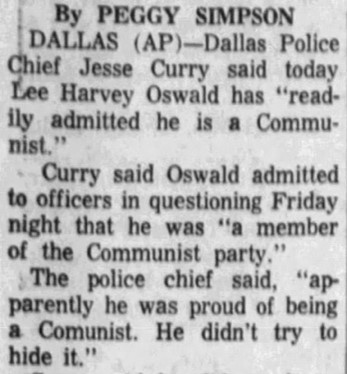
    Q. How would you describe his mood during the questioning?
    Curry. Very arrogant. Has been all along.
    Q. Is there any doubt in your mind, Chief, that Oswald is the man who killed the President?
    Curry. I think this is the man who killed the President.
    Q. Chief, could you tell us what you might have found in his rooming house in the way of literature or any papers connecting him-?
    Curry. We found a great, great amount of Communist literature, Communist books…(Hattiesburg American, Nov. 23, 1963. P. 8)
    Q. Chief, can you tell us in summary what directly links Oswald to the killing of the President?
    Curry. Well, the fact that he was on the floor where the shots were fired from immediately before the shots were fired; the fact the he was seen carrying a package to the building…
    Q. Do you figure that was a disassembled rifle?
    Curry . I don’t think it was disassembled; the package was large enough for a rifle to be intact.
    Q. Was it in a box or was it wrapped?
    Curry. Wrapped. Wrapped in a bo—, in a paper.
    Q. Has Oswald made any request for a lawyer?
    Curry.He has, but he didn’t say who he wanted or anything, so we couldn’t just go out and start calling lawyers for him. That’s not our responsibility. (CE2146. Volume XXVI, p. 763-764-769-770.)Picture9

    (For a more in depth look into the origins and scientific tests ran on the paper sack, designated as Commission Exhibit 142, please refer to Part 6 of Assassination 60)


    Go to Part 2 of 2

  • Walker, Oswald, and the Dog That Didn’t Bark

    Walker, Oswald, and the Dog That Didn’t Bark


    Part of the official JFK assassination lore is that, on the night of April 10, 1963, accused assassin Lee Harvey Oswald took a bus close to the Dallas Turtle Creek neighborhood of General Edwin A. Walker, then a nationally prominent right-wing political activist and armed himself with his Mannlicher-Carano rifle. Oswald then walked to behind the Walker residence, on a service road, a type of back-alley. Walker was seated motionless behind a desk inside his home and facing a large first-floor window. Resting his rifle on a latticed fence about 30 yards away, Oswald took a potshot at his target at 9 pm.

    And missed. Entirely. The shot went over and wide of Walker’s head and into a wall. Walker, on surveying the latticed fence afterwards that evening with a lieutenant from the Dallas Police Department (DPD), remarked that the unknown would-be assassin was a “lousy shot.”

    A police officer reviewing the layout and shooting that night replied, “He couldn’t have missed you.”

    Official Version

    The above official version then posits that Oswald, after shooting and missing Walker, then “buried” his rifle somewhere and rode a bus back home, where he nervously related to his wife Marina details of his expedition.

    Importantly, also entered into the lore was that Oswald would have struck Walker, save for a windowpane that deflected his shot.

    This legend reached something of a zenith in the federally-funded Smithsonian magazine article on 2013. That article not only casually assumed Oswald’s guilt in the assassination of President Kennedy, but then described the shot that missed Walker thusly:

    Drawing a tight bead on Walker’s head, he (Oswald) pulls the trigger. An explosion hurtles through the night, a thunder that echoes to the alley, to the creek, to the church and the surrounding houses. Walker flinches instinctively at the loud blast and the sound of a wicked crack over his scalp—right inside his hair.[1]

    Thus, in the recounted mythology, the shot that missed Walker actually passed through the hair on the general’s head.

    The Dallas Morning News chimed-in in 2013 with a similar story—it was the 50th anniversary year of the JFK murder—that also blithely assumes Oswald’s guilt in both the Kennedy and Walker shootings and adds, “The bullet (fired at Walker) first hit the screen and then the wood frame between the upper and lower windowpanes. Its original path deflected, it passed just above Walker’s scalp.”[2]

    In other words, only a windowpane deflected the Oswald bullet and saved Walker’s life.

    In most regards, the popular-media version of the Walker shooting is actually the opposite of what really happened that night and is, perhaps unsurprisingly, another mythology regarding the JFK murder.

    The Real Story

    There are many reasons not to convict Oswald of either the Kennedy or Walker shootings in 1963. But first, let’s dispose of the dramatic media treatment of that night at General Walker’s and his close brush with death.

    First, Walker, a military veteran who had commanded special forces in combat in World War II, far from feeling a bullet through his scalp, actually initially told investigating officers from the Dallas Police Department that he thought neighborhood kids had tossed a firecracker into to his den through an open window.

    If that! For in a supplementary report filed on April 10, it was written that Walker “stated that when he heard the noise, he thought it was some sort of fireworks.” [3] Fireworks? Hearing fireworks is a far cry from the sensation of a bullet passing through one’s scalp. In truth, only after discovering and examining a bullet hole in the wall behind him, did Walker conclude he actually had been shot at—and so he related to the DPD.

    Secondly, a review of Dallas Police Department documents from the night of April 10 reveals whoever shot at Walker that night would have missed even more widely, save for the deflection downwards of the windowpane.


    Here is a photo of the Walker windowpane and the damage caused by the passing bullet. Obviously, the damage is on the lower edge of the crossbar of the wind plane and likely would have deflected the bullet lower.

    And that is how the Dallas Police Department (DPD) saw it.

    “Officers observed a bullet of unknown caliber, steel jacket, had been shot through the window, piercing the frame of the window and going into the wall above comp’s (Walker’s) head,” according to DPD report filed on April 10 (italics added).

    The report continues, “The bullet struck the window frame near center locking device. From the point where the bullet hit the window frame to the point where it struck the wall is a downward trajectory.”

    It is hard to escape the conclusion that whoever shot at Walker would have missed by even more, except for the deflection. The shooter missed Walker from a distance of about 30 yards, likely armed with a rifle resting on a fence for support.

    In addition, careful readers will also note that that the DPD found a “steel jacket” slug at the scene of the Walker shooting. Assassination researchers know, of course, that Oswald’s Mannlicher-Carcano used copper-jacketed ammo, from the Western Cartridge Company.

    One thing about police officers is that they tend to know guns and ammo and one might assume that the DPD assigned some of its better detectives to the Walker shooting, given his national prominence in 1963.

    But after the Kennedy murder, the DPD sent the steel-jacketed bullet—stated in police reports to be a 30.06 calibre—to the FBI. The federal agents said the mangled Walker slug was actually a 6.5 projectile from the Western Cartridge Company and copper-jacketed. In other words, a Mannlicher-Carcano bullet.

    In a more-innocent era, one might assume the DPD made a mistake—after all, mistakes happen. And the Walker bullet, in fact, was badly distorted after striking the windowpane and passing through a wall in the Walker residence.

    But since the 1960s, the profoundly dismaying history of CE 399, the “Magic Bullet,” has been revealed: the famed nearly pristine dome-headed slug was almost certainly introduced into the evidentiary record within the FBI facilities in Washington. The curious “pointy head” slug found on the Parkland hospital hallway floor Nov. 22 has disappeared and almost certainly had nothing to do with the JFK murder anyway.[4]

    So, with the true story of the Magic Bullet revealed, one reasonable concern is that the FBI also fabricated evidence in the Walker shooting, replacing a steel-jacketed projectile from Dallas with a copper-jacketed Winchester Cartridge 6.5 slug.

    Unfortunately, the records do not reveal why the DPD detective had concluded the Walker slug was steel-jacketed. If the detective had placed the slug on his desk next to a magnet, perhaps he would have noticed the Walker bullet wiggle. (Worth noting, steel-jacketed bullets can be copper coated, the softer metal copper applied to decrease wear-and-tear on gun barrels). In any event, the Walker projectile was originally logged as a steel-jacketed 30.06 slug.

    There is much more to that evening in April 1963; for example, outside Walker’s home at least two vehicles sped from the scene in the wake of the gunfire, as seen by multiple witnesses.

    Two Cars Leave the Scene

    Though hardly dispositive, an additional curiosity is that two automobiles were seen swiftly leaving the scene of the Walker shooting on April 10, in the immediate aftermath of gunfire.

    Hearing the Walker gunshot, a youth named Kirk Coleman immediately thereafter peered over a fence and “saw a man getting into a 1949 or 1950 Ford, light green or light blue and take off,” according to DPD report filed on April 11.

    “This was in the parking lot of the Church next to General Walker’s home. Also, on further down the parking lot was another car, unknown make or model and a man was in it. He had the dome light on and Kirk could see him bend over the front seat as if he was putting something in the back floorboard,” continued the report.

    General Walker also told the Warren Commission he saw a car suddenly leave the area, in the immediate aftermath of the shooting.

    Of course, Oswald is thought not to have had driving skills and certainly did not own a car. To be sure, the two cars could have left the Walker shooting scene suddenly as the sound of gunfire is disconcerting. But one might expect ordinary citizens hearing gunfire to report as much to police, yet the men in the vehicles have simply disappeared into that night, and evidently forever. No one has ever come forward and said they were innocent bystanders who drove away quickly on the night of the Walker shooting.

    So, perhaps the departing vehicles held Oswald and compatriots.

    The Dog That Did Not Bark

    A Walker neighbor’s dog, known as an active barker, was conveniently ill and silenced that evening.

    “The neighbor’s dog to the east of the Walker property is a fanatical barker, but on this incidence did not make a sound,” according to an April 12 DPD report.

    Concerning the dog, a neighbor told the DPD that, “Dr. Ruth Jackson, who lives next door to the General, has a dog that barks at everybody and everything. The night that this offense occurred Dr. Jackson’s dog did not bark at suspects. Investigating officers received further information…that Dr. Jackson’s dog was very sick yesterday [the date of shooting] and is also sick today. Reason for this illness is unknown at this time.” (emphasis added)

    Again, the report of conveniently sick dog is hardly dispositive. But if the dog was intentionally poisoned, it suggests an operation involving more than a lone nut who did not own a car.[5]

    The Walker Backyard Photo and Other Evidence

    And of course, one of the curiosities of the JFKA is the backyard black-and-white photo of Walker’s house, purportedly found in Oswald’s possessions after the JFK murder, featuring the infamous two-tone 1957 Chevrolet with its license plate mysteriously cut out.

    If the photo was truly in Oswald’s possession, it is certainly suggestive.

    In addition, Oswald’s wife, Marina, recounted discussions with her husband regarding the Walker shooting, although her testimony in the wake of the JFK assassination was regarded as unreliable, even by Warren Commission staff. In fact, Marina’s statements and testimony on nearly every topic, made under great duress, vacillated wildly on a daily basis.

    Finally, there is also the “Walker letter,” an unsigned page written in pencil and in the Russian language. The undated letter gives instructions to Marina concerning paying bills, a post office box, disposition of Oswald’s personal belongings, and where Oswald could be located in the event of his arrest. The letter is said to have been written shortly before the Walker shooting, though its origins are disputed.

    None of the above evidence is enough to convict Oswald, even if it is “real” and not fabricated. But assuming the evidence in Oswald’s possession is not planted, there is a strong suggestion that Oswald participated in the Walker shooting.

    An Explanation of the Walker Shooting

    The Warren Commission presented the Walker shooting as another version of Oswald as the leftie-loser-loner nut acting out a demented fantasy. Even the House Select Committee on Assassinations did little with the topic.[6]

    But for the purpose of this article, the Warren Commission treatment of Walker shooting is the interesting part.

    In truth, whoever shot at Walker either—

    1. Was a lousy shot, to put it mildly
    2. Intended to miss
    3. Had faulty firearms
    4. Possibly had compatriots

    None of above surfaces in the Warren Commission treatment of the Walker shooting.

    Indeed, the version that the “windowpane deflection likely saved Walker” is allowed to survive unchallenged in the Warren Commission version of events and grew in mass media literature over the years, as seen in the above quotes from the Smithsonian and Dallas Morning News.

    A Better Explanation

    My own interpretation is that Oswald was possibly the gunman who fired in the direction of Walker in April 1963, but that he had accomplices (hence the cars racing from the scene), he did not use a Mannlicher-Carcano rifle (hence the steel-jacketed bullet), and missed intentionally.

    But why such an exercise?

    Based on the research of scholar John Newman and HSCA investigator Dan Hardway, Oswald was an asset of sorts for US intelligence agencies, not exactly rare in the early 1960s, when the CIA literally had thousands of such individuals in the US or nearby as part of expansive anti-Fidel Castro efforts.

    Oswald, contend Hardway and Newman, was being primed for something, possibly for the JFK assassination or another event that could be blamed on Castro or pro-Castro types.

    It is my speculation that the Walker escapade was part of an Oswald biography-building exercise and to practice and test Oswald’s nerve for an intentionally unsuccessful assassination attempt of a prominent figure—such as President Kennedy—an attempt that could then be blamed on Castro.

    If Oswald could be made the patsy in such an event, such as the JFKA, the fallout could justify a major operation against the Cuban leader.

    If the Walker shooting was a test of Oswald, then evidently he passed.


    [1] Shultz, Colin “Before JFK, Lee Harvey Oswald Tried to Kill an Army Major General,” Smithsonian Magazine, October 4, 2013.

    [2] Peppard, Alan, “Before gunning for JFK, Oswald targeted ex-Gen. Edwin A. Walker — and missed,” The Dallas Morning News, November 19, 2018.

    [3]CE 2001 – Dallas Police Department file on the attempted killing of Gen. Edwin A. Walker,” Warren Commission, Volume XIV, (CD 81.1b).

    [4] Aguilar, Gary and Thompson, Josiah, “The Magic Bullet: Even More Magical Than We Knew?,” History Matters.

    [5] All police reports are found in Warren Commission Exhibit 2001.

    [6]The Attempt on the Life of Maj. Gen. Edwin A. Walker,” Warren Report, p. 284.

  • A Presumption of Innocence: Lee Harvey Oswald, Part 3

    A Presumption of Innocence: Lee Harvey Oswald, Part 3


    Part 1

    Part 2

    I. The Disposition and Discovery of the Shells

    The discovery of the rifle shells on the sixth floor that go by the labels Commission Exhibits 543, 544, and 545 add more controversy into the investigation of the murder of President John F. Kennedy.

    The shells, which the Commission concluded had been used in the assassination, were discovered, according to the Warren Report, by Deputy Sheriff Luke Mooney. According to the report:

    Around 1pm, Deputy Sheriff Luke Mooney noticed a pile of cartons in front of the window in the south-east corner of the sixth floor. Searching that area, he found at approximately 1:12 p.m. three empty cartridge cases on the floor near the window. (WR, p. 79)

    A few obvious questions arise with regard to the subsequent discovery of the alleged “Snipers Nest” and the shells allegedly contained therein.

    1. With various witnesses reporting to the police in the immediate aftermath of the Presidents murder that they had indeed witnessed a rifle in the possession of a man or men on the upper floors, then why did the Dallas police not immediately converge upon the book depository’s sixth floor? Instead, the police decided to commence a floor by floor canvass of the building in search of a gunman or evidence linked to the crime. This was in spite of the various witness testimonies to a man (men) with a rifle on the upper floors.
    2. Why did it take Mooney 12 minutes between his discovery of the alleged “sniper’s nest” to his apparent discovery of the three spent cartridges? According to Mooney’s testimony once he had ventured down from the seventh floor:

    LM – So I went back down. I went straight across to the south-east corner of the building, and I saw all these high boxes. Of course, they were stacked all the way around over there. And I squeezed between two. And the minute I squeezed between these two stacks of boxes, I had to turn myself sideways to get in there—that is when I saw the expended shells and the boxes that were stacked up looked to be a rest for a weapon. (WCH, Vol. III, pp. 283284)

    Mooney’s testimony refutes the information contained in the Warren Report regarding the 12-minute discovery between the “Shield of Cartons” and the expended shells. And in reference to the earlier quoted testimony, “the minute I squeezed between these two stacks of boxes…that is when I saw the expended shells.” (ibid) It would seem that the authors of the report were too busy to re-acquaint themselves with the testimony which was deposed before them, choosing instead to print in error that 12 minutes had elapsed between the discovery of the shield of cartons and the discovery of the shells.

    In reference to Fritz and his conduct in handling the evidence, we find the following printed within the Report:

    When he was notified of Mooney’s discovery, Capt. J W. Fritz, chief of the homicide bureau of the Dallas Police Department, issued instructions that nothing be moved or touched until technicians from the police crime laboratory could take photographs and check for fingerprints. (WR, p. 79)

    This account is disputed by cameraman for WFFA TV Tom Alyea, who was present on the sixth floor after the assassination. Alyea stated that:

    After filming the casings with my wide-angle lens, from a height of 4 and half ft., I asked Captain Fritz, who was standing at my side, if I could go behind the barricade and get a close-up shot of the casings.

    He told me that it would be better if I got my shots from outside the barricade. He then rounded the pile of boxes and entered the enclosure. This was the first time anybody walked between the barricade and the windows.

    Fritz then walked to the casings, picked them up and held them in his hand over the top of the barricade for me to get a close-up shot of the evidence. I filmed between 3–4 seconds of a close-up shot of the shell casings in Captain Fritz’s hand.

    Fritz did not return them to the floor and he did not have them in his hand when he was examining the shooting support boxes. I stopped filming and thanked him. I have been asked many times if I thought it was peculiar that the Captain of Homicide picked up evidence with his hands.

    Actually, that was the first thought that came to me when he did it, but I rationalized that he was the homicide expert and no prints could be taken from spent shell casings. Over thirty minutes later, after the rifle was discovered and the crime lab arrived, Capt. Fritz reached into his pocket and handed the casings to Det. Studebaker to include in the photographs he would take of the sniper’s nest crime scene.

    We stayed at the rifle site to watch Lt. Day dust the rifle. You have seen my footage of this. Studebaker never saw the original placement of the casings so he tossed them on the floor and photographed them. Therefore, any photograph of shell casings taken after this is staged and not correct. (https://www.jfk-online.com/alyea.html)

    It should be noted that Alyea also said that the shells were in close proximity to each other at first appearance. There are two other witnesses who back him on this: Roger Craig and Mooney. (Cover-Up, J. Gary Shaw with Larry Harris, p. 70) That is not the way they appear in the Commission volumes. (Commission Exhibit 512) Once the “official crime scene” photographs were taken, Lt. Day and Detective Sims proceeded to collect the shells from the sixth floor.

    II. Chain of Custody of the Shells

    During his testimony before the Commission, Day stated what course of action he took in relation to preserving the shells as evidence.

    Mr. Belin – All right. Let me first hand you what has been marked as “Commission Exhibit,” part of “Commission Exhibit 543, 544,” and ask you to state if you know what that is.

    Mr. Day – This is the envelope the shells were placed in.

    Mr. Belin – How many shells were placed in that envelope?

    Mr. Day – Three.

    Mr. Belin – It says here that, it is written on here, “Two of the three spent hulls under window on sixth floor.

    Mr. Day – Yes, sir.

    Mr. Belin – Did you put all three there?

    Mr. Day – Three were in there when they were turned over to Detective Sims at that time. The only writing on it was “Lieut. J. C. Day.” Down here at the bottom.

    Mr. Belin – I see.

    Mr. Day – Dallas Police Department and the date.

    Mr. Belin – In other words, you didn’t put the writing in that says two of the three spent hulls.

    Mr. Day – Not then. About 10 o’clock in the evening this envelope came back to me with two hulls in it. I say it came to me, it was in a group of stuff, a group of evidence, we were getting ready to release to the FBI. I don’t know who brought them back. Vince Drain, FBI, was present with the stuff, the first I noticed it. At that time there were two hulls inside. I was advised the homicide division was retaining the third for their use. At that time, I marked the two hulls inside of this, still inside this envelope.

    Mr. Belin – That envelope, which is a part of Commission Exhibits 543 and 544?

    Mr. Day – Yes, sir; I put the additional marking on at that time.

    Mr. Belin – I see.

    Mr. Day – You will notice there is a little difference in the ink writing.

    Mr. Belin – But all of the writing there is yours?

    Mr. Day – Yes, sir.

    Mr. Belin – Now, at what time did you put any initials, if you did put any such initials, on the hull itself?

    Mr. Day – At about 10 o’clock when I noticed it back in the identification bureau in this envelope.

    Mr. Belin – Had the envelope been opened yet or not?

    Mr. Day – Yes, sir; it had been opened.

    Mr. Belin – Had the shells been out of your possession then?

    Mr. Day – Mr. Sims had the shells from the time they were moved from the building or he took them from me at that time, and the shells I did not see again until around 10 o’clock.

    Mr. Belin – Who gave them to you at 10 o’clock?

    Mr. Day – They were in this group of evidence being collected to turn over to the FBI. I don’t know who brought them back.

    Mr. Belin – Was the envelope sealed?

    Mr. Day – No, sir.

    Mr. Belin – Had it been sealed when you gave it to Mr. Sims?

    Mr. Day – No, sir; no. (WCH, Vol. IV, pp. 25354)

    Belin also elicits the following:

    Mr. Belin – Your testimony now is that you did not mark any of the hulls at the scene?

    Mr. Day – Those three; no, sir. (WCH, Vol. IV, p. 255)

    Further, in his testimony, Day states he recognizes CE 543, because it has the initials GD on it. Surprisingly, Day failed to acknowledge the other defining characteristic on 543. Contained on the lip of the shell is a dent, which has led many experts to conclude that this shell could not have held a bullet which was fired during the assassination. But he did admit that this very peculiarly dented shell was not sent to the FBI the night of the assassination. It is surprising that after Day admits this, Belin does not ask the obvious question: Why was it not sent up?

    Mr. Belin – Now, I am going to ask you to state if you know what Commission Exhibit 543 is?

    Mr. Day – That is a hull that does not have my marking on it.

    Mr. Belin – Do you know whether or not this was one of the hulls that was found at the School Book Depository Building?

    Mr. Day – I think it is.

    Mr. Belin – What makes you think it is?

    Mr. Day – It has the initials “G.D.” on it, which is George Doughty, the captain that I worked under.

    Mr. Belin – Was he there at the scene?

    Mr. Day – No, sir; this hull came up, this hull that is not marked came up, later. I didn’t send that. (WCH, Vol. IV, p. 255)

    Note what Day seems to be saying. He says it was marked by someone who was not at the crime scene. Again, Belin asks for no clarification as to when Doughty marked the shell. What makes this questioning even more off key is that Belin admits that he pre-interviewed Day in Dallas. And now Day has changed his story. At that prior interview, he admits that he told Belin that he did initial the shells. He now tells Belin that after he thought it over, no he did not mark any of them at the scene. (Ibid, p. 255). At this point, Belin actually said he should strike everything and start all over again.

    It later got even worse. In a letter to the Commission dated April 23, 1964, Day then throws his identification of CE 543 and their subsequent chain of custody into serious doubt:

    Sir:

    In regard to the third hull which I stated has GD for George Doughty scratched on it, Captain Doughty does not remember handling this.

    Please check again to see if possibly it can be VD or VED for Vince Drain.

    Very truly yours,

    J. C. Day

    Through Day’s testimony, we elicit that he did not mark the shells at the scene of the crime even though they were in his possession. Furthermore, he placed these unmarked shells into an unsealed envelope.

    This is a weird situation. And Belin does not seem to bat an eyelash while he is discovering it or the fact that the witness changed his story. Under these circumstances, how could Day swear under oath that the shells being presented in evidence against Oswald were the same ones allegedly found in the aftermath of the president’s murder? When he neglected to mark them at the scene and then proceeded to place them in an unsealed, unmarked envelope?

    III. Tom Alyea writes to the ARRB

    Lt. Day’s testimony is also disputed by press photographer Tom Alyea. He was the first such cameraman allowed entry into the crime scene. In a letter to the ARRB’s Tom Samoluk dated 8-15-97, Alyea states that:

    Regarding the perjured testimony given to the Warren Commission Investigators by members of the Dallas Police Department. I understand there were several cases, but the one I checked for myself by reading the printed testimony in the Warren Report, involves Lt. Day and Det. Studebaker. These are the two crime lab men who dusted the evidence on the 6th floor. Their testimony is false from beginning to end.

    This is what should have happened. According to Tom Alyea, Fritz was the first detective on the scene to come into contact with the shells. Fritz should have marked these shells at the scene in accordance with the chain of custody. Fritz then gave the shells to Det. Studebaker.

    Studebaker should have then proceeded to mark these shells at the scene. But what the evidence seems to indicate is that Studebaker then threw the shells down on the floor of the south east corner window and captured the “crime scene” photos.

    Lt. Day then retrieved the shells from the floor with help from Det. Sims. Day should have marked these shells at the scene and then put them into a sealed envelope, clearly stating what lay therein. Instead, Day gave up possession of the shells without adding his markings, which in turn lay in an unmarked, unsealed envelope.

    The envelope remained unsealed when Day took back possession of these hulls at 10 p.m. on 11/22/63. Sims should have marked the shells at the crime scene while in his possession. But yet, Sims did not even recall picking up the shells. In a remarkable exchange with David Belin, he admitted that in his first Commission interview with Joe Ball, he did not mention doing this. In fact, at that time, he attributed the carrying of the envelope with the shells to Lt. Day. When Ball asked him if he took possession, he denied it. (WCH, Vol. VII, p. 163)

    There had to have been a conference between Belin and Ball about this and Sims must have been made aware of their worries. Because two days after the April 6th Ball interview, Sims was recalled. This is what worried them: Belin knew that Day was going to testify that he turned over the unsealed envelope with shells to Sims. Therefore, they needed Sims on the record for this transfer. (WCH, Vol. IV, p. 256) Therefore, when he was returned to the stand, this time his questioner was Belin. And in almost no time flat, Belin is asking Sims about this specific point: the chain of custody of the shells. Sims now says that two days ago, he did not recall who brought the shells to the police station. But now, mirabile dictu, he says it was him! (WCH, Vol. VII, p. 183) So he has done a virtual 180 degree turn on this. After this pirouette, Belin asks Sims: Well, how did you remember that it was you who brought the cartridges to the station? Sims replies that, in the interval, he talked to Captain Will Fritz and his partner E. L. Boyd; they helped refresh his memory as to what happened.

    So, in handling the most important pieces of evidence in the biggest case he ever worked on, Sims forgot he brought the cartridge cases to the station. But then, thanks to Will Fritz, he now recalled he did. But even then, this was included in his testimony:

    Mr. Belin – Do you remember whether or not you ever initialled the hulls?

    Mr. Sims – I don’t know if I initialled the hulls or not. (WCH, Vol. VII, p. 186)

    There are established rules in the judicial system that every police department must follow with regards to the preservation of evidence. By no stretch of the imagination did the Dallas Police comply with any of them. It is a fact that had Oswald been permitted to stand trial Commission Exhibits 543/544/545 would have been a focus of serious questioning by defense counsel.

    For example, in addition to all the above, there is the dent problem that CE 543 presents. Ballistics expert Howard Donahue has said this cartridge could not have been used to fire a bullet that day since the weapon would not have discharged properly. (Bonar Menninger, Mortal Error, p. 114) People like Gerald Posner, Vince Bugliosi, and Robert Blakey have said, well it could have been dented in the firing. Donahue replied to this by saying, “There were no shells dented in that manner by the HSCA…I have never seen a case dented like this.” (Letter dated September 11, 1996, emphasis in original.) Both Josiah Thompson and British researcher Chris Mills tried in every way to dent a 6.5 mm Western Cartridge case like this one was. They failed. Mills concluded that the only way it could be done was through loading empty shells, and only on rare occasion. (James DiEugenio, The JFK Assassination: The Evidence Today, p. 95)

    If only that were the end of it. Thompson wrote in Six Seconds in Dallas that CE 543 contained three identifying marks revealing it had been loaded and extracted at least thrice before. (Thompson, p. 144) These were not found on the other cartridge cases. But it’s even more puzzling than that. As Thompson wrote:

    Of all the various marks discovered on this case, only one set links it to the follower. Yet the magazine follower marks only the last cartridge in the clip… (Thompson, p. 145)

    The last cartridge in the clip was not this one. It was the live round.

    IV. Lt. Day versus Sebastian Latona

    With the alleged discovery of the Mannlicher Carcano on the sixth floor in the aftermath of the president’s murder, the rifle was bound to be subjected to fingerprint analysis by the Dallas police. Lt. Day, who had applied fingerprint powder to the rifle on the sixth floor, had apparently discovered partial prints near the trigger guard of the weapon. Day testified to that effect.

    John McCloy – When was the rifle as such dusted with fingerprint powder?

    Lt. Day – After ejecting the live round, then I gave my attention to the rifle. I put fingerprint powder on the side of the rifle over the magazine housing. I noticed it was rather rough. I also noticed there were traces of two prints visible. I told Captain Fritz it was too rough to do there, it should go to the office where I would have better facilities for trying to work with the fingerprints.

    JM – But you could note with your naked eye or with a magnifying glass the remnants of fingerprints on the stock?

    JCD – Yes, sir; I could see traces of ridges, fingerprint ridges, on the side of the housing. (WCH, Vol. IV, p. 259)

    Upon the discovery of such incriminating evidence it would be logical to assume that Day would leave the depository, post haste, to process the latent prints found upon the suspected murder weapon. These prints could have been paramount for the Dallas police in their case in unmasking the President’s murderer. But while Day indeed had left the depository with the rifle, he opted to return to the Depository without processing the prints in order to conduct a press tour of the sixth floor. Thus, meaning that valuable evidence lay unprocessed whilst Day played tour guide to the media!

    Later that night Day eventually proceeded to take photographs of the latent prints found on the rifle. These were taken around 8pm on 11/22/63. (Sylvia Meagher, Accessories after the Fact, p. 122) Day was alleged to have been ordered by Chief of Police Jesse Curry to “go no further in the processing of the rifle,” because the evidence pertaining to the murder was to be sent to the FBI crime lab in Washington DC. (Meagher, p. 122) The assassination of President Kennedy would not fall under federal jurisdiction until after the public killing of Lee Oswald. So why was the bulk of the core evidence being transferred to the FBI on 11/23/63? Amongst the evidence sent to the FBI were negatives of the partial prints, along with the Mannlicher itself. Here is what FBI fingerprint expert Sebastian Latona said with regards to the partial prints found on the trigger guard:

    SL – There had, in addition to this rifle and that paper bag, which I received on the 23rd—there had also been submitted to me some photographs which had been taken by the Dallas Police Department, at least alleged to have been taken by them, of these prints on this trigger guard which they developed. I examined the photographs very closely and I still could not determine any latent value in the photograph. (WCH, Vol. IV, p. 21)

    He then goes on to describe that:

    SL – I made arrangements to immediately have a photographer come in and see if he could improve on the photographs that were taken by the Dallas Police Department. Well, we spent, between the two of us, setting up the camera, looking at prints, highlighting, sidelighting, every type of lighting that we could conceivably think of, checking back and forth in the darkroom—we could not improve the condition of these latent prints. So, accordingly, the final conclusion was simply that the latent print on this gun was of no value. (WCH, Vol. IV, p. 21)

    Latona then concluded the following about his overall attempt to garner any such print evidence from the rifle.

    SL – I was not successful in developing any prints at all on the weapon. (WCH, Vol. IV, p. 23, we shall return to this testimony later)

    The latent prints were, therefore, deemed to be valueless by the FBI. And valueless they remained until 1993 when author Gary Savage co-published a book with former Dallas police officer Rusty Livingston titled First Day Evidence. Savage was the nephew of Livingston. This publication would claim that not only did the Dallas Police have evidence of Oswald’s “palm-print” on C2766, but they also had a partial print, identified as Oswald’s, near the trigger guard of the weapon. According to researcher Pat Speer, Savage came to this conclusion by

    …working with a fingerprint examiner named Jerry Powdrill, [of the West Monroe, Louisiana, Police Department, who] claimed that the most prominent print apparent on the DPD’s photos of the trigger guard matched Oswald’s right middle finger on three points, and shared “very similar characteristics” on three more. Powdrill said, moreover, that this gave him a “gut feeling” the prints were a match. (Pat Speer, Chapter 4e: Un-smoking the Gun)

    “Gut feelings” do not always produce forensically sound and reliable evidence.

    In 1993 PBS aired the Frontline series program, “Who Was Lee Harvey Oswald?” Up for evaluation was the partial print found near the trigger guard which First Day Evidence claimed belonged to Oswald. PBS decided to run Rusty’s pictures through various fingerprint experts. Their first two experts, Powdrill and George Bonebrake, would not go on the record as saying such prints were Oswald’s. There simply were not enough points of identification. For example, in the British system, fifteen points are necessary. In the USA, depending on which state you are in, it’s between eight and twelve. Powdrill, for example, could only find three. (Gary Savage, First Day Evidence, p. 109)

    What makes this notable is the following, Bonebrake was a longtime veteran in the fingerprint field. In fact, according to the book Forensic Evidence, Science and Criminal Law by Terrence Kiely, Bonebrake worked for the FBI as a fingerprint examiner from 1941–78. In his last three years with the Bureau, he was in charge of its latent print section. He supervised 100 examiners and 65 support people. He then went into private practice. (Click here for another source)

    Come hell or high water, Frontline was determined to use this alleged Oswald fingerprint. We shall see how determined they were. But first let us pose some queries that the late producer of the show, Mike Sullivan, should have asked Rusty. Recall, the Dallas Police were getting all kinds of challenges about any prints of value from the media back in 1963–64. Since the illustrious Latona had declared there were none he could find, very few people accepted the Lt. Day palm print on the stock of the rifle. For one, the palm print on the barrel “was under the wooden stock of the rifle and could not be disturbed unless the weapon was disassembled.” (Meagher, p. 121) So would this not protect it from any kind of disturbance? How could the FBI have missed it?

    Secondly, unlike the rest of the rifle, there was no trace of powder on the area the palmprint was supposed to be. Although Latona did get pictures from the Dallas Police of their examination of the rifle, there were none for where this palm print was alleged to be located. Further, there was “no verbal or written notification by Lt. Day calling attention to it.” (Meagher, p. 122) Day tried to excuse this by saying he took no pictures of the palm print since he had been directed to give the evidence over to the FBI. As Meagher notes there is a serious problem with this statement. Day was working on the rifle at 8 PM. He did not get the order about the FBI from Curry until “shortly before midnight.” (Meagher, p. 122) Four hours is a long time to remove the wooden stock and take a photo. Also, why did the police not photograph the palm print before lifting it? Latona testified this was common practice.

    As Henry Hurt later wrote, even J. Lee Rankin, the Commission’s chief counsel doubted the authenticity of the palm print. He even suggested that it may have come from “some other source.” (Hurt, p. 108) Vincent Drain, the courier to the FBI from Dallas, told Hurt in 1984, that Day never indicated to him anything about such a print. He said “I just don’t believe there was ever a print.” Drain said there was lot of pressure on the DPD. This pressure got to the police which is why DA Henry Wade took until Sunday night, after Oswald was killed, to say someone had found a palm print on the rifle. So, it took nearly two days and the murder of Oswald for Wade to be informed of the palm print? And then it took another two days for it to be sent to the FBI. Finally—and this is telling—when the Warren Commission asked Day to sign an affidavit that he had identified the print before the rifle was turned over to the FBI, Day refused to do so. (Jim Marrs, Crossfire, p. 445)

    Because of all the above, and more, no credible researcher took the palm print as being legitimate.

    V. The Sullivan/Scalice Dog and Pony Show

    As written above, in the midst of all the dubious points about the palmprint, in 1993 PBS and Frontline were determined to use Rusty’s other print, the one on the trigger guard. How did producer Mike Sullivan get around the morass presented above? Right off the bat, Sullivan should have called Rusty into his office and asked the following questions:

    Sullivan – You knew all the problems that the Commission was having with the FBI about the palm print. If you had this other alleged fingerprint laying around, why did you not send that one to the Commission?

    Rusty – Well…

    Sullivan – Alright, but then why not send it to either Jim Garrison or Clay Shaw’s lawyers for use at the Shaw trial in 1969? I mean that went on for two years and was all over the media.

    Rusty – Well…

    Sullivan – Alright, but then why not send it to the Church Committee? They had a sub-committee that was inquiring into the JFK case. My God that was the lead story on the nightly news for months on end, it was in all the papers and news magazines. Jack Anderson wrote about it. You couldn’t have missed that.

    Rusty – Well…

    Sullivan – Alright, but then why not send it to the House Select Committee on Assassinations? They were around for three years!

    Rusty – Well Mike…

    Does anyone think that an experienced TV producer like the late Mike Sullivan was not aware of the value of asking such questions? Especially after Powdrill and Bonebrake refused to go on camera. The latter told Frontline that the prints were not clear enough to make an identification of anyone. “They lack enough characteristic ridge detail to be of value for identification purposes,” (Speer, Chapter 4e: Un-smoking the Gun)

    As we shall see, it is utterly bizarre that it was Vince Scalice who finally did decide to go on camera. And this shows just how desperate Mike Sullivan and Frontline were. Why? Because Scalice posed serious liabilities as an authority, because he had previously studied these prints in 1978 for the HSCA. At that time, he came to the same opinion that the other two Frontline experts had. It was this earlier opinion which he and Sullivan tried to obfuscate out of the record. (See HSCA, Vol. 8, p. 248)

    As Speer has noted, Scalice, after viewing Livingston’s copies of the prints, now proclaimed to PBS FRONTLINE:

    I took the photographs. There were a total of four photographs in all. I began to examine them. I saw two faint prints, and as I examined them, I realized that the prints had been taken at different exposures, and it was necessary for me to utilize all of the photographs to compare against the inked prints. As I examined them, I found that by maneuvring the photographs in different positions, I was able to pick up some details on one photograph and some details on another photograph. Using all the photographs at different contrasts…I was able to find in the neighbourhood of about eighteen points of identity in the two prints.

    Further from the PBS transcript:

    When Vincent Scalice examined photographs of the trigger guard prints in 1978 for the House Select Committee on Assassinations, he apparently only had the one or two Dallas police photographs that were part of the Warren Commission files. “I have to assume,” says Scalice, “that my original examination and comparison was carried out in all probability on one photograph. And that photograph was apparently a poor quality photograph, and the latent prints did not contain a sufficient amount of detail in order to effect an identification. I know for a fact that I did not see all these four photographs in 1978, because if I had, I would have been able to make an identification at that point in time.” (Speer, Chapter 4e: Un-smoking the Gun)

    Note the use of words like “apparently,” phrases like “I have to assume” and “in all probability.” Amid all this Scalice is claiming that, back in the day, the HSCA only furnished him with one photograph and this exhibit was substantially lacking in pictorial quality in order for him to make a positive identification as to the origin of the print.

    There is a serious problem with Scalice’s statement. The records of the HSCA don’t support it. Consider the following:

    Captioned: Red’d FBI 11/22/63

    6-5 mm Mannlicher-Carcano Rifle

    Photos of Latents on rifle

    Contents 8 small negs w/10 small prints.

    (HSCA Admin Folder M-3, p. 6)

    So how could Scalice claim to work from only one “poor quality photograph” when the HSCA, who had employed him to ID the partial prints, had 8 small negatives with 10 small prints of the partials on the trigger guard? That number and date suggests that the HSCA had both the FBI and DPD prints of this area.

    The other problem is this new technique Scalice was trying to sell. As Gil Jesus, a former investigator with experience in fingerprinting, has said: that is not the way it’s done. One does not piece partials together. One analyzes each individual partial and you compare it to the whole print. As Gil concluded, what Scalice claimed he did was like using a door of a Dodge, the hood of a Chevy and fender of a Ford, and then you claim it’s a Cadillac. (Gil Jesus posting on the Education Forum, July 15, 2021)

    But further, in some quarters, the Livingston pictures were hailed as being a new “set.” Note that Scalice said he had four different pictures. When one separates the blow ups from the originals, this is not the case. It is very likely that the actual photos Livingston produced were just two. (Click here for details) PBS also tried to say the trigger guard prints had been ignored prior to 1993. This was also false. They had been examined by both the FBI and the HSCA. And it is with that statement that Mike Sullivan and Frontline probably committed their most grievous journalistic sin. For at the 40th anniversary of Kennedy’s murder in 2003, they wrote the following piece of narration: “The FBI says it never looked at the Dallas police photographs of the fingerprints…”

    In his Warren Commission testimony, Latona said the opposite. He stated that he did examine photos of the trigger guard area sent by the DPD. (WCH, Vol. IV, p. 21) In fact, the FBI’s Gemberling Report states that at least three of these were sent to FBI headquarters. But Latona went beyond that. He said he examined the area with a magnifying glass. (WCH, Vol. IV, p. 20) He then called in a photographer and took his own pictures. He tried everything, “highlighting, side-lighting, every type of lighting that we could conceivably think of…” He then broke down the weapon into its assembly parts. It was at this point that he concluded there were no prints of value on the rifle. (WCH, Vol. IV, p. 23)

    It is one thing to be in error. Everyone makes mistakes. But when a program states as fact the contrary of what happened, then the public has the right to suspect that Mr. Sullivan and Frontline had an agenda. Does anyone really think that everyone involved in the program failed to read Latona’s sworn testimony?

    In a court of law, Vincent Scalice would have been required to produce evidence which would support his new and revised conclusions and explain why he had reversed himself. He would have to show a chart with photos of the (new) 18 points of identification between the prints on the rife, C2766, and those of the accused Lee Harvey Oswald. He would have had to explain why he could do it now, but not before. And also, why Powdrill, Bonebrake, and Latona could not do what he did.

    Yet Scalice never offered up any evidence to support his conclusions. No charts were produced by Scalice, or by PBS. These are necessary in order to show, irrefutably, the points of comparison between a print of Lee Oswald and that of the latent print on C2766. Supplementary material such as an evidence chart is a basic fundamental requirement in order to evaluate an “expert” opinion. And like many of the other pronouncements of “evidence” against the accused, these proclamations almost never hold up under any sort of scrutiny. At a trial, with a knowledgeable attorney and an opposing authority, Scalice would have been in a very sorry position.

    But, at the foot of Mike Sullivan, Scalice had learned how to sell himself in the world of partisan politics. Two years down the line he joined the board of Newsmax. Now, as a document examiner, he said that the note Vince Foster had written and placed in his briefcase before shooting himself was really a forgery.

    This is what the JFK case does to the fields of legal identification and examination. The late Mike Sullivan has a lot to answer for in this regard, because PBS was duplicating the same evidentiary hijinks on the 50th anniversary. And these were also exposed as empty subterfuges of the actual facts. (Click here for details)

    By his work in 1993, Mike Sullivan helped transform PBS into the equivalent of a forensic circus on the JFK case.

  • A Presumption of Innocence: Lee Harvey Oswald, Part 2

    A Presumption of Innocence: Lee Harvey Oswald, Part 2


    Part 1

    CE 399

    How does one go about verifying the authenticity of Commission Exhibit 399? That is a very important question. Had Lee Harvey Oswald survived long enough to see a public trial, no doubt one of the most important pieces of evidence against him would have been the nearly pristine bullet found on a stretcher at Dallas’s Parkland Hospital in the wake of the president’s murder. One of the most important aspects of any criminal case is verification of physical evidence which is being presented in a court of law. This high-profile murder case is no exception; therefore the provenance of CE 399 must be explored if we are to make a determination as to its authenticity. This exploration begins through the study of the variety of documentation and witness statements relating to this core evidence. This legal doctrine behind this exploration is termed ‘chain of possession.’ In relation to CE 399, we want to determine:

    1. Who found the bullet?
    2. Who took possession of the bullet?
    3. What documentation and markings exist in relation to the bullet?
    4. What do the witnesses say about the bullet?

    The discovery of the bullet is credited to Parkland maintenance employee Darrell C Tomlinson. Mr Tomlinson was in the process of moving a stretcher which was blocking an area in front of an elevator in the hospital’s emergency department. Tomlinson stated before the Commission that:

    Mr. TOMLINSON.  I pushed it back up against the wall.

    Mr. SPECTER.      What, if anything, happened then?

    Mr. TOMLINSON.  I bumped the wall and a spent cartridge or bullet rolled out that apparently had been lodged under the edge of the mat.

    (Testimony of Darrell C Tomlinson)

    Upon the retrieval and inspection of this bullet, Tomlinson handed it over to Mr. O. P. Wright, who was Parkland’s personnel director. Mr Wright was a retired Dallas deputy chief of police, in charge of patrol division in the 1950’s. Upon close inspection of this bullet, Wright sought out a Secret Service agent. That agent was Richard E Johnson. Agent Johnson kept in his possession the Parkland bullet until he had flown back to Washington D.C. with the slain president’s body. Once in Washington, Johnson handed over possession of the bullet to chief of the Secret Service, James Rowley. In turn, Rowley handed the bullet over to FBI agent Elmer Lee Todd. Todd, who is alleged to have placed his markings upon the bullet, handed the bullet over to Robert Frazier of the FBI crime lab. That is the official explanation as to how the bullet found in Dallas ended up in Washington D.C. on 11/22/63.   Let us examine some of the participants in this chain:

    Tomlinson => Wright => Johnson => Rowley => Todd => Frazier

    Darrell C Tomlinson

    Tomlinson appeared before the Warren Commission on March 20th, 1964. Amazingly, Mr. Tomlinson was not shown CE 399 during his hearing and consequently was not asked to ID it as the bullet that he found on the stretcher at Parkland Hospital on 11/22/63. This is strange behaviour from the Commission as Mr. Tomlinson was an important witness to the identification of this key piece of evidence.

    According to one memo (Commission Exhibit 2011, p.2), on June 12, 1964, Darrell C. Tomlinson, maintenance employee, Parkland Hospital, Dallas, Texas, was shown Exhibit C1 (CE 399), a rifle slug, by Special Agent Bardwell D. Odum of the Federal Bureau of Investigation. To quote from that report, “Tomlinson stated it appears to have been the same one he found on a hospital carriage at Parkland Hospital on November 22, 1963, but he cannot positively identify the bullet as the same one he found and showed to Mr. O. P. Wright.” Did Tomlinson at least concede that CE 399 resembled the bullet he held in his possession that day?

    O P Wright

    As incredible as it sounds, Mr. Wright was not called to testify before the Commission. According to an FBI Memo which was printed in the Warren Commission hearings (Commission Exhibit 2011, p.2), on June 12, 1964: “O. P. Wright, Personnel Officer, Parkland Hospital, Dallas, Texas, advised Special Agent Bardwell D. Odum that Exhibit C1 (CE 399), a rifle slug, shown to him at the time of the interview, looks like the slug found at Parkland Hospital on November 22, 1963. He advised he could not positively identify C1 (CE 399) as being the same bullet which was found on November 22, 1963.” But does the evidentiary record support the notion that Wright conceded that the Parkland bullet looked like CE 399?

    In November of 1966, Josiah Thompson visited Tomlinson and Wright at Parkland Hospital in Dallas. Thompson later asked Wright to describe the bullet he got from Tomlinson on 11/22/63. Wright described the bullet he obtained as having a “pointed tip.” (Six Seconds in Dallas, p. 175)

    In reference to an earlier re-enactment done with Tomlinson, Wright stated to Thompson that the stretcher bullet looked “like the one you got there in your hand,” referencing the .30 calibre projectile used for the re-enactment. (Thompson, Last Second in Dallas, p. 24)

    This description from Wright must bring into question Wright’s alleged concession to Odum that CE 399 looked like the bullet he had in his possession that day. When Thompson showed Wright a picture of CE 399, similar bullets from Oswald’s alleged rifle and CE 606, similar bullets from Oswald’s alleged revolver, Wright denied that any of these resembled the bullet Tomlinson found on 11/22/63. 

    Thompson stated that later, while getting ready to leave Parkland, Wright approached him and said, “Say, that single bullet photo you kept showing me … was that the one that was supposed to have been found here?” Thompson replied “Yes.”  Thompson states that Wright “looked right at me, his face expressionless, and said, ‘Uh…huh.’ Then Wright turned and went back to his office.” (Last Second in Dallas, p. 26)

    To Thompson, Wright had rejected CE 399 as the bullet Tomlinson handed over to him that day. Tomlinson also could not identify CE 399 as the bullet he found on the stretcher on 11/22/63.

    In a declassified document dated 6/20/64 from Gordon Shanklin, SAC Dallas, to FBI Director J Edgar Hoover, Shanklin states: “Neither Parkland’s DARRELL C. TOMLINSON, nor O. P. WRIGHT, can identify this bullet.”

    So as of June 20th 1964, the FBI knew that neither Tomlinson nor Wright could identify CE 399 as being the bullet which came from a stretcher at Parkland Hospital on 11/22/63. 

    Richard E Johnson

    Richard E Johnson was another important witness whose testimony the commission neglected to hear. Maybe it is because, contained within the document CE 2011, we find the following information with regard to his identification of CE 399:

    On June 24, 1964, Special Agent Richard E. Johnson, United States Secret Service, Washington, D.C., was shown Exhibit C1 (CE 399), a rifle bullet, by Special Agent Elmer Lee Todd, Federal Bureau of Investigation. Johnson advised he could not identify this bullet as the one he obtained from O. P. Wright, Parkland Hospital, Dallas Texas, and gave to James Rowley, Chief, United States Secret Service, Washington D.C., on November 22, 1963. (Commission Exhibit 2011, Volume XXIV, p. 412)

    James Rowley SS Chief

    On June 24, 1964,  James Rowley, Chief, United States Secret Service, Washington, D.C., was shown exhibit C1(CE 399), a rifle bullet, by Special Agent Elmer Lee Todd. Rowley advised he could not identify this bullet as the one he had received from Special Agent Richard E. Johnson and gave to Special Agent Todd on November 22, 1963. (Commission Exhibit 2011, Volume XXIV, p.  412)

    Elmer Lee Todd

    On June 24th, 1964, Special Agent Elmer Lee Todd, Washington D.C. … identified C1 (CE 399), a rifle bullet, as being the same one he had received from James Rowley, Chief, United States Secret Service, Washington D.C. … on November 22, 1963. This identification was made from initials marked thereon by Special Agent Todd at the Federal Bureau of Investigation Laboratory upon receipt, November 22, 1963. (Commission Exhibit No. 2011, Volume XXIV, p.  413)

    So according to CE 2011, SA Elmer Todd was able to identify CE 399 because of the initials Todd had placed upon the bullet to establish chain of custody.  

    Well respected Kennedy researcher John Hunt wanted to establish if the bullet which sits in the National Archives today in fact bears the marking of Special Agent Elmer Lee Todd. Hunt managed to put together an illustration using photographs of CE -399.” He was thenable to track the entire surface of the bullet using four of NARA’s preservation photos.”

    As Hunt states in his fine essay on this subject:

    There is no question but that only three sets of initials appear on CE -399. There is likewise no question that they have all been positively identified:  RF was Robert Frazier, CK was Charles Killion, and JH was Cortland Cunningham … It can be stated as a fact that SA Elmer Lee Todd’s mark is not on the historical CE -399 bullet.” (Phantom Identification of the Magic Bullet: E. L. Todd and CE-399)

    We also find further collaboration for Hunt’s work from Dr David Mantik. At NARA in June 1994, Mantik and astronomer Steve Majewski confirmed that Todd’s initials are not on the historical CE 399.  In an email communication with me, Mantik stated, “The other initials are precisely as described by John Hunt.”

    Robert Frazier FBI

    Another of John Hunt’s masterclasses comes in the form of the essay, “The Mystery of the 7:30 Bullet.” Hunt discovered through his examination of Robert Frazier’s detailed notes that the Parkland bullet was recorded as “Reed Elmer Todd, 11/22/63 – 7:30 p.m.” According to Frazier himself, he took custodianship of the bullet from Todd as of 7:30 p.m. on 11/22/63.

    However, upon further analysis of the documentation, Hunt came across an envelope which was filled out by SA Elmer Lee Todd upon receipt of the bullet from Chief Rowley. This documentation states:

    Received from Chief Rowley, USSS, 8:50 p.m. 11/22/63 E. L. Todd. (The Mystery of the 7:30 Bullet)

    Question: How could Todd have given Frazier the stretcher bullet at 7:30 p.m. when Todd had not yet received that bullet from Chief Rowley until 8:50 p.m.? This discrepancy further casts the authenticity of the prosecution’s evidence into the most serious doubt.


    Gary Aguilar and Josiah Thompson Track Down Odum

    Dr Gary Aguilar and Josiah Thompson tracked down former FBI agent Bardwell Odum. The following encounter is well documented in their fine essay, “The Magic Bullet: Even More Magical Than We Knew?” (The Assassinations, edited by James DiEugenio and Lisa Pease, pp. 282-84)

    On September 12th 2002, Aguilar phoned Odum and the two conversed about various things, but naturally the discussion turned to the assassination of John Kennedy. Odum agreed to look over various documents for Aguilar. Mr. Odum was sent three separate documents. The three were CE 2011, which states that Odum had shown CE 399 to Tomlinson and Wright at Parkland, the FBI airtel dated June 12, 1964, and the three-page FBI memo dated July 7, 1964. After a few weeks, Aguilar phoned Odum back. During that second phone call, Bardwell Odum then made the following statements: “Oh I never went to Parkland Hospital at all. I don’t know where you got that?” When Gary Aguilar asked Odum about CE 399, Odum replied, “I didn’t show it to anybody at Parkland. I didn’t even have any bullet. I don’t know where you got that from, but it is wrong.” (The Magic Bullet: Even More Magical Than We Knew?)

    Mr. Odum then went on to state that he never even saw CE 399, let alone had it in his possession. What makes it all worse is that Mr. Odum was a personal friend of O. P. Wright. Surely if Odum had at any time taken possession of this important piece of evidence relating to the murder of President Kennedy and presented it to his friend for identification purposes, then Odum would have remembered, would he not have?

    Summary 

    It is pretty clear that CE 399 would have been an evidentiary debacle for a prosecuting attorney trying Lee Oswald. In order for evidence to be ruled as admissible in a court of law, the item must have an intact chain of possession. If a certain piece of evidence does not meet that standard, then this evidence is wide open to serious questioning by a defense attorney. Why would any prosecutor want Tomlinson, Wright, Johnson, and Rowley to testify that CE 399 was not the bullet each of them took possession of that day? Why would the prosecution want Todd testifying that he had indeed marked the Parkland bullet, when the historical CE 399 which sits in evidence today does not bear his marked initials? Why would the prosecution want Frazier to take the stand and testify under oath that he had received the bullet from Todd at 7:30 pm, when the bullet from Dallas wouldn’t be received by Todd until 8:50 pm?

    Mark Lane, quoting Mark Twain, summed it up best:  “Who so clinging from a rope by his hands severeth it above his hands must fall. It being no defense to claim that the rest of the rope is sound.”


    C 2766 Palm Print

    Leaving behind CE 399, I now would like to turn our attention to another piece of evidence which is cited against Lee Oswald: the alleged presence of his palm print upon the rifle claimed as the murder weapon of John Kennedy. This alleged discovery of the print was made by J. C. Day of the Dallas police on 11/22/63. Even at that early stage it is alleged that Day had tentatively identified the palm print as coming from the main suspect, Lee Oswald. (Sylvia Meagher, Accessories After the Fact, p. 123) Is there any photographic evidence in existence of the print on C2766? The shocking but unsurprising answer to that question is there is no contemporaneous photographic evidence. Standard practice is to photograph a lift before an attempt at its removal is made. This step is taken to safeguard against the possibility of losing the print. Take, for example, the statements of FBI Fingerprint Expert Sebastian Latona: “Primarily, our recommendation in the FBI is simply in every procedure to photograph and then lift.” (Meagher, p. 123)  The absence of any contemporaneous photograph of the print on the rifle is even more dumbfounding when we learn that Lieutenant Day attended an advanced latent print school conducted in Dallas by the Federal Bureau of Investigation. (Meagher, p. 123)

    There are photographs of other partial prints taken by Day which were found on the exterior of the rifle. These prints were found to be valueless by the FBI.  Day claimed that he had taken these photographs around 8 p.m. on 11/22/63.

    Day claimed that he did not take a photograph of the most important latent palm print because he was given orders by Dallas Police Chief Jesse Curry to “go no further with the processing.” However, prior to his Commission testimony, Day related to the FBI that he received these orders from Curry shortly before midnight. So by his own admission, Day had almost 4 hours to photograph the print he identified as Oswald’s before receiving the orders from Chief Curry. (Commission Exhibit 3145)

    Why, then, did he not photograph the latent print? He must have known that this would be important evidence in any trial of Oswald. Not only is there no evidence that the palm print was ever present on the rifle, but when the FBI received the weapon and tested it for prints, they found no evidence of any fingerprint traces and no evidence of a lift ever being performed. (Henry Hurt, Reasonable Doubt, p. 107) Day testified that “the print on the gun … still remained on there … there was traces of ridges still on the gun barrel.” (WC Vol. 4, pp. 261-62) Which is in stark contrast to the findings by the FBI.

    There is also no independent collaboration to Day’s alleged lifting of the print, as Day claimed to be alone when he attempted the lift. (CE 3145)

    Day also apparently neglected to inform FBI agent Vincent T. Drain. Drain transferred the rifle to Washington D.C. on 11/23/63.  Day said he informed Drain he had indeed found a palm print on the rifle which he believed was Oswald’s. As Henry Hurt wrote, Drain clearly disputes this:  he says Day never showed him any such print or left any indication on the rifle where to look for it. (Hurt, p. 109)

    Once the rifle arrived in Washington D.C., FBI hair and fibre expert Paul Stombaugh examined it, stating, “I noticed immediately upon receiving the gun that this gun had been dusted for latent fingerprints prior to my receiving it. Latent fingerprints powder was all over the gun.” (Meagher, p. 121)

    In Accessories After the Fact, Sylvia Meagher states, “How could powder survive on the gun from Dallas to Washington, but every single trace of powder and the dry ridges which were present around the palm print on the gun barrel under the stock vanish?” (Meagher, p. 122)

    Now when Capt. Will Fritz was asked on Saturday, November 23, if Oswald’s prints were found on the rifle, he stated “No sir.”  Chief Curry also made no mention of this important discovery to the media. (Meagher, p. 124) In fact, the first mention of a palm print discovered on the rifle was announced on 11/24/63 by Dallas DA Henry Wade. (Hurt, p. 108) This was after the rifle was back in Dallas and after Oswald was murdered. The following is very hard to swallow:  Day allegedly informed Fritz and Curry on 11/22/63 that he had found a palm print on the rifle which allegedly was used in the killing of President Kennedy and that he had tentatively identified the palm print as coming from the main suspect, Lee Oswald. (Meagher, p. 124)

    With this powerful information in their arsenal, neither Fritz, Curry nor Wade, who were guilty of making many fraudulent and prejudicial statements of “fact” against the accused, offered not once to the assembled media on 11/22 or 11/23 that the existence of Oswald’s palm print had indeed been found on the suspected murder weapon.

    The statements emanating from law enforcement officials were so prejudicial against Oswald that they warranted comment from various sources, one of these being Attorney Percy Foreman. According to the St Louis Post Dispatch, Foreman suggested that “authorities are running a serious risk of jeopardizing their case against Oswald by failing to observe his constitutional rights.” He went on to state: “Officials may have already committed reversible error in the case by permitting the accused to undergo more than 24 hours of detention without benefit of legal counsel.” Citing grounds for reversal, Foreman further asserted: “Under recent decision of the United States Supreme Court, Federal procedural guarantees must be observed in state prosecutions. Their abridgment can be grounds for a reversal or even a conviction. This is a new law. They could get a conviction in Texas and get it thrown out on appeal, but it takes a long time for these dim-witted law enforcement officers to realize it.”  (St Louis Post Dispatch, 11/24/63)

    After Oswald’s murder, all the evidence pertaining to the murder of President Kennedy was transferred from Dallas to Washington for good on November 26th. Day’s alleged lift of the palm print on the rifle did not reach Washington until November 29th. Why did this important piece of evidence not arrive with the others? (Meagher, p. 123)

    In his book Reasonable Doubt, Henry Hurt interviewed retired FBI agent Vincent T Drain. Remember, Drain was the man who transferred the rifle from Dallas to Washington in the early hours of 11/23/63. When Drain was asked about the authenticity of the palm print, he replied: “I just don’t believe there was ever a print.” He noted that there was increasing pressure on the Dallas police to build evidence in the case. Asked to explain what might have happened, Agent Drain said, “All I can figure is that it (Oswald’s print) was some sort of cushion because they were getting a lot of heat by Sunday night. You could take the print off Oswald’s card and put it on the rifle. Something like this happened.” (Hurt, p. 109)

    From Latona’s testimony it appears that the FBI never did find any of Oswald’s prints on C 2766. Latona confirmed Oswald’s prints from pictures supplied to him by the Dallas Police on November 29th. (WC Vol. 4, pp. 24-25). To put it mildly, any accomplished defense attorney would have moved for what is called an evidentiary hearing prior to any trial of Oswald on both these pieces of evidence. He would likely have had both declared inadmissible. If not, he would have demonstrated to any jury that they were worthless as evidence since no chain of custody existed with either one. Beyond that, people were lying in order to create the illusion of a chain.


    Part 3

  • Harold Weisberg on Howard Brennan and Marrion Baker

    Harold Weisberg on Howard Brennan and Marrion Baker


    The following interview was recorded on December 21, 1966 at the studio of Pacifica outlet KPFK in Los Angeles. Harold Weisberg discusses the dubiousness of two key witnesses for the Warren Commission: Howard Brennan and policeman Marrion Baker. Both are key for the Commission. Brennan is the sole witness who places Oswald in the sixth floor window, and Baker says he encountered Oswald in the second floor lunchroom after the shooting. It should be noted, Weisberg is alone among the early critics in questioning Baker’s story since he somehow had Baker’s first day affidavit, where he makes no mention of a second floor lunchroom.


    O’Connell:

    This is William O’Connell, and we’re talking again today about The Warren Commission Report on the assassination of President Kennedy. And we have in the studio, Harold Weisberg, the author of Whitewash, and an even newer book called Whitewash II, which is subtitled, “The FBI-Secret Service Coverup”. Mr. Weisberg is a newspaper and magazine writer, and a former Senate investigator, and also an intelligence and political analyst. His earlier specialties included cartels and economic and political warfare, and then during the early days of World War II I believe, your personal investigations and writings were credited with laying a foundation for the taking over of enemy property, and foreign funds controls. Is that correct?

    Weisberg:

    Yes, and the government got a pretty good income from some of the cases.

    O’Connell:

    One of the things that I especially wanted to go into in treating, as we are now some of the evidence in the case, in great detail and with thoroughness, I wonder if we could examine the reconstructions by the commission of the assassination itself from the Depository area on Elm Street, and also the reconstruction that the commission gave to the slaying of Officer Tippit. And to lead into that, I wanted to ask you about a statement that you make, and ask how you justify so categoric a statement, when you say that Oswald could have killed no one.

    Weisberg:

    I add one thing to it. According to the commission’s best evidence. And I believe on this subject, the commission’s best evidence is quite credible. The commission established Oswald’s innocence because of the bankruptcy with which it approached the effort to establish his guilt. Everybody is familiar with the more dramatic aspects of this. For example, the witness Howard Brennan. Perhaps the least credible witness in any official proceeding. This is a man who qualified himself as a witness by saying that he lied when it served his convenience. He was taken to a lineup to identify Oswald, and he is presumably the source of the description, and yet at the lineup, he said he couldn’t identify Oswald.

    O’Connell:

    When you say the description, you mean the description that went out over the police radio, with reference to a suspect in the President’s slaying?

    Weisberg:

    Yes, now this addresses, this simple thing of the description that went out over the police radio, in a very comprehensible way, addresses itself to the integrity of everybody involved. We’re led to believe that this description came from Brennan. Recognizing the improbability of it, the commission said, “Most probably.” Now here we have a man, who is the source of the identification of an assassin. A presidential assassin. The police presumably are going to solve this crime. And they get a description from him and they broadcast the description. But strangely enough, the police don’t know who gave them the description, so when the case comes to trial as presumably it was always intended to, they have no way of producing the eyewitness.

    Either Brennan was the eyewitness who gave them the description that was broadcast, or he was not. Either the description that was broadcast came from an eyewitness or it did not. Now if it came from an eyewitness, how in the world were the police going to produce him if they didn’t know his name? How are they going to have a witness for the trial? The description that is broadcast is not that of Brennan. It contains information that Brennan did not give, if any of this can be regarded as information.

    O’Connell:

    There was no information as to the nature of the clothes worn by the suspect in the broadcast that was give out as-

    Weisberg:

    Correct, but Brennan did give such data, and it contained information on a weapon, which Brennan did not give.

    O’Connell:

    Now where was Brennan standing in relation to the Depository building?

    Weisberg:

    When we get to Brennan, I will qualify everything by saying, “according to.”

    O’Connell:

    All right.

    Weisberg:

    Because this is the least credible man in the world.

    O’Connell:

    All right then, instead of beginning with Brennan, let’s go back and see if we can retrace in some kind of sequence the reconstruction, and then you take it back to, as earlier point then the 22nd if you like Mr. Weisberg, in terms of what the commission alleges in terms of the reconstruction as to the weapon, and the paper bag, and so on and so forth. But I think we should treat this in some detail, and preferably, chronologically if that’s all right with you?

    Weisberg:

    Well, since we’ve already started with this thing of Brennan, let me finish with that first, because the reader of the report is led to believe that even though the commission almost disavows him, Brennan is the identifier of Oswald, and Congressmen Ford, in his own writing for profit, identifies Brennan as the most important witness before the commission. The truth of the matter is, that the important witness here was a Dallas Police officer, Marrion L. Baker, whose credibility was in the same class as Brennan’s. I have in both my books, traced many of Baker’s statements. The thing that distinguishes him from all other witnesses that I have studied, and I’ve studied most of them, is that on none of the many occasions he was interviewed did he ever give the story that he gave before the commission.

    O’Connell:

    Now, who are you speaking of now?

    Weisberg:

    Baker. Marrion L. Baker, the Dallas police officer, who had this famous gun in the gut encounter with Oswald in the second floor lunchroom of the Texas School Book Depository building. Now, it is Baker who tends to make credible Brennan’s story that he saw Oswald in the sixth floor window. And it is Baker that did in fact, have an encounter with Oswald. There can be no question about this. There was …

    O’Connell:

    Now where was Baker in the motorcade?

    Weisberg:

    Baker was in one of the follow-up motorcycles. He was not flanking the President. He was behind him. And according to his testimony, he had just turned from Main Street, down which the motorcade had gone through downtown Dallas.

    O’Connell:

    Was he immediately behind the presidential car?

    Weisberg:

    Several cars behind. He, I think that his testimony will place pretty much where he was. The motorcade turned from Main Street to the right, or to the north on Houston, and then turned to the left down Elm Street, which in a sense flanks Main. It was Baker’s testimony that he had just turned from Main into Houston, when a gust of wind hit him – and there was a strong wind there that day, It almost blew Mrs. Kennedy’s hat off at the same corner – and just after he turned the corner, he heard the first sound that he identified as a rifle shot. He testified that he revved up his motorcycle and got close to the Depository, jumped off and dashed into the building. In the building, he picked up Roy Truly, the manager, who was a credible witness, and they rushed upstairs, intending to go to the roof.

    Because what attracted Baker’s attention to the building, was not anybody in the window and he had at least as good a view as Brennan, and I tell you a better one because Brennan was close to the building, he was looking upward at too sharp an angle. When they got to the second floor, there-

    O’Connell:

    Too sharp an angle to …

    Weisberg:

    To really see well. Because he was looking sharply upward. Baker was looking at a more flat angle, because he was looking, not from far away, but from a little bit of a distance.

    O’Connell:

    I see.

    Weisberg:

    Brennan said that the man he saw was leaning up against a wall, and Baker as I say, was looking closer to straight on. Now it’s six stories high, but the distance from between Elm and Houston is sufficient, so that the angle of Baker’s vision included more than the angle of Brennan’s vision. I make this point simply to point out, that with Baker having had his attention attracted by the first shot, and having looked at the building, he reports having seen nothing in that window.

    O’Connell:

    I see.

    Weisberg:

    And his attention was attracted to immediately above the window to the roof. And he testified that the flight of pigeons from the roof made him suspect that something might be there. And it was for this reason, not because he saw anybody in the window, that he dashed into the building. And he picked up Mr. Truly, the manager, and they rushed to the second floor. Now to give you an idea of how they rushed, everybody who testifies about it in effect says that Baker was bowling people out of the way. They hit the two way door, the double hinged door on the first floor, that’s so common in offices, just a waist high door, so hard and so fast that the mechanism wouldn’t operate. And they rushed to the second floor.

    Now the stairway in the school book depository building is an open stairway.

    O’Connell:

    This is the front stairway, I think it’s-

    Weisberg:

    No, this is the back stairway.

    O’Connell:

    This is the back stairway.

    Weisberg:

    Listen, I’m talking now about where they were going up in the building. They got into the building, they went through the double hung door, and at Truly’s lead, they went to the back of the building.

    O’Connell:

    This is in the …

    Weisberg:

    First floor.

    O’Connell:

    The first floor and it’s in the …

    Weisberg:

    Rear.

    O’Connell:

    The western, the northwestern corner of the depository, is it?

    Weisberg:

    Yes, yes. Now they’re elevators there, but both of the elevators were up in the upper floors, so Truly led Baker up the stairs and they were really running. Truly was ahead of Baker. When Truly was going from the second to the third floor, he became aware of the fact that Baker was not behind him. And he retraced his steps, and he found that Baker was inside a lunch room.

    O’Connell:

    Mr. Truly is the manager of the building, yes?

    Weisberg:

    Manager of the building.

    O’Connell:

    And he was standing where at the time of the assassination?

    Weisberg:

    Out in front of the building.

    O’Connell:

    I see.

    Weisberg:

    And incidentally, he in common with most of the men who were employed by the building thought the shots had come to the right of where they were standing, and they were standing almost directly underneath the sixth floor window.

    O’Connell:

    And to the right would have been in the area of what-

    Weisberg:

    Of what has come to be known as the grassy knoll. A raised place along Elm Street. Now, when Truly retraced his steps to look for Baker, he found Baker inside a lunchroom. This lunchroom has access through two doors, one of which is set at a 45 degree angle, and has what amounts to a peep hole in it, not much larger than a book. Baker’s subsequent testimony was, that he saw something through this window. Now had he seen something through the window, somebody would have had to have been there to attract his attention. Because the angle is entirely contrary to the testimony. The angle at which he could have seen something would have shown him a blank wall, unless Oswald had just walked in. But this is hardly probable, unless Oswald walked in and just stood still. Because the door had an automatic closure on it, and the door was entirely closed when first Truly and then Baker went past.

    O’Connell:

    Well now they were mounting the stairs, not to go into the lunchroom but to go to a higher floor.

    Weisberg:

    To the roof. Now meanwhile, these stairs, had Oswald been on the sixth floor, the only way he could have gotten to the second floor was down these stairs. Which means that he had to have gotten into the lunchroom before he would have been visible to Truly. And this is an open stairway, remember, and with wide passages around it that were used for storage, desks where there, and so forth. It was a large area. So Oswald have had to have been inside the lunchroom and the door had to have closed, before Truly reached the second floor. And I say before he reached the second floor because I’ve emphasized it’s an open stairway.

    Now as I say, I have at least a half dozen statements by Baker. In not one case did he say what he testified to. He placed Oswald, I’m sorry, he placed his encounter with Oswald up to the fourth floor. He placed it at various points along the second floor, in and out of a lunchroom, and in fact he said Oswald was holding a Coke in his hand.

    O’Connell:

    Well now, did he testify to this before the commission, or in his initial interrogations?

    Weisberg:

    What I’m talking about is all of the various interrogations which both preceded and even follow – a very strange thing – followed his testimony before the commission.

    O’Connell:

    He was interrogated after he appeared before the commission?

    Weisberg:

    He was actually interrogated the very day before the report was issued. I can make absolutely no sense out of this, it is the most rudimentary kind of interrogation and I reproduce it in Whitewash II. There’s an FBI handwritten report, I’m sorry, a handwritten statement taken by an FBI agent in the presence of a witness. He took one from Truly that day, and one from Baker. And this is a well-spaced, single page in length. It’s perhaps a hundred and fifty words. A very rudimentary thing.

    O’Connell:

    Well, how does it differ from what he told the commission?

    Weisberg:

    It differs what from what he told the commission in two respects. First, Baker says in this statement, that he was on the second or third floor, which is not at all the same thing as saying he was inside the lunchroom on the second floor. And it shows the indefiniteness of his recollection, even after he had testified. And further he said-

    O’Connell:

    He was more precise before the commission, in other words.

    Weisberg:

    Well yes indeed, he said exactly what the commission required. He said things that the commission required and he was led to say things that the commission required, that he could have no knowledge of.

    O’Connell:

    What in your opinion did the commission require then, as you put it?

    Weisberg:

    The commission required that Baker establish that he could have got into the encounter with Oswald, after Oswald reached the lunchroom. Now before we go into that, let me say that the second thing in this statement of September 23rd, 1964, the very day before 900 printed pages were given to the President, is that Oswald was standing there drinking a Coke. Now-

    O’Connell:

    Yes, that was popularly circulated in the press everywhere at the time.

    Weisberg:

    At the time, right. And then subsequently denied. And the commission goes to great length with a woman witness, Mrs. Reid, to have her recall after many months, out of all the things on that tragic day that Oswald was holding in his hand, and a fresh Coke that he hadn’t started, because the commission didn’t have these few seconds. The time required for Oswald to have gotten a coin, operate the slot machine that dispensed the Coke, and to open it to start drinking it was time, no matter how few in seconds, the commission just didn’t have. That’ll become clear as I tell this story.

    O’Connell:

    Well, excuse me for interrupting at this point. Didn’t the Chief Justice himself pace off the distance from the so called sixth floor perch of the assassin, to the lunchroom, and didn’t he clock himself or time himself?

    Weisberg:

    Yes. Right, right.

    O’Connell:

    And what did he determine as a result of that?

    Weisberg:

    That the commission’s story was possible.

    O’Connell:

    I see.

    Weisberg:

    The truth is, that the commission’s story was false and I doubt if the Chief Justice was aware of the elements of falsity. Mr. Dulles at one point suspected it, because he asked of Mr. Baker, “Did the time reconstruction start with the last shot?” And Baker said, “No, the first shot.” Dulles said, “The first shot?” And Baker said, “Yes, the first shot.” And Dulles then said, “Oh.” And it’s a very eloquent “Oh” because it is quite obvious that the assassin’s timing could not begin with the first shot but had to begin only after the last shot. In other words, he had these additional shots. The commission says two, to fire. Again, we’re dealing here with seconds, and that’s what makes this so important. So, not only did Baker begin at the wrong time, but it’s clear–and again Mr. Dulles is quite helpful–perhaps without so intending, in establishing the fact that the timing of Baker began also at the wrong place by about a hundred feet. So in this way, the Baker end of the reconstruction was considerably helped.

    O’Connell:

    How do you mean, wrong by a hundred feet?

    Weisberg:

    Well you see the problem was to get Oswald to the scene of the crime, I mean to the scene of the encounter, before Baker got there. So they started Baker farther away to give him more time. And then they slowed him down, and they slowed him down in two different ways. There were two reconstructions involving Baker. One was a walking reconstruction, which is pure fraud. Because it’s just no question about the fact that Baker was running as fast as he could. Not only did he so testify, and not only did everybody else testify that way, but how in the world would he have possibly been rushing up to the top of a building, to catch someone he thought might be killing a president… and walking? Not even for Dallas police is this an acceptable standard.

    O’Connell:

    Was there some testimony by spectators standing on the front of the steps of the building, to the effect that he was either running or walking? What was that testimony?

    Weisberg:

    Certainly. He bowled right through them. He scattered them in all directions. This is what I began by saying, that he bowled people over.

    O’Connell:

    Yes, I remember.

    Weisberg:

    So, you see, by beginning Baker at the more distant point, and at the more distant time, a hundred feet too far away, and two shots two far away, they increased the time it took him to get to the second floor. By having him walk, they again increased the time. But of course, the walk was pure fraud. So they engaged in an additional counterfeit, which have him in his words, go at a, “kind of a trot.” Now, Baker also did not go at a kind of a trot. He just ran like the dickens. So this is the way they stretched out the time that it took Baker to get there.

    And on the other hand, they had a reenactment of Oswald. And this was a very gentlemanly reenactment, because they didn’t want Oswald to soil his hands, or to disturb the array of his clothing. The story is that Oswald hid the rifle, and the commission prints a number of pictures, all of which are indistinct and unclear, of the rifle where it was found on the-

    O’Connell:

    He hid the rifle.

    Weisberg:

    That’s what the commission says. I tell you he did not. Now this rifle was not just tossed off someplace. Arlen Specter, the now district attorney of Philadelphia, says in some of his private interviews and Mr. Specter–like Mr. Liebeler in Los Angeles, and so many of the other commission counsel–are quite selective in who they will speak to and who they will debate. They usually pick either people who know less about this story than is possible to be known, or reporters who are knowingly sympathetic. They consciously avoid unreceptive audiences. Mr. Specter says that Oswald gave his rifle a healthy toss. Now that is just in defiance of all fact and reality. Because the rifle was hidden behind the barricade of boxes, school book boxes and cartons of school books, about five feet high. And it was not only hidden behind it, but it was standing in the same position in which it is held when it is operated. It was carefully placed. This is not all.

    O’Connell:

    Well they are photographs of the position of the rifle when it was found in The Warren Commission Report, I know that.

    Weisberg:

    Yes indeed, but these are incompetent photographs, because the commission found that it was better for some of his pictures to be less clear than they could have been. I went to the original source of the pictures, in the commission’s files. And I reproduced the picture, one of the many pictures, and there’s a whole incredible story here we can come back to about the kind of photography, the photographer getting himself in the picture and making fingerprints all over the place. But this rifle, in addition to that, was put under a bridge of boxes. There are two 60 pound cartons of boxes which overlap and form a bridge, and it was underneath these boxes, inside the barricade, that the rifle was hidden. Now he went to this detail, simply-

    O’Connell:

    The boxes weigh how much?

    Weisberg:

    Sixty pounds apiece on the average. This came out subsequently when the commission wanted to know how heavy the boxes were, because some boxes were moved. They were repairing the floor that day, and a considerable number of boxes had been moved and stacked in places they ordinarily were not kept. So Oswald had to scale the barricade, about five feet high. Very carefully place the rifle on the floor. Very carefully push it underneath the bridge formed by two boxes, one of which rested on the other with an open space underneath them. Then come out. In the course of doing this, I will anticipate myself a little bit. In the course of doing this, the subsequent investigation by the police established another qualification: and he had to leave no fingerprints.

    Now Mr. Truly was asked, you will not find it in the report, but I have that report. I have the FBI report on this. Why the commission left this out, only the commission can answer. But the question came up about gloves. And all-

    O’Connell:

    The commission said he wore no gloves, did they not?

    Weisberg:

    It was more than just that. None of the employees there used any gloves. None of the employees on the sixth floor.

    O’Connell:

    When I say he, of course I meant Oswald.

    Weisberg:

    Yes. Now however, these boxes were checked for fingerprints by the Dallas police. Now here we have an entire barricade of boxes, four sides, five feet high. And the boxes inside, under which the rifle was hidden, and strangely enough, they bore not a single fingerprint. Not any kind of a fingerprint.

    O’Connell:

    Whereas the cartons at the window, or near the sixth floor window, did bear certain fingerprints. What fingerprints were found on those boxes?

    Weisberg:

    Oswald’s, the fingerprint of the Dallas police investigative officer, Officer Studebaker. FBI people. I think there were more FBI prints than anything else.

    O’Connell:

    Well now you argue in your book, and it seems to quite reasonable, you maintain that there’s no reason why Oswald’s fingerprints should not have been on those cartons at that particular time. He was supposed to be moving cartons on the sixth floor of the Depository.

    Weisberg:

    He was paid to do it. It’s very clear, that most of his work was on the sixth floor. Each of the employees specialized in the books of a particular publisher, and Oswald’s function was largely with books published by Scott Foresman, and they were stored exactly where the boxes that had his fingerprints were. So there’s nothing at all unusual about that. What is unusual is boxes without fingerprints. We’ve got an entire barricade made. Oswald supposed to have gone over it to put the gun behind it, and he had to come out because he wasn’t there. And no fingerprints on this barricade of boxes.

    So when the commission reenacted the time it would have required Oswald to go from the sixth floor to the second floor, they found it expedient for someone else, not Oswald, to dispose of the rifle. I mean this is so much of a charade, it’s just so unbelievable that I involuntarily laugh. There’s absolutely-

    O’Connell:

    Did you say they found someone else to dispose of the rifle?

    Weisberg:

    Oh yes, they just didn’t time Oswald going over the barricade. He just handed the rifle as he walked past. Just handed it to another. The man who took Oswald’s place was a John Joe Howlett, the Secret Service agent regularly stationed in the Dallas Office. So as he walked through- and he had to walk they couldn’t have Oswald run because there were three employees underneath and they’d heard nothing.

    O’Connell:

    So you’re speaking of the man who duplicated what the commission said Oswald was supposed to have done, and his name was Howlett?

    Weisberg:

    Correct, John Joe Howlett, the Secret Service agent of the Dallas Office. Now the sixth floor was so thoroughly stacked with books that it wasn’t possible to take a diagonal from the southeast corner to the northwest corner. So in reenactment, Howlett winded his way a lot faster I’m sure than Oswald could have, had he been there, and I again say he was not there. And when he got to the stack of boxes, it was as though he said, “Please kind sir, will you take this?” And handed the rifle and then he walked on down the stairs. Now, this is one of the ways in which Oswald’s time was shortened. Because the problem was to get Oswald to the encounter before Baker. If he didn’t get there, not only before Baker, but before Truly could even have seen him as Oswald was coming down the stairs.

    O’Connell:

    And Truly was in advance of Baker, yes.

    Weisberg:

    And Truly’s going up. Then the whole story’s false, which of course it is.

    So, Oswald couldn’t be running, because underneath Oswald, allegedly, on the fifth floor were three employees of the Depository. And these were men with remarkably acute hearing. They could hear the shells drop as the gun was firing. That’s not the only thing remarkable about these men. They were able to attract to themselves, variations in the law of nature. They were able to alter the law of nature so that the commission story could be helped. So, I’ll give you an example of these remarkable powers, because all of this is a remarkable story.

    There was Bonnie Ray Williams, who was looking out the window. His head was through the window. There are existing pictures, you may remember Dillard’s pictures, the photographer in Dallas.

    O’Connell:

    Yes, the Dillard photographs, yes.

    Weisberg:

    They very clearly show that, at the time of the assassination, Williams head was through the window. Now this was not a wall like in a house. This was a foot and a half thick wall. And Williams had his head out of that. But, the testimony of these men is, that the explosion of the shots above them, which didn’t deafen their ears, they could hear the shells fall, was of such great power that in this very durably built warehouse building, where thousands, and thousands, and thousands of pounds of books were in small areas of a floor, the explosion of this one small shell, because the bullet’s only about a quarter of an inch in diameter was sufficient to jar dust and debris loose from the ceiling of the fifth floor, which is of course part of the floor of the sixth. And it fell down and it fell on Williams’ head.

    Now in order to do this, it had to have an L shaped fall. Mr. Newton was not consulted.

    O’Connell:

    Now who’s Mr. Newton?

    Weisberg:

    Isaac Newton and the law of gravity.

    O’Connell:

    I see.

    Weisberg:

    This debris must have fallen, not only straight down, but then it must have executed a 90 degree turn and gone out into the face of the incoming wind from the open window, and to have deposited itself upon Mr. Williams’ head.

    O’Connell:

    Well now you’re basing this on your study of the … well it isn’t a study. All you have to look at is the Dillard photograph and determine-

    Weisberg:

    And read the testimony.

    O’Connell:

    Yes. Well the Dillard photograph was taken during the assassination, is that correct?

    Weisberg:

    Within seconds.

    O’Connell:

    Mr. Dillard was approaching the Depository on Houston Street.

    Weisberg:

    He was in about the sixth car, and he was on Houston Street, and he looked up.

    O’Connell:

    So he got a clear view, straight ahead.

    Weisberg:

    Yes. And he snapped one picture instinctively, and he then, when the car got to the corner, he jumped out and changed lenses and snapped another picture.

    O’Connell:

    Well he snapped the Depository, he felt that there was a gun or a rifle.

    Weisberg:

    He thought that he had seen something stick out, I’ve forgotten now. Either he or another one of the newsmen in the car saw a projection from the sixth floor window, and he immediately snapped it. And this is the way newspaper photographers work.

    So we have Oswald, in reenactment, leaving. He can’t run, and he doesn’t put the rifle away, and he goes down the stairs. With all of this, the time of Oswald and the time of Baker, with Baker at only a kind of trot, with all of these errors in favor of the situation the commission was trying to create, they still couldn’t get Baker to the second floor lunchroom after Oswald. The difference was perhaps a second. I don’t want to quote statistics and be wrong, but I think the difference was something like one minute and 14 seconds, and one minute and 15 seconds.

    Now this one second difference, even if we accede to the 100 foot error in Baker’s beginning point, and the two shot error in Baker’s beginning point in addition to that, and if we forget all about this great magic attributed to Oswald, the scaling barricades and hiding rifles without taking any time and without leaving any fingerprints. With all of this, with only a one second interval, it just isn’t possible, because remember there was Roy Truly in advance, and there was the open stairway. Roy Truly could have seen the lunchroom door when he was only halfway from the first floor to the second floor.

    O’Connell:

    Is there any testimony to suggest from people who worked in the Depository who were there in the building that particular day, that they heard anyone running down the stairs or descending the stairs?

    Weisberg:

    To the contrary. All the people who were questioned say exactly the opposite, that no one went down the stairs, no one went down the elevators. There was one employee on the fifth floor, Jack Dougherty, who was right at both the elevators and stairs because they’re side by side, and he said at that time he was there and nobody went past. So the commission just ignores that.

    O’Connell:

    Now, Jack Dougherty was the …

    Weisberg:

    He figures in another story that we’ll come to.

    O’Connell:

    Was the person that saw Oswald enter the building.

    Weisberg:

    The only person who saw Oswald enter the building that morning was Jack Dougherty, and he swore that Oswald carried nothing. This is misrepresented regularly by the report and the commission counsel, who say that Dougherty thought he saw nothing, and thought he saw Oswald enter the building. Dougherty’s testimony was explicit. He said, “Absolutely,” and he was asked this word.

    O’Connell:

    Now with reference to the paper bag, I want to ask you a question. When Oswald arrived at the Depository that morning, he was in company of Wesley Frazier who drove him from Irving.

    Weisberg:

    May I suggest a rephrasing?

    O’Connell:

    Yes.

    Weisberg:

    When they arrived at the parking lot, they were together, but Oswald left in advance.

    O’Connell:

    But what happened after they arrived at the parking lot?

    Weisberg:

    Well, in order to tell you what happened when they arrived, I’m going have to depart from the report, because the report finds it expedient to make a slur, to make an entirely invalid inference. That inference is there was something sinister in that for the first time, on a number of occasions, on which Frazier had driven Oswald to the Depository building where they both worked. Oswald had a need to leave ahead of Frazier.

    O’Connell:

    Well you make very clear in your book, you quote the testimony to the effect, Frazier was driving an old car, and that he decided to remain in the car for a few minutes to …

    Weisberg:

    Charge his battery.

    O’Connell:

    Charge his battery, yes.

    Weisberg:

    Now this is in the testimony, but it’s not in the report. The report makes the sneaky inference I was just giving you. I think we should back up a little bit on Frazier, and take the story more chronologically if you don’t mind, so the people will understand.

    O’Connell:

    Please.

    Weisberg:

    We’re talking about this additional piece of magic, the homemade bag in which in defiance of 100% of the testimony, the commission avers that Oswald took a disassembled rifle into the building. I think we ought to begin this story the day before, and to say that Buell Wesley Frazier, a young man who was Oswald’s co-worker, lived with his sister who lived a block away from the residence of Ruth Paine in Irving, Texas, a suburb of Dallas, where Marina lived all the time and where Oswald spent weekends. And he listed it as his residence, and as a matter of fact, the police acknowledged it as his residence. The rooming house that he had in Dallas was a temporary thing, or the room in the rooming house.

    The night before the assassination, according to the testimony, and this is only Frazier’s because remember, Oswald was denied testimony by the simple expedient of allowing him to be murdered. And this is no exaggeration, Oswald was murdered, only because the police made it possible. Oswald said he wanted to go to Irving, and Frazier said of course he’d take him, and this is the way Oswald normally went back and forth. Subsequently, when Frazier was interrogated by the commission, he made it explicit that Oswald had nothing with him and that on none of the occasions that he had taken Oswald to Irving from Dallas, had Oswald ever carried anything.

    In defiance of this, which is 100% of his testimony, the commission alleges in the report, that Oswald took a bag that he had fashioned from the wrapping materials in the depository to Irving. Now this bag is clearly visible in the commission’s photographs. A remarkable bag. We have remarkable bullets, remarkable reconstructions, everything is remarkable. What’s remarkable about this bag? That it would hold creases. Hold them for months. But it wouldn’t hold stains, it wouldn’t hold fingerprints. It wouldn’t hold the markings of a rifle.

    O’Connell:

    This was the testimony of Cadigan, was it the FBI …

    Weisberg:

    In part, yes.

    O’Connell:

    Is he an FBI expert?

    Weisberg:

    Yes, he’s an expert in this sort of technical information. Now the pictures of this bag show it was folded into squares that look to be about 10 inches square. And I suggest this will not fit into anybody’s pocket. So that when Frazier said that Oswald was carrying nothing, I think his testimony is credible, because a 10 inch package, even if it’s a small package, I mean if you ask a man, did so and so have a newspaper, he’ll remember that small.

    O’Connell:

    Now you refer to a 10 inch package?

    Weisberg:

    It’s approximately a 10 inch square into which the bag was folded. I say approximately because the report doesn’t tell us. They find it expedient to make no reference to it.

    O’Connell:

    Well now you deal with the testimony and the attempt to test the recollection on the part of the commission, to test the recollection of the witnesses Frazier and Randle as to the size or rather the length of the bag.

    Weisberg:

    As Oswald was carrying it. So in defiance of its only testimony, the commission says Oswald took the bag to Irving, Texas. Now again, we have this strange strangeness.

    O’Connell:

    He took the bag to Irving, Texas you say.

    Weisberg:

    An empty bag that he had fashioned from wrapping materials at the Depository. No I do not say it, I say he did not, but the report says it. They had to get the bag there, in order to get the rifle into the bag, to get the bag and the rifle into the building so the President could get killed in their version.

    O’Connell:

    Could you tell how the bag was constructed?

    Weisberg:

    Well I can tell you how they say it was constructed. I do not vouch for it and I do not believe it. The bag is supposed to have been made from wrapping paper, taken from a roll of wrapping paper, that was then currently used in the Book Depository building, and to have been shaped by folding and to have been sealed by paper tape that is used to wrap packages to seal them. Now there was one man, and only one man who was in charge of the wrapping table. And he was unlike most of the other employees of the Texas School Book Depository. A man who was almost lashed to his work bench.

    O’Connell:

    This was Troy Eugene West?

    Weisberg:

    Troy Eugene West. The commission, which has so much trouble with the testimony on the bag, and which had to use testimony, which was diametrically opposed to its conclusion, decided that it had best forget all about the testimony of Troy Eugene West, and he is not mentioned in the report. But it was the testimony of West that he got to work early, filled a pot with water so he could make coffee, and thereafter never left his work bench, the wrapping table, for the rest of the day.

    O’Connell:

    What day was that?

    Weisberg:

    The day of his testimony, I don’t recall, but he-

    O’Connell:

    No I mean, when did he … he’s referring to his arrival at the Depository.

    Weisberg:

    Every day.

    O’Connell:

    I see.

    Weisberg:

    This was his custom. He never left his work bench, he said. And he said that Oswald was never there, that Oswald never got any paper, that he never had access to any paper. He testified 100% against the interests of the commission’s story that Oswald was the assassin.

    O’Connell:

    Now you point out in your study, Whitewash, that the tape that would be used in fashioning the bag, came from a dispenser in a wet condition.

    Weisberg:

    That’s correct. Again, this is from the testimony of West. Because the tape from which this bag was made bore the cutting edge marks of the dispenser. When tape is dispensed, and it’s torn off or cut off, there is a mark left, and it’s identifiable. It’s saw toothed usually. Sometimes it’s not, and in this case, the tape on one end, which really means two ends bore the mark and the tape at the other end did not, like it was torn, you know by hand. But the mark of the cutter is there. So West was asked about this, because after all, the commission counsel wanted to show that Oswald could have done it. So West said, “There is no way of taking tape from this machine without it being wet, and without it bearing the mark of the cutting edge without disassembling the machine.”

    Now if the tape is dispensed through the machine, and I’ve used many of these as perhaps you have, they all have one thing in common. There is a reservoir of water and a brush like device which rests in the water, and by capillary action, water is fed up to where the tape is. And the tape slides across, brushes across the top of this brush, and thereby becomes wet. So that when it comes out of the machine and is dispensed, it’s in condition to use. And this invariably is so, unless as West said, you disassemble the machine, and when you disassemble the machine, you don’t have the marks of the cutting edge. So here again, West is totally destructive to the commission’s evidence.

    Now we’ll get back to Oswald, about to commit this crime, and despite all this evidence, which is 100% opposite to its conclusions, the commission, by its own special kind of evidence, has him in Irving, Texas. Where nobody sees him with a bag, nobody sees him with a rifle. Nobody sees him take a rifle apart. Nobody sees him put a rifle, taken apart or not taken apart into this bag, and nobody sees him leave the Paine residence with it. Instead, what actually happened is that Oswald went to bed early that night, and he was so completely untroubled by this awful deed he was preparing, that he slept through the alarm clock the next day. He not only slept long, but he slept well. And about 20 minutes after the alarm clock went off, Marina woke up, and this is her story. Because after all, we still have no Oswald story, because the police never kept any record according to their story, of the interrogations.

    So, Marina tells us that she awakened Oswald about 10 minutes after seven and his ride usually left at 20 after, sometime 25. And she offered to make breakfast for Oswald, and he said no, that he’d take care of it himself, and he said you stay behind and take care of the babies. So, Oswald ran downstairs and didn’t make any breakfast, and went down to the Randle residence in the next block.

    O’Connell:

    Do we have any testimony as to whether he made a lunch? Wasn’t he often supposed to have taken lunch with him?

    Weisberg:

    This time he did not.

    O’Connell:

    He did not?

    Weisberg:

    This time he did not. And there’s an additional importance to this.

    O’Connell:

    Where do we learn that?

    Weisberg:

    I believe it is in both the testimony of Frazier, I don’t recall now. But there was no evidence that I can remember… I might be wrong on this but I don’t remember Oswald having taken a lunch that day. He had only one package, and it was a rather large package. It was about 24 inches long. There was some testimony that indicates it might be as much as 27. But because the commission’s interest was in stretching the length of the bag, I’m inclined to believe 24. So, Oswald having overslept and having been awakened by his wife, who was subsequently quoted by the commission as saying he never ate breakfast, this time she said she’d make it for him. Then she said she was distressed when she found out he hadn’t even made himself a cup of coffee. And he walked down the street to the home of Linnie May Randle, the married sister of Wesley Buell Frazier. These are both young people.

    According to Mrs. Randle, she was in the kitchen and they were breakfasting when she saw Oswald coming down the street, and he was carrying a package. Her testimony is specific, it’s graphic. It’s the kind of testimony lawyers seek, because it has in it, exactly those kind of incidents by which people in real life do remember things. She said, “This looked like a grocery bag.” That Oswald was carrying it, having curled and crunched up the top. He was carrying it by that at his side, swinging it at his side. And that the bag just barely cleared the grass. Now this pretty much fixes the maximum length on the bag at about two feet. She said that Oswald, when he got to her home and then opened the back door of her brother’s car, put the package on the seat, and then himself got into the front seat.

    It is Frazier’s testimony that when he got out of the home and entered the car and said good morning to Oswald, he saw the package on the back seat, and has a clear recollection of where it was. And he subsequently, with great consistency, showed exactly how far from one side the package extended. And it was on the seat mind you, not on the floor. The commission doesn’t go into this but I’d like to suggest it has some importance. If there’s a disassembled rifle in flimsy bag with sharp, metal projections, and even the wood projections are sharp, loose screws, one sudden stop of that, and a telescopic sight. A fragile thing like a telescopic sight attached. A sudden stop of the car would have sent the package crashing from the seat onto the floor, and if it didn’t break the package and reveal its contents, it certainly would have not benefited the functioning of the telescopic sight. And this is one that needed all the benefit it could have.

    O’Connell:

    Now the commission put to the test, of both Randle, and Mrs. Randle, and Frazier, with reference to the length of the bag, and in each case, their recollection was, they made them fold the bag, in before the interrogating body, did they not?

    Weisberg:

    Yes indeed, and let me describe this testimony for the benefit of the listeners before I explain it. The more the commission tried to destroy these two witnesses, the more they reinforced the story of both witnesses. And I’m telling you that the most serious kind of efforts were made to destroy the witnesses. For example, Frazier was arrested and taken to the police station and sweated. He was given a lie detector test and if you believe these things, the lie detector test proved he was telling the truth. The more the witnesses were wheedled and cajoled, and efforts made in effect to intimidate them, the more they reaffirmed their story and recalled specific things which made their stories even more credible.

    Let me give you an example of this. The commission counsel kept asking Mrs. Randle to place a length of the package, and there are a number of incidents during which the counsel never says how long her representation is. There comes a point at which he seems satisfied.

    O’Connell:

    Who, the …?

    Weisberg:

    The commission counsel, and he says, I’ve forgotten, was this Ball?

    O’Connell:

    I believe it was Joseph Ball, I’m not certain.

    Weisberg:

    And he says, “Well, we’ll measure that,” and they measure that, and it’s 28 inches. And Mrs. Randle volunteered, “Twenty seven last time.” And he said, “What’d you say?” And she said, “Twenty seven last time. I’ve done this many times and it usually comes to 27 inches.” So all of her reenactments-

    O’Connell:

    Oh she had reenacted this before for-

    Weisberg:

    Oh, you know that all the police went over it with her time and time again, if the commission counsel didn’t. With her brother, we begin with this misrepresentation by the report, that there was something sinister on this one particular unique occasion by Oswald, leaving in advance. Not at all was this the case, because Frazier testified that after he’d revved up his motor a little bit and left what he thought was a sufficient starting charge in the battery, he walked behind Oswald toward the Book Depository. My recollection is that they were about two blocks away. And he said, if he hadn’t known Oswald was carrying a package, he might not have noticed it. Because Oswald had it cupped in the palm of his right hand, and tucked under his armpit.

    O’Connell:

    Well, isn’t that consistent then to say that Jack Dougherty, who was the person that saw Oswald enter the building …

    Weisberg:

    Would have seen something?

    O’Connell:

    Well, no, that he would not have seen something. That conceivably Oswald was, that this is consistent.

    Weisberg:

    Except for one thing, that Frazier was looking from the back, and Dougherty from the front. Frazier was behind Oswald, and Dougherty was in front of Oswald. Dougherty was in the doorway as Oswald entered, and they were face to face. Now, this could have been true if perhaps Oswald had been carrying something as small as a yardstick, but not for a package of a rifle. And the width of the package-

    O’Connell:

    Well then the question immediately arises, what happened to the bag that Oswald brought to the building?

    Weisberg:

    Well in the absence of any search by the government, or at least a reflection of any search, we have no way of knowing. You know they finally asked Roy Truly about it. I think we should tell the listeners what Frazier said Oswald said was in the package: curtain rods. And when the commission made an effort through its counsel to point out that they didn’t think it was curtain rods, Frazier took issue with them. He said he worked in a department store and he’d handled packages of curtain rods, and this seemed to him like precisely that, a package of curtain rods.

    O’Connell:

    Well are you saying then that the curtain rods were sequestered somewhere before Oswald entered the building?

    Weisberg:

    I really don’t know. Because again, I won’t endorse any of the commission’s testimony of this sort. It’s the most dubious sort of thing. But what I will tell you is this, that with this story of Oswald having carried curtain rods toward, if not into the building, and with the inability of public authority to get those curtain rods inside the building, there is absolutely no search. Now there’s all sorts of storage areas around there. One attached to the building. Sheds. It wasn’t until the following August that an investigation was made, and this is the flimsiest kind of an investigation. A letter was written to Mr. Roy Truly, the manager of the building. Were any curtain rods found? Now you might think that the police, and the FBI, and the Secret Service, and the various detectives would have been interested in this. No interest. I suggest that the reason is obvious.

    But in any event, months later, Roy Truly was asked and he replied, “All curtain rods found are brought to me.” In effect, as though there was a special department of the Book Depository looking for mislocated curtain rods. Now there’s nothing honorable about this. The obvious thing was to check that story out in complete detail. The obvious thing because public authority bears a responsibility. Most people don’t know it Mr. O’Connell, but let me tell you, that the responsibility of a prosecutor under the canons of the bar association are not to convict people, but to establish justice. His function is dual. He is the prosecutor, but his obligation is justice. And there is absolutely no evidence that I have found that anybody ever thought to check out whether or not, Oswald had a package other than the rifle. Whether or not there were curtain rods, and as we know, all sorts of other Oswaldianna, if we can call it that, was not found until months later, weeks later, and then under the most mysterious and dubious circumstances, so there was no search for the package Oswald carried.

    So we have this testimony that Mrs. Randle saw Oswald going to the car with a package. That Frazier saw the package in the car, and saw Oswald leaving toward the building with it. And that he followed them. Now again, the most serious and strenuous kinds of efforts were made to get Frazier to testify to what he would not testify to. He was a very stalwart young man to stand up to all this pressure beginning with arrest. And according to Frazier’s testimony, there was real misrepresentation of what happened. Because he corrected the counsel on several occasions. For example, the difference between measuring a round package with a tape measure and a yardstick. Now this was an eight inch wide package, and even with a bulky overcoat, and Oswald’s arm, and he didn’t have one on by the way, he had a close fitting jacket. There’s no possibility of an eight inch package.

    O’Connell:

    Yes, well the commission nonetheless feels incumbent to, feels that it is incumbent upon them to draw the conclusion, or I should say the inference that if Oswald, and it has been clearly established that he did have a bag with him, and that he was entering the Depository with a bag, or approaching the Depository with a bag, that indeed he did carry one in with him, because they maintain that such a bag was found.

    Weisberg:

    You will not find in the report that, at the entrance to the Depository building, there is an entrance to a shed. You will find it in pictures. When you have the official surveyors charts and three different versions are in the same thing in the one burden of evidence. Instead of the dimension of the building, instead of its outline, you have a child’s representation of a line, like children are playing games. Every effort is made to not make available to the people, the knowledge that there was a shed at that point, but I tell you there was. And I’m sure your own recollection, from your own investigation is that there is one, right alongside the building. The FBI reports of various sort, talk about the end of the building proper, and the most obvious thing was to have checked there. I am quite confident that the police did check there, and I’m quite confident that they found nothing or avoided what they found.

    But there is no doubt about it. The only one man in the entire world who saw Oswald enter the building according to the record, swore specifically and vehemently that Oswald had nothing. Now with this very questionable evidence, I think we can forgive the commission for making no effort to trace Oswald from the back of the first floor to the front of the sixth floor, with or without a package. Even though the building was at that point, loaded with all of the employees just reporting to work, or just beginning to work, and uniquely, something out of the ordinary for that building, the focus of work was on the sixth floor where a new floor was being laid. And all of these people working there, not one was asked, “Did you see Oswald at eight o’clock when he reported to work? Did you see him carrying a package?”

    Now in another context, Mr. O’Connell, I have checked through the duplicated interrogations of about 63 employees of the School Book Depository on what they saw that day, and not one was asked this question. The Secret Service did it. I have found no evidence that the Secret Service asked the question. The FBI subsequently did it, and this was done repeatedly, and not one was asked that question. And I think that because the commission had to go 100% against all of its testimony, we may forgive them for not jeopardizing their case even farther. The commission’s solution was very simple. They just said 100% of their evidence was wrong. Their own preconception was right, and thus did the rifle get to the sixth floor. Thus was it there for an entire half a day, with all of these people working there and nobody saw it.

    O’Connell:

    Well, now because of the requirements of time, I wonder if we could necessarily make somewhat of a jump, and I wanted you to address yourself to the when the commission maintains a bag was found on the sixth floor, when did that turn up?

    Weisberg:

    There’s a little bit of indefiniteness about this, and here again, I think we perhaps had best be charitable and forgive them. Because the police identification squad immediately went to work and they have their own unique way of working. The first thing they did when they got into the building was to move everything. They got up to the sixth floor. And Studebaker’s testimony on this is explicit, they scattered things right and left. There was a stack of boxes, remember, that the report says was used as a gun rest.

    O’Connell:

    You reproduce those in your book?

    Weisberg:

    Indeed, I do. Those is right. I only reproduce some of those, because I wanted to use facing pages so the reader could see everything with one view, and I have only four of these pictures. But having initially followed this unique Dallas science and police work, moved everything. And then according to Mr. Studebaker and others, put them back precisely where they were. Precisely? Each one is disproved by all of the others, and all four are wrong, and all of the others that I didn’t include in Whitewash are also wrong, because the commission does reproduce them. Now it depends on which time you listen to which witness, how many pictures were taken. But it is officially certified that there were anything from 35 to 50 pictures and you can take your choice. In any event, taking the lowest number, 35, we have a rather generous supply of photographs of the area. Not one includes a bag.

    O’Connell:

    Well there’s a-

    Weisberg:

    It’s not because they didn’t know the bag was there, because it is the testimony of Studebaker that he found it.

    O’Connell:

    There is one of the photographs contains dots where the commission says the bag was found, even though-

    Weisberg:

    We’re back-

    O’Connell:

    I beg your pardon.

    Weisberg:

    We’re back in the child’s world again. Yes there were dots drawn into a photograph of that corner showing where the bag was found. It was found by the photographer who took pictures of everything else but not that. It was endorsed by a photographer, Lieutenant Day, who was the boss and the Chief of the Identification Squad, the boss of Studebaker, who went farther. He said he recognized its importance immediately, and he endorsed it with a time and place and so forth in his name. But this again, is a magical bag, a truly magical bag, because it didn’t have the fingerprints of Day, and it didn’t have the fingerprints of Studebaker.

    O’Connell:

    It did have some fingerprints of Oswald in it.

    Weisberg:

    I believe it was a thumbprint, and on the inside.

    O’Connell:

    On the inside of the bag?

    Weisberg:

    On the inside as the bag was fabricated. You know I think fabricated is just exactly the right word. Now, I have recently in my work, in the commission’s files, which hither to are secret, found that the FBI refers to this too, but not as a bag. As wrapping paper. For the first several days, the FBI account is not that of a bag, but as a wrapping paper. So we have all of this magic with one incident. Magical boxes that don’t hold fingerprints, magical boxes that do hold fingerprints, but the wrong ones, and unidentified ones. We have this magic of Oswald and scaling and leaving no record behind. We have the magic of the bag that isn’t there, but is there. Of the pictures that are taken, but do not show it.

    O’Connell:

    What was the testimony of expert Cadigan with reference to whether the bag could have contained a rifle?

    Weisberg:

    It bore no markings of any rifle. It did not have any oil or any stain, and yet the commission says Marina testified that Oswald kept his rifle well oiled.

    O’Connell:

    Well didn’t J. Edgar Hoover maintain that also, that the rifle was well oiled?

    Weisberg:

    Oh yes, oh yes, it was.

    O’Connell:

    Well what was the later FBI evaluation of whether the rifle was well oiled or not?

    Weisberg:

    I don’t recall them ever saying it wasn’t, but they did say at one point there was a little bit of rust. But it’s my recollection that even that point of rust was covered by, “Oh, this was something in the bolt assembly.” Now, the rifle, the middle of the rifle had more than the normal amount of access to the wrapping, because remember, the rifle, according the commission, and on this they didn’t even dare take testimony because it couldn’t possibly have been any such testimony. The rifle was about 35, 36 inches long disassembled. The maximum length it could have been to have met the description of the witnesses was 24 inches, so we give them a few more inches and make it 27 to 28. And when the rifle was put into a bag, a duplicate bag and Frazier was a witness and reluctantly he was forced to show how Oswald would have carried it, the rifle came up almost to the top of Frazier’s head. And he said, “You see, I told you,” when the counsel said, “Why that’s above your ear.” He said, “You see, I told you.”

    So again, not only did it not have any stains, but while months later it still preserved the creases into which presumably had been folded for transportation empty. It didn’t contain the markings of the rifle, in which he had been dragging it all around Irving and Dallas, according to the commission’s old story. But again, the bag is a magical one, like they have magical bullets and they have magical witnesses. And it’s really black magic.

    O’Connell:

    I wonder in the very few minutes remaining to us, Mr. Weisberg, if you could tell us something about the cartridge casings that were found on the sixth floor. What markings did they have on them?

    Weisberg:

    They were magical, they were magical. They had no fingerprints. They were magical. They had multiple markings. The commission was profoundly uninterested. Imagine, Mr. Hoover said that, “These cartridge cases had been in this weapon previously, and in weapons that were not this weapon.” In other words, these cartridge cases all bore additional markings. They were not just in this weapon one time.

    O’Connell:

    You’re saying that they had been loaded into another weapon or weapons?

    Weisberg:

    And unloaded, and this one and unloaded. Now we have no way of knowing when they were fired. It’s quite conceivable from the scientific evidence that the cartridge cases were fired on another occasion, put back into the rifle, and then just put in and ejected without anything being fired from them. But there’s one, that absolutely was marked by a weapon, not this one. Now this type of marking is as unique as fingerprints. And the FBI’s competence in this field is I think, without question.

    O’Connell:

    Expert.

    Weisberg:

    Oh absolutely, the best.

    O’Connell:

    From who did we get that testimony?

    Weisberg:

    That’s Mr. Hoover’s. He gave this in a report to the commission. And I don’t think there’s any question about Mr. Hoover knowing the FBI business, he invented it.

    O’Connell:

    Thank you. We’ve been talking this morning with Harold Weisberg, the author of Whitewash. Mr. Weisberg, as I mentioned, is an author from Hyattstown, Maryland. A newspaper and magazine writer, and a former Senate investigator. I want to thank you for coming to the studio today, Mr. Weisberg, and I hope that you’ll come back and that we might address ourselves to Whitewash II, your second book, at a later date. Thank you so much.

    Weisberg:

    I’m looking forward to it, thank you.


    This transcript was edited for grammar and flow.