Tag: CURRENT EVENTS
-

CNN’s Apologia for LBJ, Part Two
see Part 1
Early on in Joe Califano’s book, he writes the following about LBJ and Vietnam: “He certainly thought he was doing what John Kennedy would have done…” (p. 28). Califano’s book was published in 1991. The best one can say about that statement is that, even for that time, it was ill informed, because even back then, there was evidence that this was not even close to being the case. For example, Ken O’Donnell and Dave Powers had written that Johnson had actually broken with what JFK was doing. As they stated, Kennedy was going to withdraw a thousand advisors before the end of 1963. (The authors here were referring to Kennedy’s NSAM 263 without naming it.) Kennedy then told Defense Secretary Robert McNamara to announce this to the press in October of 1963. (Johnny, We Hardly Knew Ye, p. 17) Based on the paper trail in the Pentagon Papers, Peter Scott also wrote about this withdrawal plan. (Government by Gunplay, edited by Sidney Blumenthal and Harvey Yazijian, pp. 152–187)
CNN more or less adapts the Califano stance for this all-important issue. Why is it so important? If one is trying to salvage Lyndon Johnson’s presidency, it is imperative to somehow show that his radical escalation of the Vietnam War was really not his idea. There are two underlying reasons for doing this. First, Johnson’s escalation was not one of degree—it was an escalation in kind. LBJ would end up sending 500,000 combat troops into Vietnam. On the day Kennedy was killed, there were none there; only advisors. (The program tries to alchemize this by saying Kennedy had 16,00 troops in theater—utterly wrong.) Secondly, LBJ began Operation Rolling Thunder, the largest air bombing campaign since World War II, over both parts of the country. Even Califano admits that these American strikes extended to targets in and around Hanoi and Haiphong and close to the Chinese border. (Califano, p. 293) Kennedy never did anything like this—let alone to the extent of bomb tonnage that Johnson dropped.
So what does the film do to relieve this heavy cross on Johnson’s back? To anyone who knows what really happened, it attempts something kind of shocking. Through Andrew Young, the film tries to say that, in December of 1964, it was McNamara, National Security Advisor McGeorge Bundy, and Secretary of State Dean Rusk who were trying to convince Johnson to go to war in Vietnam. How on earth the film makers from Bat Bridge Entertainment got Young—usually a smart guy in public—to say this is a mystery worthy of Sherlock Holmes. How they ignored all the evidence declassified by the Assassination Records Review Board which contradicts it, is even more mystifying. Let me explain why.
II
Two of the most important pieces of evidence in Oliver Stone’s documentary JFK Revisited: Through the Looking Glass concern the Vietnam War. Back in December of 1997, the Assassination Records Review Board declassified the records of the May 1963, SecDef meeting in Hawaii. These were regular meetings held by Secretary of Defense Robert McNamara on the progress of the war. Representatives of branches of the American government stationed in Saigon, for example CIA, Pentagon, and State, were in attendance. Those May 1963 documents were so direct and powerful that they convinced the New York Times and Philadelphia Inquirer that, at the time of his death, Kennedy was getting out of Vietnam. (Probe Magazine, Vol. 5 No. 3, p. 19) They showed that McNamara had given the order to begin a withdrawal program previously. And at this meeting various parties were submitting these schedules. To which McNamara replied: they were too slow. This supplied powerful corroboration for what O’Donnell, Powers, Scott and John Newman had written about—Newman in the 1992 edition of his breakthrough book JFK and Vietnam.
The other important piece of evidence in this regard is a taped phone call that President Johnson had with McNamara on February 20, 1964:
LBJ: I always thought it was foolish for you to make any statements about withdrawing. I thought it was bad psychologically. But you and the president thought otherwise, and I just silently.
RSN: The problem is—
LBJ: Then come the questions: how in the hell does McNamara think, when he’s losing a war, he can pull men out of there?
That tape is played loud and clear in the film, which has been out since November of last year, but Stone could have gone even further in this regard. Because in another phone call on March 2, 1964, Johnson tried to convince McNamara to revise his prior statements about withdrawing from Vietnam. (James Blight, Virtual JFK, p. 310) Further, in a January 1965 phone call, Johnson has learned that some of Kennedy’s hires now felt the new president was trying to shift the blame for the escalation of the war from himself to his dead predecessor, which was quite a logical deduction. (ibid, p. 306)
After his attempt to turn around McNamara on the war, Johnson set up an interagency committee headed by State Department employee William Sullivan. That committee was to plan the possible expansion of the war. (Eugene Windchy, Tonkin Gulf, p. 309) In six weeks, Sullivan concluded that nothing but direct intervention by America would stop the eventual triumph of the Viet Cong. (Joseph Goulden, Truth is the First Casualty, pp. 77–88).
In light of that conclusion, there is a telling point to be made about the choice of Sullivan to lead this committee. In October of 1963, Sullivan was one of the strongest opponents of Kennedy’s withdrawal plan. (John Newman, JFK and Vietnam, Second Edition, p. 410) To put it mildly, Johnson likely knew the result he was going to get from Sullivan.
Taken as a whole, what this accumulation of evidence shows is not just that Johnson reversed Kennedy’s policy in Vietnam, but he knew he was reversing it and then tried to camouflage that reversal. It also indicates that Johnson’s intent in this regard was established fairly early. The usual point of no return is considered to be the signing of NSAM 288 in March of 1964. That document mapped out a large-scale air war over North Vietnam, which Johnson invited the Joint Chiefs to design for him. (Fredrik Logevall, Choosing War, p. 129) As one commentator wrote about it: “Henceforth the United States would be committed not merely to advising the Saigon government, but to maintaining it.” (ibid) At that time, Max Frankel of the New York Times wrote that the administration had now rejected “all thought of a graceful withdrawal.” (March 21, 1964) As Gordon Goldstein has noted, Johnson was now working hand in glove with the Joint Chiefs on these future plans. (Lessons in Disaster, pp. 108–09)
This last is another marked difference with Kennedy. As former undersecretary Roger Hilsman wrote to the New York Times, JFK did not want any member of the Joint Chiefs to even visit South Vietnam, so the idea of him inviting them into the Oval Office to plan a massive air war there was simply a non-starter. (Letter of January 20, 1992) In other words, what Kennedy did not do for three years, Johnson did in three months.
Make no mistake, this was a key step in Johnson’s escalation. It was the document that would supply the working thesis for future air operations Pierce Arrow—retaliation for the alleged Tonkin Gulf incident—and Flaming Dart—retaliation for the Viet Cong attack at Pleiku—and those would evolve into Rolling Thunder. All of this counters Califano’s excuse for escalation in his book: that somehow the Joint Chiefs pressured LBJ into escalating. (Chapter 2, pp. 50ff) This is made possible by Califano not mentioning or describing NSAM 288, or how that process differed from JFK.
Why do I indicate that LBJ had all but certainly decided on a war against North Vietnam by the spring of 1964? Because one of his objectives was to get the Washington Post in his corner on this decision; so he enlisted their support in advance. In April of 1964, Johnson invited the executives of that paper, plus Kay Graham, the owner, to the White House. In the family dining room, he asked for their support for this planned expansion of the war in Vietnam. (Carol Felsenthal, Power, Privilege, and the Post, p. 234)
III
If that is not enough to convince the reader that the program and Andrew Young are wrong about the December 1964 date, how about this: the Gulf of Tonkin Resolution was drafted three months before it was submitted to congress. (Edwin Moise, Tonkin Gulf and the Escalation of the Vietnam War, p. 27) In other words, in May, one month after Johnson told the Washington Post he wanted their support for a future war, he had an attorney sketch a rough draft of a declaration of war in Vietnam. Like the other steps on the way to intervention, I could not find this event mentioned in either CNN’s film or Califano’s book. It would seem to me to be a quite important revelation as to intent. But let us go a step beyond it: What made Johnson rather certain that the war resolution would be used? Because Johnson’s planning even spoke of a “dramatic event” that could occur to cause the White House to go for a congressional resolution. (Moise, p. 30)
Johnson had approved a covert action plan after Kennedy’s death. General Maxwell Taylor had drawn up designs for fast hit-and-run sea operations against North Vietnam in September of 1963, but that plan was not submitted to McNamara until November 20, 1963. (Newman, p. 385) These attacks were eventually titled OPLAN 34A. Originally, the draft of NSAM 273 limited naval forces to those of the government of South Vietnam. On November 26, 1963, Johnson altered McGeorge Bundy’s draft. When OPLAN 34A was submitted to the White House, it now allowed direct American military attacks against North Vietnam. (Newman, p. 463) As Edwin Moise shows, these PT boat operations owed just about everything to the USA and were completely controlled by Americans. (Moise, pp. 12–17) They likely could not have been done by Saigon alone.
It was the combination of OPLAN 34A with the already-in-practice DeSoto patrols that all but guaranteed an exchange between Hanoi and the Pentagon in the Gulf of Tonkin. The PT boats were designed and equipped with armaments that could be used to attack Hanoi’s military installations near the shore, which they did. The idea was for the OPLAN 34A missions to create a disturbance and then the destroyers in the gulf could theoretically gain some kind of intelligence from the reaction. The problem was that both the boats and the ships violated the territorial waters of North Vietnam. (Moise, pp. 50–51) The PT boats attacked the islands of Hon Me and Hon Ngu off the coast of North Vietnam on the night of July 30–31. The latter was 4 kilometers off the coast, the former about 12. Hanoi was claiming their waters ended at 12 miles, therefore both islands would be within their boundaries. When the PT boats retreated, they were within sight of one of the destroyers on a DeSoto mission, the Maddox, which had just entered the gulf. (Moise, p. 56)
Therefore all the elements were in place for a confrontation. On the night of August 2nd, Hanoi sent out three torpedo boats to counter the raiders. They were all severely damaged by American fire and four North Vietnamese sailors were killed. The Maddox endured one bullet hole from a machine gun round. In spite of this engagement, President Johnson continued the patrols and the Navy added a second destroyer, the Turner Joy, to the mission. What made it even worse is that the PT boats attacked another North Vietnamese base on the evening of the 3rd of August. (Moise, p. 97) This is why many, including George Ball of State, considered the missions to be clear provocations. (Moise, p. 100)
Needless to say, the alleged Hanoi attack on the two destroyers on the night of August 4th never really occurred. Yet Johnson used this false reporting to launch the first American air strikes against the north, based on the NSAM 288 target list, and also to pass the Tonkin Gulf Resolution which has been penned three months earlier. (Moise, p. 212) But all of the above is not the worst. The worst is this: Johnson realized the second attack did not occur about one week after he ordered the air strikes. (Moise, p. 210)
In light of all the above, to say that Johnson was being talked into a war by Bundy, McNamara, and Rusk in December is simply hogwash. And to say, as the program does, that Johnson was not a war monger is equally wrong. The total debate time on the Tonkin Gulf Resolution was about 8 hours. (Goulden, p. 75) And everyone sent up by the White House to testify for the resolution denied there was any connection between the DeSoto missions and the OPLAN 34A operations—which was false. (Goulden, p. 76)
But there were two grand benefits garnered from the provocations:
-
LBJ’s approval ratings on the war skyrocketed. As one commentator noted, he had turned his one weakness against GOP candidate Barry Goldwater into a strength.
-
He got his declaration through. (Goulden, p. 77) The very fact he did the latter undermines what Tom Johnson says about the war: that the SEATO Treaty alone necessitated our involvement.
IV
Califano deals with the case of William Fulbright in one desultory page near the end of his book. (Califano, p. 360) CNN and Bat Bridge do not really deal with him at all. The Arkansas senator and Johnson had been friends prior to 1965. In fact, Johnson used Fulbright to get his Tonkin Gulf resolution through the Senate; the unsuspecting Fulbright trusted him. He ended up regretting it.
The CNN series does not mention the 1965 invasion of the Dominican Republic either. Yet the two subjects are related, because Fulbright’s relationship with LBJ collapsed over the lies Johnson had told him about that 25,000 man Marine invasion in the Caribbean in 1965. Fulbright was the chairman of the Foreign Relations Committee. He had helped expedite both the Latin American invasion and the Tonkin Gulf resolution. Ironically, it was Fulbright’s reinvestigation of the former that led to his doubts about Tonkin Gulf and ultimately wrecked the relationship. One can even argue this was the main engine for Johnson’s capsized approval ratings, which resulted in his abdication.
In June of 1965, Fulbright’s staff had begun to examine the reasons Johnson had given for the April 28, 1965, invasion of the island. At every opportunity, the reasons for the invasion were escalated and sensationalized. This culminated in June with the excuse that 1,500 people were killed, heads were cut off, the American ambassador called while hiding under a desk with bullets flying through windows, and Americans were huddled in a hotel screaming for protection. (Goulden, p. 166) The staff found out that this was mostly nonsense and Fulbright decided to give a scathing speech in which he said that there was simply no evidence to back up what Johnson had told him about decapitations and bullets flying through embassy windows. The democratically elected leader, Juan Bosch—who the Marine invasion fatally crushed—had been favored by President Kennedy. (Donald Gibson, Battling Wall Street, pp. 78–79) Therefore, Johnson’s reversal of JFK’s policy “lent credence to the idea that the United States is the enemy of social revolution in Latin America…” (Goulden, p. 167)
Fulbright now suspected that maybe the White House had also lied about the Tonkin Gulf Resolution. In November and December of 1965, he and his staff now prepared for full-blown hearings on the Vietnam War. Fulbright called up administration official after official and quizzed them on both what the real purpose of the Tonkin Gulf resolution was, and if the administration had been candid about its provenance. The hearings themselves were damaging enough to Johnson, but when CBS and NBC decided to run them at full length for days on end, they began to really hurt him politically. For the first time, administration officials had to defend the remarkable escalation of the Indochina conflict and reply to questions about if the Gulf of Tonkin resolution was justified. There had been nothing like it since the Army/McCarthy hearings and there would be nothing like it again until the Watergate hearings.
Average Americans now began to be informed about how America got into an open-ended conflict that had seemingly escalated beyond what anyone had ever thought it could be. But perhaps most importantly, the hearings dramatically illustrated the formula for the following:
…what had happened to turn the liberal supporters of President Kennedy into opponents of the policies of President Johnson…and the right-wing opponents of Eisenhower and Kennedy into supporters of the present administration… (Goulden, p. 166)
In other words, how Johnson had fragmented the Democratic Party beyond saving.
Neither Califano’s book nor the CNN series figuratively lifts up the hood to show the audience just how Johnson was finally convinced to get out of Indochina. Since they will not, the present reviewer shall. After the Tet offensive, and during the siege of Khe Sanh, several foreign policy luminaries were asked to attend a Pentagon briefing at the White House—after which LBJ ranted and raved for about 45 minutes. This compelled former Secretary of State Dean Acheson to walk out. A White House staffer called him and asked him why he left. Being blunt, Acheson told him to “Shove Vietnam up your ass!” Johnson got on the phone and Acheson told him he would no longer listen to “canned briefings.” He only wanted to hear from people on the scene in Vietnam and would only accept raw data, not finished reports. About a month after this, Johnson sent his new Secretary of Defense over to the Pentagon. Clark Clifford went over the data and then quizzed the Joint Chiefs on the overall situation on the ground. He concluded that the only way to win the war was to expand it into Cambodia and Laos. Clifford reported back to Johnson that he should get out; Vietnam was a hopeless mess. (Walter Isaacson and Evan Thomas, The Wise Men, pp. 683–89; see also Clifford in the documentary film Hearts and Minds.)
That is apparently too strong a truth for CNN and Bat Bridge Entertainment, which tells the reader a lot about the value and candor of this disappointing production. The program ends with the Richard Nixon/Anna Chennault subterfuge of Johnson’s attempt at a truce in Vietnam—which was about four years too late. (Click here for details)
In sum, this is a disappointing and less-than-candid four-part series about Johnson and his presidency. These kinds of programs make it difficult to understand the past, and therefore stifle our attempts to deal with the present.
-
-
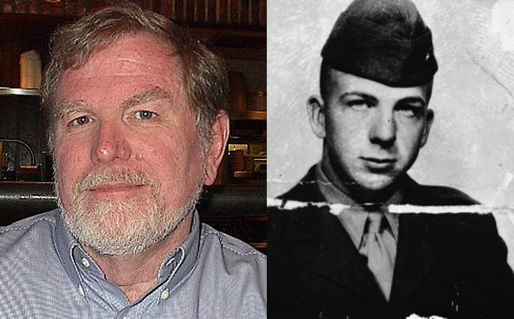
Doug Horne Replies: On Oswald’s Earnings
Here is what I can tell you. Please read most carefully and do not misquote me or even unintentionally misrepresent any of this information. Be most precise, I implore you.
On September 18, 1997, I reviewed the payment records from both the TSBD and the USMC to Oswald, within the earnings records of the Social Security Administration. Roy Truly was not on the SSA name list of persons paid by the TSBD during the fourth quarter of 1963 (Oct-Dec 63). (I have no idea who was paying Truly; but clearly, on the day of the assassination, he was still acting as LHO’s supervisor, per his encounter of LHO with cop Marion Baker on the TSBD second floor.)
The Marine Corps did NOT pay Oswald during the third quarter of 1959 (July 1–Sept 11, 1959). The specialist at the SSA told me that while Lee Harvey Oswald was IN the Marine Corps during the third quarter of 1959 (until September 11th, his discharge date), they definitely did not PAY HIM during the third quarter. I reviewed the printed records of the earnings he received from the USMC for that year—which had been stored on microfilm—and it was ZERO for the third quarter, whereas they did pay him for the first and second quarters of 1959. The ARRB’s contact at SSA said there was “no possibility of a mistake” in their records. I printed all of the microfilm records I reviewed on paper and took them back to the ARRB as assassination records.
Now, as you know, Blakey wrote the draft JFK Act legislation. In it, he exempted both the autopsy materials (“All Deed of Gift” materials donated to the Archives) and “tax information” from the disclosure requirements of the Act. The IRS actually wanted all tax information on Oswald to be subject to the Act and to be released; Congress, erring on the side of privacy (like Blakey), refused to allow this in the Act. That is most unfortunate, because at this juncture, these detailed records that I reviewed can only be released if Section 6103 of the IRS Code is amended to permit their release.
The Oswald earnings records I reviewed are covered by RIFs 137-10005-10060 through10089, inclusive. They are redacted unless or until Section 6103 of the IRS code is amended by Congress to permit all “tax information” (which definition includes not only tax returns, but also earnings records) to be released.
I published a memo about all this on September 23, 1998, and all tax information and earnings records issues I was aware of are discussed therein. Its title was: “Questions Raised by John Armstrong and Carol Hewitt About Lee Harvey Oswald’s Tax and Earnings Records.” In that memo, all specifics about the microfilm records of LHO’s earnings that I reviewed on September 18, 1997, are REDACTED. The redactions cannot be unredacted unless or until Section 6103 of the IRS Code is amended by Congress to allow release of all “tax information” on LHO, Jack Ruby, and others identified by ARRB RIFs. (We looked at “tax information” for others besides LHO and they are all identified by RIFs, and all the details are redacted).
Now, listen to this: in a Feb 3, 1964, letter to J. Lee Rankin from HEW, the Warren Commission was told that there were NO EARNINGS REPORTED for Oswald for the third quarter of 1959. This was initially withheld from the public for the standard privacy reasons surrounding “tax information,” but in 1965, the confidentiality classification for this information was removed by the USG. (See enclosure 13 to my long memo) That information passed to the Warren Commission in Feb 1964 is in CD 353 (the cover letter) and 353a (the specifics about when he earned money and from whom).
Thus, when reviewing Oswald’s earnings records from the Marine Corps in September of 1997, I was simply confirming (by viewing the dollars and cents details) what the Warren Commission had been told by HEW in the Feb 3, 1964, letter, and for which the confidentiality had been removed in 1965. This means that in my oral statements in the documentary, I am simply confirming information that the WC learned about in Feb 1964, and which became open information in 1965 when the USG lifted its confidentiality.
To obtain the unredacted version of my long research memo, and to get the RIFs about Oswald’s earnings opened up, Section 6103 of the IRS Code would have to be amended. I do not today have the paper copies of the earnings records. Only the Archives has those, as identified above by RIF numbers.
Now, some of Oswald’s “tax information” is already open information, including his 1959 tax return, which shows his total earnings for 1959 to be $996.31 for that year. This would seem to indicate that SOMEONE paid him during the third quarter (because his earnings for quarters 1 and 2 are not that much money), but whichever entity paid him did not pay him very much, at all. SPECULATION: Perhaps it was what would have been his normal USMC salary, IN CASH???
The Review Board recommended in its Final Report “…that Congress enact legislation exempting Lee Harvey Oswald’s tax return information, Oswald’s employment information obtained by the Social Security Administration, and other tax or IRS related information in the files of the Warren Commission and HSCA from the protection afforded by the Section 6103 of the Internal Revenue Code, and that such legislation direct that these records be released to the public in the JFK Collection.”
That is all I am willing, or able, to say about this.
In summary, I simply confirmed in my interview for your documentary that what the Warren Commission was told in Feb 1964—that Oswald had no reported earnings in the third quarter of 1959—was confirmed by me through careful examination of the microfilmed paper earnings records at SSA. For someone to actually view and review those records identified by RIF number above, the IRS Code would have to be amended.
That is all I can say.
Doug Horne
-

Bob Buzzanco: Chomsky’s “Useful Idiot”
Robert Buzzanco is a history professor at the University of Houston. He is also a co-host—along with Scott Parkin—of a podcast called Green and Red. On January 12, 2022, Buzzanco had the 94-year-old Noam Chomsky—looking every year of his age—on his show to reply to the treatment of Vietnam in Oliver Stone’s documentary JFK Revisited: Through the Looking Glass. Chomsky could not help but make some general comments about Kennedy. In this regard, the linguist was his usual pompous and somewhat ludicrous self. At one point, he compared President Kennedy to Ronald Reagan and Donald Trump. If Chomsky can show us where either of the latter supported Medicare, universal healthcare, and equal rights for African Americans in the sixties, I would be curious to read about it, because Kennedy did all three. The program then slipped into Rocky Horror Picture Show low camp: Chomsky tried to parallel Kennedy’s success to the conditions existing in Germany in the twenties. I wish I was kidding, but I’m not. The only way there is any resemblance is that the assassinations of that decade—JFK, Malcolm X, King and Robert Kennedy—led to the election of Richard Nixon, the premature end of an era of hope and aspiration, and a continuance of the war in Vietnam. I wish I could add that Buzzanco pointed out these absurd exaggerations. He didn’t. (For more on Chomsky, click here and here)
As the program went on, it became clear that Chomsky and Buzzanco had done zero research on the new evidence about the subject of Vietnam adduced by the Assassination Records Review Board (ARRB) and presented in JFK Revisited. The pair was largely relying on what Chomsky had written, if you can believe it, back in the nineties in response to Stone’s film JFK. The pair actually ended up being worse than the MSM on the subject.
How? Because back in December of 1997, the Board declassified the records of the May 1963, SecDef meeting in Hawaii. This was a regular meeting that Secretary of Defense Robert McNamara had with representatives of each branch of the American government in Saigon: State, CIA, Pentagon, etc. Those declassified documents were so direct and compelling they convinced the New York Times and Philadelphia Inquirer that, at the time of his death, Kennedy was getting out of Vietnam. (Probe Magazine, Vol. 5 No. 3, p. 19) It should be noted that the NY Times story was written by MSM stalwart Tim Wiener. But yet, Chomsky was still using his old excuse that Kennedy was only getting out if Saigon was winning. This was ridiculously illogical back in the nineties, because, as John Newman pointed out in his book JFK and Vietnam, Kennedy understood that the Pentagon was rigging their numbers in order to make it appear Saigon was winning. Newman demonstrates this awareness in the book. He even named the two men who cooked the books: General Paul Harkins and Air Force Colonel Joseph Winterbottom. (pp. 185–245, 2017 edition)
The thesis of Newman’s book is that Kennedy was going to use this optimistic information to hoist the Pentagon on their own petard. Revealing on this point is that Kennedy told McGeorge Bundy’s assistant Michael Forrestal that America had about a hundred to one chance of winning in Vietnam. He then said that when he returned from Dallas:
I want to start a complete and very profound review of how we got into this country, what we thought we were doing, and what we now think we can do. I even want to think about whether or not we should be there. (James Douglass, JFK and the Unspeakable, p. 183)
The other point that is important in this regard is that, after it became clear what JFK was doing—and also what the new president wanted—the intelligence reports began to change. They now became pessimistic and also backdated to early November, and even before. (Click here; see also The Third Decade Vol. 9 No. 6 pp. 8–10; Newman, 2017 edition, p. 438)
Is not the point made with those two pieces of data? In fact, as historian Aaron Good has stated, when one combines the evidence, this “profound review” suggests the genesis of the Pentagon Papers. By 1967, it was fairly clear that President Johnson’s escalation and direct intervention was not going to work. Robert McNamara was still Secretary of Defense. Realizing that Johnson’s strategy of air and infantry escalation had failed, he had become quite emotionally disturbed. In 1966, fearing he was going to be attacked at Harvard, he escaped a hostile crowd through a tunnel. His son had draped a Viet Cong flag across his bedroom. He would rage against the war’s futility and then turn to the window and literally cry into the curtains. As his secretary said, that happened frequently. (Steve Sheinkin, Most Dangerous, p. 98, p. 121, p. 126) It’s a logical deduction that McNamara realized what had happened between Kennedy and Johnson and he was now expiating his guilt by exposing the secret history of the war through the Pentagon Papers, which is likely why he kept this 18-month effort a secret from Johnson. And he had no objection to Daniel Ellsberg giving the papers to, first, the New York Times and, then, the Washington Post.
In fact, in JFK Revisited: Through the Looking Glass, Stone plays a tape from February of 1964 in which Johnson admits that Secretary of Defense Robert McNamara was implementing Kennedy’s withdrawal policy. Johnson states that he knew this and he stewed in silence, because as Vice President he could not do anything about it, at least at that time. Somehow both Chomsky and Buzzanco missed this.
But that is not what I really wish to address here. On that podcast, near the end, Buzzanco implies that somehow, there was no information in the documentary about Lee Harvey Oswald that was not in the House Select Committee on Assassinations (HSCA) volumes. I could barely believe what I was hearing, but I really think he meant it. If that is so, then Buzzanco:
- Could not have read the HSCA volumes
- Did not pay any attention at all to the documentary.
This from a man who pontificates to the listener that he knows what he is talking about and can be trusted to set the record straight.
One will search in vain through the 12 volumes of the HSCA for any annex on Oswald’s relationship with the CIA and/or FBI at any time in his career. In the film, we have John Newman and Jeff Morley talking about this issue. To mention just four things they brought up that are not in those volumes:
- That the liaison for the HSCA with the CIA also secretly handled the Cuban exile who tried to frame Oswald after the assassination for killing Kennedy for Cuba.
- That the FBI scraped off the address of 544 Camp Street from the Oswald flyers before they were sent to HQ. That address housed the offices of Guy Banister and also the CIA-backed Cuban Revolutionary Council.
- The FBI took Oswald’s flash warning off his file in the first week of October 1963. This meant the Secret Service was unlikely to remove him from the motorcade route. That warning had been on the file for 4 years prior.
- A similar thing occurred at CIA, in order to lower Oswald’s profile in advance of the assassination.
In fact, one will only see the last point in the so called Lopez Report. This was the HSCA’s classified report on Oswald and Mexico City, which was only released by the ARRB, a body which Buzzanco refers to only in passing, discounting it as he does. The middle two points were also only discovered as a result of that Board’s work. So just what is Buzzanco talking about in regards to the HSCA? He clearly has not done his homework on the subject.
In fact, the only systematic, direct work done on Oswald and the CIA by the HSCA was not declassified until after the Board went out of existence. This was in 2005. I am referring to the scintillating work of HSCA researcher Betsy Wolf and it was discovered by British researcher Malcolm Blunt. (I would like Buzzanco to prove to me he knew of either person before he opened up his mouth on the subject.) Back in 1977–78, Wolf was the main HSCA researcher on the Oswald file at CIA. She discovered that there were two odd things about this file. First, there was no 201 file opened on Oswald for 13 months after his defection, even though the CIA knew about the defection within days, and had accumulated many papers on the man in just one month.
The second thing she discovered was that the documents on Oswald did not go to the place where they should have gone, namely the Soviet Russia Division. Instead, they went to the Office of Security, which, as Malcolm found out, almost guaranteed there would be no 201 file opened on him.
These anomalies disturbed Wolf. She decided to interview officers in the CIA who would know about such matters. She discovered that there was an unofficial Agency rule which said, once there were five documents on a subject, a 201 file should be opened. This was clearly and blatantly disregarded in the Oswald case. But it was not until late in 1978, when the HSCA was about to close down, that she found her Holy Grail about the Oswald file and its weird path. At that time, she interviewed Robert Gambino, who was the present Chief of Security at CIA. He told her that it did not matter how many documents came in on a subject or if they were stamped to a certain division. If someone had already arranged with the Office of Mail Logistics, those papers would go to the agreed upon destination. (Click here for that information) I would like for Buzzanco to show me where Gambino’s information is located in the HSCA volumes. I think I will have a very long wait, since, from what I can see, Wolf’s memos were not typed into memoranda form.
When one combines the above information with what JFK: Destiny Betrayed reveals about another ARRB discovery, then we learn much, much more about who Oswald was. The four-hour version of the film, released this month, has an interview with ARRB Military Records Analyst Doug Horne. He revealed to Stone that in Oswald’s last quarter in the Marines, he was not being paid by that organization, but likely by someone else. The combination of these two new important pieces of information—the bizarre file routing, and the source of funds—would all but clinch the fact that Oswald was an intelligence project before he left for Russia. Buzzanco will not find that information in the HSCA volumes.
I won’t go into all the incredibly important data that Oliver Stone unveiled to millions of people around the world in his film and which directly impacts on the facts of Kennedy’s death. How else does one explain that CE 399, the Magic Bullet, got to FBI HQ before it was delivered there. But on top of that, the FBI declared that the agent who dropped it off placed his initials on that bullet. The film proves they are not there.
The film all but proves that CE 399 was never fired in Dealey Plaza that day and would never be admitted into a court of law since, as Stone said on the Joe Rogan Show—in front of 2.5 million people—it has no chain of custody. Buzzanco and Chomsky ignored this key evidentiary issue, because, as David Mantik states in the film, in all previous inquiries CE 399 was foundational to the case against Oswald.
As Doug Horne says in the two-hour version of the film, the official autopsy photographer John Stringer denied under oath that he took the pictures of Kennedy’s brain at the Archives. He did this on at least five grounds. The first two being that he never used the type of film utilized in the photos. Second, he never used the optical processing method to produce the photos, which was a press pack. (For more details see Horne’s Inside the ARRB Vol. 3, p. 810) With Stringer’s denial, these official autopsy photographs would not be admitted into court. And they also indicate, as we show in the film, that the brain in evidence today cannot be Kennedy’s. The fact this subterfuge took place at a military controlled medical center, with many generals and admirals in control, betrays a high-level conspiracy—without even dealing with the mysterious flight plan of General Curtis Le May that day, which is also described in the recently released long version of the film.
How can men who attest to be leading intellectuals of the left do such incredibly sloppy and irresponsible work? This critique could have easily been twice as long as it is. And it would have been just as pungent and pointed. Buzzanco and Chomsky remind me of what psychologists term a folie a’ deux. It spiraled into a collapsing domino effect, since neither man made any attempt to check the other. There was never one ounce of effort placed on fact checking on matters they knew nothing about, which was a lot.
This has always been my problem with what I call the doctrinaire/structuralist left. In an odd way, their aims meet the MSM; and the underpinnings of both are exposed as being built on quicksand, because they both value expedience over facts, but for different aims.
Addendum: In another program one week later, Buzzanco apparently could not get anyone to interview him, so he had Parkin act as his line reader for what amounted to an Orwellian “60 Minutes Hate” against President Kennedy. Like Buzzanco with Chomsky, Parkin did not cross check his colleague once. Buzzanco did issue a debate challenge, which I accept, but not on his program, since that would help aid his viewership. He can contact me and we can arrange an agreed upon venue with an agreed upon agenda that follows the subject lines of JFK Revisited.
I await his response.
-
Jim DiEugenio Live March 22nd
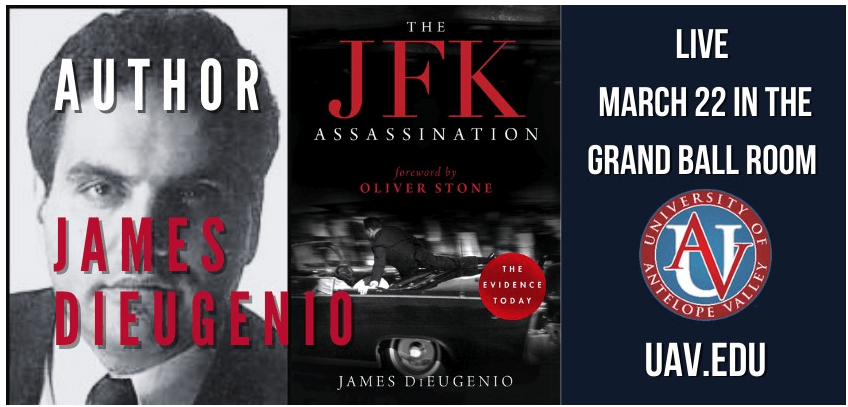
Renowned author, researcher, and publisher Jim DiEugenio, one of the leading experts on the assassination of President John Kennedy is coming to the University of Antelope Valley. Jim will be appearing in the Grand Ballroom on Tuesday, March 22nd at 10am. He will present his case and explain what happened on November 22, 1963, the day that changed America forever.
Students, faculty, and community members are invited to attend. The event is free.
Jim is the author of several ground-breaking books including Destiny Betrayed, and The JFK Assassination. He was also the publisher of Probe Magazine. Jim has been a special consultant to Oliver Stone having written the script for the famed movie producer’s new documentary—JFK Revisited.
Please come and hear Jim’s compelling presentation about what truly was “The crime of the century.”
