Tag: CUBA

  • Antonio Veciana, with Carlos Harrison, Trained to Kill (1)

    Antonio Veciana, with Carlos Harrison, Trained to Kill (1)


    Pulp Nonfiction: Trained to Kill by Antonio Veciana with Carlos Harrison


    In September of 1979, Antonio Veciana was driving in Miami when an unknown assailant began shooting at him with a .45. The bullets blew out his car window, struck him in the head, his arm, his stomach, but he survived. Recovering in the hospital with a bullet embedded above his left ear,1 he first thought it might have been a CIA hit. But it was an awfully clumsy attempt, and he had earlier been told that Cuban leader Fidel Castro put him on a hit list.

    So he decided to get back at Castro with a model airplane and some C4.

    Now Veciana is the kind of guy who knows how to get explosives if he needs to, and this isn’t the first time he’s been part of an operation to assassinate Castro. So he starts working on his plan, and a few days later an FBI agent greets him on his front porch. The upshot of their conversation is that the agent knows he’s been trying to get some explosives. Then the agent says he already talked to Veciana’s explosives expert and knows he already has the C4.

    Veciana tells the agent to get lost. The agent had to be lying, because he hadn’t given his explosives guy the C4 yet. As a matter of fact it was hidden under the house, not far from where they were having the conversation.2

    Trained to Kill: The Inside Story of CIA Plots Against Castro, Kennedy, and Che is the incredibly improbable memoir written by Veciana (with Carlos Harrison), and the most incredible thing is how much of the story is demonstrably true. Already a major presence in books by HSCA investigator Gaeton Fonzi and well-respected researcher Dick Russell, the author takes the opportunity to tell his own story in his own clear, direct manner.

    This is a man who began life in a shack in the wake of the Great Depression, before growing up to work for Cuba’s richest banker. A hard left turn later, he became the leader of the CIA-backed revolutionary army, Alpha 66, ending up as a peripheral witness to the mechanics behind the assassination of John F. Kennedy.

    However, before we go into his story, let’s take a brief look at the background of American foreign policy in this time period. What changed after World War II? How did funding and training paramilitary groups and overthrowing countries become key functions of the American intelligence services?

    For that, I want to start with one Sir Ian Fleming.

    A DINNER PARTY

    On March 13, 1960, the novelist and intelligence agent Ian Fleming met his friend Mary Leiter (whose husband provided the name for Bond’s CIA friend Felix Leiter) in Washington, D.C. Leiter, driving around town, happened to spot a friend walking on P Street: Senator John F. Kennedy, who would in a few months become President of the United States. She asked the Senator if it would be all right to bring her guest to dinner. A fan of James Bond, and in particular the novel From Russia, with Love, he eagerly assented.3

    Fleming, now world famous as the inventor of James Bond, had a long career in “special services” and left his mark on U.S. intelligence history. During World War II, as a secretary of Admiral John Godfrey (then Director of Naval Intelligence of the Royal Navy), he served as a liaison to MI6 (British intelligence) and was something of an “idea man” with respect to covert operations. He was in the know to arguably the biggest secret of the war: that Alan Turing and his Bletchley Park colleagues had cracked the German Enigma Code. He had even proposed a plan to get an Enigma machine early in the process, but the plan, Operation Ruthless, was never realized, to the frustration of the Bletchley mathematicians.4 Fleming’s plan was as follows:

    I suggest we obtain the loot by the following means:

    1. Obtain from Air Ministry an air-worthy German bomber.
    2. Pick a tough crew of five, including a pilot, W/T operator and word-perfect German speaker. Dress them in German Air Force uniform, add blood and bandages to suit.
    3. Crash plane in the Channel after making S.O.S. to rescue service in P/L.
    4. Once aboard rescue boat, shoot German crew, dump overboard, bring rescue boat back to English port.

    In order to increase the chances of capturing an R. or M. with its richer booty, the crash might be staged in mid-Channel. The Germans would presumably employ one of this type for the longer and more hazardous journey.5

    Researchers in parapolitics will recognize this sort of operation. It was the kind of thing that would become standard in the American intelligence services. It is perhaps most associated with CIA planner Edward Lansdale of Operation Mongoose, dedicated to the removal of Fidel Castro. (Lansdale famously was thought to have been the model for Graham Green’s The Quiet American, with some cause.) It was in these elaborate plots that names familiar to JFK researchers appear: Allen Dulles, Richard Helms, James Jesus Angleton, Bill Harvey, David Morales, and many others.

    Fleming himself served as a liaison to Wild Bill Donovan, the famous first head of the Office of Strategic Services (OSS) that itself grew out of U.S. Naval intelligence (ONI). Indeed, he wrote a 72-page outline that would serve as a foundational document for the OSS and the Central Intelligence Agency. For his efforts, Fleming was awarded a Colt revolver with the inscription “For Special Services.” (In another odd connection, the friend – Mary Leiter – who introduced Fleming to Kennedy in 1960, lived on an estate in Langley, Virginia, owned by her husband’s father. That estate would end up being purchased by the government and converted into CIA headquarters.)6

    In any event, at that March 13, 1960 dinner, Kennedy would have known that his dinner guest was no mere spy novelist. A lively conversation ensued among the group, which also included the reporter Joseph Alsop and a CIA operative named John Bross. Bross had been the assistant general counsel to the U.S. High Commissioner to Germany, John J. McCloy, from 1949 to 1951. One of the things that Bross did was help McCloy make certain key decisions such as – for example – declining to pursue Klaus Barbie and other hardcore Nazis. Bross remained an important voice in the organization for decades; at the time of his death in 1990, CIA Director Richard Helms reflected on how often he had relied on his “wise counsel.”7 Meanwhile, Alsop would later be the man who planted the seed in Lyndon Johnson to form the Warren Commission instead of using local authorities to investigate the Kennedy assassination. Donald Gibson points out in his excellent essay that Alsop, in the transcript of a conversation with Johnson less than a day after Oswald’s shooting by Jack Ruby, baldly states that a formal commission will agree to keep out of the investigation things that the FBI will want to keep out.8 What those things might be is unspecified.

    Fleming, although fairly sedate during the course of the discussion, became aroused as talk turned around to Cuba. What should the U.S. do about Fidel Castro? For this, Fleming had a three-step plan, which shows a familiar pattern of thinking:

    1. The United States should send planes to scatter Cuban money over Havana, accompanying it with leaflets showing that it came with the compliments of the United States.
    2. Using the Guantanamo base, the United States should conjure up some religious manifestation, say a cross of sorts, in the sky which would induce the Cubans to look constantly skyward.
    3. The United States should send planes over Cuba dropping pamphlets, with the compliments of the Soviet union, to the effect that owing to American atom-bomb tests the atmosphere over the island had become radioactive; that radioactivity is held longest in beards; and that radioactivity makes men impotent. As a consequence the Cubans would shave off their beards, and without bearded Cubans there would be no revolution.9

    One might imagine that Fleming had his tongue in cheek when making that last suggestion, except the CIA invented equally absurd plans, including a scheme to make Castro’s beard fall out using thallium.10 Within half an hour of the dinner party ending, CIA Director Allan Dulles heard about Fleming’s visit and expressed dismay that he hadn’t been able to discuss Cuba with him in person.11 During the War, Dulles had shared office space with the “Man Called Intrepid,” the famous spy William Stephenson. Stephenson had a “license to kill,” and in fact was one of the inspirations for the character of James Bond.12 Dulles was so intrigued with James Bond that he actually tried to duplicate some of the spy’s gadgets. Mostly he seemed fond of the image of Bond, a man who will resort to violence to accomplish great ends in the line of duty.13

    It is common to speak of the United States and Great Britain having a “special relationship,” and it is no clearer than in the spy business. Even if Fleming’s document had more to do with the form than the letter of what American intelligence would be, it nonetheless carried an enormous influence. From its Ivy League origins and Wall Street orientation, to its determination to meddle in the affairs of other sovereign states, to its emulation of a superficial kind of “class.” Allen Dulles maintained outward respectability, smoked a pipe, and made the decision to obtain Russian intelligence from a Nazi, Reinhard Gehlen. Due to the Gehlen Operation’s inflated reports of Russian weaponry, it is not too far from the point to say that these men invented the Cold War. For his part, Gehlen referred to Dulles as the “Gentleman.”14 Gehlen also took credit for the American success of the Cuban Missile Crisis while simultaneously deploring Kennedy’s approach to solving it.15

    ENTER KENNEDY

    John F. Kennedy became President in the context of a burgeoning covert operations business used to destabilize and overthrow foreign governments, as well as “wet work” used to assassinate foreign leaders. Just as the British Crown had seen India and Africa as possessions, so did the United States gaze upon Latin America. This enormous intelligence apparatus, modeled on British intelligence, had grown to the extent that it represented a parallel government in many ways run out of the office of Allen Dulles.16

    The great “successes” of the 1950s included the overthrow of Mohammad Mossadeq in the Iranian coup of 1953 and Jacob Arbenz in Guatemala in 1954, among other atrocities.17 To give some idea of what continuity was like in the government, the original plan to overthrow Arbenz had been approved by Harry Truman and then continued under Dwight Eisenhower with no ideological objections along the way.18

    CUBA

    On January 1, 1959, Fidel Castro’s revolution, which had been a four-year guerilla struggle against the dictator Fulgenico Batista, successfully overthrew the government. Batista fled to the Dominican Republic.

    To the extent that Americans today know much about the Cuban revolution, it is assumed that Castro had always been a Communist. This is actually a much-debated point. At the time of the insurrection, the Atlantic Monthly informed its readers that there was “abundant evidence” that Castro was not a Communist.19 During a visit to the United States just six months previously, Castro had indicated he was not, and got favorable press. The ex-pitcher grabbed a hot dog at Yankee Stadium and was referred to by no less than Dean Acheson as the “first democrat in Latin America.”20 However, in 1958 Allen Dulles had told President Eisenhower that he did not think a Castro victory would be good for the United States. Meanwhile, Castro’s right-hand man Che Guevara had been in Guatemala during the Arbenz overthrow and undoubtedly carried that distrust with him to Cuba.21

    Fidel Castro’s overthrow and takeover of the Cuban government had widespread effects for being such a tiny island. In addition to legal trade with the United States, there was considerable mafia influence. Meyer Lansky had rolled into Miami in 1933, and during the War made inroads into Havana. By the time the 1950s came around, Santo Trafficante was running the (illegal) show in Cuba. The operation grew so large that he delegated Havana to his son, Santo Jr. The elder Trafficante and Batista became close.22 Batista had opened his doors to Trafficante and the Mafia to foster a welcome business environment for gambling and heroin.23

    And then in one fell swoop, the entire business was upended and the old arrangements went the way of the Dodo. (The effects of Castro’s overthrow are effectively dramatized in Francis Coppola’s film The Godfather Part II). It was also bad news for U.S. foreign policy since Cuba was a short distance from Florida. At least if you were in the hawkish frame of mind of the Pentagon and the intelligence services. And it was in this milieu that the son of Spanish immigrants, a young man named Antonio Veciana, found himself a budding revolutionary.

    VECIANA’S STORY

    Antonio Veciana was no James Bond. He was an asthmatic, lapsed-Catholic accountant who had gone to the University of Havana at the same time as Fidel Castro, although the latter studied law.24 He claims to have distrusted Fidel from the moment he first met him, seeing in him an inclination toward fascism rather than Communism. Fidel had tried to take control of the university, participating in assassinations and assaults on campus.25 Later, of course, in 1953, Castro would lead a failed coup attempt in Santiago de Cuba, winding up in prison only to be released two years later. Castro would head to Mexico with Ernesto ‘Che’ Guevara for a year, only to return on a boat to begin his revolutionary path – legend has it with less than twenty men and only two rifles.

    Castro’s eventual victory in 1959 was astonishing. Equally astonishing, Veciana – the asthmatic accountant, would instigate a plot to fire a bazooka at Se &‌#241; or Fidel Castro.

    However, Veciana had no sympathy for Batista. In May 1953 Veciana married, and two months later his best man Boris Luis Santa Coloma was tortured to death by Batista government thugs. Later that same year, the young man accepted a position with the Banco Nacional, which he described as “Cuba’s federal reserve,” even as Batista’s atrocities increased. At the same time, the revolutionary movement known as the July 26 movement, led by Castro and Che Guevara, began to expand.26

    In late September of 1959, a man named Maurice Bishop came to visit Veciana. At this time, Veciana worked for a bank owned by Julio Lobo, by some accounting the richest man in Cuba. This gave him some visibility. Veciana notes that, perhaps “coincidentally,” Maurice Bishop came to visit him a few days after a certain Jack Ruby left the island, according to their records.27

    This was the beginning of a relationship that lasted for many years. And there was something about Bishop that fired a spark in Veciana. Bishop made a vague proposal that he should help him defeat Castro, and he found himself agreeing, even without details or knowing which intelligence agency Bishop worked for. Although his first guess was CIA.28

    This relationship would also set off one of the most intriguing mysteries of the Kennedy assassination. Because through largely the efforts of HSCA investigator Gaeton Fonzi, Valencia came to believe that Maurice Bishop’s real name was David Atlee Phillips. A former playwright, Phillips had been recruited into the CIA. He had correctly guessed in 1958 that Castro would come to power.29 Veciana states in this book his certainty that Bishop was in fact Phillips, but we will come back to that.

    Bishop invited Veciana to work for him. He tells Veciana there will be many things he won’t know, and he can’t tell anyone, but he is eager to join, even with so many uncertainties. The initial process involves a grueling question-answer session lasting several hours. He gets past the first hurdle and is invited to go to another session. This second time, he is told to swallow a pill, which Veciana assumed was some sort of truth serum. It made him dizzy. At this second interrogation, he was asked many personal questions, including numerous inquiries about his sexuality – seemingly to find out whether he was gay.30

    He passed the test and went to work for the American intelligence apparatus, with the goal of overthrowing or assassinating Fidel Castro.

    THE BAY OF PIGS

    On April 17, 1961, the United States launched the failed Bay of Pigs invasion against Cuba. Veciana, through his contact Bishop, had received payment and training for the Cuban insurgency against Castro, and also had weapons provided. However, the invasion was a disaster, often blamed in history books as precipitated by Kennedy’s failure to provide “air cover.” However, as L. Fletcher Prouty observed, the plan did not have air cover as a kind of backup operation. If the Cuban planes were not destroyed, the invasion was not supposed to have gone forward.31 Indeed, there were many problems with how the plan was explained to Kennedy, as it was first presented in the context of a necessary Cuban uprising and then later without the uprising happening (to match the reality of a lack of popular will to overthrow Castro).32 And Veciana knew this to be true as well: “Agency officials told Kennedy that the people would rise up once the invasion began. That wasn’t true. It wasn’t close to true. The Pentagon knew it wasn’t.”33 The whole history of the Bay of Pigs has, in essence, been rewritten in a long section in Destiny Betrayed.

    Veciana describes the ridiculous situation like so:

    Twelve hundred men landed. Castro had two hundred thousand. The CIA knew that beforehand … What CIA director Allen Dulles was counting on was his ability to pressure young president John F. Kennedy into launching an all-out U.S. military invasion of the island after the Bay of Pigs brigade got bogged down on the beaches. But Kennedy shocked Dulles and the other gray-haired military and intelligence advisors by refusing to buckle. JFK had told them all along that he didn’t want a “noisy” invasion, and he refused to expand the CIA operation into an all-out war, even if it meant sacrificing the brave brigadistas.34

    Following the failed invasion, Veciana notes that Bishop began to describe Kennedy in negative terms. Bishop tells him: “It’s easy to be a liberal when your belly’s full.”35

    U.S. money began flowing to the terrorist group Alpha 66. The plan – according to Veciana’s reportage of what Bishop was telling him – was that they were trying to force Kennedy’s hand. The idea was that if the President failed to take action to remove Castro, he would be on a collision course with Krushchev and the Soviets.36 Bishop then tells Veciana to focus on attacking ships arriving into Cuba, which prompts this exchange:

    “When the Soviets start complaining and rattling their sabers, Kennedy has to act,” he said.

    “What if he doesn’t take aim at Cuba?” I asked, “What if he takes aim at the CIA?”

    “That’s exactly why we have Alpha 66. When they accuse us, we’ll tell him that we had nothing to do with it. It’s a bunch of anti-Castro exiles acting on their own.”37

    Alpha 66 was not the only one of these groups who were acting against Castro on behalf of the government. For example, Dave Morales was head of CI at the CIA Miami station, a hotbed of anti-Castro activity, and their stated mission was – among other things – to infiltrate the 26th of July movement.38 For his part, Veciana does not talk about the work of agency assets like Morales or anyone outside the scope of his activities. It’s one of the things that make his book so useful, in that it is both efficiently told and limited in outlook. Veciana does not tend to talk about things he did not experience personally, which lends greater weight to his encounters with Che Guevara, for example, and his rather startling statement that he met Lee Harvey Oswald in the company of Maurice Bishop.39 He had told investigator Gaeton Fonzi that Bishop had taught him how to recognize faces. He was positive it was Lee Oswald he had seen that day – or a double. “Exacto, exacto,” he told Fonzi.40

    CHILE

    In addition to these nuggets, Veciana discusses the U.S. government’s involvement with the Chilean coup of 1973 against Salvador Allende. According to the author, when Allende took office, Bishop’s focus went to Chile.41 Meanwhile, in 1967 Phillips had been made Chief of the Cuban Operations Group in the CIA’s Western Hemisphere Division. The Church Committee found that with regard to Chile, there had been a Track Two plot to start an insurrection against Allende – one that cost the U.S. government millions of dollars. Coincidentally, Phillips led that project.42

    The overthrow of Allende is interesting due to its broad similarities to the Kennedy assassination, as the author had previously told researcher Dick Russell. For Allende, there was a patsy lined up who would be killed shortly after the assassination with papers on him indicating he was a Russian Castro agent.43

    WAS MAURICE BISHOP DAVID ATLEE PHILLIPS?

    Bishop lines up with David Atlee Phillips in important ways. For example, Phillips was the Chief of Covert Action from 1961 to 1963 in Mexico City. Phillips had been involved in propaganda operations during the Bay of Pigs and became Chief of Cuban Operations just before the Kennedy assassination, interestingly.44 As Fonzi points out, that means Phillips should have known all the answers with regard to Lee Harvey Oswald’s alleged movements in Mexico City.45 When it came time for Phillips to testify to the House Select Committee on Assassinations, his testimony was a disaster. He was forced to admit he had simply invented a story about Oswald, although he insisted some elements of his testimony were true.46

    There are other small details. Phillips’s 1977 autobiography, Night Watch, cites a particular Cuban restaurant as his favorite eating spot. It was the same restaurant that Veciana mentioned to Fonzi – more than a year before Phillips’s book came out – as a casual meeting ground between himself and ‘Bishop.’47

    Certainly JM/WAVE, the CIA’s Miami station led by Ted Shackley, located on the campus of the University of Miami, would have been a logical place to practice the assassination. We know that Operation Mongoose operated out JM/WAVE.

    “[The CIA] had created an operations headquarters in Miami that was truly a state within a city – over, above, and outside the laws of the United States, not to mention international law, with a staff of several hundred Americans directing many more Cuban agents in just such types of actions, with a budget in excess of $50 million a year, and an arrangement with the local press to keep operations in Florida secret except when the CIA wanted something publicized.”48

    As noted, this is far from the complete story, but this is the main part of the story that reflects on Veciana. The author adopts a straightforward prose style and appears to be doing his best to give the truth as he sees it. For that he deserves some kudos. And though I have touched on many of the themes in the book, there is a great deal more of information regarding the nuts and bolts of the operations.

    EPILOGUE

    I began this essay talking about Ian Fleming and his influence on the American intelligence services. This did not end with his formal contributions to the charters of those agencies. In his books, James Bond is a tough customer who enjoys casual misogyny and has some bizarre notions (Fleming uses the vulgar term “chigroes” to refer to what he calls “Chinese negroes” and seems to think that gay men cannot whistle).

    It is a little striking to reflect on the former American spies who wrote pulp novels. The American CIA agent William F. Buckley, famous for his work at the National Review, wrote a series featuring his spy Blackford Oakes in battle with the evil Soviets. His friend E. Howard Hunt (they served together in Mexico City in the fifties) similarly churned out pulp novels with titles like Bimini Run. In fact, when Arthur Bremer shot George Wallace, and a “diary” was discovered in Bremer’s apartment, Gore Vidal wrote that he recognized Hunt’s literary style in the diary. In that famous essay, Vidal also dissected several Hunt novels and found the same casual racism and sexism within, along with the two-fisted America First attitude.49

    David Atlee Phillips didn’t write pulp spy novels. But his brother did.

    James Atlee Phillips, under the pen name Phillip Atlee, wrote hard-boiled pulp with the same points of view evidenced in Fleming, Hunt, and Buckley. In one of his novels, his hero Joe Gall knows he is in Mexico because he smells Mexicans.50 You get the idea.

    Atlee started his writing career publishing The Green Wound Contract in 1963. In this novel, his hero Joe Gall begins by investigating a murder in the sleepy town of Laredo, Texas. That investigation later leads him to New Orleans. Those two locations are, by themselves, interesting in relation to the JFK assassination already.

    Then, when Gall is inevitably captured by the villain Azmodeus, the latter gives a villain speech listing all the disasters of the CIA: “… in 1961 you armed and trained a pro-Batista force and sent it to the Bay of Pigs, losers. Bo Dai, Rhee, Diem, Nosavan, Pahlevi, Nasser, Castillo Armas, Castro. Am I in error yet, Mr. Gall?” Gall tells him no, so he continues. “ … Gehlen the ex-Nazi in your employ, the gentleman who armed the Hungarian patriots, and Radio Free Europe, which piped them out to be butchered … when the Peronistas got half the vote, you agreed that if the Argentines are going to vote like that, the whole election should be canceled.”

    Gall concedes the points, then clobbers the guard with an ashtray.51

    When, at the end of the book, weary from his adventures and having mailed in his report, he is given another possible mission, he gets contemplative:

    In the meantime, an interesting situation had arisen in one of the new desert republics. The United States had recognized this republic, and Carl said they have confirmation on a murder plot against Tallal, head of the new country. Unfortunately, the plot was being financed by two Arab kings who were ostensibly our allies; therefore the whole matter was delicate.

    A fee was involved, $250,000, cash … They wanted me to ambush and assassinate the assassin.

    From a technical point of view, it was interesting. Kicking at the log smoldering in the fireplace, I wondered what would be the best way to handle it. From the inside out, or the other way around …

    Just the same, it did beat selling insurance; that smiling for a living makes your face hurt. And even if I got caught, drawing a bear down the scope sight I’m sure they would understand that nobody can impugn the motives of a real Christian. Not if his heart is pure.52

    I don’t want to make too much about this point, but it is interesting. We know, for example, that Dwight Eisenhower was enthusiastic about psychological warfare, including the use of the arts.53 Perhaps – and this is just a thought – but it may be that as Reinhard Gehlen was producing internal propaganda from his network to keep the Cold War going from the inside, these CIA-connected novelists were doing the same thing for public consumption.

    All of this apparatus, including the part that Antonio Veciana reports on from the front lines, was already in place when these operations, aimed at foreign targets, suddenly were diverted to a domestic assassination. Once Kennedy declined to take the bait arranged for him during the Cuban Missile Crisis in October of 1962 – and now I enter into the realm of informed speculation – it appears that forces within the government decided to move forward with his assassination. A memorandum dated March 4, 1963 reads: “The President does not agree that we should make the breaking of Sino/Soviet ties a non-negotiable point. We don’t want to present Castro with a condition he obviously cannot fulfill.”54 He wants to improve relations with Cuba. He wants to pull out of Vietnam. The evidence for the latter is now overwhelming.

    As a practical matter, the people doing the killing had already established an industry of propaganda operations, assassination teams, and operational plans. The same people, and the same style of operations, would be involved. There was no need to reinvent the wheel to kill a President, and they didn’t.


    See also the review by Arnaldo Fernandez


    Notes

    1 Williams, Dan. “Anti-Castro Leader Shot in the Head.” The Miami Herald, September 22, 1979.

    2 Veciana, Antonio, with Carlos Harrison. Trained to Kill: The Inside Story of CIA Plots Against Castro, Kennedy, and Che. Skyhorse Publishing: New York, 2017, 195-196.

    3 Pearson, John. The Life of Ian Fleming (McGraw-Hill: New York, 1966), 321.

    4 Cox, David. “The Imitation Game: How Alan Turing Played Dumb to Fool US Intelligence.” The Guardian (The Guardian), February 22, 2017. https://www.theguardian.com/science/blog/2014/nov/28/imitation-game-alan-turing-us-intelligence-ian-fleming

    5 Memo from Ian Fleming to Director of Naval Intelligence, September 12, 1940, British National Archives.

    6 CIA. “What Do James Bond, Downton Abbey, and the CIA Have in Common?” 2015. Accessed February 3, 2017. https://www.cia.gov/news-information/featured-story-archive/2015-featured-story-archive/james-bond-downton-abbey-and-cia.html

    7 “John Bross Dies at 79.” The Washington Post. October 17, 1990. Accessed February 10, 2017. https://www.washingtonpost.com/archive/local/1990/10/17/john-bross-dies-at-79/473069e8-372d-426f-8f55-adfbb5194f22/?utm_term=.decc0326d6d9

    8 DiEugenio, James, & Lisa Pease, ed. The Assassinations: Probe Magazine on JFK, MLK, RFK and Malcolm X. Los Angeles, CA: Feral House,U.S., 2002, 11-16.

    9 Pearson, 322.

    10 St. Clair, Jeffrey, “Roaming Charges: The CIA’s Plots to Kill Castro,” Counterpunch, December 2, 2016. http://www.counterpunch.org/2016/12/02/roaming-charges-the-cias-plots-to-kill-castro/

    11 Pearson, 323.

    12 Talbot, David. The Devil’s Chessboard: Allen Dulles, the CIA, and the Rise of America’s Secret Government. HarperCollins: New York, 2015, 21-22.

    13 Kinzer, Stephen. The Brothers. Times Books – Henry Holt and Company: New York, 2013, 274.

    14 Talbot, 276-279.

    15 Gehlen, Reinhard. The Service: The Memoirs of General Reinhard Gehlen. Popular Library Edition: New York, 1972, 257.

    16 Talbot, 366-367.

    17 Dehghan, Saeed Kamali and Richard Norton-Taylor. “CIA Admits Role in 1953 Iranian Coup.” The Guardian (The Guardian), August 19, 2013. https://www.theguardian.com/world/2013/aug/19/cia-admits-role-1953-iranian-coup.

    18 “CIA and Assassinations: The Guatemala 1954 Documents.” Accessed January 24, 2017. http://nsarchive.gwu.edu/NSAEBB/NSAEBB4/.

    19 Ajaka, Nadine, Noah Gordon, Rumana Ahmed, The Editors, Elaine Godfrey, David Epstein, ProPublica, et al. “Castro is not a communist or a Dupe.” The Atlantic, December 31, 2014. https://www.theatlantic.com/international/archive/2014/12/castro-is-not-a-communist-or-a-dupe/384110/.

    20 Glass, Andrew and Jack Shafer. Politico. “Fidel Castro Visits the U.S., April 15, 1959.” April 15, 2013. Accessed February 25, 2017. http://www.politico.com/story/2013/04/this-day-in-politics-april-15-1959-090037.

    21 Luxenberg, Alan H. “Did Eisenhower Push Castro into the Arms of the Soviets?” Center for Latin American Studies at the University of Miami, Journal of Interamerican Studies and World Affairs, Vol. 30, No. 1 (Spring, 1988), 41-44. http://www.jstor.org/stable/165789

    22 McCoy, Alfred. The Politics of Heroin: CIA Complicity in the Global Drug Trade. Lawrence Hill: Chicago, IL, 1991, 41.

    23 Escalante, Fabián. JFK – the Cuba Files: The Untold Story of the Plot to Kill Kennedy. Melbourne: Ocean Press, 2006, 19.

    24 Veciana, Antonio, with Carlos Harrison. Trained to Kill: The Inside Story of CIA Plots Against Castro, Kennedy, and Che. Skyhorse Publishing: New York, 2017, 24.

    25 Ibid, 35.

    26 Ibid, 28-29.

    27 Ibid, 40.

    28 Ibid, 45.

    29 Ibid, 32.

    30 Ibid, 56.

    31 Ratcliffe, David T. Understanding Special Operations: And Their Impact on the Vietnam War Era. Rat Haus Reality Press: Santa Cruz, CA, 1999, 65-66.

    32 DiEugenio, James. Destiny Betrayed, Second Edition. Skyhorse Publishing: New York 2012, 42.

    33 Veciana, 99.

    34 Ibid, 100.

    35 Ibid, 101.

    36 Ibid, 112.

    37 Ibid, 113.

    38 Memorandum for the record, Interview with Dave Morales, June 2, 1961. https://www.maryferrell.org/showDoc.html?docId=16200&relPageId=38

    39 Ibid, 124.

    40 Fonzi, Gaeton. The Last Investigation. United States: Sky Pony Press, 2016, 142.

    41 Veciana, 157.

    42 Fonzi, 271-272.

    43 Russell, Dick. On the Trail of the JFK Assassins: A Groundbreaking Look at America’s Most Infamous Conspiracy. New York: Skyhorse Publishing, 2008, 150.

    44 Veciana, 190.

    45 Fonzi, 266.

    46 Simpich, Bill. State Secret. The Mary Ferrell Foundation, Chapter 5: The Mexico City Solution.” https://www.maryferrell.org/pages/State_Secret_Chapter5.html

    47 Russell, Dick. The Man Who Knew Too Much. 2nd ed. New York: Carroll & Graf Publishers, 2003, 270.

    48 Blum, William. Killing Hope: U.S. Military and C.I.A. Interventions Since World War II–Updated Through 2003. 2nd ed. Monroe, Me: Common Courage Press,U.S., 2003, 197.

    49 Vidal, Gore. “The Art and Arts of E. Howard Hunt.” The New York Review of Books, December 13, 1973. http://jfk.hood.edu/Collection/Weisberg%20Subject%20Index%20Files/V%20Disk/Vidal%20Gore/Item%2001.pdf

    50 Atlee, Phillip. The Death Bird Contract. Fawcett World Library: 1966, 5.

    51 Atlee, Phillip. The Green Wound Contract. Fawcett World LibraryL 1963, 128-129.

    52 Ibid, 205-206.

    53 Wilford, Hugh. The Mighty Wurlitzer: How the CIA Played America. Harvard University Press: Cambridge, Massachusetts: 2008, 153.

    54 Douglass, Jim. JFK and the Unspeakable. Orbis Books: Maryknoll NY: 2008, 56.

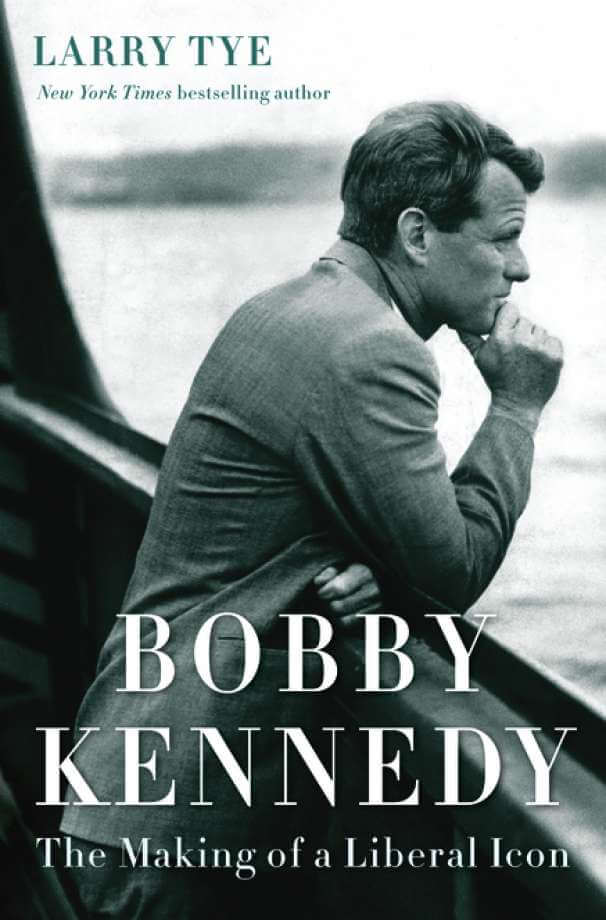
  • Larry Tye, Bobby Kennedy: The Making of a Liberal Icon

    Larry Tye, Bobby Kennedy: The Making of a Liberal Icon


    Before opening Larry Tye’s biography of Robert Kennedy, I had some qualms about it. Why? Because when I turned to the back cover I saw that none other than Henry Kissinger had given the book his endorsement. The man many commentators think should be tried as a war criminal, who, for instance, supervised Richard Nixon’s expansion of the Vietnam War into Cambodia and Laos, was praising a book about Robert Kennedy. I then noted another blurb by journalist Marvin Kalb. In 1974, Kalb, along with his brother Bernard, wrote one of the first biographies of Kissinger. (Historian Theodore Draper called it a hagiography.) The Kalbs compared the validity of Kissinger’s diplomacy to George Washington’s likeness on a dollar bill. A judgment which, to say the least, does not hold up today. These endorsements, quite naturally, gave me pause.

    After reading the book, that pause was justified. Approximately the last 75 pages of Tye’s work are adequate and, in one or two places, actually moving. The problem with that observation is simple arithmetic: the book contains 447 pages of text. Therefore, those last 75 pages comprise about 1/6 of the volume. The rest of the book is not just below average; in many places it is worse than that, and in more ways than one.

    Tye tips us off to his agenda quite early. In his preface, he calls Robert F. Kennedy a commie baiter who was egged on by his father and Joe McCarthy. He adds that Kennedy practiced Machiavellian tactics to win his brother the presidency. He then says that he was also part of the plots to eliminate Fidel Castro. He tops this off by writing that “an assassin halted his campaign of conciliation.” (p. xi) I wrote in my notes: “Tye is off to a bad start.” I was correct.

    I

    Tye titles his first chapter “Cold Warrior”. In order to make this stick, he employs what military experts would call a pincers movement. He wants to envelop young Robert within the grasp of his father Joseph Kennedy, and his first legislative boss, Senator Joseph McCarthy. How anyone today could compare RFK with his father is really kind of inexplicable. But this is one of Tye’s unrepentant and recurrent proclamations. (Tye, p. 5) In this reviewer’s experience and knowledge there can be no better witness to this issue than Jackie Kennedy, since she was close to Joe Kennedy, and was even more familiar with his three surviving sons. She told Arthur Schlesinger that RFK was the son who was least like his father. (See Robert Kennedy and His Times, p. 102) For instance, RFK did not have any interest in or aptitude for business. In fact, by 1957, he was a pro-labor advocate. Also, unlike his father, he was a devoted family man. Again, unlike his father, and more like President Kennedy, he was not an isolationist in his foreign policy outlook. Another point: RFK was quite aware of and sensitive to the plight of both the poor and minority groups. So where Tye gets this comparison is rather puzzling. After reading and taking notes on his book, in my view he does not come close to proving it. Jackie Kennedy appears correct on this point.

    It is interesting to note how Tye shoehorns RFK into this Cold Warrior box. One way he does so is by leaving out the name of Edmund Gullion. In 1951, in preparing for his run for the Senate a year later, congressman John Kennedy took a trip to the Far East. One of the places he visited was Saigon, South Vietnam. He was determined to find out the true status of the colonial war there between the Viet Minh and Ho Chi Minh on one side, and the colonial government of France on the other. After all, the USA was bankrolling a large part of the French war effort. One of the men that John Kennedy consulted with was a man he had formed a glancing relationship with in Washington a few years before. Gullion met with the 34-year-old John Kennedy at a rooftop restaurant. He told him that France would never win the war. Ho Chi Minh had fired up the young Viet Minh to such a degree that they would rather die than go back under French colonialism. France could not win a war of attrition. The home front would not support it.

    In 1983, when it was first reported at length in Richard Mahoney’s book JFK: Ordeal in Africa, this meeting had a jarring effect on the reader, for the simple reason that about 99% of President Kennedy biographers had left it out. But since that time, several other authors—like this reviewer—have not just mentioned it, but detailed it. So it is hard to imagine that Tye is not aware of it. The reason that it should be important to him is simple: Robert Kennedy was there. (James DiEugenio, Destiny Betrayed, Second edition, p. 21) RFK later said that Gullion’s words had had a profound impact. As Arthur Schlesinger writes, when JFK opposed American intervention at Dien Bien Phu in 1954, RFK agreed. (ibid, p. 125) And on the issue of anti-communism and its relationship with anti-colonialism, RFK pretty much mirrored his brother: You could not consider anti-communism in the Third World without considering the impact of colonialism. (ibid, p. 133) RFK wrote in the pages of New York Times Magazine “… because we think that the uppermost thought in all people’s minds is Communism …. We are still too often doing too little too late to recognize and assist the irresistible movements for independence that are sweeping one dependent territory after another.” In his visit to Russia in 1955 with Justice William O. Douglas, which Tye mentions, RFK saw a different side of Russian life and became rather sympathetic with its citizens. He even wrote down some of the good things about the USSR. (Schlesinger, p. 134)

    But the main way Tye tries to turn Robert Kennedy into a Cold Warrior is through his service as assistant counsel under McCarthy on his Senate investigative committee. He partly does this by using some rather questionable and controversial sources, like M. Stanton Evans and Ralph de Toledano. The former was present at William F. Buckley’s estate when Buckley founded the Young Americans For Freedom. Evans actually wrote the charter for that right-wing group. He then went on to work for Buckley’s National Review for 13 years. Just a few years before Evans died in 2015, he wrote an apologia for Joe McCarthy. De Toledano was so anti-communist that OSS chief Bill Donovan would not include him in covert operations in Europe during World War II. He then became a close friend of Richard Nixon during the Alger Hiss trials, and later was a co-founder of National Review. He wrote a quite negative book about Robert Kennedy in 1967, in anticipation of his run for the presidency. (In this regard it is important to note that Tye also uses two other dubious sources in this section: conservative hit-man Victor Lasky’s Robert F. Kennedy: The Myth and the Man and Burton Hersh’s absolutely atrocious Bobby and J. Edgar.)

    Robert Kennedy served as assistant counsel on McCarthy’s committee for about six months. According to most observers, he composed one of the very few reports that had any value to it. This was a documented study of how some American allies—like Greece and England—extensively traded with China during the Korean War, consequently being part of the effort against the USA in that conflict. Even McCarthy’s liberal critics described the report as being factually accurate and soberly written. (Schlesinger, p. 108) Unlike most of Chief Counsel Roy Cohn’s work, it did not accuse people of being traitors. And Robert did not take part in the hunting down of alleged subversives in the State Department. (ibid, p. 106)

    In fact, RFK and Cohn bumped heads at this time over the way the chief counsel was conducting the committee. Bobby also complained to McCarthy that although Cohn’s recklessness was attracting a lot of press, it would eventually collapse the committee. He likened what Cohn was doing to a toboggan ride down a slope ending with a crash into a tree. (ibid, p. 110) But McCarthy decided to stick with Cohn. So, in the summer of 1953, RFK resigned.

    About six months later, he returned. He wrote a letter to a friend at this time, saying, “I think I will enjoy my new job.” (ibid, p. 115) This time he was chief counsel to the Democratic minority. He spent about three times longer in this role as he did as assistant counsel to Cohn. Therefore, some dramatizations of this episode use his role as minority chief counsel and discount his prior work. (See the HBO film Citizen Cohn) He went head to head with Cohn, and more often than not, he came out in front. In fact, the two became such bitter rivals that, on one occasion, they almost came to blows. (ibid, pp. 117-18) Even a local newspaper, The Boston Post, went after RFK for his determined and public opposition to Cohn.

    As RFK predicted, McCarthy imploded. One cause was Cohn’s close friendship with David Schine, a draftee who Cohn tried to get special privileges for in the army. Bobby Kennedy wrote the questions for each Democratic senator on this issue. (ibid) The second cause was McCarthy’s fatal showdown with attorney Joseph Welch, who had been hired to specifically defend the army against the McCarthy/Cohn assault. Welch’s famous “Have you no decency sir” riposte punctured McCarthy in front of 20 million spectators.

    When the Army-McCarthy hearings ended in June of 1954, Bobby Kennedy wrote the minority report. It was highly critical of McCarthy’s leadership. Parts of it were so extreme that the committee would not sign off on the whole report. RFK wrote that there was no excuse for McCarthy’s failure to rein in Cohn. Or how irresponsible many of Cohn’s charges turned out to be. He then concluded with: “The Senate should take action to correct this situation.” (ibid, p. 118) For all intents and purposes, this was the beginning of the movement to censure McCarthy. That motion arose on the Senate floor a month later. It was passed on December 2, 1954.

    Under the new leadership of Sen. Karl Mundt, Robert Kennedy had even more power. He used it mainly to wrap up what was left of Cohn’s charges: the Irving Peress, and Annie Lee Moss cases and the accusation of communist infiltration of defense plants. No charges were ever filed.

    From the above synopsis it’s fairly easy to deduce that RFK was stuck in a bad situation and he tried to make the best of it. When he could not, he resigned. Given the opportunity to return under more propitious circumstances, he atoned for his earlier errors. Based upon that, it’s not justified to call Bobby a Cold Warrior, or to have the episode cast a shadow over his entire career.

    II

    The next major section of the book deals with RFK’s confrontation with Teamsters’ leader Jimmy Hoffa. In 1956, the Democrats took control of the Senate and with that, the leadership of the sub-committee on investigations passed to Senator John McClellan. Because he appeared to be eminently fair in wrapping up the McCarthy/Cohn fracas, a few journalists got in contact with Robert Kennedy, trying to interest him to use his chief counsel’s office to go after a real danger: organized crime influence on labor unions. Kennedy and McClellan went in that direction and this resulted in RFK’s four-year long pursuit of Hoffa. Tye seems to have no serious problems with this episode in young Kennedy’s career. The worst he can say about it is that it was used to boost Senator John Kennedy’s profile in his attempt to attain the White House.

    JFK & RFK on the McClellan committee

    Which is kind of ridiculous. The reason JFK ended up on the committee was because of complaints by Teamster leaders Dave Beck and Hoffa. They protested that McClellan’s committee was the wrong place for these hearings; they should be held before the Labor Committee. McClellan resisted this since he thought that committee was too friendly with labor and would not pursue the complaints vigorously. Because they did have a valid point, the solution was to form a special committee, half from McClellan’s committee and half from the Labor Committee. Since JFK was on the latter, that is how he got on the special committee. Is Tye saying that Beck and Hoffa brought up this objection at the request of RFK to get his brother on the committee?

    What is odd about this section is that the reviewer could find few, if any, questions or comments by Tye about some of the techniques used by RFK to finally imprison Hoffa. Some distinguished authors, e.g., Victor Navasky and especially Fred Cook, have raised some serious questions about the methods used by Kennedy’s office to enlist witnesses to testify against Hoffa. Many of these methods were employed by Kennedy’s investigator Walter Sheridan, who remains pretty much untouched by Tye. (For a look at these charges, see Cook’s multi-part series in The Nation which culminated in his article “The Hoffa Trial” on 4/27/64.)

    Another oddity about this section is that much of the political background of the issue goes unexplored. The Republicans on the special committee, for instance archconservative Barry Goldwater, wanted RFK to delve into the Teamsters so they could use that issue to tar labor unions in general. But once they saw how RFK was bringing in organized crime as an influence on Hoffa, they actually began to side with Hoffa, since this would detract from their real aim. (See review of James Neff’s Vendetta, by Alex Lichtenstein, Washington Post July 17, 2015.) When John Kennedy tried to pass legislation aimed at this particular influence in order to sanitize union elections, the Republicans hijacked his legislation and turned it into the union weakening Landrum-Griffin bill. That act was such a twisting of JFK’s original intent that he took his name off of it. (Schlesinger, pp. 188-92)

    Walter Reuther & RFK

    Another fascinating aspect of RFK’s service on this committee was the Kohler company investigation. And again, Tye pretty much discounts the episode. The Republicans on the committee, especially Goldwater, wanted RFK to inquire into this long running UAW strike against Kohler plumbing in order to investigate UAW leader Walter Reuther. Goldwater did not foresee the consequences. First, Reuther turned out to be a forceful witness for the rights of labor and abuses by corporations. Secondly, Bobby Kennedy actually visited the home of Kohler in Sheboygan, Wisconsin. He was appalled at some of the working conditions there, and at what the company called a “lunch break”, which lasted about five minutes. (ibid, pp. 183-87) This had two effects. First, it resulted in a strong personal and professional relationship between RFK and Reuther. For example, Kennedy later called on Reuther to bus in as much of his membership as possible to attend Martin Luther King’s 1963 March On Washington. Second, it ended in the largest fine ever awarded over a strike. Kohler was ordered to pay three million dollars in back wages to the strikers and to give their pension fund another 1.5 million.

    RFK’s focus on Hoffa’s ties with organized crime caused his interest to spread into a general inquiry into the workings of what had become known as the Cosa Nostra in America. As a result, in 1959, the McClellan Committee was nicknamed the Rackets Committee. For the first time the American public was exposed to organized crime figures like Anthony Provenzano and Sam Giancana. Many authors have concluded that it was this part of RFK’s congressional service, his exposure of Mob influence in labor unions and on the national scene, which really made him into a national figure.

    III

    From here, Tye segues into the 1960 presidential election and RFK’s role as his brother’s campaign manager. At the beginning of the chapter he writes that what Bobby did in this campaign would later embolden the likes of Richard Nixon and Lyndon Johnson. (Tye, p. 87) That theme is repeated later on. (see pp. 106, 121) One has to wonder: What in God’s name is Tye up to with those comparisons? Does he really think that no one remembers what Richard Nixon and his political hatchet man Murray Chotiner did to, first Jerry Voorhis in the 1946 congressional race, and then Helen Douglas in the 1950 senatorial race? These have become famous today because of the new low they hit in creating red baiting campaign tactics. Tye also seems to trust the reader not being aware of revelations about how Allen Dulles helped finance Nixon’s run against Voorhis, a man who was opposed to both big banking and big oil, which Dulles represented at his law firm Sullivan and Cromwell. (David Talbot, The Devil’s Chessboard, pp.162-63) Or how Nixon was on the take from private companies in 1946 because he would not run for office at a financial sacrifice to himself. (ibid, p. 165) Chotiner portrayed the anti-communist Voorhis as a tool and fellow traveler of the Kremlin. This included voters getting anonymous phone calls during the last week saying that they should know Voorhis was a communist before they voted for him. (ibid, p. 166)

    What made it all the worse was that Nixon knew it was all a fabrication. When a Voorhis backer later confronted him with those last minute phone calls Nixon took the opportunity to give him an education in realpolitik. He coolly replied, “Of course I knew Jerry Voorhis wasn’t a communist. I had to win. That’s the thing you don’t understand. The important thing is to win. You’re just being naïve.” (ibid) I could continue on with Nixon’s run against Douglas which was, in some ways, even worse than the Voorhis campaign. But the point is obvious: What could someone as corrupt and feckless as Nixon learn from Robert Kennedy?

    The comparison with Johnson is just as bad. Maybe worse. One just has to conjure up the lawlessness of Texas politics in the thirties and forties, which is when LBJ got his start. Through the efforts of several Johnson biographers, we know about the associations of LBJ with such unsavory characters as Herman and George Brown of Brown and Root, the giant construction firm that eventually evolved into Halliburton. In return for steering contracts their way, the brothers financed Johnson’s congressional and senatorial campaigns. (Joan Mellen, Faustian Bargains, pp. 7-9) When a government accountant tried to expose the illicit relations between LBJ and Brown and Root, he was framed for soliciting contributions from his staff. He was acquitted, but decided to leave government service. Johnson also used extortion tactics to gain newspaper endorsements. (ibid, p. 9) There is also circumstantial evidence that the Brown and Root connection helped finance Johnson’s purchase of KTBC radio in Austin, which was the beginning of Johnson’s personal fortune in media.

    But this is all prelude to Johnson’s infamous 1948 race for the senate against Coke Stevenson. The results of that race shifted back and forth for a solid week after the election was over. Johnson actually wiretapped Stevenson’s phone lines. Johnson had made a deal with south Texas political boss George Parr to rig the vote. This culminated in the notorious Box 13. This was a late arriving vote tally—five days after the polls closed—in which 203 ballots were “discovered”. Those results tilted the election to Johnson. Of the 203, a miraculous 202 were votes for Johnson. Which was even worse than the Parr controlled Duval county results, which were 94% for Johnson. Curiously, those 203 names were assembled in alphabetical order. When eleven of the 203 voters in Box 13 were interviewed, they said they had not even voted. Journalist Ronnie Dugger later found precinct official Luis Salas, who admitted he had performed the fraud for Parr and Johnson. Salas had a picture of the smiling officials who held the ballot box in their hands. The capper to all this is that when Dugger interviewed LBJ for his biography, Johnson had the very same picture. (Click here for Jason Matteson’s essay on this subject)

    Are we really to believe that Tye is not aware of this whole tawdry affair? It has been written about extensively since at least 1982, when Dugger’s book on Johnson, The Politician, was first published. Are we also to think that Tye is not aware of Johnson’s later associations with the likes of Billy Sol Estes and Bobby Baker and his bribery actions with Don Reynolds? (For the last, see Mellen, pp. 160-64)

    But in practical terms, in his book, does Tye excavate anything like the above to make his bombastic comparison stick? He mentions some dirty tricks in the primary campaign against Hubert Humphrey, but he admits he cannot trace these through to Bobby Kennedy. And his prime attempt at doing the same in the general election smacks of desperation. In 2011, over a half-century after the election, the Washington Post published an article by Mark Feldstein. (1/14/2011) This was yet another reworking of a story that was published in 1962. Since then it has been reported several times, for instance in the book Empire, a long biography of Howard Hughes by Donald Bartlett and James B. Steele. Somehow, Tye ignores all the previous reporting and accepts this one at face value (Tye, p. 123), even though in serious ways it contradicts the others.

    Back in 1956, Howard Hughes made a loan of $205,000 to Donald Nixon, Richard Nixon’s brother. Donald’s business enterprise, named Nixon burgers, was a kind of fast food place mixed in with a grocery store. It was about to go under unless it got a fast infusion of cash. Hughes was always attuned to these situations since he was all too intent on compromising politicians or their next of kin. After Nixon and Eisenhower won re-election in November, Hughes supplied the loan in December of 1956. Up until that time, the IRS was resisting granting Hughes a large tax exemption for Hughes Medical Center. They recognized it as a scam that was simply a way for Hughes to dodge taxes on profits from his other divisions. But, lo and behold, one month after Hughes notified the Vice-President that all was in place with the loan, the IRS reversed itself. Hughes got the phony exemption, which allowed him to save millions. The loan was supposed to be mortgaged by a plot of land in Whittier—except the land value was estimated at only 50,000 dollars. By most measures one would have to conclude that Hughes was buying influence, not making a business transaction. (Bartlett and Steele, p. 204)

    Through Drew Pearson, the story got out in a fragmentary way in the waning days of the 1960 election. Very few newspapers picked it up and Nixon dismissed it as a last-minute smear unworthy of comment. In 1962, Nixon lied about the loan in his book Six Crises, saying that the Whittier property more than covered the amount of the loan. That year, Nixon decided to return to politics by running for governor of California. This time, the Hughes loan would be a much larger story since now editors were ready for it. The Long Beach Press Telegram decided to run a long story on the loan since they had editorialized about it back in 1960. That story was published in that newspaper and in the magazine The Reporter in April of 1962. James Phelan, who many people in the JFK field have qualms about—including me— wrote it. But in this instance, Phelan did not seem to have a dog in the fight. And there were adequate records to back up what he wrote. And later reporting by, for example, Hughes manager Noah Dietrich, has also borne out the basic facts as he presented them.

    Hughes tried to cover up the loan by using two layers of disguise. The first was a lobbyist by the name of John Waters. But since Waters had done some work for Hughes, the trustee of the mortgage was changed to an accountant named Philip Reiner. Complicating the matter was that, after Donald Nixon eventually went bankrupt, a gas station was built over the Whittier lot. Reiner was sent the rent checks by the station, which amounted to $800 per month. When Reiner surrendered the check to Nadine Henley at Hughes headquarters in Hollywood, it was returned to him. Hughes wanted no paper trail linking him to the lot. So Reiner spent the money. But later, an accountant at Hughes Tool Company in Houston began raising a ruckus about what had happened to the loan for $205,000, well over a million dollars today. Reiner’s cut-out, a lawyer named Frank Arditto, now asked him what happened to the payments, knowing full well that he had given Reiner permission to cash the checks. Realizing he was being made the fall guy, Reiner hired an attorney. With an election coming up, the consul realized that his client would make a good asset for the Democrats, who would protect him. He got in contact with Robert Kennedy, who turned him over to an assistant named Jim McInerney. McInerney decided to subsidize Reiner for the money Arditto was demanding, sixteen thousand dollars. McInerney then put together a package of documents, affidavits, trust deeds, and receipts. He gave them to three outlets: St Louis Post Dispatch, Time magazine, and Drew Pearson. No one would run with it since it was so late in the campaign.

    But Nixon then made a mistake. Hearing about McInerney’s report, he launched a preemptive cover story to conceal the actual circumstances of the loan and the role of Hughes. These lies infuriated Pearson. He now decided to publish the story. (These details are in Phelan’s 1982 book, Scandals, Scamps and Scoundrels. Reiner later sued Hughes and won a $150,000 out of court settlement. See The Desert Sun, 2/22/72)

    When one compares this with the Post version, as adapted by Tye, it is unsettling. That version opens with Nixon complaining that the 1960 election had been stolen from him. It then says that the document package was picked up at McInerney’s office, not sent out. In a completely unprecedented twist—with no evidence advanced—it states that the Hughes cash was given to Dick Nixon to purchase a home in the Washington area. The wildest part then states that RFK acquired the story for money, and then a burglary was arranged at Reiner’s office to get the documents. In his text, Tye never mentions the earlier version of this story; therefore, he does not point out the differences between the two, which means he does not have to attempt to reconcile them. In his footnotes he does not even alert the reader to the other version. But the worst part of the improbable tale, and its innate spin, is that all culpability by Nixon is now gone. That poor Red-baiter Nixon is reduced to a helpless victim pondering what happened to him at the hands of Kennedy power. In this new version, there is not even a note of irony about how Voorhis and Douglas must have felt. Talk about (multi-leveled) historical revisionism.

    IV

    In this review, I will not divert much from the main topic in order to critique at any length or detail some of the comments that Tye makes about John F. Kennedy. If I did, the review would be about 50% longer. I will simply note that some of the things the author says about John Kennedy are rather obtuse, and not supported by the record. For instance, at the beginning of Chapter Four, dealing with JFK ‘s entry to the White House, the author writes that neither Eisenhower nor Wilson had been as brazen as Jack in running for President as an untested leader. I don’t understand what this means. The only elected political office Woodrow Wilson held prior to winning the presidency was a two-year stint as governor of New Jersey. Which is two years longer in office than Eisenhower. In comparison, John Kennedy had served in Congress and the Senate in Washington for 14 years prior to the 1960 election. About the 1960 race, Tye also writes that the politics of Nixon and Kennedy did not differ much. (p. 121) This is a Chris Mathews style blurring of the record. To use just two examples which occurred while JFK was in the Senate and Nixon was vice-president: 1) Kennedy opposed 1954’s Operation Vulture, the White House plan to use atomic weapons to aid the French at Dien Bien Phu; (op. cit Talbot, p. 361) 2) Kennedy’s monumental 1957 speech about why the USA should not support the doomed French colonial war in Algeria provoked barbed and snide remarks from Nixon in the White House. (Richard Mahoney, JFK: Ordeal in Africa, p. 29)

    Tye’s depiction of Robert Kennedy running the Justice Department is, to be kind, equally myopic. The author is adequate in describing the new Attorney General’s war against organized crime. (Tye, pp. 142-45) He describes Kennedy’s attempts at fairness in going after Democratic politicians who had broken the law. (ibid, pp. 145-47) He also briefly describes RFK’s final neutering of the Smith Act by having the sentence of CPUSA member Junius Scales commuted. (p. 157) Again, when it comes to the complexities of the Hoffa case, he seems to have little problem accepting the prosecution’s dubious witness Ed Partin. In fact, he actually adds on to Partin’s sensational charges of Hoffa’s intent to kill RFK by adding the late arriving and dubious Frank Ragano story about Hoffa trying to choke Bobby to death at the Justice Department. (Tye, p. 152) To be fair, he does say that RFK’s pursuit of Hoffa was so unrelenting, so single-minded, that it created sympathy for the Teamster leader.

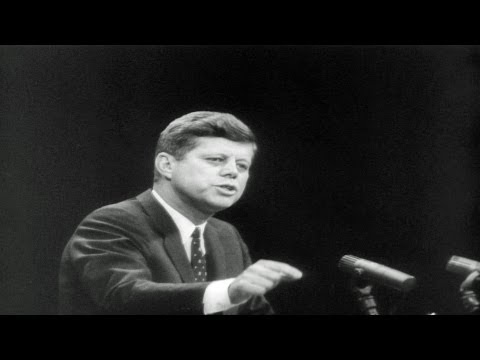
    JFK responds to U.S. Steel’s defiance
    (click image for YouTube video)

    Tye deals with the 1962 steel crisis in about one page (pp. 163-64). His account is so skeletal, so skimpy, that one would think all the commotion was about whether or not FBI agents should phone business executives late at night. To get my bearings back on this momentous event, I reviewed what is perhaps the best account: Donald Gibson’s chapter-long treatment in Battling Wall Street. Gibson begins his discussion by quoting the late, illustrious economist John Blair, who called the episode, “The most dramatic confrontation in history between a President and a corporate management.” (Gibson, p. 9) The only other instance that rivals it was Harry Truman’s intervention in a steel strike ten years before, but that was during a full-blown war in Korea. President Kennedy had worked on an industry-wide labor agreement for a year, mainly through Secretary of Labor Arthur Goldberg. In late March, he thought he had one. But it was broken via a personal visit to the White House by US Steel chairman Roger Blough. He told JFK he would announce a price increase in 30 minutes, which is what the President and Goldberg had been promised would not occur. The President then uttered his famous quote, “My father always told me that all businessmen were sons-of-bitches, but I never believed it until now.” (Irving Bernstein, Promises Kept, p. 143) Within 24 hours JFK went on national television to condemn the steel companies. He said that Americans would find it hard to accept that “a tiny handful of steel executives … can show such utter contempt for the interests of 185,000,000 Americans.” (Gibson, p. 13)

    One day later, RFK announced formation of a grand jury and the delivery of subpoenas. Records, both personal and corporate, were seized. The aim was to establish if criminal conspiracy laws had been violated. The Attorney General also had the FBI march into executive offices for interviews. (Schlesinger, p. 421) Within 72 hours the crisis was over and the price increase rescinded. There can be little doubt that the Attorney General’s actions hurried the settlement. Especially in light of the fact that, in 1961, as a continuation of an investigation under the Eisenhower administration of price-fixing by electric companies, RFK had actually placed seven business executives in prison. Five were from General Electric and Westinghouse. (See The Great Price Conspiracy by John Herling.) And contrary to popular belief, and what Tye implies, based on information from the 1962 steel inquiry, RFK began new actions against US Steel in late 1963. (Gibson, p. 13)

    V

    This same pattern, shrinking a large achievement, is followed with respect to the Attorney General’s actions in the civil rights arena.  In this instance, however, Tye’s writing is even more problematic, since RFK’s achievements there are clearly epochal, no prior Attorney General coming even close to them.

    Harris Wofford & JFK

    Tye does something with the subject that I don’t recall seeing before. He begins his discussion of the Kennedy program in 1963, at a meeting RFK had with some militant black leaders like James Baldwin. Most accounts of the Kennedy civil rights program begin with a review of what had been done by the Eisenhower-Nixon administration and then segues into the memo written by Harris Wofford. After campaigning for Kennedy, Wofford was appointed JFK’s special assistant on civil rights. In late December of 1960, before the inauguration, Wofford wrote a memo that outlined a program for achieving equal rights for black Americans. He then recommended his friend and colleague, attorney Burke Marshall, to be the Justice Department lawyer in charge of the issue. (Bernstein pp. 42-43)

    Just the information above counters two observations Tye makes. First, that the Kennedy administration had no plan to attain civil rights, and second, that RFK took on issues willy-nilly. (Tye, p. 205) Wofford, a central figure by anyone’s estimation, is discounted by Tye. Surprisingly, he is only mentioned once in his chapter on the subject. Yet his memo was both acute and realistic, and it was more or less followed by the administration. He wrote that the only branch of government that had achieved anything so far was the judiciary. He then wrote that the administration would have to press the issue through executive actions in order to put pressure on Congress to pass legislation, something that, for political reasons, Congress would not be ready to do in the first year or two. Wofford also mapped out the country geographically and recommended what actions needed to be taken and where. For example, he recommended legal assaults on states that restricted voting rights, and strictures in contracting to open up corporations to black employment. (Bernstein, pp. 47-48) As historian Irving Bernstein notes in his book, once Robert Kennedy became Attorney General, he followed this program. (See Promises Kept, Chapter 2)

    When the Kennedy administration took office, it was evident that the Brown vs. Board decision, and the Civil Rights Acts of 1957 and 1960 were not having any kind of real impact. One reason for this was the Eisenhower administration’s lack of rigor in enforcing them. Senator John Kennedy, during the debate on the Civil Rights Act of 1957, said he championed Title 3 of that proposed act because it allowed the Attorney General to enter into individual states to attack cases of voting discrimination and school segregation. And this is what Robert Kennedy was doing once he became Attorney General. On May 6, 1961, at the University of Georgia’s Law Day, RFK announced that, unlike his predecessor, he would strongly enforce the Brown vs. Board decision. And RFK also began filing lawsuits in southern states based upon the low rates of voter turnout there. In his first year in office, RFK filed more than twice as many cases than Eisenhower had in his entire second administration. As writers like Harry Golden have pointed out, this plan was not just recommended by Wofford’s memo. Candidate Kennedy had approved it in no uncertain terms during the campaign in a meeting with his civil rights advisory board. (Harry Golden, Mr. Kennedy and the Negroes, pp. 105, 139)

    In the face of all this, how does the author actually begin his chronicle of the administration’s civil rights campaign? He ignores much of what I have noted above. He begins his actual chronicle with the Freedom Riders campaign, which started in May of 1961. He uses this for two reasons. He wants to show that 1) RFK was behind the curve, and 2) He uses the incident to call the AG a liar. He achieves the first in part by ignoring the comment that Senator James Eastland made to RFK after his confirmation. He told Kennedy that his predecessor had never filed a voting rights case against his home state of Mississippi. The next day President Kennedy wrote a note to his brother telling him to begin filing cases. (Golden, p. 100) This, of course, preceded the Freedom Riders campaign.

    The second objective is achieved by saying that RFK was alerted to the incident in advance. Yet the AG said he was not aware of the demonstration. To use one example, as an FBI informant later revealed, J. Edgar Hoover was well aware of the planned violence against the Freedom Riders. That information was not passed to Hoover’s boss, the Attorney General. (Schlesinger, p. 307) A letter that the demonstration organizer had sent to the Attorney General was routed to Burke Marshall instead. He either never got it or he did not inform Kennedy about it. (Bernstein, p. 63)

    But beyond that, is Tye implying what I think he is implying? That somehow, even if he had known about it, RFK would not have anticipated the violence the Freedom Riders would encounter? That is: vicious racists attacking the buses with baseball bats, lead pipes and bicycle chains. With people being pulled off the buses, thrown to the ground and then beaten and bloodied. All this while both the police and FBI did nothing. In this regard, I should note the following. At his meeting with President Kennedy about taking the job, both men understood there were going to be battles in the civil rights area right off the bat. (Ronald Goldfarb, Perfect Villains, Imperfect Heroes, p. 10) But also, I could find no mention by the author of the protest RFK made as a member of the Harvard football team when a southern opponent refused to let a black member of the team stay in the same hotel. That was in 1947. (Schlesinger, p. 71) Secondly, Tye seriously underplays the actions Kennedy took as leader of the Legal Forum at the University of Virginia in 1951. RFK invited black diplomat Ralph Bunche to speak there. He knew it would raise a ruckus, since UV was the team that did not want to play Harvard back in 1947. What made it more problematic was that Bunche wrote Kennedy a letter saying that he did not wish to appear before an audience that featured segregated seating. Yet, state law required this. More or less on his own, Kennedy took the case through four levels of campus government saying that he would not give up, since he thought disallowing Bunche would be morally indefensible. (Schlesinger, p. 90) Bunche ended up speaking to an integrated audience that was about 1/3 black. But beyond those personal experiences, the Greensboro lunch-counter sit-ins had taken place in North Carolina during the presidential campaign of 1960. And further, RFK was already supervising the New Orleans school desegregation crisis against the likes of Leander Perez in early 1961. (Robert Kennedy in His own Words, edited by Edwin Guthman and Jeffery Schulman, p.81)

    What really happened with the revolution in civil rights that took place under Bobby Kennedy is fairly simple to understand. First, the failure of the Eisenhower administration to use any of the judicial and legislative achievements attained in the fifties built up large amounts of pent up frustration. For example, from 1955 to 1960, the courts had made a series of rulings that segregation in busing was not constitutional. If those rulings had been enforced, there would have been no need for the Freedom Riders. (Bernstein, pp. 62-63) But John F. Kennedy’s candidacy represented something different to black Americans. From his speeches on European colonialism in Africa back in 1957, to his speech in Jackson, Mississippi that year, telling southerners they must abide by Brown vs. Board, to his comments in New York during the 1960 primary that he would risk losing the south since this was a moral issue to him, and his later call during the general election to Coretta King while her husband was in jail, all these and more, caused that frustration to unleash itself once Kennedy won the election. Finally, someone was in the White House who was ready to do something about civil rights. For instance, it was John Kennedy’s election that inspired James Meredith to apply to the University of Mississippi. (Bernstein, p. 76)

    And they were correct. By the summer of 1963, in less than three years, that synergy had turned the tide. With John Kennedy’s landmark speech in June of 1963 on the issue, and Robert Kennedy’s stewardship of King’s March on Washington, the battle was essentially won. Kennedy’s civil rights act was going to pass. As Wofford predicted, it could not have passed earlier. But I must note, even with this—the reversal of a century of Jim Crow and segregation in less than three years—Tye is still not satisfied. About President Kennedy’s nationally televised speech he writes that Kennedy had wanted to redefine America’s place in the world, but he had not come close before. (Tye, p. 229) To say the least, many would disagree. For example, President Kennedy reversed the Eisenhower agenda in Third World nations like Congo, Indonesia, and Laos in 1961. Tye also states that Robert Kennedy’s confrontation with Governor George Wallace at the University of Alabama was “scripted”. If one watches the classic documentary about this showdown at Tuscaloosa, Crisis, the viewer will see that all the way through, the AG did not know what Wallace was going to do. Wallace had deliberately decided not to talk to RFK to settle the matter in advance. So at the White House, the AG suggested that the students might have to be forced through one of the furthest doors Wallace was standing in front of. If the episode had been scripted, RFK would never have suggested such a dangerous alternative. After all, Wallace had 900 state troopers there, and Bobby Kennedy had brought in 3000 guardsmen.

    But in the long run Wallace and his henchman, Mississippi governor Ross Barnett, had won. By creating these dramatic confrontations at Tuscaloosa and Oxford, they had made it appear that Bobby Kennedy was invading the state. Which conjured up images of President Lincoln and General Grant marching on Richmond in 1865. So even though Wallace lost on integration, he won the larger political stake: the South was lost to the Democrats after 1964. And this followed from the fact that, unlike Hoover, Attorney General Herbert Brownell, Eisenhower and Nixon, Bobby Kennedy viewed this as something that had to be done. Indeed, at times RFK sounded like Malcolm X on the issue: “We’ll have to do whatever is necessary.” And what made it even worse is that RFK was fully aware of what was happening in the political arena. He was writing off state after state for his brother’s re-election in 1964. (Guthman and Shulman, pp. 76, 82) This whole tragic dimension—the moral plane losing out to the political factors—is lost on Tye.

    But it wasn’t lost on Martin Luther King. In 1967, it was Bobby Kennedy who suggested King lead his Poor People’s March to Washington. (Schlesinger, p. 911) And for the 1968 primary election, King made it clear to his advisors that he was backing Kennedy over Lyndon Johnson and Eugene McCarthy, and there was no real question about it. (Martin Luther King: The FBI File, p. 572)

    VI

    I began to lose a lot of faith in the author when, about halfway through the book, he began to insert the work of the late David Heymann. (pp. 191-92) And while we are at it, Tye also sources writers like Kitty Kelley, Chuck Giancana, and Ron Kessler. To be clear, towards the end, he doesn’t actually endorse Heymann; he throws his work out there for discussion. The problem is that Heymann has been discredited about as far as an author can be discredited. And since that discreditation has been well publicized, it is hard to believe that Tye doesn’t know about it. He even gives play to Heymann’s book, saying that RFK and Jackie Kennedy had an affair after JFK was killed. That book, and Heymann’s reputation, was thoroughly savaged by Lisa Pease. And today, it has been shown beyond any doubt that Heymann was a professional confabulator, one who not only made up interviews he did not do, but even created interview subjects who did not exist. Beyond that, he even manufactured a fictional police department so he could refer to their reports. (See this Newsweek story) Tye uses a story about RFK making out with Candy Bergen that was vehemently denied by a furious Bergen in 2014 in an article for Newsweek. That Newsweek story was published two years before the author’s book. Can he really have missed it? Meanwhile, Tye does not quote what the late FBI officer in charge of domestic intelligence for Hoover said about Kennedy’s party life. In his book The Bureau, William Sullivan wrote that Hoover would send agents out to follow Kennedy around at night. They could never find him in any compromising situations. He would nurse one drink all night and then leave the party.

    This is all apropos of Tye’s chapter on RFK and Cuba, and also other foreign affairs. That chapter is surely one of the worst in the book. In order to discuss it, we must briefly mention President Kennedy’s policy, since Tye does so. Near the beginning of the chapter, Tye writes, in relation to Operation Zapata, the code name for the Bay of Pigs invasion, that “The new president was determined to act.” (Tye, p. 242) This is contrary to just about everything that has been written about Zapata. Even Allen Dulles, the progenitor of the operation, has stated that the project was a kind of orphan child that Kennedy had adopted, but he had no real love or affection for. (Trumbull Higgins, The Perfect Failure, p. 103) When Arthur Schlesinger asked him what he thought about the concept, JFK replied he thought about it as little as possible. (ibid, p. 102) Contrary to what Tye states, the CIA had to entice the new president into going along with it. They did this in a variety of ways. This included presenting him with false estimates of the resistance to Castro on the island, having Dulles wildly overstate the possibilities of the project’s success, and actually predicting that once the invasion landed, much of the Cuban militia would defect. (Peter Kornbluh, Bay of Pigs Declassified, pp. 294-95) But beyond that, Tye persists in the idea that President Kennedy cancelled D-Day air strikes. (Tye, p. 242) Thanks to the declassification of Lyman Kirkpatrick’s Inspector General report, and the availability of General Maxwell Taylor’s White House report, this has been exposed as a myth propagated by the CIA.

    Now, what did Robert Kennedy have to do with Zapata? Just about nothing. He was briefed on the operation four days before the invasion force was launched from Central America. (ibid, p. 301) The importance of RFK in regards to Zapata is his role afterwards in serving as President Kennedy’s watchdog on the Taylor review board. This was a panel set up by President Kennedy to delve into the CIA’s creation and launching of the invasion. Tye seriously underplays RFK’s role on Maxwell Taylor’s board. For instance, he does not mention RFK’s cross-examination of Allen Dulles; or Joseph Kennedy’s aid in helping uncover the Bruce-Lovett report, which had previously been critical of Dulles; nor does he mention the termination of director Dulles, Deputy Director Charles Cabell, or operations supervisor Dick Bissell. (Tye, p. 245) JFK did this because he came to the conclusion he had been lied to about every aspect of the operation. Why? Because Dulles knew the plan would not succeed. The director had banked on Kennedy sending in American forces when he saw it failing. Kennedy did not. With the declassification process on Zapata, several respected authors, including Jim Douglass in JFK and the Unspeakable, have demonstrated this was the case. It is questionable whether the president could have understood all this without his brother’s role on the Taylor panel. As far as I can see, this is all left out by Tye.

    As Tye recognizes, it was largely RFK’s part on the Taylor board that convinced the president not to trust the CIA or the Pentagon. Thus Robert Kennedy assumed a larger presence in foreign policy matters. When Operation Mongoose—the secret war against Cuba—was formulated, RFK served as a kind of ombudsman over that project. As David Corn wrote in Blonde Ghost—his biography of the project’s administrator Ted Shackley—the CIA greatly resented this. For now they had to present detailed plans to RFK for every raid into Cuba.

    This gives Tye the opportunity to do what I thought he would. He tries to say that Mongoose included the elimination of Fidel Castro and since RFK knew all about the project, he had to have known about the plots to kill Fidel. (p. 253) This is wrong on two scores. First, it is clear from the declassified record on Mongoose that assassination plots were not a part of the program. The CIA had arranged plans to liquidate Castro, but these were apart from official plans. Secondly, the CIA Inspector General report on the plots specifically states that they were kept from the Kennedys. This includes the phase of the plots that CIA officer William Harvey was supervising with mobster John Roselli during Mongoose. (The Assassinations, edited by James DiEugenio and Lisa Pease, p. 327) When RFK found out about them he called in Director John McCone and Director of Operations Richard Helms and he made it clear that this kind of thing was disgraceful and had to be stopped. (Goldfarb, p. 273) But the CIA deliberately deceived RFK and continued in them. In fact, when JFK was assassinated, they had a representative meeting with a Cuban national codenamed AM/LASH, delivering him murder weapons. Again, the CIA lied about this and said it had been authorized by Robert Kennedy. It was not. (David Talbot, Brothers, pp. 229-30)

    After all this rather flawed history—about Zapata, about Mongoose, about the CIA plots to assassinate Fidel Castro—Tye concludes with a remarkable reverie. (p. 254) I actually had to read it twice. He says that the clandestine operations against Cuba were the inspiration for things like Ronald Reagan’s war against the Sandinistas in Nicaragua, and Richard Nixon’s CIA overthrow of Salvador Allende in Chile. Somehow, Tye leaves out the fact that the CIA had been doing this kind of thing long before the Kennedys came to power. Can Tye really not be aware of the CIA overthrow of Mossadegh in Iran in 1953? The Agency overthrow of Arbenz in Guatemala the year after? Or their attempt to militarily overthrow Sukarno in Indonesia in 1958? Or the backing by Eisenhower and Allen Dulles of the murder plots against Patrice Lumumba of the Congo in 1960? The idea that this kind of thing was all new in 1961 is a little ludicrous. And as more than one author—for example, Jim Douglass—has shown, the Kennedys were attempting to both halt and reverse these regressive actions in the Third World.

    But the main focus of this dubious chapter is the 1962 Missile Crisis. As is his consistent tendency, Tye’s goal seems twofold: 1) He wants to label Robert Kennedy a liar, and 2) He wants to blame RFK for the crisis in the first place. He does this by saying that the reason for the Russian placement of the atomic armada in Cuba was because of Mongoose, and the possibility of a second invasion. Therefore, he concludes that RFK was not forthcoming about the real cause of the crisis in his book on the subject, Thirteen Days. (Tye, p. 239)

    Again, to say this is flawed history is understating it. One way Tye achieves this is by not revealing the full expanse of the nuclear arsenal the USSR had secretly moved into Cuba. That arsenal included 40 missile launchers and 60 medium- and long-range nuclear tipped rockets. The former could fly 1,200 miles; the latter 2,400 miles. Consequently, the long-range missiles could reach almost any major city in the USA, excepting the Pacific Northwest. There were 140 surface to air missile defense launchers to protect the launching sites. Those batteries would be accompanied by a wing of the latest Soviet jet fighter, the MIG-21, plus a detachment of 45,000 Soviet combat troops. That troop detachment included four motorized rifle regiments and over 250 units of armor. To finish off the nuclear launch triad, the Russians had sent in 40 IL-28s, an armed nuclear bomber which had a speed of 560 MPH and a range of 4,500 miles. Finally, they had constructed a submarine pen with 11 subs, 7 of them with 1-megaton nuclear weapons. That explosive power is about 80 times the torque of the Hiroshima blast. (Probe Magazine, May-June 1998, p. 17)

    That array made it possible to hit every major city in America. One would use the bombers and subs for the southeast quadrant, targeting cities like Houston, New Orleans and Miami. The missiles could be used for targets in the northeast, Mideast, Midwest and southern California. With that revealed, here is my question: How was this designed to thwart a Cuban exile boat raid into say Varadero on the Cuban north coast? Do you incinerate 200,000 people in Atlanta in response to an eight-man raid that sabotaged an electricity plant? As many commentators have noted, it would be like killing a fly with a cannon—you would blow up your house in the process. To stop another invasion, all one would have needed to do was to give Castro tactical nuclear weapons, which the Russians did, and/or the SAM missiles and MIG jets. But such was not the case, not by a long shot.

    As scholars who have studied the crisis for decades have concluded, what Nikita Khrushchev was assembling in Cuba was a first strike capability. Something that the USSR did not have at the time, and would not attain for about four more years. In the nuclear planning policy of deterrence, this capability was considered necessary to stop your opponent from executing their first strike. In fact, in a meeting in July of 1961, Allen Dulles had asked President Kennedy to do just that: to launch a first strike against Russia. Kennedy not only refused, he walked out of the meeting. (James Douglass, JFK and the Unspeakable, p. 235)

    The most respected scholar in the field, Harvard’s Graham Allison, has concluded that with this first strike capability, Khrushchev was going to maneuver Kennedy into surrendering West Berlin. (Essence of Decision, p. 105) In their Vienna Summit in the summer of 1961, Khrushchev had made the question of Berlin a real bone of contention with Kennedy: since West Berlin was within East Germany, it should be a part of that Russian dominated country. Kennedy did not see it that way. He felt that if he surrendered Berlin, it could unravel the whole American/European alliance. Something he was not willing to do. In fact, during the meetings in the White House on this subject, Kennedy repeatedly referred to Berlin as the reason for the crisis. (op. cit. Probe, p. 18)

    Another point that Tye scores his subject on is that RFK pondered whether an air strike would be enough to get the missiles out, or if there needed to be an invasion. At this first meeting President Kennedy had just listed four options his advisors had mapped out for him. Robert Kennedy then chimes in:

    We have the fifth one really, which is the invasion [which was already raised by Maxwell Taylor]. I would say that you’re dropping bombs all over Cuba if you do the second, air and the airports, knocking out their planes, dropping it on all their missiles. You’re covering most of Cuba. You’re going to kill an awful lot of people, and we’re going to take an awful lot of heat on this. And then—you know the heat. You’re going to announce the reason that you’re doing it is because they’re sending in these kinds of missiles.

    Well, I would think it’s almost incumbent upon the Russians then, to say, Well we’re going to send them in again. And if you do it again, we’re going to do the same thing in Turkey” or “we’re going to so the same thing to Iran.” (The Kennedy Tapes, edited by Ernest May and Philip Zelikow, p. 66)

    Does this sound like RFK is pushing for an invasion? He is making an overall air strike, which is what Secretary of Defense Robert McNamara had described, sound very unappealing. As Steven Schneider writes, Bobby Kennedy was against even the air strike option, comparing it to what the Japanese did to America at Pearl Harbor. So how could he have been for an invasion? (Robert F. Kennedy, pp. 56-57) In fact, after an unsettling meeting with congressional leaders who thought the agreed upon blockade of Cuba was too weak, the brothers were shaken by the sabre rattling. They both agreed that the blockade was the least JFK could do without being impeached. (op. cit. Probe, p. 16)

    The crisis was resolved by the blockade, meetings between newsman John Scali and KGB agent Alex Feklisov, Khrushchev’s annoyance with Castro’s recklessness, and a meeting between Robert Kennedy and Russian ambassador Anatoly Dobrynin. The arrangement was that the Russians would remove the atomic arsenal from Cuba, in return for a no invasion pledge on Cuba from Kennedy, and the later removal of American missiles from Turkey. Kennedy wanted the last to be kept under wraps since he thought it would hurt American standing in Europe. But Robert Kennedy had assured Dobrynin that this would be part of the deal at his meeting with him. Needless to day, Tye scores both RFK and Ted Sorenson—who edited Thirteen Days after Kennedy’s death—for not making the deal more explicit in the final version of the book. This is really kind of penny ante even for this book. Bobby Kennedy’s diaries made the deal explicit. Sorenson edited them to make it less so, since that is the way his boss, John Kennedy—for reasons stated above—wished it to be. (See “Anatomy of a Controversy”, by Jim Hershberg at the online National Security Archive.)

    This is largely what Tye uses to call RFK a liar and accuse him of being a hawk during the Missile Crisis. But then he goes beyond that. He actually writes that the stance taken in Thirteen Days is what influenced Lyndon Johnson to do what he did in Vietnam! (p. 273) This is wild even for Tye. First, LBJ was at most of the meetings during the Missile Crisis. When you read those transcripts you will see that he was more hawkish than the Kennedys. (See especially the meeting of 10/27/62, Probe, op. cit. p. 23) Secondly, Johnson was against Kennedy’s policy of no American combat troops in Vietnam from 1961! Against Kennedy’s wishes, on his trip there in May of 1961, he suggested that Premier Diem of South Vietnam request combat troops from Washington. (John Newman, JFK and Vietnam, p. 72) Later, after John Kennedy was killed, Johnson told Defense Secretary Robert McNamara how he had been against withdrawing from Vietnam, as Kennedy was planning to do; but he kept his mouth shut since he was only Vice-President. (Virtual JFK, by James Blight, p. 310) Does it get any clearer than that? But in the end the claim is actually nonsensical, for what reasonable person could even compare the two situations? In one you had a superpower secretly moving a first strike nuclear capability 90 miles from Florida, thereby upsetting the balance of power; in the other, you had a years-long, anti-colonial, peasant rebellion 9,000 miles away—one that had no direct impact on America’s national security. Not even Johnson could possibly equate the two. If I didn’t know better, I would say that Tye is trying to blame Johnson’s epochal disaster in Indochina—which was expanded and completed by Nixon and Kissinger—on Bobby Kennedy’s book. Which, in view of the record, is absurd.

    As the reader can see, most of the book is like this. Is it worth reading? No, because of all the textual problems mentioned above. Is it worth buying? No, since I can see no real value for it as a reference work. Which leaves the final question: Why did the author write the book? Only Larry Tye can answer that question.

  • Larry Tye, Bobby Kennedy: The Making of a Liberal Icon

    Larry Tye, Bobby Kennedy: The Making of a Liberal Icon


    Before opening Larry Tye’s biography of Robert Kennedy, I had some qualms about it. Why? Because when I turned to the back cover I saw that none other than Henry Kissinger had given the book his endorsement. The man many commentators think should be tried as a war criminal, who, for instance, supervised Richard Nixon’s expansion of the Vietnam War into Cambodia and Laos, was praising a book about Robert Kennedy. I then noted another blurb by journalist Marvin Kalb. In 1974, Kalb, along with his brother Bernard, wrote one of the first biographies of Kissinger. (Historian Theodore Draper called it a hagiography.) The Kalbs compared the validity of Kissinger’s diplomacy to George Washington’s likeness on a dollar bill. A judgment which, to say the least, does not hold up today. These endorsements, quite naturally, gave me pause.

    After reading the book, that pause was justified. Approximately the last 75 pages of Tye’s work are adequate and, in one or two places, actually moving. The problem with that observation is simple arithmetic: the book contains 447 pages of text. Therefore, those last 75 pages comprise about 1/6 of the volume. The rest of the book is not just below average; in many places it is worse than that, and in more ways than one.

    Tye tips us off to his agenda quite early. In his preface, he calls Robert F. Kennedy a commie baiter who was egged on by his father and Joe McCarthy. He adds that Kennedy practiced Machiavellian tactics to win his brother the presidency. He then says that he was also part of the plots to eliminate Fidel Castro. He tops this off by writing that “an assassin halted his campaign of conciliation.” (p. xi) I wrote in my notes: “Tye is off to a bad start.” I was correct.

    I

    Tye titles his first chapter “Cold Warrior”. In order to make this stick, he employs what military experts would call a pincers movement. He wants to envelop young Robert within the grasp of his father Joseph Kennedy, and his first legislative boss, Senator Joseph McCarthy. How anyone today could compare RFK with his father is really kind of inexplicable. But this is one of Tye’s unrepentant and recurrent proclamations. (Tye, p. 5) In this reviewer’s experience and knowledge there can be no better witness to this issue than Jackie Kennedy, since she was close to Joe Kennedy, and was even more familiar with his three surviving sons. She told Arthur Schlesinger that RFK was the son who was least like his father. (See Robert Kennedy and His Times, p. 102) For instance, RFK did not have any interest in or aptitude for business. In fact, by 1957, he was a pro-labor advocate. Also, unlike his father, he was a devoted family man. Again, unlike his father, and more like President Kennedy, he was not an isolationist in his foreign policy outlook. Another point: RFK was quite aware of and sensitive to the plight of both the poor and minority groups. So where Tye gets this comparison is rather puzzling. After reading and taking notes on his book, in my view he does not come close to proving it. Jackie Kennedy appears correct on this point.

    It is interesting to note how Tye shoehorns RFK into this Cold Warrior box. One way he does so is by leaving out the name of Edmund Gullion. In 1951, in preparing for his run for the Senate a year later, congressman John Kennedy took a trip to the Far East. One of the places he visited was Saigon, South Vietnam. He was determined to find out the true status of the colonial war there between the Viet Minh and Ho Chi Minh on one side, and the colonial government of France on the other. After all, the USA was bankrolling a large part of the French war effort. One of the men that John Kennedy consulted with was a man he had formed a glancing relationship with in Washington a few years before. Gullion met with the 34-year-old John Kennedy at a rooftop restaurant. He told him that France would never win the war. Ho Chi Minh had fired up the young Viet Minh to such a degree that they would rather die than go back under French colonialism. France could not win a war of attrition. The home front would not support it.

    In 1983, when it was first reported at length in Richard Mahoney’s book JFK: Ordeal in Africa, this meeting had a jarring effect on the reader, for the simple reason that about 99% of President Kennedy biographers had left it out. But since that time, several other authors—like this reviewer—have not just mentioned it, but detailed it. So it is hard to imagine that Tye is not aware of it. The reason that it should be important to him is simple: Robert Kennedy was there. (James DiEugenio, Destiny Betrayed, Second edition, p. 21) RFK later said that Gullion’s words had had a profound impact. As Arthur Schlesinger writes, when JFK opposed American intervention at Dien Bien Phu in 1954, RFK agreed. (ibid, p. 125) And on the issue of anti-communism and its relationship with anti-colonialism, RFK pretty much mirrored his brother: You could not consider anti-communism in the Third World without considering the impact of colonialism. (ibid, p. 133) RFK wrote in the pages of New York Times Magazine “… because we think that the uppermost thought in all people’s minds is Communism …. We are still too often doing too little too late to recognize and assist the irresistible movements for independence that are sweeping one dependent territory after another.” In his visit to Russia in 1955 with Justice William O. Douglas, which Tye mentions, RFK saw a different side of Russian life and became rather sympathetic with its citizens. He even wrote down some of the good things about the USSR. (Schlesinger, p. 134)

    But the main way Tye tries to turn Robert Kennedy into a Cold Warrior is through his service as assistant counsel under McCarthy on his Senate investigative committee. He partly does this by using some rather questionable and controversial sources, like M. Stanton Evans and Ralph de Toledano. The former was present at William F. Buckley’s estate when Buckley founded the Young Americans For Freedom. Evans actually wrote the charter for that right-wing group. He then went on to work for Buckley’s National Review for 13 years. Just a few years before Evans died in 2015, he wrote an apologia for Joe McCarthy. De Toledano was so anti-communist that OSS chief Bill Donovan would not include him in covert operations in Europe during World War II. He then became a close friend of Richard Nixon during the Alger Hiss trials, and later was a co-founder of National Review. He wrote a quite negative book about Robert Kennedy in 1967, in anticipation of his run for the presidency. (In this regard it is important to note that Tye also uses two other dubious sources in this section: conservative hit-man Victor Lasky’s Robert F. Kennedy: The Myth and the Man and Burton Hersh’s absolutely atrocious Bobby and J. Edgar.)

    Robert Kennedy served as assistant counsel on McCarthy’s committee for about six months. According to most observers, he composed one of the very few reports that had any value to it. This was a documented study of how some American allies—like Greece and England—extensively traded with China during the Korean War, consequently being part of the effort against the USA in that conflict. Even McCarthy’s liberal critics described the report as being factually accurate and soberly written. (Schlesinger, p. 108) Unlike most of Chief Counsel Roy Cohn’s work, it did not accuse people of being traitors. And Robert did not take part in the hunting down of alleged subversives in the State Department. (ibid, p. 106)

    In fact, RFK and Cohn bumped heads at this time over the way the chief counsel was conducting the committee. Bobby also complained to McCarthy that although Cohn’s recklessness was attracting a lot of press, it would eventually collapse the committee. He likened what Cohn was doing to a toboggan ride down a slope ending with a crash into a tree. (ibid, p. 110) But McCarthy decided to stick with Cohn. So, in the summer of 1953, RFK resigned.

    About six months later, he returned. He wrote a letter to a friend at this time, saying, “I think I will enjoy my new job.” (ibid, p. 115) This time he was chief counsel to the Democratic minority. He spent about three times longer in this role as he did as assistant counsel to Cohn. Therefore, some dramatizations of this episode use his role as minority chief counsel and discount his prior work. (See the HBO film Citizen Cohn) He went head to head with Cohn, and more often than not, he came out in front. In fact, the two became such bitter rivals that, on one occasion, they almost came to blows. (ibid, pp. 117-18) Even a local newspaper, The Boston Post, went after RFK for his determined and public opposition to Cohn.

    As RFK predicted, McCarthy imploded. One cause was Cohn’s close friendship with David Schine, a draftee who Cohn tried to get special privileges for in the army. Bobby Kennedy wrote the questions for each Democratic senator on this issue. (ibid) The second cause was McCarthy’s fatal showdown with attorney Joseph Welch, who had been hired to specifically defend the army against the McCarthy/Cohn assault. Welch’s famous “Have you no decency sir” riposte punctured McCarthy in front of 20 million spectators.

    When the Army-McCarthy hearings ended in June of 1954, Bobby Kennedy wrote the minority report. It was highly critical of McCarthy’s leadership. Parts of it were so extreme that the committee would not sign off on the whole report. RFK wrote that there was no excuse for McCarthy’s failure to rein in Cohn. Or how irresponsible many of Cohn’s charges turned out to be. He then concluded with: “The Senate should take action to correct this situation.” (ibid, p. 118) For all intents and purposes, this was the beginning of the movement to censure McCarthy. That motion arose on the Senate floor a month later. It was passed on December 2, 1954.

    Under the new leadership of Sen. Karl Mundt, Robert Kennedy had even more power. He used it mainly to wrap up what was left of Cohn’s charges: the Irving Peress, and Annie Lee Moss cases and the accusation of communist infiltration of defense plants. No charges were ever filed.

    From the above synopsis it’s fairly easy to deduce that RFK was stuck in a bad situation and he tried to make the best of it. When he could not, he resigned. Given the opportunity to return under more propitious circumstances, he atoned for his earlier errors. Based upon that, it’s not justified to call Bobby a Cold Warrior, or to have the episode cast a shadow over his entire career.

    II

    The next major section of the book deals with RFK’s confrontation with Teamsters’ leader Jimmy Hoffa. In 1956, the Democrats took control of the Senate and with that, the leadership of the sub-committee on investigations passed to Senator John McClellan. Because he appeared to be eminently fair in wrapping up the McCarthy/Cohn fracas, a few journalists got in contact with Robert Kennedy, trying to interest him to use his chief counsel’s office to go after a real danger: organized crime influence on labor unions. Kennedy and McClellan went in that direction and this resulted in RFK’s four-year long pursuit of Hoffa. Tye seems to have no serious problems with this episode in young Kennedy’s career. The worst he can say about it is that it was used to boost Senator John Kennedy’s profile in his attempt to attain the White House.

    JFK & RFK on the McClellan committee

    Which is kind of ridiculous. The reason JFK ended up on the committee was because of complaints by Teamster leaders Dave Beck and Hoffa. They protested that McClellan’s committee was the wrong place for these hearings; they should be held before the Labor Committee. McClellan resisted this since he thought that committee was too friendly with labor and would not pursue the complaints vigorously. Because they did have a valid point, the solution was to form a special committee, half from McClellan’s committee and half from the Labor Committee. Since JFK was on the latter, that is how he got on the special committee. Is Tye saying that Beck and Hoffa brought up this objection at the request of RFK to get his brother on the committee?

    What is odd about this section is that the reviewer could find few, if any, questions or comments by Tye about some of the techniques used by RFK to finally imprison Hoffa. Some distinguished authors, e.g., Victor Navasky and especially Fred Cook, have raised some serious questions about the methods used by Kennedy’s office to enlist witnesses to testify against Hoffa. Many of these methods were employed by Kennedy’s investigator Walter Sheridan, who remains pretty much untouched by Tye. (For a look at these charges, see Cook’s multi-part series in The Nation which culminated in his article “The Hoffa Trial” on 4/27/64.)

    Another oddity about this section is that much of the political background of the issue goes unexplored. The Republicans on the special committee, for instance archconservative Barry Goldwater, wanted RFK to delve into the Teamsters so they could use that issue to tar labor unions in general. But once they saw how RFK was bringing in organized crime as an influence on Hoffa, they actually began to side with Hoffa, since this would detract from their real aim. (See review of James Neff’s Vendetta, by Alex Lichtenstein, Washington Post July 17, 2015.) When John Kennedy tried to pass legislation aimed at this particular influence in order to sanitize union elections, the Republicans hijacked his legislation and turned it into the union weakening Landrum-Griffin bill. That act was such a twisting of JFK’s original intent that he took his name off of it. (Schlesinger, pp. 188-92)

    Walter Reuther & RFK

    Another fascinating aspect of RFK’s service on this committee was the Kohler company investigation. And again, Tye pretty much discounts the episode. The Republicans on the committee, especially Goldwater, wanted RFK to inquire into this long running UAW strike against Kohler plumbing in order to investigate UAW leader Walter Reuther. Goldwater did not foresee the consequences. First, Reuther turned out to be a forceful witness for the rights of labor and abuses by corporations. Secondly, Bobby Kennedy actually visited the home of Kohler in Sheboygan, Wisconsin. He was appalled at some of the working conditions there, and at what the company called a “lunch break”, which lasted about five minutes. (ibid, pp. 183-87) This had two effects. First, it resulted in a strong personal and professional relationship between RFK and Reuther. For example, Kennedy later called on Reuther to bus in as much of his membership as possible to attend Martin Luther King’s 1963 March On Washington. Second, it ended in the largest fine ever awarded over a strike. Kohler was ordered to pay three million dollars in back wages to the strikers and to give their pension fund another 1.5 million.

    RFK’s focus on Hoffa’s ties with organized crime caused his interest to spread into a general inquiry into the workings of what had become known as the Cosa Nostra in America. As a result, in 1959, the McClellan Committee was nicknamed the Rackets Committee. For the first time the American public was exposed to organized crime figures like Anthony Provenzano and Sam Giancana. Many authors have concluded that it was this part of RFK’s congressional service, his exposure of Mob influence in labor unions and on the national scene, which really made him into a national figure.

    III

    From here, Tye segues into the 1960 presidential election and RFK’s role as his brother’s campaign manager. At the beginning of the chapter he writes that what Bobby did in this campaign would later embolden the likes of Richard Nixon and Lyndon Johnson. (Tye, p. 87) That theme is repeated later on. (see pp. 106, 121) One has to wonder: What in God’s name is Tye up to with those comparisons? Does he really think that no one remembers what Richard Nixon and his political hatchet man Murray Chotiner did to, first Jerry Voorhis in the 1946 congressional race, and then Helen Douglas in the 1950 senatorial race? These have become famous today because of the new low they hit in creating red baiting campaign tactics. Tye also seems to trust the reader not being aware of revelations about how Allen Dulles helped finance Nixon’s run against Voorhis, a man who was opposed to both big banking and big oil, which Dulles represented at his law firm Sullivan and Cromwell. (David Talbot, The Devil’s Chessboard, pp.162-63) Or how Nixon was on the take from private companies in 1946 because he would not run for office at a financial sacrifice to himself. (ibid, p. 165) Chotiner portrayed the anti-communist Voorhis as a tool and fellow traveler of the Kremlin. This included voters getting anonymous phone calls during the last week saying that they should know Voorhis was a communist before they voted for him. (ibid, p. 166)

    What made it all the worse was that Nixon knew it was all a fabrication. When a Voorhis backer later confronted him with those last minute phone calls Nixon took the opportunity to give him an education in realpolitik. He coolly replied, “Of course I knew Jerry Voorhis wasn’t a communist. I had to win. That’s the thing you don’t understand. The important thing is to win. You’re just being naïve.” (ibid) I could continue on with Nixon’s run against Douglas which was, in some ways, even worse than the Voorhis campaign. But the point is obvious: What could someone as corrupt and feckless as Nixon learn from Robert Kennedy?

    The comparison with Johnson is just as bad. Maybe worse. One just has to conjure up the lawlessness of Texas politics in the thirties and forties, which is when LBJ got his start. Through the efforts of several Johnson biographers, we know about the associations of LBJ with such unsavory characters as Herman and George Brown of Brown and Root, the giant construction firm that eventually evolved into Halliburton. In return for steering contracts their way, the brothers financed Johnson’s congressional and senatorial campaigns. (Joan Mellen, Faustian Bargains, pp. 7-9) When a government accountant tried to expose the illicit relations between LBJ and Brown and Root, he was framed for soliciting contributions from his staff. He was acquitted, but decided to leave government service. Johnson also used extortion tactics to gain newspaper endorsements. (ibid, p. 9) There is also circumstantial evidence that the Brown and Root connection helped finance Johnson’s purchase of KTBC radio in Austin, which was the beginning of Johnson’s personal fortune in media.

    But this is all prelude to Johnson’s infamous 1948 race for the senate against Coke Stevenson. The results of that race shifted back and forth for a solid week after the election was over. Johnson actually wiretapped Stevenson’s phone lines. Johnson had made a deal with south Texas political boss George Parr to rig the vote. This culminated in the notorious Box 13. This was a late arriving vote tally—five days after the polls closed—in which 203 ballots were “discovered”. Those results tilted the election to Johnson. Of the 203, a miraculous 202 were votes for Johnson. Which was even worse than the Parr controlled Duval county results, which were 94% for Johnson. Curiously, those 203 names were assembled in alphabetical order. When eleven of the 203 voters in Box 13 were interviewed, they said they had not even voted. Journalist Ronnie Dugger later found precinct official Luis Salas, who admitted he had performed the fraud for Parr and Johnson. Salas had a picture of the smiling officials who held the ballot box in their hands. The capper to all this is that when Dugger interviewed LBJ for his biography, Johnson had the very same picture. (Click here for Jason Matteson’s essay on this subject)

    Are we really to believe that Tye is not aware of this whole tawdry affair? It has been written about extensively since at least 1982, when Dugger’s book on Johnson, The Politician, was first published. Are we also to think that Tye is not aware of Johnson’s later associations with the likes of Billy Sol Estes and Bobby Baker and his bribery actions with Don Reynolds? (For the last, see Mellen, pp. 160-64)

    But in practical terms, in his book, does Tye excavate anything like the above to make his bombastic comparison stick? He mentions some dirty tricks in the primary campaign against Hubert Humphrey, but he admits he cannot trace these through to Bobby Kennedy. And his prime attempt at doing the same in the general election smacks of desperation. In 2011, over a half-century after the election, the Washington Post published an article by Mark Feldstein. (1/14/2011) This was yet another reworking of a story that was published in 1962. Since then it has been reported several times, for instance in the book Empire, a long biography of Howard Hughes by Donald Bartlett and James B. Steele. Somehow, Tye ignores all the previous reporting and accepts this one at face value (Tye, p. 123), even though in serious ways it contradicts the others.

    Back in 1956, Howard Hughes made a loan of $205,000 to Donald Nixon, Richard Nixon’s brother. Donald’s business enterprise, named Nixon burgers, was a kind of fast food place mixed in with a grocery store. It was about to go under unless it got a fast infusion of cash. Hughes was always attuned to these situations since he was all too intent on compromising politicians or their next of kin. After Nixon and Eisenhower won re-election in November, Hughes supplied the loan in December of 1956. Up until that time, the IRS was resisting granting Hughes a large tax exemption for Hughes Medical Center. They recognized it as a scam that was simply a way for Hughes to dodge taxes on profits from his other divisions. But, lo and behold, one month after Hughes notified the Vice-President that all was in place with the loan, the IRS reversed itself. Hughes got the phony exemption, which allowed him to save millions. The loan was supposed to be mortgaged by a plot of land in Whittier—except the land value was estimated at only 50,000 dollars. By most measures one would have to conclude that Hughes was buying influence, not making a business transaction. (Bartlett and Steele, p. 204)

    Through Drew Pearson, the story got out in a fragmentary way in the waning days of the 1960 election. Very few newspapers picked it up and Nixon dismissed it as a last-minute smear unworthy of comment. In 1962, Nixon lied about the loan in his book Six Crises, saying that the Whittier property more than covered the amount of the loan. That year, Nixon decided to return to politics by running for governor of California. This time, the Hughes loan would be a much larger story since now editors were ready for it. The Long Beach Press Telegram decided to run a long story on the loan since they had editorialized about it back in 1960. That story was published in that newspaper and in the magazine The Reporter in April of 1962. James Phelan, who many people in the JFK field have qualms about—including me— wrote it. But in this instance, Phelan did not seem to have a dog in the fight. And there were adequate records to back up what he wrote. And later reporting by, for example, Hughes manager Noah Dietrich, has also borne out the basic facts as he presented them.

    Hughes tried to cover up the loan by using two layers of disguise. The first was a lobbyist by the name of John Waters. But since Waters had done some work for Hughes, the trustee of the mortgage was changed to an accountant named Philip Reiner. Complicating the matter was that, after Donald Nixon eventually went bankrupt, a gas station was built over the Whittier lot. Reiner was sent the rent checks by the station, which amounted to $800 per month. When Reiner surrendered the check to Nadine Henley at Hughes headquarters in Hollywood, it was returned to him. Hughes wanted no paper trail linking him to the lot. So Reiner spent the money. But later, an accountant at Hughes Tool Company in Houston began raising a ruckus about what had happened to the loan for $205,000, well over a million dollars today. Reiner’s cut-out, a lawyer named Frank Arditto, now asked him what happened to the payments, knowing full well that he had given Reiner permission to cash the checks. Realizing he was being made the fall guy, Reiner hired an attorney. With an election coming up, the consul realized that his client would make a good asset for the Democrats, who would protect him. He got in contact with Robert Kennedy, who turned him over to an assistant named Jim McInerney. McInerney decided to subsidize Reiner for the money Arditto was demanding, sixteen thousand dollars. McInerney then put together a package of documents, affidavits, trust deeds, and receipts. He gave them to three outlets: St Louis Post Dispatch, Time magazine, and Drew Pearson. No one would run with it since it was so late in the campaign.

    But Nixon then made a mistake. Hearing about McInerney’s report, he launched a preemptive cover story to conceal the actual circumstances of the loan and the role of Hughes. These lies infuriated Pearson. He now decided to publish the story. (These details are in Phelan’s 1982 book, Scandals, Scamps and Scoundrels. Reiner later sued Hughes and won a $150,000 out of court settlement. See The Desert Sun, 2/22/72)

    When one compares this with the Post version, as adapted by Tye, it is unsettling. That version opens with Nixon complaining that the 1960 election had been stolen from him. It then says that the document package was picked up at McInerney’s office, not sent out. In a completely unprecedented twist—with no evidence advanced—it states that the Hughes cash was given to Dick Nixon to purchase a home in the Washington area. The wildest part then states that RFK acquired the story for money, and then a burglary was arranged at Reiner’s office to get the documents. In his text, Tye never mentions the earlier version of this story; therefore, he does not point out the differences between the two, which means he does not have to attempt to reconcile them. In his footnotes he does not even alert the reader to the other version. But the worst part of the improbable tale, and its innate spin, is that all culpability by Nixon is now gone. That poor Red-baiter Nixon is reduced to a helpless victim pondering what happened to him at the hands of Kennedy power. In this new version, there is not even a note of irony about how Voorhis and Douglas must have felt. Talk about (multi-leveled) historical revisionism.

    IV

    In this review, I will not divert much from the main topic in order to critique at any length or detail some of the comments that Tye makes about John F. Kennedy. If I did, the review would be about 50% longer. I will simply note that some of the things the author says about John Kennedy are rather obtuse, and not supported by the record. For instance, at the beginning of Chapter Four, dealing with JFK ‘s entry to the White House, the author writes that neither Eisenhower nor Wilson had been as brazen as Jack in running for President as an untested leader. I don’t understand what this means. The only elected political office Woodrow Wilson held prior to winning the presidency was a two-year stint as governor of New Jersey. Which is two years longer in office than Eisenhower. In comparison, John Kennedy had served in Congress and the Senate in Washington for 14 years prior to the 1960 election. About the 1960 race, Tye also writes that the politics of Nixon and Kennedy did not differ much. (p. 121) This is a Chris Mathews style blurring of the record. To use just two examples which occurred while JFK was in the Senate and Nixon was vice-president: 1) Kennedy opposed 1954’s Operation Vulture, the White House plan to use atomic weapons to aid the French at Dien Bien Phu; (op. cit Talbot, p. 361) 2) Kennedy’s monumental 1957 speech about why the USA should not support the doomed French colonial war in Algeria provoked barbed and snide remarks from Nixon in the White House. (Richard Mahoney, JFK: Ordeal in Africa, p. 29)

    Tye’s depiction of Robert Kennedy running the Justice Department is, to be kind, equally myopic. The author is adequate in describing the new Attorney General’s war against organized crime. (Tye, pp. 142-45) He describes Kennedy’s attempts at fairness in going after Democratic politicians who had broken the law. (ibid, pp. 145-47) He also briefly describes RFK’s final neutering of the Smith Act by having the sentence of CPUSA member Junius Scales commuted. (p. 157) Again, when it comes to the complexities of the Hoffa case, he seems to have little problem accepting the prosecution’s dubious witness Ed Partin. In fact, he actually adds on to Partin’s sensational charges of Hoffa’s intent to kill RFK by adding the late arriving and dubious Frank Ragano story about Hoffa trying to choke Bobby to death at the Justice Department. (Tye, p. 152) To be fair, he does say that RFK’s pursuit of Hoffa was so unrelenting, so single-minded, that it created sympathy for the Teamster leader.

    JFK responds to U.S. Steel’s defiance
    (click image for YouTube video)

    Tye deals with the 1962 steel crisis in about one page (pp. 163-64). His account is so skeletal, so skimpy, that one would think all the commotion was about whether or not FBI agents should phone business executives late at night. To get my bearings back on this momentous event, I reviewed what is perhaps the best account: Donald Gibson’s chapter-long treatment in Battling Wall Street. Gibson begins his discussion by quoting the late, illustrious economist John Blair, who called the episode, “The most dramatic confrontation in history between a President and a corporate management.” (Gibson, p. 9) The only other instance that rivals it was Harry Truman’s intervention in a steel strike ten years before, but that was during a full-blown war in Korea. President Kennedy had worked on an industry-wide labor agreement for a year, mainly through Secretary of Labor Arthur Goldberg. In late March, he thought he had one. But it was broken via a personal visit to the White House by US Steel chairman Roger Blough. He told JFK he would announce a price increase in 30 minutes, which is what the President and Goldberg had been promised would not occur. The President then uttered his famous quote, “My father always told me that all businessmen were sons-of-bitches, but I never believed it until now.” (Irving Bernstein, Promises Kept, p. 143) Within 24 hours JFK went on national television to condemn the steel companies. He said that Americans would find it hard to accept that “a tiny handful of steel executives … can show such utter contempt for the interests of 185,000,000 Americans.” (Gibson, p. 13)

    One day later, RFK announced formation of a grand jury and the delivery of subpoenas. Records, both personal and corporate, were seized. The aim was to establish if criminal conspiracy laws had been violated. The Attorney General also had the FBI march into executive offices for interviews. (Schlesinger, p. 421) Within 72 hours the crisis was over and the price increase rescinded. There can be little doubt that the Attorney General’s actions hurried the settlement. Especially in light of the fact that, in 1961, as a continuation of an investigation under the Eisenhower administration of price-fixing by electric companies, RFK had actually placed seven business executives in prison. Five were from General Electric and Westinghouse. (See The Great Price Conspiracy by John Herling.) And contrary to popular belief, and what Tye implies, based on information from the 1962 steel inquiry, RFK began new actions against US Steel in late 1963. (Gibson, p. 13)

    V

    This same pattern, shrinking a large achievement, is followed with respect to the Attorney General’s actions in the civil rights arena.  In this instance, however, Tye’s writing is even more problematic, since RFK’s achievements there are clearly epochal, no prior Attorney General coming even close to them.

    Harris Wofford & JFK

    Tye does something with the subject that I don’t recall seeing before. He begins his discussion of the Kennedy program in 1963, at a meeting RFK had with some militant black leaders like James Baldwin. Most accounts of the Kennedy civil rights program begin with a review of what had been done by the Eisenhower-Nixon administration and then segues into the memo written by Harris Wofford. After campaigning for Kennedy, Wofford was appointed JFK’s special assistant on civil rights. In late December of 1960, before the inauguration, Wofford wrote a memo that outlined a program for achieving equal rights for black Americans. He then recommended his friend and colleague, attorney Burke Marshall, to be the Justice Department lawyer in charge of the issue. (Bernstein pp. 42-43)

    Just the information above counters two observations Tye makes. First, that the Kennedy administration had no plan to attain civil rights, and second, that RFK took on issues willy-nilly. (Tye, p. 205) Wofford, a central figure by anyone’s estimation, is discounted by Tye. Surprisingly, he is only mentioned once in his chapter on the subject. Yet his memo was both acute and realistic, and it was more or less followed by the administration. He wrote that the only branch of government that had achieved anything so far was the judiciary. He then wrote that the administration would have to press the issue through executive actions in order to put pressure on Congress to pass legislation, something that, for political reasons, Congress would not be ready to do in the first year or two. Wofford also mapped out the country geographically and recommended what actions needed to be taken and where. For example, he recommended legal assaults on states that restricted voting rights, and strictures in contracting to open up corporations to black employment. (Bernstein, pp. 47-48) As historian Irving Bernstein notes in his book, once Robert Kennedy became Attorney General, he followed this program. (See Promises Kept, Chapter 2)

    When the Kennedy administration took office, it was evident that the Brown vs. Board decision, and the Civil Rights Acts of 1957 and 1960 were not having any kind of real impact. One reason for this was the Eisenhower administration’s lack of rigor in enforcing them. Senator John Kennedy, during the debate on the Civil Rights Act of 1957, said he championed Title 3 of that proposed act because it allowed the Attorney General to enter into individual states to attack cases of voting discrimination and school segregation. And this is what Robert Kennedy was doing once he became Attorney General. On May 6, 1961, at the University of Georgia’s Law Day, RFK announced that, unlike his predecessor, he would strongly enforce the Brown vs. Board decision. And RFK also began filing lawsuits in southern states based upon the low rates of voter turnout there. In his first year in office, RFK filed more than twice as many cases than Eisenhower had in his entire second administration. As writers like Harry Golden have pointed out, this plan was not just recommended by Wofford’s memo. Candidate Kennedy had approved it in no uncertain terms during the campaign in a meeting with his civil rights advisory board. (Harry Golden, Mr. Kennedy and the Negroes, pp. 105, 139)

    In the face of all this, how does the author actually begin his chronicle of the administration’s civil rights campaign? He ignores much of what I have noted above. He begins his actual chronicle with the Freedom Riders campaign, which started in May of 1961. He uses this for two reasons. He wants to show that 1) RFK was behind the curve, and 2) He uses the incident to call the AG a liar. He achieves the first in part by ignoring the comment that Senator James Eastland made to RFK after his confirmation. He told Kennedy that his predecessor had never filed a voting rights case against his home state of Mississippi. The next day President Kennedy wrote a note to his brother telling him to begin filing cases. (Golden, p. 100) This, of course, preceded the Freedom Riders campaign.

    The second objective is achieved by saying that RFK was alerted to the incident in advance. Yet the AG said he was not aware of the demonstration. To use one example, as an FBI informant later revealed, J. Edgar Hoover was well aware of the planned violence against the Freedom Riders. That information was not passed to Hoover’s boss, the Attorney General. (Schlesinger, p. 307) A letter that the demonstration organizer had sent to the Attorney General was routed to Burke Marshall instead. He either never got it or he did not inform Kennedy about it. (Bernstein, p. 63)

    But beyond that, is Tye implying what I think he is implying? That somehow, even if he had known about it, RFK would not have anticipated the violence the Freedom Riders would encounter? That is: vicious racists attacking the buses with baseball bats, lead pipes and bicycle chains. With people being pulled off the buses, thrown to the ground and then beaten and bloodied. All this while both the police and FBI did nothing. In this regard, I should note the following. At his meeting with President Kennedy about taking the job, both men understood there were going to be battles in the civil rights area right off the bat. (Ronald Goldfarb, Perfect Villains, Imperfect Heroes, p. 10) But also, I could find no mention by the author of the protest RFK made as a member of the Harvard football team when a southern opponent refused to let a black member of the team stay in the same hotel. That was in 1947. (Schlesinger, p. 71) Secondly, Tye seriously underplays the actions Kennedy took as leader of the Legal Forum at the University of Virginia in 1951. RFK invited black diplomat Ralph Bunche to speak there. He knew it would raise a ruckus, since UV was the team that did not want to play Harvard back in 1947. What made it more problematic was that Bunche wrote Kennedy a letter saying that he did not wish to appear before an audience that featured segregated seating. Yet, state law required this. More or less on his own, Kennedy took the case through four levels of campus government saying that he would not give up, since he thought disallowing Bunche would be morally indefensible. (Schlesinger, p. 90) Bunche ended up speaking to an integrated audience that was about 1/3 black. But beyond those personal experiences, the Greensboro lunch-counter sit-ins had taken place in North Carolina during the presidential campaign of 1960. And further, RFK was already supervising the New Orleans school desegregation crisis against the likes of Leander Perez in early 1961. (Robert Kennedy in His own Words, edited by Edwin Guthman and Jeffery Schulman, p.81)

    What really happened with the revolution in civil rights that took place under Bobby Kennedy is fairly simple to understand. First, the failure of the Eisenhower administration to use any of the judicial and legislative achievements attained in the fifties built up large amounts of pent up frustration. For example, from 1955 to 1960, the courts had made a series of rulings that segregation in busing was not constitutional. If those rulings had been enforced, there would have been no need for the Freedom Riders. (Bernstein, pp. 62-63) But John F. Kennedy’s candidacy represented something different to black Americans. From his speeches on European colonialism in Africa back in 1957, to his speech in Jackson, Mississippi that year, telling southerners they must abide by Brown vs. Board, to his comments in New York during the 1960 primary that he would risk losing the south since this was a moral issue to him, and his later call during the general election to Coretta King while her husband was in jail, all these and more, caused that frustration to unleash itself once Kennedy won the election. Finally, someone was in the White House who was ready to do something about civil rights. For instance, it was John Kennedy’s election that inspired James Meredith to apply to the University of Mississippi. (Bernstein, p. 76)

    And they were correct. By the summer of 1963, in less than three years, that synergy had turned the tide. With John Kennedy’s landmark speech in June of 1963 on the issue, and Robert Kennedy’s stewardship of King’s March on Washington, the battle was essentially won. Kennedy’s civil rights act was going to pass. As Wofford predicted, it could not have passed earlier. But I must note, even with this—the reversal of a century of Jim Crow and segregation in less than three years—Tye is still not satisfied. About President Kennedy’s nationally televised speech he writes that Kennedy had wanted to redefine America’s place in the world, but he had not come close before. (Tye, p. 229) To say the least, many would disagree. For example, President Kennedy reversed the Eisenhower agenda in Third World nations like Congo, Indonesia, and Laos in 1961. Tye also states that Robert Kennedy’s confrontation with Governor George Wallace at the University of Alabama was “scripted”. If one watches the classic documentary about this showdown at Tuscaloosa, Crisis, the viewer will see that all the way through, the AG did not know what Wallace was going to do. Wallace had deliberately decided not to talk to RFK to settle the matter in advance. So at the White House, the AG suggested that the students might have to be forced through one of the furthest doors Wallace was standing in front of. If the episode had been scripted, RFK would never have suggested such a dangerous alternative. After all, Wallace had 900 state troopers there, and Bobby Kennedy had brought in 3000 guardsmen.

    But in the long run Wallace and his henchman, Mississippi governor Ross Barnett, had won. By creating these dramatic confrontations at Tuscaloosa and Oxford, they had made it appear that Bobby Kennedy was invading the state. Which conjured up images of President Lincoln and General Grant marching on Richmond in 1865. So even though Wallace lost on integration, he won the larger political stake: the South was lost to the Democrats after 1964. And this followed from the fact that, unlike Hoover, Attorney General Herbert Brownell, Eisenhower and Nixon, Bobby Kennedy viewed this as something that had to be done. Indeed, at times RFK sounded like Malcolm X on the issue: “We’ll have to do whatever is necessary.” And what made it even worse is that RFK was fully aware of what was happening in the political arena. He was writing off state after state for his brother’s re-election in 1964. (Guthman and Shulman, pp. 76, 82) This whole tragic dimension—the moral plane losing out to the political factors—is lost on Tye.

    But it wasn’t lost on Martin Luther King. In 1967, it was Bobby Kennedy who suggested King lead his Poor People’s March to Washington. (Schlesinger, p. 911) And for the 1968 primary election, King made it clear to his advisors that he was backing Kennedy over Lyndon Johnson and Eugene McCarthy, and there was no real question about it. (Martin Luther King: The FBI File, p. 572)

    VI

    I began to lose a lot of faith in the author when, about halfway through the book, he began to insert the work of the late David Heymann. (pp. 191-92) And while we are at it, Tye also sources writers like Kitty Kelley, Chuck Giancana, and Ron Kessler. To be clear, towards the end, he doesn’t actually endorse Heymann; he throws his work out there for discussion. The problem is that Heymann has been discredited about as far as an author can be discredited. And since that discreditation has been well publicized, it is hard to believe that Tye doesn’t know about it. He even gives play to Heymann’s book, saying that RFK and Jackie Kennedy had an affair after JFK was killed. That book, and Heymann’s reputation, was thoroughly savaged by Lisa Pease. And today, it has been shown beyond any doubt that Heymann was a professional confabulator, one who not only made up interviews he did not do, but even created interview subjects who did not exist. Beyond that, he even manufactured a fictional police department so he could refer to their reports. (See this Newsweek story) Tye uses a story about RFK making out with Candy Bergen that was vehemently denied by a furious Bergen in 2014 in an article for Newsweek. That Newsweek story was published two years before the author’s book. Can he really have missed it? Meanwhile, Tye does not quote what the late FBI officer in charge of domestic intelligence for Hoover said about Kennedy’s party life. In his book The Bureau, William Sullivan wrote that Hoover would send agents out to follow Kennedy around at night. They could never find him in any compromising situations. He would nurse one drink all night and then leave the party.

    This is all apropos of Tye’s chapter on RFK and Cuba, and also other foreign affairs. That chapter is surely one of the worst in the book. In order to discuss it, we must briefly mention President Kennedy’s policy, since Tye does so. Near the beginning of the chapter, Tye writes, in relation to Operation Zapata, the code name for the Bay of Pigs invasion, that “The new president was determined to act.” (Tye, p. 242) This is contrary to just about everything that has been written about Zapata. Even Allen Dulles, the progenitor of the operation, has stated that the project was a kind of orphan child that Kennedy had adopted, but he had no real love or affection for. (Trumbull Higgins, The Perfect Failure, p. 103) When Arthur Schlesinger asked him what he thought about the concept, JFK replied he thought about it as little as possible. (ibid, p. 102) Contrary to what Tye states, the CIA had to entice the new president into going along with it. They did this in a variety of ways. This included presenting him with false estimates of the resistance to Castro on the island, having Dulles wildly overstate the possibilities of the project’s success, and actually predicting that once the invasion landed, much of the Cuban militia would defect. (Peter Kornbluh, Bay of Pigs Declassified, pp. 294-95) But beyond that, Tye persists in the idea that President Kennedy cancelled D-Day air strikes. (Tye, p. 242) Thanks to the declassification of Lyman Kirkpatrick’s Inspector General report, and the availability of General Maxwell Taylor’s White House report, this has been exposed as a myth propagated by the CIA.

    Now, what did Robert Kennedy have to do with Zapata? Just about nothing. He was briefed on the operation four days before the invasion force was launched from Central America. (ibid, p. 301) The importance of RFK in regards to Zapata is his role afterwards in serving as President Kennedy’s watchdog on the Taylor review board. This was a panel set up by President Kennedy to delve into the CIA’s creation and launching of the invasion. Tye seriously underplays RFK’s role on Maxwell Taylor’s board. For instance, he does not mention RFK’s cross-examination of Allen Dulles; or Joseph Kennedy’s aid in helping uncover the Bruce-Lovett report, which had previously been critical of Dulles; nor does he mention the termination of director Dulles, Deputy Director Charles Cabell, or operations supervisor Dick Bissell. (Tye, p. 245) JFK did this because he came to the conclusion he had been lied to about every aspect of the operation. Why? Because Dulles knew the plan would not succeed. The director had banked on Kennedy sending in American forces when he saw it failing. Kennedy did not. With the declassification process on Zapata, several respected authors, including Jim Douglass in JFK and the Unspeakable, have demonstrated this was the case. It is questionable whether the president could have understood all this without his brother’s role on the Taylor panel. As far as I can see, this is all left out by Tye.

    As Tye recognizes, it was largely RFK’s part on the Taylor board that convinced the president not to trust the CIA or the Pentagon. Thus Robert Kennedy assumed a larger presence in foreign policy matters. When Operation Mongoose—the secret war against Cuba—was formulated, RFK served as a kind of ombudsman over that project. As David Corn wrote in Blonde Ghost—his biography of the project’s administrator Ted Shackley—the CIA greatly resented this. For now they had to present detailed plans to RFK for every raid into Cuba.

    This gives Tye the opportunity to do what I thought he would. He tries to say that Mongoose included the elimination of Fidel Castro and since RFK knew all about the project, he had to have known about the plots to kill Fidel. (p. 253) This is wrong on two scores. First, it is clear from the declassified record on Mongoose that assassination plots were not a part of the program. The CIA had arranged plans to liquidate Castro, but these were apart from official plans. Secondly, the CIA Inspector General report on the plots specifically states that they were kept from the Kennedys. This includes the phase of the plots that CIA officer William Harvey was supervising with mobster John Roselli during Mongoose. (The Assassinations, edited by James DiEugenio and Lisa Pease, p. 327) When RFK found out about them he called in Director John McCone and Director of Operations Richard Helms and he made it clear that this kind of thing was disgraceful and had to be stopped. (Goldfarb, p. 273) But the CIA deliberately deceived RFK and continued in them. In fact, when JFK was assassinated, they had a representative meeting with a Cuban national codenamed AM/LASH, delivering him murder weapons. Again, the CIA lied about this and said it had been authorized by Robert Kennedy. It was not. (David Talbot, Brothers, pp. 229-30)

    After all this rather flawed history—about Zapata, about Mongoose, about the CIA plots to assassinate Fidel Castro—Tye concludes with a remarkable reverie. (p. 254) I actually had to read it twice. He says that the clandestine operations against Cuba were the inspiration for things like Ronald Reagan’s war against the Sandinistas in Nicaragua, and Richard Nixon’s CIA overthrow of Salvador Allende in Chile. Somehow, Tye leaves out the fact that the CIA had been doing this kind of thing long before the Kennedys came to power. Can Tye really not be aware of the CIA overthrow of Mossadegh in Iran in 1953? The Agency overthrow of Arbenz in Guatemala the year after? Or their attempt to militarily overthrow Sukarno in Indonesia in 1958? Or the backing by Eisenhower and Allen Dulles of the murder plots against Patrice Lumumba of the Congo in 1960? The idea that this kind of thing was all new in 1961 is a little ludicrous. And as more than one author—for example, Jim Douglass—has shown, the Kennedys were attempting to both halt and reverse these regressive actions in the Third World.

    But the main focus of this dubious chapter is the 1962 Missile Crisis. As is his consistent tendency, Tye’s goal seems twofold: 1) He wants to label Robert Kennedy a liar, and 2) He wants to blame RFK for the crisis in the first place. He does this by saying that the reason for the Russian placement of the atomic armada in Cuba was because of Mongoose, and the possibility of a second invasion. Therefore, he concludes that RFK was not forthcoming about the real cause of the crisis in his book on the subject, Thirteen Days. (Tye, p. 239)

    Again, to say this is flawed history is understating it. One way Tye achieves this is by not revealing the full expanse of the nuclear arsenal the USSR had secretly moved into Cuba. That arsenal included 40 missile launchers and 60 medium- and long-range nuclear tipped rockets. The former could fly 1,200 miles; the latter 2,400 miles. Consequently, the long-range missiles could reach almost any major city in the USA, excepting the Pacific Northwest. There were 140 surface to air missile defense launchers to protect the launching sites. Those batteries would be accompanied by a wing of the latest Soviet jet fighter, the MIG-21, plus a detachment of 45,000 Soviet combat troops. That troop detachment included four motorized rifle regiments and over 250 units of armor. To finish off the nuclear launch triad, the Russians had sent in 40 IL-28s, an armed nuclear bomber which had a speed of 560 MPH and a range of 4,500 miles. Finally, they had constructed a submarine pen with 11 subs, 7 of them with 1-megaton nuclear weapons. That explosive power is about 80 times the torque of the Hiroshima blast. (Probe Magazine, May-June 1998, p. 17)

    That array made it possible to hit every major city in America. One would use the bombers and subs for the southeast quadrant, targeting cities like Houston, New Orleans and Miami. The missiles could be used for targets in the northeast, Mideast, Midwest and southern California. With that revealed, here is my question: How was this designed to thwart a Cuban exile boat raid into say Varadero on the Cuban north coast? Do you incinerate 200,000 people in Atlanta in response to an eight-man raid that sabotaged an electricity plant? As many commentators have noted, it would be like killing a fly with a cannon—you would blow up your house in the process. To stop another invasion, all one would have needed to do was to give Castro tactical nuclear weapons, which the Russians did, and/or the SAM missiles and MIG jets. But such was not the case, not by a long shot.

    As scholars who have studied the crisis for decades have concluded, what Nikita Khrushchev was assembling in Cuba was a first strike capability. Something that the USSR did not have at the time, and would not attain for about four more years. In the nuclear planning policy of deterrence, this capability was considered necessary to stop your opponent from executing their first strike. In fact, in a meeting in July of 1961, Allen Dulles had asked President Kennedy to do just that: to launch a first strike against Russia. Kennedy not only refused, he walked out of the meeting. (James Douglass, JFK and the Unspeakable, p. 235)

    The most respected scholar in the field, Harvard’s Graham Allison, has concluded that with this first strike capability, Khrushchev was going to maneuver Kennedy into surrendering West Berlin. (Essence of Decision, p. 105) In their Vienna Summit in the summer of 1961, Khrushchev had made the question of Berlin a real bone of contention with Kennedy: since West Berlin was within East Germany, it should be a part of that Russian dominated country. Kennedy did not see it that way. He felt that if he surrendered Berlin, it could unravel the whole American/European alliance. Something he was not willing to do. In fact, during the meetings in the White House on this subject, Kennedy repeatedly referred to Berlin as the reason for the crisis. (op. cit. Probe, p. 18)

    Another point that Tye scores his subject on is that RFK pondered whether an air strike would be enough to get the missiles out, or if there needed to be an invasion. At this first meeting President Kennedy had just listed four options his advisors had mapped out for him. Robert Kennedy then chimes in:

    We have the fifth one really, which is the invasion [which was already raised by Maxwell Taylor]. I would say that you’re dropping bombs all over Cuba if you do the second, air and the airports, knocking out their planes, dropping it on all their missiles. You’re covering most of Cuba. You’re going to kill an awful lot of people, and we’re going to take an awful lot of heat on this. And then—you know the heat. You’re going to announce the reason that you’re doing it is because they’re sending in these kinds of missiles.

    Well, I would think it’s almost incumbent upon the Russians then, to say, Well we’re going to send them in again. And if you do it again, we’re going to do the same thing in Turkey” or “we’re going to so the same thing to Iran.” (The Kennedy Tapes, edited by Ernest May and Philip Zelikow, p. 66)

    Does this sound like RFK is pushing for an invasion? He is making an overall air strike, which is what Secretary of Defense Robert McNamara had described, sound very unappealing. As Steven Schneider writes, Bobby Kennedy was against even the air strike option, comparing it to what the Japanese did to America at Pearl Harbor. So how could he have been for an invasion? (Robert F. Kennedy, pp. 56-57) In fact, after an unsettling meeting with congressional leaders who thought the agreed upon blockade of Cuba was too weak, the brothers were shaken by the sabre rattling. They both agreed that the blockade was the least JFK could do without being impeached. (op. cit. Probe, p. 16)

    The crisis was resolved by the blockade, meetings between newsman John Scali and KGB agent Alex Feklisov, Khrushchev’s annoyance with Castro’s recklessness, and a meeting between Robert Kennedy and Russian ambassador Anatoly Dobrynin. The arrangement was that the Russians would remove the atomic arsenal from Cuba, in return for a no invasion pledge on Cuba from Kennedy, and the later removal of American missiles from Turkey. Kennedy wanted the last to be kept under wraps since he thought it would hurt American standing in Europe. But Robert Kennedy had assured Dobrynin that this would be part of the deal at his meeting with him. Needless to day, Tye scores both RFK and Ted Sorenson—who edited Thirteen Days after Kennedy’s death—for not making the deal more explicit in the final version of the book. This is really kind of penny ante even for this book. Bobby Kennedy’s diaries made the deal explicit. Sorenson edited them to make it less so, since that is the way his boss, John Kennedy—for reasons stated above—wished it to be. (See “Anatomy of a Controversy”, by Jim Hershberg at the online National Security Archive.)

    This is largely what Tye uses to call RFK a liar and accuse him of being a hawk during the Missile Crisis. But then he goes beyond that. He actually writes that the stance taken in Thirteen Days is what influenced Lyndon Johnson to do what he did in Vietnam! (p. 273) This is wild even for Tye. First, LBJ was at most of the meetings during the Missile Crisis. When you read those transcripts you will see that he was more hawkish than the Kennedys. (See especially the meeting of 10/27/62, Probe, op. cit. p. 23) Secondly, Johnson was against Kennedy’s policy of no American combat troops in Vietnam from 1961! Against Kennedy’s wishes, on his trip there in May of 1961, he suggested that Premier Diem of South Vietnam request combat troops from Washington. (John Newman, JFK and Vietnam, p. 72) Later, after John Kennedy was killed, Johnson told Defense Secretary Robert McNamara how he had been against withdrawing from Vietnam, as Kennedy was planning to do; but he kept his mouth shut since he was only Vice-President. (Virtual JFK, by James Blight, p. 310) Does it get any clearer than that? But in the end the claim is actually nonsensical, for what reasonable person could even compare the two situations? In one you had a superpower secretly moving a first strike nuclear capability 90 miles from Florida, thereby upsetting the balance of power; in the other, you had a years-long, anti-colonial, peasant rebellion 9,000 miles away—one that had no direct impact on America’s national security. Not even Johnson could possibly equate the two. If I didn’t know better, I would say that Tye is trying to blame Johnson’s epochal disaster in Indochina—which was expanded and completed by Nixon and Kissinger—on Bobby Kennedy’s book. Which, in view of the record, is absurd.

    As the reader can see, most of the book is like this. Is it worth reading? No, because of all the textual problems mentioned above. Is it worth buying? No, since I can see no real value for it as a reference work. Which leaves the final question: Why did the author write the book? Only Larry Tye can answer that question.

  • Castro’s death has revived a Castroite Oswald

    Castro’s death has revived a Castroite Oswald


    James Piereson is a conservative scholar who serves as Chairman of the Center for the American University at The Manhattan Institute for Policy Research. He is the author of Camelot and the Cultural Revolution: How the Assassination of John F. Kennedy Shattered American Liberalism (Encounter Books, 2007). Shortly after Castro passed away in Havana on November 25, 2016, Piereson deemed it worthy of recalling that “Castro played a large role in the 1963 assassination of President John F. Kennedy.” This arrant nonsense would have as a preliminary factual basis:

    • Dallas Police (DP) identified the rifle used in the assassination as belonging to Oswald;
    • Ballistic tests confirmed that the bullets that killed JFK were fired from this rifle.

    From such “hard evidence,” Piereson jumped “to Oswald as the assassin with his motives linked somehow to Castro, the Soviet Union, and the Cold War”. He further explains that “Oswald was a communist” who by 1963 had transferred his political allegiance to Castro’s regime in Cuba. “He was a creature of the far left … on the lookout for opportunities to act out his radical convictions”; for instance: taking “a shot at retired General Edwin Walker [with] a scoped rifle later used to shoot President Kennedy.”

    For arguing that Oswald’s motives “were almost certainly linked to his desire to block Kennedy’s campaign to assassinate Castro or to overthrow his government,” Piereson relies on Edward Jay Epstein’s Legend (McGraw-Hill, 1978), and concludes: “It was, after all, one of Castro’s supporters who killed President Kennedy—and there is the lingering possibility that Oswald may have been something more than just a supporter.”

    A bunch of malarkey

    First and foremost, Piereson’s hard evidence vanishes, since there is neither a rifle identified as Oswald’s nor a ballistic validation that the killer bullets were fired from the rifle in evidence.

    • The latter is a scoped 40.2″ Mannlicher-Carcano short rifle; the Warren Commission (WC) Report states that Oswald had ordered a 36″ Mannlicher-Carcano carbine via coupon to Klein’s Sporting Goods (Chicago). Moreover, HSCA testimony revealed that Klein’s placed scopes on the carbine, not on the short rifle. The WC Report also says that Oswald mailed his money order from Dallas on March 12, 1963, and it was deposited the next day in Klein’s account at the First National Bank of Chicago. Such expeditious service was highly improbable in 1963.
    • Let us leave alone that the Magic Bullet (CE 399) could not have remained virtually intact—as it appears in evidence—after hitting Kennedy’s neck and Governor Connally’s chest and wrist. The dented shell CE 543—allegedly found in the sniper nest—had marks on it indicating it had been loaded and extracted three times before; however, just one mark could be linked to the rifle in evidence. CE 543 came from the magazine follower, which marks only the last shell in the clip, but it wasn’t the last shell, since the clip seized by the police contained a live round.

    Piereson nonchalantly ignores the findings of sound research by the late Howard Donahue, Gary Aguilar, Josiah Thompson, John Hunt, Robert Harris, Chris Mills, David Josephs and many others who have revealed that the so-dubbed “hard evidence” is a bunch of malarkey. Similar fate has befallen the allegation of Oswald firing against General Walker.

    The WC used the Walker incident to set a behavioral precedent for Oswald’s determination “to carry out a carefully planned killing,” but the DPD had been investigating that case since April 4, 1963, and Oswald had never even been brought up as suspect before the JFK assassination.

    On top of that, the bullet recovered from Walker’s home was described by DPD officers Van Cleave and McElroy as a steel-jacketed 30.06 (7.65 x 63 mm) round, which is very different from the 6.5 x 52 mm ammunition for the Mannlicher-Carcano.

    Left-winger LHO working for Castro?

    Oswald’s critical portrait as a U.S. intelligence asset is clearer nowadays than when the late Philip Melanson published Spy Saga (Prager, 1990). The CIA was watching Oswald all the way from Moscow (1960) to Dallas (1963), accumulating a thick file with index cards for the Covert Operations Desk [since May 25, 1960], a Personality File (201-289248) [since December 9, 1960] and a file (100-300-011) on the Fair Play for Cuba Committee (FPCC) [since October 25, 1963]. Even so, Piereson remains stuck on the Oswald-Castro connection, an old and debunked conspiracy theory first spread by the CIA-backed anti-Castro belligerent group, the Cuban Student Directorate (known in Spanish as the DRE).

    Let there be no illusions. If Oswald was a real communist and Castro was somehow behind Oswald in killing JFK, Piereson must explain why a former Marine couldn’t be spotted as a security risk in Dallas if the CIA knew—before the assassination—that he had defected to the USSR and re-defected to the U.S., had subscribed to the red newspaper The Worker, and handed out FPCC flyers wearing a placard which read “Hands Off Cuba, Viva Fidel.” To make matters worse, Oswald had been detected by the CIA in Mexico City visiting both the Soviet and Cuban embassies and even trying to illegally travel to Cuba. Piereson seems to be gratuitously unaware of some key facts:

    • The CIA Station in Mexico City has never produced either a picture or a voice recording of Lee Harvey Oswald, despite having a) both the Cuban and Soviet embassies under heavy photo surveillance, which were visited by him three and two times, respectively, on September 27, 1963; and b) the transcripts of two tapped phone calls made to the Soviet Consulate on September 28 and October 1 by a man who, speaking in broken Russian, impersonated LHO, even saying—in the second call—he was Lee Oswald;
    • In their October 1963 cable traffic, the CIA Station in Mexico City and the Headquarters in Langley hid from each other their respective data on LHO’s relationships with any Cubans; on Christmas Eve 1963, CIA Counterintelligence Chief Jim Angleton prevented—with the approval of Deputy Director Dick Helms—John Whitten, Mexico Desk Chief, from investigating LHO’s contacts with both pro- and anti-Castro Cubans.
    • The Lopez Report (1978) on “Oswald, the CIA, and Mexico City” revealed that the CIA Inspector General lied by stating: “It was not until 22 November 1963 [the] Station learned [that] Oswald had also visited the Cuban Embassy.” CIA officers David Phillips and Anne Goodpasture also lied to the extent that HSCA was ready to indict them.
    epstein
    Edward J. Epstein

    Piereson’s lack of knowledge can’t be filled with Epstein’s legend about “the secret world” of LHO. In a 1993-review of counterintelligence literature, Cleveland Cram, a researcher at the CIA in-house think tank Center for the Study of Intelligence (CSI), discerned two books in Epstein’s Legend (McGraw-Hill, 1978): one about Soviet defector Yuri Nosenko and the other about the American re-defector Oswald. They were assembled to support the conspiracy theory that the Kremlin masterminded the JFK assassination, under the presumption that Nosenko would have been dispatched by Moscow in order to decouple Oswald from the KGB.epstein angleton

    Since Epstein reported so much intel about Nosenko, the leak was easily traced to CIA Counterintelligence Staff. Cram concluded that Epstein was taking part in a disinformation campaign orchestrated by Angleton. Piereson simply joins this ghost tour under Epstein’s guidance and comes to a halt at a Castroite Oswald strongly reacting against Kennedy.

    Nevertheless, raids and seizures against anti-Castro Cubans exiles were common in the JFK administration from the spring of 1963 on. Let’s review just an arbitrary sample:

    • April 10. Tad Szulc reported that the Florida refugee groups subsidized by the CIA exploded with bitterness, charging Kennedy with “coexistence” with Castro;
    • April 19. Under the headline “Cuban Exile Chief Quits With Attack on Kennedy,” The New York Times published the full statement by Dr. Miro Cardona on his resignation from the Cuban Exile Council. By the same token, Nixon criticized JFK before the American Society of Newspaper Editors in Washington;
    • July 27. St. Louis Globe Democrat informed that Washington had pressured London into stopping Cuban exiles from using bases in the Bahamas for raids against Castro;
    • August 1. The Times-Picayune reported an FBI raid in Lacombe (Lake Pontchartrain, New Orleans) that seized more than a ton of dynamite, 20 bomb casings, napalm material, and other devices at the home of anti-Castroite William Julius McLaney.

    Piereson would have us believe that Oswald threw all this press info away and got mad just by reading the AP Dan Harker’s piece, “Castro Blasts Raids on Cuba,” which The Times-Picayune conveyed on September 9, 1963. Harker quoted Castro at the Brazilian Embassy in Havana: “U.S. leaders should think that if they are aiding terrorist plans to eliminate Cuban leaders, they themselves will not be safe”. JFK had had the same idea around November 1961, while talking with aide Dick Goodwin about the pressure from other advisors to okay a Castro murder. The President commented: “If we get into that kind of thing, we’ll all be targets.” (Mahoney, Richard: Sons & Brothers, Arcade Publishing, 1999, p. 135). But Piereson likes to walk among ghosts.

    Inside the company

    He is not alone in this. Regnery Publishing—its compelling slogan is “the leader in conservative books”—has had the audacity to publish a muddy account by Robert Wilcox (Target JFK, Regnery History, 2016) based on “secret diaries” kept by the late O.S.S. [CIA forerunner] operative Douglas DeWitt Bazata. The most shocking revelation is that Bazata’s O.S.S. fellow Réné Dussaq told him: “We will kill your Kennedy [because he] had authorizing the killing of Castro”. Under Castro’s political influence, Dussaq would have masterfully conducted Operation Hydra K, which includes firing by himself the fatal shot against Kennedy and turning Oswald into a patsy.

    targetJFKWilcox’s proof for validating Bazata’s remarks on Dussaq is a 1976-diary entry that referred to an obscure Cuban exile in Mexico City, José Antonio Cabarca, who came to light after the 1995 ARRB declassification. It included a CIA report about a phone call made by Cabarca on November 24, 1963, to anti-Castro rabble-rouser Emilio Nuñez in Miami. The gist of the call was: “Plan of Castro carried forward. Bobby is next.”

    Certainly, knowing about Cabarca in 1976 does not prove Dussaq’s involvement in the JFK assassination. Bazata had many fellow CIA contacts from whom he could have learned about Cabarca before the ARRB releases. On the routing and record sheet of the mentioned report at the CIA Station in Miami (JM/WAVE), a marginal note reads thus: “This call was heard by lots of people.”

    There is also a signature of David Phillips dated November 25, 1963. By that time, David Atlee Phillips was wearing a three-cornered CIA hat: Covert Action, Cuban Desk, and Staff D (SIGNINT). HSCA staffer Eddie Lopez told James DiEugenio: “Jim, this conspiracy was like a giant spider web, and in the middle of it was Phillips.”

    david atlee phillips allen dulles 300x202
    David Atlee Phillips
    and Allen W. Dulles

    Likewise, Major General Fabian Escalante—former head of the Cuban intelligence services (CuIS)—told HSCA staffer Gaeton Fonzi: “Phillips was the key man. He was our major enemy [and] mastermind of many Castro assassination plots.”

    Let’s recall the passage in Gaeton Fonzi’s The Last Investigation (Thunder’s Mouth, 1993) on Phillips’ being interrogated by HSCA staffer Dan Hardway. Although Phillips already had a cigarette burning, he went ahead—hands shaking—and lit up a second. A lesser known anecdote is perhaps more illustrative. After retiring in 1991 with the rank of Lieutenant Colonel, CuIS dangle Nicolas Sirgado appeared in the Cuban TV documentary ZR Rifle (1993) and narrated that his CIA handler Harold Benson, aka David Phillips, had “told me [that during a visit to Arlington Cemetery] he had seized the opportunity to urinate on Kennedy’s grave, since he considered Kennedy a damned Communist.”

    Under the alias of Maurice Bishop, Phillips was also the CIA handler of true anti-Castro militant Antonio Veciana. Two major assassination plots against Castro arose from their bond: firing a bazooka at his speaker’s rostrum in Havana (1961) and shooting him with a gun hidden in a TV camera in Santiago de Chile (1971). Veciana has said that both attempts failed because—like almost all other cases—those willing to kill Castro wanted to see his funeral.

    Veciana went public about the conspiracy against JFK, too. He recounts that arriving at a meeting with Bishop in downtown Dallas in September 1963, the latter was with a young man who immediately left; after the assassination, Veciana realized this young man was Oswald. Veciana added that his cousin Hilda was married to Guillermo Ruiz, Cuban Commerce Attaché in Mexico City, and Bishop tried to take advantage of it to learn how to get a visa at the Cuban Consulate and to recruit Ruiz in order to present him as a defector who would reveal CuIS had given Oswald precise instructions to kill Kennedy. General Escalante thinks Veciana was part of the plot, since the CIA tried to recruit Ruiz before the assassination.

    The CIA retains four of Phillip’s operational files that comprise some 600 pages and should be declassified in October 2017, unless the CIA chooses to ask for—and President Trump grants—another delay in the release. Meanwhile, as if Phillips-Bishop-Benson had never existed, Piereson and other conservative species dip into the absurd hypothesis that “Castro did it” to whitewash what in reality was the planned gambit of a Castroite Oswald in New Orleans and Mexico City who became a lone gunman shooting a magic bullet in Dallas.

  • Castro’s death has revived a Castroite Oswald

    Castro’s death has revived a Castroite Oswald


    James Piereson is a conservative scholar who serves as Chairman of the Center for the American University at The Manhattan Institute for Policy Research. He is the author of Camelot and the Cultural Revolution: How the Assassination of John F. Kennedy Shattered American Liberalism (Encounter Books, 2007). Shortly after Castro passed away in Havana on November 25, 2016, Piereson deemed it worthy of recalling that “Castro played a large role in the 1963 assassination of President John F. Kennedy.” This arrant nonsense would have as a preliminary factual basis:

    • Dallas Police (DP) identified the rifle used in the assassination as belonging to Oswald;
    • Ballistic tests confirmed that the bullets that killed JFK were fired from this rifle.

    From such “hard evidence,” Piereson jumped “to Oswald as the assassin with his motives linked somehow to Castro, the Soviet Union, and the Cold War”. He further explains that “Oswald was a communist” who by 1963 had transferred his political allegiance to Castro’s regime in Cuba. “He was a creature of the far left … on the lookout for opportunities to act out his radical convictions”; for instance: taking “a shot at retired General Edwin Walker [with] a scoped rifle later used to shoot President Kennedy.”

    For arguing that Oswald’s motives “were almost certainly linked to his desire to block Kennedy’s campaign to assassinate Castro or to overthrow his government,” Piereson relies on Edward Jay Epstein’s Legend (McGraw-Hill, 1978), and concludes: “It was, after all, one of Castro’s supporters who killed President Kennedy—and there is the lingering possibility that Oswald may have been something more than just a supporter.”

    A bunch of malarkey

    First and foremost, Piereson’s hard evidence vanishes, since there is neither a rifle identified as Oswald’s nor a ballistic validation that the killer bullets were fired from the rifle in evidence.

    • The latter is a scoped 40.2″ Mannlicher-Carcano short rifle; the Warren Commission (WC) Report states that Oswald had ordered a 36″ Mannlicher-Carcano carbine via coupon to Klein’s Sporting Goods (Chicago). Moreover, HSCA testimony revealed that Klein’s placed scopes on the carbine, not on the short rifle. The WC Report also says that Oswald mailed his money order from Dallas on March 12, 1963, and it was deposited the next day in Klein’s account at the First National Bank of Chicago. Such expeditious service was highly improbable in 1963.
    • Let us leave alone that the Magic Bullet (CE 399) could not have remained virtually intact—as it appears in evidence—after hitting Kennedy’s neck and Governor Connally’s chest and wrist. The dented shell CE 543—allegedly found in the sniper nest—had marks on it indicating it had been loaded and extracted three times before; however, just one mark could be linked to the rifle in evidence. CE 543 came from the magazine follower, which marks only the last shell in the clip, but it wasn’t the last shell, since the clip seized by the police contained a live round.

    Piereson nonchalantly ignores the findings of sound research by the late Howard Donahue, Gary Aguilar, Josiah Thompson, John Hunt, Robert Harris, Chris Mills, David Josephs and many others who have revealed that the so-dubbed “hard evidence” is a bunch of malarkey. Similar fate has befallen the allegation of Oswald firing against General Walker.

    The WC used the Walker incident to set a behavioral precedent for Oswald’s determination “to carry out a carefully planned killing,” but the DPD had been investigating that case since April 4, 1963, and Oswald had never even been brought up as suspect before the JFK assassination.

    On top of that, the bullet recovered from Walker’s home was described by DPD officers Van Cleave and McElroy as a steel-jacketed 30.06 (7.65 x 63 mm) round, which is very different from the 6.5 x 52 mm ammunition for the Mannlicher-Carcano.

    Left-winger LHO working for Castro?

    Oswald’s critical portrait as a U.S. intelligence asset is clearer nowadays than when the late Philip Melanson published Spy Saga (Prager, 1990). The CIA was watching Oswald all the way from Moscow (1960) to Dallas (1963), accumulating a thick file with index cards for the Covert Operations Desk [since May 25, 1960], a Personality File (201-289248) [since December 9, 1960] and a file (100-300-011) on the Fair Play for Cuba Committee (FPCC) [since October 25, 1963]. Even so, Piereson remains stuck on the Oswald-Castro connection, an old and debunked conspiracy theory first spread by the CIA-backed anti-Castro belligerent group, the Cuban Student Directorate (known in Spanish as the DRE).

    Let there be no illusions. If Oswald was a real communist and Castro was somehow behind Oswald in killing JFK, Piereson must explain why a former Marine couldn’t be spotted as a security risk in Dallas if the CIA knew—before the assassination—that he had defected to the USSR and re-defected to the U.S., had subscribed to the red newspaper The Worker, and handed out FPCC flyers wearing a placard which read “Hands Off Cuba, Viva Fidel.” To make matters worse, Oswald had been detected by the CIA in Mexico City visiting both the Soviet and Cuban embassies and even trying to illegally travel to Cuba. Piereson seems to be gratuitously unaware of some key facts:

    • The CIA Station in Mexico City has never produced either a picture or a voice recording of Lee Harvey Oswald, despite having a) both the Cuban and Soviet embassies under heavy photo surveillance, which were visited by him three and two times, respectively, on September 27, 1963; and b) the transcripts of two tapped phone calls made to the Soviet Consulate on September 28 and October 1 by a man who, speaking in broken Russian, impersonated LHO, even saying—in the second call—he was Lee Oswald;
    • In their October 1963 cable traffic, the CIA Station in Mexico City and the Headquarters in Langley hid from each other their respective data on LHO’s relationships with any Cubans; on Christmas Eve 1963, CIA Counterintelligence Chief Jim Angleton prevented—with the approval of Deputy Director Dick Helms—John Whitten, Mexico Desk Chief, from investigating LHO’s contacts with both pro- and anti-Castro Cubans.
    • The Lopez Report (1978) on “Oswald, the CIA, and Mexico City” revealed that the CIA Inspector General lied by stating: “It was not until 22 November 1963 [the] Station learned [that] Oswald had also visited the Cuban Embassy.” CIA officers David Phillips and Anne Goodpasture also lied to the extent that HSCA was ready to indict them.
    epstein
    Edward J. Epstein

    Piereson’s lack of knowledge can’t be filled with Epstein’s legend about “the secret world” of LHO. In a 1993-review of counterintelligence literature, Cleveland Cram, a researcher at the CIA in-house think tank Center for the Study of Intelligence (CSI), discerned two books in Epstein’s Legend (McGraw-Hill, 1978): one about Soviet defector Yuri Nosenko and the other about the American re-defector Oswald. They were assembled to support the conspiracy theory that the Kremlin masterminded the JFK assassination, under the presumption that Nosenko would have been dispatched by Moscow in order to decouple Oswald from the KGB.epstein angleton

    Since Epstein reported so much intel about Nosenko, the leak was easily traced to CIA Counterintelligence Staff. Cram concluded that Epstein was taking part in a disinformation campaign orchestrated by Angleton. Piereson simply joins this ghost tour under Epstein’s guidance and comes to a halt at a Castroite Oswald strongly reacting against Kennedy.

    Nevertheless, raids and seizures against anti-Castro Cubans exiles were common in the JFK administration from the spring of 1963 on. Let’s review just an arbitrary sample:

    • April 10. Tad Szulc reported that the Florida refugee groups subsidized by the CIA exploded with bitterness, charging Kennedy with “coexistence” with Castro;
    • April 19. Under the headline “Cuban Exile Chief Quits With Attack on Kennedy,” The New York Times published the full statement by Dr. Miro Cardona on his resignation from the Cuban Exile Council. By the same token, Nixon criticized JFK before the American Society of Newspaper Editors in Washington;
    • July 27. St. Louis Globe Democrat informed that Washington had pressured London into stopping Cuban exiles from using bases in the Bahamas for raids against Castro;
    • August 1. The Times-Picayune reported an FBI raid in Lacombe (Lake Pontchartrain, New Orleans) that seized more than a ton of dynamite, 20 bomb casings, napalm material, and other devices at the home of anti-Castroite William Julius McLaney.

    Piereson would have us believe that Oswald threw all this press info away and got mad just by reading the AP Dan Harker’s piece, “Castro Blasts Raids on Cuba,” which The Times-Picayune conveyed on September 9, 1963. Harker quoted Castro at the Brazilian Embassy in Havana: “U.S. leaders should think that if they are aiding terrorist plans to eliminate Cuban leaders, they themselves will not be safe”. JFK had had the same idea around November 1961, while talking with aide Dick Goodwin about the pressure from other advisors to okay a Castro murder. The President commented: “If we get into that kind of thing, we’ll all be targets.” (Mahoney, Richard: Sons & Brothers, Arcade Publishing, 1999, p. 135). But Piereson likes to walk among ghosts.

    Inside the company

    He is not alone in this. Regnery Publishing—its compelling slogan is “the leader in conservative books”—has had the audacity to publish a muddy account by Robert Wilcox (Target JFK, Regnery History, 2016) based on “secret diaries” kept by the late O.S.S. [CIA forerunner] operative Douglas DeWitt Bazata. The most shocking revelation is that Bazata’s O.S.S. fellow Réné Dussaq told him: “We will kill your Kennedy [because he] had authorizing the killing of Castro”. Under Castro’s political influence, Dussaq would have masterfully conducted Operation Hydra K, which includes firing by himself the fatal shot against Kennedy and turning Oswald into a patsy.

    targetJFKWilcox’s proof for validating Bazata’s remarks on Dussaq is a 1976-diary entry that referred to an obscure Cuban exile in Mexico City, José Antonio Cabarca, who came to light after the 1995 ARRB declassification. It included a CIA report about a phone call made by Cabarca on November 24, 1963, to anti-Castro rabble-rouser Emilio Nuñez in Miami. The gist of the call was: “Plan of Castro carried forward. Bobby is next.”

    Certainly, knowing about Cabarca in 1976 does not prove Dussaq’s involvement in the JFK assassination. Bazata had many fellow CIA contacts from whom he could have learned about Cabarca before the ARRB releases. On the routing and record sheet of the mentioned report at the CIA Station in Miami (JM/WAVE), a marginal note reads thus: “This call was heard by lots of people.”

    There is also a signature of David Phillips dated November 25, 1963. By that time, David Atlee Phillips was wearing a three-cornered CIA hat: Covert Action, Cuban Desk, and Staff D (SIGNINT). HSCA staffer Eddie Lopez told James DiEugenio: “Jim, this conspiracy was like a giant spider web, and in the middle of it was Phillips.”

    david atlee phillips allen dulles 300x202
    David Atlee Phillips
    and Allen W. Dulles

    Likewise, Major General Fabian Escalante—former head of the Cuban intelligence services (CuIS)—told HSCA staffer Gaeton Fonzi: “Phillips was the key man. He was our major enemy [and] mastermind of many Castro assassination plots.”

    Let’s recall the passage in Gaeton Fonzi’s The Last Investigation (Thunder’s Mouth, 1993) on Phillips’ being interrogated by HSCA staffer Dan Hardway. Although Phillips already had a cigarette burning, he went ahead—hands shaking—and lit up a second. A lesser known anecdote is perhaps more illustrative. After retiring in 1991 with the rank of Lieutenant Colonel, CuIS dangle Nicolas Sirgado appeared in the Cuban TV documentary ZR Rifle (1993) and narrated that his CIA handler Harold Benson, aka David Phillips, had “told me [that during a visit to Arlington Cemetery] he had seized the opportunity to urinate on Kennedy’s grave, since he considered Kennedy a damned Communist.”

    Under the alias of Maurice Bishop, Phillips was also the CIA handler of true anti-Castro militant Antonio Veciana. Two major assassination plots against Castro arose from their bond: firing a bazooka at his speaker’s rostrum in Havana (1961) and shooting him with a gun hidden in a TV camera in Santiago de Chile (1971). Veciana has said that both attempts failed because—like almost all other cases—those willing to kill Castro wanted to see his funeral.

    Veciana went public about the conspiracy against JFK, too. He recounts that arriving at a meeting with Bishop in downtown Dallas in September 1963, the latter was with a young man who immediately left; after the assassination, Veciana realized this young man was Oswald. Veciana added that his cousin Hilda was married to Guillermo Ruiz, Cuban Commerce Attaché in Mexico City, and Bishop tried to take advantage of it to learn how to get a visa at the Cuban Consulate and to recruit Ruiz in order to present him as a defector who would reveal CuIS had given Oswald precise instructions to kill Kennedy. General Escalante thinks Veciana was part of the plot, since the CIA tried to recruit Ruiz before the assassination.

    The CIA retains four of Phillip’s operational files that comprise some 600 pages and should be declassified in October 2017, unless the CIA chooses to ask for—and President Trump grants—another delay in the release. Meanwhile, as if Phillips-Bishop-Benson had never existed, Piereson and other conservative species dip into the absurd hypothesis that “Castro did it” to whitewash what in reality was the planned gambit of a Castroite Oswald in New Orleans and Mexico City who became a lone gunman shooting a magic bullet in Dallas.

  • Former Cuban leader Fidel Castro dies aged 90

    Fidel Castro passed away today, and most of the MSM is leading their stories with the meme that he defied the US government. That is not how former president Harry Truman characterized the situation. He said that if it had been him he would have asked Castro what he needed to get his economy going. He would have given him as much as he could with no strings attached in order to get the relationship off on the right foot. He criticized what Eisenhower and Allen Dulles did as counterproductive diplomatically since it forced Castro to rely on the Soviets for his economic lifeline at a crucial moment in Cuba’s history.

    ~Jim DiEugenio

  • Former Cuban leader Fidel Castro dies aged 90

    Fidel Castro passed away today, and most of the MSM is leading their stories with the meme that he defied the US government. That is not how former president Harry Truman characterized the situation. He said that if it had been him he would have asked Castro what he needed to get his economy going. He would have given him as much as he could with no strings attached in order to get the relationship off on the right foot. He criticized what Eisenhower and Allen Dulles did as counterproductive diplomatically since it forced Castro to rely on the Soviets for his economic lifeline at a crucial moment in Cuba’s history.

    ~Jim DiEugenio

  • Robert F. Kennedy saw conspiracy in JFK’s assassination

    This Boston Globe article is a rare exception for the MSM. It is an honest and complete review of the evidence showing Bobby Kennedy never bought into the lone assassin, “Oswald did it” scenario. Not on 11/22/63, and not in 1968, when he was running for president in California, just before he himself was killed under suspicious circumstances.

    ~Jim DiEugenio

  • Robert F. Kennedy saw conspiracy in JFK’s assassination

    This Boston Globe article is a rare exception for the MSM. It is an honest and complete review of the evidence showing Bobby Kennedy never bought into the lone assassin, “Oswald did it” scenario. Not on 11/22/63, and not in 1968, when he was running for president in California, just before he himself was killed under suspicious circumstances.

    ~Jim DiEugenio

  • CIA’s Internal Investigation Of The Bay Of Pigs


    (Click here if your browser is having trouble loading the above.)