Tag: CUBA
-

Jim DiEugenio’s 25-part series on Destiny Betrayed, with Dave Emory
 For three months, beginning in November of 2018, Jim DiEugenio did one-hour-long interviews on Dave Emory’s syndicated radio show For the Record. Emory has been broadcasting for 40 years. These 25 programs constitute the longest continuous interview series he has ever done. The subject was a sustained inquiry into DiEugenio’s second edition of Destiny Betrayed. Emory was very impressed by the author’s use of the declassified record excavated by the Assassination Records Review Board and how it altered the database of Jim Garrison’s New Orleans inquiry into the assassination of President Kennedy. This series is also the longest set of interviews DiEugenio has ever done about the book. Emory read the book and took extensive notes, which made for an intelligent and informed discussion of what the present record is on the Garrison inquiry.
-

Truthdig, Major Danny Sjursen and JFK
 On April 6, 2019 Truthdig joined the likes of Paul Street and Counterpunch in its disdain for scholarship on the subject of the career and presidency of John F. Kennedy. To say the least, that is not good company to keep in this regard. (see, for instance, Alec Cockburn Lives: Matt Stevenson, JFK and CounterPunch, and Paul Street Meets Jane Hamsher at Arlington) What makes it even worse is that the writer of this particular article, Major Danny Sjursen, was a teacher at West Point in American History. In that regard, his article is about as searching and definitive as something from an MSM darling like Robert Dallek. The problem is, Truthdig is not supposed to be part of the MSM.
Sjursen’s article is part of a multi-part series about American History. The title of this installment is “JFK’s Cold War Chains”. So right off the bat, Sjursen is somehow going to convey to the reader that President Kennedy was no different than say Dwight Eisenhower, Harry Truman, or Richard Nixon or Lyndon Johnson in his foreign policy vision.
Almost immediately Sjursen hits the note that the MSM usually does: Kennedy was really all flash and charisma and achieved very little of substance in his relatively brief presidency. And the author says this is true about both his foreign and domestic policy. Like many others, he states that Kennedy hedged on civil rights. I don’t see how beginning a program the night of one’s inauguration counts as hedging.
On the evening of his inauguration, Kennedy called Secretary of the Treasury Douglas Dillon. He was upset because during that day’s parade of the Coast Guard, he did not see any black faces. He wanted to know why. Were there no African American cadets at the Coast Guard academy? If not, why not? (Irving Bernstein, Promises Kept, p. 52) Two days later, the Coast Guard began an all-out effort to seek out and sign up African American students. A year later they admitted a black student. By 1963 they made it a point to interview 561 African American candidates. (Harry Golden, Mr. Kennedy and the Negroes, p. 114)
This was just the start. At his first cabinet meeting Kennedy brought this incident up and said he wanted figures from each department on the racial minorities they had in their employ and where they ranked on the pay scale. When he got the results, he was not pleased. He wanted everyone to make a conscious effort to remedy the situation and he also requested regular reports on the matter. Kennedy also assigned a civil rights officer to manage the hiring program and to hear complaints for each department. He then requested that the Civil Service Commission begin a recruiting program that would target historically black colleges and universities for candidates. (Carl Brauer, John F. Kennedy and the Second Reconstruction, pp. 72, 84) Thus began the program we now call affirmative action. Kennedy issued two executive orders on that subject. The first one was Executive Order 10925 in March of 1961, three months after his inauguration.
Kennedy’s civil rights program extended into the field of federal contracting in a way that was much more systematic and complete than any president since Franklin Roosevelt. (Golden, p. 61) In fact, it went so far as to have an impact on admissions of African American students to private colleges in the South. As Melissa Kean noted in her book on the subject, Kennedy tied federal research grants and contracts to admissions policies of private southern universities. This forced open the doors of large universities like Duke and Tulane to African American students. (Kean, Desegregating Private Higher Education in the South, p. 237)
I should not have to inform anyone, certainly not Major Sjursen, about how this all ended up at the University of Mississippi and then the University of Alabama. The president had to call in federal marshals and the military in order to escort African American students past the governors of each state. In both cases, the administration had helped to attain court orders that, respectively Governors Ross Barnett and George Wallace, had resisted. That resistance necessitated the massing of federal power in order to gain the entry of African American students to those public universities.
After the last confrontation, where Kennedy faced off against Governor Wallace, he went on national television to make the most eloquent and powerful public address on civil rights since Abraham Lincoln. Anyone can watch that speech, since it is on YouTube. By this time, the summer of 1963, Kennedy had already submitted a civil rights bill to Congress. He had not done so previously since he knew it would be filibustered, as all other prior bills on the subject had been. Kennedy’s bill took one year to pass. And he had to mount an unprecedented month-long personal lobbying campaign to launch it. (Clay Risen, The Bill of the Century, p. 63) When one looks at Kennedy’s level of achievement in just this one domestic field and locates and lists his accomplishments, it is clear that he did more for civil rights in three years than FDR, Truman and Eisenhower did in nearly three decades (see chart at end).
The reason for this is that the Kennedy administration was the first to state that it would enforce the Brown vs. Board decision of 1954. The Eisenhower administration resisted enacting every recommendation sent to it by the senate’s 1957 Civil Rights Commission. (Harris Wofford, Of Kennedys and Kings, p. 21) As Michael Beschloss has written, Eisenhower actually tried to persuade Earl Warren not to vote in favor of the plaintiffs in that case.
Kennedy endorsed that decision when he was a senator. In fact, he did so twice in public. The first time was in New York City in 1956. (New York Times, 2/8/56, p. 1) The second time he did so was in 1957, in of all places, Jackson, Mississippi. (Golden, p. 95) Attorney General Robert Kennedy then went to the University of Georgia Law Day in 1961. He spent almost half of his speech addressing the issue: namely that he would enforce Brown vs Board. Again, this speech is easily available online and Sjursen could have linked to it in his article. So it would logically follow that in 1961, the Kennedy administration indicted the Secretary of Education in Louisiana for disobeying court orders to integrate public schools. (Jack Bass, Unlikely Heroes, p. 135)
Once one properly lists and credits this information, its easy to see that the Kennedy administration was intent on ripping down Jim Crow in the South even if it meant losing what had been a previous Democratic Party political bastion. (Golden, p. 98) Kennedy’s approval rating in the South had plummeted from 60 to 33% by the summer of 1963. He was losing votes for his other programs because of his stand on civil rights. But as he told Luther Hodges, “There comes a time when a man has to take a stand….” (Brauer, pp. 247, 263-64)
In addition to that, Kennedy signed legislation that allowed federal employees to form unions. (Executive Order 10988 , January 17, 1962) This was quite important, since it began the entire public employee union sector movement, today one of the strongest areas of much diminished labor power. In March of that same year, Kennedy signed the Manpower Development and Training Act aimed at alleviating African American unemployment. (Bernstein, pp. 186-87)
On April 11, 1962 Kennedy called a press conference and made perhaps the most violent rhetorical attack against a big business monopoly since Roosevelt. Thus began his famous 72-hour war against the steel companies. Kennedy had brokered a deal between the unions and the large companies to head off a strike and an inflationary spiral in the economy. The steel companies broke the deal. Robert Kennedy followed the speech by opening a grand jury probe into monopoly practices of collusion and price fixing. He then sent the FBI to make evening visits to serve subpoenas on steel executives. No less than John M. Blair called this episode “the most dramatic confrontation in history between a President and corporate management.” (Donald Gibson, Battling Wall Street, p. 9) When it was over, the steel companies rescinded their price increases.
Three months later, Kennedy tried to pass a Medicare bill. It was defeated in Congress. But on the day of his assassination, he was working with Congressman Wilbur Mills to bring the bill back for another vote. (Bernstein, pp. 256-58) In October of 1963, Kennedy’s federal aid to education bill was passed. This was the first such bill of its kind. (Bernstein, pp. 225-230)
At the time of his assassination, due to the influence of Michael Harrington’s The Other America, Kennedy was working on an overall plan to attack urban poverty. As careful scholars have pointed out, the War on Poverty was not originated by Lyndon Johnson. Kennedy had been working on such a program with the chairman of his Council on Economic Advisors, Walter Heller, for months before his murder. (Edward Schmitt, The President of the Other America, pp. 92, 96) As more than one commentator has written, what Johnson did with the Kennedy brothers’ draft of that plan was quite questionable. (Wofford, p. 286 ff.) To cite just one example, LBJ retired the man—David Hackett—who the Kennedys had placed in charge of the program.
I could go on with the domestic side, pointing to Kennedy’s almost immediate raising of the minimum wage, his concern for lengthening unemployment benefits, his establishment of a Women’s Bureau, the comments by labor leaders that they just about “lived in the White House”, etc., etc. In the face of all this, for Sjursen to write that Kennedy’s administration contained “so few tangible accomplishments” or did nothing for unemployed African Americans, this simply will not stand up to a full review of the record.
Sjursen’s discussion of Kennedy’s foreign policy is equally obtuse and problematic. He begins by saying that Kennedy fulfilled “his dream of being an ardent Cold Warrior.” He then writes that “Kennedy was little different than—and was perhaps more hawkish than—his predecessors and successors.”
In the light of modern scholarship, again, this will simply not stand scrutiny. Authors like Robert Rakove, Philip Muehlenbeck, Greg Poulgrain, and Richard Mahoney—all of whom Sjursen ignores—have dug into the archival record on this specific subject. They have shown, with specific examples and reams of data, that Kennedy forged his foreign policy in conscious opposition to Secretaries of State Dean Acheson, a Democrat and Republican John Foster Dulles.
This confrontation was not muted. It was direct. And it began in 1951, even before Kennedy got to the Senate, let alone the White House. His visit to Saigon in that year and his meeting with a previous acquaintance, State Department official Edmund Gullion, about the French effort to recolonize Vietnam, was the genesis for a six-year search to find a new formula for American foreign policy in the Third World. Congressman Kennedy was quite troubled with Gullion’s prediction that France had no real chance of winning its war against Ho Chi Minh and General Vo Nguyen Giap. Upon his return to Massachusetts, he began to make speeches and write letters to his constituents about the problems with America’s State Department in the Third World. In 1954, Senator Kennedy warned that
… no amount of American military assistance in Indochina can conquer an enemy which is everywhere and at the same time nowhere, an enemy of the people which has the sympathy and covert support of the people.
In 1956, he made a speech for Adlai Stevenson in which he criticized both the Democratic and Republican parties for their failures to break out of Cold War orthodoxies in their thinking about nationalism in the Third World. He stated that this revolt in the Third World and America’s failure to understand it, “has reaped a bitter harvest today—and it is by rights and by necessity a major foreign policy campaign issue that has nothing to do with anti-Communism.” (Richard Mahoney, JFK: Ordeal in Africa, pp. 15-18) Stevenson’s office wired him a message asking him not to make any more foreign policy statements associated with his campaign.
My question then to Mr. Sjursen is: If you are too extreme for the liberal standard bearer of your party, how can you be “little different than” or even “more hawkish” than he is?
This was all in preparation for his career-defining speech of 1957. On July 2 of that year, Kennedy spoke from the floor of the Senate and made perhaps the most blistering attack on the Foster Dulles/Dwight Eisenhower Cold War shibboleths toward the Third World that any American politician had made in that decade. This was Kennedy’s all-out attack on the administration’s policy toward the horrible colonial war going on in Algeria at the time. He compared this mistake of quiet support for the spectacle of terror that this conflict had produced with the American support for the doomed French campaign to save its colonial empire in Indochina three years previously. He assaulted the White House for not being a true friend of its old ally. A true friend would have done everything to escort France to the negotiating table rather than continue a war it was not going to win and which was at the same time tearing apart the French home front. In light of those realities, he concluded by saying America’s goals should be to liberate Africa and to save France. (John F. Kennedy, The Strategy of Peace, pp. 66-80)
Again, this speech was assailed not just by the White House, but also by people in his own party like Stevenson and Harry Truman’s Secretary of State Dean Acheson. (Mahoney, p. 20) Of the over 130 newspaper editorials it provoked, about 2/3 were negative. (p. 21) A man who was “little different” than his peers would not have caused such a torrent of reaction to a foreign policy speech. To most objective observers, this evidence would indicate that Kennedy was clearly bucking the conventional wisdom as to what America should be doing in the Third World with regards to the issues of nationalism, colonialism and anti-communism. As biographer John T. Shaw later wrote about these speeches, what Kennedy did was to formulate an alternative foreign policy view toward the Cold War for the Democratic party. And this was his most significant achievement in the Senate. (John T. Shaw, JFK in the Senate, p. 110) But for Mr. Sjursen and Truthdig, this is all the dark side of the moon.
By not noting any of this, Sjursen does not then have to follow through on how Kennedy carried these policies into his presidency. A prime example would be in the Congo, where Kennedy pretty much reversed policy from what Eisenhower was doing there in just a matter of weeks. The man who Kennedy was going to back in that struggle, Patrice Lumumba, was hunted down and killed by firing squad three days before the new president was inaugurated. Eisenhower and Allen Dulles had issued an assassination order for Lumumba in the late summer of 1960. (John Newman, Countdown to Darkness, p. 236) After he was killed, the CIA kept the news of his death from President Kennedy until nearly one month after Lumumba was killed. But on February 2, not knowing he was dead, Kennedy had already revised the Eisenhower policy in Congo to favor Lumumba. (Mahoney, p. 65) In fact, this was the first foreign policy revision the new president had made. Some have even argued that the plotting against Lumumba was sped up to make sure he was killed before Kennedy was in the White House. (John Morton Blum, Years of Discord, p. 23)
How does all of the above fit into the paradigm that Sjursen draws in which the Cold War heightened under Kennedy and his vision had no room for nuances of freedom and liberty? Does anyone think that Eisenhower would have reacted to Lumumba’s death with the pained expression of grief that JFK did when he was alerted to that fact? Eisenhower was the president who ordered his assassination. (For an overview of this epochal conflict and how it undermines Sjursen and Truthdig, see Dodd and Dulles vs Kennedy in Africa)
One of the most bizarre statements in the long essay is that Kennedy was loved by and enamored of the military. The evidence against this is so abundant that it is hard to see how the author can really believe it. But by the end of the 1962 Missile Crisis, the Joint Chiefs of Staff were openly derisive of JFK. They told him to his face that his decision to blockade Cuba instead of attacking the island over the missile installation was the equivalent of Neville Chamberlain appeasing Hitler at Munich. (James DiEugenio, Destiny Betrayed, Second Edition, p. 57) They were also upset when he rejected the false flag scenarios outlined in their Operation Northwoods proposals, e.g., blowing up an American ship in Cuban waters. These were designed to create a pretext for an invasion of the island. He also writes that Kennedy deliberately chose the space race since it was a popular way to one-up the Russians. This ignores the fact that Kennedy thought it was too expensive and wanted a joint expedition to the moon with the Soviets. According to the book One Hell of a Gamble by Tim Naftali and Aleksandr Fursenko, Kennedy actually attempted to do this earlier, in 1961, but was turned down by Nikita Khrushchev.
Sjursen blames the failure of the Bay of Pigs on Kennedy. First of all, the Bay of Pigs invasion was not Kennedy’s idea. And anyone who studies that operation should know this. It was created by Eisenhower and Allen Dulles. Dulles and CIA Director of Plans Dick Bissell then pushed it on Kennedy. They did everything they could to get Kennedy to approve it, including lying to him about its chances of success. The important thing to remember about this disaster is that Kennedy did not approve direct American military intervention once he saw it failing. This had been the secret agenda of both Dulles and Bissell, who knew it would fail. (DiEugenio, p. 47)
Kennedy later suspected such was the case and he fired Dulles, Bissell and Charles Cabell, the CIA Deputy Director. There is no doubt that if Nixon had won the election of 1960, he would have sent in the Navy and Marines to bail out the operation. Because this is what he told JFK he would have done. (Arthur Schlesinger, A Thousand Days, p. 288) And today, Cuba would be a territory of the USA, like Puerto Rico. Again, so much for there being no difference between what came before Kennedy and what came after.
Sjursen then tries to connect the Bay of Pigs directly to the Missile Crisis. As if one was the consequence of the other. Graham Allison, the foremost scholar on the Missile Crisis, disagreed. And so did John Kennedy. After the Bay of Pigs, Kennedy had a meeting with Khrushchev in Vienna. He found the Russian leader obsessed with the status of Berlin. So much so that during the Berlin Crisis in the fall of 1961, the Soviets decided to build a wall to separate East from West Berlin. In the fine volume The Kennedy Tapes, still the best book on the Missile Crisis, it is revealed that Berlin is what Kennedy believed the Russian deployment was really about. (See Probe Magazine, Vol. 5, No 4, pp. 17-18) That whole crisis was not caused by Kennedy. It was provoked by Nikita Khrushchev. And again, Kennedy did not take the option extended by many of his advisors, that is, using an air attack or an invasion to take out the missiles. He insisted on the least violent option he could take. One person died during those thirteen days. He was an American pilot. Kennedy did not take retaliatory action.
I should not even have to add that Sjursen leaves out the crucial aftermath of the Missile Crisis: that Kennedy developed a rapprochement strategy with both Fidel Castro and Nikita Khrushchev. Both of these are well described by Jim Douglass in his important book JFK and the Unspeakable. (see pp. 74-90 for the Castro back-channel; pp. 340-51 for the Kennedy/Khrushchev détente facilitated by Norman Cousins) The rapprochement attempt with Russia culminated with Kennedy’s famous Peace Speech at American University in the summer of 1963. Which, like Kennedy’s Algeria speech, Sjursen does not mention.
Predictably, Sjursen ends his essay with Kennedy and Vietnam. He actually writes that Kennedy’s policies there led the US “inexorably deeper into its greatest military fiasco and defeat.” What can one say in the face of such a lack of respect for the declassified record?—except that all of that record now proves that Kennedy was getting out of Vietnam at the time of his murder. (Probe Magazine, Vol. 5 No. 3, pp. 18-21) That Johnson knew this at the time, and he consciously altered that withdrawal policy, and then tried to cover up the fact that he had. And we have that in LBJ’s own words today. (Virtual JFK, by James Blight, pp. 306-10) There was not one combat troop in Vietnam when Kennedy was inaugurated. There was not one there on the day he was killed. By 1967, there were over 500,000 combat troops in theater.
Many informed observers complain about the censorship and distortion so prevalent on Fox News. But I would argue that when it comes to this subject, the journals on the Left do pretty much the same thing, ending up with the same result: the misleading of its readership. I would also argue the very process—from the editor on down to the choice of author and sources used—skews the facts and sources as rigorously and as stringently as Fox. On two occasions, I have asked Counterpunch to print my reply to anti-Kennedy articles they have written. I sent an e-mail to Truthdig to do the same with this essay. As with Counterpunch, I got no reply. This would suggest that there is a Wizard of Oz apparatus at work, one which does not wish to see the curtain drawn. Such a contingency reduces this kind of writing to little more than playing to the crowd. With Fox, that crowd is on the right. With Counterpunch and Truthdig, it is on the left. In both cases, the motive is political. That is no way to dig for truth.
-

Paul Blake Smith, JFK and the Willard Hotel Plot
When I was asked to do a review of this book, I was quite hesitant. I do not like to comment on other people’s work, especially when a lot of effort has been put into it. The reason I accepted this time is that it was related to research I have been doing over the last two years on prior plots to assassinate JFK and the framing of other potential patsies.
Some who have read my articles wondered why I had not included an attempt in Washington in my analysis. Paul Blake Smith’s book subtitles itself as The Explosive Theory of Oswald in D.C. I felt this could perhaps add yet another plot to the long list of those already exposed. However, Blake Smith’s pitch that he would present compelling evidence that Oswald was in Washington as part of a squad of shooters taking aim at Kennedy from the Willard Hotel is just one of the things he promises to deliver. He states that his book is unique in that it “utilizes the revealing treasury report on Oswald-at-the-Willard”, and many other small clues: “The document is the lynchpin that holds together a solid conspiracy theory and is nearly a Rosetta Stone for deciphering the overall scope of the historic mystery.” The book would also reveal how Mafia chieftain Carlos Marcello was behind this plot and the eventual, successful Dallas assault plan. Extravagant promises, tempered by his admission that we need more facts and that a lot of his evidence is circumstantial.
I had been expecting to read a tightly knit exposé of a Washington cabal. Instead, when the book arrived, I was faced with 433 pages that covered so much ground about not only the alleged plot, but a whole parallel look into the Lincoln assassination, the similarities between the two, and the author’s analysis of who was behind JFK’s assassination—from the orchestrators to the shooters.
In the introduction (p. 5), the author takes precautions not to be labeled a conspiracy theorist: “In other historic dramas, like the RFK or MLK murders in mid-1968, there doesn’t seem to have been any conspiracy at all, just a true lone gunman responsible. I certainly do not see conspiracies behind every bush …”
This is really too bad because the author has blocked himself off from potential comparative case analysis where the conspiracies behind them are perhaps as easy to demonstrate as with the JFK assassination. The MLK assassination was also judged a conspiracy by the HSCA and the RFK assassination was proven one by the autopsy alone. Even the late Vincent Bugliosi was greatly troubled by the RFK investigation. By negating these plausible conspiracies, the author has blocked off a source of information that relates to the JFK assassination—certainly when it comes to analyzing motive, media cover-up and shoddy investigations. Many of the authors Blake Smith lists in his bibliography have just signed a petition to have these cases, along with Malcolm X’s murder, re-opened. Lisa Pease just launched her book about RFK’s assassination, A Lie Too Big to Fail, which has received excellent reviews from no less than the Washington Post. In it, she presents Robert Maheu’s and John Roselli’s links to that case. Sound familiar?
Also on the back cover, the author promotes another of his books, MO-41: The Bombshell Before Roswell. I took the time to do a little web research and found Amazon comments on it: some good and some less so. This comment got my attention:
The narrative flows along, but there are no footnotes; and there is too much hearsay reported, especially from online chat rooms and email, which is not substantiated. More needs to be done, before I’ll buy this book’s premise/theory. The Roosevelt information is another matter altogether. The author asserts that F.D.R. shot himself due to his knowledge of the aliens, etc. of the UFO events previously described in the previous chapters.
I had to put the book down many times and fight off my instincts to pre-judge it because I could see that it quickly staked out positions that were diametrically opposed to where I stand on the case. By the time I was through the first chapter I was dejected and regretted my decision to accept this mandate. However, a promise is a promise, so I read on. The more I read, the less I regretted taking on this endeavor, not because this was by any means a masterpiece. It is not. However, there is useful information which the author deserves credit for underscoring.
After thinking somewhat about how to evaluate his work, I decided to focus on three basic theories that he advances: 1) That there was a plot in the works to terminate JFK in Washington in early October 1963; 2) That Oswald was in Washington leading this mission at around this time; and 3) That Carlos Marcello was the leading figure behind this plot and the eventual assassination in Dallas, “with some insider help”.
So before analyzing the author’s evidence, let’s first get an idea of what some of his key positions are, which I must admit is not easy, as many seem to evolve from chapter to chapter and sometimes from page to page. We will first look at his views on the nature of the conspiracy.
A Mob-led conspiracy
At the beginning of chapter 1, Carlos Marcello’s famous rant is quoted: “Yeah I had that Sonuvabitch killed”, and then the author states shortly after: “This book aims to tell more precisely how Carlos got just what he wanted”.
As for motive, we are given the usual litany of mob frustrations with the Kennedys. They helped get JFK elected and instead of having their guy in the White House, they were double-crossed when Bobby aggressively went after them; Marcello had been exiled to Guatemala by Bobby in 1961, etc.
Therefore, “Carlos was determined to pay back the young president (and his cocky brother) in the most violent and extreme way he could think of: By having John F. Kennedy gunned down right at his precious White House, maybe even from the very same attractive Willard Hotel of 61”. He explains the importance of choosing cold-blooded, scummy killers that were not traceable to the Mafia: “It was just a matter of finding the most greedy, unprincipled persons” (p. 22) Remember this last line when we explain why Blake Smith believes the assassins had Kennedy in their sights from the Willard Hotel but decided not to shoot.
He goes on to state that Carlos got buy-in from a few of the top hoodlums and came to realize he needed to hire a guilty-looking oddball who could not be tied directly to the Marcello “outfit”. By page 31, Blake Smith begins presenting a Mafia/KKK partnership since they also shared a hatred of Kennedy.
On page 33, he makes the following statement: “Thus it seems pretty accepted today that Marcello recruited his oldest Mafia contacts, Giancana and Trafficante, to help him rub out the president.”
The author has taken it upon himself to identify Marcello, Giancana and Trafficante as “the Big Three” of the Mafia in the early sixties. This seems both arbitrary and questionable, as it eliminates men like Meyer Lansky, and all the heavy hitters from the East Coast. In fact, none of these men were members of the governing commission of the Mafia at this time. (HSCA, Volume 9, p. 18) Marcello was not particularly tight with Giancana. He was actually in competition with Trafficante for the drug traffic in the Gulf area. Why propose a hit to someone who will have leverage over you?
The CIA in all this? In 1960, the Big Three:
… accepted CIA cash in exchange for assassinating Castro, but instead they took the money, gave lip service in return but no real effort and then chocked up [sic] another marker to call in for future schemes. A kind of blackmail to expose unless the CIA cooperated on certain future Mafia proposals: Like murdering their own commander in Chief. (p. 37)
Actually, they did not give lip service. As the CIA Inspector General Report shows, there were three different attempts to poison Castro and the last one may have worked had the CIA not screwed it up by putting Tony Varona on ice during the Bay of Pigs landings. (These are described in the CIA Inspector General Report, pp. 31ff, and are termed the Phase 1 plots.) In addition, the mobsters refused to take any payment for their efforts. (p. 16)
Blake Smith then broadens out to say a rotten apple was recruited from within the Secret Service to help in the plot. However, the number grows significantly in a couple of later chapters.
When it comes to describing Lee Harvey Oswald, the author is consistent, direct and does not pull any punches.
Blake Smith takes everything negative ever said about the alleged assassin and kicks it up a notch: “rat-faced fellow from Marcello’s New Orleans”; “Perpetually unemployed Marxist-spouting, ex-Marine defector”; “Had problems getting along with others, the high-strung abusive oddball, was obsessed with the anti-American hero … pro Fidel Castro”; “Lonely Lee”; “Lazy Lee”; “Handed out pro-Marxist sheets making a fool of himself”; “Arrogant L.H. Oswald was of course the same southern-fried, rifle-clutching, wife-beating school drop-out”; “Miscreant Lee in the summer of 63 was so obsessed with Soviet-linked Castro he spoke only Russian at home”; “LHO often padded around “The Big Easy” with his old military training manual … and around house with his .38 caliber pistol … plus his Mannlicher Carcano …”; “a lazy little mouse who wanted to roar”; “Lee really didn’t have the size, education, the guts and strength to accomplish anything positive”; “Puny Lee craved money, recognition, respect”… “Chronic Creep Lee had to get out of Dallas that mid-April to escape the heat from his brazen attempted assassination of retired General Edwin Anderson Walker”; “Lee had himself photographed by his wife posing with a pistol and a rifle and communist literature”; “Anyone who criticized and threaten his beloved Castro was an imperial fascist who deserved to be shot …” The author also shows us some of his prowess in psychiatry by diagnosing Oswald as semi-psychotic: a qualifier he uses throughout the book. This comes in handy, because now he can explain almost anything Oswald does henceforth in his exposé, no matter how illogical.
According to the author, Oswald was brainwashed into killing Kennedy by figures connected to Marcello, by telling him the president wanted Castro dead and the American Mafia out of power for good.
The Warren Commission could not find any motive for Oswald. Blake Smith spells out what it missed: Oswald would “help kill Kennedy to save Castro and expect rewards including legal passage to Cuba as an accepted resident there outside of extradition.”
Blake Smith opines that Oswald did fire twice at Kennedy and then once at Connally, nailing both men in the back (page 324). His third shot hit the curb. He then killed Officer Tippit before Marcello had Ruby rub him out. And there is this peculiar statement: “Lee’s shots were in reality only to get people—especially JFK’s Secret Service Agents—to look the wrong way, a distraction for the knoll gunman’s crucial kill shot.” Never mind that it appears the throat shot from the front preceded the back wound shot.
Lee Harvey Oswald in Washington
Concerning this aspect of the Willard Hotel plot, the author does not waste any time summarizing ten clues in Chapter 1 that “reveal the reality of Lee Oswald in Washington and some aspects of the two planned “Willard Hotel Plots” in Washington.
These include:
- What he calls a formerly buried Willard Hotel Secret Service report.
- The Joseph Milteer tape where the white supremacist can be heard predicting the assassination.
- Richard Case Nagell’s letters warning the FBI of a Washington plot towards the end of September.
- Lee Harvey Oswald’s letters talking about moving to Washington at this time.
- J. Edgar Hoover’s memos stating that Oswald had been in Washington.
- David Ferrie’s rants about killing Kennedy in Washington.
- Statements made by a Cuban exile made in Miami before the assassination.
- Documents retrieved from a pile of burned leaves in Pennsylvania.
- A scorched memo sent to a researcher that “supposedly” was retrieved from James Angleton’s fireplace.
- A Secret Service report on Marina Oswald.
After reading the whole book, my opinion is that there is a good argument to be made that there were many contingency plans in place to kill JFK at locations he visited throughout the last three quarters of 1963 and perhaps even earlier. That Washington was on the list is probable and can be based not only on the author’s (and others) writings, but by the numerous other plots that have been documented. The idea that Oswald was being maneuvered to be a patsy there is plausible. However, Oswald’s pro-Marxist behavior was a matter of sheep-dipping by intelligence and not, as the author writes, an expression of his ideology. Washington was not the original plot to bump off JFK as claimed by the author, as cabals in L.A. and Nashville preceded it. Finally, the proof that Oswald was in fact in Washington in late September and early October 1963, as laid out in this book, is a lot weaker than what the author argues. We will discuss this later, as well as the case made about the Willard Hotel being a place that the shooters actually occupied when they had Kennedy in their sights.
Summary
I don’t think kennedysandking readers need me to find arguments against much of the author’s often debunked and rehashed mob-led conspiracy theory. Many of the arguments the author presents in his “Marcello mastermind” scenario only demonstrate mob involvement as a very junior partner in the conspiracy. As a matter of fact, he could have put more emphasis on Ruby’s probable visit to Trafficante in Cuba, the analysis of his phone calls during the days leading up to the assassination, as well as the fact that one of Ruby’s first visitors while in jail was alleged Dallas mobster Joe Campisi. Other arguments the author presents are on shaky ground. When it comes to the hierarchal structure of the coup, his pecking order needs revising. If he is looking for arguments to do so, I will refer him later to his own sources.
In this day and age, the fact that the author does not even want to entertain the notion that Oswald may not have been a commie nut is faintly ludicrous, and has been ever since the following famous statement was published:
We do know Oswald had intelligence connections. Everywhere you look with him, there are fingerprints of intelligence.
~ Senator Richard Schweiker, The Village Voice, 1975
From 1975 to 1976, Schweiker was a member of the United States Senate Select Committee to Study Governmental Operations with Respect to Intelligence Activities. According to Blake Smith, Oswald would kill any who would dare threaten Fidel Castro. Yet Oswald spent the latter years of his life in the Marines, with White Russians, and right wing extremists like David Ferrie and Guy Banister, Cuban exiles hostile to Castro, perhaps with Mafiosi who wanted the island back, CIA contacts … the crème de la crème of Castro hostiles. When he was arrested on Canal Street, Oswald asked to meet with FBI agent Warren de Brueys, who was responsible for monitoring the Fair Play for Cuba Committee and Cuban exiles. This may be why Gerald Ford wrote about a Warren Commission meeting presenting information that Oswald was a government informant.
One would also wonder whom from the Mafia, or the Secret Service, would even risk exposing themselves and their roles in a plot by conferring so much responsibility to such a loose cannon. Blake Smith also speculates Oswald is capable of quite the accomplishments for such a loser: sending one or two of his doubles down to Mexico City to set up an alibi, receiving inside information from Secret Service agents in Washington, placing two shots in the back of both JFK and Governor Connally with a terrible weapon …
Schweiker was not alone in having his doubts about Oswald’s Warren Commission persona, and who was really behind the assassination. HSCA Chief Counsel Richard Sprague, attorney Mark Lane, investigator Gaeton Fonzi and New Orleans DA Jim Garrison all expressed similar opinions. These later snowballed into a consensus that we can now read in the recently written Truth and Reconciliation joint statement, signed by many of the researchers Blake Smith refers to. In it, you will not see a whiff of consent around a mob-led conspiracy scenario. You will see that these writers think the mob figures were themselves being led! The first paragraph speaks for itself:
In the four decades since this Congressional finding, a massive amount of evidence compiled by journalists, historians and independent researchers confirms this conclusion. This growing body of evidence strongly indicates that the conspiracy to assassinate President Kennedy was organized at high levels of the U.S. power structure, and was implemented by top elements of the U.S. national security apparatus using, among others, figures in the criminal underworld to help carry out the crime and cover-up.
We will return to flaws in the author’s logical construction later. I did find some positive contributions in this work, at least points useful in my own investigative objectives. Here is what I feel are some of the stronger points of the book:
- The author does cover either numerous areas that reminded me of interesting anecdotes or issues I had read a while back but I had forgotten about, and some I had not heard of.
- He presented arguments around the work of some reliable researchers that have convinced me that there could well have been a plot to assassinate Kennedy in Washington that would have framed Oswald. This is of strong interest to me because of my research in the prior plots to assassinate Kennedy.
- Related to this point, the author presents some context on the goings on in D.C. during the period Oswald was scheduled to be there.
- While his attempts to link the KKK to a Mafia-led plot are weak, his writings allowed me to better understand some of the history and structure of American hate groups and the arguments others have put forth about their alleged contribution to the coup.
- Some of the writings around the mob, and I say some, could be interesting to novice readers.
- I, along with a growing number of researchers, concur with his conclusions that Oswald never visited Mexico City. I also applaud his attempt to answer the obvious question that arises because of this: Where was Oswald during these crucial dates? This is an important debate that researchers must have.
- While his writings about Secret Service participation are at times contradictory, he did a smart thing in relying heavily on Vince Palamara in his research, which resulted in two of his best chapters.
Unfortunately, these also included two major negatives. He contaminated them somewhat with some of the worst of the Dark Side of Camelot and other TMZ-style gossip about Kennedy’s private life. And then, for some very weird, unexplained reason, he decided to use the pseudonym Trip-Planner Perry to identify (or hide) one of his leading suspects from the Secret Service. I will speculate later on why I think he chose this very unfortunate writing strategy. Whatever the reason, as a reader I felt very manipulated and frustrated.
I also have written about how the CIA, Mafia and Cuban exile network involved in the assassination had roots going back many decades. I am now interested in how the Secret Service could have logistically worked with this network. Blake Smith does present some good leads to follow up on.
My philosophy about reading in general is that if, at the end of a book, I have learned something new and important, or my view about an issue has evolved, there has been progress. However, the struggle to get there can be often very demoralizing—talk about mixed emotions!
Research and analysis
One of my frustrations with Blake Smith’s book was trying to make sense of the author’s sources. His footnote management is very inconsistent; his exhibits, especially the documents, are poorly identified and made almost impossible to read because of poor reproduction; his sources are difficult to consult and he is often guilty of citation malpractice. Trying to figure out the soundness of his research was quite time-consuming and represented a heavy burden for readers like me who like to evaluate the solidity of the argument or dig to find out more. Throughout the book, I felt the author was playing a game of hide-and-seek with his primary data. I will give a few examples later. If you are going to make a case on circumstantial evidence, you really need to back up your observations with solid, easy to consult references.
Blake Smith’s sources and evidence are often so scrambled, mysterious and sketchy that the real sleuthing related to this work is trying to figure out what they are. All too often, you cannot try to expand your knowledge or verify the authenticity of the evidence. We are left to trust his evaluation of evidence that we cannot explore. On many occasions, he uses the National Enquirer technique of presenting an unidentified source as his basis for making a claim. We are left guessing who-the-heck said what and how credible this informer is.
Here are some examples of the vagueness and lack of sourcing that goes on throughout the book: “On May 15th, 2006, five knowledgeable JFK assassination experts were invited to a special conference …” (we never find out who); exhibit on page 17—FBI report about Marcello that is illegible; page 17, incriminating quotes made by Marcello with no footnotes. Then there is this citation: “He wanted that particular American leader dead in 1963 and hired others to do the job. (source: an FBI report dated the following 3/7/85); “Some legal and media investigations have shown that Marcello had upset the Kennedys; At one point in 1963, researchers have now learned, the devious Mafia plan was becoming so increasingly whispered; According to biographers, for a few weeks spiteful, unstable Oswald ran wages and numbers to gamblers for Murrett; Undoubtedly some Cuban refugees and two key private investigators also worked on Lee Oswald that summer, hammering away at his psyche”—with not one footnote to the entire passage. This is just chapter one. Sometimes, when we are lucky, a whole book is mentioned as the source.
The author could have profited from a reliable editor, one who would have helped with grammar, fact checking and general guidance. I cannot say how many times this has helped me for articles I have written that are less than one tenth the length of his book. Even though the author has an energetic, whimsical style that can be entertaining, the number of punctuation errors, faulty page breaks, misspelled words (assasin, guiilt, coup d’eta to name but a few) and especially name identification errors (Dan Hardway becomes Don Hardaway, Douglas Dillon is at times Douglass, Douglas Horne is also spelled Douglass, Hersh is Hirsh, Harold Weisberg is Weisburg, ZR Rifle is at times just Rifle, and Robert Maheu is misspelled Mahue throughout). This laxness permeates the entire book.
A good editor would have also helped with fact checking and helped avoid blunders, or strongly urged the author to provide the evidence for some of the questionable claims that are often made. The next two sections furnish examples.
The Sylvia Odio incident (page 90):
Blake Smith: (at Odio’s residence on September 25) “Leopoldo and Angelo spoke in Spanish on his (Oswald’s) behalf around sundown, talking about how loco he was in his pro-Castro, anti-Kennedy views.”
Now compare this to what Sylvia Odio said in her testimony to Wesley Liebeler in 1964:
He (Leopoldo) did most of the talking. The other one kept quiet, and the American, we will call him Leon, said just a few little words in Spanish, trying to be cute, but very few, like “Hola,” like that in Spanish.
… I unfastened it after a little while when they told me they were members of JURE, and were trying to let me have them come into the house. When I said no, one of them said, “We are very good friends of your father.” This struck me, because I didn’t think my father could have such kind of friends, unless he knew them from anti-Castro activities. He gave me so many details about where they saw my father and what activities he was in. I mean, they gave me almost incredible details about things that somebody who knows him really would or that somebody informed well knows. And after a little while, after they mentioned my father, they started talking about the American.
He said, “You are working in the underground.” And I said, “No, I am sorry to say I am not working in the underground.” And he said, “We wanted you to meet this American. His name is Leon Oswald.” He repeated it twice. Then my sister Annie by that time was standing near the door. She had come to see what was going on. And they introduced him as an American who was very much interested in the Cuban cause. And let me see, if I recall exactly what they said about him. I don’t recall at the time I was at the door things about him.
I recall a telephone call that I had the next day from the so-called Leopoldo, so I cannot remember the conversation at the door about this American.
I asked these men when they came to the door—I asked if they had been sent by Alentado, became I explained to them that he had already asked me to do the letters and he said no. And I said, “Were you sent by Eugenio,” and he said no. And I said, “Were you sent by Ray,” and he said no. And I said, “Well, is this on your own?”
And he said, “We have just come from New Orleans and we have been trying to get this organized, this movement organized down there, and this is on our own, but we think we could do some kind of work.” This was all talked very fast, not as slow as I am saying it now. You know how fast Cubans talk. And he put the letter back in his pocket when I said no. And then I think I asked something to the American, trying to be nice, “Have you ever been to Cuba?” And he said, “No, I have never been to Cuba.”
And I said, “Are you interested in our movement?” And he said, “Yes.”
This I had not remembered until lately. I had not spoken much to him and I said, “If you will excuse me, I have to leave,” and I repeated, “I am going to write to my father and tell him you have come to visit me.”
And he said, “Is he still in the Isle of Pines?” And I think that was the extent of the conversation. They left, and I saw them through the window leaving in a car. I can’t recall the car. I have been trying to. …
So Blake Smith has the residence meeting all wrong. Let us see how he does with the follow-up call (which he speculates was made from the Willard Hotel) where he states: “That on the evening of the 27th (48 hours later), one of the two Cubans with Oswald called Sylvia Odio and said Oswald wanted to shoot the president.”
Here is Odio’s testimony:
The next day Leopoldo called me. I had gotten home from work, so I imagine it must have been Friday. And they had come on Thursday. I have been trying to establish that. He was trying to get fresh with me that night. He was trying to be too nice, telling me that I was pretty, and he started like that. That is the way he started the conversation. Then he said, “What do you think of the American?” And I said, “I didn’t think anything.”
And he said, “You know our idea is to introduce him to the underground in Cuba, because he is great, he is kind of nuts.” This was more or less—I can’t repeat the exact words, because he was kind of nuts. He told us we don’t have any guts, you Cubans, because President Kennedy should have been assassinated after the Bay of Pigs, and some Cubans should have done that, because he was the one that was holding the freedom of Cuba actually. And I started getting a little upset with the conversation.
And he said, “It is so easy to do it.” He has told us. And he (Leopoldo) used two or three bad words, and I wouldn’t repeat it in Spanish. And he repeated again they were leaving for a trip and they would like very much to see me on their return to Dallas. Then he mentioned something more about Oswald. They called him Leon. He never mentioned the name Oswald.
Mr. LIEBELER. He never mentioned the name of Oswald on the telephone?
Mrs. ODIO. He never mentioned his last name. He always referred to the American or Leon.
Mr. LIEBELER. Did he mention his last name the night before?
Mrs. ODIO. Before they left I asked their names again, and he mentioned their names again.
Mr. LIEBELER. But he did not mention Oswald’s name except as Leon?
Mrs. ODIO. On the telephone conversation, he referred to him as Leon or American. He said he had been a Marine and he was so interested in helping the Cubans, and he was terrific. That is the words he more or less used, in Spanish, that he was terrific. And I don’t remember what else he said, or something that he was coming back or something, and he would see me. It’s been a long time and I don’t remember too well, that is more or less what he said.
And then there is this:
Mr. LIEBELER. Now, a report that we have from Agent Hosty indicates that when you told him about Leopoldo’s telephone call to you the following day, that you told Agent Hosty that Leopoldo told you he was not going to have anything more to do with Leon Oswald since Leon was considered to be loco?
Mrs. ODIO. That’s right. He used two tactics with me, and this I have analyzed. He wanted me to introduce this man. He thought that I had something to do with the underground, with the big operation, and I could get men into Cuba. That is what he thought, which is not true.
When I had no reaction to the American, he thought that he would mention that the man was loco and out of his mind and would be the kind of man that could do anything like getting underground in Cuba, like killing Castro. He repeated several times he was an expert shotman. And he said, “We probably won’t have anything to do with him. He is kind of loco.”
When he mentioned the fact that we should have killed President Kennedy—and this I recall in my conversation he was trying to play it safe. If I liked him, then he would go along with me, but if I didn’t like him, he was kind of retreating to see what my reaction was. It was cleverly done.
In a nutshell, the author in just a few lines of copy, confuses who spoke, what was said during the meeting at the residence, when the follow-up call took place, the claim that Oswald was described as pro-Castro, and while Leopoldo claimed that Oswald said that the Cubans should have killed Kennedy because of the failed Bay of Pigs, he did not say Oswald wanted to shoot the president.
In fact, he is depicted as one who could kill Castro. (WC Vol. 11, p. 377) On the surface, why would three persons seeking (or pretending to seek) to collaborate with an organization that has as its objective the overthrow of Castro, and talk to a person whose father is languishing in a Cuban prison, present Leon as pro-Castro? It is more likely that they were hoping to link the future patsy with JURE an organization favored by the Kennedys for when a potential overthrow took place, but clearly despised by the intelligence apparatus and the other stakeholders.
Throughout the book, the author often distorts evidence, to the point that it appears he has not examined the primary data closely and wants it to point to Oswald being pro-Castro at the Willard Hotel in late September. This tendency is recurrent to the point that the presentation becomes biased and exaggerated.
Jack Ruby and the Mob
On page 376, he makes the claim that Ruby’s motivation to kill Oswald (in part) was his own impending death: “Oswald’s stalker—murderer had been diagnosed with cancer before Kennedy came to Dallas”. His source: talk show host Morton Downey Jr. (1932-2001), who claimed to have interviewed Dr. Alton Ochsner, who would have diagnosed Ruby with cancer in August 1963. Consequently, he knew his time on earth was limited. Never mind that Ruby was based in Dallas and Ochsner in New Orleans, or that there is no corroboration in the literature for this information. Need I also point out that Downey is known for having pioneered Tabloid TV?
In addition, a solid editor would have suggested that he leave out many of his stories that were based on hearsay, outdated evidence and are often irrelevant. I believe that his focus should have been a 200-page analysis of the Washington plot instead of 420 pages on every anecdote there is about the assassination, no matter how wild.
In reading his bibliography, I began to understand why his writings are skewed towards the discredited Mafia-did-it theory. It contains a long list of some 60 books. Among the authors referred to, you will find Waldron, Stone, Chuck Giancana, Shenon, Davis, Hersh, Janney, Aynesworth and Bugliosi. Having read some of the work he includes such, as JFK and the Unspeakable, The Devil’s Chessboard and Survivor’s Guilt, I could not understand his conclusions about the assassination motive or logistics. If he did read them, he seems to have very little regard for the evidence they put forth, since it is at odds with his theories of the crime. Books that seemed to have made a strong impression on him include Double Cross, some of Robert Morrow’s work and Ultimate Sacrifice, since these are among the most referenced. The Robert Blakey (HSCA) quotations he uses are the ones that most support his theory, certainly not the ones Blakey made after coming to terms with the fact that the CIA had duped him by placing obfuscator George Joannides as CIA liaison during the HSCA investigation. This probably goes a long way in explaining his “the Mafia killed Kennedy” view of things.
That bibliography is also notable for what it does not include: None of the work by Newman, Prouty, Simpich, Hancock, DiEugenio, Mellen, Davy, Armstrong, Fonzi, McBride, Ratcliffe, or Lane is listed! How most of these highly respected researchers are not in one’s top sources is difficult to fathom. It explains, in my opinion, why this author’s analysis is mired in the past.
The author’s key theories under the microscope: A Marcello-led Plot
On page 23, the author relates this old tale to us: “You must get a nut to do it.” Marcello allegedly told an FBI informant, who reported those words back to the Bureau and eventually to the press. On page 25, he quotes Marcello as saying he wanted it done so that it could not easily be traced back to him. “If you cut off the tail of a dog, he lives. But if you cut off his head he dies,” Marcello famously explained to his trusted visitor.
For some reason, as he often does, the author presents no footnotes, does not tell us who the informant was and accepts this story at face value. I wondered why a Mafioso would incriminate himself so pointlessly.
According to a 1993 Washington Post article, the informant alluded to here was Las Vegas “entrepreneur” Ed Becker. The following lines prove this: Ed Becker was told by Marcello in September 1962 that he would take care of Robert Kennedy, and that he would recruit some “nut” to kill JFK so it couldn’t be traced to him, according to several accounts. Marcello told Becker that “the dog (President Kennedy) will keep biting you if you only cut off its tail (the attorney general)” but the biting would end if the dog’s head was cut off. Becker’s information that Marcello was going to arrange the murder of JFK was reported to the FBI, though the FBI says it has no records of the Marcello or the Trafficante threats, nor of wiretapped remarks of Trafficante and Marcello in 1975 that only they knew who killed Kennedy.
Becker, who became a key source in Ed Reid’s 1969 book, The Grim Reapers, was shown to be problematic by the HSCA. Here are a few key lines that seriously undermine Becker (follow the link for the whole report on the debunked Marcello threats):
ALLEGED ASSASSINATION THREAT BY MARCELLO
- As part of its investigation, the committee examined a published account of what was alleged to have been a threat made by Carlos Marcello in late 1962 against the life of President Kennedy and his brother, Robert, the Attorney General. The information was first set forth publicly in a book on organized crime published in 1969, “The Grim Reapers,” by Ed Reid. (160) Reid, a former editor of the Las Vegas Sun, was a writer on organized crime and the coauthor, with Ovid Demaris, of “The Green Felt Jungle,” published in 1963.
- In a lengthy chapter on the New Orleans Mafia and Carlos Marcello, Reid wrote of an alleged private meeting between Marcello and two or more men sometime in September 1962. (161) His account was based on interviews he had conducted with a man who alleged he had attended the meeting. (162)
- According to Reid’s informant, the Marcello meeting was held in a farmhouse at Churchill Farms, the 3,000-acre swampland plantation owned by Marcello outside of New Orleans.(163) Reid wrote that Marcello and three other men had gone to the farmhouse in a car driven by Marcello himself. (164) Marcello and the other men gathered inside the farmhouse, had drinks and engaged in casual conversation that included the general subjects of business and sex. (165) After further drinks “brought more familiarity and relaxation, the dialog turned to serious matters, including the pressure law enforcement agencies were bringing to bear on the Mafia brotherhood” as a result of the Kennedy administration. (166)
Reid’s book contained the following account of the discussion:
It was then that Carlos’ voice lost its softness, and his words were bitten off and spit out when mention was made of U.S. Attorney General Robert Kennedy, who was still on the trail of Marcello. “Livarsi na petra di la scarpa!” Carlos shrilled the cry of revenge: “Take the stone out of my shoe!” “Don’t worry about that little Bobby, son of a bitch,” he shouted. “He’s going to be taken care of!” Ever since Robert Kennedy had arranged for his deportation to Guatemala, Carlos had wanted revenge. But as the subsequent conversation, which was reported to two top Government investigators by one of the participants and later to this author, showed, he knew that to rid himself of Robert Kennedy he would first have to remove the president. Any killer of the Attorney General would be hunted down by his brother; the death of the president would seed the fate of his Attorney General. (167)
No one at the meeting had any doubt about Marcello’s intentions when he abruptly arose from the table. Marcello did not joke about such things. In any case, the matter had gone beyond mere “business”; it had become an affair of honor, a Sicilian vendetta. Moreover, the conversation at Churchill Farms also made clear that Marcello had begun to move. He had, for example, already thought of using a “nut” to do the job. Roughly 1 year later President Kennedy was shot in Dallas—2 months after Attorney General Robert Kennedy had announced to the McClellan committee that he was going to expand his war on organized crime. And it is perhaps significant that privately Robert Kennedy had singled out James Hoffa, Sam Giancana, and Carlos Marcello as being among his chief targets.
FBI investigation of the allegations:
- The memorandum goes on to note that a review of FBI files on Reid’s informant, whose name was Edward Becker, showed he had in fact been interviewed by Bureau agents on November 26, 1969, in connection with the Billie Sol Estes investigation. (185) While “[i]n this interview, Marcello was mentioned * * * in connection with a business proposition * * * no mention was made of Attorney General Kennedy or President Kennedy, or any threat against them.” (186)
- The memorandum said that the agents who read the part of Reid’s manuscript on the meeting told the author that Becker had not informed the Bureau of the alleged Marcello discussion of assassination. (187) In fact, “It is noted Edward Nicholas Becker is a private investigator in Los Angeles who in the past has had a reputation of being unreliable and known to misrepresent facts.” (188)
- Two days later, in an FBI memorandum of May 17, 1967, the Special Agent in Charge (SAC) of the Los Angeles office reported some additional information to Hoover. (194) In the memorandum, the Los Angeles office set forth some alleged information it had learned regarding Becker, who, the memo noted, claimed to have heard “statements supposedly made by Carlos Marcello on September 11, 1963, concerning the pending assassination of President Kennedy.”(195) The FBI memo stated that 1 day after the Bureau first learned of the Reid information, its Los Angeles office received information regarding Edward Becker which was allegedly damaging to his reputation. (196) According to the information, Sidney Korshak had been discussing Becker and:
Korshak inquired as to who Ed Becker was and advised that Becker was trying to shake down some of Korshak’s friends for money by claiming he is the collaborator with Reid and that for money he could keep the names of these people out of the book. (197)
- The memorandum also stated that Sidney Korshak had further stated that “Becker was a no-good shakedown artist,” (198) information which in turn became known to the Bureau. (199)
- Where Becker is referred to as an “informant,” it should be noted that this applies to his relationship to Reid and not to a Federal law enforcement agency.
- On May 31, 1967, according to the same memorandum, a special agent of the Los Angeles office was involved in a visit to Reid’s (208) in a further effort to persuade him of Becker’s alleged untrustworthiness. (209) During this visit, the Bureau’s possible confusion over the time periods involved in the matter was further evidenced in the memorandum, which said that “in November 1969” Becker had “not mentioned the reputed * * * statements allegedly made by Marcello on September 11, 1963.” (211) Again, both Reid and Becker have maintained consistently that they made clear that the meeting was in September 1962, rather than September 1963 (212), and that the specific reference in the Reid book stated “September 1962.” (213) Additionally, the Bureau’s own files on Becker (while not containing any references to assassination) clearly indicated that Becker had been interviewed by agents in November 1962, following a trip through Louisiana that September. (214) Committee investigation of the allegation.
- Becker was referred to in a second FBI report of November 21, 1962, which dealt with an alleged counterfeiting ring and a Dallas lawyer who reportedly had knowledge of it. (222) This report noted that Becker was being used as an “informant” by a private investigator in the investigation (223) and was assisting to the extent that he began receiving expense money. (234) The Los Angeles FBI office noted that the investigator working with Becker had “admitted that he could be supporting a con game for living expenses on the part of Becker * * * but that he doubted it,” as he had only provided Becker with limited expenses. (225)
- The November 21, 1962, Bureau report noted further that Becker had once been associated with Max Field, a criminal associate of Mafia leader Joseph Sica of Los Angeles. (226) According to the report, “It appears that Becker * * * has been feeding all rumors he has heard plus whatever stories he can fit into the picture.” (227)
- On November 26, 1962, Becker was interviewed by the FBI in connection with its investigation of the Billie Sol Estes case on which Becker was then also working as a private investigator. (228) Becker told the Bureau of his recent trips to Dallas, Tex., and Louisiana, and informed them of the information he had heard about counterfeiting in Dallas. (229) At that point Becker also briefly discussed Carlos Marcello:
He [Becker] advised that on two occasions he has accompanied Roppolo to New Orleans, where they met with one Carlos Martello, who is a long-time friend of Roppolo. He advised that Roppolo was to obtain the financing for their promotional business from Marcello. He advised that he knew nothing further about Marcello. (230)
- Becker was briefly mentioned in another Bureau report, of November 27, 1962, which again stated that he allegedly made up “stories” and invented rumors to derive “possible gain” from such false information. (231)
- Three days later, on November 30, 1962, another Bureau report on the Billie Sol Estes case made reference to Becker’s trip to Dallas in September and his work on the case (232). The report noted that Becker was apparently associated with various show business personalities in Las Vegas (233). Further, a man who had been acquainted with Becker had referred to him as a “small-time con man.” (234)
And the report goes on and on in undermining this entertaining but dubious saga.
Becker’s reliability took another sharp turn for the worse just recently when in December 2018, on BlackOp Radio, a show Blake Smith should listen to in order to evaluate his sources, Len Osanic interviewed Geno Munari. Geno knew someone who met Carlos Marcello with a very nervous Edward Becker. In that interview, Geno explains how his acquaintance met Marcello and got to interview him years after the assassination, how he was accompanied by Becker and how it was quite obvious that Becker and Marcello had never met before.
In itself, this casts much doubt on the Marcello accusations which have circulated for decades and that Blake Smith has rehashed as one of his foundational arguments. This analysis, along with the Sylvia Odio section, point to another problem I have with the author’s research efforts: He does not seem to seek corroboration from primary sources when this is easily available. Furthermore, neither Reid nor Becker (who later co-wrote a book on John Roselli) are in his bibliography. So one must ask, with this many layers between the author and the primary data, where does he get his information?
It is very difficult to recount what the author’s position on a subject can be, because he speculates in so many directions that it can leave your head spinning. Here are some examples:
- If Marcello wanted to create distance between the assassination and the Mafia, you would think this would be reflected in the hit-team that was put together. In his top ten suspects in Dallas, the author names in fourth place Johnny Roselli, in fifth place Sam Giancana’s top enforcer Charles Nicoletti and Trafficante’s personal bodyguard Herminio Garcia Diaz is in third.
- Blake Smith expresses doubt that Alpha 66 leader Antonio Veciana ever met David Phillips because he only confirmed this after Phillips passed away. He does not believe the Veciana claim of having seen Oswald with Phillips in Dallas (p. 105). However, to prove that Oswald was never in Mexico City, he relates how Veciana said that Phillips offered him a large sum of money to lie about Oswald visiting a relative in Mexico City, and concludes that if Oswald were in Mexico City, why would one need to bribe someone to lie about it?
- And remember Marcello’s short list of cold-blooded, scummy killers that would be recruited to do the job? Here is one of the author’s reasons the hit team decided not to fire when they had Kennedy in their sights with his family close by: “one would think that women and children would be off limits to any shooter with an ounce of self-respect, when pondering firing a kill shot at the president, from afar or just from the sidewalk, behind the fencing. A sniper with a clear shot could not very well plant a bullet into the skull of a president in front of his loving spouse and offspring and expect safe quarter from any citizen or sympathetic anti-Kennedy supporter in the aftermath, when trying to escape capture. The whole country would have turned on such a heartless, coldblooded villain. Thus the “South Lawn Plot” was a total flop.” (p. 398)
- On page 164, he further confuses matters by writing: “But it had to be the president who had to be lured into place too, into the open somehow, in this scenario. Perhaps at an outdoor welcoming ceremony, or concert, or playtime with the children.”
- The author also states that a reason for the failure was that Oswald chickened out (page 321). Question: Did all the shooters chicken out simultaneously? Other question: What made Marcello think that he would not chicken out again firing from his place of work in Dallas?
- Then we have the October Surprise: “anyone who longed to gun down the president, at the White House or in his Washington parade. And it was all due to the power of chlorophyll: a healthy bright green. Nature’s green leaves and thick shrubbery saved the day” … ”Very large, full trees lined the South Lawn in particular, blocking the view from the sturdy Willard Hotel, and even in some locations the ground-level views from the sidewalk.” … “foiled by foliage.”
I do not even know where to begin with this one. How long did it take for these Keystone-Cops plotters casing the joint since September 26 to figure this out? Would the leaves having begun to turn orange improved the view that much? Not where I come from! Finally, living significantly farther north than Washington D.C., I highly doubted that the leaves begin changing colors a full two weeks before those in Quebec City. This is what is confirmed on any website for autumn tourists: “Fall is especially beautiful in the District of Columbia, Maryland, and Virginia. Leaves begin to turn red and yellow in the middle of October. The timing and intensity of colour depend on temperature and rainfall. The peak of fall colors can be seen till the end of October, and then the trees start losing leaves.”
- As for his one bad apple in the Secret Service: this is a point he makes in his relatively good work in his Secret Service chapters and elsewhere. But the list kept growing to include Trip-Planner Perry, Kellerman, Greer and possibly others. And even here, the author tends to fall into the trap of using debunked sources, something that happened to me in some of my early writings.
Way back, I too fell for the Mafia-connected Judith Campbell hoax. Campbell claimed to be Kennedy’s mistress who acted as courier between Sam Giancana and Kennedy. One of the persons who edited my work convinced me to put a stop to this because she simply could not be trusted. In a list of ten outrages, the author explains why some in the Secret Service turned on JFK, including his alleged affairs with Mary Meyer and Judith Campbell, involvement in group sex and homemade porn, hotel hookers, the president’s gay lover, and drug abuse. While he does use the word “alleged” at times and also the qualifier “according to”, he rarely shows an inclination to explore the debunking of these sensationalistic claims. Not to say that JFK was a choirboy, but after reading “The Posthumous Assassination of John F. Kennedy—Judith Exner, Mary Meyer and Other Daggers” by Jim DiEugenio, I realized how much I had fallen for some of the worst exaggerations out there. Blake Smith continues to do so.
- In his chapter 4, on hate groups, he underscores links between them and the Mafia-linked persons of interest, such as the alleged ones between Joseph Milteer and Guy Banister that we will talk about below. Since I had not looked into this area very closely in the past, I found myself interested in the anecdotes presented. But here again the author provides little primary data when it comes time to proving meaningful links between them and the Marcello gang. It all becomes tenuous and fragile.
- Sometimes the author uses a source and then candidly puts on the brakes to point out serious credibility problems with the source. But he then keeps coming back to it. On page 196, he tells us about how Terri Williams, in a small town in Mississippi, remembered her classmates and teachers whooping it up after learning of the JFK assassination. The excited principal went from class to class proudly announcing his death. The principal even singled out a ten year-old boy’s father’s expert marksmanship in Dallas. And the Williams family was also congratulated for their Uncle Albert Guy Hollingsworth being part of the team. Terri’s story goes on to implicate the unstable, ex-marine uncle. She claims he became the Zodiac Killer. Since the Zodiac Killer was never caught, the author opines, “Who knows? Miss Williams might be right”. Terri did, however, “concede that her uncle was in reality a lousy shot, having once blown off one of his own toes.”
This goes on for seven pages, then eventually the author transparently states: “Her tale is compelling but she has not produced a shred of evidence to back it up … Some other online allegements [sic] by Terri Williams seem to become more suspect and farfetched-sounding [sic].”
Seven pages on an online source like that … Really! What’s worse is that after completely undermining her credibility, he still goes back to her at least twice in later sections to emphasize points. Now guess who makes it on to his list of top ten suspects in Dallas? In eighth place: Al Hollingsworth!
- His attitude towards the CIA’s involvement with this whole cabal is difficult to pin down. Sometimes we get the feeling that they are just a little bit pregnant, but then he will anecdote-drop key points that he leaves undeveloped and fluffs over their significance. On page 296, he dabbles a little bit in William Harvey, who helmed the ZR Rifle assassination program and who was close to John Roselli and hated the Kennedys. However, he then comes to a sudden stop around this intelligence subject. On page 248, he uses The Devil’s Chessboard to allude to Dulles perhaps conniving with Treasury Department head Douglas Dillon, but does not develop it much further. He alludes to some suspicious behavior by the CIA’s David Phillips around the Mexico City charade (p.81).
It now appears that Jim Garrison has been vindicated with respect to Clay Shaw, whose role as a well-paid CIA asset has been confirmed; moreover, many witnesses, judged credible by the HSCA, saw him in the company of Oswald and David Ferrie. Yet Clay Shaw is barely mentioned. He does describe the Bethesda military autopsy room on the night of the assassination as being filled with military men, but without understanding the implications.
Had he taken a little trouble to reflect on these important observations and added to them a consideration of both the timely propaganda efforts conducted in the blink of an eye by key CIA assets such as Hal Hendrix, Ed Butler and DRE members, all in synch with one another, as well as the ensuing cover-up, he would have seen that there is little probability this conspiracy was Marcello-led.
The Willard Hotel Plot
It goes without saying that I have issues with the author’s overall scenario. However, my interest in his book had more to do with his theory that there was a planned Washington plot in the works and that Oswald was there with a team of shooters who were in position at and around the Willard Hotel to fire away at the president. Let us see how he does in these areas.
We do not have to wait very long for the author to make his case. The author deserves credit for describing the goings-on in the Capital during the time that Oswald was scheduled to move there. The fact that there was a motorcade on October 1 with Ethiopia’s Haile Selassie is important. The discussion around the Kennedy use of the South Lawn for ceremonies, playtime with the children and other activities is also useful. The descriptions of what the two possible Willard Hotel plots —one involving triangulated firing at the motorcade, the other involving sniping at JFK on the South Lawn from the Willard Hotel and locations close to it—these deserve our attention and are a first step for us to debate a potential Washington plot.
One area that I found interesting was the actual description of the Willard Hotel and its potential for such plots. The author sometimes uses vague expressions like “potentially” or “in theory” in ways that made me believe he had not done much groundwork in sizing up the feasibility of actually carrying out an assault from a place in proximity to the White House. I was skeptical about the mere notion that a president could be picked off like a sitting duck from a hotel window near his home. I would have liked to see more pictures of the hotel and the views it offered as well as diagrams and distance measurements. I would have welcomed more information about the standard security arrangements to counter such an obvious, omni-present threat. I would have appreciated knowing more about the getaway challenge. It would have been good if the author had conducted his own interviews of hotel workers and even current Secret Service representatives. Steps like these are what made James Douglass’ description of the Chicago plot persuasive. The author visited potential patsy Thomas Arthur Vallee’s place of work and covered Secret Service agent Abraham Bolden’s account of security sabotage in detail. When you consider that the Willard Hotel figures prominently in the title and throughout the book, you would think that the geography and spatial relationships of the edifice deserved more scrutiny.
In chapter one he provides his list of ten clues. Let us look at some of the main ones:
(1) The Joseph Milteer tape (Page 47)
Here the author quotes the following passages from this right wing extremist when he talked to an informant (William Somersett) about the assassination he predicted: “It’s in the works” “with a high powered rifle” “in Washington” from “a hotel across from the White House” … “when he steps out on the veranda”.
Then he follows up on this by alluding to possible links with Guy Banister through their common links to brutal extremist groups. The problem is that no one has ever been able to produce any direct link between the two men. Jeffrey Caufield wrote a 700 page book on his inquiry into a Radical Right plot to kill Kennedy. He never even touched the subject of a direct link between the two.
Instead of talking about Terri Williams for seven pages or providing a bonus chapter, the author really should have reproduced the complete exchange:
Somersett: … I think Kennedy is coming here on the 18th … to make some kind of speech … I imagine it will be on TV.
Milteer: You can bet your bottom dollar he is going to have a lot to say about the Cubans. There are so many of them here.
Somersett: Yeah, well, he will have a thousand bodyguards. Don’t worry about that.
Milteer: The more bodyguards he has the easier it is to get him.
Somersett: Well, how in the hell do you figure would be the best way to get him?
Milteer: From an office building with a high-powered rifle. How many people does he have going around who look just like him? Do you now about that?
Somersett: No, I never heard he had anybody.
Milteer: He has about fifteen. Whenever he goes anyplace, he knows he is a marked man.
Somersett: You think he knows he is a marked man?
Milteer: Sure he does.
Somersett: They are really going to try to kill him?
Milteer: Oh yeah, it is in the working. Brown himself, [Jack] Brown is just as likely to get him as anybody in the world. He hasn’t said so, but he tried to get Martin Luther King.
Milteer: Well, if they have any suspicion they do that, of course. But without suspicion, chances are that they wouldn’t. You take there in Washington. This is the wrong time of the year, but in pleasant weather, he comes out of the veranda and somebody could be in a hotel room across the way and pick him off just like that.
Somersett: Is that right?
Milteer: Sure, disassemble a gun. You don’t have to take a gun up there, you can take it up in pieces. All those guns come knock down. You can take them apart.
Milteer: Well, we are going to have to get nasty …
Somersett: Yeah, get nasty.
Milteer: We have got to be ready, we have got to be sitting on go, too.
Somersett: Yeah, that is right.
Milteer: There ain’t any count-down to it, we have just go to be sitting on go. Countdown, they can move in on you, and on go they can’t. Countdown is all right for a slow prepared operation. But in an emergency operation, you have got to be sitting on go.
Somersett: Boy if that Kennedy gets shot, we have got to know where we are at. Because you know that will be a real shake …
Milteer: They wouldn’t leave any stone unturned there. No way. They will pick somebody within hours afterwards, if anything like that would happen, just to throw the public off.
Somersett: Oh, somebody is going to have to go to jail, if he gets killed.
Milteer: Just like Bruno Hauptmann in the Lindbergh case, you know.
Not only does this admittedly eerie conversation take place on November 9th after the purported Washington plot; you can see that Milteer knows nothing about Oswald, Dallas, Marcello, or any definite plans about Washington. Washington is simply name-dropped as a hypothetical example of where it could potentially be done.
(2) The FBI memos
Most researchers by now are aware of Hoover’s communications to Lyndon Johnson and other information that has emanated from the Lopez Report, which has convinced most of us that Oswald was impersonated in Mexico City and that he quite possibly never even went there. But with this clue, the author makes an incredible claim: In another memo from hours after the assassination, Hoover dropped an even bigger bombshell: “Oswald has visited the Soviet Embassy in Washington D.C.” He repeats this claim on page 98. “And finally the coup de grace: It was learned in that an unsigned FBI memo was sent to new President Lyndon Johnson in the hours after the murder … One of those stunning facts was that Lee H. Oswald had visited the embassy in Washington D.C.”
No timing, context or peripheral info about the purported meeting, nor anything around the document itself. Question: As was the claim in Mexico City, were the cameras pointed on the Washington embassy also malfunctioning?
If ever a detailed footnote, or a full memo exhibit, or a link to a bombshell piece evidence was needed, this was it. But the author decided to leave out a cornerstone of his argument. He does not even print a full transcript. Out of the hundreds of points he tries to make in his book, this would have been the most important to cover in a serious, detailed fashion.
Why had I not ever heard of this memo? I went into a mad scramble trying to find it—without success. I did find reports that spoke of Oswald making contact with the embassy by mail in 1962 to take care of issues pertaining to Marina; another report about a likely fake letter implicating Oswald and the Russians sent to the Russian embassy just a few days before the assassination. This letter was shown to be suspect by Russian representatives who correctly argued that it was the only typed letter Oswald ever sent them (Douglass, JFK and the Unspeakable, page 231). I had no luck confirming, or coming close to confirming, that Hoover had made such an explosive claim.
So I tried networking. I got in contact with Larry Hancock, one of the top experts in documentary analysis in connection with this case and a writer of noted books on the assassination, communicated the following to me:
Hi Paul, I’m afraid I can’t help you on the Soviet embassy visit; personally I would be very suspicious of such a document for a variety of reasons, including the fact that Hoover would have loved to tie Oswald to the Commies and actually asked LBJ to let him put something of that nature in the FBI report on the assassination. Johnson just ignored him. I think if he had a document as described we would have seen it … and there is nothing terribly suspicious about it given that Oswald had written them and was clearly trying to get Marina back into Russia (or at least give that impression, not sure how much she knew about his efforts).
Forgive me for not taking this documentary clue for granted. If the author, or someone out there, can produce this document, I am certain it will be much appreciated by the research community.
(3) The Nagell letters
Before analyzing this clue, let me begin by quoting a passage from Dick Russell’s The Man Who Knew Too Much:
Who was Richard Case Nagell? A decorated Korean War veteran, Nagell was in a plane crash in 1954 which left him in a coma for weeks. Despite this, he was subsequently granted a Top Secret clearance and served for several years in Counter-Intelligence in the Army. Was Nagell’s later strange behavior a sign of brain damage or psychological difficulties, or was he sheep dipped for a role in undercover work?
The Nagell story is truly one of the strangest in the JFK assassination literature. Critics of it point to Nagell’s inconsistencies, his failure to ever come up with the hidden-away evidence he claimed he had, and his tendency to “let out” information just at a time where he might have acquired it through public channels. But some of his knowledge remains unexplained. The FBI inquired of the CIA about seven names found in a notebook in Nagell’s possession at the time of his arrest. A review determined that all of them were involved in intelligence, and the CIA wrote back to the FBI asking “How the above names came into the possession of Nagell.” The question was never answered.
Dick Russell is certainly the author who knows the most about Nagell, having interviewed him a number of times. There is compelling evidence that links Nagell to Oswald. Nagell even fired shots in a bank to have himself arrested and protected from being implicated in the JFK assassination. He then waited around to make sure he was arrested.
Blake Smith recounts how Nagell claimed to have tried to talk Oswald out of the Washington plot and how he typed up warning letters sent by registered mail in mid-September stating that “Lee Harvey Oswald of New Orleans” was currently taking part in a scheme “to shoot the president”, probably “in Washington” “in late September”.
This is important information to argue that there was a plan in the works, but this should be tempered by what Dick Russell confirmed to me just recently: These letters were never seen by researchers.
(4) Oswald’s letters
Here the author refers to LHO letters stating his intention to move to Washington. He refers to a September 1 letter to the American Communist Party inquiring about how to contact “the Party in the Baltimore/Washington area, to which I will locate in October” (page 92). Another letter was sent to the SWP saying he wanted to get in touch with “their representatives in the Baltimore/Washington area,” where “I and my family are moving in October.”
These letters dovetail with the Nagell claims and are significant in arguing that a plot for Washington was being planned. To many it smacks of Oswald being set up to leave traces of his fake Marxist persona that could tie the SWP, ACP and FPCC to him if something went down.
Therefore, while these last two clues are evidence of a possible plot brewing for Washington, they in no way prove that Oswald ended up there.
(5) Marina’s Secret Service report
This clue is interesting in that the documents do exist and the Secret Service asked Marina about Oswald’s trips to Washington and Mexico City. Her response, according to the author, showed no knowledge of his journey to the capital.
Here are some judicious comments from Larry Hancock on this issue:
What we do know is that Oswald wrote a series of letters at the end of August to CPUSA and SWP, maintaining he was moving to the DC area and offering his services, even volunteering to do photographic and layout work for publications, brochures etc. Beyond that, he actually asked CPUSA for advice on going underground. Based on those letters we certainly know he was at least thinking about Washington. Another item of documentation is that in the very first FBI interview with Marina after the assassination, specific questions were asked about Oswald’s travel to both Washington D.C. and Mexico City. We have no concrete idea of what prompted the questions but it may have been that they came from the FBI’s having obtained one or more of the letters.
More than one author, including James Douglass, who Blake Smith admires, agree with the following denouement of the planned Washington plot as described on page 154 of JFK and the Unspeakable:
Nagell’s shots in the El Paso bank gave his FBI letter a public exclamation point … Up to that point Oswald had apparently been scheduled to be moved into position in the Washington D.C.—Baltimore area … After Nagell was arrested in El Paso, Oswald was redirected to Dallas.
Another problem around the Oswald in Washington theory between September 26 and October 2 comes from the recollections of Sylvia Odio’s friend and confidant, Father Walter Machann, who was interviewed by Gayle Nix Jackson and who places the date of the Leon visit with his Cuban colleagues to Odio on September 27. Machann said:
The one thing I did tell them was that I remember that date because Sylvia and Lucille were going to a celebrity party with that actress (Janet Leigh) … and I felt slighted. I wondered why they didn’t ask me to go. I would have liked to have gone. I just remembered when she called and told me … I connected it to that party I didn’t go to … I do know she told me the day she said they came was the day they were going to the party.
Gayle found a Tuesday, September 24, 1963, newspaper report on the Galaxy Gala Ball that was scheduled for the following Friday, September 27, setting the date of the visitors with some precision.
Even this account requires inspection, as the Odio encounter was supposed to have happened at around 9 in the evening and Odio believed that Leopoldo’s call was the next day after she had come back from work. More would have to be known about the gala hours and if Odio worked on Saturdays.
(6) David Ferrie’s rant
Here the author refers to what he saw in the movie JFK by Oliver Stone where, after a night of drinking, David Ferrie rants at a party, with Oswald, Clay Shaw, and some Cuban exiles. Ferrie says, “I’ll kill him! Right in the (expletive) White House.” This is based on the recollections of Garrison witness Perry Russo. I don’t think we can base too much on a drunken rant about where he would kill Kennedy from this account. The more important point was the intention of murder being discussed with a person of interest like Clay Shaw present. This hardly constitutes a plan, and does not even come close to placing Oswald in Washington D.C.
Now let us look at the clue that gets top billing, used on the back cover of his book to promote it:
The Treasury Department report
(7) The Willard Hotel Secret Service report
This particular document is reproduced in the book in its entirety (page 44). It is quite difficult to read because of small font size, blurriness and poor contrast. I wonder how many readers would take the time to go through it. After buying a magnifying glass, I did. I later found it on a website. It seems to have been originally posted by Vince Palamara on his website on September 14, 2017. In an Education forum exchange he says it is courtesy of Bill Simpich.
This document is important in my view, but for very debatable reasons. Reasons that many readers cannot figure out because of a very confusing writing strategy the author uses which we will discuss later. This almost caused me to overlook a critical element of information that the author could have pounced on. However, by doing so he would undermine the argument that Oswald was in fact in Washington D.C. in late September 1963.
I strongly suggest that the reader take the time to read and interpret the article in the following link, before going on. We will see what is said by the author about the document, compare it to what is written and I will propose what I think it really means.
- The author identifies it as the Willard Hotel Secret Service report on page 43. Much later he says the file is named Harvey Lee Oswald (page 141), whereas the actual name is:
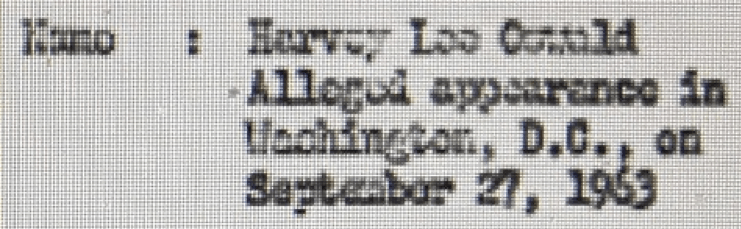
Comment: Note the word alleged.
- He describes the witness as a trusted chauffeur (Bernard Thompson) for a Kennedy Cabinet Secretary.
Comment: Kennedy’s chauffeur Greer, and other Secret Service people of interest, were also “trusted.”
- The witness describes an encounter where an agitator stuck out as very high-strung:

- Blake Smith then states that the chauffeur even selected Lee Harvey Oswald’s photo from a stack of suspect pictures, convinced he was the stranger in question, nearly in the shadow of the U.S. Treasury Building. He then speculates that this strongly indicates that Oswald or one of his handlers was being tipped off with insider information.
Comment: The last point is very speculative and presumes that this is in fact Oswald. There is nothing surprising that he picked out Oswald because when he saw Oswald’s picture after the assassination he thought he recognized him.


On page 141 Blake Smith states that “President Kennedy’s accused and slain assassin was once seen by three different government employees on a street in Washington D.C. on Friday afternoon, September 27” of 63. A government chauffeur. A policeman. And a Secret Service agent—(not certain how he knows the occupation). This really gives the impression that three people identified Oswald in front of the Willard Hotel. Now read the report:

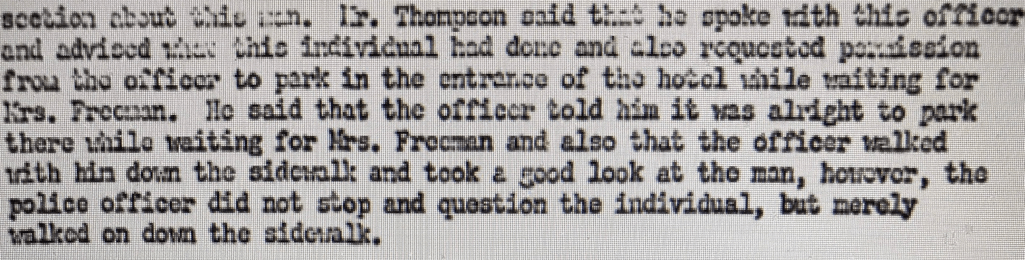
Comment: The description of the incident should state that the chauffeur thought he recognized Oswald and thought that a picture of Oswald shown to him closely resembled the agitator. This claim would also be more accurate: though Thompson knew of two people he felt closely saw the agitator (a Policeman and a possible Secret Service agent)—no one is known to have corroborated that the agitator was in fact Oswald in Washington D.C. on November 27, 1963.
So while this document is important, the author gives it his usual bend by cherry-picking and distorting what it relates instead of just letting the facts speak for themselves. On why the author is certain this agitator could not have been an impostor: “A fake Lee Oswald, a double, would likely have fit the pattern of overt bragging about money he was going to come into soon, or how much he loved Russia and or Cuba over America and how much he wanted to kill the president … This was the real Lee Harvey Oswald alright.”
Question: Why would the real Oswald, a person who, according to the author, may have been getting inside information in this area from Secret Service traitors, make himself so visible in front of the very place he planned to shoot the president from?
Blake Smith makes a point “that agent Floyd Murray Boring took this information on LHO in D.C. very seriously in early December of 63, interviewing the main eyewitness. (Agent Boring has been described as an extremely serious, experienced lawman, wanting to be like his two older brothers, who patriotically served their country in the military)”…“The witness was a U.S. government chauffeur and also a trusted friend to agent Boring.” We can see that it was important for the author to establish the credibility of the interviewer and the interviewee. Like the author, I am a fan of Vincent Palamara; his studies on the Secret Service are unmatched. I remembered vaguely an article he wrote about Boring: not a very positive one, but it was vague. I decided I would explore this later.
The author did not have much else to say about him … or did he?
Let us flash forward to the two best chapters of the book. Those that focus on the Secret Service. In these chapters I felt he was on more solid ground referring often, and rightly so, to Palamara’s excellent work. Here, he talks about how Kennedy came to suspect people close to him were plotting against him. He takes us through ten steps that were taken to weaken security. He chronicles how the Russians suspected there was a conspiracy involving weakened security. He references previous plots, how the FBI cancelled special security surveillance of Oswald, how Oswald was seen getting packages from possible agents in New Orleans, how the Secretary of the Treasury, Douglas Dillon, was in communication with Allen Dulles. He summarizes how Secret Service agents manipulated evidence.
He also points out the roles of persons of extreme interest. Greer, Kellerman and, tum ta ta tum, Our Number One Suspect, “in collaborating with the Mafia-based public assassination plan”. Here is where something really weird happens: the author decides to exclusively use the pseudonym Trip-Planner Perry to identify him! The only time he does something like this in the entire book.
He clearly does not trust Trip-Planner Perry:
- He was very much involved in setting up the president like a bowling pin;
- His motivation was likely patriotism, to remove the “National Security threat”;
- This was a very real Treasury Department employee;
- A high-ranking 48-year-old Secret Service man who had close access to the president and agency files in planning JFK motorcades;
- … had served Roosevelt, Truman and Eisenhower;
- … had been aghast at the adulterous president;
- Had used his .38 to shoot and kill a man in defense of a past president;
- He sure seems to be the main federal agent who arranged John F. Kennedy’s complete lack of safety in Dallas;
- He even makes it on the top ten list as possible shooters in Dallas;
- The author suggests Perry is misleading in saying that he found “nothing unusual” to protect Kennedy in his Texas visit;
- He also volunteered to protect Kennedy in Washington D.C.;
- He also handled security in Chicago;
- Perry denied totally he had anything to do with security in Dallas—a blatant lie;
- The author suspects Perry of getting the FBI to scale back security;
- He believes that he may have been contacted by someone like Banister;
- He led the cover-up efforts;
and so on and so forth.
So who was this lying, murderer, key plotter, traitor? I think that if you rely on Vince Palamara’s research or read the Wikipedia profile, you can only conclude that Trip-Planner Perry and Floyd Boring are one and the same: One of the people whose credibility is crucial in the whole Secret Service report about Oswald in D.C.!
By hiding the real identity of Trip-Planner Perry, most readers are left with the impression that the agent who interviewed the chauffeur was reliable, as he is portrayed when identified as Floyd Boring. This artificially augments the perceived value of Boring’s acquaintance’s testimony. It blocks all critical thinking one can have around this whole scenario which perhaps was another of many ruses to frame the supposed Marxist Oswald.
The significance of this masked information seems to have been on the mind of none other than Vince Palamara during his online exchange:
As I detail in my first and third books, there were credible threats to JFK’s life on 3/23/63 (Chicago), 11/2/63 (Chicago again), and Florida on 11/18/63 (technically, 11/9/63 onward—the Joseph Milteer prediction/threat, etc.). This statement—ORIGINATED BY AGENT FLOYD BORING, of all people—just adds more grist for the mill, so to speak.
Was this the real Oswald?
Was it an impostor setting an Oswald trace, in a plan that had been aborted?
Was it a miss-identification?
Was it a fabricated story made by an acquaintance under the direction of Boring?
Was Boring trying to close up loose ends when the W.C. was fully in lone-nut mode? For now, this is open to interpretation.
Was Oswald in Washington on September 27, 1963? Perhaps—since he was most likely not in Mexico City, we do not know where he was. As the author points out (p. 407): LHO “told no one about his Washington D.C. trip.” There are no photos, film footage, documents or witnesses that can corroborate what an acquaintance of a suspicious Floyd Boring recollected. To go from the clues the author puts forth and opine that there was a plot in the works for Washington is logical, to actually place Oswald there is a long stretch but possible, to go on and describe a full-fledged aborted attempt on October 1, 1963 from the Willard Hotel is pure speculation at its wildest.
A new lead?
When I tried to find the FBI memo the author referred to, I came upon a report that underscored a startling piece of information I had not seen before. Jim Douglass did write about how a singularly-typed letter (supposedly by Oswald) had been sent to the Washington Soviet embassy that contained incriminating writings that could serve as evidence to show that Oswald was guilty, had met the head of assassinations (Kostikov) in the Soviet consulate in Mexico City, and how the Russians were complicit.
This recently released report adds even more meat to the frame-up strategies and for a second time connects Oswald to a Soviet assassination operative. According to this FBI memo—the letter was addressed to the “man in the Soviet Embassy in charge of assassinations”:

This, over and above the Mexico City hoax, seems like a brazen attempt to connect Russia to the assassination as per the ZR Rifle assassinations template.
For now, I am just throwing this out there. At the time of this writing, I have not been able to confirm its authenticity or whether it has been analyzed in the past. I am currently awaiting comments from some esteemed researchers. Perhaps the readers can weigh in.
-

John Newman, Countdown to Darkness, Volume 2
John Newman has just released the third part of his series on the murder of John F. Kennedy. Titled Into the Storm, we are running an excerpt from it on our site, while linking to another excerpt. This review deals with the second volume, Countdown to Darkness. It is indefinite as to how long this series will be. I originally heard it would be a five-volume set. But now I have heard from other sources it may be six. (I will comment on this length factor later.)
Countdown to Darkness assesses several subjects. Some of these the author deals with well. Some of his treatments disappoint. The point is the book is wide-ranging in scope, as I imagine the rest of the series will be. It does not just deal with topics relating to the JFK murder. There are subjects dealt with that are more in keeping with a history of Kennedy’s presidency. Therefore, the book is broad based.
Countdown to Darkness begins with the peculiar arrangement surrounding the dissemination of Oswald’s file at CIA. This valuable information is a combination of Newman’s examination of the file traffic, plus insights gained by the estimable British researcher Malcolm Blunt. Those insights were achieved through Blunt’s discussions with the late CIA officer Tennent Bagley. In this analysis, Newman repeats his previous thesis that although the first Oswald files went to the Office of Security, they should have gone to the Soviet Russia Division. (p. 3; all references to the e-book version) He expands on this by saying this pattern appears to have been prearranged. The mail distribution form was altered in advance to make this happen. (p. 2) One effect of this closed off routing was that there was little chatter about Oswald’s implied threat to surrender radar secrets. When Blunt talked to Bagley, Malcolm told him about this dissemination pattern. Bagley asked Blunt if he thought this was done wittingly. When Malcolm said he was not sure, the CIA officer replied he should be—because it was set up that way in advance. Blunt said that this disclosure was “a significant departure from Bagley’s normal cautious phrasings.” (p. 30)
II
From here, the book turns to Cuba and President Dwight Eisenhower’s intent to overthrow Castro. CIA Director Allen Dulles with Vice President Richard Nixon first discussed this idea in 1959. The initial planning on the project was handed to J. C. King and Richard Bissell; the former was Chief of the Western Hemisphere, the latter was Director of Plans. (p. 32) The author traces the familiar story of how the original idea—to integrate a guerilla force onto the island to hook up with the resistance—began to evolve into something larger in January of 1960. This was coupled with the Allen-Dulles-inspired embargo, which extended to include weapons from England. This was meant to force Castro to go to the Eastern Bloc and the USSR for arms. (pp. 36-37) Dulles also wanted to sabotage the sugar crop, but Eisenhower turned that request down.
Bissell turned over the architecture of the overthrow plan to CIA veteran officer Jake Esterline. (p. 48) Esterline had been a deputy on the 1954 task force in the coup against Arbenz in Guatemala. Like David Talbot before him, the author points out the fact that warnings about the overall design problems, and how the objective differed from Guatemala, were deep-sixed. (p. 55) By March of 1960, Eisenhower started talking about a different approach, a strike force type invasion. The president wanted OAS support for this plan. And here the author introduces something new to the reviewer: his concept of Eisenhower’s Triple Play. That is, in order to achieve such outside support, the White House and CIA would rid Latin America of a thorn in its side, namely, the bloodthirsty dictator of the Dominican Republic, Rafael Trujillo. (p. 90) This will later expand into an attempt to also get NATO behind the overthrow. Hence, Ike’s Triple Play will include the assassination of Patrice Lumumba of Congo.
One of the contingencies upon which Eisenhower based his overthrow of Castro was the establishment of a government in exile. This consisted of the banding together of several individual groups of Cuban exiles under an umbrella called the Revolutionary Democratic Front, or FRD. (p. 127) This endeavor ended up being quite difficult, for two reasons. First, some prominent exile members, like Tony Varona, did not want to join. Second, a principal officer involved for the CIA, Gerry Droller (real name Frank Bender), had rather poor organizational skills. The author gives us more than one example of this trait. (pp. 129-32)
As the operation morphed from a guerilla-type incursion into a brigade invasion concept, more managers were grafted onto the project. The author first names Henry Hecksher. (p. 140) Hecksher worked with David Phillips on the Arbenz overthrow, then went to Laos, and then was assigned to Howard Hunt’s favorite exile, Manuel Artime, in 1963-64. (pp. 142-44) Another person named by the author as part of this expansion is Carl Jenkins.(p. 147) Jenkins worked at the Retalhuleu military base in Guatemala. A base was also set up in Nicaragua and some of the Alabama National Guard pilots were enlisted.
As the brigade concept was escalating, false information was entered into the information flow. Undersecretary of State Douglas Dillon said only 40% of the Cuban populace would end up supporting Castro. (p. 170) Which, to put it mildly, turned out to be almost ludicrously wrong. Castro now began to import a flow of Eastern Bloc arms through Czechoslovakia. (p. 171) As this occurred, Eisenhower, through Dulles, began to activate the Trujillo aspect of the Triple Play. This appears to have been set in motion between February and April of 1960. (p. 172)
When Castro began to seize oil companies like Texaco, Esso and Shell, Vice President Nixon began to urge Eisenhower into action. He recommended “strong positive action” to avoid becoming labeled, “uncle Sucker” throughout the world. (p. 174) National Security Advisor Gordon Gray said much the same thing: “… the U.S. has taken publicly about all it can afford to take from the Castro government ….” (p. 174)
On July 9, 1960, Nikita Khrushchev threatened the USA with ICBMs over Cuba. Eisenhower replied that America would not be intimidated by these threats. (p. 176) The author mentions that at this time there was an attempt by the Agency to solicit a Cuban pilot to assassinate Raul Castro. Newman scores author Evan Thomas for distorting this as the pilot’s idea, when the impetus was clearly from the CIA. (p. 182) General Robert Cushman, working on the staff of Richard Nixon, urged Howard Hunt to use as much skullduggery as possible to get rid of Castro. (pp. 184-85)
But as the Inspector General report by Lyman Kirkpatrick later revealed, the attempt to arm and supply the dissidents on the island was not working. In fact, at times, it was counter-productive, since Castro’s forces would recover the supplies and arms. As the threat grew, Russia sent in more arms to the island: tanks, mortars, cannons. With these advantages Castro began to close in on the resistance. And this was another reason the original guerilla plan was modified into a brigade-sized invasion. (p. 185)
III
We now come to what this reviewer feels is probably the highlight of the first two books in the series: the author’s work on the assassination of Patrice Lumumba of the Congo. Newman devotes four chapters to this subject. In my opinion the result is one of the best medium-length treatments of the Congo crisis I have read. As noted above, Eisenhower felt that by getting involved in Belgium’s colonial problems, this would encourage NATO allies to stand by him in his attempt to overthrow Castro. After all, the NATO alliance began in 1948 with the Brussels Treaty.
As early as May 5, 1960 Allen Dulles was aware that Belgium was attempting to set up a breakaway state in the Congo called Katanga. This was two months before the ceremony formalizing the Belgian withdrawal from its African colony. (p. 153) Katanga was the richest region in Congo, and perhaps one of the richest small geographical areas in the world. If the Katanga secession were successful, it would do much to benefit Belgium and its covert ally England, at the same time that it would damage the economy of the new state of Congo.
Dulles was predisposed to favor Belgium because of his prior career as a corporate lawyer with the global New York law firm of Sullivan and Cromwell. That firm represented many companies that benefited from low wage conditions in the Third World. Therefore Dulles and his deputy Charles Cabell began to smear independence leader Patrice Lumumba at National Security meetings in advance of his assuming power. Combined with the fact that the Belgian departure was not total, this pitted Lumumba against both the former imperialists and the growing malignancy of the USA. (p. 154)
Lumumba’s stewardship was not just hurt by the Katanga secession, but also by the fact that Belgium had removed Congo’s gold reserves and placed them in Brussels prior to independence being declared. (p. 155) With little cash on hand, Lumumba’s army mutinied and spun out of control. This created the pretext for Belgium to send in paratroopers. The Belgians now began to fire on the Congolese. On July 11th, Katanga declared itself a separate state. By July 13, 1960, two weeks after independence, the Belgians occupied the Leopoldville airport and Lumumba decided to break relations with Brussels. The next day the United Nations, under Secretary General Dag Hammarskjold, passed a resolution to send troops to Congo. In the meantime Allen Dulles was working overtime to tell anyone on the National Security Council and in the White House that Lumumba would tie Congo to Egypt’s Gamal Abdel Nasser, Castro and the Communist Bloc. (pp. 162-63)
This tactic worked. When Lumumba arrived in Washington to ask for supplies, loans and aid in expelling the Belgians, Eisenhower was not on hand to greet him. Instead, Lumumba talked to Secretary of State Christian Herter and Under Secretary Douglas Dillon. They lied to him by saying they were working through Hammarskjold. (p. 220) This left Lumumba little choice but to ask Russia for supplies. The USSR sent him transport planes and technicians. (p. 222)
When the Russians sent Lumumba the military aid, it sealed his fate. On August 18, 1960 Leopoldville station chief Larry Devlin sent a cable that was drawn in the most hyperbolic terms imaginable. Devlin told CIA HQ that Congo was now experiencing a classic communist takeover, and there was little time to avoid another Cuba. (p. 223) This was clearly meant as a provocation. It worked. On the day this cable arrived, Eisenhower instructed Dulles to begin termination efforts against Lumumba. This was kept out of the meeting record. It was not revealed until the investigations of the Church Committee. The recording secretary to the meeting, Robert Johnson, told the committee that it was too sensitive to be included in the minutes. (p. 227)
The plot began the next day. Director of Plans Dick Bissell told Devlin to begin action to replace Lumumba with a pro-Western leader. On August 26, Allen Dulles sent an assassination order to Devlin that authorized a budget of $100,000 to terminate Lumumba, the equivalent of close to a million dollars today. (p. 236) Bissell now called in the head of the Africa Division, Bronson Tweedy, and they began to assemble a list of assets they could employ in order to do the job. (p. 246) One of these was the infamous Dr. Sydney Gottlieb, who began to prepare poisons for use in the assassination. Devlin also got President Joseph Kasavubu to remove Lumumba from his position as prime minister. At this point Hammarskjold sent his own emissary, Rajeshwar Dayal, to Congo to protect Lumumba.
This was necessary because, in addition to Gottlieb, Devlin now bribed the chief of the army, Josef Mobutu, to also assassinate Lumumba. (p. 265) At around this time, two CIA-hired killers, codenamed QJ WIN and WI ROGUE, both arrived in Leopoldville. Not knowing each other, they both stayed at the same hotel. Gottlieb then arrived in Congo. (p. 268) In September of 1960, with a multiplicity of lethal assets on hand, Tweedy now cabled Devlin to produce an outline of how he planned on terminating Lumumba.
The use of the two codenamed assassins in Congo marks the beginning of the ZR/Rifle program. This was the CIA’s mechanism for exterminating foreign leaders. It began under Eisenhower in September of 1960. (p. 280) The next month it was taken over by CIA officer William Harvey. ZR/Rifle was sort of like the reverse side of Staff D, which was a burglary program to break into embassies and steal codebooks. Harvey and his assistant Justin O’Donnell recruited safe crackers, burglars and document forgers for that part of the program. (pp. 284-85) When Harvey testified before the Church Committee, he lied about the use of ZR/Rifle in the Lumumba case. He was fully aware of what the two men were doing in Congo. (p. 290)
Mobutu now tried to arrest Lumumba, but Dayal blocked the attempt. Three things happened in November of 1960 that penned the final chapter. CIA officer Justin O’Donnell arrived in Congo to supervise the endgame. John Kennedy, who the CIA knew sympathized with Lumumba, was elected president. And third, America and England cooperated in seating Kasavubu’s delegation at the United Nations. This last event provoked Lumumba into escaping from Dayal’s house arrest. O’Donnell had decided that the CIA should not actually murder Lumumba. But they would help his enemies do the deed. Therefore, Devlin cooperated with Mobutu to cut off possible escape routes to Lumumba’s base in Stanleyville. He was captured, imprisoned and transferred to Elizabethville in Katanga. (p. 295) Lumumba was executed by firing squad and his body was soaked in sulphuric acid. When the acid ran out, his corpse was incinerated. (p. 296) Thus was the sorry end of the first democratically elected leader of an independent country in sub-Saharan Africa.
As I said, for me, this section on Lumumba is the highlight of the first two volumes.
IV
Another topic that the author spends significant time on is the CIA/Mafia plots to kill Castro. The author traces this idea from Allen Dulles to Dick Bissell. He believes that Eisenhower gave his tacit approval to the plots. He also believes that Bissell dissembled in his testimony on how the plots were hatched, and he mounts several lines of evidence to demonstrate this. (p. 327) Bissell dissembled in order to conceal the fact that it was he who approved of giving the assignment to the Mafia through CIA asset Robert Maheu. By mid-August of 1960, the CIA’s Technical Services Division was at work manufacturing toxins to place in Castro’s cigars.
Maheu offered gangster Johnny Roselli $150, 000 to kill Castro. (p. 331) Both Allen Dulles and his deputy Charles Cabell were briefed on this overture in late August by Chief of Security Sheffield Edwards, who was part of the Mafia outreach program. Meetings were arranged with Roselli in Beverly Hills and New York City. Maheu and CIA support officer Jim O’Connell masqueraded as American businessmen who wanted to protect their interests by getting rid of Castro. But Maheu eventually told Roselli that O’Connell was CIA. Therefore, the veneer of plausible deniability was lost. (p. 333) Roselli now began to recruit Cubans in Florida for the murder assignment. He also arranged a meeting in Miami for Maheu to be introduced to Sam Giancana and Santo Trafficante, respectively the Mafia dons for Chicago and Tampa. When this occurred the author writes that, because of the reputations and history of these two men, the plots and the association should have been reassessed and approval cancelled. They were not.
They should have been. Because the recruitment of Giancana was a huge liability. Not just because of his history of being a hit man; but also because of his inability to keep a secret. Feeling emboldened, since he was now in the arms of the government, he bragged about his role in the plots to at least two people. From there the word spread to others, including singer Phyllis McGuire. Giancana revealed both the mechanism of death—poison pills—and the projected date of the assassination—November of 1960. (p. 334-35) Through his network of informants, FBI Director J. Edgar Hoover found out about Giancana’s dangerous chatter. But Hoover did not know that the CIA had put him up to it. The Director told Bissell about it, but Bissell did not inform Hoover about his role as recruiter.
Maheu now arranged to have McGuire’s room wired for sound in Las Vegas. This was done for two reasons. First, to see if she was talking about the plots; and second, as a favor to Giancana, who suspected she was cheating on him with comedian Dan Rowan. The police discovered this illegal bugging. In addition to the security problem, this all had disturbing repercussions when Attorney General Robert Kennedy began his crusade against organized crime in 1961. (p. 336)
Along with these assassination plots, on November 3, 1960, National Security Officer Gordon Gray came up with the idea of using Cuban exiles dressed as Castro soldiers to stage an attack on Guantanamo Bay as a pretext for an invasion. (p. 346) As the author suggests, the very fact that the murder plots and this false flag operation were contemplated show that those involved in managing the strike force invasion understood that its chances for success were low. (pp. 345-46) To further that miasma of doubt, at this same meeting, a question was asked about “direct positive action” against Fidel, his brother Raul and Che Guevara.
There was good reason for both the doubt and the fallback positions, because about two weeks later, CIA circulated a memo admitting that there would not be any significant uprisings on the island due to any incursion, and also that the idea of securing an air strip on the island was also not possible unless the Pentagon was part of the attempt. (p. 348) This memo was not shared with the incoming President Kennedy. The author deigns that it was not shared because the internal uprising myth was used to manipulate Kennedy into going along with the operation. It thus became part and parcel with the new “brigade strike force” concept. (pp. 352-53)
On January 2, 1961, Castro broke relations with the United States. The favor was returned two days later. These actions caused the training of the exiles in Central America to be expanded, and also for the action against Trujillo to be accelerated. (p. 355) On January 4th, Chief of the CIA paramilitary section wrote a memo to one of the operation’s designers, Jake Esterline. The memo said the invasion would be stuck on the beach unless an uprising took place or there was overt military action by the USA. (p. 355) As the author notes, this is another indication that the people involved at the ground level understood that, left to its own devices, the prospects for the invasion were fey. Hawkins added that Castro’s military forces were growing. They would soon include featured tanks, artillery, heavy mortars and anti-aircraft batteries. Given those facts, Hawkins warned that:
Castro is making rapid progress in establishing a communist-style police state that will be difficult to unseat by any means short of overt intervention by US military forces. (p. 356, Newman’s italics)
Since Bissell was a supervisor of both the assassination plots and the invasion, one wonders if he was banking on the murder of Castro to bail out what looked like an upcoming failure on the beach. In fact, as the author notes, at NSC meetings of January 12 and also January 19, the idea of overt intervention was brought up again. What made the time factor even more pressing was that the CIA had information that the shiploads of these munitions would reach Cuba in mid-March and continue with daily arrivals after that. This is why Hawkins urged that the invasion be launched in late February and no later than March 1. (p. 356) This would not happen, since Kennedy rejected the first proposal for the operation, namely the Trinidad landing site.
V
Kennedy had two meetings on the subject during his first week in office. At neither did he appear enthusiastic about it. On February 3, 1961 the Joint Chiefs wrote a ten-page report in which they viewed the plan favorably. This was something of a reversal from their previous assessments. But they cautioned that the plan was reliant on indigenous support from the island, meaning defections from Castro. They foresaw that if the force retreated to the mountains it might need overt American intervention. But even with these reservations, the executive summary at the end was positive. (pp. 363-64) Newman comments that one way to explain this reversal is that the Joint Chiefs felt that if the CIA plan failed, they would be called in to save the day and collect the glory.
Kennedy now chimed in with his reservations about having the operation look too much like a World War II amphibious assault. He asked if it were possible to configure it more like a guerilla operation. (p. 366) This was a harbinger of what was to come from the president, who clearly never liked the operation in the first place. Knowing this, those pushing the plan tried to convince Kennedy that the strike force would ignite a rebellion on the island, even though they knew that such was not the case. (p. 383) Newman writes that this manipulation was done so that JFK would not cancel the operation—the gamble being that he would feel obligated to send in the Pentagon once he saw the invasion faltering. This hidden agenda to the Bay of Pigs episode was pretty well established in 2008 by Jim Douglass in his fine book JFK and the Unspeakable.
At White House insistence, the location of the plan was moved away from Trinidad, 170 miles southeast of Havana, at the foothills of the Escambray Mountains. (p. 389) The reason for the switch was that Trinidad had a population of about 26,000 people. This decreased the odds of surprise and opened up the possibility of civilian casualties. Trinidad also did not have a proper length airfield for B-26 bombers. For these reasons, the locale was shifted to the Bahia de Cochinos (Bay of Pigs), east of the Zapata Peninsula. The CIA now went to work tailoring a plan for the new location.
There was a serious problem with these delays. The longer it took to launch the operation, the more time Castro had to import weaponry from the USSR. The arms supplies began arriving in earnest on March 15. After that, one or two ships would unload per day. (p. 392) At this point, both Esterline and Hawkins wanted to leave the project.
As the author notes, another important alteration was that the air cover and assaults were gradually whittled down in frequency and scope. This was owed to the reluctance of Kennedy and Secretary of State Dean Rusk to reveal the hand of American involvement. The first Hawkins-Esterline plan featured well over one hundred sorties in five different waves. (p. 390) When Kennedy asked Bissell how long it would take for the invasion force to work its way off the beachhead, he replied about ten days. In light of what actually happened, this was absurd, since no beachhead was ever established to break out of.
As late as an April 4 meeting, Kennedy was still trying to argue for an infiltration plan. Inserting groups of 200-250 men and developing a build-up from there. Kennedy was trying to make it appear less as an invasion and more as an internal uprising. The CIA replied that this would only alert Castro, and each group would then be eliminated. (p. 394) The next day Kennedy asked assistant Arthur Schlesinger what he thought of the project. Schlesinger said he opposed it. He felt that Castro was too entrenched to be displaced by a single landing force. And if the landing did not cause uprisings, logic would dictate American intervention. The author notes the late date of this cogent observation: ten days before the launch from Central America. Newman also notes the fact that no one from the Pentagon pointed this out at the meeting; just as there was no real discussion of the air cover plan. Making it all the worse: Kennedy had instructed Bissell to tell the brigade leaders that no American military forces would participate or support the invasion in any way. (p. 393)
But further, Kennedy drastically cut back on the amount of air sorties he would allow. And this is what had Esterline and Hawkins ready to depart the project. (p. 396) As stated previously, they insisted there had to be five waves of air strikes and over 100 individual sorties. Kennedy and Rusk opposed this aspect. Newman blames the Joint Chiefs for not stepping in and pointing out the difference between the Esterline/Hawkins design and what was happening to it. The author, citing Bissell, now says that what was left was the strikes scheduled the day before, and also the D-Day air strikes. Newman, citing Bissell, says that Kennedy then cancelled the latter the day before they were scheduled. (pp. 399-400) I was surprised to see the author adopt this interpretation of the controversial issue. This is a point of dispute which I will delve into later.
The invasion was an utter failure and the battle was decided within the first 24 hours. There was no surprise. There were no defections. And in the first 24 hours there was no Allen Dulles. Bissell had encouraged him to keep a speaking engagement in Puerto Rico. Dulles did keep it. Newman makes an interesting observation about this. Dulles kept the engagement to give the appearance that the operation was really Bissell’s. Therefore, after the Navy saved the day, he should be forced to resign while Dulles kept his job. (p. 402)
What no one thought would happen did happen at midnight on April 18. Joint Chiefs Chairman Lyman Lemnitzer and Navy Chief Arleigh Burke tried to convince the president that he must intervene. (p. 403) Kennedy turned down this last attempt to get him to commit American power into the failed beachhead. Dulles’ plan to overthrow Castro and save his position had failed.
Burke was relieved of duty in August of 1961. Later in the year, Dulles, Bissell and Cabell were also terminated. Lyman Lemnitzer was moved to NATO command and replaced by General Maxwell Taylor. In a conclusion, the author writes that after doing the research for this book, he has now downgraded his opinion about Eisenhower as a president. (pp. 404-405) After doing my own work on the man, I would have to agree. But I would make this judgment not just on foreign policy but also with civil rights. Eisenhower had some remarkably good circumstances accompanying his presidency; for instance, a growing economy, positive net trade balance in goods and services, a great military advantage over the USSR, and a unified populace behind him. In retrospect, he had a lot of political capital to make some daring decisions with, both abroad and on the domestic scene. For whatever reason, he chose not to. He passed those decisions on to his successor.
VI
I might as well begin the negative criticism with the subject of the Bay of Pigs. As the reader can see from my above synopsis, the author advocates for the stance put forth by Allen Dulles and Howard Hunt in their Fortune magazine article, saying that Kennedy cancelled the D-Day air strikes. (September, 1961, “Cuba: The Record Set Straight”) And that somehow this was the fatal blow delivered to the enterprise. (Newman, p. 400)
I would have thought that by now, this stance would have been discredited. In the penetrating report delivered by CIA Inspector General Lyman Kirkpatrick, he poses the hypothetical: Let us assume that Castro’s air corps had been neutralized. That would have left about 1,500 troops on the beach against tens of thousands of Castro’s regular army, reinforced by a hundred thousand or more men in reserve. And the Russians had been delivering shiploads of artillery, mortars and tanks every day for over a month, the very weapons one uses to stop an amphibious invasion on the ground. (Peter Kornbluh, Bay of Pigs Declassified, pp. 41, 52. This book contains most of the Kirkpatrick Report and its appendixes.) What made this aspect even worse is something Newman barely mentions: the element of surprise. One reason Kennedy moved the operation out of Trinidad is that the area was too populated, which would mitigate against that element. The Zapata peninsula was sparsely populated and the CIA said there was no paramilitary patrol there. This turned out to be false. There was a police force at Playa Giron beach the night of the landing. (Kornbluh, p. 37) They alerted Havana. Castro had his troops, with armor and artillery, on the scene within ten hours. But it’s actually worse than that. Castro had so thoroughly penetrated the operation by his intelligence sources that he knew when the last ship left Guatemala. (Kornbluh, p. 321) Therefore, on high alert, he was literally waiting for the landing. To top if off, the other element that the CIA said would be important to the invasion’s success, mass defections from the populace, was non-existent. In fact, Castro later crowed about how even the small number of people on the scene had backed him against the exiles. (Kornbluh, pp. 321-22) Therefore, with no defections, no surprise, being massively outnumbered, and with mortars, tanks and artillery shelling the force on the beach, as Kirkpatrick wrote: What difference would it have made with or without Castro’s air corps in operation?
But I would further disagree with the author’s presentation. There is today an ample body of evidence that the so-called D-Day air strikes were not actually cancelled. They were contingent on being launched from an airfield on the island, which is one reason the Zapata Peninsula was chosen. Prior to the invasion, the CIA had agreed to this in their March 15th outline of the plan. In fact, they mention the issue three times in that memo. (Kornbluh, pp. 125-27) Further, both the Kirkpatrick Report and the White House’s Taylor Report mention this stipulation. (Kornbluh, p. 262; Michael Morrisey, “Bay of Pigs Revisited”, The Fourth Decade, Vol. 1 No. 2, p. 20) In the latter, the report states that National Security Advisor McGeorge Bundy explicitly told CIA Deputy Director Charles Cabell that such would be the case. (p.23)
This speaks to another issue directly related to the alleged cancellation of the D-Day air strikes. Newman says that both Cabell and Bissell went to the office of Dean Rusk and pleaded their case for the strikes. Rusk was against it and he then got Kennedy on the line and he was also against it. This disagrees with both Dan Bohning’s book, The Castro Obsession, and Peter Kornbluh’s fine volume, Bay of Pigs Declassified. Both of those works say that Rusk offered to get Kennedy on the line, but the offer to talk to JFK in person was turned down. (Bohning, p. 48, Kornbluh p. 306) There is a good reason why Cabell would not want to talk to Kennedy about this subject. It comes from an unexpected source, namely Howard Hunt. In his book on the subject, Give Us this Day, he describes being at CIA headquarters monitoring the operation. He writes that Cabell actually stopped the D-Day strikes from lifting off. Cabell did so because he knew this was not part of the final plan! (Hunt, p. 196)
Newman’s source for much of this rather controversial material is Dick Bissell’s memoir, Reflections of a Cold Warrior. To put it mildly, between his role in the CIA/Mafia Castro plots and the Bay of Pigs—and his dissembling about both—one would think that any author would look at what Bissell had to say about those topics with an arched eyebrow. Larry Hancock, who is quite familiar with the Bay of Pigs, actually called Bissell an inveterate liar on the subject. For instance, he kept on lying to Esterline and Hawkins about his meetings with Kennedy and about the cutting down of the air strikes. He also told them that if there was too much cut back, he would abort the project. He did not. (e-mail communication with Hancock, 2/23/19)
If for some reason the author feels all of this information is wrong and Bissell was correct, then he should have at least acknowledged the discrepancy and explained why he felt such was the case.
But probably worse than this are the two chapters Newman devotes to Judith Exner, Sam Giancana and Kennedy. Before I read this book, I would have thought I would have never seen anything like that topic in a book penned by Newman, for the simple reason that he has almost always been circumspect about the sources he uses for his writing. What caused him to drop his guard on this topic is inexplicable to this reviewer. But whatever the reason, he did.
And he dropped it all the way down. He buys into just about everything Exner ever authored. To the point that he actually writes that the Church Committee allowed her to get away with lying to them. But that somehow, some way, she did tell the truth to—of all people—Seymour Hersh for his hatchet job on JFK, The Dark Side of Camelot. (p. 203) And I should add, it is not just Hersh. The author’s sources for these two chapters include people like Tony Summers on both Exner and Frank Sinatra, and Chuck Giancana on Sam Giancana. I don’t know how he missed the likes of Randy Taraborrelli and Sally Bedell Smith.
If one is going to buy Exner’s stories, one has to examine them in order and be complete about the inventory, or relatively so. The first time she ever spoke in public about her affair with JFK was in her book, My Story, published in 1977. That book was co-authored by Ovid Demaris, an experienced crime author who wrote a fawning book about J. Edgar Hoover called The Director. He also co-wrote a book called Jack Ruby, which pretty much takes the stance toward Oswald’s killer that the Warren Commission did. In that work, he also went out of his way to criticize the Warren Commission critics, like Mark Lane. So right from the beginning, one could at least find evidence that Exner was being used as a vehicle.
My Story was 300 pages long. Demaris was anti-JFK, and he made this clear in his own introduction. If Exner had anything significant to say beyond her Church Committee testimony, she had the opportunity and, in Demaris, the correct author to do it with. She did not. But eleven years later, she did. In a February 29, 1988 cover story for People magazine, Exner was now billed as “the link between JFK and the Mob.”
What did that title signify? Exner was now telling America that, since she knew both Giancana and Kennedy, they were using her as a messenger service for things like buying elections and also the CIA/Mafia plots to kill Castro. But this was all done with Exner being unaware of what she was doing. Newman writes that Exner likely first talked about this in 1992 with talk show host Larry King. (Newman, p. 203) The author apparently never looked up this 1988 story. This allows him to miss some important aspects of the Exner saga.
There was another key point in the Exner tales. This came in 1997 with a double-barreled blast from both Liz Smith in Vanity Fair and Hersh in his hatchet job. All one needed to do is compare the installments for an internal analysis to see if they were consistent with each other. One easily finds out they are not. For instance, in 1977 Exner said the idea that she had an abortion was a lie spread about her by the FBI. She denies it in the most extreme terms. She actually said she wanted to kill the agent for slandering her. (The Assassinations, edited by James DiEugenio and Lisa Pease, p. 336) But in 1997, she now said she did have an abortion and beyond that, it was JFK who impregnated her. Major revisions like that should raise serious doubts in anyone’s mind about Exner and how she was being used.
But that’s not all. For People magazine, Exner said she was not cognizant of her role as a message carrier. She never bothered reading any of the messages between Giancana and Kennedy, or opening any of the containers. But as Michael O’Brien later wrote, this was contradicted in 1997 for Smith, to whom she said that Kennedy showed her what was in one of the large envelopes. Supposedly it was $250,000. Somehow, in 1983, she forgot about being shown that much money. (Washington Monthly, December 1999, p. 39)
There is another whopper in this trail of horse dung. In 1992, when asked by Larry King if Bobby Kennedy had anything to do with this message-carrying service or if she had any kind of relations with him at all, she said no she did not. Either Exner lost track of all the lies she told, or her handlers didn’t give a damn, because in 1997 this was reversed. Now she said that when she was at the White House having lunch with JFK, Bobby would come by and pinch her on the neck and ask if she was comfortable carrying those messages back and forth to Chicago for them. (Washington Monthly, p. 39)
If Newman had done his homework on this, he would have discovered just how and why the 1983 fantasy version started. Exner knew she could make money off her story. Contrary to what Newman writes, she ended up making hundreds of thousands of dollars selling her tall tales to the anti-Kennedy press. (DiEugenio and Pease, p. 330) She was paid $50,000 to sit down with Kitty Kelley for the People story in 1983. (O’Brien, p. 40)
As biographer George Caprozi later revealed, the two did not get along at all. The problem was that Kelley kept on trying to pump Exner for information about Frank Sinatra. She was preparing one of her biographies about him at the time. Exner did not like this and so the two fought like cats and dogs. Nothing productive came out of the meetings. Since they had to pay both women, the editors decided that they themselves would pen the story. (DiEugenio and Pease, p. 334) I should not have to ask Newman, or anyone reading this review, who owns People magazine. The purview of the cover story would come under the aegis of Time-Life. The people who hid the Zapruder film for eleven years; who edited the stills from the film so as not to reveal the head snap; the same people who, on February 21, 1964, placed a dubious photo of Oswald on their cover with the alleged weapons he used to kill Officer Tippit and JFK. In 1983, the time of the story’s publication, the principals were all dead: Sam Giancana, John Roselli and John F. Kennedy. With Exner bought off, the story was libel-proof.
Finally, to prove that Exner was being used as an anti-Kennedy vehicle, consider the Martin Underwood appendage to the saga. By 1997, Exner had gone hog-wild with her mythology. She now said she was carrying money and messages to Chicago from the White House and she would deliver them to a train station with Giancana waiting for her. This was so silly on its face that Hersh knew he needed a corroborating witness for it. So apparently, with help from Gus Russo, he tried to recruit Martin Underwood to accompany Exner in this film noir scenario. Underwood had worked for Mayor Richard Daley in Chicago and then did some advance work in 1960 for the Kennedy campaign. But the Exner follies now collapsed. Under questioning from the Assassination Records Review Board, Underwood would not go along with the scheme and said he knew nothing about such train travel or Judith Exner. (O’Brien, p. 40; see also “ Who is Gus Russo?”)
I could go on and on. But I think the above is enough to expose Judy Exner for what she was: a lying cuss. Someone who would sell her soul for money and tinsel to the likes of Hersh, Smith and Time-Life. She did not deserve one sentence in this book, let alone two chapters.
Let me make one final overall criticism. I have reviewed parts one and two of the series. Countdown to Darkness ends with the debacle at the Bay of Pigs. That took place in April of 1961. Kennedy had been in office for all of three months. I don’t have to tell the reader how long this series could be if the author keeps up this pace. The overall title of the series is The Assassination of President Kennedy. That is not what the series is really about. The book is really about the Kennedy administration. For instance, Volume 3, Into the Storm, features chapters on the association of the Kennedy administration with Martin Luther King. Unless the author is going to say the Klan killed Kennedy, I fail to see how that fits the overall rubric.
When I was talking about and reviewing Vincent Bugliosi’s elephantine Reclaiming History, I wrote that because something is bigger does not make it better. In my opinion, with an astute and sympathetic editor, these first two volumes could easily have been collapsed into one—with the Exner garbage completely cut. More does not automatically connote quality. Sometimes it’s just more. I had the same complaint about Doug Horne’s five volumes series. Our side does not have to compete with the late Vince Bugliosi to exhibit our knowledge or bona fides. This is a long way of saying that I really hope Newman contains himself, or finds a decent editor who he respects and will listen to. He should stop at five volumes.
There is a saying among actors: Sometimes, less is more.
SEE ALSO:
- Our review of volume 1, Where Angels Tread Lightly
- “Berlin 1961—The Most Dangerous Place on Earth” (excerpt from Chapter 5 of volume 3, Into the Storm)
- “When Fiction is Stranger Than Truth: Veciana and Phillips in Cuba — 1959-1960” (excerpt from Chapter 3 of volume 3, Into the Storm), at WhoWhatWhy
-

Obituary for a Fake Intel Source

Florentino Aspillaga in an undisclosed location
circa 1995 (© RTV Marti)The Cuban defector Florentino Aspillaga, TOUCHDOWN in CIA parlance, died from heart disease at age 71 last month. On October 23, Miami-based Radio TV Martí broke the news with the ersatz statement that he was the head of the Cuban Intelligence Services (CuIS) in Czechoslovakia. The former CIA desk analyst Brian Latell had already aggrandized him beyond all modes of reason as being a key witness for proving Fidel Castro’s foreknowledge of the JFK assassination.
The Jaimanitas Story
Dr. Latell heard about it straight from the horse’s mouth in 2007 and brought it up in his book Castro’s Secrets (Macmillan, 2012, 2013). Aspillaga also revealed having told the CIA the whole story in 1987 during his after-defection debriefing.
To believe Aspillaga, on November 22, 1963, the barely 16-year-old Cuban counterintelligence ingénu Aspillaga would have been busy monitoring CIA Headquarters and its station JM/WAVE in Miami from a listening post at Jaimanitas, a small beach town near Castro’s main residence, dubbed as Point Zero, seven miles west of Havana. Around 9:30 am (EST) Aspillaga would have received the order “to stop all CIA work” and to redirect the antennas “toward Texas.” He was told he must report back immediately “if anything important occurs.” A few hours later, he “began hearing broadcasts on amateur radio bands about the shooting of President Kennedy in Dallas.” The teenage radio wave hunter inferred: “Castro knew. They knew Kennedy would be killed.”
Uncommon Nonsense
It’s hard to swallow that Castro would have resorted to a radio counterintelligence prodigy or any other means of electronic intelligence (ELINT) to learn something that would have been instantly available through mass media. In 1963, info about anything occurring in Dallas during the JFK visit simply meant broadcast reports interrupting soap operas on the three national TV networks, and radio stations giving breaking news furnished by reporters covering live.
Aspillaga was in fact a self-defeating storyteller. He told Dr. Latell: “It wasn’t until two or three hours later that I began hearing broadcasts on amateur radio bands about the shooting of President Kennedy.” [emphasis added] Radio amateurs must have just been chatting about what the commercial media had already reported. Moreover, a unique witness had given conclusive evidence against Aspillaga in 1963.
French journalist Jean Daniel wrote a first-hand account in his article “When Castro Heard the News” (The New Republic, December 7, 1963). As Kennedy’s emissary, Daniel was talking with Castro in Varadero Beach the very day of the assassination. After a phone call by Cuban President Osvaldo Dorticós, Castro got all the news “from the NBC network in Miami.” Daniel also recounted Castro was utterly shocked and turned to him saying—about the plans for rapprochement—that everything was going to change. Which contradicts Aspillaga’s story.
Autopsy of an Outright Lie
On November 18, 2013, Dr. Latell was the main speaker for a lecture entitled “Castro and the Kennedy Assassination”. It was held at the Institute for Cuban and Cuban-American Studies (ICCAS) at the University of Miami. He felt sure about “Aspillaga’s most sensational revelation” because he had read it in both the English and Spanish versions of Aspillaga’s unpublished memoirs. Apparently, Dr. Latell did not realize that the talking source is the same source writing in English and also the same source writing in Spanish.
The CIA did not come forward with the Jaimanitas story to the Assassination Records Review Board (ARRB). The Agency Release Panel responded to a FOIA request on June 28, 2013, that “the CIA can neither confirm nor deny the existence or nonexistence” of JFK-related records in Aspillaga’s debriefing. Even so, the latter is not to be found among the documents—either declassified or withheld—from the National Archives and Records Administration (NARA). A very strage set of affairs if Latell is correct about Aspillaga.
Touchdown
After 25 years and 13 medals in CuIS, Aspillaga had risen to the rank of Major when he took advantage of his first noteworthy assignment abroad in order to defect to the West. In November of 1986, he flew to a third-rate CuIS post in Bratislava (the capital of Slovakia, then part of Czechoslovakia) under the cover of an official from Cubatecnica, a state company in charge of Cuban workers abroad. Then, on June 7, 1987, Aspillaga crossed the border into Austria.
His case was included in the Historical Dictionary of Sexspionage (Scarecrow Press, 2009) by British historian Rupert Allason, pen name Nigel West, because of an intimate relationship incidental to it. Aspillaga defected along with a teenage girl named Marta. The CIA station chief in Vienna, James Olson, thought this was Aspillaga’s daughter, but she turned out to be his girlfriend.
Anyway, the walk-in Aspillaga fits better into James Olson’s definition of a “let’s cut a deal kind of guy.” In return for handing over documents stolen from the first-rate CuIS station in Prague and being squeezed by CIA and FBI debriefers, Aspillaga got a deluxe resettlement package in the United States.
In 2012, Dr. Latell wrote that “the CIA cryptonym assigned to [Aspillaga] remains classified [and] constitutes a private, inside-Langley boast of just how highly the CIA had scored against Cuban intelligence”. Latell was again aggrandizing Aspillaga. In fact, in Olson’s book Fair Play (Potomac Books, 2006) the reader knew Aspillaga was codenamed TOUCHDOWN. But the CIA score was pathetic. Aspillaga furnished the intel that, if not all, then most of the Cuban agents recruited by the CIA from 1960 onward were working for Castro.
The Sound of Silence
In July and August 1987, Aspillaga gave interviews to Radio Marti, which were reported by Associated Press, The New York Times, Time Magazine, and others. There was not a single reference to the Jaimanitas story, but a lot about Castro:
- He had a home in each of Cuba’s provinces, a fleet of yachts, and even a Swiss bank account for his personal whims.
- He had four children luxuriously living and studying in Moscow, although only his first-born son, Fidelito, was officially acknowledged.
- He used Panamanian General Manuel Antonio Noriega to send arms to Nicaragua, El Salvador, Honduras and Colombia, as well as to acquire U.S. high technology items and to traffick in drugs.
In June 1988, Aspillaga referred to Castro 69 times during a radio interview with Tomas Regalado (WQBA, Miami). But there was not one reference to Kennedy. Aspillaga remained silent about Castro’s foreknowledge of the JFK assassination even when Georgie Anne Geyer interviewed him in Washington, on April 14, 1988, for her book about the untold story of Castro (Guerrilla Prince, Little, Brown and Company, 1991).
On September 19, 1988, news came from London that Cuban diplomat Carlos Manuel Medina had fired shots at Aspillaga. He said that Aspillaga had tried to strong-arm him into defecting. After the shooting, Medina and the Cuban Ambassador, Oscar Fernandez-Mell, were expelled. However, Aspillaga went again to Regalado and, on October 7, WQBA twice broadcast an interview in which he asserted: “I have never spent a moment anywhere in England.” Aspillaga also boasted for the fun and revelry of gullible Cuban exiles in Miami: “Castro will not fall, we will kick him out.”
Epitaph
Apart from Dr. Latell, only former CIA case officer Bob Baer dared to broach Aspillaga’s testimony about “Castro knew it” his hallucinatory TV series “JFK Declassified: Tracking Oswald” (History Channel).
-

Walter Machann Interview Synopsis
Gayle Nix Jackson’s Interview Excerpts with Walter Machann.
http://jfkcountercoup2.blogspot.com/2018/09/walter-machann-interview-excerpts.html
For the complete interview – see Gayle Nix Jackson, Pieces of the Puzzle (2017)
We know Gayle Nix Jackson as the granddaughter of Orville Nix, who, like Abraham Zapruder, filmed the assassination of President Kennedy, the subject of her first book—Orville Nix: The Missing Assassination Film (2014).
Then, after interviewing a number of important witnesses, including Walter Machann, Gayle put together a second book, Pieces of the Puzzle, an anthology that includes contributions from a number of other JFK researchers and touches on other important subjects. The interview with Machann stands out however, as a key piece to the Dealey Plaza puzzle.
Not only did Gayle Nix Jackson find Walter Machann; it can’t be overemphasized how important it was that she gained his trust and he talked to her on the record, answering key questions.
One of the more significant and elusive characters in the JFK assassination story, Walter Machann was a Catholic priest who catered to the needs of the Cuban exile community of Dallas, including Silvia Odio and her family.
Before the assassination, Silvia Odio told Father Machann about three visitors to her Dallas apartment, including “Leon” Oswald, a former Marine who said President Kennedy should have been assassinated after the Bay of Pigs. Machann not only confirms Odio’s story but provides and exact date, a fact that had eluded official investigators.
To put things in chronological order, Machann explained to Gayle Nix Jackson: “I’m Polish on my father’s side. Irish on my Mother’s side … My dad worked as a shipping clerk for over 50 years at an oil company. My mother had only a high school education. My dad finished high school at night school … I never had money. I wasn’t tied to luxuries in life … My mother sent me to school at age 5 … Sister Winifred took me like her little boy. I graduated high school before my 16th birthday … and I was shipped off to the Seminary. I had been an altar boy and one of my friends was a secular priest. I got interested in philosophy because the Jesuits are famous for that, for their arguments, like Socrates and St. Thomas Aquinas. I was really just being carried along in the wave … I was ordained before I was 23. The cut-off age was 24. I have a little frame of the Pope in Rome that gave me dispensation to be ordained before age 24. I wasn’t really prepared emotionally, but I was very pious, very religious.”
“I spent a summer in Mexico while still in Seminary,” Machann continued; “I saw a lot of Mexico and can speak Spanish well. It’s almost a second language.” Which is why he became head of the Catholic Cuban Relief Program in Dallas.
“Bishop Tschoeper appointed me (to the Catholic Cuban Relief Program),” Machann said. “He knew I spoke Spanish and had done well at the University of Mexico. I was young and energetic. I think he felt I would be the right person for that job. The Cuban Catholic Committee of Dallas was not very representative of all the Cubans. There were different segments … a pretty small group … It’s always difficult when you have such people who have been thrust into a new country knowing no one and longing for their families. So many of these Cubans were young or newly married. Many of them were from quite wealthy families in Cuba and they got here and could barely scrape up enough money to buy food. It was very sad for them.”
“As for the Odios,” Machann said, “I knew her sisters. Sarita. I knew Annie. She was a teenager. They were accustomed to living in a higher part of society. Castro made their country estate into a prison. That’s what revolutions are about I guess. Castro was at their house a lot. They had a wedding there for (Castro’s) sister.”
Gayle gave Machann Silvia Odio’s book of poetry, written in Spanish, from which Machann translated to English and from which we learn that Silvia was born in Cuba in 1937, but was sent to the United States to go to school. She graduated from Sacred Heart High School in Philadelphia, studied law at Villanova University, returned home and then left Cuba in December, 1960.
According to Machann, “She was artistic, semi-intellectual. The Spanish philosopher Ortega de Garcet [sic; probably refers to José Ortega y Gasset] was her favorite … She was romantic about the fate of Cubans coming to Dallas. Some of her ideas I even put in my sermons. Because of the trauma of the revolution, going from wealth to poverty, you have to remake yourself. Forge a new self.”
Catholic Cuban Relief
As for the Catholic Cuban Relief Program, Machann said, “ … I would talk to businesses asking them to help and then there were many socialites who helped bring clothing and food and such for us to distribute to the refugees.”
Among the Dallas socialites who assisted Machann in taking care of the Cuban refugees was Lucille Connell. “Lucille Connell! Yes! She was one to remember … ,” said Machann. “There were a group of women who … helped with the Cubans. Most of them weren’t even Catholic, but a few were. They were more social than they were anything. I suppose because of the times it was their way of being in a kind of club to help others. They were always in the paper, Lucille Connell especially.”
And it was Connell, not Silvia Odio, who first alerted authorities to Odio’s three visitors, including Lee Harvey Oswald, the accused assassin.
In Lucille Connell’s testimony, she mentions Silvia and Annie going to the movies. Gayle says that “Faith Leicht … said that while they were at the movies, Silvia said she would be right back. They figured she was going to the restroom. She didn’t show up after the movie was over. Faith said that they later found Silvia wandering around Turtle Creek near General Walker’s home. This was April 10th of 1963. Faith said that Annie called you to see if you knew where Silvia was and then called Lucille Connell. They then called the police. The police picked her up on Turtle Creek and took her to Lucille Connell’s home.”
April 10th was the date someone took a shot at General Walker while he was in his home office on Turtle Creek. To that story, Machann said, “I don’t think that happened. I think that must be made up. I don’t remember anyone calling me about Silvia … It seems like another distraction. I don’t know what proof there is that he ever shot at General Walker and just missed him.”
Besides Lucille Connell and Faith Leicht, another Dallas socialite who assisted Machann in helping the Cuban refugees was Trudi Castorr, wife of Colonel Castorr, who was involved in running guns to Cuba with the husband of one of the bartenders at the Carousel Club, and Jack Ruby was the bagman in the operation. But Machann doesn’t recall Trudi Castorr.
“Trudi Castorr? That doesn’t ring a bell, but I didn’t know all of them,” Machann said. But he did know Sylvia Odio, intimately. “Silvia was one of the Cubans from a wealthy family; in fact, I heard that her dad was one of the wealthiest men in Cuba. Silvia immediately took up with Lucille … She also liked attention and nice things. Her state of mind, I don’t know how you would describe it, but she was prone to nervous breakdowns. She was highly excitable, but also very strong. She told me she was her father’s favorite child and I think she must have been very much like him. Though she would faint and feign nervousness, she was strong and outgoing, unlike her sister Sarita … Sarita went to the University of Dallas and was here with their younger sister (Anne) who was in high school. She was engaged to a Swedish man. I think they may have gotten married. Sarita was very quiet. She never rocked the boat. She was the opposite of Silvia.”
The Visitors
Before the assassination Silvia wrote to her father in a Cuban prison to tell him about the three visitors, told a Navy psychiatrist—a friend of Connell—and told Father Machann. She told those three close confidants, and Connell, about three strangers who visited her apartment seeking assistance for their Cuban cause, including “Leon” Oswald, the accused assassin of the president, who said that JFK should have been killed after the Bay of Pigs.
When the strangers came, Silvia’s younger sister Annie answered the door and the visitors at first asked for her other sister Sarita. Silvia’s father was affiliated with JURE, a liberal anti-Castro group led by Manolo Ray, while Silvia’s sister Sarita was a Dallas college student involved in the DRE, the Directorio Revolucionario Estudiantil.
The visitors said they were “working in the underground,” and they introduced themselves as “Leopoldo,” “Angelo,” and “Leon” Oswald, an American. The next day, Leopoldo called Silvia and told her Oswald was a former Marine and expert marksman who said the Cubans should have assassinated President Kennedy after the Bay of Pigs.
Machann said, “The one thing I did tell them was that I remember that date because Silvia and Lucille were going to a celebrity party with that actress (Janet Leigh) … and I felt slighted. I wondered why they didn’t ask me to go. I would have liked to have gone. I just remembered when she called and told me … I connected it to that party I didn’t go to … I do know she told me the day she said they came was the day they were going to the party.”
Gayle found a Tuesday, September 24, 1963, newspaper report on the Galaxy Gala Ball that was scheduled for the following Friday, September 27, setting the date of the visitors exactly.
Besides having knowledge about Odio’s visitors before the assassination, and providing the date, Father Machann, the Dallas newspapers also reported, introduced John Martino to a John Birch Society audience in Dallas when he was promoting his book, I Was Castro’s Prisoner. In that talk, with Sylvia Odio’s sister Sarita in the audience, Martino said he knew her father Amador Odio in the Isle of Pines prison in Cuba. Odio was incarcerated for participating in a plot to kill Fidel Castro that also included Antonio Veciana, who also becomes entwined in the JFK assassination story. Martino’s mention of her father caused Sarita to cry.
John Martino is well known to JFK researchers from his role in the Bayo-Pawley raid to Cuba with William Pawley and other suspects in the assassination. In the 1990s, while I interviewed Martino’s sister and brother in Atlantic City, Anthony Summers was in Florida interviewing Martino’s son and wife. Martino’s widow told Summers that her husband had expressed foreknowledge of the assassination of the president on the morning of the murder.
Machann however, says today that he didn’t know John Martino and doesn’t recall introducing him to the Birch Society audience.
Machann said that with the Cubans, “Politics and religion were separate. Whereas in Texas, politics is religion … I just remember I think it was at a Mass we had for him, I gave a sermon, that was later published in the Catholic Weekly, and it was, kind of my interpretation of some of the things that Silvia had said about this philosopher Ortega y Garcet [Gasset], talking about consciousness, the change of consciousness, I kinda played a little on that now they needed to think of something positive for the future.”
Machann said that “I would go to different businesses asking for help with the organization. I met the oil baron H. L. Hunt that way … When I went to Mr. Hunt’s office he just talked about the Communism problem and his Lifeline show. He never donated any money to us.”
The CIA Connection
While Machann assisted the Cubans and helped raise donations for them, he worked closely with a Cuban, Mr. Joaquin “Papa” Insua. “We worked together. Mr. Insua kept our books so he knew about all the money we took in and gave out … I didn’t [hire him], I don’t know who did, but I would think it was someone from the Diocese.”
Strange enough, after the assassination, the Dallas Cuban Refugee Office, where Machann worked, caught fire. Of that Machann says, “I know all the records that Mr. Insua kept were burned. He died not long afterwards, or maybe it was before. The memory of an old man isn’t reliable is it?”
It was Joaquin Insua who kept the records and accounted for the money, the origins of which we now know was the CIA.
The Catholic Church’s support for the Cuban refugee relief was sponsored, as least in part, by the Philadelphia-based CIA conduit Catherwood Foundation.
[See: Catherwood Fund—http://jfkcountercoup.blogspot.com/2008/01/catherwood-fund.html and Cuban Aid Relief—http://jfkcountercoup.blogspot.com/2008/01/cuban-aid-relief.html].
The CIA’s interest in refugees from communist countries began with Nazi German general Reinhard Gehlen, Hitler’s intelligence chief for the Eastern front, who recognized the value of the information provided by the refugees fleeing the Soviets with Operation Wringer. The CIA continued this operation with the International Rescue Committee, headed by Leo Cherne, who Lee Harvey Oswald wrote to three times from the Soviet Union seeking assistance in returning home.
As most Cubans are Catholic, it wasn’t surprising for the Catholic Church to support the Cuban refugees, and the Church’s effort was in turn supported by the CIA Catherwood Foundation, that provided money and set up medical clinics in Miami, New Orleans, and Dallas, where large numbers of Cubans settled.
New Orleans
Sometime shortly after the assassination, Machann suddenly left the priesthood, disappeared from Dallas, and resurfaced in New Orleans.
“I didn’t see them after the assassination. I moved to New Orleans and never saw any of those people again,” Machann said.
As for leaving the priesthood, Machann says: “There’s a saying, ‘El camino que no coriste.’ It means, ‘The road you didn’t take.’ People do tend to think what would have happened had I stayed? I mean, I see many of my classmates … what happened to them in their careers. You know. I had a very good friend who was a counselor at the University of Dallas, another was a chancellor to the Arch Diocese, at that time every place I had been assigned, they couldn’t find anything to keep me challenged. I couldn’t find anything to keep me adequately engaged. They kept me busy. I would do all the things and turn the money over to them, but basically it was not something I had really chosen. It didn’t seem to be what my potential was. You know? It wasn’t my real vocation, whatever that is, my calling. It was my mother’s dream … My mother didn’t like me leaving the priesthood. I didn’t really tell her I was going. I just left. She didn’t even know where I was … I ended up negotiating with the Diocese, very privately, that I could be admitted to Loyola in New Orleans. They didn’t know what to do with me, and they … It’s not that they didn’t want me, I just found the priesthood unfulfilling. Of course, I was a bit scandalized by some of the things I saw, which of course you would be when you get too close to people who are very sanctimonious, or at least have all the trappings of religion … I held myself to a certain standard but I didn’t see anyone else doing it. I think shock is what allowed me to make the break. Otherwise, I may have not ever broken away. It was a critical time. My personal crisis just happened to occur simultaneously as the Kennedy Crisis.”
When he left the priesthood, Machann had talked the church leadership into allowing him to attend Tulane University, where he got a degree in Sociology and Philosophy.
In New Orleans, unknown to Silvia, he visited her uncle, Dr. Augustin Guitart, a college professor who attended Oswald’s court hearing after the altercation with Carlos Bringuier and the DRE Cubans who accosted him. Guitart was a friend of Bringuier.
Of his time there Machann said, “I knew the Odio family well enough that when I went to New Orleans I would visit her uncle (Augustin Guitart). He was a professor … He taught physics … It was nice knowing him though because I was in a city where I knew no one and I would go to his home and it felt like family.I spent a lot of time at the Guitart home … He was a quiet man. He didn’t seem like an activist. He was a physics professor, short in stature. He was a mature, serious pleasant man.”
After the Warren Commission learned about what became known as “The Odio Incident,” an investigator visited Machann in New Orleans. Besides Gayle Nix Jackson, Machann says there have only been two other interviews with him. “One was an FBI agent that found me in New Orleans, the other was a Frontline team that put me on camera and asked me questions. There were only two official interviews. The FBI guy in New Orleans and Frontline.”
Machann’s associate in the Dallas Catholic Cuban Relief program, Mr. Insua, had a daughter who served as their secretary and taught school at the church, including the son of FBI agent Hosty, a parishioner. And it was Hosty, Machann says, who tracked him down in New Orleans and interviewed him there.
“That FBI guy’s name was James Hosty,” Machann now says. “He was a former parishioner at Blessed Sacrament Church where my family had attended church for a long time and he was the one who found me in New Orleans and came to my boarding house where I was renting a room. He called me downstairs and had a talk and I followed his direction, he asked me to make a phone call which I did. But the only thing I could tell him is what I said. He couldn’t get any more information, I wasn’t really involved. If they did send him, or why they did send him, he didn’t ask me a lot of questions, like did they ever confess to you. Even if I had heard confessions, it’s nobody’s business, it’s sealed and locked away. Maybe they were just trying to find out anything they could find. They like trying to catch someone. Like fishing. They’ll try anything. I didn’t know anything. How soon the investigation got to be a cover-up rather than an investigation, I don’t know. It became more a distraction than an in-depth investigation … They talked to me … just because it was a way to throw sand up in everybody’s face … they had to pretend they were doing a completely thorough investigation.”
The problem here is that the official Warren Commission records indicate that it was not Hosty, but Secret Service Inspector Thomas Kelley, who questioned Machann in New Orleans about the Odio incident. According to these documents, the investigator had Machann call Sylvia Odio on the phone and ask her once again about her visitors. And according to the official report, Odio then said one of the visitors was Rogelio Cisneros, but she later denied saying that.
And then we don’t hear from Machann for many years. When I tracked Machann’s family to Texas and talked to his sister on the phone, she said her brother was in Thailand, where he moved to after leaving the priesthood. I imagined he had continued his theological musings and became a monk, but boy was I wrong.
Machann says that, “My first real job other than being a priest or throwing a newspaper route was working at the Mental Health Halfway house (in New Orleans).”
World Travel—Thailand
After leaving New Orleans, Machann says, “I worked in Florida for a few years in the mental health field. I didn’t like the commercialization of Florida. I lived in West Palm Beach where the rich people were … I traveled throughout Russia with a travel group. It was a break in the Cold War. They wouldn’t let you read just any book, so you had to be careful which books you carried. I bought a Volkswagen in Hamburg in 1968 and drove all the way through the Baltic States, the Czech Republic and the Coast of Spain. I was sleeping in the car and eating just to stay alive. I ran out of money and had to come back home.”
“When I was in New York, I was having a hard time finding a job. I had put in applications to many overseas jobs and WHO just happened to hire me. I moved to Thailand and lived there many years. In fact, I had my son there. Yes, I have a son … Unfortunately, his mother died when he was seven of dengue fever. He basically grew up as an orphan. He had no mother. But he always was interested in philosophy as well. I don’t know how much of who we are is genetic, environment or education, but he was mesmerized by Greek books at a very young age … He did a few tours in Iraq and came back a different man. He tried to find peace here, but eventually moved back to Thailand. I’m going to see him soon.”
“I haven’t talked much about my low points in life, because you don’t go through traumatic changes in your life without discussing your philosophy, emotions, mental state and the like. My wife dying forced me to come back to Texas. That’s when I also found that in life after 40, you become unemployable in the states. My friends tried to get me jobs. Incidentally, one was a medical director at UT Southwestern. He hated the Kennedys. What came out was, he had a tremendous hatred for the Kennedys even though he was from the north. I was kind of shocked. He was one of these New England Harvard graduates, I don’t know. But I knew I didn’t want to work there.”
“Truth is a difficult thing. I don’t know how to explain it. Have you read a book called Killing Time? [Paul Feyerabend’s autobiography; see https://en.wikipedia.org/wiki/Killing_Time_(book)] The man who wrote it is one of my favorite modern philosophers … The world is changing politically and environmentally. It’s harder to travel these days. When I came back to the states, I noticed how different everything was. I knew I needed to be here to help my sister, but the Thai government was making me jump through hoops, so it was necessary to come back. They were making my life inconvenient. My son and his Thai wife were living here with me for a while … While I’m thinking about it and it amazed me that it happened. I used to come on home leave every 2 years from Thailand and other places. I was back at the house on Oak Cliff Blvd. and the phone rang, no one was there but me, I don’t know where everyone else was and it was Silvia Odio. She called me from Miami. She was telling me about her new husband making all these trips to Cuba and had other girlfriends and she was kinda complaining … She said she was very, very crushed and upset. She said people were twisting the truth, they don’t believe me. Of course, she was a very unusual person and personality so she inspired a lot of interest … It was a short conversation. We kind of cooled off then. We never spoke again.”
The Assassination
As for the assassination itself, Machann says: “I thought there was a conspiracy. Though Oswald was very left-wing and pro-Castro, none of it seemed to make sense. I still think there is something more to the assassination but I have no idea what … After the Bay of Pigs, there were many upset Cubans, they were patriots. They missed their homes. But I don’t believe they were upset enough to kill the President.”
“I think it was something far out of my realm and my hands. I think it was power at the very highest levels. That’s one thing I learned about Greek history and civilization—trouble always began when the power and wealth is concentrated in the hands of the few. That’s what’s happened in the US now. Very few have wealth and power, elected or not. So, I’m just afraid this was a power elite type of conspiracy. They have the confidence of power. They can do all kinds of things.”
“At that time (Oswald) was doing crazy things … I heard a radio interview he had once in New Orleans … The guy talked very honestly like he was involved in these causes for a reason. He was convincing. He didn’t sound stupid, he just sounded confused or misguided or mixed up.”
“The thing that really blows my mind is they really put the story across that using that weapon, he fired those shots you have to really twist everything around upside down and inside out to make that stand up. Only power can do that … We still don’t know some of the secrets of the Roman Emperors. You know, this is almost like a thorough kind of reduxia ad absortum [sic; = reductio ad absurdum] as if there are other possible explanations, other than a top down kind of conspiracy, deliberate type plan. These things don’t just happen like this.”
“Let’s face it, there is room somewhere in the real world that somethings are not what they seem to be and the story we get told and we are led to believe aren’t always true. The American Dream is not all real … But you can see how I was pulled into maybe as a distraction or confusion to muddle the picture. Something like that, I really feel like I was a spectator like everyone else … But you see, that’s like all the bloodhounds following the false scent somewhere. And I think that was deliberate on someone’s part, to put up all these distractions. Whereas the real culprits escaped.”
“I didn’t see that (JFK) movie for a long time. When I did see it, I thought it was pretty well made … but then … it finally made up my mind, you know, I could never believe their story. I was convinced there was a conspiracy.”
In Conclusion
“Well, that’s all. I hope that you can tie it up and be satisfied that you’ve done what your conscience compelled you to do and call it a new day and become a writer in your own right.”
Gayle noticed that when Machann talked about his past he did so in the third person, as if he was another person, as he says in his parting shot letter to Gayle:
“The way or path to come through a better and stronger person while showing compassion for those you have spent so much of your life trying to support is one you must find for yourself. There are different paths. I have found my own, and my son has tried his own, but now we share the same. The work it entails determines the degree it rewards … I expect you may try and will find the path for yourself. In response to your questions re my past … Fr. Machann is an earlier person, self-evolved into a changed identity beginning 50 or more years ago. As I recall, he was an innocent bystander with respect to that tragic event of the murder of an American president. My own present memory, i.e., of Walter J. Machann Jr., can add little to your specific requests for evidence in your work to expose facts and a more truthful history of that crime. I can feel how personal this quest has become. I don’t believe that a chapter on “Father Machann” would be meaningful, or really pertinent to the core of your work. Whatever you decide I will remain a friend and confidant in need as you wish.” Sincerely, Walter J. Machann Jr.
What Walter Machann remembers of Father Machann is meaningful and pertinent to the core of our work, as he was innocently entwined in the murder like a fly in a web, the intelligence network that was responsible for the covert action that resulted in the murder of the President—the Dealey Plaza Operation.
From what we now know, it is disturbing that Machann doesn’t recall introducing John Martino at his Birch Society book promotion, or Trudi Castorr, society wife of Colonel Castorr, involved in a Cuban gun-running operation with Jack Ruby.
The discrepancies are disturbing. Was it FBI Agent Hosty or Secret Service Inspector Kelley who questioned Machann in New Orleans? And who were Leopoldo, Angelo and “Leon” Oswald, and was it the historic Oswald or an imposter? Either way the whole scene stinks of conspiracy.
What Machann does tell us is significant. He was apparently unaware of the CIA-backing of the exiled Cuban Aid Relief; and the sudden, suspicious death of Joaquin Insua and the arson fire that destroyed their records leaves open areas of new investigation.
Machann gives us dates, names and places that provide additional leads that will allow us to find other missing pieces to the Dealey Plaza puzzle.
[Some of the quoted text has been slightly edited for grammar and punctuation]
-
Major Ralph P. Ganis, The Skorzeny Papers: Evidence for the Plot to Kill JFK
I
When I heard that a previously undiscovered collection of personal correspondences from SS Colonel Otto Skorzeny had recently surfaced, I was truly interested. Besides his famous exploits in WWII, including the daring mountaintop rescue of Benito Mussolini and the kidnapping of Hungarian regent Miklós Horthy’s son from his Bucharest palace, Skorzeny was infamous for his postwar dealings with a number of intelligence agencies the world over. As a child, my grandfather, Marcel, a French resistance fighter, used to tell me stories of Otto’s exploits during car rides. I thought I was in for a real treat when I found this book. That Skorzeny could have had a hand on the team that killed President Kennedy was also an interesting hook.
The subtitle of this book is “Evidence for the Plot to Kill JFK,” and therein lies its true problem: if by evidence we are referring to clear-cut forensics, incriminating memos, newly declassified documents, newly discovered tapes, or reliable eyewitness testimonies that place Skorzeny either at the scene or in a position directly responsible for the assassination of JFK, then we have little to no “evidence” to justify the book’s subtitle. What the author of the book, Major Ralph Ganis, USAF (retired) seems to suggest is largely tangential to the actionable plot that took Kennedy’s life; that is, Skorzeny, from his position in Madrid as a jack of all trades with ties to postwar Nazis, Texas oil moguls, the Mossad, and French intelligence operatives, could have been a link in a long and winding chain of figures who eventually connected to those who executed the crime of the century. And yet, as we will see, even that supposition is largely based on fantastical leaps of logic, a primary source base that we are never allowed to verify—or see a picture of, or direct reference to—and a conclusion that is not only ridiculous but insulting to the JFK research community.
Dick Russell, who wrote the introduction to The Skorzeny Papers, rightly claims that the book provides a “chronological tracing of the dark alliances that sheds fresh light on how long-suspicious CIA officials like William Harvey and James Angleton wove Otto Skorzeny into their tangled web, or vice versa.” I will give Ganis and Russell that—most of the book is largely this, an extremely dry, almost colorless list of dozens and dozens of figures who were responsible for placing Skorzeny in a secure position from which to run his operations after the war: within only a few pages in chapter seven we have “Enter Major General Lyman L. Lemnitzer and the NATO Link,” “Enter Clifford Forster,” “Enter Don Isaac Levine.” I like to think I have a pretty good memory, but the sheer volume of second- and third-string players in this book is bewildering, with connections seemingly drawn from any and all personnel affiliated with anything remotely clandestine, few of which are ever revisited, and none of which seem truly important given the book’s central thesis, which is that Otto Skorzeny was somehow a key aspect of the Kennedy assassination.
The so-called “Skorzeny Papers,” which Ganis acquired through an American auction house bid in 2012, are alleged correspondences between Skorzeny and some of these underworld and intelligence-based figures, along with letters to his wife, who aided him in his dirty work to some degree. “As the story goes, many of the papers were burned over time, but a fragmentary grouping of documents (the ones used for the research in this book) survived. The archive ranges from 1947 to around the period of Skorzeny’s death.” (xv).
But since we are not allowed to view them or translate them from the German ourselves, we must take the author’s word that they are not mistranslated or even fraudulent.
Ganis begins his book’s preface with a bold proclamation: “Why was President John F. Kennedy killed and who carried it out? All of the investigations, commissions, and academic works have not answered these questions. This book integrated startling new information that does resolve the mystery.” (p. xxi) Let’s unpack that for a moment. Not all commissions are equal. The Warren Commission is not the same as Jim Garrison’s investigation of Clay Shaw, the HSCA, or the later ARRB. The latter three found quite compelling evidence that a domestic intelligence outfit indeed murdered JFK. The former was staffed by Allen Dulles and was essentially a disinformation campaign whose objective was to obfuscate the truth and put the story to bed for the nightly news, which had also been compromised through the Central Intelligence Agency’s media liaisons. As much has been exhaustively detailed in scholarly works, from John Newman’s Oswald and the CIA, to Jim DiEugenio’s Destiny Betrayed, to Jim Douglass’ JFK and the Unspeakable. That we cannot say with certainty who pulled the trigger on the fatal shot so vividly captured in the Zapruder film is ultimately inconsequential; for all intents and purposes, given the time elapsed since that fateful November afternoon fifty-five years ago, we do have a clear picture of the likely suspects behind the plot’s orchestration, along with compelling motives for why JFK was targeted. Bold claims like Ganis’s require even bolder evidence, and to open with a whopper like that, one would presume that Skorzeny’s purported personal papers contain something akin to the map of Dealey Plaza’s sewer system that investigators found in Cuban exile Sergio Arcacha Smith’s apartment, or a handwritten “thank you” note from James Angleton after the Warren Commission had ended for services Skorzeny rendered to the CIA. And yet not only is Otto Skorzeny himself only a tangential part of a book entitled The Skorzeny Papers, but the “evidence for the plot to kill JFK” is awkwardly squeezed into the last two pages of a 346-page work, with a final revelation that made me both angry for investing hours of my life reading the tome, and confused as to how an author with a true breadth of working knowledge about postwar intelligence networks could presume so myopic an assassination motive.
II
Otto Skorzeny was an Austrian by birth who joined the Nazi party somewhat reluctantly, mainly as a way to make a living as the outbreak of the Second World War ramped up in the late 1930s. A mechanic by trade, and a semi-professional fencer, his notorious scar across his face from a missed parry and his 6’4 stature made him something of an icon in the German army. Skorzeny was known for his fearlessness, guile and unconventional approach to commando warfare. As he once said in a postwar interview, “My knowledge of pain, learned with the sabre, taught me not to be afraid. And just as in dueling when you must concentrate on your enemy’s cheek, so, too, in war. You cannot waste time on feinting and sidestepping. You must decide on your target and go in.” (Charles Whiting, Skorzeny, 1972, p. 17) In many ways, his belief that small units could actually move world history in a similar or even greater fashion than regiments and divisions was affirmed after his thirty-man glider-borne SS unit spirited away Mussolini from the Gran Sasso Hotel with not even a single shot fired. Even Winston Churchill heaped praise on him for his bravery in the face of incredible odds.
Rearranging signposts during The Battle of the Bulge, his commandos, who wore captured American uniforms and spoke fluent English with almost no accent, attempted to sow chaos behind Allied lines, seeking to misdirect troops and armored units away from key areas. While the entire Wacht am Rhein [“Watch Along the Rhine”] operation, which was the German code name for Hitler’s last desperate gamble to capture the Belgian port of Antwerp and cut the British and American forces in two, was ultimately a futile dying gasp of an already-defeated Nazi war machine, it proved so devastating to Allied morale (and killed 75,000 Americans) that some planners did reconsider whether the war would be over any time soon. And when a handful of Skorzeny’s men were captured in their false uniforms during that bitterly cold winter of 1945, panic spread throughout SHAEF (Supreme Headquarters Allied Expeditionary Force), leading to a comical scene in which General Eisenhower frantically argued with his staff who insisted he station twenty guards with sub machine guns around his Paris office at all times in case Skorzeny tried to kill or abduct him. In the middle of the night, the future Director of the CIA, Walter Bedell Smith, Eisenhower’s aide-de-camp, ran out with his staff in pajamas and started firing his carbine into the brush just beyond the headquarters’ window.
He and his men later found the dead cat that had been scurrying about in the dark, but the legend of Otto Skorzeny had taken hold.
Dubbed “the most dangerous man in Europe,” Skorzeny finally surrendered to the Allies in occupied Germany, after seeing the futility of carrying out Hitler’s final order for his “werewolves” to continue the war after the end of hostilities. He was summarily booked and processed, and awaited trial for his role as a top Nazi official and a one-time personal bodyguard of Adolf Hitler. He was later approached by OSS officers as he languished in his holding cell at Darmstadt Prison and it is from this first contact that Ganis believes the true exploits of Skorzeny began. While stories differ as to the mechanics of his escape—Skorzeny claimed in his memoirs that he stole away in the trunk of a car and had a German driver unwittingly smuggle him through the checkpoints; while Arnold Silver, his American point of contact and debriefer said he was released on official terms—he nonetheless was a free man by 1948. After relocating to Paris, where he was unofficially used as a conduit through which CIA officials could monitor communist activity in postwar Europe, Skorzeny was quickly identified due to his conspicuous face and looming profile, and was outed by the French press during one of his many strolls down the Champs-Elysée with his wife Ilse.
Relocating to Madrid, it is here that Ganis believes his real work began, work that—Ganis believes—would ultimately find him involved with dark forces that killed JFK a decade later. Set up in a comfortable office that saw Skorzeny ostensibly managing a construction company that also handled imports and exports of mechanical parts to places in Central Africa and elsewhere, he for all outward purposes seems to have lived a quiet life. Writing memoirs, consulting with foreign governments for a variety of clandestine work, and running a low-key commando training school whose members included some of his former comrades from the SS, French OAS soldiers, American special forces officers, and a rogue’s gallery of other unsavory characters, his postwar life had little in common with his daring exploits during WWII.
The bulk of The Skorzeny Papers deals with the nebulous formation of both the CIA and its shell companies from the remains of the OSS, with familiar figures like Frank Wisner, Arnold Silver, Bill Harvey, and William Donovan featured prominently in Ganis’ narrative. The central portion of the book meanders from French anti-communist hit teams and their American handlers, to the also newly-formed Mossad and its eventual use of Skorzeny for the removal of Egyptian nuclear scientists, to a whole host of West German ex-Nazi intelligence personnel and their largely dull exploits passing mostly fabricated evidence of an impending Soviet invasion to Washington in exchange for their freedom and a career on the American payroll. Somewhere in this tangled web, Ganis situates Skorzeny who, because of his extensive contacts and personal daring during the Second World War, seems—in Ganis’ estimation—uniquely positioned to wrangle these disparate forces into something of a rogue network that is totally off the books. Ganis reiterates this throughout the book, seeking to distinguish ostensible layers of the spy world from what he considers its truly dark realm, which he identifies as a series of assassination teams bankrolled through corporate shell organizations like SOFINDUS, which eventually morphed into the World Commerce Corporation (WCC). In The Skorzeny Papers the WCC is akin to SPECTRE from the old James Bond novels; a looming, impenetrable evil menace whose tentacles reach into almost every aspect of Cold War politics and planning, Ganis spends a considerable amount of the book detailing its creation, key operators, possible ties to international Nazi groups and ultimately its potential role as the dark budget from which Skorzeny was able to fund his various international commando operations after the war. In reality, while I’m sure this is all very interesting to someone truly looking for an exhaustive account of postwar dirty money, it has very little to do with Skorzeny, and almost nothing to do with the domestic assassination of John F. Kennedy in Dealey Plaza.
The book then delves into the French OAS, focusing on the enigmatic Captain Jean René Souètre, who of course was allegedly deported from Fort Worth, TX, the afternoon of the JFK assassination. And while I am not denying that Souètre could have indeed been on the ground in Texas in some capacity, Ganis goes to great lengths—even putting him on the book’s cover next to Skorzeny and Kennedy—to implicate him in the plot: “The actual sniper, or team of snipers, was directed by Jean René Souètre, the former OAS officer wanted by French security services for an attempt on the life of President Charles de Gaulle in 1962.” While Souètre was a known paramilitary outlaw who hated the idea of Algerian independence from France—which Kennedy firmly championed from the Senate floor in the mid 1950s—he seems from the available evidence to have been a rogue player who drifted through these turbulent times, training commandos, taking exotic posts with his OAS buddies, and advising the CIA on a handful of ultimately uninteresting developments in the Third World. To suggest, as Ganis does, that he was the lynchpin of the ground operations in and around Dealey Plaza, while ignoring the more probable Cuban exile culprits, seems strained.
The Souètre chapter ends with a few lines that reveal a frustrating and repeated aspect of this book, where the author assumes that one’s proximity to a situation necessarily guarantees association and willing complicity. For example, Ganis argues:
The movements of Skorzeny during this period point to his being in attendance at the Lisbon meeting between Souètre and the CIA. In fact, Skorzeny made several trips to Portugal between March and July 1963 concerning his businesses. With the OAS cause now unsustainable, it appears Souètre left the meeting with a new option for employment, signing on with Skorzeny. Captain Jean René Souètre was now a soldier of fortune working for Otto Skorzeny in one of the most guarded secret organizations in the history of American intelligence.” (p. 248, italics added)
It’s not at all clear that these conclusions can be verified, and as Skorzeny’s whereabouts are only deduced from “the Skorzeny Papers,” which are never directly quoted—here or anywhere in the book to my knowledge—one must once again have faith that Ganis is being honest and accurate.
III
The book then spends a considerable amount of time on the Third World and its myriad decolonization movements, with a quite lengthy digression into Ganis’ analysis of the Congo Crisis, exploring the potential for Skorzeny to have been the mysterious QJ/WIN assassin the CIA hired to kill Patrice Lumumba. Ganis takes a fairly condescending approach to his analysis of Lumumba’s rise to power, claiming “As well-founded as Lumumba’s words may have been, they were politically ill-advised. This tense atmosphere was further compounded by the lack of a plan for the organized transition to power.” (p.279). As I have detailed in my article, “Desperate Measures in the Congo,” the United States destroyed any hope for a free Congo before Lumumba had risen to anything nearing real power. In fact, both Belgium and the CIA had planned on separating Katanga, the Congo’s richest area, from the country before it became independent. Belgium had stolen the country’s gold reserves, brought them to Brussels and refused to return them. President Eisenhower refused to meet with Lumumba after the Belgians had landed thousands of paratroopers inside the country. By the time Lumumba’s plane had landed back in Africa, Allen Dulles and friends all but marked Lumumba for death. For Ganis to say he had no plan for an “organized transition to power” smacks of paternalism: given his eloquence, popular appeal and vision of a new dawn for his recently unshackled nation, Lumumba may well have succeeded if he had not been undermined in advance.
The assassination mission was later aborted when the CIA and Belgian intelligence aided Katangese rebels with Lumumba’s capture after he fled his UN protection in a safe house. While I can see where Ganis is going, and how it could be possible, given that Skorzeny seems to have been in the Congo around this time, to my knowledge it’s been pretty strongly established that QJ/WIN, the CIA digraph of one of two selected assassins for the Congo plot, was actually Jose Marie Andre Mankel. To have sent a person as instantly recognizable as Otto Skorzeny into an unfolding international crisis involving the Soviet Union, Belgian and Congolese troops, U.N. officials from multiple nations, and American station personnel seems, to put it mildly, unwise. Indeed, WI/ROGUE, another CIA-sponsored hit man and agent sent on the assignment, had had plastic surgery and was said to be wearing a toupee during his visit. No matter Skorzeny’s connections to Katanga Province’s mining operations, which were real, he was more likely a visiting business opportunist rather than an actionable agent during the Congo Crisis, if he was present there those critical weeks surrounding Lumumba’s capture and execution at all.
Ganis then details Skorzeny’s one brief interview with a Canadian television program in September 1960, in which he boasts about being in high demand by both the enemies of Fidel Castro and Fidel himself, explaining a plot which he takes credit for being the first to discover. This was Operation Tropical, in which the CIA was allegedly training Skorzeny and his commandos for a kidnapping of the Cuban premier in early 1960. Ganis bases his description on an unnamed newspaper clipping found in the papers he secured in his winning auction bid. Curiously, I happened upon Operation Tropical in a perusal of the CIA’s online reading room months before I’d read this book, and searched in vain for the newspaper they cite as having outlined the plot, which they claim is the Sunday supplement edition of the Peruvian newspaper, La Cronica, dated August 7, 1966. I would be interested to read it if anyone can secure a copy. It would go a long way in verifying the validity of Ganis’ main body of evidence, and would be an interesting find for researchers more broadly. In any case, with the aborted Castro plot and a mainstream boilerplate description of the “failed Bay of Pigs invasion,” which of course Ganis attributes to Kennedy’s refusal to release nearby carrier-based air support (something Kennedy staunchly forbade before the operation was underway, a point which Ganis’ omits), we now enter the final stretch of the book, which looks directly at Skorzeny’s role in the JFK assassination.
Spoiler alert—there is none.
IV
“General American Oil Company,” “Colonel Gordon Simpson,” “Algur Meadows,” “Sir Stafford Sands,” “Colonel Robert Storey,” “Jacques Villeres,” “Permindex,” “Judge Duvall,” “Paul Raigorodsky,” “Thomas Eli Davis III,” “ Robert Ruark,” “Jake Hamon,” and about twenty other sub-headings flash across the first dozen or so pages of the final chapter of The Skorzeny Papers. The organization of the book centers on these disjointed, one-to-two-page sub-chapters which give the reader the disorienting and queasy feeling of reading it through glasses with the wrong prescription. Not only did Ganis miss the opportunity to style the life and times of Nazi Germany’s most infamous commando personality along the lines of a thrilling narrative, with exotic locales and shady deals over drinks and cigars, but he arranged the book in so awkward a fashion that he constantly has to end sentences with “and we will get back to him shortly,” or “and I will show you how this ties in later.” Even if one were to storyboard his entire panoply of tertiary personalities, it would look more like a Jackson Pollock art installation than a coherent plot with a compelling impetus culminating in the JFK assassination as we understand it. A story should be clear enough to draw the reader in with its simple facts, and should sensibly unfold on its own accord so as to prevent the need to constantly handhold during the descent into the labyrinth.
Conspicuously absent in The Skorzeny Papers are any substantial sub-headings detailing Cuban exiles, Allen Dulles, the Joint Chiefs of Staff, or any of the genuine suspects of the JFK assassination, save for meanderings on James Angleton’s and Bill Harvey’s roles in the creation of Staff D, the CIA’s executive action arm. Ruth and Michael Paine are nowhere to be found. Neither is a description of the aborted Chicago plot, or any substantive explanation of how Lee Harvey Oswald was moved into the Texas School Book Depository, or a note about David Phillips’ role in the whole affair from his Mexico City station. While these very real aspects of the actual JFK plot are infrequently touched upon in passing—Ganis cannot ignore the entire body of evidence, despite his best efforts—he insists on crow-barring his newfound “primary source data” into a story that at this point doesn’t permit much unique interpretation. It’s safe to say, in 2018, that President Kennedy was assassinated by a domestic, military-industrial-intelligence apparatus that viewed his foreign policy as anathema to both the “winning” of the Cold War and to their image of the United States’ role in world affairs. That Kennedy was a staunch decolonization advocate, a friend and champion of Third World leaders like Sukarno in Indonesia, Nasser in Egypt, Lumumba in the Congo, and sought diplomatic solutions to prevent the impending nuclear Armageddon with Nikita Khrushchev’s Soviet Union is all but ignored in Ganis’ conclusions as to why JFK was shot in Dallas. None of it is suggested. What ultimately led to the tragedy in Dealey Plaza, according to Ganis, is something much bigger.
V
It all comes down to JFK’s sexual indiscretions, folks. That’s right. Jack Kennedy just couldn’t resist the advances of the hundreds of femme fatales who threw themselves at him, and according to Ganis, the high command had to take him out when he cavorted with the ultimate Cold War honeypot.
I wish I were kidding. But unfortunately I’m not.
The author submits to the reader that the act to assassinate President Kennedy was carried out for reasons that far exceeded concerns over U.S. National security. In particular, they arose out of a pending international crisis of such a grave nature that the very survival of the United States and its NATO partners was at risk. At the source of this threat was breaking scandals that unknown to the public involved President Kennedy. To those around the President (sic) there was also the impact these scandals had on the president’s important duties such as control of the nuclear weapons and response to nuclear attack. It also appears the facts were about to be known. The two scandals at the heart of this high concern were the Profumo Affair and the Bobby Baker Scandal. (p.294)
I will spare anyone reading this a rebuttal of the relevance of this assertion, but suffice it to say, Ganis places the final straw at Kennedy’s—demonstrably disproven—affair with Eastern Bloc seductress Ellen Rometsch. Ganis claims, “Historians are taking a hard look at this information, but preliminary findings indicate Rometsch was perhaps a Soviet agent.” (p.295) He continues, “Her potential as a Soviet agent is explosive since Baker had arranged for multiple secret sexual liaisons between her and President Kennedy.” (p. 295)
He then scrapes together a weird narrative of how Attorney General Robert Kennedy was pleading with J. Edgar Hoover and the FBI to withhold these revelations in a “desperate effort to save his brother and the office of the presidency.” (p.296), He argues that “As President Kennedy was arriving in Dallas, Texas, on November 22, 1963, a very dark cloud of doom was poised over Washington, and the impending storm of information was hanging by a thread.” (p. 296). That’s when Skorzeny—from Madrid—was activated to save the Western world. It seems pointless to add that retired ace archive researcher Peter Vea saw the FBI documents on this case. The agents had concluded there was no such liaison between the president and Rometsch. In other words, to save himself, Baker was trying to spread his racket to the White House. Bobby Kennedy called his bluff.
Ganis pretentiously concludes, “In the end, the assassination network that killed JFK was the unfortunate legacy of General Donovan’s original Secret Paramilitary Group that included as a key adviser from its early inception—Otto Skorzeny. Furthermore, the evidence would seem to indicate Skorzeny organized, planned and carried out the Dallas assassination, however, we may never know what his exact role was.” (p. 342)
Indeed we may never, because there does not seem to be any. Ganis continues, “On November 22, 1963, an assassination network was in place in Dallas; it was constructed of associates of Otto Skorzeny and initiated by his minders in the U.S. Government and clandestine groups within NATO.” Wrapping up, the author reiterates, “The events that led to this killing were triggered by a limited group of highly placed men in the American government. They were convinced that the West was in imminent danger and posed to suffer irreparable damage, and, for some of them, imminent exposure to personal disgrace beckoned. All of this sprang from reckless debauchery in the White House and beyond. With the situation breached by Soviet intelligence and ripe for exploitation, it became untenable for this group. They took action.”
I’ll give you a few minutes now to wipe the tears from your eyes. Okay, good. Are you still with me? Overall, The Skorzeny Papers could, I suppose, serve as something like a compendium or glossary for those who just have to know the minutest details of the inner workings of this or that shell corporation that may or may not have had a hand in some world affair during the Cold War. But there are much better books on that. Ultimately, Ganis’ book is an uncomfortable, freewheeling careen down strange dead-end tracks, with unannounced detours through cold dark streets full of faceless characters, and later, journeys through mirror-filled fun houses of speculation, with a final twist and turn that spits you out right over Niagara Falls, barrel and all.