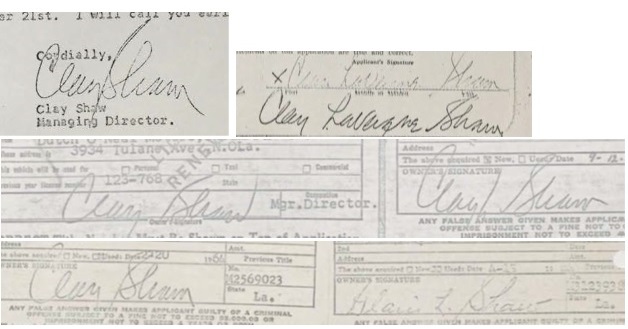
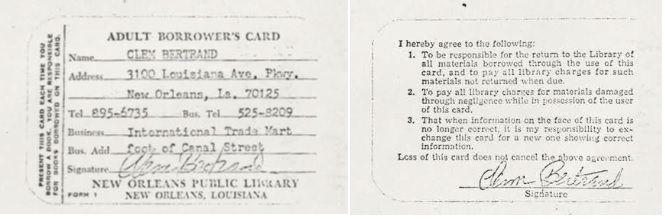
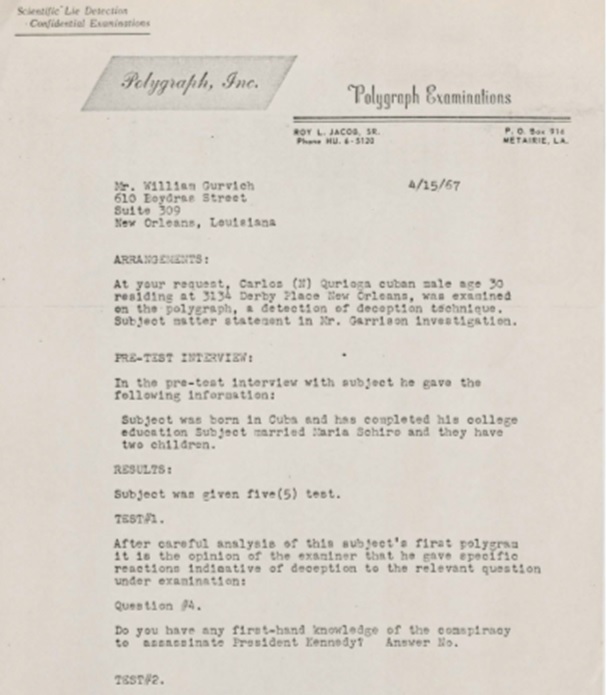
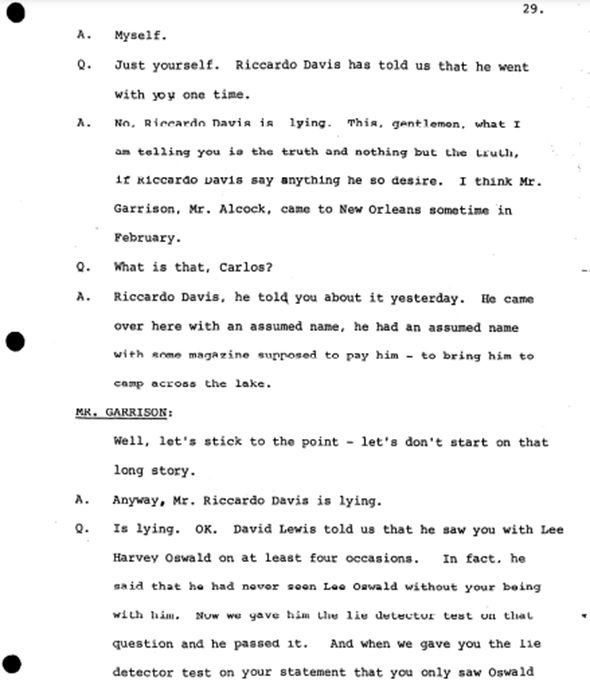
Comparative Case Analysis (‘CCA’), also known as ‘Similar Fact Analysis’, is a technique used in criminal intelligence analysis to identify similarities and support decision making (Dominik Sacha et al, 2017, originally published at The Eurographics Association).
Cases can be linked in CCA through any of the following:
a) Modus Operandi (or tactics, techniques, procedures) b) Signatures and patterns c) Forensic evidence d) Intelligence
CCA is also a perpetrator profiling technique. By comparing seemingly similar cases, crime scenes, tactics, language, weapons, injuries, people of interest, and backdrops, templates can be defined and suspects identified.
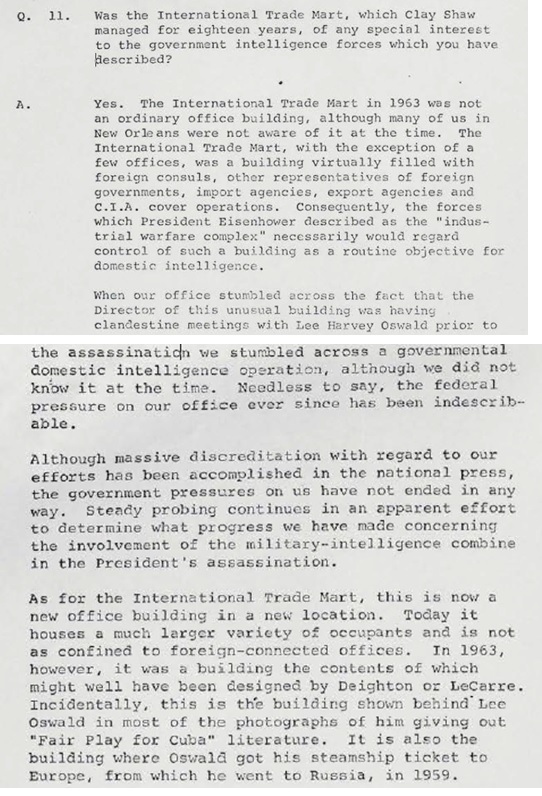
CCA was never performed for the JFK assassination.
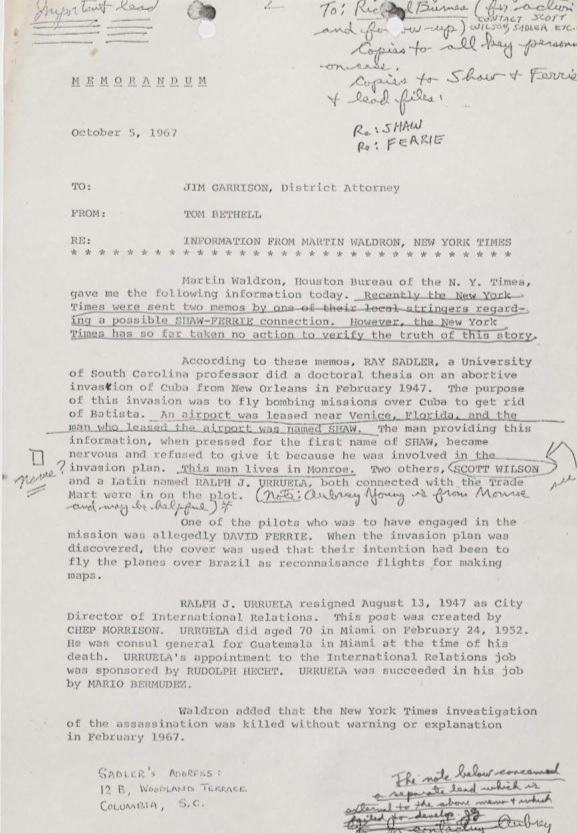
By comparing elements of what occurred in and around the murder of JFK and a November 1962 plot involving the use of incriminating letters purportedly sent from Havana by a Jose PepeMenendez almost one year before the successful attempt, we will present compelling evidence of not only a conspiracy, but key parts of an m.o. and the identification of persons of interest.
Ask yourself the question: If it can be established that there is a clear connection between two plots to kill JFK, the successful one and another that occurred a year earlier, can one solve the murder by solving the preliminary plot?
Readers will be able to find all letters referred to by clicking here.
Summary
Near the end of November 1962, when the tensions around JFK’s handling of the Missile Crisis were at their highest and military hawks were opposed to their Commander in Chief, three letters from Cuba were intercepted. These letters, all bearing the signature Pepe, were fabrications designed to provide a paper trail that would frame potential patsies in the murder of JFK as leftists who were in league with Cuban agents.
As we will see later, their interception was made easy by design: The intended recipients could easily be portrayed as pro-Castro and were not even connected to the addresses on the letters. Those who picked up the letters in their place were CIA-friendly and certain to pass the information on to their intelligence contacts who were part of the JMWAVE network, controlled by CIA officer William Harvey. The FBI and the Secret Service considered these letters to be serious. They suspected that their interception was intended, and called the alleged sender of the letter, Pxepe Menendez, a suspect. This case was never solved and was closed on November 21, 1963, one day before the assassination.
In October 1963, Oswald and/or an imposter contacted Valeriy Kostikov, a KGB officer in the Russian Embassy in Mexico City, whom the CIA believed was in charge of executive action in the Western Hemisphere. After Kennedy was killed, at least three assets answering to CIA officer David Phillips offered false testimonies to link Oswald to Cuban agents.
Between the Mexico City incident and the assassination six weeks later, Oswald was linked to Kostikov and the Cubans in six incriminatory letters that were strikingly similar to the Pepe Letters in terms of style, content, phrasing, and propaganda strategy.
It is the similarity between the 1962 and 1963 false flag operation templates that renders the Pepe Letters affair so significant.
The Pepe Letters
In the process of reviewing the recent Latin American intel files at the Mary Ferrell Foundation, a series of them pertained to a prior plot that involved the use of incriminating letters to set up a patsy who would be blamed for the assassination of JFK and made to look as if he were a Cuban asset.
The first letter I analyzed was very telling.
It was sent from Cuba to “Bernardo Morales” at a post office box in Miami owned by an anti-Castro propaganda unit called Radio Libertad, La Voz Anti-Communista de America. The alleged sender was Jose Menendez, and the letter was signed Pepe. Morales was unknown to those who handled the letter and who eventually forwarded it to a CIA contact linked to the JMWAVE station in Miami.
The sender’s full name is Jose Menendez Ramos. He was nicknamed Pepe. Menendez and his wife Carrie Hernandez had been described by an informant as members of the Tampa FPCC. Menendez got a “top Job” in the Cuban Government after his return. He and his wife were said to be extremely pro-Castro.
Olga Duque de Heredia de Lopez and Aida Mayo Coetara, Miami Representatives for Radio Libertad (linked to anti-Castro DRE operatives), handled the mail. Lopez handed the letter to Cesar Gajate, whom she described as an anti-Communist fighter. Mayo is the wife of Humberto Lopez Perez, the director of Radio Libertad in Venezuela.
Gajate was an AMOT contact. AMOT is a cryptonym for a network of Cubans trained by David Morales at JMWAVE during 1960-61. He passed on the information to his contact (likely CIA officer Tony Sforza or David Morales, who answered to William Harvey).
This was an elaborate hoax to push the “Cubans plan to kill JFK” narrative. One of the people pushing it – CIA’s Bill Finch, worked with Bill Harvey.
The information was sent to the Secret Service, the FBI, and the Department of State on Dec. 8, and later to the INS by Rufus Horn of Task Force W and is signed by him as Liaison and in lieu of William Harvey.
The INS identified a Morales who entered the U.S. using a fake visa.
Radio Libertad was CIA-sponsored (which was also the case for Voice of America) and operated out of Venezuela. It had an antenna office in Miami.
The letter is postmarked November 29, 1962, a month after JFK’speaceful resolution of the Missile Crisis.
It reveals a network of conspirators based in Miami, Washington, and Cuba.
It lamely suggests that by sending the letter to the right-wing Radio Libertad, it would not be intercepted.
It crudely links “Fidel” to a plot to kill JFK.
It does not mince words and is self-incriminating: “if we are able to kill President Kennedy,” “It would be a great success, super extraordinary, for Fidel,” “Marxist-Leninists 90 miles from the U.S.,” “paralyze imperialism completely,” “terrorize capitalism”, “get in contact with your Friends”, “You are an artist”: all very similar to the 1963 letters we will discuss later.
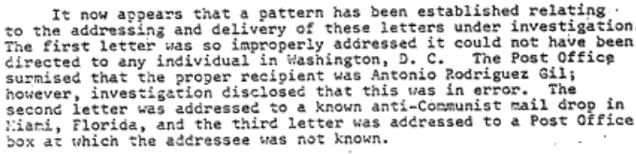
The second letter, which was postmarked November 14, was sent to Antonio Rodriguez–a student at Georgetown’s foreign service school and the son of a Venezuelan diplomat–who was a chauffeur for Colonel Hugo Trejo. Trejo was a suspected intelligence contact from Venezuela and a Venezuelan military officer and politician who led the first attempt at a military rebellion against the president of Venezuela, Marcos Pérez Jiménez. Improperly addressed, Trejo advised the FBI about the letter.
Trejo said that the letter arrived at a Venezuelan Delegation office in Washington. The Secret Service, tipped off by an informant suspecting an assassination plot involving Trejo, questioned members of the delegation, including Trejo, Rodriguez, and others, about the letter.
“Antonio Rodriguez Jones’ address was crossed out in red ink and emerged from the Dead Letter Section with the address Antonio Rodriguez Gil, “2335 Ashmead Place NW, Washington, DC. The Secret Service eventually found “this was in error”.
The ostensible reason for the operation against foreign service student Antonio Rodriguez Jones was because his father was Antonio Rodriguez Echazabal, also a diplomat by trade. He was Cuba’s ambassador to Haiti as recently as 1959 before he defected in place in Haiti. He identified as anti-Communist but was not involved with any anti-Castro opposition group. In November 1962, Echazabal was living in Washington, DC and planning to defect to the United States. Echazabal was believed to secretly be a communist. When Echazabal was arrested and deported in August 1963, the “Cuban plot against the President” file was ostensibly closed, but new files kept going inside it.” (Bill Simpich email to Paul Bleau, Sept 6, 2025)
The letter refers to the assassination Cuba-linked plot in a similar fashion to the first Pepe letter discussed above, and was deemed to have been written by the same sender (Menendez) following FBI handwriting analysis.
Intelligence forces attempted to link Rodriguez to an alleged Cuban Terrorist named Pino Machado:
The FBI’s Chief of National Intelligence, Ray Wannall, noted here that a “Secret Service informant” (#3-11-48) claimed on 11/27/63 that Pino Machado was involved in “terrorism” in Washington, DC, back in April 1961. And that if there was an “international plot”, then Pino Machado was the “intellectual director” of Oswald’s activities in Mexico City. His subordinate Lambert Anderson had been monitoring both Oswald and the FPCC for months before 11/22/63.
The third Pepe letter was sent to: SEÑOR MINISTRO DE REPÚBLICA DE GUATEMALA in Guatemala. It does not refer to the assassination plot. It does attempt to link Cuba to clandestine revolutionary activities in the country. It made its way to the CIA.
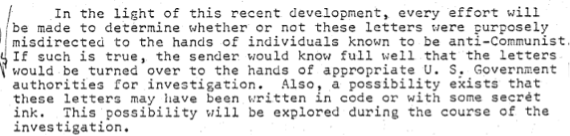
The FBI suspected subterfuge around the flagrant errors in addressing all three letters.
(HSCA Report Volume 3 page 431)
Even Secret Service inspector Thomas Kelley admitted the letters were apparently “meant to be intercepted“.
The links with the 1963 letters and William Harvey (a person of extreme interest in the assassination) are most notable.
The 1963 forged letters
“Oswald’s” letter to the Russian Embassy on November 9, 1963
This uncharacteristically typed letter, purportedly written by Oswald, was intercepted by the FBI (as they did with all mail going to the embassy). This letter incriminated Oswald and foreign confederates and was corroborative of the Mexico City charade. It denigrates the “notorious FBI” and refers to Kostikov as “comrade Kostin.”
The Warren Commission accepted this letter as authentic and explained it as an awkward appeal by Oswald for help from the Soviet Embassy. In fact, the content and the timing of the letter suggest that it was part of the same stratagem designed by those behind the Mexico City set-up.
The fact that this letter was sent to Tovarich Nikolai Reznichenko at the embassy was a source of concern, even if the Oswalds corresponded with him several times in 1963. An FBI report (HSCA Record 180-10110-10104) clearly refers to him as “the man in the Soviet Embassy (Washington’s) in charge of assassinations.” In 1970, researcher Paul Scott had described him as “one of the top members of the Soviet Secret Police (KGB) in the United States.” (Paul Scott article)
Incriminatory letters from Cuba- 1963
Five letters from Cuba, all postmarked shortly after the assassination, one of which was destined for Oswald, were part of the Castro false flag operation and were also used to incriminate Oswald with unidentified Cuban agents, and Fidel Castro himself. These letters were addressed to recipients (Oswald, RFK, The Voice of America–a CIA propaganda asset), which guaranteed their interception or their being simply handed over to intelligence agencies.
They also corroborate the Mexico City fabrication, which very few people would have known about at this time. The FBI dismissed these letters as a hoax, which they were. But they were a hoax with a purpose: to blame JFK’s murder on the Russians and the Cubans. Their content and timing revealed the same tactics being used by the planners.
Letters from Cuba to Oswald—proof of pre-knowledge of the assassination
In JFK: The Cuba Files, Cuban G2 officer Fabian Escalante presents a thorough analysis of five bizarre letters that were written before the assassination in order to position Oswald as a Castro asset. It is difficult to sidestep them the way the FBI did. The FBI argued that they were all typed from the same typewriter, yet supposedly sent by different people. This indicated to them that it was a hoax, perhaps perpetrated by Cubans wanting to encourage a U.S. invasion.
However, the content of the letters and timeline proves something far more sinister, according to Cuban intelligence. The following is how John Simkin summarizes the evidence:
The G-2 had a letter, signed by Jorge that had been sent from Havana to Lee Harvey Oswald on 14th November, 1963. It had been found when a fire broke out on 23rd November in a sorting office. After the fire, an employee who was checking the mail in order to offer, where possible, apologies to the addressees of destroyed mail, and to forward the rest, found an envelope addressed to Lee Harvey Oswald. It is franked on the day Oswald was arrested and the writer refers to Oswald’s travels to Mexico, Houston and Florida …, which would have been impossible to know about at that time!
It incriminates Oswald in the following passage: “I am informing you that the matter you talked to me about the last time that I was in Mexico would be a perfect plan and would weaken the politics of that braggart Kennedy, although much discretion is needed because you know that there are counter-revolutionaries over there who are working for the CIA.”
Escalante informed the House Select Committee on Assassinations about this letter. When he did this, he discovered that they had four similar letters that had been sent to Oswald. Four of the letters were postmarked “Havana”. It could not be determined where the fifth letter was posted. Four of the letters were signed: Jorge, Pedro Charles, Miguel Galvan Lopez and Mario del Rosario Molina. Two of the letters (Charles & Jorge) are dated before the assassination (10th and 14th November). A third, by Lopez, is dated 27th November, 1963. The other two are undated.
Cuba is linked to the assassination in all the letters. In two of them, an alleged Cuban agent is clearly implicated in having planned the crime. However, the content of the letters, written before the assassination, suggested that the authors were either “a person linked to Oswald or involved in the conspiracy to execute the crime.”
This included knowledge about Oswald’s links to Dallas, Houston, Miami and Mexico City. The text of the Jorge letter “shows a weak grasp of the Spanish language on the part of its author. It would thus seem to have been written in English and then translated.”
Escalante adds: “It is proven that Oswald was not maintaining correspondence, or any other kind of relations, with anyone in Cuba. Furthermore, those letters arrived at their destination at a precise moment and with a conveniently incriminating message, including that sent to his postal address in Dallas, Texas …. The existence of the letters in 1963 was not publicized or duly investigated, and the FBI argued before the Warren Commission to reject them.”
Escalante argues: “The letters were fabricated before the assassination occurred and by somebody who was aware of the development of the plot, who could ensure that they arrived at the opportune moment and who had a clandestine base in Cuba from which to undertake the action. Considering the history of the last 40 years, we suppose that only the CIA had such capabilities in Cuba.”
The first letter addressed to Oswald includes: “close the business,” “money I gave you,” “recommend much to the chief,” “I told him (Castro) you could put out a candle at fifty meters,” “when you come to Habana.” Letter four specifies $7000 given to Oswald, which is close to what a Phillips-connected false witness claimed he saw being given to Oswald in Mexico City in the Cuban embassy. It also states that a Cuban agent named Pedro Charles “became a close friend of former Marine and expert shooter Lee H. Oswald in Mexico.”
Black Ops: ZRRIFLE and Black Letters
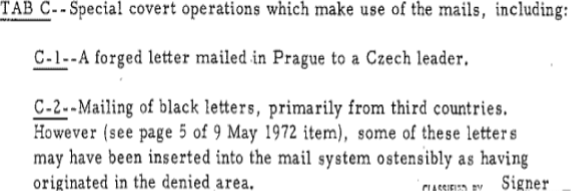
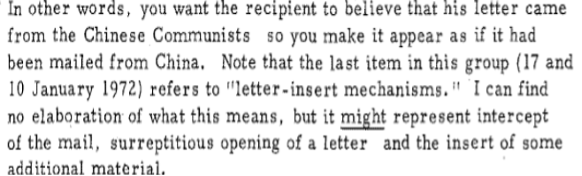
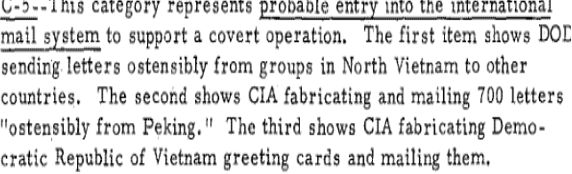
File 178-10004-10148 (released in 2025), from the Rockefeller Commission, discusses the use of this type of psy-war propaganda. This strongly indicates what all the letters discussed in this article are: Black Letters, i.e., forged incriminatory letters designed to create a phony paper trail to set up a foe:
Partial file content:
The Pepe Letters are too similar to the six 1963 incriminatory letters for this to all be happenstance. The tone, wording, and content, as well as the designed-to-be-intercepted expedition of all nine letters, incrimination targets, nature of the recipients, and the timing, can only be interpreted one way. These were Black Letters. They are the workings of specialized strategists who began plotting by November 1962 or earlier against JFK. They used psych-ops techniques, such as black letters. The letters supplemented other tactics that were in tune with the following part of Harvey’s ZRRIFLE: It also contemplates the need for false documentation within CIA files to protect the operation from exposure: “Cover: planning should include provision for blaming Czechs or Sovs in case of blow” and “Should have phony 201 in RI to backstop this, documentation therein forged and backdated. Should look like a CE [Counterespionage] file.”
Case Linkage
The assassination and the “Pepe” plot are not the only cases that should have been compared for clues that would help profile the plotters. On their own, they already provide compelling evidence of central coordination. Oswald’s opening of a Fair Play for Cuba Committee branch in New Orleans is already considered very suspicious by many in the research community. The Menendez links to the FPCC should set off alarm bells for all. This author’s chronicle of other potential patsies that were linked to this dying outfit–deemed to be Castro’s network in the U.S. by the House Committee on Un-American Activities–exceeded several in number. The newly found Menendez link is the topping on the cake.
Conclusion
At this point, the reader is encouraged to read the letters discussed in this article and peruse the other sources that can be found in the bibliography. If one concludes that the 1962 and 63 incidents are linked, then there is most likely a conspiracy involving central planning by those capable of implementing such tactics. Just as importantly, these events should be added to the growing body of evidence around CIA officers William Harvey and David Phillips, making them persons of even greater interest. Already suspected by some government investigation insiders, the proximity of Harvey to the Pepe Letters and Phillips’ links to Mexico City and the FPCC should not go unexplored. These letters have been for too long unexplored, but they are powerful evidence of a pre-existing plot against JFK.
Acknowledgements
I would like to thank Bill Simpich and Doug Campbell, who were the first to see the significance of the Pepe Letters. They, along with Dave Boylan, have provided valuable input to me regarding this still-developing story.
References
The PEPE Lettersat Kennedysandking (all nine black letters are in the appendices) 25 January 2025
The CIA executive action program, code-named ZR RIFLE ZRRIFLE, was in full display by mid-1960 in plans to remove Castro. This was one year before William Harvey perfected it.
The CIA tapped into regime change expertise from its Far East resources, who developed a strategy to devise an assassination attempt on Castro that would be blamed on Chinese Communists. This approach had been used successfully in the Far East and would be enacted for the eventual assassination of the Cuban leader JFK, according to most researchers.
The 1960 plan involved CIA officers Desmond Fitzgerald, JC King, James Noel, and likely Ed Lansdale and David Phillips, who operated out of Cuba in 1959-60. The stratagem of blaming Chinese Communists may have been linked to American interests in the Far East. Most observers believe that by 1963, there was a shift to putting the blame squarely on the Soviets and Cubans for the assassination of JFK. While this focus was intensive, we may ask ourselves if the 1960 plot may have resurfaced as a contingency plan.
In 1964, when Lyndon Johnson and the U.S. war machine were itching for its full-fledged military entry into the Vietnam arena, the U.S. fabricated the Gulf of Tonkin incident false reports of Vietnamese attacks on U.S. destroyers. Was there also a belated attempt to try and factor the Chinese into a conspiracy that eliminated JFK?
While the following December 1963 CIA file did not gather much interest, it is one of a number that began circulating right after the assassination 104-10308-10320 ATTRIBUTION OF PRESIDENT KENNEDY’S ASSASSINATION TO AN ALLEGED CHICOM/CASTRO PLOT. In it, details are planted around Chinese and Castro sympathizers backing a plot, with funding received at an unidentified Wall Street Bank. Two individuals (Ramon Cortes and Inu Fernandez) are fingered as intermediaries present in Dallas and possibly being involved. (For more on Cortes, see State Secret -Chapter 6, Bill Simpich).
Were there to be links between these two and Oswald? Was there some sort of tactic being contemplated here to help bolster motivation for a conflict on the other side of the world? We may never know the answers to these questions- it was sometime in early December 1963 that the CIA and Ambassador Thomas Mann in Mexico received their marching orders from Hoover and LBJ to stop arguing in favor of a Castro connection to a murder plot. In 1966, Mafioso Johnny Rosselli, who was the link between the mafia and the CIA in a partnership to eliminate Castro, said the following:
The last of the sniper teams dispatched by Robert Kennedy in 1963 to assassinate Fidel Castro was captured in Havana. Under torture, they broke and confessed to being sponsored by the CIA and the US government. At that point, Castro remarked that, ‘If that was the way President Kennedy wanted it, Cuba could engage in the same tactics’. The result was that Castro infiltrated teams of snipers into the US to kill Kennedy.
Roselli’s propensity to talk too much is what likely got him killed, chopped up, and put in a drum that was found floating in Dumfoundling Bay. Roselli was certainly wrong about Castro leading the operation; in fact, the super secret CIA Inspector General report on the plots was written to correct errors in his story. Rosselli may have been right about who some of JFK’s shooters were. He certainly was spot on about the tactics that were used if one considers the following CIA execution plan:
This document is as explicit as it can get when it comes to directly evoking the use of the ZRRIFLE executive action program for the removal of Fidel Castro. Thrown right in the reader’s face is the subject of the Dispatch: “Proposed operation to have the Chinese Communists suspected of an assassination attempt.”
There is a lot to unpack in this planned false flag:
The record can be found at the Mary Ferrell Foundation: Title: DISPATCH: PROPOSED OPERATION TO HAVE CHINESE COMMUNISTS SUSPECTED OF ASSASSINATION ATTEMPT Pages: 2 Agency: CIA RIF#: 104-10315-10011 Subjects: ANTICASTRO PLOT
It is dated July 8, 1960, and is about a topic brought up on June 25, 1960
It comes from the Chief of the Far East Division (Desmond Fitzgerald), sent to the chief of the Western Hemisphere Division (J.C. King), who relays it to the Chief of Station in Havana (James Noel)
The subject is very straightforward: LCHARVEST PSYCH: Proposed Operation to have Chinese Communists blamed for Assassination Attempt
LCHARVEST (TPFAST, TPTERRY, VLVIGOR) involved operations against Peoples Republic of China (PRC) scientists and efforts to monitor PRC state technology
Chester Dainold is a pseudonym for Desmond Fitzgerald and Oliver G. Galbond, a pseudonym used by Colonel J.C. King, Chief of the Western Hemisphere Division, Directorate of Operations, CIA (MFF).
Fitzgerald headed the Far East Division between 1957 and 1962, when he worked closely with Ed Lansdale, a legendary PSYCHOLOGICAL OPS expert. In 1953, Lansdale was sent to Vietnam to act as a consultant for the French in their efforts to repel the uprising in their colony. The plan was to mount a propaganda campaign to persuade the Vietnamese people in the south not to vote for the communists in the forthcoming elections.
“In the months that followed they distributed targeted documents that claimed the Vietminh and Chinese communists had entered South Vietnam and were killing innocent civilians. The Ho Chi Minh government was also accused of slaying thousands of political opponents in North Vietnam.” https://spartacus-educational.com/COLDlansdale.htm
In late 1961, Robert Kennedy and the all-powerful SAG team tasked Lansdale to lead Operation Mongoose, a covert action program for sabotage and subversion against Cuba. Lansdale appointed William Harvey as his CIA point person, who maintained a CIA relationship with Roselli all the way to 1963, even though RFK had demoted him after the Missile Crisis. It was Desmond Fitzgerald who replaced Harvey.
ZRRIFLE Plus
The Executive Action program perfected by William Harvey in 1961 was really a spinoff of assassination programs used throughout the ages. Harvey learned about these in meetings with British and French intelligence who were well acquainted with the finer points of this science. e.g., British MI 5 officer Peter Wright. Mafia collaboration synergized these techniques.
What is fascinating with the current file is the level of detail shared and that it predates Harvey’s work and is suggestive of what many have come to think about what took place on November 22, 1963.
Let us break down the plan and then translate it to the JFK assassination conspiracy:
PROPOSED OPERATION TO HAVE CHINESE COMMUNISTS SUSPECTED OF ASSASSINATION ATTEMPT = PROPOSED OPERATION TO HAVE CASTRO BLAMED FOR JFK ASSASSINATION
Replace this with JFK’s exposure in upcoming motorcades and appearances in crowded places.
Better yet, let’s plan the route ourselves with help from our CIA asset, Dallas Mayor Earle Cabell… sketches and maps: As in Sergio Arcacha Smith’s possession of the sewage systems maps and David Ferrie’s sketch of Dealey Plaza… Places of vantage; like Dealey Plaza where there can be triangulation of fire… Routes of escape/ Exfiltrating… Through the railyards, in the Nash Rambler with a Latino getaway driver, through the panicked crowds, Red Bird Airport, the Flight from Dallas in a CIA plane… Locations of sites for caching the weapons… as in Julia Ann Mercer’s sighting of Ruby the morning of the assassination involved in delivering a package near the knoll, or Lee Bowers (railroad tower operator) seeing suspicious movements in the railyards and the TSBD being open to renovation teams during the days preceding the motorcade.
In other words, let us add touches such as an FPCC-linked, Castro-backed commie-assassin to the mix through impersonations, incriminating forged correspondence, false testimonies of assets alleging interaction between the patsy and the enemy as well as financial backing (recall the false testimony of Oswald receiving payouts in the Cuban embassy in Mexico City), back-yard photos portraying Oswald as an unhinged, well-armed Marxist fanatic, etc.
Simply put, we need more than just a good story… we need to set the stage with rumors and fabricate trails of “evidence” for the red herring to be believed: Planting wallets, leaking propaganda through media assets, tampering with evidence, framing patsies and opponents, etc.
Conclusion
While some lone-nut theorists have often brought up the complexity of carrying out what many researchers have come to believe about the assassination, file 104-10315-10011 tells a compelling story: Regime change specialists like Lansdale, Harvey, Fitzgerald, and Phillips all had plenty of experience in the use of ZRRIFLE-like tactics during the decade that preceded Castro’s rise to power; they all likely became involved in applying these tactics for the elimination of Castro beginning in 1960; they were all omnipresent in regime change special ops aimed at Cuba in 1963 and these are the tactics that have been revealed with time, according to many researchers, to be the ones that were used to remove Kennedy.
So yes, orchestrating a regime change is complex… Only real specialists can deliver something this grandiose.
Martin Sherwin’s Gambling with Armageddon, the story of the Cuban Missile Crisis, is nothing short of a powerful, gripping tale. I’ve read a few accounts of those much-discussed thirteen days, but none come close to the palatable sense of drama and suspense that Sherwin delivers.
As readers of this site will likely know, as soon as President Kennedy became aware that Khrushchev had placed offensive missiles in Cuba, he assembled many of his close advisers who would then meet daily with the president to flesh out new developments and possible responses. This group of decision-makers has come to be known as the Executive Committee of the National Security Council or ExCom. Luckily for us, these meetings were secretly recorded and constitute our best way of grasping the reality of the ebb and flow of the individual participants thinking.
In addition, there were also side meetings. These occurred in the Oval Office, the Pentagon, and the State Department. There were also revelations brought to light through memoirs, interviews, anniversary meetings, subsequent articles, and, of course, similar accounts offered by Soviet participants.
I mention this in order to explain what makes Sherwin’s style so engaging. Sherwin leads the reader through this labyrinth chronologically. Hour by hour, day by day, we watch the unfolding and changing positions, the points of view articulated inside smaller group meetings, but hidden or modified when the actors are re-assembled as a whole. Along the way, there are surprises, new crises, wisdom and insight, maturity, reckless posturing, a heavy dose of misinformation, and a touch or two of plain old madness.
Interestingly, Sherwin believes that to understand the Missile Crisis, one needs to understand the Cuban revolution. This is insightful because Sherwin is implicitly drawing a through-line with the liberation or reform efforts of Mosaddeq, Árbenz, and Castro, and Kennedy who, while not administering reform, blocks, repeatedly, the CIA’s effort to effect regime change in Cuba. I shall argue that there is in this episode a power dynamic that is foundational to understanding the assassination of President Kennedy.
Liberation Movement Cuba [1]
By opening the door to an examination of the Cuban revolution,[2] Sherwin is allowing us to view the Missile Crisis as a conflict between two distinct systems of power: one source of power are those forces committed to the preservation of colonial regimes and the other is the forces resisting that preservation in order to effect national liberation. This puts JFK in a bind. Simultaneously, by virtue of his position as president alone, he would be compelled to use his military to elevate corporate interests and squash liberation movements. This, in effect, is his presidential responsibility, his job. And yet we see him feverishly working to block his military from restoring a colonial government on the Cuban island. Let’s follow Sherwin’s lead, then, taking a peek at the Cuban revolution and the reform efforts of Mosaddeq in Iran andÁrbenz to which Sherwin also calls our attention.
Under Batista, 70 percent of Cuba’s arable land was owned by foreigners. Castro’s first priority was the redistribution of land through his Agrarian Reform act. Most of the sugar industry was owned by Americans. In addition, Castro’s reforms included education, health care, housing, and road building in rural zones. Some American ranches were nationalized, and the Cuban government ordered foreign refineries to refine Soviet crude oil. American refineries refused, and Castro nationalized them in response. The US government then ended its sugar quota, which gave Castro a good reason to nationalize all American properties. An embargo followed while Castro went on to seize all Mafia casinos, broke up drug and prostitution rings, and effectively ended the Mafia-politician corruption centered in Havanna.
Liberation Movement: Iran
“Mohammad Mosaddeq, the elected prime minister of Iran, had nationalized the assets of the Anglo-Iranian Oil Company, a British enterprise that had refused to cooperate with the Iranian government’s demand for access to its books. Agents from M16, Britain’s CIA equivalent, suggested a joint operation to overthrow Mosaddeq, and President Eisenhower endorsed the idea.”[3]
Liberation Movement: Guatemala
“Jacobo Árbenz, the president of Guatemala who….[following] through on his economic and social reform campaign promises… threatened the landholdings of the United Fruit Company…[which had affiliations with both John Foster and Allen Dulles]….President Eisenhower authorized a…“psychological warfare and political action, ” “subversion,” and “assassination,” all cobbled together as Operation PBSUCCESS.” The operation did not run smoothly. CIA-trained fighters were pinned down until CIA planes bombed Guatemala City. Árbenz was able to flee the country.[4]
In each of these movements[5] we find the material interests of the most powerful jeopardized. Or, if we continue examining these events in terms of clashing systems of power, we might say, using economic terms, that the surplus takerswere being overtaken by the people from whom the surplus was being taken, the expropriated. Further, a key element in this dynamic was the progressive leadership by a head of state. From the point of view of American corporate titans newly ascended–following WWII– to world hegemonic power, each of these national liberation movements would be seen as a five-alarm fire. Note the position of the CIA, which played the key role in suppressing the liberation movements in Iran, Guatemala, and Cuba: liberation movements present “The gravest danger to the US….(my emphasis).” [6] Why the gravest? Because the US believed in and feared “Soviet expansionism,” which in turn was perceived as frustrating the US hegemonic ability to expropriate colonized wealth and resources throughout the world. Note too, Eisenhower’s Secretary of State John Foster Dulles’ fear: “The poor always want to plunder the rich; there is a rising tide all over the world wherethe common man aspires to higher and wider horizons [and where] Russia is able to expand her influence over the earth by associating with these dangerous currents.”[7]
The Eisenhower Factor
“Russia is definitely out to communize the world. We face a battle to extinction between the two systems.” So wrote Dwight D. Eisenhower in his diary in 1946. In 1958, Eisenhower told Greece’s Queen Frederika that “To accept the Communist doctrine and try to live with it would cost too big a price to be alive.” While we may have been led to believe that Allen Dulles was the rabid anti-Communist ideologue, Sherwin believes that it was actually Eisenhower (my emphasis). Argues Sherwin, Allen Dulles was “the mouthpiece, almost a puppet for Eisenhower (my emphasis).”[8]
So we find that even before Kennedy became president, he wasn’t trusted, given his views expressed in the Senate chamber on western imperialism. That he arranged to send to every member of the Senate, Burdick and Lederer’s The Ugly American, a book which may have made cold warriors wince. Not surprisingly, Eisenhower was terribly upset with JFK’s victory in 1960 (his blood pressure “soaring to dangerous levels”). He was convinced that Kennedy had allowed communism to thrive just off the Florida coast and that he would “do almost anything to avoid turning the country over to ‘the young genius.’ ”[9] It was “the repudiation of everything I’ve done for eight years.”[10]
“It is now clear from available evidence,” writes Sherwin, “that he would impose on his successor” a way to ensure that he would be saddled with the commitment to “eliminate Castro and his government” from Cuba.[11] This desire, not surprisingly, was consistent with a group of corporate leaders with business interests in Cuba (surplus takers) who had met with CIA Director Allen Dulles. They wanted Dulles to pass a message on to Eisenhower: “Get off of dead center and take some direct action against Castro.”[12] Eisenhower understood his order: At an NSC meeting he “decided that Castro should join Mosaddeq and Árbenz as yet another CIA Cold War trophy.”[13] This “new plan, a full-fledged invasion would be delivered to former Navy lieutenant, JFK, as an action program approved by the 5 star general-president who had organized and commanded the invasion of Normandy.”[14]
The reader may be familiar with the rest of the Bay of Pigs story, but it is necessary to retell it in the context of the missile crisis.
Due to a recent declassification of thousands of pages from the CIA in 2011 (50th anniversary of the Bay of Pigs Invasion), it is now known that the CIA task force in charge of the paramilitary assault knew the operation could not succeed without becoming an open invasion supported by the U.S. military. According to Peter Kornbluh, this was the most important revelation of the declassification of the official history of the CIA.[15]
Thomas L. Hughes, a former intel specialist, told Sherwin: the entire operation was intended to “entrap” JFK, who repeatedly warned the Bay of Pig planners that under no circumstances would he authorize American combat forces to become involved in the operation.[16] And so he didn’t, and the revolutionary-minded Castro and his government survived, the only one by the way, to survive the relentless onslaught of American military power since 1917.
But there would be one more chance for the corporate surplus-takers and their banished allies to get their resources and power re-established in Havana. It would be the Missile Crisis.
Thirteen Days
Perhaps the one thing in reading Sherwin’s tale that grabbed my attention was the story of Senator Kenneth Keating from New York. The official story is that on 14 October 1962, photo-intelligence analysts discovered that Khrushchev had placed offensive surface-to-surface nuclear ballistic missiles on the island of Cuba. The information was relayed to President Kennedy on 16 October 1962, and on 29 October, Khrushchev agreed to withdraw his missiles, hence the Cuban Missile Crisis of thirteen days.
But a Republican Senator from New York, Kenneth Keating, had been insisting since 1 September that, indeed, Soviet missiles had been placed on the island, and this was a full month before President Kennedy was presented with evidence. Further, John McCone, CIA Director, also was insisting on the delivery of missiles to Cuba. But playing his cards closely, McCone said he had no source, merely that his pronouncements were a “hunch.”
Keating, who died in 1975, never revealed his source, but after years of pressuring, even by Senator Ted Kennedy, Keating only would say that his mystery source had provided conclusive evidence and that he was an official intelligence source within the DOD. Interesting, too, is that on October 16, when Kennedy assembled his team of advisors to deal with the crisis, “his advisers speculated that an official in the Defense Department served as Keating’s source. They named him, but the person’s name has been deleted from the official transcript of the meeting and remains classified.”[17]
The gravity of the crisis, one would assume, would have required an immediate notification of the president. Further, that a CIA Director would just happen to have a hunch, which just happens to mirror reality precisely, strains credulity. A more likely explanation is that this was another effort to entrap the President: he had to act since the missiles were already installed and loaded. Further, it shows that the initiation of hostility would have been welcomed by members of the JCS and others: a pretext to eliminate the Castro menace once and for all and, finally, the island could be returned to the corporate surplus takers who had ruled there since 1900.
The Chomsky Factor
Let us pause for a moment to consider the Noam Chomsky perspective to help understand the power dynamics in this saga. Chomsky has claimed that if the Nuremberg laws were applied, then every post-war American president would have been hanged for committing atrocities. The reason why is this: the CIA has had the responsibility to crush liberation movements around the globe. The surplus takers must win; investors and wealth accumulators must win. The people on the bottom, the expropriated, must lose. It’s a system of power. This is why Chomsky will say that presidents really don’t make policy. The policies flow from institutions, and presidents just get on board and execute the policy handed to them.
But what happens if a president like Kennedy keeps pushing for peace and doesn’t get on board when his closest advisors push hard to support covert wars that keep colonial systems in place?
Armageddon Nears
Other than on the very first day when Kennedy said that they might have to take military action and “wipe them out,” Adlai Stevenson, UN Ambassador, countered no. A diplomatic solution is possible. From that point forward, Kennedy never wavered in his belief that a peaceful resolution was the only sensible one. Yet, the Joint Chiefs of Staff and its Chairman and many others were ferociously committed to removing Castro by military force. Kennedy was lucky to have the UN Ambassador in the group who suggested a blockade as a way. This approach was useful in stalling the implementation of the policy favored by the Hawks.
As with the Bay of Pigs fiasco, the contempt for Kennedy was not disguised. Admiral George Anderson Jr., Chief of Naval Operations, felt that the blockade was a “lame response by a president who ducked military intervention in the Bay of Pigs.” Anderson was also furious when Kennedy insisted on having total control over military operation decision-making and that he, the president, was crossing “a bright red line.”[18]
McCone reported Eisenhower’s position, which was “as hawkish as the Chiefs all out military action.” Kennedy didn’t respond, believing that Eisenhower was “out of touch with the world.”[19]
Undersecretary of State George Ball’s position was that the situation was a “test of will” that required that the US respond with decisive military force in order to maintain the confidence of our allies.”[20]
Treasury Secretary Douglas Dillion said that, “A military strike is our only solution. Survival of the free world fabric is at stake.” [21]
General Taylor, Chairman of the JCS, intoned: “All the commanders and the Chiefs want a military assault and then invasion, take it out with one hard crack.”[22]
Chief of Staff of the Air Force General Le May declared: “This blockade and political action, I see leading into war….This is almost as bad as the appeasement at Munich.”[23]
President Kennedy sharing an insight with General Wheeler mused, “Cuba added to the Soviet arsenal didn’t add particularly to our danger. The real danger is the use of nuclear weapons.”
General Wheeler: “Am I clear that you are addressing yourself as to whether anything at all should be done?”
President Kennedy: “That’s right.” [24]
Aftermath
James Douglas points to the Cuban missile crisis as a turning point in the presidency of John Kennedy. During the last year of his life, he saw a more confident, more imaginative, peace-driven president emerge, pointing to the following bold peace initiatives that flowed from his missile crisis experience:
1) His audacious peace speech in June of 1963, where he states again his belief, as he did during the ExComm meetings, that while we probably would not change our minds about each other’s economic systems, we could live peacefully together;
2) He engineered the passage of the Partial Nuclear Test Ban Treaty;
3) He proposed a way to withdraw from Vietnam with NSA Memorandum 263; and
4) he had established a covert dialogue with Fidel Castro. And if that were not enough, I would add his proposal to collaborate with the Soviets in placing a man on the moon.[25]
Concluding Thoughts
The story of the Cuban Missile Crisis is, in important ways, an explanation of JFK’s assassination. Most of his advisors were flat out moving in a warlike position, as he was holding firm. He had established a direct back channel with Khrushchev in 1961, which he used to ask (the “enemy”) for help in blocking his general’s efforts. Afterward, he had also established back-channel talks with Castro in hopes of achieving a US-Cuba détente.
Daniel Ellsberg noted that when the missile crisis was over, there was a “fury” within the Air Force. “There was virtually a coup atmosphere in Pentagon circles. Not that I had the fear there was about to be a coup – I just thought it was a mood of hatred and rage. The atmosphere was poisonous, poisonous.”[26]
The JCS, so committed to finding a path toward war, were out-maneuvered and instead were left not just with a peaceful solution, which they despised, but also a commitment by JFK to Khrushchev not to invade Cuba, ever. Further, Kennedy’s successful diplomacy also turned on meeting the second demand by Khrushchev that Kennedy dismantle the Jupiter nuclear missiles in Turkey, placed there by Eisenhower. Kennedy kept this capitulation secret, given the complexity of the negotiation at the time and the risk of the [27]JCS succeeding in pushing their agenda to the fore. Writes Sherwin: “If a diplomatic solution was still possible, he would have to pursue Khrushchev’s offer privately.” [28]
Kennedy ended Operation Mongoose at the conclusion of the crisis. The CIA, however, hoping for a slip into overt military action, kept the program going throughout the thirteen days and beyond.
The US intelligence was not terribly accurate. Instead of 10,000 Soviet troops in Cuba, there were 40,000. Also, the US was unaware that some of the nuclear weapons were operational and that missile crews were under orders to launch their missiles were the US to attack. Therefore, every single military response put forward by ExComm members apart from the blockage, if carried out, would have likely resulted in a nuclear war.
Often, Kennedy is lauded for his diplomatic skills but chided for having created the crisis in the first place. Khrushchev has said that he put the missiles into Cuba for two reasons: 1) to prevent an invasion, and 2) to respond in kind to the missiles put on the border of the Soviet Union in Turkey and also those in Great Britain. We now know that both the attempted invasion and the placement of missiles in Turkey and Great Britain were under the orders of Eisenhower, who arrived in office with 1,200 nuclear missiles in the US arsenal and left with 22,000. [29]
Who Was Kennedy?
In a campaign speech in October 1960, Senator Kennedy said: “I want to talk with you tonight about the most glaring failure of American foreign policy today – about a disaster that threatens the security of the whole Western Hemisphere – about a Communist menace that has been permitted to arise under our very noses, only 90 miles from our shores.” Yet just two years later, Kennedy said in a speech to the Inter-American Press Association, “A small band of conspirators …[had made] Cuba a victim of foreign imperialism… an instrument of the policy of others, a weapon in an effort dictated by external powers…. Without it, everything is possible.”[30]
In the first statement, he sounds like one of his own JCS generals. In the second, anti-communism is soft; his understanding of the plight of those suffering under the weight of foreign wealth extraction could have been made by Árbenz or even Castro. Was this the turn that Douglass speaks about? Yes, a change in confidence, perhaps. But I think it always was the private Kennedy, hidden when he chose to run to the right of Nixon during the McCarthy era. His private conversations and his public commitment to peace not only show him not to be an anti-communist ideologue, they show him, as president, to be a threat to the national security interests of the US. Writes Sherwin, “It is fantastic to watch Kennedy’s mind, how he thinks about things. It’s so different from the rest of his advisors, how those same people, in smaller private meetings just wanting to know when they can start bombing.”[31]
Chomsky states, “The thesis is understood to imply that JFK would not have responded to the changing conditions in the manner of his closest advisers and war mongers. If true, the thesis is important, lending weight to the belief that Kennedy was indeed a remarkable if not unique figure.”[32]
This statement was made in relation to JFK’s Vietnam policy. But I think the sentiment would apply equally to his handling of the missile crisis.
[2] Aleksandr Fursenko and Timothy Naftali, Hell of a Gamble: Khrushchev, Castro, and Kennedy.
[3] Martin Sherwin’s Gambling with Armageddon, the story of the Cuban Missile Crisis (New York: First Vintage Books Edition, February 2022), p. 140-1.
[4] Sherwin, p. 141-2; PB was the CIA cryptonym for Guatemala.
[5] And we could add the “regime prevention” in the Belgian Congo with the CIA assassination of Patrice Lumumba days before Kennedy assumed office as well as the regime change in Chile in 1973 when the CIA orchestrated regime change installed General Pinochet and ousted popularly elected president, socialist Salvador Allende who committed suicide rather than being captured to the coup forces.
[6] Noam Chomsky, Rethinking Camelot, JFK, the Vietnam War, and US Political Culture, (Noam Chomsky, 1993), p.50.
“… we will analyze similar situations that demonstrate stratagems around other subjects and incidents that occurred during the months preceding and succeeding the assassination of JFK that are revealing of a pattern that is indicative of central coordination.”
From The JFK Assassination Chokeholds
Executive Summary
There is a strongly supported theory in the JFK research community that the assassination bears the fingerprints of a CIA assassination program code-named ZRRIFLE, and that it was led by rogue, high-level agents linked with the failed Bay of Pigs operation. Many facts support this theory, including the association of regime change specialists with many elements of the plot, the impersonation of Oswald in Mexico City in the fall of 1963 to make him look unhinged and Castro-connected, and, most interestingly for this article, the use of incriminating correspondence.
Shortly after the Mexico City incident, a letter with a forged signature incriminating Oswald and foreign confederates, and corroborative of the Mexico City charade was sent to the Russian embassy in Washington. The FBI eventually dismissed it as a clumsy attempt by Oswald to ingratiate himself with the Soviets. The content and the timing of the letter suggest rather that it was part of the same stratagem designed by those behind the Mexico City set-up.
Five other letters sent from Cuba, all postmarked shortly after the assassination, incriminated Oswald, unidentified Cuban agents, and Fidel Castro himself. They contained details of the Mexico City fabrication known only to a very few. Despite this, the FBI dismissed these letters as a hoax. (See the book ZR Rifle by Claudia Furiati)
Recently this author discovered three more incriminatory letters in released CIA files that received little attention from the research community. These very similar letters are postmarked in the late fall of 1962, the year before the assassination. This article analyzes these letters and concludes that:
They reveal that plans to assassinate JFK were likely triggered by the Cuban Missile Crisis.
They are consistent with and add detail to the theory that the assassination followed the ZRRIFLE playbook.
The fact that the sender of these letters was directly linked to the Fair Play for Cuba Committee, just like Oswald and other subjects of interest involved in suspicious events throughout 1963, provides compelling added evidence that plans to kill JFK during the last year of his life were centrally coordinated.
They add credence to the theories that point to the involvement of specialists in regime change operations. They add to the suspicions that high-level officers David Phillips and William Harvey were involved.
They do not incriminate the CIA as an organization, nor the FBI and Secret Service.
Introduction
Case linkage is a standard offender profiling technique that was never performed for the JFK assassination by the leading intelligence organizations of the country. By the time the ARRB was running, the Secret Service ensured that this could not be done by illegally destroying JFK files just before they would have been made available through declassification beginning in the mid-nineties.
In Chokeholds, by comparing some 20 incidents and/or subjects that were worthy of exploration, we were able to present a picture that revealed: “…that the peculiarities that one can find in many of the subjects’ personas, associations and actions are hardly a haphazard collection of traits and behaviors.” One of the traits that was underscored was links with the Fair Play for Cuba Committee that existed in a vast majority of the cases explored.
In late December 2024, while reading some of the latest declassified files available at Mary Ferrell, I found a series pertaining to letters sent from Havana, written in a way to incriminate Cuba in a plot to kill JFK right after the peak of the Missile Crisis. I had a déjà vu moment.
The 1962 Pepe letters are not only corroborative of what many researchers have come to think, but they add a clearer picture to the offender profile that is getting more precise from added pieces to the puzzle– like these. In 1962, just following the height of the Missile Crisis where JFK was strongly opposed by his war hawks, three letters signed by a “Pepe,” were sent from Havana in a way that ensured that they would be discovered by U.S. intelligence. These letters created deep concern that there was a plot to kill JFK in the works, one that involved enemy agents in both Cuba and the U.S. They are remarkably similar to the 1963 letters and link potential patsies and perpetrators to Fidel Castro in what can only be seen as another false flag operation.
The FBI eventually dismissed these letters as a Cuban harassment tactic despite referring to the sender as a suspect.
Was this a prequel to what would happen in the fall of 1963?
Are the perpetrators of this similar case the same as those who are behind the conspiracy?
This author believes that the answer is yes to both questions, which can only lead to more crystallization of the opinions that most researchers have, according to recent surveys on the matter, about the who, when, how, and why of the conspiracy.
After the assassination, investigators did nothing to see how these letters linked up with the eerily similar subsequent events described earlier in this section.
Background
“According to a historical study of the Arbenz removal project: discussing themes and tactics that would become constants during the following decades… deniable assassination squads… while placing the blame on designated parties (patsies).
In 1953, sabotage and propaganda efforts were discussed but beyond that a CIA officer proposed a plan for first, spreading rumors that the communists were dissatisfied with Arbenz, then killing him in a fashion that would be laid on the communists.” (Nexus, by Larry Hancock)
According to a recent study, most researchers are of the opinion that the maneuvers described above are part of the assassination program code-named ZRRIFLE, and that CIA regime change specialists David Phillips and William Harvey should be considered people of interest and that the Missile Crisis was a determining factor in the decision to remove JFK.
1) ZRRIFLE
“ZRRIFLE” was a program to recruit foreign criminal assets for various illegal activities including burglary, wiretaps, strong-arm work, and thefts in support of ZR code-breaking work. Later it was used by William Harvey as a project for an Executive Action assassination program.
It provided a cover for recruiting individuals who could be used to provide the CIA with a highly targeted ‘executive action’ capability. Along with other CIA assassination activities, it was investigated by the Church Committee in the 1970s. That investigation was the first to document and publicize American efforts to eliminate Fidel Castro, Patrice Lumumba, and other foreign leaders.
In 1961, William Harvey was tasked by Richard Helms with perfecting an executive action program. Key aspects of ZRRIFLE included setting up phony paper trails, the use of surrogates and patsies, as well as provisions to blame a foe. He left behind hand-written notes. The following are excerpts fromWilliam Harvey’s notes:
“Should have phony 201 in RI [Records Integration] to backstop this, all documents therein forged & backdated. Should look like a CE file …. Cover: planning should include provision for blaming Sovs or Czechs in case of blow.”
2) The Mexico City Charade
Between September 27 and October 3, 1963, conspirators in the JFK assassination, developed a false flag incident in Mexico City designed to make future patsy, Lee Harvey Oswald, look like he was in league with Cuban and Soviet agents. Oswald was alleged to have received bribes from Cuban agents and met KGB agent Valery Kostikov, who was their head of assassinations in the Western Hemisphere. J. Edgar Hoover affirmed that Oswald had been impersonated in Cuba. (Also see the Lopez Report.)
3) A forged letter sent to the Russian Embassy in Washington incriminates Cubans, Soviets, and Oswald.
Shortly after the Mexico City fabrication, a forged letter (see Appendix 1) incriminating Oswald and foreign confederates and corroborative of the Mexico City charade was sent to the Russian embassy in Washington. It denigrates the “notorious FBI” and refers to Kostikov as comrade Kostin. The Warren Commission eventually dismissed it as an awkward appeal by Oswald to the Soviets. In fact, the content and the timing of the letter suggest that it was part of the same stratagem designed by those behind the Mexico City set-up. The Russians, upon receiving the letter, saw it for what it was: As reported by Jerry Rose in the Fourth Decade, “in 1999, Boris Yeltsin handed Bill Clinton some 80 files pertaining to Oswald and the JFK assassination. One of the memos reveals that, at the time of the assassination, Russian ambassador Anatoly Dobrynin had right away seen the letter as a ‘provocation’ to frame Russia by the fabrication of complicity between Russia and Oswald, when none existed. ‘One gets the definite impression that the letter was concocted by those who, judging from everything, are involved in the president’s assassination,’ Dobrynin wrote. ‘It is possible that Oswald himself wrote the letter as it was dictated to him, in return for some promises, and then, as we know, he was simply bumped off after his usefulness had ended.’ In late November, the Russians sent the letter to U.S. Secretary of State Dean Rusk explaining why the letter was a fraud. By then, the White House was peddling the lone nut fable. Kept hidden was the fact that the FBI already had a copy of the letter.”
In his article, Jerry Rose points out that the typed letter had many more spelling errors in it than the rough draft found at Ruth Paine’s home. (Oswald’s Last Letter: The Scorching Hot Potato)
4) The Phony Letters from Cuba
Five letters from Cuba (See Appendix 2), all postmarked shortly after the assassination, one of which was destined for Oswald, were part of the false flag operation and were used to incriminate Oswald, unidentified Cuban agents, and Fidel Castro himself. They also corroborate the Mexico City fabrication that very few people would have known about. The FBI dismissed these letters as a hoax, but their content and timing revealed the same tactics being used by the assassination planners. (Read the letter from Cuba section in Kennedysandking article The CIA and Mafia’s “Cuban American Mechanism” and the JFK Assassination.)
The first letter addressed to Oswald includes: “close the business,” “money I gave you,” “recommend much to the chief,” “I told him (Castro) you could put out a candle at fifty meters,” “when you come to Habana.” Letter four specifies $7000 in bribes given to Oswald which is close to what a Phillips-connected false witness claimed he saw being given to Oswald in Mexico City in the Cuban embassy. It also states that a Cuban agent named Pedro Charles “became a close friend of former Marine and expert shooter Lee H. Oswald in Mexico.”
The following is how researcher John Simkin (Spartacus) summarizes the evidence:
The G-2 had a letter, signed by Jorge that had been sent from Havana to Lee Harvey Oswald on 14 November 1963. It had been found when a fire broke out on 23rd November in a sorting office. “After the fire, an employee who was checking the mail in order to offer, where possible, apologies to the addressees of destroyed mail, and to forward the rest, found an envelope addressed to Lee Harvey Oswald.” It is franked on the day Oswald was arrested, and the writer refers to Oswald’s travels to Mexico, Houston, and Florida…, which would have been impossible to know about at that time!
It incriminates Oswald in the following passage: “I am informing you that the matter you talked to me about the last time that I was in Mexico would be a perfect plan and would weaken the politics of that braggart Kennedy, although much discretion is needed because you know that there are counterrevolutionaries over there who are working for the CIA.”
Fabian Escalante, chief of Castro’s G-2, informed the HSCA about this letter. When he did this, he discovered that they had four similar letters that had been sent to Oswald, RFK, The Voice of America, and The Director of the Diario de New York. Four of the letters were postmarked “Havana.” It could not be determined where the fifth letter was posted. Four of the letters were signed: Jorge, Pedro Charles, Miguel Galvan Lopez, and Mario del Rosario Molina. Two of the letters (Charles & Jorge) are dated before the assassination (10th and 14th November). A third, by Lopez, is dated 27 November 1963. The other two are undated.
Cuba is linked to the assassination in all the letters. In two of them, an alleged Cuban agent is clearly implicated in having planned the crime. However, the content of the letters, written before the assassination, suggested that the authors were either “a person linked to Oswald or involved in the conspiracy to execute the crime.”
This included knowledge about Oswald’s links to Dallas, Houston, Miami, and Mexico City. The text of the Jorge letter “shows a weak grasp of the Spanish language on the part of its author. It would thus seem to have
Escalante adds: “It is proven that Oswald was not maintaining correspondence, or any other kind of relations, with anyone in Cuba. Furthermore, those letters arrived at their destination at a precise moment and with a conveniently incriminating message….The existence of the letters in 1963 was not publicized or duly investigated, and the FBI argued before the Warren Commission to reject them.”
Escalante continues: “The letters were fabricated before the assassination occurred and by somebody who was aware of the development of the plot, who could ensure that they arrived at the opportune moment, and who had a clandestine base in Cuba from which to undertake the action. Considering the history of the last 40 years, we suppose that only the CIA had such capabilities in Cuba.” (JFK: TheCuba Files)
The linkage with Mexico City is interesting in that very few people were even aware of Oswald’s alleged behavior there shortly before the assassination. David Phillips worked undercover in Cuba in 1959-60 and under Win Scott in Mexico City when the assassination took place. He was a lead propagandist for regime change operations for the CIA. He collaborated closely with other clandestine specialists such as Harvey over the years. Some of the letters suggest a $7000 payoff to Oswald given by Pedro Charles, “a Mexico City-based Castro agent.” Interestingly, Phillips was queried by the HSCA about misinformation from his agents painting a picture of a Cuba-backed conspiracy in league with Oswald. One of his underlings, Gilberto Alvarado, was found to be lying when he claimed that he saw Latinos giving Oswald $6500 in the Cuban embassy.
The Pepe Letters
a) Overview
In the process of reviewing the recent Latin American intel files at the Mary Ferrell Foundation, a series of them that culminated with CIA file 104-10506-10007 (See appendix 3), set off alarm bells. In it, we find the first Pepe letter translated from Spanish and other observations.
This file, on its own, is very revealing:
The letter suggests several troubling points if authentic (which it is not):
It was sent from Cuba to “Bernardo Morales” at a post office box in Miami owned by an anti-Castro propaganda unit called Radio Libertad, La Vos Anti-Communista de America. It was sent by Jose Menendez and signed by Pepe. Morales was unknown to those who handled the letter and was eventually forwarded to a CIA contact linked to the JMWAVE station in Miami.
It reveals a network of conspirators based in Miami, Washington, and Cuba.
The letter is postmarked November 29, 1962, just after the height of the Missile Crisis.
It lamely suggests that by sending the letter to the right-wing Radio Libertad, it would not be intercepted.
It crudely links “Fidel” to a plot to kill JFK.
It does not mince words and is self-incriminating: “if we are able to kill President Kennedy,” “It would be a great success, super extraordinary, for Fidel,” “Marxist-Leninists 90 miles from the U.S.,” “paralyze imperialism completely,” “terrorize capitalism”, “get in contact with your Friends”, “You are an artist”: all very similar to the 1963 letters.
Letter three of 1963 letters from Havana (appendix 2) was sent to the Directors of the Voice of America, which, like Radio Libertad, was a Cold War vehicle for anti-communist propaganda.
The information was sent to the Secret Service, the FBI, and the Department of State on Dec. 8, and later to the INS by Rufus Horn of Task Force W and is signed by him as Liaison and in lieu of William Harvey.
The links with the 1963 letters and William Harvey (a person of extreme interest in the assassination) caught my attention.
As I went through other related files, the parallels would get even more evident: In short order, I was able to find out that the 1962 letter was one of three Castro incriminating letters, originally written in Spanish, sent within days of one another, all signed by Pepe. (See Appendix 4)
The second letter was postmarked November 14 and was sent to Antonio Rodriguez who was a chauffeur for Colonel Hugo Trejo (a suspected intelligence contact from Venezuela). Improperly addressed, Trejo said that the letter arrived at a Venezuelan Delegation office. The Secret Service, tipped off by an informant suspecting an assassination plot involving Trejo, questioned members of the delegation including Trejo, Rodriguez, and others.
The letter refers to the assassination plot in a similar fashion as the first Pepe letter discussed above and was deemed to have been written by the same sender following FBI analysis. The letter opens with Comrad Rodriguez (was Comrad commonly used by Cubans in 1962?) In Oswald’s last letter to the Russian embassy (Appendix 1), he refers to comrade Kostin. Like the letter intended for Morales, this one finds a clumsy way of clearing the Soviets in this plot.
The third Pepe letter (appendix 4) was sent to Guatemala. It does not refer to the assassination plot. It does link Cuba to clandestine revolutionary activities in the country.
b) The FBI and HSCA Investigations of the Pepe letters (See Mary Ferrell file 124-10279-10068 for 21-page FBI document) and click to see the HSCA report
FBI summary of findings:
The sender’s full name is Jose Menendez Ramos. The Ramos part of the name may bear significance.
Radio Libertad was CIA-sponsored (which was also the case for Voice of America) and operated out of Venezuela. It had an antenna office in Miami. CIA representative William Finch said he was unable to confirm this link. The report affirms that the Pepe letter was acquired through a contact coded MM-T1.
Special agent John A. Marshall of the Secret Service and the FBI took this threat very seriously. He advised the FBI about the second letter (Rodriguez).
Olga Duque de Heredia de Lopez and Aida Mayo Coetara, Miami Representatives for Radio Libertad, handled the mail. Lopez handed the letter to Cesar Gajate whom she described as an anti-Communist fighter. Mayo is the wife of Humberto Lopez Perez, the director of Radio Libertad in Venezuela.
The INS identified a Morales who entered the U.S. using a fake visa. Some witness evidence indicated that he was anti-communist.
Hand-writing analysis confirmed that the two letters were written by the same person. The FBI compared these letters to a letter signed by Jose Menendez sent to V. T. Lee but could not determine definitely whether it was from the sender because of insufficient comparable handwriting. The report concludes that Menendez moved from Tampa, Florida, to Cuba in 1961 and that he was being investigated as a suspect.
What the report does not state is that V. T. Lee was head of the Fair Play for Cuba Committee. He would later correspond frequently with Lee Harvey Oswald.
The FBI suspected subterfuge around the flagrant errors in addressing all three letters:
The HSCA 1978 report sheds more light on the cast of characters and the Pepe affair:
Concerning the third letter sent to Guatemala, it states that the intended recipient Carlos Meneses was not associated with a P.O. Box 347 in Guatemala City and consequently the letter was intercepted. It describes how Radio Libertad operatives in Caracas contacted the U.S. embassy to let them know about their broadcasting initiatives in Latin American countries, including Cuba.
The sender Jose Menendez and his wife Carrie Hernandez had been described by the informant as members of the Tampa FPCC. Menendez got a “top Job” in the Cuban Government after his return. He and his wife are said to be extremely pro-Castro. Concerning Olga Duque, the HSCA repeats how the Morales letter went from her to Gajate, to eventually make its way to the Secret Service, without divulging the CIA Miami station role in the logistics. Aida Mayo is described as a founder of an anti-Castro organization. Olga and Aida shared an apartment.
Concerning the intended recipient of letter 2, Antonio Rodriguez, the reports are a mixed bag. One lead with thin traces connected his father with the assassination of an anti-Castroite in Haiti. Another points to links with a Castro henchman named Pino Machado. (Note: a base story for a pro-Castro conspiracy could have emerged had a plot developed further.)
The HSCA Weighs in
The Warren Commission paid no attention to the Pepe incident and only made fleeting mention of the Pedro Charles letters, lazily fluffed off as a hoax by the FBI.
The HSCA published a 165-page report (180-10108-10017 titled ANTONIO GUILLERMO ROGRIGUEZ JONES.) Towards the beginning of the report exchanges among intelligence agents all the way up to Chief Rowley, head of the Secret Service, and FBI director Hoover emphasize the seriousness of these letters. S.A. Marshall is extremely insistent about the importance of looking into Menendez.
The HSCA Final Report
While the above is a summary of the raw data concerning the Havanna 1962 letters, the HSCA presented in a report, Volume 3 of its final report in which there is precious little value when it comes to interpretation. As we have seen, the FBI fluffs all of this off as simply Cubans muddying the wells. The HSCA toed the line, which seems contradictory to its criticism around the absence of case linkage regarding potential patsy Policarpo Lopez, whom they linked to suspicious behavior in and around the assassination in 1963 (compare the double standard):
Lopez would have obtained a tourist card in Tampa on November 20, 1963, entered Mexico at Nuevo Laredo on November 23, and flew from Mexico City to Havana on November 27. Further, Lopez was alleged to have attended a meeting of the Tampa Chapter of the FPCC on November 17… CIA files on Lopez reflect that in early December 1963, they received a classified message requesting urgent traces on Lopez… Later the CIA headquarters received another classified message stating that a source stated that “Lopes” had been involved in the Kennedy assassination… had entered Mexico by foot from Laredo on November 13…proceeded by bus to Mexico City where he entered the Cuban embassy…and left for Cuba as the only passenger on flight 465 for Cuba. A CIA file on Lopez was classified as a counterintelligence case…
An FBI investigation on Lopez through an interview with his cousin and wife as well as document research revealed that… He was pro-Castro and he had once gotten involved in a fistfight over his Castro sympathies.
The FBI had previously documented that Lopez had actually been in contact with the FPCC and had attended a meeting in Tampa on November 20, 1963. In a March 1964 report, it recounted that at a November 17 meeting… Lopez said he had not been granted permission to return to Cuba but was awaiting a phone call about his return to his homeland… A Tampa FPCC member was quoted as saying she called a friend in Cuba on December 8, 1963, and was told that he arrived safely. She also said that they (the FPCC) had given Lopez 190$ for his return. The FBI confirmed the Mexico trip (Lopez’ wife confirmed that in a letter he sent her from Cuba in November 1963, he had received financial assistance for his trip to Cuba from an organization in Tampa)… information sent to the Warren Commission by the FBI on the Tampa chapter of the FPCC did not contain information on Lopez’ activities… nor apparently on Lopez himself. The Committee concurred with the Senate Select Committee that this omission was egregious since the circumstances surrounding Lopez’ travel seemed “suspicious.” Moreover, in March 1964 when the WC’s investigation was in its most active stage, there were reports circulating that Lopez had been involved in the assassination… Lopez’ association with the FPCC, however, coupled with the fact that the dates of his travel to Mexico via Texas coincide with the assassination, plus the reports that Lopez’ activities were “suspicious” all amount to troublesome circumstances that the committee was unable to resolve with confidence.
So, what fingerprints did they pick up on the Menendez links to the FPCC, the similarities with the Pedro Charles letters and Oswald’s last letter, and the fact that Menendez was deemed an FBI suspect in an assassination plot…? None! None they wished to discuss that is. The HSCA also deflected somewhat by speculating that Menendez may have been someone else (Juan Jose Mulkay Gutierrez- 1977 File 104-10506-10036). The HSCA ended by concluding that there was a probable conspiracy but leaned towards a Mafia-centric one. The Pepe letters did not support this concept.
SGA, JMWAVE, Task Force W, and SAS
Dave Boylan is a co-author of the book The Oswald Puzzle and the essays The Wheaton Lead and The Red Bird Airport Leads. He is regarded as one of the leading researchers of JFK assassination-related files and he is currently working with this author on a far-reaching JFK research project. In it, we have produced the beginnings of the CIA org chart for 1963 as well as one specifically for the CIA station in JMWAVE and another for the SAS CIA cell. No one understands this structure more than Dave. Interested in the Pepe letters, he helped me decode some of the files and added a few to the mix. Thanks to this we can better understand the extended team that was involved with this covert operation, whether wittingly or not.
From Spartacus: “After the Bay of Pigs disaster, President John F. Kennedy created a committee (SGA) charged with overthrowing Castro’s government. The SGA, chaired by Robert F. Kennedy (Attorney General), included John McCone (CIA Director), McGeorge Bundy (National Security Adviser), Alexis Johnson (State Department), Roswell Gilpatric (Defence Department), General Lyman Lemnitzer (Joint Chiefs of Staff) and General Maxwell Taylor. Although not officially members, Dean Rusk (Secretary of State) and Robert S. McNamara (Secretary of Defense) also attended meetings.
At a meeting of this committee at the White House on 4 November 1961, it was decided to call this covert action program for sabotage and subversion against Cuba, Operation Mongoose. Attorney General Robert F. Kennedy also decided that General Edward Lansdale (Staff Member of the President’s Committee on Military Assistance) should be placed in charge of the operation.
The CIA JMWAVE station in Miami served as operational headquarters for Operation Mongoose. The head of the station was Ted Shackley and over the next few months, he became involved in the attempt to overthrow Fidel Castro. One of Lansdale’s first decisions was to appoint William Harvey as head of Task Force W. Harvey’s brief was to organize a broad range of activities that would help to bring down Castro’s government.”
After Harvey left America for Rome, Desmond FitzGerald stepped in to provide new leadership to the Cuban division at Headquarters, renamed as the Special Affairs Staff (SAS). Harvey stepped down as chief of Staff D.”
By painstakingly assembling names from files, searching through directories, and working with colleagues, David and I have been putting together org charts representative of the CIA in 1963. It is a colossal work in progress that does sometimes involve guesswork and evolving conclusions. Of interest for this article is the 63-64, org chart of SAS developed by David. (Note: William Harvey does not figure in this because he had by then been demoted and exiled. In 1962, he would have had a prominent position near the top of a structure SAS replaced called Task Force W). By visiting Appendix 5, the reader will better appreciate how many of the persons profiled below worked within the Counterintelligence section of SAS under Fitzgerald in 63 and Harvey in 62.
David’s first take on the files we looked over proved very insightful:
“These are very close to the Pedro Charles letters! I suspect that the person that sent these was a cutout/asset for the Psychological Warfare, Propaganda guys. Notice that the memo went to Paul Maggio and Rufus ‘Austin’ Horn. Horn was SAS/Counterintelligence who met with FBI liaison Sam Papich every day. Horn worked for Hal Swenson, who worked for Harvey and later, Dez Fitzgerald. The initial source was a PW/Prop anti-communist radio station (Olga Duque). From there to an AMOT (Gajate). The AMOT sent it to JMWAVE, most likely the head of the AMOTs, Tony Sforza. Then JMWAVE sent it along to SAS (Maggio and Horn) who brought in the FBI (Papich). Of course, Harvey would have seen this.”
Dave later added the following:
Another possible source of the letters was members of the DRE—the Student Revolutionary Directorate. The DRE was a “specialized” student group of the larger Revolutionary Directorate. The student group was founded in the summer of 1960 by Ross Crozier (Harold Noemayr) and William Kent (Oliver Corbus/Doug Gupton) under the direction of Philip Toomey (Robert Trouchard) and David Phillips (Michael Choden) and designated AMSPELL. Kent was first introduced to Juan Salvat (AMHINT-2) by Alberto Muller (AMHINT-1). Salvat knew Kent as Gupton. Other early members of AMSPELL were Isidro Borja (AMHINT-5), and Luis Fernandez Rocha (AMHINT-53). AMSPELL was split into three sections: AMSPELL itself, AMHINT and AMBARB. AMSPELL proper was managed by Ross Crozier, AMHINT, the paramilitary section, was managed by David Morales, and the AMBARB (propaganda) section was managed by Calvin Thomas. (Note: Oswald’s interaction with the New Orleans chapter of the DRE in the summer of 1963 was key in creating his pro-Castro credentials and adding to his Mexico links to Phillips.)
David Morales, who was part of the 1954 Guatemala coup (operation PBSUCCESS) with Phillips, was also chief of operations for the Bay of Pigs invasion under Ted Shackley at JMWAVE and was reportedly involved in various assassination projects including the capture and killing of Che Guevara and later aided repressive governments in South America.
1) Lt. Ramos
This link File 104-10308-10271 and File 104-10308-10272 establish that Castro’s close friend Lt. Ramos could be Menendez, the alleged FPCC-linked sender of Pepe’s letters. The latter file identifies William Harvey as its author. These files pertain to a project to assassinate Castro in 1962 called AMRANGE, likely led by Harvey.
2) Augusto Cesar Gajate Puig
The Morales letter was received at JMWAVE on December 7, via Augusto Cesar Gajate Puig, a Cuban exile involved in the fight for a free Cuba, who had received it from Olga Duque who worked for the CIA-sponsored Radio Libertad. The reason she got to handle it was because the letter was suspiciously mistakenly addressed to this right-wing conduit by supposedly communist assassins working for Castro. File 104-10308-10249 refers to Gajate as a CIA contact and expresses a need to protect his identity. 104-10506-10015: ROUTING SHEET AND GREEN LIST NAME CHECK REQUESTS/RESULTS describes him more specifically as an AMOT contact. AMOT is a cryptonym for a network of Cubans trained by David Morales during 1960-61 to be a new Cuban intelligence service once Castro had been ousted. It became a proprietary which produced economic and sociological reports in support of Cuban operations.
3) Rufus Horn
A report about the letter (appendix 3) was then written up by Rufus Horn who signed it (by direction of Victor Wallen) as the liaison as well as in lieu of William Harvey above his name at the bottom of the report. The report is sent on December 8 to the FBI, Secret Service, and Department of State.
Rufus Horn, also known as Austin Horn, was a key liaison within the SAS group and TFW as well as with the FBI (File 104-10269-10134) where he interacted with Sam Papich. He was also well connected with Desmond Fitzgerald of the CIA who led the all-powerful SAS group that enacted major covert activity policies.
Horn was put in the loop when Oswald was arrested for a street fight with a DRE operative (Carlos Bringuier) around his provocative FPCC leafleting activities in New Orleans in 1963: (from State Secret, Simpich, Chapter 5) “Anderson received a Sept. 24 report of Oswald’s arrest, which revealed Oswald’s request to speak with an FBI agent and share quite a bit of information while in jail: Austin Horn, the Special Affairs Staff (SAS) liaison with the FBI, also got his copy of the September 24 report on October 8. The routing sheet indicates that Horn’s copy was signed for by ‘LD,’ SAS/CI L. Demos. This document was passed on to SAS/CI/CONTROL, then Egerter, and then CI/IC Cal Tenney. Horn was active on the Cubela case at its end in 1965.” (Note: The Cubela case was another plot to assassinate Castro involving Harvey.)
4) Richard Tansing
Another person whose name appears in many of the Pepe letter files is Richard Tansing. Tansing describes himself as C/TFW/CI. His boss, Harold Swenson, used the pseudonym of Joseph Langosch while serving as C/SAS/CI and C/WH/SA/CI between 1963 and 1965. In a cable on October 17, 1963, that was originated by Anita Potocki (Harvey Assistant), SAS/CI, and Tansing C/SAS/CI, was a Coordinating Officer.
Tansing was involved in an effort to recruit the Cuban Head of the Mexico City embassy, Eusebio Azcue (who had contact with Oswald) shortly before the Mexico City charade, the Cubela assassination of Castro plot, and direct involvement with CIA FPCC assets and covert activities.
5) Anita Potocki
Anita Potocki was Bill Harvey’s long-time loyal aide. She helped potential patsy Santiago Garriga set up an FPCC chapter in Miami. She aided CIA FPCC informant Thomas Vicente (who helped Oswald with his New Orleans Chapter) travel to Cuba as an asset for the CIA. She is also closely linked to David Phillips. Her relations with Tansing are noted above.
6) Desmond Fitzgerald
Fitzgerald was the head of a secret unit within the CIA called the Special Affairs Staff. His top priority, as directed by SAG, was to eliminate Castro.
Note: In a nutshell, we can conclude that those involved in handling the Pepe letters within the CIA coalesced under Harvey and then Fitzgerald mostly in the CI section of SAS. SAS had its tentacles in JMWAVE where covert activities involving AMOTs (like Gajate) were run as well as Mexico City activities (where David Atlee Phillips was based).
7) David Phillips
“I’m firmly convinced now that he [Phillips] ran the red herring, disinformation aspects of the plot. The thing that got him so nervous was when I started mentioning all the anti-Castro Cubans who were in reports filed with the FBI for the Warren Commission and every one of them had a tie I could trace back to him. That’s what got him very upset. He knew the whole thing could unravel.” Dan Hardway (HSCA investigator), from Gaeton Fonzi’s The Last Investigation
From Spartacus: “David Phillips also worked undercover in Cuba (1959-60). He returned to the United States in 1960 and was involved in the organization of the Bay of Pigs operation. During this period he worked with E.Howard Hunt in the attempts to have Fidel Castro murdered. Phillips later worked under Winston Scott, the head of the CIA station in Mexico.
Desmond FitzGerald arrived in Mexico City to tell Phillips that he had the freedom to roam the entire Western Hemisphere mounting secret operations to get rid of Fidel Castro. Phillips now worked closely with David Morales at JMWAVE in Miami. Phillips also provided support to Alpha 66. It was later claimed that Phillips told Antonio Veciana his goal was to provoke U.S. intervention in Cuba by ‘putting Kennedy’s back to the wall…’
David Atlee Phillips served as Station Chief in the Dominican Republic and in Rio de Janeiro. In 1970, he was called to Washington and asked to lead a special task force assigned to prevent the election of Salvador Allende as President of Chile. Allende was killed in a military takeover in 1973.”
From Someone Would Have Talked, Larry Hancock: “However, there are two further indications that he was either aware of the conspiracy or actively supported it.
One of these is from conversations David Phillips had with Kevin Walsh, a former HSCA staffer who went on to work as a private detective in Washington, DC. In a conversation not long before his death, Phillips remarked: ‘My private opinion is that JFK was done in by a conspiracy, likely including American intelligence officers.’ — David Atlee Phillips, July 1986.
The second conversation was related in an email exchange between researcher Gary Buell and David Phillips’ nephew, Shawn Phillips. As Shawn described in the email, Shawn’s father, James Phillips, became aware that his brother, David, had in some way been ‘seriously involved’ in the JFK assassination. James and David argued about this vigorously and it resulted in a silent hiatus between them that lasted for almost six years.
As David was dying of lung cancer, he called his brother. Even at this point, there was apparently no reconciliation between the two men. James asked David pointedly, ‘Were you in Dallas that day?’ David answered, ‘Yes,’ and James hung up the phone on him.
8) William Harvey
Harvey hated the Kennedys, wrote up the executive action program called ZRRIFLE, and led Task Force W, which headed Operation Mongoose (an anti-Castro sabotage program). At the height of the Missile Crisis, he foolishly defied the Kennedys by sending three commando units to Cuba. This got him exiled to Rome. ZRRIFLE describes the importance of ensuring corroborative paper trails when planning elimination programs. Harvey was singled out by HSCA investigator Dan Hardway as a person of extreme interest in the assassination… something our studies confirm as a point of agreement among most researchers.
From Spartacus on William Harvey: “At a meeting of this committee at the White House on 4 November 1961, it was decided to call this covert action program for sabotage and subversion against Cuba, Operation Mongoose. Attorney General Robert F. Kennedy also decided that General Edward Lansdale (Staff Member of the President’s Committee on Military Assistance) should be placed in charge of the operation.
The CIA JMWAVE station in Miami served as operational headquarters for Operation Mongoose. The head of the station was Ted Shackley and over the next few months became very involved in the attempt to overthrow Fidel Castro. One of Lansdale’s first decisions was to appoint Harvey as head of Task Force W. Harvey’s brief was to organize a broad range of activities that would help to bring down Castro’s government…
During the Cuban Missile Crisis, Robert Kennedy instructed CIA director John McCone, to halt all covert operations aimed at Cuba. A few days later he discovered that Harvey had ignored this order and had dispatched three commando teams into Cuba to prepare for what he believed would be an inevitable invasion. Kennedy was furious and as soon as the Cuban Missile Crisis was over, Harvey was removed as commander of ZRRIFLE. On 30 October 1962, RFK terminated ‘all sabotage operations’ against Cuba. As a result of President Kennedy’s promise to Nikita Khrushchev that he would not invade Cuba, Operation Mongoose was disbanded.
Harvey was now sent to Italy where he became Chief of Station in Rome. Harvey knew that Robert Kennedy had been responsible for his demotion. A friend of Harvey’s said that he ‘hated Bobby Kennedy’s guts with a purple passion.’”
The Usual Suspects
There are numerous reasons that many researchers have suspected David Phillips and William Harvey as being part of the conspiracy. It is Harvey’s links with Johnny Rosselli and the mob, his suspicious behavior during the months leading up to the assassination–including a possible visit to Dallas–his hatred of the Kennedys, and his experience in executive action; all these that make Harvey of extreme interest.
In the case of Phillips, his universe is so intertwined with Oswald’s through his ties to Mexico City, the FPCC, the DRE, Alpha 66, New Orleans right-wing networks, George Joannides, etc. that renders him suspicious. He also made quasi-confessions—including being in Dallas on the day of the assassination– revelations that have led most researchers to suspect him.
What do the Pepe letters add to the mix?
If one agrees that—their similarities with the 1963 letters, the FPCC links of the sender, and the total post-assassination complacency displayed by investigators of this despite the obvious fingerprints and the labeling of Menendez as a suspect are not a matter of happenstance–then we can conclude that this incident, like so many others, was deep-sixed, because it went against the lone nut scenario.
This author believes it went further than just this:
– The fabrication of a false paper trail is alluded to in William Harvey’s executive action plan called ZRRIFLE. So are the tactics of shifting the blame on a foe and the use of proxies. All this is in full display with the Pepe letters.
– The 1963 letters have content that only a few people could have known about, including alleged bribes and Oswald’s fall 1963 displacements. One of these people is clearly suggestive of Phillips and another could well be William Harvey, who worked closely with Phillips in the past on covert activities and whose assistant, Anita Potocki, worked closely with the Mexico City station.
– The 1962 letters occurred one year earlier and share a similar template with the 1963 letters. These were certainly two false flag operations organized by the same perpetrators.
– William Harvey had already turned on the Kennedys by the time he tried to sabotage the Kennedy/Khrushchev diplomacy attempts at the height of the Missile Crisis. Phillips expressed his disgust with the failed Bay of Pigs mission which he blamed on JFK.
– Over and above his privileged knowledge, Phillips had the contacts in Havana, in Mexico City, and at JMWAVE in Miami as well as the false flag expertise to pull off these tactics.
– It is interesting to note that one of the recipients of the Pepe letter was a CIA conduit called Radio Libertad out of Miami. And one of the 1963 recipients was the Voice of the United States of America, another Cold War propaganda organization. Phillips would have been well acquainted with these organizations as he himself used such tools in his regime change propaganda efforts.
Conclusion
This author had opinions, based on intelligent speculation, about who was involved in the assassination. The prior plots to remove JFK confirmed a template. Ergo, solving a prior plot meant solving the JFK assassination. Because of negligence and obfuscation on the part of investigators, this proved difficult.
Two things changed all this in the past four months: one—a better understanding of the intelligence universe of 1963 that culminated in organizational charts and two—the Pepe letters.
With declassification, the current downfall of Warren Commission apologists was predictable. The files not only torpedoed the lone-nut scenario and disgraced the Warren Commission, but they revealed the biggest challenge facing conspiracy deniers caused by the shift to pushing a lone-nut scenario which had to be improvised because the blame Castro scenario was overruled after the assassination. The fairy tale spinners could not put all the toothpaste back in the tube. Fabrication, witness intimidation, coercing media, and file classification became the order of the day. Until 1991, when the movie JFK, gave us the declassification of thousands of files, and changed the assassination universe.
The Pepe letters operation proved more difficult to sweep under the rug because it occurred in 1962 and had been analyzed by the FBI and the Secret Service, both genuinely concerned by the threat. A suspect for a plan to remove Kennedy linked to the FPCC had been identified. The knee-jerk dismissal of the Pepe letters does not hold water. The HSCA simply tabled them, until against all odds, they were found decades later, and are only now being analyzed in detail.
What we can take away from the Pepe Letters is monumental and could be even more incriminating with more research.
The Pepe letters bear too much of a resemblance to the 1963 incriminating correspondence for them not to be linked.
Both correspondence initiatives were designed to incriminate Fidel Castro in plots to kill JFK.
Both initiatives use FPCC links to taint the offenders.
Both initiatives correspond closely with the ZRRIFLE executive action template mastered by both William Harvey and David Phillips who are regime change specialists.
Phillips’s network is omnipresent in the false flag operations around Oswald in 1963.
Harvey’s network is very closely connected to the characters involved in the post-reception phase of the Pepe letters.
Harvey and Phillips connect closely through their regime change operations history, members of their networks, and relations between TFW/SAS and Mexico City.
Both shared a hatred of the Kennedys.
SAS was a critical conduit between regime change operators and those who set policy.
The post-assassination analysis was cursory and evasive.
It remains difficult to determine who, within the networks, acted wittingly vs. unwittingly and who figured out after the fact the minutiae around the operations. However, if we conclude that what happened in the 1962 and 1963 false flag operations discussed in this article are not the result of mere happenstance, and that neither the Cubans, Mafia nor lone wolves could have pulled these plots off, we can conclude that they were coordinated by the same perpetrators who are regime change specialists.
Find out who designed tactics for either the false flag plots, their roll-out, the propaganda themes, and who got the instructions through to contacts in Havana to send the letters, who set up the FPCC tainting strategy… You have a strong case of who was behind the JFK assassination at the operations management level.
Appendices
A 9-page PDF with all appendices may be found here.
Jim Garrison was not able to prove to a jury that Clay Shaw was part of a plot in the assassination of JFK. But according to Mark Lane, who polled the jury after the trial, he did convince that jury that there was a conspiracy to kill Kennedy.
Garrison was up against too many forces from the government, intelligence community and the media. He was overmatched. Two of his top targets died within a day as he was closing in on some of the key perpetrators. David Ferrie, who was thick as thieves with both Oswald and Shaw, mysteriously died, leaving behind two unsigned suicide notes. His Cuban exile, mafia-linked colleague, Eladio Del Valle, was both shot and macheted to death. Garrison saw his offices bugged, his witnesses harassed and intimidated, his subpoenas turned down, and some of his inner circle turned on him. The press and the U.S. justice system gave him a difficult time; he was labelled as crooked, homophobic, ambitious and was harassed to no end before, during and after the trial.
Garrison was so maliciously slandered by the press, no one would even take the time to look at what was in his files. This included two generations of the critical community. Thanks to Len Osanic, we now have those files in zip drive format. Today there can be little question that Garrison did have something. In fact, he had a lot of things
The goal of this article is not to rehash this whole line of argumentation. Diligent researchers like Bill Davy, Joan Mellen and Jim DiEugenio have sealed the deal on this aspect through excellent work and eloquent writing. The goal is to show that there is still more to excavate in these files.
I began reading these files 5 months ago. I am currently creating a lead file for myself. It has over 300 pages in it. I am quite certain that I have missed important clues that would double the size of this file so I hope others will comb through them.
Sort of as a trial balloon, I have sent some interesting pieces to some of the best in the business. The reactions have been very positive from a savvy group.
While I am not yet prepared to put a degree of certainty on the following affirmations, let me suggest the following:
Oswald was assigned at least one Cuban escort
David Ferrie admitted his part in the plot to a room-mate
Clay Shaw was not only a well-paid CIA asset, he was likely known by, if not connected to, Allen Dulles
There is an interesting continuum of Oswald babysitters who link Dallas to New Orleans
The 1963 ITM is an organization of interest
David Ferrie may have been a provider of young males for Shaw
We can add another potential patsy to a fairly large list of candidates I discuss in my Prior Plots articles.
The list of people who frequented 544 Camp Street is much better documented and incriminating
We know more about INCA than ever before
There is stronger evidence of Ruby`s links to New Orleans
In this first article we will discuss Clay Shaw, the 544 Camp Street Network, and the FPCC front for Oswald.
Case 1) Further evidence that Clem Bertrand is Clay Shaw
Many witnesses have confirmed that Clem and Clay Bertrand were Clay Shaw aliases. He used this name in an airport lounge (Materials Clay Shaw 2 Page 20) and in a moment of absent-mindedness gave it away to policeman Aloysius A. Habighorst after he was arrested. (See line ten to the left in Alias box)
Just for good measure, let us add the following signed statement, which speaks for itself:
And how about this signed statement by a witness (key passages):
Add to this Oswald’s lawyer Dean Andrews being backed by Clay Shaw under the alias Clay Bertrand, plus compelling declassified FBI witness testimony. But let’s have fun anyway. Hardly a slam-dunk on its own, the comparison of the Clay Shaw and Clem Bertrand signatures provides more primary data.
Clay Shaw was involved in real estate and was the director of the International Trade Mart. His signatures can be found in the Garrison files. Here are a few taken from copies of documents he signed:
We can also find this Library card made out to, and signed twice by, Clem Bertrand of the ITM:
At first this card was dismissed by the Garrison team because the phone numbers did not match the destinations. However, they decided to reconsider this piece of evidence:
I wondered what a hand-writing expert might say about these signatures, one who had solid credentials, with no dog in the race, one who might like to weigh in simply to help out with no agenda, nor any fees. Luckily, I was able to find such a person. The following is just a small part of her pedigree:
Here are the signatures I asked her to compare:
Here is what she responded:
“Hello Mr. Bleau,
I have reviewed the signatures you sent me. I must first tell you that these signatures are not of good quality. They are copies of copies of copies…. Ideally, I should examine originals or first-generation copies, i.e. made from the original.
Despite everything, I can tell you that there are several similarities between these signatures on several levels:
• Movement
• Tilt
• Proportions
• Spacing
• Continuity
• Graphic level
This makes it possible to retain the hypothesis (subject to) that they were executed by the same hand.
I am surprised to see the use of French names (Lavergne and Bertrand) in the signatures.
Sincerely,”
This opinion concurs with that of the illustrious handwriting expert Elizabeth McCarthy who testified at the Clay Shaw trial: and she did have originals and first generation copies to work from. McCarthy stated that, in over three decades, she had been certified to testify in 28 states and three foreign countries. She worked on as many as two cases per day with about a quarter of them going to court. So the dissenting opinion about this subject is by a dyed in the wool FBI man and J. Edgar Hoover loyalist: Charles Appel. This article is not meant for those who would support the FBI in the Kennedy case.
Today, it is well-nigh indisputable that Clay Shaw and Clay or Clem Bertrand are the same person and that this high-level intelligence asset was trying to get Dean Andrews to represent Oswald, someone he clearly knew. Why do I say this about Shaw’s intel status? Because Malcolm Blunt has just discovered that in CIA documents, contrary to what many had tried to say about Shaw, his expenses were being paid by the Agency while doing those many overseas reports. This is even more evidence that Shaw lied to the public and under oath at his trial about his association with the CIA.
In a future article, this author will argue that Shaw, because of his links to the ITM and Permindex, must have been known to Allen Dulles. Thus adding a third Oswald babysitter to Ruth Paine and George DeMorenschildt as Dulles-linked persons of interest. The Old Man had his fingers in many pies.
The 544 Camp Street network
After writing a seventy-page, two-part article on Exposing the FPCC, I did not think that I could add very much to expose a charade of Oswald provocateur activity in New Orleans. I was wrong. The Garrison file sources, provided me with even more heavy artillery to fully dismantle this cover, and to shine light on Oswald’s network partners.
The revelation of the 544 Camp Street address stamped on Oswald’s FPCC flyers caused lone-nutters fits. Because anti-Castro Cuban exiles, rabid right wingers, Guy Banister, David Ferrie and other people who revolved around Oswald during the Summer of 1963 were frequently seen in the same building. These flyers were a major problem which was admitted to by the HSCA. We also know that this address had housed another one of Banister’s anti-Castro partners in the name of the Cuban Revolutionary Council led by Sergio Arcacha Smith; who in late 1961 was part of a quasi-anti-FPCC riot in Tampa which came to be known as the Marti-Park incident.
From Jim DiEugenio’s article there is not much more that we need to add to show that Oswald was a member of a network playing the role of a provocateur. As Jim DiEugenio points out in this reply to Alecia Long, at least seven witnesses either saw Oswald at 544 Camp Street, or with Guy Banister on the streets in New Orleans. This included three people who worked for Banister, and two INS agents. When one adds in the layer of intrigue placed over this by the ARRB, the logic becomes pretty ineluctable. For the declassified record has shown that the Board proved both the CIA and FBI had ongoing counter-intelligence campaigns against the Fair Play for Cuba Committee (FPCC). Oswald was the only member of the New Orleans contingent. And he stamped Banister’s address on one, or more, of his leaflets that summer. A fact which Banister was quite upset about. (HSCA interview with Delphine Roberts of 7/6/78). And then there was the ITM connection to Oswald’s leafleting activities. Let us quote from Jim DiEugenio’s reply to Alecia Long’s column in the Washington Post.
Another important aspect of Oswald in New Orleans that Long discounts is Oswald’s leafleting in front of Shaw’s International Trade Mart in mid-August. This also had some interesting telltale points to it. First, [Carlos] Bringuier and his right-hand man Carlos Quiroga said that they went to see Oswald in an attempt to infiltrate his FPCC “group” after the ITM incident. The visit occurred before it happened. And Quiroga arrived with a stack of flyers about a half foot thick. In other words, the DRE appears to have been supplying Oswald with his leaflets in preparation for the incident. Secondly, the reason we have films of the event is that Shaw’s first assistant at the ITM, Jesse Core, had summoned the cameras. (Davy, Let Justice be Done, p. 38) Beyond that, it was this leafleting episode that caused George Higginbotham to alert Banister, and his reply was “One of them is one of mine.” (Oswald had hired two helpers from the unemployment office to aid him.) But there was something else to note. In addition to calling the cameras for the ITM incident, Jesse Core picked up a pamphlet from the prior Canal Street episode, the one which got Oswald arrested. He noted that it had Banister’s address on it. He mailed it from the Trade Mart to the FBI with a message attached: “note the inside back cover.” (John Armstrong, Harvey and Lee, p. 568) This would suggest that both Shaw and Core knew about Oswald’s mistake. How would they know unless they were aware of Banister’s operation? Which recalls the work done for Banister by Bill Wegmann and Guy Johnson. But further, the FBI then knew about Oswald at 544 Camp Street before the assassination.
Wegmann and Johnson were part of Clay Shaw’s defense team.
On August 27, 1978, Banister’s secretary Roberts was re-interviewed by HSCA Investigator Robert Buras. She said she
believes that LEE OSWALD came into the office to be interviewed for a job, but doesn’t remember anything specific, because so many people came in for interviews. At a later date Banister introduced Marina and OSWALD to her in his office, but they walked right out and she did not talk to them. She could not recall hearing Marina speak, or how they were dressed. On several occasions LEE OSWALD would come in and go into Banister’s office and she could not hear any conversation from that room. She believed that OSWALD was either working, or attempting to work, for Banister. She does remember hearing Guy Banister holler at Jim Arthus and Sam Newman about letting OSWALD the second-floor room and about keeping the Fair Play for Cuba Committee literature from his office. Arthus used to come into the office and put leaflets on Banister’s leaflet table as a joke because all the other literature was anti-communist.
Scott Malone reported: “Delphine is definitely a kook, but I found someone else to corroborate her story. She told Mary Brengel about having seen OSWALD in Banister’s office two weeks after the assassination. She did not mention Marina’s presence.”
Even more telling, if we are to believe a 1979 Dallas Morning News article from the Garrison files, it is Banister who, according to his secretary and girlfriend Delphine Roberts, helped Oswald settle into his Camp Street locale:
The list
Lone-nut backers have used the tired tactic of trying to distance 544 Camp Street from Guy Banister and David Ferrie offices by shielding it with a wall and a floor or two. The other deflection is to insist on the separation in time between Oswald and the previous occupiers: The Cuban Revolutionary Council. As the above section demonstrated, there can be no doubt about Oswald’s links to Banister and Ferrie, and no architectural imagining can elide it. When analyzing the following lists made available in the Garrison files, we will see that the time argument to try and create separation between Oswald and the nest of anti-Castro militants holds no water… Something that both the HSCA and Richard Schweiker of the Church Committee fully understood.
Their mission touched a hot button in New Orleans:
This author is still analyzing the list of names that we can closely connect to this address. What he has found so far is quite incriminating.
Consider the following profiles of some of the crusaders:
William T. Walshe:
One of Mr. Walshe’s important credentials was that he was secretary of the New Orleans based Mississippi Valley World Trade Center (MPWTC) which links him closely to its Secretary: None other than Clay Shaw according to the following listing.
Mississippi Valley World Trade Conference Annual Award 1955
Name: MISSISSIPPI VALLEY WORLD TRADE COUNCIL
Type Entity: Non-Profit Corporation
Status: Not Active (Action by Secretary of State)
2006 Annual Report/Reinstatement form is required in order to reinstate Print Annual Report/Reinstatement Form for Filing
Mailing Address: 124 CAMP ST., NEW ORLEANS, LA 70130
Domicile Address: 124 CAMP ST., NEW ORLEANS, LA 70130
File Date: 09/05/1956
Registered Agent (Appointed 9/05/1956): C. C. WALTHER, 3524 GENTILLY BLVD., NEW ORLEANS, LA 70119
Registered Agent (Appointed 9/05/1956): CLAY SHAW, 505 DAUPHINE ST., NEW ORLEANS, LA 70116
President: C. C. WALTHER, 3524 GENTILLY BLVD., NEW ORLEANS, LA
Vice President: WILLIAM T. WALSHE, 1208 WEBSTER ST., NEW ORLEANS, LA
Secretary: CLAY SHAW, 505 DAUPHINE ST., NEW ORLEANS, LA
To understand the status of this organization, one simply needs to note the following:
From January 4th to January 20th, First Deputy Premier Anastas Mikoyan of the Soviet Union visited the U.S. During his stay, Mikoyan met Under Secretary of State Douglas Dillon, Secretary of State John Foster Dulles, and President Eisenhower and was profiled by Allen Dulles head of the CIA. One of the organizations that was debriefed by Dillon was this MPWTCA highlighting further the proximity between Dulles and Shaw. In 1961, President Kennedy, appointed Republican Dillon Treasury Secretary which put him in charge of the Secret Service.
Walther himself was rather connected, with links to General Cabell: (New Orleans Times-Picayune May 10, 1961 S1-P3)
CIA Must Keep Quiet — Cabell General Cites Strides of Reds in Science
The Central Intelligence Agency, because of the sensitive nature of its activities, must maintain a policy of silence at all times in regard to its knowledge of the participation in United States affairs, the deputy director of the CIA said in New Orleans Tuesday [9th] night.
Air Force Gen. C. P. Cabell said that he therefore could not “rise to the defense of the CIA” in regard to its reported connection with the recent Cuban invasion, a connection which has come under repeated fire from many quarters.
Gen. Cabell arrived in New Orleans late Tuesday to address the International Relations Association of New Orleans, previously called the Foreign Policy Association of New Orleans. At a meeting held at the Sheraton-Charles Hotel, he discussed “Communism and Science.” He left shortly after the meeting to return to Washington.
Interviewed at International House shortly before his talk, Gen. Cabell refused to comment on the Cuban invasion and the CIA’s role in the affair.
“This is a sensitive subject, certainly, and one which should be discussed only by President Kennedy and Secretary of State Rusk,” he said. “The Central Intelligence Agency is not a policy making agency; we merely serve the policy makers.”
Therefore, it would make matters only worse, he continued, if officials of the CIA and other like agencies continued to make comments concerning the Cuban situation.
“It could very possibly occur that these comments would differ in meaning and suggestion from those made by the only two people who should be commenting on it – the President and the Secretary of State,” he said.
Discussing the scientific accomplishments of the Communists in his talk before the International Relations Association, Gen. Cabell said that “there is no reason at all to belittle or magnify the accomplishments of scientists living under Communistic regimes, and there is no reason to draw invidious comparisons between our efforts and their efforts.
“What we must realize is that the accomplishments are real,” he continued, “and that their successes so far have led them to place even more emphasis on scientific research and development in what Khruschev calls ‘the splendid years under Communism.”
Cabell said that science is the servant of Communism and that, stripped of all its usual verbiage, “Communism is a future social order being constructed out of present-day socialism through the application of science.
“We must recognize the vast scientific resources of the Soviet Union and the growing strength of China are being integrated with their political ambitions to reconstruct society in the Communist countries and eventually in the entire world.”
He concluded that “we should stand forewarned that every resource available to being used by the Communists to advance their political ends.”
The International Relations Association changed its name from the Foreign Policy Association Tuesday night because, according to its president, C. C. Walther, the group is no longer affiliated with its originator, the Foreign Policy Association of New York.
It has been reported by eminent author Donald Gibson that Clay Shaw was present during Cabell’s speech. (Davy, p. 293)
Harold K. Marshal and wife Mrs. Naomi Marshal has her own links to Clay Shaw according to excerpts from this 2013 notice written by her son. article in NoLaVie
My mother, known to our neighbors to the south as “La Mujer del Norte” (the woman from the north), traveled extensively in Latin America on business during those heady days in the 1940s and ’50s, when New Orleans was dubbed “Gateway to the Americas” — long before Miami, Atlanta and Houston opened economic sluices to the south, effectively shutting New Orleans’ wrought-iron-laced gates for years to come.
On her way to prominence in foreign trade, Mother shattered several glass ceilings, becoming the first woman officer of the New Orleans Board of Trade and a member of the city’s Export Managers Club. She was an avid supporter of the original International Trade Mart, a five-story modernist block of offices and displays of foreign government trade offices, spearheaded by Clay Shaw, its first director, which was demolished to make way for the New Orleans Sheraton hotel.
Her life was full, including her idea to locate the ITM tower at the foot of Canal Street, rather than in the new Duncan Plaza (City Hall) complex.
Clay Shaw moderated a panel that featured Gilbert Mellin
On October 23, 1959 Clay Shaw moderated a panel discussion that included local business leader and CRC backer Gilbert Mellin; a gathering where anti-communist attitudes were in full view.
Manuel Gil
Was employed as Production Manager by INCA. Authorized to sign checks for “Cuban Revolutionary Council”, and a charter member of INCA. (WC Vol 26, p. 769; CE 3119; CD 87 SS 517 p. 3 DTR 00-381; CD 407, p. 15; Oswald in New Orleans, Weisberg, pp. 343, 345, 356, 362-363)
INCA was run by Ed Butler who was friendly with Lloyd Cobb and Clay Shaw of the ITM, who in turn cooperated with him in his anti-communist endeavors. Ed Butler also contributed in the sheep-dipping of Oswald into his Warren Commission, pro-Castro persona. Of course, Gil was in close contact with Sergio Arcacha Smith.
William Monteleone
Monteleone’s hotel is where Shaw was the moderator for Anti-Communist panel discussion featuring Mellin.
According to this CIA file, an informant of unknown reliability claimed that Shaw was linked to one of the Monteleone girls in situations of gross immorality with overtones of sexual deviancy. While this admittedly is of little worth in terms of evidence, it is interesting that this even exists in a CIA file. Is this CIA profiling of U.S. citizens even legal? Unless perhaps they were keeping an eye on one of their own.
According to the manager of the Newman building, a “young Monteleone” ran the CRC (Garrison Files):
In 1951 Provosty Arthur Dayries, who was working for the VA at the time, became assistant superintendent of police—a political appointment by New Orleans Mayor deLesseps “Chep” Morrison. This was after the retirement of Milton Durel, and aimed to bring internal crime within the police department to a stop. At the time, many police captains were part of an underground lottery, gambling, prostitution, and drinking network within the city, which was designated as a “vice” or “graft” investigation (the terms are used interchangeably throughout the materials). He was promoted to superintendent in 1954, following an investigation into the former superintendent of police, Joseph Scheuring, and his lack of leadership in working to end the police network.
Prior to the hiring of Dayries as assistant superintendent, Mayor Morrison hired a former FBI agent from Chicago–though originally from Louisiana–named Guy Banister to handle the internal affairs investigation from within the mayor’s office. When Dayries was promoted to superintendent, he hired Banister to serve as his assistant. The two repeatedly came into conflict. Banister would often speak to the media before statements had been cleared by Dayries or Mayor Morrison. Additionally, Banister would routinely overstep his bounds within the police department regarding his leadership. At one point he attempted to take over Dayries’s job while he was in Florida speaking at a conference, before being reprimanded by the mayor.
While Banister at one time did claim Dayries was corrupt, they certainly frequented the same personages.
The Rodriguez clan
According to this information in the Mary Ferrell files Arnesto Napoleon Rodriguez y Gonzalez worked with ONI in the 1930s. Father of Arnesto, Jr., an FBI informant who was in communication with Lee Oswald in New Orleans during the summer of 1963. AMJUTE-1 is named as Arnesto Napoleon Rodriguez y Gonzalez on a list of cryptonyms. Arnesto’s other son, Emilio Rodriguez was also a CIA asset based in Mexico City, after being a stay behind agent in Cuba.
Arnesto Napoleon Rodriguez told an investigator for New Orleans District Attorney Jim Garrison that Oswald “came to the Berlitz School of Languages on one occasion and attempted to talk to him about the possibility of taking a language course, and about Cuba in general. He said he told OSWALD he was busy at the time; if he would return at a later date, they could discuss the situation. OSWALD, however, never returned.” He denied having any tapes of Oswald. [CIA 79, 166-78, 113-48, 72; Sciambra to Garrison 2.14.67 interview with ER Sr.] According to Larry Hancock Arnesto, father and son, were both in the court-room when Oswald got arrested for his fight during his leafletting activities, and Emilio was well connected to the JM. Wave crowd.
Carlos Crimadier (or Grimader on the list)
He was the auditor for the Crusade. Here is how the HSCA describes him:
Richard D. Reily
If the name Richard D. Reily rings a bell, it is because he is a family member of the same family who owned the Reily Coffee Company where Oswald worked for a few weeks during the summer of 1963 in the Crescent City.
Ronnie Caire
According to Ronnie Caire’s testimony to the HSCA, the Ronnie Caire advertising agency provided marketing services for the CRC. Caire also interviewed Oswald during the summer of 63 when he applied for work. (https://www.jfk-assassination.net/weberman/nodule11.htm) Caire says he had been approached by Sergio Arcacha Smith and that he knew both Banister and E. Howard Hunt. He stated that the CIA approached him through the CRC because he was politically connected. (https://www.jfk-online.com/jpsasfrd.html) (For more information, click here.) According to Arnesto Rodriguez Senior, Caire was the principal organizer of the Crusade and was very close to Smith. In fact, he said that Caire’s offices served as the HQs for the Crusade. If this is the case, then this places Oswald in offices occupied by the CRC and the Crusade. Hmmm.
It is interesting to note that Oswald also applied for work at United Fruit (Garrison: Oswald Miscel. Files, Bercham Exhibit 1), and Michoud Assembly Facility (NASA) where Shaw tenant William Kloepfer worked. He also applied in photography for Jules Weiss who was close to Shaw and also Warren Bernados who also knew him. The funny thing is that Bernados and Weiss had been partners but split, yet Oswald put the partnership company on his unemployment job search report, and both claimed he had passed by to apply for work after they split up. (Garrison Files Shaw Leads 2) Was Oswald really looking for work? … or was he simply being fed names he could use for his unemployment insurance claims? He told Dean Andrews that he was being paid $20 a day to hand out FPCC leaflets. In the Garrison files, we can see all the names of the employers where Oswald supposedly applied. It would be interesting to see how many of these tie into the network we are describing.
Arcacha Smith
Smith was head of the CRC at this time and figures on this list in a major way. Sergio Arcacha Smith His links to David Ferrie, Guy Banister, Layton Martens, Carlos Quiroga, Carlos Marcello, Carlos Bringuier, Arnesto Rodriguez, Ronnie Caire, Warren DeBrueys of the FBI who monitored the FPCC in New Orleans, and a host of well-connected anti-Castro operatives (many of whom relate directly to Oswald and Clay Shaw) is well documented… So is his theft of fund-raising revenue, and his determination not to cooperate with Jim Garrison.
Others known to have come into contact with Oswald and Newman Building occupants, include Cuban exiles of interest like Carlos Bringuier of the DRE who, according to his book, had met Bill Stuckey for the first time in August 1962 (Crime Without Punishment, page 101); and Celso Hernandez and Frank Bartes (who replaced Sergio Arcacha Smith in the CRC). These Cuban exiles all had touch points with Oswald. The FPCC and DRE were monitored by David Phillips (CIA) as well as Warren DeBrueys (FBI) and George Joannides (CIA). The CRC was under Howard Hunt’s watchful eye. Bringuier associate Miguel Cruz also came into contact with Oswald and is identified as informant T-2 as mentioned in DeBrueys’ FPCC file. (Blakey letter to Attorney General of U.S., October 16 1978)
Joan Mellen’s research indicates that after his brawl on Canal Street with Bringuier, Hernandez and Cruz, Oswald, while under arrest, asked to meet DeBrueys. Warren was out of the office and his associate met Oswald for hours. Which sounds like overkill for a small disturbance. The following file (see bottom right) shows that a Ramon Hernandez complaint about Oswald hand-outs also reached the FBI’s top FPCC dog in New Orleans:
If the picture one gets from this is that Shaw, Ferrie, Banister and Oswald’s multiple connections to this network of anti-Castro Cuban exiles, right-wing extremists and intelligence actors was not coincidental, then you are beginning to see quite clearly. If you are not quite there yet perhaps the story of one of the last well-connected Cubans to appear on this list will seal the deal. His name is Carlos Quiroga, co-chair of the youth wing of the Crusade to Free Cuba, second in command at the CRC, well-connected to Smith, Bringuier, Bartes, Ferrie, Banister… and Oswald.
His testimony to Garrison was polygraphed… His lies were plentiful, blistering and confirmed by another polygraphed witness. Quiroga deserves a section of his own.
Carlos Quiroga
Oswald`s landlady Jesse Garner saw Quiroga meet Oswald at his apartment. Quiroga claimed that he was trying to infiltrate the FPCC. This could have been done by filling out one of the flyers that Oswald was distributing. According to Jesse Garner in her Warren Commission testimony, Quiroga seems to have brought way more than one application: Note how both lawyer Wesley Liebeler and Jim Garrison underscore the quantity of flyers Quiroga brought with him:
Another false claim made by Quiroga was that this had been the only time that he had met Oswald.
The following lie detector test results reveal that: Quiroga met Oswald a number of times. He also knew that Oswald`s association with the FPCC was but a front and that Oswald was part of an anti-Castro operation. That he knew that David Ferrie knew Guy Banister and he had seen Oswald with at least one other Latino subject.
The exchange below between Quiroga and Jim Garrison, provides corroboration to the damning test results, in that two witnesses–one who had also been polygraphed–contradicted Quiroga`s statements.
David Lewis, a roommate of Banister employee Jack Martin, witnessed Quiroga with Oswald a number of times. While his testimony and character have been the subject of numerous attacks, there was no denying that his own polygraph results bolster the proof of deception brought forward by Quiroga’s polygraph. We can also add Ricardo Davis as one other witness who accompanied Quiroga when he was with Oswald on an occasion.
The motive of Latinos to be involved in the Crusade is self-explanatory. The Anglo-Saxon members most likely had business motivations. New Orleans was the gateway for North South trade. The last thing they wanted was a Castro stimulated revolution of Central and South American states that would disrupt markets and supply chains. After discussing with a member of the research community from New Orleans, who briefly perused the list, he concluded that a number of multi-millionaires were represented and wanted Castro out.
One example is Mrs. R. G. Robinson, who was likely the wife of Robert Gibson Robinson, son of the founder of Robinson Lumber Company (1893). Robert Gibson, was instrumental in the internationalization of this stellar family-run company. (See this link its website,
Robert Gibson Robinson, his son, upon recognizing the declining supply of export quality Heart Pine, began the company’s first foreign manufacturing facility in Nicaragua in 1942 to supply Pitch Pine to Robinson’s customers around the world.
After World War II, Jack, Charlie, and Sam, the third generation of Robinsons entered the business, expanded into hardwoods and began operations in Honduras and Brazil.
Mexico was also an important supplier of product. Just like with United Fruit, a communist take-over in these areas would have been disastrous.
Consider this about a Stockton B. Jefferson:
If this is the CPA husband of Mrs. Stockton B. Jefferson from the list, we can link another member of the Crusade who saw Castro as an existential risk. Note the association with Avondale Shipyards. One of the founders of Avondale Shipyards was a newspaper owner and father of Fred Koch, founder of Koch Industries. Harry Koch
Oswald letter to FPCC
In one of my articles for Kennedysandking, Oswald’s Last Letter, I presented strong evidence that a letter to the Russian Embassy was a fake designed to paint Oswald in cahoots with Russia for the assassination. A very early researcher has convinced me that at least one of Oswald’s letters to the FPCC was done with close assistance. For this important clue, we need to go back to 1964 and quote directly from Harold Feldman, OSWALD and the FBI.
After presenting arguments that Oswald was an FBI informant, Harold astutely makes the following points: “If the FBI did not employ Oswald or work with him, then who wrote the letters he addressed to the Fair Play for Cuba Committee in New York? Oswald alone certainly didn’t. Whoever wrote the letters to New York was coherent, commanded a good vocabulary, rarely misspelled a word, and punctuated decently. Oswald himself wrote English that a sixth-grader would blush to acknowledge. Here is a letter he wrote to his mother from Russia on June 28, 1963. I preserve the original spelling and punctuation:
Dear Mother.
Received your letter today in which you say you wish to pay me back the money you used last year, that, of course, is not nessicary however you can send me somethings from there every now and than.
If you decide to send a package please send the following:
One can Rise shaving cream (one razor (Gillet)
Pocket novels westerns and scienace fiction — Time or Newsweek magazine
Chewing Gum and chocolate bars.
That’s about all. Ha-ha
I very much miss sometime to read you should try and get me the pocket novel “1984” by Wells.
I am working at the local Radio plant as a mettal worker. We live only five minutes from there so it is very conveinant.
Well thats about all for now. I repeat you do not have to send me checks or money!
Love XX
Lee P.S. Marina sends a big Hello to you also
Now compare this semi-literate effusion with the following addressed to the Fair Play for Cuba Committee about two years later. (A New York Times report on the letters to FPCC indicates that they were handwritten, so presumably no public stenographer improved their style.)
Dear Mr. Lee:
I was glad to receive your advice concerning my try at starting a New Orleans F.P.C.C. chapter.
I hope you won’t be too disapproving at my innovations but I do think they are necessary for this area.
As per your advice I have taken a P.O. Box (N.O. 30061).
Against your advice I have decided to take an office from the very beginning.
I u c [apparently meaning, as you see] from the circular I had jumped the gun on the charter business but I don’t think it’s too important. You may think the circular is too provocative, but I want it to attract attention even if it’s the attention of the lunatic fringe. I had 2,000 of them run off.
The major change in tactics you can see from the small membership blanks, in that I will charge $1 a month dues for the new Orleans chapter only and I intend to issue N.O. F.P.C.C. membership cards also.
This is without recourse to the $5 annual F.P.C.C. membership fee.
However, you will lose nothing in the long run because I will forward $5 to the national F.P.C.C. for every New Orleans chapter member who remains a dues paying member for 5 months in any year. . . .
And so on for several more well-integrated paragraphs. He now spells “receive” and “necessary” correctly. He has mastered the apostrophe. His ideas cohere. He tackles words like “innovations,” “provocative,” “recourse,” “disapproving,” “approaching,” and “application” with success, something that would have been clearly beyond the powers of the voluntary exile in Minsk.
Until the authorship of the letters to the FPCC is settled, I think it reasonable to suppose that Oswald did not compose them, at least not without help. Who, and where, is the invisible scribe? No associate of his New Orleans period has been found, or even hinted at. If Oswald was employed by the FBI to operate in “Castro groups,” as the news report suggests, it is also reasonable to suppose that in the letters to FPCC his pen was guided by the FBI.”
In the following you will see that the actual hand-written version indicates a few differences with the above typed version (example its vs it`s). In my view the analysis by Mr. Feldman remains valid and astute given what he had to work with. He is correct in saying that this letter is so much better in grammar, word selection and style than other Oswald correspondence.
The FPCC in 1963
In my first prior plots article, I based my research on author Van Gosse’s work to estimate maximum FPCC membership to be between 5 and 7 thousand in 1961 and argued that such a low number made it impossible for persons of interest like Richard Case Nagell, Oswald, Policarpo Lopez, Vaughn Marlowe, Harry Dean, John Glenn, Santiago Garriga–who were potential patsies to varying degrees–to all be coincidently linked to the FPCC; especially for those in the Deep South where the FPCC had much less activity. Based on recent data that I have obtained, the odds are astronomically worse than what I first thought.
According to Malcolm Blunt, Vincent T. Lee, who was the last head of the organization, stated that the number of members had plummeted to about 1500 by mid-1963, finances were very poor and that the other FPCC officers were no longer even answering to him. Even the Treasury Department noted that the FPCC was almost inactive. Furthermore, members in the Deep South tended to be disproportionately African American, and the FPCC was riddled with informants.
In other words, the statistical probability of seeing a white person in the Deep South genuinely involved with such a vegetative outfit was rather small… seeing seven of the subjects profiled… well, no comment.
Framing Oswald
Two persons both Garrison and Blunt included in their files are the Buchanan brothers, Jerry and Jim Buchanan. They appear to be part of the large number of frame-up artists (FBI Report of Joseph Boston). Jerry claimed he had a fight with Oswald in early 1963 while he was distributing FPCC flyers in Miami.
Here is the capper: Both Jerry and Jim were officers of the International Anti Communist Brigade, where one of the Blame it on Castro Kings, Frank Sturgis, left his alpha male scent.
Birds of a feather
In article 2 of its formation documents, the International Trade Mart specifies one of its roles as “the development, promotion and maintenance of trade and commerce between the people of the United States of America and the people of the world, particularly the other American republics.”
It goes without saying that a communist country like Cuba, that was nationalizing many of its industries, was not in tune with the ITM mission.
In 1968, its president, the CIA connected Lloyd Cobb, went even further by stating: “the aims of the new International Trade Mart would be: to act as a catalyst to develop trade and not be just a display area for foreign goods; to encourage and stimulate U.S. investors into joint enterprises with Latin Americans; to counter Communist propaganda…” (The Story of the International Trade Mart, page 15).
Since the assassination, the ITM has gone through a merger and a multitude of changes, moves and expansion– making it an entirely different post-Cold War entity today. It is safe to say that during the Red Scare and Missile Crisis, New Orleans and its captains of industry where a tight-knit bunch who worked in synch with one another to target communist threats. The omni-present intelligence network was a partner in this economic and national security danger. This is why Oswald set up an office in the heart of one of the major anti-communist blocs in North America at the time and played a provocateur role using the brain-dead FPCC as a front: to work with a network in rooting out communists. A network which included Guy Banister, Cuban exiles, David Ferrie, INCA, WSDU, the CRC, The Friends of Democratic Cuba, The DRE, the Anti-Communist League of the Caribbean, intelligence actors and Clay Shaw who was a well-paid CIA contract agent. This is why we have seen so much interaction between persons on the list with Oswald and Shaw. Given the role of the ITM, how could Shaw not be well connected and work in symbiosis with the apparatus countering communism as well as with the New Orleans power elite.
Just how invested the ITM, or at least some of its governance members were, in controlling the environments capitalists dealt in is not known. The Garrison files do offer some clues which the research community should pour into. Let us look at some of the people who were involved in with the ITM some sixty years ago.
We can begin with what Garrison himself observed when questioned on May 27, 1969 (Garrison Files: Crusade to Free Cuba, file 2, page 38)
Article 4 of the ITM foundation papers lists the original board directors in 1945. While a 1963 list would be worth analyzing, this one is already very revealing, especially when comparing with INCA members and operatives:
We know Shaw was close to Butler and Ocshner of INCA and that Philbrick was Oswald’s idol. Garrison was obviously intrigued by certain names such as Eustis Reily on the INCA list. This author finds the Stern names (WDSU) interesting. Since William Stuckey had a weekly radio program at the station and they allowed Walter Sheridan to work out of their offices while doing his NBC hatchet job on Garrison in 1967.
Declassified files prove that Lloyd Cobb, Theodore Brent (top dogs at the ITM) and Clay Shaw, who joined later, were intel connected . For instance, Cobb was on a panel of CIA cleared lawyers in New Orleans. (William Davy, Let Justice be Done, p. 182) According to Joan Mellen, Brent’s Mississippi Shipping Company ended up being a CIA proprietary. (Mellen, A Farewell to Justice, p. 131) Oliver Stone’s film, JFK: Destiny Betrayed, proves that Shaw was a highly valued contract agent and had a covert security clearance for the Agency. The last name on the ITM list William G. Zetzmann also figures on a partial list of INCA members almost 20 years later.
A New Orleans based researcher sent me the following information: “I spoke with Paul Fabry, head of Radio Free Europe and other CIA organizations and later with his secretary, who told me that it was always their understanding that the ITM was “an agency operation”. The bronze plaque in the lobby of the ITM listed Alton Ochsner, James Coleman and a guy named Wm. Norman (atty and spook).”
Now let us see what we can peace together in terms of ITM occupants, employees and visitors.
According to the Story of the ITM: A list of first tenants included David Kattan, Otis McAllister Co., Hemisphere Trading Co. (of which Alonzo G. Ensenat was Manager), United China & Glass Co., W. R. Grace & Co , S. Jackson & Son, Inc., Dictaphone Corp., Lily-Tulip Co., and Lucky Tiger Co.
It would be helpful if researchers could profile these occupants of the ITM and others who were there in and around the time of the assassination. For instance, J. Peter Grace presided over W.R. Grace & Company as of 1945 for many decades. He is profiled this way by Source-watch: The name J. Peter Grace (1913-1995) “is found in the Council for National Policy (CNP) Membership Directory for 1984-85 and 1988. Grace holds a Bachelor of Arts degree from Yale University (1936). Grace “started in 1936 as Assistant Secretary at W. R. Grace, in 1945 became President and CEO. Grace is a member of the Newcomen Society, Council on Foreign Relations (CFR), Knights of Malta: American Chapter of the Board of Founders, Knights of Malta President, 114 Avenue of the Americas [Who’s Who in America (1976-77, 1992-93)]. Grace was involved in Project Paperclip — a post-World War II CIA arrangement to remove classified information from dossiers so that former SS members and 900+ Nazi scientists could emigrate to the U. S. Hundreds of war criminals would find employment within government agencies and companies such as W.R. Grace chemical company whose president was J. Peter Grace.”
Alonzo Ensenat certainly has strong ties to Clay Shaw. He was president of Hemisphere Trading Co. in New Orleans until founding Ensenat & Co., an import-export firm, in 1947. He was president of the company until retiring in 1980.
Mr. Ensenat was a member of the committee that organized International House in New Orleans in 1943 and was on its first board of directors. This is where Shaw went to work on his return from World War II. The chain of International Houses was started by the Rockefellers and spread worldwide as part of their globalist, one world vision. The chairman of the Board of Trustees was John McCloy, a frequent Rockefeller lawyer. (James DiEugenio, Destiny Betrayed, second edition, p. 383) In 1945, Ensenat was an organizer of the International Trade Mart and was one of its first tenants when the building opened at 2 Canal St. in 1963. International House and the International Trade Mart later merged to form the World Trade Center of New Orleans. In 1946, Mr. Ensenat was an organizer of the Foreign Trade Zone, a duty-free zone that helped increase traffic through the Port of New Orleans after World War II.
Ensenat was on the executive committee of the Mississippi Valley World Trade Council (Secretary, Clay Shaw), which sponsored annual conferences in New Orleans to promote American exports in the 1950s and ’60s. He was president and general chairman of the conference in 1960 when it received the U.S. Department of Commerce’s “E” Award for excellence in promoting exports. He also was a charter member and past president of the World Trade Club of New Orleans. As opposed to this globalist goal, as Professor Donald Gibson has shown, Kennedy was a nationalist, both for the United States and largely in the Third World. This was a distinct break in policy between him and Dwight Eisenhower. (See DiEugenio, Chapter 2)
But beyond the uplinks to the Eastern Establishment, the ITM and Shaw had downlinks into the Crescent City. Aura Lee was a former secretary to Shaw at the ITM. After watching a press conference by Shaw where he denied knowing David Ferrie, she stated to Dr. Charles Moore, that she had seen Ferrie enter Shaw’s office at the Trade Mart several times. It happened so often the she thought Ferrie had privileged entry into his office. (DiEugenio, p. 209)
Bill Gaudet had an office in the ITM. According to Harold Weisberg, it was adjacent to two vacant offices. He published the Latin American Reports. Weisberg described him as C.I.A affiliated. (Andrew Sciambra Assistant D.A., interview with Weisberg on 4/14/1969). According to Sciambra, Cuban exiles often reported that Gaudet was CIA or FBI. Gaudet witnessed Oswald talking to Banister. (DiEugenio, p. 112)
On March 31, 1967, Betty Parrot told Garrison’s assistant DA Andy Sciambra, that Bill Dalzell lived in her home and that he was involved in a group called the Friends of Cuba with Sergio Arcacha Smith, BILL CRAIG, GRADY DURHAM, an individual named LOGAN who was also a member of the C.I.A., BILL KLINE, an attorney, REGIS KENNEDY, a member of the FBI, an individual named HOFFMAN and an individual named EASTERLING.
She also stated that “this group later moved from their office in the Balter Building and moved into an office in the International Trade Mart and then operated under the name of The Voice of Cuba or The Friends of Democratic Cuba.”
Layton Martens, listed as second in charge of the CFC after Arcacha Smith, knew David Ferrie through the Civil Air Patrol very well and also knew Clay Shaw but claimed Ferrie did not know Shaw. Here is what he told Garrison’s Assistant D.A. Alvin Oser when questioned on March 12, 1967, when asked: Have you ever been at the International Trade Mart?
LM: Yes.
AO: When was that?
LM: Well, a couple of vacations, a girlfriend’s mother worked there and I used to stop in and see her. I used to tell her hello. I did some soliciting there for funds for the F.R.D. and I went once with CLAY to see the plans for the new building.
Another ex-Civil Air Patrol cadet under Ferrie, Lawrence Fox, told assistant DA Jim Alcock (April 14, 1967) that he also solicited funds for the Crusade to Free Cuba at the ITM with David Ferrie. He said he was involved with Layton Martens and Arcacha Smith. (Garrison Files Miscellaneous reports 2 page 20)
In a report (described as relatively accurate but unconfirmed) about CIA leads in New Orleans dated May 24, 1967 to Jim Garrison by Assistant D.A. William Martin, he describes a Dave Baldwin who was hired by Shaw:
“(DAVE) BALDWIN) formerly of this City and a former newspaper reporter for the New Orleans States Item, was a covert member of the Central
Intelligence Agency and operated in India during the years of 1950, 1951 and_l952. Subsequent to his service in India Mr. BALDWIN returned to this city and was employed by CLAY SHAW as Public Relations Director for the International Trade Mart from 1952 through 1955…
…It was told to me that, during his employment at) the Trade Mart, DAVID BALDWIN succeeded in recruiting CLAY SHAW for C.I.A. operations, or, conversely, that CLAY SHAW had already been recruited by the C.I.A. by the time of BALDWIN’s employment, and that his employment of BALDWIN was suggested or sponsored by the C.I.A. During his operations in India. Mr. BALDWIN used as a cover his employment as a correspondent for North American Newspaper Alliance, the Louisville courier Journal, and the New Orleans Item.”
And there was Jesse Core, who replaced Baldwin. Core became Clay Shaw’s aide-de-camp at ITM. Core happened to pick up a flyer while Oswald was leafleting on Canal Street. He brought it back to the ITM. From there, he mailed it to the FBI office. He noted the part of the flyer which had Guy Banister’s office listed on it. This would suggest that he and Shaw knew this was a problem for Oswald, Banister and the FBI. Further, it was Core who notified WDSU TV about Oswald’s leafleting event outside the ITM. (DiEugenio, p. 161)
And we have this report that is so information-packed that I will share it intact:
In other words, at about the time Garrison’s inquiry was being exposed against his will by local reporter Rosemary James, The Times pulled the plug on their own inquiry.. When, in fact, they had leads in their files that backed up the DA. This parallels what Time-Life did through editor Holland McCombs, due to his friendship with Clay Shaw. (Click here for details https://www.kennedysandking.com/john-f-kennedy-reviews/last-second-in-dallas-part-1)
Respected researcher David Boylan sent me this provocative piece of information about another interesting occupant: “I’m not sure if you guys have seen this. EAR’s (Emilo A. Rodriguez) statement just before he became a full-time employee. Page 6 is pretty interesting. He worked for the Berlitz School located at the ITM. His brother Arnesto would later run the Berlitz school and attempt to teach Oswald Spanish.”
“The signature is still redacted but I’m sure it was signed by David Morales. Morales had been working with EAR and Sforza in Cuba and exfiltrated them both in June 1961.Szorza would get an office but Morales wanted to keep EAR away so that EAR could continue his deep cover work.”
Summary
In parts 1 and 2 of this series, it was demonstrated that when Oswald started an FPCC chapter in New Orleans, he did so to infiltrate it as an informant.
In part 3 of this series of articles we have not only sealed the deal on proving that Oswald’s FPCC activities were simply a role he was playing as part of city-wide anti-Castro offensive that had national backing. We also show how Oswald and Clay Shaw’s work environments overlap in terms of contacts, mission and activities.
It was in the ITM’s DNA of that day to support anti-Castro efforts through propaganda, funding, organizing and networking as covertly as possible. Clay Shaw and Oswald’s intelligence fingerprints go back years before their appearances in New Orleans. Richard Schweiker of the Church Committee famously stated that everywhere you look with Oswald you find the fingerprints of intelligence. Shaw let his spook-slip show a number of times through his reckless socializing and hobnobbing with David Ferrie as well as through his anti-Communist support activities, network links and association with Permindex. Which in those day were not just a patriotic duty: in the New Orleans business community, it was part of people like Clay Shaw’s understood job description.
There has been a lot of discussion about the close physical proximity of 544 Camp Street to Banister and right-wing activists. Thanks to the Garrison files, we can work on proximities within the networks Oswald and Shaw shared. It is within these associations–which in the mind of their members were noble and deemed essential–that a few key people on a need to know basis exchanged money, orders and words that contributed to the murder of a President who was not in tune with a national mission, and thus considered a national threat. There was also a need to cover up and create distance between network members and Oswald.
One member of this network that has not been discussed yet was a muscular Latino who was often seen accompanying Oswald, or perhaps an Oswald double. He was considered so suspicious that the whole Garrison team was on the look-out for him. He was never identified. He was seen so often and described in corroborative terms that can leave no doubt that Oswald, the supposed lone-nut drifter, had at least one escort.
As our readers know, I just did a two-part review of the very poor CNN four-part special about Lyndon Johnson, largely modeled on the work of Joe Califano. As an honest appraisal of Johnson’s presidency, that program was simply unforgiveable, both in regard to Johnson’s domestic and foreign policy. (Click here for details) Concerning the latter, it actually tried to say that Johnson did not decide to go to war in Indochina until after the Tonkin Gulf Resolution had passed. Since LBJ used that resolution as an act of war, most of us would fail to see the logic in that, but that is how desperate CNN and the production company, Bat Bridge Entertainment, were in trying to salvage Johnson’s reversal of Kennedy’s withdrawal plan and decision to enter a disastrous war in Vietnam. That war plunged America into a ten-year-long struggle that resulted in epic tragedy for both Indochina and the USA.
Mark Updegrove was one of the talking heads on that program, as well as one of its executive producers. Updegrove was the director of the LBJ Library for eight years. He is now the president and CEO of the LBJ Foundation in Austin. He began his career in magazine publishing. He was the publisher of Newsweek and president of Time/Canada. He was that latter magazine’s Los Angeles manager, but he was also VP in sales and operations for Yahoo and VP/ publisher for MTV Magazine. In other words, Updegrove has long been a part of the MSM.
I could not find any evidence that Mark is a credentialed historian. All I could discover is that he had a Bachelor’s Degree in Economics from the University of Maryland. I don’t think it is improper to question whether or not a man should be running a presidential library if he is neither an historian nor an archivist. The writing of history is a much different discipline than being a publisher or running business operations. At its fundamental base, it means the willingness to spend hours upon hours going through declassified documents, supplementing that with field investigation, and also tracing hard to find witnesses. Then, when that travail is over, measuring the value of what one has found.
It is not an easy task to write valuable history, especially of the revisionist type that bucks the MSM, for the simple reason that revisionist history that challenges hallowed paradigms is not a good path to career advancement. The much safer path is what the late Stephen Ambrose did. When a friend of his did discover powerful evidence which demanded a revisionist reconstruction about World War II, Ambrose first befriended him and then—measuring the costs to his career—turned on him. That is the kind of behavior that gets you business lunches with people like Tom Hanks. (James DIEugenio, The JFK Assassination: The Evidence Today, pp. 45–48)
As I reviewed at length and proved with many examples, the aim of the above CNN series was to somehow elevate Johnson’s rather poor performance as president over the space of five years. It was a presidency that was so violent, corrosive, and polarizing that the late Philip Roth wrote a memorable book about its enduring and pernicious impact on the United States. There were many instances that I did not even deal with in my two-part review of that series, for example the overthrow in Brazil and the forcing out of George Papandreou in Greece in 1965. Who can forget Johnson’s rather direct reply to the protestations of the Greek ambassador in the latter case:
Then listen to me Mr. Ambassador: fuck your Parliament and your Constitution. America is the elephant. They may just get whacked by the elephant’s trunk, whacked good…We pay a lot of good American dollars to the Greeks, Mr. Ambassador. If your Prime Minister gives me talk about Democracy, Parliament, and Constitutions, he, his Parliament, and his Constitution may not last very long. (William Blum, The CIA: A Forgotten History, p. 244)
As William Blum shows in his book, Johnson was true to his word.
Because of the above, it is not an easy job to somehow whitewash and then rehabilitate Johnson the man and Johnson the president, especially because LBJ followed President John Kennedy and almost systematically reversed much of his foreign policy, with so many debilitating results. In his film JFK: Destiny Betrayed, Oliver Stone showed those actions in relation to Indochina, Congo, the Middle East, and Indonesia. That film also tried to show how Kennedy was also working on modes of détente with both Cuba and the USSR. These were both abandoned by the new president.
Apparently Updegrove is well aware of how poorly Johnson does in a comparison with Kennedy. He has now written a book about Kennedy. Because of his longtime relations with Time magazine, he got them to do what is essentially a preview/promo for that book. (See Time online April 26, 2022, story by Olivia Waxman.)
To see where Updegrove’s book Incomparable Grace: JFK in the Presidency is coming from, one can simply read the italicized intro to his own summary. Waxman writes that since 1963, there have been “myths and misunderstandings” about JFK and the early “gunning down” of the handsome leader caused some of this “continued fascination.” Waxman then lets Updegrove, who is not an historian, take charge with these words:
History in its most cursory form is a beauty contest and, as we look at John F. Kennedy, he’s a perfect President for the television age, because he shows up so well and speaks so elegantly.
Who needs to read the book? We have seen this infomercial so many times by the MSM that reading the book is superfluous. Kennedy was the glamour president. He was handsome, exquisitely tailored, a good speaker, and witty. This was what made him an icon in history, but he really did not have any notable achievements behind him. It was all glitz. And then Updegrove begins that part of the MSM formula: the belittlement of JFK, the so called myths and misunderstandings that caused the continued fascination with Kennedy the president. Mark chooses three areas to hone in on for his attack.
The Missile Crisis
He begins by saying that the first myth is that “JFK won the Cuban Missile Crisis by staring down the Soviets.” Updegrove then writes that the true cause of the crisis was that the Russians knew they were at a large atomic disadvantage and also that the USA had offensive missiles in Turkey. Therefore, this was not just “recklessness on the part of Nikita Khrushchev,” it “was really more of a calculated risk.” The risk being to get the missiles removed from Turkey. He says the world did not know about the Turkish agreement at the time. I would beg to disagree and you can find my basis for disagreement in the following story from the New York Times in late November of 1962. The agreement about Turkey was out and known in the public at that time. Unlike what Updegrove wants to maintain, most understood what the main terms of the agreement were. But further, to say that was the basis of the agreement is to ignore that the Russians had about ten times as many missiles in Cuba as the USA did in Turkey. (Philip Zelikow and Ernest May, The Kennedy Tapes, p. 60)
I would, however, also disagree with him on two other more important points. First, JFK’s achievement in the Missile Crisis was not a “stare down”. It was avoiding a nuclear conflagration. Anyone who reads the book The Kennedy Tapes will understand that JFK took the least provocative and least risky alternative that was offered him: the blockade. Many others in the meetings recommended bombing the missile silos or an outright invasion of Cuba. Both Kennedys were asking about the former: Would that not create a lot of casualties? (May and Zelikow, p. 66) Kennedy became rather disenchanted with that option.
What Kennedy did was opt for the blockade, which also gave the Kremlin time to think about what they were doing. This neutralized the hawks in both camps. And I should not have to tell Updegrove how angry and upset the Joint Chiefs were with that choice. General Curtis LeMay accused Kennedy of appeasement and compared what he was doing to what Neville Chamberlain did at Munich with the Nazis. (James DiEugenio, Destiny Betrayed, Second Edition, p. 57)
But what is important here in regard to Updegrove is that in reading the transcripts, Johnson was siding with the hawks. At a meeting on October 27, 1962—towards the end of the crisis when Kennedy was trying to corral the confidence of his advisors for an agreement—Johnson was not on board. He said, “My impression is that we’re having to retreat. We’re backing down.” He then said we made Turkey insecure, and also Berlin:
People feel it. They don’t know why they feel it and how. But they feel it. We got a blockade and we’re doing this and that and the Soviet ships are coming through. (May and Zelikow p. 587)
He then said something even more provocative in referring to a U2 plane shot down by Cuba, “The Soviets shot down one plane and the Americans gave up Turkey. Then they shoot down another and the Americans give up Berlin.” (Ibid, p. 592) He then got more belligerent. He said that, in light of this, what Khrushchev was doing was dismantling the foreign policy of the United States for the last 15 years, in order to get the missiles out of Cuba. He topped off that comment by characterizing Kennedy’s attitude toward that dismantlement like this: “We’re glad and we appreciate it and we want to discuss it with you.” (ibid, p. 597) It’s reading things like that which makes us all grateful Kennedy was president at that time.
This is what Kennedy’s achievement really was, not taking this crackpot hawkish advice and instead working toward a peaceful solution that would satisfy everyone. And with this on the table, we can now fully understand Updegrove’s next point.
The Vietnam War
Updegrove says it was a myth that Kennedy would have pulled out of Vietnam. In his article, he ignores the fact that Kennedy had already given the order to begin that withdrawal with NSAM 263. He then pens a real howler: Kennedy did not tell any of his military advisors about his intent to withdraw. I could barely contain myself when I read that, but this is how desperate one gets when trying to argue this point, which has been proven through the Assassination Records Review Board (ARRB) beyond any reasonable doubt.
Most people would consider Robert McNamara a military advisor; after all he was the Secretary of Defense running the Pentagon. Roswell GIlpatric was McNamara’s deputy. In an oral history, he said McNamara told him that Kennedy had given him instructions to start winding down American involvement in Vietnam. (James Blight, Virtual JFK, p. 371) McNamara then conveyed this instruction to General Harkins, another military man, at a conference in Saigon in 1962. McNamara told Harkins to begin to form a plan to turn full responsibility for the conflict over to South Vietnam. (James Douglass, JFK and the Unspeakable, p. 120) In May of 1963, Harkins and all departments in Vietnam—military, CIA, State—submitted those withdrawal plans to McNamara. I showed the documents of this conference on a Fox special last year. I said, as anyone can see, everyone there knew Kennedy was withdrawing and there was no serious dissent, since they knew it was the path the president had chosen. (See the program JFK: The Conspiracy Continues) These documents were declassified by the ARRB in late 1997, so they have been out there for well over 20 years.
But further, the Board also declassified the discussions Kennedy had with his advisors in October of 1963, when the withdrawal plan was being implemented. At that time, Kennedy and McNamara overruled all objections to the withdrawal by people like National Security Advisor McGeorge Bundy and Joint Chiefs Chairman Max Taylor. Again, Taylor was another military man. (John Newman, JFK and Vietnam, 2017 edition, pp. 410–11). Finally, when McNamara was leaving the Pentagon, he did a debrief interview. There, he said that he and Kennedy had agreed that America could help, supply, and advise Saigon in the war effort, but America could not fight the war for them. Therefore, once that advisement was completed, America was leaving; and it did not matter if Saigon was winning or losing: we were getting out. (Vietnam: The Early Decisions, edited by Lloyd C. Gardner and Ted Gittinger, p. 166)
Johnson is a liability for Updegrove here also. He knew all of this. And he objected to it. In a February 1964 discussion with McNamara, he bares his objection to Kennedy’s plan for withdrawal. He says he sat there silent thinking, what the heck is McNamara doing withdrawing from a war he is losing. (Blight, p. 310)
I really do not see how it gets any clearer than that.
JFK and Civil Rights
I just did a long review of this issue on Aaron Good’s series American Exception. Updegrove uses the hoary cliché that Kennedy came late to the issue and “he refused to do anything on a proactive basis relating to civil rights.” Both of these are utterly false and, again, LBJ ends up being a liability for Updegrove.
In 1957, President Eisenhower and Vice-President Nixon sent a mild, nebulous bill to Capitol Hill to create a pretty much toothless Civil Rights Commission. Neither man gave a damn about civil rights. In fact, Eisenhower had advised Earl Warren to vote again the Brown vs Board case. (Click here for details) The reason they did this was because Governor Orville Faubus had just humiliated the president over the crisis at Little Rock, so this was a way of salvaging the president’s image. The other reason was that the GOP wanted to split the Democratic Party between the northern liberals and the southern conservatives, and this was a way to do it.
In order to minimize that split, Majority Leader Lyndon Johnson watered the bill down even more, to the point that Senator Kennedy did not want to vote for it. Johnson had to lobby him to do so. Finally, JFK relented after his advisors told him it would be better than nothing. Prior to this, for 20 years, LBJ had voted against every civil rights bill ever introduced on the Hill. And he did so on the doctrine of States Rights, echoing John Calhoun. The reason he relented this time was that he knew he could not run for president as a veteran segregationist. This was what had crippled his mentor Richard Russell’s presidential ambitions. Contrary to what Updegrove writes, this is why Kennedy was so eager to get to work on this issue in 1961.
Kennedy had hired Harris Wofford, attorney for the Civil Rights Commission, as a campaign advisor. After his election, he asked Wofford to prepare a summary of what to do with civil rights once he was inaugurated. Wofford told him that he would not be able to get an omnibus civil rights bill through congress his first year and probably not in his second year either. This was primarily due to the power of the southern filibuster in the Senate, but what he could do was act through executive orders, the courts, and the Justice Department, in order to move the issue. And then that could build momentum for a bill in his third year. (Irving Bernstein, Promises Kept, pp. 44–50)
Kennedy followed that advice just about to the letter. To say that Kennedy did nothing proactive on civil rights until 1963 is bad even for Updegrove. On his first day in office, Kennedy began to move towards the first law on affirmative action. (Bernstein, pp. 52–53). He signed such an executive order in March of 1961, saying that every department of the government must now enact affirmative action rules. He later extended this to any contracting with the government. In other words, if a company did business with say the State Department, that company also had to follow affirmative action guidelines. This was a huge breakthrough. Since now, for example, textile factories in the south had to hire African Americans to make uniforms for the Navy.
Bobby Kennedy made a speech at the University of Georgia Law Day in 1961. He said that, unlike Eisenhower, this administration would enforce the Brown vs. Board decision. Therefore, the White House went to work trying to force all higher education facilities in the South to integrate their classes. They did this through restrictions on grants in aid and money for federal research projects. Universities like Clemson and Duke now had to integrate classes.
Through the court system, Kennedy forced the last two reluctant universities in the South to accept African American applicants. This was James Meredith at Ole Miss in 1962 and Vivian Malone and James Hood at Alabama in 1963. When the Secretary of Education in Louisiana resisted the Brown decision, Bobby Kennedy indicted him. When Virginia tried to circumvent Brown by depriving funds to school districts, the Kennedys decided to build a school district from scratch with private funds. (Click here for details)
Kennedy strongly believed that voting rights was very important in this struggle. He therefore raised funds to finance voting drives and moved to strike down poll taxes in the south. (Bernstein, pp. 68–69). All of this, and more, was before his landmark speech on civil rights in June of 1963. You can ignore all of this if you just say well Kennedy was not proactive on the issue, but that is not being honest with the reader.
In my opinion, it is no coincidence that the CNN series was broadcast about a month before Updegrove’s book came out. And the book was accompanied by articles in Time and People and various appearances on cable TV.
If you did not know by now, that coupling shows we are up against a coordinated campaign, but the other side will not admit that.
Shortly before the JFK assassination, Hilda Veciana was walking as usual from her nearby home to her workplace, namely the Cuban Embassy in Mexico City. At some 200 feet from the entrance, she bumped into a big wad of bills on the sidewalk. Two men immediately approached and one of them told her in Spanish with a Mexican accent something like, “Hey, lady, this money is yours. Pick it up!”
She got scared, stepped up toward the embassy, and even cried for help. After she entered the diplomatic compound and talked about the incident, some of her co-workers got out and headed to the scene, but neither the money nor any people were there anymore.
Making Sense
General Fabian Escalante revealed this incident to JFK historians gathered with Cuban officials in Nassau, Bahamas, from December 7–9, 1995. He judged it as an obvious provocation. Hilda Veciana was working at the Cuban Embassy in Mexico City because her husband, Guillermo Ruiz, had been appointed as Commercial Attaché in August 1963. If she would have grabbed the money, the CIA would have her photographed to compromise her husband by showing him the photos and threatening with publishing them if he did not collaborate.
The Cuban diplomatic compound was under heavy photo surveillance by the CIA program LIONION. From a window in a third-floor apartment across the street, CIA employee Hugo Cesar Rodriguez was taking pictures of the visitors to the Embassy, while a pulse camera covered the Consulate from another window.
Connecting the Dots
Hilda Veciana was cousin of the fierce anti-Castro militant Antonio Veciana, leader of the paramilitary group Alpha 66 and fellow traveler of the CIA handled by David Atlee Phillips. Both shared an unrelenting animus against JFK.
In the spring of 1963, JFK ordered a crackdown on anti-Castro belligerent groups and Alpha 66 was targeted. It was attacking Russian ships to torpedo the Kennedy-Khrushchev understanding on their peaceful solution to the Cuban Missile Crisis. At the AARC Conference on “The Warren Report and the JFK Assassination” (Bethesda, MD, 2014), Veciana openly admitted: “In the early 1960’s, I believed John F. Kennedy was a traitor to the Cuban exiles and to this country.”
The Bay of Pigs fiasco was a thorn in Phillips’ flesh. Instead of admitting it was the CIA’s fault, Phillips put the blame on the pinko at the White House. In Nassau, Escalante also revealed that Phillips had told Cuban dangle Nicolas Sirgado a curious anecdote among a few drinks in Mexico by 1972: after Kennedy’s death, he visited his grave and urinated on it. Phillips also said JFK was a communist.
Before the HSCA, Veciana triangulated his relationship with Phillips by adding Oswald. At the so-called Southland Building meeting (Dallas, TX) in late August or early September 1963, Veciana arrived a bit early and saw Phillips chatting with a man who quickly left. On November 22, 1963, Veciana recognized this man on TV as the breaking news person.
Veciana affirmed Phillips contacted him after the assassination with the proposal to pay his cousin-in-law a large sum of money, if Guillermo Ruiz would say he and his wife had met with Oswald in Mexico City, meaning the Cuban Intelligence Services (CuIS) had precise instructions for Oswald to kill JFK. Veciana agreed to make contact, but was unable to do it.
Just after a HSCA panel visited Havana in 1978, Castro smelled a rat in the AMLASH plot: it might have been linked to the JFK assassination.[1] A task force overseen by Escalante—already head of the Cuban State Security apparatus—went over a bunch of files ranging from known terrorists to exiles, all under a cloud of suspicion. When the CuIS analysts read Veciana’s passage in the HSCA Report (1979), they instantly formulated a hypothesis strongly favored by the Hilda Veciana incident: her cousin was tampering with the timing of the facts.
The propaganda campaign trying to tie Oswald to Castro has lowered down after the failed wave of scams, hoaxes, and jokes during the first two weeks after the assassination by the deed and disgrace of Nicaraguan secret agent Gilberto Alvarado, Cuban exile Salvador Diaz-Verson, Mexican credit inspector Oscar Gutierrez, and other fakers.
Phillips knew, through Veciana himself, that his cousin and her husband were working at the Cuban Embassy in Mexico City, but bribing Guillermo Ruiz to take a path, unsuccessfully trodden by many others, did not seem to be proper tradecraft. Veciana admitted that Phillips was very jumpy about having asked him to bribe his cousin-in-law and shortly thereafter told him to forget about it. By contrast, Phillips’ proposal to Veciana fits in perfectly before the assassination with plotting a testimony after the fact or just a quick and convenient visa service.
Muddying the Waters
At the AARC Conference, Veciana made a truly astonishing revelation:
[Phillips] confirmed to me in a conversation that Oswald had traveled to Mexico on [his] orders. [Phillips] tricked Oswald into taking that trip to secure a visa from the Cuban Consulate though [he] knew the authorities there would never grant Oswald such a visa. The reason for this trip was to create a trail that would link Oswald to Fidel Castro and help focus the blame of the planned assassination of President Kennedy on Castro.
Veciana did not provide a straight answer to the key question posed by Jim DiEugenio on the spot: When did Phillips tell him that? Furthermore, Veciana omitted this conversation in his memoirs (Trained to Kill, Skyhorse Publishing, 2017) and left us all in the lurch. We don’t know whether Phillips actually told him such a crucial detail about Oswald or it was an inference drawn by Veciana from conversations with Phillips.
In his garbled answer to DiEugenio, Veciana stated Phillips had asked him about the possibility of getting a visa on the same day at the Cuban Consulate in Mexico City. Veciana responded zero chance. This conversation occurred shortly after Castro made his well-known and often distorted statement to Associated Press reporter Daniel Harker at the Brazilian Embassy on September 7, 1963.[2] The exhortation to bribe Guillermo Ruiz would have taken place immediately after the assassination.
In his memoirs, Veciana did not report the conversation around September 7 and placed the second one in Miami a few weeks after the assassination, but neither in the book nor at the conference does he clarify when Phillips made the assertion that Oswald was traveling to Mexico under his orders. Last, but not least, Veciana has never told why Phillips summoned him to Dallas in September of 1963 and what the Southland Building meeting was about.
Occam’s Razor
For CuIS, this meeting revolved around Phillips planning with Veciana and Oswald the trip to Mexico City and the fix of a same-day Cuban visa. But Veciana couldn’t approach Guillermo Ruiz, so Phillips tried to blackmail him through his wife. This push also failed, but Phillips sent Oswald to Mexico City with a false promise. It may explain why Oswald became so upset when he was denied an instant visa.
Phillips would have never planned a meeting in the same place with two assets from unrelated operations. On the contrary, the meeting in Dallas wouldn’t be a significant tradecraft mistake if Phillips was handling Oswald and Veciana in the same or related operations. Veciana tampering with the timing of conversations with Phillips about Guillermo Ruiz and suffering from Alzheimer’s disease in regard to the Dallas meeting agenda fit in well with this scenario.
As Dan Hardway has pointed out, Phillips could have used Oswald as a dangle without him being witting about an upcoming JFK assassination. His impersonation by phone in Mexico City reinforces such hypothesis. However, Veciana seemed to be aware of the ultimate goal.
[1] The CIA recruited Cuban Army Major Rolando Cubela and precisely on November 22, 1963, his handler gave him in Paris an ingenious poison pen to kill Castro, but Cubela didn’t take it. By February 29, 1965, Cubela was in Madrid with Cuban exile leader Manuel Artime [AMBIDDY-1] to plan the assassination of Castro with Cubela’s own rifle. It would be followed by the landing of Artime’s commandos from Central America to establish a beachhead and to create a government supported by the Organization of American States. Castro agent Juan Felaifel was infiltrated into Artime’s inner circle and spoiled the plot. Cubela and his co-conspirators ended up in jail by February 1966.
[2] “United States leaders should think that if they are aiding terrorist plans to eliminate Cuban leaders, they themselves will not be safe.” (The Miami Herald, September 9, 1963, page 1A).
John Newman has finished his third volume on the JFK case. This entry is called Into the Storm. As readers of this site will know, I have already reviewed the first two volumes in the unprecedented series. (Click here for the first review and click here for the second)
In foreign policy, the third volume focuses on the year 1962, up until the Missile Crisis. These events include the initiation of Operation Mongoose in Florida, the submission of the Northwoods provocation plans to Kennedy, the removal of Lyman Lemnitzer as Joint Chiefs chairman, and the assumption of that position by General Maxwell Taylor. These are all important developments. And one can argue that they may have had an impact of what happened to Kennedy in Dallas, but surprisingly the major part of the writing about them comes near the end of the book. And the weight of that description and analysis is outdone by the subjects the author deals with previously. For me, it made for an uneven and, in some ways, puzzling result.
Prior to getting to those rather salient points, the author deals with four major topics at length. These are the activist group CORE and their Freedom Ride demonstrations in the south; the KGB/CIA spy wars over men like Pyotr Popov, Oleg Penkovsky, and Yuri Nosenko; the intelligence career of Cuban exile Antonio Veciana; and, finally, the false accusations of Agency officer Sam Halpern implicating the Kennedys in the CIA/Mafia plots against Fidel Castro.
I
Newman includes two chapters on the outburst of the race issue under the Kennedy administration. These amount to about 55 pages of text in a 400 page book. The vast majority of those pages deal with two topics: Martin Luther King’s arrest in Atlanta during the 1960 election and the Freedom Rides and the accompanying violence they incurred in 1961. This material has been dealt with many times in the past by several different authors. Newman maintains that they are integral to any story about Kennedy’s demise, since JFK would not have been president if not for the Kennedy brothers’ role in releasing Martin Luther King from a Georgia prison before the election. (p. 15)
This may or may not be true. There have been several interpretations about how Kennedy won his narrow popular victory in 1960, which was wider in the Electoral College. This includes Robert Caro’s explanation of Lyndon’s Jonson’s campaigning in the south. But even if one were to grant the author his premise, I don’t see how that necessitates including them in a book that is subtitled “The Assassination of President Kennedy.” If, at the end of his series, Newman convincingly shows us how this racial strife somehow impacted Kennedy’s murder, I will be glad to make amends and thank him for his insight.
In Chapter 2, the author brings up what I think is a more relevant subject, which he does not deal with at the length he does his four main fields of interest. This is the undeclared war of the Wall Street Journal—and all that powerful publication represented—against the introduction of Kennedy’s policy plans, both foreign and domestic. As Newman notes, that newspaper viciously attacked Kennedy right out of the gate, on both his domestic spending plans and level of foreign aid. (p. 39) One reason for this is because Kennedy’s policies posed a juxtaposition with President Eisenhower’s. But secondly, Kennedy had always been concerned about levels of joblessness and the length of unemployment benefits to those who could not find work. He was worried about the cumulative impact of structural unemployment on the economy.
The author briefly deals with the rather controversial appointment of Douglas Dillon as Secretary of Treasury. (p. 43) Many liberals wondered about this, since Dillon had been a mainstay of Eisenhower and worked at three different positions in his administration. Newman then comments on Kennedy’s counterbalancing of the conservative Dillon with the liberal Keynesian Walter Heller at the Council of Economic Advisors (CEA). There can be little doubt that Heller’s ideas worked. The performance of the American economy was remarkable under JFK: in three years Kennedy doubled economic growth and increased GNP by 20 per cent. (See for example, John F. Kennedy: The Promise Revisited, by Paul Harper and Joann Krieg, pp. 169–224; Irving Bernstein, Promises Kept, pp. 118–217)
The author also counteracts the accepted CW that Kennedy was unsuccessful at getting his proposals through congress. By late 1961, Kennedy had gotten 35 of his 55 bills passed. (p. 47) He declares that Kennedy had clearly sided with Heller and the CEA and his goals were to keep interest rates and mortgage rates low. (pp. 50–51). None of this success calmed down the attacks by the Wall Street Journal, especially when, recalling Franklin Roosevelt, Kennedy began to implement economic programs as a way of dealing with social problems. This meant things like placement services to find jobs for those seeking work and extending unemployment benefits from 26 to 39 weeks.
In summing up Kennedy’s economic achievement, Newman writes that prices remained stable in a way they had not under Eisenhower, while wholesale industrial prices actually declined. Both happened under a rapidly expanding economy. (p. 59) My one complaint about this section of the book is that there was no mention of the rather important figure of James Saxon, Kennedy’s Comptroller of the Currency. It seems clear to me that Kennedy was relying on both Saxon and Heller to effectively counter the innate conservatism of both the Federal Reserve and Dillon. In my online discussions with British researcher Malcolm Blunt, he seemed to agree with me. (Click here for details)
II
One of Newman’s preoccupations, both in this book and in his public appearances, has been his disagreement with the late Cuban exile Antonio Veciana. To anyone who knows anything about the JFK case, I should not have to remind them that Veciana was first interviewed by Church Committee investigator Gaeton Fonzi. At that time, Gaeton was working under the Church Committee’s Senator Richard Schweiker. Fonzi was then transferred over to the House Select Committee on Assassinations (HSCA) by attorney Robert Tanenbaum. Senator Schweiker showed Tanenbaum some of what Fonzi had accomplished under his stewardship and the New York prosecutor was favorably impressed. (Fonzi, p. 431) Gaeton decided to stay on the HSCA even after both Tanenbaum and the first Chief Counsel, Richard Sprague, had left.
There, partnered with another Tanenbaum hire—New York detective Al Gonzalez—the two pursued various leads out of Miami, Dallas, and New Orleans. These are vividly captured in Fonzi’s fine book on the case, The Last Investigation. In that volume, Gaeton described his first meeting with Veciana and then his following relationship with the man all the way through the closing of the HSCA. Fonzi details the difference in his belief in Veciana and the committee’s disagreement with that belief. This includes Veciana being shot at—four times—after the appearance of the HSCA Final Report. (Fonzi, pp. 392–93)
In that book, Fonzi meets up with Veciana as he is being released from prison on what the Cuban believed was a trumped-up drug charge. (Fonzi, pp. 123–24) Veciana had a degree in accounting from the University of Havana. He was good at what he did and ended up working closely with Julio Lobo. Lobo was a millionaire known as the Cuban Sugar King prior to the Castro revolution. Since Veciana became one of the most militant of the exile leaders and was associated with Alpha 66, Fonzi asked him who he was tied in with as part of the American government. This turned out to be a man named Maurice Bishop. At one of their meetings, he said that he had seen Lee Oswald with Bishop in Dallas around the beginning of September, 1963. (Fonzi, pp. 125–26). This became the famous Southland Building meeting, where Veciana had arrived a bit early and had seen Bishop chatting with Oswald. When Veciana approached, Bishop disposed of Oswald rather quickly. Fonzi had a police artist sketch a picture of Bishop along the lines of the description that Veciana had given. Veciana and Fonzi spent hours working on the sketch with the illustrator. When this was later shown to Schweiker, he said it looked to him like CIA officer David Phillips. (Fonzi, p. 158) Later, when Gaeton showed the sketch to a brother of David Phillips, he exclaimed “Why, that is amazing! That certainly does look like David!” His office secretary said the same. Then his daughter, David Phillips’ niece, said “What that’s Uncle David!”(Fonzi, p. 315)
Gaeton then decided to search for sources who had been in the Agency who could confirm that Phillips had used the alias of Bishop on occasion. He ended up finding three such sources. (Fonzi, pp. 308, 364) Former CIA Director John McCone told the HSCA that he did recall a Maurice Bishop who worked for the Agency. (Fonzi, p. 434. The CIA later made McCone walk back the statement.)
It should be noted: throughout The Last Investigation, Veciana never flatly states that Bishop is Phillips. In fact, there are instances where he denied it. (Fonzi, p. 251) This included a face to face meeting between the two. (Which, as Fonzi notes, Phillips lied about. See p. 276) At the end of the book, Veciana admits that, if it was Phillips, he could not admit it without Phillips’ approving it. (Fonzi, p. 396)
Gaeton’s widow, Marie Fonzi, wrote to Veciana after her husband’s death in 2012. She was preparing a new version of The Last Investigation. Marie asked permission from Antonio to quote him about Gaeton’s honesty and dedication in pursuit of truth. He agreed to do so. At this time, Veciana was working as an accountant for his son’s marine supply store in Miami.
The next year, 2013, Marie asked Antonio to identify Bishop. She did not mention Phillips in that request. Veciana’s son typed the letter to her finally saying that Phillips was Bishop. His son asked Veciana if he was sure about what he was doing. Antonio said it was time. Marie alerted journalist Jerry Policoff to this fact and he wrote an online piece, which was picked up by other JFK sites; but got little if any MSM exposure. The following year, Veciana showed up at the 2014 AARC seminar and discussed what he wrote in public. (Email exchange with Marie Fonzi, 9/16/2021)
There is more I could write about Fonzi’s work on Veciana. For instance about the personal profile he assembled about Bishop (pp. 155–56) and Bishop’s ultimate pay off to Veciana as witnessed by his wife. (p. 150) But I would just suggest that if you have not read The Last Investigation, you should.
III
Before beginning any discussion of Newman’s disagreement about the Veciana/Bishop relationship, I think it is important to state what is not in his argument. John never talked to Marie Fonzi or visited her home to look through what she still had left of her husband’s files. Even though Veciana died last year, he had time to talk to Antonio through his daughter who is a professional journalist. As most readers know, this reviewer has shown that Clay Shaw repeatedly lied on the witness stand at his trial. He also lied in public about his relationship with the CIA. This reviewer also believes that Shaw was part of the plot to set up Oswald in the murder of President Kennedy and this is why he called attorney Dean Andrews to go to Dallas to defend Oswald. But in spite of that, I interviewed three of Shaw’s four lawyers. I could not talk to Ed Wegmann, since he had passed on prior to starting the research on my first book.
There are two main areas that Newman finds fault with in Veciana’s statements to Fonzi and others. The first is that, in his initial utterances, Antonio said that he first met up with Bishop in Cuba in 1960. As the author notes, Veciana later changed this to 1959. The first person to find a problem with this was Fabian Escalante. (Newman, p. 67) At the time of Kennedy’s murder, Escalante was part of Castro’s counterintelligence force. He eventually rose to helm Cuban state security forces. Probably no one on the island knew as much about anti-Castro CIA operations and Phillips as Escalante did. According to his information, Phillips had left Cuba in February of 1960. To his knowledge, he did not come back. (Newman, pp. 67–71)
Newman’s other main point of contention is that, contrary to what Veciana told Fonzi, he was not primarily associated with the CIA. After leaving Cuba in October, 1961 Veciana was associated with the MRP. In late 1961, he was approved for CIA use in other operations, but did not like working for the Agency. The reason being that he wanted little or no restrictions placed on him. (Newman, p. 293)
In Puerto Rico, Veciana helped create a group called Alpha 66. And he gained sponsorship from Army intelligence in November of 1962. (Newman, p. 299) The author concludes that, from his timeline, Veciana was working for the Army while he was participating in Alpha 66 activities. And he concludes that when Veciana told the Church Committee that the man behind Alpha 66 strategy was Maurice Bishop, he was being deceitful. (Newman, p. 313)
John has done some good work with this and I think some of it is valuable. And he probably is not done yet. But let me point out what I see as a bit problematic. The author brings out his information about Veciana, Alpha 66, and Army Intel as if it had been buried underground. Yet it was written about as far back as ten years ago.
In 2011, Larry Hancock penned a brief but valuable book called Nexus. In Chapter 11 of that work, he writes about how the success of Alpha 66 had drawn the interest of the Army in October of 1962. The CIA and G-2 then shared what information they had collected on the group’s projects. Cyrus Vance of the Army drafted a proposal for very select missions, but Vance’s proposal is marked “Not Used.” Everyone knows that after the Missile Crisis, the actions against Cuba were greatly slowed down and decreased. And, at Kennedy’s insistence, the little that was left was mostly moved off shore. (James DiEugenio, Destiny Betrayed, Second Edition, p. 70)
The Missile Crisis concluded as a great success for Kennedy, but the Cuban exiles looked at it differently. The rumor in Miami was that somehow the Russians were lying and Castro was cheating. There were still missiles in Cuba and two defecting Russian officers were there willing to talk. As Hancock mentions both in Nexus and Someone Would Have Talked, the main source for this appears to have been Eddie Bayo of Alpha 66. (Respectively, p. 86, p. 337) If that group was only a G-2 operation at that time, 1963, then why did the reaction to this Alpha 66 rumor turn into a purely CIA project? I am referring of course to Operation Tilt, sometimes called the Bayo/Pawley mission. William Pawley was a zealous sponsor of the excursion into Cuba and presented it to CIA. Dick Billings of Life magazine was involved in this mission on Pawley’s yacht since Life was giving publicity to both the DRE and Alpha 66.
Newman admits that there was a female contact who worked for Veciana, who communicated messages to him from Phillips. (Newman, p. 83) Delores Cao had been Veciana’s secretary and she recalled messages from a man who used the name Bishop. According to Hancock, in 1963, there was another woman who was used for messaging later. Veciana recalled her name as Prewett. This has to be be Virginia Prewett, who Phillips worked with in propaganda operations. (Hancock, Someone Would Have Talked, p. 177) John also admits that some CIA agents stayed on the island after the revolution. And Veciana named one of them who appeared to be an associate of Phillips, but he rules out the possibility that Phillips would have ever returned, because he had no diplomatic immunity since he was not under state department cover.
IV
One of the major themes that the author spends many pages on is the controversy surrounding the espionage battles between the KGB and CIA in the fifties and early sixties. This includes figures like Pyotr Popov, Oleg Penkovsky, George Blake, Anatoliy Golitsyn, and Yuri Nosenko, among others. In my discussions with John and in one of the talks I have seen him give, his assessment is going to be contra authors Tom Mangold and David Wise. What he appears to be saying is that there really was a high level mole inside the CIA, Golitsyn was somehow a credible source, and that Nosenko was a false defector.
In 1992, British journalist Tom Mangold published a long biography of James Angleton and his reign over the CIA’s counterintelligence staff for two decades. That reign ended in 1974, when he was forced to resign by CIA Director Bill Colby, who had replaced Richard Helms. Mangold’s book was really the first full scale biography of Angleton. For too many reasons to mention here, it did not present an attractive portrait. In his review of CIA literature, in house historian Cleveland Cram praised the book as being honest and accurate. (October, 1993, Center for the Study of Intelligence, “Of Moles and Molehunters”)
Much of Mangold’s valuable work focused on how Allen Dulles and Dick Helms had allowed Angleton to establish what was essentially his own fiefdom within the CIA, including his personal filing system which was not integrated with the Agency’s system. It is not much of an exaggeration to say that those two men allowed the very rightwing Angleton to more or less run roughshod, with little or no oversight. Another major theme of the book was Angleton’s firm belief in virtually anything that Golitsyn told him. Complimentary to that belief were the monetary rewards that Angleton bestowed on the man—no matter how wrong his predictions turned out to be. And many of them were.
Within a year after Mangold’s book was released, much respected journalist David Wise—who had developed a reputation for dealing with intelligence matters—published his own book dealing with Angleton. This was called Molehunt. Wise traced all the organizational and personal damage to careers that Angleton had wrought in his search for what he thought was the mole in the CIA. This unhinged search was largely based on Golitsyn and the fact that he said the mole’s last name began with a K. To make a long story short, this resulted in the wreckage of CIA officer Peter Karlow’s career; along with Paul Garbler’s and Richard Kovich’s. And by agreeing with Golitsyn’s prophecy—that anyone who followed him would be ersatz—later defectors were either discounted or looked on with suspicion. This went on even beyond Angleton, with a man named Adolf Tolkachev, who later turned out to be a very valuable informant on Russian defense technology. His offer was turned down three times. President Carter later signed a bill called the Mole Relief Act in order to recognize and compensate Angleton’s victims. (Click here for more details)
Nosenko had first tried to defect in 1962, but he wanted to act as an agent in place, so he stayed in the USSR. But after the assassination, he did defect at Geneva in January of 1964. His message was that while he was in Russia, and as part of the KGB, he was responsible for the Oswald file. The KGB had no interest in the Marine defector and little knowledge of his military background. They were still not interested even after Oswald married a Russian girl. (Michael Benson, Who’s Who in the JFK Assassination, pp. 316–17)
Today, Newman is convinced that Nosenko was a false defector, to the point that he once told me that Bruce Solie, the CIA officer who helped rescue Nosenko from three years of torture and imprisonment, might have been the mole. What seems odd about all this to this reviewer is that the author also writes that the KGB had nothing to do with President Kennedy’s murder. (Newman, p. 339) Which means to me that, at worst, the Russians were trying to convince the USA that they had nothing to do with turning Oswald while he was in the USSR, or ultimately Kennedy’s murder.
A lot of what the author writes in this section of the book is based on the works of Tennent “Pete” Bagley. An important part of what Newman writes about the longtime CIA officer concerns his relationship with esteemed British researcher Malcolm Blunt. This reviewer has material of value to add to their exchange over Oswald’s file that is not in the book under review.
The Brit Malcolm became friendly with Bagley while the former agent was living in Brussels. By 2012, Malcolm had done some work on the declassified HSCA files of Betsy Wolf. One of her assignments was to investigate the Oswald file at CIA. Betsy was a thorough and conscientious researcher. One of the oddities about Oswald’s file that puzzled her was the fact that no 201 file had been opened on the man after he had defected in 1959. Betsy began to inquire with other CIA officers and to look up certain division charters. She found out that in not opening that file, the Agency was violating its own internal rules.
The other problem she pondered was that Oswald’s files did not go where they should have gone, which was the Soviet Russia (SR) division. Instead, they went to the Office of Security (OS). The more people she talked to, the weirder this situation got. She came to suspect that somehow, someone had rigged the system so that no 201 file would be opened on Oswald. As she dug deeper, she realized such was the case. For OS did not open 201 files. This is why certain outside agencies were sending multiple copies of files on Oswald to CIA, but they were not getting distributed. After months of research work on this, Betsy interviewed the man who was the then present Chief of Security, Robert Gambino. He told her that the office of Mail Logistics is alerted in advance of where certain files should be headed in the system. She concluded that this is what had happened: someone had instructed that office in advance to misdirect Oswald’s files. (Click here for details, plus a diagram of how Oswald files were routed)
Malcolm drew for Bagley the diagram of how Oswald’s incoming files were routed in 1959. That is, not going to where they should have been going, namely the SR division, where Pete had worked, but instead being diverted to OS where no 201 file would be opened. After looking at the diagram, Bagley asked Malcolm if Oswald was a witting or unwitting defector. Malcolm did not want to reply, but Bagley pushed him on the question telling him he had to know the answer. Malcolm said, “Okay, unwitting.” Bagley instantly countered with, “Oh no, he had to be witting!” (Newman, p. 339) What makes this even more interesting is that Bagley thought Oswald had killed Kennedy. So you had, for the first time, a veteran CIA counter intelligence officer—who thought Oswald had killed Kennedy—saying that the man was a witting false defector.
V
I would like to close this discussion on a high point, actually two of them.
Newman’s analysis of how the CIA switched back their plots to kill Castro onto the Kennedy White House is very well done. In fact, it is unmatched in the literature. As the author explicates it, this deception started with Director of Plans Dick Bissell; it was then continued, expanded, and elongated by William Harvey’s assistant Sam Halpern. The author proves that both men knowingly lied about the subject. It is important, because this whole mythology became a way to confuse what had happened in the JFK case. The myth that arose from it was that Kennedy was trying to get Castro, but Castro got him. When, in fact, neither clause was true. And neither was the corollary: JFK dug the hole for his own death.
Bissell was the first person who created the chimera that somehow “the White House” urged him to create an executive action capability. (Newman, p. 182) In fact, Bissell first told this story to William Harvey in 1961. But under examination by the Church Committee, Bissell said six times that he could not recall who the person at the White House was who first asked him to do this. Someone in the administration calls you about such a subject and you cannot recall who it was?
But on its face, this was not credible. Because the CIA’s Staff D—which included this function—had already been created by then. Plus the CIA/Mafia plots were already in motion. The former began in October of 1960, the latter in August of 1960. And, in fact, it was Bissell’s idea to reach out to the Mafia. (Newman, p. 187) After doing depositions with Bissell, Harvey, and McGeorge Bundy, the Church Committee concluded that Kennedy had filed no such request with CIA and none had been discussed with him. (Newman, p. 191) In fact, the Church Committee was forced to ask Bissell: If the White House tasked you with that, why didn’t you reply that such actions were already proceeding?
The reason that Bissell wanted to use this fabrication of White House approval was to egg on the Mafia plots in order to salvage the Bay of Pigs operation. This is most likely because he understood from the two designers of that operation—Jake Esterline and Jack Hawkins—that it would not succeed due to the revisions that had been made in their plans. In fact, they wanted to resign, since they sensed a debacle was upcoming. Bissell understood if that happened, he would be left holding the bag, since he was the main supervising officer. (Newman, pp. 191–92).
Halpern took this fabrication and made it his own, with two alterations. First, he switched the pushing of the plots from JFK to RFK and he used a CIA man he knew, Charles Ford, as RFK’s “accessory.” What was quite revealing about the Church Committee inquiry was that Dick Helms did not seem to know much at all about Halpern’s RFK/Ford schemes. And what he did know was through Halpern. (Newman, pp. 237–39)
The giveaway about Halpern was his frequent assertion that RFK deliberately left no paper behind about his dealings with Ford. This turned out to be utterly false. And as the author points out, for Seymour Hersh to have accepted this from Halpern for his 1997 book, The Dark Side of Camelot, tells you all you need to know about Hersh’s piece of rubbish.
In fact, Charles Ford testified twice before the Church Committee. For whatever reason, we only have his second deposition. But it is clear from the references he makes to the lost first interview that he never did what Halpern said he was doing. That is acting as a liaison for RFK to the Mob for the purpose of killing Castro. Considering Bobby Kennedy’s war on the Mafia, this was preposterous on its face. But as the author points out, we have documents from both sides today—RFK’s and Ford’s—as to what Ford was doing for Bobby. The idea was that he was supposed to check out some American representatives of anti-Castro groups in Cuba and also explore ways to retrieve the prisoners from the failed Bay of Pigs project. (Newman, pp. 260—67). These prove that Halpern was passing gas on two levels.
But the capper about this is that Halpern knew about it, since he signed off on one of Ford’s memos. In fact, Ford was working with Halpern and Harvey in 1961. And since Ford worked under those two men in 1961, within their domain at CIA, he could not have been working under Bobby Kennedy. The Church Committee examined Ford’s testimony afterwards and found it to be accurate. (Newman, p. 276)
Perhaps the sickest statement that Halpern made to Hersh was this: “Bobby Kennedy’s primary purpose is dealing with Charles Ford was to do what Bill Harvey was not doing—finding someone to assassinate Fidel Castro.” As Hersh could have found out through declassified documents available at that time, this was an ugly lie. Harvey had found someone he was working with to kill Castro. That was John Roselli. And the CIA had lied to Bobby Kennedy about the existence of this plot. (Newman, p. 279)
Does it get any worse than that?
VI
The book closes with what is a testament to its title. The author notes that Dwight Eisenhower and his National Security Advisor Gordon Gray had thought of using a false flag operation at Guantanamo Bay in the waning days of Ike’s administration. That is, they would employ Cuban exiles to simulate an attack on the base and that would suffice as an excuse to invade Cuba. In fact, Eisenhower had told Joint Chiefs Chairman Lyman Lemnitzer that he had little problem with that scenario, as long as they could manufacture something “that would be generally acceptable.” (p. 372)
As the author then writes, it is clear that Lemnitzer recalled Eisenhower’s approval of this concept, since both he and Edward Lansdale, who was running Operation Mongoose, were going to try and push it on President Kennedy. As Newman, and many others have written, once Mongoose—the secret war against Cuba—was up and running in February of 1962, the three men supervising it were not well-suited for each other. That would be Lansdale, William Harvey, and Bobby Kennedy. RFK was there at his brother’s request. Since after the Bay of Pigs, the president did not trust the so-called experts anymore. Lansdale did not like this. He actually asked CIA Director John McCone for complete control over Mongoose. A request that was promptly denied. On top of this, Lansdale and Harvey despised each other and Harvey hated RFK. (Newman, pp. 376–77)
Lansdale was quite imaginative—and deadly—in his plans to shake up things on the island. He thought up outlandish schemes like Task 33. This was a plan to use biological warfare against Cuban sugar workers, but this was only part of an even more wild menu: to create a pretext to attack Cuba. Lansdale now brought back the idea of staging a fake Cuban attack at Guantanamo to provoke an American invasion. There were two other scenarios that Lansdale thought up for this purpose.
As the reader can see, what Lansdale had in mind actually preceded what the Joint Chiefs were going to propose to President Kennedy, which was the infamous Operation Northwoods. The problem was that President Kennedy not only did not want to provoke American direct intervention, he did not even want to hear about it. (Newman, p. 385) But yet, on March 13, 1962 the Joint Chiefs proposed Northwoods to the White House. This was a series of play acted events designed to manufacture chaos in Cuba in order to provoke an attack by American forces. One was a staging of a “Remember the Maine” scenario: blowing up a ship in Guantanamo Bay and blaming it on Castro. Another was to create a communist Cuban terrorism wave on cities like Miami. Kennedy rejected these proposals.
Newman closes the book with Kennedy’s searing disagreements with Lemnitzer over both Cuba and Vietnam. About the latter, Lemnitzer said that Kennedy’s policy would lead to “communist domination of all of the Southeast Asian mainland.” In regard to Cuba, Lemnitzer would not let up on the idea of American intervention. This led to his eventual rebuke by Kennedy in mid-March of 1962. (Newman, pp. 391–94) If there was any doubt that Lemnitzer was leaving—and there was not much—this settled it.
Kennedy did kick him out of the White House, but he sent him to NATO, which, of course, was secretly guiding the Strategy of Tension under Operation Gladio. In other words, the terrorist plan Lemnitzer had been turned down on with Cuba, he was now going to be part of in Europe.