By Chris Smith, At: The Press Democrat
Tag: CONSPIRACY
-
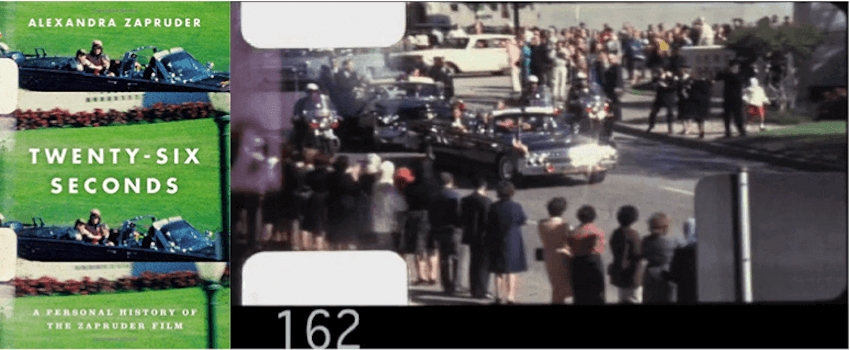
Alexandra Zapruder, Twenty-Six Seconds: A Personal History of the Zapruder Film (Part 1)

With a new book, Twenty-Six Seconds: A Personal History of the Zapruder Film, author Alexandra Zapruder offers her unique perspective to discuss issues surrounding and contained within the brief filmstrip which is the best visual record of the John Kennedy assassination. As the granddaughter of Abraham Zapruder, the man responsible for the film, the author can balance historic and technical details with a personal family story. Her status also allows for privileged access to archives and persons associated with the film, and reveals some new – albeit not earth-shattering – information. However, the book is imbued with a certain partisanship, not limited to family interests, which dulls the author’s critical thinking in some key areas. The shortcomings will seem acute to those in the critical research community, less so to those who come to the book as the personal memoir of unassuming folks who become accidentally fused with an historic event.
A self-described “conventional thinker”, Zapruder is comfortable and reasonably adept dealing with conventional narrative themes in her extraordinary tale – public and personal tragedy combine; family legacy and memory; legal and ethical questions encountered and choices made – but her annoyance with the spoiler element in this story is perceptible each time she types “conspiracy theorist”, which she does a lot.1 Current respectable mainstream opinion, it appears, continues to resist the critical literature developed since the JFK Records Act. Such denial was exemplified by Joyce Carol Oates in a review of Twenty-Six Seconds at the Washington Post, in which she categorized criticism of the Warren Commission as a “farce” which undermined “trust in the U.S. government and in authority in general that continues to this day.”2
The Zapruder Film and LIFE Magazine
Print rights for the film were purchased for LIFE Magazine by the Time Inc. media conglomerate Saturday morning November 23, less than twenty-four hours after the event. Rights for the film as a motion sequence were purchased the following day, although these latter rights would never be utilized. In total, LIFE paid $150,000 for the film. The author is somewhat defensive about this transaction, although it could be reasonably contended that after the authorities decided not to seize the film, Abraham Zapruder was simply a good businessman who negotiated a price the interested party was willing to pay. He also expressed to his family a sensitivity over the graphic presentation and felt that LIFE could be trusted to restrain any urge to exploit the images.
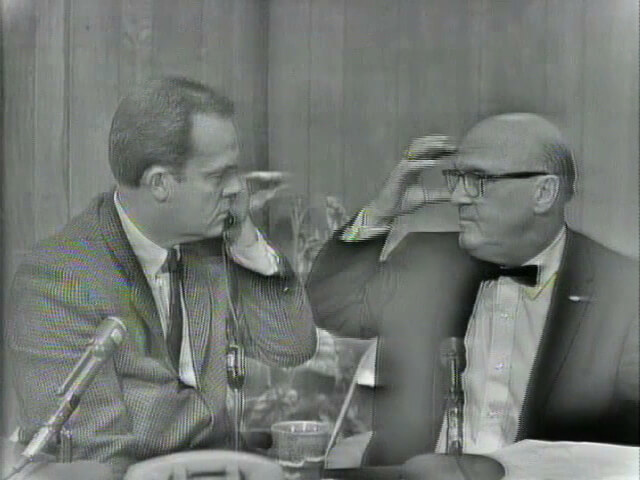
Zapruder appeared on WFAA-TV
a few hours after the shootingIn the LIFE archives, the author would years later find evidence of internal debates over how to handle the more graphic frames. Leading up to the special JFK memorial issue of LIFE, published two weeks after his death, art director Bernard Quint cautioned that “momentary opportunism displayed in the use of these details in colour will be to our everlasting discredit”, and promised to publicly resign if they were printed. Zapruder recites LIFE’s own understanding of this memorial issue: a responsible public service, sold at lower cover cost, with any profit donated to the Kennedy Library. Previously, Abe Zapruder had donated a portion of his proceeds to the family of slain police officer J.D. Tippitt. Many sides to these complexities find reflection, as author Zapruder has skills in retelling personal experiences and thought processes, and in clear description of various facets of controversies with the film. Just not all the facets.
LIFE’s JFK Memorial issue, and also the December 6 regular edition, featured a one-page article attributed to associate editor Paul Mandel titled “End To Nagging Rumors: The Six Critical Seconds”. Acknowledging there were growing rumors and doubts pertaining to the official explanation of the assassination as the work of a single lone-nut shooter, the article purported to “answer some of the hard questions” and reassure the American people that Oswald was the guilty man based on the available evidence, including the Zapruder film. Briefly discussing Mandel’s article, author Zapruder concedes that “some of his facts are mistaken” but leaves it at that without further clarifying that one of these mistaken facts is directly related to a gross misreading of the film.
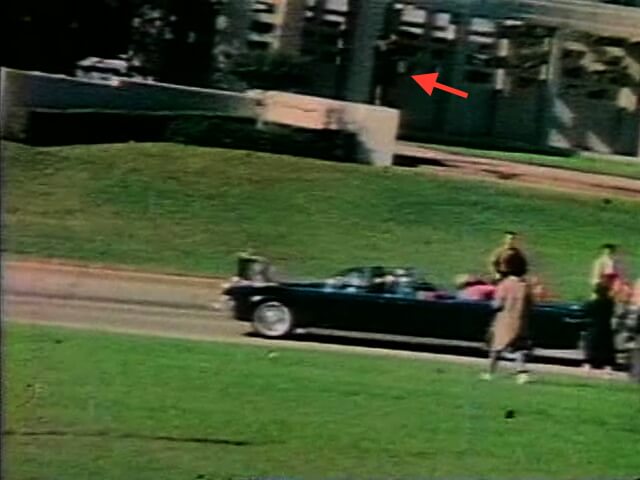
Abraham Zapruder can be seen filming
in this frame from the Nix filmOne of the featured “nagging rumors” concerned how the President could have a wound of entry in his throat, as reported to the public by Dallas Parkland Hospital doctors, when the alleged shooter was positioned directly behind during the shooting sequence. Mandel, referencing his employer’s exclusive possession, writes: “the 8mm film shows the President turning his body far around to the right as he waves to someone in the crowd. His throat is exposed – towards the sniper’s nest – just before he clutches it.” In fact, at no time during the entire filmed sequence was Kennedy ever facing back towards the alleged sniper’s nest. So how could Mandel have been so wrong? He possibly had not seen the film himself and repeated a description from another source, or there had been a conscious editorial decision to assist the government in shutting down rumors which challenged the lone-nut verdict regardless of the veracity of the published information.3 The full measure of this incident – a wholly incorrect description of what is seen in the film used to help deflect concerned inquiry as to what may have happened to JFK (and American democracy) – does not support confidence in LIFE’s responsible handling of the Zapruder film.
What could explain this? Shortly after news of the assassination broke, LIFE’s Los Angeles bureau chief Richard Stolley was assigned to Dallas where, shortly after establishing a base of operations, he received word that the assassination had been captured on 8mm film. Stolley’s persistence enabled access to Abe Zapruder that evening, and by Saturday morning a contract had been signed for the print rights to images from the film. This contract specifically excluded rights to the film as a motion sequence, although a one-week window was stipulated before Zapruder could shop those rights to others. The following day, word came from corporate headquarters, specifically from LIFE publisher C.D. Jackson, to proceed in purchasing these motion rights, which was done for an additional $100,000. That huge sum, doubling the print rights, was paid for rights not apparently as useful to Time-Life, which specialized in print-based media. In fact, Time-Life never exploited the film as a motion sequence during the whole time the film was in its possession. Nevertheless, as an internal LIFE memo cited by Zapruder states: “C.D. Jackson bought the copyright to Zapruder’s film to keep it from being shown in motion.” 4
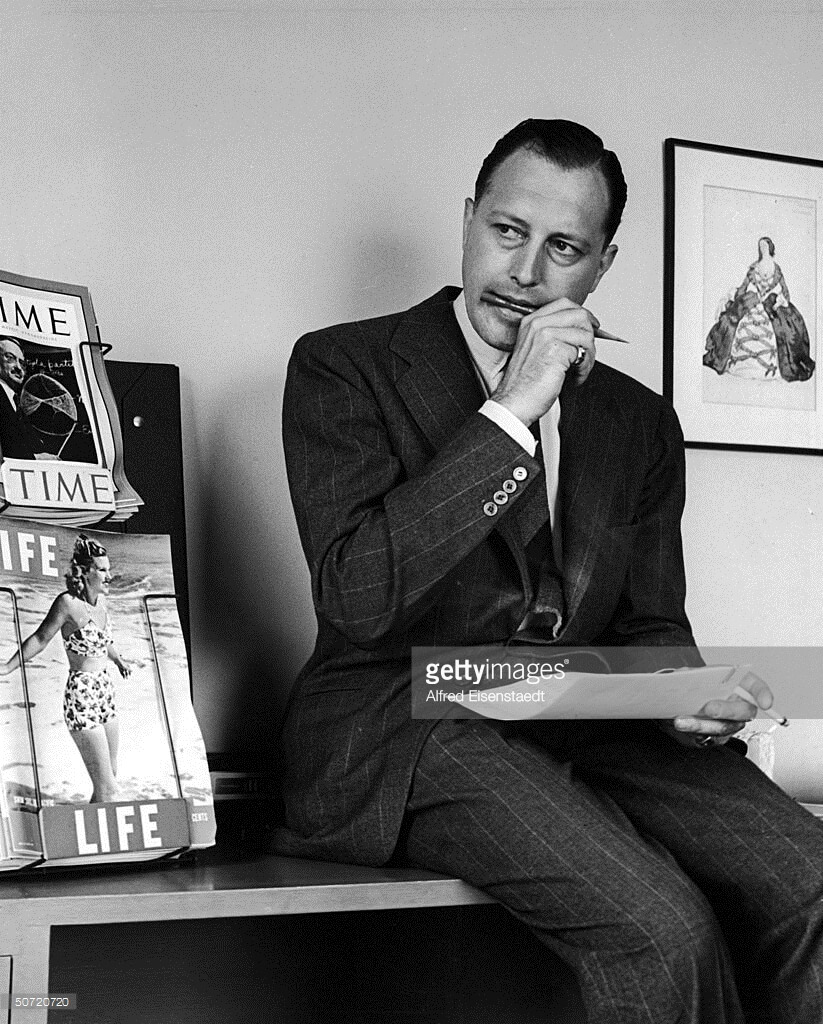
C. D. Jackson In 1977, Rolling Stone published a landmark story by renowned journalist Carl Bernstein titled “The CIA and the Media.” Using information uncovered by the Church Committee and interviews with CIA officials, Bernstein revealed to the general public a longstanding and friendly relationship whereby journalists and management from America’s established mainstream media secretly “carried out assignments for the Central Intelligence Agency.” Time Inc., parent company of LIFE, was named, along with CBS and the New York Times, as the “most valuable” organizations to the CIA. Henry Luce, the founder of Time and LIFE, was a longtime close friend to CIA Director Allen Dulles. Bernstein adds: “For many years, Luce’s personal emissary to the CIA was C.D. Jackson, a Time Inc., vice‐president who was publisher of Life magazine from 1960 until his death in 1964. While a Time executive, Jackson coauthored a CIA‐sponsored study recommending the reorganization of the American intelligence services in the early 1950s.”5
A Princeton graduate, C.D. Jackson began working for Time Magazine in 1931, he would soon be described as founder Henry Luce’s right hand man. In 1940 Jackson organized an “anti- isolationist propaganda group” called the Council For Democracy, funded by Luce and designed to counter America First movements and promote intervention in Europe; the members included Allen Dulles, Joseph Alsop, and Dean Acheson.6 Jackson served in the OSS in 1943 with Frank Wisner, later organizer of the CIA’s Operation Mockingbird.7 In 1944, Jackson was appointed Deputy Chief of the Psychological Warfare Division at Allied Supreme Headquarters. After the war he became Manager-Director at Time-Life International, while a long association with the CIA began in 1948. Jackson served the executive branch during the Eisenhower administration, advising on psychological warfare tactics. Peter Dale Scott noted that Jackson guided LIFE’s involvement in other aspects of the Kennedy assassination: “In an arrangement covered up by Warren Commission testimony, Jackson and Life arranged, at the urging of Dulles, to have Marina’s story ghost-written for Life by Isaac Don Levine, a veteran CIA publicist.”8 Author Zapruder does not bring up Jackson’s fascinating background, and claims he was motivated to purchase the motion rights after he “was personally upset by the film” and felt “the public should not see the images” because of their graphic content.9
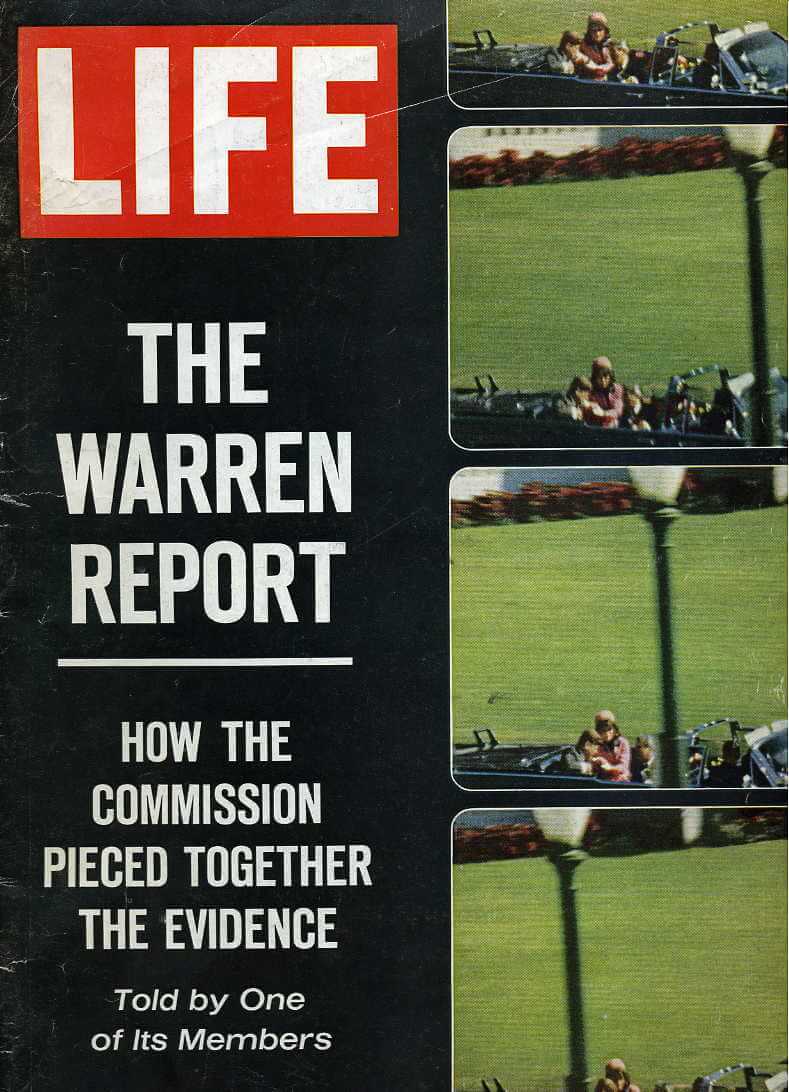 LIFE Magazine would also publish an Oswald backyard photo on its cover in February 1964, after an unauthorized leak from a contact within the Dallas Police Department, exposing millions at supermarkets and newsstands to a rather prejudicial image. This was accompanied by a long biographical article, which portrayed alleged assassin Oswald as a sociopathic loser, the position later adopted by the Warren Commission. In concert with the release of the Warren Report, LIFE’s October 2, 1964 issue featured Zapruder frames on its cover and an approving review of the Report, including an article penned by Warren Commission member Gerald Ford. Author Zapruder refers to the issue as an “examination” of the Warren Report, although the Report itself had not yet been released as the issue went to the printers.10 The issue in fact went to the printers several times, as captions below reproduced Zapruder frames were revised. In retrospect, LIFE’s coverage of the assassination, in the year immediately following, featured dodgy reporting and an eagerness to support the emerging official story, an eagerness which went beyond that of a supposedly objective “trusted” news source.
By 1966, the critics – who had actually read the Warren Report – earned a great deal of public attention publicizing many serious flaws in the assembled evidence. LIFE, as with other mainstream outlets such as CBS, decided to keep pace with public opinion and called editorially for a re-examination of the evidence. They then assembled a team to do just that for LIFE itself.11 An assistant philosophy professor named Josiah Thompson, who had developed a serious interest in the assassination, was hired as a consultant. Thompson, who had seen a second generation copy of the Zapruder film at the National Archives, now had access to the original film (“… the colors were there, the clarity was there. It was really something, really, really something”). Author Zapruder does a good job describing how competing interests suddenly came to coalesce around the film: Warren Commission critic Thompson and CBS News, which wished to broadcast the film as part of a news special, advocated public release – while LIFE’s editors resisted, insisting that their ownership of the film rights gave them the final word.
Thompson surreptitiously made his own copy of the film from LIFE’s own frame-by-frame transparencies. In 1967 he published Six Seconds In Dallas, a powerful critique of the Warren Commission’s methodologies. When LIFE refused to allow him to use frame reproductions from the Zapruder film for the book, Thompson had drawings made depicting selected frames and published those.12 LIFE sued over breach of copyright. In discussing this, author Zapruder sides with LIFE, describing Thompson’s unauthorized use of the film images as copyright infringement. Working from internal documentation, and accepting at face value the good faith of the LIFE management as they wrestled with what to do, she lays out the legal and moral supporting arguments for LIFE’s position, and asks: “so what made this circumstance different?”13
As Thompson’s case headed to court, Walter Cronkite at CBS publicly scolded LIFE for holding the film back from the public.14 Thompson and his publisher would eventually beat back the LIFE lawsuit when the judge ruled that their presentation of portions of the film fit the doctrine of “fair use”. That the Zapruder film was important and salient to the controversies surrounding the assassination was now understood by growing numbers of an increasingly skeptical public (or “small army of committed conspiracy theorists” as author Zapruder puts it). It was also becoming understood that the film contained “confusing visual information” (also Zapruder’s term) as the President is hit by the fatal shot.
Garrison Subpoenas the Zapruder Film for the Shaw Trial
The “confusing visual information” led to New Orleans prosecutor Jim Garrison’s subpoena of the film, so it could be screened as part of the trial of Clay Shaw. As later described in the movie JFK, the “back and to the left” movement of the President’s body immediately after receiving a shot at Zapruder frame 312, was thought by Garrison to be compelling proof of a conspiracy. Author Zapruder is skeptical. She offers a then contemporary analysis by physicist Luis Alvarez, known as the “jet effect”, as an “an important example of how scientific analysis, and not political bluster, could be applied to the question” of the assassination.
Discussing the Clay Shaw trial, Zapruder does her readers a great disservice by relying heavily on an obviously biased and subjective source, namely the 1970 book American Grotesque by James Kirkwood.15 Certainly, a fair-minded author would have noted the overt one-sided character of the book and at least seek out a second source for balance. Zapruder apparently did not. In fact, she allows Kirkwood’s at times harsh and demeaning descriptions to color her discussion of this event. Therefore, using Kirkwood’s take of the courtroom during the screening of the Zapruder film – “the anxious, ill-tempered and, if not bloodthirsty, most definitely morbid craning mob of voyeurs who were glued to the screen” – serves to deflect attention from the actual effect of the screening itself, and the centrality of the film to the prosecution’s analysis of the Dealey Plaza event. If unable to fit Shaw into the plot, the jurors were, in fact, convinced by the presentation that there was indeed some form of conspiracy involved in Dallas. The acknowledgment of this is muted, because the focus is instead drawn to Kirkwood’s descriptions of the courtroom viewing as representing a bloodthirsty mob: “a hungry look of salivating eagerness seemed to draw their faces to a point…”16
The genie, however, was out of the bottle, as the Zapruder film became bootlegged from a variety of sources, and public screenings were arranged at college campuses and other venues.
The Zapruder Film Goes Public

1975 – Robert Groden & Dick Gregory screen
a bootlegged copy of the Zapruder film
on national televisionAuthor Zapruder dismisses “the familiar tropes of conspiracy arguments that came from viewing the film”, without really addressing such tropes. Instead, she laments the trampling of LIFE’s property rights and engages in metaphysical reflection on possible neurological deficiencies to explain the “conspiracists.” In fact, the effect of the film on audiences in the 1970s can be seen for oneself. For the public reaction to the first televised showing is readily available in a clip from the 1975 ABC program Good Night America. On that March 6th program, Geraldo Rivera hosted Robert Groden and Dick Gregory. They then presented the film to a studio and national television audience. The gasp of the audience as the President is hit in the head is audible, a response partly to the gruesome imagery, but also to the unmistakable impression the man had been shot from the front, even as established wisdom placed the assassin directly behind. Warren Commission staff lawyer David Belin conceded during the Rockefeller Commission – one of several official inquiries of the era into the assassinations of the 1960s and the activity of intelligence agencies – that “a major portion of the public controversy concerns the Zapruder film.”17 Author Zapruder complains that the bootleg screenings in the 1970s lacked a presence “to offer a dissenting interpretation of what the film showed.” She again refers to Alvarez and his “jet effect” theory as a plausible and scientific interpretation. She is apparently unaware that Alvarez’ methods (always controversial) explaining and reproducing this effect have recently come under a rather damaging analysis.18
Much of the remainder of Twenty-Six Seconds follows the relinquishing of the original Zapruder film from Time Inc. back to the Zapruder family, its storage at the National Archives, and the legal wrangling over the film in the 1990s leading to a large payment to the family. Author Zapruder handles this aspect of the story solidly, again moving fluidly from the documentary record to personal experience as her father assumes responsibility for the family’s interests (Abraham Zapruder passed away in 1970). If not for the historic controversy which is embedded directly within the frames of this film, Alexandra Zapruder would be responsible for a decent non-fiction account of ordinary people accidentally conjoined with sudden historic events, which is certainly the story she wants to tell here. So what seems to have happened here is understandable, as the controversy is complex and multi-faceted but the author has presumably neither the time or patience to delve deeply into it, and her conventional thinking has her leery of those she identifies as “conspiracists.” The author acknowledges that she received guidance in the issues of controversy from certain advisors.
A key advisor on the subject of the assassination controversies for this book appears to be author Max Holland, a longtime reliable defender of the Warren Commission, who has been writing on the topic for major newspapers and publications such as The Nation since the 1990s, as well as appearing in mainstream cable documentaries. Holland has written five books on national security topics and has been awarded numerous Fellowships, including a Studies In Intelligence Award from the CIA in 2001.19 Holland is best known recently for his fairly well publicized contention that the first shot in the JFK assassination sequence occurred much sooner than previously believed, and at a time not captured in the Zapruder film (author Zapruder finds this theory “compelling” and backed by “extensive additional evidence.”) Zapruder says the two met in 2015, late in the writing process for Twenty-Six Seconds, and in the book’s acknowledgements Holland is praised as “one of the most thorough, careful, and thoughtful thinkers I’ve ever met … He clarified my thinking on many important issues, gently challenging me on my assumptions …” (For a differing view of Holland, see “The Lost Bullet: Max Holland Gets Lost In Space“.)
In December 2016, Zapruder provided an opinion piece to the New York Times titled “There Are No Child Sex Slaves At My Local Pizza Parlor”, which dissected a brief hysteria surrounding an armed man who thought to disrupt a purported kiddie ring fronted by a Washington D.C. area pizzeria. Although her points are well-taken as far as they go with the immediate story, she claims additional authority to speak of the phenomenon from encounters with “conspiracy theorists” who directed certain speculations at her grandfather.20 Fair enough, but Zapruder then analyzes: “If one outcome of Kennedy’s assassination was a loss of trust in government and the news media, we have now entered an era in which such suspicions have mushroomed into something far more dangerous — a rupture in the very idea of shared truth.” Which sounds alarming, and is alarming in the sense that a shared consensus reality is vital to bind our material lives within a peaceful society, but do the actions of one confused young man really portend the fracturing of reality?21 What is she talking about? In part she is talking about the Kennedy assassination and its aftermath, but in doing so Zapruder is unable to acknowledge that the loss of trust accorded the government and news media has been well earned. And that the mainstream “shared truth” of the Kennedy assassination is factually incorrect, despite what her advisors may have told her.
It may well be that the ultimate readership for Twenty-Six Seconds has little interest in formulating an opinion on the JFK assassination controversy, and would have a mild curiosity at best regarding the state of the case. Still, since the book’s accumulation of questionable activity falls heavily on the side of the “conspiracy theorists”, while investigating authorities and representatives of the mainstream media are frequently portrayed as responsible and even-handed, a rather misleading notion is presented of what the Kennedy assassination has revealed about the “trusted” stewards of the nation. It also trips up an author’s attempts at finding a poetic, or metaphoric, truth in her grandfather’s film. Utilizing Holland’s 2014 Newsweek article “The Truth Behind JFK’s Assassination”, Zapruder repeats his contention that the “film displaced Oswald’s view from the sixth-floor window”, that its necessarily partial visual record now “had to stand in for seeing the assassination through Oswald’s eyes and hearing it described in his words.” Though one might be tempted to reach for a cappuccino and ponder varieties of historical irony, what is being advanced is a purely sophist construction, as the overwhelming weight of the evidence shows that Oswald was not on the sixth floor of the TSBD at the time of the shooting and did not fire a rifle that day.22 That the author does not seem to know this will harm the book’s reputation in the future, although its more valid, and better presented, insights will likely retain some interest.
NOTES
1 Critics of the official Warren Commission findings are, as a rule in this volume, referred to as “conspiracy theorists”. Late in the proceedings, reference is briefly made to “assassination researchers”.
2 Joyce Carol Oates, “Twenty-Six Seconds of the Kennedy Assassination – and a Lifetime of Family Anguish.” Washington Post, November 17, 2016.
3 Other information in the article, such as determining the film ran at 18fps or determining frame counts between presumed shots, likely was not generated by LIFE and came to it from government sources, as discussed in Part Two of this review. Although author Zapruder is fuzzy about it, the official FBI findings were still a week away from publication as the memorial issue and Dec 6 edition were put to press, suggesting an official source contributed to handling the “nagging rumors”, as an official source assisted LIFE’s later Warren Report coverage.
4 The memo is quoted on page 194 of Twenty-Six Seconds.
5 Carl Bernstein, “The CIA and the Media.” Rolling Stone Magazine, October 20, 1977. The article is also available on Bernstein’s website. Bernstein writes: “the Agency has cut back sharply on the use of reporters since 1973 primarily as a result of pressure from the media.” As the main source of information for the article was interviews with unnamed CIA officials, the cooperation may have served as a limited hang-out after Bernstein had uncovered the story from Church Committee sources. Certainly these CIA officials go out of their way at times to identify media outlets and journalists as CIA friendly despite firm denials from the outed parties. However, the historic information – including Luce and C.D. Jackson – has never been refuted, and since publication largely confirmed through document releases.
6 In other words, Jackson was involved within an internationalist (“globalist”) Eastern Establishment milieu which lobbied for US participation in a European war, and then helped staff the OSS, create the CIA and construct the foundations of the Cold War National Security State. In the Eisenhower years, this milieu developed a foreign policy which relied on covert manipulation and regime change around the globe. John Kennedy’s nascent challenge to this world view has been focus of much recent scholarship. C.D. Jackson died in 1964.
7 Operation Mockingbird was the CIA’s program to influence the American media, and was disclosed in the 1977 Bernstein article.
8 The Marina Oswald story was not ultimately published, but she was well-paid for the rights. Peter Dale Scott, Deep Politics, p 53. See also Warren Hinckle and William Turner, Deadly Secrets: The CIA-Mafia War Against Castro and the Assassination of JFK (1981).
9 Twenty-Six Seconds, p. 97.
10 LIFE joined the New York Times and CBS News in providing instantaneous reviews, or “examinations”, of the Warren Report, all three trusted news sources referring to it appreciatively as a thorough and complete explanation of the President’s assassination, even though there had not yet been the opportunity to actually read it.
11 Both LIFE and CBS soon afterwards abandoned critical inquiry and dissolved their investigating teams. CBS would continue to create television documentaries supporting the Warren Commission, such as the 1967 multi-episode CBS News Inquiry: The Warren Report. (For an analysis of the genesis of the 1967 special, see now James DiEugenio, “Why CBS Covered Up the JFK Assassination“.)
12 Due care was taken to ensure the accuracy of the drawings, unlike certain exhibits created for the Warren Commission.
13 What made it different is the overwhelming sense that justice had not been served in the aftermath of the assassination, that it was still an open case, and that an apparent establishment cover-up of the true reasons for Kennedy’s death presented serious challenges to the American democratic system and the understanding of contemporary events. However, if one believes, as author Zapruder appears to, that the Warren Commission essentially got it right and “conspiracy theorists” have been not just historically wrong but prone to psychological malady which influences their fuzzy thinking, then accepting LIFE’s decision to effectively sequester the film becomes a lot simpler.
14 “LIFE’s decision means you cannot see the Zapruder film in its proper form, as motion picture film. We believe that the Zapruder film is an invaluable asset, not of Time Inc., but of the people of the United States.” CBS News Inquiry: The Warren Report, 1967. The program supported the basic conclusions of the Warren Commission. It is possible that CBS sought to acquire the film so that it could be “explained” to the public in a manner favorable to the official conclusions, while maintaining a plausible facade of the fearless Fourth Estate.
15 American Grotesque is notable as the source for the oft-repeated claim that Garrison’s primary motivation for prosecuting Clay Shaw was rampant homophobia.The premise for the book had been first suggested by defendant Shaw himself ahead of the trial, pitching the concept to others before Kirkwood agreed to take it on. Kirkwood and Shaw had been friends for two years ahead of this. During the trial Kirkwood was close to the extremely compromised reporters James Phelan and Hugh Aynesworth, both engaged in sabotaging the trial to the extent possible.
16 Zapruder lists the Kirkwood book, courtroom transcripts, and contemporaneous newspaper accounts as her source material for the Shaw trial, her discussion of which concludes: “The Garrison trial went down in history as a gross abuse of power … Garrison’s actions deeply discredited the conspiracy movement and drove it back underground for many years.” This opinion, not gleaned from the transcripts or newspaper accounts or Kirkwood’s book, and obviously not Zapruder’s own, is likely that of an advisor discussed below, and is challenged by more recent work from Joan Mellen and Jim DiEugenio.
17 Memorandum, David Belin to James B. Weidner. April 21, 1975.
18 Alvarez claimed, in the American Journal of Physics, September 1976, that his shooting mock-up in 1969 “showed retrograde recoil in the first test … If we had used the ’Edison Test,’ and shot at a large collection of objects, and finally found one which gave retrograde recoil, then our firing experiments could reasonably be criticized.” But Josiah Thompson, who is also a figure in Zapruder’s book, gained access to Alvarez’ experimental resources and discovered that, contrary to Alvarez’ statement, a large collection of objects were fired upon until one was found which gave retrograde recoil. Thompson’s access to the materials was provided by Paul Hoch, who is listed as an advisor for this book specifically on the jet effect. Thompson presented this new information on Alvarez and his jet effect experiments at the Passing The Torch Conference in Pittsburgh, October 2013.
19 Holland reviewed Peter Dale Scott’s Deep Politics in 1994, writing of the controversy: “The field already brims with books that conjure up fantastic conspiracies through innuendo, presumption, and pseudo-scholarship while ignoring provable but inconvenient facts …Yet there remains something truly remarkable and disturbing about Deep Politics, and it’s not that a tenured English professor wrote its opaque prose. Rather it’s that Deep Politics is a University of California Press book … this means an editorial committee consisting of 20 UC professors, including four senior historians, approved Deep Politics for publication. This peer approval by a major university press illustrates the boundless and utter disbelief in the Warren Report … and it also reveals the gross inattention given to the subject by serious historians.” One man’s “serious historian” is of course another’s “pseudo-scholar”, and Holland demonstrates through this review/article that there are few elements of the official story to which he does not subscribe, despite the obvious challenges to credulity the Warren Report invokes. Lamenting a lack of “serious historians” on this subject while casually accepting that Oswald attempted to assassinate General Walker or that Oswald’s FPCC activity in New Orleans should be taken at face value, necessarily leads to a position which praises generally poor books by Patricia Lambert or Jean Davison or Gerald Posner while positioning Scott as suffering from a “fevered imagination.” That is, Marina Oswald’s wild and ever-changing stories from 1964 regarding her husband’s alleged stalking of Walker, which is just about the only evidence that such a thing ever happened, is legitimate fact, while Scott’s carefully annotated scholarship is not. Apparently, developing pseudo-psychoanalytic theories regarding Oswald’s state of mind is a hallmark of “serious history”, while recognizing the official record can’t even place Oswald in the so-called sniper’s nest is the domain of fantasizing conspiracists.
20 Abraham Zapruder’s name has, over the years, suffered speculation of sinister relationships or agency in the assassination. As well, the Zapruder film has suffered numerous incorrect interpretations, often from viewing poor multi-generational copies. The most well-known incorrect assumption is that Secret Service driver Greer turned and shot JFK with a pistol. The fallacy of this interpretation should not disguise that Greer slowed the limousine to a crawl and turned twice to view the chaos in the seats behind him, including a direct view of the fatal shot before turning back and accelerating.
21 After all, it wasn’t so long ago a cudgel of fake facts, many promoted by the New York Times, was used to bludgeon the body politic into supporting a US Air Force-led “shock and awe” campaign in Iraq, followed by an invasion and brutally careless occupation, ending or ruining the lives of several million people, and destabilizing an entire region. For that matter, even a cursory reading of Establishment reporting on the Kennedy assassination reveals an array of poor and misleading information. Or, consider C.D. Jackson’s work in psychological warfare during the Eisenhower administration, which would include portraying a vicious right wing coup against Guatemala’s democratic government as a populist uprising.
22 We know this because at the exact time Oswald was said to have dashed down the Texas School Book Depository’s rear wooden staircase moments after the shooting, two witnesses were descending the same staircase and they saw and heard nothing at all. The bad faith by which the Warren Commission discredited the witnesses and created a wholly different timeline has been described by author Barry Ernest in his book The Girl On The Stairs. While researching this topic, Ernest discovered a Commission memo from June 1964 which confirmed the timing as stated by the witnesses, and which was subsequently buried as the Warren Commission proceeded to publish their false account. Not a single piece of hard evidence places Oswald on the sixth floor with a gun in his hand, as Dallas Police Chief Curry conceded in his own book written in 1969. Paraffin tests of Oswald’s cheek conducted by the Dallas Police on the night of the assassination did not show traces of nitrate as should be expected, and therefore show with a high degree of certainty that he did not fire a rifle.
-

11/22/63: Stephen King and J. J. Abrams Lay an Egg

I actually talked to Stephen King on the phone once from his home in Maine. This was when Stanley Kubrick was making a movie out of his book, The Shining. I was trying to put together a feature magazine article on that picture. But I could not secure an interview with Jack Nicholson until it was too late for the magazine’s publication date. I decided not to go through with the project. When I actually saw the film, I was not terribly agonized over my failed attempt. From what I have read, King did not like the movie either. So much so that he made his own TV version of that book.
King is now part of the production team that has made another TV movie from a more recent book of his. Except it’s actually a mini-series. Quite a long one. It plays over eight installments. And since the first installment is two hours long, it clocks in at nine hours. From what I have been able to garner, producer-director J. J. Abrams was the man in Hollywood who decided to take King’s book under his wing. But, as is the usual case with the big names in Movieland, Abrams then turned over the project to what is called a line producer, or developer. In this case her name was Bridget Carpenter. Carpenter has written over ten plays, and worked on several TV series, most notably, Parenthood and Friday Night Lights.
At almost 900 pages, King’s book was quite long. Apparently, once you attain King’s stature in the publishing business, no one dares edit your work. It was that original length which necessitated the nine-hour mini-series format. Because of that length, this series was clearly a team effort. It had five directors and four writers working on it. Carpenter, by far, wrote the most installments. She either wrote or co-wrote five of them. No director helmed more than two installments.
In virtually every other instance of my (long) reviewing career, I have always read the source material for any adaptation. Offhand, I really can think of perhaps only one or two exception to that practice. But, for two reasons, I just could not bring myself to read King’s book. First, I don’t care for novels about the Kennedy assassination. Because the original inquiry, the Warren Report, already fictionalized what really happened in Dallas on November 22, 1963. Secondly, why would any intelligent, interested person read a book that, in its central tenets, was more or less a restatement of that original fiction? Which King’s book is. In other words, why pile one fiction on top of another? Especially concerning such a crucial event in American history. So in this one case, I declined to read the book on which this mini-series is based. I hope the reader understands that decision.
After more than one preview, King’s novel was published in November of 2011. In what I have been able to dig up about its genesis, one of his main influences in the writing and research for the book was the Dallas museum about the JFK case, The Sixth Floor. He specifically consulted with the late Gary Mack, who passed away in 2015. We all know that, for about the last 20 years of his life, under the influence of Dave Perry, Gary Mack had done a backflip on the case. He migrated over to the Warren Commission camp. (Click here for info on Perry). Whether King entered the creation of his book with an open mind on the JFK case, and was then influenced by Gary Mack, or whether he was in the Krazy Kid Oswald camp all along, that is an issue I have not been able to definitively discern.
II
King decided to make his book a science fiction thriller. The gimmick behind it all is a good old sci-fi staple: time travel. Jake Epping (played by James Franco) is a high school English teacher who also teaches adult education GED preparatory classes. At the beginning of the series two things happen, back to back, which set the plot in motion.
In the opening scene, in his GED class, Jake is listening to his adult students orally present papers about the most important day in their lives. The first person we see is an elderly student named Harry Dunning. He is standing in front of the class presenting his (rather shocking) paper. Harry is telling the story of the night his father Frank came home drunk and killed his mother, sister and brother with a long-handled hammer. (Which, I think Mr. King, is plenty life-changing.) Jake is very impressed with this presentation and gives Harry an A+.
Right after this we see Jake in a diner. The owner Al Templeton (played by Chris Cooper), emerges from the back coughing and wheezing; he then collapses on the floor. Jake takes him home to recover. The next day, Al tells him to walk into a closet behind the front of the diner. This ends up being the time tunnel portal. Ever so briefly, Jake gets transported back to October of 1960. He then returns. Al tells him he is too old and sick to use the time tunnel for what he wants to utilize it for: To stop the assassination of President Kennedy. Jake replies, you cannot change the past. Al tells Jake to go back again. This time, he gives him a knife and tells him to carve something into a nearby tree. Jake does so, he returns, and they go outside. They see that the initials of JFK are still there.
At this point the film, through Al, sets some terms and conditions of King’s version of the fourth dimension. Whenever one gets sent back in time, he will always arrive in October of 1960. Second, no matter how long one spends back there, upon returning, only two minutes will have elapsed. If one changes something, but then goes back again, everything resets to the way it was before. Finally, the past is obdurate: it resists changes. Some of these changes end up in what King calls tributaries, sort of like alternate universes.

Actor James Franco, Stephen King, and J.J. Abrams For this viewer, these three scenes did not make for an auspicious beginning. First, I had a hard time believing Harry would make a speech like that in front of a class. I was involved in the education system as a student, teacher and adult education instructor for over thirty years. I never heard any student reveal anything that traumatic or horrible. And no teaching colleague ever told me about something comparable occurring in his or her class.
Secondly, although theories of time travel have progressed by leaps and bounds since H. G. Wells’ classic book The Time Machine, King makes no explanation at all about the science aspect of his fiction. At least Wells, working with much less information, tried a bit. In this case, it’s a time portal in a restaurant—and that is it. Then there’s those terms and conditions! They all seemed designed to make it easy for the author to construct his story the way he wished. The protagonist would not age, changes would not be permanent, and the scope of time dealt with was narrow.
So, at the very beginning, with the shocking story told in class, and all these rules –with no real explanation–this viewer understood that the story we were about to see would rely a lot on plottiness. Let us make a distinction: There is a difference between a well-constructed story and plottiness. For instance, the Robert Towne/Roman Polanski film Chinatown has a wonderfully structured story that is so cohesive and subtly carpentered that one is never aware of the engine of the plot turning over. That is, the plot machinations are so dramatically ingrained with the film’s other elements that the audience is not fully aware of being carried along by the current of the story until the end. That is good story structure. And that is why the screenplay of Chinatown is actually taught in screen writing classes at universities.
I don’t think King, Abrams and Carpenter will be paid that educational compliment. Because here, the characters, the plot device, even the dialogue, are at the mercy of a heavy-handed plot. Almost nothing seems natural. It all seems set up: reminiscent of the standardized TV series writing of the fifties and sixties, where high points in the plot were timed for commercial breaks (which actually happens here). For instance, when Harry told his story in front of the class, I immediately said to myself: This is so bizarre, so much of a reach, I think its going to be used as part of the plot. Which it was. And there is another plot strand—to be discussed later– that is almost as violent and bizarre as that one.
III
But the main plot line concerns the assassination of President Kennedy. To get that going, when he returns to the diner, Al tells Jake about his obsession with the JFK case. He then convinces him to go back in time to try and stop the murder. Al says that the bullet that was fired at General Edwin Walker in April of 1963 was the same bullet that was fired at JFK in Dealey Plaza. (Which it was not. See Reclaiming Parkland, by James DiEugenio, pgs. 79-80) Al tells Jake to go back in the portal and see if Lee Harvey Oswald did shoot at Walker in Dallas. If that happened, then Oswald probably killed Kennedy. But if it didn’t, then someone else likely killed him. Al then tells Jake he would do so himself, but he is afflicted with cancer. He then packs a briefcase for Jake, including his JFK collection of newspapers and essays, plus a false identity package. He adds a small notebook with summaries of sporting events for him to bet on if he needs money e.g. boxing matches. And with that, Al is now off on a three-year voyage backward in time. One that will actually take two minutes.
Back in 1960, Jake buys a car. Which leaves him a bit low on funds. So, utilizing the previously planted bookie device, Jake asks the car dealer where the nearest betting parlor is. Jake makes a bet on a championship fight, actually picking the round the knock out will occur. The bookie suspects something fishy and sends a goon to get his money back. But Jake anticipates this, gets the jump on his assailant, and escapes from his rented room. He then drives to Dallas, rents a room at a bed and breakfast, and begins studying the JFK case through Al’s files.
Informed by Al,–who appears in flashback throughout–Jake follows George DeMohrenschildt around. First to a Kennedy speaking engagement, then to a high-class restaurant. At the restaurant, Jake secures a table next to George, who is sitting with two other well-dressed gentlemen. The film uses every cheap trick under the sun to prevent Jake from clearly hearing the discussion: a blender goes off next to him, the table on the other side is quite loud, a waiter spills a tray of drinks. But he does hear George mention Oswald’s name. On his return to his rooming house, the building is on fire. Since his belongings were left in the room he goes inside to try and recover what was left of them.
Jake decides to leave Dallas. He gets lost on the way out of town. He realizes he is close to Kentucky. Which, of course, is where Harry Dunning grew up. Jake decides to visit the town in order to prevent the triple murder. He rents a room and befriends a bartender named Bill Turcotte (George MacKay). Frank Dunning then walks in and he and Jake begin to talk and become acquaintances. After an altercation with Frank at his butcher shop, Jake buys a gun and is casing the Dunning house on Halloween night, which is the night that his student Harry said the killings occurred. He is accosted in the bushes by the bartender Bill. (Why Bill would find Jake suspicious enough to follow him around town for two days is not explained.) The two have a rather unusual conversation: Bill tells Jake that Frank was married to his sister and killed her. Jake tells Bill that he is from the future. Jake pulls a gun on Bill to subdue him, and then runs into the house where Frank is in the process of beating and killing his family. Jake intervenes and kills Frank. He then leaves town. Bill joins him (it’s not clear, but it appears he was hiding in his car). Jake now tells him the story of why he is there. Bill decides to join him on his trip back to Dallas. Bill agrees to help Jake in his mission. Jake informs Bill of his strategy: if Oswald shot at Walker, then he probably shot at JFK. So if he can find out about the former, he can feel justified in killing Oswald.
Jake gets a teaching job in the fictional town of Jodie, Texas. He is hired by Principal Deke Simmons (played by Nick Searcy). To celebrate, Bill and Jake go out to a strip club. At this point came one of the most surprising scenes in the series. Not for what happened; but because of what did not happen. For the club they go to is owned by Jack Ruby. The two have decided on a cover story of being brothers. They introduce themselves to Ruby as such. There is a very brief discussion of John Kennedy. I mean very brief. The entire scene lasts for one minute and twenty seconds. But the shocking part is this: We never see Ruby again! The film-makers may justify this because, as we will see, in King’s version, Ruby does not kill Oswald.
IV
We have come to 1962. Tipped off by Al, Jake is at Love Field when Lee Oswald arrives in town from his overseas stay in the USSR. The first appearance of Oswald (played by Daniel Webber) in the film is notable. First, he seems to be speaking with a mild Russian accent. Second, he asks his mother Marguerite (played by Cherry Jones) why there is no cadre of press awaiting him. This tells us that the film will use the Warren Commission version of Oswald as the basis for their character portrayal. Oswald is a publicity hound who thinks he is a great man going unrecognized. Which is pretty much what Warren Commission lawyer Wesley Liebeler decided upon when he could not think of any other reason why Oswald shot Kennedy. In fact, as we will see, in its attempts at caricaturing Oswald, the series goes even beyond the Warren Report. Which is a bit stunning since there has been a quantum leap since 1964 in our knowledge and understanding of Oswald.
Jake and Bill then find the apartment Lee and Marina are staying at. They rent the downstairs unit and hire a surveillance technician to sell them equipment so they can hear the couple speaking upstairs. They discover a lot of Russian being spoken by the Oswalds. Jake surmounts the translation obstacle by obtaining a Russian-English dictionary from his school. (I’m not kidding, though I wish I were.)
The caricature of Oswald is furthered as we see him attending a rally for rightwing activist General Edwin Walker. Oswald is there with George DeMohrenschildt. Afterward, outside the building, Oswald starts screaming at Walker. He then attempts a violent confrontation with him. Security guards restrain him. But he still tries to physically attack Walker. The scene ends with Oswald throwing a rock at Walker and threatening to kill him. The outdated portrait of Oswald as an unstable sociopath is now cinched.
In the next scene, Oswald has the rifle the Warren Commission alleges he used to kill Kennedy. We watch him assemble and dissemble it. He then goes outside with Marina and DeMohrenschildt. The infamous backyard photograph is now snapped. Except for one rhetorical question by Bill, the script makes no attempt to explain why Oswald’s anger at a neo-fascist like Walker would spill over into the murder of the most liberal president since Franklin Roosevelt.
The attempt on Walker’s life now approaches. Bill and Jake begin to case out the Walker home. But again, the heavy breathing of the screenwriters manipulates the story—this time in two ways. First, Jake’s romance with Sadie Dunhill, the school librarian (played by Sarah Gadon) intervenes. Sadie’s husband chooses the day of the Walker shooting to kidnap his wife who is in the process of divorcing him. So before saving Sadie, Jake calls Bill and tells him he alone has to find out if it was Oswald at Walker’s.
But that convenient piece of carpentry is not enough. While at Walker’s house, Bill watches some people come out of the nearby church. He thinks one is his long lost sister! So he runs over to confront her and, of course, it is not her. (This was really weak, since Bill told Jake that his sister had been killed by Frank Dunning.) But the shot goes off while he is preoccupied. So Bill cannot tell for sure if the sniper who shot at Walker was Oswald. So now the option of just killing Oswald is conveniently gone. And while going through this crisis with his girlfriend, Jake also tells her about his secret mission to stop the JFK assassination.
This takes us to October of 1963. Oswald is applying for his position at the Texas School Book Depository. Which will put him on the Kennedy motorcade route on November 22nd. Ruth Paine, with whom Marina Oswald was staying in October and November of 1963, arranged that job for Oswald. The script cuts out Ruth Paine’s role in this. And Ruth Paine is portrayed—ever so briefly—as the kindly Quaker lady from the Warren Report. When I saw how this was ignored, I then thought back and realized that, in the nine-hour series, there is no portrayal of Oswald in Mexico City, or Oswald in New Orleans that summer. This could have easily been accomplished if the two subplots about the murderous husbands in Kentucky and Dallas had been dropped. After all, those two long segments have little or nothing to do with the JFK case. But New Orleans in the summer of 1963 has a lot to do with the Kennedy case. As does Oswald’s alleged journey to Mexico City in the fall of 1963, right before he returned to Dallas. But evidently King, Abrams and Carpenter didn’t think so.
{aridoc engine=”iframe” width=”560″ height=”315″}https://www.youtube.com/embed/HErDQT35h-M{/aridoc} Although 11/22/63 is a fictional account of the JFK assassination, one of the film’s moreinaccurate, and downright bizarre, scenes is a poorly executed reenactment of the assassination itself as seen above.
V
There was something else just as odd in the script. Even though it is October of 1963, George DeMohrenschildt is still on the scene in Dallas. This is really kind of inexplicable. I know King wrote a novel. But it is based upon history. George left Dallas in April of 1963 for Haiti. So the events depicted here with DeMohrenschildt simply could not have happened—they are an impossibility.
In what to me was a rather wild twist—wild even for this plot—Bill falls in love with Marina Oswald. Which causes a lot of friction between Bill and Jake. In fact, they come to blows, and Bill pulls a gun on Jake. Jake then plots to get rid of Bill. He tells Bill that Marina is in Parkland Hospital delivering her child. This is a pretext to have Bill committed to the mental ward since Jake thinks he is a liability to his mission. How Jake could arrange this is glossed over. Because the two are not blood relatives, and just a modicum of standard questions by the administrators—like asking for ID– would have brought that out. But the story is now headed for its climax and the trifecta of King/Abrams/Carpenter wanted to add a dash of romance to the ending. So they dumped Bill. Jake will now team up with Sadie on his mission to stop Oswald.
But again, there is still more to the story. Jake makes another sure bet with a bookie. Again, with uncommon accuracy about how long a prizefight will last. But this time the bookie and his goons track him down and give him a serious beating. So much so that he sustains a concussion and loses his memory. The film now shows us Sadie wheeling him around in a wheelchair. And in standard movie cliché, Jake asks himself things like, “Who is LBJ?” and “When is my birthday?” Therefore, this twist allows him to lose track of Oswald as Oswald goes to the FBI office to leave a note for FBI agent Jim Hosty (who figures in the story for two brief windows.)
Finally, after about a half hour of this, there are headlines in the papers of Kennedy’s upcoming visit to Dallas. The film now shows us Jake and Sadie talking about the newspaper notice. After a pep talk by Sadie, Jake then flushes his memory pills down the sink. We then cut to Oswald sitting on a park bench looking at the JFK newspaper notice. He then discards the paper and starts whistling the tune “Soldier Boy.” (Subtlety is not one of this script’s strengths.)
Now that he is recovered from memory loss, Jake and Sadie first go to Oswald’s apartment, and Jake is going to kill him with a knife. But Oswald comes out of the back room with his newborn child in his arms. They then go to Ruth Paine’s to try and find the rifle that was allegedly used in the assassination. But it is not there.
Jake and Sadie now end up in Dealey Plaza in the very wee hours of the morning of the 22nd. Then the script adds in, actually caps, a Twilight Zone motif that has been used throughout. A man who King calls the “yellow card man” (he has such a card in his hat) now appears in Jake’s car, replacing Sadie. This figure has been seen several times throughout the film. He usually says, “You’re not supposed to be here.” This time, he tells a story about having to watch his baby daughter die, drowning in a stream. This fantastic touch was to me, both pretentious and bombastic: An attempt to add depth and meaning to a script that has neither.
The script now gets even wilder. We see Oswald—with his long package–walking right next to Wesley Frazier as they cross the street and enter the Texas School Book Depository. Oswald then goes right up to the sixth floor! He is, of course, whistling “Soldier Boy.” He then walks to the window, starts setting up the boxes for the so-called “sniper’s nest. And then, incredibly, he just sits there, waiting for the motorcade to pass. This is as impossible as having George DeMohrenschildt in Dallas in October. I mean do the writers really expect the audience to be so stupid as to think Oswald would sit at a window with a rifle for three and a half hours waiting to kill Kennedy? With witnesses both inside and outside to see him? This is just plain silliness.
We now see Jake and Sadie on a high-speed chase to get near Dealey Plaza. (Even though they were supposed to be there already. But like I said, anything goes with this script.) When they do get near, guess who they see? Jake sees Frank Dunning, and Sadie sees her ex-husband. Both of whom have been killed by Jake. What this means is anyone’s guess. And at this point, who cares?
When they get to the Depository building, it’s locked. (Which is another reversal of reality, as it was not.) So Jake breaks in at gunpoint and the couple flies up the stairs. As they do, Oswald is muttering, “They will know your name.” After they get to the sixth floor, Oswald fires one shot. Jake starts screaming “Lee, stop!” Oswald now turns and fires on the couple. As he does, the door they came in through somehow slides back shut, so they are caught inside. Oswald then says, “I came here to do something important!” A combination physical fight and shoot out follow. Lee kills Sadie and Jake kills Lee. Of course, the police do not arrive until after Sadie dies.
The best I can say for this ending is that, thankfully, the film was finally over. As the reader can see, the story does not respect itself.
The rest of the Dealey Plaza story is just as dumb. Jake is accused of trying to kill Kennedy. He is booked and fingerprinted. Captain Will Fritz and FBI agent Jim Hosty question him. Fritz accuses Jake of actually being Oswald’s alias, Alek Hidell. Fritz then leaves and Hosty and Jake play a game of blind man’s bluff, trying to see who has more information on whom. (How Hosty got so much information about Jake in about five minutes is another puzzler.) But then a call comes in from President Kennedy. He and Jackie thank Jake for saving their lives. Jake is now freed.
VI
Jake now returns to Lisbon, Maine. He goes to Al’s diner, but it’s gone. But just standing there, near the portal, now transports him to what King calls a “time tributary,” or in plainer parlance, an alternative universe. A world that looks desolate and abandoned. He meets up with Harry Dunning who is being attacked by a pack of thugs. Jake helps run them off. Harry takes him back to his home, which is inside what looks like a deserted factory.
There he tells him that he knows that Jake saved his family from his father. Jake asks him about history. Harry tells him that Kennedy was re-elected and then George Wallace won in 1968, since RFK did not run. He then tells Jake that Kennedy set up camps throughout the country. His mother had to go to one. (Why and how this happened is not explained.)
Jake now tries to “reset” the past. He goes back to the time portal and is transported again. This time he goes to Lisbon. And—in this script surprises never cease– he sees Sadie in the back seat of a car. She looks just exactly like she did before she died. He runs after her and she does not recognize him. He then goes to Al’s diner. It is empty, but he walks though it even though Al is not there. At his teaching job, he runs into Harry Dunning. That night, he goes online and searches for Sadie. She is being honored for her years of service as a librarian down in Jodie, Texas. He goes down to see her at her banquet. She looks about 65 years old. They share a dance even though she doesn’t know who he is.
The best I can say for this ending is that, thankfully, the film was finally over. As the reader can see, the story does not respect itself. Science fiction follows certain rules that are internally consistent. This script did not want to do that. So it now interjects elements of fantasy. Which makes it even more meretricious and pretentious.
I have concentrated here mostly on the actual story. Because both King and the scenarists will defend their work on the basis that it is a historical novel. In this reviewer’s opinion, for reasons stated above, it fails even as a superficial entertainment.
The rather large cast is uneven. The two best performances are by Annette O’Toole as one of Jake’s landladies, and Cherry Jones as Marguerite Oswald. O’Toole began her career as a kind of glamorous sexpot. She is 64 years old now, so those days are gone. She nicely underplays this crusty, odd, rightwing fundamentalist. It’s a sharply etched minimalist type of performance. Jones uses the opposite technique. She envelops her characters with every fiber of her being: voice, imagination, emotion, and body control. But none of that is Cherry Jones. She uses what she has to create someone else. She makes Marguerite Oswald–who has been caricatured for decades–into a real, living person.
The rest of the cast ranges from OK, to adequate, to inadequate. Which simply isn’t good enough for this long of a film. Jonny Coyne as George DeMohrenschildt is miscast from the start. He doesn’t resemble the upper class Russian émigré either facially or in physique. And his acting does not conjure any of the old world charm that made him so attractive to such a wide variety of upper class figures. Chris Cooper as the crusty old diner owner Al Templeton is adequate. If you can imagine what say Walter Huston could have done with the part, Cooper gives you about 80% of that. In a hopeless part, Daniel Webber is lost as Oswald. As Jake’s sidekick Bill Turcotte, George Mackay is simple and nervy, and not much else. Sarah Gadon as Sadie Dunhill is attractive enough and sweet. James Franco as Jake is pretty much James Franco. It was clear to this viewer that he never found a model for his character. And none of the directors could help him. So in addition to a cheap, nonsensical story, you have a main character who is pretty much a zero.
Let me close with why the film cannot be taken seriously–even as a fictional comment on important historical events. In speaking of his novel, Stephen King has said that from his research the probability that Oswald killed Kennedy is at about 98-99%. He has actually called Oswald a dangerous little fame-junkie who happened to be in the right place at the right time.
Those two comments really make you wonder about the “research” King did. Concerning the former, every lawyer who has taken a look at the JFK case in an official capacity since the issuance of the Warren Report in 1964, has disagreed with its conclusions. The last one being Jeremy Gunn of the Assassination Records Review Board. Who looked at the most declassified documents. In light of that, King’s comment is so eccentric as to be bizarre. Secondly, if Oswald was a fame junkie, why did he never take credit for killing Kennedy? In fact, he did the opposite. He called himself a patsy. Then he was gunned down while in the arms of the Dallas police. But since the film arranges things so as we do not see that, and Jack Ruby is in the film for about 70 seconds, that can be ignored.
King more or less spilled the beans when he stated what books were most important to him in his research phase. He named Gerald Posner’s Case Closed, Legend by Edward Epstein, Oswald’s Tale by Norman Mailer, and Mrs. Paine’s Garage by Thomas Mallon. He actually said that Mallon offered a brilliant portrait of the “conspiracy theorists.” And he termed those who disbelieve the Warren Report as those needing to find order in what was a random event.
Well, if the final film leaves out Jack Ruby’s murdering Oswald as he comes in the basement door of the Dallas city hall; if you leave out Oswald’s call to former military intelligence officer John Hurt the night before; if one does not tell the viewer that the rifle the Warren Report says killed Kennedy is not the same rifle that Oswald allegedly ordered; if one does not mention 544 Camp Street in New Orleans and Guy Banister, David Ferrie and Clay Shaw; if one does not mention Oswald with Shaw and Ferrie in the Clinton-Jackson area in the summer of 1963; if one does not show all the problems with Oswald allegedly being in Mexico City, while he is supposed to be at Sylvia Odio’s door in Dallas with two Cubans—well yeah Stephen, then you can tell us all about randomness and Occam’s Razor and, oh my aching back. Those events I mentioned are not theories, Mr. King. They are facts.
My advice about this heavily weighted apparatus which produces next to nothing is to avoid it at all costs. All it really produces is more money for King and J. J. Abrams, like they need it. It is nothing more than a stupid, demeaning waste of time. Abrams should stick to Star Wars, and King should stick to teenage female wallflowers with telekinetic powers.
-
The Decline and Fall of Jim Fetzer
Part One
James Fetzer was born in California in 1940. He attended South Pasadena High School, and then Princeton. After graduating, he joined the Marines and ascended to the rank of captain. He resigned to attend graduate school. In 1970, he attained a Ph. D. from Indiana University. His areas of concentration were history of science and philosophy of science. He began teaching philosophy at the University of Kentucky. He then taught at a series of colleges in the south and east before getting a tenured position in 1987 at the University of Minnesota-Duluth. He retired from that position in 2006, having attained the Distinguished McKnight University Professorship. During his long academic career, Fetzer wrote or edited over 20 books and published over 100 essays.
The first time this author ever encountered Jim Fetzer was when I looked at a copy of the first JFK book he had edited. It was called Assassination Science. The reason I ended up buying this anthology—many years after it was published in 1998—was because it contained two articles by Dr. David Mantik. I considered Mantik a good authority on the medical evidence, and I wished to reference him in the second edition of Destiny Betrayed, and also in Reclaiming Parkland. In those two articles, the book lived up to its title, since Mantik was at least trying to reason scientifically based upon the autopsy evidence. For instance, he argued there was reason to believe, based upon optical densitometer readings, that the Kennedy autopsy x-rays had been manipulated. Chuck Marler also wrote a quite interesting piece about how the Warren Commission had altered surveyor James West’s plat map of Dealey Plaza. This was done under the supervision of junior counsel Arlen Specter.
But elsewhere, the claim that the book was completely based upon science does not ring true. For example, near the end of the book, in a chapter called “Assassination Science and the Language of Proof”, Fetzer begins to reel off a bullet audit list. This is labeled Proof 1. (p. 352) That is, proof demonstrating there were more than three bullets fired in Dealey Plaza that day. But the very first pieces of evidence he uses, he misconstrues. Referencing David Lifton’s Best Evidence, he writes that, in that book, Lifton shows the reader photos of two “substantial bullet fragments”. He then adds that they were recovered from the presidential limousine and that they thus denote, for his purposes, two bullets.
Unfortunately, this is incorrect. And it’s rather easily proven so. For if one goes to the Warren Commission exhibits which picture the two fragments, it is plainly captioned that they are the head and tail of one bullet. Since Fetzer lists the Commission exhibit numbers, it is odd that he got this wrong. (See Commission Exhibits 567 and 569)
Then Fetzer’s scientific reasoning veers off even more. He writes that the probability in favor of the Secret Service setting up President Kennedy are anywhere from a million to 1 to a billion to 1. (See p. 367) Quite naturally, he then concludes that the evidence that the Secret Service set up President Kennedy is overwhelming. He uses the usual litany of complaints here—e.g., someone wiped out the back of the limousine outside of Parkland Hospital.
My question: Did Fetzer ever try and find the man who used a bucket to wipe out the back of the limousine? To my knowledge, he remains nameless to this day. Therefore, there is no interview with him to see why he did what he did. Or if he did it of his own volition, or someone told him to do so. If these factors are not known, then how can one assign a mathematical probability to them happening? These are the things that our side has to demand if we are going to assign statistical probabilities to events.
Fetzer now veers off even more from the book’s title. He now states that his witness Chauncey Holt reported in a radio interview that he was a counterfeiter who worked for the CIA in 1963. (ibid, p. 368) He was ordered to bring false Secret Service identifications to Dealey Plaza on 11/22/63. That he disguised himself as one of the three tramps in the famous photographs of these hoboes who, after being unloaded from a train car, were escorted through Dealey Plaza on the way to police headquarters.
If we added up all the researchers who have made claims about who these three tramps were, the number would probably be in the double figures. To say, on the basis of a radio interview, that we know who they are and that Holt is credible, what is scientific about that deduction? What is even forensic about it? Suffice it to say, other researchers have dug into Holt’s story at great length, and have shown great doubt about his claims—for instance, that Holt traveled to New Orleans to deliver pre-printed leaflets to Guy Banister’s office for Oswald to pass out, when in fact there is evidence these were printed in New Orleans and Oswald hand-stamped the leaflets with Banister’s address.
From here, Fetzer’s book gets even worse. He starts writing about Madeleine Brown and the infamous Murchison party. Like the Three Tramps, this “party” has become a matter of evolution. Except in this case, it’s not the identities that have evolved, it’s the sheer number of persons reported present. Fetzer goes in all the way on this one. He has George Brown of Brown and Root, J. Edgar Hoover, John McCloy, Richard Nixon and LBJ all on hand. (p. 369) When LBJ arrived, there was a closed-door private meeting of about 20 minutes in length. When it was over, Johnson told Madeleine that Kennedy would be taken down. To go through all the problems with this rather tardy “night before” planning and the credibility of Ms. Brown would be both laborious and cruel. Suffice it to say, Seamus Coogan has done some nice work on this Murchison gathering, and found some good reasons to qualify it as suspect. (Click here and slide down to “A Short Dissection”.)
II
Two years later, in 2000, Fetzer edited another anthology. This was more modestly titled as Murder in Dealey Plaza. This book was, I felt, better than the first one. And for a very simple reason. Dr. Gary Aguilar joined Mantik, and the two each wrote long essays for the volume. Combined, they account for about 125 pages. In this reviewer’s opinion, they make for fascinating reading in any informed debate about the medical evidence in the JFK case today. The book also contained an interesting essay by the late Doug Weldon on what happened to the Kennedy limousine after the assassination; a good essay by Vince Palamara on the Secret Service, and ARRB researcher Doug Horne’s argument for two brain examinations in the JFK case. Further, Mantik had edited and highlighted three medical evidence depositions conducted by the Assassination Records Review Board. In my view, this marked the high point of Fetzer’s contributions to the JFK case.
But there was a qualifier to note. As opposed to the first book, Fetzer personally contributed very little to this volume. His writing amounts to about 35 of the volume’s 420 pages of text. About half of those pages consist of a review of Jesse Curry’s book JFK Assassination File, a summary of Assassination Science, and a letter to a Justice Department attorney about the Zapruder film.
This last revealed a growing obsession of Professor Fetzer’s: namely that the Zapruder film had been altered. And not by a little, but by a lot. Fetzer’s argument is for wholesale alteration of the film. In fact, it was this strong belief by the former professor that led to a bitter and personal feud with author and private investigator Josiah Thompson.
Thompson had based his 1967 book, Six Seconds in Dallas, largely on an analysis of the Zaprduer film, which he was allowed to view at the headquarters of Life magazine. That publication had decided to sponsor a small, closely held reinvestigation of the JFK case in the second half of 1966. Thompson had been a part of that team, which also included reporters Dick Billings and Hugh Aynesworth. It resulted in a preliminary report in Life entitled “A Matter of Reasonable Doubt” on the third anniversary of Kennedy’s murder. This inquiry was disbanded when, in New Orleans, it ran into the early stages of Jim Garrison’s investigation. Why? Because Holland McCombs, a top executive at Life, was a close friend of Clay Shaw. It was further sandbagged by the employment of Aynesworth, who was really working as an undercover agent. In fact, after an interview he did with Garrison, he reported back to a colleague, that they must not let on they were working both sides.
But because of this endeavor, Thompson was allowed to have extensive access to the Zapruder film, for the simple reason that Life owned it. He consequently examined individual frames with a magnifying glass, was allowed to view transparencies, and so on. No author at that time had anywhere near his exposure to the film. As a result, Six Seconds in Dallas was written something like a visual essay, using drawings made from the film. It is probably not too broad a statement to say that, without his access to the film, Thompson’s book would not exist—at least in the form it does today. It is therefore not unfair to claim that Thompson had a vested interest in the film being genuine.
Since Fetzer did not edit his first anthology until 1998, he had no such vested interest. In fact, as we shall see, Fetzer seemed to enjoy challenging established shibboleths in the JFK case (and, as we shall also see, in other fields.) He seemed to actually revel in the combined role of trailblazer/hell raiser. Hence the feud between Fetzer and Thompson took on not just an inherent generational aspect—that is, between the established entity and the New Kid on the Block; it was also a debate over style, and the way evidence was weighed and measured. Thompson represented a more conservative, considered, traditional approach. Fetzer, who seemed to be radicalized and energized by his feud with Thompson, now seemed intent on picking up on almost any offbeat novelty in the field to further his self-styled role as the brave, bold, brass-balled iconoclast.
So almost as an extension of his Thompson blood feud, Fetzer’s next collected essay anthology was entitled The Great Zapruder Film Hoax. This came out in 2003. And if one goes over to Amazon.com, one will see that Thompson promptly posted a fully negative review about it. That same year, Fetzer held a seminar at the University of Minnesota in which he invited several speakers from his book to address a live audience on the subject. In this instance, Fetzer decided to disable comments on YouTube. In other words, there was no arguing with the professor on this issue.
III
My first personal dust-up with Fetzer came in the same year that his Zapruder film volume was published. For at the end of 2002, a rather mysterious book entitled Regicide was published. It was mysterious for two reasons. The author, a man named Gregory Douglas, was very much an unknown quantity in the critical community. Secondly, the book actually pretended to explain exactly how the assassination of President Kennedy came about. It did so through documents allegedly penned by the CIA’s Chief of Counter-Intelligence James Angleton. In other words, Angleton had masterminded the assassination, worked with other power groups—like the Pentagon and the Mafia—and left behind meeting logs of his conferences with them. (Hmm—oh really?) Somehow, Douglas had discovered the documents. From them he had written the ultimate solution to the JFK case.
Fetzer accepted this. He jumped on Amazon.com and gave the book a five star review. I had heard about the book but delayed reading it, or making any judgment about it for two simple reasons: I had no idea who Douglas was, or how he had come into possession of the documents. I poked around on these issues and I discovered through former CBS reporter Kristina Borjesson that Douglas was deliberately mysterious, and he used more than one name. She found this out since she had previously tried to run down a story put out by him. I then asked Lisa Pease—who had a strong interest in Angleton—if she had heard about the book. She said she had. Someone had told her that Douglas was a rather unsavory character who, before Regicide, had been accused of forging documents, and using them to write books, this time in regards to the Third Reich.
I decided to do some research on Mr. Douglas. It turned out that, if anything, both of these reports were putting it mildly. For Douglas also went by the name Walter Storch, among others, and he ran a weird news blog called TRB News. To make a long story short, the book is almost certainly a hoax. And Douglas had a long history as a confidence man. I wrote an essay that was partly focused on Douglas and his book called “Beware the Douglas/Janney/Simkin Silver Bullets”. (Click here to read it) In that essay I compared this book to other previous hoaxes like Nomenclature of an Assassination Cabal (aka The Torbitt Document), and Farewell America. I mentioned Fetzer’s initial acceptance of the book, and his later distancing himself from it.
The professor did not appreciate me bringing up this issue. He got in contact with me and expressed his umbrage in no uncertain terms. I defended myself by saying it was not at all difficult to find out about Douglas/Storch’s past. All one had to do was to do a name search on Google. He replied that we had a difference of opinion about the quality of sources. To this day, I really do not know what that meant. Was he saying that he still put some faith in Douglas? Or that his book still had some validity? I didn’t see how that could be the case. Or was he reflexively trying to defend himself from missing a relatively easy to find truth about the matter?
Whatever the reason was, this episode indicated two traits about Jim Fetzer that would manifest themselves more fully in the future. First, a rather lax attitude toward critical analysis of scholarly sources, which was odd coming from a former philosophy professor who wrote books with titles like Scientific Knowledge: Causation, Explanation and Corroboration, Philosophy of Science, and Philosophy, Mind and Cognitive Inquiry, among many others. (To be exact, he edited the last.) The other disturbing trait exhibited by the Gregory Douglas episode was Fetzer’s taste for, let us call it, the Sensational Solution. That is, the idea that there were large areas of the case that were yet to be discovered, and that only through some inside or offbeat source could the complete truth about the murder of JFK be found.
IV
There was a third character trait Fetzer exhibited that was not really suitable for the scholarly study of a complex phenomena like the JFK case. That was an overweening self-righteousness. He was right no matter how much data there was against him; no matter how many people could show he was wrong; and no matter what their qualifications were. All these traits would come to the forefront in three instances that would soon surface on various forums dealing with the JFK assassination. Specifically, these were the cases of Judyth Baker, Ralph Cinque and Peter Janney. And by this time, not only was the professor online, he had his own internet podcast show called The Real Deal.
Let us deal with the first two instances. At what was then John Simkin’s Spartacus Educational JFK Forum, Jim Fetzer was directly responsible for two of the longest, most controversial, most volatile threads ever created there. They dealt with first Baker, and then Ralph Cinque and his Doorway Man theory. Fetzer had Baker on his podcast and was vouching for her as a new, late-arriving witness who was absolutely imperative to the JFK case.
To say the least, many people disagreed with him. There were Oswald biographers—like David Lifton and John Armstrong—who did not buy her. And there were people who had thoroughly studied the New Orleans aspects of the case—like Bill Davy and myself—who did not buy her. I was also influenced by the work of the fine Florida researcher Carol Hewett. Hewett had done some work for 60 Minutes on Baker. That program had seriously thought of doing a segment on the woman. After Hewett presented her case, they decided not to. (See here for a critique of Baker)
No matter how many people pointed out good reasons not to buy into Baker, Fetzer would not backtrack. (And this is after he said that he would change his mind if confronted with contradictory information.) Some pointed out his incredible stamina. Others, like myself, privately e-mailed him and advised him to desist since he was dealing with aspects of the case he was not familiar with. Fetzer communicated back that he would do no such thing. This genuinely puzzled me, since it defied his identity as a scholar. New Orleans is a very complex, multi-layered area of study in the JFK case. It literally takes years to understand it. Yet Fetzer—who had not done any real study of that area—was endorsing someone who made bizarre claims, and had little back up for them. As many have stated about the JFK case: extraordinary claims demand extraordinary evidence. Which Baker did not have. Yet that seemed alright with the professor; her claims were enough.
Fetzer even titled a thread he started at Spartacus, “Judyth Vary Baker: Living in Exile.” Then Glenn Viklund—who I disagree with about everything else in the JFK case—posted documentary information that this tenet was false. Baker had applied for political asylum in Sweden. That request was denied. Baker appealed and the appeal was denied in early summer of 2008. She left. Her status the whole time was as an asylum seeker. She was never living in exile.
The problem here for Fetzer was twofold. First, the liberal Swedish government did not think that Baker had any personal problems due to her alleged involvement with Oswald. And they ruled on the case twice. Secondly, Viklund wrote that these documents about Baker’s case were a matter of public record. He spent about four hours going through them and he made four phone calls to Sweden to garner further information. The obvious question was: Why didn’t Professor Fetzer do the same before mistakenly titling his thread? Fetzer’s lack of due diligence—as exposed in both the Gregory Douglas and Baker cases—was becoming a chronic problem. (Click here for that thread)
V
About two years later, in January 2012, Fetzer was back at work on Spartacus Educational. He was also writing for an online magazine called Veterans Today. He was using that journal to promote his ideas about the JFK case. This thread also ended up being very long (although not nearly as long as the Baker thread). It ended up with nearly 700 replies. It got so vociferous, so belligerent, that it eventually was locked. (Here is a link to the thread)
I am not going to detail here what Fetzer and Ralph Cinque were propagating. It seemed to me to be so wild, so far out, that it was almost a caricature of what those so-called “tin foil hat” JFK researchers were all about. So I refer the reader instead to their Oswald Innocence Campaign home page in which they spell out what they mean. For those who don’t care to wade through all those pages, in a nutshell, what they were saying was that in the famous Altgens photo, the facial features of the figure in the Texas School Book Depository doorway were done over in an attempt to hide its, i.e., Oswald’s, identity. The object was to make it appear that it was Billy Lovelady. In other words, the photo was altered.
To say this one was met with some resistance does not at all register how bad the reception was. (For an example, click here) The main problem with this is that there were at least three pieces of evidence in the record that undermined it. And again, Fetzer missed all three of them. But let us begin with how the controversy began.
When Lovelady, a fellow worker at the Texas School Book Depository, showed up to have his FBI photo taken, they did not tell him to wear the same shirt he had on the day of the assassination. So he wore a striped shirt and not a plaid shirt. This left the door open for some notable people to deny the Altgens doorway photo was of him: e.g., Harold Weisberg.
As others pointed out, there were films from that day which showed Lovelady outside the Book Depository with a plaid shirt on, and another film from inside the Dallas Police Department. That latter film showed both Lovelady and Oswald in the same room at the same time. One can see that Lovelady had a shirt on that was similar to the figure in the doorway. Further, a central tenet of Fetzer and Cinque was that the Doorway Man figure was wearing a V-neck undershirt. Yet when one looks at Robin Unger’s finer resolution of the photo, to put it kindly, this is not readily evident.
And it later turned out, through better photo renditions and comparisons, that the Fetzer/Cinque V-neck appeared to be an illusion from a chin shadow. This created a serious problem, since part of their argument was that Lovelady was wearing a round-necked T-shirt, and Oswald was not.
For his version of Altgens, Fetzer had used a scan from Life magazine. Which, of course, did not make for a very good rendition of the photo. Finally, Pat Speer pointed out that Oswald had changed his shirt after he left the Depository to go back to his rooming house. (He did this since he did not think there was going to be any more work to do.) Thus the shirt that Fetzer claimed Oswald was wearing at the police station was not the same one he was wearing before the assassination. This in turn meant there was no control factor for the comparison, because we really do not know what shirt Oswald was wearing in the Depository. And the Altgens photo was a black and white picture, so it was not easy to be definite about its color and pattern.
This thread became so obnoxious and so insulting that the moderators had to clean it up about a third of the way through. And warnings were given to the participants to calm down. About thirty posts past this warning, the moderators eliminated an entry in which Fetzer “included a number of insults directed at the Forum membership, including one particularly crude reference.” But Fetzer did not get the message. On February 8, 2012, he posted this about Pat Speer: “You must have led a strange life Pat, to have grown up with such a grotesque tendency to distort, misread, and mislead those who read your posts.” And Speer was a moderator! And he was actually letting Fetzer guest host Cinque’s comments, since Cinque was not a member!
It got so bad that former friends, Fetzer and Greg Burnham, now became opponents. Burnham posted the following: “I withdraw from this debate. I concede exasperation.” But he returned, which was a mistake, since the thread ended up with Greg telling Fetzer that he and his wife now considered Fetzer persona non grata in their home. Cinque told Duncan MacRae, “MacRae, you’ll be eating my shorts before I eat that.” Cinque then told another moderator, Jim Gordon, “But, if you can’t find any other such examples, then you can take your composite theory and shove it in the same place I told Lamson to shove his angle of incidence. Is that clear enough? Are we communicating?”
Incredibly, at the conclusion of this eventually locked thread, Fetzer and Cinque then tried to bring up this issue again. Except this time they now argued that in the film inside the Dallas Police station, it wasn’t actually Lovelady. Lovelady had been substituted by an actor. This corollary to the original thesis was met with even greater cynicism than the first time around. It was so preposterous that it eventually led to Fetzer being banned from Spartacus Educational. These two incidents at that forum—with Baker and Doorway Man—showed that Fetzer simply could not admit he was wrong. No matter what the arguments against him were, no matter how powerful the evidence arrayed against him was. And all of this led some to elevate his name into a pejorative term which has gained online notice (for instance, in the Wiktionary).
VI
Around this same time, 2012, Peter Janney’s book Mary’s Mosaic was published. Fetzer now raised his saintly, self-righteous manner to even higher amplitude. On Amazon.com, he called Janney’s book a litmus test for the research community, one that would “separate the competent from the frivolous, the courageous from the cowardly and the honest from the dishonest”.
But, as with his commentary on Judyth Baker, what became obvious in his review of Janney was that he knew little or nothing about the Mary Meyer case before he read the book. He simply accepted just about all that the author wrote as if it were fact, despite Janney actually using people like Gregory Douglas as a source. Janney also appeared on Fetzer’s podcast more than once. Again, Fetzer did not challenge any of the tenets of the book. For instance, Janney had written that his suspected killer, William Mitchell, had disappeared off the face of the earth; yet, lo and behold, researcher Tom Scully—armed only with a computer— had found him living in northern California. And it was the correct Mitchell.
If that were not embarrassing enough, Scully’s information on Mitchell revealed that he was in his seventies at this time. Yet the late Leo Damore—Janney had adapted and used his work profusely in his book—said he had met Mitchell in the early nineties, and he was 74 at that time. How can a man not age in a generation? Further, Fetzer suggested that since Janney could not find any details of his academic career at Harvard—where he allegedly attended—that record must have been purged. But Scully found those records, once again armed only with a computer. (Click here)
This episode revealed in excelsis the severe shortcomings in Fetzer’s critical apparatus. As this author has stated, criticism is nothing if not qualitative analysis. That is, one must examine the data the author adduces, where he got it, and how solidly backed it is. That rule is a common one in historical analysis. But it is even more important for the JFK case, for the simple reason that this field is littered with fraudsters, politically motivated smear jobs, and deliberate disinformation. And these kinds of problems have proliferated of late since it is relatively easy to get a book published today. Decades ago, one had to sell an editor and publishing house on a book. Today one can just sign up with, for example, Create Space, and start typing away. Presto! one has a Kindle edition.
Beyond qualitative analysis, the responsible critic must also apply comparative analysis—that is, how does the book compare with other related work in the field. Janney’s book went way beyond what anyone else had ever proposed in the Mary Meyer case. He was proposing an exotic, high tech precision assassination team that was taking out Mary Meyer because she was transforming the former Cold Warrior Kennedy into a visionary statesman. So in addition to the actual mechanics of the murder of Mary, there was also the portrait of Kennedy to deal with. For if that portrait was faulty, then the motive for murder was dubious. This required a comparative analysis of the latest scholarship in the field of Kennedy’s foreign policy, which, again, Fetzer had not done. Or if he had, it was woefully lacking in his discussion of the book. So why was he calling the book a litmus test when it was apparent he had not done his homework before jumping onto Amazon to praise the book? (CTKA’s two-part review of the book is here)
It was this book, and Doug Horne’s five-volume series Inside the ARRB, that began Fetzer’s lashing out at Lisa Pease and myself. In my view, Horne’s book was much better than Janney’s, though in my review of that very long book I did make some criticisms. (Click here for that review) And that was enough for Fetzer to start attacking me on some forums.
Part Two
VII
As noted in Part One (above), a most puzzling fact about Jim Fetzer’s approach to the JFK case has been his lack of any rigorous critical methodology. This failing allowed him to accept and embrace people like Judyth Baker, Ralph Cinque, and Peter Janney and his book Mary’s Mosaic. This last example—his acceptance of a faultily premised book—leads into two other works that Fetzer accepted pretty much in their entirety. I am speaking here of Philip Nelson’s tome, LBJ: The Mastermind of JFK’s Assassination and John Hankey’s documentary film, first titled JFK 2 and then retitled Dark Legacy: George Bush and the Murder of John F. Kennedy.
To say that Fetzer praised the Nelson book would be putting it much too mildly. In fact, it would be a misrepresentation. Jim Fetzer called Nelson’s book “a masterpiece”. He also tried to draw a parallel between it and James Douglass’ book on the JFK case. He called Nelson’s book the equivalent of JFK and the Unspeakable in the Lyndon Johnson field.
This last assertion puzzled this author, because it betrayed a lack of insight into what made the Douglass book exceptional. Jim Douglass’ book deals more with John F. Kennedy than it does with his assassination. The distinction of that book is that it shows how Kennedy’s assassination was a result of the policies he had instituted as president—especially, but not only, those dealing with Vietnam and Cuba. Douglass attempts to explain 11/22/63 as a reaction to a man who had decided to try and halt the Cold War, if not completely, at least to make a start. And it uses his June 10, 1963 American University speech as a touchstone throughout. To my knowledge, it was the first book of that kind ever published.
How could one possibly do a book like that about Lyndon Johnson? It would not seem to me to be possible. What Nelson actually did was to write a book in which he collected all of the data he could on what a dishonorable man Johnson was. This in itself is not at all uncommon. It began back in 1964 by rightwing extremist J. Evetts Haley. Haley was an instructor at the University of Texas who was dismissed because of his attacks on Franklin Roosevelt’s New Deal as being socialist. When running for governor of Texas in 1956, Haley promised to use the Texas Rangers to block school integration. This was two years after the Supreme Court’s Brown vs. Board decision, which decreed integration must be achieved with due haste. In 1964, Haley published his book A Texan Looks at Lyndon. This was a clear attempt to attack Johnson from the right and soften him up for Barry Goldwater—who Haley endorsed for president. Because the John Birch Society also backed Goldwater, they helped make the book a runaway best seller. When the 1964 presidential election heated up, the book was selling tens of thousands of copies per day. It eventually sold into the millions. In my experience, it was the first book to insinuate that LBJ was involved in several murders, including that of his sister Josefa, and to implicate Mac Wallace as his probable hit man.
In the JFK field, the book became the paradigm for writers like Nelson, Barr McClellan (Blood, Money and Power), Glen Sample and Mark Collom (The Men on the Sixth Floor), and Craig Zirbel (The Texas Connection). To be fair, Nelson also stated that he was influenced by Noel Twyman’s book, Bloody Treason. Which is odd, because whatever one thinks of Twyman’s book, it certainly did not leave a very lasting impression on the research community. Except for Nelson. But what Nelson borrowed from Twyman was probably the weirdest part of his book. Twyman first recited all of the literature about JFK’s extra-marital affairs, e.g., Marilyn Monroe, Mary Meyer, Judith Exner. He then swallowed them in their most extreme forms, not questioning anything about their previous presentations. He theorized that the Washington power structure felt that if they plotted to murder JFK they could use his extra-marital affairs as leverage against the Kennedy family’s attempt to expose the conspiracy, or to recruit those whose cooperation they sought by invoking Kennedy’s putative behavior as a threat to national security. Unfortunately for Twyman and Nelson—fortunately for the rest of us—this author exposed much of this as flatulence in his long essay, “The Posthumous Assassination of John F. Kennedy”. That piece was originally published in Probe Magazine and then excerpted in The Assassinations. Nelson, and Fetzer after him, ignored that important work, for it punched myriad holes in Twyman’s utterly fantastic daydreams, which, in his mystifying credulity, Nelson accepted in full, even going beyond Twyman in some ways. Surprisingly, more like unbelievably, Fetzer found little or no fault in any of this. What is further ironic in Twyman’s wholesale acceptance of the above, is that Johnson, whom he sees, along with Hoover, as being brought into the plot, was the man who once said he bedded more women by accident than Kennedy did by design. Johnson also said that the worst invention for women’s fashion was pantyhose. Johnson’s womanizing, or even Allen Dulles’ for that matter, certainly makes any claim about playing upon the moral indignation or fear of security breaches among the Washington élite seem rather preposterous. What serious historian could take such an argument in earnest? Well, a pseudo-historian like Nelson could.
CTKA had author, journalist, and private investigator Joseph E. Green review Nelson’s book. As the reader can see by reading that review, we were at odds, again, with Professor Fetzer. To put it plainly, we found his unqualified endorsement of Nelson’s book as “a masterpiece” rather dubious. Since Green’s review was published, two new discoveries have been made which weaken Nelson’s thesis even more.
Nelson stated with certainty that Johnson had ducked down in his trailing car as President Kennedy and Governor John Connally were being hit by shots during the assassination. (Nelson, pp. 471-78) He wrote that the Altgens photo proved this, since Johnson is not visible in the picture. Nelson then concluded that this showed that Johnson knew what was coming. To say that Nelson plays this up to large effect does not do his hyperbolic treatment justice. Pulling out all the stops, he pretentiously labels this section of his book “The Hidden Key to Unraveling the Crime of the Century”. That’s not even enough. He then writes that it is “prima facie proof of Lyndon Johnson’s foreknowledge of the assassination.” (ibid, p. 476)
In 2013, two years after the release of Nelson’s book, Robert Groden published Absolute Proof. He reduced Nelson’s metaphysical certitude to rubble. On page 272 he makes a powerful case through photo analysis—which he knows something about— that 1) You can see Johnson’s head in the photo, and therefore, 2) what Nelson said so certainly occurred did not happen. In other words, Joe Green’s criticism was correct. Johnson did not duck down in the car at all. Moreover, as Groden wrote, he “was probably as unaware as his wife Lady Bird that the shooting was even taking place.” Which, of course, is the opposite of Nelson’s presentation. So much for Fetzer’s “masterpiece”.
The other cinching point that Nelson abided by in his book was the Malcolm Wallace fingerprint. This was the belated discovery by the late researcher Jay Harrison that Wallace’s fingerprint was one of the unidentified prints found on the sixth floor. Nelson put this piece of information in his book. He then criticized others for not accepting it. (See pp. 589-90) It turns out that he should have double-checked it first himself. Joan Mellen did do that. Her computer analysis has shown that it is not Wallace’s fingerprint. Her book on this subject—and the whole Mac Wallace episode— will be released this fall.
The question in regard to our titular subject is this: How could anyone call this book a masterpiece? By doing so, Fetzer was placing his own credibility on the block with the book. As the reader can see, Fetzer’s unqualified and irresponsible use of that term in relation to this bloated mediocrity says more about him than it does Nelson. I am sure Nelson was appreciative of the accolade. But what does Fetzer’s lack of circumspection and gravitas do for the rest of the interested public? As in the cases of Gregory Douglas, Ralph Cinque, Judyth Baker and Peter Janney, it shows just how Fetzer is so eager to accept—and how blindly he does accept—practically anything that comes down the pike in the JFK field, almost as if the wilder and more unfounded it is, the better. Which is nearly the precise opposite of what the function of criticism is.
VIII
This brings us to Fetzer and his pal John Hankey. It doesn’t need to be said—it almost follows from the above record—that Fetzer endorses Hankey’s work. Seamus Coogan has written several fine articles for this web site, e.g., on the Majestic Papers, and on Alex Jones. But the first article which brought Seamus to the attention of the JFK critical community was his long and detailed critique of John Hankey’s documentary, first titled JFK 2. (It was then retitled Dark Legacy.) Hankey’s film tried to make the case for the involvement of former President George H. W. Bush in the murder of President Kennedy. As Seamus revealed, it was not successful. (Click here)
Seamus’ review created a mini-uproar in the critical community—and a few other places. Why? Because it was the first extended critical analysis of Hankey’s film. And Seamus was a well-informed and well-read reviewer. Up until his review, some people had been accepting of the film.
I should explain. Because of the decline of belief in the MSM, many alternative forms of press and radio outlets have developed. They are, much of the time, short of guests to interview. Since they do not have a budget to hire screeners or analysts, people like Hankey fill the vacuum. Seamus broke open that phenomenon as far as Hankey was concerned. In fact, his review created a kickback effect. Hankey and his meager following were angry because Seamus had exposed the myriad faults in his film in such intricate fashion. CTKA got e-mails from radio hosts who had guested Hankey and also writers like Michael Green who had accepted his work.
Seamus’ review created such a brouhaha that Hankey was actually forced to acknowledge the criticism. But he then tried to beat it back by attacking Seamus for having an agenda. I decided to join in the fray and defend Seamus’ fine work. (See here)
My point was that Hankey’s excuses for making literally dozens of serious errors in his film simply did not fly. And he could have easily corrected them if he really wanted to. Later, Hankey attempted another defense: he tried to say that his errors were all minor. As the reader can see by clicking the link above to the discussion at ”JFK Murder Solved”, this is simply not the case. Making up fanciful dialogue and putting it in the mouth of former DCI Bill Colby is not a minor error. Neither is manufacturing a scene with George H. W. Bush walking into FBI Director Hoover’s office with a couple of Cubans and a revolver to threaten him. (Hankey eventually cut this scene out. He never thanked Seamus for pointing out its inherent absurdity.)
But Hankey and Fetzer then went further. If one can believe it, Hankey tried to put together a conspiracy theory as to why CTKA published Seamus’ essay. In this fantastic and bizarre Cecil B. DeMille extravaganza, Hankey actually tried to drag in Lisa Pease, who had absolutely nothing to do with Seamus’ essay. The truth is much plainer and simpler. Seamus was watching Hankey’s documentary online one evening. He e-mailed me some questions about it. I finally asked him why he was asking me such stupid questions. He said because this information was in Hankey’s film. From there he began work on a critique of the film. I edited it, as I do all essays at CTKA. The major part of my editing consisted of cutting it down in length. If I recall correctly, Seamus’ essay was originally something like 55 pages long. I thought this was overkill, and further, that few people would stick around that long. So I cut out about 20 pages, not an easy task, since it was all pretty good. In other words, my major effort on the piece actually aided Hankey. But this was a Seamus Coogan work all the way. And he went on to better things later. Off a later piece he did for us, Seamus actually got a paying job as a writer. We are always willing to give young and new authors an opportunity, even though this might eventually hurt us, since these people may not write for us as often anymore.
But the point is, Hankey was stung. He had actually been selling some products off the notoriety he garnered from his documentary. But Seamus’ harpooning of his film became one of the most popular articles at CTKA. Probably the most frequently viewed essay since this author’s review of JFK and the Unspeakable. For that reason, Hankey could not leave it alone. He now began to extend his truly nutty conspiracy theory about it. On the James Corbett show, the Corbett Report, Hankey dropped one last element of his crazy schematic: Jim DiEugenio was a CIA operative.
This was absolutely bonkers of course. So when two listeners who were loyal CTKA writers and readers heard it, they contacted Corbett and asked for equal time to reply, which Mr. Corbett allowed me to do. But now Fetzer joined in on this, in two ways. On his program, he actually insinuated I was part of the CIA’s Operation Mockingbird program. Mockingbird is the Agency’s longtime project to control the media from the top down. That is, by controlling certain owners and editors, e.g., William Paley of CBS, David Sarnoff of NBC, Phil Graham of the Washington Post. It extended down to reporters like Jeremiah O’Leary of the Washington Times and Hal Hendrix of the Scripps-Howard News Service.
Now, perhaps no one in the critical community has written as many articles on the Agency’s involvement in the Kennedy assassination, or the cover up, as often as this writer has. But further, I have also written and talked about CIA involvement in both the RFK case and the MLK case. In fact, the book The Assassinations, co-edited by Lisa Pease and myself, holds that as its overall theme. I have been physically threatened by a former CIA operative to cease writing. A man close to the Agency, and then living in Canada has told us, that the CIA closely monitored Probe Magazine. And I don’t blame them for that. So, to cover their own failings, Hankey and Fetzer libeled me. And to a lesser extent Lisa and Seamus.
IX
The Fetzer/Hankey sideshow reached its apogee when the fine film Kill the Messenger came out in October of 2014. I am fortunate enough to be able to write film reviews for Robert Parry at Consortium News. I am proud of that association since I think Parry and his online publication is one of the very best alternative media sources there is. Among other stories, Parry broke the whole CIA/drug running angle for the Associated Press. This was back in 1985 when he and his partner, Brian Barger, stumbled across it while covering Ronald Reagan’s CIA war against the Sandinista government of Nicaragua. Bob was one of Gary’s biggest supporters when he first published his three part series back in 1996 for the San Jose Mercury News. And for many years after Gary’s death in 2004, Bob marked his demise with an anniversary story in his online magazine. (Click here for an example)
Since I reviewed movies for Bob, I quite naturally asked to review the Jeremy Renner production of Nick Schou’s book of the same title. I was familiar with the story since I had read the book and met Webb before. But I did some additional research for the article. My review was published on 10/16/14. I am quite content with the review, and other luminaries were also duly impressed. For example, David Talbot posted it to his Facebook page. Radio broadcasters got in contact with me to go on the air. (Click here for the review)
But Fetzer and Hankey looked at my review not as a reason to celebrate a good movie. Nor did they see it as a cause to celebrate the memory of a fine reporter; or as an opportunity to condemn the CIA for what they had done to Gary and his story. (Click here for the proof) In fact, they really did not have very much to say about Renner’s fine film or Gary Webb. Fetzer and Hankey, still stung from Seamus’ article, decided to make me the target of the film’s release. At Fetzer’s new outlet Veterans Today, he allowed Hankey to call me “an op” over my review. Why? After all, I did praise the film, and Webb’s work. It was because I wrote that Webb had taken his own life.
Which happens to be true. How do I know this? Because Lisa Pease and the late journalist Michael Ruppert attended the funeral. They both had misgivings about the cause of death. Once they talked to the surviving family members, those reservations were silenced. Hankey and Fetzer based their smear of me, and their conspiracy theory about Webb’s death, on the fact that Gary had died of two self-inflicted gunshot wounds to the head. It did not matter that Ruppert had been a Los Angeles policeman and said that he had been called to homes where such things had happened. It did not matter that Gary’s son Eric still had the weapon. And Eric had done a pre-release interview published in LA Weekly where he had addressed this question.
That interview with Eric was published in the September 29, 2014 issue. It was part of a long story by Sacramento reporter Melinda Walsh. It was available online. I read it before I wrote my review. Since Fetzer and Hankey published after me, they had access to the story also. Eric told Walsh that he still had the weapon. It was a .38 Special that Gary got from his father. This particular edition of the weapon does not require the shooter to re-cock in order to take a second shot. As Eric further explained, “I’ve got that gun so I know. Once you cock the trigger, it goes “bang” real easily … You could just keep on squeezing and it would keep on shooting.” These are the kinds of researchers that Fetzer and Hankey are. In their incontinent desire to go after CTKA and myself, they would overlook the man who is probably the best witness to this issue, one who still had the weapon at his home.
With their main point neutered, let us look at the evidence, which, in their campaign, Fetzer and Hankey either ignored or discounted. As biographer Nick Schou explains in the first chapter of Kill the Messenger, Webb had serious financial problems in the last year of his life. Gary had been drummed out of journalism due to the campaign against his “Dark Alliance” series about the Contras running drugs, and the CIA either aiding it or ignoring it. He was helped out by getting a job through local Democrats in the California legislature. But when there was a power shift in Sacramento, Gary was cast adrift. He tried to get a job in daily journalism. He sent out about fifty resumes. He could not even get an interview. So he was forced to work at a weekly, which did not pay him anywhere near what he had been making previously. As a result, he could not afford the mortgage on his house. He had to put it up for sale.
In addition to that, he had tried to move in with his ex-wife Sue, who had garnished his wages for back child support. She turned him down. So did his ex-girlfriend. Gary was on anti-depressants, which were not working very well.
As Schou notes in the last chapter of his book, several days before his death Webb had called an old friend, Annie Nocenti, who was working at a suicide hotline out of town. He sounded depressed, and so she asked if he wanted to see her so she could cheer him up. Gary replied, “You’d stay for a week, we’d have fun, and then I’d put you on a plane and kill myself.” She did not take this seriously. But when she called back, Gary said he had made the decision to take his own life. He had already paid for the cremation. He made it clear that this matter was between her and him and no one else.
As Schou relates early in his book, there were no signs of forced entry to the death scene. In fact, Gary left a note on the door instructing the first responders not to come in. They should call for an ambulance first. He left identification on the nightstand. In the trash can was a poster from his first job with the Kentucky Post. It was a motto from his editor Vance Trimble, saying that they would never pull a controversial story under pressure. Gary had left his bank account in his wife’s name. And he had mailed letters to his brother Kurt in San Jose—which included his last will and testament—and also to his wife and children. He told his son Eric not to be dissuaded from pursuing a career in journalism because of what had happened to him. He wanted his ashes spread out over the Pacific Ocean so he could body surf forever. I ask the reader: In God’s name, what else more does a rational person need to know?
I did not want to deal with these matters in my review. Just as the film did not. Probe Magazine had covered Gary’s epochal and bold three part series which had literally taken the country by storm. I wanted to concentrate on the good things Gary had achieved and the finer aspects of a film that literally everyone should see. It depresses and frustrates me that I have to dredge up these painful aspects in order to correct the libelous smears rendered in the pages of Veterans Today. Libel motivated by the animus of Fetzer and Hankey toward an article I did not even write. In order to fulfill that animus they walked over the dead body of a fine journalist whose work they could never touch.
What happened to Gary Webb was not a wacky Alex Jones/ Fetzer/Hankey conspiracy theory. It was part of a national tragedy that deprived Webb of the only career he ever desired. That is, to be a reporter for a major newspaper. As Schou wrote in his book, quoting Parry: “What happened to Gary is an American tragedy, but one that still hasn’t been addressed.” Or as writer Marc Cooper said, “What I can say is that the media killed his career. That’s obvious and it’s really a nauseating and very discouraging story. Because as a journalist, the only thing you have is your credibility. When that is shredded, there’s no way to rebuild it.”
This is the truth about what happened to Gary Webb. It’s a much larger and deeper story than the likes of Hankey and Fetzer could ever address. They don’t have the talent or the insight. And, as shown above, they have very little credibility.
X
It was not enough for Fetzer to muck up the JFK case. In addition to sponsoring Hankey on Gary Webb, he then spread out to other areas: like the RFK case, and 9-11. In all these instances, Fetzer chose the same trail as he had before—the most extreme, sensational one.
In the 9-11 field, in 2005 Fetzer teamed up with former Brigham Young professor Steven Jones to form something called Scholars for 9/11 Truth. Jones is actually a scientist. He has a Ph. D. in physics from Vanderbilt. Jones did post-doctoral work at Cornell and has worked at two linear accelerators, one at Stanford and one at Los Alamos. He also worked at a research lab from 1979-85, and the Department of Energy for several years into the nineties. He is an acknowledged expert on fusion. In 2005, Jones presented a paper on his BYU sponsored web site attempting to explain the collapse of the Twin Towers by way of thermite explosives.
Yet just one year after Jones and Fetzer teamed up, they got a divorce. Why would Fetzer want to split from such a reputable scientist? He and Jones split over something that is literally hard to describe. I actually still do not understand it. In its own way, it is as far out as the Fetzer/Cinque “Altgens altered photo to disguise Oswald” nonsense. I first heard about it through Joseph Green, the CTKA correspondent who reviewed Philip Nelson’s book for this web site. Meeting with Lisa Pease and myself on a weekend he spent in LA several years ago, he told us, “Did you hear about what the 9-11 people are now proposing?” Since I did not follow that field I said no, I didn’t. Joe replied, “They are now saying that the towers were leveled by space beams, no plane hit them, and what people saw was a giant hologram.” I said: You can’t be serious? Joe replied, “Yes I am. And Fetzer is part of it.”
Unfortunately, Joe was correct. This was indeed what Fetzer and Jones split apart over. And in 2006, about 80% of Scholars for 9/11 Truth broke away from Fetzer. Led by Jones, they formed a new research group called Scholars for 9/11 Truth and Justice. (For those interested in how the actual divorce proceeded, click here)
In sum, Jones could not abide by the directed energy beams, no planes ideas of Judy Wood and Morgan Reynolds. As we have seen, Fetzer always had a penchant for the Sensational Solution, no matter how far out it was, no matter whom it came from. Reynolds had actually worked as an economist in the George W. Bush administration during his first term. For good reason. He was anti-labor-union and wanted to do away with the minimum wage. David Shayler was another of these wild, far out 9-11 visionaries. Shayler stated that the Trade Center jetliner crashes were faked using “missiles wrapped in holograms” and that: “there is little evidence to show that jets went into the buildings. Watch the footage frame by frame and you will see a cigar-shaped missile hitting the World Trade Center.” (The Liverpool Echo, 1/22/07) As Victoria Ashley wrote, “Jim Fetzer is the primary force behind publicity and press releases for the claims of Judy Wood and Morgan Reynolds, advocating endless investigation into every possible scenario imaginable.” As Ashley and others properly noted, this all “displays a classic example of discrediting by association…” (Click here for Ashley’s essay)
In 2007, Fetzer and his new partner Kevin Barrett announced that they now went even beyond the wildness stated above. They now stated that they supported the idea of TV fakery. In other words, the videos of the 9-11 event were faked.
As some have observed, Shayler used to work for British intelligence, MI-5. (See the book, Spies, Lies and Whistleblowers by Annie Machon) The man who is usually credited with beginning the hologram malarkey is former pilot John Lear. Lear was very good friends with the late CIA agent Gordon Novel. As this author revealed in the second edition of Destiny Betrayed, Novel was hired by Allen Dulles to infiltrate Jim Garrison’s investigation in 1967. (pp. 232-33) The same source that revealed this to me also noted Novel’s long and friendly relationship with Lear. (ibid, p. 429, note 53) It is incredible that Fetzer did not see these clear connections, or the parallel to the JFK case. He just blundered into them. In spite of the fact that, upon entering the 9-11 field, he proclaimed to all who would listen: “When I came into this 9-11 thing, see … The others don’t know diddly shit about disinformation. “ (City Pages, 6/28/06, by Mike Mosedale)
From the above sorry performance, neither did Fetzer.
XI
Fetzer’s colossal ambition also made him enter the Robert Kennedy assassination field. Again, this was a bit odd, because Fetzer showed no credentials on being an authority in this area. The RFK community is much more narrowly populated than the JFK case. So it is quite hard not to bump into someone who has been tilling that same field. I had been involved in RFK studies for a period of about three years at the turn of the millennium. It is a very interesting area of endeavor, the main reasons being that 1) that case is even more clearly a conspiracy than the JFK case, and 2) the subject of post-hypnotic suggestion is an utterly fascinating study. It’s so fascinating, in fact, that one can get sidetracked by it and have a hard time making a U-turn out.
Fetzer entered this field in a roundabout way. To my knowledge, he had never done any notable or original work on RFK. But in November of 2006, author and documentary film-maker Shane O’Sullivan went on the BBC network. O’Sullivan had been at work researching the RFK case for a possible screenplay. This eventually turned into both a book (Who Killed Bobby?) and a documentary. But back in 2006 on the BBC he was an interview guest. In his research he said he had discovered that there were three CIA officers at the Ambassador Hotel the night Bobby Kennedy was murdered. He had attained photos of these men and enough witnesses had identified them that he was now going public with their identities. He said they were George Joannides, David Morales and Gordon Campbell.
Recall, this was in 2006, and I saw a clip of the appearance. I immediately had some reservations. For starters, Joannides and Campbell were mostly office manager types. So the idea that the CIA would place them directly in the field to conduct dirty work seemed far-fetched. But also, through the years, I had come to have my doubts about photo identification as a reliable method to solve a crime. There had simply been too many of these that turned out to be wrong—e.g., the infamous three tramps in Dealey Plaza. And they left the critical community with egg on its face. I had been involved with one of these in my first published book, the hardcover edition of Destiny Betrayed. So thereafter I had become very cautious about these forms of detection.
After the BBC broadcast, David Talbot and Jefferson Morley got funding from a major magazine to pursue this investigation further. It turned out that O’Sullivan was wrong. (see this essay) The photo of Morales was the murkiest one in quality. Morley and Talbot found better photos and showed them to a few family members. They all said it was not he. The two reporters also found out that Joannides was stationed in Greece at the time of the RFK murder. In fact, two of the three alleged CIA officers had been identified back in 1968 by the authorities. Campbell was actually Michael Roman. Roman was at the Ambassador with his brother Charles. They both worked for Bulova Watch Company. There was a regional sales meeting at the hotel that week. (O’Sullivan, p. 470) The FBI interviewed Roman a few months after the assassination and he described his reaction to Kennedy’s death for them. The alleged Joannides figure was actually a man named Frank Owens. He also worked for Bulova. He worked under Roman as a regional sales manager. The FBI had also interviewed him in October of 1968. (ibid, p. 473)
In his book O’Sullivan included a photograph of Owens with Roman. A few pages later, he reveals a 1973 photo of Joannides taken in Vietnam. I defy any rational person to look at those two photos and even think they are the same man. (The two shots of Joannides include a close-up.) This comparison actually convinced a reluctant O’Sullivan that he was wrong. (O’Sullivan, p. 474)
But not Fetzer. (see here) In his belated response, Fetzer goes into full denial mode. And he singles out Lisa Pease and myself as succumbing to the faulty work of others. He even goes as far as to insinuate that the families of Owens and Roman were actually faked by the CIA! (Did they also fake Roman’s brother Charles?) He concludes—apparently with a straight face—that both Lisa and myself needed to track the evidence where it leads. And he then says Shane finally changed his mind since he was overwhelmed by the assaults on him. No one can read the two chapters that Shane wrote on this topic in his book and come to that conclusion. Shane resisted the new evidence step by step. But he finally decided that he had been wrong by the sheer amount of data which contravened his original tenet. To his credit, he did not retreat into “fake families”.
XII
“I’ve put them in their place so many times. I haven’t seen where they’ve laid a glove on me.”
–Fetzer to journalist Mike Mosedale in 2006
The above quote shows an almost astonishing lack of perspective and self-reflection. As we have seen in this relatively concise review of his public career, Jim Fetzer has had more gloves laid on him than a wealthy woman at a Gucci store in Beverly Hills. From endorsing the likes of John Hankey and Philip Nelson, to failing to reveal the full story about the death of Gary Webb; to advocating the wildly fantastic tales of Judy Wood, Morgan Reynolds, and John Lear about 9-11; to failing to see that the CIA would not need to “fake a family” in the RFK case since the photos are not of CIA officers at the Ambassador—the reader can see that Fetzer has apparently lost his bearings on what constitutes evidence in high profile crimes of state. To the point that one really does not know what to make of the man today. In addition to being ejected from Spartacus Educational, he was also ejected from Deep Politics Forum and let go from Veterans Today. (For the decision to ban him from DPF click here)
About the last departure, from Veterans Today, it is quite a negative achievement to be terminated by editor Gordon Duff, because he has admitted that a lot of their work at VT is made up. (Click here)
What has been Fetzer’s reaction to all of these people turning their backs on him? He has doubled down on his extremism. He now says that the “deaths” at Sandy Hook were part of a FEMA exercise. In other words, no one actually died. It was part of a plot to further gun control in America. (Click here) What about the Boston Marathon bombing? That was faked also. (Click here)
Meanwhile, in his JFK endeavors, there has been a persistent drive to somehow blame Israel. Many, many people have worked on the JFK case for decades. Not one reputable critic has ever endorsed the view that the Mossad or Israel had any kind of role in the murder of President Kennedy. The fact that say, Jack Ruby and Meyer Lansky were Jewish does not mean they did what they did for Israel. After all, Lansky was a major Mob member who, according to David Talbot’s book on Allen Dulles, was once asked by the CIA to kill Castro. Jack Ruby was a footman for the Mob in Dallas, and also was a former FBI informant who had strong ties to the Dallas Police and did gun running for the CIA. But Fetzer and a pal, Don Fox, used the fact that I—and hundreds of others in the JFK field—do not buy this cockamie idea to, again, attack me. (I cannot link to that article at VT since Duff purged much of Fetzer’s work. But here is a link to the headline)
This last indicates a disturbing trend, and perhaps a reason for Fetzer’s increasing isolation. Fetzer seems to have been a victim of his own penchant for the extreme, the sensational, the over-the-top idea. He consequently has now tumbled into the place where that all ends up. He seems to have enlisted in the ranks of the Holocaust Denial movement. For instance, he wrote the foreword for Nicolas Kollerstrom’s Breaking the Spell: The Holocaust, Myth and Reality. This book states that only a million Jews died in the Nazi death camps and Zyklon B gas was used as a disinfectant. (Click here for a sample of this work)
Need more? The last anthology Fetzer edited is called, And I Suppose we didn’t go to the Moon either? His co-editor was someone named Mike Palacek. The book centers of three topics: 1) The USA never went to the moon; 2) Beatle Paul McCartney died decades ago, and was substituted; 3) The Holocaust was a myth. If you can believe it—and you sure as heck can by now—in the section of the book on the last topic, Fetzer allows infamous Holocaust denier Robert Faurisson to contribute an essay. Who’s next Jim? How about David Irving? Faurisson actually wrote an essay saying that The Diary of Anne Frank was a forgery. In fact, an article Fetzer wrote about the Sandy Hook tragedy was entitled “Did Mossad death squads slaughter American children at Sandy Hook?” So, in this piece, written relatively soon after the tragedy, Fetzer seemed to think people actually perished. But not for long.
Later, he switched horses and now said no one died there and it was all a FEMA exercise. He seems to have based this on a dubious document saying that a FEMA exercise would be conducted at the elementary school in December of 2012. Unfortunately—as with Gregory Douglas—this document has been shown to be almost certainly a hoax. And, as with Gregory Douglas, it was apparently manufactured by people who have a history of doing this kind of thing. That would be bad enough. But it’s not the whole story. When essayist Keith Johnson—who has specialized in studying Sandy Hook—alerted Fetzer that he was associating himself with manufactured evidence, Fetzer refused to change his position.
But actually, it’s even worse than that. In short films that have been prepared by C. W. Wade and others, it has been indicated that Fetzer likely used the same technique he and Cinque used for their Oswald-in-the-doorway imbroglio. That is, they used poor quality film to cloud important evidentiary issues. I cannot do better than to refer you to this article as an exposé of Fetzer’s book Nobody Died at Sandy Hook. There were so many complaints about this book that Amazon.com eventually pulled it from circulation. For a thorough debunking of Fetzer’s efforts on this issue, I refer the reader to Johnson’s essay and advise you to click through to his links and watch the videos at the end. After the reader digests all of this he will see that, as of today, there is little difference between Jim Fetzer and the people who tried to pass off the moon landings as a Stanley-Kubrick-produced hoax, one which the film director purportedly confessed to before he died.
Jim Fetzer began his post-academic career on the JFK case, on which he once produced some passable work. But there may be a hint as to why he ended up in a toxic pond. In an interview he did in 2006 with journalist Mike Mosedale, in referring to his three JFK edited anthologies, Fetzer said the following: “These books I have published are the most important in establishing the objective and scientific evidence of the existence of conspiracy and cover up in the assassination of JFK. Bar none. No other books come close. Remotely. None. They’re in a category by themselves.” (italics added)
What to make of such a man? Does he really believe that the likes of Sylvia Meagher, John Newman, and Gaeton Fonzi should not even breathe the same air he does? Let me say this in their defense: Sylvia Meagher would not even enter the same building with the likes of John Hankey and Philip Nelson. And she would consider Fetzer’s associations with them enough to consider him persona non grata. So in addition to his lax critical standards, and his taste for the sensational, Fetzer appears also to be afflicted with a streak of megalomania about his own position in the JFK field.
Today, far from being a Fonzi, or Meagher, it is more appropriate to look upon Fetzer as a Jeff Rense or Tom Flocco. That is, a repository for junk science and half-baked conspiracy fantasies (I can’t even call them theories. Is he aware of how many times NASA actually went to the moon?)
But he still travels on, shilling for his own omnipotence in the field. In 2013, at the 50th anniversary of Kennedy’s murder, he sponsored a conference in Santa Barbara. In an interview with the (unsuspecting) local alternative media, he stated that there were anywhere from 8-10 shots fired at JFK. He then named six different locations from which they were fired. He then topped that. He now reeled off six different assassins—and which shots they were responsible for! (Santa Barbara Independent 11/20/13) Needless to say, Hankey and Nelson were part of this conference. Thankfully, the reporter did not ask Fetzer about the moon landings.
On his radio program today, Fetzer will often be heard musing as to why some authors and researchers do not want to be guests on his show. But, he says, they will go on Seamus Coogan’s show. (Except that Seamus does not have a show.) Another musing is that he blames the Zionist cabal for obstructing his path into more popular media markets. A third thing he can’t figure out is why he is not invited to the more accepted JFK conferences. That is, those sponsored by people like Cyril Wecht and Debra Conway.
The last is not hard to figure at all. Back in 1998, at a JFK Lancer Conference in Dallas, Fetzer got so vociferous in his attack on Josiah Thompson that Debra Conway decided to spare the audience from more of his rant. She walked over to the wall and disconnected the microphone.
After what we know today about Jim Fetzer, we should all follow her example.
-
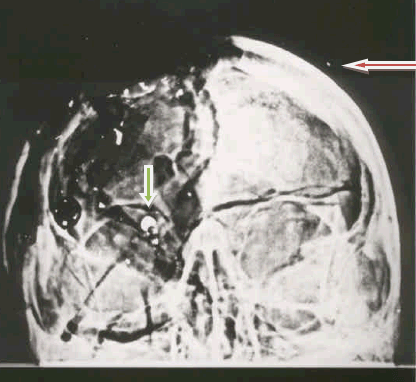
John McAdams, JFK Assassination Logic: How to Think about Claims of Conspiracy – Three Reviews (1)
How to Think Like John McAdams
A Book Review by David W. Mantik
Every man has a right to his opinion, but no man has a right to be wrong in his facts.
—Bernard Baruch—
Note: Italics identify quotes from the book; for my own emphases, I use underlining here.
Overview
Despite his pompous claim to teach all of us how to think critically, McAdams offers not a single reference to standard works on logical fallacies. Nor does he ever present his unique credentials for this task. After all, why would a professor of “American politics, public opinion, and voter behavior” automatically possess such superior skills in critical thinking? On the contrary, in this rather narrow-minded book, he demonstrates all three of these political disciplines. In order to persuade the reader to vote for his dubious conclusions, he uses the standard tools of manipulation and commits a variety of crimes against logic—the straw man, the invalid analogy, begging the question, special pleading, the false dichotomy, and the moving goalpost. Numerous examples of these fallacies are presented below. Fortunately, although his online persona is sometimes less than admirable, here he does not often resort to ad hominem attacks.
Given the subject matter, this is a remarkably brief book (254 pages). McAdams therefore frequently dispenses with critical issues in a sentence or two, often based on feeble (anti-conspiracy) sources. An example is Zapruder film tampering (p. 193). Even if McAdams is technically unable to address the luminous work on the Zapruder film by optical physicist John Costella, why not at least cite a more detailed and current source, possibly even from his own turf—such as Vincent Bugliosi’s Reclaiming History? (My decidedly negative reviews of Bugliosi’s two recent books are here and here.)
My chief objections to the book, though, are its numerous sins of omission. Paradoxically, although McAdams claims to loathe these transgressions in others, he often forgets to adjust his own mirror. For example, in his Preface, he states:
Everybody knows that writers, newscasters, and producers of documentaries can mislead their audiences by leaving out certain information. The reader of this book may be dismayed to discover how often these omissions happen.
But McAdams frankly tells us why he himself omits data (p. 250):
To actually solve a crime, you have to throw away most of your pieces of “evidence.” You have to conclude that this sighting of the suspect where he could not have been is bogus, that the crackpot witness is not to be believed, and that a juicy-looking “connection” actually leads nowhere. When you do that, you are left with reasonably hard and reliable evidence, and with some luck, you can break the case. If you refuse to cull your evidence, you end up with suspicions out the ears, and no solution to the crime.
McAdams cites no textbook on evidence for this method—nor does he provide a general framework for such culling. In fact, he violates a fundamental principle of scientific reasoning: the requirement of total evidence, which insists that conclusions must be based upon all the relevant evidence. On the contrary, McAdams’s goal seems extraordinary: he strives for a conclusion at all costs, even if it is the wrong one.
Curiously enough, McAdams had earlier (p. 12) stated that evidence should not be discarded:
Scientists will sometimes throw away observations that are considered outliers. When the data points will fit a neat pattern and one observation sticks out far from the rest, scientists often discard it. Scientists throw such observations away on the ground that they reflect a measurement error of some sort…. One should not be too cavalier about deleting this information, since an outlier can be valid information and may in fact be the tip-off to something interesting.[The 6.5 mm object, discussed below, plays precisely such a role.] When scientists throw away an outlier because it doesn’t fit the model and because they can’t explain it, they are making an ad hoc assumption. [The measurement of electron charge is an excellent historical example.]
This is a sensible statement, but McAdams prefers outliers that do not threaten his case. Unfortunately, as occurs too often, he makes these selections behind the scenes. This means that his reader is actively blind folded, i.e., he is stripped of the opportunity to decide for himself what evidence is authentic.
In her essay, “Trajectory of a Lie,” Milicent Cranor cites a guideline that could apply to any evidence. The author was a forensic pathologist, Alan R. Moritz, M.D., in “Classical Mistakes in Forensic Pathology,” American Journal of Clinical Pathology 1956; volume 26, p. 1383:
. . . it is better to describe 10 findings that might prove to be of no significance than to omit one that might be critical. The purpose of a protocol is twofold. One is to record a sufficiently detailed, factual, and noninterpretive [emphasis added] description of the observed conditions, in order that a competent reader may form his own [emphasis added] opinions in regard to the significance of the changes described. Thus, a region of dark blue discoloration in the… may or may not be a bruise. To refer to it as a contusion in the descriptive part of the protocol is to substitute an interpretation for a description, and this is as unwarranted as it may be misleading….
Dr. Moritz was a member of the Clark Panel (1968), which reviewed the JFK evidence. As Cranor observed, Moritz and his panel violated this principle when, based on their examination of poor quality photographs taken from a distance, they pronounced JFK’s throat wound as “characteristic of that of the exit wound of a bullet” (Clark Panel Report, p. 9). On the contrary, because it was a small, round wound, it was in fact typical of an entrance wound. As Cranor notes, they gave no description of its appearance, and gave instead “an interpretation for a description.” For decades now, defenders of the lone assassin theory have fine tuned such skills of misdirection, and John McAdams here similarly proves to be an apt student of this technique.
Eyewitness Testimony
If one theme can be extracted from this book it is this: Do not trust eyewitnesses—except for those approved by McAdams. It is widely understood that eyewitnesses are not very reliable in recalling complex matters, including recognition of faces, especially if these are only briefly glimpsed. In addition, intricate sequences of events (especially with multiple actors) are challenging for eyewitnesses. Nowhere, however, does McAdams cite one of his own authorities (Elizabeth Loftus) for those contrary occasions when eyewitness testimony has been shown to be highly reliable. In fact, when recall is prompt, and items are salient and simple, eyewitnesses do remarkably well. See Appendix 2 for further details.
Despite his passionate and nearly uniform condemnation of eyewitness testimony throughout the book, McAdams does not take any serious pains to distinguish prompt recall from later recall, nor does he ever recognize the critical role of salience (or simplicity). Until he pays attention to these crucial parameters, his incessant nagging about eyewitness failures is quite pointless. Ideally, his principle should instead read: “Do not trust eyewitnesses—except in those specific cases when experience shows you should.”
McAdams accuses conspiracy partisans of carefully selecting eyewitnesses to make their case. Paradoxically, however, although McAdams (p. 2) emphasizes that the Dealey Plaza witnesses are central, he does not have the courage to discuss the ten Plaza witnesses who were closest to the limousine that day, many of whom were ignored by the Warren Commission (WC). These witnesses are clearly not randomly selected (p. 28), yet they uniformly (and promptly) recalled a simple and salient event that day: they said that the limousine stopped (or nearly stopped). This is relevant to understanding the assassination and cover-up because the Zapruder film does not show such a stop. (Historically, this was the initial reason for suspecting that the film itself had been altered.) For a compilation of these witnesses, with citations for their comments, see Murder in Dealey Plaza (MIDP, pp. 341-342). Since these witnesses disagree with the Zapruder film, which McAdams takes to be “hard” evidence, perhaps he has merely chosen to cull them—but then he has done so without telling us. On the other hand, when multiple witnesses describe Tippit’s murderer as manually ejecting spent cartridges from his weapon (p. 177), McAdams has no trouble believing these witnesses (who of course support his case). As expected, after reviewing the ballistic evidence in this murder he concludes that Oswald did it. However, Don Thomas reviews this same evidence (Hear No Evil, Chapter 14) and reminds us that three separate sets of experts have arrived at “three irreconcilably different opinions….” McAdams, of course, reports none of this, so he is guilty here of a methodological inconsistency (often called “a double standard”), which of course merely impugns his credibility.
But what about the witnesses to the back of JFK’s head? McAdams argues, as expected, that the autopsy photos take precedence over eyewitness testimony (even though it has been customary in court for eyewitnesses to first validate photos before these are admitted as evidence). As we might now expect, though, McAdams does not acknowledge the profound disagreement with the reports of the Dallas physicians (see Appendix 3). And to rebut Gary Aguilar’s long list of witnesses who saw a posterior blow-out, McAdams resorts to a halfhearted bout of nit-picking (pp. 28-30)—no doubt because he has no other options. For example, he cites Jerrol Custer’s much later recall of the skull wound as being more accurate than his earlier description (which violates the rule that earlier reports are to be privileged over later ones). In any case, Custer’s wandering recollections for the Assassination Records Review Board (ARRB) raise deep doubts about his (later) memory. McAdams has again employed special pleading, i.e., selecting evidence favorable to his side and ignoring the rest. (For a photo showing Custer demonstrating the occipital wound, see The Killing of a President by Robert Groden (p. 88). For Custer’s report that the rear of the head had been blown off, see Best Evidence 1980 by Lifton (pp. 619-620). Also review the fine essay by Gary Aguilar and Kathy Cunningham (now Evans.)
Furthermore, although McAdams claims that the Zapruder film shows no occipital wound, this issue is at least controversial. Recent work by Hollywood professionals has shown a distinct black, geometric-shaped mask lying precisely over the occipital area in question (on multiple frames in a film approved by the National Archives). This apparent artifact is highly suggestive of photo tampering. I have observed this geometric mask myself in Hollywood, and have confirmed the same feature on the MPI images at the Sixth Floor Museum in Dallas (while accompanied by one of the Hollywood personnel). Surely, at the very least, McAdams must view these MPI images before he draws conclusions—after all, these images are accessible to the public.
Two Oswalds (pp. 41-43)
Even if history is replete with false sightings of individuals, especially famous miscreants (e.g., Malcolm Naden and John Wilkes Booth), as McAdams maintains, then that information can tell us very little about the two-Oswald hypothesis—instead, each case must be decided on its own merits. After all, some sightings are not false (e.g., John Wilkes Booth was probably photographed at Lincoln’s second inauguration—see here). Determining the accuracy of such sightings is analogous to deciding what past events have been authentic conspiracies. As McAdams himself admits, for such a decision a case-by case approach is essential (p. ix). Ironically, McAdams himself—a self-anointed instructor in logic—falls prey here to another logical fallacy: the appeal to probability, i.e., just because something could have happened (mistaken sightings in this case), it is inevitable that it did happen.
Although McAdams accepts 9/11 as a real conspiracy (pp. ix and 201), he still maintains that “conspiracy theories” see the government as “very evil but very competent.” Paradoxically, though, sometimes the government itself reports a conspiracy (e.g., 9/11 and the Lincoln assassination), so we can ask: Does that imply to McAdams that conspiracists also view these (government) reports as evil, but nonetheless competent? (Surely, doubters of The 9/11 Commission Report would not agree with this.) This is the kind of logical absurdity that follows from (possibly subconsciously) considering all conspiracy theories to be false.
Another point should be made. Because false sightings do occur, and because humans are quite poor at recalling briefly encountered faces, we ought therefore to conclude that, rather than discrediting the two-Oswald hypothesis, this human flaw lends some support (unintentionally and indirectly) to the two-Oswald scenario. Why should that be true? Consider this: If two Oswalds existed, then eyewitnesses could not reliably distinguish between them. For example (since we cannot trust eyewitnesses) even if the same witness had seen two different Oswalds on two different occasions, that would not be sufficient proof of two Oswalds. Therefore, since we cannot fully trust eyewitnesses on this matter, the question of two Oswalds is actually left open by the eyewitnesses—it must instead be decided by objective evidence, such as documents and photos.
When McAdams discusses the two-Oswald scenario, he dodges the more recent 983-page opus by John Armstrong (Harvey and Lee–$325 on Amazon) and instead cites (p. 42) the 1966 book by Richard Popkin (The Second Oswald). Armstrong does not even appear in McAdams’s index. On the contrary, readers might, for example, like to view the strange newspaper photo of “Oswald” at the time of his defection. (See: note image 13 of 50, second row, third photo.) And surely the man photographed in Mexico City as “Oswald” was not Oswald. Even J. Edgar Hoover conceded that the “Oswald” voice on the tape was not Oswald.
This omission of Harvey and Lee exemplifies the logical fallacy of special pleading, i.e., citing only evidence favorable to one’s case, while suppressing the rest.
Fact Checking
The Acknowledgments cite no fact checker, a singular omission, especially in view of the high risk for errors that any JFK author inevitably faces. As we shall soon see (items 1-6 below), this is a grievous mistake. Although three editors at Potomac are listed, a copy editor would also have been wise, e.g., McAdams lists Zapruder, Nix, and Muchmore as shooters in Dealey Plaza (p. 180)! Another blooper occurs when he comments (p. 27) on David Lifton’s theory: “But if you ignore the weight of the evidence, it’s likely to be an absurd theory.” Of course, he meant “accept,” not “ignore.” An amusing mistake occurs in the timeline (p. 259): “Oswald arrested…after attempting to shoot…McDonald…and scuffing with police.” (Scuffing is defined as walking without lifting the feet.) The long list of those thanked (second paragraph in this section) invites skepticism—almost all would be described as anti-conspiracy; in other words, McAdams has plainly, and without apparent embarrassment, skewed his case from the outset.
- McAdams claims that, because individuals cannot keep a secret, a large conspiracy is impossible (p. 248) and for this he offers an unintentionally comical statistical “proof.” One of his scenarios assumes 20 conspirators, ironically just one more than that cited by the official 9/11 report. From this he predicts a 95.5% probability that the secret (of the conspirators) would get out. However, we all know that, in the case of 9/11, the secret (of flying into structures) did not get out. In a similar vein, I have previously cited multiple powerful examples in which many individuals actually did keep deep and important secrets (see Appendix 4). McAdams then heroically wades into a statistical morass—by introducing his supposed analogy of false positives in medicine (p. 192). He conjures up a test for leukemia (for 61 subjects) in which 11 or 12 false positives are to be expected. (Although he states that leukemia is rare, my own father died from it.) He claims, without any statistical analysis, that if 15 subjects actually test positive then we can conclude that no one has leukemia and that everyone should relax. Of course, he has omitted the critical piece of information—the standard deviation for this test, which means that we cannot assess his conclusion. (Readers interested in a serious discussion of these issues should consult a superb book by H. Gilbert Welch: Should I be Tested for Cancer? Even worse, though, his analogy to the 15 matches in the acoustic data is a false analogy (see discussion below).
- McAdams claims (pp. 26-27) that the vast majority of witnesses saw JFK’s body arrive at the Bethesda morgue in the same casket that had left Dallas, and that nobody else (other than Paul O’Connor) reported a body bag. Although he is not cited by McAdams, Douglas Horne demonstrates that these statements cannot be justified—after all, at least six witnesses reported a wrapping like a body bag: Paul O’Connor, Floyd Riebe, Jerrol Custer (initially), Ed Reed, John VanHoesen, and Capt. John Stover, MD. (Horne’s table lists the witnesses and the sources of their statements; see Inside the ARRB, Volume IV, pp. 989-992.) Witnesses to a shipping type casket were Dennis David, Paul O’Connor, Floyd Riebe, Ed Reed, James Jenkins, and Capt. John Stover, MD. (Custer saw two caskets, one of which was bronze.) Although these recollections were not uniformly identical (and Custer later recanted about a body bag), rather remarkable similarity does exist among these statements. Furthermore, most of these individuals were consistent over time and also with different interviewers. Horne’s summary therefore seriously discredits McAdams (for only citing O’Connor)—but McAdams’s comment also implies that he failed to read Horne’s work. Even if McAdams dislikes these conclusions, he has nonetheless ignored relevant evidence and has thereby committed the logical fallacy of begging the question (by assuming conclusions that may be false). This approach has also sometimes been called “cherry picking.”
- He implies that Jim Sibert and Francis O’Neill were the only witnesses who heard Humes describe prior surgery to the head. This is false, however, as I have previously emphasized, because James Jenkins is another (High Treason 2 by Harrison Livingstone, p. 234; also see In the Eye of History by William Law, p. 80). Jenkins repeated this statement to a small group (which included me) in Fort Myers, Florida in September 2002. Furthermore, Doug Horne summarizes how Tom Robinson and Ed Reed recalled how James Humes, the pathologist, may have performed cranial surgery before the official autopsy began (Inside the ARRB, Volume IV, pp. 1005 and 1167-1169).
- Regarding Robert McClelland and the back of head (p. 30, footnote 60), McAdams claims that McClelland could not see the occipital defect because JFK was lying face up and his head was not lifted up (this is more begging of the question). Yet here are words directly from McClelland (6H33 or see http://www.assassinationresearch.com/v4n2/v4n2part1.pdf):
As I took the position at the head of the table…I was in such a position that I could very closely examine the head wound, and I noted that the right posterior portion of the skull had been blasted. It had been shattered, apparently, by the force of the shot so that the parietal bone was protruded up through the scalp and seemed to be fractured almost along its posterior half, as well as some of the occipital bone being fractured in its lateral half, and this sprung open the bones that I mentioned in such a way that you could actually look down into the skull cavity itself, and see that probably a third or so, at least, of the brain tissue, posterior cerebral tissue and some of the cerebellar tissue had been blasted out.
- McAdams promotes the idea (p. 229) that the oval shape of Connally’s back wound proves that it was caused by a yawing bullet–the result of first striking another object (which he supposes was JFK’s neck.) McAdams cites 7HSCA144 (Volume 7, page 144 of the House Select Committee on Assassinations), but that page raises an alternate explanation for an elongated wound: a tangential strike. (McAdams wonders whether a “sharp” angle might explain the wound, but it is not clear whether McAdams means tangential.)Michael Baden, one of McAdams’s favorite sources, has gone to great lengths to “prove” that Connally’s back was not only struck by a yawing bullet, but by one that struck sideways (with the full length of the bullet), thus creating a 3 cm long wound. However, Milicent Cranor buried this myth in her decisive essay: “The Trajectory of a Lie” (http://www.history-matters.com/essays/jfkmed/BigLieSmallWound/BigLieSmallWound.htm). Baden’s mistaken belief had originated with John Lattimer, M.D. In an article published in 1974, Lattimer used the operative report as evidence: it described the size of the wound during surgery, after it had been cleaned and enlarged (as by a scalpel) to 3 cm. But the pre-operative back wound, i.e., the size created by the bullet, was only 1.5 x 0.8 cm. Cranor notes that the actual size of Connally’s back wound was almost the very same size as the entrance wound in JFK’s head: 1.5 x 0.6 cm. She delights in observing that no one has ever said that JFK’s head was hit by a yawing bullet. McAdams seems oblivious to the facts in Cranor’s analysis, which includes thorough documentation for these measurements. Even Bugliosi refrained from promoting this myth of a 3 cm back wound, reportedly because of Cranor’s article, although he does not cite it.
- McAdams claims that no bullet fragments are seen on the left side of JFK’s AP X-ray. (That is JFK’s left—the side of lesser trauma—which would be the reader’s right side.) But this is manifestly false, as I have repeatedly emphasized over many years (see Appendix 5, Figure 1). How do I know that this object is metallic? First, it is also visible on both lateral X-rays; that an artifact would be so spatially consistent—on three X-rays—is quite unlikely. Second, at the National Archives, it does look like metal: its borders are sharp while its optical density and shape are also consistent with metal (compared to the other metallic fragments). Third, the relative densities on the three X-ray views are all consistent with one another. Perhaps McAdams should just take a look (at the Archives). Why is this important? McAdams implies that the absence of such a left-sided fragment suggests that no bullet struck JFK from the front—and that, we all would agree, is indeed a central issue. I would emphasize however that, even though McAdams is clearly wrong about the existence of this fragment, its presence is indeed perplexing and that, by itself, raises some prickly and unorthodox questions.
The Throat Wound
McAdams claims (p. 70) that Malcolm Perry, who performed the tracheotomy, and Charles Carrico were the only two physicians who saw the throat wound. Surely, however, McAdams is well aware of Perry’s own statement that he had left the wound “inviolate,” i.e., untouched and therefore still readily visible. In that case, Charles Crenshaw and Robert McClelland, as well as other physicians, could easily have witnessed this wound. Even Milton Helpern, the éminence grise of forensic pathologists, agreed that Perry’s incision should not have affected the visibility of the wound. In fact, physicians Baxter (6H42), McClelland (6H32), and Jones (6H54) offered specific descriptions of this wound, and so also did Drs. Akins and Jenkins. (The reference 6H54 is to WC ancillary volume 6, page 54.) However, the most interesting witness to the throat wound was pathologist J. Thornton Boswell himself. Although the pathologists had originally denied seeing a throat wound during the autopsy, Boswell later told Andy Purdy of the HSCA (August 17, 1977, p. 8) that he had in fact seen “part of the perimeter of a bullet wound in the anterior neck.” In fact, only three years after the assassination, Boswell had told The Baltimore Sun (Richard H. Levine, 25 November 1966, front page article) that, before the autopsy began, the pathologists had been apprised of JFK’s wounds and what had been done to him at Parkland. (Actually, multiple witnesses were aware of the throat wound at Bethesda; Kathy Cunningham, in particular, has summarized this data.) Is McAdams truly ignorant of these statements? In any case, he reveals none of this to his readers, thereby giving us another example of begging the question, i.e., he takes for granted a conclusion that first requires independent verification. Of course, his approach here serves his purpose well: after all, if only two Parkland physicians saw the wound (as McAdams wants to believe), these two could more easily be overruled by the official autopsy report (than if many Parkland doctors had seen and reported an apparent entrance wound—which is actually what they did report).
McAdams cites a Bowman-Gray study (p. 226), which concluded that ER doctors misinterpreted single bullet wounds (i.e., confusing entrance with exit) 37% of the time. Even if ER personnel cannot reliably distinguish entry from exit wounds, though, that comment obfuscates the situation. To the contrary, in this particular case several facts trump those medical reports: (1) such a tiny exit wound could not be duplicated in WC experiments and (2) Milton Helpern (who had done 60,000 autopsies) said that he had never seen an exit wound that was so small (under similar conditions). Of course these (negative) WC experiments made specific assumptions: a certain (low) entry site on JFK’s head, an explicit distance and elevation for the shooter, a Carcano bullet, etc., which means that the relevance of their experiments could be debated.
Rather suspiciously, during a WC Executive Session (December 18, 1963), John McCloy, Hale Boggs, and Gerald Ford actually discussed a possible frontal shot from the overpass. Of course, Paul Mandel in LIFE magazine, with his contortionist view of JFK, had also raised the possibility of a frontal throat shot (that strangely enough came from the rear): see here. A final, telling blow derives from the National Photographic Interpretation Center (NPIC): before political leverage was exerted, their first scenario actually included a throat shot at Z-190, many frames before Connally was struck, which was grossly inconsistent with the single bullet theory (SBT). See this data here. This NPIC study likely occurred after the LIFE article—after all, it quotes Mandel verbatim. These NPIC records were transferred from the CIA to the National Archives in 1993. They are located in flat #90A in the JFK Records Collection, along with the 4-panel briefing boards of the Zapruder film made by McMahon and Hunter.
Although McAdams credits Josiah Thompson (Six Seconds in Dallas 1967) with the best pro-conspiracy book (p. vii), this may be a calculated selection by him, since that book ends on an equivocal note. Meanwhile, he ignores other books (e.g., Best Evidence, Murder in Dealey Plaza, Inside the ARRB) that present a far more powerful (and far more contemporary) case for conspiracy. But there is also the question of the magic bullet: its provenance has been extensively investigated by Josiah Thompson. In the face of the persistent refusal of the pertinent witnesses to identify this bullet, most likely it would never have been admitted at trial—and that alone would devastate any WC case. Thompson (with Gary Aguilar’s more recent assistance) has now so thoroughly destroyed the credibility of the alleged “magic bullet” that it (the bullet) should now simply be tossed into the outgoing trash. But, despite his reverence for Thompson, we learn none of this from McAdams. Here, however, is a direct quote from him about hiding evidence (p. 87):
But sometimes withholding facts can be used to make a situation appear to be quite different from what it really is. That’s way too common in books about the Kennedy assassination. [By ignoring his own advice here, McAdams again commits the logical fallacy of inconsistency.]
Here is yet one more problem (of many) with the SBT: so that the throat wound can remain (very) small, McAdams requires that the shirt and collar buttress the skin (p. 225). However, the eyewitness evidence is clear: the wound was above the shirt and tie. While before the WC, Charles Carrico (a surgeon, who saw the wound at Parkland) clearly implied that the wound was above the necktie and above the shirt collar (3H361-362). To leave no doubt about what Carrico had seen, Harold Weisberg reports his own confirmatory interview with Carrico (Post-Mortem 1969, pp. 357-358 and 375-376). Nurse Diana Bowron also reported seeing this wound while JFK was still in the limousine—before JFK was undressed (Killing the Truth by Harry Livingstone, p. 188)—but she could not have seen it unless it had been above the tie. Now think about this: if the wound indeed lay above the necktie, no buttressing would have been possible and McAdams’s case would then be at least suspect, if not lost. So McAdams has again hidden evidence from his reader and, as usual, this is evidence that seriously threatens his case. For more on the throat wound, see Milicent Cranor’s “Trajectory of a Lie” (as cited above). Ms. Cranor, after a thorough review of the ballistics literature, has offered an enlightening summary of relevant conclusions (see Appendix 6).
The Back Wound
In the autopsy photograph (Appendix 5, Figure 2), the back wound appears to lie at about T1 (i.e., the first thoracic vertebra), just above the level of the scapular spine. This seriously disagrees with the T3 on the death certificate, which was prepared by Admiral Burkley (p. 221). Two individuals even placed it at T4: James Jenkins and, in a conversation with me, John Ebersole (who practiced my specialty of radiation oncology). For normal anatomy see Appendix 5, Figures 3A and 3B. As is well known, the back wound in the autopsy photo is noticeably higher than the holes in the shirt or jacket. Furthermore, the wound on the Autopsy Descriptive Sheet (prepared by Boswell at the autopsy; see Appendix 5, Figure 4) appears to lie well below T1—at least as low as T2, if not even lower. An online source assigns a typical level to the scapular spine as T3 (manualmed.blogspot.com/2008/09/thoracic–spine-landmarks.html). In fact, any level for this back wound below T1 would destroy the SBT (because the back wound would then be lower than the throat wound). However, Boswell later elevated this wound, thus abandoning his earlier, on-site observation. Somewhat amusingly, on this second occasion Boswell elevated this back wound far too high (compared to the autopsy photo), actually into the neck, which only raises questions about either his memory or his honesty. (See these two incompatible placements by Boswell at Inside the ARRB by Douglas Horne, Volume I, Figure 56.) A likely explanation for the discrepancy between the photo and the Descriptive Sheet is post-autopsy (illicit) photo alteration in the dark room. Curiously, this is the precise autopsy photo that displays an anomalous object on the back (not noted by prior investigations), which might be a leftover image from photographic tampering. Further discussion of this follows below.
Another point is worth emphasizing: physical tests showed no copper deposits on the shirt or on the collar (in the front), even though they were present on the back of JFK’s jacket. This is consistent with a metal projectile as the source for the back wound, but it is inconsistent with a metal projectile through the front of the shirt. On the contrary, the slits had probably been created by the nurses’ scalpels. In an interview in 1971, Carrico actually confirmed this to Harold Weisberg—see Weisberg’s Subject Index File, under “Carrico,” items 02 and 03. (Jerry McKnight reports this.) In addition, based on my personal observations at the Archives, some cloth is missing from both the back of the shirt and the back of the jacket, but none appears missing from the slits at the collar. Furthermore, although McAdams claims that a throat wound at C7/T1 is feasible, he totally ignores the anatomic conundrums in the horizontal plane. (For pertinent, and rather devastating, anatomy and radiology images see Appendix 5, Figures 5-7.) For a more precise vertical level for the throat wound see MIDP (p. 228). James H. Fetzer has also offered a concise analysis of this evidence in “Reasoning about Assassinations,” which he presented at Cambridge and then published in an international, peer-reviewed journal (The International Journal of the Humanities (2005-2006), Volume 3, Issue 10, pp. 31-40).
McAdams asks a pertinent question about the SBT: If a bullet struck the back, then where did this bullet go? He disregards a possible deflected fragment (from the street) that might have caused this wound. Such a bullet ricochet (possibly more than one) was reported by multiple eyewitnesses (6H238, 7H291, 7H507-515, MIDP, p. 36, and No More Silence by Larry Sneed, p. 145). Because this option—of a deflected projectile (not necessarily an entire bullet)—even appears in the WC ancillary volumes, McAdams has no excuse for omitting it.
Of course, the same question might be asked about a frontal bullet to the throat: Where did it go? Again, McAdams has restricted the options, although he need not have done so. In MIDP (p. 258) I asked whether a glass fragment might have caused this wound. Such a fragment from the windshield (expelled by a frontal bullet) might fit this scenario. Moreover, its very narrow scattering cone (well documented in the ballistics literature) likely would have missed everyone else. Furthermore, the three tiny puncture wounds in JFK’s right cheek (reported by Tom Robinson during embalming) are also consistent with several additional, tiny scattered fragments from the front. (Given the typically short range of small particles, it is unlikely that they could have originated from the rear, as bone fragments for example, and then exited the cheek.) Of course, I don’t claim to know that a glass fragment is the explanation, but at least it should remain in this discussion. I know of no reason a priori to rule it out. To make matters even worse for McAdams, he himself quotes McClelland (p. 227): the president had “a fragment [emphasis added] wound of the trachea.” (This is actually McClelland’s handwritten note, as reproduced in the Warren Report (October 1964, p. 490).Therefore, by limiting the options for the throat wound, and for the back wound, McAdams has committed another logical fallacy—the false dichotomy.
The Hole in the Windshield
If the windshield had a perforated hole (from either direction), then the SBT would be seriously discredited, but McAdams insists (p. 193) that such a through-and-through hole did not exist. Assume for the moment that the hole existed: How then could that have occurred? A shot from the front, of course, might explain both such a hole as well as the throat wound (the latter possibly via a glass fragment), but the final destination of such a bullet would still be unexplained. (Perhaps it missed the limousine occupants, but then struck the street; multiple witnesses recalled such events on the street surface.) Here is another option: a shot from the rear (such as the WC bullet that missed) might be deployed for double duty, e.g., perhaps it was the source of James Tague’s wound after it traversed the windshield. Or perhaps a fragment of the headshot bullet (in the WC scenario) might have gone entirely through the windshield. Of course, the WC (and the HSCA, too) did not review these options—because their windshield had no hole. However, as is too often the case with McAdams, there is more to the story. Readers may wish to read the latest chapter on this matter, as reported by Doug Weldon. Unlike some contributors to this windshield discussion, Weldon has personally communicated with several of the witnesses. He notes that Richard Dudman, a reporter for the St. Louis Post-Dispatch, was flown to Washington, shown a windshield without a hole and only after that did he retract his prior statement. (See Dudman’s original article of December 21, 1963: “Commentary of an Eyewitness.” This can be viewed here.) Notably, after this he also severed his long-standing friendship with Robert Livingston, M.D., who had originally heard about the hole from Dudman. (Livingston, who directed a National Institute of Health at the time, also advised me that he had heard about replacement windshields while in Washington, which is surely a bizarre event if it had no substance.) Besides Dudman, witnesses who discussed a hole include Stavis Ellis (12HSCA23), Harry Freeman, Evangelea Glanges, Nick Principe, and Charles Taylor, Jr. Weldon reminds us that Taylor had written “…in 1963 that he saw a hole, confirmed it in 1975, and then was approached by the government and suddenly an affidavit is signed that he was mistaken and that the windshield he saw then was the same one he saw in 1963 without a hole.” Weldon credits Martin Hinrichs with a detailed comparison of windshield photos taken at different times, after which Hinrichs seriously questioned whether they were the same. Weldon also emphasizes his conversation with the Ford Motor Company witness, George Whitaker, who stated that the original windshield had been scrapped on November 25, 1963 in Dearborn, Michigan. This witness, who had much experience with gunshots through windshields, also recalled that the bullet had come from the front. (See Appendix 7 for a quotation from Weldon.)
The Shirt and Jacket Holes (p. 223)
McAdams assumes that the location of these holes supports the SBT. While at the Archives I had a tall male wear the jacket (while standing). He was an inch or two taller than JFK. What was surprising was how low these holes lay. The bullet holes in the shirt and jacket were nearly at the same level (as one another); the center of the hole in the shirt lay 7 ½ centimeters inferior to the horizontal shoulder seam. It also lay about 3 centimeters inferior to the top of the scapula. The clothing images may be seen at here and here. McAdams cites a photographic study that shows the jacket elevated during the motorcade here. Although it is likely that the jacket was elevated at the critical moment, this study surprisingly does not estimate how much it was elevated. This study concludes: “As a direct result, the ‘low’ bullet holes in John Kennedy’s shirt and jacket are not accurate indicators of the entry location, which must have been higher.” But this conclusion about the shirt cannot be certain—there is no photographic evidence of the shirt bunching up. In fact, Charles Carrico reported (3H359) that the back brace (“with stays and corset, in a corset-type arrangement and buckles”) extended upward nearly to the navel. This brace may therefore have kept the shirt from rising very much.
The Head Wound(s)
The most important JFK wounds are those of the head, but McAdams discusses these only tangentially. This is a truly astonishing lack of emphasis. Despite a stunning disagreement with McAdams by most of the professional witnesses, he insists (p. 180) that the back of the head was intact. He also insists that the autopsy photographs and X-rays are authentic, but we now know otherwise (see further discussion below). Images of the back of the head (on the AP skull X-ray) show a bone flap, which probably could swing in and out, remarkably consistent with McClelland’s verbal description of it. I have identified this structure on images (MIDP, p. 227); when this flap was closed, the occipital hole was probably less obvious. I have also identified the skull defect left behind by the Harper fragment—an observation I initially noted with my (then-myopic) naked eyes, but then also confirmed via optical density data. But the real riddles of these wounds (and the X-rays, too) are totally ignored by McAdams. For example, among other inconsistencies, the three pathologists and one radiologist all placed the posterior skull entry wound about 10 centimeters inferior to the trail of metallic debris. (I refer here to the obvious collection of metallic like particles located high in the skull; many of these particles have fuzzy borders, an observation that raises the possibility of a mercury bullet—from the front.) Additional paradoxes are cited in my unanswered letter (see Appendix 8) to Max Holland, another writer who is cited approvingly by McAdams (p. vii).
Although not discussed by McAdams, the evidence for a right temple/forehead entry is particularly suggestive. Robert Karnei, a pathology resident at Bethesda (and later chief at the Armed Forces Institute of Pathology), would have performed the autopsy had it been a routine one. He recalled that the embalmers were putting some wax into a tear or a laceration near the eye. At the news conference at Parkland Hospital immediately after the assassination, Malcolm Kilduff, the assistant press secretary (Pierre Salinger was flying over the Pacific with several cabinet members), was asked about the cause of death. He stated: “Dr. Burkley told me, it is a simple matter … of a bullet right through the head.” The striking feature of his response, however, was the non-verbal portion: as he made this statement, he pointed toward his right forehead, indicating the entry site. A photograph (The Killing of a President by Robert Groden, p. 59) captured this gesture at the critical moment. A follow-up question asked: “Can you say where the bullet entered his head, Mac?” To this Kilduff replied: “It is my understanding that it entered in the temple, the right temple.” Later that day, Chet Huntley repeated this: “President Kennedy, we are now informed, was shot in the right temple. ‘It was a simple matter of a bullet right through the head,’ said Dr. George Burkley, the White House medical officer.” (See JFK: The Medical Evidence Reference, by Vincent Palamara, p. 44.)
Others corroborate this location, such as Seth Kantor (20H353), a Scripps-Howard reporter whose notes stated: “intered (sic) right temple.” Charles Crenshaw, M.D., one of the treating physicians in Trauma Room One, demonstrated this on live television for Geraldo Rivera (“Now It Can Be Told,” 2 April 1992). I still have this video in my personal library; Crenshaw shows just where this shot entered—near the hairline, just above the lateral border of the right eye socket.
Tom Robinson, the embalmer who restored JFK’s head, described a wound, about 1/4 inch across, above the right eye near the hairline, where he had to place wax to disguise it (HSCA interview of January 12, 1977). He added that this wound was so close to the hairline that the hair could easily cover it, which may explain why more witnesses did not see it.
Joe O’Donnell (photographer for the US Information Agency), afriend and occasional colleague of Robert Knudsen, was deposed by the ARRB. Within a short time after the assassination—in fact on two different occasions—Knudsen had shown him autopsy photographs. On the first of these, he saw a hole (about the size of a grapefruit) in the back of JFK’s head, about two inches above the hairline. This hole penetrated the skull and was very deep. Another photograph showed a hole in the forehead, above the right eye; this wound was round and about 3/8 inch in diameter. O’Donnell interpreted this as the frontal entry for a bullet that caused the large hole at the right rear. (The trail of metallic like debris across the top of the skull, however, is not consistent with a blowout of the right occiput—which is much lower—but that is a discussion for another day.)
Dennis David also saw photographs with a bullet entry high in the right forehead. These were shown to him by William Pitzer (In the Eye of History by William Law, p. 23).
Despite the right forehead laceration seen in the autopsy photo, the Parkland witnesses denied seeing any damage to JFK’s face. However, at Bethesda, Ed Reed (for the ARRB) recalled that Humes had made an incision in the forehead. Reed even recalls Humes sawing into the forehead bone and Robinson likewise recalls some sawing; furthermore, these events occurred quite early that evening.
The skull X-rays themselves are quite consistent with such a right temple entry. The small metallic particles in these X-rays appear to align with just such an entry site. Even more intriguing, this extrapolated line seems to pass through a notch in the skull (the right forehead) that I noticed on the X-rays (for my sketch, see Killing Kennedy by Harrison Livingstone, p. 102). Furthermore, Boswell also sketched missing bone at precisely this site (when he drew on a skull model for the ARRB). There is one last tantalizing clue: the largest metal fragment should have the greatest range—and so it does. The lateral skull X-ray clearly shows that the largest authentic metal fragment (not the small one correlated with the 6.5 mm object within JFK’s right orbit on the AP X-ray) lies near the back of the head—which is consistent with a frontal shot.
The Police Dictabelt
McAdams devotes less than one page (!) to this data (p. 181). He baldly states that the HSCA study was “torn to pieces” by the National Academy of Sciences (NAS). This would be a non-fallacious appeal to authority if the NAS scientists had been appropriately qualified (but none were actually acoustic experts—see Hear No Evil, p. 619). However, he ignores all of the work done since 1982, including a peer reviewed article by Donald Thomas as well as Don’s rather large book. But much other signally important work, including follow-up by some of the same NAS physicists, is also ignored. Interested readers can reference my three-part review of these issues here. Even the minimal data that McAdams does report is misleading: he implies that fifteen matches were found. In fact, 13 impulses were found on the test tape and 15 impulses on the dictabelt. Comparison of these echo peaks yielded eleven coincident impulses, with an impressive binary correlation coefficient of 0.79. This result led to their conclusion: a gunman was 95% present on the grassy knoll. When discussing false positives (pp. 182 and 192), McAdams reports: “…the scientific match–identified fifteen matches [sic]. There were, in short, way too many false positives.”
But McAdams misleads us here—the evidence did not mean fifteen possible shots. (For further details, see Appendix 9.) After all, duplicate test shots had been fired from the Texas School Book Depository (TSBD), meaning both inside and outside the window. Furthermore, matches sometimes occurred at adjacent microphones—from the same shot—as might well be expected if the motorcycle had been between two adjacent microphones. In fact, only four actual shots were proposed. One can only wonder if McAdams has even a novice’s grasp of this subject. As the wise man said, “Where ignorance reigns, silence is golden.”
Moreover, with these acoustics data we begin to unmask the profound biases of Professor McAdams. Although he acknowledges the debunking contributions of some pro-conspiracy researchers (p. 193), he curiously ignores another one—my own highly itemized (and definitely negative) review of the acoustics data. One of the blurb writers for McAdams’s book has noted that I am the only pro-conspiracy researcher who has publicly distanced himself from these acoustics data. Given the admiration of McAdams for his coterie of “debunking conspiracists,” my acoustics review might well have caught his (favorable) eye. Curiously, my favorable review of Dale Myers on this matter also escaped McAdams’s notice. McAdams should have enjoyed my negative conclusion about the acoustic data; for this he might at least have awarded me “honorable mention” in his coterie’s hall of fame. (Myers, of course, was given first class honors by McAdams for his computer reconstruction, despite the fact that Cranor, Jim DiEugenio, and I, among others, have skewered that entire project.) That the Mantik name does not even appear in the book’s index only provokes some probing questions about the mindset of our ersatz instructor in logic. Paradoxically, some of his cited articles do recognize me.
“The Most Reliable Evidence”: the X-rays and Photos
“Focusing on the most reliable evidence violates the collector’s instinct of conspiracy theorists. They collect evidence assiduously, and whoever has the biggest collection is the best researcher—just as the best stamp collector is one who has the largest number and the rarest stamps” (p. 157).
As stamp collector I strongly object, on multiple levels, to this characterization. First, I have done precisely what McAdams has advised (p. x), i.e., “focus on the hard data.” I have repeatedly examined the autopsy materials at the National Archives (online: “20 conclusions after 9 visits”), yet McAdams has unfailingly ignored this data. Even more damning though, these data from the Archives are not theoretical (no conspiracy theorist here); rather, they are observational and experimental (perhaps I am a “conspiracy experimentalist”), replete with hundreds of measurements. Furthermore, these data can in principle be reproduced by anyone with access to the autopsy X-rays. (I have seen an optical densitometer at the Archives, which they might loan to McAdams; even a nonscientist can quickly learn to use it—with minimal instruction.) The use of optical density measurements in radiology is an old science (for this history see Appendix 10) and data acquisition itself is rather trivial. After calibrating the device (a simple matter—which I often did during my work), the X-ray is positioned and a reading is taken. For the 6.5 mm object within JFK’s right orbit (on the AP X-ray) I have done this many, many times, typically in the presence of multiple witnesses: an ophthalmologist, an astronomer (who employs optical density measurements in his specialty), and multiple staff members from the Archives. These simple data are astounding: the apparent metallic length of this 6.5 mm object (from front to back), implied by even a single measurement, is radically inconsistent with reality (it is far too long). At this juncture, Sherlock Holmes, from my favorite childhood tale (The Sign of the Four)is precisely on target: “Eliminate all other factors, and the one which remains must be the truth.” In this case the conclusion is unambiguous: this 6.5 mm object must have been superimposed in the darkroom and must therefore be a forgery (Assassination Science, edited by James Fetzer, pp. 120-137). Even Larry Sturdivan, the ballistics expert who testified before the WC (and who is even cited by McAdams, p. 130) could not explain this object.
I’m not sure just what that 6.5 mm fragment is. One thing I’m sure it is NOT is a cross-section from the interior of a bullet. I have seen literally thousands of bullets, deformed and undeformed, after penetrating tissue and tissue simulants. Some were bent, some torn in two or more pieces, but to have a cross-section sheared out is physically impossible. That fragment has a lot of mystery associated with it. Some have said it was a piece of the jacket, sheared off by the bone and left on the outside of the skull. I’ve never seen a perfectly round piece of bullet jacket in any wound. Furthermore, the fragment seems to have greater optical density thin-face on [the frontal X-ray] than it does edgewise [the lateral X-ray]…. The only thing I can think is that it is an artifact (MIDP, p. 266).
Of course, Sturdivan’s conclusion is just more vital evidence that McAdams has decided to cull; even worse, though, he does not so inform his readers. To date, no one (unless forgery is invoked) has been able to explain this bizarre 6.5 mm object on JFK’s AP X-ray. Even the experts for the ARRB (including the forensic radiologist, John J. Fitzpatrick, who was visibly troubled by this strange feature) could not explain this fantastic object). So we are left with this conclusion about this hardest of “hard” evidence: an odd event occurred in JFK’s X-rays that has never, before or since, been seen in the history of radiology. Furthermore, even the best experts in forensic radiology still cannot explain it. And this is what McAdams—who has never claimed to be an expert on X-rays—takes for “hard” evidence of no conspiracy. (Since Speer’s essays overlap with these issues, readers might also review my response to Pat’s protests at here.) Also recall that Helpern, in over 60,000 cases, had never seen an exit bullet produce a wound like that in JFK’s throat. That might raise an acutely troubling question about the lone gunman scenario: How likely is it that two such unprecedented events would spontaneously appear in just one case?
McAdams asks whether the photos and X-rays had changed in the interval between the autopsy and the Clark Panel (1968). He has an excellent reason for asking this question: the perplexing 6.5 mm object within JFK’s right orbit had not been reported at the autopsy, even though the chief goal of the X-rays had been to identify precisely such objects. Moreover, McAdams never asks the most embarrassing question: Of the many individuals who saw the X-rays that night, why did no one discuss, report, or recall this bizarre object?
To make matters even worse for this “hard” evidence, I made one more critical observation on a lateral JFK skull X-ray at the Archives, an observation that any amateur could easily reproduce (including several anti-conspiracists who have since visited, yet apparently failed to look): this left lateral is obviously a copy, not an original. Why does that matter? First, the Archives claim that it is an original, so something is clearly amiss. Secondly, though, if it is a copy, the door would be left wide open to manipulation in the dark room. And how do I know it is a copy? Because a T-shaped inscription was made on the original film by someone (for an unknown reason, but it doesn’t matter); this could only have been done by scraping the emulsion off the film, a fact that would be trivial to see on an original. But here is the problem: the film at the Archives has no missing emulsion! In fact all surfaces (near this inscription) show entirely intact emulsion—which, of course, perfectly describes a duplicate X-ray film. Of course, McAdams has also culled this observation from his data set. He could easily have tested this observation himself—even now, why doesn’t he just book a trip to the Archives?
The autopsy photographs constitute more “hard” evidence that McAdams likes to cite, but all is not kosher here either. Despite what the HSCA reported, stereo viewing in one particular photographic pair (of the back of the head) does not yield a 3D image. As the HSCA concluded, however, all other such pairs do indeed yield a 3D image (as I also observed via the stereo viewer). I would emphasize though that the HSCA never actually viewed a control photo in which such a hairpiece had actually been photographically inserted. Therefore, when they finally saw such a photo in the autopsy collection, it was not surprising that they failed to recognize it as fraudulent. In fact, precisely where the hair is suspect, the image is 2D, just what would be expected if an identical replacement hairpiece had been inserted (in the darkroom) into both members of a matched pair of photos. I made this observation (consistently) on multiple pairs: the transparencies, the colored prints, and the black and white pair. This paradox remained unchanged no matter how I positioned or rotated each member of the pair.
But there is yet more trouble: a matched stereo pair of 5×7 transparencies (of JFK’s back) displays a different object (on the left back) for each transparency. On one, a small dark spot is visible (possibly clotted blood, although the actual cause is irrelevant for this discussion), but on the second transparency (at the same site on the back), this dark spot has been transformed into a much lighter spot, with a horizontal dark line through it! Furthermore, each of the two matched color prints (of this same perspective) shows only the dark spot. (I know that these prints are a matched pair because they yield a 3D image of the back via the stereo viewer.) So now the questions become obvious: How can two transparencies, supposedly taken just seconds apart at the autopsy, be that different? And how can these two color prints (each showing a dark spot) derive, as they must, from two different transparencies (i.e., only one of these transparencies shows the dark spot)? This is impossible, and that by itself raises troubling questions about the authenticity of at least one transparency (especially the one with the lighter spot and horizontal line). We can put this paradox in another way: one of the color prints must be an orphan, i.e., both color prints display the dark spot, but only one transparency displays this spot, so where is the transparency that gave rise to the second color print? (The transparencies are claimed to be the actual photos exposed by the autopsy photographer, while the prints, on the other hand, were supposedly copied from the transparencies.) These anomalous observations are profoundly troubling: they inescapably open the door to alteration in the darkroom. Even more suspiciously, this photo (of the back) just happens also to include the bizarre hairpiece. McAdams has never viewed these autopsy materials himself—as usual, he just quotes the impressions of others. Why doesn’t he finally take a look himself (and remember to bring along a stereo viewer)? After all, personal observation beats trading on the reports of others, but it does take a little effort.
Quite strikingly, the photo experts agreed with Robert Groden that an area at the back of JFK’s head looked abnormally dark, but they said that the hair (curiously in just this limited area) must have been washed before the photos were taken (presumably in order to make the wound more visible). Although they said this area looked wet, no one at the autopsy recalled such washing; in fact, everyone who was asked denied such cleaning. (See The Boston Globe, June 21, 1981.) Finally, this “wet” area is precisely the same site that looked suspicious to me during my stereo viewing. What is the likelihood of that occurring by chance alone?
Fingerprint Evidence (pp. 160-161)
Identifying criminals by their fingerprints had been introduced in the 1860s by Sir William James Herschel in India. Francis Galton (with an IQ of 200 and a half-cousin to Charles Darwin) identified specific types of fingerprint patterns. He described and classified them into eight broad categories and his work led to their use in the courtroom. Galton also invented a pocket counting device used to record attractive women in Great Britain, which allowed him to create the first “beauty map” of the land. Although he also invented the term “eugenics,” he appears not to have suggested selecting for gorgeous offspring.
McAdams enthuses over the fingerprint (and palm print) evidence, which he claims implicates Oswald. Although Carl Day was the criminalist in question (pp. 66 and 160), quite amazingly, in 1964 he refused to sign a written statement confirming his fingerprint findings! (See WC Exhibit 3145, which is the FBI interview of September 9, 1964.)
Both McAdams and Bugliosi totally ignore a recent insurrection in the use of fingerprint evidence, as currently practiced. In fact, it has come under increasing skepticism—as unscientific (see further discussion below). Not so long ago, a similar revolt occurred in the mainstream scientific community against neutron activation analysis, which HSCA Chief Counsel Robert Blakey had once called the “linch pin” of the case against Oswald. Now, however, because it was not scientific, the FBI has abandoned its use in the courtroom. Even Blakey has since described it as “junk science.” Although I suspect that fingerprint evidence can eventually be resuscitated for courtroom use, this practice still has a long way to go—and that recognition has come surprisingly late. For far too long, these practitioners have hoodwinked the judges (and McAdams and Bugliosi, too) into believing that they are as infallible as the pope, as we see in this quotation:
It would seem that a majority of our FP experts agree that fingerprint identification properly carried out & verified is an absolute fact, not an opinion. (“FP Identification—Opinion or Fact,” circulated by Euan Innes, Head of the Scottish Fingerprint Service.
In fact, these practitioners can offer only opinions, which have often been proved wrong. Two examples include the Cowansand Mayfield cases (for the latter, see Hear No Evil by Donald Thomas, p. 71). In an article published on March 15, 2005, Sandy L. Zabell, Ph.D., Professor of Mathematics and Statistics at Northwestern University, tells us about subjectivity in “Fingerprint Evidence”:
Another important reason for the increased scrutiny of fingerprint evidence is the increasing number of documented misidentifications based on fingerprint analysis. Such misidentifications are of interest for several reasons: they illustrate the subjective nature of fingerprint evidence; they directly contradict a number of claims advanced by the fingerprint profession; and they provide concrete illustrations of just what can go wrong.
Latent print examination necessarily contains a large subjective component, something that automatically rules out certainty. The ability of the human mind to see what it hopes or expects is truly remarkable, and this ability flourishes in the absence of stringent safeguards. (article here)
We humans are remarkably skilled at seeing what we want to see. For example, see “The Daubert/Kumho Implications of Observer Effects in Forensic Science: Hidden Problems of Expectation and Suggestion,” by Michel D. Risinger, et al., California Law Review, Volume 90, p. 1 (2002). For a classic discussion of human misperception, see Water Witching by Evon Z. Vogt and Ray Hyman. More to the point, David E. Bernstein, Professor, George Mason University School of Law, tells it like it is:
Much “forensic science” testimony is actually connoisseur testimony disguised as science. If one asks (as this author has) fingerprint experts, forensic anthropologists, polygraph examiners, and many other forensic “scientists” what basis the jury ultimately has to trust their testimony, the answer is that the jury must rely on their training and years of experience. (“Expert Witnesses, Adversarial Bias, and the (Partial) Failure of the Daubert Revolution”)
Although the reliability of the individual examiner naturally varies, the underlying problem is the estimate of rarity, i.e., how many individuals have quite similar fingerprint patterns? Although the FBI now uses a computer data bank (Integrated Automated Fingerprint Identification System) for comparisons, that has not historically been the case. (Dana Priest and William Arkin, in Top Secret America 2011, report that 96 million sets of prints are currently stored at the FBI’s facility at Clarksburg, West Virginia.) On the contrary, it has been more typical for a single expert merely to offer his opinion on the probability of a match—based on his own necessarily limited experience, as we see here:
In the absence of data for calculating rarity estimates, it has been left to individual examiners themselves to purportedly make subjective estimates of the rarity of the consistent detail in each latent print within the population…. This is, of course, yet another way in which a latent finger examiner’s conclusion…is an opinion, not a ‘fact”…. (“The Opinionization of Fingerprint Evidence,” by Simon Cole, BioSocieties (2008), 3, 105-113.)
This also means that the opinion rendered does not (and intrinsically cannot) estimate the probability of error. Because an error estimate is often seen as the hallmark of real science, fingerprint evidence in general is inevitably left in a kind of forensic limbo. The following quotation illustrates just how large a chasm exists between judges and science today:
Courts have ruled uniformly in more than 40 Daubert hearings since 1999 that fingerprint evidence rests on a valid method, referred to as the Analysis-Comparison-Evaluation-Verification (ACE-V) method.… We analyze evidence for the validity of the standards underlying the conclusions made by fingerprint examiners. We conclude that the kinds of experiments that would establish the validity of ACE-V and the standards on which conclusions are based have not been performed. These experiments require a number of prerequisites, which also have yet to be met, so that the ACE-V method currently is both untested and untestable. (“Scientific Validation of Fingerprint Evidence Under Daubert,” by Lyn Haber and Ralph Norman Haber, Law Probability and Risk (2008) 7 (2): 87-109.)
The Hyde Park Bombing is a specific example of how opinions can differ, sometimes by a lot:
Another case which clearly exemplifies this ‘different opinions’ position is the appeal case against Gilbert McNamee (The Hyde Park Bombing). In brief, FP marks were found on a Duracell battery which was removed from an explosive device. McNamee was convicted and appealed but was turned down. After serving 12 years in prison McNamee’s case was raised and heard by the Criminal Review Commission. At the end of November 1998, 13 different experts including Heads and Deputy heads of bureaux in England, Senior fingerprint experts and Independent experts gave opinions at the Royal Court of Justice in London as to their findings. Opinions ranged from “not identical”, “identical” and “insufficient.” Opinions also ranged as to whether the mark had any movement in it. McNamee’s appeal was successful.
How does all of this impact the case against Oswald? First, as Don Thomas reminds us in scrupulous detail (Hear No Evil, chapter 2), there are major problems with the provenance of Oswald’s fingerprints. But secondly, only one expert (Vincent Scalese for Frontline, in the 1993 PBS documentary) has fingered Oswald based on the fingerprints from the trigger guard (aka the magazine housing). In view of the history of opinions on this specific print (e.g., Scalese had earlier claimed that it had no value and Carl Day had declined to make a positive identification), is it likely that a single opinion has now finally arrived at the truth? According to Bugliosi, this probability is 100% (Reclaiming History 2007, p. 804), but when Bugliosi reached this conclusion, why did he ignore Zabell’s comment (made in 2005—two years before Bugliosi’s publication date) that 100% certainty is undeniably excessive? (See further discussion below.)
Perhaps Oswald had handled the Mannlicher gun barrel (when disassembled) at some earlier date—based on Carl Day’s observation of the print under the wooden stock, and his statement that this print was dry (and therefore old). But the fingerprint evidence (from the trigger guard) that Oswald had handled the rifle on or about November 22 is not conclusive.
McAdams lists his “killer evidence” (p. 2) as fingerprints, handwriting, ballistics, and photographs (notice that he omits neutron activation analysis). With fingerprint evidence now under the gun, an independent look at the ballistics evidence might also be wise. For example, Howard Donahue (a court-certified firearms expert and a world-class marksman), after viewing one of the limousine fragments (at the Archives), was quite puzzled by how severely its jacket had been peeled back, which was hardly consistent with its striking JFK’s head. On the contrary, he thought it much more likely that concrete (i.e., a ricochet from the street) caused this near-magical bending (Mortal Error by Bonar Menninger, p. 75). We can only wonder: With the “linch pin” permanently missing in action and now fingerprint evidence also severely threatened, can we expect any WC loyalists to reconsider their positions—or does “hard” evidence not matter after all?
I conclude this section with another quotation from Sandy L. Zabell (see citation above). Especially note the lack of correlation between a courtroom conviction and the scientific truth:
In the past, the fingerprint community has defended its lack of scientific grounding, in part, by appealing to its track record in the courts. The importance of Cowansand Mayfield, among other things, is that they underscore the shakiness of such an argument. Obtaining a conviction does not validate the identification [emphasis added].
A rigorous system of mandatory, frequent, external blind proficiency testing needs to be implemented. Second, a mechanism for routine, random, blind audits of latent identifications should be established. Third, the government needs to fund research into the validity and reliability of fingerprint identification, the development of pattern recognition software, and the quantification of the uncertainty inherent in latent print identifications.
Finally, the courts have a role to play as well. Limits should be placed on the testimony of fingerprint examiners (“100 percent positive identification”), so that their testimony reflects the true limits of their expertise. “Whereof one cannot speak, thereof one must remain silent.” (The quote is from the concluding sentence of Tractatus LogicoPhilosophicus by Ludwig Wittgenstein (1921).)
In 1993, for Frontline, Vincent Scalese set himself up as the perfect target for Zabell’s quotation (about “100 percent positive identification”):
…we’re able for the first time to actually say that these are definitely the fingerprints of Lee Harvey Oswald and that they are on the rifle. There is no doubt about it (McAdams, p. 161, note 27).
This is what McAdams calls “killer evidence” (pp. 2 and 161). Unfortunately, though, Scalese’s report came about a decade (or more) before the many strictly opposite quotations above. Despite his obeisance to fingerprints, McAdams seems blissfully unaware of the recent revolution in the scientific use of this evidence.
Conclusions
I was seriously disappointed by this book, not merely because I disagreed with it on so many fundamental issues, but even more so because it fell so far short of its announced goals (of explaining and promoting critical thinking). I was also disenchanted that it so often merely regurgitated second hand data; McAdams appears to have done little research of his own—and none at all at the National Archives and apparently none at the Sixth Floor Museum. Chiefly, however, I was astonished by the central issues that he frequently overlooked. Moreover, not every one of his oversights is easily explained by random chance, and that inevitably raises the ugly specter of evidence suppression. After all, if some of these omissions were deliberate, that is radically different from merely overlooking critical problems. Of course, the book is rather short, and space was limited, but many of these neglected issues (such as those I cite here, even in this limited review) could have been incorporated, had McAdams merely been willing to dispense with his incessant and peripatetic comments, e.g., 9/11, UFOs, moon landings, unrelated conspiracies, bureaucrats, Obama’s birth certificate, and especially his interminable thrashing of inconsequential witnesses. (After all, the book’s title is JFK Assassination Logic.) He might also have called off his attacks on feeble-minded conspiracy believers in favor of a few more fundamental issues, but that would, of course, have necessitated more critical thinking.
Although McAdams persistently rants about the critical role of hard evidence, we might ask a simple question: Does he follow his own advice? Obviously not. In fact, aside from Chapter 15 (the SBT), only about one in every nine pages qualifies for that mark of respect. McAdams even agrees with me that the “best” evidence includes the medical evidence (p. 179). So how many pages does McAdams devote to this?—aside from Chapter 15, only about 10 pages (in a book of 254 pages).
Although it was a ground-breaking book for its time, citing Six Seconds in Dallas as still “the best conspiracy book” seems self-serving. Does McAdams somberly believe that no significant books have been published in the 44 years since 1967? If so, that would totally account for—without comment or discussion—most of the points that had to be raised in this review. Of course, such an attitude by McAdams just creates another straw man, i.e., he suggests that a far older (and therefore necessarily more incomplete) conspiracy book presents a stronger case than that presented by more recent conspiracy-oriented books. In summary, we don’t need more books like this. We have recently been gifted with two books packed full of sundry details—by Bugliosi and by Horne—but both strangely ignored by McAdams. We don’t need any more short survey books either (Stewart Galanor has already bestowed on us his brilliant Cover-Up). What we do need now are researchers dedicated to specific issues (McAdams does cite several examples), but above all we need authors with open minds. That would indeed be novel, but these two traits do not feature strongly in this book. McAdams might instead go back to doing whatever he does best—with elections on the horizon, perhaps voter behavior might give him pleasure. He might also benefit from a course in logic—after all, as we have repeatedly seen, critical thinking about JFK is clearly not his strong suit (see Appendix 11).
Appendix 1: Abbreviations
ARRB = Assassination Records Review Board
FP = fingerprint
HSCA = House Select Committee on Assassinations
JAMA = Journal of the American Medical Association
MIDP = Murder in Dealey Plaza
NAS = National Academy of Sciences
SBT = single bullet theory
TSBD= Texas School Book Depository
WC = Warren CommissionAppendix 2: Eyewitness Recall
In her book (Eyewitness Testimony 1996, p. 25), Elizabeth Loftus summarized a highly pertinent Michigan paper. Ironically, the dust jacket of her book questions the reliability of eyewitnesses. Contrary to the dust jacket, however, the original University of Michigan paper by Marshall, Marquis, and Oskamp (Harvard Law Review 84: 1620 (1971)) makes a startlingly powerful case for eyewitness reliability. [Coincidentally, I was on the tenure-track Michigan physics faculty that same year.]
Marshall et al. showed a two-minute, homemade, color movie film with sound to 151 “witnesses.” Within minutes of their viewing they gave a “free report,” during which the interrogator said almost nothing. In individual interviews held in private rooms they were asked to be as accurate and complete as possible, with the understanding that the interviewer had not seen the movie. After this, they were examined using one of four types of questions: (1) open-ended with moderate guidance, (2) open-ended with high guidance, (3) structured, multiple choice questions, and (4) structured leading questions. In addition, half of the witnesses encountered a supportive atmosphere whereas the other half met a hostile atmosphere. To assess salience of specific items, a second group (high school students and members of the survey staff) were asked to recall as many as possible of the 900 items in the movie; if more than 50% of these viewers reported a particular item it was labeled highly salient. The conclusions of this study are as follows.
The first surprise was that the experimental atmosphere, whether hostile or supportive, had no important effect on either the accuracy or completeness of the testimony. In the free report format, the accuracy of the witnesses was never less than 95% for any degree of salience, and it was 99% for highly salient items. And for these items, it made little difference how the questions were asked: the accuracy ranged from 96 to 99%.The free report format yielded the lowest completeness—70% for highly salient items. For these items, higher levels of completeness were found for moderate guidance (84%), high guidance (88%), multiple choice (98%), and leading (98%) questions. The greater the salience, the less was the effect of different types of interrogation on accuracy. Also, as salience increased there was only a small increase in completeness. The authors note that the trade-off between accuracy and completeness was much less than expected; in fact, coverage could increase a great deal while accuracy declined only slightly.
Accuracy and completeness were also assessed by type of item: person, action, sound, and object. In the free report, accuracy for sounds was 92%, while the other formats ranged from 78% to 90%. For actions—the most pertinent item for the JFK motorcade—accuracy remained high with moderate guidance (97%) or even with high guidance (94%). For actions, completeness was as follows: free report (28%), moderate guidance (38%), high guidance (42%), multiple choice (86%), and leading (87%). These researchers concluded: “Our witnesses were able to testify with impressive ability. For instance, those confronted with leading interrogation in a challenging atmosphere testified with approximately 83% accuracy and 84% coverage.”
The astonishing reliability of these witnesses is quite remarkable: it is totally contrary to the traditional view of eyewitness unreliability. What made these witnesses so reliable? The authors note that an immediate interview is different from the usual courtroom situation, which often occurs months or even years after the event. This promptness, no doubt, improved the performances of the witnesses. The authors also add, however, that salience is a major factor and they emphasize that prior studies had often investigated nonsalient items. [The above has been adapted from my article in MIDP, pp. 339-340.]
The effect of violence on memory is yet another issue. It seems likely that violence, by itself, need not necessarily reduce one’s memory for an event. See “Effects of Television Violence on Memory for Violent and Nonviolent Advertising,” by Barrie Gunter, Adrian Furnham, and Eleni Pappa at http://public.wsu.edu/~mija_shin/alex.pdf:
The nonviolent version of the target advertisement was less well remembered when placed in the violent film than in the nonviolent film, supporting Bushman and Bonacci (2002). In contrast, the violent version of the target advertisement was remembered much better than the nonviolent version when placed in the violent film sequence. Participants’ hostility scores were higher only after watching the violent film, and associated with an impairment in the memory of the nonviolent advertisements, while enhancing the memory of the violent advertisement, thus providing some support for Bushman’s (1998a) hostile-thought hypothesis.
Appendix 3: Recollections of the Parkland Physicians
Here is a list of Dallas physicians who, at some time, stated that the photograph of the back of the head was (at least) distinctly different from what they had seen at Parkland:
Kemp Clark Marion Jenkins Jackie Hunt Malcolm Perry Joe Goldstrich Jim Carrico Ronald Jones Robert McClelland Gene Akin Paul Peters Charles Baxter Charles Crenshaw Richard Dulaney Fouad Bashour Kenneth Salyer Adolph Giesecke In case the reader is waiting for a companion list—those who saw this photograph and immediately recognized it as authentic—there is none. No Parkland physician, on first seeing the posterior photograph of the skull, recognized that image as authentic! [This has been adapted from my article in MIDP, p. 240.]
Appendix 4: Major Secrets Can be Kept
Many lines of evidence suggest that major secrets can be kept for long intervals of time. This is not only possible, but for bureaucracies, is surprisingly common (Voltaire’s Bastards by John Ralston Paul; see Chapter 12, “The Art of the Secret,” especially p. 289). Gary L. Aguilar, M.D., has reminded us that Daniel Ellsberg, who released the Pentagon Papers, recalls that in 1964 at least 100 people knew the same information that he disclosed in 1971, yet no one said anything about it before he did. See this article of May 27, 1997: “Ellsberg Remembers,” The Nation (p. 7).
On the morning that the first nuclear bomb was exploded in the New Mexico desert in 1945, Mrs. Leslie Groves received a telephone call. The caller suggested that she listen to the radio during the day since one of her family members would be in the news. Not knowing what to expect, and not even knowing which family member was meant, she was shocked to learn that her husband, General Leslie Groves, had been the military director of the Manhattan Project. Many others at Los Alamos, to say nothing of family and friends, honored this same state of secrecy. Neither the public nor the media knew any significant details of this project during the several years that it continued, or if they did know, they also kept the secret.
Secretary of Energy Hazel O’Leary tried (irresponsibly) to take credit for exposing the (unethical, by today’s standards) radiation experiments that began in the 1940s. However, it was only through the persistent and courageous work of Eileen Welsome (The Plutonium Files 1999) that the public finally learned about these escapades. My files contain numerous examples of medical misbehavior over several decades—about which no one ever said anything for many years. Without Welsome we may never have learned about the radiation experiments either. Furthermore, these experiments were performed at blue ribbon universities and institutions. In each of these cases the secret was kept for many years, and often kept by many.
Walter Goodman (“Mass Media: The Generation of the Lie,” All Honorable Men 1963, Chapter 4) recalls the TV quiz shows of that era. Congressional hearings were conducted and participants (at all levels) were questioned under oath. New York County District Attorney Frank Hogan (interim HSCA Chief Counsel Robert Tanenbaum later worked in the same office) reported that of 150 contestants on Tic-Tac-Dough and Twenty-One, no fewer than 100 had lied about getting answers. Would we have known any of this without Herbert Stempel? Could we even—especially during that era—have believed it? Nor can it be said that disclosure was inevitable, since the shows were losing popularity and their long-term survival was becoming less certain. [The above has been adapted from my article in MIDP, pp. 337-338.]
Another remarkable example is MyLai. It parallels the JFK case by also being a military cover-up. Psychiatrist M. Scott Peck (People of the Lie, p. 214) informs us that 500 personnel probably knew that war crimes had been committed, but no one had said anything. Only because Ron Ridenhour, a nonparticipant, sent a letter in March 1969 to several congressmen did this affair come to light. (Also see my Foreword to In the Eye of History by William Law.)
Appendix 5: Anatomy and Radiology
Figure 1. AP Autopsy X-ray of JFK’s skull. Note the semi-lunar (6.5 mm) object inside JFK’s right orbit (vertical green arrow). The metal fragment overlying the left skull is identified by the horizontal red arrow. When questioned by the WC, James Humes (the pathologist) stated (2H100) that the largest metal fragment removed from JFK’s skull was “Flat, irregular, two or three millimeters.” Surely this does not describe the 6.5 mm object seen here. Before the ARRB, Humes was again asked whether the metal fragments he had removed were larger or smaller than this 6.5 mm object. He replied (MIDP, p. 449), “Smaller. Smaller; considerably smaller….I don’t recall retrieving anything of this size.” The other two pathologists also did not recall this object.
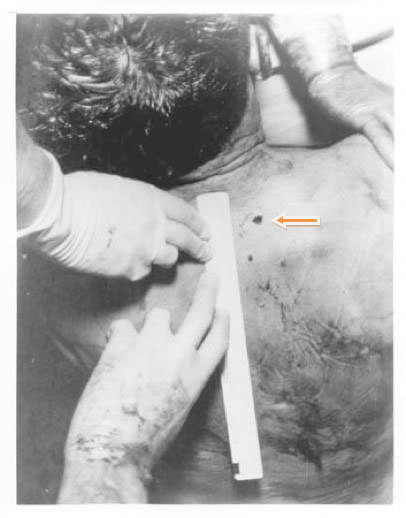 http://jfk-archives.blogspot.com/2010/07/jfk-back-wound-location.html
Figure 2. Autopsy photograph of JFK’s back. The wound (arrow) appears to be at about T1. The scapular spine is faintly visible.
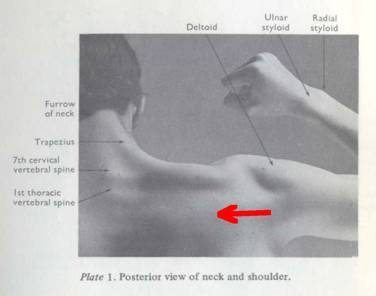 Figure 3A. The horizontal scapular spine can be faintly seen (red arrow), inferior to the level of T1. The scapular spine appears to lie at about the level of T2 or T3, close to Boswell’s level for the back wound on his Autopsy Descriptive Sheet. In other words, the autopsy photo and Boswell’s Sheet are inconsistent. Far worse, though, Boswell later elevated this wound into the neck, much higher than shown in the autopsy photograph. Any level inferior to T1 for the back wound makes the SBT impossible.
 Figure 3B. Another view of the back. Here the scapular spine appears to lie at the level of T3 or T4. An online source assigns a typical level to the scapular spine as T3 (manualmed.blogspot.com/2008/09/thoracic–spine-landmarks.html). The C-designations here are for the cervical nerves, not for the vertebrae. (Nerves C2-C8 exit inferior to the vertebrae C1-C7, respectively.)
 http://www.thesmokinggun.com/file/autopsy-descriptive-sheet?page=0
Figure 4. The Autopsy Descriptive Sheet, prepared by Boswell. Note the level of the back wound (indicated by the horizontal line from “7 x 4 mm”). It appears to lie at least as low as T2, possibly even lower. If accurate, that would immediately invalidate the SBT.
 Figure 5. Skeleton as viewed from the front. McAdams claims (p. 223) that the bullet (of the SBT) traversed JFK at C7/T1 (between the levels of the seventh cervical and the first thoracic vertebrae)—at about the tip of the vertical cyan arrow. The horizontal red arrow identifies the C7 vertebra. As seen here, it is impossible for a bullet to pass between the transverse process of C7 and the medial portion of the first rib (cyan arrow), without damaging bone. Also note how close together (actually overlapping) these transverse processes are for all of the cervical vertebrae. Therefore, no bullet could have traversed JFK at any cervical level and still be consistent with the autopsy photograph (without causing obvious bone destruction). On the other hand, a bullet inferior to T1 would likely have perforated the right lung apex, which was not seen at the autopsy. Only a contusion was seen there.
http://www.bing.com/images/search?q=Anatomy+Of+Spine&FORM=IQFRDR#x0y1427
 http://www.info-radiologie.ch/cervical_spine_radiograph.php
Figure 6. Cervical Spine X-ray: AP view. 1, Clavicle. 2, 1st rib (from T1). 3, Trachea. 4, Spinous process of C7. 5, Vertebral Body of C5. 6, Uncinate process. A bullet could not pass at the site implied by McAdams (tip of the vertical cyan arrow), which lies between the level of the C7 vertebral body (horizontal red arrow) and the level of T1, without causing obvious bone destruction. That was not seen in JFK. Figure 7. CT scan of a patient. This cross section is very close to C7-T1, the level chosen by McAdams for the SBT. I used JFK’s wound measurements to place the hypothetical trajectory (in red). Such a trajectory is impossible here because bone from the spine (the transverse process) intervenes. Based on his X-rays, JFK experienced no such bone trauma. In 1963, CT scans were still in the distant future. This visual disproof of the single bullet theory was first anticipated several years after the assassination (but still well before CT scanners) by a pathologist, John Nichols, MD, PhD.
Appendix 6: Exit and Entrance Wounds in the Literature (per Milicent Cranor)
-
Entrance wounds can be jagged. A few JFK witnesses said that the throat wound was somewhat jagged; these comments have been used by WC loyalists to conclude that the throat wound was an exit.
-
Entrance wounds need not have abrasion collars. Some of the Parkland doctors indicated that JFK’s throat wound had an abrasion collar, which would suggest an entrance wound. However, its absence would prove nothing.
-
Shored (buttressed) exit wounds do have abrasion collars; in fact, these are typically large (not the case for JFK). The abrasion collar is formed when the bullet crushes the skin against a rigid object that “shores” the skin, i.e., the skin is fixed in place as the bullet exits. And, because the skin is kept in place and is not stretched outward while the bullet advances, the wound size matches the bullet size (like a cookie cutter). Most entrance wounds are shored by muscle or bone and are therefore small. JFK’s small throat wound is sometimes attributed (by WC loyalists) to shoring by the collar and necktie. But in every case of a shored wound, there is a pronounced abrasion collar, with bits of skin pulled outward as the neck and shirt eventually separate. Therefore, skin is left behind on the material (in this case, the shirt). The FBI examined the inside of JFK’s shirt, but they found not even a scrap of skin.
-
Exit wounds can be small, as proved by well-controlled experiments and wartime experience. A typical (unshored) exit wound is large. In this case, the bullet stretches the skin outward, causing tenting and then tearing of the skin as it exits, and it leaves behind a star-shaped wound. Loose clothing can permit enough stretching that the bullet can exit before it encounters cloth. In specific cases though unshored exit wounds can be even smaller than the entrance wounds from the same bullet. This is more likely when the exit speed is low. In particular, a bullet fired from a great distance may lose much of its energy, and thereby create a small exit wound.
-
When police cannot decide between an entrance versus an exit wound (e.g., when the context is controversial), pathologists are asked to analyze the wound under the microscope. For instance, just as the beveling of the skull can often determine entrance versus exit, so also can the beveling of bullet wounds in skin, i.e., dermis and epidermis are affected similarly to the skull tables.
Appendix 7: The Hole in the Windshield
The following is a quotation from Doug Weldon at (http://educationforum.ipbhost.com/index.php?showtopic=15484).
The windshield Taylor was shown in 1975 had to be the one you [presumably meaning “Barb and Jerry”] showed in your comparison study in your article by John Hunt. Martin Hinrichs did a detailed study and demonstrated that the cracks were not the same. Jerry himself now questions whether the two windshields in the article are the same. Jerry wrote on this forum “Yes, that’s correct. Right now, I don’t think any windshield comparison can be conclusive including Hunt’s. If we can gather better data at the Archives it might be possible, but right now I’m certain that we really don’t know exactly what it is we’re trying to compare.” Martin Hinrichs also pointed out a very pertinent fact: “A comparison of this (sic) two windshield cracks is nevertheless dominated by the following undeniable principal: The windshield was kicked out at 11/26/63 by the feet of the Arlington Glass men. And that dominant cross crack should be visible in every photo post to 11/26/63.” There is also evidence that the Secret Service ordered twelve windshields after the assassination for “target practice.” Did they need these windshields to attempt to duplicate the damage to the original windshield but without a crack,” (sic) George Whitaker stated that the original windshield was “scrapped” (destroyed) on November 25, 1963 in Dearborn, Michigan. [The “sic” entries are mine—DM.]
Appendix 8: My (Still Unanswered) Letter to Max Holland
From the new medical depositions taken by the Assassination Records Review Board (ARRB), we now know that the only recognized autopsy photographer, John Stringer, did not take the autopsy photographs of the brain. A memorandum issued by the ARRB strongly suggests that two different brains were autopsied and that the brain photographs in the National Archives most likely are not those of JFK. My personal, detailed studies of the autopsy skull X-rays, including an original use of optical densitometry, show virtually no brain tissue in a fist-sized area at the front of the skull, just where the photographs (paradoxically) show nearly intact brain. My measurements are not only consistent with the conclusions of the ARRB, but actually anticipated them by several years.
The shot (or shots) to the head pose even worse conundrums for Holland. If he agrees with the pathologists that JFK was struck low on the right rear of the skull, he then has no explanation for the obvious trail of metallic debris that lies more than 4 inches higher. Alternately, if he concludes that a bullet entered much higher, he must then believe that all three qualified pathologists were wrong by 4 inches, and that an absurdly unique event occurred in the history of ballistics—namely that an internal 6.5 mm cross section of a bullet was sliced out and then migrated 1 cm lower and stayed there. In addition, and after all this, he must also believe that the trail of metallic debris still lies well above his proposed entry site. No ballistics expert has ever testified to seeing so much nonsense from one bullet.
Even worse for Holland, just within the past year, Larry Sturdivan, the ballistics expert for the 1977–78 Congressional investigation, has insisted that this 6.5 mm cross section cannot represent a metallic fragment at all—thus crippling the central basis for the conclusions reached in prior official inquiries. My own research on the X-rays over the past 5 years (performed at the National Archives and now published in Assassination Science, edited by James Fetzer) agrees with Sturdivan that this object cannot represent a real piece of metal. [Only a tiny metal fragment is visible at the corresponding site on the lateral X-ray.] I have, in addition, shown how simple it was in that era deliberately to manufacture (in the darkroom) an altered X-ray with a 6.5 mm metallic image added to it (so that Oswald’s rifle would be incriminated). Finally, at my request the ARRB specifically asked each of the autopsy pathologists under oath if they recalled seeing this flagrantly obvious, 6.5 mm object on the X-rays during the autopsy. Just as I had predicted, none of them could recall this artifact—one that my 7-year-old (nonradiologist) son instantly spotted on the extant anterior skull X-ray. [This has been slightly adapted from my article in MIDP, p. 400].
Appendix 9: the Police Dictabelt
The following is extracted from my review of Hear No Evil by Donald Thomas at here.
-
The task now was to find matches, if any, between the 432 test shot patterns and the six evidence patterns. Such matches would presumably determine both the shooter locations and the target sites. For this exercise, the reader must imagine a very large matrix, consisting of 432 entries vertically and six entries horizontally. For each element of this matrix there is an evidence pattern and a test pattern, which are to be compared to one another. So a total of 432 x 6 = 2592 comparisons must be made.
-
Matches for a specific shot were decided based solely on the time between spikes, i.e., amplitude was ignored (except, of course, for the already completed, initial selection of suspect gunshots).
-
A deviation of eight milliseconds (msec) was permitted, since the microphones might not precisely match the motorcycle position. Even air movement might change the matches.
-
The statistical formula for detecting a match was this:
Binary Correlation Coefficient = r = i / √ (N x n)
where i = number of coincident events
N = number of spikes in the evidence pattern and
n = number of spikes in the test pattern.- For a perfect match, r = 1, while r = 0 means no match. But, partly because of so much noise, a perfect match could not be expected. Results of interest were for r > 0.6; however, it should be emphasized that this is an arbitrary value. Some other value could have been chosen, with a likely different final outcome, possibly even wildly different.
- Values for r < 0.5 were ignored; that left only 15 possible matches (see Table 13 by Thomas). These 15 had the generic pattern of gunshot echoes in Dealey Plaza. The reader must understand that this does not mean 15 shots! After all, duplicate test shots had been fired from the TSBD (inside and outside the window). Furthermore, matches sometimes occurred at adjacent microphones—from the same shot—as might well be expected if the motorcycle had been between two adjacent microphones. Only four actual shots were proposed.
Appendix 10. Optical Density and Characteristic Curves for X-ray Films
Because no one recalls the history of this science (of optical density), a short review is appropriate. This history was summarized in a November 1989 article from the Eastman Kodak Laboratory, co-authored by Arthur Haus and John Cullinan—“Screen Film Processing Systems for Medical Radiography: A Historical Review,” Radiographics, Volume 9, p. 1203. The article can also be found online at http://radiographics.rsna.org/content/9/6/1203.full.pdf. After I had completed my original article on the JFK X-rays, I sent a copy to Arthur Haus (the above author). After reviewing it he offered no criticisms of it. I had had a prior conference telephone call with him and his colleague about X-ray films of the 1960s. This information had played a major role in my detective work on the JFK autopsy X-rays and was included in my paper. I later met Haus in person at my specialty meetings in Los Angeles.
The characteristic curve is central to this discussion. It is a graph of optical density versus X-ray intensity (actually the logarithm of intensity). It shows how the optical density of the film varies with the intensity of the X-rays that strike the film. Haus recalls (pp. 1217-1218 of his article) that this data was first explored for photographic films in 1890; the classical paper was by Hurter and Driffield. In 1917, M. B. Hodgson showed that this earlier work could be applied to X-ray films as well. In other words, this science is now nearly a century old. To put this into the context of 1917, JFK and my mother were both born that year; the US entered World War I; and Lenin, although a bit tardy, arrived on Russian soil (from Switzerland, via Sweden and Finland). But the FBI would not begin its fingerprint files for another seven years (in 1924) and John McAdams’s own mother was still very young (or possibly not even conceived) in 1917. (Ironically, McAdams was born in Kennedy, Alabama.)
In the late 1960s, Haus (the same one) and Rossman developed an automated inverse square sensitometer for collecting this data, a device that was still in widespread use in 1989. After I graduated in 1976 from the University of Michigan Medical School, I entered the specialty of radiation oncology. While at USC during residency, I worked with compensating filters for radiation therapy of cancer patients. These devices were built from small metal blocks that were placed in the X-ray beam during radiation treatments, in order to compensate for missing (patient) tissue in the path of the therapeutic X-rays. They helped to prevent hot spots in the dose distribution (inside the patient). Picture a checkerboard pattern in which small metal blocks are piled to a specific height on each square, with greater heights corresponding to more missing tissue. More recently, computer planning systems have used CT-derived compensators to correct for missing (or excess) tissue, such as air cavities (or intervening bone). But the principle is similar: the CT numbers play a role like that played by optical density. (See Radiotherapy for Head and Neck Cancer: Indications and Techniques, 3rd edition, by K. Kian Ang and Adam S. Garden, p. 36.)
When I measured the optical density of the 6.5 mm artifact within JFK’s right orbit (at the Archives), I had invoked the same principles—the optical density was related to the amount of tissue traversed by the X-rays (that had struck a specific point on the film). Of course, if JFK’s X-rays had been double exposed in the darkroom precisely over this 6.5 mm object (as I have proposed—and whose feasibility I have even demonstrated), then this data would make no sense. Such nonsense, of course, is exactly what the data showed. And, consistent with this, no professional has ever been able to make sense of this 6.5 mm object either. It remains unique in the history of radiology. In any case, my major point here is simple and straightforward: no one should claim that optical density measurements are too novel to be used in analyzing X-ray films. The only parameter that is new here is its application to a president of the United States—the principles are the same.
Appendix 11: Odd output from John McAdams’s Filter Factory for Facts
A. Most pieces of evidence must be discarded. (Or, if a different page by McAdams is cited, then such evidence should not be discarded.)
B. Eyewitnesses, even physicians doing what they usually do, cannot be trusted. Furthermore, no distinction need be made between earlier and later recollections of eyewitnesses.
C. Photos are to be trusted over eyewitnesses, even when no one recognizes the photos.
D. The size of Connally’s back wound after surgery is more relevant than its original size.
E Only two physicians at Parkland saw JFK’s throat wound.
F. Because false sightings in general are unreliable, two Oswalds are not possible.
G. Major secrets cannot be kept.
H. The acoustic evidence contained 15 matches.
I. There is nothing noteworthy about the 6.5 mm object within JFK’s right orbit on the AP X-ray.
J. On JFK’s skull X-rays, no metal fragment is seen on JFK’s left side.
K. Fingerprint evidence is “killer” evidence.
Reviews of John McAdams’ book JFK Assassination Logic by
Pat Speer
Gary Aguilar
Frank Cassano -
Anti-Conspiracy theories: Why the media (and Shermer) believe the implausible
A reply to Michael Shermer and the Los Angeles Times
In the JFK assassination, why do the media refuse to accept the overwhelmingly obvious conclusion that Oswald was framed?
Michael Shermer is the publisher of Skeptic magazine, to which I once subscribed. [1] Skeptic has printed at least two pieces that favor a JFK conspiracy, but now Shermer paradoxically promotes the lone gunman theory. Ironically, for that case in particular, he has dropped his pretense of skepticism.
In a November 26, 2013 Op-Ed, Shermer purports to explain away a JFK conspiracy via psychology. However, if this notion is logically extrapolated, no one (not even the judicial system – nor even string theorists) would ever need to consult any facts, i.e., merely identifying an author’s motives would suffice to discern the truth. But what is good for the conspiracist is good for the anti-conspiracist – perhaps some day Shermer will reveal what deep psychology motivates his own persistent obfuscation of the JFK case.
Shermer believes that conspiracy theories offer tidy and simple-minded explanations. But what could be more simple-minded than Oswald as a lone gunman?
Shermer claims that we have had a surfeit of documentaries favoring conspiracy. On the contrary, in my three decades of observing this event, we have never had such a deluge of mainstream support for Oswald. (See my critique of just one of these – on NOVA.)
He claims that evidence points toward Oswald. For once, he is correct. Unfortunately, nearly all of it is suspect. An itemized demolition of these fraudulent claims has come from a fellow Wisconsin Badger (see Into the Nightmare, pp. 195-205, by Joseph McBride). Is Shermer truly ignorant of all this soiled laundry? Moreover, this is hardly the first case in history of misleading evidence. The French had their own Dreyfuss Affair, where virtually all the “official evidence” pointed toward an innocent man. And the Lincoln assassination was a lone gunman case before additional evidence emerged. Even in Watergate, the evidence of conspiracy only evolved across time.
A conspiracy, by definition, requires only two persons. Given the pervasive tendency of humans to socialize, that is the natural state of human affairs. Most curiously, the original meaning of conspiracy theory was neutral. Only since the mid-1960s (suspiciously right after the JFK assassination) did it become a term of ridicule. It is now a term of derision, whose sole purpose is promptly to strangle any serious examination of the evidence. Oddly enough, The Paranoid Style in American Politics (by Richard Hofstadter), was first published in Harper’s Magazine on the first anniversary of the JFK assassination – in November 1964.[2]
Michael Parenti has observed that even the CIA is, by definition – via its covert actions and secret plans – a conspiracy. Ambassador David K. E. Bruce, in his formal report on the CIA to President Eisenhower, disclosed the devastating impact these conspiracies had on US foreign policy.[3] Even the Mafia (by its very nature) believes in conspiracies.
Justin Fox of Time magazine describes most Wall Street traders as conspiracy-minded; he adds that most good investigative reporters are also conspiracy theorists. For conspiracy theorists in this JFK case, see my long list (with supporting documentation – see Addendum 5). Here are several: Lyndon Johnson, Richard Nixon, John Connally, J. Edgar Hoover, John McCone, David Atlee Phillips, Robert Tanenbaum, James Rowley, George Burkley, Jesse Curry, Roy Kellerman, Evelyn Lincoln, Richard Russell, Bertrand Russell, G. Robert Blakey, and Robert Kennedy, Jr.
Cass Sunstein, in a 2008 paper, offered his own remedies for conspiracy theories; he proposed infiltrating them to cause internal disruption. In other words, his response to conspiracy theories was to propose a conspiracy of his own. Several years ago, I sent him a rebuttal. I am still waiting for his reply.
My own view of the JFK assassination has evolved from mere belief into actual knowledge. Based on my seeing (on nine different occasions) the JFK artifacts at the National Archives, I now know that the JFK skull X-rays are copies, not originals, and that the mysterious 6.5 mm bullet-like fragment (supposedly at the back of the skull) was added to the X-ray in the darkroom, merely to incriminate the supposed weapon – a 6.5 mm Mannlicher-Carcano.
On November 22, 2013, I met with James Jenkins, who had been Dr. Boswell’s technician at the JFK autopsy. He confirmed my conclusion (based on hundreds of data points via optical densitometry on the extant JFK skull X-rays) – that the images of the brain in the National Archives are fraudulent. But this was no surprise; after all, the official autopsy photographer, John Stringer, had long ago disavowed these photographs as those he took.
• David W. Mantik earned his Ph.D. in physics at Wisconsin and his M.D. at Michigan. He is Board Certified in radiation oncology by the American Board of Radiology. A former fellow of the American Cancer Society and director of residency training in radiation oncology at Loma Linda University, he has also used proton beams to cure cancer.
“A reliable way to make people believe in falsehoods is frequent repetition, because familiarity is not easily distinguished from truth.”
“It is the consistency of the information that matters for a good story, not its completeness. Indeed, you will often find that knowing little makes it easier to fit everything you know into a coherent pattern.”
“The confidence that individuals have in their beliefs depends mostly on the quality of the story they can tell about what they see, even if they see very little. We often fail to allow for the possibility that evidence that should be critical to our judgment is missing – what [you] see is all there is (WYSIATI).”
“They didn’t want more information that might spoil their story.”
– Thinking Fast and Slow (2011) by Daniel Kahneman
(Winner of the Nobel Prize in Economic Sciences for his seminal work in psychology)Postscript: A Rebuttal from Shermer (and the Los Angeles Times)
Before my critique had even been submitted to the Los Angeles Times, Shermer had already struck back. Here is what the Times printed on Saturday, November 30, 2013 (p. A15).
Facts or Conspiracies?
Almost all of the readers who responded to Michael Shermer’s November 26, 2013 Op-Ed didn’t buy his idea that psychology helps to explain why JFK assassination theories persist. Reader Stephany Yablow of North Hollywood wrote:
“J. Edgar Hoover came up with the lone-gunman scenario within 24 hours of the assassination as a cover-up. Lyndon Johnson backed it, demanding that the case be closed quickly.
“The Warren Commission was political window dressing. It failed to thoroughly investigate, interview witnesses and experts and conduct forensic studies. It produced a shallow report.
“Maybe people would believe the lone-gunman theory if Jack Ruby didn’t waltz into the jail and kill Lee Harvey Oswald; hence, the theory that someone directed Ruby to do so. There must have been at least two people (the requisite number of actors to define a ‘conspiracy’). If the lone-gunman proponents had a better answer, they haven’t convinced us yet.”
Michael Shermer responds:
[Note by Mantik: Misleading statements so densely infest this manifesto that each opinion is itemized, followed by my comments. Shermer’s words are in italics.]
-
The Warren Commission report was shallow? At 880 pages, I wonder what would be considered deep.
Reply (based on the work of Walt Brown): Of the 488 witnesses who testified, only 93 did so in the presence of any of the seven members of the Commission. Here is the scorecard: Earl Warren – 93, Allen Dulles – 70, Gerald Ford – 60, John Sherman Cooper – 50, John McCloy – 35, Hale Boggs – 20, and Richard Russell – 6. What value would be placed on a judicial proceeding in an American courtroom in which the prosecutors, the defense attorneys, or certain jurors just came and went as they pleased? Furthermore, anyone who has even glanced at these volumes quickly recognizes that trivia and irrelevancies populate the pages, but critical witnesses are often studiously avoided. Insofar as a “deep” analysis, one example is Douglas Horne’s five volume set: Inside the Assassination Records Review Board. Horne’s book is 1880 pages. (The Warren Report is actually 888 pages.) Another would be Walt Brown’s Chronology of the JFK Assassination.
-
In any case, five different government investigations – along with countless private inquiries – have concluded that the evidence overwhelmingly points toward Oswald as the lone assassin.<
Reply: Shermer apparently has not read that brilliant piece by Dr. Gary Aguilar and Kathy Cunningham: “How Five Investigations into JFK’s Medical Autopsy Evidence Got It Wrong.” Insofar as private investigations, Shermer likewise seems hopelessly lost – the vast majority favor conspiracy. (See his last statement here, which implies that he does know this.)
-
Oswald’s Carcano rifle with his fingerprints on it was found on the sixth floor of the Texas School Book Depository.
Reply: The weapon (actually a carbine, not a rifle) in evidence is not the one ordered by LHO. The Commission states that he used a coupon from the February 1963 issue of The American Rifleman (but this ad does not appear in the Commission). The ad is for a 36″ Carcano weighing 5.5#. The weapon in evidence is supposedly 42″ and weighs 8# (with sling and sight). The first weapon reported in the Texas School Book Depository was a 7.65 German Mauser; Eugene Boone filed two separate reports to this effect, and Seymour Weitzman filed a confirming affidavit. Boone later testified that Captain Fritz and Lt. Day also identified it as a Mauser. The weapon in evidence, however, clearly reads “Made Italy” and “Cal, 6.5″.” Furthermore, no one has explained why a wannabe assassin would purchase a weapon by money order through the mail – instead of paying cash locally (with no trace of ownership). In addition, on the supposed purchase date (March 12), Oswald was at work from 8 AM to 12:15 PM (see Harvey and Lee by John Armstrong for company employee records). If the post office records can be believed, LHO walked 11 blocks to the General Post Office, purchased a money order, but then did not mail it from there. Instead, he walked many bocks out of his way (eventually using a mailbox) before returning to work, where his absence was not noted. This order then arrived the very next day at Klein’s (in Chicago) – and was already deposited at the bank that same day! Unfortunately, the bank deposit actually reads February 15, 1963 – not March 13, 1963. Of course, if the date really had been February, then the serial number C2766 could not apply to the weapon in the backyard photographs. For even more anomalies on the MC see Reclaiming Parkland by James DiEugenio.
Insofar as fingerprints go, none were initially found on the weapon. Only after a visit by federal agents to the morgue, where Oswald was fingerprinted – according to the mortician, did a palm print appear on the weapon. Moreover, during the last several decades much doubt has been cast on fingerprint evidence in general; see my review of John McAdams’s book.
-
Three bullet casings there match what 80% of eyewitnesses in Dealey Plaza reported hearing: three shots.
Reply: The initial report described only two casings. The so-called Magic Bullet (which should have matched the casings) could not be identified at Parkland Hospital by the man who handled the actual bullet. Josiah Thompson (a private detective) and Dr. Gary Aguilar have demolished the chain of possession for this bastard bullet. Regarding witnesses, a long list of them reported that the final two shots were very close together, much too close for the Mannlicher-Carcano. [4]
-
It was the same rifle Oswald purchased in March 1963, which he then used the following month in an attempt to assassinate the rabidly anti-communist Army Maj. Gen. Edwin Walker.
Reply: Walker denied that Oswald had shot at him. The bullet was not matched to any weapon owned by Oswald. At the time of the event, the Dallas Morning News reported a 30.06 bullet. (Of course, the Warren Report omitted this.) A witness, Kirk Coleman, saw two men, but neither was Oswald. A photograph of a car behind Walker’s house turned up at Ruth Paine’s house and was ascribed to Oswald. While the police had that photograph, the license plate disappeared from the back of the car. However, Chief Curry’s book (1969) contains a photograph of Oswald’s possessions, including that Walker photograph. In that version, the license plate is intact – which strongly implies that the police had cut it out of the other one.
-
Co-workers saw Oswald on the sixth floor of the depository shortly before JFK’s motorcade arrived, and saw him exit soon after the assassination.
Reply: Oswald worked in the building and might well have been seen there. But Shermer fails to tell us when he was seen there. The only witness the Commission could round up was Howard Brennan, who had poor eyesight; he could not identify Oswald in a line-up later that same day. Furthermore, the window in the sniper’s nest was partly closed, making it virtually impossible for Brennan to get a good look at the man’s face. Arnold Rowland and Carolyn Walther saw a man with a rifle, but neither identified Oswald. Furthermore, both said they saw two men! Within 90 seconds of the shooting, Roy Truly spotted Oswald drinking a coke in the second floor lunch room. Victoria Adams walked down the same stairs (from the fifth floor) right after the shooting and did not see Oswald.
-
Oswald went home and picked up his pistol and left again, shortly after which he was stopped by Dallas Police Officer J. D. Tippit, whom Oswald shot dead with four bullets.
Reply: “The official story of the Tippit killing is full of holes.” [5] McBride has devoted most of his book (and much of his life) to the Tippit case. If Shermer truly likes long books (as he claimed about the Warren Report), then he will love this book (662 pages). It is mostly devoted to the Tippit case. The author firmly denies that Oswald shot Tippit. Another author, John Armstrong, has investigated this murder for two decades and has now developed a detailed scenario of the event. Has Shermer done as much research on this as Armstrong or McBride?
-
He then ducked into a nearby theater without paying, which resulted in a police confrontation.
Reply: Theater employee Warren Burroughs said that Oswald went to the balcony. A police dispatcher (at 1:46 PM) stated that Oswald was in the balcony. However, Oswald was arrested on the main floor. Bernard Haire saw a second man (who was flushed, as though he had been in a struggle) leave the rear of the theater and then be placed into a police car. Until Haire saw Oliver Stone’s film, he had always thought that he had seen Oswald’s arrest. Can Shermer explain any of this?
-
Two days later, Oswald was himself assassinated by a pro-Kennedy nightclub owner named Jack Ruby, who said his motive was “saving Mrs. Kennedy the discomfiture of coming back to trial.” Thousands more pieces of evidence all converge to the unmistakable conclusion that Oswald acted alone.
Reply: Does Shermer truly know more than these legal minds, which were deeply immersed in the case? (None of them believed in a lone gunman.)
Senator Richard Russell, member of the Warren Commission
John McCloy, member of the Warren Commission
Rep. Hale Boggs, member of the Warren Commission
Senator John Sherman Cooper, member of the Warren Commission
Rep. Henry Gonzalez, chair of the HSCA
Rep. Don Edwards, chair of the HSCA
Robert Blakey, Chief Counsel for the HSCA
Robert Tanenbaum, Chief Counsel for the HSCA
Richard A. Sprague, Chief Counsel for the HSCA
Gary Cornwell, Deputy Chief Counsel for the HSCA -
In the 50 years since, conspiracy fabulists have concocted more than 300 different people and organizations allegedly involved in the assassination, and yet not one line of evidence conclusively supports any of these suspects. It’s time to move on and let JFK R.I.P.
Reply: If Shermer had paid any attention to JFK books or meetings during the past year, he would know that the evidence of a cover-up by federal agencies is now overwhelming. Instead, he has responded like an automaton, programmed to recite the Commission’s dogmas. He even evades the last official government investigation (the HSCA), which declared a probable JFK conspiracy. We might well ask: What about history? For example, what if the Dreyfuss affair had simply been left to lie dormant? Or what if the Lincoln assassination had never been pursued – or if no investigation had been done into Watergate, or into Iran-Contra, or into BCCI? What then Mr. Shermer?
Notes
-
I let my subscription lapse after I became skeptical of some of these alleged skeptics.
-
According to Wikipedia, on November 21, 1963 (sic) Hofstadter delivered the Herbert Spencer Lecture at Oxford University (on this same subject)
-
Timothy Weiner, Legacy of Ashes (2007), pp. 133-135. The complete report is still unavailable!
-
Assassination Science (1998), edited by James Fetzer, p. 296.
-
Joseph McBride, Into the Nightmare (2013), p. 201.
-
-

Conspiracy Theory? Why No One Believes the Warren Report
For most Americans, the assassination of John F. Kennedy is just a history lesson: a national calamity, to be sure, yet something that happened a long time ago. But for an ever-dwindling number it is much more than that. What happened fifty years ago on November 22 is a remembered event, as vivid as September 11, 2001: a day the world turned upside down.
Whether or not you can remember that awful day, chances are good you don’t believe that Lee Harvey Oswald, acting alone, shot President Kennedy. Few people do. That may have something to do with Oliver Stone, whose incendiary film JFK pointed the finger of blame squarely at government insiders. But it probably has more to do with some people most have never even heard of: ordinary Americans who, back in the 1960s, were the first to demonstrate that the assassination could not have happened the way the government said it did. Their work may one day become an American legend, as familiar as the ride of Paul Revere.
These early critics were mostly private citizens, but they shared an intense interest in an extraordinary event and a determination to do something about it. There were barely a dozen of them, at first, and they were scattered about the United States. Most did not know each other in 1963. Independently, they launched amateur investigations into one of the major events of the twentieth century. Amateur, but effective: over the years, their work has had an enormous impact on public opinion.
Today, on the eve of its fiftieth anniversary, research into the Kennedy assassination is very much alive. Yet the issue has a serious public relations problem; when modern-day critics are acknowledged it is usually derisive. “These people should be ridiculed, even shunned,” The New York Times Book Review sneered in 2007. “It’s time we marginalized Kennedy conspiracy theorists the way we’ve marginalized smokers.”
But the earliest critics were not conspiracy theorists, and this is an important point. They analyzed the government’s case on its merit, testing the official evidence to see whether it could stand on its own. And their analyses led to an inescapable conclusion: there had indeed been a conspiracy to assassinate President Kennedy. Who conceived and carried out that conspiracy was an entirely different question.

The New York Times, Feb. 5, 1964 A special commission concluded in 1964 that Lee Oswald, alone and unaided, killed JFK and wounded Texas Governor John Connally. They implied it was an open-and-shut case, yet its chairman, Chief Justice Earl Warren, said that for national security reasons not all of the evidence would be made public right away. “There will come a time,” he told a reporter. “But it might not be in your lifetime.”
It didn’t seem to follow. If Oswald was indeed the lone assassin, where was the issue of national security?
President Kennedy had come to Texas to mend political fences, with an eye toward re-election in 1964. Arriving in Dallas late on the morning of November 22, 1963, he rode in a motorcade through the city headed for the Dallas Trade Mart, where he was scheduled to speak to a business luncheon. The streets were crowded with cheering spectators. As the motorcade passed the Texas School Book Depository building in Dealey Plaza, shots rang out – ending the life of the thirty-fifth president of the United States, and touching off an enduring mystery.
Before the day was done, the Dallas police not only arrested Lee Harvey Oswald in connection with the assassination, but also charged him with killing a police officer who had tried to arrest him soon afterward. Oswald vigorously maintained his innocence, yet authorities declared that same day the case was all but closed. “It was obvious,” one critic later said, “that even if this subsequently turned out to be true, it could not have been known to be true at that time.”
A week later, the accused shot dead, new president Lyndon Johnson appointed a commission “to study and report upon all facts and circumstances” relating to these shocking crimes. Known popularly as the Warren Commission after its chairman, it would produce two significant works: a single-volume report and a 26-volume set of hearings and exhibits, the latter being the raw data from which the report was ostensibly derived.
Once those materials were issued, the Warren Commission’s work was finished. But for the first generation of critics, it was just getting underway.
Perhaps the best known of the early critics was an attorney and former member of the New York State Assembly named Mark Lane. Lane briefly represented the mother of accused assassin Lee Harvey Oswald and even appeared before the Warren Commission, which had grown curious about his investigative activity.

Disturbed that Oswald had been denied fundamental constitutional rights, Lane wrote a long defense brief on his behalf and sent it to the newly formed Warren Commission. Lane said that even though he was by then dead, Oswald, “from whom every legal right was stripped,” deserved representation before the Commission.
The National Guardian published the brief on December 18, 1963, and The New York Times summarized it in an article that same day. A Times reporter asked if Lane planned to represent Oswald. “He would be willing to take on such a role,” the reporter wrote, “but was ‘not offering’ to do so.”
In Texas, Lee Oswald’s mother welcomed Lane’s appearance on the scene. Marguerite Oswald saw the Times article after an Oklahoma woman named Shirley Martin sent it to her. The two women did not know each other, but Mrs. Martin, concerned that something wasn’t right, instinctively reached out. “My suspicions did not take long surfacing thanks to the Keystone Kops in Dallas,” she recalled years later. After sending the article, Mrs. Martin telephoned Mrs. Oswald about Lane. “We were both excited. Here was Richard Coeur de Lion riding to the rescue in the form of a stouthearted New York lawyer. Marguerite took it from there.”
Mrs. Oswald contacted Lane and asked him to represent her dead son before the commission. But Lane hesitated: the obstacles before him, principally a lack of money, seemed too great. If he took the case he would almost certainly lose his sole corporate client, his bread and butter.
“He’s being tried by the Warren Commission,” Marguerite Oswald countered. “He has no lawyer. Will you represent his interests or didn’t you mean what you wrote?”
Lane agreed to do what he could.
In Los Angeles, businessman Ray Marcus wrote a letter to Earl Warren shortly after the chief justice agreed to head the commission that would soon bear his name. “I join the overwhelming majority of other Americans in extending to you and to your committee my heartfelt support in the arduous and trying task that history has laid before you.”

Raymond Marcus Marcus had already begun tracking media coverage of the assassination, and conflicting accounts of what happened fueled his skepticism. He still hoped for an honest investigation. “But with each day,” he recalled, “it was clear that that wasn’t going to be the case.”
Within a few days of the assassination Marcus made a key observation, after Life magazine published an extraordinary series of photographs documenting the entire shooting sequence. These were frames from an eight-millimeter home movie taken by an assassination eyewitness named Abraham Zapruder. “In one of those pictures, a picture of Connally immediately after he was hit, I saw something which led me to believe that at least that shot could not have come from the Book Depository Building,” Marcus said. He couldn’t be sure from Life’s fuzzy reproductions. “But the direction in which the shoulders slumped presented a picture of the man just as he was hit, and it indicated to me that the shot could have come from the front.”
The authorities had already said Oswald, acting alone, shot from behind the motorcade. But the Zapruder film seemed to tell a different story. For the next several years, Marcus would study its frames closely; he would emerge as an authority on the film documenting what have been called the most intensely studied six seconds in United States history.
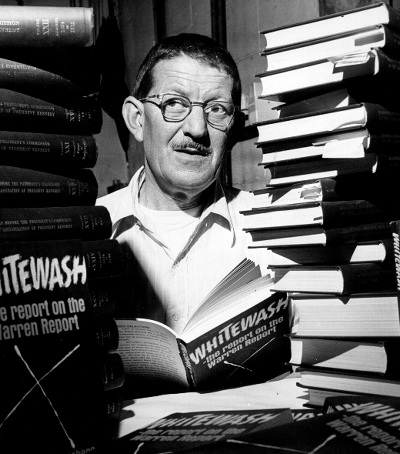
Harold Weisberg At the time of the assassination, Harold Weisberg was trying to jump-start a writing career he had abandoned some years before. The son of Ukrainian émigrés and the first member of his family born in the United States, Weisberg was a former Senate investigator and journalist living in Maryland. He was immediately skeptical of the lone gunman story out of Dallas, so he drafted an outline for an article and sent it to his literary agent.
The agent, Weisberg always recalled with astonishment, told him that nobody would consider publishing anything other than what the government said. “Can you understand how shocking that was to me?” he later asked. “With my background? And my beliefs about the functions of information in a country like ours?” Weisberg went on to write Whitewash and other books, all of them detailed analyses of the official case, and highly critical of the government’s handling of it.
Other early critics included Mary Ferrell, a Dallas legal secretary; Vincent J. Salandria, an attorney in Philadelphia; Maggie Field, a housewife in Beverly Hills, California; and Sylvia Meagher, a researcher at the World Health Organization in New York, who later wrote a penetrating analysis of the case called Accessories After the Fact. Each was a product of that era some call America’s greatest generation.
For most of these critics the assassination was nothing less than all consuming. “‘Oswald’ is the most spoken word in our house,” Salandria’s wife remarked in 1965. The objective: force a re-opening of the investigation. Although they began following and writing about the case immediately, it wasn’t until 1966 these critics began to get much media attention. Most labored in relative obscurity, and only gradually became aware of each other and their common goal. As they did, they began exchanging ideas and information by telephone, and by what today we refer to as snail mail. There was much the early critics didn’t know. But what they did know was that something was terribly wrong.
For nearly all of the first generation critics, their initial research was simply tracking the assassination story as it was reported in the press, and noticing, in the first days and weeks, its inconsistencies.
Like the rest, Mary Ferrell’s suspicions stirred almost immediately. At the time of the assassination she had just emerged from a Dallas restaurant not far from the scene of the crime. A passerby alerted her to what had happened. At almost the same moment police squad cars sped by, sirens blaring. “I ran into a bookstore and called my husband,” she recalled. He heard Kennedy had been shot in the head, Buck Ferrell told his wife, and no one could survive that kind of wound.
Someone had a radio, and Mrs. Ferrell listened to the first sketchy descriptions of the wanted man. “I stood on Elm and thought that they would never find him with no more than that to go on, in an area containing over a million people.” She was thus astonished when the police arrested Lee Harvey Oswald about an hour later – and even more astonished that he did not match the broadcast description she had heard. “The Dallas Police were not gifted with ESP,” she wryly recalled. “And it just – it didn’t fit. And I said, Something is wrong. And I just, I thought, I’m going to find out what everybody said.”

And so she sent Buck and their three sons to the loading docks of The Dallas Morning News and The Dallas Times-Herald where, in shifts, they awaited each updated edition of the daily papers. “Kind of a round robin, for four days,” Mary Ferrell remembered. “And we got every issue of every paper.”
Mrs. Ferrell came across an article in the November 25th issue of the Times Herald hinting at something ominous. The article, “Anonymous Call Forecast Slaying During Transfer,” stated: “An anonymous telephone call to Federal Bureau of Investigation headquarters at 2:15 a.m. warned that Leo [sic] Harvey Oswald would be killed during his transfer from the city lockup to county jail.” The FBI alerted Dallas authorities – yet still Oswald was gunned down. Both papers were putting out multiple editions of each issue, but that article appeared in just one edition and there was no follow-up. “They junked that,” Mrs. Ferrell said. “There were very few copies of that that got loose.”

Mary and Buck Ferrell Her interest further stimulated, Mrs. Ferrell continued collecting assassination-related material and never did stop. By 1970 her collection had become so vast that her husband added a room to the back of their Dallas home. “I can move all my books, papers, file cabinets, etc., out there and give the house back to Buck,” Mrs. Ferrell told a friend. She created an extensive database – originally on index cards, but in later years on a personal computer – and with another researcher, a series of chronologies that charted the people and events relating to November 22, 1963.
In the end, the Warren Commission did not allow Mark Lane to represent the deceased accused assassin. “We are dealing with the mother of Oswald and this lawyer by the name of Lane,” Earl Warren told his commission colleagues in January 1964. “He wants to come right into our councils here and sit with us, and attend all of our meetings and defend Oswald, and of course that can’t be done.”
A few days later, at New York’s Henry Hudson Hotel, Lane spoke about his preliminary findings to a crowd of about five hundred people. For the balance of the year he would lecture publicly about the case, at first just in New York, but soon during an ambitious lecture tour that criss-crossed the nation and even ventured as far away as Eastern Europe.
On February 18, he was in New York for a speech that included an appearance by Marguerite Oswald. An enthusiastic crowd of 1,500 heard Mrs. Oswald say, “All I have is humbleness and sincerity for our American way of life.” She described how she tried to meet with her jailed son before he was murdered, but the Dallas police would not permit it. “Why would Jack Ruby be allowed within a few feet of a prisoner – of any prisoner – when I could not see my own son?”

Sylvia Meagher Among those in the hall that night was Sylvia Meagher, a 42-year-old researcher at the World Health Organization. “At that stage, I had little or no thought of doing any independent work or writing on the case,” she recalled. “I contributed both money and information unreservedly to Lane or his associates, and I would have been delighted to help in any possible way.”
Yet she had already written a memorandum recording bitter thoughts. When the Warren Commission published its single-volume report she read it with a critical eye, and soon produced a 40-page article that she began shopping around to major magazines. “The Warren Report,” she wrote, “gives us no justification for declaring that the case is closed.”
There were a lot of questions, just after the assassination, about how many times the President was hit, and where his wounds were located. Even after fifty years, these questions have never had definitive answers.
Harold Weisberg was appalled that so many unanswered questions remained. “None should exist,” he declared. “This was not a Bowery bum; this was the President of the United States.” Post-mortem photographs of the late president’s wounds were never entered into evidence and the Commission members never saw them. Autopsy surgeon James Humes said he was “forbidden to talk,” and acknowledged having burned his autopsy notes. JFK’s neck wound was first reported to be one of entry, but later reported to be an exit wound. The first mention of a back wound was not made until nearly a month after the assassination. “As one version of the wounds succeeded another with dizzying speed and confusion,” Sylvia Meagher observed, “only one constant remained: Oswald was the lone assassin and had fired all the shots from the sixth floor of the Book Depository. When facts came into conflict with that thesis, the facts and not the thesis were changed.”

The conclusion that one bullet caused multiple wounds in JFK and Texas Governor John Connally – the Single Bullet Theory – was undermined by the Warren Commission’s own evidence, the critics argued. That bullet, Commission Exhibit 399, was virtually undamaged, its appearance nearly pristine. The critics compared it to an identical bullet, Commission Exhibit 856, which had been test-fired by ballistics experts at the Army’s Edgewood Arsenal in Maryland. “The test bullet had been fired through the forearm of a cadaver,” said Ray Marcus, whose interest had expanded to include C.E. 399. That test bullet performed “only one of the multiple tasks allegedly executed by 399. Even so, the difference in the appearance of 856 and 399 is striking, as the former is grossly deformed.”
In April 1964 Marguerite Oswald ended her relationship with Mark Lane. Almost immediately Lane formed an organization called the Citizens’ Committee of Inquiry to coordinate an independent investigation into the assassination. From its New York office, the CCI recruited a small army of volunteer investigators, some of who were dispatched to Dallas to interview assassination witnesses on Lane’s behalf.

Vincent J. Salandria Among these volunteers were Vince Salandria and his brother-in-law Harold Feldman, a writer and translator. Both men were keenly interested in the assassination when it happened, and together had researched an article published in The Nation the previous January. On the morning of June 24, 1964, they left Philadelphia together in Salandria’s 1955 Buick sedan, armed with lists of names, notes, and other material supplied by Lane’s office. Feldman’s wife Immie accompanied them. Driving almost non-stop, they arrived in Dallas late the next day.
Feldman and Salandria immediately contacted Marguerite Oswald. Media accounts had prepared them for a belligerent, uncooperative woman. “What I heard instead,” Feldman recalled, “was a pleasant ladylike welcome – not a trace of cautious ambiguity, not a second of hesitation in the warm courtesy that carried within it only a faint suggestion of loneliness.” The Feldmans and Salandria met with Mrs. Oswald over the next several days, and Marguerite even had them as overnight guests in her Fort Worth home.

(L-R): Harold Feldman,
Immie Feldman, Marguerite Oswald
Mrs. Oswald escorted the volunteer investigators to some of the key sites in the case. Together they visited Helen Markham, the Warren Commission’s star witness against Lee Oswald for the murder of Dallas Police Officer J.D. Tippit. Mark Lane had already spoken with Mrs. Markham by telephone, and her identification of Oswald as the killer of Tippit seemed shaky. A follow-up interview was important.
Mrs. Markham lived in a small apartment over a barbershop. Mrs. Oswald, Salandria and the Feldmans found her at home, cradling her infant granddaughter in her arms and pacing back and forth. She declined to talk to them because, she said, she had to care for the baby. She would not let them pay for a babysitter, but did finally agree to let them return later in the day. As they spoke, Mrs. Markham allowed Marguerite to briefly hold the baby.
Helen Markham, although a grandmother, was still young, Feldman observed – “but shabby, beaten, and spiritless.”
They returned later that afternoon. As they approached the apartment they noticed two Dallas police cars, which had been parked right outside, pulling away.
What happened next, Feldman later wrote, was “the most pitiful spectacle in our experience.” They knocked on the Markham apartment door. Mr. Markham was now home, and he stood barring the entrance as his wife cowered to one side.
“I’ve never seen that kind of terror,” Salandria recalled years later. “Their teeth were actually chattering. And we could get little from them because of their terror.”
“Please go away,” Mr. Markham had groaned. “Please go away, and don’t come back.”
Marguerite broke in. “You’ve been threatened, haven’t you?”
“Yes,” Mr. Markham replied. “Please, go away!”
Shocked, they did as they were asked. As they got back out to the street and headed toward Mrs. Oswald’s car, Marguerite fought back tears. “That poor man!” she said. “He was frightened to death. What right do they have to threaten him? This is still America, by God.”
Since alerting Marguerite Oswald to Mark Lane’s article, Shirley Martin had gone to Dallas several times to find assassination witnesses and talk to them. Not in any official capacity, of course: curiosity, and the feeling that something was not right, motivated her. Her proximity to Dallas – it was only two hundred miles away – proved an irresistible lure.
By the summer of 1964 Mrs. Martin was in contact with Lane’s office, and Lane asked her to speak with a Dallas woman named Acquilla Clemons. Acquilla Clemons was not an eyewitness to the Tippit murder but was nearby, and witnessed some things that were at odds with what was reported in the press.
The Warren Commission had not called Mrs. Clemons to testify, and these early Citizens’ Committee-sponsored trips first brought her story to light. There were at least three interviews with Mrs. Clemons by committee volunteers over the summer of 1964: by two Columbia University graduate students named George and Pat Nash; Salandria and the Feldmans; and Shirley Martin.
George and Pat Nash were unimpressed with Acquilla Clemons. They wrote that her description “was rather vague, and she may have based her story on second-hand accounts of others at the scene.” Unfortunately the Nashes did not say why they doubted her.
Salandria and Feldman interviewed Mrs. Clemons in early July. No record of their conversation appears to exist, but Salandria later said, “I thought she was entirely credible.”

Shirley Martin Shirley Martin spoke to Mrs. Clemons in August, about a month after Salandria and Feldman and the Nashes. She was not at all confident that Acquilla Clemons would talk to her. And so her daughter Vickie, who accompanied her mother, hid a tape recorder in her purse.
For much of the conversation, Mrs. Clemons gave Mrs. Martin a lot of reasons why she didn’t want to talk to her. Mrs. Martin seemed to sense her nervousness. “I’m a private citizen,” she said. “I’m not representing any group.” Still Mrs. Clemons demurred; her employer, she said, did not want her involved in the case in any way.
Undaunted, Shirley continued. “This friend of mine was here…I don’t know if you remember. Mr. Nash? Mr. Salandria? They talked to you?”
“Someone came by my house about two months ago,” Mrs. Clemons replied. They promised to send her a picture of Lee Oswald, she said, but never did.
Finally Mrs. Clemons began to talk. She described seeing two men, neither of them Oswald, in the vicinity of the Tippit killing. More than once since then, she said, the police had warned her not to talk to anyone about what she had witnessed on November 22nd.
“So the police said you’d get a lot of publicity and you’d better not do it?”
“Yeah, I’d better not,” Mrs. Clemons replied. “Might get killed on the way to work.”
“Is that what the policeman said?” Shirley Martin asked.
“Yes,” Mrs. Clemons answered. “See, they’ll kill people that know something about that…there might be a whole lot of Oswalds…you know, you don’t know who you talk to, you just don’t know.”
“You scare me…”
“You have to be careful,” Mrs. Clemons said. “You get killed.”
The Warren Commission’s single-volume Report was published in September 1964, and two months later its 26 volumes of hearings and exhibits. This was the moment that the early critics had been waiting for. “I was wildly excited,” Sylvia Meagher recalled. “I opened the box. There were the 26 volumes, everything I’d been looking forward to studying for a long time.” Meagher went on to write a devastating analysis entitled Accessories After the Fact.
The news media, too, greeted the Warren Report with great enthusiasm – but from a much different perspective. Time magazine called it “amazing in its detail [and] utterly convincing,” while The New York Times said “the evidence of Oswald’s single-handed guilt is overwhelming.” The CBS, NBC and ABC television networks all hailed the Report as the final word on President Kennedy’s assassination, and devoted much airtime to its findings.
Mark Lane, who had been speaking publicly about the weaknesses in the government’s case since January, now began debating the Report and its validity. In October 1964 he sparred with Melvin Belli, the celebrated attorney who had unsuccessfully defended Jack Ruby for murdering Lee Oswald. Belli performed badly and was even jeered by the audience; he conceded that Lane “was bright and he had an almost encyclopedic knowledge of the facts.”
On December 4 Lane took part in a much more important event, appearing with a Warren Commission staff attorney named Joseph Ball at a high school in Beverly Hills, California. It was the first time anyone associated with the Commission agreed to publicly defend its findings. At the time of this confrontation, the Commission’s Hearings and Exhibits had only been available for about a week.
To help Lane prepare, several critics met a few days beforehand and began pouring over these 26 volumes. Their meetings took place at the home of Maggie Field. Most there had been in contact with Lane’s Citizens’ Committee office, but it was the first time they were meeting each other. And it was the first time many of them were getting a good look at the Warren Commission’s official evidence.

While technically not a debate, the strengths and weaknesses in the government’s case were given a thorough airing that night before an overflow crowd of several thousand. For forty-five minutes, Lane held the audience spellbound with a summary of the deficiencies in the case against Oswald. And he assured them it was their right to know the truth. “We are going to remain with this matter until such time as the American people secure that to which we are all entitled in a free, open, and democratic society. And that is some intelligible answers to the thus far unanswered questions of Dallas on November 22.”
But Joseph Ball assured the audience that the Commission had performed with honesty and integrity, and had found the correct answers. He emphasized his independence and impartiality. “It didn’t make any difference to me whether I discovered Oswald was the assassin or that someone else was.”
Mark Lane, Ball charged, was picking and choosing from the evidence, and ignoring that which implicated Oswald. Lane interrupted to challenge this point, and the two argued back and forth. Each managed to call the other a liar. Finally Ball seemed to have had enough: examining Mark Lane, he declared, would only result “in a cat and dog fight.”
“Well that’s all right,” Lane countered. “It’s about time we had a dialog in America on this question.”
When the event was over, a reporter asked audience members about what they had witnessed. “It was like, a shocking drama,” said one. Several added that they found it troubling that someone of Joseph Ball’s stature was unable to answer many of the points Lane made. Most agreed that Lane had won. “The byproduct of his defense of Oswald,” one man said, “is to show that there has been, no matter what the motivation on the part of the Warren Commission, and many areas of government, an attempt to cover up.”
In spite of their diverse backgrounds and political orientations, the first generation critics maintained informal, sometimes uneasy alliances with each other for several years. There were occasional meetings, most notably in October 1965, when some of the critics, including Vince Salandria and Maggie Field, gathered in Sylvia Meagher’s home.
There was great excitement in the fall of 1966 when Republican Congressman Theodore Kupferman proposed a special committee to review the Warren Commission’s work. Nothing ever came of the freshman lawmaker’s idea. But just a few months later there was even more excitement with the electrifying news that New Orleans District Attorney Jim Garrison had launched his own investigation into the Kennedy assassination.
Garrison freely acknowledged his debt to the work of the critics, in particular that of Mark Lane, Harold Weisberg, and a newcomer named Edward J. Epstein. Lane was among the first of the critics to get actively involved in Garrison’s investigation, lending his expertise; Harold Weisberg, Vincent J. Salandria, and others soon followed. Maggie Field raised funds for the D.A. and made plans to visit New Orleans.
“I have repressed the occasional impulse to rush to the airport and fly to New Orleans,” Sylvia Meagher said in April 1967. But her enthusiasm was short-lived. By that summer Meagher and several others had lost all faith in Jim Garrison. It proved to be an irreconcilable issue between them, and by that fall, Meagher had severed ties with most of the other critics. For better or worse, Jim Garrison’s case ultimately failed. Afterward it seemed to many that the search for truth had been dealt a devastating setback.
That the Warren Commission’s lone gunman theory is so widely rejected today suggests that the critics’ work proved it was wrong. And it did – yet it is also true that public skepticism has always run deep. Surveys taken within a few weeks of the assassination showed widespread doubt about the official story. The numbers have fluctuated over the years, but public opinion polls have consistently revealed this doubt. Perhaps what the critics really did was provide the details to what most Americans, in their bones, already knew.
So who killed JFK? We still don’t know for sure, although theories abound. And while later generations of assassination researchers pursued this question with great zeal, many of the earliest critics stopped short of affixing responsibility. “After all these years,” Sylvia Meagher remarked in 1975, “I still do not know if it was the CIA, the military, LBJ, the Cubans, or the Mafia, or any combination of them. But I always knew, know, and will always know for a certainty that C.E. 399 is a fake, that the autopsy is a fraud, that much of the other hard evidence is suspect or tainted, and that the Warren Report is false and deliberately false.”
Maggie Field once told an interviewer that finding the truth about the murder of JFK was of paramount importance. “Until we can get to the bottom of the Kennedy assassination, this country is going to remain a sick country,” she said. “No matter what we do. Because we cannot live with that crime. We just can’t.”
-
Ron Rosenbaum Won’t Shut Up
Way back in April of this year, Ron Rosenbaum restarted his decades old effort to cover up the Kennedy assassination. In Slate, he tried to revive an effort he had previously stopped doing. That is, the idiotic idea that somehow James Angleton had not been snookered by British double agent Kim Philby. He had first started this piece of malarkey back in 1983 in Harper’s. In the nineties, for the New York Times, he dropped it. This was after Tom Mangold’s fine biography of Angleton, Cold Warrior, revealed with first hand evidence-the kind that Rosenbaum had avoided in his 1983 piece – that Angleton was undoubtedly gulled by Philby. This year, he revived this piece of disinformation. For what end? Who knows? But it’s interesting that it coincides with the 50th anniversary of JFK’s murder and that researchers and writers like John Newman (Oswald and the CIA) and Lisa Pease (The Assassinations) have now closed in on Angleton’s probable role as the ultimate control agent for Oswald. And even worse, that Angleton was very likely the maestro of the Mexico City charade that guaranteed that the murder of John Kennedy would not be actually investigated. (James DiEugenio, Destiny Betrayed, Second Edition, Chapter 16)
As anyone who has followed Rosenbaum’s career can tell, he began to really become an irresponsible and pernicious force on the JFK scene in 1983. This was when he wrote a truly awful hatchet job for Texas Monthly. In that long essay, entitled “Still on the Case,” he set out to ridicule and belittle anyone still investigating the JFK murder. The problem was that he showed himself to be the wrong person to supervise any kind of survey of the case. Because he committed a series of howlers that any new student of the JFK case would recognize immediately. For instance, he said that Oswald’s housekeeper at his Beckley apartment, Earlene Roberts, died before she gave her testimony to the authorities. This is ridiculous and it showed that Rosenbaum, who tried to come off as being a superior know it all, didn’t even know some of the basic facts about the JFK case. (See my earlier expose of Rosenbaum. )
My intuitive feeling that Ron’s long dormant interest in the JFK case was being revived because he wanted to try and put the kibosh on the critics for the 50th anniversary is now confirmed. For he has written another article, this time for Smithsonian magazine. It just happens to be packaged in the October 2013 issue. It is entitled, “What Does the Zapruder Film Really Tell Us?” Let us end any pretext of suspense. With Rosenbaum writing the piece it’s obvious what the answer will be: it tells us nothing. But the surprise about the essay is not really Rosenbaum. We know what his agenda on the issue is. No, the surprise is who his collaborator is. It is none other than distinguished documentary film-maker Errol Morris.
II
Morris is especially surprising in light of three of his works. In 1988, Morris made The Thin Blue Line. This was a memorable documentary which, among its several achievements, helped free an innocent man from the clutches of the Dallas Police. That man was Randall Adams and he had been framed for the murder of a policeman. (Sound familiar Errol? Hint: J. D. Tippit.) It was actually one of the first popular works which began to expose just how horrendous that organization was under DA Henry Wade. We know today, through the efforts of current DA Craig Watkins, that the Dallas Police Department was the worst in the nation in its record of false arrests and framing people on phony evidence. In fact, their cumulative record in that regard was even worse than some states. (James DiEugenio, Reclaiming Parkland, pgs. 172-74)
But that is not all. In 2003, Morris made The Fog of War, a documentary about the late Secretary of Defense Robert McNamara. Both in the film, and in the outtakes on the DVD, McNamara said some interesting things about Vietnam and how it related to Presidents Kennedy and Johnson. In 2012, in a book called A Wilderness of Error, Morris addressed the infamous Jeffrey McDonald homicide case. As in the Adams case, Morris concluded that an innocent man was convicted of murder. He said about that case, “What happened here is wrong. It’s wrong to convict a man under these circumstances, and if I can help correct that, I will be a happy camper.”
All of this would seem to indicate that Morris would be an ideal candidate to actually be a truth-teller on the JFK case. But the problem is there is another side to Morris. He is a quite successful and prolific maker of TV commercials. He has worked for companies like Apple, Nike and Toyota. He also has made short films for the Academy Awards shows. Finally, he is a frequent contributor to the New York Times online edition.
It was this last which provoked Rosenbaum to interview the acclaimed documentary film-maker. For in 2011 Morris created a short film for the Times. Entitled The Umbrella Man, it featured an interview with Josiah Thompson. Thompson discussed the phenomenon of the figure of a man in Dealey Plaza who incongruously raised an umbrella at the time Kennedy’s limousine was approaching the kill zone. He is in close proximity to a dark complected, Latin-looking man – perhaps a Cuban – who raises his fist at around this same time. After the shooting, while everyone is either hiding or running around trying to find the killers, these two do something strange. They sit on the curb next to each other for a few minutes. They then walk off in opposite directions. If all of that is not puzzling enough for you, there is this: In some pictures, it looks like the Latin has a walkie-talkie in his rear pocket.
Needless to say the Warren Commission never noted any of this in their 888 page report. Just like they never noted Kennedy’s rearward motion in the Zapruder film. But some people did notice it. To any curious investigator, which excludes the Commissioners, it was clearly arresting. Consider what Michael Benson says about it in his encyclopedia on the case, Who’s Who in the JFK Assassination. He calls the pair “two of the most unusual characters” on the scene. And he adds that there appears to be evidence that suggests the Latin looking man is talking into the walkie-talkie. (Benson, pgs. 485-86)
When the HSCA began to set up, they ran newspaper photo ads asking whom the person raising the umbrella and pumping it up and down was. They then asked if he would come forward. A man named Louis Witt did so and testified to the HSCA. He said that he was the man with the umbrella. He said that the reason he had the umbrella was that he did not like Kennedy. The umbrella was to remind everyone that Kennedy’s father, Ambassador Joseph Kennedy, was too sympathetic to English Prime Minister Neville Chamberlain, the man who tried to appease Adolf Hitler. In Thompson’s interview with Morris for the Times he essentially recites this HSCA testimony. Thompson says that this is just wacky enough to be true. And he ends up saying that this was a cautionary tale about thinking up sinister explanations for seemingly malignant occurrences. (For more on “Umbrella Man” and the “Dark Complected Man,” see this YouTube video.)
Before proceeding further, let us note something that, inexplicably, neither Morris nor Thompson mentions: the presence of the Hispanic looking man. As noted, this man has what appears to be a walkie talkie in his pocket, and he appears to speak into it after the assassination. Further, he calmly stood next to the man the HSCA says was Witt, and while Witt was raising the umbrella, this man raised his fist upward. They then sat next to each other on the curb for a few minutes after the shooting. Here, the Latin looking man appears to talk into his radio set.
Why would anyone ignore all of this? Maybe because it would be too difficult to explain the proximity of two strangely behaving men being right next to each other just before and after President Kennedy got his head blown off? Further, one would have to ask: Why did neither the FBI nor the Dallas Police in 1963, nor the HSCA in 1977, locate this other man? (For that matter, why didn’t the DPD nor the FBI find Witt in 1963?) Neither Thompson nor Morris asks that question. And since Morris either does not know about this man, or does not include information about him, the viewer who is unfamiliar with the case cannot ask it either.
But beyond that, when Witt did appear, his sworn testimony had some real problems to it. Witt testified that just before the shooting, he was walking toward the motorcade trying to get his umbrella open and therefore did not actually see the murder. (HSCA Vol. IV, pgs. 432ff) This is simply not true. The man was standing still at the time, with the umbrella open well above his head; so he had to have seen what was happening in front of him. Yet, in spite of this fact, Witt specifically denied that he saw the shooting because his view of the car was obstructed by the umbrella. Wrong. He was not moving as the umbrella was raised, and the umbrella does not obstruct his view. He then said he ended up standing on the retaining wall, which again, he did not do. (ibid, p. 433)
Another curious point is that Witt testified that he got to Dealey Plaza more or less by accident. He said that he just went for a walk at lunch and did not know the actual motorcade route. He just knew the route would be through the center of town and so he followed the crowds. (ibid, p. 431) But further, much of what he describes as occurring during the shooting of Kennedy is not recorded on any films or photos of the scene. He says that “there was the car stopping, the screeching of tires, the jamming on of brakes, motorcycle patrolman right there beside one of the cars. One car ran up on the President’s car…” (ibid, p. 433) Finally, Witt said he never knew who the Latin looking man was or if he had a radio device with him. He only recalled that afterwards, the man said, “They done shot them folks.” (ibid, p. 441)
What is striking about Witt’s HSCA testimony is that no one seriously challenged him on any of these quite dubious points. No one tells him that what he describes himself as doing is not what the photographic evidence says he did. No one tells him that what he said happened during the shooting is not on the Zapruder film or any other film. And no one on the HSCA even checked to see if the umbrella he brought to the hearing was the same one he raised in Dealey Plaza. (Ibid, p. 447) He said it was. But as researchers who have done comparisons between the two have found, it is not the same one because the number of spokes are different. But apparently, Thompson, who for a time afterwards actually bought into the work of the HSCA, found all this credible. And Morris, who never brings up any of these other points, agrees without fact checking. Which is something understandable from the Times, but not Morris. Frankly, it’s hard to figure which of the two comes off worse here. Because if they had examined the actual evidence, the message of the piece would have been quite different. They did not. They accepted what Robert Blakey had sponsored. In fact, in Rosenbaum’s article both Thompson and Morris essentially agree with what Blakey produced for the public. Because all three men agree that the Umbrella Man – presumably Witt – came forward and explained himself. Well, Rosenbaum can only say that he “explained himself” by not writing about how he explained himself. Or that Blakey consciously did these kinds of things in order to make the critical community look bad.
III
Which is where Rosenbaum comes into the picture. For when some people questioned what Thompson and Morris had done in the New York Times, on some of the same grounds I outlined above, Rosenbaum called it “conspiracy theory pathology”. Yet, for one example, this author has not outlined any role in any conspiracy by Witt or the Hispanic looking man. All I have noted is why they seem suspicious and how Witt’s story does not seem very credible. Rosenbaum won’t even do that. In fact, in his entire Smithsonian essay, just like Morris and Thompson, he never even mentions the dark complected man at all.
But Rosenbaum then goes even further. As noted, the title of the essay is “What Does the Zapruder Film Really Tell Us” . Well, the real title should be “What Rosenbaum Says the Zapruder Film Tells Us.” Please sit down as I relate how Ron explains the terrific back and to the left motion of Kennedy’s body at frame Z 313. He says that the most convincing explanation to him is that “JFK had been hit from behind after the previous frame, 312, slamming his chin forward to his chest, and his head was rebounding backward in Frame 313.” Go ahead, read that again. It’s a quote. Now go ahead and try it. Slam your chin into your chest and see if you can rocket your entire body backward with such force as to bounce off the back of a chair. Please, if anyone can do it, please video it and send to me. Then I won’t think Ron is a complete and useless Warren Commission shill.
Rosenbaum then recites something from the script of Parkland. Abraham Zapruder was so upset by the violence he saw on the film that this is the reason he sold it. And then after Time-Life purchased it, they “decided to withhold Frame 313”. It would be nice if Ron would get something right once in a while. But evidently he can’t. It’s clear that Zapruder sold the film for money, and he knew what it was worth. Just as his family later milked millions from its use. And Time-Life did not just withhold Frame 313. They never officially allowed the film to be shown period. All they did was print certain frames from it. Ron then says that bootleg copies existed and this helped fuel the first generation of “conspiracy theories.” This is more Rosenbaumian nonsense. The film was available at the National Archives. And many researchers went there to view it. This is how descriptions of it got into certain books and articles by 1967. The bootleg copies came only after Jim Garrison subpoenaed the film from Time-Life for the trial of Clay Shaw in 1969.
Rosenbaum now mangles some more history. He says that the first public showing of the Zapruder film on ABC in 1975 helped create the Church Committee in 1976. Since the Church Committee was initially set up in early 1975, this cause and effect scenario is ridiculous. What provoked the creation of the Church Committee was a number of things, including the disclosure by the New York Times in December of 1974 of James Angleton’s illegal domestic programs. Which included mail interception. The TV showing of the Zapruder film actually provoked the creation of the House Select Committee on Assassinations.
Rosenbaum then brings up the reply by film director and author Alex Cox to the original posting of the Thompson-Morris video on the Times web site. In the Morris film, Thompson called the late Robert Cutler a “wingnut” for postulating that the umbrella could have been used as a launcher for a poisoned flechette. Alex noted that these things should not be dismissed as “wingnuttery” because, as he showed in his reply video, the CIA actually did have such weapons at the time.
Predictably, Rosenbaum used this to close out the discussion. But not just of this particular issue, but of the entire issue of Kennedy’s assassination. He reduces it all to a flechette out of an umbrella from a Thompson proclaimed “wingnut”. Recall, Thompson was the same guy who tried to portray Jim Garrison as something as a kook in 1967 because Garrison had called Kennedy’s assassination a coup d’etat. Thompson then added there was precious little evidence for that at the time. Even though LBJ had reversed Kennedy’s foreign policy and committed over 500,000 combat troops into Vietnam; in another Kennedy reversal, as many as a half million members of the PKI, Indonesia’s communist party had been slaughtered in the CIA coup of Achmed Sukarno; and in still another reversal Air America was flying heroin into the USA from Laos. (James DiEugenio, Destiny Betrayed, pgs. 380-81)
Ron then says that what all of this means is “that all is uncertainty, that we’ll never know who killed Kennedy or why to any degree of certainty.” Well, with Ron leading the way that is probably true. After all, he has been peddling this same line of “conspiracy theorists are not worth listening to” for 30 years. To people who know something about the JFK case, and the ARRB declassified files, it is Ron who is the wingnut theorist. The idea that JFK was killed as a result of a high level plot is not a theory. It is a provable fact. End of story. It was the Warren Commission that was one giant theory. And it was made up for political expediency by men who were well versed in subterfuge i.e. Allen Dulles, John McCloy, Gerald Ford and J. Edgar Hoover. And when one examines today what these men did, it seems even worse now than it did then. Somehow, Rosenbaum and Morris cannot bring themselves to discuss that point with Thompson. Or perhaps they knew the Times would never let them print that part of the interview.
And if that is so, it tells the whole story about who Rosenbaum is and what he is up to. The dying MSM needs people like Ron, and apparently, he needs them. If there were no MSM, and if we had a truly democratic media, Rosenbaum would be exposed as the tool that he is. That’s right: Not a fool, but a tool.
-
David Reitzes Meets Michael Shermer: Send In the Clowns
Apparently, Dave Reitzes has an uncontrollable urge to make a fool out of himself. During those distant, far off years when he did not buy the Warren Commission fairy tale, he was in the Barr McClellan/Craig Zirbel camp i.e. Lyndon Johnson killed President Kennedy. When he inexplicably switched sides, he then became allied with John McAdams and began writing on a variety of subjects, including Jack Ruby. But he began to concentrate on the New Orleans scene and became McAdams’ water carrier on Jim Garrison. The problem was, he was about as good in this area as he was when he was backing his LBJ Texas conspiracy theorem. Which means, he was not very convincing, because the quality of his scholarship and insights is quite shoddy.
But that did not matter to John McAdams. Because the professor isn’t really interested in scholarship or accuracy. Therefore, Reitzes fit the bill. One of the silliest and stupidest projects that the Dynamic Duo worked on was something called “One Hundred Errors of Fact and Judgment in Oliver Stone’s JFK.” What clearly happened here was that McAdams and his gang (which included Tracy Parnell at the time) were upset at the web site exposing one hundred errors of fact in Gerald Posner’s pitiful book Case Closed. A book they championed even before it came out. So they decided to put together a web site to counter this humiliation. The problem was two fold. In the Posner instance, the authors collaborated with experts in each area of the JFK field and therefore the exposed errors are actually accurate. On the Reitzes creation there is no evidence that the author consulted professionally with anyone. Secondly, Posner was writing a non-fiction book. Oliver Stone and Zachary Sklar were writing a dramatic film. In the latter, one is allowed the use of dramatic license. One is not in the former. Yet Posner’s book looks so bad today that it does look like he used dramatic license in the volume. (http://www.assassinationweb.com/audio1.htm.) Which is not what non-fiction writers are allowed to do. But which the Warren Report did all the time.
Stung by the exposure of a book they valued, McAdams and Reitzes decided to put together this moronic JFK web site. But even though they were working with a film that was allowed to use dramatic license, they had a difficult time getting up even close to a hundred. So they padded out their list with filler, the way a mover does by stuffing popcorn while boxing items. For instance, Reitzes tries to say that Guy Banister actually beat up Jack Martin over long distance phone calls, which is what the perpetrators told the police. And this is why Banister beat Martin so badly that Martin thought he was going to kill him? And this is why Delphine Roberts, Banister’s personal secretary, had to intervene in order to save Martin’s life? (HSCA, Volume X, p. 130) I don’t think so Dave. In an ARRB declassified interview done by the HSCA, Roberts said that she thought Martin was trying to get at Guy Banister’s file on Oswald. Since it was the day of the assassination, this is why Banister erupted. (HSCA interview of Roberts by Bob Buras, 8/27/78) This makes perfect sense in light of what Martin said to Banister when he accosted him: “What are you going to do, kill me like you all did Kennedy?” (op cit HSCA Volume X) Did Reitzes think that those involved were really going to tell the cops, “Well, see, we helped set up Oswald and this guy got a little too curious about seeing what we had on him while he was serving as an agent provocateur for us about the FPCC. But please don’t tell anyone officer!” In the light of the ARRB, Stone and Sklar were being kind of conservative.
Or take another instance of Reitzian scholarship and logic: David Ferrie’s interviews with Jim Garrison and the FBI on the weekend of the assassination. Garrison was suspicious of Ferrie since he took a trip to Texas on the day of the assassination and said he was going to go ice-skating and goose hunting. He did neither. Further he drove to Houston and Galveston to do neither one of those things through a driving rainstorm. Wouldn’t this sound just a wee bit odd to anyone interested in inquiring into the Kennedy assassination?
How does Reitzes find a way around this? He quotes Ferrie who said to the FBI that he was interested in buying a rink for himself and that he laced up skates and skated there. Reitzes leaves out the fact that the owner of the rink said that Ferrie did not skate. He stayed beside a pay phone from which he made and received calls. (William Davy, Let Justice Be Done, p. 46). Apparently, to Reitzes, it was no big deal that Ferrie and his friends went to Texas to go goose hunting and didn’t bring any shotguns. Happens all the time right?
But, as noted above, it’s even worse than that. Reitzes does not include two other very relevant facts we know about today. First, Ferrie was deathly afraid of anyone connecting him to Oswald in the immediate aftermath of Kennedy’s murder. Ferrie called a former Civil Air Patrol member to see if he retained any photographs showing himself with Oswald in the CAP. (James DiEugenio, Destiny Betrayed, pgs. 81-82) He then approached a neighbor of Oswald’s who had seen Oswald at the library. Ferrie wanted to know if he recalled Oswald using Ferrie’s library card at the time. He then went to see Oswald’s landlady to check if Oswald had left Ferrie’s card behind. (ibid) As William Davy points out, that particular visit occurred before Ferrie left for Texas.
The second point Reitzes does not include is this: in the FBI interview that he utilizes, Ferrie lied his head off. For instance, he said he never owned a telescopic rifle, or even used one. But further, he would not know how to use one. This from a man who the CIA used to train Cuban exiles for the Bay of Pigs and Operation Mongoose. (James DiEugenio, Destiny Betrayed, p. 177) He lied further by saying that he did not know Oswald and Oswald was not a member of his New Orleans CAP squadron. (ibid) This from a guy who is now going to be obsessed with eliminating any pictures depicting himself with Oswald in the CAP! As former prosecutor Vincent Bugliosi would say, this kind of behavior – lying and covering up – denotes “consciousness of guilt.” The fact that Reitzes surgically removed this evidence shows that the Bugliosian term also applies to him.
Again, all this shows that, in light of today’s declassified files, the film JFK is actually conservative in its depiction of this incident. But the whole phony “hundred” list Reitzes has assembled is like this, in each and every regard: you can slice it and dice it with the new files. That is in relation to what Reitzes writes on the Paines, Jack Ruby, Clay Shaw, Kennedy and Vietnam, and even in regards to Lyndon Johnson. He is that bad. For example, it’s incredible in light of what we know today, but Reitzes tries to imply that Johnson really did not want to go to war in Vietnam. Well Dave, can you answer this question: How did the USA eventually commit 535, 000 combat troops over there? Did someone forge Johnson’s signature on all of those orders?
The newly declassified record – something which Reitzes avoids with the rigor of a vampire avoiding sunlight-reveals that not only did Johnson knowingly reverse Kennedy’s policies in Vietnam, but that he then tried to cover up this fact afterwards. In other words, he tried to feign that he was not really doing so. (Transcripts of phone calls between Johnson and Robert McNamara of February 20 and March 2, 1964 contained in the book Virtual JFK by James Blight.) But beyond that, Johnson completely reversed Kennedy’s overall policy in Vietnam after he took office. Kennedy’s withdrawal memorandum was replaced by NSAM 288, which now drew up battle plans for a land war in Vietnam. In other words, something that Kennedy would not countenance in three years, Johnson had now done in three months. (Gordon Goldstein, Lessons in Disaster, p. 108) The reader is somehow supposed to think that Reitzes missed all this? If so what does this say about his scholarship? If he did not miss all this, then what does this say about his honesty? Either way, Reitzes is simply not credible.
II
But like John McAdams, Michael Shermer did not care about that fact. Michael Shermer has been exposed on this web site by the insightful work of Frank Cassano. (Click here and here.) As Cassano so aptly divined upon seeing him for the first time, Shermer’s ultimate goals were twofold. First, he was going to do all he could to make those who bought into any kind of conspiracy theories looks silly. Second, he was especially interested in rendering the Kennedy assassination null and void. In fact, the film he made for CBC, Conspiracy Rising, is a little bit scary. When it showed on German television, Brigitte Wilcke wrote a letter to the TV station protesting against such venomous and divisive propaganda being shown on the airwaves.
Therefore, with the help of Cassano and Wilcke, it was easy to predict that Shermer would have something ready to go for the 50th anniversary of Kennedy’s assassination. What was not so easy to see is that he would allow someone as shoddy and clownish as Reitzes to write the cover story for his magazine Skeptic.
And with that title-Fifty Years of Conspiracy Theories – both Reitzes and Shermer reveal that they are in full blown, pedal to the metal, diversionary mode. For there have not been 50 years of conspiracy theories in America on the JFK case. The first critics of the official story e.g. Mark Lane in The Guardian and Vince Salandria in Liberation, did not suggest any kind of alternative theory to the assassination of President Kennedy. What they were doing was questioning the circumstances of the crime itself and the rather baffling methods used by the Warren Commission to explain those circumstances away. And, in fact, that is what all the early critics of the case did: they pointed out the gaping holes in the work of the Commission. This includes not just Lane and Salandria, but also Harold Weisberg, Sylvia Meagher, Edward Epstein and Josiah Thompson. In none of those works is there any kind of alternative theory set forth to any serious degree. What these people did, very effectively, was to expose the incredible lacuna that the Warren Report tried to put forward as an airtight case. And the more people who read their work, the more people agreed with them: the Warren Report was an absurd fairy tale.
But it was not just the public at large who did not buy this fairy tale. It was people in power, in both Washington and Texas. As David Talbot and Robert Kennedy Jr. have both revealed, Bobby Kennedy, who was Attorney General at the time, did not buy the Warren Commission. As author Joe McBride reveals in Into the Nightmare, Governor John Connally did not buy the absurd conclusions of the Commission either. In 1982, he told journalist Doug Thompson that he thought the Warren Report was complete bunk. When Thompson asked Connally if he thought Oswald killed Kennedy, the former governor replied, “Absolutely not. I do not for one second believe the conclusions of the Warren Commission.” (McBride, p. 418) The new president, Lyndon Johnson, in a phone call, said he did not buy the single bullet theory. The person he was talking to did not buy it either. And that person is quite significant to the matter at hand.
Because the person on the line was Senator Richard Russell, and he served on the Warren Commission. (Gerald McKnight, Breach of Trust, pgs. 283-84) This is a point that neither Shermer not Reitzes will touch. Namely that its not just people who write about the assassination, or parts of the public, who do not buy the Warren Report. Its people who were actual victims that day, and people who worked on the report, who also thought it was hokum. And, of course, Reitzes and Shermer will not tell the public that the Commission was so divided on this issue, the Magic Bullet, that the men actually in charge of the Commission, i.e, the Troika of John McCloy, Allen Dulles and Gerald Ford, tricked the Southern Wing i.e. Russell and Congressman Wade Boggs, and Senator John Sherman Cooper, into signing onto the document. (McKnight, Chapter 11) This bit of internal subterfuge was not exposed until years later. But after it was, Russell now went public with his objections. He was soon joined by Boggs and Cooper.
Further, it was later revealed that Russell so distrusted what the Commission was doing that he secretly helmed his own private inquiry into the Kennedy assassination . He looked askance at witnesses like Marina Oswald, as did people on his personal staff and the staff of the Commission. But further, he also questioned things like the accuracy of the rifle, if it could perform as the authorities said it did. He was also worried by the number of reported sightings of Oswald impersonators, and how easily that Oswald was allowed to leave the USSR with his Russian wife. Finally, Russell’s private inquiry also showed that Oswald was associated with some anti-Castro Cubans. And he was puzzled by what Oswald’s actual role with them was. (Dick Russell, On the Trail of the JFK Assassins, pgs. 126-27) So here you have a member of the Warren Commission who is essentially discovering way back in 1964, many of the things about Oswald that the rest of the Commission will cover up in it report. But the Troika within the Commission was so intent on the report appearing to be a unanimous decision, that they would tell Russell that his objections were being recorded, when in fact, they were not. Somehow, Reitzes and Shermer did not think that was important. Maybe because it would reveal that the Commission itself was conspiring against one of its own members?
Another point about the Warren Commission that Reitzes and Shermer completely ignore is one of the most publicized scandals that the Assassination Records Review Board disclosed. Namely that Commissioner Gerald Ford changed the draft of the Warren Report by altering the position of the back wound up into Kennedy’s neck. These kinds of things do not happen in the real world of medical forensics. At the last moment the supervising doctor in his office does not change the location of the entrance wound from the back into the neck of the victim. Ford did not examine the body. But if one reads the declassified records of the Commission, the Commission itself knew this wound was in the back. (McKnight, pgs. 190-92) But Ford understood that the public would have a hard time understanding how a shot fired downward from six stories up could enter Kennedy’s back and then exit his neck. So he simply crossed out the word “back”, and changed it to “neck”. In other words, Ford lied. Just as he, Dulles and McCloy lied to Russell when they told him that his objections would be recorded.
Let us take one more instance that Shermer and Reitzes ignore about the character and morals of the Warren Commission. On the 20th anniversary of the Kennedy assassination, David Belin appeared with Anthony Summers on Nightline. He said that the Warren Commission had seen every CIA document on Lee Harvey Oswald. If Belin was telling the truth, then this leaves us a host of problems about the Warren Report. Especially since the CIA is still withholding thousands of pages of documents today, over a decade after the ARRB closed down. For if Belin did see every single document the CIA had on Oswald, then why is the Warren Report silent on this very interesting and relevant information? For instance, why does the Warren Report not explain the incredible oddity of Oswald defecting to the USSR in 1959, yet the CIA not opening up a 201 file on him until over a year later? A 201 file is a very common file opened on any person of interest to the Agency. If a former Marine defects from the USA to the USSR at the height of the Cold War and threatens to give up radar secrets to the Russians, would he not be a person of interest? Yet, the reader will not see this curious fact noted in the Warren Report. Did Belin not think this was important? If Belin saw every document on Oswald, then why did he not tell us that there were no photos taken of the man in Mexico City, even though the CIA had ten opportunities to do so. Either Belin had a bizarre sense of what was important to know about Oswald, or he was lying. And neither Shermer nor Reitzes thinks this is important to acknowledge to the public.
III
To return to the title of the cover story, the first real alternative theory to the Kennedy assassination was constructed by New Orleans DA Jim Garrison. But it wasn’t a theory. Garrison had uncovered many facts about Oswald’s activities in the New Orleans area that the Commission and the FBI had endeavored to cover up. For the simple matter that if these had been revealed to the public, there would have been myriad questions about who Oswald really was. There would have been so many that the image of Oswald as the disaffected communist would have been brought into serious question. But Reitzes cannot mention all this since he has spent many years being in denial of it. After all, this is what he means to McAdams. (For more evidence of just how bad Reitzes is on New Orleans and Jim Garrison, click here)
So when looked at historically, Garrison’s inquiry is really the beginning of the construction of the true facts about the Kennedy assassination. Because many authors have used his discoveries in their own books to show what Oswald was really doing in the summer of 1963 in New Orleans. In fact, even the compromised HSCA used Garrison’s discoveries. As time has gone on, this effort has mushroomed in many other fields. Until today, it is actually possible to approximate what really did happen in the Kennedy case. In other words, if the gaseous Michael Shermer really wanted his magazine to live up to its title, he would have commissioned an article to show how initial skepticism about the Commission, plus the discoveries of the ARRB, have finally led some dedicated people to be able to demonstrate with facts just what the Commission was covering up. And if private citizens can do this now, imagine what the FBI could have done if J. Edgar Hoover was really interested in finding out who killed Kennedy. But as with the episode of Ferrie lying in his FBI report, Hoover was not so inclined. If he had been really interested in who killed Kennedy, he would not have been at the racetrack on the day after his murder. But the numerous episodes of the FBI covering up the case is not what Shermer hired Reitzes to do. Shermer knows that there is a small stable of internet denizens that those interested in concealing the facts of the JFK case can call upon from time to time. The (falsely named) Anton Batey knew it also. So he went to this stable when he wanted to arrange a debate on the subject. These men – Dale Myers, Gus Russo, David Von Pein, McAdams, Reitzes and Gary Mack – all know each other and communicate with each other. Like Reitzes, Myers, Russo and Mack are all flip-floppers. And like Reitzes, they have never bothered to explain why they did the pirouette.
But there is little doubt that in those three cases, there was much more to be had in a pecuniary sense by following the new path. To use one example, after reversing field, Dale Myers was paid by PBS, by ABC and finally Vince Bugliosi to do (execrable) work for them. And in the JFK case, the MSM is just about the only place where one can get paid any serious money. Give them what they want, you cash a nice check. So when Myers got on ABC TV in 2003, and through some hocus pocus, GIGO computer crap pronounced that the flight of CE 399 was not a theory anymore, but a fact, he got a sizeable stipend. And it didn’t bother him that what he said was utter hogwash. He knew where the ABC program was headed. After all, another member of his stable, Gus Russo, was the lead consultant on the show. Therefore, Myers knew he had some considerable CYA protection built in. So no one was going to ask him questions about the provenance of CE 399, or its eventual evidentiary trail. If they had, they would have proved that not only did CE 399 not do what Myers said it did; it was not even fired in Dealey Plaza that day. (Click here.)
But it’s not really fair to single out Myers. Because Russo and Mack have done the same. Russo had been trying to sell a TV special on the Kennedy case for years. At one time he was even trying to cooperate with Ed Tatro about doing a special outlining a Texas/Lyndon Johnson cabal. (Click here for Russo’s long travail) In 1993, he finally found his holy grail with PBS and the late Frontline producer Mike Sullivan. Russo gave Sullivan what he wanted: an Oswald did it scenario. Russo then went on to work with CIA asset Sy Hersh on his hatchet job of a book, The Dark Side of Camelot. When that was sold as TV special, Russo now had an in with Jennings. So Jennings, who wanted to do a cover up piece in 2003, gave Russo the consultant spot on his show. What Russo did here was really kind of incredible. He actually presented people who had huge liabilities as witnesses – Priscilla Johnson, Hugh Aynesworth, Ed Butler – and presented them as if they were as clean as driven snow. In other words, they were allowed to speak unchallenged to the public with no questions asked or even presented about their backgrounds. In other words, Russo was rehabilitating clear intelligence assets.
I have already talked about the reversal of Gary Mack relatively recently and at length. As with the others, that reversal turned out to be quite lucrative for Mr. Dunkel. (Click here.) I bring all this up to show that this could be the opening curtain for Mr. Reitzes. He might now join the others as the MSM’s new performing seal. After all, his friend John McAdams cooperated with PBS on their upcoming Nova show “Cold Case JFK.” The paradigm is pretty clear is it not?
IV
There is no doubt that Reitzes came through for Shermer, who instead of being skeptical, is all too eager to be gulled by the Commission’s cover up. Like many others, near the beginning of his essay Reitzes states that the Warren Commission confirmed about Oswald what the Dallas Police and FBI had concluded previously. Which is a rather nonsensical statement. For in the legal sphere you cannot have any conclusions if your case is not tested. And, as Reitzes shrewdly leaves out, the Dallas Police under DA Henry Wade and Detective Will Fritz had an abominable record of manufacturing evidence and framing people. For example, when FBI agent Vincent Drain picked up the rifle to bring to Washington, there were no traces of any prints on it reported to him. In Washington, FBI print authority Sebastian LaTona detected no indications of any prints of value. But, mirabile dictu, once the rifle was returned to Dallas, Oswald’s prints were found on it. A little fishy perhaps? Especially considering that 29 people have now been exonerated in light of latter-day reviews of Dallas Police cases.
Concerning the so-called FBI verdict, again its what Reitzes leaves out that is the main point. The FBI officially took over the case after Oswald was dead. Therefore, there were no rules of evidence in play. Even considering that key fact, the FBI report was so bad that the Warren Commission did not even include it in their 26 volumes of evidence. But further, as many commentators have demonstrated, J. Edgar Hoover never endorsed the Magic Bullet. In other words, whereas the Commission stood by the Single Bullet Fantasy, Hoover did not. Hoover had three bullets hitting Kennedy and Connally in the limousine. The Commission had one bullet missing the car completely. Somehow, Reitzes does not think the elucidation of that point is important for his readers. Even though, the Commission itself said that to deny the Magic Bullet, is to admit to two assassins.
Reitzes then goes on to quote former Washington Post reporter Jefferson Morley:
The choices we make to accept the credibility of the Warren Commission … or to believe eyewitnesses who heard gunshots coming from the grassy knoll, and so decide more people were involved-are shaped, consciously or unconsciously, by our premises about the U.S. government and the way power is exercised in America.
Does this mean that the aforementioned John Connally-who thought the Warren Report was bunk – was an unconscious revolutionary? No, it just means that Morley is wrong. There are many people of all political beliefs who think the Commission was simply full of it on the evidence. To use another example, when Jim Garrison began his investigation, he was not at all an extremist. He was a law and order moderate who was anti-ACLU and for the Cold War. (DiEugenio, p. 173) But he was an experienced criminal lawyer who understood how to prosecute cases in court. And it was solely on his examination of the Warren Commission’s ersatz evidence that he began to doubt Oswald’s guilt.
Reitzes now goes to the ear witness testimony in Dealey Plaza. He presents a chart by, of all people, Joel Grant, to indicate that the vast majority of witnesses heard three shots. The use of Grant, an inveterate Warren Commission defender, shows a real problem with the essay: Its reliance, not so much on evidence, but the uses of evidence by Commission zealots like Grant, Vince Bugliosi and Dale Myers. To illustrate what I mean by this: one of the huge shortcomings of the Warren Commission inquiry was its failure to find and interview all the witnesses in Dealey Plaza. In fact, researchers are still enumerating these witnesses today. There simply was no such thing done by the Bureau. Further, Pat Speer has done some extensive work in this field. Speer has noted that there was not even a rigorous effort by the FBI to ask all the employees of the Depository how many bullet sounds there were and where they came from. (E-mail communication with author by Speer of 9/29/13) Therefore, considering the approach the FBI did take to this case, to simply rely on the witnesses the FBI produced for the Commission on this point is both inconclusive and woefully incomplete. But secondly, it rules out a very distinct probability. Assuming there was professional hit team in Dealey Plaza that day, they very likely would have decided in advance to have at least one man use a silenced rifle in order to confuse directionality. And CIA associated weapons technicians like George Nonte and Mitch Werbell were very familiar with these types of weapons. (See footnote to section on Werbell in Jim Hougan’s Spooks, p. 36)
But beyond that, in the historical sense, the doubts about the Commission did not begin with the ear witness testimony in Dealey Plaza. The real problems were posed by the murder of Oswald on live television while he was literally in the arms of the Dallas Police. This sent the rather subliminal message that whoever killed Kennedy did not want Oswald to talk. After this, the earliest articles on the JFK case – with one notable exception – did not focus on ear witness testimony. The one exception being an article in Minority of One by Harold Feldman entitled “51 Witnesses: The Grassy Knoll“. On his ridiculous JFK site Reitzes tries to discredit this piece. He cannot. Feldman did a good job of culling witness statements to show that either they heard sounds from the railroad yards, or the knoll, or they instinctively ran in that direction. And he does produce 51 witnesses to that effect. Some of these people were Secret Service agents, sheriff’s deputies, or policemen. This testimony is collaborated by films produced by Bob Groden. The mass of spectators runs in that direction also. But even beyond that, the best evidence of the sound of bullets in Dealey Plaza would be the acoustical tape of sound waves. This issue is hotly debated, but if one accepts the early HSCA analysis, it surely seems to indicate to many shots for the Warren Commission.
Reitzes now goes to the testimony of the doctors at Parkland Hospital. Since these doctors and nurses said that there was a large avulsive wound in the rear of Kennedy’s skull, and that the wound in his neck was one of entrance, Reitzes has to say, well, these emergency room people often make mistakes. Which is more nonsense. What the author fails to mention is that the HSCA tried to say this also. It later turned out that the HSCA lied on this point. For the declassified ARRB files revealed that about 20 witnesses at Bethesda agreed with the Parkland witnesses: they also saw this large avulsive wound in the rear of Kennedy’s skull. So what is Reitzes saying? That forty people in two different places were all wrong ? (For proof of this, see the chart in Murder in Dealey Plaza by Gary Aguilar on page 199.) The presence of that wound in the back of Kennedy’s skull strongly suggests a shot from the front blasting out the rear. Further, and another key point about the cover up that Reitzes is careful to leave out, the Secret Service attached itself to surgeon Malcolm Perry and told him to be quiet about the neck entrance wound. (Murder in Dealey Plaza, p. 115)
Reitzes then shifts to the photographic evidence. After rather silly and pointless discussions of the three tramps and the Umbrella Man, he then segues into a discussion of the Zapruder film. His review of this is as antique and cliché-ridden as his review of the previous points. He tries to say that the very fast backward movement of Kennedy’s body to his left – consistent with a shot from behind the picket fence atop the grassy knoll – was actually caused by a “neuromuscular reaction”. Yawn. He fails to point out that this solution to this disturbing reaction originated with the Rockefeller Commission. And if you do that, then you can avoid mentioning who ran that Commission. It was created by Gerald Ford and the chief counsel was David Belin. ‘Nuff said. He then brings up the very slight forward motion, for perhaps a frame or two, that precedes this. This shows that Reitzes is not aware of the latest work on this point. The man who first surfaced this issue in a big way was Josiah Thompson in his influential book Six Seconds in Dallas. Thompson has now reversed himself on this point. He now says that this forward lean is illusory in that it is caused by a smear on the film. If that is so, then there is one motion – straight back – and the game is over. But further, Thompson will present further evidence this fall of a shot after Z 313, the fatal impact headshot.
Incredibly, but logically for him, Reitzes avoids the issue of the previously missing frames. These are frames 208-211. Robert Groden found these missing frames from the Secret Service copy of the film. In his restored version, its obvious that Kennedy was hit before he disappeared behind the Stemmons Freeway sign. Which the Commission said could not happen since the line of sight from the sixth floor “sniper’s nest” window was obscured by the branches of an oak tree at that time. (WR p. 98) The point that he was hit before 210 was reinforced by the testimony of photographer Phil Willis. He said he took his first photo at the time of the first shot. Which he said was before Kennedy disappeared behind the sign. In the film you can see Willis raise his camera to his eye around frames 183-199. He then lowers it at frame 204. Since Kennedy disappears behind the sign at 210, he was hit before then. (Probe Vol. 5 No. 6, p. 4) Whether one thinks the film has been tampered with or not, it proves conspiracy in any state. Only when one avoids the key issues, as Shermer had Reitzes do here, can one avoid that conclusion.
Reitzes then tries to say that the HSCA “authenticated” the autopsy photos and x rays. Again, this shows an antiquated and rather constricted view of the state of the evidence today. With an optical densitometer, David Mantik has scientifically proven that the x-rays in the National Archives have been touched up. (Assassination Science, pgs. 153-161) Autopsy photographer John Stringer denied to the ARRB he took the extant photos of Kennedy’s brain. (Doug Horne, Inside the ARRB, pgs. 807-09) Further, undeniably, there are certain shots taken of Kennedy’s body that do not exist today. (Ibid, pgs. 146-213) Also, in the sixties, when Dr. Humes and Stringer signed an affidavit saying the photographic collection was intact, they knew they were lying. (ibid, but especially 206-13.) Further, although the HSCA said they had a verified comparison with the autopsy photos to certify the photos were authentic, this turned out not to be true either. See, the HSCA tried to say that even though they could not find the original camera and lens; they therefore issued a qualified judgment about the photos. It turns out that the ARRB pieced together a different story. It now appears that the HSCA did find the camera. But the HSCA experts said it could not have been the one used to take the autopsy photos. It was suspected that the lens had been changed since. (The Assassinations, edited by James DiEugenio and Lisa Pease, p. 279) Therefore, what Reitzes comes up with in regards to the autopsy authentication issues is simply a bunch of hot air.
Near the end, Reitzes joins forces with Gus Russo and Dale Myers by saying, hey there really was no dispute between the CIA and President John F. Kennedy. So what is all this suspicion about the CIA based upon? For Reitzian silliness this takes the cake.
Maybe Dave forgot that President Kennedy thought that the CIA deceived him about the Bay of Pigs invasion? Maybe he also forgot that Kennedy commissioned his own internal inquiry into that disaster. And that after he read both Lyman Kirkpatrick’s CIA Inspector General report and his own report by Max Taylor, he decided to fire the top level of the Agency: Allen Dulles, Dick Bissell, and Charles Cabell. And that before he did so two things happened. First, with the help of Howard Hunt, Dulles planted a story in Fortune magazine saying that it was Kennedy who was to blame for the debacle. Second, Kennedy called in Robert Lovett, who was a friend of his father’s. Lovett told him that he and David Bruce had tried to get Eisenhower to fire Dulles several times. They even wrote a long report on this to Ike. They could not do this since John Foster Dulles, Allen’s brother, was Secretary of State and provided cover for what Allen had done to the CIA. So Lovett recommended that Kennedy do so now. He did. (See, DiEugenio, Chapter 3.)
Reitzes also leaves out the fact that both Bissell and Dulles later on admitted that they had tricked Kennedy into going forward with the operation. And that they knew it had almost no chance for success. But they thought Kennedy would change his mind about committing American forces when he saw if failing. He did not. Dulles later ended up being quite bitter about the whole process of his discharge. He said, “That Kennedy, he thought he was a god.” (ibid) Needless to say, when Dulles and Hunt switched the blame for the disaster to Kennedy in public, this was used to fire up the Cuban exiles against JFK. In fact, Kennedy so distrusted the CIA after this, that he installed Robert Kennedy as a sort of ombudsman over CIA operations. Something that Cold Warriors like Bill Harvey greatly resented. Which is why RFK dismissed him. (David Talbot, Brothers, pgs. 169-170) Again, all this is left out by Reitzes. I won’t even go into his fruity discussion of Vietnam. Except to say, that again, Reitzes leaves out the declassified documents of the ARRB on this issue. These were released way back in December of 1997. They even convinced the MSM, like the New York Times, that Kennedy had a plan to withdraw from Vietnam. And there is no mention in those documents of this plan being contingent on winning the war. (Probe, Vol. 5 No. 3, pgs. 18-20) Again, if the author missed these, he is a poor researcher. If he is aware of them and did not tell the reader he is practicing censorship.
In sum, this is a worthless piece of work by a man who was not a good writer or researcher while in the anti-Warren Commission camp. He has now turned into an even worse writer and researcher now that he is in the Krazy Kid Oswald camp. Because while he was the former he just exhibited poor judgment and command of the facts. But Shermer’s agenda is this: if one labels someone a “conspiracy theorist” then it automatically follows that whatever they say is improperly sourced and has no factual value. Yet, as the reader can see, the truth is quite the opposite. Its people like Shermer and Reitzes who are factually challenged, in both the quality of their information and the completeness of their presentation. Which means they are in a state of denial.
Shermer wanted Dave to snap on his red nose, whiten his face, and put fake freckles on to entertain the masses in his circus. To his everlasting shame, Reitzes did so. He then cashed his check. Probably in hopes of further gigs.
-
Lance deHaven-Smith, Conspiracy Theory In America
Lance deHaven-Smith is a university professor who is a rather rare bird: he actually studies and writes about political conspiracies in America. In 2005 the Florida State instructor wrote a book called The Battle for Florida. This is one of the best volumes about the stealing of the 2000 election.
Like many of us, deHaven-Smith was shocked that there was no criminal inquiry into this naked power play by the Bush family and their accessory Katherine Harris. Neither the Justice Department nor the MSM ever launched serious investigations into whether or not there was any kind of planned and concerted effort to preempt the democratic process by depriving people of their civil rights. We know today what the price was in not exercising any kind of due diligence. For the presidency of George W. Bush was one of the worst in history. Beginning with a healthy surplus in the treasury, it almost immediately evaporated that with more of the discredited “trickle down” economics, which really should be called trickle up. It then orchestrated a completely manufactured war which needlessly killed thousands of Americans, and hundreds of thousands of innocent Iraqis. It culminated with a double economic crash in the real estate market and the stock market, the combination of which provoked the most devastating financial debacle since 1929. America has still not recovered from those three events. Which all began with a stolen election. Perhaps nothing illustrates to better effect the price of living in a country where high crimes and misdemeanors have become almost SOP since 1963. And perhaps nothing illustrates more dramatically just what the price of that accommodation has become for the general populace.
Perhaps as a result of that experience, the professor has followed up The Battle for Florida with a book that casts a much wider net. Conspiracy Theory in America is actually two books. It is first, an historical and sociological review of the attitudes toward the idea of the crime of conspiracy in America. In the last third or so, the author begins to concentrate on different conspiracies and to classify them into a chart he has devised. That part of the book is less satisfactory than the first. But let us deal with the historical aspect first.
As the author notes, the term “conspiracy theory” did not really figure into the American lexicon until 1964. In that year, the New York Times wrote five stories in which the phrase appeared prominently. This was the beginning of a megatrend of sociological significance. For today, the Grey Lady does about 140 stories per year which feature that term. If one googles the phrase, one will get an astronomical number of hits, three times as many as for similar terms like “abuse of power” or “war crime.” (deHaven-Smith, pgs. 3-4). Today, noted authors use the term so indiscriminately, e.g. Vincent Bugliosi, that it has lost any real meaning. And in many ways it has simply become a cheap rhetorical slam. A way to marginalize and isolate arguments which the MSM does not want to consider. (p. 11) The use of the term as a pejorative leaves the clear connotation that people who argue in this manner really do not have any reasonable evidence to present, they only have suspicions. Which is far from the case of course. In fact, in many instances, e.g. the major assassinations of the sixties, it is actually the other way around: it’s the official story which has no credibility or strong evidence to support it. But there is little doubt that the MSM and its allies have done a good job in depriving the term of any rational meaning. In fact, the repeated use of the word “conspiracy theory” in its neutered form today, implies that the official story is credible. When in fact, as Jim Garrison said way back then, the idea that all three killings in Dallas on that unforgettable weekend were coincidental is highly improbable. Therefore the author introduces the term he would like to substitute for it, SCAD, or State Crime against Democracy (p. 12). One of the things this would do is to eliminate the tendency to view these crimes in isolation to each other. Which the author thinks is a mistake. An example he uses is the presidential elections of 2000 and 2004. Another example he proffers is the assassination of JFK and RFK. deHaven-Smith writes that in the real world of criminal detectives, this isolationist view is not the norm. Detectives try and link crimes by methods of operation. And there does seem to be some similar traits in these two examples. (Although this may begin the author’s tendency for a large grouping together of literally dozens of crimes which tends to mar the book at the end.)
Another point the author makes is that the MSM does allow for certain conspiracies e.g. Watergate, Iran/Contra. But in both cases it states that those crimes were uncovered and prosecuted. But the author points out, these crimes were discovered by accident. In the first instance, it was because a guard at the Watergate Hotel noticed a strip of tape dangling from a door, one that he had already removed. Therefore, he understood a breaking and entering was in process and called the police. In the second instance, it was because a young Sandinista militia member shot down an American supply helicopter over Nicaragua. This constituted a violation of the Boland Amendment, which specifically prohibited the United States from doing such a thing. But the crimes of the Plumbers Unit under the Nixon White House had been going on for months previously. As had the resupply of the Nicaraguan Contras. The author could also have added here: were the prosecutions of these crimes full and adequate? As we know, President Ford pardoned Richard Nixon; and later writers, like Jim Hougan, have stated that the CIA had a much larger role in the affair, a role which was largely ignored. In the second instance, the drug-running aspect of that criminal episode was also largely ignored or denied at the time. But there is no doubt today that it did exist. And as Ford pardoned Nixon, George H. W. Bush pardoned several people in the Iran/Contra scandal. Perhaps so the ultimate trail would not lead to him? In that sense, the so-called investigations of these historical episodes were not really satisfactory. In fact, some would say they deliberately avoided what should have been the ultimate result. And as such, they allowed certain people involved in the crime s to escape, not just inquiry, but also visibility.
But, as deHaven-Smith notes, such a state of affaris was not always the case. Which is why the reader should note that jump in the use of the term in 1964. For if one takes the historical view, the concept of conspiracy, especially political conspiracies, has been around since the advent of the republic. As the author notes, the Founding Fathers were quite cognizant of the idea of political conspiracies. They actually wrote about guarding against “Conspiracies against the people’s liberties” by “perfidious public offiicials” and to “tyrannical designs” by “oppressive factions”. Back then, “factions” referred to power groups within society who had individual interests which were not always congruent with the public interest. (p. 59) And it was understood that these factions could and would use illicit means to achieve their ends, like bribery of public officials. Which, of course, constitutes conspiracy. Which may be a small scale plot. But deHaven-Smith quickly mentions a large scale one. This was the incredibly complex machination that Aaron Burr was going to employ to create an independent nation in the American southwest. Even though Thomas Jefferson and Burr were once friends and political allies, Jefferson urged that Burr be prosecuted on these charges. Burr was acquitted because he had not actually committed an overt act in order to aid a declared enemy of the union. (p. 64) In other words, it did not get out of the planning stages. But he did plan on it.
From here, the author notes other historical, and popular precedents of famous personages decrying the use of conspiracy to further illicit ends. For example in 1824, Andrew Jackson accused Henry Clay and John Quincy Adams of plotting “a corrupt bargain” to deprive him of the presidency that year. Whereby, Adams became president and Clay was then appointed by him as Secretary of State. Congressman Abraham Lincoln proposed the famous “spot resolution”. This was designed to have President Polk show exactly where American blood was spilled by Mexicans on American soil. That resolution was designed to show that Polk had plotted with the army to deliberately provoke a war with Mexico in order to expand American territory into the southwest. Does this make Jackson and Lincoln “conspiracy theorists” who should not have been president?
The author then shifts the focus to Nuremburg. At the trials of the captured Nazis from the Third Reich, the beginning of the indictment accused the defendants of using false-flag terrorism, faked invasions and other camouflaged techniques to convert the German populace into a police state. (p. 71) This was necessary since the Nazis were never able to gain a majority in the German parliament by legitimate voting means. As deHaven-Smith notes, this is a key point to underline. Because it is important to understand that after the Treaty of Versailles, Germany had a vibrant, politically diverse liberal democracy called the Weimer Republic. It was torn asunder step by step due to terrorist tactics and political assassinations plotted by the military e.g. that of the great Rosa Luxemburg. By 1930, the republic had been destabilized to the point that the Nazis were now in striking distance of taking over the country.
The author points out that criminal conspiracies have also occurred in the financial sector due to the fact of lack of oversight. And also due to political corruption. A good example of the latter is the all too often overlooked Savings and Loan scandal of the 1980’s. Another example would be the looting of Enron, and Enron’s conspiracy to first, deregulate the California power grid, and then create phony “crises” and “outages” in the state in order to artificially raise rates and fleece the consumer.(See the fine film, Enron: The Smartest Guys in the Room.) A third example would be the conscious drive to deregulate Wall Street in the nineties, by eliminating the Glass-Steagall Act. And then to create the concept of the “derivative” and to be sure that this brand new invention could not be regulated. That goal was achieved largely through the aid of former Senator Phil Gramm.
In other words, the idea of conspiracy has been inbred into American society since the beginning. And people like Andrew Jackson and Abraham Lincoln accused others of resorting to it for political ends. People like Enron’s Jeffrey Skilling used it to loot the California economy. Which helped bring the state a man named Arnold Schwarzenegger. To say that these did not exist, or the were not complex and large conspiracies is simply to be in a state of denial. The author then asks, well, how and why do people like Michael Schermer do the denying? What prompted him and others like him?
The book outlines three main causes which turned the domestic debate around on this issue. The first was the rise of political philosophers Karl Popper and Leo Strauss in academia. The second was the (infamous) 1964 essay by historian Richard Hofstadter “The Paranoid Style in American Politics.” The third was the equally infamous 1967 CIA Memorandum entitled “Countering Criticism of the Warren Report.”
The author lays in the background to the rise of Popper and Strauss very nicely by outlining the work of historian Charles Beard. Beard, along with Frederick Jackson Turner, was perhaps the most influential historian of the first half of the 20th Century. He made his reputation with his groundbreaking book, An Economic Interpretation of the Constitution of the United States. That volume argued that the Constitutional Convention was actually a power struggle between the upper economic classes, the mercantile class and land owning farmers. But he then went on to argue that the 14th amendment was also passed with the help of economic interests in order to make corporations the equivalent of people under the law. (http://www.celdf.org/article.php?id=407) Finally, toward the end of his life. Beard – who bitterly opposed American entry into World War II – argued that President Roosevelt had engaged in subterfuge by letting Pearl Harbor occur. (See, Beard’s President Roosevelt and the Coming of the War.)
As most people who study histiography know, after Beard’s death in 1948, the influence of Strauss, Popper, and especially Hofstadter, did much to deflate his reputation. Popper and Strauss, although different in their approaches, both advocated the limiting of liberal tendencies. Because both men believed that liberalism contained an inherent strain towards nihilism because of its extreme form of moral relativism. There was a nihilism of two types. One which tended towards the totalitarian rule of Nazism and Marxism; and one which was more gentle, which featured a permissiveness which bordered on hedonism which would sap the energy of society. (p. 79) Under the considerable influence of these two men, plus Hofstadter, academic studies of government now became more quantitative and behavioral in their approach. Beard’s work, which was much more pragmatic and value oriented, fell into eclipse. Under deHaven-Smith’s intellectual analysis, he maps out how Popper’s teachings led to neoliberalism and those of Strauss led to neoconservatism. It should be added here that in his brilliant film, The Power of Nightmares, director Adam Curtis came to the same conclusion: namely that the work of Strauss, and its critique of liberal permissiveness, helped turn people like Irving Kristol and Paul Wolfowitz against the “permissive society” of Kennedy and Johnson. And helped convince them that to revitalize national unity, one had to have an international enemy. This was first the Soviet Union, and then the threat of Moslem terror. The author adds that Popper was probably the first person to use the term “conspiracy theory’ as a pejorative. This was in his two volume work The Open Society and its Enemies. And Strauss wrote about, the “noble lies” which must be maintained in order to preserve society. (p. 100) There is little doubt that these two men had an impact in academia; and an even larger impact outside it.
Beard thought differently. To him, the survival of democracy relied upon what he called “critical historiography”. And this was necessary in order to show that democracy was not being subverted behind the scenes.
What then follows is a long and detailed analysis of the 1967 CIA dispatch which went out to all CIA stations and encouraged them to contact friendly assets in the media. The goal was to employ propaganda techniques to discredit critics of the Warren Commission. The author also shows how the concept of “blowback” worked in this situation. One of the assets contacted was a man named John P. Roche. Roche was an academic who worked under Kennedy and Johnson. Roche wrote a letter to the London Times. The letter was clearly influenced by the CIA dispatch. As the author writes, “Roche implied that the mind-set of conspiracy theorists is a dangerous mix of mental problems, superstition and extremism.” (p. 128) Time magazine then wrote an article based on this letter. (p. 121) Therefore, two MSM bastions were now using the CIA dispatch to attack the Commission critics – without revealing that they were using the CIA script in doing so. But there is no doubt that this theme then spread to another MSM bastion, The New York Times. As is shown in this book, “conspiracy theorist” now was used, not just to avoid any serious discussion about problems in the evidence; it also acquired the stigma Roche had attached to it, e. g. paranoid, radical, crackpot, were all words the Times now attached to that rubric. (p. 130) The author concludes Chapter 4 of the book by saying that “the conspiracy theory label has become a powerful smear that preempts public discourse, reinforces rather than resolves disagreements, and undermines popular vigilance against abuses of power.” And as Popper and Strauss theorized, this is all done in the name of reason, civility, and preserving democracy. When in fact, one can cogently argue, the opposite is actually being achieved.
So far, deHaven-Smith has written some interesting material about the historical aspect of how conspiracy facts and thinking have been dealt with in American culture. But where the book gets into trouble is when the author tries to present his own rubric about how the public should deal with these types of crimes. He calls it State Crime Against Democracy, or SCAD. I’ve long felt that we needed a set of models or paradigms for “conspiracy theory” to assist us with our inquiries. Hopefully such models would address a variety of suspected conspiracies. After all we do have documented instances not only of conspiracies to commit illegal acts but also conspiracies to obfuscate or cover up embarrassing or damaging information. I recall being much impressed with Peter Dale Scott’s effort to isolate and define elements of “deep politics” as they might associate themselves with any conspiracy involving attempts to influence government and public policy – in other words conspiracy beyond the routine day to day networking and conniving that we see in both politics and business, especially corporate business and even more especially corporate business as it relates to obtaining contracts for government projects and services.
But one thing that is missing here is that the author should have covered all the bases by differentiating types and characterizing a full range of conspiracies, giving due consideration to the well-established practice of CYA – “cover the Agency”, “cover the Bureau” or the ever popular and endemic “cover your ass”. After all, CYA by itself is endemic to the human condition but often presents us conspiracy research types with the challenge of separating conspiracies of commission with conspiracies of omission. In the culminating discussion of the book and in the tables that end it, this issue is not really discerned or dealt with. Neither is the related issue of media complicity in order to further the cover-up.
Early in the introduction, deHaven-Smith captured my sympathies by espousing the legitimacy of conspiracy investigation and coming down hard on the position taken by Cass Sunstein and Adrian Vermeule in their highly negative law journal article on conspiracy theories in general. One can only wonder if those two considered that their proposals to influence popular conspiracy theories through options such as public information campaigns, censorship and fines for internet service providers hosting conspiracy web sites actually fueled the very phenomena they were writing about – suspicion of omniscient government conspiracy against the public. After all, Sustein had himself been appointed to head the Obama Administration’s Office of Information and Regulatory Affairs. Talk about self-fulfilling prophecy, talk about shooting yourself in the foot. Sort of reminds me of the title of a country song – “What was I thinking?” Didn’t Sustein and Vermeule ever consider the alternatives of “fact checking” or hear about Snopes – did they feel they had to jump directly to suppression of inquiry? Smith gives the pair his full attention and gained my moral support with his remarks.
The introduction kept my attention and raised my interest as the author moved on to present his concept of SCAD / State Crime against Democracy, a construct referring to “an attack from within on a political system’s organizing principals”. He positions SCAD as a “high crime”, committed against the people’s liberties and in the category of treason. Continuing in that vein he also differentiates it from political crimes such as Watergate or Iran-Contra and gives the alternative definition of SCAD as “state criminality” and “elite crime.” At that point I began to wonder if SCAD was really all that different from Peter Dale Scott’s “deep politics” which might also produce what could be called elitist or at least “establishment” conspiracies. But I found no reference to either Scott or his extensive writing on the subject in this book.
And at that point in the introduction I have to admit to doing a bit of a double take as deHaven-Smith introduces the contention that America’s entire cultural attitude toward conspiracy has not just evolved from the general attitude of skepticism expressed by the countries’ founding fathers but that the reversal in attitude has been intentionally and carefully managed, “planned and orchestrated by the government itself” beginning shortly after the Second World War. He continues that theme by noting that he has found commonalities in multiple contemporary SCAD’s related to “targets, timing, tactics and policy consequences” and that the patterns associated with the SCAD’s suggest that they originate with “military and military-industrial interests which have the intent of fomenting social panic, encouraging militarism and wars.”
At this point it began to dawn on me that this book was not going to be exactly what I had anticipated. That the author was setting himself a high bar, writing not only about the study of conspiracy and the cultural milieu for conspiracy theory in America but offering his own perceptions of the evolution of a large scale, ongoing elitist conspiracy not only to undermine the perception of conspiracies, but to conduct a series of ongoing and associated State Crimes Against Democracy. What I thought was going to be a book focused on the theory of conspiracy and the academic and media bashing of conspiracy proponents in modern day America now was evolving into a full-fledged conspiracy book in and of itself: an American version of Jonathan Vankin’s books on the subject.
The book most definitely does have its academic side, indeed the author begins with a chapter titled “The American Tradition of Conspiracy Belief”, which I found to be a very interesting historical study. He continues that contextual development with a chapter on “Conspiracy Denial in the Social Studies”, examining the evolution of historical perceptions of the nature and presence of conspiracy in governmental and political affairs, very interesting to me as a history buff. This kind of intellectual history on Strauss and Popper is exactly the sort of material I would have anticipated from the title, and I found it quite educational. In concluding those chapters he does maintain the elite conspiracy theme of the book by introducing the “possibility” that American militarists have been organizing and maintaining a series of SCAD’s which could involve “political assassination, false flag terrorism, election theft, military provocation and contrived economic crisis”.
Continuing the dual concept of a “conspiracy theory conspiracy” and the existence of a series of State Crimes against Democracy, the next chapter explores the manner in which such an ongoing SCAD conspiracy could indeed protect itself with an associated effort to essentially gut the basic American skepticism and critical facility, a conspiracy to neutralize conspiracy theory. In addressing that idea, the author goes into considerable detail on the CIA’s effort to neutralize critics of the Warren Commission and to undermine any popular emergence of a public concept of conspiracy in the murder of President Kennedy. This is an area familiar to many students of the JFK crime, however the book’s overview is well structured and will probably be a surprise to many readers. One issue with this chapter is that it also evolves into a limited case for conspiracy in the JFK assassination and along with the authors’ other discussion of the Kennedy assassination has to be relatively superficial due to space limitations. It also introduces some points which are perhaps not the strongest that could be made in regard to a conspiracy of commission in that crime.
At that point the book moves into Chapter 5, some 130 pages into the core of the 202 page book. It is there that deHaven-Smith fully introduces the construct of the conceptualization (both his words, not mine) which he designates as State Crimes against Democracy. His initial presentation of the concept is academic, some of which I personally found interesting and some of which I’m not sure I followed. As an example he seems to find it very important that the aerial images of the buildings during the 9/11 attack were not publically aired for over eight years, citing an article on that in the New York Times. However he notes that while the authors of the article clearly believe that to be quite significant they themselves make no effort to present what that might explain about the attack on the World Trade Center, and deHaven Smith himself notes that the article simply “flirts with dark suspicions.” In the chapter, examples of suspected SCAD’s are addressed, ranging from tainted elections to political assassinations and both policy consequences and possible Modus Operandi of SCAD’s, including “Linguistic Thought Control” are discussed.
Perhaps most importantly the SCAD chapter goes much further than simply examining the possibility of SCAD and potential indicators or “finger prints” of such conspiracies; it associates multiple events, characterizes categories and projects trends. Based on that analysis, the author concludes by painting a picture of an organized and ongoing series of elite/militarist organized SCAD’s being conducted against the American public. To emphasize his position, he specifically discusses trends in regard to mass deception regarding defense related information and assassinations, before and following the Second World War. While much of this dialog will seem familiar to conspiracy oriented readers, it is presented with an aura of scientific support and it certainly seems that the author is going beyond simple hypothesis and theory to advocating a conclusion that there has been an elite conspiracy involved in both commission and obfuscation of “high crimes” against the American public.
Now in the interest of transparency, most people who know my work and my opinions are very much aware that I have a problem with grand conspiracies which contain extended linkages, maintained over decades. Those who share that view may be less enthusiastic about this book, those who follow grand conspiracy lines of thought will find it extremely interesting and reinforcing. But there is one issue that I would be remiss in not noting. It appears to me that a great deal of the authors’ analysis is based on his categorization and trending of the events that he classifies as SCAD’s; those are illustrated in tables 5.1 and 5.2 in the book. I love tables, they can be really fulfilling after you spend years of digging and research and I believe they are often excellent tools at disclosing patterns. But being a conspiracy researcher and skeptic myself, my first inclination is to want to paw through the data in the tables – but then I also love end notes, what can I say.
Table 5.1 is a chart of the modus operandi of U.S. SCADs and suspected SCADs – so naturally I want to see a list of what those are and how the author integrates them by category. With kudos to deHaven-Smith, Table 5.1 is broken down at the end of the book, with the title “Crimes against American democracy committed or allegedly committee by elements of the U.S. government”. The table includes events beginning in 1798 and extending to 2004 and I assume it to be the source material for the overall analysis and trending of SCAD’s discussed in what seems to be the key chapter of the book, Chapter 5. Table 5.1 discusses perpetrator motives, policy implications, identifies the suspected or confirmed perpetrator and then gives remarks on “degree of confirmation of government role” for each suspected SCAD. It also gives a confidence ranking for each – low, medium, and high. I did not find any specific set of criteria for making such rankings; however each incident is referenced to the source book and author from which it was taken.
The problem here is that none of the listed SCAD’s is really analyzed in extended detail in the book and some of them are described as circumstantial even in the table. Several are listed as low in confirmation and some as medium. Of some 27 subjectively ranked, only 14 are listed as of a high confidence level. Included among the high rankings are the Sedition Act of 1798, the Lincoln assassination, the election of 1876, the McCarthy anti-Communist campaign, the Gulf of Tonkin incident, the Ellsburg burglary, October Surprise, Watergate, Iran-Contra (which I thought had been designated a political conspiracy not a SCAD in the Introduction?), the 2000 Presidential election, the post 9/11 Anthrax attacks, Iraq-Gate, the False Terror Alerts of 2004 and the 2004 election.
The issue then is that the tables and trend analysis, as well as the overall theme of an ongoing elitist conspiracy against democracy and the American public seems to rest to a great extent on the data and evaluations of the incidents selected as SCAD examples. Certainly the reader will make their own call on the author’s premise and conclusions but in doing so it would be well advised to spend time considering the data sets which are used to support them. In sum, deHaven-Smith should have written either a shorter, or a much larger book.
(with James DiEugenio)