Tag: CONGO
-
Deep Fake Politics: Empire and the Criminalization of the State
In the two previous installments of this review of Can’t Get You Out of My Head (CGYOMH) by Adam Curtis, I covered his poor handling of things like financial chicanery, monetary policy, oil markets, the JFK assassination, and “conspiracy theories” in general. To conclude this review, I am going to cover some of the ways in which Adam Curtis beguiles the audience on crucial issues such as state criminality, the dual state, geopolitics, Western imperialism, and the West’s adversaries—Russia and China specifically. Finally, I conclude with a brief summation of the CGYOMH and an exhortation for us all to take a large grain of salt with anything produced by this BBC pied piper.
A Shallow Take on the Deep State
Curtis has a strange way of grappling with US imperialism and the country’s secret government which emerged after World War II. In the fifth episode of CGYOMH, Curtis mentions that the CIA had been manipulating political systems and overthrowing governments around the world without the knowledge of the US public. He then brings up the illustrious Hans Morgenthau and his assessments of the American shadow government. This whole section is baffling to me. First, Curtis identifies Morgenthau as “one of the most senior members of the US State Department.” Then he says that Morgenthau “had given this hidden system of power a name, […] the dual state.” According to Curtis, Morgenthau deemed this duality necessary because of the realities of international power politics. These dark clandestine tactics needed to be hidden from the public because acknowledging them would undermine Americans’ beliefs in their democracy and in their exceptionalism—beliefs that were necessary in the Cold War.
Curtis states that the US in the Cold War ran covert operations to overthrow 26 foreign governments in 66 attempts. Morgenthau, it is stated in CGYOMY, believed that this secrecy was creating a dangerous time bomb at the heart of America. Beginning in the 1960’s, these secrets began to be exposed by writers like former CIA officer Miles Copeland. In this section, Curtis even runs footage of a trailer from the original film adaptation of The Quiet American. The trailer is a montage featuring narration and clips from the movie which depict an American agent sowing chaos and violence “across all the Orient.” The film is certainly relevant to the discussion. That said, Curtis could have told the audience that the protagonist of the book and film is widely understood to be based on the activities of infamous CIA officer Edward Lansdale. Furthermore, Curtis could have also told the audience that Lansdale himself—acting on behalf of the CIA—was involved in the production of the film adaptation. To that end, the plot of the film was changed in such a way as to obscure the titular Quiet American’s responsibility for a terror bombing. The episode illustrates how the secret government was even manipulating the public through Hollywood—going so far as to alter those rare, informed critiques of US neocolonial imperialism in literature and film.
Morgenthau, the Rockefellers and The University of Chicago
But I digress. As mentioned above, Curtis’ treatment of Morgenthau and the dual state is strange. For one thing, Morgenthau did not give the dual state its name. The term comes from a German émigré named Ernst Fraenkel and his 1941 book, The Dual State: A Contribution to the Study of Dictatorship. The book described how alongside the normative state which operated lawfully, there emerged a prerogative state which operated lawlessly to serve as the guardian of the normative state.[1] Furthermore, Morgenthau is not most notable for being “one of the most senior members of the US State Department.” As far as I know, he never actually occupied a high position in the state department, though he did work there as a consultant under different US presidential administrations. Morgenthau is, however, quite famous for being the modern seminal classical realist philosopher in the field of international relations—a subdiscipline of political science. Why Curtis omits this is a mystery.
In fact, Morgenthau’s actual academic position during those years is very relevant to Curtis’ discussion of the dual state—i.e., CGYMONH’s exploration of the lawlessness of America’s postwar secret government, because Morgenthau was a professor at the University of Chicago. Famously described as Standard Oil University by Upton Sinclair, the University of Chicago has a unique relationship to the right-wing brain trust that has informed many imperial US strategies in terms of foreign policy and political economy. Perhaps most infamously, the University served as an incubator of sorts for the neoconservative, right-wing imperialists who were heavily influenced by German émigré Leo Strauss.
Strauss, who I will return to, himself first received Rockefeller funding thanks to the intervention of Carl Schmitt[2]—the jurist, political theorist, and prominent Nazi whose ideas informed the legal thinking of the Third Reich. In his exploration of the dual state, Curtis would have been better served looking at Carl Schmitt in order to situate the lawless US pursuit of “security.” Summarizing Schmitt, I have written elsewhere[3] that he
…wrote famously, “Sovereign is he who decides on the exception.”[4] The state of exception “is not codified in the existing legal order.” It is “characterized as a case of extreme peril, a danger to the existence of the state.” The gravity of the state of exception is such that “it cannot be circumscribed factually and made to conform to a preformed law.”[5] Sovereignty for Schmitt is defined by the ability to decide when the state of exception exists and how it may be eliminated. Any liberal constitution can hope, at best, to mandate the party with which sovereignty rests.[6]
In other segments of CGYOMH, Curtis mentions the critiques of Western leftists who argued that the essence of fascism had not been extinguished with the Allied victory in World War II. In the prior installment of this review, I covered Curtis’ shortcomings in terms of exploring this perspective. In his treatment of lawlessness and the dual state, Curtis compounds those errors. With Carl Schmitt and his University of Chicago descendants, there is a fairly clear German antecedent to the institutionalization of American state criminality that was established with the outbreak of the Cold War and never abandoned (i.e., an historical precursor to the lawlessness of a nominal constitutional republic). The reader may recoil at such a comparison, but the analogy is not particularly hard to grasp, psychic resistance notwithstanding. Even in terms of their respective creations, both were borne of bogus pretexts which conjured an existentially threatening Communist menace. The exceptionalist or legally unconstrained Nazi state took its mature form in the wake of the Reichstag Fire, a terror spectacle which the Nazis likely facilitated.[7] Likewise, much of the early postwar hysteria over the Soviet Union derived from erroneous Anglo-UK accusations that Stalin had grossly violated the postwar terms regarding Eastern Europe which had been negotiated at Yalta.
All this is not to say the US is a new Nazi Germany. Only Nazi Germany was Nazi Germany, just as only the US empire is the US empire. That said, it is worth noting that in key national security documents like NSC 68, Cold War US policymakers explicitly argued for an exceptionalist approach to combating the supposedly existential threat posed by the Soviet Union.[8] I have written that such documents, in effect, served to grant
…authority to the state to covertly conspire to violate the law. Since the US Constitution’s supremacy clause establishes that ratified treaties are “the supreme law in the land” and the US-ratified UN Charter outlaws aggression or even the threat of aggression between states, CIA covert operations are carried out in a state of exception. Given that the authority for these operations has never been suspended and the operations have been a significant structural component of the US-led world order, [I coined] the term exceptionism […] to describe the historical fact of institutionalized state criminality.[9]
Schmitt, Strauss, and the Cold War
To explain the duality and lawlessness of modern Western states, it is practically essential to discuss Carl Schmitt. In the German case, the Weimar Republic gave rise to a despotic dualism that quickly devoured the Republic, such as it was. In the US, the state’s lawful/lawless duality arose from the Cold War national security state which had been empowered by the supposed existential threat posed by communism. In the US case, the lawful democratic state (or public state) was never completely subsumed by authoritarian forces. This remains true, even if—as I have argued—anti-democratic forces in US society have consolidated so much wealth and power as to constitute a deep state that exercises control and/or veto power over democracy and the national security state. In my dissertation, I describe a tripartite state comprised of the public state, the security state, and a deep state.[10]
Let us return to Leo Strauss, Morgenthau’s colleague at the University of Chicago. Strauss was an anti-Enlightenment thinker whose affinity for liberal democracy went only so far as to acknowledge that it served an important mythical function in legitimizing the hegemonic US project. One German commentator summarizes Strauss’ thinking about democracy:
[L]iberal democracies such as the Weimar Republic are not viable in the long term, since they do not offer their citizens any religious and moral footings. The practical consequence of this philosophy is fatal. According to its tenets, the elites have the right, and even the obligation, to manipulate the truth. Just as Plato recommends, they can take refuge in “pious lies” and in selective use of the truth.[11]
To summarize, Strauss and his mentor (of sorts) Carl Schmitt were both essentially Hobbesians. In the tradition of English thinker Thomas Hobbes, they saw the world as a dangerous and threatening place, the peril of which necessitates the creation of—and submission to—“the sovereign” or more simply, the state. The overriding imperative of the state is security, because without it, all of society is imperiled. Therefore, any measures necessary to secure the state are not just acceptable, but basically necessary. Germany infamously took Schmitt’s Hobbesian logic to a notable conclusion. Writing largely after World War II in the US, Strauss in essence advocated for state duality. He grudgingly accepted liberal democratic myths and formal institutions, while at the same time advocating for wise men like himself and his acolytes to counsel leaders, deceive instrumentally, and effect desired political outcomes in a top-down fashion. It is a mystery as to why Curtis does not mention Strauss given that the philosopher was a central figure in his interesting, but flawed, documentary series, The Power of Nightmares.
Let us return now to CGYOMY’s treatment of Morgenthau. Curtis offers a brief summation of the realist philosopher’s thinking on the dual state that is, at best, very incomplete—and quite likely wrong. Previously and elsewhere, I wrote about Morgenthau in the same context that Curtis situates him in.
As a 20th century analog of Thomas Hobbes, Schmitt elucidated a grim, illiberal understanding of the true nature of power within the state. Recognizing this same illiberal essence, other theorists described the “state of exception” and the securitization of politics as a slippery slope that would create authoritarianism, perhaps with pseudo-democratic trappings.[12] In the early years of the Cold War, seminal realist Hans Morgenthau would comment on these illiberal forms emerging within the American political system. He identified a change in the control of operations within the U.S. State Department. The shift was toward rule according to the dictates of “security.” Morgenthau wrote, “This shift has occurred in all modern totalitarian states and has given rise to a phenomenon which has been aptly called the ‘dual state’” In a dual state, power nominally rests with those legally holding authority, but in effect, “by virtue of their power over life and death, the agents of the secret police—coordinated to, but independent from the official makers of decision—at the very least exert an effective veto over decisions.”[13] Thus does Morgenthau describe a dynamic akin to Schmitt’s conception of sovereignty.
To wit, Morgenthau did expound on Schmittian ideas about the sovereign and he addressed the dual state concept derived from two of the Germans discussed above: Carl Schmitt and Ernst Frankel.[14] To my knowledge, however, Morgenthau’s most noteworthy exploration of the subject was the 1955 New Republic article cited above. In this essay, he did not argue that the emergence of this dual state was positive or necessary. Rather, he bemoaned how the US State Department had been decimated by the dictates of an overweening security apparatus and he explicitly situated this dual state in the context of totalitarianism. The Nazi example would have been obviously at the forefront of Morgenthau’s mind. At the very least, Curtis should have mentioned the New Republic article and its critique, since it was written in a major US magazine. More recently, the 1955 Morgenthau essay was discussed in a scholarly article on the subject of the deep state by Swedish scholar Ola Tunander in 2009.[15]
Curtis touches on the institutionalized lawlessness and thus the duality of the state in the US, but he fails to hash out the implications. With his blinkered treatment of Morgenthau, his omission of Schmitt and Strauss, and with his treatment of the JFK assassination, the filmmaker cannot bring himself to confront the American deep state and the cataclysmic historical episodes in which it was decisive. Discussed in greater depth in the previous installment of this review, Dallas was a coup d’état profounde—a stroke of the deep state. It is nonetheless interesting that Curtis spent any time at all covering the assassination and the deep state.[16]
Imperial Security
The historical limited hangout approach deployed by Curtis permeates the accounts of Western imperialism in CGYOMH. At one point, the film briefly covers the assassination of Congo’s first elected prime minister, Patrice Lumumba. To his credit, Curtis acknowledges CIA involvement in Lumumba’s death. He acknowledges that the US installed the brutal puppet Joseph Mobutu, but for some reason he fails to mention that it was Mobutu’s forces who arranged the execution of Lumumba. He states that the abrupt Belgian withdrawal plunged Congo into crisis. But he neglects to mention that this was by design—part of a plot to break away from Congo its most resource rich province of Katanga.[17] Curtis credulously reports that the US was worried that without intervention, Congo’s copper might fall into communist hands. He neglects to mention that it was the West’s refusal of help which forced Lumumba to seek Soviet aid. There is reason to believe that this was done by design, as it then gave Allen Dulles the pretext to assassinate Lumumba—an action which Eisenhower went on to authorize.
The assassination was carried out in such a time and fashion as to indicate that people like Dulles feared a change in policy under the incoming Kennedy administration. Kennedy’s policy was much more sympathetic to Lumumba than that of Eisenhower and Dulles, but the young Congolese prime minister was killed 72 hours before Kennedy had been sworn in as president. With the facts selected and presented as they are in CGYOMH, the reader gets the impression that policies such as this were decided on the basis of myopic, but earnest, anticommunism. With Curtis, the obvious economic interests are ignored or minimized. But with Curtis, the implication is that another set of those darn bureaucrats are once again too much enthrall to another set of wrongheaded ideas.
When one takes the longer view, this explanation falls apart. As one of the most resource-rich places in the world, Congo was brutally exploited and expropriated by Europeans for more than a century before the Cold War. During the Cold War, the plunder continued, overseen by the US-installed puppet following the assassination of Lumumba, the man who famously asserted that the resource wealth of Congo should be used for the benefit of the Congolese people. After the Cold War and up to the present day, the Congolese have been subjected to unspeakable violence on a massive scale, while the pillage of its resources has continued apace. But since Curtis filters everything through his anti-leftist lens, he cannot present cogent analysis, even when the episodes under discussion are pregnant with weighty implications.
The Dark Art of Western Geopolitics
In CGYOMH, Curtis looks at numerous examples of Western imperialism in places like Iraq, China, and Africa. The series would have benefitted from a discussion of geopolitics—specifically the theories of Halford Mackinder and the more contemporary policymakers and scholars who have examined Mackinder’s ideas and their applications. The Brit Mackinder looked at the world and saw that Europe, Asia, and Africa were really one massive “world island” containing most of the world’s resources and productive capacity. With Britain located on the periphery of the world island, its imperial strategists needed to assert control over key areas and destabilize or Balkanize regions to preclude any counter-hegemonic force from uniting the enormous landmass.
The British applied this logic throughout their imperial reign. Both world wars can be seen, in part, as consequences of the applications of Mackinder’s theses. As one example, the Anglo establishment was much alarmed by Germany’s proposed Berlin-Baghdad railway. This project would have integrated Germany, Central Europe, the Balkans, and the oil-rich Middle East into a massive German-led industrial powerhouse. Interestingly, the radical historian Guido Preparata sees a Russian hand in the assassination of Franz Ferdinand and Russia was, of course, Britain’s ally at the time.[18] Prior to World War II, the Soviet Union’s existence threatened the great powers in Western Europe and the US. This no doubt informed the thinking of Anglo-US elites who helped rebuild and fuel, respectively, the German and Japanese war machines. With other factors at work—and with geopolitics not being an exact science—the anti-Soviet Anglo-American elites did not get their preferred outcome. Germany chose softer targets first before launching their ultimately ruinous campaign against the Soviet Union almost two years later.
When the Japanese got into military conflict with the Soviets in 1939, they were soundly defeated at Nomohan. In the aftermath, Japan signed a non-aggression pact with the USSR. This would prove crucial in shaping the war’s outcome. In 1941, the Germans invaded Russia and were headed for Moscow. Since there was little threat of a Japanese invasion, the Soviets were able to send divisions from the Far East and stop the Germans just short of the capitol. The Soviet-Japanese non-aggression pact held until the last days of the war when Soviet forces swept through Manchuria, actually killing more Japanese than the atomic bombings. Though in Western historical memory, Hiroshima and Nagasaki quickly overshadowed the Soviet invasion, considerable evidence indicates that it was the crushing Japanese defeat in Manchukuo—along with the threat of an impending Soviet attack on the main islands—that actually prompted the Japanese surrender to the Americans.[19]
As historian Alfred McCoy points out, a central strategy of the postwar US empire was to rebuild the defeated Axis powers and make them essentially US satellites. With Germany and Japan reconstructed as largely demilitarized, capitalist industrial powerhouses, the US controlled both “axial ends” of Eurasia, Mackinder’s “world island.”[20] Trade and capital flows went across the Atlantic and across the Pacific, making the US the richest empire in world history. This was by design. In retrospect, the US war in the Pacific was particularly a war for postwar hegemony. And some have argued the dual atomic bombs kept Russia out of Japan.
The American Century
American claims to legitimate possession over Hawaii and the Philippines—where the Japanese attacked the US—were dubious at best. They are part of a history that goes all the way back to the 1850’s. Following the imperialist Mexican-American War and the US acquisition of California, enterprising officials and businessmen looked to the Pacific to enrich the US and themselves. Starting as early as Matthew Perry’s 1853 expedition to Edo, US trade and investment in the Pacific were too lucrative to pass up. Hence, we have the absurd fact that in the Spanish-American War, ostensibly fought for Cuban independence, the first shots were fired as the US attacked the Spanish Philippines.
Prior to US entry into World War II, Life magazine publisher Henry Luce made a case for American empire. As a mouthpiece for the Wall Street-dominated Council on Foreign Relations, Luce made the argument in his “American Century” essay, laying out the case for US hegemony over the postwar capitalist world. While much of his essay was couched in “liberal” rhetoric, in one passage he was quite candid about Asia.
Our thinking of world trade today is on ridiculously small terms. For example, we think of Asia as being worth only a few hundred millions a year to us. Actually, in the decades to come Asia will be worth to us exactly zero—or else it will be worth to us four, five, ten billions of dollars a year. And the latter are the terms we must think in, or else confess a pitiful impotence.[21]
Geopolitics, control of resources, markets, financial and political systems…these are the aspects of the US hegemonic reign that allow us to make sense of the activities of the intelligence agencies, the military, the business elites, and the public officials who serve these constituencies. Curtis fails to offer cogent analysis of these deep political issues. Thus, the quirky myopia of his commentary on things like covert operations, the dual state, and “humanitarian intervention.” It is worth asking whether British state television would ever sponsor an honest, penetrating documentary film that would bring the reality of our crumbling systems to a vast audience. Does the BBC exist to act in the public interest by providing the range and depth of programming needed for enlightened democratic public debate? Or does the prestige media outlet serve to entertain and manufacture consent?
Losing the Great Game on the Eurasian Chessboard
The most famous contemporary adherent of Mackinder’s geopolitical theories was Zbigniew Brzezinski. Co-founder of David Rockefeller’s Trilateral Commission and US National Security Advisor under Carter, Brzezinski expounded on post-Cold War geopolitics with his 1997 book, The Grand Chessboard: American Primacy and Its Geostrategic Imperatives. In it, he argued that “keep[ing] the barbarians from coming together” was a “grand imperative of imperial geostrategy.”[22] By “barbarians,” Brzezinski was referring to Russia and China. These two countries have indeed come much closer together in the intervening years, largely in response to their shared grievances under US hegemony. Termed the “rules-based liberal international order” by US officials and their media/academic courtiers, the Post-Cold War era of unipolar US dominance has by-and-large allowed the US to essentially make—and break—the “rules” of international politics according to its whims. A small number of countries have resisted US dominance with varying degrees of success. In the 21st century, three of them—Afghanistan, Iraq, and Libya—saw their governments overthrown and their societies devastated. In Eurasia, an “axis of resistance” has emerged which includes most notably China, Russia, Iran, and Syria—with Iraq in the wings as the US still refuses to honor the Iraqi parliament’s request to withdraw US military forces from the country.
In this context, it should be noted that much of Curtis’ previous documentary series, Hyper-Normalization, devoted much screen time to denigrating two Western targets—Libya and Syria—in a multitude of dubious ways. True to form, the real villains in CGYOMH are (surprise!) Russia and China. The countries, according to Curtis, have one thing in common: they believe in nothing. Curtis states this repeatedly, though he contradicts himself, somewhat, by also stating that the Chinese only believe in money. The BBC should spring for some kind of editor to make sure that Curtis’ chauvinism is at least internally consistent, but, alas, such is not the case.
The Soviet Union of CGYOMH appears to be the most depressing society that ever existed. Stock footage is used to depict a country of hopeless, nihilistic, victims of communism. While the post-Soviet era of Boris Yeltsin is acknowledged as a disaster, Curtis minimizes the extent to which the shock therapy privatization was a Western operation that enriched Western finance—along with that class of underworld-connected figures who became known as the oligarchs following their seizure of the Russia’s patrimony. Curtis also does not adequately explore the US interference on behalf of Boris Yeltsin in the 1996 Russian election. Portrayed in a glowingly brazen fashion on the cover of Time magazine, those US operations were of a scale far greater than even the most fanciful accusations of Russian interference in the 2016 US election.
The true Russian villain of CGYOMH, predictably, is Vladimir Putin. To my surprise, and to the credit of Adam Curtis, he does largely dismiss Russiagate. Without spending too much time on the subject, Curtis suggests that Russiagate paranoia was symptomatic of US anomie, insecurity, and paranoia. On the one hand, it is good that even with his highly negative take on Russia, Curtis doesn’t stoop to regurgitating Russiagate claims that are thoroughly debunked—most notably by Aaron Mate in outlets like The Nation magazine and The Grayzone website. Too bad Curtis doesn’t look at the role of the dual/deep state in concocting and maintaining the hoax. CGYOMH spends a good amount of time addressing various intelligence capers. It could have been illuminating to see the Russiagate saga portrayed in a well-produced documentary film.
Putin: That Dirty Guy!
Instead, Curtis tells us that the dream of turning Russia into a liberal democracy went wrong and a new rapacious oligarchy came to power. At the highest levels of power, did the US ever want to see Russia become a prosperous democracy? Russia was subjected to structural economic changes that much of the rest of the world has experienced under US hegemony—privatization, austerity, massive upward transfer of wealth, and capital flight. Given the negative results of neoliberalism in the last 40+ years, why is it not assumed that those outcomes are intentionally brought about to further enrich US/Western elites and immiserate most people on purpose?
Furthermore, with Russia, there are additional reasons to suspect that US elites deliberately wrecked and polarized Russian society. After the Gulf War, neoconservative Paul Wolfowitz said, “[W]e’ve got about 5 or 10 years to clean up those old Soviet regimes—Syria, Iran [sic], Iraq—before the next great superpower comes on to challenge us.”[23] Subsequent covert and overt US actions in the Balkans, Georgia, Libya, Ukraine, and Syria all demonstrate how the US has time and again launched military interventions in ways that threatened post-Soviet Russia’s national interests. US elites and the corporate media were major supporters of Boris Yeltsin, whose reign was an unmitigated disaster for the Russian people. These same actors now despise Vladimir Putin, a statesman who—shortcomings notwithstanding—has presided over an era in which conditions in Russia have much improved from the situation he inherited. The US media treatment of the two Russian leaders belies any claims of made about US leaders being concerned about the well-being of the Russian people in the Putin era.
In episode six of CGYOMH, Curtis states that Putin was selected by the Russian oligarchs to rule Russia. My understanding was that he was first handpicked by Boris Yeltsin—an historical oddity given how the two men seem like polar opposites. At the time of his anointing, Curtis tells us, Putin “was an anonymous bureaucrat running the security service and a man who believed in nothing.” Having installed the nihilist Putin as president, the oligarchs thought they would continue to dominate the country. Then, as Curtis so often tells us, “something unexpected happened.” A nuclear submarine exploded and sank to the ocean floor in August of 2000. The uncertainty about the fate of the crew and the eventual news of their deaths served to outrage Russians.
Eventually, Vladimir Putin came to Murmansk to address the public and the grieving families. Curtis tells us that Putin, “to save himself, turn[ed] that anger away from himself and towards the very people who put him in power,” i.e., the oligarchs. Putin told Russia that it was the corrupt oligarchs in Moscow who, by stealing everything, had destroyed the Russian military and Russian society. Instead of suggesting that Putin was using his office to address legitimate grievances on behalf of the vast majority of the population, Curtis tells us that Putin had instead merely “discovered a new source of power”—the anger of the people.
Even with his new source of power, Putin continued to believe in nothing and to have no goals according to CGYOMH. A Russian journalist is quoted talking about how under Putin there is no goal, no plan, no strategy…only reactive tactics with no long-term objectives. Later, Curtis quotes another Russian journalist who claimed that what Putin had really done was to take the corruption of the oligarchs and move some of into the public sector so that Putin and his cronies in the government could get in on the corruption: “The society Putin had created was one in his own image. It too believed in nothing.” The journalist was later murdered, outrage ensued, yet things did not improve. However, oil prices soon exploded, serving to ignite a bonanza of Russian consumerism. Cue the footage of a cat wearing a tiny shark hoodie, sitting atop a Roomba, gliding over a kitchen floor, pursuing a baby duck. This, presumably, is some kind of metaphor for the directionless nihilism of Russia. Take heart, Anglo-Americans: Whatever our problems, we have yet to see such horrors in the freedom-loving West.
Curtis goes on to check all the obligatory boxes regarding Putin and Russia. The group Pussy Riot makes an annoying appearance. Alexi Navalny, a figure with very little popular following in Russia, is credited by Curtis with “chant[ing] a phrase that redefined Russia” for a, theretofore, apolitical generation. “Party of crooks and thieves!” chanted Navalny. This, we are told, made Putin furious at the ungrateful new middle class. In response, a paranoid Putin “shapeshifted again.” He created the “Popular Front,” a Russian nationalist organization. Worse: “He summoned up a dark, frightening vison from Russia’s past,” saying that “Eurasia was the last defense against a corrupt West that was trying to take over the whole world.” Putin was articulating “a great power nationalism that challenged America’s idea of its exceptionalism.” Putin, Curtis tells us, was promoting “Russian exceptionalism!” Flash to footage of the Nighthawks, a gauche pro-Putin motorcycle gang of Russian nationalists. Curtis then asserts that the Nighthawks are promoting a “paranoid conspiracy theory” that the West, led by the US, is trying to destroy Russia.
Adam Curtis: Reality Check I
Where to begin with Curtis’ treatment of Russia? Putin as alleged nihilist is simply a cheap shot. The man is obviously a nationalist. This cannot be lost on Curtis, but he refuses to grant Putin even that. Instead, Putin’s moves to curb the oligarchs’ power and his efforts to resist Western geopolitical moves are all presented as crass opportunism in the service of personal aggrandizement. What should Putin and the Russians have done after Yeltsin? Curtis cannot answer this question, so he never poses it. Putin is indeed a figure that can be criticized on a number of fronts. Most significantly, his measures against the oligarchs went nowhere near far enough. The legitimacy of their vast holdings is dubious at best. If Russia were to function on a more democratic basis, one of the most popular measures would be to nationalize or otherwise redistribute what are widely perceived as the ill-gotten gains of these propertied elites. But since Curtis is first and foremost an anti-leftist, there is no discussion of such possibilities.
Nor is there any discussion of the steps Putin did take against particular oligarchs that he deemed (with at least some justification) to be acting against the national interest. At least Curtis does not endorse Russiagate. Nor does he mention the implausible Novichok poisonings that Western security services attribute to Putin himself. These omissions are interesting in and of themselves. What of Putin’s assertion that Eurasia is the last bulwark against a US-led West bent on world domination? Curtis mocks the very notion. He does not mention that Zbigniew Brzezinski explicitly made the same argument about Eurasia over twenty years ago. Keep in mind that Brzezinski was, in my estimation, part of the more sober wing of the US imperial hivemind. He could be characterized an Establishment liberal imperialist in contrast to the unhinged neoconservative imperialists.
Going back further in US-Russian relations, the US Joint Chiefs of Staff wanted JFK to endorse a preemptive nuclear strike on the Soviet Union to be carried out in the final months of 1963. Kennedy opposed such an unprecedented act of human barbarism. Notably, Kennedy himself was assassinated under suspicious circumstances during that same proposed window of time. Many commentators have noted how NATO has seemed to move closer and closer to Russian borders.[24] The late Robert Parry wrote often about the role of the US Embassy during the uprising in Ukraine.[25] In short, there is much historical and contemporaneous evidence that the US has sought to encroach Russia—or to at least deprive the country of any ability to impede US global hegemony. Realizing that such is the case, Russia under Putin has allied itself with its historical rival, China.
Curtis, with China in his Sights
At this point, it should be clear that Curtis is going to rubbish China, the most long-lived civilization in human history. Like many things in his film, Curtis does not appear to be an expert on Chinese history. On China, CGYOMH is at its most schizophrenic. Curtis acknowledges how the British devastated Chinese society with the Opium Trade and the Opium Wars. He actually soft-pedals much of this. For example, he could have mentioned that Western imperialism led to the social crises which spawned the Taiping Uprising, a conflict that killed perhaps as many as 15 million Chinese around the time of the US Civil War. Or he could have spent more time talking about the indemnities that poor China had to pay to the rich West after the Opium Wars and the so-called “Boxer Rebellion.” As I understand it, the Chinese paid over a trillion dollars’ worth of gold in today’s values as per the terms of the Boxer Protocol. This was for resisting British imperialism! The debt had only grown larger with interest before it was cancelled during World War II, when China allied with the US and British against Axis Japan. Nor is there any mention of how Japanese imperialism against China in the 1930’s was aided by the West. Such was the case up until 1940, when the US put an embargo on Japan after the Japanese invaded French Indochina. The embargo is what led to the attack on Pearl Harbor. All told, the Chinese may have lost 20 million people in the war with Japan.
What about China after 1949? It being a communist country, Curtis is a harsh critic. Yet true to form, his critique is quirky and idiosyncratic. CGYOMH does not much mention the disastrous Great Leap Forward. Curtis discusses the Cultural Revolution, but does not explain it very well at all. Instead, it is depicted as a bizarre power play by Mao vis-à-vis his ambitious and megalomaniacal wife, Jiang Qing. The amount of time Curtis spends on Jiang Qing is completely out of proportion to her historical importance. To my understanding, she is a deeply unpopular figure in China and she comes across worse to Western students of this period of Chinese history.
At a time when a deeper understanding of Chinese history in the West is desperately needed, Curtis does a great disservice with CGYOMH. With his cursory mentions of the Opium Wars and later of the racist Fu Manchu movies, he attempts to place a type of multicultural fig leaf over his smug imperial chauvinism. The fall of Dynastic China and the struggles of the People’s Republic of China are never properly contextualized. China was hopelessly disadvantaged against the technologically superior West in the last century of the Qing Dynasty. Due to the predations of the Western powers—and then those of the West’s Asian imitator, Japan—China was in such a horrendous state as to experience the rarest of events: a successful social revolution.
China after 1949
Though nominally Marxist, there was no clear way for the victorious Chinese communists to apply Marxist principles to the situation that Mao inherited. Marx saw communism as something that was a progression: from feudalism to capitalism…and eventually to communism. He explicitly stated that a communist revolution could not succeed in China or Russia, because they did not have the necessary levels of development to create the class dynamics necessary to seize the means of production. Those requisite industrialized means of production had not yet come into being outside of the Western European world, thus Marx thought that Germany was the most likely place for Communism to arise. By the 1960’s, with China having suffered some spectacular setbacks, Mao launched the Cultural Revolution. Part political struggle, part cultural crusade—it marked a time of tremendous upheaval in Chinese society. Across China, problems of the revolution were attributed to those elements of the millennia-old Chinese culture that hadn’t been discarded. As a result, the Cultural Revolution produced many tragic spectacles, including the destruction of untold numbers of great and small works of art and architecture as part of a campaign to exorcise a multitude of historical traumas.
In this context, CGYOMH is frankly offensive in its repeated assertion that the Chinese, like the Russians, believe in nothing. Western imperialism—practiced by Europeans and then the Japanese—wrought unimaginable misery in China. It led to enormous political and cultural upheavals that most Westerners cannot fathom. In the wake of the Cultural Revolution, Deng Xiaoping took over the role as China’s helmsman. The free-market reforms introduced in this era served to slowly modernize China by integrating it into the international economy. This development also caused social dislocations and instability, with matters coming to a head of sorts during the so-called “Tiananmen massacre.”
In the wake of the events of 1989, Chinese leaders had to grapple with the fact that the legitimizing communist ideology was insufficient. The Cultural Revolution had disoriented the Chinese people. In some sense, it robbed them of their cultural heritage. But the history, myths, legends, and spiritual practices of the past were decidedly incompatible with Marxist ideology. Furthermore, the 1989 reality of vast industrial production for the international market economy was incompatible with Marxism as well as with traditional Chinese culture wherein merchants were regarded ambivalently, at best. In response, China began to grapple anew with the past even as present conditions were changing at a dizzying pace. In the wake of that tumultuous 1989, the Chinese Communist Party commissioned a television production of the Ming Dynasty novel (set at the end of the Han Dynasty), Romance of the Three Kingdoms. Such was the dramatic disavowal of Cultural Revolution era efforts to de-Sinify China. China’s cultural inheritance was rehabilitated in the service of Chinese unity.
Adam Curtis: Reality Check II
For Curtis, none of this historical context is necessary. China, like Russia, is to be understood as a profoundly depressing society. Again, as Curtis would have it, China today believes in nothing while also believing only in money. Chinese organized crime is out of control. China is excessively militarized. The Chinese Communist Party is terrified of its own countrymen. The Chinese state surveilles and oppresses the citizenry. Average Chinese people have no good prospects because “the princelings” (the children of Chinese elites) are hoarding all opportunities thanks to “ultra-corruption.” This is the China presented in CGYOMH.
Adam Curtis wants us to bear witness to the rise and fall of the Chinese official, Bo Xilai. Frankly, I cannot even figure out what CGYOMH is trying to say about Bo Xilai. I followed the story a bit when it was an international scandal in the news. I could never arrive at any salient take on the saga and Curtis does not clarify matters here. Bo did have some populist appeal. And he did seem to have some Anglophile tendencies and associations that the state would not have welcomed given Bo’s position. The whole thing seems like inside baseball—Chinese Communist-style. Perhaps this is the point: China is to be understood as an inscrutable, mysterious Oriental despotism.
Were Curtis to be objective, he would need to inform the audience that the only significant tangible improvements in the well-being of humanity during the last 40 years are due to Chinese progress. The rest of the world—largely following US-dictated economic prescriptions and models—has stagnated or regressed with the exception of the superrich. Meanwhile in China, a billionaire class did emerge, but not without socio-economic conditions for the general population steadily improving. Unlike in the West, Chinese adults who believe that their children will be more prosperous than themselves are not delusional. China’s “militarism” seems not at all unreasonable given the US military bases encircling the country. Furthermore, China spends much less on the military that the US in both relative and absolute terms.
For a Westerner to decry Chinese organized crime is laughable given the US governments’ partnerships with underworld figures like Meyer Lansky, “Lucky” Luciano, Santo Trafficante, Sam Giancana, the KMT, the anti-Castro Cubans, Gulbuddin Hekmatyar, the Contras, Ramon Guillen Davila, etc, etc, etc. And while there are, no doubt, privileged Chinese “princelings,” at least the Chinese can plausibly argue that their well-heeled heirs are not part of a class project to perpetually keep the bulk of the population in a state of material insecurity. In the US (and Curtis’ UK is not that much different), every aspect of life—food, housing, education, health care—is an avenue for rent-seeking and profiteering. And while aspects of the Chinese surveillance state are indeed Orwellian and alarming, it is worth keeping in mind that Western depictions of its adversaries are invariably unreliable and incomplete. Furthermore, and as Ed Snowden revealed, the US is no slouch when it comes to totalitarian surveillance. And even with the vast wealth in the US, we still lead the world in depriving our citizens of liberty in the harshest way: In both absolute and per capita terms, no country incarcerates more of its own citizens than the US.
The Garden Paths of Adam Curtis
In conclusion, I cannot recommend Can’t Get You Out of My Head except as a case study in sophisticated propaganda. The filmmaking talents of Adam Curtis are, as ever, impressive. However, the film’s commentary on the West is marred by a consistent failure to acknowledge the class interests that—when properly understood—illuminate so much of the unfortunate foolishness that Curtis attributes to bureaucrats and other members of the middle circles of power. The film’s deeply flawed explanations of financial/monetary matters represent a missed opportunity to explain crucial information to a badly misinformed public. Curtis’ treatments of Kerry Thornley and the JFK assassination are inexcusable, given all that we know now. His superficially revelatory discussion of the dual state represents a lost opportunity to demonstrate how the state has become our world’s most impactful and prolific lawbreaking entity. Lastly, when Curtis skewers entire swaths of humanity like Russia or the Chinese, the viewer should not lose sight of the fact that the filmmaker is on state television defaming the state’s enemies.
Imperialism, in a word, is what Curtis can’t deal with. All the aspects of CGYOMH which I criticize in these reviews—they all pertain to Curtis and his failure to call an imperial spade a spade. I would like to assign Curtis a few books on the subject. Michael Parenti would be a good place to start. He defined imperialism as “the process whereby the dominant politico-economic interests of one nation expropriate for their own enrichment the land, labor, raw materials, and markets of another people.”[26] Compared to Curtis’ muddled ideology, Parenti’s definition can much better explain what CGYOMH bungles—namely: post-Bretton Woods dollar hegemony, the oil shocks, the Third World debt crises, neoliberalism, anti-communism, CIA covert operations, so-called “humanitarian” wars,” the postwar rise of America’s secret government, the Iraq War, and the various financial crises which always end up benefiting those “dominant politico-economic interests.” Since Curtis cannot bring himself to acknowledge the imperial elephant in the room—except obliquely or in the distant past—he cannot properly explain how the empire has devoured the republic. Without addressing the central thrust of America’s drive for global hegemony, Curtis cannot understand how this enormous concentration of wealth and power has transformed the state.
Therefore, Curtis cannot illuminate the goings-on in the higher circles. Notably, he cannot hope to understand or explain the JFK assassination. Kennedy, for all his Cold Warrior posturing and/or pronouncements, did understand imperialism. In 1957, he gave a speech condemning French imperialism in Algeria. Said Kennedy on the Senate floor:
[T]he most powerful single force in the world today is neither communism nor capitalism, neither the H-bomb nor the guided missile—it is man’s eternal desire to be free and independent. The great enemy of that tremendous force of freedom is called, for want of a more precise term, imperialism. […] Thus the single most important test of American foreign policy today is how we meet the challenge of imperialism, what we do to further man’s desire to be free. On this test more than any other, this Nation shall be critically judged by the uncommitted millions in Asia and Africa.[27]
Much of the shift from colonialism to neocolonialism occurred in the 1950’s and 60’s. It was managed, often through covert operations, by the United States. Kennedy, as seen above, sparred with the Eisenhower administration (most notably, the Dulles brothers) over these policies. He supported the Third World nationalists who wanted their countries’ resources to improve the lives of their own impoverished citizens. Though Kennedy was against communism—sometimes opportunistically so—I believe the evidence today shows that he sought to end the Cold War. He pursued such a course in part to remove the threat of nuclear annihilation. But Kennedy also must have realized that the Cold War was an overriding structural constraint to any serious progressive reforms—both in the US and in the world. As long as every conflict was viewed in the Manichean, zero-sum terms of the Cold War, no US President had freedom to pursue any kind of reasonable foreign policy without encountering tremendous resistance. One can make a good argument that for his threat to the empire, Kennedy was killed. And it makes Curtis look an even bigger fool. Can he really not know that Kerry Thornley despised Kennedy over JFK’s devotion to what Lumumba stood for: a unified, independent, non-imperial Congo. President Johnson returned the US to the CFR/Acheson/Eisenhower/Dulles imperial consensus, reversing JFK’s policies in some of the world’s largest and most resource-rich countries. LBJ’s America would go on to attack the formerly colonized countries of Congo, Brazil, Vietnam, and Indonesia. Only Vietnam was able to hold on to its national sovereignty, but at an enormous cost.
Curtis cannot grapple with JFK, just as he cannot deal squarely with those other aspects of Anglo-US imperialism. His pitiful rubbishing of the empire’s enemies seems to be his way of saying, in the midst of the collapse of US hegemony, “Look! Look at them! They have bad systems of power too—worse even!” In these tumultuous times, this is not what is needed for British or American audiences. We do not need to be fixated on what our leaders tell us is bad about our much less powerful “enemies.” These are fatal flaws in his filmography. While parts of Adam Curtis films like The Century of the Self and The Power of Nightmares are well-done, they invariably lead the viewer down garden paths in such a way as to muddle understanding and obscure responsibility. Can’t Get You Out of My Head continues in this tradition. All of this is a long-winded—yet by no means exhaustive—way of saying, again, that we need to get Adam Curtis out of our heads.
see Deep Fake Politics (Part 1): Getting Adam Curtis Out of Your Head
see Deep Fake Politics (Part 2): The Prankster, the Prosecutor, and the Para-political
And listen now to:
[1] Ernst Fraenkel, The Dual State: A Contribution to the Study of Dictatorship (New York, NY: Oxford University Press, 1941).
[2] Gerhard Sporl, “The Leo-Conservatives,” Spiegel International, April 8, 2003.
[3] Aaron Good, “American Exception: Hegemony and the Dissimulation of the State,” Administration and Society 50, no. 1 (2018): pp. 4–29.
[4] Carl Schmitt, Political Theology, trans. George Schwab (Chicago, IL: University of Chicago Press, 1985), p. 5.
[5] Schmitt, Political Theology, p. 6.
[6] Schmitt, Political Theology, p. 7.
[7] The fact that this is a controversial statement is an interesting data point for understanding the sociology of Western historiography, especially in light of events such as the Cold War Gladio bombings in Europe. For a comprehensive exploration of Nazi culpability, see: Benjamin Carter Hett, Burning the Reichstag: An Investigation into the Third Reich’s Enduring Mystery (New York, NY: Oxford University Press, 2014).
[8] Aaron Good, “American Exception: Hegemony and the Tripartite State,” (Temple University, 2020), pp. 235–6.
[9] Good, “American Exception: Hegemony and the Tripartite State,” (Temple University, 2020), p. 236.
[10] Aaron Good, “American Exception: Hegemony and the Tripartite State,” (Temple University, 2020).
[11] Sporl, “The Leo-Conservatives.”
[12] For examples, see: Harold D . Lasswell, “The Garrison State,” The American Journal of Sociology 46, no. 4 (1941): pp. 455–68; Peter Dale Scott, The Road to 9/11: Wealth, Empire, and the Future of America (Berkeley, CA: University of California Press, 2007); Sheldon Wolin, Democracy Incorporated: Managed Democracy and the Specter of Inverted Totalitarianism (Princeton, NJ: Princeton University Press, 2008).
[13] Hans Morgenthau, “A State of Insecurity,” The New Republic 132, no. 16 (1955), p. 12.
[14] Fraenkel, The Dual State: A Contribution to the Study of Dictatorship.
[15] Ola Tunander, “Democratic State vs. Deep State: Approaching the Dual State of the West,” in Government of the Shadows: Parapolitics and Criminal Sovereignty, ed. Eric Wilson (New York, NY: Pluto Press, 2009), pp. 56–722.
[16] He uses the term dual state, but it is bears much in common with scholarly works on the deep state produced in works like Tunander, “Democratic State vs. Deep State: Approaching the Dual State of the West”; Scott, The Road to 9/11: Wealth, Empire, and the Future of America; and Good, “American Exception: Hegemony and the Dissimulation of the State.”
[17] That imperialist project, as you may recall, was near and dear to Kerry Thornley’s heart. JFK’s opposition to the operation further fueled Thornley’s hatred of the president.
[18] Guido Giacomo Preparata, Conjuring Hitler: How Britain and America Made the Third Reich (New York, NY: Pluto Press, 2005), pp. 20–21.
[19] Oliver Stone and Peter Kuznick, The Untold History of the United States, 2nd ed. (New York, NY: Gallery Books, 2019).
[20] Alfred W. McCoy, In the Shadows of the American Century: The Rise and Decline of US Global Power (Chicago, IL: Haymarket Books, 2017).
[21] Henry Luce, “The American Century,” Life, February 17, 1941.
[22] Zbigniew Brzezinski, The Grand Chessboard: American Primacy and Its Geostrategic Imperatives (New York, NY: Basic Books, 1997), p. 40.
[23] Glenn Greenwald, “Wes Clark and the Neocon Dream,” Salon, November 26, 2011.
[24] Joshua R. Itzkowitz Shifrinson, “Op-Ed: Russia’s got a point: The U.S. broke a NATO promise,” LA Times, May 30, 2016.
[25] Robert Parry, “The Ukraine Mess That Nuland Made,” Truthout, July 15, 2015.
[26] Michael Parenti, Against Empire (San Francisco, CA: City Lights Books, 1995), p. 1.
[27] John F. Kennedy, “Remarks of Senator John F. Kennedy in the Senate,” John F. Kennedy Presidential Library and Museum (Washington D.C.), July 2, 1957.
-

Cold Case Hammarskjold
On the night of September 17, 1961, Secretary General of the United Nations Dag Hammarskjold boarded his plane, the Albertina, in Leopoldville. He had authorized a mission that was unprecedented in UN history. The UN had committed troops to put down a rebellion against the new African nation of Congo by a breakaway state called Katanga.
Hammarskjold was trying to arrange a cease fire between the UN forces and the Katangese mercenaries. He was to land at the Ndola airport in Northern Rhodesia, a British protectorate. His plane crashed several miles from the airport. In addition to the Secretary General, 14 other people perished. There was a survivor who died six days later. Although the first local inquiry, done by British colonial authorities, blamed the crash on pilot error, there have always been suspicions of foul play. A number of witnesses saw a large fireball explode in the sky around the airport. The survivor, Harold Julien, said the plane was in flames before it crashed. More than one witness said they had seen a smaller plane behind and above the Albertina. But in spite of these observations, the UN’s inquiry was inconclusive.
In 2011, English scholar Susan Williams wrote a book entitled Who Killed Hammarskjold? It contained both the older evidence combined with new evidence, which she had traveled the world tracking down. This included two servicemen, one Swedish and one American, who heard recorded messages saying that the second plane was in hot and hostile pursuit of the Albertina. She also wrote that witnesses saw land rovers driving to the scene of the crash within an hour; other witnesses said they had reported the crash much earlier than the official time of discovery, which was 3 PM the next day. These would be indications that:
- There was an attempt to shoot down the Albertina
- That there was a group of men on the ground who got to the crime scene before its official discovery
- There was a deliberate delay in getting rescuers to the scene
But, perhaps, the most memorable detail revealed about the crime scene in the Williams book was this: photos showed an unidentifiable playing card stuffed into the dead Hammarskjold’s ruffled tie. A witness said it was the ace of spades. The ramifications of that picture are quite malevolent.
Williams’ book was so well sourced and provocative that it caused a new UN investigation. That inquiry has stretched on over several years, because it has been stymied by the lack of cooperation from countries like South Africa, England and the USA. But the renewed interest in Hammarskjold’s death has also inspired a new film titled Cold Case Hammarskjold. The documentary was made by Danish director Mads Brugger in consultation with Swedish investigator Goran Bjorkdahl.
Brugger begins his film with an animated depiction of the crash. He then cuts to a hotel room, where he is dressed in white dictating the story of his search. Through that narrative device, plus the use of chapter headings, he filters his six-year search for the facts. After giving us some background on Hammarskjold’s struggle to make the UN an effective advocate for nations emerging from colonialism, we join in Bjorkdahl’s field investigation. Not only did the witnesses see the plane in flames before it hit the ground, but they said the lights outside the airport went dim after the crash. Further, the air traffic controller’s notes were lost and then reconstructed two days later. In an interview with the first civilian photographer on the scene, he describes an oddity that Williams also noted: all the bodies were burned and charred—except Hammarskjold’s. Was Hammarskjold thrown from the plane on impact? We also learn that the Albertina was unguarded for two hours before it took off for Ndola. This had fostered suspicion that a bomb could have been planted on board.
The other suspected method of murder was fire from the following plane. The film investigates this aspect and focuses on the Belgian mercenary pilot Jan Van Risseghem, nicknamed the Lone Ranger. Through declassified documents, we learn he had been suspected of causing the crash by the American ambassador to Congo, Edmund Gullion. But the film ends up ruling this out when they learn through scientific testing of a metal plate from the Albertina that the holes were not made by bullets.
This leads Brugger and Bjorkdahl to investigate a fascinating lead that was first uncovered by the South African Truth and Reconciliation Committee (TRC) in 1998. These were documents outlining a plot to kill Hammarskjold codenamed Operation Celeste. The film shows the press conference at which these documents were first announced to the public by Bishop Desmond Tutu. For her book, Susan Williams wrote two chapters about the documents. The papers originated in 1961 from an agency called the South African Institute for Maritime Research (SAIMR). The TRC revealed that they were discovered in a file related to the 1993 assassination of Chris Hani, the leader of the South African Communist Party. The TRC did not do any extensive investigation or forensic testing to affirm the validity of the documents. But to say they were explosive is understating what was in them. In sum, they described a plot in which Hammarskjold would be removed by means of some kind of air accident, which SAIMR would be free to devise on its own. The sanction for the SAIMR operation was through both British intelligence and Director Allen Dulles of the CIA. The directions call for SAIMR to infiltrate the airport and that Hammarskjold’s assassination be pulled off more efficiently than the murder of revolutionary Congo leader Patrice Lumumba—which the CIA also had a significant role in. Operation Celeste consisted of two main techniques: planting a bomb on the Albertina and having a fighter plane follow as a fallback, if the bomb did not explode. The SAIMR after-action report stated that the bomb did not go off upon takeoff, therefore the fighter plane followed. But the bomb did go off before the landing. The fighter pilot is not necessarily Van Risseghem. Williams thought it could refer to Hubert F. Julian, an African-American mercenary pilot. Julian appears to have been in the employ of Moise Tshombe, leader of the breakaway state of Katanga, which the UN had been trying to reincorporate back into Congo.
At the time of their exposure, the SAIMR documents were attacked by both British intelligence and the CIA as being planted forgeries, perhaps by the KGB. This film takes the exploration of SAIMR further than Williams did. Williams had an unnamed source talk about the group. Brugger has two sources who agreed to be filmed. In addition, he found the family of a former member of SAIMR who was murdered. The chief witness in the film is a former SAIMR operative named Alexander Jones. Jones said that, while he was employed by SAIMR, he saw three pictures from the Hammarskjold crash site. One of the men he saw in the photo was Keith Maxwell, an action operative of SAIMR. The other person he recognized was an agent codenamed Congo Red, also involved in the group. Were these men in the land rovers that the witnesses saw driving toward the crash site? Were they driving to the scene to see if anyone survived the crash? And was their function to do away with the survivors?
Maxwell later revealed a roman-à-clef manuscript to the mother of the young girl, Dagmar Fiels, that Jones believes SAIMR assassinated. In that manuscript, he disguises the name of the supervisor of the plot as a man named “Wagman”. Both Williams and Brugger understand this to be a nom de plume for SAIMR operative Bob Wagner. The information in the SAIMR documents closely aligns with the manuscript. The film reveals the only picture ever discovered of Maxwell.
Although Cold Case Hammarskjold does attempt to place the murder of Hammarskjold in a wider political context, my one serious reservation about the picture is that I wish it would have done more in that aspect. The political struggle in Congo went on for approximately five years, beginning with the Eisenhower administration, going through the Kennedy administration and concluding with LBJ. It was no less than an epochal conflict that impacted the entire continent. The film does not deal, at all, with the murder of Patrice Lumumba, yet that is why Hammarskjold was there. Lumumba had asked the UN to help him get the Belgian imperialists out of his newly independent country. Belgium had brutally colonized Congo for decades. They had promised to set the country free. But they had now returned by dropping paratroopers back in country on the pretext of restoring order. Hammarskjold was trying to keep the country independent from a recurrence of European colonialism or imperialism. President John Kennedy was also quite sympathetic to what Hammarskjold was attempting to do. The murders of these three men—Lumumba, Hammarskjold, and Kennedy—caused the reversion of Congo back to European imperialism. Jonathan Kwitny commented on this in his book Endless Enemies:
The democratic experiment had no example in Africa and badly needed one. So perhaps the sorriest, and the most unnecessary, blight on the record of this new era, is that the precedent for it all, the very first coup in post-colonial African history, the very first political assassination, and the very first junking of a legally constituted democratic system, all took place in a major country and were all instigated by the United States of America. (p. 75)
The death of Lumumba had been ordered by Dwight Eisenhower at an NSC meeting and then initiated by Allen Dulles. (John Newman, Countdown to Darkness, p. 227) Therefore, in that aspect, the SAIMR documents concerning Dulles’ putative role in Hammarskjold’s death are consistent with the discoveries of the Church Committee. Hammarskjold’s vision of the UN was as a world congress where the poor, nascent and weaker nations would have a platform to speak out against the rich, powerful and established ones. What SAIMR seems to have been was a kind of paramilitary, off the shelf, secret commando group. One which had covert support and sanction from not just South Africa, but also the USA and England. In other words, SAIMR was doing dirty work for both colonial and white supremacy interests. Once Hammarskjold was killed, Kennedy did his best to carry out what he perceived as the UN Secretary General’s aims. It was a creditable effort. But after Kennedy’s assassination, the whole enterprise went south in a hurry. Seeing the writing on the wall, the United Nations pulled out. Then President Johnson and the CIA decided to neutralize the last of Lumumba’s followers. This resulted in Josef Mobutu becoming the strong man backed by imperial interests, which is what Hammarskjold was trying to prevent.
As President Kennedy said of him, “Dag Hammarskjold was the greatest statesman of the 20th century.” As the film states, the history of modern Africa might have been different had he survived. Thanks to Williams, and now Brugger, we are a lot closer to what actually happened to this admirable statesman. With their work, no one can call his death a plane accident again.
-

Review of Stephen Kinzer, Poisoner in Chief: Sidney Gottlieb and the CIA Search for Mind Control (Henry Holt and Co., 2019)
I
In his latest book on the Central Intelligence Agency’s history of dirty tricks, longtime historian Stephen Kinzer attempts to paint a picture of the vast and shadowy tapestry that was the American intelligence apparatus at mid-century, using one of its most infamous henchmen, Dr. Sidney Gottlieb, head of the Technical Services Division of the CIA, as its focal point. While the title would suggest that Kinzer has unearthed new biographical information about this sinister character, I found little that was not already available in other surveys of the field. Knowing the quotidian details of Sid’s family life, his habits, and his strange charm really did not advance a story, which was essentially a rehash of known facts repackaged as a biography of what Kinzer deems the CIA’s “Poisoner in Chief.” While there is some survey value in this book regarding the technical perspective of how the CIA dreamt up its machinations of torture, mind-control, psychological warfare, and exotic poisons, its real strength is in Kinzer’s narrative flair. I read it in a single, very uncomfortable sitting. And for that, I feel it does play a valuable role in the historiography of this unsettling topic, one of which most Americans are barely aware, or at best, would rather forget, despite its present-day relevance.
Kinzer begins his book with a stark postwar vignette:
White flags hung from many windows as shell-shocked Germans measured the depth of their defeat. Hitler was dead. Unconditional surrender had sealed the collapse of the Third Reich. Munich, like many German cities, lay in ruins. With the guns finally silent, people began venturing out. On a wall near Odeonsplatz, someone painted: “CONCENTRATION CAMPS DACHAU—BUCHENWALD—I AM ASHAMED TO BE GERMAN.” (p.13)
The Allies were faced with some of their most trying decisions after the Soviet Union’s capture of Berlin and the subsequent surrender of all Nazi forces in Europe. Many Allied officials knew that ideologies as entrenched, compelling, and destructive as fascism died hard. Just because their nation was in ruins, leaderless, and at the mercy of rampaging Red Army troops on one end and embittered, battle-weary Americans on the other, this did not necessarily mean the German people would go quietly into the night and embrace ideas like peaceful co-existence with their European brethren, or even American-style “democracy.” Some, like Roosevelt’s Secretary of the Treasury, Henry Morgenthau, wanted Germany reduced to an agricultural backwater with no future prospect of industrial production, military rearmament, or political clout in a world they had only years earlier sought to conquer and rule. Others had different ideas.
As the OSS would soon discover, clandestine warfare and the implied threat of biological warfare had played a major role in both the Japanese and German governments’ early chess moves. As new to the game, that spy agency was only beginning to understand these matters. While Roosevelt begrudgingly fulfilled Winston Churchill’s 1944 request for half a million bomblets filled with anthrax, by the time the batch was coming off the production lines of a converted factory in Indiana, the Nazis had surrendered.
In the ensuing discoveries made in the wake of German capitulation, however, word soon spread that Nazi doctors like Kurt Blome had weaponized dozens of biological agents, diseases, and plagues. Further, that he had been in friendly competition with the sadistic Japanese scientist and biological researcher Shiro Ishii, whose Unit 731 committed human atrocities on captured Allied and Chinese soldiers and civilians that would have made Caligula wince. Much like in their technical advances in rocketry, jet propulsion, tanks, artillery, and submarines, the Nazis were apparently leaps and bounds ahead of the United States in this dark field too. OSS officers on the ground were curious and would soon make a choice that would color and shape the moral landscape of the newly formed CIA in the years to come. As Kinzer notes:
Nazi doctors had accumulated a unique store of knowledge. They had learned how long it takes for human beings to die after exposure to various germs and chemicals, and which toxins kill most efficiently. Just as intriguing, they had fed mescaline and other psychoactive drugs to concentration camp inmates in experiments aimed at finding ways to control minds or shatter the human psyche. Much of their data was unique, because it could come only from experiments in which human beings were made to suffer or die. That made Blome a valuable target—but a target for what? Justice cried out for his punishment. From a U.S. Army base in Maryland, however, came an audaciously contrary idea: instead of hanging Blome, let’s hire him. (p.14)
The author then continues:
For a core of Americans who served in the military and in intelligence agencies during World War II, the war never really ended. All that changed was the enemy. The role once played by Nazi Germany and Imperial Japan was assumed by the Soviet Union and, after 1949, “Red China.” In the new narrative, monolithic Communism, directed from the Kremlin, was a demonic force that mortally threatened the United States and all humanity. With the stakes so existentially high, no sacrifice in the fight against Communism—of money, morality, or human life—could be considered excessive. (p.25)
The psychic shock of totalitarian ideologies, unleashed in those roughly five and a half brutal years of WWII, was an enduring one for the case officers and assets that now made up the fledgling CIA. And with President Truman’s signing of the National Security Act in 1947, clandestine operations were essentially ratified in legal writ, with the stamp of the highest offices of government, a decision Truman would famously lament in his retirement. As Kinzer shows, the nebulous and ill-defined limits circumscribing this new shadow warfare were quickly pushed to their logical end by those who seemed to believe nothing was too extreme when the fate of the “free world,” as they understood it, was concerned. Given an unprecedented opportunity to play James Bond, an almost unlimited budget to fund new and exciting ways to overthrow governments, assassinate leaders, poison food supplies, and expose innocent people to mind-shattering substances in their search for mind control, they took the ball and ran with it. Things fell into place. Truman left office in 1953 and President Eisenhower and his Secretary of State, John Foster Dulles, were all too willing to use the CIA to achieve political ends. With John’s brother, Allen Dulles, now appointed as head of the Central Intelligence Agency, the circle was complete: foreign policy would be a spy’s game, with very real conventional wars interspersed for flavor, but essentially, a secret and enduring war in the shadows. And to play the game, they needed the tools.
Kinzer’s ability as a storyteller is pronounced in these early chapters. The book at this point reads like a John Le Carré novel, as much as it does a well-researched, thoroughly footnoted monograph of the early Cold War. Familiar names are given a face, a voice, a temper: Wild Bill Donovan, Bill Harvey, Ira Baldwin, and of course, a young Jewish man from the Bronx named Sid with a club foot and a stammer who was studying biology back in the States.
II
Lysergic acid diethylamide, LSD, or “acid” on the street, plays a central role in Kinzer’s book, with many chapters devoted to the CIA’s explorations into its potential to manipulate human beings for political and social engineering ends. Wilson Greene, an officer of the United States Chemical Corps, discovered scattered reports and rumors of a Swiss doctor named Albert Hoffmann, who Kinzer believes is the first person ever to have had an acid trip. Though Hoffmann, who worked for the Swiss pharmaceutical company Sandoz, had taken this journey in 1943, it would not reach Washington until 1949. Kinzer describes the thesis of Greene’s paper to government officials, entitled: “Psychochemical Warfare: A New Concept of War:”
Their will to resist would be weakened greatly, if not entirely destroyed, by the mass hysteria and panic which would ensue. The symptoms which are considered to be of value in strategic and tactical operations include the following: fits or seizures, dizziness, fear, panic, hysteria, hallucinations, migraine, delirium, extreme depression, notions of hopelessness, lack of initiative to do even simple things, suicidal mania. Greene proposed that America’s military scientists be given a new mission. At the outer edge of imagination, he suggested, beyond artillery and tanks, beyond chemicals, beyond germs, beyond even nuclear bombs, might lie an unimagined cosmos of new weaponry: psychoactive drugs. Greene believed they could usher in a new era of humane warfare. (p.29)
This, along with reports of recently-returning soldiers from the Korean War who seemed to sympathize more with the enemy they were sent to kill than their American brethren, led some policy planners in Washington to suspect that the Reds were up to more than conventional propaganda. That, as Kinzer notes, none were actually “brainwashed” as Washington suspected, but simply critical of what they viewed as a hypocritical, unjust, capitalistic and segregated mid-century America, didn’t matter in the binary option set of hard line anti-communists like CIA officers Dulles, James Angleton, Richard Helms, and their colleagues. These were the same people who essentially green-lit what would eventually turn into the MK-ULTRA program, whose directive was to probe the limits of the human psyche, with the express aim to eventually discover how a fully functional person could be “depatterned” and remade, as it were, in the image of his or her handler for any number of field-deployable roles.
While that program is exhaustively detailed elsewhere, Kinzer does add some colorful vignettes to the story that seem like they jumped from the pages of a Thomas Pynchon novel rather than the historical record: secretly dosing colleagues at dinner parties, most famously Frank Olson, who of course “jumped or fell” from a 13-story Manhattan hotel room after having an acid-induced nervous breakdown and frantically seeking an exit from the intelligence field, paying crooked cops in cash to sit behind two-way mirrors in rented San Francisco brothels to watch prostitutes try to illicit sensitive information from acid-dosed patrons, injecting an elephant at an Oklahoma zoo with a lethal dose of LSD, releasing “benign” but actually toxic bacterial aerosols off the coast of California (Operation Seaspray) to test their dispersal pattern on an unaware American population getting their Sunday morning newspapers. The list goes on and only gets more absurd as it does.
What Kinzer accomplishes in Poisoner in Chief is to show just how unscientific so much of what we call MK-ULTRA and its hundred-plus “sub-projects” really were. With little oversight, and an actual legal license to kill, torture, abduct, and abscond, the early case officers and assets tasked to the CIA’s biological and mind-control initiatives were dangerously out of control, yet in some sense, legally justified, given the vague language and imperatives of the National Security Act which legitimized their activities. As George White, the crooked cop mentioned earlier, said years later in a grateful letter to his mentor and boss, Sidney Gottlieb, “… it was fun, fun, fun. Where else could a red-blooded American boy lie, kill and cheat, steal, deceive, rape, and pillage with the sanction and blessing of the All-Highest?” (p.155)
Indeed. Where else but in the CIA?
III
Poisoner in Chief proceeds predictably enough through the sixties and seventies, with the major uses of Gottlieb’s Technical Services Division of the CIA highlighted against the backdrop of a given foreign policy episode. Crafting ever sillier ways to kill Fidel Castro—boots laced with thallium to make his mighty beard fall out, exploding ornate seashells to catch his eye on one of his frequent scuba dives, and botulin-laced cigars that only needed to be held between the lips for seconds to kill—Gottlieb and his junior staff of kids from local technical colleges and workshops were never out of ideas. Poisoned tubes of toothpaste for the first democratically elected leader of the Congo? No problem. “Joe from Paris” (Gottlieb’s code-name in the Congo operation) will arrive in Leopoldville shortly. So will QJ/WIN, the backup shooter. Standby.
This is an exciting part of the book and provided a rare glimpse into the devil’s workshop that was TSS (Technical Services Staff). But, at the same time, it contains some critical oversights that must be addressed. Namely viewing President Kennedy as a younger, fresh-faced continuation of Eisenhower, and someone who laid the groundwork for Johnson, rather than as someone opposed to either of his executive bookends. A president who was rather unique in his conciliatory vision of peaceful coexistence; a president who, unbelievable as it may sound today, had genuine empathy for the developing nations of the world. This is not a debatable point in 2019, despite the MSM’s dogged, fifty-five-year smear campaign against a most promising U.S. leader, as any reader at Kennedys and King should know by now.
Yet there is a real political vacuum in this section of the book. In his tracing of the Gottlieb attempts to poison Patrice Lumumba of the Congo, there is no mentioning of how these plots were hurried in late 1960 after John F. Kennedy won the election. Yet, there are authors who have come to this conclusion after reading the cable traffic. (John Morton Blum, Years of Discord, pp. 175-76) Almost everyone agrees today that Kennedy clearly favored Lumumba in his struggle to free Congo from European imperialism. And it appears that the CIA knew that.
As most authors also realize today, the CIA plots with the Mafia to assassination Fidel Castro did not have presidential sanction. This was the conclusion expressed by the Church Committee in 1975 and is fortified by the release by the Assassination Records Review Board of the CIA Inspector General Report on that subject. Yet, in the face of all this, plus the declassified files of the Assassination Records Review Board, former New York Times reporter Kinzer claims,
Plotting against Castro did not end when Eisenhower left office at the beginning of 1961. His successor, John F. Kennedy, turned out to be equally determined to “eliminate” Castro. The spectacular collapse of the CIA’s 1961 invasion of Cuba at the Bay of Pigs intensified his determination. Kennedy and Attorney General Robert Kennedy, his brother, relentlessly pressured the CIA to crush Castro and repeatedly demanded explanations of why it had not been accomplished. Samuel Halpern, who served at the top level of the covert action directorate during this period, asserted that “the Kennedys were on our back constantly … they were just absolutely obsessed with getting rid of Castro.” Richard Helms felt the pressure directly. “There was a flat-out effort ordered by the White House, the President, Bobby Kennedy—who was after all his man, his right-hand man in these matters—to unseat the Castro government, to do everything possible to get rid of it by whatever device could be found,” Helms later testified. “The Bay of Pigs was a part of this effort, and after the Bay of Pigs failed, there was even a greater push to try to get rid of this Communist influence 90 miles from United States shores … The principal driving force was the Attorney General, Robert Kennedy. There isn’t any question about this.” (p.122)
First, to take the testimony of a practiced liar like Richard Helms regarding his sworn enemies, the Kennedy brothers, at face value, is almost comical. Richard Helms ordered Sidney Gottlieb to shred every accessible document pertaining to MK-ULTRA before congressional investigations discovered his illegal program’s dirty paper trail. Helms famously walked into the Oval office with a rifle, plopped it on JFK’s desk, and said the CIA had just discovered (through acid-based swaths), a Soviet serial number on the stock, and that the gun was from Cuba, strengthening, so he thought, his case that Kennedy should immediately invade the island before the Russians had time to reinforce Castro. Kennedy asked to see more proof, since Helms said the magic acid test only worked for a few seconds and then destroyed the numbers it allegedly revealed. Kennedy then waved him out of the office to finish opening his daily mail. Not exactly hell-bent, as Kinzer would have us believe.
Allen Dulles and Richard Bissell planned the Bay of Pigs to fail, stacking the initial invasion waves with the lowest quality, most poorly trained groups of the Cuban exiles slated for the assault. They did this anticipating that Kennedy would cave once reports got back to him that they could not get off the beach and capture strategic inland objectives without naval and air support (and, in all likelihood, the landing of U.S. Marines). Kennedy later understood this and complained about it. But the lie was fortified when Allen Dulles and E. Howard Hunt commissioned a ghost-written article in Fortune that created the narrative Kinzer and others have fraudulently promulgated: JFK got cold feet and “called off” the air support, leaving those poor Cuban exiles stranded on the beach. Kennedy inherited the operation from Eisenhower, reluctantly green-lit it only because the CIA was lying to him at every step, and when he realized its quixotic goals were impossible without escalation and the commitment of non-clandestine U.S. forces, sat anxiously in his briefing room as it fell apart. He then quietly fired Dulles, Bissell, and Cabell.
Similarly, to say that Robert Kennedy was hell bent on killing Castro is to fail to acknowledge the declassification of the CIA’s Inspector General report on the CIA/Mafia plots. That long report states that Robert Kennedy had to be briefed about the plots by the CIA after the FBI accidentally discovered them. Obviously, if the Kennedys had been in on them, there would have been no briefing necessary. But making it worse, the CIA told Robert Kennedy that they would now put a halt to them, since RFK was very upset by the briefing. This was a lie. The plots continued along without his knowledge, pairing mobster John Roselli and CIA officer Bill Harvey. (The Assassinations, edited by James DiEugenio and Lisa Pease, pp 327-28) The obvious question that Kinzer does not ask is: Why would the CIA have to lie to RFK, if he was in agreement with the plots? Kinzer also overlooks the apparent understanding of Castro’s own feelings towards the matter. He ignores the fact that it was largely Robert Kennedy, through Soviet back channels during the Cuban Missile Crisis, who averted what looked almost certainly to be a nuclear Armageddon. That incident provided a perfect opportunity to invade Cuba and overthrow Castro. Afterwards, Castro suggested a détente with Washington and JFK obliged him. It’s easy to see why the CIA hated both of the brothers. And while this misreading of history is only a few paragraphs of an otherwise fairly well researched and engaging book, it provides a disappointing and misleading aspect that readers unfamiliar with the true history of the Kennedys’ views about the developing world. If anyone disagrees, it would be good for them to fact-check for themselves. Reading the IG report would be a good place to start. (Click here for that link)
Overall, while largely a repackaging of long-known facts, the book is an interesting introduction for those unacquainted with the dark side of the CIA at mid-century and into the latter years of the Cold War. Gottlieb remains a mysterious, infrequently quoted figure in the book, with a few interspersed interviews with his children and friends. Perhaps most interesting is Kinzer’s chapters on Gottlieb’s attempted retirement and disappearance from the TSS, floating around abroad, in a leper colony in India and other exotic hideouts. His very face and name would have remained unknown to the general public and, likely, the research community had it not been for late 70s probes like the Church Committee. Kinzer does a fine job here and this probably represents the only unique aspect of the book, focusing as it does on their attempts to see how deep the CIA’s rabbit hole was when they stumbled upon the last surviving documents detailing projects like MK-ULTRA and MKNAOMI.
-

Truthdig, Major Danny Sjursen and JFK
 On April 6, 2019 Truthdig joined the likes of Paul Street and Counterpunch in its disdain for scholarship on the subject of the career and presidency of John F. Kennedy. To say the least, that is not good company to keep in this regard. (see, for instance, Alec Cockburn Lives: Matt Stevenson, JFK and CounterPunch, and Paul Street Meets Jane Hamsher at Arlington) What makes it even worse is that the writer of this particular article, Major Danny Sjursen, was a teacher at West Point in American History. In that regard, his article is about as searching and definitive as something from an MSM darling like Robert Dallek. The problem is, Truthdig is not supposed to be part of the MSM.
Sjursen’s article is part of a multi-part series about American History. The title of this installment is “JFK’s Cold War Chains”. So right off the bat, Sjursen is somehow going to convey to the reader that President Kennedy was no different than say Dwight Eisenhower, Harry Truman, or Richard Nixon or Lyndon Johnson in his foreign policy vision.
Almost immediately Sjursen hits the note that the MSM usually does: Kennedy was really all flash and charisma and achieved very little of substance in his relatively brief presidency. And the author says this is true about both his foreign and domestic policy. Like many others, he states that Kennedy hedged on civil rights. I don’t see how beginning a program the night of one’s inauguration counts as hedging.
On the evening of his inauguration, Kennedy called Secretary of the Treasury Douglas Dillon. He was upset because during that day’s parade of the Coast Guard, he did not see any black faces. He wanted to know why. Were there no African American cadets at the Coast Guard academy? If not, why not? (Irving Bernstein, Promises Kept, p. 52) Two days later, the Coast Guard began an all-out effort to seek out and sign up African American students. A year later they admitted a black student. By 1963 they made it a point to interview 561 African American candidates. (Harry Golden, Mr. Kennedy and the Negroes, p. 114)
This was just the start. At his first cabinet meeting Kennedy brought this incident up and said he wanted figures from each department on the racial minorities they had in their employ and where they ranked on the pay scale. When he got the results, he was not pleased. He wanted everyone to make a conscious effort to remedy the situation and he also requested regular reports on the matter. Kennedy also assigned a civil rights officer to manage the hiring program and to hear complaints for each department. He then requested that the Civil Service Commission begin a recruiting program that would target historically black colleges and universities for candidates. (Carl Brauer, John F. Kennedy and the Second Reconstruction, pp. 72, 84) Thus began the program we now call affirmative action. Kennedy issued two executive orders on that subject. The first one was Executive Order 10925 in March of 1961, three months after his inauguration.
Kennedy’s civil rights program extended into the field of federal contracting in a way that was much more systematic and complete than any president since Franklin Roosevelt. (Golden, p. 61) In fact, it went so far as to have an impact on admissions of African American students to private colleges in the South. As Melissa Kean noted in her book on the subject, Kennedy tied federal research grants and contracts to admissions policies of private southern universities. This forced open the doors of large universities like Duke and Tulane to African American students. (Kean, Desegregating Private Higher Education in the South, p. 237)
I should not have to inform anyone, certainly not Major Sjursen, about how this all ended up at the University of Mississippi and then the University of Alabama. The president had to call in federal marshals and the military in order to escort African American students past the governors of each state. In both cases, the administration had helped to attain court orders that, respectively Governors Ross Barnett and George Wallace, had resisted. That resistance necessitated the massing of federal power in order to gain the entry of African American students to those public universities.
After the last confrontation, where Kennedy faced off against Governor Wallace, he went on national television to make the most eloquent and powerful public address on civil rights since Abraham Lincoln. Anyone can watch that speech, since it is on YouTube. By this time, the summer of 1963, Kennedy had already submitted a civil rights bill to Congress. He had not done so previously since he knew it would be filibustered, as all other prior bills on the subject had been. Kennedy’s bill took one year to pass. And he had to mount an unprecedented month-long personal lobbying campaign to launch it. (Clay Risen, The Bill of the Century, p. 63) When one looks at Kennedy’s level of achievement in just this one domestic field and locates and lists his accomplishments, it is clear that he did more for civil rights in three years than FDR, Truman and Eisenhower did in nearly three decades (see chart at end).
The reason for this is that the Kennedy administration was the first to state that it would enforce the Brown vs. Board decision of 1954. The Eisenhower administration resisted enacting every recommendation sent to it by the senate’s 1957 Civil Rights Commission. (Harris Wofford, Of Kennedys and Kings, p. 21) As Michael Beschloss has written, Eisenhower actually tried to persuade Earl Warren not to vote in favor of the plaintiffs in that case.
Kennedy endorsed that decision when he was a senator. In fact, he did so twice in public. The first time was in New York City in 1956. (New York Times, 2/8/56, p. 1) The second time he did so was in 1957, in of all places, Jackson, Mississippi. (Golden, p. 95) Attorney General Robert Kennedy then went to the University of Georgia Law Day in 1961. He spent almost half of his speech addressing the issue: namely that he would enforce Brown vs Board. Again, this speech is easily available online and Sjursen could have linked to it in his article. So it would logically follow that in 1961, the Kennedy administration indicted the Secretary of Education in Louisiana for disobeying court orders to integrate public schools. (Jack Bass, Unlikely Heroes, p. 135)
Once one properly lists and credits this information, its easy to see that the Kennedy administration was intent on ripping down Jim Crow in the South even if it meant losing what had been a previous Democratic Party political bastion. (Golden, p. 98) Kennedy’s approval rating in the South had plummeted from 60 to 33% by the summer of 1963. He was losing votes for his other programs because of his stand on civil rights. But as he told Luther Hodges, “There comes a time when a man has to take a stand….” (Brauer, pp. 247, 263-64)
In addition to that, Kennedy signed legislation that allowed federal employees to form unions. (Executive Order 10988 , January 17, 1962) This was quite important, since it began the entire public employee union sector movement, today one of the strongest areas of much diminished labor power. In March of that same year, Kennedy signed the Manpower Development and Training Act aimed at alleviating African American unemployment. (Bernstein, pp. 186-87)
On April 11, 1962 Kennedy called a press conference and made perhaps the most violent rhetorical attack against a big business monopoly since Roosevelt. Thus began his famous 72-hour war against the steel companies. Kennedy had brokered a deal between the unions and the large companies to head off a strike and an inflationary spiral in the economy. The steel companies broke the deal. Robert Kennedy followed the speech by opening a grand jury probe into monopoly practices of collusion and price fixing. He then sent the FBI to make evening visits to serve subpoenas on steel executives. No less than John M. Blair called this episode “the most dramatic confrontation in history between a President and corporate management.” (Donald Gibson, Battling Wall Street, p. 9) When it was over, the steel companies rescinded their price increases.
Three months later, Kennedy tried to pass a Medicare bill. It was defeated in Congress. But on the day of his assassination, he was working with Congressman Wilbur Mills to bring the bill back for another vote. (Bernstein, pp. 256-58) In October of 1963, Kennedy’s federal aid to education bill was passed. This was the first such bill of its kind. (Bernstein, pp. 225-230)
At the time of his assassination, due to the influence of Michael Harrington’s The Other America, Kennedy was working on an overall plan to attack urban poverty. As careful scholars have pointed out, the War on Poverty was not originated by Lyndon Johnson. Kennedy had been working on such a program with the chairman of his Council on Economic Advisors, Walter Heller, for months before his murder. (Edward Schmitt, The President of the Other America, pp. 92, 96) As more than one commentator has written, what Johnson did with the Kennedy brothers’ draft of that plan was quite questionable. (Wofford, p. 286 ff.) To cite just one example, LBJ retired the man—David Hackett—who the Kennedys had placed in charge of the program.
I could go on with the domestic side, pointing to Kennedy’s almost immediate raising of the minimum wage, his concern for lengthening unemployment benefits, his establishment of a Women’s Bureau, the comments by labor leaders that they just about “lived in the White House”, etc., etc. In the face of all this, for Sjursen to write that Kennedy’s administration contained “so few tangible accomplishments” or did nothing for unemployed African Americans, this simply will not stand up to a full review of the record.
Sjursen’s discussion of Kennedy’s foreign policy is equally obtuse and problematic. He begins by saying that Kennedy fulfilled “his dream of being an ardent Cold Warrior.” He then writes that “Kennedy was little different than—and was perhaps more hawkish than—his predecessors and successors.”
In the light of modern scholarship, again, this will simply not stand scrutiny. Authors like Robert Rakove, Philip Muehlenbeck, Greg Poulgrain, and Richard Mahoney—all of whom Sjursen ignores—have dug into the archival record on this specific subject. They have shown, with specific examples and reams of data, that Kennedy forged his foreign policy in conscious opposition to Secretaries of State Dean Acheson, a Democrat and Republican John Foster Dulles.
This confrontation was not muted. It was direct. And it began in 1951, even before Kennedy got to the Senate, let alone the White House. His visit to Saigon in that year and his meeting with a previous acquaintance, State Department official Edmund Gullion, about the French effort to recolonize Vietnam, was the genesis for a six-year search to find a new formula for American foreign policy in the Third World. Congressman Kennedy was quite troubled with Gullion’s prediction that France had no real chance of winning its war against Ho Chi Minh and General Vo Nguyen Giap. Upon his return to Massachusetts, he began to make speeches and write letters to his constituents about the problems with America’s State Department in the Third World. In 1954, Senator Kennedy warned that
… no amount of American military assistance in Indochina can conquer an enemy which is everywhere and at the same time nowhere, an enemy of the people which has the sympathy and covert support of the people.
In 1956, he made a speech for Adlai Stevenson in which he criticized both the Democratic and Republican parties for their failures to break out of Cold War orthodoxies in their thinking about nationalism in the Third World. He stated that this revolt in the Third World and America’s failure to understand it, “has reaped a bitter harvest today—and it is by rights and by necessity a major foreign policy campaign issue that has nothing to do with anti-Communism.” (Richard Mahoney, JFK: Ordeal in Africa, pp. 15-18) Stevenson’s office wired him a message asking him not to make any more foreign policy statements associated with his campaign.
My question then to Mr. Sjursen is: If you are too extreme for the liberal standard bearer of your party, how can you be “little different than” or even “more hawkish” than he is?
This was all in preparation for his career-defining speech of 1957. On July 2 of that year, Kennedy spoke from the floor of the Senate and made perhaps the most blistering attack on the Foster Dulles/Dwight Eisenhower Cold War shibboleths toward the Third World that any American politician had made in that decade. This was Kennedy’s all-out attack on the administration’s policy toward the horrible colonial war going on in Algeria at the time. He compared this mistake of quiet support for the spectacle of terror that this conflict had produced with the American support for the doomed French campaign to save its colonial empire in Indochina three years previously. He assaulted the White House for not being a true friend of its old ally. A true friend would have done everything to escort France to the negotiating table rather than continue a war it was not going to win and which was at the same time tearing apart the French home front. In light of those realities, he concluded by saying America’s goals should be to liberate Africa and to save France. (John F. Kennedy, The Strategy of Peace, pp. 66-80)
Again, this speech was assailed not just by the White House, but also by people in his own party like Stevenson and Harry Truman’s Secretary of State Dean Acheson. (Mahoney, p. 20) Of the over 130 newspaper editorials it provoked, about 2/3 were negative. (p. 21) A man who was “little different” than his peers would not have caused such a torrent of reaction to a foreign policy speech. To most objective observers, this evidence would indicate that Kennedy was clearly bucking the conventional wisdom as to what America should be doing in the Third World with regards to the issues of nationalism, colonialism and anti-communism. As biographer John T. Shaw later wrote about these speeches, what Kennedy did was to formulate an alternative foreign policy view toward the Cold War for the Democratic party. And this was his most significant achievement in the Senate. (John T. Shaw, JFK in the Senate, p. 110) But for Mr. Sjursen and Truthdig, this is all the dark side of the moon.
By not noting any of this, Sjursen does not then have to follow through on how Kennedy carried these policies into his presidency. A prime example would be in the Congo, where Kennedy pretty much reversed policy from what Eisenhower was doing there in just a matter of weeks. The man who Kennedy was going to back in that struggle, Patrice Lumumba, was hunted down and killed by firing squad three days before the new president was inaugurated. Eisenhower and Allen Dulles had issued an assassination order for Lumumba in the late summer of 1960. (John Newman, Countdown to Darkness, p. 236) After he was killed, the CIA kept the news of his death from President Kennedy until nearly one month after Lumumba was killed. But on February 2, not knowing he was dead, Kennedy had already revised the Eisenhower policy in Congo to favor Lumumba. (Mahoney, p. 65) In fact, this was the first foreign policy revision the new president had made. Some have even argued that the plotting against Lumumba was sped up to make sure he was killed before Kennedy was in the White House. (John Morton Blum, Years of Discord, p. 23)
How does all of the above fit into the paradigm that Sjursen draws in which the Cold War heightened under Kennedy and his vision had no room for nuances of freedom and liberty? Does anyone think that Eisenhower would have reacted to Lumumba’s death with the pained expression of grief that JFK did when he was alerted to that fact? Eisenhower was the president who ordered his assassination. (For an overview of this epochal conflict and how it undermines Sjursen and Truthdig, see Dodd and Dulles vs Kennedy in Africa)
One of the most bizarre statements in the long essay is that Kennedy was loved by and enamored of the military. The evidence against this is so abundant that it is hard to see how the author can really believe it. But by the end of the 1962 Missile Crisis, the Joint Chiefs of Staff were openly derisive of JFK. They told him to his face that his decision to blockade Cuba instead of attacking the island over the missile installation was the equivalent of Neville Chamberlain appeasing Hitler at Munich. (James DiEugenio, Destiny Betrayed, Second Edition, p. 57) They were also upset when he rejected the false flag scenarios outlined in their Operation Northwoods proposals, e.g., blowing up an American ship in Cuban waters. These were designed to create a pretext for an invasion of the island. He also writes that Kennedy deliberately chose the space race since it was a popular way to one-up the Russians. This ignores the fact that Kennedy thought it was too expensive and wanted a joint expedition to the moon with the Soviets. According to the book One Hell of a Gamble by Tim Naftali and Aleksandr Fursenko, Kennedy actually attempted to do this earlier, in 1961, but was turned down by Nikita Khrushchev.
Sjursen blames the failure of the Bay of Pigs on Kennedy. First of all, the Bay of Pigs invasion was not Kennedy’s idea. And anyone who studies that operation should know this. It was created by Eisenhower and Allen Dulles. Dulles and CIA Director of Plans Dick Bissell then pushed it on Kennedy. They did everything they could to get Kennedy to approve it, including lying to him about its chances of success. The important thing to remember about this disaster is that Kennedy did not approve direct American military intervention once he saw it failing. This had been the secret agenda of both Dulles and Bissell, who knew it would fail. (DiEugenio, p. 47)
Kennedy later suspected such was the case and he fired Dulles, Bissell and Charles Cabell, the CIA Deputy Director. There is no doubt that if Nixon had won the election of 1960, he would have sent in the Navy and Marines to bail out the operation. Because this is what he told JFK he would have done. (Arthur Schlesinger, A Thousand Days, p. 288) And today, Cuba would be a territory of the USA, like Puerto Rico. Again, so much for there being no difference between what came before Kennedy and what came after.
Sjursen then tries to connect the Bay of Pigs directly to the Missile Crisis. As if one was the consequence of the other. Graham Allison, the foremost scholar on the Missile Crisis, disagreed. And so did John Kennedy. After the Bay of Pigs, Kennedy had a meeting with Khrushchev in Vienna. He found the Russian leader obsessed with the status of Berlin. So much so that during the Berlin Crisis in the fall of 1961, the Soviets decided to build a wall to separate East from West Berlin. In the fine volume The Kennedy Tapes, still the best book on the Missile Crisis, it is revealed that Berlin is what Kennedy believed the Russian deployment was really about. (See Probe Magazine, Vol. 5, No 4, pp. 17-18) That whole crisis was not caused by Kennedy. It was provoked by Nikita Khrushchev. And again, Kennedy did not take the option extended by many of his advisors, that is, using an air attack or an invasion to take out the missiles. He insisted on the least violent option he could take. One person died during those thirteen days. He was an American pilot. Kennedy did not take retaliatory action.
I should not even have to add that Sjursen leaves out the crucial aftermath of the Missile Crisis: that Kennedy developed a rapprochement strategy with both Fidel Castro and Nikita Khrushchev. Both of these are well described by Jim Douglass in his important book JFK and the Unspeakable. (see pp. 74-90 for the Castro back-channel; pp. 340-51 for the Kennedy/Khrushchev détente facilitated by Norman Cousins) The rapprochement attempt with Russia culminated with Kennedy’s famous Peace Speech at American University in the summer of 1963. Which, like Kennedy’s Algeria speech, Sjursen does not mention.
Predictably, Sjursen ends his essay with Kennedy and Vietnam. He actually writes that Kennedy’s policies there led the US “inexorably deeper into its greatest military fiasco and defeat.” What can one say in the face of such a lack of respect for the declassified record?—except that all of that record now proves that Kennedy was getting out of Vietnam at the time of his murder. (Probe Magazine, Vol. 5 No. 3, pp. 18-21) That Johnson knew this at the time, and he consciously altered that withdrawal policy, and then tried to cover up the fact that he had. And we have that in LBJ’s own words today. (Virtual JFK, by James Blight, pp. 306-10) There was not one combat troop in Vietnam when Kennedy was inaugurated. There was not one there on the day he was killed. By 1967, there were over 500,000 combat troops in theater.
Many informed observers complain about the censorship and distortion so prevalent on Fox News. But I would argue that when it comes to this subject, the journals on the Left do pretty much the same thing, ending up with the same result: the misleading of its readership. I would also argue the very process—from the editor on down to the choice of author and sources used—skews the facts and sources as rigorously and as stringently as Fox. On two occasions, I have asked Counterpunch to print my reply to anti-Kennedy articles they have written. I sent an e-mail to Truthdig to do the same with this essay. As with Counterpunch, I got no reply. This would suggest that there is a Wizard of Oz apparatus at work, one which does not wish to see the curtain drawn. Such a contingency reduces this kind of writing to little more than playing to the crowd. With Fox, that crowd is on the right. With Counterpunch and Truthdig, it is on the left. In both cases, the motive is political. That is no way to dig for truth.
-

John Newman, Countdown to Darkness, Volume 2
John Newman has just released the third part of his series on the murder of John F. Kennedy. Titled Into the Storm, we are running an excerpt from it on our site, while linking to another excerpt. This review deals with the second volume, Countdown to Darkness. It is indefinite as to how long this series will be. I originally heard it would be a five-volume set. But now I have heard from other sources it may be six. (I will comment on this length factor later.)
Countdown to Darkness assesses several subjects. Some of these the author deals with well. Some of his treatments disappoint. The point is the book is wide-ranging in scope, as I imagine the rest of the series will be. It does not just deal with topics relating to the JFK murder. There are subjects dealt with that are more in keeping with a history of Kennedy’s presidency. Therefore, the book is broad based.
Countdown to Darkness begins with the peculiar arrangement surrounding the dissemination of Oswald’s file at CIA. This valuable information is a combination of Newman’s examination of the file traffic, plus insights gained by the estimable British researcher Malcolm Blunt. Those insights were achieved through Blunt’s discussions with the late CIA officer Tennent Bagley. In this analysis, Newman repeats his previous thesis that although the first Oswald files went to the Office of Security, they should have gone to the Soviet Russia Division. (p. 3; all references to the e-book version) He expands on this by saying this pattern appears to have been prearranged. The mail distribution form was altered in advance to make this happen. (p. 2) One effect of this closed off routing was that there was little chatter about Oswald’s implied threat to surrender radar secrets. When Blunt talked to Bagley, Malcolm told him about this dissemination pattern. Bagley asked Blunt if he thought this was done wittingly. When Malcolm said he was not sure, the CIA officer replied he should be—because it was set up that way in advance. Blunt said that this disclosure was “a significant departure from Bagley’s normal cautious phrasings.” (p. 30)
II
From here, the book turns to Cuba and President Dwight Eisenhower’s intent to overthrow Castro. CIA Director Allen Dulles with Vice President Richard Nixon first discussed this idea in 1959. The initial planning on the project was handed to J. C. King and Richard Bissell; the former was Chief of the Western Hemisphere, the latter was Director of Plans. (p. 32) The author traces the familiar story of how the original idea—to integrate a guerilla force onto the island to hook up with the resistance—began to evolve into something larger in January of 1960. This was coupled with the Allen-Dulles-inspired embargo, which extended to include weapons from England. This was meant to force Castro to go to the Eastern Bloc and the USSR for arms. (pp. 36-37) Dulles also wanted to sabotage the sugar crop, but Eisenhower turned that request down.
Bissell turned over the architecture of the overthrow plan to CIA veteran officer Jake Esterline. (p. 48) Esterline had been a deputy on the 1954 task force in the coup against Arbenz in Guatemala. Like David Talbot before him, the author points out the fact that warnings about the overall design problems, and how the objective differed from Guatemala, were deep-sixed. (p. 55) By March of 1960, Eisenhower started talking about a different approach, a strike force type invasion. The president wanted OAS support for this plan. And here the author introduces something new to the reviewer: his concept of Eisenhower’s Triple Play. That is, in order to achieve such outside support, the White House and CIA would rid Latin America of a thorn in its side, namely, the bloodthirsty dictator of the Dominican Republic, Rafael Trujillo. (p. 90) This will later expand into an attempt to also get NATO behind the overthrow. Hence, Ike’s Triple Play will include the assassination of Patrice Lumumba of Congo.
One of the contingencies upon which Eisenhower based his overthrow of Castro was the establishment of a government in exile. This consisted of the banding together of several individual groups of Cuban exiles under an umbrella called the Revolutionary Democratic Front, or FRD. (p. 127) This endeavor ended up being quite difficult, for two reasons. First, some prominent exile members, like Tony Varona, did not want to join. Second, a principal officer involved for the CIA, Gerry Droller (real name Frank Bender), had rather poor organizational skills. The author gives us more than one example of this trait. (pp. 129-32)
As the operation morphed from a guerilla-type incursion into a brigade invasion concept, more managers were grafted onto the project. The author first names Henry Hecksher. (p. 140) Hecksher worked with David Phillips on the Arbenz overthrow, then went to Laos, and then was assigned to Howard Hunt’s favorite exile, Manuel Artime, in 1963-64. (pp. 142-44) Another person named by the author as part of this expansion is Carl Jenkins.(p. 147) Jenkins worked at the Retalhuleu military base in Guatemala. A base was also set up in Nicaragua and some of the Alabama National Guard pilots were enlisted.
As the brigade concept was escalating, false information was entered into the information flow. Undersecretary of State Douglas Dillon said only 40% of the Cuban populace would end up supporting Castro. (p. 170) Which, to put it mildly, turned out to be almost ludicrously wrong. Castro now began to import a flow of Eastern Bloc arms through Czechoslovakia. (p. 171) As this occurred, Eisenhower, through Dulles, began to activate the Trujillo aspect of the Triple Play. This appears to have been set in motion between February and April of 1960. (p. 172)
When Castro began to seize oil companies like Texaco, Esso and Shell, Vice President Nixon began to urge Eisenhower into action. He recommended “strong positive action” to avoid becoming labeled, “uncle Sucker” throughout the world. (p. 174) National Security Advisor Gordon Gray said much the same thing: “… the U.S. has taken publicly about all it can afford to take from the Castro government ….” (p. 174)
On July 9, 1960, Nikita Khrushchev threatened the USA with ICBMs over Cuba. Eisenhower replied that America would not be intimidated by these threats. (p. 176) The author mentions that at this time there was an attempt by the Agency to solicit a Cuban pilot to assassinate Raul Castro. Newman scores author Evan Thomas for distorting this as the pilot’s idea, when the impetus was clearly from the CIA. (p. 182) General Robert Cushman, working on the staff of Richard Nixon, urged Howard Hunt to use as much skullduggery as possible to get rid of Castro. (pp. 184-85)
But as the Inspector General report by Lyman Kirkpatrick later revealed, the attempt to arm and supply the dissidents on the island was not working. In fact, at times, it was counter-productive, since Castro’s forces would recover the supplies and arms. As the threat grew, Russia sent in more arms to the island: tanks, mortars, cannons. With these advantages Castro began to close in on the resistance. And this was another reason the original guerilla plan was modified into a brigade-sized invasion. (p. 185)
III
We now come to what this reviewer feels is probably the highlight of the first two books in the series: the author’s work on the assassination of Patrice Lumumba of the Congo. Newman devotes four chapters to this subject. In my opinion the result is one of the best medium-length treatments of the Congo crisis I have read. As noted above, Eisenhower felt that by getting involved in Belgium’s colonial problems, this would encourage NATO allies to stand by him in his attempt to overthrow Castro. After all, the NATO alliance began in 1948 with the Brussels Treaty.
As early as May 5, 1960 Allen Dulles was aware that Belgium was attempting to set up a breakaway state in the Congo called Katanga. This was two months before the ceremony formalizing the Belgian withdrawal from its African colony. (p. 153) Katanga was the richest region in Congo, and perhaps one of the richest small geographical areas in the world. If the Katanga secession were successful, it would do much to benefit Belgium and its covert ally England, at the same time that it would damage the economy of the new state of Congo.
Dulles was predisposed to favor Belgium because of his prior career as a corporate lawyer with the global New York law firm of Sullivan and Cromwell. That firm represented many companies that benefited from low wage conditions in the Third World. Therefore Dulles and his deputy Charles Cabell began to smear independence leader Patrice Lumumba at National Security meetings in advance of his assuming power. Combined with the fact that the Belgian departure was not total, this pitted Lumumba against both the former imperialists and the growing malignancy of the USA. (p. 154)
Lumumba’s stewardship was not just hurt by the Katanga secession, but also by the fact that Belgium had removed Congo’s gold reserves and placed them in Brussels prior to independence being declared. (p. 155) With little cash on hand, Lumumba’s army mutinied and spun out of control. This created the pretext for Belgium to send in paratroopers. The Belgians now began to fire on the Congolese. On July 11th, Katanga declared itself a separate state. By July 13, 1960, two weeks after independence, the Belgians occupied the Leopoldville airport and Lumumba decided to break relations with Brussels. The next day the United Nations, under Secretary General Dag Hammarskjold, passed a resolution to send troops to Congo. In the meantime Allen Dulles was working overtime to tell anyone on the National Security Council and in the White House that Lumumba would tie Congo to Egypt’s Gamal Abdel Nasser, Castro and the Communist Bloc. (pp. 162-63)
This tactic worked. When Lumumba arrived in Washington to ask for supplies, loans and aid in expelling the Belgians, Eisenhower was not on hand to greet him. Instead, Lumumba talked to Secretary of State Christian Herter and Under Secretary Douglas Dillon. They lied to him by saying they were working through Hammarskjold. (p. 220) This left Lumumba little choice but to ask Russia for supplies. The USSR sent him transport planes and technicians. (p. 222)
When the Russians sent Lumumba the military aid, it sealed his fate. On August 18, 1960 Leopoldville station chief Larry Devlin sent a cable that was drawn in the most hyperbolic terms imaginable. Devlin told CIA HQ that Congo was now experiencing a classic communist takeover, and there was little time to avoid another Cuba. (p. 223) This was clearly meant as a provocation. It worked. On the day this cable arrived, Eisenhower instructed Dulles to begin termination efforts against Lumumba. This was kept out of the meeting record. It was not revealed until the investigations of the Church Committee. The recording secretary to the meeting, Robert Johnson, told the committee that it was too sensitive to be included in the minutes. (p. 227)
The plot began the next day. Director of Plans Dick Bissell told Devlin to begin action to replace Lumumba with a pro-Western leader. On August 26, Allen Dulles sent an assassination order to Devlin that authorized a budget of $100,000 to terminate Lumumba, the equivalent of close to a million dollars today. (p. 236) Bissell now called in the head of the Africa Division, Bronson Tweedy, and they began to assemble a list of assets they could employ in order to do the job. (p. 246) One of these was the infamous Dr. Sydney Gottlieb, who began to prepare poisons for use in the assassination. Devlin also got President Joseph Kasavubu to remove Lumumba from his position as prime minister. At this point Hammarskjold sent his own emissary, Rajeshwar Dayal, to Congo to protect Lumumba.
This was necessary because, in addition to Gottlieb, Devlin now bribed the chief of the army, Josef Mobutu, to also assassinate Lumumba. (p. 265) At around this time, two CIA-hired killers, codenamed QJ WIN and WI ROGUE, both arrived in Leopoldville. Not knowing each other, they both stayed at the same hotel. Gottlieb then arrived in Congo. (p. 268) In September of 1960, with a multiplicity of lethal assets on hand, Tweedy now cabled Devlin to produce an outline of how he planned on terminating Lumumba.
The use of the two codenamed assassins in Congo marks the beginning of the ZR/Rifle program. This was the CIA’s mechanism for exterminating foreign leaders. It began under Eisenhower in September of 1960. (p. 280) The next month it was taken over by CIA officer William Harvey. ZR/Rifle was sort of like the reverse side of Staff D, which was a burglary program to break into embassies and steal codebooks. Harvey and his assistant Justin O’Donnell recruited safe crackers, burglars and document forgers for that part of the program. (pp. 284-85) When Harvey testified before the Church Committee, he lied about the use of ZR/Rifle in the Lumumba case. He was fully aware of what the two men were doing in Congo. (p. 290)
Mobutu now tried to arrest Lumumba, but Dayal blocked the attempt. Three things happened in November of 1960 that penned the final chapter. CIA officer Justin O’Donnell arrived in Congo to supervise the endgame. John Kennedy, who the CIA knew sympathized with Lumumba, was elected president. And third, America and England cooperated in seating Kasavubu’s delegation at the United Nations. This last event provoked Lumumba into escaping from Dayal’s house arrest. O’Donnell had decided that the CIA should not actually murder Lumumba. But they would help his enemies do the deed. Therefore, Devlin cooperated with Mobutu to cut off possible escape routes to Lumumba’s base in Stanleyville. He was captured, imprisoned and transferred to Elizabethville in Katanga. (p. 295) Lumumba was executed by firing squad and his body was soaked in sulphuric acid. When the acid ran out, his corpse was incinerated. (p. 296) Thus was the sorry end of the first democratically elected leader of an independent country in sub-Saharan Africa.
As I said, for me, this section on Lumumba is the highlight of the first two volumes.
IV
Another topic that the author spends significant time on is the CIA/Mafia plots to kill Castro. The author traces this idea from Allen Dulles to Dick Bissell. He believes that Eisenhower gave his tacit approval to the plots. He also believes that Bissell dissembled in his testimony on how the plots were hatched, and he mounts several lines of evidence to demonstrate this. (p. 327) Bissell dissembled in order to conceal the fact that it was he who approved of giving the assignment to the Mafia through CIA asset Robert Maheu. By mid-August of 1960, the CIA’s Technical Services Division was at work manufacturing toxins to place in Castro’s cigars.
Maheu offered gangster Johnny Roselli $150, 000 to kill Castro. (p. 331) Both Allen Dulles and his deputy Charles Cabell were briefed on this overture in late August by Chief of Security Sheffield Edwards, who was part of the Mafia outreach program. Meetings were arranged with Roselli in Beverly Hills and New York City. Maheu and CIA support officer Jim O’Connell masqueraded as American businessmen who wanted to protect their interests by getting rid of Castro. But Maheu eventually told Roselli that O’Connell was CIA. Therefore, the veneer of plausible deniability was lost. (p. 333) Roselli now began to recruit Cubans in Florida for the murder assignment. He also arranged a meeting in Miami for Maheu to be introduced to Sam Giancana and Santo Trafficante, respectively the Mafia dons for Chicago and Tampa. When this occurred the author writes that, because of the reputations and history of these two men, the plots and the association should have been reassessed and approval cancelled. They were not.
They should have been. Because the recruitment of Giancana was a huge liability. Not just because of his history of being a hit man; but also because of his inability to keep a secret. Feeling emboldened, since he was now in the arms of the government, he bragged about his role in the plots to at least two people. From there the word spread to others, including singer Phyllis McGuire. Giancana revealed both the mechanism of death—poison pills—and the projected date of the assassination—November of 1960. (p. 334-35) Through his network of informants, FBI Director J. Edgar Hoover found out about Giancana’s dangerous chatter. But Hoover did not know that the CIA had put him up to it. The Director told Bissell about it, but Bissell did not inform Hoover about his role as recruiter.
Maheu now arranged to have McGuire’s room wired for sound in Las Vegas. This was done for two reasons. First, to see if she was talking about the plots; and second, as a favor to Giancana, who suspected she was cheating on him with comedian Dan Rowan. The police discovered this illegal bugging. In addition to the security problem, this all had disturbing repercussions when Attorney General Robert Kennedy began his crusade against organized crime in 1961. (p. 336)
Along with these assassination plots, on November 3, 1960, National Security Officer Gordon Gray came up with the idea of using Cuban exiles dressed as Castro soldiers to stage an attack on Guantanamo Bay as a pretext for an invasion. (p. 346) As the author suggests, the very fact that the murder plots and this false flag operation were contemplated show that those involved in managing the strike force invasion understood that its chances for success were low. (pp. 345-46) To further that miasma of doubt, at this same meeting, a question was asked about “direct positive action” against Fidel, his brother Raul and Che Guevara.
There was good reason for both the doubt and the fallback positions, because about two weeks later, CIA circulated a memo admitting that there would not be any significant uprisings on the island due to any incursion, and also that the idea of securing an air strip on the island was also not possible unless the Pentagon was part of the attempt. (p. 348) This memo was not shared with the incoming President Kennedy. The author deigns that it was not shared because the internal uprising myth was used to manipulate Kennedy into going along with the operation. It thus became part and parcel with the new “brigade strike force” concept. (pp. 352-53)
On January 2, 1961, Castro broke relations with the United States. The favor was returned two days later. These actions caused the training of the exiles in Central America to be expanded, and also for the action against Trujillo to be accelerated. (p. 355) On January 4th, Chief of the CIA paramilitary section wrote a memo to one of the operation’s designers, Jake Esterline. The memo said the invasion would be stuck on the beach unless an uprising took place or there was overt military action by the USA. (p. 355) As the author notes, this is another indication that the people involved at the ground level understood that, left to its own devices, the prospects for the invasion were fey. Hawkins added that Castro’s military forces were growing. They would soon include featured tanks, artillery, heavy mortars and anti-aircraft batteries. Given those facts, Hawkins warned that:
Castro is making rapid progress in establishing a communist-style police state that will be difficult to unseat by any means short of overt intervention by US military forces. (p. 356, Newman’s italics)
Since Bissell was a supervisor of both the assassination plots and the invasion, one wonders if he was banking on the murder of Castro to bail out what looked like an upcoming failure on the beach. In fact, as the author notes, at NSC meetings of January 12 and also January 19, the idea of overt intervention was brought up again. What made the time factor even more pressing was that the CIA had information that the shiploads of these munitions would reach Cuba in mid-March and continue with daily arrivals after that. This is why Hawkins urged that the invasion be launched in late February and no later than March 1. (p. 356) This would not happen, since Kennedy rejected the first proposal for the operation, namely the Trinidad landing site.
V
Kennedy had two meetings on the subject during his first week in office. At neither did he appear enthusiastic about it. On February 3, 1961 the Joint Chiefs wrote a ten-page report in which they viewed the plan favorably. This was something of a reversal from their previous assessments. But they cautioned that the plan was reliant on indigenous support from the island, meaning defections from Castro. They foresaw that if the force retreated to the mountains it might need overt American intervention. But even with these reservations, the executive summary at the end was positive. (pp. 363-64) Newman comments that one way to explain this reversal is that the Joint Chiefs felt that if the CIA plan failed, they would be called in to save the day and collect the glory.
Kennedy now chimed in with his reservations about having the operation look too much like a World War II amphibious assault. He asked if it were possible to configure it more like a guerilla operation. (p. 366) This was a harbinger of what was to come from the president, who clearly never liked the operation in the first place. Knowing this, those pushing the plan tried to convince Kennedy that the strike force would ignite a rebellion on the island, even though they knew that such was not the case. (p. 383) Newman writes that this manipulation was done so that JFK would not cancel the operation—the gamble being that he would feel obligated to send in the Pentagon once he saw the invasion faltering. This hidden agenda to the Bay of Pigs episode was pretty well established in 2008 by Jim Douglass in his fine book JFK and the Unspeakable.
At White House insistence, the location of the plan was moved away from Trinidad, 170 miles southeast of Havana, at the foothills of the Escambray Mountains. (p. 389) The reason for the switch was that Trinidad had a population of about 26,000 people. This decreased the odds of surprise and opened up the possibility of civilian casualties. Trinidad also did not have a proper length airfield for B-26 bombers. For these reasons, the locale was shifted to the Bahia de Cochinos (Bay of Pigs), east of the Zapata Peninsula. The CIA now went to work tailoring a plan for the new location.
There was a serious problem with these delays. The longer it took to launch the operation, the more time Castro had to import weaponry from the USSR. The arms supplies began arriving in earnest on March 15. After that, one or two ships would unload per day. (p. 392) At this point, both Esterline and Hawkins wanted to leave the project.
As the author notes, another important alteration was that the air cover and assaults were gradually whittled down in frequency and scope. This was owed to the reluctance of Kennedy and Secretary of State Dean Rusk to reveal the hand of American involvement. The first Hawkins-Esterline plan featured well over one hundred sorties in five different waves. (p. 390) When Kennedy asked Bissell how long it would take for the invasion force to work its way off the beachhead, he replied about ten days. In light of what actually happened, this was absurd, since no beachhead was ever established to break out of.
As late as an April 4 meeting, Kennedy was still trying to argue for an infiltration plan. Inserting groups of 200-250 men and developing a build-up from there. Kennedy was trying to make it appear less as an invasion and more as an internal uprising. The CIA replied that this would only alert Castro, and each group would then be eliminated. (p. 394) The next day Kennedy asked assistant Arthur Schlesinger what he thought of the project. Schlesinger said he opposed it. He felt that Castro was too entrenched to be displaced by a single landing force. And if the landing did not cause uprisings, logic would dictate American intervention. The author notes the late date of this cogent observation: ten days before the launch from Central America. Newman also notes the fact that no one from the Pentagon pointed this out at the meeting; just as there was no real discussion of the air cover plan. Making it all the worse: Kennedy had instructed Bissell to tell the brigade leaders that no American military forces would participate or support the invasion in any way. (p. 393)
But further, Kennedy drastically cut back on the amount of air sorties he would allow. And this is what had Esterline and Hawkins ready to depart the project. (p. 396) As stated previously, they insisted there had to be five waves of air strikes and over 100 individual sorties. Kennedy and Rusk opposed this aspect. Newman blames the Joint Chiefs for not stepping in and pointing out the difference between the Esterline/Hawkins design and what was happening to it. The author, citing Bissell, now says that what was left was the strikes scheduled the day before, and also the D-Day air strikes. Newman, citing Bissell, says that Kennedy then cancelled the latter the day before they were scheduled. (pp. 399-400) I was surprised to see the author adopt this interpretation of the controversial issue. This is a point of dispute which I will delve into later.
The invasion was an utter failure and the battle was decided within the first 24 hours. There was no surprise. There were no defections. And in the first 24 hours there was no Allen Dulles. Bissell had encouraged him to keep a speaking engagement in Puerto Rico. Dulles did keep it. Newman makes an interesting observation about this. Dulles kept the engagement to give the appearance that the operation was really Bissell’s. Therefore, after the Navy saved the day, he should be forced to resign while Dulles kept his job. (p. 402)
What no one thought would happen did happen at midnight on April 18. Joint Chiefs Chairman Lyman Lemnitzer and Navy Chief Arleigh Burke tried to convince the president that he must intervene. (p. 403) Kennedy turned down this last attempt to get him to commit American power into the failed beachhead. Dulles’ plan to overthrow Castro and save his position had failed.
Burke was relieved of duty in August of 1961. Later in the year, Dulles, Bissell and Cabell were also terminated. Lyman Lemnitzer was moved to NATO command and replaced by General Maxwell Taylor. In a conclusion, the author writes that after doing the research for this book, he has now downgraded his opinion about Eisenhower as a president. (pp. 404-405) After doing my own work on the man, I would have to agree. But I would make this judgment not just on foreign policy but also with civil rights. Eisenhower had some remarkably good circumstances accompanying his presidency; for instance, a growing economy, positive net trade balance in goods and services, a great military advantage over the USSR, and a unified populace behind him. In retrospect, he had a lot of political capital to make some daring decisions with, both abroad and on the domestic scene. For whatever reason, he chose not to. He passed those decisions on to his successor.
VI
I might as well begin the negative criticism with the subject of the Bay of Pigs. As the reader can see from my above synopsis, the author advocates for the stance put forth by Allen Dulles and Howard Hunt in their Fortune magazine article, saying that Kennedy cancelled the D-Day air strikes. (September, 1961, “Cuba: The Record Set Straight”) And that somehow this was the fatal blow delivered to the enterprise. (Newman, p. 400)
I would have thought that by now, this stance would have been discredited. In the penetrating report delivered by CIA Inspector General Lyman Kirkpatrick, he poses the hypothetical: Let us assume that Castro’s air corps had been neutralized. That would have left about 1,500 troops on the beach against tens of thousands of Castro’s regular army, reinforced by a hundred thousand or more men in reserve. And the Russians had been delivering shiploads of artillery, mortars and tanks every day for over a month, the very weapons one uses to stop an amphibious invasion on the ground. (Peter Kornbluh, Bay of Pigs Declassified, pp. 41, 52. This book contains most of the Kirkpatrick Report and its appendixes.) What made this aspect even worse is something Newman barely mentions: the element of surprise. One reason Kennedy moved the operation out of Trinidad is that the area was too populated, which would mitigate against that element. The Zapata peninsula was sparsely populated and the CIA said there was no paramilitary patrol there. This turned out to be false. There was a police force at Playa Giron beach the night of the landing. (Kornbluh, p. 37) They alerted Havana. Castro had his troops, with armor and artillery, on the scene within ten hours. But it’s actually worse than that. Castro had so thoroughly penetrated the operation by his intelligence sources that he knew when the last ship left Guatemala. (Kornbluh, p. 321) Therefore, on high alert, he was literally waiting for the landing. To top if off, the other element that the CIA said would be important to the invasion’s success, mass defections from the populace, was non-existent. In fact, Castro later crowed about how even the small number of people on the scene had backed him against the exiles. (Kornbluh, pp. 321-22) Therefore, with no defections, no surprise, being massively outnumbered, and with mortars, tanks and artillery shelling the force on the beach, as Kirkpatrick wrote: What difference would it have made with or without Castro’s air corps in operation?
But I would further disagree with the author’s presentation. There is today an ample body of evidence that the so-called D-Day air strikes were not actually cancelled. They were contingent on being launched from an airfield on the island, which is one reason the Zapata Peninsula was chosen. Prior to the invasion, the CIA had agreed to this in their March 15th outline of the plan. In fact, they mention the issue three times in that memo. (Kornbluh, pp. 125-27) Further, both the Kirkpatrick Report and the White House’s Taylor Report mention this stipulation. (Kornbluh, p. 262; Michael Morrisey, “Bay of Pigs Revisited”, The Fourth Decade, Vol. 1 No. 2, p. 20) In the latter, the report states that National Security Advisor McGeorge Bundy explicitly told CIA Deputy Director Charles Cabell that such would be the case. (p.23)
This speaks to another issue directly related to the alleged cancellation of the D-Day air strikes. Newman says that both Cabell and Bissell went to the office of Dean Rusk and pleaded their case for the strikes. Rusk was against it and he then got Kennedy on the line and he was also against it. This disagrees with both Dan Bohning’s book, The Castro Obsession, and Peter Kornbluh’s fine volume, Bay of Pigs Declassified. Both of those works say that Rusk offered to get Kennedy on the line, but the offer to talk to JFK in person was turned down. (Bohning, p. 48, Kornbluh p. 306) There is a good reason why Cabell would not want to talk to Kennedy about this subject. It comes from an unexpected source, namely Howard Hunt. In his book on the subject, Give Us this Day, he describes being at CIA headquarters monitoring the operation. He writes that Cabell actually stopped the D-Day strikes from lifting off. Cabell did so because he knew this was not part of the final plan! (Hunt, p. 196)
Newman’s source for much of this rather controversial material is Dick Bissell’s memoir, Reflections of a Cold Warrior. To put it mildly, between his role in the CIA/Mafia Castro plots and the Bay of Pigs—and his dissembling about both—one would think that any author would look at what Bissell had to say about those topics with an arched eyebrow. Larry Hancock, who is quite familiar with the Bay of Pigs, actually called Bissell an inveterate liar on the subject. For instance, he kept on lying to Esterline and Hawkins about his meetings with Kennedy and about the cutting down of the air strikes. He also told them that if there was too much cut back, he would abort the project. He did not. (e-mail communication with Hancock, 2/23/19)
If for some reason the author feels all of this information is wrong and Bissell was correct, then he should have at least acknowledged the discrepancy and explained why he felt such was the case.
But probably worse than this are the two chapters Newman devotes to Judith Exner, Sam Giancana and Kennedy. Before I read this book, I would have thought I would have never seen anything like that topic in a book penned by Newman, for the simple reason that he has almost always been circumspect about the sources he uses for his writing. What caused him to drop his guard on this topic is inexplicable to this reviewer. But whatever the reason, he did.
And he dropped it all the way down. He buys into just about everything Exner ever authored. To the point that he actually writes that the Church Committee allowed her to get away with lying to them. But that somehow, some way, she did tell the truth to—of all people—Seymour Hersh for his hatchet job on JFK, The Dark Side of Camelot. (p. 203) And I should add, it is not just Hersh. The author’s sources for these two chapters include people like Tony Summers on both Exner and Frank Sinatra, and Chuck Giancana on Sam Giancana. I don’t know how he missed the likes of Randy Taraborrelli and Sally Bedell Smith.
If one is going to buy Exner’s stories, one has to examine them in order and be complete about the inventory, or relatively so. The first time she ever spoke in public about her affair with JFK was in her book, My Story, published in 1977. That book was co-authored by Ovid Demaris, an experienced crime author who wrote a fawning book about J. Edgar Hoover called The Director. He also co-wrote a book called Jack Ruby, which pretty much takes the stance toward Oswald’s killer that the Warren Commission did. In that work, he also went out of his way to criticize the Warren Commission critics, like Mark Lane. So right from the beginning, one could at least find evidence that Exner was being used as a vehicle.
My Story was 300 pages long. Demaris was anti-JFK, and he made this clear in his own introduction. If Exner had anything significant to say beyond her Church Committee testimony, she had the opportunity and, in Demaris, the correct author to do it with. She did not. But eleven years later, she did. In a February 29, 1988 cover story for People magazine, Exner was now billed as “the link between JFK and the Mob.”
What did that title signify? Exner was now telling America that, since she knew both Giancana and Kennedy, they were using her as a messenger service for things like buying elections and also the CIA/Mafia plots to kill Castro. But this was all done with Exner being unaware of what she was doing. Newman writes that Exner likely first talked about this in 1992 with talk show host Larry King. (Newman, p. 203) The author apparently never looked up this 1988 story. This allows him to miss some important aspects of the Exner saga.
There was another key point in the Exner tales. This came in 1997 with a double-barreled blast from both Liz Smith in Vanity Fair and Hersh in his hatchet job. All one needed to do is compare the installments for an internal analysis to see if they were consistent with each other. One easily finds out they are not. For instance, in 1977 Exner said the idea that she had an abortion was a lie spread about her by the FBI. She denies it in the most extreme terms. She actually said she wanted to kill the agent for slandering her. (The Assassinations, edited by James DiEugenio and Lisa Pease, p. 336) But in 1997, she now said she did have an abortion and beyond that, it was JFK who impregnated her. Major revisions like that should raise serious doubts in anyone’s mind about Exner and how she was being used.
But that’s not all. For People magazine, Exner said she was not cognizant of her role as a message carrier. She never bothered reading any of the messages between Giancana and Kennedy, or opening any of the containers. But as Michael O’Brien later wrote, this was contradicted in 1997 for Smith, to whom she said that Kennedy showed her what was in one of the large envelopes. Supposedly it was $250,000. Somehow, in 1983, she forgot about being shown that much money. (Washington Monthly, December 1999, p. 39)
There is another whopper in this trail of horse dung. In 1992, when asked by Larry King if Bobby Kennedy had anything to do with this message-carrying service or if she had any kind of relations with him at all, she said no she did not. Either Exner lost track of all the lies she told, or her handlers didn’t give a damn, because in 1997 this was reversed. Now she said that when she was at the White House having lunch with JFK, Bobby would come by and pinch her on the neck and ask if she was comfortable carrying those messages back and forth to Chicago for them. (Washington Monthly, p. 39)
If Newman had done his homework on this, he would have discovered just how and why the 1983 fantasy version started. Exner knew she could make money off her story. Contrary to what Newman writes, she ended up making hundreds of thousands of dollars selling her tall tales to the anti-Kennedy press. (DiEugenio and Pease, p. 330) She was paid $50,000 to sit down with Kitty Kelley for the People story in 1983. (O’Brien, p. 40)
As biographer George Caprozi later revealed, the two did not get along at all. The problem was that Kelley kept on trying to pump Exner for information about Frank Sinatra. She was preparing one of her biographies about him at the time. Exner did not like this and so the two fought like cats and dogs. Nothing productive came out of the meetings. Since they had to pay both women, the editors decided that they themselves would pen the story. (DiEugenio and Pease, p. 334) I should not have to ask Newman, or anyone reading this review, who owns People magazine. The purview of the cover story would come under the aegis of Time-Life. The people who hid the Zapruder film for eleven years; who edited the stills from the film so as not to reveal the head snap; the same people who, on February 21, 1964, placed a dubious photo of Oswald on their cover with the alleged weapons he used to kill Officer Tippit and JFK. In 1983, the time of the story’s publication, the principals were all dead: Sam Giancana, John Roselli and John F. Kennedy. With Exner bought off, the story was libel-proof.
Finally, to prove that Exner was being used as an anti-Kennedy vehicle, consider the Martin Underwood appendage to the saga. By 1997, Exner had gone hog-wild with her mythology. She now said she was carrying money and messages to Chicago from the White House and she would deliver them to a train station with Giancana waiting for her. This was so silly on its face that Hersh knew he needed a corroborating witness for it. So apparently, with help from Gus Russo, he tried to recruit Martin Underwood to accompany Exner in this film noir scenario. Underwood had worked for Mayor Richard Daley in Chicago and then did some advance work in 1960 for the Kennedy campaign. But the Exner follies now collapsed. Under questioning from the Assassination Records Review Board, Underwood would not go along with the scheme and said he knew nothing about such train travel or Judith Exner. (O’Brien, p. 40; see also “ Who is Gus Russo?”)
I could go on and on. But I think the above is enough to expose Judy Exner for what she was: a lying cuss. Someone who would sell her soul for money and tinsel to the likes of Hersh, Smith and Time-Life. She did not deserve one sentence in this book, let alone two chapters.
Let me make one final overall criticism. I have reviewed parts one and two of the series. Countdown to Darkness ends with the debacle at the Bay of Pigs. That took place in April of 1961. Kennedy had been in office for all of three months. I don’t have to tell the reader how long this series could be if the author keeps up this pace. The overall title of the series is The Assassination of President Kennedy. That is not what the series is really about. The book is really about the Kennedy administration. For instance, Volume 3, Into the Storm, features chapters on the association of the Kennedy administration with Martin Luther King. Unless the author is going to say the Klan killed Kennedy, I fail to see how that fits the overall rubric.
When I was talking about and reviewing Vincent Bugliosi’s elephantine Reclaiming History, I wrote that because something is bigger does not make it better. In my opinion, with an astute and sympathetic editor, these first two volumes could easily have been collapsed into one—with the Exner garbage completely cut. More does not automatically connote quality. Sometimes it’s just more. I had the same complaint about Doug Horne’s five volumes series. Our side does not have to compete with the late Vince Bugliosi to exhibit our knowledge or bona fides. This is a long way of saying that I really hope Newman contains himself, or finds a decent editor who he respects and will listen to. He should stop at five volumes.
There is a saying among actors: Sometimes, less is more.
SEE ALSO:
- Our review of volume 1, Where Angels Tread Lightly
- “Berlin 1961—The Most Dangerous Place on Earth” (excerpt from Chapter 5 of volume 3, Into the Storm)
- “When Fiction is Stranger Than Truth: Veciana and Phillips in Cuba — 1959-1960” (excerpt from Chapter 3 of volume 3, Into the Storm), at WhoWhatWhy
-
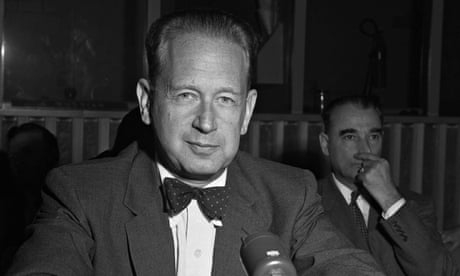
The Murder of Hammarskjold
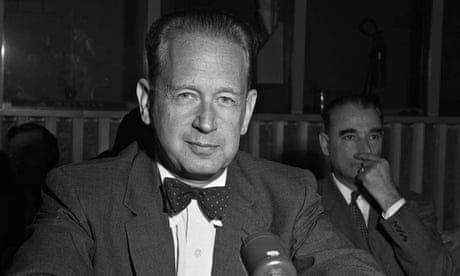 For a long time this site has tried to point out that the Congo struggle was one of the most important, yet underreported, foreign policy episodes that took place during the Kennedy administration. Sloughed off by the likes of MSM toady David Halberstam, it took writers like Jonathan Kwitny and Richard Mahoney to actually understand the huge stakes that were on the table in that conflict, namely European imperialism vs African nationalism. Kennedy had radically revised America’s Congo policy from Dwight Eisenhower to favor the latter. Not knowing he was dead, JFK was trying to support Congo’s democratically elected leader Patrice Lumumba. JFK was also one of the few Western leaders trying to help UN Secretary General Dag Hammarskjold stop the Europeans from crushing Congo’s newly won independence.
In September of 1961, just eight months after Lumumba was murdered, Hammarskjold died in a plane crash. It was officially ruled an accident. But there were doubts from the beginning. For example, Harry Truman told the New York Times, that Hammarskjold was on the verge of getting something done “when they killed him.” It now turns out that Kennedy’s ambassador to Congo, Edmund Gullion, also suspected Hammarskjold’s plane was shot down. And he suspected it the night it happened. This key fact was not revealed for fifty years.
Below we link to three stories in the press of late that have finally circulated about the true circumstances of what happened to the Secretary General, the man who Kennedy called, “the greatest statesman of the 20th century.”
- RAF veteran ‘admitted 1961 killing of UN secretary general’
- Coups and murder: the sinister world of apartheid’s secret mercenaries
- Dag Hammarskjöld’s plane may have been shot down, ambassador warned
It is nice that the MSM is finally catching up to what we wrote about 20 years ago in Probe Magazine. In particular:
- Dodd and Dulles vs. Kennedy in Africa
- Midnight in the Congo: The Assassination of Lumumba and the Mysterious Death of Dag Hammarskjold
In the first of these two articles, Jim DiEugenio lays out the overall struggle of Kennedy and Hammarskjold to keep Congo free and united against the imperial forces of Belgium and England. In the second, Lisa Pease examines the murders of Lumumba and Hammarskjold within eight months of each other. Those assassinations left Kennedy standing alone. When he was killed, the imperialists triumphed.
During the ensuing decade, CTKA continued to focus on this important story, again underscoring the links between Kennedy and Hammarskjold, but now reinforced by the work of historian Greg Poulgrain with regard to their cooperation over Indonesia. See:
Finally, two decades later, the MSM is acknowledging that work. We don’t like to toot our own horn, but … Honk! Honk!
-
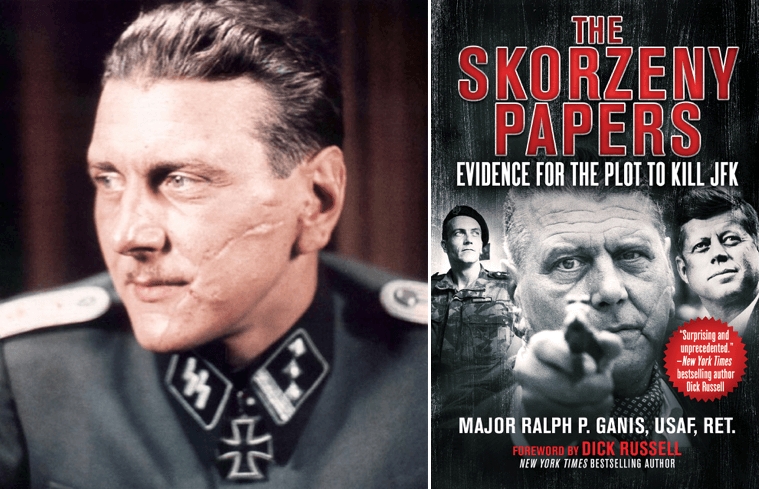
Major Ralph P. Ganis, The Skorzeny Papers: Evidence for the Plot to Kill JFK
I
When I heard that a previously undiscovered collection of personal correspondences from SS Colonel Otto Skorzeny had recently surfaced, I was truly interested. Besides his famous exploits in WWII, including the daring mountaintop rescue of Benito Mussolini and the kidnapping of Hungarian regent Miklós Horthy’s son from his Bucharest palace, Skorzeny was infamous for his postwar dealings with a number of intelligence agencies the world over. As a child, my grandfather, Marcel, a French resistance fighter, used to tell me stories of Otto’s exploits during car rides. I thought I was in for a real treat when I found this book. That Skorzeny could have had a hand on the team that killed President Kennedy was also an interesting hook.
The subtitle of this book is “Evidence for the Plot to Kill JFK,” and therein lies its true problem: if by evidence we are referring to clear-cut forensics, incriminating memos, newly declassified documents, newly discovered tapes, or reliable eyewitness testimonies that place Skorzeny either at the scene or in a position directly responsible for the assassination of JFK, then we have little to no “evidence” to justify the book’s subtitle. What the author of the book, Major Ralph Ganis, USAF (retired) seems to suggest is largely tangential to the actionable plot that took Kennedy’s life; that is, Skorzeny, from his position in Madrid as a jack of all trades with ties to postwar Nazis, Texas oil moguls, the Mossad, and French intelligence operatives, could have been a link in a long and winding chain of figures who eventually connected to those who executed the crime of the century. And yet, as we will see, even that supposition is largely based on fantastical leaps of logic, a primary source base that we are never allowed to verify—or see a picture of, or direct reference to—and a conclusion that is not only ridiculous but insulting to the JFK research community.
Dick Russell, who wrote the introduction to The Skorzeny Papers, rightly claims that the book provides a “chronological tracing of the dark alliances that sheds fresh light on how long-suspicious CIA officials like William Harvey and James Angleton wove Otto Skorzeny into their tangled web, or vice versa.” I will give Ganis and Russell that—most of the book is largely this, an extremely dry, almost colorless list of dozens and dozens of figures who were responsible for placing Skorzeny in a secure position from which to run his operations after the war: within only a few pages in chapter seven we have “Enter Major General Lyman L. Lemnitzer and the NATO Link,” “Enter Clifford Forster,” “Enter Don Isaac Levine.” I like to think I have a pretty good memory, but the sheer volume of second- and third-string players in this book is bewildering, with connections seemingly drawn from any and all personnel affiliated with anything remotely clandestine, few of which are ever revisited, and none of which seem truly important given the book’s central thesis, which is that Otto Skorzeny was somehow a key aspect of the Kennedy assassination.
The so-called “Skorzeny Papers,” which Ganis acquired through an American auction house bid in 2012, are alleged correspondences between Skorzeny and some of these underworld and intelligence-based figures, along with letters to his wife, who aided him in his dirty work to some degree. “As the story goes, many of the papers were burned over time, but a fragmentary grouping of documents (the ones used for the research in this book) survived. The archive ranges from 1947 to around the period of Skorzeny’s death.” (xv).
But since we are not allowed to view them or translate them from the German ourselves, we must take the author’s word that they are not mistranslated or even fraudulent.
Ganis begins his book’s preface with a bold proclamation: “Why was President John F. Kennedy killed and who carried it out? All of the investigations, commissions, and academic works have not answered these questions. This book integrated startling new information that does resolve the mystery.” (p. xxi) Let’s unpack that for a moment. Not all commissions are equal. The Warren Commission is not the same as Jim Garrison’s investigation of Clay Shaw, the HSCA, or the later ARRB. The latter three found quite compelling evidence that a domestic intelligence outfit indeed murdered JFK. The former was staffed by Allen Dulles and was essentially a disinformation campaign whose objective was to obfuscate the truth and put the story to bed for the nightly news, which had also been compromised through the Central Intelligence Agency’s media liaisons. As much has been exhaustively detailed in scholarly works, from John Newman’s Oswald and the CIA, to Jim DiEugenio’s Destiny Betrayed, to Jim Douglass’ JFK and the Unspeakable. That we cannot say with certainty who pulled the trigger on the fatal shot so vividly captured in the Zapruder film is ultimately inconsequential; for all intents and purposes, given the time elapsed since that fateful November afternoon fifty-five years ago, we do have a clear picture of the likely suspects behind the plot’s orchestration, along with compelling motives for why JFK was targeted. Bold claims like Ganis’s require even bolder evidence, and to open with a whopper like that, one would presume that Skorzeny’s purported personal papers contain something akin to the map of Dealey Plaza’s sewer system that investigators found in Cuban exile Sergio Arcacha Smith’s apartment, or a handwritten “thank you” note from James Angleton after the Warren Commission had ended for services Skorzeny rendered to the CIA. And yet not only is Otto Skorzeny himself only a tangential part of a book entitled The Skorzeny Papers, but the “evidence for the plot to kill JFK” is awkwardly squeezed into the last two pages of a 346-page work, with a final revelation that made me both angry for investing hours of my life reading the tome, and confused as to how an author with a true breadth of working knowledge about postwar intelligence networks could presume so myopic an assassination motive.
II
Otto Skorzeny was an Austrian by birth who joined the Nazi party somewhat reluctantly, mainly as a way to make a living as the outbreak of the Second World War ramped up in the late 1930s. A mechanic by trade, and a semi-professional fencer, his notorious scar across his face from a missed parry and his 6’4 stature made him something of an icon in the German army. Skorzeny was known for his fearlessness, guile and unconventional approach to commando warfare. As he once said in a postwar interview, “My knowledge of pain, learned with the sabre, taught me not to be afraid. And just as in dueling when you must concentrate on your enemy’s cheek, so, too, in war. You cannot waste time on feinting and sidestepping. You must decide on your target and go in.” (Charles Whiting, Skorzeny, 1972, p. 17) In many ways, his belief that small units could actually move world history in a similar or even greater fashion than regiments and divisions was affirmed after his thirty-man glider-borne SS unit spirited away Mussolini from the Gran Sasso Hotel with not even a single shot fired. Even Winston Churchill heaped praise on him for his bravery in the face of incredible odds.
Rearranging signposts during The Battle of the Bulge, his commandos, who wore captured American uniforms and spoke fluent English with almost no accent, attempted to sow chaos behind Allied lines, seeking to misdirect troops and armored units away from key areas. While the entire Wacht am Rhein [“Watch Along the Rhine”] operation, which was the German code name for Hitler’s last desperate gamble to capture the Belgian port of Antwerp and cut the British and American forces in two, was ultimately a futile dying gasp of an already-defeated Nazi war machine, it proved so devastating to Allied morale (and killed 75,000 Americans) that some planners did reconsider whether the war would be over any time soon. And when a handful of Skorzeny’s men were captured in their false uniforms during that bitterly cold winter of 1945, panic spread throughout SHAEF (Supreme Headquarters Allied Expeditionary Force), leading to a comical scene in which General Eisenhower frantically argued with his staff who insisted he station twenty guards with sub machine guns around his Paris office at all times in case Skorzeny tried to kill or abduct him. In the middle of the night, the future Director of the CIA, Walter Bedell Smith, Eisenhower’s aide-de-camp, ran out with his staff in pajamas and started firing his carbine into the brush just beyond the headquarters’ window.
He and his men later found the dead cat that had been scurrying about in the dark, but the legend of Otto Skorzeny had taken hold.
Dubbed “the most dangerous man in Europe,” Skorzeny finally surrendered to the Allies in occupied Germany, after seeing the futility of carrying out Hitler’s final order for his “werewolves” to continue the war after the end of hostilities. He was summarily booked and processed, and awaited trial for his role as a top Nazi official and a one-time personal bodyguard of Adolf Hitler. He was later approached by OSS officers as he languished in his holding cell at Darmstadt Prison and it is from this first contact that Ganis believes the true exploits of Skorzeny began. While stories differ as to the mechanics of his escape—Skorzeny claimed in his memoirs that he stole away in the trunk of a car and had a German driver unwittingly smuggle him through the checkpoints; while Arnold Silver, his American point of contact and debriefer said he was released on official terms—he nonetheless was a free man by 1948. After relocating to Paris, where he was unofficially used as a conduit through which CIA officials could monitor communist activity in postwar Europe, Skorzeny was quickly identified due to his conspicuous face and looming profile, and was outed by the French press during one of his many strolls down the Champs-Elysée with his wife Ilse.
Relocating to Madrid, it is here that Ganis believes his real work began, work that—Ganis believes—would ultimately find him involved with dark forces that killed JFK a decade later. Set up in a comfortable office that saw Skorzeny ostensibly managing a construction company that also handled imports and exports of mechanical parts to places in Central Africa and elsewhere, he for all outward purposes seems to have lived a quiet life. Writing memoirs, consulting with foreign governments for a variety of clandestine work, and running a low-key commando training school whose members included some of his former comrades from the SS, French OAS soldiers, American special forces officers, and a rogue’s gallery of other unsavory characters, his postwar life had little in common with his daring exploits during WWII.
The bulk of The Skorzeny Papers deals with the nebulous formation of both the CIA and its shell companies from the remains of the OSS, with familiar figures like Frank Wisner, Arnold Silver, Bill Harvey, and William Donovan featured prominently in Ganis’ narrative. The central portion of the book meanders from French anti-communist hit teams and their American handlers, to the also newly-formed Mossad and its eventual use of Skorzeny for the removal of Egyptian nuclear scientists, to a whole host of West German ex-Nazi intelligence personnel and their largely dull exploits passing mostly fabricated evidence of an impending Soviet invasion to Washington in exchange for their freedom and a career on the American payroll. Somewhere in this tangled web, Ganis situates Skorzeny who, because of his extensive contacts and personal daring during the Second World War, seems—in Ganis’ estimation—uniquely positioned to wrangle these disparate forces into something of a rogue network that is totally off the books. Ganis reiterates this throughout the book, seeking to distinguish ostensible layers of the spy world from what he considers its truly dark realm, which he identifies as a series of assassination teams bankrolled through corporate shell organizations like SOFINDUS, which eventually morphed into the World Commerce Corporation (WCC). In The Skorzeny Papers the WCC is akin to SPECTRE from the old James Bond novels; a looming, impenetrable evil menace whose tentacles reach into almost every aspect of Cold War politics and planning, Ganis spends a considerable amount of the book detailing its creation, key operators, possible ties to international Nazi groups and ultimately its potential role as the dark budget from which Skorzeny was able to fund his various international commando operations after the war. In reality, while I’m sure this is all very interesting to someone truly looking for an exhaustive account of postwar dirty money, it has very little to do with Skorzeny, and almost nothing to do with the domestic assassination of John F. Kennedy in Dealey Plaza.
The book then delves into the French OAS, focusing on the enigmatic Captain Jean René Souètre, who of course was allegedly deported from Fort Worth, TX, the afternoon of the JFK assassination. And while I am not denying that Souètre could have indeed been on the ground in Texas in some capacity, Ganis goes to great lengths—even putting him on the book’s cover next to Skorzeny and Kennedy—to implicate him in the plot: “The actual sniper, or team of snipers, was directed by Jean René Souètre, the former OAS officer wanted by French security services for an attempt on the life of President Charles de Gaulle in 1962.” While Souètre was a known paramilitary outlaw who hated the idea of Algerian independence from France—which Kennedy firmly championed from the Senate floor in the mid 1950s—he seems from the available evidence to have been a rogue player who drifted through these turbulent times, training commandos, taking exotic posts with his OAS buddies, and advising the CIA on a handful of ultimately uninteresting developments in the Third World. To suggest, as Ganis does, that he was the lynchpin of the ground operations in and around Dealey Plaza, while ignoring the more probable Cuban exile culprits, seems strained.
The Souètre chapter ends with a few lines that reveal a frustrating and repeated aspect of this book, where the author assumes that one’s proximity to a situation necessarily guarantees association and willing complicity. For example, Ganis argues:
The movements of Skorzeny during this period point to his being in attendance at the Lisbon meeting between Souètre and the CIA. In fact, Skorzeny made several trips to Portugal between March and July 1963 concerning his businesses. With the OAS cause now unsustainable, it appears Souètre left the meeting with a new option for employment, signing on with Skorzeny. Captain Jean René Souètre was now a soldier of fortune working for Otto Skorzeny in one of the most guarded secret organizations in the history of American intelligence.” (p. 248, italics added)
It’s not at all clear that these conclusions can be verified, and as Skorzeny’s whereabouts are only deduced from “the Skorzeny Papers,” which are never directly quoted—here or anywhere in the book to my knowledge—one must once again have faith that Ganis is being honest and accurate.
III
The book then spends a considerable amount of time on the Third World and its myriad decolonization movements, with a quite lengthy digression into Ganis’ analysis of the Congo Crisis, exploring the potential for Skorzeny to have been the mysterious QJ/WIN assassin the CIA hired to kill Patrice Lumumba. Ganis takes a fairly condescending approach to his analysis of Lumumba’s rise to power, claiming “As well-founded as Lumumba’s words may have been, they were politically ill-advised. This tense atmosphere was further compounded by the lack of a plan for the organized transition to power.” (p.279). As I have detailed in my article, “Desperate Measures in the Congo,” the United States destroyed any hope for a free Congo before Lumumba had risen to anything nearing real power. In fact, both Belgium and the CIA had planned on separating Katanga, the Congo’s richest area, from the country before it became independent. Belgium had stolen the country’s gold reserves, brought them to Brussels and refused to return them. President Eisenhower refused to meet with Lumumba after the Belgians had landed thousands of paratroopers inside the country. By the time Lumumba’s plane had landed back in Africa, Allen Dulles and friends all but marked Lumumba for death. For Ganis to say he had no plan for an “organized transition to power” smacks of paternalism: given his eloquence, popular appeal and vision of a new dawn for his recently unshackled nation, Lumumba may well have succeeded if he had not been undermined in advance.
The assassination mission was later aborted when the CIA and Belgian intelligence aided Katangese rebels with Lumumba’s capture after he fled his UN protection in a safe house. While I can see where Ganis is going, and how it could be possible, given that Skorzeny seems to have been in the Congo around this time, to my knowledge it’s been pretty strongly established that QJ/WIN, the CIA digraph of one of two selected assassins for the Congo plot, was actually Jose Marie Andre Mankel. To have sent a person as instantly recognizable as Otto Skorzeny into an unfolding international crisis involving the Soviet Union, Belgian and Congolese troops, U.N. officials from multiple nations, and American station personnel seems, to put it mildly, unwise. Indeed, WI/ROGUE, another CIA-sponsored hit man and agent sent on the assignment, had had plastic surgery and was said to be wearing a toupee during his visit. No matter Skorzeny’s connections to Katanga Province’s mining operations, which were real, he was more likely a visiting business opportunist rather than an actionable agent during the Congo Crisis, if he was present there those critical weeks surrounding Lumumba’s capture and execution at all.
Ganis then details Skorzeny’s one brief interview with a Canadian television program in September 1960, in which he boasts about being in high demand by both the enemies of Fidel Castro and Fidel himself, explaining a plot which he takes credit for being the first to discover. This was Operation Tropical, in which the CIA was allegedly training Skorzeny and his commandos for a kidnapping of the Cuban premier in early 1960. Ganis bases his description on an unnamed newspaper clipping found in the papers he secured in his winning auction bid. Curiously, I happened upon Operation Tropical in a perusal of the CIA’s online reading room months before I’d read this book, and searched in vain for the newspaper they cite as having outlined the plot, which they claim is the Sunday supplement edition of the Peruvian newspaper, La Cronica, dated August 7, 1966. I would be interested to read it if anyone can secure a copy. It would go a long way in verifying the validity of Ganis’ main body of evidence, and would be an interesting find for researchers more broadly. In any case, with the aborted Castro plot and a mainstream boilerplate description of the “failed Bay of Pigs invasion,” which of course Ganis attributes to Kennedy’s refusal to release nearby carrier-based air support (something Kennedy staunchly forbade before the operation was underway, a point which Ganis’ omits), we now enter the final stretch of the book, which looks directly at Skorzeny’s role in the JFK assassination.
Spoiler alert—there is none.
IV
“General American Oil Company,” “Colonel Gordon Simpson,” “Algur Meadows,” “Sir Stafford Sands,” “Colonel Robert Storey,” “Jacques Villeres,” “Permindex,” “Judge Duvall,” “Paul Raigorodsky,” “Thomas Eli Davis III,” “ Robert Ruark,” “Jake Hamon,” and about twenty other sub-headings flash across the first dozen or so pages of the final chapter of The Skorzeny Papers. The organization of the book centers on these disjointed, one-to-two-page sub-chapters which give the reader the disorienting and queasy feeling of reading it through glasses with the wrong prescription. Not only did Ganis miss the opportunity to style the life and times of Nazi Germany’s most infamous commando personality along the lines of a thrilling narrative, with exotic locales and shady deals over drinks and cigars, but he arranged the book in so awkward a fashion that he constantly has to end sentences with “and we will get back to him shortly,” or “and I will show you how this ties in later.” Even if one were to storyboard his entire panoply of tertiary personalities, it would look more like a Jackson Pollock art installation than a coherent plot with a compelling impetus culminating in the JFK assassination as we understand it. A story should be clear enough to draw the reader in with its simple facts, and should sensibly unfold on its own accord so as to prevent the need to constantly handhold during the descent into the labyrinth.
Conspicuously absent in The Skorzeny Papers are any substantial sub-headings detailing Cuban exiles, Allen Dulles, the Joint Chiefs of Staff, or any of the genuine suspects of the JFK assassination, save for meanderings on James Angleton’s and Bill Harvey’s roles in the creation of Staff D, the CIA’s executive action arm. Ruth and Michael Paine are nowhere to be found. Neither is a description of the aborted Chicago plot, or any substantive explanation of how Lee Harvey Oswald was moved into the Texas School Book Depository, or a note about David Phillips’ role in the whole affair from his Mexico City station. While these very real aspects of the actual JFK plot are infrequently touched upon in passing—Ganis cannot ignore the entire body of evidence, despite his best efforts—he insists on crow-barring his newfound “primary source data” into a story that at this point doesn’t permit much unique interpretation. It’s safe to say, in 2018, that President Kennedy was assassinated by a domestic, military-industrial-intelligence apparatus that viewed his foreign policy as anathema to both the “winning” of the Cold War and to their image of the United States’ role in world affairs. That Kennedy was a staunch decolonization advocate, a friend and champion of Third World leaders like Sukarno in Indonesia, Nasser in Egypt, Lumumba in the Congo, and sought diplomatic solutions to prevent the impending nuclear Armageddon with Nikita Khrushchev’s Soviet Union is all but ignored in Ganis’ conclusions as to why JFK was shot in Dallas. None of it is suggested. What ultimately led to the tragedy in Dealey Plaza, according to Ganis, is something much bigger.
V
It all comes down to JFK’s sexual indiscretions, folks. That’s right. Jack Kennedy just couldn’t resist the advances of the hundreds of femme fatales who threw themselves at him, and according to Ganis, the high command had to take him out when he cavorted with the ultimate Cold War honeypot.
I wish I were kidding. But unfortunately I’m not.
The author submits to the reader that the act to assassinate President Kennedy was carried out for reasons that far exceeded concerns over U.S. National security. In particular, they arose out of a pending international crisis of such a grave nature that the very survival of the United States and its NATO partners was at risk. At the source of this threat was breaking scandals that unknown to the public involved President Kennedy. To those around the President (sic) there was also the impact these scandals had on the president’s important duties such as control of the nuclear weapons and response to nuclear attack. It also appears the facts were about to be known. The two scandals at the heart of this high concern were the Profumo Affair and the Bobby Baker Scandal. (p.294)
I will spare anyone reading this a rebuttal of the relevance of this assertion, but suffice it to say, Ganis places the final straw at Kennedy’s—demonstrably disproven—affair with Eastern Bloc seductress Ellen Rometsch. Ganis claims, “Historians are taking a hard look at this information, but preliminary findings indicate Rometsch was perhaps a Soviet agent.” (p.295) He continues, “Her potential as a Soviet agent is explosive since Baker had arranged for multiple secret sexual liaisons between her and President Kennedy.” (p. 295)
He then scrapes together a weird narrative of how Attorney General Robert Kennedy was pleading with J. Edgar Hoover and the FBI to withhold these revelations in a “desperate effort to save his brother and the office of the presidency.” (p.296), He argues that “As President Kennedy was arriving in Dallas, Texas, on November 22, 1963, a very dark cloud of doom was poised over Washington, and the impending storm of information was hanging by a thread.” (p. 296). That’s when Skorzeny—from Madrid—was activated to save the Western world. It seems pointless to add that retired ace archive researcher Peter Vea saw the FBI documents on this case. The agents had concluded there was no such liaison between the president and Rometsch. In other words, to save himself, Baker was trying to spread his racket to the White House. Bobby Kennedy called his bluff.
Ganis pretentiously concludes, “In the end, the assassination network that killed JFK was the unfortunate legacy of General Donovan’s original Secret Paramilitary Group that included as a key adviser from its early inception—Otto Skorzeny. Furthermore, the evidence would seem to indicate Skorzeny organized, planned and carried out the Dallas assassination, however, we may never know what his exact role was.” (p. 342)
Indeed we may never, because there does not seem to be any. Ganis continues, “On November 22, 1963, an assassination network was in place in Dallas; it was constructed of associates of Otto Skorzeny and initiated by his minders in the U.S. Government and clandestine groups within NATO.” Wrapping up, the author reiterates, “The events that led to this killing were triggered by a limited group of highly placed men in the American government. They were convinced that the West was in imminent danger and posed to suffer irreparable damage, and, for some of them, imminent exposure to personal disgrace beckoned. All of this sprang from reckless debauchery in the White House and beyond. With the situation breached by Soviet intelligence and ripe for exploitation, it became untenable for this group. They took action.”
I’ll give you a few minutes now to wipe the tears from your eyes. Okay, good. Are you still with me? Overall, The Skorzeny Papers could, I suppose, serve as something like a compendium or glossary for those who just have to know the minutest details of the inner workings of this or that shell corporation that may or may not have had a hand in some world affair during the Cold War. But there are much better books on that. Ultimately, Ganis’ book is an uncomfortable, freewheeling careen down strange dead-end tracks, with unannounced detours through cold dark streets full of faceless characters, and later, journeys through mirror-filled fun houses of speculation, with a final twist and turn that spits you out right over Niagara Falls, barrel and all.