Tag: COLONIALISM

  • CounterPunch Whiffs Again!

    CounterPunch Whiffs Again!


    On July 15th, CounterPunch did it again.  The occasion was an article comparing the final withdrawal of American troops from Afghanistan with the American debacle in Indochina.  Author David Schultz used the famous line, this time attributed to Hegel, that the only lesson we learn from history is that we do not learn from history. He wrote that as the Taliban now takes over some of us “wonder if this is not Déjà vu all over again and that what we thought we had learned from the Vietnam War proved to be a fleeting lesson.”

    Schultz goes on to note the Kent State shooting, helicopters over the embassy in 1975, the domino theory, over 58,000 dead American soldiers, tens of billions wasted.  He then mentions some of the literature on the Vietnam War.  First off is Francis FitzGerald’s Fire in the Lake which tried to accent how different the culture of Vietnam was and how the American military did not understand it.  Then, of course, since this is CounterPunch, Schultz has to mention David Halberstam and The Best and the Brightest.

    Here is how Schultz quantifies Halberstam’s book.  He writes that it pointed to:

    ….the arrogance of the Kennedy administration in failing to understand that Vietnam was more about colonial independence than it was about communism and Cold War rivalry.

    As I have indicated too many times to enumerate here, this misses two major points about Halberstam.  First, Halberstam completely revised his view of Vietnam between his first book, The Making of a Quagmire, and his second book on the subject The Best and the Brightest.  In that first book, Halberstam  criticized Kennedy for not being militant enough in Vietnam. In 1965, Halberstam said that Kennedy should have gotten America in earlier. In fact, that book is an utterly coruscating critique of American policy in Vietnam until 1965. The hero of the book is Colonel John Paul Vann.  Why?  Because Vann knew how to win the war! (See Chapter 11) Halberstam is even more explicit about this later when he declares, “Bombers and helicopters and napalm are a help, but they are not enough.” (p. 321)  He then gives us his Schultzian lesson about Vietnam: “The lesson to be learned from Vietnam is that we must get in earlier, be shrewder, and force the other side to practice self-deception.” (p. 322)

    Halberstam’s role model in 1965, Vann, thought that if America was going to win the war, American troops were needed. (See the Introduction to the 2008 edition by Daniel Singal, p. xi) Well, Lyndon Johnson gave Vietnam about 500,000 American troops and it did not work out very well. Since Halberstam started writing The Best and the Brightest in about 1968, when this had all clearly turned out to be a disaster, the author decided to cover his tracks.  Back in 1963, Kennedy did not like what Halberstam and Vann were trying to do––which was move toward escalation by criticizing what they saw as JFK’s timidity. (David Kaiser, American Tragedy, p. 261) So therefore, even though America had been involved in Vietnam for eleven years prior to Kennedy’s inauguration, Halberstam focused a large part of 1972’s The Best and the Brightest on the years 1961-63, virtually ignoring what the Eisenhower administration had done to secure a commitment to Vietnam.  Eisenhower had, in fact, created a new country there, one that had not existed prior to 1954. And since America had created it, then America was obliged to defend it.

    By relying on Halberstam’s museum piece, Schultz gets the other part he writes about wrong also. President Kennedy did comprehend what the Vietnam war was about.  He understood the true circumstances because of his association with Edmund Gullion going back to Saigon in 1951. (Click here for details) This is why he refused to commit combat troops in theater. During the crucial debates in November of 1961, Air Force Colonel Howard Burris took notes. They are contained in James Blight’s book, Virtual JFK (pp. 282-83)

    Kennedy argued that Vietnam was not a case of aggression as was Korea. Therefore, America would be subject to intense criticism from even her allies. He then argued that the French had spent millions there with no degree of success. He also argued that the circumstances were such that even Democrats in Congress would have a hard time defending such a commitment. Further, one would be fighting a guerilla force, “sometimes in phantom-like fashion.” That would mean whatever base of operations American troops had would be insecure. Burris noted that during the debate, Kennedy turned back attempts by Dean Rusk, Robert McNamara, McGeorge Bundy and Lyman Lemnitzer to derail his train of thought.

    I don’t see how one can locate a more defining moment, or show how well Kennedy really understood what the facts of the war were than this.  One can argue that Ed Lansdale had been the first person to suggest inserting combat troops into Vietnam, something Kennedy refused many, many times. (John Newman, JFK and Vietnam, first edition, p. 20; Gordon Goldstein, Lessons in Disaster, p. 52) After Kennedy’s death, when Lansdale returned to the White House, he recommended sending John Paul Vann back to Vietnam. Vann did return in 1965, when Lyndon Johnson overturned Kennedy’s policy by sending tens of thousands of combat troops into Vietnam. (David Kaiser, American Tragedy, p. 384). Using David Halberstam today as any measure of what happened in Vietnam would be like cranking up a Model T Ford to make a cross country trip.  Halberstam was the author who called 1964, the “lost year” in Vietnam. Geez Dave, wasn’t the Tonkin Gulf Resolution kind of important? (For more on Halberstam click here”>)

    Another issue with the article is its comparison with how America got into Vietnam and how America got into Afghanistan. Schultz writes that America got into the latter as a result of the attacks of 9/11. Which is only partly true.  America was involved even before the Russian invasion of Afghanistan in December of 1979. President Carter had allowed the CIA to operate in the country at his National Security Advisor’s request. The late Zbigniew Brzezinski predicted that such aid would likely induce a Soviet invasion and that would give the USA an opportunity to hand Russia its own Vietnam. (January, 1998, interview with Le Nouvel Observateur)  As most people know, the CIA now began to back the struggle of the Islamic radicals against the Russians. This included Osama Bin Laden. Much of this aid went through Pakistan.  And in return, America agreed to look the other way as that country built a nuclear weapon. (James DiEugenio, The JFK Assassination: The Evidence Today, p. 386)

    Unlike America’s commitment to Vietnam, the Russians never had more than 120,000 troops in theater. Mikhail Gorbachev recommended a peace agreement before the Russians formally withdrew in 1989. The concept was to leave behind Mohammad Najibullah as president and he would form a coalition government with some of the more moderate tribes. The goal was to marginalize the Islamic fundamentalists. For whatever reason, the USA would not sign onto this sensible agreement. (The New Yorker, 9/29/2009, article by Steve Coll) There were warnings from people like the late Benazir Bhutto that were quite frank and accurate.  She said, “You are creating a Frankenstein.” (Newsweek, 10/1/2001, article by Evan Thomas)

    Bhutto was correct.  Unlike the Tom Hanks depiction of the late congressman Charlie Wilson, the congressman backed this decision. (DiEugenio, p. 387) America actually gave aid to some of these deplorable fundamentalists, e.g., Jalaluddin Haqqani and Gulbuddin Hekmatyar. The one decent tribal leader in the area, Ahmad Shah Massoud, only got a fraction of what those two men received. (Alternet, 12/20/2007, article by Melissa Roddy)

    As Bhutto and Gorbachev predicted, the country descended into a horrifying civil war. After three years, Najbullah was dislodged.  Pakistan then sent in its own charges, the Taliban, who backed Sharia Law. Najbullah was taken prisoner, mutilated and killed in late 1996. Massoud held out for years until he was assassinated two days before the 9-11 attacks.

    This is not just an interesting story for what it says about Tom Hanks and his cartoonish movie Charlie Wilson’s War. But also because, after Massoud’s demise, the Taliban took over the country.  It became a hiding place for Osama Bin Laden.  More specifically, the Battle of Tora Bora, featuring American special forces, took place there in December of 2001. The result was, again for whatever reason, Bin Laden escaped into Pakistan.

    On October 7, 2001, George W. Bush launched his invasion of Afghanistan, which dislodged the Taliban. President Obama reduced this operation significantly. And now President Biden will, perhaps, finally end it.

    One can argue that, in all this, America was still fighting the Cold War, except this time it was in Afghanistan, not Indochina.  But was there really a reason to do this? Especially in light of Gorbachev’s peace offering? To me, that is the real resemblance of the two situations. In the first instance, America created a country in the name of the Cold War. In the second, America decided to radically Islamize a country in the name of the Cold War.

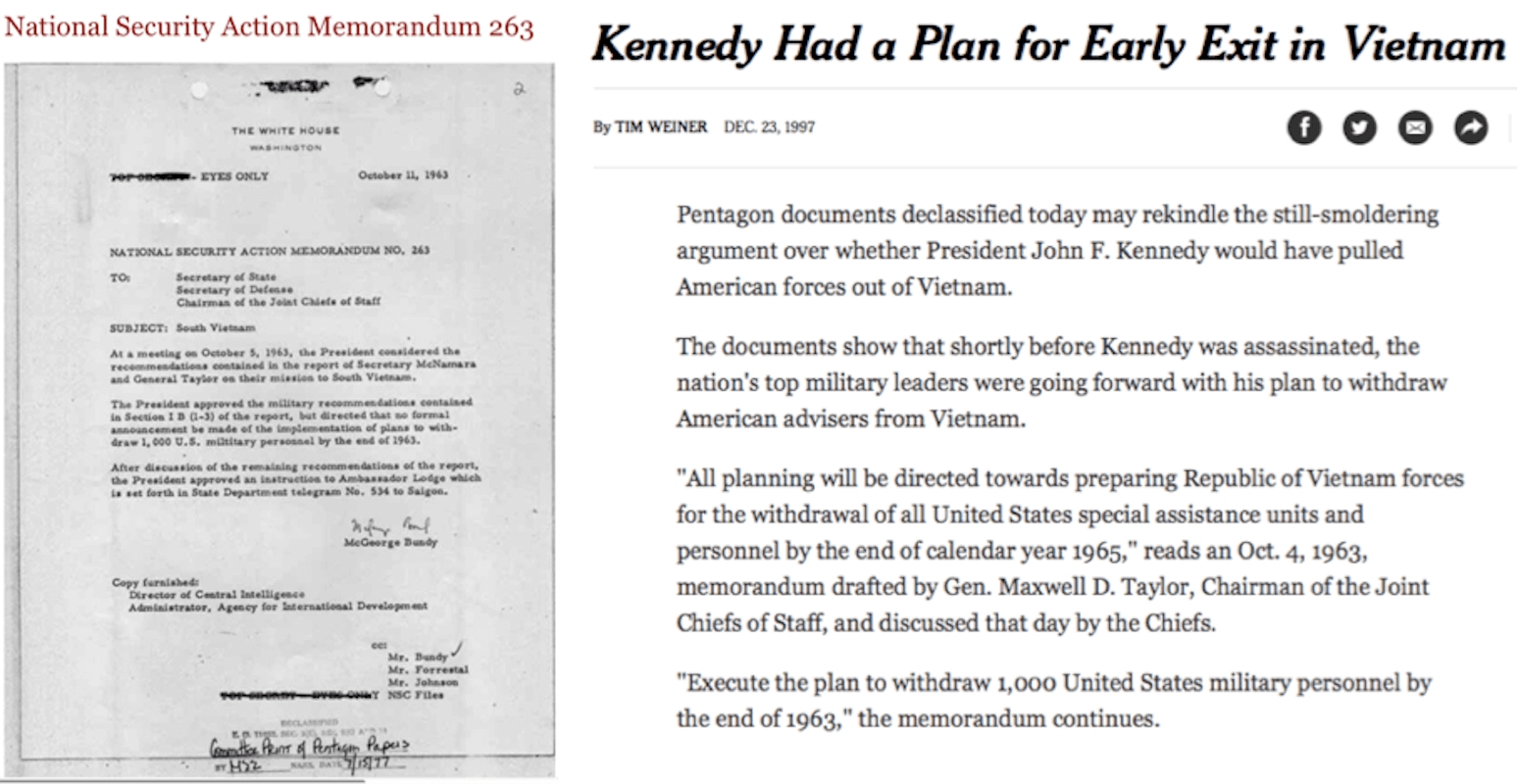
    In the first instance, we know Kennedy did not agree with the policy and was withdrawing at the time of his death.  With what this author has discovered about Kennedy and the Middle East, I doubt very much he would have sided with the radical Moslems. (Click here as to why )

    But that is a story CounterPunch could never tell.

  • Deep Fake Politics: Empire and the Criminalization of the State

    Deep Fake Politics: Empire and the Criminalization of the State


    In the two previous installments of this review of Can’t Get You Out of My Head (CGYOMH) by Adam Curtis, I covered his poor handling of things like financial chicanery, monetary policy, oil markets, the JFK assassination, and “conspiracy theories” in general. To conclude this review, I am going to cover some of the ways in which Adam Curtis beguiles the audience on crucial issues such as state criminality, the dual state, geopolitics, Western imperialism, and the West’s adversaries—Russia and China specifically. Finally, I conclude with a brief summation of the CGYOMH and an exhortation for us all to take a large grain of salt with anything produced by this BBC pied piper.

    A Shallow Take on the Deep State

    Curtis has a strange way of grappling with US imperialism and the country’s secret government which emerged after World War II. In the fifth episode of CGYOMH, Curtis mentions that the CIA had been manipulating political systems and overthrowing governments around the world without the knowledge of the US public. He then brings up the illustrious Hans Morgenthau and his assessments of the American shadow government. This whole section is baffling to me. First, Curtis identifies Morgenthau as “one of the most senior members of the US State Department.” Then he says that Morgenthau “had given this hidden system of power a name, […] the dual state.” According to Curtis, Morgenthau deemed this duality necessary because of the realities of international power politics. These dark clandestine tactics needed to be hidden from the public because acknowledging them would undermine Americans’ beliefs in their democracy and in their exceptionalism—beliefs that were necessary in the Cold War.

    Curtis states that the US in the Cold War ran covert operations to overthrow 26 foreign governments in 66 attempts. Morgenthau, it is stated in CGYOMY, believed that this secrecy was creating a dangerous time bomb at the heart of America. Beginning in the 1960’s, these secrets began to be exposed by writers like former CIA officer Miles Copeland. In this section, Curtis even runs footage of a trailer from the original film adaptation of The Quiet American. The trailer is a montage featuring narration and clips from the movie which depict an American agent sowing chaos and violence “across all the Orient.” The film is certainly relevant to the discussion. That said, Curtis could have told the audience that the protagonist of the book and film is widely understood to be based on the activities of infamous CIA officer Edward Lansdale. Furthermore, Curtis could have also told the audience that Lansdale himself—acting on behalf of the CIA—was involved in the production of the film adaptation. To that end, the plot of the film was changed in such a way as to obscure the titular Quiet American’s responsibility for a terror bombing. The episode illustrates how the secret government was even manipulating the public through Hollywood—going so far as to alter those rare, informed critiques of US neocolonial imperialism in literature and film.

    Morgenthau, the Rockefellers and The University of Chicago

    But I digress. As mentioned above, Curtis’ treatment of Morgenthau and the dual state is strange. For one thing, Morgenthau did not give the dual state its name. The term comes from a German émigré named Ernst Fraenkel and his 1941 book, The Dual State: A Contribution to the Study of Dictatorship. The book described how alongside the normative state which operated lawfully, there emerged a prerogative state which operated lawlessly to serve as the guardian of the normative state.[1] Furthermore, Morgenthau is not most notable for being “one of the most senior members of the US State Department.” As far as I know, he never actually occupied a high position in the state department, though he did work there as a consultant under different US presidential administrations. Morgenthau is, however, quite famous for being the modern seminal classical realist philosopher in the field of international relations—a subdiscipline of political science. Why Curtis omits this is a mystery.

    In fact, Morgenthau’s actual academic position during those years is very relevant to Curtis’ discussion of the dual state—i.e., CGYMONH’s exploration of the lawlessness of America’s postwar secret government, because Morgenthau was a professor at the University of Chicago. Famously described as Standard Oil University by Upton Sinclair, the University of Chicago has a unique relationship to the right-wing brain trust that has informed many imperial US strategies in terms of foreign policy and political economy. Perhaps most infamously, the University served as an incubator of sorts for the neoconservative, right-wing imperialists who were heavily influenced by German émigré Leo Strauss.

    Strauss, who I will return to, himself first received Rockefeller funding thanks to the intervention of Carl Schmitt[2]—the jurist, political theorist, and prominent Nazi whose ideas informed the legal thinking of the Third Reich. In his exploration of the dual state, Curtis would have been better served looking at Carl Schmitt in order to situate the lawless US pursuit of “security.” Summarizing Schmitt, I have written elsewhere[3] that he

    …wrote famously, “Sovereign is he who decides on the exception.”[4] The state of exception “is not codified in the existing legal order.” It is “characterized as a case of extreme peril, a danger to the existence of the state.” The gravity of the state of exception is such that “it cannot be circumscribed factually and made to conform to a preformed law.”[5] Sovereignty for Schmitt is defined by the ability to decide when the state of exception exists and how it may be eliminated. Any liberal constitution can hope, at best, to mandate the party with which sovereignty rests.[6]

    In other segments of CGYOMH, Curtis mentions the critiques of Western leftists who argued that the essence of fascism had not been extinguished with the Allied victory in World War II. In the prior installment of this review, I covered Curtis’ shortcomings in terms of exploring this perspective. In his treatment of lawlessness and the dual state, Curtis compounds those errors. With Carl Schmitt and his University of Chicago descendants, there is a fairly clear German antecedent to the institutionalization of American state criminality that was established with the outbreak of the Cold War and never abandoned (i.e., an historical precursor to the lawlessness of a nominal constitutional republic). The reader may recoil at such a comparison, but the analogy is not particularly hard to grasp, psychic resistance notwithstanding. Even in terms of their respective creations, both were borne of bogus pretexts which conjured an existentially threatening Communist menace. The exceptionalist or legally unconstrained Nazi state took its mature form in the wake of the Reichstag Fire, a terror spectacle which the Nazis likely facilitated.[7] Likewise, much of the early postwar hysteria over the Soviet Union derived from erroneous Anglo-UK accusations that Stalin had grossly violated the postwar terms regarding Eastern Europe which had been negotiated at Yalta.

    All this is not to say the US is a new Nazi Germany. Only Nazi Germany was Nazi Germany, just as only the US empire is the US empire. That said, it is worth noting that in key national security documents like NSC 68, Cold War US policymakers explicitly argued for an exceptionalist approach to combating the supposedly existential threat posed by the Soviet Union.[8] I have written that such documents, in effect, served to grant

    …authority to the state to covertly conspire to violate the law. Since the US Constitution’s supremacy clause establishes that ratified treaties are “the supreme law in the land” and the US-ratified UN Charter outlaws aggression or even the threat of aggression between states, CIA covert operations are carried out in a state of exception. Given that the authority for these operations has never been suspended and the operations have been a significant structural component of the US-led world order, [I coined] the term exceptionism […] to describe the historical fact of institutionalized state criminality.[9]

    Schmitt, Strauss, and the Cold War

    To explain the duality and lawlessness of modern Western states, it is practically essential to discuss Carl Schmitt. In the German case, the Weimar Republic gave rise to a despotic dualism that quickly devoured the Republic, such as it was. In the US, the state’s lawful/lawless duality arose from the Cold War national security state which had been empowered by the supposed existential threat posed by communism. In the US case, the lawful democratic state (or public state) was never completely subsumed by authoritarian forces. This remains true, even if—as I have argued—anti-democratic forces in US society have consolidated so much wealth and power as to constitute a deep state that exercises control and/or veto power over democracy and the national security state. In my dissertation, I describe a tripartite state comprised of the public state, the security state, and a deep state.[10]

    Let us return to Leo Strauss, Morgenthau’s colleague at the University of Chicago. Strauss was an anti-Enlightenment thinker whose affinity for liberal democracy went only so far as to acknowledge that it served an important mythical function in legitimizing the hegemonic US project. One German commentator summarizes Strauss’ thinking about democracy:

    [L]iberal democracies such as the Weimar Republic are not viable in the long term, since they do not offer their citizens any religious and moral footings. The practical consequence of this philosophy is fatal. According to its tenets, the elites have the right, and even the obligation, to manipulate the truth. Just as Plato recommends, they can take refuge in “pious lies” and in selective use of the truth.[11]

    To summarize, Strauss and his mentor (of sorts) Carl Schmitt were both essentially Hobbesians. In the tradition of English thinker Thomas Hobbes, they saw the world as a dangerous and threatening place, the peril of which necessitates the creation of—and submission to—“the sovereign” or more simply, the state. The overriding imperative of the state is security, because without it, all of society is imperiled. Therefore, any measures necessary to secure the state are not just acceptable, but basically necessary. Germany infamously took Schmitt’s Hobbesian logic to a notable conclusion. Writing largely after World War II in the US, Strauss in essence advocated for state duality. He grudgingly accepted liberal democratic myths and formal institutions, while at the same time advocating for wise men like himself and his acolytes to counsel leaders, deceive instrumentally, and effect desired political outcomes in a top-down fashion. It is a mystery as to why Curtis does not mention Strauss given that the philosopher was a central figure in his interesting, but flawed, documentary series, The Power of Nightmares.

    Let us return now to CGYOMY’s treatment of Morgenthau. Curtis offers a brief summation of the realist philosopher’s thinking on the dual state that is, at best, very incomplete—and quite likely wrong. Previously and elsewhere, I wrote about Morgenthau in the same context that Curtis situates him in.

    As a 20th century analog of Thomas Hobbes, Schmitt elucidated a grim, illiberal understanding of the true nature of power within the state. Recognizing this same illiberal essence, other theorists described the “state of exception” and the securitization of politics as a slippery slope that would create authoritarianism, perhaps with pseudo-democratic trappings.[12] In the early years of the Cold War, seminal realist Hans Morgenthau would comment on these illiberal forms emerging within the American political system. He identified a change in the control of operations within the U.S. State Department. The shift was toward rule according to the dictates of “security.” Morgenthau wrote, “This shift has occurred in all modern totalitarian states and has given rise to a phenomenon which has been aptly called the ‘dual state’” In a dual state, power nominally rests with those legally holding authority, but in effect, “by virtue of their power over life and death, the agents of the secret police—coordinated to, but independent from the official makers of decision—at the very least exert an effective veto over decisions.”[13] Thus does Morgenthau describe a dynamic akin to Schmitt’s conception of sovereignty.

    To wit, Morgenthau did expound on Schmittian ideas about the sovereign and he addressed the dual state concept derived from two of the Germans discussed above: Carl Schmitt and Ernst Frankel.[14] To my knowledge, however, Morgenthau’s most noteworthy exploration of the subject was the 1955 New Republic article cited above. In this essay, he did not argue that the emergence of this dual state was positive or necessary. Rather, he bemoaned how the US State Department had been decimated by the dictates of an overweening security apparatus and he explicitly situated this dual state in the context of totalitarianism. The Nazi example would have been obviously at the forefront of Morgenthau’s mind. At the very least, Curtis should have mentioned the New Republic article and its critique, since it was written in a major US magazine. More recently, the 1955 Morgenthau essay was discussed in a scholarly article on the subject of the deep state by Swedish scholar Ola Tunander in 2009.[15]

    Curtis touches on the institutionalized lawlessness and thus the duality of the state in the US, but he fails to hash out the implications. With his blinkered treatment of Morgenthau, his omission of Schmitt and Strauss, and with his treatment of the JFK assassination, the filmmaker cannot bring himself to confront the American deep state and the cataclysmic historical episodes in which it was decisive. Discussed in greater depth in the previous installment of this review, Dallas was a coup d’état profounde—a stroke of the deep state. It is nonetheless interesting that Curtis spent any time at all covering the assassination and the deep state.[16]

    Imperial Security

    The historical limited hangout approach deployed by Curtis permeates the accounts of Western imperialism in CGYOMH. At one point, the film briefly covers the assassination of Congo’s first elected prime minister, Patrice Lumumba. To his credit, Curtis acknowledges CIA involvement in Lumumba’s death. He acknowledges that the US installed the brutal puppet Joseph Mobutu, but for some reason he fails to mention that it was Mobutu’s forces who arranged the execution of Lumumba. He states that the abrupt Belgian withdrawal plunged Congo into crisis. But he neglects to mention that this was by design—part of a plot to break away from Congo its most resource rich province of Katanga.[17] Curtis credulously reports that the US was worried that without intervention, Congo’s copper might fall into communist hands. He neglects to mention that it was the West’s refusal of help which forced Lumumba to seek Soviet aid. There is reason to believe that this was done by design, as it then gave Allen Dulles the pretext to assassinate Lumumba—an action which Eisenhower went on to authorize.

    The assassination was carried out in such a time and fashion as to indicate that people like Dulles feared a change in policy under the incoming Kennedy administration. Kennedy’s policy was much more sympathetic to Lumumba than that of Eisenhower and Dulles, but the young Congolese prime minister was killed 72 hours before Kennedy had been sworn in as president. With the facts selected and presented as they are in CGYOMH, the reader gets the impression that policies such as this were decided on the basis of myopic, but earnest, anticommunism. With Curtis, the obvious economic interests are ignored or minimized. But with Curtis, the implication is that another set of those darn bureaucrats are once again too much enthrall to another set of wrongheaded ideas.

    When one takes the longer view, this explanation falls apart. As one of the most resource-rich places in the world, Congo was brutally exploited and expropriated by Europeans for more than a century before the Cold War. During the Cold War, the plunder continued, overseen by the US-installed puppet following the assassination of Lumumba, the man who famously asserted that the resource wealth of Congo should be used for the benefit of the Congolese people. After the Cold War and up to the present day, the Congolese have been subjected to unspeakable violence on a massive scale, while the pillage of its resources has continued apace. But since Curtis filters everything through his anti-leftist lens, he cannot present cogent analysis, even when the episodes under discussion are pregnant with weighty implications.

    The Dark Art of Western Geopolitics

    In CGYOMH, Curtis looks at numerous examples of Western imperialism in places like Iraq, China, and Africa. The series would have benefitted from a discussion of geopolitics—specifically the theories of Halford Mackinder and the more contemporary policymakers and scholars who have examined Mackinder’s ideas and their applications. The Brit Mackinder looked at the world and saw that Europe, Asia, and Africa were really one massive “world island” containing most of the world’s resources and productive capacity. With Britain located on the periphery of the world island, its imperial strategists needed to assert control over key areas and destabilize or Balkanize regions to preclude any counter-hegemonic force from uniting the enormous landmass.

    The British applied this logic throughout their imperial reign. Both world wars can be seen, in part, as consequences of the applications of Mackinder’s theses. As one example, the Anglo establishment was much alarmed by Germany’s proposed Berlin-Baghdad railway. This project would have integrated Germany, Central Europe, the Balkans, and the oil-rich Middle East into a massive German-led industrial powerhouse. Interestingly, the radical historian Guido Preparata sees a Russian hand in the assassination of Franz Ferdinand and Russia was, of course, Britain’s ally at the time.[18] Prior to World War II, the Soviet Union’s existence threatened the great powers in Western Europe and the US. This no doubt informed the thinking of Anglo-US elites who helped rebuild and fuel, respectively, the German and Japanese war machines. With other factors at work—and with geopolitics not being an exact science—the anti-Soviet Anglo-American elites did not get their preferred outcome. Germany chose softer targets first before launching their ultimately ruinous campaign against the Soviet Union almost two years later.

    When the Japanese got into military conflict with the Soviets in 1939, they were soundly defeated at Nomohan. In the aftermath, Japan signed a non-aggression pact with the USSR. This would prove crucial in shaping the war’s outcome. In 1941, the Germans invaded Russia and were headed for Moscow. Since there was little threat of a Japanese invasion, the Soviets were able to send divisions from the Far East and stop the Germans just short of the capitol. The Soviet-Japanese non-aggression pact held until the last days of the war when Soviet forces swept through Manchuria, actually killing more Japanese than the atomic bombings. Though in Western historical memory, Hiroshima and Nagasaki quickly overshadowed the Soviet invasion, considerable evidence indicates that it was the crushing Japanese defeat in Manchukuo—along with the threat of an impending Soviet attack on the main islands—that actually prompted the Japanese surrender to the Americans.[19]

    As historian Alfred McCoy points out, a central strategy of the postwar US empire was to rebuild the defeated Axis powers and make them essentially US satellites. With Germany and Japan reconstructed as largely demilitarized, capitalist industrial powerhouses, the US controlled both “axial ends” of Eurasia, Mackinder’s “world island.”[20] Trade and capital flows went across the Atlantic and across the Pacific, making the US the richest empire in world history. This was by design. In retrospect, the US war in the Pacific was particularly a war for postwar hegemony. And some have argued the dual atomic bombs kept Russia out of Japan.

    The American Century

    American claims to legitimate possession over Hawaii and the Philippines—where the Japanese attacked the US—were dubious at best. They are part of a history that goes all the way back to the 1850’s. Following the imperialist Mexican-American War and the US acquisition of California, enterprising officials and businessmen looked to the Pacific to enrich the US and themselves. Starting as early as Matthew Perry’s 1853 expedition to Edo, US trade and investment in the Pacific were too lucrative to pass up. Hence, we have the absurd fact that in the Spanish-American War, ostensibly fought for Cuban independence, the first shots were fired as the US attacked the Spanish Philippines.

    Prior to US entry into World War II, Life magazine publisher Henry Luce made a case for American empire. As a mouthpiece for the Wall Street-dominated Council on Foreign Relations, Luce made the argument in his “American Century” essay, laying out the case for US hegemony over the postwar capitalist world. While much of his essay was couched in “liberal” rhetoric, in one passage he was quite candid about Asia.

    Our thinking of world trade today is on ridiculously small terms. For example, we think of Asia as being worth only a few hundred millions a year to us. Actually, in the decades to come Asia will be worth to us exactly zero—or else it will be worth to us four, five, ten billions of dollars a year. And the latter are the terms we must think in, or else confess a pitiful impotence.[21]

    Geopolitics, control of resources, markets, financial and political systems…these are the aspects of the US hegemonic reign that allow us to make sense of the activities of the intelligence agencies, the military, the business elites, and the public officials who serve these constituencies. Curtis fails to offer cogent analysis of these deep political issues. Thus, the quirky myopia of his commentary on things like covert operations, the dual state, and “humanitarian intervention.” It is worth asking whether British state television would ever sponsor an honest, penetrating documentary film that would bring the reality of our crumbling systems to a vast audience. Does the BBC exist to act in the public interest by providing the range and depth of programming needed for enlightened democratic public debate? Or does the prestige media outlet serve to entertain and manufacture consent?

    Losing the Great Game on the Eurasian Chessboard

    The most famous contemporary adherent of Mackinder’s geopolitical theories was Zbigniew Brzezinski. Co-founder of David Rockefeller’s Trilateral Commission and US National Security Advisor under Carter, Brzezinski expounded on post-Cold War geopolitics with his 1997 book, The Grand Chessboard: American Primacy and Its Geostrategic Imperatives. In it, he argued that “keep[ing] the barbarians from coming together” was a “grand imperative of imperial geostrategy.”[22] By “barbarians,” Brzezinski was referring to Russia and China. These two countries have indeed come much closer together in the intervening years, largely in response to their shared grievances under US hegemony. Termed the “rules-based liberal international order” by US officials and their media/academic courtiers, the Post-Cold War era of unipolar US dominance has by-and-large allowed the US to essentially make—and break—the “rules” of international politics according to its whims. A small number of countries have resisted US dominance with varying degrees of success. In the 21st century, three of them—Afghanistan, Iraq, and Libya—saw their governments overthrown and their societies devastated. In Eurasia, an “axis of resistance” has emerged which includes most notably China, Russia, Iran, and Syria—with Iraq in the wings as the US still refuses to honor the Iraqi parliament’s request to withdraw US military forces from the country.

    In this context, it should be noted that much of Curtis’ previous documentary series, Hyper-Normalization, devoted much screen time to denigrating two Western targets—Libya and Syria—in a multitude of dubious ways. True to form, the real villains in CGYOMH are (surprise!) Russia and China. The countries, according to Curtis, have one thing in common: they believe in nothing. Curtis states this repeatedly, though he contradicts himself, somewhat, by also stating that the Chinese only believe in money. The BBC should spring for some kind of editor to make sure that Curtis’ chauvinism is at least internally consistent, but, alas, such is not the case.

    The Soviet Union of CGYOMH appears to be the most depressing society that ever existed. Stock footage is used to depict a country of hopeless, nihilistic, victims of communism. While the post-Soviet era of Boris Yeltsin is acknowledged as a disaster, Curtis minimizes the extent to which the shock therapy privatization was a Western operation that enriched Western finance—along with that class of underworld-connected figures who became known as the oligarchs following their seizure of the Russia’s patrimony. Curtis also does not adequately explore the US interference on behalf of Boris Yeltsin in the 1996 Russian election. Portrayed in a glowingly brazen fashion on the cover of Time magazine, those US operations were of a scale far greater than even the most fanciful accusations of Russian interference in the 2016 US election.

    The true Russian villain of CGYOMH, predictably, is Vladimir Putin. To my surprise, and to the credit of Adam Curtis, he does largely dismiss Russiagate. Without spending too much time on the subject, Curtis suggests that Russiagate paranoia was symptomatic of US anomie, insecurity, and paranoia. On the one hand, it is good that even with his highly negative take on Russia, Curtis doesn’t stoop to regurgitating Russiagate claims that are thoroughly debunked—most notably by Aaron Mate in outlets like The Nation magazine and The Grayzone website. Too bad Curtis doesn’t look at the role of the dual/deep state in concocting and maintaining the hoax. CGYOMH spends a good amount of time addressing various intelligence capers. It could have been illuminating to see the Russiagate saga portrayed in a well-produced documentary film.

    Putin: That Dirty Guy!

    Instead, Curtis tells us that the dream of turning Russia into a liberal democracy went wrong and a new rapacious oligarchy came to power. At the highest levels of power, did the US ever want to see Russia become a prosperous democracy? Russia was subjected to structural economic changes that much of the rest of the world has experienced under US hegemony—privatization, austerity, massive upward transfer of wealth, and capital flight. Given the negative results of neoliberalism in the last 40+ years, why is it not assumed that those outcomes are intentionally brought about to further enrich US/Western elites and immiserate most people on purpose?

    Furthermore, with Russia, there are additional reasons to suspect that US elites deliberately wrecked and polarized Russian society. After the Gulf War, neoconservative Paul Wolfowitz said, “[W]e’ve got about 5 or 10 years to clean up those old Soviet regimes—Syria, Iran [sic], Iraq—before the next great superpower comes on to challenge us.”[23] Subsequent covert and overt US actions in the Balkans, Georgia, Libya, Ukraine, and Syria all demonstrate how the US has time and again launched military interventions in ways that threatened post-Soviet Russia’s national interests. US elites and the corporate media were major supporters of Boris Yeltsin, whose reign was an unmitigated disaster for the Russian people. These same actors now despise Vladimir Putin, a statesman who—shortcomings notwithstanding—has presided over an era in which conditions in Russia have much improved from the situation he inherited. The US media treatment of the two Russian leaders belies any claims of made about US leaders being concerned about the well-being of the Russian people in the Putin era.

    In episode six of CGYOMH, Curtis states that Putin was selected by the Russian oligarchs to rule Russia. My understanding was that he was first handpicked by Boris Yeltsin—an historical oddity given how the two men seem like polar opposites. At the time of his anointing, Curtis tells us, Putin “was an anonymous bureaucrat running the security service and a man who believed in nothing.” Having installed the nihilist Putin as president, the oligarchs thought they would continue to dominate the country. Then, as Curtis so often tells us, “something unexpected happened.” A nuclear submarine exploded and sank to the ocean floor in August of 2000. The uncertainty about the fate of the crew and the eventual news of their deaths served to outrage Russians.

    Eventually, Vladimir Putin came to Murmansk to address the public and the grieving families. Curtis tells us that Putin, “to save himself, turn[ed] that anger away from himself and towards the very people who put him in power,” i.e., the oligarchs. Putin told Russia that it was the corrupt oligarchs in Moscow who, by stealing everything, had destroyed the Russian military and Russian society. Instead of suggesting that Putin was using his office to address legitimate grievances on behalf of the vast majority of the population, Curtis tells us that Putin had instead merely “discovered a new source of power”—the anger of the people.

    Even with his new source of power, Putin continued to believe in nothing and to have no goals according to CGYOMH. A Russian journalist is quoted talking about how under Putin there is no goal, no plan, no strategy…only reactive tactics with no long-term objectives. Later, Curtis quotes another Russian journalist who claimed that what Putin had really done was to take the corruption of the oligarchs and move some of into the public sector so that Putin and his cronies in the government could get in on the corruption: “The society Putin had created was one in his own image. It too believed in nothing.” The journalist was later murdered, outrage ensued, yet things did not improve. However, oil prices soon exploded, serving to ignite a bonanza of Russian consumerism. Cue the footage of a cat wearing a tiny shark hoodie, sitting atop a Roomba, gliding over a kitchen floor, pursuing a baby duck. This, presumably, is some kind of metaphor for the directionless nihilism of Russia. Take heart, Anglo-Americans: Whatever our problems, we have yet to see such horrors in the freedom-loving West.

    Curtis goes on to check all the obligatory boxes regarding Putin and Russia. The group Pussy Riot makes an annoying appearance. Alexi Navalny, a figure with very little popular following in Russia, is credited by Curtis with “chant[ing] a phrase that redefined Russia” for a, theretofore, apolitical generation. “Party of crooks and thieves!” chanted Navalny. This, we are told, made Putin furious at the ungrateful new middle class. In response, a paranoid Putin “shapeshifted again.” He created the “Popular Front,” a Russian nationalist organization. Worse: “He summoned up a dark, frightening vison from Russia’s past,” saying that “Eurasia was the last defense against a corrupt West that was trying to take over the whole world.” Putin was articulating “a great power nationalism that challenged America’s idea of its exceptionalism.” Putin, Curtis tells us, was promoting “Russian exceptionalism!” Flash to footage of the Nighthawks, a gauche pro-Putin motorcycle gang of Russian nationalists. Curtis then asserts that the Nighthawks are promoting a “paranoid conspiracy theory” that the West, led by the US, is trying to destroy Russia.

    Adam Curtis: Reality Check I

    Where to begin with Curtis’ treatment of Russia? Putin as alleged nihilist is simply a cheap shot. The man is obviously a nationalist. This cannot be lost on Curtis, but he refuses to grant Putin even that. Instead, Putin’s moves to curb the oligarchs’ power and his efforts to resist Western geopolitical moves are all presented as crass opportunism in the service of personal aggrandizement. What should Putin and the Russians have done after Yeltsin? Curtis cannot answer this question, so he never poses it. Putin is indeed a figure that can be criticized on a number of fronts. Most significantly, his measures against the oligarchs went nowhere near far enough. The legitimacy of their vast holdings is dubious at best. If Russia were to function on a more democratic basis, one of the most popular measures would be to nationalize or otherwise redistribute what are widely perceived as the ill-gotten gains of these propertied elites. But since Curtis is first and foremost an anti-leftist, there is no discussion of such possibilities.

    Nor is there any discussion of the steps Putin did take against particular oligarchs that he deemed (with at least some justification) to be acting against the national interest. At least Curtis does not endorse Russiagate. Nor does he mention the implausible Novichok poisonings that Western security services attribute to Putin himself. These omissions are interesting in and of themselves. What of Putin’s assertion that Eurasia is the last bulwark against a US-led West bent on world domination? Curtis mocks the very notion. He does not mention that Zbigniew Brzezinski explicitly made the same argument about Eurasia over twenty years ago. Keep in mind that Brzezinski was, in my estimation, part of the more sober wing of the US imperial hivemind. He could be characterized an Establishment liberal imperialist in contrast to the unhinged neoconservative imperialists.

    Going back further in US-Russian relations, the US Joint Chiefs of Staff wanted JFK to endorse a preemptive nuclear strike on the Soviet Union to be carried out in the final months of 1963. Kennedy opposed such an unprecedented act of human barbarism. Notably, Kennedy himself was assassinated under suspicious circumstances during that same proposed window of time. Many commentators have noted how NATO has seemed to move closer and closer to Russian borders.[24] The late Robert Parry wrote often about the role of the US Embassy during the uprising in Ukraine.[25] In short, there is much historical and contemporaneous evidence that the US has sought to encroach Russia—or to at least deprive the country of any ability to impede US global hegemony. Realizing that such is the case, Russia under Putin has allied itself with its historical rival, China.

    Curtis, with China in his Sights

    At this point, it should be clear that Curtis is going to rubbish China, the most long-lived civilization in human history. Like many things in his film, Curtis does not appear to be an expert on Chinese history. On China, CGYOMH is at its most schizophrenic. Curtis acknowledges how the British devastated Chinese society with the Opium Trade and the Opium Wars. He actually soft-pedals much of this. For example, he could have mentioned that Western imperialism led to the social crises which spawned the Taiping Uprising, a conflict that killed perhaps as many as 15 million Chinese around the time of the US Civil War. Or he could have spent more time talking about the indemnities that poor China had to pay to the rich West after the Opium Wars and the so-called “Boxer Rebellion.” As I understand it, the Chinese paid over a trillion dollars’ worth of gold in today’s values as per the terms of the Boxer Protocol. This was for resisting British imperialism! The debt had only grown larger with interest before it was cancelled during World War II, when China allied with the US and British against Axis Japan. Nor is there any mention of how Japanese imperialism against China in the 1930’s was aided by the West. Such was the case up until 1940, when the US put an embargo on Japan after the Japanese invaded French Indochina. The embargo is what led to the attack on Pearl Harbor. All told, the Chinese may have lost 20 million people in the war with Japan.

    What about China after 1949? It being a communist country, Curtis is a harsh critic. Yet true to form, his critique is quirky and idiosyncratic. CGYOMH does not much mention the disastrous Great Leap Forward. Curtis discusses the Cultural Revolution, but does not explain it very well at all. Instead, it is depicted as a bizarre power play by Mao vis-à-vis his ambitious and megalomaniacal wife, Jiang Qing. The amount of time Curtis spends on Jiang Qing is completely out of proportion to her historical importance. To my understanding, she is a deeply unpopular figure in China and she comes across worse to Western students of this period of Chinese history.

    At a time when a deeper understanding of Chinese history in the West is desperately needed, Curtis does a great disservice with CGYOMH. With his cursory mentions of the Opium Wars and later of the racist Fu Manchu movies, he attempts to place a type of multicultural fig leaf over his smug imperial chauvinism. The fall of Dynastic China and the struggles of the People’s Republic of China are never properly contextualized. China was hopelessly disadvantaged against the technologically superior West in the last century of the Qing Dynasty. Due to the predations of the Western powers—and then those of the West’s Asian imitator, Japan—China was in such a horrendous state as to experience the rarest of events: a successful social revolution.

    China after 1949

    Though nominally Marxist, there was no clear way for the victorious Chinese communists to apply Marxist principles to the situation that Mao inherited. Marx saw communism as something that was a progression: from feudalism to capitalism…and eventually to communism. He explicitly stated that a communist revolution could not succeed in China or Russia, because they did not have the necessary levels of development to create the class dynamics necessary to seize the means of production. Those requisite industrialized means of production had not yet come into being outside of the Western European world, thus Marx thought that Germany was the most likely place for Communism to arise. By the 1960’s, with China having suffered some spectacular setbacks, Mao launched the Cultural Revolution. Part political struggle, part cultural crusade—it marked a time of tremendous upheaval in Chinese society. Across China, problems of the revolution were attributed to those elements of the millennia-old Chinese culture that hadn’t been discarded. As a result, the Cultural Revolution produced many tragic spectacles, including the destruction of untold numbers of great and small works of art and architecture as part of a campaign to exorcise a multitude of historical traumas.

    In this context, CGYOMH is frankly offensive in its repeated assertion that the Chinese, like the Russians, believe in nothing. Western imperialism—practiced by Europeans and then the Japanese—wrought unimaginable misery in China. It led to enormous political and cultural upheavals that most Westerners cannot fathom. In the wake of the Cultural Revolution, Deng Xiaoping took over the role as China’s helmsman. The free-market reforms introduced in this era served to slowly modernize China by integrating it into the international economy. This development also caused social dislocations and instability, with matters coming to a head of sorts during the so-called “Tiananmen massacre.”

    In the wake of the events of 1989, Chinese leaders had to grapple with the fact that the legitimizing communist ideology was insufficient. The Cultural Revolution had disoriented the Chinese people. In some sense, it robbed them of their cultural heritage. But the history, myths, legends, and spiritual practices of the past were decidedly incompatible with Marxist ideology. Furthermore, the 1989 reality of vast industrial production for the international market economy was incompatible with Marxism as well as with traditional Chinese culture wherein merchants were regarded ambivalently, at best. In response, China began to grapple anew with the past even as present conditions were changing at a dizzying pace. In the wake of that tumultuous 1989, the Chinese Communist Party commissioned a television production of the Ming Dynasty novel (set at the end of the Han Dynasty), Romance of the Three Kingdoms. Such was the dramatic disavowal of Cultural Revolution era efforts to de-Sinify China. China’s cultural inheritance was rehabilitated in the service of Chinese unity.

    Adam Curtis: Reality Check II

    For Curtis, none of this historical context is necessary. China, like Russia, is to be understood as a profoundly depressing society. Again, as Curtis would have it, China today believes in nothing while also believing only in money. Chinese organized crime is out of control. China is excessively militarized. The Chinese Communist Party is terrified of its own countrymen. The Chinese state surveilles and oppresses the citizenry. Average Chinese people have no good prospects because “the princelings” (the children of Chinese elites) are hoarding all opportunities thanks to “ultra-corruption.” This is the China presented in CGYOMH.

    Adam Curtis wants us to bear witness to the rise and fall of the Chinese official, Bo Xilai. Frankly, I cannot even figure out what CGYOMH is trying to say about Bo Xilai. I followed the story a bit when it was an international scandal in the news. I could never arrive at any salient take on the saga and Curtis does not clarify matters here. Bo did have some populist appeal. And he did seem to have some Anglophile tendencies and associations that the state would not have welcomed given Bo’s position. The whole thing seems like inside baseball—Chinese Communist-style. Perhaps this is the point: China is to be understood as an inscrutable, mysterious Oriental despotism.

    Were Curtis to be objective, he would need to inform the audience that the only significant tangible improvements in the well-being of humanity during the last 40 years are due to Chinese progress. The rest of the world—largely following US-dictated economic prescriptions and models—has stagnated or regressed with the exception of the superrich. Meanwhile in China, a billionaire class did emerge, but not without socio-economic conditions for the general population steadily improving. Unlike in the West, Chinese adults who believe that their children will be more prosperous than themselves are not delusional. China’s “militarism” seems not at all unreasonable given the US military bases encircling the country. Furthermore, China spends much less on the military that the US in both relative and absolute terms.

    For a Westerner to decry Chinese organized crime is laughable given the US governments’ partnerships with underworld figures like Meyer Lansky, “Lucky” Luciano, Santo Trafficante, Sam Giancana, the KMT, the anti-Castro Cubans, Gulbuddin Hekmatyar, the Contras, Ramon Guillen Davila, etc, etc, etc. And while there are, no doubt, privileged Chinese “princelings,” at least the Chinese can plausibly argue that their well-heeled heirs are not part of a class project to perpetually keep the bulk of the population in a state of material insecurity. In the US (and Curtis’ UK is not that much different), every aspect of life—food, housing, education, health care—is an avenue for rent-seeking and profiteering. And while aspects of the Chinese surveillance state are indeed Orwellian and alarming, it is worth keeping in mind that Western depictions of its adversaries are invariably unreliable and incomplete. Furthermore, and as Ed Snowden revealed, the US is no slouch when it comes to totalitarian surveillance. And even with the vast wealth in the US, we still lead the world in depriving our citizens of liberty in the harshest way: In both absolute and per capita terms, no country incarcerates more of its own citizens than the US.

    The Garden Paths of Adam Curtis

    In conclusion, I cannot recommend Can’t Get You Out of My Head except as a case study in sophisticated propaganda. The filmmaking talents of Adam Curtis are, as ever, impressive. However, the film’s commentary on the West is marred by a consistent failure to acknowledge the class interests that—when properly understood—illuminate so much of the unfortunate foolishness that Curtis attributes to bureaucrats and other members of the middle circles of power. The film’s deeply flawed explanations of financial/monetary matters represent a missed opportunity to explain crucial information to a badly misinformed public. Curtis’ treatments of Kerry Thornley and the JFK assassination are inexcusable, given all that we know now. His superficially revelatory discussion of the dual state represents a lost opportunity to demonstrate how the state has become our world’s most impactful and prolific lawbreaking entity. Lastly, when Curtis skewers entire swaths of humanity like Russia or the Chinese, the viewer should not lose sight of the fact that the filmmaker is on state television defaming the state’s enemies.

    Imperialism, in a word, is what Curtis can’t deal with. All the aspects of CGYOMH which I criticize in these reviews—they all pertain to Curtis and his failure to call an imperial spade a spade. I would like to assign Curtis a few books on the subject. Michael Parenti would be a good place to start. He defined imperialism as “the process whereby the dominant politico-economic interests of one nation expropriate for their own enrichment the land, labor, raw materials, and markets of another people.”[26] Compared to Curtis’ muddled ideology, Parenti’s definition can much better explain what CGYOMH bungles—namely: post-Bretton Woods dollar hegemony, the oil shocks, the Third World debt crises, neoliberalism, anti-communism, CIA covert operations, so-called “humanitarian” wars,” the postwar rise of America’s secret government, the Iraq War, and the various financial crises which always end up benefiting those “dominant politico-economic interests.” Since Curtis cannot bring himself to acknowledge the imperial elephant in the room—except obliquely or in the distant past—he cannot properly explain how the empire has devoured the republic. Without addressing the central thrust of America’s drive for global hegemony, Curtis cannot understand how this enormous concentration of wealth and power has transformed the state.

    Therefore, Curtis cannot illuminate the goings-on in the higher circles. Notably, he cannot hope to understand or explain the JFK assassination. Kennedy, for all his Cold Warrior posturing and/or pronouncements, did understand imperialism. In 1957, he gave a speech condemning French imperialism in Algeria. Said Kennedy on the Senate floor:

    [T]he most powerful single force in the world today is neither communism nor capitalism, neither the H-bomb nor the guided missile—it is man’s eternal desire to be free and independent. The great enemy of that tremendous force of freedom is called, for want of a more precise term, imperialism. […] Thus the single most important test of American foreign policy today is how we meet the challenge of imperialism, what we do to further man’s desire to be free. On this test more than any other, this Nation shall be critically judged by the uncommitted millions in Asia and Africa.[27]

    Much of the shift from colonialism to neocolonialism occurred in the 1950’s and 60’s. It was managed, often through covert operations, by the United States. Kennedy, as seen above, sparred with the Eisenhower administration (most notably, the Dulles brothers) over these policies. He supported the Third World nationalists who wanted their countries’ resources to improve the lives of their own impoverished citizens. Though Kennedy was against communism—sometimes opportunistically so—I believe the evidence today shows that he sought to end the Cold War. He pursued such a course in part to remove the threat of nuclear annihilation. But Kennedy also must have realized that the Cold War was an overriding structural constraint to any serious progressive reforms—both in the US and in the world. As long as every conflict was viewed in the Manichean, zero-sum terms of the Cold War, no US President had freedom to pursue any kind of reasonable foreign policy without encountering tremendous resistance. One can make a good argument that for his threat to the empire, Kennedy was killed. And it makes Curtis look an even bigger fool. Can he really not know that Kerry Thornley despised Kennedy over JFK’s devotion to what Lumumba stood for: a unified, independent, non-imperial Congo. President Johnson returned the US to the CFR/Acheson/Eisenhower/Dulles imperial consensus, reversing JFK’s policies in some of the world’s largest and most resource-rich countries. LBJ’s America would go on to attack the formerly colonized countries of Congo, Brazil, Vietnam, and Indonesia. Only Vietnam was able to hold on to its national sovereignty, but at an enormous cost.

    Curtis cannot grapple with JFK, just as he cannot deal squarely with those other aspects of Anglo-US imperialism. His pitiful rubbishing of the empire’s enemies seems to be his way of saying, in the midst of the collapse of US hegemony, “Look! Look at them! They have bad systems of power too—worse even!” In these tumultuous times, this is not what is needed for British or American audiences. We do not need to be fixated on what our leaders tell us is bad about our much less powerful “enemies.” These are fatal flaws in his filmography. While parts of Adam Curtis films like The Century of the Self and The Power of Nightmares are well-done, they invariably lead the viewer down garden paths in such a way as to muddle understanding and obscure responsibility. Can’t Get You Out of My Head continues in this tradition. All of this is a long-winded—yet by no means exhaustive—way of saying, again, that we need to get Adam Curtis out of our heads.

    see Deep Fake Politics (Part 1): Getting Adam Curtis Out of Your Head

    see Deep Fake Politics (Part 2): The Prankster, the Prosecutor, and the Para-political


    And listen now to:

    Deep Fake Politics—Historiography of the Cold War, the Clandestine State, and Political Economy of US Hegemony with Aaron Good


    [1] Ernst Fraenkel, The Dual State: A Contribution to the Study of Dictatorship (New York, NY: Oxford University Press, 1941).

    [2] Gerhard Sporl, “The Leo-Conservatives,” Spiegel International, April 8, 2003.

    [3] Aaron Good, “American Exception: Hegemony and the Dissimulation of the State,” Administration and Society 50, no. 1 (2018): pp. 4–29.

    [4] Carl Schmitt, Political Theology, trans. George Schwab (Chicago, IL: University of Chicago Press, 1985), p. 5.

    [5] Schmitt, Political Theology, p. 6.

    [6] Schmitt, Political Theology, p. 7.

    [7] The fact that this is a controversial statement is an interesting data point for understanding the sociology of Western historiography, especially in light of events such as the Cold War Gladio bombings in Europe. For a comprehensive exploration of Nazi culpability, see: Benjamin Carter Hett, Burning the Reichstag: An Investigation into the Third Reich’s Enduring Mystery (New York, NY: Oxford University Press, 2014).

    [8] Aaron Good, “American Exception: Hegemony and the Tripartite State,” (Temple University, 2020), pp. 235–6.

    [9] Good, “American Exception: Hegemony and the Tripartite State,” (Temple University, 2020), p. 236.

    [10] Aaron Good, “American Exception: Hegemony and the Tripartite State,” (Temple University, 2020).

    [11] Sporl, “The Leo-Conservatives.”

    [12] For examples, see: Harold D . Lasswell, “The Garrison State,” The American Journal of Sociology 46, no. 4 (1941): pp. 455–68; Peter Dale Scott, The Road to 9/11: Wealth, Empire, and the Future of America (Berkeley, CA: University of California Press, 2007); Sheldon Wolin, Democracy Incorporated: Managed Democracy and the Specter of Inverted Totalitarianism (Princeton, NJ: Princeton University Press, 2008).

    [13] Hans Morgenthau, “A State of Insecurity,” The New Republic 132, no. 16 (1955), p. 12.

    [14] Fraenkel, The Dual State: A Contribution to the Study of Dictatorship.

    [15] Ola Tunander, “Democratic State vs. Deep State: Approaching the Dual State of the West,” in Government of the Shadows: Parapolitics and Criminal Sovereignty, ed. Eric Wilson (New York, NY: Pluto Press, 2009), pp. 56–722.

    [16] He uses the term dual state, but it is bears much in common with scholarly works on the deep state produced in works like Tunander, “Democratic State vs. Deep State: Approaching the Dual State of the West”; Scott, The Road to 9/11: Wealth, Empire, and the Future of America; and Good, “American Exception: Hegemony and the Dissimulation of the State.”

    [17] That imperialist project, as you may recall, was near and dear to Kerry Thornley’s heart. JFK’s opposition to the operation further fueled Thornley’s hatred of the president.

    [18] Guido Giacomo Preparata, Conjuring Hitler: How Britain and America Made the Third Reich (New York, NY: Pluto Press, 2005), pp. 20–21.

    [19] Oliver Stone and Peter Kuznick, The Untold History of the United States, 2nd ed. (New York, NY: Gallery Books, 2019).

    [20] Alfred W. McCoy, In the Shadows of the American Century: The Rise and Decline of US Global Power (Chicago, IL: Haymarket Books, 2017).

    [21] Henry Luce, “The American Century,” Life, February 17, 1941.

    [22] Zbigniew Brzezinski, The Grand Chessboard: American Primacy and Its Geostrategic Imperatives (New York, NY: Basic Books, 1997), p. 40.

    [23] Glenn Greenwald, “Wes Clark and the Neocon Dream,” Salon, November 26, 2011.

    [24] Joshua R. Itzkowitz Shifrinson, “Op-Ed: Russia’s got a point: The U.S. broke a NATO promise,” LA Times, May 30, 2016.

    [25] Robert Parry, “The Ukraine Mess That Nuland Made,” Truthout, July 15, 2015.

    [26] Michael Parenti, Against Empire (San Francisco, CA: City Lights Books, 1995), p. 1.

    [27] John F. Kennedy, “Remarks of Senator John F. Kennedy in the Senate,” John F. Kennedy Presidential Library and Museum (Washington D.C.), July 2, 1957.

  • The Jakarta Method by Vincent Bevins

    The Jakarta Method by Vincent Bevins


    Vincent Bevins’ book, The Jakarta Method is an ambitious volume. It essentially tries to tell the story of the Cold War, largely from its impact in what we today call the “Third World.” In his introduction, Bevins writes that he has avoided speculation entirely. (p. 7) He then adds that there is much we do not know. As we shall see, he fails to deal with some things we do know and he does not avoid speculation.

    I note upfront, Bevins is not an academic, let alone an historian. He is a journalist who has been employed by the LA Times, Washington Post, and the Financial Times of London. He gives acknowledgements to several academics, including Bradley Simpson of the University of Connecticut. As we shall see—and as I will explain—that is a rather revealing statement by the author.

    I

    The book has no index. But I took extensive notes. Oddly—considering his subject—Bevins gives rather short shrift to the origins of the Cold War. One of the strangest things about the book is this: I could find no mention of George Kennan. Any writer dealing with the subject would have to at least make mention of the crucial importance of Kennan in how it all began. Bevins does not.

    George Kennan enlisted in the American diplomatic corps out of college in 1925. He was stationed in Prague during the Anschluss and in Berlin until the American declaration of war against Germany in December of 1941. Kennan had studied the USSR and sided with the likes of former ambassador William Bullitt and State Department experts like Loy Henderson and Chip Bohlen on the subject, thereby disagreeing with Franklin Roosevelt’s former Russian ambassador Joseph Davies about the possibility of any kind of reliable alliance with Joseph Stalin against the Third Reich. Yet, as anyone who has studied the era understands, this was what Roosevelt was relying on in his pre-war strategy and his actual tactics during the conflict.

    At the end of the war, Kennan was appointed deputy chief of mission in Moscow. What makes what he did there so important is that FDR had passed on in April of 1945. Davies’ influence was now weakened. In February of 1946, Kennan cabled his famous/infamous Long Telegram to Washington. It’s called that since it was well over 5,000 words in length. (Click here for more information)

    Many observers consider the Long Telegram crucial in understanding what came afterwards. It provided an intellectual underpinning for the hardliners in the White House and State Department to sanction the Cold War and depict it as a life and death struggle over the fate of mankind. Whatever one thought of Kennan, he was an intelligent, well-read man who could write. So even if one disagreed with him, one had to admit he knew how to construct an argument. It was the Long Telegram and Kennan’s article in Foreign Affairs magazine the following year that set the stage for the American policy of containment against the—according to Kennan—naturally expansive Soviet Union. President Harry Truman adapted it and it governed American policy towards the USSR for the next forty years. And some would say longer.

    Now, one of his implicit arguments—never formally stated, but clearly implied—is that the Cold War, and all its accompanying savagery, was somehow inevitable. That pall hangs over The Jakarta Method as thickly as it does David Halberstam’s similarly flawed—and today obsolete— book on Vietnam, The Best and the Brightest. But, if FDR and his Secretary of State Cordell Hull had stayed in power, it is highly suspect that Kennan’s Long Telegram would have carried the day. In fact, Kennan spent a large part of his later career denying that he ever meant his cable to be carried to the extremes it was taken to. (Oliver Stone and Peter Kuznick, The Untold History of the United States, pgs. 211, 229–30) The Kennan-induced hysteria led to Paul Nitze’s complete militarization of the Cold War with his 66-page document labeled NSC 68, presented to Truman in 1950. Nitze was not satisfied with containment. He advocated rollback. (Click here to read NSC 68)

    It’s not just important to mention FDR’s cooperation with the USSR before and during the war. We should also note his plans for after the war. In a secret interview with Robert Sherwood in 1946, Anthony Eden, Churchill’s foreign minister, said that he blamed the present state of affairs on the death of Roosevelt. He spoke of Roosevelt’s subtlety and contrasted that with Truman and Winston Churchill. Eden told Sherwood that, had Roosevelt lived and maintained his health, he would have never let the Soviet/American situation deteriorate as it had. He concluded that FDR’s “death therefore was a calamity of immeasurable proportions.” (Roosevelt’s Lost Alliances, by Frank Costigliola, p. 2)

    This relates directly to Bevins’ subject. For instance, FDR did not want Indochina to be returned to France after the war. He said, “The people of Indochina are entitled to something better than that.” Stalin supported Roosevelt on the decolonization issue. FDR also said, one week before his death, that once the Japanese had been cleared from the Philippines, that archipelago would be granted its independence. (Stone and Kuznick, pp. 112–13). Neither of these occurred. Winston Churchill resisted this decolonization movement. It was Truman who befriended Churchill even after he was defeated for reelection for prime minister. He then allowed Churchill to make his wildly Manichaean Iron Curtain speech in the USA in March of 1946. It came less than a year after FDR’s death. Five months later, Eden made his comments to Sherwood about the calamitous loss of Roosevelt.

    When looked at in this manner, the so-called inevitability—or the ineluctable tragedy of the Cold War—is not so inevitable and not so ineluctable. With Roosevelt and Hull in power, it might not have happened. Or at least it would not have been so epochal. I could not detect that alternative in the Bevins book. In my view, any real historian would have noted it.

    II

    When I got to Chapters 2 and 3, I detected another historical lacuna in The Jakarta Method. This is where Bevins begins to focus on Indonesia and also the rise of the CIA as an overseas arm of American foreign policy. I got the impression that somehow Bevins thought that CIA clandestine operations officer Frank Wisner and American ambassador to Indonesia Howard Jones were more important in those two areas than the Dulles brothers and Dwight Eisenhower. This is the impression a novice would get in reading those two chapters (pp. 31–75).

    Blanche Weisen Cook noted in her book, The Declassified Eisenhower, that while he was serving as president of Columbia University in New York, Dwight Eisenhower was attending a tutoring course at the Council on Foreign Relations. He concentrated on economics and how America was influencing the world through the Marshall Plan. In all likelihood it was through this process, plus his disagreement with the dropping of the atomic bombs on Hiroshima and Nagasaki, that Eisenhower became enamored with both covert action and the use of economic forces in order to confront communism and control nationalistic revolution in the Third World. This was much more attractive to him than risking a final and devastating war with Russia. As she wrote, “For Eisenhower, missiles represented deterrence. Yet covert operations, misinformation, nonattributable intervention were part of his active arsenal.” (Letter to the New York Times of August 2, 1981) I should also add that, in her book, the key role of C. D. Jackson as a propaganda expert was first fully revealed. It was through people like Jackson that Eisenhower made propaganda and psychological warfare a constant in countries like Poland, Hungary and Italy. (ibid)

    Eisenhower actually asked at an NSC meeting in 1953 why it was not possible “to get some of the people in these downtrodden countries to like us instead of hating us.” (Stone and Kuznick, p. 258) Eisenhower never really learned how to answer that question in any practical way. As historian Philip Muehlenbeck notes in his study of African colonial liberation, from 1953 to 1960 nineteen independent states emerged on that continent. Not once did the USA ever vote against a European power over a colonial dispute at the UN. (Betting on the Africans, p. 3) Eisenhower rarely, if ever, criticized colonial rule by an ally. He would often find a reason to go golfing when a new African head of state arrived in Washington. (ibid)

    His vice-president had the same lack of empathy and understanding of the Third World. Richard Nixon made his reputation in the Alger Hiss case. That case helped launch the Red Scare of the 1950’s. Therefore, a virulent strain of anti-communism now existed domestically as well as in American foreign policy. Nixon was part of both. In 1954, Nixon was the first high official to advocate for inserting American troops into Vietnam. (John Prados, Operation Vulture, E book version, Chapter 9) To say Nixon was rather condescending to the peoples of the Third World is an understatement. At an NSC meeting the vice-president claimed that “some of the peoples of Africa have been out of the trees for only about fifty years.” (Muelhenbeck, p. 6) These personal traits carried over into action. While Nixon was president, the military wanted to cut back on Operation Phoenix in Vietnam, Nixon had it renewed. (Anthony Summers, The Arrogance of Power, p. 334) Bevins covers Phoenix as part of his theme of brutalization of third world populations. (p. 267) Yet, I barely recall Nixon being mentioned in the book in relation to Indochina.

    For this reviewer, there was another lacuna in the book which I also found strange. In large portion, Bevins draws the Cold War in terms of ideology. Certainly that is the way that operatives like Frank Wisner and Tracy Barnes saw it. But as one goes up the ladder the motivational funnel broadens. Secretary of State John Foster Dulles and his brother, CIA Director Allen Dulles, both worked for decades at the giant international law firm Sullivan and Cromwell. That firm represented sprawling corporate interests in varying fields e.g. banking, petroleum and mining. Many of these were part of either the Rockefeller or Morgan empires. Those business interests had large holdings in the Third World. As international corporate lawyers, the Dulles brothers were beholden to these interests and therefore sensitive to them. This is why Michael Parenti has said that the acronym CIA could also stand for Corporate Interests of America. The book doesn’t have a bibliography, but from scanning his notes, Bevins would have benefited in reading A Law unto Itself, a history of Sullivan and Cromwell. Concerning the CIA’s 1954 overthrow of the democratically elected Arbenz government in Guatemala, he just says the Dulles brothers worked on Wall Street and they did some things for United Fruit. (p. 46) Later, he does supply a bit more information, but this is in his footnotes. (p. 279)

    Bevins follows this pattern with Operation Ajax in 1953 in Iran, the overthrow of Mossadegh. Bevins spends all of six paragraphs on the overthrow. Considering the subject of the book, this was so skimpy as to be jarring. Bevins did not have to devote a full chapter to Iran, but to deal with this very important subject in just six paragraphs was, for me, a non-starter, because it does not do justice to the event, the people involved in it, its importance in history and therefore to the story he is telling. And that story relates to Iran, the Third World, and the United States.

    III

    In 1933, the Anglo-Iranian Oil company—later to become British Petroleum—was formed. It was a combination in ownership of the British government and private business, i.e. British Shell. That entity purchased a 100,000 square mile claim of land in Iran. The company then sold off 20% of it to Exxon and Mobil. The terms were a 20 year sublease expiring in 1953. (John Blair, The Control of Oil, pp. 43–44) The interests of the American ownership in the company were represented by Allen Dulles at Sullivan and Cromwell. And the Shah of Iran was a longtime acquaintance of Mr. Dulles. (Nancy Lisagor and Frank Lipsis, A Law unto Itself, p. 210)

    The Anglo-Iranian Oil Company was the pride and joy of Winston Churchill. He looked at it as a way of supplying the great British navy with an endless supply of cheap fuel. (Robert Dreyfuss, Devil’s Game, p. 109). The company was rather stingy in its arrangement with the Iranian government. The split between the two was 84–16% in favor of the company. There was a lot of money involved since the company was the third largest producer of crude in the world. (Stone and Kuznick, p. 258). From the time he was in the Iranian parliament, Mohammad Mosaddegh detested dealing with the British. Like another secular Arab leader, Gamal Abdel Nasser, he considered them the worst colonizers on the globe. As early as 1944 he advocated nationalizing their holdings. (Dreyfuss, p. 109) This was made worse when Mosaddegh learned that the American owned Arabian American Oil Company had a 50/50 profit sharing deal with Saudi Arabia.

    Shah Reza Pahlavi did not really want to be a monarch. He admired what Kemal Ataturk had done in Turkey. So he also wished to turn Iran into a republic. But the powerful set of mullahs, named the Ulema, resisted this. (Dreyfuss p. 110) They were backed by the radical fundamentalist terrorist group the Muslim Brotherhood. The Brotherhood resorted to assassination of members of the Shah’s government between 1949–51. In a very important point, completely missed by Bevins, this extremist group was backed by the British who supplied them with suitcases full of money to bribe the mullahs and to purchase followers in the Grand Bazaar of Tehran. (Dreyfuss, pp. 111–13) As Robert Dreyfuss points out in his fine book Devil’s Game, the British did not want the Middle East turned into a Pan Arab union of republics, for this would mean that they would not get the favored oil arrangements they had from the royal monarchies.

    Mossadegh led the political group called the National Front. The Shah appointed him prime minister in 1951. He announced a series of progressive and democratic reforms; peasantry was banished, unemployment insurance was begun, land reform was instituted. On May 1, 1951 Mossadegh nationalized Anglo-Iranian. He wished to use the profits for the betterment of Iranians. In another key point slighted by Bevins, when Mossadegh visited Washington in 1951, Truman warned London not to attack Iran. A policy which his Secretary of State Dean Acheson was in agreement with. (Dreyfuss, p. 113; Stone and Kuznick, p. 259) Therefore, Churchill decided to wage economic war on Tehran. Mossadegh cut off diplomatic relations with London.

    The British knew they needed an ally in their goal of overthrowing Mossadegh. He was being granted emergency powers because of the economic warfare. Under Truman and Acheson, the USA would not volunteer. Under the new administration, America did so. In fact, people in the CIA understood something had now changed with Iran policy. Previously, they liked Mossadegh and he was seen as a bulwark against the Tudeh, Iran’s small communist party. (William Blum, The CIA: A Forgotten History, p. 69) They were now going to work with the British MI-6 to displace him, and the issue was oil. (Dreyfuss, p. 115) When the CIA station chief in Tehran resisted, Allen Dulles removed him. (Stone and Kuznick, p. 260)

    With his brother Allen as CIA Director, the blueprint to overthrow Mossadegh was designed in John Foster Dulles’ office in the State Department in June of 1953. (John Ranelagh, The Agency, p. 261) The idea was to get the Shah to dismiss Mossadegh, which he was reluctant to do. In August of 1953, he finally did. Then the Shah fled to Rome. Once Mossadegh was formally dismissed, the idea was to portray him as a tool of Tudeh, which Foster Dulles knew he was not. But both the New York Times and Allen Dulles said he was. (Blum, pp. 70, 75). In fact, during the entire crisis, the Russians did not try and extend aid to ease the economic embargo, even in the face of the actual overthrow. And Mossadegh did not ask for Russian aid. (Blum, p. 75) Step three was the CIA, under their ground supervisor, Kermit Roosevelt, would now enlist the British allied Muslim Brotherhood and the Ulema to raise violent demonstrations against Mossadegh. They even got some of the Brotherhood to masquerade as members of the Tudeh. Under disguise, they threw rocks at mosques and mullahs and wore placards saying they would hang the mullahs from lampposts in all major cities in Iran. (Dreyfuss, p. 117; Stone and Kuznick, p. 260) Step five was, in the face of this CIA created chaos— which weakened Mossadegh—to secretly supply the army and enlist them on their side. (Blum, p. 73) In the midst of this violent and deadly maelstrom, step 6 was now taken: the Shah was to appoint a new leader, handpicked by the CIA and Kermit Roosevelt. After a final tank battle was waged in front of his home, Mossadegh stepped down. He was first imprisoned and then placed under house arrest. His followers were jailed, many were executed. Allen Dulles, who had temporarily stationed himself in Rome, now ordered a plane to transport the Shah from Italy back to Tehran. (David Talbot, The Devil’s Chessboard, pp. 235–38)

    I have outlined what happened in Tehran from 1951–53. I invite anyone to compare the above six paragraphs with what Bevins has written on the subject. (See pgs. 38–40). I guarantee the reader will learn more, in every way, from the above. Recall, this was the first successful overthrow of an elected government through covert action by the CIA.

    The results, for the American oil companies allied with the Anglo-Iranian company, were tangible. They got an increased share of the company. (Blair, p. 46) The Shah was now the recipient of well over 100 million dollars in aid in the first year he was restored. (Stone and Kuznick, p. 260). He gratefully joined the Baghdad Pact. The Dulles brothers were quite pleased with what had occurred in Tehran, as was Eisenhower. Kermit Roosevelt was not. When Foster Dulles asked him to repeat the performance later, he declined. In 1958, he quit the CIA and went to work for Gulf oil. (Ranelagh, p. 264). As anyone can understand, except perhaps Vincent Bevins, the forces that the Dulles brothers helped unleash to bring down Mossadegh in 1953 were, in large part, the same forces that overthrew the Shah in 1979. This included the Ayatalloh Khomeini, who, in 1979—with the help of the BBC and ABC—turned the USA into the Great Satan of the Middle East. (Stone and Kuznick, p. 260) Khomeini also ushered in the explosion of Islamic fundamentalism that—as we shall see, but Bevins does not—Senator John Kennedy warned about in 1957.

    IV

    I have tried to show above how there was a discernible darker gradation from Franklin Roosevelt, to Harry Truman, to Dwight Eisenhower in regards to the Cold War. I did not really detect this in Bevins’ book. It was under Ike that Allen ran the CIA and Foster was Secretary of State. It was then that the CIA tried to perfect the art of the overthrow. Prior to this, the Agency was run by two military men. On and off, Allen Dulles had served in both the State Department and the Office of Strategic Services, as well as at Sullivan and Cromwell, for virtually his entire life.

    With that in mind, and in this reviewer’s opinion, to leave out Truman’s regret at what Allen Dulles had done to the CIA is not being candid with the reader. Those regrets were real and he shared them with others like Admiral Sidney Souers. Appointed by Truman, Souers briefly ran the Central Intelligence Group, the immediate forerunner to the CIA. Years later, Truman had communicated with Souers about what Allen Dulles had done to the CIA. Both men were gravely disappointed in the result. Souers wrote to Truman that Dulles “caused the CIA to wander far from the original goal established by you, and it is certainly a different animal than I tried to set up for you.” (James DiEugenio, Destiny Betrayed, Second Edition, p. 379)

    This was not an isolated opinion. Both Robert Lovett and David Bruce also lamented what the Dulles brothers had done. Both were scions of the Power Elite e.g. Bruce was a longtime ambassador who married into the wildly wealthy Mellon family. Lovett worked for Brown Brothers Harriman as well as serving under Truman as Secretary of Defense. As well established in the upper circles as these men were, they were highly critical of what the Dulles brothers had done with the CIA. They filed a report while serving on the civilian control board for the Agency. Bruce referred to what Allen Dulles was doing as “king-making”. Agreeing with Truman, both men wrote that intelligence collection had been superseded by covert action under Dulles. And this was not what Truman had in mind at the outset. (DiEugenio, p. 49) Their complaints fell on deaf ears since Eisenhower was president at the time.

    This is important because it touches on what is supposed to be the main focus of Bevins’ book: Indonesia. In the Bruce-Lovett report, it specifically points out that Foster Dulles had removed ambassador John Allison in advance of the attempted coup against Sukarno in 1958, for the reason that Allison opposed it. (DiEugenio, p. 49). He was replaced by Howard Jones, who was kept in the dark about what was upcoming.

    Before addressing the attempted 1958 coup against Sukarno, I think it’s important to mention the Bandung conference of 1955, Bevins does deal with this event, but I think its notable to point out a chronology. Many commentators believe that Sukarno of Indonesia and Nehru of India called the Non-Aligned Conference at this time because the CIA had overthrown elected governments in Iran and Guatemala in the two consecutive years prior. These leaders specifically singled out their lack of trust and belief in John Foster Dulles. (Robert Rakove, Kennedy, Johnson and the Nonaligned World, p. 3) But it was not just Dulles’ interest in Third World overthrows that made him suspect. It was also his penchant for ringing the world with anti-communist treaties. Nehru specifically called this out as “a wrong approach, a dangerous approach, and a harmful approach.” (Rakove, p. 5) For instance, Dulles created the Baghdad Pact just two months before Bandung. As noted, the Shah joined. Gamel Abdel Nasser of Egypt did not. (ibid, p. 6) Foster Dulles counted this against Nasser. It was one of the reasons why the USA pulled out of the Aswan Dam deal, which led to the Suez Crisis of 1956, which led to Nasser going to the Russians for co-financing of Aswan. (See this essay for an in depth treatment of this event) This is what Nehru meant when he said Foster Dulles’ penchant to divide up the world was a harmful approach. The Baghdad Pact was especially offensive to the non-aligned leaders since the United Kingdom—the greatest colonizer in the modern world—was part of it.

    Bevins deals with Washington’s reaction to Bandung in five sentences. (p. 59) Yet, Dulles’ State Department called the expansion of the non-aligned movement “one of the most dangerous political trends of the fifties.” Foster Dulles was so predisposed against the movement that he thought of staging a shadow conference featuring conservative, American allied nations. At a speech in Iowa in 1956, the Secretary of State said that the idea of neutrality was simply a false pretense. He added that his alliance system had eliminated that alternative. After his death, Dulles was reviled in the non-aligned world as the man who made their foreign policy immoral. (Rakove, pp. 6–10) There is even evidence that the CIA plotted to blow up Zhou En Lai’s plane as he was traveling to the conference. (NY Times, November 22, 1967, p. 23)

    In 1957, the CIA decided to enlist a group of officers in the outer islands of the Indonesia archipelago to rebel against Sukarno. This ended up being the largest covert action project the Agency had attempted prior to the Bay of Pigs invasion. But to fully understand what Eisenhower and Foster Dulles were doing, one must keep this in mind: Sukarno was not a communist. There were no communists in the high echelons of the military or in his government. That included D. N. Aidit, the leader of the PKI. In fact, the military was opposed to the PKI.

    Then what was this really about? One way to reply is that it was part of the CIA’s war on neutralism. If we recall, there were no real indications that Mossadegh was a communist either. Therefore, one way to interpret the almost mad reaction to both men is simply that Foster Dulles meant what he said about there being no room for neutrality in the Cold War. As a result, and due to a wide examination of the record, Audrey and George McT. Kahin ended up agreeing with Blanche Weisen Cook. In 1995, in. a book length study of the attempted overthrow, they wrote that “Probably at no time since World War II has violence—especially on a militarized level—in the execution of American foreign policy been so widespread as during the Eisenhower administration.” (Subversion as Foreign Policy, p. 8)

    The 1958 overthrow attempt against Sukarno failed. It was climaxed by the shooting down of a CIA pilot, Alan Pope. This exposed the denials of U.S. involvement by the American government and the New York Times. (Bevins, pp. 68–69) Australian Indonesia scholar Greg Poulgrain postulates that Allen Dulles saw the fail coming. He, therefore, shifted allegiance in the conflict for the purposes of giving the army Strategic Reserve Command, Kostrad, more power and stature in the government. (The Incubus of Intervention, pp. 8–10) As we shall see, Allen Dulles knew something about Indonesia that neither Eisenhower nor Sukarno did.

    V

    Up until this point, I was ready to call Bevins’ book fair to middling. If I was a professor, I would have given him a passing grade. When I got to his writing about John Kennedy, I altered that grade downward. It is important to note just what he does.

    Kennedy’s first appearance in The Jakarta Method is as a senator. (Bevins, p. 59) The author spends two paragraphs on JFK and what he labels as a speech he gave in the senate opposing Eisenhower’s backing of France in Algeria. He does make a vague reference to other speeches Kennedy made after Bandung, which occurred in 1955. But Bevins references this as a speech by Kennedy on European colonialism from 1952, before Bandung. (Bevins, p. 281) In that reference, he says this speech took place in the senate. But Kennedy was not in the senate in 1952. He was still in the lower House. It gets worse. Because the rebellion in Algeria did not begin until 1954, two years after the date Bevins puts on this speech. Kennedy’s milestone speech against Eisenhower and Foster Dulles on Algeria did not occur until 1957. And, as I have noted, in that speech Kennedy warned about the possible explosion of Islamic fundamentalism in north Africa.

    Whatever the reason for this sloppiness, it indicates something faulty in Bevins’ depiction of Kennedy. For Kennedy did not begin his crusade against the State Department’s approach in the Third World in 1955 or in 1957. It began in 1951, owing to his meeting with diplomat Edmund Gullion in Saigon amid France’s attempt to retake Indochina after the war. (Richard Mahoney, JFK: Ordeal in Africa, p. 108) There, at a rooftop restaurant, Gullion told the young Kennedy that France would not win their colonial war in Vietnam. (Click here for a full discussion)

    As several authors have described, this meeting had an impact on Kennedy. He immediately began to communicate his doubts about supporting the French effort—and the State Department’s overall performance in the Third World—to his constituents. (Mahoney, pp. 14–15). In other words, from 1951 to the end of his senate term, Kennedy was in opposition to both Truman/Acheson and Eisenhower/Dulles. At times, he specifically said both political parties were wrong in their approach to the problem of nationalism in emerging nations. (Mahoney, p. 18) He was upset that Eisenhower had greatly increased aid to France for its colonial war in Indochina—going way beyond what Truman had been willing to give in that lost cause. (Mahoney, p. 16) Therefore, at the start, Bevins’ portrayal of Kennedy in relation to his main theme is both foreshortened and inaccurate.

    This continues with president elect Kennedy and the Congo. What Bevins does with this episode is startling. He leaves out the fact that Kennedy was the chair of a senate subcommittee on Africa in 1959–60. During the 1960 campaign, the senator mentioned Africa close to 500 times. (Muehlenbeck, p. 37) The problem was, unbeknownst to Kennedy, Eisenhower and the CIA had marked out Patrice Lumumba, the elected leader of Congo, for assassination. Allen Dulles was backing the Belgian plan to split off the mineral rich Katanga province from Congo, thereby depriving Lumumba of Congo’s main source of wealth. When the USA would not help the democratically elected Congo leader expel the uninvited Belgian paratroopers, Lumumba turned to the USSR. That sealed his fate in the eyes of Eisenhower and Allen Dulles. The CIA now put together a series of murder plots to assassinate Lumumba. (John Newman, Countdown to Darkness, pp. 236–68)

    They did not work. But the CIA cooperated with the Belgians to capture Lumumba and have him shipped to Katanga. There, he was executed by firing squad, his corpse soaked in sulphuric acid and then set aflame. (Newman, pp. 295–96). Bevins writes that Lumumba was killed three days before Kennedy was inaugurated. He does not note that the CIA never told Kennedy about his murder. He found out about it through Adlai Stevenson at the UN almost a month later. Bevins also fails to note that some authors think the CIA hurried the plots in order to kill Lumumba before Kennedy took office. (John Morton Blum, Years of Discord, p. 23) And he does not show the reader this picture.

    Kennedy gets the news of Lumumba’s death on 2/13/61 from Adlai Stevenson. This picture was taken by Jacques Lowe who said Kennedy groaned and said “Oh no.”

    But perhaps most importantly, Bevins does not tell the reader that—not knowing he was dead—Kennedy immediately began to alter American policy in Congo. He even removed the ambassador and replaced him with Gullion. (Mahoney, pp. 77–78) He did these things because, unlike Eisenhower who wanted him killed, he favored Lumumba. And unlike Allen Dulles, he did not back the Katanga secession. He admired UN Secretary General Dag Hammarskjold, who moved to stop the secession. (Susan Williams, Who Killed Hammarskjold?, p. 239)

    And, this only tells the reader half the story, for Bevins then makes a Bob Beamon historical leap to Josef Mobutu taking control of Congo. (Bevins, p. 84) Again, this is startling, since it did not formally happen until 1965. But by making that elision, he cuts out the whole two year struggle Kennedy went through with Hammarskjold—and then after Dag’s murder—to keep Congo independent and stop it from reverting back to European imperialism. Kennedy did this mostly on his own. Because after the assassination of Hammarskjold in September of 1961, the UN was not that eager to spend more money on this conflict. Kennedy went to the UN twice to convince them to see the mission through. Partly perhaps because Gullion had cabled Washington that he suspected the Hammarskjold plane crash was not an accident, it was done by sabotage. (Interview by Oliver Stone with Richard Mahoney for the upcoming documentary JFK: Destiny Betrayed. For a concise treatment of this whole tragic episode, click here)

    And here is the capper. By avoiding all of this, Bevins can dodge the fact that President Lyndon Johnson reversed Kennedy’s Congo policy and essentially reverted back to what Eisenhower and Allen Dulles were advocating. (Mahoney, pp. 230–31; Jonathan Kwitny, Endless Enemies, pp.79–85). This is how Mobutu took over and became a 30-year dictator, imperial stooge and, perhaps, the wealthiest man in Africa.

    VI

    Following the lead of the late Alexander Cockburn and author Roger Morris, Bevins tries to implicate Kennedy in the Ramadan Revolution of February, 1963. This was the overthrow of the leader of Iraq, Karim Qasim, by the Baath Party. (Bevins, p. 89) Morris made this implication in an article he did for the New York Times in March of 2003. This was at the height of the MSM’s wild propaganda war against Saddam Hussein and Iraq. We know, through the disgraced work of Times reporter Judith Miller, that the Times was an armature for Dick Cheney to build a huge broadcast and print communications wave. That wave was created to prepare America for President George W. Bush’s (ultimately) disastrous invasion of Iraq. That pointless attack ended up being the worst American foreign policy disaster since Lyndon Johnson landed ground troops in Vietnam. In the face of all this, Bevins uses a Times newspaper column as his source for the Qasim overthrow. Even though there have been much more scholarly sources—books and dissertations—written on the subject since that time. Let us use those to indicate the quality of his scholarship.

    In 1958, Qasim led a violent coup against the Hashemite monarchy, one which killed both the king and the crown prince. Qasim then tried to navigate amid four sources of power in the country: the communist party (CPI), the Baath party, which admired Gamal Abdel Nasser of Egypt, the army, and the Kurds of Northern Iraq. The main outside influence was the Iraq Petroleum Company, owners of the large oil concession which was of major value to both Iraq, and the world’s, supply. To put it mildly, Qasim was not up to this juggling task. In 1959, in a plot which Hussein was a part of, the Baaths tried to assassinate him. (Bryan Gibson, US Foreign Policy : Iraq and the Cold War 1958–75, London School of Economics dissertation, 2013)

    In the beginning, the problem for Qasim was posed by the Pan Arabists and a demonstration they held in Mosul. This caused him to withdraw from the Baghdad Pact, which angered Allen Dulles. (Gibson, p. 47) But according to both Gibson and another dissertation by Brandon Wolfe-Hunnicutt, done at Stanford in 2005, nothing Dulles had planned for was ever approved or put in action. There is no evidence, according to Wolfe-Hunnicutt, that the Baath had any connections to the CIA prior to the 1959 plot. (p. 42, The End of the Concessionary Regime.) Gibson agrees with this, saying the CIA did not even know about it. (pp. 57–58)

    What is striking about the Kennedy administration is that it does not appear that President Kennedy was very interested in Qasim, especially in comparison with Eisenhower, who had set up a special committee on Iraq. (Gibson, p. 49) That committee was, for all practical purposes, rendered null during the Kennedy administration. (Gibson, p. 68) By this time, 1961, Qasim had abandoned the CPI. In fact, he had actually turned on the communists. (Wolfe-Hunnicutt, pp. 52–56). As time went on, he had serious problems with the British, because he had revised the concessionary agreement with the oil consortium, the IPC. This was a largely British owned company centered in London. Qasim now claimed all the land IPC had not used for oil development as Iraq’s. (Wolfe-Hunnicutt, pp. 68–71)

    An even more serious problem was the Kurdish rebellion in the north, which evolved into a civil war. This went on for months on end. The Kurds were good guerilla fighters who inflicted a series of defeats on the Iraqi army at the end of 1962. This caused a drop in morale in the military ranks. (Gibson, p. 92) And that set the stage for the February 8, 1963, coup against Qasim. Because the Baaths, after the Kurdish victories, now infiltrated the army. But in addition, representatives of that party now negotiated with the Kurds. (Ibid) There is no credible evidence that the CIA or State Department commandeered this plot either. (Peter Hahn, Missions Accomplished?, p. 48) Consequently, the underlying tenets of what the author presents in this passage are dubious.

    That includes the idea that the CIA supplied names of hundreds of communists for the Baath Party to eliminate. Bevins says the number ended up being 5000. (p. 267) Neither the CIA station nor the State Department had even 1/20 of that many names in their files. (Wolfe-Hunnicutt, p. 85) Finally, although Bevins says Hussein was part of this overthrow, most biographies of Saddam place him in Egypt studying law at the time. For that reason, the idea that this led to his rise to party leader is both questionable and illogical. But beyond that, the Baaths were removed just eight months later. When Saddam returned to Iraq, he was placed in prison.

    VII

    The author gives the Alliance for Progress the back of his hand. (Bevins p. 88. For an objective view of that socio-economic effort, click here) In my view, he makes a mess of the Bay of Pigs invasion, and Operation Mongoose. (pp. 85–88) Predictably, he leaves out President Kennedy’s attempt at détente with Castro after the Missile Crisis. He also makes the spurious statement that Bobby Kennedy suspected Castro may have been involved in his brother’s assassination. (Bevins, p. 106)

    Next to Indonesia, his second area of concentration is Brazil. He writes that Janio Qadros, who was president from January to August of 1961, angered the Kennedy administration because he admired neutralists like Nehru and Nasser. This is nonsense. Anyone who has read anything about Kennedy—going as far back as 1983 and Richard Mahoney’s book—would know that Kennedy liked and worked with both men.

    Kennedy made a mistake in approving Lincoln Gordon as ambassador to Brazil. In that position, Gordon proved to be a Henry Jackson type Democratic cold warrior. Today, his cables are almost legendary in their rhetoric against Qadros’ successor, Joao Goulart. In one Gordon compared the turn of Brazil to the left as equivalent to the fall of China to Mao Zedong. Unfortunately, Kennedy and his Secretary of State Dean Rusk took these seriously. This began a program to weaken Goulart in 1963. (Anthony Pereira, June 20, 2016, Bulletin of Latin American Research).

    But Kennedy did not approve his overthrow. In fact, he refused to take a meeting with David Rockefeller for that reason. (A. J. Langguth, Hidden Terrors, p. 104). In January of 1964, President Johnson—who was quite friendly with the Rockefellers—did take the meeting. Quickly, the coup planning was on. There is a debate today over whether or not the American arm of the overthrow was necessary. Some, like the late scholar Thomas Skidmore—a Brazil specialist—believed that Goulart had alienated the military to the point that they would have gotten rid of him themselves. But there is no doubt that the USA was involved. Bevins tries to say that few people knew about that at the time. (pp. 110–11) Yet there were demonstrations in Rio de Janeiro against Hanna mining, a Rockefeller company. And pro-Goulart newspapers wrote that John McCloy, the point man for David Rockefeller, was in Rio in late February of 1964 negotiating with Goulart. (Kai Bird, The Chairman, p. 551) In his biography of McCloy, Bird tends to agree with Skidmore: the Brazilian military did not need the outside help. (ibid, p. 553)

    Robert Kennedy was quite upset with what Johnson had done with the Alliance for Progress. He was also outraged that Johnson had sent troops to the Dominican Republic to stop Juan Bosch, who JFK had favored, from returning to power. Bosch said at the time that the aims of the Alliance stopped when JFK was killed in Dallas. (Arthur Schlesinger, Robert Kennedy and his Times, p. 722) When Bobby became senator from New York, he arranged a tour of Latin America. When he got to Brazil he met with the new leader, Castelo Branco. After that meeting, he was being driven back to his hotel when he saw some of the crowd being struck by soldiers trying to keep them away from his car. He jumped out of the car and shouted, “Down with the government! On to the palace!” (John R., Bohrer, The Revolution of Robert Kennedy, p. 245)

    McCloy was doing his mission for Rockefeller while he was serving on the Warren Commission, the official inquiry—some would call it the official cover up—of President Kennedy’s assassination. That subject greatly interested Goulart when McCloy visited him. (Bird, p. 552) In 1968, Lincoln Gordon was on the nominating committee for the Ramsey Clark panel. He helped pick the doctors who reevaluated the medical evidence in the JFK case. By reviewing the autopsy photos and x-rays, the panel radically altered the original autopsy findings. But, even at that, it still decided that Lee Harvey Oswald was the lone assassin. (Lisa Pease, “The Formation of the Clark Panel”, Probe Magazine, Vol. 3 No. 1) Bevins is oblivious to these two rather disturbing ironies.

    VIII

    We conclude with what is supposed to be the heart of The Jakarta Method. That is the author’s discussion of the 1965 coup that resulted in the house arrest of President Sukarno and the rise to power of General Suharto. At the start, Bevins makes the following statement: “Indonesia was one place where Lyndon Johnson took a different approach from his successor [sic].” The idea that Indonesia was the one place where Kennedy and Johnson differed is ludicrous. Several scholars have proven that, as Johnson was freezing out Sukarno in 1964–65, he was also getting ready to reverse Kennedy’s policy in Vietnam. He was going to do what President Kennedy would likely never have done: insert thousands upon thousands of American combat troops to fight the war for Saigon. Johnson also appointed Thomas Mann as his czar over Latin America, and Mann would begin to cut back on the Alliance for Progress. (Walter LaFeber, Inevitable Revolutions, pp. 156–60) LBJ also swung strongly against Nasser and toward Israel in the Middle East. (Robert Rakove, Kennedy, Johnson and the Nonaligned World, pp. 245–47) Further, Kennedy was thinking about returning Mossadegh to power in Iran. (Robert Dreyfuss, Devil’s Game, pp. 224–25)

    Bevins also underplays both the speed and completeness of this alteration. Roger Hilsman, an Asian specialist under Kennedy, noted that everyone was taken aback when Johnson refused to sign continuing aid to Indonesia, since they knew it would have been a matter of routine with Kennedy. Beyond that, Johnson made sure that whatever aid America was sending went to the military. (Hilsman, To Move a Nation, p. 407)

    A problem with Sukarno in 1964 was the confrontation with the British over the creation of Malaysia. Bobby Kennedy was sent by Johnson to try and get a cease fire there, which he did. But RFK was surprised that he only had one meeting with Johnson over this issue. Bobby later felt “he had been used as a decoration to paste the Kennedy name over the politics of another man.” (Hilsman, p. 409)

    When Johnson called off the visit to Jakarta that Kennedy had scheduled for 1964, everyone realized the obvious. As Hilsman wrote:

    The United States, in fact, had made a major shift in its policy. It had abandoned its effort to steer the new nationalism of Indonesia into constructive channels, and moved to a hard line in support of the British effort to isolate Indonesia politically and contain it militarily. (ibid)

    Bevins’ underplaying of the shift toward Indonesia is strange since he greatly appreciates what Bradley Simpson has done in this field. Simpson clearly states in his book, Economists with Guns, that there is no question that Johnson immediately reversed Kennedy’s policy. He repeated this on camera in an interview with Oliver Stone for the director’s upcoming documentary, JFK: Destiny Betrayed.

    Once LBJ signaled the change, the dam broke. Howard Jones, a moderate, was replaced as ambassador by Marshall Green, a hardliner. (Bevins, p. 126) As Simpson is at pains to elucidate in his book, the CIA and the State Department now began to do what they could to undermine Sukarno and search for an alternative. This traffic was especially marked in the late summer and fall of 1964. Then, in December of 1964, there were reports in intelligence circles that Indonesia would fall amid a premature leftist coup. That would provide the opportunity for the army to crush the PKI and make Sukarno a prisoner of their goodwill. (Lisa Pease, “JFK, Indonesia, CIA and Freeport Sulphur”, Probe Magazine, June/July 1996)

    But someone else also seemed to know what was coming. That was the board members and owners of a company called Freeport Sulphur, later Freeport McMoran. As Lisa Pease noted in her milestone article, there were reports that Freeport had made large mining plans as early as April 1965, when Sukarno was threatening to nationalize American industries. Then, just one month after the first outbreaks of the September 30th Movement, Langbourne Williams of Freeport called Forbes Wilson. a chief engineer for the company. He asked him if he had the time to work on Freeport’s project in West Irian. (Click here for more information) As Pease points out, this is quite notable. Since, at that time, no one could possibly determine what the outcome of the huge upheaval taking place was going to be. But as both Pease and author Greg Poulgrain have shown, Freeport had tens of billions of dollars riding on the outcome. And Gus Long, another director of Freeport, was sitting on the Foreign Intelligence Advisory Board under Johnson. It was his reward for supporting LBJ in 1964. That board advised, reviewed and recommended intelligence operations.

    As far as I could detect, Bevins spends all of two sentences on Freeport. (pp. 152–3) By doing so, he underplays the role of the Power Elite in this the Indonesian atrocity. To be specific, and as Pease points out, Freeport was a Rockefeller controlled company. Therefore, this reveals Johnson’s closeness to that clan, but also his overall friendliness with big business, which is what Bobby Kennedy warned the USSR about in his and Jackie Kennedy’s secret letter to the Kremlin in late November of 1963. They said that the détente President Kennedy was working on would be put on hold for this precise reason. (David Talbot, Brothers, pp. 29–34). This pattern is also notable in Vietnam and in Johnson’s weakening of the Alliance for Progress.

    Bevins does not make any clear statement as to what really happened with the abduction and killing of the generals by the September 30th Movement, which triggered the horrible reaction by the army against the PKI. Bevins outlines three theories as to what the plan may have been. (pp. 130–31) In this reviewer’s opinion, Greg Poulgrain’s solution, outlined in his new book, is the best explication we have yet.

    Finally, I must say that the book’s title indulges in a bit of poetic license. The concept of the American government assembling names of people in the Third World for elimination purposes actually began in Guatemala in 1954. (Larry Hancock, Nexus, p. 19) And Bevins is not the first to show that the threat of this kind of extermination was used later in Chile. Don Freed and Fred Landis pointed it out way back in 1980. (Death in Washington, p. 93)

    As I said at the outset, this book had a quite ambitious aim. For the reasons stated throughout, it does not achieve it. America’s Cold War reaction was not a monolithic type movement. It was impacted by the death of Roosevelt, which gave an opening to the messianic fear mongering of Kennan and Nitze. That, in turn, impacted Truman in a way it would not have Roosevelt. Eisenhower and the Dulles brothers made this all the worse since they combined the ideological imbalance with an allegiance to the Eastern Establishment and its monetary agenda. If we view Kennedy objectively—which he does not—he was trying to move back to Roosevelt. Kennedy was not in the grasp of the Power Elite as the previous administration was, e.g. Kennedy never joined the Council on Foreign Relations; the Dulles brothers almost ran that group.

    Bevins was too beholden to his journalistic roots and his MSM background. Like journalist David Halberstam and his useless relic about Vietnam, The Best and the Brightest, he built a narrative first. He then fitted his ordained facts into that narrative. Historians, at least good ones, don’t settle for that.

  • Ken Burns & Lynn Novick, The Vietnam War: Part Two

    Ken Burns & Lynn Novick, The Vietnam War: Part Two


    nsam 263 nyt


    When I saw that the Koch Brothers were major backers of The Vietnam War, I suspected that Ken Burns and Lynn Novick were not going to use any of the newly declassified files concerning President Kennedy and his plans for withdrawing from Vietnam. I have been exposed to enough literature and discussion from the wealthy, organized Right to understand that the mere mention of Kennedy’s name causes something akin to bug-eyed rage. But I hoped against hope that the film would at least be fair to President Kennedy. Well, Burns and Novick might be decent people, but the best I can say about them in this regard is that they were not going to bite the (many) hands that feed them.

    In Part One, Burns and Novick noted Kennedy’s visit to Saigon in 1951. And they mention his meeting with a journalist there, Seymour Topping. Like Kennedy’s meeting at the time with State Department official Edmund Gullion, Topping told the congressman that the French effort there was not winning, but losing the war. And the image of the US paled badly in the eyes of many Vietnamese because they were allied with the colonizers. The film then depicts Kennedy writing a letter to his constituents about the wrong-headedness of the American position, which would likely become a lost cause.

    As with the Burns and Novick attempt to camouflage through anonymity the perpetrators behind direct American involvement in Vietnam, this strophe discounts the record to the breaking point. To elucidate just one element: Kennedy did not write just one letter to his constituents about our ill-fated alliance with France. That visit to Saigon had a transformational impact on his entire view of European colonialism in the Third World.

    As Richard Mahoney depicted in his landmark book JFK: Ordeal in Africa, Kennedy now began to make radio addresses and formal speeches attacking the orthodoxies of both political parties on the issues of anti-communism versus nationalism in the Third World. He became a veritable one-man band warning that the United States had to stand for something more than just anti-communism in the Third World. He did this at the risk of alienating the leaders of his own party, e.g., Dean Acheson and Adlai Stevenson. He specifically attacked Acheson’s State Department for not recognizing the needs and aspirations of the people they were supposed to be serving in the areas of Africa and Asia. (Mahoney, p. 15) In May of 1953, with the French defeat in sight, Kennedy wrote a letter to John Foster Dulles asking him 47 questions about what his policy was for future American involvement in Indochina. (ibid) When Nixon was lobbying Congress about Operation Vulture, Kennedy assailed it by asking how “the new Dulles policy and its dependence upon the threat of atomic retaliation will fare in these areas of guerilla warfare.” (ibid, p. 16)

    About one month before Dien Bien Phu fell, Kennedy took the floor of the Senate to make a long speech about America in Indochina. He began by saying the US could not declare war on nationalism:

    To pour money, material and men into the jungles of Indochina without at least a remote prospect of victory would be dangerously futile … no amount of American military assistance in Indochina can conquer an enemy which is everywhere and at the same time nowhere, an enemy of the people, which has the sympathy and covert support of the people. (ibid)

    It’s important to note that although Burns and Novick use Kennedy’s phrase about the Viet Minh being everywhere and nowhere, they do not attribute it to him.

    JFK’s opposition to the Dulles/Nixon/Eisenhower backing of French colonialism in the Third World culminated in 1957. In a famous Senate speech, Kennedy assailed the administration for its backing of another French colonial war, this time in Algeria. In that speech, Kennedy reminded his colleagues of two things. First, that what had happened in Indochina three years previous was now repeating itself on the north coast of Africa: We were backing a fey French effort to preserve the remnants of an overseas empire. And second, we were not being a true friend to our French ally. A true friend would have counseled Paris to negotiate an Algerian settlement allowing for an orderly departure, thus sparing more bloodshed in Africa and further polarization of the homeland. (ibid, pp. 20-22)

    It is hard for this writer to believe that Burns and Novick are not aware of that speech, for the simple reason that it created a mini-firestorm in both the press and at the White House. Kennedy specifically went after Secretary of State John Foster Dulles and Vice-President Richard Nixon. There were 138 editorial comments on the speech, over 2/3 of them negative. (ibid, p. 21) Kennedy was not just personally counter-attacked by Foster Dulles and Nixon, but by Stevenson and Acheson—members of his own party. The reaction was so violent that Kennedy told his father that he might have made a costly error. But Joe Kennedy replied to his son that he did not know how lucky he was. Algeria was going to get worse, and he would then look like a prophet. Which is what happened.

    That speech dealt with one of the same subjects that The Vietnam War deals with: the perils of America allying itself with French imperialism. One would therefore think that Burns and Novick should have noted it, especially because it fills in the background of what Kennedy did in Vietnam once he became president. It is not noted at all. Kennedy’s lonely six-year campaign to alert members of each political party to the importance of this issue, and the folly of what Eisenhower and his administration were doing—all this is reduced to one letter.

    When I saw what the film had done with this clear record, I began to wonder what Burns and Novick were going to do with the pile of new documents that had been released on the Kennedy administration and Vietnam since 1994 and the advent of the Assassination Records Review Board. Those hundreds of pages of documents, plus the research done on the subject by several authors and essayists, has created a whole new lens to look at this issue through. But when I saw that the film had almost completely muzzled Kennedy’s background on the issue, I then thought there were two paths left for the film to follow in regards to Kennedy and Vietnam. The first would be to introduce this newly declassified material out of left field, thereby making it rather jarring to the viewer; the likely reaction being: “Gosh, where is this guy coming from?” The second avenue would be simply to ignore this new scholarship and act as though it did not exist. Unsurprisingly, The Vietnam War took the latter path.

    As Kennedy himself noted on the eve of the Democratic convention in 1960, he had to win the nomination. If he lost, and either Lyndon Johnson or Stu Symington won, it would just be more of John Foster Dulles. (Philip Muehlenbeck, Betting on the Africans, p. 37) George Ball, the iconoclast who worked for Kennedy in the State Department, later commented on the president’s reformist ideas by saying that JFK wanted to change the dynamic in the Third World. He thought that we should not cede the nationalist cause to the Soviets, we should not automatically befriend the status quo. By doing that we gave the advantage to the Russians. (ibid, p. xiv)

    Authors like Mahoney, Philip Muehlenbeck, Robert Rakove, and Greg Poulgrain have written entire books based upon new research into this subject. This new scholarship demonstrates how President Kennedy almost immediately broke with the Dulles/Eisenhower regime in places like the Congo and Indonesia. Again, using the above authors’ work would have demonstrated that what Kennedy was about to do in Vietnam was pretty much of a piece with his foreign policy in the Third World. Burns and Novick present not a word of it.

    What do they present instead? Kennedy as some kind of conflicted Cold Warrior. They cherry-pick parts of his inaugural address in order to do this. They then say that after the Bay of Pigs, his confrontation with Nikita Khrushchev in Vienna and the construction of the Berlin Wall, Kennedy felt he had to draw the line somewhere, and that place was Vietnam. So after sending Walt Rostow and Maxwell Taylor to Saigon to gather information on what the conditions were like there, Kennedy then commissioned thousands more advisors into the theater.

    In doing so, the film pretty much eliminates the entire two-week debate in the White House where Kennedy faced off against virtually his entire cabinet and foreign policy advisors. As authors like James Blight have noted, for those two weeks, virtually every other voice in the room wanted to commit combat troops into Vietnam. The president was the only person holding the line against it. In Blight’s book Virtual JFK—co-edited with Janet Lang and David Welch—he spends over forty pages dealing with this landmark episode. And he produces the memorandum by Colonel Howard Burris (Johnson’s military aide) which memorialized Kennedy’s arguments against inserting combat troops. (Blight, pp. 281-83) These arguments included the facts that Vietnam was not a clear cut case of aggression as was Korea; America’s most important allies—like England—would not support such a move; the French effort, with hundreds of millions of dollars, had failed; combat troops would not be effective against guerillas and, in fact, would be quite vulnerable to attack. To say the least, Kennedy’s arguments look prescient today.

    As Gordon Goldstein pointed out in his valuable book on McGeorge Bundy, this was not the first time Kennedy had turned down a request to send combat troops into Vietnam. Goldstein listed no less than nine previous instances in which Kennedy had rejected such proposals before the November debates. (Lessons in Disaster, pp. 52-58) As both Blight and Goldstein concluded, this was a Rubicon that Kennedy simply would not cross. And, in fact, National Security Advisor Bundy agreed with his biographer Goldstein on this issue: Kennedy was not going to commit American combat troops to fight a guerilla war in the jungle. (ibid, p. 235)

    Of further note, when George Ball heard about this debate and Kennedy’s lonely stance against the interventionists, he thought the president might be weakening and warned him of what happened to France in Vietnam the decade before. Kennedy replied, “You’re crazier than hell George. That just isn’t going to happen.” (Goldstein, p. 62) And McGeorge Bundy, Robert McNamara, and General Maxwell Taylor—Kennedy’s three chief military advisors—all later wrote that Kennedy was never going to send the military in the form of combat troops into Vietnam. (Blight, p. 365; Goldstein, pp. 231, 238)

    As the film notes, after the debate, Kennedy did sign off on National Security Memorandum (NSAM) 111. This allowed for more advisors and equipment to aid Diem’s army called the ARVN [Army of the Republic of Vietnam]. A good question could have been raised at this point. During the lengthy debate, the Hawks had expressed their pleas in the most dire terms: namely, that South Vietnam would collapse without the insertion of combat troops—and lots of them. Bundy had requested tens of thousands, Secretary of Defense Robert McNamara had asked for hundreds of thousands. (Blight, p. 71, p. 280) If such was the case, how was Kennedy’s plan to send in more advisors going to salvage Saigon’s imminent fall?

    There is a parallel here with the failed Bay of Pigs invasion. After the first day of that doomed venture, when it was apparent all was lost, Kennedy was asked by both the CIA and the Pentagon to send in the navy to save the day. He refused. The film does not acknowledge that symmetry. Or the message implicit in Kennedy’s limited aid package: the US could help Diem, they could extend weapons and supplies. But they could not fight his war for him.

    There is a famous quote about how strongly Kennedy framed this question to Arthur Schlesinger. What the film does with this key quote is revealing. It includes only the first part of it, where JFK told Schlesinger that committing combat troops would be like taking a sip of alcohol: the effect would wear off and you then had to take another. But it eliminates Kennedy’s much stronger punch line: “The war in Vietnam could be won only so long as it was their war. If it were ever converted into a white man’s war, we would lose as the French had lost a decade earlier.” (Goldstein, p. 63) Could anything make the issue more clear? Congressman Kennedy had seen the folly of our effort to aid the French position in their war in Indochina. But he saw that France had overextended itself: that they had no real political base and therefore had to send in a land army to fight Giap’s guerilla war. He was not going to repeat that mistake with American troops. He was not going to be perceived as continuing a colonial war in the Third World.

    As mentioned above, Burns and Novick note Kennedy’s signing of NSAM 111. But they do not relate what else Kennedy did at this time. As James Blight has noted, all the indications are that Kennedy was shaken by the fact that he was almost alone in resisting the siren song of inserting the Army and Marines into Indochina as the main fighting force. (Blight, p. 281) Contrary to what the film implies, that cabinet was not unilaterally picked by JFK. It was done by committee, one that included Clark Clifford, Richard Neustadt, Larry O’Brien and Sargent Shriver. (Ted Sorenson, Kennedy, p. 258) For this reason, Kennedy decided to go outside that circle of White House advisors to enlist an ally. He notified John Kenneth Galbraith, ambassador to India, that he wanted him to visit Saigon and write up a report on how he saw the situation. Kennedy knew full well what Galbraith would say: namely, that we should begin to distance ourselves from Saigon. (Blight, pp. 69, 361) Then, when Galbraith arrived in town in early April, Kennedy sent him to see Bob McNamara to brief him on his report. The ambassador reported back to the president that he had achieved his mission and that McNamara was now on board. (ibid, p. 370) As several commentators have noted, e.g., Gordon Goldstein and John Newman, this was the beginning of Kennedy’s withdrawal plan.

    What does the film do with this very important background maneuvering by Kennedy? It reduces it all by simply saying that Secretary of Defense McNamara announced in the summer of 1962 that America was making progress on winning the war and therefore a gradual withdrawal of American advisors could begin and be completed by 1965. This camouflages two important points. First, it conveys the idea that this was McNamara’s initiative. Second, it also implies that Kennedy and McNamara both thought they were actually winning the war. Both of these tenets are wrong. McNamara had to be convinced upon Kennedy’s orders to begin this plan. It was Kennedy’s plan, not McNamara’s. Secondly, there is simply no credible evidence that either of them actually thought the American effort there was militarily successful. How could McNamara think so if just six months earlier he had recommended over 200,000 combat troops be committed into Vietnam? If you don’t mention it, you don’t have to explain it.

    As per Kennedy, he told his two trusted advisors, Ken O’Donnell and Dave Powers, that he had to delay his withdrawal plan and design it around the 1964 election, and complete it in 1965. Otherwise he would be decried by the right wing as a communist appeaser and that would endanger the election. (James Douglass, JFK and the Unspeakable, p. 126) Obviously, if Kennedy thought the ARVN were winning, or were going to win, he would not have expressed it that way. Further, researcher Malcolm Blunt recently sent this author a document Kennedy requested in the fall of 1963 and which was returned to the president in November, about two weeks before his death. This was an evacuation plan for American government employees in Saigon. John Newman has argued of late that Kennedy and McNamara feared that Saigon would fall before their original final withdrawal date, which was autumn of 1965. Kennedy likely ordered this plan for that reason. For as Kennedy told NSC assistant Mike Forrestal in 1963, the probability of Saigon winning was about 100-1. (Goldstein, p. 239)

    Coinciding with all this is what is probably the most important document declassified by the ARRB. McNamara held regular meetings of the Saigon chiefs of agencies and the Pentagon in Hawaii. These were called Sec/Def meetings. For the one in May of 1963, he had requested that each agency and military chief bring with him their withdrawal schedule. After he had looked them over, he said they were too slow and would have to be speeded up. There was no qualification by McNamara that this withdrawal was hinging upon an American “victory” and there was no contingency plan mentioned to reinstate troops if the victory was not in sight. In fact, General Earle Wheeler wrote that he understood that any request for any overt action would be denied by the president. (Probe Magazine, Vol. 5, No. 3, pp. 19-21) These documents were so compelling that even The New York Times bannered a story with the headline: “Kennedy Had a Plan for Early Exit in Vietnam.” (ibid, p. 19) One would think that if it were good enough for that paragon of the MSM, the Grey Lady, it would be good enough for Burns and Novick. Needless to say, none of these documents are shown in The Vietnam War.

    Neither is NSAM 263 exhibited. This was the order drawn up in early October of 1963 that delineated the withdrawal plan and mandated that a thousand men be returned from Vietnam by the end of 1963. The story of how the order and the report it was attached to were created is revealing, and would have been informative to the viewer. By the autumn of 1963, JFK now had everything in place to activate his withdrawal plan. But he wanted to send his two highest military advisors to Saigon, that is, McNamara and Chairman of the Joint Chiefs Maxwell Taylor. He trusted McNamara, but not Taylor. Therefore, while those two were in Vietnam, Pentagon higher ups General Victor Krulak and Colonel Fletcher Prouty were invited to the White House. Bobby Kennedy met the duo. He instructed them, upon orders of the president, that they would actually edit and compose the Taylor/McNamara report at his direction. (John Newman, JFK and Vietnam, p. 401) Once that was done, it was shipped out to Hawaii and given to Taylor and McNamara in bound form. Kennedy was not allowing for any alterations.

    That report became the basis for NSAM 263. Presidentially designed, the report was used by him to ram 263 through his foreign policy advisors—some of whom were reluctant to sign on to it. But, reluctant or not, they ultimately did. McNamara was then sent out to announce the withdrawal plan to the press. As he was walking to meet the reporters, Kennedy instructed him with the following: “And tell them that means all of the helicopter pilots too.” (ibid, pp. 404-07)

    One would think that if a filmmaker were trying to assemble the latest scholarship on Vietnam for an American audience—if one were really trying to enlighten them with the best and newest information—then at least some of this would be included in the presentation. Or at least he or she would communicate some of the (at least) nine sources that Kennedy or McNamara confided in about the withdrawal plan. Or perhaps play the October 2, 1963 taped conference where McNamara actually says that they have to find a way to get out of Vietnam. (Blight, p. 100)

    I shouldn’t have to replay this refrain by now: None of this information is in the film. But as Burns pronounced on Marc Maron’s radio podcast of September 11th : History is malleable. Sort of like bubble gum, right Ken?

    What do Burns and Novick tender us instead? They give us Neil Sheehan and Jean Paul Vann. Which means they would have given us David Halberstam if he were alive. (See my two-part review, “David Halberstam, The Best and the Brightest) When I saw this, I realized just how much The Vietnam War wanted to be part of the MSM, and just how far PBS had fallen. For Halberstam’s The Best and the Brightest—which Warren Hinckle once called “one of the greatest bullshit books ever written”—makes McNamara out to be the chief engineer of the war. When, in fact, from April of 1962 to November of 1963, he was implementing Kennedy’s withdrawal plan. McNamara had even told his deputy, Roswell Gilpatric, that Kennedy had assigned him the task of winding down the war. (Blight, p. 371)

    Jean Paul Vann was one of the military advisors stationed in Vietnam under Kennedy. By all accounts he was committed to the cause of the American created nation-state of South Vietnam. Halberstam and Sheehan were young reporters at the time. Halberstam had been sent to Vietnam after being assigned to the Congo. Which is an important point. As noted above, one of Kennedy’s first reversals of Dulles/Eisenhower Cold War policy was in the Congo. In fact, that was the first place where JFK directed specific alterations to his predecessor’s policy. These would favor leftist leader Patrice Lumumba and the cause of emerging African nationalism. In that instance Kennedy was contravening a (British aided) Belgian attempt at recolonization. (Mahoney, pp. 65-69)

    Valuable research by Paul Rigby has shown that, prior to being assigned to Vietnam, Halberstam had done what he could to condescend to Kennedy’s efforts in Congo. In the pages of Times Talk—Halberstam’s employer, the NY Times in-house journal—the reporter conveyed some of those ideas. His stories, such as “It’s Chaos for a Correspondent in the Congo” and “Congo Boondocks: Land of Cannibals and Diamonds,” communicated the Establishment line that Congo could not handle independence because it was simply a land of African primitives. (William Prochnau, Once Upon a Distant War, p. 509; see also Halberstam’s The Making of a Quagmire, pp. 3-24) Halberstam seemed to be missing the overall gestalt of the struggle. He would later write of that colossal, epic conflict—which killed both Lumumba and Dag Hammarskjold—that there was less there than met the eye. (Halberstam, p. 17)

    Halberstam’s outlook and attitude failed to fully grasp Kennedy’s concepts in Congo, where JFK decided to do all he could to enforce UN Secretary General Hammarskjold’s policies for Congolese independence against America’s European allies England and Belgium. Kennedy continued that policy alone after Hammarskjold was killed. (“Hammarskjold and Kennedy vs. The Power Elite”) It is clear today—as it was then—that both Lumumba and Hammarskjold were murdered by colonial powers trying to retake the mineral wealth of Congo. (“Plane crash that killed UN boss may have been caused by aircraft attack”) Yet, in 1965, Halberstam could write that the Congolese cared less for their country than white people did. (ibid, p. 18) Unlike Halberstam, Jonathan Kwitny later fully comprehended what had happened. As Kwitny wrote, Patrice Lumumba became a hero in Africa “not because he promoted socialism, which he didn’t, but because he resisted foreign intervention. He stood up to outsiders, if only by getting himself killed.” (Endless Enemies, p. 72) As the picture below illustrates, Kennedy certainly understood Lumumba’s cause and his martyrdom:

    jfklumumba
    Kennedy receiving word of Lumumba’s death
    (photo: Jacques Lowe)

    On the larger, more epic level, Kwitny also had a much richer understanding of what was at stake in Congo than Halberstam. After surveying what happened, he memorably wrote about the legacy of Lumumba and what it meant in the larger movement of African nations to break out of the servitude of colonialism:

    The democratic experiment had no example in Africa, and badly needed one. So perhaps the sorriest … blight on the record of this new era is that the precedent for it all, the very first coup in postcolonial African history, the very first political assassination, and the very first junking of a legally constituted democratic system, all took place in a major country and were all instigated by the United States of America. It’s a sad situation when people are left to learn their ‘democracy’ from the Union of Soviet Socialist Republics. (ibid, p. 75)

    When Halberstam got to Vietnam—actually on his second day there—he lunched with the CIA’s station chief in Saigon. (Prochnau, p. 133) As the weeks went by, many of his CIA contacts from Congo migrated there. As author William Prochnau wrote, “By now his CIA contacts from the Congo had begun to flock to the hot new action in Southeast Asia like bees to honey; Vietnam was a spook’s dream and the Agency forever had a better fix on Vietnamese reality than the American military.” (ibid, p. 169)

    Halberstam admitted this in his 1965 book, The Making of a Quagmire, where he wrote, “But many CIA agents in Saigon were my friends, and I considered them among the ablest Americans I had seen overseas or at home.” (p. 222) In that book, Halberstam attempts an all-out defense of the CIA’s role in both Vietnam and the developing world. And he adds that inherent suspicion of the Agency is “the outgrowth of its bogeyman image among liberals …”. (ibid) This is especially puzzling today since the Church Committee revealed that Allen Dulles and the CIA had arranged numerous plots to kill Lumumba in the Congo, where the writer had just been stationed for many months. Later on, Halberstam attempted to distance himself from these admissions. He told Prochnau that UPI reporter Neil Sheehan had better CIA sources than he did, but he had better military sources. (Prochnau, p. 277)

    Both Halberstam and Sheehan were enamored with Vann, even though they understood he was an “essentially conservative, at times [an] almost reactionary man.” (Halberstam, p. 164) In their film, Burns and Novick have Sheehan tell us that, upon his own arrival in Saigon in 1962, he believed in American ideals and the alleged US mission in South Vietnam. He also believed in the dangers of the “international communist conspiracy”. Sheehan then adds that he was there to report the truth in order to help win the war for the betterment of the United States and the world. He describes going along on ARVN helicopter missions as being part of a crusade: he was thrilled by the experience.

    These attitudes made Sheehan and Halberstam easy targets for Vann. And negatively complementing that, it guaranteed that they would completely miss what Kennedy was doing. Colonel Vann was a veteran of Korea and, by 1963, had served in the military for twenty years. With Sheehan’s help, Burns and Novick spend several minutes outlining the January 1963 Battle of Ap Bac, an important conflict that Vann helped plan and supervise. Although the Viet Cong were outnumbered by a large margin, even though the ARVN had helicopter support and used armored personnel carriers, this battle turned out to be, by any accounting, a losing proposition for Vann. Saigon lost 80 dead, more than one hundred wounded, and five helicopters destroyed. The Viet Cong lost 18 dead and 39 wounded. Vann was deeply angered and confided the true facts of the defeat to his students Sheehan and Halberstam, who both wrote about the failure of the battle.

    The film does not reveal a key reason for that failure, one which Vann himself had discovered. Ngo Dinh Diem had issued orders to his field commanders not to initiate large offensive operations that would provoke serious casualties. Vann’s intelligence officer, Jim Drummond, concluded that the ARVN had not really checked the growth of the Viet Cong or the area under their control. (John Newman, JFK and Vietnam, p. 299) In other words, contrary to what the commander in Vietnam, General Harkins, was saying, America was not winning the war. And Ap Bac was living proof of that.

    Vann was shipped out of Vietnam in 1963 and served in the Pentagon as a procurement officer. He began to file formal reports complaining about how the war was being fought. These reports appealed to General Edward Lansdale because they clearly projected the fact that unless American ground troops were committed to Vietnam, Saigon would fall. (ibid, p. 319) As we have seen, this is the message Kennedy had listened to in November of 1961—and had rejected. Kennedy was aware of what Vann was doing. Both he and McNamara opposed the work of his acolyte Halberstam; Kennedy even asked the publisher of the Times to rotate him out of Saigon. (David Kaiser, American Tragedy, p. 261; Halberstam, p. 268)

    But Edward Lansdale had been the first to advise Kennedy to insert combat troops into Vietnam. (Newman, p. 20) Sure enough, after Kennedy’s death, when Lansdale returned to the White House, he recommended sending Vann back to Vietnam. Vann did return in 1965, when Lyndon Johnson overturned Kennedy’s policy and committed tens of thousands of American combat troops to Saigon. (Kaiser, p. 384)

    The reason that Sheehan and Halberstam admired Vann was simple: like him, they were Hawks. And like him—and opposed to Kennedy—they wanted more American involvement, not less. This is easily discernible by reading Halberstam’s 1965 book The Making of a Quagmire. That volume is perhaps the single most complete and coruscating condemnation of America’s Vietnam policy published to that point. It attacks every element of the American mission in that country and also the policies and personages of the Diem regime. (See Chapters 3-5) It then goes on to expose the ineptness of the ARVN (Chapters 5-7), in particular how bad Colonel Hunyh Van Cao was. The latter actually gets his own chapter: 10. Why so hard on Cao? Because Vann was the advisor attached to him, and—as with Sheehan—Vann was Halberstam’s hero in 1965. Why? Because he knew how to win the war. (See Chapter 11) So for Halberstam, when Vann departed, things got worse. (see Chapter 12).

    If Halberstam could not make it more clear, he does near the end of the book. With Sheehan mentioned throughout, he proclaims: “Bombers and helicopters and napalm are a help but they are not enough.” (p. 321) He then concludes with the following: “The lesson to be learned from Vietnam is that we must get in earlier, be shrewder, and force the other side to practice self-deception.” (p. 322)

    Of course, when the wishes of this troika—Sheehan, Vann and Halberstam—were fulfilled, we saw what happened. Direct American involvement ended up being an epic debacle. As many as 3-4 million people were slaughtered amid almost unimaginable horror. All in pursuit of a false goal that was not possible to attain. In other words, Kennedy was right and Vann, Sheehan and Halberstam were wrong. But neither Halberstam nor Sheehan could ever admit that. It is especially startling that Halberstam never saw the parallels of what happened in both Congo and Vietnam after Kennedy was killed: In Congo, the Agency and LBJ switched sides and joined the imperial interests; in Vietnam, the Pentagon and Johnson now broke Kennedy’s strictures and eventually imported 540,000 combat troops, making it an American imperial war. Truly puzzling that he would miss all of this.

    Sheehan and Halberstam got their wish. And even after it was clear that direct American involvement would not work, it took them years to understand it. And further, that the American army was self-destructing in the jungle, as Kennedy had predicted it would back in 1961. By 1971, even the army understood this. Colonel Robert Heinl wrote a long essay on its collapse at that time, and traced it from at least 1969. (Col. Robert D. Heinl, Jr., “The Collapse of the Armed Forces”)

    But author and activist Mark Lane understood it even earlier. In 1970 he published a book of personal interviews with returning veterans. The book was called Conversations with Americans. It was a shocking exposé of the individual and group war crimes that American solders had committed in Vietnam. Since there was a danger that his interview subjects would be prosecuted, he gave them the option of using fictitious names. He marked these with an asterisk in the text. He then added that the real names and full transcripts had been given over to an attorney who had worked for the Justice Department. (Lane, p. 17)

    When the book was published, The New York Times trotted out Sheehan to review it. (NY Times Book Review, 12/27/70) Sheehan wrote that he had contacted the Pentagon and some of the people named in the book did not serve in the military, or were not in the places where they said they were at the time. Which implied that what Lane was writing was fictitious. After, when Lane called the New York Times to talk to Sheehan, Sheehan would not accept his calls. The Times then sent Sheehan out on tour to promote his column. Which, of course, was a promotion of the collapsing war effort. Apparently, as a believer in the international communist conspiracy, Sheehan never imagined that there was a systematic, institutionalized cover-up of these crimes after the 1968 My Lai Massacre. But there was such a cover-up, and author Nick Turse discovered it when he found the (incomplete) records. (Kill Anything that Moves, pp. 15-21) When Lane asked Sheehan about My Lai during a radio interview, the New York Times reporter replied that it was just a rumor. (Mark Lane, Citizen Lane, pp. 220-21)

    Under pressure from the Times and Sheehan, Lane’s book was withdrawn from circulation.

    This is the man Burns and Novick use as the main talking head in their segment on the Kennedy years. With their defense of the Dulles brothers as “decent people” in Part One, the disappearance of Kennedy’s withdrawal plan and the championing of Vann and Sheehan in Part Two, so far the net value of this documentary is something less than zero.


    Addendum

    Although some critics of the film JFK have stated that there was no public announcement of NSAM 263, and Kennedy was keeping it quiet, as the reader can see in the following two Newsweek articles, that is false.  It was a public policy, and Kennedy had sent Defense Secretary Robert McNamara to brief the press on it after he had adopted it in October, 1963. (John Newman, JFK and Vietnam, p. 407)

    Newsweek, October 14, 1963

    (Click here if your browser is having trouble loading the above.)

    Newsweek, December 2, 1963

    (Click here if your browser is having trouble loading the above.)


    Part 1

    Part 3

    Part 4

  • Ken Burns & Lynn Novick, The Vietnam War: Part One

    Ken Burns & Lynn Novick, The Vietnam War: Part One


    After a huge publicity build-up the PBS ten-part series The Vietnam War is upon us. Like previous efforts—The War, Prohibition, Baseball—it was written by Geoffrey Ward and produced and directed by Ken Burns and Lynn Novick. I predict that like those other documentaries, it will win many Emmy Awards. But not because of any intrinsic qualitative value. But because Burns has become a cultural darling. He, Novick and Ward understand how to attain funding and how to get approval through media gatekeepers. Which is not the same as writing or filming honest, valuable history. As we will see, whatever historical value this much-ballyhooed production has is quite dubious.

    It begins with the 1858 attack on DaNang as the French begin to take over all of Indochina for colonial purposes. After France fell to Germany in World War II, the Japanese occupied Vietnam. Before he passed away President Franklin Roosevelt had made a statement that after the war, former colonies should be allowed freedom to choose their form of government in the future. The film mentions Roosevelt’s dictum but says President Truman turned this around due to the Russians exploding atomic bombs, China being taken over by Mao and the eruption of the Korean War. This sounds a lot like it was cribbed from David Halberstam’s bad book, The Best and The Brightest. And like much of that bloated mediocrity, it is not really accurate. And since one of the main talking heads in The Vietnam War is Leslie Gelb, the editor of the Pentagon Papers, Gelb could have corrected this.

    After the British let the French back into Vietnam in 1946, there were still those in the State Department who followed the on-and-off vacillations of France’s policy toward Bao Dai. Bao Dai had been the titular leader of Vietnam since 1926. The French gave him little leeway to accomplish anything of significance. The Japanese allowed him to stay as a figurehead leader during World War II. Some in the State Department told the French to alter the successive “agreements” they contracted with Bao Dai into an effective nationalist alternative to revolutionary leader Ho Chi Minh and his followers the Viet Minh. This proved unsuccessful. And the US sensed that French unwillingness to concede political power to the Vietnamese “heightened the possibility of the Franco-Viet Minh conflict being transformed into a struggle with Soviet imperialism.” (Pentagon Papers, Volume I, p. A-5)

    Therefore, American diplomats were told to “apply such persuasion and/or pressure as is best calculated to produce desired result of France’s unequivocally and promptly approving the principle of Viet independence.” And Paris was put on notice that the US “was willing to extend financial aid to a Vietnamese government, not a French puppet, but could not give consideration of altering its present policy in this regard unless real progress is made in reaching non-communist solution in Indochina based on cooperation of true nationalists of that country.” (Ibid)

    This same study found that there was no strong evidence of Soviet influence with Ho Chi Minh in 1948, even though the French colonialist war had been going on for two years at that time. (Volume 1, p. A-6)

    In early 1950, the French “took the first concrete steps toward transferring public administration to Bao Dai’s State of Vietnam.” This fateful move enraged Ho Chi Minh who denied the legitimacy of Bao Dai as anything more than a puppet of Paris. At this point Ho’s Democratic Republic of Vietnam (DRV) was formally recognized by China and the USSR (ibid, p. A-7) When this occurred, Secretary of State Dean Acheson now reversed the policy of neutrality that had been announced in 1948. On February 1, 1950 he made the following public statement: “The recognition by the Kremlin of Ho Chi Minh’s communist movement in Indochina comes as a surprise. The Soviet acknowledgement of this movement should remove any illusion as to the ”nationalist” nature of Ho Chi Minh’s aims and reveals Ho in his true colors as the mortal enemy of native independence in Indochina.” (ibid, p. A-7)

    Acheson then tried to disguise the aim of France bestowing administrative powers on Bao Dai by saying this would actually lead “toward stable governments representing the true nationalist sentiments of more than 20 million peoples of Indochina.” (ibid) Apparently keeping tongue in cheek, he went further and said this move was backed by the countries of the world “whose policies support the development of genuine national independence in former colonial areas … .”

    On the day France recognized Bao Dai, President Truman also recognized him as the leader of Vietnam. A few weeks later, France began to request financial aid for their mandarin. On May 8, 1950, Acheson acceded to that request with these words:

    The United States Government, convinced that neither national independence nor democratic evolution exist in any area dominated by Soviet imperialism, considers the situation to be such as to warrant its according economic aid and military equipment to the Associated States of Indochina and to France in order to assist them in restoring stability and permitting these states to pursue their peaceful and democratic development.

    As the Pentagon Papers notes, “The US thereafter was deeply involved in the developing war.” (ibid, p. A-8) Later that year, the United Sates stationed a Military Assistance Advisory Group in Saigon to help the French.

    I would have gladly forfeited all the incessant Burns-Novick use of colored maps with red endangering the Far East (I counted this six times just in Part One); all of narrator Peter Coyote’s—who I used to think was a pretty decent guy—intoning the David Halberstamish warnings about Russia detonating an atomic bomb, or China going communist; I would have exchanged all of those warmed-over 1970’s clichés for just three minutes of the above passages from the Pentagon Papers. Since this was the real reason America got involved in Vietnam: our failure to stand up to the French desire to recolonize Indochina. In other words, Secretary of State Acheson valued the alliance with France more than he did Roosevelt’s pledge of colonial independence. And his failure to admit Bao Dai was a French puppet is what pushed Ho Chi Minh closer to Moscow.

    Two questions so far: how can you elucidate anything as fundamental and documented as this if:

    1. You never mention the name of Dean Acheson, and
    2. You never mention the name of Bao Dai?

    Incredible as that sounds, it is true. And it was at this (rather early) point that I began to question the film-makers’ honesty. It is fine and dandy to let people directly engaged in the conflict, that is, soldiers and civilians, have their say. It gives the series grounding in the day-to-day ugliness and drama of that prolonged horrific struggle. But do Tom Vallely, Duoun Von Mai and John Musgrave make up in importance for the lack of Acheson and Bao Dai? Anyone who saw the film Platoon—as millions did—knows how scary night patrol must have been in Vietnam. But one function of the historian is to explain how John Musgrave got into that precarious position. The declassified record shows it was Acheson’s decision that got America “deeply involved in the developing war.” (My citations are from the completely declassified Pentagon Papers, not the Daniel Ellsberg or Mike Gravel versions which were incomplete.)

    But that is just the beginning of the crucial excisions made by Burns and Novick. How in heaven’s name can one tell the story of American involvement in Vietnam without mentioning the personages of Secretary of State John Foster Dulles, CIA Director Allen Dulles, or General Edward Lansdale? With a full 18 hours at one’s disposal, I would have thought such a thing would be impossible. Yet with Burns and Novick, the impossible becomes the possible. And by doing so, the film-makers all but erase the next major step of American involvement in Vietnam, and how Musgrave got stuck on that nighttime patrol in the jungle.

    John Foster Dulles was even more extreme than Dean Acheson. His anti-communism contained an almost religious-metaphysical amplification. But he was not just anti-communist. Like his brother Allen, he would not even tolerate neutrality, or non-alignment within the boundaries of the Cold War. (See Kennedy, Johnson, and the Nonaligned World, by Robert Rakove, pp. 5-8) Therefore, the aid to France in its imperial war was greatly increased once Eisenhower became president and Foster Dulles his Secretary of State. Today, it is common knowledge that by 1954, America was footing close to 80% of the cost of the war. In the last year of the war, America had supplied France with over a billion dollars in supplies and weapons. By 1953 this meant 12 shiploads per month, which had accumulated at that point to 777 armored fighting vehicles, 13,000 transport vehicles, and 253 naval vessels (See John Prados, Operation Vulture, Chapter 1 of the e book format.)

    Burns and Novick briefly discuss the 1954 battle at Dien Bien Phu, which ended the French attempt to retake their Indochina empire. Dien Bien Phu was a scheme created by General Henri Navarre to lure General Giap, Ho Chi Minh’s military commander, into the northwest corner of the country. The idea was to engage Giap in an open battle and crush his forces via artillery and aerial bombardment. That strategy backfired. And about a month into the 55-day siege, it became apparent that France had gambled and lost.

    But the Dulles brothers were not going to accept the fact that they had bet on the wrong horse. They now began to arrange one of the most frightening and outrageous episodes in the entire 30-year history of the war. It was called Operation Vulture. As John Prados, Fletcher Prouty and others have noted, this was the assemblage of a giant air armada. It was made up of over 200 planes. It consisted of fighters, bombers and three special Convairs to carry three atomic bombs to bail out the French. As Prados describes in his book Operation Vulture: America’s Dien Bien Phu, this was a Dulles brothers project, done with the knowledge and connivance of Vice President Richard Nixon. Nixon had previously convinced Eisenhower to allow the French to use American support planes, which were flown by CIA pilots. And some of these planes and pilots flew into Dien Bien Phu in March of 1954. They were disguised with French insignias. (Prados, Chapter 3)

    Eisenhower would only approve Vulture under certain restrictions. Two of them were congressional consultation, and also that our main ally England would join the effort. Nixon lobbied Congress, while Foster Dulles had his ambassador to England approach foreign minister Anthony Eden for approval. Dulles then went to London himself. Eden refused to go along and (correctly) labeled the effort a lost cause. (Prados, Chapters 6 and 8)

    Nixon and Dulles did not agree. And Dulles and Chairman of the Joint Chiefs Arthur Radford did not give up. They had meetings with congressional leaders like Senators Lyndon Johnson and William Knowland, and encouraged the Pentagon brass to support Vulture. (ibid, Chapter 6. Although David Halberstam, in his book The Best and the Brightest, wrote that LBJ did not support direct American intervention in 1954, Prados dug up written evidence that he actually had.)

    This lobbying effort included a speech in April of 1954, where Nixon proposed the insertion of American combat troops to save Dien Bien Phu. Which is perhaps the first public statement of that kind by a high ranking American politician. (Prados, Chapter 9) Foster Dulles made no attempt to reprimand Nixon for that statement. In fact, the two men were sharing working lunches on the attempt to save France. Foster Dulles now began to encourage Eisenhower to act unilaterally. At the same time Radford had sent a bombing specialist to fly over Dien Bien Phu to inspect the proper paths and altitudes for Vulture. (Ibid, Chapter 10)

    When Eisenhower would not act alone, Foster Dulles played his last card. He offered the French foreign minister the use of two atomic bombs to lift the siege. Georges Bidault said his reply did not require a lot of thought. He pointed out to Dulles, “If those bombs are dropped near Dien Bien Phu, our side will suffer as much as the enemy.” (David Talbot, The Devil’s Chessboard, p. 245) What makes this so stunning is that Dulles was acting without presidential approval in making that proposal.

    In watching the opening episode of this series, which deals with the French defeat in Vietnam, I did not detect one mention of Operation Vulture.

    After pondering that historical black hole about the Dulles brothers, I began to think back to one of the opening statements made by poor Peter Coyote. He says that the Vietnam War “was begun in good faith by decent people out of fateful misunderstandings.” Decent people? Misunderstandings? Bidault certainly did not misunderstand the effect of thermonuclear war over Dien Bien Phu. And in this day and age, with all we know about them, how can anyone call the Dulles brothers “decent people”? One wonders if that common knowledge today is the reason that their names are left out of this installment.

    From the fall of Dien Bien Phu, the episode now shifts to the peace conference at Geneva, Switzerland. As everyone who has studied that conference knows, it was essentially stage-managed by the United States, with Foster Dulles as the ringmaster. Although Ho Chi Minh and Giap had soundly defeated the French, China and Russia understood that the Dulles brothers’ unending support for the French colonial cause signaled ominous warnings for the future. Namely, as Nixon had alluded to, direct American intervention. Their allies therefore encouraged Ho and Giap to take a smaller cut of the pie than they had earned. Foster Dulles and Eisenhower had two immediate goals. The first involved the immediate future of Vietnam. They wanted a partitioning of the country between north and south at the 17th parallel with a Demilitarized Zone there. At the end of a two-year period, national elections would be held and the country would be unified under independent, democratically elected national leadership. Since the Dulles brothers were lawyers, they pulled a neat legal trick over this agreement. The United States did not actually sign the agreement. But Foster Dulles had his representative read a statement saying that America would honor the agreement. (See Vietnam Documents, edited by George Katiaficas, pp. 25, 42, 78) The other aim the administration had was to set up an anti-communist alliance called the Southeast Asia Treaty Organization. Which, of course, made the specter of American intervention more palpable.

    Within weeks of the conference, Allen Dulles had given veteran black operator Edward Lansdale the assignment of creating a country called South Vietnam—which had never existed before—and propping up a new leader there named Ngo Dinh Diem. The Agency gave Lansdale a blank check, and the ambitious and imaginative CIA officer came through in spades. Knowing Diem was a Catholic, Lansdale created one of the largest psychological operations in the history of the CIA. As Ralph McGehee described in his book Deadly Deceits, Lansdale infiltrated teams into the north to disseminate propaganda about upcoming pogroms by the Chinese Communists against the North Vietnamese, and perhaps American atomic weapons used over Hanoi. As a result, in the 300 day grace period for north-south migration, about a million people fled the north, about half of them Catholics. The CIA allowed free transportation on US Navy ships and also air flights through their proprietary Civil Air Transport. Not only did this boost Diem’s constituency, it fooled many Americans into thinking that somehow Hanoi embodied evil and Saigon—the new capitol of the new country—was a democratic oasis.

    Lansdale then helped further this illusion. He helped Diem rig a plebiscite that placed him officially in power with a mind-boggling 98% of the vote. Diem’s opponent, Bao Dai, was not allowed to campaign. And as Seth Jacobs wrote in Cold War Mandarin, in several districts, the vote tally for Diem exceeded the number of registered voters. What made this even harder to swallow was that voter turnout was nowhere near 100 percent. (Jacobs, p. 95) Lansdale had told Diem 60% would be plenty, but Diem insisted on the 98 number. (The CIA: A Forgotten History, by William Blum, p. 139) Lansdale had done all his masters wished, and more. In fact, as John Pilger noted in his book Heroes, Lansdale later complained, “I cannot truly sympathize with Americans who help promote a fascistic state and then get angry when it doesn’t act like a democracy.”

    Although you can see his photograph twice, you will not hear Lansdale’s name mentioned in Part One. And by doing that, the CIA’s role in the rigged plebiscite and the forced migration is not revealed. Why this silence over the man who, in reality, created South Vietnam and Ngo Dinh Diem? Maybe because he wasn’t one of the “decent people”?

    The effect of Lansdale’s work was to first, to stop the promised 1956 elections from making Ho Chi Minh president of a united Vietnam, and second, to spell the end of any leftover French rule in the south. With the plebiscite, Bao Dai was now gone. In fact, Diem formally banned him from visiting the country. After all this skullduggery and treachery, Foster Dulles would make the following astonishing statement: “We have a clean base there now, without a taint of colonialism. Dien Bien Phu was a blessing in disguise.” In the judgment of history, could any statement have been more wrong?

    In May of 1956, Washington further violated the Geneva Agreements by sending in 350 military advisors. (ibid, Blum p. 139.) Burns and Novick try to place this violation on President Kennedy. But JFK just sent in more military advisors, they were not the first. And as far as violating the Geneva Accords, the Dulles brothers had broken that agreement to pieces already. But the importation of advisors was made necessary since the vote for Diem was so ersatz. He had no real broad-based constituency.

    Since Diem could not command the allegiance of the people, the resistance against him began in the countryside. To counteract this rebellion, the CIA created a training program for Saigon security forces at Michigan State University. It was these trainees who manned Diem’s brother Nhu’s police force. A law was passed in 1957 that every Vietnamese 15 years and older was required to register with the government and carry a proper ID. Anyone without a card was considered a part of the National Liberation Front, the political arm of Ho Chi Minh’s sympathizers in the south. The military arm would be called the Viet Cong. Thus, using Lansdale’s ingenuity and the CIA’s money, the Dulles brothers created a “fascistic” police state which ended up imprisoning, torturing and executing tens of thousands of people.

    But as Lansdale said, who can get angry when a fascistic state doesn’t act like a democracy?

    These are the “decent men” that Burns and Novick could not bring themselves to mention.


    Part 2

    Part 3

    Part 4