Tag: CLARK PANEL

  • Last Second in Dallas, part 2

    Last Second in Dallas, part 2


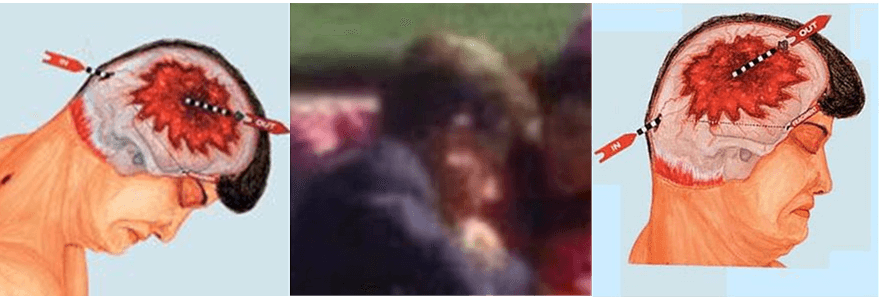
    Another dispute Thompson had with Vince Salandria was the author’s theory about the small hole in JFK’s throat. On the day of the assassination, Dr. Malcolm Perry said to the public that this appeared to be an entrance wound. Thompson’s idea is that it was a piece of either brain or metal ejected from Kennedy’s skull. And he includes a diagram of this on page 98. The trajectory of this projectile is hard to fathom, especially since it would be traveling through soft tissue. But also, once it went into the throat area, it would be entering into all kinds of small bones and thicker cartilage. So in addition to the trajectory, it found an exit path through that maze?

    Thompson takes Howard Brennan at his word. (pp. 98-99) Which he also did in his previous JFK book. I am not going to go into the myriad problems with Brennan as a witness. That would be redundant of too many good writers. Let me say this: today, the best one can say about Brennan is that he was looking at the wrong building. The worst one could say is that he was rehearsed and suborned. As Vince Palamara wrote in Honest Answers, Brennan refused to appear before the House Select Committee on Assassinations. Beyond that, he would not answer written questions. When they said they would have to subpoena him, he replied he would fight the subpoena. Does this sound like a straightforward, credible witness? (Palamara, pp. 186-89)

    To supplement the dubious Brennan, the author uses the testimony of the three workers underneath the sixth floor. Vincent Bugliosi used one of them in a mock trial of Lee Oswald in England in 1986. I addressed the serious problem with using these men––in Bugliosi’s case it was Harold Norman––in my book The JFK Assassination: The Evidence Today. (pp. 54-55) To make a long story short, after they were interviewed by the FBI, their stories were altered by the Secret Service. At that mock trial, Norman could have been taken apart and spat out if defense lawyer Gerry Spence had been prepared––which he was not. (For a long version of how and why this happened, see Secret Service Report 491)

    Let me add one key point about this. One of the Secret Service agents involved in this mutation was Elmer Moore, a man who––since the declassifications of the ARRB––has become infamous in the literature. There is little doubt today, in the wake of the declassified files, that Moore was an important part of the coverup. (DiEugenio, pp. 166-69) Therefore, in my view, Thompson missed another pattern––one which could have been indicated to him by Gary Aguilar or Pat Speer, in addition to myself.

    The middle part of the book narrates much of the case history from the early to late seventies. For Thompson, this means the first showings of the Zapruder film by Bob Groden at conferences, then the big national showing on ABC in 1975. This was one of the factors that spurred the creation of the HSCA in 1976. Thompson says that he was invited to the so called HSCA “critics conference.” He says this was where he first heard of the dictabelt tape of a motorcycle recording of the assassination. He takes the opportunity to tell us how the HSCA actually recovered the tape. He also explains how it worked and some of the technology behind it. (pp. 147-51) Keeping with his personal journey aspect, in this part of the book he also tells us how he decided to give up his professorship at Haverford and become a private investigator.

    From 1979 until 2006 the author tells us he was very little involved with the case. (pp. 182-83) This is kind of surprising when one thinks about it. Thompson all but leaves out the yearlong furor that took place over the release of Oliver Stone’s film JFK. Which is odd, since that was the largest period of focused attention the case got since 1975. All he says is that he was called to testify by the Assassination Records Review Board about their purchase of the Zapruder film. And he testified, properly I think, that once the Secret Service knew about the film it should have gone to Abraham Zapruder’s home and taken possession of it right there as a piece of evidence in a homicide case. (pp. 189-90) About any of the rather startling disclosures of the ARRB, I could detect little or nothing.

    He spends several pages on a conference organized by Gary Aguilar in San Francisco which featured Eric Randich and Pat Grant. It was these two men who broke open the whole mythology of Vincent Guinn’s Neutron Activation Analysis, today called Comparative Bullet Lead Analysis. I was at that conference and Thompson does a good enough job summing up their scientific findings. (pp. 190-96). As the author notes, this “junk science” had been important to the HSCA in its findings that somehow Oswald alone did the shooting, and the acoustical second shot from the front missed.


    II

    In the second half of the book Thompson more or less forsakes the personal journey motif. He concentrates on what he sees as three important pieces of evidence, which he figures are crucial to the case. I will deal with each of these as candidly and completely as I can.

    Thompson devotes Chapter 16, well over twenty pages, to the medical evidence in the JFK case. He begins this part of his book by declaring that the JFK autopsy was “botched,” in other words, whatever shortcomings there were in that procedure, they were not by design. I was rather surprised by this supposition, for the simple reason that Dr. Pierre Finck said under oath at the trial of Clay Shaw that the reason the back wound was not dissected is because the military brass in the room stopped them from doing so. He also said that James Humes, the chief pathologist, was not running the proceedings. They were being so obstructed that Humes literally had to shout out, “Who’s in charge here?” Finck testified that an Army general replied, “I am.” Finck summed up the situation like this:

    You must understand that in those circumstances, there were law enforcement officials, military people with various ranks, and you have to coordinate the operations according to directions. (James DiEugenio, Destiny Betrayed, p. 300, italics added)

    The Department of Justice––among other groups––was monitoring the Clay Shaw trial in close to real time. When Carl Eardley, the Justice Department specialist on the JFK case, heard this, he almost had a hernia. He called up another of the pathologists, Thornton Boswell, and sent him to New Orleans, since they now had to discredit Finck for revealing what had happened. Eardley later thought better of this, probably because by any standard measure, Finck had better qualifications as a forensic pathologist then Boswell did. (ibid, p. 304)

    One cannot overrate the importance of this testimony. To give just one indication of its importance: I did a pre-interview with Dr. Henry Lee for Oliver Stone’s new documentary on the JFK case. I asked him this specific question, directly related to Finck’s testimony: Can you figure out a firing trajectory without a tracking of the wound? He said that under those circumstances, it was very difficult to do. Here is a man who has worked about 8000 cases all over the world and is recognized as one of the best criminalists alive.

    The same situation applies to the skull wound, except in this case, the situation is more complex. If one talks to Lee or Cyril Wecht they will tell you there is no evidence of a brain sectioning. But the Review Board did an inquiry into this subject, and Jeremy Gunn and Doug Horne came up with some evidence that such an examination may have been done. Under the scope of this particular review, this is not the place to do an expansive analysis of their evidence. Suffice it to say I found Thompson’s excuse for this lack rather strained: the doctors did not have the time to do so such a thing. (Thompson, p. 259) Yet in the Commission’s volumes there is a brain examination, dated 12/6/63. (CE 391) And there is no mention of sectioning; two weeks was not long enough? Yet without sectioning, how can one determine the bullets’ paths? On this matter, Lee was quite animated. He put his right hand up in front of his face and said words to the effect: You have this bullet coming in at a right to left angle: it then reverses itself and goes left to right? The lack of dissection in this instance is even more perplexing because the head wounding was how Kennedy was killed. And this is why Lee’s hand was piercing the air in bewilderment.


    III

    Thompson wrote something later that stunned me. On page 258 he says that the first time the autopsy doctors learned of a tracheostomy over the anterior neck wound was when they read about it in the next day’s newspapers. That passage is undermined by Nurse Audrey Bell’s 1997 testimony to the Review Board. Bell told them that Dr. Malcolm Perry complained to her the next morning (on Saturday, November 23rd) that he had been virtually sleepless, “because unnamed persons at Bethesda had been pressuring him on the telephone all night long to get him to change his opinion about the nature of the bullet wound in the throat, and to redescribe it as an exit, rather than an entrance.” (See DiEugenio, The JFK Assassination: The Evidence Today, pp. 167-68; also this discussion)

    In a very late discovery by writer Rob Couteau, Bell’s testimony was both certified and expanded. In the days following the assassination, many reporters were milling around Dallas, and some found their way to Malcolm Perry’s home, for the reason that he and Dr. Kemp Clark had held a press conference on the day of the assassination where Clark said there was a large, gaping wound in the back of Kennedy’s skull, and Perry said the anterior neck wound appeared to be one of entrance. One of the reporters who migrated to Perry’s home was from the New York Herald Tribune and his name was Martin Steadman. He asked Perry about this issue and Perry was frank. He affirmed that it was an entrance wound. But beyond that he said he was getting calls through the night from Bethesda. They wanted him to change his story. He said that the autopsy doctors questioned his judgment about this and they also threatened to call him before a medical board to take away his license. (See further “The Ordeal of Malcolm Perry”) To put It mildly, I disagree with Thompson’s next day thesis on this point.

    Another surprising aspect of this chapter is that Thompson agrees with the Ramsey Clark Panel. That panel’s findings were released on the eve of the Clay Shaw trial. They upheld the original autopsy’s conclusions about two shots from behind; but they made about four major changes that were rather bracing. One of them was that they raised the entrance wound in the rear of Kennedy’s skull 10 mm upward, into the cowlick area. (Thompson, p. 248)

    The way Thompson mentions this in passing was, again, jarring to the reviewer, one reason being that, in all likelihood, it was Six Seconds in Dallas which caused both the Clark Panel to be formed and the rear skull wound to be raised to the cowlick area. (DiEugenio, The JFK Assassination, p. 150). As Russell Fisher, the panel’s chief pathologist later said, Attorney General Ramsey Clark got hold of an advance copy of Six Seconds in Dallas. On page 111 of that book, Thompson shows that Kennedy’s head––as depicted in the Warren Commission to illustrate the fatal wound––is not in the correct posture as shown in Zapruder frame 312. The Commission had the film; therefore, all the indications are that they fibbed about this key point.

    How did the Clark panel elevate that wound into the cowlick area? Since Thompson does not show the anterior/posterior X-ray, the reader is in the dark about this point. The answer is they largely based it on a disk-shaped white object in the rear of the skull that stands out plain as day on the X-ray. The problem with this piece of evidence is that none of the autopsy doctors, or the two FBI agents in attendance, saw it on the X-rays in the morgue the night of the autopsy; and it is not in the 1963 autopsy report. All of which is incredible, for two reasons. First, it is by far the largest fragment visible; and second, its dimensions of 6.5 mm precisely fit the caliber of ammunition Oswald was allegedly firing. (DiEugenio, The JFK Assassination, pp. 153-54)

    I could go on from there, but I won’t. As the reader can see, I did not find this chapter at all satisfactory.


    IV

    One of the key points Thompson wants to make in this book is something he has been talking about for a rather long time. It is the work of Dave Wimp on what the author calls “the blur illusion.” In fact, Thompson calls Chapter 14, “Breaking the Impasse: The Blur Illusion.” Since I took Thompson at his word about this, several years ago, at a JFK Lancer conference, I mentioned Wimp and his work. I said the forward bob by Kennedy preceding the rearward head snap did not really exist. Almost immediately after I finished my address, first Art Snyder and then John Costella disagreed with me. Snyder disagreed with me on the mathematical analysis Wimp had done. Costella disagreed on whether or not this was really an illusion. In other words: did Kennedy’s head really bob forward before jetting backward? The two disagreements gave me pause. Why? Because both men are physicists.

    Back in the sixties, Thompson first learned of this forward bob between Zapruder frames 312-313 from one of the earliest students of the film, Ray Marcus. (See page 112 of Six Seconds in Dallas, footnote 2) The author and Vince Salandria then studied this in combination with the more dramatic and lengthier rearward slam at the Archives. (Six Seconds, pp. 86-87) The issue is one of the most interesting aspects of Thompson’s first book. He goes through a few explanations of how this could have occurred. He then decides on a term that became rather famous in the critical community––the “double hit” or “double impact.” (pp. 94-95) In other words, two projectiles hit Kennedy’s skull almost instantaneously: one from behind and one from the front. The first moved him forward, the second rocked him backward. He then adds that S. M. Holland had told him the third and fourth shots sounded like they were fired almost simultaneously. He backs this up with other witnesses who heard the same thing. Thus the double impact was credible.

    Why did Thompson change his tune on this point? There seem to be three reasons for this. The first is that he felt his first thesis allowed for too precise a synchronization of the shots. No firing team could be that well trained. The second and third are complementary: Dave Wimp’s work coincided with his gravitation towards the acoustics evidence.

    Since Thompson decided to go with the acoustics, he had to dump the “double hit” he wrote about in his earlier book, because the acoustics evidence allows for only one shot from the front at Zapruder frame 312. The following shot comes from behind at Zapruder frame 328. Dave Wimp aided this new scenario by somehow making the forward bob disappear, being dismissed as an illusion.

    But if such was the case, then why did the two physicists disagree with my statement about the Wimp thesis? Snyder objected to it on mathematical grounds. He did not think that Wimp’s work had absolutely proved his thesis. He told me that there was about a 20% chance Wimp was wrong. Snyder turned out to be correct, because in a reply to Nick Nalli’s review of Last Second in Dallas, Wimp admitted his calculations were not correct. He wrote:

    That I have a blur illusion hypothesis is the result mostly of people failing to distinguish between what people are saying and what people are saying people are saying, which seems to be a pervasive problem. The issue is not about illusions but rather about bad methodology.

    Today, Wimp now seems to admit that Kennedy’s head did go forward by about an inch. Evidently, Thompson oversold this idea to at least one person: me. And since he still insists on it in his book, perhaps others.

    Costella explained why Wimp made an error in a more practical, applicable sense:

    Wimp has always made a valid observation about trying to measure the position of a single (rising or falling) edge, in the presence of blur. That is fraught, especially in the presence of unavoidable nonlinearities. What he never seems to have considered, as far as I can tell, is that if you have two opposite edges (rising then falling, or vice versa) of an object, then it is quite simple to align the center of mass of the object between any two frames, even if the edges are blurred. You can do this even if the two frames are blurred differently––that’s effectively what all stabilized versions of the film do (including his own!). It’s even simpler if you either deblur the blurred 313 to match 312 (like I did back in the day, per my animation on my website), or else blur 312 to match 313 …. What I never did is put an exact number of inches on the forward head movement. I have no idea if his smaller number is accurate or not, because I didn’t quantify. What is certain, just from the visuals, is that the head moves forward in the extant Z film. (Email of 6/15/21)

    How proficient is Costella in his study of the film? After he approached me at JFK Lancer, he took out his cell phone and showed me how he had deblurred Zapruder and the forward head bob was still there. Yes, John is a man who carries his work with him.

    G. Paul Chambers, another physicist, probably has the most sensible explanation for this aspect of the case. He has told Gary Aguilar that what likely happened is that the first shot through Kennedy’s back likely paralyzed him. When the car began to brake, his limp body then went forward. (Phone call with Gary Aguilar, 7/18/21)


    V

    “Jim, there is no motorcycle where the HSCA says there is.”

    The above quotation is taken from a phone conversation in 1994 between this reviewer and the late Dick Sprague. I chose to lead this part of my review with it because, as with the head bob, I once believed in the acoustics evidence. So when the famous photo analyst Dick Sprague said the above to me, I was surprised.

    Let me explain why I had that reaction. When I visited the now deceased HSCA attorney Al Lewis at his office in Lancaster Pennsylvania, he told me about something his former boss had done in the early days of that congressional committee. Chief Counsel Richard A. Sprague had arranged a day-long study of the photographic evidence in the JFK case. There were three presenters on hand: Bob Cutler, Robert Groden, and Dick Sprague. They went in that order. Before Cutler began, the chief counsel turned to those in attendance and said, “I don’t want anyone to leave unless I leave, and I don’t plan on leaving.” As Lewis related to me, Cutler’s presentation was about 35 minutes. Groden’s was over 90 minutes, close to two hours. Dick Sprague’s went on for four hours. By the end of Sprague’s demonstration, 12 of the 13 staff lawyers believed Kennedy had been killed by a conspiracy. (James DiEugenio and Lisa Pease, The Assassinations, p. 57)

    Such was the photographic mastery of Dick Sprague. At that time, no one had a more expansive collection of films and photos than he did. In that phone call, he told me that Robert Blakey, the second chief counsel, only called him once. It was to ask him if there was a motorcycle where the acoustics experts said there had to be one. Dick spent a lot of time going through his massive collection. He eventually replied that no, there was not. It was Groden who said that there was.

    To this day this issue has not been settled to any adequate degree. And there is simply no papering it over. Because the motorcycle has to be at a precise point near the intersection of Houston and Elm for the acoustics evidence to be genuine. Modern experts on the motorcade, like Mark Tyler, insist that Sprague was correct. And Mark argues that point effectively at the Education Forum. (See his post of June 9th) What I found severely disappointing about Thompson’s book is this: he barely deals with the issue at all. This is what he says about the highly controversial but crucial point: he writes that he and author Don Thomas found the correct motorcycle in the films of Gary Mack. Afterwards, they had a few beers and called it a night. (p. 304)

    I could hardly believe what I was reading. I actually wrote “WTF” in the margin of my notes. Somehow, this trio, not experts on the photo evidence, easily accomplished something that Dick Sprague––who was the leading authority in the field––could not do? The cavalier way Thompson deals with this important point––throwing in the phrase “having a few beers and calling it a night”––underscores just how unconvincing his treatment of it is. If it was this easy to locate and demonstrate, then why is there no picture of the proper motorcycle in proper context to accompany the “few beers and calling it a night”––straight out of Sam and Diane at Cheers––motif? I was so puzzled by this carelessness, leaning toward avoidance, that I went back and read up on the acoustics evidence.

    These sound recordings first entered the legal case during the days of the HSCA. They were offered up by Texas researchers Gary Mack and Mary Ferrell. Thompson does a good job in explaining the rather primitive technology which the Dallas police used in these recordings. There were two channels being recorded that day, simply labeled Channel 1 and Channel 2. The latter used a Gray Audograph powered by a worm gear which drives a needle into a vinyl disk. (Thompson, pp. 304-06). Channel 1 “was done by a Dictaphone that used a stylus inscribing a groove onto a blue plastic belt called a Dictabelt mounted on a rotating cylinder.” (Thompson, p. 148). Channel 1 was used for basic police operations. Channel 2 was for special events, like Kennedy’s motorcade. Back at headquarters, the dispatcher would announce each minute that passed, and each time the dispatcher spoke to a unit he would announce the time. (p. 149)

    The HSCA did two tests of the acoustics. The first was by a company called Bolt, Beranek, and Newman. The main scientist on this was James Barger, who supervised a reconstruction test in Dealey Plaza. After doing this, Barger said that there was about a 50% chance of a shot from the Grassy Knoll. The HSCA then gave those results to another team of acoustic experts: Mark Weiss and Ernest Aschkenasy . After examining this data they decided there was a much higher probability, 95%. The HSCA announced this in their final days.

    Because he is wedded to this evidence for the finale of his book, Thompson has nothing but scorn for what is today called the Ramsey Panel. The Department of Justice asked the National Academy of Sciences to review the work of the HSCA. They set up a committee named after Harvard physicist Norman Ramsey. Alvarez ended up serving on this committee. Alvarez told Barger that no matter what he said he would vote against him. (Thompson, p. 287) The panel was biased from the start and the author does a good job proving that point. For Thompson, this is why they ended up rejecting the HSCA result.

    But I want to note two things about the closing 80 or so pages of Last Second in Dallas and how an author making himself a character in his book is a double-edged sword. Thompson mentions a 2013 debate he did for CNN moderated by Erin Burnett; his opponent was Nick Ragone. (p. 276) If one can comprehend it, Ragone brought up Gerald Posner’s discredited book Case Closed. Thompson says he did not do well since he did not have any new evidence to reply with. I don’t want to toot my own horn, but if I had been there, I would have had a lot of new evidence to throw back. This is how I would have replied:

    Nick, that book came out in 1993. Which was one year before the ARRB was set up. They declassified 2 million pages of documents. Have you read them? I read a lot of them, and here is what they said.

    When asked the old chestnut, “Well why didn’t someone squeal?”, Thompson could have mentioned Larry Hancock’s book Someone Would Have Talked. He then could have said: “Larry shows that two people did talk, Richard Case Nagell and John Martino. If you don’t know about them, that is a failure of the MSM.” As a point of comparison, when Oliver Stone and I did an interview this past June with Fox, I brought about eight of these new ARRB documents with me. Fox filmed me showing them while I described what they said. They then had me send them in email form. Whether or not they will exhibit them on the show, I don’t know. But I had enough rocks in hand to play David with his slingshot.


    VI

    But the reason I think Thompson plays up the CNN experience is that he wants to show that if the acoustics evidence had been reexamined, he could have mentioned that. As noted, Thompson harshly critiques the Ramsey Panel, and much of this is warranted. But he only briefly mentions how the Weiss/Aschkenasy ––hereafter called WA––verdict was rather hastily granted a stamp of approval by the HSCA.

    What makes this kind of odd is that the author mentions Michael O’Dell more than once in the book. But he does not go into O’Dell’s rather bracing criticism of WA. O’Dell is a computer scientist and systems analyst. O’Dell wrote that the WA conclusion was based upon a motorcycle rider having his Channel 1 microphone button stuck open for a continuous five minute period. This was thought to be H. B. McLain, who first said it was and then said it was not him. What O’Dell was trying to do was to replicate what WA had done, except with much more powerful computer tools, not available back then. He wrote a report called “Replication of the HSCA Weiss and Aschkenasy Acoustic Analysis.” In his report, he found that:

    Numerous errors have been found with the data provided in the report, including basic errors involved in the measurement of delay times, waveform peaks and object position. Some of the errors are necessary to the finding of an echo correlation to the suspect Dictabelt pattern. The Weiss and Aschkenasy report does not stand up to even limited scrutiny, and the results it contains cannot be reproduced. (p. 2)

    O’Dell revealed that WA had relied on a millimeter ruler and string to map out their bullet paths on a map of Dealey Plaza. O’Dell used Adobe Photoshop to scan the same map as WA and transferred the measurements into pixels after lining them up in Excel. He found multiple critical errors in WA’s work, including those of distance measurement of buildings from other objects like the stockade fence. (See p. 3) O’Dell wrote that the microphone was positioned in the wrong place by WA. (p. 9) There were errors in the original paperwork independent of a transfer to a virtual model. For the buildings list in Dealey Plaza, items 16 and 20 were described as the same object. (p. 4) He also found out that one of the bullet paths was supposed to rebound off of object 23, yet there were only 22 structures WA had listed. (p. 5). There were objects listed in the WA table that O’Dell could not find on the map. (p. 8) But perhaps the most bracing criticism O’Dell made was that

    … the values presented in Table 4 for the Dictabelt pattern do not appear to be valid measurements of the peaks in the recording. A test that supposedly identifies a gunshot on the Dictabelt recording must, at a minimum, correctly measure the sound being tested on the Dictabelt. (p. 11)

    I could go on. But before anyone comes back at me by saying, “Why would you use something like this after what Dale Myers did with his phony cartoon based on the Zapruder film?” After all, Jim, Myers went on ABC TV and said the single bullet theory was really the single bullet fact. All I can do is reply with the following. I used O’Dell because Thompson used him. In communicating with the man I found out that Thompson had signed him to a non-disclosure agreement about his book. It ended when the work was published.

    Another series of problems with this evidence was written about by Charles Olsen and Lee Ann Maryeski in June of 2014 for Sonalysts, Inc. out of Waterford, Connecticut. They stated that although McLain had claimed he had opened up his cycle to a continuous high speed after the shooting, that is not what they determined by placing the sound on a graph: “What Figure 1 shows is a motorcycle that variously speeds up and slows down and idles during this latter period.” (6/6/2014, Olsen and Maryeski, pp. 3-4)

    Let me add one other comment. As both O’Dell, and especially Dave Mantik have pointed out, one of the virtues attributed to this evidence is the so called “order in the data.” Or as Don Thomas puts it in his book, the best test matches correspond to a topographic order in Dealey Plaza and with the dictabelt. (Hear No Evil, p. 583) But as Mantik informed me, if one looks at Thompson’s own table, if the HSCA had chosen the bullet sound at the 144.90 point in the tape, they would have had two matches to the School Book Depository that very closely matched the one to the knoll area. (Thompson, p. 155) The same thing occurred at 137.70; the TSBD could have been chosen over the knoll. (interview with Mantik, 6/26/21)

    In addition to all the above, Thompson essentially brushes over the issue of heterodyne tones. (p. 296) This is an important point that the Sonalyst report examined. It’s important because it can result in words being scrambled in pronunciation as one listens to them. Meaning that they can sound like one phrase to one person and another phrase to someone else. And this has happened. (Olsen and Maryeski, p. 9)

    Even his heralded discovery, that voices saying “Hold everything” and “I’ll check it,” occur around the assassination is odd. First, the object is to show whether or not the bullet echo correlation is real, not the voices. Also, to get a more distinct peak for “I’ll check it,” Richard Mullen, Barger’s protégé, used a narrower sampling PCC (Pattern cross correlation) window of 64. Therefore Thompson concludes this is what should have been used from the start. Yet for “Hold everything,” a wider sampling window of 512 yielded a larger net peak than did a smaller sampling window of 64. Thompson offers no explanation for this seeming paradox. (See Figures 22-6 and 22-7; 6/26/21 interview with Mantik)

    If the “Hold everything secure” phrase is at the time of the assassination, then the acoustics is invalid, since this is spoken after the assassination. “I’ll check it” would be around the time of the shots. So the two phrases are in conflict if both were valid. The first phrase is at the wrong time, the latter one is at the right time. So Thompson argues that the “Hold” phrase has been altered and is really an overdub. (Thompson, pp. 345-47)

    This has also been placed in doubt by O’Dell. (See Dictabelt Hums and the “hold everything secure” Crosstalk) The “Check” phrase, as has been argued by many, is not really crosstalk at all. The same sound does not appear on both channels. (Email communication with O’Dell, 7/25/21). And further, Sonalysts showed that the spectrograms of the phrase differ on Channel 1 and 2. (Olsen and Maryeski, p. 6)

    I could go on. But I think the point has been made. There are simply too many uncertain variables with the acoustics evidence to rely on it as having a 95% probability. Much of this is due to the innate poor quality of the recordings themselves.

    When we were making JFK Revisited, producer Rob Wilson asked me to incorporate a section on the acoustics evidence. I recommended against it. I simply noted that with all the above problems with that evidence we would be making ourselves into a bull’s eye on a target range; a whole gallery of persons would take out their bows and arrows and start unloading their quivers on us.

    As I said in Part 1, there are good things in Last Second in Dallas. And as a responsible critic I have described them. In my opinion, they are important and valuable and have stood the test of time. But it is also my opinion that there are a lot of things which seem to me to be liabilities, including what the author thinks is the culminating arc of his book––and I have described those deficits also. This is why Last Second in Dallas is a decidedly mixed bag.


    Return to Part 1

  • Last Second in Dallas by Josiah Thompson

    Last Second in Dallas by Josiah Thompson


    It has been quite some time since a new book about the assassination of President Kennedy has piqued my interest enough for me to want to even read it, let alone write a review. Over recent years, I have grown increasingly tired of what I have come to see as an endless, false debate over the existence or non-existence of a conspiracy. More to the point, I have lost all patience for the ever-growing list of ill-supported theories, baseless claims of fakery/alteration of evidence, and the apocryphal stories that sadly appear to be firmly planted in the bedrock of most conspiracy thinking. Nonetheless, when I saw that Josiah Thompson’s long-awaited Last Second in Dallas was finally making its way into print, I immediately placed my order.

    As most readers will no doubt be aware, Thompson is the author of one of the most influential books ever written about President Kennedy’s tragic murder, Six Seconds in Dallas. First published in 1967, Six Seconds in Dallas was a rare gem that managed to garner the respect of both Warren Commission zealots and critics alike. Even the late Vincent Bugliosi―who went to great lengths in his own tediously massive tome to denigrate virtually anyone and everyone who dared disagree with the Warren Commission’s conclusions―was compelled to refer to Thompson’s first book as a “serious and scholarly” work. (Reclaiming History, p. 484) In Six Seconds, Thompson presented readers with a meticulous study of the facts and evidence available to him at the time, leading to the almost inescapable conclusion that JFK had been shot by three different gunmen firing from three separate locations. While some of the precise details of his reconstruction of the shooting have since proven to be in error, Thompson’s overarching thesis has been entirely validated by later revelations and stands to this day as the most viable explanation of events.

    Based on both the quality of Six Seconds In Dallas and my own pleasant exchanges with Thompson―during one of which he was kind enough to state that he felt my critique of Lucien Haag had the “depth and scholarly backup” to appear in a peer-reviewed journal (private email)―I was hoping for and, indeed, expecting big things from his follow-up work. It gives me great pleasure to be able to report that I was not disappointed. Last Second in Dallas is an eminently worthwhile addition to the literature that includes some game changing new research into one of the Kennedy assassination’s key pieces of evidence.

    One remarkable facet of Last Second in Dallas is that it manages to present readers with a sizeable amount of detail while remaining, for the most part, eminently readable. This is perhaps largely due to the author’s decision to structure the book as a memoir of his time studying and investigating the case rather than as simply another dry recitation of facts. It is often said that anyone old enough to remember November 22, 1963, can tell you precisely where they were and what they were doing when they first learned that President Kennedy had been shot. In Thompson’s case, he recalls being at a street corner in New Haven, Connecticut, when he saw a woman run out of a record store yelling, “Kennedy’s been shot!” (p. 4) Like the rest of the nation, he then spent the hours that followed glued to news reports, feeling “strangely numb” as a bizarre sequence of events continued to unfold in Dallas, Texas.

    The following evening Thompson and his wife, Nancy, attended a dinner party at the home of a European friend who offered his belief that Lee Harvey Oswald, the alleged Marxist-sympathiser who had been arrested within an hour of the assassination, “will never live to stand trial.” (ibid) Thompson dismissed his dinner companion’s comments off hand, remarking to his wife, “That’s just Alex. Europeans see conspiracies everywhere.” (p. 5) Yet only a matter of hours later Thompson would see his friend’s prophecy fulfilled when Oswald was gunned down by local nightclub owner, Jack Ruby, in front of news cameras in the basement of Dallas police headquarters.

    A few days later, Thompson sat in his apartment studying the black-and-white Zapruder film frames published in the latest edition of LIFE magazine and noticed a curious discrepancy between the reports that had come from Parkland Hospital suggesting Kennedy had been shot from the front and the Zapruder stills showing that Oswald’s alleged sniper’s perch on the sixth floor of the Texas School Book Depository was located directly behind the President when he was hit. The sense of unease he felt at this discovery led Thompson to the local FBI office where he found himself trying to explain the conflict to a Bureau agent who, Thompson noted, “listened politely” then “probably had a good laugh” after the author walked away. (p. 6)

    Like most Americans, Thompson initially chose not to dwell on his suspicions. But in early 1965 his doubts about the official story were reignited by a series of articles appearing in left-wing periodicals Liberation and The Minority of One, written by a Philadelphia lawyer named Vincent Salandria. Salandria was an immediate skeptic of the near-instantaneous fingering of Oswald as the lone gunman. “I’m particularly sensitive to the possibilities of governments [sic] not being as diligent as they should in situations of this sort,” Salandria explained. “I guess it comes from my Italian peasant background which always disputes governmental action and is inherently skeptical.” (John Kelin, Praise from a Future Generation, p. 32) For The Minority of One, Salandria focused his attention on the Warren Commission’s infamous Single Bullet Theory and attempted “to establish finally and objectively that Kennedy and [Texas Governor, John] Connally were wounded by separate bullets.” (Ibid, p. 273) Thompson absorbed Salandria’s arguments, compared them to the evidence contained in the Commission’s twenty-six volumes of hearings and exhibits, and found that his criticisms were valid. “The more I read,” Thompson notes, “the more interested I became.” (Thompson, p. 7)

    In January 1966, Thompson and a friend were arrested for “littering” in Delaware County after handing out anti-Vietnam war pamphlets against the wishes of the local sheriff. The pair spent a couple of hours in a cell before an American Civil Liberties Union attorney arrived to represent them. As Thompson and his fellow arrestee were brought into a squad room to meet with him, the lawyer loudly announced that he had been in touch with the Attorney General. “When the FBI agents arrive,” he said whilst looking at his watch, “I want you to tell them that not only have your civil rights been violated but you are suing for false arrest…” “He did a masterful job of bluffing,” Thompson recalled. “We were released in less than two minutes.” Once they were back out on the street, the ACLU attorney introduced himself; it was Vincent Salandria. (pp. 7–8)

    This chance meeting was something of a turning point for Thompson. Salandria brought him into the small group of critics―figures now legendary among assassination scholars like Sylvia Meagher, Harold Weisberg, Penn Jones, Shirley Martin, Cyril Wecht, and Mary Ferrell―who were working hard to identify and publicise the myriad problems with the Warren Report. Then, in the summer of 1966, Thompson and Salandria began collaborating on what was intended to be a long magazine article. The pair began making trips to the National Archives in Washington and it was there that Thompson saw the Zapruder film for the first time. “I literally gasped aloud” Thompson writes, “as I watched the president’s head explode and snap backward as if his right temple had been struck by a baseball bat.” The author knew instinctively that what he was seeing had to be the result of a shot fired from the right front. And what is more, if the film were to be shown to the American public, he knew the majority would arrive at the same conclusion. (p. 10)

    Sadly, the Thompson/Salandria collaboration did not last the summer. Natural disagreements over the evidence came to a head in an argument over the nature of the wound in Kennedy’s throat. Salandria was thoroughly convinced, based on the descriptions given by Parkland Hospital physicians, that the small, neat hole had to be a wound of entry. Thompson, on the other hand, felt that “The spinal column was only a few short inches behind that hole. Any bullet entering there must have shattered the spinal column before blowing a hole out the back of Kennedy’s neck.” (p. 97) Since there was no damage to the spine, he reasoned, there must be some other explanation for the wound.

    As Salandria recalled in an interview for John Kelin’s wonderful book Praise from a Future Generation, “I immediately quit when Thompson tried to convince me that the Kennedy throat wound was a consequence of a bit of bone exiting from the throat which emanated from the head hit.” (Kelin, p. 340) According to Kelin, Salandria felt that Thompson’s postulate tended to exculpate the government and the attorney would go on to accuse Thompson of being a covert federal agent. In March 1968, Salandria wrote Thompson a letter stating, “I feel that you should know that I consider the data on whether you are a United States government agent incomplete, but that I entertain a suspicion at this time that you are.” According to Kelin, Thompson wrote back a short reply, telling Salandria he was “out of his goddam mind.” (ibid, p. 434)

    With Salandria taking himself out of the picture, Thompson chose to carry on alone. By late August 1966, he had written a sixty-page draft that he planned to show to the editor of Harper’s magazine. Before that could happen, however, he found himself invited to lunch with publisher, Bernard Geis. “At the end of the lunch,” Thomson writes, “Geis asked [executive editor, Don] Preston to write up a contract for me. ‘You’re going to write a book for us, Thompson.’”

    II

    In October 1966, while Thompson was working on the manuscript that would become Six Seconds in Dallas, his publisher reached out to LIFE magazine to see if there was any interest in what Thompson was doing. As it turned out, following the commercial success of the books Rush to Judgment by Mark Lane and Inquest by Edward Epstein, LIFE was considering its own reinvestigation of the assassination. Thompson soon found himself teaming up with two associate editors at the magazine, Ed Kern and Dick Billings. This turned out to be an invaluable development for Thompson as it gave him access to the impressive resources of LIFE, chief among them, the Zapruder film. After viewing LIFE’s own high-quality copies of the film for the first time, Thompson was bowled over by what he saw and rushed to a phone to call his publisher’s office. “The Zapruder film is glorious” he exclaimed at the time. “You can see all the details. Connally was hit later…You can see the impact of the bullet on him. The single-bullet theory is dead…LIFE is going to break this all within a month!” (p. 19) Sadly, this would turn out not to be the case.

    When the article appeared the following month, Thompson found that he was sorely disappointed. “Much of the material we had discovered had not made it into the article,” he writes, “and what had was watered down.” (p. 90) Nonetheless, teaming up with LIFE had not only given him access to the most important record of the assassination, but it had also taken him to Dallas to conduct interviews with some the most important witnesses to both the crime and its aftermath. This research would form the basis of his own book.

    Six Seconds in Dallas was published to significant media attention in late 1967. Among its many contributions to our understanding of the assassination was a tabulation of 190 witnesses, detailing the location of each witness at the time of the shooting, how many shots they heard, and from which direction those shots appeared to come. Of those who offered an opinion, 52% believed shots had been fired from the infamous “grassy knoll” to the right front of the president’s limousine. (Six Seconds in Dallas, p. 24)

    One of the most important of those witnesses was Union Terminal Railroad supervisor, Sam “Skinny” Holland. In Last Second in Dallas, Thompson presents some fascinating and, as far as I am aware, previously unpublished excerpts from the interview he and Ed Kern of LIFE magazine conducted with Holland in November of 1966. Holland, who had been standing on the railroad overpass overlooking Dealey Plaza during the assassination, recalled hearing at least four shots, one of which came from the grassy knoll and was accompanied by a puff of smoke that drifted between the trees in front of the stockade fence. When Kern told Holland that defenders of the Warren report had suggested that whatever Holland saw could not have been rifle smoke because “rifles no longer sent out puffs of white smoke” Holland, who had carried a gun for sixteen years as a special deputy to Sheriff Bill Decker, replied, “…you fire a gun, any gun, from a light underneath this shade you’ll see a puff of smoke that’ll linger there. It’ll be, just like I say, dim, like a cigarette or maybe a firecracker smoke, but mister, if it’s powder, it’s going to smoke.” (Last Second in Dallas, p. 75)

    Holland and two other witnesses who also saw the smoke were so convinced that a shot had been fired from the knoll that, immediately after the shooting, they ran around to the spot behind the fence from where they believed the smoke had come to look for empty shells “or some indication that there was a rifleman or someone was over there.” (p. 71) What they found, according to Holland, was numerous footprints giving the impression that someone had paced back and forth and mud on a car bumper, “Exactly like someone was standing up there looking over the fence.” (p. 76)

    As well as the lengthy analysis of eyewitness accounts in Six Seconds in Dallas, Thompson went into impressive detail concerning the conflicts in the medical evidence that existed at the time, many of which have still not been resolved today. One of those has to do with the question of whether the bullet which entered Kennedy’s back also exited his throat as the Warren Commission claimed it did. Thompson pointed to the testimony of Secret Service agents and the report of two FBI agents who were present at the autopsy as indicating that it did not. (Six Seconds in Dallas, pp. 42–51) Furthermore, as alluded to above, he used the testimony of the Parkland physicians, and the descriptions of Kennedy’s brain given by the autopsy doctors, to make a case for the throat wound being the result of a fragment of bullet or bone from the head shot. (ibid, pp. 52–56)

    In addressing the ballistics evidence, Thompson pointed out that one of the empty rifle shells found on the sixth floor of the depository building had a dented lip which appeared to show that it could not have held a projectile on November 22, thus suggesting that only two shots had been fired from Oswald’s rifle. (ibid, p. 144) More crucially, he made a compelling case that Commission Exhibit 399―the so-called “magic bullet” that was alleged to have produced seven wounds in JFK and Governor Connally without sustaining any significant damage―was not found at Parkland Hospital as the Commission claimed. And, in fact, the actual bullet found at Parkland was a different caliber round that came off a stretcher that was in no way related to the assassination. (ibid, pp. 161–164)

    Perhaps the most revelatory aspect of Six Seconds in Dallas was Thompson’s analysis of the Zapruder film. Because LIFE had refused the author permission to publish stills from the actual film, he was forced to use an artist’s renderings of the individual frames, something Thompson was understandably unhappy about. Yet it had surprisingly little impact on the effectiveness of his presentation. Thompson pointed out that a dramatic change in Connally’s demeanour occurred at Zapruder frame 238 when “his right shoulder collapses, his cheeks and face puff, and his hair becomes disarranged.” (ibid, p. 71) These involuntary responses appeared to pinpoint the very moment Connally was struck and seemingly occurred much too late to be associated with the bullet which had hit the president while he was hidden from view by the Stemmons freeway sign, sometime between frames 207 and 224. Together with CE399’s lack of provenance, this effectively destroyed the single bullet theory.

    Thompson’s most important discovery, however, was related to the movement of Kennedy’s head. As noted above, on his initial viewings of the Zapruder film Thompson was struck, as most viewers are, by the violent backward movement of Kennedy’s head following the shocking explosion of his skull at frame 313, but a frame-by-frame analysis of the film revealed something else. Between frames 312 and 313, Kennedy’s head appears to move forward by at least two inches in just 1/18 of a second. (ibid, pp. 87–89) Absent any other explanation, Thompson interpreted the double movement he was seeing as evidence of two shots striking the head almost simultaneously.

    Thompson’s discovery and measurement of this rapid forward movement was accepted by Warren Commission supporters and critics alike and this would have significant ramifications for our understanding of the assassination. Firstly, because it would become a fact that had to be assimilated in all future attempts to reconstruct the shooting. And secondly because, as we shall see later in this review, it was wrong.

    III

    In Last Second in Dallas, Thompson notes that media reaction to his first book was surprisingly positive. The Los Angeles Times, for example, called it “the most forceful, graphic, and well-organized argument for reopening the assassination investigation.” Similarly, Max Lerner of the New York Post was convinced enough by Thompson’s case for three assassins to write, “It was not until this book that I became clear in my mind about some kind of collaborative shooting.” (p. 110) But there was one notable figure who was not a fan of Thompson’s work: Nobel Prize-winning physicist, Luis Alvarez.

    Alvarez had already staked his reputation on the Warren Commission’s lone gunman theory with his so-called “jiggle analysis” of the Zapruder film―a woefully inadequate study which, he claimed, demonstrated that episodes of blurring on the film showed the Commission had been correct in saying that only three shots had been fired. After being handed a copy of Six Seconds in Dallas, Alvarez set out to find a “real explanation” for the backward snap of Kennedy’s head. (p. 123) What he came up with came to be known as the “jet effect theory.”

    In a nutshell, the jet effect theory holds that the explosive exiting of blood and brain matter from the right side of Kennedy’s skull pushed the head in the opposite direction. Although Alvarez apparently dreamed up this notion almost immediately, jotting down his calculations on the back on an envelope, he would not publish his theory until September 1976. At that time, in the pages of the American Journal of Physics, Alvarez claimed to have validated his hypothesis through a series of empirical tests that involved firing rifle bullets into melons. Towards the end of the paper, Alvarez stated that “a taped melon was our a priori best mock-up of a head, and it showed retrograde recoil in the first test.” (p. 129) His work could only be reasonably criticized, he said, had he used the “Edison technique” and shot at a large assortment of objects until he found one that behaved in accordance with his theory. Yet as Thompson discovered in the early 2000s when he got his hands on the raw data from Alvarez’s shooting experiments, that was precisely what the good doctor had done.

    As Thompson details, during three separate rounds of testing, Alvarez had his rifleman fire into taped and untaped green and white melons of varying sizes, coconuts filled with Jell-O, one-gallon plastic jugs filled with Jell-O and water, an eleven-pound watermelon, taped and untapped pineapples, plastic bottles filled with water, and rubber balls filled with gelatin. The majority of these items were unsurprisingly sent hurtling downrange. Only after Alvarez reduced the size of his melons from ones weighing 4 to 7 pounds to ones weighing just 1.1 to 3.5 pounds did he get six out of seven melons to exhibit some retrograde motion. (pp. 124–125)

    The melons he settled on may have behaved in the manner Alvarez wanted, but they were not, as he claimed, a “reasonable facsimile” of a human head. To begin with, melons weighing under 3.5 pounds are less than half the weight of the average human head, which usually weighs between 10 and 11 pounds. Furthermore, as Thompson writes, “Whether a melon is taped or not, a bullet will cut through its outside like butter. A human skull is completely different. Penetrating the thick skull bone requires considerable force, and that force is deposited in the skull as momentum.” (p. 125) If carefully selecting a poor facsimile of a human head because it produced the desired effect was not enough to nullify Alvarez’s test results on its own, the Nobel laureate also rigged his experiments at the other end by using 30.06, soft-nosed hunting bullets that struck their target at 1,000 feet per second faster than “Oswald’s” 6.5 mm, full metal jacket, Mannlicher Carcano rounds could have done.

    As an explanation for the backward snap of Kennedy’s head, Alvarez’s jet effect theory is, at best, dubious science and, at worst, a deliberate charade designed to pull the wool over the eyes of the American public. Yet, as Thompson notes, it has become “part of the case’s folklore” and is still promoted today by defenders of the official story. For that reason, Thompson has done critics an invaluable service by publishing the details that Alvarez carefully omitted. Strangely, however, though Thompson devotes an entire chapter in Last Second in Dallas to Alvarez and his reaction to Six Seconds in Dallas, he makes no mention whatsoever of the equally, if not more important response by Attorney General Ramsey Clark.

    Several years ago, in a superb online essay titled How Five Investigations into the JFK Medical Evidence Got It Wrong, Dr. Gary Aguilar revealed that Ramsey Clark had somehow come into possession of the galley proofs to Six Seconds in Dallas shortly before its publication. Clark was so disturbed by what he read that he ordered the formation of a panel of medical experts that, in the words of its chairman Russell Fisher, MD, was specifically intended to “refute some of the junk that was in [Thompson’s] book.”

    On the one hand, the Clark Panel did what it was formed to do and reaffirmed the Warren Commission’s conclusions by stating that the medical evidence was consistent with Kennedy having been “struck by two bullets fired from above and behind him…” (ARRB MD1, p. 16) On the other hand, the panel’s report cast serious doubt on the reliability of the autopsy by suggesting that Kennedy’s pathologists had completely mislocated the entrance wound in the skull. According to the Clark Panel, the actual location of the wound was some four inches higher than as described in the official autopsy report!

    The autopsy surgeons, James J. Humes, J. Thornton Boswell, and Pierre Finck, had concluded in their report that the bullet had entered the skull “2.5 centimeters to the right and slightly above the external occipital protuberance.” To illustrate the path this bullet took through the skull, the Commission chose not to utilise the autopsy photographs or X-rays and instead published a drawing prepared under the direction of Dr. Humes. The problem with this drawing, as Thompson had pointed out in Six Seconds in Dallas, is that it shows President Kennedy’s head tilted drastically forward in a manner that is quite different to its actual position as seen in the Zapruder film. Furthermore, correcting the head’s position created an upward trajectory (see above comparison).

    It may well be, as some critics believe, that Ramsey Clark expressed enough concern over this apparent trajectory problem that it prompted Fisher and his colleagues to move the wound up the skull to a position where, on the autopsy X-rays, the panel claimed it could see a “hole in profile” (an oxymoron if ever there was one!). This move would, of course, create a more downward trajectory, in line with Oswald’s alleged sniper’s perch on the sixth floor of the depository building. And yet the panel members were surely experienced enough to understand that the path of a bullet through the body after it strikes an object as dense as skull bone may well be significantly different to its trajectory prior to impact. Simply put, if a bullet strikes a hard surface, it is likely to deflect.

    What may have been of greater concern to the Clark Panel members was the location of bullet fragments in the cranium. The autopsy report describes a trail of metallic particles traversing a line from the entrance wound in the occiput to the presumed exit point in the right front of the head. What the X-rays revealed to Fisher and his fellow panel members, however, was that the bullet fragments are actually located in the very top of the skull. This fact tends to confirm rather than refute Thompson’s double head shot scenario because a bullet entering the EOP could not create a trail of fragments along a pathway several inches higher than the one it took. Therefore, the fragments had to have come from a different bullet. Moving the entrance wound up the head as the Clark Panel did brought it closer―though still not in line with―the fragment trail.

    Whichever of these considerations most plagued the Clark Panel, it seems clear that moving the entrance wound was done for reasons other than accuracy. Nearly three decades ago, experimental neuropathologist Joseph N. Riley, PhD―the only neuroscientist that I know of to have performed a serious study of Kennedy’s head wounds―concluded that “The original description of a rear entrance wound by Humes et al. …is most likely accurate” and that there was “little to support” the higher location. In support of this contention, Dr. Riley pointed out that the lateral X-ray shows an area of damaged skull that fully corresponds to the entrance location as described by Dr. Humes. (The Third Decade, vol 9 issue 3) In 2013, ballistics expert Larry Sturdivan and forensic pathologist Dr. Peter Cummings pointed to the very same area on the X-ray, noting that fractures clearly radiated from a point low down on the back of the skull. (NOVA Cold Case JFK)

    For their part, the autopsy doctors always maintained that the wound was correctly located in their report. While it might seem obvious that few professionals are likely to relish the prospect of owning up to such a grievous error, it must nonetheless be borne in mind that the autopsy team had more than just the X-rays and photographs to work from; they had the actual body in front of them. As Dr. Finck argued, the observations of the autopsy doctors would, therefore, seem considerably more likely to be valid than those of individuals who might subsequently study the photos and x-rays. Perhaps more importantly, the entrance location identified by Humes et al. was corroborated by independent witnesses to the autopsy. For example, Richard Lipsey, aide to US Army General Wehle, told Andy Purdy of the HSCA that the wound was located “in the lower head…just inside the hairline.” Similarly, Secret Service Agent Roy Kellerman’s Warren Commission testimony placed it at the level of the lower third of the ear, “in the hairline.” (2H81) Both men executed drawings of their observations [see below].

    All of this makes it surprising to me that Thompson appears to favour the higher location and writes matter-of-factly that “various forensic experts who studied the autopsy photos and X-rays all agreed that the autopsy had mistakenly located the hole…The true location was found to be over four inches above where the autopsy placed it.” (Last Second in Dallas, p. 262) It would appear to me that Thompson is swayed by the fact that the nine-member forensic pathology panel for the HSCA fully endorsed the Clark Panel’s higher in-shoot location. What he might not be aware of is that the majority of the HSCA panel members had enjoyed a close professional relationship with Clark Panel chairman, Russell Fisher. For example, Dr. Charles Petty had spent nine years under Fisher at the Maryland Medical Examiner’s Office. Dr. Werner Spitz had co-authored a book with Fisher, and HSCA panel chairman Dr. Michael Baden had contributed to that book. So, the obvious question that needs to be asked is just how likely was it that these men would work to actively undermine their colleague and mentor on such a prominent issue?

    Ultimately, it may be said to be inconsequential which of the proposed entrance locations Thompson chooses to accept. After all, as Dr. Riley noted, and Thompson himself suggests, “the fundamental conclusion that John Kennedy’s head wounds could not have been caused by one bullet does not depend on which [in-shoot] description is more accurate.” Indeed, the fragments in the top of the skull, the two separate and disconnected areas of damage to the cortical and subcortical regions of the brain [as observed by Dr. Riley], the rear blowout documented by the Parkland physicians, the forward and rearward ejections of wound matter, and the backward snap of Kennedy’s head simply cannot all be explained by a single bullet fired from above and behind.

    Whatever Thompson’s opinion on the in-shoot location may be, and whatever his reasons for it, I nonetheless find it surprising that the author makes no mention of the manner in which his first book precipitated the creation of the Clark panel and its revision of President Kennedy’s head wounds.

    IV

    On March 6, 1975, Geraldo Rivera’s late-night ABC TV show, Good Night America, featured photographic researcher Robert Groden showing his enhanced, stabilized version of the Zapruder film to the American public for the very first time. Thompson, who had also been asked to take part in one of Rivera’s JFK assassination segments, describes the broadcast as “a bona fide shocker…The characteristic intake of breath when an audience sees the president’s head explode and his body slammed backward was heard from coast to coast.” (pp. 138–139) Indeed, the public outcry that resulted from seeing this long-withheld evidence of a frontal shooter was tremendous. In the weeks and months that followed, Thompson worked with Groden to lobby members of congress in the hopes of establishing a committee to reinvestigate the assassination. Almost a year later, after much work from like-minded individuals, the HSCA was formed.

    In the summer of 1977, Thompson was among a group of prominent critics who were invited to a two-day conference in Washington with HSCA Chief Counsel, Robert Blakey. In retrospect, it appears as if Blakey’s reason for arranging the conference was simply to make it appear as if he had given the critics a chance to have their say. The critics, of course, had numerous ideas on what should be the focus of the committee. Yet, as historian Jim DiEugenio writes, “In looking at the declassified summary of this meeting, what is striking about it is how few of the suggestions were actually pursued or how weakly they were pursued.” (The Assassinations, p. 67)

    For his part, Thompson―whose focus has always been solely on the facts of the shooting itself―found himself largely bored by the whole affair. “The discussion veered into various claims of conspiracy,” he writes, “of which I had little interest and even less knowledge. As the discussion droned on, I found my mind wandering. Little did I know that in attending the conference, I would be present at one of the pivotal moments in the history of the whole case.” (Last Second in Dallas, p. 142) That moment came when Mary Ferrell first brought the acoustics evidence to Blakey’s attention. It was this piece of evidence that forced a conclusion of “probable conspiracy” on the committee.

    The HSCA had begun promisingly enough under the leadership of Richard Sprague. From 1966 to 1974, he was the First Assistant District Attorney of Philadelphia County, during which time he had won convictions on 69 out of the 70 homicide cases he prosecuted. While a special prosecutor for Washington County, Pennsylvania, he had also exposed the conspiracy behind the brutal murders of American labor leader Joseph Yablonski and his family, who were shot to death by three gunmen as they slept in their home in Clarksville, Pennsylvania. On top of his impressive record, Sprague had no fixed opinion about who killed Kennedy and was determined to run an unbiased, independent investigation. As Dr. Cyril Wecht commented, “Dick Sprague was the ideal man for that job with the HSCA.” (The Assassinations, p. 56) Expectations in those early days were high and, as DiEugenio writes, “The feeling on the committee, and inside the research community, was that the JFK case was now going to get a really professional hearing.” (ibid)

    Almost inevitably, Sprague’s tenure was short-lived. When the CIA began stonewalling the committee’s requests for information about a trip to Mexico City Oswald had supposedly taken two months before the assassination, Sprague said he would subpoena the Agency for the materials. What followed was a smear campaign in the pages of the Los Angeles Times, the New York Times and the Washington Post that resulted in Congress refusing to reauthorize the committee until the chief counsel was removed. To save the committee, Sprague resigned and Blakey was appointed in his place.

    Former HSCA investigator Gaeton Fonzi noted in his highly-regarded book, The Last Investigation, that Blakey “was an experienced Capitol Hill man. He had worked not only at [the] Justice [Department] but on previous congressional committees as well. So, he knew exactly what the priorities of his job were by Washington standards, even before he stepped in.” Fonzi described those priorities thusly: “The first…was to produce a report within the time and budget restraints dictated by Congress. The second was to produce a report that looked good, one that appeared to be definitive and substantial.” Yet, as Fonzi notes, “There is substance and there is the illusion of substance. In Washington, it is often difficult to tell the difference.” (Fonzi, p. 8)

    If there was one thing the HSCA report had in abundance it was the illusion of substance. This was especially true of one of the most important aspects of the committee’s case: The Neutron Activation Analysis of Dr Vincent Guinn.

    NAA is a sophisticated technique involving a nuclear reactor that can be used to measure the “parts per million” of metal impurities in bullet lead. Guinn took the bullet fragments recovered from Kennedy’s head and Connally’s wrist, together with CE399 and the larger fragments found on the floor of the presidential limousine, and subjected them to this process. He then reported to the committee that Mannlicher Carcano bullets were virtually unique amongst unhardened lead bullets because they contained varying amounts of antimony. Furthermore, he claimed, the antimony levels in an individual bullet remained constant but were different from those in other bullets from the same box. This meant it was possible to trace a fragment to a specific bullet and even to distinguish it from other bullets of the same origin. Thus, Guinn testified, he had determined that the fragments from the floor of the limousine and the ones from Kennedy’s head had all come from one bullet, and the fragments from Connally’s wrist had come from CE399. In other words, only two bullets had struck President Kennedy and Governor Connally and they were both from Oswald’s rifle.

    In Last Second in Dallas, Thompson shows that time has not been kind to Guinn’s conclusions or to NAA and bullet lead examination in general. To put it bluntly, it is now widely regarded as junk science. Comparative Bullet Lead Analysis, as the FBI called it, was used to gain convictions in hundreds of criminal cases over a span of more than two decades. But in 2002, Erik Randich―a PhD metallurgist at Lawrence Livermore National Laboratory―and several colleagues who had begun to have grave concerns about CBLA, published a serious critique of the process in the Forensic Science International journal. “Not surprisingly,” Thompson writes, “as word of these findings spread, criminal defense attorneys facing CBLA-produced evidence sought [Randich] out as an expert witness.” (p. 191)

    At first, the FBI stubbornly refused to admit that there was reason for concern, issuing a statement that said, “We’ve been employing these methods and techniques for over 20 years in the FBI crime lab. They’ve been routinely subjected to vigorous defense scrutiny in the courts and we feel very confident that all of our methods are fully supported by scientific data.” (Los Angeles Times, Feb 3, 2003) However, continued challenges forced the Bureau to put the issue to the National Academy of Sciences and a team of experts was convened to review the issue. The NAS sided with Randich. Several months later, the FBI closed its CBLA lab, ordered agents not to testify on the issue in the future, and issued a statement to say CBLA was being discontinued. “With that announcement,” Thompson writes, “CBLA was formally thrown into the dust bin of junked theories and bogus methodologies.” (p. 191)

    In July 2006, Randich and a PhD chemist named Pat Grant specifically addressed Guinn’s NAA testing of the Kennedy ballistics in the pages of the Journal of Forensic Science. After a devastating and authoritative deconstruction, Randich and Grant stated that there was “no justification for concluding that two, and only two, bullets were represented by the evidence.” And contrary to Guinn’s claims, not only could it not be established that the recovered bullet fragments were from Carcano ammunition, those fragments “could be reflective of anywhere between two and five different rounds fired in Dealey Plaza that day.”

    Sadly, as Thompson points out, Guinn’s faulty analysis “prepared the ground for many of the committee’s conclusions…Because Guinn’s results were developed very early in the HSCA’s existence, their influence was felt throughout the committee’s work.” (pp. 168–170) Indeed, the committee’s forensic pathology panel admitted that it had considered Guinn’s NAA results when reaching its own conclusions. (7HSCA179) Even the panel’s lone dissenting member, Dr. Cyril Wecht, who had long believed that Kennedy may have been struck twice in the head, felt forced to admit after the NAA testing had been completed that “the possibility based on the existing evidence is extremely remote.” (1HSCA346) The NAA results, as Thompson articulates succinctly, “amounted to a gravitational pull towards the narrative put forward by the Warren Commission.” (ibid) It seems highly probable, therefore, that the HSCA would have issued a report stating that Oswald did it alone had it not been for the aforementioned acoustics evidence, first brought to the committee’s attention by Mary Ferrell.

    The evidence in question consisted of Dallas police radio transmissions recorded on the day of the assassination. Specifically, a five-and one-half minute segment recorded by a police motorcycle in the presidential motorcade after its microphone had become stuck in the on position. Warren Commission critic Gary Shaw explained to Blakey at the critics’ conference that he and radio broadcaster Gary Mack had studied the recordings and believed they had discovered as many as seven gunshots coinciding with the time of the assassination. With this suggestion now on record, Blakey had little choice but to have the tapes analysed by acoustical experts. On the suggestion of the Society of American Acoustics, Blakey engaged the services of the Cambridge, Massachusetts firm of Bolt, Beranek and Newman, expecting that they would report back that it contained no gunshots. That would prove not to be the case.

    After securing what were believed to be the original recordings, and conducting extensive analysis and on-site testing, BBN reported back that it had discovered five impulses that precisely matched the echo patterns of gunshots fired in Dealey Plaza. One of these impulses, the fourth in sequence, matched a gunshot fired from the grassy knoll. Shocked by the results, and afraid to stray too far from the Warren Commission’s conclusions, Blakey convinced the acoustic scientists to label one of these shots as a “false alarm.”

    There is little doubt that the results of the acoustical analysis, which was completed shortly before the committee was expected to wrap up its inquiry, represented a significant problem for Blakey. As he remarked to HSCA investigator Dan Hardway after BBN delivered its report, “My god, we’ve proven a conspiracy and we’ve not investigated the conspirators.” (see Dan Hardway, Passing the Torch conference video, approx. 58:10) Ultimately, the HSCA report concluded that Oswald had fired three shots from the sixth floor of the Texas School Book Depository, causing all the injuries to President Kennedy and Governor Connally. A fourth shot, fired from the grassy knoll, had probably missed the limousine and its occupants altogether.

    Upon reading the finished report in 1979, Thompson was struck by the schizophrenic nature of its conclusions. Specifically, by the way in which the NAA and the acoustics appeared to point to two entirely different solutions. Why, he asked himself, could it still not be determined what had really happened in Dealey Plaza? “There could be only one answer” he writes. “The evidence package was contaminated.” (p. 178) When asked to contribute to a book about the committee being compiled by Peter Dale Scott, Thompson wrote a 57-page chapter that reflected his confusion and then turned away from the subject. “I came to see that I was trying to put together a puzzle in which some of the pieces did not belong. Since I had no way of knowing which pieces these were, there was nothing I could do.” (p. 179)

    V

    Decades after the HSCA report was released, Thompson realized that Guinn’s Neutron Activation Analysis was not the only puzzle piece that did not belong. An equal, if not larger, impediment to making sense of the evidence was something that Thompson himself had introduced into the record in 1967. Namely, the 2.18-inch forward movement of Kennedy’s head between frames 312 and 313 of the Zapruder film. Thompson had been unable to reconcile this movement―and his own belief that this meant two shots had struck JFK’s head almost simultaneously―with the acoustics evidence, which dictated that only one shot had been fired at frame 313.

    In 1998, Arthur Snyder, a Stanford physicist with a long-standing interest in the assassination, suggested to Thompson that his measurement was most likely in error. Snyder had performed some calculations and deduced that, in order for the president’s head to move forward 2.18-inches in one-eighteenth of a second, it would have had to have absorbed 90% of the bullet’s kinetic energy. “This was not just wildly improbable,” Thompson writes, “but impossible.” (p. 197) Several years later, he discovered the work of David Wimp, an Oregon-based systems analyst who had published a study concerning the effects of motion blurring in the Zapruder film.

    What Wimp’s analysis highlighted was a basic principle of photography that Thompson had failed to consider. Simply put, if a camera is moved when the shutter is open, the brightest areas will intrude into the darkest areas. A perfect example of this can be seen in the Zapruder frames below which show how the very bright road intrudes into the much darker street light post, making it appear as if the post has gotten considerably thinner.

    In the case of Zapruder frames 312 and 313, frame 312 is clear while 313 is smeared horizontally due to Abraham Zapruder moving his camera. As a result, all points of light in frame 313 are elongated horizontally, including the bright strip behind Kennedy which then intrudes into the back of his head.

    What the above means is that the 2.18-inch forward movement Thompson believed he had measured in 1967 is, in reality, an optical illusion produced by the blur effect. It does not exist. Kennedy’s head does move forward between frames 312 and 313 but by a much smaller amount; approximately 0.95 inches according to Wimp’s measurements. This is roughly the same amount his head had moved forward between frames 310 and 312.

    Furthermore, something else that Thompson apparently missed in 1967 is the fact that the Zapruder film shows all the occupants of the limousine moving forward at almost the same instant as Kennedy and continuing to do so after he is hurled backwards by the shot that exploded the right side of his head. (see this gif: Photobucket | Z308-323R3NS.gif) This movement is most likely a result of the limousine decelerating from 11 mph to 8 mph as the driver turned to look behind him. Clearly then, prior to his being struck by a bullet from the knoll, any forward motion Kennedy exhibited was a result of the very same force which affected everyone else in the vehicle. What all of this means, as Thompson writes, is that “the movement of JFK’s head between 312 and 313 can no longer be taken as the impact of anything.” (p. 202) The explosion of blood, brain and skull seen in frame 313 can be ascribed solely to the knoll shot captured on the Dallas police dictabelt recording.

    This realization left Thompson with one important question: when was Kennedy’s head struck from behind? The answer came for him in 2005 through a New Hampshire manufacturer’s representative named Keith Fitzgerald. What Fitzgerald had noticed was that the most dramatic forward movement of Kennedy’s head occurred 0.8 seconds after the knoll shot struck. Between Zapruder frames 327 and 330, JFK’s head moved forward 6.44 inches. (p. 221) Furthermore, during the several frames succeeding frame 327, the appearance of the head wound can be seen to change significantly. There is no dramatic explosion comparable to the one seen in frame 313 because the pressure vessel of the skull has already been compromised. However, between frames 327 and 329, additional blood and matter is seen to be driven from the front of the head. By frame 337, as Thompson shows, the wound looks significantly different from how it appeared just ten frames earlier. (see frame comparison on p. 229)

    Coincidently, Robert Groden, the man most responsible for bringing the Zapruder film to the attention of the public, has made the very same observations as Fitzgerald. In 2013, during a presentation given at the Cyril H. Wecht Institute of Forensic Science and Law, Groden showed his audience the following slide, highlighting the forward gush of blood and matter described above (pay particular attention to the obscuring of Jackie Kennedy’s lapel):

    Not coincidentally, this visual evidence of a probable second head shot at frame 327 is mirrored by the Dallas police dictabelt recording which contains the sound of a gunshot fired from behind the limousine 0.8 seconds after the sound of a gunshot fired from the grassy knoll. In other words, the exact same spacing and sequence of shots is found on both the audio and visual evidence.

    VI

    This brings us nicely to what I believe is the most valuable facet of Last Second in Dallas: Thompson’s reaffirmation of the acoustics evidence through the complete debunking of the Ramsey Panel. For those unfamiliar with the history of the acoustics evidence, the Ramsey Panel was commissioned by the Justice Department within months of the HSCA issuing its report, specifically to address the committee’s conclusion that “Scientific acoustical evidence establishes a high probability that two gunmen fired at President John F. Kennedy.” (HSCA report, p. 3) The Ad Hoc Committee on Ballistic Acoustics, to use its formal name, acted under the auspices of the National Academy of Sciences and issued a report in 1982 concluding, predictably enough, that the impulses identified by BBN were not gunshots. (Thompson, p. 300)

    To understand that the panel was never meant to give the acoustics a fair assessment but was, in fact, formed specifically for the purpose of shooting down the HSCA’s historic findings, one need only learn that the Justice Department initially offered the chairmanship to Luis Alvarez. This, of course, is the same Luis Alvarez who had previously concocted the jet effect theory in support of the Warren Commission’s conclusions and hidden the results of his own tests. He had also, as Thompson points out, served on numerous government committees dealing with matters of “national security.” (p. 286) Perhaps more crucially, he had pooh-poohed the acoustics before getting anywhere near the evidence, telling the press he was “simply amazed that anyone would take such evidence seriously.” (ibid)

    Perhaps realising that his name being so overtly connected with the panel would invite closer scrutiny of its findings, Alvarez declined the chair. Instead, he recommended his friend and colleague, Harvard physicist Norman Ramsey for the position. Nonetheless, Alvarez stayed on as a member of the panel and was, by his own account, its most active participant. (Donald Thomas, Hear No Evil, p. 618) It is readily apparent that the conclusions of the panel, which did not include a single acoustics expert, were preordained. In fact, according to Dr Barger, when he met with the panel to discuss his work, Alvarez told him that “he didn’t care what I said, he would vote against me anyway.” (Thompson, p. 287)

    The Ramsey Panel spent a year intensely scrutinising BBN’s work, looking for serious flaws and finding none. Then, in January 1981, a gift horse arrived in the form of twenty-five-year-old department store worker, Steve Barber. To understand Barber’s contribution, it is important to understand that on the day of the assassination, the Dallas police were using two radio channels that were recorded on antiquated equipment. Channel 1, which was for routine police communications, was recorded on a Dictaphone belt recorder. Channel 2, which was reserved on November 22 for the president’s motorcycle escort, used a Gray Audograph disc recorder. Both were eccentric pieces of equipment that used a stylus cutting an acoustical groove into a soft vinyl surface to make recordings.

    Listening intently to a copy of the relevant portion of the Dallas police channel 1 recording that he got free with a copy of Gallery magazine, Barber noticed something that no one else had heard. At the very point on the recording that the shot sequence occurs, Barber heard a faint voice saying, “hold everything secure.” When he checked his discovery against a copy of the channel 2 recording that he had acquired from assassination researcher Robert Cutler, Barber heard the more distinct sound of Sheriff Decker saying “hold everything secure until homicide and other detectives can get there…” What made this discovery significant was that this broadcast by Decker appeared on the channel 2 recording around one minute after the assassination.

    The Ramsey Panel seized Barber’s discovery with both hands, stating that what he had found was an instance of “crosstalk.” As the panel explained it, crosstalk was something that occurred if an open police microphone came close enough to another police radio receiver to pick up and record its transmission. Accordingly, the panel suggested that the Decker broadcast could only have been deposited on the channel 1 recording because the police motorcycle with the stuck microphone had been close to another police radio at the time the broadcast was made to pick it up. Therefore, whatever the impulses BBN analysed were, they could not be the gunshots that killed Kennedy because they occurred one minute after the assassination.

    For nearly two decades following the publication of the Ramsey Panel’s report, the acoustics was essentially a dead issue. As Thompson writes, “Among the establishment cognoscenti…the acoustics evidence could now be viewed as a scientific aberration, a regrettable mistake exposed by the distinguished scientists of the Ramsey Panel.” (p. 301) However, in 2001, a paper published in the British forensic journal, Science & Justice, reignited the debate. Its author, US federal government scientist Donald Thomas PhD, pointed out that the Ramsey Panel had overlooked a second instance of crosstalk, the “Bellah broadcast,” and that using this second broadcast to synchronize the transmissions placed the impulses “at the exact instant that John F. Kennedy was assassinated.” (see full article here: Thomas.pdf (jfklancer.com)) Three years later, Ralph Linsker of the IBM Watson Research Center and the surviving members of the Ramsey Panel responded by denying that the Bellah broadcast was crosstalk, claiming that although the same words―”I’ll check it”―appeared on both channels, their own tests showed that “they were spoken separately, and at different times.” (Thompson, p. 319) Once again, an impasse of sorts had been reached.

    Thankfully, in Last Second in Dallas, Thompson has laid this entire matter to rest. As he details across two brilliant chapters near the end of the book, Thompson reached out in 2015 to BBN’s lead scientist, James Barger, asking if he could recommend someone to perform the necessary tests on the Bellah broadcast. As Thompson notes, Dr. Barger is a “towering figure” in the field of acoustics. The very reason he and his team were recommended to the HSCA in the first place is because their work on the Kent State shooting had helped establish that the National Guard had shot first. More recently, Barger and BBN designed the Boomerang anti-sniper devices that were used on US military vehicles in Iraq.

    One of the tests upon which Linsker et al. had placed great emphasis was a process called pattern cross-correlation (PCC). In audio signal processing, PCC is used to measure the similarity between two audio samples. Software runs the two samples at various speeds and, if there is a match, will produce an obvious peak, demonstrating the level of the match. The panel noted that it had performed the PCC test on the Decker and Bellah broadcasts, alongside another instance of crosstalk in which Dallas police chief Jesse Curry can be heard to say, “You want me…Stemmons?” However, although Linsker et al. provided PCC peaks for “Hold everything secure…” and “You want me…Stemmons?”, it failed to disclose the results for “I’ll check it.”

    To review the tests performed by Linsker and the Ramsey panel, Barger recommended a veteran BBN engineer named Richard Mullen, who began by noting that Linsker et al had made the mistake of using an inappropriate sampling window. As Thompson explains, “Apparently Linsker used the same 512 sampling window for all three crosstalks. This might make sense for ‘Hold everything secure’ (2.1 seconds) or for ‘You want me…Stemmons?’ (4.0 seconds), but it is much too long for ‘I’ll check it’ (0.6 seconds).” (p. 326) When Mullen performed the PCC test himself using a more appropriate window length, the results, as Thompson writes, “showed conclusively that ‘I’ll check it’ not only is crosstalk but has a higher net PCC peak than ‘Hold everything.’ With this finding, the Linsker et al. argument from 2005 imploded―and with it the whole house of cards constructed by the 1982 Ramsey Panel.” (p. 329) Don Thomas had been absolutely correct, the Bellah broadcast placed the suspect impulses on the dictabelt at the exact moment Kennedy was killed.

    This, of course, leaves open the question of why the Decker broadcast appears on the channel 1 recording, concurrent with the sounds of the rifle shots that killed Kennedy. The answer, Thompson reveals, is that it is an overdub. Barger himself had raised this possibility and asked Mullen to examine the various background hum frequencies on both the channel 1 and channel 2 recordings to confirm or refute it.

    To understand Barger’s request, it is necessary to understand that antique analogue recorders like the Dictaphone and Audograph produced a 60-Hz background hum. But because both machines could be played back at varying speeds, if they were played back to a tape recorder using anything other than the precise, original recording speed, this would generate a unique hum frequency which would remain on all subsequent copies. Furthermore, if a tape recorder were used to make a copy of this second-generation copy, it would contain a secondary hum frequency that would, in turn, appear on all future copies.

    When Mullen analysed the background frequencies on both Dallas police channel recordings, he found two different secondary hums on channel 2 that were of the same frequency as those found on channel 1. As Dr Barger explained, the two hum frequencies on channel 2 indicated that the tapes came from a second generation Audograph disc. The fact that the Decker broadcast on channel 1 contains both of these hum frequencies is, in Barger’s words, “proof that the HOLD family of crosstalk was overdubbed onto Channel 1.” (p. 346)

    With that, Thompson, Barger, and Mullen have delivered the deathblow to the Ramsey Panel report. There is no longer any significant reason for doubting the validity of the acoustics evidence, which now stands stronger than ever as scientific proof that President John F. Kennedy was killed by a conspiracy involving multiple assassins.

    VII

    This has been a fairly lengthy review and, it is fair to say, an overwhelmingly positive one. In the interests of balance, I have looked hard in Last Second in Dallas for faulty reasoning, misstatements of fact, or other reasons to be critical. The reality, however, is that aside from my disagreement with Thompson over the location of the entry wound in the back of Kennedy’s head, and my surprise that he made no mention of how his first book influenced the creation of the Clark Panel, any criticisms I could make would be extremely minor.

    I could perhaps take exception to his characterisation of the investigation of New Orleans District Attorney Jim Garrison as a “circus” and to his opinion that the case against Clay Shaw “seemed preposterous.” (p. 112) After all, through the numerous documents relating to Garrison’s probe that were released by the Assassination Records Review Board, we now know that Garrison was correct in many of his charges. There can no longer be any reasonable doubt that Shaw was a paid asset of the CIA or that he indeed went by the alias of Clay Bertrand. Furthermore, the government-led media campaign to destroy Garrison’s reputation and hamper his investigation is now exceedingly well documented. So much so that legendary Warren Commission critic Mary Ferrell, who had been a staunch critic of Garrison for decades, was forced to concede in her later years that “he was so close and they did everything in the world to destroy him.” (Joan Mellen, A Farewell to Justice, p. 383)

    However, the reality is that these are only passing references in Thompson’s book that are by no means germane to its central considerations. Thompson fully admits that “From the outset, I had no interest in the conspiracy theories making the rounds. People could argue these things forever, yet I doubted that any of them could be proven.” (p. 27) For that reason, I would be surprised if Thompson is even aware of, let alone familiar with, much of the documentation that has cast the Garrison probe in a different light.

    There are essentially two schools of thought when it comes to how best to approach the assassination. There are those, like journalist Anthony Summers, who believe that science can provide no certainties and, therefore, the answers must lie in close studies of Oswald’s background and associations, and of the assassination’s wider political context. Then there are those, like Dr Cyril Wecht, who feel that it is through establishing the way the shooting occurred that certainty can be obtained. I, for one, do not fault Thompson for belonging to the latter camp.

    Last Second in Dallas is likely to be criticised, or outright dismissed, by those who cling to outdated arguments or unfounded beliefs, such as the inexplicably popular theory that the Zapruder film is a forgery, or that the X-rays have been altered to hide a blowout in the back of the head. In some ways I would have liked to have seen Thompson pre-empt these arguments by providing the details that establish the authenticity of the evidence. But then, in so doing, not only would he have taken casual readers down the rabbit hole unnecessarily, but he would also have given such arguments a legitimacy they do not deserve.

    In my own two decades as a student of the Kennedy assassination I have heard many silly arguments, one of them being that the acoustics evidence was “designed to fall apart.” I am sure that there are readers out there who are familiar with the intricacies of the acoustic data and, like myself, are scratching their heads wondering how on earth such a feat could possibly be achieved. In any case, I do not doubt that the type of person capable of subscribing to such nonsensical ideas will have no problem disregarding Thompson’s impressive achievement in this area, or otherwise failing to grasp its significance. But I also do not doubt that history will thank him for his efforts.

    Just as I am sure history will thank him for owning up to and correcting his own error regarding the forward movement of Kennedy’s head and, in so doing, demonstrating how perfectly the audio and visual evidence fits together. It may well be, as Thompson suggests, that the gaps and contradictions that still exist in the evidence today preclude a definitive reconstruction of the entire assassination sequence. However, I do believe it can rightly be said that Last Second in Dallas lives up to the promise of its title and establishes to a high degree of probability exactly how that final second went down. Once again, I am confident that history will thank him for it.

    And that is precisely what I intend to do.

  • Vince Foster, JFK and the Rise of Chris Ruddy

    Vince Foster, JFK and the Rise of Chris Ruddy


    One of the most nauseating characteristics of the New Right is its hypocrisy. For instance, the GOP has historically been the party of sound money and banking. Yet, in their devotion to supply-side/trickle-down economics, it was their party which ran up the national debt to heights no Democrat ever dreamed of doing. And it was a Republican administration which oversaw the worst banking/real estate crisis and economic downturn since 1929. Another example: for all of their pontificating about religion and family values, most of the GOP evangelist preachers endorse a president who had to pay off two former girlfriends to keep quiet during his election campaign.

    Which brings us to the subject of this article. On December 17th, a week before Christmas, a man named Paul F. deLespinasse wrote an article for the conservative website Newsmax. It was titled: “Conspiracy Theories Merit Only Undivided Suspicion”. Mr. deLespinasse began by saying that such theories are meant to confuse the public, “often for political purposes.” As most conservative shills do, he tried to belittle this kind of thinking with a ludicrous example. He said that Nicholas II of Russia faked his overthrow and ruled from the back room. Obviously, he concedes, he made that up out of whole cloth. But the author said since it made sense to his students, he went on and “concocted new conspiracy theories about the Kennedy assassination.” He goes on to mention two truly ridiculous ones about the JFK case. The first was that Joe Kennedy wanted to have Jackie killed so she would not divorce his son while in office. So the father hired Lee Oswald, but Oswald missed. He then writes, well maybe JFK learned that his medical problems would kill him within months. Therefore he staged his own assassination to become a martyr in order to increase the chance his brothers would follow him into office. (In both of these examples, it is still Oswald as the killer.)

    As was his intention, the author then goes on to ridicule any and all other kinds of alternate ways of thinking about certain momentous events: the 9-11 attacks, Pearl Harbor, the death of Franklin Roosevelt, the idea that America never went to the moon. Note the way he has deliberately mixed in events of genuine interest and scholarship with those that amount to piffling: JFK and the moon landings, for instance. Consequently, he concludes that the best way to remain of sound mind is just to ignore “conspiracy theories and regard their propagators as probable cranks.” Which, of course, is what the Power Elite would like the general public to think, so they can continue on their rampage, killing whatever hopes we have of recovering our democratic processes.

    The reason I mention this piece of claptrap is because it was run in Newsmax. For anyone who knows something about that business entity, the irony of the posting of this article is too rich to be ignored. It underscores the hypocrisy I just pointed out. How so? Because the CEO and founder of Newsmax is Chris Ruddy. And Newsmax would not exist if not for Ruddy’s propagation of one of the wildest and most rudderless conspiracy theories of recent decades––namely, that Vince Foster was murdered by sinister forces employed by Bill and Hillary Clinton. Why would the Clintons murder their close friend and legal colleague? Well, for any number of reasons. These would include that he was having an affair with Hillary Clinton or he was about to give away the secrets of the Whitewater scandal to Congress. But since there were no secrets to that manufactured scandal, then it must have been the first reason. Even though there was no credible evidence of that either. Note that deLespinasse did not mention the Foster case in his long listing, probably because he was aware that it was Ruddy’s hand that was feeding him.


    II

    Vince Foster was a legal and political colleague of Bill and Hillary Clinton in Arkansas. He worked with her there at the Rose Law Firm. By all accounts, he was an effective and successful lawyer. After the 1992 presidential election, the Clintons invited Foster to move to Washington and work for the Clinton administration. He did so, and this turned out to be a serious mistake on his part. Foster was a sensitive soul who was not cut out for what author James Stewart later termed the “blood sport” of Washington DC during the Clinton years.

    It is important to recall an ignored historical milestone at this point. Late in the presidency of Ronald Reagan, the Republicans had managed to achieve one of their longtime goals. They negated the Fairness Doctrine and the Equal Time provisions of FCC law. This was quickly followed by ABC moving Rush Limbaugh from Sacramento to New York and channeling him nationwide. Rupert Murdoch had now become an American citizen. His purchase of Metromedia TV and a share of 20th Century Fox around this time would be the kernel that would launch Fox TV. In other words, what David Brock termed “The Republican Noise Machine”—a huge propaganda network––was now in place, well-positioned to amplify and aggrandize the so-called Clinton Scandals.

    The first two out of the box were the Travel Office affair and the Whitewater real estate imbroglio. Foster worked as Deputy White House counsel. He was involved in the first, and tangentially in the second––which was even more of a pseudo-scandal than the first. Foster was also involved in vetting candidates for positions in the administration; for example, the Nannygate episode over the nomination of Zoe Baird for attorney general. Because of the controversy over these instances, in June and July of 1993 Foster came under political attack in the Wall Street Journal. By several different accounts, Foster was now suffering from depression and anxiety over these attacks. (Dan Moldea, A Washington Tragedy, pp. 203-12). His sister recommended he see a psychiatrist, and he called one to set up an appointment. In the meantime, his personal doctor gave him prescriptions for anti-depressants. Foster was so distraught that he thought of leaving Washington and going back to Little Rock. But he felt that this would be admitting defeat. (Moldea, p. 215). On July 20, 1993 Foster shot himself at Fort Marcy Park in Virginia with a handgun given to him by his father many years previous.

    The first investigation of his death was submitted by the U.S. Park Police on August 10, 1993. The police had been supplemented by the FBI and Justice Department. Relying on that investigation and the medical examiner’s findings, they concluded that Foster had taken his own life. But now something absolutely remarkable began to occur. And for this author, it was the first manifestation of the awesome power of the advancing rightwing media.

    To fully understand the spectacle, worthy of the Roman Colosseum, that was about to be unleashed on the national stage, one needs to outline the metamorphosis that the Republican Party had undergone. To do that, one must delve into a brief––but appropriate––historical synopsis.


    III

    Prior to the election of 1960, the two leaders of the Republican Party had been Senator Robert Taft and President Dwight Eisenhower. In 1952, those two had fought a close and bitter battle all the way to the convention for the Republican nomination for president. It was only through a questionable ploy at the convention that Eisenhower managed to win the nomination.

    There are two points that should be drawn about these men in order to understand the subject at hand. First, Taft was a non-interventionist in foreign policy, to the extent that he was opposed to American involvement in World War II, the Nuremburg Trials and the formation of NATO. Second, Eisenhower more than once said that he was not about to repeal FDR’s New Deal. When Eisenhower left office after eight years, the income tax rate was 91 per cent for the highest income earners.

    One last point needs to be made in order to delineate the dichotomy that was to come. Around this time—early to middle sixties––there was actually a moderate wing to the Republican Party. People like Senator Mark Hatfield, Governor George Romney, Senator Charles Percy, Senator Jacob Javits, Governor Raymond Shafer, Senator Charles Mathias, Governor William Scranton, Senator Margaret Chase Smith, Congressman Pete McCloskey, these and others constituted a minority, but an influential one, within the GOP. As many have noted, what began to alter the Republican Party, and eventually made its moderate wing extinct, was the Barry Goldwater campaign of 1964. That nomination brought to the forefront the extreme rightwing elements of the party—the John Birch Society types—who declared war on the moderate elements in the party. Although the Goldwater forces lost, they succeeded in establishing a beachhead in the GOP. Senator Goldwater had voted against the Civil Rights Act of 1964, was against the high taxation rate, and felt President Johnson was soft on communism. He became the first Republican nominee to consciously run on a Southern Strategy, one which was designed to break up the Democratic majority in the south by employing racist symbology. That strategy, plus the fact that Goldwater was from Arizona, began to rebuild the Republican party on a Southern/Western axis.

    This included California Governor Ronald Reagan. Reagan made a last-minute televised appeal for Goldwater in 1964. And that appeal first put him on the national political map. At that time, the highest political office Reagan had attained was president of the Screen Actors Guild.

    It was not just Reagan who supported Goldwater; it was also William F. Buckley Jr. Buckley’s Young Americans For Freedom supplied the shock troops for the Goldwater campaign. Goldwater was trounced, but Buckley and Reagan now started to pull the Republican party to the far right. In a blatant effort to exterminate them, Buckley began to defame and run against those from the moderate wing of the party: for instance, Charles Goodell and John Lindsay. The very threat of a Reagan run in 1976 provoked President Gerald Ford to perform the Halloween Massacre. That panic-stricken move, for all intents and purposes empowered the neoconservative movement and triggered the rise of Dick Cheney.

    Once Reagan won the White House in 1980, he began to meet with representatives of the Religious Right in order to incorporate them into the GOP. But as writers like Sidney Blumenthal have noted, this was really a kind of flirtation that never made it to the altar. Reagan never gave people like Jerry Falwell what they really wanted, things like prayer in school or a bill banning abortion. But allowing them tea time was enough incentive to make them attack dogs against the Democratic Party. They therefore were useful politically. (Salon, 10/24/15, article by Neil J. Young.)

    Because of all this, by the nineties, the Republican Party had undergone a stunning metamorphosis. Its philosophy had become the antithesis of Taft’s non-interventionism. The GOP now went looking for wars, such as against the Sandinistas in Nicaragua. Reagan assailed the War on Poverty by saying that the result of it was that poverty had won. This kind of talk eventually allowed his acolytes like Newt Gingrich and Paul Ryan to begin the effort to privatize Social Security. Reagan had called Medicare “socialism”. His success allowed the new GOP to do what Eisenhower said he would not: assault the New Deal. (LA Times, 12/8/2017, article by Michael Hiltzik) With the cooperation of Bill Clinton, they almost succeeded at this. (See US News and World Report, 5/29/2008, “The Pact Between Bill Clinton and Newt Gingrich”)

    The new Republican Party had cultivated a more reactionary base. Through Limbaugh-led talk radio, and people like Falwell, it traded on social conservatism, Christian fundamentalism, so-called family values, xenophobia, veiled racism and hostility toward immigrants (the anchor baby syndrome). The new GOP had no problem in depriving minority groups of their right to vote by scrubbing election rolls, which gave George W. Bush his win over Al Gore in the 2000 election heist in Florida. All of this was amplified and channeled into the Limbaugh/Fox sound machine. It was designed to appeal to what many have called “the angry white man vote.” This propaganda formula was so powerful that it managed to convince millions of working-class Americans that their interests coincided with those of billionaires like Richard Mellon Scaife and later the Koch brothers.


    IV

    The staggering force of this new apparatus broke dramatically into the open during the rightwing war against Bill Clinton.

    After the first verdict in the Foster case was rendered by the Park Police, unfounded rumors now began to circulate, like the claim Foster’s body had been moved while wrapped in a carpet and there was no exit wound, even though Foster had shot himself through the mouth. As we shall see, these were both false. In fact, the autopsy report described the exit wound at the rear of the skull. But at that time, Richard Mellon Scaife was also in the process of forming the so-called Arkansas Project—hiring people to dig up dirt on the Clintons from their Arkansas days—through the conservative magazine American Spectator, and Limbaugh was now pushing that journal on his radio show. The Foster case and Whitewater were an early instance of the powerful rightwing propaganda outlets bleeding over into the mainstream media. The first book on the Foster case was published in February of 1994, entitled, The Murder of Vince Foster. It concluded that the Clintons had Foster killed. (Moldea, p. 286)

    More importantly, Chris Ruddy was about to leave Murdoch’s New York Post, where he had already written some stories on the Foster case, for the Pittsburgh Tribune Review. That newspaper was owned by Scaife. With the creator of the Arkansas Project now his boss, Ruddy had free reign to go after the Clintons and the Foster case. After 12 years of Republicans in the White House, the conservative media barons were intent on bringing down the new Democratic president––and it did not matter how they did it. The incessant work of people like Ruddy resulted in enough buzz for the appointment of a special prosecutor. Attorney General Janet Reno appointed a respected Republican lawyer named Robert Fiske to helm that inquiry. Opening an office in Little Rock, Fiske employed 15 lawyers and 25 FBI agents. (New York Times, “Muddy Water”, March 24, 1996) After a careful inquiry, during which he interviewed 125 people, Fiske concluded that the Clintons had not wielded undue influence in the Whitewater matter and that the original police inquiry was correct about Vince Foster’s death.

    On the day that Fiske issued his report, President Clinton signed the reauthorization of the Independent Counsel law, with the difference that instead of being chosen by the Attorney General, a special prosecutor would now be picked by a panel of federal judges. The panel was led by Judge David Sentelle. Sentelle was elevated to the federal court upon the request of Senator Jesse Helms. Under the influence of Helms, Ronald Reagan duly appointed Sentelle in 1985. Reno requested Fiske be reappointed. Under the influence of Helms and fellow reactionary senator Lauch Faircloth, Sentelle and his two cohorts declined to do so. (Washington Post, 8/12/94, article by Howard Schneider). In August of 1994, they replaced Fiske with the even more conservative Ken Starr.

    The Foster case was one of the most bizarre and, at the same time, most assiduous instances of a national political paroxysm this writer can remember. The entire effort to manufacture the case was backed by the late Jerry Falwell, the late billionaire Scaife, with people like reporter Ruddy and west coast political hatchet-man Pat Matrisciana. Matrisciana produced the dubious videotape The Clinton Chronicles. That infamous video began the whole fairy tale about the “Clinton body count”. This quartet perfected a combination business/political model that rose to a grand scale, prefiguring the rise of Alex Jones. Falwell raised money for Matrisciana and Ruddy by selling their productions, which then helped produce more films. Scaife paid for the ad campaigns for Ruddy’s pamphlets on the Foster case. By 1997, Matrisciana and Ruddy had a shared bank account worth over 3 million dollars.

    Some of this massive haul was spent on paying off “witnesses” to talk about the alleged crimes of the Clintons. In other words, it was checkbook journalism. This included signing up Arkansas State Troopers Roger Perry and Larry Patterson. Their contract was designed to pay them to make statements saying that Vince Foster had not died in Fort Marcy Park in Virginia. Foster had actually died in the White House parking lot. This concoction quickly collapsed when the person who was supposed to have made a phone call revealing this––White House aide Helen Dickey––testified and proved that she did not learn of Foster’s death until late in the evening, not in the afternoon, which was when Foster’s body was discovered. As reported by Robert Parry, Starr concluded that Dickey was telling the truth and the troopers were not. (The Consortium, March 30, 1998; see also New York Review of Books, August 8, 1996, reply by Gene Lyons to Ambrose Evans Pritchard)

    Just how far would these deceptive practices go? During an infomercial, Falwell interviewed a witness in silhouetted background he labeled an investigative reporter. The mystery witness said that he knew his life was in danger because not one, but two insider witnesses had been killed before he got their stories. They both died in plane crashes. (Note, the idea of neutralized witnesses was apparently borrowed from the JFK case.) The silhouetted “investigative reporter” then asked: “Jerry, are these coincidences? I don’t think so.” It was later revealed by journalist Murray Waas that the mysterious investigative reporter was Matrisciana himself. When the scheme was later exposed, Matrisciana tried to blame the idea on Falwell. (See again Parry, cited above) With this in mind, again note the hypocrisy: the name of Matrisciana’s business outfit was Citizens for Honest Government.

    What troubled me about this outbreak of rightwing profiteering designed to increase political dementia was this: When I once mentioned it in Probe Magazine, I got a letter saying that somehow I was wrong to belittle the efforts of Ruddy and Matrisciana. The author then equated the death of Vince Foster to what had happened to President Kennedy. And that somehow, the “cover-up” around Foster’s death equated to what the Warren Commission did to JFK’s murder. I was disheartened by the letter. If one of our readers could not tell the difference between the political flackery around Foster’s death and the real criminality and cover-up around President Kennedy’s demise, then I was not doing a very good job as a writer or researcher. Either that, or the forces arrayed against me were simply too awesome to contemplate.


    V

    At around this time (1994-95), another Scaife-funded journalistic entity, Western Journalism Center (WJC), began to issue pamphlets based on Ruddy’s writings on the Foster case. These were supported by full-page ads in numerous newspapers throughout the nation, including the Washington Times, Chicago Tribune and New York Times. This writer was given one of Ruddy’s WJC reports by a friend. I immediately began to note even further that the techniques Ruddy was using were reminiscent of what the early critics of the Warren Commission had done. Ruddy was questioning the forensic basis of the prior pronouncements on the case by trying to find errors, misstatements or inconsistencies in those judgments. For example, Ruddy said that, although Foster’s body was found with the gun in his right hand, Foster was actually left-handed. Like so many other Scaife-sponsored “facts”, this turned out to be false. (Sixty Minutes, October 8, 1995). But this did remind me of the strange circumstances in the death of Gary Underhill, one of the earliest witnesses to proclaim a conspiracy in the death of President Kennedy. (Destiny Betrayed, Second Edition, p. 100) So Ruddy seemed to be imitating the early Warren Commission critics. The problem as I saw it was that there was simply no comparison between the circumstances of the two cases—in any manner. And by 1995, two more judgments had been rendered on the Foster case. One by the Senate Banking Committee and one by Congressman Bill Clinger of the Government Operations Committee. Both concluded that the original police investigation was correct. What I found striking about this was Clinger was a Republican and the Senate investigation was completed under the co-leadership of the highly partisan Republican Al D’Amato. (Starr Report on Foster, Section 2, part C)

    This point was rammed home when, once Starr replaced Fiske, Brett Kavanaugh found a way to reopen the Foster case. (See article by Charles Pierce, Esquire, August 3, 2018). As any objective observer can conclude, Ken Starr had a rather unethical reign as independent counsel. More plainly: Starr had an agenda. He also utilized questionable methods in order to fulfill that agenda. (For a rather harrowing look at those methods, see Susan McDougal’s book The Woman Who Wouldn’t Talk.) Yet, in spite of this, Starr came to the same conclusion everyone else did. (Although he delayed announcing it for well over a year to keep the controversy brewing.) But he did employ the man who many consider to be the finest criminalist in America, Henry Lee. Lee is noted for his independence. He has bucked the establishment in the OJ Simpson case and the JFK case. Lee teamed up with two other experts, Dr. Brain Blackbourne and Dr. Alan Berman, to certify that Starr agreed with Fiske.

    The beginning of Starr’s Report relies upon the work of two doctors: James Beyer and Donald Haut. Dr. Haut was at the crime scene and Dr. Beyer did the autopsy. Unlike with the JFK case, the doctors identified the wound path with no ambiguities. (Moldea, p. 30) And there was an alignment between the entrance and exit wounds. In other words, there was no impossible Single Bullet Theory to contend with. Nor, as with Kennedy’s head wound, did the bullet come in from one angle and then veer 90 degrees to the right for its exit. (Read it here)

    The Office of Independent Counsel traced the purchase of the .38 handgun as far back as 1913. Henry Lee actually determined how Foster carried the weapon that day. Lee also detected blood stains on nearby vegetation. These investigators, along with the FBI lab, also determined where the carpet fibers on Foster’s clothes came from, which was Foster’s home in Washington and the White House. These two evidentiary conclusions effectively countered Ruddy’s suppositions that, first, the weapon was not traceable, and therefore was not Foster’s; second, that Foster was killed elsewhere––or took his own life elsewhere––and then his body was transported to the park; and third, contrary to what Fiske’s critics reported, that there was a considerable amount of blood at the Fort Marcy Park scene (Moldea, p. 203), thus neutralizing reports saying there was not very much there and consequently Foster must have been killed elsewhere. (See section 6 of the report, part B; see also Moldea, pp. 312-17)

    The work of Henry Lee and forensic pathologist Brian Blackbourne was devastating to the likes of Ruddy and conservative media attack dog Reed Irvine. In addition to the above, Foster’s DNA was found on the barrel of the handgun. There was a bone chip on a nearby piece of brown paper, and through DNA testing it was proven that the chip was part of Foster’s skull. Contrary to another myth, Lee found that Foster’s shoes did contain soil materials and vegetative matter. (See again Moldea, cited above)

    The findings by Lee and Blackbourne were so compelling that when Ruddy issued his book on the Foster case—The Strange Death of Vincent Foster—even critics of conservative orientation, like Byron York and Jacob Cohen, panned the book. The American Spectator, home of the Arkansas Project, also filed a negative review of Ruddy’s volume. (Moldea, p. 320). When Scaife heard about the latter, he pulled his funding for the magazine, which indicated what the whole sorry episode was really about. Because of that, the journal went into a financial tailspin and was later sold to George Gilder. (Washington Post, May 2, 1999, “Arkansas Project Led to Turmoil and Rifts”)

    As the reader can see, the Foster case and Kennedy case are not at all forensically equivalent. Virtually every forensic aspect of the JFK case is genuinely susceptible to challenge. These are challenges that, when followed through on, prove the opposite of what the Warren Commission concluded; this is especially the case with the medical and ballistics evidence, including Oswald’s alleged possession of the rifle and handgun.

    Neither was there any credible evidence that the Foster autopsy was obstructed by officials on the scene. Or that notes were burned and the autopsy was rewritten once or twice. In the JFK case, both David Mantik and Doug Horne have argued that the autopsy we have in the JFK case is likely the third version. (See Doug Horne, Inside the ARRB, Volume 3, pp. 851-878) And this change occurred the morning of Sunday the 24th, when Jack Ruby killed Oswald, a murder which guaranteed there would be no trial for the defendant. I won’t even detail the wholesale revisions made in the Kennedy autopsy by the Ramsey Clark Panel in 1968. But the record shows there has never been a true official forensic inquiry into the JFK case. What Arlen Specter and the Warren Commission did was pretty much a pathetic disgrace. The forensic examination by the House Select Committee on Assassinations was flawed beyond recognition by its use of the junk science of Thomas Canning and the late Vincent Guinn. (The Assassinations, edited by James DiEugenio and Lisa Pease, pp. 76-82) On top of that, the HSCA concealed much of their evidence, and then misrepresented the evidence that was concealed. (Essay by Gary Aguilar in Trauma Room One, pp. 208-11) This is why, in the upcoming Oliver Stone documentary, JFK: Destiny Betrayed, the public will––for the first time, fifty-seven years after the fact––see a real forensic review of the evidence in the JFK case.


    VI

    I would like to close the crime detection part of this essay with a direct comparison of the findings of a so-called expert in forensics who participated in both the Foster and JFK cases. That man is the late Vincent Scalice. Like many who worked for the House Select Committee, Scalice came out of the New York City Police Department. He was hailed as a fingerprint expert.

    As both Sylvia Meagher and Henry Hurt have noted, there was a timing problem with the discovery of Lee Harvey Oswald’s palmprint on the barrel of the Mannlicher Carcano rifle found at the Texas School Book Depository. On the night of the assassination, there was no print announced by the Dallas Police. (Sylvia Meagher, Accessories After the Fact, p. 124) Their identification expert, Carl Day, was supposed to have been working on the rifle at the time it was taken from the police and sent to the FBI. Vincent Drain was the FBI agent who picked up the rifle from Day that evening and shipped it to Washington. Drain told author Henry Hurt that no such print was pointed out to him by Day when he picked up the rifle on the evening of the assassination. (Henry Hurt, Reasonable Doubt, p. 109)

    What makes Drain’s statement compelling is that when the rifle was examined by FBI expert Sebastian Latona, he said that there were no prints of value he could discern on the weapon. (Hurt, p. 107) Latona was probably the foremost authority on the subject at that time. In conversations with Chief of Homicide in New York, Robert Tanenbaum, he told this writer that every DA in America wanted Latona for his case, for the simple reason that his pamphlet on fingerprint analysis was used by most local police departments as an instruction guide.

    What happened after Latona came up with a negative verdict on the prints shows why the Dallas Police Department was later exposed as the single most corrupt police force in the country. (James DiEugenio, The JFK Assassination: The Evidence Today, pp. 196-98) After the rifle was returned to Dallas, DA Henry Wade announced that, presto, they now had a print on the rifle. What made the late arriving print even more suspect was this: After Oswald was killed by Jack Ruby on the 24th, his body was taken to Miller’s Funeral Home in Fort Worth. In 1978, agent Richard Harrison told Gary Mack that he had driven another agent to the funeral parlor with the alleged “Oswald rifle”. His understanding was that this other agent was to get a palm print off the corpse for “comparison purposes”. This makes no sense since Oswald had been fingerprinted three times while in detention. (Jim Marrs, Crossfire, 1989 edition, p. 444) The owner of the parlor, Paul Groody, later said it took a long time to remove all of the “black gook” from the hand of the corpse. And that convinced him the agents were there to retrieve a palm print. (Hurt, p. 107) When the Warren Commission wanted Day to sign an affidavit to the effect he had identified the print before the rifle was turned over to the FBI, Day refused to execute the document. (Marrs, p. 445) Because of these rather suspicious circumstances, no serious author on the JFK case believed the palmprint was legitimate.

    Then, in 1991, a man named Rusty Livingston entered the scene. Livingston had worked for the Dallas Police, and his nephew Gary Savage later produced a book, called First Day Evidence, based on his uncle’s remembrances and souvenirs. Livingston claimed that, in addition to the palm print, there was a fingerprint Day developed on the trigger guard. He had pictures to prove such was the case. When the late Mike Sullivan of PBS heard about this, he and his crew—which included Gus Russo and Scott Malone––hurried to talk to Rusty and Gary. And this new evidence turned out to be the final sequence for their (quite flatulent) 1993 Frontline special entitled Who Was Lee Harvey Oswald?

    Savage had tried to get a confirmation that the trigger guard prints were Oswald’s from an examiner named Jerry Powdrill. Powdrill’s examination was quite weak; he only said he could match three points. This number is four times less than the usual standard in US courts, and five times less than in British courts. (Savage, p. 109)

    Sullivan was undeterred. PBS then brought in a former FBI examiner, George Bonebrake. He said the prints were not clear enough for identification purposes. But that still did not discourage Sullivan and PBS. They now brought in Vincent Scalice. As Pat Speer notes in his fine article, “Un-smoking the Gun”, back in 1978, when working for the House Select Committee on Assassinations, Scalice said these trigger guard pictures were not defined enough for identification purposes (Volume 8, p. 248). But now, Mr. Scalice determined the prints were Oswald’s. He explained this switch by saying that he now had more and better pictures to work from.

    As Speer notes, Scalice and Savage were wrong about the new and better photos which allowed the new determination. After separating out blow-ups from originals, Speer determined that Scalice worked from all of two photos––not as PBS said, “a set”. Scalice was also wrong when he said he had only seen one photo of the trigger guard prints while with the HSCA. He had seen more than one while working for that committee. (HSCA Admin Folder M-3, pp. 5-6, at Mary Ferrell Foundation Archives.) PBS was also wrong when they said that the trigger guard prints had been ignored prior to 1993. They had been examined by the HSCA and the FBI. (See preceding link)

    But as Speer points out, although the misrepresentations above were pretty bad, they were not the worst part of the dog and pony show that Sullivan and PBS had produced. Sullivan realized PBS had a problem with the FBI work on the rifle which occurred the very evening of the assassination. So when PBS presented the program for the 40th anniversary of Kennedy’s murder in 2003, they wrote the following piece of narration: “The FBI says it never looked at the Dallas police photographs of the fingerprints ….” This statement strongly implies that when Latona examined the rifle for the Warren Commission, he did not have the DPD photos.

    Again, this is false. In his Warren Commission testimony, Latona is quite clear on this point. He states that he did examine photos of the trigger guard area that were sent by the Dallas Police. (WC Vol. IV, p. 21). And he went beyond that. He says that he examined the area with a magnifying glass. (WC Vol IV, p. 20). He then adds that he called in a photographer and took his own photos. He states that they tried everything, “highlighting, side-lighting, every type of lighting that we could conceivably think of ….” Latona also said that he then processed the entire rifle, to the point of dismantling the weapon and breaking down all its parts. He concluded that there were no prints of value on the rifle. (WC Vol IV, p. 23)

    It’s one thing to make a mistake. We all do that. But when you state as fact the opposite of what happened, then the audience has a right to suspect that the producer of the program––in this case Mr. Sullivan––has an agenda. I simply do not believe that every person involved with this program had failed to read Latona’s sworn testimony. Not when this issue was the concluding segment of the show. They had to have read it. But they were so eager to pronounce Oswald guilty that they ignored it. They did not want to explain why the best fingerprint expert the FBI had––using every technique he could muster––could not find a print on the weapon while Oswald was alive; but the most corrupt police department in America did find it after he was dead. If the case had been presented that way, then the audience would have been thinking: “Where did Day’s prints come from?” And they would have been justified in asking that question. As they would have been in asking these questions: What the heck is PBS up to? Didn’t this used to be a reputable network? And also this one: Why is Scalice going along with this cheap charade? (I strongly advise the reader to peruse the rest of Speer’s article, because, if you can believe it, the smelly evidentiary trail of this print gets even worse.)

    After retiring from the NYPD Scalice had become a forensic examiner in the private field. In other words, he was for hire. And, yes sir, after his work for PBS and Sullivan, he later took part in the Foster case. And he joined it with a vengeance. In April of 1995, he issued a report through the WJC agreeing with the idea that Foster’s body had been transported to Fort Marcy Park from an outside location. (Moldea, pp. 249-50). Part of this “analysis” was based on the phony tenet that there was not any soil found on Foster’s shoes. (Associated Press Report of 4/28/95) The problem with this, as we have seen, is that Henry Lee proved it was wrong.

    But Scalice now plunged further into the Foster mire. A few months later, he switched hats and became a document examiner, one specializing in handwriting analysis. Investment advisor James Davidson was friendly with both Ruddy and Republican stalwart Grover Norquist. He also later became a board member of Newsmax. In 1995, Davidson called a press conference. Vince Foster had written a note prior to his death. He had ripped it up and thrown it into his briefcase. It expressed his discouragement with the Washington scene and his disdain for the unfair attacks on him. It was found four days after his body was discovered. Both the Fiske and the Starr inquiries had employed authorities who determined the note was written in Foster’s hand. (See Final Report of Independent Counsel, Volume 3, Part 3, p. 278, published in 2001 and finalized by attorney Robert Ray)

    Well, to counter this, Davidson put Scalice on a panel with two other men, including one Reginald Alton from England. (Alton seems to have been a bit biased against the Clintons; see Moldea, p. 373.) Their analysis differed from the prior ones and said the note was a forgery. That analysis was vitiated by Marcel Matley in the Volume 21 No.1, Spring 1998 issue of the Journal of the National Association of Document Examiners.

    After reading the above analysis, this author is compelled to note that when Scalice offered up his confirmation statement of the Oswald fingerprint for PBS, he did not furnish any comparison charts. This would have been standard procedure for any legal proceeding. As Pat Speer wrote, this should have been easy for him to do, as exemplars of Oswald’s prints were in the record going all the way back to his Marine Corps days. Because of that, and the other points mentioned above, it is safe to suggest that, by the nineties, Scalice was pretty much planning for his retirement. Masquerading as a versatile forensic expert, he was the equivalent of a think-tank academic for hire. With the confirmation bias agreed upon during the signing.


    VII

    As the reader can see, unlike the first generation of critics in the JFK case, people like Chris Ruddy and Reed Irvine had a sugar daddy who was supplying them with bucketloads of cash. This patronage both furthered their endeavors and allowed them to be publicized via full page ads in large newspapers, thus ensuring their information would be available to millions of readers. This is almost the opposite of what happened with writers like Harold Weisberg, Mark Lane, Vincent Salandria and Sylvia Meagher. Weisberg was reduced to self-publishing his books after his first. The FBI stopped Lane from publishing Rush to Judgment in the USA, leading to its first being published in England. (Mark Lane, Citizen Lane, pp. 160-61) Whatever that first generation of critics achieved was largely due to the quality of their work, not to any promotion by wealthy rightwing backers.

    But it was that rightwing backing that kept on advancing further inquiries into the Foster case. And these further official inquiries were all done by those who would be politically in line with the likes of Ruddy and misaligned with the Clintons. Again, this is contrary to the Kennedy case. The Warren Commission was clearly politically biased from the start to attain a no-conspiracy verdict. (See James DiEugenio, The JFK Assassination: The Evidence Today, Chapter 11) Once Dick Sprague and Bob Tanenbaum left the the House Select Committee on Assassinations, Robert Blakey attempted to convict Oswald, using a lot of the same dubious evidence the Warren Commission did. (See The Assassinations, edited by James DiEugenio and Lisa Pease, pp. 63-89). Because of this innate bias, there has never been anywhere close to a real examination of the true circumstances of Kennedy’s death. This bias is furthermore why both of those inquiries proffered the ridiculous Single Bullet Fantasy as the sine qua non of their verdicts against Oswald.

    But forensics was not what the Foster case was about. It was a political crusade. So––as we have seen––facts were not important. When needed, they could simply be made up. (For some further examples of this, see the Salon 12/23/97 article by Gene Lyons.) The idea, as future Solicitor General Ted Olsen told his then ally David Brock, was to publish speculation that even they understood was false, so that it would preoccupy the White House until a new scandal came along. (Washington Monthly, article by Martin Longman, 5/24/16). Can anyone in their right senses say that this stands in any comparison to what authors and activists in the Kennedy case were doing? But the underlying results in the Clinton case seem fairly obvious: it was effective. And it clearly drove Bill Clinton to the right. Which is why he hired the likes of Dick Morris to run his political office and his 1996 campaign.

    The Clinton Wars brought some of the worst political hacks into the MSM. In addition to those I have mentioned, there were Ann Coulter, Laura Ingraham, Floyd Brown, and David Bossie. And it was these characters who further decimated the Republican Party of any political beliefs it previously held under Taft and Eisenhower. They are and were simply shock troops. As congressman Trey Gowdy recently said upon leaving congress, the GOP is about one thing: winning. And since that party has been reduced to the level of Coulter and Bossie, it is about winning through a scorched earth policy, as in the case of Donald Trump Jr. trying to revive the Foster case in 2017. (CNN Report of May 11, 2017 by Andrew Kaczynski) Along with this, there was the constant refrain from the Right that the MSM was too liberal. This, of course, was preposterous. The Power Elite, which has owned the media in America for eons, was never liberal––which is why they cooperated so completely with the cover-ups of the assassinations of the sixties. As Eric Alterman has noted, this refrain about being too liberal was the equivalent of “working the refs” in sports. You softened up the gatekeepers in order to get your message on the field. And it worked. It also caused writers who had formerly been on the left to move right in order to to gain access, one example being the late Christopher Hitchens.

    The Republican Party has become so bereft, so craven by this continuing devolution that it all but ignores the real scandals that have taken place in order to distract the public with these ersatz ones. The heist of the 2000 election, the probable stealing of the 2004 election, the Iran/Contra scandal, the importation of drugs into the USA by the CIA, these all are minimized or ignored by the GOP. In fact, during the Brett Kavanaugh confirmation hearings, Senator Lindsay Graham said the fact that the Senate allowed a sexual assault accuser to testify against Kavanaugh was one of the worst things he saw in his political career. Evidently, the Supreme Court and Roger Stone stealing the 2000 election––thus allowing the deaths of 600,000 Iraqis in a phony war––this did not count for anything to Graham. That is how bonkers that party has become. Their aim is to be constantly riling up the base, which does not really understand they are being used as lemmings to ensure policies that will make their lives worse.

    To be clear: I never voted for either of the Clintons. Since I live in the safe state of California, I could vote Green in the general election. I never voted for either one in the primaries. As Robert Reich later noted, the Clintons were really Eisenhower Republicans. I mean, can anyone imagine Bobby Kennedy attending H. L. Hunt’s funeral, like Bill Clinton did Scaife’s? (CBS News, August 3, 2014, report by Jake Miller) My point here is that the political antics that surrounded them was nothing but a cheap and tawdry circus, one which, without Scaife’s money, likely would have never existed. And when all the investigations were done, what real charges were there? Monica Lewinsky. Talk about hypocrisy, as Larry Flynt later showed: the GOP was full of similar instances. (See SF Weekly, 9/15/99, article entitled “Inside Flynt”) To take the hypocrisy of the Lewinsky matter even further: Scaife himself carried on a long affair with a call girl, one which his wife found out about and exposed. (Vanity Fair, 1/2/08, article by Michael Joseph Gross) There were two good books written on the stupidity of all this. First, there is Blood Sport by James Stewart from 1997; and then The Hunting of the President by Joe Conason and Gene Lyons, which came out in 2001. The latter was made into a documentary film in 2004.

    Chris Ruddy rode the tidal wave of ridiculousness. He was well rewarded by his backers for his incessant efforts to aggrandize nonsense and create an aura of mystery where none actually existed: to suggest there was some kind of kill squad employed by the Clintons; that Vince Foster had to have been murdered and then, James Angleton style, the murder was made to look like a suicide; and that this was all over the Whitewater real estate deal in which the Clintons lost money. Today he runs Newsmax, which employs people like Mr. deLespinasse, who ridicules all ideas about conspiracies, but conveniently passes over the Foster mythology in silence. But when Ruddy does run a story and documentary on a possible JFK conspiracy, who is it about? The poseur James Files. (Report on Newsmax by Jim Myers, August 29, 2016). Ruddy has us nailed both ways.

    Donald Trump has complained that he is the most attacked president in decades. Mr. Trump has a short memory. Bill Clinton was. Just ask Chris Ruddy how he did it. And how he benefited so much from it.

  • James DiEugenio, Reclaiming Parkland


    When I first heard that Jim DiEugenio would be turning his ten part review of Vincent Bugliosi’s overblown tome, Reclaiming History, into a book, I was happy to endorse him. Ever since I first discovered DiEugenio’s website CTKA.net, I knew that he was a devoted and honest researcher. Prior to his writing Reclaiming Parkland, DiEugenio completely rewrote the first edition of his 1992 book, Destiny Betrayed. In this reviewer’s opinion, Destiny Betrayed (the second edition) was an exceptionally well written and sourced book. This reviewer can honestly state that after reading Reclaiming Parkland, it is in the same league with DiEugenio’s previous book. However, Reclaiming Parkland. isn’t just a review of Bugliosi’s book. The book is divided into three sections. In section one, the author discusses Bugliosi’s past, from his childhood and career as assistant district attorney of Los Angeles County, to his participation in the utterly shoddy mock trial of Oswald in London. Section two of the book is the author’s very long review of Reclaiming History. In section three of the book, the author mainly discusses the failure of Hollywood heavyweight, Tom Hanks as a true historian, and how much influence the CIA and the Pentagon have today on how Hollywood produces films, and therefore what the American public sees on their movie and TV screens.

    Introduction

    The author begins his book by telling the reader that Bugliosi was once a subscriber to the excellent Probe magazine, which the author edited along with the esteemed Lisa Pease back in the nineties. The author then moves onto explaining how the mainstream media in the United States have praised Bugliosi’s book without reservation,or as the author put it directly in his book;

    Any book that supports the original Warren Commission verdict of Lee Harvey Oswald as the lone assassin of JFK is not going to be roundly criticized in the mainstream media (hereafter referred to as the MSM). (DiEugenio, Introduction).

    One such review which the author uses as an example to demonstrate this point is the review of Reclaiming History, in The Wall Street Journal by journalist Max Holland. As the author explains to the reader, Holland is a vehement defender of the Warren Commission’s conclusion that Lee Harvey Oswald was the lone assassin (ibid). Readers of this review may already be aware of the fact that DiEugenio provided a critical review of Holland’s deceptive documentary on the assassination, The Lost Bullet, on his website (read that review). The author reveals that in the year 2001, Holland became the first author outside of the Government to be given the Studies in Intelligence award by the CIA (ibid).

    On the issue of why he decided to write such a long review of Reclaiming History, the author more or less explains that it was because the negative reviews of the book which he had read were narrow in focus (ibid). In other words, the previous reviews were not based on the entire book. How the author could undertake such a feat, is in this reviewer’s opinion, is a testament to his commitment to exposing the lies and the omissions of facts. Traits which all too common amongst Warren Commission defenders.

    One of the most truly ridiculous claims that any researcher of the JFK assassination could make, is that the Kennedy murder is a simple case. Yet, this is precisely what Bugliosi told the author in an interview with him (ibid). To demonstrate the absurdity of this statement, the author provides several examples of complex issues pertaining to the assassination. The author begins by explaining how the seven investigations into the President’s murder, from 1963 to 1998, differed in opinions on various pieces of evidence, such as whether or not the single bullet theory was true, and how the Church Committee in the 1970’s came to the conclusion that the FBI and the CIA had withheld important documents from the Warren Commission (ibid). Although Bugliosi has nothing but scorn for the critics of the Warren Commission, he is on record for believing that Senator Robert Kennedy was the victim of a conspiracy. As the author writes, Bugliosi said the following during a civil trial of the RFK assassination:

    We are talking about a conspiracy to commit murder … a conspiracy the prodigious dimensions of which would make Watergate look like a one-roach marijuana case. (ibid).

    In the introduction to Reclaiming History, Bugliosi gave his readers the pledge that he would not knowingly omit or distort anything about President Kennedy’s assassination, and that he would set forth the arguments of the Warren Commission critics the way they would want them set forth, and not the way Bugliosi wanted (ibid). However, as DiEugenio demonstrates throughout his nine chapter long review of Reclaiming History, this was not the case. Not by a long shot. (The nine chapters include one which was excised.) The author concludes the introduction to his book by briefly explaining the purchase of the film rights to Reclaiming History. by the Tom Hanks and Gary Goetzman owned production company, Playtone (ibid). As mentioned previously, what the reader will learn by reading this book is that, contrary to what he likes to proclaim, Tom Hanks is not in any way a true historian.

    I: The prosecutor

    Aptly titled The Prosecutor, this first chapter explores Vincent Bugliosi’s career as assistant DA of Los Angeles County, where he shot to fame for his prosecution of Charles Manson and several of his followers for the August, 1969, Tate/LaBianca murders (ibid). The reader will also read about Bugliosi’s indictment for perjury following the Manson gang convictions, his two attempts to become the District attorney of Los Angeles County, and his run for the Attorney General of California. The Author begins the Chapter with the following quote by Bugliosi during an interview with Playboy magazine in 1997:

    “People say I’m an extremely opinionated person. If opinionated means that when I think I’m right I try to shove it down everyone’s throat, they are correct … As for arrogant, I am arrogant and I’ m kind of caustic … The great majority of people I deal with are hopelessly incompetent, so there’s an air of superiority about me.” (DiEugenio, Chapter 1).

    As anyone who reads Reclaiming Parkland. will understand, Bugliosi was being candid when he described himself as arrogant and extremely opinionated. After a brief introduction into Bugliosi’s childhood, family background, and service in the United States Army prior to joining the Los Angeles county District attorney’s office, the author moves onto a discussion of the two murder cases which helped bolster Bugliosi’s reputation as a prosecutor more than any others. The first case was the murder convictions of former Los Angeles Police Officer Paul Perveler and his girlfriend Kristina Cromwell. Bugliosi had successfully convicted them in February, 1969, for conspiring to murder Cromwell’s husband Marlin, and Perveler’s wife Cheryl (ibid).

    As most people who have heard of him are aware, Bugliosi co-authored the bestselling book Helter Skelter with Curt Gentry. The book was based on the murders of Sharon Tate, Jay Sebring, Abigail Folger, her boyfriend Victor Frykowski, Steve Parent, and Leno LaBianca and his wife, Rosemary. Bugliosi had successfully convicted Charles Manson and several of his followers, such as Tex Watson and Susan Atkins, for these horrific murders. Curiously, like Reclaiming History, Helter Skelter was published by W.W. Norton, and following its publication in 1974, it went on to become the number one best-selling true crime book to date (ibid).

    The author spends several pages in his book explaining why Bugliosi’s motive for the crimes is not supportable today. The author also spends several pages comparing Bugliosi’s views on the investigation of the Tate/LaBianca murders, to those of President Kennedy’s assassination. According to Bugliosi, the murders were inspired in part by Manson’s prediction of Helter Skelter, a so-called apocalyptic war which he allegedly believed would arise from tensions over racial relations between whites and blacks. However, as the author explains, the more likely motive for the murders was to get a friend of Manson’s named Bobby Beausoleil out of jail for murdering Gary Hinman in July, 1969 (ibid). Hinman was stabbed to death by Beausoleil, after Manson sliced Hinman’s ear due to a dispute over a bad batch of mescaline (ibid). As the author writes, Manson once actually said that the real motive for the murders was to get Beausoleil out of jail. This was confirmed by Susan Atkins (ibid). In fact, the Los Angeles Police had actually thought the Tate and LaBianca murders were copycat murders (ibid). All of this would seem to undermine Bugliosi’s motive for the crimes.

    The author also scores Bugliosi by showing how Bugliosi’s opinions on the investigations of the Tate/LaBianca murders contradict his opinions on the investigation of President Kennedy’s assassination. For one thing, Bugliosi spent many pages in Helter Skelter complaining about how the Los Angeles Police had initially failed to connect the Tate murders to the LaBianca murders; because of the similarity of the crimes. However, in Reclaiming History, Bugliosi refuses to acknowledge the similarities between the attempted plot to assassinate President Kennedy in Chicago, and his eventual assassination in Dallas (ibid). Bugliosi also complains in Helter Skelter about the length of time it took for the gun used by Tex Watson during the murders to arrive at the San Fernando Valley Police station, but doesn’t have any qualms about the Dallas Police departments delay in sending three of the four bullets removed from the body of J.D Tippit, to the FBI lab in Washington for ballistics tests.

    The author goes on to explain that following the prosecution of Tex Watson for the Tate/LaBianca murders, Bugliosi was indicted for perjury. This came about after someone leaked a transcript of Susan Atkins’ discussion about the murders with Virginia Graham, a fellow inmate of Atkins in the Sybil Brand jail (ibid). The transcript was leaked to Los Angeles Herald Examiner reporter, William Farr. Bugliosi was one of two lawyers involved in the Manson trials to be indicted for perjury, the other being Daye Shinn. Bugliosi’s assistant, Stephen Kay, testified at his perjury trial that William Farr had asked him (Kay) to hand Bugliosi a manila envelope (ibid). Kay had also testified that Farr was in Bugliosi’s office during the afternoon that Bugliosi accepted copies of Graham’s statement for storage, and that Bugliosi had threatened to remove him and a fellow assistant named Don Musich from the Tate/LaBianca cases, if either he or Musich asked for a hearing into the passing of the manila envelope between Farr and himself. (These proceedings had been covered by the LA Times in June and October of 1974. The reader can also read about this incident.)

    Then there’s Bugliosi’s two time campaign to become the DA of Los Angeles in 1972 and 1976, and his run for Attorney general of California in 1974 (ibid). As the author explains, all three campaigns were personal and rabid in nature. For instance, in his 1976 run for DA against John Van de Kamp, Bugliosi accused Van de Kamp of not prosecuting 7 out of 10 felony cases when he was District attorney; whereas in actual fact, Van De Kamp had the highest prosecution rate in the whole of California, at an 80% prosecution rate (ibid). Bugliosi also stated that Van De Kamp had never prosecuted a murderer or rapist. But in actual fact, Van De Kamp had successfully prosecuted two murder cases (ibid).

    If all of the above isn’t enough to convince the reader that Bugliosi has a tendency for hyperbole, then consider each of the following. Bugliosi had harassed his former milkman, Herbert H. Wiesel, after Bugliosi suspected him of having an affair with his wife (ibid). Bugliosi later broke into the home of a woman named Virginia Caldwell, who claimed that Bugliosi was having an affair with her, after Caldwell refused to have an abortion at Bugliosi’s request. After striking her, he then convinced Caldwell to concoct a cover story that the bruise on her face, was actually caused by her child hitting her with a baseball bat (See Fact Check Vincent Bugliosi).

    To my knowledge, no one has ever put all of these quite pertinent facts about Bugliosi into one place before.

    II: The Producers

    Following his long discussion of Bugliosi’s character, and his career as a prosecutor, the author moves onto a discussion of how Playtone producers Tom Hanks and Gary Goetzman, along with actor Bill Paxton, conceived the idea of turning Reclaiming History. into a television mini-series; which thankfully never came to fruition. Included in this chapter is a biography of Hanks, which serves as a prelude to the author’s discussion of why Tom Hanks is not a true historian. The author actually begins this chapter with the following statement by Gary Goetzman in the Hollywood trade magazine Daily Variety, in June, 2007: “I totally believed there was a conspiracy, but after you read the book, you are almost embarrassed that you ever believed it.” (DiEugenio, Chapter 2). For Goetzman to say that he was “almost embarrassed” to believe that President Kennedy’s assassination was a conspiracy after reading Reclaiming History. is, in this researcher’s opinion, utterly absurd. In this day and age, the evidence that there was a conspiracy is simply overwhelming.

    According to the author’s sources, the idea to produce a mini-series based on Reclaiming History, actually originated with actor Bill Paxton. As it turns out, Paxton had an interest in the assassination, because on the morning of the assassination, at the age of just eight, Paxton’s father took him to see President Kennedy in Fort Worth, Texas, as the president emerged from a Texas hotel (ibid). As Paxton told Tavis Smiley on Smiley’s talk show, he (Paxton) wondered whether anyone had told the story of the assassination without bias, without an agenda, and without a conspiracy (ibid). It is apparent to this reviewer that Paxton had an agenda from the beginning: namely that Oswald had acted alone. And as the author put it, Paxton was; “…uniquely unqualified to inform any prospective buyer about the merits of Reclaiming History. .” (ibid).

    The author then goes on to explain how the positive reviews of Reclaiming History. had influenced Tom Hanks and Gary Goetzman to purchase the film rights to the book. Within a period of just three months after Hanks and Goetzman had purchased the rights to the book, the President of HBO films, Colin Callender, announced that HBO would be producing a ten part mini-series based on the volume (ibid). And as the author painstakingly explains in the book, the film which came out of all this, entitled Parkland, does not even resemble Reclaiming History. . The author asks the reader, how did a man like Tom Hanks ” … get into a position to make such momentous public decisions about highly controversial and very important historical issues?” (ibid).The author tells us that in order to understand all of that, we must understand who Tom Hanks is (ibid). Whilst I will spare the reader every sordid detail about Tom Hanks’ past, from his childhood, to his career as an actor and producer, I will briefly give the reader an overview of what, in this reviewer’s opinion, is the essential information to understanding why Tom Hanks bought into Reclaiming History.

    Born in Concord, California, in 1957, Tom Hanks began his screen acting career in the 1980 slasher film, He Knows You’re Alone (ibid). Hanks, of course, starred in the multi awarded film, Forrest Gump, and in the Ron Howard directed film, Apollo 13. Reading through Reclaiming Parkland, it is this reviewer’s opinion that the three productions in which Hanks was an actor and/or producer, which are essential in understanding the type of historian that Hanks is, are From the Earth to the Moon, Saving Private Ryan and Charlie Wilson’s War (the author discusses the latter film in Chapter 12 of the book).

    From the Earth to the Moon was a 12 part television mini-series by HBO, which was co-produced by Hanks (ibid). As Hanks’ biographer David Gardner wrote, Hanks believed the NASA space missions of the 1960’s ” … were amongst the few lasting, happy memories he had of the era” and ” … he [Hanks] wanted to reclaim the ’60’s for his own generation by giving the space program a context he felt it had been denied.” (ibid). Reading through these quotes, it immediately struck this reviewer that Hanks was much more concerned about the space programs than the four political assassinations of the era. Worse still, as the author explains, towards the end of part 4 of From the Earth to the Moon, the script says that a person had wired into NASA during the Apollo 8 space flight in 1968 and the script now said that the flight ” … redeemed the assassinations of King and RFK that same year since, a woman named Valerie Pringle said so.” (ibid). That quote almost made this reviewer’s eyes pop out of their sockets. For how could any true historian contemplate that a manned space mission had somehow “redeemed” the RFK and MLK assassinations? In this reviewer’s opinion, such a notion is completely ridiculous.

    In 1998, Hanks starred in the Steven Spielberg directed film Saving Private Ryan; which, as the author writes, was a fictional film, with Hanks’ goal being to “…commemorate World War II as the Good War and to depict the American role in it as crucial.” (ibid) The author states that the film was actually 90% fiction, and that Tom Hanks had to have known it was so (ibid). But in spite of this, Hanks made the following remarks:

    When I saw the movie for the first time I had the luxury of being in a room by myself, so I wept openly for a long time. I have never cried harder at a movie, or almost in real life, than at the end of this one-it was just so painful. I think an absolutely unbelievable thing has occurred here, and I am part of it, and I sort of can’t believe it. (ibid).

    It is quite curious that Hanks actually said the above. For why would an alleged true historian cry over a fictional film? The author tells the reader that the story of Frederick “Fritz” Niland (portrayed as James Ryan in the film) was first reported in the book Band of Brothers, authored by Stephen Ambrose (ibid). As the author explains, Ambrose is Tom Hanks’ favorite historian. Hanks first met him when Ambrose worked as a consultant on Saving Private Ryan (ibid). Ambrose was also instrumental in influencing Hanks and Gary Goetzman to launch Playtone. What’s important to bear in mind, is that Ambrose was critical of Olive Stone’s film JFK, and demeaned several Warren Commission critics such as Jim Garrison and Jim Marrs in the New York Times, following the release of JFK. (ibid). But Ambrose didn’t just demean the critics of the Warren Commission. He also made the comment that ” … it seems unlikely at best that he [Kennedy] would have followed a course much different from the one Lyndon Johnson pursued” (ibid). But as the author writes this is “completely fatuous”, as books such as James Blight’s Virtual JFK have utilized declassified documents (such as President Kennedy’s National Security Action Memorandum # 263) to show that Kennedy was withdrawing from the Vietnam War at the time of his death (ibid). Ambrose was also exposed as a liar and a serial plagiarizer (ibid). For one thing, Ambrose lied when he said that it was Eisenhower’s idea for him to write Eisenhower’s official biography (ibid). Ambrose also lied when he said he spent hundreds of hours with Eisenhower to write his biography. In reality, Ambrose had merely met with Eisenhower three times; which totalled only five hours (ibid). With someone like Ambrose as Tom Hanks’ favorite historian, it comes as no shock to this reviewer that Hanks decided to produce a film upholding the Warren Commission’s conclusion that Oswald acted alone in murdering President Kennedy.

    There is also one other important detail about Hanks which is not in Reclaiming Parkland, but which the author told this reviewer about on Greg Parker’s research forum, Reopen the Kennedy case. Apparently, Tom Hanks named his sons, Truman and Theodore Hanks, after the American presidents Harry Truman and Theodore Roosevelt. As most of us know, it was Truman who had two atomic bombs dropped on Japan during World War Two. However, this reviewer wasn’t aware that Roosevelt helped force Colombia out of its northern province when they voted not to sell it to use for the Panama Canal. Roosevelt then helped fake a rebellion (with help from the French), sending ships into the Caribbean to prevent the Colombian Army from restoring order. As anyone who has a true understanding of the sort of President that John F. Kennedy was should know, Kennedy would never have contemplated the aforementioned acts by Truman and Roosevelt. But it would seem that Tom Hanks is quite unaware of these differences. So how can we say that Tom Hanks is someone who admired President Kennedy, and therefore, is someone we can trust to tell the truth about his assassination? In this reviewer’s opinion, we cannot.

    III: You call this a trial?

    What follows next is the author’s masterful discussion of the shameful London Weekend Television mock trial of Oswald in 1986. Vincent Bugliosi was the mock prosecutor at this trial. According to the author, it was this trial which inspired Bugliosi to write his overgrown tome, Reclaiming History. (DiEugenio, Chapter 3). Since the trial can be viewed online on YouTube, it is not this reviewer’s intention to spend a considerable amount of time discussing it here. Suffice it to say, the author meticulously explains to the reader just how biased the trial was in Bugliosi’s favor, and also illuminates the incompetence of Gerry Spence, the acting defense attorney, in defending the deceased Oswald.

    In the opening paragraphs of his discussion, the author makes a number of astute observations of just why the trial was strongly biased against Oswald, and how this ultimately led to the jury finding Oswald guilty. First of all, obviously, Oswald was not present at the trial. As the author soundly explains, Oswald would have been the most important witness to his defense, as he would have been able to inform the jurors of his connections to extreme right wing figures such as David Ferrie, Guy Bannister, and Clay Shaw (ibid). Shockingly, Bugliosi actually wrote in Reclaiming History. that it was probably better for the cause of pursuing the truth behind Kennedy’s assassination that Oswald died. (ibid). In this reviewer’s opinion, this is one of the most bizarre statements that Bugliosi has made concerning the assassination.

    Furthermore, the author notes that the following important witnesses were also absent from the trial: Marina Oswald, who, amongst other things, testified before the Warren Commission that her husband owned the alleged murder weapon. The three autopsy doctors who performed the autopsy on the President’s body at Bethesda Naval hospital were also absent. Also, Sylvia Odio, the young Cuban woman who testified before the Warren Commission that Oswald and two Latin looking men had visited her at her apartment in Dallas, was also absent from the trial (DiEugenio, Chapter 3). Odio’s testimony was crucial, as it strongly implied that Oswald was being framed for the assassination.

    The author also makes several other sharp observations, such as the fact that the prosecution called a total of fourteen witnesses, whereas the defence called a total of only seven witnesses (ibid). The prosecution had also used scientifically false evidence against Oswald, namely, the Neutron Activation Analysis tests, which Bugliosi’s witness, Vincent Guinn, presented to the jury as evidence that CE 399 (the magic bullet) went through both President Kennedy and Governor John Connally. This was allegedly accomplished by showing that the lead from the core of CE 399, was identical to the lead fragments embedded in Governor Connally’s wrist (ibid). Neutron Activation Analysis has since been thoroughly debunked as a valid scientific method for identifying the origin of lead fragments.

    Another key point the author makes is that the jurors (unlike in an actual trial) were not allowed to view the actual exhibits located in the National Archives in Washington. As an example of why this is important, the author states that the marksman who originally tested the rifle in evidence, said it had a defective telescopic sight and the bolt was too difficult to operate, but the jurors wouldn’t be able to know that for themselves since they weren’t allowed to actually handle the rifle. Furthermore, the defense was limited, as the 2 million pages of documents declassified by the Assassination Records Review Board, following the passing of the JFK act were not yet available. (ibid

    In his discussion of each of the witnesses, the author first introduces them by describing who they were, and how they were involved with the assassination, and/or its aftermath and the investigations which followed. The author then provides an evaluation of how the witnesses were questioned by both Vincent Bugliosi, and Gerry Spence. For the purpose of this review, I will discuss the author’s evaluation of one of the prosecution witnesses, and one of the defense witnesses. Let’s begin with Ruth Paine, in whose house Oswald allegedly stored the rifle the Warren Commission concluded was used to assassinate President Kennedy. As the author introduces her, Ruth Paine testified at the London trial that she had helped Oswald obtain his job at the TSBD prior to the assassination (ibid). During the trial, Bugliosi attempted to make a major issue out of the fact that Oswald had normally visited the Paine home (where his wife was staying) on weekends after obtaining the job at the TSBD, but had broken that so-called routine by instead arriving on the Thursday night prior to the assassination (ibid). The author scores Bugliosi by pointing out that Oswald had broken that so-called routine the previous weekend, since he didn’t turn up at the Paine home (ibid). The author also scores Gerry Spence by pointing out that Spence failed to mention that Oswald’s “routine” was only one month old (ibid).

    Bugliosi also tried to make a big deal out of the fact that Ruth Paine claimed someone had left the light on in the Paine garage on Thursday evening. Bugliosi asked Paine if she thought that it was Oswald who left the light on, and she responded that she thought it was him. The author scores Spence and the presiding judge for not objecting to the question, as it called for a conclusion not based on observable facts (ibid). It was an opinion which was contradicted by the testimony of Marina Oswald who said Oswald was in their bedroom at the time. The author also scores Spence for not objecting to Bugliosi’s question to Ruth Paine about how Oswald viewed the world around him, since Paine had limited contact with Oswald (ibid). In this reviewer’s opinion, the author could also have criticized Spence by noting, for example, that during his cross-examination, he didn’t ask Paine about the metal file cabinets which contained what appeared to be the names of Cuban sympathizers. The information about these metal file cabinets was contained in the report by Dallas deputy Sheriff, Buddy Walthers, to Bill Decker, who at the time of the assassination was the Sheriff of Dallas County. (See Warren Commission, Volume 19, p. 520 for Walthers’ report).

    In his discussion of reporter Seth Kantor, the author gives credit to Spence for using Kantor, as Kantor discussed Ruby’s phone calls with Mafia enforcers such as Barney Baker, Lenny Patrick, and Dave Yaras, in the latter part of 1963 (ibid). Kantor also testified that he had seen Ruby at Parkland Hospital, just as he testified that he had before the Warren Commission (ibid). However, the author criticizes Spence for not using Kantor more effectively on how Ruby had entered the basement of the Dallas Police Department, where he shot Oswald as Oswald was being transferred to the County jail (ibid). As a matter of fact, throughout the entire discussion of this sordid trial, the author rightly criticized Spence for not calling many of the key witnesses to the assassination to testify. For example, Victoria Adams and Sandra Styles (both of whom were on the rear stairs of the TSBD when Oswald was allegedly coming down the stairs, but never noticed him) were not called to testify. In the reviewer’s opinion, reading the author’s takedown of this trial was delightful.

    IV: On first encountering Reclaiming History

    Since it was the London trial’s guilty verdict which inspired Bugliosi to write Reclaiming History, what naturally follows, in Chapter 4, is the beginning of the author’s meticulous discussion of just why Bugliosi’s book is nothing but a cover-up tome for the Warren Commission. The author begins his discussion of Reclaiming History. with the following quote by Bugliosi in the U.S. News and World Report:

    The conspiracy theorists are guilty of the very thing they accuse the Warren Commission of doing … There is no substance at all for any of these theories, they’re all pure moonshine … I’m basically telling them that they’ve wasted the last 10 to 15 years of their lives. (DiEugenio, Chapter 4)

    But in reality, as the author shows, it was Bugliosi who had wasted twenty years of his life writing a specious book defending the utterly ridiculous Krazy Kid Oswald concept. In the opening paragraph of the chapter, the author actually writes that Bugliosi has the personal attributes of humour, self-effacement (emphasis added) and intelligence (ibid). Whilst Bugliosi may be both funny and intelligent, this reviewer couldn’t help but think that the author had erred in describing him as a self-effacing person, as Bugliosi’s arrogance in upholding the Oswald acted alone theory, and demeaning the critics of the Warren Commission, is simply palpable. (In discussions with the author, Mr. DiEugenio has informed me that this quality is one Bugliosi displays in private.)

    DiEugenio begins his long discussion of Reclaiming History. by first complementing Bugliosi on three of his previous books: No Island of Sanity, The Betrayal of America, and The Prosecution of George W. Bush for Murder. The author recommends all three of these books, and writes that compared with Reclaiming History, all three of these books were brief, and were actually based on facts, the law, and morality (ibid). The author writes that Reclaiming History. is essentially divided into two separate books, which Bugliosi smugly entitled “Matters of fact: What happened” and “Delusions of Conspiracy: What did not happen” (ibid). Book one covers topics such as the autopsy, the Zapruder film, evidence of Oswald’s guilt, and Oswald’s possible motive. Book two is comprised of nineteen chapters, and covers topics such as the various groups suspected of being involved in the assassination, including the Sylvia Odio incident, and a ferocious attack on Oliver Stone’s film JFK, and critics such as Mark Lane and David Lifton (ibid). Bugliosi also makes an abundance of negative remarks throughout his overblown book, such as “…simple common sense, that rarest of attributes among conspiracy theorists…” and “But conspiracy theorists are not rational and sensible when it comes to the Kennedy assassination.” (ibid).

    Perhaps one of the most interesting revelations about Reclaiming History. is that it was actually co-authored by two other Warren Commission defenders; namely, Dale Myers, and the late Fred Haines. DiEugenio credits this discovery to David Lifton (ibid). Haines apparently wrote most of the section of the book on Oswald’s biography. Dale Myers apparently wrote a lot about the technical aspects of the assassination in the book, such as the photographs taken during the assassination, and the acoustics evidence (ibid). However, Bugliosi and Myers had a falling out, so Myers’ name wasn’t mentioned on the front cover of the book (ibid).

    The author devotes a large section of this chapter to a discussion of Oswald’s alleged ownership of the Mannlicher Carcano rifle discovered on the sixth floor of the TSBD. Like every Warren Commission defender before him, Bugliosi states that Oswald owned the rifle, and the author describes the rifle as the centrepiece of Bugliosi’s case against Oswald (DiEugenio, Chapter 4). According to Bugliosi: “If there is one thing that is now unquestionably certain, it is that Lee Harvey Oswald ordered and paid for one Mannlicher Carcano rifle that was found on the sixth floor of the Texas School Book Depository.” (ibid). In light of all the compelling evidence DiEugenio presents to the contrary, to say that it is now unquestionably certain that Oswald owned the rifle is a rather unjustified statement to make, and the book specifically demonstrates why that is so.

    But first, the author explains that the first type of rifle reported as being found on the sixth floor of the TSBD, was a 7.65 mm German Mauser bolt action rifle (ibid). To bolster his argument, the author cites the affidavits and reports by Dallas Deputy Sheriff, Eugene Boone, and Dallas Deputy Constable, Seymour Weitzman, in which they reported that the rifle discovered was a 7.65mm German Mauser (ibid). In this reviewer’s opinion, the Mauser discovered was probably one of the two rifles owned by TSBD employee, Warren Caster, and that Caster then participated in a cover-up to dispense with the Mauser story. (Read through this reviewer’s discussion of this pertinent issue.) It is perhaps also worthwhile noting that Sam Pate told HSCA investigators that he observed DPD detective, Charlie Brown, carrying two rifles outside the TSBD following the assassination (click ).

    Oswald allegedly purchased and mailed the money order for the rifle on the morning of March 12, 1963, during his work hours (ibid). However, Oswald’s time sheet at work for March 12 shows that Oswald was working when he allegedly purchased and mailed the money order (ibid). Furthermore, the money order allegedly arrived and was deposited by Klein’s sporting goods at the First National Bank of Chicago (a distance of approximately 700 miles), received by the Chicago Post Office, then processed and deposited in the bank by Klein’s all within a period of 24 hours! As the author states, this supposedly happened before the advent of computers, and that he; ” … sends letters within the county of Los Angeles that do not arrive the next day” (ibid). So this is truly exceptional.

    To make matters worse for Bugliosi (and Warren Commission defenders alike), the date of the duplicate deposit slip for Klein’s bank deposit on the rifle reads February 15, 1963; whereas the money order for the rifle was allegedly deposited on March 13, 1963. There were also no financial endorsements on the back of the money order, which Robert Wilmouth, the Vice President of the First National Bank of Chicago, claimed there should have been (ibid). Worse still, Oswald allegedly ordered a 36 inch long Mannlicher Carcano rifle, using a coupon from The American Rifleman magazine, but he was instead shipped a 40.2 inch long rifle (ibid). This reviewer could go on, but to do so would take too long, and I would refer the reader to Gil Jesus’s website for even more details on this topic. This reviewer can state that DiEugenio leaves Bugliosi standing on nothing but quicksand on this issue. And further, contrary to the above noted pledge made by the prosecutor, Bugliosi does not state the critics’ case on this point as they themselves would make it.

    V: Oswald’s Defense

    Throughout this entire chapter, the author proves that Bugliosi’s claim that; “There was not one speck of credible evidence that Oswald was framed,” is preposterous (DiEugenio, Chapter 5). The issues discussed by the author include the provenance of CE 399, the Neutron Activation Analysis tests used to allegedly determine that the lead fragments embedded in Governor Connally’ wrist originated from CE 399, the Tippit shooting and the Walker shooting (both of which the Warren Commission concluded Oswald was responsible for), Oswald’s alibi at the time President Kennedy was assassinated, Marina Oswald’s credibility and so forth.

    As far as CE 399 is concerned, the author notes the familiar fact that Darrell Tomlinson, who allegedly discovered the bullet on a hospital stretcher in Parkland Hospital, testified to the effect that the bullet was not found by him on Governor Connally’s stretcher (ibid). The author also cites the interview of Parkland Hospital security chief, O.P Wright, by Josiah Thompson, during which Wright told him that Tomlinson gave him a sharp nosed, lead colored bullet (ibid). This is not at all what CE 399 looks like. As the study by statistics professor Cliff Spiegelman and metallurgist Bill Tobin showed, Neutron Activation Analysis was useless as a means of identifying lead fragments as originating from a particular bullet (ibid). This finding was supported by a separate study by statistician Pat Grant and metallurgist Rick Randich, which was actually released before Reclaiming History. was published (ibid). Yet in spite of this finding, Bugliosi tried to argue in his book that Neutron Activation Analysis was still reliable (ibid).

    As far as the Tippit shooting is concerned, the author argues that the four shell casings recovered after the shooting were two Remington Peters and two Winchester Western casings, whereas the bullets removed from Officer Tippit’s body were three Winchester Westerns and one Remington Peters, and therefore, the shell casings had been switched (ibid). Furthermore, the author also cites the discovery of a wallet in the vicinity of the shooting, which contained ID for both Oswald and his alleged alias, Alek James Hidell. This reviewer discussed this pertinent issue on his blog in an article entitled Oswald and the Hidell ID. Regarding the Walker shooting, which occurred on the night of April 10, 1963, the author cites the fact that the bullet recovered in Walker’s home was originally reported as a 30.06 being steel jacketed bullet, and that a witness named Walter Kirk Coleman, told the FBI that he observed two men driving away from the Walker home following the shooting in separate cars, whereas the Warren Commission concluded that Oswald had acted alone. Furthermore, Michael Paine (Oswald’s friend and Ruth Paine’s husband) actually testified before the Warren Commission that he had dinner with the Oswalds on the night of April 10, 1963; which tends to exonerate Oswald as the shooter. (This was amended later by Ruth Paine.)

    Like every other Warren Commission defender, Bugliosi discounts the testimony of TSBD employee Victoria Adams before the Warren Commission, where she testified that both she and her co-worker, Sandra Styles, had taken the rear stairs to the first floor from the fourth floor shortly following the assassination and they didn’t encounter Oswald coming down the stairs (ibid). Adams allegedly told David Belin during her testimony that she saw William Shelley and William Lovelady on the first floor, as soon as she stepped off the stairs (ibid). Shelley’s and Lovelady’s testimony indicates they had gone to the railroad tracks, and then returned to the TSBD. This was then used to discredit Adams’ testimony that she had arrived on the first floor shortly following the assassination (ibid). The author scores Bugliosi and the Warren Commission, by noting that neither Shelley nor Lovelady made any mention of going towards the railroad tracks in their first day affidavits. Furthermore, the author notes that Sandra Styles was not called to testify before the Warren Commission, and neither were Dorothy Ann Garner or Elsie Dorman, both of whom were with Adams and Styles on the fourth floor viewing the President’s motorcade (ibid). Relying on Gerald McKnight however, the author errs in stating that the FBI kept Sandra Styles interview with them separate from the other TSBD employees, for in Warren Commission exhibit 1381. Styles interview is included amongst the interviews of 73 TSBD employees.

    It would take an entire essay on its own to thoroughly discuss all of the problems with Marina Oswald as a witness. For the purpose of this review, I will limit my discussion. The author scores Bugliosi by noting the many contradictions Marina Oswald made concerning the so-called backyard photos, Oswald’s rifle practice, the so-called Walker note which Oswald allegedly left her, and the Warren Commission’s own doubts about using her as a witness. For example, Alfredda Scobey, a member of Richard Russell’s staff, claimed that she lied directly on at least two occasions (ibid). Warren Commission lawyers Joseph Ball and David Belin described her to be; “at best and unreliable witness” (ibid). Furthermore, Norman Redlich told the FBI and the Secret Service that she was a liar (ibid).

    Chicago and Mexico City

    As most researchers of the assassination are aware, in early November, 1963, the Secret Service had discovered a plot to assassinate President Kennedy in Chicago. In fact, the author opens this chapter with the following quote from Edwin Black, who wrote about this plot in the Chicago independent, in November, 1975:

    There are strong indications that four men were in Chicago to assassinate John F. Kennedy on November 2, 1963, twenty days before Dallas. Here’s how it happened.

    The designated patsy for the assassination plot in Chicago was a disgruntled ex-Marine named Thomas Arthur Vallee (ibid). As the author explains to the reader, there are many similarities between the Chicago plot and the assassination in Dallas, and between Oswald and Vallee. There are so many that no objective researcher (which Bugliosi is not) could possibly dismiss all of them as meaning nothing. For example, as James W. Douglass, the author of the fine book JFK and the Unspeakable discovered, the President’s motorcade in Chicago would have taken him past the building in which Vallee was working, in a similar slow turn in which his motorcade made in Dallas from Houston Street onto Elm Street (ibid). As far as Oswald and Vallee are concerned, both of them had been US Marines, and both of them had been stationed in a U2 base in Japan while in the Marines. Also, just like Oswald, the cover unit for Vallee’s probable CIA recruitment was allegedly called the Joint Technical Advisory Group. Like the Oswald who appeared at Sylvia Odio’s, Vallee had actually spoken bitterly about President Kennedy after the Bay of Pigs invasion failed (ibid). Yet Bugliosi never mentionsd any of the above in Reclaiming History. . He does however, snidely describe Black’s magazine article as follows; “For a long magazine article trying to make something of the Vallee story … see HSCA record 180-10099-10279…” (ibid). This about what is perhaps the most crucial essay written on the JFK case at that time.

    One of the most important events related to the assassination was the impersonation of Oswald at the Russian and Cuban embassies in Mexico City. Just as the Warren Commission concluded before him, Bugliosi believes that Oswald actually was in Mexico City attempting to get a visa to travel to Cuba (ibid). Whilst DiEugenio is amongst those researchers who believes it unlikely Oswald ever went to Mexico City in late September, 1963, this reviewer has not made up his mind on the matter yet. However, there is little doubt that Oswald was being impersonated. Referring to the so-called Lopez Report, written by HSCA investigators Eddie Lopez and Dan Hardway, Bugliosi calls it “A giant dud” (ibid). But this came as no shock to this reviewer, since it was CIA Officer David Philips (one of the CIA Officers involved in the Mexico City cover-up and who lied under oath before the HSCA on this matter) who helped encourage Bugliosi to write a book on the assassination! (ibid)

    The author spends many pages discussing the numerous problems with Oswald’s alleged trip to Mexico City; in fact, it is one of the longest sections of the book. Whilst Bugliosi is fond of referring to the assassination as a simple case, the author thoroughly demonstrates that the entire Mexico City debacle on its own destroys that utterly absurd belief. For instance, the author scores Bugliosi on this crucial issue by noting the fact that it has never been firmly established how Oswald allegedly went to Mexico City, after first travelling to Houston from New Orleans (ibid). However, Sylvia Odio testified before the Warren Commission that two Mexican looking Cubans had visited her apartment with Oswald in Dallas, in late September on either Thursday the 26th or Friday the 27th; whereas Oswald allegedly boarded a bus to Houston on the 25th (ibid). Bugliosi actually believes Oswald was at Sylvia Odio’s apartment with the two Cubans, but claims that it actually occurred on either the 24th or the 25th of September (ibid). Bugliosi also believes Marina Oswald’s testimony before the Warren Commission, where she testified that Oswald went to Mexico City, even though she initially denied that he did! (ibid).

    The impersonation of Oswald in the Russian consulate in Mexico City is one of the most significant factors pertaining to the assassination. For Oswald allegedly spoke to Valery Kostikov, a man suspected by the CIA of being the KGB agent in charge of assassinations in the Western Hemisphere (ibid). In fact, the information about Kostikov was quite conveniently revealed on the day of the assassination. As the author explains, Oswald’s alleged meeting with Kostikov implied that Oswald had conspired with the communists to assassinate President Kennedy (ibid). This then forced President Lyndon Johnson to cover-up the assassination, because, as he told Senator Richard Russell on the phone; “… they’re testifying that Khrushchev and Castro did this and did that and kicking us into a war that can kill forty million Americans in an hour.” (ibid) However, if the reader can comprehend it, Bugliosi didn’t think that this was important enough to mention in Reclaiming History.

    VI: Bugliosi on the Zapruder film and the Autopsy

    Here, the author discusses Bugliosi’s opinions on both the famous Abraham Zapruder film, and Kennedy’s utterly horrendous autopsy. As the author writes, in defiance of common sense and logic, Bugliosi actually believes the Zapruder film is not really all that important in understanding the assassination. Why? Because according to him, physical evidence such as the three spent shell casings discovered on sixth floor of the TSBD provide conclusive evidence that only three shots were fired at the President (DiEugenio, Chapter 6). The author scores Bugliosi by pointing out that one of the shell casings discovered on the sixth floor (CE 543) had a dented lip, and could not have been fired at the time of the assassination (ibid).

    Just like the overwhelming majority of Warren Commission defenders, Bugliosi believes in the single bullet theory, and actually writes in his book that President Kennedy and Governor Connally were aligned in tandem when the same bullet allegedly went through both men (ibid) However, he then doubles back on himself in a subsequent page in his book when he writes that they were not actually aligned in a straight line. DiEugenio argues that Bugliosi was actually misinformed on this matter by his ghost writer, Dale Myers (ibid). Myers says Connally was six inches inboard of JFK. Yet, as Pat Speer has pointed out, the HSCA said the distance was less than half of that. Bugliosi actually included in his book Senator Richard Russell’s objection to the single bullet theory in the Warren Commission’s executive session hearing on September 18, 1964, in which he wanted his objection to the single bullet theory described in a footnote (ibid). However, Bugliosi discounts the fact that Chief Counsel J. Lee Rankin fooled Russell into believing there would be a stenographic record made of his objection, when in actual fact, there wasn’t (ibid).

    As far as the autopsy is concerned, Bugliosi doesn’t believe it was botched; even though he actually acknowledged on the same page of his book that his own primary expert, Dr Michael Baden, claimed that it was (ibid). As the author writes, Baden claimed: “Where bungled autopsies are concerned, President Kennedy’s is the exemplar.” (ibid) This reviewer finds this to be incredibly ironic. Adding further to the irony, Bugliosi tries to defend the autopsy doctors by stating that the HSCA medical panel’s critique of the autopsy was “considerably overstated”. But at the same time, he agrees with the HSCA medical panel that the autopsy doctors had mislocated the bullet entry hole in the back of President Kennedy’s skull! (ibid) As the author writes, “What he [Bugliosi] seems to be trying to do is to soften the critique of the autopsy and actually vouch for the competence and skill of the pathologists.” (ibid) This reviewer couldn’t agree more.

    What’s worse, in this reviewer’s opinion, is that Bugliosi actually tries to pin the blame about the limited autopsy on the President’s own family. The author scores Bugliosi on this assertion by informing the reader that both Drs. Humes and Boswell told the Assassination Records Review Board that this was not true (ibid). In fact, Dr Humes actually told a friend that he was given orders not to perform a complete autopsy, but this order did not come from Robert Kennedy (ibid). But perhaps the final blow to Bugliosi’s absurd assertion comes from Admiral Galloway, who was the commanding Officer of the Bethesda Naval Center. Galloway claimed that; “…no orders were being sent in from outside the autopsy room either by phone or by person.” (ibid). Bugliosi can blame the Kennedy family all he wants for the botched autopsy, but Reclaiming Parkland proves that they were not responsible.

    VII: Bugliosi vs. Garrison and Stone

    Former New Orleans District Attorney, Jim Garrison is, without a doubt, one of the most – if not the most – vilified Kennedy assassination investigator ever. Garrison has been berated by Warren Commission defenders for prosecuting prominent New Orleans businessman, and CIA agent, Clay Shaw, for conspiring to assassinate President Kennedy. By the same token, Oliver Stone, the director of the controversial film JFK, has been berated by Warren Commission defenders for what they conceive to be a distortion of facts in his film about the assassination JFK. Being the zealous Warren Commission defender that he is, Bugliosi pummels both Garrison and Stone (DiEugenio, Chapter 7).

    As the author reveals, Bugliosi uses Harry Connick, who was Garrison’s successor as district attorney, as a witness against Garrison in Reclaiming History. (ibid) But what Bugliosi omits is that Connick had destroyed many of the court records and investigative files pertaining to Garrison’s investigation and the prosecution of Clay Shaw (ibid). Connick also fought the Justice Department for over one year before he was finally ordered by a federal court to turn over Garrison’s file cabinets to the Assassination Records Review Board (ibid). As any objective minded person can understand, using such a man as a witness to berate his predecessor does not make for a convincing argument. Incredibly, in spite of all the evidence which surfaced prior to his writing Reclaiming History, Bugliosi also does his best to deny that David Ferrie and Oswald knew each other. The author scores Bugliosi with the famous photo of Oswald and Ferrie in the Civil Air Patrol, which surfaced in the nineties. Bugliosi also tried to discount the fact that six witnesses claimed that Ferrie and Oswald knew each other (ibid). Even worse in this reviewer’s opinion, Bugliosi tried to deny that Oswald was ever associated with the notorious Guy Banister at Banister’s office at 544 Camp Street in New Orleans. Bugliosi does so in spite of the fact that Oswald had 544 Camp Street stamped on the flyers he was passing out in August, 1963; and despite the fact that no less than thirteen witnesses indicated that Oswald was either at 544 Camp Street or seen with Banister. Amongst the witnesses who saw Oswald there were Banister’s secretary, Delphine Roberts, and two INS agents named Wendell Roache and Ron Smith (ibid). This reviewer could also go on about, for example, Bugliosi’s denial that Clay Bertrand was in reality Clay Shaw, but to do so would take a very long essay. Suffice it to say, by going through the declassified files of the ARRB, DiEugenio has supplied a surfeit of witnesses for that fact also.

    Bugliosi refers to Oliver Stone’s film JFK, as being a “Tapestry of Lies” (ibid). Reclaiming Parkland provides a detailed discussion of the film. There are certain scenes that are not entirely accurate as far as the historical record is concerned. However, the author argues that in any movie a certain amount of dramatic license is allowed, and that a film has to allow for “…the ebb and flow of interest and emotion in order to capture and sustain audience interest.” (ibid). One issue for which Bugliosi pummels both Stone and his screenwriter, Zachary Sklar, is whether President Kennedy was withdrawing from the Vietnam War. Bugliosi actually writes that the evidence President Kennedy was withdrawing from the Vietnam War is at best conflicting and ambiguous (ibid). Yet, as the author explains, books such as Jim Blight’s Virtual JFK and Gordon Goldstein’s Lessons in Disaster, which were based on the many declassified documents pertaining to this issue, show beyond a doubt that President Kennedy was in fact withdrawing from Vietnam (ibid). Bugliosi also writes that President Johnson’s intentions in Vietnam were not really certain. The author scores Bugliosi by noting that in Reclaiming History, there is no mention of Fredrick Logevall’s book Choosing War, which proves that from the moment he became President, Johnson’s intention was to escalate the war in Vietnam. (ibid). Furthermore, Bugliosi leaves out the fact that back in 1961, Johnson urged Ngo Dinh Diem to ask Kennedy to send combat troops to Vietnam! (ibid). The author proves that Bugliosi was clearly being less than comprehensive about the Vietnam War.

    VIII: Bugliosi on the first 48 hours

    The first Official investigation of the President’s assassination was by the Dallas Police department. As the author puts it, Bugliosi has nothing but fulsome praise for the DPD’s investigation of the assassination (DiEugenio, Chapter 8). Throughout this entire chapter, the author chronicles what he terms ” … some of the unbelievable things done by the first official investigators of the John F. Kennedy assassination.” (ibid). Whilst Bugliosi happily praised the DPD and former Dallas district attorney, Henry Wade, it was later revealed that Wade and the DPD had been responsible for framing African Americans, e.g. James Lee Woodard, for crimes which they didn’t commit (ibid). The investigation into wrongful convictions was undertaken by Craig Watkins, who was elected the district attorney of Dallas in 2006. As the author writes, Watkins claimed that most of the convictions by Wade, “were riddled with shoddy investigations, evidence was ignored and defense lawyers were kept in the dark.” (ibid).

    The author also spends several pages discussing the brown paper sack which Oswald allegedly used to carry the rifle into the TSBD, on the morning of the assassination. The only two witnesses who allegedly saw Oswald carrying a package on the morning of the assassination were Buell Wesley Frazier (Oswald’s co-worker who drove him to work on that very morning) and his sister, Linnie Mae Randle. Not only do both witnesses have serious credibility problems, but Jack Dougherty, the only TSBD employee who saw Oswald enter the building, claimed he didn’t see Oswald carrying any package. Nor did any other TSBD employee, besides Frazier (ibid). When the FBI tested the paper bag, they found no abrasions or gun oil on its interior surface. (ibid) Oswald allegedly made the bag using paper and tape from the TSBD shipping department. However, no TSBD employee, including Troy Eugene West, who worked as a mail wrapper using the tape and paper the bag was made from, ever recalled seeing Oswald with any paper or tape (ibid). Furthermore, no photographs of the bag were taken by the DPD where it was allegedly discovered (ibid). The reader is encouraged to read through Pat Speer’s work on the paper bag.

    According to the Warren Commission and Bugliosi, Jack Ruby entered the basement of the DPD where he shot Oswald, by coming down the ramp from Main Street. This ramp was guarded by Dallas Policeman, Roy Vaughn (ibid). But what Bugliosi discounts is that Vaughn, reporter Terrance McGarry, cab driver Harry Tasker, and DPD Sgt Don Flusche (among others) all denied that Ruby came down the ramp (ibid). As the author explains, although former DPD Officer Napoleon Daniels said he saw Ruby come down the ramp, he claimed this was when no car was going up the ramp (ibid). Yet, Ruby allegedly came down the ramp when the car driven by Lt Rio Pierce and Sgt James Putnam was exiting the ramp, and neither one of them saw him (ibid). Bugliosi also claims that if Ruby had planned to kill Oswald in advance, he would have been in the basement well ahead of the transfer (ibid). However, the author scores Bugliosi by pointing out that a church minister claimed he was on an elevator with Ruby at Police headquarters at 9:30 am, with the transfer occurring at about 11:20 am (ibid). The author also points out that three TV technicians named Warren Richey, Ira Walker, and John Smith all claimed they saw Ruby outside the Police station before 10:00 am, standing near their broadcast van (ibid). Like Ruby, Bugliosi claims that Ruby’s motive for killing Oswald was to spare Jacqueline Kennedy the ordeal of a trial, but he also writes that Ruby liked to be in the middle of things no matter what it was (ibid). However, Bugliosi again minimizes the instances where Ruby placed himself as part of a larger apparatus. For example, the fact that Ruby had given former Dallas deputy Sheriff Al Maddox a note in which Ruby claimed he was part of a conspiracy, and that his role was to silence Oswald (ibid).

    IX: Bugliosi and the FBI

    Just as he defends the Dallas Police department’s investigation of the assassination, Bugliosi also defends the utterly shoddy investigation of the assassination by the FBI. At the time of the assassination, the man who was at the helm of the FBI was J. Edgar Hoover, who’s sordid past the author spends page after page exposing, and to whom he refers to as an “ogre” (DiEugenio, Chapter 9). In his book, Bugliosi wrote; “J. Edgar Hoover, since his appointment as FBI director in 1924, at once formed and effectively ran perhaps the finest, most incorruptible law enforcement agency in the world.” (ibid). In this reviewer’s opinion, for anyone to claim that Hoover ran the finest and most incorruptible law enforcement agency in the world, is a rather startling comment to make. In upholding Hoover’s professional integrity and character, Bugliosi ignores or heavily discounts, for example, the Palmer raids of 1919/1920, the deportation of Emma Goldman, the FBI’s campaign against Martin Luther King and the Black Panthers, and the framing of Bruno Hauptmann. The important thing to keep in mind is that Hoover was directly involved in all these heinous acts (ibid).

    In upholding the FBI’s investigation, Bugliosi also ignores the fact that Warren Commissioner Hale Boggs once famously said; “Hoover lied his eyes out to the Commission – on Oswald, on Ruby, on their friends, the bullets, the gun, you name it.” (DiEugenio, Chapter 9). Bugliosi also ignores what the Warren Commission’s own chief counsel, J. Lee Rankin, said of the FBI’s investigation. Namely that; “They [the FBI] are concluding that Oswald was the assassin … that there can’t be a conspiracy. Now that is not normal … Why are they so eager to make both of these conclusions.” (DiEugenio, Chapter 9). Several former FBI agents and employees, such as Laurence Keenan, Harry Whidbee, and William Walter, provided information that Hoover had determined from the beginning that Oswald was the lone assassin (ibid). Finally, on the very next day following the assassination, instead of investigating the assassination from his office, Hoover was at the racetrack running the inquiry between races . (ibid). Yet, this is the man Bugliosi, and Warren Commission supporters alike, defend as an investigator into the Kennedy murder.

    X: Bugliosi hearts the Warren Commission

    Of course, no defence of the Oswald acted alone theory would be complete without defending the Warren Commission itself. Here, the author explains why the Warren Commission’s investigation was spurious from the start. For one thing, there was no defense team representing Oswald (DiEugenio, Chapter 10). The author also argues that since Oswald had been essentially convicted by the national media, the pressure was on the Warren Commission to find Oswald guilty. As a matter of fact, in a document dated January 11, 1964, and titled “Progress report”, J. Lee Rankin prepared a work outline, with subheadings titled “Lee Harvey Oswald as the Assassin of President Kennedy”, and “Lee Harvey Oswald: Background and Possible Motives” (ibid). Therefore, before the first witness was called to testify, the Warren Commission decided that Oswald was the assassin. In fact, Earl Warren didn’t even want to call any witnesses to testify before the commission, or have the power to subpoena them. (ibid). One must ask how the Commission was to investigate the assassination, if they weren’t going to subpoena any witnesses? The author also spends much time discussing Senator Richard Russell’s internal criticisms of the Commission. He then does something that very few, if any, writers in the field have done. He fills in, at length, the sordid backgrounds of the commission’s three most active members: Allen Dulles, John McCloy, and Gerald Ford. Besides being interesting and revelatory on its own, this helps us understand why the Commission proceeded as it did. For the author collectively refers to these three men as the Troika , as Reclaiming Parkland. shows, it was they who controlled the Commission proceedings. (ibid). It is amazing that in the over 2,600 pages of Reclaiming History, Bugliosi could not bring himself to do such a thing. Probably because he knew that it would seriously hurt his attempt to rehabilitate the Commission’s effort.

    XI: The DA acquits everyone

    As one can easily guess, what the author discusses here is how Bugliosi dismisses any involvement of suspect groups in the assassination. This includes President Johnson, the Mafia, the FBI, the CIA, the KGB, Fidel Castro, and the radical right-wing (DiEugenio, Chapter 11). As the author meticulously demonstrates, two of Bugliosi’s most ridiculous denials are that Jack Ruby had no connection to the Mafia, and that the CIA was not at all complicit in the assassination. On Ruby and the Mafia, Bugliosi wrote in his book that Ruby “was no more of a Mobster than you or I…” (ibid). The author explains that although this may be true in a purely technical sense, Ruby was associated with Mafia figures such as Joe Campisi and Joseph Civello (ibid). Further, Ruby also idolized Lewis McWillie, the Mafia associate who was involved in transporting guns to Cuba with Ruby. And according to British journalist John Wilson, Ruby had visited an American gangster named Santo, in a Cuban prison. Wilson was almost certainly referring to Mafia don, Santo Trafficante. (ibid). But perhaps most significantly, Ruby was in contact with Mafia figures such as Lenny Patrick and Barney Baker leading up to the assassination (ibid). As the author writes, Bugliosi believes this was over a labor dispute, something which the even the anti-conspiracy advocates of the HSCA didn’t believe. (ibid)

    The author refers to Bugliosi’s section on possible CIA involvement in the assassination as one of the worst in Reclaiming History. (ibid). Bugliosi argues that there is no evidence that Oswald had any relationship with the CIA. However, the author scores him by pointing out that Oswald was a member of the Civil Air Patrol with the CIA affiliated David Ferrie (ibid). And Ferrie had recruited many of these young men for future affiliation with the military. And it was at this point that Oswald began to show an interest in Marxism and in joining the military. A contradiction that Bugliosi acknowledges but never explains. As DiEugenio also notes, there is very little, if anything, in the section dealing with the role of James Angleton. Which is quite odd given all the work that serious analysts have done on the Oswald/ Angleton relationship due to the ARRB declassification process.

    Bugliosi actually writes that once Oswald was in Mexico City, the CIA initiated background checks on Oswald, and informed other agencies of Oswald’s possible contacts with the Soviets (ibid). The author refutes this claim by stating that the CIA had sent the wrong description of Oswald to other agencies, and that Angleton had bifurcated Oswald’s file so that only he had all the information about him. This then resulted in no investigation of Oswald by the CIA before the assassination. (ibid)

    Shockingly, Bugliosi also tries to minimize any antagonism between the CIA and the President Kennedy. The author scores Bugliosi by noting that after President Kennedy realized the CIA had deceived him with the Bay of Pigs invasion, he fired CIA director Allen Dulles, deputy director Charles Cabell, and Director of Plans Richard Bissell (ibid). The author also explains that CIA officers who are suspected of being involved in the assassination, such as David Philips, Howard Hunt, and James Angleton, were all close to Dulles (ibid). To further undermine Bugliosi, President Kennedy issued National Security Action Memoranda 55, 56, and 57, to limit the CIA’s control over paramilitary affairs (ibid). He also issued orders that the CIA would not be able to supersede the charges of American ambassadors in foreign countries (ibid). In sum, what the author has shown here is that Bugliosi’s belief that President Kennedy was warm and friendly towards the CIA is simply unfounded.

    XII: Hanks as Historian: A Case Study

    From this stimulating and comprehensive discussion of the many shortcoming of Reclaiming History. the book now shifts to focus to a review of Tom Hanks’ qualities as a historian, the CIA’s influence in Hollywood today, and a review of an early script of the film Parkland.

    The discussion of Hanks as a historian is keyed around a review of his purchase of the book by George Crile called Charlie Wilson’s War. That film was a Playtone production which Hanks had control over and which tells us much about his view of what makes good history. Therefore, DiEugenio entitles his chapter about the film, A Case Study. In the film, Hanks starred as Charlie Wilson, the conservative Democrat from Texas who was a member of the United States House of Representatives (ibid). As the author explains, Wilson was a staunch supporter of the CIA’s policy of arming the Afghan rebel groups, such as the Mujahideen, to fight the Soviets after they invaded Afghanistan (ibid). The author spends time here discussing Wilson, Crile’s book, and the film of the book. In fact, it is hard to point to another discussion of this adaptation which is as multi-layered and as comprehensive as this one. DiEugenio does this because, in his own words it, “…reveals all we need to know about his [Tom Hanks’] view of America, and also what he sees as the function of history.” (ibid). In this reviewer’s opinion, once you read through this illuminating chapter, it’s hard to disagree with the author on either observation. And that is not very flattering to Hanks.

    In both Crile’s book and Hanks’ film of the book, Wilson is portrayed as a hero of the Afghan refugees (ibid). But the author shows that there are many omissions and distortions of facts to support this image of Wilson. For one thing, in his book, Crile only gives a brief mention about the opium trade out of Afghanistan, and about the dangers of supplying weapons to radical Muslim fundamentalists (ibid). As the author also reveals, Wilson was an admirer of Central American dictator, Anastasio Somoza. And Wilson’s closest partner in the Afghan operation was CIA Officer Gust Avrakotos, a man who backed the coup orchestrated by the Greek colonels in 1967 (ibid). The author also reveals that Wilson used his position as a member of the House appropriations committee and its sub-committee on defense to raise the funds for CIA director William Casey who, in turn, allowed General Zia, the Pakistani dictator and Islamic fundamentalist, to have complete control over all weapons and supplies the CIA brought into Pakistan (ibid). Through General Zia, Charlie Wilson and the CIA ended up working with Muslim extremists such as Jalaluddin Haqqani, Gulbuddin Hekmatyar, and finally, Osama Bin Laden (ibid.) These all turned out to be disastrous associations, since these men all turned out to be anti-American terrorists who the USA ended up combating later.

    In this reviewer’s opinion, perhaps worst of all, Wilson persuaded the United States Congress not to take retaliation against Pakistan for building nuclear bombs. Which eventually resulted in about eighty nuclear warheads being built by Zia and Pakistan (ibid). Yet, this is the sort of man Playtone decided to produce a movie about, and whom Tom Hanks himself portrayed as a hero in the film. Go figure. As DiEugenio notes, in and of itself, that decision tells us much about Hanks the historian. Especially since, by the time the film was released, Steve Coll’s much better, more honest, and comprehensive book, Ghost Wars, had been in circulation for three years. There is no evidence that Hanks ever read Coll’s award winning book on the subject. Which tells us a lot about his qualities as an amateur historian.

    XIII: Where Washington Meets Hollywood

    In this chapter, the author gives the reader a true understanding of just how closely the CIA is associated with Hollywood. This reviewer vividly remembers watching Michelle Obama announce the winner of the 2013 Oscar awards from the State Room of the White House. From there, she announced Ben Affleck’s CIA inspired film, Argo, as the winner of the Best Picture Oscar. (DiEugenio, Chapter 13). My initial response to this was something like, “Well, that’s interesting”. It was only after reading through this chapter of the book that the reality of this event hit me like a ton of bricks. The author discusses two people who, unknown to this reviewer, have had an enormous influence on how films are produced in the United States. These two people are Phil Strub, the Pentagon’s liaison to Hollywood, and Chase Brandon, a twenty five year veteran of the CIA’s clandestine services branch before becoming the CIA’s first chief of their entertainment liaison office, in 1996 (ibid).

    Reading about the influence these two men have had in film production was, to say the least, rather startling. As the Pentagon’s liaison to Hollywood, Phil Strub has the power to actually make film producers to alter their screenplays, eliminate entire scenes, and can even stop a film from being produced. (ibid) As the author explains, for film producers to be able to rent military equipment, such as tanks and jet fighters, they must first seek approval from Strub and his colleagues (ibid). But even if the producers are finished shooting the film, and then editing it for release, the film must first be screened in advance by the generals and admirals in the Pentagon (ibid). In other words, in a very real way, with military themed projects, the Pentagon decides what the public is allowed to see. One example the author uses to demonstrate this point is the film Thirteen Days, which was based on the Cuban Missile Crisis. Strub and the Pentagon didn’t cooperate with the film’s producer, Peter Almond, because the film portrayed Air Force General Curtis Lemay in a realistic manner (ibid). Therefore, Strub refused to cooperate with Almond, even though the negative portrayal of LeMay in the film was accurate (ibid). However, most shocking of all, the author reveals that the Unites States Congress never actually gave Strub the power to curtail free speech or to limit artistic expression (ibid). However, by doing so, Strub and the Pentagon have the ability to exercise influence on the cinematic portrayal of historical events, such as the Missile Crisis.

    Equally enlightening was the author’s discussion of Chase Brandon. Since becoming the CIA’s first chief of its entertainment liaison office, Brandon has been astonishingly effective in influencing film producers to portray the CIA in a positive light. For example, Brandon provided the writers of the film, In the Company of Spies, with ideas of what should go into the script, and both the film-makers and the actors met with high officials of the CIA (ibid). And the film actually premiered at CIA headquarters in Langley (ibid). Brandon also worked on the TV series entitled, The Agency. Michael Beckner, who was the producer and writer of the show, submitted drafts of each script to Brandon, which Brandon then forwarded to his CIA superiors (ibid). The production team were then allowed access to shoot the film at CIA headquarters, and an original CIA assigned technical advisor actually became an associate producer of the series! (ibid). Brandon used the show to deflect criticism of the CIA for its negligence in predicting and combating the Islamic terrorist threat, which so surprised the Bush administration. Aiding Brandon in this Hollywood endeavor was Bruce Ramer, who is one of the most influential entertainment lawyers in the film industry. One of Ramer’s clients is the legendary director and producer, Steven Spielberg (ibid). Spielberg and Hanks are best friends. They even drive each other’s kids to private school. What’s noteworthy in this reviewer’s opinion is that Spielberg was an early proponent of George Bush’s invasion of Iraq in 2003. He and Hanks are friends with both Bill Clinton and Barack Obama, and Spielberg has donated close to $700,000 to political candidates (ibid). With all of the above in mind, and much more, this reviewer now understands how it came to be that Michelle Obama, from the White House, presented the Oscar to a CIA inspired film. But as the author notes, this incestuous relationship furthers the tyranny of the two party system in America. Which leaves the public with little choice at the ballot box.

    XIV: Playtone and Parkland

    Following on from his discussion of the CIA’s influence on film production, the author moves onto a discussion of the movie Parkland, co-produced by Tom Hanks and Gary Goetzman, and directed by Peter Landesman (ibid). But prior to discussing the film itself, the author provides the reader with an insight into Tom Hanks’ own relations to the Agency. For one thing, Hanks is a close working associate of Graham Yost, a man who worked with Hanks on Playtone’s two mini-series, Band of Brothers and The Pacific (DiEugenio, Chapter 14). Yost is the executive producer of the FX series entitled The Americans, which was created and produced by a former CIA agent named Joe Weisberg (ibid). For the film Charlie Wilson’s War, Hanks and Playtone hired Milt Beardon as a consultant, the former CIA station chief in Islamabad who was involved in the US-backed Mujahedeen war against the Soviets. (ibid). In this regard it is interesting to note that although it was revealed too late to be included in the book, director/writer Landesman had consulted with infamous intelligence asset Hugh Aynesworth on the script of Parkland. (Dallas Morning News, August 28, 2013)

    As for the film Parkland, the author writes that he was able to obtain an early draft of Peter Landesman’s script for the film (ibid). Oddly, Landesman had no experience in directing or writing a produced screenplay prior to this assignment (ibid). But apparently, this didn’t bother Tom Hanks. Essentially, the film depicts the time period of a few hours before, and 48 hours following the assassination. The main locations in the film are Parkland Hospital, the Dallas FBI station, Dallas Police headquarters, and Abraham Zapruder’s home, office, and the film labs where his film was developed and copied (ibid). As the author explains, the script omits any mention by Dr. Malcolm Perry (who was played by Hanks’ own son, Colin Hanks) that the wound to President Kennedy’s throat was one of entrance (ibid). Hanks and Landesman also omit from the script any mention of the backwards movement of the President’s body, after he is shot in the head (ibid). The script also has Oswald’s brother, Robert, recognize the rifle shown to him at DPD headquarters as Oswald’s; even though the last time Robert saw him was before Oswald allegedly purchased it in March, 1963. (Wisely, this last howler was omitted from the edited film.)

    Landesman and Hanks also tried to demean Marguerite Oswald in the script simply because she thought Oswald was some kind of intelligence asset and wanted him to be represented by an attorney. (ibid) As the author writes: “Maybe Hanks forgot: in America the defendant is innocent until proven guilty.” (ibid) Perhaps even worse is the script treatment of James Hosty, the FBI agent who was assigned to keep an eye on Oswald after his return from the Soviet Union (ibid). According to the script, when someone asks Hosty why he has been keeping an eye on Oswald, he replies; “I couldn’t tell. Just a sorry son of a bitch.” (ibid). Evidently, someone, perhaps Aynesworth, later told Landesman that there was a lot more to Oswald than just that. Like, for example his defection to the USSR at the height of the Cold War. So, again, this was incorporated into the completed film. (ibid).

    Although the film has already been released and is headed to home video, the author reviewed the early draft of the script to show that Hanks had an agenda. Namely, as with Reclaiming History, the book it was adapted from, from the start, it was meant to uphold the Warren Commission’s conclusion.

    XV: My Dinner with Giorgio

    What the author has demonstrated thus far is that Vincent Bugliosi and Tom Hanks are not genuine historians. In Chapter 15, the author discusses his meeting with Giorgio DiCaprio (the father of actor Leonardo DiCaprio). The author met with DiCaprio after it was announced by Entertainment Weekly, that Leonardo DiCaprio’s production company, Appian Way, had purchased the film rights to Lamar Waldron and Thom Hartmann’s bizarre book, Legacy of Secrecy (DiEugenio Chapter 15). This reviewer has never read Legacy of Secrecy, and after reading DiEugenio’s review of it on CTKA website, I felt that it would be a huge waste of time. At the meeting at Appian Way, with the author and Giorgio were Paul Schrade, a witness to Robert Kennedy’s assassination, documentary film producer Earl Katz, and Waldron himself (ibid). Essentially, what the author demonstrates here is that much like Tom Hanks, Giorgio DiCaprio and Katz did not do their homework either on the JFK , or the book they decided to adapt.

    After briefly discussing Waldron and Hartmann’s theory that the Mafia had the President assassinated, the author explains what specifically transpired at the meeting with Giorgio, Katz, and Waldron, and how loud and argumentative Waldron was when challenged by both the author and Shrade. For example, when the author and Schrade brought up the importance of John Newman’s work on the entire Mexico City charade, Waldron shouted the following weird remark, “What does he [Newman] know about Mafia!” As the author writes, as he sat in stupefied silence, neither Giorgio nor Katz asked Waldron what the Mafia had to do with Mexico City (ibid). As most informed researchers are aware, the Mafia had nothing to do with Mexico City. Furthermore, when the author and Schrade brought up the issue of how Waldron and Hartmann incorrectly referenced Edwin Black’s essay on the Chicago plot to assassinate Kennedy, to a book called the The Good Neighbour, by George Black in their footnotes, Waldron accused the error on his footnote editor (ibid). DiEugenio notes, he has never heard of a footnote editor, and this reviewer has never heard of one either. Incredibly, Giorgio DiCaprio then also blamed this error on the footnote editor (ibid). Suffice it to say, after reading through the author’s discussion of this meeting, it is readily apparent that Giorgio DiCaprio is a novice on the subject of President Kennedy’s assassination.

    Afterword

    In the interesting Afterword, DiEugenio tells us that, just like the book Reclaiming History, the film Parkland is irrelevant today. And for the same reasons. Neither work tells us anything about how President Kennedy was killed or what that event means to America today. He then intertwines two subjects: The decline of the USA after Kennedy’s death, with the decline of American cinema after 1975. This reviewer has never seen this done before. It is quite a fascinating subject in and of itself. And it tells us something about the scope of the book.

    The author also tells the reader that Oliver Stone’s decision to produce and direct the film JFK, for which he was exoriated in the national media, was a gutsy and patriotic act which resulted in the declassification of two million pages of documents pertaining to the President’s assassination. But yet, after the impact of Strub and Brandon, the conditions in Hollywood today are so poor, that the public knows little or nothing about those discoveries of the ARRB. Furthermore, the author pays a tribute to John Newman for his milestone books, JFK and Vietnam and Oswald and the CIA. As the author put it, a real historian like John Newman is worth a hundred Vincent Bugliosis, a hundred Tom Hanks, and a thousand Gary Goetzmans (p. 384). Because an author like Newman liberates the public from a pernicious mythology about the past. One that, as with Vietnam, helped gull the country into a huge and disastrous war in Southeast Asia.

    In this reviewer’s opinion, the American public owes a debt to Jim DiEugenio, an ordinary, everyday American citizen, who through his dedication, courage, and above all, patriotism, produced an insightful book explaining why Reclaiming History is a sham, and explaining the influence the CIA and the Pentagon have on what the public is allowed to see on their theater and television screens. Perhaps the biggest lesson to be learned from reading this book is that no one should be afraid to voice their opinions against those who have attained fame, power, and prestige.

    Let me put it this way; if Jim DiEugenio can do it, then I think the rest of us can as well.


    This review was based on the unexpurgated, uncorrected proof version of Reclaiming Parkland. Interested readers can see the expurgated sections.
  • The Formation of the Clark Panel: More of the Secret Team at Work?


    From the November-December, 1995 issue (Vol. 3 No. 1) of Probe


    The Clark Panel was the medical panel convened almost immediately after Ramsey Clark had been approved for his appointment as Attorney General in 1967. The panel was clearly convened to put to rest the growing doubts caused by the exposures of Mark Lane, Harold Weisberg, other researchers and even in late 1966, LIFE magazine itself. All of the above talked about the evidence of conspiracy, and the implication is that the medical evidence would either show conspiracy, or else, signs of tampering. What brought it to a crux was Jim Garrison’s all-out investigation of the assassination, which, in 1967, was making official story proponents very nervous. One of the key questions raised by the New Orleans DA was this: Why hadn’t the Warren Commission members examined the autopsy photographs and X-rays?

    Political Agendas

    To examine what had been brushed over by the Warren Commission, an official panel was created to conduct an inquiry into the medical evidence. The Panel convened in February of 1968 to examine the medical evidence in the case. In only two days of work, the Panel reached what surely seems to have been the preordained conclusion: the X-rays and autopsy photos revealed no evidence of conspiracy. The Report was held back in what can only be construed as a matter of strategic timing. The information was released in early 1969, just as the trial of Clay Shaw was finally getting underway after two years of delays. To call the timing of the release of the Panel’s conclusions, delayed for 11 months, mere coincidence is stretching credulity past the breaking point.

    If one goes under the assumption that the panel’s conclusions were the desired result, how could such results be guaranteed? How were the panelists chosen?

    Ramsey Clark went to four members of the academic community to get their recommendations on the doctors to use for the panel. Those people then nominated the actual panel participants. Close scrutiny of the nominators for the participants reveals a bevy of interesting characters.

    Purely 100% Brazilian?

    “I am particularly concerned with the part you may have played, if any, in encouraging, promoting, or causing that overthrow,” the senator asked Lincoln Gordon, former Ambassador to Brazil, at his confirmation hearings for the office of assistant secretary of state for Inter-American affairs in 1966.

    “The answer to that, Senator, is simple. The movement which overthrew President Goulart was a purely, 100 percent-not 99.44-but 100% purely Brazilian movement. Neither the American Embassy nor I personally played any part in the process whatsoever.”

    Lincoln Gordon may have his own definition of “personal involvement.” But to most, the events indicate that Gordon perjured himself before Congress. “Top Secret” communiquÈs from the Joint Chiefs of Staff told a different story. The Pentagon was relying on Gordon and his staff to direct the U.S.’s role in the coup. Ammunition was stashed and held, awaiting the okay from Gordon. A carrier task force complete with guided missiles, tanks, destroyers, and a helicopter sat offshore and waited on instructions from Gordon.

    If one goes under the assumption that the panel’s conclusions were the desired result, how could such results be guaranteed? How were the panelists chosen? Close scrutiny of the nominators for the participants reveals a bevy of interesting characters.

    In 1964, Lincoln Gordon, together with the CIA station chief in Brazil, very much involved themselves in the plans for a coup against Brazilian President Goulart. The station chief, General Vernon Walters, would later become, if briefly, Deputy Director of the CIA under Nixon. The CIA had spread anywhere from $5,000,000 (according to Gordon) to $20,000,000 (according to Philip Agee) to foment a military coup in Brazil against a popular President. Gordon’s cables to Rusk were also cc’d to J. C. King, Nelson Rockefeller’s great friend and CIA Division Chief of the Western Hemisphere. Gordon was both informing on the coup’s progress as well as requisitioning support in case the CIA-sponsored ‘native’ coup attempt failed. As backup, the CIA and Pentagon put together “Operation Brother Sam,” complete with aircraft carrier, guided missiles, tanks, destroyers, and 6 tons of ammunition to be used if needed. When it became evident that the military was having no trouble ousting Goulart, Operation Brother Sam was ordered to perform a pre-planned cover action instead.

    Gordon’s involvement did not end with the coup itself. Gordon cabled Washington that the coup had been “a great victory for the free world” but suggested “the avoidance of a jubilant posture.” After a victory parade a few days later, Gordon noted that “the only unfortunate note was the obviously limited participation in the march by the lower classes.” He then went on to encourage a popular politician, Juscelino Kubitschek, to persuade the Brazilian congress to give a legal stamp to the coup that had been effected.

    A Question of Character

    Evaluating the character of this Rhodes Scholar, Oxford graduate, Harvard professor, former Ambassador to Brazil, mentor to McGeorge Bundy and President of John Hopkins University is important, since he nominated a doctor to the Clark Panel. What sort of practioner would a man like this nominate? One that might reach a verdict that would shake the official story to its roots? Or one who had a more warped view of “patriotism” that would allow a cover-up to continue for the sake of a cause?

    John Hannah and the CIA

    John A. Hannah, another of the academics chosen by Ramsey Clark to nominate a doctor for the panel, has twice been on record having denied knowledge of CIA participation in two institutions he headed during the time of the involvement. In April of 1966, Ramparts magazine revealed that Michigan State University had been running a police training program for the CIA, a program which also provided cover for key CIA officers. Hannah, then President of Michigan State University, denied all knowledge of CIA involvement in the program. But the CIA’s Inspector General, Lyman Kirkpatrick, said the university had signed the $25,000,000 contract knowing full well that the program was the CIA’s.

    True to form, in the 70’s, Hannah was once again denying knowledge of CIA involvement, this time from his post as Director of the Agency for International Development (AID). Publicly, he denied the CIA had used AID for cover anywhere other than in Laos. In fact AID was providing cover at that time to CIA in Thailand. AID was later exposed to have collaborated with the CIA in many other countries as well.

    Twice Hannah claimed ignorance of the CIA’s involvement with an institution he headed. Again, one must wonder what sort of doctor Hannah would suggest to head a panel whose conclusions, given honestly, might open a path directly to those he had protected in the past.

    More Cold Warriors

    Another Cold War advocate among the nominators was J. Wallace Sterling. Sterling was so rabidly anti-Communist that he went so far as to say that communists should not be allowed to teach in schools since it was inconceivable that they could be operating independent of the direct control of the Communist Party. This disturbing statement came from a President of one of the country’s most esteemed educational establishments, Stanford University. Sterling’s name also shows up in Asia Foundation financial records. The Asia Foundation has long been acknowledged to have provided a conduit for CIA funds for covert activities.

    The Chief Counsel of the Clark Panel and the man who collaborated in the preparation of the Report, Bruce Bromley, was an employee of the Dulles brothers’ infamous law firm of Sullivan and Cromwell.

    The Justice Department had tried to remove Sullivan and Cromwell from defending the oil companies in an anti-trust suit brought against them by the Justice Department because of a variety of questionable activities.The attempt was unsuccessful, thanks in part to the efforts of the newly hired Bruce Bromley.

    It’s clear that the people mentioned so far have a record of integrity that is, to put it generously, questionable. But what of the doctors they chose? No one appears to have dug into their respective backgrounds to see what might come out. At least one of the doctors has a very questionable incident in his past.

    The Curious Death of John Paisley

    Russell S. Fisher, M.D., was both a professor of Forensic Pathology at the University of Maryland, as well as the Chief Medical Examiner of the State of Maryland. In the latter position he ruled on the controversial death of a high-level CIA officer named John Paisley. For the fullest account of the curious life and death of John Paisley, see Widows by William Corson, Susan B. Trento and Joseph J. Trento (New York: Crown, 1989.) A short but well-written summary appears as an appendix in Jim Hougan’s excellent book Secret Agenda (New York: Random House, 1984.)

    Paisley was a high ranking CIA officer with nearly unprecedented freedom within the Agency. Officially reported at the time of his death to be “a low-level analyst,” insiders report he was a high-level counterintelligence operative. Tad Szulc once reported that Paisley was one of Angleton’s recruits, but Angleton vehemently and repeatedly denied ever having met Paisley. In 1976, Paisley was the executive director of “Team B”. At the time of Watergate, Paisley was the liaison between the Office of Security and the infamous Nixon White House “Plumbers.” According to Hougan’s sources, Paisley had been approached at one point by the KGB, reported this to CIA, and was told to work with the Soviets as a double agent, feeding them disinformation and reporting back to the CIA. Paisley had extensive radio broadcasting equipment on his boat and frequently took to sea for long trips alone. What he did there we can only speculate about.

    Paisley was also involved with an individual well known to students of the JFK assassination: Yuri Nosenko. Paisley’s death came on the heels of CIA officer John Hart’s testimony championing Nosenko and his bona fides to the House Select Committee on Assassinations. In the words of his wife, Paisley played a role in the “indescribable debriefing” of Nosenko.

    The facts of Paisley’s death are curious. Paisley was found floating in Chesapeake Bay a few days after he had mysteriously disappeared. He had last been seen taking his boat out to sea. His last radio call to a friend had been calm, with no hint of anything sinister to come. The County Coroner who conducted the autopsy, Dr. George Weems, found that Paisley’s death had been caused by a gunshot wound to the head, behind the left ear. Paisley was right-handed, which makes suicide extremely implausible. In addition, Dr. Weems told reporters that the body had marks on the neck which seemed to indicate a rope had been around it or the neck had been squeezed in some other fashion. The body was also weighted with two straps of diving belts. As one investigator into the case pointed out, shooting oneself and putting on the diving belts is a case of serious overkill, pardon the expression. No evidence of blood, brain tissue or cartridges from a gun were found on the boat, indicating that the gun may have been shot at a different location and the body dumped from there into the sea. To make matters even more muddied, the body was four inches too short to be Paisley, was devoid of features with which he could be positively identified, and his wife was convinced that the body found was not that of her husband’s.

    Incredibly, Dr. Russell Fisher, the Clark Panelist, ruled the death a suicide. The only reasonable justification for such a ruling seems to be that to rule Paisley’s death a murder instead of a suicide would open a can of worms that could necessitate an inquiry into who killed him and why. Or, worse, if it wasn’t really Paisley who was it, and where was Paisley? These areas would have proved highly sensitive and potentially embarrassing to the CIA, which was spared such an inquiry by Fisher’s extraordinary ruling.

    Knowledge of the background of men like Fisher, Gordon, Hannah, Sterling and Bromley make it increasingly difficult to swallow the comment from the Clark Panel’s report that “each has acted with complete and unbiased independence, free of preconceived views as to the correctness of the medical conclusions reached in the 1963 Autopsy Report and Supplementary Report.” More believable is the conclusion that we experienced yet another manifestation of the Secret Team at work.


    Original Probe article

    (Click here if your browser is having trouble loading the above.)