Tag: CIVIL RIGHTS

  • Lemann and The Atlantic Monthly vs JFK on Civil Rights

    Lemann and The Atlantic Monthly vs JFK on Civil Rights


    Coming into the 60th anniversary of the JFK murder I suspected familiar faces would try to distort the circumstances of Kennedy’s death—which they did, e.g., Max Holland on PBS. But I also thought there would be certain individuals involved with what I have called elsewhere, The Posthumous Assassination of Kennedy. That title owes to an article I wrote many years ago, back in the nineties, for Probe Magazine. It referred to the attempts to smear Kennedy’s image and legacy in a variety of ways. (Click here for that long essay)

    That happened also. One was through a familiar figure in this field, namely Jeff Greenfield. His article appeared at the online ‘zine Politico. And, I must say, for Greenfield it was not as bad as I thought it would be. The former Robert Kennedy speech writer seems to have finally admitted, both comprehensively and completely, that the Vietnam War would not have happened if JFK had lived. Which is something that both Chris Matthews and Joe Scarborough will not admit. (Click here)

    Greenfield’s article appeared on precisely the 60th anniversary. It had a pretty silly title, “Would JFK Have Lost Had He Lived?”. Well Jeff, I kind of doubt it. I think he would have crushed Goldwater pretty much the way Johnson did. I think the media would have portrayed Barry as a war monger and JFK as a man of peace. It’s true that Kennedy’s civil rights program—a matter we will get to later—would have cost him in the south, but Lyndon Johnson would have helped there. (Unlike others I do not think that JFK would have dumped Johnson, no matter what Bobby Kennedy tried to do.)

    Greenfield is trying to disguise the fact that Goldwater only took six states in 1964, five in the Deep South, plus his home state of Arizona. And he lost to Johnson by over 20 percentage points. There were two reasons for this. First, unlike Ronald Reagan in 1980, America was simply not ready for someone as extreme as Goldwater in 1964. There was no year-long Iran hostage crisis to pave the way for the senator, as it did for Governor Reagan. Secondly, the people running Goldwater’s campaign could not hold down his tendency to make wild statements, especially concerning national defense and the conflict in Vietnam. For instance, he seemed to suggest America should use tactical atomic weapons in Indochina. This led to the infamous “Daisy Girl” ad which really hurt Goldwater.

    I think Greenfield knows he is on thin ice here so at the end he escapes into the sordid. Somehow Kennedy’s philandering would have posed a danger to his candidacy. Back then? In 1964? Watergate was ten years away. The Gary Hart/Donna Rice episode was over 20 years later. So Greenfield ended up meandering about in the muck of maybe, could be, what ifness. Did he read my earlier column where I lambasted him for this kind of thing?

    The other attempt at a smear was in the December 2023 Atlantic Monthly. On the stands and mailed out the last week of November, it was clearly timed for the 60th. The subject matter was decades old; but the author, Jordan Virtue, only made one reference to where it originated. This was in a 2006 book called Redemption by Nicholas Lemann. I had read the book years earlier and I was struck by the way it ended. About the first 80% of the slim volume is a valid contribution to how the brutal methods of the Redeemer Movement in the south succeeded in fighting Reconstruction and then taking over, thus negating Reconstruction, after the final Union troops were removed.

    At the end of the book, Lemann did a brief summing up of how the terrible tactics of the Redeemer Movement had been both reversed, and then disguised—in both popular culture and the halls of academia. The most obvious and sensationally successful example of the former was the film Birth of a Nation. That 1915 D. W Griffith picture was based on Thomas Dixon’s novel and play The Klansman. The success of that movie became legendary in the film world. The old Hollywood adage about it was: it made so much money the distributor stopped counting it. Dixon was a white supremacist and his book and play were suffused with that philosophy. Dixon knew President Woodrow Wilson from their college days. Wilson showed the film in the White House, a first. And Griffith and Dixon used quotes from a book Wilson wrote as subtitles. The film was so melodramatically racist, and wildly successful, that it led to the rebirth of the Klan.

    The other strain of apologia for the failure of Reconstruction was expressed in the next box office champion, Gone With the Wind. This view of Reconstruction was softer in tone. Unlike Griffith, It did not picture young white women killing themselves over pursuit by an African American, or the Klan triumphantly riding into a town to stop former slaves from voting. William Archibald Dunning was a professor at Columbia. He wrote a book on the subject, but more importantly, he schooled several of his students, who then wrote more books. These books dominated the historical literature and greatly influenced the writers of textbooks for decades on end. The general message was that African Americans were fairly content prior to the Civil War and after. And that Reconstruction caused the upsetting of the rather noble southern way of life: by Union soldiers, scalawags and carpetbaggers. It was a wildly romantic, false and pernicious image. But it had immense influence.

    The Dunning school was not effectively attacked until the late fifties and early sixties. The two principal revisionists were Kenneth Stampp (The Peculiar Institution, 1956) and John Hope Franklin (Reconstruction: After the Civil War, 1961). Stampp, who consciously opposed the Dunning School, produced two more books directly confronting its tenets: The Era of Reconstruction (1965) and Reconstruction: An Anthology of Revisionist Writings (co-editor, 1969). But it was not until the arrival and later popular success of Eric Foner in the late seventies and early eighties that the Dunning School was, for all intents and purposes, overturned. The failure of Reconstruction was now perceived as not in intervening, but in not going nearly far enough in that intervention. It was not easy to overcome Dunning, Margaret Mitchell (who wrote the novel Gone With the Wind), Clark Gable and Vivien Leigh.

    In looking at this brief summary, most people would think that the most grievous offense was giving the imprimatur of the White House to something as rancidly racist as Birth of A Nation. Lemann did not think so. He devoted all of two sentences to that incident. (p. 190) He devoted over four pages to a book written by President John F. Kennedy in 1956, Profiles in Courage. And those are the closing pages of Lemann’s book. (pp. 205-09) There he said that in a chapter of that book, Kennedy had mischaracterized two personages: Union General, and later appointed Governor of Mississippi, Adelbert Ames, and Lucius Lamar, a confederate soldier who later became a senator from Mississippi and a Supreme Court Justice. Kennedy wrote exactly one paragraph on Ames. (p. 147) Concerning Lamar, Kennedy is straightforward about his advocacy of secession. (pp. 145-46) But the Atlantic Monthly article leaves out the two main reasons Kennedy included him in the book: (i) His long and powerful eulogy for Radical Republican Charles Sumner (ii) His opposition to what Kennedy called, the Bland Allison Act, knowing that it was going to pass and congress would override a presidential veto—which it did. Since it was popular in Mississippi, Lamar had risked his political career voting against it; especially since the state legislature had demanded he support it. The entire last part of the chapter is about this issue. (pp. 152-62). To ignore it is selective and unfair.

    As I indicated above, Profiles in Courage was written when the Dunning School still held tremendous influence. And Kennedy unwisely chose a book by a Dunning follower, Claude Bowers, as one of his sources. This was an understandable mistake from someone who was not a professional historian. And I agree that the brief Ames characterization in the book was wrong. But what Lemann did with this was completely unwarranted. In portraying the era that the book was published in as one of change, Lemann praises President Eisenhower for sending troops to Little Rock during the crisis at Central High and he prefaces that with the 1954 Supreme Court’s Brown vs Board decision. (pp. 205-06)

    What he leaves out is that Eisenhower let the students trying to integrate Central High be terrorized by the redneck governor of the state, Orval Faubus, for 21 days. He was being publicly humiliated so he more or less had to act. Why? Because he had let Faubus trick him at their face-to-face meeting. Lemann also leaves out the fact, noted by historian Michael Beschloss, that Eisenhower advised Earl Warren not to vote for the Brown vs Board decision. And Eisenhower did not support that decision, for example, in the Autherine Lucy case at the University of Alabama in 1956. He literally let her be run off campus amid riots and rocks being thrown—even though she was there under a court order. (Jack Bass, Unlikely Heroes, p. 64)

    Lemann then adds that it must not have been clear to Kennedy “that a systematic change was on the way.” Can the man be serious? In two terms Eisenhower filed ten civil rights lawsuits, two on his last day in office. In just one year, Attorney General Robert Kennedy doubled that amount. And by 1963, the number of lawyers in the Civil Rights Division had quintupled. (Harry Golden, Mr. Kennedy and the Negroes, pp. 100, 104, 105) As the great southern jurist Frank Johnson said, no one in Washington was doing anything of substance on civil rights in the fifties. But when JFK came in:

    …there was almost an immediate and dramatic change. He was like electricity compared to Eisenhower….He put the nation on notice that there were changes that were long overdue. (Frank Sikora, The Judge, Chapter 6)

    What Lemann does with the Civil Rights Act of 1957 is startling, even for him. He says that Senator Kennedy voted for a watered down bill. (p. 206) What he does not say is this: Kennedy did not want to vote for the bill, precisely because it had been watered down. Senate Majority Leader Lyndon Johnson had never voted for a civil rights bill in nearly 20 years. But he commandeered this one by pleasing his fellow southerners, segregationists Strom Thurmond and Richard Russell. Kennedy was so reluctant to vote for it that Johnson had to send two emissaries to his office to persuade him to do so. When that did not work, LBJ had to lobby Kennedy in person. Senator Kennedy reluctantly voted for it since it did provide for a (toothless) Civil Rights Commission. (Rowland Evans and Robert Novak, Lyndon B. Johnson: The Exercise of Power, pp. 136-37)

    As the reader can see, what Lemann appears to be doing is a kind of reverse history. He is trying to somehow color Kennedy’s actual civil rights record with the 1956 error he made in his book. Atlantic Monthly goes a bit further and says that he may have been misled by the Dunning School, “but he also aspired to higher office and needed to appeal to white southern voters.”

    Again, this is hogwash. In 1956, the same year Profiles in Courage was published, Kennedy made a speech in New York endorsing Brown vs Board. He specifically said, “We might alienate Southern support but the Supreme Court decision is the law of the land.” This speech was covered in the New York Times on February 8, 1956, on page 1. Therefore much of the country, including the south, knew about it. But to show just how bad the Atlantic Monthly article is, the next year Kennedy went to Jackson Mississippi. He said the same thing: the Brown decision must be upheld. (Golden, p. 95) As author Harry Golden noted, it was at this point that Kennedy began to lose support in the south and to get angry letters about his support for the Brown decision. Golden’s book was published in 1964. Could both authors have missed it, or not consulted it? It seems almost superfluous to add that near the end, the Atlantic Monthly article says that on November 22, 1963 Oswald “shot and killed Kennedy in Dallas.” So, in one article on the 60th anniversary of Kennedy’s death, The Atlantic Monthly scores a twofer: a smear of Kennedy, coupled with an endorsement of the cover up around his assassination.

    What is even more surprising is that Jeff Morley, a writer I like and admire, actually referenced the Atlantic Monthly article on twitter on November 27th. He added the following comment: “A JFK story I did not know…JFK’s racist streak…it does not surprise me…he was an aristocrat to whom supremacy came easy.” If anyone can show me any kind of incident that showed Kennedy was a racist, please do. Authors Nick Bryant and Steven Levingston spent about 800 pages in two books trying to show this. They came up empty.

    But further, why would a racist pick Abraham Bolden to guard him on his Secret Service White House detail? Why would a racist sign the first affirmative action order in American history? Which JFK did in March of 1961, just 45 days after his inauguration. He then assigned a civil rights officer to manage hiring and complaints in each department of government. (Carl Brauer, John F. Kennedy and the Second Reconstruction, p. 72, p. 84) In fact, Kennedy got his friend and Ambassador to India John K. Galbraith to sponsor him a membership at the Metropolitan Club. The president refused to join, because they declined service to a visiting African diplomat. (Richard Parker, John Kenneth Galbraith, p. 387) Kennedy then announced that neither he nor any member of his administration would attend functions at segregated facilities. (Irving Bernstein, Promises Kept, p. 53)

    I am not going to go through the record of achievement Kennedy had on civil rights. I already spent about 3-4 months researching it and writing about it. Kennedy did more for civil rights in three years than FDR, Truman and Eisenhower did in three decades, and it is provable. (Read this)

    I will conclude by saying that I agree with historian Carl Brauer. What Kennedy began was the real Reconstruction, which is why Brauer titled his book, John F. Kennedy and the Second Reconstruction. As most historians would agree, it was Eisenhower’s Vice-President, Richard Nixon, who stopped this movement cold by employing the Southern Strategy. That is the real story of what happened to the civil rights movement in America. Which you will not find in the Atlantic Monthly. But that is a much more important and accurate rendition of the struggle and Kennedy’s role in it.

    Addendum

    For a real description and analysis of what Kennedy was confronted with on the civil rights front and what he achieved, please read this 4-part series by James DiEugenio which took almost four months to write and research. It is the best pamphlet length exposition of Kennedy’s remarkable achievement in that field, against almost monumental odds. The best book on the subject is still Carl Brauer’s John F. Kennedy and the Second Reconstruction.

  • JFK VS LBJ: The MSM in Overdrive

    JFK VS LBJ: The MSM in Overdrive


    As our readers know, I just did a two-part review of the very poor CNN four-part special about Lyndon Johnson, largely modeled on the work of Joe Califano. As an honest appraisal of Johnson’s presidency, that program was simply unforgiveable, both in regard to Johnson’s domestic and foreign policy. (Click here for details) Concerning the latter, it actually tried to say that Johnson did not decide to go to war in Indochina until after the Tonkin Gulf Resolution had passed. Since LBJ used that resolution as an act of war, most of us would fail to see the logic in that, but that is how desperate CNN and the production company, Bat Bridge Entertainment, were in trying to salvage Johnson’s reversal of Kennedy’s withdrawal plan and decision to enter a disastrous war in Vietnam. That war plunged America into a ten-year-long struggle that resulted in epic tragedy for both Indochina and the USA.

    Mark Updegrove was one of the talking heads on that program, as well as one of its executive producers. Updegrove was the director of the LBJ Library for eight years. He is now the president and CEO of the LBJ Foundation in Austin. He began his career in magazine publishing. He was the publisher of Newsweek and president of Time/Canada. He was that latter magazine’s Los Angeles manager, but he was also VP in sales and operations for Yahoo and VP/ publisher for MTV Magazine. In other words, Updegrove has long been a part of the MSM.

    I could not find any evidence that Mark is a credentialed historian. All I could discover is that he had a Bachelor’s Degree in Economics from the University of Maryland. I don’t think it is improper to question whether or not a man should be running a presidential library if he is neither an historian nor an archivist. The writing of history is a much different discipline than being a publisher or running business operations. At its fundamental base, it means the willingness to spend hours upon hours going through declassified documents, supplementing that with field investigation, and also tracing hard to find witnesses. Then, when that travail is over, measuring the value of what one has found.

    It is not an easy task to write valuable history, especially of the revisionist type that bucks the MSM, for the simple reason that revisionist history that challenges hallowed paradigms is not a good path to career advancement. The much safer path is what the late Stephen Ambrose did. When a friend of his did discover powerful evidence which demanded a revisionist reconstruction about World War II, Ambrose first befriended him and then—measuring the costs to his career—turned on him. That is the kind of behavior that gets you business lunches with people like Tom Hanks. (James DIEugenio, The JFK Assassination: The Evidence Today, pp. 45–48)

    As I reviewed at length and proved with many examples, the aim of the above CNN series was to somehow elevate Johnson’s rather poor performance as president over the space of five years. It was a presidency that was so violent, corrosive, and polarizing that the late Philip Roth wrote a memorable book about its enduring and pernicious impact on the United States. There were many instances that I did not even deal with in my two-part review of that series, for example the overthrow in Brazil and the forcing out of George Papandreou in Greece in 1965. Who can forget Johnson’s rather direct reply to the protestations of the Greek ambassador in the latter case:

    Then listen to me Mr. Ambassador: fuck your Parliament and your Constitution. America is the elephant. They may just get whacked by the elephant’s trunk, whacked good…We pay a lot of good American dollars to the Greeks, Mr. Ambassador. If your Prime Minister gives me talk about Democracy, Parliament, and Constitutions, he, his Parliament, and his Constitution may not last very long. (William Blum, The CIA: A Forgotten History, p. 244)

    As William Blum shows in his book, Johnson was true to his word.

    Because of the above, it is not an easy job to somehow whitewash and then rehabilitate Johnson the man and Johnson the president, especially because LBJ followed President John Kennedy and almost systematically reversed much of his foreign policy, with so many debilitating results. In his film JFK: Destiny Betrayed, Oliver Stone showed those actions in relation to Indochina, Congo, the Middle East, and Indonesia. That film also tried to show how Kennedy was also working on modes of détente with both Cuba and the USSR. These were both abandoned by the new president.

    Apparently Updegrove is well aware of how poorly Johnson does in a comparison with Kennedy. He has now written a book about Kennedy. Because of his longtime relations with Time magazine, he got them to do what is essentially a preview/promo for that book. (See Time online April 26, 2022, story by Olivia Waxman.)

    To see where Updegrove’s book Incomparable Grace: JFK in the Presidency is coming from, one can simply read the italicized intro to his own summary. Waxman writes that since 1963, there have been “myths and misunderstandings” about JFK and the early “gunning down” of the handsome leader caused some of this “continued fascination.” Waxman then lets Updegrove, who is not an historian, take charge with these words:

    History in its most cursory form is a beauty contest and, as we look at John F. Kennedy, he’s a perfect President for the television age, because he shows up so well and speaks so elegantly.

    Who needs to read the book? We have seen this infomercial so many times by the MSM that reading the book is superfluous. Kennedy was the glamour president. He was handsome, exquisitely tailored, a good speaker, and witty. This was what made him an icon in history, but he really did not have any notable achievements behind him. It was all glitz. And then Updegrove begins that part of the MSM formula: the belittlement of JFK, the so called myths and misunderstandings that caused the continued fascination with Kennedy the president. Mark chooses three areas to hone in on for his attack.

    The Missile Crisis

    He begins by saying that the first myth is that “JFK won the Cuban Missile Crisis by staring down the Soviets.” Updegrove then writes that the true cause of the crisis was that the Russians knew they were at a large atomic disadvantage and also that the USA had offensive missiles in Turkey. Therefore, this was not just “recklessness on the part of Nikita Khrushchev,” it “was really more of a calculated risk.” The risk being to get the missiles removed from Turkey. He says the world did not know about the Turkish agreement at the time. I would beg to disagree and you can find my basis for disagreement in the following story from the New York Times in late November of 1962. The agreement about Turkey was out and known in the public at that time. Unlike what Updegrove wants to maintain, most understood what the main terms of the agreement were. But further, to say that was the basis of the agreement is to ignore that the Russians had about ten times as many missiles in Cuba as the USA did in Turkey. (Philip Zelikow and Ernest May, The Kennedy Tapes, p. 60)

    I would, however, also disagree with him on two other more important points. First, JFK’s achievement in the Missile Crisis was not a “stare down”. It was avoiding a nuclear conflagration. Anyone who reads the book The Kennedy Tapes will understand that JFK took the least provocative and least risky alternative that was offered him: the blockade. Many others in the meetings recommended bombing the missile silos or an outright invasion of Cuba. Both Kennedys were asking about the former: Would that not create a lot of casualties? (May and Zelikow, p. 66) Kennedy became rather disenchanted with that option.

    What Kennedy did was opt for the blockade, which also gave the Kremlin time to think about what they were doing. This neutralized the hawks in both camps. And I should not have to tell Updegrove how angry and upset the Joint Chiefs were with that choice. General Curtis LeMay accused Kennedy of appeasement and compared what he was doing to what Neville Chamberlain did at Munich with the Nazis. (James DiEugenio, Destiny Betrayed, Second Edition, p. 57)

    But what is important here in regard to Updegrove is that in reading the transcripts, Johnson was siding with the hawks. At a meeting on October 27, 1962—towards the end of the crisis when Kennedy was trying to corral the confidence of his advisors for an agreement—Johnson was not on board. He said, “My impression is that we’re having to retreat. We’re backing down.” He then said we made Turkey insecure, and also Berlin:

    People feel it. They don’t know why they feel it and how. But they feel it. We got a blockade and we’re doing this and that and the Soviet ships are coming through. (May and Zelikow p. 587)

    He then said something even more provocative in referring to a U2 plane shot down by Cuba, “The Soviets shot down one plane and the Americans gave up Turkey. Then they shoot down another and the Americans give up Berlin.” (Ibid, p. 592) He then got more belligerent. He said that, in light of this, what Khrushchev was doing was dismantling the foreign policy of the United States for the last 15 years, in order to get the missiles out of Cuba. He topped off that comment by characterizing Kennedy’s attitude toward that dismantlement like this: “We’re glad and we appreciate it and we want to discuss it with you.” (ibid, p. 597) It’s reading things like that which makes us all grateful Kennedy was president at that time.

    This is what Kennedy’s achievement really was, not taking this crackpot hawkish advice and instead working toward a peaceful solution that would satisfy everyone. And with this on the table, we can now fully understand Updegrove’s next point.

    The Vietnam War

    Updegrove says it was a myth that Kennedy would have pulled out of Vietnam. In his article, he ignores the fact that Kennedy had already given the order to begin that withdrawal with NSAM 263. He then pens a real howler: Kennedy did not tell any of his military advisors about his intent to withdraw. I could barely contain myself when I read that, but this is how desperate one gets when trying to argue this point, which has been proven through the Assassination Records Review Board (ARRB) beyond any reasonable doubt.

    Most people would consider Robert McNamara a military advisor; after all he was the Secretary of Defense running the Pentagon. Roswell GIlpatric was McNamara’s deputy. In an oral history, he said McNamara told him that Kennedy had given him instructions to start winding down American involvement in Vietnam. (James Blight, Virtual JFK, p. 371) McNamara then conveyed this instruction to General Harkins, another military man, at a conference in Saigon in 1962. McNamara told Harkins to begin to form a plan to turn full responsibility for the conflict over to South Vietnam. (James Douglass, JFK and the Unspeakable, p. 120) In May of 1963, Harkins and all departments in Vietnam—military, CIA, State—submitted those withdrawal plans to McNamara. I showed the documents of this conference on a Fox special last year. I said, as anyone can see, everyone there knew Kennedy was withdrawing and there was no serious dissent, since they knew it was the path the president had chosen. (See the program JFK: The Conspiracy Continues) These documents were declassified by the ARRB in late 1997, so they have been out there for well over 20 years.

    But further, the Board also declassified the discussions Kennedy had with his advisors in October of 1963, when the withdrawal plan was being implemented. At that time, Kennedy and McNamara overruled all objections to the withdrawal by people like National Security Advisor McGeorge Bundy and Joint Chiefs Chairman Max Taylor. Again, Taylor was another military man. (John Newman, JFK and Vietnam, 2017 edition, pp. 410–11). Finally, when McNamara was leaving the Pentagon, he did a debrief interview. There, he said that he and Kennedy had agreed that America could help, supply, and advise Saigon in the war effort, but America could not fight the war for them. Therefore, once that advisement was completed, America was leaving; and it did not matter if Saigon was winning or losing: we were getting out. (Vietnam: The Early Decisions, edited by Lloyd C. Gardner and Ted Gittinger, p. 166)

    Johnson is a liability for Updegrove here also. He knew all of this. And he objected to it. In a February 1964 discussion with McNamara, he bares his objection to Kennedy’s plan for withdrawal. He says he sat there silent thinking, what the heck is McNamara doing withdrawing from a war he is losing. (Blight, p. 310)

    I really do not see how it gets any clearer than that.

    JFK and Civil Rights

    I just did a long review of this issue on Aaron Good’s series American Exception. Updegrove uses the hoary cliché that Kennedy came late to the issue and “he refused to do anything on a proactive basis relating to civil rights.” Both of these are utterly false and, again, LBJ ends up being a liability for Updegrove.

    In 1957, President Eisenhower and Vice-President Nixon sent a mild, nebulous bill to Capitol Hill to create a pretty much toothless Civil Rights Commission. Neither man gave a damn about civil rights. In fact, Eisenhower had advised Earl Warren to vote again the Brown vs Board case. (Click here for details) The reason they did this was because Governor Orville Faubus had just humiliated the president over the crisis at Little Rock, so this was a way of salvaging the president’s image. The other reason was that the GOP wanted to split the Democratic Party between the northern liberals and the southern conservatives, and this was a way to do it.

    In order to minimize that split, Majority Leader Lyndon Johnson watered the bill down even more, to the point that Senator Kennedy did not want to vote for it. Johnson had to lobby him to do so. Finally, JFK relented after his advisors told him it would be better than nothing. Prior to this, for 20 years, LBJ had voted against every civil rights bill ever introduced on the Hill. And he did so on the doctrine of States Rights, echoing John Calhoun. The reason he relented this time was that he knew he could not run for president as a veteran segregationist. This was what had crippled his mentor Richard Russell’s presidential ambitions. Contrary to what Updegrove writes, this is why Kennedy was so eager to get to work on this issue in 1961.

    Kennedy had hired Harris Wofford, attorney for the Civil Rights Commission, as a campaign advisor. After his election, he asked Wofford to prepare a summary of what to do with civil rights once he was inaugurated. Wofford told him that he would not be able to get an omnibus civil rights bill through congress his first year and probably not in his second year either. This was primarily due to the power of the southern filibuster in the Senate, but what he could do was act through executive orders, the courts, and the Justice Department, in order to move the issue. And then that could build momentum for a bill in his third year. (Irving Bernstein, Promises Kept, pp. 44–50)

    Kennedy followed that advice just about to the letter. To say that Kennedy did nothing proactive on civil rights until 1963 is bad even for Updegrove. On his first day in office, Kennedy began to move towards the first law on affirmative action. (Bernstein, pp. 52–53). He signed such an executive order in March of 1961, saying that every department of the government must now enact affirmative action rules. He later extended this to any contracting with the government. In other words, if a company did business with say the State Department, that company also had to follow affirmative action guidelines. This was a huge breakthrough. Since now, for example, textile factories in the south had to hire African Americans to make uniforms for the Navy.

    Bobby Kennedy made a speech at the University of Georgia Law Day in 1961. He said that, unlike Eisenhower, this administration would enforce the Brown vs. Board decision. Therefore, the White House went to work trying to force all higher education facilities in the South to integrate their classes. They did this through restrictions on grants in aid and money for federal research projects. Universities like Clemson and Duke now had to integrate classes.

    Through the court system, Kennedy forced the last two reluctant universities in the South to accept African American applicants. This was James Meredith at Ole Miss in 1962 and Vivian Malone and James Hood at Alabama in 1963. When the Secretary of Education in Louisiana resisted the Brown decision, Bobby Kennedy indicted him. When Virginia tried to circumvent Brown by depriving funds to school districts, the Kennedys decided to build a school district from scratch with private funds. (Click here for details)

    Kennedy strongly believed that voting rights was very important in this struggle. He therefore raised funds to finance voting drives and moved to strike down poll taxes in the south. (Bernstein, pp. 68–69). All of this, and more, was before his landmark speech on civil rights in June of 1963. You can ignore all of this if you just say well Kennedy was not proactive on the issue, but that is not being honest with the reader.

    In my opinion, it is no coincidence that the CNN series was broadcast about a month before Updegrove’s book came out. And the book was accompanied by articles in Time and People and various appearances on cable TV.

    If you did not know by now, that coupling shows we are up against a coordinated campaign, but the other side will not admit that.

  • Cleaning up after My Debate with Buzzanco

    Cleaning up after My Debate with Buzzanco


    As our readers know, I wrote a column not long ago on Noam Chomsky’s appearance on a podcast called Green and Red. Chomsky and the podcast co-host, Bob Buzzanco, were fulminating about how Oliver Stone’s recent media appearances were misleading the left about both President Kennedy and the whole issue of what America’s role was in Vietnam. I replied to both of them. (Click here for that column) When Buzzanco later challenged the people behind JFK Revisited to a debate, I decided to oblige him. I would not do so on his show, since it would help him raise his audience, which I had moral reservations about. I said I would do so on Aaron Good’s American Exception podcast, a neutral site.

    That debate did take place. (Click here for that debate) When Oliver Stone heard it, he immediately called me, as he was excited about the result. The problem with debates, of course, is trying to balance out the positive points you wish to make with the necessity of playing defense, that is negating the charges being made by the other side. Therefore, in addition to doing a follow up show with Aaron on this, I would like to make some comments on that score here.

    First of all, to dispose of the last part of the debate, Buzzanco had said that there was little discovered about Oswald’s intelligence ties since the days of the House Select Committee (HSCA), which is an utterly false statement. John Newman wrote a whole book about this area which, contrary to what Buzzanco tried to imply, was not directly explored by the HSCA. In Oswald and the CIA, Newman discovered that both the CIA and FBI had anti Fair Play for Cuba Committee campaigns ongoing in the summer of 1963, which, of course, Oswald’s activities in New Orleans would seem to fit neatly into both. In addition to missing this, there was no place in those volumes where Oswald’s relationship with either the CIA or FBI was examined in any formal way. It turns out that the work of the HSCA’s Betsy Wolf, who was studying Oswald’s relationship with the CIA, was not declassified into the new millennium. To put it mildly, her work created a new plateau in this field. (Click here for details)

    In the last part of the debate, it is hard to comprehend how someone who likes to pontificate about the impact of JFK’s murder could declare he knows little or nothing about the actual circumstances of his assassination, but like Noam Chomsky, such is the case. Suffice it to say that what happened during Kennedy’s autopsy—both the main one and the supplementary—would appear to indicate just what Chomsky says did not occur: a high-level plot. In the film JFK: Destiny Betrayed, we show that:

    1. The photos of Kennedy’s brain cannot be of Kennedy’s brain, simply not possible.

    2. In all probability, General Curtis LeMay was in attendance that night and tried to disguise how he got there.

    Buzzanco is apparently ignorant of all this, as is Chomsky, which is no surprise really. What they lack in knowledge, they make up for in arrogance and snark.

    Like so many leftist critics of Kennedy, Buzzanco said that somehow I should watch myself in talking about JFK’s civil rights program. This shows that, in addition to swallowing Chomsky, he has bought into the almost incessant and deceptive MSM campaign to bury what Kennedy did on civil rights. I made it a purpose of mine to go back into the record and find out what the truth was about this issue. Why? Because a while back, someone said to me words to the effect: Jim what you did with Kennedy’s foreign policy, you could probably do with all the other aspects of his presidency.

    That turned out to be accurate. After a long four-part analysis, which surveyed literally dozens of books on the subject, I concluded that President Kennedy had done more for civil rights in less than three years than Presidents Roosevelt, Truman, and Eisenhower did in three decades. In fact, it was not even close. Kennedy went to work on the issue the night of his inauguration. He was disappointed that there were no African Americans in the Coast Guard parade that day. He called up Secretary of the Treasury Douglas Dillon and asked him about it. When Dillon said he had no idea why that was, Kennedy told him: Well, find out what the problem is.

    The result of this was two affirmative action orders within a year. The first taking place in March, just two months after his inauguration. That first order dealt with employees in the federal government. There was a second one about purchases by the federal government, that is any contracting, with say the Pentagon or State Department, by a private vendor made that company also responsible for affirmative action guidelines.

    What had happened was this: Kennedy was disappointed with the Civil Rights Commission set up by Senate Majority Leader Lyndon Johnson while he was in the senate. Although Kennedy voted for it, he thought it was toothless. So, he decided to enlist the Commission’s lawyer, Harris Wofford, as a campaign advisor in 1960. After Kennedy was elected, he instructed Wofford to write out a program for civil rights. Wofford specifically wrote that the president should not even think of trying to pass an overall bill in the first or even the second year since it would be stymied by the southern filibuster. Wofford advised Kennedy to try and get some momentum through executive orders, the Justice Department and perhaps the courts.

    And that is what Kennedy did. For example, differing with Dwight Eisenhower and Richard Nixon, Attorney General Robert Kennedy said the administration would support the Brown vs. Board decision. Bobby Kennedy then indicted the Secretary of Education in Louisiana for resisting that ruling. In Prince Edward County Virginia, the state would not support an integrated school system. The Kennedys collected contributions from wealthy donors and William Vanden Huevel actually built a new school system from scratch—superintendent, principal, counselors, teachers, and buildings—so that the local children could register for classes. (Click here for that story)

    I could go on and on, for example funding voting drives, integrating both state and private universities in the south, filing suits against voting rights violations. No previous president went as far on as many fronts than JFK did. It’s not even close. And this was before he submitted his omnibus civil rights bill to congress in February of 1963. (For all the details, click here) As with Indochina, Buzzanco drank the Kool-Aid on this one.

    Buzzanco also said that in my claim that Kennedy was much more reformist than what is made out to be, all I had to back me was Richard Mahoney’s book JFK: Ordeal in Africa, which shows that Buzzanco has not read this site very often. On the concept of President Kennedy’s reformist foreign policy, Robert Rakove’s book, Kennedy, Johnson and the Non-Aligned World is one of the best. That was published in 2013, decades after Mahoney’s 1989 book. On just the area of Africa, there is Philip Muehlenbeck’s fine work, Betting on the Africans. That volume was published in 2012, again decades after Mahoney. Decades prior to Mahoney, there was Roger Hilsman’s book To Move A Nation, which was astute on Kennedy’s foreign policy ideas, particularly about Indonesia. About the 1965 Indonesian upheaval, there is Bradley Simpson’s book Economists with Guns. Simpson says in that 2010 book, as he did for Oliver Stone in JFK: Destiny Betrayed, the epochal overthrow of Sukarno would not have happened if Kennedy had lived. Greg Poulgrain says the same thing in his book, JFK vs Allen Dulles: Battleground Indonesia, which was published in 2020.

    As far as Indochina goes, it is just as bad for Buzzanco. Since the film JFK came out, there have been books by Howard Jones, David Kaiser, James Blight, and Gordon Goldstein which all agree with the views of that film: that Kennedy was withdrawing from Vietnam at the time of his death. There is also John Newman’s second edition of his milestone work JFK and VIetnam. In my view, that version is even better than the 1992 edition. There is also Richard Parker’s biographical work on John K. Galbraith. Galbraith was one of the strongest influences advising Kennedy on this issue, and the president took his advice to begin his withdrawal plan. (Click here for details)

    Considering all this new scholarship, what is hard to understand is this: Why is Buzzanco still abiding by Noam Chomsky’s badly dated and intellectually shabby 1993 book? Because in the face of over 800 pages of new information declassified by the ARRB, no one else is. Need I add that since Chomsky’s book came out, both Secretary of Defense Robert McNamara and National Security Advisor McGeorge Bundy (posthumously) published scholarly tomes in which they said the same thing: Kennedy was not going into Vietnam. Just how much evidence, how many witnesses, and how many scholars does one need in this regard?

    Like the late Alexander Cockburn, Buzzanco wants us to think that somehow President Kennedy was involved in the Ramadan Revolution of February 1963. This was the overthrow of the Iraq leader Karim Qasim and his (temporary) replacement by the Baath party. Since I found Cockburn about as convincing as Chomsky on the issue of Kennedy’s foreign policy, I did some research on this. I read three works on the issue—one book and two Ph. D. dissertations—and none of them agreed with either Cockburn or later the work of Vincent Bevins on this score. All three writers stated that, unlike Eisenhower, the Kennedy administration was not all that interested in Qasim. For instance, the interagency committee Eisenhower had on Iraq was more or less dropped under Kennedy. And by late 1961, Qasim had turned on the communists, so there was no Cold War motive to dethroning him.

    Where Qasim got into trouble was with the British and the Kurds. The former was over an oil rights dispute, the latter was over a territorial rebellion in the north. After the Kurds inflicted some defeats on the army, the Baath Party infiltrated the military and negotiated with the Kurds. And that is what set the stage for the overthrow in February of 1963. There is no credible evidence that the CIA or State Department commandeered the plot. (Peter Hahn, Missions Accomplished? p. 48) And unlike what Cockburn tried to imply, Saddam Hussein was not even in the country at that time. (For a longer treatment click here and scroll to part 6)

    Buzzanco also brought up the overthrow in Brazil. It is true that Kennedy was worried about Brazil, but this is due to the horrible advice he was getting from Lincoln Gordon, who he should never have approved as ambassador. But it’s also true that he sent Bobby Kennedy to Brazil to advise Joao Goulart to moderate his government to avoid any conflict. Gordon had actually told JFK that Brazil was in danger of becoming a new Red China. (See Merco Press, April 8, 2022) We do not know what Kennedy would have eventually done in Brazil, but it was President Johnson and Warren Commissioner John McCloy who actually arranged for the overthrow in 1964. The Brazilian military was given aid by Vernon Walthers of the CIA. Operation Brother Sam was done hand-in-glove with the Rockefeller interests in Brazil, which is why McCloy was the front man for it. (The Chairman, by Kai Bird, pp. 550–53) I would like to add that, in reference to Latin America, Kennedy did not recognize rightwing takeovers in either Dominican Republic or Honduras. Also, unlike what Buzzanco said, the American embargo of Cuba did not start under Kennedy. Its initial stages began first in 1958, under Eisenhower. Ike extended it in 1960 to include most exports. Kennedy expanded it again in 1962. It’s quite surprising that a history professor could be inaccurate about something as simple as this.

    My last point would be about the concept of what Rakove called “engagement.” This was his word for how Kennedy approached the concept of neutrality. Kennedy felt that if a country wanted to remain neutral in the Cold War, that was their decision. We could still send them aid and, in fact, we should send them as much as possible in order to keep them away from the communists. As Rakove notes, this was a large jump from John Foster Dulles, who did not want to deal with the concept of neutrality at all. With him, there was no neutral ground in the Cold War: you were either for the USA or against the USA. (See Rakove, pp. 6–11). A good example of this would be Kennedy’s attitude toward Nasser in Egypt versus Foster Dulles’ and, later, Johnson’s stance toward the charismatic pan-Arab leader. Any history scholar should be able to discern this wide difference. Nasser certainly did, as did most of the leaders in Africa. (Muehlenbeck, pp 227–228) For Buzzanco to say I agreed with him on this issue shows a combination of political spin and his lack of knowledge on who Foster Dulles was.

    I would like to append one last point about how leftist ideology clouds the picture of who Kennedy was. Peter Scott wrote an essay for the Gravel Edition of the Pentagon Papers back in 1971. That essay was one of the earliest efforts to detect that Kennedy was withdrawing from Vietnam at the time of his death. The editors of that series were Chomsky and Howard Zinn. They did not want to print that essay, because to them it would indicate that whoever is president makes a difference. I do not know any clearer way of showing that Chomsky’s concept amounts to writing history according to ideology. And to me, that is not writing history. Its polemics.

    John F. Kennedy was not a perfect president. We have never had a perfect president and there never will be one, but the best brief characterization of Kennedy was made by Richard Mahoney. He used Edward Gibbon’s description of the Byzantine general Belisarius as a point of comparison: “His imperfections flowed from the contagion of the times; his virtues were his own.”

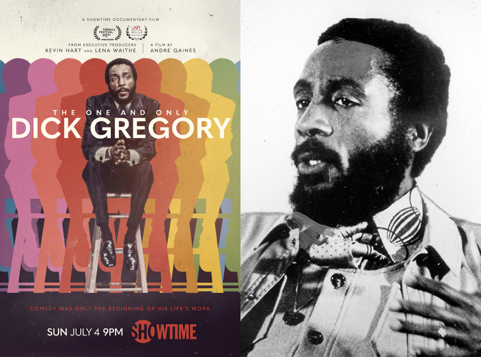
  • The One and Only Dick Gregory

    The One and Only Dick Gregory


    The only comedian I can think of who I would compare to the late Dick Gregory is Mort Sahl. They were both socio-political themed stand-up comedians who, at the peak of their careers, decided to gamble fame and fortune for their political ideals. Sahl did it by deciding to become an investigator for Jim Garrison on the JFK case. Gregory did it for civil rights activists Medgar Evers and then Martin Luther King. He later became involved with people like Robert Groden and Mark Lane on the JFK case and the King case.

    The current documentary about Dick Gregory on Showtime, The One and Only Dick Gregory, makes note of the fact that, by 1962, Gregory was probably the hottest comedian in America. In fact, one of the interview subjects, Harry Belafonte, calls him the greatest political comedian ever.

    Gregory was born in St. Louis, went to high school there, and then attended Southern Illinois University on a track scholarship. He was drafted into the army and won some talent shows as a comedian. When he returned from the service, he dropped out of college and went to Chicago to try and become a professional comedian. He was one of the very few comedians who decided to make racial issues funny: “Segregation is not all bad. Have you ever heard of a collision where the people in the back of the bus got hurt?”

    This kind of comedy got him noted in both Chicago and New York City. One of his first record albums, East and West, was done in New York. (Between 1961 and 1964, he did seven albums.) When he returned to Chicago, he received what most commentators note as his big break. He replaced Professor Irwin Corey for what was supposed to be one night at the Playboy Club. One of the jokes he cracked that night went like this: “I understand there are a good many Southerners in the room tonight. I know the South very well, I spent twenty years there one night.” He was such a hit that the one-night stand turned into six weeks. One notice read as follows:

    Dick Gregory, age 28, has become the first Negro comedian to make his way into the nightlife club big time.

    Another said:

    What makes Gregory refreshing is not only that he feels secure enough to joke about the trials and triumphs of his own race, but that he can laugh, in a sort of brotherhood of humor, with white men about their own problems…

    This highly successful Chicago appearance caught the attention of Jack Paar. After Steve Allen, Paar was the second steady host of The Tonight Show. It was Paar who made the show into the institution it became. Paar was not just funny. He was intelligent, informed, curious, and principled. In other words, he was just the kind of late-night host who Dick Gregory would appeal to. As the comedian later added, it was not just the fact that Paar had him on national television, it was what happened afterwards. The host invited him over to the panel to talk. That is what was important. At that time, such a display of integration was unusual. According to the film, it blew the NBC switchboard out. Because of his new notoriety, CBS newsman Mike Wallace did a profile of him.

    From there it was on to the likes of Ed Sullivan and Merv Griffin. Greg, as his friends called him, also wrote an autobiography called Nigger, co-written with Robert Lipsyte. Amazingly, in nearly sixty years, that book has never been out of print.

    II

    At this point in the film, director/writer Andre Gaines begins to describe his subject’s transition from a pointed stand-up comic to a socio-political activist. As the sixties heated up, it wasn’t enough for Dick Gregory to say things like, “Football is the only place where a black man can knock down a white man and 40,000 people cheer.” Or, in satirizing liberals, “They all say, some of my best friends are colored, but there just aren’t that many of us.” Or in pointing out the hypocrisy of the court system: “A black guy robs a bank of $20,000 and he gets four years in Alcatraz. A white guy embezzles 3 million and he gets three years.” As civil rights demonstrations broke out in the south, Greg began to empathize with what was happening. As he put it, since he was from the north, he was not really aware of how bad the Jim Crow situation was down south. Even though he was making a lot of money at this time and he was peaking in his professional career, he decided that, whatever the consequences, he was going to get involved with the struggle for civil rights.

    And he began to adjust his humor as this happened: “A white guy kills 2 black demonstrators with his car and the cop arrests the dead guy 500 yards away for leaving the scene of an accident.” He did civil rights work first for Medgar Evers, who he very much admired for his voter registration drives. Gregory also became involved with the famous case of the three missing civil rights workers in Neshoba County, Mississippi—James Chaney, Andrew Goodman, and Michael Schwerner. He suspected the sheriff’s office was involved. He then offered a reward for information on the case. The FBI followed his lead of offering reward money. It worked. The bodies were found and the case was solved.

    The film notes that his publicist sued him at this time, since Greg had sacrificed $100,000 worth of appearances—the equivalent of about a million bucks today—in order to work the South with Medgar. At this time, Gregory was getting $5,000 per nightclub/concert appearance. Instead, he chose to risk getting arrested by participating in civil rights drives in places like Mississippi and Alabama.

    As the film shows, he did get arrested. Beyond that, he got his arm broken while being battered with a baseball bat. (Dick Gregory and Mark Lane, Murder in Memphis, ebook version, p. 29) He was very much depressed when Evers was assassinated in the summer of 1963. But he pressed on, getting arrested even more. As he put it, what these activists were doing was more important than what he was doing. When the famous 1965 Watts riots broke out in Los Angeles, he said on TV, “I just got back from Los Angeles, Vietnam.” The film dramatizes his message at the time. Greg was saying that this was not a problem confined to the black community, it was an American problem. The film then juxtaposes excerpts from rioting in Harlem in 1964 with those from Ferguson in 2014.

    From here, the film begins to show that, as Gregory now became associated with Martin Luther King, like King, he began to become a vociferous critic of the Vietnam War. And as this occurred, J. Edgar Hoover and the FBI began to keep files on the comedian; they also tapped his phone and drew up methods of neutralizing his impact. Greg decided that, for this particular anti-war message, he had to speak at colleges and universities. He began to attract large crowds and he would harangue the United States for building this Military Industrial Complex and using it against the people of Vietnam. The regents of the University of Tennessee banned him from speaking on campus. They said he was an “extreme racist” and his presence would insult much of the state’s citizenry. The students sued and they hired noted radical lawyer William Kunstler to present their case. They won in court and Gregory finally spoke there in 1970. In 1969, Gregory spoke at the huge moratorium against the war in Washington DC.

    Not mentioned by the film are the comedian’s political races. Dick Gregory (unsuccessfully) ran against Richard J. Daley for the office of mayor of Chicago in 1967. He then ran as a write-in candidate for the President of the United States in 1968. (Gregory and Lane, p. 7) In some states, Mark Lane was his running mate. In some other states, his running mate was Dr. Benjamin Spock, the famous pediatrician. Gregory later wrote one of his many books about this campaign. That election attempt landed him on Richard Nixon’s enemies list.

    As the film depicts, King’s assassination resulted in a huge wave of riots in well over 100 cities across America. The year 1968 almost brought the United States to a point of civil war. Gregory humorously commented on this state of siege. On stage, he would bring out a large violin case. He opened it and pulled out a tommy gun. He then pulled out a bow and started playing the machine gun.

    III

    At this point, the film notes that one of the methods Greg used to protest the war was by fasting. And I thought that it would be at this juncture that writer/director Andre Gaines would cut to the event that was probably the crystallization of Greg’s political career. I am, of course, referring to the night of March 6, 1975. That was when the Zapruder film was shown for the first time on national television. The three main guests that night on the program Good Night America were Geraldo Rivera as host, Robert Groden as the photo technician who had recovered a copy of the film from Life magazine, and Dick Gregory. It is not an understatement to say that the showing of this film on national TV electrified America. It put the Kennedy assassination back on the national agenda. It now became a topic of conversation at lunch and around water coolers at work.

    By this time, Dick Gregory had become convinced that something had gone politically wrong with America after 1968. And, on top of that, the fact that JFK, Malcolm X, King, and Bobby Kennedy had all been snuffed out in a span of five years—that was just too much to swallow as simply a coincidence.

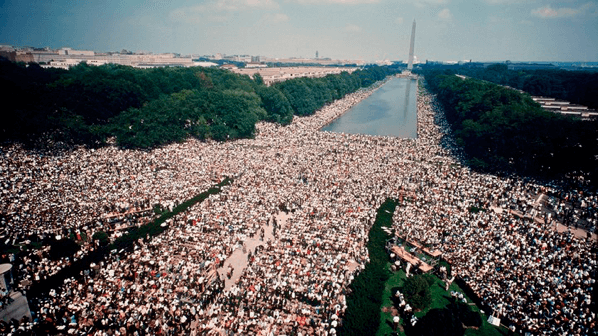
    Gregory had known King and President Kennedy. Greg was at the March on Washington, which was sponsored by the White House and at which King had spoken so memorably. (Gregory and Lane, p. 6) He had been asked to come down to Birmingham in 1963 for the huge demonstration that several civil rights leaders had combined forces on. President Kennedy called him at home and asked him not to go, since they were working on a solution to the conflict and further demonstrations could imperil it. Greg appreciated the call, but said he felt he had to go. (ibid, pp. 30–33)

    As the comedian told this reviewer, when he returned from Birmingham, his wife told him that Kennedy had called again and wanted him to return his call the moment he got in. Gregory noted the late hour, but his wife said JFK told her it did not matter what time it was. So Dick Gregory called the White House and Kennedy picked up the phone. The president said to the comedian words to the effect that he needed to know everything that happened in Birmingham. Greg went on for about ten minutes describing the whole ugly mess. When he was done, Kennedy replied with “Oh, we’ve got those bastards now!” At this comment, Gregory started weeping. (2003 Interview with Joe Madison and Gregory in Washington on WOL Radio One)

    This is probably the reason he was quite interested in Kennedy’s assassination. But Greg was even closer to King. And the film shows them on stage together. In 1977, Mark Lane and Dick Gregory combined to author a book on King’s assassination. At that time, it was titled Code Name Zorro, since they had learned from FBI agent Arthur Murtaugh that “Zorro” was the FBI’s moniker for King. When it was republished in a revised version in 1993, the volume was now titled Murder in Memphis. To this day, it is a seminal book on the King case.

    Very early in that volume, Gregory notes that it was when King turned against the Vietnam War that his image in the public mind was altered.

    When King made his famous speech on April 4, 1967, in New York condemning the conflict in Vietnam, he was now perceived as an enemy of the Power Elite. (Gregory and Lane, p. 6) Later in the book, Greg outlines how even those involved in the civil rights movement were taken aback by King’s harsh stand on the Vietnam issue, for the simple reason that they knew that Vietnam had become President Johnson’s personal fiefdom. He was the one who had escalated that war to a magnitude beyond President Kennedy’s imagination. These other civil rights leaders understood that there was a danger that Johnson would take King’s condemnation as a personal assault and the president would turn his back on their cause. (Gregory and Lane, p. 51) And as Greg said so perceptively later in that book, King was expanding his vision of American civil rights to universal human rights. (ibid, p. 56)

    King’s anti-Vietnam War speech was criticized by both the New York Times and Washington Post. It’s hard to comprehend today, but both of those MSM outlets were still supporting what Johnson was doing in Indochina at that time. (Click here for details) As Gregory notes in Murder in Memphis, it was William Pepper’s famous photo essay in Ramparts magazine that had energized King in this regard. (Click here for details)

    IV

    But as Gregory also points out in Murder in Memphis, the antipathy for King amid the Power Elite was exponentially increased when he also announced his plans for a Poor People’s March in Washington. There was a good reason for this march. As many commentators have noted, what had happened under Johnson was simple to comprehend. And, in fact, he himself knew it. Johnson’s vision of a Great Society had crashed on the shores of Da Nang in Vietnam. Or as King himself had declared:

    Many of the very programs we are talking about have been stifled because of the war in Vietnam. I am absolutely convinced that the frustrations are going to increase in the ghettoes of our nation as along as the war continues. (Gregory and Lane, p. 54)

    In other words, as King said to newsman Sander Vanocur, the dream he talked about in his March on Washington speech in 1963 had, in some respects—between the race riots and Vietnam—become a nightmare. As Gregory noted, the Poor People’s March posed the possibility of exposing this nightmare, and not just to LBJ, but congress. In fact, Murder in Memphis contains an appendix in which Senator Robert Byrd made a vituperative speech against it. (Speech of March 29, 1968) The Poor People’s March provoked meetings at the White House, the Department of Justice, the Pentagon, the Metropolitan Police, and the FBI. (ibid, p. 57; the best book on this is probably Gerald McKnight’s The Last Crusade published in 1998) The combination of King’s assassination, plus the massive interference and surveillance with the march turned it into a failure.

    Dick Gregory was correct when he described King as turning in his last years towards a different agenda. About that there should be little or no doubt:

    In a sense you could say we are engaged in a class struggle, yes. It will be a long and difficult struggle for our program calls for a redistribution of economic power…I feel that this movement in behalf of the poor is the most moral thing—it is saying that every man is an heir to a legacy of dignity and worth. (Speech of March, 1968)

    Or as King—echoing Bobby Kennedy—put it more succinctly: “What good it is to be allowed to eat in a restaurant, if you can’t afford a hamburger.” (Sylvie Laurent, King and the Other America, p. x) As Gregory wrote in Murder in Memphis, the dilemma that King was trying to expose was multi-dimensional. It not only would pose problems for Johnson, the White House, and Congress, but it would probably be an international problem. As the comedian wrote:

    What would this do to our image as the richest nation in the world? What about those countries who were not aware of America’s racial problems of poverty and hunger? … White reaction to the planned Poor People’s March was astonishing. A headline in Readers’s Digest magazine a few days before King was killed read, “The United States may face a civil crisis this April when a Poor People’s Army pitches camp in the nations’ capital. (Gregory and Lane, p. 57)

    As Dick Gregory was saying, and as Sylvie Laurent amplified later, King was now trying to stretch his populist coalition. And MLK explicitly stated it in his own terms:

    The unemployed poverty-stricken white man must be made to realize that he is in the very same boat with the Negro. Together, they could exert massive pressure on the government to get jobs for all. Together, they could form a grand alliance. (Laurent, p. 8)

    Due to King’s murder and the powerful forces arrayed against what was left of the Poor People’s March, it failed. As Laurent wrote:

    On June 24, 1968, the makeshift housing Martin Luther King Jr. had dreamt of, built on the mall in Washington DC and known as Resurrection City was wiped out. Police tear gas filled the air. Hundreds of people were arrested. Bulldozers smashed the plywood shacks. (Laurent, p. 1)

    As Richard Nixon later said, it was that image and the dispersal of those people that combined to help elect him. (ibid) The grand alliance King was designing ended up dissipated. The reverse, namely Nixon’s southern strategy, was later used by Ronald Reagan, and then given broadcast voice by Rush Limbaugh and Fox News. King’s unification strategy was now somewhere in the ozone. Roger Ailes’ and Pat Buchanan’s polarization policy ruled the day.

    That would have been a powerful coda with which to end The One and Only Dick Gregory.

    V

    The only trace of this that I could detect was near the very end of the film. On a last kind of 2015 comeback tour, two years before Greg died, there is a brief glance at Pepper’s book The Plot to Kill King on a chair. If I missed something, I hope someone can remind me of it.

    So, what does approximately the last third of the film deal with? Gregory turning into a fitness expert and a health foods businessman. He moved his family to a forty-acre farm in Plymouth, Massachusetts, in 1973. He began to sell vitamins and nutrition products. He also was one of the first to argue for the primacy of natural water in everyone’s diet. He stopped playing nightclubs and there was no more alcohol consumption or smoking for him. Harking back to his college days, he became an avid runner. And his cause now was to erase world hunger. He fasted for that one also.

    He created something called the Bahamian Diet nutrition drink. This ended up being very successful. After having some legal problems in the mid 1980’s which tied up much of his assets, he settled the lawsuit and sold the business for millions.

    But Greg never really lost his affinity to protest injustice. Another part of his life was devoted to exposing the CIA/cocaine scandal of the late nineties. At that time, he actually went out to CIA HQ in Langley, Virginia, and unspooled yellow tape around the building. Because as he said, “We know where the criminals are.”

    Andre Gaines’ film is a passable chronicle of the showbiz side of Dick Gregory, but it does not do justice to what made the man the true icon he was. Perhaps that was the price of getting people like Chris Rock and Dave Chappelle and Kevin Hart to appear. If it was not, then Gaines made a mistake. His film should be called The One and Only Dick Gregory (Censored Version).

  • Jonathan Chait meets Michael Kazin

    Jonathan Chait meets Michael Kazin


    Almost any notice in the media about John F. Kennedy will supply an excuse for someone in the MSM to write a derogatory article about him. As we have seen, Michael Kazin used the occasion of a recent book about Kennedy to do a hit piece on him in The New York Review of Books. (Click here for details) Recently, a panel of scholars for C-SPAN did a poll ranking past presidents, including Donald Trump. Journalist Jonathan Chait didn’t like it. Why? Because Kennedy ended up in eighth place. Chait thinks this was unwarranted. Therefore, New York Magazine let him do a Kazin: that is a hit job on the slain president. (June 30, 2021)

    What is immediately noticeable about these rants is this: None of the writers knows very much about Kennedy or his presidency. But they pretend they do. For instance, Chait writes that Kennedy made some promises on civil rights in his presidential campaign, but abandoned them when he saw this would offend southern conservatives. The thinking being that it would stop the passage of his other domestic programs.

    As I have explained before, this is a liberal orthodoxy that has a serious problem with it. It isn’t true. This author spent months studying the issue for a four-part series about the Kennedys and civil rights. (Click here for that series)

    Kennedy did not abandon civil rights at all. He was advised by his specialist on the issue, Harris Wofford, that it would be very difficult to pass an omnibus civil rights bill in his first year and probably even in his second year. After all, there had been nine different attempts to pass such a bill since 1917 and they all failed. (Irving Bernstein, Promises Kept, p. 39) Wofford therefore advised Kennedy to issue executive orders and also to rely on the court system, through the Attorney General, to further the cause. The hope being that this would create a furor over the issue that would tilt the balance in the House and Senate. That would then make it possible to pass such a bill.

    That is what Kennedy did; and that is what happened. Anyone can read about this in more than one book (e.g. Wofford’s Of Kennedys and Kings, or Irving Bernstein’s Promises Kept). (Bernstein, pp. 40–41, 48–50)

    To list all the things that Kennedy did for civil rights in just his first year illustrates the utter fallacy of what Chait is trying to sell. Right out of the chute, JFK and his brother intervened in the New Orleans school segregation court case, something that President Eisenhower had avoided. (Jack Bass, Unlikely Heroes, p. 122) Eisenhower’s failure to act allowed the state legislature to pass laws attempting to curtail and avoid the court’s decision to implement Brown v Board. When Bobby Kennedy got the news about this scheming he replied, “We’ll have to do whatever is necessary.” (Bass, p. 131)

    The Kennedy administration did something that the Eisenhower administration would never have dreamed of doing. The Attorney General filed charges against the state Secretary of Education, Shelby Jackson. The idea was to stop the governor’s attempt to cut off funding for integrated schools. (Bass, p. 135) When a trial date was set, Jackson backed off and said he would not interfere. This episode began in February of 1961, a month after Kennedy’s inauguration.

    A similar case occurred in Prince Edward County, Virginia. Due to scheming by the governor and legislature, Prince Edward County had no schools to attend. Again, Eisenhower said he could not do anything about it. Shockingly, he even said states were not required to maintain a school system and, therefore, the president was “powerless to take any action.” (Brian Lee, Ph. D. thesis, A Matter of National Concern, p. 50)

    Again, the Kennedys reversed Eisenhower’s course. The president now began to remake the 4th Circuit Court of Appeals governing Virginia and nearby states. (Lee, p. 6) But the Kennedys also began doing two things that were, again, unprecedented. First, they joined the NAACP lawsuit as a plaintiff, not a friend of the court. Secondly, realizing the court reworking would take time, they appointed family friend William Vanden Heuvel to raise a large amount of money. The idea was to build, from scratch, a free school system to educate the African American students, so they would not fall further behind. (Lee, pp. 145–50)

    Did Chait miss all of this? Well, no surprise, since he also missed those two executive orders that Kennedy signed for affirmative action. The first was written in his first year, which again, no president had ever done before. (Bernstein, p. 56) Finally, Attorney General Bobby Kennedy made it a point to speak at the University of Georgia Law School. He spent half the address talking about civil rights. He said he would enforce the Brown v. Board decision. As historian Carl Brauer wrote, this was the first time anyone could recall an Attorney General speaking out on the issue in the South. (Carl Brauer, John F Kennedy and the Second Reconstruction, p. 95)

    That was in May of 1961. Again, we are to assume that Chait missed all of this, which is weird, since it was all unprecedented in the field. But that was just the beginning of a crescendo that led to the submission of Kennedy’s omnibus civil rights bill in February of 1963. (For the rest of the story, click here)

    Chait leads off his article by saying that Kennedy was elected due to his youth and his campaigning about the missile gap. He leaves out the fact that there was only a four-year difference in age between himself and his opponent Richard Nixon. Considering his second point, in Kennedy’s acceptance speech in Los Angles at the Democratic convention, there was no mention of a missile gap. He talked about things like separation of church and state, racial discrimination, the plight of the poor, and said this was no time to try and uphold a status quo that was not working. (Click here for the address) At a famous speech in September, which he gave before the Liberal Party in New York, again one will find no mention of a missile gap. But one will find the following: Kennedy tried to define what he thought the word liberal meant in a political sense, as opposed to how the Republicans defined it:

    But if by a Liberal, they mean someone who looks ahead and not behind, someone who welcomes new ideas without rigid reactions, someone who cares about the welfare of the people—their health, their housing, their schools, their jobs, their civil rights and their civil liberties—someone who believes that we can break through the stalemate and suspicions that grip us in our policies abroad, if this is what they mean by a Liberal, then I’m proud to say that I’m a Liberal.

    Kennedy went on to say that he also believed “…in a government which acts, which exercises its full powers and full responsibilities.” He continued by saying that when government “has a job to do, I believe it should do it.” This was then exemplified by his above actions in his first year on the civil rights issue, which, as I showed, were starkly different than Eisenhower’s. (For the whole speech click here)

    One of the nuttiest things that Chait writes is that Kennedy was a man out of his time period, because he thought there were no great problems to solve, no great dragons to slay, and no great compromises to be made. That Chait could borrow that comment from one of the worst biographers of Kennedy, the late Richard Reeves, tells you just what his game is, because Kennedy says just the opposite in both of these speeches. A constant refrain is his haranguing the GOP for not facing up to the problems as he perceives them: of the urban poor, of dispossessed farmers, of creating an imaginative foreign policy. And he clearly implies that a party of Coolidge, Hoover, and Taft simply could not really do anything about these dilemmas. He contrasted that with people like FDR, who chose to act in a time of crisis. And he compared the 1960 election to that of 1932. In other words, the Democrats could do something and would use government to solve problems.

    Chait tries to define Kennedy’s foreign policy by using the Bay of Pigs as an example. He then says, in regards to the Missile Crisis, that the president bungled his way into a nuclear showdown over Cuba. I hate to confront Mr. Chait with the facts, but I must. It was the Russians who placed a first strike capability in Cuba. This featured all three arms of the nuclear triad: long and medium range missiles, bombers, and submarines. In addition, they had 45,000 troops on the island and had also given Fidel Castro tactical atomic weapons. (James DiEugenio, Destiny Betrayed, second edition, p. 66) These would have annihilated any large invading force. This was all done in secret, knowing that Kennedy had insisted there be no offensive weapons in Cuba. And when, due to U2 photography, Kennedy inquired about them, the Soviet foreign minister lied to him about their presence. (Ernest May and Philip Zelikow, The Kennedy Tapes, p. 169) When it came time to confront the situation, Kennedy chose the least provocative action: no invasion, no air strikes, but a blockade. Choosing that option gave each side time to resolve the crisis peacefully. Anyone can read the transcripts of these taped conversations. Clearly, Kennedy was keeping the hawks at bay almost throughout. For a good example, read the record of his meeting with the Joint Chiefs, especially note their derisive comments about the president after he leaves the room. (May and Zelikow, pp. 173–88)

    As we can see, Chait’s article, like Kazin’s, is not factually based. His real point is to try and reverse the concept that somehow there was a step down in class and achievement from Kennedy to Lyndon Johnson. For instance, he writes that two programs that Kennedy was trying to get passed, but could not, were federal aid to education and health care for the elderly. As Irving Bernstein has written, Kennedy did get federal aid to education through the senate in October of 1963. (Bernstein, p. 241) Kennedy failed to get a Medicare bill through in 1962, but what Chait leaves out is that Kennedy was bringing it back for consideration through powerful congressman Wilbur Mills in 1963. And on the morning of November 22, 1963, Kennedy’s congressional liaison, Larry O’Brien wrote that “with Mill’s objections met, the passage of Medicare was assured.” (Bernstein, p. 258) In other words, Kennedy had set the table for Johnson on these two bills.

    This meme is continued when Chait lists the Civil Rights Act of 1964, the Voting Rights Act of 1965, and the War on Poverty as Johnson’s achievements, giving no credit to Kennedy or anyone else. As I have mentioned several times, the idea that Johnson got the Civil Rights Act of 1964 passed is a myth supported by establishment figures like Robert Caro. Clay Risen, who wrote a book about the passage of the act, has shown why it is a myth. (Click here for details)

    President Johnson told Martin Luther King that he could not get the Voting Rights Act passed on his own. The only way he could so was if King did something to give him the torque to implement it. King did so by staging the Selma demonstration, which he was already arranging before Johnson told him this. (Louis Menand, “The Color of Law”, The New Yorker, 7/1/2013)

    The War on Poverty began after Kennedy read Dwight MacDonald’s review of Michael Harrington’s The Other America. (Thurston Clarke, JFK’s Last Hundred Days, pp. 242–43) In June of 1963, JFK was already thinking past the Civil Rights Act he had submitted to congress. So he called in his chief economic advisor, Walter Heller, and they began to formulate a plan to counteract pockets of poverty. After Kennedy was assassinated, Heller told Johnson about this plan he and Kennedy had formulated. In other words, the War on Poverty was not Johnson’s concept. It was Kennedy’s. In his jihad to inflate LBJ and downgrade Kennedy, this is how anti-historical Chait becomes.

    If one can comprehend it, Chait even tries to elevate LBJ at Kennedy’s expense over what became Johnson’s disaster in Indochina. With all we know about Vietnam today, I would have thought no one would even think of doing this. But one should never underestimate the stubbornness and perversity of the MSM. Chait begins by saying that it is an unproven assumption that Kennedy would have pulled out of Vietnam. That worn out standby is not sustainable today. With all the information that the Assassination Records Review Board declassified, combined with the work of writers like Gordon Goldstein, Howard Jones, David Kaiser, Jim Douglass, James Blight, and the revised version of John Newman’s JFK and Vietnam, there is little or no question about the issue: Kennedy was getting out of Vietnam. We have a veritable cornucopia of evidence to prove it. And he was going to enact that withdrawal around the 1964 election. (Click here for details)

    Johnson was aware of this plan and within 48 hours of the assassination he started to reverse it. (James Blight, Virtual JFK, p. 310; also see Chapter 23 of the 2017 version of Newman’s JFK and Vietnam.) Contrary to Kennedy, Johnson’s concept was to work his escalation plan around the 1964 election. In other words, as he was saying things like he wished no wider war and he did not want to send American boys to die in a war that Asian boys should be fighting, he was arranging to do just that. This has been proven by too many scholars to belabor the point here. But to name just three: Gordon Goldstein’s Lessons in Disaster, Fredrik Logevall’s Choosing War, and Edwin Moise’s Tonkin Gulf and the Escalation of the Vietnam War.

    Chait now writes that Kennedy’s policies laid the groundwork for Johnson’s escalation; due to the calculation that no Democrat could lose a territory to communist expansion. I threw my arms up at this one. If Kennedy was withdrawing at the time of his death and Johnson stopped that withdrawal, planned on going to war in Indochina, effectively declared war on Vietnam, and then invaded the country with hundreds of thousands of combat troops—how did Kennedy lay the groundwork for that? In November of 1961, with NSAM 111, Kennedy drew the line: he refused to send combat troops to Indochina. He never crossed that line. There was not one more combat troop in Vietnam on the day he was killed than on the day he entered office. Johnson not only sent half a million combat troops there, he also initiated one of the largest American air wars ever devised, Rolling Thunder, to try to bomb North Vietnam into submission. Does any credible person think that Kennedy would have countenanced these things, let alone allowed them to happen?

    This relates to Chait’s other point about the fear of “losing Vietnam.” Kennedy simply did not think that Vietnam was worth going to war over. Just like he did not want to commit combat troops to Laos, even though Eisenhower had advised him he might need to do so. (Newman, p. 9) Kennedy was a more sophisticated thinker about the Cold War than Johnson was. For him, Berlin was a flash point, since he was not going to let the Atlantic Alliance be challenged, but Vietnam was simply not worth the price. And this indicates how uninformed Chait is about JFK. Kennedy understood just how hopeless an imperial conflict would be in Vietnam. He comprehended this due to his relationship with diplomat Edmund Gullion in Saigon way back in the early fifties, where he saw firsthand the doomed French effort to recolonize the area. (Click here for details) He also understood the problem from his Ambassador to India, John K. Galbraith who wrote him a memo to counter the hawks who wanted him to intercede in 1961. (Click here for more)

    Compare that to LBJ. Johnson actually said that, if he left Vietnam, he would be doing what Neville Chamberlain did at Munich with Hitler and Mussolini. He then compared losing Vietnam to losing China and that the former would be even worse than the latter. He concluded that reverie with the following:

    Losing the Great Society was a terrible thought, but not so terrible as the thought of being responsible for America’s losing a war to the Communists. Nothing could possibly be worse than that. (Blight, p. 211)

    Can anyone conceive of Kennedy saying such things? There is no evidence for it. In fact, as I noted in my review of John Newman’s revised version of JFK and Vietnam, Kennedy told many people that Vietnam was a hopeless struggle, which America could not win. Therefore, he was getting out. (James Douglass, JFK and the Unspeakable, p. 183) What is so incredible about Chait’s abomination is that, at the end, he concludes that Kennedy’s rating in the poll is due to a lack of analysis. We have just seen what analysis does to Chait.

    Make no mistake, Chait’s handiwork is not an accident. As Jeff Morley wrote in his recent e book about his lawsuit against the CIA, no one ever got ahead in the journalistic world trying to expose new facts about Kennedy’s assassination. Well, since 2013, the same figure applies to Kennedy’s presidency, especially in light of the fact that we now know what happened in Indochina as a result of his death. And since that switch in policy came so fast, perhaps—just perhaps—the two events were related. And if such was the case, how could the MSM have missed it with such completeness?

    As noted at the start, I recently wrote about Michael Kazin’s similar hatchet job about Kennedy’s presidency, disguised as a review of Fredrik Logevall’s book JFK: Coming of Age in the American Century. Well, if one looks back to 2013, Kazin did the same in the pages of The New Republic. At that time, he was allegedly reviewing Thurston Clarke’s book JFK’s Last Hundred Days. (July 15, 2013) As was the case of Kazin with Logevall, it was a review that was not a review. It was a way to downgrade Kennedy and wonder out loud: Geez, why does anyone pay any attention to this guy at all? The title of the article was: “On the Fiftieth Anniversary of JFK’s Assassination Don’t Bother with the Tributes.”

    As I have written before, the MSM drive to conceal who Kennedy really was has become as systematic and assiduous as the attempt to cover up the circumstances of his assassination. As noted above in regards to Vietnam, it’s pretty obvious as to why.

    Mr. Chait meet Mr. Kazin. Future employment for both is secured.

    Action suggested:

    Contact at twitter: https://twitter.com/jonathanchait

    The editor of New York Magazine is David Haskell, david.haskell@gmail.com


    See also Brian E. Lee’s Ph.D. thesis from 2015 on the Kennedy administration efforts to restore public education to Prince Edward County, VA.

  • An Open Letter from James DiEugenio

    An Open Letter from James DiEugenio


    TO:

    Joe Scarborough, MSNBC Cable TV host

    Annette Gordon-Reed, Harvard historian

    Fredrik Logevall, Harvard historian

    Van Jones, CNN contributor and sometime host

    Kevin Young, U of Mass/Amherst historian

    Steven Gillon, U of Oklahoma historian, Scholar in Residence, The History Channel


    RE: John F. Kennedy and Civil Rights


    A reader of our web site, KennedysAndKing.com, recently sent me a clip of Mr. Scarborough’s 12/11/2020 program which featured Professor Gordon-Reed. The concept of the show was to enumerate certain past presidents and what our elected president, Joe Biden, could learn from them.

    When Mr. Scarborough got to President Kennedy, he said that Biden could learn from JFK how to “brush back” on the civil rights issue, which President Johnson then had to take up the mantle on. Professor Gordon-Reed replied to this that Kennedy talked to people and eventually came around on civil rights, since he did not want events to overtake him.

    On November 22, 2020, on the anniversary of Kennedy’s assassination, a similar declaration took place. Professor Logevall made an appearance on the radio program Speakola. During that appearance, he said that, until the last year of his life, Kennedy was not really moved by the plight of those who were denied their civil rights; he added that this only came late to Kennedy.

    Prior to this, in 2018, on the CNN documentary series, The Kennedys: An American Dynasty, Mr. Jones said that JFK was not really interested in civil rights when he entered the White House and he had to be lectured about the issue.

    Going back to May of 2010, Professor Gillon made a speech at the Miller Center in Virginia, where he briefly touched on the civil rights matter. Included in his remarks, he said that LBJ did not think Kennedy was pushing the issue enough and that Kennedy did not submit a bill on civil rights until after he gave his speech the evening of his confrontation with Governor Wallace at the University of Alabama in June of 1963. He concluded by saying that it was only through Johnson’s dogged determination and parliamentary wizardry that the bill passed.

    Professor Young might be the most extreme. In a much more recent article, November 21, of this year, at the web site Truthout, he wrote that Kennedy had done virtually nothing for civil rights for almost two and a half years. Only after the Birmingham violence did he finally send a civil rights bill to Congress, which passed the following year. Further, he said JFK only did this because of the threat of economic demobilization generated by a mass movement in the south. (I admit I really do not understand what Young means by that last statement.)

    Let me begin by saying that none of this comes close to aligning with the actual record of events. And the fact that four of you are history professors makes this rather embarrassing for your profession.

    The idea of making Lyndon Johnson some kind of hero on civil rights is, to be kind, misleading. From 1937–56, Congressman—then Senator Johnson—voted against every civil rights bill that was submitted to Capitol Hill. And this was not done passively. Johnson voiced the southern shibboleth of States Rights, which meant, of course, that there was never going to be any progress on the issue at all.

    It was only in 1957 that LBJ began to change his tune on the subject. Why? For two reasons. First, he was contemplating a run for the highest office and he had seen what Richard Russell’s anti-civil rights views had done to his mentor’s aspirations. So he knew he had to begin to alter his previous voting record. The second reason was even more a matter of political expediency. The White House had sent a bill to Congress on the issue. President Eisenhower and Vice-President Nixon did not care about civil rights themselves. In fact, Eisenhower had advised Earl Warren to vote against the Brown vs. Board case. But Nixon and Eisenhower understood that they could split the Democratic Party geographically on the issue: northern liberals against southern conservatives. Johnson tried to soften the blow to his party. So, he produced a pretty much papier mâché bill. One which Senator Kennedy did not like. In fact, Johnson had to send an assistant to make sure JFK would vote for it. Later, Kennedy wrote a constituent that he hoped the Senate would pass another bill; this time with some real teeth to it.

    That Robert Caro makes so much out of this, and the 1960 bill, is a classic example of the old adage: if you have lemons, make lemonade. As Harris Wofford wrote, the newly minted civil rights advisory commission, the new department of civil rights in the Justice Department, and the collection of voting data were all pretty much useless. For the simple reason that Eisenhower and Nixon had designed it that way; and LBJ went along with it. It was all a fig leaf to disguise the damaging facts that the White House did not support Brown vs. Board and Eisenhower had allowed Governor Orval Faubus to create a weeks long insurrection at Central High in Little Rock. Wofford should know, since he was the attorney for the Civil Rights Commission.

    As Judge Frank Johnson of Alabama later said, this all changed under Kennedy. He said that when Kennedy and his brother entered office, it was like an electric current going off in the south. As noted above, virtually all of you have said that President Kennedy waited until his third year to do something, since he needed wise counsel on the issue. This is simply false. I don’t see how you can act faster than on the first day of your presidency, which is what Kennedy did. After watching his inauguration ceremony, Kennedy made a call to Secretary of the Treasury Douglas Dillon that evening. He asked him why there were no black faces in the Coast Guard parade. Dillon said he did not know why. Kennedy told him: Find out.

    Following from that, at his first Cabinet meeting Kennedy asked the members to bring in statistics on how many minority employees were in each department. Kennedy was quite disappointed when he heard the numbers. This caused him to write America’s first affirmative action executive order on March 6, 1961. In other words, far from waiting for two and a half years, Kennedy was acting right out of the gate. In a bit over six weeks, he had done what none of his predecessors had. Kennedy later extended this order to include all federal contracting and all federal programs concerning loans and grants. In other words, if you ran a textile mill in North Carolina which made uniforms for the Army, you now had to hire African Americans to work in your mill or you risked closing your doors.

    I will not go through each of Kennedy’s actions as I did the above, since this letter would get too long. Let me just list some of them:

    • The administration filed charges against the Secretary of Education in Louisiana for scheming to dodge court orders under Brown vs. Board. This was in February of 1961.
    • When the state of Virginia refused to fund local education in Prince Edward County, the Kennedys assigned William Vanden Heuvel to attain private funds in order to create from the bottom up an entirely new school district.
    • Attorney General Robert Kennedy spoke at the University of Georgia Law Day. For the first time in anyone’s memory, he spoke about civil rights in the South. He concluded by saying he would enforce the Brown decision. This was on May 6, 1961.
    • RFK did this in part to aid the Fifth Circuit Court in the South. That federal court was made up of moderate to liberal judges on the issue. He would use that court in his future civil rights cases after losing in lower court.
    • By September of 1961, the administration successfully petitioned the Interstate Commerce Commission to integrate travel between states.
    • In his first year, Bobby Kennedy filed twice as many civil rights cases as the Eisenhower administration did in eight years. By 1963, the Department of Justice had quadrupled the number of lawyers in the Civil Rights Division.
    • The Kennedy administration was the first to raise private funds to finance large voting registration drives in the south. In today’s currency, the sum would be well over seven million dollars.
    • Kennedy was the first to get the FBI to detect voting rights violations and to use that information to grant African American voters suffrage in Alabama and Louisiana. This was before the Voting Rights Act.
    • Kennedy tried to get a voting rights bill through congress in 1962. That effort failed due to filibuster. It evolved into the 24th amendment eliminating the poll tax.
    • Kennedy established the Committee on Equal Employment Opportunity, which evolved into the EEOC to protect civil rights in hiring, employment and firing.
    • Kennedy was the first to use federal contracts and grants to force private universities in the south to integrate, e.g., Tulane and Duke.
    • The administration worked through the Fifth Circuit to sue the public universities of Mississippi and Alabama to force integration.

    I could go on. Yet, just that list is more than FDR, Truman, and Eisenhower did put together. (See part 3 below) But let me add: Kennedy did not submit a wide-ranging civil rights bill to Congress after the confrontation with Wallace or after the violent confrontations in Birmingham. He submitted his bill in February of 1963. And as Clay Risen notes in his book length study of the bill’s passage, it did not owe its success to Johnson. The four major players who got it through were JFK, Bobby Kennedy, Hubert Humphrey, and Senator Thomas Kuchel. In the summer of 1963, President Kennedy began what was probably one of the largest lobbying programs in contemporary history. He brought in over 1500 people from professional groups all over the country: lawyers, mayors, and clergy to convince them to back the bill. It was the last group that Richard Russell later said ultimately forced the collapse of the filibuster.

    Further, as most of us know, it was not Johnson who got the Voting Rights Act passed in 1965. He told Martin Luther King he probably could not do so by himself. So King began the Selma demonstration, in order to give Johnson the torque to do so. And it was not Johnson who got the expansion of Kennedy’s housing act through either. He actually could not. It was the occasion of King’s assassination that allowed it to pass.

    No post Civil War president ever did as much for civil rights as President Kennedy did. That is not conjecture, it is the undisputed record. And I demonstrated it in Part 3 of my series, which I attach below. The only reason he did not pass an omnibus civil rights bill sooner is that it would have been filibustered as his narrower bill was in 1962. And it was LBJ who advised him not to even try.

    For historians and TV hosts to parrot a compilation of rightwing and leftwing myths in the place of this historical record is simply irresponsible. It is, in fact, pernicious to the public. Lyndon Johnson commandeered a ruinous presidency. Contrary to what Mr. Gillon said in his talk, LBJ could not have won the nomination in 1968. After New Hampshire, his campaign started to collapse on every leg in Wisconsin. He was given the word he was going to lose in a landslide. Contrary to what President Johnson had said, he did not “continue” what President Kennedy had begun, not in foreign policy and not in domestic policy. (See my Part Four below) He did not just wreck his own presidency. He ripped asunder the Democratic party. Staffer Carl Marcy wrote to Senator William Fulbright after the senator had discovered Johnson had lied to him about American invasions of both Vietnam and the Dominican Republic. Marcy wrote that what these dishonest interventions had done was:

    … turn the liberal supporters of President Kennedy into opponents of the policies of President Johnson, and the rightwing opponents of Eisenhower and Kennedy into avid supporters of the present administration. … We have tried to force upon the rest of the world a righteous American point of view which we maintained is the consensus that others must accept. Most of the tragedies of the world have come from such righteousness.

    It was this false righteousness that polarized the Democratic Party and paved the way for the election of Richard Nixon.

    I would like to conclude by drawing your attention to a recent article in the Washington Post. It is entitled “Hijacking the Electoral College: the Plot to Deny JFK the Presidency 60 years ago.” Donald Trump was not the first to scheme to sabotage the electoral college. The electors from Alabama and Mississippi decided not to vote for Kennedy in 1960, even though he defeated Nixon in those states. They agreed to halt their scheme to negate the election results, if Kennedy would switch positions on the ticket with Johnson. In other words: Johnson would be President and Kennedy Vice-President. Kennedy had endorsed Brown vs. Board twice as a Senator, once in New York and once in, of all places, Jackson, Mississippi. These deep southern segregationists understood who JFK was in 1960. They had seen him up close. So should you.


    (I did not annotate the above letter since my material is properly referenced in the series attached below)


    The Kennedys and Civil Rights: How the MSM Continues to Distort History – Part 1


    The Kennedys and Civil Rights: How the MSM Continues to Distort History – Part 2


    The Kennedys and Civil Rights: How the MSM Continues to Distort History – Part 3


    The Kennedys and Civil Rights: How the MSM Continues to Distort History – Part 4

    Listen to Jim being interviewed on this subject on AM 1480 WLEA News.

  • Trump and Kennedy? Is Politico for Real?

    Trump and Kennedy? Is Politico for Real?


    Politico was started back in 2007 by two veterans of the Washington Post, John F. Harris and Jim VandeHei. It was reported at the time that Post management, including Ben Bradlee, did not wish to fund an online venture. Therefore, the partners went to Albritton Communications, specifically Robert L. Albritton, for startup costs. The Albritton family had consolidated and salvaged what was left of the Washington Star conglomerate. With the millions on hand, Politico began hiring MSM fellows like Mike Allen from Time, and commentators like Mike Kinsley and Joe Scarborough. Due to sites like Politico, what promised to be an online revolution in journalism was stillborn. Considering what Politico turned out to be, it’s hard to see what people like Bradlee could have objected to.

    An example would be the book published in 2008 by Harris and ABC correspondent Mark Halperin. It was titled The Way to Win: Taking the White House in 2008. That book focused on the Bush and Clinton families, father and son, husband and wife, and how they had won election sometimes using each other’s techniques. It also spent time on Karl Rove, in appreciative aspects, as being a smart presidential campaign manager. After the election, Harris and Halperin had custard pie all over their faces, because Barack Obama had won both the primary and the election, with a team not at all owed to either the Bush or Clinton camp. And Rove, since he was forcefully retired due to the Valerie Plame scandal, has not run a presidential campaign since. If nothing else, the book showed just how much Harris had invested in the status quo, i.e. in a very conservative GOP and a centrist/right Democratic Party.

    Bernie Sanders campaigning with Alexandria Ocasio-Cortez

    From the above example, one could predict that Politico, like much of the MSM it represents, was intent on being critical of the Bernie Sanders candidacy. This was both before and after he dropped out of the race this year. (Click here and here)

    In fact, in surveying the way they headline certain events, it is hard not to write that they almost celebrate the losses of progressive candidates. (Click here for an example) They are also eager to cast many topics, issues, and political races as left vs. right, or center vs. right. (Click here for an example) In other words, the idea is to keep America divided, as Harris tried to do in his 2008 book. Consequently, there is almost no vision, insight, and too little in-depth reporting as to what the underlying truth (or truths) of these matters may be. Media Matters, for example, has frequently been critical of Politico. (Click here for details)

    Of course, this quite naturally means that Politico cannot be fair, objective, or honest about the Kennedys. Because JFK, RFK, and Ted Kennedy were trying to get at the underlying truths of many of the problems with America (e.g. race, economic inequality, education, and health care). A good example of this targeting occurred in April of 2018, when the film Chappaquiddick was released. Politico could not just review the film. They used the picture’s release to fill a huge top headline on their site, for two days. Peter Cannelos’ long essay was so negatively tilted that, in reference to the concurrent documentary mini-series The Kennedys, he implied that the series was complimentary to the family. (Click here for a more realistic view) In another example, consider their take on Robert Kennedy. On the 50th anniversary of his assassination, they ran an article entitled “The Bobby Kennedy Myth.” (Click here for the article)

    They are at it again; this time concerning John Kennedy. On June 13th, they printed an article by someone named Peter Keating. They billed Keating as an “investigative reporter”. In establishing that credential, they did not say what he investigated. It turns out that Keating is a sports writer. He writes mainly for ESPN, and his central beat is something called sabermetrics. (Click here for an example) If one does not know what that term means, please watch the Brad Pitt film Moneyball. How this area of study made Keating an authority on John Kennedy’s political career escapes this author—as it does probably many others. In fact, it shows that Politico does not mind who authors their Kennedy hit piece articles. They will bend over to cloud the author’s lack of established credentials.

    The title of Keating’s essay is “How JFK Paved the Way for Donald Trump.” I am not kidding. Just when one thinks American journalism cannot get any worse, you can rely on Politico to give us a further piece of flapdoodle. What is the point of the article? Keating is trying to insinuate that, somehow, Kennedy’s 1960 campaign for the presidency had something to do with the election of Donald Trump in 2016. To say that this is far fetched is not accurate. To anyone familiar with Kennedy’s career it’s a bunch of horse feathers. The idea is to suggest that somehow Kennedy’s campaign in 1960, particularly the primary, exemplified how Trump could win the presidency in 2020.

    The primary system had been around since the early 1900’s. It had been a reform of the Progressive Era to give the public more of a say in the nominating process, instead of exclusively being the role of the state party leaders. They were not as widespread as they are today, so they were not as definitive. But to say they had no impact at all is simply wrong. For instance, William McAdoo swept the Democratic primaries in 1924 and almost won the nomination. He had to be stopped at the convention, because he was backed by the Klan. It took 99 ballots to get rid of him.

    Amazingly, but predictably, the sportswriter completely passes over the 1952 GOP primary. There were four major candidates that year:  Earl Warren, Harold Stassen, Robert Taft, and Dwight Eisenhower. The battle winnowed down to Taft and Eisenhower and it was quite close. But Thomas Dewey, who many thought was going to run, did not. And he ended up supporting Eisenhower through his influence in New York which did not have a primary. To show how far American has come, at that time, many people in the Republican Party thought that Taft was simply too conservative to win. (Richard Bain and Judith Parris, Convention Decisions and Voting Records, pp. 280-86) In 1956, in the Democratic primary race, Governor Adlai Stevenson won out in the primary season over Senator Estes Kefauver. So to somehow say that Senator John F. Kennedy suddenly discovered the primary season as a way to the White House is simply tapering history.

    And that’s not all Keating does to fulfill his agenda. In 1956, there ended up being an intrastate battle in Massachusetts for control of the Democratic machinery for the upcoming nominating convention. Kennedy sensed, correctly, that the state pols—Congressman John McCormack and local hack William Burke—were going to try and block the nomination of Stevenson. Kennedy had supported Stevenson, would end up speaking at the 1956 nominating convention, and then placed him in his administration as representative to the United Nations. McCormack had opposed Stevenson in the primary and actually won by a write-in vote. Mr. Burke boasted about this victory and even personally insulted Kennedy for supporting the losing Stevenson. After that, JFK had no choice but to go after the duo, for both Stevenson’s sake and the personal insult. So, Kennedy, through his proxies, fought this move and, as Dave Powers and Ken O’Donnell have written, it ended up being a “Boston Irish political brawl.” Kennedy was outnumbered on the state committee, but there were enough uncommitted for him to lobby them and turn them to his side. He told Powers and O’Donnell he would call them and even ring doorbells if he had to and he did. At the end, Burke was out. (For a complete chronicle of this episode, see Johnny We Hardly Knew Ye, by O’Donnell and Powers, pp. 124-32)

    The idea that this episode taught Kennedy how to control his own delegation is undermined by the facts that Kennedy allowed McCormick to run as a favorite son at the convention and, contrary to what Keating/Sabermetrics writes, Kennedy did not appoint his own man to the state chairmanship. Pat Lynch was so unknown to him that he needed a personal audience with him to remember who he was. (ibid, p. 127) And even then, he still did not accept him. It was O’Donnell and Powers who pushed his candidacy on him.

    This was all part of Kennedy staying true to Stevenson, who was the national leader of the party. The idea that the state party, without this, would not have supported him in 1960 when he ran is a bit silly—even for sabermetrics. But Kennedy first really made a name for himself on the national level when Stevenson threw open the vice-presidential nomination to the convention that year. (ibid, p. 134) Although he did not win, most attendees were surprised at how strongly JFK ran.

    That is because, unlike Trump, the senator had already been around for ten years. In his valuable book, JFK: In the Senate, John T. Shaw chronicles his entire congressional career. (Click here for a review) And the very next year, Kennedy was going to indelibly imprint himself on the national consciousness with his famous, powerful Algeria speech, which he had been headed for ever since his visit to Saigon in 1951. (See Shaw, p. 101) If you did not know who Kennedy was before that speech, you sure as heck knew who he was afterwards. As Richard Mahoney wrote, there were 138 newspaper editorials printed over that highly controversial speech. The vast majority were negative. (Mahoney, JFK: Ordeal in Africa, p. 21) As both Mahoney and Shaw write, this speech made Kennedy the titular leader on foreign policy in his party. (Shaw, p. 110) Partly because he had deliberately singled out and criticized President Eisenhower, Secretary of State John Foster Dulles, and Vice-President Nixon in his speech and said there had to be a different approach to Third World nationalism rather than supporting European colonialism. In fact, Kennedy now made the cover of Time Magazine for December 2, 1957. The story’s title was “Man out Front.” (Mahoney, p. 29)

    As the British commentator Alistair Cooke had stated, by his purposeful attack on the White House, Kennedy had positioned himself as the man the Republicans now had to do something about. The presidential hopeful that the GOP now had to scorn: “It is a form of running martyrdom that Senators Humphrey and Johnson may come to envy.” (Mahoney, p. 29) None of this is in Keating’s article. Yet this is the way JFK had now become a national figure.

    I don’t see how much more of a contrast with Donald Trump that could be. By the time of the 1960 primary, Kennedy had been in office for 14 years. He was a prominent member of the senate not just through his high profile in foreign affairs, but also because of his service with his brother Robert on the Senate rackets committee and their opposition to Teamsters leader Jimmy Hoffa. And there was no real brilliance, Keating’s word for it, to his 1960 primary campaign. It was pretty fundamental in its planning. Kennedy got in early, had a good manager in his brother Robert, and spent a lot of money in defeating Senator Hubert Humphrey. But even here, Keating gets it wrong. As everyone but Keating knows, the man Kennedy was worried about was Lyndon Johnson. He wasn’t quite sure he could beat the Senate Majority Leader. So, he sent RFK to Texas to sound him out. Johnson told Bobby he was not going to run. This is something that even Chris Matthews knows. (See Bobby Kennedy, pp. 162-63) This assured JFK, since he thought that if either Stu Symington or LBJ won, it was going to be the same old Acheson/Dulles Cold War foreign policy all over again. (Harris Wofford, Of Kennedys and Kings, p. 37) As we have seen, Kennedy had charted out a different course that had put him near the forefront of the leadership in his party. This, as we have seen, was an important motivation for his running that year.

    But for whatever reason, Johnson did get in the race. He announced on July 5th, which was a week before the convention opened. To this day, no one knows why Johnson waited so long to announce his candidacy. But the amazing thing about it is this:  entering just one week before, he amassed more delegates than every other competing candidate combined. And it was not really close. In fact, Johnson’s late candidacy was so strong that Bobby Kennedy now had to switch tactics. He now had to pull out all the stops in order to make sure his brother won on the first ballot. He placed his agents on the floor to make sure no one was going to switch their votes to LBJ. Since if it went beyond a first ballot, there was a real danger that Johnson would outlast Kennedy. (Arthur Schlesinger, Robert Kennedy and his Times, pp. 213-15) Again, how does this resemble the Trump coronation in Cleveland? Who is to say that if Johnson had gotten in early, with all of his Texas backers, he might not have won?

    President Trump’s photo-op in front of the historic St. John’s Church

    In comparison to this, Trump never held any political office before his run for the presidency. And, in large part, that is the issue that he ran on. The public in 2016 was so sick of the political establishment on both sides that they voted for Trump and almost voted in Bernie Sanders. It was a different political universe in 2016. But further, as anyone with any knowledge of recent political history understands, the primacy of the political primaries was not forged in steel until after 1968, due to the famous McGovern-Fraser reforms. (Click here for details)

    Johnson could not have done what he did after those reforms. They were established partly as a result of what happened to RFK’s constituency after his assassination. Those changes eventually ended up mandating that each state have a primary or a caucus. The man who commandeered this new system, thus setting an example which has been mimicked by many, was Jimmy Carter in 1976. I, for one, am not convinced Trump would have made it without McGovern-Fraser, for the simple reason that almost all of the GOP establishment was opposed to his candidacy.

    Military presence in Washington, D.C.

    As the reader can see, there is no real efficacy to Keating’s article. It is just a part of the Harris agenda. And it’s not possible to fail to take note of the timing. As everyone knows, the Trump presidency, to put it mildly, has now confronted some tough times. Between COVID-19 and the George Floyd shooting in Minneapolis, things have gotten quite rocky. And between his denial of the first and his rather inept staging of a Bible pledge in Lafayette Park, he has not reacted well to either one. The Trump ally, Senator Tom Cotton, has tweeted that the Floyd protesters should not just face combat troops, but death from the skies: “Let’s see how tough these Antifa terrorists are when they’re facing off with the 101st Airborne Division.” And if that were not enough, Cotton then drew up his own battle order: “And, if necessary, the 10th Mountain, 82nd Airborne, 1st Cav, 3rd Infantry—whatever it takes to restore order. No quarter for insurrectionists, anarchists, rioters, and looters.” We all know what “no quarter” means do we not? (Fintan O’toole, NY Review of Books, 7/23/20)

    Deputy Attorney General Nicholas Katzenbach confronting Governor George C. Wallace

    As O’toole continued, that was not just bombast, because seven hundred soldiers from the 82nd Airborne did go to Washington. They were in the streets of the capitol, as were the low-flying helicopters and sand-colored Humvees. (ibid) And recall, the demonstrators in Lafayette Park who got tear gassed and clubbed were peaceful protesters. This makes for a vivid and continuing comparison with President Kennedy—which Keating does not mention. During the days of the civil rights demonstrations, Kennedy never wanted to call out troops. If needed, his graduated policy was to go from federal marshals, to the National Guard, with federal troops only called in as a last resort. And this was in aid of the civil rights cause and against the right-wing forces opposing them. For example, when governors Ross Barnett and George Wallace refused to uphold court orders to integrate, respectively, Ole Miss and the University of Alabama, Kennedy relied on federal marshals, only calling in troops—at Ole Miss—when the organized rightwing demonstration to stop James Meredith from registering grew violent. At Alabama, in addition to the National Guard, he had 3000 troops in reserve to oppose the 900 state troopers and police that Wallace had summoned to the scene. Kennedy had the National Guard handle the Alabama conflict.

    John F. Kennedy’s historic civil rights speech

    As I have demonstrated with facts, President Kennedy did more for civil rights for African Americans than any president since Lincoln. And it was not even close. He did more than Roosevelt, Eisenhower, and Truman combined in about one tenth the time. As O’toole writes, for Trump to say that he has done more in that cause than anyone since Lincoln, completely overlooking Kennedy, that is just self-promotion as well as being ahistorical. (For the evidence, click here and scroll to the chart at the end) It is startling that Trump could somehow miss Kennedy’s 1963 civil rights speech, which JFK made right after his confrontation with Wallace. But alas, Trump is the president who said there were good people on both sides at Charlottesville. In a phone conversation with Dick Gregory during the Birmingham crisis, Kennedy referred to the rightwing racists as “bastards”. In fact, some make the argument that Trump’s policies have exacerbated the impact of COVID-19 on the African American community. (Click here for details)

    It’s even more shocking that Trump can say this at a time when, as Alan Mcleod has written in MintPress, “A record 36 million Americans have filed for unemployment insurance, with millions losing their employer based healthcare plans and around a third of the country not paying its rent.” In the midst of this, working class Americans get a $1,200 check, while the Federal Reserve has given about $4.25 billion to big banks and corporate America. As Mcleod further wrote, the fact that the very upper class has risen in riches so rapidly signifies that their wealth “is barely connected to productive forces anymore and has more to do with how much wealth one can take from public coffers.”

    In reaction to all this, the man who President Trump is starting to resemble is Richard Nixon. As O’toole notes, on June 2nd, Trump issued one of his sparsely worded tweets: “SILENT MAJORITY!” If the reader recalls, with hundreds of thousands of demonstrators in the streets against the Vietnam War, Nixon used that phrase in a November 1969 speech. It was specifically about the war. Nixon was appealing to “the great silent majority of my fellow Americans” to stand with him against the demonstrators. That brief message echoes Trump’s earlier tweets in which he requested that his followers “LIBERATE MICHIGAN,” “LIBERATE VIRGINIA,” and then save your great 2nd amendment. It is under siege.” (Click here for details) How can anyone not interpret this as a call to the rightwing militias to bear arms, if they have to, in order to stop the COVID-19 lockdowns? That appeal to armed extremists has also provoked confrontations with George Floyd protestors. (Click here and here for details)

    August 28, 1963 – 300,000 people peacefully demonstrating for justice and jobs

    Richard Nixon was expert at dividing Americans along political fault lines:  Vietnam and his Southern Strategy on race. JFK tried to unite those of different races and classes. One great example being his sponsorship of the March on Washington. (See Irving Bernstein, Promises Kept, pp. 113-17) Kennedy was the first white politician to approve of this rally, on July 17, 1963. He then assigned his brother to make sure it came off perfectly and no extremists would upset it in any way. The Kennedys then got UAW chief Walter Reuther to bus in union workers, so the attendance would be both large and diverse. As many have said, that demonstration was probably the high point of post-World war II liberalism. It followed by two months, what many consider the greatest presidential civil rights speech since Lincoln.

    Make no mistake; none at all. Politico wants us to forget all about an example, so long ago, when a president and his brother were actually leading the country on civil rights. For me, it’s pretty transparent:  that is what the publication of this piece of malarkey is really about. It’s to throw sand in your eyes in hopes the public doesn’t notice how far we have fallen.

    Peter Keating should be ashamed of himself.


    Addendum:

    Click here or on the image below to see just how far Trump will go to polarize the racial issue:

  • Kamala Harris: Part 2

    Kamala Harris: Part 2

    Our mainstream media never fails to amaze this author. The day after Kamala Harris attacked Joe Biden at the Miami debate over the issue of busing, she was asked if she supported busing and said that she did. (Talking Points Memo, June 30th, story by Josh Marshall)

    In that story, nobody asked her what kind of program she would support or propose in her busing plan.

    No one asked her if she ever came up with such a plan as Attorney General of California. After all, she had six years to do so. Where was it?

    No one asked her if she proposed such a plan while she was District Attorney in San Francisco. She had over six years to do so in that position. Could she show when and where she did put forth such a plan?

    I believe the reason there is no evidence of her proposing these plans is fairly simple to figure out. If she had gone to any court, as either DA or AG, and done so, it would have been highly improbable the plan would have passed. But if it had, and if it had been comprehensive, Harris would have not been long for the political world. Court-ordered busing is not the equivalent of Harris’ policy of arresting the parents of students with chronic truancy problems. Those parents did not have strong constituencies behind them. So making those arrests was the moral and political equivalent of President Bill Clinton taking the advice of advisor Dick Morris and passing on welfare to the states in the form of block grants. Without Bobby Kennedy or Martin Luther King around, no one of any real stature was going to scream bloody murder. In fact, as I noted in the first part of this essay, since both men were dead and buried, Clinton could even invoke RFK’s name while he signed the bill.

    The fact that no one asked these questions—and the likes of Josh Marshall actually praised her for her honesty on the issue—illustrates what is wrong not just with the MSM, but also with the so-called liberal blogosphere. Because what the questioners were seemingly unaware of was the fact that court-ordered busing is pretty much dead. Two decisions by the Supreme Court, both under George W. Bush, killed it. These were the Belk decision in 2002, and the Seattle School District case of 2007. Anyone can look those up and see for themselves. I would have liked to have asked Harris if she ever made any comments on those two cases as they were handed down. If so, could she produce them? If busing meant so much to her, then why didn’t she?

    For anyone to report on this issue today, or comment on it, without recalling the history of court-ordered busing, is simply not leveling with the reader. This issue pretty much tore apart at least two cities: Boston and Los Angeles. In Los Angeles it led to the rise of politicians who attacked the issue like Roberta Weintraub and Bobbi Fielder. As Kevin Drum indicated in Mother Jones, court-ordered busing provoked one of the largest political backlashes in modern American history. When it was over, Ronald Reagan was president, and Reagonomics dominated the nation for the next forty years. Who did this benefit? The rich and powerful. Who did it hurt? Ethnic minorities. (Blog post of July 1st) Drum points out that the program Harris participated in had her transported all of three miles. Plus it was voluntary, not court-ordered. (LA Times, June 30, 2019) But even at that, the city of Berkeley deep-sixed it more than 20 years ago. And just about every major city dumped it in the eighties because of the enormous resistance to it.

    One reason that there has been no real progress in integrating public schools is simple. It is a matter of geography, which itself was a reaction to busing. When court-ordered busing began to be enacted in a comprehensive way in the seventies, many white members of the community resisted it by moving to the suburbs and/or unincorporated areas. To cite one example: in Boston when the program began, over half the students in public schools were white. Today, it is less than 15 percent. In Pasadena, the results were similar. As a result of seventies court-ordered busing, over 82 percent of the students today are non-white So what is the point in bringing up the issue today? You simply cannot enact it because of the geographic facts, the brutal memories it evokes, and the potential of more backlash. And that is what makes it a perfect issue for a showboat like Harris.

    There is no doubt that we need comprehensive reform to improve public schools. Students who are unfortunate enough to be born in a rundown neighborhood should not have to go to inferior schools because of that fact. But court-ordered busing is not the answer. And everyone, including Harris, knows it. One solution is something called open enrollment. This means that in a large school district, like say Los Angeles, one could divide up the district into three large sections. Students in each section could be allowed to go to any school in that area, and the district has to provide the transportation. If too many students desert a neighborhood school, then the district should have to go in and reform it until its reputation improved enough for students to want to go there. This is a serious, and feasible solution; yet Harris, to my knowledge, has never suggested it. Her plan, as I noted previously, is to arrest the parents of truant kids. Even if the kid had sickle cell anemia.

    The fact that there is no evidence of her ever proposing anything comprehensive, that she never objected to the Supreme Court decisions, that there is no evidence that she proposed any kind of busing plan when she was in a position to do so—these all indicate that she brought the issue up for one reason: political expediency. As I showed in part one, this is a hallmark of her career. And it was the same reason the Clintons proposed their welfare program in the election year of 1996. As I said, if you want more of Clintonism and Barack Obama, Harris is your candidate. I don’t agree with that. In fact, a political opportunist is just what we don’t need right now.


    Read the first part of this essay here.