
(Click here to open the document in another page.)

{aridoc engine=”google” width=”700″ height=”400″}images/ppt/FBI-JFK-Garrison-2019.ppsx{/aridoc}
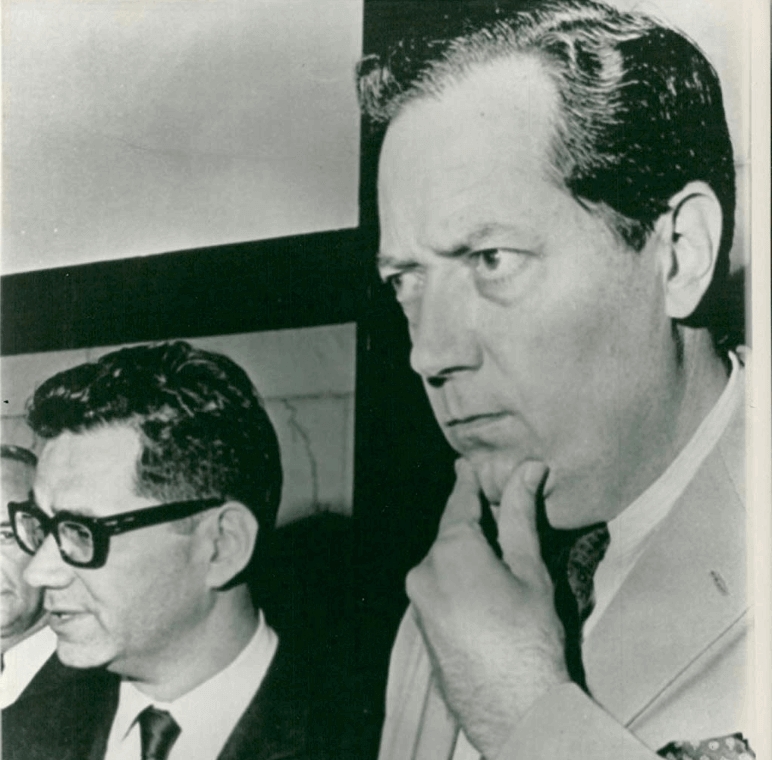
In the spring of 1968, Mark Lane was in New Orleans helping Jim Garrison with his case against Clay Shaw. While there, Lane met with the editors of an alternative newspaper called NOLA Express. He granted them an interview, which became part of his FBI file. We have extracted that interview for our readers to peruse. We should note that the FBI had surveillance on Lane almost everywhere he went at this time. He was not only aiding Garrison, but he also was helping young men resist the draft.
Rob Couteau pointed out the interview which is housed at Black Vault.
(Click here to open the document in another page.)
Dennis Riches has provided this typed transcription of the Mark Lane interview.
(Click here to open the document in another page.)
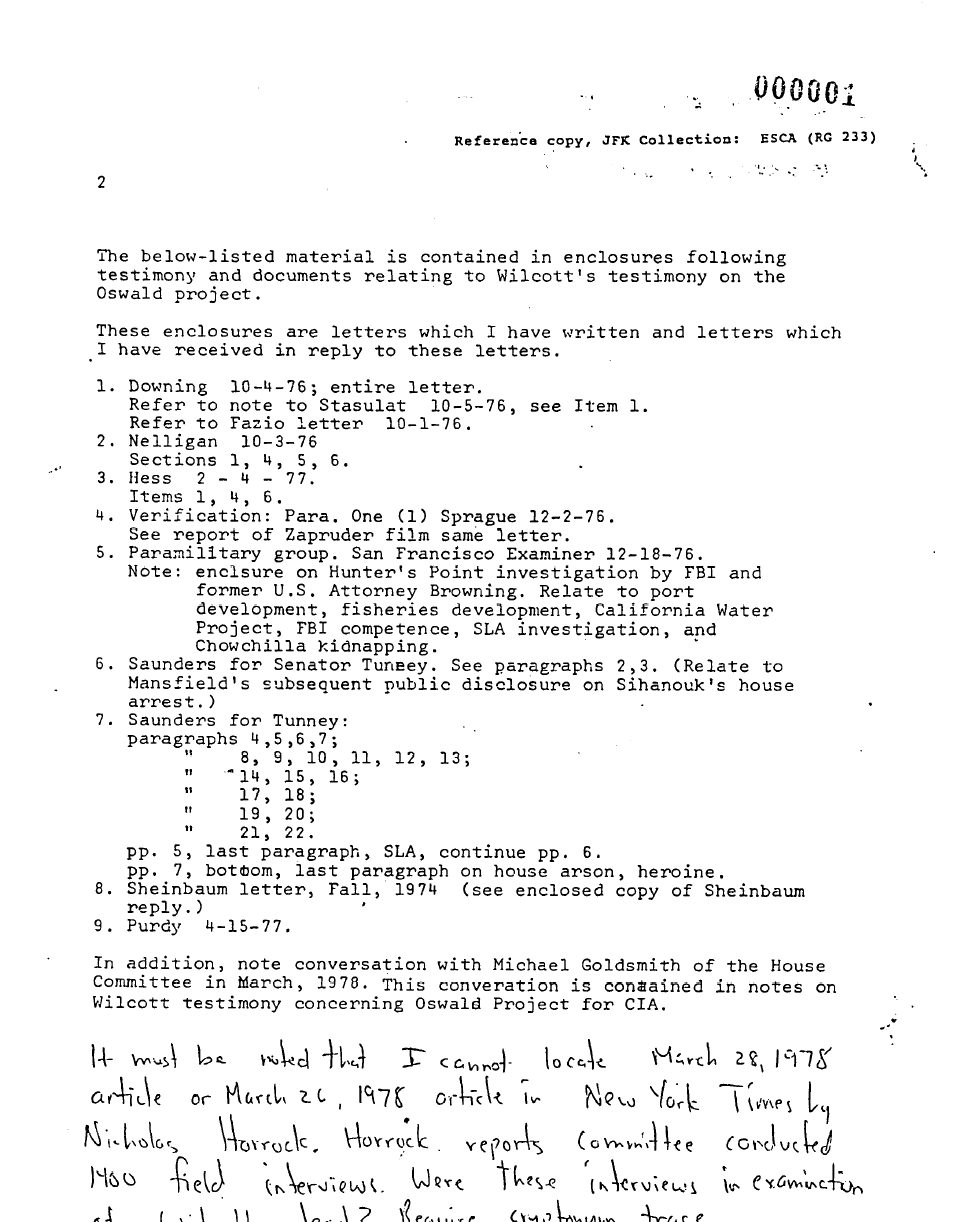
James Wilcott worked out of the Tokyo CIA station at the time of the assassination. He was not questioned by the Warren Commission. His information was that he had been unwittingly involved with paying Oswald through a high security clearance, since he worked in the finance office. He learned this after the fact through various sources within the Agency, who all recognized what had happened after the assassination and the association of Oswald’s name with the crime. Wilcott’s affidavit and deposition were declassified by the ARRB. We think our readers would be interested in reading his evidence./p>
(Click here to open the document in another page.)

I
In his latest book on the Central Intelligence Agency’s history of dirty tricks, longtime historian Stephen Kinzer attempts to paint a picture of the vast and shadowy tapestry that was the American intelligence apparatus at mid-century, using one of its most infamous henchmen, Dr. Sidney Gottlieb, head of the Technical Services Division of the CIA, as its focal point. While the title would suggest that Kinzer has unearthed new biographical information about this sinister character, I found little that was not already available in other surveys of the field. Knowing the quotidian details of Sid’s family life, his habits, and his strange charm really did not advance a story, which was essentially a rehash of known facts repackaged as a biography of what Kinzer deems the CIA’s “Poisoner in Chief.” While there is some survey value in this book regarding the technical perspective of how the CIA dreamt up its machinations of torture, mind-control, psychological warfare, and exotic poisons, its real strength is in Kinzer’s narrative flair. I read it in a single, very uncomfortable sitting. And for that, I feel it does play a valuable role in the historiography of this unsettling topic, one of which most Americans are barely aware, or at best, would rather forget, despite its present-day relevance.
Kinzer begins his book with a stark postwar vignette:
White flags hung from many windows as shell-shocked Germans measured the depth of their defeat. Hitler was dead. Unconditional surrender had sealed the collapse of the Third Reich. Munich, like many German cities, lay in ruins. With the guns finally silent, people began venturing out. On a wall near Odeonsplatz, someone painted: “CONCENTRATION CAMPS DACHAU—BUCHENWALD—I AM ASHAMED TO BE GERMAN.” (p.13)
The Allies were faced with some of their most trying decisions after the Soviet Union’s capture of Berlin and the subsequent surrender of all Nazi forces in Europe. Many Allied officials knew that ideologies as entrenched, compelling, and destructive as fascism died hard. Just because their nation was in ruins, leaderless, and at the mercy of rampaging Red Army troops on one end and embittered, battle-weary Americans on the other, this did not necessarily mean the German people would go quietly into the night and embrace ideas like peaceful co-existence with their European brethren, or even American-style “democracy.” Some, like Roosevelt’s Secretary of the Treasury, Henry Morgenthau, wanted Germany reduced to an agricultural backwater with no future prospect of industrial production, military rearmament, or political clout in a world they had only years earlier sought to conquer and rule. Others had different ideas.
As the OSS would soon discover, clandestine warfare and the implied threat of biological warfare had played a major role in both the Japanese and German governments’ early chess moves. As new to the game, that spy agency was only beginning to understand these matters. While Roosevelt begrudgingly fulfilled Winston Churchill’s 1944 request for half a million bomblets filled with anthrax, by the time the batch was coming off the production lines of a converted factory in Indiana, the Nazis had surrendered.
In the ensuing discoveries made in the wake of German capitulation, however, word soon spread that Nazi doctors like Kurt Blome had weaponized dozens of biological agents, diseases, and plagues. Further, that he had been in friendly competition with the sadistic Japanese scientist and biological researcher Shiro Ishii, whose Unit 731 committed human atrocities on captured Allied and Chinese soldiers and civilians that would have made Caligula wince. Much like in their technical advances in rocketry, jet propulsion, tanks, artillery, and submarines, the Nazis were apparently leaps and bounds ahead of the United States in this dark field too. OSS officers on the ground were curious and would soon make a choice that would color and shape the moral landscape of the newly formed CIA in the years to come. As Kinzer notes:
Nazi doctors had accumulated a unique store of knowledge. They had learned how long it takes for human beings to die after exposure to various germs and chemicals, and which toxins kill most efficiently. Just as intriguing, they had fed mescaline and other psychoactive drugs to concentration camp inmates in experiments aimed at finding ways to control minds or shatter the human psyche. Much of their data was unique, because it could come only from experiments in which human beings were made to suffer or die. That made Blome a valuable target—but a target for what? Justice cried out for his punishment. From a U.S. Army base in Maryland, however, came an audaciously contrary idea: instead of hanging Blome, let’s hire him. (p.14)
The author then continues:
For a core of Americans who served in the military and in intelligence agencies during World War II, the war never really ended. All that changed was the enemy. The role once played by Nazi Germany and Imperial Japan was assumed by the Soviet Union and, after 1949, “Red China.” In the new narrative, monolithic Communism, directed from the Kremlin, was a demonic force that mortally threatened the United States and all humanity. With the stakes so existentially high, no sacrifice in the fight against Communism—of money, morality, or human life—could be considered excessive. (p.25)
The psychic shock of totalitarian ideologies, unleashed in those roughly five and a half brutal years of WWII, was an enduring one for the case officers and assets that now made up the fledgling CIA. And with President Truman’s signing of the National Security Act in 1947, clandestine operations were essentially ratified in legal writ, with the stamp of the highest offices of government, a decision Truman would famously lament in his retirement. As Kinzer shows, the nebulous and ill-defined limits circumscribing this new shadow warfare were quickly pushed to their logical end by those who seemed to believe nothing was too extreme when the fate of the “free world,” as they understood it, was concerned. Given an unprecedented opportunity to play James Bond, an almost unlimited budget to fund new and exciting ways to overthrow governments, assassinate leaders, poison food supplies, and expose innocent people to mind-shattering substances in their search for mind control, they took the ball and ran with it. Things fell into place. Truman left office in 1953 and President Eisenhower and his Secretary of State, John Foster Dulles, were all too willing to use the CIA to achieve political ends. With John’s brother, Allen Dulles, now appointed as head of the Central Intelligence Agency, the circle was complete: foreign policy would be a spy’s game, with very real conventional wars interspersed for flavor, but essentially, a secret and enduring war in the shadows. And to play the game, they needed the tools.
Kinzer’s ability as a storyteller is pronounced in these early chapters. The book at this point reads like a John Le Carré novel, as much as it does a well-researched, thoroughly footnoted monograph of the early Cold War. Familiar names are given a face, a voice, a temper: Wild Bill Donovan, Bill Harvey, Ira Baldwin, and of course, a young Jewish man from the Bronx named Sid with a club foot and a stammer who was studying biology back in the States.
II
Lysergic acid diethylamide, LSD, or “acid” on the street, plays a central role in Kinzer’s book, with many chapters devoted to the CIA’s explorations into its potential to manipulate human beings for political and social engineering ends. Wilson Greene, an officer of the United States Chemical Corps, discovered scattered reports and rumors of a Swiss doctor named Albert Hoffmann, who Kinzer believes is the first person ever to have had an acid trip. Though Hoffmann, who worked for the Swiss pharmaceutical company Sandoz, had taken this journey in 1943, it would not reach Washington until 1949. Kinzer describes the thesis of Greene’s paper to government officials, entitled: “Psychochemical Warfare: A New Concept of War:”
Their will to resist would be weakened greatly, if not entirely destroyed, by the mass hysteria and panic which would ensue. The symptoms which are considered to be of value in strategic and tactical operations include the following: fits or seizures, dizziness, fear, panic, hysteria, hallucinations, migraine, delirium, extreme depression, notions of hopelessness, lack of initiative to do even simple things, suicidal mania. Greene proposed that America’s military scientists be given a new mission. At the outer edge of imagination, he suggested, beyond artillery and tanks, beyond chemicals, beyond germs, beyond even nuclear bombs, might lie an unimagined cosmos of new weaponry: psychoactive drugs. Greene believed they could usher in a new era of humane warfare. (p.29)
This, along with reports of recently-returning soldiers from the Korean War who seemed to sympathize more with the enemy they were sent to kill than their American brethren, led some policy planners in Washington to suspect that the Reds were up to more than conventional propaganda. That, as Kinzer notes, none were actually “brainwashed” as Washington suspected, but simply critical of what they viewed as a hypocritical, unjust, capitalistic and segregated mid-century America, didn’t matter in the binary option set of hard line anti-communists like CIA officers Dulles, James Angleton, Richard Helms, and their colleagues. These were the same people who essentially green-lit what would eventually turn into the MK-ULTRA program, whose directive was to probe the limits of the human psyche, with the express aim to eventually discover how a fully functional person could be “depatterned” and remade, as it were, in the image of his or her handler for any number of field-deployable roles.
While that program is exhaustively detailed elsewhere, Kinzer does add some colorful vignettes to the story that seem like they jumped from the pages of a Thomas Pynchon novel rather than the historical record: secretly dosing colleagues at dinner parties, most famously Frank Olson, who of course “jumped or fell” from a 13-story Manhattan hotel room after having an acid-induced nervous breakdown and frantically seeking an exit from the intelligence field, paying crooked cops in cash to sit behind two-way mirrors in rented San Francisco brothels to watch prostitutes try to illicit sensitive information from acid-dosed patrons, injecting an elephant at an Oklahoma zoo with a lethal dose of LSD, releasing “benign” but actually toxic bacterial aerosols off the coast of California (Operation Seaspray) to test their dispersal pattern on an unaware American population getting their Sunday morning newspapers. The list goes on and only gets more absurd as it does.
What Kinzer accomplishes in Poisoner in Chief is to show just how unscientific so much of what we call MK-ULTRA and its hundred-plus “sub-projects” really were. With little oversight, and an actual legal license to kill, torture, abduct, and abscond, the early case officers and assets tasked to the CIA’s biological and mind-control initiatives were dangerously out of control, yet in some sense, legally justified, given the vague language and imperatives of the National Security Act which legitimized their activities. As George White, the crooked cop mentioned earlier, said years later in a grateful letter to his mentor and boss, Sidney Gottlieb, “… it was fun, fun, fun. Where else could a red-blooded American boy lie, kill and cheat, steal, deceive, rape, and pillage with the sanction and blessing of the All-Highest?” (p.155)
Indeed. Where else but in the CIA?
III
Poisoner in Chief proceeds predictably enough through the sixties and seventies, with the major uses of Gottlieb’s Technical Services Division of the CIA highlighted against the backdrop of a given foreign policy episode. Crafting ever sillier ways to kill Fidel Castro—boots laced with thallium to make his mighty beard fall out, exploding ornate seashells to catch his eye on one of his frequent scuba dives, and botulin-laced cigars that only needed to be held between the lips for seconds to kill—Gottlieb and his junior staff of kids from local technical colleges and workshops were never out of ideas. Poisoned tubes of toothpaste for the first democratically elected leader of the Congo? No problem. “Joe from Paris” (Gottlieb’s code-name in the Congo operation) will arrive in Leopoldville shortly. So will QJ/WIN, the backup shooter. Standby.
This is an exciting part of the book and provided a rare glimpse into the devil’s workshop that was TSS (Technical Services Staff). But, at the same time, it contains some critical oversights that must be addressed. Namely viewing President Kennedy as a younger, fresh-faced continuation of Eisenhower, and someone who laid the groundwork for Johnson, rather than as someone opposed to either of his executive bookends. A president who was rather unique in his conciliatory vision of peaceful coexistence; a president who, unbelievable as it may sound today, had genuine empathy for the developing nations of the world. This is not a debatable point in 2019, despite the MSM’s dogged, fifty-five-year smear campaign against a most promising U.S. leader, as any reader at Kennedys and King should know by now.
Yet there is a real political vacuum in this section of the book. In his tracing of the Gottlieb attempts to poison Patrice Lumumba of the Congo, there is no mentioning of how these plots were hurried in late 1960 after John F. Kennedy won the election. Yet, there are authors who have come to this conclusion after reading the cable traffic. (John Morton Blum, Years of Discord, pp. 175-76) Almost everyone agrees today that Kennedy clearly favored Lumumba in his struggle to free Congo from European imperialism. And it appears that the CIA knew that.
As most authors also realize today, the CIA plots with the Mafia to assassination Fidel Castro did not have presidential sanction. This was the conclusion expressed by the Church Committee in 1975 and is fortified by the release by the Assassination Records Review Board of the CIA Inspector General Report on that subject. Yet, in the face of all this, plus the declassified files of the Assassination Records Review Board, former New York Times reporter Kinzer claims,
Plotting against Castro did not end when Eisenhower left office at the beginning of 1961. His successor, John F. Kennedy, turned out to be equally determined to “eliminate” Castro. The spectacular collapse of the CIA’s 1961 invasion of Cuba at the Bay of Pigs intensified his determination. Kennedy and Attorney General Robert Kennedy, his brother, relentlessly pressured the CIA to crush Castro and repeatedly demanded explanations of why it had not been accomplished. Samuel Halpern, who served at the top level of the covert action directorate during this period, asserted that “the Kennedys were on our back constantly … they were just absolutely obsessed with getting rid of Castro.” Richard Helms felt the pressure directly. “There was a flat-out effort ordered by the White House, the President, Bobby Kennedy—who was after all his man, his right-hand man in these matters—to unseat the Castro government, to do everything possible to get rid of it by whatever device could be found,” Helms later testified. “The Bay of Pigs was a part of this effort, and after the Bay of Pigs failed, there was even a greater push to try to get rid of this Communist influence 90 miles from United States shores … The principal driving force was the Attorney General, Robert Kennedy. There isn’t any question about this.” (p.122)
First, to take the testimony of a practiced liar like Richard Helms regarding his sworn enemies, the Kennedy brothers, at face value, is almost comical. Richard Helms ordered Sidney Gottlieb to shred every accessible document pertaining to MK-ULTRA before congressional investigations discovered his illegal program’s dirty paper trail. Helms famously walked into the Oval office with a rifle, plopped it on JFK’s desk, and said the CIA had just discovered (through acid-based swaths), a Soviet serial number on the stock, and that the gun was from Cuba, strengthening, so he thought, his case that Kennedy should immediately invade the island before the Russians had time to reinforce Castro. Kennedy asked to see more proof, since Helms said the magic acid test only worked for a few seconds and then destroyed the numbers it allegedly revealed. Kennedy then waved him out of the office to finish opening his daily mail. Not exactly hell-bent, as Kinzer would have us believe.
Allen Dulles and Richard Bissell planned the Bay of Pigs to fail, stacking the initial invasion waves with the lowest quality, most poorly trained groups of the Cuban exiles slated for the assault. They did this anticipating that Kennedy would cave once reports got back to him that they could not get off the beach and capture strategic inland objectives without naval and air support (and, in all likelihood, the landing of U.S. Marines). Kennedy later understood this and complained about it. But the lie was fortified when Allen Dulles and E. Howard Hunt commissioned a ghost-written article in Fortune that created the narrative Kinzer and others have fraudulently promulgated: JFK got cold feet and “called off” the air support, leaving those poor Cuban exiles stranded on the beach. Kennedy inherited the operation from Eisenhower, reluctantly green-lit it only because the CIA was lying to him at every step, and when he realized its quixotic goals were impossible without escalation and the commitment of non-clandestine U.S. forces, sat anxiously in his briefing room as it fell apart. He then quietly fired Dulles, Bissell, and Cabell.
Similarly, to say that Robert Kennedy was hell bent on killing Castro is to fail to acknowledge the declassification of the CIA’s Inspector General report on the CIA/Mafia plots. That long report states that Robert Kennedy had to be briefed about the plots by the CIA after the FBI accidentally discovered them. Obviously, if the Kennedys had been in on them, there would have been no briefing necessary. But making it worse, the CIA told Robert Kennedy that they would now put a halt to them, since RFK was very upset by the briefing. This was a lie. The plots continued along without his knowledge, pairing mobster John Roselli and CIA officer Bill Harvey. (The Assassinations, edited by James DiEugenio and Lisa Pease, pp 327-28) The obvious question that Kinzer does not ask is: Why would the CIA have to lie to RFK, if he was in agreement with the plots? Kinzer also overlooks the apparent understanding of Castro’s own feelings towards the matter. He ignores the fact that it was largely Robert Kennedy, through Soviet back channels during the Cuban Missile Crisis, who averted what looked almost certainly to be a nuclear Armageddon. That incident provided a perfect opportunity to invade Cuba and overthrow Castro. Afterwards, Castro suggested a détente with Washington and JFK obliged him. It’s easy to see why the CIA hated both of the brothers. And while this misreading of history is only a few paragraphs of an otherwise fairly well researched and engaging book, it provides a disappointing and misleading aspect that readers unfamiliar with the true history of the Kennedys’ views about the developing world. If anyone disagrees, it would be good for them to fact-check for themselves. Reading the IG report would be a good place to start. (Click here for that link)
Overall, while largely a repackaging of long-known facts, the book is an interesting introduction for those unacquainted with the dark side of the CIA at mid-century and into the latter years of the Cold War. Gottlieb remains a mysterious, infrequently quoted figure in the book, with a few interspersed interviews with his children and friends. Perhaps most interesting is Kinzer’s chapters on Gottlieb’s attempted retirement and disappearance from the TSS, floating around abroad, in a leper colony in India and other exotic hideouts. His very face and name would have remained unknown to the general public and, likely, the research community had it not been for late 70s probes like the Church Committee. Kinzer does a fine job here and this probably represents the only unique aspect of the book, focusing as it does on their attempts to see how deep the CIA’s rabbit hole was when they stumbled upon the last surviving documents detailing projects like MK-ULTRA and MKNAOMI.

A few weeks ago, after the Robert Mueller attempt to impeach President Donald Trump more or less fizzled, the Democrats in Congress stumbled upon a gift horse. After escaping Mueller’s two-year inquiry and the fabrications of British intelligence agent Christopher Steele and his so-called dossier, President Trump was poised to take a victory lap. He could have now shown that Steele had been first paid by his Republican rivals, who wanted to stop his insurgent candidacy for president. When that effort bore little or no fruit, it was then taken over by agents of the Democratic Party acting as stand-ins for the Hillary Clinton campaign. It was further beginning to look like the FBI was out to ensnare President Trump in a net of manufactured “Russian collusion” charges. (Click here for an example)
In fact, Trump had now begun an effort to expose what he thought was a “Deep State plot”. One that was designed to terrorize and smear his presidency from the start—perhaps from before its start. He had entrusted Attorney General William Barr and personal lawyer Rudy Giuliani to now begin to round up the culprits, whoever they were and wherever the information on them could be attained. If they needed to consult with governments as far away as Australia, so be it.
But in reaction, it appears that Trump overreached himself. Like Richard Nixon, it appears that he played into the hands of those who wished him ill. By his own actions he now gave the likes of Democrat Adam Schiff—who had been reduced to blowhard status by Mueller’s stumbling congressional performance—the means to actually impeach the president. Even that perpetual fence sitter, Speaker of the House Nancy Pelosi, now decided to back Schiff’s latest effort. Perhaps the establishment did not want to see the exposure of their ersatz Russia Gate scandal?
Trump has now endangered his very presidency by giving the Democrats a much more real reason to remove him. By doing so, Pelosi has now given the keys to the kingdom to an attorney who others have thought for years was a part of that rather murky and ill-defined Deep State. His name is Mark Zaid.
But before we get to Mr. Zaid, let us fill in some necessary background to this impending crisis.
What appears to have happened is that Trump made a call—perhaps more than one—to the president of the war-torn country of Ukraine. This happened on July 25, 2019. The call was made to the victorious new president Volodymyr Zelensky to congratulate him on his election in April. But an anonymous official, suspected of being a CIA employee, filed a whistleblower complaint about the call on August 12. Allegedly, the complaint says that although this person was not actually in the room when the call was made, several others were, including Secretary of State Mike Pompeo. The call occurred days after President Trump had delayed hundreds of millions in military aid to Ukraine. Democrats like Schiff argue that this is one of the most compromising aspects of the incident.
The complaint alleges that Trump used the power of his office to try and get Zelensky, the head of a foreign country, to influence the 2020 election. Further, the complaint allegedly says that the officials who heard the call were disturbed by what Trump had said and attempted to “lock down” the actual call and conceal its details. As of today, the actual call and/or verbatim transcript has yet to be released.
What allegedly happened is that Trump urged Zelensky to investigate corruption allegations against former vice-president Joe Biden and his son Hunter. The idea that Trump had was this: Joe Biden had urged the firing of Ukraine’s top prosecutor, because he was investigating a company which had Hunter on its board of directors. The fact that Joe Biden was, at that time, the front runner in the polls on the Democratic side is not insignificant. The current prosecutor in Ukraine says there was no reason to investigate Hunter, since the real corruption had taken place before he was appointed to the board. It was not being dealt with, which is why Joe Biden wanted the previous prosecutor removed. To most legal experts, soliciting influence from a foreign government to help impact an American election would be an impeachable offense.
There is a back story to all this of course. And it should be sketched in to give the present episode some depth and texture and, also, to add in the usual American brand of hypocrisy. The main reason that Ukraine needs so much military aid is that the USA backed to the hilt the overthrow of the elected president of that country. This was the violent and forceful overthrow of Ukrainian president Viktor Yanukovych in 2014. Although made to look like a homegrown revolution, it was done with much aid by certain elements of the European Union and the USA. That uprising unleashed some ugly and frightening fascist forces that had been dormant on the Ukraine scene since after World War II. Under threat of death, Yanukovych had to flee the country with the aid of President Vladimir Putin of Russia. The overthrow and its aftermath caused the murders of literally scores of innocent people by the neo-Nazi perpetrators, who the American diplomats on the scene were backing completely. The reason for this was that Yanukovych was portrayed as being too close to Russia and American personages, like the infamous Victoria Nuland, favored anyone—and I mean anyone—who was not. The all too accommodating American media decided to play this tune with no questions asked. And for me and others, like the late Robert Parry, this was the real beginning of the anti-Putin mania that would soon engulf our country. There were very few outlets who thought the anti-Putin spin was a slanted view of what was happening. (For an alternative perspective, click here)
During the 2016 election, candidate Donald Trump voiced a different attitude about Russia and Putin. Since Hillary Clinton had been for the Yanukovych coup, she began to attack Trump as being too sympathetic to Putin. Then came the discredited Steele Dossier, which it appears that many in the FBI actually bought into. After Trump was elected, he decided to fire FBI Director James Comey and this gave others who were likeminded in the Bureau and the Justice Department the excuse to appoint a special prosecutor. After two years, Robert Mueller’s probe came up embarrassingly empty. And he made a very weak witness before the (now) Schiff-controlled House committee. The irony in all of this baseless anti-Russia bombast was this: there were many legitimate policy issues the Democrats could have used to go after Donald Trump. For example, his disgraceful tax cut for the rich and his concurrent attempt to give even more money—which we do not have—to the Pentagon. But yet, it is this issue, plus Trump’s attempt to stay out of a war with Syria, which has seemingly enraged people in both parties against him and which tells the reader a lot about the present state of our political system. An almost too perfect example of this is a 2017 tweet by neocon flack Bill Kristol: “Obviously strongly prefer normal democratic and constitutional politics. But if it comes to it, prefer the deep state to the Trump state.” That makes it kind of clear.
When the original Mueller missile misfired, Trump made a mistake. As Richard Nixon characterized his missteps during Watergate, “I gave them a sword.”
As people like former CIA officer John Kiriakou and former congressman Norman Solomon have written, if there is a Deep State plot against Trump, it could not have picked a more fascinating antagonist than Mark Zaid. He is the Washington lawyer who is representing two of the anonymous whistle blowers in the case against Trump. Former CIA officer Kiriakou has written that he is surprised that Zaid is still practicing law. John was the former CIA operations officer who alerted the country to the torture process known as waterboarding. For that, and confirming information about who was involved in that torture, he was indicted on five counts. In a ridiculous kangaroo court legal proceeding—described at length in the film Silenced—Kiriakou was forced to plead guilty to one count and he spent over two years in prison, while the actual torturers stayed free. (For a brief summary of his case, click here)
In an interview I did with John, he repeated the information he wrote about in an article at Consortium News. He told me that once he was indicted in 2007, one of the lawyers who briefly represented him was Mark Zaid. He found him to be impetuous and confrontational, so he let him go. Yet, during the grand jury hearings, it was Zaid and the reporter he talked to, a man named Matt Cole, who testified against him. He filed a complaint for the apparently unethical practice of a lawyer testifying against his former client. But since it was filed in the Eastern District Court of Virginia, it was ignored. (Author’s Interview with Kiriakou, October 6, 2019) The Federalist Society should look to its laurels in stacking certain courts.
In that interview, the former CIA officer told me about another case that Zaid was involved in. That one concerned Jeffrey Sterling. Sterling ended up being convicted for allegedly giving away secrets the CIA had concerning their secret operation to sabotage Iran’s nuclear program, codenamed Merlin. As with Kiriakou, the Sterling case could have been brought under the George W. Bush administration. It was not. It proceeded under the Obama administration, which tried more whistleblower cases than all prior administrations combined. In my interview with John, he told me that Zaid was also instrumental in the Sterling case. He referred me to the reporting of Marcy Wheeler who blogs under the title of “emptywheel”. In reading her writings about the Sterling case, it is difficult to escape the conclusion that Zaid helped the prosecution center on and ultimately convict Sterling. I can do no better than refer the reader to her essay. You can decide for yourself about who Zaid was representing. (Click here)
The above cases, plus Zaid’s status as the representative of the two whistle blowers against Trump, almost force me to bring up my personal experience with him. Zaid graduated from law school in 1992. Almost instantly he seemed to appear out of nowhere on the JFK scene. He began to attend conferences, occasionally hosting panels. He also began to speak at these affairs. And he became a frequent contributor to what, at that time, was the leading publication in the JFK field, Jerry Rose’s Third Decade.
But almost immediately, I had a problem with Zaid. The reason was simple. I could not find anything he did which in any way advanced the cause. In fact, what I did find was instance after instance where, like Gus Russo, he seemed to advocate positions the other side would take. This seemed bizarre to me. For the simple reason that by 1993, when I had encountered him at least three times, it seemed to me that the case against Oswald had all but evaporated. And with the releases of the Assassination Records Review Board, it would be rendered ridiculous. Yet, here was Mark Zaid screaming at the top of his lungs in Dallas that no one had the credentials to challenge Luis Alvarez on the JFK case. When in fact, everyone had the credentials, since, when he entered that arena, Alvarez simply discarded his ethics. (Click here for proof)
On another panel in Dallas, Zaid argued against the idea that Lee Harvey Oswald was any kind of intelligence agent. Again, I found this quite odd. Anyone who had read Philip Melanson’s milestone book about Oswald, Spy Saga, would have to at least consider that idea, as would anyone who had studied the inquiry of Jim Garrison. After all, what kind of communist would Guy Banister give a room to for printing pro-Castro flyers? What kind of Marxist would drive two hours north of New Orleans to the Clinton/Jackson area with David Ferrie and Clay Shaw to stand in line at a voter registration event? Yet, in 1993, there was no doubt to me that Oswald had done those things. (The Assassinations Records Review Board has made the evidence for these events pretty much foolproof.)
And then there was Zaid trying to argue against the eyewitness testimony in Dealey Plaza. The late Larry Harris, a fine man and researcher, had assembled numerous witnesses on the 30th anniversary to stand in the places they were in the Plaza on 11/22/63. This was really a good thing to do, so spectators could question them in person. Zaid went down to the Plaza and, according to more than one witness, he began distributing literature arguing against their testimony.
And finally, there was something Zaid had done to me personally. I had communicated with Zaid, attorney Jim Lesar, and writer Dick Russell on how we should approach the 30th anniversary. He had sent me a letter arguing against any kind of reopening of the JFK case since our side did not have strong enough evidence to do so. I felt he had deliberately misrepresented the strength of our case impeaching the Warren Commission. But even worse, he had informed me by letter that he had shared my ideas with, of all people, Gerald Posner. By this time, everyone—except maybe Zaid and Gus Russo—knew who Posner was and what he was up to. (Click here as to why)
Therefore, in describing all the above—his actions in the Sterling and Kiriakou proceedings and his bizarre behavior on the JFK case—many have wondered about what Zaid actually thinks about the moral act of whistleblowing. (See here for another example)
I do not subscribe to the school that says there is an equivalency between Donald Trump and John F. Kennedy. Although, I should note that in his withdrawal from Syria, Trump did mention Dwight Eisenhower and his Military Industrial Complex speech. (Click here)
But, as an author and commentator, I would be remiss not to note the odd parallel of Mark Zaid’s presence on both scenes. If only for the reason that it is a parallel that you can wager the MSM will never bring up. Just like the MSM will never bring up the possibility that the Biden story is really a cover for real corruption or that the whole Russia Gate episode was a charade. If either of those alternatives are accurate, then one can look at this whole whistleblower episode as a double duty deus ex machina produced to escape the exposure of that pseudo scandal and also to conceal serious problems with the Democratic front runner and his son. For as Jim Hougan has written, Hunter Biden’s life reads like a novel by Robert Stone.
Let me close with this. The notion that Trump is a danger to the status quo is, I think, ludicrous. But if the Trump vs. Deep State advocates are correct, that tells us how much worse—and restrictive—our political scene has become since 1963. The presence of Mark Zaid in the middle of all this is, to say the least, highly suggestive.

A Review of Chaos: Charles Manson, the CIA, and the Secret History of the Sixties
In August of 1969, one of the most sensational murder cases in recent history exploded onto TV screens and the front pages of newspapers. On two successive evenings in Los Angeles, seven people were brutally attacked and killed with both guns and knives. What made the homicides even more gripping was that, on the first night, one of the victims was Sharon Tate. Tate was a popular actress who was ascending in the star ranks at the time. She had done several film and TV roles, including the 1967 movie adaptation of the novel Valley of the Dolls. She was married to film director Roman Polanski. Among his films, Polanski had directed two hits that dealt with macabre subjects: Repulsion and Rosemary’s Baby. This gave the murders an even higher profile, with a darker undertone. Those undertones were broadened by the fact that the killers had left certain words behind etched in blood: “rise”, “pig” and “helter skelter”.
For weeks on end, the police and District Attorney’s office could find no productive leads. But in November, they got a call from an inmate at Sybil Brand Institute, a detention center for women. The caller said that one of the fellow prisoners had told her about her participation in the murders. It was that tip which broke open the Tate/LaBianca case.
His successful prosecution of Tate/LaBianca vaulted assistant DA Vincent Bugliosi into the stratosphere of celebrity attorneys. He now joined the likes of F. Lee Bailey, Melvin Belli and Percy Foreman. It also made him a wealthy man and gave him an almost automatic TV/radio platform nearly until the end of his days: one from which he could pontificate on a variety of legal issues. That wealth and position was largely due to the book he co-wrote on Tate/ LaBianca with established author Curt Gentry. Published in 1974, it was titled Helter Skelter and it eventually became the number one best-selling true crime book. (James DiEugenio, The JFK Assassination: The Evidence Today, p. 70). Those sales were greatly augmented by a two-part TV film that aired in April of 1976. That dual airing set records as far as ratings for a TV film at the time.
I did not read the Bugliosi/Gentry book until many years after publication. There was something about the sensationalism and assumed collective psychosis that made me leery about the way the story was presented. But, in 2007, Bugliosi published Reclaiming History on the assassination of President Kennedy. That giant tome was so poor that I took Mark Lane’s advice. He said that after what Bugliosi had done with JFK, we should go back and examine Tate/LaBianca. Between my examination of Helter Skelter, and my critique of Reclaiming History, my opinion of Bugliosi as an author and attorney diminished.
My critique of both the Bugliosi books is contained in my current volume entitled The JFK Assassination: The Evidence Today. The first chapter of that book contains a biography of Bugliosi along with my analysis of the problems with Helter Skelter. At about the time I began to express my doubts about the earlier book, a writer named Tom O’Neill got in contact with me. We later met and then talked on the phone a few times. Those discussions confirmed for me the serious underlying problems with the Bugliosi/Gentry scaffolding of their bestselling book.
At the time I met Tom, he was struggling to finish a book he had been contracted out to write on the Tate/LaBianca case. He had been caught up in a dizzying labyrinth for a number of years and was having problems finding his way out. He had piled up a veritable mountain of research on both Bugliosi and the Tate/LaBianca murders and, like myself, he had found the Helter Skelter scenario unconvincing. To remind the reader, what this entails is Charles Manson ordering the Tate/LaBianca murders to begin some kind of race war. After the war, only the Black Muslims would be left standing. Manson and his followers would now emerge from a deep black pit underground. And after having multiplied, they would retire the Muslims and now rule the world. (see DiEugenio, pp. 12-14 for the long version) I hope the reader can understand how, even in this abridged form, some people could find this concept wanting.
Tom found a co-writer—Dan Piepenbring—to help him sort out his research and interviews. The book has now been published under the title Chaos: Charles Manson, the CIA, and the Secret History of the Sixties. It is really two books. One is a powerful critique of Bugliosi’s methodology in convicting Manson and the cohorts involved in the murders at the Tate/Polanski home and then the house of Leno and Rosemary LaBianca. There were a total of seven people killed over the nights of August 8 and 9, 1969. At the Benedict Canyon address, in addition to Sharon Tate, there was men’s hair stylist Jay Sebring, coffee heiress Abigail Folger, her boyfriend Victor Frykowski, and recent high school graduate, Steve Parent. The next night, in the Los Feliz area, the LaBianca couple were killed. Bugliosi ended up being the lead prosecutor in the case after Aaron Stovitz was removed for violating a gag order. (O’Neill, p. 5) With Bugliosi now in the driver’s seat, he was the one who garnered the media attention for the many months of the trial.
O’Neill had been a celebrity/movie writer for magazines like Us and Premiere. At the 30th anniversary of Tate/LaBianca he was asked by the latter publication to do an update article on the principals involved who were still alive. It was in doing his preliminary research for that article that he began to understand that not all was as it seemed in what had become the received wisdom on the case. He also found out that Bugliosi was very protective about Tate/LaBianca and his role in it. (O’Neill, p. 7) In one of the most memorable exchanges in the book, the author reveals a conversation he had with newspaper reporter Mary Neiswander. She was one of the very few writers on Tate/LaBianca who actually talked to alleged mastermind Charles Manson and developed a rapport with him. She did her own set of interviews and discovered evidence that contradicted what Bugliosi was eliciting from witnesses on the stand. She also did not buy Bugliosi’s Helter Skelter theory of the crime.
Neiswander was one of the first local journalists to note that the work of the two investigators on the prior Gary Hinman murder case was crucial to understanding what happened on August 8 and 9. But the LAPD ignored the work of Charles Guenther and Paul Whiteley and they allowed the population of Los Angeles to descend into a state of, as she wrote, “terror stricken, gun toting, guard dog buying crazies.” (Assassins … Serial Killer … Corrupt Cops, e-book version, p. 147) She also noted that, if Manson had not consented to be tried with his cohorts, it would have been very difficult to prove his guilt in a stand-alone case. (Neiswander, p. 161; for this point also see George Stimson’s Goodbye Helter Skelter, p. 405) She then wrote that since the judge would not let him defend himself, Manson insisted on having the worst lawyer in the city defend him. According to Bugliosi, he got him in the person of Irving Kanarek. (Neiswander, p. 175).
Because of her unusual, outside-the-envelope reporting, Bugliosi decided to attack the woman in public. He said about her that she was “pro-defense, anti-prosecution and she hates police.” (Neiswander, p. 183) She also noted that Bugliosi had actually taken a swing at Susan Atkins in court after she messed up the notes for his summation. She also knew from a secret source that Bugliosi’s prime witness, Linda Kasabian, had been less than truthful on the stand. And this deception tended to undermine his Helter Skelter thesis. (Neiswander, p. 188)
But there was something between Bugliosi and Neiswander that the reporter did not relate in her book. She told it, however, to O’Neill. As she was prepping a long exposé of the Manson prosecutor back in the eighties, he made her understand that he knew where her children attended school, “and it would be very easy to plant narcotics in their lockers.” (O’Neill, p. 80) This anecdote is quite telling in two respects. First, it shows a dark side to the prosecutor, one which I talked about in my book and which O’Neill also writes about here. But further, it reveals that Bugliosi was hyper-defensive about anyone questioning his tactics in the Tate/LaBianca case. What was the famous prosecutor so worried about? What secrets was he so desperately trying to protect?
The author begins his book with a review of the killings at the Tate and then the LaBianca homes. Tate and Polanksi lived at 10050 Cielo Drive, north of Beverly Hills. That home was rented out by talent manager Rudy Altobelli, who was not in the country at the time. He had hired a groundskeeper named William Garretson to take care of the place in his absence. Garretson lived in a cottage behind the main house and Parent was visiting him that night. The LaBianca home was at 3301 Waverly Drive, which was right next door to a home where Manson had actually stayed more than once. The author notes that the LaBiancas were worried since people had been breaking in and moving their furniture around. (O’Neill, p. 23)
Before getting into the actual centerpieces of the book, I would like to pose some questions about the two murder scenes and the victims. When I met with the author, he told me that there was more to the killing of Steve Parent than met the eye. If there was, O’Neill does not address it in his book. He also said that the ideas about the extravagant wealth of Rosemary LaBianca was a point that Bugliosi had gotten wrong in his book. (DiEugenio, p. 19) Again, if that was an error by Bugliosi, it is not addressed by the author. He said that Altobelli had lost his money and was living in a small apartment paid for by Jack Nicholson. Again, this decline is not addressed, let alone explained by the author. Finally, the daughter of the LaBiancas actually discovered her parents’ bodies that night. She was accompanied by a man named Joe Dorgan. Dorgan was a member of the Straight Satans. This was a cycle gang modeled on Hell’s Angels that was close to the Manson Clan up at Spahn Ranch in Chatsworth. Danny DeCarlo, an important witness for Bugliosi, was a member of that gang. But further, that daughter, Suzan Rae, began to write letters to the main killer, Tex Watson, in 1986. She then argued for his parole at a hearing: the man who had the major role in killing her parents! It was later discovered that Rae lived in an apartment about 200 feet from Watson before the murders. (DiEugenio, p. 20) The author told me that all this was coincidental. I wish he had shown why he was so sure in his text.
But the main fulcrum of the book is O’Neill’s exposure of what Bugliosi and the DA’s office—led by Evelle Younger—did in its conduct of the Tate/LaBianca case. There were five perpetrators who were on trial for the crimes: Leslie Van Houten, Patricia Krenwinkel, Susan Atkins, Manson and Tex Watson. (Watson resisted extradition and was later tried separately.) In what is probably the most significant achievement of the book, the author proves what some have long suspected about the unethical methodology the DA ‘s office used to get a death verdict at the trial, and ensure that Bugliosi’s grandiloquent concept would gain currency.
The first method involved Susan Atkins. Atkins was talking to almost anyone in earshot at Sybil Brand about the Gary Hinman case. Therefore she thought she could trade her knowledge of Tate/LaBianca for a deal. As Nikolas Schreck notes in his book, The Manson File, Atkins talked about what happened at the Polanski home to at least four people in detention, double the two the DA’s office admitted: Virginia Graham and Roni Howard. And she said things that made the crime scene out to be devilishly psychic in its nature: for instance, that she drank Sharon Tate’s blood and liked the way it tasted. It is interesting to note that she took back almost all of these sensationalist claims in her later book, The Myth of Helter Skelter. (See especially p. 222 of the e-book version.) She also noted that at the Hinman scene, the term “political piggy” was left on the wall in blood, and Bobby Beausoleil (also imprisoned since he was found driving the deceased’s car) made a bloody palm print on the wall to suggest a panther paw. This was a half-baked attempt to blame the murder on the Black Panthers. (Atkins, p. 80, e-book version) Although Manson had cut Hinman’s ear, it was Beausoleil who had actually killed Hinman. There are two motives given for the killing. Bugliosi says it was over an inheritance Hinman had come into. Ed Sanders, in his book The Family, writes that it was over a bad batch of mescaline Hinman had sold Beausoleil. (Sanders, p. 180-184) Either way, since Atkins was there, she was implicated as an accessory to the crime.
When the word got back that Atkins was talking, she was interviewed by the DA’s office. And this is where one of the most important revelations in Chaos occurs. It powerfully illustrates the links between a corrupt prosecution and a corrupt MSM. Bugliosi did not want to use Atkins as a trial witness since she was implicated in the crimes, including the Hinman case. (O’Neill, p. 244) So a two-stage secret operation was enacted. Atkins’ original court-appointed attorney was replaced—without either her or the lawyer’s consent. Why was this done? Because the DA needed “strong client control”. (O’Neill, p. 246) Yet Atkins was not the DA’s client. She was their defendant. But her original counsel was being removed because they wanted someone who would cooperate with them by controlling Atkins. They went to the judge, and inexplicably, he approved the switch to a man named Richard Caballero who, according to Sanders, later became very friendly with Bugliosi.
On November 26, 1969, Caballero became the attorney of record for Atkins at her first hearing. The record of that hearing is now gone. (O’Neill, p. 247) Caballero had previously worked in the DA’s office for 8 years. Caballero did something rather odd. He got Atkins to agree to a deal with the DA that was neither signed nor written. Although police chief Ed Davis was sparse with the details of the announcement of Atkins’ cooperation and what she had revealed to the authorities, Caballero became a veritable fountain of information. For the first time, Charles Manson’s name now entered the case as Caballero talked it up for four straight days, saturating the local media. (O’Neill, pp. 248-49) On December 5th, Atkins testified to the grand jury and on that basis Manson, Atkins, Linda Kasabian, Patricia Krenwinkel, Leslie Van Houten and Tex Watson were indicted on seven counts of murder.
Bugliosi allowed Atkins to record her story at Caballero’s office. After listening to the tape, he noted that what she said there apparently differed from what she told Graham and Howard. Now she said she did not actually kill Tate; she held her as Watson killed her. The DA’s office allowed her to be visited by former members of her Clan, knowing full well that this would probably give her second thoughts about testifying against them. It did. But as O’Neill notes, although he did not admit it in his book, Bugliosi was already in negotiations with Linda Kasabian, a more sympathetic witness, since she did not kill anyone and did not enter either home. Her lawyer insisted on a written grant of immunity—which he got. (Bugliosi and Gentry, Helter Skelter, p. 252). Since Caballero was really representing the DA’s office and not his client, there was no problem in switching witnesses and leaving Atkins with nothing. Kasabian’s attorney, Gary Fleischman told the author that the DA used Atkins for a grand jury indictment and then dumped her; Caballero got away with this crime as he sold his client down the river. (O’Neill, p. 253)
But that wasn’t the worst part of the Atkins operation. It was not enough for her lawyer to pollute the jury pool in Los Angeles. Caballero would now blast out his client’s words around the world. He made a deal with “journalist” Larry Schiller. Schiller should be familiar to readers of this site. He was an informant for the FBI on the JFK case. (The Assassinations, edited by James DiEugenio and Lisa Pease, p. 361) In 1967, he co-wrote a book attacking the critics of the Warren Commission: The Scavengers and Critics of the Warren Report. As the author notes, Schiller also arranged to have a deathbed confession from Jack Ruby saying he acted alone in killing Oswald.
Caballero allowed Schiller to listen to and transcribe the tape he had made of his witness. That manuscript was then sold to the LA Times. At 6,500 words it ran to nearly three pages. (O’Neill, p. 254) It essentially cooked Manson’s goose. As the Schiller/Atkins story depicted, he was “a criminal mastermind, a cult leader, a conspiring lunatic.” (O’Neill, p. 254) The ACLU declared it was now impossible for Manson to get a fair trial anywhere in Los Angeles. But Schiller went further and published a quickie paperback book. This was titled The Killing of Sharon Tate and in its various versions featured either Manson or the actress on the cover. He then sold overseas rights in Germany and England.
As the author points out, the idea that Bugliosi conveys in Helter Skelter—that he was somehow blindsided by the Times story and the book—is quite dubious, because Caballero and his partner Paul Caruso were not only allowed to interview Atkins at his Beverly Hills office, but Caballero went to her cell at Sybil Brand. The sign-in sheet said that the visit by Caballero and a second party was for “future psychiatric evaluation”. Since the second party was LA Times reporter Jerry Cohen, that pretext was bogus. It turns out that Schiller needed more material for the book and Cohen was his ghost writer. Cohen was also a less than heroic figure on the JFK case. He worked with Schiller to talk Loran Hall out of going to New Orleans to be interviewed by DA Jim Garrison. He was essentially the LA Times man on the Clay Shaw trial and was reportedly in the room when Attorney General Ed Meese refused to formally extradite Hall to New Orleans at the request of Garrison. As the author notes, Cohen tried to talk reporter Peter Noyes out of writing a book on the JFK case. (O’Neill, p. 262) In fact, he offered him a job at the LA Times if he did so. Noyes declined. He was soon terminated from his position at CBS News. (See this YouTube video for a summary of Schiller.)
When the jailhouse interview was over, Caballero asked for the hour-long tape. He then obliterated part of it. On the stand, Caballero admitted that he did so because what Atkins said there contradicted her grand jury testimony. The destroyed tape “contained comments from Atkins suggesting that she’d lied to the grand jury at his direction.” According to the author, the witness said words to the effect, “Okay, I played your game. I testified. I said what you wanted me to say. I don’t want to do it anymore.” (O’Neill, p. 256) Although Schiller took credit for the interview, he was never inside Sybil Brand with Atkins. He later lied about this fact. (O’Neill, p. 258) He waited in the car outside and then Cohen wrote the story at Schiller’s home. In his book, Bugliosi maintains he only found out about this arrangement near the tail end of the nearly ten-month trial. As O’Neill reveals, this is hard to buy, because Bugliosi knew Cohen from before the Tate/LaBianca murders. He was actually working with Cohen on a book about another murder case he had tried. The court could not prove that Bugliosi put Cohen up to the scheme because Cohen dodged subpoena servers and failed to testify about the issue. (O’Neill, p. 258) Some of these legal abuses with Atkins had been exposed by a local TV reporter named Pete Miller. But his reports stopped when Bugliosi visited the station and had a meeting with station management. The prosecutor clearly did not like Miller’s exposure of his designs to pollute the jury pool. Caballero was well compensated for selling out his client to Schiller and Cohen. For example, just the UK rights sold for $40,000, about 200 grand today. According to author Ed Sanders, even though Caballero was being compensated by the public defender’s office, he got the highest percentage of the incoming fees from the escrow account he set up. (see this forum entry from 08/24/2014)
Because of all this chicanery—which the LA Bar later termed improper and unethical—the author poses a question: What did Atkins actually say before she came under the control of the DA’s office through their proxy Caballero? O’Neill found an official memorandum dated November 18th in the LAPD files. This was the day that Roni Howard first called the police to inform them of what Atkins was saying at Sybil Brand. The author notes some key differences between the memo and what would later become the Atkins official story. He also notes that Howard’s story changed within a week of the original interview. (O’Neill, p. 263)
First, Atkins originally said the killers were on LSD the night of the murders. When Kasabian testified, she said they were not on drugs. This subtraction took away the defense of diminished capacity. But as the author notes, in a 2009 documentary interview, Kasabian now said everyone had taken speed that night. (O’Neill, p. 263) As I noted in my book, Bugliosi was intent on eliminating the drug angle to the crime in any way. In this early version, Atkins was inside the LaBianca house and participated in the attacks. In the Bugliosi version she stayed outside in the car. And as the author notes, in the first Howard interview there was no mention of any of the Helter Skelter elements of Manson’s race war, except that those words were left in blood on the refrigerator. Atkins did not even mention Manson ordering them to go anywhere or kill anyone. Also, Atkins did not admit to stabbing Tate according to Howard. After Caballero’s arrival, Howard said such was the case and Atkins had talked about the Tate stabbing in detail. (O’Neill, p. 264)
O’Neill caps this section with a telling point. He writes, “eventually all the killers settled on a story similar to the one that Atkins told after her attorney swap.” Their parole release bids have been based on that concept: namely that they were all under Manson’s control. In one of his last interviews, Bugliosi—who passed on in 2015—said he did not think Manson believed the Helter Skelter concept. The interviewing reporter did not follow up with: Well what was the motive for Mr. Manson then?
What the DA’s office did with Atkins was unethical and improper. What Bugliosi did to wipe the record clean of any drug influence was deceptive and deprived the accused of a defense. In my opinion, what Bugliosi did with Terry Melcher was probably even worse.
The son of actress Doris Day, Melcher was a prominent music producer at the time. Through his talent scout Gregg Jakobson, and Beach Boys drummer Dennis Wilson, he had heard of Manson and was seriously thinking of producing him and/or making a documentary film about their commune life style.
One of the most estimable achievements of this book is that it makes clear what others, including myself, had suspected. Bugliosi did a deal with Melcher to conceal the extent of his relationship with Manson. When Rudy Altobelli began to talk to O’Neill, the author pressed him on this issue: Was Manson or anyone from his Clan at the Cielo Drive house prior to the murders? Altobelli got back to Melcher about this line of questioning. Melcher responded with: “Vince was supposed to take care of all that. And now it’s all resurfacing.” (O’Neill, p. 119) The author pursued this angle steadily. He eventually met up with Sandi Gibbons, a reporter turned lawyer. She said that since Bugliosi stole official files for his book, she would copy files for O’Neill. One of the files contained information from a key Bugliosi witness, Danny DeCarlo, which exposed this hidden agreement with Melcher. DeCarlo said that he saw Melcher at Spahn Ranch twice, and once at Barker Ranch, in Inyo County—where Manson later moved his Clan—after the murders. On one visit, DeCarlo said that Melcher drove up alone in a Metro truck and stayed for 3-4 hours. (O’Neill, pp. 121-22) DeCarlo placed these visits in August and September. Yet, on the witness stand, Melcher said he did not see Manson after mid-May of 1969. DeCarlo, a witness who Bugliosi relied upon to a great extent for his case, was never asked about this matter at trial. In fact, in his notes, Bugliosi actually drew lines through this information.
According to the 1963 Supreme Court case, Brady v. Maryland, the defense should have received a copy of this interview. When the author showed these notes to Patricia Krenwinkel’s attorney, the late Paul Fitzgerald, he was startled. He had never seen them before, and he recognized Bugliosi’s handwriting. He then added that Bugliosi was quite deceitful during the trial, writing a script that he got his witnesses to follow. (O’Neill, p. 124)
Melcher also denied ever recording Manson, and Bugliosi repeated this in his summation to the jury. This was also false. The author found the technician who did the recording for Melcher. (O’Neill, p. 125) Melcher also lied on the stand about Manson and Tex Watson not being at his Cielo Drive home, the scene of the first night murders. Steve Kay, who assisted Bugliosi at the trial, told the author such was the case. And actress Candice Bergen was also there at this time. But Kay told O’Neill Bergen would not talk about it. (O’Neill, p. 108) I hinted at this in The JFK Assassination: The Evidence Today. I based that declaration on Deana Martin’s book. She was another friend of Melcher’s who was at his home many times. O’Neill tried to say she was not a good source. But at her trial testimony, Martin was not directly asked whether or not she ever saw Manson at Melcher’s. But she did ID Watson, albeit tentatively, since his appearance had changed so much in the interim.
The point of all this is that when one adds it all up, Manson was probably at Melcher’s as many as three times. Watson was probably there twice. (James DiEugenio, The JFK Assassination: The Evidence Today, pp. 18-19) This is likely how Watson knew where to cut the phone lines the night of the murders. And also how to enter the grounds bypassing the front gate. But there is one last point made by O’Neill on this issue. Bugliosi realized he needed at least one connection between Manson and the Cielo Drive location. That came mainly through a man named Shakrokh Hatami. (O’Neill, p. 185) He was Sharon Tate’s photographer. He said that Manson had been at the Cielo Drive house, looking for Melcher. Bugliosi plays this scene up for great effect in his book. Manson does not know Melcher had since moved out to Malibu, and he is chagrined about Melcher not signing him to a music deal or following through on the documentary film. (Bugliosi and Gentry, pp. 229-30) Hatami sends him to the rear house where Altobelli was residing, and Rudy tells him Melcher does not live there anymore. Bugliosi admits to a problem. Hatami says this visit occurred in the afternoon, Altobelli says it happened at night. Bugliosi papers this over and then states that he had now connected Cielo Drive to Manson.
As presented above, this scenario is specious. In my book, I explained how it was designed to keep Manson away from both Melcher and the Hollywood music and drugs scene. But O’Neill adds something that makes it even worse. In interviewing Hatami, he said he was never sure the man was Manson. He told the author his testimony had been coerced. He added that he really did not like what Bugliosi put him through. In fact, like Marina Oswald in the JFK case, Hatami—who was an Iranian citizen—was threatened with deportation unless he told the story that the prosecution wanted him to tell. Afterwards, it turns out that Bugliosi guaranteed the witness coercion would not be discovered. When he interviewed Hatami—as Captain Will Fritz did with Lee Harvey Oswald—there was no stenographer present, and the session was not recorded on tape. This indicates the perpetrator was covering his tracks. (O’Neill, pp. 186-187)
This brings up two related issues both of which the author acknowledges. First, Melcher’s perjury was not just condoned by Bugliosi; it appears to be a cooperated-upon enterprise. (O’Neill, p. 88) This is an important point to keep in mind, since, as we shall see, it impacts on the whole Helter Skelter motive issue. Second, in his book, Bugliosi says the reason Manson was there was to find Melcher. (Bugliosi and Gentry, pp. 228-231) But as O’Neill and other writers point out, Manson knew Melcher was not living there at the time. (O’Neill, p. 87) This makes one wonder if Altobelli was lying also. According to Bugliosi, Altobelli said he only met Manson once prior to this incident and it was at Beach Boy Dennis Wilson’s house. (O’Neill, p. 87) But this does not ring true, since author Ed Sanders wrote that Manson knew Altobelli was gay. With Bugliosi, Manson knew that from meeting him just once? And consider: this was back in 1969, when most homosexuals were closeted. This makes Manson’s knowledge even more curious.
There is one other matter that should be noted about Bugliosi’s unethical conduct of this case. O’Neill discusses an interview he did with Irving Kanarek, Manson’s lawyer. During this interview, Kanarek called Bugliosi an indicted perjurer. This was in regard to the so-called “celebrity hit list”. (O’Neill, p. 111) One of the lawyers in the case had slipped information about a “hit list” that the Manson Clan allegedly had. It included major stars like Tom Jones, Frank Sinatra, Liz Taylor and Richard Burton, who they were allegedly going to polish off. This information originated with either Virginia Graham or Atkins. According to Graham, it came from Atkins. It was not credible on its face. For instance, Graham later revealed that Atkins told her they were going to kill Sinatra, skin him, and sell purses made of his skin on Hollywood Boulevard. They were also going to pluck Taylor’s eyes out. (USA Today, May 29, 2015) Bugliosi knew he would never be able to admit this material at trial. As many writers, such as Nicolas Schreck, have noted, if Atkins said it, it was part of her attempt to get someone to call the authorities to arrange a deal for her. I know of no evidence adduced in the later record that such a “hit list” really existed. In fact, the attackers did not even know celebrity actress Sharon Tate would be at the Cielo Drive home that night. (DiEugenio, p. 25)
But Bugliosi was desperate to publicize the information. He knew it would make the case even more sensational and attract more publicity to both the case and himself. He sent his assistant Steve Kay to interview Graham about it. That tape was then transcribed and, under the law of discovery, Bugliosi gave a copy to each opposing attorney. But that was not enough. Bugliosi was later indicted for sending the transcript to local reporter Bill Farr, who got it in the newspapers. At a preliminary hearing, Kay’s testimony made it fairly obvious it was Bugliosi who sent the transcript to Farr. (DiEugenio, p. 26) That testimony warranted a trial for Bugliosi. But according to Kanarek, the DA’s office realized that if Bugliosi was convicted, it would endanger the prior verdicts in Tate/LaBianca. So they got the judge to grant a motion to dismiss the case due to an arcane technicality. The last thing they wanted to do was discredit Bugliosi and retry a ridiculously expensive and exceedingly long case. In his book, Bugliosi said he did not give the transcript to Farr. This is cow dung. (Bugliosi and Gentry, p. 632)
As Steve Kay told the author, Bugliosi saw Tate/LaBianca as his meal ticket. (O’Neill, p. 109) It was his way to escape the drudgery and anonymity of being one of 450 assistant DA’s in the Los Angeles office. As noted above, he was already at work with Cohen writing a book on a previous case he had won. That book was later completed and made into a 1992 TV film entitled Till Death Us Do Part. But Tate/LaBianca was a much bigger and more sensational case. So the previous writing attempt was put off. Although he once said he co-wrote the book because no one else would, he had his writing partner, Curt Gentry, supplied with a seat in the court room each day. In other words, they were working on the book before anyone was convicted. (O’Neill, p. 109).
Not only did Bugliosi see this case as a way to garner fame and riches; he also thought he could gain political position. For instance, at about the time his book was published, he ran for state Attorney General. He also ran twice for Los Angeles District Attorney. He lost all three races. Influential in those losses were two scandals. Both cases made it into the papers during his races for public office and were influential in his losses. (O’Neill, pp. 396-99) As I noted in my book, this is why Bugliosi did not like talking about his failed political career.
As outlined above, Bugliosi did not like being questioned on his actions in regard to Tate/LaBianca. According to O’Neill, the prosecutor kept tabs on what the author was digging up. (O’Neill, p. 129) Melcher was also unhappy with his efforts and threatened him with a lawsuit. (p. 135) Bugliosi then sent a 34-page threatening letter to O’Neill’s publisher. (p. 406) This all indicates there was something to hide. O’Neill does an excellent job in exposing the unethical tactics that Bugliosi and the DA’s office indulged itself in to make sure they would ram the perpetrators into the gas chamber. Bugliosi took away the diminished capacity defense by getting Kasabian to conceal the use of drugs that night. The prosecutors completely used and wasted Susan Atkins by taking away her attorney and replacing him with a ringer. They used her without a written agreement to get a grand jury indictment. They then assigned two compromised journalists to sensationalize and market what she had said in order to contaminate the jury pool, not just in Los Angeles, but nationally and internationally. Bugliosi then covered up the real relationship between Manson and his Clan with the recording (Melcher) and film (Bergen) scene in LA. He resorted to the threat of deportation in order to suborn perjury from Hatami. In violation of the Brady rule, Bugliosi hid the important DeCarlo evidence from the defense. It is not an exaggeration to state that, taken in aggregate, Bugliosi should have faced a disbarment hearing for his conduct of this trial. The ends do not justify the means.
As I said, all of the above work in Chaos seems to me to be quite good. Where I think O’Neill and Piepenbring falter is in the explication of what the actual motive was. When I briefly talked to O’Neill before the book was published, he told me words to the effect that he could not find any drug connection to the crime. After reading the book, this is a puzzling statement. Because he does note some of the drug aspects surrounding the case. For instance, he names the three Canadian drug dealers who Tate and Polanski knew and whom Bugliosi refused to name in Helter Skelter. He notes the dealing association between one of the victims, Voytek Frykowski, and this threesome. He also states that one of the Canadians—Pic Dawson—gained entry to the Polanski circle through a friendship with singer Cass Elliot. He writes that Sharon Tate was beginning to tire of Frykowski and his girlfriend Abigail Folger because of that drug angle. (O’Neill, pp. 59-67) And he brings in a new angle to this. He says that Charles Tacot, an infamous drug dealer with ties to military intelligence, was seen bringing Manson and two girls to a party in Santa Monica at Corinne Calvet’s home. The actress Calvet herself told the author this. If true, it is important since Tacot was close to the three Canadian drug suppliers. (O’Neill, p. 73. Tacot’s name is not in the index to Helter Skelter.)
But there are some things that O’Neill and Piepenbring leave out. For instance, I could not find any enumeration of the drugs found at the scene of the Tate murders. Even Bugliosi listed that information. (DiEugenio, p. 15) He also does not describe the angle some have used to explain the death of Gary Hinman, which was the bad batch of mescaline capsules that he was supposed to have sold to Bobby Beausoleil. (O’Neill, p. 22; Stimson, pp. 136-7) Bugliosi and O’Neill say the motive was to rob Hinman of a $20,000 inheritance he came into; and that Manson ordered both the heist and the killing. (O’Neill, p. 143) Beausoleil has denied Manson did so many times. What gives his denial weight is that it is a denial against interest, since it would help him with the parole board if he did blame Manson for it. (Stimson, pp. 139-42)
Another drug issue that O’Neill leaves out is the Joel Rostau angle, which both Schreck and Sanders have written about at length. Rostau was a mob connected Los Angeles drug supplier who had allegedly dropped off some product at the Polanski home that day and was supposed to return that evening. (DiEugenio, p. 16) Some have questioned this information since it comes from Rostau’s girlfriend, and Rostau later denied it. Why Rostau would admit such a thing to the authorities—potentially involving himself deeply in the case— escapes me. They also say well, see, Rostau passed a polygraph test given by the LAPD. This, as we shall see, is ludicrous. Another reason I tend to believe this information is that Rostau was found dead, his body stuffed in the trunk of his car at JFK, on the eve of the trial. Jay Sebring, one of the victims at Cielo Drive, was a client of Rostau’s and one of his clients—both for hair styling and drugs—was Steve McQueen. (DiEugenio, p. 16) Rostau’s girlfriend, the source of the info, worked for Sebring. Why does this have some import? Because after Melcher moved out, Nancy Sinatra complained about the hippie types and open dope smoking at the Polanski housewarming in March of 1969. At another party at Cass Elliot’s, Michael Caine said he was introduced to Manson. (DiEugenio, pp. 17-19) Finally, Ed Sanders wrote that there was evidence entered into the record that one of Manson’s followers had been burned on the purchase of a thousand dollars’ worth of the drug MDA from people at the Polanski home. MDA is the drug Frykowski was importing through the Canadians. Today a thousand dollars is valued at close to seven grand.
As I noted in my prior discussion of this whole issue, Bugliosi clearly tried to divorce Manson and his Clan from the music/Hollywood/drug scene—to the point that, as O’Neill writes, the prosecutor never subpoenaed Beach Boys drummer Dennis Wilson. (O’Neill, p. 114) Yet it was Wilson who convinced the Beach Boys to record Manson’s songs. It was Wilson who introduced Neil Young to Manson. It was Wilson who was the connecting point between Manson and Melcher. (O’Neill, p. 90) In fact, this Wilson link was so important that the FBI was monitoring Wilson and the Beach Boys after the murders. (O’Neill, p. 126)
O’Neill and Piepenbring write that, as with Hinman, Manson ordered his Clan to kill those at the Cielo Drive and Waverly residences, i.e., Tate/LaBianca. (pp. 17-23) In his book, Goodbye Helter Skelter, George Stimson vigorously disputes this issue. (Stimson, pp. 210-25) Since, at the trial, there was no defense offered, there was no way to contest Bugliosi’s concept of Helter Skelter, and this is how Manson was convicted. Manson did not actually kill anyone in the Tate/LaBianca case. He was not even there when the murders took place. But in order to make his theory work, Bugliosi had to reel in Manson as the evil ringleader, and Helter Skelter is how he did it. But Stimson shows that, for example, Patricia Krenwinkel was not aware of what they were doing until they scaled the fence at Cielo, and then she thought it was a robbery. The idea was to secure funds to move out of LA and to Inyo County. Linda Kasabian also thought it was a robbery. Bobby Beausoleil never heard of Helter Skelter until the media started parroting it after the killings. In 1993, at a parole hearing for Clan member Bruce Davis, one of the assistant DA’s said that Bugliosi did a fine job selling a theory that almost no one else in the DA’s office bought into. O’Neill writes that Bugliosi consciously forged this bizarre idea by having Clan members testify to this thesis in exchange for lighter sentences and dropped charges. (O’Neill, p. 327)
Stimson postulates the other major alternative to the crimes, namely that they were copycat killings. The idea was to weaken the case against Bobby Beausoleil, and perhaps get him out of jail. Because Beausoleil had tried to blame the killing of Hinman on the Black Panthers by imprinting a paw on the wall, if the others did the same at Cielo Drive and Waverly, the police would think they had the wrong man and the killers were still at large. This is why similar bloody imprints were left at both the Tate and LaBianca residences. After Atkins was used up and wasted by the prosecution, she stated that this was the real reason for the killings. Krenwinkel realized this was the motive also. Cathy Gilles and Sandra Good, both members of the Clan, also thought this was the reason. Oddly, Stimson concludes it was Kasabian who originally floated the idea. (Stimson, pp. 233-43)
O’Neill and Piepenbring do not really declare a reason for the murders. But the book strongly suggests that Manson was a cut-out for a combination of the CIA and military intelligence, the idea being he was to incite terror and discredit the left. (See Chapter 14) The book bases this on two concepts. First, the authorities who were supposed to be monitoring Manson after he got out of Terminal Island never busted him for this parole violation; therefore, this must have been cleared from above with some special dispensation. But as Stimson notes in his book, before Manson was released from Terminal Island, he made it clear he did not want to be on a strict parole release. He would rather stay in prison. He did not want to be on a rigid reporting routine. (Stimson, p. 74)
The book also makes a stab that somehow the infamous CIA mind control agent Jolly West was involved with Manson. But there is no direct connection ever made, and O’Neill admits this. (O’Neill, p. 368) Further, the argument that somehow Manson had absolute control over those at Spahn Ranch is undermined by the many comings and goings of the membership. How could that have happened if Manson had control of them? The book then steers into the JFK assassination, which West was associated with through Jack Ruby’s last prison days. The authors make some pretty amateurish mistakes in this part of the book. For example, Hale Boggs could not have testified before the House Select Committee on Assassinations, since he was dead before that committee was formed. (O’Neill, p. 384) If the writers were going to go down this path, the assassination they should have studied was not John Kennedy’s, but the Bobby Kennedy case. That was also very poorly investigated and prosecuted by the LAPD and the LA District Attorney’s office, and by some of the very men involved in the Tate/La Bianca case, like David Fitts. The police famously falsified polygraph exams in order to intimidate witnesses through CIA cut-outs like Hank Hernandez. People who they needed to make their lone gunman case, they passed. Those they needed to discredit, they flunked. And there most definitely was an element of mind control to that case. (see A Lie too Big to Fail, by Lisa Pease.) It really surprised me that O’Neill went down this path. It is even more surprising that he never asked me about it since I could have advised him to use the Bobby Kennedy case.
In sum, this is two books. One is quite good: the part exposing a now discredited Vincent Bugliosi. The second part is not so good: where the authors try to salvage a new case from the rubble of Helter Skelter. But I would still say the book is worth reading. In fact, if one reads it in tandem with Stimson’s book, Goodbye Helter Skelter, those two readings would serve as a healthy antidote to the hoary and pernicious deceptions of Bugliosi and Curt Gentry.
Go to Part 2

This remarkable interview with Jim Garrison was done about two months after Clay Shaw was acquitted.
It is an interview with a European publication since, for reasons he notes, Garrison had given up doing such things with the American press.
Note that some of the things he brings up differ from his previous interview in 1967 in Playboy. For instance, quite early, he brings up the importance of Vietnam to the assassination, and he then returns to this at the end. He is now open about the role of the FBI in cooperation with the Warren Commission in the cover up. (p. 3). Right after this, he singles out Allen Dulles for his role on the Commission. He then becomes one of the first commentators to say there was a link between the murders of JFK, King, and Bobby Kennedy. He understands just how important Pierre Finck’s bombshell testimony was at the Clay Shaw trial (p. 18). He then describes the after-effects of a coup d’état and how the new government ratifies itself (p. 20). He is very pessimistic on the truth about Kennedy’s murder ever coming to light. In retrospect, what makes all this so impressive is how correct he was in the light of history on all these points. It is also enlightening to compare his ideas about the case to what others were writing and saying at the time. Most of the other critics were still concentrating on what happened in Dealey Plaza. They were not even aware of the bombshells in Finck’s testimony. But we now know the Justice Department certainly was, to the point they sent Thornton Boswell, another JFK pathologist, to New Orleans to discredit Finck, although they did not follow through on the plan.
Our thanks to Bart Kamp and the invaluable Malcolm Blunt for this engrossing interview. Thanks also go to Prof. Dennis Riches of Seijo University, Tokyo, for providing the following, more legible transcription of the original document.
~ Jim DiEugenio
(Click here to open the document in another page.)