Tag: CIA

  • Barnes vs. Casey and ABC


    CIA Murder?

    Although most of the matters in the accompanying article have not been investigated by the “news” media or by government bodies, they have been noted elsewhere. A lawsuit, Scott Barnes vs. William Casey, alleges financial misdeeds by William Casey and by Capital Cities Communications.

    Scott Barnes is the man who claimed the CIA asked him to murder Ronald Ray Rewald in the Oahu Community Correctional Center in Honolulu. ABC investigated Barnes’ allegations and aired them on September 19 and 20, 1984, and said that the network believed them. This caused the CIA to ask the FCC to strip ABC of the licenses to its “owned and operated” stations (TV and radio). After much formal and informal heat from the CIA, on November21, 1984, ABC retracted the story in a manner Barnes felt w3as libelous and otherwise injurious. Barnes filed suit on July 29, 1985, with pro bono assistance from the Southern California Americans for Democratic Action (ADA) Foundation and its member-attorney, Ralph D. Fertig of West L.A. Unless otherwise noted, what follows comes out of the actual lawsuit documents or from an interview I had with Fertig on February 11, 1987.

    The Participants

    Scott Barnes, age 33 — Barnes claims to have been a free-lance professional intelligence specialist — or “contract agent” — for the CIA and others, as well as a former police officer and corrections official and counselor. In a December 13, 1984 L.A. Times article by David Crook, CIA officials were cited as denying ever dealing with Barnes and, on another occasion, having admitted to working with him. A Freedom of Information Act file convinced Fertig that Barnes had in fact worked for the CIA.

    According to both Fertig and Crook, Barnes was a source for ABC even before the Rewald affair. Barnes claimed to have been on a secret 1982 mission in Laos led by retired Green Beret Lt. Col. James (Bo) Gritz to locate American MIAs. The movie Rambo was based on this mission, but inaccuracies and exaggerations in the movie angered Barnes. He told ABC News about this. To check out his story, ABC had him tested by a polygraph expert, Christopher Gugas, who had formerly plied the lie-detection trade for the CIA. Gugas pronounced that Barnes was telling the truth about the Gritz mission and about two CIA-ordered murders in Laos. ABC felt that a genuine psychopath could fool a lie detector, so it had Barnes examined by Beverly Hills psychoanalyst Frederick Hacker, who, Fertig says, was formerly Patty Hearst’s therapist. Fertig says Hacker told him he was convinced Barnes was not a psychopath.

    The Defendants — besides Casey, Barnes also included as defendants Caspar Weinberger, Secretary of the Navy John Lehman, Capital Cities Communications, ABC Chairman Leonard Goldenson, Peter Jennings and five other ABC News employees, and four alleged CIA agents. Casey, Weinberger and Lehman were sued as government agents and private citizens.

    The Judge — Federal Judge Richard Gadbois, a Reagan appointee. Fertig calls him “very Republican but fair-minded.”

    The Suit

    Barnes vs. Casey is a complicated spinoff from the equally complicated Rewald affair. The labyrinthine financial and CIA-affiliated affairs of Ronald Ray Rewald would require an article of their own for adequate explanation. All the CIA-related material brought up and then sealed by the judge in Rewald’s fraud trial would make for a book. Suffice it to say that while awaiting trial in an Oahu slammer, Rewald was uttering stories that showed the CIA in a very bad light.

    Barnes’ story is as follows: In September 1983 in Torrance, Barnes claims to have been approached by CIA operatives who hired him to snoop on Rewald. When barnes arrived in Honolulu, he was given false IDs by the spooks and was promptly hired as a chaplain at the prison. This gave him only limited exposure to Rewald, so his CIA contacts told him to apply for a guard job. It was granted immediately. For four weeks, Barnes left reports on Rewald at a CIA “drop” in Honolulu. In mid-November 1983, Barnes met with his CIA contact and two men claiming to be from U.S. Naval Intelligence. They told him to kill Rewald. According to Fertig, Barnes, despite his other assassination work, refused because he would not “kill an American on American soil.”

    The next day, Barnes says, he was told to visit the Oahu County DA to answer unspecified charges. He decided instead to leave for the mainland. While driving to the airport, he heard a radio news report that the CIA had claimed that Barnes had broken the law in getting his jobs in Hawaii.

    A year later, when ABC issued its retraction of Barnes’ story, it questioned his credibility and reported that he had refused to take a polygraph test. Barnes insists he had frequently offered to take the test. Along with libel, his suit charged ABC with infringement of free speech, defamation of character, mental anguish (from fear of being killed himself) and other causes of action. The suit attributed all this to pressure brought on ABC by Casey in his dual role as CIA director and Capital Cities stockholder. He asked for more than $75 million in damages.

    He didn’t get it. What he got was harassment in the form of CIA-linked badmouthing to prospective employers. He also got his phone tapped, he says. Fertig alleges that his own phone was also tapped, as was that of an MGM lawyer, Harris Tolchin, who helped Fertig on the case.

    The substance of the complaint and its factuality were never ruled on. The defendants never replied to the substance of the charges. Judge Gadbois threw out the suit on several procedural grounds. As private citizens, he ruled, the government officials could only be sued in Washington. As agents of the Reagan administration, they had “governmental immunity.” Gadbois said it was conceivable that they acted in the security interests of the nation.

    As for the other defendants, Gadbois ruled that all complaints against them centered around the libel charge. Under a California law, which the judge applied in his federal court, plaintiffs suing for libel must seek a retraction within 20 days of learning about the slander. Barnes didn’t meet the 20-day deadline. Thus the judge said, it was a moot charge.

    For his efforts, Fertig was sued by the Meese Justice Department, and the government threatened to ask the state bar to disbar him. These vengeful steps, reminiscent of Casey’s action at the FCC against ABC, centered around the Justice Department’s assertion that Fertig had filed a frivolous suit devoid of merit. Gadbois threw out the countersuit, and apparently this discouraged the government from complaining to the state bar.

  • The Murder and Martyrdom of Malcolm X

    The Murder and Martyrdom of Malcolm X


    Has anyone ever been more conscious, from birth to death, of his coming murder? Malcolm X saw his own violent death in advance just as clearly as his mother Louise Little saw the imminence of his father’s death, on that afternoon in 1931 when her husband Earl left their house and began walking up the road toward East Lansing, Michigan.

    “If I take the kind of things in which I believe, then add to that the kind of temperament that I have, plus the one hundred percent dedication I have to whatever I believe in … These ingredients would make it just about impossible for me to die of old age.”

    “It was then,” Malcolm says in his autobiography, “that my mother had this vision. She had always been a strange woman in this sense, and had always had a strong intuition of things about to happen. And most of her children are the same way, I think. When something is about to happen, I can feel something, sense something.”1

    His mother rushed out on the porch screaming. She ran across the yard into the road shouting, “Early! Early!” Earl turned around. He saw her, waved, and kept on going.

    That night Malcolm awakened to the sound of his mother’s screaming again. The police were in the living room. They took his mother to the hospital, where his father had already bled to death. His body had been almost cut in two by a streetcar. Earl Little had been an organizer for Marcus Garvey’s United Negro Improvement Association, the largest black nationalist movement in American history. Malcolm was told by blacks in Lansing that his father had been attacked by the white racist Black Legion. They put his body on the tracks for a streetcar to run over.

    Malcolm believed that four of his father’s six brothers were also killed by white men. Thus the pattern of his own life seemed clear. “It has always been my belief,” he told his co-author Alex Haley, “that I, too, will die by violence. I have done all that I can to be prepared.”2 Malcolm prepared for death by living the truth so deeply that it hastened death. This is the theme of Malcolm X’s autobiography. “To come right down to it,” Malcolm said to Alex Haley, “if I take the kind of things in which I believe, then add to that the kind of temperament that I have, plus the one hundred percent dedication I have to whatever I believe in … These ingredients would make it just about impossible for me to die of old age.”3

    As the story neared its end, with Malcolm more and more totally surrounded by forces that wanted him dead, he no longer saw himself as among the living. “Each day I live as if I am already dead … I do not expect to live long enough to read this book in its finished form.”4 And he was right: he died in Harlem on the same day he had originally intended to visit Alex Haley in upstate New York to read the final manuscript.


    The assassination of Malcolm X on February 21, 1965, at the Audubon Ballroom in New York City was carried out through the collaboration of three circles of power: the Nation of Islam (NOI), the New York Police Department (NYPD), and U.S. intelligence agencies. Malcolm was, as he knew, surrounded at the end by all three of these circles. In terms of their visibility to him and their relationship to one another, the circles were concentric. The Nation of Islam was the nearest ring around Malcolm, the less visible NYPD was next, and the FBI and CIA were in the outermost shadows. The involvement of these three power circles in Malcolm’s murder becomes apparent if we trace his pilgrimage of truth through his interactions with all three of them.

    Malcolm X and Alex Haley
    Malcolm X and Alex Haley

    In writing this essay, I have been guided especially by the works of five authors. The first three are Karl Evanzz, Zak Kondo, and Louis Lomax. Washington Post online editor Karl Evanzz is the author of The Judas Factor: The Plot to Kill Malcolm X5 and The Messenger: The Rise and Fall of Elijah Muhammad.6 Evanzz’s two books complement each other brilliantly in presenting a full picture of Malcolm’s assassination, the first emphasizing the U.S. government’s responsibility and the second, that of Elijah Muhammad and the Nation of Islam. Zak A. Kondo, a professor at Bowie State College, does it all in one book, Conspiracys: Unravelling the Assassination of Malcolm X,7 which follows an unusual (though strangely accurate) title with a complex analysis of the three murderous circles: NOI, NYPD, and U.S. spy agencies. His self-published, out-of-print book that is almost impossible to find has 1266 endnotes, all of which deserve to be read. Then there is Louis Lomax’s To Kill a Black Man,8 first published in 1968, two years before Lomax’s own death in a car accident. As both a faithful friend to Malcolm and a writer wired to what was happening, Lomax already pointed to a solution of Malcolm’s assassination.9 I said I have five guides. The last two are Malcolm X and the man who lived to tell his tale, Alex Haley.

    The Autobiography of Malcolm X is the transforming work of both. Haley in his epilogue hints at what Malcolm in his last days realized and was on the verge of shouting—that it was the government, not Elijah Muhammad, and Malcolm’s African connection, not his NOI rejection, that were the primary agent and motivation behind the plot. Malcolm is the ultimate guide to understanding his own murder.

    In a memorandum, written four years after Malcolm’s death, the Special Agent in Charge of the FBI’s Chicago office stated that:

    Over the years, considerable thought has been given and action taken with Bureau’s approval, relating to methods through which the NOI, could be discredited in the eyes of the general black populace. … Or through which factionalism among the leadership could be created … Factional disputes have been developed—the most notable being MALCOLM X LITTLE.10

    Malcolm X and Elijah Muhammad
    Malcolm X and Elijah Muhammad

    The FBI developed the factional dispute that led to Malcolm’s death by first placing at least one of its people high within the Chicago headquarters of the Nation of Islam. Its infiltrator then worked to widen a division between Elijah Muhammad and Malcolm X. To the FBI’s alarm, this process was inadvertently described, and the FBI man identified, in the 1964 book When The Word Is Given, written by Louis Lomax.

    In the paragraph that gave away the FBI’s game, Lomax began by observing that Elijah Muhammad had moved from Chicago to Phoenix, Arizona, for the sake of his health. Lomax then described a significant shift of power. Elijah he said had delegated to his Chicago office not only the NOI’s finances and administration, but also “the responsibility for turning out the movement’s publications and over-all statements,” thus taking away from Malcolm X his critical control over the NOI’s flow of information.

    “at one time carried some of these responsibilities, particularly the publishing of the Muslim newspaper..,. And many observers thought they saw an intra-organizational fight when these responsibilities were taken from him and given to Chicago.11

    The thing that dismayed the FBI most was the paragraph’s final sentence, which disclosed a hidden factor in this abrupt transfer of power away from Malcolm. The sentence stated that “this decision by Muhammad was made possible because John X, a former FBI agent and perhaps the best administrative brain in the movement, was shifted from New York to Chicago.12

    Lomax’s sentence about “John X, a former FBI agent” set off alarm bells in FBI counterintelligence, especially in the office of William C. Sullivan. Assistant FBI Director Sullivan was in charge of the illegal Counterintelligence Program (COINTELPRO) designed to develop a “factional dispute” between Elijah and Malcolm. Sullivan was a high-level commander of covert action. Among his projects was an all-out FBI campaign “aimed at neutralizing [Dr. Martin Luther] King as an effective Negro leader,” as Sullivan put it in a December 1963 memorandum.13

    Malcolm X and Elijah Muhammad
    COINTELPRO chief
    William C. Sullivan

    On March 20, 1964, COINTELPRO chief Sullivan was alerted by an “airtel” from the FBI’s Seattle field office to the objectionable passage in When The Word Is Given.14 The hardcover edition of the book had been published in late 1963, only a few months before what Sullivan must have regarded as a COINTELPRO success story, Malcolm’s March 8, 1964 announcement of his split with Elijah Muhammad. The problem was that to a discerning reader of both the Lomax paragraph and the news of the split, the FBI could be recognized as a key disruptive factor.

    John X Ali Simmons
    John X Ali Simmons announcing
    Malcolm X suspension from
    the Nation of Islam

    An FBI official recommended in a memorandum to Sullivan that “the New York Office should be instructed to contact Lomax to advise him concerning the inaccurate statement contained in this book regarding [John X Ali] Simmons. … And that he be instructed to have this statement removed from any future printings of the book.”15 FBI Director J. Edgar Hoover added his personal “OK” to this recornmendation.16 Lomax, however, ignored the FBI’s pressure as well as John Ali’s anger at his having made the statement. He never retracted it. In his later book, To Kill a Black Man, he repeated it, and said that John Ali knew it was true.17 In the six years leading to his death, Lomax never clarified what he meant by the term “former FBI agent.” He may have been giving Ali the benefit of a doubt as to his having severed his FBI connection by the time Lomax mentioned it in 1964. In any case, the FBI had other informants in the Nation of Islam to take his place.

    Wallace Muhammad, Elijah Muhammad’s independent-minded son, also believed that FBI informants were manipulating NOI headquarters at the time Malcolm and Elijah became antagonists:

    The FBI had key persons in the national staff, at least one or two maybe. They were preparing for the death of the Honorable Elijah Muhammad [in terms of determining his successor]. I believe that the members of the Nation of Islam were influenced to do the things that they were doing not just by the national staff and my father but also by the intelligence department.18

    Wallace Muhammad was in a position to know at first hand the FBI’s process of working with NOI informants. The FBI considered him one of them. Karl Evanzz, in researching his biography of Elijah Muhammad entitled The Messenger, discovered from FBI documents that in addition to John Ali, at least three other people were regarded by FBI agents as “reliable sources” close to Muhammad. The first man was Abdul Basit Naeem, a Pakistani journalist who served as an NOI publicist. Then there is Hassan Sharrieff, Elijah Muhammad’s grandson and Wallace Muhammad. Evanzz concludes that the FBI thought “Wallace and Hassan fit the bill because they had provided the Bureau with information it considered crucial to inciting violence between Muhammad’s camp and Malcolm X.”19 Wallace’s and Hassan’s reasons for talking with the FBI seem to have been simply to seek protection from members of their own family, who threatened to kill them for going against Elijah. The FBI then recycled their information for its own use in plotting against Malcolm and Elijah.

    “I believe that the members of the Nation of Islam were influenced to do the things that they were doing not just by the national staff and my father but also by the intelligence department.” ~Wallace Muhammad

    It was Louis Lomax’s revelation of the FBI’s covert process within the NOI that so concerned the Bureau. Lomax’s statement had given his readers a glimpse into a critical part of the FBI’s COINTELPRO strategy to divide and destroy the Nation of Islam, thereby silencing as well its most powerful voice, Malcolm X.

    FBI documents show that the Bureau had been monitoring Malcolm X as far back as 1950, when he was still in prison.20 The Bureau began to focus special attention on Malcolm in the late ’50s, when it realized he had become Elijah Muhammad’s intermediary to foreign revolutionaries. From Malcolm’s Harlem base of operations as the minister of the NOI’s Temple Number Seven, he was meeting regularly at the United Nations with Third World diplomats. In 1957 Malcolm met in Harlem with visiting Indonesian President Achmed Sukarno, whom the CIA had targeted for removal from power. Sukarno was extremely impressed by Malcolm.21 As early as eight years before Malcolm’s death, the FBI and CIA were watching the subversive international connections Malcolm was making.


    Abdul Basit Naeem
    Abdul Basit Naeem

    In 1957 when Malcolm X was becoming the NOI’s diplomat to Third World leaders, Abdul Basit Naeem was developing into Elijah Muhammad’s public relations man in the same direction.22 Naeem was a Pakistani journalist living at the time in Brooklyn. His first project with Elijah was a 1957 booklet that combined international Islamic affairs with coverage of the Nation of Islam.23 Evanzz discovered that Abdul Basit Naeem became extremely cooperative. Not only was he cooperative with the FBI but also with the New York Police Department’s intelligence unit, “BOSSI” (the acronym for Bureau of Special Service and Investigation).24 BOSSI would later succeed in planting one of its cover operatives in Malcolm’s own security team. The FBI and BOSSI would prove to be linking agencies in the chain of events leading up to Malcolm’s assassination.

    At this time Malcolm had also become the apparent successor to Elijah Muhammad, who then loved and respected his greatest disciple more than he did his own sons. Accordingly, the FBI’s Chicago field office, which was monitoring all of Elijah’s communications, told J. Edgar Hoover in January 1958 that Malcolm had become Elijah’s heir apparent.25 Evanzz has described the impact of this revelation on the FBI’s COINTELPRO section:

    The secret to disabling the [NOI] movement, therefore, lay in neutralizing Malcolm X.26

    Evanzz suggests the FBI began its neutralizing of Malcolm in 1957 by utilizing a police force with which it worked closely on counterintelligence, the New York Police Department.


    Hinton incident
    Malcolm in NYC (1957)
    “No man should have that much power”

    The NYPD was already in conflict with Malcolm. In April 1957 in Harlem, white policemen brutally beat a Black Muslim, Johnson X Hinton, who had dared question their beating another man. The police arrested the badly injured Hinton and took him to the 28th Precinct Station on 123rd Street. When the station was confronted by a menacing but disciplined crowd, Malcolm X demanded on their behalf that Hinton be hospitalized. The police finally agreed, and were shocked by Malcolm’s dispersal of the 2,600 people with a simple wave of his hand. They concluded with alarm that he had the power to start as well as stop a riot. The city and police also had to pay Hinton $70,000 as a result of an NOI lawsuit.27 A police inspector who witnessed Malcolm’s dispersal of the crowd said, “No man should have that much power.”28


    On May 24, 1958, four months after Hoover was told that Malcolm was Elijah’s successor, two NYPD detectives and a federal postal inspector invaded the Queens apartment house in which Malcolm and his wife, Betty Shabazz, lived in one of the three apartments. They shared the house with two other NOI couples, including John X Ali and his wife, Minnie Ali. In 1958, John Ali was not only the secretary of Malcolm’s Mosque Number Seven but also his top advisor, his close friend, and his housemate.29

    Brandishing a warrant for a postal fraud suspect who did not live there, the detectives barged into the house and ran directly to Malcolm’s office on the second floor. They fired several shots into it. Fortunately Malcolm was away from the house, but the bullets narrowly missed the terrified women and children in the next room. One detective arrested Betty Shabazz, who was pregnant, and Minnie Ali. He threatened to throw the women down the stairs if they didn’t move faster. The detectives, on the first floor, were confronted and beaten by a crowd of angry neighbors. Police reinforcements arrested six people, including Betty Shabazz and Minnie Ali, who were charged with assaulting the two detectives.30

    In response to the attack, an enraged Malcolm X employed a brilliant media strategy against the NYPD that he would develop later against the U.S. government. To expose this case of New York police brutality against blacks, he drew on the support of his new friends at the United Nations. Malcolm wrote an open letter to New York City Mayor Robert Wagner in which he promised to shame the city unless it redressed the grievance:

    Outraged Muslims of the African Asian World join us in calling for an immediate investigation by your office into the insane conduct of irresponsible white police officers … Representatives of Afro-Asian nations and their press attachés have been besieging the Muslims for more details of the case.31

    Betty Shabazz
    Betty Shabazz

    In their March 1959 trial that lasted two weeks, the longest assault trial in the city’s history, Betty Shabazz, Minnie Ali, and the other defendants were all found not guilty by a Queens jury. They filed a $24 million suit that was settled out of court.32

    In a first effort to kill or intimidate Malcolm X, the New York Police Department (and perhaps the FBI as instigator) had failed. As in the beating of Hinton, the NYPD was once again discredited by Malcolm. Both the FBI and the city police had come to regard Malcolm increasingly as their enemy. It may also have been through the pressures of this ordeal that the FBI succeeded in establishing its covert relationship with John Ali. At the time Malcolm was unaware of any such development. To Elijah Muhammad he recommended his friend John Ali for the next position he would hold as national secretary in Chicago of the Nation of Islam.


    By 1963 conflicts between Elijah Muhammad and Malcolm X were becoming obvious. When Louis Lomax had the courage to ask Malcolm about a news report of a minor difference between himself and Elijah Muhammad, Malcolm denied it:

    It’s a lie. Any article that says there is a ‘minor’ difference between Mr. Muhammad and me is a lie. How could there be any difference between The Messenger and me? I am his slave, his servant and his son. He is the leader, the only spokesman for the Black Muslims.33

    As Malcolm knew, the news report was understated. There were more differences than one between “leader” and “servant,” and they were becoming major. A root conflict was the question of activism. During the creative turmoil of the Civil Rights Movement, more and more black people were heard questioning the Nation of Islam’s inactivity. They would say, “Those Muslims talk tough, but they never do anything, unless somebody bothers Muslims.”34 Malcolm cited this common complaint to Alex Haley, because he agreed with it. He was pushing for the NOI to become more involved. Elijah Muhammad was committed, however, to a non-engagement policy.

    While continuing his response to Lomax’s vexing question, Malcolm resorted to NOI theology to admit that there was in fact a difference:

    But I will tell you this, the Messenger has seen God. He was with Allah and was given divine patience with the devil. He is willing to wait for Allah to deal with this devil. Well, sir, the rest of us Black Muslims have not seen God, we don’t have this gift of divine patience with the devil. The younger Black Muslims want to see some action.35

    A second difference between Malcolm and Elijah arose from Malcolm’s increasing celebrity status. Although Malcolm always prefaced his public statements with “The Honorable Elijah Muhammad says,” it was Malcolm who more often proclaimed the word and gained the greater public attention. Elijah Muhammad coined a tricky formula to reassure Malcolm that this was what he wanted: “Because if you are well known, it will make me better known.”36 But in the same breath, the Messenger warned Malcolm that he would then become hated, “because usually people get jealous of public figures.”37 Malcolm later observed dryly that nothing Mr. Muhammad had ever said to him was more prophetic.38

    Malcolm’s rise in prominence as NOI spokesperson, while Elijah Muhammad retreated to Arizona for his health, caused a backlash in Chicago headquarters. When John Ali was appointed to National Secretary, the office was managed by members of Elijah’s family. It was already becoming notorious for its wealth and corruption at the expense of NOI members. In the name of Elijah, John Ali and the Muhammad family hierarchy moved to consolidate their power over Malcolm’s. Herbert Muhammad, Elijah’s son, had become the publisher of the Nation’s newspaper, Muhammad Speaks. He ordered that as little as possible be printed about Malcolm and finally nothing at all.39 With Elijah’s consent from Arizona, Malcolm was being edged out of the picture.

    The most serious conflict between the two men occurred when Malcolm became more conscious of rumors concerning his mentor’s affairs with young women. Malcolm conferred with a trusted friend, Wallace Muhammad. Wallace said the rumors were true. Malcolm spoke with three of Elijah Muhammad’s former secretaries. They said Elijah had fathered their children. They also said, as Malcolm related in the autobiography,

    Elijah Muhammad had told them I was the best, the greatest minister he ever had, but that someday I would leave him, turn against him—so I was ‘dangerous.’ I learned from these former secretaries of Mr. Muhammad that while he was praising me to my face, he was tearing me apart behind my back.40

    W D Muhammad
    Wallace W.D. Muhammad with Malcolm X

    All these developments were being monitored closely by the FBI through its electronic surveillance and undercover informants. The Bureau’s COINTELPRO was also using covert action to destroy Elijah Muhammad in a way it would develop even further against Martin Luther King Jr. On May 22, 1960, Assistant FBI Director Cartha DeLoach approved the sending of a fake letter on Elijah’s infidelities to his wife, Clara Muhammad, and to NOI ministers.41 The rumors Malcolm heard were being spread by the FBI.

    On July 31, 1962, COINTELPRO director William C. Sullivan approved another scheme whereby phony letters on Elijah’s philandering would be mailed to Clara Muhammad and “selected individuals.” He cautioned the Chicago Special Agent in Charge: “These letters should be mailed at staggered intervals using care to prevent any possibility of tracing the mailing back to the FBI.”42 While Malcolm X was investigating the secretaries’ charges against Elijah Muhammad, the FBI was trying to deepen his and the Messenger’s differences so as to finalize their split, assuming at the time that their divorce would weaken the power of both men.

    “It doesn’t take hate to make a man firm in his convictions. There are many areas to which you wouldn’t give information and it wouldn’t be because of hate. It would be your intelligence and ideals.”

    Malcolm struggled to remain loyal to the spiritual leader who had redeemed him from his own depths in prison, but it was only a matter of time before the two men would split over all these issues. The occasion for their break was John F. Kennedy’s assassination. Elijah Muhammad ordered his ministers to refrain from commenting on it. On December 1, 1963, after a speech Malcolm gave in New York City, he was asked his opinion on the President’s murder. He later described his response:

    Without a second thought, I said what I honestly felt—that it was, as I saw it, a case of ‘the chickens coming home to roost.’ I said that the hate in white men had not stopped with the killing of defenseless black people, but that hate, allowed to spread unchecked, finally had struck down this country’s Chief of State. I said it was the same thing as had happened with Medgar Evers, with Patrice Lumumba, with Madame Nhu’s husband.43

    On the day he saw the headlines on Malcolm’s remark, Elijah Muhammad told his chief minister he would have to silence him for the next 90 days to disassociate the Nation from his blunder. Malcolm said he would submit completely to the discipline. The FBI saw this period as its golden opportunity.

    Two FBI agents visited Malcolm on February 4, 1964.44 Malcolm knew they were coming. He had a tape recorder hidden under the sofa in his living room, and recorded the conversation.

    The agents admitted that the FBI had chosen that particular time to contact Malcolm because of his suspension by Elijah Muhammad. They hoped that bitterness on Malcolm’s part might move him to become an informant. Such bitterness was understandable, they said sympathetically. The agents even handed Malcolm a facile rationalization for cooperating in their undercover crime of undermining Elijah, while compromising him:

    It would not be illogical for someone to have spent so many years doing something, then being suspended.45

    Malcolm: No, it should make one stronger. It should make him realize that law applies to the law enforcer as well as those who are under the enforcement of the enforcer.46

    After failing to get anywhere with Malcolm, one of the agents said, “You have the privilege [of not giving the FBI information]. That is very good. You are not alone. We talk to people every day who hate the Government or hate the FBI.” Then he added, with a stab at bribing Malcolm, “That is why they pay money, you know.”47

    Malcolm ignored the bribe and went to the heart of the question: “That is not hate, it is incorrect to clarify that as hate. It doesn’t take hate to make a man firm in his convictions. There are many areas to which you wouldn’t give information and it wouldn’t be because of hate. It would be your intelligence and ideals.”48

    Malcolm had learned that he was forbidden by Elijah Muhammad even to teach in his own Mosque Number Seven, and that the Nation had announced further that he would be reinstated “if he submits.” The impression was being given that he had rebelled.

    Looking back at the announcement, he said to Haley, “I hadn’t hustled in the streets for nothing. I knew when I was being set up.”49 Malcolm realized the ground was being laid by NOI headquarters to keep him suspended indefinitely. A deeper realization came when one of his Mosque Seven officials began telling the men in the mosque that if they knew what Malcolm had done, they’d kill him themselves. “As any official in the Nation of Islam would instantly have known, any death-talk for me could have been approved of, if not actually initiated, by only one man.”50 Malcolm knew that Elijah Muhammad, the spiritual father whom he had revered and served for 12 years, had now sanctioned his murder.
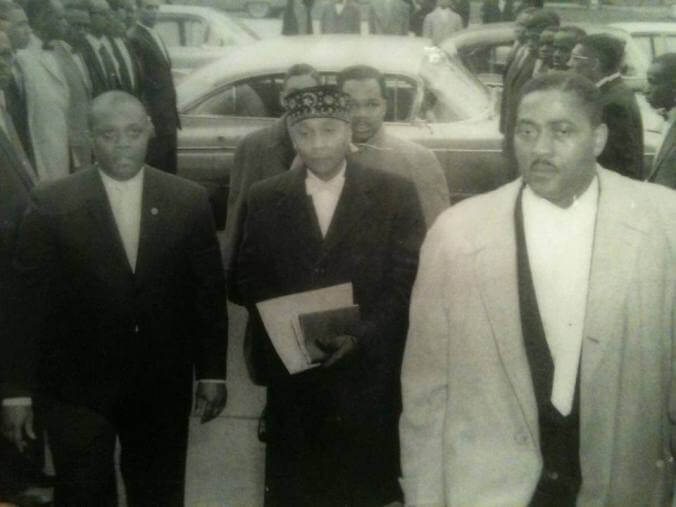
    Joseph Gravitts
    Captain Joseph X Gravitts
    (to the left of Elijah Muhammad)

    Then came a first death plot. One of Malcolm’s own Mosque Seven officials, Captain Joseph X Gravitts, following higher orders, told an assistant to Malcolm to wire his car to explode when he started the engine. The man refused the assignment, told Malcolm of the plot, and saved his life.51 He also freed Malcolm from his attachment to the Nation of Islam. Malcolm was forced to recognize that the NOI’s hierarchy and structure, extending right down into his own mosque, was committed to killing him. He could already see a first ring of death encircling him, comprised of the organization he had developed to serve Elijah Muhammad. From that point on, Malcolm said, he “went few places without constant awareness that any number of my former brothers felt they would make heroes of themselves in the Nation of Islam if they killed me.”52


    On March 8, 1964, with less than a year to live, Malcolm X announced his departure from the Nation of Islam. He said he was organizing a new movement because the NOI had “gone as far as it can.” He was “prepared to cooperate in local civil-rights actions in the South and elsewhere. “53 Malcolm also passed out copies of a telegram he had sent to Elijah Muhammad, in which he stated:

    Despite what has been said by the press, I have never spoken one word of criticism to them about your family … 54

    In spite of everything, Malcolm was trying not to split the NOI, and therefore muffled his criticisms of Elijah Muhammad.

    Two days later, the Nation of Islam sent Malcolm a certified letter telling him and his family to move out of their seven-room house in East Elmhurst, Queens. The Elmhurst house had been home for Malcolm, Betty Shabazz, and their growing family (now with four daughters) since the early days of their marriage when Malcolm and Betty were in the house with John and Minnie Ali. One month after the certified letter, the secretary of Malcolm’s old Mosque Number Seven filed suit in a Queens civil court to have Malcolm and his family evicted. Malcolm would fight for the legal right to stay in the only home he had to pass on to his wife and children, especially since he might soon be killed by the same forces trying to take their house away.55

    On March 12, Malcolm held a press conference in New York and said internal differences within the Nation had forced him out of it. He was now founding a new mosque in New York City, Muslim Mosque, Inc. With a conscious effort to avoid repeating the mistakes of Elijah Muhammad, he said in his “Declaration of Independence” that he was a firm believer in Islam but had no special credentials:

    I do not pretend to be a divine man, but I do believe in divine guidance, divine power, and in the fulfillment of divine prophecy. I am not educated, nor am I an expert in any particular field—but I am sincere, and my sincerity is my credentials.56

    He opened (wide) the door to working with other black leaders, with whom he had traded criticisms, most notably with Martin Luther King Jr. “As of this minute, I’ve forgotten everything bad that the other leaders have said about me, and I pray they can also forget the many bad things I’ve said about them.”57 He then immediately chased King away by saying black people should begin to form rifle clubs to defend their lives and property.

    He concluded:

    We should be peaceful, law-abiding—but the time has come for the American Negro to fight back in self-defense whenever and wherever he is being unjustly and unlawfully attacked. If the government thinks I am wrong for saying this, then let the government start doing its job.58

    Malcolm was aware that the government might think it was its job to silence him.


    Much more threatening to the government than Malcolm’s rifle clubs, which never got off the ground, was the visionary campaign he then initiated to bring U.S. violations of African-Americans’ rights before the court of world opinion in the United Nations. In his April 3, 1964, speech in Cleveland, “The Ballot or the Bullet,” Malcolm began to articulate his international vision:

    We need to expand the civil-rights struggle to a higher level—to the level of human rights. Whenever you are in a civil-rights struggle, whether you know it or not, you are confining yourself to the jurisdiction of Uncle Sam … Civil rights comes within the domestic affairs of this country. All of our African brothers and our Asian brothers and our Latin-American brothers cannot open their mouths and interfere in the domestic affairs of the United States. … But the United Nations has what’s known as the charter of human rights, it has a committee that deals in human rights … When you expand the civil-rights struggle to the level of human rights, you can then take the case of the black man in this country before the nations in the UN. You can take it before the General Assembly. You can take Uncle Sam before a world court. But the only level you can do it on is the level of human rights.59

    In the spring of 1964, Malcolm X had come up with a strategy to internationalize the Civil Rights Movement by re-defining it as a Human Rights Movement, then enlisting the support of African states. Malcolm would proclaim to the day of his death the nation-transcending word of human rights, not civil rights, for all African-Americans. He would also organize a series of African leaders to work together and make that word flesh in the General Assembly of the United Nations. In breaking his bonds to Elijah Muhammad, Malcolm had freed himself to unite African and African-American perspectives in an international coalition for change. For the rest of his life, he was on fire with energy to create that working partnership spanning two continents.

    In breaking his bonds to Elijah Muhammad, Malcolm had freed himself to unite African and African-American perspectives in an international coalition for change.

    The FBI began to realize it had made a major miscalculation. Its COINTELPRO that helped precipitate the divorce between Malcolm X and Elijah Muhammad had, it turned out, liberated Malcolm for a much larger mission than anything he could conceivably have accomplished under Elijah Muhammad. He was suddenly stepping onto an international stage in what could become an unwelcome scenario to the U.S. government. Nevertheless, the Chicago NOI connections that the Bureau had made so carefully in John Ali and other informants could still salvage the COINTELPRO goal of neutralizing Malcolm. Since Malcolm had “rebelled” against Elijah and Chicago, he could now, with Chicago’s help, be forced into silence forever.

    The FBI had a second, growing concern. Despite Malcolm’s offputting talk of rifle clubs, his evolving strategy for an international ballot, not the bullet, was catching the attention of a potential ally whose power went far beyond that of Elijah Muhammad: Martin Luther King Jr.


    Malcolm and Martin met for the first and only time in the nation’s capital on March 26, 1964. They had both been listening to the Senate’s debate on civil rights legislation. Afterwards they shook hands warmly, spoke together, and were interviewed. He grinned and said he was there to remind the white man of the alternative to Dr. King. King offered a militant alternative of his own, saying that if the Senate kept on talking and doing nothing, a “creative direct action program” would start. If the Civil Rights Act were not passed, he warned, “our nation is in for a dark night of social disruption.”60

    Malcolm and MLK
    Malcolm and Martin (March 26, 1964)

    Although Malcolm and Martin would continue to differ sharply on nonviolence and would never even see each other again in the 11 months Malcolm had left, there was clearly an engaging harmony between the two leaders standing side by side on the Capitol steps. Given Malcolm’s escalation of civil rights to human rights and King’s emphasis upon ever more disruptive, massive civil disobedience, their prophetic visions were becoming more compatible, even complementary. The FBI and CIA, studying the words and pictures of that D.C. encounter in their midst, could hardly have failed to recognize a threat to the status quo. If Malcolm X and Martin Luther King Jr. were to join efforts, they could ignite an explosive force for change in the American system. The FBI and CIA had to face a question paralleling that of the New York police who had witnessed Malcolm’s crowd dispersal. Should any two men have that kind of power against the system?

    On the same day Malcolm and Martin shook hands in Washington, the FBI’s NOI connections were proving to be an effective part of an action in Chicago to further isolate Malcolm, setting him up for his murder.

    Philbert X Little, Malcolm’s brother, was Elijah Muhammad’s minister in Lansing, Michigan. The Messenger and his NOI managers ordered Philbert to report to Chicago, where they arranged a press conference for him on March 26 of 1964. John Ali then handed Philbert a prepared statement. Ali told Philbert to read it to the media. Philbert had never seen the text before. As he read it for the first time (aloud and in a monotone) he heard himself denouncing Malcolm in terms that threatened Malcolm’s converts from the Nation of Islam.

    I see where the reckless efforts of my brother Malcolm will cause many of our unsuspecting people, who listen and follow him, unnecessary loss of blood and life.61 … the great mental illness which beset my mother whom I love and one of my brothers … may now have taken another victim … my brother Malcolm.62

    Malcolm responded to the news of his brother’s apparent attack on him by saying,

    We’ve been good friends all our lives. He has a job he needs; that’s why he said what he did … I know for a fact that they flew him in from Lansing, put a script in his hand and told him to read it.63

    Philbert himself confirmed years later that “the purpose of making that statement was to fortify the Muslims. That’s why I was brought to Chicago. When I got ready to make my statement, John Ali put a paper in front of me and told me I should read that. So I read the statement that was very negative for my mother. And it was negative against Malcolm. I wouldn’t have read it over the air, you see, if I had looked at it. I asked John Ali about it and he says, ‘That’s just a statement that was prepared for you to read.’ He said, ‘I know the Messenger will be very pleased with the way you read it,’ and that was it.”64

    The vision to which Malcolm X was converted by his experience at Mecca determined the way in which he would meet his death. He called that vision ‘brotherhood’.

    Elijah Muhammad’s vengeance toward Malcolm was still being fueled by the FBI’s COINTELPRO. At the time of “Philbert’s statement,” the FBI sent Elijah one of its fake letters complaining about his relationships with his secretaries. The letter succeeded in making Elijah suspect Malcolm had written it. On April 4, 1964 an FBI electronic bug recorded Elijah telling one of his ministers, who had also received a copy of the letter, that the presumed writer Malcolm “is like Judas at the Last Supper.”65

    In recognition that his 12 years proclaiming the word of Elijah Muhammad had left him poorly prepared for his new mosque’s ministry, Malcolm decided to re-discover Islam by making his pilgrimage to Mecca.

    Malcolm at Mecca
    Malcolm at Mecca (1964)

    In a life of changes, Malcolm’s most fundamental change began at Mecca. At the conclusion of his pilgrimage, he was asked by other Muslims what it was about the Hajj that had most impressed him. He surprised them by saying nothing of the holy sites or the rituals but extolling instead the multi-racial community he had experienced.

    “The brotherhood!” he said, “The people of all races, colors, from all over the world coming together as one! It has proved to me the power of the One God.”66

    The vision to which Malcolm X was converted by his experience at Mecca determined the way in which he would meet his death. He called that vision “brotherhood.” Had he lived a while longer, he would have added “and sisterhood.” In his final months, Malcolm also began to change noticeably in his recognition of women’s rights and leadership roles. His conversion at Mecca was to a vision of human unity under one God. From that point on, his consciousness of one human family, in the sight of one God, sharpened his perceptions, deepened his courage, and opened his soul to whatever further changes Allah had in store for him. Consistent with all those changes, Malcolm’s experience of the truth of brotherhood radicalized still more his resistance to racism. His conversion to human unity was not to a phony blindness to the reality of prejudice, but on the contrary, to a greater understanding of its evil in God’s presence. He was even more determined to confront it truthfully. Concluding his answer to his fellow pilgrims on his Hajj, Malcolm returned to his lifelong focus on racism, set now in the context of the experience he had at Mecca of his total acceptance by pilgrims of all colors.

    “To me,” he said, “the earth’s most explosive and pernicious evil is racism, the inability of God’s creatures to live as One, especially in the Western world.” 67

    Malcolm, Nkrumah, Faisal
    Malcolm & Kwame Nkrumah; with Prince Faisal

    Following his pilgrimage to Mecca, Malcolm met with two influential heads of state, Prince Faisal of Arabia and President Kwame Nkrumah of Ghana. They acknowledged Malcolm as a respected leader of black Americans, who now represented also a true Islam. Prince Faisal of oil-rich Arabia made Malcolm a guest of the state. Ghana’s anti-colonialist Kwame Nkrumah, a leader of newly independent African states, told his African-American visitor something Malcolm said he would never forget:

    Brother, it is now or never the hour of the knife, the break with the past, the major operation.68

    Nkrumah’s sense of the hour of the knife was right, but his hope that it would be a knife of freedom cutting through a history of oppression would go unfulfilled. Only nine months later, Malcolm would be murdered.

    A year after that, Nkrumah, upon publishing his book Neo-Colonialism: The Last Stage of Imperialism, dedicated to “the Freedom Fighters of Africa, living and dead,” would be overthrown by a CIA-backed coup.69


    “The case to be presented to the world organization … would compel the United States Government to face the same charges as South Africa and Rhodesia.”

    Malcolm also visited Egypt, Lebanon, Nigeria, Liberia, Senegal, Morocco, and Algeria. Upon his return to the U.S. on May 21, 1964, the New York Times published an article on his trip that further alerted intelligence agencies to Malcolm’s quest for a UN case against the U.S. Malcolm told reporters he had “received pledges of support from some new African nations for charges of discrimination against the United States in the United Nations.”

    The case to be presented to the world organization,” he asserted, “would compel the United States Government to face the same charges as South Africa and Rhodesia.”70

    While Malcolm was working abroad to put the U.S. on trial at the UN, the New York Police Department was infiltrating his new Muslim Mosque with its elite intelligence unit, the Bureau of Special Service and Investigation (BOSSI). To the cold warriors in the ’60s who knew enough beneath the surface to know at all about BOSSI, the NYPD’s undercover force was regarded as “the little FBI and the little CIA.” The accolade reflected the fact that the information gathered by BOSSI’s spies was passed on regularly to federal intelligence agencies.71

    Tony Ulasewicz
    BOSSI operative
    Tony Ulasewicz

    The BOSSI men who ran the deep cover operation in Muslim Mosque were detectives Tony Ulasewicz and Teddy Theologes. Four years after Tony Ulasewicz’s undercover work on Malcolm X, “Tony U,” as he was known, would retire from the NYPD to go to work as President Richard Nixon’s private detective. He would then take part in a series of covert activities that would be brought to light in the Senate Watergate Hearings and memorialized in his own book, The President’s Private Eye,72 which is also a valuable resource on BOSSI. Both in his book and his life, Tony U moves with ease between the overlapping undercover worlds of the New York Police Department, federal intelligence agencies, and the White House. In the BOSSI chain of command, Tony U was a field commander. He had to keep his operators’ identities totally secret as he ran their surveillance and probes of various sixties organizations ranging from the Revolutionary Action Movement (RAM) to the American Nazi Party. Equally important, he had to keep his own behind-the-scenes identity completely separate from theirs, with his name never linked to the report of any agent of his. Otherwise he might be called to testify in court, opening up an operation, an event to be avoided at all costs.73 Tony U’s deep cover men were therefore, in the last analysis, on their own.

    Teddy Theologes acted in the BOSSI command, in Tony U’s words, “as a cross between a drill sergeant and a priest.”74 Reflecting on his career decades later in an interview, Theologes said some of the BOSSI deep cover recruits “needed constant attention. I would have to sit down with them, and almost be a father, brother, psychiatrist, and doctor.75 From the standpoint of agents risking their lives who knew their superiors would never admit to knowing them, the need for such a relationship can be understood.

    Gene Roberts
    Gene Roberts

    On April 17, 1964, four days after Malcolm left New York on his pilgrimage to Mecca, Ulasewicz and Theologes sent their newly sworn-in, 25-year-old, black detective Gene Roberts on his undercover journey into the Muslim Mosque, Inc. Gene Roberts had just completed four years in the Navy. Roberts was interviewed by Tony Ulasewicz and Teddy Theologes when he passed the police exam. He was asked to become a deep cover agent in a militant organization under Malcolm X. Roberts had heard of Malcolm X but knew little about him. As a military man, he accepted the order to infiltrate Malcolm’s group without questioning it. On April 17, he was sworn in as a police officer and given his badge. A few hours later, Teddy Theologes took the badge away from him. He was on his own. Then his BOSSI superiors sent Roberts out on his mission in Harlem.76

    Gene Roberts has described how he proceeded step by step into becoming one of Malcolm’s bodyguards:

    Basically they said, go up to 125th Street—where Malcolm had his headquarters—and get involved. And that’s what I did. I ended up getting involved in a couple of riots. The main thing was I was there. I met members of his organization. They accepted me. My cover was I worked for a bank. I told them about my martial arts experience, so I became one of Malcolm’s security people. When he came back from Mecca and Africa, I went wherever he went, as long as it was in the city.77

    Since he was supposedly a bank worker, Roberts followed a schedule of typing up his BOSSI reports, at his Bronx home during the day. He typed reports on what he had learned by being “Brother Gene” with Malcolm and his community during the night.78 As Roberts suspected and would later confirm, he was not the only BOSSI agent in the group, although he had gained the greatest access to Malcolm. When Ulasewicz and Theologes received his and other deep cover dispatches, they passed them up the line to BOSSI Supervisor Barney Mulligan. It was Lieutenant Mulligan’s responsibility to file all the undercover information (without ever identifying the informants) at BOSSI headquarters. While there, BOSSI’s secret fruit was shared generously with the FBI.

    On May 23, 1964, Louis Lomax and Malcolm X took part in a friendly debate at the Chicago Civic Opera House. As Lomax began his opening speech and looked down from the stage, he was struck with fear. For there in the audience staring back up at him was John Ali, accompanied by a group of NOI men who were being deployed at strategic locations in the hall.79 Ali had become the nemesis of Lomax as well as Malcolm because of Lomax’s having written about Ali’s FBI connection. Malcolm’s, Ali’s, and Lomax’s lives were intertwined. When John Ali was Malcolm’s top advisor and housemate, he had arranged the first meeting between Malcolm and Lomax. The three men had then worked together on the first issues of the NOI newspaper. When Malcolm’s and Ali’s home was invaded by the New York police, Louis Lomax had written the most thorough story on it.80

    In his Chicago speech, given only two days after his return from Mecca and Africa, Malcolm sounded open to white people as well as blacks, as impassioned as ever, and in the terms he used, even radically patriotic:

    My pilgrimage to Mecca … served to convince me that perhaps American whites can be cured of the rampant racism which is consuming them and about to destroy this country. In the future, I intend to be careful not to sentence anyone who has not been proven guilty.

    I am not a racist and do not subscribe to any of the tenets of racism. In all honesty and sincerity it can be stated that I wish nothing but freedom, justice and equality: life, liberty and the pursuit of happiness—for all people. My first concern is with the group of people to which I belong, the Afro-Americans, for we, more than any other people, are deprived of these inalienable rights.81

    However, in his post-Mecca life, this radically open Malcolm X was once again a target, as he and Lomax could see when they looked down into the eyes of John Ali and his companions. At the debate’s conclusion, Malcolm and Lomax departed from the rear of the hall under a heavy Chicago police escort.82 It was one in a series of occasions when Malcolm would gladly accept the protection of a local police department that was genuinely concerned about his safety.

    Also near the end of May 1964, the five men who would kill Malcolm X in the Audubon Ballroom nine months later came together for the first time. We know the story, thanks to the confession of the only one of the five who would ever go to jail for the crime, Talmadge Hayer. According to Hayer’s affidavit, sworn to in prison in 1978 to exonerate two wrongly convicted co-defendants,83 it all began when he was walking down the street one day in Paterson, New Jersey. A car pulled up beside him. Inside it were two men who, like Hayer, belonged to the Nation of Islam’s Mosque Number 25 in Newark—Benjamin Thomas and Leon Davis, known to Hayer as Brothers Ben and Lee. They asked Hayer to get in the car so they could talk. “Both of these men,” he said, “knew that I had a great love, respect, and admiration for the Honorable Elijah Muhammad.”84

    While the three men drove around Paterson, Hayer learned from Thomas and Davis that “word was out that Malcolm X should be killed.” Hayer said in his confession he didn’t know who had passed that word on, but he thought Ben knew. He in fact had good grounds for thinking Ben knew, inasmuch as Benjamin Thomas was the assistant secretary of the Newark Mosque and knew well the NOI chain of command. Hayer also said it was Ben who had spoken first to Leon, before the two of them spoke with him. After hearing from them how Malcolm X was spewing blasphemies against Mr. Muhammad, he said what they wanted to hear, “It’s just bad, man, something’s got to be done,”85 and agreed to take part in the plot.

    As Hayer told Malcolm biographer Peter Goldman in a prison interview,

    I didn’t ask a whole lot of questions as to who’s giving us instructions and who’s telling us what, because it just wasn’t a thing like that, man. I thought that somebody was giving instructions: ‘Brothers, you got to move on this situation.’ But I felt we was in accord. We just knew what had to be done.86

    Thomas, Davis, and Hayer soon got together with two more members of the Newark Mosque who also knew what had to be done, William X and Wilbur X. As male members of the Nation of Islam, all five men belonged to the Fruit of Islam (FOI), a paramilitary training unit.87 FOI training was meant ideally for self-defense. However, with its combination of discipline, obedience, and unquestioning loyalty to the Messenger, it had degenerated into an enforcement agency for the will of Elijah Muhammad and the NOI hierarchy. Malcolm X, with his certain knowledge that FOI teams like the five men in Newark were being organized to kill him, said sharply in a June 26, 1964, telegram to Elijah Muhammad:

    Students of the Black Muslim Movement, know that no member of the Fruit of Islam will ever initiate an act of violence unless the order is first given by you. … No matter how much you stay in the background and stir others up to do your murderous dirty work, any bloodshed committed by Muslim against Muslim will compel the writers of history to declare you guilty not only of adultery and deceit, but also of Murder.88

    In his affidavit, Talmadge Hayer said the five men from the Newark Mosque began meeting to decide how to carry out the killing. Sometimes, he said, they would just drive around in a car for hours talking about it.89 Since Malcolm was on the verge of making another even longer trip to Africa, they would have to bide their time. In the meantime, there were other killing teams who were united in the same purpose. Several would almost succeed. But in the end, it would be the five Newark plotters who would finally do what had to be done at the Audubon Ballroom.


    It is a temptation to sentimentalize Malcolm, but Malcolm did not sentimentalize himself. He knew what he was capable of doing, what he had done, and what he had trained the Fruit of Islam to do. They were now prepared to do it, as he knew, to him.

    On June 13, 1964, the NOI’s suit to force Malcolm and his family out of the East Elmhurst house began to be heard in Queens Civil Court. The courtroom was divided into two hostile camps, Malcolm’s supporters and the NOI contingent. At this point the police department clearly acknowledged in action the immediate danger to Malcolm’s life. It had 32 uniformed and plainclothes officers present, “surrounding him so impermeably,” as reporter Peter Goldman put it, “that he could barely be seen from the gallery.”90 Some of the press remained skeptical of the threat to Malcolm. He insisted to reporters that he knew the NOI men were capable of murder “because I taught them.”91

    This statement that Malcolm repeated about his NOI past was apparently no exaggeration. Dr. Alauddin Shabazz, who was ordained by Malcolm as an NOI minister, told me in an interview: “Malcolm had had people killed. When Malcolm found a guy in the nation who was an agent, Malcolm didn’t hesitate to do something to him. I have seen Malcolm take a hammer and knock out the bottom bridges of a guy’s teeth.

    [An undercover police agent] was once caught setting up an [electronic] bug in the wall of the office. Malcolm was questioning him. And Malcolm had a funny way of questioning people. He would stand with his back to you, like he didn’t want to look at your disgusting face—if he thought you were doing something to aid BOSSI or the agencies. And this guy had been caught. Malcolm turned around. He had a hammer on the desk. He turned around with the hammer and hit him in the face. I was there. It was in the early ’60s.92

    It is a temptation to sentimentalize Malcolm, but Malcolm did not sentimentalize himself. He knew what he was capable of doing, what he had done, and what he had trained the Fruit of Islam to do. They were now prepared to do it, as he knew, to him.


    The Queens eviction hearing was especially significant for what Malcolm chose to reveal during his June 16 testimony: “[T]hat the Honorable Elijah Muhammad had taken on nine wives.”93 At about the same time as Malcolm made the issue public, one of Elijah Muhammad’s sons made a statement that was in effect a warrant for Malcolm’s death. It was prompted by a phone call from someone claiming to be “Malcolm.” This person told the NOI that Elijah Muhammad would be killed while giving his speech the following day.94 In response to this provocation (in conflict with the real Malcolm’s pleas to his followers to avoid a confrontation), Elijah Muhammad Jr. told a meeting of the Fruit of Islam at a New York armory:

    That house is ours, and the nigger don’t want to give it up. Well, all you have to do is go out there and clap on the walls until the walls come tumbling down, and then cut the nigger’s tongue out and put it in an envelope and send it to me, and I’ll stamp it approved and give it to the Messenger.95

    The judge would rule three months later that the house belonged to the Nation of Islam, and that Malcolm and his family had to leave. Malcolm appealed, which delayed the eviction until the final week of his life.

    On June 27, 1964, the FBI wiretapped a phone call in which Malcolm X asked an unidentified woman (an office worker … Betty Shabazz?) if Martin Luther King’s attorney Clarence Jones had called him.96 The woman said, yes, she had a message from Jones asking Malcolm to call him back. The reason Jones wanted to speak with Malcolm, she said, was “that Rev. King would like to meet as soon as possible on the idea of getting a human rights declaration.” She then emphasized to Malcolm, “He is quite interested.”97

    However, in the 12 short days left before Malcolm departed again for Africa, he and King were not able to arrange a meeting to explore their mutual interest in a human rights declaration. Nor would they ever manage to see each other again in the three months remaining in Malcolm’s life once he returned to the U.S., though they would just miss doing so in Selma, Alabama. Nevertheless, through its electronic surveillance of both men, the FBI knew that Malcolm X and Martin Luther King Jr. were hoping to connect on the human rights issue that could put the U.S. on trial in the United Nations.

    On June 28, 1964, Malcolm announced his formation of the Organization of Afro-American Unity (OAAU), with its headquarters at the Theresa Hotel in Harlem. Whereas the Muslim Mosque, Inc. was faith-oriented, the OAAU would be politically oriented.98 The OAAU would be patterned after the letter and spirit of the Organization of African Unity established by African heads of state the year before at their meeting in Ethiopia. The OAAU’s founding statement emphasized that “the Charter of the United Nations, the Universal Declaration of Human Rights, the Constitution of the U.S.A. and the Bill of Rights are the principles in which we believe.”99 The intended outreach of Malcolm’s organization was transcontinental, including “all people of African descent in the Western Hemisphere, as well as our brothers and sisters on the African continent.”100 Yet the organizing would also be local and civic:

    The Organization of Afro-American Unity will organize the Afro-American community block by block to make the community aware of its power and potential; we will start immediately a voter registration drive to make every unregistered voter in the Afro-American community an independent voter.101

    Thanks to Mecca, Malcolm had broken free from his old allegiance to Elijah Muhammad’s idea of a separate black state. He was now organizing an international campaign for Afro-American liberation based on the principles of the U.S. Constitution and the UN Charter. He had become a faith-based organizer on an international scale. His OAAU founding statement, while consistent with the Civil Rights Movement, took the struggle into a new arena, the United Nations. Malcolm would now seek further support for his UN human rights campaign by a July-November barnstorming trip through Africa.

    In addition to NYPD and FBI surveillance, the Central Intelligence Agency was also following Malcolm. The Agency knew Malcolm planned to appeal to African leaders at the second conference of the Organization of African Unity (OAU).

    At 11:37 p.m., on July 3, 1964, Malcolm phoned the New York Police Department to report that “two Black Muslims were waiting at his home to harm him. … But he sped off when they approached his car.”102 Malcolm knew the name of one of the two men, and gave it to the police.103

    The NYPD refused to believe Malcolm. They passed on their official skepticism in a July 4 teletype to the FBI: “Police believed complaint on an attempt on Malcolm’s life was a publicity stunt by Malcolm.”104 By its phone tap, the FBI had heard Malcolm make his report at the same time the NYPD did. The Bureau summarized the event with its own judgment on Malcolm: “Information [on 7/4/64] that MALCOLM and his followers were attempting to make a big issue out of the reported attempt on Macolrn’s life in order to get the Negro people to support him.105


    Thus began the official NYPD and FBI line that Malcolm was fabricating attempts on his life for the sake of publicity. This disclaimer would be made publicly by the NYPD in the week before Malcolm’s murder, in an effort to justify the withdrawal of police protection at the time of escalating threats on his life.

    On July 9, Malcolm departed from New York on the African trip that would consume four and a half of the remaining seven and a half months of his life. It was to be the final, most ambitious project of his short life. As his plane lifted off from JFK Airport on its way to Cairo, Malcolm was happily unaware of what John Ali was saying that same night on a Chicago call-in radio program:

    Malcolm X probably fears for his safety because he is the one who opposes the Honorable Elijah Muhammad. The Holy Koran, the book of the Muslims, says “seek out the hypocrites and wherever you find them, weed them out.” … There were people who hated Kennedy so much that they assassinated him—white people. And there were white people who loved him so much they would have killed for him. You will find the same thing true of the Honorable Elijah Muhammad … I predict that anyone who opposes the Honorable Elijah Muhammad puts their life in jeopardy … 106

    “… after every one of my trips abroad, America’s rulers see me as being more and more dangerous. That’s why I feel in my bones the plots to kill me have already been hatched in high places. The triggermen will only be doing what they were paid to do.”

    In addition to NYPD and FBI surveillance, the Central Intelligence Agency was also following Malcolm. The Agency knew Malcolm planned to appeal to African leaders at the second conference of the Organization of African Unity (OAU), which he was attending in Cairo in July as an honored observer. No other American was allowed in the door. In a July 10 CIA memorandum, an informant stated that Malcolm X was “transporting material dealing with the ill treatment of the Negro in the United States. He intends to make such material available to the OAU in an effort to embarrass the United States.”107


    In Cairo, Malcolm was constantly aware of agents following him. They made their presence obvious in an effort to intimidate him. Then on July 23, as Malcolm prepared to present his UN appeal to Africa’s leaders, he was poisoned. He described the experience later to a friend:

    I was having dinner at the Nile Hilton with a friend named Milton Henry and a group of others, when two things happened simultaneously. I felt a pain in my stomach and, in a flash, I realized that I’d seen the waiter who served me before. He looked South American, and I’d seen him in New York. The poison bit into me like teeth. It was strong stuff. They rushed me to the hospital just in time to pump the stuff out of my stomach. The doctor told Milton that there was a toxic substance in my food. When the Egyptians who were with me looked for the waiter who had served me, he had vanished. I know that our Muslims don’t have the resources to finance a worldwide spy network.108

    The friend who witnessed this event, Detroit civil rights attorney Milton Henry, warned Malcolm that his UN campaign could mean his death. Henry later felt in retrospect that it did: “In formulating this policy, in hitting the nerve center of America, he also signed his own death warrant.”109 Malcolm, being Malcolm, recognized the truth of Henry’s warning, and went right on ahead with his campaign.

    At the OAU conference, Malcolm submitted an impassioned, eight-page memorandum urging the leaders of Africa to recognize African-Americans’ problems as their problems and to indict the U.S. at the UN:

    Your problems will never be fully solved until and unless ours are solved. You will never be fully respected until and unless we are also respected. You will never be recognized as free human beings until and unless we are also recognized and treated as human beings. Our problem is your problem. It is not a Negro problem, nor an American problem. This is a world problem, a problem for humanity. It is not a problem of civil rights but a problem of human rights. In the interests of world peace and security, we beseech the heads of the independent African states to recommend an immediate investigation into our problem by the United Nations Commission on Human Rights.110

    Malcolm at OAU
    Malcolm at OAU

    Malcolm was encouraged by the response he received from the OAU. Although the resolution the conference passed in support of the African-American struggle used only moderate language, Malcolm told Henry that several delegates had promised him their official support in bringing up the issue legally at the United Nations.111

    OAU founders
    OAU Founders

    Malcolm then built on the foundations he had laid at the African summit. For four months he criss-crossed Africa, holding follow-up meetings with the leaders who encouraged him most in Cairo. He held long discussions with President Gamal Abdel Nasser of Egypt, President Julius Nyerere of Tanzania, President Jomo Kenyatta of Kenya, Prime Minister Milton Obote of Uganda, President Azikiwe of Nigeria, President Kwame Nkrumah of Ghana, Prime Minister Ahmed Ben Bella of Algeria, and President Sekou Toure of Guinea.112 There were other African heads of state Malcolm talked with, he said, “whose names I can’t mention.”113 At the height of the Cold War, Malcolm X had gained access to Africa’s most revolutionary leaders on a politically explosive issue.

    Neutralist leaders
    The neutralist leaders
    (Nehru, Nkrumah, Nasser, Sukarno, Tito)

    Reflecting on these meetings, Malcolm told a friend in London shortly before his death,

    Those talks broadened my outlook and made it crystal clear to me that I had to look at the struggle in America’s ghettos against the background of a worldwide struggle of oppressed peoples. That’s why, after every one of my trips abroad, America’s rulers see me as being more and more dangerous. That’s why I feel in my bones the plots to kill me have already been hatched in high places. The triggermen will only be doing what they were paid to do.114

    U.S. intelligence agencies were in fact monitoring Malcolm’s campaign in Africa with increasing concern. The officials to whom they reported these developments began to express their alarm publicly. As a New York Times article, written in Washington revealed on August 13, 1964, “The State Department and the Justice Department have begun to take an interest in Malcolm X’s campaign to convince African states to raise the question of persecution of American Negroes at the United Nations.”

    After recapitulating Malcolm’s appeal to the 33 OAU heads of state, the Times article stated:

    [Washington] officials said that if Malcolm succeeded in convincing just one African Government to bring up the charge at the United Nations, the United States Government would be faced with a touchy problem. The United States, officials here believe, would find itself in the same category as South Africa, Hungary, and other countries whose domestic politics have become debating issues at the United Nations. The issue, officials say, would be of service to critics of the United States, Communist and non-Communist, and contribute to the undermining of the position the United States has asserted for itself as the leader of the West in the advocacy of human rights.115

    The Times reported that Malcolm had written a friend from Cairo that he did indeed have several promises of support from African states in bringing the issue before the United Nations. According to another diplomatic source, Malcolm had not been successful, “but the report was not documented and officials here today conceded the possibility that Malcolm might have succeeded.”116

    The article also said somewhat ominously;

    Although the State Department’s interest in Malcolm’s activities in Africa is obvious, that of the Justice Department is shrouded in discretion. Malcolm is regarded as an implacable leader with deep roots in the Negro submerged classes.

    “[He] has, for all practical purposes, renounced his U.S. citizenship.” ~ Benjamin H. Read, assistant to Dean Rusk, insisting the CIA investigate Malcolm X

    These two sentences, which were removed from the article in the national edition of the Times,117 where an oblique reference to concerns about Malcolm then being expressed not only by the State and Justice Departments but also by the CIA, FBI, and the Johnson White House. These concerns are revealed by a memorandum, written two days before the Times article, addressed to the CIA’s Deputy Director of Plans (covert action) Richard Helms. As researchers know, the desk of Richard Helms—a key player in CIA assassination plots—was perhaps the most dangerous place possible for a report on a perceived security risk to end up. According to the August 11, 1964, CIA memorandum to Helms, the Agency claimed it had learned from an informant that Malcolm X and “extremist groups” were being funded by African states in fomenting recent riots in the U.S. The State Department, the CIA memo continued, “considered the matter one of sufficient importance to discuss with President Johnson who, in turn, asked Mr. J. Edgar Hoover to secure any further information which he might be able to develop.”118

    As Malcolm analyst Karl Evanzz has noted,

    In fact, the CIA knew the allegations were groundless. In an FBI memorandum dated July 25, a copy of which was sent to [the CIA’s] Clandestine Services, an agent specifically stated that the informant’ said he didn’t mean to imply that Africans were financing Malcolm X.119

    The CIA’s August 11 memo also stated that Benjamin H. Read, an assistant to Secretary of State Dean Rusk, wanted the CIA to probe both Malcolm X’s domestic activities and “travels in Africa” to determine “what political or financial support he may be picking up along the way.” The CIA memo’s author had told Read, coyly, in response that “there were certain inhibitions concerning our activities with respect to citizens of the United States.” Read had overridden the objection, insisting the CIA act because, “after all, Malcolm X has, for all practical purposes, renounced his U.S. citizenship.”120

    As of no later than August 11, 1964 (and perhaps before), the CIA’s Deputy Director of Plans had been authorized to act on Malcolm X. Malcolm was perceived, for all practical purposes, to have renounced his U.S. citizenship and to have become a touchy problem to the U.S. government if he gained so much as one African state’s support for his UN petition. Malcolm had not read any such CIA documents on himself, but he had seen the August 13 Times article. He could read his future between its lines, just as Milton Henry had already done in terms of the sensitivity of Malcolm’s UN campaign.


    John Lewis
    John Lewis

    John Lewis, a leader in the Student Nonviolent Coordinating Committee (SNCC) who would go on to become a member of Congress, was then touring Africa to connect with the freedom movement there. Lewis and the SNCC friends who were with him knew all too well that Malcolm was also in Africa. As soon as they met anyone in Africa, the first question they would inevitably be asked was: “What’s your organization’s relationship with Malcolm’s?”121 The men discovered that no one would listen to them if they were seen as being any less revolutionary than Malcolm, who seemed to have taken all of Africa by storm. On his return to the U.S. Lewis wrote in a SNCC report: “Malcolm’s impact on Africa was just fantastic. In every country he was known and served as the main criteria for categorizing other Afro-Americans and their political views.”122

    Lewis was startled to run into Malcolm in a café in Nairobi, Kenya, as he had thought Malcolm was traveling in a different part of Africa at the time. Malcolm, recognizing Lewis, smiled and asked what he was doing there. Reflecting on their encounter in his memoir, Walking With the Wind, Lewis thought Malcolm was very hopeful from the overwhelming reception he had received in Africa “by blacks, whites, Asians and Arabs alike.” It “had pushed him toward believing that people could come together.”123

    However, something else Malcolm shared with the SNCC group “was a certainty that he was being watched, that he was being followed … In a calm, measured way he was convinced that somebody wanted him killed.”124 John Lewis’ meeting with Malcolm in Kenya would be the last time he would see him alive.

    Louis Farrakhan
    Louis Farrakhan (1965)

    Malcolm kept extending his stay in Africa. He had planned to be away six weeks. After 18 weeks abroad, he finally flew back to New York on November 24, 1964. He was confronted, soon after his return, with a December 4 issue of Muhammad Speaks. The issue featured an attack upon him by Minister Louis X, of the NOI’s Boston mosque. Louis X had not long before been a friend and devoted disciple to Malcolm. Now calling Malcolm “an international hobo,” Louis X made a statement against Malcolm that would haunt the speaker for the rest of his life, under his better-known name, Minister Louis Farrakhan:

    The die is set, and Malcolm shall not escape, especially after such evil, foolish talk about his benefactor, Elijah Muhammad, in trying to rob him of the divine glory which Allah had bestowed upon him. Such a man as Malcolm is worthy of death, and would have met with death if it had not been for Muhammad’s confidence in Allah for victory over his enemies.125

    Louis Farrakhan has never admitted to having participated in the plot to kill Malcolm. He has acknowledged from 1985 on that his above words “were like fuel on a fire” and “helped create the atmosphere” that moved others to kill Malcolm. Farrakhan made essentially the same carefully worded statement to four interviewers: Tony Brown in 1985, Spike Lee in 1992, Barbara Walters on 20/20 in 1993, and Mike Wallace on 6o Minutes in 2000. His words to Spike Lee were: “I helped contribute to the atmosphere that led to the assassination of Malcolm X.”126

    His clearest statement on Malcolm’s murder may be at question. In a 1993 speech to his NOI congregation, Minister Farrakhan, referring to Malcolm, asked bluntly, “And if we dealt with him like a nation deals with a traitor, what the hell business is it of yours?”127

    Alex Quaison-Sackey
    Alex Quaison-Sackey

    The timing of Malcolm’s late November return to the U.S. seemed providential in terms of his work at the United Nations. On December 1, his close friend, Alex Quaison-Sackey of Ghana, was elected President of the UN General Assembly. Following Malcolm’s lead, Quaison-Sackey was becoming increasingly outspoken against U.S. policies. Quaison-Sackey gave Malcolm’s human rights campaign a further boost by arranging for him to open an office at the UN in the area that was used by provisional governments.128

    The FBI’s New York field office pointed out to J. Edgar Hoover in a December 3 memo the alarming facts that Malcolm X and newly elected UN leader Quaison-Sackey had been friends for four years, and that they had also met several times recently. The New York office, which worked closely with the NYPD’s undercover BOSSI unit, suggested to Hoover “that additional coverage of [Malcolm X’s] activities is desirable particularly since he intends to have the Negro question brought before the United Nations (UN).”129

    During December’s UN debate on the Congo, Malcolm’s influence began to be heard in the speeches of African leaders. For example, Louis Lansana Beavogui, Guinea’s foreign minister, asked why “so-called civilized governments” had not spoken out against “the thousands of Congolese citizens murdered by the South Africans, the Belgians, and the [anti-Castro] Cuban refugee adventurers. Is this because the Congolese citizens had dark skins just like the colored United States citizens murdered in Mississippi?”130


    In a January 2, 1965, article, the New York Times described the Malcolm X impetus behind this challenging turn in African attitudes. It noted that the policy proposed by Malcolm that “linked the fate of the new African states with that of American Negroes” was being adopted by African governments. The article said, “the African move profoundly disturbed the American authorities, who gave the impression that they had been caught off-guard.”131

    Those working behind the scenes were not caught off guard, however, as the knowledgeable author of the article, M.S. Handler, was quick to suggest. Handler had also written the August 13 Times piece from Washington. He went on to repeat what he had reported then, that “early last August the State Department and Justice Department began to take an interest in Malcolm’s activities in North Africa”—accompanied, as we know, by a parallel interest and stepped-up actions by the CIA and FBI. Handler traced the heightened government interest to Malcolm’s opening “his campaign to internationalize the American Negro problem at the second meeting of the 33 heads of independent African states in Cairo, which convened July 17.”132

    When the January 2 Times article appeared, Malcolm had seven weeks left to live. Much of the remaining time was devoted to his constant speaking trips throughout the U.S., up to Canada, and over to Europe. Malcolm lived each day, hour, and minute as if it were his last, for he knew how committed the forces tracking him were to killing him. Within the U.S., Fruit of Islam killing squads were waiting for him at every stop. Malcolm knew it was only a matter of time.

    On January 28, 1965, Malcolm flew to Los Angeles to meet with attorney Gladys Towles Root and two former NOI secretaries who were filing paternity suits against Elijah Muhammad.133 Malcolm felt personally responsible for having put the two women in a position of vulnerability to Elijah Muhammad. He told a friend, “My teachings converted these women to Elijah Muhammad. I opened their mind for him to reach in and take advantage of them.”134 He had come to Los Angeles, in preparation for testimony in support of the women, “to undo what I did to them by exposing them to this man.”135

    From the time Malcolm arrived at the Los Angeles Airport in mid-afternoon until his departure the next morning, he was trailed by the Nation of Islam. The two friends who met him, Hakim A. Jamal and Edmund Bradley, had alerted airport security to a possible NOI attack. As Jamal and Bradley waited at the gate, they noticed a black man seated behind them inconspicuously reading a newspaper. The man was John Ali. Although Malcolm’s Los Angeles trip had been a closely held secret, someone monitoring his conversations was feeding the information to Ali. Malcolm’s arrival gate was switched at the last moment, and security police rushed him and his companions safely through the airport to a car.136

    At his Statler Hilton Hotel, Malcolm repeatedly had to run a gauntlet of menacing NOI men stationed in the lobby. Bradley saw John Ali and the leaders of an NOI mosque in Los Angeles get out of a car in front of the hotel. Malcolm, Jamal, and Bradley left quickly in their own car to meet with the two secretaries and attorney Root. When Bradley drove Malcolm back to the airport in the morning, two carloads of NOI teams started to pull alongside their car. Malcolm picked up Bradley’s cane and stuck it out a window like a rifle. The two cars fell back. Police waiting at the airport escorted Malcolm safely to his plane.137

    During his next three days in Chicago, Malcolm was under the steady guard of the Chicago police. He was also under the watchful eyes of 15 NOI men who lingered at the entrance to his hotel. In their presence, Malcolm whispered to a Chicago police detective, “Those are all Black Muslims. At least two of them I recognize as being from New York. Elijah seems to know every move I make.”138 Malcolm would realize later that it had to be someone more powerful than Elijah who was making it possible for his troops to always be one step ahead of Malcolm.

    Malcolm testified before the Illinois Attorney General, who was investigating the Nation of Islam. The next day in a television interview, Malcolm described efforts to kill him. He said he had a letter on his desk identifying the persons assigned to kill him.139 He was accompanied everywhere by the Chicago police, who finally took him back safely to O’Hare Airport for his flight to New York.

    Later that week, Malcolm X once again almost connected with Martin Luther King Jr. The place was Selma, Alabama. The date was February 4, 1965, 17 days before Malcolm’s death, and three years and two months before Martin’s.

    The night before, Malcolm had spoken to 3000 students at Tuskegee Institute, 75 miles from Selma. Many of the students invited Malcolm to join them in the next day’s demonstration at Selma, where more than 3,400 arrests had already been made in the course of voter registration marches.

    Malcolm at Selma
    Malcolm at Selma AL with Coretta Scott King

    Malcolm’s sudden arrival in Selma on the morning of February 4 panicked the leaders of Martin Luther King’s Southern Christian Leadership Conference (SCLC). The younger SNCC radicals were urging that Malcolm be allowed to speak to the crowd gathering in the Brown Chapel AME Church for the demonstration. However, the SCLC ministers didn’t even have the voice of Martin Luther King, who was in a Selma jail, to balance the fiery oratory of Malcolm, who they feared would spark a riot. As Malcolm listened in bemusement to what he might be permitted to say, he commented, “Nobody puts words in my mouth.”140 They finally decided to let Malcolm speak, but called in Coretta King to talk after him and put out the fire. Mrs. King was instead inspired by Malcolm to see a transforming hope of convergence between him and her husband.

    In his talk, Malcolm widened the scene of struggle from Selma to the world. He told the crowd that civil rights were human rights, and that the U.S. government by failing to uphold their rights was thereby in violation of the United Nations Charter. Standing in the pulpit, pointing his right index finger at the demonstrators, he said they should “wire Secretary General U. Thant of the United Nations and charge the federal government of this country, behind Lyndon B. Johnson, with being derelict in its duty to protect the human rights of 22 million Black people.”141 He prayed that God would bless them in everything that they did, and “that all the fear that has ever been in your heart will be taken out.”142

    Coretta King followed Malcolm with a short, inspirational talk on nonviolence. He sat behind her, listening intently. When Coretta and Malcolm spoke together afterwards, he gave her a message for Martin. She was impressed by the gentle way in which he said,

    Mrs. King, will you tell Dr. King that I had planned to visit with him in jail? I won’t get a chance now because I’ve got to leave to get to New York in time to catch a plane for London, where I’m to address the African Students’ Conference. I want Dr. King to know that I didn’t come to Selma to make his job difficult. I really did come thinking that I could make it easier. If the white people realize what the alternative is, perhaps they will be more willing to hear Dr. King.143

    She thanked Malcolm, and said she would convey his words to Martin. She did so at the Selma jail that day. She said later that by the time Malcolm was killed, two and a half weeks later, she and Martin had reassessed their feelings toward him:

    We realized that since he had been to Mecca and had broken with Elijah Muhammad, he was moving away from hatred toward internationalism and against exploitation.144

    As the FBI and CIA knew by their close monitoring of both Malcolm X and Martin Luther King, the two catalysts of supposedly opposite revolutions were pondering cooperation.

    A highly placed North African diplomat … told Norden that his country’s intelligence apparatus “had been quietly informed by the French Department of Alien Documentation and Counter-Espionage that the CIA planned Malcolm’s murder, and France feared he might be liquidated on its soil.”

    After Malcolm’s trip to London, on February 9 he flew to Paris for another speaking engagement. At Orly Airport, French police surrounded him and said he was barred from entering the country. Malcolm’s speech, authorities felt, threatened to provoke “demonstrations that would trouble the public order.”145 He turned around and flew back to London.

    Malcolm was shocked. He had thought France one of Europe’s most liberal countries. He had also visited and spoken there three months before without a problem. At first he felt the U.S. State Department must have been responsible for the French decision. However, his exclusion had come from a government whose president, De Gaulle, did not ordinarily cave in to U.S. pressures. Malcolm continued to puzzle over his refusal by France. The day before his death, he would tell Alex Haley that he’d begun to realize that what happened to him in France was a clue to his impending murder.

    Malcolm’s intuition was right. A journalist who investigated Malcolm’s death, Eric Norden, was given an answer to the French puzzle in April 1965. A highly placed North African diplomat, who insisted on anonymity, told Norden that his country’s intelligence apparatus “had been quietly informed by the French Department of Alien Documentation and Counter-Espionage that the CIA planned Malcolm’s murder, and France feared he might be liquidated on its soil.”146

    France had passed on its knowledge of the CIA plot against Malcolm to the diplomat’s country because Malcolm had also visited it. He might have chosen to fly there after being barred from France. The French were warning them that the CIA might kill him within their borders, scapegoating them. The North African diplomat who gave Norden this chilling information then said, “Your CIA is beginning to murder its own citizens now.”147

    It is probably safe to say that, even under the Freedom of Information Act, no one will ever be handed a government document that states U.S. intelligence agencies assassinated Malcolm X. However, we do have a document that states U.S. intelligence agencies (which have assassinated other leaders) were given detailed information of Malcolm’s itinerary for his February 1965 trip to England and France. On February 4, 1965, FBI Director J. Edgar Hoover sent a confidential memorandum detailing Malcolm’s travel plans to the CIA Director, the Deputy Director of Plans (the CIA office under which Cold War assassinations were carried out), the Army’s Assistant Chief of Staff for Intelligence, the Director of Naval Intelligence, the Chief of the Air Force Counterintelligence Division, an office in London whose name was so sensitive that it was deleted from the document and another such office in Paris.148 At the same time, the CIA was reportedly planning to murder Malcolm and his travels to England and France were being tracked by practically the entire U.S. intelligence network.

    While Malcolm was being barred from France for reasons unknown to him, back in the U.S. the NOI newspaper, Muhammad Speaks, was announcing Elijah Muhammad’s final judgment on Malcolm. The paper’s propaganda barrage seemed like a preamble to Malcolm’s assassination. Abdul Basit Naeem, the FBI’s second reliable informant in the NOI’s inner circle, wrote anti-Malcolm articles in the February 5, 12, and 19 issues, culminating in his “Hypocrites Cannot Alter Muhammad’s Divine Destiny.”149 FBI asset Naeem seemed to be laying a foundation for a divine judgment on Malcolm. Elijah himself wrote in the February 12 issue that “Malcolm—the Chief Hypocrite—was beyond the point of no return.” He added what would soon prove to be true, that he “would no longer have to suffer Malcolm’s attacks.”150 Naeem’s and Muhammad’s articles proclaiming the end of Malcolm were like divine prophecies in the hands of their readers during the final week of Malcolm’s life.


    On Saturday afternoon, February 13, 1965, Malcolm flew back from London to New York to face an eviction from his home. The Queens Civil Court had already ordered him and his family to vacate their house in East Elmhurst. Malcolm had filed an appeal that was due to be heard on Monday the 15th.151 At 2:45 a.m. on Sunday the 14th, as Malcolm and his family were sleeping, the house was firebombed. Bottles of gasoline with fuses had been thrown through the front windows, setting the house ablaze. Malcolm staggered into consciousness. He rushed Betty, who was six months pregnant with twins, and their four daughters through the kitchen door. They all escaped into the 20-degree February night. Had it not been for the failure of one poorly aimed firebomb, the entire family could have burned to death. The apparent pattern of the thrown Molotov cocktails was to block every exit. One, however, glanced off the window of three of Malcolm’s daughters’ bedroom. It burned out harmlessly in the grass.152

    Elmhurst house Firebombing
    After firebombing of Malcolm’s house in Queens

    After the fire department extinguished the blaze, a deputy police inspector and a deputy fire inspector opened an investigation by questioning Malcolm in a police squad car. Malcolm’s friend and co-worker Earl Grant was present also. Grant said the officers “asked Malcolm how could anyone else but him have burned his house.”153 This began the charges, soon to be made public, that Malcolm had started the fire to get publicity. It is significant to say that the first move in this game was made by a police and fire inspector. The allegation that Malcolm had tried to burn down his house to gain sympathetic headlines would be used in the press to discredit him and disparage threats to his life in the days leading up to his assassination.

    On Monday the NOI’s Captain of Mosque Seven, Joseph X, began the public attack by telling reporters he believed Malcolm had set off the firebombs himself “to get publicity” and sympathy.154 Joseph X was the same Mosque Seven official who, the year before, in the first NOI plot on Malcolm’s life, had ordered an assistant to wire Malcolm’s car to explode.155 He was also later identified to Karl Evanzz by former members of his mosque as being part of the team of assassins who had actually firebombed Malcolm’s home.156 When Spike Lee was so bold as to ask Joseph X (then Yusuf Shah) in a 1992 interview who bombed Malcolm’s house, he replied, “What do you want me to say? … that was the parsonage. Malcolm didn’t think so, but John Ali and I had the deeds … [The house got bombed] by some mysterious people.”157 However, before he died in 1993, Captain Joseph finally admitted he participated in the firebombing of the Malcolm X home.158

    Two days after the firebombing, police detectives who were investigating it told the media that a whisky bottle containing gasoline had been found “intact and upright on top of a baby dresser” in the house.159 The obvious implication was that Malcolm was the source of the bottle of gasoline. The detectives did not mention that it was Betty Shabazz who, on returning to the gutted house to salvage belongings, had found the bottle on her baby’s dresser. She had pointed it out to firemen. How had it gotten there?

    Malcolm had been saying, “My house was bombed by the Black Muslim movement upon the orders of Elijah Muhammad.”160 When Betty discovered the bottle of gasoline on the dresser and the police raised it publicly, she and Malcolm knew the plot went beyond the NOI to include the police. A coordinated effort was being made by the police and the NOI to scapegoat them. They were being set up for something worse. In such a scheme, it was the police, not the NOI, who ran the show. And who was it who ran the police’s show? Betty said, “Only someone in the uniform of a fireman or a policeman could have planted the bottle of gasoline on my baby’s dresser. It was to make it appear as if we had bombed our own home.”161

    “That was a bad scene, brother. The sickness and madness of those days—I’m glad to be free of them. It’s a time for martyrs now. And if I’m to be one, it will be in the cause of brotherhood. That’s the only thing that can save this country.”

    On Wednesday, Malcolm received a confirmation of this scenario. After a speaking engagement in Rochester, he met an African-American fire marshal, Vincent Canty, at the Rochester Airport. Canty told Malcolm that a fireman had set the bottle of gasoline on the dresser. Malcolm made Canty’s revelation public at a press conference the following afternoon. He demanded an investigation by the FBI into a conspiracy “entered into at the local level between some police, some firemen, and some press to cover up for Elijah and his followers to give the public the impression that we set the house on fire ourselves.”162 At the same press conference Malcolm said he had sent a telegram to the Secretary of State insisting on an investigation to determine why the American embassy did not intervene when he, while in possession of an American passport, was denied entry into France.163


    It sounds as if Malcolm X was seeing conspiracies everywhere. In fact even Malcolm, who was moving quickly toward enlightenment, was being naïve to see them on such a small scale. He was naïve, first of all, to think the planting of the bottle of gasoline was only a conspiracy entered into at the local level, or to think the FBI, of all people, would be of any help in investigating it. And little did he know that his American passport belonged to a man whom the State Department had turned over the previous summer to the CIA because “Malcolm X has, for all practical purposes, renounced his U.S. citizenship.”164 As a U.S. citizen insisting on his rights, Malcolm X was in reality a man without a country, about to be gunned down in a conspiracy that went beyond anyone’s imagination except those who were controlling it.

    Malcolm concluded his Thursday afternoon press conference by stating, “The police in this country know what is going on—this conspiracy leads to my death.”165 Malcolm did know what was going on. He had simply not yet connected all the dots.

    Audubon Ballroom
    Audubon Ballroom

    In the meantime, a dry run of Malcolm’s assassination had already occurred at the Audubon Ballroom. This was witnessed by the WPM BOSSI infiltrator, Gene Roberts, who was Malcolm’s security guard. By this time, Roberts had also become Malcolm’s friend and admirer. He was taking his role as Malcolm’s bodyguard more seriously than his BOSSI superiors had wanted.

    On the night of the dry run, Monday, February 15, Malcolm spoke to 700 people at the Audubon Ballroom. Many years later, Gene Roberts described what was for him the most significant part of the evening:

    I was part of what we call “the front rostrum guard.” We stood in front of the stage. If anybody tried to get to Malcolm, we’d take them out or whatever. I’m on Malcolm’s right. … There’s a noise in the middle of the audience. There’s a young individual walking down the aisle. I moved toward him, and he sat down. Then everything was back to normal. But I’m saying, “I don’t like this.” I just had a bad gut feeling.166

    Roberts had seen a preview of what would happen the following Sunday: a fake disruption in the audience designed to draw everyone’s attention, then a movement elsewhere toward Malcolm which on Sunday would include three shooters firing simultaneously.


    Malcolm’s own reaction to the dry run can be found in a published transcript of his Monday night talk:

    What’s up? [Commotion in audience.] Okay. Y’all sit down and be cool. [Laughter] Just sit down and be cool.167

    Roberts said he called his supervisors when the Monday meeting was over:

    I says, “Listen. I just saw the dry run on Malcolm’s life.” I told them I felt like it was going to happen at the meeting [scheduled for the Audubon Ballroom] the following Sunday. I told them if it’s going to happen, it’s going to go down Sunday. And they said, okay, we’ll pass it on.168

    What they did with it I don’t know … I don’t think they really cared.169

    Roberts also said Malcolm’s own security people got together with him in the middle of the week to prepare for the Sunday meeting at the Audubon:

    A lot of his other people said, “Can we carry guns?” He said, “No!” He was emphatic about that. He said, “No!” Then there was [the question], “Can we search?” He said, “No way.” Again he was emphatic—no searching. So that was the way it went.170

    On Friday February 19, Malcolm dropped in unexpectedly at the home of his friend, Life photographer Gordon Parks. Malcolm was in a reflective mood. The two men talked of Malcolm’s years with the Nation of Islam, which Parks had helped photograph. Malcolm began to recall the vicious violence he had taken part in (that Alauddin Shabazz described to me). Malcolm said,

    That was a bad scene, brother. The sickness and madness of those days—I’m glad to be free of them. It’s a time for martyrs now. And if I’m to be one, it will be in the cause of brotherhood. That’s the only thing that can save this country. I’ve learned it the hard way—but I’ve learned it. And that’s the significant thing.171

    Describing this last meeting with Malcolm, Parks said he was struck by the change in the Malcolm he had known: “He was caught, it seemed, in a new idealism. And, as time bore out, he had given me the essence of what was to have been his brotherhood speech—the one his killers silenced. It was this intentness on brotherhood that cost him his life. For Malcolm, over the objections of his bodyguards, was to rule against anyone being searched before entering the hall that fateful day: ‘We don’t want people feeling uneasy,’ he said. ‘We must create an image that makes people feel at home.’”172

    “You don’t offer somebody like that protection.” ~NYPD headquarters officer

    Malcolm’s final edicts against guns on his bodyguards (not obeyed by all of them), and against searching at the Audubon’s door because it made people uneasy, have been lumped together with the NYPD’s claim that Malcolm refused police protection. It is important to examine this claim, as well as any evidence to the contrary.

    The NYPD process had begun, the police told author Peter Goldman, with BOSSI intelligence analysts recognizing the truth of what their sources were telling them: a serious attempt was about to be made on Malcolm’s life. Accordingly, the BOSSI analysts drew up a scenario—essentially for their own protection, not Malcolm’s. What they knew, first of all, was that they didn’t want to protect Malcolm. “The guy had a bad sheet,” as one headquarters officer put it to Goldman, “You don’t offer somebody like that protection.”173 Nevertheless, following a prudent game plan, they formally offered Malcolm protection, assuming he would almost certainly have to refuse it for political reasons. As a BOSSI man told Goldman, “Representatives of the New York police department made three approaches during the final two weeks to Malcolm or to men presumed to speak for him and offered to put him under round-the-clock guard. These offers were made formally and before witnesses. In each case, also following the BOSS[I] scenario, Malcolm or his people refused. The refusals were duly noted in the Malcolm File. “As far as I was concerned,” the man from BOSSI told Goldman, “that took us off the hook.”174

    These carefully witnessed offers of protection protected the NYPD. Thus Deputy Police Commissioner Walter Arm could say in the wake of the assassination, with “proof” if anyone wanted it, that Malcolm had refused the department’s offer to protect him.175 Alex Haley wrote, however, that he knew from many of Malcolm’s associates that during the week before his death, “Malcolm X complained repeatedly that the police would not take his requests for protection seriously.”176 As we have seen, Malcolm had in fact welcomed the protection of the Los Angeles and Chicago police, who only a few days before spirited him through airports and shielded him from assaults. He evidently thought the New York Police Department had a similar responsibility. So did BOSSI undercover agent Gene Roberts, who warned his superiors of precisely what to expect, and when and where to expect it—and expected them to prevent a killing. It didn’t happen.

    Assuming the police did speak “to Malcolm or to men presumed to speak for him,” their offer may have been made to individuals who they could count on to say no in Malcolm’s name. They could also have made the offer to Malcolm in such a way as to guarantee his refusal. The police’s self-confessed purpose in any case, was not to protect “a guy with a bad sheet” but simply to take them “off the hook.”

    The most serious argument against the police’s claim that they were even minimally serious in wanting to protect Malcolm is their behavior in response to the firebombing. The police were complicit in the planting of the bottle of gasoline on the dresser. They then used that planted evidence to scapegoat Malcolm for the firebombing of his own home. Far from wanting to protect Malcolm, those in command of the NYPD were evidently in league with the other forces seeking his death.


    The assassination of Malcolm X on Sunday afternoon, February 21, 1965, at the Audubon Ballroom in Harlem proceeded like an execution, for that is what it was. As we have already seen from the Hoover memorandum, of February 4, 1965, Malcolm, on his trip to England and France, was being followed by an intelligence network. A network that included the FBI, the CIA Director, the CIA’s Deputy Director of Plans (read covert action and assassinations), the Army’s Assistant Chief of Staff for Intelligence, the Director of Naval Intelligence, the Chief of the Air Force Counterintelligence Division and two foreign offices too sensitive to be identified. These were the chickens Malcolm was talking about in his JFK comment that launched him into independence from Elijah Muhammad. Now after Malcolm’s pilgrimage to Mecca and revolutionary Africa, the same chickens were coming home to roost for him.

    Malcolm realized, as he said to Alex Haley, that the NOI was now serving as a proxy, much like how the CIA used the Mafia as their go-between in the attempted killing of Castro and furnished plausible deniability and a showy scapegoat. In what appears to have been a COINTELPRO or perhaps joint FBI-CIA operation, the Nation of Islam was being used as a religious Mafia.

    BOSSI’s young black infiltrator, Gene Roberts, was caught in the middle of this covertly managed execution. Roberts had been won over by Malcolm. “I learned to love the man; respect him,” Roberts said to a reporter in the ’80s long after it was all over. “I think he was a good person.”177

    For the rest of his life, Roberts would recall that Sunday again and again. It began with a conflict he had with his wife over Malcolm. While Roberts was at home putting on his new gray suit for his Audubon guard duty, Joan Roberts told him she was going to the meeting too. He argued no, the department wouldn’t like it. Joan wouldn’t give ground. She had never seen Malcolm X speak. She was curious. Gene finally gave in. But he told her to at least keep a low profile, and to take a seat in the back. She chose a seat in the front of the ballroom, next to some reporters.178

    Malcolm had stayed over Saturday night at the New York Hilton Hotel in Manhattan. Soon after he checked in, three black men asked for his room number. Hotel security was alerted, and focused its attention on Malcolm’s 12th floor. On Sunday morning, he was awakened by the phone, which rang at exactly eight o’clock. What he identified as a white man’s voice said, “Wake up, brother,” and hung up. Malcolm felt it was a veiled message from a system larger than the NOI, telling him that today would be the day. He had been feeling that already.179

    He spoke on the phone with his sister, Ella, in Boston. His last words to her were:

    “You pray for me, Ella, because I firmly believe now I need it more than I’ve ever needed it before. So you ask Allah to guide me, because I feel they may have me doomed for this day.”

    “Not this day,” Ella protested.

    “Yes, this day,” Malcolm said.180

    He also phoned Betty and asked if she could come to the meeting that afternoon with all four children. She said she would.

    As we know from Talmadge Hayer’s confession, the five men from Newark’s Mosque Number 25 had checked out the floor plan of the Audubon Ballroom at a dance held there on Saturday night. We also know that John Ali was in town. As he had been at the LA airport three weeks previous, as he had been shortly after at the LA hotel, now John Ali was in New York on the weekend of Malcolm’s murder. At this time, Hayer states the final assassination plans were being laid.

    According to information that briefly surfaced at the 1966 trial of Hayer and his two co-defendants, John Ali “had come in from Chicago on February 19th, checked into the Americana Hotel in midtown Manhattan and checked out on the evening of February 21st.” (Goldman, p. 314, NY Times 3/3/66, p. 24) According to this testimony, Ali arrived just in time for the final rehearsal in advance of the murder.

    A confidential March 3, 1966 FBI report bolsters the testimony. An FBI memo from the Special Agent in Charge (SAC), New York, to the Director, cites a witness whose name has been deleted as saying, “John Ali met with Hayer the night before Malcolm X was killed.” (Hayer denied this to Peter Goldman, per Goldman p. 432) The FBI reports say that the state never called this witness because the witness was later arrested for theft. Yet a criminal background presented no barrier to the state’s calling of other witnesses. More probable is the fact that for people in the know, an Ali-Hayer meeting on the eve of the murder would have been explosive. It could very possibly mean that Hayer and his cohorts were being controlled by an agent of the Bureau. It is not surprising that an FBI document would back the state’s judgment in passing over a witness who would open up that door to the FBI. After that all-too-brief opening at the trial, the state shut all further federal government connections to the murder.

    Malcolm realized the overall dynamics of a police operation without being aware of the details. He said repeatedly during his final week that he knew the Nation of Islam was full of police. So even when he was emphasizing initially that the Black Muslims were to blame for bombing his house, he was not excluding the NYPD or federal agencies that were complicit with them. Because he knew the NOI was riddled with agents, Malcolm understood that it was their controllers who really held the keys to his life. It was not the NOI that was directing a plot, which included planting a bottle of gasoline in his fire-gutted house. He referred to this directly in a speech of February 15th:

    Don’t you think that anything is going down that [the police] don’t know about. The only thing that goes down is what they want to go down, and what they don’t want to go down they don’t let go down.

    Malcolm realized, as he said to Alex Haley, that the NOI was now serving as a proxy, much like how the CIA used the Mafia as their go-between in the attempted killing of Castro and furnished plausible deniability and a showy scapegoat. In what appears to have been a COINTELPRO or perhaps joint FBI-CIA operation, the Nation of Islam was being used as a religious Mafia.


    On Sunday afternoon, they carried out the strategy they had drawn up. If there was searching at the door, they would turn around and leave. Because there was no search, the men went in with their guns under their coats. Talmadge Hayer and Leon Davis sat down in the front row on the left side. Hayer had a .45 automatic, Leon a Luger. William X and Benjamin Thomas sat a few rows behind them. William X was carrying a sawed-off, double-barrel shotgun under his coat. Ben Thomas, sitting beside him, did not have a shooting role. Thomas was the group’s organizer. As the assistant secretary to the Newark mosque, he was also their sanctioning authority. Seated near the rear of the ballroom was Wilbur X, who would create the diversion to start the action. Wilbur would pretend someone was picking his pocket, then would throw a smoke bomb. The three shooters would fire, and everyone would run for the street. Their car was parked a few blocks away, on a street headed for the George Washington Bridge. Thanks to the absence of police, four of the five men would escape safely. They would never spend a day in jail for killing Malcolm.181

    “[T]he more I keep thinking about this thing, the things that have been happening lately, I’m not all that sure it’s the Muslims. I know what they can do, and what they can’t, and they can’t do some of the stuff recently going on. … the more I keep thinking about what happened to me in France, I think I’m going to quit saying it’s the Muslims.”

    Malcolm had said on the previous Tuesday to his friend and aide James Shabazz, “I have been marked for death in the next five days. I have the names of five Black Muslims who have been asked to kill me. I will announce them at the [Sunday] meeting.”182 As he waited to be introduced on Sunday afternoon, Malcolm had the names of his five assassins written on a piece of paper in his pocket.

    Before walking out on the stage, Malcolm told his assistants that he was going to stop saying it was the Muslims. Things had been happening that went beyond what they could do.183 He also said he was going to tell the black man to stop fighting himself. That was a part of the white man’s strategy, to keep the black man fighting each other. “I’m not fighting anyone, that’s not what we’re here for.”184

    Gene Roberts had been a part of the afternoon’s first rostrum security, during a preliminary speech by Malcolm’s assistant, Benjamin Goodman. When Roberts was relieved of his duty, he sat down in the back of the ballroom. Benjamin Goodman introduced Malcolm to the audience of 400 people as “a man who would give his life for you.”

    After receiving a long standing ovation, Malcolm greeted everyone—including the five assassins he assumed were present—with “As-salaam alaikum.” (“Peace be with you.”) The response came back, “Wa-laikum salaam.” (“And with you peace.”)

    Wilbur began his ploy by yelling at the man seated next to him, “Get your hand out of my pocket, man!”

    Malcolm responded to the sounds of a beginning fight by stepping out from behind the podium and walking to the front of the stage, thus making himself a perfect target. An audio cassette was found with him saying, just before the shots, “Now, now, brothers, break it up. Hold it, hold it, hold it … “185

    Gene Roberts, recognizing the same diversion he’d seen the Tuesday before, stood up and started down the aisle. Ahead of him, William X began moving toward Malcolm. Wilbur ignited the smoke bomb in the rear, creating a panic in the crowd. At a distance of 15 feet from Malcolm, William X fired the shotgun in a roar, hitting Malcolm with a dozen buckshot pellets that made a circle on his chest. The shotgun roared again. Hayer and Davis were standing and firing their pistols again and again at Malcolm’s body lying on the stage.186 Then they were all running for the street.

    Gene Roberts picked up a chair. Hayer looked at him, aimed, and fired his .45. The bullet pierced Roberts’ suit coat, missing his body. He threw the chair at Hayer, knocking him down. Hayer got up limping. Another security guard shot Hayer in his left thigh. Hayer kept on limping, hopping, and made it out the front door. A crowd encircled him, and began beating him.
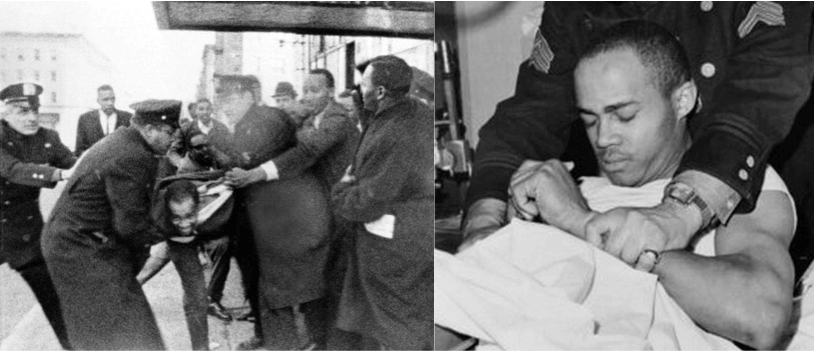
    Hagan/Hayer apprehended
    Thomas Hagan AKA Talmadge Hayer apprehended

    Thomas Hoy was the only police officer stationed outside the ballroom. He managed to pull Hayer away from the crowd. A police car cruising by stopped. Sergeant Alvin Aronoff and patrolman Louis Angelos helped Hoy save Hayer’s life by pushing him into the car. They took him to the Wadsworth Avenue Police Station.187 Roberts had gone up on the stage. He found Malcolm still had a pulse. Roberts began giving Malcolm mouth-to-mouth resuscitation, trying to revive him. Malcolm died on the stage.188


    Over the next 24 hours, Gene Roberts went through a series of BOSSI debriefings on the assassination. His superiors were incredulous at his attempt to save Malcolm’s life on the stage. “What did you do that for?” he was asked.

    And I told them, Roberts said, “Well, I’m a cop. And this is what cops are supposed to do—save people.”189

    Roberts at assassination
    Gene Roberts: “This is what cops
    are supposed to do—save people.”

    When Malcolm was shot, Joan Roberts had gone to Betty Shabazz, who had thrown her body over her children. Joan tried to hold her. Betty struggled to get free, throwing Joan against the wall, and ran to Malcolm’s side. Gene eventually helped Joan, who was shaken, to a taxicab.190

    Gene Roberts was the precursor to Marrell McCullough in the assassination of Martin Luther King. In a famous photo, McCullough can be seen with a stricken look kneeling over King’s body on the balcony of the Lorraine Motel in Memphis, April 4, 1968. McCullough belonged to a Memphis black power youth group working with King. He was the first person to reach him after he was shot. Unknown to King’s associates for another decade, Marrell McCullough was also a deep cover operative for the Memphis Police Department.191

    LIFE magazine feature Malcolm X assassination
    The LIFE issue on the assassination of Malcolm X

    Talmadge Hayer, Norman Butler, and Thomas Johnson were tried for Malcolm’s murder from January 21 to March 11, 1966. Butler and Johnson were two well-known New York “enforcers” for the Nation of Islam whom the police had picked up in the week following the assassination. A series of shaky witnesses, several contradicting their own grand jury testimony, testified to having seen Butler and Johnson take part in the murder. Butler and Johnson claimed they hadn’t even been in the Audubon Ballroom that afternoon. Butler had three supporting witnesses and Johnson two, to their each having been at home during the shooting. In the years to come, many of Malcolm’s people would emphasize that Butler and Johnson as well-known local NOI enforcers would have been quickly identified and watched closely had they entered the ballroom that day. They simply weren’t there. Talmadge Hayer agreed. In the trial’s most dramatic moments, Hayer took the stand, confessed his own participation in the assassination, and said Butler and Johnson had nothing to do with it. However, because Hayer refused to identify his real co-conspirators, his testimony was discredited. All three men were convicted and sentenced to life imprisonment. Hayer’s more detailed 1978 confession, naming the other four men in his group, was too late to help Butler and Johnson. They each served more than 20 years. The only man who has ever confessed to the murder of Malcolm X, Talmadge Hayer (who has become Mujahid Abdul Halim), has also made another confession:

    I remember some of the ministers used to say that time reveals all things. Malcolm used to say it himself—time will tell. And for the longest time, I always thought that time would tell what that man was saying was wrong. Well, time has told. Time has told that a lot of things he said was true.192

    Benjamin Goodman Karim
    Benjamin Goodman Karim

    Benjamin Goodman, in a 1978 affidavit supporting Butler and Johnson’s innocence, provided an insight into the coercion of trial witnesses. Goodman said that in 1965, he was summoned to a New York police station where detectives questioned him about Butler and Johnson. When he told the detectives repeatedly that Butler and Johnson had not been in the Audubon Ballroom that afternoon, the detectives became angry. Later in 1965, Goodman was summoned to another interview, this time from assistant District Attorney Stern. Goodman told them that:

    I knew Butler and Johnson, they had not been present at the ballroom that day, and that I had not seen the actual shooting. When I said this, Mr. Stern became angry and said that he knew I had previously said that I had seen the shooting through an open dressing room door. This was not true and I had never said this to anyone. In his anger, Mr. Stern threatened me and asked me, have you ever been to jail? How would you like to go to jail?

    Goodman was not called to testify at the trial.193


    Besides Hayer, the most significant trial witness was black police officer Gilbert Henry. Before the prosecution could get him off the stand, Henry revealed the strange way the NYPD had deployed its forces on February 21st. Henry said he had been stationed in the Ballroom’s Rose Room that afternoon, at a distance from Malcolm’s location in the main auditorium. He and his partner, Patrolman John Carroll, had been given specific instructions by their superior officer, Sergeant Devaney, “to remain where [they] would not be seen.” If anything happened, Patrolman Henry was to call for help on a walkie-talkie the two men had with them. It was connected with another walkie-talkie held by an officer at the Presbyterian Medical Center on the other side of the street. When Henry heard shots, he tried calling on the walkie-talkie but got no response. He then ran into the main auditorium, but was too late to see anyone with a gun. He said he saw no other uniformed officers in the auditorium.194

    Malcolm’s unofficial photographer, Robert Haggins, was one of the witnesses never called in the trial who could have testified farther to the odd behavior of the police that afternoon. Haggins told Spike Lee he had seen the anteroom of the ballroom filled with police: “If I took a guess, I’d say 25. It was filled with cops. Cops who must’ve waited until after he was shot to file into the ballroom.”195

    Earl Grant saw the police come in. He said that about 15 minutes after Malcolm was shot, “a most incredible scene took place. Into the hall sauntered about a dozen policemen. They were strolling at about the pace one would expect of them if they were patrolling a quiet park. They did not seem to be at all excited or concerned about the circumstances.

    I could hardly believe my eyes. Here were New York City policemen, entering a room from which at least a dozen shots had been heard, and yet not one of them had his gun out! As a matter of absolute fact, some of them even had their hands in their pockets.”196

    The best witness we have to the assassination of Malcolm X remains Malcolm X, as recorded by Alex Haley.


    On Saturday afternoon, February 20, 24 hours before he would walk to the podium of the Audubon Ballroom, Malcolm phoned Alex Haley at his home in upstate New York. It was to be their last conversation. Malcolm ended it with what Haley, in his epilogue to the autobiography, calls a “digression.” Malcolm was speaking of his impending murder:

    I’m going to tell you something, brother—the more I keep thinking about this thing, the things that have been happening lately, I’m not all that sure it’s the Muslims. I know what they can do, and what they can’t, and they can’t do some of the stuff recently going on. Now, I’m going to tell you, the more I keep thinking about what happened to me in France, I think I’m going to quit saying it’s the Muslims.197

    Malcolm had one final thought. In the last sentence he would ever say to Alex Haley—which Haley describes as “an odd, abrupt change of subject”—Malcolm said why he thought he was about to be killed:

    You know, I’m glad I’ve been the first to establish official ties between Afro-Americans and our blood brothers in Africa.198

    He then said good-bye and hung up.


    Nasser and Nkrumah
    Nasser and Nkrumah

    In the midst of his African campaign the previous August, Malcolm had sent a letter from Cairo to friends in Harlem that foreshadowed his last words to Alex Haley. One month after he was poisoned at the Nile Hilton, Malcolm wrote:

    You must realize that what I am trying to do is very dangerous because it is a direct threat to the entire international system of racist exploitation…. Therefore, if I die or am killed before making it back to the States, you can rest assured that what I’ve already set in motion will never be stopped … Our problem has been internationalized.199

    At the time Malcolm wrote this letter, his friend and ally Egyptian President Gamal Abdel Nasser was taking with extreme seriousness the ongoing threat to Malcolm’s life from U.S. intelligence agencies. He had two Egyptian security men posted outside Malcolm’s hotel room door at all times.200


    Alex Haley, a great author who gave Malcolm a prose platform from which he could address the world, buried in his epilogue what may have been the most significant words Malcolm ever said to him. Malcolm’s “digression” was a revelation, which he would share also with his assistants on Sunday afternoon, and his “change of subject” a coherent climax to his life. Malcolm was willing to give his life for the sake of a unity between Africans and African-Americans that he hoped would change the course of history. In his final year, Malcolm had become a witness to the truth he had experienced in his pilgrimage to Mecca—that all of humankind was one family of brothers and sisters under Allah. But he radically focused that truth on Africa and America. Africa was where our one family had begun, and America where much of it had been sent into slavery. He envisioned and was organizing a mutually supportive African-American movement for human rights on both continents. “But,” as Malcolm said 12 days before his death to a friend in London, “the chances are that they will get me the way they got [Congo’s revolutionary leader Patrice] Lumumba before he reached the running stage.”201 Malcolm was right. And in his final words to Alex Haley, he had already solved the crime of his murder a day before it happened.

    “Muslims don’t carry guns.” (Malcolm X to Charles Kenyatta, shortly before his death)

    Near the end of his life, Malcolm began to think about guns as a question of faith. In his last week, he see-sawed between wanting to apply for a permit to carry a pistol and wanting to confront his killers with no guns on either himself or his followers. He ended by choosing no guns. It seemed a strange final decision for Black America’s most articulate advocate of armed self-defense. Why did Malcolm take such a stand at the hour of his death?

    Malcolm’s co-worker, Charles 37X Kenyatta, has told a revealing story about the man whose life was one continuous turn toward the truth as he saw it. Charles said he and Malcolm were riding in a taxicab to the Chicago airport. They suddenly realized they were being taken instead into the stockyards. The driver had a sinister purpose of his own. Charles, however, had a pistol. He used it to make the driver stop the cab and get out. Charles and Malcolm drove quickly to the airport, and got on their plane.

    Malcolm then told Charles he had lost his religion. Three decades after Malcolm’s death, Charles Kenyatta continued to puzzle over his teacher’s strange words. Malcolm said to him: “Muslims don’t carry guns.”202

    As a deep believer in Islam, Malcolm chose to die as a martyr. After the attacks of September 11, 2001, and a wave of suicide bombers in Israel, Americans have tended to think of the Islamic concept of martyrdom as counter-violent. That was not, however the kind of martyr that Malcolm told Gordon Parks he wanted to be. Nor was it what he learned from the Islamic tradition he embraced on his pilgrimage to Mecca. In response to his assassins, whose identity he said he knew in advance, Malcolm gave his life to Allah “in the cause of brotherhood,” without trying to snatch away the lives of those taking his own.

    He also chose not to go into exile to avoid martyrdom. 12 days before his death, Malcolm listened patiently in a London hotel room, while a friend, Guyan writer Jan Carew, summoned every word at his command to persuade Malcolm not to return to the United States and almost certain death. Carew even invoked the authority of their ancestral spirit world, “the ghosts in our blood,” against the folly of martyrdom.

    Those ancestral spirits whisper warnings, whenever we’re about to do something reckless or foolhardy. Right now they should be whispering to you that, perhaps, surviving for our cause is more important then dying for it.203

    Malcolm answered:

    The spirit world’s fine but I want our folk to be free in the world of the living.204

    And the unspoken thought: So for the sake of the living, I’ll live the truth freely and openly all the way, regardless of the consequences.

    In Malcolm’s eyes, that was freedom. By living and speaking freely, Malcolm denied to the system that assassinated him the victory of taking away his life. He instead gave it freely in the cause of brotherhood and sisterhood. “It’s a time for martyrs now,” as he told Gordon Parks, “And if I’m to be one, it will be in the cause of brotherhood. That’s the only thing that can save this country.”

    In his final days, Malcolm transformed the death by violence that had haunted him all his life. Recognizing its imminence, he embraced it in terms of his faith. He did so in a way that was in tension with some of his own public rhetoric. Although Malcolm continued to insist vehemently right up to his death on armed self-defense as a fundamental right for black people and for all other people as well, he died without wanting his followers to resort to that right for himself. In a life of profound changes, Malcolm’s ultimate choice of how he wanted to die, nonviolently in the cause of brotherhood, was perhaps the most remarkable change of all.

    A “martyr” is literally a witness. Malcolm’s final action, in stepping forward to reconcile two brothers in a fight, made him not only a target for murder but also a witness to brotherhood.

    As he said to us all, “As-salaam alaikum.”


    Notes

    1. The Autobiography of Malcolm X, as told to Alex Haley (New York: Ballantine Books, 1973), p. 9.

    2. Ibid., p. 2.

    3. Ibid., p. 378.

    4. Ibid., p. 381.

    5. Karl Evanzz, The Judas Factor: The Plot to Kill Malcolm X (New York: Thunder’s Mouth Press, 1992).

    6. Karl Evanzz, The Messenger: The Rise and Fall of Elijah Muhammad (New York: Pantheon, 1999).

    7. Zak A. Kondo, Conspiracys: Unravelling the Assassination of Malcolm X (Washington: Nubia Press, 1993).

    8. Louis Lomax, To Kill a Black Man (Los Angeles: Holloway House, 1987). Although we have reached different conclusions on the conspiracy to kill Malcolm X, I want to acknowledge the help of a sixth author. In both his book, The Death and Life of Malcolm X (Urbana, Illinois: University of Illinois Press, second edition, 1979) and the kind interview he gave me, Peter Goldman has been a great resource and source of encouragement. His book provides dimensions of both the death and life that remain indispensable for a pilgrim into either.

    9. Evanzz underlines Lomax’s importance in The Judas Factor p. xxiv. Lomax also had early insights into the murder of the second subject of his book, Martin Luther King Jr.

    10. Memorandum from SAC [Special Agent in Charge], Chicago, to Director, FBI, 1/22169, page 1; in Petition to the Black Caucus, U.S. House of Representatives, of Muhammad Abdul Aziz (Norman 3X Butler) and Khalil Islam (Thomas 15X Johnson), April, 30, 1979; in the Walter E. Fauntroy Papers, Gelman Library, George Washington University.

    11. Louis E. Lomax, When the Word Is Given (New York: Signet Books, 1964), p. 82.

    12. Ibid.

    13. Memorandum from William Sullivan to Alan Belmont, December 24, 1963. Church Committee Final Report, Book III, p. 134.

    14. FBI HQ file on Lomax. Evanzz, Judas, p. 198.

    15. Ibid.

    16. Ibid.

    17. Lomax, To Kill, p. 199.

    18. Author’s interview with Wallace Muhammad, now W. D. Mohammed, August 2, 1999.

    19. Evanzz, Messenger, p. 317.

    20. Malcolm X scholar Zak Kondo obtained a March 16, 1954, Detroit FBI Report, captioned MALCOLM K. LITTLE, which cites from a 1950 prison letter written by Malcolm. Fonda, pp. 42, 292 endnote 847.

    21. Messenger, p. 183.

    22. Ibid.

    23. Ibid.

    24. Ibid., p. 557 endnote 39. Evanzz speculates that Abdul Basin Naeem may have been pressured to cooperate with the FBI and BOSSI due to his immigrant status. Ibid.

    25. FBI HQ file on Elijah Muhammad; FBI NY file on Malcolm X; cited by Evanzz, Messenger, p. 186.

    26. Ibid., p. 187.

    27. Goldman, pp. 55-59. Judas, pp. 70-71.

    28. Autobiography, p. 309.

    29. To Kill, p. 103,

    30. Messenger, pp. 187-88.

    31. Cited by Evanzz, Ibid., p. 188.

    32.Messenger, p. 192. Judas, p. 73.

    33. Lomax, When the Word, p. 179.

    34. Autobiography, p. 289.

    35. When the Word, Ibid.

    36. Autobiography, p. 265.

    37. Ibid.

    38. Ibid.

    39. Ibid., p. 292.

    40. Ibid., p. 297.

    41. FBI HQ file on Elijah Muhammad, section 5, memo dated May 20, 1960; approved by Cartha DeLoach, May 22, 1960. Cited by Evann, Messenger, p. 218.

    42. FBI HQ file on Elijah Muhammad. Ibid., pp. 249-50.

    43. Autobiography, p. 301.

    44. John Henrik Clarke, who published a transcript of the conversation, “A Visit from the FBI,” in Malcolm X: The Man and His Times (New York: Macmillan, 1975), pages 182-204, wrote in a footnote on page 182 that it happened on May 29, 1964. That date is too late, given the references in the conversation to the Clay-Liston fight in Florida as a future event. Clayborne Carson in Malcolm X: The FBI File (New York: Carroll & Graf, 1993), pages 252-53, presents an FBI document that indicates the visit took place on February 4, 1964.

    45. Clarke, p. 195.

    46. Ibid.

    47. Ibid., p. 202.

    48. Ibid., pp. 202-3.

    49. Autobiography, p. 302.

    50. Ibid., p. 303.

    51. Ibid., pp. 308-9. Kondo, p. 73.

    52. Autobiography, p. 316.

    53. Malcolm X Speaks, edited by George Breitman (New York: Pathfinder, 1990), p. 18.

    54. Kondo, pp. 63, 259 endnote 375.

    55. Goldman, pp. 159-60, 191.

    56. Malcolm X, “A Declaration of Conscience,” March 12, 1964; Malcolm X Speaks, p. 20.

    57. Ibid.

    58. Ibid., p. 22.

    59. Malcolm X, “The Ballot or the Bullet,” April 3, 1964; Malcolm X Speaks, pp. 34-35.

    60. Judas, pp. 226-27.

    61. Cited by Evanzz, Judas, p. 225.

    62. Ibid.

    63. Messenger, p. 292.

    64. Abdul Aziz Omar, formerly Philbert X Little; in William Strickland, Malcolm X: Make It Plain (New York: Viking, 1994), p. 174.

    65. FBI HQ file on Elijah Muhammad, memo dated April 12, 1964; cited by Evanzz, Messenger, pp. 292-93.

    66. Autobiography, p. 338.

    67. Ibid.

    68. Malcolm told Julian Mayfield and Leslie Lacy what Nkrumah had said. Leslie Alexander Lacy, “African Responses to Malcolm X,” in Black Fire, edited by Leroi Jones and Larry Neal (New York: William Morrow, 1968), p. 32.

    69. 12 years after Kwame Nkrumah’s overthrow, Seymour Hersh reported the CIA’s involvement in the coup in a New York Times article based on a brief description in a book by ex-CIA agent John Stockwell and confirming interviews by “first-hand intelligence sources.” Seymour M. Hersh, “C.I.A. Said to Have Aided Plotters Who Overthrew Nkrumah in Ghana,” New York Times (May 9, 1978), p. 6. John Stockwell, In Search of Enemies (New York: W W Norton, 1978), p. 160 footnote.

    70. “Malcolm Says He is Backed Abroad,” New York Times (May 22, 1964), p. 22.

    71. Frank Donner, Protectors of Privilege (Berkeley: University of California Press, 1990), p. 155.

    72. Tony Ulasewicz with Stuart A. McKeever, The President’s Private Eye (Westport, Connecticut: MACSAM Publishing, 1990), p. 145.

    73. Ibid., p. 151.

    74. Ibid.

    75. Author’s interview with Teddy Theologes, June 29, 2000.

    76. Elaine Rivera, “Out of the Shadows: The Man Who Spied on Malcolm X,” Newsday (July 23, 1989).

    77. Author’s interview with Gene Roberts, July 7, 2000.

    78. Rivera, Ibid.

    79. To Kill, pp. 198-99.

    80. Ibid., p. 199.

    81. Malcolm X Speaks, pp. 58-59.

    82. To Kill, p. 200,

    83. Talmadge Hayer filed two affidavits on Malcolm’s murder, the first in November 1977, and the second in February 1978. It is the second, which goes into greater detail, that is cited here. Both affidavits are in Petition to the Black Caucus. Michael Friedly includes them as an appendix in his book, Malcolm X: The Assassination (New York: Carroll & Graf, 1992), pp. 215-18.

    84. Ibid.

    85. Peter Goldman, The Death and Life of Malcolm X (Urbana, Illinois: University of Illinois Press, second edition, 1979), p. 416.

    86. Ibid.

    87. Evanzz, Messenger, p. 96.

    88. Malcolm’s telegram to Elijah Muhammad was published as an open letter in the June 26, 1964, edition of the New York Post. Cited by Kondo, pp. 74 and 269 endnote 467.

    89. Hayer affidavit, Ibid.

    90. Goldman, p. 195.

    91. Ibid.

    92. Author’s interview with Dr. Alauddin Shabazz, January 8, 1999.

    93. Goldman, p. 19S.

    94. Kondo, p. 147. Kondo hypothesizes that this provocative June 1964 phone call to the NOI was from an FBI or BOSSI provocateur, which would be consistent with the FBI’s COINTELPRO to keep Elijah and Malcolm at each other’s throats.

    95. Goldman, p. 414; Kondo, p. 147.

    96. The FBI transcript of the June 27, 1964 phone conversation is on page 480 of Malcolm X: The FBI File.

    97. Ibid.

    98. Judas, p. 241.

    99. “Statement of Basic Aims and Objectives of the Organization of Afro-American Unity,” appendix in George Breitman, The Last Year of Malcolm X (New York: Pathfinder, 1989), p. 106.

    100. Ibid.

    101. Ibid., p. 109.

    102. Kondo, pp. 43 and 239 endnote 249; citing FBI document.

    103. Ibid., endnote 250; citing FBI document.

    104. Malcolm X: The FBI File, p. 482.

    105. Ibid.

    106. John Ali was interviewed by Wesley South on the Chicago radio program Hotline on July 9, 1964. Ali’s analogies to JFK’s assassination, cited by Evanzz in The Judas Factor (pp. 247-48), were in response to a caller who “asked Ali whether it was true that the Black Muslims were trying to assassinate Malcolm X.” Ibid., p. 247. Ali also used espionage analogies, comparing Malcolm to Benedict Arnold and to Julius and Ethel Rosenberg, who were executed on the grounds that they handed over U.S. nuclear secrets to the Soviet Union. Ibid.

    107. Cited by Evanzz, Judas, pp. 249-50.

    108. Jan Carew, Ghosts in Our Blood (Chicago: Lawrence Hill Books, 1994), p. 39.

    109. Eric Norden, “The Assassination of Malcolm X,” Hustler (December 1978), p. 98.

    110. “Appeal to African Heads of State,” Malcolm X Speaks, pp. 75-77.

    111. Ibid., p. 84.

    112. “There’s A Worldwide Revolution Going On,” Malcolm X: The Last Speeches, edited by Bruce Perry (New York: Pathfinder, 1989), p. 116. Carew, Ghosts, p. 83.

    113. Carew, Ibid.

    114. Ibid., p. 115.

    115. M. S. Handler, “Malcolm X Seeks U.N. Negro Debate,” New York Times (August 13, 1964), p. 22.

    116. Ibid.

    117. The missing sentences are included in the citation of the original Times article on page 86 of Malcolm X Speaks.

    118. August 11, 1964, CIA memorandum for Deputy Director of Plans, titled “ACTIVITIES OF MALCOLM POSSIBLE INVOLVEMENT OF AFRICAN NATIONS IN U.S. CIVIL DISTURBANCES,” cited by both Kondo, pp. 49 and 242 endnote 280, and Evanzz, Judas, p. 254.

    119. Evanzz’s citation of FBI HQ file on Malcolm X, Ibid.

    120. Judas, p. 254.

    121. John Lewis, Walking With the Wind (New York: Simon 8c Schuster, 1998), p. 286.

    122. Malcolm X Speaks, p. 85.

    123. Lewis, p. 287.

    124. Ibid., p. 288.

    125. Louis X, “Boston Minister Tells of Messenger Muhammad’s Biggest Hypocrite,” Muhammad Speaks (December 4, 1964), p. 11. Kondo, p. 159. Goldman, pp. 247-48. Cited also on Tony Brown’s Journal, “What Did Farrakhan Say and When Did He Say It?” (Spring 2000).

    126. Spike Lee, By Any Means Necessary: The Trials and Tribulations of the Making of Malcolm X (New York: Hyperion, 1992), p. 56. Farrakhan’s statements to Tony Brown, Barbara Walters, and Mike Wallace are included in “What Did Farrakhan Say …?”

    127. “What Did Farrakhan Say …?”

    128. Messenger, p. 293,

    129. Judas, pp. 263-64.

    130. Judas, p. 267.

    131. M. S. Handler, “Malcolm X Cites Role in U.N. Fight,” New York Times (January 2, 1965), p. 6.

    132. Ibid.

    133. Malcolm X: The FBI File, p, 81.

    134. Hakim A. Jarnal, From the Dead Level (London: Andre Deutsch, 1971), p. 223.

    135. Ibid.

    136. Ibid., pp. 212-15, 228-29.

    137. Haley, p. 425.

    138. Ibid.

    139. Ibid.

    140. Taylor Branch, Pillar of Fire (New York: Simon & Schuster, 1998), p. 578.

    141. Malcolm X, The Final Speeches: February 1965 (New York: Pathfinder, 1992), p. 26.

    142. Ibid., p. 28.

    143. Coretta Scott King, My Life With Martin Luther King, Jr.; revised edition (New York: Henry Holt, 1993), p. 238.

    144. Ibid., p. 240,

    145. Goldman, p. 254.

    146. Eric Norden, “The Murder of Malcolm X,” The Realist (February 1967), p. 12.

    147. Ibid.

    148. J. Edgar Hoover’s February 4, 1965, memorandum read: “… Information has been received that Malcolm Little plans to travel to England and France during the early part of February. He will reportedly depart this country on February 5, 1965, and will return about February 11, 1965. In this connection, there is enclosed one copy of a memorandum dated February 1, 1965, at New York, which contains available information of the subject’s contemplated travel.” Kondo, pp. 271-72 endnote 491. In addition to the intelligence agencies I have noted, Hoover’s memorandum was also sent to the Assistant Attorney General, the Acting Attorney General, and the Foreign Liaison Unit. Ibid.

    149. Kondo, p. 162.

    150. Ibid.

    151. Kondo, p. 76. Goldman, p. 263.

    152. Goldman, p. 262. Judas, pp. 289-90. Kondo, p. 76. M.X. Handler, “Malcolm X Flees Firebomb Attack,” New York Times (February 15, 1965), p. 1. Malcolm X, Final Speeches, pp. 133-34.

    153. Earl Grant, “The Last Days of Malcolm X,” Malcolm X: The Man and His Times, edited by John Henrik Clarke (NewYork: Macmillan, 1975), p. 86.

    154. “Malcolm Accuses Muslims of Blaze; They Point to Him,” New York Times (February 16, 1965), p. 18.

    155. Autobiography, pp. 308-9. Kondo, p, 73,

    156. Messenger, pp. 318-19.

    157. Lee, p. 63.

    158. On Brother Minister: The Assassination of Malcolm X, a 1997 film directed by Jack Baxter and Jefri Aallmuhammed.

    159. “Bottle of Gasoline Found on a Dresser in Malcolm X Home,” New York Times (February 17, 1965), p. 34.

    160. He said this, for example, on Monday night, February 15, 1965, in his talk at the Audubon Ballroom, “There’s a Worldwide Revolution Going On.” Final Speeches, p. 124.

    161. Norden, “Murder,” p. 12,

    162. In his statement to the press, February 18, 1965, “We Are Demanding an Investigation,” Final Speeches, p. 179.

    163. Ibid.

    164. See endnote 118.

    165. Norden, “Murder,” p. 12.

    166. Author’s interview with Gene Roberts, July 7, 2000.

    167. “There’s a Worldwide Revolution Going On,” Final Speeches, p. 123.

    168. Author’s interview.

    169. Gene Roberts to Elaine Rivera on his efforts to tell his BOSSI supervisors about the dry run. Rivera, “Out of the Shadows.”

    170. Author’s interview.

    171. Gordon Parks, “I was a Zombie Then—Like All [Black] Muslims, I Was Hypnotized,” Life (March 5, 1965), p. 28.

    172. Ibid.

    173. Goldman, p. 261,

    174. Ibid., p. 262.

    175. Haley, p. 438.

    176. Ibid.

    177. Rivera, “Out of the Shadows.”

    178. Ibid.

    179. Haley, p. 431. Grant, “The Last Days,” p. 92.

    180. Norden, “The Murder,” p, 13.

    181. Talmadge Hayer amplified his written confession, with further details that are included here, in an interview on Tony Brown’s Journal, “Malcolm and Elijah,” February 21, 1982. Cited by Kondo, pp, 169-70.

    182. Haley, p. 428. Judas, pp. xiii, 293.

    183. Haley, p. 433.

    184. Ibid.

    185. Kondo, p. xviii.

    186. Goldman, p. 274.

    187. Several witnesses claim two suspects were arrested by the police. Omar Ahmed, who was on Malcolm’s guard detail at the time, thought there were two men arrested outside of the ballroom. Interview by Kondo, p. 84. Earl Grant makes the same claim in “The Last Days of Malcolm X,” p, 99.

    The New York Herald Tribune‘s early edition of February 22, 1965, reported two arrests. Its article said that one suspect, Hayer, was “taken to Bellevue Prison Ward and was sealed off by a dozen policemen. The other suspect was taken to the Wadsworth Avenue precinct, where the city’s top policemen immediately converged and began one of the heaviest homicide investigations this city has ever seen.” New York Herald Tribune (February 22, 1965; city edition) article by Jimmy Breslin, “Police Rescue Two Suspects”; cited by Kondo, p. 83. The Tribune‘s late city editions make no mention of the second suspect. Ibid. The New York Times in its early and late city editions follows the same pattern. Kondo, Ibid.

    Peter Goldman explains the inconsistencies in terms of separate debriefings of Thomas Hoy and Alvin Aronoff: “Hoy and Aronoff were debriefed separately at the time, Hoy at the scene and Aronoff at the stationhouse, and the early editions of the next day’s papers reported that there had been two arrests. The two policemen, as it developed, were talking about the same man …” Goldman, p. 276.

    When Alex Haley wrote his 1965 ‘Epilogue” to the Autobiography, he was still raising the possibility of two arrested suspects and the hope of identifying the second. Haley, p. 438.

    188. Author’s interview.

    189. From Gene Roberts interview in Brother Minister.

    190. Rivera, “Out of the Shadows.”

    191. William F. Pepper, Orders to Kill (New York; Carroll & Graf, 1995), pp. 129-30. Pepper identifies McCullough as being at the same time a member of Army intelligence. Ibid., p. 443.

    192. Kondo, p. 202.

    193. Benjamin Goodman Affidavit, May 19, 1978; in Petition to Black Caucus.

    194. Herman Porter, “The Trial,” in The Assassination of Malcolm X, edited by Malik Miah (New York: Pathfinder Press, 1988), p. 93. Norden, “The Murder,” p. 14. William M. Kunstler’s December 19, 1977, deposition in Petition to the Black Caucus, pp. 25-26.

    195. Lee, p. 42,

    196. Grant, p. 96.

    197. Haley, pp. 430-31.

    198. Ibid., p. 431.

    199. Malcolm X, “A Letter from Cairo,” By Any Means Necessary (New York: Pathfinder, 1991), p. 110.

    200. David DuBois to Spike Lee; in Lee, p. 38.

    201. Carew, p. 36.

    202. Charles 37X Kenyatta in Brother Minister.

    203. Carew, p. 57.

    204. Ibid.


    Copyright 2002 by James W. Douglass

    Originally published in The Assassinations, ed. DiEugenio & Pease (Los Angeles: Feral House, 2003), pp. 376-424.

  • The Murder and Martyrdom of Malcolm X

    The Murder and Martyrdom of Malcolm X


    Has anyone ever been more conscious, from birth to death, of his coming murder? Malcolm X saw his own violent death in advance just as clearly as his mother Louise Little saw the imminence of his father’s death, on that afternoon in 1931 when her husband Earl left their house and began walking up the road toward East Lansing, Michigan.

    “If I take the kind of things in which I believe, then add to that the kind of temperament that I have, plus the one hundred percent dedication I have to whatever I believe in … These ingredients would make it just about impossible for me to die of old age.”

    “It was then,” Malcolm says in his autobiography, “that my mother had this vision. She had always been a strange woman in this sense, and had always had a strong intuition of things about to happen. And most of her children are the same way, I think. When something is about to happen, I can feel something, sense something.”1

    His mother rushed out on the porch screaming. She ran across the yard into the road shouting, “Early! Early!” Earl turned around. He saw her, waved, and kept on going.

    That night Malcolm awakened to the sound of his mother’s screaming again. The police were in the living room. They took his mother to the hospital, where his father had already bled to death. His body had been almost cut in two by a streetcar. Earl Little had been an organizer for Marcus Garvey’s United Negro Improvement Association, the largest black nationalist movement in American history. Malcolm was told by blacks in Lansing that his father had been attacked by the white racist Black Legion. They put his body on the tracks for a streetcar to run over.

    Malcolm believed that four of his father’s six brothers were also killed by white men. Thus the pattern of his own life seemed clear. “It has always been my belief,” he told his co-author Alex Haley, “that I, too, will die by violence. I have done all that I can to be prepared.”2 Malcolm prepared for death by living the truth so deeply that it hastened death. This is the theme of Malcolm X’s autobiography. “To come right down to it,” Malcolm said to Alex Haley, “if I take the kind of things in which I believe, then add to that the kind of temperament that I have, plus the one hundred percent dedication I have to whatever I believe in … These ingredients would make it just about impossible for me to die of old age.”3

    As the story neared its end, with Malcolm more and more totally surrounded by forces that wanted him dead, he no longer saw himself as among the living. “Each day I live as if I am already dead … I do not expect to live long enough to read this book in its finished form.”4 And he was right: he died in Harlem on the same day he had originally intended to visit Alex Haley in upstate New York to read the final manuscript.


    The assassination of Malcolm X on February 21, 1965, at the Audubon Ballroom in New York City was carried out through the collaboration of three circles of power: the Nation of Islam (NOI), the New York Police Department (NYPD), and U.S. intelligence agencies. Malcolm was, as he knew, surrounded at the end by all three of these circles. In terms of their visibility to him and their relationship to one another, the circles were concentric. The Nation of Islam was the nearest ring around Malcolm, the less visible NYPD was next, and the FBI and CIA were in the outermost shadows. The involvement of these three power circles in Malcolm’s murder becomes apparent if we trace his pilgrimage of truth through his interactions with all three of them.

    Malcolm X and Alex Haley
    Malcolm X and Alex Haley

    In writing this essay, I have been guided especially by the works of five authors. The first three are Karl Evanzz, Zak Kondo, and Louis Lomax. Washington Post online editor Karl Evanzz is the author of The Judas Factor: The Plot to Kill Malcolm X5 and The Messenger: The Rise and Fall of Elijah Muhammad.6 Evanzz’s two books complement each other brilliantly in presenting a full picture of Malcolm’s assassination, the first emphasizing the U.S. government’s responsibility and the second, that of Elijah Muhammad and the Nation of Islam. Zak A. Kondo, a professor at Bowie State College, does it all in one book, Conspiracys: Unravelling the Assassination of Malcolm X,7 which follows an unusual (though strangely accurate) title with a complex analysis of the three murderous circles: NOI, NYPD, and U.S. spy agencies. His self-published, out-of-print book that is almost impossible to find has 1266 endnotes, all of which deserve to be read. Then there is Louis Lomax’s To Kill a Black Man,8 first published in 1968, two years before Lomax’s own death in a car accident. As both a faithful friend to Malcolm and a writer wired to what was happening, Lomax already pointed to a solution of Malcolm’s assassination.9 I said I have five guides. The last two are Malcolm X and the man who lived to tell his tale, Alex Haley.

    The Autobiography of Malcolm X is the transforming work of both. Haley in his epilogue hints at what Malcolm in his last days realized and was on the verge of shouting—that it was the government, not Elijah Muhammad, and Malcolm’s African connection, not his NOI rejection, that were the primary agent and motivation behind the plot. Malcolm is the ultimate guide to understanding his own murder.

    In a memorandum, written four years after Malcolm’s death, the Special Agent in Charge of the FBI’s Chicago office stated that:

    Over the years, considerable thought has been given and action taken with Bureau’s approval, relating to methods through which the NOI, could be discredited in the eyes of the general black populace. … Or through which factionalism among the leadership could be created … Factional disputes have been developed—the most notable being MALCOLM X LITTLE.10

    Malcolm X and Elijah Muhammad
    Malcolm X and Elijah Muhammad

    The FBI developed the factional dispute that led to Malcolm’s death by first placing at least one of its people high within the Chicago headquarters of the Nation of Islam. Its infiltrator then worked to widen a division between Elijah Muhammad and Malcolm X. To the FBI’s alarm, this process was inadvertently described, and the FBI man identified, in the 1964 book When The Word Is Given, written by Louis Lomax.

    In the paragraph that gave away the FBI’s game, Lomax began by observing that Elijah Muhammad had moved from Chicago to Phoenix, Arizona, for the sake of his health. Lomax then described a significant shift of power. Elijah he said had delegated to his Chicago office not only the NOI’s finances and administration, but also “the responsibility for turning out the movement’s publications and over-all statements,” thus taking away from Malcolm X his critical control over the NOI’s flow of information.

    “at one time carried some of these responsibilities, particularly the publishing of the Muslim newspaper..,. And many observers thought they saw an intra-organizational fight when these responsibilities were taken from him and given to Chicago.11

    The thing that dismayed the FBI most was the paragraph’s final sentence, which disclosed a hidden factor in this abrupt transfer of power away from Malcolm. The sentence stated that “this decision by Muhammad was made possible because John X, a former FBI agent and perhaps the best administrative brain in the movement, was shifted from New York to Chicago.12

    Lomax’s sentence about “John X, a former FBI agent” set off alarm bells in FBI counterintelligence, especially in the office of William C. Sullivan. Assistant FBI Director Sullivan was in charge of the illegal Counterintelligence Program (COINTELPRO) designed to develop a “factional dispute” between Elijah and Malcolm. Sullivan was a high-level commander of covert action. Among his projects was an all-out FBI campaign “aimed at neutralizing [Dr. Martin Luther] King as an effective Negro leader,” as Sullivan put it in a December 1963 memorandum.13

    Malcolm X and Elijah Muhammad
    COINTELPRO chief
    William C. Sullivan

    On March 20, 1964, COINTELPRO chief Sullivan was alerted by an “airtel” from the FBI’s Seattle field office to the objectionable passage in When The Word Is Given.14 The hardcover edition of the book had been published in late 1963, only a few months before what Sullivan must have regarded as a COINTELPRO success story, Malcolm’s March 8, 1964 announcement of his split with Elijah Muhammad. The problem was that to a discerning reader of both the Lomax paragraph and the news of the split, the FBI could be recognized as a key disruptive factor.

    John X Ali Simmons
    John X Ali Simmons announcing
    Malcolm X suspension from
    the Nation of Islam

    An FBI official recommended in a memorandum to Sullivan that “the New York Office should be instructed to contact Lomax to advise him concerning the inaccurate statement contained in this book regarding [John X Ali] Simmons. … And that he be instructed to have this statement removed from any future printings of the book.”15 FBI Director J. Edgar Hoover added his personal “OK” to this recornmendation.16 Lomax, however, ignored the FBI’s pressure as well as John Ali’s anger at his having made the statement. He never retracted it. In his later book, To Kill a Black Man, he repeated it, and said that John Ali knew it was true.17 In the six years leading to his death, Lomax never clarified what he meant by the term “former FBI agent.” He may have been giving Ali the benefit of a doubt as to his having severed his FBI connection by the time Lomax mentioned it in 1964. In any case, the FBI had other informants in the Nation of Islam to take his place.

    Wallace Muhammad, Elijah Muhammad’s independent-minded son, also believed that FBI informants were manipulating NOI headquarters at the time Malcolm and Elijah became antagonists:

    The FBI had key persons in the national staff, at least one or two maybe. They were preparing for the death of the Honorable Elijah Muhammad [in terms of determining his successor]. I believe that the members of the Nation of Islam were influenced to do the things that they were doing not just by the national staff and my father but also by the intelligence department.18

    Wallace Muhammad was in a position to know at first hand the FBI’s process of working with NOI informants. The FBI considered him one of them. Karl Evanzz, in researching his biography of Elijah Muhammad entitled The Messenger, discovered from FBI documents that in addition to John Ali, at least three other people were regarded by FBI agents as “reliable sources” close to Muhammad. The first man was Abdul Basit Naeem, a Pakistani journalist who served as an NOI publicist. Then there is Hassan Sharrieff, Elijah Muhammad’s grandson and Wallace Muhammad. Evanzz concludes that the FBI thought “Wallace and Hassan fit the bill because they had provided the Bureau with information it considered crucial to inciting violence between Muhammad’s camp and Malcolm X.”19 Wallace’s and Hassan’s reasons for talking with the FBI seem to have been simply to seek protection from members of their own family, who threatened to kill them for going against Elijah. The FBI then recycled their information for its own use in plotting against Malcolm and Elijah.

    “I believe that the members of the Nation of Islam were influenced to do the things that they were doing not just by the national staff and my father but also by the intelligence department.” ~Wallace Muhammad

    It was Louis Lomax’s revelation of the FBI’s covert process within the NOI that so concerned the Bureau. Lomax’s statement had given his readers a glimpse into a critical part of the FBI’s COINTELPRO strategy to divide and destroy the Nation of Islam, thereby silencing as well its most powerful voice, Malcolm X.

    FBI documents show that the Bureau had been monitoring Malcolm X as far back as 1950, when he was still in prison.20 The Bureau began to focus special attention on Malcolm in the late ’50s, when it realized he had become Elijah Muhammad’s intermediary to foreign revolutionaries. From Malcolm’s Harlem base of operations as the minister of the NOI’s Temple Number Seven, he was meeting regularly at the United Nations with Third World diplomats. In 1957 Malcolm met in Harlem with visiting Indonesian President Achmed Sukarno, whom the CIA had targeted for removal from power. Sukarno was extremely impressed by Malcolm.21 As early as eight years before Malcolm’s death, the FBI and CIA were watching the subversive international connections Malcolm was making.


    Abdul Basit Naeem
    Abdul Basit Naeem

    In 1957 when Malcolm X was becoming the NOI’s diplomat to Third World leaders, Abdul Basit Naeem was developing into Elijah Muhammad’s public relations man in the same direction.22 Naeem was a Pakistani journalist living at the time in Brooklyn. His first project with Elijah was a 1957 booklet that combined international Islamic affairs with coverage of the Nation of Islam.23 Evanzz discovered that Abdul Basit Naeem became extremely cooperative. Not only was he cooperative with the FBI but also with the New York Police Department’s intelligence unit, “BOSSI” (the acronym for Bureau of Special Service and Investigation).24 BOSSI would later succeed in planting one of its cover operatives in Malcolm’s own security team. The FBI and BOSSI would prove to be linking agencies in the chain of events leading up to Malcolm’s assassination.

    At this time Malcolm had also become the apparent successor to Elijah Muhammad, who then loved and respected his greatest disciple more than he did his own sons. Accordingly, the FBI’s Chicago field office, which was monitoring all of Elijah’s communications, told J. Edgar Hoover in January 1958 that Malcolm had become Elijah’s heir apparent.25 Evanzz has described the impact of this revelation on the FBI’s COINTELPRO section:

    The secret to disabling the [NOI] movement, therefore, lay in neutralizing Malcolm X.26

    Evanzz suggests the FBI began its neutralizing of Malcolm in 1957 by utilizing a police force with which it worked closely on counterintelligence, the New York Police Department.


    Hinton incident
    Malcolm in NYC (1957)
    “No man should have that much power”

    The NYPD was already in conflict with Malcolm. In April 1957 in Harlem, white policemen brutally beat a Black Muslim, Johnson X Hinton, who had dared question their beating another man. The police arrested the badly injured Hinton and took him to the 28th Precinct Station on 123rd Street. When the station was confronted by a menacing but disciplined crowd, Malcolm X demanded on their behalf that Hinton be hospitalized. The police finally agreed, and were shocked by Malcolm’s dispersal of the 2,600 people with a simple wave of his hand. They concluded with alarm that he had the power to start as well as stop a riot. The city and police also had to pay Hinton $70,000 as a result of an NOI lawsuit.27 A police inspector who witnessed Malcolm’s dispersal of the crowd said, “No man should have that much power.”28


    On May 24, 1958, four months after Hoover was told that Malcolm was Elijah’s successor, two NYPD detectives and a federal postal inspector invaded the Queens apartment house in which Malcolm and his wife, Betty Shabazz, lived in one of the three apartments. They shared the house with two other NOI couples, including John X Ali and his wife, Minnie Ali. In 1958, John Ali was not only the secretary of Malcolm’s Mosque Number Seven but also his top advisor, his close friend, and his housemate.29

    Brandishing a warrant for a postal fraud suspect who did not live there, the detectives barged into the house and ran directly to Malcolm’s office on the second floor. They fired several shots into it. Fortunately Malcolm was away from the house, but the bullets narrowly missed the terrified women and children in the next room. One detective arrested Betty Shabazz, who was pregnant, and Minnie Ali. He threatened to throw the women down the stairs if they didn’t move faster. The detectives, on the first floor, were confronted and beaten by a crowd of angry neighbors. Police reinforcements arrested six people, including Betty Shabazz and Minnie Ali, who were charged with assaulting the two detectives.30

    In response to the attack, an enraged Malcolm X employed a brilliant media strategy against the NYPD that he would develop later against the U.S. government. To expose this case of New York police brutality against blacks, he drew on the support of his new friends at the United Nations. Malcolm wrote an open letter to New York City Mayor Robert Wagner in which he promised to shame the city unless it redressed the grievance:

    Outraged Muslims of the African Asian World join us in calling for an immediate investigation by your office into the insane conduct of irresponsible white police officers … Representatives of Afro-Asian nations and their press attachés have been besieging the Muslims for more details of the case.31

    Betty Shabazz
    Betty Shabazz

    In their March 1959 trial that lasted two weeks, the longest assault trial in the city’s history, Betty Shabazz, Minnie Ali, and the other defendants were all found not guilty by a Queens jury. They filed a $24 million suit that was settled out of court.32

    In a first effort to kill or intimidate Malcolm X, the New York Police Department (and perhaps the FBI as instigator) had failed. As in the beating of Hinton, the NYPD was once again discredited by Malcolm. Both the FBI and the city police had come to regard Malcolm increasingly as their enemy. It may also have been through the pressures of this ordeal that the FBI succeeded in establishing its covert relationship with John Ali. At the time Malcolm was unaware of any such development. To Elijah Muhammad he recommended his friend John Ali for the next position he would hold as national secretary in Chicago of the Nation of Islam.


    By 1963 conflicts between Elijah Muhammad and Malcolm X were becoming obvious. When Louis Lomax had the courage to ask Malcolm about a news report of a minor difference between himself and Elijah Muhammad, Malcolm denied it:

    It’s a lie. Any article that says there is a ‘minor’ difference between Mr. Muhammad and me is a lie. How could there be any difference between The Messenger and me? I am his slave, his servant and his son. He is the leader, the only spokesman for the Black Muslims.33

    As Malcolm knew, the news report was understated. There were more differences than one between “leader” and “servant,” and they were becoming major. A root conflict was the question of activism. During the creative turmoil of the Civil Rights Movement, more and more black people were heard questioning the Nation of Islam’s inactivity. They would say, “Those Muslims talk tough, but they never do anything, unless somebody bothers Muslims.”34 Malcolm cited this common complaint to Alex Haley, because he agreed with it. He was pushing for the NOI to become more involved. Elijah Muhammad was committed, however, to a non-engagement policy.

    While continuing his response to Lomax’s vexing question, Malcolm resorted to NOI theology to admit that there was in fact a difference:

    But I will tell you this, the Messenger has seen God. He was with Allah and was given divine patience with the devil. He is willing to wait for Allah to deal with this devil. Well, sir, the rest of us Black Muslims have not seen God, we don’t have this gift of divine patience with the devil. The younger Black Muslims want to see some action.35

    A second difference between Malcolm and Elijah arose from Malcolm’s increasing celebrity status. Although Malcolm always prefaced his public statements with “The Honorable Elijah Muhammad says,” it was Malcolm who more often proclaimed the word and gained the greater public attention. Elijah Muhammad coined a tricky formula to reassure Malcolm that this was what he wanted: “Because if you are well known, it will make me better known.”36 But in the same breath, the Messenger warned Malcolm that he would then become hated, “because usually people get jealous of public figures.”37 Malcolm later observed dryly that nothing Mr. Muhammad had ever said to him was more prophetic.38

    Malcolm’s rise in prominence as NOI spokesperson, while Elijah Muhammad retreated to Arizona for his health, caused a backlash in Chicago headquarters. When John Ali was appointed to National Secretary, the office was managed by members of Elijah’s family. It was already becoming notorious for its wealth and corruption at the expense of NOI members. In the name of Elijah, John Ali and the Muhammad family hierarchy moved to consolidate their power over Malcolm’s. Herbert Muhammad, Elijah’s son, had become the publisher of the Nation’s newspaper, Muhammad Speaks. He ordered that as little as possible be printed about Malcolm and finally nothing at all.39 With Elijah’s consent from Arizona, Malcolm was being edged out of the picture.

    The most serious conflict between the two men occurred when Malcolm became more conscious of rumors concerning his mentor’s affairs with young women. Malcolm conferred with a trusted friend, Wallace Muhammad. Wallace said the rumors were true. Malcolm spoke with three of Elijah Muhammad’s former secretaries. They said Elijah had fathered their children. They also said, as Malcolm related in the autobiography,

    Elijah Muhammad had told them I was the best, the greatest minister he ever had, but that someday I would leave him, turn against him—so I was ‘dangerous.’ I learned from these former secretaries of Mr. Muhammad that while he was praising me to my face, he was tearing me apart behind my back.40

    W D Muhammad
    Wallace W.D. Muhammad with Malcolm X

    All these developments were being monitored closely by the FBI through its electronic surveillance and undercover informants. The Bureau’s COINTELPRO was also using covert action to destroy Elijah Muhammad in a way it would develop even further against Martin Luther King Jr. On May 22, 1960, Assistant FBI Director Cartha DeLoach approved the sending of a fake letter on Elijah’s infidelities to his wife, Clara Muhammad, and to NOI ministers.41 The rumors Malcolm heard were being spread by the FBI.

    On July 31, 1962, COINTELPRO director William C. Sullivan approved another scheme whereby phony letters on Elijah’s philandering would be mailed to Clara Muhammad and “selected individuals.” He cautioned the Chicago Special Agent in Charge: “These letters should be mailed at staggered intervals using care to prevent any possibility of tracing the mailing back to the FBI.”42 While Malcolm X was investigating the secretaries’ charges against Elijah Muhammad, the FBI was trying to deepen his and the Messenger’s differences so as to finalize their split, assuming at the time that their divorce would weaken the power of both men.

    “It doesn’t take hate to make a man firm in his convictions. There are many areas to which you wouldn’t give information and it wouldn’t be because of hate. It would be your intelligence and ideals.”

    Malcolm struggled to remain loyal to the spiritual leader who had redeemed him from his own depths in prison, but it was only a matter of time before the two men would split over all these issues. The occasion for their break was John F. Kennedy’s assassination. Elijah Muhammad ordered his ministers to refrain from commenting on it. On December 1, 1963, after a speech Malcolm gave in New York City, he was asked his opinion on the President’s murder. He later described his response:

    Without a second thought, I said what I honestly felt—that it was, as I saw it, a case of ‘the chickens coming home to roost.’ I said that the hate in white men had not stopped with the killing of defenseless black people, but that hate, allowed to spread unchecked, finally had struck down this country’s Chief of State. I said it was the same thing as had happened with Medgar Evers, with Patrice Lumumba, with Madame Nhu’s husband.43

    On the day he saw the headlines on Malcolm’s remark, Elijah Muhammad told his chief minister he would have to silence him for the next 90 days to disassociate the Nation from his blunder. Malcolm said he would submit completely to the discipline. The FBI saw this period as its golden opportunity.

    Two FBI agents visited Malcolm on February 4, 1964.44 Malcolm knew they were coming. He had a tape recorder hidden under the sofa in his living room, and recorded the conversation.

    The agents admitted that the FBI had chosen that particular time to contact Malcolm because of his suspension by Elijah Muhammad. They hoped that bitterness on Malcolm’s part might move him to become an informant. Such bitterness was understandable, they said sympathetically. The agents even handed Malcolm a facile rationalization for cooperating in their undercover crime of undermining Elijah, while compromising him:

    It would not be illogical for someone to have spent so many years doing something, then being suspended.45

    Malcolm: No, it should make one stronger. It should make him realize that law applies to the law enforcer as well as those who are under the enforcement of the enforcer.46

    After failing to get anywhere with Malcolm, one of the agents said, “You have the privilege [of not giving the FBI information]. That is very good. You are not alone. We talk to people every day who hate the Government or hate the FBI.” Then he added, with a stab at bribing Malcolm, “That is why they pay money, you know.”47

    Malcolm ignored the bribe and went to the heart of the question: “That is not hate, it is incorrect to clarify that as hate. It doesn’t take hate to make a man firm in his convictions. There are many areas to which you wouldn’t give information and it wouldn’t be because of hate. It would be your intelligence and ideals.”48

    Malcolm had learned that he was forbidden by Elijah Muhammad even to teach in his own Mosque Number Seven, and that the Nation had announced further that he would be reinstated “if he submits.” The impression was being given that he had rebelled.

    Looking back at the announcement, he said to Haley, “I hadn’t hustled in the streets for nothing. I knew when I was being set up.”49 Malcolm realized the ground was being laid by NOI headquarters to keep him suspended indefinitely. A deeper realization came when one of his Mosque Seven officials began telling the men in the mosque that if they knew what Malcolm had done, they’d kill him themselves. “As any official in the Nation of Islam would instantly have known, any death-talk for me could have been approved of, if not actually initiated, by only one man.”50 Malcolm knew that Elijah Muhammad, the spiritual father whom he had revered and served for 12 years, had now sanctioned his murder.

    Joseph Gravitts
    Captain Joseph X Gravitts
    (to the left of Elijah Muhammad)

    Then came a first death plot. One of Malcolm’s own Mosque Seven officials, Captain Joseph X Gravitts, following higher orders, told an assistant to Malcolm to wire his car to explode when he started the engine. The man refused the assignment, told Malcolm of the plot, and saved his life.51 He also freed Malcolm from his attachment to the Nation of Islam. Malcolm was forced to recognize that the NOI’s hierarchy and structure, extending right down into his own mosque, was committed to killing him. He could already see a first ring of death encircling him, comprised of the organization he had developed to serve Elijah Muhammad. From that point on, Malcolm said, he “went few places without constant awareness that any number of my former brothers felt they would make heroes of themselves in the Nation of Islam if they killed me.”52


    On March 8, 1964, with less than a year to live, Malcolm X announced his departure from the Nation of Islam. He said he was organizing a new movement because the NOI had “gone as far as it can.” He was “prepared to cooperate in local civil-rights actions in the South and elsewhere. “53 Malcolm also passed out copies of a telegram he had sent to Elijah Muhammad, in which he stated:

    Despite what has been said by the press, I have never spoken one word of criticism to them about your family … 54

    In spite of everything, Malcolm was trying not to split the NOI, and therefore muffled his criticisms of Elijah Muhammad.

    Two days later, the Nation of Islam sent Malcolm a certified letter telling him and his family to move out of their seven-room house in East Elmhurst, Queens. The Elmhurst house had been home for Malcolm, Betty Shabazz, and their growing family (now with four daughters) since the early days of their marriage when Malcolm and Betty were in the house with John and Minnie Ali. One month after the certified letter, the secretary of Malcolm’s old Mosque Number Seven filed suit in a Queens civil court to have Malcolm and his family evicted. Malcolm would fight for the legal right to stay in the only home he had to pass on to his wife and children, especially since he might soon be killed by the same forces trying to take their house away.55

    On March 12, Malcolm held a press conference in New York and said internal differences within the Nation had forced him out of it. He was now founding a new mosque in New York City, Muslim Mosque, Inc. With a conscious effort to avoid repeating the mistakes of Elijah Muhammad, he said in his “Declaration of Independence” that he was a firm believer in Islam but had no special credentials:

    I do not pretend to be a divine man, but I do believe in divine guidance, divine power, and in the fulfillment of divine prophecy. I am not educated, nor am I an expert in any particular field—but I am sincere, and my sincerity is my credentials.56

    He opened (wide) the door to working with other black leaders, with whom he had traded criticisms, most notably with Martin Luther King Jr. “As of this minute, I’ve forgotten everything bad that the other leaders have said about me, and I pray they can also forget the many bad things I’ve said about them.”57 He then immediately chased King away by saying black people should begin to form rifle clubs to defend their lives and property.

    He concluded:

    We should be peaceful, law-abiding—but the time has come for the American Negro to fight back in self-defense whenever and wherever he is being unjustly and unlawfully attacked. If the government thinks I am wrong for saying this, then let the government start doing its job.58

    Malcolm was aware that the government might think it was its job to silence him.


    Much more threatening to the government than Malcolm’s rifle clubs, which never got off the ground, was the visionary campaign he then initiated to bring U.S. violations of African-Americans’ rights before the court of world opinion in the United Nations. In his April 3, 1964, speech in Cleveland, “The Ballot or the Bullet,” Malcolm began to articulate his international vision:

    We need to expand the civil-rights struggle to a higher level—to the level of human rights. Whenever you are in a civil-rights struggle, whether you know it or not, you are confining yourself to the jurisdiction of Uncle Sam … Civil rights comes within the domestic affairs of this country. All of our African brothers and our Asian brothers and our Latin-American brothers cannot open their mouths and interfere in the domestic affairs of the United States. … But the United Nations has what’s known as the charter of human rights, it has a committee that deals in human rights … When you expand the civil-rights struggle to the level of human rights, you can then take the case of the black man in this country before the nations in the UN. You can take it before the General Assembly. You can take Uncle Sam before a world court. But the only level you can do it on is the level of human rights.59

    In the spring of 1964, Malcolm X had come up with a strategy to internationalize the Civil Rights Movement by re-defining it as a Human Rights Movement, then enlisting the support of African states. Malcolm would proclaim to the day of his death the nation-transcending word of human rights, not civil rights, for all African-Americans. He would also organize a series of African leaders to work together and make that word flesh in the General Assembly of the United Nations. In breaking his bonds to Elijah Muhammad, Malcolm had freed himself to unite African and African-American perspectives in an international coalition for change. For the rest of his life, he was on fire with energy to create that working partnership spanning two continents.

    In breaking his bonds to Elijah Muhammad, Malcolm had freed himself to unite African and African-American perspectives in an international coalition for change.

    The FBI began to realize it had made a major miscalculation. Its COINTELPRO that helped precipitate the divorce between Malcolm X and Elijah Muhammad had, it turned out, liberated Malcolm for a much larger mission than anything he could conceivably have accomplished under Elijah Muhammad. He was suddenly stepping onto an international stage in what could become an unwelcome scenario to the U.S. government. Nevertheless, the Chicago NOI connections that the Bureau had made so carefully in John Ali and other informants could still salvage the COINTELPRO goal of neutralizing Malcolm. Since Malcolm had “rebelled” against Elijah and Chicago, he could now, with Chicago’s help, be forced into silence forever.

    The FBI had a second, growing concern. Despite Malcolm’s offputting talk of rifle clubs, his evolving strategy for an international ballot, not the bullet, was catching the attention of a potential ally whose power went far beyond that of Elijah Muhammad: Martin Luther King Jr.


    Malcolm and Martin met for the first and only time in the nation’s capital on March 26, 1964. They had both been listening to the Senate’s debate on civil rights legislation. Afterwards they shook hands warmly, spoke together, and were interviewed. He grinned and said he was there to remind the white man of the alternative to Dr. King. King offered a militant alternative of his own, saying that if the Senate kept on talking and doing nothing, a “creative direct action program” would start. If the Civil Rights Act were not passed, he warned, “our nation is in for a dark night of social disruption.”60

    Malcolm and MLK
    Malcolm and Martin (March 26, 1964)

    Although Malcolm and Martin would continue to differ sharply on nonviolence and would never even see each other again in the 11 months Malcolm had left, there was clearly an engaging harmony between the two leaders standing side by side on the Capitol steps. Given Malcolm’s escalation of civil rights to human rights and King’s emphasis upon ever more disruptive, massive civil disobedience, their prophetic visions were becoming more compatible, even complementary. The FBI and CIA, studying the words and pictures of that D.C. encounter in their midst, could hardly have failed to recognize a threat to the status quo. If Malcolm X and Martin Luther King Jr. were to join efforts, they could ignite an explosive force for change in the American system. The FBI and CIA had to face a question paralleling that of the New York police who had witnessed Malcolm’s crowd dispersal. Should any two men have that kind of power against the system?

    On the same day Malcolm and Martin shook hands in Washington, the FBI’s NOI connections were proving to be an effective part of an action in Chicago to further isolate Malcolm, setting him up for his murder.

    Philbert X Little, Malcolm’s brother, was Elijah Muhammad’s minister in Lansing, Michigan. The Messenger and his NOI managers ordered Philbert to report to Chicago, where they arranged a press conference for him on March 26 of 1964. John Ali then handed Philbert a prepared statement. Ali told Philbert to read it to the media. Philbert had never seen the text before. As he read it for the first time (aloud and in a monotone) he heard himself denouncing Malcolm in terms that threatened Malcolm’s converts from the Nation of Islam.

    I see where the reckless efforts of my brother Malcolm will cause many of our unsuspecting people, who listen and follow him, unnecessary loss of blood and life.61 … the great mental illness which beset my mother whom I love and one of my brothers … may now have taken another victim … my brother Malcolm.62

    Malcolm responded to the news of his brother’s apparent attack on him by saying,

    We’ve been good friends all our lives. He has a job he needs; that’s why he said what he did … I know for a fact that they flew him in from Lansing, put a script in his hand and told him to read it.63

    Philbert himself confirmed years later that “the purpose of making that statement was to fortify the Muslims. That’s why I was brought to Chicago. When I got ready to make my statement, John Ali put a paper in front of me and told me I should read that. So I read the statement that was very negative for my mother. And it was negative against Malcolm. I wouldn’t have read it over the air, you see, if I had looked at it. I asked John Ali about it and he says, ‘That’s just a statement that was prepared for you to read.’ He said, ‘I know the Messenger will be very pleased with the way you read it,’ and that was it.”64

    The vision to which Malcolm X was converted by his experience at Mecca determined the way in which he would meet his death. He called that vision ‘brotherhood’.

    Elijah Muhammad’s vengeance toward Malcolm was still being fueled by the FBI’s COINTELPRO. At the time of “Philbert’s statement,” the FBI sent Elijah one of its fake letters complaining about his relationships with his secretaries. The letter succeeded in making Elijah suspect Malcolm had written it. On April 4, 1964 an FBI electronic bug recorded Elijah telling one of his ministers, who had also received a copy of the letter, that the presumed writer Malcolm “is like Judas at the Last Supper.”65

    In recognition that his 12 years proclaiming the word of Elijah Muhammad had left him poorly prepared for his new mosque’s ministry, Malcolm decided to re-discover Islam by making his pilgrimage to Mecca.

    Malcolm at Mecca
    Malcolm at Mecca (1964)

    In a life of changes, Malcolm’s most fundamental change began at Mecca. At the conclusion of his pilgrimage, he was asked by other Muslims what it was about the Hajj that had most impressed him. He surprised them by saying nothing of the holy sites or the rituals but extolling instead the multi-racial community he had experienced.

    “The brotherhood!” he said, “The people of all races, colors, from all over the world coming together as one! It has proved to me the power of the One God.”66

    The vision to which Malcolm X was converted by his experience at Mecca determined the way in which he would meet his death. He called that vision “brotherhood.” Had he lived a while longer, he would have added “and sisterhood.” In his final months, Malcolm also began to change noticeably in his recognition of women’s rights and leadership roles. His conversion at Mecca was to a vision of human unity under one God. From that point on, his consciousness of one human family, in the sight of one God, sharpened his perceptions, deepened his courage, and opened his soul to whatever further changes Allah had in store for him. Consistent with all those changes, Malcolm’s experience of the truth of brotherhood radicalized still more his resistance to racism. His conversion to human unity was not to a phony blindness to the reality of prejudice, but on the contrary, to a greater understanding of its evil in God’s presence. He was even more determined to confront it truthfully. Concluding his answer to his fellow pilgrims on his Hajj, Malcolm returned to his lifelong focus on racism, set now in the context of the experience he had at Mecca of his total acceptance by pilgrims of all colors.

    “To me,” he said, “the earth’s most explosive and pernicious evil is racism, the inability of God’s creatures to live as One, especially in the Western world.” 67

    Malcolm, Nkrumah, Faisal
    Malcolm & Kwame Nkrumah; with Prince Faisal

    Following his pilgrimage to Mecca, Malcolm met with two influential heads of state, Prince Faisal of Arabia and President Kwame Nkrumah of Ghana. They acknowledged Malcolm as a respected leader of black Americans, who now represented also a true Islam. Prince Faisal of oil-rich Arabia made Malcolm a guest of the state. Ghana’s anti-colonialist Kwame Nkrumah, a leader of newly independent African states, told his African-American visitor something Malcolm said he would never forget:

    Brother, it is now or never the hour of the knife, the break with the past, the major operation.68

    Nkrumah’s sense of the hour of the knife was right, but his hope that it would be a knife of freedom cutting through a history of oppression would go unfulfilled. Only nine months later, Malcolm would be murdered.

    A year after that, Nkrumah, upon publishing his book Neo-Colonialism: The Last Stage of Imperialism, dedicated to “the Freedom Fighters of Africa, living and dead,” would be overthrown by a CIA-backed coup.69


    “The case to be presented to the world organization … would compel the United States Government to face the same charges as South Africa and Rhodesia.”

    Malcolm also visited Egypt, Lebanon, Nigeria, Liberia, Senegal, Morocco, and Algeria. Upon his return to the U.S. on May 21, 1964, the New York Times published an article on his trip that further alerted intelligence agencies to Malcolm’s quest for a UN case against the U.S. Malcolm told reporters he had “received pledges of support from some new African nations for charges of discrimination against the United States in the United Nations.”

    The case to be presented to the world organization,” he asserted, “would compel the United States Government to face the same charges as South Africa and Rhodesia.”70

    While Malcolm was working abroad to put the U.S. on trial at the UN, the New York Police Department was infiltrating his new Muslim Mosque with its elite intelligence unit, the Bureau of Special Service and Investigation (BOSSI). To the cold warriors in the ’60s who knew enough beneath the surface to know at all about BOSSI, the NYPD’s undercover force was regarded as “the little FBI and the little CIA.” The accolade reflected the fact that the information gathered by BOSSI’s spies was passed on regularly to federal intelligence agencies.71

    Tony Ulasewicz
    BOSSI operative
    Tony Ulasewicz

    The BOSSI men who ran the deep cover operation in Muslim Mosque were detectives Tony Ulasewicz and Teddy Theologes. Four years after Tony Ulasewicz’s undercover work on Malcolm X, “Tony U,” as he was known, would retire from the NYPD to go to work as President Richard Nixon’s private detective. He would then take part in a series of covert activities that would be brought to light in the Senate Watergate Hearings and memorialized in his own book, The President’s Private Eye,72 which is also a valuable resource on BOSSI. Both in his book and his life, Tony U moves with ease between the overlapping undercover worlds of the New York Police Department, federal intelligence agencies, and the White House. In the BOSSI chain of command, Tony U was a field commander. He had to keep his operators’ identities totally secret as he ran their surveillance and probes of various sixties organizations ranging from the Revolutionary Action Movement (RAM) to the American Nazi Party. Equally important, he had to keep his own behind-the-scenes identity completely separate from theirs, with his name never linked to the report of any agent of his. Otherwise he might be called to testify in court, opening up an operation, an event to be avoided at all costs.73 Tony U’s deep cover men were therefore, in the last analysis, on their own.

    Teddy Theologes acted in the BOSSI command, in Tony U’s words, “as a cross between a drill sergeant and a priest.”74 Reflecting on his career decades later in an interview, Theologes said some of the BOSSI deep cover recruits “needed constant attention. I would have to sit down with them, and almost be a father, brother, psychiatrist, and doctor.75 From the standpoint of agents risking their lives who knew their superiors would never admit to knowing them, the need for such a relationship can be understood.

    Gene Roberts
    Gene Roberts

    On April 17, 1964, four days after Malcolm left New York on his pilgrimage to Mecca, Ulasewicz and Theologes sent their newly sworn-in, 25-year-old, black detective Gene Roberts on his undercover journey into the Muslim Mosque, Inc. Gene Roberts had just completed four years in the Navy. Roberts was interviewed by Tony Ulasewicz and Teddy Theologes when he passed the police exam. He was asked to become a deep cover agent in a militant organization under Malcolm X. Roberts had heard of Malcolm X but knew little about him. As a military man, he accepted the order to infiltrate Malcolm’s group without questioning it. On April 17, he was sworn in as a police officer and given his badge. A few hours later, Teddy Theologes took the badge away from him. He was on his own. Then his BOSSI superiors sent Roberts out on his mission in Harlem.76

    Gene Roberts has described how he proceeded step by step into becoming one of Malcolm’s bodyguards:

    Basically they said, go up to 125th Street—where Malcolm had his headquarters—and get involved. And that’s what I did. I ended up getting involved in a couple of riots. The main thing was I was there. I met members of his organization. They accepted me. My cover was I worked for a bank. I told them about my martial arts experience, so I became one of Malcolm’s security people. When he came back from Mecca and Africa, I went wherever he went, as long as it was in the city.77

    Since he was supposedly a bank worker, Roberts followed a schedule of typing up his BOSSI reports, at his Bronx home during the day. He typed reports on what he had learned by being “Brother Gene” with Malcolm and his community during the night.78 As Roberts suspected and would later confirm, he was not the only BOSSI agent in the group, although he had gained the greatest access to Malcolm. When Ulasewicz and Theologes received his and other deep cover dispatches, they passed them up the line to BOSSI Supervisor Barney Mulligan. It was Lieutenant Mulligan’s responsibility to file all the undercover information (without ever identifying the informants) at BOSSI headquarters. While there, BOSSI’s secret fruit was shared generously with the FBI.

    On May 23, 1964, Louis Lomax and Malcolm X took part in a friendly debate at the Chicago Civic Opera House. As Lomax began his opening speech and looked down from the stage, he was struck with fear. For there in the audience staring back up at him was John Ali, accompanied by a group of NOI men who were being deployed at strategic locations in the hall.79 Ali had become the nemesis of Lomax as well as Malcolm because of Lomax’s having written about Ali’s FBI connection. Malcolm’s, Ali’s, and Lomax’s lives were intertwined. When John Ali was Malcolm’s top advisor and housemate, he had arranged the first meeting between Malcolm and Lomax. The three men had then worked together on the first issues of the NOI newspaper. When Malcolm’s and Ali’s home was invaded by the New York police, Louis Lomax had written the most thorough story on it.80

    In his Chicago speech, given only two days after his return from Mecca and Africa, Malcolm sounded open to white people as well as blacks, as impassioned as ever, and in the terms he used, even radically patriotic:

    My pilgrimage to Mecca … served to convince me that perhaps American whites can be cured of the rampant racism which is consuming them and about to destroy this country. In the future, I intend to be careful not to sentence anyone who has not been proven guilty.

    I am not a racist and do not subscribe to any of the tenets of racism. In all honesty and sincerity it can be stated that I wish nothing but freedom, justice and equality: life, liberty and the pursuit of happiness—for all people. My first concern is with the group of people to which I belong, the Afro-Americans, for we, more than any other people, are deprived of these inalienable rights.81

    However, in his post-Mecca life, this radically open Malcolm X was once again a target, as he and Lomax could see when they looked down into the eyes of John Ali and his companions. At the debate’s conclusion, Malcolm and Lomax departed from the rear of the hall under a heavy Chicago police escort.82 It was one in a series of occasions when Malcolm would gladly accept the protection of a local police department that was genuinely concerned about his safety.

    Also near the end of May 1964, the five men who would kill Malcolm X in the Audubon Ballroom nine months later came together for the first time. We know the story, thanks to the confession of the only one of the five who would ever go to jail for the crime, Talmadge Hayer. According to Hayer’s affidavit, sworn to in prison in 1978 to exonerate two wrongly convicted co-defendants,83 it all began when he was walking down the street one day in Paterson, New Jersey. A car pulled up beside him. Inside it were two men who, like Hayer, belonged to the Nation of Islam’s Mosque Number 25 in Newark—Benjamin Thomas and Leon Davis, known to Hayer as Brothers Ben and Lee. They asked Hayer to get in the car so they could talk. “Both of these men,” he said, “knew that I had a great love, respect, and admiration for the Honorable Elijah Muhammad.”84

    While the three men drove around Paterson, Hayer learned from Thomas and Davis that “word was out that Malcolm X should be killed.” Hayer said in his confession he didn’t know who had passed that word on, but he thought Ben knew. He in fact had good grounds for thinking Ben knew, inasmuch as Benjamin Thomas was the assistant secretary of the Newark Mosque and knew well the NOI chain of command. Hayer also said it was Ben who had spoken first to Leon, before the two of them spoke with him. After hearing from them how Malcolm X was spewing blasphemies against Mr. Muhammad, he said what they wanted to hear, “It’s just bad, man, something’s got to be done,”85 and agreed to take part in the plot.

    As Hayer told Malcolm biographer Peter Goldman in a prison interview,

    I didn’t ask a whole lot of questions as to who’s giving us instructions and who’s telling us what, because it just wasn’t a thing like that, man. I thought that somebody was giving instructions: ‘Brothers, you got to move on this situation.’ But I felt we was in accord. We just knew what had to be done.86

    Thomas, Davis, and Hayer soon got together with two more members of the Newark Mosque who also knew what had to be done, William X and Wilbur X. As male members of the Nation of Islam, all five men belonged to the Fruit of Islam (FOI), a paramilitary training unit.87 FOI training was meant ideally for self-defense. However, with its combination of discipline, obedience, and unquestioning loyalty to the Messenger, it had degenerated into an enforcement agency for the will of Elijah Muhammad and the NOI hierarchy. Malcolm X, with his certain knowledge that FOI teams like the five men in Newark were being organized to kill him, said sharply in a June 26, 1964, telegram to Elijah Muhammad:

    Students of the Black Muslim Movement, know that no member of the Fruit of Islam will ever initiate an act of violence unless the order is first given by you. … No matter how much you stay in the background and stir others up to do your murderous dirty work, any bloodshed committed by Muslim against Muslim will compel the writers of history to declare you guilty not only of adultery and deceit, but also of Murder.88

    In his affidavit, Talmadge Hayer said the five men from the Newark Mosque began meeting to decide how to carry out the killing. Sometimes, he said, they would just drive around in a car for hours talking about it.89 Since Malcolm was on the verge of making another even longer trip to Africa, they would have to bide their time. In the meantime, there were other killing teams who were united in the same purpose. Several would almost succeed. But in the end, it would be the five Newark plotters who would finally do what had to be done at the Audubon Ballroom.


    It is a temptation to sentimentalize Malcolm, but Malcolm did not sentimentalize himself. He knew what he was capable of doing, what he had done, and what he had trained the Fruit of Islam to do. They were now prepared to do it, as he knew, to him.

    On June 13, 1964, the NOI’s suit to force Malcolm and his family out of the East Elmhurst house began to be heard in Queens Civil Court. The courtroom was divided into two hostile camps, Malcolm’s supporters and the NOI contingent. At this point the police department clearly acknowledged in action the immediate danger to Malcolm’s life. It had 32 uniformed and plainclothes officers present, “surrounding him so impermeably,” as reporter Peter Goldman put it, “that he could barely be seen from the gallery.”90 Some of the press remained skeptical of the threat to Malcolm. He insisted to reporters that he knew the NOI men were capable of murder “because I taught them.”91

    This statement that Malcolm repeated about his NOI past was apparently no exaggeration. Dr. Alauddin Shabazz, who was ordained by Malcolm as an NOI minister, told me in an interview: “Malcolm had had people killed. When Malcolm found a guy in the nation who was an agent, Malcolm didn’t hesitate to do something to him. I have seen Malcolm take a hammer and knock out the bottom bridges of a guy’s teeth.

    [An undercover police agent] was once caught setting up an [electronic] bug in the wall of the office. Malcolm was questioning him. And Malcolm had a funny way of questioning people. He would stand with his back to you, like he didn’t want to look at your disgusting face—if he thought you were doing something to aid BOSSI or the agencies. And this guy had been caught. Malcolm turned around. He had a hammer on the desk. He turned around with the hammer and hit him in the face. I was there. It was in the early ’60s.92

    It is a temptation to sentimentalize Malcolm, but Malcolm did not sentimentalize himself. He knew what he was capable of doing, what he had done, and what he had trained the Fruit of Islam to do. They were now prepared to do it, as he knew, to him.


    The Queens eviction hearing was especially significant for what Malcolm chose to reveal during his June 16 testimony: “[T]hat the Honorable Elijah Muhammad had taken on nine wives.”93 At about the same time as Malcolm made the issue public, one of Elijah Muhammad’s sons made a statement that was in effect a warrant for Malcolm’s death. It was prompted by a phone call from someone claiming to be “Malcolm.” This person told the NOI that Elijah Muhammad would be killed while giving his speech the following day.94 In response to this provocation (in conflict with the real Malcolm’s pleas to his followers to avoid a confrontation), Elijah Muhammad Jr. told a meeting of the Fruit of Islam at a New York armory:

    That house is ours, and the nigger don’t want to give it up. Well, all you have to do is go out there and clap on the walls until the walls come tumbling down, and then cut the nigger’s tongue out and put it in an envelope and send it to me, and I’ll stamp it approved and give it to the Messenger.95

    The judge would rule three months later that the house belonged to the Nation of Islam, and that Malcolm and his family had to leave. Malcolm appealed, which delayed the eviction until the final week of his life.

    On June 27, 1964, the FBI wiretapped a phone call in which Malcolm X asked an unidentified woman (an office worker … Betty Shabazz?) if Martin Luther King’s attorney Clarence Jones had called him.96 The woman said, yes, she had a message from Jones asking Malcolm to call him back. The reason Jones wanted to speak with Malcolm, she said, was “that Rev. King would like to meet as soon as possible on the idea of getting a human rights declaration.” She then emphasized to Malcolm, “He is quite interested.”97

    However, in the 12 short days left before Malcolm departed again for Africa, he and King were not able to arrange a meeting to explore their mutual interest in a human rights declaration. Nor would they ever manage to see each other again in the three months remaining in Malcolm’s life once he returned to the U.S., though they would just miss doing so in Selma, Alabama. Nevertheless, through its electronic surveillance of both men, the FBI knew that Malcolm X and Martin Luther King Jr. were hoping to connect on the human rights issue that could put the U.S. on trial in the United Nations.

    On June 28, 1964, Malcolm announced his formation of the Organization of Afro-American Unity (OAAU), with its headquarters at the Theresa Hotel in Harlem. Whereas the Muslim Mosque, Inc. was faith-oriented, the OAAU would be politically oriented.98 The OAAU would be patterned after the letter and spirit of the Organization of African Unity established by African heads of state the year before at their meeting in Ethiopia. The OAAU’s founding statement emphasized that “the Charter of the United Nations, the Universal Declaration of Human Rights, the Constitution of the U.S.A. and the Bill of Rights are the principles in which we believe.”99 The intended outreach of Malcolm’s organization was transcontinental, including “all people of African descent in the Western Hemisphere, as well as our brothers and sisters on the African continent.”100 Yet the organizing would also be local and civic:

    The Organization of Afro-American Unity will organize the Afro-American community block by block to make the community aware of its power and potential; we will start immediately a voter registration drive to make every unregistered voter in the Afro-American community an independent voter.101

    Thanks to Mecca, Malcolm had broken free from his old allegiance to Elijah Muhammad’s idea of a separate black state. He was now organizing an international campaign for Afro-American liberation based on the principles of the U.S. Constitution and the UN Charter. He had become a faith-based organizer on an international scale. His OAAU founding statement, while consistent with the Civil Rights Movement, took the struggle into a new arena, the United Nations. Malcolm would now seek further support for his UN human rights campaign by a July-November barnstorming trip through Africa.

    In addition to NYPD and FBI surveillance, the Central Intelligence Agency was also following Malcolm. The Agency knew Malcolm planned to appeal to African leaders at the second conference of the Organization of African Unity (OAU).

    At 11:37 p.m., on July 3, 1964, Malcolm phoned the New York Police Department to report that “two Black Muslims were waiting at his home to harm him. … But he sped off when they approached his car.”102 Malcolm knew the name of one of the two men, and gave it to the police.103

    The NYPD refused to believe Malcolm. They passed on their official skepticism in a July 4 teletype to the FBI: “Police believed complaint on an attempt on Malcolm’s life was a publicity stunt by Malcolm.”104 By its phone tap, the FBI had heard Malcolm make his report at the same time the NYPD did. The Bureau summarized the event with its own judgment on Malcolm: “Information [on 7/4/64] that MALCOLM and his followers were attempting to make a big issue out of the reported attempt on Macolrn’s life in order to get the Negro people to support him.105


    Thus began the official NYPD and FBI line that Malcolm was fabricating attempts on his life for the sake of publicity. This disclaimer would be made publicly by the NYPD in the week before Malcolm’s murder, in an effort to justify the withdrawal of police protection at the time of escalating threats on his life.

    On July 9, Malcolm departed from New York on the African trip that would consume four and a half of the remaining seven and a half months of his life. It was to be the final, most ambitious project of his short life. As his plane lifted off from JFK Airport on its way to Cairo, Malcolm was happily unaware of what John Ali was saying that same night on a Chicago call-in radio program:

    Malcolm X probably fears for his safety because he is the one who opposes the Honorable Elijah Muhammad. The Holy Koran, the book of the Muslims, says “seek out the hypocrites and wherever you find them, weed them out.” … There were people who hated Kennedy so much that they assassinated him—white people. And there were white people who loved him so much they would have killed for him. You will find the same thing true of the Honorable Elijah Muhammad … I predict that anyone who opposes the Honorable Elijah Muhammad puts their life in jeopardy … 106

    “… after every one of my trips abroad, America’s rulers see me as being more and more dangerous. That’s why I feel in my bones the plots to kill me have already been hatched in high places. The triggermen will only be doing what they were paid to do.”

    In addition to NYPD and FBI surveillance, the Central Intelligence Agency was also following Malcolm. The Agency knew Malcolm planned to appeal to African leaders at the second conference of the Organization of African Unity (OAU), which he was attending in Cairo in July as an honored observer. No other American was allowed in the door. In a July 10 CIA memorandum, an informant stated that Malcolm X was “transporting material dealing with the ill treatment of the Negro in the United States. He intends to make such material available to the OAU in an effort to embarrass the United States.”107


    In Cairo, Malcolm was constantly aware of agents following him. They made their presence obvious in an effort to intimidate him. Then on July 23, as Malcolm prepared to present his UN appeal to Africa’s leaders, he was poisoned. He described the experience later to a friend:

    I was having dinner at the Nile Hilton with a friend named Milton Henry and a group of others, when two things happened simultaneously. I felt a pain in my stomach and, in a flash, I realized that I’d seen the waiter who served me before. He looked South American, and I’d seen him in New York. The poison bit into me like teeth. It was strong stuff. They rushed me to the hospital just in time to pump the stuff out of my stomach. The doctor told Milton that there was a toxic substance in my food. When the Egyptians who were with me looked for the waiter who had served me, he had vanished. I know that our Muslims don’t have the resources to finance a worldwide spy network.108

    The friend who witnessed this event, Detroit civil rights attorney Milton Henry, warned Malcolm that his UN campaign could mean his death. Henry later felt in retrospect that it did: “In formulating this policy, in hitting the nerve center of America, he also signed his own death warrant.”109 Malcolm, being Malcolm, recognized the truth of Henry’s warning, and went right on ahead with his campaign.

    At the OAU conference, Malcolm submitted an impassioned, eight-page memorandum urging the leaders of Africa to recognize African-Americans’ problems as their problems and to indict the U.S. at the UN:

    Your problems will never be fully solved until and unless ours are solved. You will never be fully respected until and unless we are also respected. You will never be recognized as free human beings until and unless we are also recognized and treated as human beings. Our problem is your problem. It is not a Negro problem, nor an American problem. This is a world problem, a problem for humanity. It is not a problem of civil rights but a problem of human rights. In the interests of world peace and security, we beseech the heads of the independent African states to recommend an immediate investigation into our problem by the United Nations Commission on Human Rights.110

    Malcolm at OAU
    Malcolm at OAU

    Malcolm was encouraged by the response he received from the OAU. Although the resolution the conference passed in support of the African-American struggle used only moderate language, Malcolm told Henry that several delegates had promised him their official support in bringing up the issue legally at the United Nations.111

    OAU founders
    OAU Founders

    Malcolm then built on the foundations he had laid at the African summit. For four months he criss-crossed Africa, holding follow-up meetings with the leaders who encouraged him most in Cairo. He held long discussions with President Gamal Abdel Nasser of Egypt, President Julius Nyerere of Tanzania, President Jomo Kenyatta of Kenya, Prime Minister Milton Obote of Uganda, President Azikiwe of Nigeria, President Kwame Nkrumah of Ghana, Prime Minister Ahmed Ben Bella of Algeria, and President Sekou Toure of Guinea.112 There were other African heads of state Malcolm talked with, he said, “whose names I can’t mention.”113 At the height of the Cold War, Malcolm X had gained access to Africa’s most revolutionary leaders on a politically explosive issue.

    Neutralist leaders
    The neutralist leaders
    (Nehru, Nkrumah, Nasser, Sukarno, Tito)

    Reflecting on these meetings, Malcolm told a friend in London shortly before his death,

    Those talks broadened my outlook and made it crystal clear to me that I had to look at the struggle in America’s ghettos against the background of a worldwide struggle of oppressed peoples. That’s why, after every one of my trips abroad, America’s rulers see me as being more and more dangerous. That’s why I feel in my bones the plots to kill me have already been hatched in high places. The triggermen will only be doing what they were paid to do.114

    U.S. intelligence agencies were in fact monitoring Malcolm’s campaign in Africa with increasing concern. The officials to whom they reported these developments began to express their alarm publicly. As a New York Times article, written in Washington revealed on August 13, 1964, “The State Department and the Justice Department have begun to take an interest in Malcolm X’s campaign to convince African states to raise the question of persecution of American Negroes at the United Nations.”

    After recapitulating Malcolm’s appeal to the 33 OAU heads of state, the Times article stated:

    [Washington] officials said that if Malcolm succeeded in convincing just one African Government to bring up the charge at the United Nations, the United States Government would be faced with a touchy problem. The United States, officials here believe, would find itself in the same category as South Africa, Hungary, and other countries whose domestic politics have become debating issues at the United Nations. The issue, officials say, would be of service to critics of the United States, Communist and non-Communist, and contribute to the undermining of the position the United States has asserted for itself as the leader of the West in the advocacy of human rights.115

    The Times reported that Malcolm had written a friend from Cairo that he did indeed have several promises of support from African states in bringing the issue before the United Nations. According to another diplomatic source, Malcolm had not been successful, “but the report was not documented and officials here today conceded the possibility that Malcolm might have succeeded.”116

    The article also said somewhat ominously;

    Although the State Department’s interest in Malcolm’s activities in Africa is obvious, that of the Justice Department is shrouded in discretion. Malcolm is regarded as an implacable leader with deep roots in the Negro submerged classes.

    “[He] has, for all practical purposes, renounced his U.S. citizenship.” ~ Benjamin H. Read, assistant to Dean Rusk, insisting the CIA investigate Malcolm X

    These two sentences, which were removed from the article in the national edition of the Times,117 where an oblique reference to concerns about Malcolm then being expressed not only by the State and Justice Departments but also by the CIA, FBI, and the Johnson White House. These concerns are revealed by a memorandum, written two days before the Times article, addressed to the CIA’s Deputy Director of Plans (covert action) Richard Helms. As researchers know, the desk of Richard Helms—a key player in CIA assassination plots—was perhaps the most dangerous place possible for a report on a perceived security risk to end up. According to the August 11, 1964, CIA memorandum to Helms, the Agency claimed it had learned from an informant that Malcolm X and “extremist groups” were being funded by African states in fomenting recent riots in the U.S. The State Department, the CIA memo continued, “considered the matter one of sufficient importance to discuss with President Johnson who, in turn, asked Mr. J. Edgar Hoover to secure any further information which he might be able to develop.”118

    As Malcolm analyst Karl Evanzz has noted,

    In fact, the CIA knew the allegations were groundless. In an FBI memorandum dated July 25, a copy of which was sent to [the CIA’s] Clandestine Services, an agent specifically stated that the informant’ said he didn’t mean to imply that Africans were financing Malcolm X.119

    The CIA’s August 11 memo also stated that Benjamin H. Read, an assistant to Secretary of State Dean Rusk, wanted the CIA to probe both Malcolm X’s domestic activities and “travels in Africa” to determine “what political or financial support he may be picking up along the way.” The CIA memo’s author had told Read, coyly, in response that “there were certain inhibitions concerning our activities with respect to citizens of the United States.” Read had overridden the objection, insisting the CIA act because, “after all, Malcolm X has, for all practical purposes, renounced his U.S. citizenship.”120

    As of no later than August 11, 1964 (and perhaps before), the CIA’s Deputy Director of Plans had been authorized to act on Malcolm X. Malcolm was perceived, for all practical purposes, to have renounced his U.S. citizenship and to have become a touchy problem to the U.S. government if he gained so much as one African state’s support for his UN petition. Malcolm had not read any such CIA documents on himself, but he had seen the August 13 Times article. He could read his future between its lines, just as Milton Henry had already done in terms of the sensitivity of Malcolm’s UN campaign.


    John Lewis
    John Lewis

    John Lewis, a leader in the Student Nonviolent Coordinating Committee (SNCC) who would go on to become a member of Congress, was then touring Africa to connect with the freedom movement there. Lewis and the SNCC friends who were with him knew all too well that Malcolm was also in Africa. As soon as they met anyone in Africa, the first question they would inevitably be asked was: “What’s your organization’s relationship with Malcolm’s?”121 The men discovered that no one would listen to them if they were seen as being any less revolutionary than Malcolm, who seemed to have taken all of Africa by storm. On his return to the U.S. Lewis wrote in a SNCC report: “Malcolm’s impact on Africa was just fantastic. In every country he was known and served as the main criteria for categorizing other Afro-Americans and their political views.”122

    Lewis was startled to run into Malcolm in a café in Nairobi, Kenya, as he had thought Malcolm was traveling in a different part of Africa at the time. Malcolm, recognizing Lewis, smiled and asked what he was doing there. Reflecting on their encounter in his memoir, Walking With the Wind, Lewis thought Malcolm was very hopeful from the overwhelming reception he had received in Africa “by blacks, whites, Asians and Arabs alike.” It “had pushed him toward believing that people could come together.”123

    However, something else Malcolm shared with the SNCC group “was a certainty that he was being watched, that he was being followed … In a calm, measured way he was convinced that somebody wanted him killed.”124 John Lewis’ meeting with Malcolm in Kenya would be the last time he would see him alive.

    Louis Farrakhan
    Louis Farrakhan (1965)

    Malcolm kept extending his stay in Africa. He had planned to be away six weeks. After 18 weeks abroad, he finally flew back to New York on November 24, 1964. He was confronted, soon after his return, with a December 4 issue of Muhammad Speaks. The issue featured an attack upon him by Minister Louis X, of the NOI’s Boston mosque. Louis X had not long before been a friend and devoted disciple to Malcolm. Now calling Malcolm “an international hobo,” Louis X made a statement against Malcolm that would haunt the speaker for the rest of his life, under his better-known name, Minister Louis Farrakhan:

    The die is set, and Malcolm shall not escape, especially after such evil, foolish talk about his benefactor, Elijah Muhammad, in trying to rob him of the divine glory which Allah had bestowed upon him. Such a man as Malcolm is worthy of death, and would have met with death if it had not been for Muhammad’s confidence in Allah for victory over his enemies.125

    Louis Farrakhan has never admitted to having participated in the plot to kill Malcolm. He has acknowledged from 1985 on that his above words “were like fuel on a fire” and “helped create the atmosphere” that moved others to kill Malcolm. Farrakhan made essentially the same carefully worded statement to four interviewers: Tony Brown in 1985, Spike Lee in 1992, Barbara Walters on 20/20 in 1993, and Mike Wallace on 6o Minutes in 2000. His words to Spike Lee were: “I helped contribute to the atmosphere that led to the assassination of Malcolm X.”126

    His clearest statement on Malcolm’s murder may be at question. In a 1993 speech to his NOI congregation, Minister Farrakhan, referring to Malcolm, asked bluntly, “And if we dealt with him like a nation deals with a traitor, what the hell business is it of yours?”127

    Alex Quaison-Sackey
    Alex Quaison-Sackey

    The timing of Malcolm’s late November return to the U.S. seemed providential in terms of his work at the United Nations. On December 1, his close friend, Alex Quaison-Sackey of Ghana, was elected President of the UN General Assembly. Following Malcolm’s lead, Quaison-Sackey was becoming increasingly outspoken against U.S. policies. Quaison-Sackey gave Malcolm’s human rights campaign a further boost by arranging for him to open an office at the UN in the area that was used by provisional governments.128

    The FBI’s New York field office pointed out to J. Edgar Hoover in a December 3 memo the alarming facts that Malcolm X and newly elected UN leader Quaison-Sackey had been friends for four years, and that they had also met several times recently. The New York office, which worked closely with the NYPD’s undercover BOSSI unit, suggested to Hoover “that additional coverage of [Malcolm X’s] activities is desirable particularly since he intends to have the Negro question brought before the United Nations (UN).”129

    During December’s UN debate on the Congo, Malcolm’s influence began to be heard in the speeches of African leaders. For example, Louis Lansana Beavogui, Guinea’s foreign minister, asked why “so-called civilized governments” had not spoken out against “the thousands of Congolese citizens murdered by the South Africans, the Belgians, and the [anti-Castro] Cuban refugee adventurers. Is this because the Congolese citizens had dark skins just like the colored United States citizens murdered in Mississippi?”130


    In a January 2, 1965, article, the New York Times described the Malcolm X impetus behind this challenging turn in African attitudes. It noted that the policy proposed by Malcolm that “linked the fate of the new African states with that of American Negroes” was being adopted by African governments. The article said, “the African move profoundly disturbed the American authorities, who gave the impression that they had been caught off-guard.”131

    Those working behind the scenes were not caught off guard, however, as the knowledgeable author of the article, M.S. Handler, was quick to suggest. Handler had also written the August 13 Times piece from Washington. He went on to repeat what he had reported then, that “early last August the State Department and Justice Department began to take an interest in Malcolm’s activities in North Africa”—accompanied, as we know, by a parallel interest and stepped-up actions by the CIA and FBI. Handler traced the heightened government interest to Malcolm’s opening “his campaign to internationalize the American Negro problem at the second meeting of the 33 heads of independent African states in Cairo, which convened July 17.”132

    When the January 2 Times article appeared, Malcolm had seven weeks left to live. Much of the remaining time was devoted to his constant speaking trips throughout the U.S., up to Canada, and over to Europe. Malcolm lived each day, hour, and minute as if it were his last, for he knew how committed the forces tracking him were to killing him. Within the U.S., Fruit of Islam killing squads were waiting for him at every stop. Malcolm knew it was only a matter of time.

    On January 28, 1965, Malcolm flew to Los Angeles to meet with attorney Gladys Towles Root and two former NOI secretaries who were filing paternity suits against Elijah Muhammad.133 Malcolm felt personally responsible for having put the two women in a position of vulnerability to Elijah Muhammad. He told a friend, “My teachings converted these women to Elijah Muhammad. I opened their mind for him to reach in and take advantage of them.”134 He had come to Los Angeles, in preparation for testimony in support of the women, “to undo what I did to them by exposing them to this man.”135

    From the time Malcolm arrived at the Los Angeles Airport in mid-afternoon until his departure the next morning, he was trailed by the Nation of Islam. The two friends who met him, Hakim A. Jamal and Edmund Bradley, had alerted airport security to a possible NOI attack. As Jamal and Bradley waited at the gate, they noticed a black man seated behind them inconspicuously reading a newspaper. The man was John Ali. Although Malcolm’s Los Angeles trip had been a closely held secret, someone monitoring his conversations was feeding the information to Ali. Malcolm’s arrival gate was switched at the last moment, and security police rushed him and his companions safely through the airport to a car.136

    At his Statler Hilton Hotel, Malcolm repeatedly had to run a gauntlet of menacing NOI men stationed in the lobby. Bradley saw John Ali and the leaders of an NOI mosque in Los Angeles get out of a car in front of the hotel. Malcolm, Jamal, and Bradley left quickly in their own car to meet with the two secretaries and attorney Root. When Bradley drove Malcolm back to the airport in the morning, two carloads of NOI teams started to pull alongside their car. Malcolm picked up Bradley’s cane and stuck it out a window like a rifle. The two cars fell back. Police waiting at the airport escorted Malcolm safely to his plane.137

    During his next three days in Chicago, Malcolm was under the steady guard of the Chicago police. He was also under the watchful eyes of 15 NOI men who lingered at the entrance to his hotel. In their presence, Malcolm whispered to a Chicago police detective, “Those are all Black Muslims. At least two of them I recognize as being from New York. Elijah seems to know every move I make.”138 Malcolm would realize later that it had to be someone more powerful than Elijah who was making it possible for his troops to always be one step ahead of Malcolm.

    Malcolm testified before the Illinois Attorney General, who was investigating the Nation of Islam. The next day in a television interview, Malcolm described efforts to kill him. He said he had a letter on his desk identifying the persons assigned to kill him.139 He was accompanied everywhere by the Chicago police, who finally took him back safely to O’Hare Airport for his flight to New York.

    Later that week, Malcolm X once again almost connected with Martin Luther King Jr. The place was Selma, Alabama. The date was February 4, 1965, 17 days before Malcolm’s death, and three years and two months before Martin’s.

    The night before, Malcolm had spoken to 3000 students at Tuskegee Institute, 75 miles from Selma. Many of the students invited Malcolm to join them in the next day’s demonstration at Selma, where more than 3,400 arrests had already been made in the course of voter registration marches.

    Malcolm at Selma
    Malcolm at Selma AL with Coretta Scott King

    Malcolm’s sudden arrival in Selma on the morning of February 4 panicked the leaders of Martin Luther King’s Southern Christian Leadership Conference (SCLC). The younger SNCC radicals were urging that Malcolm be allowed to speak to the crowd gathering in the Brown Chapel AME Church for the demonstration. However, the SCLC ministers didn’t even have the voice of Martin Luther King, who was in a Selma jail, to balance the fiery oratory of Malcolm, who they feared would spark a riot. As Malcolm listened in bemusement to what he might be permitted to say, he commented, “Nobody puts words in my mouth.”140 They finally decided to let Malcolm speak, but called in Coretta King to talk after him and put out the fire. Mrs. King was instead inspired by Malcolm to see a transforming hope of convergence between him and her husband.

    In his talk, Malcolm widened the scene of struggle from Selma to the world. He told the crowd that civil rights were human rights, and that the U.S. government by failing to uphold their rights was thereby in violation of the United Nations Charter. Standing in the pulpit, pointing his right index finger at the demonstrators, he said they should “wire Secretary General U. Thant of the United Nations and charge the federal government of this country, behind Lyndon B. Johnson, with being derelict in its duty to protect the human rights of 22 million Black people.”141 He prayed that God would bless them in everything that they did, and “that all the fear that has ever been in your heart will be taken out.”142

    Coretta King followed Malcolm with a short, inspirational talk on nonviolence. He sat behind her, listening intently. When Coretta and Malcolm spoke together afterwards, he gave her a message for Martin. She was impressed by the gentle way in which he said,

    Mrs. King, will you tell Dr. King that I had planned to visit with him in jail? I won’t get a chance now because I’ve got to leave to get to New York in time to catch a plane for London, where I’m to address the African Students’ Conference. I want Dr. King to know that I didn’t come to Selma to make his job difficult. I really did come thinking that I could make it easier. If the white people realize what the alternative is, perhaps they will be more willing to hear Dr. King.143

    She thanked Malcolm, and said she would convey his words to Martin. She did so at the Selma jail that day. She said later that by the time Malcolm was killed, two and a half weeks later, she and Martin had reassessed their feelings toward him:

    We realized that since he had been to Mecca and had broken with Elijah Muhammad, he was moving away from hatred toward internationalism and against exploitation.144

    As the FBI and CIA knew by their close monitoring of both Malcolm X and Martin Luther King, the two catalysts of supposedly opposite revolutions were pondering cooperation.

    A highly placed North African diplomat … told Norden that his country’s intelligence apparatus “had been quietly informed by the French Department of Alien Documentation and Counter-Espionage that the CIA planned Malcolm’s murder, and France feared he might be liquidated on its soil.”

    After Malcolm’s trip to London, on February 9 he flew to Paris for another speaking engagement. At Orly Airport, French police surrounded him and said he was barred from entering the country. Malcolm’s speech, authorities felt, threatened to provoke “demonstrations that would trouble the public order.”145 He turned around and flew back to London.

    Malcolm was shocked. He had thought France one of Europe’s most liberal countries. He had also visited and spoken there three months before without a problem. At first he felt the U.S. State Department must have been responsible for the French decision. However, his exclusion had come from a government whose president, De Gaulle, did not ordinarily cave in to U.S. pressures. Malcolm continued to puzzle over his refusal by France. The day before his death, he would tell Alex Haley that he’d begun to realize that what happened to him in France was a clue to his impending murder.

    Malcolm’s intuition was right. A journalist who investigated Malcolm’s death, Eric Norden, was given an answer to the French puzzle in April 1965. A highly placed North African diplomat, who insisted on anonymity, told Norden that his country’s intelligence apparatus “had been quietly informed by the French Department of Alien Documentation and Counter-Espionage that the CIA planned Malcolm’s murder, and France feared he might be liquidated on its soil.”146

    France had passed on its knowledge of the CIA plot against Malcolm to the diplomat’s country because Malcolm had also visited it. He might have chosen to fly there after being barred from France. The French were warning them that the CIA might kill him within their borders, scapegoating them. The North African diplomat who gave Norden this chilling information then said, “Your CIA is beginning to murder its own citizens now.”147

    It is probably safe to say that, even under the Freedom of Information Act, no one will ever be handed a government document that states U.S. intelligence agencies assassinated Malcolm X. However, we do have a document that states U.S. intelligence agencies (which have assassinated other leaders) were given detailed information of Malcolm’s itinerary for his February 1965 trip to England and France. On February 4, 1965, FBI Director J. Edgar Hoover sent a confidential memorandum detailing Malcolm’s travel plans to the CIA Director, the Deputy Director of Plans (the CIA office under which Cold War assassinations were carried out), the Army’s Assistant Chief of Staff for Intelligence, the Director of Naval Intelligence, the Chief of the Air Force Counterintelligence Division, an office in London whose name was so sensitive that it was deleted from the document and another such office in Paris.148 At the same time, the CIA was reportedly planning to murder Malcolm and his travels to England and France were being tracked by practically the entire U.S. intelligence network.

    While Malcolm was being barred from France for reasons unknown to him, back in the U.S. the NOI newspaper, Muhammad Speaks, was announcing Elijah Muhammad’s final judgment on Malcolm. The paper’s propaganda barrage seemed like a preamble to Malcolm’s assassination. Abdul Basit Naeem, the FBI’s second reliable informant in the NOI’s inner circle, wrote anti-Malcolm articles in the February 5, 12, and 19 issues, culminating in his “Hypocrites Cannot Alter Muhammad’s Divine Destiny.”149 FBI asset Naeem seemed to be laying a foundation for a divine judgment on Malcolm. Elijah himself wrote in the February 12 issue that “Malcolm—the Chief Hypocrite—was beyond the point of no return.” He added what would soon prove to be true, that he “would no longer have to suffer Malcolm’s attacks.”150 Naeem’s and Muhammad’s articles proclaiming the end of Malcolm were like divine prophecies in the hands of their readers during the final week of Malcolm’s life.


    On Saturday afternoon, February 13, 1965, Malcolm flew back from London to New York to face an eviction from his home. The Queens Civil Court had already ordered him and his family to vacate their house in East Elmhurst. Malcolm had filed an appeal that was due to be heard on Monday the 15th.151 At 2:45 a.m. on Sunday the 14th, as Malcolm and his family were sleeping, the house was firebombed. Bottles of gasoline with fuses had been thrown through the front windows, setting the house ablaze. Malcolm staggered into consciousness. He rushed Betty, who was six months pregnant with twins, and their four daughters through the kitchen door. They all escaped into the 20-degree February night. Had it not been for the failure of one poorly aimed firebomb, the entire family could have burned to death. The apparent pattern of the thrown Molotov cocktails was to block every exit. One, however, glanced off the window of three of Malcolm’s daughters’ bedroom. It burned out harmlessly in the grass.152

    Elmhurst house Firebombing
    After firebombing of Malcolm’s house in Queens

    After the fire department extinguished the blaze, a deputy police inspector and a deputy fire inspector opened an investigation by questioning Malcolm in a police squad car. Malcolm’s friend and co-worker Earl Grant was present also. Grant said the officers “asked Malcolm how could anyone else but him have burned his house.”153 This began the charges, soon to be made public, that Malcolm had started the fire to get publicity. It is significant to say that the first move in this game was made by a police and fire inspector. The allegation that Malcolm had tried to burn down his house to gain sympathetic headlines would be used in the press to discredit him and disparage threats to his life in the days leading up to his assassination.

    On Monday the NOI’s Captain of Mosque Seven, Joseph X, began the public attack by telling reporters he believed Malcolm had set off the firebombs himself “to get publicity” and sympathy.154 Joseph X was the same Mosque Seven official who, the year before, in the first NOI plot on Malcolm’s life, had ordered an assistant to wire Malcolm’s car to explode.155 He was also later identified to Karl Evanzz by former members of his mosque as being part of the team of assassins who had actually firebombed Malcolm’s home.156 When Spike Lee was so bold as to ask Joseph X (then Yusuf Shah) in a 1992 interview who bombed Malcolm’s house, he replied, “What do you want me to say? … that was the parsonage. Malcolm didn’t think so, but John Ali and I had the deeds … [The house got bombed] by some mysterious people.”157 However, before he died in 1993, Captain Joseph finally admitted he participated in the firebombing of the Malcolm X home.158

    Two days after the firebombing, police detectives who were investigating it told the media that a whisky bottle containing gasoline had been found “intact and upright on top of a baby dresser” in the house.159 The obvious implication was that Malcolm was the source of the bottle of gasoline. The detectives did not mention that it was Betty Shabazz who, on returning to the gutted house to salvage belongings, had found the bottle on her baby’s dresser. She had pointed it out to firemen. How had it gotten there?

    Malcolm had been saying, “My house was bombed by the Black Muslim movement upon the orders of Elijah Muhammad.”160 When Betty discovered the bottle of gasoline on the dresser and the police raised it publicly, she and Malcolm knew the plot went beyond the NOI to include the police. A coordinated effort was being made by the police and the NOI to scapegoat them. They were being set up for something worse. In such a scheme, it was the police, not the NOI, who ran the show. And who was it who ran the police’s show? Betty said, “Only someone in the uniform of a fireman or a policeman could have planted the bottle of gasoline on my baby’s dresser. It was to make it appear as if we had bombed our own home.”161

    “That was a bad scene, brother. The sickness and madness of those days—I’m glad to be free of them. It’s a time for martyrs now. And if I’m to be one, it will be in the cause of brotherhood. That’s the only thing that can save this country.”

    On Wednesday, Malcolm received a confirmation of this scenario. After a speaking engagement in Rochester, he met an African-American fire marshal, Vincent Canty, at the Rochester Airport. Canty told Malcolm that a fireman had set the bottle of gasoline on the dresser. Malcolm made Canty’s revelation public at a press conference the following afternoon. He demanded an investigation by the FBI into a conspiracy “entered into at the local level between some police, some firemen, and some press to cover up for Elijah and his followers to give the public the impression that we set the house on fire ourselves.”162 At the same press conference Malcolm said he had sent a telegram to the Secretary of State insisting on an investigation to determine why the American embassy did not intervene when he, while in possession of an American passport, was denied entry into France.163


    It sounds as if Malcolm X was seeing conspiracies everywhere. In fact even Malcolm, who was moving quickly toward enlightenment, was being naïve to see them on such a small scale. He was naïve, first of all, to think the planting of the bottle of gasoline was only a conspiracy entered into at the local level, or to think the FBI, of all people, would be of any help in investigating it. And little did he know that his American passport belonged to a man whom the State Department had turned over the previous summer to the CIA because “Malcolm X has, for all practical purposes, renounced his U.S. citizenship.”164 As a U.S. citizen insisting on his rights, Malcolm X was in reality a man without a country, about to be gunned down in a conspiracy that went beyond anyone’s imagination except those who were controlling it.

    Malcolm concluded his Thursday afternoon press conference by stating, “The police in this country know what is going on—this conspiracy leads to my death.”165 Malcolm did know what was going on. He had simply not yet connected all the dots.

    Audubon Ballroom
    Audubon Ballroom

    In the meantime, a dry run of Malcolm’s assassination had already occurred at the Audubon Ballroom. This was witnessed by the WPM BOSSI infiltrator, Gene Roberts, who was Malcolm’s security guard. By this time, Roberts had also become Malcolm’s friend and admirer. He was taking his role as Malcolm’s bodyguard more seriously than his BOSSI superiors had wanted.

    On the night of the dry run, Monday, February 15, Malcolm spoke to 700 people at the Audubon Ballroom. Many years later, Gene Roberts described what was for him the most significant part of the evening:

    I was part of what we call “the front rostrum guard.” We stood in front of the stage. If anybody tried to get to Malcolm, we’d take them out or whatever. I’m on Malcolm’s right. … There’s a noise in the middle of the audience. There’s a young individual walking down the aisle. I moved toward him, and he sat down. Then everything was back to normal. But I’m saying, “I don’t like this.” I just had a bad gut feeling.166

    Roberts had seen a preview of what would happen the following Sunday: a fake disruption in the audience designed to draw everyone’s attention, then a movement elsewhere toward Malcolm which on Sunday would include three shooters firing simultaneously.


    Malcolm’s own reaction to the dry run can be found in a published transcript of his Monday night talk:

    What’s up? [Commotion in audience.] Okay. Y’all sit down and be cool. [Laughter] Just sit down and be cool.167

    Roberts said he called his supervisors when the Monday meeting was over:

    I says, “Listen. I just saw the dry run on Malcolm’s life.” I told them I felt like it was going to happen at the meeting [scheduled for the Audubon Ballroom] the following Sunday. I told them if it’s going to happen, it’s going to go down Sunday. And they said, okay, we’ll pass it on.168

    What they did with it I don’t know … I don’t think they really cared.169

    Roberts also said Malcolm’s own security people got together with him in the middle of the week to prepare for the Sunday meeting at the Audubon:

    A lot of his other people said, “Can we carry guns?” He said, “No!” He was emphatic about that. He said, “No!” Then there was [the question], “Can we search?” He said, “No way.” Again he was emphatic—no searching. So that was the way it went.170

    On Friday February 19, Malcolm dropped in unexpectedly at the home of his friend, Life photographer Gordon Parks. Malcolm was in a reflective mood. The two men talked of Malcolm’s years with the Nation of Islam, which Parks had helped photograph. Malcolm began to recall the vicious violence he had taken part in (that Alauddin Shabazz described to me). Malcolm said,

    That was a bad scene, brother. The sickness and madness of those days—I’m glad to be free of them. It’s a time for martyrs now. And if I’m to be one, it will be in the cause of brotherhood. That’s the only thing that can save this country. I’ve learned it the hard way—but I’ve learned it. And that’s the significant thing.171

    Describing this last meeting with Malcolm, Parks said he was struck by the change in the Malcolm he had known: “He was caught, it seemed, in a new idealism. And, as time bore out, he had given me the essence of what was to have been his brotherhood speech—the one his killers silenced. It was this intentness on brotherhood that cost him his life. For Malcolm, over the objections of his bodyguards, was to rule against anyone being searched before entering the hall that fateful day: ‘We don’t want people feeling uneasy,’ he said. ‘We must create an image that makes people feel at home.’”172

    “You don’t offer somebody like that protection.” ~NYPD headquarters officer

    Malcolm’s final edicts against guns on his bodyguards (not obeyed by all of them), and against searching at the Audubon’s door because it made people uneasy, have been lumped together with the NYPD’s claim that Malcolm refused police protection. It is important to examine this claim, as well as any evidence to the contrary.

    The NYPD process had begun, the police told author Peter Goldman, with BOSSI intelligence analysts recognizing the truth of what their sources were telling them: a serious attempt was about to be made on Malcolm’s life. Accordingly, the BOSSI analysts drew up a scenario—essentially for their own protection, not Malcolm’s. What they knew, first of all, was that they didn’t want to protect Malcolm. “The guy had a bad sheet,” as one headquarters officer put it to Goldman, “You don’t offer somebody like that protection.”173 Nevertheless, following a prudent game plan, they formally offered Malcolm protection, assuming he would almost certainly have to refuse it for political reasons. As a BOSSI man told Goldman, “Representatives of the New York police department made three approaches during the final two weeks to Malcolm or to men presumed to speak for him and offered to put him under round-the-clock guard. These offers were made formally and before witnesses. In each case, also following the BOSS[I] scenario, Malcolm or his people refused. The refusals were duly noted in the Malcolm File. “As far as I was concerned,” the man from BOSSI told Goldman, “that took us off the hook.”174

    These carefully witnessed offers of protection protected the NYPD. Thus Deputy Police Commissioner Walter Arm could say in the wake of the assassination, with “proof” if anyone wanted it, that Malcolm had refused the department’s offer to protect him.175 Alex Haley wrote, however, that he knew from many of Malcolm’s associates that during the week before his death, “Malcolm X complained repeatedly that the police would not take his requests for protection seriously.”176 As we have seen, Malcolm had in fact welcomed the protection of the Los Angeles and Chicago police, who only a few days before spirited him through airports and shielded him from assaults. He evidently thought the New York Police Department had a similar responsibility. So did BOSSI undercover agent Gene Roberts, who warned his superiors of precisely what to expect, and when and where to expect it—and expected them to prevent a killing. It didn’t happen.

    Assuming the police did speak “to Malcolm or to men presumed to speak for him,” their offer may have been made to individuals who they could count on to say no in Malcolm’s name. They could also have made the offer to Malcolm in such a way as to guarantee his refusal. The police’s self-confessed purpose in any case, was not to protect “a guy with a bad sheet” but simply to take them “off the hook.”

    The most serious argument against the police’s claim that they were even minimally serious in wanting to protect Malcolm is their behavior in response to the firebombing. The police were complicit in the planting of the bottle of gasoline on the dresser. They then used that planted evidence to scapegoat Malcolm for the firebombing of his own home. Far from wanting to protect Malcolm, those in command of the NYPD were evidently in league with the other forces seeking his death.


    The assassination of Malcolm X on Sunday afternoon, February 21, 1965, at the Audubon Ballroom in Harlem proceeded like an execution, for that is what it was. As we have already seen from the Hoover memorandum, of February 4, 1965, Malcolm, on his trip to England and France, was being followed by an intelligence network. A network that included the FBI, the CIA Director, the CIA’s Deputy Director of Plans (read covert action and assassinations), the Army’s Assistant Chief of Staff for Intelligence, the Director of Naval Intelligence, the Chief of the Air Force Counterintelligence Division and two foreign offices too sensitive to be identified. These were the chickens Malcolm was talking about in his JFK comment that launched him into independence from Elijah Muhammad. Now after Malcolm’s pilgrimage to Mecca and revolutionary Africa, the same chickens were coming home to roost for him.

    Malcolm realized, as he said to Alex Haley, that the NOI was now serving as a proxy, much like how the CIA used the Mafia as their go-between in the attempted killing of Castro and furnished plausible deniability and a showy scapegoat. In what appears to have been a COINTELPRO or perhaps joint FBI-CIA operation, the Nation of Islam was being used as a religious Mafia.

    BOSSI’s young black infiltrator, Gene Roberts, was caught in the middle of this covertly managed execution. Roberts had been won over by Malcolm. “I learned to love the man; respect him,” Roberts said to a reporter in the ’80s long after it was all over. “I think he was a good person.”177

    For the rest of his life, Roberts would recall that Sunday again and again. It began with a conflict he had with his wife over Malcolm. While Roberts was at home putting on his new gray suit for his Audubon guard duty, Joan Roberts told him she was going to the meeting too. He argued no, the department wouldn’t like it. Joan wouldn’t give ground. She had never seen Malcolm X speak. She was curious. Gene finally gave in. But he told her to at least keep a low profile, and to take a seat in the back. She chose a seat in the front of the ballroom, next to some reporters.178

    Malcolm had stayed over Saturday night at the New York Hilton Hotel in Manhattan. Soon after he checked in, three black men asked for his room number. Hotel security was alerted, and focused its attention on Malcolm’s 12th floor. On Sunday morning, he was awakened by the phone, which rang at exactly eight o’clock. What he identified as a white man’s voice said, “Wake up, brother,” and hung up. Malcolm felt it was a veiled message from a system larger than the NOI, telling him that today would be the day. He had been feeling that already.179

    He spoke on the phone with his sister, Ella, in Boston. His last words to her were:

    “You pray for me, Ella, because I firmly believe now I need it more than I’ve ever needed it before. So you ask Allah to guide me, because I feel they may have me doomed for this day.”

    “Not this day,” Ella protested.

    “Yes, this day,” Malcolm said.180

    He also phoned Betty and asked if she could come to the meeting that afternoon with all four children. She said she would.

    As we know from Talmadge Hayer’s confession, the five men from Newark’s Mosque Number 25 had checked out the floor plan of the Audubon Ballroom at a dance held there on Saturday night. We also know that John Ali was in town. As he had been at the LA airport three weeks previous, as he had been shortly after at the LA hotel, now John Ali was in New York on the weekend of Malcolm’s murder. At this time, Hayer states the final assassination plans were being laid.

    According to information that briefly surfaced at the 1966 trial of Hayer and his two co-defendants, John Ali “had come in from Chicago on February 19th, checked into the Americana Hotel in midtown Manhattan and checked out on the evening of February 21st.” (Goldman, p. 314, NY Times 3/3/66, p. 24) According to this testimony, Ali arrived just in time for the final rehearsal in advance of the murder.

    A confidential March 3, 1966 FBI report bolsters the testimony. An FBI memo from the Special Agent in Charge (SAC), New York, to the Director, cites a witness whose name has been deleted as saying, “John Ali met with Hayer the night before Malcolm X was killed.” (Hayer denied this to Peter Goldman, per Goldman p. 432) The FBI reports say that the state never called this witness because the witness was later arrested for theft. Yet a criminal background presented no barrier to the state’s calling of other witnesses. More probable is the fact that for people in the know, an Ali-Hayer meeting on the eve of the murder would have been explosive. It could very possibly mean that Hayer and his cohorts were being controlled by an agent of the Bureau. It is not surprising that an FBI document would back the state’s judgment in passing over a witness who would open up that door to the FBI. After that all-too-brief opening at the trial, the state shut all further federal government connections to the murder.

    Malcolm realized the overall dynamics of a police operation without being aware of the details. He said repeatedly during his final week that he knew the Nation of Islam was full of police. So even when he was emphasizing initially that the Black Muslims were to blame for bombing his house, he was not excluding the NYPD or federal agencies that were complicit with them. Because he knew the NOI was riddled with agents, Malcolm understood that it was their controllers who really held the keys to his life. It was not the NOI that was directing a plot, which included planting a bottle of gasoline in his fire-gutted house. He referred to this directly in a speech of February 15th:

    Don’t you think that anything is going down that [the police] don’t know about. The only thing that goes down is what they want to go down, and what they don’t want to go down they don’t let go down.

    Malcolm realized, as he said to Alex Haley, that the NOI was now serving as a proxy, much like how the CIA used the Mafia as their go-between in the attempted killing of Castro and furnished plausible deniability and a showy scapegoat. In what appears to have been a COINTELPRO or perhaps joint FBI-CIA operation, the Nation of Islam was being used as a religious Mafia.


    On Sunday afternoon, they carried out the strategy they had drawn up. If there was searching at the door, they would turn around and leave. Because there was no search, the men went in with their guns under their coats. Talmadge Hayer and Leon Davis sat down in the front row on the left side. Hayer had a .45 automatic, Leon a Luger. William X and Benjamin Thomas sat a few rows behind them. William X was carrying a sawed-off, double-barrel shotgun under his coat. Ben Thomas, sitting beside him, did not have a shooting role. Thomas was the group’s organizer. As the assistant secretary to the Newark mosque, he was also their sanctioning authority. Seated near the rear of the ballroom was Wilbur X, who would create the diversion to start the action. Wilbur would pretend someone was picking his pocket, then would throw a smoke bomb. The three shooters would fire, and everyone would run for the street. Their car was parked a few blocks away, on a street headed for the George Washington Bridge. Thanks to the absence of police, four of the five men would escape safely. They would never spend a day in jail for killing Malcolm.181

    “[T]he more I keep thinking about this thing, the things that have been happening lately, I’m not all that sure it’s the Muslims. I know what they can do, and what they can’t, and they can’t do some of the stuff recently going on. … the more I keep thinking about what happened to me in France, I think I’m going to quit saying it’s the Muslims.”

    Malcolm had said on the previous Tuesday to his friend and aide James Shabazz, “I have been marked for death in the next five days. I have the names of five Black Muslims who have been asked to kill me. I will announce them at the [Sunday] meeting.”182 As he waited to be introduced on Sunday afternoon, Malcolm had the names of his five assassins written on a piece of paper in his pocket.

    Before walking out on the stage, Malcolm told his assistants that he was going to stop saying it was the Muslims. Things had been happening that went beyond what they could do.183 He also said he was going to tell the black man to stop fighting himself. That was a part of the white man’s strategy, to keep the black man fighting each other. “I’m not fighting anyone, that’s not what we’re here for.”184

    Gene Roberts had been a part of the afternoon’s first rostrum security, during a preliminary speech by Malcolm’s assistant, Benjamin Goodman. When Roberts was relieved of his duty, he sat down in the back of the ballroom. Benjamin Goodman introduced Malcolm to the audience of 400 people as “a man who would give his life for you.”

    After receiving a long standing ovation, Malcolm greeted everyone—including the five assassins he assumed were present—with “As-salaam alaikum.” (“Peace be with you.”) The response came back, “Wa-laikum salaam.” (“And with you peace.”)

    Wilbur began his ploy by yelling at the man seated next to him, “Get your hand out of my pocket, man!”

    Malcolm responded to the sounds of a beginning fight by stepping out from behind the podium and walking to the front of the stage, thus making himself a perfect target. An audio cassette was found with him saying, just before the shots, “Now, now, brothers, break it up. Hold it, hold it, hold it … “185

    Gene Roberts, recognizing the same diversion he’d seen the Tuesday before, stood up and started down the aisle. Ahead of him, William X began moving toward Malcolm. Wilbur ignited the smoke bomb in the rear, creating a panic in the crowd. At a distance of 15 feet from Malcolm, William X fired the shotgun in a roar, hitting Malcolm with a dozen buckshot pellets that made a circle on his chest. The shotgun roared again. Hayer and Davis were standing and firing their pistols again and again at Malcolm’s body lying on the stage.186 Then they were all running for the street.

    Gene Roberts picked up a chair. Hayer looked at him, aimed, and fired his .45. The bullet pierced Roberts’ suit coat, missing his body. He threw the chair at Hayer, knocking him down. Hayer got up limping. Another security guard shot Hayer in his left thigh. Hayer kept on limping, hopping, and made it out the front door. A crowd encircled him, and began beating him.

    Hagan/Hayer apprehended
    Thomas Hagan AKA Talmadge Hayer apprehended

    Thomas Hoy was the only police officer stationed outside the ballroom. He managed to pull Hayer away from the crowd. A police car cruising by stopped. Sergeant Alvin Aronoff and patrolman Louis Angelos helped Hoy save Hayer’s life by pushing him into the car. They took him to the Wadsworth Avenue Police Station.187 Roberts had gone up on the stage. He found Malcolm still had a pulse. Roberts began giving Malcolm mouth-to-mouth resuscitation, trying to revive him. Malcolm died on the stage.188


    Over the next 24 hours, Gene Roberts went through a series of BOSSI debriefings on the assassination. His superiors were incredulous at his attempt to save Malcolm’s life on the stage. “What did you do that for?” he was asked.

    And I told them, Roberts said, “Well, I’m a cop. And this is what cops are supposed to do—save people.”189

    Roberts at assassination
    Gene Roberts: “This is what cops
    are supposed to do—save people.”

    When Malcolm was shot, Joan Roberts had gone to Betty Shabazz, who had thrown her body over her children. Joan tried to hold her. Betty struggled to get free, throwing Joan against the wall, and ran to Malcolm’s side. Gene eventually helped Joan, who was shaken, to a taxicab.190

    Gene Roberts was the precursor to Marrell McCullough in the assassination of Martin Luther King. In a famous photo, McCullough can be seen with a stricken look kneeling over King’s body on the balcony of the Lorraine Motel in Memphis, April 4, 1968. McCullough belonged to a Memphis black power youth group working with King. He was the first person to reach him after he was shot. Unknown to King’s associates for another decade, Marrell McCullough was also a deep cover operative for the Memphis Police Department.191

    LIFE magazine feature Malcolm X assassination
    The LIFE issue on the assassination of Malcolm X

    Talmadge Hayer, Norman Butler, and Thomas Johnson were tried for Malcolm’s murder from January 21 to March 11, 1966. Butler and Johnson were two well-known New York “enforcers” for the Nation of Islam whom the police had picked up in the week following the assassination. A series of shaky witnesses, several contradicting their own grand jury testimony, testified to having seen Butler and Johnson take part in the murder. Butler and Johnson claimed they hadn’t even been in the Audubon Ballroom that afternoon. Butler had three supporting witnesses and Johnson two, to their each having been at home during the shooting. In the years to come, many of Malcolm’s people would emphasize that Butler and Johnson as well-known local NOI enforcers would have been quickly identified and watched closely had they entered the ballroom that day. They simply weren’t there. Talmadge Hayer agreed. In the trial’s most dramatic moments, Hayer took the stand, confessed his own participation in the assassination, and said Butler and Johnson had nothing to do with it. However, because Hayer refused to identify his real co-conspirators, his testimony was discredited. All three men were convicted and sentenced to life imprisonment. Hayer’s more detailed 1978 confession, naming the other four men in his group, was too late to help Butler and Johnson. They each served more than 20 years. The only man who has ever confessed to the murder of Malcolm X, Talmadge Hayer (who has become Mujahid Abdul Halim), has also made another confession:

    I remember some of the ministers used to say that time reveals all things. Malcolm used to say it himself—time will tell. And for the longest time, I always thought that time would tell what that man was saying was wrong. Well, time has told. Time has told that a lot of things he said was true.192

    Benjamin Goodman Karim
    Benjamin Goodman Karim

    Benjamin Goodman, in a 1978 affidavit supporting Butler and Johnson’s innocence, provided an insight into the coercion of trial witnesses. Goodman said that in 1965, he was summoned to a New York police station where detectives questioned him about Butler and Johnson. When he told the detectives repeatedly that Butler and Johnson had not been in the Audubon Ballroom that afternoon, the detectives became angry. Later in 1965, Goodman was summoned to another interview, this time from assistant District Attorney Stern. Goodman told them that:

    I knew Butler and Johnson, they had not been present at the ballroom that day, and that I had not seen the actual shooting. When I said this, Mr. Stern became angry and said that he knew I had previously said that I had seen the shooting through an open dressing room door. This was not true and I had never said this to anyone. In his anger, Mr. Stern threatened me and asked me, have you ever been to jail? How would you like to go to jail?

    Goodman was not called to testify at the trial.193


    Besides Hayer, the most significant trial witness was black police officer Gilbert Henry. Before the prosecution could get him off the stand, Henry revealed the strange way the NYPD had deployed its forces on February 21st. Henry said he had been stationed in the Ballroom’s Rose Room that afternoon, at a distance from Malcolm’s location in the main auditorium. He and his partner, Patrolman John Carroll, had been given specific instructions by their superior officer, Sergeant Devaney, “to remain where [they] would not be seen.” If anything happened, Patrolman Henry was to call for help on a walkie-talkie the two men had with them. It was connected with another walkie-talkie held by an officer at the Presbyterian Medical Center on the other side of the street. When Henry heard shots, he tried calling on the walkie-talkie but got no response. He then ran into the main auditorium, but was too late to see anyone with a gun. He said he saw no other uniformed officers in the auditorium.194

    Malcolm’s unofficial photographer, Robert Haggins, was one of the witnesses never called in the trial who could have testified farther to the odd behavior of the police that afternoon. Haggins told Spike Lee he had seen the anteroom of the ballroom filled with police: “If I took a guess, I’d say 25. It was filled with cops. Cops who must’ve waited until after he was shot to file into the ballroom.”195

    Earl Grant saw the police come in. He said that about 15 minutes after Malcolm was shot, “a most incredible scene took place. Into the hall sauntered about a dozen policemen. They were strolling at about the pace one would expect of them if they were patrolling a quiet park. They did not seem to be at all excited or concerned about the circumstances.

    I could hardly believe my eyes. Here were New York City policemen, entering a room from which at least a dozen shots had been heard, and yet not one of them had his gun out! As a matter of absolute fact, some of them even had their hands in their pockets.”196

    The best witness we have to the assassination of Malcolm X remains Malcolm X, as recorded by Alex Haley.


    On Saturday afternoon, February 20, 24 hours before he would walk to the podium of the Audubon Ballroom, Malcolm phoned Alex Haley at his home in upstate New York. It was to be their last conversation. Malcolm ended it with what Haley, in his epilogue to the autobiography, calls a “digression.” Malcolm was speaking of his impending murder:

    I’m going to tell you something, brother—the more I keep thinking about this thing, the things that have been happening lately, I’m not all that sure it’s the Muslims. I know what they can do, and what they can’t, and they can’t do some of the stuff recently going on. Now, I’m going to tell you, the more I keep thinking about what happened to me in France, I think I’m going to quit saying it’s the Muslims.197

    Malcolm had one final thought. In the last sentence he would ever say to Alex Haley—which Haley describes as “an odd, abrupt change of subject”—Malcolm said why he thought he was about to be killed:

    You know, I’m glad I’ve been the first to establish official ties between Afro-Americans and our blood brothers in Africa.198

    He then said good-bye and hung up.


    Nasser and Nkrumah
    Nasser and Nkrumah

    In the midst of his African campaign the previous August, Malcolm had sent a letter from Cairo to friends in Harlem that foreshadowed his last words to Alex Haley. One month after he was poisoned at the Nile Hilton, Malcolm wrote:

    You must realize that what I am trying to do is very dangerous because it is a direct threat to the entire international system of racist exploitation…. Therefore, if I die or am killed before making it back to the States, you can rest assured that what I’ve already set in motion will never be stopped … Our problem has been internationalized.199

    At the time Malcolm wrote this letter, his friend and ally Egyptian President Gamal Abdel Nasser was taking with extreme seriousness the ongoing threat to Malcolm’s life from U.S. intelligence agencies. He had two Egyptian security men posted outside Malcolm’s hotel room door at all times.200


    Alex Haley, a great author who gave Malcolm a prose platform from which he could address the world, buried in his epilogue what may have been the most significant words Malcolm ever said to him. Malcolm’s “digression” was a revelation, which he would share also with his assistants on Sunday afternoon, and his “change of subject” a coherent climax to his life. Malcolm was willing to give his life for the sake of a unity between Africans and African-Americans that he hoped would change the course of history. In his final year, Malcolm had become a witness to the truth he had experienced in his pilgrimage to Mecca—that all of humankind was one family of brothers and sisters under Allah. But he radically focused that truth on Africa and America. Africa was where our one family had begun, and America where much of it had been sent into slavery. He envisioned and was organizing a mutually supportive African-American movement for human rights on both continents. “But,” as Malcolm said 12 days before his death to a friend in London, “the chances are that they will get me the way they got [Congo’s revolutionary leader Patrice] Lumumba before he reached the running stage.”201 Malcolm was right. And in his final words to Alex Haley, he had already solved the crime of his murder a day before it happened.

    “Muslims don’t carry guns.” (Malcolm X to Charles Kenyatta, shortly before his death)

    Near the end of his life, Malcolm began to think about guns as a question of faith. In his last week, he see-sawed between wanting to apply for a permit to carry a pistol and wanting to confront his killers with no guns on either himself or his followers. He ended by choosing no guns. It seemed a strange final decision for Black America’s most articulate advocate of armed self-defense. Why did Malcolm take such a stand at the hour of his death?

    Malcolm’s co-worker, Charles 37X Kenyatta, has told a revealing story about the man whose life was one continuous turn toward the truth as he saw it. Charles said he and Malcolm were riding in a taxicab to the Chicago airport. They suddenly realized they were being taken instead into the stockyards. The driver had a sinister purpose of his own. Charles, however, had a pistol. He used it to make the driver stop the cab and get out. Charles and Malcolm drove quickly to the airport, and got on their plane.

    Malcolm then told Charles he had lost his religion. Three decades after Malcolm’s death, Charles Kenyatta continued to puzzle over his teacher’s strange words. Malcolm said to him: “Muslims don’t carry guns.”202

    As a deep believer in Islam, Malcolm chose to die as a martyr. After the attacks of September 11, 2001, and a wave of suicide bombers in Israel, Americans have tended to think of the Islamic concept of martyrdom as counter-violent. That was not, however the kind of martyr that Malcolm told Gordon Parks he wanted to be. Nor was it what he learned from the Islamic tradition he embraced on his pilgrimage to Mecca. In response to his assassins, whose identity he said he knew in advance, Malcolm gave his life to Allah “in the cause of brotherhood,” without trying to snatch away the lives of those taking his own.

    He also chose not to go into exile to avoid martyrdom. 12 days before his death, Malcolm listened patiently in a London hotel room, while a friend, Guyan writer Jan Carew, summoned every word at his command to persuade Malcolm not to return to the United States and almost certain death. Carew even invoked the authority of their ancestral spirit world, “the ghosts in our blood,” against the folly of martyrdom.

    Those ancestral spirits whisper warnings, whenever we’re about to do something reckless or foolhardy. Right now they should be whispering to you that, perhaps, surviving for our cause is more important then dying for it.203

    Malcolm answered:

    The spirit world’s fine but I want our folk to be free in the world of the living.204

    And the unspoken thought: So for the sake of the living, I’ll live the truth freely and openly all the way, regardless of the consequences.

    In Malcolm’s eyes, that was freedom. By living and speaking freely, Malcolm denied to the system that assassinated him the victory of taking away his life. He instead gave it freely in the cause of brotherhood and sisterhood. “It’s a time for martyrs now,” as he told Gordon Parks, “And if I’m to be one, it will be in the cause of brotherhood. That’s the only thing that can save this country.”

    In his final days, Malcolm transformed the death by violence that had haunted him all his life. Recognizing its imminence, he embraced it in terms of his faith. He did so in a way that was in tension with some of his own public rhetoric. Although Malcolm continued to insist vehemently right up to his death on armed self-defense as a fundamental right for black people and for all other people as well, he died without wanting his followers to resort to that right for himself. In a life of profound changes, Malcolm’s ultimate choice of how he wanted to die, nonviolently in the cause of brotherhood, was perhaps the most remarkable change of all.

    A “martyr” is literally a witness. Malcolm’s final action, in stepping forward to reconcile two brothers in a fight, made him not only a target for murder but also a witness to brotherhood.

    As he said to us all, “As-salaam alaikum.”


    Notes

    1. The Autobiography of Malcolm X, as told to Alex Haley (New York: Ballantine Books, 1973), p. 9.

    2. Ibid., p. 2.

    3. Ibid., p. 378.

    4. Ibid., p. 381.

    5. Karl Evanzz, The Judas Factor: The Plot to Kill Malcolm X (New York: Thunder’s Mouth Press, 1992).

    6. Karl Evanzz, The Messenger: The Rise and Fall of Elijah Muhammad (New York: Pantheon, 1999).

    7. Zak A. Kondo, Conspiracys: Unravelling the Assassination of Malcolm X (Washington: Nubia Press, 1993).

    8. Louis Lomax, To Kill a Black Man (Los Angeles: Holloway House, 1987). Although we have reached different conclusions on the conspiracy to kill Malcolm X, I want to acknowledge the help of a sixth author. In both his book, The Death and Life of Malcolm X (Urbana, Illinois: University of Illinois Press, second edition, 1979) and the kind interview he gave me, Peter Goldman has been a great resource and source of encouragement. His book provides dimensions of both the death and life that remain indispensable for a pilgrim into either.

    9. Evanzz underlines Lomax’s importance in The Judas Factor p. xxiv. Lomax also had early insights into the murder of the second subject of his book, Martin Luther King Jr.

    10. Memorandum from SAC [Special Agent in Charge], Chicago, to Director, FBI, 1/22169, page 1; in Petition to the Black Caucus, U.S. House of Representatives, of Muhammad Abdul Aziz (Norman 3X Butler) and Khalil Islam (Thomas 15X Johnson), April, 30, 1979; in the Walter E. Fauntroy Papers, Gelman Library, George Washington University.

    11. Louis E. Lomax, When the Word Is Given (New York: Signet Books, 1964), p. 82.

    12. Ibid.

    13. Memorandum from William Sullivan to Alan Belmont, December 24, 1963. Church Committee Final Report, Book III, p. 134.

    14. FBI HQ file on Lomax. Evanzz, Judas, p. 198.

    15. Ibid.

    16. Ibid.

    17. Lomax, To Kill, p. 199.

    18. Author’s interview with Wallace Muhammad, now W. D. Mohammed, August 2, 1999.

    19. Evanzz, Messenger, p. 317.

    20. Malcolm X scholar Zak Kondo obtained a March 16, 1954, Detroit FBI Report, captioned MALCOLM K. LITTLE, which cites from a 1950 prison letter written by Malcolm. Fonda, pp. 42, 292 endnote 847.

    21. Messenger, p. 183.

    22. Ibid.

    23. Ibid.

    24. Ibid., p. 557 endnote 39. Evanzz speculates that Abdul Basin Naeem may have been pressured to cooperate with the FBI and BOSSI due to his immigrant status. Ibid.

    25. FBI HQ file on Elijah Muhammad; FBI NY file on Malcolm X; cited by Evanzz, Messenger, p. 186.

    26. Ibid., p. 187.

    27. Goldman, pp. 55-59. Judas, pp. 70-71.

    28. Autobiography, p. 309.

    29. To Kill, p. 103,

    30. Messenger, pp. 187-88.

    31. Cited by Evanzz, Ibid., p. 188.

    32.Messenger, p. 192. Judas, p. 73.

    33. Lomax, When the Word, p. 179.

    34. Autobiography, p. 289.

    35. When the Word, Ibid.

    36. Autobiography, p. 265.

    37. Ibid.

    38. Ibid.

    39. Ibid., p. 292.

    40. Ibid., p. 297.

    41. FBI HQ file on Elijah Muhammad, section 5, memo dated May 20, 1960; approved by Cartha DeLoach, May 22, 1960. Cited by Evann, Messenger, p. 218.

    42. FBI HQ file on Elijah Muhammad. Ibid., pp. 249-50.

    43. Autobiography, p. 301.

    44. John Henrik Clarke, who published a transcript of the conversation, “A Visit from the FBI,” in Malcolm X: The Man and His Times (New York: Macmillan, 1975), pages 182-204, wrote in a footnote on page 182 that it happened on May 29, 1964. That date is too late, given the references in the conversation to the Clay-Liston fight in Florida as a future event. Clayborne Carson in Malcolm X: The FBI File (New York: Carroll & Graf, 1993), pages 252-53, presents an FBI document that indicates the visit took place on February 4, 1964.

    45. Clarke, p. 195.

    46. Ibid.

    47. Ibid., p. 202.

    48. Ibid., pp. 202-3.

    49. Autobiography, p. 302.

    50. Ibid., p. 303.

    51. Ibid., pp. 308-9. Kondo, p. 73.

    52. Autobiography, p. 316.

    53. Malcolm X Speaks, edited by George Breitman (New York: Pathfinder, 1990), p. 18.

    54. Kondo, pp. 63, 259 endnote 375.

    55. Goldman, pp. 159-60, 191.

    56. Malcolm X, “A Declaration of Conscience,” March 12, 1964; Malcolm X Speaks, p. 20.

    57. Ibid.

    58. Ibid., p. 22.

    59. Malcolm X, “The Ballot or the Bullet,” April 3, 1964; Malcolm X Speaks, pp. 34-35.

    60. Judas, pp. 226-27.

    61. Cited by Evanzz, Judas, p. 225.

    62. Ibid.

    63. Messenger, p. 292.

    64. Abdul Aziz Omar, formerly Philbert X Little; in William Strickland, Malcolm X: Make It Plain (New York: Viking, 1994), p. 174.

    65. FBI HQ file on Elijah Muhammad, memo dated April 12, 1964; cited by Evanzz, Messenger, pp. 292-93.

    66. Autobiography, p. 338.

    67. Ibid.

    68. Malcolm told Julian Mayfield and Leslie Lacy what Nkrumah had said. Leslie Alexander Lacy, “African Responses to Malcolm X,” in Black Fire, edited by Leroi Jones and Larry Neal (New York: William Morrow, 1968), p. 32.

    69. 12 years after Kwame Nkrumah’s overthrow, Seymour Hersh reported the CIA’s involvement in the coup in a New York Times article based on a brief description in a book by ex-CIA agent John Stockwell and confirming interviews by “first-hand intelligence sources.” Seymour M. Hersh, “C.I.A. Said to Have Aided Plotters Who Overthrew Nkrumah in Ghana,” New York Times (May 9, 1978), p. 6. John Stockwell, In Search of Enemies (New York: W W Norton, 1978), p. 160 footnote.

    70. “Malcolm Says He is Backed Abroad,” New York Times (May 22, 1964), p. 22.

    71. Frank Donner, Protectors of Privilege (Berkeley: University of California Press, 1990), p. 155.

    72. Tony Ulasewicz with Stuart A. McKeever, The President’s Private Eye (Westport, Connecticut: MACSAM Publishing, 1990), p. 145.

    73. Ibid., p. 151.

    74. Ibid.

    75. Author’s interview with Teddy Theologes, June 29, 2000.

    76. Elaine Rivera, “Out of the Shadows: The Man Who Spied on Malcolm X,” Newsday (July 23, 1989).

    77. Author’s interview with Gene Roberts, July 7, 2000.

    78. Rivera, Ibid.

    79. To Kill, pp. 198-99.

    80. Ibid., p. 199.

    81. Malcolm X Speaks, pp. 58-59.

    82. To Kill, p. 200,

    83. Talmadge Hayer filed two affidavits on Malcolm’s murder, the first in November 1977, and the second in February 1978. It is the second, which goes into greater detail, that is cited here. Both affidavits are in Petition to the Black Caucus. Michael Friedly includes them as an appendix in his book, Malcolm X: The Assassination (New York: Carroll & Graf, 1992), pp. 215-18.

    84. Ibid.

    85. Peter Goldman, The Death and Life of Malcolm X (Urbana, Illinois: University of Illinois Press, second edition, 1979), p. 416.

    86. Ibid.

    87. Evanzz, Messenger, p. 96.

    88. Malcolm’s telegram to Elijah Muhammad was published as an open letter in the June 26, 1964, edition of the New York Post. Cited by Kondo, pp. 74 and 269 endnote 467.

    89. Hayer affidavit, Ibid.

    90. Goldman, p. 195.

    91. Ibid.

    92. Author’s interview with Dr. Alauddin Shabazz, January 8, 1999.

    93. Goldman, p. 19S.

    94. Kondo, p. 147. Kondo hypothesizes that this provocative June 1964 phone call to the NOI was from an FBI or BOSSI provocateur, which would be consistent with the FBI’s COINTELPRO to keep Elijah and Malcolm at each other’s throats.

    95. Goldman, p. 414; Kondo, p. 147.

    96. The FBI transcript of the June 27, 1964 phone conversation is on page 480 of Malcolm X: The FBI File.

    97. Ibid.

    98. Judas, p. 241.

    99. “Statement of Basic Aims and Objectives of the Organization of Afro-American Unity,” appendix in George Breitman, The Last Year of Malcolm X (New York: Pathfinder, 1989), p. 106.

    100. Ibid.

    101. Ibid., p. 109.

    102. Kondo, pp. 43 and 239 endnote 249; citing FBI document.

    103. Ibid., endnote 250; citing FBI document.

    104. Malcolm X: The FBI File, p. 482.

    105. Ibid.

    106. John Ali was interviewed by Wesley South on the Chicago radio program Hotline on July 9, 1964. Ali’s analogies to JFK’s assassination, cited by Evanzz in The Judas Factor (pp. 247-48), were in response to a caller who “asked Ali whether it was true that the Black Muslims were trying to assassinate Malcolm X.” Ibid., p. 247. Ali also used espionage analogies, comparing Malcolm to Benedict Arnold and to Julius and Ethel Rosenberg, who were executed on the grounds that they handed over U.S. nuclear secrets to the Soviet Union. Ibid.

    107. Cited by Evanzz, Judas, pp. 249-50.

    108. Jan Carew, Ghosts in Our Blood (Chicago: Lawrence Hill Books, 1994), p. 39.

    109. Eric Norden, “The Assassination of Malcolm X,” Hustler (December 1978), p. 98.

    110. “Appeal to African Heads of State,” Malcolm X Speaks, pp. 75-77.

    111. Ibid., p. 84.

    112. “There’s A Worldwide Revolution Going On,” Malcolm X: The Last Speeches, edited by Bruce Perry (New York: Pathfinder, 1989), p. 116. Carew, Ghosts, p. 83.

    113. Carew, Ibid.

    114. Ibid., p. 115.

    115. M. S. Handler, “Malcolm X Seeks U.N. Negro Debate,” New York Times (August 13, 1964), p. 22.

    116. Ibid.

    117. The missing sentences are included in the citation of the original Times article on page 86 of Malcolm X Speaks.

    118. August 11, 1964, CIA memorandum for Deputy Director of Plans, titled “ACTIVITIES OF MALCOLM POSSIBLE INVOLVEMENT OF AFRICAN NATIONS IN U.S. CIVIL DISTURBANCES,” cited by both Kondo, pp. 49 and 242 endnote 280, and Evanzz, Judas, p. 254.

    119. Evanzz’s citation of FBI HQ file on Malcolm X, Ibid.

    120. Judas, p. 254.

    121. John Lewis, Walking With the Wind (New York: Simon 8c Schuster, 1998), p. 286.

    122. Malcolm X Speaks, p. 85.

    123. Lewis, p. 287.

    124. Ibid., p. 288.

    125. Louis X, “Boston Minister Tells of Messenger Muhammad’s Biggest Hypocrite,” Muhammad Speaks (December 4, 1964), p. 11. Kondo, p. 159. Goldman, pp. 247-48. Cited also on Tony Brown’s Journal, “What Did Farrakhan Say and When Did He Say It?” (Spring 2000).

    126. Spike Lee, By Any Means Necessary: The Trials and Tribulations of the Making of Malcolm X (New York: Hyperion, 1992), p. 56. Farrakhan’s statements to Tony Brown, Barbara Walters, and Mike Wallace are included in “What Did Farrakhan Say …?”

    127. “What Did Farrakhan Say …?”

    128. Messenger, p. 293,

    129. Judas, pp. 263-64.

    130. Judas, p. 267.

    131. M. S. Handler, “Malcolm X Cites Role in U.N. Fight,” New York Times (January 2, 1965), p. 6.

    132. Ibid.

    133. Malcolm X: The FBI File, p, 81.

    134. Hakim A. Jarnal, From the Dead Level (London: Andre Deutsch, 1971), p. 223.

    135. Ibid.

    136. Ibid., pp. 212-15, 228-29.

    137. Haley, p. 425.

    138. Ibid.

    139. Ibid.

    140. Taylor Branch, Pillar of Fire (New York: Simon & Schuster, 1998), p. 578.

    141. Malcolm X, The Final Speeches: February 1965 (New York: Pathfinder, 1992), p. 26.

    142. Ibid., p. 28.

    143. Coretta Scott King, My Life With Martin Luther King, Jr.; revised edition (New York: Henry Holt, 1993), p. 238.

    144. Ibid., p. 240,

    145. Goldman, p. 254.

    146. Eric Norden, “The Murder of Malcolm X,” The Realist (February 1967), p. 12.

    147. Ibid.

    148. J. Edgar Hoover’s February 4, 1965, memorandum read: “… Information has been received that Malcolm Little plans to travel to England and France during the early part of February. He will reportedly depart this country on February 5, 1965, and will return about February 11, 1965. In this connection, there is enclosed one copy of a memorandum dated February 1, 1965, at New York, which contains available information of the subject’s contemplated travel.” Kondo, pp. 271-72 endnote 491. In addition to the intelligence agencies I have noted, Hoover’s memorandum was also sent to the Assistant Attorney General, the Acting Attorney General, and the Foreign Liaison Unit. Ibid.

    149. Kondo, p. 162.

    150. Ibid.

    151. Kondo, p. 76. Goldman, p. 263.

    152. Goldman, p. 262. Judas, pp. 289-90. Kondo, p. 76. M.X. Handler, “Malcolm X Flees Firebomb Attack,” New York Times (February 15, 1965), p. 1. Malcolm X, Final Speeches, pp. 133-34.

    153. Earl Grant, “The Last Days of Malcolm X,” Malcolm X: The Man and His Times, edited by John Henrik Clarke (NewYork: Macmillan, 1975), p. 86.

    154. “Malcolm Accuses Muslims of Blaze; They Point to Him,” New York Times (February 16, 1965), p. 18.

    155. Autobiography, pp. 308-9. Kondo, p, 73,

    156. Messenger, pp. 318-19.

    157. Lee, p. 63.

    158. On Brother Minister: The Assassination of Malcolm X, a 1997 film directed by Jack Baxter and Jefri Aallmuhammed.

    159. “Bottle of Gasoline Found on a Dresser in Malcolm X Home,” New York Times (February 17, 1965), p. 34.

    160. He said this, for example, on Monday night, February 15, 1965, in his talk at the Audubon Ballroom, “There’s a Worldwide Revolution Going On.” Final Speeches, p. 124.

    161. Norden, “Murder,” p. 12,

    162. In his statement to the press, February 18, 1965, “We Are Demanding an Investigation,” Final Speeches, p. 179.

    163. Ibid.

    164. See endnote 118.

    165. Norden, “Murder,” p. 12.

    166. Author’s interview with Gene Roberts, July 7, 2000.

    167. “There’s a Worldwide Revolution Going On,” Final Speeches, p. 123.

    168. Author’s interview.

    169. Gene Roberts to Elaine Rivera on his efforts to tell his BOSSI supervisors about the dry run. Rivera, “Out of the Shadows.”

    170. Author’s interview.

    171. Gordon Parks, “I was a Zombie Then—Like All [Black] Muslims, I Was Hypnotized,” Life (March 5, 1965), p. 28.

    172. Ibid.

    173. Goldman, p. 261,

    174. Ibid., p. 262.

    175. Haley, p. 438.

    176. Ibid.

    177. Rivera, “Out of the Shadows.”

    178. Ibid.

    179. Haley, p. 431. Grant, “The Last Days,” p. 92.

    180. Norden, “The Murder,” p, 13.

    181. Talmadge Hayer amplified his written confession, with further details that are included here, in an interview on Tony Brown’s Journal, “Malcolm and Elijah,” February 21, 1982. Cited by Kondo, pp, 169-70.

    182. Haley, p. 428. Judas, pp. xiii, 293.

    183. Haley, p. 433.

    184. Ibid.

    185. Kondo, p. xviii.

    186. Goldman, p. 274.

    187. Several witnesses claim two suspects were arrested by the police. Omar Ahmed, who was on Malcolm’s guard detail at the time, thought there were two men arrested outside of the ballroom. Interview by Kondo, p. 84. Earl Grant makes the same claim in “The Last Days of Malcolm X,” p, 99.

    The New York Herald Tribune‘s early edition of February 22, 1965, reported two arrests. Its article said that one suspect, Hayer, was “taken to Bellevue Prison Ward and was sealed off by a dozen policemen. The other suspect was taken to the Wadsworth Avenue precinct, where the city’s top policemen immediately converged and began one of the heaviest homicide investigations this city has ever seen.” New York Herald Tribune (February 22, 1965; city edition) article by Jimmy Breslin, “Police Rescue Two Suspects”; cited by Kondo, p. 83. The Tribune‘s late city editions make no mention of the second suspect. Ibid. The New York Times in its early and late city editions follows the same pattern. Kondo, Ibid.

    Peter Goldman explains the inconsistencies in terms of separate debriefings of Thomas Hoy and Alvin Aronoff: “Hoy and Aronoff were debriefed separately at the time, Hoy at the scene and Aronoff at the stationhouse, and the early editions of the next day’s papers reported that there had been two arrests. The two policemen, as it developed, were talking about the same man …” Goldman, p. 276.

    When Alex Haley wrote his 1965 ‘Epilogue” to the Autobiography, he was still raising the possibility of two arrested suspects and the hope of identifying the second. Haley, p. 438.

    188. Author’s interview.

    189. From Gene Roberts interview in Brother Minister.

    190. Rivera, “Out of the Shadows.”

    191. William F. Pepper, Orders to Kill (New York; Carroll & Graf, 1995), pp. 129-30. Pepper identifies McCullough as being at the same time a member of Army intelligence. Ibid., p. 443.

    192. Kondo, p. 202.

    193. Benjamin Goodman Affidavit, May 19, 1978; in Petition to Black Caucus.

    194. Herman Porter, “The Trial,” in The Assassination of Malcolm X, edited by Malik Miah (New York: Pathfinder Press, 1988), p. 93. Norden, “The Murder,” p. 14. William M. Kunstler’s December 19, 1977, deposition in Petition to the Black Caucus, pp. 25-26.

    195. Lee, p. 42,

    196. Grant, p. 96.

    197. Haley, pp. 430-31.

    198. Ibid., p. 431.

    199. Malcolm X, “A Letter from Cairo,” By Any Means Necessary (New York: Pathfinder, 1991), p. 110.

    200. David DuBois to Spike Lee; in Lee, p. 38.

    201. Carew, p. 36.

    202. Charles 37X Kenyatta in Brother Minister.

    203. Carew, p. 57.

    204. Ibid.


    Copyright 2002 by James W. Douglass

    Originally published in The Assassinations, ed. DiEugenio & Pease (Los Angeles: Feral House, 2003), pp. 376-424.

  • James Jesus Angleton and the Kennedy Assassination, Part 2


    From the September-October 2000 issue (Vol. 7 No. 6) of Probe


    Bobby knows so little about us. One night he began to talk of muffled suspicions and stifled half-certainties, and said to me, “I had my doubts about a few fellows in your agency, but I don’t anymore. I can trust John McCone and I asked him if they had killed my brother, and I asked him in a way that he couldn’t lie to me, and he said he had looked into it and they hadn’t. 

    I told that story to Hugh. You know how rarely he laughs aloud. He actually struck his thigh. “Yes,” he said, “McCone was just the man to ask.” 

    “What,” I asked him, “would you have answered?” 

    “I would have told Bobby that if the job was done properly, I would not be able to give a correct answer.” 

    – From Norman Mailer’s novel Harlot’s Ghost. (The character of Hugh Montague (Harlot) is based on James Angleton)


    The most consistently prominent players in the assassination saga continue to be James Jesus Angleton and his counterintelligence staff. They held a file on Oswald predating the assassination by at least three years. After the assassination, Angleton and his closest associate, Ray Rocca, served as the gateway between the Warren Commission and the CIA. If anyone was in a position to move Oswald around prior to the assassination and control the cover-up afterwards, it was Angleton.

    The key associates of Angleton who show up frequently in the Oswald/JFK assassination story are Raymond G. “The Rock” Rocca, Ann Egerter, Scotty Miler, and Birch O’Neal. Rocca had been with Angleton since his OSS days in Italy, and would control the Warren Commission’s relationship with the CIA. The latter three were members of the tiny CI/SIG unit. Egerter opened Oswald’s 201 file under the name “Lee Henry Oswald.” Scotty Miler controlled the watch list during the period when Oswald was placed on and taken off that list. Birch O’Neal controlled CI/SIG during the period of the building of Oswald’s strange 201 file.

    In Part I, we examined the likelihood that Oswald was directly involved with Angleton’s counterintelligence unit in the CIA. When queried about this, Anne Goodpasture, who played a role in the Mexico City aspects of Oswald’s story, did not deny a relationship between the two:

    Q: Have you had any reason to believe that…CI staff had any role in respect to Oswald prior to the assassination?

    A: I don’t know.1

    She was not asked if she had any knowledge, but if she had any “reason to believe.” If she truly had no reason to believe this, her only possible response would have been “no.” Her response indicates clearly that she does have some doubt about the matter, that she may indeed have had reason to believe this.

    Another group that shows up in a few places in the assassination story is Army intelligence. It is worth noting that, during the interim between the ending of the OSS and the formation of the CIA, Angleton served as a major in the Army and helped organize Army Intelligence’s efforts to track down German agents who were using false identity cards.2 Angleton was not one to lose a contact. Once made, he would continue to use contacts for life.

    Other CIA people who show up often in this story include David Atlee Phillips of the Western Hemisphere division, who worked with Bill Harvey and later Des Fitzgerald on Cuban operations; Win Scott and his “right-hand man” Anne Goodpasture from the Mexico City station; John Whitten (“Scelso”) of the Western Hemisphere, Division 3; Charlotte Bustos of the Mexico City desk at Headquarters; and Richard Helms and his deputy Thomas Karamessines, who play large roles in the pre- and post-assassination paper trail. We should also note that the entire Western Hemisphere was run by J. C. King, a man closely linked to Nelson Rockefeller. King himself had been involved in the CIA’s assassination plots involving Castro and Trujillo.3

    Interweaving Mexican Threads

    There are strange connections that link these various players. Shortly before the assassination, Oswald’s CI/SIG-held 201 file was transferred to the Mexico City Headquarters desk, responsible to John Whitten and supported by desk officer Charlotte Bustos. (Bustos is identified as Elsie Scaleti in the Lopez Report.4)

    Bustos, Ann Egerter of Angleton’s CI/SIG unit (the woman who opened the 201 file on “Lee Henry [sic] Oswald”), and Stephan Roll, Angleton’s CI liaison to the SR (Soviet Russia) division, drafted the two now infamous communications that cause much suspicion of the CIA’s involvement in the Kennedy assassination.5 Although the two communications were drafted at the same time, the cable to CIA in Mexico City describes Oswald as 5’10”, 165 pounds, with light brown hair; whereas the teletype to the State Department, Navy and the FBI describes Oswald as being approximately 35 years old, 6′ tall, with an athletic build and a receding hairline. Why would Angleton’s people be collaborating with the Mexico City desk officer to mislead other agencies within the government unless they were in some measure trying to hide or protect Oswald’s identity?

    Immediately following the assassination, Bustos allegedly found a photo of Oswald from the CIA’s Mexico City surveillance operations. Phil Agee, Joseph Burkholder Smith, Daniel Watson, and Joseph Piccolo, all CIA employees at some point, recalled hearing aboutóand in the latter two cases, actually viewingósuch a photo. According to Agee, Bustos found the photo within an hour or two of the President’s assassination. John Whitten said of Bustos that she had a “fantastic memory” and yet, like E. Howard Hunt, Bustos cannot recall what she was doing the day of the assassination.6 But Anne Goodpasture is the person who supplied the photo the CIA showed to the FBI as a possible picture of “Oswald”. (Curiously, Goodpasture said in an unsworn ARRB interview that headquarters refused to send a photo of Oswald to Mexico City, and she was never sure why.7 Of course we know from Oswald’s CIA file that indeed news clippings from his defection with his photo were present, so the CIA did have a photo of Oswald to share, and could also have easily obtained more had they asked the Navy or FBI.)

    If Bustos had found a photo, another question is raised. Was Bustos’ picture a true picture of Oswald? Or was it a picture of just another person who was not Oswald? If Bustos’ picture was of Oswald, for the CIA to have supplied Goodpasture’s “Mystery Man” photo in place of the real photo suggests a deliberate effort to deceive. In that case, Bustos’ picture would have to have been “disappeared” by the agency, lest the evidence of their deception come to light. And if Bustos’ picture was not Oswald but another man who looked like him, that also suggests a deliberate effort to deceive, as the picture was shown to at least two others within the CIA as evidence that Oswald had been in Mexico City, a point which has never been fully proven. To date, the CIA has taken the only safe road available, claiming (despite multiple accounts to the contrary) that no such picture was ever found.

    Anne Goodpasture told Jeremy Gunn of the ARRB that she had worked at one point during her CIA career for James Angleton as a counterintelligence officer, and that it was the CI group that sent her to Mexico City in 1957.8 Asked to explain the difference between CE (counterespionage) and CI (counterintelligence), Goodpasture replied, “Counterespionage was the activity and Counterintelligence was the product.”9

    From Mexico, Goodpasture had worked on the case of Rudolph Abel,10 a Soviet agent working in New York City and curiously, living one apartment below famed author, FPCC activist and latter-day CIA apologist Norman Mailer.11 Angleton said of Goodpasture, “I personally have had very little dealings with her but my men had had a lot of dealings with her. She was always in on very sensitive cases.”12 Goodpasture was also involved with Staff D, which was seriously involved with several coup attempts and assassination plots. To the ARRB, Goodpasture downplayed her involvement in Staff D, claiming that she was simply involved in duplicating and distributing materials.13 However, according to Angleton, Goodpasture was “very close” to Bill Harvey.14

    Goodpasture maintained that in 1963 her sole duty was to the Mexico City station and Win Scott.15 Goodpasture tells us that Win Scott was “very, very conservative. He was from Alabama and I think he was a supporter of George Wallace.”16

    Goodpasture was later to receive a career achievement award on the recommendation of David Atlee Phillips, who cited her for having discovered Oswald at the Cuban embassy. Goodpasture was responsible for delivering the “deep snow”17 photo of the Mexico “Mystery Man”. Significantly for our purposes, Goodpasture was also the liaison and in most cases, the sole point of contact, outside of Win Scott, David Phillips, and Scott’s deputy, Alan White, to the other agencies of the U.S. government regarding the Mexico City station’s CIA operations.18 And like too many others in this small cadre of CIA employees, Goodpasture has trouble remembering the moment of Kennedy’s assassination:

    I think I heard about it from a phone call from our outside person on the phone tap operation, and I believe it was around lunchtime when there weren’t too many people there and as they all filtered back in, there was office gossip, but I have tried to remember. I’ve heard so many people say I can remember, I was standing at the telephone or I was in the drugstore, or I was in church and I really don’t remember who all were there at the time. Dave Phillips said that someone from the military attaché’s office came up and told him about it and I don’t remember that….I don’t even remember him being in the station at that time.19

    According to Eddie Lopez, Goodpasture, in addition to her duties for Scott, ran all of David Phillips’ operations. When asked about Phillips’ politics, Goodpasture tells a story that remains redacted, a fact especially disturbing when one considers the whole purpose of the ARRB was to release previously classified materials, not to add to the secrets. But from the nature of the testimony around the redacted portion, we can gather that she is giving us some indication that Phillips was not the liberal he painted himself to be. The redaction ends with Goodpasture saying,

    …but there again, I hate for things like this to be published because there are 2,000 – over 2,000 books already been [sic] written. The thing that they are looking for is something of this type that they can put in the other book to come that will be just short of slander, and I feel that I shouldn’t really comment on the personalities for that reason. I don’t want my former co-workers or in Phillips’ case, his family, to think that I’m trying to project him as a personality that was a show-off or something other than the very sincere wonderful man that they feel that he is….20

    Phillips is the CIA man who most closely ties Angleton in the frequency of his appearance in the assassination story. Phillips appears to have been seen in the presence of Oswald by Antonio Veciana.21 And a “Mr. Phillips” who was running CIA operations against Cuba at a time when that was David Phillips’ job was seen by Gordon Novel in the presence of Guy Banister and Sergio Arcacha Smith, who were themselves in turn seen with Oswald. Oswald even rented an office in Banister’s building that had previously been rented by Sergio Arcacha Smith.22 When the HSCA investigators tracked down the many false “Castro did it” leads, they kept tracing back to assets run by Phillips.23 Dan Hardway, who had much documentation to support that allegation, told Gaeton Fonzi,

    I’m firmly convinced now that he ran the red herring, disinformation aspects of the plot. The thing that got him so nervous was when I started mentioning all the anti-Castro Cubans who were in reports filed with the FBI for the Warren Commission and every one of them had a tie I could trace back to him. That’s what got him very upset. He knew the whole thing could unravel.24

    Angleton was close friends with Win Scott and ran operations with him. Scott, in turn, was so close to Phillips that he recommended Phillips be his deputy in the Mexico City station while waiting for the next Deputy, Alan White, to arrive.25 Phillips, in turn, connects to JM/WAVE.26 JM/WAVE is another key component in the assassination story, because JM/WAVE trained assassins and participated in some of the plots against Castro. The line between Des FitzGerald’s Special Affairs Staff (the replacement for Harvey’s Task Force W) and the actions of JM/Wave is blurred. The weekend of the Kennedy assassination, John McCone’s executive assistant Walt Elder saw Fitzgerald, and FitzGerald told Elder he had met with Rolando Cubela. He did not tell him that he had given him a poison pen to be used against Castro, nor that he had pretended to be an emissary of Bobby Kennedy’s (Helms had told him not to worry, that he would approve that lie). No mention of assassination was made. But Elder had the distinct impression that FitzGerald was particularly upset that weekend. Evan Thomas, in his book The Very Best Men, painted the following scene:

    Elder was struck by FitzGerald’s clear discomfort. “Des was normally imperturbable, but he was very disturbed about his involvement.” The normally smooth operator was “shaking his head and wringing his hands. It was very uncharacteristic. That’s why I remember it so clearly,” Elder said in 1993. He thought FitzGerald was “distraught and overreacting.”

    Des Fitzgerald’s wife told author Evan Thomas that the first and last time she ever saw her husband break down in tears was when Oswald was shot by Jack Ruby. Her husband had been upset from the moment of the assassination, and sat silently, watching the news along with millions of others around the globe. When Jack Ruby performed his deed, Fitzgerald began to cry, and said, somewhat cryptically, “Now we’ll never know.”27 Thomas evidently thinks this has something to do with Cubela. But does it? Cubela later turned out to be a double agent. But when was that known? Was the CIA trying to provoke Castro, knowing Cubela was his agent and planning a plot with him? Was the CIA engaging in a true assassination plot, or a deception they could later refer to in Castro-did-it scenarios?

    Angleton’s Back Channel?

    If one was planning an assassination within CIA, wouldn’t it make sense to take some precautions as to what was communicated, and through what channels? We saw in Part I of this article how Bill Harvey stressed, “never use the word ‘assassination’” and that nothing should be put on paper. But some communications need to transpire nonetheless to pull an operation of that scale off. According to Anne Goodpasture, Angleton had a back channel to Mexico City, and possibly other stations as well:

    Q: Could you describe the different kinds of channels of communication that Mexico City had with CIA headquarters, and by that I mean cables, dispatches and that sort of thing, if you needóif Mexico City station needed to communicate with headquarters, what would be the different methods that could be done?

    A: Well, there would be cables, there would be dispatches, there would be intelligence reports, there would be attachments, I can’t think of anything else.

    Q: For cable communications, was there more than one channel of cables used by CIA to go to headquarters?

    A: I can’t really answer that but I think there was what they call back channel [sic], but I don’t know the details of it. There again Mr. [Alan] White [, Scott’s deputy in the Mexico City station] would be the more knowledgeable on that than I am or someone from communications.

    Q: Have you heard, for example, that CI may have had a back channel, not just in Mexico City but in other stations as well?

    A: Well, there’s gossip that I think I have seen or have heard or I don’t think I dreamed it, that they discussed things through the back channel, but I’m not sure what that was. You might checkóMr. Helms would be the person who would know.28

    So Angleton appeared to have a private channel he could use with Scott and presumably other areas around the world to communicate traffic too sensitive to be seen even by other sworn CIA operatives. And Helms knew about these.

    The rest of this article can be found in The Assassinations, edited by Jim DiEugenio and Lisa Pease.

    Notes

    1. Anne Goodpasture ARRB Deposition, December 15, 1995, p. 90.

    2. Tom Mangold, Cold Warrior (New York: Simon & Schuster, 1991), p. 41.

    3. Gerard Colby and Charlotte Dennett, Thy Will Be Done (New York: HarperCollins, 1995), pp. 325, 348, 354, 738-740.

    4. Compare the Mexico City Report by Eddie Lopez and Dan Hardway (hereafter called the Lopez Report), p. 109, with the quote from the deposition of “Scelso”, now known to be John Whitten (hereafter known as the Whitten deposition), p. 31. In both she is described as “sort of the Major Domo of the Branch.”

    5. Bustos’ involvement is related in the Lopez Report, and Roll’s involvement is revealed in John Newman, Oswald and the CIA (New York: Carroll & Graf, 1995). Egerter’s involvement is noted in both.

    6. See “Who’s Running the Country” by Lisa Pease in the Vol. 4 No. 2 (Jan-February, 1997) issue of Probe for sourcing. The allegation and investigation of Bustos’ photo is investigated in the Lopez Report.

    7. Anne Goodpasture ARRB Interview (unsworn, not her deposition), April 23, 1998, p. 9.

    8. Goodpasture ARRB Deposition, pp. 9, 10.

    9. Goodpasture ARRB deposition, p. 12.

    10. Goodpasture ARRB deposition, p. 37.

    11. Mark Riebling, Wedge (New York: Alfred A. Knopf, 1994), p. 145-146.

    12. James Angleton HSCA deposition, October 5, 1978, p. 157.

    13. Goodpasture ARRB deposition, pp. 13, 15.

    14. Angleton HSCA deposition, p. 157.

    15. Goodpasture ARRB deposition, p. 22.

    16. Goodpasture ARRB deposition, p. 57.

    17. “Deep snow” was the term given to this photo by David Phillip’s friend, the FBI Legal AttachÈ in Mexico City, Clark Anderson. See the FBI memo from SA W. R. Heitman to SAIC, Dallas, dated 11/22/63 (released in 1994).

    18. Goodpasture ARRB Deposition, pp. 19-20.

    19. Goodpasture ARRB Deposition, p. 28.

    20. Goodpasture ARRB deposition, p. 59.

    21. See Gaeton Fonzi, The Last Investigation (New York: Thunder’s Mouth Press, 1993) (much of the book is devoted to this topic), and Anthony Summers, Not In Your Lifetime (New York: Marlowe & Company, 1998), pp. 370-371.

    22. Gordon Novel’s Playboy deposition.

    23. Fonzi, pp. 292-293.

    24. Fonzi, p. 293.

    25. Goodpasture ARRB deposition, p. 54.

    26. Goodpasture ARRB deposition, p. 54. Goodpasture confirmed that Phillips had liaison between Mexico City and JMWAVE.

    27. Evan Thomas, The Very Best Men (New York: Simon & Schuster, 1995), p. 308.

    28. Goodpasture ARRB deposition, pp. 39-40.

  • James Jesus Angleton and the Kennedy Assassination, Part 1


    From the July-August 2000 issue (Vol. 7 No. 5) of Probe


    “[I]f intelligence-gathering agencies are as necessary as I believe them to be, then they must repay our blind trust and acknowledge that there may always be moments in all secret organizations when tyranny manages to slip its leash. “This was one of those occasions.”1


    August 12, 1990, was a very big day for Susan Hendrickson. While looking at a cliff in South Dakota, she saw something no one else had noticed before. Where others had seen only a sheer wall of rock, she thought she saw something more special. In the wall of a cliff, she found the outline of a skeleton that proved to be of enormous importance. The skeleton this amateur paleontologist discovered now bears her name, Sue, in Chicago’s Field Museum, and is the largest and most complete skeleton of a Tyrannosaurus rex ever found. From an outline, Sue helped reconstruct the past.

    After a succession of ever more interesting file releases from the National Archives regarding the Kennedy assassination, it’s time we started recognizing the outline of one of the biggest skeletons in our national closet, the outline of the Kennedy assassination conspiracy. Each new release fits into one cohesive picture. And no single figure is more prominent in this outline than the man who headed the CIA’s counterintelligence unit for 25 years, James Jesus Angleton. It was in his realm that a secret, restricted file on a man named Lee Oswald was opened, long before the assassination. History professor and former intelligence analyst John Newman has deemed this curious item “the smoking file” because the lies related to it are so serious as to suggest the CIA had much to do with Oswald’s activities just prior to the assassination of President Kennedy, something the CIA has consistently denied. What was the nature of that involvement and how far did it reach? One cannot answer that without examining the near omnipresence of Angleton in all matters surrounding the assassination. Over this two-part series, we will explore how Angleton and his associates are present at every twist and turn in this case, both before the assassination and after.

    Background

    James Jesus Angleton was the son of James Hugh Angleton, an NCR executive who had once participated in General Pershing’s pursuit in Mexico of Pancho Villa, and Carmen Moreno, a Mexican woman. He grew up in Boise, Idaho and later Dayton, Ohio, where NCR was headquartered. At the age of fourteen, his family moved to Milan, Italy (where NCR manufactured cash registers). Angleton spent summers at British prep schools and Malvern College. He participated in international Boy Scout Jamboree events in Scotland, Hungary and Holland. Angleton biographer Tom Mangold indicates that when the Nazis took over the Boy Scouts in Germany, Angleton made friends with some anti-Nazi leaders and carried their letters back to the founder of the international Boy Scout movement in England. Both father and son would serve the OSS. Angleton’s father was described by Max Corvo, a top OSS officer in Italy, as “ultra-conservative, a sympathizer with Fascist officials. He certainly was not unfriendly with the Fascists.”2

    When he reached college age, Angleton attended Yale, where Angleton first showed a pension for staying up all night. Insomnia was to plague him most of his life. Although many who knew him described him as “brilliant,” Angleton’s record at Yale was undistinguished; during his junior and senior years he received two F’s and four D’s, and ended up withdrawing from another class relating to his major, English. But Angleton managed to impress teachers with his mysteriousness, his apparent maturity, and his self-assurance.

    Angleton took a serious interest in poetry and, with Reed Whittemore, co-edited the poetry magazine Furiouso, which included poems by e e cummings and Ezra Pound, among other notables. Because of his interest in this area, he was to be called by some the “Poet-Spy.”

    After graduating in the lowest 25% of his class, Angleton enrolled at Harvard Law School. According to Mangold, “Angleton’s move to Harvard was not the consequence of any strong ambition to study law. Rather, like many young men at the time, he was putting his future on hold.” During his Harvard period, Angleton met and married his wife, Cicely D’Autremont. The marriage took place a few weeks after Angleton had been drafted into the Army. Shortly thereafter, through the combined efforts of his OSS father, and his former Yale English professor Norman Pearson, then heading up the OSS Counterintelligence effort in London, Angleton was transferred to London to study Italian matters for X-2, the OSS counterintelligence component.

    It was during this period that Angleton met Kim Philby, the man who would become every counterintelligence officer’s nightmare. Philby rose to a position of great influence in the British intelligence service, until he was finally exposed as a Soviet agent and fled behind the Iron Curtain. Angleton was devastated by this, despite having been warned by Bill Harvey at an early time that Philby looked like a mole.

    In October of 1944, Angleton was transferred to Rome as commanding officer of Special Counterintelligence Unit Z, a joint American-British detachment. Less than half a year later, Angleton was made the Chief of X-2 in Italy. He was the youngest X-2 chief across OSS. His staff included Raymond G. Rocca, who would loyally serve by his side until Angleton’s ouster from the CIA in 1974.

    While he was clearly an accomplished counterintelligence expert by this time, there was another aspect which deserves mention. In his book The Real Spy World, longtime CIA officer Miles Copeland describes, through a slightly fictionalized veil in which he calls Angleton by the false nickname “Mother,” a different story. For background, SI, referenced within, was, according to Copeland, an OSS division which X-2 officers held in contempt. According to Copeland:

    In 1946, an X-2 officer known within the organization as “Mother” took a lot of information on Palestine from The New York Times; spooked it up a bit with fabricated details, places, and claims of supersecret sources; and sent it to the head of SI, Stephen Penrose, for appraisal. After studying it carefully, Penrose and his assistants decided that the material was “genuine,” that its source must be very deep inside secret Zionist and Arab terrorist groups, and that arrangements should be made for developing the sources into a regular espionage network. Mother then negotiated with Penrose for a budget, meanwhile leading the SI officers through a maze of fake names, fake background reports, and the like, and finally established that SI would be willing to pay as much as $100,000 a year out of what was left of OSS funds. Mother then confessed that the whole thing was a hoax and that the information could have been acquired for 25 cents through the purchase of five issues of The New York Times.3

    In other words, Angleton’s activities, however successful, were not limited to acts of loyalty to his fellow intelligence compatriots, but could occasionally be directed to more personal, vindictive measures. Copeland paints this as a jolly escapade. But in his footnotes, he admits that Penrose, against whom this operation was conducted, suffered a near-breakdown as a result, and was transferred to less stressful jobs. “[Penrose] and various other top people in SI (with a few conspicuous exceptions, such as Richard Helms, who defected to X-2 and went on to become the CIA’s director) were generally thought to be ëtoo Christ-like for the spy business,’ as Mother put it.”4 Copeland, by the way, was one of twenty-five OSS officers Angleton wanted to remember in his 1949 will. Others included Allen Dulles, “the operator, the patriot;” Richard Helms; and Ray Rocca.5

    After the war, Angleton did not wish to return to his new wife, nor his son, born in his absence, and chose instead to remain in action in Europe. X-2 was folded into the Strategic Services Unit (SSU), ostensibly a War Department unit and a temporary holding place for the then defunct OSS.

    Two years after the war, Angleton would return stateside to his wife and son to work for the amalgam of temporary intelligence agencies that would eventually become the CIA. There, he would achieve notoriety for his late hours, and for being, as his secretary Gloria Loomis related, “a terrible taskmaster.”6

    The SSU and other remaining intelligence units evolved over time into two separate pieces ñ the Office of Special Operations (OSO), and the Office of Policy Coordination (OPC). Richard Helms served with Angleton and Rocca in the OSO. Stewart Alsop, in his book The Center, the “Prudent Professionals,” labeled the OSO people the “Prudent Professionals.” Alsop called the OPC crowd the “Bold Easterners.” The OPC included Frank Wisner, Richard Bissell, Edward Lansdale, Desmond Fitzgerald and Tracy Barnes.

    In Italy, 1947, Angleton participated in an OSO operation given to a group called SPG, or Special Procedures Group, in which propaganda and other means were used to keep the Italians from voting any Communists into office.7 Other means included the Mafia. “Wild Bill” Donovan, founder of the OSS, helped release “Lucky” Luciano and other Mafia criminals from jail in New York so they could return to Italy and provide not only contacts, but if necessary, the strong-arm tactics needed to win the war against incipient Communism in Italy. Angleton’s later reported contacts with the Mob may well stem back to this period.

    One of the groups most interested in defeating the communists in Italy was, not surprisingly, the Vatican. Angleton both gave and received intelligence to and from the Vatican. Among Angleton’s most famous agents in Italy was Mons Giovanni Montini. Montini would become famous in 1963 when he became Pope Paul VI.8 Angleton has been named as a source for funds which were used to defeat the Communists. In return, evidently, Angleton obtained access to the Ratlines the Vatican was using to move people out of Europe to safety abroad. Angleton and others from the State Department used the Ratlines to ferry Nazis to South America.9

    The OPC crowd held enormous sway in the early days of the CIA, but that changed in the wake of the spectacular failure at the Bay of Pigs. Curiously, Richard Helms and Angleton both saw their careers rise by standing on the sidelines and keeping free of all dealings related to the Bay of Pigs.

    Angleton made an interesting comment about the Bay of Pigs episode. He told the HSCA that before the Bay of Pigs, he had asked Bissell, “Do you have an escape hatch?” He asked Bissell most plainly, “In case the thing falls flat on its face is there someone who goes to Castro and says, ëyou have won the battle. What is your price?’” Angleton explained to the HSCA that he was trying to say, “have you planned for the failure as much as planned for the success?” The implication was that this was Angleton’s own modus operandi in such matters.10 We would do well to remember that statement in the context of the Kennedy assassination and cover-up.

    During the period between the end of the war and the formation of the CIA, William “Wild Bill” Donovan, the establishment lawyer who created the OSS, lobbied long and hard for a single intelligence agency to pick up where the OSS had left off, running secret operations and gathering human intelligence or “humint” in new and creative ways. In the end, although Donovan would not be a part of it, the Central Intelligence Agency or CIA was ultimately formed through the National Security Act of 1947.

    Before the CIA was created, many in Congress feared that the creation of a new intelligence agency would lead to a police state similar to the one they had just defeated in Germany, and refused to back Donovan’s efforts. But the loudest protest came from J. Edgar Hoover, who feared a direct encroachment upon the FBI’s turf. One could argue that the OSS people won because they made the better case. But there is another possibility here.

    Angleton, Hoover and Blackmail

    In Tony Summers’ book about J. Edgar Hoover, Official and Confidential, Summers showed that Meyer Lansky, a top Mob figure, had blackmail power over Hoover through possession of photos that showed Hoover and his lifelong friend and close associate Clyde Tolson together sexually. In the paperback edition of the same book, Summers introduced another figure who evidently had possession of such photos: James Angleton. If Angleton had such photos, imagine how he could have used them to force the FBI’s hand during the investigation of the Kennedy assassination.

    Summers names two sources for this allegation: former OSS officer John Weitz, and the curious Gordon Novel. Weitz claimed he had been showed the picture by the host of a dinner party in the fifties. “It was not a good picture and was clearly taken from some distance away, but it showed two men apparently engaged in homosexual activity. The host said the men were Hoover and Tolson ….” Summers added in the 1994 version, “Since first publication of this book, Weitz has revealed that his host was James Angleton.”11

    Novel’s account is even more interesting. Novel said that Angleton had shown him some photos of Hoover and Tolson in 1967, when Novel was involved in New Orleans District Attorney Jim Garrison’s case against Clay Shaw. “I asked him if they were fakes, ” Novel recounted, “but he said they were real, that they’d been taken with a special lens. They looked authentic to me ….” Novel’s explanation of why Angleton showed him the pictures is even more interesting:

    I was pursuing a lawsuit against Garrison, which Hoover wanted me to drop but which my contacts in the Johnson administration and at CIA wanted me to pursue. I’d been told I would incur Hoover’s wrath if I went ahead, but Angleton was demonstrating that Hoover was not invulnerable, that the Agency had enough power to make him come to heel. I had the impression that this was not the first time the sex pictures had been used. Angleton told me to go see Hoover and tell him I’d seen the sex photographs. Later, I went to the Mayflower Hotel and spoke to Hoover. He was with Tolson, sitting in the Rib Room. When I mentioned that I had seen the sex photographs, and that Angleton had sent me, Tolson nearly choked on his food.”12

    Now, Novel has been known to fell a few tall tales in his day. But he has on other occasions been forthcoming with interesting and sometimes self-incriminating material (such as his own participation in the Houma raid and the association between David Phillips and Guy Banister).13 Given Weitz’s corroboration, and given Angleton’s enormous power over many in high places, Novel’s account rings true. Novel added that Angleton claimed the photos had been taken around 1946.14 During the 1945-1947 timeframe, Hoover was battling hard to prevent the creation of any other intelligence organization separate from the FBI. And during this period, Angleton was involved with the Mafia in the Italian campaign. It’s certainly possible under such circumstances that Lansky or one of his associates may have shared the photos with Angleton. And the reverse case can also be considered.

    Miles Copeland adds additional credibility to this scenario in his account of this period. “Penetration begins at home,” Copeland has Angleton/”Mother” saying, “and if we can’t find out what’s going on in the offices where our future is being planned, we don’t deserve to be in business.”15 Copeland presented this scenario:

    There are several stories in the CIA’s secret annals to explain how the dispute was settled, but although they “make better history,” as Allen Dulles used to say, they are only half-truths and much less consistent with the ways of government than the true ones. Old-timers at the Agency swear that the anti-espionage people would almost certainly have won out had it not been for the fact that an Army colonel who had been assigned to the new management group charged with the job of organizing the new Agency suborned secretaries in the FBI, the State Department, and the Defense Department and organized them into an espionage network which proved not only the superiority of espionage over other forms of acquiring “humint” (i.e. intelligence on what specific human beings think and do in privacy), but the necessity for its being systemized and tightly controlled. The colonel was fired, as were the secretaries, but by that time General John Magruder, then head of the group that was organizing the CIA, had in his hands a strong argument for creating a professional espionage service and putting it under a single organization. Also, thanks to the secretaries and their Army spymaster, he had enough material to silence enemies of the new Agency – including even J. Edgar Hoover, since Magruder was among the very few top bureaucrats in Washington on whom Mr. Hoover didn’t have material for retaliation.16

    Is he saying what he appears to be saying? Copeland added, cryptically, “The success of the old SSU cadre (former OSS and future CIA officers) in perpetuating itself has been due in part to an extraordinary capacity for Byzantine intrigue ….” And in a footnote to this phrase, Copeland explains, still somewhat cryptically, “This intrigue was mainly to keep ëThe Hill’ off its back.” Copeland seems to be insinuating that more people than Hoover were blackmailed to ensure the creation and perpetuation of the CIA.

    David Wise also lends credence to such a scenario with this episode. Thomas Braden, a CIA media operative was confronted by Dulles over a remark Braden had about one of Dulles’ professional relationships. Wise recounted what followed:

    “You’d better watch out,” [Allen] Dulles warned him. “Jimmy’s got his eye on you.” Braden said he drew the obvious conclusion: James Angleton had bugged his bedroom and was picking up pillow talk between himself and his wife, Joan. But Braden said he was only mildly surprised at the incident, because Angleton was known to have bugs all over town.17

    Braden described how Angleton would enter Dulles’s office “first thing in the morning” to report the take from the overnight taps:

    “He used to delight Allen with stories of what happened at people’s dinner parties … Jim used to come into Allen’s office and Allen would say, ëHow’s the fishing? And Jim would say, ëWell, I got a few nibbles last night.’ It was all done in the guise of fishing talk.”18

    More to the point, Braden was upset because “some senator or representative might say something that might be of use to the Agency. I didn’t think that was right. I think Jim was amoral.”19 It would not be beyond belief that Angleton routinely used information gathered through clearly illegal taps to blackmail people into supporting his efforts. No wonder some of his Agency associates feared him.

    Indeed, just about everyone in the Agency who knew Angleton came to fear him and to avoid crossing his path. This extended from subordinates to some of the highest officials to serve the agency, including Allen Dulles and Richard Helms. Angleton was called “no-knock” because he had unprecedented access to senior agency officials. Said Braden,

    “He always came alone and had this aura of secrecy about him, something that made him stand out – even among other secretive CIA officers. In those days, there was a general CIA camaraderie, but Jim made himself exempt from this. He was a loner who worked alone.”20

    Angleton knew that knowledge was power, so not only would he go to extraordinary lengths to obtain such, he would also lord his knowledge over others, especially incoming CIA directors. Said one Angleton contemporary,

    “He would put each new director through the embarrassment of having to beg him to indoctrinate them in important CIA matters. Jim was enormously clever, he relished his bureaucratic power and was expert at using it. He was utterly contemptuous of the chain of command. He had a keen sense of what the traffic would bear in relation to his own interests. It worked like this: when a new director came in, Jim would stay in his own office out of sight. If a top staff meeting were requested, he simply wouldn’t attend and would offer endless delays. He was a master at waiting to see the new director alone – on his own terms and with his own agenda.”21

    Angleton’s most powerful patrons were Allen Dulles and Richard Helms. As biographer Tom Mangold described it,

    He was extended such trust by his supervisors that there was often a significant failure of executive control over his activities. The result was that his subsequent actions were performed without bureaucratic interference. The simple fact is that if Angleton wanted something done, it was done. He had the experience, the patronage, and the clout.22

    It wasn’t until William Colby, a longtime nemesis of Angleton’s, became the Director of Central Intelligence (DCI) that Angleton’s power was dimmed, and eventually extinguished. But it was a long time coming.

    Angleton and the CIA

    Before examining Angleton’s relationship with Oswald, it would be useful to understand Angleton’s relationship with the CIA. Angleton ran the Counterintelligence unit. The primary role of Counterintelligence is to protect agents from a foreign intelligence organization from uncovering CIA assets and operations. Another important role is the ability to disseminate disinformation to foreign intelligence services in an effort to create for them a false picture of reality, causing them to act in ways that may be ultimately against their own interests. In other words, Counterintelligence was a unit that conducted operations, not just research. For that reason, the CI staff resided inside the Directorate of Plans (DDP) and not on the analytical side of the agency.

    In addition to owning counterintelligence, Angleton also had control over the FBI’s relationship with the Agency (he owned the liaison relationship between FBI and CIA), and sole control of the Israeli desk, which included liaison with their intelligence service, the Mossad.

    In the early days of the agency, units were given single-letter identifiers of (at least) A-D instead of names. Staff A later became Foreign Intelligence; Staff B became Operations; Staff C became Counterintelligence ; and Staff D, which dealt with NSA intercept material, among other more notorious activities, apparently was never called anything other than Staff D.23

    From the agency’s inception until 1954, Staff C was run by William Harvey, a former FBI man who was to one day be introduced to President Kennedy as “America’s James Bond.” During this same period, Staff A was run by Angleton.

    After the publication of the Doolittle Report in 195424, Staff C, which then became simply Counterintelligence, was handed to Angleton. Harvey was given the coveted Berlin station, a vortex point for operations against the USSR.

    CI/SIG and Oswald

    Angleton’s complete counterintelligence empire employed over 200 people. Inside this large group was a small handful of Angleton’s most trusted and closed-mouthed associates, called the Special Investigations Group (SIG). According to Ann Egerter, in 1959, when Oswald defected to the Soviet Union, only “about four or five” people were part of SIG, which was headed by Birch D. O’Neal. SIG members included Ann Egerter, Newton “Scotty” Miler, and very few others. Miler was, as of 1955, “either the Deputy or one of the principle officers with O’Neal,” according to Angleton.25 O’Neal, Egerter and Miler all play interesting roles in this case.

    SIG is all-important in the case of the Kennedy assassination because, for whatever reason, SIG held a 201 file on Lee Oswald prior to the assassination. Both the Church Committee and HSCA investigators fixated quickly on this point, because it made no sense under the CIA’s scenario of their relationship (or, as they professed, non-relationship) with Oswald. What did SIG really do, and why would Oswald’s file have been there? Why wasn’t it opened when this ex-Marine (who had knowledge of the CIA’s top secret U-2 program) defected in 1959, telling embassy personnel he might have something of special interest to share with the Soviets? Why didn’t that set off alarm bells all over the place? Why was a 201 file on Oswald not opened for another year after that event? And why, when he returned to the States, did the CIA not debrief him? Or did they? These questions and more were adequately raised, to the HSCA’s credit, but not adequately answered by CIA.

    Let’s start with the first issue. What did SIG do? Angleton described the primary task of SIG to the Church committee in this fashion:

    The primary task was the penetration of the Agency and the government and historical penetration cases are recruitment of U.S. officials in positions, code clerks. It had a very tight filing system of its own, and it was the only component in counterintelligence that had access to the security files and the personnel maintained by the Office of Security.26

    The Office of Security’s primary role was to protect the CIA from harm. This involves monitoring the CIA’s own employees and assets to ensure that no one leaks data about the CIA, or betrays the CIA in any way. Because of the nature of what was done there, Office of Security files were the most closely guarded in the Agency. It is significant, therefore, that Angleton’s CI/SIG group had access to these files. It is also significant that the Office of Security also had a file on Oswald, and was running an operation against the FPCC at the time Oswald was attaching himself visibly to that organization.

    To the HSCA, Angleton gave a slightly enlarged definition:

    …it had many duties that had to do with other categories of sensitive cases involving Americans and other things which were not being handled by anybody else or just falling between the stools and so on.27

    Asked whether SIG’s charter would elucidate its operational mandate, Angleton replied,

    It would probably be in fairly camoflauged terms, yes. It was not a unit, however, whose duties were in other words, explained to people. I mean, in training school and do on it was very much fuzzed over if anyone was laying out the CI staff.28

    According to Angleton’s close associate Raymond G. Rocca, SIG

    …was set up to handle especially sensitive cases in the area of security or personnel and in particular, cases involving security of personnel who were also of operational interest, as operators.

    In other words, it was an interface with the Office of Security.29

    When asked what would cause CI/SIG to open a 201 file on someone, Rocca gave this answer:

    I would imagine that they would have had that occasion whenever a question arose that concerned people that came within the purview of the mission that I have described, namely, the penetration of our operations or the advancement of our particular interests with respect to the security of those operations …. I mean, there were many sensitive areas that involved aspects, that involved sources and access to materials that were of higher classification than what you have shown me.30

    When the conversation is brought around to Oswald in particular, Rocca’s answer is even more interesting:

    Rocca: Let me go back and open a little parenthesis about this. What I regard now, in the light of what you said, is probably a too narrow view of what SIG was interested in.

    They were also concerned with Americans as a security threat in a community-wide sense, and they dealt with FBI cases, with the Office of Security cases, and with other cases on the same level, as they dealt with our own, basically …. It would be with respect to where and what had happened to DDP materials with respect to a defection in any of these places.

    Goldsmith: Again, though, Oswald had nothing to do with the DDP at this time, at least apparently.

    Rocca: I’m not saying that. You said it. [Emphasis added.]31

    Rocca’s answer hangs out there, teasing us with ambiguity. Did Oswald have something to do with the Directorate of Plans, the DDP?

    The rest of this article can be found in The Assassinations, edited by Jim DiEugenio and Lisa Pease.

    Notes

    1. Tom Mangold, Cold Warrior / James Jesus Angleton: The CIA’s Master Spy Hunter (New York: Simon & Schuster, 1991), p. 10.

    2. Biographical data from Thomas Mangold, Cold Warrior, Chapter 2. This particular quote appears on page 33.

    3. Miles Copeland, The Real Spy War (London: First Sphere Books edition, 1978), pp. 41-42.

    4. Copeland, p. 42.

    5. Mangold, p. 45.

    6. Mangold, p. 44.

    7. Thomas Powers, The Man Who Kept the Secrtes: Richard Helms and the CIA (New York, Pocket Books ed., 1979), p. 35.

    8. Mark Aarons and John Loftus, Unholy Trinity (New York: St. Martin’s Press, 1991), p. 89. There are several long passages about Angleton’s relationship with Montini, the ratlines, and the Vatican throughout the book. Montini became Pope after the 1963 death of the very liberal Pope John XXIII, about whom the movie The Shoes of the Fisherman was made.

    9. Aarons and Loftus, p. 237.

    10. Angleton, 10/5/78 HSCA deposition, p. 92.

    11. Anthony Summers, Official and Confidential (New York: Pocket Books ed., 1994), p. 280

    12. Summers, pp. 280-281

    13. Lisa Pease, “Novel & Company: Phillips, Banister, Arcacha and Ferrie,” Probe Vol. 4 No. 6 Sept-Oct 1997, p. 32.

    14. Summers, p. 281

    15. Copeland, p. 44.

    16. Copeland, p. 41.

    17. David Wise, Molehunt (New York: Avon Books ed., 1992), p. 31

    18. Wise, p. 32.

    19. Wise, p. 32.

    20. Mangold, p. 51

    21. Mangold, p. 52

    22. Mangold, p. 52

    23. Wise, p. 121.

    24. The Doolittle report contained this famous instruction: “If the United States is to survive, long-standing American concepts of ëfiar play’ must be reconsidered,” and “We must develop effective espionage and counterespionage services and must learn to subvert, sabotage and destroy our enemies by more clever, more sophisticated and more effective methods than those used against us.” Quoted in David Martin, Wilderness of Mirrors (New York: Harper and Row, 1980), p. 62.

    25. Angleton 9/17/75 Church Committee Deposition (hereafter Angleton 9/17/75 Deposition), p. 16.

    26. Angleton 9/17/75 Deposition, p. 17.

    27. Angleton HSCA Deposition, p. 146.

    28. Angleton HSCA Deposition, p. 146.

    29. HSCA Deposition of Raymond G. Rocca (hereafter Rocca HSCA Deposition), p. 206

    30. Rocca HSCA Deposition, p. 207.

    31. Rocca HSCA Deposition, p. 218

    32. HSCA Deposition of Ann Elizabeth Goldsborough Egerter (hereafter Egerter HSCA Deposition), p. 8.

    33. Egerter HSCA Deposition, p. 9.

    34. Egerter HSCA Deposition, pp. 9-10.

    35. Egerter HSCA Deposition, p. 10.

    36. Egerter HSCA Deposition, p. 25.

    37. Egerter HSCA Deposition, pp. 22-24.

    38. Egerter HSCA Deposition, pp. 43-44.

    39. Angleton 2/6/75 Church Committee Deposition (hereafter Angleton 2/6/75 Deposition), p. 21. Schweiker says, “We had a CIA employee who testified to us that he saw a contact report on Oswald over at Langley.”

    40. Angleton 2/6/75 Deposition, pp. 20-26

    41. The Eldon Henson story is documented in John Newman’s Oswald and the CIA (New York: Carroll & Graf, 1995). But a near identical episode is also described by David Atlee Phillips in his memoir, The Nightwatch (New York: Ballantine Books, 1977). Compare Phillips’ account, pp. 162-164 (paperback version), with Newman’s account, pp. 362-362. Then look at the document of this episode, published on page 507 of Newman’s book. Note that “[redacted] witnessed meeting from nearby table.” In his account, Phillips describes watching the trap his agent was setting for Hensen from a nearby table in a restaurant. According to the document, Hensen was speaking with Maria Luisa Calderon, a woman who appeared to perhaps have some foreknowledge of the assassination. (See Rocca HSCA Deposition, pp. 163-164.) Curiouser and curiouser.

    42. Newman, p. 32.

    43. Rocca HSCA deposition, p. 230.

    44. Angleton 9/17/75 Deposition, p. 30.

    45. Angleton 9/17/75 Deposition, p. 33.

    46. Reproductions of these cards can be seen in Newman, p. 479.

    47. Rocca HSCA deposition, pp. 226-227.

    48. Newman, pp. 221-222.

    49. Angleton 9/17/75 Deposition, p. 38 and p. 62. The project chief was John Mertz, and evidently Birch O’Neal was involved as well, (pp. 62, 64) but in Angleton’s words, “Mr. Miler … had the day to day work” and described Miler as the principal person to talk to about it. p. 120.

    50. Martin, p. 140.

    51. Egerter HSCA Deposition, p. 15

    52. Egerter HSCA Deposition, p. 30.

    53. Egerter HSCA Deposition, pp. 31-38.

    54. Rocca HSCA Deposition, p. 210.

    55. Rocca HSCA Depostion, p. 212.

    56. Philip Agee, Inside the Company: CIA Diary (New York: Bantam Books, 1989 ed.), p. 49.

    57. Letter from Sullivan to Belmont, dated May 13, 1964.

    58. Angleton 2/6/75 Deposition, pp. 34-38

    59. Joseph B. Smith, Portrait of a Cold Warrior (New York: G.P. Putnam’s Sons, 1976), p. 397.

    60. Smith, p. 397.

    61. Harvey’s notes were uncovered by the Church Committee. Quotes here come from Martin, pp. 121-123.

    62. Wise, p. 121.

    63. Wise, p. 176.

    64. Powers, p. 107.

    65. Agee, p. 358.

    66. Bill Davy, Let Justice Be Done (Reston: Jordan Publishing, 1999), pp. 88-89 and Davy, “File Update”, Probe, Jan-Feb 2000, pp. 4-5.

    67. Davy, Let Justice Be Done, p. 88.

    68. For an example, read about the Loginov episode in Cold Warrior, Chapter 1.

    69. Wise, p. 69.

    70. HSCA Deposition of Scelso (John Whitten), p. 71.

    71. “Hunt says C.I.A. Had Assassin Unit,” New York Times 12/26/75, page 9, column 1.

    72. Mark Lane, Plausible Denial (New York: Thunder’s Mouth Press, 1991), p. 164.

    73. Martin, p. 34.

    74. Martin, p. 144.

    75. Angleton Deposition to the Church Committee, 6/19/75 (hereafter Angleton 6/19/76 Deposition), p. 87.

    76. Peter Wright, Spycatcher (New York: Dell, 1987), pp. 201-205.

    77. Angleton 6/19/75 Deposition, p. 84.

    78. Scelso/Whitten Deposition, p. 168-169.

    79. Rocca HSCA Deposition, pp. 8-9.

    80. Rocca HSCA Deposition, p. 9.

    81. RIF 104-10086-10003, date not readable, cable apparently from JMWAVE to the Mexico City Station.

    82. Cable 57610, from DIRECTOR to Mexico [ ] JMWAVE, dated 12 Nov 65. See p. 29 this issue.

    83. Agee, p. 319.

    84. Cable 58683, from DIRECTOR to MEXI, dated 16 Nov 65. See p. 29 this issue.

  • Mind-Control Part 1: Canadian and U.S. Survivors Seek Justice


    From the March-April 2000 issue (Vol. 7 No. 3) of Probe


    “Curiously, often a classic manifestation of people who are afflicted with certain psychotic disorders is the irrational fear that the CIA and FBI is conspiring to harm them. In this case, the CIA involvement is real and the covert nature of the involvement is not contested.”

    Orlikow v. United States (1988)1


    Gripping survivor-centered accounts of medical atrocities committed by CIA-funded mind-control (MC) researchers during the Cold War are rarely found in traditional U.S. media.2 Neither are they the subject of emotionally powerful TV docu-dramas commonly produced for broadcast and cable television. In January 1998, the Canadian Broadcasting System (CBC) courageously filled this void, although the blackout on government MC history is near-total in the U.S.

    The Sleep Room, a gut-wrenching four-hour miniseries, depicts the true story of Dr. Ewen Cameron’s secret MKULTRA brainwashing experiments carried out in the late 50s and early 60s at Allan Memorial Institute in Montreal. Widespread publicity accompanying this major TV event has empowered many other Canadian survivors of nonconsensual brainwashing experiments in hospitals and prisons to come forward and seek justice in the courts.3

    In Part I of the miniseries, gifted actors dramatize how vulnerable, trusting hospital patients were transformed into virtual vegetables through doses of “electroconvulsive therapy” 30-40 times more powerful than usual, sensory deprivation, hallucinogenic and paralytic drugs, and other psychological and physical tortures. Part II grippingly depicts the successful eight-year U.S. lawsuit of nine survivors, who overcame fear to confront the humiliations and frustrating delay tactics of the CIA lawyers. Joseph L. Rauh, Jr., a legendary Washington civil rights attorney, and his partner James C. Turner eventually prevailed for their clients. In 1988, the U.S. “national security” establishment agreed to an out-of-court settlement of $750,000.4

    This extraordinary CBC drama was based on Anne Collins’ prize-winning 1989 book In the Sleep Room: The Story of CIA Brainwashing Experiments in Canada. Collins exposed Cameron’s 1930s-1940s history of ethically unsupportable experiments on psychiatric patients. Many of the people methodically abused by Cameron had entered the Institute suffering only from mild disorders such as anxiety and post-partum depression. By the time they were released from the Sleep Room torture chamber, many had decades of memory completely wiped out. Some did not remember their children and even had to relearn bladder and bowel control.

    A U.S. citizen since 1941, the Scottish-born Cameron resided in Albany, New York, from which he commuted to Montreal each week. Before taking on the directorship at Allan Memorial, which is associated with McGill University, Cameron was chair of psychiatry and neurology at a medical school in Albany. He worked closely with Alan Gregg, medical-sciences director of the Rockefeller Foundation, which provided grants to found the Institute in 1943.5 As director from 1943 to 1964, Cameron achieved a worldwide reputation, serving as the first chair of the World Psychiatric Association, as well as president of the American and Canadian psychiatric associations.

    In one barely watchable scene of institutional cruelty, Cameron is filmed delivering a speech to psychiatrists about his successes in “curing” mental illness. As he drones on, the camera switches to scenes of terrified resisting patients being captured and restrained by doctors and nurses, forcibly being dosed with drugs and high-voltage electroshock, then put to sleep for weeks at a time in a room full of beds equipped with tape recorders and football helmets.

    Winner in 1998 of the Academy of Canadian Cinema and Television’s Gemini Awards in best picture and other categories, The Sleep Room touched the raw nerves of Canadian citizens. Not only did they learn their government had been the CIA’s junior consort during the Cold War against Communism, they also discovered it had secretly granted $500,000 to fund the Allan Memorial experiments. The CIA had only given Cameron $69,000 from 1957 to 1964. As the lawsuit dragged on through the Reagan presidency, Rauh was forced to expose the Canadian government’s role in helping the CIA derail the lawsuit, in complete disregard for pain and lifelong suffering of its own citizens.6 In 1992 the Canadian government coughed up $100,000 for 76 Cameron victims. To date 127 of his patients have come forward with their horror stories to seek compensation.

    CIA psychologist John Gittinger initiated contact with Cameron after reading his article on “Psychic Driving” in the January 1956 American Journal of Psychiatry. Gittinger persuaded Cameron to apply to the Society for the Investigation of Human Ecology, a CIA front set up in 1955 to disburse funding for what became a huge MKULTRA network in the U.S., Canada and overseas (in collaboration with branches of the U.S. Armed Forces). The Human Ecology Fund (its name was changed in 1961) operated secretly out of Cornell University in New York City.

    Cameron’s brainwashing grant application proposed to “depattern” patient behavior through the use of mega-doses of electroshock, to reprogram patients’ minds with repetitious verbal messages 16 hours a day for six or seven days, during which time the patient would be kept in partial sensory deprivation. Cameron called this technique “psychic driving.” Brainwashing would be completed by subjecting patients to drug-enforced continuous sleep, sometimes as long as weeks or even months.7

    The Sleep Room portrays two generations of CIA personnel as equally deadly, i.e., the 1950s Human Ecology bureaucrats who approved the funding for what were considered “terminal” experiments on non-U.S. nationals, and the 1980s CIA legal lords who maneuvered on grounds of “national security” to withhold evidence of the agency’s negligence and failure to adhere to the Nuremberg Code. The callousness of the CIA scientists is aptly captured in this fictitious dialog, where the scientists are discussing whether to fund Cameron’s proposal:

    #1: He’s going to fry his patients. I can tell you that.

    #2: Well, we won’t worry about the patients. That’s his problem. I just want to know if he can brainwash them.

    #1: He just might, you know. He’s right about the memory loss with a shock like that. You couldn’t do that to volunteers.

    #2: Well, should we give him the money?

    #1: What have we got to lose? It’s not like he’s doing it to Americans.

    While the tone is apt, the misleading impression that neither the CIA nor Cameron were experimenting on U.S. citizens (witting or unwitting) during this era is the miniseries’ biggest flaw. According to the March 15, 1995 testimony of Claudia Mullen before the President’s Advisory Commission on Human Radiation Experiments (ACHRE), Ewen Cameron was the high-voltage expert in a secret team of CIA doctor-brainwashers. Mullen and Chris DiNicola Ebner told a visibly shaken group of scientists that memory-erasing electroshock, among other horrors, was regularly used on physically healthy American children in the 1950s, 1960s and 1970s.8 Unlucky enough to be delivered into CIA/military custody by abusive or uncaring parents, children as young as eight years old were subjected to trauma-based mind control (MC) programming to mold them into “Manchurian Candidate” spies, assassins and sexual blackmailers.9 ACHRE’s final report documented more than 4000 experiments, and anywhere from 16,000 to 23,000 unwitting victims!10 The numbers run past 200,000 when if one includes the GIs deliberately exposed to radiation from atomic bomb testing.11

    During this same era, U.S. psychiatric patients were also victimized. Harold Blauer, a patient in the New York Psychiatric Institute, died in 1953 shortly after being injected with a highly toxic dose of methyl-diamphetamine (MDA), a derivative of mescaline. Blauer had entered the hospital suffering from depression after a divorce. He had made progress solely with the talking cure. Blauer did not know that his psychiatrist, Paul Hoch, was a CIA consultant secretly under contract with the Army’s Edgewood Arsenal chemical/biological warfare lab. This contract was negotiated through the New York State Department of Mental Hygiene, which allowed trusting hospital patients to be used as part of the Army’s search for “potential chemical warfare agents.”

    The MDA was not administered for any therapeutic reason. Blauer was scheduled to be released from the hospital in a few weeks. His objections to the series of injections, which were causing him great pain and discomfort, were overridden by manipulative hospital personnel. Blauer was threatened before the fourth nonfatal dose that if he didn’t give his consent, he would be moved out of the Institute to hospital settings that displeased him. The fourth dose caused a violent reaction. The fifth killed him. The Army began its cover-up immediately, the sordid details of which are recounted in the 1987 court decision awarding the Blauer estate $707,044. The court affixed blame for Blauer’s needless death totally on the U.S. government.12

    The Blauer case reveals a direct lineage between Nazi research projects and the MKULTRA program. Mescaline was tested on concentration camp inmates during the Third Reich’s search for a “truth serum.”13 These and other Nazi experiments were intensively studied by U.S. military scientists in occupied Germany. Under the CIA’s Operation Paperclip, 1600 German and Austrian scientists were secretly brought to the U.S. Some had worked for I.G. Farben perfecting Zyclon-B gas for the extermination of Jews and other doomed prisoners. Many were being investigated for war crimes when they were rescued by a government intent on using their knowledge and expertise in the Cold War against the Communist Eastern Bloc. Hundreds of chemists and other scientists were given jobs at Edgewood Arsenal, which supplied the drugs, chemicals and poisons for the CIA’s counterespionage and assassination programs during the Korean and Vietnam wars, as well as covert interventions in the affairs of many Third World nations.14

    Though the Cold War is over, the U.S. military/CIA bureaucracies still invoke “national security” and “plausible deniability” to hide a vast arsenal of sophisticated mind-control and psychological warfare technology.15 All of these weapons had to be perfected by means of human experimentation. Psychiatrist Colin Ross found that many areas of brain research heading in the direction of MC suddenly went “black” in the 1960s.16 His long-awaited book, Building the Manchurian Candidate: Deliberate Creation of Multiple Personality by Psychiatrists, will soon be published.

    A hint about mind-control research first surfaced in the aftermath of the 1963 assassination of President John F. Kennedy. When J. Edgar Hoover testified before the Warren Commission in 1964, he raised the possibility President Kennedy had been killed by a programmed assassin dispatched by the Soviet Union. Alarmed, the Commission requested the CIA to produce information on Soviet brainwashing. The resultant CIA memo (so controversial it wasn’t declassified until 1974) cryptically asserted the Soviets did not have any MC techniques or drugs “not available in the West.”17 However, neither Hoover nor the CIA told the Commission that the U.S. had an operational program of Manchurian Candidates up and running since World War II!18

    The term “brainwashing” was first coined in 1950 by Edward Hunter, a CIA employee operating undercover as a journalist, purportedly to explain how American POWs in Korea were being coerced into confessing they used biological weapons.19 Newspapers played up fears that the Soviets, the Chinese and North Koreans were using a secret psychological weapon against allied soldiers. This “brainwashing” scare was a successful CIA disinformation strategy used to build support for an unpopular war.20 It also helped insulate military and university researchers from accountability for violating medical ethics and criminal laws.

    The prevailing anticommunist hysteria that grew to justify the MKULTRA program and its unambiguous violations of the Hippocratic Oath, the Nuremberg Code and many international human-rights covenants was aptly summarized in 1954 by former President Herbert Hoover:

    It is now clear we are facing an implacable enemy whose avowed objective is world domination…. There are no rules in such a game. Hitherto accepted norms of human conduct do not apply…. If the United States is to survive, long-standing American concepts of fair play must be reconsidered… We must learn to subvert, sabotage and destroy our enemies by more clever, more sophisticated, more effective methods than those used against us.21

    The MKULTRA program began with a proposal by Richard Helms, then the CIA’s Assistant Deputy Director for Plans, to fund “highly sensitive” research and development using chemical/ biological substances to alter human behavior. It was approved by CIA Director Allen Dulles on April 13, 1953 and was overseen by chemist Sidney Gottlieb, chief of the CIA’s Technical Services Division (TSD). The first MC programs, called Bluebird and Artichoke, were subsumed under the MKULTRA umbrella. This program came to embrace an octopus-like network with names like MK-Search (1963-1973), MK-Delta and MK-Naomi (assassination programs carried out by the Army 1953-1970).22 Between 1953 and 1963 the TSD operated 149 subprojects in 80 U.S. and Canadian universities and medical centers, and three prisons, involving 185 private researchers, 15 foundations and numerous pharmaceutical companies.23

    In 1973, with the Watergate scandal looming, outgoing CIA Director Helms ordered all MKULTRA records destroyed. He testified before the Senate’s Church Committee two years later that Gottlieb:

    “…came to me and said that he was retiring and I was retiring and he thought it would be a good idea if these files were destroyed. And I also believe part of the reason for our thinking this was advisable was there had been relationships with outsiders in government agencies and other organizations and these would be sensitive in this kind of thing but that since the program was over and finished and done with, we thought we would just get rid of the files as well, so that anybody who assisted us in the past would not be subject to follow-up questions, embarrassment, if you will.”24

    Fortunately, 8,000 pages of mainly financial data escaped the CIA shredder, and were declassified pursuant to a Freedom of Information lawsuit in the 1970s filed by the Center for National Security Studies. Though woefully incomplete, these documents nevertheless became the bedrock of John Marks’ groundbreaking 1978 book, The Search for the “Manchurian Candidate”: The CIA and Mind Control.25

    All branches of the military sponsored MC research in collaboration with the CIA.26 Most civilian subjects were unwitting; even CIA employees and Army recruits who consented to drug and hypnosis experiments were not properly informed as to their dangers. MKULTRA clearly violated the Nuremberg Code requirement that subjects give “informed consent” to participate in scientific research: “This means that the person involved should have the legal capacity to give consent; should be so situated as to be able to exercise free power of choice, without the intervention of any element of force, fraud, deceit, duress, overreaching, or other form of constraint or coercion.” This Code was established in 1948 by the same U.S. Military Tribunal that tried 24 Nazi doctors for deadly experiments on concentration camp inmates. It was binding on the U.S. as of February 26, 1953.27

    How do we explain the hundreds of thousands of human guinea pigs callously sacrificed during the Cold War?28 As Paperclip researcher Linda Hunt concluded, “…we used Nazi science to kill our own people.”29 Perhaps survivor stories can help us understand what went wrong and why our secular democracy allows huge bureaucracies of unsupervised, supersecret warriors guided only by the cult-like religion of “national security” and the obsessive search for “enemies of the state.” The death of communism as a military threat has not dented the religious zeal that still inspires the military/intelligence establishment.

    James Stanley, a career soldier, suffered soul murder as an Army lab rat. He was given LSD in 1958 without being warned of its dangers, as were 1000 other “volunteer” soldiers. Stanley suffered hallucinations, memory loss, incoherence, and a negative personality change. Fits of uncontrollable violence destroyed his family, and restricted his ability to earn a living. And he never knew why until 1975, when the Army invited him to participate in a follow-up study on “volunteers who participated” in LSD testing. In United States vs. Stanley,30 the Supreme Court majority decided against Stanley’s claim for damages. However, Justices Brennan, Marshall and O’Connor dissented, asserting their belief that the Nuremberg Code’s standard of informed consent applies to soldiers as well as civilians. In 1996 James Stanley finally wrangled a $400,000 settlement from the government, but no apology for having ruined his life.31

    Unacknowledged civilian wreckage from unimaginably cruel brainwashing experiments continues to bob to the surface from a vast sea of still-classified, cold-war experiments. Survivors of ghoulish medical tortures or the families of deceased victims are turning up in Canadian and U.S. courtrooms today demanding compensation for a lifetime of suffering. Some Canadian plaintiffs appear to have a slight advantage over their U.S. cousins, who are severely hampered by the 1973 Helms/Gottlieb destruction of MKULTRA records. Fortunately for these survivors, paper trails are being unearthed in government, hospital and prison archives. The eminently freer Canadian press also helps build public support for MC survivors’ lawsuits.32

    Gail Kastner, now in her 60s, did not discover Ewen Cameron’s experiments were the cause of her “wasted life” until reading a newspaper story in the Montreal Gazette in 1992. She sued the Canadian government and Montreal’s Royal Victoria Hospital in 1999 after the government rejected her claim for damages. A “brilliant student whose domineering father checked her into the institute for depression,” Kastner says that Cameron’s electroconvulsive “depatterning” treatments and insulin-induced comas for five weeks at a time are responsible for a life of screaming nightmares, recurring seizures, loss of memory, and long-term regression to an infantile state. Her husband, son and twin sister could not tolerate her bizarre behavior, i.e. “wetting the living-room carpet, thumb-sucking, babytalk and wanting to be bottlefed.” Abandoned by her own family, she was rescued from homelessness by the Jewish Family Service.33

    During the era of Cameron’s brainwashing regimens, psychiatrists and psychologists in other Canadian institutions were using similar methods to “treat” people haphazardly diagnosed with depression, schizophrenia or, in prisons, what was perceived as “antisocial” conduct. Dorothy Proctor was a rebellious 17-year-old when she entered the Prison for Women in Kingston, Ontario on a three-year term for robbery. Primed first with sensory deprivation and electroshock, she was administered LSD in 1961 by a prison psychologist, then locked into “The Hole” to endure what for her was “Dante’s Inferno.”

    Proctor, a Native and Black Canadian from Cape Breton Island, Nova Scotia, calls this “mind rape.” She says she was singled out for such “Nazi-style science” because she had twice escaped from the prison, bringing unfavorable publicity to the authorities there. Proctor asserts that the steady prison diet of LSD and other experimental drugs led her down the path to drug addiction for 24 years. After publishing Chameleon: The Life of Dorothy Proctor in 1994, this articulate and determined woman launched a complaint with the Corrections Service of Canada (CSC), saying she suffered permanent brain damage and hallucinations haunting her to the present day.

    “I was reduced to a lab rat, a monkey in a cage,” she told the Ottawa Citizen (7/21/98), which has been covering the Proctor and other Canadian human experimentation cases for a number of years. A government inquiry turned up documentation (including clinical notes) that Proctor was not the only victim of involuntary prison experimentation 1960-1963. At least 23 other women prisoners were also used as human guinea pigs. Only four of these women have been found to date. And instead of complying with the CSC’s recommendation of an apology and financial compensation to Proctor, the Canadian government commissioned an “ethics study” at McGill University. Meanwhile Proctor hired lawyer James Newland and filed suit for $5 million in damages from the Canadian government, George Scott, MD, the prison psychiatrist, and Mark Eveson, a psychologist affiliated with Queen’s University.34

    While the emotional shock of The Sleep Room still electrified Canadian airways, the Ottawa Citizen published an expose drawn from interviews, archives, scientific journals and correspondence between doctors and prison officials. It found that hundreds of federal prisoners throughout Canada were used for pharmaceutical trials of untested drugs, sensory deprivation, and pain and electroshock studies. It uncovered a 1968 trial during which defendant Christine Bauman claimed that she suffered terrifying personality changes after being given LSD in 1961 at the Institute for Psychotherapy, not far from Kingston Prison where she had been incarcerated.35 Furthermore, archival materials released through the Proctor lawsuit indicate that some abuses may have begun as early as March 24, 1949, when a new electroshock machine arrived at Kingston Penitentiary. Electroshock has a history of being used as punishment in Nazi Germany and against Blacks in apartheid South Africa.36

    By late 1999, additional Canadian women and men came forward to claim they were used in prison and hospital experiments in the 1960s and 1970s. A class-action suit against the prison system was filed anonymously by “Jane Doe,” a 75-year-old grandmother who realized after reading newspaper stories that she was one of the 23 women who were given LSD and other terrifying “treatments” without their consent while in prison . Her lawsuit charges Scott and Eveson with assault, intentional affliction of mental suffering, and negligence. Her access to the Eveson’s clinical notes, released as a result of the Proctor suit, helped her recognize what had been done to her 38 years ago.37

    Less documented, however, are the connections of these prison experiments to U.S. mind-control funding sources. Canadian newspaper stories usually include the caveat that although prison use of LSD and “shock therapy” coincided with CIA “brainwashing” experiments at Allan Memorial Institute, no evidence has been found to link the programs. However, Allen Hornblum, author of Acres of Skin: The Human Experiments at Holmesburg Prison, said on a 1998 CBC radio show that some of the experiments conducted in U.S. prisons during this era were sponsored by the U.S. Army and the CIA. And he pointed out that shortly after seven Nazi doctors were hung at Nuremberg for horrific experiments on inmates at Bergen Belsen, Auschwitz and Ravensbruk, U.S. doctors were injecting plutonium and uranium into unwitting hospital patients.38

    Activist Lynne Moss-Sharman does not rule out a hidden connection between the Canadian prison experiments and CIA/military brainwashing research. Moss-Sharman is the Canadian contact for ACHES-MC (Advocacy Committee for Human Experimentation Survivors – Mind Control), and is herself a survivor of brainwashing experimentation during her childhood.39 The Canadian military had a close relationship with Edgewood Arsenal during the years it funded MC experiments in hospitals and prisons.40

    Moss-Sharman has been organizing support for federal prisoner Richard Carlson, who filed a civil claim in October 1998. Carlson says his use in covert brainwashing experiments from 1968 to 1974 in several Kingston-area prisons caused a lifelong psychiatric disability. According to Moss-Sharman, the authorities retaliated against Carlson going public about the prison brainwashing experiments. They unsuccessfully tried to change his status to “dangerous offender,” which would have carried a mandatory life sentence for the bank robbery charge, which he is also appealing.

    Three people connected to Carlson have died under mysterious circumstances since he launched his brainwashing claim. They include Tony Vaitelis, the second male inmate to make claims similar to Carlson’s, an unnamed former hospital orderly and potential witness to prison brainwashing, and Carlson’s 30-year-old son. Moss-Sharman says Carlson is dangerous to Correctional Services Canada because he can name the inmates who died during the prison experiments and can describe what happened in the experimental units.41

    “Insulin shock therapy” was frequently used on Ewen Cameron’s patients at Allan Memorial. In 1999 the widow of Yuan Woo (Jean-Paul Martineau), a former Royal Canadian Air Force radar technician, went public with the story of how her deceased husband had been the unwitting subject of “insulin shock therapy” experiments in Queen Mary’s Veterans Hospital in 1953. Martineau curiously changed his name to “Juan Woo” after being discharged. As a result of medical mistreatment, Ms. Woo says, her husband developed such a morbid fear of physicians, he postponed going to the doctor until he was near death from cancer in 1996.42

    In the U.S., MC survivors and their families are hard-pressed to secure files documenting their claims, if indeed such records escaped the shredder years ago. Since 1985 all litigants have been hampered by C.I.A. vs. Sims,43 a landmark U.S. Supreme Court decision that undergirds the CIA’s refusal to name its contract institutions and individual researchers on grounds of “national security.”44 Only 59 CIA/military contract institutions and a handful of researchers consented to be publicly named in the 1970s when the MKULTRA program was exposed.

    The most well-publicized U.S. victim of the MKULTRA experiments is Frank Olson, a biochemist who worked at the Army Chemical Corps’ Special Operations Division at Ft. Detrick, in Frederick, Maryland. On November 18, 1953, Olson was given a drink of Cointreau secretly laced with LSD. He immediately became agitated and severely paranoid, a condition that lasted for days. Olson was said to have committed suicide nine days later by jumping 13-stories to his death through the closed window of a New York hotel. Members of his family did not learn he had been drugged until 1975 when the MKULTRA behavior-control program was exposed. They later received an apology from President Gerald Ford and a $750,000 settlement.

    However, after studying documents declassified in later years, Eric Olson believed his father may have been pushed out the window. He had the body exhumed in 1994. A group of private forensic researchers announced on the 41th anniversary of Olson’s death that both forensic and other evidence were “starkly suggestive of homicide.”45 A second skull fracture (missed in the initial autopsy) means Olson may have been hit on the head before his body went through the window. Also the lack of cuts on Olson’s body would appear to rule out the official CIA story of his “suicide.”46 Armond Pastore, the hotel night manager who kneeled beside the dying Olson back in 1953, said, “I never heard of anybody jumping through a closed window with the blind down.”47 Last year a New York grand jury was looking at this new evidence.48

    The first CIA brainwashing case to go before a jury took place in 1999. I learned about this civil trial through two articles in the Philadelphia Inquirer.49 This civil trial centered on the tragic life of up-and-coming artist Stanley Glickman, who says that in 1952 in a Paris cafe, MKULTRA czar Sidney Gottlieb had brought him a drink laced with LSD. Gottlieb denied doing this, despite admitting he had spiked the drinks of other unsuspecting people in the 1950s. Glickman suffered a psychological breakdown from which he never recovered. After collapsing he was rushed to American Hospital where he claimed doctors there administered electroshock therapy “via a catheter up his penis” as well as more hallucinogenic drugs.50

    After learning about the CIA’s LSD experiments on unwitting subjects in the 1970s, Glickman sued in 1983. His identification of Gottlieb was based on remembering that the strange man in the bar had a club foot. Using the same delay-and-attrition tactics heaped on the nine elderly Canadians in Orlikow, the CIA was able to delay the trial for 16 years. Glickman died in 1992 but his sister Gloria Kronisch continued the lawsuit. Dominick L. DiCarlo, a conservative chief judge “on loan” from the U.S. Court of International Trade in New York City, presided.

    What happened next will some day be the stuff of high drama in a Sleep Room-type teleplay exposing the CIA’s 50-year history of crimes against humanity. Finally being called to account in a courtroom for overseeing a quarter-century of U.S.-style Nazi science, Gottlieb becomes ill, causing postponement of the February trial. On the eve of the March date, he unexpectedly dies. Both the New York Times and the Los Angeles Times obituaries report that the Gottlieb family refuses to disclose the cause of his death. The online WorldNet Daily, however, reports that Gottlieb, 80, died after a “month-long bout with pneumonia.” According to this story, he was admitted to the University of Virginia Medical Center in Charlottesburg on February 14, and “lapsed into a coma” on March 5 “from which he never recovered.”51

    Are we overly paranoid to suspect the CIA of foul play here? Did life boomerang on the aged Dr. Strangelove? Was this enthusiastic harvester of exotic poisons and inventor of bizarre assassination delivery systems somehow silenced by same to prevent his spilling the CIA’s dirty secrets in a court of law?52

    Anyway, the trial goes forward in late March, with the Glickman estate suing the Gottlieb estate (the claims against Helms and the CIA had been thrown out). As the lawyers near their final summations, Judge DiCarlo, 71, suddenly drops dead of a heart attack while exercising in a federal gym located next to the court. His New York Times obituary makes no mention of the controversial CIA trial (nor does the Times even cover the trial).53 However, the New York Daily News, with more guts and pizzazz, reports that DiCarlo’s death “created a surreal scene as paramedics and a priest called to give last rites mingled with jurors preparing to decide one of the strangest cases being heard in the city.”54 Goosebumps and paranoia strike again. Was this Reagan-appointed judge a victim of the CIA’s long-rumored, untraceable method of inducing heart attacks? Or was it the stress of a CIA trial that killed him?

    Almost on cue, Federal Judge Kimba Wood was assigned to take DiCarlo’s place, a move prejudicial to the plaintiff since she had thrown out this case in 1997. The Second Circuit Court of Appeals reinstated the lawsuit in 1998.55 After closing arguments, the jury deliberated for seven hours before ruling against the Glickman estate.

    But the evidence of foul play goes way beyond the spiking of Glickman’s drink. His Paris hospital records show that two of his doctors had been engaged in LSD research at the time. Also, CIA files from 1952 reveal a special interest in the heightened effect of LSD on people with hepatitis. One of Glickman’s American Hospital doctors had previously treated him for hepatitis, making this once-promising young artist “the ideal guinea pig.”56

    I would like to thank Lynne Moss-Sharman, Kathy Kasten, Eleanor White and Blanche Chavoustie for providing news articles and other research materials for this series.

    Endnotes

    1. 682 F. Supp. 77, 94 (D.C. 1988) (Civ. No. 80-3153). For a summary of the federal court cases cited in this article , see “The Law and Mind Control: A Look at the Law and Government Mind Control Through Five Cases”” by Attorney Helen McGonigle (http://members.aol.com/smartnews/fivecases.htm)

    2. Survivor testimonies, however, can be found on the Internet: (http://morethanconquerors.simplenet.com/MCF/)

    3. MacLean’s, 4/21/97 (p. A3) and 1/12/98 (P. 66); The Gazette (Montreal), 3/13/97 (p. A3) and 1/11/98 (p. C9); Toronto Star, 1/10/98 (p. SW10) and 1/11/98 (p. B7); Toronto Sun, 1/11/98 (TV 3); Ottawa Citizen, 1/10/98 (p. H4); CBC broadcast, “Fifth Estate,” 1/6/98

    4. For a history of Orlikow, see “Anatomy of a Public Interest Case Against the CIA,” by Joseph L. Rauh, Jr. and James C. Turner, Hamline Journal of Public Law and Policy, Vol. II (2), Fall 1990. (http://www.radix.net/~jcturner/anat-tofc.html)

    5. Collins, In the Sleep Room (Key Porter Books, 1998), pp. 94, 101-104.

    6. Joe Rauh’s lifelong history of defending victims of government abuse was postumously rewarded in 1994 when President Bill Clinton awarded him the Presidential Medal of Freedom. Rauh had died in 1992, the Canadian case against the CIA having been his last hurrah.

    7. Rauh and Turner, op. cit.

    8. A videotape of the ACHRE hearing is available from Missoulians for a Clean Environment, P.O. Box 2885, Missoula, MT 59806 (Phone: 406-543-7210). A transcript is posted at http://morethanconquerers.simplenet.com/MCF/ckln07.htm. Tape 14: “Giving testimony regarding survival as a government mind-control victim: My testimony and the backlash,” Mullen’s presentation to the 1997 Believe the Children (BTC) Conference can be ordered from BTC Repeat Performance, 2911 Crabapple Lane, Hobart, IN 46342. This tape also includes the BTC presentation by therapist Valerie Wolf, BCSW, ACSW, BCD, “Assessment and treatment of survivors of sadistic abuse.”

    9. Rappaport, Jon, Mind Control Experiments on Children, self-published book containing the supporting documentation produced by legal and medical professionals for the 1995 ACHRE hearings. (http://home.earthlink.net/~alto/index.html)

    10. Final Report of President’s Commission on Human Radiation Experiments (ACHRE), 1996 (http://tis.eh.doe.gov/ohre/roadmap/achre/index.html)

    11. ACHRE Report, ibid., Chapter 10.

    12. Barrett v. U.S., 660 F.Supp. 1291 (S.D.N.Y. 1987). See Hunt, op. cit., pp. 170, 235 for details on the Blauer case.

    13 Lifton, R.J., The Nazi Doctors: Medical Killing and the Psychology of Genocide (Basic Books, 1986), pp. 289-290.

    14 See generally, Hunt, L., Secret Agenda: The United States Government, Nazi Scientists, and Project Paperclip, 1945 to 1990 (St. Martin’s Press, 1991).

    15 “Wonder Weapons: the Pentagon’s quest for nonlethal arms is amazing. But is it smart?” U.S. News and World Report, July 7, 1997.

    16 Ross, Colin, “The CIA and Military Mind Control Research: Building the Manchurian Candidate.” A lecture given at the 9th Annual Western Clinical Conference on Trauma and Dissociation, April 18, 1996, Orange County, California. Transcript and/or audiotape can be ordered from CKLN-FM, 380 Victoria Street, Toronto, Ontario, Canada M5B 1W7 (phone 416-595-1477; fax 416-595-0226). Transcript is posted at http://morethanconquerers.simplenet.com/MCF/ckln01.htm.

    17. Russell, D. The Man Who Knew Too Much (Carroll & Graf, 1992), pp. 673-674.

    18. Ross, op. cit. See also George H. Estabrooks, PhD, “Hypnosis comes of age,” Science Digest, April 1971, pp. 44-50.

    19. Russell, Dick, op. cit., pp. 193-194. According to historians Stephen Endicott and Edward Hagerman, The United States and Biological Warfare (Indiana University Press, 1999), the U.S. did use germ weapons in Korea.

    20. Scheflin, A. & Opton, Jr., E.M., The Mind Manipulators. (Paddington Press, 1978), p. 107.

    21. Secret report to the Eisenhower White House, quoted in Hunt, Linda, op. cit., p. 263.

    22. “C.I.A. Documents Tell of 1954 Project to Create Involuntary Assassins,” New York Times, February 9, 1978, p. 17.

    23. New York Times, August 2, 1977, pp. 1, 16.

    24. Foreign and Military Intelligence, Book I, Final Report of the Select Committee to Study Government Operations With Respect to Intelligence Activities [the “Church Committee” report], U.S. Senate (April 26, 1976), pp. 403-404. Quoted in Russell, op. cit. p. 775 (Note 12).

    25 Online version of Marks’ book: http://druglibrary.org/schaffer/lsd/marks.htm

    25. Ross, op. cit.

    27. Orlikow, op. cit., at 82.

    28 Sea, G., “The Radiation Story No One Would Touch,” Columbia Journalism Review, March/April 1994 (http://www.cjr.org/year/94/2/radiation.asp)

    29. Hunt, op. cit., p. 268.

    30. 483 U.S. 669 (1987)

    31. March 6, 1996 article provided by Lynne Moss-Sharman (newspaper not identified)

    32. Some examples from the Ottawa Citizen: “Debate over prison experimentation emerges from shadows,” 9/28/98; “Minister demands answers on prison experiments: Solicitor general upset by Citizen account of inmates used as guinea pigs,” 10/1/98; “LSD trials on inmates ‘unethical’: Ignore proposal for compensation, McGill study says,” 10/31/98; “Military tested LSD on civilians: Canada funded Cold War probe into mind control,” 12/7/98. From CBC Radio, “Secret experiments on Canada’s convicts,” 11/9/98. From the Toronto Star: “Prisoners used for ‘frightening’ tests, new papers show,” 12/18/99.

    33. CBC Montreal (Ivan Slobod), 1/5/00; “Woman suing over CIA experiments,” Globe and Mail, 1/6/00; ‘Hell for my family,’ Montreal Gazette, 1/11/00; “Shock treatment victim supports suit,” The Daily Miner (Kenora), 1/21/00.

    34. CKLN Radio (Toronto) “Shrinkrap” interviews Dorothy Proctor and lawyer James Newland, August 1998; “Inmates subdued with drugs, shock therapy, report says,” Globe and Mail, 10/31/98; Ottawa Citizen: “Burden of proof on LSD inmates: Government won’t compensate women without more proof that tests caused harm,” 2/3/98; “LSD tested on female prisoners,” 2/28/98; “The case for prison’s LSD tests,” 3/1/98; “Pay LSD victims: Reform (Party): Law and Order Party calls experiments on inmates ‘sickening’,” 3/2/98; “Privacy an issue in LSD probe,” 3/20/98; “LSD experiments ‘good research back then’,” 7/10/98; “MPs demand inquiry into prison tests,” 9/29/98; “Minister demands answers on Citizen account of inmates used as guinea pigs,” 10/1/98; “Scott stalling LSD report, critics charge,” 10/15/98; “LSD trials on inmates ‘unethical’,” 10/31/98); “Government accused of withholding files on prison LSD testing,” 12/8/99;

    35. ” ‘I was in a very bad state’- LSD guinea pig says form inmate underwent dramatic personality changes,” Ottawa Citizen, 9/26/98.

    36. Eastgate, J., “The Case Against Electroshock Treatment,” USA Today (Magazine), November 1998, p. 28.

    37. “75-year-old guinea pig wants to sue,” Ottawa Citizen, 12/9/99.

    38. “This Morning,” CBC Radio, Nov. 9, 1998. Interviewers: Avril Benoit and Rosie Rowbotham.

    39. In a 1997 interview on CKLN radio, Moss-Sharman recounts her own nightmare as a child victim of CIA/military brainwashing experiments. (http://morethanconquerers.simplenet.com/MCF/ckln16.htm). Also see “Mind Games: Another woman comes forward to claim the CIA used her as a guinea pig in hideous experiments,” Ottawa Citizen, 9/13/97 (posted at http://www.cs.virginia.edu/~alb/misc/ ottawaMindControl.html)

    40. “Military tested LSD on civilians: Canada funded Cold War probe into mind control,” Ottawa Citizen, 12/7/98.

    41. Chronical Journal (Thunder Bay, Ontario): “Carlson gets access to prison file,” 5/1/99; “Carlson case adjourns,” 10/27/99; “Convicted bank robber Carlson launches appeal bid,” 2/2/00. Two letters to the Canadian Human Rights Commission re: Carlson (11/9/99 from Moss-Sharman and 12/30/99 from Patty Rehn, U.S. contact for ACHES-MC) are available from the author upon request.

    42. ” ‘The nightmares are real’: Widow blames military for man’s suffering,” Ottawa Citizen, 10/11/99; “Was Canuck in CIA experiments? Widow wants to know why hubby suffered,” Sun Media, 10/12/99.

    43. C.I.A. vs. Sims., 471 U.S. 159, 85 L.Ed.2d, 105 S.Ct. 1881 (1985).

    44. A revealing account of the difficulties U.S. citizens encounter in making claims against the government can be found in Budiansky, Goode, Gast, “The Cold War Experiments,” U.S. News and World Report, January 24, 1994.

    45. Philadelphia Inquirer, November 29, 1994, B6.

    46. Los Angeles Times, July 13, 1994, A4

    47. The Independent (London), June 4, 1994, p. 8.

    48. Baker, R., “Conspiracy: In 1952, Stanley Glickman was a promising young painter studying in Paris. Then one night he shared a drink with some fellow Americans, and his life fell apart. Did the CIA spike his drink with LSD? The Observer (Guardian Newspapers Ltd.), February 14, 1999.

    49. “Case against CIA that began with ’52 encounter winds down,” 4/30/99, and “Jury rejects suit alleging ’52 drugging,” 5/1/99.

    50. Baker, op. cit.

    51. New York Times, 3/10/99 and Los Angeles Times, 4/4/99. See http://www.sightings.com/ufo2/ gottlieb.htm for the 3/11/99 WorldNet Daily obituary.

    52. Regarding Gottlieb’s bizarre plans to assassinate Fidel Castro and Patrice Lumumba, see Impact International, April 1999 (http://www.africa2000.com/IMPACT/gottlieb.jpg)

    53. “Judge Dominick L. DiCarlo, 71, Narcotics Fighter Under Reagan,” New York Times, 4/30/99, C21. A 3/10/99 Gottlieb obituary written by Tim Weiner also makes no mention of the Glickman trial.

    54. Daily News, April 28, 1999, p. 2.

    55. Kronisch v. U.S., 150 F.3d 112 (2d Cir. 1988). Posted on New Jersey Law Journal website: http://www.nylj.com/nyljcontent/072298dd.htm.

    56. Baker, op. cit.

  • Interview with Richard Sprague


    From the January-February 2000 issue (Vol. 7 No. 2) of Probe


    WILLIAMS: Before you ever got appointed to the Committee at all, before it was ever in anybody’s mind, is there something you can say about your own reaction to the assassination, and whether, and to what extent it got any interest on your part, or whether it hit you in any way?

    SPRAGUE: Well, let me put it this way, probably the best way to respond to your question. I had been, at the time of the assassination, a District Attorney in Philadelphia, had been a prosecutor of murder cases. In fact the day that the assassination of President Kennedy was announced, I was going into a courtroom for the sentencing of somebody I had prosecuted for first-degree murder, who was to get the death penalty, and that’s the occasion for hearing about the assassination.

    And obviously, I was as horror-struck, as I’m sure everyone else was. And I went through a period of time where I watched on TV the funeral, and I was watching TV and saw the assassination by Ruby of Oswald. I must say that when the assassination occurred, my immediate reaction was that the President of the United States is not assassinated by one person. There has to be a group of some sort involved in the assassination.

    My initial reaction of thinking had been, “I wonder what foreign government was behind this?” I also recall reacting and felt that since Robert Kennedy was the Attorney General of the United States, that because of his own relationship as brother of the President, that Robert Kennedy would leave no stone unturned in trying to get to the bottom of who was behind the assassination. And at the time that Oswald was killed by Ruby, I remember the thought flickering through my mind, whether Oswald was killed in order to keep his mouth shut. That generally was my thinking back then.

    The Warren Commission was appointed and came out with the conclusion that Oswald was the lone gunman, and that there was no conspiracy. A person who worked with me in the DA’s office, Arlen Specter, had been a junior lawyer working with the Warren Commission. And I remember thinking when the report came out, you know, I’d be interested in reading it, and finding out what the factual determinations were, how solid they were. But I never got around to reading the report.

    And I guess in the course of time, I kind of accepted that report. I think principally, on the grounds that as a prosecutor, I found it very hard to believe that if there was a cover-up, that there could be so many disparate individuals in high positions of our government that would be involved in a cover-up. And it would seem to me that it would come asunder in some manner, so I kind of just accepted it.

    Arlen Specter, as you know, helped develop, if not was the author, of the single-bullet theory. And I was aware of the controversy that existed about that theory, and the people who suggested that it could not really be; or the people who said that if you really looked at the Zapruder film, a number of people who thought there was shooting from the front, and there were some people on the knoll off to the front. I was aware of all that. I was aware that President Johnson was convinced that there was a conspiracy.

    So I had all that general knowledge. However, having said that, while I worked with Arlen Specter – I was the first assistant with Arlen the DA in Philadelphia for a full eight years, my having been in the DA’s office before and after, and being really Arlen’s right-hand man, I never spoke to him about the Warren Commission work, or what he did there, or his theory. I was involved in my own work, and I guess it is a long way around to respond. I was aware of everything. But I just accepted the Warren Commission report.

    And when I would hear from time to time that there were books, Mark Lane’s book, other books saying it was not true, I noted it with passing interest, but nothing beyond. You know, as today, I have a general interest in why Clinton felt the need to bomb Iraq on the night before an impeachment vote, that these were acts of war, since there was not a need to bomb. And there are questions that pop up in my mind. But am I spending my time really studying it, analyzing it? The answer is no.

    That is really the framework of where I was before I got involved with the House Assassinations Committee, not having really read – actually, I shouldn’t use the word “not having really read” – not having read anything pro or con on the matter, not having engaged really in discussions about it. At my family table, I believe very much in discussions of current events, but never seemed to get into a discussion about the facts of the Kennedy assassination, although I had friends sometimes pooh-pooh that it was done by a single person.

    WILLIAMS: Now, where did that change in terms of your – I don’t suppose the reasoning so much, but then someone approached you or something happened to change that in terms of…

    SPRAGUE: Well, here is what I recall. I did become aware that there seemed to be more questions being stated publicly concerning the findings of whether there were errors in the Warren Commission, and something being taken for granted. I think Mark Lane’s book was being given greater circulation, Rush to Judgment was given greater prominence at that time, and attacks on the Warren Commission. But I think a matter that came up, at least, I believe, in the public eye, and it’s certainly something that I became aware of, Schweiker’s Intelligence Committee came up with intelligence concerning Castro, which then started to raise more questions.

    That seemed to start, at least as I recall, to give greater prominence to questions being raised about the validity of the Warren Commission Report. And then the next thing that sort of stands out in my mind, prior to the election of Carter as President of the United States, the House of Representatives authorized in a resolution, the creation of a Select Committee to investigate the assassination of Martin Luther King and President Kennedy. And that pretty much was the stage. And all of these things I noted with interest, not again, enough of an interest to do any digging, do any reading, but just aware of this because I do believe in staying up to date.

    WILLIAMS: Kind of like in with the daily news.

    SPRAGUE: That’s right. Where are they going with it? And then at some point in time, I recall getting a call from, I think it was Mark Lane, who I didn’t know, had never spoken to. And Mark Lane told me that my name was being considered, or was going to be submitted to the House Select Committee, if I was interested. And I am not sure if he said that Chairman Downing had asked him to call me or if he was to submit names to Chairman Downing, but I was asked if it would be something that I might consider.

    And I have to back up one second here, just so maybe you understand me a little better. Even though I was in public service as a DA, a prosecutor for many, many years, when requests had come to me to take other public matters, if it was something that interested me, I would take it. For example, the assassination of Jock Yablonski and his wife and daughter, and then I was contacted and asked would I take an additional assignment, to handle that investigation for the people, I took it.

    When I was asked by the Supreme Court of Pennsylvania to undertake an investigation against one of the justices in the Supreme Court, I took it. I was asked by a District Attorney of another county to undertake an investigation, I did it. So that I have – if it involved matters of interest to me, I was always willing to take additional matters. So when I was asked about this, I said “Yes, I would be interested if a number of conditions were met.”

    When I say that was my response, I may have first said I want to think about it, I’ll get back to you. But I then spoke to Mark Lane, who I knew had spoke directly to Downing. (Rep. Tom Downing was the first chairman of the House Select Committee on Assassinations, Eds.) But I ended up speaking to Downing. And I thought it over, said that I would be willing to take it on certain conditions. The conditions were that I did not want this to be a political-oriented investigation. That as far as I could see in legislative investigations, the problems with them were that they were very politically oriented.

    And I really wondered, is the legislature a proper vehicle for investigation of a murder? Or is that something that you leave for a grand jury, or the executive branch? And I had that concern, which I expressed. And I said that one of my conditions would be, I do not want any of this nonsense of a majority counsel representing the majority party, and a minority counsel representing the minority party. I wanted it clear that I was the General Counsel, there was no majority or minority. I was Counsel for the entire Committee. I did not want there to be a diffusion of responsibility between a Director administratively, and Counsel. I wanted to be, in effect, the whole show. I would take it if I was the Director, Executive Director over everyone in the title, and General Counsel.

    WILLIAMS: Had there been any talk of the other arrangement?

    SPRAGUE: There had been no discussion. I just laid it down what my requirements would be.

    WILLIAMS: What your conditions were.

    SPRAGUE: And my view was, if they didn’t want to accept it, fine. I had other things to do with my life. The second condition was that – and again, it was really an off-shoot from the first – I was aware of the problems in this majority/minority that arise from the selection of hiring of personnel. And I wanted it clear that all hiring, from the file clerks to the lawyers to everybody, would be by me. There was to be no Congressman, nobody else, that had one iota of a voice in the hiring.

    I didn’t mind if people wanted to suggest to me look at X, Y or Z. But the determination was to be mine. And secondly, that I had the absolute right to fire. That it was not dependent on a vote by anybody – and this included the chairman – had no authority of hiring or firing. It was mine.

    WILLIAMS: You wanted the power to put together a staff that you could work together and not be torn apart by political complications.

    SPRAGUE: Right, and that would have no loyalty to any members of Congress, but that would just be focused, really, in terms of what I wanted done, and recognizing that the power lay with me, that they didn’t have to play up to any Congressman, anybody. That was a second condition.

    A third condition was that there had to be a provision for an ample budget to do the kind of investigation that I wanted done. And that I needed start-up money to at least be able to start recruiting, with the idea of then examining what I thought needed to be done to then be able to submit a budget. It seems to me there was a fourth condition, which right now – oh, yes, that was it. And I wanted it agreed that there would not be any time limitation.

    I did not want to be told “You gotta wrap this up in 60 to 90 days.” It think time limitations are a terrible, terrible restriction in any ability to do a proper investigative job, as Senator Thompson and his recent effort in investigating campaign money, limitations that he had agreed to, which he shouldn’t have.

    I also – those were basically my conditions. There may have been another one, and if so it’ll come back to me as we go along. I also, though, made it clear that in my recruiting of staff, I was not going to hire members of FBI or the CIA or federal agencies either, because to do a thorough investigation, those agencies’ actions would be part of the investigation. And I did not want anyone that would have any conflict of interest, any view of being protective of anyone.

    WILLIAMS: Had you stated that – I’m curious to know – had you stated that right up front to Downing?

    SPRAGUE: Yes. Yes. And I also made clear the way in which I saw, I wanted it understood from the beginning that I intended to proceed with the investigation, that I was going to treat this as though it was a murder case, and that I intended to work anew. I wasn’t bound by whatever there had been determined by anybody. I was going to treat this from the word “go” as a murder case, examine all the circumstances of the murder, the findings, retain our own experts on both murders. Remember, I was dealing with King as well as Kennedy.

    WILLIAMS: That sounds like a fifth condition.

    SPRAGUE: Well, it could be, maybe that was it. And that I was going to – at the same time that I was treating this as – each of these as a murder case and track them through, I was also, because I felt that it was very important to the American public that we examine with an open mind all that had been published of Mark Lane’s theory, Weisberg’s theory, whoever theories, the Warren Commission’s conclusions. And that we ultimately not only publish the results of our own investigation, but that we lay out to the American public the examination of what each and every supporter or critic has said and what was in support of it and what were the defects of it.

    As best as I can recall, that was what I put forth. I was welcomed with both arms around me, told that my conditions had been agreed to – oh, one last condition. I was going to do this as a public service, I was not to get paid for it. I had my own private income, I was going to be able to continue with that, that I would give this full-time.

    WILLIAMS: Wow.

    SPRAGUE: For example, I was teaching as well at Temple Law School, and I enjoyed mixing with the youngsters in classes. Kicking back ideas keeps you fresh, keeps you on your toes, and I did that each Friday evening, and I wanted to be able to continue with that. That was it, and those conditions were agreed to.

    WILLIAMS: Now when you say that, can you recall Downing’s response at all?

    SPRAGUE: Downing’s response was he was enthusiastic about it. I had never met Downing. I came down to Washington, I met with Downing. I thought very highly of him. He seemed to be absolutely – and I do believe Downing was absolutely supportive of that approach. Downing took me around to meet other members of the Committee. And I would say that the initial response and reaction by the Committee members was enthusiastic. And as a matter of fact, while they ended up only criticizing me, the fact the New York Times wrote an editorial about what a great appointment this was, treated me as a white knight who would do this as a thorough, seasoned investigator, prosecutor, without politics being involved. So that’s I guess the answer to your question.

    WILLIAMS: Yes. Okay, so then after seeing Downing – I am going to turn – look back for a moment. Was there any kind of process that went through your mind in terms of your own qualifications? Did you do any kind of thinking about that in terms of how you would fit for this position? Because that’s a big undertaking. Or had you figured by that time, this is something I am ready for without much real …?

    SPRAGUE: Maybe it was a fault of mine. I never had much qualms about my ability to undertake, really, whatever I decide to undertake. And I never had any question about my ability to do this, provided the commitments to me were stuck to. Now I must tell, and maybe we’ll get into it in subsequent questions. Of course, one of my assumptions was that there was really a commitment by the Congress of the United States, when the resolution created this Committee, to really have an investigation of the two assassinations, and that the Congress of the United States would be whole-heartedly behind it and that they would give you the proper funding.

    Now if you say to me today, “Well, Dick did you go and speak to anyone higher than Downing, to see where was the Congress of the United States, where was Tip O’Neill, the Speaker of the House?” Where was majority leader, who became speaker, Jim Wright in all of this? The answer is “No,” I didn’t have any contacts with them until after I was down there, which I can get into.

    WILLIAMS: Yes.

    SPRAGUE: But the assumption was what I just said, and as I went along I learned otherwise.

    WILLIAMS: Yes. As far as you were concerned at that time, Downing knew what he was talking about. And as far as you felt here, the reception you got from the Committee members represented the commitment Congress was making to you. And that seemed solid at the time.

    SPRAGUE: Absolutely.

    WILLIAMS: Really no reason to question it.

    SPRAGUE: That’s right. The only thing that first happened that took me back a little bit after I accepted it, I learned that Downing was not going to run for re-election. And that therefore, his term as Chairman was going to end upon his term of office being over. And then the question arose, who is going to be the next Chairman? I had had enough – by the time I really learned of that, I had had enough contacts with the Committee, and forgive me if I mistake names of the members of the Committee, you can probably help me. I think there was somebody named Preyer [Richardson Preyer was a representative from North Carolina. Ed. Note] Preyer, that was it, who impressed me very much. Preyer was a very impressive person, and I really hoped that he would become Chairman in place of Downing. I did learn, I think from Downing, that one of the people who had been somewhat of a problem for him was Gonzales. And lo and behold, Gonzales was going to then become the Chairman in place of Downing, which I can get to as we go along. [Henry Gonzalez was a representative from Texas. Ed. Note]

    I guess the bottom line of all of this is, there were the high hopes, the understandings, agreement that I just told you. When I got to Washington, I learned that the leadership of the Democratic Party was not as much in support of this investigation as I had kind of assumed. For example, I learned that prior to the [1976] Carter election, the Black Caucus had been formed, in the House of Representatives, and that the Black Caucus had very much wanted an investigation into the assassination of Martin Luther King.

    Until this time, the Congress had refused all the push to get a reopening of the Kennedy investigation. And I had always been curious, how come they all of a sudden agreed to King and Kennedy? What I learned when I got to Washington was that when the Black Caucus had been formed and with the Carter election coming up, the Democratic leadership wanted the Black Caucus to feel they had real input, real power with the Democratic organization. And since the Black Caucus wanted an investigation into King, they wanted to give the Black Caucus what they wanted.

    But they felt from a country standpoint, they could not quite have an investigation of King without coupling it with Kennedy. And that was really the political motivation for at least forming the Committee prior to the Carter election, so that as a result there wasn’t quite the enamorment with the idea of an investigation. It was created for political purposes. Secondly, I was at a really early stage – I can’t remember quite when – was advised that Richard Helms, former Director of the CIA and later ambassador to Iran, had sent word back indirectly that the investigation as to the Kennedy assassination really ought not to proceed, and that the Kennedy family really could find it embarrassing.

    WILLIAMS: Do you remember how you became aware of that, and through what channels?

    SPRAGUE: No, I’ve tried to rack my brain since, but somehow I was made aware of that. For example, you asked me how I became aware of the motivation of the situation. There were so many people who were giving me information, I just can’t tell you.

    WILLIAMS: Things were happening fast.

    SPRAGUE: Although as I go along, I do know that Tip O’Neill ended up asking me to do something which I do think was counterproductive to the success, at least toward the investigation while I was there. And I do know, there is no secret about this, I remember – and I am sort of jumping ahead of myself here.

    JOHN : Sure.

    SPRAGUE: But it maybe fits in. But at a certain point in time, I mean we were in the press. I mean, if I sneezed, it became a headline in the press, which we can get get. Everything I did was a big story. And Tip and Jim Wright called one day saying, “We’d like to get an update of where we are in this investigation.” And I remember coming over with the two deputies there, headed to Wright’s offices, and I think we had a luncheon. My deputies were Bob Tanenbaum of the Kennedy part – and I can get into how I organized this – and Bob Lehner for the King investigation.

    We went over and sat down with Wright. And he struck me as somebody with an attention span of all of ten seconds. And Wright said, you know, “Tell me where you are in the investigation,” and all of a sudden he interrupts me and says, “Wait a minute, wait a minute. What are you telling that and that for?” He said, “You haven’t gotten to Sirhan, Sirhan.” And I looked at him, “Sirhan, Sirhan?” “Yes, he did the shooting.” And we said, “Sirhan, Sirhan shot Robert Kennedy.”

    And he said, “Of course, that’s what you’re investigating.” We said, “No, we’re investigating the assassination of President Kennedy.” And Wright said, “Oh, yes, yes. That’s right.” I mean, I’m relating – now this is a majority leader of the House of Representatives. That’s the kind of situation we ran into.

    When I got to Washington, and again, I cannot say enough complimentary words about Downing. Downing was absolutely superb in terms of backing and sticking to what he said, but because he was leaving, he really didn’t stay in his office. He turned over his office to me. Now, we were given – and this is my best recollection – but this is the first time I really saw what I thought was not sticking to commitments.

    Before I went down there, [I asked] what kind of a budget do you have right now preliminarily? And I was told, I think I was told $150,000 for hiring staff. And I said, “Wait a minute, you are telling me I have a $150,000 budget to hire a whole staff, forget it.” And I was told, “Oh, no, no, no. You don’t understand the way that Congress works. There is $150,000 which is allocated which will run out.” I think this was September or something – “That’s what you can spend right now. So if you hire somebody – I’m just making up a salary – for $50,000, and their salary then for the remaining three months is, let’s say, $15,000, you still hire at the $50,000 salary, but you’ve the $15,000 to pay them here. And in the new budget, the full year’s salary will be there.”

    And that was made, you know, absolutely clear to me. And so when I get down there, remember, I started out it was me alone. No secretary, no office. I’m working out of Downing’s office. And what I did do, having been a prosecutor for years, I put out word that I was interested in top notch prosecutors from around the country. People who had had superb investigative prosecutorial experience, state investigators, local, not federal people, and I was going to recruit from that.

    And let me say, the response that I got really was a breath of fresh air, in terms of the type of people who responded. Really even to this day, you know, it just was such a wonderful feeling that there’s that kind of talent and that kind of capable people with ability around this country. I thought wonderful, wonderful people. And in that process, I started interviewing. And again, in view of my original condition, even though it was terrible in terms of time consumption, I did not delegate that to anybody.

    I reviewed all the applications, and set up the interviews. And in that process, I started setting salaries, recruiting the staff. I met Bob Tanenbaum, who came from [Henry] Morgenthau’s office in New York. I met Bob Lehner, neither of whom I had ever met before in my life. What I wanted to do here, I didn’t want this to be a cozy place of people that I knew either.

    WILLIAMS: Yes.

    SPRAGUE: I really wanted top notch talent that all were imbued with a spirit of doing a job.

    WILLIAMS: And I get the impression from what you’re saying, if I am reading that correctly, that in proportion to the response you had, if something had happened, for instance, where Lehner or Tanenbaum were not interested, you had several different choices you could have made from highly qualified people.

    SPRAGUE: There’s no question about that. And I did an interviewing and culling-out process, and hired from secretaries to clerks to filing people, to the Tanenbaums and Lehners.

    And my idea was looking at organizations, looking at myself at the top, having Tanenbaum with a team carrying out the investigation and the review, in terms of what people had said and done, critics pro and con, on the Kennedy side, having Lehner as the Chief Deputy under me on the King side with a staff. Available to both was what was needed, like a librarian. What we needed is access to all that had been filed, we needed as the investigation would be proceeding, somebody that would see that everything was filed and distributed within that area.

    That was the basic concept here. I also, as I started getting more people hired, wanted to use a couple of people like Tanenbaum and Lehner – because certain names I can recall, some others – sort of as a think tank. I am a big believer in working as a team. I don’t think that all wisdom flows through me, and I wanted there to be a group whose thoughts or ideas and suggestions, analysis, and evaluation, and that was the concept.

    WILLIAMS: Had you in mind, like you mentioned, these people who would be reviewing the information, had you in mind street detectives who would be out investigating?

    SPRAGUE: Absolutely.

    WILLIAMS: And how would you conclude the number of those needed, or were you just feeling your way along on that?

    SPRAGUE: Feeling my way along. And I guess I sort of have to break it down here, as to prior to the end of the of year and after the end of the year. But the idea was to have an investigator, non-federal people in each area for purposes of interviewing, for purposes of giving them leads, as though we were starting the investigation from there. I did recognize that time makes much more difficult doing an investigation that anything really, particularly a homicide. And I did end up with a feeling that with the amount of time since the two assassinations, that if there was to be a thorough investigation and an analysis of the various pro and con views, that this was probably the last chance. I ended up feeling that if it was defeated at that time, it never will come to fruition and people will continue with their beliefs, pro and con thereafter. So I say that in terms part of what we said at the beginning.

    WILLIAMS: You bet. I hear you loud and clear.

    SPRAGUE: We started recruiting, which included detectives. And again, as I recruited, I was perfectly willing to hear recommendations from the attorneys we had hired. For example, Tanenbaum recommended some detective that had worked very closely with him, who I interviewed, who impressed me and we hired. So the whole idea was to use them with these lawyers.

    Now, one of the criteria I was using in the hiring of lawyers, as far as I got, and that becomes an important limitation, “as far as I got,” was I did not want lawyers who sat at the desk. I wanted people who had been active investigators, who when they were assigned homicides back in the prosecutorial days of State offices, had gone to the scenes and worked with the police, and that was the whole idea here. As I was hiring, I was also having a study being made by each respective side as to what they really felt were the needs of that side to do the investigation, the examination, what experts were needed.

    WILLIAMS: This would be Tanenbaum and Lehner.

    SPRAGUE: Right. And to give me recommendations for manpower, to give me recommendations in terms of budgetary needs. I also did arrange, while I was going about this recruiting, because I wanted the staff, even though it was a skeleton staff, to have some things to do. I didn’t want them all sitting while I’m doing all of the recruiting and interviewing, I wanted to put them to some work. I did start to have them starting to review material that been published. I remember that we brought in a number of people who had been critics. I forget the person’s name in the Zapruder film, again, if you want, I’ll get his name, the guy that enhanced it.

    WILLIAMS: Robert Groden.

    SPRAGUE: Groden, that was it. We brought Groden in and we had him show and then analyze it, and explain it. We had some people come in and sort of lay out difficult things, and we were open to everybody. And I really didn’t distinguish, I wasn’t trying to make value judgments. The fact that somebody thought somebody was a crackpot didn’t mean anything to me. I felt that my job was to do analysis. So I was having that done.

    And again, and this may become not important from your standpoint, but who knows, it may explain my tenure on the Commission. Wanting my people to go out – oh, and I hired [Gaeton] Fonzi, who was a person I thought very highly of. And while Fonzi had his own views, that made no difference to me because I wanted people who I knew would not be beholden to the Federal government, and who would carry out investigations that I gave them, and I felt would do a thorough job. That was my criteria. Fonzi, I think, is outstanding and a terrific person to have.

    And I know he has his certain views of what he thinks happened, and that is fine with me. I don’t mind that, as long as it didn’t blind him to looking thoroughly and fairly, which I felt he would do. So we were doing that. Now you got to understand, as I said, initially I didn’t even have a secretary. I was making personal calls until I could get a secretary and do this and that. And working on getting space and getting furniture and all that.

    But we were doing some preliminary interviewing. One of my thoughts had been, just like your having a tape recorder here, that it would be a helpful tool if in interviewing, because we didn’t have a secretary to take along, if we, with the interviewee’s permission, tape record the interview. And we had, I think, I had gotten one tape recorder, so that in terms of ultimately our budget requests, because – and we had done some interviews, as you are doing now, I felt it would be very helpful to our investigators to have along a tape recorder for interviewing.

    I also had the thought that since part of this was a thorough investigation where I had some question on an the interview about somebody telling the truth, maybe we could pull that interview and put it under one of these stress analyzers, and not that I think they are so great, but any little bit is a helpful investigative tool.

    WILLIAMS: Sure.

    SPRAGUE: I say that because jumping ahead, at a certain point I was accused of wanting to wiretap and engage in unconstitutional efforts in this investigation. And let me tell you that in over seventeen years as a prosecutor, even back in the days where wiretapping was lawful, I never have wiretapped in my entire life, and I don’t like it. I think it is dirty and I have never done it and never had any intent to – and I want you to be aware of that, as that becomes germane to this story.

    WILLIAMS: Yes, I can recall reading that, I think.

    SPRAGUE: Well, I’ll get into that as we go along.

    WILLIAMS: Yes.

    SPRAGUE: But I …

    WILLIAMS: This was premised on this – just this decision that you had made to tape record.

    SPRAGUE: Right, right.

    WILLIAMS: Somebody blew that up into wiretapping.

    SPRAGUE: Absolutely. And it may take you in an area of interest in terms of the press, because I came away with this with that as the most fascinating area from my standpoint. But in any event – so I had the people engaging in some work, and I’ll get back to that in a moment. As we were getting to the end of the year, I all of a sudden was told from, I think it was Tip O’Neill’s office, or it may have been from Gonzales, who was becoming the new Chairman, because by now I have hired people with that $150,000 that I had to play with, whose – the budget for them for the following year, with a full year’s salary, would have been – I’m making up a figure, I don’t remember what it is, but let’s say $500,000.

    And all of a sudden at the end of the year I am told, “You have overspent your budget.” To which I responded, “What do you mean I’ve overspent the budget? I was told I would have a budget, I had this for …”, “Oh, no, no. That represents your entire budget, and you’re not going to have more than $150,000 for the next year.”

    WILLIAMS: Oh my gosh!

    SPRAGUE: Yeah, well, and I’ve got people now hired whose salary far exceeds that. And my reaction was stronger than what you just said.

    WILLIAMS: Oh, I can bet it was!

    SPRAGUE: And I said, “Well, that’s preposterous! It’s ridiculous!” And I was dealing with Gonzales.

    WILLIAMS: Now was this new, like had you been told previously of this other arrangement by Downing, and then now you’re getting a different story from someone else?

    SPRAGUE: I had been told all along that the $150,000 was mine to spend and that would represent just the portion of their annual salary, which we would have the funding for the following year, plus more, when I came up with my entire budget. So, for example, if, let’s say two days before the end of the year, I still was saying – and again I am making this up – if for example, I had $20,000, I could hire like yet 10 people because for the remaining two days I had enough for their salary.

    WILLIAMS: For that time.

    SPRAGUE: But all of a sudden I’m finding out what I told you.

    WILLIAMS: This was not true.

    SPRAGUE: And I had discussions about this with the Committee members that they had to fight to get this budget. And in the new Congress they have an appropriation that they call a continuing funding until there’s a new budget. Well, all I had now was that same lousy $150,000, and the new budget doesn’t come up until, I forget what time. And the bottom line is that my staff went for I think they went for two to three weeks, just out of loyalty to me, without getting paid a penny, continuing their work.

    WILLIAMS: This was into the new year.

    SPRAGUE: That’s right, which again, is a credit to them. Somewhere along the line, and as I say, we can back up for more detailed questions.

    WILLIAMS: Yes.

    SPRAGUE: I decided, you know, I said we had this think tank, and one of the things I set in motion was, let’s interview James Earl Ray. We collected a fair amount of information, and I thought, well, let’s start with interviewing him. Also in the Kennedy thing, because the Committee was chomping at the bit for, “Let’s get some things underway.” And I can understand that.

    And by the way, I think I came up with a budget, a proposed budget for the next year, and I think it was like $14 million. [This figure appears to be for two years. Eds. Note] And all of a sudden, it’s like that was the big red flag, how dare! And when you think what they are paying now. And I remember arguing that $14 million was less than the cost of one airplane.

    Well, when the budget came out, all the people who really didn’t want the investigation used that – and that was an outrage. And I’ll get back to that in a moment, because a number of things came to a head, let me tell you. But I did decide, let us pick an area, that even though I am still recruiting, and I’m now fighting a battle to get a budget, and I’m trying to get funding for the people, that we’ll do some investigation.

    As I say in King, let’s go interview James Earl Ray, and some other things. And Kennedy, this was after talks with Tanenbaum, let’s look at some areas, and one that stands out in my mind, there had been a representation, back in the days of the Warren Commission, that on a certain day, Oswald was in Dallas prior to the assassination of Kennedy, and seen talking to him was [Sylvia Odio].

    And the Warren Commission discounted that, gave no credence to that, on the basis that Oswald was in Mexico City that same day and obviously could not have been in two places at one time. So we decided, well, let’s take a look at that.

    And here you can get more details from Bob Tanenbaum, but I’ll give you my recollection of this thing. Because this brought other matters to a head. And by the way, at that time George Bush was the head of the CIA. And in my request for information, I was told there would be full cooperation, and that they would provide what we wanted. Keep that in mind, because that changes.

    So anyway, looking into the Warren Commission Report, we wanted to find out on what basis did the Warren Commission accept that Oswald was in Mexico City. And the report from the Warren Commission was that Oswald had gone into, I believe – I may have my embassys’ wrong here, I think the Cuban Embassy, and he had called over at the Russian Embassy. And there had been a photographic surveillance by the CIA, as well as a wiretap catching some of those photographs catching Oswald going into the Cuban Embassy, and there was a wiretapped conversation of Oswald calling whoever it was at the Russian Embassy.

    So we said, “Fine, let’s see the photographs.” Well, the short of it is, there were no photographs. And why did the Warren Commission accept it? They accepted it because they had been told that by the CIA. So then we wanted to know how come – we want to see the photographs for that day. What do we want to see? Is there still a photograph of Oswald going into the Cuban Embassy? I assume it is the Cuban, I am not sure, but I believe it was the Cuban Embassy.

    And then we were told, there were no photographs from that day because the camera wasn’t working. So then when this was reported back to me, I demanded – I wanted to see what photographs there were the day before and the day after. I was all of a sudden very curious, how come a camera – how long a time was this camera not working? Was it just that day?

    And secondly, I wanted to see the repair bills if these cameras were not working. I wanted to see what was done for the repair. Hold that to the side for now. So, but then we decided, well, let’s ask for the copy of the wiretap, of the actual recording. And the CIA responded, “We don’t have that. It is not in existence. Because once we transcribe something, we reuse the tape. And we had transcribed this conversation before the assassination of Kennedy without knowing at that time any importance to Oswald. There was no need, therefore, to have kept the tape, and we had reused the tape.”

    The problem with that arose because we had gotten access to an FBI document which stated that after the arrest of Oswald, a FBI agent who had at least taken part in the interrogation of Oswald, had listened to the CIA tape, and in his report said the voice on the CIA tape was not the voice of Oswald. So, if that was true, it showed that that tape was in existence after the assassination of Kennedy. So keep that in mind.

    So then, we thought, let’s look at the transcript. Which transcript had been produced to the Warren Commission? And of course what we noted, which I think strikes anybody who looks at that transcript, it was an innocuous conversation, and some – the interpreter says that the speaker spoke in broken Russian, I believe it was. But that the voice on there introduces himself as “Lee Henry Oswald,” which, if Oswald was trying to disguise who he is, I mean, whoever heard of giving your first and last name, and only changing your middle name?

    But the Warren Commission had accepted that transcript as proof that he was in Mexico City at the time. So then, we decided, well, let’s see if we can find the person who was the interpreter and the stenographer, the typist, for the transcript. And we located them. It was a husband and wife team in Mexico City. Tanenbaum can give you more details.

    And our people spoke to them. They looked at the transcript. She said this is not the transcript that I typed. The interpreter disputed things that were on there, and we asked, “Do you still have the typewriter that you used,” and they still had it, and we brought it back to Washington. And I will make a bet with you right now that that typewriter is still sitting in Washington. Nobody knows what the hell it is doing there. Nobody followed through and had the typewriter compared with the type on the transcript, which is something …

    WILLIAMS: Oh, wow!

    SPRAGUE: This is the kind of thing we were doing. And we also had done, let’s say federal, record checks along the following lines. I was interested in, of those Americans that had defected to Russia, what was the time sequence when they decided they wanted to come back to this country, before they were allowed to come back?

    And there was a startling difference between Oswald and others. His time for coming back was much, much quicker. We also checked into those that, when they came back were debriefed by the FBI with one exception. Oswald was not debriefed by the FBI. Now, I’m not saying that this, therefore that we jumped to the conclusion, “Ah, ha! The CIA is involved in the assassination.” I am just giving you an idea of the areas of inquiry, in what I believe was the thoroughness with which we were trying to undertake.

    WILLIAMS: Right. You were still letting the evidence go walking, and right now…

    SPRAGUE: Absolutely.

    WILLIAMS: You were going to hold your options open until you accumulated enough evidence. . .

    SPRAGUE: We were just going to do that type of thorough thing. I demanded the records from the CIA, and now there was an abrupt refusal, and I subpoenaed them. At that point, Gonzales, who was Chairman of the Committee, ordered the CIA, or told the CIA that they need not respond to my subpoena, and fired me, and ordered the U.S. Marshals come in and remove me from my office.

    WILLIAMS: Oh, so that firing was directly after you had subpoenaed the records from the Central Intelligence Agency.

    SPRAGUE: Right. But there’s more involved in it than the timing…

    WILLIAMS: Right.

    SPRAGUE: … if you checked the record. That came up after that. He ordered my firing. He ordered marshals to remove me from my office in what I’m sure was the first and only time in the history of the United States Congress. The rest of the Committee, backed me to a man and overrode the Chairman, and ordered that I remain, and the marshals were directed to get off.

    Of course, that led to Gonzales taking it up in the House of Representatives, and the House backed the rest of the Committee. And he resigned and Stokes came on. [Louis Stokes was the Representative from Ohio. Eds. Note] I’m sure that’s the only time in the history in the United States Congress that in the fight between the Chairman and the Director, that the Chairman got bounced.

    But there’s a terrible price paid for that. Every Congressman dreams of being Chairman of a Committee and being all powerful. It ultimately did not sit well with the Congress that a Chairman got ousted, and…

    JOHN : The chief counsel.

    SPRAGUE: … the chief counsel stayed in. And that rubbed a lot more. But I’ve got to back up a second. When I proposed the budget, and those that did not want this investigation jumped on this thing, this terrible: “Who does Sprague think he is, that much money.” It was a realistic budget to do the kind of job that had to be done. You know, and I met with Schweiker [Sen. Richard Schweiker was a Republican from Pennsylvania. Eds. Note] and I sat down with Schweiker before he went out of office. I got good ideas, I think, from him as to things that we wanted to do.

    WILLIAMS: So you had done some thinking through of this whole thing in terms of your initial budget…

    SPRAGUE: Oh, yes. And also – and I had a committee here – I mean, Gonzales, really in terms of being a leader and head of the Committee, it was night and day different from Downing. Members of his own Committee despised him. The Committee was concerned about how they were going to get more funding.

    I know I wanted to do the kind of job I said. They wanted to do something dramatic to help get new funding. And I remember they wanted to call some mobsters, like Trafficante, in to have him take the Fifth Amendment, which I protested. They said they wanted him – like ask questions, when did you stop murdering Kennedy, and take the Fifth Amendment, and you get a headline. All that was nonsense to try to help get funding, which was no – again, no way to run it. But in this fight to get funding, and I think because he knew exactly what he was doing, at least in retrospect, Tip O’Neill asked me to address the Congress.

    WILLIAMS: The entire House?

    SPRAGUE: Now you say the entire House, I think it may have been the Democratic Caucus.

    WILLIAMS: The Democratic Caucus.

    SPRAGUE: I think that was it. They don’t let a non-member of Congress really speak to them from the pit of the Congress. Tip O’Neill arranged for me to do it. And so here I am speaking right in the pit, whatever you call it, the pit of the House of Representatives, with the Congress around me, to tell them why I need this budget, which I did. And they listened in a half-way fashion, some did and some did not.

    The effect of that was, well, I think I am a very quiet, honest person. I don’t go around trying to stir things up. I just try to do my job. I’m not somebody who you would think, well, people would notice or pay attention to. For some reason, in my public life, it’s the opposite.

    And the Committee had become known from the early start of it as “The Sprague Committee,” which rubbed a lot of – I mean, whoever heard of a Committee being named, again, for the chief counsel? It’s like the Chairman, you know, but not the chief counsel. That rubbed people wrong.

    But Tip O’Neill’s maneuver in having me talk – he didn’t have the Chairman – he didn’t have a member of the Committee, he didn’t have Gonzales do it, he had me. It had a lot of the members of Congress thinking, “Who the hell is this guy who thinks he is bigger than any of the Congressmen? It’s not the Chairman, it’s not Committee, this guy is talking to us, like he’s riding over everybody.” And if Tip O’Neill was trying to create, in a very subtle way, a political reaction, he was very successful. Because that, coupled with “The Sprague Committee,” the fact that I unseated a Chairman, led to a very bad reaction. Now, at or about this time, all of a sudden, and this came up, and if you check your records, the timing here, because you asked when did Gonzales fire me, it’s after he countermanded the subpoena to the CIA.

    And just at that time – and I am not a big conspiracy buff – when I say “at that time,” I mean what I say, the subpoenas of the CIA, lo and behold, the Los Angeles Times comes out with an article, and it was prefaced upon a letter that a Congressman from out west, a former FBI agent [Rep. Don Edwards of California. Eds.].

    I think he had it put in the Congressional Record, because you see, that protects him from a suit. And, anyway, the substance of it was, I guess maybe the Los Angeles Times came out first, and then he wrote his letter. … But anyway, the whole idea between the Times and Edwards was that I was going to go about this investigation in a reckless manner.

    I was going to be doing it by using unconstitutional means, violating due process. I wanted to wiretap, and I was trying to get wiretap equipment. I mean, a horrendous attack. I immediately – and again, the timing of this is with the subpoena of the CIA, my being upheld by the Committee, but I immediately saw the threat politically of this, and we had a PR man on our staff, because I wasn’t going to take – with all the work I was doing, I was going to deal with the press. And we had hired a fellow who did that.

    This was a friend of mine named Burt Chardak, who’s still alive, you could interview him, because he’s a newspaper man. And this is the first time he sees it from the other side. And he’s in Florida, and I can get his address for you.

    WILLIAMS: That would be great.

    SPRAGUE: But Burt Chardak, a very good, savvy newspaper man, was our PR man. I immediately told him to contact the press around the nation, editorial boards, let them have the facts in the sense as I just gave them to you, take the time, which he did. Not one newspaper in this entire country or one editorial board contacted us to at least get more information. Not one newspaper or editorial board around this country printed our side of it.

    But with the attack by the Los Angeles Times, it was then picked up immediately by the Washington Post, and the New York Times, all of whom carried similar editorials, which then led to editorials all around the country about what a terrible ogre and what a terrible person I was. That’s the scenario at that point.

    WILLIAMS: The failure to check that, in other words, made you wonder what was going on out there.

    SPRAGUE: Oh, absolutely. And to this day, while I’m certainly not a conspiracy buff, and I don’t believe for a moment the New York Times, the Washington Post and the Los Angeles Times were all in bed with each other, to this day I find that the most fascinating part of my stint there.

    But, let me just finish this aspect of it. Then the New York Times decided to really get in. And remember, I was the fair-haired boy at the beginning, now I was a horrible monster. They assigned a reporter named Burnham. I can’t think of Burnham’s first name – David Burnham? And he subsequently – I don’t think it was Fonzi – but he admitted it to somebody, that they assigned him to try to do a hatchet job on me.

    WILLIAMS: He came here to dig up stuff.

    SPRAGUE: Yes. And what he did is he then dug up an attack by the Philadelphia Inquirer on me from years back, which ultimately the Inquirer got hit with a $34 million judgment, and which was upheld to the tune of $24 million, the highest award against a newspaper for defamation of a public official in the United States. But Burnham, this was before that trial, Burnham dug up their attack on me and had The Times publish it as though it was true.

    And that was the main attack on me. At this point, and by the way, I must tell you, in my fights with Gonzales, he had tried to unseat me even earlier and appoint somebody that was a friend of his as chief counsel, you know, none of which I would accept, because it violated my conditions. And ultimately, when Stokes got appointed – and by the way, I had to testify before the whole Committee in response to the Burnham article and relate what the true facts were, which as I say, the best way in terms of history to show the true facts is that they had a $34 million judgment, which was ultimately upheld at $24 million against them.

    But Stokes finally said to me that the only way the Committee would get their new

    budget – and it would have to be reduced to a terrible amount, I think like 14 million would be made down to 4 million at some time – was that I had to give them back the power to hire and fire, which I refused. I said “No way.” And they ultimately said that “You’re going to have to agree to a lower budget and not hiring and firing in order for us to get the budget through.” And I had a meeting with my staff, who still wanted me to stay. I had good loyalty, but I mean the staff felt that they had a real non-political professional who was fighting and was doing the right thing. And I told them “No,” let the work of the Committee go on. I had had enough of this, and I was out.

    WILLIAMS: So it was your resignation. You weren’t actually fired, or would you say that you were pressured, in a way, to resign?

    SPRAGUE: No, no, it was my decision. I was told that I had to accept the change in the conditions in order for the budget to be approved. And I wouldn’t accept that, and by midnight or something, I drafted a letter of resignation, and gave it. And there were a number of members of the Committee that did not want me to. And even after the fact, I think one of them said, one or two even voted to not accept it.

    WILLIAMS: So Congressional members were supporting you in saying “Don’t resign.”

    SPRAGUE: That’s right. Stokes was adamant, Preyer. There was a great number of them in my corner. But there was no way that I would – let me say this, it gets back to maybe what I said at the beginning. A legislative committee dealing with political figures, they each have their own political future, their constituencies, their own interests at heart, is not the proper vehicle for an investigation of this nature.

    One of my good friends in Washington, Joe Rauh, who I’m sure you’ve heard of. Joe Rauh was a great crusader, liberal lawyer. He helped found the Americans for Democratic Action. He really was the author of the civil rights legislation that Johnson signed. He had been Jock Yablonski’s personal lawyer, and that’s how we met.

    WILLIAMS: I see.

    SPRAGUE: He was very, very – I mean, he was everywhere in the Democratic liberal establishment in Washington. A very good friend of mine. And he came to the view that I might be a great investigator, prosecutor, but that combination does not mix with a political animal like the Congress of the United States.

    WILLIAMS: I was wondering before as you were talking, because you said this has happened at other times in your life, that you suddenly found that you had become larger than life as you get into some kind of conflict like this. I wonder if it’s because, in a way, you are a quiet, fairly gentle, straightforward person, but highly determined. You have a strong will about what will be.

    SPRAGUE: Well, I think that’s part of it. There’s no doubt that, you know, I believe I listen. I believe if you talk to people in this office, it is a hard-working office. But I think everybody will tell you that after I listen, I make up my mind that’s the way.

  • The Colosio Assassination: Chronology of Events Surrounding the Assassination of Luis Colosio, 23 March 1994


    From the January-February 2000 issue (Vol. 7 No. 2) of Probe


    Business had brought me to Mexico City on the day Luis Colosio was assassinated in Tijuana. The TV coverage of the event was every bit as obscure as the reporting of the JFK murder and worse than the coverage of the attempt on Ronald Reagan’s life. The news video of the assassination didn’t play once; instead heads talked and voxes popped…

    What follows is a chronology of events relating to, or concurrent with, the assassination of Colosio, Presidential candidate of the PRI (Partido Revolucionario Internacional) in Mexico on March 23, 1993.

    It is culled from printed sources, including the Mexico City News, Mexico City Times, La Jornada, Proceso, Los Angeles Times, AP Reports, John Ross’s reports in Mexico Barbaro and The Anderson Valley Advertiser, the invaluable Weekly News Update on the Americas, and the book Ya Vamos Llegando a Mexico… by Ciro Gomez Leyva and the staff of Reforma (Editorial Diana, Mexico, 1995. ISBN 968-13-2837-X).

    It is perhaps interesting to assassination researchers since it seems to have certain traits in common with the JFK assassination: specifically, the murder of a (presumptive) head of state on the campaign trail, competing theories of a lone assassin and multiple gunmen, photographic evidence suggesting that the accused was elsewhere, and was impersonated by a “double”, the failure of a government-run “recreation” of the crime, more than a dozen attendant murders or “suicides”, corruption or gross ineptitude on the part of the magnicida‘s bodyguards, and the inevitable presence of at least one “former” agent of the CIA…

    Organizations mentioned in the text:

    • PRI: Institutional Revolutionary Party (Partido Revolucionario Institucional)
    • PAN: National Action Party (Partido de Accion Nacional)
    • PRD: Democratic Revolutionary Party (Partido Revolucionario Democratico)
    • CISEN: Center for Investigations and National Security
    • SEDENA: National Defence Secretariat
    • PGR: Attorney General of the Republic
    • EZLN: National Zapatista Liberation Army (“Zapatistas”)
    • EPR: Popular Revolutionary Army

    1988

    Members of a Colombian drug cartel allegedly funnel $200,000 into the campaign of CARLOS SALINAS DE GORTARI, Presidential candidate of the PRI. The money is given to his brother RAUL SALINAS to protect drugs shipped through Mexico. Thereafter RAUL receives $300,000 for each cocaine shipment he protects. (From a Colombian drug dealer’s deposition to the Swiss enquiry into the $132 million RAUL deposited in Swiss banks – El Universal, Agence France-Presse, 31 August 1998)

    2 July

    FRANCISCO XAVIER OVANDO and ROMAN GIL HERALDEZ, political aides to the PRD’s Presidential candidate CUAUHTEMOC CARDENAS, are murdered in the Transito district of Mexico City, less than 72 hours before the Mexican presidential elections.

    6 July

    The elections occur. By his own count, CARDENAS defeats the PRI’s SALINAS by a 39-37% margin.

    14 July

    Interior Secretary MANUEL BARTLETT insists that the Federal Electoral Commission’s computers have crashed, and SALINAS is awarded 50.2% of the vote. Tens of thousands of partially burned ballots marked for CARDENAS are found floating in rivers or smouldering in garbage dumps.

    1990

    January

    LIONEL GODOY, a PRD special prosecutor, announces the arrest of RICARDO FRANCO VILLA, a former attorney general of Michoacan, as the mastermind of the XAVIER OVANDO and GIL HERALDEZ murders. FRANCO VILLA is jailed; no motive is ever advanced.

    FRANCO VILLA was part of a celebrated prosecutorial team that included JAVIER COELLO TREJO, later President SALINAS’ drug czar, and GUILLERMO GONZALEZ CALDERONI, a Federal Judicial Police drug agent. According to El Universal CALDERONI said that he was asked by RAUL SALINAS to contract Gulf cartel hitmen to kill OVANDO and retrieve passwords to the electoral computers. (John Ross, Mexico Barbaro, 14-20 Aug 1998)

    1992

    29 January

    CARLOS ENRIQUE CERVANTES DE GORTARI – cousin of President SALINAS – MAGDALENA RUIZ PELAYO, and others are arrested in Newark, NJ, on charges of conspiracy to import and distribute cocaine. (Weekly News Update on the Americas #371, 9 March 1997)

    November

    RUIZ PELAYO, who claims to have been the personal secretary to President SALINAS’ father, RAUL SALINAS LOZANO, is convicted.

    1993

    24 May

    Cardinal JUAN JESUS POSADAS OCAMPO and six others are assassinated at Guadalajara International Airport, by members of the ARELLANO FELIX drug clan. AeroMexico flight 112 is delayed 12 minutes on the runway so that eight men carrying large canvas bags stuffed with weapons can board the aircraft via an airport bus. On board, one of the ARELLANO brothers, JAVIER (aka “EL TIGRILLO”), is repeatedly admonished by a flight attendant for spitting on the floor.

    At Tijuana they are escorted off the plane, thru the departure lounge where their weapons set off metal detectors, to three vechicles with outlawed tinted windows parked illegally outside. Allegedly they also carry a black leather briefcase stolen from the Cardinal’s white Grand Marquis.

    The Attorney General, JORGE CARPIZO, says it is all a case of mistaken identity: in fact the bandits had mistaken Cardinal POSADAS for their rival, “EL CHAPO” GUZMAN. The Cardinal was in full regalia, sporting a prominent crucifix, in a limousine. He was shot 45 times. A right wing, anti-Liberation Theologian, POSADAS was reputed to have received drug money prior to his elevation to Cardinal in 1990. (Anderson Valley Advertiser, 22 Dec 1993)

    November

    CARLOS SALINAS nominates LUIS DONALDO COLOSIO MURRIETA as the next Presidential candidate of the PRI. This nomination, known as the dedazo or fingering, means that COLOSIO will almost certainly be Mexico’s next President: the PRI have not lost an election for President in 65 years.

    1994

    1 January

    NAFTA – the North American Free Trade Agreement – becomes operative. The Zapatista rebellion breaks out in Chiapas. NAFTA is bitterly opposed by the EZLN, who believe it will benefit only 24 billionaires and further impoverish the poor.

    10 January

    President SALINAS makes former Mexico City mayor MANUEL CAMACHO SOLIS head of his peace commission in Chiapas – a move seen by the media as sidelining COLOSIO.

    27 February

    MANUEL SALVADOR GONZALEZ, 37 and ANTONIO TREJO, 35, are murdered on I-5 near Gorman, California. The two men are believed to have been working security for the COLOSIO campaign, probably as bodyguards. SALVADOR is said by police to be a PRI and Mexican Government official, carrying documents indicating he was “in charge of special investigations for the Government of Mexico.” Also found on the bodies is a letter of introduction from JOSE MARIA CORDOBA MONTOYA, President SALINAS’s Chief of Staff.

    TREJO was driving their Cadillac at 75 mph south on the Golden State Freeway when another vehicle pulled up alongside and fired five shots from a 9-mm weapon. Because all five shots were to the neck and head, authorities suspect professional assassins. (Los Angeles Times, 13 May 1994)

    3 March

    Six Anti-Narcotics police arrest JAVIER ARELLANO. Judicial Police officers, working as bodyguards for the ARELLANO FELIX brothers, intervene and kill them. “EL TIGRILLO” is freed.

    22 March

    Chiapas peace negotiator MANUEL CAMACHO SOLIS – after 18 days spent promoting himself as a PRIista alternative to COLOSIO – withdraws his rival candidacy for the nomination.

    23 March

    COLOSIO is assassinated in Lomas Taurinas, a poor community near the Tijuana Airport. Tijuana is the capital of the state of Baja California Norte, and a stronghold of the rival PAN party. On national TV a PRI millitant accuses Baja Governor ERNESTO RUFFO APPEL; the broadcast is cut.

    Arrested for the crime is MARIO ABURTO MARTINEZ, 23, previously a factory worker in San Pedro, California, now working at the Cameros Magneticos factory in nearby Otay Mesa. Press photos show a bloodstained young man being dragged along by several bystanders. According to news reports, he claims to be a pacifist and cries out, “I saved Mexico!” Also detained are JORGE ANTONIO SANCHEZ ORTEGA and VICENTE MAYORAL VALENZUELA, former head of the homicide division of Baja California State Judicial Police in Tijuana. Police say they are being detained as witnesses. (Mexico City News, 24 March 1994)

    SANCHEZ ORTEGA tests positive for powder burns and has bloodstained clothing. SANCHEZ is an active member of CISEN (Center for Investigations and National Security), the successor organization to the DI – Direccion de Inteligencia – and to the notoriously corrupt DFS. DFS members trafficked in drugs and stolen cars and assassinated journalists including MANUEL BUENDIA, author of “The CIA in Mexico.” The DFS was disbanded in 1985. (Andrew Reding, The Nation, 27 July 1995)

    MARCO ANTONIO JACOME, an agent of the Baja California Judicial Police, was instructed by his chief, RAUL LOZA PARRA, to videoptape the Lomas Taurinas meeting. The tape appears to show the involvement of another man, OTHON CORTEZ VASQUEZ. (Ya Vamos Llegando a Mexico, p 224)

    General DOMIRO GARCIA REYES, deputy chief of the Presidential military staff and head of COLOSIO’s military security team, finds his path blocked by TRANQUILINO SANCHEZ, 58, a policeman from Sinaloa. SANCHEZ (no relation to SANCHEZ ORTEGA) is arrested five days later on suspicion of complicity in the crime. (Ya Vamos… pp 192, 235)

    After the shooting, ABURTO is knocked to the ground by the head of COLOSIO’s civil security, FERNANDO DE LA SOTA, and by ALEJANDRO GARCIA HINOJOSO, 25 years old. DE LA SOTA is the head of a secret governmental organization, “Grupo Omega,” supposedly set up to provide additional security for COLOSIO. GARCIA JINOJOSO is also a member of the security detail and of the group. Others seize VICENTE MAYORAL VALENZUELA. Allegedly ABURTO has pointed MAYORAL out to them, saying “Fue el ruco, fue el ruco [It was that guy].” (Ya Vamos… pp 193, 221)

    TRANQUILINO SANCHEZ, VICENTE MAYORAL, and his son RODOLFO, 24 (who allegedly obstructed the path of Colonel ANTONIO REYNALDOS DEL POZO during the shooting) were all hired as security guards by PRIista JOSE RODOLFO RIVAPALACIO TINAJERO, a member of a secret society of Tijuana cops called “Grupo Tucan.” (Ya Vamos… p 223)

    Meanwhile an Army Lieutenant, REYNALDO MERIN SANDOVAL, who like Gen. GARCIA REYES has become separated from COLOSIO prior to the shooting, disarms a man with a gun standing over COLOSIO’s body. The man is not identified: however, another Grupo Omega member, RAFAEL LOPEZ MERINO, “loses” his .38 simultaneously. (Ya Vamos… pp 181-3, 225, 227-8)

    Gen. GARCIA REYES is “photographed leaving the scene with an alleged second gunman.” GARCIA REYES answers directly to President SALINAS and to his Chief of Staff JOSE MARIA CORDOBA MONTOYA. (LA Times, 19 June 1995)

    Hours after the assassination, JOSE MARIA CORDOBA resigns from the Office of the Presidency (“en que cogobierno con Salinas [i.e. in which he co-governed with Salinas]”). He moves to Washington DC, where he heads the Mexican delegation at the Interamerican Development Bank and later works as an adviser to the World Bank. “Tenia gran ascendencia sobre ERNESTO ZEDILLO [He had great influence over ERNESTO ZEDILLO].” (Ya Vamos… p 217, “JC vs JC”, Reforma, 16 June 1996)

    Following the announcement of COLOSIO’s death, President SALINAS calls twice to comiserate with his widow, DIANA LAURA RIOJAS. She refuses to take his call. (Ya Vamos… pp 196-7)

    24 March

    MARIO ABURTO is transferred from Tijuana to Mexico City’s Almoloya prison. According to the PGR (Procuraduria General de la Republica – the Attorney General’s office), ABURTO has confessed, and has no visible signs of being beaten. Various commentators note a physical dissimilarity between the ABURTO photographed under arrest in Tijuana and the ABURTO now on display to the press at Almoloya.

    “One of the theories surrounding ABURTO was that a double fired the fatal shots. ABURTO’s mother [MARIA LUISA MARTINEZ] has lent evidence to that claim. She reportedly said that in a Judicial Police jail cell in Tijuana she had been about to embrace a man she thought was her son – but who was not.” (Mexico City Times, 21 Aug 1996)

    The US ATF states that the murder weapon, a Brazilian-made .38 Taurus revolver, was purchased in 1977 at a store in Northern California. ABURTO allegedly acquired it only a few weeks ago. (Mexico City News, 25 March 1994)

    GRACIELA GONZALEZ DIAZ, 27, declares herself to be MARIO ABURTO’s girlfriend. She claims that he was a member of a secret political group in which he was known as Caballero Aguila. Three days later she withdraws the accusation and denies they were romantically involved.

    JORGE ANTONIO SANCHEZ ORTEGA is released after being held for 24 hours.

    4 April

    Special Prosecutor MIGUEL MONTES GARCIA announces that at least seven people appear to have been involved in the assassination, based on analysis of videotapes that showed the men blocking COLOSIO’s path and clearing a way for ABURTO. At least five people had been arrested and jailed in connection with the hit, he said. (AP, 4 June 1994)

    One of the accused is HECTOR JAVIER HERNANDEZ THOMASSINY, 20 years old at the time of the assassination: he too is a member of Grupo Omega. Others are VICENTE and RODOLFO MAYORAL. (Ya Vamos… pp 94)

    24 April

    An attempt by 60 agents of the PGR to reconstruct the assassination in Lomas Taurinas fails. The agent playing the part of COLOSIO is unable to recreate the 180-degree spin which COLOSIO is supposed to have made in between the first and second shots. COLOSIO was shot in the right temple and the left side of his body.

    “They didn’t ask us to participate, nor ask us anything; I saw General DOMIRO [GARCIA REYES] pulling COLOSIO along by his belt loop,” said the PRI lideresa of Lomas Taurinas, YOLANDA LAZARO. (La Jornada, 24 April 1994)

    Baja Governor ERNESTO RUFFO APPEL calls for more investigation into the background of ABURTO and of the ex-policemen involved in COLOSIO’s bodyguard – particularly those arrested after the assassination.

    28 April

    FEDERICO BENITEZ LOPEZ, Chief of Public Security in Tijuana, who has been investigating the COLOSIO murder, is assassinated by narcotraffickers. The alleged hit-men are ISMAEL HIGUERA, a principal in the ARELLANO FELIX gang, and Judicial Police agents RODOLFO GARCIA GAXIOLA and MARCO ANTONIO JACOME (who videotaped the COLOSIO Assassination). (Ya Vamos… pp 159-161, 221)

    April / May

    One of the Attorney General’s top advisers, EDUARDO VALLE ESPINOZA, quits, asking in his letter of resignation, “When are we going to have the courage and political maturity to tell the Mexian people that we suffer from a sort of narco-democracy?” His boss, DIEGO VALADES, SALINAS’ fourth Attorney General, quits a few days later.

    EDUARDO VALLE, known as “EL BUHO”, testifies to Mexican investigators in Washington that Communications and Transport Minister EMILIO GAMBOA PATRON is a point man for Mexican and Colombian drug cartels. Traffickers use GAMBOA’s fiefdom of airports and highways to move drugs, VALLE claims: he also asserts that COLOSIO was murdered by drug cartel forces after he refused to meet with a brother of JUAN GARCIA ABREGO, head of the Gulf Cartel. “I cared a great deal for COLOSIO” said VALLE. “It cannot be permitted that they announce that a lone assassin killed him and that they leave it at that. I believe COLOSIO was killed because he did not [negotiate] with the drug traffickers or the ‘narco-politicians’.”

    VALLE expresses suspicion about two COLOSIO security chiefs – former federal police officers with alleged criminal pasts – and about RAUL ZORRILLA, campaign coordinator of special events and a former transportation sub-secretary under GAMBOA. He claims ZORRILLA had “immense responsibility” in the protection of traffickers while working in the Transportation Ministry. (Los Angeles Times, 1 Oct 1994)

    18 May

    At his first news conference since replacing POSADAS OCAMPO as Cardinal of Guadalajara, JUAN SANDOVAL INIGUEZ says that the “accidental assassination” theory is not believable, and calls for credible answers as to why the Cardinal was slain and how his killers were able to escape. (LA Times, 24 May 1994)

    22 May

    MARIA LUISA MARTINEZ (MARIO ABURTO’s mother) and six relatives illegally enter the United States.

    24 May

    Six relatives of MARIO ABURTO, including his mother, brother, 19-year old wife, 1-year old son, and two sisters – apply for political asylum in San Diego. Their lawyer, PETER SCHEY, says “The facts surrounding the case are extremely murky… I think their fear is of violence by armed individuals and groups seemingly outside of the control of the government. They have no confidence that the Mexican government is in a position to protect them.” ABURTO’s father and brothers, who live in San Pedro, say they have been harrassed and shot at since the COLOSIO hit. (LA Times, 24 May 1994)

    26 May

    SCHEY announces that RUBEN ABURTO, father of the accused, is willing to give testimony to MIGUEL MONTES GARCIA if his safety is guaranteed. MIGUEL ANGEL SANCHEZ DE ARMAS, the Special Prosecutor’s spokesman, says that investigators are “even willing to go to Los Angeles” to interview RUBEN ABURTO, who has said publicly that in the weeks before the shooting, his son met as many as four members of COLOSIO’s security entourage. (Los Angeles is a three-hour flight from Mexico City. The return fare is around $200) (LA Times, 27 May 1994)

    2 June

    Reversing himself, Special Prosecutor MIGUEL MONTES announces that there is little evidence of a conspiracy in the COLOSIO murder. “It strengthens the hypothesis that the murder was commited by a single man: MARIO ABURTO MARTINEZ.” The suspicious behavior of six men, on further analysis, “could be interpreted as normal.” Prosecutors still have some evidence to support the theory three guards were involved, and they will remain in prison. But the cases against at least three others have fallen apart. (AP, 4 June 1994)

    9 June

    Passed over once again as Presidential candidate by CARLOS SALINAS, MANUEL CAMACHO resigns as the Government’s Chiapas peace commissioner.

    21 August

    Presidential Election. ERNESTO ZEDILLO PONCE DE LEON, President SALINAS’s second handpicked successor, wins.

    28 September

    JOSE FRANCISCO RUIZ MASSIEU, Secretary-General of the PRI, former Governor of Guerrero, and former brother-in-law of CARLOS and RAUL SALINAS, is shot dead with a single bullet in the neck outside a Mexico City hotel. The gunman, DANIEL AGUILAR TREVINO, is arrested.

    31 October

    MARIO ABURTO MARTINEZ is sentenced to 45 years in jail for the murder of COLOSIO. Primary witnesses against him were two security officers: VICENTE MAYORAL, who claims to have tackled ABURTO seconds after the shooting, and FERNANDO DE LA SOTA, former leader of the secret Grupo Omega, now disbanded. When their depositions were taken hours after the murder, both men testified under oath that they had not seen who shot COLOSIO. At the trial, MAYORAL and DE LA SOTA swear they saw ABURTO shoot COLOSIO twice.

    18 November

    DIANA LAURA RIOJAS, the widow of COLOSIO, dies in Mexico City, of cancer. A few days previously, President SALINAS – accompanied by the press – attempted to visit her at the hospital. She refused to see him. (Ya Vamos… pp 142-3)

    24 November

    MARIO RUIZ MASSIEU – brother of the assassinated JOSE FRANCISCO RUIZ MASSIEU – resigns as Deputy Attorney General, alleging a government coverup in the COLOSIO case, which he blames on anti-reform elements within the PRI.

    November

    SERGIO MORENO PEREZ, Federal Prosecutor for Baja California, tells reporters that the ARELLANO FELIX gang “is an invention of Mexico City; here, I haven’t known anything about the ARELLANO brothers and it is not my responsibility to go around investigating them.”

    ‘MORENO PEREZ… worked for the Special Prosecutor probing the July 1988 murders of FRANCISCO JAVIER OVANDO and ROMAN GIL HERALDEZ.’ (Mexico City News, 20 May 1996)

    1 December

    ERNESTO ZEDILLO takes office as President.

    December

    Two brokerage houses, one run by ROBERTO GONZALEZ BARRERA, a Monterrey billionaire and close friend of the SALINAS family, trigger massive capital flight when they suddenly begin buying up huge amounts of short-term, dollar-based tesobonos. Proceso magazine alleges that certain high-echelon PRI insiders were given privileged information about the impending Peso devaluation. (Anderson Valley Advertiser, 5 April 1995)

    21 December

    The Peso is devalued by almost 50%. Cashing in their tesobonos, the brokerage houses make a killing and bankrupt the Mexican economy.

    1995

    January

    SERGIO MORENO PEREZ is replaced by LUIS ANTONIO IBA—EZ CORNEJO as Federal Prosecutor for Baja California.

    30 January

    U.S. President CLINTON guarantees a 50-billion dollar loan to Mexico to bail out the collapsing stock market. The Mexican market gambles of American companies like GOLDMAN-SACHS, a huge New York investment banking firm and one of CLINTON’s principal financial donors, are thereby secured.

    24 February

    The PGR announces that a second gunman in the COLOSIO assassination, OTHON CORTEZ VASQUEZ, has been arrested. CORTEZ has several links to PRI circles in Baja California.

    28 February

    RAUL SALINAS, brother of the ex-President, is arrested in Mexico City, charged with ordering and financing the murder of JOSE FRANCISCO RUIZ MASSIEU. A PRI congressman, MANUEL MU—OZ ROCHA, has been accused of organizing the plot, but he has vanished and investigators say he may have been killed. (San Francisco Chronicle, 1 March 1995)

    The arrest comes at the instigation of PABLO CHAPA BEZANILLA, whom President ZEDILLO has appointed as Special Investigator in the COLOSIO, RUIZ MASSIEU and POSADAS murder cases. (Ya Vamos… p 218)

    2 March

    MARIO RUIZ MASSIEU leaves Mexico for the US after testiflying to federal police officials who believe him to be responsible for a series of irregularities in the inquiry into his elder brother’s death. Also interviewed is his aide, JORGE STERGIOS, an inspector general in the PGR.

    3 March

    In Monterrey, CARLOS SALINAS vows to go on a hunger strike until his reputation is cleared. He calls off the strike a few hours later.

    That night, MARIO RUIZ MASSIEU is detained by customs agents at Newark International Airport as he attempts to board a plane for Madrid. He is carrying almost $50,000 in cash, despite claiming to have only $18,000. Mexican officials say they will charge RUIZ MASSIEU with obstructing his own investigation and with covering up the involvement of RAUL SALINAS. (NY Times, 5 March 1995)

    7 March

    Mexican officials say that nearly $7 million has been found in two accounts in the name of MARIO RUIZ MASSIEU at the Texas Commerce Bank in Houston. The deposits were made by JORGE STERGIOS. (NY Times, 8 March 1995)

    11 March

    Two weeks after he alleged that OTHON CORTEZ was an associate of Gen. DOMIRO GARCIA REYES and a driver for the President’s office, AARON JUAREZ JIMENEZ dies in a car accident on the dangerous road between Tijuana and Mexicali, La Rumorosa.

    The same day CARLOS SALINAS flees Mexico, supposedly to exile in Massachusetts, Canada, or Cuba, in a Falcon executive jet supplied by PRIista industrialist ROBERTO GONZALEZ BARRERA.

    20 March

    DANIEL AGUILAR TREVINO and three co-conspirators are convicted of the murder JOSE FRANCISCO RUIZ MASSIEU and sentenced to 50 years in prison. Four others are convicted on lesser charges.

    14 April

    TRANQUILINO SANCHEZ is released from high security prison; his sentence for partipation in the COLOSIO homicide having been reversed. (Ya Vamos… p 235)

    3 August

    The New York Times reports that FERNANDO DE LA SOTA, the head of Grupo Omega and director of COLOSIO’s private security force, was a paid informer of the CIA from 1990 to 1992.

    “Mexican officials say they were unaware of DE LA SOTA’s CIA connection, and that they do not believe it was relevant to their investigation.” He was fined $7,000 for making false statements to investigators. DE LA SOTA, 45, is a former DFS agent with a criminal record (he apparently accepted a payoff from the leading drug trafficker – and DFS Zone Commander – in Ciudad Juarez, RAFAEL AGUILAR GUAJARDO). (El Financiero, 7-13 Aug 1995)

    December

    The Pentagon releases a partially-censored report by US Military Intelligence regarding the terrorist threat in Mexico. Three paragraphs are devoted to the “probable scenario” for the deployment of US troops in Mexico. Two paragraphs indicate that “due to the history of Mexico-US relations it is highly improbable that the Mexicans could look with favor on the presence of US forces in their territory.” But “it is conceivable that an eventual deployment of US troops in Mexico might be received favorably if Mexico’s government confronted the threat of being overthrown as a result of widespread economic and social chaos.” (FOIA request by Jeremy Bigwood; La Jornada, 31 Sept 1996)

    1996

    7 February

    VICENTE and RODOLFO MAYORAL apply for political asylum at the San Ysidro port of entry to California. Having spent more than a year in prison before a federal judge cleared them of aiding MARIO ABURTO, they say they fear they are once again suspects as a result of new witnesses implicating them in court hearings in Mexico City the previous day.

    23 February

    Gunmen in Mexico City shoot to death SERGIO ARMANDO SILVA MORENO, operations chief for the Federal Judicial Police in Baja California until January. He had worked under SERGIO MORENO PEREZ.

    February

    DR JORGE MANCILLAS, a professor at UCLA and supporter of the ABURTO family, claims that new photographic evidence (taken by American photographer ROBERT GAUTHIER of the LA Times, and analyzed by DORA ELENA CORTES and MANUEL CORDERO, investigative reporters for El Universal) shows MARIO ABURTO about 12 to 18 feet away from COLOSIO, standing right beside VICENTE MAYORAL.

    “We took the photographs of the assassin and compared them to a man who was killed four hours after COLOSIO and there is a direct resemblance. His name is ERNESTO RUBIO and he was also 23 years old.” According to El Universal, RUBIO worked for the Federal Judicial Police and for Grupo Omega chief / CIA informant FERNANDO DE LA SOTA.

    The RUBIO murder was being investigated by FEDERICO BENITEZ, head of the Municipal Police in Tijuana – himself assassinated on 28 April 1994. (AVA, 14 Feb 1996)

    El Universal also employs a French criminologist and expert in facial reconstruction, DR JOSIANNE PUJOL, to compare photographs of the man arrested at Lomas Taurinas and the man in custody at Almoloya jail. Her conclusion is that the two “ABURTOS” are completely different persons.

    “The criminologist’s report reinforces the popular version that the man arrested in Lomas Taurinas was killed the same night of 23 March, in a mechanic’s shop in Tijuana.” (Reporter, San Pedro, March 1996)

    March

    Despite requests by the Mexican Government and Special Investigator PABLO CHAPA BEZANILLA, the United States refuses to extradite MARIO RUIZ MASSIEU to Mexico. Instead he is released on $9 milllion bail and remains, under police guard, in New Jersey.

    21 March

    COLOSIO’s father, LUIS COLOSIO FERNANDEZ, announces in an interview with a Hermosillo newspaper, that former Presidential Chief of Staff and World Bank official JOSE CORDOBA MONTOYA, “tuvo mucho que ver [had a lot to do with]” the murder of his son. “I hope the President won’t hide when the investigation focuses on CORDOBA MONTOYA.” (El Imparcial, 21 March 1996)

    17 April

    ARTURO OCHOA PALACIOS, Baja California’s former Federal Prosecutor, is shot four times at close range at a Tijuana jogging track. Police say the killing appears to be a “professional” hit.

    OCHOA was appointed Baja California’s top law enforcement authority in June 1993. He was removed from the job in May 1994, just weeks after he began investigating the COLOSIO murder.

    “OCHOA had been involved in the early stages of the COLOSIO investigation, in which investigators believe a cover-up took place to hide a conspiracy to kill the politician.” (Mexico City News, 20 May 1996)

    OCHOA was also under investigation for corruption within the PGR. “Specificallly, investigators and documents reviewed by the Times have linked OCHOA to millions of dollars in suspected payoffs to Mexico’s former second-ranking law enforcement official, MARIO RUIZ MASSIEU. OCHOA and RUIZ MASSIEU… were friends and colleagues, Mexican investigators said.” (LA Times, 18 April 1996)

    24 April

    The PGR reports that it has captured the presumed killers of Cardinal POSADAS. MANUEL ALBERTO RODRIGUEZ RIVA and JOSE GUADALUPE ARMENTA VALDEZ were arrested by Federal Police.

    MANUEL CAMACHO SOLIS calls for an opposition coalition against the PRI. “The former PRI leader also denounced former Chief of Staff JOSE CORDOBA MONTOYA for listening in on telephone conversations between him and… LUIS DONALDO COLOSIO. Claiming that CORDOBA could offer information on COLOSIO’s thoughts at the moment of his death, he repeated the call for CORDOBA to testify before the Federal Attorney General’s Office…” (Mexico City News, 25 April 1996)

    An El Centro immigration judge turns down the MAYORALS’ request for asylum.

    3 May

    DANIEL AGUIRRE LUNA, representative of Special Investigator PABLO CHAPA BEZANILLA, asks the judge to condem alleged second gunman OTHON CORTEZ to 50 years’ imprisonment.

    6 May

    CARLOS SALINAS meets political journalist JORGE G. CASTANEDA in Dublin, Ireland, where the ex-President now claims to reside. Rumours immediately circulate that SALINAS has discussed the possibility of ZEDILLO’s resignation.

    “CASTANEDA believes JOSE MARIA CORDOBA MONTOYA has returned to Mexico with a view to once again reassume his role, as it was during the SALINAS administration, as the power behind the presidential throne…” (Mexico City News, 22 June 1996)

    15 May

    SERGIO MORENO PEREZ, the former BC Federal Prosecutor, and his son OSMANI are kidnapped in Mexico City by heavily armed men.

    18 May

    The bodies of MORENO PEREZ and his son are found in a car in Naucalpan, a western suburb of Mexico City. They have been tortured.

    22 May

    The PGR announces the arrest of “EL NAHUAL” aka ALVARO OSORIO OSUNA, another of Cardinal POSADAS’ presumed killers, in Sinaloa. “OSORIO OSUNA is a member of the ‘Frog Gun Gang’ that protects the ARELLANO FELIX brothers,” the PGR say.

    “EL NAHUAL” confirms the PGR’s theory of “mistaken identity” in the POSADAS assassination, two days before the third anniversary of the murder. “There was a lot of confusion and his car was mistaken for GUZMAN’s… We were told that “EL CHAPO” would be inside a white Marquis car… then we realised it was the Cardinal.”

    JOSE FRANCISCO RUIZ MASSIEU’s personal security head, MIGUEL VILLAREAL AYALA, testifies to RAUL SALINAS’ defense team that there was bad blood between the two men. VILLAREAL says tensions ran especially high on the day of RAUL SALINAS’ marriage to PAULINA CASTANON. (RUIZ MASSIEU was married to SALINAS’ sister ADRIANA, whom he later divorced.) (Mexico City News, 23 May 1996)

    24 May

    Guadalajara Cardinal JUAN SANDOVAL, in a television statement, urges that former President CARLOS SALINAS be investigated for links to POSADAS’ murder. SANDOVAL says POSADAS had a heated argument with SALINAS just a week before he was gunned down, and that then-Social Development Sectetary COLOSIO and Mexico City Mayor CAMACHO SOLIS were also at the meeting.

    SANDOVAL further alleges that baggage handlers at Guadalajara Airport have been threatened by police officers to keep quiet about the murder. He says of the PGR accidental death theory, “I am sure that Cardinal POSADAS was not killed in the midst of confusion or a shootout. These theories are infantile and do not convince anyone.” (Mexico City News, 25 May 1996)

    23 June

    CBS’ Sixty Minutes reports that RAUL SALINAS has been linked to 70 bank accounts in 70 countries that could contain more than $300 million. His personal banker at Citibank, AMY G. ELLIOT, tells US, Swiss and Mexican investigators that SALINAS said $100 million came from a recent sale of a construction company. (Mexico City Times/Reuters, 23 June 1996)

    23 June

    The PRI’s Federal District branch lodges its monthly protest with Attorney General (and member of the PAN) ANTONIO LOZANO GRACIA, 27 months after the COLOSIO hit. The PRI also questions the re-assignment of the COLOSIO case special prosecutor, PABLO CHAPA BEZANILLA. “Why has the special prosecutor been assigned to duties that are specifically distinct from the (COLOSIO) investigation?” (Mexico City News, 24 June 1996)

    28 June

    A new masked, armed group appears – the Popular Revolutionary Army, or EPR – at a memorial for peasants massacred by police in Guerrero.

    2 July

    Seven of MARIO ABURTO’s family members are granted political asylum in the US by immigration judge NATHAN GORDON, who says, “It appears to me that this family fled… because the sins of a son, if true, have been inflicted on them.” ABURTO’s mother, MARIA LUISA MARTINEZ, 45, her four other children, RUBEN, 24, JOSE LUIS, 22, ELIZABETH, 16, and KARINA, 10, and JOSE LUIS’ wife ADELA ALVARADO 20, and their 3-yr old son, LUIS JOVANI will be allowed to apply for perminent resident status. (This is a different group from that which allegedly crossed the border on 22 May 1994. It does not include ABURTO’s wife and son.) (Mexico City News, 3 July 1996)

    1 August

    Gen. DOMIRO GARCIA REYES is given command of military zone number 32, based in Valladolid, Yucatan, according to TV Azteca. Out of active service since the assassination, he takes over the Yucatan post from Colonel ELIHU VIDAL NAVARRO. (Mexico City Times, 22 Aug 1996)

    7 August

    OTHON CORTEZ, 20, accused of being the second gunman in the COLOSIO hit, is acquitted and freed by Second District Court Judge MARIO PARDO ROBELLEDO. The half-page verdict follows a trial of 18 months with more than 112 witnesses and 130 documents. It is described in both the SF Chronicle and the LA Times as a huge blow to the credibility of Attorney General ANTONIO LOZANO GRACIA.

    The judge also acquits FERNANDO DE LA SOTA and ALEJANDRO GARCIA HINOJOSA of perjury: both had been charged with lying to investigators by claiming they saw MARIO ABURTO fire two shots at COLOSIO.

    HECTOR SERGIO PEREZ, CORTEZ’ lawyer, said that the evidence showed his client, “who is right-handed, had his right hand on the shoulder of COLOSIO’s chief of security, an army general who has also been investigated in the slaying” (LA Times). The Times does not name GARCIA REYES or mention DE LA SOTA’s CIA connection. The Chronicle piece concludes, “doubts have also been raised about whether the ABURTO arrested at the scene of the killing is really the same person now in prison for the crime.” (both articles 8 August 1996)

    16 August

    Attorney General ANTONIO LOZANO GRACIA fires 737 commanders and beat cops of the Federal Judicial Police (PJF) – out of a total 4,400 members – on grounds such as unlawful possesion of arms and illicit enrichment.

    17 August

    Gunmen in Tijuana murder JESUS MARIA MAGANO, 48 – one of the first Federal Prosecutors to question MARIO ABURTO after the COLOSIO hit. He is the fifth senior official from the PGR’s office in Baja California to be killed this year. (Mexico City News, 20 Aug 1996)

    20 August

    A taped telephone conversation between MARIO ABURTO MARTINEZ and his father is broadcast on Radio Red : “I was forced to write the confession in Tijuana… They took me to an office and dictated it to me. The director of the Federal Judicial Police, ADRIAN CARRERA FUENTES, was there and he… is witness to the fact that I was forced to write it.”

    ABURTO says it was not “mere coincidence” that COLOSIO and RUIZ MASSIEU were killed within six months of each other. “There are people in the upper echelons of government who want the public to believe I’m the only assassin… The government doesn’t want this case to escalate, because its party [the PRI] would be the one most damaged and they could lose the elections.” The government, he claims, has three goals: “First, to convince everyone that I’m the only shooter; second, to claim that I’m crazy; and third, to assassinate me… and say I killed myself. That way everyone can forget about the COLOSIO case.” (Michelle Chi Chase, Mexico City News, 21 Aug 1996)

    RUBEN ABURTO, father of MARIO, shares his son’s fears that he will fall victim to a “suicide.”

    The same day an editorial in Mexico City’s Roman Catholic Archdiocise newspaper Nuevo Criterio claims that the COLOSIO hit was the result of a conspiracy within the PRI. “The resources used to carry out the crime, but especially the way it was handled afterwards, make it clear that… the mastermind was in the highest circles of power…”

    Without directly accusing CARLOS SALINAS, the editorial says, “There is much evidence of the violent and vengeful way in which SALINAS DE GORTARI resolved his difficulties with other people.”

    21 August

    Attorney General LOZANO GRACIA insists that OTHON CORTEZ is the second gunman in the COLOSIO murder. His office is reported to have delivered 18 photographs to a court in the State of Mexico that show CORTEZ next to COLOSIO at the time of the murder.

    Political analyst ALFREDO JALIFE tells the Mexico City News “Those on top are pulling the strings. OTHON CORTEZ is a pawn – he’s nothing.” One of COLOSIO’s campaign advisers and senior PRI deputy, SAMUEL PALMA, agrees: “The conspiracy theory has never hinged on CORTEZ … The theory is backed up by an investigation of impartial scientific analysis which has proved there was a second shot and a second weapon”.(David Abel, Mexico City Times, 22 Aug 1996)

    22 August

    HUMBERTO LOPEZ MEJIA, former independent investigator and employee of the PGR, says on public radio that he deciphered a coded message sent to the offices of the President just after the COLOSIO hit. “Mission accomplished in the campaign,” said the alleged message, sent from one operative code-named “EL PINO” to another called “EL ROBLE.” LOPEZ MEJIA claims that the message was from COLOSIO’s security chief Gen. DOMIRO GARCIA REYES to former President SALINAS.

    “General REYES is no stranger to such allegations. Earlier this month he published an autobiographical aptly titled Domiro in which he set out to defend his integrity… Written for him by three prominent national journalists, the general’s book adds to prevailing public speculation that COLOSIO’s death was planned by then-government officials.

    “In one particularly emotional excerpt REYES tells of an alleged conversation between himself and Federal Attorney General ANTONIO LOZANO GRACIA in which LOZANO GRACIA intimated knowledge that COLOSIO had been ‘eliminated’ because he wasn’t toeing the party line in his campaign. REYES claims the Attorney General told him following the assassination, ‘I understand that President SALINAS DE GORTARI insinuated to you that COLOSIO must be eliminated.’ LOZANO GRACIA responded to the book… calling General REYES a liar and a man without honor.” (Pav Jordan, Mexico City News, 23 August 1996)

    28/29 August

    In a broad, coordinated assault, the EPR attack police, military and government targets in six states – Oaxaca, Guerrero, Chiapas, Tabasco, Puebla, and Mexico. At least 16 people are killed and 23 injured.

    31 August

    LUIS RAUL GONZALEZ PEREZ is appointed new Special Prosecutor in the COLOSIO case.

    8 September

    LUIS COLOSIO FERNANDEZ, father of the murdered candidate, unveils a monument to his son in Tepic, Nayarit. “I still believe in justice and reason,” he says, “even though I know many people are skeptical of the new Special Prosecutor.” (Mexico City News, 9 Sept 1996)

    10 September

    Foreign Secretary JOSE ANGEL GURRIA tells the Mexican Congress that he has declined American Ambassador JAMES JONES’ offer of intelligence and military assistance against the EPR.

    11 September

    Reuters reports that US bank accounts belonging to RAUL SALINAS may have been used to launder drug money. According to PGR documents, one of the accounts is at the Laredo National Bank in Texas, owned in part by Mexican billionaire CARLOS HANK RHON.

    PRI member and President of the Chamber of Deputies’ COLOSIO Case Commission ALFONSO MOLINA RUIBAL calls for the return and testimony of CARLOS SALINAS, JOSE CORDOBA MONTOYA, and former PGR prosecutor EDUARDO VALLE (“EL BUHO”). This is the first official, all-party concensus calling for ex-President SALINAS’ testimony. (Mexico City News, 12 Sept 1996)

    12 September

    Police raid the Mexico City offices of El Universal, formerly a pro-PRI newspaper which has recently criticized ZEDILLO and SALINAS. They arrest the owner JUAN FRANCISCO EALY ORTIZ for tax evasion.

    Political analyst ALFREDO JALIFE calls this selective prosecution: “If the government went against El Universal why did it not go against all the others? It is a common fact that certain other papers are evading taxes; some are even involved in drug trafficking.”

    JALIFE also doubts that SALINAS, CORDOBA or ZEDILLO will give evidence in the COLOSIO case: “It’s a smokescreen. Attorney General ANTONIO LOZANO GRACIA belongs to the system, and the system doesn’t want to know anything about the real perpetrators of the crime.”

    On a legal level, JALIFE says there is no longer any evidence to convict the culprits of the crime: “Within the structure of the Attorney General’s office, all the evidence has been extinguished. I have counted around 20 people belonging to the case who have been murdered.” (Robert Randolph, Mexico City Times, 14 Sept 1996)

    14 September

    28 days after becoming BC Federal Police Commander, ERNESTO IBARRA SANTES is machine-gunned to death in a taxi in Mexico City. He was in the process of updating “most wanted” posters with recent photographs of the ARELLANO FELIX brothers. (Anne-Marie O’Connor, LA Times, 16 Sept 1996)

    IBARRA was killed with three bodyguards while leaving Mexico City Airport: in his pocket were $50,000 U.S. dollars. The previous week he had led fruitless raids on abandoned ARELLANO FELIX safehouses. (Wall St Journal, 7 Oct 1996)

    GERARDO CRUZ PACHECO, a Mexican lieutenant who served in the Presidential Guard of CARLOS SALINAS, later confesses to assisting the ARELLANO FELIX cartel. He says that lawyers in the Tijuana Federal Attorney General’s office told the assassins when IBARRA was arriving in Mexico City, and names a military captain who hid the killers’ assault rifles. CRUZ also claims that Mexican Army privates have unloaded Colombian cocaine shipments at remote airstrips in Oaxaca state. (Anne-Marie O’Connor, LA Times, 5 February 1997)

    9 October

    Investigators of Special Prosecutor PABLO CHAPA BEZANILLA, with the help of a paid psychic, FRANCISCA ZETINA, aka “LA PACA”, discover a dismembered and decomposed body at La Encantada, RAUL SALINAS’ ranch. CHAPA claims this is the corpse of vanished PRI legislator MANUEL MU—OZ ROCHA, 44.

    18 October

    Forensic specialists announce that the corpse cannot be positively identified.

    The same day the Orange County Register reports that the United States plans to give the Mexican Army 73 UH-1H “Huey” helicopters and various C-26 aircraft “to help fight the drug war.” Tulane University Professor RODERIC CAMP and PETER SMITH, chairman of Latin American Studies at the University of California, San Diego, both comment that if the Mexican Army becomes further involved in the anti-drug effort, it will likely be corrupted by bribes.

    SMITH: “No other military or law enforcement structure in Latin America has been able to resist, and it is not realistic to believe that the Mexican army would not be corrupted after having close encounters with drug rings.”

    CAMP notes that, though the helicopters are supposed to be deployed along the US-Mexican border, their ultimate destinations may be Guerrero and Chiapas. (AP – Las Vegas Sun, 19 Oct 1996)

    5 November

    La Jornada reports that CASPAR WEINBERGER, President REAGAN’s defense secretary, has written a book predicting the possible invasion of Mexico by the USA. The Next War, containing fictionalized “scenarios” for the wars WEINBERGER considers most likely to occur over the next 12 years, describes a US invasion after the Mexican government is taken over by a “charismatic populist professor linked to the drug cartels.” His date for the invasion is 14 April 2003. MARGARET THATCHER, in her introduction, calls The Next War “an important book.” (La Jornada electronic edition 5 Nov 1996)

    19 November

    PABLO CHAPA orders the arrest of RAUL SALINAS’ wife, PAULINA CASTANON, on charges of giving false testimony in the RUIZ MASSIEU case; she has reportedly fled to Europe. RAUL SALINAS’ bodyguard, Lt. Col. ANTONIO CHAVEZ RAMIREZ, testifies that he disposed of a vehicle belonging to MANUEL MU—OZ ROCHA on 30 Sept 1994. His testimony contradicts that of other government witnesses, including clairvoyant “LA PACA”, and police informant RAMIRO AGUILAR LUCERO, who claims he saw RAUL SALINAS beat MU—OZ ROCHA to death with a baseball bat. (La Jornada, 24 Nov and 15 Oct, 1996)

    27 November

    CARLOS SALINAS is interrogated, regarding the COLOSIO murder, by Mexican federal investigators at the Mexican Embassy in Dublin. The questioning is led by LUIS GONZALEZ PEREZ, the fourth Special Prosecutor to investigate the COLOSIO hit. Official sources say that SALINAS’ testimony will remain sealed for some time. (LA Times, 28 Nov 1996)

    2 December

    President ZEDILLO fires Attorney General ANTONIO LOZANO GRACIA, replacing him with former Human Rights Commissioner JORGE MADRAZO CUELLAR. PABLO CHAPA is also dismissed.

    The decision to fire LOZANO is so sudden that it comes while a PGR spokesman is talking to reporters. The phone rings; the spokesman answers, hangs up: “We’ve resigned.” “Is this a joke?” the reporters ask. “No, we’ve resigned,” the spokesman answers, “I don’t understand President ZEDILLO; the Attorney General is the most loyal of his officials.” (La Jornada, 3 December 1996)

    A recent poll of journalists, academics and analysts ranked LOZANO fourth for competence among 23 top Mexican officials; ZEDILLO came in eighth. (Washington Post, 3 December 1996)

    3 December

    MADRAZO signs off on ZEDILLO’s appointment of Army General JOSE DE JESUS GUTIERREZ REBOLLO – a member of the elite Presidential Guard – as “Mexico’s new drug czar.” GUTIERREZ replaces a civilian, FRANCISCO MOLINA.

    5 December

    Journalist YOLANDA FIGUEROA, her husband FERNANDO BALDERAS, and their three children aged 9 to 18, are bludgeoned to death at their home in Pedregal, Mexico City. FIGUEROA was the author of a recent book, “Boss of the Gulf: the Life and Capture of Juan Garcia Abrego”, which alleged that RAUL SALINAS and the COLOSIO and RUIZ MASSIEU assassinations were linked to Mexico’s drug cartels.

    BALDERAS, her chief collaborator on the book, was an adviser, specializing in drug trafficking, to the Federal Prosecutor’s office until 1994. (LA Times, 7 Dec 1996)

    (Family servants are later accused of the murders by police.)

    1997

    5 January

    Tipped off by insiders in the military, AMADO CARRILLO FUENTES, head of the Juarez drug cartel, escapes a raid at his sister’s wedding at El Guachimalito, Sinaloa.

    17 January

    PABLO CHAPA is fined by a Mexico City court for failing to appear regarding the RAUL SALINAS case. His wife says he is “out of the country.” RAUL predicts that he himself will soon be released.

    President ZEDILLO nominates two senior Army generals to take over civilian airports near Mexico City which have allegedly been frequented by drug traffickers. “These appointments – and dozens of others in which military officers have quietly assumed key federal law enforcement posts, including the unannounced naming last year of an admiral to run Cancun’s international airport – are fueling a debate here about the worrisome new civilian role of Mexico’s enigmatic armed forces.” (LA Times, 10 February 1997)

    20 January

    CARLOS SALINAS is again questioned by agents of the Attorney General at the Mexican Embassy in Dublin. A news release says he has been interrogated for 16 hours, this time regarding the RUIZ MASSIEU case. (LA Times, 29 January 1997)

    31 January

    Mexico City prosecutors arrest “LA PACA”, whom PABLO CHAPA paid $130,000 to locate a corpse on RAUL SALINAS’ property. They allege that the remains are actually those of JOAQUIN RODRIGUEZ RUIZ, the elderly father-in-law of “LA PACA”, and charge her with grave-robbing. Her son in law, various relatives, and RAUL SALINAS’ ex-girlfriend are also arrested. (LA Times, 5 February 1997)

    January

    Gen. JOSE GUTIERREZ REBOLLO is welcomed at the White House by US anti-drug czar General BARRY McCAFFREY, who extolls his firmness and incorruptability. He is briefed in Washington by the CIA and DEA regarding operations, tactics, personnel, and timetables related to joint US-Mexican drug interdiction plans. In Mexico he is also briefed as to the identities of US intelligence agents. (Unclassified, No 40, Spring 1997)

    4 February

    Mexico City prosecutors issue a warrant for the arrest of PABLO CHAPA, who has not been seen publicly in a week.

    18 February

    Anti-drug czar Gen. JOSE GUTIERREZ REBOLLO is charged with taking bribes to protect AMADO CARRILLO’s Juarez Cartel. The General is sent to Almoloya jail.

    The former military commander of drug-riddled Sinaloa and Jalisco, Gen. GUTIERREZ pursued the cartel of HECTOR PALMA and JOAQUIN “EL CHAPO” GUZMAN, but allegedly protected both “Lord of the Skies” CARRILLO FUENTES and the ARRELLANO FELIX brothers’ gang. His troops preceeded police officers to the Cardinal POSADAS murder scene, and he played a key role in the ensuing investigation. (John Ross, Mexico Barbaro, #58, 16-23 March 1997)

    26 February

    The New York Times carries new information that the SALINAS family is linked to drug traffickers. According to leaked FBI documents from the MARIO RUIZ MASSIEU grand jury investigation, MAGDALENA RUIZ PELAYO claims that she was personal secetary to CARLOS SALINAS’ father, RAUL SALINAS LOZANO, from 1982 to 1988; and that during that time she repeatedly handled drug-related payoffs for SALINAS LOZANO.

    Secret witnesses in the RUIZ MASSIEU indictment also charge that LUIS COLOSIO was connected to Sonora drug lords.

    27 February

    Swiss Federal Prosecutor CARLA DEL PONTE writes Attorney General JORGE MADRAZO CUELLAR a confidential letter saying that RAUL SALINAS “received enormous sums of money for his help in connection with drug trafficking.” She has testimony from a Mexican drug trafficker, working for Gulf Cartel head JUAN GARCIA ABREGO, who delivered $20 million in 1994 to fugitive PRIista banker CARLOS CABAL PENICHE, “and personally delivered a smaller amount in cash to RAUL SALINAS.” (Miami Herald, 3 April 1997)

    A certain JOHN HALL of the US Embassy in Mexico warns the National Defense Secretariat (SEDENA) that the Miami Herald is about to publish a story charging that Gen. MARIO ARTURO ACOSTA CHAPARRO ESCIPATE, a couterinsurgency expert, and Gen. FRANCISCO QUIROZ HERMOSILLO are involved in drug trafficking. (Proceso, 27 July 1997)

    4 March

    President CLINTON recertifies Mexico as a US ally in the drug war, citing the GUTIERREZ REBOLLO arrest as evidence that President ZEDILLO is rooting out corruption.

    15 March

    A federal grand jury in Houston allows the US government to confiscate most of the $9 million MARIO RUIZ MASSIEU deposited in a Texas bank. (NYT, 16 March 1997)

    23 March

    Proceso reports that PABLO CHAPA is hiding in Chile, where he was spirited illegally, on a private plane. His escape was organized by officials of the PAN with the help of Chile’s right wing National Renewal (RN) party – lest he give testimony damaging to ANTONIO LOZANO GRACIA and the PAN before the 6 July elections. (Proceso, 23 March 1997)

    30 March

    CARLA DEL PONTE and VALENTIN ROSCHACHER, head of Switzerland’s anti-narcotics police, arrive in Mexico to continue their investigation into $84 million deposited by RAUL SALINAS in Swiss bank accounts. RAUL has a total of at least $100 million in Swiss accounts, along with $30 million in France, $30 million in Germany, $30 million in the US and $5 million in Panama. The developing scandal implicates big US banks like Citibank and Chase Manhattan in money laundering. (Miami Herald, 3 April 1997, Wall St Journal, 1 April 1997)

    9 April

    El Universal reports that DEL PONTE has linked CARLOS SALINAS, RAUL SALINAS, MARIO RUIZ MASSIEU, and JOSE CORDOBA MONTOYA to the drug cartels. The previous week she interviewed “EL CHAPO” GUZMAN – currently in the high security prison of Puente Grande – and ex-Federal Judicial Police Commander MARCO TORRES, now in the US witness protection program. Both men swore that they witnessed millions of dollars sent to the SALINAS brothers at Los Pinos, via JOSE CORDOBA “and an ex-Attorney General of the Republic.”

    TORRES also swore he saw RAUL SALINAS pay four million dollars to MARIO RUIZ MASSIEU, at his Agualeguas ranch in Nuevo Leon, for the protection of the Gulf cartel under JUAN GARCIA ABREGO. (La Opinion, AFP, 9 April 1997)

    11 May

    Proceso prints excerpts from declassified Pentagon documents indicating a close relation between US and Mexican military intelligence as far back as mid-1993. The DIA (US Defense Intelligence Agency) had accurate information about the clandestine insurgency in Chiapas as early as 9 June 1993. “This Mexican guerrilla group is tentatively identified as the Zapatista National Liberation Front,” a cable reports.

    16 May

    PABLO CHAPA BEZANILLA is arrested by Mexican and Spanish agents after leaving a restaurant in Villafranca del Pardillo, near Madrid. He is held without bail while the Mexican authorities begin extradition proceedings.

    30 May

    A US immigration judge denies the US State Department’s request to deport MARIO RUIZ MASSIEU to Mexico. Although a US jury has found that millions of dollars belonging to RUIZ MASSIEU was linked to drug trafficking and bribe taking, Judge ANNIE GARCY rules there is not enough evidence to warrant his deportation. This is the fifth deportation attempt which RUIZ MASSIEU has defeated.

    Special Prosecutor LUIS GONZALEZ reports to legislators that narcotraffickers were involved in the COLOSIO assassination. PAN deputy ANTONIO TALLABS claims GONZALEZ is attempting to shield the PRI groups which participated in the hit.

    2 July

    Gen. JESUS GUTIERREZ REBOLLO writes to Amnesty International stating that the charges against him are false and that he was imprisoned “for having discovered that drug trafficking has reached even to the President’s Office… I am a political prisoner, someone persecuted by the narco-officials.” The General claims to have evidence of the ARELLANO FELIX brothers’ involvement in the COLOSIO assassination. (La Jornada, 11 July 1997)

    3 July

    AMADO CARRILLO FUENTES allegedly checks into the Santa Monica clinic in Polanco, Mexico City, for a massive plastic surgery and liposuction session. Supposedly he dies of a heart attack during the operation.

    “Questions persist about the assertion by Chilean officials that they were shadowing the traffickers and investigating CARRILLO’s suspected presence. How could they have not spotted CARRILLO if they were indeed following the gangsters, who set up front companies and made million-dollar investments? … It is also unclear why CARRILLO went back to Mexico for plastic surgery; Argentina and Brazil have booming plastic surgery industries.” (LA Times, 20 August 1997)

    4 July

    CARRILLO’s body is seized by the PGR for fingerprinting and DNA tests.

    6 July

    Local elections deny the PRI its congressional majority for the first time ever, while the PRD’s CARDENAS is elected Mayor of Mexico City with 50% of the vote.

    The DEA announce that the corpse seized by the PGR in Sinaloa is that of AMADO CARRILLO FUENTES. Speculation continues that CARRILLO has faked his own death.

    16 July

    Mexican federal judge RICARDO OJEDA BOHORQUEZ throws out money-laundering charges against RAUL SALINAS. OJEDA rules that the PGR has failed to present sufficient evidence. The ruling gives RAUL access to more than $100 million he deposited in European banks under various false names. The European governments say they will keep the accounts frozen while their own investigations continue.

    24 July

    LUIS RAUL GONZALEZ PEREZ, latest PGR Special Prosecutor in the COLOSIO murder case, announces that the government is going back to its original “lone assassin” theory. He says the finding does not rule out a conspiracy.

    El Financero

    carries statements by a former Mexican police agent, and current DEA agent, ENRIQUE PLASCENCIA, that he has evidence that the real assassin is ABURTO look-alike JORGE ANTONIO SANCHEZ ORTEGA, an agent for CISEN. He is now said to go by the name TOMAS JASO. (El Diario – La Prensa, 28 July 1997)

    29 July

    A motorcyclist assassinates law clerk IRMA LIZETTE IBARRA NAVEJAT in Guadalajara. A former Miss Jalisco, she had also received death threats after being named as a key witness in the case against Gen. GUTIERREZ.

    13 August

    The PGR announces it has asked criminologist JUAN PABLO DE TAVIRA Y NORIEGA to resign: the previous week DE TAVIRA had declared that CARLOS SALINAS was the intellectual author of the COLOSIO murder.

    12 September

    US and Mexican officials announce that the US has frozen $26 million in a New York Citibank account as part of an investigation into money-laundering by CARRILLO FUENTES. A Citibank spokesman tells the Wall Street Journal, “We believe no Citibank accounts… have been part of a money-laundering apparatus by the CARRILLO drug cartel.” (Los Angeles Times, 13 Sept 1997)

    21 September


    President ZEDILLO cancels a scheduled meeting with Amnesty International General Secreteary PIERRE SANE, who has flown in to warn him that Mexico is in the throes of a “human rights crisis.”

    2 November

    The bodies of JAIME GODOY and RICARDO REYES – plastic surgeons who operated on AMADO CARILLO – are found in cement-filled oil drums along the Mexico City-Acapulco highway. Their fingernails have been torn out and their bodies burned.

    4 November

    Assassination attempt against San Cristobal bishop SAMUEL RUIZ of Chiapas fails; three catechists are wounded.

    1998

    May

    RAUL SALINAS is cleared of charges of money laundering, but remains charged with “inexplicible enrichment” and involvement in the assassination of JOSE FRANCISCO RUIZ MASSIEU.

    December

    CHARLES INTRIAGO, a former US federal prosecutor who edits the newsletter Money Laundering Alert, says that delays by the US government may have sabotaged a possible money laundering case against RAUL SALINAS and Citibank. According to INTRIAGO, the statute of limitations for such cases is five years, with some limited exceptions, so that “the investigators have now lost the right to present as evidence some of the first transactions.” (La Jornada, 27 December 1998)

    1999

    21 January

    Judge RICARDO OJEDA BOHORQUEZ convicts RAUL SALINAS of masterminding the JOSE FRANCISCO RUIZ MASSIEU assassination. He gives him the maximum sentence of fifty years. OJEDA rejects the PGR’s contention that RUIZ MASSIEU was killed for interfering in SALINAS family projects: he blames RAUL’s resentment over a business deal with RUIZ MASSIEU and over the latter’s divorce from ADRIANA (RAUL and CARLOS’ sister). La Jornada reports that OJEDA has previously issued “decisions that were particularly sensitive for the national political system.” (La Jornada, 22 Jan 1999)

    24 May

    A commission of representatives from the Mexican federal government, the government of Jalisco, and the Catholic Church mark the sixth anniversary of the POSADAS murder by releasing a new report on the case. Jalisco state government secretary FERNANDO GUZMAN reads from the report that there was no plot to assassinate the Cardinal.

    Cardinal JUAN SANDOVAL, a commission member, disagrees: he charges that “big fish” are “impeding the investigation” and that former Attorney General JORGE CARPIZO has suppressed videos connected with the case; he also charges that some of the witnesses are being protected by the US and others by the Mexican government. A Reforma poll shows that 83% of 400 Guadalajarans refuse to believe POSADAS was shot accidentally. (La Jornada, 25 May 1999)

    15 June

    The ZEDILLO administration announces it has been granted $23 billion in foreign loans from the IMF, the World Bank, the Inter-American Development Bank, the US Eximbank, and a little-known bailout mechanism, the North American Financial Agreement (NAFA).

    The bulk of the package – $16 billion – reschedules (i.e. delays) debt payments. Newspapers and opposition politicians claim that the additional debt is being acquired to delay another economic crash – so that the PRI can win the 2000 presidential election.

    The Financial Times calls the new loan package “excessive … It looks like ZEDILLO is expecting something worse than what the markets predict.” (John Ross, Mexico Barbaro, 21-30 July 1999)

    August

    The US government announces its intention to prosecute MARIO RUIZ MASSIEU, who remains under house arrest in Palisades, New Jersey. The New York Times claims, fantastically, that the Mexican government has refused to extradite him from the USA.

    15 September

    MARIO RUIZ MASSIEU is found dead by his wife, MARIA EUGENIA BARRIENTOS, at their home. US Justice Department officials and RUIZ MASSIEU’s family claim he has commited suicide by taking an overdose of anti-depressants. He had been scheduled to travel to Houston on 16 Sept for his first court appearance on drugs charges. Today is Mexico’s Independence Day. (La Jornada, New York Times, 16 Sept 1999)

    16 September

    RUIZ MASSIEU’s US attorney, former federal prosecutor PEGGY FLEMING, and his widow make public his alleged suicide note at a press conference in New York. “I am absolutely innocent of all the charges made against me,” he wrote, saying that “my murderers” were President ZEDILLO and a series of Mexican prosecutors and Attorneys General. “To find my brother’s murderers, an investigation has to be started that begins with ZEDILLO. He and I knew that he wasn’t uninvolved in the two political crimes of 1994.” (El Diario-La Prensa, NYT, WSJ, 17 Sept 1999)

    17 September

    Insurgent Sub-Commandante MARCOS of the EZLN claims RUIZ MASSIEU isn’t dead at all. “We’ve already seen this movie,” he writes in a communique. “The ‘suicide’ isn’t one. It’s called a ‘Witness Protection Program,’ is a frequent practice in the US judicial system in international drug trafficking cases, and announces that surprises are coming for the one who wll be ‘ex’ after 1 Dec of the year 2000.”

    ERNESTO ZEDILLO is scheduled to leave office on 1 Dec, 2000. (La Jornada, 18 Sept 1999.) 


    This article, in a longer form, first appeared in the British parapolitical journal Lobster. Like the rest of us, the editor of that publication, Robin Ramsey, got into these topics through an original interest in the Kennedy assassination. – Eds.

  • The Sins of Robert Blakey, Part 2


    From the November-December 1999 issue (Vol. 6 No. 1) of Probe


    Blakey told him, “You guys are thinking too big. You’ve got to get your conspiracy smaller.” Sprague replied, “Well, how small Bob?” The professor replied, “Five or six people.” HSCA investigator Eddie Lopez vouched for this rendition of Blakey’s view of how large a conspiracy could be.


    In an interesting segment from Gaeton Fonzi’s wonderful 1993 book The Last Investigation, the author recalls his first meeting with and impressions of the man who replaced Richard Sprague as chief counsel and staff director of the House Select Committee on Assassinations. At that time, the summer of 1977, Deputy Counsel Robert Tanenbaum was supervising the JFK side of the House Select Committee while awaiting a replacement. Tanenbaum had called Fonzi and told him that he wanted him to meet the incoming chief counsel, Cornell law professor G. Robert Blakey. Fonzi describes his first thoughts about Blakey thusly:

    Among my first impressions of Bob Blakey was that he was very knowledgeable in the ways of the Washington bureaucracy. It was obvious that he knew how to take over an operation because the first thing he did when he arrived was nothing. That, as they tell you in the military, is exactly what a new commander should do when he is assigned a unit: Do nothing but walk around, look around, listen carefully and ask questions. Then you’ll know how to move for control quickly and firmly…. Blakey turned out to be a very cunning intellectual strategist who seemed to take quiet pride in his ability to manipulate both people and situations. (pp. 208-209)

    Blakey’s Small Conspiracy

    Clearly, during the brief transition period in July of 1977, Blakey had decided that the open-ended investigation that his predecessors had launched was, for his purposes, much too broad and also too reliant on the literature critical of the Warren Commission. When I talked to photoanalyst Richard E. Sprague in 1993, he related a personal conversation that he had with Blakey shortly after the professor had taken over. Blakey told him, “You guys are thinking too big. You’ve got to get your conspiracy smaller.” Sprague replied, “Well, how small Bob?” The professor replied, “Five or six people.” HSCA investigator Eddie Lopez vouched for this rendition of Blakey’s view of how large a conspiracy could be. He said that in his lecture classes on criminal conspiracy, Blakey would describe such an entity as spokes on a wheel. It was necessary to keep these human spokes small in number to minimize the possibility of one breaking i.e. talking.

    To limit the conspiracy and deliberate cover-up in the John F. Kennedy case to five or six people is quite a tall order. But the cunning strategist Blakey knew where to strike first. Bob Tanenbaum had brought Michael Baden into the House Select Committee on Assassinations because he had worked with him many times in New York City where Tanenbaum worked homicide cases and Baden was Chief Medical Examiner. Tanenbaum had much admiration for Baden’s skills as a forensic pathologist, i.e. a doctor whose specialty is determining the cause of death in cases that need full autopsies. Tanenbaum told me that as long as he was there, Baden backed the basic idea that the Kennedy murder was the result of a conspiracy. In other words, the single bullet theory was not tenable. But something happened to Baden when Blakey took the helm, because shortly thereafter he switched positions. He became a vociferous backer of Oswald as the only assassin. In other words, the single bullet theory was now not only viable, it was the only way to go. And according to Jerry Policoff, people inside the committee have said Baden began to ride herd on the medical panel, actively encouraging the thesis on his cohorts

    Purdy Switches Sides

    Once Baden had switched his position, Andy Purdy was the next to go. As I wrote in the first part of this piece, Purdy was a friend of Representative Tom Downing’s son at the University of Virginia. Purdy had seen Robert Groden’s enhanced version of the Zapruder film and encouraged the son to have his father see it. Downing then wrote his bill authorizing congress to investigate the Kennedy case based on that viewing of the Z-film. Through his connections to Downing, Purdy secured a position on the committee. By all accounts, and like Baden, while Sprague and Tanenbaum were in command Purdy was all for finding the real conspirators in the Kennedy case. But Eddie Lopez said that one day shortly after the transition, young Purdy went into a meeting with Blakey and Baden. When he came out he announced, “We’re going with the single bullet theory.” Lopez was shocked. He began arguing with Purdy in a demonstrative way. He sat himself down in a chair to demonstrate the trajectory of the single bullet through Kennedy’s back. He then raised his arms over his head to show Purdy that it would be impossible for a bullet entering at the level shown in Kennedy’s shirt (about four inches below the collar) to exit at his throat. He raised his arms as high as they would go trying to show Purdy that no matter what he did, the bullet hole in the shirt would never rise up to neck level: “See, you can’t do it Andy!” It was to no avail. As Gaeton Fonzi later said, it was like the epiphany of St. Paul. Purdy now had gotten religion.

    What happened to Baden and Purdy? No one can know for sure. It would certainly seem that the facts of the case did not change. It would be very illuminating for all of us if Purdy would divulge what was discussed behind closed doors at the meeting which caused his conversion. But whatever was discussed, the 180 degree swerves of Baden and Purdy were very helpful in resuscitating the “Oswald as lone assassin” story. Because Baden would now lead the medical panel arranged by Blakey and Purdy would end up being the chief medical investigator for that panel. As long as both maintained the figleaf of the single bullet theory, it would be possible to posit a small conspiracy.

    Kennedy’s Wounds Shift Positions

    The problem with Purdy and Baden’s work though is that it does not hold up under scrutiny. In fact, it is not even consistent with its own assumptions. For a startling illustration of this, one only has to look at Baden’s own testimony in Volume 1 of the House Select Committee published set. On pages 186-192 Baden discusses the wound in Kennedy’s back with an illustration provided by medical artist Ida Dox. Her renditions are based on the actual autopsy photos. Baden and his panel moved the wound in Kennedy’s back lower than the Warren Commission had placed it. But even more importantly, he discusses something called an “abrasion collar”. This is the ring made around a bullet hole in the skin that can sometimes reveal directionality i.e. the angle at which the bullet perforated the body. The Warren Commission drawing of this angle placed that bullet at a downward trajectory from the sixth floor and this HSCA volume has that drawing in it (p. 232). Yet the two drawings prepared by Dox for the HSCA do not maintain that angle. They depict, respectively, a flat trajectory of entrance and an upward trajectory. (pp. 190-191) Both Baden and his questioners danced all around this issue. Clearly it was not to be openly stated at the public hearings. Unfortunately, Cyril Wecht let the cat out of the bag right after Baden left. In discussing the horizontal and vertical trajectories of the new HSCA version of the single bullet theory he stated the following:

    The panel, to the best of my recollection, was in unanimous agreement that there was a slight upward trajectory of the bullet through President John F. Kennedy, that is to say, that the bullet wound of entrance on the President’s back, lined up with the bullet wound of exit in the front of the President’s neck, drawing a straight line, showed that vertically the bullet had moved slightly upward. . . . (p. 344)

    In other words, in this regard, the HSCA had actually outdone the Warren Commission. Not even the Commission could postulate that a bullet fired from above could enter Kennedy’s back at an upward angle – and then actually reverse its trajectory inside the body without hitting bone. Yet by admitting one thing that was true – that the bullet did not hit Kennedy in the neck but in the back – they had to create an even larger fiction to cover an even greater deception. For as Wecht put it so vividly:

    How in the world can a bullet be fired from the sixth floor window, strike the President in the back, and yet have a slightly upward direction? There was nothing there to cause it to change its course. And then with the slightly upward direction, outside the President’s neck, that bullet then embarked upon a rollercoaster ride with a major dip, because it then proceeded; under the single bullet theory, through Gov. John Connally at a 25 degree angle of declination.. . . How does a bullet that is moving slightly upward in the President proceed then to move downward 25 degrees in John Connally? This is what I cannot understand. (Ibid)

    Stated in those clear, stark terms no wonder Baden and the committee wanted to tap-dance around the issue.

    Humes Does Baden’s Bidding

    There was another strange piece of alchemy done with the Warren Commission autopsy evidence on September 7, 1978, the second day of the HSCA public hearings. Sandwiched between Baden and Wecht was none other than Captain James J. Humes. Humes, of course, was the titular head of the autopsy team that examined President Kennedy’s body when it was shipped into Bethesda Maryland upon its return from Dallas. If one is discussing medical questions about perhaps the most important and dubious autopsy in contemporary American history, could there be a more important witness? Imagine the breadth and depth of questioning that could and should have been done with Humes. For instance, about any phone calls he may have received from the time he knew he was doing the autopsy until the time he entered the autopsy room. Or if he asked to look at the autopsy photos or x-rays before he wrote his report. Or if the doctors reconstructed the back of Kennedy’s skull with bones from Dallas to make the present photographs possible. One fine example the panel could have asked: Was there a probe done of the back wound to see if it penetrated all the way through the body? At the very least, the examination of Humes should have been as rigorous as that of his colleague Pierre Finck in 1969 at the trial of Clay Shaw. But if one examines the transcript of that September 9th hearing, a curious phenomenon is observed. Baden, who was not in Bethesda, talks on and on for about 53 pages. When he is finished, there are many questions. Wecht, who was not in Bethesda, goes on for about 39 pages. When he is finished, there are many questions. Humes talks for nine pages. Even more startling, when he is opened up for questioning to the committee, this is what appears in the transcript:

    Chairman Stokes: Thank you counsel. Are there any members of the committee that would seek recognition?

    [No response.] p. 331

    At this point in the radio broadcast of the hearings, medical researcher Wallace Milamstarted to cry.

    So what exactly was Humes called on stage to do? Under Tanenbaum’s replacement, Deputy Counsel Gary Cornwell, Humes was basically depicted as a bungling nincompoop who could not tell the top of the head from the bottom, a person’s back from his neck, and someone so sensitive to the memory of JFK that he threw out his original autopsy notes because they “were stained with the blood of our late President”. (Ibid. p.330) In other words, he got the location of the wounds wrong and burned the first draft of his autopsy notes. I will excerpt two parts of Humes’ comments to show what his Galileo-like recantation was like: “We made certain physical observations and measurements of these wounds. I state now those measurements we recorded then were accurate to the best of our ability to discern what we had before our eyes.” (p. 327) Four pages later, this follows:

    Having heard most of what Dr. Baden said, and the findings of his committee on forensic pathologists, I think the committee was very well advised to gather such a distinguished group. I wish I had had the availability of that many people and that much time to reach the conclusions that I and my associates were forced to reach in approximately 36 hours.

    Humes played the good soldier and simulated the humble, bumbling dolt for the HSCA.

    Humes Behind the Scenes

    Unfortunately for the public, we were not allowed to see what had gone on behind the scenes leading up to this dog and pony show. At their private conference with select members of Baden’s medical panel, all three autopsy doctors – Humes, Pierre Finck, and J. Thornton Boswell – mightily resisted this new location for the head wound: four inches up from where they had originally placed Kennedy’s fatal head shot. In the newly declassified HSCA files, Finck argues that he had the body right in front of him and that should be the strongest evidence. Humes also argues that what the HSCA is now calling a bullet hole does not even look like a wound to him. Humes said about the small red dot that the HSCA called an entrance wound, “I just don’t know what it is, but it certainly was not any wound of entrance.” This argument went on until one of the HSCA pathologists interjected. “We have no business recording this,” said Dr. Loquvam. “This is for us to decide between ourselves; I don’t think this belongs on this record. . . . You guys are nuts. You guys are nuts writing this stuff. It doesn’t belong in that damn record.” (Vol. 7 p. 255) ( Loquvam ended up writing the draft report of the medical panel.) But six pages later, Humes made an even more vigorous dissent and a telling point about the difference between the black and white vs. the color autopsy photos. Humes was being grilled about why, if the wound was in the lower part of the head, the photos depicting that “wound” are not centered on that particular part of the skull; the photographer’s camera lens is centered toward the middle of the head. Humes said that they were not trying to get just a picture of the wound in that shot. He then further replied with this: ” I submit to you that, despite the fact that this upper point that has been the source of some discussion here this afternoon is excessively obvious in the color photograph, I almost defy you to find it in that magnification in the black and white.” Baden did not directly respond to what was a not too subtle rejoinder that Humes himself could argue that there were signs of alteration in the photographs. (One has to wonder if this was the unspoken deal between the HSCA and Humes: He would take the fall as long as no questions were asked. If they were, he would bring up this weird discrepancy about the photos in public.) Suffice it to say, what the HSCA presented to the public was not an accurate portrayal of the dispute between Humes and the medical panel. Humes himself dramatized this years later when after Oliver Stone’s JFK came out, he reverted back to his original position for the head wound, four inches downward on the skull, for the publication Journal of the American Medical Association.

    But Baden had to do what he did.. Why? Because he decided that he had to stay true to the most recent version of the autopsy, which was not the Humes version. On the eve of the Clay Shaw trial, Attorney General Ramsey Clark had appointed a panel headed by forensic pathologist Russell Fisher of Maryland to again look at the autopsy materials in the JFK case. They had raised this rear head wound themselves. The elevation was clearly based on the presence of a large 6.5 mm. fragment apparent on the x-rays very close to the rear of the skull. As Dr. David Mantik has pointed out, this fragment was not mentioned by the three original autopsy doctors, which is hard to believe since its dimensions exactly fit the bullet size of Oswald’s alleged rifle. Mantik, not wed to the single bullet theory, went on to enact a tour-de-force demonstration of how this artifact was very likely inserted into the x-rays to cinch the case against Oswald. (See his long essay in the book Assassination Science, excerpted in Probe Vol. 5 No.. 2 .) Baden and Blakey would not touch this subject.. It could have indicated a larger conspiracy, at the very least, in the act of cover-up. So Humes did his temporary disappearing act. According to Jerry Policoff, it lasted until Humes left his microphone. As he left, he muttered, “They had their chance and they blew it.”(Gallery, July 1979)

    The Misreported Findings

    Did the HSCA “blow” its findings on the crucial aspect of the placement of the head wound? Or was something more sinister at work? In November of 1995, Gary Aguilar collated hundreds of pages of newly declassified documents of the HSCA by the Assassination Records Review Board. A crucial aspect of the medical evidence has always been whether or not a huge gaping hole existed in the back of Kennedy’s head after the murder. If this were so, it would give strong indication of a shot from the front since wounds of entrance generally make small puncture wounds while wounds of exit leave large, rough-edged holes. The doctors at Parkland Hospital in Dallas who had an opportunity to survey Kennedy’s head are almost uniform in their memories that just such an exit-type wound existed. To name just a few: Kemp Clark, Robert McClelland, Charles Carrico, Paul Peters, and Ronald C. Jones. Baden, basing his observations on the photos and x-rays, seemed to place this wound closer to the top of the head and nearer the right side, except that Baden called it a fracture caused by the entrance wound. The HSCA addressed this problem straight on in Volume 7 (pp. 37-39). The anonymous author of this section noted that Warren Commission critics had noted this discrepancy of the wound placement and had sided with the Parkland doctors believing that physicians who were accustomed to bullet wounds could hardly make such a mistake and all be so consistent in their recollections. The report then noted that, in opposition to the Parkland doctors, there were 26 people at Bethesda who watched the autopsy and they all corroborated the photos and x-rays. This statement is supported by a reference to “Staff interviews with persons present at the autopsy.” If this were so, it would be one more blow against the critics and for the HSCA’s strong belief in “scientific” evidence.

    The problem, as Aguilar so ably pointed out, is that the statement is not only false, but the opposite is true. Rather than contradicting the Parkland doctors, the 26 witnesses at Bethesda corroborated them. The Bethesda witnesses not only described a wound in the right rear of Kennedy’s head, they also drew diagrams illustrating that location. Further, when Aguilar presented the witness interviews on slides so that Cyril Wecht and Baden (who were both on hand) could see them, he asked both men if the had seen these corroborating reports while on the HSCA. Both answered that they had not. And who had conducted most of the interviews and was in a position to know the truth? Andy Purdy was the HSCA’s investigator whose name was on most of the documents. When Aguilar asked Purdy who wrote that (false) part of the report, Purdy said he did not recall. Aguilar wrote Blakey and got the same answer. Needless to say, when over forty witnesses in two different places describe the same type of wound in the same location and that wound does not show up on the photos or x-rays, it strongly suggests that something is wrong with those representations. And as I mentioned in the first part of this article, the fact that this uniformity of observation was not correctly noted by the HSCA seems to be at least part of the reason that David Lifton’s book Best Evidence seems a bit dated now. (See for example p. 172 and the drawings on p. 310).

    Baden and Russell Fisher

    After the HSCA September hearings, at a conference in December of 1978, Dr. Wecht reflected on what he felt to be some inherent bias in the composition of the medical panel. For instance, at the long interview with Humes (quoted above), Wecht was absent, and he was not made aware of that meeting until after the fact. Another one of the doctors on the panel, Dr. Weston, was a friend of Humes, who had worked for CBS on one of its JFK assassination documentaries. Wecht further added at that conference:

    It was not a surprise to me, nor do I believe it was circumstantial, that many of the pathologists who were selected [to the HSCA panel] are from the forensic pathology clique of Russell Fisher who headed the 1967 Ramsey Clark Panel and has a vested interest in having the questionable work of that panel endorsed.

    A perfect example of this was the choice of Werner Spitz, Chief Medical Examiner of Wayne County, which houses the city of Detroit. Prior to taking that position, Spitz served as assistant to Russell Fisher. Spitz was also a longtime friend of Humes and when Humes retired from the Navy, it was Spitz who threw a party for him. He then reportedly helped him find a job in the Detroit area. In 1975, Spitz was selected by the Rockefeller Commission and its Executive Director, former Warren Commission counsel David Belin, to examine the Kennedy autopsy photos and x-rays. Needless to say, that investigation ended up endorsing Russell Fisher’s findings.

    Vincent Guinn convicts Oswald

    Another expert employed by the Committee who would seem to have a less than objective attitude would be Vincent Guinn. Guinn was contracted to do the neutron activation analysis (NAA) on the one nearly intact bullet in evidence (the infamous Commission Exhibit 399), and for several other fragments recovered from either Kennedy or Connally’s body or from parts of the presidential limousine. This test breaks down pieces of evidence in a nuclear reactor to compare their smallest parts in elemental composition. In this case, Guinn was trying to show that the trace elements in these bullets and fragments were close enough in composition as to come from the Mannlicher-Carcano bullets allegedly used by Oswald. (Where Oswald got these bullets is another story.) Before describing and discussing Guinn’s conclusions, it is important to note how Blakey introduced him at the September 8, 1978 public hearing. During his opening narration, Blakey described Guinn as a professor of chemistry at the University of California at Irvine who “had no relation to the Warren Commission” (Vol. 1 p. 490). When asked later about this himself, Guinn replied in those same terms (p. 556). Unfortunately, if the reader turns to pages 152-153 of Mark Lane’s Rush to Judgment, he will see that this claim is apparently false. Lane wrote that although Guinn worked with the FBI on behalf of the Commission on the paraffin casts done for the nitrate tests about Oswald, and submitted a report on his findings, his name did not appear in the Warren Commission Report. Guinn himself admitted as much in a story in the New York World Telegram and Sun of August 28, 1964. At that time he worked for the big Pentagon contractor General Dynamics. In that story he is quoted as saying, “I cannot say what we found out about Oswald because it is secret until the publication of the Warren Report.” If Guinn was working on the paraffin casts of Oswald’s hands and cheeks in August of 1964, he had to have been in close contact with the FBI since they were the primary agent in these experiments for the Warren Commission. But yet Guinn’s direct quote on this subject was “…I never did anything for the Warren Commission, and although I know people in the FBI, I have never done any work for them.” (p. 556) This is extraordinary on two counts. First, could Blakey really not have known about this association if it was reported in Lane’s book? Could Guinn have forgotten he did work for the FBI on one of the biggest murder cases of the century? Secondly, the fact they both men appear to have been disingenuous about the subject shows another serious failing about the HSCA. Blakey and Gary Cornwell, Blakey’s closest associate, knew that one of the reasons that the Warren Report had fallen into disrepute was that many of its analysts had concluded that its findings were false because the “experts” used, especially by the FBI, were highly biased in favor of Oswald’s guilt. J. Edgar Hoover had essentially closed the investigation within about 72 hours after the crime. Since Hoover’s authority at that time was unchallenged, his subordinates did what they could to go along with that verdict. Blakey and Cornwell had to have been aware of this failing of the first investigation. It would seem to any sensible and objective observer that they were obligated to find the most independent and objective experts possible to retest some of this evidence. If necessary they would have been wholly within their mandate to go outside the country for them. But to go with someone like Guinn who not only did work for the Commission, but was then associated with General Dynamics, was inexcusable. (Larry Sturdivan, Blakey’s ballistics expert was also associated with the Warren Commission. See Vol. 1, p. 385; and his findings were just as dubious as those discussed here.)

    Guinn’s Fallacies Exposed

    Guinn’s findings were very important to Blakey. He leaked them to the press early in 1978 as the final nail in the HSCA’s verdict against Oswald. It was the rigorous scientific analysis that he so much admired and enthroned. And it showed that the single bullet theory was not just possible but that it actually happened. Unfortunately for Blakey, Guinn’s vaunted scientific rigor, like Baden’s, does not stand up to scrutiny. Guinn made two spectacularly erroneous general statements about the Mannlicher-Carcano bullets to the HSCA. First that, “[Y]ou simply do not find a wide variation in composition within individual WCC [Western Cartridge Company] Mannlicher-Carcano bullets. . . “(Vol. 1, p. 505). Yet Guinn’s own analysis in his report in the same volume undercuts this statement. Guinn performed tests on these WCC bullets from 1973-1975 for Dr. John Nichols of the University of Kansas, who was greatly interested in the Kennedy assassination. He took bullets from three production runs from WCC and then cut each bullet into four fragments. He then did NAA tests to find trace element compositions e.g. of antimony, silver, and copper in the bullet. Wallace Milam in his paper “The Testimony of Dr. Guinn: Some Troubling Questions” examined the results which appear in the HSCA (Vol. 1, p. 549). The four fragments from one bullet showed wildly varying amounts of antimony ranging from 358 PPM (parts per million) to 983 PPM. That is a variation of about 250% in one bullet. The four fragments from a different lot run varied to a lesser degree, but the PPM of antimony fell right within the same range of the bullet from the first lot! This means that by Guinn’s own matching standard, he could have concluded that a Carcano bullet from a completely different production run than CE 399 could have had the same amount of antimony as CE 399. And antimony was the trace element Guinn considered most important. (Guinn’s chart and this criticism of it is also exhibited on p. 43 of Stewart Galanor’s new book Cover-Up excerpted in this edition of Probe.)

    Guinn also seems to have been wrong in his interpretation of the copper content linking CE 399 to some wrist fragments taken from Connally. The PPM in copper from the bullet was 58. Milam notes the PPM for the fragments was 994. Yet these fragments had to have come from the copper base of the same bullet and therefore were in close proximity to each other. In fact, going through all of Guinn’s findings in this regard, Milam concluded, “. . the stretcher bullet [CE 399] matches the wrist fragments most closely in only one of seven elements.”

    Researcher Ed Tatro also examined Guinn’s work with help from John Nichols. Tatro found some very disturbing discrepancies between the samples tested by Guinn for the HSCA and those tested by the FBI in 1964. Of the samples received by Guinn from the FBI, one turned out to be only a copper jacket, one was devoid of any testable metal and was only cement particles. Further, Tatro wrote in The Continuing Inquiry, Guinn’s tested fragments in 1978 do not match the tested fragments of 1964 in either weight, size or number. And as Milam notes, Guinn testified that the FBI tests would not have destroyed or altered the samples. (Vol. 1, pp. 561-562)

    As Milam further notes in his important paper delivered at the 1994 COPA Conference in Washington, in taped comments to several people after his testimony (one of whom was George Lardner of the Washington Post), Guinn made some of the following startling statements:

    1. It was not until he received the evidence from the National Archives that he discovered he was testing fragments different from those previously tested by the FBI.
    2. None of the specimen weights matched those of the 1964 test fragments. Some of the fragments given to Guinn actually weighed more in 1978.
    3. Guinn himself admitted that it would be easy to deliberately falsify evidence to be tested: “Possibly they would take a bullet, take out a few pieces and put it in the container, and say, ‘This is what came out of Connally’s wrist.’ And, naturally, if you compare it with 399, it will look alike. . . . I have no control over such things.”

    Concerning the last sinister implication, we don’t really have to seriously consider it since, as shown, above, Guinn’s tests for Mannlicher-Carcano bullets, to put it kindly, are not probative. But one more comment on Guinn’s tests is in order. As early researchers like Ray Marcus have shown, the chain of evidence for CE 399 is very questionable. It is not probable, in fact is highly doubtful, that the bullet came from Kennedy’s stretcher. In a court of law, a defense lawyer for Oswald would have argued vehemently against admitting it into evidence, and he would have probably prevailed. Blakey and Cornwell were lawyers. Were they not cognizant of this? Would they not be aware that since the chain of possession of their most important exhibit in this regard was dubious, it would legally eliminate all of Guinn’s vaunted findings? In light of this, why go through Guinn’s tests at all? In the final analysis, they prove nothing.

    Canning and the Flight Path

    On September 12, 1978, Thomas Canning was called to testify before the HSCA. Canning was another government employee, this time the agency was NASA. Canning had worked on the Mercury, Gemini, and Apollo space missions during his 23 years there. Canning seemed an odd choice for the assignment he was given, namely testing the flight paths of the two bullets that hit Kennedy. In figuring out bullet trajectories, one would naturally think first of hiring a surveyor to figure out the angle in degrees from the so-called sniper’s nest to the point where the first shot hit. But, incredibly, in the nearly fifty pages of testimony given by Canning, there is never any expression of that angle in degrees! ( Volume 2, pp. 154-203) Canning took a rather unique and unexpected track in this assignment. Instead of plotting an angle from the sixth floor window through Kennedy’s body, and then Connally’s back, wrist, and left thigh, he did the reverse. He found a point on Kennedy and then plotted backwards into space to see where he would end up. One would think that this would have spelled the end of Oswald as the lone assassin since, as described before by Dr. Wecht, Baden’s forensic panel had said Kennedy’s back wound went through the body at an upward angle. But Canning found a way around that difficulty. If one looks at his schematic tracing the wound from back to front in Kennedy, that point of entry is now elevated back into the neck i.e. where the Warren Commission placed it in 1964. (Vol. 2, p. 170) And in tracing the line connecting the entry with the exit point, the reader can see that the angle is now flattened with no slope either up or down. When Canning was asked how he plotted these points he gave differing answers. Some of the time he said he relied on the HSCA’s medical panel for the entrance and exit points. But once he replied with this: “It was determined from photographs that were taken during the autopsy and by measurements and notes that were taken at that time.” (p. 170) If Canning actually saw the autopsy photos then he saw something different than Ida Dox or Baden saw as anyone can see from his placement of the non-fatal wound.

    Amazingly, no one mentioned this rather glaring and serious discrepancy until near the end of Canning’s comments. Representative Floyd Fithian said, “. . . someone . . . has made the statement that when the bullet exited the President’s throat it was rising.” (p. 200) When Canning answered this question he tried to explain away one part of this problem by saying JFK’s head was tilted forward. But he then added that he based this on a photo which was timed with frame 161 of the Zapruder film. The problem with this, as we shall see, is that the HSCA placed the first hit of Kennedy at frame 189! (Vol. 6 pp. 27-28)

    Further, in backing the single-bullet theory, Canning stopped his tracing of the flight path at Connally’s back. In his public testimony at least, he never got to the myriad problems with the rest of the flight path i.e. out Connally’s chest and to his wrist, and then off the wrist and over to his thigh. Also, Canning revealed in a colloquy with Fithian that if his calculations were off on points of entry and exit by as little as one inch, he would miss the originating firing point by anywhere from thirty to forty feet. (Vol. 2, p. 196) In other words by as many as four floors in the Texas School Book Depository building, where Oswald was supposed to be firing from the sixth floor. This is very important for in calculating the entrance point in Kennedy’s skull, he did use Baden’s positioning of that wound. In other words, he placed it up high in the cowlick area. But if Humes was telling the truth on this point, Canning would be off by about 160 feet! That would mean not only a sniper on a different floor, but in an entirely different building on another block.

    Canning and the Sixth Floor

    What is amazing about Canning’s work is that, even without plotting angles at which bullets entered or exited, or using such integrals as degrees, and even using Baden’s positioning of the head wound, when asked to pinpoint a firing point for the fatal head shot by drawing a circle on the TSBD, this is what Canning came up with:

    Michael Goldsmith: Essentially that circle covers the top four floors of that building, is that correct?

    Mr. Canning: Yes; it includes one, two, three, four floors and the roof of the building. It extends slightly beyond the building at the southeast corner and extends over to the edge of the photograph here. (Vol. 2, p. 169)

    The photo accompanying this “pinpointing” of the firing point depicts an area about forty feet high and fifty feet wide or about 2,000 square feet. To top it off, when Canning was asked which of the two Kennedy wounds he had the best photographic evidence to assist him, he replied it was the head wound. (p. 157) Further, when Wecht described the general firing angle from the sixth floor, he described it as going from right to left. (Vol. 1, p. 344) In Canning’s skull diagram, he depicts the bullet direction inside the brain as going from left to right. (Vol. 2, p. 159)

    Canning was another witness whose performance was apparently arranged, perhaps even choreographed. In recently declassified documents we learn from a contact report by HSCA staffer Mark Flanagan that there were “two schools of thought” on the location of the exit wound in Kennedy’s head – Baden’s and Canning’s. (Report of 7/24/78) Not only that, in a report by Jane Downey of May 2, 1978, she revealed that Canning disagreed with the entrance wound placement as well. What was an aerospace engineer doing arguing with a forensic pathologist about wound placement? Further revealing this back stage disagreement, Andy Purdy wrote on May 23, 1978 that Canning and Baden so disagreed that the trajectory analyst opened up a back channel to two other doctors on the forensic panel, Dr. Loquvam and Dr. Weston. This is notable because as described above, Weston had worked previously for CBS, and Loquvam wanted to keep the dispute over the placement of the rear head wound off the record.

    Canning Writes Blakey

    In spite of all this maneuvering, the apparently desired end result was not achieved. Important in this regard, is a letter Canning wrote to Blakey in January of 1978 revealing his unhappiness with his work:

    When I was asked to participate in analysis of the physical evidence regarding the assassination of John Kennedy, I welcomed the opportunity to help set the record straight. I did not anticipate that study of the photographic record of itself would reveal major discrepancies in the Warren Commission findings. Such has turned out to be the case.

    I have not set out to write this note to comment on results; my report does that. What I do wish to convey is my judgment of how the parts of the overall investigation which I could observe were conducted. The compartmentalization which you either fostered or permitted to develop in the technical investigations made it nearly impossible to do good work in reasonable time and at reasonable cost.

    The staff lawyers clearly were working in the tradition of adversaries; this would be acceptable if the adversary were ignorance or deception. The adversaries I perceived were the staff lawyers themselves. Each seemed to “protect” his own assigned group at the expense of getting to the heart of the matter by encouraging – or even demanding cooperation with the other participants. The most frustrating problem for me was to get quantitative data – and even consistent descriptions – from the forensic pathologists.

    Canning ended this letter to Blakey with a comment that never got into his public testimony:

    Permit me to end my not altogether complimentary letter by saying that it was for me the most part an interesting and enjoyable experience. On balance, the entire effort would be justified solely by the strong indication of conspiracy at the Plaza.

    Blakey and Stokes Alter the Report

    Despite all of the above, Blakey was determined to go with Oswald as the lone gunman until he got tripped up by the acoustics evidence. Although Blakey and Chairman Louis Stokes (incorrectly called Carl Stokes in the first part of this article) deny this today and say they were already leaning toward conspiracy before, this is not consistent with the record. As Josiah Thompson points out in the galley proofs of Beyond Conspiracy, the draft report of the HSCA dated 12/12/78 states; “The Committee finds that the available scientific evidence is insufficient to find there was a conspiracy to assassinate President Kennedy.” (Thompson et. al., p. 11) When the two sound technicians conducted experiments on a dictabelt police tape allegedly recorded during the assassination, they concluded there was a 95% chance of a second gunman from the front of JFK in the grassy knoll area. This was submitted two weeks later and the report was changed. The HSCA decided to go with this analysis by Mark Weiss and Ernest Aschkenasy. But they still tried to limit the damage as much as possible i.e. keep the conspiracy small. Since Baden had ruled that there were only two hits and both came from behind, Blakey could now say that if there was a second gunman in front, he took one shot and missed.

    But this new acoustical evidence left Blakey with another problem. The shots on the tape appeared to be bunched too close together. The timing of the first two shots left only 1.6 seconds between them. The interval between the third and fourth was only .6 of a second. But that could be handled by the assassin in front. Oswald had to be firing from behind. And when the FBI had tested the rifle for the Warren Commission, they had concluded that it took 2.3 seconds to complete the firing of one round with the manual bolt action rifle. This timing problem between the 1.6 and 2.3 seconds was called inside the committee “Blakey’s Problem”. He and Cornwell wanted to preserve both Oswald as the sole killer and the single bullet theory. They both finally found a way to get around the FBI tests. On March 22, 1979 Blakey, Cornwell and four marksmen from the Washington D. C. Police Department went to a rifle range to find a way to beat the earlier times. The solution was not to use the scope on the rifle. They aimed by using only the iron sights on the barrel. No magnification of the target; no crosshairs to line it up. Recall that the alleged rifle used by Oswald did have a scope that was not easily retractable. It had to be screwed off to remove it. Also, are we now to believe that Oswald, a rather poor shot, would not even need a scope to hit a target over 200 feet away? But still, the policemen could not get their times down fast enough and still maintain accuracy. Finally, two inexperienced riflemen, namely Blakey and Cornwell, fired two consecutive shots within 1.5 and 1.2 seconds respectively. How did they do what no one else in history did before? By something called “point aiming”. I assume this means not even using the iron sights to line up the target and just pointing the barrel in its direction. The accuracy of the results were not specified. Needless to say, in no way did the HSCA try to simulate Oswald’s feat. Shades of the Warren Commission, they fired at stationary targets from 20 feet up instead of a moving one at sixty feet up. (The episode is recorded in Vol. 8, pp. 183-185)

    It is especially painful to read the memorandum of this “experiment”. Early on, these two sentences appear:

    From knowledge of the difficulty involved in so shooting, it may be possible indirectly to infer something about the probability, as opposed to the possibility that Oswald did so. Nevertheless even the most improbable event may have occurred.”

    This is the science the HSCA was devoted to? This is proof? Two pages later, this is topped:

    It is apparently difficult, but not impossible. . . to fire 3 shots, at least two of which score “kills”, with an elapsed time of 1.7 seconds or less between any two shots, even though in the limited testing conducted, no shooter achieved this degree of proficiency.

    In other words, because they could not do it, does not mean Oswald couldn’t have if he would have practiced more. Unfortunately for the HSCA, no one saw Oswald firing from the 6th floor at moving targets in front of any building in preparation for the assassination.

    The SBT: 1979

    As the reader can see, the HSCA has descended into the hazy nonsensical netherworld previously mapped out by the Warren Commission. Their reconstruction of the single bullet theory and the shooting sequence strongly reminds one of their discredited predecessor’s. The Committee placed the first shot at around frames 157-161. This is earlier than almost anyone previous. No one had tried this because there were virtually no visible reactions to either a hit or a sound at that time. But the Committee says Oswald fired and missed here. If so, this had to be the hit on James Tague, since Oswald hit his next two shots and they allow for only four bullets. Yet, if so, Oswald missed when the car was closest to him, when he was tracking it unobstructed by any foliage, and when there was no recoil from his rifle since it was the first shot. In spite of all these advantages, he missed the whole car by 200 feet hitting somewhere near another street. Oswald fires again in the vicinity of frames 188-191. This is the shot that composes the single bullet theory, passing through Kennedy and Connally. Now, with the car further away, obscured by the foliage of an oak tree, and after the rifle has been fired and therefore is vibrating in his hands, Oswald worked the bolt faster than any FBI agent could, did not use the scope, and “point-aimed” at Kennedy scoring a clean hit through both men. At around frame 297, whoever was firing from the front, with the car coming toward him on a front plane, with an unobstructed view, at a range much closer than Oswald, this other assassin missed the entire car. Less than a second after this, Oswald scored his second hit at a range of over 200 feet, the fatal shot in the rear of Kennedy’s head. And as with the Warren Commission, this is a direct hit in the skull from behind. A medium to high speed bullet smashes Kennedy toward the shooter, lifting him up and back out of his seat. (For a different, intricate critique of this version of the single bullet theory and the firing sequence, see Ray Marcus’ monograph, The HSCA, the Zapruder Film and the Single Bullet Theory, available through the Last Hurrah Bookstore.)

    The HSCA Conspiracy

    Once Blakey gave in to the acoustics evidence (which has also since been brought into question), he went to work attempting to put in place the small conspiracy he had mentioned to Richard E. Sprague. In the March 29, 1979 HSCA Report, the main authors, presumably Blakey and Richard Billings, admitted they could not identify who the second sniper was. But clearly, the authors are out to attack any notion of a broad, sophisticated governmental role in either the conspiracy itself or the cover-up. Consider just one chapter heading: “The Secret Service, Federal Bureau of Investigation, and Central Intelligence Agency were not involved in the assassination of President Kennedy.” (p. 181) This report hints cautiously at some kind of kitchen conspiracy between a mobster or two and a renegade Cuban exile. Caution was tossed to the wind when Blakey and Billings left the HSCA and wrote their book, The Plot to Kill the President. There, the authors are clearly of the opinion that the Mafia killed Kennedy. The HSCA Report and Blakey’s book and appearances had a strong effect on much of the literature published in that time period and since. David Scheim and John Davis based both of their books on much of the material and findings of Blakey’s HSCA. Tony Summers’ book Conspiracy proposes a triangular conspiracy between the CIA, the Mafia and the Cuban exiles. Noel Twyman’s recent Bloody Treason also gives the Mafia role considerable attention. Twyman expresses surprise that many other researchers do not.

    As Bill Davy pointed out in his important article on John Davis, one of the things that both Davis and Blakey placed a lot of weight on was the so-called BRILAB tapes, the secret tape recording the FBI had on Carlos Marcello in the late seventies that helped convict him. As Davy wrote, “Davis and others have implied that Marcello incriminates himself in these tapes and the government is covering it up.” (Probe Vol. 5 No. 1) As long as we had only leaks from Blakey, Davis, and people like Gus Russo (who also trumpeted these tapes as evidence), the imputation of some role to Marcello had some hazy, mysterious efficacy. The Assassination Records Review Board has now declassified the pertinent parts of these ballyhooed tapes. They found 13 instances of conversations in which Marcello discussed the Kennedy assassination. They transcribed all 13 instances. There is not one scintilla of evidence to incriminate Marcello in the crime. In fact, virtually every instance in which the topic is brought up is in direct relation to the accusations made against Marcello in the HSCA Report, which was leaked in advance of its publication. In other words, if Blakey and Billings had not hinted at him in their own work, there would be no mention of the Kennedy assassination at all in the BRILAB tapes. Talk about the tail wagging the dog. Which leaves us the question: Who started the phony BRILAB rumors in the first place? And why?

    According to staffers, Blakey spent an enormous amount of time, money and effort trying to develop leads and evidence to connect Oswald to the Mob. The most viable area of investigation in that regard was New Orleans. The HSCA Report admits that some kind of association existed between David Ferrie and Oswald. There was so much evidence developed on this point that it could not be denied. But yet, since for them Oswald is still an anti-social Marxist, there is little shape or direction given to this relationship. In this aspect – setting up some nexus point for a Ferrie-Oswald friendship – the HSCA Report on Ferrie himself is also a curious document to read. With footnotes, it runs to 14 pages. It traces Ferrie from his birth in Cleveland, Ohio up until the assassination. Yet there is not one mention in the entire report of the Central Intelligence Agency. This is quite a feat since Ferrie was involved in Operation MONGOOSE, the preparations for the Bay of Pigs, and myriad other operations against Cuba. The report even mentions the miniature submarine Ferrie had built for a possible attack against the island. (Vol. 10, p. 109) Yet not only does this report not mention Ferrie’s own admitted association with the CIA, which the HSCA files contain in abundance, it actually states the opposite: “. . . there is no evidence. . . that Ferrie was connected in any way with the U. S. Government.” (Ibid) This is pure fiction.

    Blakey in New Orleans

    When Peter Vea and myself interviewed L. J. Delsa in New Orleans in 1993, he helped explain how this all came about. One of the last things Bob Tanenbaum did before leaving was to authorize a new investigation of New Orleans. Delsa lived in the area and had worked with Tanenbaum on a previous murder case. Delsa and his partner, Bob Buras, discovered a witness who knew Ferrie well and had been in Guy Banister’s offices at 544 Camp Street. Further, he connected Clay Shaw with Jack Ruby. Delsa wanted to test his veracity with a polygraph examination. It turned out that the polygraph results indicated he was telling the truth. When Blakey found out about this, he completely altered the shape and individuals involved in the New Orleans phase of the HSCA. Supervising attorney, Jonathan Blackmer was pulled off that assignment. Buras and Delsa were informally suspended. New people, who had little familiarity with the milieu were brought in. In fact, Blakey even assigned staffers from the King side of the HSCA to interview witnesses. On one of these reports, MLK staffer Joseph Thomas writes, that he “is not familiar with the JFK investigation” but he does not feel the witness he is talking to is telling the truth. (Report of 3/18/78) The revealed archival record bears out an indelible comment Delsa made to me over lunch in New Orleans. I asked him how productive Garrison’s leads were. He replied to me, “Garrison’s leads were so productive that Blakey shut down the New Orleans investigation.”

    As we have seen with its report on David Ferrie, the HSCA did all it could to exonerate the CIA of any involvement in the Kennedy killing. There are many other strong indications of this throughout the report and volumes. But perhaps the best example can be indicated by looking at the item in the report entitled “Oswald in Mexico City” which is on p. 225. The actual HSCA work on this aspect of Oswald’s last few weeks on earth is dealt with at voluminous and detailed length in the report of over 300 pages by Dan Hardway and Eddie Lopez. That volume brings up the most provocative questions possible about Oswald’s alleged trip and activities in Mexico just seven weeks before the assassination. For some authors, like Mark Lane and John Newman, Oswald’s alleged activities there, and the CIA’s reaction to them, are strong indications of a scenario attempting to ensnare Oswald in a trap in advance of the murder. How does the HSCA report deal with the 300 pages of compelling and documented findings by Hardway and Lopez? In three sentences. Need I add that those 3 sentences are completely exculpatory of any Agency involvement with Oswald in Mexico.

    The Blahut Affair

    One of Blakey’s most controversial statements was leaked to the media and reported by Jerry Policoff, among others. When some of the staffers felt that the new Chief Counsel was being too accommodating and trusting of some of the intelligence agencies, Blakey reportedly said, “You don’t think they’d lie to me do you? I’ve been working with these people for twenty years.” Blakey’s bond to the intelligence community was never more amply demonstrated than in the Regis Blahut incident. Blahut was a CIA liaison with the Committee. In late June of 1978, one of the security officers for the Committee discovered that some of the autopsy materials stored in the safe had been taken out, looked at, and one of the color photos had been removed from its plastic sleeve. The Committee conducted an internal inquiry and found through fingerprint matches on the safe that the culprit was Blahut. Blakey conducted three separate interviews with him. The first two were taped. Blakey concluded that in both interviews, Blahut’s responses conflicted with the facts. Yet both times, according to declassified CIA documents, Blahut consulted with the Agency after the interviews. For the third interview, Blahut refused to be taped. Blahut’s story was that the photos had been left out on a window sill, he had just happened to wander in, and he browsed through them. Yet, the facts appear to be these:

    1. Blahut’s prints were on the photos themselves, so he could not have just been leafing through the notebook they were bound in.
    2. The access entry log showed that the notebook had not been removed prior to the time Blahut was in the room looking at the photos.
    3. Blahut’s prints were inside the safe indicating he himself had removed the notebook.
    4. One version of the story had Blahut fleeing the room when he heard someone approaching, not bothering to replace the notebook in the safe.

    Blakey had the CIA in a tough corner. If this story, in all its suspicious detail, had been leaked to the media at the time, imagine the firestorm it could have caused. Blakey’s meeting at CIA Headquarters in Langley, Virginia reflected the gravity with which the Agency viewed the situation. At one meeting, he and Gary Cornwell met with Stansfield Turner himself, CIA Director at the time. But when Blakey demanded Blahut’s Office of Security file, the Director of Security, Robert Gambino handed him his personnel file instead. This was a crucial distinction. As Jim Hougan has explained in Secret Agenda, one of the functions of the Office of Security (OS), is to keep tabs on potential enemies of the Agency. It tracks potential threats by surveillance and other means and does its best to neutralize them. If Blahut had an OS file, it could reveal if his function was to monitor the HSCA and ward off any destabilizing acts the Committee would take against the CIA. The fact that Gambino refused to give Blakey that file suggested the worst (as would evidence revealed later).

    It went downhill from there. Blakey asked for an investigation to find out if Blahut was part of an operation against the Committee and/or if he was reporting back to control agents at CIA as part of that operation. The Agency offered four alternatives for a probe. Blakey could use the local D.C. police, the FBI, the HSCA itself, or the CIA. Blakey chose the CIA. The Agency did three polygraph examinations of Blahut. He flunked aspects of all three. Yet according to a CIA memo on this, about ten days after looking at the polygraph results, Blakey told the Agency that the matter was not a “high priority” with him. (Memo of 7/28/78) There is another notable aspect of Blakey’s dealings with the Agency about this affair. When he was offered the four alternatives for the investigation, a CIA officer on hand, Haviland Smith, actually encouraged him not to pick the CIA to investigate itself. He wanted Blakey to chose a “more objective investigating body.” (Memo of 7/17/78) Smith then predicted that if Blakey picked the CIA probe, the Agency would give itself a “clean bill of health.” Smith then asked Blakey if he was willing to accept that verdict if the Agency found no other accomplices in Blahut’s violations. Blakey said yes. Smith concluded his 7/17/78 memo with the only deduction he could make from these responses:

    My interpretation of what Mr. Blakey said was that he wishes CIA to go ahead with the investigation of Blahut and that he expects us to come up with a clean bill of health for the CIA.

    And they did. By August 21st, CIA was circulating an internal memorandum which read, “I believe Mr. Blakey’s original concerns have been laid to rest.”

    The CIA and Blahut

    The Blahut incident was not revealed to the public until nearly one year after it happened. Inside the Committee, Blakey told the Agency, only he, Louis Stokes, Cornwell and two security officers knew about it. When it was leaked to George Lardner of the Washington Post in May of 1979, Richardson Preyer, who ran the JFK side of the Committee, told the press that he was not aware of it, “Blakey and Lou Stokes were handling the CIA stuff. . . . . Talk to Lou.” (Washington Post 6/18/79) Lardner’s story provoked a flurry of media attention and a House Intelligence Committee inquiry. This body discovered that Blahut was part of a CIA program which was code-named MH/Child. ( Ibid 6/28/79) But even more interesting are the CIA documents generated by Lardner’s inquiry one year later. Blakey called the CIA after Lardner’s first calls to him, presumably after the reporter learned of it from one of the security officers. The CIA memo of this calls records the following message: “Blakey and Cornwell. . . will “no comment” all inquiries but they could not speak for Chairman Stokes.” Another memo on the same day, 5/10/79 states that, Blakey’s “observation is that Lardner has only pieces of the full story. He allowed as how the full story is known by DCI, DDCI, Chairman Stokes, Gary Cornwell. . .and himself.” In other words, Blakey had become a CIA informant helping to control the media for the Agency.

    But Lardner’s story generated some other activity at CIA HQ in Langley. As did the House inquiry and other press stories. It turns out that Blahut actually left the room with at least one photo and then returned. (Washington Post 6/28/79) A CIA memo in response to these stories at the time admits that the Inspector General did not do the internal investigation of Blahut. It was done by Gambino’s Office of Security, the man who refused to give Blakey Blahut’s OS file. In previous CIA memos of 1978, Scott Breckinridge, another CIA liaison with the HSCA had said that when he encountered Blahut at the HSCA offices when his violation first surfaced, he was waiting for a call from the Office of Security. (Memo of 7/17/78)

    Elegy for the HSCA

    The sad results achieved by the second big federal investigation of the murder of President Kennedy is really a parable that is quite relevant to our present day. It is a morality tale about leadership and values. If one talks to Bob Tanenbaum, one of his favorite words is ‘integrity’. One of the frequent phrases he reiterates when speaking about criminal investigations is “the truth-telling process.” One of the frequent words used to describe Richard A. Sprague is ‘professionalism’. When one talks to his colleagues, they describe the man as someone who has no qualms about putting in 12-14 hour days at the job. In investigating the Kennedy case, these two men were leading by example and they set a standard of devotion without compromise for those around them. That included Andy Purdy and Michael Baden. When they left, a vacuum was created, never to be filled. The House Select Committee on Assassinations was then sucked into the same whirlpool that engulfed the Warren Commission. The only difference being, the boat they went down in was a bit more decoratively disguised. In reflecting back on those days, Gary Shaw once told me that his impression was that Blakey looked into the deep abyss of the Kennedy assassination and decided to rear his head back. He then recalled the Sprague-Tanenbaum days and said, “Tanenbaum really wanted to know the truth. He’d be in that office until ten or eleven o’clock at night. Then he’d offer anyone still around a ride home.”

    How soon did Blakey rear his head from the abyss? We can only speculate. But the following letters, given to me by Ed Tatro, give us indications that it wasn’t very long. About the time that Blakey was telling Ed Lopez that their function was not to do a real investigation but to only write a report, he had already been in contact with Larry Strawderman who controlled access to files at CIA. In a letter to Blakey dated July 27, 1977, Strawderman wrote to the new Chief Counsel:

    In response to your letter of inquiry dated July 24, 1977, it is the Agency’s considered opinion that the areas of inquiry relating to the assassination of John F. Kennedy which were pursued by your predecessor, Richard A. Sprague . . . should be entirely disregarded based upon our contention that they are without any merit or corroboration.

    Please feel free to consult the Agency at any time should you feel indecisive regarding anything that will come into your possession during your investigation. The Agency will be only too happy to correctly advise you on “substance and procedure” of your probe.

    On October 10, 1978, in reply to a long series of objections to an interrogation of Richard Helms – the man who, as revealed in part one, Sprague wanted to “go at” – Blakey assured the main CIA liaison to the HSCA, Scott Breckinridge, that his fears should be allayed:

    As I have assured the Agency on many occasions, you will be given an opportunity to review, prior to public disclosure, those aspects of the Committee’s report which pertain to the CIA. If, at that time, you feel that the report is based upon an improper or misleading construction of the evidence, it would then be appropriate to discuss such problems. [Emphasis added.]

    Can anyone imagine Dick Sprague giving a prime suspect in a homicide case the opportunity to discuss rearranging the evidence in his prosecutor’s brief on the eve of trial?

    In the wee hours of April 1, 1977, when Dick Sprague left Washington to return to Philadelphia, the sounds of corks popping from champagne bottles must have echoed throughout the halls of Langley. The celebration hasn’t stopped since.

  • Oswald, the CIA and Mexico City


    From the September-October 1999 issue (Vol. 6 No. 6) Probe

    Copyright 1999 by John Newman.
    All Rights Reserved.


    I. The Rosetta Stone

    The Assassination Records Review Board finished its search more than a year ago – a search for records relating to the murder of a president thirty-six years ago. Surprisingly, the passage of time has not managed to erode or cover over all of the important evidence. On the contrary, the work of the Review Board has uncovered important new leads in the case. I will leave medical and ballistic forensics to others. I will confine myself to document forensics, an area for which the work of the board had been nothing less than spectacular. More specifically, I will confine myself to the documentary record concerning Lee Harvey Oswald’s 1963 visit to Mexico City.

    In 1978, the House Select Committee on Assassinations (HSCA) completed its work, including a report on Oswald’s activities in Mexico written by Eddie Lopez and Dan Hardway. Our first glimpses of their report began shortly after the 1993 passage of the JFK Records Act. Not even all the redactions of those early versions could hide the seminal discoveries in that work. While Lopez couched his words in careful language, he suggested that Oswald might have been impersonated while he was in Mexico City just weeks before the assassination. Lopez was more forthright when I interviewed him about this in 1995. Armed with more CIA documents and the first Russian commentary (Nechiporenko’s book, Passport to Assassination), I went further in my own Oswald and the CIA (Carroll & Graf: 1995) in advancing the argument that Oswald was impersonated in the Mexican capitol. Specifically, someone pretending to be Oswald made a series of telephone calls between 28 September and 1 October, allegedly to and from the Cuban and Soviet consulates in Mexico City.

    I concluded then, that, based on the content of the CIA Mexico City telephone transcripts alone, the speaker purporting to be Oswald was probably an impostor. I will not repeat my lengthy discussion here, other than to summarize it in this way: the speaker’s words were incongruous with the experiences we can be reasonably certain Oswald underwent. For reasons still obscure, the CIA has lied consistently for these past several decades about the tapes from which those transcripts were made. The Agency concocted the story that the tapes were routinely destroyed before the assassination. It is perhaps true that some tapes were destroyed before the assassination. But Lopez uncovered FBI documents containing detailed accounts of how two of the tapes were listened to after the assassination by FBI agents familiar with Oswald’s voice.

    More evidence would come in time. Shortly after the passage of the JFK Records Act, the public gained access to a telephone transcript the day after the assassination in which FBI Director Hoover informs President Johnson that it is not Oswald’s voice on the tapes. The Review Board diligently followed these leads and settled the matter when they found CIA documents in which the Agency itself explicitly states that some of the tapes were reviewed after the assassination. The CIA’s continued silence on the matter of the tapes stands, like a giant beacon, pointing the way forward to the investigator. The impersonation of Oswald in Mexico by someone who drew attention to an Oswald connection to a KGB assassination officer may prove to be the Rosetta stone of this case.

    Before going further, I once again pay tribute to Peter Dale Scott, who wrote of these matters as early as 1995, advancing his “Phase I-Phase II hypothesis” on largely deaf ears. I will not repeat his lengthy discussion here, other than to summarize it in this way: In Phase I, immediately after the assassination, previously planted evidence of a Cuban/Kremlin plot surfaced in Oswald’s files; this, in turn, precipitated Phase II, in which a lone-nut cover-up was erected to prevent a nuclear war.

    In Oswald and the CIA, I deliberately steered clear of the conspiracy-anti-conspiracy vortex in order to set out some of the facts concerning Oswald’s pre-assassination files. Since then, the cumulative weight of the evidence uncovered by the Review Board has led me to the conclusion that the Oswald impersonation can best be explained in terms of a plot to murder the president. I remain open to other interpretations and fresh analyses by fellow researchers, and I understand that new evidence could corroborate or undermine this hypothesis. What follows is a first stab at explaining, in a short and simple way, how those plotting the president’s murder may have left their fingerprints in the files.

    II. Puzzles and Pieces

    Since Oswald would have no reason to arrange for his own impersonation, there are three possibilities concerning the purpose of this impersonation: it was only part of a legitimate intelligence operation; it was only part of a conspiratorial plot; or, the third alternative which combines both: it was part of a legitimate intelligence operation manipulated by a plotter or plotters. These are three distinct puzzles. Into which one do the pieces fit most easily?

    For the purposes of this discussion I will reject the proposition that it was only part of a crude conspiratorial plot, carried out by schemers unfamiliar with the inner-workings of the U.S. intelligence community. By exposing themselves to such intense U.S. intelligence scrutiny, the conspirators would have put themselves at unacceptable risk and raised the chances that Oswald would not be in the Texas School Book Depository when the president’s motorcade drove by. Thus we are left with two puzzles: an intelligence operation or a legitimate operation manipulated by plotters. Before deciding, let us examine the characteristics of some of the more unique-looking pieces.

    The weirdest, most gangly piece is the 28 September phone transcript. In addition to the Oswald impersonator, there are two more speakers on this one. The phone call is between the Cuban Consulate and the Soviet Embassy at a time when no one was in the Cuban Consulate and the Soviets were in the middle of preparing a report to KGB HQ on Oswald’s activities. The FBI confirmed that the Oswald character was played by someone else. Another speaker in this transcript, the secretary in the Cuban Consulate, Silvia Duran, had to have been impersonated if, as she and her colleagues have repeatedly claimed and testified, the Cuban consulate was closed at the time of the telephone call.

    This only leaves one other person, the man allegedly in the Soviet Embassy. If he is truly in the Soviet Embassy, then one could advance the argument that this was some sort of CIA penetration operation. If the Soviet man, too, was impersonated, then there was no legitimate intelligence operation even though it was probably designed to look like one. We should bear in mind that the CIA has never publicly claimed these phone calls were part of any intelligence operation and the Russians have no recollection of such a call. In fact, at the very time this phone call was supposed to have been made to the Soviet Embassy, the three staff members with whom Oswald had visited for an hour were still in the building and in the process of assembling all of the details for a cable to KGB Central in Moscow. It is frustrating that, in 1999, when Boris Yeltsin handed over KGB files on Oswald to President Clinton, they did not include the Soviet Embassy cables that were sent at the time of this bogus 3-person telephone call. Those contemporaneous cables could provide corroboration for the later Soviet (Nechiporenko- Kostikov) account.

    The second puzzle piece is the 1 October telephone transcript, wherein the Oswald impersonator mentions a meeting with Valery Kostikov – a man known to the CIA as the chief of KGB assassination operations for the entire Western hemisphere. In fact, according to CIA cables and Kostikov himself, the real Oswald did meet Kostikov in Mexico. What, then, was the purpose of this impersonation? When we hold this second piece side-by-side with the first piece, we are drawn to the possibility of a plot to murder the president, an integral part of which was planting – in CIA channels – evidence of an international communist conspiracy.

    The third piece is a missing transcript. We know there was a 30 September tape because of the recollection of the CIA translator who transcribed it. Her name is Mrs. Tarasoff and she remembers not only transcribing it but also the fact that the Oswald voice was the same as the 28 September voice – in other words the same Oswald impostor. This piece is all the more unique because Mrs. Tarasoff remembers the Oswald character asked the Soviets for money to help him defect, once again, to the Soviet Union.

    Finally, this piece has another side to it as well: it concerns what a CIA officer at the Mexico City station had to say about it. His name was David Atlee Phillips and, in sworn testimony to the HSCA, he backed up Mrs. Tarasoff’s claim about the tape and the request for money to assist in another defection to the Soviet Union. But the Phillips story has another twist. The day before his sworn testimony, Phillips told a different, more provocative version to Ron Kessler of the Washington Post. He told Kessler that on this tape Oswald asked for money in exchange for information. Why was this crucial transcript destroyed? What motivated Phillips to tell two different stories about this piece in less than 24 hours?

    This third piece not only reinforces the likelihood that the plotters were seeking to ensure CIA sources would reveal a link between Oswald and the Soviets, but also invites us to ask questions about David Phillips. Indeed, one might ask, in view of the foregoing, what was Phillips doing during Oswald’s visit and the subsequent exchange of cables with CIA HQ concerning Oswald’s activities in Mexico?

    The rest of this article can be found in The Assassinations, edited by Jim DiEugenio and Lisa Pease.