Tag: CIA

  • The PEPE Letters

    The PEPE Letters

    The PEPE Letters
    By: Paul Bleau

    “… we will analyze similar situations that demonstrate stratagems around other subjects and incidents that occurred during the months preceding and succeeding the assassination of JFK that are revealing of a pattern that is indicative of central coordination.”

                                                    From The JFK Assassination Chokeholds

    Executive Summary

    There is a strongly supported theory in the JFK research community that the assassination bears the fingerprints of a CIA assassination program code-named ZRRIFLE, and that it was led by rogue, high-level agents linked with the failed Bay of Pigs operation. Many facts support this theory, including the association of regime change specialists with many elements of the plot, the impersonation of Oswald in Mexico City in the fall of 1963 to make him look unhinged and Castro-connected, and, most interestingly for this article, the use of incriminating correspondence.

    Shortly after the Mexico City incident, a letter with a forged signature incriminating Oswald and foreign confederates, and corroborative of the Mexico City charade was sent to the Russian embassy in Washington. The FBI eventually dismissed it as a clumsy attempt by Oswald to ingratiate himself with the Soviets. The content and the timing of the letter suggest rather that it was part of the same stratagem designed by those behind the Mexico City set-up.

    Five other letters sent from Cuba, all postmarked shortly after the assassination, incriminated Oswald, unidentified Cuban agents, and Fidel Castro himself. They contained details of the Mexico City fabrication known only to a very few. Despite this, the FBI dismissed these letters as a hoax. (See the book ZR Rifle by Claudia Furiati)

    Recently this author discovered three more incriminatory letters in released CIA files that received little attention from the research community. These very similar letters are postmarked in the late fall of 1962, the year before the assassination. This article analyzes these letters and concludes that:

    1. They reveal that plans to assassinate JFK were likely triggered by the Cuban Missile Crisis.
    2. They are consistent with and add detail to the theory that the assassination followed the ZRRIFLE playbook.
    3. The fact that the sender of these letters was directly linked to the Fair Play for Cuba Committee, just like Oswald and other subjects of interest involved in suspicious events throughout 1963, provides compelling added evidence that plans to kill JFK during the last year of his life were centrally coordinated.
    4. They add credence to the theories that point to the involvement of specialists in regime change operations. They add to the suspicions that high-level officers David Phillips and William Harvey were involved.
    5. They do not incriminate the CIA as an organization, nor the FBI and Secret Service.

    Introduction

    Case linkage is a standard offender profiling technique that was never performed for the JFK assassination by the leading intelligence organizations of the country. By the time the ARRB was running, the Secret Service ensured that this could not be done by illegally destroying JFK files just before they would have been made available through declassification beginning in the mid-nineties.

    In Chokeholds, by comparing some 20 incidents and/or subjects that were worthy of exploration, we were able to present a picture that revealed: “…that the peculiarities that one can find in many of the subjects’ personas, associations and actions are hardly a haphazard collection of traits and behaviors.” One of the traits that was underscored was links with the Fair Play for Cuba Committee that existed in a vast majority of the cases explored. 

     (For more see the articles on Prior Plots and on Exposing the FPCC at Kennedysandking.com)

    In late December 2024, while reading some of the latest declassified files available at Mary Ferrell, I found a series pertaining to letters sent from Havana, written in a way to incriminate Cuba in a plot to kill JFK right after the peak of the Missile Crisis. I had a déjà vu moment. 

    The 1962 Pepe letters are not only corroborative of what many researchers have come to think, but they add a clearer picture to the offender profile that is getting more precise from added pieces to the puzzle– like these. In 1962, just following the height of the Missile Crisis where JFK was strongly opposed by his war hawks, three letters signed by a “Pepe,” were sent from Havana in a way that ensured that they would be discovered by U.S. intelligence. These letters created deep concern that there was a plot to kill JFK in the works, one that involved enemy agents in both Cuba and the U.S. They are remarkably similar to the 1963 letters and link potential patsies and perpetrators to Fidel Castro in what can only be seen as another false flag operation. 

    The FBI eventually dismissed these letters as a Cuban harassment tactic despite referring to the sender as a suspect.

    1. Was this a prequel to what would happen in the fall of 1963?
    2. Are the perpetrators of this similar case the same as those who are behind the conspiracy?

    This author believes that the answer is yes to both questions, which can only lead to more crystallization of the opinions that most researchers have, according to recent surveys on the matter, about the who, when, how, and why of the conspiracy.

    After the assassination, investigators did nothing to see how these letters linked up with the eerily similar subsequent events described earlier in this section. 

    Background

    “According to a historical study of the Arbenz removal project: discussing themes and tactics that would become constants during the following decades… deniable assassination squads… while placing the blame on designated parties (patsies).

    In 1953, sabotage and propaganda efforts were discussed but beyond that a CIA officer proposed a plan for first, spreading rumors that the communists were dissatisfied with Arbenz, then killing him in a fashion that would be laid on the communists.” (Nexus, by Larry Hancock)

    According to a recent study, most researchers are of the opinion that the maneuvers described above are part of the assassination program code-named ZRRIFLE, and that CIA regime change specialists David Phillips and William Harvey should be considered people of interest and that the Missile Crisis was a determining factor in the decision to remove JFK.

    1) ZRRIFLE

    ZRRIFLE was a program to recruit foreign criminal assets for various illegal activities including burglary, wiretaps, strong-arm work, and thefts in support of ZR code-breaking work. Later it was used by William Harvey as a project for an Executive Action assassination program.

    It provided a cover for recruiting individuals who could be used to provide the CIA with a highly targeted ‘executive action’ capability. Along with other CIA assassination activities, it was investigated by the Church Committee in the 1970s. That investigation was the first to document and publicize American efforts to eliminate Fidel Castro, Patrice Lumumba, and other foreign leaders.

    In 1961, William Harvey was tasked by Richard Helms with perfecting an executive action program. Key aspects of ZRRIFLE included setting up phony paper trails, the use of surrogates and patsies, as well as provisions to blame a foe. He left behind hand-written notes. The following are excerpts fromWilliam Harvey’s notes:

    “Should have phony 201 in RI [Records Integration] to backstop this, all documents therein forged & backdated. Should look like a CE file …. Cover: planning should include provision for blaming Sovs or Czechs in case of blow.”

    2) The Mexico City Charade

    Between September 27 and October 3, 1963, conspirators in the JFK assassination, developed a false flag incident in Mexico City designed to make future patsy, Lee Harvey Oswald, look like he was in league with Cuban and Soviet agents. Oswald was alleged to have received bribes from Cuban agents and met KGB agent Valery Kostikov, who was their head of assassinations in the Western Hemisphere. J. Edgar Hoover affirmed that Oswald had been impersonated in Cuba. (Also see the Lopez Report.)

    3) A forged letter sent to the Russian Embassy in Washington incriminates Cubans, Soviets, and Oswald. 

    Shortly after the Mexico City fabrication, a forged letter (see Appendix 1) incriminating Oswald and foreign confederates and corroborative of the Mexico City charade was sent to the Russian embassy in Washington. It denigrates the “notorious FBI” and refers to Kostikov as comrade Kostin. The Warren Commission eventually dismissed it as an awkward appeal by Oswald to the Soviets. In fact, the content and the timing of the letter suggest that it was part of the same stratagem designed by those behind the Mexico City set-up. The Russians, upon receiving the letter, saw it for what it was: As reported by Jerry Rose in the Fourth Decade“in 1999, Boris Yeltsin handed Bill Clinton some 80 files pertaining to Oswald and the JFK assassination. One of the memos reveals that, at the time of the assassination, Russian ambassador Anatoly Dobrynin had right away seen the letter as a ‘provocation’ to frame Russia by the fabrication of complicity between Russia and Oswald, when none existed. ‘One gets the definite impression that the letter was concocted by those who, judging from everything, are involved in the president’s assassination,’ Dobrynin wrote. ‘It is possible that Oswald himself wrote the letter as it was dictated to him, in return for some promises, and then, as we know, he was simply bumped off after his usefulness had ended.’ In late November, the Russians sent the letter to U.S. Secretary of State Dean Rusk explaining why the letter was a fraud. By then, the White House was peddling the lone nut fable. Kept hidden was the fact that the FBI already had a copy of the letter.”

    In his article, Jerry Rose points out that the typed letter had many more spelling errors in it than the rough draft found at Ruth Paine’s home. (Oswald’s Last Letter: The Scorching Hot Potato)

    4) The Phony Letters from Cuba

    Five letters from Cuba (See Appendix 2), all postmarked shortly after the assassination, one of which was destined for Oswald, were part of the false flag operation and were used to incriminate Oswald, unidentified Cuban agents, and Fidel Castro himself. They also corroborate the Mexico City fabrication that very few people would have known about. The FBI dismissed these letters as a hoax, but their content and timing revealed the same tactics being used by the assassination planners. (Read the letter from Cuba section in Kennedysandking article The CIA and Mafia’s “Cuban American Mechanism” and the JFK Assassination.)

    The first letter addressed to Oswald includes: “close the business,” “money I gave you,” “recommend much to the chief,” “I told him (Castro) you could put out a candle at fifty meters,” “when you come to Habana.” Letter four specifies $7000 in bribes given to Oswald which is close to what a Phillips-connected false witness claimed he saw being given to Oswald in Mexico City in the Cuban embassy. It also states that a Cuban agent named Pedro Charles “became a close friend of former Marine and expert shooter Lee H. Oswald in Mexico.”

    The following is how researcher John Simkin (Spartacus) summarizes the evidence:

    The G-2 had a letter, signed by Jorge that had been sent from Havana to Lee Harvey Oswald on 14 November 1963. It had been found when a fire broke out on 23rd November in a sorting office. “After the fire, an employee who was checking the mail in order to offer, where possible, apologies to the addressees of destroyed mail, and to forward the rest, found an envelope addressed to Lee Harvey Oswald.” It is franked on the day Oswald was arrested, and the writer refers to Oswald’s travels to Mexico, Houston, and Florida…, which would have been impossible to know about at that time!

    It incriminates Oswald in the following passage: “I am informing you that the matter you talked to me about the last time that I was in Mexico would be a perfect plan and would weaken the politics of that braggart Kennedy, although much discretion is needed because you know that there are counterrevolutionaries over there who are working for the CIA.”

    Fabian Escalante, chief of Castro’s G-2, informed the HSCA about this letter. When he did this, he discovered that they had four similar letters that had been sent to Oswald, RFK, The Voice of America, and The Director of the Diario de New York. Four of the letters were postmarked “Havana.” It could not be determined where the fifth letter was posted. Four of the letters were signed: Jorge, Pedro Charles, Miguel Galvan Lopez, and Mario del Rosario Molina. Two of the letters (Charles & Jorge) are dated before the assassination (10th and 14th November). A third, by Lopez, is dated 27 November 1963. The other two are undated.

    Cuba is linked to the assassination in all the letters. In two of them, an alleged Cuban agent is clearly implicated in having planned the crime. However, the content of the letters, written before the assassination, suggested that the authors were either “a person linked to Oswald or involved in the conspiracy to execute the crime.”

    This included knowledge about Oswald’s links to Dallas, Houston, Miami, and Mexico City. The text of the Jorge letter “shows a weak grasp of the Spanish language on the part of its author. It would thus seem to have 

    Escalante adds: “It is proven that Oswald was not maintaining correspondence, or any other kind of relations, with anyone in Cuba. Furthermore, those letters arrived at their destination at a precise moment and with a conveniently incriminating message….The existence of the letters in 1963 was not publicized or duly investigated, and the FBI argued before the Warren Commission to reject them.”

    Escalante continues: “The letters were fabricated before the assassination occurred and by somebody who was aware of the development of the plot, who could ensure that they arrived at the opportune moment, and who had a clandestine base in Cuba from which to undertake the action. Considering the history of the last 40 years, we suppose that only the CIA had such capabilities in Cuba.” (JFK: The Cuba Files)

    The linkage with Mexico City is interesting in that very few people were even aware of Oswald’s alleged behavior there shortly before the assassination. David Phillips worked undercover in Cuba in 1959-60 and under Win Scott in Mexico City when the assassination took place. He was a lead propagandist for regime change operations for the CIA. He collaborated closely with other clandestine specialists such as Harvey over the years. Some of the letters suggest a $7000 payoff to Oswald given by Pedro Charles, “a Mexico City-based Castro agent.” Interestingly, Phillips was queried by the HSCA about misinformation from his agents painting a picture of a Cuba-backed conspiracy in league with Oswald. One of his underlings, Gilberto Alvarado, was found to be lying when he claimed that he saw Latinos giving Oswald $6500 in the Cuban embassy. 

    The Pepe Letters

    a) Overview

    In the process of reviewing the recent Latin American intel files at the Mary Ferrell Foundation, a series of them that culminated with CIA file 104-10506-10007 (See appendix 3), set off alarm bells.  In it, we find the first Pepe letter translated from Spanish and other observations. 

    This file, on its own, is very revealing: 

    The letter suggests several troubling points if authentic (which it is not):

    1. It was sent from Cuba to “Bernardo Morales” at a post office box in Miami owned by an anti-Castro propaganda unit called Radio Libertad, La Vos Anti-Communista de America. It was sent by Jose Menendez and signed by Pepe. Morales was unknown to those who handled the letter and was eventually forwarded to a CIA contact linked to the JMWAVE station in Miami.
    2. It reveals a network of conspirators based in Miami, Washington, and Cuba.
    3. The letter is postmarked November 29, 1962, just after the height of the Missile Crisis.
    4. It lamely suggests that by sending the letter to the right-wing Radio Libertad, it would not be intercepted.
    5. It crudely links “Fidel” to a plot to kill JFK.
    6. It does not mince words and is self-incriminating: “if we are able to kill President Kennedy,” “It would be a great success, super extraordinary, for Fidel,” “Marxist-Leninists 90 miles from the U.S.,” “paralyze imperialism completely,” “terrorize capitalism”, “get in contact with your Friends”, “You are an artist”: all very similar to the 1963 letters. 
    7. Letter three of 1963 letters from Havana (appendix 2) was sent to the Directors of the Voice of America, which, like Radio Libertad, was a Cold War vehicle for anti-communist propaganda. 
    8. The information was sent to the Secret Service, the FBI, and the Department of State on Dec. 8, and later to the INS by Rufus Horn of Task Force W and is signed by him as Liaison and in lieu of William Harvey.
    9. The links with the 1963 letters and William Harvey (a person of extreme interest in the assassination) caught my attention. 

    As I went through other related files, the parallels would get even more evident: In short order, I was able to find out that the 1962 letter was one of three Castro incriminating letters, originally written in Spanish, sent within days of one another, all signed by Pepe. (See Appendix 4)

    The second letter was postmarked November 14 and was sent to Antonio Rodriguez who was a chauffeur for Colonel Hugo Trejo (a suspected intelligence contact from Venezuela). Improperly addressed, Trejo said that the letter arrived at a Venezuelan Delegation office. The Secret Service, tipped off by an informant suspecting an assassination plot involving Trejo, questioned members of the delegation including Trejo, Rodriguez, and others.

    The letter refers to the assassination plot in a similar fashion as the first Pepe letter discussed above and was deemed to have been written by the same sender following FBI analysis. The letter opens with Comrad Rodriguez (was Comrad commonly used by Cubans in 1962?) In Oswald’s last letter to the Russian embassy (Appendix 1), he refers to comrade Kostin. Like the letter intended for Morales, this one finds a clumsy way of clearing the Soviets in this plot. 

    The third Pepe letter (appendix 4) was sent to Guatemala. It does not refer to the assassination plot. It does link Cuba to clandestine revolutionary activities in the country.

    b) The FBI and HSCA Investigations of the Pepe letters (See Mary Ferrell file 124-10279-10068 for 21-page FBI document) and click to see the HSCA report

    FBI summary of findings: 

    The sender’s full name is Jose Menendez Ramos. The Ramos part of the name may bear significance.

    Radio Libertad was CIA-sponsored (which was also the case for Voice of America) and operated out of Venezuela. It had an antenna office in Miami. CIA representative William Finch said he was unable to confirm this link. The report affirms that the Pepe letter was acquired through a contact coded MM-T1. 

    Special agent John A. Marshall of the Secret Service and the FBI took this threat very seriously. He advised the FBI about the second letter (Rodriguez).

    Olga Duque de Heredia de Lopez and Aida Mayo Coetara, Miami Representatives for Radio Libertad, handled the mail. Lopez handed the letter to Cesar Gajate whom she described as an anti-Communist fighter. Mayo is the wife of Humberto Lopez Perez, the director of Radio Libertad in Venezuela.

    The INS identified a Morales who entered the U.S. using a fake visa. Some witness evidence indicated that he was anti-communist.

    Hand-writing analysis confirmed that the two letters were written by the same person. The FBI compared these letters to a letter signed by Jose Menendez sent to V. T. Lee but could not determine definitely whether it was from the sender because of insufficient comparable handwriting. The report concludes that Menendez moved from Tampa, Florida, to Cuba in 1961 and that he was being investigated as a suspect

    What the report does not state is that V. T. Lee was head of the Fair Play for Cuba Committee. He would later correspond frequently with Lee Harvey Oswald.

    The FBI suspected subterfuge around the flagrant errors in addressing all three letters:
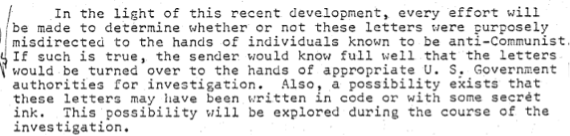
    Pepe FBI

    The HSCA 1978 report sheds more light on the cast of characters and the Pepe affair:

    Concerning the third letter sent to Guatemala, it states that the intended recipient Carlos Meneses was not associated with a P.O. Box 347 in Guatemala City and consequently the letter was intercepted. It describes how Radio Libertad operatives in Caracas contacted the U.S. embassy to let them know about their broadcasting initiatives in Latin American countries, including Cuba.

    The sender Jose Menendez and his wife Carrie Hernandez had been described by the informant as members of the Tampa FPCCMenendez got a “top Job” in the Cuban Government after his return. He and his wife are said to be extremely pro-Castro. Concerning Olga Duque, the HSCA repeats how the Morales letter went from her to Gajate, to eventually make its way to the Secret Service, without divulging the CIA Miami station role in the logistics. Aida Mayo is described as a founder of an anti-Castro organization. Olga and Aida shared an apartment.

    Concerning the intended recipient of letter 2, Antonio Rodriguez, the reports are a mixed bag. One lead with thin traces connected his father with the assassination of an anti-Castroite in Haiti. Another points to links with a Castro henchman named Pino Machado. (Note: a base story for a pro-Castro conspiracy could have emerged had a plot developed further.)

    The HSCA Weighs in

    The Warren Commission paid no attention to the Pepe incident and only made fleeting mention of the Pedro Charles letters, lazily fluffed off as a hoax by the FBI.

    The HSCA published a 165-page report (180-10108-10017 titled ANTONIO GUILLERMO ROGRIGUEZ JONES.) Towards the beginning of the report exchanges among intelligence agents all the way up to Chief Rowley, head of the Secret Service, and FBI director Hoover emphasize the seriousness of these letters. S.A. Marshall is extremely insistent about the importance of looking into Menendez. 

    The HSCA Final Report

    While the above is a summary of the raw data concerning the Havanna 1962 letters, the HSCA presented in a report, Volume 3 of its final report in which there is precious little value when it comes to interpretation. As we have seen, the FBI fluffs all of this off as simply Cubans muddying the wells. The HSCA toed the line, which seems contradictory to its criticism around the absence of case linkage regarding potential patsy Policarpo Lopez, whom they linked to suspicious behavior in and around the assassination in 1963 (compare the double standard):

    Lopez would have obtained a tourist card in Tampa on November 20, 1963, entered Mexico at Nuevo Laredo on November 23, and flew from Mexico City to Havana on November 27. Further, Lopez was alleged to have attended a meeting of the Tampa Chapter of the FPCC on November 17… CIA files on Lopez reflect that in early December 1963, they received a classified message requesting urgent traces on Lopez… Later the CIA headquarters received another classified message stating that a source stated that “Lopes” had been involved in the Kennedy assassination… had entered Mexico by foot from Laredo on November 13…proceeded by bus to Mexico City where he entered the Cuban embassy…and left for Cuba as the only passenger on flight 465 for Cuba. A CIA file on Lopez was classified as a counterintelligence case…

    An FBI investigation on Lopez through an interview with his cousin and wife as well as document research revealed that… He was pro-Castro and he had once gotten involved in a fistfight over his Castro sympathies.

    The FBI had previously documented that Lopez had actually been in contact with the FPCC and had attended a meeting in Tampa on November 20, 1963. In a March 1964 report, it recounted that at a November 17 meeting… Lopez said he had not been granted permission to return to Cuba but was awaiting a phone call about his return to his homeland… A Tampa FPCC member was quoted as saying she called a friend in Cuba on December 8, 1963, and was told that he arrived safely. She also said that they (the FPCC) had given Lopez 190$ for his return. The FBI confirmed the Mexico trip (Lopez’ wife confirmed that in a letter he sent her from Cuba in November 1963, he had received financial assistance for his trip to Cuba from an organization in Tampa)… information sent to the Warren Commission by the FBI on the Tampa chapter of the FPCC did not contain information on Lopez’ activities… nor apparently on Lopez himself. The Committee concurred with the Senate Select Committee that this omission was egregious since the circumstances surrounding Lopez’ travel seemed “suspicious.” Moreover, in March 1964 when the WC’s investigation was in its most active stage, there were reports circulating that Lopez had been involved in the assassination… Lopez’ association with the FPCC, however, coupled with the fact that the dates of his travel to Mexico via Texas coincide with the assassination, plus the reports that Lopez’ activities were “suspicious” all amount to troublesome circumstances that the committee was unable to resolve with confidence.

    So, what fingerprints did they pick up on the Menendez links to the FPCC, the similarities with the Pedro Charles letters and Oswald’s last letter, and the fact that Menendez was deemed an FBI suspect in an assassination plot…?  None! None they wished to discuss that is. The HSCA also deflected somewhat by speculating that Menendez may have been someone else (Juan Jose Mulkay Gutierrez- 1977 File 104-10506-10036). The HSCA ended by concluding that there was a probable conspiracy but leaned towards a Mafia-centric one. The Pepe letters did not support this concept.

    SGA, JMWAVE, Task Force W, and SAS

    Dave Boylan is a co-author of the book The Oswald Puzzle and the essays The Wheaton Lead and The Red Bird Airport Leads. He is regarded as one of the leading researchers of JFK assassination-related files and he is currently working with this author on a far-reaching JFK research project. In it, we have produced the beginnings of the CIA org chart for 1963 as well as one specifically for the CIA station in JMWAVE and another for the SAS CIA cell. No one understands this structure more than Dave. Interested in the Pepe letters, he helped me decode some of the files and added a few to the mix. Thanks to this we can better understand the extended team that was involved with this covert operation, whether wittingly or not.

    From Spartacus: “After the Bay of Pigs disaster, President John F. Kennedy created a committee (SGA) charged with overthrowing Castro’s government. The SGA, chaired by Robert F. Kennedy (Attorney General), included John McCone (CIA Director), McGeorge Bundy (National Security Adviser), Alexis Johnson (State Department), Roswell Gilpatric (Defence Department), General Lyman Lemnitzer (Joint Chiefs of Staff) and General Maxwell Taylor. Although not officially members, Dean Rusk (Secretary of State) and Robert S. McNamara (Secretary of Defense) also attended meetings.

    At a meeting of this committee at the White House on 4 November 1961, it was decided to call this covert action program for sabotage and subversion against Cuba, Operation Mongoose. Attorney General Robert F. Kennedy also decided that General Edward Lansdale (Staff Member of the President’s Committee on Military Assistance) should be placed in charge of the operation.

    The CIA JMWAVE station in Miami served as operational headquarters for Operation Mongoose. The head of the station was Ted Shackley and over the next few months, he became involved in the attempt to overthrow Fidel Castro. One of Lansdale’s first decisions was to appoint William Harvey as head of Task Force W. Harvey’s brief was to organize a broad range of activities that would help to bring down Castro’s government.”

    After Harvey left America for Rome, Desmond FitzGerald stepped in to provide new leadership to the Cuban division at Headquarters, renamed as the Special Affairs Staff (SAS). Harvey stepped down as chief of Staff D.”

    By painstakingly assembling names from files, searching through directories, and working with colleagues, David and I have been putting together org charts representative of the CIA in 1963. It is a colossal work in progress that does sometimes involve guesswork and evolving conclusions. Of interest for this article is the 63-64, org chart of SAS developed by David. (Note: William Harvey does not figure in this because he had by then been demoted and exiled. In 1962, he would have had a prominent position near the top of a structure SAS replaced called Task Force W). By visiting Appendix 5, the reader will better appreciate how many of the persons profiled below worked within the Counterintelligence section of SAS under Fitzgerald in 63 and Harvey in 62.

    David’s first take on the files we looked over proved very insightful:

    These are very close to the Pedro Charles letters! I suspect that the person that sent these was a cutout/asset for the Psychological Warfare, Propaganda guys. Notice that the memo went to Paul Maggio and Rufus ‘Austin’ Horn. Horn was SAS/Counterintelligence who met with FBI liaison Sam Papich every day. Horn worked for Hal Swenson, who worked for Harvey and later, Dez Fitzgerald. The initial source was a PW/Prop anti-communist radio station (Olga Duque). From there to an AMOT (Gajate). The AMOT sent it to JMWAVE, most likely the head of the AMOTs, Tony Sforza. Then JMWAVE sent it along to SAS (Maggio and Horn) who brought in the FBI (Papich). Of course, Harvey would have seen this.”

    Dave later added the following:

    Another possible source of the letters was members of the DRE—the Student Revolutionary Directorate. The DRE was a “specialized” student group of the larger Revolutionary Directorate. The student group was founded in the summer of 1960 by Ross Crozier (Harold Noemayr) and William Kent (Oliver Corbus/Doug Gupton) under the direction of Philip Toomey (Robert Trouchard) and David Phillips (Michael Choden) and designated AMSPELL. Kent was first introduced to Juan Salvat (AMHINT-2) by Alberto Muller (AMHINT-1). Salvat knew Kent as Gupton. Other early members of AMSPELL were Isidro Borja (AMHINT-5), and Luis Fernandez Rocha (AMHINT-53)AMSPELL was split into three sections: AMSPELL itself, AMHINT and AMBARB. AMSPELL proper was managed by Ross Crozier, AMHINT, the paramilitary section, was managed by David Morales, and the AMBARB (propaganda) section was managed by Calvin Thomas. (Note: Oswald’s interaction with the New Orleans chapter of the DRE in the summer of 1963 was key in creating his pro-Castro credentials and adding to his Mexico links to Phillips.)

    David Morales, who was part of the 1954 Guatemala coup (operation PBSUCCESS) with Phillips, was also chief of operations for the Bay of Pigs invasion under Ted Shackley at JMWAVE and was reportedly involved in various assassination projects including the capture and killing of Che Guevara and later aided repressive governments in South America.

    1) Lt. Ramos

    This link File 104-10308-10271 and File 104-10308-10272 establish that Castro’s close friend Lt. Ramos could be Menendez, the alleged FPCC-linked sender of Pepe’s letters. The latter file identifies William Harvey as its author. These files pertain to a project to assassinate Castro in 1962 called AMRANGE, likely led by Harvey.

    2) Augusto Cesar Gajate Puig

    The Morales letter was received at JMWAVE on December 7, via Augusto Cesar Gajate Puig, a Cuban exile involved in the fight for a free Cuba, who had received it from Olga Duque who worked for the CIA-sponsored Radio Libertad. The reason she got to handle it was because the letter was suspiciously mistakenly addressed to this right-wing conduit by supposedly communist assassins working for Castro. File 104-10308-10249 refers to Gajate as a CIA contact and expresses a need to protect his identity. 104-10506-10015: ROUTING SHEET AND GREEN LIST NAME CHECK REQUESTS/RESULTS describes him more specifically as an AMOT contact. AMOT is a cryptonym for a network of Cubans trained by David Morales during 1960-61 to be a new Cuban intelligence service once Castro had been ousted. It became a proprietary which produced economic and sociological reports in support of Cuban operations.

    3) Rufus Horn

    A report about the letter (appendix 3) was then written up by Rufus Horn who signed it (by direction of Victor Wallen) as the liaison as well as in lieu of William Harvey above his name at the bottom of the report. The report is sent on December 8 to the FBI, Secret Service, and Department of State.

    Rufus Horn, also known as Austin Horn, was a key liaison within the SAS group and TFW as well as with the FBI (File 104-10269-10134) where he interacted with Sam Papich. He was also well connected with Desmond Fitzgerald of the CIA who led the all-powerful SAS group that enacted major covert activity policies.

    Horn was put in the loop when Oswald was arrested for a street fight with a DRE operative (Carlos Bringuier) around his provocative FPCC leafleting activities in New Orleans in 1963: (from State Secret, Simpich, Chapter 5) “Anderson received a Sept. 24 report of Oswald’s arrest, which revealed Oswald’s request to speak with an FBI agent and share quite a bit of information while in jail: Austin Horn, the Special Affairs Staff (SAS) liaison with the FBI, also got his copy of the September 24 report on October 8. The routing sheet indicates that Horn’s copy was signed for by ‘LD,’ SAS/CI L. Demos. This document was passed on to SAS/CI/CONTROL, then Egerter, and then CI/IC Cal Tenney. Horn was active on the Cubela case at its end in 1965.” (Note: The Cubela case was another plot to assassinate Castro involving Harvey.)

    4) Richard Tansing

    Another person whose name appears in many of the Pepe letter files is Richard Tansing. Tansing describes himself as C/TFW/CI. His boss, Harold Swenson, used the pseudonym of Joseph Langosch while serving as C/SAS/CI and C/WH/SA/CI between 1963 and 1965. In a cable on October 17, 1963, that was originated by Anita Potocki (Harvey Assistant), SAS/CI, and Tansing C/SAS/CI, was a Coordinating Officer.

    Tansing is also linked to William Harvey, Desmond Fitzgerald, Sam Halpern (all TFW or SAS), Win Scott (Chief of Station in Mexico City), Papich of the FBI, as well as soldiers of fortune: Frank Sturgis (of Watergate fame) and Gerry Patrick Hemming (104-10048-10217: FRANK ANTHONY STURGIS, ALSO KNOWN AS FRANK FIORINI and 104-10218-10274: ROUTING AND RECORD SHEET). 

    Tansing was involved in an effort to recruit the Cuban Head of the Mexico City embassy, Eusebio Azcue (who had contact with Oswald) shortly before the Mexico City charade, the Cubela assassination of Castro plot, and direct involvement with CIA FPCC assets and covert activities.

    5) Anita Potocki

    Anita Potocki was Bill Harvey’s long-time loyal aide. She helped potential patsy Santiago Garriga set up an FPCC chapter in Miami. She aided CIA FPCC informant Thomas Vicente (who helped Oswald with his New Orleans Chapter) travel to Cuba as an asset for the CIA. She is also closely linked to David Phillips. Her relations with Tansing are noted above.

    6) Desmond Fitzgerald

    Fitzgerald was the head of a secret unit within the CIA called the Special Affairs Staff. His top priority, as directed by SAG, was to eliminate Castro.

    Note: In a nutshell, we can conclude that those involved in handling the Pepe letters within the CIA coalesced under Harvey and then Fitzgerald mostly in the CI section of SAS. SAS had its tentacles in JMWAVE where covert activities involving AMOTs (like Gajate) were run as well as Mexico City activities (where David Atlee Phillips was based).

    7) David Phillips

    “I’m firmly convinced now that he [Phillips] ran the red herring, disinformation aspects of the plot. The thing that got him so nervous was when I started mentioning all the anti-Castro Cubans who were in reports filed with the FBI for the Warren Commission and every one of them had a tie I could trace back to him. That’s what got him very upset. He knew the whole thing could unravel.” Dan Hardway (HSCA investigator), from Gaeton Fonzi’s  The Last Investigation

    From Spartacus: “David Phillips also worked undercover in Cuba (1959-60). He returned to the United States in 1960 and was involved in the organization of the Bay of Pigs operation. During this period he worked with E.Howard Hunt in the attempts to have Fidel Castro murdered. Phillips later worked under Winston Scott, the head of the CIA station in Mexico.

    Desmond FitzGerald arrived in Mexico City to tell Phillips that he had the freedom to roam the entire Western Hemisphere mounting secret operations to get rid of Fidel Castro. Phillips now worked closely with David Morales at JMWAVE in Miami. Phillips also provided support to Alpha 66. It was later claimed that Phillips told Antonio Veciana his goal was to provoke U.S. intervention in Cuba by ‘putting Kennedy’s back to the wall…’ 

    David Atlee Phillips served as Station Chief in the Dominican Republic and in Rio de Janeiro. In 1970, he was called to Washington and asked to lead a special task force assigned to prevent the election of Salvador Allende as President of Chile. Allende was killed in a military takeover in 1973.”

    From Someone Would Have Talked, Larry Hancock: “However, there are two further indications that he was either aware of the conspiracy or actively supported it.

    One of these is from conversations David Phillips had with Kevin Walsh, a former HSCA staffer who went on to work as a private detective in Washington, DC. In a conversation not long before his death, Phillips remarked: ‘My private opinion is that JFK was done in by a conspiracy, likely including American intelligence officers.’ — David Atlee Phillips, July 1986.

    The second conversation was related in an email exchange between researcher Gary Buell and David Phillips’ nephew, Shawn Phillips. As Shawn described in the email, Shawn’s father, James Phillips, became aware that his brother, David, had in some way been ‘seriously involved’ in the JFK assassination. James and David argued about this vigorously and it resulted in a silent hiatus between them that lasted for almost six years.

    As David was dying of lung cancer, he called his brother. Even at this point, there was apparently no reconciliation between the two men. James asked David pointedly, ‘Were you in Dallas that day?’ David answered, ‘Yes,’ and James hung up the phone on him.

    8) William Harvey

    Harvey hated the Kennedys, wrote up the executive action program called ZRRIFLE, and led Task Force W, which headed Operation Mongoose (an anti-Castro sabotage program). At the height of the Missile Crisis, he foolishly defied the Kennedys by sending three commando units to Cuba. This got him exiled to Rome. ZRRIFLE describes the importance of ensuring corroborative paper trails when planning elimination programs. Harvey was singled out by HSCA investigator Dan Hardway as a person of extreme interest in the assassination… something our studies confirm as a point of agreement among most researchers.

    From Spartacus on William Harvey: “At a meeting of this committee at the White House on 4 November 1961, it was decided to call this covert action program for sabotage and subversion against Cuba, Operation Mongoose. Attorney General Robert F. Kennedy also decided that General Edward Lansdale (Staff Member of the President’s Committee on Military Assistance) should be placed in charge of the operation.

    The CIA JMWAVE station in Miami served as operational headquarters for Operation Mongoose. The head of the station was Ted Shackley and over the next few months became very involved in the attempt to overthrow Fidel Castro. One of Lansdale’s first decisions was to appoint Harvey as head of Task Force W. Harvey’s brief was to organize a broad range of activities that would help to bring down Castro’s government…

    During the Cuban Missile CrisisRobert Kennedy instructed CIA director John McCone, to halt all covert operations aimed at Cuba. A few days later he discovered that Harvey had ignored this order and had dispatched three commando teams into Cuba to prepare for what he believed would be an inevitable invasion. Kennedy was furious and as soon as the Cuban Missile Crisis was over, Harvey was removed as commander of ZRRIFLE. On 30 October 1962, RFK terminated ‘all sabotage operations’ against Cuba. As a result of President Kennedy’s promise to Nikita Khrushchev that he would not invade Cuba, Operation Mongoose was disbanded.

    Harvey was now sent to Italy where he became Chief of Station in Rome. Harvey knew that Robert Kennedy had been responsible for his demotion. A friend of Harvey’s said that he ‘hated Bobby Kennedy’s guts with a purple passion.’”

    The Usual Suspects

    There are numerous reasons that many researchers have suspected David Phillips and William Harvey as being part of the conspiracy. It is Harvey’s links with Johnny Rosselli and the mob, his suspicious behavior during the months leading up to the assassination–including a possible visit to Dallas–his hatred of the Kennedys, and his experience in executive action; all these that make Harvey of extreme interest.

    In the case of Phillips, his universe is so intertwined with Oswald’s through his ties to Mexico City, the FPCC, the DRE, Alpha 66, New Orleans right-wing networks, George Joannides, etc. that renders him suspicious. He also made quasi-confessions—including being in Dallas on the day of the assassination– revelations that have led most researchers to suspect him.

    What do the Pepe letters add to the mix?

    If one agrees that—their similarities with the 1963 letters, the FPCC links of the sender, and the total post-assassination complacency displayed by investigators of this despite the obvious fingerprints and the labeling of Menendez as a suspect are not a matter of happenstance–then we can conclude that this incident, like so many others, was deep-sixed, because it went against the lone nut scenario.

    This author believes it went further than just this:

    – The fabrication of a false paper trail is alluded to in William Harvey’s executive action plan called ZRRIFLE. So are the tactics of shifting the blame on a foe and the use of proxies. All this is in full display with the Pepe letters.

    – The 1963 letters have content that only a few people could have known about, including alleged bribes and Oswald’s fall 1963 displacements. One of these people is clearly suggestive of  Phillips and another could well be William Harvey, who worked closely with Phillips in the past on covert activities and whose assistant, Anita Potocki, worked closely with the Mexico City station.

    – The 1962 letters occurred one year earlier and share a similar template with the 1963 letters. These were certainly two false flag operations organized by the same perpetrators.

    – William Harvey had already turned on the Kennedys by the time he tried to sabotage the Kennedy/Khrushchev diplomacy attempts at the height of the Missile Crisis. Phillips expressed his disgust with the failed Bay of Pigs mission which he blamed on JFK.

    – Over and above his privileged knowledge, Phillips had the contacts in Havana, in Mexico City, and at JMWAVE in Miami as well as the false flag expertise to pull off these tactics.

    – It is interesting to note that one of the recipients of the Pepe letter was a CIA conduit called Radio Libertad out of Miami. And one of the 1963 recipients was the Voice of the United States of America, another Cold War propaganda organization. Phillips would have been well acquainted with these organizations as he himself used such tools in his regime change propaganda efforts.

    Conclusion

    This author had opinions, based on intelligent speculation, about who was involved in the assassination. The prior plots to remove JFK confirmed a template. Ergo, solving a prior plot meant solving the JFK assassination. Because of negligence and obfuscation on the part of investigators, this proved difficult.

    Two things changed all this in the past four months: one—a better understanding of the intelligence universe of 1963 that culminated in organizational charts and two—the Pepe letters. 

    With declassification, the current downfall of Warren Commission apologists was predictable. The files not only torpedoed the lone-nut scenario and disgraced the Warren Commission, but they revealed the biggest challenge facing conspiracy deniers caused by the shift to pushing a lone-nut scenario which had to be improvised because the blame Castro scenario was overruled after the assassination. The fairy tale spinners could not put all the toothpaste back in the tube. Fabrication, witness intimidation, coercing media, and file classification became the order of the day. Until 1991, when the movie JFK, gave us the declassification of thousands of files, and changed the assassination universe.

    The Pepe letters operation proved more difficult to sweep under the rug because it occurred in 1962 and had been analyzed by the FBI and the Secret Service, both genuinely concerned by the threat. A suspect for a plan to remove Kennedy linked to the FPCC had been identified. The knee-jerk dismissal of the Pepe letters does not hold water. The HSCA simply tabled them, until against all odds, they were found decades later, and are only now being analyzed in detail.

     What we can take away from the Pepe Letters is monumental and could be even more incriminating with more research.

    1. The Pepe letters bear too much of a resemblance to the 1963 incriminating correspondence for them not to be linked.
    2. Both correspondence initiatives were designed to incriminate Fidel Castro in plots to kill JFK.
    3. Both initiatives use FPCC links to taint the offenders.
    4. Both initiatives correspond closely with the ZRRIFLE executive action template mastered by both William Harvey and David Phillips who are regime change specialists.
    5. Phillips’s network is omnipresent in the false flag operations around Oswald in 1963.
    6. Harvey’s network is very closely connected to the characters involved in the post-reception phase of the Pepe letters.
    7. Harvey and Phillips connect closely through their regime change operations history, members of their networks, and relations between TFW/SAS and Mexico City.
    8. Both shared a hatred of the Kennedys.
    9. SAS was a critical conduit between regime change operators and those who set policy.
    10. The post-assassination analysis was cursory and evasive.

    It remains difficult to determine who, within the networks, acted wittingly vs. unwittingly and who figured out after the fact the minutiae around the operations. However, if we conclude that what happened in the 1962 and 1963 false flag operations discussed in this article are not the result of mere happenstance, and that neither the Cubans, Mafia nor lone wolves could have pulled these plots off, we can conclude that they were coordinated by the same perpetrators who are regime change specialists.

    Find out who designed tactics for either the false flag plots, their roll-out, the propaganda themes, and who got the instructions through to contacts in Havana to send the letters, who set up the FPCC tainting strategy… You have a strong case of who was behind the JFK assassination at the operations management level. 

    Appendices

    A 9-page PDF with all appendices may be found here.


  • The Protected JFK Files

    The Protected JFK Files

    The Protected JFK Files

    With Donald Trump re-assuming the Presidency in January, it is time to ask the question: What will or what can President Trump do about the 3,600 protected JFK assassination records?  

    I use the word “protected” for a reason.  The ARRB had the authority under the JFK Records Collection Act of 1992 (JFK Act) to postpone the release of certain assassination records under very specific standards in the JFK Act.  The ARRB made specific postponement and release decisions on each record that agencies sought to protect after 1998 when the ARRB’s work was done.  Agencies do not have the right to protect those records in perpetuity, which is what we are facing today.  This article will dissect the problem and what Trump and Congress can do about it.  We will also discuss what information is likely found in the remaining protected records, which sheds significant light on WHY agencies are fighting so hard to maintain secrecy.  

    What will President Trump do?  We do not know for sure.  He has recently pledged to resist pressure from agencies and authorize the release of the remaining withheld records.  Trump has Robert Kennedy, Jr. in his cabinet, who is no doubt committed to this effort.  RFK, Jr. believes that the CIA is responsible for the assassination of his uncle, President John F. Kennedy.  I agree, which is discussed in detail below.  RFK, Jr.’s commitment is so serious that he is seeking to have Trump appoint his daughter-in-law as the new CIA Deputy Director.  That might rattle some cages in Langley.  

    But in reality, all the CIA has to do is abide by the final decisions that the ARRB already made when it had the chance to negotiate with the ARRB on the final release date. In no event was any record to be withheld past October 26, 2017 under the clear language in the JFK Act.  More than 7 years later, and 61 years after the JFK assassination, the agencies are still fighting harder than ever on this issue.  The bottom line is that agencies, chiefly the CIA, cling to a fierce belief that it has the unrestricted power to break the law.  The belief it has the authority to continue dictating to the President and to Congress the information that can be shared with the American public.  That has to change, and the release of the protected JFK records would be a major step toward change in this power struggle on secrecy and transparency.  

    Understanding the Problem

    Before we talk about the solutions that are available to President Trump and Congress, it is important to look at the reason for this problem.  To examine the answer to the questions: Why is the CIA still willing to break the JFK Act and ignore the ARRB’s final decisions?  Why did the CIA pressure both Presidents Trump and Biden to do the same between 2017 and today?  I believe the answers lie with Lee Harvey Oswald and the 61-year cover up of his known assignments and activities and how they probably explain what happened in Dallas on November 22, 1963.  At the very least, the protected records show that the CIA created a false identity for Oswald, used that to its advantage before and after the assassination, and has covered that up for 61 years.

    Today, we have a very good idea of what information is likely in the CIA’s protected records, and only full public disclosure of those records can prove otherwise.  Here is what we know today, and there is no legitimate dispute about it.

    We know that the CIA sponsored an operation known as AMSPELL, which was designed to infiltrate leftist organizations in the U.S. that supported Castro’s regime in Cuba.  The AMSPELL network included the DRE–Directorio Revolucionario Estudiantil–an anti-Castro organization that operated in New Orleans in the summer of 1963. Its titular head was Carlos Bringuier, and according to Howard Hunt’s HSCA testimony, it was originated by David Phillips.

    We know that the AMSPELL/DRE network had direct contact and involvement with Lee Harvey Oswald in New Orleans in August of 1963.  Those activities resulted in a public and, in all likelihood, a staged altercation with Oswald, leading to his arrest.  The result being that Oswald was detained in jail and paid a fine for receiving a punch from Bringuier.

    We know also about operation AMSANTA, a joint FBI/CIA program designed to place willing Fair Play for Cuba Committee (FPCC) members into Cuba to collect intelligence.  We also know that Oswald met at length with the FBI after his arrest—the visit lasted for well over an hour–while in police custody in New Orleans.

    After Oswald’s arrest in New Orleans, the DRE leaders arranged for Oswald to appear on local TV and radio stations, where he flashed his fake Fair Play for Cuba Committee (FPCC) credentials and talked about his beliefs as a “pro-Castro Marxist”.  The FPCC was the exact organization that these intelligence operations—FBI, CIA, DRE– were targeting.  And Oswald was in the middle of it all.

    The evidence strongly indicates that a CIA operation was used weeks later in Mexico City. Done to further advance the legend that Oswald was a “Castro patriot” desperately seeking entry into Cuba.  A bit over six weeks later, President Kennedy was assassinated in Dallas by the alleged “lone assassin” Oswald.  

    In Chapter Two of The JFK Assassination Chokeholds, Oswald’s intelligence connections are discussed at length.  To put it mildly, he was no “lone nut” assassin.

    We know that within hours of the assassination on November 22nd, CBS broadcasted to the world Oswald’s radio and TV interviews from New Orleans, where he discussed his “work” with the FPCC and claimed to be a “Marxist”.  Where did CBS get all of this information on Oswald so suddenly?  Was it through the CIA’s AMSPELL/DRE network?   

    We know of a project  known as “Operation Northwoods”, a Pentagon scheme designed to provoke war with Cuba by using a “spectacular” act of violence in the United States, utilizing covert CIA personnel to arrange for the blame to fall on Casto.  Creating pretext and public support for the President to finally invade Cuba.  Is this not similar to what happened in Dallas on November 22?  With Oswald, the Castro sympathizer, in perfect position to take the immediate blame?  Thus provoking an invasion of Cuba.

    A complete release of the withheld JFK assassination files would likely disprove the above.  Yes, the JFK Act authorized agencies to request continued withholding of sensitive assassination records that could or would disclose an intelligence “source or method.”  Those requests (thousands of them) were made to the ARRB in the 1990’s, and the ARRB was the arbiter.  Only the President had authority to continue postponement if there was still clear and convincing evidence that a record, if disclosed publicly, could still harm a current intelligence source and method.   

    But back to the ultimate problem today.  It is already known that agencies were using operations like AMSPELL and AMSANTA to infiltrate the FPCC.  It is already known that the AMSPELL/DRE network had direct and public involvement with Oswald in New Orleans.   It is already known that CIA officer George Joannides managed the AMSPELL operation in New Orleans that utilized Oswald’s fake FPCC credentials.  We already know about the CIA operation in Mexico City involving Oswald (or more likely an imposter).  Is then the AMSPELL/DRE operation involving Oswald and the FPCC still a current source and method?  No.

    There is an undeniable conclusion here.  The only plausible reason for the intelligence agencies to fight tooth and nail on the remaining withheld records is that all information on Oswald, AMSPELL, AMSANTA and Mexico City would finally be public.  And those intelligence operations played a part in what happened on November 22, 1963 in Dallas. 

    Solutions for Trump and Congress

    In November, I had the chance to speak at the CAPA conference in Dallas on the legal status of this case.  I had the pleasure of presenting with Larry Schnapf and Jacob Hornberger.  The Mary Ferrell Foundation is still working through its lawsuit seeking compliance with the JFK Act.  Of course, the Department of Justice lawyers are still fighting very hard to confuse the Ninth Circuit in California regarding the scope and purpose of the JFK Act.  The Appellate Court will ultimately decide whether that case will change the momentum on this historic issue.

    However, regardless of what happens with that lawsuit, I believe that President Trump and Congress can independently solve the problem without the need for more lengthy lawsuits.

    New ARRB

    Representatives in Congress are working on new legislation that would create an extension of the JFK Act.  If successful, this legislation would create a new independent panel that would finish the historical work of the ARRB from the 1990’s.  The new legislation should reiterate that the ARRB was the final arbiter on postponements and that only the President has the authority to make record-specific determinations on which assassination records, if any, still pose an identifiable harm to a current person or a current source or method of the agencies.  That is what the JFK Act of 1992 already says!  

    An “ARRB 2.0” would start by locating and reviewing all of the final decisions made by the ARRB in the 1990’s and ensure that agencies have complied with those postponement and release decisions.  A new ARRB should also be empowered to locate any assassination records that are still withheld entirely by agencies or not even archived at NARA as they are required to be.  The new ARRB should then have authority to make record-specific final decisions on those records, similar to what the ARRB did 30 years ago.

    In concert with this, Congress this time can actually use its oversight authority to ensure that the agencies are fully cooperating with the new ARRB.  To ensure that the President exercises proper authority over executive branch records that agencies still wish to protect.  And in the rarest of cases where an agency could still seek protection on a record or group of records, the President must make a record-specific determination on postponement under the standards of the JFK Act, as extended by Congress now.  Again, congressional oversight committees had that authority in the original JFK Act of 1992.  They did not utilize it.

    President Donald Trump

    The problem with new legislation is that we do not know if it will succeed in Washington,  or if it does, how long it will take to enact.    Trump, however, can take immediate action and has pledged to do so when he resumes office.  He can rescind President Biden’s executive orders that made the issue worse (if that was even possible).  Biden’s “Transparency Plans” practically encouraged continued secrecy from the agencies and did not actually require transparency.

    Trump also needs to address what happened in 2017 when he authorized delays on the assassination records, which eventually led to Biden’s orders.  What happened there?  Trump himself has hinted at it in a recent interview with Joe Rogan.  He privately told trusted advisor Andrew Napolitano that he wanted to release the records when he was President but was under severe pressure from agencies (namely the CIA and director Mike Pompeo) not to do so.  Trump was misled on what the JFK Act required, and he was convinced that the remaining protected records were still “too sensitive” to release.  Too sensitive in terms of who Oswald actually was and what he was doing?  Or too sensitive for the CIA to explain in terms of the 60-year cover up of the operations involving Oswald and how they resulted in Dallas?

    Trump can also address the faulty legal advice he received from the DOJ at the eleventh hour in 2017, which essentially re-wrote the JFK Act without legal authority and set the stage for more secrecy and postponements.  The DOJ is using that same legal strategy in the aforementioned lawsuit.    A new attorney general can ensure that the JFK Act is properly interpreted and that its purpose and intent is finally carried out.  

    Finally, there is talk about Trump authorizing a new Presidential Commission to investigate assassinations.  I support this as well.  No doubt this Presidential Commission would not be another Warren Commission that was set up by President Johnson  and J. Edgar Hoover to cover up both Oswald and his known domestic intelligence connections.  It could lead to a new investigation of the JFK case, the RFK case and the assassination attempt in Pennsylvania on Trump himself.

    Regardless, there is little doubt that Trump can have success on this issue if he orders compliance with the JFK Act of 1992, as currently written, and works with Congress on solutions it can provide.  If he strikes the appropriate balance of following the JFK Act, while still protecting actual living persons and current sources and methods.  

    Conclusion

    The agencies will not give up the fight.  That is clear. We have discussed solutions.  Perhaps the final withheld JFK records will not show much at all and that we are simply dealing with stubbornness and belief from agencies that they are above the law.  Logic certainly dictates otherwise.  All signs point to the withheld records containing a lot more information on Oswald and his assignments and activities in New Orleans, Mexico City and Dallas.  And that various components of the CIA were sponsoring or guiding Oswald’s activities.  Those records probably will not show a direct connection to the actual assassination operation in Dallas–but do they even need to at this point?  We already know that the Joint Chiefs and the CIA-Mafia apparatus were itching to use a “Northwoods” type event to spark an invasion of Cuba.  The intelligence operations connected to Oswald in New Orleans and Mexico City were probably the final piece to that plan.  Regardless, it is time to let the records, already reviewed with scrutiny by the ARRB in the 1990’s, speak for themselves. 

  • A Spy on our Side: Amaryllis Fox Kennedy and JFK Assassination Transparency

    A Spy on our Side: Amaryllis Fox Kennedy and JFK Assassination Transparency

    A Spy on Our Side: Amaryllis Fox Kennedy and JFK Assassination Transparency

    The Axios  news outlet ran a story a few days ago about Robert F. Kennedy Jr.’s endorsement of his daughter-in-law, Amaryllis Fox Kennedy, for deputy director of the CIA (“Exclusive: RFK Jr.’s secret push to prove CIA killed uncle,” Stef W. Kight, Mike Allen, Dec. 11, 2024). Fox Kennedy is a former CIA officer who worked undercover in a counterterrorism capacity and wrote a book about her experiences, Life Undercover: Coming of Age in the CIA (2019). The CIA reacted by suing her for violating non-disclosure agreements and lost. 

    The Axios piece highlights RFK Jr.’s continued prioritization of transparency in the death of his uncle, President John F. Kennedy, since a close and supportive family member in such a senior slot at the agency would further that goal. It surely couldn’t hurt. Nominees for the number-two position at the CIA don’t have to undergo Senate confirmation either, meaning President-elect Donald Trump could appoint Amaryllis directly once he takes office in five weeks’ time.

    It’s always welcome when Bobby Kennedy brings the JFK assassination back into the current news cycle, even if only briefly. Whenever a sixty-plus-year-old event, however momentous, raises its head in today’s headlines, mainstream media naturally sidelines it quickly, before the reading public even has time to focus on it, in favor of the flavor of the week. But the Amaryllis Fox Kennedy story has gained traction for more than a day. It was soon picked up by the neoconservative New RepublicThe Telegraph of the U.K., and other outlets within 24 hours. As of this writing, the (RFK Jr.-hostile) New York Times has run an update to its Dec. 11 article on Friday, Dec. 13. 

    The backlash has already started, Bobby Kennedy’s foppish nephew, Jack Schlossberg, accuses him of being a “Russian spy” for daring to suggest that the CIA had a hand in the murder of America’s 35th president. Schlossberg posted the Axios article to X with the note: “@RobertKennedyJr you are so obviously a Russian spy … You all think I’m joking. Hahahaha”. I’m guessing Jack Schlossberg justifies his failure to offer any evidence that his uncle is an agent of Moscow on the basis that, if he did, he might compromise “national security.” That’s the usual excuse for making such claims. Who can disprove them, after all? Schlossberg’s implication is, if you question the official narrative on JFK’s death, you’re an agent of a foreign power, in this case Russia. In fact, by the reasoning of more than one person I’ve encountered, anyone criticizing the CIA is one of those. 

    But what does today’s Russia have to do with the JFK assassination, a matter of U.S. national history? Schlossberg might be suggesting that JFK’s murder was the result of a Soviet conspiracy at the height of the Cold War, as one or two authors have argued.  It is thus better to keep such evidence hidden under the “need to know” principle. But why? Assuming for the sake of argument that the Soviet KGB murdered Kennedy, the U.S.S.R. collapsed nearly 33 years ago, and the Cold War ended years before that. Schlossberg’s adolescent “in the know” posturing appears baseless. He always looks like he slept on the beach the night before after partying hard, at the expense of late-night research into the assassination of his grandfather. As Trump would say: Sad!

    If the past is anything to go by, we can expect the Amaryllis Fox Kennedy story to die down in the news until Trump makes a decision on her. But again, importantly, the JFK assassination is still a live issue at the top of U.S. politics. A mutual acquaintance told me he asked RFK Jr. directly several months ago when he was running for the highest office, whether his first act as president would be to order the release of the JFK files. Bobby’s answer was that it would be second, after freeing the journalist Julian Assange of the U.S. Department of Justice’s prosecution. Now that Assange is back in Australia and not behind bars, JFK has presumably moved up a notch on the list of open government priorities. In the midst of pursuing his enduring passion to improve public health, Kennedy has found time to remind everyone that the murder of his uncle, who likely saved humanity from extinction during the Cuban Missile Crisis, is still a source of widespread public mistrust. That is a good thing.

    It also needs to be mentioned that President Trump’s nominee for FBI director, Kash Patel, has argued for some time in favor of transparency over JFK (along with 9/11 and other issues). He has vowed to take a “wrecking ball” to the Bureau and even told one interviewer he would shut down the J. Edgar Hoover building on Pennsylvania Avenue and reopen it as a “Museum of the Deep State.” While he’s at it, he could remove Hoover’s name from that monstrosity (considered, in all seriousness, to be a piece of “brutalist” architecture) as part of a national truth and reconciliation process. Alternatively, he could leave Hoover’s name on it when he converts it to a place that features halls of exhibits of the darkest chapters in 20th-century U.S. history. With members of the American public and the countless tourists descending on Washington every year from all over the world, leaving Hoover’s name on a museum like that might be apropos.

    With all that said, including assassination transparency advocates in the Trump II cabinet (Tulsi Gabbard as DNI deserves a mention) is only half the task. Trump himself has said repeatedly that release of the JFK files would be his first act on reentering the Oval Office, aptly describing it to Joe Rogan as a “cleansing” process for the country. But even with the best of intentions, Trump has to handle this carefully, or the federal agencies in control of relevant records will evade even his executive orders, just as they’ve evaded the law until now. The problem, as veteran assassination researchers know, is that the redacted files in the JFK Collection at the National Archives are only part of what’s still hidden. Trump will need a permanent mechanism to “cleanse” the government, and that means a new bureaucratic entity. With his push to “trim fat” from the federal government with the aid of Elon Musk, Vivek Ramaswamy, and a new Department of Government Efficiency, he might feel a new declassification unit would be at cross purposes. Let’s hope not.

    As many here know, I’ve written frequently for the JFK Facts publication of investigative author and historian Jefferson Morley. As vice president of the Mary Ferrell Foundation (MFF), he qualifies as an “activist” in the issue of official disclosure in the JFK assassination. So do the other principals of MFF, such as Rex Bradford and Bill Simpich. MFF is in federal court in California now, still suing the government in the civil action of Mary Ferrell Foundation v President Biden and the National Archives (MFF v Biden). Simpich is the lead attorney for the plaintiffs, who include Josiah Thompson and Dr. Gary Aguilar, and Larry Schnapf is co-counsel. In writing occasional articles about that case, I’ve acquired a greater-than-average familiarity with what’s actually at stake in advocating for government transparency in the matter of JFK. It’s as disturbing as it is fascinating.

    At the core of the litigation isn’t just the JFK Collection. That does, admittedly, include thousands of still-redacted documents that should all be released. However, in many ways the JFK Collection feels like a distraction from the main issue. Government officials and other public figures have occasionally propagated the “nothing to see here” argument about those files. In other words, they say, they’ve seen them, and there’s nothing left there that’s really relevant to the assassination of President Kennedy, so move on. Mike Pompeo said as much in an interview with John Stossel last year. Kash Patel told Glenn Beck several months ago that he had already seen “the entire JFK file,” and that what’s withheld isn’t what JFK assassination researchers are looking for. 

    With all due respect, this is very doubtful indeed. Both Patel and Pompeo basically argue that continued redactions only conceal the identities of people who are still alive and still in need of protection today. That isn’t true. It’s also not true that the still-redacted files left in the JFK Collection don’t relate to the assassination. All you have to do is select a bunch of redacted files at random, read around the redactions, and see that a ton of documents are directly relevant as defined under the controlling federal law, the JFK Records Act of 1992. No one believes that the June 1961 memorandum to President Kennedy by Arthur Schlesinger Jr. on reorganizing the CIA, for example, is unrelated. A page-and-a-half block of its text is redacted, and it’s not all names of individual CIA agents still alive. In short, there are still thousands of files in the JFK Collection kept at NARA II that need to be released in full. They are vital to the ongoing process of completing the historical record. At the same time, however, releasing those files in full won’t get to the heart of the matter.

    Recently I wrote a piece for JFK Facts on Kash Patel’s nomination, entitled, “One Key JFK File That Kash Patel Could Release If He’s Confirmed as FBI Director.” It’s a 30-page FBI file on the prolific Cuban hit man Sandalio Herminio Diaz Garcia, usually known simply as Herminio Diaz, who settled in the U.S. four months before the assassination after requesting political asylum and being debriefed by the CIA. At that time he was working for two people: Florida crime boss Santos Trafficante (as a bodyguard), and ex-Cuban premier Tony Varona (as an agent). Varona himself was a CIA agent with two cryptonyms, AMHAWK and AMDIP-1 who headed the CIA-backed Cuban Revolutionary Council (CRC), which lost its direct government funding some time in 1963, as the Kennedy administration moved toward peaceful coexistence with Castro. But anti-Castro Cuban exile groups such as the CRC had already been cooperating with Trafficante and other organized crime leaders for years, and without financial support from the U.S. government, the Mafia became more important. In the middle of all this was Herminio Diaz, perhaps the most conspicuous human nexus between the CIA and the Mob in the entire JFK assassination saga.

    Whether or not you believe Herminio Diaz took part in the assassination of JFK (as Rob Reiner and Soledad O’Brien concluded in their popular podcast of last year, “Who Killed JFK?”) and whether or not Diaz really was in Dealey Plaza at the time of the assassination, either as a gunman or some kind of facilitator, documents about him are clearly “assassination related” under the federal statute. Has Kash Patel seen the heavily redacted FBI report on Diaz? I wouldn’t bet on it. Furthermore, I’d bet that that report – despite having been created by the FBI – is in Herminio Diaz’s “personality” (201) file, and is thus in the possession of the CIA. If Herminio Diaz’s 201 file is in the JFK Collection at the National Archives, I’m not aware that anyone has located it. There’s the rub.

    The purpose of MFF v Biden isn’t just to compel the government to disclose in full all the files in the JFK Collection. It’s to make sure the process of declassification continues beyond that. As many experts on the subject (some on this site) will confirm, the CIA never honored the “memorandum of understanding” it signed with the National Archives and the Assassination Records Review Board (ARRB) in 1998 to follow up on search requests that remained outstanding when the ARRB wrapped up. Instead, the CIA just dragged its heels and directed researchers to the Freedom of Information Act (FOIA) for their requests all these years. The very purpose of the JFK Records Act and ARRB were to remedy the deficiencies of FOIA. It’s just as in 1964, when CIA counterintelligence chief James Angleton advised his agency colleagues to “wait out the commission.” It’s like from 1976-1979, when the Agency stonewalled investigators of the House Select Committee on Assassinations (HSCA) through illegal appointment of ex-CIA “liaison” George Joannides, as the former chief counsel of the HSCA, Robert Blakey, now publicly admits. And it’s just like when the CIA “waited out” the ARRB from 1994-1998, so that when records were coming in very fast in the final days of the Review Board’s life, the Agency was able to bury important files in the mass and withhold them from the declassification process, as the board’s former chairman, Judge John Tunheim, now publicly admits. As a result, not everything relevant is in the JFK Collection in the Archives today.

    With all the good will in the world, therefore, Amaryllis Fox Kennedy, Kash Patel, RFK Jr., and even President Donald J. Trump himself are going to have to do more to “cleanse” the body politic where the JFK assassination is concerned. Patel has suggested setting up a “24/7 declassification office” in the White House to “take incoming” from the American public on everything from JFK to 9/11 and beyond. Great idea, and we should all hope to see it. But Patel will have to focus on what the “Deep State” he wants to upend is really hiding with regard to JFK, and it isn’t just the names of still-living informants. It’s the 201 file of Herminio Diaz, who died in 1966 in a raid on Cuba, led by Cuban CIA agent Tony Cuesta. It’s more than 40 files on the long-dead Joannides, which the CIA – through sleight of hand – never turned over to the Review Board. It’s a CIA Inspector General’s report spotted by a CIA officer in a Secure Compartmentalized Information Facility (SCIF) in Herndon, VA, relating to CIA strategy to deceive and divert the HSCA, along with a videocassette in a case labeled “Oswald in Mexico.” People with much greater, more detailed knowledge than I have could provide a much longer list, and I would urge anyone wanting more to visit MFF’s lawsuit page (and to donate to the plaintiffs’ case if you can).

    In conclusion, I’d like to make a plug for bipartisanship in these toxically polarized times. To increase our chances of achieving full JFK disclosure, the Trump administration should reach across the aisle to Congressman Steve Cohen (D-Tenn.), perhaps the only member of our national legislature who still qualifies as a genuine “activist” on the subject of JFK. He has sought out other members of Congress over the years to oppose repeated presidential postponements and even secured the signature of a Republican on one his many letters to the White House and (murky) Public Interest Declassification Board (PIDB), urging prompt release of the records. The scheme Biden imposed by executive order in December 2022 – the CIA-devised “Transparency Plan” – is supposed to replace the process established under the JFK Records Act, essentially burying a living law passed unanimously by Congress. Biden has been deaf to all criticism of what he had done on the issue.

    Cohen is currently crafting a bill to recreate the ARRB in some form, to finish the work it was established to do before its premature termination in 1998. The Trump administration should support such an effort. I noted in my article on Kash Patel that his White House declassification office should be compatible with Cohen’s new Review Board. It’s not one or the other. We should have both, and they should work together, one housed in the White House, the other at the Archives. With advocates like Kash Patel and Amaryllis Fox Kennedy occupying high offices in the executive branch, a new statutory panel can help ensure the job is done thoroughly. Of all the issues polarizing Washington today, the JFK assassination spans the toxic divide and has the potential to bridge it. That’s what genuine “truth and reconciliation” means, and that’s what we need. 

  • Malcolm X lawsuit against FBI, CIA and NYPD filed

    The family of murdered black civil rights activist Malcolm X is suing the FBI, the CIA and the New York police department. Read more.

  • Oswald in Japan: How the CIA Deceived Congress

    Oswald in Japan: How the CIA Deceived Congress


    Fig.1[Fig. 1]
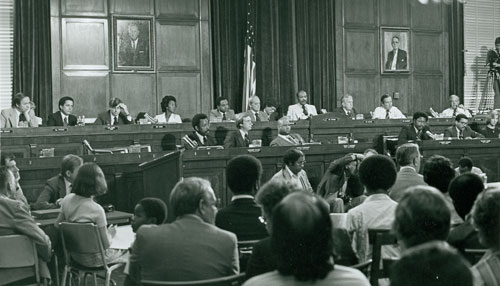
    The House Select Committee on Assassinations (HSCA) reinvestigated the murders of President John F. Kennedy and Dr. Martin Luther King (Credit: U.S. Congress)

    The excellent Solving JFK podcast, hosted by Matt Crumpton, reminds us of a thought-provoking anomaly. The 1964 final report of the President’s Commission on the Assassination of President Kennedy (the “Warren Commission”) says that during his service as a Marine in the Far East, Lee Harvey Oswald, accused assassin of President John F. Kennedy, was in Taiwan from Sept. 30, 1958, but returned to Atsugi, Japan, by Oct. 5. The Warren Report does not say what Oswald was doing in Taiwan, but the House Select Committee on Assassinations (HSCA), which reinvestigated the JFK and Martin Luther King murders in 1976-79, concluded that Oswald never visited Taiwan at all.

    The Solving JFK episode can be heard here.

    This astonishing discrepancy in the official record is another arrow in the quiver of those entertaining the irrepressible theory of the “Two Oswalds.” That thesis essentially holds that there were two men who not only bore an uncanny resemblance to each other but also went by the same identity as a matter of official record in furtherance of an intelligence operation that desperately needed to be suppressed after the assassination.

    The incongruity also, incidentally, strengthens the widespread and more general conviction that agencies controlling information on Oswald, whether the CIA, FBI, military intelligence services or others, repeatedly deceived official investigators. Although the HSCA at least concluded that JFK was “probably” murdered “as a result of a conspiracy,” its inquiry proved to be a “damp squib” overall. It is no longer controversial to assert that the CIA deliberately diverted and stonewalled the HSCA. One area in which CIA deception appears especially vigorous is Oswald’s time in Japan, a chapter that remains an information “black hole,” to paraphrase John Newman, author of JFK and Vietnam (2017) and Oswald and the CIA (2008). The Taiwan episode is just one example.

    This “black hole” has exacerbated suspicions of Oswald’s ties to U.S. intelligence in Japan, as alleged by a former CIA employee based in the Tokyo Station at the time of the assassination. Such connections have never been proven, but in light of the CIA’s obvious deception of the HSCA about Oswald in other areas, especially New Orleans and Mexico City, Agency trickery on Oswald in Japan is also worth studying. JFK researchers of integrity are convinced that the CIA is still concealing the extent of its ties to Oswald, and these links may very well go back to his time in Japan — or even earlier.

    The House of Representatives Inquiry

    On June 12, 1978, a document handwritten by HSCA investigator Harold Leap was forwarded within the CIA. Fully declassified on Aug. 24, 2023, it summarizes Leap’s interviews of 12 employees of the CIA’s Tokyo Station pursuant to “critic publications and specific allegations by former CIA employee James Wilcott that LHO was a CIA agent.” Wilcott had stated in a closed-door HSCA session that “a CIA case officer stationed in Tokyo, Japan, told him that LHO was a CIA agent and also mentioned LHO’s cryptonym.”

    The 71-page document that includes Wilcott’s HSCA testimony and related material refers to an unspecified “Oswald project” requiring disbursements of funds, and to Atsugi as “a plush super-secret cover base for Tokyo Station [i.e., CIA] special operations.” Wilcott, a CIA finance officer, testified that the conversation occurred “in the Tokyo Station shortly after the word of the JFK assassination was received on 23 Nov 1963.” Although Wilcott “could not recall the name of the case officer or the cryptonym,” he said that “considerable conversation took place among CIA employees at the time concerning the Oswald-CIA agent issue.” All 12 interviewees were asked whether they had come across any indication that Oswald was an intelligence agent. All said no.

    The interview notes appear in summarized form for all officers but one, William Crawford, the CIA’s deputy chief of station in Tokyo from March 1959 to October 1960. In fact, all interview subjects are identified as having worked in the station in the period from 1959 through 1964, presumably to account for any CIA employees who were working in the Tokyo Station when Wilcott was, and whom Wilcott might thus have overhead. Yet Oswald was based in Japan from September 1957 to November 1958, and it is striking that no one but Crawford is identified as having served there during that period too.

    Crawford is listed in another CIA document as “acting executive officer” of “Detachment C” when Oswald was serving at the Atsugi Naval Air Station. Detachment C was the CIA unit deployed to Atsugi to operate the U-2 spy plane program, which conducted surveillance missions over Communist China and the Soviet Union. But Crawford was not among the 18 CIA personnel that Wilcott recommended for interview by the HSCA. Even Detachment C’s actual executive officer for the relevant period, Werner Weiss, was not interviewed, despite the fact that he was alive and well in 1978.

    Fig.2[Fig. 2]

    In all, Leap only interviewed four out of Wilcott’s 18 recommendations. Wilcott obviously provided the names of these 18 people because he knew they were working in the Tokyo Station when he (Wilcott) was, but, again, of the four employees that the CIA made available to the HSCA for interviews, nothing indicates that any of them were even in Japan when Oswald was. No explanation is given for this, even though, of the 14 people on Wilcott’s list who were never interviewed by Leap, most were actually serving in Japan during the time Oswald was at Atsugi. Why were they left out of the interviews?

    Leap’s notes from his interview of Crawford say that the subject “didn’t know [Lee Harvey Oswald] and never heard the name until after the assassination.” The only reason Oswald was connected to the U-2 program (and thus the CIA) at all, Crawford said, was that “the CIA at Atsugi did not have their own radio-radar facilities,” so the U-2 planes “utilized the naval base communications only for take-off and landing clearance.”

    Crawford did note that the “CIA recruited personnel for the program from the military service,” however, and “[a]ll program employees were paid by CIA.” He also outlined the system for U-2 personnel resigning from and returning to regular military service. [Note: As Oswald’s tax returns are still withheld in full from the public, we can’t know whether an intelligence agency paid JFK’s accused assassin during his time at Atsugi.]

    Fig.3[Fig. 3]
    Aerial view of Atsugi Naval Air Station as it appeared in 1988 (Credit: Ministry of Land, Infrastructure, Transport and Tourism of Japan/Public Domain)

    CIA Sleight of Hand

    The CIA apparently composed an undated document entitled, simply, “LIST OF AGENCY EMPLOYEES,” in preparation for the HSCA’s 1978 investigation. A table featuring several operatives includes operations officers, and four names — Jerome Fox, William V. Broe, Frederick C. Randall, Robert P. Wheeler — are recognizable from the Leap write-up.

    However, others — notably Japanese-American CIA officers — are included in the still-redacted file and were in the Tokyo Station in the years 1957 and 1958. The most recent declassified version (June 27, 2023) retains redactions in the “Security Posture” column for Chester H. Ito, a CIA operations officer in the Tokyo Station for more than 20 years. Since Ito died in 1999, the Agency is concealing the profile of an employee who died a quarter-century ago but likely worked at Atsugi when Oswald was based there.

    A conspicuous redaction in the CIA’s “LIST OF AGENCY EMPLOYEES” is the name of Number 6, whose security posture suggests a possible Soviet connection:

    Former Department of Army employee in Japan picked up as contract employee. Poly revealed unresolved issues regarding Communist contacts and/or associations.

    Fig.4[Fig. 4]

    Although the name is redacted, it is in the same position in the table as “Robert S. Hashima” in Wilcott’s list of 18 recommendations, and Hashima appears in other documents composed in preparation for the HSCA’s investigation. In his “executive session” testimony to the HSCA, Wilcott describes Hashima as a “deep commercial cover agent,” and elsewhere as a representative of “Fuji Shoji Co. Ltd.” Under or alongside Hashima’s name in CIA documents, regarding whether he should be made available to HSCA investigators, there is simply an unexplained (yet familiar) notation: “Disregard.”

    Yet the most remarkable aspect of the case is this: the HSCA understood the importance of investigating the years 1957-1958 in connection with Oswald. HSCA Chief Counsel G. Robert Blakey, in a letter dated April 26, 1978, requested that the CIA make available for interview the “chief officers and deputy chief officers of the CIA base at Atsugi, Japan from 1956 to 1960.” These years encompassed Oswald’s time in Japan.

    Fig.5[Fig. 5]

    This line of inquiry mysteriously fizzled. On the next day’s routing and records sheet, a handwritten note by Norbert Shepanek of the CIA’s Directorate of Operations says:

    I do not know if there were any DDO officers at Atsugi 56-60. [Deputy Directorate of Science & Technology] is answering separately. Negative reply requested. Shep

    Following this, in a handwritten note on an official routing slip dated (apparently) May 2, 1978, S&T officer Carroll Hauver (later CIA Inspector General) disseminates the falsehood that Atsugi was just a “support base staffed by support personnel” during 1956-60. That seems to have shut the inquiry down, yet as anyone who has looked into this subject in any depth knows very well, Atsugi was far more than just a “support base.”

    The Biggest CIA Base in the Far East

    While Oswald was based at Atsugi, the CIA’s “Joint Technical Advisory Group” (JTAG), whose activities remain obscure to this day, was located at the naval air station. Oswald was a radar operator and performed sentry duty at the U-2 hangar, but he also lived and worked in close proximity to JTAG, which encompassed more than the U-2 facility. As early as 1964, the CIA’s deputy director of plans, Richard Helms, had described the CIA’s Atsugi facilities — in particular JTAG — to the Warren Commission more extensively as

    consisting of 20 to 25 individual residences, two dormitories, an office area, a power plant, several Butler-type warehouses, and a club building used for recreation and a bachelor officers’ mess.

    The Warren Report avoided mention of either JTAG or Detachment C, never interviewing anyone about either. Helms, the No. 3 man at CIA, admitted 60 years ago that a specific CIA program (the U-2) operated from Atsugi while Oswald was there, but that was all.

    Still, even this was more than the CIA told the HSCA.

    In his book, The Missing Chapter: Lee Harvey Oswald in the Far East, Jack Swike — a former Marine Corps security officer at Atsugi — explains that JTAG was set up in 1950, employed “[a]bout 1,000 people” and occupied “50 acres of the Atsugi base.” Originally devoted to training clandestine agents infiltrating enemy areas during the Korean War, it served — according to Swike’s Marine Corps intelligence source — as a base where “weapons were flown in from hostile areas and were tested.”

    Researcher Dick Russell, in The Man Who Knew Too Much, refers to JTAG as “the CIA’s main operational base in the Far East” and quotes L. Fletcher Prouty, former chief of special operations for the Joint Chiefs of Staff in the Kennedy administration:

    “I went into Atsugi just as World War II ended, taking some of MacArthur’s bodyguard in there. A monstrous stairway went down into caverns, you could drive a truck into it. A huge underground base. The agency used it for a lot of things.”

    Fig.6[Fig. 6]
    Left: Tunnel under the Atsugi base (1950s), reproduced by Jack Swike in The Missing Chapter: Lee Harvey Oswald in the Far East (Credit: USMC); Right: Photo of Oswald (doctored around head and shoulders), possibly in Atsugi, 1958 (Credit: Unknown)

    In 1983, Jack Swike sued the CIA for information about JTAG but lost the case.

    “I believe that the U.S. Department of Defense did not want any investigations conducted into military matters in Atsugi in the late 1950s because the Marine Corps Nuclear Weapons Assembly team was located in MAG-11. Thus, the U-2 Spy Plane was not the top-secret program on the base.” ~ Maj. Jack R. Swike, USMC

    In other words, according to Swike, in 1957-58 Oswald’s unit (MAG-11) had a more sensitive purpose than the U-2, a program the Soviets already knew about anyway. Moreover, the CIA itself consistently downplayed the significance of the U-2 in Japan. An internal report titled “EIDER CHESS” (codename for the U-2 program), “Subject: DDS&T Interim Reply to HSCA Request, 8 May 78,” gives “General Background” on Detachment C, noting that Atsugi was not the usual departure point for U-2 missions over Russia:

    The first overflight of the USSR from Atsugi occurred on 1 March 1958 and this flight was the only and last flight. This flight, as other previous flights by other Detachments, was tracked by Russian radar…

    This seems to have ended the U-2 matter for the HSCA, though it shouldn’t have. Even if the U-2 made only one surveillance flight over the USSR directly from Atsugi, Oswald was serving there at that time. If Oswald’s defection to the USSR was part of a U.S. espionage operation to deceive the Soviet enemy, this detail would have served the scheme.

    As early as Apr. 13, 1978, a routing and record sheet from the CIA’s Office of Legislative Counsel (OLC), released in full on Dec. 15, 2022, reflects that the HSCA had inquired about at least one CIA resident of the Tokyo station during Oswald’s time in Japan. The request from the OLC’s Rodger Gabrielson to the Directorate of Operations (DO) reads:

    Harold Leap, HSCA staff, wants the name of COS [Chief of Station] Tokyo Station for the years 1957 and 1958 to close the loop on his inquiry as to whether Tokyo Station had any relationship with Oswald when he was in Japan.

    Shepanek of the DO gives a handwritten answer: “The COS Tokyo for the years 1957-58 was: Mr. John Baker. Mr. Baker died in 1964.”

    Leap’s handwritten document also contains anonymous entries in different handwriting. At the end of Leap’s notes from the Crawford interview, someone has written:

    “Harold: Can you add the following statement?”

    Crawford said that had LHO been associated with the Atsugi CIA Station, he, as exec officer, would’ve known about it.” (A crossed-out note after this is still legible: “However he would not been aware of his exsistence.”)

    Doubts as to how forthright the CIA was about Oswald’s exposure to U.S. intelligence operations in Japan are compounded by these facts:

    1. None of Leap’s interviewees began working at the CIA’s Tokyo Station until after Oswald had returned to the U.S., even according to the CIA’s own records; and
    2. None of them discuss or are asked about the substantial JTAG complex.

    The episode looks like another instance of CIA diversion of investigators, similar to the CIA’s assignment of former clandestine operations officer George Joannides as its liaison to the HSCA, in violation of the Agency’s agreement with Congress.

    Soviet Connections

    Fig.7[Fig. 7]
    U.S. Army Counterintelligence Corps chart for Soviet recruitment of Japanese prisoners of war as agents in the early 1950s (Credit: 441st CIC Detachment). The 441st CIC Detachment was the unit of Richard Case Nagell, discussed below.

    Some of Leap’s interviewees said they thought Soviet intelligence might have recruited Oswald because “the CIA station in Tokyo had identified a KGB program specifically designed to recruit U.S. military personnel in Tokyo.” Japan was a venue for active recruitment of U.S. servicemen by Soviet intelligence, and Soviet engagement of American base personnel likely had in mind operations far more sensitive than the U-2 when Oswald was at Atsugi. The still-mysterious JTAG closed in December 1960 (more than six months after the U-2 program folded in Japan), but a highly secret, heavily guarded nuclear weapons assembly center known as “METO” was also on the base.

    Swike writes that, “Lee Harvey Oswald saw some activities in the METO area,” and when Oswald told U.S. consul Richard Snyder in Moscow on Oct. 31, 1959, that he knew “something of special interest,” he was “probably referring to the METO Site.”

    [T]he belief was that he had information about the U-2 Spy Plane, which was not the most important item in Atsugi at the time. The Russians were well aware of the U-2s in Atsugi, and were seeking other information. Oswald probably gave them some clues about U.S. nuclear intelligence.

    Knowing that Soviet intelligence in Japan was interested in cultivating agents among U.S. military and intelligence personnel, the CIA would, it is reasonable to conclude, have employed double agents to trick its Soviet counterpart there. In the CIA’s LIST OF AGENCY EMPLOYEES document, the notation in the “Security Posture” column for the CIA employee with the redacted name (presumably Robert S. Hashima) of “unresolved issues regarding Communist contacts and/or associations” is reminiscent of the story of a better known, self-described U.S.-Soviet double agent in Japan, Richard Case Nagell.

    As is now well known, ex-U.S. Army Counterintelligence Corps (CIC) officer Richard Nagell was arrested in El Paso, Texas, on Sept. 20, 1963, and later claimed to have orchestrated his own arrest to ensure he was in U.S. custody when JFK was assassinated. In fact, while it is not known whether Nagell ever submitted to a polygraph, and the years for the redacted employee (1953-1954) do not coincide with Nagell’s time in Japan, the rest of the description coincides almost exactly with Nagell’s account of himself.

    In the above-mentioned The Man Who Knew Too Much by Dick Russell, whose research forms the backbone of the recent Who Killed JFK? podcast series, Nagell described himself as a former Department of the Army employee when explaining the nature of the Foreign Operations Intelligence (FOI) agency for which he worked:

    “On paper, FOI was subordinate and operationally responsible to the Office of the Assistant Chief of Staff for Intelligence, Department of the Army. In function, however, FOI was merely an augmentation to CIA special (military) operations, in effect a covert extension of CIA policy and activity designed to conceal the true nature of CIA objectives.” (p. 50)

    This would have qualified Nagell, like Hashima, as a “contract employee” of the CIA, and the “unresolved issues regarding Communist contacts and/or associations” square with Nagell’s description of himself as a U.S.-Soviet double agent working for the CIA. “Robert S. Hashima,” or whoever is redacted in the CIA document, was very likely one of the double agents the CIA used to interact with and infiltrate Soviet intelligence in Japan in the 1950s and 1960s. He may very well have interacted with Oswald in that capacity as well, and may thus have talked about Oswald in front of Wilcott in the Tokyo Station.

    Nagell was never called before the HSCA in spite of his claim to have alerted the FBI from jail about Oswald and an assassination plot against JFK. Nagell claimed to have known Oswald in Japan and to have attempted to persuade the Soviet military attaché in Tokyo to defect in place. Nagell said he had met Oswald in New Orleans and Mexico City, and that he had warned the ex-defector about associating with Cuban exiles.

    Suspicion of Oswald’s double-agent status endures. His “double agent” activity in New Orleans consisted of first posing as a sympathizer with anti-Castro Cubans of the CIA-funded Student Revolutionary Directorate (DRE), offering to train them for attacks against their Communist homeland, then posing as a Castro sympathizer and Fair Play for Cuba Committee (FPCC) supporter, getting in the faces of the DRE members on camera as he passed out FPCC leaflets to passers-by on the street.

    Nagell, when he was arrested, had a mimeographed FPCC newsletter addressed to him in his possession and FPCC contact data in his notebook. He refused to explain to Russell the extent of his own FPCC ties, but parallels with Oswald are unmistakable. One of three versions Nagell gave for orchestrating his own arrest in El Paso was to avoid becoming a patsy for the JFK assassination. In 1995, Nagell was found dead in his home at age 65, a day after the Assassination Records Review Board (ARRB) had summoned him to testify.

    Fig.8[Fig. 8]
    Left: Richard Case Nagell, Bronze Star and 3-time Purple Heart recipient (Credit: U.S. Army); Center: Nagell under arrest in El Paso (Credit: El Paso Herald-Post); Right: Oswald under arrest in Dallas (Credit: The Sixth Floor Museum at Dealey Plaza)

    Special Treatment for a Lowly Private

    According to the Harold Leap interview document,

    All the subjects worked within the SR [Soviet Russia] Branch of the Tokyo Station and theoretically one of them would have handled or had knowledge of the recruitment. All thought if Oswald [had] been recruited without their knowledge it would have been a rare exception to the working policy and guidelines of the station.

    Unfortunately, all of these “subjects” appear irrelevant as far as Oswald’s time in Japan is concerned. The CIA was no doubt very happy to keep it that way. But one thing is unquestionably correct about the above statement. From the circumstances of his defection to the USSR, to the inexplicably late opening of his 201 file under an erroneous name in the CIA’s Office of Security, to the lack of any proper debriefing of him after his arrival back in the US in June 1962 (unlike contemporary US defector Robert Webster, debriefed for over two weeks on his return), and the CIA’s close surveillance of him right up until the assassination itself, Lee Harvey Oswald remains a “rare exception” indeed.

    Omission from the HSCA’s investigation of CIA personnel active in Japan during Oswald’s time there — as the CIA’s own files show — is inexplicable for a serious investigation. The witnesses that the CIA made available to the HSCA were mostly irrelevant to James Wilcott’s allegations, yet the HSCA mysteriously never followed up. The author of the LIST OF AGENCY EMPLOYEES document is unknown, but the style resembles that used by George Joannides, the CIA officer assigned to stonewall HSCA investigators, as evidenced by another tabular document known to have been his work.

    Fig.9[Fig. 9]
    Excerpt from a 248-page document prepared by George Joannides in preparation for the HSCA investigation, dated July 24, 1978

    Whether the HSCA was complicit in its own hoodwinking, the CIA successfully protected its information “black hole” around Oswald in Japan before congressional truth-seekers in 1978. Today, with its “Transparency Plan” for JFK files approved by President Biden in December 2022, the CIA is making sure the void in the historical record is never filled.

    [This article first appeared on January 25that the substack site: The Larger Evils.]

  • Revisiting Dag Hammarskjold’s Mysterious Death


    One man is known to have survived the infamous crash. Why was his testimony hidden?

    Read the article here. (The Yale Review)

  • Part 1 of 6: No Motive, plus the Silenced Witnesses

    Part 1 of 6: No Motive, plus the Silenced Witnesses


    “For, in the final analysis, our most basic common link is that we all inhabit this small planet. We all breathe the same air. We all cherish our children’s future. And we are all mortal.” John Fitzgerald Kennedy

    Picture1For as long as I can remember, I have held a profound admiration for President John F. Kennedy. I find Kennedy’s firm leadership during the Cuban Missile Crisis particularly admirable. Kennedy chose peaceful negotiation with the Soviet Union to the dismay of the aggressive, first-strike demands of his hawkish Joint Chiefs of Staff. One of their plans for a pre-emptive first strike on the Soviets “involved the use of 170 atomic and hydrogen bombs in Moscow alone, intending to annihilate every major city in the Soviet Union, China, and Eastern Europe, resulting in hundreds of millions of deaths. Sickened by this plan, Kennedy walked out of the briefing mid-presentation. As Secretary of State Dean Rusk recalled, Kennedy had a strange look on his face as he muttered: And we call ourselves the human race.”

    This moment encapsulates the essence of what I admire in John Kennedy: his ability to look beyond immediate power struggles, to consider the profound human consequences, and to act with both wisdom and compassion. His leadership not only averted a catastrophe but also established an enduring example that continues to inspire those, like myself, who believe in compassionate leadership. His actions provide a profound lesson that vibrates at the very core of our collective human values.

    However, the radiant legacy of President Kennedy, is tinged with an unsettling undertone of disquiet. His unresolved and tragic assassination on November 22, 1963, marked a pivotal moment in American history, signalling for many, the onset of a profound disenchantment with the government. This disquiet was not an isolated sentiment, but rather the beginning of a troubling pattern.

    The subsequent assassinations of Martin Luther King Jr., on April 4, 1968, and Robert F. Kennedy, on June 5, 1968, reinforced this disillusionment. These men were not just political leaders; they were emblematic of the very ideals of social justice, equality, and moral integrity that defined the ethos of the 1960s. Their deaths were more than personal tragedies; they symbolized the loss of hope itself.

    The spectre of Lee Harvey Oswald looms large in the American psyche. Despite his emphatic proclamation of innocence, he was denied the opportunity to establish it in a court of law. Murdered while in the hands of the Dallas Police, his voice became another eerie echo in the symphony of uncertainties surrounding The President’s murder.

    A mere two weeks following the killings of Kennedy, Oswald and patrolman J. D. Tippit, the Warren Commission was convened with the mandate to bring clarity and resolution to the tumultuous circumstances surrounding Kennedy’s death. However, this so-called ‘investigation’ did little to assuage public mistrust. Critics argue that the Commission’s conclusions relied too heavily on fragile circumstantial evidence against the conveniently deceased Oswald, who had no opportunity to defend himself. The narrative was tied up in a bow, packaged neatly for a nation eager for answers. But many Americans remained unconvinced, seeing instead the enforcement of a preordained conclusion rather than the revelation of truth.

    In this multi-part essay, I’ve assembled 60 critical points—both facts and queries—that not only challenge the Commission’s primary conclusions but also strongly argue for Oswald’s complete innocence. The widely accepted narrative that portrays Oswald as the assassin begins to crumble under rigorous scrutiny, especially when faced with a torrent of evidence teeming with inconsistencies and contamination. As we mark the 60th anniversary of President Kennedy’s assassination, the need for a fresh, unbiased investigation becomes increasingly urgent. It’s a striking paradox that the most intensely debated case in human history seems to have sidestepped a comprehensive investigation. As Robert Groden aptly put it, “Lee Harvey Oswald is a question mark to history. The debate is often raised, was Lee Harvey Oswald alone as the assassin or was he part of a conspiracy? The question is never raised, is it possible that he didn’t do it at all?”

    This exploration does not intend to pinpoint the true perpetrators of President Kennedy’s assassination, uncover the exact hideouts of the killers, unmask the orchestrators, or reveal those who facilitated the crime. As the late Mark Lane once succinctly put it, “That really calls for some speculation on my part, I think that area has been pre-empted by the Warren Commission, I prefer to stay in the area of fact.” Honouring his words, this work strives not to speculate, but to illuminate the facts. It aims to cast light on the glaring inconsistencies within the Warren Commission’s narrative and to build a compelling case for Lee Oswald’s total innocence, grounded in factual analysis and empirical evidence.

    “Each time a man stands up for an ideal, or acts to improve the lot of others, or strikes out against injustice, he sends forth a tiny ripple of hope, and crossing each other from a million different centers of energy and daring those ripples build a current which can sweep down the mightiest walls of oppression and resistance.” Robert Francis Kennedy. Full speech (Thirteen Days; p. 106, JFK And the Unspeakable; p. 236/237); check this article, this video, this speech and this video.

    1. What Was Lee’s Motive?

    Commission Conclusion. “The Commission could not make any definitive determination of Oswald’s motives.” (WCR; p. 22)

    Throughout the past 60 years, no substantial motive has been ascertained to elucidate why Lee Oswald is purported to have assassinated President John F. Kennedy. The Commission lent credibility to theories such as, “Oswald had a deep-rooted resentment of authority”, questioning “Oswald’s ability to enter into meaningful relationships” and, the most fanciful of all, speculated on Oswald’s “urge to try and find a place in history.”

    However, these suppositions fall significantly short of establishing a solid motive, given their lack of concrete evidence in support. Nicholas Katzenbach, the acting attorney general, cognizant of the challenges a motiveless Oswald presented to the official narrative, emphasized in his renowned Katzenbach memo, “Speculation about Oswald’s motivation ought to be cut off”. If Oswald truly possessed an “urge to try and find a place in history”, why would he subsequently deny the accusations levelled against him? Oswald fervently professed his innocence, by proclaiming: “I don’t know what dispatches you people have been given but I emphatically deny these charges…I have not committed any acts of violence.” (WCR; p.23) (watch this video and read this document)

    There is an abundance of testimony on the record which strongly indicates that Lee Oswald fostered profound admiration and unambiguous support for President Kennedy:

    Francis Martello. “He gave me the impression that he seemed to favor President Kennedy more than he did Khrushchev in his statement…he showed in his manner of speaking that he liked the President.” (Volume X; p. 60)

    Sam Ballen. “I just can’t see his having any venom towards President Kennedy.” (Volume IX; p. 48)

    Jeanne De Mohrenschildt. “I don’t think he ever said anything against, and whatever the President was doing, Kennedy was doing, Lee was completely exactly with the same ideas, exactly.” (Volume IV; p. 325)

    George De Mohrenschildt. “As far as I am concerned, he was an admirer of President Kennedy. I thought that Kennedy was doing a very good job with regard to the racial problem, you know…And he [Oswald] also agreed with me, [Oswald stated] Yes, yes, yes; I think he is an excellent President, young, full of energy, full of good ideas.” (Volume IX; p. 255)

    Albert Jenner. “Did Lee ever speak of President John Fitzgerald Kennedy or Mrs. Jacqueline Kennedy?”
    Lillian Murret. “He said one time that he thought Mrs. Jacqueline Kennedy was a very fine person, and that he admired her for going around with her husband, and so forth, but he never spoke about that again, or never said anything about it. In fact, I think he said he liked him.”
    Albert Jenner. “Liked President Kennedy?”
    Lillian Murret. “Yes.”(Volume VIII; p. 153)

    Marilyn Murret. “I can’t remember whether it was, if that was before or if it was on that program, where he said something complimentary about Kennedy.” (Volume VIII; p. 173)

    Paul Gregory. “Whenever he would speak about Khrushchev, Kennedy would naturally come into mind, and he expressed admiration of Kennedy. Both he and Marina would say, Nice young man. I never heard him say anything derogatory about Kennedy. He seemed to admire the man, because I remember they had a copy of Life magazine which was always in their living room, and it had Kennedy’s picture on it, or I believe Kennedy or someone else, and he always expressed what I would interpret as admiration for Kennedy.”

    Wesley Liebeler. “Can you recall any specific details concerning his remarks about Kennedy or the conversation that you had with him concerning Kennedy?”

    Paul Gregory. “No, just that one time, as I can remember in their apartment that we did look at this picture of Kennedy, and Marina said, He looks like a nice young man. And Lee said something, yes, he is a good leader, or something, as I remember, was a positive remark about Kennedy.”

    Lee Oswald. “My wife and I like the Presidential family. They are interesting people. I am not a malcontent. Nothing irritated me about the President.” (JFK Assassination File; p. 123)

    2. Houston vs Elm?

    Why would Oswald choose to shoot the President on Elm Street, where the view was more difficult and obstructed, instead of maximising his chances of success by targeting President Kennedy as he was approaching the Texas School Book Depository from Houston Street, which offered an unobstructed view? From a logical standpoint, the shot from Houston Street would seem to be the most advantageous for a lone assassin to take.Picture2

    Picture3

    3. Four Is the Magic Number?

    Why would Oswald choose to attempt the assassination with only four bullets, considering that the ammunition clip of the Carcano could hold a maximum of six, with one in the chamber totalling seven? How did Oswald determine that such a limited amount of ammunition would be sufficient for successful assassination and subsequent ‘escape’ from the Texas School Book Depository?Picture4

    4. The Carcano’s Assembly Tool.

    What tool did Oswald use to assemble the disassembled Carcano prior to the assassination? Is there any physical or pictorial evidence in the record which supports the assertion that Oswald utilised a specific tool, such as a screwdriver or dime coin, for assembly purposes? FBI Agent Cortland Cunningham testified to the Commission, that he could assemble the Mannlicher with a dime coin within 6 minutes:

    Joseph Ball. “Let’s take it out of the sack and put it before the Commission. Do you need any special tools to assemble this rifle?”
    Cortland Cunningham. “No, sir.”
    Joseph Ball. “I notice you have a screwdriver there. Can you assemble it without the use of a screwdriver?”
    Cortland Cunningham. “Yes, sir.”
    Joseph Ball. “What can you use?”
    Cortland Cunningham. “Any object that would fit the slots on the five screws that retain the stock to the action.”
    Joseph Ball. “Could you do it with a 10-cent piece?”
    Cortland Cunningham. “Yes, sir.”
    Joseph Ball. “Will you do that – about how long will it take you?”
    Cortland Cunningham. “I know I can do it, but I have never been timed as far as using a dime. I have been timed using a screwdriver, which required a little over 2 minutes.”
    Joseph Ball. “2 minutes with a screwdriver. Try it with the dime and let’s see how long it takes. Okay. Start now. Six minutes.”
    Cortland Cunningham. “I think I can improve on that.”
    Joseph Ball. “And the only tool you used was a 10-cent piece?”
    Cortland Cunningham. “That is correct.” (Volume II; p.252)

    There’s no doubt that the late, esteemed English researcher Ian Griggs had delved extensively into this area of research. He conducted numerous experiments, focusing on the assembly and disassembly of the Mannlicher-Carcano. Here’s what Ian had to offer on this crucial aspect of the case:

    “Well, firstly, it is no simple task to reassemble this rifle. Certainly not as simple as those glib words in the Warren Report or that deliberately misleading CE 1304 photograph would suggest. Secondly, whilst it was reasonably easy to tighten the screws with a screwdriver, it was certainly no simple task using a dime coin. The coin is thin enough to fit the recessed head of the screws but due to its tiny diameter, about two thirds of an inch, there is hardly any leverage, and itmakes it very difficult to exert sufficient pressure to tighten the screws sufficiently.”

    Ian also goes on to conclude that:

    “Finally, I had practiced many times before undertaking my ‘real attempt’ at putting the gun together. I knew precisely where each part was and in what order it should be fitted. I knew exactly when I had to change position of the rifle from horizontal (across my lap) to vertical (between my knees)”.

    “There is no evidence that Oswald had either the time or the opportunity to carry out ‘dry runs’ or rehearsals. How long did it take me to reassemble the Mannlicher-Carcano? Well, my best time was two minutes and four seconds.”

    “I have to confess that I admitted defeat using a dime coin. Having begun several times and fallen hopelessly behind the clock, I have to look on SA Cunningham’s time of six minutes with a certain degree of skepticism. Trying to put that rifle together using just a dime resulted in me sustaining two blood-blisters on my fingers and a small cut on the joint of my right thumb.” (No Case To Answer; pp. 165-172)Picture5

    Given the gravity of the situation and Ian’s account, which stands as a rebuttal to Cunningham’s testimony, it would seem highly improbable that an aspiring assassin would rely on something as basic as a dime coin for rifle assembly. If Oswald was permitted to stand trial, what tool would DA Henry Wade have presented to the jury as evidence to support the charge that Oswald assembled the weapon?

    Ian Griggs demonstrates the process of assembling a Mannlicher Carcano in this video.

    5. How Did Oswald Wipe Down the Carcano?

    Commission Conclusion. “An FBI fingerprint expert testified that the poor quality of the metal and wooden parts would cause them to absorb moisture from the skin, thereby making a clear print unlikely.” (WCR; p. 647)

    Drawing on the logical assumption that an individual would instinctively seek to erase incriminating evidence, like fingerprints from a weapon used in an assassination, the theory that Oswald thoroughly cleaned the heavily oiled Carcano post-assassination warrants careful exploration. Crucial points of inquiry include the existence of solid evidence supporting this claim, Oswald’s potential methods for fingerprint removal, particularly considering the weapon’s oily surface, and the likelihood of oil residue on any cloth or piece of clothing he may have employed for the task. Is there any tangible or photographic evidence which would substantiate this assertion? However, it is crucial to note that even if the testimony regarding the poor quality of the metal and wooden parts of the Carcano causing them to absorb moisture and make clear prints unlikely is true, Oswald would have had no way of knowing this. This further reinforces the likelihood that he would have sought to eliminate any potential fingerprints from the weapon.

    6. Lee Oswald, Assassin or Fall Guy?

    “They will pick up somebody within hours afterwards, if anything like that would happen, just to throw the public off.” Extremist Joseph Milteer.

    Commission Conclusion. “Shortly after the Assassination, the Mannlicher-Carcano rifle belonging to Oswald was found partially hidden between some cartons on the sixth floor.” (WCR; p. 19)

    Firstly, was Lee Oswald capable of independently devising and executing the assassination of President Kennedy? Popular narratives often depict Oswald as an irrational, volatile individual consumed by political fanaticism, eager to commit political assassination, indifferent to the costs he might incur personally or for his family. Contrary to these characterizations, the evidence strongly indicates that Oswald was an intelligent, articulate, 24-year-old introvert. A man who was more passive than aggressive, a devoted father, an admirer of John Kennedy, who possessed ties to intelligence agencies, and bolstered by a carefully constructed legend, was unknowingly turned into the perfect patsy.Picture6

    The following testimonies offer insightful perspectives that may shed some light on these questions.

    Wesley Liebeler. “When you subsequently heard that Oswald had been arrested in connection with the assassination, were you surprised?”
    Francis Martello. “Yes, sir; I was, I was very much surprised…he did not give me the impression of being a violent individual. He was a very passive type of an individual. He did not impress me at the time I interviewed him as a violent person by any of the responses to questions, by observing his physical make-up. Not in any way, shape, or form did he appear to me as being violent in any way…as far as ever dreaming or thinking that Oswald would do what it is alleged that he has done, I would bet my head on a chopping block that he wouldn’t do it.” (Volume X; p. 60/61)

    Sam Stern. “Did you get any indication that he was a dangerous individual or that he was, potentially, a violent individual?”
    John Quigley. “Absolutely none at all.”(Volume IV; p. 437)

    Wesley Liebeler. “Were you surprised when you learned that Oswald had been arrested in connection with the assassination of President Kennedy?”
    Sam Ballen. “I told my wife that evening that there must have been some mistake, that I didn’t believe this chap was capable of this kind of thing, and she said what do you mean? she said they picked him up and got the gun. I said Oswald wasn’t that sort of guy. I told my wife that if you lined up 50 individuals. the one person who would stand out as being suspicious or strange would-be Lee Harvey Oswald, but I was very surprised when Oswald was arrested.” (Volume IX; p. 54/55)

    Buell Wesley Frazier. “He [Lee] liked children very much. That is one of the things that I could get Lee to talk about…the children of the neighbourhood, all of them at one time or another seemed to find their way up to the Paine house, where Lee lived, to play with him and his daughter.”. (watch this video)

    Ruth Paine. “The idea of his having shot the President, skews what everyone thinks, it seems to me, we forget how ordinary he was. He would play with his children and with mine at the house on weekends…he seemed concerned about his little girls—very much so.”. (watch this video)

    Will Fritz. “I think he was above average for intelligence. I know a lot of people call him a nut all the time but he didn’t talk like a nut.” (Volume IV; p. 240)

    Robert Oswald. “The Lee Harvey Oswald I knew would not have killed anybody.” (Volume I; p. 314)

    The same meme is expressed by the following witnesses, Lillian Murret, (Vol. 8, p. 154; John Murret, Vol. 7 pp. 193-94; Marilyn Murret, Vol. 8, pp. 176-77; Adrian Alba, Vol. 10, pp. 227-28; George Bouhe, Vol. 8, pp. 376-77, Elena Hall, Vol. 8, p. 405)

    Now that we have established that extreme violence was not a hallmark of Lee Oswald’s nature, we’re led into the speculative territory for our ensuing discourse. If we consider the possibility that Oswald was the mastermind and executor of the assassination, we are immediately faced with pressing questions about his plan for the weapon purportedly used in the crime. Why, for instance, would Oswald opt for a traceable rifle for such a high-profile assassination, only to partially conceal it behind boxes at the crime scene? Oswald surely would have understood that if the rifle weren’t discovered by the Dallas Police, there would be little to tangibly link him to the President’s murder. Officer Seymour Weitzman’s testimony provides a glimpse:“When we got up to the fifth or sixth floor, I forget, I believe it was the sixth floor, the chief deputy or whoever was in charge of the floor, I forget the officer’s name, from the sheriff’s office, said he wanted that floor torn apart. He wanted that gun, and it was there somewhere”Given that the rifle was ultimately located on the sixth floor, where it was always going to be discovered, it raises serious doubts about the wisdom of using and discarding the Carcano in such a manner.Picture7

    Moreover, it seems that Oswald devoted significant time and resources to concealing the weapon. As stated in Seymour Weitzman’s testimony, the Carcano was well hidden, shielded by an array of boxes, which rendered its detection challenging. In Weitzman’s words, “I would venture to say eight or nine of us stumbled over that gun a couple of times before we thoroughly searched the building.” Nevertheless, the question arises – where is the substantiating evidence that Oswald indeed performed this act of concealment? (Weitzman Testimony; Volume VII; p.107).

    One might ponder, why didn’t Oswald choose to use an untraceable rifle for the attempted assassination? Also why did he choose to stage the assassination attempt from his workplace, the Texas School Book Depository, which significantly eroded any possibility of retaining anonymity as the assassin? More perplexing is his alleged decision to overlook the Dal-Tex building, which, located conveniently across Elm Street, offered a superior view compared to the southeast corner window of the Depository. Even more interesting, the discovery of an untraceable weapon in that building would not have directly implicated any specific individual, thereby preserving the identity of any suspected assassin.Picture8

    Indeed, it is compelling to consider what would have transpired had ‘Oswald’s’ purported assassination attempt failed? What would he have done with the damning Carcano in such a scenario? With the odds of failure being monumental, considering the defective surplus World War II rifle, Oswald’s atrocious marksmanship, and the near two-decade-old ammunition in play in 1963, the prospect for successful assassination appears minuscule.

    Considering all these factors, the endeavour could be seen as the actions of a madman. This characterization starkly contrasts with the facts that Oswald was a rational, intelligent human being. In the final analysis, the use and subsequent discarding of the ‘Hidell’ Carcano appears nonsensical. Its only logical purpose in being on the sixth floor seems to be for its inevitable discovery in the aftermath of the assassination, thereby serving as the crucial link tying Oswald to the murder.

    7. The Credibility of Howard Brennan.

    “Attention all squads, the suspect in the shooting at Elm and Houston is supposed to be an unknown white male, approximately 30, 165 pounds, slender build, armed with what is thought to be a 30-30 rifle.” (Volume XXIII, p. 916.)

    Commission Conclusion. “The information for the initial broadcast most probably came from Howard Brennan, who saw Oswald in the window when he was firing the rifle” (WCR; p. 649)

    However, there is evidence in the record that challenges the Commission conclusion. One important question raised is whether DA Henry Wade would have relied on Howard Brennan’s testimony as far as being able to clearly identify him as the source for the initial broadcast?

    Inspector Sawyer, who broadcast the description at 12:45 pm, 15 minutes after the President’s murder, stated that “It’s unknown whether he [the suspect] is still in the building or not known if he was there in the first place”. This raises doubts about it being Brennan’s description. Also, if Brennan told the police that the man he saw was firing from the sixth floor then why didn’t the police immediately converge upon the window? Sheriff’s Deputy Luke Mooney put his discovery of the area “at around 1 o’clock.” (Volume XXIII; p. 917; Volume III; p. 285; Volume XIX; p. 528/529)

    Sawyer testified, “That [the] description came to me mainly from one witness who claimed to have seen the rifle barrel in the fifth or sixth floor of the building and claimed to have been able to see the man up there”. However, Sawyer did not know the witness’s name or any details about him, except that he was white and neither young nor old. (Volume IV; p. 322) Mooney stated that he was the only person on the 6th floor when he discovered the expended shells. At that point he yelled out the window to Captain Fritz and Sheriff Decker. And that is when the crime lab officers and Fritz came up the stairs. Mooney said this was around 1 PM. (Vol. XXIII, p. 917; Vol.III, p. 285, Vol. XiX, pp. 528-29)

    It is important to note that Brennan testified that he gave his description to Secret Service Agent Forrest V. Sorrels, not to Herbert Sawyer. (Volume III; p. 145) Agent Sorrels, on the other hand, testified that he did not arrive back in Dealey Plaza until 12:55 pm, 10 minutes after the initial broadcast went out. (Volume VII; p. 347/348)

    It was much later when the Commission asked for help from J. Edgar Hoover in ascertaining whether or not Brennan was the source of the broadcast. However, Hoover replied on November 12, 1964, “With regard to your suggestion that we determine the precise sources of the description of the suspected assassin broadcast by the Dallas Police Department…the Dallas Police Department advised the broadcast was initiated on the basis of a description furnished by an unidentified citizen who had observed an individual approximating Oswald’s description running from the Texas School Book Depository immediately after the assassination. It is not felt that recontact with the Dallas Police Department on the same matter would be justified at this late date.” The FBI did not pursue the matter further, as they could not produce any evidence regarding the identity of the individual. (Mary Ferrell Foundation)

    Commission Conclusion. “Brennan also testified that Lee Harvey Oswald, whom he viewed in a police line-up on the night of the assassination, was the man he saw fire the shots from the sixth-floor window of the Depository Building.” (WCR; p.143.)

    In addition to the above problems, persistent question marks remain regarding the circumstances behind Brennan’s description and his credibility as a witness. Brennan testified seeing the gunman come to the window before President Kennedy arrived, and he could see most of his body, from his hips up, but during the shooting he could only see him from the belt up. Brennan testified that “Well, as it appeared to me, he was standing up and resting against the left windowsill, with gun shouldered to his right shoulder, holding the gun with his left hand and taking positive aim and fired his last shot. As I calculate a couple of seconds. He drew the gun back from the window as though he was drawing it back to his side and maybe paused for another second as though to assure himself that he hit his mark, and then he disappeared.” (Volume III; p. 144)

    However, a significant problem arises when we consider his testimony in relation to the height of the window. At the time of the assassination, the window described by Brennan was only open to about waist height. So how could the man Brennan allegedly saw be standing up while firing at the President? Unless, of course, the Commission is suggesting an even more incredible scenario, than the Magic Bullet, where the gunman fires three bullets through unscathed glass?

    The Commission backed Brennan. However, evidence in the record contradicts his claim. Hours after the President’s murder, Brennan participated in a police lineup to identify the suspect he had witnessed. Brennan testified that that prior to viewing the suspect he had seen Lee Harvey Oswald “on television…I saw his picture twice on television before I went down to the police station for a line-up.” In his affidavit to the Dallas Sheriff’s Office prior to the line-up, Brennan expressed his belief that “he could identify the man if he ever saw him again”.

    However, even under these ideal circumstances, Brennan “was unable to make a positive identification of Lee Harvey Oswald.” [This raises a significant question, did Brennan actually attend a line-up at all? This concern is further explored in point 24]. Subsequently, Brennan changed his story regarding his identification. In an interview with the FBI on December 17th, 1963, he stated “that he now can say that he is sure that Lee Harvey Oswald was the person he saw in the window at the time of the President’s assassination. He pointed out that he felt that a positive identification was not necessary when he observed Oswald in the police line-up at the Dallas Police Department at about 7 P.M., November 22, 63, since it was his understanding Oswald had already been charged with the slaying of Dallas Police Officer J. D. Tippit.”

    Yet in an interview with the Bureau, on January 7, 1964, Brennan reverted to his original identification, stating that he had observed Oswald’s picture on television prior to the line-up but “it did not help him retain the original impression of the man in the window with the rifle.” In his testimony before the Commission, Brennan once again proclaims that Oswald was the man, he saw firing at the President.

    In my opinion the intense public scrutiny and the desire to solve the crime quickly, from the Dallas Police, may have influenced Brennan’s perception and recollection of events. The possibility of confirmation bias cannot be ruled out, as Brennan may have felt compelled to identify Oswald as the gunman to support the emerging narrative. The pressure to conform to the prevailing theories can distort an eyewitness’s memory and testimony, further diminishing Brennan’s credibility. (WCR; p. 145. Volume III, p.147/148 p.155; Volume XXIV, p.203 p. 406.)

    Another significant aspect of the Brennan saga relates to the suspect’s clothing. According to Captain Will Fritz’s notes, Oswald wore “a reddish-colored, long-sleeved shirt with a button-down collar and gray-colored trousers” to work on November 22, 1963. Brennan’s description, on the other hand, was of “a man wearing light-colored clothing but definitely not a suit”. When Brennan was shown the shirt Oswald wore that day, he rejected it, stating that he expected it to be a shade lighter. He also noted that the man he observed did not have the same clothes on as Oswald. (see this document)

    David Belin. “Do you remember the specific color of any shirt that the man with the rifle was wearing?”
    Howard Brennan. “No, other than light, and a khaki color—maybe in khaki. I mean other than light color, not a real white shirt, in other words. If it was a white shirt, it was on the dingy side.”
    David Belin. “I am handing you what the court reporter has marked as Commission Exhibit 150. [Oswald’s shirt] Does this look like it might or might not be the shirt, or can you make at this time any positive identification of any kind?”
    Howard Brennan. “I would have expected it to be a little lighter—a shade or so lighter.”
    David Belin. “Than Exhibit 150?”
    Howard Brennan. “That is the best of my recollection.”
    David Belin. “All right. Could you see the man’s trousers at all? Do you remember any color?”
    Howard Brennan. “I remembered them at that time as being similar to the same color of the shirt or a little lighter. And that was another thing that I called their attention to at the lineup.”
    David Belin. “What do you mean by that?“
    Howard Brennan. “That he [Oswald] was not dressed in the same clothes that I saw the man in the window.”
    David Belin “You mean with reference to the trousers or the shirt?”
    Howard Brennan. “Well, not particularly either. In other words, he just didn’t have the same clothes on.” (Volume III, p. 161)

    Given the contradictions in Brennan’s testimony and his inability to positively identify Oswald in the lineup, he was not a reliable witness. In contrast, there were other witnesses who observed a gunman on the sixth floor, such as Arnold Rowland, Caroline Walther, and Amos Euins. However, none of them could definitively identify that man as Lee Harvey Oswald.

    Rowland described the man as having “had on a light shirt, a very light–colored shirt, white or a light blue or a color such as that. This was open at the collar. I think it was unbuttoned about halfway, and then he had a regular T–shirt, a polo shirt under this, at least this is what it appeared to be. He had on dark slacks or blue jeans; I couldn’t tell from that. I didn’t see but a small portion.” (Volume II; p. 171).

    Caroline Walther described “the man [as] wearing a white shirt and had blond or light brown hair.” (Volume XXIV; p. 522.)

    Amos Euins described the man he seen as having “a bald spot on his head. I was looking at the bald spot. I could see his hand; you know the rifle laying across in his hand. And I could see his hand sticking on the trigger part. And after he got through, he just pulled it back in the window.” (Volume II; p. 204)

    Despite the chaotic nature of the assassination, no other witness has come forward to confirm Brennan’s observations or provide an independent account of the events he described. In a case of such historical significance, the absence of corroborating testimony weakens Brennan’s credibility and raises doubts about the accuracy of his recollection. This further raises an important question: why would the figure in the sixth-floor window draw so much attention to himself prior to the killing? One would assume that as a lone assassin, anonymity is crucial. The logical approach would be to stay well back, hidden from view, and emerge only at the precise moment the President came into sight. None of the actions attributed to this man seem to make sense unless, of course, the purpose was to be seen all along.

    In an interview with author Jim Marrs, Sandy Speaker, who was Howard Brennan’s foreman, stated that after the assassination, Brennan disappeared for about three weeks. Speaker was unsure whether it was the Secret Service or the FBI, but federal authorities were involved. When Brennan returned, “he was a nervous wreck, and within a year, his hair had turned snow white.” Brennan refused to discuss the assassination thereafter, seemingly terrified. Speaker claimed that Brennan was coerced into saying what the federal authorities wanted him to say. (Crossfire; p. 25)

    8. The Sequence of The Shots.

    For a Lone Gunman to have accomplished the murder by utilizing the Carcano [C2766], there had to be an absolute minimum of 2.3 seconds necessary to operate the rifle between the shots in Dealey Plaza. The problem is that there are about 60 witnesses who heard a different pattern. These testimonies indicate that there were multiple assassins targeting President Kennedy in Dealey Plaza. I will describe some in detail and then list the others. Let this testimony stand as an indictment of the Commission’s, preconceived, Lone Gunman theory. (WCR; p.117)

    Lee Bowers.
    MarkLane. “Mr. Bowers, how many shots did you hear?”
    Lee Bowers. “There were three shots, and these were spaced with one shot a pause and two shots in very close order such as perhaps Knock, Knock Knock (Bowers taps table to simulate shots) almost on top of each other while there was some pause between the first and the second shots.”

    Seymour Weitzman.
    Joesph Ball. “How many shots did you hear”?
    Weitzman. “Three distinct shots.”
    Joseph Ball. “How were they spaced?”
    Weitzman. “First one, then the second two seemed to be simultaneously.” (Volume VII; p. 106)

    Roy Kellerman.
    Arlen Specter. “Now, in your prior testimony you described a flurry of shells into the car. How many shots did you hear after the first noise which you describe as sounding like a firecracker”
    Roy Kellerman. “Mr. Specter, these shells came in all together.”
    Arlen Specter. “Are you able to say how many you heard?”
    Roy Kellerman. “I am going to say two, and it was like a double bang-bang, bang” (Volume II; p. 76.)

    William Greer.
    Arlen Specter. “How much time elapsed, to the best of your ability to estimate and recollect, between the time of the second noise and the time of the third noise?
    William Greer. “The last two just seemed to be simultaneously, one behind the other.(Volume II; p. 118.)

    William Greer. “The last two were closer together than the first one. It seemed like the first one, then there was, you know, bang, bang, just right behind it almost.” (Volume II; p.130)

    Linda Kay Willis.Mr. Leibeler. “Did you hear any shots, or what you later learned to be shots, as the motorcade came past you there”?
    Linda Kay Willis.Yes, I heard one. Then there was a little bit of time, and then there were two real fast bullets together. (Volume VII; p. 498.)

    S.M. Holland.
    Mr. Stern.“What number would that have been in the—”
    Mr. Holland.“Well, that would—they were so close together“
    Mr. Stern. “The second and third or the third and the fourth”?
    Mr. Holland. “The third and the fourth. The third and the fourth.” (Volume VI; p. 244)

    Governor Connally. “…It was extremely rapid, so much so that again I thought that whoever was firing must be firing with an automatic rifle because of the rapidity of the shots; a very short period of time.” (Volume IV; p. 134.)

    Mary Ann Moorman.
    Johnny Cairns. “Can you remember what the sequence of the shots were?
    Mary Ann Moorman. “Noise, brief second then noise, noise”
    Johnny Cairns. “So how long would you say between the second and the third shots?”
    Mary Ann Moorman. “Immediate” (Personal Correspondence)

    Senator Ralph Yarborough. “I have handled firearms for fifty year(s) and thought immediately that it was a rifle shot. When the noise of the shot was heard, the motorcade slowed to what seemed to me a complete stop (though it could be a near stop). After what I took to be about three seconds , another shot boomed out, and after what I took to be one-half the time between the first and second shots (calculated now, this would have put the third shot about one and one-half seconds after the second shot—by my estimate—to me there seemed to be a long time between the first and second shots, a much shorter time between the second and third shots—these were my impressions that day) a third shot was fired.” (Volume VII; p.440)

    Forrest V. Sorrels.
    Mr. Stern. “Now, did you recognise it at the time as a shot?”
    Forrest V. Sorrels. “I felt it was because it was too sharp for a backfire of an automobile. And to me, it appeared a little bit too loud for a firecracker. Within about 3 seconds, there were two more similar reports”
    Mr. Stern. “Can you tell us anything about the spacing of these reports?”
    Forrest V. Sorrels. “Yes. There was to me about twice as much time between the first and the second shots as there was between the second and the third shots.
    Mr. Stern. “Can you estimate the overall time from the first shot to the third shot?”
    Forrest V. Sorrels. “Yes. I have called it out to myself, I have timed it, and I would say it was very, very close to 6 seconds.” (Volume VII; p. 345.)

    Mary Mitchell. “She and her companion heard a loud report or explosion, then, after a short pause of four or five seconds, there were two more rapid explosions.” (FBI Report, 1/18/64)

    Edward Shields. “I heard one shot then a pause and then this repetition—two shots right behind the other.” (Volume VII; p. 394)

    Carolyn Walther. “At about the time they reached the curb at Elm Street, she heard a loud report and thought it was fireworks. There was a pause after this first report, then a second and third report almost at the same time, and then a pause followed by at least one and possibly more reports.” (Volume XXIV; p. 522)

    Steven Wilson. “It is my opinion that there was a greater space of time between the second and third shots than between the first and second. The three shots were fired within a matter of less than five seconds.” (Volume XXII; p. 685)

    James Worrell Jr.
    Arlen Specter. “Well, did these four shots come close together or how would you describe the timing in general on those.”
    James Worrell Jr. “Succession”
    Arlen Specter. “Were they very fast?”
    James Worrell Jr. “They were right in succession.” (Volume II; p. 194)

    Winston Lawson. “Then I heard two more sharp reports, the second two were closer together than the first. There was one report, and a pause, then two more reports closer together, two and three were closer together than one and two.” (Volume IV; p. 353.)

    With the above, the point is made. But there are many more. In the interests of brevity let us list them with the proper sourcing so the interested reader can survey the field so to speak.

    Jesse E. Curry. (Volume IV; p. 161, p. 172)
    Luke Mooney. (Volume III; p. 282)
    William Shelley. (Volume VI; p. 329.)
    James Crawford. (Volume VI; p. 172)
    Joe Molina. (Volume VI; p. 371)
    Garland Slack.(Volume XXVI; p. 364)
    Victoria Adams. (Volume VI, p388)
    Danny Arce. (FBI Report, 11/22/63)
    Cecil Ault. (Volume XXIV; p. 534)
    Glen Bennett. (Volume XXIV; p. 541/542)
    Jane Berry. (FBI Report 11/24/63)
    Earle Cabell (Volume VII; p. 478)
    Mrs Cabell. (Volume VII; p. 486.)
    Rose Clark. (Volume XXIV; p. 533)
    George Davis. (Volume XXII; p. 837)
    Harold Elkins. (Volume XIX; p. 540)
    Clyde Haygood. (Volume VI; p. 287)
    Ruby Henderson. (Volume XXIV; p. 524)
    Pearl Springer. (Volume XXIV; p. 523)
    Robert Jackson. (FBI Report, 11/22/63)
    Ladybird Johnson. (Volume V; p. 565)
    C.M. Jones. (Volume XIX, p. 512)
    Sam Kinney. (Volume XVIII; p. 731)
    Billy Lovelady. (Volume XXIV; p. 214)
    John Martin Jr. (FBI Interview 3/31/64)
    A.D. McCurly. (Volume XIX; p. 514)
    William McIntyre. (Volume XVIII; p. 747)
    Austin Miller. (Volume XIX; p. 485)
    Lillian Mooneyham. (Volume XXIV; p. 531)
    F. Lee. Mudd. (Volume XXIV; p. 538)
    Barbara Rowland.(Volume VI; p. 184)
    Ruth Smith. (FBI Interview; 12/21/63)
    Allan Sweatt. (Volume XIX; p. 531)
    James Tague. (FBI Report; 12/14/63)
    Warren Taylor. (Volume XVIII; p. 783)
    Ruth Thornton. (Volume XXIV; p. 537)
    Roy Truly. (Volume III; p. 221)
    James Underwood. (Volume VI; p. 169)
    Mary Woodward. (Dallas Morning News; 11/23/63)
    Rufus Youngblood. (Volume II; p. 150)
    Roger D. Craig. (Volume VI; p. 263)

    “To say that they were hit by separate bullets is synonymous with saying that there were two assassins.” Norman Redlich, Commission Counsel. (Inquest; p. 43)

    9. The Cartons of The South East Corner.

    During the London Weekend Television (LWT) mock trial of Lee Harvey Oswald in 1986, a significant exchange took place involving Vincent Bugliosi and Eugene Boone regarding the stacks of cartons near the south-east corner window on the sixth floor of the Texas School Book Depository (TSBD). Bugliosi, a proponent of the lone nut theory, attempted to imply that Oswald had constructed the carton shield to hide his rifle assembly, possession, and eventual use of it. Boone seemed to agree with Bugliosi’s inference, suggesting that the cartons were deliberately arranged for concealment.

    Vincent Bugliosi. “Exhibit number 11 [CE723, Shield of cartons around sixth floor south-east corner window] Now on the screen is a photograph, Mr. Boone of stacks of cartons or boxes near a window. Do you recognise what is depicted in this photograph?”
    Eugene Boone. “The boxes on the inside of the southeast building uh southeast uh floor of the-sixth floor of the School Book Depositary, southeast corner.”
    Vincent Bugliosi. “When you arrived on the sixth floor is this the way the cartons were stacked around that window?”
    Eugene Boone. “Yes sir”
    Vincent Bugliosi. “So, you could almost say that there was a ‘Snipers Nest’ around that window?”
    Eugene Boone. “Yes sir.”

    Jerry Spence objects to Bugliosi’s leading question.

    Vincent Bugliosi. “What does those cartons and boxes look like to you?”
    Eugene Boone. “They look like an attempt to hide something on the other side”
    Vincent Bugliosi. “If someone had been walking on that sixth floor and someone was behind those boxes uh could the person behind those boxes had been seen?”
    Eugene Boone. “They would be concealed from either the elevator or the stairwell across the building”

    However, Bugliosi’s line of questioning overlooks the testimony of Bonnie Ray Williams, which sheds light on the true origin of the carton arrangement.

    Williams testified, “We had to move these books to the east side of the building, over here, and those books – I would say this would be the window Oswald shot the President from. We moved these books kind of like in a row like that, kind of winding them around.”

    Therefore, based on Williams’ testimony, it can be concluded that the evidence contradicts Bugliosi’s claim that Oswald constructed the shield of cartons. (Volume VIII; p. 167)Picture9

    10. The Men Behind the Picket Fence.

    Significant testimony from Lee E. Bowers, who worked for the Union Terminal, places two individuals behind the picket fence during the crucial moments of the assassination. Bowers testified that he witnessed a flash of light or some other significant occurrence that drew his attention to the immediate area on the embankment where the two men were located. This detail is vital because it suggests a possible link between these individuals and the shots that were allegedly fired from the picket fence. Bower’s observation aligns with the claims made by multiple witnesses who insisted that the fatal shots originated from this area.Picture10

    Joseph Ball. “Now, were there any people standing on the high side—high ground between your tower and where Elm Street goes down under the underpass towards the mouth of the underpass”?
    Lee Bowers. “Directly in line, towards the mouth of the underpass, there were two men. One man, middle-aged or slightly older, fairly heavy-set, in a white shirt, fairly dark trousers. Another younger man, about mid-twenties, in either a plaid shirt or a plaid coat or jacket.”
    Joseph Ball. “In what direction were they facing”?
    Lee Bowers. “They were facing and looking up towards Main and Houston, and following the caravan as it came down.” (Volume IV; p. 287)

    Bowers informed Mark Lane that he witnessed a peculiar incident near the unknown individuals in the vicinity during the assassination.

    Lee Bowers. “At the time of the shooting, in the vicinity of where the two men I have described were, there was a flash of light or…there was something which occurred which caught my eye in this immediate area on the embankment. Now, what this was, I could not state at that time and at this time I could not identify it, other than there was some unusual occurrence – a flash of light or smoke or something which caused me to feel like something out of the ordinary had occurred there.”

    Julia Ann Mercer

    On November 22, 1963, Julia Ann Mercer had a significant encounter while driving on Elm Street towards the triple underpass. As she approached, she noticed a truck parked near the right entrance road to the underpass. The truck prominently displayed the words “Air Conditioning” on its side and had toolboxes in the back. Notably, the truck appeared to have one or two wheels up on the curb. While waiting for the left-hand lane to clear so she could pass, Mercer’s attention was drawn to the driver of the truck. She observed that he was slouched over the wheel and wore a green jacket. Based on her estimation, he “was a white male and about his 40’s and was heavy set.” In a remarkable turn of events, Mercer also witnessed another individual at the back of the truck. “[he] reached over the tailgate and took out from the truck what appeared to be a gun case…it was brown in color. The man who took this out of the truck then proceeded to walk across the grass and up the grassy hill which forms part of the overpass…The man who took what appeared to be the gun case out of the truck was a white male, who appeared to be in his late 20’s or early 30’s and he was wearing a grey jacket, brown pants and plaid shirt as best as I can remember.” (Volume XIX; p. 483/484.)

    When comparing the descriptions provided by Mrs. Mercer and Mr. Bowers, it is evident that there are striking similarities between the individuals they observed.
    Mrs. Mercer described the driver of the truck as a white male in his 40s, wearing a green jacket and appearing heavy-set. The man who took the apparent gun case out of the truck was described as a white male in his late 20s or early 30s, wearing a grey jacket, brown pants, and a plaid shirt.

    On the other hand, Mr. Bowers witnessed two individuals behind the picket fence during the assassination. He described one man as middle-aged or slightly older, fairly heavy-set, wearing white shirt and dark trousers. The other man he observed was younger, in his mid-twenties, and was either wearing a plaid shirt or a plaid coat/jacket.

    Considering the similarities in the descriptions, it is reasonable to deduce that Mrs. Mercer and Mr. Bowers were likely referring to the same individuals. The age ranges, physical appearances, and clothing descriptions align closely between the two accounts. This correlation strengthens the possibility that these men were indeed connected and involved in the events surrounding President Kennedy’s murder.

    Several witnesses in Dealey Plaza also testified or stated that they observed smoke emanating from the trees near the picket fence after the President’s assassination. These famously include S. M . Holland who said he had no doubt about seeing a puff of smoke and hearing a gunshot from under those trees. (Volume VI, pp. 243-44)Picture11

    R.C. Dodd.
    Mark Lane. “Did you see anything which might indicate to you where the shots came from?”R.C. Dodd. “Well…ah…we all three/four seen about the same thing as the shots. The smoke came from the hedge on the north side of the plaza.” Mr. Dodd was not called to testify before the Warren Commission.

    James Simmons.
    Mark Lane. “What did you see and what did you hear?”
    James Simmons. “As the Presidential limousine was rounding the curve on Elm Street, there was a loud explosion. At the time I didn’t know what it was, but it sounded like a loud firecracker or a gunshot. And it sounded like it came from the left and in front of us. Towards the wooden fence. And there was a puff of smoke that came underneath the trees on the embankment.”
    Mark Lane. “Where was the puff of smoke Mr. Simmons in relation to the wooden fence?”
    James Simmons. “It was right directly in front of the wooden fence.”
    Mr. Simmons was not called to testify to the Warren Commission.
    Ed Johnson. “Some of us saw little puffs of white smoke that seemed to hit the grassy area in the esplanade that divides Dallas main downtown streets.” (Fort Worth Star Telegram 11/23/63)
    Clemon Johnson. “Mr. Johnson stated that white smoke was observed near the pavilion, but he felt that this smoke came from a motorcycle abandoned near the spot by a Dallas policeman.” (Volume XXII; p. 836)
    A.D. McCurley. “I ran over and jumped a fence and a railroad worker stated to me that he believed the smoke from the bullets came from the vicinity of the stockade fence which surrounds the park area.” (Volume XIX; p. 514.)
    Austin Miller. “I saw something which I thought was smoke or steam coming from a group of trees north of Elm off the Railroad tracks.” (Volume XIX; p. 485.)

    Thomas Murphy.
    Stewart Galanor. “Could you tell me where you thought the shots came from?”
    Thomas Murphy. “Yeah, they come from a tree to the left, of my left which is to the immediate right of the sight of the assassination.”
    Stewart Galanor. “That would be on that grassy hill up there.”
    Thomas Murphy. “Yeah, on the hill up there. There are two or three hackberry and Elm trees. And I say it come from there.”
    Stewart Galanor. “Was there anything that actually led you to believe that the shots came from there?”
    Thomas Murphy. “Yeah, smoke.”
    Stewart Galanor. “You saw smoke?”
    Thomas Murphy. “Sure did”.
    Stewart Galanor. “Could you tell me exactly where you saw the smoke?”
    Thomas Murphy. “Yeah, in that tree.” (Cover-Up; p. 59.)Picture12

    Nolan Potter. “Recalls seeing smoke in front of the Texas School Book Depository Building rising above the trees.” (Volume XXII; p. 834.)
    Royce Skelton. “No, sir; definitely not. It sounded like they were right there-more or less like motorcycle backfire, but I thought that they were theses dumbballs that they throw at the cement because I could see the smoke coming up off the cement.”
    Joesph Ball. “You saw some smoke come off of the cement?”
    Royce Skelton. “Yes.” (Volume VI; p.237)

    Walter Wiborn.
    Stewart Galanor. “Did you see anything else that might be of interest?”
    Walter Wiborn. “I just saw some smoke coming out in a—a motorcycle patrolman leaped off his machine and go up towards that smoke that come out from under the trees on the right-hand side of the motorcade. Now that was—”
    Stewart Galanor. “That’s up that grassy hill.”
    Walter Wiborn. “Yes.”
    Stewart Galanor. “Grassy knoll. There’s a wooden fence there.”
    Walter Wiborn. “Yes.”
    Stewart Galanor. “And you saw smoke.”
    Walter Wiborn. “Yes.”
    Stewart Galanor. “How many? Was it puffs of smoke?”
    Walter Wiborn. “It looked like a little haze, like somebody had shot firecrackers or something like that. Or somebody had taken a puff off of a cigarette and maybe probably nervous and blowing out smoke, you know. Oh, it looked like it was more than one person that might possibly have exhaled smoke. But it was a haze there. From my general impression it looked like it was at least ten feet long and about, oh, two or three feet wide.”
    Stewart Galanor. “And this was where now exactly?”
    Walter Wiborn. “That was back over the sidewalk underneath those trees, that—of that fence that you were talking about…”
    Stewart Galanor. “The FBI spoke with you March 17th, 1964, I believe.”
    Walter Wiborn. “That’s right.”
    Stewart Galanor. “And they make no mention about the smoke that you saw. Did you tell them about that, that you saw smoke on the grassy knoll?”
    Walter Wiborn. “Oh yes. Oh yes”
    Stewart Galanor. “They didn’t include it in their report.”
    Walter Wiborn. “Well.”
    Stewart Galanor. “Do you have any idea why they didn’t?”
    Walter Wiborn. “I don’t have any idea. They are specialists in their field, and I’m just an amateur.” (Stewart Galanor, May 5th, 1966)

    J.L.Oxford. “We jumped the picket fence which runs along Elm Street and on over into the railroad yards. When we got over there, there was a man that told us that he had seen smoke up at the corner of the fence.” (Volume XIX; p. 530)

    Who were the men observed by Julia Ann Mercer shortly before the assassination? Who were the men witnessed by Lee Bowers near the picket fence during the assassination? Was the peculiar incident that caught Bowers’ attention the smoke from a rifle, as described by multiple witnesses? Is it possible to provide an innocent explanation as to why these two men have neglected to come forward in 60 years?


    Go to Part 2 of 6

    Go to Part 3 of 6

    Go to Part 4 of 6

    Go to Part 5 of 6

    Go to Part 6 of 6

  • Kim Iversen Interviews Lisa Pease


  • Attacks on RFK Jr. as a “Conspiracy Theorist” Show All the Hallmarks of CIA Disinformation


    In January 1967, the CIA sent a memo (marked “SECRET,” “RESTRICTED,” and “DESTROY WHEN NO LONGER NEEDED”) to its army of media “assets” secretly embedded in virtually every area of U.S. communications. This army of covert operatives (exposed as “Operation Mockingbird” in a historic 1977 Rolling Stone article by Carl Bernstein) extended all the way up to world famous columnists, bureau chiefs, managing editors, newspaper publishers and CEOs of major radio and television broadcasting networks.

    What did the CIA’s secret memo instruct its media assets to do? Entitled “Countering Criticism of the Warren Report,” the memo provided guidance for countering “conspiracy theorists” who challenged the Warren Report’s false conclusion that Lee Harvey Oswald was the lone assassin of John F. Kennedy. It recommended the strategy of smearing critics of the Warren Report by describing them as being financially motivated; or having “anti-American, far-left or communist sympathies,” or being hasty, inaccurate or ego-driven in their research.

    Sound familiar? Although five decades old, the tactics recommended by the memo seem chillingly current, a virtual operating manual for how the present-day CIA tries to smear and discredit anyone who dares to question official government propaganda.

    Read the rest of the article here. (CovertAction Magazine)