Tag: CIA

  • Jerome Corsi, Who Really Killed Kennedy?


    I. Introduction

    Jerome Corsi is the senior staff reporter for online conservative news giant World Net Daily (WND). He has now written a book called Who Really Killed Kennedy? It is his take on the most controversial subject in American history: the JFK assassination. Because of the scope of Corsi’s reach, his effort should not go unnoticed.

    Corsi, who holds a Harvard Ph.d in political science, is best known for his two New York Times best sellers, The Obama Nation and Unfit for Command: Swift Boat Veterans Speak out against John Kerry. I did not have the chance to read these two books so I will judge the author without prior bias. I will base my critique only on his work on the JFK assassination. According to the book’s description, Corsi has read almost every book written on the case and thousands of documents – including all twenty six volumes of the Warren report – plus films and photographs. The book is the culmination of years of meticulous research.

    It consists of seven chapters plus a conclusion at the end, followed by notes and index. Chapters one, two and three deal mostly with a micro-study of the case, like ballistics, trajectories, witnesses, the grassy knoll, medical evidence and, in general, the crime scenes of the Kennedy and Tippit murders.

    Chapters four, five, six and seven deal with a macro-study of the case. Corsi now investigates Oswald’s life, the Mafia, the CIA, politicians like LBJ and Nixon, all in his quest to find out who really killed Kennedy. The book is fully documented and well sourced. The author has included in his notes the works of some of the best assassination researchers like James Douglass, Jim DiEugenio, Gaeton Fonzi, David Talbot, Josiah Thompson, Mark Lane, and Sylvia Meagher. But he also uses the work of some less credible researchers, like Lamar Waldron and Thom Hartmann, plus a dubious former Soviet bloc intelligence official.

    The publisher states “that the book will set a new standard for JFK assassination research, demanding that future researchers understand the deep, and unfortunately sinister, political forces, that led up to an unthinkable event that marked a profound change in America and the world.” Has the book lived up to its promise? This is something that we will now try to find out.

    II. Ballistics, trajectories and medical evidence

    In Chapter 1, Corsi tries to deconstruct the single bullet theory. He does that in a very concise manner. He first discusses Paul Mandel’s infamous article in the December 6, 1963 issue of Life Magazine. That article said that JFK was looking back toward the Texas School Book Depository at the time of the shooting. This is how he got an entrance wound in the front of his neck from the alleged assassin Lee Harvey Oswald. Corsi does this to show that, from the very beginning, there was an attempt to feed journalists information that would refute the medical evidence observed by the doctors at Parkland Hospital. Although the article’s purpose was to prove that Oswald was the lone assassin, somehow it had a different effect: to raise questions of conspiracy. Mandel described that, according to the doctors, a bullet had entered the President’s throat from the front and to justify how this could have happened he lied to the American people. He claimed that the Zapruder film showed that the President had turned his body far around so his throat was directly exposed to the sniper’s nest. Mandel was following the FBI’s official theory that three bullets were fired, of which, two struck the President and one hit Connally.

    Corsi begins with the missed shot that hit bystander James Tague’s cheek. This goes to show that the FBI’s theory was flawed, and how it helped make Arlen Specter invent the single bullet theory with the help of the pristine bullet that was allegedly found on the stretcher where John Connally was lying. Based on Josiah Thompson’s work, he then goes on to prove that bullet CE399 was probably planted by Jack Ruby on that stretcher. Examining John Connally’s wounds he shows that it would have been impossible for the pristine bullet to have caused the wounds to both Kennedy and Connally as described by the Warren Commission. Both the doctors who examined Connally and the ballistics experts who ran tests testified that the pristine bullet would have been severely deformed if it had caused the damage attributed to it. The position of the president’s back and throat wounds prove that the single bullet theory was not valid, and Governor Connally, to the end of his life, maintained that he was hit by a separate shot.

    In Chapter 2 he examines the Grassy Knoll area and the possibility that an assassin might have fired a shot from behind the stockade fence. He refers to Craig Roberts book Kill Zone to prove that Oswald could not have fired the shots attributed to him and to successfully hit his target. He explains that the medical evidence proves that there were multiple shooters in Dealey Plaza, and he quotes witnesses like Bowers and Newman to support the conclusion that there was a shooter on the Grassy Knoll. He also discusses the presence of Secret Service agents with false credentials on the Grassy Knoll, and one of them could be suspected of being part of the hit team.

    He continues in this Commission critique effort to prove that Oswald was not in the sixth floor window. Key witness, Howard L. Brennan, is the only person who claimed that he saw Oswald firing from the infamous sniper’s nest. The police gave the description of the suspect as white, slender, weighing about 165 pounds, about 5’10” tall, in his early thirties. Reputable researchers like Sylvia Meagher and Gerald McKnight have proved that it was impossible for Brennan to have a clear view to provide such a detailed description and he had also first failed to identify Oswald as the shooter in a police line up.

    Corsi believes that the headshot that killed JFK was a double shot and he bases his conclusion on the work of Josiah Thompson and his book Six Seconds in Dallas. After analyzing the Zapruder film, Thompson concluded that “JFK’s head moved forward violently beginning in frames 311-312, only to be driven violently back and to the left, beginning in frames 313-314.” (p. 73). Thompson explained that JFK was struck by two shots, the first at Z312 hitting in the back of the head and immediately afterwards, at Z313, a second shot from the front struck him on a tangent that caused his head to move back an to the left.

    If Corsi had waited for Thompson’s presentation at the October 2013 Wecht Symposium before publishing his book,he would have known that Thompson no longer holds to that theory. He now believes that there was no shot from the back at Z312 and that JFK was hit from the front at Z313 but there was a second shot from the back much later, at frame Z329.

    Corsi seems to agree with David Lifton’s theory of a secret autopsy as described in his 1980 book Best Evidence. It would have been wiser if Corsi hadn’t proscribed to Lifton’s theory. It is very controversial at best, and for many, has lost credibility.

    Corsi then proceeds to show that the rifle initially found on the sixth floor of the TSBD was a Mauser and not a Mannlicher-Carcano, and that Oswald was in the lunch room at the time of the shooting. He is up to date with the latest developments in this regard. He uses Barry Ernest’s book The Girl on the Stairs where Victoria Adams, a TSBD employee who, after the shooting, came down the same stairs to the first floor as Oswald. She testified that she never heard or encountered Oswald. Unfortunately the Warren Commission enlisted other witnesses to negate her deposition and alter its meaning.

    On the whole, Corsi does a decent job in presenting evidence that Oswald was innocent of the crime attributed to him, that he was never on the south east window, that he never fired any shot and that the single bullet theory was a fraud.

    In chapter 4 he tries to show that Oswald did not shoot Officer J. D. Tippit. He draws on material from books written by notable researchers like Sylvia Meagher, Mark Lane, John Armstrong but also from the lone nut propagandist Dale Myers. I believe that he could have made his case without using Myers as a source.

    III. Oswald a KGB Agent?

    If Corsi wanted to find the best sources available to examine the Soviet defection of Oswald and if he was recruited by the KGB he would have chosen, for example, John Newman’s Oswald and the CIA and/or John Armstrong’s Harvey and Lee. Strangely enough, Corsi has chosen to listen to Ian Mihai Pacepa, a deputy chief of Romania’s Intelligence Service (DIE). I consider this to be a big mistake. Most of the information here comes from Pacepa’s book Programmed to Kill and email exchanges between Corsi and Pacepa.

    Pacepa believed that the Soviets recruited Oswald when he was stationed in Atsugi, Japan. To substantiate his claim, he refers to Edward Jay Epstein’s book Legend: The Secret War of Lee Harvey Oswald. At this point Corsi makes an error and refers to Epstein as “Lifton”, who we all know is a different researcher. Somehow, the editor of the book didn’t notice. According to Epstein the Soviets used an attractive hostess that worked at the Queen Bee bar to lure Oswald under the KGB influence. Why anyone would believe Epstein and Pacepa is anybody’s guess. If Corsi had conducted his research correctly, he would have known that Epstein was fed information by none other than James Angleton, the master of deceit, the head of CIA’s counterintelligence. If he had read Dick Russell’s The Man Who Knew Too Much (p. 457), he would have known that Oswald was frequenting the bar with the possible mission to help a Soviet Colonel Nikolai Eroskin to defect, but this was aborted. Oswald was part of a U-2 operation called Detachment C, a secret unit that had the mission to collect vital data for intelligence that flew over Russia, China and Taiwan (see Newman, Oswald and the CIA p. 30-31). Pacepa argues that, humiliated by his defeat during the Cuban missile crisis, Khrushchev decided to have Kennedy killed as an act of revenge, and so KGB gave Oswald the mission to assassinate Kennedy. Any serious student of the assassination would know better than to fall for Pacepa’s nonsense. His book provides zero evidence to support his thesis. It is well known that rivals in the Communist party, liker Leonid Brezhnev and Yuri Antropov were waiting on the wings to overthrow Khrushchev and replace him as premier. Why Khrushchev would risk an international incident and his position to replace Kennedy with someone like LBJ who was a hardliner is beyond belief. After all Pacepa had defected to USA so it was to his benefit to perpetuate a myth that would only serve those who killed Kennedy. It is like he was reading everything he claimed from a script written by James Angleton himself.

    The whole story is ludicrous since all researchers like Newman, Phil Melanson, Jim Douglass, Lisa Pease, Jim DiEugenio, Russell, Armstrong, among others, have made a strong case that Oswald went to the USSR as a US intelligence operative, part of a false defectors’ program orchestrated by the US intelligence agencies and the military.

    According to Pacepa, Khrushchev had a change of heart and decided to call off the hit on Kennedy. So he ordered the KGB to deprogram Oswald so as not to assassinate Kennedy. Oswald was not happy with the turn of events so he went to Mexico City to meet with the KGB officers to convince them to let him carry on with the assassination as planned. Again, Corsi should have known that Oswald or an Oswald impostor more likely had gone to Mexico as part of a CIA-FBI operation to embarrass the FPCC abroad were it had support (see, for instance, John Newman, Oswald and the CIA). Pacepa continues that the KGB decided to stop him from assassinating Kennedy by silencing him forever. However he does not explain why this never materialized. If one reads the HSCA’s Lopez Report, it is hard not to conclude that Oswald was impersonated by some unknown party to leave a trail in the official files that the Cubans and the Soviets were controlling Oswald. And also to show that Oswald met with Valeri Kostikov, the head of the KGB assassinations unit, the notorious Department 13. As we all know there were never any photographs of Oswald taken in Mexico and the voice on the tapes given to FBI did not correspond to his voice. As Newman showed, the purpose of the Mexico impersonation was to dim the lights so the intelligence community would not sound an alert that a former Soviet defector met with Kostikov, the head of the KGB assassinations unit, Department 13. This would have resulted in putting Oswald on the FBI’s watch list and as a result he would have never been allowed to be in a building above the Presidential route. The real Oswald could not be captured on film or seen by witnesses in Mexico. His handlers could not risk Oswald’s detection or his possible accidental murder since his survival was vital to the plot’s success.

    It was Ruth Paine who produced much of the suspect evidence that Oswald was in Mexico. Even after the police had searched her house and they had not come up with anything. Yet, Ruth Paine found some incriminating evidence that the Police could not find (DiEugenio, Reclaiming Parkland, p. 284). This is the same woman who arranged for Oswald’s job at the Texas School Book Depository in October 1963. Ruth Paine had also claimed to have seen, on November 9, 1963, Oswald typing a letter referring to his meeting in Mexico with agent Kostin, apparently another name for Kostikov. This letter was sent to the Soviet Embassy in Washington (Douglass, JFK and the Unspeakable, p. 233). Some think the letter is a forgery, planted in order to incriminate Oswald. The Warren Commission accepted the genuineness of this letter. Largely because of corroborating evidence in the form of a rough draft, said to be in Oswald’s handwriting, which Ruth Paine also allegedly discovered. What is particularly suspect about the November 9th Kostin letter is its timing. After being intercepted by the FBI on its way to the Soviet Embassy in Washington, the letter was summarized and communicated to Dallas, where the news arrived on November 22nd (see Peter Scott, Deep Politics III).

    To make things worse, Pacepa claims that George DeMohrenschildt was a KGB agent. To his credit, Corsi acknowledges that the evidence that DeMonhreschildt was a CIA agent ” …is as strong and important counterweight to Pacepa’s suggestion that DeMohrenschildt was a KGB agent assigned to be Oswald’s handler in Dallas” (p. 163). Despite that he comes back to repeat Pacepa’s claim about DeMohrenschildt being a Soviet agent since Pacepa had first hand experience in the upper ranks of the Soviet intelligence network.

    Corsi states that DeMohrenschildt was an important link to several pieces of evidence that the Warren Commission used to conclude that Oswald killed Kennedy. Some of it had to do with the Gen. Edwin Walker shooting incident that occurred on March 10, 1963. At 9 pm that evening a bullet penetrated General Walker’s window and slammed into the wall, only narrowly missing his head. De Mohrenschildt testified to the Commission that he had joked to Oswald if he was the guy who shot Walker. Although Oswald never said yes, the Baron saw guilt in his face. In 1967, four years after the assassination, and four years after the infamous backyard photos showing Oswald holding a rifle were found in Ruth Paine’s garage, another backyard photo was found in DeMohrenschildt’s storage unit. This backyard photo was signed “To my friend George from Lee” and dated “5/IV/1963, the Cyrillic version of April 5, 1963 (DiEugenio, Reclaiming Parkland, p. 82). This photo, because of its different boundary at the edge and finer resolution, is suspected of being a plant, in order to incriminate Oswald for the Walker shooting. Pacepa believes that this is a further proof that DeMohrenschildt knew more about the Walker incident than he ever admitted. Yet George was puzzled as to how is showed up in his belongings so many years after the fact.

    Two pieces of physical evidence implicated Oswald in the Walker shooting. Photos of Walker’s house, which were found in Ruth Paine’s garage, and a handwritten note in Russian allegedly left from Lee to Marina. Pacepa found telltale clues in this note proving that Oswald was a KGB agent. He claimed that in that letter Oswald instructs Marina what to do in case he is arrested. In that note Pacepa recognized KGB codes like “friends” a code for support officer and “Red Cross” a code for financial help.

    Pacepa is really stretching things. He then stretches further. He constructs a myth to demonstrate that Oswald shot at Walker. The truth is that both the picture and the note were surfaced by Ruth Paine after the assassination. Again, the police had searched her house for two days after the murder and had failed to recover the items. After they got it, the Secret Service had the note returned to Ruth because they thought it was from her. (DiEugenio, Reclaiming Parkland, pp. 77-78). It is fairly evident that DeMohrenschildt and Ruth Paine were CIA assets. And it was Ruth who was the person that produced the most incriminating evidence that convicted Oswald in the public mind as the president’s killer. This included evidence that Oswald was in Mexico, the Kostin letter, and the Walker photographs and note. Yet Corsi sidesteps her great importance in the case and chooses to listen to Pacepa. None of the crucial information above regarding Ruth Paine is reported in his book. In fact, Corsi seems to accept the idea that Oswald actually shot General Walker. As Gerald McKnight wrote in his book Breach of Trust , the bullet fired into the Walker house was a steel-jacketed 30.06 bullet. But after the assassination the FBI changed the bullet to a 6.5 copper jacketed bullet. Even the bullet stored in the National Archives today is copper jacketed (DiEugenio, Reclaiming Parkland, p. 76).

    The Pacepa story is not over yet. Corsi seems to believe Pacepa’s claims that the KGB advised all the Eastern Bloc Intelligence services to spread the rumors that the CIA and LBJ had killed JFK so as to divert world attention away from the Soviet Union. To prove Pacepa right, Corsi brings up the case of Vasili Mitrokhin, a retired KGB officer who claimed that the KGB had financed Mark Lane, among others, to promote the JFK assassination conspiracies. There are many writers who think that the possibility exists that Mitrokhin, an dother former KGB officers, were used by western intelligence agencies after the fall of the USSR for their own agendas. Why Corsi would choose to waste so many pages on Pacepa’s story is something I can’t figure out. Especially since the Soviet Union and KGB do not figure in his list of conspirators at the end of his book. I believe he could have done himself a great favor if he had omitted this whole Pacepa section.

    Corsi then tries to tie Oswald in with China by connecting the Fair Play for Cuba Committee (FPCC) organization to the Maoist Progressive Labor Party (PLP). Oswald was corresponding with Vincent T. Lee, the national director of FPCC who was also a member of the PLP. Corsi wonders what would have happened if Oswald had been killed immediately after the assassination. The CIA would have claimed that he was a kGB agent who had become disillusioned with Russian Communism and had turned now to Maoist China. Corsi provides no evidence to support this except Allen Dulles who during the Warren Commission hearings said out of the blue “It would have been a blessing for us if (Lee Harvey Oswald) … had taken his passport and gone to China as he may have contemplated” (p. 157). Unfortunately Dulles is not the most credible source, and the China angle is classic disinformation by Dulles to mud the waters and false sponsor China for the crime.

    IV. The Mob, CIA and the French Connection

    Corsi then informs the reader that we cannot lay all the blame on KGB alone. If we do then we make the KGB responsible for launching multiple look-alike plans to assassinate JFK. Plus we ignore recently discovered evidence of the involvement of the mob and the CIA in the assassination plots.

    To make his point, Corsi goes on to evaluate the two plots to assassinate JFK that were thwarted before they could happen. The Chicago Plot on November 2, 1963 and the Tampa Plot on November 18, 1963. Both were eerily similar to the one in which succeeded in Dallas.

    According to Corsi, in writing his book, he did extensive research that included reading almost every previous book. So what was his source upon which to base his information for these two plots? When I saw the name of the book and its authors I froze in disbelief. I looked at my calendar to see if it was the 1st of April. But the cold outside reminded that it was December and Corsi was not trying to fool me. Sadly enough, his source was Ultimate Sacrifice, the book by Lamar Waldron and Thom Hartmann. Recall, this pair had concluded that the Kennedy brothers were planning to invade Cuba on December 1, 1963, with the help of Castro’s General Juan Almeida. Unfortunately for them the top conspirator Almeida was scheduled to travel to Africa at about that same time. Ultimately, this fact did not deter them. They followed up with a sequel titled Legacy of Secrecy.

    In both books, they maintained that it was the Mafia with help of CIA rogue agents that killed Kennedy. They have been discredited since and their books are considered, at best, fiction and at worst, disinformation. Author James DiEugenio did a stellar job in pointing out the many serious problems with Waldron’s and Hartmann’s thesis. You could read both of his detailed reviews on CTKA.

    Why am I so critical of Corsi’s choice of source material? Because if he had done his homework, he would have known that everything we know about the Chicago plot is due to the great investigative journalism by Chicago reporter Edwin Black of the Chicago Independent. To be fair to Corsi, he also does refer to JFK and the Unspeakable to examine the Chicago Plot. If the readers want to find out more about the Chicago Plot, they should read Black’s original article, “The Plot to Kill JFK in Chicago.”

    The plot to kill Kennedy in Chicago involved a patsy by the name of Thomas Vallee. Like Oswald, he was an ex-Marine. But unlike Oswald, he was afflicted with mental problems due to a combat injury. Again, like Oswald, he served at a U-2 base in Japan, was involved with Cuban exiles and worked in a place overlooking the Presidential route from a building next to a difficult left turn, like the one in Dallas, on Elm Street. Vallee had been diagnosed as schizophrenic, something that Oswald had not been. If one examines the Clinton-Jackson incident, one would think that Shaw and Ferrie were planning to have Oswald work in a mental hospital. The plan did not materialize. But if Oswald had secured a job there, it would have been easy after JFK’s assassination to switch the files to show that Oswald was a patient at the Jackson hospital.

    Besides their similarities, Oswald and Vallee had some important differences. Vallee had not visited the Cuban and Soviet embassies in Mexico City. Therefore, there was no indication he had met with Valeri Kostikov. If the Chicago plot had succeeded, it would have been much more difficult for the plotters to have been able to blame Cuba and/or the Soviet Union, and use that as leverage to force a cover up. Which is what LBJ used to force Earl Warren and Sen. Richard Russell to go along with the cover up.

    When it comes to the plot in Tampa, Corsi again enlists the help of Lamar Waldron and Thom Hartmann to describe it. According to them, the patsy set to take the blame was a young Cuban American named Gilberto Policarpo Lopez. Who, like Oswald, was a member of the Miami FPCC, had been to Mexico and wanted to travel to Cuba. On November 25, 1963 Lopez entered Mexico via Nuevo Laredo and on November 27 he was photographed by the CIA at the Mexico City airport and flew to Cuba. Unfortunately we don’t have much reliable information about the Tampa plot, and most people have a hard time relying on Waldron/Hartmann and questionable sources in this regard. After all, both men believed that it was the Mafia that planned both plots, Sam Giancana in Chicago and Santo Trafficante in Tampa.

    Corsi then discusses another mysterious person, Miguel Casas Saez, who according to the CIA was a Castro agent. On November 22, 1963 Saez had arrived at the Mexico City airport with a private two engine airplane and boarded a Cubana Airlines flight to Havana, Cuba.

    It is difficult to believe that Lopez or Saez were involved in an assassination plot to kill the American President. James Jesus Angleton the head of CIA’s Counterintelligence “maintained that Castro sent three DGI agents to Dallas in the days before November 22. In Angleton’s theory agents Policarpo and Casas, plus a third man whom Angleton would not name, separately worked their way to Dallas, where they met up and carried out the assassination” (Joe Trento, The Secret History of the CIA, p. 266). Now it is obvious that the man who invented the “Wilderness of Mirrors” strategy where everything is possible but nothing is certain, was trying to falsely implicate Castro in the assassination. The same man who John Newman believes was the man who designed the Mexico City plot and choreographed “Oswald’s” moves during his visit to the embassies.

    Corsi then tries to explain, with Waldron’s help, how the Mafia got the idea of using a Communist patsy. According to him the CIA assassinated Guatemala’s President Armas in 1957 and blamed the murder on Romeo Vasquez Sanchez an alleged Communist sympathizer. Waldron believes that mobsters Rosselli and Marcello would remember from the 1957 assassination the importance of having a patsy to quickly take the blame. Corsi continues to quote Waldron. And he even uses the alleged Carlos Marcello prison “confession”, the one he made as he was becoming senile, to the effect that he had ordered the assassination of President Kennedy to an FBI undercover agent placed in the same cell with him. To make things worse, Corsi then refers to Chuck Giancana’s book Double Cross to support the view that the Mafia had killed JFK. Chuck was the brother of Chicago Mafia boss, Sam Giancana. According to Chuck, he had confessed to him his part in the assassination. Giancana explained to his brother that they had overthrown governments in foreign countries, and he outlined the plot and the people he used. Among them were Jack Ruby, John Rosselli and Charles Nicolleti. Then Corsi goes even further in this vein. He chooses to believe Frank Ragano, Santo Trafficante’s lawyer. Ragano wrote a book about the JFK assassination after the deaths of Jimmy Hoffa and Santo Trafficante where he claimed that both Hoffa and Trafficante had been involved in the assassination. As Jim DiEugenio discussed in his review of Legacy of Secrecy, it is almost certain that Ragano was lying.

    Corsi refers to the famous Nixon warning to the CIA during the Watergate scandal that “E. H. Hunt was involved … and will make him look bad and it is likely to blow the whole Bay of Pigs …” (p. 233). H. R. Haldeman, Nixon’s aide, said some years later that when Nixon was talking about the “Bay of Pigs” he really meant the JFK assassination. Nixon had worked with the CIA and suggested help from the Mafia to prepare an invasion of Cuba when he was Eisenhower’s Vice President. It is peculiar that most of the Watergate burglars were also part of the Bay of Pigs operation, among them E. Howard Hunt and Frank Sturgis.

    As he was dying, Hunt confessed to his son that he was a benchwarmer on a CIA plot to assassinate JFK, the “big event” as they called it. Hunt named LBJ, Cord Meyer, David Phillips, David Sanchez Morales, William Harvey and a French Gunman named Lucien Sarti as the plotters. Hunt, who didn’t like Harvey and considered him to be an “Alcoholic Psycho”, claimed that Harvey was the man who handled the Executive Action program ZR/RIFLE, and had recruited Corsican assassins from the “Marseilles drug traffickers also known as the “French Connection” to assassinate JFK. In an article I co-authored with Seamus Coogan and Phil Dragoo titled “Evaluating the Case against Lyndon Johnson,” there is a section devoted to E. Howard Hunt and his deathbed confession where we discuss that his confession as a limited hangout to divert attention from the real conspirators like Jim Angleton, Allen Dulles and those above them.

    To understand the role of the “French Connection” one should read Henrik Kruger’s excellent book The Great Heroin Coup where he unravels Nixon’s plan to develop a new drug superagency to control world heroin trade. Nixon’s public declaration in June 1971 of his war on heroin promptly led to his assemblage of White House Plumbers, Cubans, and even “hit squads” with the avowed purpose of combating the international narcotics traffic. The “great heroin coup” – the “remarkable shift” from Marseilles (Corsican) to Southeast Asian and Mexican (Mafia) heroin in the United States – was a deliberate move to reconstruct and redirect the heroin trade, rather than to eliminate it. And that Cuban exiles, Santo Trafficante, the CIA, and the Nixon White House were all involved. The major points from Kruger’s book are:

    1. Edward Lansdale and Lucien Conein began the war against the Corsican mafia in southeast Asia and paved the way for the CIA and Trafficante in that area.
    2. Lansky and Trafficante made all the necessary arrangements in southeast Asia to assume control of the opium production with the help of CIA.
    3. In 1971 the great heroin coup was underway. Cuban exiles were involved in the White House drug operation with E.H.Hunt and Lucien Conein. The US drug enforcement agencies waged an all out war against the Corsican/Marseilles/Turkey/USA drug network, i.e. against the French Connection. The French connection network was run by CIA’s arch-enemies, the French intelligence SDECE who were loyal to DeGaulle, and were competing with CIA over the control of the world heroin trade. The CIA achieved two things with the heroin coup. To take over the heroin trade from the French and second with the help of their ally, Pompidou the new French President, to crush the old Gaullist intelligence network.
    4. The CIA faction associated with the heroin coup was the China/SE Asia/Cuba lobby, and E. H. Hunt was the main representative of that lobby.
    5. When the French network was defeated, heroin began flowing into the USA from SE Asia and Mexico. And the man Hunt named as a shooter behind the picket fence, Lucien Sarti was one of the victims of this war when he was killed in Mexico on April 1972.

    From the above, one could conclude that the CIA, in their effort to crush this Corsican and SDECE network, blamed them for the assassination of JFK, labeling them as false sponsors of the plot. This is evident in Steve Rivele’s original false theory, the one that ran on the first installment of The Men Who Killed Kennedy. It may be echoed in E. H. Hunt’s deathbed confession that Lucien Sarti was the shooter behind the picket fence. Lamar Waldron names Michel Victor Mertz as one of the assassins, a man who was a member of SDECE and an enemy of OAS, the organization that tried to murder Charles DeGaulle, the same man that saved DeGaulle’s life. Which makes Corsi’s reliance on Waldron and this idea that the Diem heroin dynasty, the American and Marseille mafia were responsible for the assassination look kind of silly.

    Corsi discusses the French Connection and a CIA released document confirming that a French assassin was apprehended in Dallas on November 1963. The memo names this assassin as Jean Souetre, a.k.a. Michel Roux, a.k.a Michel Mertz. Now Corsi makes the mistake of repeatedly calling him a Corsican hit man. In reality neither of these men were Corsican, but Frenchmen from the mainland. The OAS hated JFK for supporting Algerian independence. Eugene Dinkin a US army code breaker referred to in Dick Russell’s, The Man who Knew too Much, discovered a message that JFK was to be assassinated in November. Dinkin was stationed in Metz, France and one of his duties was to decipher cable traffic originating with the OAS.

    Souetre gave an interview later which confused things even more. He claimed that he was in Spain that day, not Dallas, and that he could prove it. He said that a man named Michel Victor Mertz, a narcotics smuggler and SDECE agent, was actually impersonating him in order to leave a trail that could lead, not back to Mertz, but to his enemy Souetre. Of course it could have been the other way round: it was Souetre who was impersonating Mertz. Michel Victor Mertz was an agent of SDECE, the agency that was competing with the CIA for the control of drug supplies. James Jesus Angleton was in contact with SDECE and especially a man named Phillipe de Vosjoli, who many believe was spying against his country for Angleton.

    A third alternative is that neither Mertz nor Souetre were involved in the assassination. And this dual confusion of two men using each other’s name was deliberately designed to confuse researchers and again create a cognitive dissonance were everything is possible but nothing is certain. We recognize again the so familiar wilderness of mirrors strategy of “CIA’s Magicians” at work.

    V. Cui Bono?

    When it comes to the crucial question of who was responsible for the assassination Corsi names LBJ, Nixon, the CIA, the Military Industrial Complex and Organized Crime. They were those who stood to gain from Kennedy’s removal by replacing him with Johnson in order to alter his policies. JFK planned to withdraw from Vietnam and LBJ reversed that policy. Thereby escalating the war, which meant huge profits from military contracts and the heroin trade. Corsi argues that LBJ, Nixon and the Military Industrial Complex lacked the operational capabilities to plan the assassination so they asked the help of those who could, namely the CIA and the Mafia. Needless to say LBJ was not the “Mastermind” of the assassination and he did not conceive, instigate and plan the assassination. He was just a puppet who covered up the crime after the fact and later as President continued the Cold War, as John Newman and James DiEugenio showed in their books, JFK and Vietnam and Destiny Betrayed. The article I mentioned earlier, “Evaluating the Case against Lyndon Johnson,” tried to disprove the theory that LBJ was the man that instigated the crime. Books like Philip Nelson’s LBJ: the Mastermind of the Assassination have been discredited and scorned by many researchers. Corsi considers the Bobby Baker scandal as important. Baker had been a close associate and aide to LBJ in the senate and if he was convicted and imprisoned he may have tried to take LBJ with him. It was Life magazine that exposed the Baker scandal and Corsi believes that it was Robert Kennedy himself who fed information to their reporters.

    I am convinced this was not the case. For the simple reason that Henry Luce, the owner and founder of the magazine, was quite anti-Kennedy and anti-Communist. And he felt that Kennedy was not doing enough to liberate Cuba. Luce and his wife Clare Booth Luce were financing the Cuban exiles in their war against Castro and were very critical of Kennedy’s failure to do more in that regard. At one point they walked out of a White House dinner after disagreeing with JFK when he tried to convince them to cool it down over Cuba. After the assassination it was C.D. Jackson, publisher of Time, and Luce’s personal friend and emissary to the CIA , who purchased the Zapruder film and Life kept it locked up for many years. That way Life was able to control vital information in the film that would have proved conspiracy. To believe that Luce would help the Kennedys destroy LBJ seems a bit unlikely. It would make more sense that conspirators of the assassination used Life to corner and weaken LBJ in order to use him as an accessory to cover up the crime committed in his Texas backyard.

    Nixon has been named as one of the conspirators by some researchers. Corsi uses the fact that Nixon was in Dallas the day of the assassination for a Pepsi conference to join them. Unfortunately this is not enough to make him a conspirator and there is no credible evidence to prove that he was. Same goes for George H.W. Bush who was in Texas the same day in the small city of Tyler. Researchers like Jim Fetzer who claim he was involved in the plot refer to a photo of a man standing outside the Texas School Book Depository after the assassination that allegedly bears a striking resemblance to Bush. Unfortunately for them an enlargement of the photograph reveals the features of a man that does not look like Bush. Others claim that one of the boats that were part of the Bay of Pigs operation was named Zapata after Bush’s company Zapata Oil. While the truth is that Zapata was the name of the peninsula where the Bay of Pigs was located. I take a different approach and I don’t believe that Nixon or Bush were part of the conspiracy but may been in Dallas, or the area, to set them up as false sponsors. This made it easier to manipulate them later as presidents.

    We now come to Allen Dulles. Corsi has used the latest information found in Jim DiEugenio’s book Destiny Betrayed, where the author makes a good case to prove that Dulles was one of the high level conspirators. Corsi continues that good work by using other material from Destiny Betrayed, especially the part were he examines JFK’s split with the Eastern Establishment over his foreign policy. For more information on this you can read DiEugenio’s article, “JFK’s Embrace of Third World Nationalism.”

    Ultimately, Corsi blames the “New World Order” as the sponsor of the assassination. This group wanted to use military force to preserve private business interests around the world, instead of the genuine interests of the United States. In a sense he is right but I disagree with his term “New World Order.” Those interests were as old as recorded history. And they have a strategy to conceal their identities by manipulating the pubic’s sense of wonder and the thirst for the mysterious, the occult and the mystical. They try to convince people of the inevitability of their actions guided by something divine and mystical. I have a different name for the “New World Order”. It is “The Money Trust”, and it functions like the board of a huge global corporation. It has many different factions and views to gain the same end, and some interests have one or more seats and votes on the board. Although at times the board has conflicting interests they have the same end goal: power, and the control of the many by the few.

    VI. Conclusions

    It is true that Corsi relied too much on the likes of Lamar Waldron, Thom Hartmann and the allegations of Pacepa. If had done the meticulous search that he promised he would have thought twice before using them for references. He should have been aware that the research community has disproved the Waldron/Harmtann theories. In the case of Pacepa I am convinced that Corsi does not really believe him because he does not include Pacepa’s allegations in his conclusions. I believe that he wanted to make a difference by using information given to him by Pacepa in private emails, in order to make a sensation. I also feel that his chapters were not very well connected to each other but spread out irregularly. It seems that Corsi gathered too much information from so many sources that it became difficult to put it all together in the best way possible.

    Despites its mistakes this is a decent enough book for the novice and general public who are not aware of the machinations of deep politics and JFK assassination case. Corsi is a NY Times best selling author and he can help attract a wider audience that is not familiar with case. Afterwards the readers can take some of the good sources of his book like Douglass, DiEugenio, Fonzi, Newman among others to broaden their knowledge and realize how deep the rabbit hole actually is.

  • Larry Sabato, the Kennedy Assassination, and the Rise of the Post-Modern Sound Bite Scholar


    Dozens of new books have been published to coincide with the 50th anniversary of the assassination of President Kennedy on November 22, 1963. Many of them are breaking new ground.

    The JFK research community has come a long way in just the past twenty years. I first got interested in the assassination right before Oliver Stone’s JFK movie was released and probably read thirty or so book around that time. They all pointed to one theory or another. It was easy for someone new to the topic to get lost in the deluge of counter theories.

    But things have changed since then. I went to a conference of the leading JFK assassination researchers in Pittsburgh last month, organized by the famous forensic pathologist Cyril Wecht and his son. It was called “Passing the Torch.”

    I don’t pretend to have all of the answers, but it became clear to me at this event that something of a consensus has emerged in the JFK research community pointing to elements of the government being involved. In particular men working with Cuban exiles associated with Operation Mongoose, the CIA operation to subvert Cuba and overthrow Castro after the failed Bay of Pigs invasion, have come under increasing suspicion. Simply put more has become known thanks to the release of government files following the JFK movie. And people are still learning things and there are yet to be documents to be released.

    Not only are new details of the suspicious characters around Oswald, and the mystery man himself, being discovered, but we now have a much better understanding of what was actually going during Kennedy’s Presidency.

    To name just one example a new work is being developed by a scholar at the UVA Miller Center based on Presidential tapes about Kennedy’s policies in Vietnam and moves towards withdrawal he made in the last year of his life. The release of new tapes and records over the past fifteen years show that Kennedy and the Joint Chiefs of Staff had sharp disagreements over Cuba, Vietnam, and nuclear weapons policies. They had what can only be described as dismal relations with each other.

    Even popular mainstream historians like Robert Dallek are touching upon this area – and it is hard not to find out some of these things and wonder about the assassination itself. As Douglas Horne, who worked for the Assassination Archives Review Board put it JFK “was at war” with the national security state. But some things have never changed. During this anniversary year if you have watched November’s TV specials you would not know of any of this new information. National Geographic’s testament to the Kennedy assassination was the retread boring Killing Kennedy movie. Almost all network news broadcasts managed to stick to the lone assassin line and promote only those books and authors that conform with the proper talking points.

    One exception I saw shows you the straight jacket that is television. CNN’s Piers Morgan had Jesse Ventura on to discuss the government shutdown that was going on at the time and Ventura’s new book about the assassination called They Killed Our President. The book isn’t designed to solve the murder, but to present some of the dozens upon dozens of facts pointing to a conspiracy.

    Morgan looked at Ventura and his book and just repeated over and over again that he thought there was no conspiracy, because he said he talked to former Secret Service agent Clint Hill and he told him there wasn’t one. Ventura countered by listing some of the things in his book and Morgan completely dismissed him, treating Ventura as if he was merely making it all up. At the end of the interview Morgan said this was spot, because it made for a great “talking point.” You can see this discussion in this video at around the five minute mark:

    The ugly truth is that many people have made fortunes off of the assassination by creating books that line up with exactly the talking points required of them to get praised by the TV media. Gerald Posner’s work Case Closed did this following Oliver Stone’s movie and he became a celebrated talking head for a few years until he fell into a nasty plagiarism scandal.

    Vincent Bugliosi took his place for a few years with his doorstop sized book Reclaiming History, which has been demolished by James DiEugenio in a recent book. But it seems like the overwhelming size of the book made it so that it was difficult to catch on with the general public, even though it became a vehicle for Bugliosi to get on TV and be used as a counterpoint whenever a reasonable author who wrote a book about the darker aspects of the assassination got on TV, as when Chris Mathews used him as an attack dog against David Talbot when he did a segment on his Brothers Book.

    But Bugliosi seems to have disappeared. The Tom Hanks Parkland movie, which was credited as having been based upon his work, totally bombed at the box office. It was just too banal and boring. But a few have come into the picture to try to use the Kennedy assassination to get on TV this 50th anniversary and promote themselves by delivering the right talking points.

    There is probably no better example of this than University of Virginia professor Larry Sabato. Sabato’s book The Kennedy Half Century was written by a team of people at the UVA Center for Politics, which Sabato runs. It is really three small books in one. The first part of it is a fast recap of Kennedy’s political career, the second part deals with the assassination and the final part of the book is his “legacy” with examples of how the Presidents since President Kennedy claimed his mantel from time to time.

    I found the first and last part of the book to actually be the weakest parts of it. The amount of research that went into them just seemed to be very thin. The first part in particular really added nothing new and seemed to have little understanding of Kennedy’s real legacy and his foreign policy. For example he claimed that the Soviets put missiles in Cuba, because they perceived that Kennedy was a weak man after the failed Bay of Pigs invasion who wouldn’t do anything in response. In reality Khrushchev put missiles in Cuba out of desperation – he had fallen behind the United States in the nuclear arms race and put missiles in Cuba as a hail marry pass to try to force Kennedy into making some sort of deal. It was something the Soviets did out of weakness – they perceived the United States as being the stronger and more aggressive party, which is exactly the opposite of what Sabato claims in his book.

    We know all this because of the work of Aleksandr Fursenko and Timothy Naftali and their book Khruschchev’s Cold War, based in part on transcripts of Soviet Politburo records. This book is seven years old now and an important part of the scholarship. You would think Sabato would know of it, especially since Naftali used to work at the UVA Miller Center in the Presidential recordings program. Incredibly when I looked at the acknowledgements to his book it appeared that Sabato did not consult with hardly anyone there and barely any academic historians at all.

    Sabato did manage to consult with Gary Mack of the Sixth Floor Museum in Dallas, John McAdams and TV media stars such as James Carville, Bill Moyers, and Chris Matthews. And he indeed has been able to use his book to get on the television set. You can get a feeling for what Gary Mack is about in this video:

    He has been able to provide TV producers with the correct talking points. Sabato has made a career out of being a minor TV celebrity able to charge $10,000 a pop speaking fees so he knows the game.

    In the initial promotion for the book he was on CBS News, which put a story on its website with the headline “JFK assassination conspiracy theory ‘blown out of the water’ in new book, author says”, to describe an interview with Sabato.

    Sabato said he commissioned a study of dictabelt recordings that the Congressional House Select Committee on Assassinations used that they said showed that more than three shots were fired, which would mean there was a conspiracy. Sabato said he had “new” evidence that he commissioned by a sound analysis company called Sonalysts, Inc. which proved that the HSCA study was flawed. But in reality other researchers who studied these tapes in the early 1980’s came to the same conclusion, so there was nothing “new” in what Sabato said. The tapes aren’t important in the big picture.

    But his claim enabled him to make a big splash and get on TV, because it made for a great politically correct talking point. Nonetheless, there is much more evidence of a conspiracy than these tapes and Sabato knows this. He also knows that over 80% of the American people do not believe in the Warren Commission and so to be someone who simply mouths the Warren Commission line can damage one’s image with today’s public.

    However, to talk of conspiracy in the Kennedy assassination means becoming toxic to American TV news producers. It could mean the end of being a talking head. When I was at UVA over fifteen years ago, in the graduate history program, I had one professor tell me that to write about the Kennedy assassination would make a career in academia impossible. That wasn’t because of something about UVA in particular, but the reality of the way the topic is treated by the mainstream media and upper reaches of establishment research. It’s simply not politically correct to talk about and you’ll be blacked out by TV if you do. It would be like being against slavery in the pre-Civil War American South.

    Despite what I’ve said so far, the strongest part of Sabato’s book is actually his section on the assassination. Even though I do not agree with his conclusions, he does make some interesting comments, and you can tell from the footnotes that more research went into putting this part of the book together than the rest of it.

    Sabato argues that the “establishment view, even today, in the halls of government and many media organizations” is “that it is irresponsible to question the ‘carefully considered’ conclusions of the Warren Commission report.” Sabato warns that there are some who consider it close to being a threat to national security. “Further, say the lone gunman theory’s advocates, the widespread accusations that senior political, governmental, and military figures participated in the planning, execution, or cover-up of the assassination of President Kennedy have damaged the image of the United States around the globe, fueling anti-American sentiments by undermining the very basis of our democratic system, ” he explains. In such a siege atmosphere it is no surprise that TV news producers have stuck managed to keep themselves within the bounds of the proper “responsible” talking points. And so has Sabato.

    Sabato declares to his reader that “given the lack of hard evidence, to accuse any arm or agency of the federal government of orchestrating Kennedy’s assassination is both irresponsible and disingenuous.” However, it is hard for anyone who studies the assassination by going beyond the Warren Commission’s final report to escape the conclusion that there was more to the assassination than Oswald. On the day after the assassination at President Lyndon Johnson’s first morning meeting as President CIA director John McCone told him that Lee Harvey Oswald went to the Cuban and Soviet embassies in Mexico City and had contact with a dangerous KGB agent. After this meeting Johnson had a phone conversation with FBI director J. Edgar Hoover who told him that the evidence as it stood was not enough to convict Oswald and that someone else was in Mexico City pretending to be him. Hoover told him that information that the CIA gave him, such as taped phone conversations, that was supposed to be Oswald wasn’t him.

    Sabato knows that the lone assassin story simply is not credible. So he writes, “at the same time, it is impossible to rule out the possibility that a small, secret cabal of CIA hard-liners, angry about Kennedy’s handling of Cuba and sensing a leftward turn on negotiations with the Soviets and the prosecution of the war in Vietnam, took matters into their own hands lest the United States go soft on Communism.”

    Sabato dismisses just about all possible conspiracy theories in his book. He claims it simply is “irresponsible” to think that elements of the United States government could be involved. He won’t do that so he comes up with one possible politically correct conspiracy theory of his own buried in a footnote – “in theory, the cabal could also have been the opposite: Communist inspired. In April, 1961 FBI J. Edgar Hoover sent Attorney General Robert Kennedy a memo admitting that the Office of Strategic Services (the CIA’s parent organization) had been infiltrated by a “Communist element” that “created problems and situations which even to this day affect US intelligence operations.”

    In other words it’s a thought crime to think that some people in the United States government could have been a party to President Kennedy’s assassination so if there were people like that they must have been under the control of the KGB. If the CIA killed Kennedy so to speak it did so, because it was actually a cat’s paw of the KGB.

    Well, look there are a lot of crazy conspiracy theories that have been peddled over the years, from the driver did it, to some Secret Service agent accidently shot the President, and on and on. Most of the theories have no real proof, but what Sabato proposes is one of the craziest theories I’ve ever seen in print. In fact the idea that the CIA was under the control of the KGB is more of a nightmare than any of the Kennedy assassination conspiracy theories.

    Sabato tries to appeal to all sides in his book. On one hand he says that there are plenty of reasons to believe in a conspiracy, because the Warren Commission was such a botched investigation, but in the end he comes down on the side of believing in the single assassin theory, but does little to convince the reader of that. It’s a line though that he uses to get on TV.

    You can watch Sabato essentially play for the TV in this interview making big talking point sound bites:

    In this interview Sabato makes the big claim that Oswald is the only person who killed Kennedy, but “we’ll never know” the truth. Of course that’s a nonsensical statement, because if it’s only Oswald than what is there not to know so to speak? But it’s the proper politically correct talking point for TV news. Sabato doesn’t provide a shred of evidence in this TV appearance explaining why he thinks Oswald is the only person involved.

    Now In his book Sabato has a few paragraphs of evidence in support of the Oswald did it alone story in his giant book. The evidence Sabato marshals is that Oswald “is the only logical suspect from the Depository, the place where he worked from and from which he fled. The murder weapon was Oswald’s, his palm print was on the gun, and (despite the dispute over the size of Oswald’s ‘curtain rods’ package) he likely brought it to work with him the morning of the assassination.” He also says Oswald shot the policeman J.D. Tippit and “four bullets were retrieved from Tippit’s body, one of which matched Oswald’s revolver.”

    However, Henry Hurt’s book Reasonable Doubt demolished most of this more than twenty years ago. Hurt found that the crime scene investigator left marks on the bullets at the Tippit slaying that were not on the bullets used as evidence by the Warren Commission. The palm print was not on the gun when it was first examined by the authorities and only later magically appeared on it. I cite Hurt’s book, because it an excellent account of the evidence and Sabato cites him in his acknowledgments, so surely he must know of these things. He may not know of John Armstrong’s work Harvey and Lee which even puts Oswald purchase and ownership of the rifle in doubt, because it is newer. Who can read every single Kennedy assassination book?

    Do we even need to talk, though, about the medical evidence and all of the doctors at Parkland who saw the back of Kennedy’s head shot out by an exit wound? To make a long story short the evidence against Oswald is a joke and Sabato only spends a few paragraphs in his book using it in support of the lone assassin story.

    To his credit though Sabato does talk about the contradictory evidence. I just think a reader will be left with more confusion than answers from it. In the end though what is most interesting about Sabato’s book and media appearances is his talking line stance. He does not merely play the same card of a Posner or Bugliosi and try to merely uphold the Warren Commission one more time.

    Instead he tries to recognize the disbelief of the public and still keep to the required talking points message to be acceptable to the Washington beltway media establishment. He is indeed “responsible” to the Washington power structure. We live in an era of economic malaise and an empire falling apart. The power elites are failing this nation and the assassination of President Kennedy will be seen decades from now as an event that took us to where we are.

    The way the Kennedy assassination is being treated by the media 50 years after the event is an example of how disjointed the Washington elites and TV talking heads are from the rest of the nation, but they are where true power in the United States rests. So enter Sabato and his positioning. It’s an interesting play he has made – and the right one when it comes to getting on TV and selling books as a result. He can now charge for more speaking appearances as a Kennedy assassination expert, because the TV proclaimed him to be one.

    Sabato says that many inside the Washington beltway crowd and national TV producers fear that talk of a Kennedy assassination conspiracy is a potential danger to national security, because it can cause people to doubt the United States government and lash out at it.

    But to take such a rigid position does one have to sacrifice the search for truth in order to hold onto a proper political line? That is not what scholarship is about.

    Nor is that what journalism is about either, but there is a big difference between it and what passes as “reporting” on TV. TV news does very little real investigative work to what really is going on in the economy and the government.

    A few weeks before the November anniversary of the JFK assassination CBS News “Face the Nation” aired a segment about a new book on the subject that contained evidence that the Warren Commission covered up facts.

    When it was her turn to talk about the book popular talking head Peggy Noonan said that as a nation we were lucky that the truth didn’t come out, because it could have been “destabilizing.” She seemed to suggest that she agreed with covering things up.

    The book being discussed doesn’t say there was a conspiracy so it’s safe enough to talk about on TV. It just says there were things being covered up, but they cause people to ask too many questions, so Noonan is thankful for the cover-up.

    Then reporter Bob Woodward and Noonan spoke of a “deep state” that engages in covert operations and mass surveillance in the name of national security, saying the things being covered up in regards to the JFK assassination is a part of the “deep state” activities. I call it the war state. But they seem to have no problem with cover-ups.

    This “Face the Nation” segment is in essence an argument in justification of the JFK assassination cover-up.

    The phrase “deep state” was created by professor Peter Dale Scott to explain the Kennedy assassination.

    Is the duty of a journalist to hide government secrets? That seems like a slippery slope that leads to becoming a sycophant or propagandist. That is not what journalism is about.

    TV news acted as a cheerleader for the war in Iraq and asked no questions before it started. It wasn’t until it turned into a total disaster that they asked a few questions and then they simply stopped reporting on it all together.

    They never talk about the war in Afghanistan. They failed to recognize the problems that led into the 2008 financial crisis and fail to even talk about the problems of debt inflation caused by the Federal Reserve today.

    If you think back to just the past few months and how TV news has reported on the NSA spying revelations you can see how it has done almost no real investigative work and acted simply as a mouthpiece for power.

    Instead of really digging into what the NSA spy programs are doing to the American people and the legal issues surrounding them TV news made the story about Snowden and the real journalists that were doing research into the affair and demonized them as enemies.

    The journalist Glen Greenwald has been at the forefront of breaking the story about NSA spying. When he appeared on MSNBC talking head reporter David Gregory attacked him and questioned him on whether he should be considered a criminal and virtual enemy of the state. You can see this in this video clip:

    It isn’t hard to imagine that if producers of shows such as this think that to investigate the JFK assassination could threaten national security than they could easily conclude that to investigate the NSA spy programs is too.

    The problem is the press is supposed to investigate government and look for wrongdoings and crimes. It is supposed to act as a watchdog for the people – and if it doesn’t something is seriously wrong.

    It also means that to make oneself into a TV news talking head celebrity one has to make giant sacrifices of integrity. One has to be willing not to care about searching for the truth and to conform to the correct talking points and political lines. It means becoming a professional propagandist instead of a scholar.

    It’s sad to think that some people have to do this to become acceptable and important in the circles of power in the United States and you know they must suffer in one way or another. You know that if they have a conscience they have trouble sleeping at night and feel like in the end they are not leaving much of a legacy behind. They end up being either cowards or total opportunists.

    I want to say one last thing. Sabato has claimed in at least one TV appearance “we will never know” the real truth when it comes to the assassination. He never asks if that is true, then why? The answer would be simple: lack of political will by the men in Washington. When I see Sabato on TV and read his book I feel like he really doesn’t even care what the truth is. He is mostly interested in being credible and “responsible” for the TV producers. In reality much of the truth is sitting there and more is being discovered – it’s just not politically correct for the TV to talk about it.

    But Sabato seems to be an example of today’s post-modern scholar. Right before the financial crash of 2008 there were economists doing “research” to “prove” that everything was great with the financial system and that mortgage backed securities and other such inventions were wonderful “innovations.” Some were paid to go to countries with troubled debt situations and say everything was great. They were complicit in the crash that helped bring today’s economic mess. The story of one was detailed in the movie Inside Job. It was a story NEVER revealed on CNBC – and never will be:

    Men such as this were “post-modern” economists who catered to their paymasters. It is in small movies like this, books, internet sites, and newspaper articles that real journalism, scholarship, and investigative reporting takes place. The TV has failed to ever dig anything up about the Kennedy assassination in fifty years and has failed to inform the public about the reality of the economy, the recent wars associated with the “war on terror,” and the depth of the NSA spy programs. Instead it simply repeats talking points and TV producers seem to always be able find people willing to say and do anything to get on TV and mouth the establishment propaganda lines in this age of dying empire and transition into a new age.

  • Philip Shenon, A Cruel and Shocking Act


    Philip Shenon’s book A Cruel and Shocking Act begins with a deception. It then gets worse.

    On the frontispiece, before the actual text begins, Shenon quotes from Marina Oswald’s Warren Commission testimony. In that particular quote, Marina was asked if Lee Oswald had visited Mexico City. She replied that yes, Oswald had told her that he had been at the Cuban and Russian embassies.

    In itself, this is an accurate quote. But what Shenon does not tell the reader here, and in fact what he does not say until nearly 200 pages later, is this: that during her first Secret Service interview she denied Oswald had ever told her he was in Mexico. She did this more than once, and she was categorical about it. She even denied it when she was not asked about it. Just because she had seen the story about Oswald in Mexico City on television. (Secret Service Report by Charles Kunkel “Activities of the Oswald Family November 24 through November 30, 1963”)

    When Shenon does admit she initially denied it, he does not mention a major event that occurred after the initial denial and almost simultaneously with her February appearance before the Warren Commission. A week after her initial appearance before the Commission-where she now changed her story about Mexico City and several other matters-Marina signed a contract with a film company called Tex-Italia Films. The grand total of funds transferred to her was $132, 500. Which today would amount to about a half million dollars. (John Armstrong, Harvey and Lee, p. 977) What makes this transaction so intriguing is that when the company partners were investigated, it was discovered that they used false names. Further, the company’s business offices were asked to leave the lot they were located on for failure to pay their rent. Finally, there was no film made by Tex-Italia about Marina or her dead husband. (ibid)

    Now, to most people, these events and the subsequent reversals of testimony would seem relevant to the story Shenon is telling. After all, if the reader was informed of this information, one conclusion he or she could come to is that Tex-Italia was a front company, and its main purpose was to get Marina Oswald to testify to a tale that was more in line with the official story about Kennedy’s assassination. After all, Mexico City was quite important to the Commission. As we shall see, it is even more important to Shenon. If there is a serious question about Oswald being there, then the Oswald story begins to wobble about in a direction the Commission, and Shenon, do not want it to go. Therefore, in addition to beginning his book with this misleading testimony, in addition to not informing the reader about the timing of the financial transaction, when one scans the index of Shenon’s long book, the reader will not find an entry for Tex-Italia Films.

    Let us move to another section of the book to see how Shenon again censors information to present at best, an incomplete picture, at worst a deceptive one. On page 45, Shenon is describing a phone call between President Lyndon Johnson and FBI Director J. Edgar Hoover on the Saturday morning after Friday’s assassination. But before he does that, he prefaces what he is about to present by saying that Hoover “was never as well informed as he pretended to be; he did not always bother to learn all the facts…” (Shenon, p. 46)

    Why does the author do this in advance? Probably because Hoover told Johnson that the evidence against Oswald at this time was not very strong and “The case as it stands now isn’t strong enough to be able to get a conviction.” (ibid) Shenon does not like this statement. So he now states that the evidence against Oswald on Saturday was “overwhelming”. He then writes that witnesses could identify him at the scene of the Tippit murder and with a rifle in the sixth floor of the Texas School Book Depository. That Oswald purchased the rifle the police found on the sixth floor. And that he also purchased a pistol used in the murder of Tippit, and his wallet had a card in the name of A. Hidell used in the mail order purchases of the weapons.

    Again, by not informing the reader of the true state of this evidence today, Shenon cuts off an alternative to his characterization of Hoover’s discussion. Namely that Hoover was correct about the state of the evidence. For example, the rifle the police found and attributed to Oswald is not the rifle the FBI said Oswald ordered. The rifle the Commission is going to say was ordered was a 36″ Mannlicher-Carcano carbine. The rifle found by the Dallas Police was a 40″ short rifle. Klein’s, the sporting good store in Chicago where Oswald was supposed to have ordered the rifle from, did not put scopes on the 40″ model. Yet this one had a scope on it. (James DiEugenio, Reclaiming Parkland, pgs. 56-63) The night before, Hoover’s agents were at Klein’s for hours on end. They ended up confiscating the microfilm about these orders. Isn’t it possible that Hoover then knew about some problems in the evidentiary record? Shenon does not have to disclose that since he never tells the reader about any of these contradictions about this transaction.

    Shenon is equally nebulous about the transaction for the pistol he says was used in the murder of Dallas policeman J. D. Tippit. That handgun was supposed to have been delivered to Oswald by a private company called REA (Railway Express Agency). This was a forerunner to companies like Federal Express and UPS. REA should have sent a card to Oswald’s post office box to tell him the handgun had arrived. Oswald then would have had to present an ID and a certificate of good character to have a firearm given to him via a mail transaction. And REA had to have kept these records in compliance with state and federal laws.

    There is no evidence that any postcard was ever sent to Oswald’s box by REA. (DiEugenio, ibid, p. 104) Neither is there any paper work in evidence about Oswald presenting the ID or the certificate of good character. In fact, there is not even any signature of a receipt for the transaction in the Warren Commission volumes. In other words there is no evidence that this transaction ever took place as the Commission said it did. Or that REA submitted payment to the company who allegedly supplied the pistol. But more to our point here: There is no proof, or even evidence in the Commission volumes that the FBI ever even visited REA in Dallas to check on this transaction. (ibid)

    Now if Shenon thinks that the FBI did not visit REA about this matter then he was never qualified to write this book. The much more logical conclusion is that they did visit REA. But they could not find any of the back up materials to certify this as Oswald’s transaction. If that is the case, then Hoover did know what he was talking about during the call with President Johnson.

    Many authors have discussed the speciousness of the eyewitness testimony in both the Kennedy murder and the Tippit murder. The two most important witnesses in that regard, respectively Howard Brennan and Helen Markham, were so poor that several Commission lawyers did not want to include them in the Warren Report. They felt that their inclusion would create serious problems for the document. Which, as we will see, they did. (Edward Jay Epstein, The Assassination Chronicles, p. 144) There was a real battle in the Commission over these witnesses. This is a point that Shenon very much underplays. But which tends to bolster the Hoover statement about the case against Oswald being weak.

    Let us now deal with the point about the wallet identification of Oswald as Hidell, which certified him as the purchaser of the weapons under an alias. As many people know, the Dallas Police said that they took Oswald’s wallet from him on the way to the police station, after his arrest at the Texas Theater. It was not until many years later that a crucial discrepancy in this record was discovered. And it ends up it was co-discovered by an FBI agent, Bob Barrett. For there is a film of Barrett handling the wallet at the scene of the Tippit murder. One that is not Tippit’s. Barrett later said it had the Oswald/Hidell identification inside of it. Yet, the Warren Report states that Oswald’s wallet was taken from him on the way to the police station after he was arrested at the Texas Theater. But further, there was a third wallet in evidence, one that the police said Oswald left at the home of Ruth and Michael Paine that morning.

    Question for Mr. Shenon: Do you know anyone who carries three wallets? If you do, please tell us about it. In fact, why did you not even mention this “three wallets” problem in the nearly 600 pages of your book? What most objective observers believe today is that the Dallas Police suppressed the evidence of the Oswald wallet at the Tippit scene to avoid the inescapable suggestion that it had been planted after the fact. Because they knew no one would buy the fact of Oswald having three wallets. If that is the case, then again, Hoover’s comments about the state of the evidence were correct.

    II

    Just how bad is Shenon on the physical evidence in the case? He can write that the alleged rifle and handgun used in the murders came from the same gunshop! (p. 46) Yet, by just browsing through the Warren Report one can see that the rifle came from Klein’s Sporting Goods in Chicago, Illinois. The handgun came from Seaport Traders in Los Angeles, California. The odd thing about this is that although the Commission says they were ordered months apart, they both were shipped on the same day. This is an intriguing fact, which Shenon does not note. (See Warren Report, pgs. 121, 174) What makes it more intriguing is that, as with the missing paperwork at REA, the corresponding paperwork is also missing at the post office to certify receipt of the rifle. (ibid, DiEugenio, pgs. 61-62) In fact, as with REA, there is no evidence of any person at the post office saying that they handed the rifle package to Oswald. Which is hard to believe. Because when transferring firearms from out of state shippers, postal regulations stated that one had to present an ID card to certify that you were the person who rented that post office box. As Shenon states, the rifle was allegedly ordered in Hidell’s name. Since Oswald rented the box office in his own name, the rifle package should have been sent back unopened. (ibid) But if Oswald did show he was really Hidell, would not someone at the post office have recalled that fact? Especially by, say, November 23, 1963? No one did. And that interesting piece of evidence is not noted by Mr. Shenon.

    In order to explain how someone could create all these embarrassing lacunae in this day and age, let us drop in some background about how this book originated. Shenon worked for the New York Times for over two decades. He specialized in reporting on the Pentagon, the Justice Department and the State Department. In other words he dealt in national security issues. In 2008 he published a book about the 9/11 investigation and report called The Commission. Many researchers on that case felt the book was a damage control operation about that inquiry. Therefore, quite naturally, a surviving member of the Warren Commission – Shenon will not reveal who it is – called him and asked him to do a reprise about the Warren Commission. Incredibly, Shenon agreed to do it.

    Why is this so objectionable? Because Shenon admits that it was initiated by a junior counsel who then allowed him access to the other surviving counsels. That would mean that Shenon was in contact with, among others, Howard Willens, David Slawson, Richard Mosk, Sam Stern, Burt Griffin, Melvin Eisenberg, the late Arlen Specter, William T. Coleman, and the late Norman Redlich. Now, these men had been harshly criticized for decades on end. The criticism of them turned vitriolic when Oliver Stone’s film JFK appeared in 1991. One of the main criticisms about they dying mainstream media, especially the NY Times, is that in return for access and information, reporters tend to give the reader a one-sided version of the facts. Mainly because their sources have an agenda which usually amounts to something called “covering your ass”. No quasi-legal body in history ever had more of a reason for CYA than the Warren Commission. Yet, Shenon agreed to this arrangement. Not only did he agree to it, but as we will see, he accepted everything his sources told him-with gusto and relish. Because of that unprofessional closeness to his sources and subject, the book becomes so biased as to be, at best, almost useless. At worst it is a propaganda tract for the Commission survivors. It becomes that because, as we will see, Shenon values his sources over the declassified evidence of the Assassination Records Review Board. This might be good and profitable for him. It is not good for the reader, or for the writing of good history.

    A good example of the compromising that Shenon has to do to accommodate his sources appears on page 168 of his book. Because he has chosen to side with these men, Shenon has to bow before the absurd premises of Single Bullet Theory. In fact, Shenon writes that “Later scientific analysis backed the commission’s theory.” Apparently, no one told Shenon that if “scientific analysis” did back it then he would not have to refer to it as a theory. But even worse, he deliberately presents his diagram from an angle both from the front and slightly above the limousine. This does much to eliminate the vertical and horizontal problems with the trajectory of CE 399, the Magic Bullet. For instance, by framing his drawing in that way, Shenon does not reveal the entry point on Kennedy’s back. In fact, in the wording that accompanies the drawing, the author says the bullet enters “Kennedy’s body from behind” at a “slightly downward angle”. Shenon cannot bring himself to say that the bullet hit Kennedy in the back from sixty feet up. Which would make it very hard to believe that it could then deflect upward to exit his throat, especially since, as he notes, it did not hit any bony body structures.But further, by disguising this unknown angle, Shenon now arranges everything from Kennedy’s throat outward in a straight line. Even though the magic bullet smashed two bones in Connally!

    In further obeisance to his sources Shenon ignores two key pieces of physical evidence to revive something that never happened. First, when author Josiah Thompson questioned both of John Connally’s doctors, Robert Shaw and Charles Gregory, he asked them if they thought the bullet that went through Kennedy also went through Connally. They said no, because there were no fibers from clothes in the bullet path of Connally’s back wound. (ibid, DiEugenio, p. 110) Secondly, when the ARRB interviewed several medical witnesses who participated in the autopsy at Bethesda, they testified that the malleable probes inserted into Kennedy’s back were all too low to exit the throat. And further, the slope of the angle was much too steep to connect the two points. (ibid, pgs. 116-17) This is the kind of trouble one invites when one enters a complex case from years of experience at the New York Times.

    But Shenon features another specious schematic on page 245 of the book. He calls this one “Lee Harvey Oswald’s Escape”. It traces Oswald from his exit from the Texas School Book Depository after the murder of Kennedy, to his arrest at the Texas Theater. Shenon first says that Oswald boarded a bus. He was walking the wrong way to board the bus, and the bus would have dropped him off seven blocks from his house. He could have caught a bus nearby which carried him across the street from his house. (WR, p. 160) Shenon then says that Oswald got off the bus and hailed a taxi cab. What he doesn’t say is that Oswald walked back toward the scene of the crime and then offered to give up the cab to an elderly lady. (Sylvia Meagher, Accessories After the Fact, p. 83) Mr. Shenon, do these acts sound like a man trying to “escape”?

    Shenon’s map then has Oswald arriving at his rooming house on Beckley Street at 1:00. But it does not say that he then left at 1:04. Shenon now shows us just how in bed he is with his Commission sources. He says that Tippit was shot at 1:15 PM. As writers on the Tippit case have demonstrated, most recently Joseph McBride and John Armstrong, there is simply no credible evidence that places the murder of Tippit that late.

    For instance, T. F. Bowley places the shooting at 1:10. And Bowley looked at his watch. (Meagher, p. 254) Since Shenon does not note Bowley, he cannot tell the reader that the Commission never interviewed Bowley. (ibid) As McBride notes, Helen Markham caught her bus regularly for work walking from the intersection of 10th and Patton, the scene of the murder, toward Jefferson. She would start her walk at about 1:04. The FBI timed the walk at about 2 and a half minutes. Which would place the shooting at about 1:07. (McBride, Into the Nightmare, p. 245) The problem for Shenon is that the distance from the rooming house to the scene of the Tippit shooting is nearly one mile. How on earth could Oswald, in street clothes, traverse that distance in six minutes or less? But further, no one saw him traveling in that direction. (Meagher, p. 255) Shenon then has Oswald entering the Texas Theater at 1:40 PM. The reader should then ask: Why did it then take Oswald almost twice as long to travel a distance that was almost the same length?

    These two drawings in A Cruel and Shocking Act tell us all we need to know about the book. As well as does the excision of the following witness testimony. One will not find the name of Roger Craig in Shenon’s index. Probably because Craig’s affidavit, and the corroborating one of Marvin Robinson, vitiate the Commission’s version of “Oswald’s Escape”. Right after the shooting of Kennedy, Craig described a man running down the incline opposite the Depository and jumping into a Rambler auto pulling out of Dealey Plaza on Elm Street. Robinson said the same. When officer Craig got to City Hall, he recognized the man he saw jumping into the Rambler as Oswald. (Josiah Thompson, Six Seconds in Dallas, pgs 242-43)

    But, for obvious reasons, even though he had a corroborating witness, the Commission decided they had to disregard Craig. So does Shenon.

    III

    In other places where Shenon tries to deal with the evidence, he shows himself to be so amateurish that he himself undermines his own case. For instance, he writes that the head shot, “blew away much of the right hemisphere of his brain, an image captured in awful photographs.” (Shenon, p. 22) What the heck is Shenon talking about here? There is no such image in autopsy photos at the National Archives. And, in fact, this shows just how unfamiliar the author is with the actual declassified records of the ARRB. For the images of Kennedy’s brain show a nearly intact brain. And for Shenon to write that much of the right side is gone reveals him to be, inadvertently, in the camp of the conspiracy theorists he is frequently assailing. For many of the critics of the medical evidence believe, based on the medical witnesses, that much of the brain had to be dissipated. (DiEugenio, ibid, p. 137) The problem is that-in spite of what Shenon says – no picture depicts such a damaged brain. Nor does the drawing made by Ida Dox for the HSCA.

    It seems that Shenon wants to have something new to hang his hat on. So he begins the book with three facets of the evidence he thinks will do the trick. The problem is they do no such thing, since they have all been thoroughly discussed for decades.

    The first “new event” Shenon depicts is the fact that Dr. James Humes did not just burn his notes of the autopsy, he incinerated his first draft. This was made obvious about 15 years ago, when ARRB Chief Counsel Jeremy Gunn examined Humes. But Shenon wants to be able to hang onto the story that Humes did this so that the autopsy would not drop into the hands of illicit ghoulish souvenir hunters who would then display the bloodied documents. (Shenon, p. 23) As Gary Aguilar has pointed out, the problem with maintaining that fairy tale is that Gunn found out that Humes burned it at his house, which is where the draft in question had been penned. (Gerald McKnight, Breach of Trust, p. 165) When Gunn pressed him on this, Humes tried a different excuse instead of the bloodied souvenir stuff pretext: “it might have been errors in the spelling, or I don’t know what was the matter with it…” (ibid) Its revealing of Shenon that he sticks with the now exposed cover story, and by doing so he tries to cover up for Humes; and also to vilify those “ghouls” who would actually like to see that lost draft.

    The author does another thing of note in his brief discussion of the autopsy. He maintains another specious story, namely that Humes never called Dallas from Bethesda until the next day, Saturday. But to name one important witness, radiologist John Ebersole told the HSCA that this call took place on Friday night. (ibid, p. 168-69) But further, that afternoon, in a televised press conference, Dr. Malcolm Perry, who cut the tracheotomy over the throat wound, said three times that this wound was an entrance wound. Dr. George Burkley, who was at Parkland Hospital when Kennedy died, was also in the autopsy room that night. He would have had to have known about the entrance wound in the throat. Finally, nurse Audrey Bell told the ARRB that Perry told her he had been getting calls from Washington during that Friday night. (DiEugenio, pgs. 143-44) What many people believe happened is that this myth about the next day call was created in order to give time to alter the entrance wound in the throat into an exit wound. And sure enough, Secret Service agent Elmer Moore was shortly after stationed in Dallas and was talking Perry out of his first day story. (Ibid)

    It’s hard to believe in 2013, but Elmer Moore’s name is mentioned just once by Shenon. Why is it hard to believe? Because after Moore accomplished his mission at Parkland in preparation for Arlen Specter’s questioning of the emergency room staff, he then became the bodyguard/valet for Earl Warren on the Warren Commission. (ibid, p. 144) In his one mention of his name, Shenon muddies this transition by Moore. He implies that Moore accompanied Warren to Dallas for Jack Ruby’s polygraph test solely for protection purposes. This is not accurate. As writers like Pat Speer and Aguilar have shown, after working over Perry, Moore became almost a personal assistant to Warren throughout much of the Commission proceedings. And this was done at Warren’s request. As Speer notes, Warren wanted Moore to help “the Commission for an indefinite period to assist in its work.” (ibid, p. 144) It is not possible to give an accurate and candid presentation about the Warren Commission without fully describing what Moore did in the alteration of testimony, plus the fact that Warren requested his assistance afterwards.

    The second piece of old evidence that Shenon reports as being long hidden is the destruction of a photograph of Oswald by Marina and Oswald’s mother Marguerite. To use just one example, this incident was thoroughly described by writers like the late Jack White and Greg Parker many years ago. It is also described at length by Vincent Bugliosi in his colossal book, Reclaiming History. Like Bugliosi, who Shenon greatly admires, the author wants us to think that somehow this is another of the infamous “backyard photographs” which the Commission, and Life Magazine, used to incriminate Oswald. But like Bugliosi, Shenon does not quote Marina’s testimony before the HSCA about this point. (Shenon, p. 25) Her memory of this was very hazy and unreliable. But further, Marguerite described this particular photo as being different than the others. She said, in this one, Oswald was holding the rifle above his head with both hands. Further, that this one was addressed to his daughter June. June was two years old at the time. These points are rather indecipherable. Especially in light of the fact that Marina originally said she took just one backyard photo. (ibid, DiEugenio, p. 86) Which is probably why the Commission, when they had the opportunity, did not press far at all in this field.

    The last piece of “hidden” evidence that Shenon uses is also mildewed. It’s the note Oswald left for James Hosty at FBI headquarters before the assassination. (Shenon, p. 25) But again, in this case, its not like the Commission did not know about this incident. During the questioning of Ruth Paine, the subject surfaced since it was mentioned in a letter Oswald allegedly wrote to the Russian Embassy in Washington and Ruth had copied. (McKnight, p. 260) It was also mentioned in her March 1964 testimony. If there was no follow up on this, it appears its because that is the way the Commission wanted it. But further, unlike what Shenon tries to convey, Hosty was asked about the surveillance of Oswald by the FBI prior to Kennedy’s arrival in Dallas. And the questioner was one of Shenon’s presumed sources, Sam Stern. (ibid, p. 261)

    I believe the point of this section of the book is to show that somehow, certain evidence was not revealed to the Commission. But as the reader can see, this is not really accurate. The only piece of evidence that one can really make that argument for is the first draft of the autopsy report burned by Humes. But in terms of relevancy to any Commission work or conclusions, this has no real retroactive impact. To anyone familiar with the evidence and the Commissions’ work, it is this medical evidence that the Commission made almost no inquiry into. As other authors have shown, the Warren Commission was so uninterested in this key issue that they accepted falsified drawings as illustrations for the head and neck wound to President Kennedy. (DiEugenio, pgs. 120-22) These were Commission Exhibits 385 and 388. They are illustrations made by 22 year old, first year medical artist Harold Rydberg. These two drawings – which show a flat direction to the neck wound, and an upward direction to the head wound – were meant to demonstrate, not what was seen in the autopsy room, but what the Commission had already decided upon as their conclusions. But further, the drawing of the back wound places the wound in the neck, when the declassified autopsy photos show it to be in Kennedy’s back. And the drawing of the head wound puts Kennedy’s head in a position it is not in at Zapruder film frame 313, the instant of the head shot.

    Incredibly, Shenon does not mention the Rydberg drawings or their misrepresentations. Which, considering what he did with his drawing of the Single Bullet Theory and “Oswald’s Escape”, perhaps is not so incredible. Its par for the course. But the point about these three above issues-the burnt autopsy report, the missing Oswald photo, the Hosty note – making any difference for the Commission, for reasons stated above, this is simply not convincing.

    Before leaving the subject of the medical evidence, we should note one more point. Throughout the book, Shenon tries to say that somehow, Bobby Kennedy influenced the Commission, and he therefore limited its use of the autopsy materials. As noted by many other authors, this is simply not the case. The autopsy photos were in the hands of the Secret Service at this time. Which is why Secret Service agent Elmer Moore showed one of them to Arlen Specter. (DiEugenio, p. 145) Whatever limitations were placed on the Commission in its use of these materials, they had little or nothing to do with Robert Kennedy. Because the deed of gift for these materials to the Kennedy family would not be signed until 1965, the year after the Commission expired. Somehow, in writing a book about the Warren Commission, Shennon couldn’t find the space to include a sentence with that bit of information in it.

    IV

    Shenon does uncover some interesting information about the work habits of the Commission. For instance, he says that Coleman worked about one day a week. (p. 109) Also that Chief Counsel J. Lee Rankin split his workweek between the Commission and his practice. But presumable he did some work for the Commission while in his office. Another interesting point is the paucity of criminal lawyers that Howard Willens picked to man the staff. The clear majority of lawyers were business or corporate lawyers. Which makes very little sense in a criminal procedure, where experience counts a lot. One of the Commission lawyers who did have such experience, Burt Griffin, admitted this was a problem. (Shenon, p. 125) Many of Willens’ recruits were recent Ivy League graduates on their way up the corporate law ladder.

    But what Shenon reveals later is even more startling in this regard. And that is this: some of the lawyers that administrator Howard Willens brought in had no real legal experience at all! The problem was, too many people were leaving. Obviously, what happened-which Shenon does not want to make explicit – is that the private practice billing paid much more than what these men were getting on the Warren Commission. And since, whatever Shenon says, none of these men were great fans of Kennedy, very few of them were going to spend ten months of their lives working on this case while they were losing money. Of the junior counsels, David Belin left in May. Leon Hubert quit right after that. Specter left in June. Only David Slawson, Burt Griffin and Wesley Liebeler were there regularly after that (p. 404) Almost all the senior counsels had left by June also. The case of Leon Hubert quitting is interesting. (Shenon, p. 284) Its so interesting that Shenon papers it over. He says that Hubert essentially quit, but he is not explicit as to why.

    Hubert quit because he was a senior counsel who actually wanted to do a real investigation. He wanted to find out who Jack Ruby really was and where his associations were. In fact, he and Griffin wrote two interesting memos in this regard. Both of which, because of his agenda, Shenon does not print. The first was written in March of 1964. It reads in part, “The most promising links between Jack Ruby and the assassination of President Kennedy are established through underworld figures and anti-Castro Cubans and extreme rightwing Americans.” This, of course, turned out to be quite insightful considering the time it was written, plus the fact that FBI Director J. Edgar Hoover, Chief Counsel J. Lee Rankin, Chief Justice Earl Warren and Deputy Attorney General Nicholas Katzenbach were all trying to shut down and limit the inquiry. (A fact which Shenon greatly underplays.) Two months later, the two wrote another prophetic memo. This one said, “We believe that a reasonable possibility exists that Ruby has maintained a close interest in Cuban affairs to the extent necessary to participate in gun sales and smuggling…” This turned out to be accurate, as authors like Henry Hurt and John Armstrong later discovered. Two examples of Ruby doing so were with Thomas Davis and Eddie Browder. Shenon fails to point this out, since the former leads to the CIA and the latter to the Mafia.

    But in that same memo, the two then topped themselves. They wrote that, “Neither Oswald’s Cuban interests in Dallas nor Ruby’s Cuban activities have been adequately explored…” That sentence is pregnant with intrigue in two ways. First, it clearly implies that Oswald and Ruby may have known each other through this anti-Castro underground network, one that began in Florida and spread to Texas after the fall of Batista. But second, it says that after six months, they have gotten little cooperation in exploring that venue.

    If the reader turns to the Volume XI of the HSCA, one will get a much more frank and honest discussion of Hubert’s departure than Shenon gives. There, Burt Griffin was asked about Hubert’s leaving. After replying with the standards about his job and family, Griffin got to the point. He said that Hubert became disenchanted and demoralized because he was not getting the kind of support he wanted, especially from Rankin. (HSCA, Vol. XI, p. 268) Griffin went on to say that he and Hubert got the feeling that Rankin, Willens and Norman Redlich, the mid-level administrators, did not have much interest in what he and Hubert were doing. (ibid, p. 271) In this fascinating interview, Griffin revealed that he himself had no contact with either field agents or FBI HQ agents in Washington. Even though that is where the Commission office was. Everything he requested went by memo to the office of the Chief Counsel. (ibid, p. 276) The problem was that in requests to the CIA for info on Jack Ruby and his associations, the CIA did not respond for months. (ibid, p. 283) In fact, it took 16 days for the initial request by Hubert and Griffin to get past Willens and to the CIA. But that is not the worst part. The worst part is this: the reply from the CIA came on September 15th! Which was about two weeks before the report was printed. Griffin could not explain either delay: the 16-day one or the six-month one. But clearly, this is what he was referring to in discussing why Hubert left. In his interview Griffin says that between the time pressures to finish and the internal resistance, they were very limited in what they could do. (ibid, pgs 295-96) In fact, in this HSCA interview, Griffin was confronted with the second memo, the one that mentioned the possible crossover of anti-Castro elements which could be a connecting point between Oswald and Ruby. When asked if the Warren Commission investigation ever focused on that nexus, Griffin replied simply, “No.”

    None of this crucial information is in Shenon’s book. Just as the reporter describes none of Ruby’s ties to organized crime figures or the Dallas Police. (Shenon, p. 197) In fact, Shenon is slavish that he actually repeats the infamous “Sheba defense” for Ruby. That is, Ruby would not have left his dog in the car if he was going to kill Oswald. To clinch the cover up about Ruby, Shenon uses none of the HSCA review of Ruby’s polygraph in his book. Which is astonishing at the same time that it is predictable. Shenon describes Arlen Specter as being in the room for the polygraph, along with FBI technician Bell Herndon. (Shenon, p. 421) He then describes one Ruby lawyer being there. He then says that there was a long list of questions, and Ruby’s answers were disjointed, therefore it took many hours to complete. The next day, Shenon relates to us, Herndon told Specter that Ruby passed the test “with flying colors and clearly was not involved in the assassination.” (ibid) And that is that as far as the author is concerned.

    To say that this is not the whole story is being much too kind to Mr. Shenon. First of all, unlike what Shenon implies, there were a total of eight people in the room for Ruby’s polygraph, and ten during the pretest. (DiEugenio, Reclaiming Parkland, p. 244) One of them was Bill Alexander, the assistant DA trying the case against Ruby. Contrary to what Shenon writes, Alexander, who interrupted and then actually held off the record conversations with Ruby, caused many of the delays. The HSCA panel concluded that because of the many people present and their interference, Herndon lost control of the proceedings. Something that a polygraph operator should never do. (ibid) Because all the interference and distraction can lead to false readings.

    But that is just the beginning of the problems the HSCA expert panel had about this test. Altogether, the panel listed over ten violations of proper protocol by Bell Herndon. One of which was the actual number and selection of questions. Like almost everything else in this valuable report, Shenon ignores this point. Which strikes at the very heart of Herndon’s “passed with flying colors” comment. There are three types of questions one should ask during a polygraph: control questions, relevant questions, and irrelevant questions. Standard polygraph practice states that there should be perhaps three relevant questions in an exam i.e. questions which touch on actual material matters dealing with the subject’s participation in a crime. The most relevant questions one of the panelists had ever heard of in 30 years of practice was seventeen. Bell’s test for Ruby contained an unheard of 55 relevant questions. The panel said that this violation “showed total disregard of basic polygraph principles.” (ibid) Because, as the panel wrote, “. . . the more a person is tested the less he tends to react when lying. That is…liars become so test-tired they no longer produce significant physiological reactions when lying.” In other words, with that many relevant questions, one could lie and get away with it. This is why the panel said, Bell should have demanded a second test with a second battery of questions in order to crosscheck the first test. He did not.

    There was also a problem with the control questions. These are questions that the operator asks to which he feels the subject will lie. He does this to get a readable reaction against which he can measure the answers to the relevant questions. (ibid, p. 245) The panel criticized Bell’s selection of questions in this regard also, one of which was, “Have you ever been arrested?” This was common knowledge and Ruby affirmed it so how could this be a control question? He was also asked, “Are you married?” as a control question. The panel thought this was much better suited to being an irrelevant question, one asked in order to register a normal response. In other words with this mishmash of questions, it would be difficult to chart definite landmarks in Ruby’s replies.

    But this test, which Shenon accepts at face value, is even worse than that. For Bell also did something that is simply unexplainable in any benign manner. He started the Galvanic Skin Response detector at only 25% capacity. He then lowered it from there. The panel noted this is the opposite of what proper procedure was. (ibid) This is one of the three prime indicators of deception on the test. And it is especially useful in regard to rising emotions in some subjects. The panel thought this reading was almost a complete waste. But they did note that in the first series of questions, when Ruby was relatively fresh, the answer which gave the largest GSR reaction was Ruby’s reply to the question, “Did you assist Oswald in the assassination?” (ibid, p. 245) Ruby replied in the negative. The GSR, even set that low, would indicate he was lying. Somehow, we are to believe that, in five years of research, Shenon did not read this report. The other alternative is worse. He did read it and did not think it was important. Whatever the answer, Shenon’s work on Ruby is even worse than the Warren Commission’s. Which means it’s abysmal.

    V

    Towards the end, Howard Willens was bringing in lawyers to man the Commission who had had nothing to do with the actual inquiry. In fact, if you can comprehend it, Willens hired a student who had not even graduated from law school yet. Murray Laulicht was 24 years old and just taken his last law school exam – in trusts and estates. Laulicht pleaded with Willens to wait until he got his degree. He did on June 4th. That night he went to Washington and started work solving the assassination of President Kennedy. (Shenon, p. 404) This is how seriously Willens took this case. He hired someone who, not only had no experience in practicing law, but had never even worked in a law office before. Shenon does not make one indication of disapproval of Willens’ choice. Even when Rankin assigns Laulicht to complete the biography of Ruby. Quite naturally, Laulicht tells Shenon he had absolutely no problem with the Commission’s version of Ruby shooting Oswald.

    The problem with that, is-again – the HSCA did. To the point that they concluded the Commission was wrong. Ruby did not just walk down the ramp, past the police sentry Roy Vaughn. They concluded that Ruby had help coming in a back door off an alley. (DiEugenio, Reclaiming Parkland, p. 204) So again, the HSCA overturned another important element dealing with the Warren Commission case against Ruby. Yet, Shenon’s readers, don’t know about it.

    But now the book gets even worse. And I don’t even think Shenon realizes how bad he is getting here. He doesn’t understand that, in his slavish support of the Commission, his book is now attaining entry into the realm of high camp. He actually allows Laulicht, this law student with no experience in doing criminal inquiry, to say that, in his hot headedness and desire to avenge Kennedy’s death, Ruby was acting as a Holocaust survivor would if he saw a Nazi. (Shenon, p. 405) This is so absurd, I have no comment on it. Except to say that, by this point, I was beginning to develop serious problems about both Shenon’s credibility and his gullibility.

    As bad as Shenon is on Ruby, he may be even worse on Oswald. Again, the author tells us that a new Willens recruit came in late in the day. This time to help on the biography of Oswald. Unlike Laulicht, Lloyd Weinreb actually graduated from law school and clerked a year on the Supreme Court. Evidently, that was enough for Willens to think that, he too could help solve the murder of President Kennedy. When Weinreb arrived he was surprised at all the vacant desks in the office. (ibid,p. 405) Most everyone had fled. Apparently, Willens had no problem giving perhaps the most important job on the Commission to this 24-year-old law clerk who had just transferred over to the Justice Department. Albert Jenner had given up trying to complete the biography of Oswald. But Willens was determined it be done, even if it was done by someone who just walked in the door. As Weinreb hints, with so many desertions, with so much work incomplete, it was Willens who was now riding herd to get the report finished. And if he had to hire people who did not know what they were doing, that was fine with him. Even if it meant a team of amateurs was at work solving the most complex and important American murder in the second half of the 20th century.

    But further, it didn’t matter to Willens that these amateurs did not have anywhere near a complete database to work from. For, as Weinreb reveals, when he started going through the FBI and CIA files on Oswald, he noted much material was missing. Shenon and Weinreb try to say this was because staffers took some of it home with them. And they didn’t return it? Highly improbable. With what we saw happening between the CIA and Willens – 16 days to send a memo to Langley, six months to reply – it is much more likely that Willens was satisfied to get any files at all, even if they were incomplete. And he knew that unlike former senior counsel Leon Hubert, someone as green as Weinreb was not going to raise a stink. This is why the biography written of Oswald in the Warren Commission is unsatisfactory today. There are many things the CIA and the FBI had which are not referred to in that report. And that later, writers like John Newman and John Armstrong discovered and included.

    Then there is Richard Mosk. Mosk reviewed the testimony about Oswald’s marksmanship. He was told by both the FBI and the military that the shots were not all that difficult since the motorcade was moving slowly and the rifle had a telescopic sight. Shenon writes this with no comment attached. I have one. If this was so easy, why did no professional marksman for the Commission duplicate what Oswald did? That is, get two of three direct hits in the head and shoulder area within six seconds on their first try. (See for example, Meagher, pgs. 108-09) In fact, as author George O’toole noted, the rifle experts could not even try the experiment with Oswald’s rifle since the firing pin was defective and the telescopic sight was misaligned. Shenon is so eager to validate the procedures of the Commission that he does not even question the obvious: If the scope was used, it would have taken longer for Oswald to fire the three shots for the simple reason that he would have had to wait for the scope to stop vibrating after each explosion in the chamber. And as I have stated elsewhere, in a deposition for the HSCA, the gunsmith at Klein’s sporting goods said that particular rifle was not equipped with a scope by Klein’s. So, how did it get one? Shenon never notes the problem. Therefore, the reader can’t ask the question.

    One of the most startling things about this book is that Shenon appears determined to outdo the Warren Commission’s case against Oswald. Therefore, the author sidesteps the issue of Oswald not having a defense team before the Commission. Even though Earl Warren was one of the most vociferous voices on the bench in pushing the concept that defendants should be furnished with lawyers no matter what their financial situation. Apparently, the fact that Oswald was dead now mitigated Warren’s beliefs in fairness before the law. What really eroded Warren’s ideas about equal justice in this case was the fear of God put in him by President Johnson. As everyone knows today, when LBJ recruited a reluctant Warren to run the Commission, he told him that if he did not take the job, the danger existed that thermonuclear war would incinerate forty million people in an hour. (DiEugenio, Reclaiming Parkand, p. 253) At the first meeting of the staff, Warren reiterated this warning to those present. (Shenon, p. 127) Young attorney Melvin Eisenberg wrote a memo about this meeting. In quoting from it Shenon, like Vincent Bugliosi, leaves out the key part of the memo. After telling the staff about Johnson giving him that nuclear warning, Eisenberg’s memo reads, “The President convinced him that this was an occasion on which actual conditions had to override general principles.”(emphasis added) He then went on to say that they would still seek out the truth. Now, any objective person would have to admit that the italicized clause is the crucial part-perhaps the crucial part – of the memo. By leaving it out, Shenon can later negate what Wesley Liebeler told Sylvia Odio. Liebeler actually told her about Warren’s instruction to them to cover up any evidence of conspiracy. Shenon spins this as being an “outrageous statement”. It is no such thing. It’s a direct echo of that Warren told the staff. (Shenon, p. 417)

    As for outdoing the Commission in regards to Oswald, apparently, Shenon actually buys Marina Oswald’s story about Oswald wanting to kill Nixon. (Shenon, p. 394) Clearly, this was a story planted on Marina, perhaps by her business manager James Martin or by journalistic provocateur Hugh Aynseworth. (See CE 1357; James DiEugenio, Destiny Betrayed, Second Edition, p. 250) She never brought this story up until after her first appearance, Nixon was not in Dallas at the time she said the event occurred, and there was no announcement he was going to be. Finally, as more than one writer has pointed out, the episode could not have ended as Marina describes it with her locking Lee in the bathroom, since the bathroom door locked from the inside. But Shenon treats this whole fantastic episode with kid gloves.

    Shenon also uses the now discredited story about the Depository workers on the fifth floor who heard bullet casings drop on the floor above them. (Shenon, p. 246) Way back in 1977, this story was brought into doubt with an article by Patricia Lambert in Penn Jones’ The Continuing Inquiry. Maybe Shenon didn’t know about that journal. But he can surely surf the Internet. If he did he would have found it there.

    In his embarrassing march In Praise of Folly, Shenon also uses Marrion Baker’s story about encountering Oswald on the second floor lunchroom. (Shenon, p. 247) Today, this story has also come under close scrutiny. First, by this author in his book Reclaiming Parkland. (See pages, 192-96) But also by researchers Greg Parker and Sean Murphy. Murphy has made the most thorough and detailed examination of this story yet. And he has shown that it collapses along multiple fracture lines. In a very long thread at Spartacus Educational, Murphy makes a compelling argument that Oswald was not on the second floor after the assassination. Completely independent of the Altgens photo and the Lovelady/Oswald debate, Murphy makes a fascinating case that Oswald was outside on the top step of the Depository, where he appears to be drinking a Coke.

    But let us give Shenon the benefit of the doubt. Let us assume that he was unaware of the work of both Murphy and Parker. If he had read the Warren Commission volumes he would have understood the following: in his first day affidavit, Baker never mentioned any such second floor incident with Oswald or anyone else. What makes that affidavit so compelling is this: when Baker made it out that afternoon, Oswald was sitting right across from him in the witness room! That room was so small that Baker had to almost fall over Oswald to leave. We are to believe that Baker made out his affidavit with the guy he allegedly just threatened with a gun by sticking it into this stomach. Yet, he never recognized Oswald and Oswald never recognized him. Not even to the point that Baker leaned over to ask him what his name was. (DiEugenio, Reclaiming Parkland, p. 194) Shenon may not be aware that Baker changed his story. But Allen Dulles and David Belin certainly were aware of it. Because they took his questioning off the record no less than five times. (ibid) A fact that, along with many others, Shenon somehow missed.

    Shenon quite naturally goes all the way in with the incredibly controversial eyewitness Howard Brennan. Brennan is the Dealey Plaza witness who the Commission relied upon for their identification of Oswald in the sixth floor window.(Shenon, pgs. 248-49) Shenon picks up Brennan from about 46 years of discreditation, dusts him off, and presents him to the reader like he is brand new and there is no problem with him. In reality, very few witnesses presented as many problems for the Commission as Brennan did. There was even a vocal contingent on the Commission itself who actually did not want to use him because they foresaw the numerous problems he would eventually create. (Epstein, pgs. 143-44) Among these were his questionable eyesight, his description as to height and weight of a man who had to have been kneeling down, the question of how his description got to the authorities, and the fact that Brennan had failed to identify Oswald at a subsequent lineup. Shenon has a novel excuse for the last. Quoting David Belin, he says well, Kitty Genovese died that month with over 30 witnesses hearing her scream, so, via Belin, this is how we are supposed to excuse Brennan’s failure since he feared a communist conspiracy. (I’m not kidding, you can read that on p. 249 of Shenon’s book.)

    Although Shenon has no problem conveying that piece of silliness, what he does not say is that, today, due to the fine work of British police inspector Ian Griggs, there is a real question as to whether or not Brennan was ever at any lineup. In his book, No Case to Answer, Griggs performed what is probably the most complete and thorough inquiry into the Dallas Police lineups in the literature. (Griggs, pgs. 77-106) He details each and every lineup, the people who were there, and when each one took place. None of the police records include Brennan’s name. (ibid, pgs. 85-90) None of the Warren Commission records on the subject include his name. (ibid, p. 93) Griggs then tracked down the listed witnesses who were supposed to be at each lineup. No one recalled Brennan being there. (ibid, p. 94) Captain Will Fritz was at each lineup and described them for the Commission. In his testimony he volunteered nothing about Brennan being at any of them. (ibid, p. 93)

    When asked how many people were in each lineup, Brennan said seven, more or less one in each. (WC Vol. 3, p. 147) As Griggs notes, there were only six spots in the lineup platform, and there appear to have never been any more than four people in any lineup. (See CD 1083, and Griggs, pgs. 85-90) When asked if all the other men in the lineup were caucasians, or if there were any blacks in the lineups, Brennan replied with a startling answer. He said he did not remember. (WC, op. cit.) The reader should recall, this was Texas in 1963 when all public facilities are still segregated.

    Because of all these problems, and more, Griggs concludes one of two things happened. Either Brennan was so unreliable that the police dared not show him a lineup. Or, Brennan performed so poorly at a lineup that the record of it was expunged. Whatever the case, for Shenon to trot out Brennan without chronicling any of the above indicates one of two things. Either the man is an incompetent researcher, or if he did know this he is not being honest with the reader.

    Which is similar to what Shenon does with the work of the late Arlen Specter. Clearly, Shenon spent a lot of time with Specter before he died. Apparently, he never once asked anything like the challenging questions Gaeton Fonzi did, which reduced the Philadelphia lawyer to a stuttering state of confusion back in 1966. To show just how slanted his approach is, consider the following. Shenon admires Specter for wanting to be in on the questioning of Jackie Kennedy, and criticizes Earl Warren for not having Specter there. But yet, Shenon then gives Specter a pass on not having him present FBI agents Jim Sibert and Frank O’Neill or Dr. George Burkley before the Commission. Since all three men were in the autopsy room that night, and Burkley was the one doctor who was both inside the Parkland emergency room and at Bethesda, most objective observers would have to say that the latter three witnesses would have more forensic value to the case than Mrs. Kennedy. Especially in light of the fact that the Commission ignored the value of both her testimony and Secret Service agent Clint Hill’s. Namely that she was stretching out on the back of the limousine to capture a piece of skull that had ejected from President Kennedy’s head. And Clint Hill said he saw a hole in the rear of Kennedy’s skull as he ran up to the limousine. Therefore, if the skull debris went backwards, and the hole was in the rear of Kennedy’s skull, Kennedy was likely hit from the front. The veteran reporter somehow misses that clear implication. (Shenon, p. 259)

    It is interesting to observe how Shenon introduces the autopsy. He says the autopsy report was “full of gaps”. This is how he describes what many forensic experts, even Dr. Michael Baden of the HSCA, call probably the worst autopsy in recorded history. In his rush to provide another pass to the Commission, he then writes, “The doctors did not have time to trace the path of the bullets through the president’s body.” (emphasis added)

    This is nonsense of two counts. First, according to the official story there was only one bullet that went through Kennedy’s body. The other went through his skull. Second, anyone who has read the testimony of Dr. Pierre Finck at the Clay Shaw trial knows why the doctors did not dissect the back wound: Because they were told not to by the military brass in the room. (DiEugenio, Reclaiming Parkland, p. 116) He then says that Sibert and O’Neill were wrong when they said that back wound did not penetrate through the body. (Shenon, p. 260) He doesn’t acknowledge that with the refusal of the military to allow the back wound to be tracked, there is plenty of evidence today that says the agents were correct about the non-transiting back wound. Including the fact that Kennedy’s personal physician, Burkley, certified the back wound as too low to exit the throat. (DiEugenio, p. 121) Further, Shenon provides no reason at all as to why the president’s brain was not sectioned. And Shenon somehow missed the Commission record which states that Specter lied to Rankin by saying that Sibert made no contemporaneous noted of the autopsy. (ibid)

    But Shenon is not done carrying water for Specter. Later on he says that when Specter did his reconstruction of the Single Bullet Theory he wound up with a clear image of the trajectory going through Kennedy’s neck before entering Connally. (Shenon, p. 352) First of all, the bullet did not go through Kennedy’s neck. This is a misrepresentation that Shenon makes throughout the book. And he does it with a rigor that cannot be accidental. The bullet entered his back. And since Specter saw at least one autopsy photo of this, he had to know that. Which is why his so-called reconstruction was a mess. And the reconstruction photo printed in the New York Times, showing a chalk mark in an FBI agent’s back, where Specter marked it, gives the lie to Shenon’s “clear image”. Pat Speer has done a fine analysis of Specter’s faulty reconstruction, showing Specter’s increasing desperation to make it work somehow. Unfortunately for the Commission counsel, he could not. But you would never know that from reading Shenon’s book.

    VI

    But as bad as Shenon is in the handling of the physical evidence, he is even worse in his discussions of both Oswald in New Orleans and Mexico City. Clearly, when Jim Garrison’s investigation was disclosed to the public in 1967, the Commission was left with egg on its face. How could the 1964 inquiry have missed so much evidence of Oswald being involved with anti-Castro Cubans and CIA agents? Wouldn’t that be very suspicious behavior which should have raised some serious questions about who Oswald was, and what he was doing in the summer and fall of 1963? Was it withheld from the Commission by the FBI, or the CIA? As it turns out, both John Newman and Anthony Summers found out the FBI did withhold information about Banister and 544 Camp Street from the Commission. (DiEugenio, Destiny Betrayed, p.102)

    The way Shenon finesses this point is consistent with his overall design. He goes the 1964 time capsule route of freezing everything at that time. He never mentions Guy Banister. And if you do that, then you don’t have to delve into the whole issue of how Oswald ended up with Banister’s address on at least one of his pro-Castro flyers that summer in New Orleans. Which, of course, would lead to this question: Why would a seemingly pro-Castro advocate like Oswald stamp a rightwing CIA agent’s address on his literature? As we shall see, Shenon did not want to go in that direction. It would have ruined the whole insidious plan of his book.

    So Shenon goes the New York Times route. He smears Garrison by calling his prosecution a blatant miscarriage of justice. He then mentions very select witnesses like Carlos Bringuier, Dean Andrews and Evaristo Rodriguez. He treats that trio in a very deliberate and limited way. For instance, he says that the FBI could not find the mysterious caller, Clay Bertrand, who wanted Andrews to go to Dallas to defend Oswald. (Shenon, p. 412) Shenon is, once again, avoiding the declassified record created by the ARRB. For when a Justice Department source revealed in 1967 that Bertrand and Clay Shaw were the same person, FBI officer Cartha DeLoach wrote to fellow officer Clyde Tolson that Shaw’s name had surfaced in December of 1963 as part of the original FBI inquiry into the Kennedy case. (DiEugenio, Destiny Betrayed, p. 388) Later on, it turned out that the FBI did have several sources who revealed to them that Shaw was Bertrand. And Jim Garrison had several more. Further, Andrews admitted to Harold Weisberg that Shaw was Bertrand. (ibid, pgs. 387-88) In typical MSM spin mode, Shenon uses Andrews’ altered description of Bertrand to demean his value as a witness. He can do this since he does not reveal that Andrews’ office was rifled and his life was threatened. (ibid)

    Oswald in New Orleans is a good place to bring up Shenon’s portrait of Allen Dulles. Shenon tries to portray the fired spymaster as a doddering old blunderbuss throughout. Thereby ignoring the key fact that no Commissioner was as active in the proceedings as much as Dulles was. (Reclaiming Parkland, p. 274) Although Shenon tries to hold Bobby Kennedy responsible for the Commission not knowing about the CIA plots to kill Castro, isn’t the much more logical culprit Allen Dulles? The plots began under his watch, and continued under his supervision for over two years. Dulles attended each executive session meeting of the Commission, and more full and partial hearings than anyone else. He had more than ample opportunity to inform the fellow Commissioners about the plots. He chose not to.

    In his discussion of Oswald and the Fair Play for Cuba Committee, Shenon quotes Dulles as saying that no one would hire someone as shiftless as Oswald as an undercover agent. (p. 145) He then quotes him as saying, “What was the ostensible mission? Was it to penetrate the Fair Play for Cuba Committee?” Shenon can’t bring himself to answer Dulles with, yes, that is what many people researching the JFK case now believe. If not, then why would Oswald stamp his FPCC literature with the address of 544 Camp Street, which was Guy Banister’s office? And why would the FBI block information about this from going to the Commission? Why would so many witnesses see Oswald inside Banister’s offices? Why, according to some of them, would Banister give Oswald his own room to work out of? Why would Banister exclaim about Oswald using his address on his FPCC flyers, “How is it going to look for him to have the same address as me?” (DiEugenio, Destiny Betrayed, pgs. 111-13) And then, is it just a coincidence that both the FBI and CIA had counter-intelligence programs in operation against the FPCC at the time Oswald was creating such a ruckus in New Orleans? And is it just another coincidence that one of the men running the CIA program in this regard was David Phillips, who was then seen with Oswald before he allegedly went to Mexico? And is it just a coincidence that on September 16th, the day Oswald stood in line at the New Orleans Mexican consulate with CIA agent William Gaudet, the CIA sent the FBI a cable saying that they were going to plant “deceptive information which might embarrass” the FPCC in a foreign country. (ibid, p. 356)

    Shenon’s readers cannot ask if this is all just a coincidence. For the simple reason that he gives them almost none of this information. Therefore, he can leave the Dulles’ supposition hanging out there as the mental meanderings of a tired old man.

    But there is another reason that the author does all this. Shenon is about to end his book with a very much planned for coup de grace. And in doing so, he is about to unleash another Shenonism. That is, he will present something that is old as new, and convey it to the reader as something important which the Commission should have known about.

    Because of his sources, Shenon is intent on keeping Oswald as the sole killer of Kennedy. But he wants to solve a problem the Commission had trouble with. Namely, supplying Oswald with a credible motive. Shenon’s solution is one of the biggest CIA backstops in the history of this case. Shenon says that Castro was behind Oswald. In fact, as HSCA investigators Dan Hardway and Ed Lopez discovered, many of the false stories that surfaced in the days after the assassination linking Oswald to Castro originated with assets of none other than David Phillips. Who was very likely the overall supervisor for Oswald’s activities in New Orleans with the FPCC. (Destiny Betrayed, p. 362) But by not exposing what Oswald was really up to in New Orleans, he greases the rails for what he is about to do in Mexico City.

    And what he does there is pure sorcery. It is evident from his rather sparse footnotes that the he has read the HSCA’s Mexico City Report, commonly known as the Lopez Report. What is amazing is: 1.) How little he uses it, and 2.) How he bypasses its meaning. Anyone who reads the Lopez Report cannot escape the clear suggestion that Oswald did not go to Mexico City. And if that is so, then someone impersonated him at the Cuban and Russian embassies. Because the Lopez Report does not deal with Oswald’s alleged bus trip to Mexico City or his return to Texas, the longest and most detailed study of those two bus voyages is in John Armstrong’s Harvey and Lee. (See pages 614-706) This author wrote a shorter treatment of the subject in which he agreed with Armstrong’s thesis. (Follow the link and scroll down.) As we shall see, Shenon cannot agree with this imposter concept. And he dares not list the following evidence which indicates that is the case:

    • The voice on the tapes sent from the CIA’s Mexico City station to the FBI turned out not to be Oswald’s.
    • In over 50 years the CIA has not been able to produce a photo showing Oswald going either into or out of one of the two embassies. Even though they had extensive multi-camera coverage of each building and Oswald visited both embassies a total of five times.
    • Numerous witnesses who saw “Oswald” said he was a short man with blonde hair.
    • In 1978, photos showing this man were released by the Cuban government. They matched the short, blonde witness testimony stated above.
    • The man the CIA says went to the embassies spoke broken Russian and fluent Spanish. This is the opposite of what we know about Oswald. He spoke fluent Russian and poor Spanish.
    • Before she signed her deal with the phony Tex-Italia films, Marina Oswald insisted that Oswald had never mentioned going to Mexico City to her before she left New Orleans.
    • The FBI canvassed every photo shop within a five-mile radius of the Cuban and Russian embassies. None of them recalled Oswald coming in to get a photo, which is what had to have occurred.

    The list could go on and on, e.g. Oswald’s name is not on the bus manifest going down and the FBI could never find the attendant who sold him a ticket. The point is this: Shenon does not deal with any of the above matters. Why? Because of his upcoming Shenonism. Which we will now elucidate.

    Based on an FBI report of an informant codenamed SOLO, Shenon is going to write that Oswald walked into the Cuban consulate and said that he was going to kill Kennedy. Now, when Shenon appeared on Face the Nation with his old friend Bob Schieffer, Schieffer was shocked about this “new” document and Shenon said, well it had been sitting there in the National Archives all this time. That implication is simply false. I saw this document 19 years ago in San Francisco at Dr. Gary Aguilar’s house. John Newman and myself were visiting Gary and I was looking through some documents the former intelligence analyst had in his briefcase. When I picked this one up and showed it to John he said quite simply and directly, “That’s a forgery.”

    And upon analysis, that is pretty much an inescapable conclusion. The document consists of a letter by an informant to Gus Hall, head of the communist party in America. Much of the material in the report is accurate, since SOLO was an informant within the CPUSA. But as Newman told me in a phone conversation, one of the problems with the document is this: He would not include that kind of information in a letter to Hall. (Interview with Newman, 11/29/13) He was much too experienced and much too aware of proper channels to do that. Secondly, on the surface this story is specious. We are to think that because Oswald was having difficulty getting his in-transit visa to Russia via Cuba that he would now explode in front of the workers there and say, “I’m going to kill Kennedy!” When, in fact, it was his own fault that he was having problems getting the visa since he was not prepared with the correct documentation. For instance, he didn’t even have the proper passport photo.

    Related to this, as Arnaldo M. Fernandez wrote in his CTKA review of Castro’s Secrets, how could Oswald or an imposter say such a thing without either the incoming or outgoing consul hearing it i.e. Eusebio Azcue or Alfredo Mirabal? Because both men testified to the HSCA they heard no such thing. Neither did the person who dealt with Oswald the most, receptionist Silvia Duran.

    Further, if one looks at the table of Oswald’s alleged activities in Mexico City in Oswald and the CIA, one will see that Oswald or his impersonator called the Russian Embassy before visiting the Cuban embassy. (Newman, p. 356) He then visited the Cuban Embassy in person. Why on earth would he say something like this knowing that he needed clearance from both embassies to get his in-transit visa to Russia? Once he had the difficulties at the Cuban embassy, they would just call the Russians and tell them, “Hey, this guy said he’s going to kill Kennedy.” (ibid, interview with Newman.)

    As Newman also stated, Castro did not make any mention of this in either speech he made concerning the JFK assassination afterwards. That is the nationally televised radio/TV appearance of November 23rd, or his speech at the University of Havana on November 27th. And since no one heard Oswald say this in the embassy, Castro would have had to manufacture the quote. Why would he do such a thing?

    Newman also said that the informant would not manufacture it either. His thesis is that someone in the FBI manufactured the quote and then stuck it in the report. He compared it to a man stealing someone else’s check and forging the signature. Newman also said that this is not the last of these documents that the ARRB found pinning the crime on Castro. The rest are classified Top Secret and may be declassified in 2017. The purpose of keeping them classified is so they could not be exposed, yet their contents could be divulged to select people in the higher circles. Who could then parcel them out to journalists who were predisposed to run with them.

    The other way that Shenon propagates his Castro did it story is through a woman named Elena Garro de Paz. Elena was distantly related to Silvia Duran, and, for political reasons-Duran was a leftist, Elena a conservative – they did not like each other. Elena told a story about seeing Oswald at a “twist party” with Duran. Her story at times also included a red-haired Cuban, which recalled one of the Phillips’ originated stories about Oswald via his asset Gilberto Alvarado. A story that fell apart under scrutiny. Elena was a fairly popular conservative writer in Mexico at the time. Many considered her eccentric and, as Shenon admits, CIA station chief Winston Scott thought she was “nuts”. Duran never denied the “twist party” or the possibility that Elena was there. But she always denied that the man she met as Oswald was there.

    When I asked Eddie Lopez about the Elena allegations back in 1994, he said that he probably spent too much time tracking them down. When I recently talked to Dan Hardway about them, he went further in his remarks: he wished at that time he had the document saying the CIA was about to try and discredit the FPCC in a foreign country. (E-mail communication with Hardway, 11/19/13) Meaning he felt it was part of a deliberate disinformation campaign. The fact that CIA FPCC informant June Cobb, appears to be the first to disseminate the allegations would appear to support that view.

    Whatever one thinks of Elena Garro de Paz and her stories, what Shenon does with them is diabolical. By coupling this questionable witness with the specious SOLO report, he postulates a conspiracy by Cuba to kill Kennedy through Oswald. And he tops it off by using Elena to implicate Silvia Duran in the plot! The way Shenon does this is clever, and in keeping with his method of keeping the reader in the dark. The reader will note, I previously wrote that Duran always denied “that the man she met as Oswald” was at the twist party. The reason I stated it that way was because Duran always denied that Oswald was the man who she talked to in the embassy. She has always been one of the strongest witnesses bolstering the concept of an imposter in Mexico City: the short, blonde Oswald. As noted above, Shenon does not tell the reader about any of this, even though it echoes throughout the Lopez Report. So when he confronts Duran late in the book and she tells him she was not attracted to the short guy, Shenon interjects that Oswald was 5′ 9″ inches tall. Therefore implying that Duran was not being honest. (Shenon, p. 552) He can get away with this because he does not tell the reader that Duran never saw the Oswald he is describing. He does the same with witness Oscar Contreras. He says that in 2013, Contreras said that he saw Oswald talking to people from the Cuban embassy at a banquet. It is bad enough that this story just came out decades later. But what makes it worse is that when interviewed by other writers like Tony Summers, Contreras also said the man who identified himself as Oswald to him was a short blonde guy. (Summers, Conspiracy, p. 352)

    So what Shenon does here is turn the Lopez Report on its head. Instead of the intricate delineation of a CIA deception in advance of the assassination to implicate Oswald by use of an imposter, Shenon tells us Duran was part of a Cuban plot to recruit the real Oswald. But further, Shenon does not tell the reader that when Duran was arrested the day after the assassination, her description of a short blonde Oswald was edited out of transcripts given to the Warren Commission. (Armstrong, Harvey and Lee, p. 646) In fact, Phillips actually prepared the list of questions for the Mexican security forces (DFS) to ask Duran. And they were clearly implicative of ensnaring her in a phony Castro plot against Kennedy. (ibid, p. 647) Years later, Duran told Ed Lopez that she had been tortured in order to get her to admit that she, Oswald and the Cuban government were part of a plot to murder President Kennedy. In fact, they actually tried to stuff words to that effect into her mouth under painful duress.(ibid, pgs. 676-67) According to a Flash Cable sent to CIA headquarters, the idea for her second arrest was to try and get her to corroborate the Gilberto Alvarado story about Oswald being paid in advance by a “negro with red hair in the Cuban embassy” to kill Kennedy. Alvarado was also told to say that he saw Duran hugging Oswald in the embassy. Elements of Alvarado’s story will later get mixed in with Elena Garro’s. In fact, like Elena’s story, Phillips’ questions tried to establish a relationship between Duran and Oswald outside the embassy compound. (ibid, p. 675) As the reader can see, Shenon is continuing in Phillips’ footsteps. Except he covers his trail by cutting out the information that will reveal those steps.

    Towards the very end, Shenon does something even worse than that. He tries to aggrandize the Garro de Paz twist party with Oswald into something like the Murchison ranch party in Dallas the night before JFK’s assassination. (Shenon, p. 556)According to Shenon, the whole purpose of the occasion was to put Oswald up to killing Kennedy! Recall, according to Duran and Contreras, its not even Oswald at the party. With Elena Garro there! This I what I mean about the book scaling the walls of high camp.

    This review could go on and on. For perhaps twice as many pages. That is how many dubious facts and comments it contains. As Victor Marchetti told me, the joke about David Phillips and the CIA was that he never really retired. As he told me, “Dave was retired, but not really retired.” This was when Phillips met Marchetti to try and get him to join his CIA alumni association of former officers. Well, from this horrendous book, the joke is that it looks like Shenon never really retired from the New York Times. He is still hard at work on their national security agenda. Recall what Judy Miller did in the run up to the Iraq War? Shenon just did the same for the 50th anniversary of the Kennedy assassination. He put out a cover story; one that is patently false.

    The cruel and shocking act the Warren Commission performed is that it helped frame an innocent man for killing President Kennedy. The surviving members of that infamous panel have been trying to wash themselves clean of what they did for over 40 years. Shenon was their latest volunteer. If one wants to read the real story behind what happened inside the Warren Commission, please read Inquest or Breach of Trust. One will find more truth in one chapter of either book than you will find in all of A Cruel and Shocking Act.


    Read the analysis by Arnaldo M. Fernandez for more on Shenon’s use of this improbable “threat” by Oswald.

  • Patrick Nolan, CIA Rogues and the Killing of the Kennedys


    The assassination of John F. Kennedy is probably one of the most written about events in 20th century American history. So given that this year marked the 50th anniversary of that tragic day, it was perhaps inevitable that we would see a deluge of books on the subject. There are some good new ones, like Jim DiEugenio’s Reclaiming Parkland, and some worthy reissues such as Gaeton Fonzi’s The Last Investigation and Harold Weisberg’s Whitewash. But, as many feared would be the case, these volumes appear to be outnumbered by books that add little or nothing to our understanding and, by and large, are being published simply to capitalize on the hoped-for resurgence of interest that such anniversaries typically bring. Dale Myers seems particularly interested in squeezing as many more pennies as possible out of the anniversary, reissuing his Tippit book, With Malice, at a whopping $65 dollars a pop – $75 if you want the honour of his Emmy award-winning autograph.

    With a personal JFK assassination library of around 100 books, I long ago stopped buying every new one to hit the shelves. Instead I save my time, money and shelf space for those books that look as if they might actually offer some genuinely new information or insight. Consequently, when I first saw CIA Rogues advertised on Amazon, I added it to the mental list of books I wouldn’t be purchasing. After all, the conclusion that rogue elements of the CIA had conspired to kill the Kennedy brothers is hardly a new one. The late, great Jim Garrison had first publicly suggested that JFK was murdered by “men who were once connected with the Central Intelligence Agency” in his NBC address on June 15, 1967. And he predicted soon after that JFK’s brother would be a victim of the same sinister forces who killed the president. Since then, a good number of writers have followed in Garrison’s footsteps and reached the same conclusion. So I expected to learn very little from CIA Rogues. However, I did note that the foreword was provided by renowned forensic scientist Dr. Henry Lee, so I checked out author Patrick Nolan’s web page. There I found the claim that CIA Rogues “is based on interviews and/or correspondence with world-renowned forensic scientist Dr. Henry C. Lee, and other notables including Kennedy aide Arthur M. Schlesinger, Jr., former FBI agent William W. Turner, Sirhan attorney Larry Teeter, RFK assassination expert Judge Robert J. Joling, and University of Massachusetts Professor Philip H. Melanson, among others.” Well, I think most would be impressed by that list. So I ordered the book.

    As it turned out, I should have trusted my initial instincts. CIA Rogues is not in any real sense based on “interviews and/or correspondence” with those named above; it is based on their published books. Checking his source notes, I came across only two references to original interviews conducted by Nolan. Almost all of his remaining 1,654 citations are to secondary sources. Talk about misleading! I had expected his treatment of the forensics would be based on new work by Dr. Lee but was disappointed to discover that it is largely derived from Josiah Thompson’s book, rather old Six Seconds In Dallas. Not that there is anything wrong with Six Seconds, but it was published in 1967 and even Thompson himself has since abandoned one of the primary tenets of its reconstruction of the assassination. So I believe it’s fair to say that there is little if anything new in CIA Rogues and, therefore, I see little point in offering a lengthy summation or critique of most of its content here. What does need addressing is Nolan’s central thesis, which is that both Sirhan Sirhan and Lee Harvey Oswald were victims of the CIA’s MKULTRA project.

    For those who don’t know, MKULTRA began in 1953 at the suggestion of Richard Helms as a project aimed at finding ways to control human behaviour. Under the direction of Helms and Technical Services Division Chief, Dr. Sidney Gottlieb, the Agency experimented with everything from sensory deprivation and electroshock therapy to LSD and hypnosis. Perhaps the most shocking aspect of MKULTRA is that many of these experiments were conducted without the knowledge or consent of the test subjects. As Nolan writes, the CIA chose “prisoners, foreigners, prostitutes, mental patients, and drug addicts…because, due to their social and economic circumstances, they typically would have little recourse if they discovered the true nature of their predicament.” (p. 19) Much documentation was lost in 1973 when Helms ordered the destruction of all MKULTRA files – approximately 20,000 records survived because they had been stored in the wrong building – so a full understanding of the scope of MKULTRA is probably not possible. However, it is widely believed that one goal of the program was the creation of a “Manchurian Candidate”. That is, a “hypno-programmed” assassin. One surviving CIA document from 1954 does mention finding ways to get a subject “to perform an act, involuntarily, of attempted assassination against a prominent [redacted] politician or if necessary, against an American official.” (Lisa Pease, The Assassinations, p. 533)

    When he was interviewed by author Dick Russell, Gottlieb denied that creating brainwashed or hypnotized assassins had been an aim of MKULTRA and suggested that such a thing wasn’t actually possible (On The Trail of the JFK Assassins, p. 242). But there’s every reason to believe it is. In 2011, British mentalist/hypnotist Derren Brown produced a series of TV shows called The Experiments, the first of which was titled The Assassin. In it, Brown took a volunteer through a series of hypnosis sessions which the volunteer believed were intended to make him a superior marksman. In reality, Brown was programming him to commit an assassination against his will of which he would have no memory. The show culminated with the unwitting gunman firing blanks at British comedian and TV personality, Stephen Fry, in front of a packed and unsuspecting auditorium. After watching The Assassin, the viewer is compelled to conclude that a mind-controlled assassin is a shockingly real possibility.

    It has long been believed that Sirhan’s behaviour before, during, and after the shooting of Robert Kennedy is highly suggestive of hypno-programming. Witnesses recalled that during the assassination Sirhan looked detached and tranquil. One of those who helped wrestle him to the ground, George Plimpton, said that Sirhan’s eyes appeared “enormously peaceful.” (Nolan, p. 253) Others reported a “sickly” smile on his face. (Pease, p. 579) More importantly, to this day, Sirhan claims and indeed appears to have no memory of shooting his pistol at senator Kennedy, or even of being in the kitchen of the Ambassador Hotel. Even under hypnosis, Sirhan has been unable to recall the assassination. When Sirhan’s defense team hired psychiatrist Dr. Bernard Diamond to put him under, he discovered signs that Sirhan had been hypnotized numerous times before. As Nolan writes, Diamond “was also struck by how reliably Sirhan would perform in a waking state what had been suggested to him under hypnosis, without recalling having been told to perform and without recalling having been hypnotized.” (Nolan, p. 269) After Sirhan was convicted and sent to San Quentin Prison, the chief psychologist there, Dr. Eduard Simson-Kallas, undertook to discover whether or not Sirhan’s amnesia was real. He ended up convinced that Sirhan had no memory of the assassination and that he was “prepared by someone. He was hypnotized by someone.” (p. 274) So it’s fair to say that there are good reasons for believing that Sirhan was indeed hypno-programmed.

    However, because Nolan wants to put MKULTRA at the centre of both assassinations, he wants to postulate that Lee Harvey Oswald was also a “hypno-programmed patsy”. Unfortunately for him, there is simply no credible evidence to support this belief and, try as he might, Nolan is unable to cobble together a convincing case. He writes of Oswald’s alleged “mood swings and irritability” which he says are “symptoms of hypno-programming”. (p. 92) He sources these “mood swings” to page 269 of Sylvia Meagher’s Accessories After the Fact, in which she includes a story of Oswald complaining about overcooked eggs at the Dobbs House Restaurant. This is hardly convincing stuff. Of course, there are allegations that Oswald beat his wife, Marina, but many of these were made by Marina herself after she was put under intense pressure to tell the authorities what they wanted to hear. As Nolan himself notes, in her earlier interviews, Marina described Lee as “a good family man” (p. 110). It wasn’t until after she was threatened with deportation that the Russian-born widow’s stories began to evolve. So these are open to question. And how would this prove Nolan’s thesis anyway?

    Further “symptoms” of Oswald’s supposed programming according to Nolan are “his rapid speech while lecturing as if by rote, and automatic writing”. (p. 110) In support of the first “symptom” he cites “a three-hour lecture on American policies regarding Cuba” that he says Oswald gave at a dinner party with “Dallas’s White Russian community.” (pgs. 110-111) When we check his source, Edward Epstein’s Legend, we discover that he is referring to an alleged three-hour “conversation” that Oswald had with Volkmar Schmidt and that there is no mention of “rapid speech”. (Epstein, p. 204) In support of the second, Nolan apparently has in mind the letters that Lee wrote home shortly after his arrival in Russia, and his so-called “Historic Diary”. Nolan writes that one of these letters contains an “uncharacteristically violent passage” in which Oswald said he was prepared to “kill any American who put on a uniform in defense of the American Government”. (p. 101) As Nolan himself admits, Oswald no doubt understood his letters were being intercepted by Russian authorities and was writing them in an attempt to prove his loyalty and gain a resident permit. And yet he somehow concludes that Oswald “no doubt had no knowledge of writing them.” (p. 102) Confused? Me too. I simply cannot follow his logic. With regard to the diary, Nolan basically repeats what others have been saying for years which is that it is full of inaccuracies and appears to have been written in one or two sittings. It hardly needs pointing out that all this proves is that the “Historic Diary” is not an authentic, contemporaneous account. In no way does that suggest “automatic writing”. Sadly, this is pretty much the extent of what Nolan could come up with as far as finding signs of hypno-programming in Oswald goes.

    In the case of Sirhan, it’s possible to identify the individual most likely responsible for hypnotizing him; CIA asset, and renowned hypnotist Dr. William J. Bryan. In fact, Dr. Bryan who, in his own words, was “chief of all medical survival training for the United States Air Force, which meant the brainwashing section”, apparently himself boasted to two Beverly Hills call girls that he had hypnotized Sirhan. (William Turner & Jonn Christian, The Assassination of Robert F. Kennedy, p. 225-228) For the role of Oswald’s hypno-programmer, Nolan offers us David Ferrie whom he claims “is known to have been a master hypnotist”. (p. 126) Now admittedly Ferrie was a strange guy who apparently dabbled in all sorts of odd areas, and I have read unconfirmed reports that he was interested in hypnosis. But I have never seen him referred to as a “master hypnotist” before. In any case, even if one accepts the notion that Ferrie practiced hypnosis on Oswald (which I don’t), this still leaves a big hole in Nolan’s theory since he has Oswald being programmed nearly four years before he moved back to New Orleans and began playing intelligence fun and games with Ferrie. Just who was supposedly hypno-programming Oswald before his fake defection, Nolan doesn’t say.

    In support of his Ferrie contention, Nolan brings up the mysterious trip Oswald made to Clinton, Louisiana but, crucially, he leaves out the visits he made to the neighbouring village of Jackson. To Nolan, Oswald’s standing in line for hours to register to vote in rural Louisiana is best explained as a test of the “MKULTRA conditioning process”. (p. 126) But the fact is that by leaving out Oswald’s appearance in Jackson, Nolan has stripped the Clinton incident of its context. Before he turned up to register in Clinton, Oswald had stopped to get a haircut in the Jackson barbershop of Ed McGehee. There he asked about job opportunities in Jackson and was told about the East Louisiana State Hospital, which was a mental institution. McGeehe suggested Oswald talk to State Representative, Reeves Morgan, who he was sure would help him get a job. When Oswald dropped in on Morgan, Morgan suggested it would help if he registered to vote. So, the next day Oswald, in the company of David Ferrie and Clay Shaw, was in Clinton attempting to register. Once he reached the front of the line, Oswald was informed that it wasn’t necessary to register in order to get a job at the hospital so off he went back to Jackson where he apparently filled out an application. (for more details see the second edition of Jim DiEugenio’s Destiny Betrayed, pgs. 88-93). It seems fairly clear that the purpose of the Clinton trip was to help get Oswald a job at the State Hospital, and had nothing to do with Ferrie testing his control over Oswald. What purpose would be served in securing Oswald such employment remains a matter of debate and speculation.

    While we’re on the subject, I cannot let Nolan’s treatment of the Clinton/Jackson incident pass without noting one other serious misconception. He writes that “Ferrie drove” Oswald in a black Cadillac that day, and that the other passenger “is believed to have been Guy Banister, based on witness descriptions, although some researchers have said the third member on the excursion was Clay Shaw”, which, Nolan says, “is unlikely”. (p. 125) This is a serious misrepresentation of the facts. Firstly, according to witnesses, Ferrie was the second passenger and not the driver. Secondly, it is not just “some researchers” who have claimed the driver was Shaw. It was Clinton witnesses John Manchester, Henry Palmer, Corrie Collins, and William Dunn. And,what’s more, they positively identified Shaw in court. There is little real doubt that Shaw accompanied Oswald to Clinton, however unlikely Nolan finds that fact. And there is also little doubt that Guy Banister was nowhere around. Because, as he told both Jim Garrison’s office and the HSCA, eyewitness Henry Palmer knew Banister from before 1963 and he was sure Banister was not in the car. (DiEugenio, p. 93)

    Returning to Nolan’s MKULTRA theory, hopefully the reader can see that there is really no credible reason to believe that Oswald was a victim of this program. But Nolan seems so enamoured with the notion of hypno-programming in the JFK case that at one point he goes completely off the deep end. This occurs when he’s discussing the Warren Commission’s star witness to the Tippit slaying, Helen Markham. Now, most serious researchers agree that Markham was somewhat eccentric and that much of her obviously coerced testimony is not to be taken at face value. And most researchers are happy to leave it there. But not Nolan. Nolan decides that Markham was “connected to Jack Ruby” because she worked at the Eatwell Restaurant where Ruby was known to eat. (Nolan, p. 161) A more tenuous connection is hard to imagine. But worse than that, Nolan decides that because she was “hysterical” when she was taken to Dallas police headquarters, and because her testimony was “odd”, Markham “may well have been conditioned or hypno-programmed”! (p. 156) This is ridiculous, nonsensical and, ultimately, fodder for the Warren Commission apologists. Making unsupported and frankly wacky claims of this nature tarnishes the author’s credibility and makes it all too easy for lone nutters to dismiss his work entirely – and that of conspiracy writers in general. And to be clear, this is far from being the only unsupported or blatantly incorrect claim in his book. For example, Nolan writes that a “201 file is a CIA personnel term that applies to individuals who are either CIA or have a contract with the Agency.” (p. 98) Wrong. A 201 file is opened on anyone in whom the CIA takes an interest. Nolan also writes that David Ferrie was found dead “shortly before he was to appear at Garrison’s JFK assassination conspiracy trial.” (p. 94) Again, this is wrong. Ferrie died almost two years before the trial began without ever being arrested, let alone charged. And finally, Nolan boldly proclaims that “Ferrie’s name was listed in Ruby’s address book.” (Ibid) It wasn’t.

    I could point out more errors and problems in CIA Rogues but there’s no need. As I wrote above, there is really nothing new in the book and its central thesis is simply not supported by the evidence. That CIA rogues were a part of the plot to kill Kennedy has been written before and in a far more persuasive manner than Nolan manages. As much as I was hoping it would be otherwise, I simply cannot recommend this book.

  • Fifty Reasons for Fifty Years

    Fifty Reasons for Fifty Years


    FULLER EPISODE SUMMARIES: here

    EPISODES:

  • When Tony Summers Fell in Love with Patricia Lambert


    A long time ago, Anthony Summers wrote a good book on the JFK case. It was called, appropriately enough, Conspiracy. In fact, since I have not updated my Top Ten JFK Books of late [2013], I still list it as one of the best books in the field. (I will update that list soon and probably will add two books to it. Which means two will be removed.) Conspiracy posited a plot between the Mob, the CIA and Cuban exiles to kill President Kennedy. For its time, 1981, the book took in a large amount of space. Summers had talked to a lot of people and had ties to several House Select Committee on Assassinations staffers, including the last chief counsel Robert Blakey.

    Although the late Gaeton Fonzi liked that first version of Summers’ book, in a summary critique of the publisher’s proofs, he made some cogent criticisms. One of them was that he thought Conspiracy overplayed the role of the Mob in the murder of Kennedy. Always gracious and understanding, Fonzi excused this fault by saying that Summers was clearly following the HSCA line as outlined by Blakey. Fonzi actually had seen what had happened to the HSCA after Richard Sprague left and Blakey took the job as Chief Counsel. In his wonderful book, The Last Investigation, Fonzi is at pains to show what a difference there was in the approaches of the two chief counsels. In fact, this is one of the key attributes of that sterling tome. It is a serious failing of Conspiracy. Because Summers tells the reader very little about what happened to the HSCA as a result of the change in leadership. And that’s not good. Because, as Fonzi reveals, Blakey had his Mob theory mapped out from the very beginning of his tenure. That is, when he was first recruiting personnel to staff his version of the committee. (Fonzi, p. 256) This is an important piece of information that should have guided Summers as he wrote his book. Apparently, he was not aware of it. Or if he was, he ignored it.

    Then, something odd happened to Conspiracy. In its later reissues, Summers changed the title of the book. The new title was Not in Your Lifetime. This signified what literary types would call a semiotic change. Because those four words were taken from Chief Justice Earl Warren’s famous comment to a reporter about when all the data from the Warren Commission would be made available to the public. Warren famously replied, with words to the effect, there may come a time, but it would be after they were both dead. In other words, no one around when he spoke would live to see all the information. I personally thought this title change was inexplicable. The first title seemed to represent the book’s thesis. But now Summers was backtracking to safer ground. I couldn’t really understand why.

    As time went on, I got an idea as to why. In 1993, Summers, along with Gus Russo and Dale Myers, served as consultants on the late Mike Sullivan’s weird PBS Frontline show, “Who Was Lee Harvey Oswald?” To his credit, Summers eventually asked that his name to be taken off the program. But he certainly stayed involved for a long time. Way after it became obvious as to what Russo and Myers had become. And in fact, on July 25th of this year Dale Myers revealed something at his “Secrets of a Homicide” blog that makes the mystery of why Summers stuck it out so long even more puzzling. Myers and Russo had always intimated that this program was done in a completely open ended manner. That is, there was no slant to it upon the inception of the production. Well, when Sullivan died Myers could not resist saluting him for letting him appear on television. Along the way, in an interview with Gus Russo, Myers blew open the cover story about that program. Russo said that far from being an honest and open-ended program that proceeded inductively, this was not Sullivan’s plan at all. Russo said “Sullivan suggested we start with finding out who pulled the trigger in Dallas first and work backward from there to find out if anyone else was involved.” In other words, the show started with a deduction and proceeded from there. That deduction was that Oswald shot Kennedy, and there may have been a second shooter. In light of that very late revelation, we should not admire Summers for eventually having his name taken off the show. Instead, we should ask: Why did he stick around at all? We shall see why.

    In that same anniversary year, Summers sent out letters to researchers asking them for new developments in the JFK case. He was prepping an article for Vanity Fair. That article, which appeared in December of 1994, turned out to be an interesting piece of work. In more than one way.

    At the beginning, Summers and his wife Robbyn Swann made some rather revealing and self-serving remarks. On the very first page, in the banner, the article said that the Assassination Records Review Board was at work and “more than two million classified documents on the assassination have been released”. Since the Review Board has just starting up at that time, and many of the released documents had been delayed with tags specifying future review, this seemed like an exaggeration, or perhaps a projection. Because the process was just beginning to play out and the endgame was not anywhere in sight. For example, the HSCA Mexico City Report, aka the Lopez Report, had not yet been fully declassified. But further, according to the Board’s Final Report, it was not 2 million documents which had been declassified, it was two million pages of documents. Which makes for a big difference.

    Secondly, the husband-wife pair could not resist taking rhetorical shots at the two people responsible for the creation of the ARRB. That is, Jim Garrison and Oliver Stone. On the first page of the essay, this sentence appears: “In 1967 the case was muddied by the follies of New Orleans district attorney Jim Garrison, who claimed to have uncovered a plot hatched by the military and intelligence power elite.” Not satisfied with that, on the next page, this sentence appears: “Oliver Stone’s 1991 movie JFK was a dubious piece of scaremongering…” And then a few pages after that, there is another revealing comment which showed that Summers, years later, had not changed his mind about the Robert Blakey paradigm. The couple write that, “The most durable conspiracy theory is that the mafia killed the president.” That statement was so far from the state of the research that to call it an outlier is being too kind.

    But the very next passage tells us even more about the writing duo. In referring to Judith Exner, and calling her “believable” (which is the last word I would use to describe her), the article foreshadows a story to be recycled by both Seymour Hersh, and then Peter Jennings, in his 1998 TV special Dangerous World. Namely that presidential candidate Kennedy sent Exner to Chicago with a briefcase full of money for Sam Giancana. The corroborating source for this fantastic story ended up being a man named Martin Underwood, who used to work for Mayor Richard Daley. The ARRB investigated this tale, and another one attributed to Underwood, namely that Cuban G2 chief Fabian Escalante was somehow in Dallas the day Kennedy was killed. Underwood had been pushed on the ARRB by none other than Summers’ recent research partner Gus Russo. To put it mildly, when questioned under oath by the ARRB, Underwood would not substantiate the stories . (See ARRB Final Report, pgs. 112, and 135-36) In this case, Summers and Swann would have been better served had they waited until the Review Board was done with its work instead of just starting. They then would have seen that Exner was not “believable”. But this eagerness for falling for these phony character assassination stories became a hallmark of the duo. For, according to Lisa Pease, Summers’ wife actually volunteered to be chief researcher for the late David Heymann’s bizarre biography of Robert Kennedy. (E mail communication of November 1, 2013) Which is really kind of startling considering who and what Heymann was, and the kind of writing he represented. (Click here.) There will be a long expose about Heymann’s dishonest writing techniques published in the near future by a journalist who actually has researched his sources and archives. Suffice it to say, it will not be flattering to his memory.

    This leads us to another problem that the writer later developed with Summers’ work: his exclusive focus on Cuba as the key to the murder. Summers was so obsessive about this point that he actually ridiculed any idea that Kennedy’s assassination could be related to anything else, e.g. Vietnam. Because in March of 1992, David Talbot was editing a supplement to the San Francisco Examiner. On the eve of the Oscars program, in which JFK was nominated for many awards, he consulted with Summers about the concepts behind the film. One of which was that President Kennedy was killed as a result of his intent to pull American advisors out of Vietnam. Summers was eager to jump aboard the bandwagon criticizing the film. Talbot quoted him as saying, “There is as much evidence that JFK was shot because of his Vietnam policy as that he was done in by a jealous mistress with a bow and arrow.” What makes that statement so surprising is that there had been earlier work done on this subject by both Peter Scott and Fletcher Prouty. And it had been around for years. Further, John Newman’s masterly book on the subject, JFK and Vietnam, had been published in December of the previous year. Summers had four months to read it. Apparently, without doing any research, he knew better than to read it. But to any objective reader, Newman made a strong and scholarly case that, against the military’s wishes, Kennedy was doing just what the film said he was: withdrawing from Vietnam. And further, that this policy was reversed by Lyndon Johnson, who had opposed it from 1961. Newman’s book was so effective, and the ARRB releases on the subject so compelling, that we now have a short bookshelf full of volumes that certify this as fact. And this was very helpful in helping to define Kennedy’s foreign policy on a broader scale, and also those who opposed it. In other words it began to give us a fuller picture of his presidency and who he was. Yet, if one looks at the index to the 1991 version of Conspiracy, one will note that there are no references to the subject of Vietnam. Funny, because that guy who’s “follies muddied up the case”, Jim Garrison, did think that there was a relationship between Kennedy’s Vietnam policy and his death. And he thought that many years previous to Newman. It turns out that Summers was wrong in that regard. Garrison was not “muddying up” anything. He was actually being prophetic.

    Another specious statement in the Vanity Fair article is this one: “A mounting body of testimony suggests that the Kennedy brothers approved the plots to murder Castro.” What is this “mounting body of evidence?” It is actually a Summers/Swann mirage. There is one unnamed Cuban, and, of all people, Manuel Artime, Howard Hunt’s figuratively adopted son, and then former Florida senator George Smathers. In the last case, the authors fail to mention that Smathers changed his story about this issue after he testified to the Church Committee. In that earlier interview, Smathers had claimed that Kennedy was violently opposed to anyone even bringing up the subject of assassination. (See The Assassinations, edited by James DiEugenio and Lisa Pease, pgs. 327-29) After he was gotten to by rightwing political operative Lucianna Goldberg, Smathers changed his tune. But beyond that, and much more pertinent, the ARRB fully declassified the secret CIA Inspector General Report on the subject. In an appendix, the Agency admitted that they could not claim executive approval for the plots. Again, if the authors had waited, the cause of truth would have been better served.

    But the above points out two overall themes of the Summers/Swann work on the subject. First, a penchant for smearing Kennedy with any dubious evidence available. And second, a tendency to keep the subject matter of the crime confined to where the HSCA left it. And with only those overtones applied to the subject, i.e. the Mob, and Cuba. To use a differing and more current example, Jim Douglass, in his admirable JFK and the Unspeakable, attempted to break out of this straitjacket. That is, he tried to show that the cause of Kennedy’s murder was not just Cuba. Further, it was not just Vietnam. It was about both those things and more. And, in fact, there is a growing line of scholarly work on this subject that has tried to break through the Summers/Swann dated and artificial confinement. Authors like Douglass, Donald Gibson, Richard Mahoney, Philip Muehlenbeck and Robert Rakove have all tried to further reveal the Kennedy record in other areas of opposition to the Power Elite. The net result of their work indicates that Kennedy was not just in conflict with the Mob, the CIA and Cuban exiles over Cuba. Not by a long shot. The range of opposition was much larger than that. And there was much more on the table than just Cuba. In fact, there are even some observers today who think that Cuba was not even the real motive for the crime. But in the face of all this new information by new authors, Summers and Swann remain locked in their 1981 time capsule. They have updated little or nothing on the international scene. Which in light of all the above, seems both narrow-minded and a bit lazy.

    II

    In fact, from reading this reissue, there is little evidence that Summers has done any extensive work with the new releases of the ARRB. Why do I say that?. To make a point of comparison, when this writer reissued his book Destiny Betrayed last year, that book was about 90% completely rewritten. There was no other way to write it and be honest with the reader. For the simple reason that the over 2 million pages that had now been declassified had altered the main subjects of the book. Which were Kennedy’s foreign policy, Lee Harvey Oswald, the Jim Garrison inquiry, and the apparatus arrayed to stop Garrison from succeeding. In fact, the book was so different that it really should have been retitled.

    One cannot say that about Not in Your Lifetime. In fact, one could cogently argue the opposite. Namely that the earlier versions of the book are actually better. Why? Because Tony Summers has given into his long evident proclivity to be in the spotlight. He understands that one way to do this is to, as he did with Talbot, bash Jim Garrison. In any way possible. Therefore, in an earlier edition of the book, Summers actually repeated the specious information in a CIA memorandum that Garrison had met with John Roselli in Las Vegas. In a private letter Garrison said that he would not know Roselli if he saw him. In his Church Committee testimony Roselli said the same about Garrison. (E mail communication with Joan Mellen, November 5, 2013) Evidently, Summers did not think it prudent to check on such a charge before printing it.

    Another related point is the complete reluctance to review any of the abundant new evidence the ARRB has declassified revealing the multiplicity of means which the CIA and FBI employed to cripple Garrison’s inquiry right from the start. This included the employment of double agents in his camp, electronic surveillance by Allen Dulles’ personal agent Gordon Novel, the interference run by CIA lawyers to make sure certain witnesses would not be returned to New Orleans for questioning, etc. It also includes surveillance of Garrison’s office by the FBI. And further the aid given to Washington by compromised journalists both on a national level and local level, i.e. Dave Snyder. This is all out in the open now, thanks to the declassified files of the ARRB. As far as Summers is concerned, its the far side of the moon.

    But it’s even worse than that. As revealed in a note to Jefferson Morley, Summers has now swung all the way around. For he has now enlisted in the ranks of the anti-Garrison zealots: Dave Reitzes, Stephen Roy, and their Queen Bee, Patricia Lambert. This is a bit much even if you understand Summers’ game. Because these people have all proven themselves to be so agenda driven that they are simply not trustworthy. Let us start with Lambert herself. Lambert wrote a book about the Shaw prosecution called False Witness. In that book she never revealed a most important fact, one which energized the book. She was the closest of friends with the late FBI asset on the Garrison case, James Phelan. In fact, as this author found out later, she was the godmother to Phelan’s daughter. Even after all the declassified materials about Phelan reveled what a liar he was about himself, Lambert was still praising the man! (Destiny Betrayed, Second Edition, p. 383) She simply refused to confront the facts that 1.) Phelan was an FBI asset, 2.) He lied about this throughout his life, and 3.) He lied about it even after the declassified documents revealed he had been lying! (ibid, pgs. 246-47)

    Question for Summers: Does it get any worse than that?

    But Lambert could not bring herself to admit this in her book, or even after Phelan died. For instance, Lisa Pease once did an article for Probe comparing Phelan’s compromised career with that of former naval intelligence officer Bob Woodward’s. In her book, in reference to this essay, Lambert characterized it as being “incomprehensible”. To Lambert anything which peels away the carefully carpentered journalistic front about Phelan cannot be deciphered.

    And perhaps nothing reveals more about the agenda of her book than what the failure does. Because by not revealing this point, it allows her to begin her book with something she tries to pound the reader with, but which is actually irrelevant. Lambert begins False Witness with pages about Garrison’s alcoholic father, whose affliction got him in trouble with the law. Lambert continues this litany with relish and gusto. If Garrison had similar problems one might be able to see the point. But he didn’t. If Garrison had been close to his father, it might also be relevant. But he wasn’t. Garrison’s mother divorced the man when her son was six years old. Garrison never saw his father again. That is an important point that Lambert leaves out. But now that we know it, this opening crescendo is seen as nothing but cheap character assassination.

    Which is something that Lambert continues throughout the book. (See this review of her book.) This brings us to Tony Summers and his romance with her. In an interview Summers did with Jefferson Morley, Summers said he has now discounted the Clinton witnesses because of the work of Lambert. Which, if you have read False Witness, is utter hogwash. For, as expected, Lambert simply took a machete to these witnesses and this incident. And she did it in keeping with her agenda of villifying Garrison and upholding Phelan. For Summers to fall for the dog and pony show is simply incomprehensible. As noted in a review of False Witness by myself and Bill Davy, Lambert concocted one of the most bizarre conspiracy theories ever propounded in the literature. Namely that all the witnesses in both the hamlets of Clinton and Jackson made up the story of seeing Oswald, David Ferrie and Clay Shaw in 1967. (Reitzes upholds this wild conspiracy also.)

    To say this is untenable does not begin to indicate how bizarre it is. Because, as Joan Mellen notes, there is now Bureau corroboration that Oswald witness Reeves Morgan made a call to the FBI about the incident back in 1963. (A Farewell to Justice, p. 234) Further, there is witness certification that Hoover’s agents visited the hospital that Oswald applied for a job at in the area. (ibid) In 1965, conservative publisher Ned Touchstone heard about the visit by the threesome, and he and a friend of his visited one of the witnesses, Ed McGehee. (ibid, pgs. 214, 215) Lesson to Tony Summers on the space-time continuum: 1963 and 1965 precede 1967, which is the year Garrison encountered these witnesses. Further, Garrison lived in New Orleans. These events took place about 100 miles north of the city. Therefore, what Lambert and Reitzes are proffering is nonsense.

    What makes it even worse is this: Summers admits that he had only been to the area once. (Which makes him more authoritative than Reitzes, who has never been there.) This author has visited the area and talked to the witnesses on three occasions. The first witness addressed was the daughter of Reeves Morgan. She recalled Oswald visiting her father’s house one night in the late summer of 1963. Therefore, to buy into Lambert’s byzantine plot, Reeves Morgan had to have enlisted his little daughter to lie for him – and to continue the lie for 30 years! The obvious question would be: Why? Why would he do it and then why would she continue it forever?

    Actually, it’s even worse than that. Because the other group of witnesses who saw the threesome were workers for the civil rights group Congress of Racial Equality. That’s right, they were African-Americans trying to secure the right to vote. Lambert is so desperate that she actually intimates a plot between rightwing caucasians (some of whom are actually Klansmen), and oppressed blacks! Again, for what end? And how was it done? It’s something out of a sci-fi novel. But Summers buys into this alchemy.

    The truth is this: One cannot even begin to understand the Clinton-Jackson incident by visiting the area once. Which it appears is what Summers did. On this author’s third visit I was still discovering things about the episode that I had not learned on the two previous excursions. For instance, how on earth did Oswald know the names of doctors who were working at the hospital in Jackson? Why was Marydale Farms, owned by Shaw’s boss Lloyd Cobb, shut down the day of the assassination? And why was Reeves Morgan told to shut up about that fact? (DiEugenio, Destiny Betrayed, p. 186) In his blindness, Summers ignores these kinds of questions. And many others. The Clinton-Jackson incident cannot be denied today. And to propose that dozens of witnesses, young and old, white and black, liberal and conservative, that they all lied for Jim Garrison is simply a non starter. One can be in denial about it, as Lambert is. But as we have seen, that is part of her agenda. And it’s why Joan Mellen had a hard time interviewing Garrison investigator Anne Dischler, who was instrumental in that particular part of Garrison’s inquiry. When Mellen first drove up to her home, Dischler refused to see her. The reason being that she had read the smear done on her in False Witness.. It took much time and effort to convince Dischler that Mellen was not going to do the same. And Dischler requested that Mellen insert a statement in her book that Lambert had distorted the evidence about the incident and also caricatured her.

    What probably drove Lambert up the wall was the photograph Dischler saw of Shaw, Ferrie and Oswald in the car in Clinton during the voting drive. And the fact that registrar Henry Palmer said to her that Oswald had actually signed up to vote. (Mellen, p. 217) But he and Sheriff John Manchester at first decided to conceal that fact. So they did what they could to erase it. In other words, if there was a conspiracy, it was not one to fabricate, but to conceal. The opposite of what Lambert proffers. Because there was a surfeit of evidence, it was unsuccessful. In that light, False Witness is about as agenda driven as a book can be. How Summers missed all this is truly troubling.

    III

    But that’s not all Summers missed. In that online interview with Morley, the Irish author says he also decided to withdraw from the main text of his book the story of Rose Cheramie. This is the woman that Oliver Stone began his film with. The prostitute, junkie and drug runner who predicted the Kennedy assassination before it happened.

    Again, because of the releases of the ARRB, this story had gotten stronger since Stone’s film was released. There had been contributions from the HSCA declassified files, Garrison’s files, and the work of radio host Jim Olivier. Plus researcher Bob Dorff had straightened out an evidentiary point that the HSCA had confused.

    Francis Fruge was a state trooper who was called in by a hospital administrator to escort Rose Cheramie to a state hospital. On the way there, she began to talk about a plot to kill President Kennedy. Fruge dismissed it as being the ravings of a bad drug trip. But she also repeated it to a doctor at the hospital, Victor Weiss. Fruge then talked about this to a fellow trooper on his return. A young intern named Wayne Owen heard about it while he was there. And in Todd Elliott’s new book, he names two more witnesses who had heard about her speaking of a plot before the assassination. The first was Dr. Louis Pavur at Moosa Memorial Hospital, the initial place Rose was taken to, and the place where Fruge picked her up from. Pavur also said that the FBI came to Moosa Hospital and began scouring for records about her. This testimony is backed up by the widow of L. G. Carrier, who was with the Eunice Police Department at the time. Jane Carrier said that her husband told her about the FBI going to Moosa and visiting the police station shortly after the assassination. Further, Jane said her husband actually heard Rose talking about the Kennedy assassination while she was temporarily incarcerated, before Fruge picked her up. (See Elliott, A Rose by Many other Names, pgs. 14-15.) That makes six witnesses.

    This was all too much for the Lambert/Reitzes/Roy patrol. Especially since Fruge talked to the bartender at the saloon where Rose traveled through with her two companions. He identified the two men with her as Sergio Arcacha Smith and Emilio Santana. Summers failed to talk to HSCA attorney Jon Blackmer, so he mistakenly writes down the name of Santana as “Osanto” in the 1991 edition of Conspiracy. (Summers, p. 592) He then uses this Italian sounding misspelling to escape into a weak and unfounded story about Arcacha Smith and (naturally) Carlos Marcello.

    In reality of course, Santana and Arcacha Smith tie in directly to 544 Camp Street. And Santana was a CIA employee out of the Directorate of Plans. But further, a friend of Arcacha Smith’s, Carlos Quiroga, flunked a polygraph test given to him by Jim Garrison. One of the questions was if he had seen the weapons used in the Kennedy assassination prior to Kennedy being killed. (DiEugenio, Destiny Betrayed, p. 329) In other words, with all this new information, the Cheramie story now leads somewhere that Lambert and Reitzes and Roy do not want it to go. As in a political campaign, they had to do something about it.

    So Reitzes now played Karl Rove. In a technique that recalls his partner in cover up, John McAdams, he tried to present something not by Fruge, as being by Fruge. And he then distorted its meaning. He tries to say that when Fruge first met up with Jim Garrison he did not tell him anything like what he told the House Select Committee in his long, detailed, compelling deposition about Cheramie. As with what most of Reitzes writes, this struck me as being in opposition to the actual record. Why? Because I had never seen any kind of “entering interview” or “entering summary” written by Fruge about his experience with Cheramie in Garrison’s files. And I had the extant file collection Garrison had left with his son Lyon. In fact, I was the first person who Lyon let duplicate those files. With the help of others, I then put together an alphabetical index to the collection. There was no such Fruge interview that I read. Peter Vea worked as a researcher for Joan Mellen on the Garrison files at NARA. Neither of them recalled any such interview or summary by Fruge.

    So how does Reitzes turn the trick? He passes off a short three paragraph memo by investigator Frank Meloche on Cheramie as being by Fruge. He then tries to say this memo represents everything Fruge knew about Cheramie. In reality, this is nothing but a brief progress report from Meloche to Garrison. It is not meant to be comprehensive about anything. Certainly not about Fruge’s initial investigation. In just three paragraphs, how could it be? Fruge’s HSCA deposition on the subject was well over ten pages long. But yet, Reitzes tries to pass this off as being 1.) by Fruge, and 2.) definitive of his knowledge. It is neither.

    It is incredible to me that people like Summers actually take Reitzes seriously. Because he has been shown to be not worth reading more than once already. (Click here for one instance.) And when it comes to Garrison, the man is simply off the map. If one clicks on this response to his review of Bill Davy’s book, one will see that it is very hard not to come to the conclusion that Reitzes is a fabricator.

    Does this mean there never was any such “entering interview” or “entering summary” with or by Fruge with Garrison? No it does not. It could have existed and is now gone. The reason being that many of Garrison’s most important files were pilfered by the infiltrators in his office e.g. William Gurvich, Gordon Novel, Bill Boxley. But the problem with Summers and his new cohorts is that they will never admit to this because it shows that the FBI and CIA were attempting to undermine Garrison in many ways. Which leads to the conclusion that Garrison must have been onto something. And the Cheramie episode indicates he was. Therefore, in light of this, the closest thing we have to such an interview is the one done by Fruge with the HSCA. Reitzes didn’t like it. So, like Lambert in Clinton-Jackson, he concocted a nefarious “plot”. One in which several people participated in several locations, including Dallas. Because, through his superior, Fruge called Dallas to offer the police Cheramie’s testimony. The police declined. The anti-conspiracy crowd is so desperate that they now manufacture grand conspiracies everywhere. And somehow Summers doesn’t see through any of this.

    To wrap up Reitzes, he also tried to imply that there was no one who heard Cheramie say any such thing at East Hospital in Jackson. He does this by writing that the man attributed with this knowledge by the HSCA, Donn Bowers, later denied he heard Cheramie say these things. What Reitzes fails to make clear is this: the man who said Bowers told him these things was Dr. Victor Weiss. And it was Weiss who actually first started Garrison down this path toward Cheramie. A friend of Weiss’, A. H. Magruder, had a talk with the doctor over the Christmas holiday of 1963. Weiss told Magruder about Cheramie’s disclosures at that time, which was only a month after the assassination. To anyone but Reitzes, it’s clear from this memo what happened. Weiss did not want anyone to know it was he, not Bowers, who had the direct knowledge of Cheramie’s information pre-assassination. Which, although it is not admirable, is understandable in light of the explosiveness of her statements.

    To give him his due, Reitzes is nothing if not tireless. As Jim Hargrove has noted, the man is addicted to internet posting. As far back as the late nineties, he was posting at the rate of thousands per month, on more than one web site. In fact, more than one administrative service had flagged him as a web abuser. As Davy quotes in his response to his review of Let Justice be Done, some researchers have called Reitzes so internet addicted that he is divorced from the real world. And he is so violently anti-Garrison that he even said that certain witnesses Garrison interviewed didn’t exist. But yet, no matter how often he is exposed as being both an addict and an alchemist, he never stops. And since many people are not familiar with the ins and outs of New Orleans, and since Reitzes has his own echo chamber in Roy, David Von Pein and McAdams, unsuspecting lambs get snookered. As far away as Ireland.

    IV

    In the Morley interview, Summers says that he also now discounts the role of David Ferrie. Again, this is startling. For at least two reasons. First, it is very obvious today that Ferrie lied to the FBI. When Jim Garrison did not buy his story about ice-skating and duck hunting in Texas, the DA turned Ferrie over to the Bureau. In his FBI interview, Ferrie said, among other things, that he never owned a telescopic rifle, or had used one, and further, he would not know how to use one. This from a man who was used by the CIA as a trainer for both Operation Mongoose and the Bay of Pigs. (ibid, DiEugenio, p. 177) In that interview, Ferrie also said he did not know Oswald, and that Oswald was not a member of the CAP squadron in New Orleans. Yet, among others, CAP member Jerry Paradis, a drill instructor for Ferrie, said that Oswald was in the CAP with Ferrie. (ibid) Further, we also know that there is a photo showing Oswald and Ferrie on a cookout in the CAP. Ferrie was clearly lying. And these were fabrications in a legally binding document.

    But it’s even worse than that. Because right after the assassination, Ferrie was hard at work trying to track down any evidence that would link him to Oswald. This included calling former members of the CAP to see if there were any photos depicting the two together. And he was also calling anyone who might say that Oswald had borrowed his library card that summer. (DiEugenio, Reclaiming Parkland, p. 152) In addition to perjury, Ferrie was now liable for obstruction of justice.

    If Summers can find any other suspect who did these things, and who we have strong evidence about in the way of phone calls, I would like to see it.

    But actually it’s even worse than that. Because it appears Summers never looked through any of the ARRB released files from the Garrison inquiry before he reissued his book. Today, there is evidence that Ferrie was in possession of a diagram of Dealey Plaza before the assassination. When a former acquaintance of Ferrie’s, Clara Gay, tried to secure it, Ferrie’s employers at G. Wray Gill’s office yanked it away from her. (Destiny Betrayed, p. 216) Can Summers mention another suspect who had such a diagram?

    For his discounting of Ferrie, Summers mentions Roy. Roy is the guy who, even after Dean Andrews told Harold Weisberg that Shaw was Bertrand, tried to deny the value of that long suppressed confession. Roy said that the description of Bertrand given by Andrews to the FBI was not an exact match for Shaw. When several people told Roy that Andrews had been threatened, and therefore felt he was in danger if he spilled the beans, Roy said words to the effect, how did Andrews say that? In fact, this was intimated at in his Warren Commission testimony. (ibid, p. 88) He then told at least three other people he had been threatened: Mark Lane, Jim Garrison, and, if one can believe it, Anthony Summers. (ibid, p. 181) To Roy, that means nothing. And apparently today, it means nothing to Summers.

    Roy is an interesting piece of work in other regards. Being in cahoots with Lambert, he once referred to the Clinton-Jackson incident by putting it in quotation marks. He even tried to defend the legacy of the late Paul Mandel. Mandel was the reporter at Life magazine who, within days of the assassination, tried to explain the bullet hole in the front of Kennedy’s throat by writing that JFK had turned around toward the depository building. Thereby attributing that bullet strike to Oswald. This, of course, is not evident in the Zapruder film. Which Life had at the time of Mandel’s writing. When Mandel’s son Peter complained in a column for Huffington Post about the fact that researchers had pointed out this subterfuge by his father, Roy jumped onto a Kennedy assassination forum and said words to the effect, see these people have families too. I didn’t quite understand what this meant. Was Roy saying one could not point out any discrepancies in the MSM record on the JFK case since the author may have a son or daughter who was still alive? That’s quite a pardon to grant in lieu of freedom of speech. But I did point out that, 58, 000 Americans had paid an even harsher price in Vietnam by Life being a main part of the cover up about Kennedy’s death. Roy didn’t seem to sympathize with any of them.

    When this writer tried to pin Roy down on his beliefs about the assassination, that is did he buy the Warren Comission or not, he would not reply. Since then we have it from other sources that today Roy thinks the Commission was correct. That is, Oswald did it. Which is the face of the ARRB is truly amazing. But now we know where Roy is headed with his work on Ferrie. The same place Wesley Liebeler was for the Commission.

    V

    We should conclude this essay with the reason Summers reissued his book at this time. In the October 25, 2013 issue of National Enquirer a story was run by reporters John Blosser and Robert Hartlein. It was headlined as the following “Exclusive: Second Gunman in JFK Assassination.” The very first sentence in the story is this: “Lee Harvey Oswald did not act alone – and the Enquirer can finally name the second gunman who fired the fatal shot at President John F. Kennedy from the grassy knoll in Dallas 50 years ago!” Who is the grassy knoll assassin who the tabloid breathlessly builds suspense about? Herminio Diaz, a Cuban exile who the story, quoting Summers, links to mobster Santo Trafficante. Through Summers, the story also says, “Lee Harvey Oswald did not act alone.” Summers is further quoted as saying, “…the same people who hired Lee Harvey Oswald … also hired Herminio Diaz.” Oh really? So Oswald shot at Kennedy for that mental defective Trafficante? I call him that because he would have to be to hire a guy who could not hit a moving car let alone a passenger in it at that distance. But as the reader will note, this Mob orientation fits what Summers has been trying to do for decades. We will understand that more thoroughly by tracing how Summers discovered the story.

    The genesis goes back to 2007 and Summers’ longstanding relationship with Robert Blakey. It turns out it’s a thirdhand story. Diaz allegedly told Tony Cuesta, another Cuban exile about his role. That occurred back in the sixties. Diaz then died in a raid on Cuba. While imprisoned, Cuesta told a man named Reinaldo Martinez. Cuesta then died. Martinez kept his own knowledge to himself for about 40 years. He then told Robert Blakey. And then Blakey and Summers visited with Martinez in 2007. Summers then held the story for this reissue of his book.

    Except it was not even new in 2007. John Simkin reported it in a post on his forum back on November 6, 2004. Except he wrote something that the tabloid, and apparently Summers, left out. Before he died, Cuesta told Fabian Escalante of Castro’s G2 that he himself had been involved in the assassination of President Kennedy. He also named Diaz and Eladio del Valle as being involved in the murder plot. It turns out that Cuesta told this information to Escalante back in 1978. To his credit, Escalante said he did not know of its accuracy. But that makes the information 35 years old. And Escalante divulged much of this information at a conference in Rio De Janeiro in 1995. In fact, in a documentary broadcast in Cuba based on Escalante’s information, Diaz was named as an assassin, along with del Valle and three Chicago mobsters. So the idea that the tabloid tries to get across, that somehow this is explosive new information, that is simply wrong. And it would be interesting to know how they justified that claim. Was it via Blakey, or Summers? Because if its either one of them they are not anywhere near as current on the research as they think they are.

    But what is even worse is the idea that somehow Oswald was on the sixth floor and shot at Kennedy. If there is one thing that is clear today it is these two facts: Oswald was not on the 6th floor, and Oswald did not shoot anyone that day. And the proof is in the declassified files of the ARRB.

    On his blog Larry Hancock fairly typified this Blakey/Summers plot as being Mafia oriented. Summers replied on his blog by saying that he did not think that the assassination “was necessarily Mafia driven.” He then goes on to add in his characteristic Summerese language: “Indeed, I have not in the end expressed any certainty that there was a conspiracy…” If that isn’t enough for you, he then tops that with this: “Although I think this is entirely possible.”

    What is one to think of such a writer? This is fifty years after the fact. When the ARRB has declassified 2 million pages of documents, and done an extensive review with the medical witnesses. Which culminated with the official photographer, John Stringer, swearing that he did not take the pictures which depict Kennedy’s brain. When we now know that the “stretcher bullet”, CE 399, was at FBI HQ before the FBI ever got it into custody. When over 40 witnesses at Parkland and Bethesda now say that the back of Kennedy’s skull was blasted out. When the man who the FBI said showed CE 399 to the witnesses who found it, has now reversed field and said he did no such thing. When the NAA test Robert Blakey used to connect the Magic Bullet to the head shot has been shown to be a fraud. (According to Gary Aguilar, Summers was still proffering this test in 1998, after Wallace Milam had seriously challenged it.) And when we now know that the rifle found at the Texas School Book Depository is not the rifle that the Warren Commission says Oswald ordered.

    In the face of all that, and even in the face of his own tabloid disclosures, Summers is still saying: Well maybe. Maybe not. It might have been a conspiracy. But maybe it wasn’t. Its possible. By surfing the internet and meeting up with the likes of Lambert, Roy and Reitzes we might need another 50 years to convince Summers.

    As for me, I really hope it’s the last round for Tony. He used this decades old story to get a tabloid cover to boost sales of a book which has seen better days and better versions. Meanwhile, there is a whole cohort of researchers from the UK and down under who we need much more than reissues of this dated book. While Summers has been cavorting around with the likes of Lambert, Roy and Reitzes, others have been listening to people like Greg Parker, Sean Murphy, Lee Farley, Martin Hay, Hasan Yusuf and Seamus Coogan. And if Summers had been doing the same, it would have made his book a lot more relevant.


    Postscript

    May 15, 2015

    At the (disappointing) AARC Conference last September in Washington, the above fears about Summers were both confirmed and amplified.

    Attorney Andrew Krieg was a consultant to the conference who also helped publicize it. From the podium, Andrew played a video clip of Jim Garrison’s 1967, FCC-sanctioned response on NBC to the attack on him previously broadcast by the network. Summers couldn’t control himself. After Andrew spoke ever so briefly about that clip, the visitor from across the pond burst out from the dais, “Garrison’s investigation was a circus. And after talking to him, I know it was a circus!” In other words, for Summers, one cannot even play a favorable clip of a man who risked everything to try and bring the JFK case to court. Even after he has been dead for twenty years. I guess there is no statute of limitations for being a “circus” in Summers’ world.

    Which is odd considering some of the things noted above about Summers on the JFK case. When my time came to speak, even though I was relegated to a break-out room, I thought that since Jim Garrison could not speak for himself, I should say something in his defense. So I said, “I think Tony Summers’ writings on Garrison constitute a circus.”

    Further, Robert Blakey was at this conference. He said that he still believed in the single-bullet fantasy – even though the two tests he used to bolster that fantasy have both been invalidated: namely, the NAA bullet lead testing of Vincent Guinn, and the trajectory work of Thomas Canning. Yet Summers cannot bring himself to utter any negative words about Robert Blakey, or what he did to the HSCA. Today, with what we know about the HSCA, this is really kind of mind boggling.

    But in a roundabout way, it does all make some sense. When one views Summers’ overall work on the JFK case, and on Kennedy himself, and when one adds into the equation his current marriage to his wife Robyn, one can begin to sort out the outlines of a paradigm. If one cuts out any references to Garrison, says the Mafia did it, and also goes after Kennedy’s sex life (which Summers has done more than once), then one can at least hope to be taken seriously by the MSM.

    Which Summers and his wife want to be. Concerning this last, I have it on reliable sources that Robyn Swan Summers volunteered her services to the late David Heymann before he passed away. She wanted to be considered as chief researcher for that fabricator on his next book on the Kennedys. Considering who Heymann was, she had to know what she was getting into. And evidently, she had no qualms about jumping into Heymann’s latest exercise in scatology. Talk about a circus. (Click here for a take on Heymann.)

    As I noted above, Summers was trying to tell David Talbot way back in 1992 that there was no validity to the idea that JFK was withdrawing from Vietnam (a verifiable thesis which Jim Garrison was onto way back in 1968). So although Summers found no merit in this key proposition – or in the withdrawal perhaps being a motive for his murder – he did a lot to push the Judith Exner angles and the Marilyn Monroe angles on the public. He once wrote a long newspaper article on Exner that was published in the UK; and he did a book on the whole Monroe/JFK/RFK mythology.

    I call it that since, for months, I actually researched this stuff myself. Which meant I had to read Summers’ book on Monroe, entitled Goddess. After taking pages of notes on it, and analyzing its sources, I found it to be just about bereft of any historical value. In that woeful book, Summers relied on people like Jeanne Carmen, James Haspiel and Robert Slatzer. Talk about a circus. There’s a three ringer for you. Rarely has any serious author ever relied on such a trio of fantasists as Summers did in Goddess. In fact, one can say that Summers probably launched Carmen’s fraudulent career, because later Heymann used her. Thus one can see why his wife wanted to work with the late mythomaniac. Let me put it this way: anyone who could listen to the likes of Carmen for anything more than five minutes without laughing had no sense of humor. (A quality, by the way, that is sorely lacking in Summers’ output.) Reading what she said to Summers and Heymann literally had me rocking in my chair.

    Summers is touchy about this subject. When I first printed my essay, “The Posthumous Assassination of John F. Kennedy”, in Probe Magazine, I criticized him for taking such people seriously. He wrote me a letter taking issue with what I wrote and demanded we print the correspondence. Which we did. And I replied to it by specifically scoring his use of Haspiel. When Lisa Pease and I then published The Assassinations, we included that essay in that anthology. Summers, apparently forgetting his first letter, wrote me again! How offended was he? He actually asked us to consider cutting out the comments I made about him in future editions of the book! This was so silly, I did not even reply.

    This could go on further but it is probably too long already. Yet I hope from the broadest outlines of my argument readers can understand where I am coming from. If not, then I refer them to this essay. Unlike many others, I don’t look back at the work of Paul Hoch, Peter Scott, Russ Stetler, Josiah Thompson and Summers from the period 1979-1992 with very much appreciation. I mean, for God’s sakes, these guys actually swallowed the HSCA! (See the now suppressed manuscript called Beyond Conspiracy.) Paul Hoch actually once said that he felt that Bob Blakey’s approach to the JFK case was better than Richard Sprague’s. For a time, Thompson swallowed the fraud of Vincent Guinn’s NAA testing. And to this day, like Blakey, Summers says that the Mafia killed JFK. And to do so, he merrily jettisons the discoveries of Jim Garrison about 544 Camp Street, the Clinton-Jackson incident, and David Ferrie feverishly covering up his relationship to Oswald right after the assassination. Along the way he jumps into bed with not just Blakey, but Patricia Lambert’s crazy book on Jim Garrison (click here for a review of it) and also with Oswald-did-it advocate Stephen Roy aka David Blatburst. Which, when one looks at it, is yet another three ring circus.

    People in glass houses should not throw stones.

  • James DiEugenio, Reclaiming Parkland


    When I first heard that Jim DiEugenio would be turning his ten part review of Vincent Bugliosi’s overblown tome, Reclaiming History, into a book, I was happy to endorse him. Ever since I first discovered DiEugenio’s website CTKA.net, I knew that he was a devoted and honest researcher. Prior to his writing Reclaiming Parkland, DiEugenio completely rewrote the first edition of his 1992 book, Destiny Betrayed. In this reviewer’s opinion, Destiny Betrayed (the second edition) was an exceptionally well written and sourced book. This reviewer can honestly state that after reading Reclaiming Parkland, it is in the same league with DiEugenio’s previous book. However, Reclaiming Parkland. isn’t just a review of Bugliosi’s book. The book is divided into three sections. In section one, the author discusses Bugliosi’s past, from his childhood and career as assistant district attorney of Los Angeles County, to his participation in the utterly shoddy mock trial of Oswald in London. Section two of the book is the author’s very long review of Reclaiming History. In section three of the book, the author mainly discusses the failure of Hollywood heavyweight, Tom Hanks as a true historian, and how much influence the CIA and the Pentagon have today on how Hollywood produces films, and therefore what the American public sees on their movie and TV screens.

    Introduction

    The author begins his book by telling the reader that Bugliosi was once a subscriber to the excellent Probe magazine, which the author edited along with the esteemed Lisa Pease back in the nineties. The author then moves onto explaining how the mainstream media in the United States have praised Bugliosi’s book without reservation,or as the author put it directly in his book;

    Any book that supports the original Warren Commission verdict of Lee Harvey Oswald as the lone assassin of JFK is not going to be roundly criticized in the mainstream media (hereafter referred to as the MSM). (DiEugenio, Introduction).

    One such review which the author uses as an example to demonstrate this point is the review of Reclaiming History, in The Wall Street Journal by journalist Max Holland. As the author explains to the reader, Holland is a vehement defender of the Warren Commission’s conclusion that Lee Harvey Oswald was the lone assassin (ibid). Readers of this review may already be aware of the fact that DiEugenio provided a critical review of Holland’s deceptive documentary on the assassination, The Lost Bullet, on his website (read that review). The author reveals that in the year 2001, Holland became the first author outside of the Government to be given the Studies in Intelligence award by the CIA (ibid).

    On the issue of why he decided to write such a long review of Reclaiming History, the author more or less explains that it was because the negative reviews of the book which he had read were narrow in focus (ibid). In other words, the previous reviews were not based on the entire book. How the author could undertake such a feat, is in this reviewer’s opinion, is a testament to his commitment to exposing the lies and the omissions of facts. Traits which all too common amongst Warren Commission defenders.

    One of the most truly ridiculous claims that any researcher of the JFK assassination could make, is that the Kennedy murder is a simple case. Yet, this is precisely what Bugliosi told the author in an interview with him (ibid). To demonstrate the absurdity of this statement, the author provides several examples of complex issues pertaining to the assassination. The author begins by explaining how the seven investigations into the President’s murder, from 1963 to 1998, differed in opinions on various pieces of evidence, such as whether or not the single bullet theory was true, and how the Church Committee in the 1970’s came to the conclusion that the FBI and the CIA had withheld important documents from the Warren Commission (ibid). Although Bugliosi has nothing but scorn for the critics of the Warren Commission, he is on record for believing that Senator Robert Kennedy was the victim of a conspiracy. As the author writes, Bugliosi said the following during a civil trial of the RFK assassination:

    We are talking about a conspiracy to commit murder … a conspiracy the prodigious dimensions of which would make Watergate look like a one-roach marijuana case. (ibid).

    In the introduction to Reclaiming History, Bugliosi gave his readers the pledge that he would not knowingly omit or distort anything about President Kennedy’s assassination, and that he would set forth the arguments of the Warren Commission critics the way they would want them set forth, and not the way Bugliosi wanted (ibid). However, as DiEugenio demonstrates throughout his nine chapter long review of Reclaiming History, this was not the case. Not by a long shot. (The nine chapters include one which was excised.) The author concludes the introduction to his book by briefly explaining the purchase of the film rights to Reclaiming History. by the Tom Hanks and Gary Goetzman owned production company, Playtone (ibid). As mentioned previously, what the reader will learn by reading this book is that, contrary to what he likes to proclaim, Tom Hanks is not in any way a true historian.

    I: The prosecutor

    Aptly titled The Prosecutor, this first chapter explores Vincent Bugliosi’s career as assistant DA of Los Angeles County, where he shot to fame for his prosecution of Charles Manson and several of his followers for the August, 1969, Tate/LaBianca murders (ibid). The reader will also read about Bugliosi’s indictment for perjury following the Manson gang convictions, his two attempts to become the District attorney of Los Angeles County, and his run for the Attorney General of California. The Author begins the Chapter with the following quote by Bugliosi during an interview with Playboy magazine in 1997:

    “People say I’m an extremely opinionated person. If opinionated means that when I think I’m right I try to shove it down everyone’s throat, they are correct … As for arrogant, I am arrogant and I’ m kind of caustic … The great majority of people I deal with are hopelessly incompetent, so there’s an air of superiority about me.” (DiEugenio, Chapter 1).

    As anyone who reads Reclaiming Parkland. will understand, Bugliosi was being candid when he described himself as arrogant and extremely opinionated. After a brief introduction into Bugliosi’s childhood, family background, and service in the United States Army prior to joining the Los Angeles county District attorney’s office, the author moves onto a discussion of the two murder cases which helped bolster Bugliosi’s reputation as a prosecutor more than any others. The first case was the murder convictions of former Los Angeles Police Officer Paul Perveler and his girlfriend Kristina Cromwell. Bugliosi had successfully convicted them in February, 1969, for conspiring to murder Cromwell’s husband Marlin, and Perveler’s wife Cheryl (ibid).

    As most people who have heard of him are aware, Bugliosi co-authored the bestselling book Helter Skelter with Curt Gentry. The book was based on the murders of Sharon Tate, Jay Sebring, Abigail Folger, her boyfriend Victor Frykowski, Steve Parent, and Leno LaBianca and his wife, Rosemary. Bugliosi had successfully convicted Charles Manson and several of his followers, such as Tex Watson and Susan Atkins, for these horrific murders. Curiously, like Reclaiming History, Helter Skelter was published by W.W. Norton, and following its publication in 1974, it went on to become the number one best-selling true crime book to date (ibid).

    The author spends several pages in his book explaining why Bugliosi’s motive for the crimes is not supportable today. The author also spends several pages comparing Bugliosi’s views on the investigation of the Tate/LaBianca murders, to those of President Kennedy’s assassination. According to Bugliosi, the murders were inspired in part by Manson’s prediction of Helter Skelter, a so-called apocalyptic war which he allegedly believed would arise from tensions over racial relations between whites and blacks. However, as the author explains, the more likely motive for the murders was to get a friend of Manson’s named Bobby Beausoleil out of jail for murdering Gary Hinman in July, 1969 (ibid). Hinman was stabbed to death by Beausoleil, after Manson sliced Hinman’s ear due to a dispute over a bad batch of mescaline (ibid). As the author writes, Manson once actually said that the real motive for the murders was to get Beausoleil out of jail. This was confirmed by Susan Atkins (ibid). In fact, the Los Angeles Police had actually thought the Tate and LaBianca murders were copycat murders (ibid). All of this would seem to undermine Bugliosi’s motive for the crimes.

    The author also scores Bugliosi by showing how Bugliosi’s opinions on the investigations of the Tate/LaBianca murders contradict his opinions on the investigation of President Kennedy’s assassination. For one thing, Bugliosi spent many pages in Helter Skelter complaining about how the Los Angeles Police had initially failed to connect the Tate murders to the LaBianca murders; because of the similarity of the crimes. However, in Reclaiming History, Bugliosi refuses to acknowledge the similarities between the attempted plot to assassinate President Kennedy in Chicago, and his eventual assassination in Dallas (ibid). Bugliosi also complains in Helter Skelter about the length of time it took for the gun used by Tex Watson during the murders to arrive at the San Fernando Valley Police station, but doesn’t have any qualms about the Dallas Police departments delay in sending three of the four bullets removed from the body of J.D Tippit, to the FBI lab in Washington for ballistics tests.

    The author goes on to explain that following the prosecution of Tex Watson for the Tate/LaBianca murders, Bugliosi was indicted for perjury. This came about after someone leaked a transcript of Susan Atkins’ discussion about the murders with Virginia Graham, a fellow inmate of Atkins in the Sybil Brand jail (ibid). The transcript was leaked to Los Angeles Herald Examiner reporter, William Farr. Bugliosi was one of two lawyers involved in the Manson trials to be indicted for perjury, the other being Daye Shinn. Bugliosi’s assistant, Stephen Kay, testified at his perjury trial that William Farr had asked him (Kay) to hand Bugliosi a manila envelope (ibid). Kay had also testified that Farr was in Bugliosi’s office during the afternoon that Bugliosi accepted copies of Graham’s statement for storage, and that Bugliosi had threatened to remove him and a fellow assistant named Don Musich from the Tate/LaBianca cases, if either he or Musich asked for a hearing into the passing of the manila envelope between Farr and himself. (These proceedings had been covered by the LA Times in June and October of 1974. The reader can also read about this incident.)

    Then there’s Bugliosi’s two time campaign to become the DA of Los Angeles in 1972 and 1976, and his run for Attorney general of California in 1974 (ibid). As the author explains, all three campaigns were personal and rabid in nature. For instance, in his 1976 run for DA against John Van de Kamp, Bugliosi accused Van de Kamp of not prosecuting 7 out of 10 felony cases when he was District attorney; whereas in actual fact, Van De Kamp had the highest prosecution rate in the whole of California, at an 80% prosecution rate (ibid). Bugliosi also stated that Van De Kamp had never prosecuted a murderer or rapist. But in actual fact, Van De Kamp had successfully prosecuted two murder cases (ibid).

    If all of the above isn’t enough to convince the reader that Bugliosi has a tendency for hyperbole, then consider each of the following. Bugliosi had harassed his former milkman, Herbert H. Wiesel, after Bugliosi suspected him of having an affair with his wife (ibid). Bugliosi later broke into the home of a woman named Virginia Caldwell, who claimed that Bugliosi was having an affair with her, after Caldwell refused to have an abortion at Bugliosi’s request. After striking her, he then convinced Caldwell to concoct a cover story that the bruise on her face, was actually caused by her child hitting her with a baseball bat (See Fact Check Vincent Bugliosi).

    To my knowledge, no one has ever put all of these quite pertinent facts about Bugliosi into one place before.

    II: The Producers

    Following his long discussion of Bugliosi’s character, and his career as a prosecutor, the author moves onto a discussion of how Playtone producers Tom Hanks and Gary Goetzman, along with actor Bill Paxton, conceived the idea of turning Reclaiming History. into a television mini-series; which thankfully never came to fruition. Included in this chapter is a biography of Hanks, which serves as a prelude to the author’s discussion of why Tom Hanks is not a true historian. The author actually begins this chapter with the following statement by Gary Goetzman in the Hollywood trade magazine Daily Variety, in June, 2007: “I totally believed there was a conspiracy, but after you read the book, you are almost embarrassed that you ever believed it.” (DiEugenio, Chapter 2). For Goetzman to say that he was “almost embarrassed” to believe that President Kennedy’s assassination was a conspiracy after reading Reclaiming History. is, in this researcher’s opinion, utterly absurd. In this day and age, the evidence that there was a conspiracy is simply overwhelming.

    According to the author’s sources, the idea to produce a mini-series based on Reclaiming History, actually originated with actor Bill Paxton. As it turns out, Paxton had an interest in the assassination, because on the morning of the assassination, at the age of just eight, Paxton’s father took him to see President Kennedy in Fort Worth, Texas, as the president emerged from a Texas hotel (ibid). As Paxton told Tavis Smiley on Smiley’s talk show, he (Paxton) wondered whether anyone had told the story of the assassination without bias, without an agenda, and without a conspiracy (ibid). It is apparent to this reviewer that Paxton had an agenda from the beginning: namely that Oswald had acted alone. And as the author put it, Paxton was; “…uniquely unqualified to inform any prospective buyer about the merits of Reclaiming History. .” (ibid).

    The author then goes on to explain how the positive reviews of Reclaiming History. had influenced Tom Hanks and Gary Goetzman to purchase the film rights to the book. Within a period of just three months after Hanks and Goetzman had purchased the rights to the book, the President of HBO films, Colin Callender, announced that HBO would be producing a ten part mini-series based on the volume (ibid). And as the author painstakingly explains in the book, the film which came out of all this, entitled Parkland, does not even resemble Reclaiming History. . The author asks the reader, how did a man like Tom Hanks ” … get into a position to make such momentous public decisions about highly controversial and very important historical issues?” (ibid).The author tells us that in order to understand all of that, we must understand who Tom Hanks is (ibid). Whilst I will spare the reader every sordid detail about Tom Hanks’ past, from his childhood, to his career as an actor and producer, I will briefly give the reader an overview of what, in this reviewer’s opinion, is the essential information to understanding why Tom Hanks bought into Reclaiming History.

    Born in Concord, California, in 1957, Tom Hanks began his screen acting career in the 1980 slasher film, He Knows You’re Alone (ibid). Hanks, of course, starred in the multi awarded film, Forrest Gump, and in the Ron Howard directed film, Apollo 13. Reading through Reclaiming Parkland, it is this reviewer’s opinion that the three productions in which Hanks was an actor and/or producer, which are essential in understanding the type of historian that Hanks is, are From the Earth to the Moon, Saving Private Ryan and Charlie Wilson’s War (the author discusses the latter film in Chapter 12 of the book).

    From the Earth to the Moon was a 12 part television mini-series by HBO, which was co-produced by Hanks (ibid). As Hanks’ biographer David Gardner wrote, Hanks believed the NASA space missions of the 1960’s ” … were amongst the few lasting, happy memories he had of the era” and ” … he [Hanks] wanted to reclaim the ’60’s for his own generation by giving the space program a context he felt it had been denied.” (ibid). Reading through these quotes, it immediately struck this reviewer that Hanks was much more concerned about the space programs than the four political assassinations of the era. Worse still, as the author explains, towards the end of part 4 of From the Earth to the Moon, the script says that a person had wired into NASA during the Apollo 8 space flight in 1968 and the script now said that the flight ” … redeemed the assassinations of King and RFK that same year since, a woman named Valerie Pringle said so.” (ibid). That quote almost made this reviewer’s eyes pop out of their sockets. For how could any true historian contemplate that a manned space mission had somehow “redeemed” the RFK and MLK assassinations? In this reviewer’s opinion, such a notion is completely ridiculous.

    In 1998, Hanks starred in the Steven Spielberg directed film Saving Private Ryan; which, as the author writes, was a fictional film, with Hanks’ goal being to “…commemorate World War II as the Good War and to depict the American role in it as crucial.” (ibid) The author states that the film was actually 90% fiction, and that Tom Hanks had to have known it was so (ibid). But in spite of this, Hanks made the following remarks:

    When I saw the movie for the first time I had the luxury of being in a room by myself, so I wept openly for a long time. I have never cried harder at a movie, or almost in real life, than at the end of this one-it was just so painful. I think an absolutely unbelievable thing has occurred here, and I am part of it, and I sort of can’t believe it. (ibid).

    It is quite curious that Hanks actually said the above. For why would an alleged true historian cry over a fictional film? The author tells the reader that the story of Frederick “Fritz” Niland (portrayed as James Ryan in the film) was first reported in the book Band of Brothers, authored by Stephen Ambrose (ibid). As the author explains, Ambrose is Tom Hanks’ favorite historian. Hanks first met him when Ambrose worked as a consultant on Saving Private Ryan (ibid). Ambrose was also instrumental in influencing Hanks and Gary Goetzman to launch Playtone. What’s important to bear in mind, is that Ambrose was critical of Olive Stone’s film JFK, and demeaned several Warren Commission critics such as Jim Garrison and Jim Marrs in the New York Times, following the release of JFK. (ibid). But Ambrose didn’t just demean the critics of the Warren Commission. He also made the comment that ” … it seems unlikely at best that he [Kennedy] would have followed a course much different from the one Lyndon Johnson pursued” (ibid). But as the author writes this is “completely fatuous”, as books such as James Blight’s Virtual JFK have utilized declassified documents (such as President Kennedy’s National Security Action Memorandum # 263) to show that Kennedy was withdrawing from the Vietnam War at the time of his death (ibid). Ambrose was also exposed as a liar and a serial plagiarizer (ibid). For one thing, Ambrose lied when he said that it was Eisenhower’s idea for him to write Eisenhower’s official biography (ibid). Ambrose also lied when he said he spent hundreds of hours with Eisenhower to write his biography. In reality, Ambrose had merely met with Eisenhower three times; which totalled only five hours (ibid). With someone like Ambrose as Tom Hanks’ favorite historian, it comes as no shock to this reviewer that Hanks decided to produce a film upholding the Warren Commission’s conclusion that Oswald acted alone in murdering President Kennedy.

    There is also one other important detail about Hanks which is not in Reclaiming Parkland, but which the author told this reviewer about on Greg Parker’s research forum, Reopen the Kennedy case. Apparently, Tom Hanks named his sons, Truman and Theodore Hanks, after the American presidents Harry Truman and Theodore Roosevelt. As most of us know, it was Truman who had two atomic bombs dropped on Japan during World War Two. However, this reviewer wasn’t aware that Roosevelt helped force Colombia out of its northern province when they voted not to sell it to use for the Panama Canal. Roosevelt then helped fake a rebellion (with help from the French), sending ships into the Caribbean to prevent the Colombian Army from restoring order. As anyone who has a true understanding of the sort of President that John F. Kennedy was should know, Kennedy would never have contemplated the aforementioned acts by Truman and Roosevelt. But it would seem that Tom Hanks is quite unaware of these differences. So how can we say that Tom Hanks is someone who admired President Kennedy, and therefore, is someone we can trust to tell the truth about his assassination? In this reviewer’s opinion, we cannot.

    III: You call this a trial?

    What follows next is the author’s masterful discussion of the shameful London Weekend Television mock trial of Oswald in 1986. Vincent Bugliosi was the mock prosecutor at this trial. According to the author, it was this trial which inspired Bugliosi to write his overgrown tome, Reclaiming History. (DiEugenio, Chapter 3). Since the trial can be viewed online on YouTube, it is not this reviewer’s intention to spend a considerable amount of time discussing it here. Suffice it to say, the author meticulously explains to the reader just how biased the trial was in Bugliosi’s favor, and also illuminates the incompetence of Gerry Spence, the acting defense attorney, in defending the deceased Oswald.

    In the opening paragraphs of his discussion, the author makes a number of astute observations of just why the trial was strongly biased against Oswald, and how this ultimately led to the jury finding Oswald guilty. First of all, obviously, Oswald was not present at the trial. As the author soundly explains, Oswald would have been the most important witness to his defense, as he would have been able to inform the jurors of his connections to extreme right wing figures such as David Ferrie, Guy Bannister, and Clay Shaw (ibid). Shockingly, Bugliosi actually wrote in Reclaiming History. that it was probably better for the cause of pursuing the truth behind Kennedy’s assassination that Oswald died. (ibid). In this reviewer’s opinion, this is one of the most bizarre statements that Bugliosi has made concerning the assassination.

    Furthermore, the author notes that the following important witnesses were also absent from the trial: Marina Oswald, who, amongst other things, testified before the Warren Commission that her husband owned the alleged murder weapon. The three autopsy doctors who performed the autopsy on the President’s body at Bethesda Naval hospital were also absent. Also, Sylvia Odio, the young Cuban woman who testified before the Warren Commission that Oswald and two Latin looking men had visited her at her apartment in Dallas, was also absent from the trial (DiEugenio, Chapter 3). Odio’s testimony was crucial, as it strongly implied that Oswald was being framed for the assassination.

    The author also makes several other sharp observations, such as the fact that the prosecution called a total of fourteen witnesses, whereas the defence called a total of only seven witnesses (ibid). The prosecution had also used scientifically false evidence against Oswald, namely, the Neutron Activation Analysis tests, which Bugliosi’s witness, Vincent Guinn, presented to the jury as evidence that CE 399 (the magic bullet) went through both President Kennedy and Governor John Connally. This was allegedly accomplished by showing that the lead from the core of CE 399, was identical to the lead fragments embedded in Governor Connally’s wrist (ibid). Neutron Activation Analysis has since been thoroughly debunked as a valid scientific method for identifying the origin of lead fragments.

    Another key point the author makes is that the jurors (unlike in an actual trial) were not allowed to view the actual exhibits located in the National Archives in Washington. As an example of why this is important, the author states that the marksman who originally tested the rifle in evidence, said it had a defective telescopic sight and the bolt was too difficult to operate, but the jurors wouldn’t be able to know that for themselves since they weren’t allowed to actually handle the rifle. Furthermore, the defense was limited, as the 2 million pages of documents declassified by the Assassination Records Review Board, following the passing of the JFK act were not yet available. (ibid

    In his discussion of each of the witnesses, the author first introduces them by describing who they were, and how they were involved with the assassination, and/or its aftermath and the investigations which followed. The author then provides an evaluation of how the witnesses were questioned by both Vincent Bugliosi, and Gerry Spence. For the purpose of this review, I will discuss the author’s evaluation of one of the prosecution witnesses, and one of the defense witnesses. Let’s begin with Ruth Paine, in whose house Oswald allegedly stored the rifle the Warren Commission concluded was used to assassinate President Kennedy. As the author introduces her, Ruth Paine testified at the London trial that she had helped Oswald obtain his job at the TSBD prior to the assassination (ibid). During the trial, Bugliosi attempted to make a major issue out of the fact that Oswald had normally visited the Paine home (where his wife was staying) on weekends after obtaining the job at the TSBD, but had broken that so-called routine by instead arriving on the Thursday night prior to the assassination (ibid). The author scores Bugliosi by pointing out that Oswald had broken that so-called routine the previous weekend, since he didn’t turn up at the Paine home (ibid). The author also scores Gerry Spence by pointing out that Spence failed to mention that Oswald’s “routine” was only one month old (ibid).

    Bugliosi also tried to make a big deal out of the fact that Ruth Paine claimed someone had left the light on in the Paine garage on Thursday evening. Bugliosi asked Paine if she thought that it was Oswald who left the light on, and she responded that she thought it was him. The author scores Spence and the presiding judge for not objecting to the question, as it called for a conclusion not based on observable facts (ibid). It was an opinion which was contradicted by the testimony of Marina Oswald who said Oswald was in their bedroom at the time. The author also scores Spence for not objecting to Bugliosi’s question to Ruth Paine about how Oswald viewed the world around him, since Paine had limited contact with Oswald (ibid). In this reviewer’s opinion, the author could also have criticized Spence by noting, for example, that during his cross-examination, he didn’t ask Paine about the metal file cabinets which contained what appeared to be the names of Cuban sympathizers. The information about these metal file cabinets was contained in the report by Dallas deputy Sheriff, Buddy Walthers, to Bill Decker, who at the time of the assassination was the Sheriff of Dallas County. (See Warren Commission, Volume 19, p. 520 for Walthers’ report).

    In his discussion of reporter Seth Kantor, the author gives credit to Spence for using Kantor, as Kantor discussed Ruby’s phone calls with Mafia enforcers such as Barney Baker, Lenny Patrick, and Dave Yaras, in the latter part of 1963 (ibid). Kantor also testified that he had seen Ruby at Parkland Hospital, just as he testified that he had before the Warren Commission (ibid). However, the author criticizes Spence for not using Kantor more effectively on how Ruby had entered the basement of the Dallas Police Department, where he shot Oswald as Oswald was being transferred to the County jail (ibid). As a matter of fact, throughout the entire discussion of this sordid trial, the author rightly criticized Spence for not calling many of the key witnesses to the assassination to testify. For example, Victoria Adams and Sandra Styles (both of whom were on the rear stairs of the TSBD when Oswald was allegedly coming down the stairs, but never noticed him) were not called to testify. In the reviewer’s opinion, reading the author’s takedown of this trial was delightful.

    IV: On first encountering Reclaiming History

    Since it was the London trial’s guilty verdict which inspired Bugliosi to write Reclaiming History, what naturally follows, in Chapter 4, is the beginning of the author’s meticulous discussion of just why Bugliosi’s book is nothing but a cover-up tome for the Warren Commission. The author begins his discussion of Reclaiming History. with the following quote by Bugliosi in the U.S. News and World Report:

    The conspiracy theorists are guilty of the very thing they accuse the Warren Commission of doing … There is no substance at all for any of these theories, they’re all pure moonshine … I’m basically telling them that they’ve wasted the last 10 to 15 years of their lives. (DiEugenio, Chapter 4)

    But in reality, as the author shows, it was Bugliosi who had wasted twenty years of his life writing a specious book defending the utterly ridiculous Krazy Kid Oswald concept. In the opening paragraph of the chapter, the author actually writes that Bugliosi has the personal attributes of humour, self-effacement (emphasis added) and intelligence (ibid). Whilst Bugliosi may be both funny and intelligent, this reviewer couldn’t help but think that the author had erred in describing him as a self-effacing person, as Bugliosi’s arrogance in upholding the Oswald acted alone theory, and demeaning the critics of the Warren Commission, is simply palpable. (In discussions with the author, Mr. DiEugenio has informed me that this quality is one Bugliosi displays in private.)

    DiEugenio begins his long discussion of Reclaiming History. by first complementing Bugliosi on three of his previous books: No Island of Sanity, The Betrayal of America, and The Prosecution of George W. Bush for Murder. The author recommends all three of these books, and writes that compared with Reclaiming History, all three of these books were brief, and were actually based on facts, the law, and morality (ibid). The author writes that Reclaiming History. is essentially divided into two separate books, which Bugliosi smugly entitled “Matters of fact: What happened” and “Delusions of Conspiracy: What did not happen” (ibid). Book one covers topics such as the autopsy, the Zapruder film, evidence of Oswald’s guilt, and Oswald’s possible motive. Book two is comprised of nineteen chapters, and covers topics such as the various groups suspected of being involved in the assassination, including the Sylvia Odio incident, and a ferocious attack on Oliver Stone’s film JFK, and critics such as Mark Lane and David Lifton (ibid). Bugliosi also makes an abundance of negative remarks throughout his overblown book, such as “…simple common sense, that rarest of attributes among conspiracy theorists…” and “But conspiracy theorists are not rational and sensible when it comes to the Kennedy assassination.” (ibid).

    Perhaps one of the most interesting revelations about Reclaiming History. is that it was actually co-authored by two other Warren Commission defenders; namely, Dale Myers, and the late Fred Haines. DiEugenio credits this discovery to David Lifton (ibid). Haines apparently wrote most of the section of the book on Oswald’s biography. Dale Myers apparently wrote a lot about the technical aspects of the assassination in the book, such as the photographs taken during the assassination, and the acoustics evidence (ibid). However, Bugliosi and Myers had a falling out, so Myers’ name wasn’t mentioned on the front cover of the book (ibid).

    The author devotes a large section of this chapter to a discussion of Oswald’s alleged ownership of the Mannlicher Carcano rifle discovered on the sixth floor of the TSBD. Like every Warren Commission defender before him, Bugliosi states that Oswald owned the rifle, and the author describes the rifle as the centrepiece of Bugliosi’s case against Oswald (DiEugenio, Chapter 4). According to Bugliosi: “If there is one thing that is now unquestionably certain, it is that Lee Harvey Oswald ordered and paid for one Mannlicher Carcano rifle that was found on the sixth floor of the Texas School Book Depository.” (ibid). In light of all the compelling evidence DiEugenio presents to the contrary, to say that it is now unquestionably certain that Oswald owned the rifle is a rather unjustified statement to make, and the book specifically demonstrates why that is so.

    But first, the author explains that the first type of rifle reported as being found on the sixth floor of the TSBD, was a 7.65 mm German Mauser bolt action rifle (ibid). To bolster his argument, the author cites the affidavits and reports by Dallas Deputy Sheriff, Eugene Boone, and Dallas Deputy Constable, Seymour Weitzman, in which they reported that the rifle discovered was a 7.65mm German Mauser (ibid). In this reviewer’s opinion, the Mauser discovered was probably one of the two rifles owned by TSBD employee, Warren Caster, and that Caster then participated in a cover-up to dispense with the Mauser story. (Read through this reviewer’s discussion of this pertinent issue.) It is perhaps also worthwhile noting that Sam Pate told HSCA investigators that he observed DPD detective, Charlie Brown, carrying two rifles outside the TSBD following the assassination (click ).

    Oswald allegedly purchased and mailed the money order for the rifle on the morning of March 12, 1963, during his work hours (ibid). However, Oswald’s time sheet at work for March 12 shows that Oswald was working when he allegedly purchased and mailed the money order (ibid). Furthermore, the money order allegedly arrived and was deposited by Klein’s sporting goods at the First National Bank of Chicago (a distance of approximately 700 miles), received by the Chicago Post Office, then processed and deposited in the bank by Klein’s all within a period of 24 hours! As the author states, this supposedly happened before the advent of computers, and that he; ” … sends letters within the county of Los Angeles that do not arrive the next day” (ibid). So this is truly exceptional.

    To make matters worse for Bugliosi (and Warren Commission defenders alike), the date of the duplicate deposit slip for Klein’s bank deposit on the rifle reads February 15, 1963; whereas the money order for the rifle was allegedly deposited on March 13, 1963. There were also no financial endorsements on the back of the money order, which Robert Wilmouth, the Vice President of the First National Bank of Chicago, claimed there should have been (ibid). Worse still, Oswald allegedly ordered a 36 inch long Mannlicher Carcano rifle, using a coupon from The American Rifleman magazine, but he was instead shipped a 40.2 inch long rifle (ibid). This reviewer could go on, but to do so would take too long, and I would refer the reader to Gil Jesus’s website for even more details on this topic. This reviewer can state that DiEugenio leaves Bugliosi standing on nothing but quicksand on this issue. And further, contrary to the above noted pledge made by the prosecutor, Bugliosi does not state the critics’ case on this point as they themselves would make it.

    V: Oswald’s Defense

    Throughout this entire chapter, the author proves that Bugliosi’s claim that; “There was not one speck of credible evidence that Oswald was framed,” is preposterous (DiEugenio, Chapter 5). The issues discussed by the author include the provenance of CE 399, the Neutron Activation Analysis tests used to allegedly determine that the lead fragments embedded in Governor Connally’ wrist originated from CE 399, the Tippit shooting and the Walker shooting (both of which the Warren Commission concluded Oswald was responsible for), Oswald’s alibi at the time President Kennedy was assassinated, Marina Oswald’s credibility and so forth.

    As far as CE 399 is concerned, the author notes the familiar fact that Darrell Tomlinson, who allegedly discovered the bullet on a hospital stretcher in Parkland Hospital, testified to the effect that the bullet was not found by him on Governor Connally’s stretcher (ibid). The author also cites the interview of Parkland Hospital security chief, O.P Wright, by Josiah Thompson, during which Wright told him that Tomlinson gave him a sharp nosed, lead colored bullet (ibid). This is not at all what CE 399 looks like. As the study by statistics professor Cliff Spiegelman and metallurgist Bill Tobin showed, Neutron Activation Analysis was useless as a means of identifying lead fragments as originating from a particular bullet (ibid). This finding was supported by a separate study by statistician Pat Grant and metallurgist Rick Randich, which was actually released before Reclaiming History. was published (ibid). Yet in spite of this finding, Bugliosi tried to argue in his book that Neutron Activation Analysis was still reliable (ibid).

    As far as the Tippit shooting is concerned, the author argues that the four shell casings recovered after the shooting were two Remington Peters and two Winchester Western casings, whereas the bullets removed from Officer Tippit’s body were three Winchester Westerns and one Remington Peters, and therefore, the shell casings had been switched (ibid). Furthermore, the author also cites the discovery of a wallet in the vicinity of the shooting, which contained ID for both Oswald and his alleged alias, Alek James Hidell. This reviewer discussed this pertinent issue on his blog in an article entitled Oswald and the Hidell ID. Regarding the Walker shooting, which occurred on the night of April 10, 1963, the author cites the fact that the bullet recovered in Walker’s home was originally reported as a 30.06 being steel jacketed bullet, and that a witness named Walter Kirk Coleman, told the FBI that he observed two men driving away from the Walker home following the shooting in separate cars, whereas the Warren Commission concluded that Oswald had acted alone. Furthermore, Michael Paine (Oswald’s friend and Ruth Paine’s husband) actually testified before the Warren Commission that he had dinner with the Oswalds on the night of April 10, 1963; which tends to exonerate Oswald as the shooter. (This was amended later by Ruth Paine.)

    Like every other Warren Commission defender, Bugliosi discounts the testimony of TSBD employee Victoria Adams before the Warren Commission, where she testified that both she and her co-worker, Sandra Styles, had taken the rear stairs to the first floor from the fourth floor shortly following the assassination and they didn’t encounter Oswald coming down the stairs (ibid). Adams allegedly told David Belin during her testimony that she saw William Shelley and William Lovelady on the first floor, as soon as she stepped off the stairs (ibid). Shelley’s and Lovelady’s testimony indicates they had gone to the railroad tracks, and then returned to the TSBD. This was then used to discredit Adams’ testimony that she had arrived on the first floor shortly following the assassination (ibid). The author scores Bugliosi and the Warren Commission, by noting that neither Shelley nor Lovelady made any mention of going towards the railroad tracks in their first day affidavits. Furthermore, the author notes that Sandra Styles was not called to testify before the Warren Commission, and neither were Dorothy Ann Garner or Elsie Dorman, both of whom were with Adams and Styles on the fourth floor viewing the President’s motorcade (ibid). Relying on Gerald McKnight however, the author errs in stating that the FBI kept Sandra Styles interview with them separate from the other TSBD employees, for in Warren Commission exhibit 1381. Styles interview is included amongst the interviews of 73 TSBD employees.

    It would take an entire essay on its own to thoroughly discuss all of the problems with Marina Oswald as a witness. For the purpose of this review, I will limit my discussion. The author scores Bugliosi by noting the many contradictions Marina Oswald made concerning the so-called backyard photos, Oswald’s rifle practice, the so-called Walker note which Oswald allegedly left her, and the Warren Commission’s own doubts about using her as a witness. For example, Alfredda Scobey, a member of Richard Russell’s staff, claimed that she lied directly on at least two occasions (ibid). Warren Commission lawyers Joseph Ball and David Belin described her to be; “at best and unreliable witness” (ibid). Furthermore, Norman Redlich told the FBI and the Secret Service that she was a liar (ibid).

    Chicago and Mexico City

    As most researchers of the assassination are aware, in early November, 1963, the Secret Service had discovered a plot to assassinate President Kennedy in Chicago. In fact, the author opens this chapter with the following quote from Edwin Black, who wrote about this plot in the Chicago independent, in November, 1975:

    There are strong indications that four men were in Chicago to assassinate John F. Kennedy on November 2, 1963, twenty days before Dallas. Here’s how it happened.

    The designated patsy for the assassination plot in Chicago was a disgruntled ex-Marine named Thomas Arthur Vallee (ibid). As the author explains to the reader, there are many similarities between the Chicago plot and the assassination in Dallas, and between Oswald and Vallee. There are so many that no objective researcher (which Bugliosi is not) could possibly dismiss all of them as meaning nothing. For example, as James W. Douglass, the author of the fine book JFK and the Unspeakable discovered, the President’s motorcade in Chicago would have taken him past the building in which Vallee was working, in a similar slow turn in which his motorcade made in Dallas from Houston Street onto Elm Street (ibid). As far as Oswald and Vallee are concerned, both of them had been US Marines, and both of them had been stationed in a U2 base in Japan while in the Marines. Also, just like Oswald, the cover unit for Vallee’s probable CIA recruitment was allegedly called the Joint Technical Advisory Group. Like the Oswald who appeared at Sylvia Odio’s, Vallee had actually spoken bitterly about President Kennedy after the Bay of Pigs invasion failed (ibid). Yet Bugliosi never mentionsd any of the above in Reclaiming History. . He does however, snidely describe Black’s magazine article as follows; “For a long magazine article trying to make something of the Vallee story … see HSCA record 180-10099-10279…” (ibid). This about what is perhaps the most crucial essay written on the JFK case at that time.

    One of the most important events related to the assassination was the impersonation of Oswald at the Russian and Cuban embassies in Mexico City. Just as the Warren Commission concluded before him, Bugliosi believes that Oswald actually was in Mexico City attempting to get a visa to travel to Cuba (ibid). Whilst DiEugenio is amongst those researchers who believes it unlikely Oswald ever went to Mexico City in late September, 1963, this reviewer has not made up his mind on the matter yet. However, there is little doubt that Oswald was being impersonated. Referring to the so-called Lopez Report, written by HSCA investigators Eddie Lopez and Dan Hardway, Bugliosi calls it “A giant dud” (ibid). But this came as no shock to this reviewer, since it was CIA Officer David Philips (one of the CIA Officers involved in the Mexico City cover-up and who lied under oath before the HSCA on this matter) who helped encourage Bugliosi to write a book on the assassination! (ibid)

    The author spends many pages discussing the numerous problems with Oswald’s alleged trip to Mexico City; in fact, it is one of the longest sections of the book. Whilst Bugliosi is fond of referring to the assassination as a simple case, the author thoroughly demonstrates that the entire Mexico City debacle on its own destroys that utterly absurd belief. For instance, the author scores Bugliosi on this crucial issue by noting the fact that it has never been firmly established how Oswald allegedly went to Mexico City, after first travelling to Houston from New Orleans (ibid). However, Sylvia Odio testified before the Warren Commission that two Mexican looking Cubans had visited her apartment with Oswald in Dallas, in late September on either Thursday the 26th or Friday the 27th; whereas Oswald allegedly boarded a bus to Houston on the 25th (ibid). Bugliosi actually believes Oswald was at Sylvia Odio’s apartment with the two Cubans, but claims that it actually occurred on either the 24th or the 25th of September (ibid). Bugliosi also believes Marina Oswald’s testimony before the Warren Commission, where she testified that Oswald went to Mexico City, even though she initially denied that he did! (ibid).

    The impersonation of Oswald in the Russian consulate in Mexico City is one of the most significant factors pertaining to the assassination. For Oswald allegedly spoke to Valery Kostikov, a man suspected by the CIA of being the KGB agent in charge of assassinations in the Western Hemisphere (ibid). In fact, the information about Kostikov was quite conveniently revealed on the day of the assassination. As the author explains, Oswald’s alleged meeting with Kostikov implied that Oswald had conspired with the communists to assassinate President Kennedy (ibid). This then forced President Lyndon Johnson to cover-up the assassination, because, as he told Senator Richard Russell on the phone; “… they’re testifying that Khrushchev and Castro did this and did that and kicking us into a war that can kill forty million Americans in an hour.” (ibid) However, if the reader can comprehend it, Bugliosi didn’t think that this was important enough to mention in Reclaiming History.

    VI: Bugliosi on the Zapruder film and the Autopsy

    Here, the author discusses Bugliosi’s opinions on both the famous Abraham Zapruder film, and Kennedy’s utterly horrendous autopsy. As the author writes, in defiance of common sense and logic, Bugliosi actually believes the Zapruder film is not really all that important in understanding the assassination. Why? Because according to him, physical evidence such as the three spent shell casings discovered on sixth floor of the TSBD provide conclusive evidence that only three shots were fired at the President (DiEugenio, Chapter 6). The author scores Bugliosi by pointing out that one of the shell casings discovered on the sixth floor (CE 543) had a dented lip, and could not have been fired at the time of the assassination (ibid).

    Just like the overwhelming majority of Warren Commission defenders, Bugliosi believes in the single bullet theory, and actually writes in his book that President Kennedy and Governor Connally were aligned in tandem when the same bullet allegedly went through both men (ibid) However, he then doubles back on himself in a subsequent page in his book when he writes that they were not actually aligned in a straight line. DiEugenio argues that Bugliosi was actually misinformed on this matter by his ghost writer, Dale Myers (ibid). Myers says Connally was six inches inboard of JFK. Yet, as Pat Speer has pointed out, the HSCA said the distance was less than half of that. Bugliosi actually included in his book Senator Richard Russell’s objection to the single bullet theory in the Warren Commission’s executive session hearing on September 18, 1964, in which he wanted his objection to the single bullet theory described in a footnote (ibid). However, Bugliosi discounts the fact that Chief Counsel J. Lee Rankin fooled Russell into believing there would be a stenographic record made of his objection, when in actual fact, there wasn’t (ibid).

    As far as the autopsy is concerned, Bugliosi doesn’t believe it was botched; even though he actually acknowledged on the same page of his book that his own primary expert, Dr Michael Baden, claimed that it was (ibid). As the author writes, Baden claimed: “Where bungled autopsies are concerned, President Kennedy’s is the exemplar.” (ibid) This reviewer finds this to be incredibly ironic. Adding further to the irony, Bugliosi tries to defend the autopsy doctors by stating that the HSCA medical panel’s critique of the autopsy was “considerably overstated”. But at the same time, he agrees with the HSCA medical panel that the autopsy doctors had mislocated the bullet entry hole in the back of President Kennedy’s skull! (ibid) As the author writes, “What he [Bugliosi] seems to be trying to do is to soften the critique of the autopsy and actually vouch for the competence and skill of the pathologists.” (ibid) This reviewer couldn’t agree more.

    What’s worse, in this reviewer’s opinion, is that Bugliosi actually tries to pin the blame about the limited autopsy on the President’s own family. The author scores Bugliosi on this assertion by informing the reader that both Drs. Humes and Boswell told the Assassination Records Review Board that this was not true (ibid). In fact, Dr Humes actually told a friend that he was given orders not to perform a complete autopsy, but this order did not come from Robert Kennedy (ibid). But perhaps the final blow to Bugliosi’s absurd assertion comes from Admiral Galloway, who was the commanding Officer of the Bethesda Naval Center. Galloway claimed that; “…no orders were being sent in from outside the autopsy room either by phone or by person.” (ibid). Bugliosi can blame the Kennedy family all he wants for the botched autopsy, but Reclaiming Parkland proves that they were not responsible.

    VII: Bugliosi vs. Garrison and Stone

    Former New Orleans District Attorney, Jim Garrison is, without a doubt, one of the most – if not the most – vilified Kennedy assassination investigator ever. Garrison has been berated by Warren Commission defenders for prosecuting prominent New Orleans businessman, and CIA agent, Clay Shaw, for conspiring to assassinate President Kennedy. By the same token, Oliver Stone, the director of the controversial film JFK, has been berated by Warren Commission defenders for what they conceive to be a distortion of facts in his film about the assassination JFK. Being the zealous Warren Commission defender that he is, Bugliosi pummels both Garrison and Stone (DiEugenio, Chapter 7).

    As the author reveals, Bugliosi uses Harry Connick, who was Garrison’s successor as district attorney, as a witness against Garrison in Reclaiming History. (ibid) But what Bugliosi omits is that Connick had destroyed many of the court records and investigative files pertaining to Garrison’s investigation and the prosecution of Clay Shaw (ibid). Connick also fought the Justice Department for over one year before he was finally ordered by a federal court to turn over Garrison’s file cabinets to the Assassination Records Review Board (ibid). As any objective minded person can understand, using such a man as a witness to berate his predecessor does not make for a convincing argument. Incredibly, in spite of all the evidence which surfaced prior to his writing Reclaiming History, Bugliosi also does his best to deny that David Ferrie and Oswald knew each other. The author scores Bugliosi with the famous photo of Oswald and Ferrie in the Civil Air Patrol, which surfaced in the nineties. Bugliosi also tried to discount the fact that six witnesses claimed that Ferrie and Oswald knew each other (ibid). Even worse in this reviewer’s opinion, Bugliosi tried to deny that Oswald was ever associated with the notorious Guy Banister at Banister’s office at 544 Camp Street in New Orleans. Bugliosi does so in spite of the fact that Oswald had 544 Camp Street stamped on the flyers he was passing out in August, 1963; and despite the fact that no less than thirteen witnesses indicated that Oswald was either at 544 Camp Street or seen with Banister. Amongst the witnesses who saw Oswald there were Banister’s secretary, Delphine Roberts, and two INS agents named Wendell Roache and Ron Smith (ibid). This reviewer could also go on about, for example, Bugliosi’s denial that Clay Bertrand was in reality Clay Shaw, but to do so would take a very long essay. Suffice it to say, by going through the declassified files of the ARRB, DiEugenio has supplied a surfeit of witnesses for that fact also.

    Bugliosi refers to Oliver Stone’s film JFK, as being a “Tapestry of Lies” (ibid). Reclaiming Parkland provides a detailed discussion of the film. There are certain scenes that are not entirely accurate as far as the historical record is concerned. However, the author argues that in any movie a certain amount of dramatic license is allowed, and that a film has to allow for “…the ebb and flow of interest and emotion in order to capture and sustain audience interest.” (ibid). One issue for which Bugliosi pummels both Stone and his screenwriter, Zachary Sklar, is whether President Kennedy was withdrawing from the Vietnam War. Bugliosi actually writes that the evidence President Kennedy was withdrawing from the Vietnam War is at best conflicting and ambiguous (ibid). Yet, as the author explains, books such as Jim Blight’s Virtual JFK and Gordon Goldstein’s Lessons in Disaster, which were based on the many declassified documents pertaining to this issue, show beyond a doubt that President Kennedy was in fact withdrawing from Vietnam (ibid). Bugliosi also writes that President Johnson’s intentions in Vietnam were not really certain. The author scores Bugliosi by noting that in Reclaiming History, there is no mention of Fredrick Logevall’s book Choosing War, which proves that from the moment he became President, Johnson’s intention was to escalate the war in Vietnam. (ibid). Furthermore, Bugliosi leaves out the fact that back in 1961, Johnson urged Ngo Dinh Diem to ask Kennedy to send combat troops to Vietnam! (ibid). The author proves that Bugliosi was clearly being less than comprehensive about the Vietnam War.

    VIII: Bugliosi on the first 48 hours

    The first Official investigation of the President’s assassination was by the Dallas Police department. As the author puts it, Bugliosi has nothing but fulsome praise for the DPD’s investigation of the assassination (DiEugenio, Chapter 8). Throughout this entire chapter, the author chronicles what he terms ” … some of the unbelievable things done by the first official investigators of the John F. Kennedy assassination.” (ibid). Whilst Bugliosi happily praised the DPD and former Dallas district attorney, Henry Wade, it was later revealed that Wade and the DPD had been responsible for framing African Americans, e.g. James Lee Woodard, for crimes which they didn’t commit (ibid). The investigation into wrongful convictions was undertaken by Craig Watkins, who was elected the district attorney of Dallas in 2006. As the author writes, Watkins claimed that most of the convictions by Wade, “were riddled with shoddy investigations, evidence was ignored and defense lawyers were kept in the dark.” (ibid).

    The author also spends several pages discussing the brown paper sack which Oswald allegedly used to carry the rifle into the TSBD, on the morning of the assassination. The only two witnesses who allegedly saw Oswald carrying a package on the morning of the assassination were Buell Wesley Frazier (Oswald’s co-worker who drove him to work on that very morning) and his sister, Linnie Mae Randle. Not only do both witnesses have serious credibility problems, but Jack Dougherty, the only TSBD employee who saw Oswald enter the building, claimed he didn’t see Oswald carrying any package. Nor did any other TSBD employee, besides Frazier (ibid). When the FBI tested the paper bag, they found no abrasions or gun oil on its interior surface. (ibid) Oswald allegedly made the bag using paper and tape from the TSBD shipping department. However, no TSBD employee, including Troy Eugene West, who worked as a mail wrapper using the tape and paper the bag was made from, ever recalled seeing Oswald with any paper or tape (ibid). Furthermore, no photographs of the bag were taken by the DPD where it was allegedly discovered (ibid). The reader is encouraged to read through Pat Speer’s work on the paper bag.

    According to the Warren Commission and Bugliosi, Jack Ruby entered the basement of the DPD where he shot Oswald, by coming down the ramp from Main Street. This ramp was guarded by Dallas Policeman, Roy Vaughn (ibid). But what Bugliosi discounts is that Vaughn, reporter Terrance McGarry, cab driver Harry Tasker, and DPD Sgt Don Flusche (among others) all denied that Ruby came down the ramp (ibid). As the author explains, although former DPD Officer Napoleon Daniels said he saw Ruby come down the ramp, he claimed this was when no car was going up the ramp (ibid). Yet, Ruby allegedly came down the ramp when the car driven by Lt Rio Pierce and Sgt James Putnam was exiting the ramp, and neither one of them saw him (ibid). Bugliosi also claims that if Ruby had planned to kill Oswald in advance, he would have been in the basement well ahead of the transfer (ibid). However, the author scores Bugliosi by pointing out that a church minister claimed he was on an elevator with Ruby at Police headquarters at 9:30 am, with the transfer occurring at about 11:20 am (ibid). The author also points out that three TV technicians named Warren Richey, Ira Walker, and John Smith all claimed they saw Ruby outside the Police station before 10:00 am, standing near their broadcast van (ibid). Like Ruby, Bugliosi claims that Ruby’s motive for killing Oswald was to spare Jacqueline Kennedy the ordeal of a trial, but he also writes that Ruby liked to be in the middle of things no matter what it was (ibid). However, Bugliosi again minimizes the instances where Ruby placed himself as part of a larger apparatus. For example, the fact that Ruby had given former Dallas deputy Sheriff Al Maddox a note in which Ruby claimed he was part of a conspiracy, and that his role was to silence Oswald (ibid).

    IX: Bugliosi and the FBI

    Just as he defends the Dallas Police department’s investigation of the assassination, Bugliosi also defends the utterly shoddy investigation of the assassination by the FBI. At the time of the assassination, the man who was at the helm of the FBI was J. Edgar Hoover, who’s sordid past the author spends page after page exposing, and to whom he refers to as an “ogre” (DiEugenio, Chapter 9). In his book, Bugliosi wrote; “J. Edgar Hoover, since his appointment as FBI director in 1924, at once formed and effectively ran perhaps the finest, most incorruptible law enforcement agency in the world.” (ibid). In this reviewer’s opinion, for anyone to claim that Hoover ran the finest and most incorruptible law enforcement agency in the world, is a rather startling comment to make. In upholding Hoover’s professional integrity and character, Bugliosi ignores or heavily discounts, for example, the Palmer raids of 1919/1920, the deportation of Emma Goldman, the FBI’s campaign against Martin Luther King and the Black Panthers, and the framing of Bruno Hauptmann. The important thing to keep in mind is that Hoover was directly involved in all these heinous acts (ibid).

    In upholding the FBI’s investigation, Bugliosi also ignores the fact that Warren Commissioner Hale Boggs once famously said; “Hoover lied his eyes out to the Commission – on Oswald, on Ruby, on their friends, the bullets, the gun, you name it.” (DiEugenio, Chapter 9). Bugliosi also ignores what the Warren Commission’s own chief counsel, J. Lee Rankin, said of the FBI’s investigation. Namely that; “They [the FBI] are concluding that Oswald was the assassin … that there can’t be a conspiracy. Now that is not normal … Why are they so eager to make both of these conclusions.” (DiEugenio, Chapter 9). Several former FBI agents and employees, such as Laurence Keenan, Harry Whidbee, and William Walter, provided information that Hoover had determined from the beginning that Oswald was the lone assassin (ibid). Finally, on the very next day following the assassination, instead of investigating the assassination from his office, Hoover was at the racetrack running the inquiry between races . (ibid). Yet, this is the man Bugliosi, and Warren Commission supporters alike, defend as an investigator into the Kennedy murder.

    X: Bugliosi hearts the Warren Commission

    Of course, no defence of the Oswald acted alone theory would be complete without defending the Warren Commission itself. Here, the author explains why the Warren Commission’s investigation was spurious from the start. For one thing, there was no defense team representing Oswald (DiEugenio, Chapter 10). The author also argues that since Oswald had been essentially convicted by the national media, the pressure was on the Warren Commission to find Oswald guilty. As a matter of fact, in a document dated January 11, 1964, and titled “Progress report”, J. Lee Rankin prepared a work outline, with subheadings titled “Lee Harvey Oswald as the Assassin of President Kennedy”, and “Lee Harvey Oswald: Background and Possible Motives” (ibid). Therefore, before the first witness was called to testify, the Warren Commission decided that Oswald was the assassin. In fact, Earl Warren didn’t even want to call any witnesses to testify before the commission, or have the power to subpoena them. (ibid). One must ask how the Commission was to investigate the assassination, if they weren’t going to subpoena any witnesses? The author also spends much time discussing Senator Richard Russell’s internal criticisms of the Commission. He then does something that very few, if any, writers in the field have done. He fills in, at length, the sordid backgrounds of the commission’s three most active members: Allen Dulles, John McCloy, and Gerald Ford. Besides being interesting and revelatory on its own, this helps us understand why the Commission proceeded as it did. For the author collectively refers to these three men as the Troika , as Reclaiming Parkland. shows, it was they who controlled the Commission proceedings. (ibid). It is amazing that in the over 2,600 pages of Reclaiming History, Bugliosi could not bring himself to do such a thing. Probably because he knew that it would seriously hurt his attempt to rehabilitate the Commission’s effort.

    XI: The DA acquits everyone

    As one can easily guess, what the author discusses here is how Bugliosi dismisses any involvement of suspect groups in the assassination. This includes President Johnson, the Mafia, the FBI, the CIA, the KGB, Fidel Castro, and the radical right-wing (DiEugenio, Chapter 11). As the author meticulously demonstrates, two of Bugliosi’s most ridiculous denials are that Jack Ruby had no connection to the Mafia, and that the CIA was not at all complicit in the assassination. On Ruby and the Mafia, Bugliosi wrote in his book that Ruby “was no more of a Mobster than you or I…” (ibid). The author explains that although this may be true in a purely technical sense, Ruby was associated with Mafia figures such as Joe Campisi and Joseph Civello (ibid). Further, Ruby also idolized Lewis McWillie, the Mafia associate who was involved in transporting guns to Cuba with Ruby. And according to British journalist John Wilson, Ruby had visited an American gangster named Santo, in a Cuban prison. Wilson was almost certainly referring to Mafia don, Santo Trafficante. (ibid). But perhaps most significantly, Ruby was in contact with Mafia figures such as Lenny Patrick and Barney Baker leading up to the assassination (ibid). As the author writes, Bugliosi believes this was over a labor dispute, something which the even the anti-conspiracy advocates of the HSCA didn’t believe. (ibid)

    The author refers to Bugliosi’s section on possible CIA involvement in the assassination as one of the worst in Reclaiming History. (ibid). Bugliosi argues that there is no evidence that Oswald had any relationship with the CIA. However, the author scores him by pointing out that Oswald was a member of the Civil Air Patrol with the CIA affiliated David Ferrie (ibid). And Ferrie had recruited many of these young men for future affiliation with the military. And it was at this point that Oswald began to show an interest in Marxism and in joining the military. A contradiction that Bugliosi acknowledges but never explains. As DiEugenio also notes, there is very little, if anything, in the section dealing with the role of James Angleton. Which is quite odd given all the work that serious analysts have done on the Oswald/ Angleton relationship due to the ARRB declassification process.

    Bugliosi actually writes that once Oswald was in Mexico City, the CIA initiated background checks on Oswald, and informed other agencies of Oswald’s possible contacts with the Soviets (ibid). The author refutes this claim by stating that the CIA had sent the wrong description of Oswald to other agencies, and that Angleton had bifurcated Oswald’s file so that only he had all the information about him. This then resulted in no investigation of Oswald by the CIA before the assassination. (ibid)

    Shockingly, Bugliosi also tries to minimize any antagonism between the CIA and the President Kennedy. The author scores Bugliosi by noting that after President Kennedy realized the CIA had deceived him with the Bay of Pigs invasion, he fired CIA director Allen Dulles, deputy director Charles Cabell, and Director of Plans Richard Bissell (ibid). The author also explains that CIA officers who are suspected of being involved in the assassination, such as David Philips, Howard Hunt, and James Angleton, were all close to Dulles (ibid). To further undermine Bugliosi, President Kennedy issued National Security Action Memoranda 55, 56, and 57, to limit the CIA’s control over paramilitary affairs (ibid). He also issued orders that the CIA would not be able to supersede the charges of American ambassadors in foreign countries (ibid). In sum, what the author has shown here is that Bugliosi’s belief that President Kennedy was warm and friendly towards the CIA is simply unfounded.

    XII: Hanks as Historian: A Case Study

    From this stimulating and comprehensive discussion of the many shortcoming of Reclaiming History. the book now shifts to focus to a review of Tom Hanks’ qualities as a historian, the CIA’s influence in Hollywood today, and a review of an early script of the film Parkland.

    The discussion of Hanks as a historian is keyed around a review of his purchase of the book by George Crile called Charlie Wilson’s War. That film was a Playtone production which Hanks had control over and which tells us much about his view of what makes good history. Therefore, DiEugenio entitles his chapter about the film, A Case Study. In the film, Hanks starred as Charlie Wilson, the conservative Democrat from Texas who was a member of the United States House of Representatives (ibid). As the author explains, Wilson was a staunch supporter of the CIA’s policy of arming the Afghan rebel groups, such as the Mujahideen, to fight the Soviets after they invaded Afghanistan (ibid). The author spends time here discussing Wilson, Crile’s book, and the film of the book. In fact, it is hard to point to another discussion of this adaptation which is as multi-layered and as comprehensive as this one. DiEugenio does this because, in his own words it, “…reveals all we need to know about his [Tom Hanks’] view of America, and also what he sees as the function of history.” (ibid). In this reviewer’s opinion, once you read through this illuminating chapter, it’s hard to disagree with the author on either observation. And that is not very flattering to Hanks.

    In both Crile’s book and Hanks’ film of the book, Wilson is portrayed as a hero of the Afghan refugees (ibid). But the author shows that there are many omissions and distortions of facts to support this image of Wilson. For one thing, in his book, Crile only gives a brief mention about the opium trade out of Afghanistan, and about the dangers of supplying weapons to radical Muslim fundamentalists (ibid). As the author also reveals, Wilson was an admirer of Central American dictator, Anastasio Somoza. And Wilson’s closest partner in the Afghan operation was CIA Officer Gust Avrakotos, a man who backed the coup orchestrated by the Greek colonels in 1967 (ibid). The author also reveals that Wilson used his position as a member of the House appropriations committee and its sub-committee on defense to raise the funds for CIA director William Casey who, in turn, allowed General Zia, the Pakistani dictator and Islamic fundamentalist, to have complete control over all weapons and supplies the CIA brought into Pakistan (ibid). Through General Zia, Charlie Wilson and the CIA ended up working with Muslim extremists such as Jalaluddin Haqqani, Gulbuddin Hekmatyar, and finally, Osama Bin Laden (ibid.) These all turned out to be disastrous associations, since these men all turned out to be anti-American terrorists who the USA ended up combating later.

    In this reviewer’s opinion, perhaps worst of all, Wilson persuaded the United States Congress not to take retaliation against Pakistan for building nuclear bombs. Which eventually resulted in about eighty nuclear warheads being built by Zia and Pakistan (ibid). Yet, this is the sort of man Playtone decided to produce a movie about, and whom Tom Hanks himself portrayed as a hero in the film. Go figure. As DiEugenio notes, in and of itself, that decision tells us much about Hanks the historian. Especially since, by the time the film was released, Steve Coll’s much better, more honest, and comprehensive book, Ghost Wars, had been in circulation for three years. There is no evidence that Hanks ever read Coll’s award winning book on the subject. Which tells us a lot about his qualities as an amateur historian.

    XIII: Where Washington Meets Hollywood

    In this chapter, the author gives the reader a true understanding of just how closely the CIA is associated with Hollywood. This reviewer vividly remembers watching Michelle Obama announce the winner of the 2013 Oscar awards from the State Room of the White House. From there, she announced Ben Affleck’s CIA inspired film, Argo, as the winner of the Best Picture Oscar. (DiEugenio, Chapter 13). My initial response to this was something like, “Well, that’s interesting”. It was only after reading through this chapter of the book that the reality of this event hit me like a ton of bricks. The author discusses two people who, unknown to this reviewer, have had an enormous influence on how films are produced in the United States. These two people are Phil Strub, the Pentagon’s liaison to Hollywood, and Chase Brandon, a twenty five year veteran of the CIA’s clandestine services branch before becoming the CIA’s first chief of their entertainment liaison office, in 1996 (ibid).

    Reading about the influence these two men have had in film production was, to say the least, rather startling. As the Pentagon’s liaison to Hollywood, Phil Strub has the power to actually make film producers to alter their screenplays, eliminate entire scenes, and can even stop a film from being produced. (ibid) As the author explains, for film producers to be able to rent military equipment, such as tanks and jet fighters, they must first seek approval from Strub and his colleagues (ibid). But even if the producers are finished shooting the film, and then editing it for release, the film must first be screened in advance by the generals and admirals in the Pentagon (ibid). In other words, in a very real way, with military themed projects, the Pentagon decides what the public is allowed to see. One example the author uses to demonstrate this point is the film Thirteen Days, which was based on the Cuban Missile Crisis. Strub and the Pentagon didn’t cooperate with the film’s producer, Peter Almond, because the film portrayed Air Force General Curtis Lemay in a realistic manner (ibid). Therefore, Strub refused to cooperate with Almond, even though the negative portrayal of LeMay in the film was accurate (ibid). However, most shocking of all, the author reveals that the Unites States Congress never actually gave Strub the power to curtail free speech or to limit artistic expression (ibid). However, by doing so, Strub and the Pentagon have the ability to exercise influence on the cinematic portrayal of historical events, such as the Missile Crisis.

    Equally enlightening was the author’s discussion of Chase Brandon. Since becoming the CIA’s first chief of its entertainment liaison office, Brandon has been astonishingly effective in influencing film producers to portray the CIA in a positive light. For example, Brandon provided the writers of the film, In the Company of Spies, with ideas of what should go into the script, and both the film-makers and the actors met with high officials of the CIA (ibid). And the film actually premiered at CIA headquarters in Langley (ibid). Brandon also worked on the TV series entitled, The Agency. Michael Beckner, who was the producer and writer of the show, submitted drafts of each script to Brandon, which Brandon then forwarded to his CIA superiors (ibid). The production team were then allowed access to shoot the film at CIA headquarters, and an original CIA assigned technical advisor actually became an associate producer of the series! (ibid). Brandon used the show to deflect criticism of the CIA for its negligence in predicting and combating the Islamic terrorist threat, which so surprised the Bush administration. Aiding Brandon in this Hollywood endeavor was Bruce Ramer, who is one of the most influential entertainment lawyers in the film industry. One of Ramer’s clients is the legendary director and producer, Steven Spielberg (ibid). Spielberg and Hanks are best friends. They even drive each other’s kids to private school. What’s noteworthy in this reviewer’s opinion is that Spielberg was an early proponent of George Bush’s invasion of Iraq in 2003. He and Hanks are friends with both Bill Clinton and Barack Obama, and Spielberg has donated close to $700,000 to political candidates (ibid). With all of the above in mind, and much more, this reviewer now understands how it came to be that Michelle Obama, from the White House, presented the Oscar to a CIA inspired film. But as the author notes, this incestuous relationship furthers the tyranny of the two party system in America. Which leaves the public with little choice at the ballot box.

    XIV: Playtone and Parkland

    Following on from his discussion of the CIA’s influence on film production, the author moves onto a discussion of the movie Parkland, co-produced by Tom Hanks and Gary Goetzman, and directed by Peter Landesman (ibid). But prior to discussing the film itself, the author provides the reader with an insight into Tom Hanks’ own relations to the Agency. For one thing, Hanks is a close working associate of Graham Yost, a man who worked with Hanks on Playtone’s two mini-series, Band of Brothers and The Pacific (DiEugenio, Chapter 14). Yost is the executive producer of the FX series entitled The Americans, which was created and produced by a former CIA agent named Joe Weisberg (ibid). For the film Charlie Wilson’s War, Hanks and Playtone hired Milt Beardon as a consultant, the former CIA station chief in Islamabad who was involved in the US-backed Mujahedeen war against the Soviets. (ibid). In this regard it is interesting to note that although it was revealed too late to be included in the book, director/writer Landesman had consulted with infamous intelligence asset Hugh Aynesworth on the script of Parkland. (Dallas Morning News, August 28, 2013)

    As for the film Parkland, the author writes that he was able to obtain an early draft of Peter Landesman’s script for the film (ibid). Oddly, Landesman had no experience in directing or writing a produced screenplay prior to this assignment (ibid). But apparently, this didn’t bother Tom Hanks. Essentially, the film depicts the time period of a few hours before, and 48 hours following the assassination. The main locations in the film are Parkland Hospital, the Dallas FBI station, Dallas Police headquarters, and Abraham Zapruder’s home, office, and the film labs where his film was developed and copied (ibid). As the author explains, the script omits any mention by Dr. Malcolm Perry (who was played by Hanks’ own son, Colin Hanks) that the wound to President Kennedy’s throat was one of entrance (ibid). Hanks and Landesman also omit from the script any mention of the backwards movement of the President’s body, after he is shot in the head (ibid). The script also has Oswald’s brother, Robert, recognize the rifle shown to him at DPD headquarters as Oswald’s; even though the last time Robert saw him was before Oswald allegedly purchased it in March, 1963. (Wisely, this last howler was omitted from the edited film.)

    Landesman and Hanks also tried to demean Marguerite Oswald in the script simply because she thought Oswald was some kind of intelligence asset and wanted him to be represented by an attorney. (ibid) As the author writes: “Maybe Hanks forgot: in America the defendant is innocent until proven guilty.” (ibid) Perhaps even worse is the script treatment of James Hosty, the FBI agent who was assigned to keep an eye on Oswald after his return from the Soviet Union (ibid). According to the script, when someone asks Hosty why he has been keeping an eye on Oswald, he replies; “I couldn’t tell. Just a sorry son of a bitch.” (ibid). Evidently, someone, perhaps Aynesworth, later told Landesman that there was a lot more to Oswald than just that. Like, for example his defection to the USSR at the height of the Cold War. So, again, this was incorporated into the completed film. (ibid).

    Although the film has already been released and is headed to home video, the author reviewed the early draft of the script to show that Hanks had an agenda. Namely, as with Reclaiming History, the book it was adapted from, from the start, it was meant to uphold the Warren Commission’s conclusion.

    XV: My Dinner with Giorgio

    What the author has demonstrated thus far is that Vincent Bugliosi and Tom Hanks are not genuine historians. In Chapter 15, the author discusses his meeting with Giorgio DiCaprio (the father of actor Leonardo DiCaprio). The author met with DiCaprio after it was announced by Entertainment Weekly, that Leonardo DiCaprio’s production company, Appian Way, had purchased the film rights to Lamar Waldron and Thom Hartmann’s bizarre book, Legacy of Secrecy (DiEugenio Chapter 15). This reviewer has never read Legacy of Secrecy, and after reading DiEugenio’s review of it on CTKA website, I felt that it would be a huge waste of time. At the meeting at Appian Way, with the author and Giorgio were Paul Schrade, a witness to Robert Kennedy’s assassination, documentary film producer Earl Katz, and Waldron himself (ibid). Essentially, what the author demonstrates here is that much like Tom Hanks, Giorgio DiCaprio and Katz did not do their homework either on the JFK , or the book they decided to adapt.

    After briefly discussing Waldron and Hartmann’s theory that the Mafia had the President assassinated, the author explains what specifically transpired at the meeting with Giorgio, Katz, and Waldron, and how loud and argumentative Waldron was when challenged by both the author and Shrade. For example, when the author and Schrade brought up the importance of John Newman’s work on the entire Mexico City charade, Waldron shouted the following weird remark, “What does he [Newman] know about Mafia!” As the author writes, as he sat in stupefied silence, neither Giorgio nor Katz asked Waldron what the Mafia had to do with Mexico City (ibid). As most informed researchers are aware, the Mafia had nothing to do with Mexico City. Furthermore, when the author and Schrade brought up the issue of how Waldron and Hartmann incorrectly referenced Edwin Black’s essay on the Chicago plot to assassinate Kennedy, to a book called the The Good Neighbour, by George Black in their footnotes, Waldron accused the error on his footnote editor (ibid). DiEugenio notes, he has never heard of a footnote editor, and this reviewer has never heard of one either. Incredibly, Giorgio DiCaprio then also blamed this error on the footnote editor (ibid). Suffice it to say, after reading through the author’s discussion of this meeting, it is readily apparent that Giorgio DiCaprio is a novice on the subject of President Kennedy’s assassination.

    Afterword

    In the interesting Afterword, DiEugenio tells us that, just like the book Reclaiming History, the film Parkland is irrelevant today. And for the same reasons. Neither work tells us anything about how President Kennedy was killed or what that event means to America today. He then intertwines two subjects: The decline of the USA after Kennedy’s death, with the decline of American cinema after 1975. This reviewer has never seen this done before. It is quite a fascinating subject in and of itself. And it tells us something about the scope of the book.

    The author also tells the reader that Oliver Stone’s decision to produce and direct the film JFK, for which he was exoriated in the national media, was a gutsy and patriotic act which resulted in the declassification of two million pages of documents pertaining to the President’s assassination. But yet, after the impact of Strub and Brandon, the conditions in Hollywood today are so poor, that the public knows little or nothing about those discoveries of the ARRB. Furthermore, the author pays a tribute to John Newman for his milestone books, JFK and Vietnam and Oswald and the CIA. As the author put it, a real historian like John Newman is worth a hundred Vincent Bugliosis, a hundred Tom Hanks, and a thousand Gary Goetzmans (p. 384). Because an author like Newman liberates the public from a pernicious mythology about the past. One that, as with Vietnam, helped gull the country into a huge and disastrous war in Southeast Asia.

    In this reviewer’s opinion, the American public owes a debt to Jim DiEugenio, an ordinary, everyday American citizen, who through his dedication, courage, and above all, patriotism, produced an insightful book explaining why Reclaiming History is a sham, and explaining the influence the CIA and the Pentagon have on what the public is allowed to see on their theater and television screens. Perhaps the biggest lesson to be learned from reading this book is that no one should be afraid to voice their opinions against those who have attained fame, power, and prestige.

    Let me put it this way; if Jim DiEugenio can do it, then I think the rest of us can as well.


    This review was based on the unexpurgated, uncorrected proof version of Reclaiming Parkland. Interested readers can see the expurgated sections.

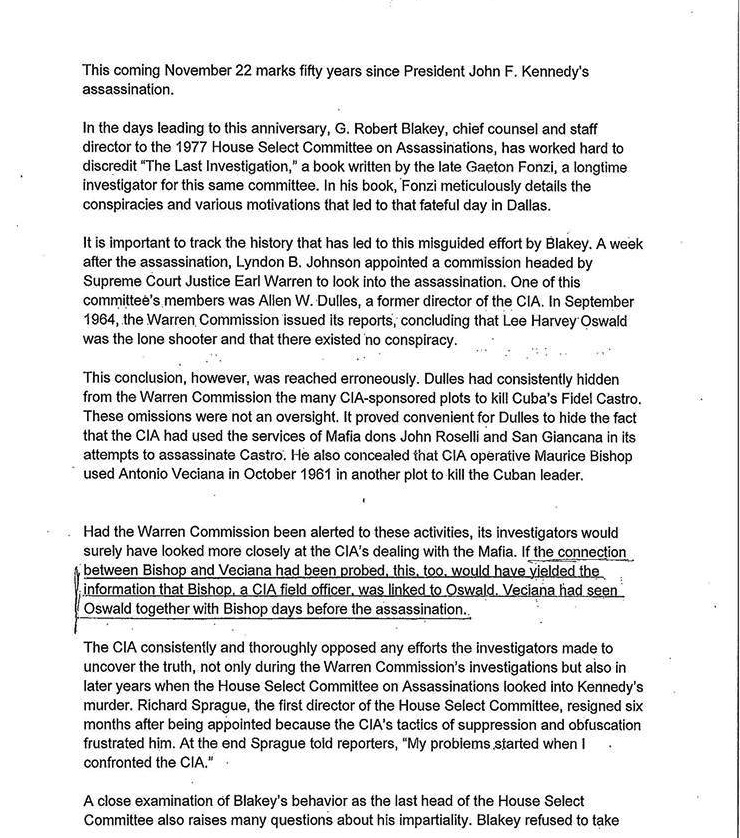
  • “Shoot Him Down”:  NBC, the CIA and Jim Garrison

    “Shoot Him Down”: NBC, the CIA and Jim Garrison


    garrison
    Jim Garrison

    With the arrival of the 40th anniversary of President Kennedy’s assassination, it was hardly surprising that one of the major television networks attempted to make the case for Lee Oswald’s sole guilt. Despite four decades of solid research indicating a conspiracy, the American viewing public was once again treated to a one-sided, unfair and unbalanced presentation. In light of this, it might be instructive to look at how one of the other networks tackled the case for conspiracy some 37 years ago. The mystery of the assassination is still a popular subject among people of all ages. A college student might not know how to ask a girl out, but you can bet they have strong opinions on the JFK assassination based solely on the network specials that run every so often.

    On June 19th, 1967 NBC aired an hour long “analysis” of New Orleans District Attorney Jim Garrison’s investigation titled, The JFK Conspiracy: The Case of Jim Garrison. While unnecessary to rehash Garrison’s case here, in summary Garrison’s investigation focused on three individuals: A former Eastern Airlines pilot and probable CIA asset, David Ferrie; ex-FBI man and private detective Guy Banister; and Managing Director of the International Trade Mart, Clay Shaw. Garrison believed all three were connected to American intelligence and had, at a minimum, conspired to set up Oswald as a potential patsy in the JFK assassination. Barely three months into his investigation, Garrison’s main suspect, the forty-nine year old David Ferrie, died apparently of natural causes. Banister had also passed away in 1964 as a result of a heart attack. On March 1st, 1967 Garrison arrested the surviving member of this trio, the CIA connected Clay Shaw. By mid-March both the Grand Jury and a three-judge panel had ordered Shaw to trial.

    Garrison’s case was big news and predictably the news media swung into attack mode. None was more vicious or had more resources at their disposal than NBC. For the job as lead investigative reporter, NBC assigned Walter Sheridan. Shortly after Shaw’s arrest Sheridan arrived in New Orleans and began questioning witnesses — perhaps bribing and intimidating would be a better choice of words. Sheridan questioned a former electronics expert and CIA asset Gordon Novel and immediately put him on a $500 a day retainer. (Novel had briefly consulted with Garrison’s team). Sheridan then urged Novel to skip town to avoid being indicted and paid him an additional $750 while Novel was in Columbus Ohio. Attorney Dean Andrews, who received the call from a “Clay Bertrand” to represent Oswald, was promised a recording studio if he cooperated with Sheridan. Andrews was overheard bragging, “I can get the equipment here. All I have to do is make a phone call, I’ll have open credit, I can pay off on any terms. Look, Bobby Sarnoff promised me those facilities. He’d better pay off, baby.” Bobby Sarnoff was, of course, Robert Sarnoff, NBC president and later chairman of the board of its parent company RCA.

    Garrison’s main witness at the time was Perry Russo, a young insurance agent who had claimed he overheard a conspiratorial conversation between Shaw, Ferrie and Oswald at Ferrie’s home. Sheridan “interviewed” Russo and seriously distorted his statements during the broadcast. As the New Orleans States-Item reported, “Russo said Sheridan, WDSU-TV reporter Richard Townley and Saturday Evening Post writer James Phelan repeatedly visited his home in attempts to persuade him to cooperate with NBC and the defense.” Russo said he met with the trio with the full knowledge of the district attorney’s office and reported everything that happened to Asst. DA Andrew Sciambra. Russo said, “Sheridan offered to set me up in California, protect my job and guarantee that Garrison would never get me extradited back to Louisiana” if he cooperated. He accused Townley of threatening him with public humiliation unless he changed his story and cooperated with the NBC program. The 25-year-old witness said members of the trio told him both, “NBC and the Central Intelligence Agency are out to wreck Garrison’s investigation.” Of course, Russo’s accusations were met with denials, but as we shall see Russo’s claims seem to have been accurate.

    Another of Garrison’s witnesses was Vernon Bundy, a heroin addict and prisoner who had testified at the preliminary hearing that he had seen Shaw and Oswald together at the Lake Pontchartrain seawall. Once Bundy had been exposed in the preliminary hearing, he was now fair game for Walter Sheridan and NBC. In their attempt to discredit Bundy, NBC aired interviews with two fellow convicts, Miguel Torres and John Cancler. Cancler, a convicted burglar and pimp, appeared first and said Bundy had told him he was going to lie to the DA’s office to get out of prison. Torres, whose own record of heroin abuse, burglary, pimping, assault, and suspected murder out rivaled Cancler’s, was currently serving a nine-year sentence for robbery. He said that Bundy told him he was going to make up a story about Shaw to get the DA to “cut him loose” from prison. After the airing of the NBC special, Garrison invited Messrs. Torres and Cancler to repeat their stories in front of the Grand Jury. Both pleaded the Fifth Amendment and were subsequently convicted of contempt. Another problem with Torres’ story is his accusation that Bundy needed the DA to “cut him loose” from prison. In a recently released memorandum from the New Orleans DA’s files, former aide William Gurvich wrote of his investigation of Bundy. Gurvich states, “Shortly after my interview with Bundy, I contacted local narcotics officers for background information on him. I also made an extensive inquiry into his criminal history.” Of his heroin use Gurvich writes, “[Bundy] uses four or five capsules of heroin daily… This amount is considered sufficient for addiction, but is not an excessive amount as the more heavily addicted use as much as 20-30 capsules daily.” Gurvich goes on to write “Bundy claimed he was in Parish Prison at the time because he went there voluntarily when he felt himself reverting back to the use of narcotics and feared the consequences of his addiction. Official records corroborate this.” Bundy was on probation for breaking into a cigarette machine, but was not serving time. So much for Bundy needing to be “cut loose.” Since NBC offered to relocate Perry Russo to California and provide him with a job if he changed his original testimony one can only imagine what incentives Sheridan offered Cancler and Torres.

    Garrison’s one time “aide”, the aforementioned William Gurvich also assisted Sheridan having left the DA’s office several weeks earlier. As Garrison noted shortly after the broadcast Gurvich didn’t so much resign as “drift away about six weeks ago” and that since that time he had been in contact with Walter Sheridan. Gurvich also admittedly made off with the DA’s master file. The CIA was so smitten with Gurvich that they wanted to make sure he was in touch with Shaw’s lawyers. In their enthusiasm to give Shaw’s lawyers all the help they could the CIA recommended:

    Shaw’s attorneys ought to talk to William H. GURVICH. This is an excellent suggestion. It is assumed they have done so, or plan to, but we should try to assure that they do.

    One other witness Sheridan used makes for an interesting case study of Sheridan’s abuse of power. Fred Leemans, the owner of a Turkish bath house in New Orleans, originally stated that Shaw had frequented his establishment using the name of Clay Bertrand. By the time Sheridan and company got to him, he went on the NBC special claiming he had been offered a $2500 bribe by one of Garrison’s men in exchange for his incriminating testimony. After the NBC special had aired, Leemans came forward with the truth. In a sworn statement Leemans admitted that part of the reason he participated in the show was threatening phone calls “relative to the information that I had given Mr. Garrison.” Leemans also recalled a visit from a man with a badge who stated that he was a government agent. The man supposedly told Leemans that the government was checking bar owners in the Slidell area for possible income tax violations. The man also warned him “it was not smart” to be involved in the Clay Shaw case “because a lot of people that had been involved got hurt.” An anonymous caller told Leemans to change his statement and claim he had been bribed. The caller also suggested that Leemans contact Irvin Dymond, one of Shaw’s attorneys. After contacting Dymond, Leemans was introduced to Walter Sheridan. Leemans claimed Dymond offered an attorney and bond in the event he was charged with giving false information to the DA’s office. Leemans said his appearance on the show was taped in the office of Aaron Kohn, managing director of the Metropolitan Crime Commission, in the presence of Sheridan and Dymond.

    The newly released CIA files present an interesting biography of “reporter” Sheridan. In 1955 Sheridan was security approved as an investigator for the CIA. A month later this was cancelled because Sheridan accepted a position at the ultra-secret National Security Agency. In 1956 he was security approved once again by the CIA so that he could attend their “Basic Orientation Course”. After leaving the NSA, Sheridan went to work for Bobby Kennedy’s Justice Department in the “Get Hoffa” squad, where his tactics in nailing Hoffa earned him a rebuke from none other than Chief Justice Earl Warren and paved the way for Hoffa’s eventual release. With this background in the intelligence communities Sheridan was now apparently qualified to work for NBC as a reporter, despite having no previous journalism experience. However, documents reveal that Sheridan did not sever contact with the CIA. In early May of 1967 the Counter Intelligence office of the CIA issued a memorandum for the Deputy Director of Plans which stated:

    Richard Lansdale, Associate General Counsel, has advised us that NBC plans to do a derogatory TV special on Garrison and his probe of the Kennedy assassination; that NBC regards Garrison as a menace to the country and means to destroy him. The program is to be presented within the next few weeks. Mr. Lansdale learned this information from Mr. Walter Sheridan of NBC.]

    As noted previously, during Sheridan’s tenure in New Orleans he enlisted the aid of Richard Townley from NBC’s affiliate, WDSU-TV. Townley’s loose tongue offered further proof that the NBC White Paper was no more than a deliberate attempt to sabotage the investigation and to ruin Jim Garrison. A recently released FBI memo reads:

    A local FBI agent reported that Richard Townley, WDSU-TV, New Orleans, remarked to a special agent of the New Orleans office last evening that he had received instructions from NBC, New York, to prepare a one hour TV special on Jim Garrison with the instruction “shoot him down.”

    After the program aired, Garrison petitioned the FCC who agreed that the program was biased and granted Garrison a 30-minute rebuttal to air on July 15 at 7:30 P.M. — hardly equal time. Nevertheless, the NBC program aided greatly in the discreditation of the DA’s office and potentially contaminated the Shaw jury pool.

    In addition to the aforementioned Richard Townley, the local New Orleans news media seemed to have more than its fair share of newscasters willing to flack for the intelligence agencies. Ed Planer, also of WDSU, offered to share information he had relative to the Garrison probe with the FBI. Also reporting to the FBI was Assistant U.S. Attorney Gene Palmisano. In a May 12th memo from the New Orleans office to Director Hoover, Palmisano stated that he had received information that NBC was planning a White Paper concerning Garrison and that this news special would destroy the credibility of Garrison’s investigation.

    As these repeated and obviously orchestrated attacks on the DA’s office continued, Garrison decided to fight back. On July 7 Walter Sheridan was charged with four counts of public bribery and Richard Townley was charged with attempted bribery and intimidation of witnesses. Sheridan’s New Orleans attorneys of record were Milton Brener, a former Assistant D.A. under Garrison, now vociferously anti-Garrison, and Edward Baldwin of Baldwin and Quaid. In May of 1967, Baldwin’s partner James Quaid wrote a letter to Richard Helms, then Director of the CIA, requesting that the Agency place his name “on their referral list of qualified attorneys in this area.” However, Sheridan’s Washington representation is much more illuminating.

    Herbert Miller was a former head of the Criminal Division of the Department of Justice who had worked closely with Walter Sheridan. In the aftermath of the assassination Miller was the Department of Justice’s point man in Dallas coordinating the Justice, FBI and Texas investigations. After leaving the DOJ, Miller entered private practice in the Washington firm of Miller, McCarthy, Evans, and Cassidy — the Evans in this case being former FBI Assistant Director Courtney Evans. In 1967 Miller went to work for the CIA representing the Agency’s interests in the Hans Tofte case. (Tofte was a long-time CIA covert operative who worked in the Domestic Operations Division with his protégé, Tracy Barnes. In 1966 he was fired by the Agency for apparently hoarding classified material in his apartment.) While he was representing the CIA in the Tofte flap, Miller found time to interject himself into the Garrison investigation. On May 1, 1967, Miller began offering intelligence on the Garrison investigation to the CIA.

    Later that week Miller called CIA Associate General Counsel Richard Lansdale to inform him of the expected arrival in Washington of Alvin Beauboeuf. Beauboeuf was one of assassination suspect David Ferrie’s close friends, having accompanied him on his mad dash to Texas on the day of the assassination. Miller’s source on Beauboeuf was Walter Sheridan. As Lansdale notes in his memo, “[the NBC special] is expected to ‘bury’ Garrison because everyone is convinced that Garrison is a wild and dangerous man.” Miller went on to assure the CIA that “Beauboeuf would be glad to talk with us or help in any way we want.” Garrison would note that after Beauboeuf’s Washington trip “a change came over Beauboeuf; he refused to cooperate with us further and he made charges against my investigators.”

    To recap, we have evidence that NBC reporter Sheridan was providing intelligence on the Garrison investigation to a CIA lawyer, a situation that indicates certain sinister possibilities. In fact, recently declassified records show that Sheridan wasn’t satisfied with solely presenting his own warped view of Garrison. A May 11th CIA memo reveals that Sheridan wanted to meet with the CIA “under any terms we propose” and that Sheridan desired to make the CIA’s view of Garrison “a part of the background in the following NBC show.”

    While Sheridan’s litigation was pending, Miller began doing double duty as a conduit between Shaw’s lawyers and the CIA. In May of 1968 Miller wrote to the CIA’s Lansdale:


    Dear Dick:

    Enclosed are the documents I received from Clay Shaw’s attorney, Ed Wegmann.

    Best Regards,

    Herbert J. Miller, Jr.


    The following month Miller provided the Agency with at least two more such packages.

    Miller was certainly a very busy man during this time frame. While Miller was acting as a CIA courier for Shaw’s lawyers and representing Walter Sheridan, he was also performing similar duties for Gordon Novel. While Novel was fighting extradition from Ohio, Miller came to his aid and was successful in getting an Ohio court to quash Garrison’s subpoena. Miller also provided the CIA with the transcripts from Novel’s civil suit against Garrison and Playboy. After Novel successfully avoided Garrison’s extradition he sent a clipping to former CIA Director Allen Dulles. In his own handwritten marginalia to Dulles, Novel took great pride in Miller’s victory, noting what a great job “Miller the Killer” did for him. It is interesting to note that the supposedly itinerant Novel now had four lawyers representing him: Miller, Stephen Plotkin, Jerry Weiner, and Elmer Gertz. Gertz, who had also represented Jack Ruby, was one of Novel’s lawyers in his civil suit. When answering a list of interrogatories posed to him by Playboy’s lawyers Novel stated that payment of legal fees to Weiner and Plotkin were “clandestinely remunerated by a party or parties unknown to me.” It was later revealed to a Garrison investigator by a former member of the CIA that Plotkin was receiving his fees from the CIA via a cutout, Stephen Lemman. As for Miller, just a few short years after the Shaw trial ended, he represented President Richard Nixon as his post-resignation attorney.

    What brings the Sheridan affair full circle is a friend of Sheridan’s, one Carmine S. Bellino. Bellino was a former FBI agent and Kennedy insider who worked with Robert Kennedy on the McClellan Committee in the fifties and was brought on to Sheridan’s “Get Hoffa” squad in the sixties. In 1954 Bellino actually shared his office with CIA/Mafia go-between, Robert Maheu. But what is troubling about the Bellino/Sheridan relationship is that Bellino once worked with none other than Guy Banister, performing background checks for the Remington Rand Corporation. In the seventies Bellino became an investigator on the Watergate Committee and did his best to steer the committee away from investigating any CIA involvement in the crime.

    In a 1967 memo the CIA outlined several mass media approaches to counter Garrison’s charges. One of their recommendations was to make sure that CIA Director Helms assure that various media outlets “receive a coherent picture of Garrison’s ‘facts’ and motives. In anticipation of a trial, it would be prudent to have carefully selected channels of communication lined up in advance.” Certainly the evidence above indicates that NBC was one such “channel.”

  • H. P. Albarelli Jr., A Secret Order: Investigating the High Strangeness and Synchronicity in the JFK Assassination


    I. Introduction

    H. P. Albarelli Jr., is a writer and investigative journalist who has written among others, the highly praised book, A Terrible Mistake: The Murder of Frank Olson and the CIA’s Secret Cold War Experiments. There, he examined the involvement of CIA, FBI and Federal Bureau of Narcotics agents in the CIA mind control experiments between the 50s and 70s, widely known as the MK/ULTRA program.

    With that in mind, I was looking forward to reading his new book, A Secret Order: Investigating the High Strangeness and Synchronicity in the JFK Assassination. The description offered on the book’s back cover promises to reveal “amazingly fresh insights into alleged assassin Lee Harvey Oswald and his much ignored sojourn in New York City, as well as unique and mesmerizing portraits of many of the overlooked characters surrounding the assassination … revelations about Lee Harvey Oswald’s time in Mexico City are intriguing and further explain what actually occurred there. Also revelatory is the author’s astounding information on the nexus between behavior modification and assassinations.

    Michael Petro’s Foreword provides us with a clue as to what to expect from this book. “A Secret Order … is an exploration of the many curious scraps of information the author compiled while building his compelling case against our Government in the murder of its own (A Terrible Mistake: The Murder of Frank Olson and the CIA’s Secret Cold War Experiments) … many of the characters involved in Olson’s murder had shockingly close connections with the events of November 22, 1963 (p. 2). I had a feeling that the MK/ULTRA nexus would be a recurrent theme of this book. And I was right.

    The book consists of eleven chapters in the form of essays that deal with topics that are not necessarily connected to each other. Chapter one tries to shed light into the time that Oswald spent in NY City as a kid along with his mother. Chapter two examines the case of Rose Cheramie, who had fore knowledge of the assassination. Chapter three tells the strange encounter of Adele Edisen with a Doctor named Jose Rivera who seemed to have an uncanny knowledge about Lee Harvey Oswald and the assassination long before it happened. Chapter four narrates the strange tale of an obscure character that is hardly mentioned when discussing the assassination, Dimitre Dimitrov, a Bulgarian who claimed to know who had ordered and committed the assassination. Chapter five deals with Oswald’s return home from the USSR and another Bulgarian, Spas Raikin, who assisted Oswald and his wife. Chapter six moves forward to a different theme, the life and times of the infamous CIA officer, David Sanchez Morales. Chapter seven presents the conviction of a certain Dale E. Basye that Oswald was a psychologically disturbed man who had been placed under hypnotic control by Russian intelligence. Chapter eight examines Oswald’s connections with Cuba and the Fair Play for Cuba Committee (FPCC), the strange multiple Oswald sightings and the life of Thomas Eli Davis III, a soldier of fortune that have used the alias “Oswald.” Chapter nine refers to the bizarre diary of Eric Ritzek, a hypnotist who allegedly controlled and directed Oswald to murder John Kennedy. Chapter ten examines the story of Charles Thomas, a State Department employee who investigated the Oswald visit in Mexico and Elena Garro’s allegations regarding the Duran party and Oswald’s presence in that party. Finally, Chapter eleven attempts to shed light to the mysterious life of the beautiful June Cobb, a CIA asset, and her connection to Oswald and the JFK assassination. This last chapter ends with the story of an American bullfighter in Mexico, who is convinced that he met Oswald there in late September 1963. The bullfighter is Robert Buick and the story is not told completely in the first volume. The author of the book informs us that its conclusion will be revealed in more detail in Volume Two of this book. Although it’s hard to believe that Albarelli does not know that Buick has a web site and has also written a book on the subject.

    I understand that the book was too long. After their first experience with Albarelli, the publishers have decided to split this one into two volumes to keep each volume below five hundred pages. I believe they made a mistake. They have not concluded the Mexico incident in the first volume, so we’ll have to wait for volume Two. It would have been better if they had dealt completely with the Mexico incident in either the first or the second volume. It is difficult to judge its author’s views about the alleged Oswald visit to Mexico if they are not presented on their totality. Volume Two promises more revelations about George Hunter White, the FBN and CIA officer who was involved in MK/ULTRA and the CIA killer with the code name QJ/WIN.

    Volume I, ends with a list of end notes and this is where I will have to disagree with both the author and the publisher regarding their format. Strangely enough, the notes are not numbered, so it is very difficult to follow them. One has to go back in the respective chapter and try to read it carefully to find out what a particular note is referring to. The process is tiresome and confusing, and after a while I gave up trying to match a note to the main body of the book. I really cannot understand why an experienced writer like Albarelli did not go the extra length to number his notes.

    Looking through the chapter six notes, one cannot fail to meet the name of Gerry Patrick Hemming. One could also justifiably ask why Albarelli would trust Hemming for anything valuable, since he was a man who had a reputation as a disinformation agent. And this was from the respected and incorruptible Gaeton Fonzi. It is a mistake that other authors have made in the past, most notably Noel Twyman.

    Having discussed in summary the contents of the book it is time to proceed now to analyze the main body of the book.

    II. MK/ULTRA and the JFK Assassination

    Several authors have discussed the fact that, in the early fifties, Lee and his mother Marguerite visited New York City and stayed awhile with Lee’s stepbrother John Pic e.g. Jim DiEugenio, John Armstrong. Well Albarelli does this too. Except he very quickly introduces a topic they did not. It’s a leftover from his last 900 page book: Project MK/Ultra. Marguerite Oswald worked at Lerners Dress Shop at 45 East and 42nd Street. Albarelli notes that it is interesting that Albertine Hunter – George Hunter’s wife – shopped at Lerners and had friends there. Then Marguerite left Lerners and “went to work for Martin’s Department store in Brooklyn, a very short walk from where Albertine worked. Again we find that Albertine had close friends who worked at Martin’s.” (p. 14-15). It is my understanding that Albarelli continuous his efforts to somehow implicate Oswald with George Hunter White and the MK/ULTRA program.

    Albarelli then moves on to examine another familiar topic: Oswald’s truancy problem at school in New York City. Young Oswald did not seem to enjoy school in the Big Apple and he missed 75 days in a 12 month period. As a result Oswald was sent to Youth House in Manhattan where he was placed under psychiatric observation for three weeks, from April 16 to May 7, 1953 (p.17). Two of the psychiatrists that examined Oswald were Dr. Renatus Hartogs and Dr. Milton Kurian. John Armstrong wrote in his book Harvey and Lee that each doctor gave a different description of young Oswald. And he also concluded that there were two Oswald who lived parallel at the same time: one, Lee Oswald, an American and Harvey Oswald of Hungarian descent.

    Dr. Kurian concluded that “the youngster was withdrawn from the real world and responded to outside pressures to a degree necessary to avoid disturbance of his residence in a fantasy world. Kurian would later say that he felt Oswald was “mentally ill” and should have been hospitalized in a facility for children.” (p. 18-19).

    Dr. Renatus Hartogs told the court after examining Oswald that he “has superior mental resources and functions only slightly below his capacity level in spite of chronic truancy from school … no findings of neurological impairment or psychotic mental changes could be made” and he recommended that the boy needed a child guidance clinic to treat his psychological disturbances due to poor family life. (p. 21). However the same doctor changed his diagnosis in front of the Warren Commission and he said that “he found him to have definite traits of dangerousness. In other words, this child had a potential for explosive, aggressive, assaultive acting out” (p. 20-21).

    It is fairly clear that both doctors were instructed by the FBI to change their diagnosis to make it seem that Oswald was falling within the profile of the lone nut assassin. The question that is then raised is: Why did the two doctors, who, according to the author had probable MK/ULTRA connections, did not conclude in the first place that Oswald was a dangerous psychotic. Why is there the suggestion that others had to intervene after the JFK assassination to make them change their statements about Oswald’s mental condition? Albarelli then goes into details about Dr. Hartogs and his dispute with a former patient of his, Julie Roy who claimed that the good doctor had mentally and physically abused her. Again, this was written about back in 1975 in Time. Then a book was published in 1977 called Betrayal after Roy successfully sued Hartogs. No matter how interesting this may be to someone who is not aware of it, I cannot see it as being very relevant to the JFK assassination.

    Does Albarelli believe that Oswald was a victim of the MK/ULTRA experiments that eventually turned him into an assassin who killed President Kennedy? He notes that he is not easily given to wild speculation and conspiracy theories. And to begin with, it was not his intention to conclude the above scenario. However, after learning that the CIA and the U.S. Army had conducted behavioral modification experiments on children, he no longer considers such speculation to be outside the realm of possibility. (pgs. 35-36). He states that “While there remains little direct evidence that Oswald was some sort of programmed assassin or covert operative, there certainly are enough circumstantial facts that nudge this possibility into areas for serious consideration” (p. 36).

    I would agree with him that he was not a programmed assassin, although if one accepts John Armstrong’s thesis about the existence of two Oswald, then we can conclude that Lee was a possible assassin and Harvey the patsy. I certainly would not agree with him that there is not evidence that Oswald was a covert operative. If one reads John Newman’s Oswald and the CIA, DiEugenio’s second edition of Destiny Betrayed and The Assassinations. George Michael Evica’s A Certain Arrogance, Peter Scott’s Deep Politics I and II, and Bill Simpich’s essays “The Twelve Who Made the Oswald Legend”, among other respected authors, most would definitely conclude that Oswald was very likely a CIA agent provocateur and/or informant of the FBI. It was not MK/ULTRA or George Hunter White that sent Oswald to Soviet Union. White did not send him into New Orleans and Mexico, nor did he place him in the TSBD. But we have plenty of evidence that CIA officials and assets like E.H. Hunt, David Phillips, James Angleton and J. Walton Moore were those who orchestrated Oswald’s intelligence moves and then helped place him above the President’s route with the help of Ruth Paine. For instance, we know that Phillips was trying to infiltrate the Fair Play for Cuba Committee and planning operations against the organization since 1961. And we now know that Angleton, Phillips and Anne Goodpasture helped organize the Mexico City charade. Not the MK/ULTRA gang.

    The author provides the useful information that Atsugi in Japan was one of two U.S. bases abroad at which the CIA kept LSD supplies. Even if Oswald came in contact in some way with the MK/ULTRA program, we do not now know the how and why of it. Or how it figures in the JFK murder. This writer happens to think that Oswald was selected as a youth to participate in the false defectors program to the USSR, and he was prepared for such task linguistically. Could he have been given LSD to train him to get used to interrogation by the Soviets if get caught or to conceal his cover? Maybe, maybe not. But the evidence adduced today strongly indicates that Oswald was some kind of covert operative who was then framed as a patsy, rather than being a Manchurian candidate a la Sirhan Bishara Sirhan.

    III. Oswald the Manchurian Candidate?

    But in spite of the above, a question that is repeatedly asked through the book is whether Lee Harvey Oswald was a Manchurian Candidate. For those unfamiliar with the term, Albarelli provides the answer in Chapter One: ” … The Manchurian Candidate – published in 1959 by author Richard Condon, and released as a major feature film in 1962, during the Cuban Missile Crisis … Sergeant Shaw is an unwitting sleeper agent and hypnosis induced assassin who had been brainwashed by the communists during the Korean War to murder the U.S. President … Buried deep within the consciousness of Sergeant Raymond Shaw is the mechanism of an assassin – a time bomb ticking towards explosion, controlled by the delicate skill of its communist masters … Raymond has been successfully brainwashed. His subconscious mind is controlled by a man in Red China who has primed him to become a deadly instrument of destruction.” (pgs. 62-63).

    Well, Albarelli sees an interesting connection between Oswald and the fictional character of Raymond Shaw. When Oswald was in Russia he used to attend his favorite Tchaikovsky opera, titled The Queen of Spades. In fact, Oswald on his 22nd birthday – while in the Soviet Union – spent that day alone at the opera watching his favorite it. The opera theme is about a man who wanted to perform a heroic act, so to impress a woman that did not respond to his love. Oswald wrote on his diary “I am ready right now to perform a heroic deed of unprecedented prowess for your sake” (p. 62). Similarly, Raymond Shaw was triggered by a playing card, the Queen of Diamonds which energized his assassin persona to take over him.

    Is this evidence that Oswald was triggered by this particular opera to become an assassin to win a woman’s heart? Of course not, this relation between fiction and life is simplistic. I cannot see a connection. Especially if one thinks as most of us do that Oswald the defector never fired a shot at anyone the day of the Kennedy assassination.

    In Chapter Seven, the relationship between Oswald and a Manchurian Candidate is examined even further thanks to the untimely wisdom of Dale E. Basye. This is an obscure character that Albarelli stumbled upon by accident. A friend of his suggested to him that he should buy children books for his grandson Dylan, written by someone that Abarelli was not familiar with. The author was named, Dale E. Basye Jr. The same day Albarelli was shocked to see the same name in an FBI document about Oswald, dated 12/24/1963. Later he realized that this man must have been the father of the book writer.

    Mr. Basye, a newsman, was convinced that “Lee Harvey Oswald was possibly a psychologically disturbed man who had been placed under hypnotic control by Russian intelligence experts” (p. 270). Basye asked a series of questions about Oswald as a programmed assassin that parallel the behavioral pattern of Raymond Shaw, in the novel and movie, The Manchurian Candidate. Basye asks whether Oswald was brainwashed by the Soviets, if he had been given a post-hypnotic suggestion to shoot the President that will be triggered by Soviet agents acting undercover in the U.S. and whether Oswald was under hypnosis when he shot the President.

    Basye argued that Oswald was a perfect Manchurian Candidate since he had defected to USSR, had renounced his citizenship and had a deep hatred for authority. Basye also had knowledge of Oswald’s youth in New York City where he had demonstrated that he was “a psychologically disturbed young man, an ideal subject for mind control” (p. 271).

    Basye believed that Oswald did not have an escape plan and was destined to die resisting arrest as his Russians controllers had planned so he would not be captured alive and subjected to psychological tests. If the gun that Oswald drew inside the theater has not misfired, then the policemen would have killed him on sight. He even theorized that when Oswald shouted “it’s all over”, well it was a post-hypnotic suggestion to make him forget his crimes. That was the reason he denied that he had shot the President and a policeman. And since Oswald was in Mexico in September it was possible that the hypnotic suggestion was given to him when visited the Cuban embassy (?)

    Basye speculated that the Russians had planned to kill JFK because they thought that the next President would oppose the Soviets less, or the assassination would become a warning that the Russians can murder any U.S. President. Finally he asks if both JFK and LBJ were targeted to paralyze the U.S. before the Russians attacked. And since LBJ and Connally looked similar Oswald made a mistake and shot Connally.

    He questions why the Russians permitted Oswald to work in a Soviet factory, marry a Russian girl and allow him to take her with him back to U.S. if he was an American agent? Was Marina the person who was to trigger the post-hypnotic suggestion?

    Basye sent a summary of his questions to a psychiatrist, Dr. Erickson, to advise him if Oswald could have been a Manchurian Candidate; and if drugs could have been used to induce a hypnotic state. Dr. Erickson wrote back to Basye saying that he as an expert in hypnosis, disagreed completely with his theory and that The Manchurian Candidate, both the book and movie were complete nonsense.

    Albarelli points out that Dr. Erickson forgot to mention in his reply that he was a long-time CIA consultant on hypnosis, and that the agency was trying hard to create Manchurian Candidates based on hypnosis experiments. Dr. Erickson had experimented in hypnosis back in 1939, long before he worked with the CIA. In other words Dr. Erickson was lying to Basye when he assured him that mind control, hypnosis induced assassins and Manchurian Candidates were fiction.

    If all that rather desultory stuff – the Russians killed Kennedy? – isn’t enough for you, the search for Oswald as a Manchurian Candidate continues on in Chapter Nine. Here we are treated to the bizarre diary of Eric Ritzek, a self-proclaimed great hypnotist, who called himself “the master craftsman.” The diary was found in August of 1964, at the ticket counter of the Continental Trailways bus station in LA. The FBI and the CIA received copies of this strange diary. The CIA labeled the diary: “Alleged Diary of ERIC RITZEK reflecting he caused Lee Harvey Oswald to Commit Assassination and Oswald’s Subsequent Murder by Jack L. Ruby by Hypnosis” (p. 327).

    According to the diary, Eric Ritzek and his friend Charles (surname unknown), were studying political science and human psychology at a college in some undisclosed foreign country. An FBI memorandum noted that “As of September 10, 1963, the alleged diary indicates that Eric Ritzek and Charles obtained visas to the United States and Mexico. An entry on September 11, 1963, indicated that the goal of Eric Ritzek and Charles was to kill President Kennedy” (p. 328).

    Eric claimed that Charles received money from someone in Texas but Charles refused to name that person. He continued that they traveled to New Orleans to meet a Lee Harvey Oswald and that they worked with him for a week. On September 26, he claimed they were on a bus to Mexico and that Oswald was on the very same bus. On September 29 he described Oswald: “I find Lee Harvey Oswald an intelligent person. Surely, hateful and at odds with the Universe … his thoughts are confused. I will put them in order to my satisfaction. The American President will die in Dallas, Texas … he has no choice, I am his master, the skilled craftsman … a glorious Frankenstein monster I have created” (p. 329-330).

    “The Master Craftsman” and Charles returned to the U.S.A. via Laredo by bus. And the story is that they received $100,000 in cash by the same unnamed benefactor. On November 22nd he writes that they managed to secure a picnic lunch box from their hotel and pretended to eat lunch in the park, sitting in a prearranged vantage point.

    Eric finally described the assassination of President Kennedy by Oswald. He worries because Oswald was captured alive, something that was not supposed to happen. So, quite naturally, for that reason they picked a random club owner who happened to be Jack Ruby and they hypnotized him to kill Oswald.

    Albarelli concludes that Ritzek’s diary is the product of a confused and bizarre mind and wonders why it was written. One of the copies of the diary that Albarrelli obtained had a hand written note on its second page that read: “Ritzek-Albert Schweitzer College, Switzerland, enrolled/files” (p. 328). Albarrelli notes that he does not want to cloud or complicate matters by pointing this reference to the Albert Schweitzer College. However any serious student of the JFK assassination will be alarmed by the very name of the college, since it was the college that Oswald applied on March 1959 to enroll and attend the college’s third term, from April 12 to June 27, 1960. Oswald never appeared at the college and instead traveled to Moscow to defect and tried to denounce his American citizenship. (A Certain Arrogance, Evica, Essay One). Oswald’s mother told the FBI that, while her son was en route to Switzerland, he had his birth certificate with him. Oswald was temporarily missing according to her, and FBI Director Hoover wrote to the State Department that “an impostor might be using Oswald’s birth certificate.”

    We do not have proof that Ritzek and Charles were studying at the Albert Schweitzer College, but it is possible, since they were attending a college in a foreign country, and the name of that particular college was written on the second page of a copy of the diary. If not, then why was the above mentioned college written on the diary?

    The problem is: Where is the evidence, let alone proof, that any of this happened? Namely that the financial transaction was genuine, that Oswald was hypnotized, and that Ruby was hypnotized then to kill Oswald. And further that Ritzek was actually aware of the plot as it occurred?

    Most researchers would agree that James Jesus Angleton, the CIA’s Counter-Intelligence Chief was a great promoter of what is termed, Phase I stories, namely that the Soviets had kill President Kennedy. Most of them will also agree that Angleton was involved in on the conspiracy to kill JFK, as John Newman and Lisa Pease have demonstrated. Angleton was the man who invented the term a “Wilderness of Mirrors” in the spy operations. Meaning that anything is possible but nothing is certain. Conflicting evidence creates a cognitive dissonance that confuses and frustrates researchers, until they are forced to give up. After reading all of this, I am of the opinion that Oswald’s portrayal as a Manchurian Candidate, Basye’s conviction that Oswald was controlled by Soviet agents and the bizarre diary of Eric Ritzek were part of a Wilderness of Mirrors operation to impose cognitive dissonance and obfuscate the truth. Eric Ritzek was labeling himself as a master craftsman, a title that is usually referring to Masons. Could it be possible that the writer of the diary was implying that Masons have committed the murder and this was another try to falsely sponsor Masonry in order to confuse matters and create false leads?

    In other words, I cannot see how the Manchurian Candidate angle and mind programmed assassins had anything to do with the JFK assassination. And the best I can say, giving the author every benefit of every doubt, is that their role has been exaggerated with no real proof of involvement in the assassination for the purpose of confusing matters even more.

    IV. Oswald, Cuba & Mexico

    Oswald’s possible connection to Cuba is first documented by examining the four letters sent to Dallas from Cuba by Cuban nationals with names Pedro Charles, Mario del Rosario Molina and Miguel Galban Lopez. All letters were written to show that the Cubans were conspiring with Oswald prior to the assassination to kill the American President. All four letters were dismissed by Hoover because “they were prepared on the same typewriter … and all four letters represent some type of hoax, possibly on the part of some Anti-Castro group seeking to discredit the Cuban Government” (p. 292). Albarelli concludes that although the letters were dismissed, their existence fueled many disputes between the members of the Warren Commission, as to whether Oswald had any ties to Cuba and if he had traveled there.

    A deeper and more detailed analysis of the letters can be found on Fabian Escalante’s book JFK: The Cuba Files and specifically the chapter titled “Oswald and the Cuban Secret Service” (pgs. 134-145). Escalante was the former head of Cuban counterintelligence and believed that the letters constituted “a crude attempt to blame Castro.” Escalante continues that “If Oswald had managed to travel to Cuba, then the fabricated letters might have become concrete evidence … The letters are irrefutable evidence of a plan of incrimination prior to the crime … the conspirators hoped to provoke a response against Cuba … the letters were fabricated before the assassination occurred and by somebody who was aware of the development of the plot, who could ensure that they arrived at the opportune moment and who had a clandestine base in Cuba from which to undertake action.”

    These letters were also part of the phase I stories that had the purpose to implicate Cuba and Castro in the assassination and push the U.S. government to invade Cuba as a retaliation. These would be cancelled by the Phase II stories of the lone nut.

    There were CIA reports in June 1964 warning that Lee Harvey Oswald was seen in Tangier, Morocco during 1962 and 1963. A soldier of fortune and gunrunner by the name Thomas Eli Davis III was connected to Oswald, when the CIA reported that “Davis often used the alias “Oswald,” and was a gunrunner who reportedly had close ties to the infamous CIA assassin QJ/WIN” (p. 307-308). On December 9, 1963 the U.S. Consulate in Tangiers sent a priority cable to Dean Rusk, the CIA and ONI regarding Thomas Eli Davis who was arrested a day before trying to sell two Walter pistols and having in his possession an unsigned letter in his handwriting referring to “Oswald” and the JFK assassination. According to Seth Kantor, “Thomas Davis was released from his Tangier jail cell through the intervention and assistance of the mysterious CIA contract assassin known only by his Agency cryptonym QJ/WIN. A U.S. State Department declassified letter stated that the draft letter referred only to “Oswald” and to Lee Harvey Oswald. The December 30, 1963 State Department cable informed that the Davis letter contained a short sentence that read “I’ve seen Oswald” and the phrase, this the first Sunday AK (after Kennedy). According to the cable “Oswald” was Victor Oswald, a Swiss born international weapons trafficker (p. 318).

    The most important information about Davis is, according to his wife, he was using the alias “Oswald” and he was involved with Jack Ruby in gunrunning activities. It is of no surprise when a panicked Ruby in jail said “They are going to find about Cuba, the guns, New Orleans and everything.” It is interesting to note that Oswald had a mysterious listing in his address book, that of “1318½ Garfield, Norman Oklahoma.” Strangely enough, two infamous characters also lived briefly in Norman, Oklahoma before the JFK assassination, Thomas Davis and Loran Hall. People who knew Davis said that he and Hall were conducting gunrunning operations with Jack Ruby in 1962-1963 (pgs. 87-88). Another person who was reportedly seen at that address was an African-American with reddish hair. Anyone who is familiar with the Mexico incident will know that Alvarado saw a similar featured person outside the Cuban embassy paying Oswald $6,500 to kill Kennedy. According to Albarelli, another person involved in the JFK case that lived at that address was Paul Gregory, son of Peter Gregory. Peter was a Russian petroleum engineer who taught Russian and who was once approached by Oswald for assistance in obtaining employment. Paul Gregory had taken Russian lessons from Marina Oswald. What Albarelli does not include in his book is that Peter Gregory and Ilya Mamantov were chosen to translate Marina’s testimony about her husband’s rifle. Gregory distorted Marina’s answers that her husband owned a dark rifle, something she never said. Why was this detail significant? Because after the assassination there were allegations that JFK was killed by a dark rifle which Oswald had used earlier in the Soviet Union. All this can be found in Peter Dale Scott’s book Deep Politics I, chapter 17, p. 267-272).”

    Another interesting fact is that Davis knew Jean Pierre Laffite who, according to Albarelli’s previous book, was one of Frank Olson’s killers. Laffite also allegedly worked for Clay Shaw in the Trade Mart. Not surprisingly, the MK/ULTRA theme is appearing again since Albarelli connects Davis to the program through his psychiatric treatment in facilities related to MK/ULTRA. One has to read Philip Melanson’s article on the Third Decade, titled Dallas Mosaic: The Cops, the Cubans and the Company to find an Oklahoma connection. On pages 8-9 Melanson says that the leader of the Dallas Alpha-66 branch was one Manuel Rodriguez who was known to be “violently anti-President Kennedy” … he also bore a strong resemblance to Lee Harvey Oswald … After the assassination the FBI received a report that “Oswald” had been in Oklahoma on November 17th. Upon investigation, the Bureau discovered that the Oklahoma witnesses had seen Rodriguez.” Melanson does not name which city in Oklahoma “Oswald” visited, but it shows that the multiple sightings of Oswald were not a definitive proof that he has been where they claimed they had seen him.

    Albarelli is trying to shed light to Oswald’s visit to Mexico by examining 1.) Elena Garro’s allegations, a mysterious woman 2.) CIA asset June Cobb and 3.) Robert Buick, an American bullfighter, who lived in Mexico City during 1963.

    This is where I started to have serious objections to Albarelli’s work. Regarding the presence of Oswald in Mexico, he opens Chapter 10 with a small introduction (p. 341) where he states his belief that Oswald traveled to Mexico City and stayed there for 5 days. He acknowledges that many conspiracy theorists believe that Oswald was never in Mexico City. I know many good researchers who will be offended by the demeaning term “conspiracy theorist”, and do not consider themselves to be as such. I am surprised that Albarelli uses the above term to label other researchers who have done much more work on this case and Mexico City than he has. It was arrogant and disrespectful to do so. Especially since elsewhere Albarelli has said he “detests” infighting among authors. But somehow this kind of thing by him is OK?

    Anyway, Albarelli is absolutely certain that Oswald was in Mexico. He even presents the Elena Garro story as a proof to further support his view. He states “Additionally, those writers who discount, or write off, the claims of Elena Garro are simply ill-informed, meaning they have not examined the full record, as well as all its complexities, or perhaps they hold biased agendas of their own” (p. 341). Really? That is a bold statement since respectful writers like John Newman, Peter Scott and John Armstrong would not fit the category of the ill-informed. Further, was Eddie Lopez, the man who wrote the incredible Mexico City report ill-informed also? In an interview with Jim DiEugenio at his home in Rochester, New York, Lopez told Jim that he thought he spent too much time tracking down Elena Garro’s stories and if he had to do it again, he would not have spent nearly that much time. We will presently see why. Suffice it to say, to affirm that Oswald was definitely in Mexico City one would need a chart balancing all the evidence he was there, against all the evidence he was not. As we shall see, most researchers would state that Buick and Garro don’t really count for much in the balancing act.

    Chapter 10 examines the life and death of Charles Thomas, a State Department employee who wrote to the U.S. Secretary of State William Rogers on July 25, 1969 regarding the allegations of Elena Garro Paz, a famous Mexican novelist, that she had attended a party at the house of Ruben and Silvia Duran where she met Lee Harvey Oswald. According to Garro, present at the party were also Cuban Consul Azcue and a Latin American Negro man with red hair. She also stated that Oswald was accompanied by two American beatnik-looking boys. We all know who Silvia Duran was, a secretary at the Cuban Consulate that came in contact with Oswald. After the assassination, she was arrested by the Mexican Intelligence Service, DFS who tortured her to admit that she have met Oswald and they were both part of a communist conspiracy to kill the American President. Well, Garro later alleged that Silvia Duran was Oswald’s mistress while he was in Mexico. Albarelli seems to believe her story that she met Oswald, although he knows that both Garro and Charles Thomas worked for the CIA.

    John Newman in his book Oswald and the CIA gives a detailed analysis of the Garro allegations and he notes that on October 5, 1964, eleven days after the publication of the Warren Commission Report, a CIA memo brought attention to the Elena Garro allegations. The Lopez report identified June Cobb as the author of the October 5 memo. She was a CIA asset. Jefferson Morley discusses Cobb in his book Our Man in Mexico, saying that she was one of David Phillips’ most valuable assets in Mexico City in 1963, who specialized in penetrating the FPCC by romancing its leaders.

    Thomas was not only working for the Branch 4 of the Covert Action Staff, but his previous assignment had been to Haiti, at the same time that George DeMohrenschildt was also there. In the fall of 1969, Thomas became involved in DeMohrenschildt’s business deals with the Haitian government. Thomas was also one of the key players in 1965 to spread the false story that Silvia Duran and Oswald had a sexual affair. Newman concluded that the sex story may have been invented after the Warren Commission investigation to falsely implicate the Cuban government in the Kennedy assassination.

    Peter Scott drew attention to the fact that Elena Garro’s story coincided with that of Alvarado who saw Oswald taking money from a Negro with red hair in the Cuban embassy. Remember that she also saw a Negro with red hair at the twist party with Oswald. Scott concluded that “Garro’s anti-communist story, soon modified, was part of a larger phase I assassination scenario that also incriminated Silvia Duran and Eusebio Azcue…” All phase I scenarios had the purpose of implicating the Cuban government in the assassination of Kennedy. I therefore am of the belief that that Elena Garro’s allegations cannot be taken at face value and certainly do not prove that Oswald was in Mexico as Albarelli want us to believe. To support his case he then presents the story of Robert Buick, the bullfighter who claimed that he met Lee Harvey Oswald in late September of 1963. Buick was in hotel Luma when a young American who introduced himself as Alek Hidell asked if he was a bullfighter and how he could join the bullfighting business.

    Hidell told Buick that he wanted to return to Russia via Cuba. The conversation soon turned over to Cuba and Castro. Hidell accused Kennedy of being responsible for Cuba’s problem since the Bay of Pigs invasion was no friendly gesture toward Cuba and Castro. Hidell announced to Buick that Kennedy would pay for this and the machinery was in motion to kill Kennedy. Hidell explained to him that revolutions do not solve problems and you had to remove the head of a state by assassination and replace him with someone else. On the day of the assassination, Buick recognized Hidell as the alleged assassin of President Kennedy and is convinced that the man pretending to be Hidell was Lee Harvey Oswald. Sadly enough, the book ends at this point and Albarelli promises to reveal the rest of Buick’s story in volume II.

    The Buick story is not new, as Dick Russell first examined his tale in his book The Man Who Knew Too Much. Albarelli writes that “Several prominent conspiracy theorists, best exampled most recently by attorney Mark Lane, staunchly maintain that Oswald was never in Mexico, despite overwhelming evidence that he was there for at least three visits. Lane, of course, is wrong, as any serious student of the assassination knows. Acting to cement his false claims the account of Robert Clayton Buick, who, as chance would have it, met Lee Harvey Oswald in Mexico City in late September 1963, and a note typed by June Cobb in October 1963 (the note bears no specific day-date) and is addressed to “DP”. The note reads: “The day after LO in Comercio, encountered Buick, The American bullfighter, at H. Luma. Warren (Broglie) says Buick is drawing attention there” (p. 418-419).

    This is the second time that Albarelli insults the assassination researchers as “Conspiracy Theorists.” He even makes the statement that “any serious assassination researchers know that Oswald was definitely in Mexico.” Is that a fact? I know many researchers who will disagree with him. Many serious researchers believe that Oswald probably never visited Mexico City. The evidence is ambiguous at best. You could argue both ways but there is no proof to say that he was there. There are no photos of him there, an imposter pretending to be him talked and visited the Cuban and Russian embassies, FBI agents who heard the CIA tapes after the assassination were of the opinion that the voice was not that of Oswald. There were no credible records of his travel in any bus company or the customs offices. Much later suspect evidence surfaced to prove that he was in Mexico, via characters like Ruth Paine and Priscilla Johnson. If one reads the Lopez Report you cannot find any certain evidence to prove that he was there. And further, Azcue, the man Garro testified about produced photos to CBS in the seventies depicting an imposter as Oswald in the Cuban consulate. Should we believe June Cobb, David Phillips’s asset that she saw Oswald with Buick? Why? Especially when there is evidence that it was Phillips who was involved in the arrest of Duran. (See Harvey and Lee by John Armstrong, p. 675)

    Should we take Buick’s story as an absolute truth that Oswald was in Mexico? Of course not. Could it be possible that Buick saw some Oswald imposter or Lee the other Oswald as Armstrong believes? Was this another phase I story to saw that the Cubans were controlling Oswald in order to put the blame for the assassination on Castro? Probably not even that once one visits Buick’s web page. When one reads his page, the reader will see that Buick is one of those characters who can tell you the entire story of the JFK assassination. Replete with the names of John Roselli – who happened to confess to him in 1971. And further, he knows who the guy on the grassy knoll was who killed President Kennedy. It was a guy he talked to all the time named Jimmy Sutton. Go ahead and cringe. Because, reputedly, Sutton is an alias for James Files. But Buick still isn’t done. He knows how many members of the hit team there were and how many shots were fired. And Mac Wallace was firing from the Book Depository. Buick says he knows more than anyone about what happened in Dallas that day. Talk about a conspiracy theorist. Did Albarelli ask him how John Roselli got mixed up with LBJ? (Click here.) As noted, to affirm that Oswald was definitely in Mexico City one would need a chart balancing all the evidence he was there, against all the evidence he was not. Most serious writers would state that Buick and Garro Paz don’t really count for much of anything in the balancing act.

    To be kind, Albarelli’s examination of Oswald’s presence in Mexico City lacks depth, substance and scope. Further, it relies upon some rather questionable sources. There are several other books out there that explain the Mexico City incident much better than the author does. Albarelli does not seem to have consulted them.

    V. Knowledge of the Assassination

    The chapters that deal with Rose Cheramie and Adele Edisen are two of the more interesting chapters in the book. The Cheramie story is well known and I’ll return to it later. On the other hand, Adele Edisen’s story is not widely known and this is the first time that it is presented in a book. Some researchers are aware of her story through personal interaction with Adele on the Deep Politics Forum, where she is a member. I have exchanged posts with her on that forum and I can say that Adele is sincere, and intelligent with a very good knowledge of the JFK assassination. Edisen’s story is about her contact with a U.S. Army doctor, Jose Rivera who knew of Oswald and said to her strange things about him that scared her. Some of his remarks were “What will Jackie do when her husband dies?” and if she knew a lawyer by the name of John Abt, and he asked her if she knew Oswald. Dr. Rivera gave her Oswald’s number and told her to call him and “Tell him to kill the Chief.” Rivera explained that they were playing a little joke on Oswald.

    He also told her “Oswald is not what he seems … we’re going to send him to the library to read about great assassinations in history … after it’s over, he will call Abt to defend him … after it’s all over, the men will be out of the country, but someone will kill Oswald, maybe his best friend … “

    Rivera warned Adele if she repeated any of this to someone else she may get hurt. When Adele returned to New Orleans, she called Oswald and asked him if he knew Dr. Rivera. But he answered that he did not know him. Adele did not tell him to kill the chief. After the assassination Adele informed the Secret Service about Rivera but she was never called by the Warren Commission to testify. Later she tried to contact the Church and HSCA committees, but they never replied back. On July 2011 Adele sent a letter to President Obama regarding Dr. Jose Rivera and her views on the JFK assassination. Who was Jose Rivera? It seems that he had some interesting connections to the CIA and the MK/ULTRA.

    Coming back to Rose Cheramie, I won’t repeat her story since it is well documented in other books, like Bill Davy’s Let Justice be Done and Jim DiEugenio’s second edition of Destiny Betrayed. The main thing is that Cheramie had foreknowledge of the assassination and she was travelling to Dallas with two men who were going to kill Kennedy. Jim Garrison, years later asked State Trooper Lt. Francis Fruge, who had interviewed Cheramie, to locate her. But unfortunately she had been killed in a car accident. Fruge who had interviewed Rose back in 1963 tried to find the identity of her companions. He visited the Silver Slipper Lounge where Rose was seen with the two men. He spoke to its owner Mac Manual who said that Rose had visited his lounge on the November 20, 1963 with two men who he identified as Sergio Arcacha Smith and Emilio Santana. They were Cuban exiles fighting against Castro. They were also associated with the CIA and Arcacha Smith was the leader of Cuban Revolutionary Council, an anti-Castro organization in New Orleans that was created by E.H. Hunt. Now, the Silver Slipper had a reputation as a pick up spot for women of ill repute. And the HSCA report uses the word “pimp” in it on the Cheramie report. Albarelli now uses this word and the reported use of the word “Italian” to try and discount the story. Incredibly, he actually tries to say that 1.) Arcacha Smith had no connection to Oswald, and 2.) Neither Arcacha Smith nor Santana had anything to do with the assassination, and further that 3.) It’s unlikely that Santana and Arcacha Smith knew each other.

    The problem with this is that there are many witnesses who place Sergio Arcacha Smith at Guy Banister’s office in New Orleans. There is indisputable evidence that connects Arcacha Smith to David Ferrie, who was also in Banister’s office in 1963. And there are even more witnesses who place Oswald in that office. (See Chapter 6 of Destiny Betrayed, Second Edition for documentation of all of this.) Further, there is testimony that places Emilio Santana at Ferrie’s apartment several times. And since Arcacha Smith and Ferrie were extremely close – they watched films of the Bay of Pigs invasion together – it would seem quite logical that the two did know each other. (See The Assassinations edited by James DiEugenio and Lisa Pease, pgs. 232, 236)

    But beyond that, Arcacha Smith was a close friend of Carlos Quiroga and Carlos Bringuier. Anyone who knows anything about Oswald in New Orleans in the summer of 1963 understands that Oswald was involved with both men in street incidents which were meant to raise his profile as a Castro sympathizer. These incidents would then be used to incriminate him on the day of the assassination. When Santana was asked by Jim Garrison if Bringuier cashed a check for him to put him up in a New Orleans hotel in the summer of 1963, Santana denied it. The polygraph indicated he was lying. (Ibid, p. 236) When Quiroga was polygraphed by Jim Garrison, the DA asked him if he was aware that Oswald was not really pro-Castro and that his activities that summer were a ruse. Quiroga answered no and the polygraph indicated deceptive criteria. (Destiny Betrayed, p. 162) He was also asked if he knew Arcacha Smith. Quiroga said no, and again the machine indicating he was not telling the truth. Finally, Quiroga was asked if he had seen the weapons used in the Kennedy assassination prior to Dallas. Quiroga said no. The machine again indicated he was not telling the truth. (ibid, p. 329) Now, much of the above intrigue is left out by the author. But he does put one thing in that perfectly jibes with it. Albarelli writes that FBI files on Santana reveal that he “was alleged to own a Mannlicher Carcano rifle like Oswald’s and to have been in Dealey Plaza at time of assassination on orders of … Sergio Arcacha Smith.” (Albarelli, p. 120) It would seem only natural to ask if the rifle Quiroga saw was the one Santana had?

    But further, the author seems to have accepted the HSCA Report on Cheramie in Volume X at face value. This report was written by Patricia Orr. Orr was brought in after Chief Counsel Robert Blakey decided to blow up the original New Orleans investigation. (DiEugenio and Pease, pgs. 85-86) Therefore, when Orr wrote her report she had not done any firsthand inquiry into the matter. For instance, the whole idea that the two men were “Italians” seems caused by the fact that when Fruge testified to the HSCA, he mispronounced Santana as “Osanto”. (ibid, p. 230) Well, Orr did not understand this point since she was not around for the original deposition of Fruge, which was done by Jon Blackmer. Blackmer had corrected this point by having Fruge indicate the actual photos Manual had identified … (ibid) Further, in Orr’s report, she writes that Manual said that the two men were pimps, not that they were Rose’s pimp. But further, Albarelli discounts the fact that the trio was actually involved in a drug deal. And that Fruge then checked out the details of this deal. And the deal was just as Rose Cheramie said it was. Further, Douglas Valentine has confirmed in his book, The Strength of the Wolf, that this route the three were running was protected by the Customs Department with help from the CIA. This was done since President Kennedy was cutting off stipends to the Cuban exile veterans, who were now getting into shipping contraband in order to make up the loss.

    Finally, the author also discounts the evidence that it was not just Fruge who heard this story about the upcoming JFK hit from Cheramie. It was also Dr. Victor Weiss at the hospital in Clinton, Louisiana who heard it directly, and intern Wayne Owen, who heard it indirectly. (Destiny Betrayed, p. 78) But further, in Todd Elliott’s new work on the subject, A Rose by Many other Names, he uncovered a new witness. This was Dr. Louis Pavur of Moosa Hospital, the first place Rose was taken to, and the place where Fruge picked her up from. Pavur said that on the day of the assassination, he was told that Cheramie had predicted this would happen while she was there. (Elliott, p. 14) But further, Pavur said that very soon after this, the FBI came to Moosa and began scouring through records about Cheramie. This testimony was backed up by the widow of L. G. Carrier who was with the Eunice Police Department at the time. Jane Carrier, said that he also recalled the FBI going to Moosa and visiting the police station shortly after the assassination. Further, Jane said her husband actually heard Rose talking about the Kennedy assassination while she was temporarily incarcerated before Fruge picked her up. (ibid, p. 15) So here you have a woman involved in a drug deal with two Cuban exiles. One of whom was likely involved with setting up Oswald in New Orleans, and who may have actually seen the weapons used in the murder. The other may have actually had a similar weapon. And she says she heard them talking about the culmination of this set up. And five people either heard her say it in advance, or were told she did so. Maybe Albarelli thinks this all a coincidence that does not qualify for “high strangeness and synchronicity” in the JFK case?

    Albarelli introduces another interesting character, Dimitre Dimitrov, a Bulgarian emigre who claimed to know who killed President Kennedy and why. He said that he met his killers while imprisoned by the U.S. Government in Panama where he was subjected to torture and was given drugs during interrogation. He revealed that David Sanchez Morales was one of his interrogators and he was very scared of him. He implied that Morales was one of the men involved in the assassination, although he never revealed what he exactly knew and who the actual killers were.

    Albarelli then goes to examine the life and associates of Morales, but this is something that has already been done previously by other researchers and is not ground breaking information. He also discusses people like General Lansdale and Lucien Conein although he sees no evidence that they were involved in the JFK assassination.

    VI. Conclusions

    Although, the writer tried to write a book about the JFK assassination, I found that his book is more about the CIA’s nefarious and illegal operations, including the MK/ULTRA project. If you are interested in learning more about the shadowy world of the CIA, this is a good book. If you are interested in learning more about what happened to JFK and why he was assassinated, I believe there are many books out there that do a better job in answering your questions. It would have been better if Albarelli had tied together all the different bits of information to reach a conclusion. You could argue that he showed that there was high strangeness and synchronicity in the JFK assassination but this can be explained since most of the CIA characters worked together in various projects and it was natural to bump to each other all the time. The wilderness of mirrors strategy and its purpose in spreading cognitive dissonance among researchers, plus the creation of false sponsors and false leads, could explain this synchronicity.

    Albarelli gave a recent radio interview to Joe Quinn and Niall Bradley in July (http://www.youtube.com/watch?v=LCIPqC_7xGU). There he said that he is not interested in solving the JFK assassination and he thought that the case will never be solved. Why then bother to write a book about the JFK assassination? Why did James Douglass bother to write JFK and the Unspeakable and Jim DiEugenio his Destiny Betrayed book? Those are books that do bring us closer to solving the case. Much more than Albarelli’s book does.

    I wish Gaeton Fonzi was alive to ask Albarelli his famous cry: “We know who killed President Kennedy. Why don’t you?”

    Then again, Albarelli is not a conspiracy theorist like the rest of us.