
Investigators say files could prove interference
by Brian Bender, At: The Boston Globe
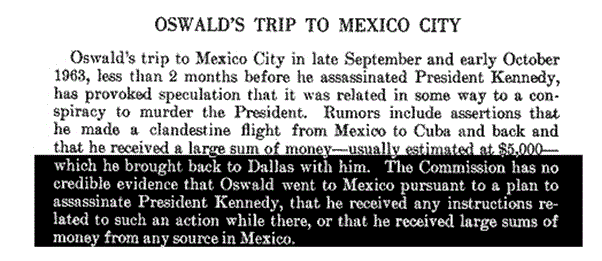
Mention “Mexico City” to a JFK Conspiracy Realist and you can expect to get any of a variety of reactions, from the opinion that Mexico City is the “Rosetta Stone” of the conspiracy to pure agnosticism. At the core of the Mexico City charade is the same question that haunts most of the Warren Commission Report (WCR) conclusions and evidence; why? Why would Lone Nut Lee Harvey Oswald be going to Mexico City, to both Cuban & Russian embassies, with what appears in the evidence to be the desire to secure passage through Cuba to Russia?
How can we establish a relationship between Oswald’s decision to go to Mexico and the way in which it was reported within the government, and Oswald’s guilt for the JFK assassination? The WCR claims there was no connection whatsoever between the events to and from Mexico (as well as the time in Mexico) to Oswald’s plan to kill JFK. The Warren Commission Report’s conclusion reflects that the Commission determined that there was little if any advanced planning of the assassination. At least on Oswald’s part.
See here.
The evidentiary purpose of the trip was to secure an in-transit visa for passage thru Cuba to Russia for himself and his family. The WCR stated Oswald’s purpose was to go thru Mexico to Cuba in lieu of hijacking a plane and flying directly to Cuba (per Marina). In other words, he simply wanted to get to Russia through Cuba.
On the other hand…
Can the events surrounding this trip be connected to a plan to create a viable patsy in the killing of JFK? We must remember that Dallas was by no means the first assassination attempt in November 1963 involving scoped rifles, slow vehicle turns and teams of men. Would we be seeing Arthur Thomas Vallee’s name on the Mexico City evidence if the Chicago plot* had succeeded?
(*Edwin Black; The Chicago Plot, Nov 1975 Chicago Independent)
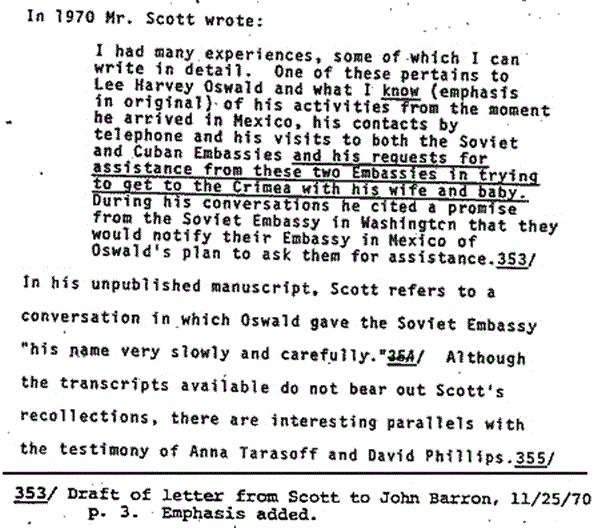
The evidence tries to establish that Oswald was focused on getting to Cuba en route to Russia and that he had met with a man supposedly KGB assassination related, although Win Scott claims Oswald was trying to get to Odessa with his family and little else. Win also states to his knowledge, as he was not in Mexico at the time, that Oswald was under complete and thorough surveillance the entire time he was in Mexico. He could only get this information from one of the two people overseeing the Mexico station in his absence: Anne Goodpasture, his chief assistant and/or David Atlee Philips; Head of the Cuban desk at the Mexico station.
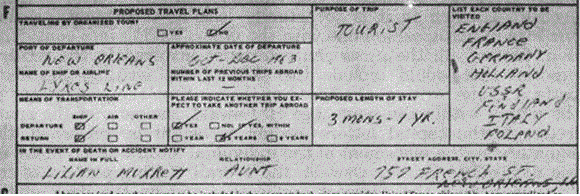
Oswald already had the appropriate passport documentation, approved VERY quickly, to get back to Russia without having to go through Cuba (which in itself is amazing given his “status”). House Select Committee on Assassinations (HSCA) published Oswald’s June 1963 Passport application, which was approved for travel including to Russia. In essence, there would be no need for Oswald, who had to have had some reason for going to Mexico City’s Cuban and Russian Consulate, to even attempt to travel through Cuba.
See here.
The story of Mexico City has 3 distinct parts: The summer of ’63, the trip itself, and the CIA’s activity after Oct 3rd. How “The Evidence IS the Conspiracy” correlates to each of these parts will be presented here one part at a time.
What we find amazing is the number of reports on the Mexico trip which are repeated and scattered about the WCR and WC Documents, as if this information was intentionally made especially difficult to correlate and cross-check. The evidence related to this part of the conspiracy is not only contradictory, but WCR-incriminating.
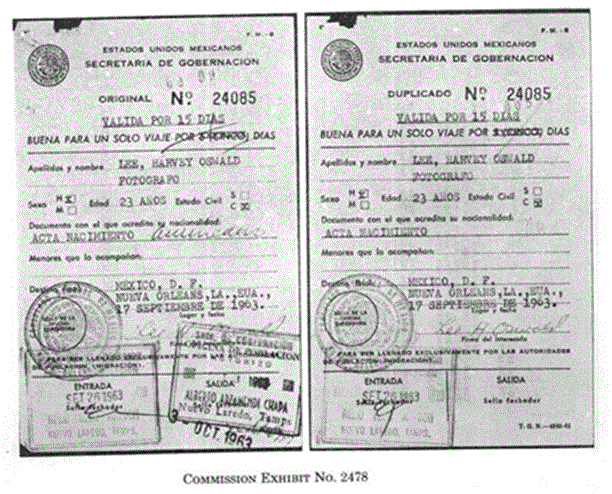
The impetus for this has been touched upon in a number of books and articles over the years: the name on the tourist Visa purchased on Sept 17th and the hotel registry in Mexico City both include the identical mistake; a comma after LEE, followed by HARVEY OSWALD. Is there any evidence offered to explain how Lee Harvey Oswald becomes Harvey Oswald Lee or H.O. Lee?
The following is A COPY of the Mexican Hotel’s guest register with a blow-up of the signature compared to the signature on the visa. (ALL docs are copies as the FBI took possession of and kept all originals. As time passed and originals were requested, we find that most originals were either destroyed, or claimed to be lost. Whether the CIA/DFS turned over all the docs is yet another difficult to resolve mystery).
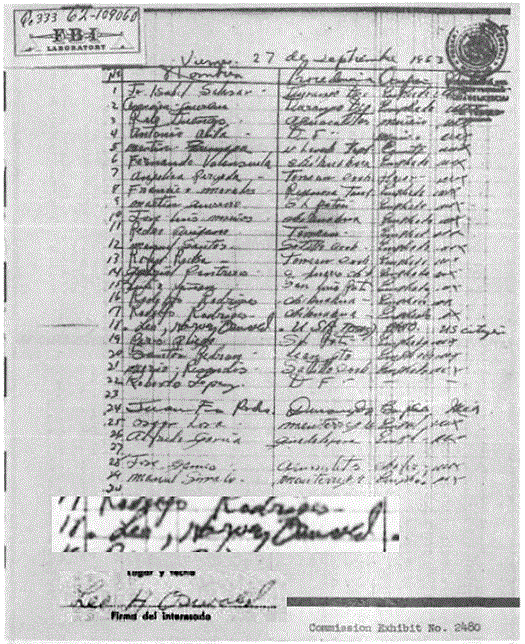
All in good time. Let us start at the beginning:
From the time Oswald left Reilly Coffee in late July, his activities in New Orleans, LA (NOLA) and up to his Sept 27th Dallas meeting with Sylvia Odio, all connect him with PRO-CASTRO forces, overseen by anti-Castro intelligence operatives within our government. Virtually no one that summer is NOT associated with intelligence, foreign or domestic, in and out of 544 Camp, the International Trade Mart and Jim Garrison’s backyard.
Over the Labor Day weekend while Oswald and family are in New Orleans with the Murrets (Lee’s mother’s sister and husband), two men arrived at the door of one Robert McKeown, a self confessed arms dealer who worked in similar circles as Jack Ruby, had supplied arms for Castro’s cause and was a close friend of Castro himself. McKeown was on probation at the time. Lee Oswald announced to McKeown that he has finally found him and would like to buy 4 rifles for $10,000. Lee Oswald was traveling with a man named Hernandez.
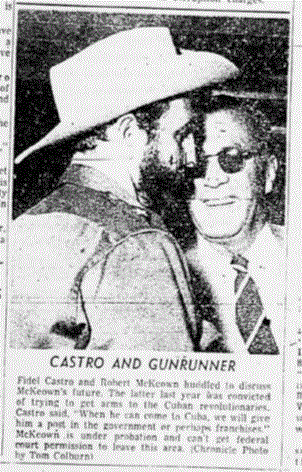
McKeown had connections with Ex-Cuban President Carlos Prio, the new leader of Cuba Fidel Castro, as well as having been contacted by Jack Ruby. McKeown ran CIA-sourced munitions to both sides of the conflict.
This appears as an attempt to once again connect OSWALD with CUBA and CASTRO almost 3 months ahead of time. Would we assume this is assassination related?
Ruby also knew McKeown from his gun-running activities and offered him $25,000 in 1963 for an introduction to Castro in order to secure the sale of jeeps. McKeown asked for $5,000 up front which Ruby did not have at the time. No further contact was reported.
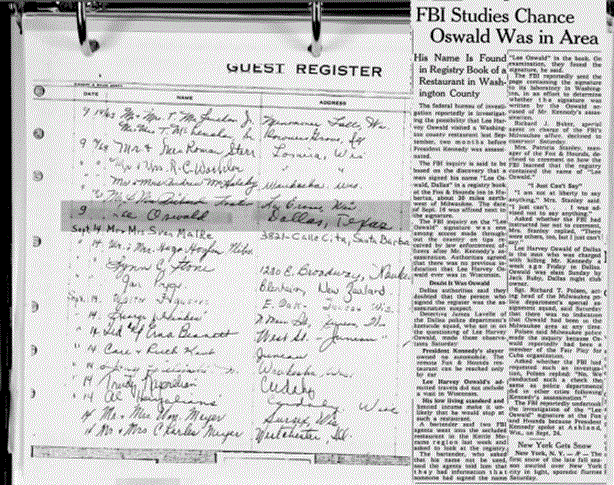
Looking at a list of WCR/FBI Exhibit numbers we spotted FBI D-050, a guest registry for the Fox and Hound in Milwaukee, WI with the name LEE OSWALD; DALLAS, TEXAS signed on the registry page for Sept 14, 1963. The article states the date was Sept 16, even though the actual page does not appear to have a date at all. A report of a “Lee Harvey Oswald” also written in a restaurant registry in Hubertus, WI coincides with a statement from the article by Mrs. Patricia Stanley, manager of the Fox and Hound, “…declined to comment on how the FBI learned that the registry contained the name of ‘Lee Oswald’” …” I am not at liberty to say anything.” Asked whether the FBI had instructed her not to comment Mrs. Stanley replied, “There were others, too, but I just can’t say.”
While the article repeatedly claims that there is no indication that Oswald was in Wisconsin, it never even hints at why or who would be putting that name with DALLAS in mid September when Oswald was in New Orleans with Marina (who was 8 months pregnant) and his first child June. Oswald and Marina arrived in New Orleans on April 24, 1963. On their reutrn to Texas in September, Marina moved in with Ruth, while Oswald did not return to Texas until October, after the Mexico trip. Ruth drove Marina and June to Irving the morning of Sept 23.
Ruth Paine left Irving on July 27, 1963 with her children for a driving trip to see relatives, friends and Friends (Quaker organization relations). In mid-September she was in Richmond, Indiana before heading south to New Orleans. Marina and Ruth had been in contact with each other initially discussing the end of September, after Ruth’s trip, as the approximate day for pick-up. Between Sept 20 and Sept 23 Oswald was with his wife, Ruth and all the kids at 4905 Magazine in New Orleans until they left. Oswald definitely did not travel with Ruth. When recapping that weekend Ruth uses the name “HARVEY” alone, something not seen or done in most testimony offered about Oswald.
Why the repeated use of all three of his names as opposed to simply Lee, or Oswald by the government lawyers? Was it to assist with the cover up when the different people in his history refer to him as Lee OR Harvey? I wonder how many times a single name was actually used, only to be transcribed into Lee Harvey Oswald. Looking through Ruth’s testimony, for example, “Lee Harvey Oswald” is said 85 times by Jenner and Dulles and not used once by Ruth.
Mr. JENNER – Now, you were there for 2 full days and 3 evenings. Would you tell us, conserving your description in your words, what did you do during these 2 days and 3 nights. When I say “you,” I am including all three of you.
Mrs. PAINE – Of course, afternoons we usually spent in rest for the children, having all small children, all of us having small children.
Mr. JENNER – Whenever this doesn’t include Lee Harvey Oswald would you be good enough to tell us?
Mrs. PAINE – When he was not present?
Mr. JENNER – That is right.
Mrs. PAINE – My recollection is that he was present most of the weekend. He went out to buy groceries, came in with a cheery call to his two girls, saying, “Yabutchski,” which means girls, the Russian word for girls, as he came in the door. It was more like Harvey than I had seen him before…
In the spirit of context and timing we know that Michael Paine had moved into his own apartment in September 1962. Michael picked up Oswald and Marina in Dallas in early April, 1963 for a visit to their Irving house after having met them at a party during the holiday season 1962. The party, at Mrs. Declan Ford’s house was where Mr. & Mrs. DeMohrenschildt bring Mr and Mrs Oswald at Mrs. DeMohrenschildt’s request. In one form or another, a close watch was being held on Mr. and Mrs. Oswald.
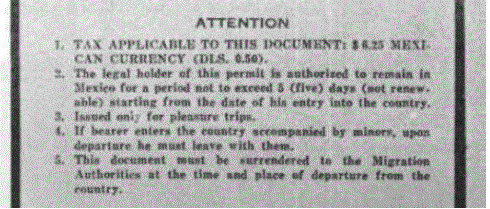
On September 17th; based on the date printed on CE 2478, the tourist visa; a man recorded as “LEE, HARVEY OSWALD” yet signing his name “Lee H Oswald” purchased a 15 day tourist visa for Mexico which allowed the holder to remain in Mexico for up to five days prior to the expiration date of the visa; October 2, 1963.
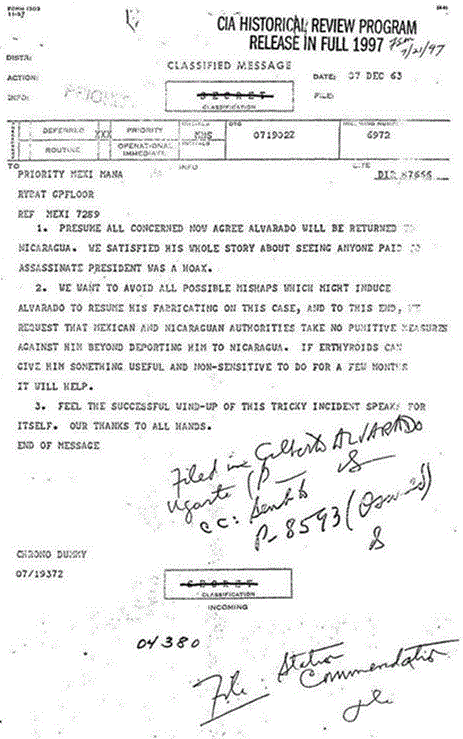
September 18th was the original date Nicaruaguan Intelligence officer Alvarado claims he saw Oswald in Mexico City, overheard a conversation related to an assassination and saw Oswald accepting money. Alvarado went to the American Embassy in Mexico City on November 25 to report what he saw. When the FBI/CIA realized that Sept 18 was not possible because Oswald was still in New Orleans, Alvarado changed his story as needed and ultimately recanted the entire thing under protest. The interesting thing about Alvarado is the CIA’s follow-up cable on Dec 7 which completely lets Alvarado off the hook for having fabricated the story and even suggests there is a direct connection between what Alvarado does and who instructs him to do it. Central American countries’ Intelligence servies and the CIA became VERY close over the years since 1947. If the encounter never happened; and there is no evidence that it did other than Alvarado’s word; how would Alvarado have known what types of things to say in order to incriminate Oswald all on his own?
CE 3152 is a memo from HELMS to RANKIN about the Alvarado incident: how hard it was to shake Alvarado off his story, how he maintained it was Oswald even after he failed the polygraph, and that he had been at the Cuban Consulate on Sept 18th. (The Consulates are not the same as the Embassies. A close examination of the evidence shows that when asked to go to one, the man playing Oswald would go to the other without success).
CE 3152 continues by establishing that Alvarado was informant T-32, that he was 60% sure it was Oswald and that it occurred on the 18th of September. In conjunction with this is a follow-up memo (possibly from David Phillips) which discusses “resolution” of the Alvarado issue yet gives the distinct impression that Alvarado, his employer and the CIA are very much intertwined. We’ll delve more deeply into the Alvarado incident in part two. Note: “IF ERTHYROIDS CAN GIVE HIM SOMETHING USEFUL AND NON-SENSITIVE TO DO FOR A FEW MONTHS IT WILL HELP.” His job in Mexico was most assuredly “sensitive.”
Peter Dale Scott uses the initial story and recant as examples of what he calls the Phase 1 and Phase 2 stories of Oswald. Phase 1 being the connection to communists, Cuba and Russia in order to “release the dogs of war” which when thwarted by Johnson and Hoover becomes Phase 2: Oswald the Lone Nut Communist with no ties to anyone and his NOT being the man in Mexico… Hoover seems to be the only one who appears concerned with the identity of the Oswald impersonator (the CIA certainly doesn’t care as they created the charade) and states on 11-23-63 to LBJ:
“…I think we have a very, very close plan. Now if we can identify this man who is at the Mexican Embassy at; the Soviet Embassy in Mexico City, the Embassy in Mexico City — this man Oswald has still denied everything.” Hoover would feel and mention the sting of the CIA and Oswald in Mexico for many years to come. He would also make clear to his staff that he felt the FBI report mistakenly came to a conclusion. The Commissioners themselves were very surprised at this since Hoover was given to saying the FBI determined the facts and did not present conclusions, even if ironclad.
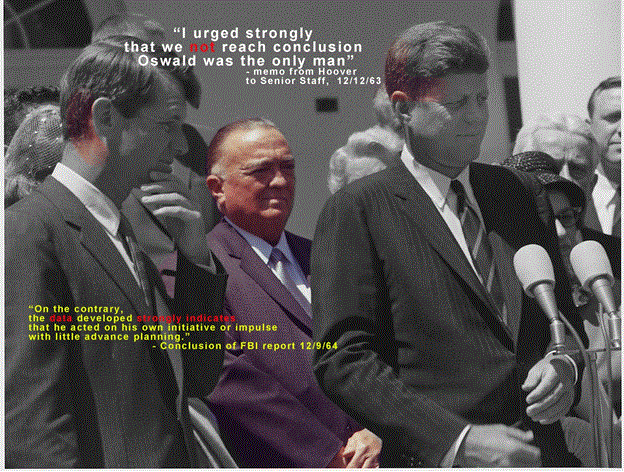
(enhanced by DJ)
One should note that prior to the 1947 creation of the CIA, the FBI’s Special Intelligence Service (SIS) was specifically responsible for Intelligence gathering in the Western Hemisphere, from 1941 through 1946 along with existing Military Intelligence entities with acronyms, like MID (Military Intelligence Division) & ONI (Office of Naval Intelligence). The SIS story begins on 26 June 1939, with Roosevelt signed a Presidential Directive stating:
It is my desire that the investigation of all espionage, counter-espionage, and sabotage matters be controlled and handled by the Federal Bureau of Investigation of the Department of Justice, the Military Intelligence Division [MID] of the War Department, and the Office of Naval Intelligence [ONI] of the Navy Department. The Directors of these three agencies are to function as a committee to coordinate their activities. (Presidential Directive of 26 June 1939; Section 2; File 64-4104; Administrative Records of the SIS; RG 65; NACP.)
FDR clarified his position on June 24, 1940:
He ordered that “The FBI should be responsible for foreign-intelligence work in the Western Hemisphere, on the request of the State Department,” while “The existing Military Intelligence and Naval Intelligence branches should cover the rest of the world, as and when necessity arises.” President Roosevelt concluded his directive by observing how “It was understood that the proposed additional intelligence work should not supersede any existing work now being done…” (New Insights into Hoover and the SIS, G. Gregg Webb; see here).
(Memorandum of President Roosevelt’s telephone directive prepared by Berle and approved by the President, 24 June 1940; Section 2; File 64-4104; Administrative Records of the SIS; RG 65; NACP).
Understanding the long history of US Military involvement in Central and South America would require a book in its own right, yet we ought to be aware that the growth and control of sovereign nations and their intelligence, security and military establishments in this area goes hand in hand with the US military’s work to protect US business interests in these countries. Between the Armed Forces’ Intelligence, the State Department’s attache corp and the FBI’s SIS, Central and South America, especially Mexico and Brazil, were hand-in-hand partners with the USA in numerous illegal activities from assassination to the drug trade. Many researchers have discovered this conection resulting in the multitude of “off the books” programs financed by illegal funds.
As we’ve learned, so much of what Marina Oswald tells us is shrouded in conflict. Yet as times and testimony change we can always count on her supporting the desired facts, even if she sounds terribly foolish doing so.
Prior to Ruth arriving, from early September though the 23rd, Marina’s “husband” is not working yet also not home every day reading as Marina claims. Between the Unemployment Office, the library and Ryder’s Coffee shop, he was busy. We finally learn about Oswald’s plans for Mexico from Marina in her testimony:
WCR testimony:
Mrs. OSWALD. Nothing. And it is at that time that I wrote a letter to Mrs. Paine telling her that Lee was out of work, and they invited me to come and stay with her. And when I left her, I knew that Lee would go to Mexico City. But, of course, I didn’t tell Mrs. Paine about it.
Mr. RANKIN. Had he discussed with you the idea of going to Mexico City?
Mrs. OSWALD. Yes.
Mr. RANKIN. When did he first discuss that?
Mrs. OSWALD. I think it was in August.
HSCA testimony:
Mr. McDONALD – When did you first learn of his planned trip to Mexico City? When did you first know about that?
Mrs. PORTER – Shortly before I left for Dallas with Ruth Paine.
Mr. McDONALD – How did you learn of this?
Mrs. PORTER – He told me about his plans to go to Mexico City and to visit the Cuban Embassy over there.
…
Mr. RANKIN When your husband talked about going to Mexico City, did he say where he was going to go there, who he would visit?
Mrs. OSWALD. Yes. He said that he would go to the Soviet Embassy and to the Cuban Embassy and would do everything he could in order to get to Cuba.
The purpose of the visit as recorded and expressed by Chief of Mexico Station Win Scott was to get himself and his family to Odessa. Cuba originally did not have anything to do with the evidence of the man calling himself Oswald.
…
Mr. RANKIN. Did you learn that he had a tourist card to go to Mexico?
Mrs. OSWALD. No.
Mr. RANKIN. If he had such a card, you didn’t know it then?
Mrs. OSWALD. No
…
And as usual, the FIRST STORY offered, which usually conflicted with the desired story, had to be changed or be supported by some rational explanation for the change:
Mr. RANKIN. When you were asked before about the trip to Mexico (CE1781 & 1792), you did not say that you knew anything about it. Do you want to explain to the Commission how that happened?
Mrs. OSWALD. Most of these questions were put to me by the FBI. I do not like them too much. I didn’t want to be too sincere with them. Though I was quite sincere and answered most of their questions. They questioned me a great deal, and I was very tired of them, and I thought that, well, whether I knew about it or didn’t know about it didn’t change matters at all, it didn’t help anything, because the fact that Lee had been there was already known, and whether or not I knew about it didn’t make any difference.
Marina describing her husband going to Mexico is fraught with problems and contradictions. So much so that a reading of each subsequent questioning on the subject appears as if she is reading from a prepared script regardless of the question. It was CUBA-CUBA-CUBA all the time, when actually there is little if any evidence anywhere else in this case to support Oswald’s desire to be in Cuba. (Incidentally, it was not the FBI she talked to about Mexico at first. It was the Secret Service).
Q. Did Lee tell you why he wanted to go to Mexico?
A. He was disappointed in Latin America so he wants to go and try Cuba.
Q. Why did he choose Mexico?
A. He told me he was going to take the bus. (sic)
(This bit of testimony is the reference used by the Warren Commission to determine Oswald had taken a bus from New Orleans).
One has to wonder what occurred to change Marina’s account of Mexico between November 28 & 29, 1963 and Feb 3, 1964 when she began giving the “adjusted” account of her knowledge about her husband’s Mexico Trip…
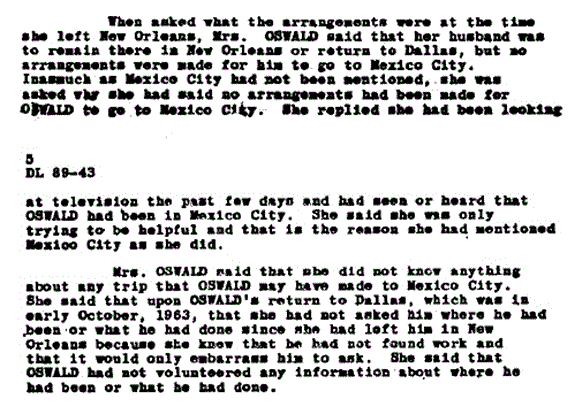
And the SS interview Nov 29th:
“She was asked whether she had any knowledge of Lee’s trips to Mexico or Washington, D.C. She replied in the negative. She was asked whether she or Lee had any cameras and she replied that Lee bought one camera in Russia and a second one in the United States. She said one was a small camera and the other was a box camera. She added that sho was not proficient with operating any Cameras and she never had an opportunity to do so.” See here (“never had an opportunity to work the camera” requires yet another back-peddling recant when the infamous Backyard photos come up)
In the time period when Oswald actually stopped working at Reily Coffee on July 22, 1963 (a company employing Oswald with its own set of CIA, FBI and NASA coincidences and peculiarities) and Sept 23, 1963 Oswald did not work, officially; his only job while in New Orleans since April was at Reily. In yet another of a long line of imposter coincidences, on July 26, 1963 at the American Museum of Atomic Energy in Tennessee we find someone has signed Oswald’s name and associated him with the USSR and Dallas. (H&L p.551 – FBI D-154)
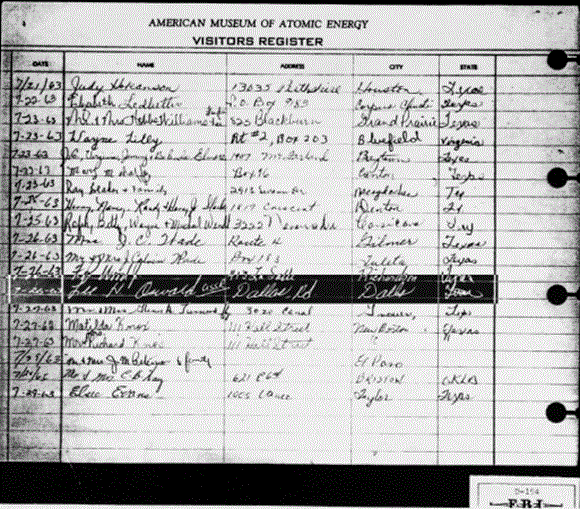
Oswald collected $33/week in unemployment beginning Aug 17 and had barely made $500 while at Reily. On August 9th he was involved in what we now know was a charade, and was arrested while handing out pro-Castro Fair Play for Cuba (FPCC) literature at the New Orleans LA International Trade Mart. Some of the literature in Oswald’s possession literally had his name and “544 Camp” stamped on it. This connects to Bannister and by association to a man named William Gaudet who we come to learn acquired the Mexican tourist visa sequentially numbered just ahead of the one given to Oswald: No. 24084, on Sept 17th.
On Sept 17, 1963 SOMEONE appears at the New Orleans Mexican consulate and purchases the visa made out to “LEE, HARVEY OSWALD,” which to most means the person’s name was Harvey Oswald Lee, or H.O. Lee. The FBI explains:
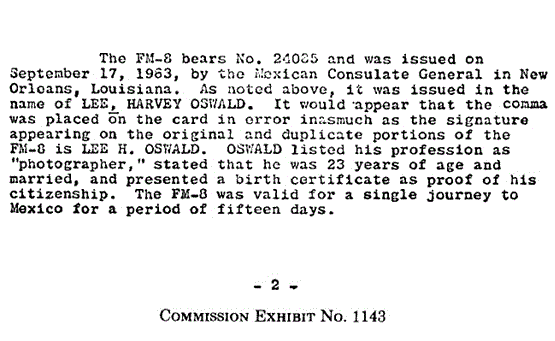
CE 1143 is an: Excerpt from FBI report dated May 18, 1964, re Lee Harvey Oswald’s visit to Mexico and excerpt from Secret Service report dated August 28, 1964, of schedule of buses traveling from Dallas and Houston to Laredo, Tex. (CD 1084(e), pp. 2, 99-101; CD 1450, p. 1).
The above excerpt starts with acknowledging that the 15 day visa was made out to “LEE, HARVEY OSWALD” comma and all, yet they write: “It would appear that the comma was placed on the card in error inasmuch as the signature appearing on the original and duplicate portions of the FM-8 is LEE H. OSWALD.” As we can see, #24085 appears as described (this is a reversed image) as do the signatures…
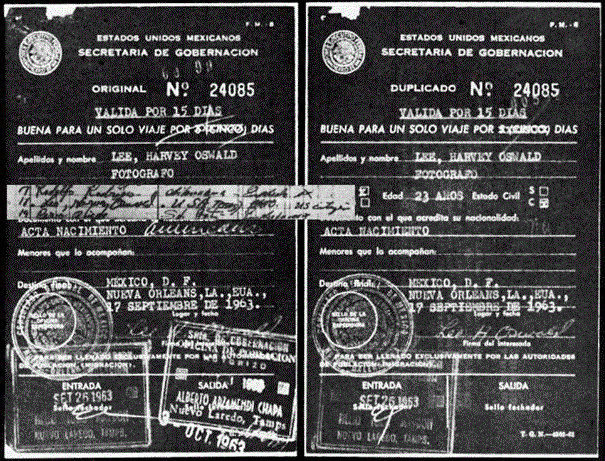
Yet, when we look at the hotel registry where Lee would have once again signed his name as it appears on the signature line of these forms, without a comma, we find something quite interesting: We are expected to believe that Oswald, who supposedly signed his name on the visa, did so in exactly the same manner as is TYPED on the 15 day visa, not as the visa was signed… maybe part of his master “advanced” plan? (Note: as we remember from the first The Evidence IS the Conspiracy article, he waited until Thursday afternoon the 21st to ask Wesley Frazier for a ride back to Irving to fetch his rifle, even though he had been working in Dallas at the TSBD since mid-October. The WCR concluded that this trip and the JFK assassination had no connection for Oswald and that there was in fact little if any advanced planning).
When we add to this all the evidence, or non-evidence of Oswald himself ever being in Mexico we are literally forced to re-examine in detail the events ascribed to him and whether or not this remains a simple oversight, or the inadvertent copying of information to keep falsified information consistent.
We learn that #24084, the visa issued just before Oswald’s was bought by a man the WCR, FBI and CIA sought to keep buried, William George Gaudet. And they succeeded. It was not until 12 years later during the HSCA that we hear from Gaudet and learn that the list of names of those who purchased visas on Sept 17 that the FBI provided the WC deleted the name Gaudet claiming, “No record of FM-8 No 24084 located.”
This link is Warren Commission Document 75 page 577 from Warren DeBrueys’ 12/2/63 report showing the FBI knew about this man within 2 weeks after the assassination. Gaudet’s stated purpose for the trip? “Travel to Mexico 1 day as tourist.” It is unknown whether he ever made that trip. Yet one Albert Osborne did. We will return to Mr. Osborne and some of the strange circumstances revolving around yet another piece of the Mexico Trip and the printing of FPCC flyers.
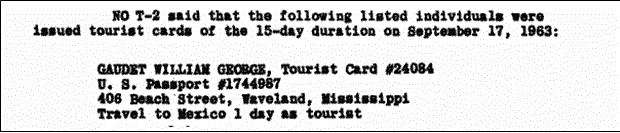
More importantly for this discussion, when he was finally questioned by the HSCA, Gaudet established direct connections between Guy Banister of 544 Camp Street and Lee Harvey Oswald during the summer of 1963 in New Orleans:
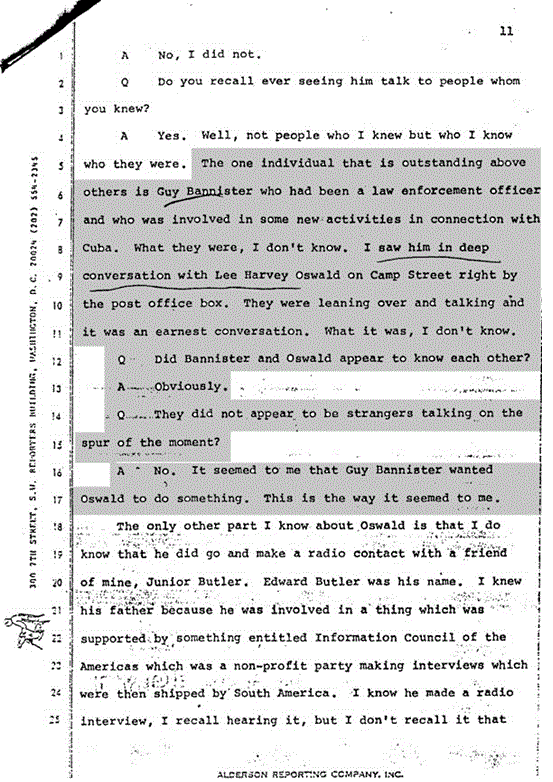
National Archives, HSCA 180-10070-10274, Numbered Files 004826; HSCA interview of William Gaudet
Gaudet goes on to mention the names David Ferrie, Sergio Smith, Howard Hunt, Bernard Baker and Frank Sturgis among his CIA exploits:
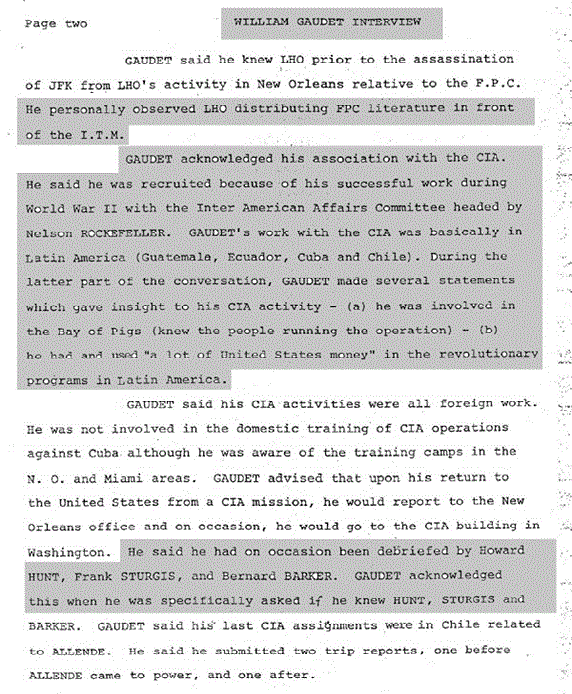
Gaudet acknowledged he knew Oswald (and Bannister) from his activity in New Orleans related to FPCC; the same FPCC which the Secret Service states has no connection to 544 Camp. Mr. Gaudet would have us believe that his acquiring the previous visa on the same day was pure coincidence.
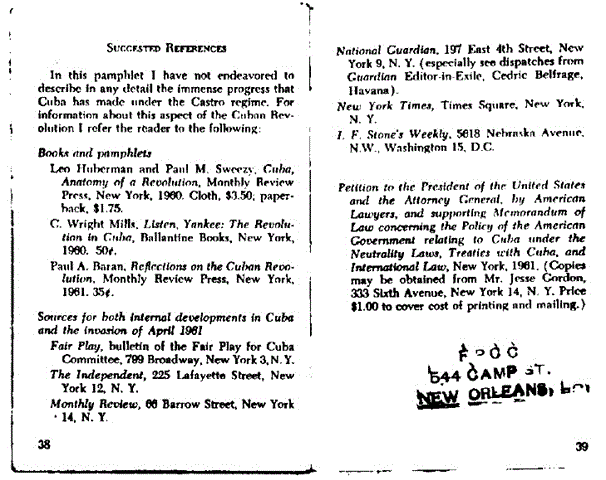
CE3120 shows copy of Corliss Lamont’s pamphlet with the final page bearing a FPCC, 544 Camp Street, New Orleans stamp. WCD1495 is a SS report dated Sept 11, 1964 which connects this pamphlet to literature found in Oswald’s possession.
CE1414 is an SS report from Dec 1963 which concludes that there was no connection between FPCC and 544 Camp, and that it was “impossible” to find anyone who recalls ever seeing Oswald at that address. But boy oh boy did we try hard.
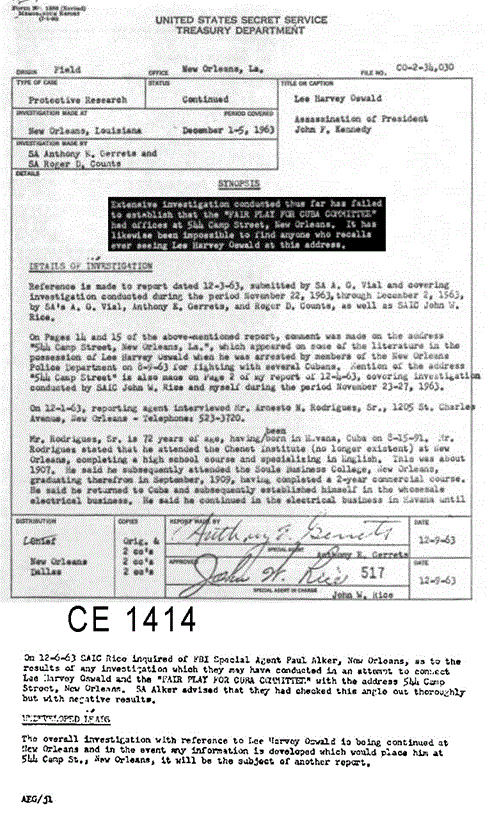
Since William Gaudet helps to show that conclusion for what it truly was, we can understand why the FBI, CIA and WCR went out of their way to remove him from the picture. Could Gaudet have been the reason and/or transportation for Lee to have gone and gotten a 15 day visa which would expire exactly on October 2, 1963? Witnesses to this purchase stated that Oswald was alone at the time and that the following visas are purchased just before closing at 1:30pm.
Of note is that the visa states the stay in Mexico cannot exceed 5 days while the visa itself is good for 15 days. The dates work perfectly; Ruth arrives just in time to remove Marina and June from Oswald’s care and sight. Virtually every single statement incriminating Oswald for having been to Mexico and to the Soviet and Cuban Embassies and/or Consulates is derived from CIA/DFS (Mexican Intelligence) related transcripts and records. The FBI, which also had their own relationships with the Mexican DFS obviously also did not have a shred of proof that Oswald, the man Ruby killed, had been to Mexico. It relied exclusively on CIA information.
Along the same lines as taking CIA documentation for what it is, former CIA officer Phillip Agee tells us that CIA 201 files are divided into a CLEAN “operational” part for public consumption and a SECRET “true name documents” part. The following is an excerpt from Inside the Company, by P. Agee:
“Files are maintained on all agents and they always begin with the number 201 — followed by a number of five to eight digits. The 201 file contains all the documents that pertain to a given agent and usually start with the PRQ and the request for POA. But the 201 file is divided into two parts which are stored separately for maximum security. One part contains true name documents while the other part contains cryptonym documents and operational information. Compromise of one part will not reveal both the true name and the operational use of the agent.”
We ought to take a moment to create a little “mind-set” context. In 1963 the backstory always supported the documents. The documents were the evidence. There was not Internet cross-checking or even putting most of the evidence side-by-side. They were accepted until authenticated while usually authenticated by the same CIA people who created them or those under their control. When the CIA or FBI or ONI, INS, MID handed you a file or leaked a story, there was no questioning where the rest of it was, where the “good stuff” or the “secret” stuff was. Today, we are given the impression that NOTHING IS SECRET while everything, in reality, is. In 1963 and for many years after, the truth was simply hidden or destroyed. Today it is covered with mountains of data and hiding in plain sight.
The result is the same question: “What is the truth?”
The answer remains the same: “What we tell you it is.”
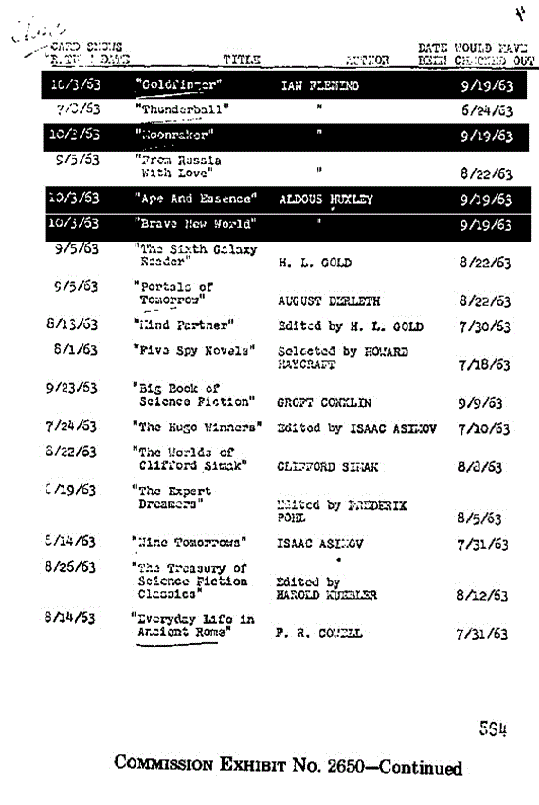
On September 19th, two days later, Oswald is at one of the New Orleans public libraries and checks out four books. This in itself is not surprising as most said he was an avid reader (not bad for a 10th grade dropout: teaches himself Russian, speaks eloquently on Marxism, his own philosophies, his travels and his photographic abilities. School records reflect a 102 to 118 IQ.) What surprises is the fact these books are returned in New Orleans on the day Oswald is supposed to have arrived in Dallas; October 3, 1963. (We will return to Oct 2 and beyond in Part 3). One has to wonder who this Lone Nut Oswald was so close to that they would return four library books. Where were these books? If he traveled with the books he’d need to stop in New Orleans first, which was something Marina was asked about, but then he could never have been in Dallas at the time he was. Mrs. Jesse Garner, the apartment manager found a completely empty 4905 Magazine on the 25th when she came to collect some rent that was due. Oswald had taken all his possessions with him, yet these library books were returned in New Orleans on the 3rd of October.
September 20th is also a most interesting day: (From Harvey and Lee, p.598)
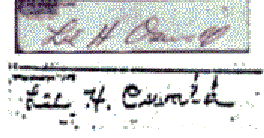
On September 20 Nagell sent a registered letter from El Paso, Texas to J. Edgar Hoover at FBI Headquarters and informed him that President Kennedy would be assassinated during the last week of September in a conspiracy that involved Lee Harvey Oswald. After mailing the letter, which included Oswald’s description, aliases, and current address, Nagell walked into the State National Bank and fired two shots into the ceiling. He then walked outside and waited for the police to arrive. When the police arrived and arrested Nagell his only statement was, “I would rather be arrested than commit murder and treason.” When Nagell was searched the police found a photocopy of a military ID card issued to Lee Harvey Oswald. The ID card was probably given to Nagell by the people who assigned him to infiltrate the activities of Lee Harvey Oswald and Franz Waehauf at the Hotel Luma in Mexico City. Otherwise, how and why would Nagell have a copy of Oswald’s military ID card with a different signature?
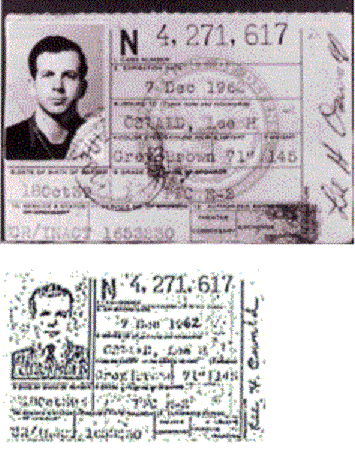
(When Richard Case Nagell was arrested in El Paso Texas, the police found a military ID card issued to Oswald in his belongings. That card was identical to one found on Oswald in Dallas on November 22, 1963. With two exceptions: the photo and signature were different).
Friday, September 20, 1963 was also the day that Ruth Paine arrived at 4905 (or 4907) Magazine after corresponding with Marina about having her come live with Ruth and children until and through the birth of their next child in mid-October. Ruth and children arrive in a 2-tone BLUE station wagon which appears not to be the same vehicle in which Ruth brought them to New Orleans.
CE3119 page 10 reports that Lillian Murret, Oswald’s aunt, said that the “unknown woman from Texas in the BROWN station wagon had called for him…”
In April 1963 the Oswalds arrive at the Murretts’ in New Orleans in a BROWN station wagon driven by Ruth Paine. In September 1963 the same woman picks them up in a BLUE station wagon.
During her questioning about February 22, 1963; the gathering when the DeMohrenschildt’s brought Marina and Harvey; she was asked how she got there, answering that she drove:
Mr. JENNER – You owned or then had, or maybe you still have a station wagon?
Mrs. PAINE – That is right.
Mr. JENNER – Is it the same car still?
Mrs. PAINE – It is the same car.
Mr. Clifton Shasteen was a barber in Irving who remembers Oswald well:
Mr. SHASTEEN. Well, now, that part of it I would have to take for granted because they were in his car. Now, she, I understand through one of the men who questioned me out at the shop, said he never did drive her car. Again, I’m going to disagree because I know that he did. He drove it up there and got a haircut.
Mr. JENNER. You have a distinct recollection that on occasions when this man came into your shop for a haircut, he drove an automobile up to your shop?
Mr. SHASTEEN. He drove that there 1955, I think it’s a 1955, I’m sure it’s a 1955 Chevrolet station wagon. It’s either blue and white or green and white it’s two-toned–I know that. Now, why I say–why I take it for granted that Mrs. Paine was with him when he come to the grocery store I do remember he wasn’t driving when they would come to the grocery store, there would be a lady driving and I’m assuming that that’ was Mrs. Paine, because like I say, I have been–I have never been close enough to her and knew it, to speak to her, but she trades at the service station where I do and I saw her in there and I never did pay any attention to her and I saw her passing, met her in the road in the car and those things. (See here).
With Oswald on a few of these trips was a boy described as 14 years old and unknown to Clifton who as a barber had a good memory for faces, not names.
Mr. JENNER. And would you describe this young man to me, how was he dressed?
Mr. SHASTEEN. Well, he had on blue jeans and they fit tight and he had on an old striped shirt, I remember him just like I see a picture over there right now and he was a husky kid, he wasn’t what you call fat, but he was strong-broad-shouldered; he had a real full, and when I say full, I don’t mean a round fat face, he was a wide-faced kid.
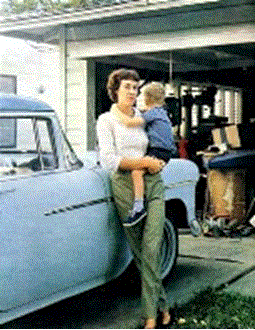
(Note: A BROWN station wagon of similar make, model and year was seen at 4905 Magazine around the time of Oswald’s FPCC arrest on Aug 9th at the International Trade Mart).
Ruth and children stay the weekend and corroborate the fact that Marina’s “husband” was there all weekend. Finally, on Sept 22, Oswald helps load Ruth’s car and on the morning of Sept 23 says goodbye to Marina and June. Of special note were questions asked by the WC about anything that might have resembled a rifle either in the materials packed with Marina or in Oswald’s possession when he leaves on the 24th. The answer in each case was that nothing resembling a rifle was seen either during the packing, unloading and storage of their belongings, ever.
On September 24 (Tuesday) Oswald visited claims interviewer Fredrick L. Christen (“T-3”) at the unemployment office in New Orleans for the last time. Once again Christen reported Oswald’s visit to the FBI and advised that he signed a continued interstate claim (Form IB -2) in his presence. (p. 603 H&L)
Witness Eric Roberts, who lived near Oswald on Magazine stated that Oswald left his apartment around 7pm, Sept 24, carrying 2 SMALL SUITCASES approximately 18 inches across and caught a bus at the nearest stop at Magazine and Upperline. The FBI conducted a fairly thorough search of the surrounding hotels; 43 to be exact; and was unable to locate where HARVEY Oswald stayed that night (see here).
We are aware that Oswald was still in New Orleans the morning of the 25th of September as he cashed his Sept 17th Unemployment Insurance Claim check which was mailed from Austin on Sept 23rd. While two days from mailing to cashing does seem a bit quick, most every event in the falsified timeline gives Oswald JUST ENOUGH TIME to potentially complete the event, yet they still stretch the bounds of credibility.
Speaking of the bounds of credibility stretched, the WCR states, on page 731, that Oswald had $200 for the trip to Mexico, footnote #1124 refers to CE2481, Oswald’s tourist visa application in which he actually states he has $300. As discussed earlier, Oswald’s last day of work was July 22, and the first $33 UE check was on Aug 17. Of course, there were living expenses from Aug 17 thru Sept 23 for himself, Marina and June and “no money to Marina” when she left with Ruth.
Mr. RANKIN. When he was unemployed in New Orleans, did he get unemployment compensation?
Mrs. OSWALD. Yes.
Mr. RANKIN. Do you know how much he was getting then?
Mrs. OSWALD. $33 a week. It is possible to live on that money. One can fail to find work and live. Perhaps you don’t believe me. It is not bad to rest and receive money.
Mr. RANKIN. Did your husband have any money with him when he returned from Mexico?
Mrs. OSWALD. Yes, he had some left. But I never counted how much money he had in his wallet. That is why I don’t know.
Mr. RANKIN. Was it a small or a large amount or do you know that?
Mrs. OSWALD. What would be a large amount for me would not be a large amount for you.
Mr. RANKIN. Well, can you give us any estimate of what you think he had?
Mrs. OSWALD. He might have had $50 or $70, thereabouts. It is necessary sometimes to make a joke. Otherwise, it gets boring.
It is unclear whether Marina was given any money while her husband was separated from her. It is also unclear how Oswald saved two let alone three hundred dollars when he only received $33/wk. for about 6 weeks.
Oswald left New Orleans by bus. Or so says the WCR with reference to Marina Oswald’s testimony. Actually, she left two days before her husband left. Oswald probably left, the WCR concluded, by way of Continental Trailways Bus No. 5121. Probably. In Warren Report-speak this means there is no proof whatsoever that Oswald took or was aboard that bus or the evidence would have been offered, fabricated or not.
The FBI was simply unable to determine how Oswald left with his two suitcases after he left the local bus. According to the driver of the bus who helped Oswald load his two suitcases, he asked for directions to the Greyhound bus station. The Greyhound station and the Continental Station are not the same nor do the Greyhound buses travel to or from the Continental Station and vice versa. It is very likely, based on the testimony of Sylvia Odio and her sisters, that Oswald was on his way to Dallas, in a car driven by two Cuban men.
The men were two anti-Castro Cubans who, as a threesome, make it difficult to believe that the man leaving the impression he was Lee Harvey Oswald on a bus leaving Laredo, was actually Marina Oswald’s husband.
Mr. LIEBELER. When did you first become aware of the fact that this man who had been at your apartment was the man who had been arrested in connection with the assassination?
Mrs. ODIO. It was immediately.
Mr. LIEBELER. As soon as you saw his picture?
Mrs. ODIO. Immediately; I was so sure.
Mr. LIEBELER. Do you have any doubt about it?
Mrs. ODIO. I don’t have any doubts.
Mr. LIEBELER. Did you have any doubt about it then?
Mrs. ODIO. I kept saying it can’t be to myself; it just can’t be. I mean it couldn’t be, but when my sister walked into the hospital and she said, “Sylvia, have you seen the man?” And I said, “Yes.” And she said, “That was the man that was at the door of my house.” So I had no doubts then.
Mr. LIEBELER. Now, you have indicated on the calendar, you circled the 30th of September, and you drew a line around the 26th, 27th, and 28th of September. Can you tell me what you meant by that?
Mrs. ODIO. The 30th was the day I moved. The 26th, 27th, and 28th, it could have been either of those 3 days. It was not on a Sunday. (26th was a Thursday and a travel day, while CIA reports place an Oswald in Mexico on the 27th and 28th)
This takes us through 12:20pm September 25th when a bus leaving New Orleans for Houston becomes the agreed upon mode of transportation for Oswald’s trip to Mexico.
In part II we will examine the evidence related to September 25th; the simultaneous trip to Dallas and Mexico; through October 3rd when Oswald was in Dallas while someone was returning his library books in New Orleans and making another call in his name to the Cuban Consulate in Mexico City.
Michael Swanson’s book, The War State, seems to me to be a unique and worthy volume. This is not a book on the Kennedy assassination. It’s not even mainly about Kennedy’s presidency; although it does deal with that subject in the second half of the book. What it really is about is the construction of the Military Industrial Complex (MIC) after World War II. How that complex, as in no other country, then became a permanent and an integral part of our society. And how it then began to siphon and strangle parts of the American economy. It also deals with how two presidents helped start the phenomenon, Franklin Roosevelt and Harry Truman; and how two presidents then crashed into it, Dwight Eisenhower and John Kennedy. But the author makes clear that the crash by the latter was much more extensive. In other words, Swanson has written a Big Picture book, one in the tradition of, say, Fletcher Prouty. In my opinion, we need more of these types of books these days. Especially in light of what has happened to the USA since 1963.
Swanson begins the book with a telling quote by statesman and author George Kennan. Kennan writes that if the USSR would disappear tomorrow, the American military-industrial complex would remain unchanged, “Until some other adversary could be invented. Anything else would be an unacceptable shock to the American economy.” The remarkable thing about this quote is that Kennan wrote it in 1987, two years before the collapse of the Berlin Wall, and four years before the collapse of the USSR. And true to form, the MIC did hang on for a decade. And then, almost to fulfill the dreams of Project for the New American Century (PNAC), came Osama Bin Laden and the 9-11 attacks. The MIC now had its new nemesis. And, as per PNAC, American foreign policy demanded an invasion into Central Asia (Afghanistan) and one into the Middle East (Iraq-twice). PNAC also demanded a reshaping of that area into republics; something they were not at all ready to be. That stipulation created a new Perpetual War to replace the Cold War. All of this was predicted in advance by Kennan.
From here, the author flashes forward to the Cuban Missile Crisis. (Pgs. 3-9) And he shows how the extremes in both the Russian and American camps made it difficult to settle that nightmare peaceably. To the point that President Kennedy had to use his brother to create a back channel to Ambassador Anatoly Dobrynin to come to a peaceful conclusion to the crisis. Swanson then comments that this may be why Kennedy allowed director John Frankenheimer to use the White House while filming Seven Days in May, a book and film which depicts an attempted military takeover of America.
For his theme, Swanson now segues to Eisenhower’s famous Farewell Address, in which, for the first time, the MIC, as we know it, was named and described, and its dangers outlined. (p. 10) And now, Swanson begins to describe just how powerful and sprawling the MIC has become. The USA spends 15 times as much on the military as does Russia. It spends 6 times as much as China. (p. 11) If one adds up all global spending on arms and the military, the USA is responsible for 40% of it. More than the next 20 countries combined.
How was this monster created? Prior to World War II, the USA had always demobilized after major wars. For example, in the thirties, the USA had an army of 140,000 men. We had only 80 tanks and 49 bombers. The total arms budget was only 243 million dollars. As Swanson comments, no one, not Huey Long, not John Maynard Keynes, could get Roosevelt to spend enough money to counter fully the Great Depression. But the threat of Germany and Japan did that in spades. By 1944, unemployment went from 14.6 % to 1.3 %. In constant dollars, FDR spent over 840 billion on the military. That figure dwarfed what he spent on the programs of the New Deal. By the end of the war, the USA had built 88,000 tanks, 97,000 bombers, 400 destroyers and cruisers and an amazing 22 aircraft carriers. (p. 13) Military spending was now 36% of GDP and had reached 86% of total budget expenditures in its biggest year. (p. 13)
Prior to World War II, very few people paid income tax, and it was usually the rich who did. But this war was much more expensive than World War I, therefore bonds were not enough to finance it. Therefore, taxes had to be supplemented by the withholding income tax feature on middle class people. By 1945, that tax had now surpassed the corporate income tax as the base of operations for the American budget. (pgs. 14-15)
When Roosevelt began to taper the economy to switch over to a wartime basis, he felt he had to go to the Eastern Establishment to man the high positions in this new behemoth. Therefore, the heads of companies like Sears and GE were placed on the War Production Board. And these men told Roosevelt only big companies could ramp up production fast enough to create a great war machine. Which, the author points out, may or may not have been true. (p. 18) These men also recommended the no-bid contract for much of the work to be done. Almost 75% of all contracts since have been of this variety. Further, they have also been cost plus contracts. Which means all costs of production are paid with a profit built into the contract. As the reader can see, this was the beginning of corporate socialism in military contracting. The biggest companies got even bigger and the MIC was now created. (p. 20)
As the author notes, these abuses eventually led us down the path to Ronald Reagan and the Pentagon’s $435 hammers, $600 toilet seats, and $7000 coffee makers. Many of these men FDR appointed, like Charles Wilson, urged him not to demobilize after the war. Others, like historian Charles Beard, saw the danger this created and said it was necessary to demobilize. Since FDR died before the end of the war, he did not make that decision.
As many scholars have noted, including the illustrious Barton Bernstein of Stanford, Harry Truman was responsible for many of the excesses of the national security state. Whatever his regrets were later, whatever New York Times hagiographers like David McCullough may write about him, Truman is popular with Republican mouthpieces like George Will for a reason. The reason is that, along with Winston Churchill, he bears a large part of the responsibility for the Cold War. (As I previously pointed out, the best book on this subject is Frank Costigliola’s Roosevelt’s Lost Alliances.)
As Swanson sees it, the Cold War began in earnest with the dropping of the atomic bombs on Hiroshima and Nagasaki. Swanson agrees with authors Gar Alperovitz and Stewart Udall that the dropping of these bombs was completely unnecessary. He also quotes people in the government at the time who agreed with that view. For example, Herbert Hoover, Curtis LeMay, Dwight Eisenhower and Douglas MacArthur. (pgs. 38-39) That is quite a conservative gallery for the allegedly populist Truman to be out of step with.
As Swanson incisively writes, the arms race was accelerated because of the influence of Secretary of State James Byrnes. Byrnes was as much a contrast to Secretary of State Cordell Hull as Truman was to FDR. Byrnes pushed Truman into using the atomic bomb as leverage over the Russians at Potsdam. Which was an incredible misjudgment of Josef Stalin. Truman and Byrnes also looked askance at Stalin’s attempt to control Poland after the war; something that even Churchill understood and privately agreed to in principle. (pgs. 60-61) As Alperovitz postulated, one reason for the dropping of the atomic bomb on Nagasaki was to thwart any more Russian influence in Japan since Roosevelt had agreed to have Stalin open a second front in Asia. Something Stalin did. But the Russians were so easily successful that this alarmed many of the White House hawks, who Hull and FDR had overridden. With the second bomb, and the closing off of the Russian military drive in Manchuria, Stalin now saw the handwriting on the wall. The USSR now had to build its own atomic bomb. In a monumental miscalculation, Truman thought this would take the USSR many, many years to do. (pgs. 66-67) He was wrong. They did it in four.
As Swanson astutely comments, this was not all to the origins of the Cold War. There were two other distinct elements. First, there was the Bretton Woods agreement of 1944. Named after the town in New Hampshire where the representatives met, this was the creation of the economic internationalist system that would mark the post war world. Bretton Woods marked the beginning of incredibly influential agencies like the IMF and the World Bank. In other words, the Western financial centers of London and New York would now have a reach that would be truly global. (p. 48)
The second distinct aspect outside the creation of the bomb was the Truman Doctrine. Swanson mentions the struggle in Greece between the monarchists and the socialists after the war. The United States sided with the monarchists. (p. 69) Both Bill Donovan, former OSS chief, and George Kennan backed this move. Although Kennan did have his reservations about the USA becoming the policeman of the world. Senator Arthur Vandenberg, a former isolationist, urged Truman to use the aid to Greece issue as a fear tactic against the Russians, to herd the American people into following him. (p. 72) Needless to say, the tactic was successful. The Truman Doctrine passed in 1947 by the large margin of 67-23. The USA was now allowed to direct aid and weapons to any nation perceived to be in danger of being taken over by communists. This gave the president a huge new power that really did not require a lot of consultation with congress. Therefore, as his advisers told him, Truman now had a great issue in his hands, that of anti- communism. These men did not understand how ogres like Joe McCarthy and J. Edgar Hoover would now demagogue that point.
The Truman Doctrine was followed up by the Marshall Plan and the creation of NATO. Both of which Stalin felt threatened by. Therefore, he joined neither one. As he did t join Bretton Woods. (p. 76) But when Stalin actually tried to act against this new coalition, he failed. Swanson describes here the attempt by the Russians to seal off West Berlin and force the USA out of the city and therefore make Berlin one, under Russian influence, inside of East Germany. The attempt failed due to the Berlin Airlift. And Swanson rightly states that, in practical terms, this was the extent of the Russian challenge to NATO in Europe. Which is why, for example, Kennan recommended unifying German as early as 1957. His doctrine of containment had won out.
Kennan, of course, with the famous Long Telegram from Russia, had predicted a struggle with communism and the Soviets. But he always regretted the fact that his message had been taken over by the hawks in the White House and turned into an excuse for higher military budgets. He felt that struggle would be much more of an economic, diplomatic, and cultural one. (p. 77)
Now comes one of the highlights of the book. After the Russians exploded their atomic bomb in 1949, Truman ordered a review of national security policy. (ibid) The wrong person was placed in charge of this review. The result was one of the great mistakes in modern American history. The man in charge was Paul Nitze, and the Frankenstein monster he composed was NSC-68.
Nitze is one of the most ignored figures present at the creation of the Cold War. Because not only did he play a major role in its construction, he was such an inveterate and unrepentant Cold Warrior that he stuck around for decades. He then revived it all under Ronald Reagan 30 year later.
He is one of the worst examples of the Eastern Establishment. Educated at Harvard, he went into investment banking and made a fortune before he was thirty. He then joined Dillon, Read, before founding his own company. But he returned to Dillon Read from 1939-41 as its president. His first wife was a member of the Rockefeller clan. Nitze therefore was one of the members of a privileged class of wealth who navigated between Republican and Democratic presidents for forty years. He had no real political convictions except 1.) to stay in a position of power and 2.) to exacerbate the Cold War. He achieved the last with spectacular success.
When Truman commissioned his review, Nitze was in charge of Policy Planning at State. He chaired a study group, which featured Dean Acheson and Chip Bohlen, among others. But as many authors agree, Swanson included, Nitze was the driving force behind NSC-68.
This infamous document recommended a huge, spectacular expenditure on new atomic bombs; a tripling of the conventional defense budget; and a raising of Kennan’s containment policy to levels that Kennan never dreamed of or contemplated. Nitze did this by exaggerating the Russian threat out of all relation to its real military capabilities. But he also did so by attributing to it designs on Europe which it simply did not have. (pgs. 81-82) He then presented his report to Truman with three options: withdraw from Europe, attack the USSR, or follow his recommendations. A skilled bureaucrat, Nitze did his work behind Truman’s back. He himself understood that many of his claims were unsubstantiated at best, and pure hyperbole at worst. But by going to each service chief separately, by getting their support for a huge budget increase, and then telling them he was doing the president’s bidding, he had cornered Truman. He also went to the press to tell them how much this program was needed. (p. 84) Truman resisted, and then relented. (Swanson could have added that Nitze repeated this performance again in the late 70’s with the Committee on the Present Danger. See Jerry Sanders fine book, Peddlers of Crisis.)
As a result of Nitze’s handiwork, by 1952, defense spending had gone from 13 billion annually to 56 billion. As Swanson comments, NSC-68 made the MIC created by World War II a permanent industry. For example, in 1953, 75% of the national budget was devoted to the military. In the first decade of the Cold War, over 60% of the national budget was devoted to defense spending. (p. 85) But beyond that, Nitze wrote in NSC-68, that even if there was no USSR, it was the purpose of the USA to keep “order” in the world. In fact, this was one of the Nitze’s favorite themes: America’s duty to keep a world order.
When NSCA-68 was declassified in the seventies, the Russians were aghast at just how wrong the information it was. Later, the Russian military estimates for Nitze’s Committee on the Present Danger were also shown to be wrong. In other words, instead of the media treating him like a Wise Man of the establishment, Nitze was nothing more than a rightwing shill. He did his shilling for his beloved Wall Street brethren’s economic interests. His lies ended up bankrupting two countries: Russia and the USA.
Previewing his next chapter, Swanson writes that the CIA would now become the chief mechanism for American control in all reaches of that world order.
Swanson begins his chapter on the CIA by quoting from a speech Dick Bissell gave about the Agency at a CFR meeting in 1968. There, Bissell talked almost exclusively about the methods and goals of covert action programs. In other words, there was very little discussion of the collection and collating of intelligence. Swanson then observes that in a covert action program, sometimes things come up that are unforeseen. These command spur of the moment further covert actions. In fact, in an internal CIA 1972 report, it was observed that presidential authority had approved only 25% of all covert actions. (p. 101) In the formative years of the Agency, the 40’s and 50’s, some senators who were supposed to be practicing oversight, really did not want to hear about the Agency’s cloak and daggers activities. Therefore, the Agency had almost a blank check to do what it wished. An example of this was the extensive network of airlines the CIA developed over time. Which Director Richard Helms did not even know the extent of. He had to commission an officer to summarize their holdings. (p. 104)
From here, Swanson traces the history of the Agency from the Central Intelligence Group led by Sidney Souers to the formation of the CIA under the National Security Act. He notes the influence of Allen Dulles in the shaping of the National Security Act, especially those paragraphs dealing with the Agency. (p. 113) Some of the early employees of the Agency were Frank Wisner, E. Howard Hunt, James Burnham, and Bill Buckley (the last two would go on to found the National Review). One of the early propaganda projects these men worked on was the construction of the Congress for Cultural Freedom and its flagship British magazine, Encounter. (p. 116) Some of its early covert action projects took place in Italy and Greece. But Frank Wisner, head of covert action at the time, utterly failed in his operations to undermine Russian control in Eastern Europe. The CIA also failed to predict the Korean conflict or the creation of the atomic bomb by the USSR.
Truman, gravely disappointed by these intelligence failures, now appointed Walter B. Smith as CIA Director. Smith had read the Dulles-Corrrea-Jackson report on CIA reorganization. So he brought in Dulles as Deputy Director of Plans, and then made him Deputy Director. Wisner’s Office of Policy Coordination, where covert action was planned, was now brought out of the State Department and into the CIA. (p. 122)
Dulles had been friendly with the Rockefeller family for many years. Through them, he had met the Shah of Iran. Therefore, he was instrumental, along with his brother, Secretary of State, John Foster Dulles, in recommending the overthrow of the nationalist Mossadegh in Iran. (p. 125) The CIA chief in Tehran suggested this was an attempt at Anglo-American colonialism. Dulles had him transferred out and replaced him with the head of the operation, Kermit Roosevelt. (p. 126) Needless to say the coup worked. But the warnings of the CIA chief turned out to be correct in the long run. In 1979, with the Iranian revolution, radical Islam began to sweep through the Middle East, along with radical anti-Americanism.
Allen Dulles now became CIA Director due to Smith’s health problems. At the request of United Fruit, he and his brother advocated for the overthrow of Jacobo Arbenz in 1954 in Guatemala. United Fruit hired advertising wizard Edward Bernays to control the press coverage about Arbenz prior to the coup. Bernays of course played up the Red Menace angle. (p. 129) In reality, there were about 4,000 communists in the country, and only four members of congress were communists. The coup succeeded. But as with Iran, the long-term effects on Guatemala and the region were horrific. Some estimates state that the number of Guatemalans eventually killed by a series of fascist dictators mounted into the tens of thousands.
Eisenhower began to get reports about Allen Dulles that portrayed him as being ruthless and a less than competent administrator. So Ike set up the 5412 group to supervise CIA activities and report back to him. But since Dulles gave this group incomplete information, they were never able to get a real grip on the CIA. Swanson writes that it was at this point that Eisenhower began to get disgusted with the intelligence community. And he now issued his famous warning about the USA’s intelligence apparatus being a mess since Pearl Harbor, and that he would bequeath his successor a “legacy of ashes.” (p. 140)
Swanson now veers off into a subtheme of, “the Road not Taken.” He writes a chapter about Republican senator Bob Taft of Ohio. Like many in the Eastern Establishment, Taft was an Ivy League graduate of Yale and Harvard. But unlike, say Nitze, Taft did not migrate to Wall Street to make his fortune after graduation. He returned to Cincinnati and practiced law. He then went into government service to resupply Europe with food after World War I. Observing the Versailles Treaty, in which the Dulles brothers were involved, he disliked what he saw. He did not think it was a just peace, but an imperial peace. (p. 148) On his return to Ohio, he went into state politics and then entered the US senate in 1938. Opposing Roosevelt’s New Deal, he became known as Mr. Republican. He opposed the concentration of power in the White House during World War II and the New Deal. He also feared the growing trend of the American president to be a czar in the field of foreign policy. Which tended to make the USA into a major player in international affairs. Taft called himself a non-interventionist. (p. 154) He frowned on the growing armaments industry. He felt that because of its geography; being bound by the Atlantic and Pacific Oceans; the USA only needed a strong navy to protect itself from invasion. Prior to Pearl Harbor, he was against American intervention in World War II. He felt that America should supply England and Russia with the money and weapons to defeat Hitler.
Taft saw the growing power of the presidency as making future wars more likely. He also felt that the growing spending on defense would weaken the economy by raising taxes and causing inflation. (pgs. 156-57) Taft’s ideas caused a split in the Republican Party in the fifties between the Eastern Establishment and the Midwest non-interventionists. In 1952, when Taft ran in the primaries, Thomas Dewey got Harold Stassen to serve as a stalking horse for Eisenhower and he branded Taft an isolationist.
Taft’s ideas did have an influence on Eisenhower. Ike wanted security with solvency. He complained that when he was in the military, no general ever wanted to get rid of anything, including horses, which stuck around 50 years after they were obsolete. (p. 171) But for all his efforts, by the time Eisenhower left office, military spending had declined only from 70% of the budget to 60%. Eisenhower and Foster Dulles wanted to rely more on atomic weapons, as a cheaper option to conventional armies. (This was called the New Look.)
But even at that, there were complaints about American weakness versus Russia. Curtis LeMay talked about a bomber gap. Senator Henry Jackson talked about a missile gap. Nitze now went to work on 1957’s Gaither Report, formally titled Deterrence and Survival in the Nuclear Age. Nitze did all he could to promulgate the LeMay/Jackson myths about Russian strength versus American weakness. His report said that the Russians had 1,500 nuclear weapons, 4,500 bombers, and 300 submarines, all aimed at the USA. Nitze also said the Soviets could knock out our SAC with ICBM’s. Therefore, the report asked for 44 billion dollars over five years to repair the difference.
This was all a wild exaggeration. The Soviets only had four ICBM’s that could reach America at the time. Their nuclear bomber and submarine capability was primitive compared to the USA. (p. 191) But Nitze again leaked part of the report to the gullible media, which swallowed it. But much to his credit, Eisenhower rejected most of the Gaither Report. Which very much angered Nitze who wrote a very harsh letter to Foster Dulles at the time. (ibid) If one is to the right of Foster Dulles on national defense, where does that leave one?
But the damage was already done. By 1960, the USA had over 18,000 nuclear warheads. This was an incredible 2,000% increase from Truman’s era. Yet, as we have seen, the military still wanted more. Swanson sees this endless appetite, and Eisenhower’s rejection of Nitze, as one of the causes for Ike’s unforgettable Farewell Address, with its pregnant warning about the growing might of the Military Industrial Complex. (p. 193)
When Eisenhower briefed John Kennedy before JFK was inaugurated, the incumbent warned the senator about two trouble spots, Laos and Cuba. He said that Kennedy should be ready to send American troops into Laos. Eisenhower had already authorized a program of covert action against Cuba because of the large amount of American investment there. He also told him that contrary to what Kennedy said during the campaign, there was no missile gap. The upcoming Polaris submarine missile was invulnerable. (p. 203) Kennedy was disturbed by how calm Eisenhower was when the discussion broached the possibility of atomic warfare.
Swanson now discusses the shocking saga of the Bay of Pigs invasion. How it went from a small-scale guerilla operation to a large scale, big budget strike force. He brings up the key point that Allen Dulles and Director of Plans Dick Bissell, never left Kennedy any written plans to study. And how they stressed a reliance on thousands of defectors, and also the contingency of guerilla war in the Escambray Mountains if need be. Bissell even said that perhaps as much as one fourth of the Cuban population would rebel. (pgs. 222-24)
Kennedy requested a shift in the landing location and demanded a location with an air strip. The problem was that the CIA did not foresee that the new landing site contained a coral reef. It was also now 85 miles from the mountains. These two factors caused serious damage to two ships during the landing, and the impossibility of retreat to the mountains for prolonged guerilla warfare. (p. 225) Importantly, Swanson mentions the key fact that Kennedy wanted D-Day air strikes to proceed from an airstrip inside of Cuba. (p. 235)
The operation was a disaster from the beginning. Secretary of Defense Robert McNamara offered to resign. Kennedy declined since every person in the room was also for the operation. The one exception was Senator Bill Fulbright, who was not on the White House staff. In retrospect, Kennedy told Dave Powers: “They couldn’t believe that a new president like me wouldn’t panic and try to save his own face. Well they had me figured all wrong.” (p. 241)
After the Bay of Pigs, Kennedy learned to pull in others from his personal staff to consult with on major operations e.g. Bobby Kennedy and Ted Sorenson. This ratcheted up the tensions between military mainstays like General Lyman Lemnitzer of the Joint Chiefs and LeMay on one side, and the White House.
I have one serious disagreement with Swanson in this section. He writes that the program which followed the Bay of Pigs, Operation Mongoose, included assassination plots. I have not seen any of these Mongoose plans which did this. We do have the CIA-Mafia plots to kill Castro. But those were not part of Mongoose. They were done secretly without presidential authorization. Something which the CIA admits itself in the Inspector General Report on the plots.
From here, Swanson segues to the USSR and its new leader Nikita Khrushchev. Unlike Stalin, Khrushchev actually consulted with the Presidium on a regular basis. Khrushchev also did away with the terrorist tactics Stalin used against perceived rivals. But the Russian was intent on holding onto Eastern Europe and encouraging wars of national liberation. Therefore, this entailed a rivalry with the USA.
Economically, Russia could not afford to build a huge navy. Therefore, Khrushchev concentrated on finding a way to build an atomic arsenal. The main nuclear bomber Russia had, the Bison, could not reach the USA since it had only a 5,000 mile range. Further, the USSR had only four of these. As per ICBM’s, the Russians were still reliant on liquid fuel boosters. These took hours to prepare. And in 1960, the Russians had only two launch pads and four rockets. (p. 267) It is debatable if they had a rocket that could reach the USA at that time. And they would not have one for certain until early in 1962.
Khrushchev requested a summit with Kennedy over Berlin. It was scheduled for June of 1961 in Vienna. Before this, JFK called a meeting with several advisers. Russian Ambassador Chip Bohlen was struck by how much Kennedy wanted to try for a peaceful co-existence strategy with the USSR. (p. 278)
The summit was unsuccessful because of the cross purposes involved. Khrushchev wanted an agreement on Berlin, which Kennedy would not give him. Kennedy wanted to talk about a nuclear test ban treaty and Southeast Asia. But Khrushchev would not seriously broach those areas without Berlin. Both sides were stymied. (p. 283)
On his return, many hawkish advisers, like Walt Rostow, Vice-President Lyndon Johnson, and former Secretary of State Dean Acheson, recommended a large defense build-up. They thought the USSR would move on West Berlin. Some even talked about a nuclear threat. Put off by these dire warnings, JFK eliminated Johnson and Acheson from the second stage of talks about the Berlin Crisis. Kennedy decided on a reserve call up, and a speech on Berlin. He then called back Acheson and Johnson and announced his policy at an NSC meeting. When he left, Acheson said, “This nation is without leadership.” (p. 294)
The result of all this was twofold. The Russians now built the Berlin Wall to stem the tide of refugees fleeing to West Berlin. Secondly, they exploded the Tsar Bomba atomic bomb. This was the largest atomic explosion ever detonated before or since: 50 megatons. (p. 295) The Pentagon now asked for more missiles and more testing. The requests were for as many as 10,000 more ICBM’s. Kennedy granted them only a thousand. At that time the USA had hundreds of missiles that could reach the USSR; plus thousands of bombs on submarines and planes that could do the same. The mismatch was more underlined with the launching of Corona, an intelligence spy station in the sky. The Russians had all their ICBM’s at one installation; therefore they could be knocked out in one strike. Secondly, they had three bombers, which perhaps could reach the USA. They had only 12 atomic submarines and they were in port most of the time. (p. 297)
In July of 1961, in light of this information, Chairman of the Joint Chiefs Lemnitzer and Allen Dulles presented Kennedy with a plan to launch a first strike on Russia. They said they had a window of superiority, which would close within two years. Kennedy was disgusted by the proposal. He walked out of the meeting and told Secretary of State Dean Rusk, “And we call ourselves the human race.” (p. 300) After the meeting, Kennedy put together the Foster Panel to place a cap on the construction of atomic weapons. He then approved a speech by McNamara’s assistant, Roswell Gilpatric, to demonstrate that he USA had a large superiority over the Soviets. Therefore, there was no need for a big build-up. Also Kennedy began to replan American atomic tactics. This was based upon having a formidable second strike if the Russians would launch first. He thus began to phase out a first strike strategy. (pgs. 303-308)
Swanson closes out the book with a chapter long discussion of the Cuban Missile Crisis. I won’t detail this section since there have already been many summaries of this episode, along with several books on the subject. I will only enumerate things which I think are new or revelatory.
Swanson sees the origins of the scheme as a counter to the American missiles in Turkey and Italy. (p. 308) Khrushchev would secretly install the missiles. He would then announce the installation in advance of the November elections and then sign a treaty with Castro.
Khrushchev was successful in the installation since there was a lull in U2 flights over Cuba for a five-week period. Once they were detected, the CIA predicted they would be ready to launch in ten days. This turned out to be wrong. The Russians had installed all the missiles by the time the blockade was set up. It would only take hours to ready them for launch. It was Kennedy’s settling on the blockade option which allowed the time for both sides to come to a settlement short of warfare. For as Swanson notes, the Russians had given Cuba short-range tactical nukes which would have demolished any invading army.
Very adroitly, Swanson points out the difference between LBJ and JFK during the crisis. Johnson was clearly more militant and hawkish on the issue than Kennedy was. In fact, Johnson actually grew tired of the debate and called for action to be taken. (p. 321) Acheson also called for an immediate bombing strike. (p. 323) The Joint Chiefs also called for an immediate bombing strike followed by an invasion. (p. 327) General Maxwell Taylor also wanted a bombing strike. And later on National Security Adviser McGeorge Bundy agreed with him, which disappointed Kennedy. Even Bill Fulbright and Sen. Richard Russell wanted an attack.
The night he ordered the blockade, Kennedy ordered his wife and children to the White House from there home in Glen Ora. (p. 333)
The break in tension occurred with two events. First, Khrushchev sent a letter asking for a pledge by JFK not to invade Cuba. Second, Kennedy sent his brother to see Ambassador Dobyrynin. RFK told the Russian that an exchange of the missile sin Cuba for a pledge, plus a removal of the American missiles in Turkey, would be acceptable. But the offer must be taken soon. Bobby did not know how long his brother could hold out against the Pentagon. Who he feared would act unilaterally if the situation was prolonged. (p. 348) Again, Kennedy cut Johnson out of these back channel communications. (p. 347) Incredibly, even after the offer was accepted, the Joint Chiefs still recommended an air raid. (p. 349)
Afterwards, Kennedy said, “But the military are mad. They wanted to do this [an invasion]. It’s lucky we have McNamara over there.” (p. 354)
After this, Kennedy moved for a wheat sale to Russia, the installation of a hotline to Moscow, a limited test ban treaty and a joint exploration agreement to the moon. He was successfully building toward a detente with Russia. It all ended in November of 1963.
Mike Swanson has written a valuable Big Picture book. One with many new sources for study, which bring in much fascinating information. The light he sheds on men like Nitze and Acheson show just what hollow clowns the so-called Wise Men of the media really were. It’s a book that also demonstrates just how powerful and dangerous the Military Industrial Complex has become. By showing Kennedy’s opposition to it, he may have also shown why Kennedy was killed.
In late September and October of this year, the nation will observe the 50th anniversary of the issuance of, respectively, the Warren Report and its accompanying 26 volumes of evidence. There are certain forms of commemoration already in the works. For instance, there is a book upcoming by inveterate Warren Report apologists Mel Ayton and David Von Pein. And undoubtedly, with the MSM in complete obeisance to the Warren Report, Commission attorney Howard Willens will undoubtedly be in the spotlight again.
At CTKA, since we report on the latest developments in the case, and are very interested in the discoveries of the Assassination Records Review Board, we have a much more realistic and frank view of the Warren Report. In the light of the discoveries made on the case today, the Warren Report is simply untenable. In just about every aspect. About the only fact it got right is that Jack Ruby shot Lee Harvey Oswald in the basement of the Dallas Police Headquarters. The Commission could not miss that since it was captured live on television. But, as we shall see, it got just about everything else related to that shooting wrong.
Today, to anyone who knows the current state of the evidence in the JFK case, the Warren Report stands as a paradigm of how not to conduct either a high profile murder investigation, or any kind of posthumous fact finding inquiry. In fact, just about every attorney who has looked at the Kennedy case since 1964 in any official capacity has had nothing but unkind words about it. This includes Jim Garrison, Gary Hart and Dave Marston of the Church Committee, the first attorneys of record for the HSCA, Richard Sprague and Robert Tanenbaum, as well as the second pair, Robert Blakey and Gary Cornwell, and finally, Jeremy Gunn, the chief counsel of the ARRB. This is a crucial point-among many others– that the MSM ignored during its (disgraceful) commemoration of the 50th anniversary of President Kennedy’s assassination.
On the other hand, CTKA’s role is one of recording fact oriented history and criticism about President Kennedy’s murder. Therefore, we wish to assemble a list of reasons why, today, the Warren Report and its verdict has the forensic impact of a pillow slap.
In spite of that, we predict, come September, the MSM will carry virtually none of what is to follow. Even though everything you are about to read is factually supported and crucial as to why the Warren Report is so fatally flawed. The fact you will hear very little of the following, or perhaps none of it, tells you how dangerously schizoid America and the MSM is on the subject of the murder of President Kennedy. It also might give us a clue as to why the country has not been the same since.
The following starts a continuing series which will be added to on a regular basis until late October of this year. The series will be arranged in plaques or sets. These are composed of separate, specific points which are thematically related and will be briefly summarized after all the points in a plaque are enumerated. This first set deals with the formation of the Warren Commission. And we show just how hopelessly compromised that body was from the instant it was created. We strongly urge our readers to try and get the their local MSM outlets to cover some of these very important facts that are in evidence today, but, for the most part, were not known to the public back in 1964.
[For convenience, we have embedded the five originally separate articles into this single article. – Webmaster]
Due to the declassified records made available by the ARRB, we now know that Chief Justice Earl Warren initially declined to helm the Commission. After he did so, President Johnson summoned him to the White House. Once there, LBJ confronted him with what he said was evidence that Oswald had visited both the Cuban and Russian consulates in Mexico City. Johnson then intimated that Oswald’s previous presence there, seven weeks before the assassination, could very well indicate the communists were behind Kennedy’s murder. Therefore, this could necessitate atomic holocaust, World War III. Both Johnson and Warren later reported that this warning visibly moved the Chief Justice and he left the meeting in tears. (See James Douglass, JFK and the Unspeakable, pgs. 80-83; James DiEugenio, Destiny Betrayed, Second Edition, pgs. 358-59)
Due to the declassification process of the ARRB, we now have all the executive session hearings of the Commission. Because of that, we know how effective Johnson’s chilling warning to Earl Warren was. At the first meeting of the Commission, Warren made it clear that he 1.) Did not want the Commission to employs its own investigators. 2.) They were just to evaluate materials produced by the FBI and Secret Service. 3.) He did not want to hold public hearings or use the power of subpoena. 4.) He even intimated that he did not even want to call any witnesses. He thought the Commission could rely on interviews done by other agencies. He actually said the following: “Meetings where witnesses would be brought in would retard rather than help our investigation.”
As the reader can see, Johnson’s atomic warning had cowed the former DA of Alameda county California, Earl Warren. He had no desire to run a real investigation.
At the Commission’s first staff meeting, attorney Melvin Eisenberg took notes of how Warren briefed the young lawyers on the task ahead, i.e. trying to find out who killed President Kennedy. Warren told them about his reluctance to take the job. He then told them that LBJ “stated that rumors of the most exaggerated kind were circulating in this country and overseas. Some rumors went as far as attributing the assassination to a faction within the Government” that wanted to install LBJ as president. These rumors, “if not quenched, could conceivably lead the country into a war which could cost 40 million lives.” (Emphasis added, Memorandum of Eisenberg 1/20/64)
Warren then added “No one could refuse to do something which might help to prevent such a possibility. The President convinced him that this was an occasion on which actual conditions had to override general principles.” (Emphasis added) In discussing the role of the Commission, Warren asserted the “importance of quenching rumors, and precluding future speculation such as that which has surrounded the death of Lincoln.” Warren then added this, “He emphasized that the Commission had to determine the truth, whatever that might be.”
It is those 14 words that Commission staffers, like the late David Belin, would dutifully quote for The New York Times. We now know that, by leaving out the previous 166 words, Belin was distorting the message. Any group of bright young lawyers would understand that Warren was sending down orders from the White House. The last 14 words were simply technical cover for all that had come before. When Warren said, “this was an occasion on which actual conditions had to override general principles”, he could not be more clear. In fact, that phrase is so telling that, in his discussion of the memo, Vincent Bugliosi leaves it out of his massive book Reclaiming History. (See Bugliosi, p. 367, and Reclaiming Parkland by James DiEugenio, pgs. 253-54)
But there is further certification that the staffers got the message and acted on it. For in her first interview with the Church Committee, Sylvia Odio talked about her meeting with Commission lawyer Wesley Liebeler. After taking her testimony in Dallas, he told Odio, “Well, you know if we do find out that this is a conspiracy you know that we have orders from Chief Justice Warren to cover this thing up.” (Odio’s Church Committee interview with Gaeton Fonzi, of 1/16/76)
On that day, FBI Director J. Edgar Hoover called Walter Jenkins at the White House. He said that he had spoken with assistant Attorney General Nicolas Katzenbach already, and that they both were anxious to have “something issued so we can convince the public that Oswald is the real assassin.” (The Assassinations, edited by James DiEugenio and Lisa Pease, p. 4)
It was on this day that Oswald was killed by Jack Ruby live on television. How could Hoover have completed an investigation of that particular murder on the day it happened? To do such an inquiry, Ruby’s entire background would have to be checked, all the people he dealt with and spoke to in the preceding weeks would have to be located and spoken to, the Dallas Police force would have to be interviewed to see if he had help entering the City Hall basement, and all films, photos and audio would have to be reviewed for evidentiary purposes. This point would be crucial: if Ruby was recruited, this would indicate a conspiracy to silence Oswald. That whole investigation was done in less than a day?
Nope. And, in fact, not only was the murder of Oswald not fully investigated at the time Hoover closed the case, but just 24 hours earlier, Hoover had told President Johnson that the case against Oswald for the JFK murder was not very good. (ibid) This all indicates that Hoover was making a political choice, not an investigatory one. It suggests everything the Bureau did from this point on would be to fulfill that (premature) decision. Which leads us to the next point.
In fact, you will not find the FBI report in the Commission’s evidentiary volumes. Even though the Commission relied on the Bureau for approximately 80% of its investigation. (Warren Report, p. xii) Why? First, Hoover never bought the Single Bullet Theory. That is, the idea that one bullet went through both President Kennedy and Governor John Connally, making seven wounds, smashing two bones, and emerging almost unscathed. The Warren Commission did end up buying into this idea, which later caused it so many problems.
But second, the FBI report sent to the Commission was inadequate even for the Commissioners. We know this from the declassified Executive Session transcript of January 22, 1964. The Commissioners were shocked about two things. First, the FBI is not supposed to come to conclusions. They are supposed to investigate and present findings for others to form conclusions. But in this case, they said Oswald killed Kennedy and Officer J. D. Tippit without accomplices. That Ruby killed Oswald with no accomplices or aid. And the two didn’t know each other. In other words, this report was a fulfillment of Hoover’s message to Walter Jenkins of November 24th. (See Point 4) The Commissioners, who were lawyers, saw that the FBI had not run out anywhere near all the leads available to them. As Commission counsel J. Lee Rankin exclaimed, “But they are concluding that there can’t be a conspiracy without those being run out. Now that is not my experience with the FBI.” (James DiEugenio, Reclaiming Parkland, p. 219)
In other words, in his zeal to close the case, Hoover broke with established FBI practice not once, but twice. In sum, the FBI report was so poor, the Commission decided it had to call witnesses and use subpoena power.
President Johnson relied on the CIA for his information about Oswald in Mexico City. As we saw in Point 1, he used it to intimidate Warren. As we saw in Points 2 and 3, Warren then communicated this fear to the Commission and his staff.
But what if that information was, for whatever reason, either wrong, or intentionally false? Would that not put a different interpretation on the information, its source, and Johnson’s message to Warren?
Within seven weeks of the murder, Hoover understood that such was the case. Writing in the marginalia of a memo concerning CIA operations within the USA, he wrote about the Agency, “I can’t forget the CIA withholding the French espionage activities in the USA nor the false story re Oswald’s trip to Mexico, only to mention two instances of their double dealings.” (The Assassinations, p. 224, emphasis added) In a phone call to Johnson, Hoover revealed that the voice on the Mexico City tape sent to him by the Agency was not Oswald’s, “In other words, it appears that there is a second person who was at the Soviet Embassy down there.” (ibid) Needless to say, if Oswald was being impersonated in Mexico, this transforms the whole import of Johnson’s original message to Warren.
Knowing this, Hoover went along with what he knew was a cover-up. And he admitted this in private on at least two occasions. He told a friend, after the initial FBI report was submitted, that the case was a mess, and he had just a bunch of loose ends. In the late summer of 1964, he was asked by a close acquaintance about it. Hoover replied, “If I told you what I really know, it would be very dangerous to this country. Our political system would be disrupted.” (Reclaiming Parkland, p. 222)
As we saw in Point 4, on November 24th, Hoover had closed the case. But he had also talked to Acting Attorney General Nicolas Katzenbach that day about getting something out to convince the public Oswald was the sole killer. As we saw, Hoover did this with his makeshift FBI report.
Katzenbach also did this with the famous Katzenbach Memorandum. (Which can be read here.) As one can see, there is evidence that Hoover actually drafted the memo for Katzenbach. It says that the public must be satisfied Oswald was the lone killer and he had no confederates still at large. It does not say Oswald was the lone killer. After all, Ruby had just killed him the day before. How could there be any conclusions reached about the matter in 24 hours? Katzenbach wants to rely on an FBI report to convince the public Knowing that the previous day Hoover had told him he was closing the case already. This memo was sent to the White House, and Katzenbach would later become the Justice Department liaison with the Commission. In fact, he attended their first meeting and encouraged them to accept the FBI report. Which they did not. (Executive Session transcript of 12/5/63)
As the Commission liaison, Katzenbach appointed Justice Department lawyer Howard Willens to recruit assistant counsel to man the Commission. Willens then stayed with the Commission throughout as an administrator and Katzenbach’s eyes and ears there.
In his journal, on March 12, 1964, Willens wrote the following: “I consider the CIA representatives to be among the more competent people in government who I have ever dealt with. They articulate, they are specialists, and they seem to have a broad view of government. This may be, of course because they do not have a special axes (sic) to grind in the Commission’s investigation.”
Recall, former Director Allen Dulles sat on the Commission for ten months. He never revealed the CIA-Mafia plots to kill Castro. Richard Helms also was in direct communication with the Commission. He did not reveal the existence of the plots either.
CIA counter-intelligence chief James Angleton was designated by Helms to be the point person with the Commission on Oswald. Tipped off by Dulles, he rehearsed with the FBI to tell the same story about Oswald’s lack of affiliation with both agencies. (Peter Grose, Gentleman Spy, pgs. 547-48) Today, of course, many informed observers believe that Oswald was an agent provocateur for the CIA and an informant for the FBI. There is ample evidence for both. (See Destiny Betrayed, Chapters 7 and 8, and John Newman’s Oswald and the CIA.) But you will not find any of it in the Warren Report.
As noted in Point 8, Howard Willens hired most of the counselors for the Commission. Surprisingly, many of these lawyers were not criminal attorneys. They had a business background or education e.g. David Belin, Melvin Eisenberg, Wesley Liebeler. But beyond that, by the summer of 1964, many of the senior counselors started to leave. Mainly because they were losing money being away from private practice. To replace them, Willens did a rather odd thing. He began to hire newly minted law school graduates. In other words, lawyers who had no experience in any kind of practice at all. In fact, one of these men, Murray Lauchlicht, had not even graduated from law school when Willens enlisted him. (Philip Shenon, A Cruel and Shocking Act, p. 404) His field of specialty was trusts and estates. When he got to the Commissions offices, Lauchlicht was assigned to complete the biography of Jack Ruby. Another recent law school graduate who had clerked for one year was Lloyd Weinreb. The 24 year old Weinreb was given the job of completing the biography of Oswald. (ibid, p. 405)
Needless to say, these two aspects of the report, the biographies of Oswald and Ruby have come to be suspect since they leave so much pertinent material out. In fact, Burt Griffin told the House Select Committee on Assassinations, senior counsel Leon Hubert left because he did not feel he was getting any support from the Commission administrators, or the intelligence agencies, to understand who Ruby really was. (HSCA, Volume XI, pgs. 268-83) Obviously, someone who had not even graduated law school would not have those kinds of compunctions. Willens probably knew that.
As we have seen from Points 1-3, from the moment that Johnson conjured up the vision of 40 million dead through atomic warfare, Earl Warren was largely marginalized as an investigator. He was further marginalized when he tried to appoint his own Chief Counsel, Warren Olney. He was outmaneuvered by a combination of Hoover, Dulles, Gerald Ford and John McCloy. Not only did they manage to jettison Olney, they installed their own choice, J. Lee Rankin. (Gerald McKnight, Breach of Trust, pgs.41-45)
Within this milieu, with no effective leadership, the two most active and dominant commissioners turned out to be Dulles and Ford. (Walt Brown, The Warren Omission, pgs. 83-85) Which is just about the worst thing that could have happened. As we have seen, Dulles was, to be kind, less than forthcoming about both Oswald, and the CIA-Mafia plots to kill Castro. As has been revealed through declassified records, Ford was, from almost the outset, a Commission informant for the FBI. (Breach of Trust, pgs. 42-44)
Later on, in the editing of the final report, Ford did something unconscionable, but quite revealing. In the first draft, the report said that the first wound to Kennedy hit him in the back. Which is accurate. Ford changed this to the bullet hit Kennedy in the neck. (ibid, p. 174) Which reveals that he understood that the public would have a hard time accepting the trajectory of the Single Bullet Theory. When the HSCA made public some of the autopsy photos, it was revealed the bullet did hit Kennedy in the back. Lawyers, like Vincent Bugliosi, call an act like that “consciousness of guilt”.
One of the best kept secrets of the Commission was that all of its members were not on board with the Single Bullet Theory. In fact, as we know today, there was at least one member who was not ready to sign off on the report unless certain objections were in the record. The man who made these objections was Sen. Richard Russell. Sen. John S. Cooper and Rep. Hale Boggs quietly supported him behind the scenes. These three not only had problems with ballistics evidence, they also questioned the FBI version of just who Lee and Marina Oswald actually were. Russell was so disenchanted with the proceedings that he actually wrote a letter of resignation-which he did not send-and he commissioned his own private inquiry. (Reclaiming Parkland, p. 258)
Realizing that Russell was going to demand certain objections be entered into the record at the final meeting, Rankin and Warren did something extraordinarily deceitful. They stage-managed a presentation that featured a female secretary there; but she was not from the official stenography company, Ward and Paul. (McKnight, p. 294) She was, in essence, an actress. Therefore, there is no actual transcript of this meeting where Russell voiced his reservations.
This fact was kept from Russell until 1968. Then researcher Harold Weisberg discovered it. When he alerted Russell to this internal trickery, the senator became the first commissioner to openly break ranks with his cohorts and question what they had done. (ibid, pgs. 296-97) Russell was later joined by Boggs and Cooper. Hale Boggs was quite vocal about the cover-up instituted by Hoover. He said that “Hoover lied his eyes out to the Commission.” (Reclaiming Parkland, p. 259)
One of the boldest lies in the Warren Report appears in the Foreword. There, the Commission declares that although it has not been a courtroom procedure, neither has it proceeded “as a prosecutor determined to prove a case.” (p. xiv) No one who has read the report and compared it with the 26 volumes believes this. For the simple reason that, as many critics pointed out, the evidence in the volumes is carefully picked to support the concept of Oswald’s guilt and Ruby acting alone. Sylvia’s Meagher’s masterful Accessories After the Fact, makes this point in almost every chapter. The Commission ignored evidence in its own volumes, or to which it had access, which contradicted its own predetermined prosecutorial conclusions.
A good example, previously mentioned, would be what Gerald Ford did with the back wound. (See Point 10) Another would be the fact that in the entire report–although the Zapruder film is mentioned at times–there is no description of the rapid, rearward movement of Kennedy’s entire body as he is hit at Zapruder frame 313.
Although it was helmed by a Chief Justice who had fought for the rights of the accused, the Commission reversed judicial procedure: Oswald was guilty before the first witness was called. We know this from the outline prepared by Chief Counsel Rankin. On a progress report submitted January 11, 1964, the second subhead reads, “Lee Harvey Oswald as the Assassin of President Kennedy.” The second reads, “Lee Harvey Oswald: Background and Possible Motives.” (Reclaiming Parkland pgs. 250-51) This was three weeks before the hearings began! Clearly, the Commission was arranged at this time as an adversary to Oswald. But there was no defense granted to the defendant. None at all.
This is a point that the Commission again misrepresents in its Foreword. They write that they requested Walter Craig, president of the ABA, to advise whether or not they were abiding by the basic principles of American justice. And he attended hearings and was free to express himself at all times. As Meagher pointed out, this arrangement lasted only from February 27th to March 12th. And not once did Craig make an objection in Oswald’s defense. (Meagher, p. xxix) After this, Craig and his assistants did not participate directly. They only made suggestions. Further, neither Craig nor his assistants were at any of the hearings of the 395 witnesses who did not appear before the Commission, but were deposed by Warren Commission counsel.
As more than one writer has noted, the Nazis at Nuremburg were provided more of a defense than Oswald. This fact alone makes the Warren Report a dubious enterprise.
For two reasons. First, usually, as with congressional hearings, when such a body is assembled, there is a majority and minority counsel to balance out two points of view. That did not happen here. And it was never seriously contemplated. Therefore, as we saw with Russell in Point 11, there was no check on the majority.
Second, a fact finding commission is supposed to find all the facts, or at least a good portion of them. If they do not, then their findings are greatly reduced in validity in direct proportion to what is missing from the record.
To cite what is missing from the Warren Report would take almost another 26 volumes of evidence. But in very important fields, like the medical evidence and autopsy procedures, like Oswald’s associations with American intelligence, as with Ruby’s ties to the Dallas Police and to organized crime, in all these areas, and many more, what the Warren Report left out is more important than what it printed. In fact, there have been entire books written about these subjects-respectively, William Law’s In the Eye of History, John Newman’s Oswald and the CIA, Seth Kantor’s Who was Jack Ruby?-that completely alter the depiction of the portraits drawn of those subjects in the report. And when we get to other specific subjects, like Oswald in New Orleans, or the Clinton/Jackson incident, Mexico City, or the killing of Oswald by Ruby, the Warren Report today is completely and utterly bereft of facts. Therefore, its conclusions are rudderless since they have no reliable scaffolding.
Conclusion from Plaque One: The Warren Commission was hopelessly biased against Oswald from its inception. Actually before its inception, as we have seen with he cases of Warren, Hoover and Katzenbach. And since each of those men had an integral role to play in the formation and direction of the Commission, the enterprise was doomed from the start. As a criminal investigation, as a prosecutor’s case, and as a fact finding inquiry. The Commission, in all regards, was like the Leaning Tower of Pisa: structurally unsound at its base. Therefore, all of its main tenets, as we shall see, were destined to be specious.
As we have seen in Plaque 1, since there was no internal check on it, and no rules of evidence in play, the Warren Commission was essentially a prosecution run amok. And when a prosecutor knows he can do just about anything he wants, he will fiddle with the evidence. We will now list several examples where the Commission altered, discounted, or failed to present important exculpatory evidence in the case against Oswald.
Commission counsel Specter had a difficult job. He had to camouflage the medical evidence in the JFK case to minimize the indications of a conspiracy. Sibert and O’Neill were two FBI agents assigned by Hoover to compile a report on Kennedy’s autopsy. Their report and observations would have created insurmountable problems for Specter. Among other things, they maintained that the back wound was actually in the back and not the neck, that this wound did not transit the body, and it entered at a 45-degree angle, which would make it impossible to exit the throat. Years later, when shown the back of the head photos of President Kennedy – which depict no hole, neatly combed hair, and an intact scalp – they both said this was not at all what they recalled. For example, O’Neill and Sibert both recalled a large gaping wound in the back of the skull. Which clearly suggests a shot from the front. (William Matson Law, In the Eye of History, pgs. 168, 245) Neither man was called as a witness, and their report is not in the 26 volumes of evidence appended to the Warren Report. Specter told Chief Counsel J. Lee Rankin that Sibert made no contemporaneous notes and O’Neill destroyed his. These are both false. (James DiEugenio, Reclaiming Parkland, p. 121) But they allowed a cover for prosecutor Specter to dispense with evidence that would have vitiated both the Single Bullet Theory and the idea that all shots came from the back.
Burkley was an important witness. Not just because he was the president’s personal physician. But because he was the one doctor who was present at both Parkland Hospital and Bethesda Medical Center. (See Roger Feinman’s online book, The Signal and the Noise, Chapter 8.) As Feinman details, Burkley was in the room before Malcolm Perry made his incision for a tracheotomy. Therefore, he likely saw the throat wound before it was slit. But further, on his death certificate, he placed the back wound at the level of the third thoracic vertebra, which would appear to make the trajectory through the throat – and the Single Bullet Theory – quite improbable. (ibid) He also signed the autopsy descriptive sheet as “verified”. This also placed the back wound low (click here). The third thoracic vertebra is about 4-6 inches below the point at which the shoulders meet the neck. As we saw in Plaque One, Gerald Ford revised a draft of the Warren Report to read that the bullet went through the neck, not the back. Burkley’s death certificate would have seriously undermined Ford’s revision.
How troublesome of a witness could Burkley have been? In 1977, his attorney contacted Richard Sprague, then Chief Counsel of the HSCA. Sprague’s March 18th memo reads that Burkley “. . . had never been interviewed and that he has information in the Kennedy assassination indicating others besides Oswald must have participated.” Later, author Henry Hurt wrote that “. . . in 1982 Dr. Burkley told the author in a telephone conversation that he believed that President Kennedy’s assassination was the result of a conspiracy.” (Hurt, Reasonable Doubt , p. 49)
This press conference was particularly troublesome for the official story. Among other things, Dr. Malcolm Perry said three times that the throat wound appeared to be an entrance wound. This would indicate a shot from the front, and therefore a second assassin. Therefore, on page 90 of the Warren Report, a description of Perry’s comments appears which is simply not honest. The report says that Perry answered a series of hypotheticals, he explained how a variety of possibilities could account for JFK’s wounds, and he demonstrated how a single bullet could have caused all of the wounds in the president. This is, at best, an exaggeration.
On the next page, quoting a newspaper account, the report states that Perry said it was “possible” the neck wound was one of entrance. Perry never said this. And the fact that the report quotes a newspaper account and not the transcript gives the game away. Clearly, the report is trying to negate Perry’s same day evidence of his work on the throat wound, since he had the best view of this wound (click here). In modern parlance, this is called after-the-fact damage control. Attorneys searching for the truth in a murder case should not be participating in such an exercise.
Considering the fact that the report is over 800 pages long, this is amazing. Why? Because most people consider Commission Exhibit (CE) 399 one of the most important – if not the most important – piece of evidence in the case. Wright was the man who handed this exhibit over to the Secret Service. This should have made him a key witness in the chain of possession of this bullet. Especially since CE 399 is the fulcrum of the Warren Report. Sometimes called the Magic Bullet, Specter said this projectile went through both Kennedy and Governor Connally making seven wounds and smashing two bones. Without this remarkable bullet path, and without this nearly intact bullet, the wounds necessitate too many bullets to accommodate Specter’s case. In other words, there was a second assassin. So Specter did all he could to try and make the wild ride of CE 399 credible.
This included eliminating Wright from the report. Why? Because Wright maintained that he did not turn over CE 399 to the Secret Service that day. While describing what he did to author Josiah Thompson, Thompson held up a photo of CE 399 for Wright to inspect. Wright immediately responded that this was not the bullet he gave to the Secret Service. CE 399 is a copper-coated, round-nosed, military jacketed projectile. Wright said that he gave the Secret Service a lead-colored, sharp-nosed, hunting round. (Thompson, Six Seconds in Dallas, p. 175)
Needless to say, with that testimony, in any kind of true legal proceeding, the defense would have moved for a mistrial.
After the Warren Commission was formed, pathologists James Humes and Thornton Boswell met with Specter about 8-10 times. (DiEugenio, Reclaiming Parkland, p. 119) Specter then arranged a meeting between a young medical artist, Harold Rydberg, and the two pathologists. To this day, Rydberg does not understand why he was chosen to do the medical illustrations for the Warren Commission. (Law, In the Eye of History, p. 293) He had only been studying for about a year. There were vastly more experienced artists available in the area.
But further, when Humes and Boswell showed up, they had nothing with them: no pictures, no X-rays, no official measurements. Therefore, they verbally told Rydberg about Kennedy’s wounds from memory. Rydberg later deduced that this was done so that no paper trail existed. For the drawings are not done in accordance with the evidence. First, presaging Gerald Ford, the wound in Kennedy’s back is moved up into his neck. Then a slightly downward, straight-line flight path links this fictional neck placement with the throat wound. (See WC, Vol. 16, CE 385, 388)
The head wound is also wrong. Humes and Boswell placed Kennedy’s head in a much more anteflexed position than the Zapruder film shows. In fact, Josiah Thompson exposed this as a lie when he juxtaposed the Rydberg drawing with a frame from the film. (Thompson, p. 111) Beyond that, the Rydberg drawing of the head wound shows much of the skull bone intact between the entrance, low in the rear skull, and the exit, on the right side above the ear. Yet, in Boswell’s face sheet, he described a gaping 10 by 17 cm. defect near the top of Kennedy’s skull. When Boswell testified, no one asked him why there was a difference between what he told Rydberg and what he wrote on his face sheet. (WC Vol. 2, p. 376 ff)
According to his affidavit, Temple Ford Bowley arrived at the scene of the murder of Officer Tippit when the policeman was already on the ground and appeared dead to him. The key point he makes there is that he looked at his watch and it said 1:10 PM. (Joseph McBride, Into the Nightmare, p. 247)
This is important because the last known witness to see Oswald before the Tippit shooting was Earlene Roberts, his landlady. She saw him through her window. He was outside waiting for a bus – which was going the opposite direction of 10th and Patton, the scene of the Tippit murder. But she pegged the time at 1:04. (ibid, p. 244) It is simply not credible that Oswald could have walked about 9/10 of a mile in six minutes. Or less. Because Bowley told author Joe McBride that when he arrived at he scene, there were already spectators milling around Tippit’s car.
Bowley’s name is not in the index to the Warren Report, and there is no evidence that the Commission interviewed him.
Jim Garrison thought the most important witness to the murder of Tippit was Acquilla Clemons. (On the Trail of the Assassins, p. 197) She said that she saw two men at the scene. One was short and chunky and armed with a gun she saw him reload. The other man was tall and thin. They were in communication with each other, and the shorter man was directed to run the other way from the scene as the taller man. (McBride, p. 492)
Barry Ernest interviewed another woman named Mrs. Higgins. She lived a few doors down from the scene. When she heard the shots she ran out the front door to look and saw Tippit lying in the street. She caught a glimpse of a man running from the scene with a handgun. She told Barry the man was not Oswald. She also said the time was 1:06. (The Girl on the Stairs, E book version, p. 59)
Defenders of the Commission have tried to undermine Higgins by saying Tippit radioed in at 1:08. As Hasan Yusuf has pointed out, this depends on which of the radio chronologies submitted to the Warren Commission one picks to use. For in the final version of the radio log, submitted by the FBI, Tippit’s last call in appears to be at about 1:05. (CE 1974, p. 45)
How shoddy is the Warren Commission’s chronology of Tippit’s murder?
They say Tippit was killed at about 1:15 PM. (WR, p. 165) Yet this is the time he was pronounced dead— at Methodist Hospital! Realizing they had a problem, they went to a secondary FBI record. The Bureau had submitted a typed memo based on the records at Hughes Funeral Home. In that typed FBI memo, it said Tippit was pronounced dead at Methodist Hospital at 1: 25.
There is no attempt in the report to reconcile this memo with the actual hospital record. (Click here and scroll down).
One of the first things any high profile, public murder case should do is secure any and all audio or video recordings at the scene. Those exhibits should then be gone over minute by minute in order to secure any important evidence. This was not done in this case. Or if it was done, either the Warren Commission or the FBI failed to make all the results part of the record.
On the afternoon of the assassination, Channel 8 in Dallas showed a film by station photographer Ron Reiland. Taken at the scene of the Tippit murder, it depicted a policeman opening and showing a billfold to an FBI agent. That the Commission never secured this film for examination speaks reams about its performance. Because, years later, James Hosty revealed in his book Assignment Oswald that fellow FBI agent Bob Barrett told him that the wallet contained ID for Oswald and Alek Hidell! The problem with this is that the Warren Report tells us that the police confiscated Oswald’s wallet and ID in a car transporting him to city hall. (DiEugenio, Reclaiming Parkland, pgs. 101-102) This creates a huge problem for the official story. For it clearly suggests that the DPD deep-sixed the wallet from the Tippit scene to escape the implication that 1.) Someone planted Oswald’s ID at the Tippit scene 2.) Because–as Bowley, Clemmons, and Higgins indicate–Oswald was not there.
This is the name given to a woman in a trench coat, with a scarf over her head. She is positioned on the grass opposite the grassy knoll, near prominent witnesses Charles Brehm, Jean Hill and Mary Moorman. In other words, to Kennedy’s left. She appears in several films and photographs e.g. the Zapruder film, Muchmore film and Bronson film. The fact that she appears in all of those films and the Commission never appeared to notice her is quite puzzling. But it is made even more so by the following: She has in her hand what appears to be either a still camera or movie camera. And she was using it during the assassination. Because of her location–opposite of Abraham Zapruder–what is on that film may be of the utmost importance. Because you could have a film taken to match up with Abraham Zapruder’s from an opposite angle. It may even contain views of possible assassins atop the knoll.
There is no evidence that the Commission ever made an attempt to track this witness down through any of its investigative agencies.
Victoria Adams was employed at the Texas School Book Depository on the day of the assassination. Within seconds after hearing the shots, she ran out her office door and down the stairs. Her testimony was always immutable: she neither heard nor saw anyone on those stairs. This posed a serious problem for the Commission. Because their scenario necessitated Oswald tearing down those same stairs right after he took the shots. If Adams did not see or hear him, this clearly indicated Oswald was not on the sixth floor at the time of the shooting.
So the Commission went about trying to weaken and obfuscate her testimony. David Belin asked her to locate where she stopped on the first floor when she descended. But as Barry Ernest discovered, this exhibit, CE 496, does not include a map of the first floor. (DiEugenio, Reclaiming Parkland, p. 93) The report says she left her office within a minute of the shooting, when she actually left within a few seconds. (ibid) The Commission then failed to question her corroborating witness Sandy Styles, the girl who followed her out and down the stairs. They then buried a document written by her boss, Dorothy Garner, which further substantiated the fact that she was on the stairs within a few seconds of the shooting. (ibid)
Adams put a spear through the heart of the Commission’s case. The Commission made sure it didn’t reach that far.
There is more than one example of this. (See Reclaiming Parkland, pgs. 232-33) But a vivid and memorable example is what David Belin did with sheriff’s deputy Roger Craig. Craig told author Barry Ernest that when he examined his testimony in the Commission volumes, it was altered 14 times. Craig told Barry the following:
“When Belin interrogated me – he would ask me questions and, whenever an important question would come up – he would have to know the answer beforehand. He would turn off the recorder and instruct the stenographer to stop taking notes. Then he would ask for the question, and if the answer satisfied him, he would turn the recorder back on, instruct the stenographer to start writing again, and he would ask me the same question and I would answer it.
However, while the recorder was off, if the answer did not satisfy him, he would turn the recorder back on and instruct the stenographer to start writing again and then he would ask me a completely different question.” Craig added that none of these interruptions were noted in the transcript entered in the Commission volumes. (The Girl on the Stairs, E book version, p.95)
There was no previous firearms violence in Oswald’s past to serve as behavioral precedent for the murders of Kennedy and Tippit. General Edwin Walker had been shot at in April of 1963. The case was unsolved by the Dallas Police as of November, and Oswald had never even been a suspect. In fact, his name appears to have never even been brought up. But if one turns to the Warren Report, one will see that the Commission uses the Walker incident to “indicate that in spite of the belief among those who knew him that he was apparently not dangerous, Oswald did not lack the determination and other traits required to carry out a carefully planned killing of another human being…” (WR, p. 406)
There is one major problem with this verdict (among others). If Oswald misfired at Walker, it would have to have been done with a rifle different than the one the Commission says he used in Dealey Plaza. Because the projectile recovered from the Walker home was described by the Dallas Police as being a steel-jacketed 30.06 bullet. (See Gerald McKnight, Breach of Trust, p. 49 and the General Offense Report of 4/10/63 filed by officers Van Cleave and McElroy.)
There is no evidence Oswald ever had this kind of rifle. And the Warren Report never notes this discrepancy in the ammunition used in the Walker shooting versus the Kennedy murder.
This section could go on and on and on. Because the record of evidence manipulation by the Commission and its agents is so voluminous as to be book length. But what this plaque does is show that the bias demonstrated in Plaque 1 was then actively implemented by the Warren Commission. To the point that it accepted altered exhibits, allowed testimony to be censored and screened, and deep-sixed important testimony and evidence it did not want to entertain.
Therefore, the Commission can be shown to be untrustworthy in its presentation of facts and evidence. Especially revealing is that none of this seems random or careless. All of these alterations point in one direction: to incriminate Oswald. As New York Homicide chief Robert Tanenbaum once said about the Warren Commission, he was taken aback by the amount of exculpatory evidence that the Warren Report left out, and also the major problems with the breaks in the evidentiary trail. (DiEugenio, Reclaiming Parkland, p. 65) What makes this even more shocking is that every single member of the Commission was a lawyer, as was every staff member. In their almost messianic zeal to convict Oswald, they all seem to have utterly forgotten about the rules of evidence and the canon of legal ethics.
In Plaque 1, we showed the insurmountable bias the Warren Commission had against Oswald at the very start. Nor was there a minority to check the excesses of a majority fact finding function. The last did not exist because what constituted the minority; Sen. Russell, Rep. Boggs, Sen. Cooper; were completely marginalized. In fact, we now have this in writing. On his blog, Commission administrator Howard Willens, has posted his diary. In his discussion of a Secret Service matter, Willens writes the following. “Apparently at least Congressman Ford and Mr. Dulles felt that PRS is not adequate to do the job. The two remaining members of the Commission, the Chief Justice and Mr. McCloy disagreed on this issue.” (italics added) Can it be more clear? If the remaining members besides Dulles and Ford were Warren and McCloy, then for Willens, the Commission did not include Russell, Boggs and Cooper. That takes marginalization as far as it can be taken. There simply was no internal check on the majority who were hell bent on railroading Oswald.
In Plaque 2, we showed that the Commission, because of its innate bias, would then manipulate, discount or eliminate evidence. We will now show how the evidentiary record was fabricated to make Oswald into something he was not: an assassin.
The SR 71 was the fastest plane that ever flew. It achieved speeds up to, and over, Mach III. Unfortunately for the Warren Report, the post office never used this plane to carry mail from one city to another.
The Warren Report tells us that Oswald mailed his money order for a rifle on March 12, 1963. It then tells us that the money order arrived at Klein’s Sporting Goods in Chicago and was deposited at its bank the next day. (WR, p. 119) This is how Oswald allegedly ordered the rifle that killed Kennedy.
Chicago is about 700 miles from Dallas. Recall, 1963 was way before the advent of computer technology for the post office. It was even before the advent of zip codes. But we are to believe the following: The USPS picked up a money order from a mailbox. They then transported it to the nearest post office. There, it was sorted and shipped out to the airport. It flew to Chicago. It was picked up at the airport there and driven to the main post office. There, it was sorted, placed on a truck and driven to the regional post office. It was then given to a route carrier and he delivered it to Klein’s. After its arrival at Klein’s it was then sorted out according to four categories of origin (John Armstrong, Harvey and Lee, p. 451) Klein’s then delivered it to their financial repository, the first National Bank of Chicago. There it was deposited in Klein’s account.
The Warren Report says that all of this happened in a less than 24 hour period. To which we reply with one word: Really?
This money order was made out for $21.45. Robert Wilmouth was a Vice-President of the First National Bank of Chicago. According to him, the money order should have had four separate stamps on it as it progressed through his bank and the Federal Reserve system. (ibid)
If such was the case, when one turns to look at this money order, one is surprised at its appearance. (See Volume 17, pgs. 677-78) For it bears none of the markings described by Wilmouth. The only stamp on it is the one prepared by Klein’s for initial deposit. Needless to say, Wilmouth did not testify before the Commission.
But further, if one looks in the Commission volumes for other checks deposited by Oswald, e.g. from Leslie Welding, Reily Coffee, and Jaggers-Chiles-Stovall, one will see that these are properly stamped. (See, for example, Vol. 24 pgs. 886-90)
From the markings on the envelope, the money order was mailed prior to 10:30 AM on March 12, 1963. The problem is that Jaggers-Chiles-Stovall, where Oswald was working at the time, recorded each assignment an employee did during the day. They also recorded how much time he spent on each assignment. When one checks on his assignment sheet for March 12th, one will see that Oswald was continually busy from 8:00 AM until 12:15 PM. (Commission Exhibit 1855, Vol. 23, p. 605) Further, as Gil Jesus has discovered, the HSCA inquiry said the post office where Oswald bought the money order from opened at 8:00 AM. (Box 50, HSCA Segregated CIA files.)
So when did Oswald mail the money order? Even though Oswald’s time sheet is in the volumes, the Warren Report does not point out this discrepancy. Let alone explain it.
It’s hard to believe but it appears to be true. In its ten-month investigation, the Warren Commission, the FBI, the Secret Service, and the post office could never produce a single postal employee who gave, or even witnessed the transfer of the rifle to Oswald. (DiEugenio, Reclaiming Parkland, p. 62, Armstrong, p. 477) In fact, there is no evidence that Oswald ever actually picked up this rifle at the post office. For instance we don’t even know the day on which the rifle was retrieved.
Maybe that is because the transaction should not have occurred the way the Commission says it did. The rifle was ordered in the name of A. Hidell. But the post office box it arrived at was in the name of Lee Oswald. (ibid) Postal regulations at the time dictated that if a piece of merchandise addressed to one person arrived at a different person’s box; which was the case here; it was to be returned to the sender. Therefore, this rifle should have never gotten to Oswald’s box.
The Commission had an ingenious way to get around this problem. They wrote that the portion of the postal application Oswald made out listing others who could pick up merchandise at his box was thrown out after the box was closed in May. (WR, p. 121) The report says this was done in accordance with postal rules. Yet, if this was so, why did the post office not discard his application for his New Orleans box?
Because the Commission was lying. Stewart Galanor wrote the post office in 1966 and asked how long post office box applications were kept in 1963. The answer was for two years after the box was closed.
This one is shocking even for the Warren Commission. The Commission says that Oswald ordered a 36-inch, 5.5 pound Mannlicher Carcano carbine rifle. But this is not the rifle entered into evidence by the Dallas Police. That rifle is a 40.2 inch, 7.5 pound Mannlicher Carcano short rifle. Again, this discrepancy is never noted by the Commission nor is it in the Warren Report. (Armstrong, p. 477)
This issue is so disturbing for Commission defenders that they now say that Klein’s shipped Oswald the wrong rifle because they were out of the 36 inch carbine. To which the reply must be: And they never advised him of this first? When a mail order house is out of a product, they usually tell the customer that, and ask him if he wishes to change the order. At least that is this writer’s experience. There is no evidence or testimony in the record that any such thing happened in this case. Even in interviews of the executives from Klein’s.
There is evidence the Warren Commission knew this was a serious problem. This is why they entered into the record an irrelevant page from the November, 1963 issue of Field and Stream. This issue did carry an ad for the 40 inch rifle. But the magazine the commission decided Oswald ordered the rifle from was the February 1963 issue of American Rifleman. (Armstrong, p. 477, WC Vol. 20, p. 174)
As we showed in Plaque 2, O. P. Wright’s name is not in the Warren Report. But Arlen Specter did question Darrell Tomlinson. He was the hospital employee who recovered CE 399 and gave it to Wright. In the reports of the questioning of Tomlinson, and in his Warren Commission testimony, there is no evidence that Specter ever showed Tomlinson CE 399. (WC Vol. 6, pgs. 128-34)
To say this is highly irregular is soft-pedaling it. Wright and Tomlinson are the two men who recovered CE 399 and started it on its journey to the Secret Service and then the FBI lab that night. To not ask the two men who began the chain of possession; in fact, to totally ignore one of them; to certify their exhibit is more than stunning. It invites suspicion. The next point illustrates why.
This was a mistake of the first order. Because it was later discovered that the FBI fabricated evidence to cover up the falsification of CE 399. As Gary Aguilar and Josiah Thompson later discovered, the man who the FBI said got identifications of CE 399 from Wright and Tomlinson was agent Bardwell Odum. According to Commission Exhibit 2011, when Odum showed the bullet to these two hospital employees, their reply was it “appears to be the same one” but they could not “positively identify it.” (The Assassinations, edited by Jim DiEugenio and Lisa Pease, p. 282)
That in itself was a nebulous reply to an important question. But it turned out that it concealed something even worse. For when Aguilar and Thompson visited Odum and asked him about this identification, he denied it ever happened. He said he never showed any bullet to any hospital employees concerning the Kennedy assassination. And if he did he would have recalled it. Because he knew Wright and he also would have filed his own report on it. Which he did not. (ibid, p. 284)
There was another lie Hoover told about CE 399. He said that agent Elmer Lee Todd initialed the bullet. (WC Vol 24, p. 412) This turned out to be false. The Commission never examined the exhibit to see if Todd’s initials are on the bullet. Many years later, researcher John Hunt did so. He found they were not there (click here).
But beyond that, Hunt’s work with Frazier’s records revealed something perhaps even more disturbing. Todd wrote that he got the bullet from Secret Service Chief Jim Rowley at 8:50 PM. He then drove it to Frazier at the FBI lab. But Frazier’s work records say that he received the “stretcher bullet” at 7:30. How could he have done so if Todd was not there yet? (DiEugenio, Reclaiming Parkland, p. 227)
From this evidence, either CE 399 was substituted or there were two bullets delivered, and one was made to disappear. Either way, the Commission fell for a phony story by Hoover (click here).
The Commission tells us that there were three shells found near the sixth floor window, the so-called “sniper’s nest.” But one of these shells, CE 543, could not have been fired that day. As ballistics expert Howard Donahue has noted, this shell could not have been used to fire a rifle that day. For the rifle would not have worked properly. (DiEugenio, Reclaiming Parkland, p. 69) It also contains three sets of identifying marks which reveal it had been loaded and extracted three times before. It also has marks on it from the magazine follower. But the magazine follower only marks the last cartridge in a clip. Which this was not. (Thompson, p. 145)
Historian Michael Kurtz consulted with forensic pathologist Forest Chapman about this exhibit. He then wrote that the shell “lacks the characteristic indentation on the side made by the firing chamber of Oswald’s rifle.” (Kurtz, Crime of the Century, second edition, p. 51) Chapman concluded that CE 543 was probably dry loaded. The pathologist noted “CE 543 had a deeper and more concave indentation on its base…where the firing pin strikes the case. Only empty cases exhibit such characteristics.” (ibid, p. 52)
This was certified through experimentation by British researcher Chris Mills. He purchased a Mannlicher Carcano and then experimented repeatedly. The only way he achieved a similar denting effect was by using empty shells. And then the effect only appeared infrequently. Mills concluded this denting effect could only occur with an empty case that had been previously fired, and then only on occasion. (op cit. DiEugenio, p. 69)
The Commission tells us that Oswald carried a rifle to work the day of the assassination in a long brown bag. Wesley Frazier and his sister said the bag was carried by Oswald under his arm. The problems with this story are manifold. For instance, there is no photo of this bag in situ taken by the Dallas Police. The eventual paper bag produced by the police had no traces of oil or grease on it even though the rifle had been soaked in a lubricant called Cosmoline for storage purposes.(DiEugenio, Reclaiming Parkland, p. 177) Though the rifle had to be dissembled to fit under Oswald’s armpit, the FBI found no bulges or creases in the paper.
Further, after a long and detailed analysis by Pat Speer, it appears that the bag in evidence did not match the Depository paper samples. (ibid, p. 179) Further, the police did not officially photograph the alleged gun sack until November 26th!
All this strongly indicates that the bag the police brought outside the depository is not the same one in evidence today. (Click here for proof).
It was now necessary to place Oswald on the sixth floor in proximity to the southeast window. The Commission’s agents therefore got several people to alter their testimony. For instance, Harold Norman was on the fifth floor that day. He said nothing about hearing shells drop above him in his first FBI interview. Coaxed along by Secret Service agent Elmer Moore, he now vividly recalled shell casings dropping for a convenient three times.(DiEugenio, Reclaiming Parkland, pgs. 30-31.)
In his first DPD and FBI interviews, Depository worker Charles Givens said he had seen Oswald on the first floor lunchroom at about 11:50 AM, after he had sent up an elevator for him while they were working on the sixth floor. But when he testified before the Commission, Givens now added something completely new. Now he said that he forgot his cigarettes and went up to the sixth floor for them. There he conveniently saw Oswald near the southeast window. As many researchers, including Sylvia Meagher and Pat Speer have shown, it’s pretty clear that the Dallas Police, specifically, Lt. Revill got Givens to change his story. The Commission, which was aware of the switch, accepted the revised version. (ibid, p. 98).
Carolyn Arnold was a secretary working in the depository. She was interviewed by the FBI after the assassination. She told them she saw Oswald on the first floor at about 12:25. Years later, reporter Earl Golz showed her what the FBI had written about her. She was shocked. They had altered her statement to read that she saw him “a few minutes before 12:15 PM.” (ibid, p. 96)
With Oswald now transported up to the sixth floor, there was only Marina Oswald left. In her first Secret Service interviews, she had told the agents she had never seen a rifle with a scope. In fact, she did not even know such rifles existed. Which created a problem. Because the weapon in question did have a scope. Threatened with deportation, when she arrived for her Warren Commission testimony she was confronted with the scoped rifle. She now proclaimed “This is the fateful rifle of Lee Oswald.” (ibid, pgs.62- 63)
This weapon was shipped through the Railroad Express Agency. REA was a forerunner to private mail companies like Federal Express. When one looks at the evidence exhibits in the Warren Report one will see something strange. There is no evidence that Oswald ever picked up this revolver. In fact, the evidence trail stops right there. That is, at the point one would report to REA, show some ID, pay for the weapon, sign off on a receipt, and get a matching one. (WR, p. 173)
In fact, from the evidence adduced in the report, it does not even appear that the FBI visited REA. Which would be unfathomable. It is more likely they did visit and encountered the same situation there as at the post office with the rifle: No receipts, or witnesses, to attest to the pick-up.
As many have noted, including Jim Garrison, the Dallas Police could not get the bullets expended in the Tippit case to match the alleged handgun used. (Garrison, On the Trail of the Assassins, p. 199) They only sent one bullet to Washington, even though four were fired at Tippit. Further, on the day of the murder, Dallas police made out an inventory of evidence at the scene. That inventory did not include cartridge cases of any kind. (ibid, p. 200) These were not added until six days after the police got a report that he FBI could not match the bullets to the weapon.
Just as odd: the shell casings do not match the bullets. Three of the bullets were copper coated and made by Winchester. One bullet was lead colored and made by Remington. But two of the cartridges were from Winchester and two were made by Remington. (ibid, p. 201)
There is evidence that the shells found at the scene are not those in evidence. Sgt. Gerald Hill allegedly instructed Officer J. M. Poe to mark two of the shells. When Poe examined them for the Commission, he could not detect his markings on the shells. (ibid)
As Garrison suggested, this sorry trail indicates that once the police could not get a match for the bullets, they then fired the handgun to make sure they had a match for the shells. Even if they were not the same ones found at the scene. The Commission accepted this.
The Warren Commission misrepresented its own evidence. As we saw in Plaque 1, from its inception, the Commission had an overwhelming bias against Lee Oswald. And since Oswald was given no defense, and there were no restraints placed upon its bias, the Commission became a runaway prosecution. One which altered testimony and evidence, and accepted the most outlandish proclamations without crosschecking them.
There is actually internal documentary evidence to prove this point. In late April of 1964, staff administrator Norman Redlich wrote a memo to Chief Counsel J. Lee Rankin. Discovered by researcher David Josephs, it is a startling letter, one which shows that the Commission literally made up its case as it went along. In discussing the three shot scenario, Redlich is still maintaining that all three shots hit targets: the first into Kennedy, the second into Gov. Connally, and the last into Kennedy’s skull. Yet, this will not be what the Warren Report concludes.
But Redlich also writes that “As our investigation now stands, however, we have not shown that these events could possibly have occurred in the manner suggested above.” He also writes that the first shot was probably fired at Zapruder frame 190. This was also changed in the final report since it would have necessitated firing through the branches of an oak tree. He concludes with this: “I should add that the facts which we now have in our possession, submitted to us in separate reports from the FBI and Secret Service are totally incorrect, and if left uncorrected will present a completely misleading picture.”
The problem is this: the FBI and Secret Service were the two prime sources of information for the Commission. (WR, p. xii) Responsible for about 90% of the raw material they had. If these were “incorrect,” then what would the Commission do to “correct” them?
This memo can be read here.
With what is known about the medical evidence in the JFK case today, looking back at what the Warren Commission did with it in 1964 is almost staggering. Today, with the work of writers like Gary Aguilar, David Mantik, Milicent Cranor, William Law, Pat Speer, and Cyril Wecht, no objective person can deny that something went seriously wrong at the Kennedy autopsy in Bethesda, Maryland. In light of that, the work that the Commission did with this evidence in ’64 needs to be analyzed to appreciate just how careful Arlen Specter was in navigating a minefield.
This fact is unbelievable. In any high profile homicide case in which the victim is killed by a bullet wound, it is standard procedure to track the trajectory of the fatal wound through the body. This has to be done in order to trace the bullet path, to test if the wound is a transiting one, and to note where it entered and exited. All of this information would be crucial as forensic evidence during a legal proceeding.
The problem is that the Warren Commission was not at all forensic, nor was it a legal proceeding. It was not even a respectable fact finding commission. Shockingly, outside of printing some primary documents, the medical aspects of this case are dealt with in just seven pages in the Warren Report. (pgs. 85-92) In that section, it is not revealed why the head wound was not sectioned. In fact, the report does not even admit there was no sectioning of the brain. In Volume II of the Commission evidence, Arlen Specter never brings up the lack of sectioning of the brain in his examination of James Humes.
And to add further to the incredulity, the supplemental report to the autopsy, which deals with the skull wound, also does not admit there was no sectioning. (See WR pgs. 544-45)
In that supplemental report, it says that after formalin fixation, Kennedy’s brain weighed 1500 grams. (WR, p. 544) There is no comment on this in the 800 pages of the Warren Report. There should have been much comment about it. Why? Because the average weight of a brain for a 40-49 year old man is 1350 grams. Even allowing for the formalin fixing, Kennedy’s brain weight has more volume than it should.
Which is surprising considering the reports on the condition of the brain. FBI agent Frank O’Neill said half the brain was gone and a significant portion was missing from the rear. (James DiEugenio, Reclaiming Parkland, p. 137) Dr. Thornton Boswell, Humes’ fellow pathologist, said about a third of the brain was missing. Humes himself said about 2/3 of the cerebrum was gone. (ibid) Floyd Reibe, a photographic assistant, said only about half the brain was left when he saw it removed. Jim Sibert, O’Neill’s fellow FBI agent at the autopsy said, “you look at a picture, an anatomical picture of a brain and it’s all there; there was nothing like that.” (ibid) The list of witnesses to how disrupted the brain was could go on and on.
The point is, given all this testimony, plus what we see happening in the Zapruder film–a terrific head explosion, with matter ejecting high into the air; how could the volume of the brain be what it is reported as? That is, larger than normal.
If you can believe it, and you can by now, in the entire examination of James Humes, Arlen Specter never even surfaced the issue of the extraordinary weight of the brain. (WC Vol. II, pgs. 348-376) Neither did it come up in the examinations of assistants Thornton Boswell or Pierre Finck. (ibid, pgs. 376-84) Since it was in the record for all concerned to see, that fact clearly suggests deliberate avoidance.
As noted in point 41, Kennedy’s fatal skull wound was not sectioned. Neither was the other wound the Commission says he sustained, the wound to his back. (Which as we saw, Gerald Ford transferred to his neck.) Again, this has to be the first, perhaps only, high profile murder case by gunfire, in which neither wound sustained by the victim was tracked.
In the examinations of Humes, Boswell, and Pierre Finck, this question is never brought up by Specter. That is: Why did none of the doctors dissect the track of this back wound. Again, this was crucial in determining directionality, if the wound was a transiting one, and if it was, points of entrance and exit. Because there has been so much debate about the nature of this wound, in retrospect, this was a key failing of an autopsy procedure which many have called, one of the worst ever. And that includes Dr. Michael Baden of the HSCA. (DiEugenio, op. cit, p. 114)
The reason Specter never asked why finally surfaced in 1969 at the trial of Clay Shaw in New Orleans. Called as a witness by Shaw’s defense team, under cross-examination by assistant DA Al Oser, Finck exposed much of the secrecy and subterfuge around the autopsy.
Finck revealed that the three autopsy doctors were not really in charge. He said that there were a number of military officers there; a fact which Humes covered up in his Commission testimony; and they actually limited what the doctors were doing. (See James DiEugenio, Destiny Betrayed, Second Edition, p. 300) To the point that a frustrated Humes asked, “Who is in charge here?” An Army General then replied, “I am.” (ibid)
When Oser tried to get Finck to answer the question Specter had deliberately ignored–namely why was the back wound not tracked–Finck clearly did not want to answer the question. Oser had to pose the query eight times. He even had to ask the judge to direct the witness to reply. Finck finally said, “As I recall I was told not to but I don’t remember by whom.” (ibid, p. 302) One can imagine the impact that confession would have had if it had been printed in the Warren Report. The obvious question then would have been: Why did certain people in the autopsy room not want the back wound dissected? Specter was sure to avoid that Pandora’s Box.
As Walt Brown notes in his book, The Warren Omission, Specter asked Boswell a total of 14 questions. When one subtracts the formalities, like tracing his education, that number is reduced to 8. (WC, Vol. II, p. 377)
Which is shocking. Because, for instance, of the controversy surrounding the face sheet which he allegedly prepared. That sheet places the posterior back wound well down into the back. In fact, in a place which corresponds to the evidence of the blood and holes in Kennedy’s back and shirt. It also allows for a rather large wound in the skull. This wound is not visible in either the autopsy photos or x-rays.
To ask such a key witness, who had such crucial information, just 8 relevant questions tells us what we need to know about Arlen Specter and his intentions as attorney for the Warren Commission. He was on a mission to conceal, not reveal.
In Volume II of the Commission volumes, James Humes made some puzzling and disturbing comments.
In responding to comments by Sen. John Cooper about determining the angle of the bullets from the Texas School Book Depository for the head shot, he said that this could not be done with accuracy, since the exit hole was too broad. But yet, this was not the question. The question was if he could determine the angle from the position Kennedy was in when he was struck. (p. 360) According to the Commission, they knew where this shot was fired from, and Humes indicated where it struck on the rear of the skull. (See Vol. 2, p. 351)
When Allen Dulles then tried to nail the location down by asking if the bullet was inconsistent with a shot from either behind or from the side, Humes made a reply that is mysterious to this day. He said, “Scientifically, sir, it is impossible for it to have been fired from other than behind. Or to have exited from other than behind.” (ibid, italics added) If the bullet exited from behind it was fired from the front. Stunningly, no one asked him to clarify what he meant by this. In fact, the next question, from John McCloy, was if he thought the head wound was a lethal one. Recall, the Commission had seen the Zapruder film several times.
As some have said, you couldn’t make this stuff up if you tried.
James Humes originally stated that the reason he burned the first draft of his autopsy report was because he did not want the blood stained report to come into the possession of some cheap souvenir hunter. (WC, Vol. II p. 373)
Over three decades later, in 1996, under questioning by Chief Counsel Jeremy Gunn of the Assassination Records Review Board, this story fell apart. Because Gunn honed in on the fact that the report was written in the privacy of his own home. It is hard to believe that Humes did not wash up before he left the morgue. (Gerald McKnight, Breach of Trust, p. 165)
But further, it was revealed that Humes also burned his unsoiled notes along with the first draft. Deeply agitated, and now outside the friendly patty cake of Specter’s cooperation, Humes began to come unglued. He offered up the startling excuse that, “it was my own materials.” (ibid)
This leaves two problems. First, what was the real reason Humes burned his report? Second, if he burned his notes, then how does one compare what is in the report with what it is supposed to be based upon?
On January 21, 1964, Commissioner John McCloy asked J. Lee Rankin if the Commission had all the autopsy materials, including color photographs, in their offices. Rankin replied that yes they did. (See p. 36 of transcript) But according to Warren Commission historian Gerald McKnight, this information was kept hidden from most all of the Commission staff. (McKnight, p.171) The exception being Specter who was shown a photo by Secret Service agent Elmer Moore, Earl Warren’s “bodyguard.” (Specter alluded to this at Cyril Wecht’s Duquesne Symposium in 2003)
Rankin’s reply to McCloy is disturbing. Because at almost every opportunity in the intervening decades, the Commissioners and counsel had denied they had the materials. But further, they tried to say they did not have them because the Kennedy family denied them access. This was simply not possible. Because these materials, including photos and x-rays, were in the possession–and under the control–of the Secret Service at that time. Which is how Moore had them. So the Commission had to have gotten them from the Secret Service.
The Harper fragment is a crucial piece of forensic evidence. It was named after Billy Harper, the person who found this piece of bone in Dealey Plaza while taking photos on the 23rd. He brought it to his uncle, Dr. Jack Harper, who took it to Dr. A. B. Cairns, chief of pathology at Methodist Hospital in Dallas. Cairns determined it was occipital bone, from the rear of JFK’s head. He also had quality color slides made of both sides of the fragment. This is fortunate, since this piece of evidence has now disappeared.
Among the important points to remember about the Harper fragment is that, if it is occipital, then it strongly suggests a shot from the front. Secondly, when the House Select Committee tried to place the Harper fragment in their own reconstruction, situated to the front right side of the skull, it did not fit. And the HSCA tried to then ditch the evidence proving it did not. (See Who’s Who in the JFK Assassination, by Michael Benson, p. 173; John Hunt, “A Demonstrable Impossibility” at History Matters website)
For the Commission to try and determine the nature of Kennedy’s head wounds without even noting this piece of evidence is irresponsible.
Under examination by Specter, Humes said the neck wound measured a few millimeters in diameter. (See WC, Vol. II, p. 362) Since this wound was slit at Parkland Hospital in Dallas for purposes of a tracheotomy, Humes could not have garnered this information on his own. It turns out he got it from Dr. Malcolm Perry, the man who did the tracheotomy. But when one looks at the notation made about this information, it does not say a few millimeters. It says 3-5 mm. (See James Rinnovatore and Allan Eaglesham, The JFK Assassination Revisited, p. 26 for the note)
The probable reason Humes fudged his testimony was that he had testified that the posterior back wound was 7 x 4 mm. (WC Vol. II, p. 351) This would have meant the entrance wound was larger than the exit wound. Something that could only happen in the solipsistic world of the Warren Commission.
Under questioning by Specter, Humes said that the bullet holes in Kennedy’s jacket and shirt line up well with Commission Exhibit 385. (WC, Vol II, p. 366) The bullet holes in those two clothing exhibits both depict the wound to have entered in JFK’s back about six inches below the collar. Which Humes admits to. Anyone can see that CE 385 depicts that wound much further up, near where the neck meets the back. (Click here)
So how do Specter and Humes explain this deliberate misrepresentation? They say Kennedy was heavily muscled and waving at the crowd. (WC, op. cit) Kennedy was not heavily muscled. He was about 6′ 1″ and 175 pounds. Anyone who has seen photos of him in a swimsuit or at autopsy will tell you he was rather slender. And there is no way in the world that the very mild wave Kennedy performs before he goes behind the freeway sign could account for the raising of that six inch differential. In fact, when Kennedy starts waving, his elbow is on the car door. (Click here)
These misrepresentations are deliberately designed to cover up the fraud of CE 385. And, in turn, to make the wild fantasy of the Single Bullet Theory palatable.
Arlen Specter clearly understood that there were serious problems with the evidence of the autopsy in the JFK case. Which is why, as previously noted, he deep-sixed the Sibert-O’Neill report made by the FBI.
The questioning of the three pathologists by Specter was a masterpiece of avoidance. Or, in plain language, a cover up. The true facts of this horrendous autopsy did not begin to be exposed until the trial of Clay Shaw–five years later in New Orleans. There, under a real examination, Pierre Finck first revealed that the doctors were not running the autopsy. The scores of officers in the room were. This explains why the back wound was not dissected and the brain not sectioned. Without those two practices, we do not know the direction of the bullets through the skull, throat and back; nor do we know how many bullets struck; nor do we know if all the wounds were transiting.
Because of Specter, we also did not discover the real circumstances of Dr. Humes burning his first autopsy draft and notes. And because of Specter and Humes cooperation on a deception, the true nature of Kennedy’s back wound, and the problems in connecting it with the throat wound, were camouflaged. All of these dodges, and more, were meant to disguise evidence of more than three shots. And therefore, more than one assassin.
If the Commission had been a true legal proceeding, Specter’s actions would have been just cause to begin a disbarment case against him.
In this final series, we will center on information that most certainly indicated a plot, or at least suggested a conspiratorial set of associations in the JFK case. Almost all the material discussed here was available back in 1964. The problem was that the agencies that the Commission relied upon were not forthcoming in forwarding the facts to the Commission. In other words, the Commission was more or less at the mercy of men like J. Edgar Hoover at the FBI, James Rowley and Elmer Moore at the Secret Service, and Richard Helms and James Angleton at the CIA. Since those three agencies provided the overwhelming majority of information to the Commission, the investigation was doomed from the start.
After Jim Garrison turned Ferrie over to the FBI, Oswald’s longtime friend and CAP colleague lied his head off to the Bureau. He said he never owned a telescopic rifle, or used one, and he would not even know how to use one. Considering his activities as a CIA trainer for the Bay of Pigs and Operation Mongoose, these were clear deceptions.
He also said he never knew Oswald and that Oswald was not a member of a CAP squadron in New Orleans.
He then said he did not know Sergio Arcacha Smith from 544 Camp Street, and he had no association with any Cuban exile group since 1961. (James DiEugenio, Destiny Betrayed, p. 177)
Every one of these statements was a lie. Further, it is a crime to perjure yourself to an FBI agent in an investigation. (ibid) That Hoover did not indict Ferrie, shows that 1.) He did not give a damn about Kennedy’s murder and 2.) The Commission was at his mercy.
What makes Point 51 above even worse is that the Bureau had the evidence to prove Ferrie was lying to them. After the assassination, CAP member Chuck Francis was interviewed by the Bureau. Francis took the now famous CAP photo depicting Ferrie with Oswald at a picnic. (ibid, p. 233) How could Ferrie have denied that evidence? In fact, he was worried about it. Since in the days following the assassination, he called various CAP members to see if they had any pictures of him with Oswald. The FBI knew about these frantic calls also. (ibid) As Vincent Bugliosi would say, the perjury by Ferrie plus his attempt at obstruction of justice would indicate a “consciousness of guilt.”
Through the work of Joan Mellen, we know that the Bureau had a report by Reeves Morgan that Oswald had been in the Clinton/Jackson area that summer with two men who fit the description of Ferrie and Clay Shaw. The FBI then visited the hospital personnel office where Oswald went to apply for a job. (ibid)
There is no evidence that Hoover forwarded any of this important information to the Commission.
At the 20th anniversary of the Kennedy assassination, Commission counsel David Belin was one of the featured guests on a Nightline segment. During the telecast he made an astonishing declaration: He proclaimed he had seen every CIA document on the Kennedy case. If he was telling the truth, then why did he not say that the Agency, as well as the Bureau, had counter-intelligence programs arrayed against the FPCC in 1963, and that David Phillips headed the CIA operation? (DiEugenio, Reclaiming Parkland, p. 236)
This would seem to most to be of extreme evidentiary importance. Because Oswald formed his own one-man operation for the FPCC in New Orleans while working out of Guy Banister’s office. In fact, he even put Banister’s address on some of his FPCC flyers. And the FBI knew that also. (Destiny Betrayed, p. 102) Needless to say, this would all seem to suggest that perhaps Oswald was not really a communist; but at work, through Banister’s office, for Phillips’ anti-FPCC campaign.
Which leads us to an amazing fact.
In retrospect, this is startling. Why? Because today Phillips is seen as one of the chief mid-level suspects in the Kennedy case. Oswald was seen with Phillips at the Southland Building in Dallas in late summer of 1963. Phillips occupied the Cuban desk in Mexico City while Oswald was allegedly there in late September and early October, 1963. And if Oswald was an agent provocateur for the CIA infiltrating the FPCC, then Phillips had to have known about his activities in New Orleans that summer. Since he was in charge of coordinating them.
In other words, Phillips seems to have been in direct proximity to Oswald throughout 1963. In fact, he told his brother James before he died that he was in Dallas the day JFK was killed. (DiEugenio, Destiny Betrayed, p. 364)
After Gordon Novel first met Sergio Arcacha Smith, Arcacha invited him to a meeting in Guy Banister’s office. The subject was arranging a telethon in New Orleans to support the anti-Castro cause. Joining the trio was a fourth man, a Mr. Phillips. In a sworn deposition, Novel’s description of Mr. Phillips closely aligns with David Phillips. (See William Davy, Let Justice be Done, pgs. 22-24)
Secondly, in the aftermath of the Bay of Pigs disaster, the CIA made a report on the Belle Chasse training camp south of New Orleans. Ferrie and Arcacha Smith were both heavily involved in this camp’s activities. (ibid, p. 30) That report is detailed in all aspects of the history of the camp including when it opened, who was trained there, how many were trained, and what they were trained in. Only someone with firsthand knowledge of its activities could have written the memo. At the end, the memo reads, “the training camp was entirely Agency controlled and the training was conducted by Agency personnel.” The memo was signed by Phillips. (ibid, p. 31)
Third, during the preparations for Operation Mongoose, another camp was opened across Lake Pontchartrain. Ferrie was a drill instructor at this camp also. (ibid, p. 30) When Bob Tanenbaum was Deputy Chief Counsel of the HSCA, he saw a film that was probably from this camp. He brought in witnesses to view it to get positive identifications. Three of the identified men were Oswald, Banister and Phillips. (ibid, p. 30)
As the reader can see, we now have evidence linking the people on the ground around Oswald in the summer of 1963, with a man one or two steps upward in the CIA’s chain of command. This would be an important development if one were seeking out a conspiracy.
Along with Sylvia Odio, this trio forms perhaps the most important evidence of a conspiracy before the fact. In fact, Jim Garrison once wrote that Nagell was the most important witness there was. (DiEugenio, Destiny Betrayed, Second Edition, p. 94) Nagell was a CIA operative who was hired out of Mexico City by the KGB. They heard there was a plot brewing to kill Kennedy. They thought they would be implicated in it. They hired Nagell to track it down. (ibid, pgs. 95-96) By the fall of 1963, Nagell was hot on the trail of David Ferrie, Sergio Arcacha Smith, and Carlos Quiroga. He was convinced that Oswald, who the KGB had given him a photo of at the start, was being set up by these men. (ibid, p. 97)
Rose Cheramie predicted the assassination in advance. She had been abandoned by two men who were talking about the plot as the trio was enacting a drug deal. After she was abandoned, she was having withdrawal symptoms. But she predicted to the officer who picked her up and drove her to a state hospital that Kennedy would be killed in Dallas shortly. (ibid, p. 78) When this turned out to be true, the officer returned to her and got more details.
There is no evidence the Commission ever investigated Cheramie. But Jim Garrison did. He got identifications of Cheramie’s companions. They turned out to be Sergio Arcacha Smith and CIA operative Emilio Santana.
Declassified in 1996, this was called the Slawson-Coleman report, named after staff attorneys David Slawson and William Coleman. The man who coordinated with the Commission about their visit to Mexico City was CIA Deputy Director Richard Helms. (Probe Magazine, Vol. 4, No. 1, p. 14) Helms advised that every step they took in Mexico that Slawson and Coleman deal “on the spot with the CIA representative.” (ibid) Consequently, this 37-page report does not mention Anne Goodpasture, or the Tarasoffs. Goodpasture has become an incredibly important figure today. Because she controlled the tapes and photo surveillance files from the Cuban and Russian consulates for suspect David Phillips. The Tarasoffs were the married couple that did the Russian translations from the surveillance tapes. Further, the Commission never interviewed Silvia Duran, the receptionist in the Cuban embassy who actually spent the most time with Oswald; or whoever this person was.
Why do I say that? Because the Slawson/Coleman report never reveals the following information: 1.) Duran talked to an “Oswald” who was short and blonde, not the real Oswald (DiEugenio, Destiny Betrayed, Second Edition, p. 349) 2.) The record says Oswald visited the embassies a total of five times. There should be ten pictures the CIA took of him entering and exiting the buildings. There are none. 3.) The FBI heard tapes the CIA said were of Oswald. The agents interviewing Oswald in detention said the man they talked to was not the man on the tapes. (ibid, p. 357) Which poses the question: was Oswald in Mexico City?
Maybe, but maybe not. Either way, it is doubtful he did the things the Commission said he did. In fact, the HSCA prepared two perjury indictments for the Justice Department to serve on this issue. One was for Phillips and one for Goodpasture. The Mexico City report issued by the HSCA, authored by Dan Hardway and Ed Lopez; which was 400 pages long– enumerates numerous lies told to the Committee by those two. And it strongly indicates someone was manipulating the surveillance record. If that is so, then one has to wonder if it was a coincidence that this was done to the man who would be accused of killing Kennedy in advance of the assassination.
As Walt Brown notes in his book, The Warren Omission, the Paines were in the witness chair on a combined nine days. In total, they were asked well over 6,000 questions. In fact, Ruth was asked the most questions of any single witness. (See Brown, pgs. 262-63) Yet, except for Senator Richard Russell, not one commissioner ever posed any queries as to who they really were, what they did in this case, and why the Commission used them so extensively. (DiEugenio, Destiny Betrayed, Second Edition, p. 195) But there is a telltale piece of evidence about all that. It appears that Allen Dulles solicited old friends of his from the Eastern Establishment to give the couple public endorsements as early as December of 1963; which was well before any witnesses were called, Or the Commission’s case took shape. (ibid)
But Dulles went even further about this connection. In private, he commented that the JFK researchers “would have had a field day if they had known…he had actually been in Dallas three weeks before the murder…and that one of Mary Bancroft’s childhood friends had turned out to be a landlady for Marina Oswald.” (ibid, p. 198) The Mary Bancroft Dulles was referring to had been an OSS agent he had run during World War II. Mary was a lifelong friend with Ruth Forbes, Michael Paine’s mother.
To make a long story short, both Ruth and Michael Paine came from family backgrounds that are intertwined with the power elite and the CIA. For instance, Ruth’s sister, Sylvia Hoke worked for the Agency in 1963, a fact the CIA and Ruth tried to keep from Jim Garrison. Sylvia’s husband worked for the Agency for International Development, which was closely affiliated with the Agency. Later in life, Ruth admitted to a friend her father worked for the CIA also. And during the Contra war in Nicaragua, many American Sandinista sympathizers on the scene saw Ruth’s activities there as being CIA sponsored. (ibid, pgs. 197, 199) There is also evidence that a man fitting the description of Michael Paine was at a restaurant adjacent to SMU trying to sniff out students who were sympathetic to Castro. Further, there were early reports that Dallas deputy Sheriff Buddy Walthers, in his search of the Paine household, discovered several “metal filing cabinets full of letter, maps, records, and index cards, with names of pro-Castro sympathizers.” (ibid, p. 198) There is also evidence that the Paines played a role in manufacturing the case against Oswald. For instance, they claimed the Minox spy camera found in Oswald’s belongings really belonged to Michael. (ibid, p. 207.) For a survey of the case against the Paines see, James DiEugenio’s Destiny Betrayed, Second Edition, pgs. 155-56, 194-208. (Also, click here for a visual essay). This declassified record makes the Paines appear fishier than an aquarium.
Carl Mather and his wife were good friends with Officer Tippit and his wife Marie. In fact, they went over to the Tippit home to console Marie at about 3:30 PM. (Joseph McBride, Into the Nightmare, p. 527) What makes that so interesting is what happened about 2 hours earlier.
In Oak Cliff, on Davis Street horns were blaring and police cars moving within an hour of the assassination due to the murder of Tippit in that area. A veteran auto mechanic named T. F. White saw a man in a car looking suspicious, like he was trying to hide himself. This was in the parking lot of the El Chico Restaurant across the street from his auto garage. Which was about six blocks from the scene of the Tippit murder. White went over to the car and got a better look at the man and took down the license plate. When he got home that night and watched TV, he told his wife that the man in the car was Oswald. (ibid, p. 526)
When reporter Wes Wise heard about the story, he got the license plate number checked out. It belonged to Carl Mather. Thus began the mystery of how either Oswald, or a double, got in a car after the assassination with a license plate belonging to Tippit’s friend Mather. To make it worse, Mather worked for a CIA related company called Collins Radio. Collins did work for the White House, had contracts in Vietnam and worked with Cuban exiles on ships used in raids on Castro’s Cuba. (ibid, pgs. 527-28)
That the Warren Report does not mention this pregnant lead is incredible.
Since they did not know about the CIA-Mafia plots to kill Castro, maybe the Commission did not think Santo Trafficante was significant. But Trafficante was one of the three mobsters the CIA contacted in order to do away with Fidel Castro (the other two were John Roselli and Sam Giancana.) There were reliable reports, from more than one source, that Ruby visited Trafficante while he was imprisoned by Castro at Tresconia prison in late 1959. One eyewitness even said that he saw Ruby serving the mobster a meal. (Michael Benson, Who’s Who in the JFK Assassination, pgs. 455-56)
Another witness said that on this trip to Cuba, Ruby was also seen with Lewis McWillie. McWillie was a former manager of Trafficante’s gambling casinos in Havana. Ruby actually shipped handguns to McWillie in Cuba. By all accounts Ruby idolized McWillie; and would do almost anything for him. (ibid, p. 272)
Dean was in charge of security for the transfer of Oswald that day. He told Burt Griffin of the Commission that Ruby would have needed a key to get into a door that ran along the alleyway behind the building. Griffin suspected Dean was lying about this point. Griffin wrote a memo saying he had reason to think that Ruby did not come down the Main Street ramp. But Dean was urging Ruby to say this as a part of a cover up. Commission Chief Counsel J. Lee Rankin would not back Griffin on this and succumbed to pressure out of Dallas, especially from DA Henry Wade. (DiEugenio, Reclaiming Parkland, pgs. 205-06)
It turned out that Dean was lying on this point. When the HSCA investigated this issue they found out that Ruby did not need a key to enter that door. They further found out that Dean flunked his polygraph test administered by the Dallas Police; even though he wrote his own questions! When the HSCA went looking for this test, it was nowhere to be found. (ibid, p. 205)
The HSCA appointed a panel of polygraph experts to examine the records of Jack Ruby’s lie detector test for the Warren Commission. This was done by an FBI expert named Bell Herndon. The Commission accepted Herndon’s verdict that Ruby had passed the test. The HSCA panel did not. In fact, they exposed the test as being so faulty as to be about worthless. The panel said that Herndon violated at least ten basic protocols of polygraph technique. These ranged from having too many people in the room; which would cause diversions and false readings; to asking way too many questions. There were over 100; which is about six times as many as there should have been. (ibid, p. 244)
This was crucial. Because as the panel explained, liars become immune to showing physiological stimuli if questioned for too long. In other words, the subject could lie and get away with it. Herndon also confused the types of questions; relevant, irrelevant, and control questions; so that it was hard to arrange a chart based on accurate readings. (ibid)
Finally, Herndon completely altered the proper methods of using the Galvanic Skin Response machine (GSR). He started it at a low point of only 25% capacity, and then lowered it. The panel said the machine should never have been set that low. But it should have been raised, not lowered, later. (ibid, p. 245) This is interesting because when Ruby was asked, “Did you assist Oswald in the assassination?”; to which he replied in the negative; it registered the largest GSR reaction in the first test series. (ibid, pgs. 245-46)
Sgt. Don Flusche was never examined by the Warren Commission. There are indications that the DPD did not want the Commission to know about him. (ibid, p, 204) Flusche was in a perfect position to watch the ramp from Main Street. He had parked his car across the street and was leaning on it during the entire episode of Ruby shooting Oswald. Further, he knew Ruby. He told HSCA investigator Jack Moriarty that “There was no doubt in his mind that Ruby did not walk down the ramp and further did not walk down Main Street anywhere near the Ramp.” (ibid, p. 203)
Much of the above evidence was kept from the Commission. Which shows how weak and controlled the whole exercise was. Without independent investigators, the Commission was reliant on the good will of bodies like the FBI and Dallas Police; who both had much to hide in regards to the murders of Kennedy, Tippit and Oswald.
But the clear outlines of a conspiratorial design is obvious in the evidence above. One in which Oswald is unconsciously manipulated by those around him in New Orleans and Mexico City e.g. Ferrie and Phillips. He then returns to Dallas where he and his wife are in the clutches of their false friends, Ruth and Michael Paine. Kennedy is killed, and the CIA brings in its old ally the Mafia. McWillie and Trafficante find the perfect man, one with prolific ties to the police, to polish off Oswald before he can talk.
Is this what happened? We don’t know that for sure since this scenario was never investigated at the time. But we know today that it is perfectly plausible; much more so than the wild fantasy proposed in the Warren Report.
We will stop at 63 pieces of evidence, for two reasons. First that is ten more than Vincent Bugliosi brought up in Reclaiming History to indict Oswald. And ours are much more solid and convincing than his. Second, it’s the year Kennedy was killed. And as many studies have shown e.g. Larry Sabato’s in The Kennedy Half Century; the vast majority of Americans felt that something went awry with America after Kennedy’s murder.
We agree. So although we could easily go to one hundred, 63 is a good number to stop at.

[Please note: All references to Dale Myers’ book With Malice in the essay below is to the 2013 (Kindle) edition, which this writer reviewed on the CTKA.net website. Due to the overall length of the essay, segments of the essay have been removed from the text below, and will be made available on this writer’s blog in due time].
I first wrote about my suspicions concerning DPD Sergeant Gerald Lynn Hill on my blog in November, 2012. My inspiration for writing about Hill’s activities on the day of President Kennedy’s assassination came about after reading through the research of Lee Farley and Duke Lane posted on John Simkin’s Spartacus education forum.
On the day of President Kennedy’s assassination, Gerald Hill was the only DPD officer who was on the sixth floor of the Texas School book depository building following the assassination, was allegedly at the murder scene of DPD officer J.D. Tippit (as I explain in the essay, it is doubtful that he ever was at the murder scene), was at the Texas theater when Oswald was arrested for Tippit’s murder, and was inside the unmarked DPD car which escorted Oswald to DPD headquarters following his arrest. Finally, and most significantly of all, Hill had possession of the revolver (WCE 143) which Oswald allegedly used to kill Tippit with, inside the car as Oswald was escorted to DPD headquarters (as explained in this essay under the subheading “The framing of Oswald inside the Theater,” Hill had by all likelihood framed Oswald for Tippit’s murder).
It is also this writer’s belief that Hill was one of the two officers inside DPD squad the car seen by Earlene Roberts, the housekeeper of the rooming house located at 1026 North Beckley, where Oswald was allegedly living at the time of the assassination (researcher Lee Farley has made the case that it was actually Larry Crafard who was living at the rooming house at the time of the assassination. See the thread entitled “A House of Cards?” on Greg Parker’s research forum). What follows is a much more detailed and thorough discussion of Gerald Hill’s activities on the day of the assassination than what was previously written on this writer’s blog. It is this writer’s firm belief that Hill framed Oswald for Tippit’s murder, after he (or one of his fellow conspirators from the DPD) obtained the revolver used to kill Tippit from Tippit’s real murderer. Let’s begin by discussing Hill’s presence on the sixth floor of the TSBD; where Dallas deputy Sheriff Luke Mooney discovered spent shell casings from a rifle. Although the commonly accepted belief is that Gerald Hill was present on the sixth floor when Mooney discovered the spent shell casings, as this writer hopes to demonstrate below, Hill was actually on the sixth floor before Mooney ever got there.
Shortly following Oswald’s arrest at the Texas Theater, Hill was interviewed by Bob Whitten of KCRA radio in Sacramento, California. According to Dale Myers, this was at about 2:30 pm (With Malice, Chapter 8). Hill told Whitten that “The first call that I got was that the President had been shot and that the shot had come from the Texas School Book Depository. They sent me down there” (WCD 1210, page 3). When Hill testified before the Warren Commission on April 8, 1964, he explained that he heard whom he felt certain was DPD inspector J. Herbert Sawyer state that the building from which the shots were fired from had been located, and for help to be sent (WC Volume VII, pages 44 and 45). The transcripts of channel two of the DPD radio reveal that Sawyer requested help between 12:41 pm and 12:43 pm (WCE 705/1974). Hill went on to tell the Warren Commission that after he heard Sawyer’s broadcast, he “…went back to the personnel office and told [Captain W.R. Westbrook] that inspector Sawyer requested assistance at Elm and Houston Streets. The Captain said, ‘Go ahead and go.’ And he turned to another man in the office named Joe Fields and told him to get on down there” (ibid, page 45).
Captain Westbrook testified before the Warren Commission on April 6, 1964. During his testimony, Westbrook claimed that “I can’t recall whether or not it was the dispatcher’s office, but I think it was – somebody in the dispatchers Office had told us they needed more men at the Texas School Book Depository Building, so I sent the men that were in my Office, which were then Sergeants [Henry] Stringer and Carver, and Possibly Joe Fields and McGee, if they were in there – it seems like McGee was, and I think – I sent them to the building…” (ibid, page 110). Not only did Westbrook neglect to mention sending Hill to the TSBD, he failed to confirm Hill’s claim that he (Hill) had told him that more help was needed at the TSBD. Westbrook also neglected to confirm Hill’s claim when he was interviewed by author Larry Sneed (Sneed, No More Silence, page 313). Although this doesn’t necessarily mean that Hill was lying, given the evidence discussed further on in this essay, he most likely was.
According to the transcripts of the DPD radio communications, at approximately 12:48 pm, Hill informed the dispatchers on channel one of the Police radio that he and DPD officer Jim M. Valentine were en route to Elm and Houston, code 3; meaning officer Valentine had the lights and siren of his squad car on as they proceeded there (WCE 705/1974). On the day of the assassination, Valentine was assigned squad car 207 (WCE 2645). Jim Ewell, who was a reporter for the Dallas Morning News, was with Hill and Valentine as they proceeded to the assassination scene (WC Volume VII, page 45). In his book on Tippit’s murder, Dale Myers writes that Valentine’s squad car arrived in front of the TSBD at approximately 12:55 pm (With Malice, Chapter 3). In his endnotes, Myers sources this claim to KRLD-TV tape 8, KDFW-TV Collection of the Sixth floor museum at Dealey Plaza.
Although Hill told the Warren Commission that Valentine’s car “ran into a traffic jam on Elm [Street],” there is no corroboration for this claim by either Officer Valentine or Jim Ewell. In fact, Ewell was quoted in Kent Biffle’s article Eye Witnesses to Tragedy as saying that Valentine “…drove us at break-neck speed to the book depository”, and made no mention of running into a traffic jam on Elm (click here to read Biffle’s article). The reader should also consider that when Ewell was interviewed by Larry Sneed, he told Sneed that Valentine “…drove us back from east to west on the most circuitous route I can recall, and we were back there at the [TSBD] probably in less than two minutes,” and again neglected to mention anything about running into a traffic jam on Elm (Sneed, No More Silence, page 6). Although Ewell’s claim that Valentine drove his squad in a circuitous route tends to confirm Hill’s claim that they did run into a traffic jam; the important point to keep in mind is that Ewell’s recollection places Valentine’s car outside the TSBD sooner than 12:55 pm.
If Hill informed the DPD dispatchers that he and Valentine were en route to Elm and Houston just as soon as Valentine’s car started to travel out of the DPD basement, then by Ewell’s recollection, it probably arrived outside the TSBD at approximately 12:51 pm. As this writer discusses further on in this essay, there is yet another reason why Myers’ claim that Valentine’s car arrived outside the TSBD at approximately 12:55 pm is not to be trusted. Reader’ should keep in mind that there can be doubt that Hill arrived at the TSBD inside Valentine’s squad car, as film footage shows Hill exiting the car just as it arrives (click here, and go to the 14 minute 50 second mark). The footage reveals that as Hill opens the right front door of the squad car, the number 207 can be seen printed on the door.
In his aforementioned interview with Bob Whitten, Hill explained that after he arrived at the TSBD, he went into the building with a couple of Dallas county deputy Sheriffs (WCD 1210, page 3). During his testimony before the Warren Commission, Hill claimed that upon his arrival at the TSBD, he first conferred with inspector Sawyer (WC Volume VII, page 45). He then claimed that; “…Captain [Will] Fritz and two or three more detectives from homicide, a boy named Roy Westphal, who works for the special service bureau [of the DPD], and a couple of uniformed officers, and a couple of [Dallas county] deputy sheriffs came up” (ibid). The two homicide detectives who accompanied Captain Fritz to the TSBD (after he was ordered to report there by DPD chief Jesse Curry) were Elmer L. Boyd and Richard M. Sims. In their report concerning their activities on the day of the assassination, Sims and Boyd wrote that they arrived at the TSBD at approximately 12:58 pm (Dallas Municipal archives, Box 3, Folder 4, Item 5). This was confirmed by Lt. T.L. Baker in his own report, and by Sims when he testified before the Warren Commission (Dallas Municipal archives, Box 5, Folder 5, Item 4), (WC Volume VII, page 159).
When Captain Fritz testified before the Warren Commission, he also confirmed that they arrived outside the TSBD at approximately 12:58 pm (WC Volume IV, page 204). Therefore, if Hill was telling the truth, he conferred with inspector Sawyer for approximately seven minutes prior to entering the TSBD! According to the aforementioned report by Sims and Boyd, they had taken an elevator up the TSBD with Lt. Jack Revill of the DPD special services bureau and Westphal. When Revill testified before the Warren Commission, he claimed that he went to the TSBD with Westphal and detectives V.J. Brian and O.J. Tarver (WC Volume V, page 34). During his own testimony before the Warren Commission, Brian confirmed that he went to the TSBD with Revill, Westphal, and Tarver (ibid, page 48). When Westphal was interviewed by author Larry Sneed, he also confirmed that he went to the TSBD with the aforementioned detectives (Sneed, No More Silence, page 327).
Although Hill never claimed during his testimony before the Warren Commission that Revill, Tarver, and Brian were with Westphal when he allegedly observed Westphal, this doesn’t necessarily mean he was lying when he said he that he had seen Westphal. However, readers should keep in mind that when Revill and Brian testified before the Warren Commission, neither of them mentioned seeing Hill outside the TSBD after they arrived. Hill told the Warren Commission that after he walked into the TSBD, he had gone up the building inside the passenger elevator located at the front of the building (WC Volume VII, pages 45 and 46). Hill also implied during his testimony that he went up the passenger elevator with two Dallas county deputy Sheriffs; one of whom was allegedly Luke Mooney (ibid, page 45). As a matter of fact, during his subsequent interviews with researchers Jeff Meek and Larry Sneed, Hill more or less confirmed that he entered the front of the building with Mooney (Sneed, No More Silence, page 293), (click here to listen to Hill’s interview with Meek). However, this was a lie.
In his report to Sheriff Bill Decker on November 23, 1963; Mooney wrote that he had taken a freight elevator (which was located at the rear of the TSBD), and that he rode it to the second floor with two female employees of the TSBD (WC Volume XIX, Decker exhibit 5323). Mooney confirmed this during his testimony before the Warren Commission on March 25, 1964 (WC Volume III, pages 283 and 284). Mooney also specifically told the Warren Commission that he entered the building through the rear entrance (ibid). Not only does Mooney’s testimony contradict what Hill stated, but Hill made absolutely no mention of being on the elevator with two female employees when he testified, or during his subsequent interviews with Jeff Meek and Larry Sneed. Hill also told the Warren Commission that he went up the building in the passenger elevator to what he thought was either the fifth or sixth floor, and made no mention of having first stopped on the second floor (WC Volume VII, page 45). This writer should also point out that Hill was unquestionably mistaken about going to either the fifth or sixth floor on the passenger elevator, as it only went up to the fourth floor (WC Volume III, page 272).
Mooney also wrote in his report to Sheriff Decker (and then verified when he testified before the Warren Commission) that as he proceeded up the rear staircase from the second floor of the TSBD, he first stopped on the sixth floor and then went up to the seventh floor (WC Volume XIX, Decker exhibit 5323), (WC Volume III, page 284). Hill, on the other hand, implied during his testimony before the Warren Commission that he and Mooney went directly to the seventh floor (WC Volume VII, page 46). During his interview with Larry Sneed, Hill remarked that “…we went up the stairs to the seventh floor because no one had told us that the sixth floor was where the shots were fired from at the time” (Sneed, No More Silence, page 293). Readers should also bear in mind that during his testimony, Counsel David Belin told Hill that when he had spoken to him (Hill) prior to his testimony, he told him that the name of the other Dallas deputy Sheriff who had accompanied him and Mooney into the building was named Boone (WC Volume VII, page 45).
Belin was undoubtedly referring to Eugene Boone; one of the Dallas county deputy Sheriffs who found the rifle Oswald allegedly used to assassinate the President (WC Volume III, page 293). Hill also implied during his testimony that the second Dallas deputy Sheriff who was allegedly with him also went with him to the seventh floor; after which the spent shell casings were found (WC Volume VII, page 46). However, when Boone testified before the Warren Commission on March 25, 1964, he claimed that he went to the sixth floor of the TSBD after Mooney had already discovered the spent shell casings (WC Volume III, page 292). In fact, Boone stated that; “…I didn’t know [Mooney] had found them” (ibid). As pointed out previously, Hill testified on April 8, 1964. Therefore, Belin would probably have known that Boone went to the sixth floor after Mooney discovered the spent shell casings. But even if he didn’t, why would he tell Hill that Boone was the other deputy Sheriff who had accompanied him inside the building?
In this writer’s opinion, it is entirely feasible that Belin and the Warren Commission knew that Hill was on the sixth floor of the TSBD before Mooney (or anyone else for that matter) got there, and was covering up for Hill’s lie! Hill also told the Warren Commission that when he reached the seventh floor of the building “…there were the two deputy Sheriffs and I and one uniformed Officer up there” (WC Volume VII, page 45). However, during his subsequent interviews with Jeff Meek and Larry Sneed, Hill claimed that detective Roy Westphal was also with him on the seventh floor (Sneed, No More Silence, page 293). Hill’s exact words to Sneed were “…a plain clothes officer named Roy Westphal, a uniformed officer whose name I’ve forgotten, Deputy Sheriff Mooney, and another deputy Sheriff and I all went toward the seventh floor as fast as we could” (ibid).
Hill went on to tell the Warren Commission that “In the middle of the floor on the seventh floor there was a ladder leading up into an area they called the penthouse, which was used mainly for storage. [Roy] Westphal went up this ladder, I know, and the uniformed officer went up it. The rest of us were checking around the boxes and books” (WC Volume VII, page 46). Although a diagram of the seventh floor in WCD 496 shows that the ladder led up to the roof of the TSBD, as researcher Jerry Dealey explains in the article Giving the Dealey Plaza sewer Troll a ‘Lift’, former DPD Paul Wilkins claimed that the ladder led into an attic. The obvious implication of Hill’s testimony is that Westphal and the “uniformed officer” were the only two who had searched the storage area on the seventh floor when he was there. However, Mooney wrote in his report to Sheriff Decker that after he went to the seventh floor he was “…assisting in searching it out and crawled into the attic opening and decided it was too dark and came down to order flash lights” (WC Volume XIX, Decker exhibit 5323).
He went on to tell the Warren Commission that after he went to the seventh floor he “…approached officers [Sam] Webster and [Billy Joe] Vickery. They were up there in this little old stairway there that leads up into the attic. So we climbed up in there and looked around right quick. We didn’t climb all the way into the attic, almost into it” (WC Volume III, page 284). Although Mooney’s testimony in this regard is somewhat inconsistent with what he wrote in his report (namely that he had crawled into the attic space), the important point to keep in mind is that Mooney contradicted Hill’s claim that Roy Westphal and the “uniformed officer” were the only two who went up the ladder/staircase which led into the attic space. We should also keep in mind that Mooney’s claim that his fellow deputy Sheriffs Sam Webster and Billy Joe Vickery (Victory) were with him on the seventh floor contradicts Hill’s claim that he was only with Mooney and another deputy Sheriff on that floor.
As for Roy Westphal, when he was interviewed by Larry Sneed, he claimed “…when we went into the [TSBD], our reasoning was to search from the top downward since we didn’t know if the man might still be in the building. As we went up the elevator, I met Sergeant [Don] Flusche, and we were among other officers who got up in the attic looking for the suspect” (Sneed, No More Silence, page 327). At the time of the assassination, Sergeant Flusche was a uniformed DPD officer assigned to the northeast patrol area (WC Volume XIX, Batchelor exhibit 5002). During his own interview with Larry Sneed, Flusche claimed he searched the attic of the TSBD with Roy Westphal and a uniformed officer named W.C. Flowers; and that this was evidently after both the spent shell casings and the rifle had been discovered on the sixth floor (Sneed, No More Silence, pages 457 and 458).
Flusche told Sneed that “We conducted a pretty thorough search of the sixth floor and then went up into the attic of [the TSBD], which was also the seventh floor. There was some thought that the scuttle hole was open up there, and for some reason the manager or somebody in that building thought that was strange, so [Roy] Westphal, [W.C.] Flowers, and I conducted that search” (ibid). Flusche then added; “There was nothing there at all, but it was real strange that, with all these federal people and other folks that were standing around, we were the only three that would go up [into the attic]” (ibid). The “federal people” to whom Flusche was referring to were probably the ATF agents who had entered the TSBD following the assassination. Several researchers also believe that the “officers” Luke Mooney claimed he encountered whilst ascending the stairs to the sixth floor (and who he believed were deputy Sheriffs), were in fact ATF agents (WC Volume III, page 284).
Although Flusche recalled that he, Westphal, and Flowers had conducted the search of the attic area whilst other Officers were present, consider that Flusche also (more or less) told Sneed that Captain Will Fritz and Lt. John Carl Day were not present on the sixth floor when DPD Officer Paul Wilkins pointed out the location of the rifle which was discovered on that floor (Sneed, No More Silence, pages 458). However, Lt. Day indicated during his testimony before the Warren Commission that he was on the sixth floor before the rifle had been discovered (WC Volume IV, page 253). Furthermore, Westphal told Sneed that they had searched the attic before the rifle had been found (Sneed, No More Silence, page 328). It is therefore apparent to this writer that Flusche’s recollection was most likely in error. Nevertheless, both Westphal and Flusche claimed that they were not the only two officers who had searched the attic, and that Hill was lying when he told the Warren Commission that only one “uniformed officer” went up the ladder into the attic space with Westphal.
But then how could Hill have known that Westphal went up the ladder and searched the attic? Consider that in his report to DPD captain W.P. Gannaway (dated March 5, 1963) concerning the whereabouts of former DPD officer Harry N. Olsen, Westphal listed Hill as the source of information pertaining to Olsen’s whereabouts (Dallas Municipal archives, Box 18, Folder 9, Item 17). Since it is evident that Hill was acquainted with Westphal prior to his Warren Commission testimony, he could easily have learned from Westphal after speaking to him that he (Westphal) went up the ladder into the attic. Suffice it say, Hill’s claim that only one uniformed officer went up the ladder with Westphal was contradicted by both Westphal and Flusche; with the implication being that Hill was merely guessing when he testified that only one uniformed officer went up the ladder as he didn’t witness this for himself.
Hill told the Warren Commission that after he and the two deputy Sheriffs went down to the sixth floor, one of them yelled out “here it is” (or words to that effect), after the spent shell casings had been discovered (WC Volume VII, page 46). However, in his report to Sheriff Decker, Mooney indicated that he was by himself when he went down to the sixth floor (WC Volume XIX, Decker exhibit 5323). During his testimony before the Warren Commission, Mooney explained that he went down to the sixth floor ahead of deputy Sheriffs Sam Webster and Billy Joe Vickery (Victory), and that they came down behind him. Although Mooney told Sneed during his interview with him that he was alone when he went up to the seventh floor, the important point to keep in mind is that he again neglected to claim that he was with one other deputy Sheriff when he went down to the sixth floor (Sneed, No More Silence, page 226).
Hill then told the Warren Commission that he “…asked the deputy Sheriff to guard the scene”, and then shouted down to the street from an open window for the DPD crime lab to be sent up to the sixth floor (WC Volume VII, page 46). A photograph taken by Dallas Times Herald photographer Darryl Heikes, and a photograph taken by Dallas Times Herald staff photographer William Allen, show Hill leaning out of the first window to the west of the so-called sniper’s nest window on the Sixth floor of the TSBD (click here to view the photograph taken by Allen). Two photographs taken by freelance photographer Jim Murray also show Hill leaning out of the aforementioned window (click here to view those photographs). The problem with Hill’s claim is that there is no corroboration from anyone who claimed to be on the sixth floor at the same time Luke Mooney discovered the spent shell casings that Hill shouted down to the ground for the DPD crime lab to be sent up.
As a matter of fact, Mooney wrote in his report to Sheriff Decker (and then verified during his testimony before the Warren Commission) that after he discovered the spent shell casings, he leaned out of the same window from where the shots were allegedly fired, and yelled down to Decker and Captain Fritz for the crime lab to be sent up (WC Volume XIX, Decker exhibit 5323), (WC Volume III, pages 284 and 285). Hill never mentioned during his testimony or during his subsequent interviews with Jeff Meek and Larry Sneed that Mooney yelled out of the window for the crime lab to be sent up. Although there are no known photographs which show Mooney leaning out of the sixth floor window, Allan Sweatt, the chief criminal deputy for the Dallas Sheriff’s office, wrote in his own report to Sheriff Decker that Mooney “…stuck his head out of the 5th floor window and the Northeast corner of the building [TSBD] and stated he had found some spent cartridge cases…” (WC Volume XIX, Decker exhibit 5323).
Despite being mistaken about which floor (and corner) of the TSBD Mooney was on when he stuck his head out of the window, the fact remains that Sweatt confirmed that Mooney called down to the street following the discovery of the spent shell casings. Readers should also keep in mind that deputy Sheriff Ralph Walters also wrote in his report to Sheriff Decker that Mooney had leaned out of the window that the spent shell casings were found (ibid). Although Walters claimed that he was on the sixth floor of the TSBD with Mooney when Mooney found the spent shell casings, this writer should point out that Mooney never mentioned that Walters was with him when he made the discovery. Whilst some might argue that since none of the photographs showing Hill leaning out of the window shows Mooney also leaning out of the window, somehow proves that Hill was on the sixth floor prior to Mooney, it is entirely feasible (although not likely in this writer’s opinion) that if Hill leaned out of the window after Mooney, all three of aforementioned the photographers only managed to photograph him.
Whilst others might argue that there would be no reason for Hill to lean out of the window and yell down to the street for the crime lab to be sent up after Mooney had done so, it is entirely feasible that Hill was concerned that no one had heard Mooney. Hill also told the Warren Commission that; “Not knowing or not getting any indication from the street that they heard me, I asked the deputies again to guard the scene and I would go down and make sure that the crime lab was en route” (WC Volume VII, pages 46 and 47). The problem is that neither Mooney nor any other deputy sheriff (or any DPD officer for that matter claimed that they were asked by Hill) to guard the scene. In fact, Dallas deputy sheriff Harry Weatherford wrote in his report to Sheriff Bill Decker that it was he (Weatherford) who asked Mooney to “…preserve the scene for the crime lab” (WC Volume XIX, Decker exhibit 5323). Weatherford also wrote in his report that he was searching the sixth floor as Mooney found the spent shell casings (ibid).
Hill’s statements during his testimony also imply that he was alone with Mooney and the other deputy sheriff when Mooney discovered the spent shell casings; and was also alone with the two deputy sheriffs when he (Hill) yelled down to the street from the window for the crime lab to be sent up. On the contrary, Mooney wrote in his report to Sheriff Decker that after he yelled out of the window, deputy Sheriffs Sam Webster, Billy Joe Vickery/Victory, and A.D. McCurley went to where Mooney had discovered the spent shell casings and guarded that spot until the DPD crime lab officers arrived (ibid). During his testimony, Mooney confirmed that after he called down to the street; “…Officers Vickery and Webster, they came across and later on several other deputies -I believe Officers McCurley, A.D. McCurley, I believe he came over” (WC Volume III, page 285). Although there doesn’t appear to be any report by either Webster and Victory/Vickery, in his own report to Sheriff Decker, McCurley wrote that he was on the sixth floor when Mooney “hollered” that he had found the spent shell casings (WC Volume XIX, Decker exhibit 5323).
The significance of the above statements is that there were more than two Deputy Sheriffs on the sixth floor of the TSBD when Mooney discovered the spent shell casings. This writer should also point out that during his interview with Larry Sneed, Hill claimed that after Mooney discovered the spent shell casings; “I told all the other officers that were [on the sixth floor] not to touch anything and that we needed to get the crime lab” (Sneed, No More Silence, page 294). Although Hill’s claim implies that there were actually more than two deputy sheriffs (and perhaps even DPD officers) on the sixth floor at the time the spent shell casings were found by Mooney, he most likely said this to Sneed after learning that there were actually more than two deputy Sheriffs on the sixth floor when Mooney found the spent shell casings. Readers should keep in mind that there is no confirmation from anyone that Hill told the other deputies/officers who were present on the sixth floor following Mooney’s discovery not to touch anything.
Hill also told the Warren Commission that after he allegedly got to the back of the TSBD to go down to the ground and “…make sure the [DPD] crime lab was en route”, Captain Fritz and his men were coming up on the elevator, and that he informed Fritz about the discovery of the spent shell casings and that he was going to make sure the crime lab was en route (WC Volume VII, page 47). But this was yet another lie by Hill! When detective Elmer Boyd testified before the Warren Commission, he claimed that he was on the seventh floor with detective Richard Sims and Fritz when someone said that the spent shell casings were found on the sixth floor (WC Volume VII, page 121). During his own testimony before the Warren Commission, Sims claimed that Fritz and Boyd were on the seventh floor of the TSBD when someone “called” them to the sixth floor after the spent shell casings had been found (WC Volume VII, page 183).
Although Boyd and Sims didn’t actually write in their report concerning their activities on the day of the assassination that Fritz was on the seventh floor of the TSBD when “…someone yelled that some empty hulls had been found on the sixth floor”, their report nevertheless does imply that Fritz was with them (Dallas Municipal archives, Box 3, Folder 4, Item 5). It is also perhaps worth keeping in mind that Lt. T.L. Baker also implied in his own report that Fritz was with Sims and Boyd on seventh floor when the spent shell casings were found (Dallas Municipal archives, Box 5, Folder 5, Item 4). As for Fritz, this writer should point out that when he testified before the Warren Commission, he never actually stated that he was on the seventh floor with Sims and Boyd when he was told that the spent shell casings were found. However, his testimony nevertheless implies that he was with Sims and Boyd when he was told about the discovery (WC Volume IV, pages 204 and 205).
The important point to keep in mind is that Fritz never claimed that he was told about the spent shell casings as he was coming up on the elevator. Suffice it to say, there is an utter lack of corroboration for Hill’s claim that he told Fritz about the spent shell casings from Sims, Boyd, and Fritz himself. What all of the evidence discussed so far demonstrates is that Hill told a number of lies, and that there is no confirmation from anyone; except for one DPD detective as far as this writer is aware, that Hill was on the sixth floor at the time the spent shell casings were officially discovered by Deputy Sheriff Luke Mooney.
When detective V.J. Brian testified before the Warren Commission on May 13, 1964, he made the following claim with regards to the discovery of the spent shell casings; “Well, a police sergeant, Jerry Hill, hollered, I was on the opposite side of the sixth floor, hollered that he had, this is where he shot from, and shells were laying there, and I walked from where I was at over to the other corner of the building and looked, and that is about the extent of my investigation there because they called the crime laboratory and everybody else to get down there and they got an officer to guard the place and not let nobody get around and we went on searching the building” (WC Volume V, pages 48 and 49). Although Brian claimed that he was on the sixth floor with Hill when the spent shell casings were discovered, there are problems with his credibility.
When chief counsel J. Lee Rankin asked Brian what he observed, and how many spent shell casings he had seen, Brian gave the following startling response; “I am going to guess” (ibid, page 49). Evidently perplexed by Brian’s response, Rankin told him; “We don’t want you to guess. If you can tell us your recollection, that is all” (ibid). Brian then proceeded to explain to Rankin that; “Well, the first time I went over there [where the spent shell casings were], I believe I saw two [shells], but I am not sure, but I went back again later and there were three shells there” (ibid). Although this writer believes that there may have been only two spent shell casings discovered on the sixth floor, it is beyond the scope of this essay this discuss this possibility. However, if there were two spent shell casings found on the sixth floor, then Brian (along with his fellow DPD Officers and Dallas deputy Sheriffs) were coerced into claiming that there were three.
Even if we are to believe that there actually were three spent shell casings discovered on the sixth floor, why did Brian feel the need to tell Rankin that he was going to guess at how many he observed after seeing three of them? One plausible explanation is that Brian actually wasn’t on the sixth floor when (and after) the spent shell casings were discovered. But then why would Brian claim that he heard Gerald Hill holler that the spent shell casings were found? In this writer’s opinion, it was because the DPD had knowledge that Hill wasn’t on the sixth floor when Mooney found the spent shell casings, and was one of the two officers inside DPD squad car 207 outside the rooming house on 1026 North Beckley at approximately 1:00 pm. As this writer explains further on in this essay, the DPD had probably come to suspect that Hill was one of the two officers inside the car after officer Jim M. Valentine claimed that he handed Hill the keys to the car to him after being told by Hill to do so.
Therefore, Brian may have been coerced by one or more of his superiors in the DPD into claiming that Hill was on the sixth floor when Mooney discovered the spent shell casings. But if this really was the case, the obvious question is why didn’t other DPD officers also claim that Hill was on the sixth floor? Whilst we can speculate why that was the case, the fact remains that the Brian was (apparently) the only DPD Officer who claimed to be on the sixth floor with Hill when the spent shell casings were discovered; and incredibly testified that he was going to guess at how many he had seen. As for how Brain learned that three spent shell casings were (allegedly) found, he could easily have learned this from his fellow officers.
Furthermore, although Brian never explained whether Hill had “hollered” at the other officers who were present on the sixth floor, or out of a window, readers should keep in mind that Hill never claimed during his testimony before the Warren Commission (or during his subsequent interviews with Jeff Meek and Larry Sneed) that he had hollered at the other officers who were allegedly on the sixth floor with him that the spent shell casings were found. Suffice it to say, it is this writer’s belief that Brain is not to be considered a credible witness, and inadvertently claimed that he was going to guess how many spent shell casings were found as he was under pressure from lying under oath. Let’s now look into the issue of what time Deputy Sheriff Luke Mooney discovered the spent shell casings.
According to Dale Myers, Mooney and the DPD found the spent shell casings at 12:58 pm (click here to view Myers’ timetable of the events following the assassination). However, there is a huge problem with this theory. First of all, as stated previously in this essay, Mooney told the Warren Commission that after he discovered the spent shell casings he leaned out of the same window from where the shots were fired, and yelled down to the ground for the crime lab to be sent up. As this writer has also stated previously, Captain Fritz and detectives Sims and Boyd arrived at Dealey Plaza at about 12:58 pm, and that at the time Mooney discovered the spent shell casings, they were on the seventh floor of the TSBD. Mooney on the other hand wrote in his report to Sheriff Decker (and then verified during his testimony before the Warren Commission) that he observed Captain Fritz and Sheriff Decker standing outside the TSBD when he leaned out of the window (WC Volume XIX, Decker exhibit 5323), (WC Volume III, page 284).
Aside from the fact that Fritz was on the seventh floor when he was advised that the spent shell casings were discovered, there are several other problems with Mooney’s claim that Fritz and Decker were both outside the TSBD at the time he leaned out of the window. First of all, in his own (undated) report concerning his activities following the assassination, Sheriff Decker made no mention of seeing or hearing Mooney as he leaned out of the window, claiming instead that he was informed of Mooney’s discovery after he had spoken to his chief criminal deputy, Allan Sweatt (WC Volume XIX, Decker exhibit 5323). Sweatt confirmed in his own report to Decker that he had spoken to him after he observed Mooney lean out of the window, and made no mention of Decker standing near him at the time Mooney leaned out of the window.
In their aforementioned report concerning their activities on the day of the assassination, detectives Elmer Boyd and Richard Sims wrote that Sheriff Decker went from Parkland hospital to the TSBD with them and Captain Fritz in their car following the assassination (Dallas Municipal archives, Box 3, Folder 4, Item 5). Both Sims and Boyd verified this when they testified before the Warren Commission (WC Volume VII, pages 121 and 159). Although Decker didn’t mention in his report that he had gone to the TSBD from Parkland hospital with Fritz, he nevertheless wrote that their inside a car belonging to the homicide division of the DPD (WC Volume XIX, Decker exhibit 5323). In fact, Decker wrote in his report that Fritz arrived outside the TSBD after he did (ibid). But if this were true, then Mooney would have discovered the spent shell casings before 12:58 pm; which, as this writer explains below, is an absurd belief.
Given the fact that Decker was approximately 66 years old at the time of the assassination, it is entirely possible that he had simply forgotten that he had gone to the TSBD with Fritz (WC Volume XII, page 43). As for Mooney, it is apparent that he was mistaken (or perhaps lying) when he claimed that Fritz and Decker were standing outside the TSBD when he leaned out of the window. The reader should keep in mind that Hill told the Warren Commission that after arriving at the TSBD and conferring with inspector Sawyer “…Captain [Will] Fritz and two or three more detectives from homicide, a boy named Roy Westphal, who works for the special service bureau [of the DPD], and a couple of uniformed officers, and a couple of [Dallas county] deputy sheriffs came up” (WC Volume VII, page 45).
Since Captain Fritz arrived outside the TSBD at about 12:58 pm, Hill’s testimony places him (Hill) outside the TSBD at that time. So if Mooney really did find the spent shell casings at 12:58 pm as Myers postulates, then Hill either lied about being on the sixth floor with Mooney, or he lied about being outside the TSBD with Fritz at about 12:58 pm. The only other alternative explanation is that Hill was on the sixth floor of the TSBD after Mooney discovered the spent shell casings. However, if this truly was the case, this writer is at a loss to explain why Hill would lie under oath before the Warren Commission that he was on the sixth floor with Mooney when he found the spent shell casings. Moreover, as discussed throughout this essay, Hill was outside the rooming house at 1026 North Beckley at approximately 1:00 pm, and therefore, he couldn’t have been on the sixth floor of the TSBD after 12:58 pm.
According to the transcript of the recordings of channel one of the DPD radio (dubbed Sawyer exhibit B), at approximately 1:12 pm, inspector Sawyer informed the Police dispatchers that “We have found empty rifle hulls on the fifth floor [of the TSBD]…” (WC Volume XXI, Sawyer EX B). But according to the following two transcripts, the transmission from Sawyer at approximately 1:11 pm reads; “On the 3rd floor of this book company down here, we found empty rifle hulls…” (WCE 705/1974). Hill informed the Warren Commission that after he allegedly told Captain Fritz about the discovery of the spent shell casings, he went outside and advised inspector Sawyer of the discovery (WC Volume VII, page 47). Hill also took credit for advising Lt. John Carl Day of the DPD crime lab that the shots had been fired from the sixth floor of the TSBD (ibid). But this was another demonstrable lie by Hill.
When Lt. Day testified before the Warren Commission on April 22, 1964, he claimed that it was inspector Sawyer who directed him to the sixth floor of the TSBD (WC Volume IV, page 249). Another problem with Hill’s claim is that he testified that he told Lt. Day about the spent shell casings before he told Sawyer (WC Volume VII, page 47). When detective Robert Studebaker (who arrived at the TSBD with Day) testified before the Warren Commission on April 6, 1964, he claimed that they arrived at the TSBD at about 1:15 pm (ibid, page 138). Studebaker also claimed that the spent shell casings weren’t found yet when they arrived on the sixth floor; even though he stated that they were directed to the sixth floor upon there arrival (ibid, page 139). However, in his report to deputy DPD chief George L. Lumpkin on January 8, 1964, Lt. Day wrote that he arrived at the TSBD with Studebaker at 1:12 pm, and verified that they arrived there at “about” 1:12 pm (WCE 3145), (WC Volume IV, page 249).
Lt. Day also wrote in his report (and verified during his testimony before the Warren Commission) that the spent shell casings had been found upon their arrival on the sixth floor (ibid). Even if Day and Studebaker had arrived at the TSBD closer to 1:15 pm than 1:12 pm, the transcripts of channel two of the DPD radio show that the spent shell casings were found prior to their arrival. As for inspector Sawyer, when he testified before the Warren Commission, he failed to confirm that it was Hill who told him about the discovery of the spent shell casings. According to Sawyer; “somebody inside the building” reported the discovery to him (WC Volume VI, page 322). Unfortunately, Sawyer didn’t clarify whether he meant that it was reported to him by an officer/deputy Sheriff who came out of the building and told him, or if it was by an officer/deputy Sheriff who leaned out of a window and yelled down to the street. In the writer’s opinion, by stating that it was “reported” to him, Sawyer was implying that it was the former.
Even if we are to believe that Mooney discovered the spent shell casings at 12:58 pm, and that it was indeed Hill who informed Sawyer about it after he went outside the building, we must also believe that it somehow took Hill about thirteen minutes for him to go to the window and shout down to the street for the crime lab to be sent up after seeing the spent shell casings for himself, head towards the back of the building and inform Captain Fritz about the discovery, then head outside and inform Lt. Day and inspector Sawyer about the discovery, and for Sawyer to then inform the DPD dispatchers about it. Keep in mind that according to Hill’s own testimony (and his subsequent interviews with Jeff Meek and Larry Sneed), there wasn’t any lengthy delay in his going down and out of the TSBD to inform Sawyer about the discovery (WC Volume VII, pages 46 and 47), (Sneed, No More Silence, page 294). This writer should point out that news reporter Jim Ewell told Larry Sneed that when Hill leaned out of the window “…he had what was thought to be Oswald’s little fried chicken lunch. It was in a little pop box,” and that Hill was explaining to everyone on the ground that the assassin had been eating fried chicken (ibid, pages 6 and 7).
Consider that if Hill really was concerned about whether anybody down on the street heard him shout out that the crime lab should be sent up, then he naturally wouldn’t have taken his time to head down and out of the building. However, for the sake of argument, let’s assume it took Hill two minutes to go to the window to yell down to the street after hearing Mooney yell out that he found the spent shell casings (and after finding what was thought to be the assassin’s lunch), one minute yelling down to the street for the crime lab to be sent up, one minute to then head to the back of the building and inform Fritz about it, then three minutes to reach the front entrance of the building, how do we account for the remaining six minutes? Are we to honestly believe that Hill would waste time lingering inside the building when he was allegedly concerned that nobody heard him shout out that the crime lab should be sent up? Are we also to honestly believe that if, for example, Sawyer was conferring with another officer(s), that Hill would wait a while before interrupting to tell him about this important discovery?
Finally, are we to honestly believe that after Hill allegedly informed Sawyer about the discovery that Sawyer would actually wait for over a minute before informing the dispatchers? In this writer’s opinion, none of these explanations are viable. What’s even less viable (and in this writer’s opinion, absurd) is that if Mooney discovered the spent shell casings prior to 12:58 pm, it took Hill even longer to inform Sawyer of the discovery! Readers should keep in mind that according to Donald Willis, in two emails to researcher Tony Pitman, WFAA-TV cameraman Tom Alyea (who filmed DPD officers and Dallas county deputy Sheriffs as they searched the sixth floor of the TSBD) claimed that the spent shell casings were discovered at 12:55 pm (click here). Partial confirmation for Alyea’s claim comes from this list of photographs taken in Dealey Plaza on the day of the assassination, in which it is stated that at approximately 12:55 pm, a photograph captured by William Allen of the Dallas Times Herald shows; “Sheriff [is] waving out of sixth floor window [of the TSBD] next to ‘the’ window.”
Also according to the list, at approximately 12:55 pm, freelance photographer Jim Murray captured two photographs showing a “Policeman on [the] 6th floor [of the TSBD] yelling out window and & pointing to 6th floor window.” There can be very little doubt that the photographs in question are the photographs showing Gerald Hill yelling out of the window next to the so-called sniper’s nest window; which this writer provided links to above. This writer should also point out that according to the aforementioned list of photographs, it is stated that Sheriff Decker was photographed in Dealey Plaza as early as 12:39 pm. However, a search through Robin Unger’s excellent collection of the various photographs taken in Dealey Plaza on the day of the assassination reveals that the man believed to be Decker was in fact Deputy Sheriff Buddy Walthers; who bore a resemblance to Decker.
When Luke Mooney testified before the Warren Commission, he stated that as he went down to the sixth floor; “some news reporter, or press, I don’t know who he was – he was coming up with a camera” (WC Volume III, page 284). As Alyea was the only cameraman who took film footage of the sixth floor as it was being searched, there can be no doubt that Mooney was referring to him. This writer should point out that Hill made no mention of seeing any cameraman on the sixth floor when he testified before the Warren Commission and during his subsequent interviews with Jeff Meek and Larry Sneed. Although Mooney’s testimony seems to suggest that Alyea first learned of the discovery of the spent shell casings when he was on the sixth floor of the TSBD, he made no mention of this during a filmed interview in 1964 (click here to view the interview). As a matter of fact, the evidence discussed in this essay shows that this wasn’t the case, and that he probably first learned about it after seeing and/or hearing Hill yell down from the sixth floor window.
But if this was the case, Alyea didn’t mention this during his aforementioned interview. According to the transcripts of channel one of the DPD radio communications, between 12:55 pm and 1:04 pm, Sgt. David V. Harkness told the Police dispatchers to send the crime lab to the TSBD (WC Volume XXI, Sawyer Exhibit No. A), (WCE 705/1974). Whilst there is no way for this writer to be certain, it is nevertheless this writer’s estimation that Harkness made his transmission between 12:58 pm and 12:59 pm. If Hill yelled out of the window at approximately 12:55 pm (taking no more than a minute to do so), took two minutes to arrive outside the building after leaving the window, then took a minute to inform Harkness (or an Officer who informed Harkness) about the “discovery” of the spent shell casings, then Harkness could easily have made his transmission between 12:58 pm and 12:59 pm. Readers should note that Hill was filmed speaking to news reporters outside the TSBD (this can be viewed here at about the 2 hour 21 minute mark).
In the essay entitled The Gun That Didn’t Smoke, Walter F. Graf and Richard R. Bartholomew write that a shadow cast on the bricks to the west of a window on the southeast corner of the TSBD (seen in a photograph taken by Jim Murray) shows that Hill leaned out of the window at 1:03 pm (click here to read the essay). Whilst the author’s seem certain that this was the case, if Luke Mooney discovered the spent shell casings at 12:58 pm or before, and if Harkness’ aforementioned transmission was due to Mooney leaning out of the window, we must believe that Hill (who was allegedly concerned about making sure the crime lab was sent up following the discovery of the spent shell casings) either took five minutes to open the window and yell down to the street, or took well over a minute trying to get the attention of his fellow Officers in the noisy and crowded street below. Keep in mind that Hill never claimed that there was a delay in his opening the window, and then leaving the building.
In his book Pictures of the Pain, Richard Trask explains that ” [William Allen and Jim Murray] took photos of cops toting shotguns on Houston Street looking up at the building, and of Sergeant Hill motioning out of a sixth-floor window shortly before 1:05 pm. when the [spent] shell casings were discovered” (Trask, Pictures of the Pain, page 546). Trask also writes that “… two frames [from Jim Murray’s camera show] Sergeant Gerald Hill yelling out of a sixth floor window at around 1:00 just after spent shells had been located under the corner window to which he is pointing” (ibid, page 502). Trask appears to be implying that Hill yelled out of the window closer to 1:05 pm than 12:55 pm. However, given his commitment to the belief that Oswald (acting alone) assassinated the President and then shot Officer Tippit, readers are cautioned against believing Trask, as he undoubtedly wouldn’t want his readers to think that Hill could have been one of the two officers outside “Oswald’s” rooming house inside the DPD squad car seen by Earlene Roberts at approximately 1:00 pm, and that by implication, was involved in Tippit’s murder with Oswald.
As this writer has discussed above, Sheriff Decker (most likely) arrived at the TSBD at about 12:58 pm. In his November 23, 1963, report concerning his activities on the day of the assassination, Mooney wrote that as he was searching the railroad yards “…Sheriff Bill Decker came up and told me and Officers Sam Webster and Billy Joe Victory to surround the [TSBD] building” after which he entered the building (WC Volume XIX, Decker Exhibit No. 5323). This would mean that Mooney was on the sixth floor of the TSBD sometime after 12:58 pm. When Mooney testified before the Warren Commission, he stated that “another officer” told him that Decker wanted the TSBD to be covered, and that this was after he had been in the railroad yards for “…only a few seconds” (WC Volume III, page 283). Mooney didn’t specify how long he had been searching the railroad yards prior to being instructed to “surround” the TSBD.
Despite his latter claim when he testified before the Warren Commission four months after he wrote his report, Mooney (more or less) claimed that Sheriff Decker had spoken to him in person. It is also entirely possible that Mooney had simply misremembered how long he had been searching the railroad yards prior to entering the TSBD. Although Decker never mentioned in his own report that he had spoken to Mooney, Webster, or Victory/Vickery following his arrival at the TSBD, this doesn’t necessarily mean that he didn’t. But could Mooney have been referring to deputy Sheriff Buddy Walthers, who resembled Decker? Whilst this is possible, it is nevertheless unlikely that Mooney could have mistaken Walthers for his own Sheriff. Secondly, Walthers never claimed in his own report to Decker (or when he testified before the Warren Commission) that he had relayed instructions to his fellow officers to cover/surround the TSBD (WC Volume XIX, Decker Exhibit No. 5323), (WC Volume VII, page 546).
It is also important to keep in mind that in their report concerning their activities on the day of the assassination, detectives Sims and Boyd wrote that the spent shell casings were found at “about 1:15 pm,” and that “Deputy Sheriff Luke E. Mooney said he found them and left them lay as they were” (Dallas Municipal archives, Box 3, Folder 4, Item 5). Similarly, detective B.L. Senkel wrote in his own report that he “…got to the sixth floor [of the TSBD] about 1:10 pm,” and that “The empty hulls were found at [the] window about 1:15 pm” (ibid, Folder 12, Item 1). Mooney told the Warren Commission that “…it was approaching 1 o’clock. It could have been 1 o’clock” when he found the spent shell casings, but acknowledged that he didn’t look at his watch to determine the time (WC Volume III, page 285).
As pointed out previously, the transcripts of channel two of the DPD radio recordings show that inspector sawyer reported over the radio that the spent shell casings were found at approximately 1:11 pm. Given all of the evidence discussed above, it is apparent to this writer that Mooney’s discovery of the spent shell casings was responsible for Sawyer’s transmission. If it took the officer who reported the discovery to Sawyer approximately two minutes from the time he left the sixth floor to the time he spoke to Sawyer, then Mooney found the spent shell casings at approximately 1:09 pm. Suffice it to say, aside from one DPD detective who is not a credible witness, there is an utter lack of support for Hill’s claim that he was on the sixth floor at the time Mooney found the spent shell casings. On a final note, Steve Pieringer, a Fort Worth News reporter, reported the following from outside the TSBD: “Jerry Hill of the Dallas Police department just yelled out a window… Apparently they’ve found some shells there in that room in the Texas School book depository building” (see When The News Went Live in Google books).
There can be no doubt that Pieringer reported this, as film footage (which can be viewed here) confirms that he did. As for Pieringer’s claim that others were with Hill when he yelled out of the window, this may have been an assumption on Pieringer’s part. Alternatively, Hill may have yelled out words to the effect “We have found empty shells on this floor.” It is this writer’s belief that the purpose of Hill yelling out of the window was to ensure that there would be witnesses to the fact that he was on the sixth floor when the discovery of the spent shell casings was allegedly made, and that he wasn’t outside the rooming house at 1026 North Beckley in DPD squad car 207. If Hill framed Oswald for Tippit’s murder, then it stands to reason that he was also involved in President Kennedy’s assassination, and that by all likelihood, he would have known in advance from which floor of the TSBD the shots would have been fired at the President. As for Hill’s claim that he and a deputy Sheriff found the spent shell casings during his interview with Bob Whitten, he could easily have learned from one or more DPD Officers at Police headquarters prior to his interview with Whitten that Mooney had discovered the spent shell casings (WCD 1210, page 3).
According to Google Maps, if Hill left the TSBD at approximately 12:58 pm, and travelled to the rooming house at 1026 North Beckley via Commerce Street; by this writer’s calculation, at an average speed of 50 mph, Hill could have arrived there at approximately 1:01 pm. Hill told the Warren Commission that he travelled to the Tippit murder scene with Sgt. Calvin “Bud” Owens, and assistant Dallas district attorney, William F. Alexander (WC Volume VII, page 47). Although Alexander verified that this was the case, and although the recordings of the DPD radio communications (available on John McAdams’ website here) show that Hill was using Owens’ radio identification number when speaking over the radio, as I will explain in detail on my blog, this was a fabrication by the DPD to cover-up for Hill’s presence outside the rooming house. I will also discuss Hill’s activities (and demonstrable lies) from the time he left the TSBD, to the time he arrived at the Texas Theater (click here to read through my discussion of Earlene Roberts’ credibility).
We now come to the main crux of the essay: The framing of Oswald inside the Theater by Hill. As far as this writer is aware, the first two researchers who made the case that Hill was guilty of framing Oswald were Lee Farley and Duke Lane. Before reading what follows, readers are encouraged to first read through this writer’s discussion of the notion that Oswald tried to shoot Officer Nick McDonald using the revolver (WCE 143) he allegedly used to kill Tippit (see under the subheading VI: Closing in, in part 1 of this writer’s review of With Malice). As this writer explains, the notion that Oswald tried to shoot McDonald was a fabrication by the DPD in order to portray Oswald as a desperate man who had just murdered Tippit in cold blood, and was willing to murder another police officer to avoid being arrested. This writer also discussed the allegation that Oswald purchased the gun via mail order.
The official story is that after Officer McDonald disarmed Oswald, detective Bob Carroll took “Oswald’s” gun and stuck it into his belt before leaving the Theater. After Oswald was placed into the unmarked DPD car assigned to detective Carroll and his partner Kenneth Lyon, Carroll allegedly handed the gun to Gerald Hill, who was sitting to Carroll’s right in the front of the car. Following their arrival at DPD headquarters, Hill relinquished possession of the gun to Lieutenant T.L. Baker of the homicide and robbery bureau. There can be absolutely no doubt that Hill had possession of the gun following Oswald’s arrest, as he was filmed showing it to news reporters shortly following their arrival at DPD headquarters (this can be viewed here at about the 2 hour 24 minute mark). Hill was also photographed inside the Theater during Oswald’s arrest; and identified himself in that photograph when he testified before the Warren Commission (WC Volume VII, page 50). What follows is an in depth discussion of the likelihood that Hill had possession of “Oswald’s” revolver prior to his arrival at the Theater.
According to Dale Myers, Bob Carroll was photographed outside the Texas Theater (by Stuart L. Reed) holding onto “Oswald’s” revolver with his right hand (With Malice, Chapter 6). But what Myers doesn’t tell his readers is that Carroll claimed that he placed “Oswald’s” gun inside his belt before exiting the Theater. In his December 4, 1963, report to DPD Chief Jesse Curry concerning Oswald’s arrest, Carroll wrote; “…I observed a pistol with the muzzle pointed in my direction. I grabbed the pistol and stuck it in my belt and then continued to assist in the subduing of Oswald. After Oswald was handcuffed we were instructed by Captain W.R. Westbrook to take him directly to the City Hall. We [then] removed Oswald from the theatre” (Dallas Municipal archives, Box 2, Folder 7, Item 12).
When Carroll testified before the Warren Commission on April 3, 1964, he confirmed that he placed “Oswald’s” gun into his belt prior to leaving the theater. Carroll told Counsel Joseph Ball; “I saw a pistol pointing at me so I reached and grabbed the pistol and jerked the pistol away and stuck it in my belt, and then I grabbed Oswald” (WC Volume VII, page 20). Further on during his testimony, Carroll claimed that “After I took the pistol, I stuck it in my belt immediately” (ibid, page 22). When Carroll was called back to testify on April 9, 1964, he stated that “The first time I saw [WCE 143], it was pointed in my direction, and I reached and grabbed it and stuck it into my belt… At the time, I was assisting in the arrest of Lee Harvey Oswald” (ibid, page 24). Carroll then stated that he “…jumped and grabbed the gun… [then] Stuck it in my belt,” and that after leaving the Theater he “…released the pistol to Sgt. Jerry Hill” (ibid, pages 24 and 25).
Given what Carroll wrote in his report and what he stated during his testimony, the gun he was photographed holding outside the Theater was not “Oswald’s” revolver (the photograph can be viewed here). When one closely examines the photograph showing Carroll holding onto the gun, it is apparent that the barrel of the gun Carroll was holding onto was longer than the barrel of “Oswald’s” gun (this writer returns to the issue of whose gun Carroll was holding further on in this essay). In the meantime, let’s consider all of the evidence which contradicts the notion that Carroll had possession of Oswald’s revolver inside the Theater. In his December 2, 1963, report to Chief Curry concerning Oswald’s arrest, Officer Ray Hawkins wrote the following; “[Oswald] had reached in his belt for a gun, and Officer McDonald was holding his right hand with the gun in it. Officer [Thomas Alexander] Hutson had entered the row behind [Oswald], and grabbed him around the neck and held him up. Sergeant G.L. Hill then took the gun” (Dallas Municipal archives, Box 2, Folder 7, Item 18).
As the reader can see, Hawkins claimed that it was Hill who took the gun. When Hawkins testified before the Warren Commission on April 3, 1964, he explained why he thought this was the case. According to Hawkins; “…Oswald and McDonald had both fallen down into the seat, and very shortly after I got [to where they were], a gun was pulled, came out of Oswald’s belt and was pulled across to their right, or toward the south aisle of the theatre. Officer McDonald grabbed the pistol, and the best I can remember, Sergeant Hill, who had gotten there, said, ‘I’ve got the gun,’ and he took the gun and we handcuffed Oswald” (WC Volume VII, page 94). Hawkins then went on to explain that “… [Oswald and McDonald] had gotten back into the seat and Officer Hutson had grabbed Oswald from behind and Officer [Charles] Walker had him by the left arm and the gun went across and McDonald had grabbed him by the right hand and Sergeant Hill grabbed the gun and at this time I handcuffed his left hand” (ibid).
Bob Carroll testified before the Warren Commission prior to Hawkins on the very same morning. After apparently realising that Hawkins’ testimony contradicted his; in so far as Carroll grabbing the gun was concerned, counsel asked Hawkins if Carroll was involved in the scuffle with Oswald. Hawkins response was; “Well, I’m sure Bob was in there. I couldn’t say where he was exactly or – I do remember Sergeant Hill being there, and I believe he said, ‘I’ve got the gun.’ I think I read an account of where Bob Carroll may have had the gun, but I was under the impression it was Sergeant Hill. I’m sure Bob was there, but I don’t know exactly – It was all happening pretty fast” (ibid). It should be apparent to the reader that Hawkins seemed adamant that it was Hill who had grabbed “Oswald’s” gun after he allegedly pulled it out of his belt. Let’s now look at the evidence which supports Hawkins’ belief.
In his report to Chief Curry, Carroll wrote that “We put Oswald into [the car] and drove directly to the City Hall. While en route to the City Hall, I released the pistol to Sgt. Jerry Hill” (Dallas Municipal archives, Box 2, Folder 7, Item 12). During his initial testimony before the Warren Commission, Carroll reiterated that he had handed “Oswald’s” gun to Hill after the car had left the front of the Theatre; “…after we got into the car and pulled out from the theatre over there, I gave [the gun] to Jerry Hill, Sgt. Jerry Hill” (WC Volume VII, page 22). When Carroll was called back to testify before the Warren Commission on April 9, 1964, counsel David Belin asked him whether he had given the gun to Hill before or after he had started the car. Carroll stated that it was after (ibid, page 25). When Belin asked Carroll how far he had driven the car prior to giving the gun to Hill, Carroll replied “I don’t recall exactly how far I had driven,” thus indirectly confirming that he had given the gun to Hill after the car had pulled away from the Theater (ibid).
On December 5, 1963, Hill wrote his own report to Chief Curry concerning Oswald’s arrest. In his report, Hill claimed that “As Officer [Bob] Carroll started to get into the car, he pulled [out] a snub-nosed revolver from his belt and handed it to me” (Dallas Municipal archives, Box 2, Folder 7, Item 23). Hill testified before the Warren Commission on April 8, 1964. During his testimony, Hill stated that “As [Carroll] started to get in the car, he handed me a pistol, which he identified as the one that had been taken from the suspect in the theatre” (WC Volume VII, page 54). Hill then remarked that “[Carroll] apparently had [the gun] in his belt, and as he started to sit down, he handed it to me. I was already in the car and seated” (ibid). After counsel David Belin asked Hill what transpired inside the car after Carroll had allegedly given “Oswald’s” gun to him, Hill stated “We mostly got the car in motion…” after which he explained to Belin the route which Carroll took after pulling out from in front of the Theater (ibid, page 56).
As the reader can see, Bob Carroll insisted that he had given the gun to Hill after he had driven the car away from the front of the Theater. Hill, on the other hand, insisted that Carroll had given the gun to him before the car pulled away from the Theater, and as Carroll started to get into the car. It should be obvious to the reader that the recollections of both men cannot be correct. Hill also told the Warren Commission that as Carroll handed him the gun, he asked Carroll if the gun belonged to him (ibid, page 54). But this is absurd, for what possible reason would Hill have for believing that Carroll would pull out his own gun from his belt and hand it over to him following Oswald’s arrest? It is also worth bearing in mind that in his memorandum to DPD Captain W.P. Gannaway on the day of the assassination, Carroll wrote that after he grabbed the gun he “…kept in my possession until I later released it to Jerry Hill,” and made no mention of giving it to him inside the car (Dallas Municipal archives, Box 4, Folder 2, Item 52). .
When Hill was interviewed by the FBI on June 11, 1964, he stated that “…at the time Oswald was seized in the Texas Theatre he was attempting to pull [his] gun from his clothing” (WCE 2011). As discussed in part 1 of this writer’s review of With Malice, several officers such as Charles Walker and Thomas Hutson claimed that Oswald did pull out the gun. Hill also told the FBI that “[Oswald’s] gun was seized by B.K. Carroll and M.N. McDonald in Hill’s presence and was wrenched away from Oswald and handed to Sergeant Hill” (ibid). Although Hill’s remark doesn’t necessarily contradict his initial claim that Carroll handed him the gun inside the car, in this writer’s opinion, his remark nevertheless implies that he was given the gun whilst he was still inside the Theater.
When Hill was interviewed by Eddie Barker of CBS television in the year 1967, he explained to Barker the events which allegedly transpired inside the Theater with regards to Oswald’s arrest. Hill told Barker that “…as soon as we got the handcuffs on [Oswald] and got him up, [Bob] Carroll was going to be the first man that maneuvered with him, and – and had both hands on Oswald inside the theatre – and was gonna have to have both hands on him, so he handed me the revolver which I struck in my belt, and it made the trip in that position” (the transcript of Hill’s interview with Barker can be read here). Further on during the interview, Hill explained that “…as we got [Oswald] handcuffed, and got him to his feet, and started to move with him, Detective Carroll, Bob Carroll, who’s one – gonna be one of the officers that made the first wing of the point – and was gonna have to move out before I’d do it, and as we started to move, he turned around and handed me this snub-nosed 38… [He] said this was the prisoner’s gun. And I stuck it in my belt, under my coat. And then I put my hands on Oswald, and we started out of the theatre.”
Note this discrepancy: Hill’s claim that Carroll handed him the revolver whilst they were still inside the Theater contradicts both Carroll’s and Hill’s initial claim that he was given the gun inside the car. During his interview with Jeff Meek in 1976, Hill avoided discussing how and when Carroll allegedly gave him the revolver. However, when Hill was interviewed by Larry Sneed, he claimed that Carroll had handed him the revolver as he got into the car; and verified that this was before they drove away from the front of the Theater (Sneed, No More Silence, page 298). If Hill had simply forgotten when Carroll had given him the revolver by the time Eddie Barker interviewed him in 1967, then it stands to reason that he would have stated he couldn’t remember when it was given to him. The fact is that he never did.
Readers should also bear in mind that the idea that Hill had simply forgotten when he was given the revolver during his interview with Barker ignores the fact that officer Hawkins stated that it was Hill who had shouted out “I’ve got the gun” during the scuffle with Oswald, and also ignores the fact that his claim that Carroll had given him the gun inside the car before they drove away from the Theater was contradicted by Carroll. This writer should also point out that neither Hill nor Carroll provided an explanation as to why Carroll allegedly handed “Oswald’s” gun to Hill in their reports to Chief Curry or when they testified before the Warren Commission. However, one possible explanation for why Carroll handed Hill the gun was because Hill was his superior, and because he was going to drive the car. The problem is that Carroll’s own claim that he had given Hill the gun after he pulled away from in front of the Theater undermines the latter possibility.
Let’s now take into account the following contradictions between the statements of Hill and Carroll. Consider that in his report to Chief Curry, Hill wrote that after Carroll had handed him the gun; “He stated this was the suspect’s gun and that he had obtained it from Officer McDonald immediately after the suspect was subdued” (Dallas Municipal archives, Box 2, Folder 7, Item 23). Although it is this writer’s opinion that it is perfectly reasonable to believe that Carroll thought at the time that the gun he grabbed belonged to Oswald, Hill’s claim that Carroll told him he had obtained it from McDonald immediately after Oswald was subdued was most certainly a lie. First of all, Carroll never wrote in his report to Chief Curry that he obtained the gun from McDonald; and as pointed out previously, Carroll wrote that he grabbed the gun and placed it into his belt; and then continued to assist in subduing Oswald (Dallas Municipal archives, Box 2, Folder 7, Item 12).
Secondly, when Carroll initially testified before the Warren Commission on April 3, 1964, he was asked if he knew who was holding onto the gun when he grabbed it. Carroll’s response was; “I don’t know, sir. I just saw the pistol pointing at me and I grabbed it and jerked it away from whoever had it and that’s all, and by that time then the handcuffs were put on Oswald” (WC Volume VII, page 20). When Carroll was called back to testify on April 9, 1964, he was again asked if he knew who had the gun when it was pointed in his direction. Carroll remarked that he didn’t (ibid, page 24). Many years later, during a filmed interview, Carroll proclaimed (in so many words) that the gun he grabbed inside the Theater was in Oswald’s hand (click here to view the interview). But if this truly was the case, Carroll wouldn’t have had any reason to lie to the Warren Commission. Therefore, he either misremembered or lied when he proclaimed during the filmed interview that it was Oswald who had the gun in his hand.
As for why Carroll didn’t know who was holding onto the gun he grabbed, when Officer Thomas Alexander Hutson testified before the Warren Commission, he admitted that; “The lights were down. The lights were on in the theatre, but it was dark,” and that “Visibility was poor” (WC Volume VII, pages 30 and 31). When Captain W.R. Westbrook testified before the Warren Commission, he stated that “…the lights were on very dim [inside the Theater]” (ibid, page 112). The aforementioned photograph showing Hill inside the Theater during Oswald’s arrest confirms that the lighting inside the Theater was poor. In his report to Chief Curry, Hill also wrote that after he heard an Officer (undoubtedly McDonald) shout out “I’ve got him!,” he “…ran inside the lower floor of the theater and saw several officers attempting to restrain [Oswald],” and that “Someone yelled that [Oswald] had a pistol and then as I joined the other officers in attempting to complete the arrest, I heard someone else say they had the gun” (Dallas Municipal archives, Box 2, Folder 7, Item 23).
Hill’s remark implies that heard someone yell out that they had the gun before Oswald was subdued. He then wrote that along with Officers McDonald, Hutson, Hawkins, Walker, Carroll, K.E. Lyon, Paul Bentley, and FBI agent Robert M. Barrett, he had “…succeeded in subduing [Oswald]” and that “…while the other officers held [Oswald], Officer Ray Hawkins and I handcuffed [him]” (ibid). When Hill testified before the Warren Commission, he claimed that just before he got to where Oswald was, he heard somebody yell “Look out, he’s got a gun,” and that with the assistance of the aforementioned Officers, Oswald was subdued “…to the point where we had control of him and his legs pinned and his arms pinned… And Hawkins and I handcuffed him while the others held him” (WC Volume VII, page 50).
When Johnny Calvin Brewer, the shoe store manager who allegedly witnessed Oswald duck into the Theater without paying, testified before the Warren Commission on April 2, 1964, he claimed that he heard someone holler “He’s got a gun” (ibid, page 6). Brewer explained that before he heard this, he had seen a gun “…come up and – in Oswald’s hand, a gun up in the air” (ibid). But as discussed in part 1 of this writer’s review of With Malice, this was most certainly a lie (see under the subheading VI: Closing in). Aside from Hill and Brewer, this writer knows of no other officer (or witness) who claimed that they heard someone yell out that Oswald had a gun. This writer is also unaware of any officer/witness who took credit for yelling out that Oswald had a gun. Whilst Brewer and Hill are not credible witnesses, it is nevertheless possible that one of the other officers or witnesses did yell out words to the effect “Look out, he’s got a gun,” for as this writer explains below, Oswald likely grabbed Officer McDonald’s gun out of self-defence.
What’s of particular significance is Hill’s claim that as he joined the other officers involved in Oswald’s arrest, he allegedly; and “coincidentally,” heard someone say that they had “the gun.” Apart from Hill, the only other two officers who could have shouted out that they had “the gun” were Nick McDonald and Bob Carroll; as they were the only two officers who wrote in their reports to Chief Curry (and then told the Warren Commission) that during the scuffle with Oswald inside the Theater, they had possession of “Oswald’s” revolver. However, as far as this writer is concerned, neither one of them ever proclaimed that they shouted out that they had the gun. It is also important to bear in mind that Hill didn’t identify either one of them as the officer who said they had the gun. On December 3, 1963, detective John B. Toney wrote his own report to Chief Curry on what he allegedly witnessed during the scuffle with Oswald inside the Theater. In his report, Toney explained that he heard one of the Officers state “I have the gun,” but didn’t identify who the Officer was (Dallas Municipal archives Box 2, Folder 7, Item 43).
Toney went on to explain that after he heard this, Oswald was subdued and then handcuffed (ibid). In his own report to Chief Curry on December 3, 1963 concerning Oswald’s arrest, Captain W.R. Westbrook wrote that as he “…reached the row of seats where the arrest was in progress, several officers were struggling with [Oswald]. Detective Bob Carroll said that he had [Oswald’s] gun. [Oswald] was overpowered and handcuffed” (ibid, Item 50). When Westbrook testified before the Warren Commission, he claimed that after he observed Oswald and McDonald fighting “I yelled about three or four times, ‘Has somebody got his gun,’ and finally some officer – I don’t know which one it was – says, ‘Yes, I have the gun’” (WC Volume VII, page 112). Whilst it is entirely conceivable that after grabbing the gun pointing in his direction, Bob Carroll yelled out that he had it, Westbrook’s testimony doesn’t necessarily contradict Officer Hawkins’ claim that it was Hill who said that he had the gun. Although detective Toney’s claim that heard one of the officers state that “I have the gun” is more consistent with Westbrook’s claim than Hawkins’ claim, it is entirely possible that Hawkins (or perhaps Toney) misremembered exactly what was said.
On a further note, although Westbrook testified that he didn’t know who the officer was that stated “Yes, I have the gun,” it is entirely possible he simply forgot that it was Bob Carroll. This writer should point out that several researchers, such as Ian Griggs, have argued that Westbrook may also have been involved in President Kennedy’s assassination. If this was the case, then it stands to reason that he was also involved in framing Oswald for Tippit’s murder; and may have lied in his report that Carroll stated that he had the gun in order to help conceal the fact that it was actually Hill who said he had the gun. What’s intriguing is that Hill told the FBI that he had transferred to the personnel bureau of the DPD (which was under Westbrook’s command) in October, 1963, the same month in which Oswald obtained his employment at the TSBD (WCD 4, page 308). Although this may be nothing more than a coincidence, it is nevertheless intriguing.
This writer should also point out that during his interview with Larry Sneed; Westbrook claimed that he had seen Bob Carroll “…reach out and grab [the gun]” (Sneed, No More Silence, page 315). However, since Westbrook made absolutely no mention of this in either his report concerning Oswald’s arrest and when he testified before the Warren Commission, his latter claim to Sneed should be taken with a grain of salt. Although Westbrook’s report implies that Oswald was subdued after Carroll said he had the gun, he may have misremembered exactly when Carroll said he had the gun. Suffice it to say, aside from Captain Westbrook, no other DPD officer wrote/indicated in their report to Chief Curry (or told the Warren Commission) that Carroll said he had the gun after he grabbed it.
Ironically enough, Hill’s own claim in his report that Carroll told him he obtained the gun from McDonald immediately after Oswald was subdued, contradicts his claim that as he “…joined the officers in attempting to complete the arrest, I heard someone else say they had [Oswald’s] gun,” as this implies that Oswald was subdued after Hill allegedly heard someone say they had the gun. The reader should also bear in mind that during his interview with Bob Whitten shortly following Oswald’s arrest, Hill remarked that after McDonald approached Oswald “…all seven of us got into a fight and finally got him subdued and handcuffed – disarmed then handcuffed” (WCD 1210, page 4).
The implication of Hill’s remark is that Oswald was disarmed after he was subdued, and that since Carroll wrote in his report to Chief Curry that he continued to assist in subduing Oswald after he grabbed the gun, he couldn’t have been the officer allegedly heard by Hill. In the report he wrote out for Chief Curry on the day of the assassination, Hill explained; “…after a struggle in which [Oswald] resisted violently he was disarmed and handcuffed,” thus implying that Oswald disarmed after he was subdued (WCD 87, 196). Hill also remarked that Oswald was subdued, disarmed, and handcuffed (in that order) during a filmed interview with news reporters on the day of the assassination (this can be viewed here at about the 1 hour and 56 minute mark).
Let’s now look into the possibility that McDonald may have yelled out that he had Oswald’s gun, as Hill joined the scuffle. In an article written for the Associated Press on the day following the assassination, McDonald took sole credit for disarming Oswald (John Armstrong Baylor research collection, tab entitled: McDonald). McDonald also took sole credit for disarming Oswald in the report he wrote to Chief Curry on December 3, 1963 and when he testified before the Warren Commission on March 25, 1964 (Dallas Municipal archives, Box 2, Folder 7, Item 32.)It stands to reason that McDonald would have said that he had the gun as soon as he disarmed Oswald. Although McDonald implied in his report that he had disarmed Oswald after officers Charles Walker, Thomas Hutson, and Ray Hawkins joined him in the scuffle with Oswald, when he testified before the Warren Commission he claimed that; “By the time all three of these officers [Walker, Hutson, and Hawkins] had got there, I had gotten my right hand on the butt of [Oswald’s] pistol and jerked it free [from his hand]” (ibid).
McDonald also claimed during his interview with Lloyd Shearer in 1964 that he had disarmed Oswald prior the time Hutson, Walker, and Hawkins and joined him in the scuffle with Oswald (see The Man Who Captured Lee Oswald by Lloyd Shearer). But contrary to McDonald’s claim, Walker, Hutson, and Hawkins all wrote in their reports to Chief Curry (and then verified when they each testified before the Warren Commission) that they joined McDonald in the scuffle before Oswald was allegedly disarmed (Dallas Municipal archives, Box 2, Folder 7, Items 18, 25, and 47). As pointed out previously, Hill wrote in his report to chief Curry that he joined the officers (not officer) who were scuffling with Oswald, and indicated during his testimony before the Warren Commission that McDonald, Walker, Hutson, and Hawkins were scuffling with Oswald before he joined in the scuffle (ibid, page 52).
Although their accounts on when Hill joined them differ, both Hutson and Hawkins confirmed that it was after they (along with Officer Walker), had reached Oswald and McDonald as they were scuffling (ibid, pages 33 and 94). Therefore, if McDonald’s claim that he disarmed Oswald before Walker, Hutson, and Hawkins reached them is correct, and if Hill was being truthful when he wrote in his report that he heard “someone” say they had “Oswald’s” gun as he joined the scuffle, then McDonald couldn’t have been the Officer whom he allegedly heard make this claim. Furthermore, despite the fact that McDonald took sole credit for disarming Oswald; after which he allegedly handed the revolver to detective Bob Carroll, Officer Walker told the Warren Commission that as Oswald still had the gun in his hand “…a detective, I don’t recall who it was, there were so many [officers] around by that time, the area was bursting with Policemen, and it appeared to me that he reached over and pulled the gun away from everybody, pulled it away from everyone, best I can recall” (ibid, page 40).
The reader should also consider that according to Officer Hutson; “The gun was taken from [Oswald’s] hand by Officer McDonald and somebody else. I couldn’t say exactly” (ibid, page 32). However, in his December 3, 1963, report to Chief Curry, Hutson wrote that McDonald had disarmed Oswald, and didn’t give credit to any other officer for disarming Oswald (Dallas Municipal archives, Box 2, Folder 7, Item 25). As this writer has pointed out above, detective Carroll claimed that as he was standing in the south aisle of the Theater, he observed a gun pointing in his direction and grabbed it from whoever had it; and that Officer Hawkins testified that the gun was pulled across towards the south aisle of the Theater, as Oswald was allegedly holding it in his hand. On the contrary, Hutson testified that the gun was pointing towards the screen of the Theater, which was to the east (ibid). Similarly, Walker testified that the gun was “…pointed slightly toward the screen, what I call” (ibid, page 39).
Dallas Deputy Sheriff Buddy Walthers; who allegedly witnessed Oswald’s arrest inside the Theater, wrote in his report to Sheriff Bill Decker on the day of the assassination that he “…saw Officer Carroll of the Dallas Police Department standing on the other side of the melee of people and I could see a gun on the floor with 2 or 3 hands on it and I reached into this melee and pulled up on the people and I believe it was Officer Carroll who reached down and got this gun. I am not positive it was Officer Carroll, but I believe it was, however, there was such a swarm of officers at this time, it was hard to determine” (WC Volume XIX, Decker Exhibit No. 5323). Although Walthers verified during his Warren Commission testimony that he thought it was Carroll who got the gun “away from the hands,” he omitted that the gun was on the floor when Carroll allegedly reached and grabbed it (WC Volume VII, page 548). However, former Dallas deputy Sheriff Bill Courson told Larry Sneed that Walthers arrived at the Theater after Oswald was arrested (Sneed, No More Silence, page 486).
On a similar note, former Dallas deputy Sheriff Roger Craig wrote in his manuscript When They Kill a President that Walthers didn’t enter the Theater. On the day of the assassination, FBI agent Robert M. Barrett also wrote a report on what he allegedly witnessed inside the Theater. According to Barrett; “One of the officers took a .38 caliber snub-nose revolver out of Oswald’s right hand and handed it to Detective [Bob] Carroll” (WCD 5, page 85). Further on in his report, Barrett wrote that “Later at Police headquarters… I was told by Officer McDonald that when he first approached Oswald, [he] attempted to pull the weapon from his shirt, at which time McDonald grabbed the gun with both of his hands. McDonald stated that Oswald did pull the trigger once, but that the gun did not fire” (ibid). Whilst Barrett’s account tends to corroborate McDonald’s claim that he disarmed Oswald, the reader should nevertheless bear in mind that nowhere in his report did Barrett state that he actually observed McDonald disarm Oswald and then hand the gun to Bob Carroll; or that he heard either one of them say that they had “Oswald’s” gun.
If the recollections of Officer Walker and deputy Sheriff Buddy Walthers are to be believed, then McDonald didn’t disarm Oswald as he claimed; and therefore, he couldn’t have said that he had Oswald’s gun. If officer Hutson’s recollection is to be believed, then McDonald didn’t disarm Oswald on his own. Officer Hawkins’ recollection is also at odds with McDonald’s; as Hawkins claimed that Oswald had the gun in his hand when it was “pulled across” towards the south aisle of the Theater, whereas McDonald told the associated press on the day following the assassination that he “…got the pistol out of [Oswald’s] hand and another officer, Bob Carroll, reached me and took the pistol from me” (John Armstrong Baylor research collection, tab entitled: McDonald). However, in his report to Chief Curry, McDonald wrote that he “…brought the pistol away still holding the butt and pointing it to the floor at [arm’s] length away from anyone… I recognized Officer Bob Carroll and handed the pistol to him” (Dallas Municipal archives, Box 2, Folder 7, Item 32). When McDonald testified before the Warren Commission, he confirmed that he had given the gun to Carroll (WC Volume III, pages 300 and 301).
As discussed previously in part 1 of this writer’s review of With Malice, during a filmed interview with WFAA-TV on the day following the assassination, McDonald claimed that after he approached Oswald and ordered him to stand up, Oswald said “This is it.” Such a remark implies that Oswald realized he was caught and was allegedly surrendering himself. But in his report to Chief Curry (and during his testimony before the Warren Commission), McDonald claimed that Oswald said “Well, it’s all over now” after he approached him and ordered him to stand up (see the subheading entitled VI: Closing in in part 1 of this writer’s review of With Malice). As the two expressions sound nothing alike, it is apparent that McDonald was fabricating. With that in mind, his claim that he had removed WCE 143 from Oswald’s hand should be taken with a grain of salt. Although, as pointed out above, FBI agent Bob Barrett wrote in his report that “someone” took what he described as being WCE 143 out of Oswald’s hand, he also wrote that he heard Oswald yell in a loud voice “Kill all the sons of bitches” (WCD 5, page 84).
But as also discussed in part 1 of this writer’s review of With Malice, there is absolutely no corroboration for Barrett’s claim that Oswald said this by any of the officers who either participated in or witnessed Oswald’s arrest, or by anyone else who witnessed Oswald’s arrest. It is therefore apparent that Barrett was involved in incriminating Oswald for Tippit’s murder, and therefore, his claim that someone had taken WCE 143 out of Oswald’s hand is not to be believed. Suffice it to say, there is no credible evidence that McDonald disarmed Oswald and then said that he had the gun, or that after Bob Carroll grabbed the gun which was pointing in his direction, he (Carroll) said that he had the gun. It is therefore apparent to this writer that Hill wrote in his report to Chief Curry that he heard someone say that they had the gun as he joined the rest of the officers in the scuffle with Oswald, to try and conceal the fact that he was the officer who said that he had the gun!
Should the above not be sufficient to convince the reader that Carroll didn’t give WCE 143 to Hill after Oswald was arrested, then the reader should also consider the following evidence. In his report to Chief Curry, Hill wrote that; “I retained [the] gun in my possession until approximately 3:15 pm, Friday, November 22, 1963, when in the presence of Officers Carroll and McDonald, I turned [it] over to Detective T.L. Baker of the Homicide and Robbery bureau” (Dallas Municipal archives Box 2, Folder 7, Item 23). But when Carroll testified before the Warren Commission on April 3, 1963, he remarked that he didn’t recall “…seeing the gun or the bullets turned over to anyone by Hill” (WC Volume VII, page 23). When Carroll was called back to testify before the Warren Commission on April 9, 1963, he informed Counsel David Belin that he placed the initials B.C. on the inside of the butt of WCE 143 when he was inside the personnel office of the DPD with Hill on the day of the assassination (ibid, page 25).
However, the reader should bear in mind that not only did Carroll fail to mention that he marked the gun during his initial testimony on April 3, 1963, and in his report to chief Curry, but he also failed to mention that he marked the gun in the memorandum which he wrote to Captain W.P. Gannaway on the day of the assassination! (Dallas Municipal archives, Box 4, Folder 2, Item 52). Whilst this doesn’t necessarily mean that Carroll didn’t mark the gun on the day of the assassination, the lack of mention by Carroll in his memorandum to Captain Gannaway and in his report to Chief Curry that he marked it, nevertheless raises doubt that he did. The reader should also bear in mind that when Officer Ray Hawkins was asked if he observed McDonald mark the gun after he went to the DPD personnel bureau, Hawkins remarked; “Yes, sir; McDonald, and I believe Sergeant Hill marked it or possibly Bob Carroll. There were, I believe, two people who marked it” (WC Volume VII, page 95).
Hawkins’ belief that Carroll may have marked the gun was probably due to the fact that he thought he “…read an account of where Bob Carroll may have had the gun…” (ibid, page 94). The important point to keep in mind is that he never testified that he had seen Carroll mark the gun. During his testimony before the Warren Commission, Captain Westbrook claimed that after the gun was brought into his Office; “It was marked by Officer Jerry Hill and a couple or three more…” (ibid, page 118). It is apparent that Westbrook seemed confused as to how many Officers had marked the gun, and never once mentioned that Carroll was one of the Officers. In assessing his credibility, it is also perhaps worth considering that despite seeing the light gray zipper jacket (which Tippit’s killer discarded) laying on the ground in the parking lot behind the Texaco service station on Jefferson Blvd., Westbrook testified that he was “guessing” as to exactly where the jacket was found (ibid, page 117).
As for the other officers who were involved in or witnessed Oswald’s arrest, none of them mentioned in their reports to Chief Curry that they had seen Carroll mark the gun on the day of the assassination (Dallas Municipal archives, Box 2, Folder 7). In fact, detectives Paul Bentley, K.E. Lyon, John Toney, E.E. Taylor, Marvin Buhk, Sgt. Henry Stringer, Lt. Elmo Cunningham, Officer E.R. Baggett and others, were never called to testify before the Warren Commission. Although Bentley, Toney, Cunningham, and Captain Westbrook were interviewed by Larry Sneed, none of them mentioned seeing Carroll mark the gun. Though, in his report to Chief Curry on December 3, 1963, detective Bentley remarked that he (Bentley) had “initialled” the gun. Suffice it to say, the evidence discussed previously indicates that Bob Carroll did not have possession of WCE 143 inside the Theater. It is this writer’s belief that Hill (or perhaps even Captain Westbrook) coerced Carroll into claiming that he grabbed WCE 143 during the scuffle with Oswald inside the Theater, and that he then turned it over to Hill inside the car.
Still, the Officer identified by Dale Myers as Bob Carroll was photographed outside the Theater holding onto what appears to be a revolver in his right hand. As discussed previously, by Carroll’s own claim that he allegedly placed WCE 143 inside his belt before he exited the Theater, the gun he was holding was not WCE 143. But then whose gun was it? Whilst this writer thought that the gun may have been his own, during his aforementioned filmed interview, Carroll stated that after he allegedly got the gun out of Oswald’s hand and placed it into his belt, he then placed his own gun into his holster, after he which he “popped [Oswald] one upside his head”. Although Carroll didn’t specifically mention that he had placed his own gun into his holster whilst he was still inside the Theater; the very next thing he mentioned after placing “Oswald’s” gun into his belt was that he had placed his own gun into his holster. Besides, with Oswald subdued, handcuffed, and then escorted outside the Theater by his fellow Officers, there would have been no need for Carroll to be holding his own gun outside the Theater.
In this writer’s opinion, the gun Carroll was holding outside the Theater most likely belonged to Officer McDonald. If Oswald was framed for Tippit’s murder, then there can be no doubt that he was lured to the Texas Theater. As discussed in part 1 of this writer’s review of With Malice, by all likelihood, Oswald thought that he was to make contact with someone inside the Theater (see under the subheading VI: Closing in). Consider that if Hill framed Oswald, there can be little doubt that Oswald was provoked into starting a fight with the Officer(s) who approached him inside the Theater; to enable Hill to join the scuffle and then pretend that he had taken the gun used to kill Tippit from Oswald’s person. The reader should keep in mind that McDonald told the associated press on the day following the assassination that Oswald “…hit me a pretty good one in the face with his fist” (John Armstrong Baylor research collection, tab entitled: McDonald). Although the accounts by the DPD Officers and witnesses inside the Theater concerning which fist Oswald used to punch McDonald in the face differ, there can be little doubt that Oswald did punch him.
Since McDonald was the first Officer to approach Oswald inside the Theater, the reader should consider the possibility that it may have been McDonald’s role to provoke Oswald into a fight! Although this writer cannot offer a definitive explanation as to how McDonald might have provoked Oswald, he may have pressed his own gun against him in order to intimidate him into thinking that he was going shoot him, and that out of self-defence, Oswald punched him in the face. It is this writer’s belief that after stunning McDonald with his punch, Oswald grabbed McDonald’s gun and aimed it away from him towards the south aisle of the Theater. For reasons discussed in part 1 of this writer’s review of With Malice, there can be little doubt that Ray Hawkins lied when he told the Warren Commission that Johnny Calvin Brewer pointed out Oswald to him inside the Theater (see under the subheading VI: Closing in). Nevertheless, his claim that the gun was “pulled across…toward the south aisle of the theatre” is consistent with Bob Carroll’s claim that he had seen a gun pointing his direction, as he was standing in the south aisle of Theater (WC Volume VII, pages 20, 24, and 94).
As this writer has pointed out previously, Hawkins wrote in his report to Chief Curry that Oswald “…had reached in his belt for a gun” and then told the Warren Commission that the gun “came out of Oswald’s belt.” However, he may have only stated this after being told by McDonald (and his fellow Officers) that Oswald had pulled the revolver out of his belt. On the other hand, like his fellow Officers, it’s possible that Hawkins was lying in order to implicate Oswald. Although Hawkins told the Warren Commission that he had seen WCE 143 at the personnel bureau of the DPD following Oswald’s arrest, it is entirely possible that due to the poor lighting conditions inside the Theater at the time of Oswald’s arrest (as discussed above) he was unable to see exactly what it looked like at the time (WC Volume VII, page 95). This writer should also point out that McDonald confirmed Hawkins’ claim that McDonald and Oswald had fallen down into the seats after they started fighting in his report to Chief Curry and when he testified before the Warren Commission (WC Volume III, page 300).
In assessing whether or not McDonald was involved in provoking Oswald into a fight as part of the frame-up (and whether or not Oswald had grabbed McDonald’s gun after assaulting him), we should also take the following into account. In his article for the associated press on the day following the assassination, McDonald wrote that after Oswald was allegedly pointed out to him by a man sitting near the front row of the Theater, he spoke to two people sitting in about the middle row of seats, and that he was “crouching low” and holding his gun “in case any trouble came” as he allegedly wanted to be ready for it as he approached Oswald (John Armstrong Baylor research collection, tab entitled: McDonald). Curiously, McDonald made no mention of holding onto his gun as he approached Oswald in his report to Chief Curry, or when he testified before the Warren Commission. During a filmed interview with Eddie Barker of CBS in which he demonstrated to Barker how he allegedly disarmed Oswald, McDonald was asked if he had his gun drawn as he was inside the Theater. McDonald’s response was; “No I didn’t” (click here to view the footage).
McDonald also neglected to mention holding onto his gun during his interview with researcher Jeff Meek. In his own book Oswald And I, McDonald wrote that his gun remained strapped inside his holster as he started walking towards Oswald (McDonald, Oswald And I, Chapter 10). If McDonald did in fact use his gun to provoke Oswald into a fight; and if this was the gun which Bob Carroll removed from Oswald’s hand, then McDonald’s reluctance to mention holding onto it as he approached Oswald in his report, when he testified before the Warren Commission, during his subsequent interviews, and why he then wrote in his own book that his gun remained strapped inside his holster as he approached Oswald is understandable. It is also intriguing that Officer Hawkins told the Warren Commission that after McDonald had approached Oswald, he heard McDonald say “…I’ve got him,’ or ‘This is it,’ or words to that effect” (WC Volume VII, page 93). When asked if he heard Oswald say anything, Hawkins response was “Not at that time; no, sir; I did not” (ibid).
As mentioned previously, when McDonald was interviewed by WFAA-TV on the day following the assassination, he claimed that Oswald said “This is it” after he approached him, only to claim later on that Oswald actually said “Well, it’s all over now”. We should keep in mind that if McDonald was involved in framing Oswald for the murder of one of his fellow Officers, he undoubtedly would have been feeling nervous, and would have been under quite a bit of stress. With that in mind, could McDonald have inadvertently said “This is it” to Oswald after he approached him, only to claim that it was in fact Oswald who said “This is it” to him out of fear that one or more of his fellow Officers (and witnesses) heard him say this to Oswald?
Although this writer believes that this is certainly possible, there is a complete lack of corroboration for Hawkins’ belief that it was McDonald who said “This is it” (or words to that effect) after he approached Oswald from any of his fellow Officers and witnesses. However, as pointed out below, there is reason to believe that Hawkins was slightly more honest than his fellow Officers. We should also consider the possibility that perhaps McDonald told Hawkins sometime following Oswald’s arrest that he heard Oswald say “This is it” to him, and that Hawkins was simply confused as to whom he allegedly heard say this (though this writer doubts this possibility). Furthermore, given all of the evidence discussed in this essay, there is good reason to believe that Hill coerced McDonald into claiming that Oswald said “This is it” to him after he approached him. Consider that during his interview with Bob Whitten of KCRA radio on the day of the assassination, Hill told Whitten that “…just as McDonald got to [Oswald] he jumped up and yelled ‘This is it’” (WCD 1210, page 4).
Hill also claimed that Oswald said “This is it” in the report he wrote to Chief Curry on the day of the assassination (WCD 87, page 196). However, in the report, Hill wrote that Oswald said “This is it” before he got up out of his seat (ibid). When Hill testified before the Warren Commission, he was asked if he heard Oswald “…make any statement of any kind”, to which he responded “Not any distinguishable statement that I can specifically recall” and that “Later in the course of trying to piece this thing together for a report, I believe it was McDonald and [Thomas] Hutson that stated, and we put it in the report that way, that the suspect yelled, ‘This is it’” (WC Volume VII, page 51). But contrary to Hill’s claim that Hutson may have told him that Oswald said “This is it”, Hutson made no such claim in his report to Chief Curry, and told the Warren Commission that he didn’t remember anybody say anything (ibid, page 32), (Dallas Municipal archives, Box 2, Folder 7, Item 25).
Whilst one might think that Hill had misremembered that Hutson told him that Oswald said “This is it”, when we take into account all of the demonstrable lies told by Hill; and all of the evidence which indicates that he framed Oswald, it should be apparent that Hill was also lying when he claimed that he thought Hutson said Oswald yelled “This is it.” Still, it is intriguing that Hill claimed that he thought Hutson stated that Oswald said “This is it.” It is also intriguing that Hutson told the Warren Commission that after Oswald was disarmed “…Sgt. Jerry Hill came up and assisted as we were handcuffing [Oswald]” (WC Volume VII, page 33). This raises the possibility that Hutson himself may have been involved in framing Oswald. Should one believe that Hutson stated this because the DPD knew that Hill was complicit in framing Oswald, and had coerced Hutson into stating that Hill “came up” after Oswald was disarmed, then there can be no doubt that Officer Hawkins would also have been coerced into concealing Hill’s complicity, and that it is highly unlikely that he would claim that it was Hill who said “I’ve got the gun.”
Whilst there is absolutely no solid evidence that McDonald was involved in framing Oswald, we should also keep the following in mind. Towards the end of his telephone interview with Hill in the year 1976, Jeff Meek asked Hill if McDonald was still working for the DPD. Hill tried to discourage Meek from interviewing McDonald by telling him that McDonald “…likes to get paid to discuss the thing, I think.” We should also keep in mind that McDonald’s wife, Sally, who was also interviewed by Lloyd Shearer, claimed that after she had heard that a DPD Officer was shot near the Oak Cliff area of Dallas, she spoke to McDonald on the phone. After McDonald told her that he was okay, she apparently wanted to speak to another officer to ensure that this was the case. The officer to whom McDonald handed the phone was Hill. This was verified by McDonald in his own book (McDonald, Oswald And I, Chapter 11). Whilst this doesn’t prove in any way that McDonald was involved with Hill in framing Oswald, it nevertheless seems that McDonald was relying on Hill for what he might say following Oswald’s arrest.
But regardless of whether or not McDonald was involved with Hill in framing Oswald, Hill (or perhaps Captain Westbrook) had likely coerced McDonald into claiming that after he allegedly disarmed Oswald; he had given “Oswald’s” gun to Bob Carroll. Returning now to the question of whether the gun Carroll was photographed holding outside the Theater was in fact McDonald’s, a photograph of McDonald’s gun shows that it had a silver color; and it is described as being chrome-plated (click here to view a photograph of the gun). On a further note, the barrel of McDonald’s gun was described as being four inches in length. The photograph taken by Stuart L. Reed of Carroll holding the gun in his right hand (which can be viewed here at Robin Unger’s excellent website) shows that it also had a silver color. In his blog post entitled The Tippit Murder: Why Conspiracy Theorists Can’t Tell the Truth about the Rosetta Stone of the Case Against Lee Harvey Oswald, Dale Myers has posted a copy of the aforementioned photograph, which shows that the gun had a darker color than the one posted at Unger’s website.
As explained previously, Myers misled the readers of his book by telling them that Carroll was holding onto WCE 143; without once mentioning that Carroll actually claimed that he stuck the gun into his belt prior to leaving the Theater. Myers is also well known for his confabulations concerning the ludicrous single bullet theory (see here for example). In light of those (proven) confabulations, it is possible that Myers tampered with the photograph to make the gun look more like WCE 143. Researcher Stan Dane, from Greg Parker’s research forum, was kind enough to provide this writer with a blow up of Carroll holding onto the gun (see below). Dane told this writer that Carroll may have been holding the gun by the barrel. Although this is an intriguing possibility, it nevertheless appears to this writer as though Carroll was actually holding the gun by its handle; with the barrel pointing to the ground. The reader will have to judge for him/herself.
|
Although it appears to this writer as though the barrel of the gun Carroll was holding onto is longer than the barrel of McDonald’s gun, they nevertheless appear to have the same color. Besides, for all of the reasons discussed previously, the gun most likely was McDonald’s. Should the reader still doubt that Carroll was a liar who would lie about giving WCE 143 to Hill, then consider that when Carroll testified before the Warren Commission, he was asked if had seen someone with their arm underneath Oswald’s chin, tilting his head back in order to close his mouth. Carroll remarked that he didn’t remember seeing this, and that he was “…directly in front of Oswald, and I say ‘directly’ – just almost right in front of him and there were two people, I know, one [on] each side of him had him by his arms, but I did not see anyone holding his mouth or trying to keep his mouth shut” (WC Volume VII, pages 20 and 21).
But this was a lie, as the aforementioned photograph of Carroll holding onto the gun shows him standing behind Oswald, and looking directly at him as the officers escorting him are covering his mouth using Officer Charles Walker’s hat; with detective Paul Bentley holding Oswald beneath his chin with his left hand. In fact, the photograph shows no plain clothed Officers who were in front of Oswald (reporter Jim Ewell can be seen on the far right of the photograph looking in the direction of Oswald). As this writer has discussed previously, by all likelihood, Gerald Hill framed Oswald for the murder of Officer Tippit. It is this writer’s belief that after learning that Carroll had grabbed McDonald’s gun during the scuffle with Oswald, he saw this as an opportunity to try and conceal the fact that he pretended to have taken WCE 143 from Oswald by shouting out that he had the gun. Therefore, he coerced McDonald into claiming that after he disarmed Oswald, he gave “Oswald’s” gun to Carroll, and that he also coerced Carroll into claiming that he had given “Oswald’s” gun to him inside the car.
Although Officer Hawkins implied in both his report to Chief Curry and during his testimony before the Warren Commission that he had seen Hill grab the gun out of Oswald’s hand, he never actually claimed that this was the case. Besides, if Hill actually had taken WCE 143 out of Oswald’s hand after Oswald pulled it out of his belt; he would have had absolutely no reason to conceal this fact. It is therefore obvious that Hawkins didn’t see Hill take a gun out of Oswald’s hand, but probably assumed that he did since he heard him say, words to the effect; “I’ve got the gun.” As for why he didn’t see Carroll take the gun, this can probably be accounted for by the fact that he was busy trying to handcuff Oswald. It is also curious that Hawkins recalled hearing Hill say “I’ve got the gun” as opposed to “I’ve got his gun.” Although detective Toney’s recollection differed slightly, he also recalled hearing someone say “the gun,” as opposed to “his gun.” The reader should also keep in mind that according to the transcripts of the DPD radio recordings, after Hill reported over the radio that they had the suspect, he then stated that they had “…him and the gun” (WCE 705/1974).
Although this doesn’t prove anything, it nevertheless suggests that Hill knew that the gun wasn’t Oswald’s when he said that he had it. Whilst some might believe that it was McDonald who had WCE 143 with him when he went to the Theater and then tried to plant it on Oswald, such a belief ignores all of the evidence discussed above that Carroll had taken a different gun out of Oswald’s hand during the scuffle. On a further note, although some might argue that Hill really did remove WCE 143 from Oswald during the scuffle, only to coerce McDonald into claiming that Oswald had pulled the gun out and attempted to shoot him (after which he gave the gun to Carroll) as part of the DPD’s ploy to portray Oswald as a guilty man, such a belief ignores the likelihood that he picked up Tippit’s killer from the rooming house at 1026 North Beckley using DPD squad car 207, and other incriminating evidence.
One must also ignore all of the evidence that a mock-up wallet containing identification for Oswald and his alleged alias, Alek James Hidell, was left in the vicinity of the Tippit murder scene to incriminate Oswald as part of the frame up (see part 2 of this writer’s review of With Malice, under the subheading IX: Hints and allegations). Most researchers are probably aware of the allegation that Oswald allegedly tried to shoot McDonald inside the Theater with WCE 143 after he allegedly shot Tippit. Hill, McDonald, Carroll, and Hawkins told the Warren Commission that they observed what appeared to be a nick/indentation on the primer of one the bullets, which was allegedly caused by the firing pin of the revolver (WC Volume III, page 301), (WC Volume VII, pages 23, 55, and 96), Hill also wrote in his report to Chief Curry that one of the bullets had what he referred to as “a hammer mark on the primer” (Dallas Municipal archives, Box 2, Folder 7, Item 23). Officers Walker and Hutson indicated in their reports to Chief Curry that they heard the revolver misfire, and verified this when they testified before the Warren Commission (ibid, Items 25 and 47), (WC Volume VII, pages 32 and 39).
Theater patrons John Gibson and George Applin jr. also told the Warren Commission that they heard the gun misfire (ibid, pages 72 and 89). On the other hand, Officer Ray Hawkins told the Warren Commission; “I heard something that I thought was a snap. I didn’t know whether it was a snap of a pistol – I later learned that they were sure it was. I didn’t know whether it was a snap of the gun or whether it was in the seats someone making the noise” (ibid, page 94). Hawkins’ apparent belief that the snapping sound may have been from the seats is supported by Johnny Brewer, who told the Warren Commission that he “heard a seat pop up” before Oswald was arrested (ibid, page 5). According to FBI agent Cortlandt Cunningham, the indentation on the bullet could not have been produced by the firing pin of WCE 143. Cunningham told the Warren Commission that; “There was no indication, from an examination, that the nick had been so caused by a firing pin. First of all, it is in the wrong position, it is not in the center of the primer. And, also, a microscopic examination of that nick gave no indication that it was made by a firing pin” (WC Volume III, page 460).
Given Cunningham’s findings, the indentation was probably placed on the primer of the bullet by the DPD. Could Hill have placed it there? Although Hill claimed that he didn’t hear the so-called misfiring of the gun, he told the Warren Commission that about the time they got Oswald subdued and handcuffed, Officer Hutson asked him if he heard “the gun click” (WC Volume VII, page 52). Therefore, by Hill’s own admission, he knew that Hutson thought he heard the gun misfire. When Hill was interviewed by Bob Whitten at about 2:30 pm on the day of the assassination, he claimed that “Oswald’s” gun had been turned over to Captain Fritz (WCD 1210, page 4). But as also pointed out above, Hill wrote in his report to Chief Curry that he gave the revolver to Lieutenant T.L. Baker at approximately 3:15 pm. If Hill’s latter claim is to be believed, and if Dale Myers claim that Hill’s interview with Whitten took place at about 2:30 pm is accurate, then Hill lied to Whitten. The reason for his lie may have been due to the fact that he was about to place the indentation on the bullet!
Readers should also keep in mind that during an interview with news reporters on the day of the assassination, Hill began complaining that Oswald “…wouldn’t even admit that he pulled the trigger on the gun in the theatre” following his arrest (WCE 2160). During his interview with Bob Whitten, Hill remarked that “[Oswald], I understand, has resorted to violence before and possibly shot another policeman somewhere” (WCD 1210, page 5). It would seem that Hill was trying to reinforce the notion that Oswald had murdered Tippit. When the FBI questioned Hill about the aforementioned remark, he informed them that the basis for the statement was “…hearsay from an unrecalled source at the [DPD] during the interrogation of Lee Harvey Oswald by the [DPD] following his arrest on November 22, 1963” or that he may have heard from an “unrecalled” source at the DPD that “… Oswald may have been asked during his interrogation by the [DPD] if he ever shot another Police Officer” (FBI 105-82555 Oswald HQ File, section 197, pages 162 and 163).
Hill then assured the FBI that the above statement was “…strictly ‘third hand’ and he, of his own knowledge, had no basis for the statement” (ibid, page 163). When the FBI questioned Captain Fritz about Hill’s remark, he informed them that he never heard about anyone mentioning this (ibid, page 164). Given all of the evidence pointing to Hill’s complicity in framing Oswald, there is little doubt in this writer’s mind that Hill was lying. The final piece of evidence against Hill which the reader should take into account is from film footage of his interview with news reporters following Oswald’s arrest. One of the news reporters asked Hill if he thought Oswald was the same man who shot Officer Tippit. Hill smiles, looks down, and is momentarily at a loss for words (this can be viewed here at about the 59 minute 40 second mark). One can’t help but wonder what he found so amusing about being asked whether he thought Oswald shot Tippit. Of course, if Hill knew that Oswald was innocent (because he framed him), then this would certainly explain his reaction! Evidently, Hill couldn’t help himself.
Although this writer can speculate as to what Hill’s motive was for his involvement in the assassination, Tippit’s murder, and for framing Oswald; Hill was probably the only person who could have stated with absolute certainty as to what it was. However, consider that during his interview with Bob Whitten, Hill remarked; “[Oswald] did admit in the interrogation a while ago that he was an active communist… he won’t admit anything other than he was a communist…” (WCD 1210, page 5). According to the transcript of Hill’s interview, he also allegedly stated “…and when we got down here and started to frisk him, the only thing [Oswald] said was ‘When I told you I was a communist I told you everything I’m going to tell you,’ or words to that effect…” (ibid). However, according to the actual recording of Hill’s interview (which can be heard here), he stated; “…and when we got down here [Oswald] was talking to [Captain] Fritz and then the only thing he said is ‘When I told you I was a communist I told you everything I’m going to tell you,’ or words to that effect…”
When Hill testified before the Warren Commission, he stated that it was Captain Westbrook who told him that Oswald admitted to being a communist, and that “This is strictly hearsay. I did not hear this myself” (WC Volume VII, page 59). However, Westbrook never claimed in his report to Chief Curry or when he testified before the Warren Commission that Oswald admitted to being a Communist. As a matter of fact, during a filmed interview in New Orleans, Oswald declared that he wasn’t a communist, even though he did declare that he was a Marxist (click here to listen to the interview). Readers should also consider that none of the DPD Officers, FBI agents, USSS agents, including U.S. Postal inspector Harry Holmes (who were involved in interrogating Oswald following his arrest), ever claimed in their reports concerning the interrogations (or when they testified before the Warren Commission) that Oswald admitted to being a communist. In fact, Captain Will Fritz, Postal inspector Harry Holmes, and USSS inspector Thomas Kelly all claimed that Oswald admitted to being a Marxist when he was interrogated, but made no mention of Oswald admitting to being a Communist (Warren Report, Appendix XI, WC Volume IV, page 228, WC Volume VII, page 298).
It is therefore apparent to this writer that Hill was lying when he claimed that Oswald admitted to being a communist; and that he was eager to portray Oswald as being one. Many researchers of the assassination (including this writer) believe that President Kennedy was killed because those with extreme right wing political beliefs considered him a threat to the anti-Communist beliefs of the United States. Hill’s eagerness to portray Oswald as a communist suggests that he also held extreme right wing political beliefs, and that this may have been his motive for his involvement in the assassination; and for framing Oswald for Tippit’s murder. It is also this writer’s belief that certain individuals connected to U.S. intelligence agencies (such as the CIA) were involved in the assassination. Unfortunately, this writer has been unable determine whether Hill was connected to any of these intelligence agencies.
In conclusion, this writer does not believe for even a nanosecond to have proven that Gerald Hill was guilty of framing Lee Harvey Oswald for the murder of Officer J.D. Tippit. However, it is nevertheless this writer’s belief that the evidence discussed throughout this essay demonstrates that this was the case. Still, there are many questions regarding Hill’s complicity. Such as why he identified the spent shell casings discarded by Tippit’s killer as being from an automatic weapon if he framed Oswald with the revolver (these issues are discussed here on this writer’s blog). This writer also explains that contrary to the belief of many conspiracy advocates, WCE 143 was the gun used to kill Tippit. Furthermore, in a follow up essay, this writer will make the case that Crafard was Tippit’s killer, and that he was arrested in the balcony of the Texas Theater and taken out through the rear of the Theater, where he was then placed into a DPD jail cell. But even if the reader doesn’t agree with this writer’s contention that Crafard killed Tippit, and that Hill framed Oswald inside the Theater, this writer nevertheless hopes that the reader will maintain an open mind.
I would like to thank researchers Greg Parker, Lee Farley, Jim DiEugenio, and Stan Dane for all the help and support they have given me. I especially would like to thank researcher Steven Duffy for generously providing me with information contained in Judy Bonner’s book Investigation of a Homicide, information contained in former DPD Officer Nick McDonald’s book, Oswald And I, and with information contained in Richard Trask’s book, Pictures of the Pain. As both Bonner’s and McDonald’s books are very rare to obtain, I owe a huge debt of gratitude to Steven for all of his help.
Click here to read through the writer’s response to questions, feedback, and criticisms concerning the essay. The reader may also be interested in reading through this writer’s essay on former DPD Captain, William Ralph Westbrook here

In the space of a few days in mid April, two fighters for the truth about America’s recent history were lost to us. John Judge passed away in Washington D.C. and Mike Ruppert passed in Napa, California. It’s appropriate that the two deaths in essence straddled the country. Because in a real sense, John and Mike worked hard to create an alterative paradigm to the MSM’s version of contemporary American history.
|
| John Judge |
I knew both of these authors and activists for many years. In both a personal way and also in a professional manner. I first met John Judge (left, 11-22-96) at the ASK Symposium in Dallas back in 1991. This was the first of the research conferences, which became annual events when Oliver Stone’s film JFK debuted. John was a working research partner of the late Mae Brussell and he was selling a collection of her best essays there in a pamphlet called the Mae Brussell reader. John and Mae had researched the major assassinations of the sixties at length and in depth. That is, the murders of John Kennedy, Malcolm X, Martin Luther King and Robert Kennedy. And since Mae had such a wide variety of interests, John also had a cosmopolitan view of modern American history. John had opinions on things like the Tate-LaBianca murders and the Jonestown tragedy. In all these instances John and Mae came to radically different views of these events than the MSM did.
Mae’s work was backed up by a huge archive of documents and books and clippings. I know this for a fact since I was one of the very few people who was allowed to utilize this archives. After Mae died in 1988, there ensued a rather unseemly battle over her legacy. This included her collection of broadcast tapes called World Watchers International. These had been made on radio station KAZU FM in Pacific Grove. It also included over 40 file cabinets of newspaper and magazine clippings and documents. In addition to that Mae had about 4000 books, some of which were very hard to come by. Lisa Pease and myself were allowed to go through these materials for a weekend in Santa Barbara when the late bookseller Tom Davis had them in his possession. Although Brussell was caricatured by many in and out of the research field, there were very few in the community that had the wherewithal and stamina to do the very difficult work she did on so many current topics. John benefited from this relationship in much of his work and in his viewpoint of how the importation of the Nazi scientific and spy apparatus through Reinhard Gehlen’s relationship with Allen Dulles and John McCloy impacted the American intelligence community at its inception.
As I said, at the time I met John and interviewed him for my first book, the first edition of Destiny Betrayed, he really was not a researcher anymore. He first became a public relations liaison for Mae’s work. But that effort was hamstrung over the internecine strife over who Mae actually left her archives and legacy to. John founded the Committee for an Open Archives along with Bill Kelly. That group then joined with CTKA and the AARC to form the Coalition on Political Assassinations, and John became the front person for the COPA. In the late nineties, when that group was formally disbanded, John continued to hold conferences under that banner. In addition to holding seminars on the JFK case, John also did the same in Memphis for the King case, in Los Angeles for the Bobby Kennedy case, and even in New York for the Malcolm X case.
When the 9-11 attacks happened, John immediately became involved with the family members in trying to get a federal inquiry off the ground. And he also monitored the work of that commission. From 2005 to 2007 he worked as a Special Projects Director for the exceptional Congresswoman Cynthia McKinney. Two things he did for her was to arrange a 2005 conference of the very best 9-11 researchers for congress to hear, and he helped draft articles of impeachment for George W. Bush.
One of the researchers who John invited to speak at that McKinney arranged conference was Mike Ruppert. (This conference can be viewed at You Tube under the title, Cynthia McKinney on CSPAN-Report Card 1 of 4.) Which is as it should have been. Mike Ruppert was involved in his alternative journalism career in September of 2001. Mike had been a police detective in Los Angeles for a number of years. While on this job he became romantically involved with a woman who introduced him to the importation of drugs into the US by a combination of the CIA and Halliburton. This led to his resignation from the force. He then got interested in reopening the RFK case. Mike had learned some fascinating things about the RFK cover up while on the force. So he joined forces with the likes of the late Jonn Christian to try and introduce new evidence to the LA Police Commission about that case.
But when Gary Webbs’s sensational stories in the San Jose Mercury News exploded onto the national agenda in 1996, Ruppert found his moment. When John Deutch visited Los Angeles, Mike confronted him on camera. This was an electric and iconic example of the old adage of “speaking truth to power”. Mike capitalized on this moment by launching his own publication called From the Wilderness. This began as a mailed periodical and then became an online journal. It was one of the very few alternative voices that arose during the so-called Internet Revolution that really was a vibrant and strong media outlet in the tradition of Ramparts and the LA Free Press. (Two others were David Talbot’s Salon and Bob Parry’s Consortium News.)
There were very few people who were as good as Mike was on the issues of CIA drug dealing. And From the Wilderness helped launch a vibrant speaking tour for Mike. From the Wilderness grew to have a circulation in the tens of thousands. And I eventually wrote for that fine journal. (See here and here.)
But when the 9-11 attacks happened, Mike pounced on this event like a tiger. As he told me, there just seemed to be too many anomalies about it: the late arriving interceptors, the large stock market manipulation which no one collected on, the many war games in progress that day. Mike had learned from the JFK case. He was not going to concentrate on the physical evidence in 9-11. After all he said, what is more compelling than the Zapruder film? Yet, the MSM casts that aside. So he concentrated on building an internal evidentiary case, showing how a series of acts built to the final denouement. The case he made was not against George W. Bush. It was against the dyed in the wool Neocons Dick Cheney and Don Rumsfeld. His book on the subject, Crossing the Rubicon, is a bit long, but it is surely one of the finest books on that subject one can read.
As Mike’s manager, Ken Levine, told me, Ruppert was as bad a businessman as he was a good journalist. Therefore, because he was not a good delegator and manager, From the Wilderness never prospered the way it should have. He then moved out of California into the Pacific Northwest and ran into legal problems. This essentially brought down From the Wilderness. I actually tried to buy the publication from him, but he either never got the offer or never seriously considered it.
Mike tried to make a comeback with the documentary film Collapse. But although that film was a good one there were too many of them out at the time about the economic collapse of 2007-08. It did not do for him what he expected. But Mike kept up his talking and speaking engagements. And I think it’s fitting to remember him by two interviews he did with Allison Weiner on her fine program Media Mayhem. (Click here for these two appearances and here.)
I didn’t agree with John and Mike on every issue. But most of the time they were on the right track. Beyond that, they provided a serious and credible counterweight to the nonsense of the dying MSM.
We are all a bit poorer with their leaving us.

When he first confirmed that David Atlee Phillips was the CIA contact known as “Maurice Bishop,” Cuban exile leader Antonio Veciana did so tacitly. But Veciana’s meaning was so clear, and his guile so transparent, there was no doubt; both he and House Select Committee investigator Gaeton Fonzi began laughing.
Now, decades later, Veciana has explicitly stated that Phillips (right) was indeed Bishop, and that he did indeed see Phillips with Lee Harvey Oswald in September 1963 – thus formally linking a high ranking CIA officer with the JFK assassination.
Veciana’s admission came in a written statement issued November 22, 2013, the fiftieth anniversary of the assassination. In a letter to Fonzi’s widow Marie, Veciana, the elderly, former leader of Alpha 66, said, “Maurice Bishop, my CIA contact agent was David Atlee Phillips. Phillips or Bishop was the man I saw with Lee Harvey Oswald in Dallas on September 1963.”
Fonzi wrote of his encounters with Veciana in his 1993 book The Last Investigation, which describes his experience with the House Select Committee on Assassinations in the 1970s.
At the time of his first meetings with Veciana, Fonzi was a staff investigator for Sen. Richard Schweiker (R-Pa.), a member of the Senate Select Committee on Intelligence and co-chair of the Sub-committee on the John F. Kennedy Assassination. Fonzi told Veciana he was exploring links between government agencies and Cuban exile groups.
On March 2, 1976, Veciana told Fonzi that two months before the assassination he rendezvoused with his CIA contact “Maurice Bishop” in the lobby of a downtown Dallas office building. Bishop was already there when he arrived, Veciana said, and in the company of a young man he later recognized as Lee Harvey Oswald, the alleged JFK assassin.
In subsequent HSCA testimony, however, Veciana did not identify Phillips as Bishop. But Fonzi independently determined that “Bishop” and Phillips were one and the same.
Phillips was also called before the HSCA, and under oath, denied both using the name Maurice Bishop and knowing Veciana. That ended the matter. Although Fonzi believed they could make a case for perjury, HSCA Chief Counsel G. Robert Blakey declined to bring charges against Phillips.
In the early 1960s Alpha 66 was a leading anti-Castro organization, funded by the CIA. During the course of their meetings Veciana never explicitly told Fonzi that Bishop was really Phillips. Fonzi believed that Veciana would not make the identification because he thought Bishop/Phillips could further aid him in his goal of toppling Cuban leader Fidel Castro.
David Atlee Phillips was a CIA officer for 25 years. At the time of the assassination he was Chief of Cuban Operations, based in Mexico City. He died in 1988.
Initial reports of Veciana’s 2013 statement erroneously said Veciana had died.
CTKA obtained a copy of the statement from former HSCA staff member Dan Hardway, who got it from Marie Fonzi.
The bulk of this account is derived from the Appendix to Hearings Before the Select Committee on Assassination of the U.S. House of Representatives, Vol. X, pp. 37-56, and from The Last Investigation, by Gaeton Fonzi, Chapters 16 and 44.

The Korean War. The “forgotten” war. If war is ugly, this was Quasimodo without the redemptive heart.
The “conflict,” as it is sometimes euphemistically called, likely helped test and refine germ warfare, and may have been started just for that purpose. It provided the raison d’etre for expanded programs and funding in the search for radiological weapons and enhanced interrogation and “mind control” techniques. Further, it provided the impetus for more research and development within the field of military hardware and munitions, and kept the money rolling in for military contractors.
It should also be regarded as the starting point to our understanding of the Oswald “legend.” This legend began to be built when Oswald became a teenager and took to skipping school in New York City.
The Chinese had developed a profile for potential defectors from the West and used this profile to target individual POWs for recruitment.
The indicators being looked for were soldiers who had unstable childhoods, were raised in female dominated house-holds, had high IQs but low prospects, or had physical differences, an aversion to authority, a thirst for knowledge, or had been involved in activity that may result in some type of State sanction.
By the time Oswald left for the USSR, he not only had the profile in New York court and school records, but also in his military records. And as if that wasn’t enough, he wore it ostentatiously. For our purposes however, we are not just looking at the Korean War from the micro as one mirror into Oswald (which it is) – we are also looking at the macro – how the war was used as a testing ground for biological warfare; how it was used to justify all manner of covert activity and experimentation, how it ramped up the profits of the war industry, saw the emergence of the US as Sheriff on the world stage and paved the way for the emergence of the Neoconservative movement.
Without the Korean War, Oswald would have remained obscure, Kennedy may have lived to see a second term and the march toward Fascism would not be quite so bold.
The undeclared war began on June 25, 1950 when the North Korean Army crossed the 38th Parallel that divided the Soviet backed north from the US backed south.
The official story has barely wavered. The aggressors were the North Koreans and the CIA had failed to foresee imminent danger. This obstinately obtuse view is encompassed best in a story broadcast by National Public Radio (NPR) to mark the 60th anniversary of the conflict. In fact, it takes a leaf out of the Warren Commission’s ode to vitiation (officially known as The President’s Commission on the Assassination of President Kennedy) by citing the very CIA documents to support its case that could and should have been used to destroy it.
One clear example of this come from a CIA memo dated January 13, 1950 which states inter alia:
Troop build-up. The continuing southward movement of the expanding Korean People’s Army toward the thirty-eighth parallel probably constitutes a defensive measure to offset the growing strength of the offensively minded South Korean Army. The influx of Chinese Communist trained troops… [is] further bolstered by the assignment of tanks and heavy field guns … [yet] despite [these increases] in North Korean military strength, the possibility of an invasion of South Korea is unlikely unless the North Korean forces can develop a clear cut superiority over the increasingly efficient South Korean Army.
The CIA is then excused for this (supposed) completely dumbfounding and appallingly bad misreading of both North Korean intent and South Korean military superiority because it was “just three years old and lacked resources.” This excuse completely ignores the fact that the CIA had been granted greater autonomy (and probably resources) after its “failure” in Bogota. It also ignores the fact that despite being a mere three years old, the CIA was heavy with former OSS and SIS agents with many years of experience in the field. The fact is, there was no misreading. This was an accurate assessment.
Not all scholars have held with the official line. According to Oliver Lee, Associate Professor of Political Science at the University of Hawaii, the South Korean government provoked the north into a counter-attack in order to draw in the US and thus ensure the survival of the unpopular regime. Lee further pointed out there were no credible witnesses to North Koreans being the aggressors because, conveniently, UN observers had left the thirty-eighth parallel two days before the outbreak, and all but one of the five hundred US advisors had gone to Seoul for the weekend!
Professor Lee listed the following circumstantial evidence in support of his thesis:
Syngman Rhee’s government in Seoul was extremely unpopular and insecure, able to rule only by imposing upon South Korea “a cloud of terror that is probably unparalleled in the world,” according to a New York Times reporter on March 6, 1950. Despite the terror, Rhee’s party was dealt a disastrous defeat in the parliamentary election held four weeks before the war broke out. Rhee thus had a plausible motivation to start the war so as to create a totally new ball game.
Rhee had several times announced his ambition to “regain” North Korea, boasting in January 1950, for example, that “in the new year we shall strive as one man to regain the lost territory.”
Rhee received encouragement from certain US high officials, such as John Foster Dulles, who said in Seoul six days before the war broke out, “You are not alone. You will never be alone so long as you continue to play worthily your part in the great design of human freedom.”
There had been a long pattern of South Korean incursion into North Korea. The official US Army history of the American Military Advisory Group in Korea, referring to the more than 400 engagements that had taken place along the 38th parallel in the second half of 1949, reports that “some of the bloodiest engagements were caused by South Korean units securing and preparing defensive positions that were either astride or north of the 38th parallel. This provoked violent actions by North Korean forces.”
South Korean troops were reported by the Seoul government as having captured Haeju, one mile north of the parallel, on June 26. While we can accept this as an acknowledgement of their troop incursion into the north of the 38th parallel, such acceptance does not require us to believe their report as to the timing. They may well have made the capture one day earlier, touching off the counterattack.
The two captured North Korean documents which allegedly prove that the North had started the war exist only in English, supposedly translated from the Korean original. Ostensibly titled “Reconnaissance Order No. 1” and “Operation Order No. 1,” the originals were never made public, nor have they subsequently ever been found.
Rhee made a self-incriminating statement when he said to US News & World Report in August 1954, “We started this fight in the first place in the hope that the Communists would be destroyed.” Although the context of this statement was not explicitly military, certain American leaders knew enough about Rhee to understand what he meant, and indeed to be worried about his possible provocation of yet another Korean War.
Meanwhile the Pentagon budget, which had not exceeded $60 billion between the years of 1947 and 1950, needed a crisis to get Congress to dig deeper into the treasury coffers. Undersecretary of State, Dean Acheson, who was among the first to nominate North Korea as the aggressors, put it succinctly when he said “Korea saved us.” The “us” cited by Acheson clearly didn’t include John or Joan Q. Citizen.
After 1952, the Pentagon budget would never drop below $143 billion.
The Korean “Conflict” was, in reality, a limited war that spun nearly unlimited gold for the War Machine, shifted goal posts at the UN and saw the US emerge as the world’s sheriff.
It would also be the catalyst for Lee Harvey Oswald’s eventual involvement in covert interplay between the two Superpowers.
Talk of a peace settlement began in July, 1951 and took two long years to reach an agreement – one sticking point being the disposition of what was nothing other than a tract of wasteland. For that, more casualties accrued than in the previous two years combined.
Though a lack of trust and good faith no doubt, also played a major role in dragging the war out , the other major sticking point was an issue that was far more complex on political, moral, legal and propagandistic grounds. Some prisoners on both sides simply did not want to be repatriated. At the end of hostilities the problem was that Article 118 of the Geneva Convention did not allow a choice. Repatriation had been a thorny issue from the beginning with sick and wounded prisoners – who were covered by Articles 109 through 115 of the Convention – eligible to be treated in a neutral country or returned to their country of origin.
Legitimately owning the “moral high ground” was a dystopian nightmare to the architects of this war. Owning it by means of psychological warfare was another matter entirely. There was, admittedly, not much new within that situation. What was new was one of the psy-op ploys used: accusations of brainwashing from the Americans against accusations of using germ-warfare from the opposite camp. Propaganda is best defined as ideas, facts, or allegations spread deliberately to further one’s cause or to damage an opposing cause. There is still debate as to whether either of these allegations had any basis in fact.
The death of Stalin on March 5, 1953, seems to have been the catalyst for a change in policy by the North Koreans and China . On March 28, the respective Communist leaders not only agreed to an exchange of sick and wounded prisoners; but suggested that such an exchange may provide a platform for a resolution of all POW and cease-fire issues.
Operation Little Switch took place between April 20 and May 3. It was not until May 25 that the residual disagreements were resolved through the creation of a UN sponsored Neutral Nations Repatriations Commission (NNRC). The Commission would be tasked with maintaining responsibility for non-repatriates over 60 days. The fate of those men would be determined during the course of the next few months by means of peer pressure or via a political conference that was allowed for under Agenda Item 4 of the July 27 Armistice Agreement.
During Operation Little Switch, the Communists released 471 South Koreans, 149 Americans, 32 Britons, 15 Turks, 6 Colombians, 5 Australians, 2 Canadians, and one prisoner each from The Philippines, South Africa, Greece and The Netherlands. On the other side, the United Nations Command (UNC) returned 5,194 North Koreans. 1,030 Chinese, and 446 civilians. These were the men most in need of medical treatment. The figures corresponded to about a fifth of the total prisoners held by either side. Although accusations arose that the Communists only released those who were most likely to provide a positive portrayal of their captors, those released later in Operation Big Switch were certainly in overall better physical condition.
Operation Big Switch was the operation which would see the remaining POWs sent home (save those who had not accepted repatriation). It began at 8:56 on the cool, dull morning of August 5, 1953 when Russian built trucks rattled and clunked to a halt in front of the triple arched gates at Panmunjom. The trucks were ferrying the first batch of UN POWs to leave the peninsula since Little Switch.
It took until September 6 for the operation to be completed.
The final disposition of this second group was that the North Koreans and Chinese handed over 12,773 to the UNC and another 359 to Indian Custodial Forces. Of the latter, 9 were returned to the UNC, 347 were returned to the Communists, 1 escaped and 2 were shipped to the NNRC based in India.
The UNC meanwhile returned 75,773 POWs to the Communists and 22,604 to the Indian Custodial Forces. Of the latter, 629 were returned to the Communists, 21,820 were returned to the UNC, 13 escaped (or were otherwise missing), 38 died while in Indian custody, 18 remained in Indian custody and 86 were shipped off the NNRC .
The unofficial war was now unofficially over. New CIA Director Allen Dulles called the armistice “one of the greatest psychological victories so far achieved by the free world against Communism.”
Germ(ane) Warfare
Unit 731 of the Imperial Japanese Army – officially titled the Epidemic Prevention and Water Purification Department of the Kwantung Army – was based in Harbin. Harbin was a city in what is now Northeast China, but was at that time the Japanese puppet state popularly known as Manchuria.
The history of Unit 731 actually traces back to the poor performance of the medical system during the 1894 war with China. To remedy that, army doctors were shuttled off to Europe for intense training.
By the commencement of the Russo-Japanese War, military medicine in Japan had reached a new pinnacle in performance, especially in dealing with the types of disease outbreaks common in war-time. Having reached that benchmark, Japan turned its thoughts to weaponizing chemicals and biological materials. This program, headed by bacteriologist and physician Shiro Ishii, accelerated after Japan withdrew from the League of Nations in 1933 while deep in dispute over its invasion of Manchuria. The invasion had been predicated on a false flag operation, and marked the beginning of the end for the toothless League.
By the time of World War II, the unit was well versed in the art of black medical experimentation. The unit’s activities included infecting men, women and children with various diseases and then performing vivisections upon them; performing amputations on live victims to study the effects of blood loss; and removing parts of organs such as brain, liver and lungs from other living subjects.
Japan’s entry into the war opened up opportunities for Unit 731 to exploit even more diverse groups while offering unbridled rein to the sickening imagination of Ishii and his team. Such were the atrocities and tortures that thousands of victims no doubt welcomed death when it was finally granted.
Among the many selected to take part in this perverse lottery were 1500 American, British and Australian POWs who were shipped to Manchuria and infected with everything from bubonic plague to typhoid. In one 5 day period alone, 186 deaths occurred. The nature of the deaths however, was suppressed by the Allies.
The main aim of the exercise was to ascertain which strains of which diseases were the most virulent for use in war.
In August, 1945, the staff of Unit 731 fled Manchuria to escape the invading Russian Army. The Japanese homeland however provided only a temporary haven, with formal surrender a looming and forlorn certainty. The surrender finally arrived on September 2nd.
The International Military Tribunal for the Far East held its war trials in Tokyo, commencing April 29, 1946. High on the agenda was the prosecution of Ishhi and others responsible for the atrocities of Unit 731, but the Tribunal was blindsided by General McArthur and his Chief of Intelligence, Charles Willoughby. McArthur and Willoughby’s idea of interrogating Ishhi involved convivial dinner parties at the home of the germ warfare specialist. As soon as it became apparent that Ishii would not be prosecuted (due in no small measure to the withholding of evidence gathered by MacArthur’s men), MacArthur conspired to have him and others granted blanket immunity in return for their full cooperation. The boys from Fort Detrick Biological Warfare Laboratories quickly moved in. It was by now 1948 and the US was not only desperate to have the data for itself, it was equally desperate to keep it out of other hands; allies and new Cold War enemies alike.
The Tribunal was not the end of court action. The Soviet Union commenced War Crimes Trials in 1949, and the trials must have given MacArthur and Willoughby ulcers when a court sitting in Siberia took testimony to the effect that Unit 731 had tried out lethal germs against American POWs. The POW experimentation had been undertaken “to ascertain the degree of vulnerability of the American army to different combat infections.” In any event, MacArthur wasted no time in issuing a denial, letting the press know that “there are no known cases in which Japanese used American prisoners in germ warfare experiments.” It was a lie of significant proportions, but one that was necessary in MacArthur’s eyes given the deal that had been struck with Ishhi, and the need to conceal anything that could lead to uncomfortable questions being asked.
The Japanese germ warfare materials collected by Unit 731 now complimented what Fort Detrick had produced.
The US was about to become akin to an urban teenage street gang (straight out of a Hollywood short, circa 1950) with a newly acquired baseball bat and glove. Someone just needed to find a rival gang and get the game started.
Six months later, the Korean War began.
In the meantime, the US press was doing what it does best; preparing the citizenry to accept what was coming. This work started just prior to the Tokyo War Crime Trials.
March 12, 1949. UP reports Secretary of Defense, James Forrestal as stating that the US “leads the world in germ warfare research;” that germ weapons are “definitely not the fantastic killers they have been labelled,” but could be “a cheap and most important means of warfare.” Major General Alden H Wyatt, head of the Army Chemical Corp reiterates that “potentially” the spreading of disease germs “is a most important means of warfare.” It is stressed that the US program is aimed “primarily” at defense and that the US is quite prepared to strike back with biological weapons if other nations should attack with them.
May 27, 1949. UP reports an assertion by the former chief of the air-borne infection project at the US biological warfare headquarters at Camp Detrick, Dr. Theordor Rosebery. Dr. Rosebery states that the practicality of germ warfare cannot be proven unless it is used in war. He also warns that “defense against BW (biological weapons) as a whole is pitiably weak, so weak that none of us, civilian or military, can find much comfort in its prospect.”
July 21, 1949. AP reports that the army has asked Congress for an extra 3.3 million to improve both the “defensive and offensive aspects of war with biological weapons.”
September 10, 1949. AP reports Director General of the World Health Organization, Dr. Brock Chisolm as declaring that biological weapons would make “large armies, navies and air forces” obsolete along with the atomic bomb. Dr. Chisolm also claims that scientists have found “one substance so deadly that seven ounces, properly distributed, could kill the people of the world within six hours.” He does not name the substance.
June 25, 1950. The undeclared war in Korea begins.
July 26, 1950. UP reports that “defensive measures against germ warfare are being drawn up.” The scientist being quoted is familiar with the program and adds “that they include no new rays or other ‘magic’ means of coping with germs. Instead, the measures would consist of “training health officers in known medical and public health practices – but on an emergency basis.”
November 3, 1950. AP reports that the armed forces are looking ahead to wars fought with radiological poison weapons, germ warfare, guided missiles and special devices to make maps of enemy terrain under cover of night or clouds.
December 28, 1950. UP reports that the Federal Government is urging “civil defense workersto prepare for nerve gas and germ warfare attacks upon American Cities.” The story adds that a manual issued by the Health Resources division states that automatic detection devices are essential for adequate protection” but ominously concludes such devices are not available at a price which would make their purchase and use for civil defense practical.”
There is a clear design in these stories. It goes like this: the US has the most advanced germ warfare program in the world. It wants to use this program in a defensive manner only, but is carefully leaving the door ajar for a first strike option. We also learn that the program needs to be evaluated under combat conditions. Next, we are treated to the prospect that the US will probably soon suffer a germ warfare attack – followed by the awful truth that civil defense is inadequately trained and equipped to cope with such an attack if it ever occurs. Once these seeds have been planted, the reader is left to conclude for themselves that a pre-emptive strike is the only viable option.
But first things first. A limited land war was needed to test Fort Detrick’s arsenal.
Allegations from the Communists that the UNC was using biological weapons against North Korea began in March 1951 and grew into a crescendo of specific charges by February the following year. The charges indicated that US forces had been “systematically scattering large quantities of bacteria-carrying insects by aircraft in order to disseminate infectious diseases over our front line positions and rear. Bacteriological tests show that these insects scattered by the aggressors on the positions of our troops and in our rear are infected with plague, cholera and the germs of other infectious diseases.”
In response, General Ridgway stood before Congress and emphatically denied the allegations. Elsewhere, the counterclaim was being made that North Korea and China were engaging in propaganda, and that they could even be using the accusations as an excuse to launch their own bioweapons offensive.
The Red Cross offered to investigate, if both sides agreed.
Both sides duly agreed.
The Red Cross put together a Blue Ribbon Panel.
The Red Cross Blue Ribbon Panel duly found no substance to the allegations.
The Reds duly accused the Red Cross of having a pro-West bias.
And so it goes.
The specific allegations expanded into claims of attacks on animals and crops, and by September, the Reds had commissioned their own investigation through the International Association of Democratic Lawyers (IADL) – a body organized by participants at the Nuremburg Trials. The IADL was later accused of being a Communist Front.
The IADL issued two reports during March and April, 1952. Both reports read like indictments, with the second report concluding, “We consider that the facts reported above constitute an act of aggression committed by the United States, an act of genocide, and a particularly odious crime against humanity. It indeed hangs over the whole world as an extremely grave menace, the limits and consequences of which cannot be foreseen.”
If the Red Cross had a pro-West bias, the bias charge could equally be levelled against the IADL – not to mention all other organizations that had been commissioned by either side. It was a courtroom drama on a grand scale replete with dueling experts.
Time thankfully has the grace to allow some detachment – enough to permit a determination based on good faith rather than partisanship, and any conclusion about these events must now take into account the very strong circumstantial case against the US. The case includes the planning of covert actions for conducting biological warfare. It includes the actual production of disease-laden insects, and the subsequent discovery of such insects in the war zone. It includes the preparation of disease-laden feathers and the discovery of such feathers around exploded bombs in the war zone. It also includes the manufacture of specific weapons and delivery systems and the discovery of same in the war zone. Finally, it includes America’s secreting away of Japan’s biological warfare secrets.
The discovery of all this physical evidence underlines the means. The motive, as already explored, can be found in the alleged need for the US to test such weapons in combat conditions. The opportunity came via the manufacturing of a pretext for war and the railroading of the United Nations.
On December 26, 1948, Cardinal József Mindszenty of Hungary was arrested and charged with treason and conspiracy. The specifics included theft of the Crown Jewels, and plotting the eradication of Communism through aiding America to start World War III. The payoff for the Cardinal would be political power in his homeland should America prevail.
A few days prior to being arrested, the Cardinal wrote a very prescient letter to his Bishops advising that if he should resign or confess, and even if his signature was appended to any such declarations, they should know that it was the result of “human frailty” and he declared it “null and void in advance.”
A few days after the arrest, but still weeks out from the trial and acting on instructions, one of his clergy issued a document stating that the Cardinal feared that the Communists would use the drug Actedron on him. Actedron, the document claimed, had been used in previous trials to break morale and extract bogus confessions.
The release of this document caused a world-wide furore.
The broth was starting to bubble.
Actedron is an amphetamine and used historically as an appetite suppressant. More recently, it has been prescribed to sufferers of ADHD.
The Security Research Section of the CIA was internally admitting that though they saw the drug as having some potential in interrogations, the drug alone could not produce the results being credited to it in relation to what would later become known later as “mind control.”
News of US pilots confessing to dropping deadly germs behind enemy lines broke in early May, 1952 when it was reported that 1st Lt. Kenneth L. Enoch and 1st Lt. John Quinn had made certain admissions which had been taped and broadcast over Radio Peiping (the previous name for Beijing). Among the details supplied by Enoch, whose B-26 had been shot down on January 13, was that the undetonated bombs he had dropped would be called “duds.” His confession is now kept in the grandiloquently titled “Victorious Fatherland Liberation War Museum” in Pyongyang.
That story was followed by one which told of five British businessmen who had been to a trade conference in Moscow before moving on to Peiping to discuss trade expansion with China. The five reported that they had been played the taped confessions of four American POWs and believed that the confessions warranted being taken seriously.
The immediate response to the charges was typified by Dean Acheson who dismissed the confessions as having been “dictated by Red propagandists,” without stating outright that they were fake.
Experience tells us that cover stories come in phases as need may, from time to time, dictate. That was phase one. Phase two was claiming that collaborators had been brainwashed. Phase three was blaming the upbringing and lack of discipline of the soldiers and also in not having any unified and ingrained American doctrine on liberty to help withstand Communist indoctrination.
The term “brainwashing” was coined in September 1950 by Edward Hunter, a CIA operative with non-official cover as a journalist. Hunter used the term to describe how China was forcing its citizens into joining the Communist Party, and claimed that the use of drugs and hypnotism were paramount to success.
This was a distortion of the historical truth , but with Cardinal Mindszenty’s confessions still fresh in the public mind, alongside the claimed use of drugs, it stuck, as it was no doubt meant to.
Each returned prisoner was interviewed during the course of the trip home about their symptoms and experiences. Chief among the POW’s symptoms were a lack of spontaneity, flat affect, apathy, retardation and depression. Incongruously, many also exhibited signs of tenseness, restlessness and suspicion of their surroundings.
Other systems in combination could have been associated with chronic physical and mental disease, or vitamin deficiency.
Once on home soil they became subjected to several studies (including at least one lasting a number of years). Some of the studies were aimed ostensibly at searching for answers as to what exactly happened in Korea and the short and long term effects thereof. Others were aimed at profiling those who collaborated as a means of having the ability to weed out potential turncoats at the time of enlistment, and putting in place such public policies that might produce a better, more resilient fighting force. Public reaction meanwhile, was being manipulated in whatever direction the winds (along with sundry windbags) were blowing. History is not driven by individuals acting alone, or by conspiracy or coincidence, but a combination of those as end products (or sometimes mere by-products) of philosophies, agendas, policies and contingencies which colloquially and collectively, these may all come under the heading of “mind-sets,” The repatriated prisoners were thus put through three phases of thematic nuance as various philosophies, agendas, policies and contingencies were deployed in the fight for control over the POW “reality.” First came the “atrocities” theme, following by the “brainwashing” theme, and ending at the more tenaciously entrenched theme of blaming the victims for lacking discipline, moral compasses and patriotism.
Each theme was responded to as if true.
The fear that these men had been victims of atrocities led to hero homecomings. The fear of brainwashing led to trainees at Stead AFB, Nevada being forced to spend hours in a dark hole up to their shoulders in water, fed only raw spaghetti and uncooked spinach, given electric shocks and being verbally abused – all to make them capable of withstanding such treatment, if captured. The Navy conducted similar training at Camp Mackall in North Carolina. Additionally, it offered up excuses to expand “mind control” programs at home (yes indeed, there was purportedly a “mind control” gap). Finally, the fear that American men were soft led to the Military Code of Conduct which had to be signed by all personnel. Various other programs involving forms of indoctrination in “Americanism” also soon appeared.
In short, symptoms which should have been associated with chronic physical and mental illness and vitamin deficiencies, were instead being attributed to brainwashing or moral decay (if not complete moral turpitude) on the home-front.
To those who blamed the POW situation on the “softness” of American soldiers, the response was to seek a strengthening through a deeper understanding of American values. Militant Liberty was the 1954 brainchild of John C Broger, President of the Far East Broadcasting Company (FEBC) and consultant to the Joint Subsidiary Activities Division in the Office of the Joint Chiefs of Staff. What the proposal boiled down to was the use of Chinese indoctrination methods through rigid programs of re-education and proselytization. The whole shebang was being sponsored by Abraham Vereide and his secretive organization known as “The Fellowship.”
The program imploded barely a year into its mission amid criticism that it breached the line between military and civilian life through politicization of the troops. Despite this, it did manage to insinuate itself into Hollywood scripts for movies like John Ford’s Wings of Eagles starring the All-American epitome of Rugged Individualism, John Wayne, and Cecil B. DeMille’s The Ten Commandments which according to author Professor Alan Nadel, attempted to equate “God’s perspective with American global interests.” In short, it was produced with the aim of gaining acceptance for the doctrine of Manifest Destiny through the use of cinema magic and psychology. Put another way, it was yet more of what author Jeff Sharlet termed Vereide’s “bastardized Calvinism” at work.
Nor did it hurt Broger’s career . In 1956 he was made Deputy Director of the Directorate for Armed Forces Information and Education within the Office of the Assistant Secretary of Defense (Manpower and Reserve Affairs) before taking over as Director and holding that position until 1984.
Broger’s stint as the Pentagon communications Czar was not without controversy. In 1977, Jack Anderson reported that Broger had once used his position to arrange a two-day seminar in “Christian Counseling,” had military techs record the entire event, then packaged the tapes and sold them commercially through the National Association of Evangelicals at $34.95 a set. Meanwhile, internal complaints of mismanagement, malfeasance, corruption and conflicts of interest abounded until finally, the Defense Department’s general counsel and Air Force Special Investigators were called in. Their findings were forwarded to the Justice Department which found no evidence of criminal culpability. According to Anderson however, the reason no evidence was found was that the most damaging facts were omitted from the submitted report. This document should be tagged “Exhibit A” and presented to anyone holding to the fantasy that official reports are sacrosanct.
Anderson also gave some insights into Broger’s background and mindset. His world was black and white – populated only by “good guys” and “bad guys.” The “good guys” were “conservatives, anti-Communists and Christian fundamentalists who believe in the God-given American right to make a buck.” The “bad guys” were, unsurprisingly, “liberals, hippies and Communists.” Anderson also described Broger’s old broadcasts with the FEBC as “right-wing anti-Communist propaganda to alien lands in the guise of Evangelical Christianity.”
Meanwhile, as the debate over Militant Liberty was being waged, the Defense Advisory Committee on Prisoners of War was tasked with drafting a code which would outline US POW obligations while augmenting the Geneva Convention on their treatment. It also investigated the extent of treasonable conduct which had occurred and found that it had been exaggerated. This should have negated the need for such a code, but the POW “scandal” was going to be spun into programs addressing the nation’s ideological needs, come hell or high water.
The Code was signed into law through Executive Order 10631 on August 17, 1955. Evangelicals determined to refashion the American gestalt by promotion of a civil-military-religious Menage a trois were definitely on a roll.
One of those most responsible for bringing in the code was Dr. Winfred Overholser. Overholser had testified at the inquiry on behalf of Colonel Frank Schwable, another POW who had confessed to the use of biological weapons. The doctor recommended to the inquiry that the military do more to “condition our people to resist communist brainwashing.”
After facing possible execution for cowardice, Schwable was instead awarded the Legion of Merit and given a desk job at the Pentagon.
Dr. Overholser will re-enter our narrative soon.
Korth was brought to Washington in March 1951 by Secretary of the Army, Frank Pace. The two were old acquaintances, having served together in Air Transport Command during WWII. Pace offered, and Korth accepted, the position of Deputy Counsel for the Army. This did not last long. In yet another response to the Korean POW situation, the position of Assistant Secretary of the Army (Manpower and Reserve Affairs) had been created, and on Pace’s recommendation, Korth was appointed by Truman in May, 1952.
The following year, with a newly inaugurated Republican president, Pace and Korth were back doing business in the Lone Star State. Pace had been appointed CEO at General Dynamics Corp and Korth returned to law, while also taking the role of vice president of Continental National Bank in Fort Worth. It is important to note however, that his services were retained as a consultant by the new Secretary of the Army, and this consultancy continued up until 1960.
The Korean War, June 1950 – July 1953 Introductory Overview, Naval History & Heritage @ history.navy.mil
CIA Files Show US Blindsided By Korean War, by Tom Gjelten, NPR broadcast transcript
South Korea Likely Provoked War with North by Oliver Lee, Star-Bulletin, June 24, 1994
Ibid
US Military Spending In The Cold War Era: Opportunity Costs, Foreign Crises, and Domestic Constraints, by Robert Higgs, Professor of Political Economy, Lafayette College
CenturyChina.com, Korean War FAQ
“Long Delay on Peace: Korea talks ‘might take four weeks,’” AAP report, The Courier-Mail, July 10, 1951, p4 “The United States has not ruled out the possibility that the talks may fail altogether. In the meantime United Nations’ forces will continue to press their field operations against the enemy. There is much uneasiness that should the talks fail, the Communists would have brought time to mount a smashing counter-offensive.”
ABC-CLIO History and Headlines: The Korean War 60th Anniversary: Remembering a “Forgotten” Conflict – Operations Big Switch/ Little Switch by Clayton D. Laurie
Ibid
Time Magazine, August 17, 1953 article, “Korea: Big Switch”
A Substitute for Victory: Politics of Peacemaking at the Korean Armistice Talks (Cornell Studies in Security Affairs) by Rosemary Foot, p191
Military Medicine: From Ancient Times to the 21st Century, by Jack E McCallum, p337
The Pariah Files: 25 Dark Secrets You’re Not Supposed to Know by Philip Rife, p 134
The Scramble for Asia: US Military Power in the Aftermath of the Pacific War, by Marc Gallicchio, p 157
Russians Press Germ War Trial, UP wire story, Dec 27, 1949
Weapons of Mass Destruction: An Encyclopedia of Worldwide Policy, Technology and History, Volume 1, edited by Eric A. Croddy, James J. Wirtz , p 175
The United States and Biological Warfare: Secrets from the Early Cold War and Korea, by Stephen Lyon Endicott and Edward Lagerman, p195
“The Adelaide Advertiser,” Catholic Church News, p9, February 12, 1949 and derived from the breaking article in The Tablet published on January 1.
“China Reds Broadcast Germ Warfare ‘Confessions,’” UP report appearing in the Oxnard Press-Courier, May 5, 1952, p1
Acheson Attacks Red Germ Warfare Charge, AP report appearing in The News & Courier, May 8, 1952, p1
AP Report, Claims Airmen were Tortured to “Confess,” Oct 23, 1952. The story claims information was gathered in Indo-China, Hong Kong, India and elsewhere that the airmen had been “brainwashed” in the same way as Mindszenty and others using a combination of prolonged questioning, sleep deprivation, threats to friends and relatives, drugs and perhaps hypnosis.
When the Army Debunks the Army: a legend of the Korean War by William Peters (Encounter Magazine, July 1960)
AP Report, “Yanks Brainwashed in Survival Training,” Spokane Daily Chronicle, p55, September 8, 1955
Military Medicine, vol. 167, November, 2002, Psychiatry in the Korean War, p902
The Family: Power, Politics and Fundamentalism’s Shadow Elite, by Jeff Sharlett, pp201-202
The US Government, Citizen Groups and the Cold War: The State-Private Network, edited by Helen Laville, Hugh Wilford,
The Nevada Daily Mail, “Communication Czar Uses Pentagon Post,” by Jack Anderson with Joe Spear, p18, Jan 12, 1977
International Society for Military Ethics article, University of Notre Dame. Article, “Evangelicals in the Military and the Code of Conduct,” by Lori L. Bogle
The Pentagon’s Battle for the American Mind: The Early Cold War, by Lori L. Bogle, p131.
American Torture: from the Cold War to Abu Ghraib and Beyond, by Michael Otterman, p35
Act of Retribution: The Military-Industrial-Intelligence Establishment and the Conspiracy to Assassinate President John F Kennedy, by J. P. Phillips, p343
Texas Bar Journal, 1962, vol. 25, p201
Current Biography Yearbook, 1963, by Charles Moritz, p244
Shane O’Sullivan is an Irish writer and filmmaker best known for his book and documentary RFK Must Die where he examined the assassination of Robert Kennedy. O’Sullivan created a sensation and made headlines when he identified three mysterious looking persons at the Ambassador Hotel at the time of the Bobby Kennedy assassination, as CIA agents. He named them as David Morales, George Johannides and Gordon Campbell. Most researchers have disputed his claim and believe that O’Sullivan was mistaken. And to his credit, he himself has admitted his error.
In his new film, he decided to take on the JFK assassination. He made a film to document the life of the alleged assassin, Lee Harvey Oswald. The title he chose was Killing Oswald and it gave me the impression that the theme of the film would have been an examination of Oswald’s murder by Jack Ruby. After watching it I realized that the title was not the best of choices. The film does not deal with his murder per se, but with his life and actions before the assassination. A more appropriate title would have been something like “Oswald the Patsy” or “The Life and Death of Oswald” or even “Was Oswald an Intelligence Agent?”
The documentary consists of fourteen chapters beginning with Oswald’s days in Japan, his defection to Russia, his relationship to the CIA, his Cuban escapades in New Orleans, his bizarre trip to Mexico and finally the day of the assassination. Other chapters examine double agent Richard Case Nagell, the Odio incident and the attempt to kill General Walker. One the best features of the film is the rare historical footage, including that of Castro entering Havana with Che Guevara, interviews with George De Mohrenschildt and Antonio Venciana, the Bay of Pigs invasion, David Atlee Phillips in Mexico and Oswald in custody.
Now let’s examine if the O’Sullivan produced film is what some claimed it is: the best documentary ever about the JFK assassination.
In the opening of the documentary we watch Oswald talking to the reporters and declaring himself a “Patsy” followed by Chief of Police Curry’s assurances that Oswald will not be in danger since the police have taken all the necessary precautions. Unfortunately for Curry history proved him wrong. As America watched Ruby assassinate Oswald while inside the Police station in front of Police officers. Marguerite, Oswald’s mother predicts what we now know with a degree of certainty: that Oswald was a patsy and that “history will absolve him of any involvement in the deaths attributed to him.” Then O’Sullivan proceeds with a clip from a Woody Allen movie where Woody is obsessed with the assassination and his girlfriend mocks him for using the conspiracies theories to avoid sex with her. Although the scene is humorous, I did not quite understand what purpose it was supposed to serve, other than ridicule JFK researchers as conspiracy theorists who will believe any whacky theory. I would expect this from someone like John McAdams, but not from someone who does a movie to help explain this complex case and this complicated figure.
However this was nothing compared to the second blow, which hit me directly in the face. The first person to be interviewed, of all people, is David Kaiser, a man who firmly believes that the Mafia instigated the assassination. And he elaborated on this theorem in his book The Road to Dallas. One only needs to read Jim DiEugenio’s review of that book to understand Kaiser and his beliefs. An historian by trade has now decided to talk in theological terms to explain the various beliefs regarding the assassination. He informs us that there are three churches:
So there you have it. This is the “Divine Conspiracy” according to Kaiser, to paraphrase Dante’s “Divine Comedy.” In my view Kaiser’s beliefs constitute a “Conspiracy Comedy.”
Now, if a church includes as its members Lane and Stone, I will proudly join that church. I am very wary of those middle ground researchers who are not sure of what really happened, who think that Oswald maybe did what the WC says or maybe he did not; that maybe, just maybe, there was a conspiracy. Kaiser puts himself in the same league with Robert Blakey, the Chairman of the House Select Committee on Assassinations who chose to not investigate the case in depth and surrendered to the CIA’s wishes. If one wants to learn more about the deeds of Blakey he can read Jim DiEugenio’s excellent piece called “The Sins of Robert Blakey” from the book The Assassinations, which he co-edited with Lisa Pease. Unfortunately for him, Kaiser’s theory is outdated and today, with the possible exception of Tony Summers, all serious researchers disagree with the idea that the Mafia was behind the assassination.
If one reads DiEugenio’s books, like Reclaiming Parkland and Destiny Betrayed, one will find out that Oswald was never in the sniper’s nest during the assassination. Therefore, he did not fire the alleged weapon.
I cannot comprehend why O’Sullivan invited Kaiser to be a part of his documentary. Even worse he was a, perhaps “the” central figure in the documentary, speaking more than the other three guests. I would agree that John Newman, Dick Russell and Joan Mellen were excellent choices but I cannot imagine what prompted him to pick Kaiser. If he wanted a historian or a researcher with a good grasp and knowledge of the case, there were plenty to choose from. Some that come to my mind are Gerald McKnight, Peter Dale Scott, Jim DiEugenio, Lisa Pease, James Douglass, Larry Hancock and Greg Burnham. These researchers have proved time and again that they have a superior knowledge of the case than Kaiser will ever have. However, this is something that only O’Sullivan can explain. In my opinion, it was a serious blunder that cast a shadow over his entire effort.
Luckily things get better when John Newman and Dick Russell talk about Oswald’s years in Japan, and his subsequent defection to the USSR. Newman tells us that there was a mole in the KGB who informed the CIA that there was a mole in the U-2 program. He obviously meant Colonel Pyotor Popov who revealed to the CIA the above information after overhearing a drunken Colonel bragging that the KGB had obtained technical information about the U-2 spy plane (see Peter Dale Scott’s article “In Search of Popov’s Mole”). Popov was arrested by the Russians for treason on October 16, 1959, the day Oswald arrived in Moscow. Dick Russell explains to us that Richard Case Nagell, who met Oswald in Japan “had a casual but purposeful acquaintanceship with Oswald”, related to Oswald’s feature defection to USSR with radar secrets. Newman continues that Oswald, while announcing to American Consul Richard Snyder that he wanted to renounce his citizenship, also threatened to reveal classified information of special interest to the Soviets. Newman says that it was not necessary to do that in order to renounce his citizenship, which could have resulted in his arrest. Because it was Saturday Oswald could not fill out the necessary paperwork so he did not renounce his citizenship officially. We also see an actor, Raymond Burns, as Oswald. He recites monologues from the historic diary regarding his defection.
I believe that O’Sullivan wasted valuable time on the historic diary, which only helps to reveal Oswald’s bone fides as a false defector. Instead, he should have examined the defection in more depth to fully understand what happened.
Snyder assumed Oswald was referring to the U-2. Snyder concluded that Oswald was assuming that the KGB had bugged the American Embassy, and “was speaking for Russian ears in my office. If he really wanted to give secret information to the Soviets he could have gone straight to them without the Americans ever knowing. Bill Simpich (State Secret, Ch.1, www.maryferrell.org) believes that if Snyder’s assumption was right, Oswald may have been wittingly or unwittingly prepped by someone from Bil Harvey’s Staff D, since they were responsible for signal intelligence.
It is worth it to mention that Bill Harvey of Staff D worked on the U-2 related Project Rock. This documentary should have also examined the theory that Oswald somehow had something to do with the shootdown of the U-2 plane by the Soviets on May 1, 1960 which led to the abortion of the Soviet-American peace conference in Paris. The failure of that process ensured the continuation of the Cold War, which satisfied a treasonous cabal of hard-line US and Soviet Intelligence officers, whose masters were above Cold War differences as George Micahel Evica and Charles Drago believe. Among the Soviet hardliners were Leonid Brezhnev, Yuri Andropov and Yekaterina Furtseva who wanted to wrest power from Khrushchev (see Joe Trento, The Secret History of the CIA). Dick Russell wrote in his book (The Man Who Knew Too Much, p. 118) that Furtseva-who was the most powerful woman in Russia-urged that Oswald be allowed to stay in Russia, and then prevented KGB from recruiting him.
I don’t think that Oswald gave the Soviets any important information with which to aid them in the shootdown the U-2. His role was a distraction to take the blame for this treasonous act, instead of those who were responsible. Bob Tanembaum wrote in his book Corruption of Blood that “every intelligence agency is plagued by volunteers and individuals who wish to become spies. Virtually all of them are useless for real intelligence work…but some of them can be used as pigeons, that is, as false members of a spy network who can distract attention of counterintelligence operatives…” I believe that Oswald played that pigeon role in USSR and later in New Orleans and Mexico City. Many believe that Oswald was some kind of CIA operative, but not directly. John Newman noted that since Oswald had defected to the USSR, it should have been the Soviet Russia Division that should have opened a file on him. Strangely enough, it was Jim Angleton’s CI/SIG that opened the file, a year after his defection. And simultaneously he was put in the mail intercept HT/LINGUAL program, which made Oswald quite unique. Newman told Jim Dieugenio that he suspected that Oswald was an off-the-books agent for Jim Angleton because Oswald’s first file was opened by CI/SIG, and he was on the super secret and exclusive mail intercept list. (Destiny Betrayed, p. 144).
Two of the great mysteries that surround Oswald’s life are his activities and associations in New Orleans and Mexico City. When in New Orleans Oswald contacted the Communist Party (CPUSA), The Socialist Workers Party (SWP) and he tried to open a local charter of the pro-Castro organization, Fair Play for Cuba Committee (FPPC). While there he was in the company of strange fellows, which on the surface, did not make sense. Private Detective Guy Banister a fanatical rightwinger, anti-Communist, anti-Castro and segregationist. Jim Garrison proved Oswald was also in contact with a weird character named David Ferrie, and also Clay Shaw, a local businessman employed by the International Trade Mart. Somehow, O’Sullivan does not mention Ferrie and Shaw while examining Oswald’s activities in New Orleans. I feel that he should have done so. He correctly shows Oswald’s contact with the anti-Castro organization DRE, his phony fight with Bringuier, and his TV and radio interviews that brought him in contact with Ed Butler of an anti-Communist and anti-Castro organization, named Information Council of the Americas (INCA).
Kaiser came to the conclusion that Oswald was part of FBI’s COINTELPRO program, which had as its goal to disrupt subversives, and it targeted organizations like the FPCC, the CPUSA and the WSP. He also concluded that Oswald was not working directly for the FBI, but he was working for anti-Communist organizations like INCA that were given the assignment by Hoover. Peter Dale Scott had first suggested in his book Deep Politics that Oswald didn’t work directly for the FBI but for a private investigative firm that probably had contracts to many different intelligence agencies. Kaiser may be right about this conclusion, but not entirely. We have evidence that both Banister and Butler were in contact with the CIA and not just the FBI. As DiEugenio showed, Butler was in communication with people like Charles Cabell, Deputy Director of the CIA, and Ed Lansdale, the legendary psy-ops master within the Agency who was shifting his focus from Vietnam to Cuba. Gordon Novel, the CIA agent who spied against Garrison said that he had seen David Atlee Phillips, and Sergio Arcacha Smith in Banister’s office (DiEugenio, p. 105, Destiny Betrayed). It is also documented that the CIA, back in 1961 was planning to discredit the FPCC, and the officers involved in the operation were James McCord and David Atlee Phillips. Thankfully, John Newman and Joan Mellen remind us that Oswald’s actions in New Orleans were choreographed by the CIA and David Atlee Phillips. Antonio Venciana, a Cuban exile, said in his interview that he had seen in Dallas his case officer Maurice Bishop talking to Oswald in Dallas. Gaeton Fonzi believed that Phillips was Bishop but Veciana never confirmed it. Luckily, in November, during the 50th anniversary, Venciana sent a letter to Fonzi’s widow confirming that Phillips was indeed the officer he knew as Maurice Bishop.
A key facet of information missing from the documentary is that George Johannides, a CIA officer, was the man handling Carlos Bringuier’s New Orleans DRE organization from Miami, something that was hidden from the HSCA when he was the CIA liaison with the Committee. Other key incidents missing are the Cliton-Jackson incident and the story of Rose Cheramie.
O’Sullivan then takes on the famous Sylvia Odio incident, giving us three different versions as to what happened then, and who the Cubans were, known by their war names as Leopoldo and Angel. Dick Russell, correctly in this author’s opinion, said that we still don’t know their true identity. Mellen tell us her belief that Leopoldo was Bernardo DeTorres and Angel was Angel Murgado, a Cuban associated with Robert Kennedy. But many researchers have disputed her claim. Kaiser states that it was Loran Hall, Laurence Howard and William Seymour, the three visitors to Odio. This theory was promoted by Hoover but long discredited, and without merit (DiEugenio, Reclaiming Parkland, pp.239-242).
I believe that, instead of trying to identify these persons, he should have concentrated on the fact that Odio was a member of JURE, a Cuban exile organization used by the CIA against Castro. Some CIA officers like E.H. Hunt and David Morales hated its leader Manolo Ray and considered him to be a communist, not much better than Castro. Leopoldo presented Oswald as a nut and expert marksman, which is exactly what the Warren Commission supported. So it was an effort to associate Oswald the nut, and the subsequent assassination of the President, with Manolo Ray and JURE, the group the CIA hated. None of this is included in the documentary.
Despite the time limitations of the documentary, O’Sullivan does a fairly decent job in describing Oswald’s alleged visits to the Cuban and Soviet embassies in Mexico City, what occurred there, and the impersonation of Oswald that linked him to Valeri Kostikov, a KGB officer who allegedly was a member of KGB’s Department 13, responsible for assassinations.
John Newman, in trying to explain what occurred in Mexico, stated “My explanation is that the story reflects a failure in the primary mission which was that Oswald, or the Oswald character, was supposed to be able to get to Cuba, ostensibly on his way to the Soviet Union…to cement the story that Oswald was connected to Castro…When that failed, to get the visa from the Cubans and Soviets…they had to come up with a plan B, … the phone conversations, mentioning his name and Kostikov’s name…”
I am a great admirer of John Newman and his work, and we owe him a great deal of gratitude for deciphering the Mexico City mystery. However I will have to respectfully disagree with him that the primary mission was to get Oswald to Cuba. I cannot believe that his handler-who Newman thinks was probably David Phillips-did not know that to get a Cuba visit, one had to arrange it via the CPUSA, or that the Cubans would have required a Soviet visa first. I think the whole operation was a ruse to make it appear that Oswald wanted to travel to Cuba and force the Cubans to call the Soviets to have on record that they were cooperating together in controlling Oswald. Kaiser is certain that Oswald did travel to Cuba, but I disagree with him. If Oswald was in Dallas visiting Odio he would not have been able to make it in time to Mexico. If one reads the Lopez report it is almost clear that someone had impersonated him all along and that Oswald never traveled to Mexico.
Although Newman names Phillips as the man handling Oswald in Mexico, O’Sullivan for whatever reason, chose not to include Newman’s view regarding James Jesus Angleton, the Chief of CIA’s Counterintelligence. In the 2008 epilogue of his superb book Oswald and the CIA Newman names Angleton as the man who designed the Mexico City plot. In fact, the name of Angleton is not mentioned even once during the two hour duration of the documentary. The same goes with Anne Goodpasture, Win Scott’s assistant in the US Embassy in Mexico. The very person that produced the “Mystery Man” photograph, that was supposed to be Oswald entering the Cuban and Soviet Embassies. He is not a mystery man though, because the Lopez Report has settled the issue many years ago. “Since the time of the assassination, this man has been identified as Yuriy Ivanovich Moskalev, a Soviet KGB officer” Lopez Report (p.179). These should have been included, since it is by now fairly obvious that it was Angleton in Langley and Phillips with Goodpasture in the field who choreographed Oswald’s moves and set up the Mexico City charade.
Two others facts that are very crucial in the case are not covered by this documentary. The first was a memo that the CIA sent to FBI the day before Oswald got his tourist visa to visit Mexico. There, the CIA proposed a counter-operation against the FPPC. According to the memo, the CIA was considering “planting deceptive information to embarrass the organization in areas where it had support” (Newman, Oswald and the CIA, pp. 622-623).
The second fact had to do with CIA’s reply to Mexico Station that included the statement that they had no information on Oswald after May 1962, which was a lie. Jane Roman, Angleton’s subordinate who signed off on the bottom of the cable, admitted to John Newman in 1994 after seeing the cable that “I am signing off on something I know isn’t true.” She also told him that “the SAS group would have held all the information on Oswald under their tight control”, and that “it’s indicative of a keen interest in Oswald, held very closely on a need-to-know basis” (Newman, ibid).
After Oswald returned from Russia, he settled with his family back in Dallas. O’Sullivan documents the fact that Oswald was befriended by a White Russian Baron, George DeMohrenschildt, with CIA connections. It was Dallas CIA station chief J. Walton Moore who asked DeMonhreschildt to get into contact with the ex-Marine. O’Sullivan includes some rare footage of the Baron being interviewed and one of its best moments is a very clever and witty remark by DeMohrenschildt: “As it stands now, Oswald was a lunatic who killed President Kennedy. Ruby was another lunatic who killed the lunatic who killed the President – and now we have the third lunatic, supposedly Garrison, who tries to investigate this whole case. I think it is extremely insulting to the United States, the assumption, that there are so many lunatics here.”
When Oswald went to New Orleans, his wife Marina and his child moved to her friend’s Ruth Paine. After hearing some of the interviews that Ruth Paine gave and presented on this documentary, one would get the impression that she was a very compassionate and altruistic person, who helped her friend Marina out of kindness. You would certainly not assume that this woman had CIA connections, and had played an important role in the framing of Oswald. She seems joyful and smiling, a housewife clueless, about the assassination. However if O’Sullivan have done his homework, he would have known that she was more than a housewife.
Most of the incriminating evidence against Oswald was found at Ruth Paine’s garage. Among them,
I could have written a lot more about her, but this not in the scope of this review. But if you wish to learn more about her you can read DiEugenio’s Destiny Betrayed and Evica’s A Certain Arrogance.
This is a good enough documentary for the novice, but it does not contain enough information that is vital to understanding this complex case. I also believe that there were plenty of good researchers to recruit instead of David Kaiser, who, with all due respect, is just a better version of Robert Blakey. I noted earlier on that the choice of the documentary’s title was not the most appropriate. But I bypass this issue since the film was one of the few antidotes to the 50th anniversary Lone Nut blitz of propaganda, e.g. the movie Parkland and the numerous books that supported the Warren Commission fraud. It was a brave act by O’Sullivan to produce a documentary that tried to present and unravel the mysteries surrounding Oswald’s life, almost all of which were ignored at the 50th. And I hope that more JFK researchers will take this as an example and produce similar work. It is a duty we all have that is long overdue.
