Tag: CIA
-
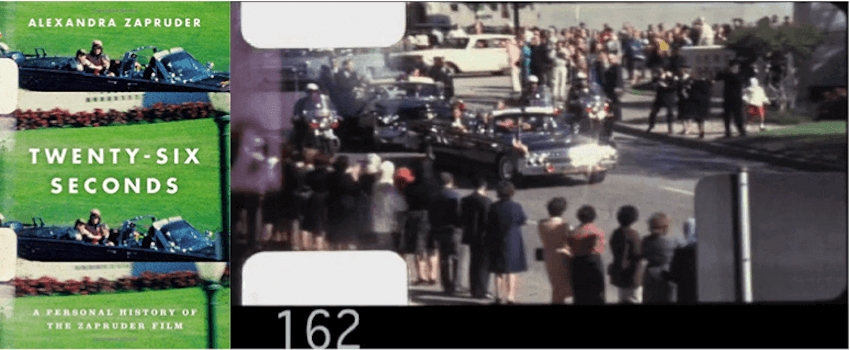
Alexandra Zapruder, Twenty-Six Seconds: A Personal History of the Zapruder Film (Part 1)

With a new book, Twenty-Six Seconds: A Personal History of the Zapruder Film, author Alexandra Zapruder offers her unique perspective to discuss issues surrounding and contained within the brief filmstrip which is the best visual record of the John Kennedy assassination. As the granddaughter of Abraham Zapruder, the man responsible for the film, the author can balance historic and technical details with a personal family story. Her status also allows for privileged access to archives and persons associated with the film, and reveals some new – albeit not earth-shattering – information. However, the book is imbued with a certain partisanship, not limited to family interests, which dulls the author’s critical thinking in some key areas. The shortcomings will seem acute to those in the critical research community, less so to those who come to the book as the personal memoir of unassuming folks who become accidentally fused with an historic event.
A self-described “conventional thinker”, Zapruder is comfortable and reasonably adept dealing with conventional narrative themes in her extraordinary tale – public and personal tragedy combine; family legacy and memory; legal and ethical questions encountered and choices made – but her annoyance with the spoiler element in this story is perceptible each time she types “conspiracy theorist”, which she does a lot.1 Current respectable mainstream opinion, it appears, continues to resist the critical literature developed since the JFK Records Act. Such denial was exemplified by Joyce Carol Oates in a review of Twenty-Six Seconds at the Washington Post, in which she categorized criticism of the Warren Commission as a “farce” which undermined “trust in the U.S. government and in authority in general that continues to this day.”2
The Zapruder Film and LIFE Magazine
Print rights for the film were purchased for LIFE Magazine by the Time Inc. media conglomerate Saturday morning November 23, less than twenty-four hours after the event. Rights for the film as a motion sequence were purchased the following day, although these latter rights would never be utilized. In total, LIFE paid $150,000 for the film. The author is somewhat defensive about this transaction, although it could be reasonably contended that after the authorities decided not to seize the film, Abraham Zapruder was simply a good businessman who negotiated a price the interested party was willing to pay. He also expressed to his family a sensitivity over the graphic presentation and felt that LIFE could be trusted to restrain any urge to exploit the images.
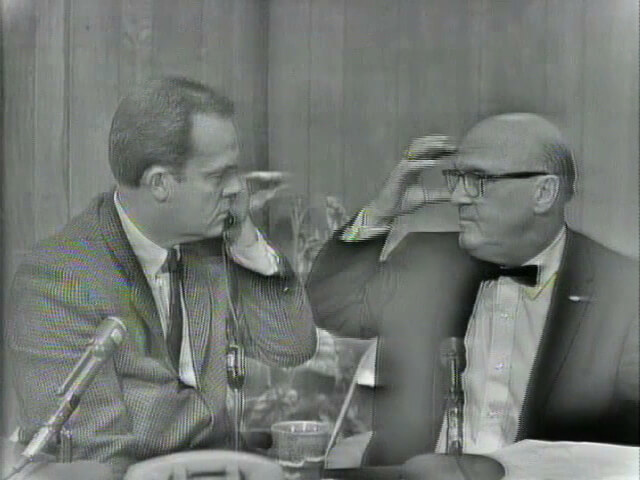
Zapruder appeared on WFAA-TV
a few hours after the shootingIn the LIFE archives, the author would years later find evidence of internal debates over how to handle the more graphic frames. Leading up to the special JFK memorial issue of LIFE, published two weeks after his death, art director Bernard Quint cautioned that “momentary opportunism displayed in the use of these details in colour will be to our everlasting discredit”, and promised to publicly resign if they were printed. Zapruder recites LIFE’s own understanding of this memorial issue: a responsible public service, sold at lower cover cost, with any profit donated to the Kennedy Library. Previously, Abe Zapruder had donated a portion of his proceeds to the family of slain police officer J.D. Tippitt. Many sides to these complexities find reflection, as author Zapruder has skills in retelling personal experiences and thought processes, and in clear description of various facets of controversies with the film. Just not all the facets.
LIFE’s JFK Memorial issue, and also the December 6 regular edition, featured a one-page article attributed to associate editor Paul Mandel titled “End To Nagging Rumors: The Six Critical Seconds”. Acknowledging there were growing rumors and doubts pertaining to the official explanation of the assassination as the work of a single lone-nut shooter, the article purported to “answer some of the hard questions” and reassure the American people that Oswald was the guilty man based on the available evidence, including the Zapruder film. Briefly discussing Mandel’s article, author Zapruder concedes that “some of his facts are mistaken” but leaves it at that without further clarifying that one of these mistaken facts is directly related to a gross misreading of the film.
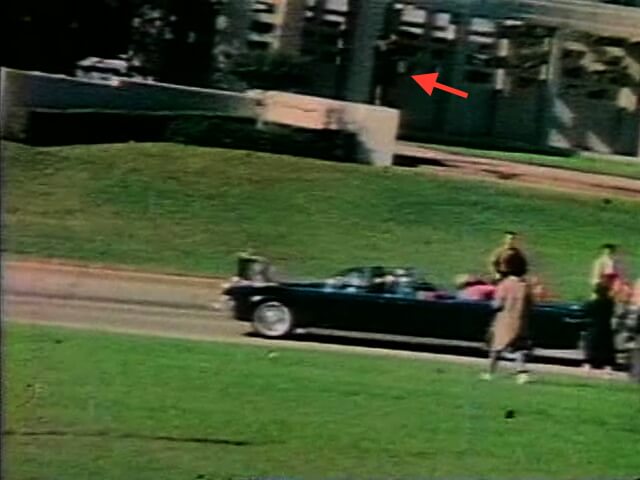
Abraham Zapruder can be seen filming
in this frame from the Nix filmOne of the featured “nagging rumors” concerned how the President could have a wound of entry in his throat, as reported to the public by Dallas Parkland Hospital doctors, when the alleged shooter was positioned directly behind during the shooting sequence. Mandel, referencing his employer’s exclusive possession, writes: “the 8mm film shows the President turning his body far around to the right as he waves to someone in the crowd. His throat is exposed – towards the sniper’s nest – just before he clutches it.” In fact, at no time during the entire filmed sequence was Kennedy ever facing back towards the alleged sniper’s nest. So how could Mandel have been so wrong? He possibly had not seen the film himself and repeated a description from another source, or there had been a conscious editorial decision to assist the government in shutting down rumors which challenged the lone-nut verdict regardless of the veracity of the published information.3 The full measure of this incident – a wholly incorrect description of what is seen in the film used to help deflect concerned inquiry as to what may have happened to JFK (and American democracy) – does not support confidence in LIFE’s responsible handling of the Zapruder film.
What could explain this? Shortly after news of the assassination broke, LIFE’s Los Angeles bureau chief Richard Stolley was assigned to Dallas where, shortly after establishing a base of operations, he received word that the assassination had been captured on 8mm film. Stolley’s persistence enabled access to Abe Zapruder that evening, and by Saturday morning a contract had been signed for the print rights to images from the film. This contract specifically excluded rights to the film as a motion sequence, although a one-week window was stipulated before Zapruder could shop those rights to others. The following day, word came from corporate headquarters, specifically from LIFE publisher C.D. Jackson, to proceed in purchasing these motion rights, which was done for an additional $100,000. That huge sum, doubling the print rights, was paid for rights not apparently as useful to Time-Life, which specialized in print-based media. In fact, Time-Life never exploited the film as a motion sequence during the whole time the film was in its possession. Nevertheless, as an internal LIFE memo cited by Zapruder states: “C.D. Jackson bought the copyright to Zapruder’s film to keep it from being shown in motion.” 4
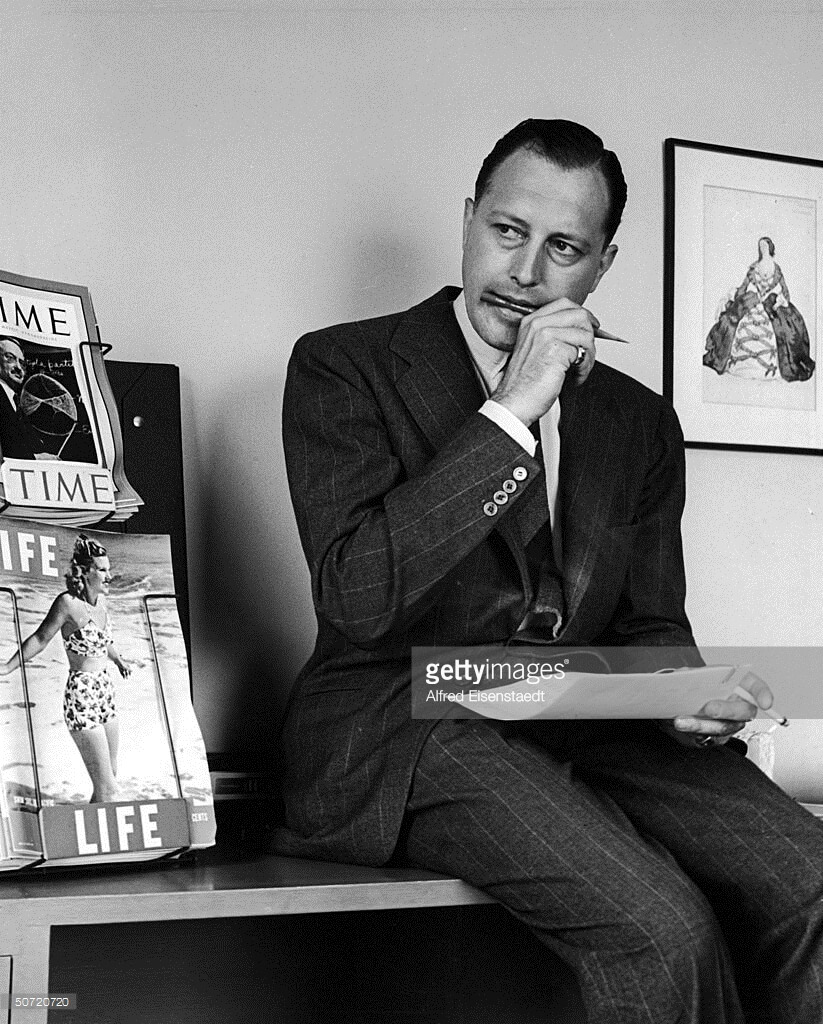
C. D. Jackson In 1977, Rolling Stone published a landmark story by renowned journalist Carl Bernstein titled “The CIA and the Media.” Using information uncovered by the Church Committee and interviews with CIA officials, Bernstein revealed to the general public a longstanding and friendly relationship whereby journalists and management from America’s established mainstream media secretly “carried out assignments for the Central Intelligence Agency.” Time Inc., parent company of LIFE, was named, along with CBS and the New York Times, as the “most valuable” organizations to the CIA. Henry Luce, the founder of Time and LIFE, was a longtime close friend to CIA Director Allen Dulles. Bernstein adds: “For many years, Luce’s personal emissary to the CIA was C.D. Jackson, a Time Inc., vice‐president who was publisher of Life magazine from 1960 until his death in 1964. While a Time executive, Jackson coauthored a CIA‐sponsored study recommending the reorganization of the American intelligence services in the early 1950s.”5
A Princeton graduate, C.D. Jackson began working for Time Magazine in 1931, he would soon be described as founder Henry Luce’s right hand man. In 1940 Jackson organized an “anti- isolationist propaganda group” called the Council For Democracy, funded by Luce and designed to counter America First movements and promote intervention in Europe; the members included Allen Dulles, Joseph Alsop, and Dean Acheson.6 Jackson served in the OSS in 1943 with Frank Wisner, later organizer of the CIA’s Operation Mockingbird.7 In 1944, Jackson was appointed Deputy Chief of the Psychological Warfare Division at Allied Supreme Headquarters. After the war he became Manager-Director at Time-Life International, while a long association with the CIA began in 1948. Jackson served the executive branch during the Eisenhower administration, advising on psychological warfare tactics. Peter Dale Scott noted that Jackson guided LIFE’s involvement in other aspects of the Kennedy assassination: “In an arrangement covered up by Warren Commission testimony, Jackson and Life arranged, at the urging of Dulles, to have Marina’s story ghost-written for Life by Isaac Don Levine, a veteran CIA publicist.”8 Author Zapruder does not bring up Jackson’s fascinating background, and claims he was motivated to purchase the motion rights after he “was personally upset by the film” and felt “the public should not see the images” because of their graphic content.9
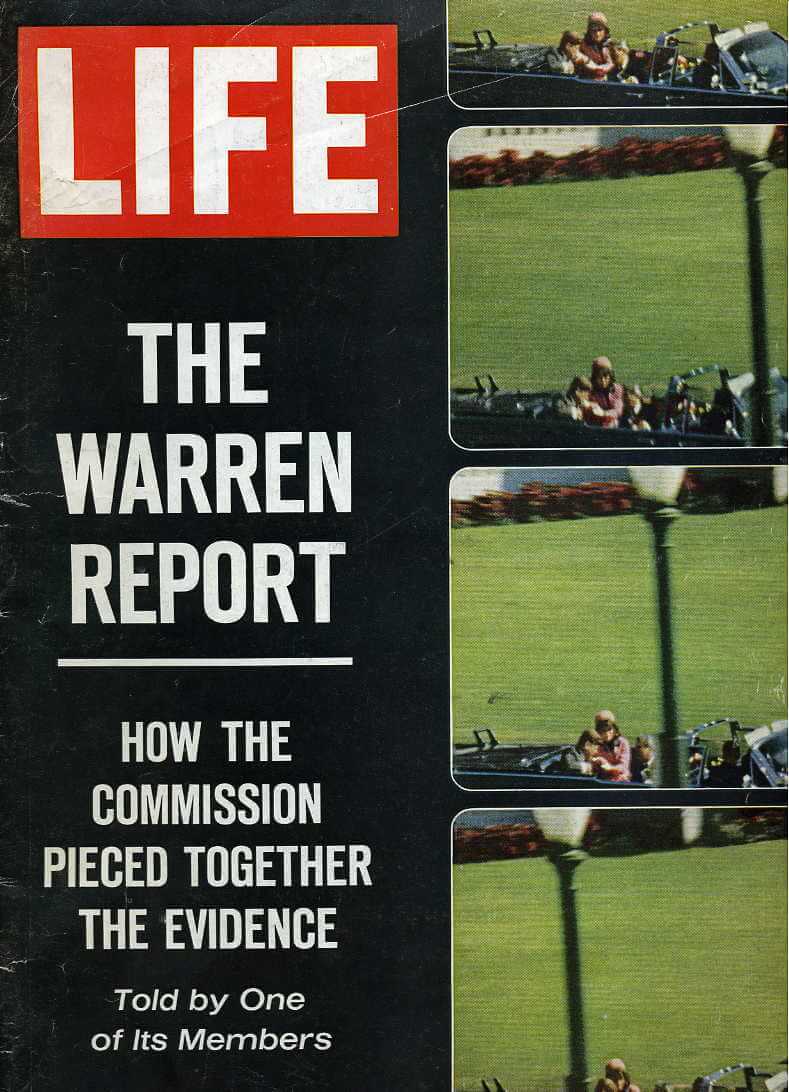 LIFE Magazine would also publish an Oswald backyard photo on its cover in February 1964, after an unauthorized leak from a contact within the Dallas Police Department, exposing millions at supermarkets and newsstands to a rather prejudicial image. This was accompanied by a long biographical article, which portrayed alleged assassin Oswald as a sociopathic loser, the position later adopted by the Warren Commission. In concert with the release of the Warren Report, LIFE’s October 2, 1964 issue featured Zapruder frames on its cover and an approving review of the Report, including an article penned by Warren Commission member Gerald Ford. Author Zapruder refers to the issue as an “examination” of the Warren Report, although the Report itself had not yet been released as the issue went to the printers.10 The issue in fact went to the printers several times, as captions below reproduced Zapruder frames were revised. In retrospect, LIFE’s coverage of the assassination, in the year immediately following, featured dodgy reporting and an eagerness to support the emerging official story, an eagerness which went beyond that of a supposedly objective “trusted” news source.
By 1966, the critics – who had actually read the Warren Report – earned a great deal of public attention publicizing many serious flaws in the assembled evidence. LIFE, as with other mainstream outlets such as CBS, decided to keep pace with public opinion and called editorially for a re-examination of the evidence. They then assembled a team to do just that for LIFE itself.11 An assistant philosophy professor named Josiah Thompson, who had developed a serious interest in the assassination, was hired as a consultant. Thompson, who had seen a second generation copy of the Zapruder film at the National Archives, now had access to the original film (“… the colors were there, the clarity was there. It was really something, really, really something”). Author Zapruder does a good job describing how competing interests suddenly came to coalesce around the film: Warren Commission critic Thompson and CBS News, which wished to broadcast the film as part of a news special, advocated public release – while LIFE’s editors resisted, insisting that their ownership of the film rights gave them the final word.
Thompson surreptitiously made his own copy of the film from LIFE’s own frame-by-frame transparencies. In 1967 he published Six Seconds In Dallas, a powerful critique of the Warren Commission’s methodologies. When LIFE refused to allow him to use frame reproductions from the Zapruder film for the book, Thompson had drawings made depicting selected frames and published those.12 LIFE sued over breach of copyright. In discussing this, author Zapruder sides with LIFE, describing Thompson’s unauthorized use of the film images as copyright infringement. Working from internal documentation, and accepting at face value the good faith of the LIFE management as they wrestled with what to do, she lays out the legal and moral supporting arguments for LIFE’s position, and asks: “so what made this circumstance different?”13
As Thompson’s case headed to court, Walter Cronkite at CBS publicly scolded LIFE for holding the film back from the public.14 Thompson and his publisher would eventually beat back the LIFE lawsuit when the judge ruled that their presentation of portions of the film fit the doctrine of “fair use”. That the Zapruder film was important and salient to the controversies surrounding the assassination was now understood by growing numbers of an increasingly skeptical public (or “small army of committed conspiracy theorists” as author Zapruder puts it). It was also becoming understood that the film contained “confusing visual information” (also Zapruder’s term) as the President is hit by the fatal shot.
Garrison Subpoenas the Zapruder Film for the Shaw Trial
The “confusing visual information” led to New Orleans prosecutor Jim Garrison’s subpoena of the film, so it could be screened as part of the trial of Clay Shaw. As later described in the movie JFK, the “back and to the left” movement of the President’s body immediately after receiving a shot at Zapruder frame 312, was thought by Garrison to be compelling proof of a conspiracy. Author Zapruder is skeptical. She offers a then contemporary analysis by physicist Luis Alvarez, known as the “jet effect”, as an “an important example of how scientific analysis, and not political bluster, could be applied to the question” of the assassination.
Discussing the Clay Shaw trial, Zapruder does her readers a great disservice by relying heavily on an obviously biased and subjective source, namely the 1970 book American Grotesque by James Kirkwood.15 Certainly, a fair-minded author would have noted the overt one-sided character of the book and at least seek out a second source for balance. Zapruder apparently did not. In fact, she allows Kirkwood’s at times harsh and demeaning descriptions to color her discussion of this event. Therefore, using Kirkwood’s take of the courtroom during the screening of the Zapruder film – “the anxious, ill-tempered and, if not bloodthirsty, most definitely morbid craning mob of voyeurs who were glued to the screen” – serves to deflect attention from the actual effect of the screening itself, and the centrality of the film to the prosecution’s analysis of the Dealey Plaza event. If unable to fit Shaw into the plot, the jurors were, in fact, convinced by the presentation that there was indeed some form of conspiracy involved in Dallas. The acknowledgment of this is muted, because the focus is instead drawn to Kirkwood’s descriptions of the courtroom viewing as representing a bloodthirsty mob: “a hungry look of salivating eagerness seemed to draw their faces to a point…”16
The genie, however, was out of the bottle, as the Zapruder film became bootlegged from a variety of sources, and public screenings were arranged at college campuses and other venues.
The Zapruder Film Goes Public

1975 – Robert Groden & Dick Gregory screen
a bootlegged copy of the Zapruder film
on national televisionAuthor Zapruder dismisses “the familiar tropes of conspiracy arguments that came from viewing the film”, without really addressing such tropes. Instead, she laments the trampling of LIFE’s property rights and engages in metaphysical reflection on possible neurological deficiencies to explain the “conspiracists.” In fact, the effect of the film on audiences in the 1970s can be seen for oneself. For the public reaction to the first televised showing is readily available in a clip from the 1975 ABC program Good Night America. On that March 6th program, Geraldo Rivera hosted Robert Groden and Dick Gregory. They then presented the film to a studio and national television audience. The gasp of the audience as the President is hit in the head is audible, a response partly to the gruesome imagery, but also to the unmistakable impression the man had been shot from the front, even as established wisdom placed the assassin directly behind. Warren Commission staff lawyer David Belin conceded during the Rockefeller Commission – one of several official inquiries of the era into the assassinations of the 1960s and the activity of intelligence agencies – that “a major portion of the public controversy concerns the Zapruder film.”17 Author Zapruder complains that the bootleg screenings in the 1970s lacked a presence “to offer a dissenting interpretation of what the film showed.” She again refers to Alvarez and his “jet effect” theory as a plausible and scientific interpretation. She is apparently unaware that Alvarez’ methods (always controversial) explaining and reproducing this effect have recently come under a rather damaging analysis.18
Much of the remainder of Twenty-Six Seconds follows the relinquishing of the original Zapruder film from Time Inc. back to the Zapruder family, its storage at the National Archives, and the legal wrangling over the film in the 1990s leading to a large payment to the family. Author Zapruder handles this aspect of the story solidly, again moving fluidly from the documentary record to personal experience as her father assumes responsibility for the family’s interests (Abraham Zapruder passed away in 1970). If not for the historic controversy which is embedded directly within the frames of this film, Alexandra Zapruder would be responsible for a decent non-fiction account of ordinary people accidentally conjoined with sudden historic events, which is certainly the story she wants to tell here. So what seems to have happened here is understandable, as the controversy is complex and multi-faceted but the author has presumably neither the time or patience to delve deeply into it, and her conventional thinking has her leery of those she identifies as “conspiracists.” The author acknowledges that she received guidance in the issues of controversy from certain advisors.
A key advisor on the subject of the assassination controversies for this book appears to be author Max Holland, a longtime reliable defender of the Warren Commission, who has been writing on the topic for major newspapers and publications such as The Nation since the 1990s, as well as appearing in mainstream cable documentaries. Holland has written five books on national security topics and has been awarded numerous Fellowships, including a Studies In Intelligence Award from the CIA in 2001.19 Holland is best known recently for his fairly well publicized contention that the first shot in the JFK assassination sequence occurred much sooner than previously believed, and at a time not captured in the Zapruder film (author Zapruder finds this theory “compelling” and backed by “extensive additional evidence.”) Zapruder says the two met in 2015, late in the writing process for Twenty-Six Seconds, and in the book’s acknowledgements Holland is praised as “one of the most thorough, careful, and thoughtful thinkers I’ve ever met … He clarified my thinking on many important issues, gently challenging me on my assumptions …” (For a differing view of Holland, see “The Lost Bullet: Max Holland Gets Lost In Space“.)
In December 2016, Zapruder provided an opinion piece to the New York Times titled “There Are No Child Sex Slaves At My Local Pizza Parlor”, which dissected a brief hysteria surrounding an armed man who thought to disrupt a purported kiddie ring fronted by a Washington D.C. area pizzeria. Although her points are well-taken as far as they go with the immediate story, she claims additional authority to speak of the phenomenon from encounters with “conspiracy theorists” who directed certain speculations at her grandfather.20 Fair enough, but Zapruder then analyzes: “If one outcome of Kennedy’s assassination was a loss of trust in government and the news media, we have now entered an era in which such suspicions have mushroomed into something far more dangerous — a rupture in the very idea of shared truth.” Which sounds alarming, and is alarming in the sense that a shared consensus reality is vital to bind our material lives within a peaceful society, but do the actions of one confused young man really portend the fracturing of reality?21 What is she talking about? In part she is talking about the Kennedy assassination and its aftermath, but in doing so Zapruder is unable to acknowledge that the loss of trust accorded the government and news media has been well earned. And that the mainstream “shared truth” of the Kennedy assassination is factually incorrect, despite what her advisors may have told her.
It may well be that the ultimate readership for Twenty-Six Seconds has little interest in formulating an opinion on the JFK assassination controversy, and would have a mild curiosity at best regarding the state of the case. Still, since the book’s accumulation of questionable activity falls heavily on the side of the “conspiracy theorists”, while investigating authorities and representatives of the mainstream media are frequently portrayed as responsible and even-handed, a rather misleading notion is presented of what the Kennedy assassination has revealed about the “trusted” stewards of the nation. It also trips up an author’s attempts at finding a poetic, or metaphoric, truth in her grandfather’s film. Utilizing Holland’s 2014 Newsweek article “The Truth Behind JFK’s Assassination”, Zapruder repeats his contention that the “film displaced Oswald’s view from the sixth-floor window”, that its necessarily partial visual record now “had to stand in for seeing the assassination through Oswald’s eyes and hearing it described in his words.” Though one might be tempted to reach for a cappuccino and ponder varieties of historical irony, what is being advanced is a purely sophist construction, as the overwhelming weight of the evidence shows that Oswald was not on the sixth floor of the TSBD at the time of the shooting and did not fire a rifle that day.22 That the author does not seem to know this will harm the book’s reputation in the future, although its more valid, and better presented, insights will likely retain some interest.
NOTES
1 Critics of the official Warren Commission findings are, as a rule in this volume, referred to as “conspiracy theorists”. Late in the proceedings, reference is briefly made to “assassination researchers”.
2 Joyce Carol Oates, “Twenty-Six Seconds of the Kennedy Assassination – and a Lifetime of Family Anguish.” Washington Post, November 17, 2016.
3 Other information in the article, such as determining the film ran at 18fps or determining frame counts between presumed shots, likely was not generated by LIFE and came to it from government sources, as discussed in Part Two of this review. Although author Zapruder is fuzzy about it, the official FBI findings were still a week away from publication as the memorial issue and Dec 6 edition were put to press, suggesting an official source contributed to handling the “nagging rumors”, as an official source assisted LIFE’s later Warren Report coverage.
4 The memo is quoted on page 194 of Twenty-Six Seconds.
5 Carl Bernstein, “The CIA and the Media.” Rolling Stone Magazine, October 20, 1977. The article is also available on Bernstein’s website. Bernstein writes: “the Agency has cut back sharply on the use of reporters since 1973 primarily as a result of pressure from the media.” As the main source of information for the article was interviews with unnamed CIA officials, the cooperation may have served as a limited hang-out after Bernstein had uncovered the story from Church Committee sources. Certainly these CIA officials go out of their way at times to identify media outlets and journalists as CIA friendly despite firm denials from the outed parties. However, the historic information – including Luce and C.D. Jackson – has never been refuted, and since publication largely confirmed through document releases.
6 In other words, Jackson was involved within an internationalist (“globalist”) Eastern Establishment milieu which lobbied for US participation in a European war, and then helped staff the OSS, create the CIA and construct the foundations of the Cold War National Security State. In the Eisenhower years, this milieu developed a foreign policy which relied on covert manipulation and regime change around the globe. John Kennedy’s nascent challenge to this world view has been focus of much recent scholarship. C.D. Jackson died in 1964.
7 Operation Mockingbird was the CIA’s program to influence the American media, and was disclosed in the 1977 Bernstein article.
8 The Marina Oswald story was not ultimately published, but she was well-paid for the rights. Peter Dale Scott, Deep Politics, p 53. See also Warren Hinckle and William Turner, Deadly Secrets: The CIA-Mafia War Against Castro and the Assassination of JFK (1981).
9 Twenty-Six Seconds, p. 97.
10 LIFE joined the New York Times and CBS News in providing instantaneous reviews, or “examinations”, of the Warren Report, all three trusted news sources referring to it appreciatively as a thorough and complete explanation of the President’s assassination, even though there had not yet been the opportunity to actually read it.
11 Both LIFE and CBS soon afterwards abandoned critical inquiry and dissolved their investigating teams. CBS would continue to create television documentaries supporting the Warren Commission, such as the 1967 multi-episode CBS News Inquiry: The Warren Report. (For an analysis of the genesis of the 1967 special, see now James DiEugenio, “Why CBS Covered Up the JFK Assassination“.)
12 Due care was taken to ensure the accuracy of the drawings, unlike certain exhibits created for the Warren Commission.
13 What made it different is the overwhelming sense that justice had not been served in the aftermath of the assassination, that it was still an open case, and that an apparent establishment cover-up of the true reasons for Kennedy’s death presented serious challenges to the American democratic system and the understanding of contemporary events. However, if one believes, as author Zapruder appears to, that the Warren Commission essentially got it right and “conspiracy theorists” have been not just historically wrong but prone to psychological malady which influences their fuzzy thinking, then accepting LIFE’s decision to effectively sequester the film becomes a lot simpler.
14 “LIFE’s decision means you cannot see the Zapruder film in its proper form, as motion picture film. We believe that the Zapruder film is an invaluable asset, not of Time Inc., but of the people of the United States.” CBS News Inquiry: The Warren Report, 1967. The program supported the basic conclusions of the Warren Commission. It is possible that CBS sought to acquire the film so that it could be “explained” to the public in a manner favorable to the official conclusions, while maintaining a plausible facade of the fearless Fourth Estate.
15 American Grotesque is notable as the source for the oft-repeated claim that Garrison’s primary motivation for prosecuting Clay Shaw was rampant homophobia.The premise for the book had been first suggested by defendant Shaw himself ahead of the trial, pitching the concept to others before Kirkwood agreed to take it on. Kirkwood and Shaw had been friends for two years ahead of this. During the trial Kirkwood was close to the extremely compromised reporters James Phelan and Hugh Aynesworth, both engaged in sabotaging the trial to the extent possible.
16 Zapruder lists the Kirkwood book, courtroom transcripts, and contemporaneous newspaper accounts as her source material for the Shaw trial, her discussion of which concludes: “The Garrison trial went down in history as a gross abuse of power … Garrison’s actions deeply discredited the conspiracy movement and drove it back underground for many years.” This opinion, not gleaned from the transcripts or newspaper accounts or Kirkwood’s book, and obviously not Zapruder’s own, is likely that of an advisor discussed below, and is challenged by more recent work from Joan Mellen and Jim DiEugenio.
17 Memorandum, David Belin to James B. Weidner. April 21, 1975.
18 Alvarez claimed, in the American Journal of Physics, September 1976, that his shooting mock-up in 1969 “showed retrograde recoil in the first test … If we had used the ’Edison Test,’ and shot at a large collection of objects, and finally found one which gave retrograde recoil, then our firing experiments could reasonably be criticized.” But Josiah Thompson, who is also a figure in Zapruder’s book, gained access to Alvarez’ experimental resources and discovered that, contrary to Alvarez’ statement, a large collection of objects were fired upon until one was found which gave retrograde recoil. Thompson’s access to the materials was provided by Paul Hoch, who is listed as an advisor for this book specifically on the jet effect. Thompson presented this new information on Alvarez and his jet effect experiments at the Passing The Torch Conference in Pittsburgh, October 2013.
19 Holland reviewed Peter Dale Scott’s Deep Politics in 1994, writing of the controversy: “The field already brims with books that conjure up fantastic conspiracies through innuendo, presumption, and pseudo-scholarship while ignoring provable but inconvenient facts …Yet there remains something truly remarkable and disturbing about Deep Politics, and it’s not that a tenured English professor wrote its opaque prose. Rather it’s that Deep Politics is a University of California Press book … this means an editorial committee consisting of 20 UC professors, including four senior historians, approved Deep Politics for publication. This peer approval by a major university press illustrates the boundless and utter disbelief in the Warren Report … and it also reveals the gross inattention given to the subject by serious historians.” One man’s “serious historian” is of course another’s “pseudo-scholar”, and Holland demonstrates through this review/article that there are few elements of the official story to which he does not subscribe, despite the obvious challenges to credulity the Warren Report invokes. Lamenting a lack of “serious historians” on this subject while casually accepting that Oswald attempted to assassinate General Walker or that Oswald’s FPCC activity in New Orleans should be taken at face value, necessarily leads to a position which praises generally poor books by Patricia Lambert or Jean Davison or Gerald Posner while positioning Scott as suffering from a “fevered imagination.” That is, Marina Oswald’s wild and ever-changing stories from 1964 regarding her husband’s alleged stalking of Walker, which is just about the only evidence that such a thing ever happened, is legitimate fact, while Scott’s carefully annotated scholarship is not. Apparently, developing pseudo-psychoanalytic theories regarding Oswald’s state of mind is a hallmark of “serious history”, while recognizing the official record can’t even place Oswald in the so-called sniper’s nest is the domain of fantasizing conspiracists.
20 Abraham Zapruder’s name has, over the years, suffered speculation of sinister relationships or agency in the assassination. As well, the Zapruder film has suffered numerous incorrect interpretations, often from viewing poor multi-generational copies. The most well-known incorrect assumption is that Secret Service driver Greer turned and shot JFK with a pistol. The fallacy of this interpretation should not disguise that Greer slowed the limousine to a crawl and turned twice to view the chaos in the seats behind him, including a direct view of the fatal shot before turning back and accelerating.
21 After all, it wasn’t so long ago a cudgel of fake facts, many promoted by the New York Times, was used to bludgeon the body politic into supporting a US Air Force-led “shock and awe” campaign in Iraq, followed by an invasion and brutally careless occupation, ending or ruining the lives of several million people, and destabilizing an entire region. For that matter, even a cursory reading of Establishment reporting on the Kennedy assassination reveals an array of poor and misleading information. Or, consider C.D. Jackson’s work in psychological warfare during the Eisenhower administration, which would include portraying a vicious right wing coup against Guatemala’s democratic government as a populist uprising.
22 We know this because at the exact time Oswald was said to have dashed down the Texas School Book Depository’s rear wooden staircase moments after the shooting, two witnesses were descending the same staircase and they saw and heard nothing at all. The bad faith by which the Warren Commission discredited the witnesses and created a wholly different timeline has been described by author Barry Ernest in his book The Girl On The Stairs. While researching this topic, Ernest discovered a Commission memo from June 1964 which confirmed the timing as stated by the witnesses, and which was subsequently buried as the Warren Commission proceeded to publish their false account. Not a single piece of hard evidence places Oswald on the sixth floor with a gun in his hand, as Dallas Police Chief Curry conceded in his own book written in 1969. Paraffin tests of Oswald’s cheek conducted by the Dallas Police on the night of the assassination did not show traces of nitrate as should be expected, and therefore show with a high degree of certainty that he did not fire a rifle.
-
The 2016 Election, Historical Amnesia and Deep Politics
By now, I think it is safe to say that everyone is kind of sick of discussing the 2016 election season. However nauseating it may have been, it proved to be unprecedented and monumental in various ways. Unprecedented, for example, in the fact that the two major party candidates were the most disliked in modern political history. The Republican candidate, now President-elect, who touts himself as a good businessman yet probably couldn’t tell you the difference between Keynes and Marx, has run perhaps the most hate-filled, deplorable campaign in recent memory. He often speaks of running the country like a business and harps on immigration as one of the major problems facing this country. Yet he never discusses substantive issues in detail (for example, the tens of millions of poverty- and hunger-stricken children living in the United States alone), and frequently demonstrates a poor grasp of them (such as the nuclear triad). In fact, he compulsively prevaricates and can’t seem to string two cohesive sentences together. Therefore it is hard in many cases to see where he actually stands. (For a revealing example of this, watch this clip.)
The former Democratic candidate, on the other hand, bears a resemblance to an Eisenhower Republican. She is an intelligent and experienced politician full of contradictions. She was certainly preferable to Trump on domestic issues, e.g., women’s rights, race, and overall economic policy—not to mention global scientific matters like climate change. Nevertheless, there are serious problems with Hillary Clinton’s record. While Trump compulsively exaggerates and prevaricates, Hillary Clinton is not the epitome of honesty or integrity either. Up until 2013, she didn’t support same-sex marriage, yet got defensive and lied about the strength of her record on this issue. 1 Despite the fact that FBI Director James Comey publicly stated that classified material was indeed sent over Clinton’s unsecure server, she continued to dance around that subject as if she still didn’t know the public was privy to Comey’s statements.
I could expand on the former Secretary of State’s flip-flopping and dishonesty over the years when it comes to problems like email security. And the disturbing fact that five people in her employ took the Fifth Amendment rather than testify before Congress in open session on the subject. However, in spite of their receiving a great deal of media attention, failings such as these are far from being her main flaw, and are, in this author’s opinion, a distraction from much deeper issues. As previously alluded to, Clinton’s foreign policy bears much more of a resemblance to the Eisenhower/Dulles brothers’ record than it does to what one might expect from someone who describes herself as taking a back seat to no-one when it comes to progressive values.

Allen & John Foster Dulles 
Mossadegh & Shah Pahlavi For those who might not be aware, Allen Dulles (former Director of the CIA) and his brother John Foster Dulles (former Secretary of State) essentially orchestrated foreign policy under the Eisenhower administration. They were former partners at Sullivan and Cromwell, which was the preeminent law firm for Wall Street in the fifties. Allen and Foster married global corporate interests and covert military action into a well-oiled machine that promoted coups, assassinations and the blood-soaked destruction of democracies around the world. After Iran’s democratically elected leader Mohammed Mossadegh vowed to nationalize his country’s oil and petroleum resources, the Dulles brothers—who represented Rockefeller interests like Standard Oil— designed a phony indigenous overthrow that installed the corporately complicit Reza Shah Pahlavi into power in 1953. His brutal and repressive reign lasted until 1979, and his downfall provoked a fundamentalist Islamic revolution in Iran.

Arbenz centennial (2013) 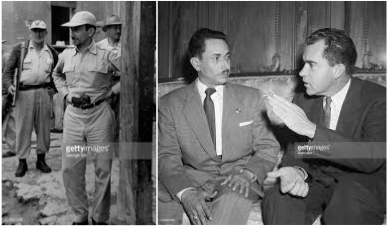
Castillo Armas (with Nixon) In 1954, the Dulles brothers were at it again in Guatemala with operation PBSUCCESS. Jacobo Arbenz, the labor-friendly and democratically elected leader of the country, was going toe to toe with other corporate interests such as the Rockefeller/Sullivan & Cromwell associated company United Fruit. Arbenz was pushing for reform that sought to curtail the neo-colonial power of United Fruit by providing more in resources for the people of Guatemala. To the Dulles brothers and other Wall Street types with vested interests, this was unacceptable and was to be depicted as nothing short of communism. Arbenz was ousted from the country in what was largely a psychological warfare operation. He was replaced with a ruthless dictator by the name of Castillo Armas. The CIA provided the Armas regime with “death lists” of all Arbenz government members and sympathizers, and through the decades that followed, tens of thousands of people either were brutally killed or went missing at the hands of the dictatorship. 2 This constant state of upheaval, terror and violence did not subside until a United Nations resolution took hold in 1996.
II
Hillary Clinton, whether she knows it or not—and it’s a big stretch to say that she doesn’t—has advocated for the same interventionist foreign policy machine created by the likes of the Dulles brothers. There are at least three major areas of foreign affairs in which she resembles the Dulles brothers more than Trump does: 1.) The Iraq War 2.) American /Russian relations 3.) American actions against Syria. In fact, she actually made Trump look Kennedyesque in this regard, no mean feat.

Clinton & Kissinger Nowadays, Clinton refers to her vote for the Iraq War as a “mistake”, but it certainly doesn’t seem like one considering the context of her other decisions as Secretary of State. Secretary Clinton’s friendships and consultations with Henry Kissinger and Madeleine Albright raised eyebrows in progressive circles. (Click here for the Clinton/Kissinger relationship.) Kissinger’s record as Secretary of State/National Security Adviser was most certainly one of the worst in U.S. history when it came to bloody, sociopathic, interventionist policy around the globe. During the disastrous and unnecessary crisis in Vietnam, Kissinger would nonchalantly give President Nixon death tallies in the thousands regarding Vietnamese citizens as if they were some Stalinesque statistic. Kissinger then agreed to expand that war in an unprecedented way into Cambodia and Laos—and then attempted to conceal these colossal air war actions. Of course, this was a further reversal and expansion of that war, which went even beyond what Lyndon Johnson had done in the wake of JFK’s death. President Kennedy’s stated policy was to withdraw from Indochina by 1965.
Salvador Allende 
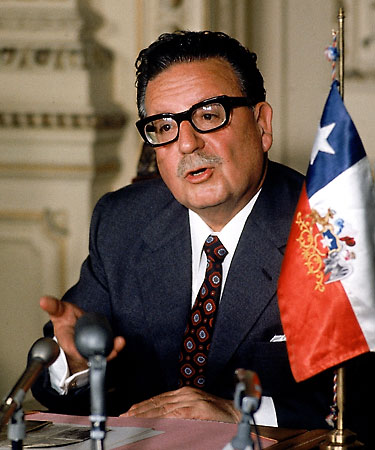
Augusto Pinochet Kissinger was also an instrumental force for the CIA coup in Chile, which ended in the death of Salvador Allende. About Allende, he allegedly stated he did not understand why the USA should stand by and let Chile go communist just because the citizenry were irresponsible enough to vote for it. (A Death in Washington, by Don Freed and Fred Landis, p. 8) The CIA overthrow of Allende led to years of brutal fascism under military dictator Augusto Pinochet.

Clinton & Albright Madeleine Albright demonstrated similar hawkishness. (Click here for more on the Clinton/Albright relationship.) When asked about the refusal of the United States to lift UN Sanctions against Iraq and the resulting deaths of 500,000 Iraqi children, Albright stated that the deaths had been “worth it.”3 Predictably, Albright’s statement was met with stunned surprise. In May of 1998, Albright said something just as surprising. At that time, riots and demonstrations against the brutal Indonesian dictator Suharto were raging all over the archipelago; there were mock funerals being conducted, and his figure was being burned in effigy. Here was a prime opportunity for Albright and the Clinton administration to step forward and cut off relations with a despot who had looted his nation to the tune of billions of dollars. Or at the very least, join the chorus of newspapers and journals requesting he step down. What did Albright do? She asked for “more dialogue”. Even in the last two days of Suharto’s reign, when major cities were in flames, when Senators John Kerry and the late Paul Wellstone were asking the State Department to get on the right side of history, Albright chose to sit on the sidelines. (Probe Magazine, Vol. 5 No. 5, pp. 3-5)

Hajji Muhammad Suharto with Nixon, Ford & Kissinger, Reagan, Bush Sr. & Bill Clinton In this regard, let us recall that Suharto came to power as a result of a reversal of President Kennedy’s foreign policy. Achmed Sukarno had been backed by President Kennedy throughout his first term, all the way up to his assassination. And JFK was scheduled to visit Jakarta in 1964, before the election. As opposed to the silence of Albright and Bill Clinton, after Suharto resigned, the Robert F. Kennedy Memorial Center wrote a letter to his successor asking for an investigation of the role of the military in suppressing the demonstrations that led to his fall. (ibid)
During her time as Secretary of State, Hillary Clinton displayed an American imperiousness akin to the previous examples. Whether the former Secretary’s intentions in Libya truly aimed at ending what she called a “genocidal” regime under Gaddafi doesn’t really matter. She personally pushed for a NATO sanctioning of bombings in Libya. (This NATO assault in Africa followed the standard set by Albright in Kosovo in 1999, which was the first offensive attack NATO had ever performed.) The assault on Libya eventually led to the murder of Muammar Gaddafi. And that paved the way for a dangerous political power vacuum in which various elements, including Islamic extremists, are vying for power. It is safe to say that she left Libya in such a shambles that the USA had to reenter the civil war.
Clinton’s decision to arm Syrian “rebels” against Bashar al Assad has also helped create bloody conflict with no end in sight. (Click here for why this may be a strategic mistake.) Bombings occur on a daily basis, especially in areas like Aleppo, leaving tens of thousands of innocents dead. As a candidate, she wanted to establish a “no-fly zone” over Syria—much as she did in Libya. This was a euphemism for controlling the air so that American proxies could control the ground. And as many suspect, and as alluded to in the above-linked story, that likely would have led to fundamentalist dominance in Syria, resembling the endgames in Iraq and Libya. But beyond that, this would probably have ended up provoking Russia, since Russia backs Assad. (Ibid, n. 3)

“Pacific Rubiales:
How to get rich in a
country without regulations”Secretary Clinton’s policy regarding Latin America, another topic avoided by the media during the last election cycle, also demonstrates knowing or unknowing complicity with colonial/imperial interests. In Colombia, for instance, a petroleum company by the name of Pacific Rubiales, which has ties to the Clinton Foundation, has been at the center of a humanitarian controversy. The fact that Pacific Rubiales is connected with the Clinton Foundation isn’t the main issue, however. The real problem is the manner in which positions were changed on Clinton’s part in exchange for contributions. During the 2008 election season, then-Senator Clinton opposed the trade deal that allowed companies like Pacific Rubiales to violate labor laws in Colombia. After becoming Secretary of State, Clinton did an about-face. As summed up by David Sirota, Andrew Perez and Matthew Cunningham-Cook:
At the same time that Clinton’s State Department was lauding Colombia’s human rights record (despite having evidence to the contrary), her family was forging a financial relationship with Pacific Rubiales, the sprawling Canadian petroleum company at the center of Colombia’s labor strife. The Clintons were also developing commercial ties with the oil giant’s founder, Canadian financier Frank Giustra, who now occupies a seat on the board of the Clinton Foundation, the family’s global philanthropic empire. The details of these financial dealings remain murky, but this much is clear: After millions of dollars were pledged by the oil company to the Clinton Foundation—supplemented by millions more from Giustra himself—Secretary Clinton abruptly changed her position on the controversial U.S.-Colombia trade pact.” 4
Clinton & Zelaya (2009) 
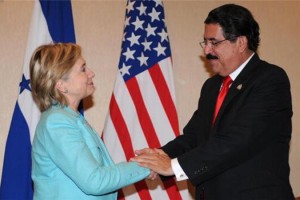
Despite recent denials, the former Secretary also played a role in the 2009 coup that ousted the democratically elected and progressive human rights administration of Manuel Zelaya in Honduras. Recent editions of Clinton’s autobiography Hard Choices have been redacted to conceal the full extent of her role in the overthrow. Since the coup, and in opposition to the supposed goals of the overthrow itself, government-sponsored death squads have returned to the country, killing hundreds of citizens, including progressive activists like Berta Cáceres. Before her assassination, Cáceres berated Secretary Clinton for the role she played in overthrowing Zelaya, stating that it demonstrated the role of the United States in “meddling with our country,” and that “we warned it would be very dangerous and permit a barbarity.” 5
In addition, the U.S.-backed coup in Honduras demonstrates the ongoing trend of outsourcing when it comes to intelligence work. A private group called Creative Associates International (CAI) was involved in “determining the social networks responsible for violence in the country’s largest city,” and subcontracted work to another private entity called Caerus. A man by the name of David Kilcullen, the head of Caerus, was previously involved in a $15 million US AID program that helped determine stability in Afghanistan. Kilcullen’s associate, William Upshur, also contributed to the Honduras plans. Upshur is now working for Booz Allen Hamilton, another private company involved in U.S. intelligence funding. (Ibid, n. 5)
In his 2007 book, Tim Shorrock explained how substantial this kind of funding is. Shorrock stated that approximately 70 percent of the government’s 60-billion-dollar budget for intelligence is now subcontracted to private entities such as Booz Allen Hamilton or Science Applications International Corporation. 6
Puerto Rico, a country in the midst of a serious debt crisis, is another key topic when it comes to Clinton’s questionable foreign policy decisions. Hedge funds own much of Puerto Rico’s massive debt, and a piece of legislation, which was put forward to deal with the issue, has rightly been labeled by Bernie Sanders as a form of colonialism. The bill in question would hand over control of financial dealings to a U.S. Government Board of Regulators, which would likely strip vital social spending in Puerto Rico. The bill already imposes a $4.25 minimum wage clause for citizens under 25. While Sanders opposed this bill, Clinton supported it. 7 This may serve as no surprise, being that the former Secretary of State receives hefty sums from Wall Street institutions like Goldman Sachs, who benefit from this form of vulture capitalism. I am not asserting that Hillary Clinton is solely responsible for these foreign policy decisions, but that she has been complicit with the American Deep State that commits or is heavily involved in these operations. (An explanation of the term “Deep State” will follow.) If the results of this 2016 election, and the success of both Trump and Sanders in the primaries, teach us something, it is that we have to move away as quickly as possible from policy compromised by corporate influence if we truly want to move forward. The American public has clearly had enough with establishment politics.
III
With the election of Donald Trump, the viability of establishment politics has been seriously breached, effectively ending the age of lesser-evil voting by the proletariat. Although Hillary Clinton was the preferred candidate regarding things like domestic social issues and scientific issues, it wasn’t enough to tame the massive insurgency of citizens who were so fed up with the status quo that they would rather see the country possibly go up in flames than vote for more of the same. Nor did it inspire an overlooked independent voter base to come out and make a substantial difference in the Democratic vote. In the aftermath of this potential disaster of an election, it is our duty, as a collective, to look deeply into some troubling fundamental issues. One of these has to do with the fact that racism, xenophobia and sexism are still very much alive in this country.
I will not go so far as to label all Trump supporters as racist, homophobic or sexist. And throughout the primary/general election season, I have tried to remain receptive to their frustrations. However, I can most certainly tell you that, based on my experiences of this election season alone, these sentiments do indeed exist. During a delegate selection process for the Bernie Sanders campaign, I met and ended up having discussions with some Trump supporters. I asked them questions about why they thought Trump would make a good president, all the while disagreeing with them, but listening nonetheless. Two of the men I was speaking with were very civil, but one in particular seemed to be bursting at the seams with frustration over what he thought were the main problems with the country. While ignoring the facts I was presenting him regarding corporate welfare, this man went into relentless diatribes about why “Tacos”, his label for Hispanic people, were wreaking havoc. He exhibited no shame in expressing his distaste for other ethnicities either. During this dismaying exchange, I brought up the continued mistreatment of Native American peoples. In response, this man tried to question the severity of the atrocities committed against them and even went so far as to imply that my use of the term genocide in describing their plight was incorrect.

Steve Mnuchin This may well serve to exemplify the hateful attitudes of mistrust and resentment that have been put under a black light during the course of this election. They’ve lingered dormant under the surface and have reached a boiling point thanks to Donald Trump. To paraphrase Bernie Sanders, Trump was able to channel the frustration of a destitute middle class and convert it into unconstructive anger. While Trump made references to how the “establishment” was a major problem, like many of his policy points, he didn’t ever describe in detail what was to be done to correct it. Instead, with his references to a wall with Mexico and to mass deportations, he encouraged the belief in his supporters that minorities were ruining the country. Yet in spite of his campaign promise to “drain the swamp”, many of the Trump cabinet appointees are among the most Establishment type figures one could imagine. For example, Steve Mnuchin, the former Goldman Sachs executive famous for foreclosures and hedge fund deals, has been appointed Secretary of Treasury.
The election of a man like Donald Trump, who can’t seem to expound any of his policies in any sort of detail and is openly demeaning towards women, people of other races, and the disabled, makes clear that we have a cancerous political system which has metastasized in large part thanks to establishment politicians beholden to corporate interests. And these politicians are wildly out of touch with the needs of the average American. This created a very wide alley that the new Trump managed to rumble through. (I say “new” because in one of the many failings of the MSM, no one bothered to explain why Trump had reversed so many of the proposals he made back in 2000, when he was going to run on the Reform Party ticket.) Some commentators have claimed there can be little doubt that there was a liberal disillusionment following President Obama’s election. Hillary Clinton could not convince enough people that she was even the “change candidate” that Obama was. Therefore, in the search for answers for why their lives weren’t improving, many citizens had to find alternate sources of information outside of corporate influenced organizations (i.e. The Republican Party, Democratic Party and the Mainstream Media), given those groups won’t admit to the public that they are subservient to the same big money interests. This explains the rise of figures like Rush Limbaugh, Glenn Beck, and even rightwing populist/conspiracy demagogue Alex Jones. Their collective answer is to paint minorities and welfare recipients as the principal ills of American society, all the while failing to recognize the deep connection between government policy and corporate influence. In short, this election warns us that when the real reasons behind government dysfunction are ignored and go unchallenged, one risks the upsurge of fascist sentiments. 8
In addition to reminding us of Hillary’s relationship with Kissinger, Bernie Sanders reminded a large portion of the U.S. populace about the other fundamental issue lying beneath the surface: corporate power. And Sanders could have neutralized Trump’s appeal among the shrinking working and middle classes, which the latter earned by invoking the need for tariffs and the threat of trade wars. This certainly was another reason for Trump’s popularity in the Mideast states like Wisconsin, Iowa, Michigan and Ohio, where he broke through the supposed Democratic firewall. (As to why, listen to this this segment by Michael Moore.) With Secretary of State Clinton’s and President Bill Clinton’s views on NAFTA and the Columbia Free Trade Agreement, and Hillary’s original stance on the Trans Pacific Partnership (TPP), she could not mount a genuine counter-offensive to Trump’s tactics in those states, for the simple reason that the Clintons were perceived as being free-traders rather than fair-traders. Thanks to their record, a Democratic presidential candidate appeared to favor a globalization policy that began decades ago with David Rockefeller—a policy that was resisted by President Kennedy. (See Donald Gibson, Battling Wall Street, p. 59)
Awareness of any problem is the first step toward fixing it. But I think we must go beyond simple awareness when it comes to confronting our nation’s collective “shadow”, as Carl Jung would have called it — meaning all the darker, repressed aspects of the unconscious that, when ignored, can result in psychological backlash. How do we get beneath the surface appearances of corporate greed (for instance, the increasing wealth inequality amongst classes, or the amount of tax money allocated to corporate subsidies)? I suggest that an exploration of our past guided by a concept that Peter Dale Scott labels “Deep Politics” can help us come to terms, in a more profound way, with the problems facing us.
This concept embraces all of the machinations occurring beneath the surface of government activity and which go unnoticed in common analysis, such as in news reports or textbooks. Or, as Scott states in his 2015 book The American Deep State, it “…involves all those political practices and arrangements, deliberate or not, which are usually repressed rather than acknowledged.”9 A “Deep Political” explanation of major world events goes beyond the ostensible or normally accepted models of cause and effect. One example of a “Deep Event” is the 1965 Gulf of Tonkin Incident, which provided a motive, or casus belli, to escalate the Vietnam War into a full-scale invasion by American ground forces. Given that President Johnson had already, in stark contrast to President Kennedy’s policy, approved the build-up of combat troops in Vietnam in 1964, all that was needed was some sort of impetus in order for United States involvement to move to the next stage. As the author describes, many of the intelligence reports received by the Johnson administration regarding this supposed incident did not signal any sort of instigation on North Vietnam’s behalf. However, those same reports were ignored in order to claim that North Vietnam had engaged in an act of war against the United States. 10
Other examples of Deep Events include the previously mentioned instances of CIA, corporate and State Department interference in the economic and governmental affairs of foreign nations. It is evident that these coups did not occur for the sake of saving other countries from the grip of communism or the reign of dictators; such would only be at best a surface explanation. The deeper explanation is that a nexus of corporate, military, paramilitary, government and, on occasion, underworld elements (viz, the workings of the Deep State) had a vested interest in the outcome. The Bush administration’s lies regarding Saddam Hussein’s alleged arsenal of “weapons of mass destruction”, presented to the American people and Congress as a reason to invade Iraq, could most certainly be classified as a Deep Event. No entities benefitted more from America’s long-term occupation of Iraq than companies like Dick Cheney’s Halliburton. KBR Inc., a Halliburton subsidiary, “was given $39.5 billion (emphasis added) in Iraq-related contracts over the past decade, with many of the deals given without any bidding from competing firms, such as a $568-million contract renewal in 2010 to provide housing, meals, water and bathroom services to soldiers, a deal that led to a Justice Department lawsuit over alleged kickbacks, as reported by Bloomberg.” 11
Included under the umbrella of Deep Politics are the major assassinations of the 1960s — those of John Kennedy, Robert Kennedy, Martin Luther King Jr. and Malcolm X. Poll after poll has indicated that most Americans believe there was a conspiracy to kill President Kennedy, but even today many apparently have not reasoned beyond the fact that there is something fishy about the “official” version in order to understand this murder in its fullest context. It behooves us to inquire more deeply into this historically critical event. Before I go any further, however, let me assert here—and I do so quite confidently—that anyone who still buys into the government version of events regarding, for example, the assassinations of John and Robert Kennedy, is either not looking carefully enough, or is not really familiar with the case.
IV
A suggestive point of departure for such an inquiry are the parallels between the 2016 election and that of 1968. In the wake of the assassination of Martin Luther King in April of 1968, racial tensions were high and a presidential primary season was in full swing. Opposition towards the Vietnam War was strong and one candidate in particular represented the last best hope for minorities, anti-war voters, and the middle, as well as lower classes. That candidate was Robert Kennedy, and by the early morning of June 5th, it was becoming clear that he would likely be the Democratic candidate to run against Richard Nixon in the general election. Within a matter of moments of making his victory speech for the California primary, Robert Kennedy was assassinated when he walked into the kitchen pantry of the Ambassador Hotel in Los Angeles. In those moments, the Sixties ended—and so did the populist hopes and dreams for a new era.

Chicago DNC 1968 
Philedelphia DNC 2016 The 1968 Democratic National Convention in Chicago was attended by the protests of disillusioned voters who felt cheated out of a more liberal, populist candidate. They ended up rioting in the streets. Hubert Humphrey, who was receiving flack for not taking a strong enough stance on the situation in Vietnam, was selected as the nominee. Similarly, there were many dissatisfied delegates and voters at the 2016 Philadelphia Democratic convention. But in a tightly controlled operation, their actions were kept hidden off screen. And the threat of stripping them of their credentials was often used to suppress any protest on the convention floor. In 2016, Hillary Clinton was nominated and her candidacy helped give us Donald Trump. In 1968, the immediate result was Richard Nixon as president. But the subsequent results included the massive increase in loss of life not just in Vietnam, but also in Cambodia, and the continuing trend away from the New Deal, anti-globalist policies of John Kennedy and Franklin Roosevelt.

Alger Hiss, America’s Dreyfus 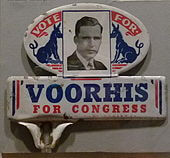
Rep. Voorhis, defeated by
Nixon’s smear campaignIn fact, Nixon had been a part of the effort to purge New Deal elements from the government during the McCarthy era. Whether it was conducting hearings on men like Alger Hiss and making accusations of Soviet spycraft, or using his California Senate campaign to falsely accuse incumbent Congressman Jerry Voorhis of being a communist, Nixon contributed to the growing, exaggerated fear of communism in the United States. This fear allowed men like Allen Dulles to be seen as pragmatists in the face of supposed communist danger. Dulles’ and the CIA’s dirty deeds on behalf of corporate power were carried out under the guise of protecting the world from communism. As described in the Allen Dulles biography by David Talbot, The Devil’s Chessboard, sociologist C. Wright Mills called this mentality “crackpot realism.”12 It is ironic that Nixon ended up distrusting the CIA, the institution so closely associated with Allen Dulles, a man who had championed Nixon’s rise to power as both a congressman and senator.
Flash forward to 2016 and, once again, we witness the results of a Democratic Party choosing to ignore the populist outcry for reform, and of a government compromised by corporate coercion, one subject to the hidden workings of the Deep State. Bernie Sanders represented the New Deal aspirations of a working class tired of corporate-run politics. As revealed by Wikileaks, the upper echelons of the Democratic Party chose not to heed their voices, thereby indirectly aiding the election of Donald Trump, who offered a different and unconstructive form of populism.
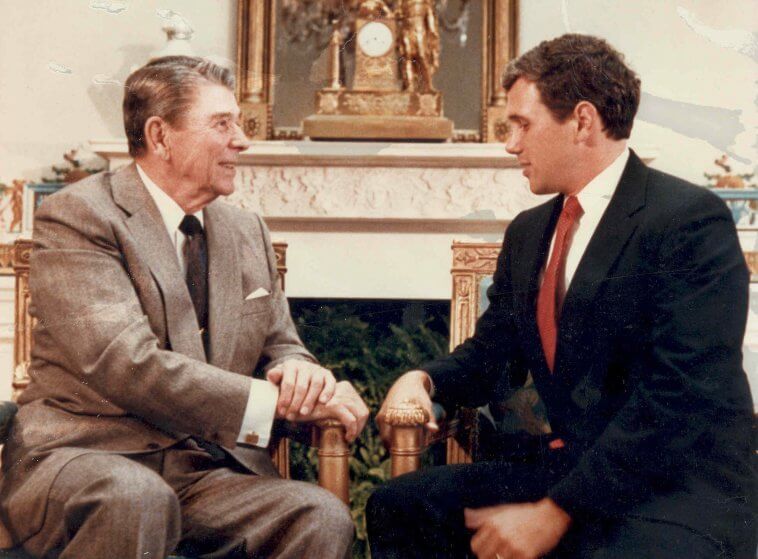
Pence & Reagan 
Rex Tillerson Being that the political spectrum has shifted far to the right as compared to 1968, this year’s election results are more extreme. Donald Trump’s cabinet appointments reflect this extremist mentality; especially in his Vice Presidential pick Mike Pence — a man so out of touch with reality that he has tried to argue that women shouldn’t be working. In 1997, Pence stated that women should stay home because otherwise their kids would “get the short end of the emotional stick.” The soon to be Vice President Pence also sees LGBT rights as a sign of “societal collapse.”13 And as for Trump’s promise to “drain the swamp”, when it comes to establishment figures, it only gets worse, considering his appointment of Rex Tillerson, former CEO of ExxonMobil, as Secretary of State. Despite the fact that Trump appears to be “off the grid”, so to speak, when it comes to the political or Deep Political apparatus, his recent choices for cabinet positions are some of the worst imaginable for the populist of any ilk. In some cases he has actually leapt into the arms of the very establishment he warned his supporters against.
In the face of all this, Sanders continues to inspire his followers to remain politically active. We all need to be involved more than ever, and the Democratic/socialist senator from Vermont has always urged that true change lies in us having the courage to do things ourselves when it comes to reforming government. The more we stay involved, the less likely it will be that the momentum created by political movements will be squandered in the wake of a setback. The major setbacks of the 1960s came in the form of assassinations of inspiring political leaders. Yet even in the wake of such tragedies it is possible, indeed imperative, to find a glimmer of hope. To do so, however, requires, as this essay has been arguing, the insight afforded by a critical analysis of the past, and its continuities with the present. The touchstone for this historical understanding, I believe, lies precisely in the way the policies of President Kennedy have been consistently overturned by subsequent administrations.
V
As mentioned above, John Kennedy was not in favor of the neo-colonialist policies of the Dulles/Eisenhower era. Instead of wanting to occupy foreign nations for the sake of corporate profit, Kennedy believed strongly that the resources of such nations rightly belonged to their people, and that the right to self-determination was critical, as evident in his 1957 speech on French colonialism in Algeria.
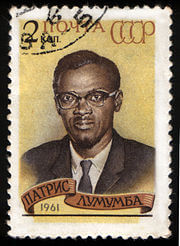
Soviet stamp
commemorating Lumumba
Nixon and Mobutu at the White House In the aftermath of a CIA-assisted coup to assassinate Patrice Lumumba, the nationalist leader of the Congo, President Kennedy fought alongside the U.N. to ensure that a nationwide coalition government was formed. Civil war was imminent as militant and corporately complicit leaders like Colonel Mobutu vied for power and promoted the secession of Katanga, the region of Congo that held vast amounts of mineral resources. JFK supported the more centrist elements of the potential coalition government and felt that the resources of Katanga didn’t belong to Belgian, U.S. or British mining interests. The President’s death ended hope for the pursuit of any stable government in Congo, along with the hope of halting widespread violence. 14 It should be noted that Nixon actually welcomed Mobutu to the White House after he took control of Congo.
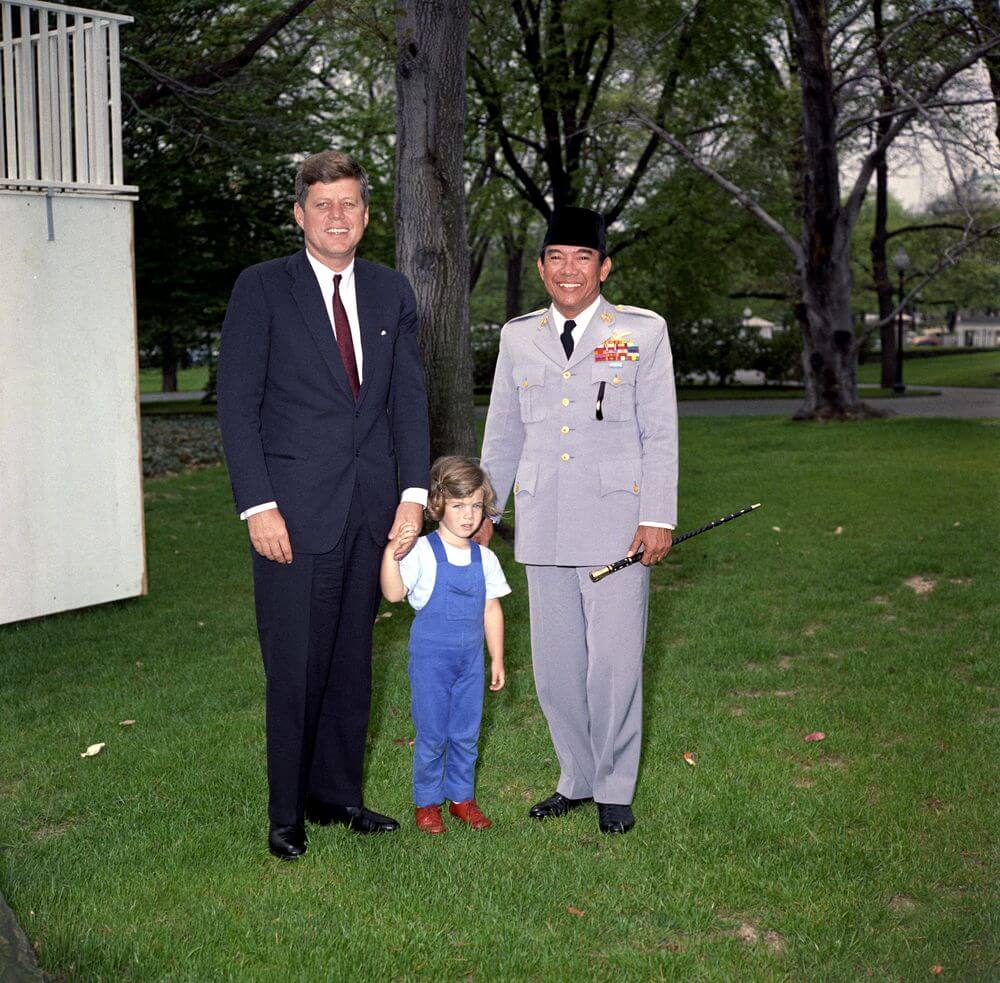
Sukarno at the White House As noted previously, President Kennedy also worked towards re-establishing a relationship with Indonesia and its leader Achmed Sukarno. This was after the Dulles brothers had been involved in attempts to overthrow the Indonesian leader. Decades earlier, it had been discovered by corporate backed explorers that certain areas in Indonesia contained extremely dense concentrations of minerals such as gold and copper. After Kennedy was killed, Sukarno was overthrown with help of the CIA in one of the bloodiest coup d’états ever recorded. Hundreds of thousands of Indonesians perished during both the overthrow, and the subsequent reign of the new leader Suharto. (James DiEugenio, Destiny Betrayed, Second Edition pp. 374-75) Need we add that Nixon also met with Suharto in Washington. In December of 1975, President Ford and Secretary of State Kissinger journeyed to Jakarta and gave Suharto an implicit OK to invade East Timor. This is the tradition that Hillary Clinton and her husband were involved with. For when almost every democratically elected western nation was shunning Suharto in the late nineties, Bill Clinton was still meeting with him. (Op. cit. Probe Magazine.)
President Kennedy’s policies regarding Central and South America were also a threat to corporate interests. David Rockefeller took it upon himself to publicly criticize Kennedy’s Alliance for Progress, which had been established to aid less developed nations, like those south of the United States, to become economically self-reliant. Men like Rockefeller, along with the Wall-Street-connected media (e.g.,Wall Street Journal and Time/Life) also berated the President for “undermining a strong and free economy,” and inhibiting “basic American liberties.” (14, p. 57) The Wall Street Journal flat out criticized Kennedy for being a “self-appointed enforcer of progress” (Ibid p. 66). JFK’s 1962 clash with U.S. Steel, a J.P. Morgan/Rockefeller company, provoked similar remarks.
After President Kennedy had facilitated an agreement between steel workers and their corporate executives, the latter welshed on the deal. It was assumed that the workers would agree to not have their wages increased in exchange for the price of steel also remaining static. After the agreement was reached, U.S. Steel defied the President’s wishes and undermined the hard work to reach that compromise by announcing a price increase. The corporate elite wanted Kennedy to buckle, but instead, he threatened to investigate them for price-fixing and to have his brother Bobby examine their tax returns. Begrudgingly, U.S. Steel backed off and accepted the original terms. Kennedy’s policies, both domestic and foreign, were aimed at enhancing social and economic progress. Like Alexander Hamilton, and Albert Gallatin, JFK sought to use government powers to protect the masses from corporate domination. His tax policy was aimed at channeling investment into the expansion of productive means or capital. The investment tax credit, for instance, provided incentives for business entities that enhanced their productive abilities through investment in the upkeep or updating of equipment inside the United States. (Gibson pp. 21-22) While Kennedy’s policies were focused on strengthening production and labor power, his opponents in the Morgan/Rockefeller world were focused on sheer profit.

David Rockefeller & Henry Luce in 1962 It should serve as no surprise that the media outlets responsible for condemning the president were tied into the very corporate and political establishment entities being threatened. As described by sociologist Donald Gibson in his fine book Battling Wall Street: The Kennedy Presidency, the elite of Wall Street, media executives and certain powerful political persons or groups were so interconnected as to be inbred. Allen Dulles himself was very much involved in these circles, and had close relationships with men like Henry Luce of the Time, Life and Fortune magazine empire, along with executives or journalists at the New York Times, and the Washington Post. Operation Mockingbird, a CIA project designed to use various media outlets for propaganda, was exposed during the Church Committee hearings, revealing the collaboration of hundreds of journalists and executives at various media organizations including CBS, NBC, The New York Times, the Associated Press, Newsweek and other institutions.15)
John Kennedy wasn’t only trying to curtail corporate power with his Hamilton/Gallatin, New Deal-like economic policies. His decisions concerning military engagement abroad were greatly at odds with the hard-line Cold Warriors of his administration and the Central Intelligence Agency. Time after time, Kennedy refused to commit U.S. combat troops abroad despite the nagging insistence of his advisors. Although the President publicly accepted responsibility for the fiasco at the Bay of Pigs, privately he was livid at the CIA for deceiving him. Through materials such as inspector general Lyman Kirkpatrick’s report on the Bay of Pigs, and other declassified CIA documents, it is now evident that a major deception had occurred. The Agency had assured Kennedy that their group of anti-Castro Cuban invaders would be the spark that would set off a revolt against Fidel Castro just waiting to happen. This was not the case, and the CIA-backed Cubans were outnumbered by Castro’s forces 10 to 1. Even worse, as noted in the Kirkpatrick report, was the fact that the CIA had stocked the invading force with C-Level operatives. (2, p. 396) It was almost as if the surface level plan presented to the President was designed to fail in order to force his hand and commit the military into invading Cuba. A declassified CIA memo acknowledges the fact that securing the desired beach area in Cuba was not possible without military intervention. 16
When Kennedy refused to commit U.S. troops as the operation crumbled, he became public enemy number one in the CIA’s eyes. This sentiment that Kennedy was soft on communism, or even a communist sympathizer, augmented as he continued to back away from military intervention in other situations. The President reached an agreement with the Soviet Union to keep Laos neutral, and despite his willingness to send advisors to Vietnam, he ultimately worked to enact a policy resulting in the withdrawal of all U.S. personnel from the country. Kennedy’s assassination ended this movement toward disengagement from Saigon.
What was likely even worse to the Cold Warriors and CIA patriots during this time was the President’s attempts at détente with Nikita Khrushchev of the Soviet Union and Cuba’s Fidel Castro. During, and in the period following, the Cuban Missile Crisis, Kennedy and Khrushchev were involved in back channel dialogue with one another. Discussion moved toward talks about détente; despite the fact that the two men’s respective countries had differing views, they agreed it was imperative, for the sake of the planet, to come to an understanding. This, along with JFK’s unwillingness to bomb Cuba during the Missile Crisis, were nothing short of traitorous to the covert and overt military power structure of the United States. In the final months of his life, the President also extended a secret olive branch toward Fidel Castro in hopes of opening a dialogue. Excited by the prospect, Castro was painfully upset when he got word of Kennedy’s assassination. Kennedy most certainly had his enemies, and was making decisions that drove a stake into the very heart of corporate, military and intelligence collusion. If he had been elected President, Bobby Kennedy was most certainly going to continue, and most likely even expand, the policies of his late brother. (ibid, pp. 25-33) Like Jack and Bobby, Martin Luther King and Malcolm X expressed opposition toward the continuation of the Vietnam War.
VI
The concept of Deep Politics may provide a helpful alternative to the term “conspiracy theory”, which has become so stigmatized and so overused as to be meaningless. Abandoning the idea of conspiracy altogether, however, risks throwing the baby out with the bath water, for it raises legitimate questions about what lurks beneath the surface of the affairs of state. The enemies that John and Robert Kennedy were facing were not some fictional or hypothetical “illuminati” group or groups. They were very real, dangerous and powerful interests, and those forces are still with us in 2016. Deep Politics does not imply that there is some singular group or set of groups that meet in secret to plot colossal calamities that affect the entire world, but rather that the events themselves arise from the milieu(s) created by a congruence of unaccountable, supra-constitutional, covert, corporate and illegal interests, sometimes operating in a dialectical manner. A more recent example would be the networking of several of these interests to orchestrate the colossal Iran/Contra project.
Other writers have also described these subterranean forces using other terms. The late Fletcher Prouty called it the Secret Team. Investigative journalist Jim Hougan calls it a Shadow Government. Florida State professor Lance DeHaven Smith, with respect to its activities, coined the term “State Crime Against Democracy”, or SCAD. (Click here for his definition.) Smith wrote one of the best books about how, with the help of the MSM, these forces stole the 2000 election in Florida from Al Gore. He then wrote a book explaining how the term “conspiracy theorist” became a commonly used smear to disarm the critics of the Warren Commission. It was, in fact, the CIA which started this trend with its famous 1967 dispatch entitled “Countering Criticism of the Warren Report”. (See this review for the sordid details.)
Whether it be extralegal assassinations, unwarranted domestic surveillance, interventionist wars at the behest of corporate interests, torture or other activities of that stripe, these all in essence have their roots in the Dulles era in which covert, corporate power developed into a well-oiled and unaccountable machine running roughshod. These forces have continued to operate regardless of who is elected president, whether Democrat or Republican. (See Jim Hougan’s Secret Agenda for a trenchant analysis of the operation against Richard Nixon that came to be called Watergate.)
It is my opinion that we must come to terms with these dark or, to use James W. Douglass’ term, “unspeakable” realities. And we must do so in a holistic way if we are to take more fundamental steps toward progress as a nation. George Orwell coined the term Crime Stop to describe the psychological mechanism by which humans ignore uncomfortable or dangerous thoughts. Through discussions with people young and old, it has become evident to me that this Crime Stop mechanism is at work in the subconscious of many Americans. We need to be willing to face the darker aspects of our recent past that have been at work below the surface and percolating up into view for many years.
In a very tangible way, the refusal to face these dark forces has caused the Democratic Party to lose its way. And this diluted and uninspiring party has now given way to Donald Trump. As alluded to throughout this essay, this party has abandoned the aims and goals of the Kennedys, King and Malcolm X to the point that it now resembles the GOP more than it does the sum total of those four men. To understand what this means in stark political terms, consider the following. Today, among all fifty states, there are only 15 Democratic governors. In the last ten years, the Democrats have lost 900 state legislative seats. When Trump enters office, he will be in control of not just the White House, but also the Senate and the House of Representatives. Once he nominates his Supreme Court candidate to replace Antonin Scalia, he will also be in control of that institution.
Bernie Sanders was the only candidate whose policies recalled the idea of the Democratic party of the Sixties. And according to a poll of 1,600 people run by Gravis Marketing, he would have soundly defeated Trump by 12 points. The Democrats have to get the message, or they run the risk of becoming a permanent minority party. They sorely need to look at themselves, and ask, What happened? As a starting point, they can take some of the advice contained in this essay.
Notes
1. “Hillary Clinton Snaps At NPR Host After Defensive Gay Marriage Interview.” YouTube. WFPL News, 12 June 2014 <https://www.youtube.com/watch?v=vgIe2GKudYY>.
2. David Talbot, The Devil’s Chessboard: Allen Dulles, the CIA, and the Rise of America’s Secret Government. New York, NY: Harper, 2015.
3. Gary Leupp, “Hillary Clinton’s Foreign Policy Resumé: What the Record Shows.” , 03 May 2016.
4. Greg Grandin, “A Voter’s Guide to Hillary Clinton’s Policies in Latin America.” The Nation, 18 April 2016.
5. Tim Shorrock, “How Hillary Clinton Militarized US Policy in Honduras.” The Nation, 06 April 2016.
6. Peter Dale Scott, “The Deep State and the Bias of Official History.” Who What Why, 20 January 2015.
7. Ben Norton, “Sanders Condemns Pro-austerity ‘Colonial Takeover’ of Puerto Rico; Clinton Supports It.” Salon, 27 May 2016.
8. “Chomsky on Liberal Disillusionment with Obama.” YouTube, 03 April 2010 <https://www.youtube.com/watch?v=A6Jbnq5V_1s>.
9. Peter Dale Scott, The American Deep State: Wall Street, Big Oil, and The Attack On U.S. Democracy. Lanham: Rowman & Littlefield, 2015: Chapter 2, p. 12.
10. “Project Censored 3.1 – JFK 50 – Peter Dale Scott – Deep Politics.” YouTube, Project Sensored, 19 December 2013 <https://www.youtube.com/watch?v=L0CFpMej3mA>.
11. Angelo Young, “And The Winner For The Most Iraq War Contracts Is . . . KBR, With $39.5 Billion In A Decade.” International Business Times, 19 March 2013.
12. Zawn Villines, “The Four Worst Things Mike Pence Has Said About Women.” Daily Kos, 21 July 2016.
13. Richard D. Mahoney, JFK: Ordeal in Africa. New York: Oxford UP, 1983.
14. Donald Gibson, Battling Wall Street: The Kennedy Presidency. New York: Sheridan Square, 1994.
15. Carl Bernstein, “The CIA and the Media.” Rolling Stone, 20 October 1977 <http://www.carlbernstein.com/magazine_cia_and_media.php>.
16. David Talbot, Brothers, p. 47.
-
The 2016 Election, Historical Amnesia and Deep Politics
By now, I think it is safe to say that everyone is kind of sick of discussing the 2016 election season. However nauseating it may have been, it proved to be unprecedented and monumental in various ways. Unprecedented, for example, in the fact that the two major party candidates were the most disliked in modern political history. The Republican candidate, now President-elect, who touts himself as a good businessman yet probably couldn’t tell you the difference between Keynes and Marx, has run perhaps the most hate-filled, deplorable campaign in recent memory. He often speaks of running the country like a business and harps on immigration as one of the major problems facing this country. Yet he never discusses substantive issues in detail (for example, the tens of millions of poverty- and hunger-stricken children living in the United States alone), and frequently demonstrates a poor grasp of them (such as the nuclear triad). In fact, he compulsively prevaricates and can’t seem to string two cohesive sentences together. Therefore it is hard in many cases to see where he actually stands. (For a revealing example of this, watch this clip.)
The former Democratic candidate, on the other hand, bears a resemblance to an Eisenhower Republican. She is an intelligent and experienced politician full of contradictions. She was certainly preferable to Trump on domestic issues, e.g., women’s rights, race, and overall economic policy—not to mention global scientific matters like climate change. Nevertheless, there are serious problems with Hillary Clinton’s record. While Trump compulsively exaggerates and prevaricates, Hillary Clinton is not the epitome of honesty or integrity either. Up until 2013, she didn’t support same-sex marriage, yet got defensive and lied about the strength of her record on this issue. 1 Despite the fact that FBI Director James Comey publicly stated that classified material was indeed sent over Clinton’s unsecure server, she continued to dance around that subject as if she still didn’t know the public was privy to Comey’s statements.
I could expand on the former Secretary of State’s flip-flopping and dishonesty over the years when it comes to problems like email security. And the disturbing fact that five people in her employ took the Fifth Amendment rather than testify before Congress in open session on the subject. However, in spite of their receiving a great deal of media attention, failings such as these are far from being her main flaw, and are, in this author’s opinion, a distraction from much deeper issues. As previously alluded to, Clinton’s foreign policy bears much more of a resemblance to the Eisenhower/Dulles brothers’ record than it does to what one might expect from someone who describes herself as taking a back seat to no-one when it comes to progressive values.
Allen & John Foster Dulles Mossadegh & Shah Pahlavi For those who might not be aware, Allen Dulles (former Director of the CIA) and his brother John Foster Dulles (former Secretary of State) essentially orchestrated foreign policy under the Eisenhower administration. They were former partners at Sullivan and Cromwell, which was the preeminent law firm for Wall Street in the fifties. Allen and Foster married global corporate interests and covert military action into a well-oiled machine that promoted coups, assassinations and the blood-soaked destruction of democracies around the world. After Iran’s democratically elected leader Mohammed Mossadegh vowed to nationalize his country’s oil and petroleum resources, the Dulles brothers—who represented Rockefeller interests like Standard Oil— designed a phony indigenous overthrow that installed the corporately complicit Reza Shah Pahlavi into power in 1953. His brutal and repressive reign lasted until 1979, and his downfall provoked a fundamentalist Islamic revolution in Iran.
Arbenz centennial (2013) Castillo Armas (with Nixon) In 1954, the Dulles brothers were at it again in Guatemala with operation PBSUCCESS. Jacobo Arbenz, the labor-friendly and democratically elected leader of the country, was going toe to toe with other corporate interests such as the Rockefeller/Sullivan & Cromwell associated company United Fruit. Arbenz was pushing for reform that sought to curtail the neo-colonial power of United Fruit by providing more in resources for the people of Guatemala. To the Dulles brothers and other Wall Street types with vested interests, this was unacceptable and was to be depicted as nothing short of communism. Arbenz was ousted from the country in what was largely a psychological warfare operation. He was replaced with a ruthless dictator by the name of Castillo Armas. The CIA provided the Armas regime with “death lists” of all Arbenz government members and sympathizers, and through the decades that followed, tens of thousands of people either were brutally killed or went missing at the hands of the dictatorship. 2 This constant state of upheaval, terror and violence did not subside until a United Nations resolution took hold in 1996.
II
Hillary Clinton, whether she knows it or not—and it’s a big stretch to say that she doesn’t—has advocated for the same interventionist foreign policy machine created by the likes of the Dulles brothers. There are at least three major areas of foreign affairs in which she resembles the Dulles brothers more than Trump does: 1.) The Iraq War 2.) American /Russian relations 3.) American actions against Syria. In fact, she actually made Trump look Kennedyesque in this regard, no mean feat.
Clinton & Kissinger Nowadays, Clinton refers to her vote for the Iraq War as a “mistake”, but it certainly doesn’t seem like one considering the context of her other decisions as Secretary of State. Secretary Clinton’s friendships and consultations with Henry Kissinger and Madeleine Albright raised eyebrows in progressive circles. (Click here for the Clinton/Kissinger relationship.) Kissinger’s record as Secretary of State/National Security Adviser was most certainly one of the worst in U.S. history when it came to bloody, sociopathic, interventionist policy around the globe. During the disastrous and unnecessary crisis in Vietnam, Kissinger would nonchalantly give President Nixon death tallies in the thousands regarding Vietnamese citizens as if they were some Stalinesque statistic. Kissinger then agreed to expand that war in an unprecedented way into Cambodia and Laos—and then attempted to conceal these colossal air war actions. Of course, this was a further reversal and expansion of that war, which went even beyond what Lyndon Johnson had done in the wake of JFK’s death. President Kennedy’s stated policy was to withdraw from Indochina by 1965.
Salvador Allende Augusto Pinochet Kissinger was also an instrumental force for the CIA coup in Chile, which ended in the death of Salvador Allende. About Allende, he allegedly stated he did not understand why the USA should stand by and let Chile go communist just because the citizenry were irresponsible enough to vote for it. (A Death in Washington, by Don Freed and Fred Landis, p. 8) The CIA overthrow of Allende led to years of brutal fascism under military dictator Augusto Pinochet.
Clinton & Albright Madeleine Albright demonstrated similar hawkishness. (Click here for more on the Clinton/Albright relationship.) When asked about the refusal of the United States to lift UN Sanctions against Iraq and the resulting deaths of 500,000 Iraqi children, Albright stated that the deaths had been “worth it.”3 Predictably, Albright’s statement was met with stunned surprise. In May of 1998, Albright said something just as surprising. At that time, riots and demonstrations against the brutal Indonesian dictator Suharto were raging all over the archipelago; there were mock funerals being conducted, and his figure was being burned in effigy. Here was a prime opportunity for Albright and the Clinton administration to step forward and cut off relations with a despot who had looted his nation to the tune of billions of dollars. Or at the very least, join the chorus of newspapers and journals requesting he step down. What did Albright do? She asked for “more dialogue”. Even in the last two days of Suharto’s reign, when major cities were in flames, when Senators John Kerry and the late Paul Wellstone were asking the State Department to get on the right side of history, Albright chose to sit on the sidelines. (Probe Magazine, Vol. 5 No. 5, pp. 3-5)
Hajji Muhammad Suharto with Nixon, Ford & Kissinger, Reagan, Bush Sr. & Bill Clinton In this regard, let us recall that Suharto came to power as a result of a reversal of President Kennedy’s foreign policy. Achmed Sukarno had been backed by President Kennedy throughout his first term, all the way up to his assassination. And JFK was scheduled to visit Jakarta in 1964, before the election. As opposed to the silence of Albright and Bill Clinton, after Suharto resigned, the Robert F. Kennedy Memorial Center wrote a letter to his successor asking for an investigation of the role of the military in suppressing the demonstrations that led to his fall. (ibid)
During her time as Secretary of State, Hillary Clinton displayed an American imperiousness akin to the previous examples. Whether the former Secretary’s intentions in Libya truly aimed at ending what she called a “genocidal” regime under Gaddafi doesn’t really matter. She personally pushed for a NATO sanctioning of bombings in Libya. (This NATO assault in Africa followed the standard set by Albright in Kosovo in 1999, which was the first offensive attack NATO had ever performed.) The assault on Libya eventually led to the murder of Muammar Gaddafi. And that paved the way for a dangerous political power vacuum in which various elements, including Islamic extremists, are vying for power. It is safe to say that she left Libya in such a shambles that the USA had to reenter the civil war.
Clinton’s decision to arm Syrian “rebels” against Bashar al Assad has also helped create bloody conflict with no end in sight. (Click here for why this may be a strategic mistake.) Bombings occur on a daily basis, especially in areas like Aleppo, leaving tens of thousands of innocents dead. As a candidate, she wanted to establish a “no-fly zone” over Syria—much as she did in Libya. This was a euphemism for controlling the air so that American proxies could control the ground. And as many suspect, and as alluded to in the above-linked story, that likely would have led to fundamentalist dominance in Syria, resembling the endgames in Iraq and Libya. But beyond that, this would probably have ended up provoking Russia, since Russia backs Assad. (Ibid, n. 3)
“Pacific Rubiales:
How to get rich in a
country without regulations”Secretary Clinton’s policy regarding Latin America, another topic avoided by the media during the last election cycle, also demonstrates knowing or unknowing complicity with colonial/imperial interests. In Colombia, for instance, a petroleum company by the name of Pacific Rubiales, which has ties to the Clinton Foundation, has been at the center of a humanitarian controversy. The fact that Pacific Rubiales is connected with the Clinton Foundation isn’t the main issue, however. The real problem is the manner in which positions were changed on Clinton’s part in exchange for contributions. During the 2008 election season, then-Senator Clinton opposed the trade deal that allowed companies like Pacific Rubiales to violate labor laws in Colombia. After becoming Secretary of State, Clinton did an about-face. As summed up by David Sirota, Andrew Perez and Matthew Cunningham-Cook:
At the same time that Clinton’s State Department was lauding Colombia’s human rights record (despite having evidence to the contrary), her family was forging a financial relationship with Pacific Rubiales, the sprawling Canadian petroleum company at the center of Colombia’s labor strife. The Clintons were also developing commercial ties with the oil giant’s founder, Canadian financier Frank Giustra, who now occupies a seat on the board of the Clinton Foundation, the family’s global philanthropic empire. The details of these financial dealings remain murky, but this much is clear: After millions of dollars were pledged by the oil company to the Clinton Foundation—supplemented by millions more from Giustra himself—Secretary Clinton abruptly changed her position on the controversial U.S.-Colombia trade pact.” 4
Clinton & Zelaya (2009) Despite recent denials, the former Secretary also played a role in the 2009 coup that ousted the democratically elected and progressive human rights administration of Manuel Zelaya in Honduras. Recent editions of Clinton’s autobiography Hard Choices have been redacted to conceal the full extent of her role in the overthrow. Since the coup, and in opposition to the supposed goals of the overthrow itself, government-sponsored death squads have returned to the country, killing hundreds of citizens, including progressive activists like Berta Cáceres. Before her assassination, Cáceres berated Secretary Clinton for the role she played in overthrowing Zelaya, stating that it demonstrated the role of the United States in “meddling with our country,” and that “we warned it would be very dangerous and permit a barbarity.” 5
In addition, the U.S.-backed coup in Honduras demonstrates the ongoing trend of outsourcing when it comes to intelligence work. A private group called Creative Associates International (CAI) was involved in “determining the social networks responsible for violence in the country’s largest city,” and subcontracted work to another private entity called Caerus. A man by the name of David Kilcullen, the head of Caerus, was previously involved in a $15 million US AID program that helped determine stability in Afghanistan. Kilcullen’s associate, William Upshur, also contributed to the Honduras plans. Upshur is now working for Booz Allen Hamilton, another private company involved in U.S. intelligence funding. (Ibid, n. 5)
In his 2007 book, Tim Shorrock explained how substantial this kind of funding is. Shorrock stated that approximately 70 percent of the government’s 60-billion-dollar budget for intelligence is now subcontracted to private entities such as Booz Allen Hamilton or Science Applications International Corporation. 6
Puerto Rico, a country in the midst of a serious debt crisis, is another key topic when it comes to Clinton’s questionable foreign policy decisions. Hedge funds own much of Puerto Rico’s massive debt, and a piece of legislation, which was put forward to deal with the issue, has rightly been labeled by Bernie Sanders as a form of colonialism. The bill in question would hand over control of financial dealings to a U.S. Government Board of Regulators, which would likely strip vital social spending in Puerto Rico. The bill already imposes a $4.25 minimum wage clause for citizens under 25. While Sanders opposed this bill, Clinton supported it. 7 This may serve as no surprise, being that the former Secretary of State receives hefty sums from Wall Street institutions like Goldman Sachs, who benefit from this form of vulture capitalism. I am not asserting that Hillary Clinton is solely responsible for these foreign policy decisions, but that she has been complicit with the American Deep State that commits or is heavily involved in these operations. (An explanation of the term “Deep State” will follow.) If the results of this 2016 election, and the success of both Trump and Sanders in the primaries, teach us something, it is that we have to move away as quickly as possible from policy compromised by corporate influence if we truly want to move forward. The American public has clearly had enough with establishment politics.
III
With the election of Donald Trump, the viability of establishment politics has been seriously breached, effectively ending the age of lesser-evil voting by the proletariat. Although Hillary Clinton was the preferred candidate regarding things like domestic social issues and scientific issues, it wasn’t enough to tame the massive insurgency of citizens who were so fed up with the status quo that they would rather see the country possibly go up in flames than vote for more of the same. Nor did it inspire an overlooked independent voter base to come out and make a substantial difference in the Democratic vote. In the aftermath of this potential disaster of an election, it is our duty, as a collective, to look deeply into some troubling fundamental issues. One of these has to do with the fact that racism, xenophobia and sexism are still very much alive in this country.
I will not go so far as to label all Trump supporters as racist, homophobic or sexist. And throughout the primary/general election season, I have tried to remain receptive to their frustrations. However, I can most certainly tell you that, based on my experiences of this election season alone, these sentiments do indeed exist. During a delegate selection process for the Bernie Sanders campaign, I met and ended up having discussions with some Trump supporters. I asked them questions about why they thought Trump would make a good president, all the while disagreeing with them, but listening nonetheless. Two of the men I was speaking with were very civil, but one in particular seemed to be bursting at the seams with frustration over what he thought were the main problems with the country. While ignoring the facts I was presenting him regarding corporate welfare, this man went into relentless diatribes about why “Tacos”, his label for Hispanic people, were wreaking havoc. He exhibited no shame in expressing his distaste for other ethnicities either. During this dismaying exchange, I brought up the continued mistreatment of Native American peoples. In response, this man tried to question the severity of the atrocities committed against them and even went so far as to imply that my use of the term genocide in describing their plight was incorrect.
Steve Mnuchin This may well serve to exemplify the hateful attitudes of mistrust and resentment that have been put under a black light during the course of this election. They’ve lingered dormant under the surface and have reached a boiling point thanks to Donald Trump. To paraphrase Bernie Sanders, Trump was able to channel the frustration of a destitute middle class and convert it into unconstructive anger. While Trump made references to how the “establishment” was a major problem, like many of his policy points, he didn’t ever describe in detail what was to be done to correct it. Instead, with his references to a wall with Mexico and to mass deportations, he encouraged the belief in his supporters that minorities were ruining the country. Yet in spite of his campaign promise to “drain the swamp”, many of the Trump cabinet appointees are among the most Establishment type figures one could imagine. For example, Steve Mnuchin, the former Goldman Sachs executive famous for foreclosures and hedge fund deals, has been appointed Secretary of Treasury.
The election of a man like Donald Trump, who can’t seem to expound any of his policies in any sort of detail and is openly demeaning towards women, people of other races, and the disabled, makes clear that we have a cancerous political system which has metastasized in large part thanks to establishment politicians beholden to corporate interests. And these politicians are wildly out of touch with the needs of the average American. This created a very wide alley that the new Trump managed to rumble through. (I say “new” because in one of the many failings of the MSM, no one bothered to explain why Trump had reversed so many of the proposals he made back in 2000, when he was going to run on the Reform Party ticket.) Some commentators have claimed there can be little doubt that there was a liberal disillusionment following President Obama’s election. Hillary Clinton could not convince enough people that she was even the “change candidate” that Obama was. Therefore, in the search for answers for why their lives weren’t improving, many citizens had to find alternate sources of information outside of corporate influenced organizations (i.e. The Republican Party, Democratic Party and the Mainstream Media), given those groups won’t admit to the public that they are subservient to the same big money interests. This explains the rise of figures like Rush Limbaugh, Glenn Beck, and even rightwing populist/conspiracy demagogue Alex Jones. Their collective answer is to paint minorities and welfare recipients as the principal ills of American society, all the while failing to recognize the deep connection between government policy and corporate influence. In short, this election warns us that when the real reasons behind government dysfunction are ignored and go unchallenged, one risks the upsurge of fascist sentiments. 8
In addition to reminding us of Hillary’s relationship with Kissinger, Bernie Sanders reminded a large portion of the U.S. populace about the other fundamental issue lying beneath the surface: corporate power. And Sanders could have neutralized Trump’s appeal among the shrinking working and middle classes, which the latter earned by invoking the need for tariffs and the threat of trade wars. This certainly was another reason for Trump’s popularity in the Mideast states like Wisconsin, Iowa, Michigan and Ohio, where he broke through the supposed Democratic firewall. (As to why, listen to this this segment by Michael Moore.) With Secretary of State Clinton’s and President Bill Clinton’s views on NAFTA and the Columbia Free Trade Agreement, and Hillary’s original stance on the Trans Pacific Partnership (TPP), she could not mount a genuine counter-offensive to Trump’s tactics in those states, for the simple reason that the Clintons were perceived as being free-traders rather than fair-traders. Thanks to their record, a Democratic presidential candidate appeared to favor a globalization policy that began decades ago with David Rockefeller—a policy that was resisted by President Kennedy. (See Donald Gibson, Battling Wall Street, p. 59)
Awareness of any problem is the first step toward fixing it. But I think we must go beyond simple awareness when it comes to confronting our nation’s collective “shadow”, as Carl Jung would have called it — meaning all the darker, repressed aspects of the unconscious that, when ignored, can result in psychological backlash. How do we get beneath the surface appearances of corporate greed (for instance, the increasing wealth inequality amongst classes, or the amount of tax money allocated to corporate subsidies)? I suggest that an exploration of our past guided by a concept that Peter Dale Scott labels “Deep Politics” can help us come to terms, in a more profound way, with the problems facing us.
This concept embraces all of the machinations occurring beneath the surface of government activity and which go unnoticed in common analysis, such as in news reports or textbooks. Or, as Scott states in his 2015 book The American Deep State, it “…involves all those political practices and arrangements, deliberate or not, which are usually repressed rather than acknowledged.”9 A “Deep Political” explanation of major world events goes beyond the ostensible or normally accepted models of cause and effect. One example of a “Deep Event” is the 1965 Gulf of Tonkin Incident, which provided a motive, or casus belli, to escalate the Vietnam War into a full-scale invasion by American ground forces. Given that President Johnson had already, in stark contrast to President Kennedy’s policy, approved the build-up of combat troops in Vietnam in 1964, all that was needed was some sort of impetus in order for United States involvement to move to the next stage. As the author describes, many of the intelligence reports received by the Johnson administration regarding this supposed incident did not signal any sort of instigation on North Vietnam’s behalf. However, those same reports were ignored in order to claim that North Vietnam had engaged in an act of war against the United States. 10
Other examples of Deep Events include the previously mentioned instances of CIA, corporate and State Department interference in the economic and governmental affairs of foreign nations. It is evident that these coups did not occur for the sake of saving other countries from the grip of communism or the reign of dictators; such would only be at best a surface explanation. The deeper explanation is that a nexus of corporate, military, paramilitary, government and, on occasion, underworld elements (viz, the workings of the Deep State) had a vested interest in the outcome. The Bush administration’s lies regarding Saddam Hussein’s alleged arsenal of “weapons of mass destruction”, presented to the American people and Congress as a reason to invade Iraq, could most certainly be classified as a Deep Event. No entities benefitted more from America’s long-term occupation of Iraq than companies like Dick Cheney’s Halliburton. KBR Inc., a Halliburton subsidiary, “was given $39.5 billion (emphasis added) in Iraq-related contracts over the past decade, with many of the deals given without any bidding from competing firms, such as a $568-million contract renewal in 2010 to provide housing, meals, water and bathroom services to soldiers, a deal that led to a Justice Department lawsuit over alleged kickbacks, as reported by Bloomberg.” 11
Included under the umbrella of Deep Politics are the major assassinations of the 1960s — those of John Kennedy, Robert Kennedy, Martin Luther King Jr. and Malcolm X. Poll after poll has indicated that most Americans believe there was a conspiracy to kill President Kennedy, but even today many apparently have not reasoned beyond the fact that there is something fishy about the “official” version in order to understand this murder in its fullest context. It behooves us to inquire more deeply into this historically critical event. Before I go any further, however, let me assert here—and I do so quite confidently—that anyone who still buys into the government version of events regarding, for example, the assassinations of John and Robert Kennedy, is either not looking carefully enough, or is not really familiar with the case.
IV
A suggestive point of departure for such an inquiry are the parallels between the 2016 election and that of 1968. In the wake of the assassination of Martin Luther King in April of 1968, racial tensions were high and a presidential primary season was in full swing. Opposition towards the Vietnam War was strong and one candidate in particular represented the last best hope for minorities, anti-war voters, and the middle, as well as lower classes. That candidate was Robert Kennedy, and by the early morning of June 5th, it was becoming clear that he would likely be the Democratic candidate to run against Richard Nixon in the general election. Within a matter of moments of making his victory speech for the California primary, Robert Kennedy was assassinated when he walked into the kitchen pantry of the Ambassador Hotel in Los Angeles. In those moments, the Sixties ended—and so did the populist hopes and dreams for a new era.
Chicago DNC 1968 Philedelphia DNC 2016 The 1968 Democratic National Convention in Chicago was attended by the protests of disillusioned voters who felt cheated out of a more liberal, populist candidate. They ended up rioting in the streets. Hubert Humphrey, who was receiving flack for not taking a strong enough stance on the situation in Vietnam, was selected as the nominee. Similarly, there were many dissatisfied delegates and voters at the 2016 Philadelphia Democratic convention. But in a tightly controlled operation, their actions were kept hidden off screen. And the threat of stripping them of their credentials was often used to suppress any protest on the convention floor. In 2016, Hillary Clinton was nominated and her candidacy helped give us Donald Trump. In 1968, the immediate result was Richard Nixon as president. But the subsequent results included the massive increase in loss of life not just in Vietnam, but also in Cambodia, and the continuing trend away from the New Deal, anti-globalist policies of John Kennedy and Franklin Roosevelt.
Alger Hiss, America’s Dreyfus Rep. Voorhis, defeated by
Nixon’s smear campaignIn fact, Nixon had been a part of the effort to purge New Deal elements from the government during the McCarthy era. Whether it was conducting hearings on men like Alger Hiss and making accusations of Soviet spycraft, or using his California Senate campaign to falsely accuse incumbent Congressman Jerry Voorhis of being a communist, Nixon contributed to the growing, exaggerated fear of communism in the United States. This fear allowed men like Allen Dulles to be seen as pragmatists in the face of supposed communist danger. Dulles’ and the CIA’s dirty deeds on behalf of corporate power were carried out under the guise of protecting the world from communism. As described in the Allen Dulles biography by David Talbot, The Devil’s Chessboard, sociologist C. Wright Mills called this mentality “crackpot realism.”12 It is ironic that Nixon ended up distrusting the CIA, the institution so closely associated with Allen Dulles, a man who had championed Nixon’s rise to power as both a congressman and senator.
Flash forward to 2016 and, once again, we witness the results of a Democratic Party choosing to ignore the populist outcry for reform, and of a government compromised by corporate coercion, one subject to the hidden workings of the Deep State. Bernie Sanders represented the New Deal aspirations of a working class tired of corporate-run politics. As revealed by Wikileaks, the upper echelons of the Democratic Party chose not to heed their voices, thereby indirectly aiding the election of Donald Trump, who offered a different and unconstructive form of populism.
Pence & Reagan Rex Tillerson Being that the political spectrum has shifted far to the right as compared to 1968, this year’s election results are more extreme. Donald Trump’s cabinet appointments reflect this extremist mentality; especially in his Vice Presidential pick Mike Pence — a man so out of touch with reality that he has tried to argue that women shouldn’t be working. In 1997, Pence stated that women should stay home because otherwise their kids would “get the short end of the emotional stick.” The soon to be Vice President Pence also sees LGBT rights as a sign of “societal collapse.”13 And as for Trump’s promise to “drain the swamp”, when it comes to establishment figures, it only gets worse, considering his appointment of Rex Tillerson, former CEO of ExxonMobil, as Secretary of State. Despite the fact that Trump appears to be “off the grid”, so to speak, when it comes to the political or Deep Political apparatus, his recent choices for cabinet positions are some of the worst imaginable for the populist of any ilk. In some cases he has actually leapt into the arms of the very establishment he warned his supporters against.
In the face of all this, Sanders continues to inspire his followers to remain politically active. We all need to be involved more than ever, and the Democratic/socialist senator from Vermont has always urged that true change lies in us having the courage to do things ourselves when it comes to reforming government. The more we stay involved, the less likely it will be that the momentum created by political movements will be squandered in the wake of a setback. The major setbacks of the 1960s came in the form of assassinations of inspiring political leaders. Yet even in the wake of such tragedies it is possible, indeed imperative, to find a glimmer of hope. To do so, however, requires, as this essay has been arguing, the insight afforded by a critical analysis of the past, and its continuities with the present. The touchstone for this historical understanding, I believe, lies precisely in the way the policies of President Kennedy have been consistently overturned by subsequent administrations.
V
As mentioned above, John Kennedy was not in favor of the neo-colonialist policies of the Dulles/Eisenhower era. Instead of wanting to occupy foreign nations for the sake of corporate profit, Kennedy believed strongly that the resources of such nations rightly belonged to their people, and that the right to self-determination was critical, as evident in his 1957 speech on French colonialism in Algeria.
Soviet stamp
commemorating LumumbaNixon and Mobutu at the White House In the aftermath of a CIA-assisted coup to assassinate Patrice Lumumba, the nationalist leader of the Congo, President Kennedy fought alongside the U.N. to ensure that a nationwide coalition government was formed. Civil war was imminent as militant and corporately complicit leaders like Colonel Mobutu vied for power and promoted the secession of Katanga, the region of Congo that held vast amounts of mineral resources. JFK supported the more centrist elements of the potential coalition government and felt that the resources of Katanga didn’t belong to Belgian, U.S. or British mining interests. The President’s death ended hope for the pursuit of any stable government in Congo, along with the hope of halting widespread violence. 14 It should be noted that Nixon actually welcomed Mobutu to the White House after he took control of Congo.
Sukarno at the White House As noted previously, President Kennedy also worked towards re-establishing a relationship with Indonesia and its leader Achmed Sukarno. This was after the Dulles brothers had been involved in attempts to overthrow the Indonesian leader. Decades earlier, it had been discovered by corporate backed explorers that certain areas in Indonesia contained extremely dense concentrations of minerals such as gold and copper. After Kennedy was killed, Sukarno was overthrown with help of the CIA in one of the bloodiest coup d’états ever recorded. Hundreds of thousands of Indonesians perished during both the overthrow, and the subsequent reign of the new leader Suharto. (James DiEugenio, Destiny Betrayed, Second Edition pp. 374-75) Need we add that Nixon also met with Suharto in Washington. In December of 1975, President Ford and Secretary of State Kissinger journeyed to Jakarta and gave Suharto an implicit OK to invade East Timor. This is the tradition that Hillary Clinton and her husband were involved with. For when almost every democratically elected western nation was shunning Suharto in the late nineties, Bill Clinton was still meeting with him. (Op. cit. Probe Magazine.)
President Kennedy’s policies regarding Central and South America were also a threat to corporate interests. David Rockefeller took it upon himself to publicly criticize Kennedy’s Alliance for Progress, which had been established to aid less developed nations, like those south of the United States, to become economically self-reliant. Men like Rockefeller, along with the Wall-Street-connected media (e.g.,Wall Street Journal and Time/Life) also berated the President for “undermining a strong and free economy,” and inhibiting “basic American liberties.” (14, p. 57) The Wall Street Journal flat out criticized Kennedy for being a “self-appointed enforcer of progress” (Ibid p. 66). JFK’s 1962 clash with U.S. Steel, a J.P. Morgan/Rockefeller company, provoked similar remarks.
After President Kennedy had facilitated an agreement between steel workers and their corporate executives, the latter welshed on the deal. It was assumed that the workers would agree to not have their wages increased in exchange for the price of steel also remaining static. After the agreement was reached, U.S. Steel defied the President’s wishes and undermined the hard work to reach that compromise by announcing a price increase. The corporate elite wanted Kennedy to buckle, but instead, he threatened to investigate them for price-fixing and to have his brother Bobby examine their tax returns. Begrudgingly, U.S. Steel backed off and accepted the original terms. Kennedy’s policies, both domestic and foreign, were aimed at enhancing social and economic progress. Like Alexander Hamilton, and Albert Gallatin, JFK sought to use government powers to protect the masses from corporate domination. His tax policy was aimed at channeling investment into the expansion of productive means or capital. The investment tax credit, for instance, provided incentives for business entities that enhanced their productive abilities through investment in the upkeep or updating of equipment inside the United States. (Gibson pp. 21-22) While Kennedy’s policies were focused on strengthening production and labor power, his opponents in the Morgan/Rockefeller world were focused on sheer profit.
David Rockefeller & Henry Luce in 1962 It should serve as no surprise that the media outlets responsible for condemning the president were tied into the very corporate and political establishment entities being threatened. As described by sociologist Donald Gibson in his fine book Battling Wall Street: The Kennedy Presidency, the elite of Wall Street, media executives and certain powerful political persons or groups were so interconnected as to be inbred. Allen Dulles himself was very much involved in these circles, and had close relationships with men like Henry Luce of the Time, Life and Fortune magazine empire, along with executives or journalists at the New York Times, and the Washington Post. Operation Mockingbird, a CIA project designed to use various media outlets for propaganda, was exposed during the Church Committee hearings, revealing the collaboration of hundreds of journalists and executives at various media organizations including CBS, NBC, The New York Times, the Associated Press, Newsweek and other institutions.15)
John Kennedy wasn’t only trying to curtail corporate power with his Hamilton/Gallatin, New Deal-like economic policies. His decisions concerning military engagement abroad were greatly at odds with the hard-line Cold Warriors of his administration and the Central Intelligence Agency. Time after time, Kennedy refused to commit U.S. combat troops abroad despite the nagging insistence of his advisors. Although the President publicly accepted responsibility for the fiasco at the Bay of Pigs, privately he was livid at the CIA for deceiving him. Through materials such as inspector general Lyman Kirkpatrick’s report on the Bay of Pigs, and other declassified CIA documents, it is now evident that a major deception had occurred. The Agency had assured Kennedy that their group of anti-Castro Cuban invaders would be the spark that would set off a revolt against Fidel Castro just waiting to happen. This was not the case, and the CIA-backed Cubans were outnumbered by Castro’s forces 10 to 1. Even worse, as noted in the Kirkpatrick report, was the fact that the CIA had stocked the invading force with C-Level operatives. (2, p. 396) It was almost as if the surface level plan presented to the President was designed to fail in order to force his hand and commit the military into invading Cuba. A declassified CIA memo acknowledges the fact that securing the desired beach area in Cuba was not possible without military intervention. 16
When Kennedy refused to commit U.S. troops as the operation crumbled, he became public enemy number one in the CIA’s eyes. This sentiment that Kennedy was soft on communism, or even a communist sympathizer, augmented as he continued to back away from military intervention in other situations. The President reached an agreement with the Soviet Union to keep Laos neutral, and despite his willingness to send advisors to Vietnam, he ultimately worked to enact a policy resulting in the withdrawal of all U.S. personnel from the country. Kennedy’s assassination ended this movement toward disengagement from Saigon.
What was likely even worse to the Cold Warriors and CIA patriots during this time was the President’s attempts at détente with Nikita Khrushchev of the Soviet Union and Cuba’s Fidel Castro. During, and in the period following, the Cuban Missile Crisis, Kennedy and Khrushchev were involved in back channel dialogue with one another. Discussion moved toward talks about détente; despite the fact that the two men’s respective countries had differing views, they agreed it was imperative, for the sake of the planet, to come to an understanding. This, along with JFK’s unwillingness to bomb Cuba during the Missile Crisis, were nothing short of traitorous to the covert and overt military power structure of the United States. In the final months of his life, the President also extended a secret olive branch toward Fidel Castro in hopes of opening a dialogue. Excited by the prospect, Castro was painfully upset when he got word of Kennedy’s assassination. Kennedy most certainly had his enemies, and was making decisions that drove a stake into the very heart of corporate, military and intelligence collusion. If he had been elected President, Bobby Kennedy was most certainly going to continue, and most likely even expand, the policies of his late brother. (ibid, pp. 25-33) Like Jack and Bobby, Martin Luther King and Malcolm X expressed opposition toward the continuation of the Vietnam War.
VI
The concept of Deep Politics may provide a helpful alternative to the term “conspiracy theory”, which has become so stigmatized and so overused as to be meaningless. Abandoning the idea of conspiracy altogether, however, risks throwing the baby out with the bath water, for it raises legitimate questions about what lurks beneath the surface of the affairs of state. The enemies that John and Robert Kennedy were facing were not some fictional or hypothetical “illuminati” group or groups. They were very real, dangerous and powerful interests, and those forces are still with us in 2016. Deep Politics does not imply that there is some singular group or set of groups that meet in secret to plot colossal calamities that affect the entire world, but rather that the events themselves arise from the milieu(s) created by a congruence of unaccountable, supra-constitutional, covert, corporate and illegal interests, sometimes operating in a dialectical manner. A more recent example would be the networking of several of these interests to orchestrate the colossal Iran/Contra project.
Other writers have also described these subterranean forces using other terms. The late Fletcher Prouty called it the Secret Team. Investigative journalist Jim Hougan calls it a Shadow Government. Florida State professor Lance DeHaven Smith, with respect to its activities, coined the term “State Crime Against Democracy”, or SCAD. (Click here for his definition.) Smith wrote one of the best books about how, with the help of the MSM, these forces stole the 2000 election in Florida from Al Gore. He then wrote a book explaining how the term “conspiracy theorist” became a commonly used smear to disarm the critics of the Warren Commission. It was, in fact, the CIA which started this trend with its famous 1967 dispatch entitled “Countering Criticism of the Warren Report”. (See this review for the sordid details.)
Whether it be extralegal assassinations, unwarranted domestic surveillance, interventionist wars at the behest of corporate interests, torture or other activities of that stripe, these all in essence have their roots in the Dulles era in which covert, corporate power developed into a well-oiled and unaccountable machine running roughshod. These forces have continued to operate regardless of who is elected president, whether Democrat or Republican. (See Jim Hougan’s Secret Agenda for a trenchant analysis of the operation against Richard Nixon that came to be called Watergate.)
It is my opinion that we must come to terms with these dark or, to use James W. Douglass’ term, “unspeakable” realities. And we must do so in a holistic way if we are to take more fundamental steps toward progress as a nation. George Orwell coined the term Crime Stop to describe the psychological mechanism by which humans ignore uncomfortable or dangerous thoughts. Through discussions with people young and old, it has become evident to me that this Crime Stop mechanism is at work in the subconscious of many Americans. We need to be willing to face the darker aspects of our recent past that have been at work below the surface and percolating up into view for many years.
In a very tangible way, the refusal to face these dark forces has caused the Democratic Party to lose its way. And this diluted and uninspiring party has now given way to Donald Trump. As alluded to throughout this essay, this party has abandoned the aims and goals of the Kennedys, King and Malcolm X to the point that it now resembles the GOP more than it does the sum total of those four men. To understand what this means in stark political terms, consider the following. Today, among all fifty states, there are only 15 Democratic governors. In the last ten years, the Democrats have lost 900 state legislative seats. When Trump enters office, he will be in control of not just the White House, but also the Senate and the House of Representatives. Once he nominates his Supreme Court candidate to replace Antonin Scalia, he will also be in control of that institution.
Bernie Sanders was the only candidate whose policies recalled the idea of the Democratic party of the Sixties. And according to a poll of 1,600 people run by Gravis Marketing, he would have soundly defeated Trump by 12 points. The Democrats have to get the message, or they run the risk of becoming a permanent minority party. They sorely need to look at themselves, and ask, What happened? As a starting point, they can take some of the advice contained in this essay.
Notes
1. “Hillary Clinton Snaps At NPR Host After Defensive Gay Marriage Interview.” YouTube. WFPL News, 12 June 2014 <https://www.youtube.com/watch?v=vgIe2GKudYY>.
2. David Talbot, The Devil’s Chessboard: Allen Dulles, the CIA, and the Rise of America’s Secret Government. New York, NY: Harper, 2015.
3. Gary Leupp, “Hillary Clinton’s Foreign Policy Resumé: What the Record Shows.” , 03 May 2016.
4. Greg Grandin, “A Voter’s Guide to Hillary Clinton’s Policies in Latin America.” The Nation, 18 April 2016.
5. Tim Shorrock, “How Hillary Clinton Militarized US Policy in Honduras.” The Nation, 06 April 2016.
6. Peter Dale Scott, “The Deep State and the Bias of Official History.” Who What Why, 20 January 2015.
7. Ben Norton, “Sanders Condemns Pro-austerity ‘Colonial Takeover’ of Puerto Rico; Clinton Supports It.” Salon, 27 May 2016.
8. “Chomsky on Liberal Disillusionment with Obama.” YouTube, 03 April 2010 <https://www.youtube.com/watch?v=A6Jbnq5V_1s>.
9. Peter Dale Scott, The American Deep State: Wall Street, Big Oil, and The Attack On U.S. Democracy. Lanham: Rowman & Littlefield, 2015: Chapter 2, p. 12.
10. “Project Censored 3.1 – JFK 50 – Peter Dale Scott – Deep Politics.” YouTube, Project Sensored, 19 December 2013 <https://www.youtube.com/watch?v=L0CFpMej3mA>.
11. Angelo Young, “And The Winner For The Most Iraq War Contracts Is . . . KBR, With $39.5 Billion In A Decade.” International Business Times, 19 March 2013.
12. Zawn Villines, “The Four Worst Things Mike Pence Has Said About Women.” Daily Kos, 21 July 2016.
13. Richard D. Mahoney, JFK: Ordeal in Africa. New York: Oxford UP, 1983.
14. Donald Gibson, Battling Wall Street: The Kennedy Presidency. New York: Sheridan Square, 1994.
15. Carl Bernstein, “The CIA and the Media.” Rolling Stone, 20 October 1977 <http://www.carlbernstein.com/magazine_cia_and_media.php>.
16. David Talbot, Brothers, p. 47.
-

Rules Don’t Apply
For many years Warren Beatty had wanted to do a movie about Howard Hughes. According to various reports, he had dallied with the idea since the seventies. Because Beatty has produced and directed some distinguished films, most of us who heard about this project had some high expectations for it. An accomplished and intelligent Hollywood film-maker was going to take on a fascinating and complex American historical figure, about whom much mystery and fascination have existed. In fact, one could argue that Hughes was the most famous and controversial American billionaire before Donald Trump. Except he was much richer than Trump. To give one example: when Hughes Aircraft was auctioned off in 1985—about a decade after Hughes’s death—it sold for $5.2 billion.
Trump, early in his career, actually thought of going into the movie business. He then optioned for real estate. Hughes actually did go into the movie business for about a twenty-year period. After that, he became a major real estate investor in the Las Vegas area. As Trump did in Atlantic City, Hughes purchased several hotel-casinos.

CIA counterintel tsar
James AngletonBut in many ways, Hughes’ life and career is much more interesting, complex, and puzzling than Trump’s. In fact, the last part of Hughes’ life is so mysterious that, to this day—over forty years after his death—writers are still trying to figure out the last ten years of it. All one needs to know as to why the mystery exists is this little known fact: Although there is no evidence that Hughes actually met James Angleton, the legendary CIA counter-intelligence chief attended Hughes’ funeral.

Robert Maheu in Las Vegas CIA agent Robert Maheu—who ran Hughes’ Nevada holdings for four years—once said about him that Hughes wanted to “set himself into an alliance with the CIA that would protect him from investigation by government agencies.” (Playboy, September , 1976, “The Puppet and the Puppetmasters”, by Laurence Gonzales and Larry DuBois) After Maheu was unceremoniously expelled from his position as Hughes’ manager in Nevada at the end of 1970, the CIA found a way to mitigate Hughes’ fear about government inquiries. They secretly contracted out with Hughes for something called Project Jennifer. This was a top secret operation that was budgeted at about $350 million. The idea was to build a huge salvage ship that would surface a sunken Russian submarine in the Pacific about 700 miles from Hawaii. At that time, it was one of the largest contracts for a single national security item the CIA had ever extended. This, of course, allowed the Agency to plant agents inside the company.
But this was only a rather small part of the cross-pollination of Hughes companies with the CIA. On April 1, 1975, The Washington Post reported that “Hughes Aircraft had been mentioned as a potential hotbed of interrelationships with the CIA.” For the simple reason that “Hughes gravitated into areas that other people refused to go into or didn’t believe in.” (op. cit. DuBois and Gonzales) This allowed the CIA to negotiate with Hughes for many of their black budget items. Time magazine once reported that, in the last ten years of his life, the CIA had contracted out about six billion dollars worth of this kind of work to Hughes. This is why, as more than one investigator has noted, at times it was difficult to know where the Hughes empire ended and the CIA began.
This problem did not just exist with Hughes Aircraft, but also with Hughes Tool Company, whose chief asset was an oil drill bit which cracked through rock in record time. This device was invented by Hughes’ father, but he refused to market it, preferring to patent and then lease it. It was a sensational success, both nationally and internationally. As one source revealed, the information garnered from these leases became an important part of the Hughes/CIA relationship because of the Agency’s interest in resource-recovery information. Other countries could not keep the true value of their petroleum resources secret anymore. (ibid)

Bebe Rebozo with Nixon Even Hughes Medical Institute was not immune to this melding of interests. HMI was originally set up in 1953 in Florida with much fanfare. Hughes announced it would be a great research institute that would benefit all mankind. In reality, it was a tax dodge scheme. Much of the profits from Hughes Aircraft were funneled through HMI. Now Hughes would not have to pay taxes on them since HMI was designed as a tax exempt charity, with Hughes as the sole trustee. But by the late sixties, as Hughes became more eccentric, incapacitated, and cut off from the outside world, and as his interests became entwined with the Agency, there were reports that HMI became a CIA front. One Pentagon official told Time words to that effect. When, on instructions from Hughes, employee John Meier went on a visit to HMI in 1969, he learned the same thing from HMI president Ken Wright. He also learned that Wright was siphoning off money to Richard Nixon’s close friend Bebe Rebozo. (Lisa Pease, “Howard Hughes, John Meier, Don Nixon and the CIA”, Probe Magazine, January-February 1996) All these instances, and more, explain why Angleton was quite appreciative of the opportunities Hughes gave the Agency to extend its reach and power. In fact, the role of Hughes with the Agency was joked about in the halls of Langley. There, they referred to Hughes as “The Stockholder”. (Jim Hougan, Spooks, p. 259)
We should add one more notable point about this particular issue. Most commentators seem to agree that a central crossroads in Hughes’ life and career was a mysterious journey that he made to Boston in 1966. While in Boston, he stayed at the Ritz-Carlton. But he also visited a hospital whose physician in chief was George Thorn, a director of Hughes Medical Institute. (Howard Hughes: His Life and Madness, by Donald Bartlett and James Steele, p. 276) To this day, no one knows the purpose of this trip, why Hughes was in the hospital, or what was done to him there. But in addition to Thorn’s presence, the security for the Boston journey was arranged by CIA agent Robert Maheu. (ibid, p. 275) It was after this that Hughes made the decision to move his empire to Nevada, and he also went into a state of near hibernation. He moved into the top floor of the Desert Inn hotel and began to inject himself with large liquid doses of codeine and Valium.

Hughes parade after his
around-the-world flight (1938)In addition to all the above intrigue, Hughes was a movie producer and director for a period of about twenty years. After he lost interest in films, he still ran the RKO studio as a kind of absentee owner until the fifties, when he sold it. He was a record-breaking airplane pilot. In 1935, piloting a plane he himself commissioned, he easily smashed the prevailing air speed record. In 1936 and 1937, he set four consecutive records for transcontinental flight times. (Bartlett and Steele, pp. 82-87) In 1938 Hughes cut Charles Lindbergh’s flight time from New York to Paris in half. That same year, as part of the same flight, Hughes did the same with the late Wally Post’s round the world flight. (ibid, pp. 94-97) For that achievement Hughes and his four-man crew received a ticker tape parade down Broadway that rivaled Lindbergh’s.

Donald Nixon’s diner Then there was Hughes’ relationship with Richard Nixon. The Internal Revenue Service recognized that Hughes had set up a tax scam with HMI, and refused to give the so-called medical center the necessary tax exemption. So Hughes did what he became famous for: he found a way to grease a politician’s palm. Except, in this case, it was the politician’s brother. Donald Nixon was having problems with a business enterprise called Nixonburgers—a combination fast food venture and shopping center. He was tendered a loan for over two hundred thousand dollars—well over a million today. The loan came from Hughes. It was extended in December of 1956, a month after the presidential election in which President Dwight Eisenhower and Vice-President Richard Nixon were re-elected. The loan was secured by a plot of land in Whittier, California—except the lot was worth, at most, about $50,000. Once the transaction was completed, Hughes headquarters in Hollywood notified the Vice-President all was in place for his brother Donald. (ibid, p. 204) That phone call was made in February of 1957. On March 1st, the IRS reversed its decision about Hughes Medical Center: the tax dodge scheme was now made legal.

Actress Jean Peters 
Hughes & Noah Dietrich In the late fifties, Hughes began to struggle with his personal demons and galloping eccentricities. One of America’s richest and most powerful men called an old friend in Texas and told him he had ruined his life beyond repair. (ibid, p. 225) For instance, his marriage to actress Jean Peters in 1957 seems to have been a marriage of convenience. Hughes thought that his long time employee, Noah Dietrich, was plotting to have him declared incompetent so as to appoint a conservator over his affairs. Once married, this could not be done unless Peters approved it. (Beatty refers to this aspect more than once in his film) So, after 32 years, Hughes ended up firing Dietrich. There was reason for Hughes to fear such a coup. For example, when once facing a financial crisis with TWA, he lived and worked out of a screening room in West Hollywood for months. (ibid, p. 231) Unlike the depiction in the Martin Scorsese/Leonardo DiCaprio film, The Aviator, it appears it was at this time that he began to act bizarrely: walking around nude, spending hours in the bathroom, refusing to touch doorknobs etc. He also became addicted to drugs, e.g., painkillers like codeine and sedatives like Valium.

The TWA Constellation,
which Hughes requested
Lockheed to buildAfter losing control of TWA in 1965, Hughes decided to sell his stock in that company. That transaction, worth well over a half billion dollars, was one of the largest single stock sales in history up to that time. To lower his taxes, he then decided to move to Las Vegas. He promptly purchased both the Desert Inn and the Sands hotel casinos in 1967. Shortly after, he purchased the Castaways, the Landmark, and the Frontier hotels plus the Silver Slipper casino. He also bought a local TV station. As with his Nixon bribe, he then assigned a lawyer on his staff to run envelopes full of cash to scores of politicians in the state, both Democrats and Republicans. (ibid, p. 344) Hughes had designs on buying every major hotel-casino on the Las Vegas Strip, and then extending his empire north to Reno and Lake Tahoe. For all intents and purposes, he was going to own Nevada.

The Desert Inn (1967) He made one mistake. He had moved too far too fast. He had Nevada pretty much sewn up; even Governor Paul Laxalt was in his corner. (ibid, p. 307) But after the TWA stock sale he was now billed as the richest man in America. And he now seemed intent on using that money to buy Las Vegas. When word leaked out he was going to buy the Stardust, the Justice Department stepped in: If that sale was announced they would file suit on anti-monopoly grounds. This was anathema to Hughes, because it would necessitate him appearing in court—which he would never do.
Once his plans to take over the state were neutralized, Hughes’ life entered its final, almost surreal chapter. It is so strange, so fantastic, that it has generated a surfeit of controversy. In 1970, Jean Peters began divorce proceedings against Hughes. His behavior now began to get even more bizarre: for instance, he began to urinate into glass bottles and then cap them. (ibid, p. 426) Rumors of a palace coup based on declaring Hughes incompetent again began to swirl. This time they were spread by Maheu about Bill Gay, the head of Hughes operations in Los Angeles. Hughes now moved out of his penthouse at the Desert Inn and, for no apparent reason, relocated to Paradise Island in the Bahamas. He then moved from the Bahamas to Nicaragua, to London, to Vancouver, to Acapulco. Hughes reportedly passed away in Mexico and his body was flown to his hometown of Houston in April of 1976.
With the size, scope and drama of this kind of life and career, the subject of Hughes has provoked dozens of essays, books, and even novels; for example, Harold Robbins’ pulp novel, The Carpetbaggers, which was later made into a movie. Much of this output was generated after he passed away. In addition to more than one full length biography, there have been books devoted solely to Hughes’ actions in Hollywood, or in Las Vegas. There have been four films I know of that have dealt with Hughes either as the major character or a supporting figure. Jonathan Demme’s 1980 film Melvin and Howard deals with the much questioned incident between Hughes and one Melvin Dummar, who claimed to have picked up Hughes on a highway in Nevada and driven him to the Desert Inn. Years later, a Hughes will was discovered in a Mormon church in Salt Lake City. It left Dummar $150 million. But in 1978, a jury declared that the will was invalid.
To my knowledge, there have been two films made strictly about Hughes. In 1977 Tommy Lee Jones starred in a four-hour television mini-series entitled The Amazing Howard Hughes, which was based upon Noah Dietrich’s 1972 book. This is the only film I know that tries to trace the entire arc of Hughes’ adult life. In 2004, Martin Scorsese directed The Aviator starring Leonardo DiCaprio as Hughes. This film was a hundred million dollar super production that concentrated on Hughes in Hollywood. It made liberal use of dramatic license. Especially near the end where it portrayed the extreme symptoms of Hughes’ dementia about ten years earlier than they actually occurred—and impacting events they did not impact.

The Hoax (2006) 
In 2006, Lasse Hallstrom directed Richard Gere as author Clifford Irving in The Hoax. That film depicts the episode where Irving attempts to pass off a manuscript he wrote about Hughes as being based upon hundreds of hours of private interviews he did with the reclusive billionaire. Irving sold the book to McGraw-Hill for over $700,000. The publisher did not go far enough in testing Irving or the manuscript, for Irving had never even met Hughes, let alone interviewed him. He had procured the manuscript of the Dietrich book and used that for much of his work. The caper later unraveled when it was discovered that Irving’s wife had deposited checks the publisher made out for Hughes into her personal bank account in Switzerland.
Warren Beatty’s current Hughes film begins with a fictionalized version of the Irving affair. In reality, Hughes made his famous phone call contesting the book from the Bahamas to a Hollywood sound stage at Universal Studios. The much ballyhooed event was televised live. Hughes had issued a press release saying he had nothing to do with the Irving manuscript, which had generated significant publicity well before it was printed. Therefore seven reporters had gathered on stage, along with an eighth person who was a Hughes PR official. The reporters—like James Bacon and Vernon Scott—had all covered Hughes extensively. They were there to hear the man’s voice and ask him questions about his past that he should have been able to recall. And they would use these to see if it was really Hughes on the line and to measure his denials about the book. Considering the fact he was under the high dosages of Valium and codeine injected into his body via syringe, Hughes did fairly well. But there were still certain questions that he could not answer, and these left malingering questions about the book. Those were later dashed by the discovery of the spouse’s foreign bank deposits.

Beatty’s film, entitled Rules Don’t Apply, fictionalizes the phone call. It treats it as a complete triumph. It subtitles the scene as taking place in 1964 and the call being from Acapulco. Also, the purported autobiography has now become a novel which claims Hughes has amnesia and cannot recall the last five years of his life. From here, the film flashes backwards in time to the very end of Hughes’ film career to pick up the main body of the story. Towards the end of that part of his life—and for a few years after—Hughes had a curious habit. He had made stars out of relative unknowns Jean Harlow and Jane Russell in, respectively, Hell’s Angels and The Outlaw. From these promotions Hughes apparently thought he had the Midas touch with young starlets. For even though he was not really active in the movie business, he would send employees of his, like Maheu, out as talent scouts to say, a Miss America contest. They would sign up one or two young ladies and Hughes would pay for certain dancing, singing, and drama classes.
This was a very minor part of Hughes’ career, and most serious biographers deal with it in, perhaps, a page or so. But Beatty has made it the fulcrum of his film. After the movie’s prelude, with Hughes preparing for the live phone call about the ersatz book, he begins the film proper with a mother and daughter arriving in Los Angeles after being signed by a Hughes agent. The mother gets tired of waiting around and tells the daughter Hughes is playing around with her. The mother (played by Beatty’s wife Annette Bening) then leaves.

Gail Ganley The girl that the story concentrates on is named Maria Mabrey. I assume, because of the use of alliteration in the name, that this character was based upon a woman named Gail Ganley. Ganley was a promising singer who was signed by Hughes, given acting classes, and told to keep her deal with Hughes a secret. She was promised $450 a week, plus expenses, and a future contract with Hughes. A driver transported her to her lessons each day in a Hughes auto. She was to keep the arrangement secret from everyone except those in her immediate family. And she was also to hold herself ready for a meeting with Hughes about her career. But as weeks dragged into months, none of what she was promised—the weekly salary, or the Hughes contract—actually materialized. When she complained about the delay she was put off by being told that Hughes was simply too busy at this time to deal with her—but he would in the future. She finally raised such a ruckus that she was told to drive to the Hughes headquarters at 7000 Romaine in Hollywood. She did and, as instructed, she honked her horn three times. On cue, a window flew open from the second floor. A man lowered an envelope with money in it by a string. This action was repeated a couple of times, but Ganley never got her contract. She later sued and received an out of court settlement. This weird ritual then ended. (Bartlett and Steele, pp. 243-44)

The “Spruce Goose” The story progresses through a relationship developed between Mabrey (played by Lily Collins) and her driver, a character named Frank Forbes (Alden Ehrenreich). Like Ganley, Mabrey begins to complain about the lack of progress with her career. Frank tells her about a plot of land he wants to develop with another Hughes employee named Levar Mathis (Matthew Broderick). Frank , who is engaged, begins to lose interest in his fiancée and gets entangled emotionally with Mabrey. Frank hopes to interest Hughes in his land deal. One night he drives Hughes to see the infamous Spruce Goose in Long Beach. On the way Hughes reminds him that his employees should not be having relationships with each other (hence the film’s title).
Noah Dietrich (Martin Sheen) tells Hughes that he is beginning to act eccentrically—he is forgetful and repeating phrases. Hughes suspects Dietrich is plotting against him in order to have him declared incompetent. So he fires him and promotes Forbes. Mabrey then meets with Hughes, and in a rather odd scene, she starts crying and drinking, and he then proposes to her. The two get carried away and have sex. This happens while a Wall Street banker is calling Hughes, trying to see him about saving his investment in TWA.
Mabrey gets pregnant and tells Hughes, who does not believe her and thinks she is out for his money. She and Frank have an argument about Hughes with her saying that her mother was right about him using people. Hughes then says he wants to travel the world, so the film actually does a flash-forward. We see Hughes with Frank and Levar in Nicaragua, and then London—where Hughes pilots a plane. (This really happened and is one of the very last times anyone in the outside world saw Hughes.) While in Nicaragua, Hughes is informed the U.S. government is suing him for $645 million. He is then advised by one of his attorneys that he must sell Hughes Tool Company—founded by his father—to pay for it.
The film then returns to the phone call. Maria arrives with her son, who wanders around the suite and into Hughes’ bedroom. Hughes does not recognize him. On the phone he tells the reporters he has never met or seen the author of the book. Frank now decides to quit his job. He runs after Maria and the two, including Hughes’ son, leave the eccentric billionaire forever.
As noted previously, Beatty had contemplated doing a film about Hughes for a long time. Because of that, plus the fact that Beatty has made some distinguished historical films, many had high hopes for this film. Consider his track record in this regard. In 1967 he produced and acted in Bonnie and Clyde, which is both a classic and a milestone in American film history. In 1981 he produced, co-wrote, starred in and directed Reds, a moving chronicle about the life of American journalist John Reed. In 1991, he co-produced and starred in Bugsy, an entertaining and well-acted film about gangster Benjamin Siegel and the creation of Las Vegas. He also starred in The Parallax View in 1974, a tense, taut thriller about the assassinations of the sixties.
But in the last thirty years, Beatty has only appeared in six films prior to Rules Don’t Apply. And excepting Bugsy, those films have been, at best, non-distinctive—Dick Tracy, Love Affair, Bulworth; at worst, disasters—Ishtar, Town and Country. That record makes one wonder just how interested Beatty is, at age 79, in making films at this stage in his life. Because Rules Don’t Apply seems to me to be rather uninspired for a film that Beatty has contemplated doing for so long. One can excuse all of the rather excessive use of dramatic license if it adds up to something justifiable on its own. But the best one can say about the film’s meaning is that it shows us how two young people finally see that Howard Hughes is an irresponsible scoundrel who, for all his money, is someone they would be better off without. Which is the same message one can get from, say, the film of The Devil Wears Prada.
As a film, the best one can say is that it is competently made. There was one memorable shot in it. At night, Hughes and Frank are having hamburgers at the Long Beach airport, the camera at a high angle looking down on them. We then reverse the angle and see that they are staring at the colossal Spruce Goose in its hangar. But that’s about it as far as visual creativity and drama go. And I hate to say it, but that lack of creativity extends to Beatty’s performance. Twelve years ago I was not enamored with Leonardo DiCaprio’s performance as Hughes in The Aviator, but at least he tried for the basic outline and design of the man. In Rules Don’t Apply, Hughes does not appear until about twenty minutes into the film. But from the outset, this reviewer was surprised at how superficial Beatty’s acting was. There are several films that survive of Hughes today. Watching those films would be a starting point for any actor. But there seems to me to be very little effort by Beatty to capture any of the vocal inflections or speech patterns of Hughes. And beyond that, there was even less attempt to delineate any of the inner turmoil within the man that finally broke out into dementia in the latter part of the sixties. For me it was a pallid, barely subcutaneous performance from a talented actor who was both vivid and memorable in Bonnie and Clyde, Reds and Bugsy.
As I said, Beatty has been quite liberal in his use of dramatic license in this film. Even in the past, he has had a tendency to romanticize and glamourize his main characters. As Hughes is waiting for his opening phone call, the subtitle appears that this is taking place in 1964. As I said, the actual phone call took place in 1972. But as I walked out of the theater contemplating the mystery of Beatty’s lackluster performance, I wondered if the date of the call had something to do with his acting. For if Beatty had not fictionalized the call or its timing, then he would have had to present Hughes in a much more extreme state of dementia and emaciation. Evidently, as actor-star, he didn’t want to do that. I can’t really blame him for it. Except for someone as dedicated and meticulous as Robert DeNiro, most major American stars don’t like to present themselves as being that distasteful and unattractive.
And that seems to me to be a major problem with the film. As outlined above, there are all sorts of intriguing angles about Hughes’ career that can be explored without using dramatic license. With the grand scope of his life, one could actually make a case that Hughes was a tragic character who, as he himself said, screwed up his life at a rather early age. Rules Don’t Apply avoids virtually all those aspects and turns Hughes into your weird Uncle Willie, the relative who got shoved off into a separate room at Christmas. And his film is really a light romantic comedy.
As I have outlined above, Hughes was a heck of a lot more than that. And the nightmare he lived—touching on the movie business, air travel, the growth of Las Vegas, and the CIA—was a large and fascinating canvas to draw on. Perhaps such a story could only be told through the auspices of a cable channel like HBO, which would give the tale its full airing. Beatty probably should have gone that route. Then he would not have had to reduce this large-scale saga to the status of a fairy tale for adults.
-
Rules Don’t Apply
For many years Warren Beatty had wanted to do a movie about Howard Hughes. According to various reports, he had dallied with the idea since the seventies. Because Beatty has produced and directed some distinguished films, most of us who heard about this project had some high expectations for it. An accomplished and intelligent Hollywood film-maker was going to take on a fascinating and complex American historical figure, about whom much mystery and fascination have existed. In fact, one could argue that Hughes was the most famous and controversial American billionaire before Donald Trump. Except he was much richer than Trump. To give one example: when Hughes Aircraft was auctioned off in 1985—about a decade after Hughes’s death—it sold for $5.2 billion.
Trump, early in his career, actually thought of going into the movie business. He then optioned for real estate. Hughes actually did go into the movie business for about a twenty-year period. After that, he became a major real estate investor in the Las Vegas area. As Trump did in Atlantic City, Hughes purchased several hotel-casinos.
CIA counterintel tsar
James AngletonBut in many ways, Hughes’ life and career is much more interesting, complex, and puzzling than Trump’s. In fact, the last part of Hughes’ life is so mysterious that, to this day—over forty years after his death—writers are still trying to figure out the last ten years of it. All one needs to know as to why the mystery exists is this little known fact: Although there is no evidence that Hughes actually met James Angleton, the legendary CIA counter-intelligence chief attended Hughes’ funeral.
Robert Maheu in Las Vegas CIA agent Robert Maheu—who ran Hughes’ Nevada holdings for four years—once said about him that Hughes wanted to “set himself into an alliance with the CIA that would protect him from investigation by government agencies.” (Playboy, September , 1976, “The Puppet and the Puppetmasters”, by Laurence Gonzales and Larry DuBois) After Maheu was unceremoniously expelled from his position as Hughes’ manager in Nevada at the end of 1970, the CIA found a way to mitigate Hughes’ fear about government inquiries. They secretly contracted out with Hughes for something called Project Jennifer. This was a top secret operation that was budgeted at about $350 million. The idea was to build a huge salvage ship that would surface a sunken Russian submarine in the Pacific about 700 miles from Hawaii. At that time, it was one of the largest contracts for a single national security item the CIA had ever extended. This, of course, allowed the Agency to plant agents inside the company.
But this was only a rather small part of the cross-pollination of Hughes companies with the CIA. On April 1, 1975, The Washington Post reported that “Hughes Aircraft had been mentioned as a potential hotbed of interrelationships with the CIA.” For the simple reason that “Hughes gravitated into areas that other people refused to go into or didn’t believe in.” (op. cit. DuBois and Gonzales) This allowed the CIA to negotiate with Hughes for many of their black budget items. Time magazine once reported that, in the last ten years of his life, the CIA had contracted out about six billion dollars worth of this kind of work to Hughes. This is why, as more than one investigator has noted, at times it was difficult to know where the Hughes empire ended and the CIA began.
This problem did not just exist with Hughes Aircraft, but also with Hughes Tool Company, whose chief asset was an oil drill bit which cracked through rock in record time. This device was invented by Hughes’ father, but he refused to market it, preferring to patent and then lease it. It was a sensational success, both nationally and internationally. As one source revealed, the information garnered from these leases became an important part of the Hughes/CIA relationship because of the Agency’s interest in resource-recovery information. Other countries could not keep the true value of their petroleum resources secret anymore. (ibid)
Bebe Rebozo with Nixon Even Hughes Medical Institute was not immune to this melding of interests. HMI was originally set up in 1953 in Florida with much fanfare. Hughes announced it would be a great research institute that would benefit all mankind. In reality, it was a tax dodge scheme. Much of the profits from Hughes Aircraft were funneled through HMI. Now Hughes would not have to pay taxes on them since HMI was designed as a tax exempt charity, with Hughes as the sole trustee. But by the late sixties, as Hughes became more eccentric, incapacitated, and cut off from the outside world, and as his interests became entwined with the Agency, there were reports that HMI became a CIA front. One Pentagon official told Time words to that effect. When, on instructions from Hughes, employee John Meier went on a visit to HMI in 1969, he learned the same thing from HMI president Ken Wright. He also learned that Wright was siphoning off money to Richard Nixon’s close friend Bebe Rebozo. (Lisa Pease, “Howard Hughes, John Meier, Don Nixon and the CIA”, Probe Magazine, January-February 1996) All these instances, and more, explain why Angleton was quite appreciative of the opportunities Hughes gave the Agency to extend its reach and power. In fact, the role of Hughes with the Agency was joked about in the halls of Langley. There, they referred to Hughes as “The Stockholder”. (Jim Hougan, Spooks, p. 259)
We should add one more notable point about this particular issue. Most commentators seem to agree that a central crossroads in Hughes’ life and career was a mysterious journey that he made to Boston in 1966. While in Boston, he stayed at the Ritz-Carlton. But he also visited a hospital whose physician in chief was George Thorn, a director of Hughes Medical Institute. (Howard Hughes: His Life and Madness, by Donald Bartlett and James Steele, p. 276) To this day, no one knows the purpose of this trip, why Hughes was in the hospital, or what was done to him there. But in addition to Thorn’s presence, the security for the Boston journey was arranged by CIA agent Robert Maheu. (ibid, p. 275) It was after this that Hughes made the decision to move his empire to Nevada, and he also went into a state of near hibernation. He moved into the top floor of the Desert Inn hotel and began to inject himself with large liquid doses of codeine and Valium.
Hughes parade after his
around-the-world flight (1938)In addition to all the above intrigue, Hughes was a movie producer and director for a period of about twenty years. After he lost interest in films, he still ran the RKO studio as a kind of absentee owner until the fifties, when he sold it. He was a record-breaking airplane pilot. In 1935, piloting a plane he himself commissioned, he easily smashed the prevailing air speed record. In 1936 and 1937, he set four consecutive records for transcontinental flight times. (Bartlett and Steele, pp. 82-87) In 1938 Hughes cut Charles Lindbergh’s flight time from New York to Paris in half. That same year, as part of the same flight, Hughes did the same with the late Wally Post’s round the world flight. (ibid, pp. 94-97) For that achievement Hughes and his four-man crew received a ticker tape parade down Broadway that rivaled Lindbergh’s.
Donald Nixon’s diner Then there was Hughes’ relationship with Richard Nixon. The Internal Revenue Service recognized that Hughes had set up a tax scam with HMI, and refused to give the so-called medical center the necessary tax exemption. So Hughes did what he became famous for: he found a way to grease a politician’s palm. Except, in this case, it was the politician’s brother. Donald Nixon was having problems with a business enterprise called Nixonburgers—a combination fast food venture and shopping center. He was tendered a loan for over two hundred thousand dollars—well over a million today. The loan came from Hughes. It was extended in December of 1956, a month after the presidential election in which President Dwight Eisenhower and Vice-President Richard Nixon were re-elected. The loan was secured by a plot of land in Whittier, California—except the lot was worth, at most, about $50,000. Once the transaction was completed, Hughes headquarters in Hollywood notified the Vice-President all was in place for his brother Donald. (ibid, p. 204) That phone call was made in February of 1957. On March 1st, the IRS reversed its decision about Hughes Medical Center: the tax dodge scheme was now made legal.
Actress Jean Peters Hughes & Noah Dietrich In the late fifties, Hughes began to struggle with his personal demons and galloping eccentricities. One of America’s richest and most powerful men called an old friend in Texas and told him he had ruined his life beyond repair. (ibid, p. 225) For instance, his marriage to actress Jean Peters in 1957 seems to have been a marriage of convenience. Hughes thought that his long time employee, Noah Dietrich, was plotting to have him declared incompetent so as to appoint a conservator over his affairs. Once married, this could not be done unless Peters approved it. (Beatty refers to this aspect more than once in his film) So, after 32 years, Hughes ended up firing Dietrich. There was reason for Hughes to fear such a coup. For example, when once facing a financial crisis with TWA, he lived and worked out of a screening room in West Hollywood for months. (ibid, p. 231) Unlike the depiction in the Martin Scorsese/Leonardo DiCaprio film, The Aviator, it appears it was at this time that he began to act bizarrely: walking around nude, spending hours in the bathroom, refusing to touch doorknobs etc. He also became addicted to drugs, e.g., painkillers like codeine and sedatives like Valium.
The TWA Constellation,
which Hughes requested
Lockheed to buildAfter losing control of TWA in 1965, Hughes decided to sell his stock in that company. That transaction, worth well over a half billion dollars, was one of the largest single stock sales in history up to that time. To lower his taxes, he then decided to move to Las Vegas. He promptly purchased both the Desert Inn and the Sands hotel casinos in 1967. Shortly after, he purchased the Castaways, the Landmark, and the Frontier hotels plus the Silver Slipper casino. He also bought a local TV station. As with his Nixon bribe, he then assigned a lawyer on his staff to run envelopes full of cash to scores of politicians in the state, both Democrats and Republicans. (ibid, p. 344) Hughes had designs on buying every major hotel-casino on the Las Vegas Strip, and then extending his empire north to Reno and Lake Tahoe. For all intents and purposes, he was going to own Nevada.
The Desert Inn (1967) He made one mistake. He had moved too far too fast. He had Nevada pretty much sewn up; even Governor Paul Laxalt was in his corner. (ibid, p. 307) But after the TWA stock sale he was now billed as the richest man in America. And he now seemed intent on using that money to buy Las Vegas. When word leaked out he was going to buy the Stardust, the Justice Department stepped in: If that sale was announced they would file suit on anti-monopoly grounds. This was anathema to Hughes, because it would necessitate him appearing in court—which he would never do.
Once his plans to take over the state were neutralized, Hughes’ life entered its final, almost surreal chapter. It is so strange, so fantastic, that it has generated a surfeit of controversy. In 1970, Jean Peters began divorce proceedings against Hughes. His behavior now began to get even more bizarre: for instance, he began to urinate into glass bottles and then cap them. (ibid, p. 426) Rumors of a palace coup based on declaring Hughes incompetent again began to swirl. This time they were spread by Maheu about Bill Gay, the head of Hughes operations in Los Angeles. Hughes now moved out of his penthouse at the Desert Inn and, for no apparent reason, relocated to Paradise Island in the Bahamas. He then moved from the Bahamas to Nicaragua, to London, to Vancouver, to Acapulco. Hughes reportedly passed away in Mexico and his body was flown to his hometown of Houston in April of 1976.
With the size, scope and drama of this kind of life and career, the subject of Hughes has provoked dozens of essays, books, and even novels; for example, Harold Robbins’ pulp novel, The Carpetbaggers, which was later made into a movie. Much of this output was generated after he passed away. In addition to more than one full length biography, there have been books devoted solely to Hughes’ actions in Hollywood, or in Las Vegas. There have been four films I know of that have dealt with Hughes either as the major character or a supporting figure. Jonathan Demme’s 1980 film Melvin and Howard deals with the much questioned incident between Hughes and one Melvin Dummar, who claimed to have picked up Hughes on a highway in Nevada and driven him to the Desert Inn. Years later, a Hughes will was discovered in a Mormon church in Salt Lake City. It left Dummar $150 million. But in 1978, a jury declared that the will was invalid.
To my knowledge, there have been two films made strictly about Hughes. In 1977 Tommy Lee Jones starred in a four-hour television mini-series entitled The Amazing Howard Hughes, which was based upon Noah Dietrich’s 1972 book. This is the only film I know that tries to trace the entire arc of Hughes’ adult life. In 2004, Martin Scorsese directed The Aviator starring Leonardo DiCaprio as Hughes. This film was a hundred million dollar super production that concentrated on Hughes in Hollywood. It made liberal use of dramatic license. Especially near the end where it portrayed the extreme symptoms of Hughes’ dementia about ten years earlier than they actually occurred—and impacting events they did not impact.
The Hoax (2006) In 2006, Lasse Hallstrom directed Richard Gere as author Clifford Irving in The Hoax. That film depicts the episode where Irving attempts to pass off a manuscript he wrote about Hughes as being based upon hundreds of hours of private interviews he did with the reclusive billionaire. Irving sold the book to McGraw-Hill for over $700,000. The publisher did not go far enough in testing Irving or the manuscript, for Irving had never even met Hughes, let alone interviewed him. He had procured the manuscript of the Dietrich book and used that for much of his work. The caper later unraveled when it was discovered that Irving’s wife had deposited checks the publisher made out for Hughes into her personal bank account in Switzerland.
Warren Beatty’s current Hughes film begins with a fictionalized version of the Irving affair. In reality, Hughes made his famous phone call contesting the book from the Bahamas to a Hollywood sound stage at Universal Studios. The much ballyhooed event was televised live. Hughes had issued a press release saying he had nothing to do with the Irving manuscript, which had generated significant publicity well before it was printed. Therefore seven reporters had gathered on stage, along with an eighth person who was a Hughes PR official. The reporters—like James Bacon and Vernon Scott—had all covered Hughes extensively. They were there to hear the man’s voice and ask him questions about his past that he should have been able to recall. And they would use these to see if it was really Hughes on the line and to measure his denials about the book. Considering the fact he was under the high dosages of Valium and codeine injected into his body via syringe, Hughes did fairly well. But there were still certain questions that he could not answer, and these left malingering questions about the book. Those were later dashed by the discovery of the spouse’s foreign bank deposits.
Beatty’s film, entitled Rules Don’t Apply, fictionalizes the phone call. It treats it as a complete triumph. It subtitles the scene as taking place in 1964 and the call being from Acapulco. Also, the purported autobiography has now become a novel which claims Hughes has amnesia and cannot recall the last five years of his life. From here, the film flashes backwards in time to the very end of Hughes’ film career to pick up the main body of the story. Towards the end of that part of his life—and for a few years after—Hughes had a curious habit. He had made stars out of relative unknowns Jean Harlow and Jane Russell in, respectively, Hell’s Angels and The Outlaw. From these promotions Hughes apparently thought he had the Midas touch with young starlets. For even though he was not really active in the movie business, he would send employees of his, like Maheu, out as talent scouts to say, a Miss America contest. They would sign up one or two young ladies and Hughes would pay for certain dancing, singing, and drama classes.
This was a very minor part of Hughes’ career, and most serious biographers deal with it in, perhaps, a page or so. But Beatty has made it the fulcrum of his film. After the movie’s prelude, with Hughes preparing for the live phone call about the ersatz book, he begins the film proper with a mother and daughter arriving in Los Angeles after being signed by a Hughes agent. The mother gets tired of waiting around and tells the daughter Hughes is playing around with her. The mother (played by Beatty’s wife Annette Bening) then leaves.
Gail Ganley The girl that the story concentrates on is named Maria Mabrey. I assume, because of the use of alliteration in the name, that this character was based upon a woman named Gail Ganley. Ganley was a promising singer who was signed by Hughes, given acting classes, and told to keep her deal with Hughes a secret. She was promised $450 a week, plus expenses, and a future contract with Hughes. A driver transported her to her lessons each day in a Hughes auto. She was to keep the arrangement secret from everyone except those in her immediate family. And she was also to hold herself ready for a meeting with Hughes about her career. But as weeks dragged into months, none of what she was promised—the weekly salary, or the Hughes contract—actually materialized. When she complained about the delay she was put off by being told that Hughes was simply too busy at this time to deal with her—but he would in the future. She finally raised such a ruckus that she was told to drive to the Hughes headquarters at 7000 Romaine in Hollywood. She did and, as instructed, she honked her horn three times. On cue, a window flew open from the second floor. A man lowered an envelope with money in it by a string. This action was repeated a couple of times, but Ganley never got her contract. She later sued and received an out of court settlement. This weird ritual then ended. (Bartlett and Steele, pp. 243-44)
The “Spruce Goose” The story progresses through a relationship developed between Mabrey (played by Lily Collins) and her driver, a character named Frank Forbes (Alden Ehrenreich). Like Ganley, Mabrey begins to complain about the lack of progress with her career. Frank tells her about a plot of land he wants to develop with another Hughes employee named Levar Mathis (Matthew Broderick). Frank , who is engaged, begins to lose interest in his fiancée and gets entangled emotionally with Mabrey. Frank hopes to interest Hughes in his land deal. One night he drives Hughes to see the infamous Spruce Goose in Long Beach. On the way Hughes reminds him that his employees should not be having relationships with each other (hence the film’s title).
Noah Dietrich (Martin Sheen) tells Hughes that he is beginning to act eccentrically—he is forgetful and repeating phrases. Hughes suspects Dietrich is plotting against him in order to have him declared incompetent. So he fires him and promotes Forbes. Mabrey then meets with Hughes, and in a rather odd scene, she starts crying and drinking, and he then proposes to her. The two get carried away and have sex. This happens while a Wall Street banker is calling Hughes, trying to see him about saving his investment in TWA.
Mabrey gets pregnant and tells Hughes, who does not believe her and thinks she is out for his money. She and Frank have an argument about Hughes with her saying that her mother was right about him using people. Hughes then says he wants to travel the world, so the film actually does a flash-forward. We see Hughes with Frank and Levar in Nicaragua, and then London—where Hughes pilots a plane. (This really happened and is one of the very last times anyone in the outside world saw Hughes.) While in Nicaragua, Hughes is informed the U.S. government is suing him for $645 million. He is then advised by one of his attorneys that he must sell Hughes Tool Company—founded by his father—to pay for it.
The film then returns to the phone call. Maria arrives with her son, who wanders around the suite and into Hughes’ bedroom. Hughes does not recognize him. On the phone he tells the reporters he has never met or seen the author of the book. Frank now decides to quit his job. He runs after Maria and the two, including Hughes’ son, leave the eccentric billionaire forever.
As noted previously, Beatty had contemplated doing a film about Hughes for a long time. Because of that, plus the fact that Beatty has made some distinguished historical films, many had high hopes for this film. Consider his track record in this regard. In 1967 he produced and acted in Bonnie and Clyde, which is both a classic and a milestone in American film history. In 1981 he produced, co-wrote, starred in and directed Reds, a moving chronicle about the life of American journalist John Reed. In 1991, he co-produced and starred in Bugsy, an entertaining and well-acted film about gangster Benjamin Siegel and the creation of Las Vegas. He also starred in The Parallax View in 1974, a tense, taut thriller about the assassinations of the sixties.
But in the last thirty years, Beatty has only appeared in six films prior to Rules Don’t Apply. And excepting Bugsy, those films have been, at best, non-distinctive—Dick Tracy, Love Affair, Bulworth; at worst, disasters—Ishtar, Town and Country. That record makes one wonder just how interested Beatty is, at age 79, in making films at this stage in his life. Because Rules Don’t Apply seems to me to be rather uninspired for a film that Beatty has contemplated doing for so long. One can excuse all of the rather excessive use of dramatic license if it adds up to something justifiable on its own. But the best one can say about the film’s meaning is that it shows us how two young people finally see that Howard Hughes is an irresponsible scoundrel who, for all his money, is someone they would be better off without. Which is the same message one can get from, say, the film of The Devil Wears Prada.
As a film, the best one can say is that it is competently made. There was one memorable shot in it. At night, Hughes and Frank are having hamburgers at the Long Beach airport, the camera at a high angle looking down on them. We then reverse the angle and see that they are staring at the colossal Spruce Goose in its hangar. But that’s about it as far as visual creativity and drama go. And I hate to say it, but that lack of creativity extends to Beatty’s performance. Twelve years ago I was not enamored with Leonardo DiCaprio’s performance as Hughes in The Aviator, but at least he tried for the basic outline and design of the man. In Rules Don’t Apply, Hughes does not appear until about twenty minutes into the film. But from the outset, this reviewer was surprised at how superficial Beatty’s acting was. There are several films that survive of Hughes today. Watching those films would be a starting point for any actor. But there seems to me to be very little effort by Beatty to capture any of the vocal inflections or speech patterns of Hughes. And beyond that, there was even less attempt to delineate any of the inner turmoil within the man that finally broke out into dementia in the latter part of the sixties. For me it was a pallid, barely subcutaneous performance from a talented actor who was both vivid and memorable in Bonnie and Clyde, Reds and Bugsy.
As I said, Beatty has been quite liberal in his use of dramatic license in this film. Even in the past, he has had a tendency to romanticize and glamourize his main characters. As Hughes is waiting for his opening phone call, the subtitle appears that this is taking place in 1964. As I said, the actual phone call took place in 1972. But as I walked out of the theater contemplating the mystery of Beatty’s lackluster performance, I wondered if the date of the call had something to do with his acting. For if Beatty had not fictionalized the call or its timing, then he would have had to present Hughes in a much more extreme state of dementia and emaciation. Evidently, as actor-star, he didn’t want to do that. I can’t really blame him for it. Except for someone as dedicated and meticulous as Robert DeNiro, most major American stars don’t like to present themselves as being that distasteful and unattractive.
And that seems to me to be a major problem with the film. As outlined above, there are all sorts of intriguing angles about Hughes’ career that can be explored without using dramatic license. With the grand scope of his life, one could actually make a case that Hughes was a tragic character who, as he himself said, screwed up his life at a rather early age. Rules Don’t Apply avoids virtually all those aspects and turns Hughes into your weird Uncle Willie, the relative who got shoved off into a separate room at Christmas. And his film is really a light romantic comedy.
As I have outlined above, Hughes was a heck of a lot more than that. And the nightmare he lived—touching on the movie business, air travel, the growth of Las Vegas, and the CIA—was a large and fascinating canvas to draw on. Perhaps such a story could only be told through the auspices of a cable channel like HBO, which would give the tale its full airing. Beatty probably should have gone that route. Then he would not have had to reduce this large-scale saga to the status of a fairy tale for adults.
-

Castro’s death has revived a Castroite Oswald
James Piereson is a conservative scholar who serves as Chairman of the Center for the American University at The Manhattan Institute for Policy Research. He is the author of Camelot and the Cultural Revolution: How the Assassination of John F. Kennedy Shattered American Liberalism (Encounter Books, 2007). Shortly after Castro passed away in Havana on November 25, 2016, Piereson deemed it worthy of recalling that “Castro played a large role in the 1963 assassination of President John F. Kennedy.” This arrant nonsense would have as a preliminary factual basis:
- Dallas Police (DP) identified the rifle used in the assassination as belonging to Oswald;
- Ballistic tests confirmed that the bullets that killed JFK were fired from this rifle.
From such “hard evidence,” Piereson jumped “to Oswald as the assassin with his motives linked somehow to Castro, the Soviet Union, and the Cold War”. He further explains that “Oswald was a communist” who by 1963 had transferred his political allegiance to Castro’s regime in Cuba. “He was a creature of the far left … on the lookout for opportunities to act out his radical convictions”; for instance: taking “a shot at retired General Edwin Walker [with] a scoped rifle later used to shoot President Kennedy.”
For arguing that Oswald’s motives “were almost certainly linked to his desire to block Kennedy’s campaign to assassinate Castro or to overthrow his government,” Piereson relies on Edward Jay Epstein’s Legend (McGraw-Hill, 1978), and concludes: “It was, after all, one of Castro’s supporters who killed President Kennedy—and there is the lingering possibility that Oswald may have been something more than just a supporter.”
A bunch of malarkey
First and foremost, Piereson’s hard evidence vanishes, since there is neither a rifle identified as Oswald’s nor a ballistic validation that the killer bullets were fired from the rifle in evidence.
- The latter is a scoped 40.2″ Mannlicher-Carcano short rifle; the Warren Commission (WC) Report states that Oswald had ordered a 36″ Mannlicher-Carcano carbine via coupon to Klein’s Sporting Goods (Chicago). Moreover, HSCA testimony revealed that Klein’s placed scopes on the carbine, not on the short rifle. The WC Report also says that Oswald mailed his money order from Dallas on March 12, 1963, and it was deposited the next day in Klein’s account at the First National Bank of Chicago. Such expeditious service was highly improbable in 1963.
- Let us leave alone that the Magic Bullet (CE 399) could not have remained virtually intact—as it appears in evidence—after hitting Kennedy’s neck and Governor Connally’s chest and wrist. The dented shell CE 543—allegedly found in the sniper nest—had marks on it indicating it had been loaded and extracted three times before; however, just one mark could be linked to the rifle in evidence. CE 543 came from the magazine follower, which marks only the last shell in the clip, but it wasn’t the last shell, since the clip seized by the police contained a live round.
Piereson nonchalantly ignores the findings of sound research by the late Howard Donahue, Gary Aguilar, Josiah Thompson, John Hunt, Robert Harris, Chris Mills, David Josephs and many others who have revealed that the so-dubbed “hard evidence” is a bunch of malarkey. Similar fate has befallen the allegation of Oswald firing against General Walker.
The WC used the Walker incident to set a behavioral precedent for Oswald’s determination “to carry out a carefully planned killing,” but the DPD had been investigating that case since April 4, 1963, and Oswald had never even been brought up as suspect before the JFK assassination.
On top of that, the bullet recovered from Walker’s home was described by DPD officers Van Cleave and McElroy as a steel-jacketed 30.06 (7.65 x 63 mm) round, which is very different from the 6.5 x 52 mm ammunition for the Mannlicher-Carcano.
Left-winger LHO working for Castro?
Oswald’s critical portrait as a U.S. intelligence asset is clearer nowadays than when the late Philip Melanson published Spy Saga (Prager, 1990). The CIA was watching Oswald all the way from Moscow (1960) to Dallas (1963), accumulating a thick file with index cards for the Covert Operations Desk [since May 25, 1960], a Personality File (201-289248) [since December 9, 1960] and a file (100-300-011) on the Fair Play for Cuba Committee (FPCC) [since October 25, 1963]. Even so, Piereson remains stuck on the Oswald-Castro connection, an old and debunked conspiracy theory first spread by the CIA-backed anti-Castro belligerent group, the Cuban Student Directorate (known in Spanish as the DRE).
Let there be no illusions. If Oswald was a real communist and Castro was somehow behind Oswald in killing JFK, Piereson must explain why a former Marine couldn’t be spotted as a security risk in Dallas if the CIA knew—before the assassination—that he had defected to the USSR and re-defected to the U.S., had subscribed to the red newspaper The Worker, and handed out FPCC flyers wearing a placard which read “Hands Off Cuba, Viva Fidel.” To make matters worse, Oswald had been detected by the CIA in Mexico City visiting both the Soviet and Cuban embassies and even trying to illegally travel to Cuba. Piereson seems to be gratuitously unaware of some key facts:
- The CIA Station in Mexico City has never produced either a picture or a voice recording of Lee Harvey Oswald, despite having a) both the Cuban and Soviet embassies under heavy photo surveillance, which were visited by him three and two times, respectively, on September 27, 1963; and b) the transcripts of two tapped phone calls made to the Soviet Consulate on September 28 and October 1 by a man who, speaking in broken Russian, impersonated LHO, even saying—in the second call—he was Lee Oswald;
- In their October 1963 cable traffic, the CIA Station in Mexico City and the Headquarters in Langley hid from each other their respective data on LHO’s relationships with any Cubans; on Christmas Eve 1963, CIA Counterintelligence Chief Jim Angleton prevented—with the approval of Deputy Director Dick Helms—John Whitten, Mexico Desk Chief, from investigating LHO’s contacts with both pro- and anti-Castro Cubans.
- The Lopez Report (1978) on “Oswald, the CIA, and Mexico City” revealed that the CIA Inspector General lied by stating: “It was not until 22 November 1963 [the] Station learned [that] Oswald had also visited the Cuban Embassy.” CIA officers David Phillips and Anne Goodpasture also lied to the extent that HSCA was ready to indict them.
Edward J. Epstein Piereson’s lack of knowledge can’t be filled with Epstein’s legend about “the secret world” of LHO. In a 1993-review of counterintelligence literature, Cleveland Cram, a researcher at the CIA in-house think tank Center for the Study of Intelligence (CSI), discerned two books in Epstein’s Legend (McGraw-Hill, 1978): one about Soviet defector Yuri Nosenko and the other about the American re-defector Oswald. They were assembled to support the conspiracy theory that the Kremlin masterminded the JFK assassination, under the presumption that Nosenko would have been dispatched by Moscow in order to decouple Oswald from the KGB.

Since Epstein reported so much intel about Nosenko, the leak was easily traced to CIA Counterintelligence Staff. Cram concluded that Epstein was taking part in a disinformation campaign orchestrated by Angleton. Piereson simply joins this ghost tour under Epstein’s guidance and comes to a halt at a Castroite Oswald strongly reacting against Kennedy.
Nevertheless, raids and seizures against anti-Castro Cubans exiles were common in the JFK administration from the spring of 1963 on. Let’s review just an arbitrary sample:
- April 10. Tad Szulc reported that the Florida refugee groups subsidized by the CIA exploded with bitterness, charging Kennedy with “coexistence” with Castro;
- April 19. Under the headline “Cuban Exile Chief Quits With Attack on Kennedy,” The New York Times published the full statement by Dr. Miro Cardona on his resignation from the Cuban Exile Council. By the same token, Nixon criticized JFK before the American Society of Newspaper Editors in Washington;
- July 27. St. Louis Globe Democrat informed that Washington had pressured London into stopping Cuban exiles from using bases in the Bahamas for raids against Castro;
- August 1. The Times-Picayune reported an FBI raid in Lacombe (Lake Pontchartrain, New Orleans) that seized more than a ton of dynamite, 20 bomb casings, napalm material, and other devices at the home of anti-Castroite William Julius McLaney.
Piereson would have us believe that Oswald threw all this press info away and got mad just by reading the AP Dan Harker’s piece, “Castro Blasts Raids on Cuba,” which The Times-Picayune conveyed on September 9, 1963. Harker quoted Castro at the Brazilian Embassy in Havana: “U.S. leaders should think that if they are aiding terrorist plans to eliminate Cuban leaders, they themselves will not be safe”. JFK had had the same idea around November 1961, while talking with aide Dick Goodwin about the pressure from other advisors to okay a Castro murder. The President commented: “If we get into that kind of thing, we’ll all be targets.” (Mahoney, Richard: Sons & Brothers, Arcade Publishing, 1999, p. 135). But Piereson likes to walk among ghosts.
Inside the company
He is not alone in this. Regnery Publishing—its compelling slogan is “the leader in conservative books”—has had the audacity to publish a muddy account by Robert Wilcox (Target JFK, Regnery History, 2016) based on “secret diaries” kept by the late O.S.S. [CIA forerunner] operative Douglas DeWitt Bazata. The most shocking revelation is that Bazata’s O.S.S. fellow Réné Dussaq told him: “We will kill your Kennedy [because he] had authorizing the killing of Castro”. Under Castro’s political influence, Dussaq would have masterfully conducted Operation Hydra K, which includes firing by himself the fatal shot against Kennedy and turning Oswald into a patsy.
 Wilcox’s proof for validating Bazata’s remarks on Dussaq is a 1976-diary entry that referred to an obscure Cuban exile in Mexico City, José Antonio Cabarca, who came to light after the 1995 ARRB declassification. It included a CIA report about a phone call made by Cabarca on November 24, 1963, to anti-Castro rabble-rouser Emilio Nuñez in Miami. The gist of the call was: “Plan of Castro carried forward. Bobby is next.”
Certainly, knowing about Cabarca in 1976 does not prove Dussaq’s involvement in the JFK assassination. Bazata had many fellow CIA contacts from whom he could have learned about Cabarca before the ARRB releases. On the routing and record sheet of the mentioned report at the CIA Station in Miami (JM/WAVE), a marginal note reads thus: “This call was heard by lots of people.”
There is also a signature of David Phillips dated November 25, 1963. By that time, David Atlee Phillips was wearing a three-cornered CIA hat: Covert Action, Cuban Desk, and Staff D (SIGNINT). HSCA staffer Eddie Lopez told James DiEugenio: “Jim, this conspiracy was like a giant spider web, and in the middle of it was Phillips.”

David Atlee Phillips
and Allen W. DullesLikewise, Major General Fabian Escalante—former head of the Cuban intelligence services (CuIS)—told HSCA staffer Gaeton Fonzi: “Phillips was the key man. He was our major enemy [and] mastermind of many Castro assassination plots.”
Let’s recall the passage in Gaeton Fonzi’s The Last Investigation (Thunder’s Mouth, 1993) on Phillips’ being interrogated by HSCA staffer Dan Hardway. Although Phillips already had a cigarette burning, he went ahead—hands shaking—and lit up a second. A lesser known anecdote is perhaps more illustrative. After retiring in 1991 with the rank of Lieutenant Colonel, CuIS dangle Nicolas Sirgado appeared in the Cuban TV documentary ZR Rifle (1993) and narrated that his CIA handler Harold Benson, aka David Phillips, had “told me [that during a visit to Arlington Cemetery] he had seized the opportunity to urinate on Kennedy’s grave, since he considered Kennedy a damned Communist.”
Under the alias of Maurice Bishop, Phillips was also the CIA handler of true anti-Castro militant Antonio Veciana. Two major assassination plots against Castro arose from their bond: firing a bazooka at his speaker’s rostrum in Havana (1961) and shooting him with a gun hidden in a TV camera in Santiago de Chile (1971). Veciana has said that both attempts failed because—like almost all other cases—those willing to kill Castro wanted to see his funeral.
Veciana went public about the conspiracy against JFK, too. He recounts that arriving at a meeting with Bishop in downtown Dallas in September 1963, the latter was with a young man who immediately left; after the assassination, Veciana realized this young man was Oswald. Veciana added that his cousin Hilda was married to Guillermo Ruiz, Cuban Commerce Attaché in Mexico City, and Bishop tried to take advantage of it to learn how to get a visa at the Cuban Consulate and to recruit Ruiz in order to present him as a defector who would reveal CuIS had given Oswald precise instructions to kill Kennedy. General Escalante thinks Veciana was part of the plot, since the CIA tried to recruit Ruiz before the assassination.
The CIA retains four of Phillip’s operational files that comprise some 600 pages and should be declassified in October 2017, unless the CIA chooses to ask for—and President Trump grants—another delay in the release. Meanwhile, as if Phillips-Bishop-Benson had never existed, Piereson and other conservative species dip into the absurd hypothesis that “Castro did it” to whitewash what in reality was the planned gambit of a Castroite Oswald in New Orleans and Mexico City who became a lone gunman shooting a magic bullet in Dallas.
-
Castro’s death has revived a Castroite Oswald
James Piereson is a conservative scholar who serves as Chairman of the Center for the American University at The Manhattan Institute for Policy Research. He is the author of Camelot and the Cultural Revolution: How the Assassination of John F. Kennedy Shattered American Liberalism (Encounter Books, 2007). Shortly after Castro passed away in Havana on November 25, 2016, Piereson deemed it worthy of recalling that “Castro played a large role in the 1963 assassination of President John F. Kennedy.” This arrant nonsense would have as a preliminary factual basis:
- Dallas Police (DP) identified the rifle used in the assassination as belonging to Oswald;
- Ballistic tests confirmed that the bullets that killed JFK were fired from this rifle.
From such “hard evidence,” Piereson jumped “to Oswald as the assassin with his motives linked somehow to Castro, the Soviet Union, and the Cold War”. He further explains that “Oswald was a communist” who by 1963 had transferred his political allegiance to Castro’s regime in Cuba. “He was a creature of the far left … on the lookout for opportunities to act out his radical convictions”; for instance: taking “a shot at retired General Edwin Walker [with] a scoped rifle later used to shoot President Kennedy.”
For arguing that Oswald’s motives “were almost certainly linked to his desire to block Kennedy’s campaign to assassinate Castro or to overthrow his government,” Piereson relies on Edward Jay Epstein’s Legend (McGraw-Hill, 1978), and concludes: “It was, after all, one of Castro’s supporters who killed President Kennedy—and there is the lingering possibility that Oswald may have been something more than just a supporter.”
A bunch of malarkey
First and foremost, Piereson’s hard evidence vanishes, since there is neither a rifle identified as Oswald’s nor a ballistic validation that the killer bullets were fired from the rifle in evidence.
- The latter is a scoped 40.2″ Mannlicher-Carcano short rifle; the Warren Commission (WC) Report states that Oswald had ordered a 36″ Mannlicher-Carcano carbine via coupon to Klein’s Sporting Goods (Chicago). Moreover, HSCA testimony revealed that Klein’s placed scopes on the carbine, not on the short rifle. The WC Report also says that Oswald mailed his money order from Dallas on March 12, 1963, and it was deposited the next day in Klein’s account at the First National Bank of Chicago. Such expeditious service was highly improbable in 1963.
- Let us leave alone that the Magic Bullet (CE 399) could not have remained virtually intact—as it appears in evidence—after hitting Kennedy’s neck and Governor Connally’s chest and wrist. The dented shell CE 543—allegedly found in the sniper nest—had marks on it indicating it had been loaded and extracted three times before; however, just one mark could be linked to the rifle in evidence. CE 543 came from the magazine follower, which marks only the last shell in the clip, but it wasn’t the last shell, since the clip seized by the police contained a live round.
Piereson nonchalantly ignores the findings of sound research by the late Howard Donahue, Gary Aguilar, Josiah Thompson, John Hunt, Robert Harris, Chris Mills, David Josephs and many others who have revealed that the so-dubbed “hard evidence” is a bunch of malarkey. Similar fate has befallen the allegation of Oswald firing against General Walker.
The WC used the Walker incident to set a behavioral precedent for Oswald’s determination “to carry out a carefully planned killing,” but the DPD had been investigating that case since April 4, 1963, and Oswald had never even been brought up as suspect before the JFK assassination.
On top of that, the bullet recovered from Walker’s home was described by DPD officers Van Cleave and McElroy as a steel-jacketed 30.06 (7.65 x 63 mm) round, which is very different from the 6.5 x 52 mm ammunition for the Mannlicher-Carcano.
Left-winger LHO working for Castro?
Oswald’s critical portrait as a U.S. intelligence asset is clearer nowadays than when the late Philip Melanson published Spy Saga (Prager, 1990). The CIA was watching Oswald all the way from Moscow (1960) to Dallas (1963), accumulating a thick file with index cards for the Covert Operations Desk [since May 25, 1960], a Personality File (201-289248) [since December 9, 1960] and a file (100-300-011) on the Fair Play for Cuba Committee (FPCC) [since October 25, 1963]. Even so, Piereson remains stuck on the Oswald-Castro connection, an old and debunked conspiracy theory first spread by the CIA-backed anti-Castro belligerent group, the Cuban Student Directorate (known in Spanish as the DRE).
Let there be no illusions. If Oswald was a real communist and Castro was somehow behind Oswald in killing JFK, Piereson must explain why a former Marine couldn’t be spotted as a security risk in Dallas if the CIA knew—before the assassination—that he had defected to the USSR and re-defected to the U.S., had subscribed to the red newspaper The Worker, and handed out FPCC flyers wearing a placard which read “Hands Off Cuba, Viva Fidel.” To make matters worse, Oswald had been detected by the CIA in Mexico City visiting both the Soviet and Cuban embassies and even trying to illegally travel to Cuba. Piereson seems to be gratuitously unaware of some key facts:
- The CIA Station in Mexico City has never produced either a picture or a voice recording of Lee Harvey Oswald, despite having a) both the Cuban and Soviet embassies under heavy photo surveillance, which were visited by him three and two times, respectively, on September 27, 1963; and b) the transcripts of two tapped phone calls made to the Soviet Consulate on September 28 and October 1 by a man who, speaking in broken Russian, impersonated LHO, even saying—in the second call—he was Lee Oswald;
- In their October 1963 cable traffic, the CIA Station in Mexico City and the Headquarters in Langley hid from each other their respective data on LHO’s relationships with any Cubans; on Christmas Eve 1963, CIA Counterintelligence Chief Jim Angleton prevented—with the approval of Deputy Director Dick Helms—John Whitten, Mexico Desk Chief, from investigating LHO’s contacts with both pro- and anti-Castro Cubans.
- The Lopez Report (1978) on “Oswald, the CIA, and Mexico City” revealed that the CIA Inspector General lied by stating: “It was not until 22 November 1963 [the] Station learned [that] Oswald had also visited the Cuban Embassy.” CIA officers David Phillips and Anne Goodpasture also lied to the extent that HSCA was ready to indict them.
Edward J. Epstein Piereson’s lack of knowledge can’t be filled with Epstein’s legend about “the secret world” of LHO. In a 1993-review of counterintelligence literature, Cleveland Cram, a researcher at the CIA in-house think tank Center for the Study of Intelligence (CSI), discerned two books in Epstein’s Legend (McGraw-Hill, 1978): one about Soviet defector Yuri Nosenko and the other about the American re-defector Oswald. They were assembled to support the conspiracy theory that the Kremlin masterminded the JFK assassination, under the presumption that Nosenko would have been dispatched by Moscow in order to decouple Oswald from the KGB.
Since Epstein reported so much intel about Nosenko, the leak was easily traced to CIA Counterintelligence Staff. Cram concluded that Epstein was taking part in a disinformation campaign orchestrated by Angleton. Piereson simply joins this ghost tour under Epstein’s guidance and comes to a halt at a Castroite Oswald strongly reacting against Kennedy.
Nevertheless, raids and seizures against anti-Castro Cubans exiles were common in the JFK administration from the spring of 1963 on. Let’s review just an arbitrary sample:
- April 10. Tad Szulc reported that the Florida refugee groups subsidized by the CIA exploded with bitterness, charging Kennedy with “coexistence” with Castro;
- April 19. Under the headline “Cuban Exile Chief Quits With Attack on Kennedy,” The New York Times published the full statement by Dr. Miro Cardona on his resignation from the Cuban Exile Council. By the same token, Nixon criticized JFK before the American Society of Newspaper Editors in Washington;
- July 27. St. Louis Globe Democrat informed that Washington had pressured London into stopping Cuban exiles from using bases in the Bahamas for raids against Castro;
- August 1. The Times-Picayune reported an FBI raid in Lacombe (Lake Pontchartrain, New Orleans) that seized more than a ton of dynamite, 20 bomb casings, napalm material, and other devices at the home of anti-Castroite William Julius McLaney.
Piereson would have us believe that Oswald threw all this press info away and got mad just by reading the AP Dan Harker’s piece, “Castro Blasts Raids on Cuba,” which The Times-Picayune conveyed on September 9, 1963. Harker quoted Castro at the Brazilian Embassy in Havana: “U.S. leaders should think that if they are aiding terrorist plans to eliminate Cuban leaders, they themselves will not be safe”. JFK had had the same idea around November 1961, while talking with aide Dick Goodwin about the pressure from other advisors to okay a Castro murder. The President commented: “If we get into that kind of thing, we’ll all be targets.” (Mahoney, Richard: Sons & Brothers, Arcade Publishing, 1999, p. 135). But Piereson likes to walk among ghosts.
Inside the company
He is not alone in this. Regnery Publishing—its compelling slogan is “the leader in conservative books”—has had the audacity to publish a muddy account by Robert Wilcox (Target JFK, Regnery History, 2016) based on “secret diaries” kept by the late O.S.S. [CIA forerunner] operative Douglas DeWitt Bazata. The most shocking revelation is that Bazata’s O.S.S. fellow Réné Dussaq told him: “We will kill your Kennedy [because he] had authorizing the killing of Castro”. Under Castro’s political influence, Dussaq would have masterfully conducted Operation Hydra K, which includes firing by himself the fatal shot against Kennedy and turning Oswald into a patsy.
Wilcox’s proof for validating Bazata’s remarks on Dussaq is a 1976-diary entry that referred to an obscure Cuban exile in Mexico City, José Antonio Cabarca, who came to light after the 1995 ARRB declassification. It included a CIA report about a phone call made by Cabarca on November 24, 1963, to anti-Castro rabble-rouser Emilio Nuñez in Miami. The gist of the call was: “Plan of Castro carried forward. Bobby is next.”Certainly, knowing about Cabarca in 1976 does not prove Dussaq’s involvement in the JFK assassination. Bazata had many fellow CIA contacts from whom he could have learned about Cabarca before the ARRB releases. On the routing and record sheet of the mentioned report at the CIA Station in Miami (JM/WAVE), a marginal note reads thus: “This call was heard by lots of people.”
There is also a signature of David Phillips dated November 25, 1963. By that time, David Atlee Phillips was wearing a three-cornered CIA hat: Covert Action, Cuban Desk, and Staff D (SIGNINT). HSCA staffer Eddie Lopez told James DiEugenio: “Jim, this conspiracy was like a giant spider web, and in the middle of it was Phillips.”
David Atlee Phillips
and Allen W. DullesLikewise, Major General Fabian Escalante—former head of the Cuban intelligence services (CuIS)—told HSCA staffer Gaeton Fonzi: “Phillips was the key man. He was our major enemy [and] mastermind of many Castro assassination plots.”
Let’s recall the passage in Gaeton Fonzi’s The Last Investigation (Thunder’s Mouth, 1993) on Phillips’ being interrogated by HSCA staffer Dan Hardway. Although Phillips already had a cigarette burning, he went ahead—hands shaking—and lit up a second. A lesser known anecdote is perhaps more illustrative. After retiring in 1991 with the rank of Lieutenant Colonel, CuIS dangle Nicolas Sirgado appeared in the Cuban TV documentary ZR Rifle (1993) and narrated that his CIA handler Harold Benson, aka David Phillips, had “told me [that during a visit to Arlington Cemetery] he had seized the opportunity to urinate on Kennedy’s grave, since he considered Kennedy a damned Communist.”
Under the alias of Maurice Bishop, Phillips was also the CIA handler of true anti-Castro militant Antonio Veciana. Two major assassination plots against Castro arose from their bond: firing a bazooka at his speaker’s rostrum in Havana (1961) and shooting him with a gun hidden in a TV camera in Santiago de Chile (1971). Veciana has said that both attempts failed because—like almost all other cases—those willing to kill Castro wanted to see his funeral.
Veciana went public about the conspiracy against JFK, too. He recounts that arriving at a meeting with Bishop in downtown Dallas in September 1963, the latter was with a young man who immediately left; after the assassination, Veciana realized this young man was Oswald. Veciana added that his cousin Hilda was married to Guillermo Ruiz, Cuban Commerce Attaché in Mexico City, and Bishop tried to take advantage of it to learn how to get a visa at the Cuban Consulate and to recruit Ruiz in order to present him as a defector who would reveal CuIS had given Oswald precise instructions to kill Kennedy. General Escalante thinks Veciana was part of the plot, since the CIA tried to recruit Ruiz before the assassination.
The CIA retains four of Phillip’s operational files that comprise some 600 pages and should be declassified in October 2017, unless the CIA chooses to ask for—and President Trump grants—another delay in the release. Meanwhile, as if Phillips-Bishop-Benson had never existed, Piereson and other conservative species dip into the absurd hypothesis that “Castro did it” to whitewash what in reality was the planned gambit of a Castroite Oswald in New Orleans and Mexico City who became a lone gunman shooting a magic bullet in Dallas.
-
Mark the Date: Oct 26, 2017
Rex Bradford discusses some of the files that are being readied to be declassified in October of 2017. This is a transcription of a talk he presented at the Lancer Conference, November 18, 2016.
~Jim DiEugenio