Tag: CIA

  • Ken Burns & Lynn Novick, The Vietnam War: Part Four (The Nixon Years)

    Ken Burns & Lynn Novick, The Vietnam War: Part Four (The Nixon Years)


    For all practical purposes it is not possible to separate out the last months of President Johnson’s stewardship of the Vietnam War from Richard Nixon’s. For they are intertwined around two crucial points.

    First, after the Tet offensive and during the siege of Khe Sanh, Johnson called a meeting of the so-called Wise Men of American foreign policy, retired eminences like Dean Acheson and Robert Lovett. Johnson brought in the military to try and explain how America had actually won the Tet offensive. Acheson walked out. When Johnson called him later to ask why he left, Acheson said he would not listen to any more canned Pentagon presentations. He wanted the raw data of the intelligence reports. LBJ complied and Acheson got the real picture of what was happening in the field. (Walter Isaacson and Evan Thomas, The Wise Men, p. 687)

    A couple of weeks later, Johnson told Secretary of Defense Clark Clifford to begin an in depth review of the war based on the real figures. After about two weeks of discussion, with Clifford asking the generals many probing questions, the new secretary came to the conclusion it was a hopeless military situation. (Isaacson and Thomas, pp. 683-89) As Clifford later said, “The Tet offensive’s size and scope made a mockery of what the American military had told the public about the war, and devastated American credibility.” (Carl Oglesby, Ravens in the Storm, p. 156) As a result of these two developments, Johnson decided there would be no further granting of General Westmoreland’s requests for combat troops. Shortly after, he removed Westmoreland and replaced him with Creighton Abrams.

    Nixon had heard about the Wise Men meeting and understood what it meant. In March of 1968, before the presidential campaign began, he told three of his speechwriters: “I’ve come to the conclusion that there’s no way to win the war. But we can’t say that, of course. In fact, we have to seem to say the opposite, just to keep some degree of bargaining leverage.” (Jeffrey Kimball, Nixon’s Vietnam War, p. 52)

    What makes that statement startling is the following episode. Realizing it was the end of the line, Johnson decided not to run again in 1968. When he announced this at the end of March, he said he would spend the rest of his administration, about ten months, trying to get a peace settlement. When the presidential race heated up in the summer of 1968, Nixon began to perceive this tactic as a way of aiding the Democratic candidate, Hubert Humphrey, LBJ’s Vice-President. Nixon decided to hatch a plot in order to stop Johnson’s negotiations from getting off the ground. With newly discovered files, writers like Bob Parry and Ken Hughes have filled in the outlines of this previously hazy conspiracy. The idea was to use sympathetic agents like GOP lobbyist Anna Chennault and Vietnamese ambassador to the USA Bui Diem to tell President Thieu in Saigon not to enter the negotiations. If he did not, he would get a better deal from President Nixon. The plot was successful. Thieu boycotted the negotiations, stymying Johnson’s efforts, thus backstopping Nixon’s narrow victory. (For a good article on the subject, see Robert Parry, “LBJ’s X File on Nixon’s Treason,” Consortium News, March 3, 2012; for a book-length treatment see Ken Hughes’, Chasing Shadows.)

    Nixon managed to win the presidency, but unawares to him at the time, he was sowing the seeds of his downfall. For, as both Parry and Hughes have noted, the real provocation for Watergate was not the publication of the Pentagon Papers. It was Nixon’s knowledge that Johnson knew that he—a private citizen—had illegally subverted LBJ’s foreign policy. This was a violation of the Logan Act. For Johnson perceived something was wrong with Thieu’s reaction. He decided to have the CIA and the FBI place surveillance on Nixon’s campaign, Anna Chennault, and the Vietnamese embassy in Washington. The result of this was that Nixon’s covert campaign was discovered. But Johnson decided not to go public with the information. When Nixon took office, J. Edgar Hoover tipped him off as to what Johnson had done. Nixon commissioned a study of where Johnson had stored the file on the matter. A young aide concluded (wrongly) that it was at the Brookings Institute. On one of the declassified Watergate tapes one can hear Nixon talking about firebombing Brookings, and sending a team in under the confusion to ransack the place to find the file. This caused the creation of the so-called Plumbers Unit in the White House. It was that unit which would break into the Watergate Hotel in the summer of 1972. Nixon resigned facing impeachment charges two years later because of that event. (“Fleshing Out Nixon’s Vietnam Treason”)

    The Burns/Novick documentary does a decent enough job on the above. It touches on these major points (except for Johnson’s Wise Man meeting). But it does not note two important subsidiary issues. Although Nixon acknowledged the war was lost before he entered office, he greatly increased air operations over both Laos and Cambodia. During 1969, Nixon increased bomb tonnage over Laos by 60%. (Jeffrey Kimball, The Vietnam War Files, p. 21) In Cambodia, the increase was even more radical. As William Shawcross noted in his bestselling book Sideshow, the leader of Cambodia in 1969, Prince Sihanouk, had allowed the Johnson administration to do small scale cross-border raids. This was to hinder North Vietnam’s supply route to South Vietnam, the Ho Chi Minh Trail, which crossed through Cambodia and Laos. But he never gave them permission to extend the war into his country, or to use sustained B-52 bombing. (Shawcross, pp. 70-71)

    This all changed under Nixon and his National Security Advisor Henry Kissinger. And Burns and Novick drastically underplay the change. In fact, they attempt to blur the difference between the two administrations. As Shawcross writes, by the end of 1968 there were about 4,000 of Pol Pot’s Khmer Rouge rebels in Cambodia. (p. 73) Sihanouk had done all he could to walk a tightrope between Hanoi and Washington in order to protect his people and their social structure from the war, thus keeping Pol Pot at bay.

    This was not good enough for Nixon. During the first week of his administration he made Cambodia and Sihanouk targets of his war plans. (Shawcross, p. 91) In March of 1969, Nixon began secret sustained B-52 bombing attacks over Cambodia. As he said, “We’ll bomb the bastards off the earth.” (Anthony Summers, The Arrogance of Power, p. 333 ) And he tried. In the next 14 months there were 3,630 B-52 sorties flown over Cambodia. That bombing campaign drove the North Vietnamese from the border areas of Cambodia inward; but the bombing raids followed them. (William Blum, The CIA: A Forgotten History, p. 151) And this began to destabilize Sihanouk’s government. (Shawcross, p. 113) To protect his right flank, Sihanouk appointed General Lon Nol as his prime minister. The general staged a coup against Sihanouk. Lon Nol allowed Nixon and Kissinger to supplement their air war with an invasion of Cambodia in the spring of 1970. From here the Khmer Rouge exponentially gained in strength until Lon Nol’s government was under siege by Pol Pot. Nothing like that existed under Johnson, let alone Kennedy. Therefore, it is quite a stretch to blur the dividing lines.

    How much of an escalation in the air war was there under Nixon? Realizing in 1968 the war was lost, and later announcing a program of troop withdrawals in August of 1969, Nixon proceeded to drop more bomb tonnage over Indochina than Johnson had. And it was by a significant factor—over a million tons. (Kimball, The Vietnam War Files, p. 21)

    A good question could have been posed at this time in the Burns/Novick narrative. Knowing the war was lost, why was Nixon now spreading it further beyond the borders of Vietnam? The only way to answer that question would be to trace Nixon’s involvement with Ngo Dinh Diem and President Eisenhower back to 1954-56. (Actually before that, since Nixon appealed to President Truman to support the French cause in the first Indochina War; see David F. Schmitz, Richard Nixon and the Vietnam War, p. 1). Contrary to what Nixon liked to tell interviewers like David Frost, he did not inherit the South Vietnam problem. He helped create it—through illicit means. He did so, at the foot of his master Secretary of State John Foster Dulles, by breaking the Geneva Accords and not allowing unification elections. America then handpicked a homegrown, Catholic, English speaking leader, Ngo Dinh Diem. (Blum, pp. 138-139) CIA Director Allen Dulles then had veteran black operator Ed Lansdale rig the plebiscite that got rid of the French administration and installed Diem as dictator. (p. 139) The Agency furnished Diem a police force by training his security officers at Michigan State. As former Green Beret Donald Duncan wrote, some of these security measures comprised torture techniques against dissidents like lowering the prisoner’s testicles into a vise, and also waterboarding. (pp. 141-42. It should be noted, Burns and Novick imply that Americans did not do these things. A false presumption we will return to.)

    In other words, whether Nixon wanted to deny it or not, he was up to his neck in the creation of the state of South Vietnam. It would not have existed without the Eisenhower/Nixon administration. Foster Dulles, Nixon’s mentor, said in a rather famous comment, which the film ignores: “We have a clean slate there now, without a taint of colonialism. Dien Bien Phu was a blessing in disguise.” (Blum, p. 139)

    Yet, in spite of all this, one of the worst things about this series is that it tries to imply that three presidents fought the war: Kennedy, Johnson and Nixon. Utter balderdash. The fact is that when Kennedy won the presidency he was presented with this fabricated country, run by a Lansdale-chosen leader, who could hardly be less wrong for the population he was representing. And Diem was backed up by Pentagon advisors, and a CIA-run police state—replete with the infamous tiger cages—and tens of millions of dollars in aid each year. In introducing Nixon, the film ignores all of this. And, as I noted in Part 1, concerning the first Indochina War and the creation of both South Vietnam and Diem: Burns and Novick deliberately cut most of this out, including the mention of Lansdale’s name. They also excised the fact that Vice President Nixon was the first high level politician who proposed sending American combat troops to Vietnam, in order to bail out the French at Dien Bien Phu.

    In my opinion, this censorship is historically untenable. One has to fully grasp Nixon’s initial involvement in the conflict in order to understand his irrational actions upon becoming president. Partly because of his schooling at the foot of Foster Dulles, Nixon was an inveterate Cold Warrior, and would die as one. About the famous and serious Sino/Soviet border dispute he once said, “They are simply arguing about what kind of shovel they should use to dig the grave of the United States.” (Richard Nixon and the Vietnam War, by David Schmitz, p. 10) While campaigning for GOP Senator Barry Goldwater in the 1964 presidential election, Nixon said the war was part of Chinese expansionism into Southeast Asia, and if they won they would spread into Australia and New Zealand. (Schmitz, p. 12) In that campaign he also said LBJ was not aggressive enough and he should take the war into the north. (p. 12) In an article for Reader’s Digest, Nixon wrote that America losing in Vietnam would be like Neville Chamberlain appeasing Adolf Hitler at Munich. For, he added, the fate of all Asia relied on the outcome. (p. 13) In December of 1964, after Johnson won the election, Nixon now urged the expansion of the war into Laos and North Vietnam. For if we lost in Vietnam, it would risk a major war with Russia or China; we should therefore fight now and not later. (p. 14) Once Johnson did commit combat troops in 1965, Nixon said we needed more until the communists left. (p. 16) To say this all turned out to be wrong is not the point. It all turned out to be complete malarkey. This from a man who the MSM once framed as some kind of foreign policy guru.

    On top of that, there were his multiple trips to South Vietnam, four of them in five years. All while he was out of office. (Schmitz, p. 19) The one he took in 1964 is inexplicable. (Jim Hougan tries to explain it here.) In 1967, he met in country with Ed Lansdale and tried to encourage Johnson to mine Haiphong harbor. (p. 16)

    Then there was the Madman Theory. Foster Dulles called it the “uncertainty principle”. What it meant was this: you had to convince your foe that you were willing to go to previously unimagined lengths in order to persuade him you were irrational. (Jeffry Kimball, The Vietnam War Files, p. 55) He would as a result either capitulate or agree to unfavorable terms. The problem is that none of this worked in Vietnam; not the bombing of Cambodia, not the invasion of Cambodia, not the increased bombing over Laos, not the invasion of Laos, not the mining of Haiphong harbor, and so on. Yet even when the military saw that the torture and assassination program, Operation Phoenix, was not working and wanted to cut it back, Nixon insisted it be renewed. (Summers, p. 334)

    The fact was that the Cold War construct that Eisenhower, Johnson and Nixon bought into was faulty. The idea that there was a colossal communist conspiracy emanating from Moscow or Bejing (or both), that Vietnam was part of this plot, and if we did not stop them there then the dominoes would fall all the way to Hawaii: this turned out to be moonshine. And by 1957, State Department officer George Kennan—the man who made up the concept of containment back in 1946—deplored the contortions that his original ideas had undergone at the hands of the Pentagon, the CIA and hardline political hacks. But he specifically excluded President Kennedy from this pack. In fact, he liked working with JFK, and after he was killed, he had a “dismal foreboding for the future of this country”. (Click here) One of the most serious failings in this 18 hour behemoth is that the underpinnings of these horribly flawed ideas are never exposed. On the contrary, at times, they are even supported.

    Nixon and his National Security Advisor Henry Kissinger set up a series of secret negotiations in Paris in 1969. For a long time they did not go anywhere. The main negotiators were Kissinger and Hanoi’s Le Duc Tho. The latter saw through all the bluster that Nixon and Kissinger tried to throw at him. He told Kissinger in 1970 that Nixon’s Vietnamization program—the attempt to gradually turn over the war to South Vietnam as American troops left—was not working and would not work. He specifically mentioned the failure in Laos, and the previous failure of Johnson’s bombing campaign, Rolling Thunder. He then was quite frank: he told Kissinger that America had failed in Vietnam. (Jeffrey Kimball, The Vietnam War Files, p. 127) Hanoi’s representative made the following cogent observation: “Before, there were over a million US and puppet troops, and you failed. How can you succeed when you let the puppet troops do the fighting? Now, with only US support, how can you win?” (p. 127)

    Nixon was caught between the devil and the deep blue sea. For his own political survival, he knew he could not keep American troops in Vietnam. He had to maintain his withdrawal schedule. It was the only way to at least partly neutralize the anti-war movement, which—contrary to what the film states—had a strong influence on what Nixon was doing. Jeffrey Kimball, the foremost authority on Nixon’s Vietnam policies, has clearly noted this. Prior to the giant October and November 1969 anti-war demonstrations—which took place not just throughout America but also around the world—Nixon had mapped out a multi-pronged offensive against Hanoi. It was a land-air-sea plan. It included, but was not limited to: infantry operations across the DMZ, air strikes at bridges near the Chinese border, and the mining of three seaports. It was codenamed Operation Duck Hook. It was so secret that not even Defense Secretary Melvin Laird knew about it. (Kimball, p. 101) Nixon had drafted a speech to announce this surprise offensive. But after seeing the size, scope and intensity of the protest movements, he called off the operation. He then changed his planned address to his Silent Majority speech. (p. 105) It was startling to me that Burns and Novick did not mention this strophe at all. Perhaps it was excised because one of the goals of the film was to belittle the anti-war movement, a point I will return to later.

    Richard Nixon fought to the end of his life to prevent any of his records from being released through the National Archives. There was real progress made on this only after he passed away in 1994. Today, it is apparent that one reason he fought so desperately against it was due to the nature of his many discussions with Kissinger on Vietnam. The tapes would have exposed his book on the subject, No More Vietnams, as a knowing deception. For instance, Nixon wrote that he never considered bombing the dikes in North Vietnam or using atomic weapons. As Kimball discovered, during Hanoi’s Easter Offensive, in spring 1972, Nixon considered doing both. (Kimball, pp. 214-19) Although their film discusses the Easter Offensive, Burns and Novick do not play this tape.

    But there was actually something else in those tapes and papers that was just as bad. Realizing the war was lost and that Hanoi would drive a hard bargain in Paris, Nixon and Kissinger decided to prolong the conflict for purely political purposes. Kissinger called this the “decent interval” strategy. (Kimball, p. 187) What it meant was that South Vietnam could fall, but only after America had left the country, the resulting perception being that America and Nixon had not lost the war, but that South Vietnam and President Thieu had. There were two motivating forces behind this construct. First, as Kissinger and Nixon both noted, Saigon had to fall after the 1972 election. If not, their political opponents and media critics would assail them with the question as to why they had stayed in the war for four more years. (pp. 138-39) Not only would this endanger them politically, but it would also give ballast to their dreaded enemies: the leftist media and intellectuals. As Kimball notes, Kissinger knew how to drive Nixon into a frenzy over this theme. At times Kimball describes a scene that almost resembles a folie à deux: Nixon would end up screaming and pounding the table over Vietnam. (p. 172) With so much time and emotion invested in a lost cause, Nixon was willing to prolong the hostilities in order to secure a second term.

    Related to this was what Nixon told his Chief of Staff Bob Haldeman: He was not going to be the first president to lose a war. (Summers, p. 337) Burns and Novick note the first factor, they ignore the second.

    And they understate how badly Nixon and Kissinger manipulated and then sold out President Thieu. When Thieu agreed to go along with Nixon’s 1968 plot to short-circuit Johnson’s bid for peace talks, Thieu went beyond the call. On November 1st, on the eve of the election, he made a speech in Saigon that was broadcast by all three American networks. It was a 27 minute address in which he declared he could not participate in the Paris talks, the implication being that they were politically motivated and would be bad for Saigon. Historian Teddy White wrote in his book about the 1968 election that if not for Thieu, “Hubert Humphrey would probably have won the election.” (See Nguyen Tien Hung and Jerrold Schecter, The Palace File, p. 28) Nixon speechwriter and conservative columnist Bill Safire agreed with that judgment. He wrote that because of Thieu’s assent to the scheme, Nixon probably owed his presidency to him. Safire then added, “Nixon remembered.” (Kimball, Nixon’s Vietnam War, p. 60)

    But he remembered only to a point. The most obvious indication of this was the fact that Nixon excluded South Vietnam from the secret Paris peace talks. Thieu was not told about them in advance and was not consulted on them. He was only given 1-2 page summaries after the fact. (Larry Berman, No Peace, No Honor, pp. 43-44, 69) This despite the fact that Nixon had told southern delegates to the 1968 Republican convention that America could not withdraw from Vietnam because it would be sacrificing an ally. Yet this is now what he was doing. (p. 47) In less than two years, Nixon had reversed his position. But it was worse than that. At a conference on Midway Island in 1969, Nixon had promised Thieu eight more years of support: four of them would be military and four would be economic in nature. (Schecter, p. 34)

    After two years of negotiations, and before his journey to China, Nixon made the secret talks public on January 25, 1972. It was at this time that Thieu was allowed to read the record of the twelve secret meetings that Kissinger had with Le Duc Tho extending back to 1969 (Schecter, pp. 47-48) What Burns and Novick do with this episode is odd. They imply that Hanoi thought Nixon—with an upcoming trip to Moscow also scheduled—was getting too close to their allies, trying to undermine their support. And this is why the Easter Offensive was launched at the end of March. This does not jibe with the record. It is true that Nixon was using these visits as a way to negotiate the war, but the record states that he was weakening his position. For instance, during his February 1972 China visit, he abandoned his demand of mutual withdrawal. America would complete its withdrawal unilaterally. (Schecter, pp. 50-51) In late March, Hanoi launched its Easter Offensive. In preparations for the May Moscow meeting, Kissinger told Soviet premier Brezhnev that Nixon would now accept a cease-fire in place, meaning troops from the north could stay in the south after the truce. (p. 58) This was a crucial concession, because Hanoi was determined not to repeat the mistake they made in 1954, which was surrendering their military position for empty agreements. Again, Thieu was not told about this key concession until afterwards.

    In spite of this, Nixon still wrote a letter to Thieu in October that said, “… we both seek the preservation of a non-communist structure in South Vietnam …” (Schecter, p. 73) Yet when Kissinger presented the draft agreement to Thieu, it only talked about Indochina as three nations: Laos, Cambodia and Vietnam. (pp. 88, 108) Justifiably, he got extremely upset. And it did not help when Kissinger tried to explain this as an error in stenography. Thieu made a string of specific objections he wanted Kissinger to address with Hanoi, or he threatened not to sign the agreements.

    Here, the film had a good opportunity to elucidate the true circumstances behind the infamous 1972 Christmas bombing of the north.  Although Nixon threatened to enact the peace proposal without Thieu’s signature, he really wanted Saigon to sign. Without that, his recurrent rubric of Peace with Honor would ring hollow. For instance, Nixon once said in a speech in 1972, that his goal was “… peace with honor, and not peace with surrender in Vietnam.” (Schecter, pp. 116-17) This was false, and both he and Kissinger knew it was false when Nixon said it. They did not give a hoot about either peace or honor. What they wanted was political cover for the 1972 election. For in a taped conversation in August of 1972, Kissinger said to Nixon that all they needed was a way to keep the country together for a year or two beyond the agreement, after which “Mr. President, Vietnam will be a backwater, no one will give a damn.” (Ken Hughes, Fatal Politics, pp. 84-85) In fact, from the Chinese, Le Duc Tho understood what Nixon and Kissinger were angling for, since Kissinger had made the “decent interval” concept clear to Zhou en Lai. (Hughes, p. 86; also Kimball, The Vietnam War Files, p. 187)

    When Thieu expressed his reservations at signing, Kissinger went back to Paris with his demands. There were many, and Le Duc Tho said he had to take some of them back to Hanoi for discussion. Kissinger told Nixon that Hanoi was being obstinate. So Nixon used this as an excuse for the Christmas bombing. But the latter was really designed to convince Thieu to sign. It was Nixon’s way of previewing to him that, as he promised, should Hanoi break the agreement, he would bring swift retaliation. (Kimball, p. 275) The bombing dropped Nixon’s approval ratings eleven points in two weeks. And contrary to conventional wisdom, it did not bring Hanoi back to the table. Nixon had to ask Le Duc Tho to return. (pp. 279-80) Even then, he was reluctant to do so. He had to be convinced by the Chinese to go back. They told him that Nixon was now on the ropes; plus his political problems—the Watergate scandal—would considerably alter the situation within a year. This is what convinced Hanoi to return. (Berman, p. 221) The agreement was then signed on January 23, 1973. Nixon could now conduct his second administration without the Vietnam albatross around his neck.

    Needless to say, little of the above is elucidated in the film. And without that, one cannot really fathom the level and scope of Nixon and Kissinger’s deceit and duplicity. In their books—No More Vietnams, and The White House Years—both men denied there was any such “decent interval”. Knowing there was, Nixon deliberately polarized the country: left versus right, young vs. old, all before his phantasm of Peace with Honor, and aware the entire time it was all malarkey. Malarkey designed to guarantee his election in 1972 over George McGovern, and also to avoid saddling him with the stigma of being the first president to lose a war. This is why he so bitterly fought not to have his tapes and papers declassified.

    Did Burns and Novick soften their treatment of Nixon because, in one sense they employed his tactics? As anti-war activist Christopher Koch has noted, their film seems intent on doing what it can to belittle the anti-war movement, both its character and its impact. As Koch notes, at one point, the film intercuts young people dancing at Woodstock with soldiers in combat in the jungle. The film even gets one former protester to apologize for what she did back then on the (unpictured) charge that she called a returning vet a “baby killer”. The film does the same thing to Jane Fonda. They picture her topless in the film Barbarella, and then extract an unwise thing she said in North Vietnam. This is supposed to discredit the Oscar winning actress and discount the sacrifices she made to educate the public to stop the war.

    This is both unfair and untrue. As Koch notes, the vast majority of the anti-war movement respected and tried to help veterans. Mark Lane, for example, did much to organize GI coffee houses where lawyers would counsel returning veterans, or soldiers who had serious objections to being sent to Vietnam. (See Citizen Lane, pp. 232-49) Jane Fonda toured the country with former veterans and visited local colleges, addressing standing-room-only crowds. One of the things she did was have the former soldiers demonstrate the anti-personnel, three stage cluster bombs that the army was using in Indochina. I know this, since I was at one of her talks in my hometown of Erie, Pennsylvania. Cluster bombs are loaded with smaller bomblets that explode and scatter over an area as large as three football fields. (What is a “cluster bomb”?) Although the film shows many scenes of combat, these weapons are not demonstrated.

    Which relates to the film’s treatment of John Kerry. At first, Kerry is depicted as a courageous and eloquent young man uttering his famous phrase, “Who wants to be the last man to die for a mistake?” But then, when Kerry mentions some of the atrocities American soldiers had committed, Burns and Novick do something cheap but predictable. They cut to other veterans disagreeing with those descriptions. Of course, because the war was so polarizing, it is easy to find someone who would reflexively object to this testimony. Yet the evidence that such things happened is overwhelming. And the film ignores it all. For example, there is no mention of the Winter Soldier Investigation held in Detroit, Michigan in early 1972. There, approximately one hundred veterans testified by live broadcast into Canada about the many, many atrocities that they had seen or, in some cases, participated in. Were they all lying? Apparently Charles Colson of the Nixon White House did not think so. He composed a memo on methods to discredit these individuals because their testimony was so potent. (Lane, p. 218) He used the same tactic that, as I mentioned in part 2, Neil Sheehan used to discredit Lane’s book, Conversations with Americans. He got in contact with the Pentagon and they said some of these vets had never served in Vietnam. This was exposed as a lie. (p. 223. For a summary of those powerful, unforgettable hearings click here) Like the attack on Jane Fonda, the questions about Kerry are uncalled for and unwarranted.

    Further, in addition to stopping Nixon from launching Operation Duck Hook, there can be no doubt that the protests caused Congress to begin to cut off Nixon’s ability to prosecute the war at all. Within one year of the shootings at Kent State and Jackson State—where a total of six students were killed protesting the invasion of Cambodia—Congress had repealed the Gulf of Tonkin resolution. (McGeorge Bundy, “Vietnam and Presidential Powers” Foreign Affairs, Winter 1979-80) Contrary to what Nixon and Kissinger later said—and what the film parrots—that repeal had nothing to do with Watergate, since Watergate had not happened yet. Forced to come up with a new rationale for maintaining the war, Nixon now said he had to “wind up” what was already in process. As McGeorge Bundy explained, the reaction to Cambodia now forced the White House to explain the ongoing carnage. The “wind up” excuse was so feeble and inhuman, so condescending to Congress, that it was the beginning of the congressional movement to cut off all funding for the war. Bundy clearly elucidated that 37 years ago. If you can believe it, somehow the Burns and Novick research team missed it.

    Did they also miss the Golden Triangle? How could anyone researching the Vietnam War ignore Alfred McCoy’s milestone book, The Politics of Heroin in Southeast Asia. That book demonstrated that the CIA cooperated with Southeast Asian drug lords in shipping heroin to France, with some of it eventually arriving in America. And it showed that the leaders of South Vietnam, like Nixon’s forlorn friend Mr. Thieu, knew about it. Which makes sense since Thieu’s Vice President, Nguyen Cao Ky, actually participated in the drug trade. (Henrik Kruger, The Great Heroin Coup, pp. 134-35)

    The film’s last episode ends with the collapse of South Vietnam in 1975. Burns and Novick spend a great deal of time on this, but in this viewer’s opinion, it was done better in the 2014 film, Last Days in Vietnam. Better in every way: cinematically, dramatically, in conveying of crucial information, and in extracting the heroism involved. (Click here)

    At the very end, Burns and Novick reprise in a montage close to all of their witnesses. In an oft-used device, captions then tell us what they do today. One of them, Tim O’Brien, reads part of a book he wrote on the war. We then hear the classic Beatles ballad Let it Be. I am still trying to understand what this all meant. We know that these people survived and went on after, or they would not be in the film. Short of all-out nuclear warfare, that was going to happen; and happens in any war. Survivors often write books about their wartime experiences. The use of the Beatles song was quite puzzling: did this signify “Hey, look at these fine people who survived. It couldn’t have been all bad?” If that was the point, it did not work since many of the individual stories were not very memorable or exceptional. I could not figure out, for example, why Denton Crocker, who died early in the war, was even included. If this combination of music and montage was meant to be a tragic ending, it did not even come close. Yet that is what the Vietnam War was, an epic tragedy, especially for Vietnam.

    What I really think Burns and Novick were trying to do was perform an act of commemoration. Which might be why they do not go into the concurrent fall of Cambodia to Pol Pot in 1975. It’s well-nigh impossible to commemorate what Nixon and Kissinger caused there, which was one of the greatest genocides of the 20th century. And this is what makes the preface to the programs by Bank of America so offensive. Before each episode we hear and see the words that Bank of America is a sponsor of the show because “with perspective comes understanding.” This is a ridiculous statement, one that is simply not applicable to the study of history. Any true historian will tell you that perspective has little to do with understanding the past. And, at worst, perspective can seriously distort history. What helps us understand history is not perspective, it is the accumulation of important facts. As a famous Ivy League professor once said, facts are like sunshine, they illuminate events. Here are some facts Burns and Novick could have shown us that would have had the effect of klieg lights. In 1986, about ten years after the fall of Saigon, Vietnam opened its doors to American investment. About ten years after that, in 1995, Vietnam normalized relations with America. In 2000, Washington and Hanoi signed broad trade agreements. (Oglesby, p. 313) Which means that if Eisenhower, Nixon and the Dulles brothers had not violated the Geneva Accords back in 1954, Vietnam and America would have normalized relations by 1975. Probably sooner, since the awful residue of the war would not have existed.

    You cannot understand Vietnam if you spend about six minutes out of 18 hours on the Phoenix Program. And in those few moments you do not show the viewer the segment on that subject from Peter Davis’ classic 1974 film Hearts and Minds. In that unforgettable episode, Davis interviewed a military officer who knew about the program. He described a technique they employed to get information about the Viet Cong. The agents would take a group of communist sympathizers up in a helicopter. They would ask them to reveal information. If they hesitated, they would run the suspect up to an open door. If he still did not talk, they would run him up again. If that did not work, the third time they would throw him out. The officer ended with the words that, inevitably the next suspect would talk. For me, that 1-2 minute segment revealed more about the failure of American actions in Vietnam than this entire ten-part documentary did. In miniature, that interview showed why we could not win over the populace, because we had brutalized ourselves into barbarism.

    At the end of Hearts and Minds, Davis asked a returning veteran if we had learned anything from this horrendous experience. The veteran said he thought we were trying not to. Which turned out to be accurate. Because so few people knew and understood just how bad Vietnam was, George W. Bush was allowed to repeat the whole nightmare with his unprovoked war in Iraq. He made up his own phony Gulf of Tonkin pretext: the non-existent weapons of mass destruction (WMD). That war destabilized the Middle East, just as Nixon and Kissinger destabilized Cambodia and Laos. Except this time, the White House and the Pentagon did learn something. They learned not to conduct a Living Room War. They learned the secret of the “embedded correspondent,” like Judith Miller of the New York Times, who the military trusted so much, they had her still looking for WMD when they knew there were none to be found.

    The other lesson learned was by the media. They learned how to cooperate with power. The Vietnam War caused a rightward drift in America. After Nixon resigned, Gerald Ford took office. The Warren Commission cover-up veteran brought with him two young conservative firebrands: Dick Cheney and Donald Rumsfeld. Those two did not care for Kissinger’s foreign policy. They actually considered him too moderate. Thus began the neoconservative movement. Which eventually took over Washington, including the Public Broadcasting System. The best evidence of that triumph is to compare the 1983 PBS series Vietnam: A Television History with the Burns/Novick version. The former is more honest, more hard-hitting, and more complete on the facts of the war. Much more rewarding than this newer version. And in a very real way, that comparison tells us how the Nixon/Kissinger view of Vietnam and the world eventually eclipsed John F. Kennedy’s.


    Part 1

    Part 2

    Part 3

  • Ken Burns & Lynn Novick, The Vietnam War: Part Two

    Ken Burns & Lynn Novick, The Vietnam War: Part Two


    nsam 263 nyt


    When I saw that the Koch Brothers were major backers of The Vietnam War, I suspected that Ken Burns and Lynn Novick were not going to use any of the newly declassified files concerning President Kennedy and his plans for withdrawing from Vietnam. I have been exposed to enough literature and discussion from the wealthy, organized Right to understand that the mere mention of Kennedy’s name causes something akin to bug-eyed rage. But I hoped against hope that the film would at least be fair to President Kennedy. Well, Burns and Novick might be decent people, but the best I can say about them in this regard is that they were not going to bite the (many) hands that feed them.

    In Part One, Burns and Novick noted Kennedy’s visit to Saigon in 1951. And they mention his meeting with a journalist there, Seymour Topping. Like Kennedy’s meeting at the time with State Department official Edmund Gullion, Topping told the congressman that the French effort there was not winning, but losing the war. And the image of the US paled badly in the eyes of many Vietnamese because they were allied with the colonizers. The film then depicts Kennedy writing a letter to his constituents about the wrong-headedness of the American position, which would likely become a lost cause.

    As with the Burns and Novick attempt to camouflage through anonymity the perpetrators behind direct American involvement in Vietnam, this strophe discounts the record to the breaking point. To elucidate just one element: Kennedy did not write just one letter to his constituents about our ill-fated alliance with France. That visit to Saigon had a transformational impact on his entire view of European colonialism in the Third World.

    As Richard Mahoney depicted in his landmark book JFK: Ordeal in Africa, Kennedy now began to make radio addresses and formal speeches attacking the orthodoxies of both political parties on the issues of anti-communism versus nationalism in the Third World. He became a veritable one-man band warning that the United States had to stand for something more than just anti-communism in the Third World. He did this at the risk of alienating the leaders of his own party, e.g., Dean Acheson and Adlai Stevenson. He specifically attacked Acheson’s State Department for not recognizing the needs and aspirations of the people they were supposed to be serving in the areas of Africa and Asia. (Mahoney, p. 15) In May of 1953, with the French defeat in sight, Kennedy wrote a letter to John Foster Dulles asking him 47 questions about what his policy was for future American involvement in Indochina. (ibid) When Nixon was lobbying Congress about Operation Vulture, Kennedy assailed it by asking how “the new Dulles policy and its dependence upon the threat of atomic retaliation will fare in these areas of guerilla warfare.” (ibid, p. 16)

    About one month before Dien Bien Phu fell, Kennedy took the floor of the Senate to make a long speech about America in Indochina. He began by saying the US could not declare war on nationalism:

    To pour money, material and men into the jungles of Indochina without at least a remote prospect of victory would be dangerously futile … no amount of American military assistance in Indochina can conquer an enemy which is everywhere and at the same time nowhere, an enemy of the people, which has the sympathy and covert support of the people. (ibid)

    It’s important to note that although Burns and Novick use Kennedy’s phrase about the Viet Minh being everywhere and nowhere, they do not attribute it to him.

    JFK’s opposition to the Dulles/Nixon/Eisenhower backing of French colonialism in the Third World culminated in 1957. In a famous Senate speech, Kennedy assailed the administration for its backing of another French colonial war, this time in Algeria. In that speech, Kennedy reminded his colleagues of two things. First, that what had happened in Indochina three years previous was now repeating itself on the north coast of Africa: We were backing a fey French effort to preserve the remnants of an overseas empire. And second, we were not being a true friend to our French ally. A true friend would have counseled Paris to negotiate an Algerian settlement allowing for an orderly departure, thus sparing more bloodshed in Africa and further polarization of the homeland. (ibid, pp. 20-22)

    It is hard for this writer to believe that Burns and Novick are not aware of that speech, for the simple reason that it created a mini-firestorm in both the press and at the White House. Kennedy specifically went after Secretary of State John Foster Dulles and Vice-President Richard Nixon. There were 138 editorial comments on the speech, over 2/3 of them negative. (ibid, p. 21) Kennedy was not just personally counter-attacked by Foster Dulles and Nixon, but by Stevenson and Acheson—members of his own party. The reaction was so violent that Kennedy told his father that he might have made a costly error. But Joe Kennedy replied to his son that he did not know how lucky he was. Algeria was going to get worse, and he would then look like a prophet. Which is what happened.

    That speech dealt with one of the same subjects that The Vietnam War deals with: the perils of America allying itself with French imperialism. One would therefore think that Burns and Novick should have noted it, especially because it fills in the background of what Kennedy did in Vietnam once he became president. It is not noted at all. Kennedy’s lonely six-year campaign to alert members of each political party to the importance of this issue, and the folly of what Eisenhower and his administration were doing—all this is reduced to one letter.

    When I saw what the film had done with this clear record, I began to wonder what Burns and Novick were going to do with the pile of new documents that had been released on the Kennedy administration and Vietnam since 1994 and the advent of the Assassination Records Review Board. Those hundreds of pages of documents, plus the research done on the subject by several authors and essayists, has created a whole new lens to look at this issue through. But when I saw that the film had almost completely muzzled Kennedy’s background on the issue, I then thought there were two paths left for the film to follow in regards to Kennedy and Vietnam. The first would be to introduce this newly declassified material out of left field, thereby making it rather jarring to the viewer; the likely reaction being: “Gosh, where is this guy coming from?” The second avenue would be simply to ignore this new scholarship and act as though it did not exist. Unsurprisingly, The Vietnam War took the latter path.

    As Kennedy himself noted on the eve of the Democratic convention in 1960, he had to win the nomination. If he lost, and either Lyndon Johnson or Stu Symington won, it would just be more of John Foster Dulles. (Philip Muehlenbeck, Betting on the Africans, p. 37) George Ball, the iconoclast who worked for Kennedy in the State Department, later commented on the president’s reformist ideas by saying that JFK wanted to change the dynamic in the Third World. He thought that we should not cede the nationalist cause to the Soviets, we should not automatically befriend the status quo. By doing that we gave the advantage to the Russians. (ibid, p. xiv)

    Authors like Mahoney, Philip Muehlenbeck, Robert Rakove, and Greg Poulgrain have written entire books based upon new research into this subject. This new scholarship demonstrates how President Kennedy almost immediately broke with the Dulles/Eisenhower regime in places like the Congo and Indonesia. Again, using the above authors’ work would have demonstrated that what Kennedy was about to do in Vietnam was pretty much of a piece with his foreign policy in the Third World. Burns and Novick present not a word of it.

    What do they present instead? Kennedy as some kind of conflicted Cold Warrior. They cherry-pick parts of his inaugural address in order to do this. They then say that after the Bay of Pigs, his confrontation with Nikita Khrushchev in Vienna and the construction of the Berlin Wall, Kennedy felt he had to draw the line somewhere, and that place was Vietnam. So after sending Walt Rostow and Maxwell Taylor to Saigon to gather information on what the conditions were like there, Kennedy then commissioned thousands more advisors into the theater.

    In doing so, the film pretty much eliminates the entire two-week debate in the White House where Kennedy faced off against virtually his entire cabinet and foreign policy advisors. As authors like James Blight have noted, for those two weeks, virtually every other voice in the room wanted to commit combat troops into Vietnam. The president was the only person holding the line against it. In Blight’s book Virtual JFK—co-edited with Janet Lang and David Welch—he spends over forty pages dealing with this landmark episode. And he produces the memorandum by Colonel Howard Burris (Johnson’s military aide) which memorialized Kennedy’s arguments against inserting combat troops. (Blight, pp. 281-83) These arguments included the facts that Vietnam was not a clear cut case of aggression as was Korea; America’s most important allies—like England—would not support such a move; the French effort, with hundreds of millions of dollars, had failed; combat troops would not be effective against guerillas and, in fact, would be quite vulnerable to attack. To say the least, Kennedy’s arguments look prescient today.

    As Gordon Goldstein pointed out in his valuable book on McGeorge Bundy, this was not the first time Kennedy had turned down a request to send combat troops into Vietnam. Goldstein listed no less than nine previous instances in which Kennedy had rejected such proposals before the November debates. (Lessons in Disaster, pp. 52-58) As both Blight and Goldstein concluded, this was a Rubicon that Kennedy simply would not cross. And, in fact, National Security Advisor Bundy agreed with his biographer Goldstein on this issue: Kennedy was not going to commit American combat troops to fight a guerilla war in the jungle. (ibid, p. 235)

    Of further note, when George Ball heard about this debate and Kennedy’s lonely stance against the interventionists, he thought the president might be weakening and warned him of what happened to France in Vietnam the decade before. Kennedy replied, “You’re crazier than hell George. That just isn’t going to happen.” (Goldstein, p. 62) And McGeorge Bundy, Robert McNamara, and General Maxwell Taylor—Kennedy’s three chief military advisors—all later wrote that Kennedy was never going to send the military in the form of combat troops into Vietnam. (Blight, p. 365; Goldstein, pp. 231, 238)

    As the film notes, after the debate, Kennedy did sign off on National Security Memorandum (NSAM) 111. This allowed for more advisors and equipment to aid Diem’s army called the ARVN [Army of the Republic of Vietnam]. A good question could have been raised at this point. During the lengthy debate, the Hawks had expressed their pleas in the most dire terms: namely, that South Vietnam would collapse without the insertion of combat troops—and lots of them. Bundy had requested tens of thousands, Secretary of Defense Robert McNamara had asked for hundreds of thousands. (Blight, p. 71, p. 280) If such was the case, how was Kennedy’s plan to send in more advisors going to salvage Saigon’s imminent fall?

    There is a parallel here with the failed Bay of Pigs invasion. After the first day of that doomed venture, when it was apparent all was lost, Kennedy was asked by both the CIA and the Pentagon to send in the navy to save the day. He refused. The film does not acknowledge that symmetry. Or the message implicit in Kennedy’s limited aid package: the US could help Diem, they could extend weapons and supplies. But they could not fight his war for him.

    There is a famous quote about how strongly Kennedy framed this question to Arthur Schlesinger. What the film does with this key quote is revealing. It includes only the first part of it, where JFK told Schlesinger that committing combat troops would be like taking a sip of alcohol: the effect would wear off and you then had to take another. But it eliminates Kennedy’s much stronger punch line: “The war in Vietnam could be won only so long as it was their war. If it were ever converted into a white man’s war, we would lose as the French had lost a decade earlier.” (Goldstein, p. 63) Could anything make the issue more clear? Congressman Kennedy had seen the folly of our effort to aid the French position in their war in Indochina. But he saw that France had overextended itself: that they had no real political base and therefore had to send in a land army to fight Giap’s guerilla war. He was not going to repeat that mistake with American troops. He was not going to be perceived as continuing a colonial war in the Third World.

    As mentioned above, Burns and Novick note Kennedy’s signing of NSAM 111. But they do not relate what else Kennedy did at this time. As James Blight has noted, all the indications are that Kennedy was shaken by the fact that he was almost alone in resisting the siren song of inserting the Army and Marines into Indochina as the main fighting force. (Blight, p. 281) Contrary to what the film implies, that cabinet was not unilaterally picked by JFK. It was done by committee, one that included Clark Clifford, Richard Neustadt, Larry O’Brien and Sargent Shriver. (Ted Sorenson, Kennedy, p. 258) For this reason, Kennedy decided to go outside that circle of White House advisors to enlist an ally. He notified John Kenneth Galbraith, ambassador to India, that he wanted him to visit Saigon and write up a report on how he saw the situation. Kennedy knew full well what Galbraith would say: namely, that we should begin to distance ourselves from Saigon. (Blight, pp. 69, 361) Then, when Galbraith arrived in town in early April, Kennedy sent him to see Bob McNamara to brief him on his report. The ambassador reported back to the president that he had achieved his mission and that McNamara was now on board. (ibid, p. 370) As several commentators have noted, e.g., Gordon Goldstein and John Newman, this was the beginning of Kennedy’s withdrawal plan.

    What does the film do with this very important background maneuvering by Kennedy? It reduces it all by simply saying that Secretary of Defense McNamara announced in the summer of 1962 that America was making progress on winning the war and therefore a gradual withdrawal of American advisors could begin and be completed by 1965. This camouflages two important points. First, it conveys the idea that this was McNamara’s initiative. Second, it also implies that Kennedy and McNamara both thought they were actually winning the war. Both of these tenets are wrong. McNamara had to be convinced upon Kennedy’s orders to begin this plan. It was Kennedy’s plan, not McNamara’s. Secondly, there is simply no credible evidence that either of them actually thought the American effort there was militarily successful. How could McNamara think so if just six months earlier he had recommended over 200,000 combat troops be committed into Vietnam? If you don’t mention it, you don’t have to explain it.

    As per Kennedy, he told his two trusted advisors, Ken O’Donnell and Dave Powers, that he had to delay his withdrawal plan and design it around the 1964 election, and complete it in 1965. Otherwise he would be decried by the right wing as a communist appeaser and that would endanger the election. (James Douglass, JFK and the Unspeakable, p. 126) Obviously, if Kennedy thought the ARVN were winning, or were going to win, he would not have expressed it that way. Further, researcher Malcolm Blunt recently sent this author a document Kennedy requested in the fall of 1963 and which was returned to the president in November, about two weeks before his death. This was an evacuation plan for American government employees in Saigon. John Newman has argued of late that Kennedy and McNamara feared that Saigon would fall before their original final withdrawal date, which was autumn of 1965. Kennedy likely ordered this plan for that reason. For as Kennedy told NSC assistant Mike Forrestal in 1963, the probability of Saigon winning was about 100-1. (Goldstein, p. 239)

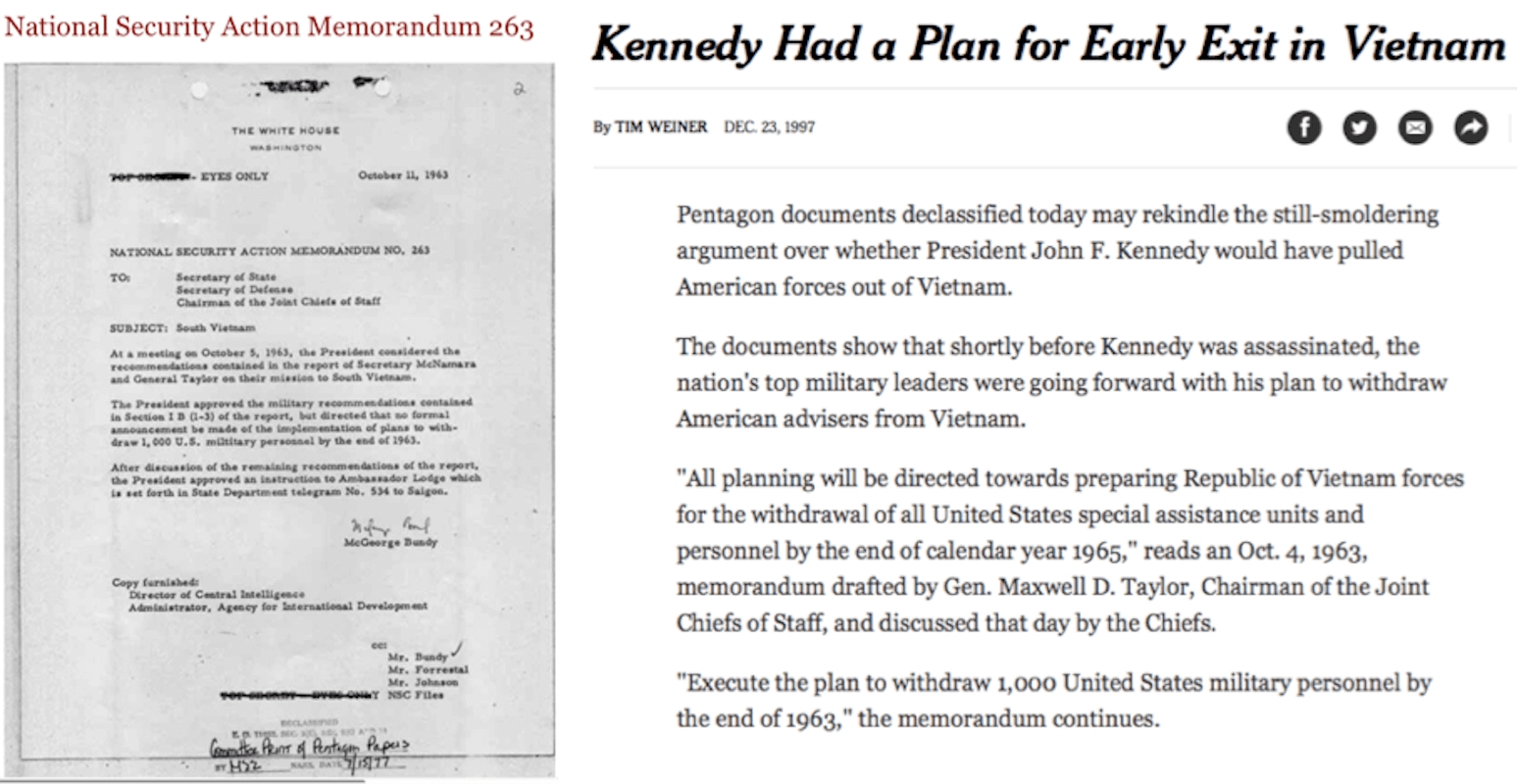
    Coinciding with all this is what is probably the most important document declassified by the ARRB. McNamara held regular meetings of the Saigon chiefs of agencies and the Pentagon in Hawaii. These were called Sec/Def meetings. For the one in May of 1963, he had requested that each agency and military chief bring with him their withdrawal schedule. After he had looked them over, he said they were too slow and would have to be speeded up. There was no qualification by McNamara that this withdrawal was hinging upon an American “victory” and there was no contingency plan mentioned to reinstate troops if the victory was not in sight. In fact, General Earle Wheeler wrote that he understood that any request for any overt action would be denied by the president. (Probe Magazine, Vol. 5, No. 3, pp. 19-21) These documents were so compelling that even The New York Times bannered a story with the headline: “Kennedy Had a Plan for Early Exit in Vietnam.” (ibid, p. 19) One would think that if it were good enough for that paragon of the MSM, the Grey Lady, it would be good enough for Burns and Novick. Needless to say, none of these documents are shown in The Vietnam War.

    Neither is NSAM 263 exhibited. This was the order drawn up in early October of 1963 that delineated the withdrawal plan and mandated that a thousand men be returned from Vietnam by the end of 1963. The story of how the order and the report it was attached to were created is revealing, and would have been informative to the viewer. By the autumn of 1963, JFK now had everything in place to activate his withdrawal plan. But he wanted to send his two highest military advisors to Saigon, that is, McNamara and Chairman of the Joint Chiefs Maxwell Taylor. He trusted McNamara, but not Taylor. Therefore, while those two were in Vietnam, Pentagon higher ups General Victor Krulak and Colonel Fletcher Prouty were invited to the White House. Bobby Kennedy met the duo. He instructed them, upon orders of the president, that they would actually edit and compose the Taylor/McNamara report at his direction. (John Newman, JFK and Vietnam, p. 401) Once that was done, it was shipped out to Hawaii and given to Taylor and McNamara in bound form. Kennedy was not allowing for any alterations.

    That report became the basis for NSAM 263. Presidentially designed, the report was used by him to ram 263 through his foreign policy advisors—some of whom were reluctant to sign on to it. But, reluctant or not, they ultimately did. McNamara was then sent out to announce the withdrawal plan to the press. As he was walking to meet the reporters, Kennedy instructed him with the following: “And tell them that means all of the helicopter pilots too.” (ibid, pp. 404-07)

    One would think that if a filmmaker were trying to assemble the latest scholarship on Vietnam for an American audience—if one were really trying to enlighten them with the best and newest information—then at least some of this would be included in the presentation. Or at least he or she would communicate some of the (at least) nine sources that Kennedy or McNamara confided in about the withdrawal plan. Or perhaps play the October 2, 1963 taped conference where McNamara actually says that they have to find a way to get out of Vietnam. (Blight, p. 100)

    I shouldn’t have to replay this refrain by now: None of this information is in the film. But as Burns pronounced on Marc Maron’s radio podcast of September 11th : History is malleable. Sort of like bubble gum, right Ken?

    What do Burns and Novick tender us instead? They give us Neil Sheehan and Jean Paul Vann. Which means they would have given us David Halberstam if he were alive. (See my two-part review, “David Halberstam, The Best and the Brightest) When I saw this, I realized just how much The Vietnam War wanted to be part of the MSM, and just how far PBS had fallen. For Halberstam’s The Best and the Brightest—which Warren Hinckle once called “one of the greatest bullshit books ever written”—makes McNamara out to be the chief engineer of the war. When, in fact, from April of 1962 to November of 1963, he was implementing Kennedy’s withdrawal plan. McNamara had even told his deputy, Roswell Gilpatric, that Kennedy had assigned him the task of winding down the war. (Blight, p. 371)

    Jean Paul Vann was one of the military advisors stationed in Vietnam under Kennedy. By all accounts he was committed to the cause of the American created nation-state of South Vietnam. Halberstam and Sheehan were young reporters at the time. Halberstam had been sent to Vietnam after being assigned to the Congo. Which is an important point. As noted above, one of Kennedy’s first reversals of Dulles/Eisenhower Cold War policy was in the Congo. In fact, that was the first place where JFK directed specific alterations to his predecessor’s policy. These would favor leftist leader Patrice Lumumba and the cause of emerging African nationalism. In that instance Kennedy was contravening a (British aided) Belgian attempt at recolonization. (Mahoney, pp. 65-69)

    Valuable research by Paul Rigby has shown that, prior to being assigned to Vietnam, Halberstam had done what he could to condescend to Kennedy’s efforts in Congo. In the pages of Times Talk—Halberstam’s employer, the NY Times in-house journal—the reporter conveyed some of those ideas. His stories, such as “It’s Chaos for a Correspondent in the Congo” and “Congo Boondocks: Land of Cannibals and Diamonds,” communicated the Establishment line that Congo could not handle independence because it was simply a land of African primitives. (William Prochnau, Once Upon a Distant War, p. 509; see also Halberstam’s The Making of a Quagmire, pp. 3-24) Halberstam seemed to be missing the overall gestalt of the struggle. He would later write of that colossal, epic conflict—which killed both Lumumba and Dag Hammarskjold—that there was less there than met the eye. (Halberstam, p. 17)

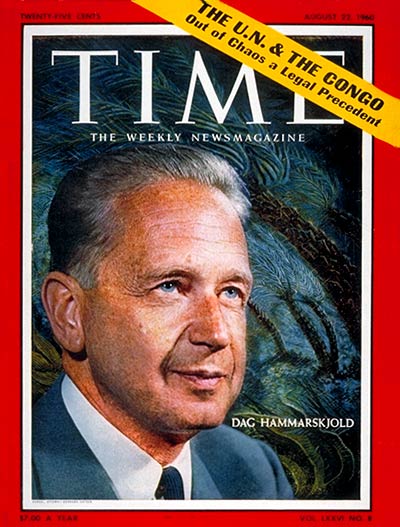
    Halberstam’s outlook and attitude failed to fully grasp Kennedy’s concepts in Congo, where JFK decided to do all he could to enforce UN Secretary General Hammarskjold’s policies for Congolese independence against America’s European allies England and Belgium. Kennedy continued that policy alone after Hammarskjold was killed. (“Hammarskjold and Kennedy vs. The Power Elite”) It is clear today—as it was then—that both Lumumba and Hammarskjold were murdered by colonial powers trying to retake the mineral wealth of Congo. (“Plane crash that killed UN boss may have been caused by aircraft attack”) Yet, in 1965, Halberstam could write that the Congolese cared less for their country than white people did. (ibid, p. 18) Unlike Halberstam, Jonathan Kwitny later fully comprehended what had happened. As Kwitny wrote, Patrice Lumumba became a hero in Africa “not because he promoted socialism, which he didn’t, but because he resisted foreign intervention. He stood up to outsiders, if only by getting himself killed.” (Endless Enemies, p. 72) As the picture below illustrates, Kennedy certainly understood Lumumba’s cause and his martyrdom:

    jfklumumba
    Kennedy receiving word of Lumumba’s death
    (photo: Jacques Lowe)

    On the larger, more epic level, Kwitny also had a much richer understanding of what was at stake in Congo than Halberstam. After surveying what happened, he memorably wrote about the legacy of Lumumba and what it meant in the larger movement of African nations to break out of the servitude of colonialism:

    The democratic experiment had no example in Africa, and badly needed one. So perhaps the sorriest … blight on the record of this new era is that the precedent for it all, the very first coup in postcolonial African history, the very first political assassination, and the very first junking of a legally constituted democratic system, all took place in a major country and were all instigated by the United States of America. It’s a sad situation when people are left to learn their ‘democracy’ from the Union of Soviet Socialist Republics. (ibid, p. 75)

    When Halberstam got to Vietnam—actually on his second day there—he lunched with the CIA’s station chief in Saigon. (Prochnau, p. 133) As the weeks went by, many of his CIA contacts from Congo migrated there. As author William Prochnau wrote, “By now his CIA contacts from the Congo had begun to flock to the hot new action in Southeast Asia like bees to honey; Vietnam was a spook’s dream and the Agency forever had a better fix on Vietnamese reality than the American military.” (ibid, p. 169)

    Halberstam admitted this in his 1965 book, The Making of a Quagmire, where he wrote, “But many CIA agents in Saigon were my friends, and I considered them among the ablest Americans I had seen overseas or at home.” (p. 222) In that book, Halberstam attempts an all-out defense of the CIA’s role in both Vietnam and the developing world. And he adds that inherent suspicion of the Agency is “the outgrowth of its bogeyman image among liberals …”. (ibid) This is especially puzzling today since the Church Committee revealed that Allen Dulles and the CIA had arranged numerous plots to kill Lumumba in the Congo, where the writer had just been stationed for many months. Later on, Halberstam attempted to distance himself from these admissions. He told Prochnau that UPI reporter Neil Sheehan had better CIA sources than he did, but he had better military sources. (Prochnau, p. 277)

    Both Halberstam and Sheehan were enamored with Vann, even though they understood he was an “essentially conservative, at times [an] almost reactionary man.” (Halberstam, p. 164) In their film, Burns and Novick have Sheehan tell us that, upon his own arrival in Saigon in 1962, he believed in American ideals and the alleged US mission in South Vietnam. He also believed in the dangers of the “international communist conspiracy”. Sheehan then adds that he was there to report the truth in order to help win the war for the betterment of the United States and the world. He describes going along on ARVN helicopter missions as being part of a crusade: he was thrilled by the experience.

    These attitudes made Sheehan and Halberstam easy targets for Vann. And negatively complementing that, it guaranteed that they would completely miss what Kennedy was doing. Colonel Vann was a veteran of Korea and, by 1963, had served in the military for twenty years. With Sheehan’s help, Burns and Novick spend several minutes outlining the January 1963 Battle of Ap Bac, an important conflict that Vann helped plan and supervise. Although the Viet Cong were outnumbered by a large margin, even though the ARVN had helicopter support and used armored personnel carriers, this battle turned out to be, by any accounting, a losing proposition for Vann. Saigon lost 80 dead, more than one hundred wounded, and five helicopters destroyed. The Viet Cong lost 18 dead and 39 wounded. Vann was deeply angered and confided the true facts of the defeat to his students Sheehan and Halberstam, who both wrote about the failure of the battle.

    The film does not reveal a key reason for that failure, one which Vann himself had discovered. Ngo Dinh Diem had issued orders to his field commanders not to initiate large offensive operations that would provoke serious casualties. Vann’s intelligence officer, Jim Drummond, concluded that the ARVN had not really checked the growth of the Viet Cong or the area under their control. (John Newman, JFK and Vietnam, p. 299) In other words, contrary to what the commander in Vietnam, General Harkins, was saying, America was not winning the war. And Ap Bac was living proof of that.

    Vann was shipped out of Vietnam in 1963 and served in the Pentagon as a procurement officer. He began to file formal reports complaining about how the war was being fought. These reports appealed to General Edward Lansdale because they clearly projected the fact that unless American ground troops were committed to Vietnam, Saigon would fall. (ibid, p. 319) As we have seen, this is the message Kennedy had listened to in November of 1961—and had rejected. Kennedy was aware of what Vann was doing. Both he and McNamara opposed the work of his acolyte Halberstam; Kennedy even asked the publisher of the Times to rotate him out of Saigon. (David Kaiser, American Tragedy, p. 261; Halberstam, p. 268)

    But Edward Lansdale had been the first to advise Kennedy to insert combat troops into Vietnam. (Newman, p. 20) Sure enough, after Kennedy’s death, when Lansdale returned to the White House, he recommended sending Vann back to Vietnam. Vann did return in 1965, when Lyndon Johnson overturned Kennedy’s policy and committed tens of thousands of American combat troops to Saigon. (Kaiser, p. 384)

    The reason that Sheehan and Halberstam admired Vann was simple: like him, they were Hawks. And like him—and opposed to Kennedy—they wanted more American involvement, not less. This is easily discernible by reading Halberstam’s 1965 book The Making of a Quagmire. That volume is perhaps the single most complete and coruscating condemnation of America’s Vietnam policy published to that point. It attacks every element of the American mission in that country and also the policies and personages of the Diem regime. (See Chapters 3-5) It then goes on to expose the ineptness of the ARVN (Chapters 5-7), in particular how bad Colonel Hunyh Van Cao was. The latter actually gets his own chapter: 10. Why so hard on Cao? Because Vann was the advisor attached to him, and—as with Sheehan—Vann was Halberstam’s hero in 1965. Why? Because he knew how to win the war. (See Chapter 11) So for Halberstam, when Vann departed, things got worse. (see Chapter 12).

    If Halberstam could not make it more clear, he does near the end of the book. With Sheehan mentioned throughout, he proclaims: “Bombers and helicopters and napalm are a help but they are not enough.” (p. 321) He then concludes with the following: “The lesson to be learned from Vietnam is that we must get in earlier, be shrewder, and force the other side to practice self-deception.” (p. 322)

    Of course, when the wishes of this troika—Sheehan, Vann and Halberstam—were fulfilled, we saw what happened. Direct American involvement ended up being an epic debacle. As many as 3-4 million people were slaughtered amid almost unimaginable horror. All in pursuit of a false goal that was not possible to attain. In other words, Kennedy was right and Vann, Sheehan and Halberstam were wrong. But neither Halberstam nor Sheehan could ever admit that. It is especially startling that Halberstam never saw the parallels of what happened in both Congo and Vietnam after Kennedy was killed: In Congo, the Agency and LBJ switched sides and joined the imperial interests; in Vietnam, the Pentagon and Johnson now broke Kennedy’s strictures and eventually imported 540,000 combat troops, making it an American imperial war. Truly puzzling that he would miss all of this.

    Sheehan and Halberstam got their wish. And even after it was clear that direct American involvement would not work, it took them years to understand it. And further, that the American army was self-destructing in the jungle, as Kennedy had predicted it would back in 1961. By 1971, even the army understood this. Colonel Robert Heinl wrote a long essay on its collapse at that time, and traced it from at least 1969. (Col. Robert D. Heinl, Jr., “The Collapse of the Armed Forces”)

    But author and activist Mark Lane understood it even earlier. In 1970 he published a book of personal interviews with returning veterans. The book was called Conversations with Americans. It was a shocking exposé of the individual and group war crimes that American solders had committed in Vietnam. Since there was a danger that his interview subjects would be prosecuted, he gave them the option of using fictitious names. He marked these with an asterisk in the text. He then added that the real names and full transcripts had been given over to an attorney who had worked for the Justice Department. (Lane, p. 17)

    When the book was published, The New York Times trotted out Sheehan to review it. (NY Times Book Review, 12/27/70) Sheehan wrote that he had contacted the Pentagon and some of the people named in the book did not serve in the military, or were not in the places where they said they were at the time. Which implied that what Lane was writing was fictitious. After, when Lane called the New York Times to talk to Sheehan, Sheehan would not accept his calls. The Times then sent Sheehan out on tour to promote his column. Which, of course, was a promotion of the collapsing war effort. Apparently, as a believer in the international communist conspiracy, Sheehan never imagined that there was a systematic, institutionalized cover-up of these crimes after the 1968 My Lai Massacre. But there was such a cover-up, and author Nick Turse discovered it when he found the (incomplete) records. (Kill Anything that Moves, pp. 15-21) When Lane asked Sheehan about My Lai during a radio interview, the New York Times reporter replied that it was just a rumor. (Mark Lane, Citizen Lane, pp. 220-21)

    Under pressure from the Times and Sheehan, Lane’s book was withdrawn from circulation.

    This is the man Burns and Novick use as the main talking head in their segment on the Kennedy years. With their defense of the Dulles brothers as “decent people” in Part One, the disappearance of Kennedy’s withdrawal plan and the championing of Vann and Sheehan in Part Two, so far the net value of this documentary is something less than zero.


    Addendum

    Although some critics of the film JFK have stated that there was no public announcement of NSAM 263, and Kennedy was keeping it quiet, as the reader can see in the following two Newsweek articles, that is false.  It was a public policy, and Kennedy had sent Defense Secretary Robert McNamara to brief the press on it after he had adopted it in October, 1963. (John Newman, JFK and Vietnam, p. 407)

    Newsweek, October 14, 1963

    (Click here if your browser is having trouble loading the above.)

    Newsweek, December 2, 1963

    (Click here if your browser is having trouble loading the above.)


    Part 1

    Part 3

    Part 4

  • Ken Burns & Lynn Novick, The Vietnam War: Part One

    Ken Burns & Lynn Novick, The Vietnam War: Part One


    After a huge publicity build-up the PBS ten-part series The Vietnam War is upon us. Like previous efforts—The War, Prohibition, Baseball—it was written by Geoffrey Ward and produced and directed by Ken Burns and Lynn Novick. I predict that like those other documentaries, it will win many Emmy Awards. But not because of any intrinsic qualitative value. But because Burns has become a cultural darling. He, Novick and Ward understand how to attain funding and how to get approval through media gatekeepers. Which is not the same as writing or filming honest, valuable history. As we will see, whatever historical value this much-ballyhooed production has is quite dubious.

    It begins with the 1858 attack on DaNang as the French begin to take over all of Indochina for colonial purposes. After France fell to Germany in World War II, the Japanese occupied Vietnam. Before he passed away President Franklin Roosevelt had made a statement that after the war, former colonies should be allowed freedom to choose their form of government in the future. The film mentions Roosevelt’s dictum but says President Truman turned this around due to the Russians exploding atomic bombs, China being taken over by Mao and the eruption of the Korean War. This sounds a lot like it was cribbed from David Halberstam’s bad book, The Best and The Brightest. And like much of that bloated mediocrity, it is not really accurate. And since one of the main talking heads in The Vietnam War is Leslie Gelb, the editor of the Pentagon Papers, Gelb could have corrected this.

    After the British let the French back into Vietnam in 1946, there were still those in the State Department who followed the on-and-off vacillations of France’s policy toward Bao Dai. Bao Dai had been the titular leader of Vietnam since 1926. The French gave him little leeway to accomplish anything of significance. The Japanese allowed him to stay as a figurehead leader during World War II. Some in the State Department told the French to alter the successive “agreements” they contracted with Bao Dai into an effective nationalist alternative to revolutionary leader Ho Chi Minh and his followers the Viet Minh. This proved unsuccessful. And the US sensed that French unwillingness to concede political power to the Vietnamese “heightened the possibility of the Franco-Viet Minh conflict being transformed into a struggle with Soviet imperialism.” (Pentagon Papers, Volume I, p. A-5)

    Therefore, American diplomats were told to “apply such persuasion and/or pressure as is best calculated to produce desired result of France’s unequivocally and promptly approving the principle of Viet independence.” And Paris was put on notice that the US “was willing to extend financial aid to a Vietnamese government, not a French puppet, but could not give consideration of altering its present policy in this regard unless real progress is made in reaching non-communist solution in Indochina based on cooperation of true nationalists of that country.” (Ibid)

    This same study found that there was no strong evidence of Soviet influence with Ho Chi Minh in 1948, even though the French colonialist war had been going on for two years at that time. (Volume 1, p. A-6)

    In early 1950, the French “took the first concrete steps toward transferring public administration to Bao Dai’s State of Vietnam.” This fateful move enraged Ho Chi Minh who denied the legitimacy of Bao Dai as anything more than a puppet of Paris. At this point Ho’s Democratic Republic of Vietnam (DRV) was formally recognized by China and the USSR (ibid, p. A-7) When this occurred, Secretary of State Dean Acheson now reversed the policy of neutrality that had been announced in 1948. On February 1, 1950 he made the following public statement: “The recognition by the Kremlin of Ho Chi Minh’s communist movement in Indochina comes as a surprise. The Soviet acknowledgement of this movement should remove any illusion as to the ”nationalist” nature of Ho Chi Minh’s aims and reveals Ho in his true colors as the mortal enemy of native independence in Indochina.” (ibid, p. A-7)

    Acheson then tried to disguise the aim of France bestowing administrative powers on Bao Dai by saying this would actually lead “toward stable governments representing the true nationalist sentiments of more than 20 million peoples of Indochina.” (ibid) Apparently keeping tongue in cheek, he went further and said this move was backed by the countries of the world “whose policies support the development of genuine national independence in former colonial areas … .”

    On the day France recognized Bao Dai, President Truman also recognized him as the leader of Vietnam. A few weeks later, France began to request financial aid for their mandarin. On May 8, 1950, Acheson acceded to that request with these words:

    The United States Government, convinced that neither national independence nor democratic evolution exist in any area dominated by Soviet imperialism, considers the situation to be such as to warrant its according economic aid and military equipment to the Associated States of Indochina and to France in order to assist them in restoring stability and permitting these states to pursue their peaceful and democratic development.

    As the Pentagon Papers notes, “The US thereafter was deeply involved in the developing war.” (ibid, p. A-8) Later that year, the United Sates stationed a Military Assistance Advisory Group in Saigon to help the French.

    I would have gladly forfeited all the incessant Burns-Novick use of colored maps with red endangering the Far East (I counted this six times just in Part One); all of narrator Peter Coyote’s—who I used to think was a pretty decent guy—intoning the David Halberstamish warnings about Russia detonating an atomic bomb, or China going communist; I would have exchanged all of those warmed-over 1970’s clichés for just three minutes of the above passages from the Pentagon Papers. Since this was the real reason America got involved in Vietnam: our failure to stand up to the French desire to recolonize Indochina. In other words, Secretary of State Acheson valued the alliance with France more than he did Roosevelt’s pledge of colonial independence. And his failure to admit Bao Dai was a French puppet is what pushed Ho Chi Minh closer to Moscow.

    Two questions so far: how can you elucidate anything as fundamental and documented as this if:

    1. You never mention the name of Dean Acheson, and
    2. You never mention the name of Bao Dai?

    Incredible as that sounds, it is true. And it was at this (rather early) point that I began to question the film-makers’ honesty. It is fine and dandy to let people directly engaged in the conflict, that is, soldiers and civilians, have their say. It gives the series grounding in the day-to-day ugliness and drama of that prolonged horrific struggle. But do Tom Vallely, Duoun Von Mai and John Musgrave make up in importance for the lack of Acheson and Bao Dai? Anyone who saw the film Platoon—as millions did—knows how scary night patrol must have been in Vietnam. But one function of the historian is to explain how John Musgrave got into that precarious position. The declassified record shows it was Acheson’s decision that got America “deeply involved in the developing war.” (My citations are from the completely declassified Pentagon Papers, not the Daniel Ellsberg or Mike Gravel versions which were incomplete.)

    But that is just the beginning of the crucial excisions made by Burns and Novick. How in heaven’s name can one tell the story of American involvement in Vietnam without mentioning the personages of Secretary of State John Foster Dulles, CIA Director Allen Dulles, or General Edward Lansdale? With a full 18 hours at one’s disposal, I would have thought such a thing would be impossible. Yet with Burns and Novick, the impossible becomes the possible. And by doing so, the film-makers all but erase the next major step of American involvement in Vietnam, and how Musgrave got stuck on that nighttime patrol in the jungle.

    John Foster Dulles was even more extreme than Dean Acheson. His anti-communism contained an almost religious-metaphysical amplification. But he was not just anti-communist. Like his brother Allen, he would not even tolerate neutrality, or non-alignment within the boundaries of the Cold War. (See Kennedy, Johnson, and the Nonaligned World, by Robert Rakove, pp. 5-8) Therefore, the aid to France in its imperial war was greatly increased once Eisenhower became president and Foster Dulles his Secretary of State. Today, it is common knowledge that by 1954, America was footing close to 80% of the cost of the war. In the last year of the war, America had supplied France with over a billion dollars in supplies and weapons. By 1953 this meant 12 shiploads per month, which had accumulated at that point to 777 armored fighting vehicles, 13,000 transport vehicles, and 253 naval vessels (See John Prados, Operation Vulture, Chapter 1 of the e book format.)

    Burns and Novick briefly discuss the 1954 battle at Dien Bien Phu, which ended the French attempt to retake their Indochina empire. Dien Bien Phu was a scheme created by General Henri Navarre to lure General Giap, Ho Chi Minh’s military commander, into the northwest corner of the country. The idea was to engage Giap in an open battle and crush his forces via artillery and aerial bombardment. That strategy backfired. And about a month into the 55-day siege, it became apparent that France had gambled and lost.

    But the Dulles brothers were not going to accept the fact that they had bet on the wrong horse. They now began to arrange one of the most frightening and outrageous episodes in the entire 30-year history of the war. It was called Operation Vulture. As John Prados, Fletcher Prouty and others have noted, this was the assemblage of a giant air armada. It was made up of over 200 planes. It consisted of fighters, bombers and three special Convairs to carry three atomic bombs to bail out the French. As Prados describes in his book Operation Vulture: America’s Dien Bien Phu, this was a Dulles brothers project, done with the knowledge and connivance of Vice President Richard Nixon. Nixon had previously convinced Eisenhower to allow the French to use American support planes, which were flown by CIA pilots. And some of these planes and pilots flew into Dien Bien Phu in March of 1954. They were disguised with French insignias. (Prados, Chapter 3)

    Eisenhower would only approve Vulture under certain restrictions. Two of them were congressional consultation, and also that our main ally England would join the effort. Nixon lobbied Congress, while Foster Dulles had his ambassador to England approach foreign minister Anthony Eden for approval. Dulles then went to London himself. Eden refused to go along and (correctly) labeled the effort a lost cause. (Prados, Chapters 6 and 8)

    Nixon and Dulles did not agree. And Dulles and Chairman of the Joint Chiefs Arthur Radford did not give up. They had meetings with congressional leaders like Senators Lyndon Johnson and William Knowland, and encouraged the Pentagon brass to support Vulture. (ibid, Chapter 6. Although David Halberstam, in his book The Best and the Brightest, wrote that LBJ did not support direct American intervention in 1954, Prados dug up written evidence that he actually had.)

    This lobbying effort included a speech in April of 1954, where Nixon proposed the insertion of American combat troops to save Dien Bien Phu. Which is perhaps the first public statement of that kind by a high ranking American politician. (Prados, Chapter 9) Foster Dulles made no attempt to reprimand Nixon for that statement. In fact, the two men were sharing working lunches on the attempt to save France. Foster Dulles now began to encourage Eisenhower to act unilaterally. At the same time Radford had sent a bombing specialist to fly over Dien Bien Phu to inspect the proper paths and altitudes for Vulture. (Ibid, Chapter 10)

    When Eisenhower would not act alone, Foster Dulles played his last card. He offered the French foreign minister the use of two atomic bombs to lift the siege. Georges Bidault said his reply did not require a lot of thought. He pointed out to Dulles, “If those bombs are dropped near Dien Bien Phu, our side will suffer as much as the enemy.” (David Talbot, The Devil’s Chessboard, p. 245) What makes this so stunning is that Dulles was acting without presidential approval in making that proposal.

    In watching the opening episode of this series, which deals with the French defeat in Vietnam, I did not detect one mention of Operation Vulture.

    After pondering that historical black hole about the Dulles brothers, I began to think back to one of the opening statements made by poor Peter Coyote. He says that the Vietnam War “was begun in good faith by decent people out of fateful misunderstandings.” Decent people? Misunderstandings? Bidault certainly did not misunderstand the effect of thermonuclear war over Dien Bien Phu. And in this day and age, with all we know about them, how can anyone call the Dulles brothers “decent people”? One wonders if that common knowledge today is the reason that their names are left out of this installment.

    From the fall of Dien Bien Phu, the episode now shifts to the peace conference at Geneva, Switzerland. As everyone who has studied that conference knows, it was essentially stage-managed by the United States, with Foster Dulles as the ringmaster. Although Ho Chi Minh and Giap had soundly defeated the French, China and Russia understood that the Dulles brothers’ unending support for the French colonial cause signaled ominous warnings for the future. Namely, as Nixon had alluded to, direct American intervention. Their allies therefore encouraged Ho and Giap to take a smaller cut of the pie than they had earned. Foster Dulles and Eisenhower had two immediate goals. The first involved the immediate future of Vietnam. They wanted a partitioning of the country between north and south at the 17th parallel with a Demilitarized Zone there. At the end of a two-year period, national elections would be held and the country would be unified under independent, democratically elected national leadership. Since the Dulles brothers were lawyers, they pulled a neat legal trick over this agreement. The United States did not actually sign the agreement. But Foster Dulles had his representative read a statement saying that America would honor the agreement. (See Vietnam Documents, edited by George Katiaficas, pp. 25, 42, 78) The other aim the administration had was to set up an anti-communist alliance called the Southeast Asia Treaty Organization. Which, of course, made the specter of American intervention more palpable.

    Within weeks of the conference, Allen Dulles had given veteran black operator Edward Lansdale the assignment of creating a country called South Vietnam—which had never existed before—and propping up a new leader there named Ngo Dinh Diem. The Agency gave Lansdale a blank check, and the ambitious and imaginative CIA officer came through in spades. Knowing Diem was a Catholic, Lansdale created one of the largest psychological operations in the history of the CIA. As Ralph McGehee described in his book Deadly Deceits, Lansdale infiltrated teams into the north to disseminate propaganda about upcoming pogroms by the Chinese Communists against the North Vietnamese, and perhaps American atomic weapons used over Hanoi. As a result, in the 300 day grace period for north-south migration, about a million people fled the north, about half of them Catholics. The CIA allowed free transportation on US Navy ships and also air flights through their proprietary Civil Air Transport. Not only did this boost Diem’s constituency, it fooled many Americans into thinking that somehow Hanoi embodied evil and Saigon—the new capitol of the new country—was a democratic oasis.

    Lansdale then helped further this illusion. He helped Diem rig a plebiscite that placed him officially in power with a mind-boggling 98% of the vote. Diem’s opponent, Bao Dai, was not allowed to campaign. And as Seth Jacobs wrote in Cold War Mandarin, in several districts, the vote tally for Diem exceeded the number of registered voters. What made this even harder to swallow was that voter turnout was nowhere near 100 percent. (Jacobs, p. 95) Lansdale had told Diem 60% would be plenty, but Diem insisted on the 98 number. (The CIA: A Forgotten History, by William Blum, p. 139) Lansdale had done all his masters wished, and more. In fact, as John Pilger noted in his book Heroes, Lansdale later complained, “I cannot truly sympathize with Americans who help promote a fascistic state and then get angry when it doesn’t act like a democracy.”

    Although you can see his photograph twice, you will not hear Lansdale’s name mentioned in Part One. And by doing that, the CIA’s role in the rigged plebiscite and the forced migration is not revealed. Why this silence over the man who, in reality, created South Vietnam and Ngo Dinh Diem? Maybe because he wasn’t one of the “decent people”?

    The effect of Lansdale’s work was to first, to stop the promised 1956 elections from making Ho Chi Minh president of a united Vietnam, and second, to spell the end of any leftover French rule in the south. With the plebiscite, Bao Dai was now gone. In fact, Diem formally banned him from visiting the country. After all this skullduggery and treachery, Foster Dulles would make the following astonishing statement: “We have a clean base there now, without a taint of colonialism. Dien Bien Phu was a blessing in disguise.” In the judgment of history, could any statement have been more wrong?

    In May of 1956, Washington further violated the Geneva Agreements by sending in 350 military advisors. (ibid, Blum p. 139.) Burns and Novick try to place this violation on President Kennedy. But JFK just sent in more military advisors, they were not the first. And as far as violating the Geneva Accords, the Dulles brothers had broken that agreement to pieces already. But the importation of advisors was made necessary since the vote for Diem was so ersatz. He had no real broad-based constituency.

    Since Diem could not command the allegiance of the people, the resistance against him began in the countryside. To counteract this rebellion, the CIA created a training program for Saigon security forces at Michigan State University. It was these trainees who manned Diem’s brother Nhu’s police force. A law was passed in 1957 that every Vietnamese 15 years and older was required to register with the government and carry a proper ID. Anyone without a card was considered a part of the National Liberation Front, the political arm of Ho Chi Minh’s sympathizers in the south. The military arm would be called the Viet Cong. Thus, using Lansdale’s ingenuity and the CIA’s money, the Dulles brothers created a “fascistic” police state which ended up imprisoning, torturing and executing tens of thousands of people.

    But as Lansdale said, who can get angry when a fascistic state doesn’t act like a democracy?

    These are the “decent men” that Burns and Novick could not bring themselves to mention.


    Part 2

    Part 3

    Part 4

  • Jim DiEugenio at the VMI Seminar

    Jim DiEugenio at the VMI Seminar


    Alan Dale:

    He’s one of the most knowledgeable and tenacious researchers and writers on the political assassinations of the 1960s. He’s the author of 1992’s Destiny Betrayed, which details the New Orleans district attorney, Jim Garrison’s, investigation in the trial of Clay Shaw, which was greatly expanded for a revised edition issued in 2012. Also, Reclaiming Parkland, published in 2013, but reissued and expanded in 2016. He’s also the co-author and editor of The Assassinations: Probe magazine on JFK, MLK, RFK, and Malcolm X. He co-edited the acclaimed Probe Magazine from 1993 until 2000, and was a guest commentator on the anniversary issue of the film JFK, re-released by Warner Brothers in 2013. His website, kennedysandking.com, is one of the best and most reliable online resources for students and scholars of American political assassinations of the 60s. Please welcome Jim DiEugenio.

    Jim DiEugenio:

    First of all, I’d like to thank Lee Shepherd for doing this. These things are never easy to put together. And I’d like to be gracious about sharing the program with two great guys like Bill Davy and John Newman, who I’ve both known for about 25 years. I’ve worked with them for about that long also, and their books, in my opinion, would rank in any top 15 listing of the best of the JFK Library. Considering there’s 1,000 books in that library, that’s saying something.

    I want to introduce what I’m going to talk about tonight by stating that my last book, Reclaiming Parkland, largely about the state of the evidence, as it was in 2013 in the JFK case, is what we call in the trade, something called a micro-study. As one reviewer said, it was really a kind of an updating of Sylvia Meagher’s classic book, Accessories After the Fact, which I thought was a very kind complement indeed.

    After publishing that book, I came to the conclusion, after months on end of study of all the detailed evidence, like the bullet shells, CE399, the medical evidence, etc., that there really was no case against Oswald today, that Oswald was not the victim of a miscarriage of justice. The simple problem was that there was no justice at all. You had a rogue prosecution, led by the FBI, and the Warren Commission acted essentially as a kangaroo court. But once that evidence presented was minutely examined, the case against Oswald simply did not exist. They were allowed to get away with this because, of course, Oswald had no legal defense and there were no legal restrictions to protect his rights. After going through all this, I have no problem today saying that, to say Oswald was guilty is the legal and moral equivalent of being a Holocaust denier.

    So after I disposed of that, I began to concentrate more on why was Kennedy assassinated. And I began to look more and more at Kennedy’s foreign policy. And the more I looked, the more I began to search outside of the JFK Library of books, simply because if you stay aligned with that particular lexicon, you’re probably going get like 90% Cuba/Vietnam, as if this was all Kennedy did for three years. And I found out that really was not the case, not by a long shot.

    And I also discovered something else. As much as I liked Jim Douglass’ book, JFK and the Unspeakable—and I would recommend that book to anybody who hasn’t read it—I disagree with the sales slogan that was used to sell the book. This was something like “A Cold Warrior Turns”, meaning that after 1962 and the missile crisis, that JFK stopped being a cold warrior and tried to work with Khrushchev and Castro for detente.

    The way I looked at this, and the discoveries I was making, is that Kennedy’s foreign policy was pretty much set once he entered the White House. There’s three key events that we have to question in order to understand who Kennedy was, once he entered the White House. These are number 1) Why did Kennedy not send in the Navy to bail out the Bay of Pigs invasion? That would’ve been easy enough. Arleigh Burke, the admiral, was there trying to get him to do that the first night of the invasion.

    2.) Why, in the fall of 1961, did Kennedy not send combat troops into South Vietnam? And, by the way, I have to say, in reading Gordon Goldstein’s book, Lessons in Disaster, which is a biography of McGeorge Bundy, that culminating debate in November of 1961 was preceded by eight previous requests for JFK to send troops into Vietnam. So this is nine times in that one year that Kennedy was determined to turn down sending the military into Vietnam.

    And the third question is: Why did Kennedy not bomb the missile silos during the Cuban missile crisis in 1962? Again, almost everybody in the room was asking him to take some kind of military action. And by the end of the 13 days, even McNamara, who had proposed the blockade in the first place, was leaning in that direction. But Kennedy didn’t do it. He stuck with his back channel between RFK and the Russian ambassador in Washington.

    So my question is, all these books mention them, but nobody tries to explain why he did not do those things. And if Kennedy was really a Cold Warrior, he would have done all three of those things, or at least two out of the three. For instance, we know that LBJ wanted to send troops into Vietnam in 1961. In fact, we have him on tape in 1964, telling McNamara how frustrated he was, watching McNamara and Kennedy arrange this withdrawal plan. We know that Nixon would have sent in the Navy at the Bay of Pigs, because that’s what he told Kennedy to do. When Kennedy called him, either the second or third night of the crisis, he asked him “What should I do?” Nixon said “declare a beachhead and send in the Navy”, but he didn’t do that. He was willing to accept defeat in April of 1961, at the Bay of Pigs, and he was willing to withdraw, leading to an inevitable defeat, in Vietnam. So the question is: Why?

    And so, I began to study this phenomenon and I began to consult books outside the Kennedy assassination lexicon and I discovered that the key to understanding this is a man who’s name was in no book up until Jim Douglass’ book. His name’s not mentioned anywhere that I could find, and his name is Edmund Gullion. Gullion worked in the State Department when Kennedy was a congressman and that’s when they first met. Kennedy needed some advice on a speech, so he went over to the State Department and Gullion gave him a consultation. In 1951, Gullion, because he spoke fluent French, had been transferred to South Vietnam.

    In that same year, Kennedy was preparing to run against Henry Cabot Lodge for the senatorial seat from his home state of Massachusetts. So he flies into Saigon, because he wants to become more well versed in foreign policy, which is what senators spent a lot of their time on. He decides to ditch the French emissaries that had been sent to meet him at the airport, and he starts knocking on doors of people who have good reputations in the media, there were a couple back then, and in the State Department. One of the guys he meets with is Edmund Gullion.

    So they have dinner at a roof top restaurant in Saigon, and Kennedy asks him flat out: We’re allied with the French in this thing, we’re actually bankrolling this effort, are the French going to win? Gullion says something like: There is no way in Hades that France is going win this war. Kennedy, of course, asks him: Well, how come? And he says: It’s rather simple. Ho Chi Minh has fired up the general population, to a point that you’ve got tens of thousands of these young Viet Minh who’d rather die than go back under the yoke of colonialism. France will never win a long, drawn out, prolonged, bloody war of attrition, because the home front simply will not accept it. And that’s how it’s going to end.

    To say that conversation had a rather deep impact on JFK is a large understatement. When he got back to Massachusetts, he began writing letters, making speeches and doing radio addresses; criticizing both the Republican foreign policy establishment and the Democratic foreign policy establishment and, most of all, the State Department for not understanding the real plight of colonized people in the Third World. In his new way of thinking, this was not a battle between Communism and Capitalism, but it was one between independence and colonialism. And colonialism, according to Kennedy, was going to lose.

    Allen & John Foster Dulles

    This manifests itself, on a national level, in 1954 during Operation Vulture. Vulture was John Foster Dulles—the Secretary of State at that time—it was his plan to bail out the doomed French effort in Vietnam. This was a huge air armada of about 210 planes, 3 of them were carrying atomic bombs, and this was going to bail out the French effort at the battle of Dien Bien Phu. Well, Nixon, who is the Vice President at that time, is the liaison between Congress and the White House on this whole issue. Kennedy gets wind of this, of what’s going to happen, and he begins to rail against Dulles and Eisenhower. He wants them to come down here and explain to us how nuclear weapons are going win a guerrilla war. And he then added, no amount of weaponry could defeat an enemy which was everywhere and nowhere, and had the support of the people.

    And by the way, that’s a very important passage there, because one of the things historians are supposed to do is to find origins and patterns in a man’s foreign policy. And that phrase that he said, about being everywhere and nowhere and having the people’s support, that’s the argument he’s going to use in 1961; when everybody wanted to commit troops to Vietnam. Nobody had an answer to it then. I call that Kennedy’s first defining moment; his first face off against the Dulles brothers, Nixon and Eisenhower.

    Three years later, there’s another one, except it’s much more public. The second one is in 1957, when Kennedy takes the floor of the Senate and he begins to attack, very specifically, Dulles, Nixon and Eisenhower again. This time it’s over their continued alliance with French colonialism, except this time it’s off the north coast of Africa, in Algeria, where France is now involved in another civil war to maintain the French colony of Algeria. Five hundred thousand troops devolved into a war of horrible atrocities. Kennedy attacked the White House again for allying itself with the hopeless struggle of a European country to maintain an overseas empire in the Third World. And he predicted that this would turn out just like what happened three years previous in Vietnam, with another French defeat. What we needed to do, he said, was to convince Paris to negotiate, in order not to destroy the country of France in a futile war against brother and sister over this horrible dispute in Algeria. But, as important, if not more important, we had to begin to free the colonized nations of Africa.

    That was his second defining moment. And what was surprising about this speech, and by the way, I would say that speech is very much worth reading, even today. It’s an incredible speech for a young man to be making on the floor of the Senate, considering the makeup of the Senate and the White House at that time.

    This time, Kennedy was attacked, not just by Nixon and John Foster Dulles. But by people in his own party, like Dean Acheson and Adlai Stevenson. It was a very controversial speech. It made headlines in a lot of newspapers. There were 163 editorial comments. Over two thirds of them were negative. Kennedy really thought that he made a mistake and he called up his father and asked him what he thought. His father said he hadn’t made a mistake: You watch what’s going to happen. This situation in Algeria is going to get even worse. In two years, everybody will realize that you were right. And by the way, that’s exactly what happened. Eric Sevareid made an editorial comment on CBS TV in 1959, saying: Well, John Kennedy looks like a prophet these days, doesn’t he?

    Dag Hammarskjöld

    But that Algeria speech actually did something else. It made him a hero to the colonized people of Africa. He now became a kind of unofficial ambassador to visiting African dignitaries. And that appeal began to spread to other Third World areas. So Kennedy now became a great admirer of the Chairman of the UN, Dag Hammarskjöld, who wanted the United Nations to be a kind of international forum that would give voice to the powerless nations coming out of colonialism and provide a lectern to express themselves. They began to make a secret alliance over the areas of Indonesia and Africa.

    By 1960, Kennedy is very conscious that he’s on the edge with his foreign policy. So, on the eve of the 1960 convention, he told one of his advisors, Harris Wofford: We have to win this thing. Because if Johnson wins or Symington wins, its just going to be more of John Foster Dulles all over again. And, by the way, I have to say that, with what LBJ did once Kennedy took over, from ’64 to ’68, I think Kennedy was actually right about that.

    Kennedy addresses
    the U.N. General Assembly

    Once Kennedy is in office, he immediately begins to alter the Dulles brothers’ policies. For example, in the Congo, where he supported Hammarskjöld’s policy to stop the country from being partitioned or recolonized by Belgium. And he began to work with Hammarskjöld, reversing American policy in Indonesia. The Dulles brothers had tried to overthrow Sukarno the Nationalist leader of Indonesia in 1958 and 59. Kennedy decided that that was going to be reversed. That he was going to support Sukarno, both politically and economically.

    Kennedy & Sukarno

    Now what’s really remarkable about just those two instances, those alterations of the Dulles brothers’ foreign policy is this: That Kennedy continued those two policies after Hammarskjöld was murdered in the fall of 1961. And, by the way, I have no problem using the word “murdered”. Because all you have to do is read Susan Williams’ book, “Who Killed Dag Hammarskjöld?” You will see that that was not an accident, that airplane crash was not an accident. In other words, with Hammarskjöld dead, Kennedy was carrying this burden by himself. And, in fact, he had to go to New York to convince the United Nations, after Hammarskjöld’s death, not to give up their mission in Congo. He actually did that twice. And then he planned a State visit to Indonesia in the summer of 1964, which Sukarno was very much looking forward to.

    Now I can mention other places where this occurs, that is when Kennedy comes in, he reverses the Dulles/Eisenhower foreign policy. For example, he wanted a negotiated settlement in Laos. Very important and, again, very overlooked, is that in the Middle East, the Dulles brothers had isolated Nasser and were beginning to favor Saudi Arabia.

    Lee Shepherd:

    Nasser, the head of Egypt.

    Jim DiEugenio:

    Gamal Abdel Nasser

    Yes, Nasser was the president of Egypt. And Kennedy reversed that, also. He began to favor Nasser and isolating Saudi Arabia. Now the reason he did that was because he thought, because Nasser was a Socialist and a secularist, that he could begin to mold the foreign policy in the Middle East away from the fundamentalism and the monarchy of places like Saudi Arabia and Iran.

    And, by the way, he even mentioned that issue in 1957. Because there was a big Moslem population in Algeria. He refused to meet with David Rockefeller because he did not want to initiate a coup in Brazil, which is what Rockefeller wanted to meet him about, and he moved to isolate the military regime that had deposed the Dominican Republic’s President Juan Bosch.

    Now every one of those policies, without exception, began to change at a slow rate and then at a rapid rate, under the pressure of Johnson and the CIA, in a period of about 18 months after Kennedy is assassinated. In each case, the end result was a calamity for the people living in those areas. A very good example being the CIA sponsored coup in Indonesia that took place in 1965 and which killed well over 500,000 citizens; and led to the looting of the nation by Suharto and his corporate cronies. What Kennedy wanted to do there, he was actually arranging deals for Sukarno to nationalize the industries on a very good split, the majority of the profits going to Indonesia. And Sukarno was going to use that money to start doing things like building hospitals and an infrastructure and schools, etc. He wanted those benefits of those natural resources to go to the people.

    Now let me conclude with, what I think, is a very important aspect of this whole Dulles vs. Kennedy foreign policy dispute. As most people understand today, Kennedy was never going to commit the military into Vietnam. In fact, he was withdrawing the advisory force from that area at the time of his assassination. The Assassinations Records Review Board released some really important documents on this in 1997 and that, in addition to several books, including John’s book, JFK and Vietnam, for me sealed the deal on that issue.

    Truman reacts to the assassination

    Within a month of Kennedy’s assassination, I think on December 20th, 1963, former president Harry Truman published a column in the Washington Post, in which he assailed how the CIA had strayed so far from the mission he had envisioned for them when he was putting that agency together. To the point where he really kind of didn’t recognize what it had become. From his notes, it’s clear that Truman began writing that column eight days after Kennedy’s death.

    “Harry Truman Writes”

    In the spring of 1964, while he was sitting on the Warren Commission, Allen Dulles visited Truman at his home in Missouri. This was not a social visit. He was there for one reason. He wanted Truman to retract the column. That attempt by Dulles failed. Truman never did retract what he wrote and, in fact, about a year later, in Look magazine, he repeated those same thoughts.

    But a very curious exchange occurred as Dulles was leaving. As he got to the door to join his waiting escorts, he turned to Truman and said words to the effect: You know, Kennedy denied those stories about how the CIA was clashing with him in Vietnam. Which is a really startling thing to say. Because Dulles’ visit was supposed to be about Truman’s article. And Truman never mentioned Kennedy or Vietnam in the article.

    Further, the two newspaper pieces Dulles referred to are likely one by Arthur Krock and one by Richard Starnes, both published in October of 1963. They both discussed the CIA’s growing influence over foreign policy and they both conclude that, if there was ever an overthrow of the US government, unlike Seven Days in May, the novel that had been made into a film around that time, it would be sponsored by the Agency and not the Pentagon. Again, Truman never went that far in his article. This whole angle was imputed to him and initiated by Allen Dulles. I think it’s pretty clear, from that conversation, that Dulles made the visit because he thought Truman wrote the column because the former president believed the CIA had a role in killing Kennedy over the Vietnam issue.

    What makes this even more remarkable are these two aspects. Number one, at that time, in the spring of 1964, nobody had connected those dots: That is, the CIA, Kennedy, Vietnam and Kennedy’s assassination. No one. The first time it’s going be done is four years later by Jim Garrison.

    Number two, Truman had already said to the press in 1961 that Hammarskjöld had been murdered over his Congo policy. And Dulles was aware of that. In my opinion, he saw what had happened with Hammarskjöld, and he did not want Truman to get more explicit in the Kennedy case. So in the language of prosecutors, specifically the late Vincent Bugliosi, he would have said something like this—if he had been on our side: What Dulles was doing here was showing something called consciousness of guilt, while he was sitting on the Warren Commission. Which is one more reason that the commission is really a joke.

    After four years of study, 2013 to 2017, I’ve concluded that the cover up about Kennedy’s foreign policy, and how reformist it was, has been more deliberate, more strenuous, more systematic, than the cover up about the circumstances of his death. The reason being that it gives a clear and understandable motive for the Power Elite to hatch a plot against him. There were literally tens of billions of dollars on the table in the Third World, especially Indonesia. And that’s the kind of money that these people commit very serious crimes about.

    This is why, at the time of his death, people like Nasser in Egypt fell into a month long depression. And he ordered Kennedy’s funeral to be shown four times on national television. It’s why Sukarno openly wept and asked “Why did they kill Kennedy?” It’s why Kwame Nkrumah of Ghana, when the American Ambassador gave him a copy of the Warren report, he returned it to him. He pointed out the name of Allen Dulles on the title page and said one word: “Whitewash.” The people about to be victimized understood what had happened. Because of our lousy media in the United States, it’s taken the American public quite a bit longer to understand.

    Okay, thank you, I’ll conclude with that.

    Lee Shepherd:

    James, can I ask you one question.

    Jim DiEugenio:

    Sure.

    Lee Shepherd:

    You’re mentioning Dulles quite a bit.

    Jim DiEugenio:

    Right.

    Lee Shepherd:

    Who do you think is behind this whole thing?

    Jim DiEugenio:

    Well, I gave David Talbot’s book a very good review: The Devil’s Chessboard. And I think he makes a pretty good case, that Dulles, if I had to categorize it, I think Dulles was the outside guy and I think James Angleton was the inside guy.

    Lee Shepherd:

    So the assignment was given to Angleton?

    Jim DiEugenio:

    I think Angleton was the inside guy.

    Lee Shepherd:

    Okay.

    Jim DiEugenio:

    He was the guy working in the, what we would call, the infrastructure. And I think Dulles was the outside guy, arranging it with the people he knew had to back him.

    Lee Shepherd:

    But Dulles was fired.

    Jim DiEugenio:

    Dulles was what?

    Lee Shepherd:

    Dulles was fired by that stage, by John Kennedy.

    Jim DiEugenio:

    Yeah, he was fired. But if you read Talbot’s book, he was only fired symbolically. Because he kept on having meetings over at his townhouse in Georgetown. And he actually wrote about those meetings in his diary and anybody could read who he was meeting with, people like Angleton, people like Des FitzGerald, etc. And then on the day of the assassination, he ends up at the Farm,—

    Lee Shepherd:

    Yes.

    Jim DiEugenio:

    —which is the CIA headquarters.

    Lee Shepherd:

    Is that Camp Parry? Camp Parry, Virginia?

    Jim DiEugenio:

    Yes.

    Lee Shepherd:

    Secondary command post of the CIA?

    Jim DiEugenio:

    Right.

    Lee Shepherd:

    Okay, good, thank you.

    Jim DiEugenio:

    So he was figuratively separated from the CIA. But as Talbot says in his book, he was really more like leading a kind of like in-country junta against Kennedy.

    Lee Shepherd:

    Okay, James. Thank you so much.


    This transcript was edited for grammar and flow.

  • Nicholas Schou, Spooked: How the CIA Manipulates the Media and Hoodwinks Hollywood

    Nicholas Schou, Spooked: How the CIA Manipulates the Media and Hoodwinks Hollywood


    Sometime during production of the film All the President’s Men, the director Alan J. Pakula fired the screenwriter, William Goldman. This isn’t especially notable—writers are always the first people to get fired off any production—although this wasn’t just any screenwriter. In his book Adventures in the Screen Trade, Goldman writes that it seemed like everybody on the planet knew he’d been having issues with that script. He says he happened to meet Walter Cronkite during this period, and the only thing Cronkite said to him was “I hear you’re having script trouble.”

    In 1976, Goldman won the Oscar for writing All the President’s Men, despite having been fired off the picture.

    Other writers had done passes on the script, most notably Nora Ephron. Ephron was dating Carl Bernstein at the time, the reporter portrayed by Dustin Hoffman in the picture, who in turn was the partner to Bob Woodward, played by Robert Redford. Goldman later observed that Bernstein sure seemed to be “catnip to the ladies” in Ephron’s scenes.

    Did Goldman deserve the Oscar? He definitely built the structure to carry the story, which is not easy to do. All the President’s Men isaesthetically—a terrific movie, and it starts with the writing. Jason Robards got an Oscar for stealing every scene he’s in, but honestly the part is gift-wrapped for him. There is snappy dialogue, some terrific reversals, and a gripping story. It’s become a model for this sort of film—the recent Oscar-winning Spotlight showed its influence, for example.

    There’s only one problem. All the President’s Men is a lie. It’s the setting in stone of the public face of the Richard Nixon scandal, told with the help of Woodward and his ex-ONI buddies and Al Haig. It glorifies the myth of “Woodstein,” intrepid reporters taking down a criminal president. It also did for Bob Woodward what the JFK assassination did for Dan Rather—provide a platform to kick off a career serving the state through the media.

    Hollywood has had a complicated relationship with the government for a long time, partly for reasons of actual patriotism and partly because of money. (It’s always at least partly the money.) Right now on Netflix there is a wonderful documentary series Five Came Back, about how great directors like John Ford, Frank Capra, and John Huston, among others, helped make films supporting the U.S. against the Nazis. They took their job seriously in this regard. Joseph McBride details the background, for example, of the making of the film Mr. Smith Goes to Washington in his wonderful book Frank Capra: The Catastrophe of Success. Capra, a complex figure if ever there was one, felt conflicted by the thought he might have made a picture casting his adopted country in a negative light. “When a prominent man like the ambassador of England says this is going to hurt the war effort, that was serious. Would it do that? I wanted to do what was right.” (McBride, 423).

    However, it’s one thing to make pro-American films when the cause is just. When Indiana Jones says, “Nazis. I hate these guys,” we agree.

    Unfortunately, there are some Hollywood directors who are eager to cooperate with the U.S. in favor of more dubious causes, as with Kathryn Bigelow in The Hurt Locker and Zero Dark Thirty, or Michael Bay making the military look terribly exciting for young men in the Transformers series. Clint Eastwood took up the ridiculous cause of invading Grenada in Heartbreak Ridge and the Pentagon backed Top Gun: essentially a long commercial for fighter pilots. Ben Affleck celebrated the CIA in Argo and was rewarded for it by both the public and the Academy. Tom Hanks infamously backed Vincent Bugliosi—a project that united the typically fractious JFK research community.

    On the other side, films opposing the American military-intelligence-complex tend to face stiff opposition and little funding. Oliver Stone has been the exception rather than the rule in this arena, as the best political films tend to be either foreign or small-budget enterprises, such as Costa-Gavras’s Z. While controversy can help sell a picture, criticizing established structures of power isn’t the kind of controversy producers like. This even extends to actors. When Jean Seberg, the beautiful ingénue from Jean-Luc Godard’s famous film Breathless, began to donate money to leftist causes, the FBI opened a COINTELPRO operation against her. Among the things they did was falsely accusing her of fathering a boy with a Black Panther.


    II

    In the last few years, a slate of books about the unhealthy relationship between domestic intelligence agencies and media centers have emerged. Nicholas Schou’s Spooked is one of the newest, and it comes with heavy praise: a foreword by David Talbot, as well as endorsements from the likes of Oliver Stone and Peter Dale Scott. Schou’s own bona fides are formidable, having worked as an investigative journalist and written the Gary Webb biography Kill the Messenger, which was made into a film of the same title starring Jeremy Renner.

    The subtitle of the book is How the CIA Manipulates the Media and Hoodwinks Hollywood. Unfortunately, this subtitle is itself something of a hoodwink. A short book (less than 150 pages), the content really consists of a survey of some of the major news stories of the last half-century or so. The chapters deal with various aspects, for example, of WikiLeaks and its relation to the media, Julian Assange, Edward Snowden, the Iraqi war scandals, the Church committee, Seymour Hersh on the Osama bin Laden raid, Robert Parry and his work, and a short summation of the Gary Webb crack-cocaine CIA scandal. These are all worthy topics, and deserve longer treatments than they get here (and in fact did, since as noted Schou also wrote the Webb biography.)

    The short length of the book means that each topic is dealt with in a superficial manner. For example, he mentions that when CIA agent Valerie Plame was “outed,” it was by Richard Armitage (Schou, p. 67). However, he gives no further information on Armitage, who was Assistant Secretary of Defense for International Security Affairs under Ronald Reagan, and a key player in the Iran-Contra scandal. In addition to that, Armitage also met with General Mahmoud Ahmed, the leader of the Pakistani ISI, the week of 9/11. General Ahmed is important because he ordered a wire transfer of $100,000 to the alleged leader of the Saudi-Arabian hijackers, Mohammed Atta. There is a wealth of information lurking behind the stories that appear in Spooked, and while it’s understandable that he can’t get to everything, Schou misses some key aspects of the particular events he is trying to summarize. He also fails to cite much information in the way of demonstrating that CIA “manipulates the media” or “hoodwinks Hollywood.”

    First of all, the idea that the CIA “hoodwinks” or “manipulates” the media is a questionable premise to being with. In many cases, the CIA more or less is the media. We know because of Carl Bernstein’s famous article in Rolling Stone that the CIA quite often pays journalists directly to work for the agency. And Schou does mention this in his book, as well as citing examples like William Paley at CBS and other stories that are already pretty well known.

    Also, Hollywood isn’t hoodwinked. Like any other business, there are people who are willing to play ball and others who aren’t. For example, when it was announced that Antoine Fuqua was going to make a picture about heroin being smuggled into the United States in the caskets of American soldiers during the Vietnam War, I got excited. Fuqua tried to push the boundaries while he was hot off his film Training Day. Not hot enough, alas. Universal fired him, replacing him with Ridley Scott. Scott made American Gangster into a fairly standard cop and criminal picture, soft-pedaling the elements that might make the state nervous.

    This kind of thing happens all the time.

    So let’s get back to Schou. He should have a deep insight into at least one project in particular, right? Which would be Kill the Messenger. I remember when the film was announced, because of Peter Landesman, who had written and directed the disastrous JFK assassination film Parkland. That had the smell of cover-up all over it. Landesman, who had never helmed anything remotely the size of Parkland before, made a bad film that tanked at the box office.

    When Parkland was still in pre-production, I had been hired to work as a research and script consultant to a film called Dallas in Wonderland, directed by Ryan Page. Over the course of three years or more, we did location scouting, casting, and—while we were waiting to get Dallas off the ground—ended up making a documentary with Oliver Stone called King Kill 63. Anyway, I was in L.A. a lot during that time, and in a lot of meetings, and that Parkland script was everywhere. Everybody had seen it. And everybody said, “Hey, listen, don’t tell anybody, but I saw this script … ” It was well-known in the industry that the Parkland script was a pile of crap.

    At the time, the idea was that Dallas in Wonderland would be the anti-Parkland. And the script was good. It would have been a thriller in the tradition of 70’s thrillers like The Parallax View and, especially, Brian de Palma’s Blow Out (itself a quasi-remake of Antonioni’s Blowup, a film that alluded to the JFK assassination directly). Anyway, during this period I learned a lot about how films are made—in terms of the production aspect—and all the things that go into how decisions get made in Hollywood.

    Mostly, it’s accountants. You’d think that with a modestly budgeted picture (say $12-15 million) you could more or less cast who you want. You can’t. There were actors that I thought would be great to play the lead, for example, but we couldn’t do it because they had no juice in China. Or they’re considered TV actors (see the James Toback documentary Seduced and Abandoned for more on this). If we were going to get the picture made, we needed a male lead and that male lead needed to be a big star.

    But that’s another story. The point is, Parkland had NOTHING going for it. Not a thing. The director, Peter Landesman, was not only not a name director, he had never directed a film before. The script was bad—even Hollywood people who liked the message, thought it was bad. There’s really no foreign market. (JFK assassination pictures which mimic the Warren Commission don’t travel.) There were no big stars to build a campaign around; some fine actors, but no A-listers who can get a film made and then open it. But in spite of all that:

    The thing got made anyway.

    That’s what I would have loved to hear about from Schou. Why? Parkland disobeyed the natural laws of how Hollywood pictures get made. But it got made anyway. How did that happen?

    This is what Schou says about Landesman:

    Landesman, who worked as a foreign correspondent in Pakistan after 9/11 and wrote national security stories for the New York Times magazine, was equipped with a better bullshit detector than most filmmakers by the time he got to Hollywood. “I have had a number of dealings with the CIA, both as a journalist and a screenwriter,” he said. “I quickly learned that I could never, ever, take what any [CIA] officer says at face value. They are hardwired to deflect, even off the record.” (108)

    I felt like Jim Garrison (Kevin Costner) in JFK reading this part: Ask the question! Ask the question!

    What’s the question Schou needed to ask Landesman?

    If you learned you can’t trust anything the CIA tells you, why the hell did you make Parkland?

    That question doesn’t get asked.

    The punchline is that this director who laid an egg with Parkland wrote Kill the Messenger, and that ended up being a solid film. (see the review of the latter at Consortium News)

    Because Hollywood is weird. And complicated. And who knows what back-room deals got engineered—maybe it was “do this one for us, and we’ll let you do one for you.” There’s a story there somewhere. In the end, both films got buried. For Schou to write this book, on this topic, without even getting to the details of how his own book got made into a movie is inexplicable and inexcusable.

    The movie I worked on, Dallas in Wonderland, might never get made. The documentary I co-wrote and co-produced, King Kill 63, closed the Dallas International Film Festival at the Texas Theatre and played great. I answered audience questions afterward until they literally kicked us out of the theatre. The reason nobody can see it is that it’s long and complicated and I’ll write that book someday. Meanwhile, I cross my fingers that it gets released.

    One last anecdote.

    When Ryan and I arrived in Dallas for the DIFF showing in 2015, we had an email waiting for us from the Sixth Floor Museum. They were very disturbed about our movie being shown. We were using footage that belonged to them—by which they meant, essentially, all extant footage even vaguely involving the Kennedy assassination. They suggested we not show the film that night unless we were prepared to pay them, for example, for using the Zapruder film. These were not nominal fees, and this already was an expensive film—we had shot with a full film crew all over the country.

    We discussed our options, legal and otherwise. I talked to another documentary filmmaker friend who had recently gone through this with the Sixth Floor. At the end of the day, we decided to show it.

    The morning after our showing at the Texas Theatre, we got another email. The representative they sent from the Sixth Floor had liked the film, they said, and hoped we could work something out in the future. The person they’d sent had stayed for the Q&A session afterward but declined to identify himself.

    A little creepy, that.

    One more aside: when we were location scouting for Dallas in Wonderland, it was decided that I would not go with the producers that day because they were concerned Gary Mack or somebody on the Sixth Floor staff would recognize me. (I don’t think that would have happened, but they didn’t want to take chances.) So I went out with the second unit crew to shoot some stuff in Lee Harvey Oswald’s jail cell. Anyway, when we all met again that night, the producers said the Sixth Floor had a large board set up in the Sixth Floor offices that showed every single film or television project on the topic of JFK that was ongoing. Even if it was just in the option stage.

    We were on that list, and we hadn’t even been announced in Variety yet at that point.

    There’s a lot more to this story, much of which I can’t tell for various reasons, but the main point is that my expectation would be that Mr. Schou would have some insight into similar aspects in the making of Kill the Messenger.

    He doesn’t. He says he wasn’t at all involved. Okay. Contrast that with Jim DiEugenio’s recent interview with John Barbour, whose newest film is an extension and expansion of a long interview he did with Jim Garrison.


    III

    Having said all that, this is not a bad book. It just doesn’t really live up to the title and subtitle. However, if you’re looking for a short overview of important aspects of journalism and the government, there is good information here. It would make a good gift for someone who is getting introduced to this material and, as a quick read, does efficiently get across, for example, some of the key aspects of the Gary Webb story.

    Schou also directs attention to one of the real classics in this genre, Frances Stonor Saunders’s The CIA and the Cultural Cold War. That’s a fine book every researcher should have. There are many other good ones, like Hugh Wilford’s The Mighty Wurlitzer. Another classic, which is similar to this book but superior, is the anthology Into the Buzzsaw edited by Kristina Borjesson. (That book, among other things, tells the story of how William Casey bought ABC. For a while.) The books that deal best with the media in relation to the JFK assassination were written by Jim DiEugenio: The Assassinations, Reclaiming Parkland, and Destiny Betrayed. Very few other writers ever talk about people like James Phelan, for example, where you really get to see how the sausage gets made in the media.

    And that might be a good place to point out what I think the key issue is with this book versus more useful books. There are different kinds of thinkers on the left of the political spectrum. There are those who are so because they believe that people shouldn’t be denied basic human rights for their sexuality or religious preference, or that Social Security is a good thing and that having a post office and health care is desirable for everyone, rather than just those who can afford them (people with these views usually refer to themselves as “progressives”). This is all well and good.

    They stop, however, at the Kennedy assassination or anything tainted by “conspiracy.” Noam Chomsky-type “structuralists” can be like this; and corporate democrats run away from the word.

    The trouble is, if you don’t understand that the state killed JFK, and MLK, and RFK, and Malcolm X, and a whole lot of others besides, you’re never really going to fundamentally understand how the world works. Spooked is written for the first type of progressive, and that’s OK. But for people who are serious political researchers, it’s not good enough. Spooked is limited in scope, and therefore limited in impact.

  • Film focuses on alleged media complicity of JFK assassination

     Video clip about John Barbour’s latest film and write up by George Knapp, on: Las Vegas Now

  • The Larry and Phil Show

    The Larry and Phil Show


    As most of us know, the National Archives began a premature release of JFK assassination documents on July 25th. The legal target date had previously been late October. For whatever reason, NARA decided to begin early. As I noted in my Open Letter to Martha Murphy and John Mathis, the first week was marked by many problems. Most of which, in my opinion, could have been avoided.

    Anyone familiar with the JFK case understands that these documents are the leftover residue from the work of the Assassination Records Review Board (ARRB). Formed to declassify all the records in the JFK case, that citizens’ panel ceased operations in 1998. But they specified that, by law, certain documents could be exempted from their declassification efforts. They also stated, however, that 2017 would be the termination date for those documents.

    There were many valuable documents that the ARRB declassified, dealing both with the Kennedy presidency, and Kennedy’s assassination. Concerning the former, the ARRB declassified the records of the SecDef conference of May 1963, which cinched the case that President Kennedy had assigned Robert McNamara to implement his withdrawal plan from Vietnam. (James DiEugenio, Destiny Betrayed, Second Edition, p. 366) Concerning the latter, the ARRB declassified the Lopez Report, which raises the most profound questions about Oswald’s alleged trip to Mexico seven weeks before the assassination. Chief Counsel of the ARRB, Jeremy Gunn, conducted a long inquiry into the medical evidence in the Kennedy assassination. The highlight of this was the testimony of official photographer John Stringer. Under oath, Stringer told Gunn that he did not take the photos of Kennedy’s brain at NARA. (James DiEugenio, Reclaiming Parkland, p. 164)

    Unfortunately for the public, there was little fanfare attended to both the process and the discoveries of the ARRB. There were some sporadic stories, for instance, about the Vietnam withdrawal plans and Operation Northwoods, but generally speaking, the MSM did not explain the task of the ARRB, nor did it inform the public about the gold in the treasure trove of documents—over two million pages—that finally saw the light of day after over 30 years of secrecy.

    Last week’s early batch of releases also featured some bracing documents. For instance, there was a document revealing the CIA status of Dallas Mayor Earle Cabell. Another one showed that, by the seventies, Collins Radio was quite close to the CIA. Collins Radio relates to the assassination through both George DeMohrenschildt and Carl Mather. And this is only from a first glance through several thousands of pages of newly declassified documents.

    Which brings us to the Larry and Phil Show. I refer here to the commentary on this NARA release by authors Larry Sabato and Phil Shenon. These two men penned two largely irrelevant books at the time of the fiftieth anniversary of Kennedy’s assassination: respectively, The Kennedy Half Century, and A Cruel and Shocking Act, told us very little that was new about either the Kennedy presidency or the facts of his assassination. (For a review of the former, click here, for a review of the latter, click here) What is exceptional about that fact is this: Both men wrote their books over a decade past the closing down of the ARRB. Yet one would be hard pressed to show how those millions of documents, or Gunn’s extensive medical inquiry, figured into those two books, both of which, unsurprisingly, came to the conclusion that none of the documents mattered. Neither did Jeremy Gunn’s inquiry. The Warren Commission was right all along. Lee Oswald killed JFK; the Magic Bullet lived.

    Nevertheless, that conclusion did not jibe with the information dispersed by the ARRB. To cite one example, the new files proved that FBI Director J. Edgar Hoover had lied about key witnesses identifying the Magic Bullet as the projectile recovered from Parkland Hospital (DiEugenio, Reclaiming Parkland, p. 90).  Even though, as Jeremy Gunn’s inquiry proved, the autopsy doctors 1.) could not find a pathway through Kennedy’s back to exit the Magic Bullet through the neck, and 2.) could not connect their malleable probes inserted through the body at a downward trajectory, which is necessary to make the Single Bullet Theory possible. In fact, James Jenkins, an autopsy assistant, later said it simply was not possible to pass the probe through the front wound. (ibid., pp. 140-41)

    In spite of the above, the underlying Sabato-Shenon message was this: The ARRB did not matter. Sixty thousand documents did not matter. Two million pages did not matter. If you mostly bypass it all, yeah, they don’t. Censorship makes almost anything work.

    Well, Larry and Phil are at it again. On July 25th, the day of the early release of the JFK documents, the two authors published a joint editorial in the Washington Post. In that article they stated that only President Trump could stop any of the still classified JFK documents from being released in full. Which meant that an agency, like the FBI, would have to appeal to the president to halt declassification of a document, or a set of documents. Trump’s option would be either to sustain or deny the request. They urged Trump not to sustain any such request. But the plea was couched in some peculiar padding. For instance, Larry and Phil say that Oswald’s journey to Mexico City was not fully explored by the Warren Commission. It would be more proper to state that it really was not explored at all by the Commission, as the ARRB-declassified David Slawson/William Coleman report reveals. When one compares that 36-page document with the 300-page Lopez Report, one sees just how empty the Warren Commission version of Mexico City was.

    In the last three paragraphs, the authors reveal their real point. They actually write that “21st century forensic science demonstrates that Oswald was almost certainly the lone gunman in Dallas …” What on earth can they be speaking of? Can they really be referring to the work of Lucian and Michael Haag, which was part of the media circus for the fiftieth anniversary on PBS? Can Larry and Phil not be aware that Gary Aguilar and Cyril Wecht completely eviscerated the work of those two men in a forensic journal—to the point that neither one will appear in public to debate Aguilar, even though he has offered to pay their plane fare and hotel accommodations? (Click here to read all 31 pages of this demolition) If not to this program, then I have no idea what they are referring to, since as stated above, the work of the ARRB has spelled finis to the Magic Bullet.

    But if one combines that with the closing, one gets an idea of what their agenda really is. And it’s not pretty. At the end, in urging Trump to declassify it all, they write that if he does, he will “show that the government no longer has anything to hide.” If one combines their enigmatic “21st century forensic science” with this last plea, then one gets the drift: Let it all loose, since Oswald did it anyway.

    That agenda was confirmed in Politico on August 3, 2017. Both men wrote an article one week after the initial release of documents. Here they correct a faux pas they made the week before. There, they implied that the first release was of only 441 documents. Here, they correct that by saying it was 441 documents that had been withheld in full, and 3,369 other documents that had been partly redacted. And the grand total would have been well over ten thousand pages of material. In other words, it is a formidable pile of records which no one could have possibly read before they wrote this story. If it was published on August 3rd, it was likely started at least two days in advance. But further, the article does not mention any of the numerous problems with the release that many researchers, including this author, have previously noted: the fact that many of the documents are illegible, some are still being withheld in full, some still have redactions in place, etc. It is very odd that if one really was interested in what these documents contained, one would not note any of these problems. But they did not.

    Yet, in spite of all of that, they can write that none of the documents “released last week undermines the Warren Commission’s finding that Oswald killed Kennedy … .” How could they possibly write such a thing if no person has actually read and annotated these thousands of pages? In fact, some of them are still being released as fully classified. Any real analysis of that size of a release would take weeks, if not a month to accomplish. But further, as has been proven by their track record, neither Sabato nor Shenon would print such material if it was there anyway. In addition to the material above “undermining” the single bullet theory, neither man discussed Jeremy Gunn’s medical review or John Stringer’s bombshell testimony of him not taking the photos of JFK’s brain at NARA. The latter would then necessitate the questions: 1.) Who did take the photos, and 2.) Why would they need to be substituted? That is a territory they do not want to venture into—or they lose their MSM face time. And they value that way too much. After all, that is why they get printed in the Washington Post, and Politico, which was started by two former reporters from the Washington Post.

    What do they give us instead? The bulk of the story is comprised of Shenon’s usual, mildewed ideas that somehow, some way, agents of Fidel Castro influenced Oswald, and that the CIA became curious about this story, and decided—years later—that they had missed this angle. If Shenon and Sabato had been serious and sober authors, they would have qualified this by saying that, among others, David Phillips actually pushed the Cuban angle at first, but the story was discredited. (See Who’s Who in the JFK Assassination, by Michael Benson, pp. 11-12)   It was later discovered that each story associated with the Castro/Oswald angle could be traced to a Phillips asset, a fact which made the CIA officer very nervous under questioning by Dan Hardway of the House Select Committee on Assassinations. (See The Last Investigation, by Gaeton Fonzi, pp. 292-293)

    The game that Sabato and Shenon are playing is pretty clear for any discerning reader. They are urging the president not to deny declassification of any document that the ARRB allowed to be delayed, since that could lead some pesky and curious researchers to say that, “Look, the government is hiding something!” Trust us in this plea. Because we won’t print anything that negates the official story anyway. After all, look what we did in our books.

    The legacy of Shenon and Sabato is that they shamelessly continue their own JFK cover-up fifty-four years after Kennedy was murdered.

  • Oswald’s Intelligence Connections: How Richard Schweiker clashes with Fake History

    Oswald’s Intelligence Connections: How Richard Schweiker clashes with Fake History


    “We do know Oswald had intelligence connections. Everywhere 

    you look with him, there are fingerprints of intelligence.”

    ~Senator Richard Schweiker, The Village Voice, 1975


    Introduction

    There are many statements from official sources that contradict Warren Commission findings and most history books’ description of the JFK assassination. They are on the record in the numerous reports following other governmental investigations of the JFK assassination or they were captured in interviews and writings of many of those directly involved in them, but Schweiker’s was perhaps the most damning. Not only because of what he said, but also because of who he was.

    Schweiker was a well-respected Republican politician who served under President Reagan from 1981 to 1983 as Secretary of Health and Human Services. He served over 20 years as a Pennsylvania U.S. Representative (1961–1969) and U.S. Senator (1969–1981). In 1976, he had an unsuccessful run to become Vice President in Reagan’s losing presidential campaign.

    Most crucial for the purposes of this essay, from 1975 to 1976, Schweiker was a member of the United States Senate Select Committee to Study Governmental Operations with Respect to Intelligence Activities. Which, in deference to its chair Senator Frank Church, was commonly known as the Church Committee. This famous investigative body issued fourteen reports after interviewing hundreds of witnesses and studying thousands of files from the FBI, CIA and other agencies.

    Thanks to its work, this is when most Americans were first told about the infamous U.S. assassination plots against foreign leaders, which were a key component of CIA regime control or “change operations”. Targets included the Congo’s Patrice Lumumba, Fidel Castro of Cuba, the Diem brothers in Vietnam, General Schneider of Chile and President Trujillo of the Dominican Republic. Ex CIA director Allen Dulles’ pact with the mob to assassinate Castro was also part of their findings. This information, which could have had an impact on the Warren Commission investigation, was kept secret by Dulles while he served on the Commission –– something CIA historians now refer to as a benign cover-up.

    Under senators Gary Hart and Richard Schweiker, the Church Committee also conducted a focused investigation (Book 5) of the Kennedy assassination, concentrating on how the FBI and CIA supported the Warren Commission. Its report was very critical of these agencies:

    “… developed evidence which impeaches the process by which the intelligence agencies arrived at their own conclusions about the assassination, and by which they provided information to the Warren Commission. This evidence indicates that the investigation of the assassination was deficient.”

    To say the least, Schweiker was quite vocal in his views. Consider the following instances:

    In 1976 he told CBS News that the CIA and FBI lied to the Warren Commission and that the case could be solved if they followed hot new leads. He also claimed that the White House was part of the cover up.

    In a BBC documentary, The Killing of President Kennedy, he made the following blistering statement about the Warren Commission investigation:

    “The Warren Commission has in fact collapsed like a house of cards and I believe it was set up at the time to feed pabulum to the American people for reasons not yet known, and one of the biggest cover-ups in the history of our country occurred at that time.”

    In this revealing documentary, he goes on to say that the highest levels of government were behind him and his committee being mislead. They were continuing the cover-up, and also that Oswald was clearly involved with pro-Castro and anti-Castro groups, which smacked of an intelligence role as a double agent, and that these relationships were not investigated.

    In his Kennedys and King article, JFK and the Unforgivable, this author chronicled some thirty examples of other investigation insiders who contradict the Warren Commission’s conclusions about Oswald being a Lone Nut assassin, which is still the basis of what we can find in most of today’s history textbooks.


    Donald Trump and the Mainstream Media’s double standard

    Since Donald Trump’s election, CNN has featured non-stop coverage of the President and the ongoing probe into Russia’s alleged meddling in the U.S. elections and possible connections to Team Trump. The Washington Post and New York Times are also piling on with a vengeance. Concerning whether Trump and his network of advisors were complicit, the recent quote from Adam Schiff, the top Democrat on the House Intelligence Committee, kind of summarized the position mainstream media is going with: “We do not have enough evidence to bring to a jury yet but there is enough smoke that warrants an investigation.” And this was before anyone knew of the actual meetings between Russian point-people and Donald Trump, Jr. The smoke that has often been talked about seemed to revolve around six or seven people close to Trump who had contact with Russian persons of interest before the election.

    CNN pundits, specialists and reporters are going through each word of each tweet made by the president; each statement made by him and others in his surroundings; and every single touch point between them and the Russians going back for years. At least three separate government bodies are spending millions in investigating the case.

    And then, during a rare non-Trump related show on CNN, there it was: on their series The Sixties, re-broadcast in the middle of the Trump cavalcade, we were given their take on the JFK assassination: Krazy Kid Oswald did it alone. It was all explained to us up by their panel of experts: Max Holland, the late Vincent Bugliosi, and Priscilla Johnson McMillan were earnestly telling the audience this discredited tale, in spite of what had been revealed by the Church, HSCA and ARRB investigations. And in spite of what actual participants like Schweiker, Gary Hart, Senator Richard Russell, House Select Committee on Assassinations (HSCA) Chief Counsel Robert Blakey, Schweiker-Hart investigator Gaeton Fonzi, HSCA Deputy Counsel Robert Tanenbaum and many, many other investigation insiders had to say. CNN was doing exactly what Trump has been Tweeting to his cast of fiercely loyal followers: Peddling fake news! Which certainly bolstered historians’ egos around their shameful role in perpetuating fake history about this landmark, trust-breaking event.

    In his article The Three Failed Plots to Kill JFK: The Historians’ Guide on how to Research his Assassination, this author showed how historians, journalists and investigators could learn a lot by investigating the failed plots that preceded the assassination and no less than six other potential patsies who had many similarities with Oswald. In this article we will try to decode the famous lines that make up the epigraph to this essay, and point out a whole area of investigation that the Warren Commission was almost completely shielded from and that journalists and historians have turned a blind eye to. Namely, the cast of characters Oswald crossed paths with who were plausibly, and in many cases definitely, connected to intelligence. These names originate with the work of some of the very best researchers in the field. We are at a point where we can now take stock of what has already been done, crosscheck work and ask ourselves: What does this mean? This author would like to underline the incredible travails of determined independent researchers who did a lot of the grunt work and represent many of the key sources for this article. Hopefully this will serve as a small testament to what they have accomplished.

    If you think that seventy-one-year-old billionaire Trump connects well with Russian meddlers according to CNN and others, wait until you see just who twenty-four-year-old Lee Oswald, the truant/loner/murderer, connects with. It should make serious historians pause and ask themselves if they may have missed something.


    Oswald and Intelligence: Odds and Ends

    Before getting to who Oswald links up with let us look at general points where we can find fingerprints of intelligence. From Jim Marrs’ Crossfire we can read about how Oswald:

    1. Possessed a Minox spy camera.
    2. Had a notebook that included microdots.
    3. Loved James Bond and the spy program I Led Three Lives.
    4. Worked at Atsugi air base in Japan as a radar operator with possible security clearance. This was the base where the CIA’s U2 top-secret high altitude surveillance program was housed.
    5. Was discharged from the Marines, entered Russia through a favorite spy-friendly crossing point in the middle of a false defector program, threatened theatrically to give away U2 secrets to the Russians in the U.S. embassy, and returned easily to the U.S. with his Russian wife, who herself had ties to Russian intelligence. All this with financial support in ways that could have only been state-sponsored.
    6. Learned Russian in a way which New Orleans district attorney Jim Garrison, himself an ex-marine, concluded could only have been through special training for an intelligence assignment. He also discovered that Oswald’s base for his Fair Play for Cuba activities was right in the heart of New Orleans’ intelligence establishment, and that he was most probably playing an agent-provocateur role. He grew convinced that intelligence assets were obstructing his investigation into Oswald’s links, something that was confirmed by the HSCA and ARRB releases.
    7. Applied, while in the Marines, to a very obscure Swiss college called Albert Schweitzer that appears to be CIA-linked.

    Researcher Mae Brussell argued that Oswald’s mission in Russia was to help the Russians bring down Gary Powers’ U2 flight over Russia and therefore sabotage Eisenhower’s attempt at rapprochement with the Russians at an upcoming summit meeting. Others have pointed to those who were convinced Oswald was a spy, including Marines Oswald served with, Gerry Patrick Hemming, Oswald’s mother and others.

    According to Gaeton Fonzi, former CIA Director Richard Helms told reporters during recess of the House Select Committee on Assassinations in 1978 that “no one would ever know who or what Lee Harvey Oswald … represented.”  Asked whether the CIA knew of any ties Oswald had with either the KGB or the CIA, Helms paused and with a laugh said, “I don’t remember.”

    According to author and intelligence specialist John Newman, a CIA propaganda associate of David Phillips, William Kent, intimated to his daughter at a family Thanksgiving gathering: “Oswald was a useful idiot.” 

    It was common knowledge in the Tokyo CIA station that Oswald worked for the agency … .  Right after the President was killed, people in the Tokyo station were talking openly about Oswald having gone to Russia for the CIA.  Everyone was wondering how the Agency was going to be able to keep the lid on Oswald.  But I guess they did.

    ~ interview of Jim and Elsie Wilcott, former husband and wife employees of the Tokyo CIA Station, San Francisco Chronicle, “Couple Talks about Oswald and the CIA,” September 12, 1978

    Jane Roman, who in 1963 was the senior liaison officer on the Counterintelligence Staff of the Central Intelligence Agency in Langley, Virginia, gave Jefferson Morley and John Newman this revealing answer to the following question during a seventy five-minute taped interview in 1994: is this indicative of some sort of operational interest in Oswald’s file?” This was the key question of the interview, and Roman took it head on. “Yes,” she replied.  “To me it’s indicative of a keen interest in Oswald held very closely on the need to know basis.”

    John Newman is one of the researchers who did the most work in analyzing intelligence files on Oswald, and has uncovered, along with Malcolm Blunt, content and patterns that can only be explained by Oswald being used for intel purposes. This includes the very late opening of a standard CIA 201 file that would have been normally immediately opened upon a defection.

    Lisa Pease wrote for Probe magazine in 1997 about Otto Otepka, who was the very competent head of the State Department’s Office of Security (SY) during much of the Oswald saga. He would have been the one who was behind initiating a study of defectors to Russia in 1960. The CIA –– probably James Angleton, who is suspected of running Oswald at this time –– gave instructions not to delve into Lee Harvey Oswald. That may be the reason Otepka was fired a few weeks before the assassination.

    By the time Oswald returned from Russia, his days were numbered. However, during the year remaining in his life, the additional traces he would leave linking him to intelligence would be omnipresent: Only later dug into by serious researchers but ignored by mainstream media and historians.

    During the summer of 1963, Oswald would ostensibly abandon his expecting wife and young baby to open an FPCC Chapter for which he was the lone member in the very hostile environment of New Orleans. In his previous article (The Three Failed Plots to Kill JFK), this author presents the case that Oswald was more likely involved in an intelligence operation to counter this has-been, informant-infested outfit, publicize his Marxist legend and weed out communists. The similarities with six other potential patsies profiled in the article reinforce this notion.

    A clue to Oswald’s real loyalties came during a televised interview he gave in August 1963 with a revealing Freudian slip he made when he said he was (while in Russia) “under the protection of the government,” which he quickly corrected –– but it was too late.   The “Hands Off Cuba” flyers that he distributed with the now infamous Camp Street address represented a major gaffe, as it placed him directly in the presence of his anti-Castro friends and blew his cover to people willing to investigate this like Jim Garrison and Senator Schweiker.

    Thanks to the HSCA and the ARRB record releases, we know for sure that intelligence networks played very important roles in hiding key facts from the Warren Commission and obstructing the HSCA, Garrison, and ARRB activities which were getting close to linking Oswald to the world of intelligence.

    Perhaps the most explicit links came in the form of the Lopez Report written up for the HSCA and kept secret for many years. Because of the diligent work of HSCA investigators Dan Hardway and Ed Lopez, we now know that Oswald was, at the very least, partly impersonated in Mexico City under the watchful eye of CIA operatives there –– who later played starring roles in covering this incident up. Perhaps the most explicit links came in the form of their report, “Oswald, the CIA, and Mexico City” (aka the Lopez Report), written up for the HSCA and kept secret for many years.  


    Oswald’s Intelligence Touch Points

    The Warren Commission portrayed Lee Oswald as a lone-nut, Marxist, and drifter who was not on anyone’s radar. The New York Times coverage of the Warren Commission’s Report release includes the following statement:

    The Warren Commission also rejected, after complete access to the files of the FBI and the Central Intelligence Agency, the claim that Oswald may have been some kind of American undercover agent.

    This conclusion of course has today proven to be founded on quicksand. Far from their having “complete access”, it has been confirmed that intelligence agencies played a key role in keeping information about Oswald hidden away from the Commission, for example regarding Oswald in Mexico City. Schweiker’s bombshell assertion clearly advances that Oswald had intelligence connections. The Church Committee and the HSCA both impeached the Warren Commission by unequivocally concluding that, among other inadequacies, it had not properly investigated the possibility of a conspiracy. (For more, see this author’s article on the historical record of Government investigations).

    Based on the standards we are currently witnessing with the barrage about Trump and friends in Moscow, let us look at who should have been turned inside out in a serious investigation about a far more serious crime. In the following section we will briefly go over a long list of persons with definite or plausible intelligence credentials/links who crossed paths with Oswald in one way or another. Some of the links are loose, others are solid; of course not all are involved in the assassination. All, however, would merit an in-depth analysis by true investigators. For the purpose of this article we will provide short snapshots. To know more about an individual, the author encourages the reader to follow the links/sources.

    If we were to add persons with indirect intelligence connections, Cuban exiles of interest, Mob-related personalities, the number of persons of interest that would give insight into who Oswald really was and what he and others were up to would more than likely double.   Seen in their entirety, we can conclude that if there is smoke around the current Russia meddling intrigue, what we have here is a forest fire and a cover-up that was more than just “benign.”


    New Orleans, Atsugi, California, Russia, Dallas

    Let us look at who Schweiker could be plausibly referring to when he confirmed that Oswald had intelligence connections. (Next to the name, we will list the source material in the literature.)


    David Ferrie (Jim Garrison)

    The young David Ferrie

    Oswald’s first Intel connection is one of the most important for confirming Schweiker’s assertion. David Ferrie plays an important role in Oswald’s fate during two phases of Oswald’s short life. In 1955, both Ferrie and Oswald were members of the Louisiana Civil Air Patrol where Ferrie taught aviation. Author Greg Parker, in Lee Harvey Oswald’s Cold War, makes the case for the CAP being linked to the CIA’s recruitment activities and Texas School Book Depository’s owner Harold Byrd –– an oil-man known for his deep hatred of JFK and who is connected with many persons of interest, as well as the world of espionage. Ferrie later became a contract CIA agent flying bombing missions over Cuba at the request of Cuban-exile Eladio Del Valle, who was himself intelligence connected and a person Jim Garrison was pursuing concerning the assassination until Del Valle was killed, within 24 hours of Ferrie’s own mysterious death.

    During the summer of 1963, Ferrie and Oswald link up once again at 544 Camp Street. This location was an address on some of Lee Harvey Oswald’s Fair Play for Cuba literature. The building was a hub for right-wing, anti-Castro activities centered around the office of FBI- and CIA-connected Guy Banister, as well as intelligence-backed Cuban exiles. During this period, Ferrie was frequently seen in the building and elsewhere, in the company of Banister, CIA agent Clay Shaw, CIA-connected Sergio Arcacha Smith, Oswald and others of this ilk who became key suspects in the Garrison investigation, which was sabotaged by special interest groups. The HSCA and ARRB findings clearly confirm as much. Ferrie confessed a lot about the assassination to Garrison’s investigator Louis Ivon, but died mysteriously before he could be taken to trial.


    Gerard Tujague (Destiny Betrayed – JFK: The Cuba Files)

    In early 1956, Oswald joined Gerard Tujague’s shipping company. Tujague was also vice-president of the Friends of Democratic Cuba (FDC), which is believed to be a CIA and FBI front that was largely created by Guy Banister and Sergio Arcacha Smith, and was also linked to Clay Shaw. Cuban intelligence identified this organization as a perpetrator of hostile acts against Cuba.

    In a strange incident in 1961 while Oswald was in Russia, the FDC used Oswald’s name in an attempt to buy 10 Ford pick-up trucks at the Bolton Ford lot in New Orleans.


    Richard Case Nagell (The Man who Knew too Much – Destiny Betrayed Jim Garrison)

    Richard Case Nagell

    While in Atsugi, Japan, Oswald met up with Army Intel agent Richard Case Nagell for the first time. Nagell began a CIA career in 1955-56, which eventually brought him into the world of Black ops where CIA people like E. Howard Hunt and Tracy Barnes excelled.

    In 1962, he served as a double agent in Mexico City. He hinted to a friend that he knew the CIA’s David Phillips who, as we will see, became a key suspect for many researchers with respect to the Oswald sheep-dipping operations. By October 1962, the Soviets advised him that the violent Cuban exile group Alpha 66 was plotting to assassinate Kennedy. They thought this would be blamed on them. So they hired him to investigate, and possibly abort the plot. His investigations allowed him to identify Arcacha Smith, Ferrie, Carlos Quiroga, Tony Cuesta and a Leopoldo as possible conspirators. In 1963, he tried to convince Oswald he was being set up to be the fall guy. He failed. Nagell eventually faked a bank robbery so as to be in jail when the assassination took place.   His interviews with researcher Dick Russell, his material links to Oswald when he was arrested, and his pre-assassination warnings go a long way in proving his credibility.


    Colonel Nikolai Eroshkin

    According to what Nagell told Russell, while Oswald was in Atsugi, he met with GRU agent Colonel Eroshkin: a CIA defection target.


    Kerry Thornley (Destiny Betrayed)
    Kerry Thornley

    When Oswald was moved back to California in 1959, few Marines bought into his communist-leaning persona. Also, many described him as quite a poor marksman.   It is here that fellow-Marine Kerry Thornley met him for the first time. He wrote a book about him before the assassination called the Idle Warriors, and then another in 1965. He became the go-to Marine for the Warren Commission in their attempt to paint Oswald as unpatriotic.

    In the summer of 1963, Thornley popped backed into the picture in New Orleans where several witnesses saw him with Oswald either in public or at Oswald’s apartment. There is evidence that Thornley picked up Fair Play for Cuba flyers for Oswald. An FBI memo states that Thornley and Oswald went to Mexico together. And despite preliminary denials, he eventually admitted links to David Ferrie, Guy Banister, Carlos Bringuier and Ed Butler –– all intelligence-connected persons of interest who will be covered in this article. He also eventually confirmed his utter hatred of Kennedy. Thornley was actually indicted by Jim Garrison for perjury because of his lies about this association with Oswald in New Orleans in the summer of 1963. Further, two witnesses told Garrison that Thornley had said that Oswald was not a communist. Which makes his performance before the Warren Commission quite suspicious.


    Rosaleen Quinn (Lee Harvey Oswald’s Cold War)

    In 1959, fellow Marine Henry Roussel set up a date between Oswald and his aunt Rosaleen Quinn, an airline stewardess who studied Russian with a Berlitz tutor for the State Department exam, as she was interested in working in the American embassy in Russia. She is suspected by some as having monitored Oswald’s skills with the Russian language, which she qualified as very good. This coincided with Oswald’s imminent departure from the infantry and the beginning of his Russian adventure. In Lee Harvey Oswald’s Cold War, Greg Parker underscores an intelligence angle to her that he thinks should be explored.


    Gerry Patrick Hemming (Oswald and the CIA)
    Gerry Hemming

    Hemming has been a difficult nut to crack for many of the researchers who interviewed him. He was someone who seems to have known something about the assassination, but is difficult to read.

    Hemming was in the U.S. Marine Corps from 1954 to 1957. He was honorably discharged and became a soldier of fortune who eventually fought for Castro’s revolutionary army with another person of interest, Frank Sturgis. They both came back quickly after feeling disillusioned by Castro. Hemming also spent some time in Atsugi. Though the CIA has denied any relationship with Hemming and Sturgis, this has been contradicted by files that show that Hemming frequently interacted with the CIA. Frank Sturgis’ later association with CIA’s E. Howard Hunt and James McCord, along with Cuban exiles, during the Watergate scandal, further contradicts this claim.

    Hemming eventually founded Interpen in 1961. This was a paramilitary exile group that specialized in the penetration of revolutionary forces. Interpen is linked to many people involved in the training of Cuban exiles and persons of interest in the assassination. Interpen set up shop right in the midst of the Miami CIA JM/WAVE station and Cuban exile communities. HSCA investigator Gaeton Fonzi came to believe that much of the brainwork behind the plot came from disillusioned rogue CIA officers associated with this Miami nexus and involved in the Bay of Pigs fiasco.

    It is quite possible that some of Hemming’s contacts with the CIA took place in Los Angeles in early 1959 when he would have met Lee Harvey Oswald who, along with his El Toro base friend Nelson Delgado, showed interest in joining the Castro forces before he had become persona non grata in the United States. Hemming claims that Oswald bumped into him at the Cuban consulate in Los Angeles and inquired about joining up with him. Hemming thought of him as a snitch and later met him at the base gate where he confronted him. He says he relayed this information to James Angleton. There is some corroboration of these meetings to be found in CIA files, and from Nelson Delgado, who confirmed that Oswald was at the Cuban consulate for discussions about their project and met a civilian for almost two hours at the base gate at the times Hemming states these took place.

    Hemming, in later interviews, went on to express his opinion that Oswald was a patsy.


    Gregory Golub (Destiny Betrayed)

    The logistics involved in getting Oswald into Russia in October 1959 has been found by many to be perplexing. The nature and speed of his discharge, his financing, his route through Helsinki, his stay in expensive five-star hotels, and finally, the expedient issuing of a visa into Russia within 24 hours of his application –– these all seem too complex for an uneducated former truant. Golub, who issued Oswald’s visa, may have had direct ties to the American State Department.

    Here is how the HSCA describes the visa situation:

    HSCA Report Findings on the Issue of Oswald’s Visa:

    In an effort to resolve this issue, the committee reviewed classified information pertaining to Gregory Golub, who was the Soviet consul in Helsinki when Oswald was issued his tourist visa. This review revealed that, in addition to his consular activities, Golub was suspected of having been an officer of the Soviet KGB. Two American Embassy dispatches concerning Golub were of particular significance with regard to the time necessary for issuance of visas to Americans for travel into the Soviet Union. The first dispatch recorded that Golub disclosed during a luncheon conversation that:

    MOSCOW had given him the authority to give Americans visas without prior approval from Moscow. He [Golub] stated that this would make his job much easier, and as long as he was convinced the American was “all right” he could give him a visa in a matter of minutes …

    The second dispatch, dated October 9, 1959, 1 day prior to Oswald’s arrival in Helsinki, illustrated that Golub did have the authority to issue visas without delay. The dispatch discussed a telephone contact between Golub and his consular counterpart at the American Embassy in Helsinki:

    … Since that evening [September 4, 1959] Golub has only phoned [the U.S. consul] once and this was on a business matter. Two Americans were in the Soviet consulate at the time and were applying for Soviet visas through Golub. They had previously been in the American consulate inquiring about the possibility of obtaining a Soviet visa in 1 or 2 days. [The U.S. consul] advised them to go directly to Golub and make their request, which they did. Golub phoned [the U.S. consul] to state that he would give them their visas as soon as they made advance Intourist reservations. When they did this, Golub immediately gave them their visas …

    Thus, based upon these two factors, (1) Golub’s authority to issue visas to Americans without prior approval from Moscow, and (2) a demonstration of this authority, as reported in an embassy dispatch approximately 1 month prior to Oswald’s appearance at the Soviet Embassy, the committee found that the available evidence tends to support the conclusion that the issuance of Oswald’s tourist visa within 2 days after his appearance at the Soviet consulate was not indicative of an American intelligence agency connection.  Note: If anything, Oswald’s ability to receive a Soviet entry visa so quickly was more indicative of a Soviet interest in him.

    Author’s comment: If this is what it did in fact indicate, why wasn’t a CIA 201 file immediately opened after Oswald’s defection? It was not opened until one year later.


    Richard Snyder (Destiny Betrayed)

    John McVickar & Richard Snyder

    In early November of 1959, Oswald decided to pay a visit to the American Embassy in Moscow to renounce his citizenship. He met with former CIA recruiter Richard Snyder, who was probably working under diplomatic cover as a consular official. He had previously spotted student talent for the CIA who could travel to Russia under operation REDSKIN. Some of his notes while in Russia refer to false defectors. Snyder used well-studied delay tactics to avoid having Oswald fill out the necessary forms to renounce his citizenship. This made Oswald’s re-entry to the U.S. a lot easier and demonstrated Snyder’s knowledge of the fake defector programs in place.

    In his exchange with Snyder –– which researcher Malcolm Blunt refers to as theatrical and designed to be picked up by Russian eavesdropping –– Oswald threatened to give away military secrets. This most likely was a reference to the U2 surveillance operations. This makes the opening of a 201 file only a full-year later incredible, as Oswald now should have also been considered a traitor. Unless, of course, something else was going on.


    John McVickar (Oswald and the CIA)

    While Oswald was going through his charade with Snyder, they were being observed by embassy official John McVickar. He is the one who alerted and then set up intelligence-linked journalist Priscilla Johnson to interview Oswald in his Moscow hotel room. He was then was later debriefed by her. She would go on to make a career out of endorsing the Warren Commission line.


    Priscilla Johnson (Oswald and the CIA)

    In 1959, Johnson was a correspondent for the North American News Association (NANA). Her November 13th interview with Oswald was the basis for news reports that would publicize Oswald the defector to a U.S. audience. In 1977 she published her book Marina and Lee after building a relationship with Marina Oswald, who by then was still very cooperative with authorities. She went on to become a staple in pro-Warren Commission propaganda and one of the first in a long line of intelligence friendly so-called JFK assassination experts.

    Marina Oswald & Priscilla Johnson

    Her job and relationship with the U.S. embassy at the time of Oswald’s defection already made her a natural ally for intelligence organizations. She identified propaganda specialist Cord Meyer as one of the CIA recruiters who took an interest in her. Documented cases of her passing on information to the CIA, her access to CIA space and resources, her own writings and her role in hosting star-defector Svetlana Stalin, daughter of Joseph Stalin, in 1967, represent strong evidence of her ties to intelligence. She was even given permission to live with heavily guarded Marina Oswald for months in 1964 while they worked on the book.

    The release of intelligence files in 1993 by the ARRB seal the deal, as the following information from a contact report reveals. CIA recruiter Donald Jameson reported this about her in 1962, after a ninety minute interview: “I think that Miss Johnson can be encouraged to write pretty much the articles we want … .”   We also know that the CIA had a 201 file opened on her in the mid-1950s and that she was considered to be knowledgeable about Soviet affairs.


    Leo Setyaev (Oswald and the CIA)
    Lev Setyaev

    According to John Newman, Oswald had a name he could contact while he was in Russia if he needed anything. Leo Setyaev is a name that appears in Oswald’s address book, and, according to Marina, is who Oswald intended to call in 1961 when visiting the American embassy. She also stated that he had met Oswald in the Hotel Metropole in Moscow shortly after his arrival and had helped Oswald get on a Radio Moscow show, where he criticized the U.S. for a Russian audience. The FBI and CIA had files on Setyaev, who was quite possibly an informant for the CIA.


    Robert Webster (Destiny Betrayed)

    Robert Webster

    Webster is another person some researchers suspect was a false defector who entered Russia and returned to the U.S. at around the same times Oswald did. He worked with the CIA-linked Rand Corporation, which was known for its high-tech products, which were of interest to Russia. Oswald, when planning to leave Russia in 1961, inquired about Webster’s status to a U.S. embassy official.

    Strangely, Webster had met Marina Prusakova in 1959 before she married Oswald, and Webster’s Leningrad address was found in Marina’s address book after the assassination. It appears Webster spoke English with her, a language she claimed to not understand. All this suggests that Russia was aware of the false defector program and that Marina may have been assigned Russian intelligence tasks to identify some of them. Webster also brought back a Russian spouse some feel was linked to Russian intelligence.


    Marina Oswald (Destiny Betrayed – Richard Schweiker)

    Marina’s uncle worked for the Russian version of the FBI. Her interactions with both Oswald and Webster and the ease by which she was allowed to leave Russia are among the reasons that some researchers believe Marina was intelligence-linked, and that Oswald’s and Webster’s suspected false defector roles are why she was made to cross paths with them in the first place.

    Schweiker was onto this:

    The key is why did they let him (Oswald) bring a Russian-born wife out contrary to present Russian policy, he had to get special dispensation from the highest levels to bring his Russian-born wife out, that in itself says somebody was giving Oswald highest priority either because we had trained and sent him there and they went along and pretended they did not know to fake us out, or they had in fact inculcated him and sent him back and were trying to fake us out, but he had gotten a green light no other American had gotten.


    Francis Gary Powers (Oswald and the CIA)

    Francis Gary Powers

    Powers is the U2 pilot whose plane was shot down over Russia while Oswald was there after threatening to give away U2-related secrets. This scuttled Eisenhower’s upcoming summit meeting with Khrushchev and is what probably contributed to Eisenhower’s warnings about the power of the military industrial complex in his farewell address to the nation. There has been some speculation that Oswald was at his trial in Russia. Powers and others have blamed Oswald for his being shot down. Oswald, while in Russia, wrote a letter to his brother, Robert, in which he says that he saw Powers in Moscow.


    Spas Theodore Raikin (JFK and the Unspeakable)

    Spas Raikin

    Since the ARRB cleared the release of a large number of classified documents, a number of CIA files have shed light on the person assigned by the U.S. State Department to greet the Oswald family on June 12, 1962 when they stepped off the ocean liner Maasdam in Hoboken, New Jersey. Raikin was a representative of the Traveler’s Aid Society who helped them pass smoothly through immigration and customs.

    Here is how James Douglass describes what the Warren Report did not reveal about him: “Raikin was at the same time secretary-general of the American Friends of the Anti-Bolshevik Nations, an anti-communist organization with extensive intelligence connections –– like the American government, an unlikely source of support for a traitor.”


    Andy Anderson/Eleanor Reed (Joan Mellen)

    The Agency claims that they did not debrief Oswald upon his return to the USA from Russia. On the surface, this seems ridiculous. But he may have been when he went through Copenhagen on his way back to the United States. In 1978, Donald Denesyla told the HSCA that he had in fact received a report about a defector who returned from Russia in 1962 who had worked in a radio factory. This report, written by Andy Anderson, went to Robert Crowley, a close friend and colleague of James Angleton. Crowley also handled the Webster case.

    Joan Mellen argues that the actual de-briefer may have been Eleanor Reed.

    Further corroboration that the CIA Soviet Russia Division, Soviet Realities, SR6, in the person of Eleanor Reed, debriefed false defectors is contained in a document that I have just discovered that the CIA released “as sanitized” in 1998. The document resides in Robert Webster’s file, is dated 17 August 1962, and is telling for several reasons; the cases of Oswald and Webster are so similar that we can await, with reasonable expectation, that a parallel document of Oswald’s debriefing by Reed (with, perhaps, her frequent debriefing partner, Rudy (“Valentino”) Balaban, may well surface. This document demonstrates beyond doubt that Reed (“Anderson”) was an SR6 debriefer.

    In other words, Reed used the Anderson name at times.


    John Fain (The Twelve Who Built the Oswald Legend)

    In Dallas, Fain was the first FBI agent who interrogated Oswald in June and then in August 1962. He was interested in finding out if the Russians were using him or his wife. He described Oswald as impatient, insolent and secretive during the first meeting. Though more cooperative during the second, he was still not fully transparent. Fain showed his suspicions around the subject of Oswald wanting to be part of a country that represented the biggest threat to the U.S.

    There is more to Fain’s involvement in the Oswald saga than this however, as he is probably the agent that Oswald’s mother Marguerite interacted with while her son was in Russia and he also made certain the FBI was in in sync with the CIA in the administration of Oswald’s files.


    George Bouhe, Max Clark and the White Russians of Dallas (Destiny Betrayed)

    In the summer of 1962, Oswald settled in Fort Worth, where he was greeted by White Russians. This group was very cooperative with intelligence forces, especially in welcoming anti-communist immigrants to their fold. These are the people our supposed pro-Marxist traitor cozied up with in what Jim Garrison referred to in his memoir as “The Social Triumphs of Lee Oswald”. Of course, the Warren Commission’s curiosity was not even piqued by these relationships of direct adversaries: a communist dealing with White Russians who wanted to overthrow the Red regime and bring back the czar. Probably many in this group had direct contacts with intelligence. Let us single out two: The leader George Bouhe kept files on the White Russians and just happened to be a neighbour of Jack Ruby. It is he who introduced Oswald to Max Clark, a retired Air Force Colonel who Bouhe suspected was involved with the FBI and security work. It was Clark and Dallas CIA Station Chief J. Walton Moore who would connect Oswald with one of his most prominent intelligence contacts …


    George DeMohrenschildt (Destiny Betrayed – Family of Secrets – Spartacus – I’m a Patsy)

    George DeMohrenschildt

    DeMohrenschildt came from a family of Russian nobility; his father was governor of Minsk and director of the Baku oil fields before the Russian Revolution. Some family members became involved in intelligence activities against the communist regime that took over the country and relocated in foreign countries. There is even correspondence between George’s brother Dimitri, a CIA asset in Europe, and Allen Dulles that goes as far back as 1953. It goes without saying that Dulles kept these relations hidden from his Warren Commission colleagues.

    George moved to the U.S. in 1938. The British suspected he worked for German intelligence at the time. Through his studies, work in the oil industry and involvement with the Texas Crusade for Freedom and other associations, he came into contact with George H. W. Bush, Clint Murchison, Harold Byrd, H.L. Hunt (all oilmen) and Dallas mayor Earle Cabell. His international travels dovetail with CIA relations for which he received favors.

    He is perhaps the person who interacted the most with the Oswalds before Lee’s move to New Orleans. In the fall of 1962, he persuaded Oswald to move to Dallas. DeMohrenschildt helped Oswald gain employment by January 1963 at Jaggars-Chiles-Stovall. This is surprising, as JCS was a graphics art house that seems to have done some work related to U2 flights over Cuba, and Oswald’s notebook lists it with the words micro dot beside it. While there he showed co-worker Dennis Ofstein photos of Soviet military headquarters he had taken and gave him detailed descriptions of military related observations he was able to make while in Russia. DeMohrenschildt is also the one who introduced the Oswalds to Ruth Paine in February. It has become apparent to many that DeMohrenschildt was a CIA-designated baby-sitter who had numerous meetings with Moore, which Moore tried to cover up. In March of 1963, George got a contract from the Haitian government, which he attributed to his relationship with the CIA. While he probably had nothing to do with the JFK assassination itself, according to Jim Garrison, he did help paint Oswald as a sociopathic communist before the Commission.

    In Family of Secrets, Russ Baker chronicles DeMohrenschildt’s relations with George H. W. Bush, who most probably was a CIA operative orally briefed by Hoover shortly after the assassination. In 1976, as the JFK case was heating up again, DeMohrenschildt corresponded with his friend Bush, who was CIA director at the time, asking for help to get the FBI off his back, as he felt he had perhaps spoken too much about Oswald.

    In his book I’m a Patsy, he expresses his opinion that Oswald was innocent and incapable of such a violent act. This is pretty much a reversal of what his testimony was before the Warren Commission. On March 29, 1977, just when he was about to be interviewed by the HSCA, he became another person of interest among many to die mysteriously during intense investigative activity.


    Ruth Paine and Michael Paine (Destiny BetrayedSomeone Would Have TalkedSpartacus)

    By the time they met the Oswalds, the Paines, who were Quakers, had separated but remained on friendly terms. From the beginning, Ruth Paine would be omnipresent in Marina’s life and seemed purposeful in separating her from her husband. After dropping Marina off to join Lee in New Orleans, she corresponded with her throughout the summer of 1963.

    Ruth & Michael Paine

    Towards the end of the summer, Ruth Paine picked up Marina to be with her when she delivered her second child in Dallas. This is when the Oswalds separated and Marina moved in with Ruth in Irving, Texas. It is in her garage that Lee Oswald stored many of his belongings. Ruth Paine’s roles in Lee Oswald’s demise were varied and numerous. She helped Oswald get his job in the Texas School Book Depository. Her garage became the go-to place to find convenient, and often suspicious, clues linking Oswald to the murder. She would go on to become one of the Warren Commission’s most important witnesses. In fact, she was asked more questions than any other single person.

    Michael Paine might have played perhaps as important a role. A suspicious event involving the Paines occurred on the day of the assassination. At 1:00 pm on November 22, 1963, Michael Paine placed a collect call to his wife to discuss Oswald’s involvement in the assassination. While the telephone operator remained on the line, Michael Paine told his wife that he “Felt sure Lee Harvey Oswald had killed the President but was not responsible.” Rather ominously he added, “We both know who is responsible.” (FBI report of Robert C. Lish, November 26, 1963, JFK Document No. 105-82555-1437) The most extraordinary thing about this call is that it took place one hour before Oswald’s arrest. For obvious reasons, the Warren Commission wanted to sweep this little problem under the rug. So when junior counsel Wesley Liebeler questioned Michael about the call, he stated the date of the call as November 23rd, giving Michael an easy way to deny its implications.

    According to a report written by Dallas Deputy Sheriff Buddy Walthers on the day of the assassination, upon searching Paine’s garage, officers found “a set of metal file cabinets that appeared to be names and activities of Cuban Sympathizers.” (19H520). These metal file cabinets did not make it onto the Dallas Police inventory sheets and were never entered into evidence alongside Lee Harvey Oswald’s belongings. By the time the Warren Commission got them, they had been reduced in number and attributed to Ruth Paine. And if Ruth and Michael Paine had a “set of metal file cabinets” containing “the names and activities of Cuban sympathizers”, then they were most certainly involved in the same intelligence activities that most researchers believe Oswald was involved in during the summer of 1963: rooting out “Un-Americans”.

    Here is how long-time researcher Jim DiEugenio interprets these findings:

    This cinches the case that the Paines were domestic surveillance agents in the Cold War against communism. (Hancock notes how the Warren Commission and Wesley Liebeler forced Walthers to backtrack on this point and then made it disappear in the “Speculation and Rumors” part of the report.)

    The Paines were painted as Good Samaritans by the Warren Commission. Kept hidden were their eyebrow-raising associations with intelligence, beginning with their links to Russian expatriates. To begin with, the father of a witness who vouched for their character, Frederick Osborne Jr., was a close associate of Allen Dulles. Allen Dulles’ mistress was Mary Bancroft. Her best friend, Ruth Forbes Young, was the mother of Michael Paine. Forbes’ husband Arthur Young was one of the creators of Bell Helicopter where Michael worked and had a security clearance. Arthur Young also had worked for the CIA-linked Franklin Institute. Michael’s grand-uncle Cameron Forbes sat on the board of United Fruit with the members of the Cabot family. United Fruit was an important client of the Sullivan and Cromwell law firm where the Dulles brothers were partners. Michael’s cousin Thomas Cabot was United Fruit’s former president. Thomas’ brother John exchanged information with attorney Maurice Gatlin (who links up closely with Guy Banister) to help the overthrow of Jacob Arbenz of Guatemala.

    In April 1963, some students at Southern Methodist University identified Michael Paine as a person who regularly would visit Luby’s Restaurant, a popular college hangout. While there he tried to root out those with Castro sympathies. In his pitch, he brought up his links to a communist-Marine who came back from Russia with a Russian bride.

    Ruth Paine’s father William Hyde had worked for the OSS in World War II and stayed connected with the CIA later on through his work for the Agency for International Development (AID), which was infested with CIA operatives. Before picking up Marina in New Orleans, she had paid a visit to her sister who worked for the CIA. This is something that Ruth seemed intent on keeping from Jim Garrison in her appearance before the Clay Shaw grand jury. Her brother-in-law also worked for AID. Ruth seemed to have a penchant for weeding out communists as, later in her life, she is alleged to have played a role in identifying Americans who opposed U.S. policy when she was in Nicaragua during the Contra war.


    James Hosty (Destiny Betrayed – Oswald and the CIA)

    James Hosty

    March 1963 is when FBI agent James Hosty was asked to monitor the Oswalds in Dallas. He lost track of Lee Oswald when he moved to New Orleans. By November 1st, he had interviewed Ruth Paine and Marina in order to locate him. When Oswald found out about this, he left Hosty a note in an envelope at the FBI office in Dallas. What was on the note is still unclear. When Oswald was assassinated, Hosty’s boss Gordon Shanklin ordered him to destroy the note and Hosty’s memorandum about the event. Hosty’s name was in Oswald’s address book, something the FBI kept hidden from the Warren Commission.

    This created great consternation when it was publicly disclosed in the seventies. Hoover had been very worried that Oswald’s possible role as an informant who infiltrated the Fair Play for Cuba Committee would blow up in the FBI’s face. Based on Oswald’s links to New Orleans FBI agents, which will be reviewed later, this role seems more than plausible.

    Hosty was also present during Oswald’s interrogations after Kennedy’s murder. Hosty took heat for the security lapse that allowed someone like Oswald to be present on the infamous motorcade route in Dallas.


    Return to New Orleans, Mexico, Return to Dallas

    Victor Thomas Vicente

    In the article The Three Failed plots to Kill JFK, the author shows how Oswald’s starting a Fair Play for Cuba Committee Chapter in New Orleans was more likely part of a covert operation than his demonstration of bonding with Marxism. By then the FPCC was infested with informants and linked closely to infiltration and sabotage programs overseen by prominent CIA operatives David Atlee Phillips, James McCord and William Harvey.

    When Lee Harvey Oswald wrote his first letter to the Fair Play for Cuba Committee HQ in New York in April 1963, he asked for “forty to fifty” free copies of a 40-page pamphlet.

    The author of the pamphlets, Corliss Lamont, turned out to be holding a receipt for 45 of these pamphlets from the CIA Acquisitions Division. These pamphlets were mailed to Oswald by FPCC worker Victor Thomas Vicente. Vicente was a key informant for both the CIA and the FBI’s New York office.


    Novo Sampol brothers, Tony Cuesta, Orlando Bosch, Luis Posada (JFK: The Cuba Files)
    Orlando Bosch

    The CIA and FBI were not the only intelligence agencies tapping into Cuban exiles living in the U.S. Cuban Intelligence also had their share of informants. Fabian Escalante was put in charge of Castro’s security and later became Head of State Security. He directed the investigations that the Cuban government carried out at the request of the U.S. Select Committee of the House of Representatives. He also wrote a book called JFK: The Cuban Files. Having read the book, I was struck by how cautious he was in talking about potential leads.

    Here are some of the people of interest who met Oswald according their files and analysis. By mid-1963 there was a meeting between Oswald and group of terrorists in a CIA safe house on the outskirts of Miami. Also present were:

    Tony Cuesta

    Orlando Bosch who among other things participated in the downing of a Cuban airliner, for which he was eventually incarcerated, and the murder of Chilean ambassador Orlando Letellier. He was considered such a threat to JFK that the Secret Service had him under special surveillance during JFK’s visit to Miami in November, 1963. According to Gaeton Fonzi, Antonio Veciana considered him a good friend.

    Tony Cuesta was a higher-up in Alpha 66 and a close colleague of Veciana. He was indicated by Richard Case Nagell as a suspect in the assassination. He also confessed to Escalante his role in the assassination after being captured during a failed raid in 1966. He identified Herminio Diaz and Eladio Del Valle (a key suspect of Garrison) as conspirators.

    The Novo brothers, Posada and Bosch were all allegedly part of team of assassins called Operation 40.


    John Martino (Someone Would Have Talked)

    From Larry Hancock we learned about another person who may have crossed paths with Oswald:
    John Martino

    Martino certainly did have CIA connections in 1963, primarily (David) Morales and Rip Robertson …

    John Martino had pre-knowledge of the plan to kill John Kennedy in Texas. John Martino “talked” in a very believable and credible fashion. At first, he talked only to his immediate family, nervously, hesitantly, and excitedly. Shortly before his death, he talked with two long time friends –– part confession and part simply recollection. He made no grand claims, downplayed his own role and limited his statements to things he would have personally come in contact with in playing the role he described with the Cuban exiles whose cause he was demonstrably devoted to at the time. His story is certainly consistent and totally in context with his documented activities and personal associations in 1963.

    Martino also admitted observing Oswald during the summer of 1963.


    William Monaghan and Dante Marichini (Deep Politics)

    Reilly Coffee Co.

    During the summer of 1963 in New Orleans, Oswald gained employment at the Reilly Coffee Company, an organization of interest because of its links to Caribbean anti-communist politics. The Reilly brothers backed Ed Butler’s INCA (the CIA-linked Information Council of the Americas which factors heavily in Oswald’s later Marxist PR activities) and the CRC (Cuban Revolutionary Council).

    William Monaghan was the V.P. of Finance there who ended up firing Oswald. He was also an ex-FBI agent. He was listed as a charter member of INCA in a 1962 bulletin. He is believed by some to have played a role in the friendly hosting of Oswald at Reilly’s during his covert Intel-linked mission.

    Other employees there of interest to researchers included four of Oswald’s co-workers who joined NASA during the summer of 1963. Dante Marichini who was a friend of David Ferrie’s and the neighbour of Clay Shaw was one of these.


    Guy Banister (Destiny Betrayed – Jim Garrison – Ed Haslam – Spartacus – How JFK was killed)

    FBI investigators did not take Jim Garrison’s suspicions about David Ferrie seriously. Garrison had turned over Ferrie because of his incriminating behaviour on the day of the assassination. The FBI then let Ferrie get away with numerous lies during their questioning of him. If they had not done so, they would have been able to link Oswald to a network of informants, CIA-backed anti-Castro Cuban exiles and other intelligence assets who had in common their hatred of Castro and, by then, Kennedy. This violent, right-wing hub of anti-Castro activity just happened to be where Oswald set up shop for his Fair Play for Cuba Committee office, which became central in his renewed relationship with Ferrie and Thornley and the development of new contacts like Sergio Arcache Smith, Carlos Quiroga, Frank Bartes, Clay Shaw, Carlos Bringuier, Guy Banister and who knows who else. It is no wonder the Warren Commission investigators and pro-lone-nut mouthpieces have felt extremely uncomfortable about Oswald’s flyers with the 544 Camp Street address on them.
    Guy Banister

    Garrison’s investigation led him to this nest of anti-Castro intelligence activity that was at the antipode of Oswald’s new found pro-Castro hobby. Over and above working in very close proximity to one another and Banister’s close ties to Ferrie, proof that Banister and Oswald were working together is overwhelming:

    1. An important number of Banister’s colleagues confirmed seeing Oswald with Banister and other persons of extreme interest.
    2. Recall that the Banister-linked organization Friends of Democratic Cuba used Oswald’s name while he was in Russia.
    3. There was evidence in Banister’s files that he kept tabs on Oswald.
    4. Writer Ed Haslam discovered that Ed Butler, who played an important role in a radio interview of Oswald, kept the deceased Banister’s files hidden. We will get back to Butler later.

    Banister’s ties to intelligence are well summed up even in the very early work of Joachim Joesten, How Kennedy Was Killed (1968):

    Guy Banister, a former FBI official and onetime assistant superintendent of the New Orleans police department, had had a ‘stormy’ career, according to the New Orleans States-Item of May 5, 1967. After he had left police work officially, if not earlier, Banister was active for years as a top U.S. intelligence agent in the South and in Latin America. His spacious office, at 531 Lafayette Street, in New Orleans, served both as a rallying point for Minutemen, Cuban exiles and assorted right-wing and intelligence operatives and as an arms distribution centre for these elements. This has been brought out with dazzling clarity both by the Garrison investigation and through independent research by the local press.

    A close friend and adviser of Banister’s told the States-Item the veteran FBI agent was a key liaison man for U.S. government-sponsored anti-Communist activities in Latin America, the New Orleans paper reported and added: “Guy participated in every important anti-Communist South and Central American revolution which came along while he had the office on Lafayette Street,” the source reported. The paper also stated that Banister is believed to have worked in cooperation with a U.S. military intelligence office here.

    What emerges from all of this is that Oswald was assisting Banister, a known communist hunter, in identifying Castro-sympathizers and that Banister was deeply involved in activities supplying weapons to anti-Castro groups like Alpha 66 –– a key organization of interest in the assassination.


    Clay Shaw (Jim Garrison – Joan Mellen – Destiny Betrayed)

    Thanks to New Orleans district attorney Jim Garrison, we were introduced to a key person of interest in Clay Shaw. For his profile let me quote from a one of my previous articles:

    Perhaps no other person who believed there was a conspiracy was vilified more than Jim Garrison. He has been called a charlatan, a publicity-seeker and crazy, among other things. With time however, many of his claims have been vindicated. While some described his case as a farce, it is often overlooked that Garrison had presented his evidence beforehand to a three-judge panel who concluded that he was justified to bring it to court, and that the subsequent HSCA investigation concluded that Garrison and his office “had established an association of an undetermined nature between Ferrie, a suspect in the assassination of President Kennedy, and Clay Shaw and Lee Harvey Oswald” –– a devastating blow to Garrison detractors. Many witnesses have confirmed this.

    Clay Shaw

    Other information from later investigations reveals that his efforts were sabotaged by adversaries who infiltrated his volunteer team and weakened his efforts; well-orchestrated propaganda attacking both his case and reputation; refusals to his subpoenas for out-of-state witnesses and the harassment, turning and untimely deaths of some of his key witnesses, including the suspicious deaths of star-witness David Ferrie and the murder of Eladio Del Valle. Other irrefutable documentary evidence that began to emerge showed that Clay Shaw, despite his denials, was in fact a CIA asset and part of a CIA organization of interest called Permindex.

    In Destiny Betrayed, Jim DiEugenio underscores other Shaw links with the CRC and with Banister, CIA-cleared doctor Ed Ochsner, and Ed Butler, who are all connected to The Information Council of the Americas which appears to have played a role in the sheep-dipping of Oswald (see Ed Butler). He also shows that Shaw was cleared for a project called QK/ENCHANT during the Garrison investigation. Howard Hunt also belonged to this project , which was part of the CIA’s Domestic Operations Division, according to CIA insider Victor Marchetti.


    William Gaudet (Destiny Betrayed)
    William Gaudet

    Gaudet had worked for the CIA before he crossed paths with Oswald. He most likely continued freelancing for it. He worked virtually rent-free out of Clay Shaw’s International Trade Mart. He told the HSCA that he observed Oswald and Banister talking on a street corner on a number of occasions. Gaudet links up with many in the Banister network.

    And then there is this little plum, according to author Anthony Summers: Gaudet … happened to be next in line to Oswald when Oswald applied for his Mexican tourist visa.

    It seems plausible that Gaudet played a part in monitoring Oswald, perhaps for the benefit of Clay Shaw.


    Dean Andrews (Jim Garrison)

    Lawyer Dean Andrews was called by Shaw under the pseudonym Clay Bertrand, and given instructions to represent Oswald, as told by Garrison in his famous interview with Playboy:

    A New Orleans lawyer, Dean Andrews, told the Warren Commission that a few months before the assassination of President Kennedy, Lee Harvey Oswald and a group of “gay Mexicanos” came to his office and requested Andrews’ aid in having Oswald’s Marine Corps undesirable discharge changed to an honorable discharge; Oswald subsequently returned alone with other legal problems.

    Dean Andrews

    Andrews further testified that the day after President Kennedy was assassinated, he received a call from Clay Bertrand, who asked him to rush to Dallas to represent Oswald. Andrews claims he subsequently saw Bertrand in a New Orleans bar, but Bertrand fled when Andrews approached him. This was intriguing testimony, although the Warren Commission dismissed it out of hand; and in 1964, Mark Lane traveled to New Orleans to speak to Andrews. He found him visibly frightened. “I’ll take you to dinner,” Andrews told Lane, “but I can’t talk about the case. I called Washington and they told me that if I said anything, I might get a bullet in the head.” For the same reason, he has refused to cooperate with my office in this investigation. The New York Times reported on February 26th that “Mr. Andrews said he had not talked to Mr. Garrison because such talk might be dangerous, but added that he believed he was being ‘tailed.’” Andrews told our grand jury that he could not say Clay Shaw was Clay Bertrand and he could not say he wasn’t. But the day after NBC’s special, Andrews broke his silence and said, yes, Clay Shaw is not Clem Bertrand and identified the real Clay Bertrand as Eugene Davis. The only trouble is, Andrews and Davis have known each other for years and have been seen frequently in each other’s company. Andrews has lied so often and about so many aspects of this case that the New Orleans Parish grand jury has indicted him for perjury. I feel sorry for him, since he’s afraid of getting a bullet in his head, but he’s going to have to go to trial for perjury. [Andrews has since been convicted.]


    Sergio Arcacha Smith (Destiny Betrayed – Jim Garrison – JFK: The Cuba Files)

    Arcacha Smith is considered by many to be one of the leading organizers of the Cuban exiles who probably played a role in the assassination. He is perhaps also the Cuban exile with the most links with suspected participants from the mob, intelligence and business communities. He was sprung from Cuba by New Orleans lawyer Guy Johnson, an Office of Naval Intelligence reserve Officer and friend of both Guy Banister and Clay Shaw. The CIA selected him to be a key leader of Cuban exiles as a representative of the Cuban Revolutionary Council that was created by Howard Hunt as an umbrella organization of many Cuban exile groups such as Alpha 66 and the DRE. It is in this role that he befriended David Ferrie who he worked with in CIA Bay of Pigs training of Cuban exiles. According to Richard Case Nagell, Arcacha Smith, along with his right-hand man Carlos Quiroga, were among those setting Oswald up to take the fall.

    Sergio Arcacha Smith

    When in New Orleans he associated closely with Clay Shaw, Guy Banister, David Ferrie and Doctor Alton Ochsner. Gordon Novel, who later played a role in sabotaging the Shaw trial, claims that David Phillips participated in at least one meeting where Smith and Banister were in attendance. Arcacha Smith helped found the Friends of Democratic Cuba, the organization that borrowed Oswald’s name when he was in Russia and connects Arcacha Smith to Banister, Shaw and Ferrie. Jim Garrison discovered that this group worked closely in sync with New Orleans FBI agents Regis Kennedy and Warren DeBrueys, who were also monitoring Oswald. Jack Martin, who worked for Banister, claimed that he had been introduced to Oswald in the presence of Arcacha Smith.

    Arcacha Smith also interacted with mobster Carlos Marcello and oilman H.L. Hunt, who saw him as a good contact for when Cuba would be won back. Cuban intelligence placed him in the top twelve suspects in the conspiracy.

    After David Ferrie’s mysterious death, Garrison tried to extradite Arcacha Smith out of Texas for questioning under oath. This was blocked by Texas Governor John Connally, and the world never heard from one of the assassination’s most important witnesses.


    Carlos Bringuier, Carlos Quiroga, Celso Hernandez and Frank Bartes (Destiny BetrayedThe Twelve Who Built the Oswald Legend – Spartacus)

    Bringuier was part of the DRE, a militant right-wing, anti-Communist, anti-Castro, anti-Kennedy group. Bringuier, based in New Orleans, was placed in charge of DRE publicity and propaganda. According to Bringuier, the following summarizes his strange encounters with Oswald:

    Carlos Bringuier

    On August 5, 1963, Oswald walks into Carlos Bringuier’s shop and starts up a conversation with him about wanting to help in the fight against Castro. Bringuier does not trust him and refuses his help. The next day Oswald drops off a copy of a Marine manual; on August 9. 1963, Oswald, while leafleting FPCC flyers on Canal Street, drew the ire of Bringuier and his Cuban associates Celso Hernandez and Miguel Cruz. Bringuier did the swinging while Oswald tried to block his blows. Within a few minutes all four were arrested for disturbing the peace; Oswald spent the night in jail while the other three were quickly let go; Oswald is then interviewed on a Bill Stuckey show along with Bringuier where his Marxist and FPCC credentials were discussed for all to hear.

    Through this episode Oswald’s persona was archived on tape for strategic distribution on the day of the assassination. Bringuier himself wrote up an article that was published the day after the assassination that described this experience which he used as a call to arms against Castro. Oswald had actually described this event on August fourth, before it happened, to the head office of the FPCC, proving that it was staged. Bringuier’s links to intelligence were numerous. According to E. Howard Hunt, the DRE was started by David Phillips, who we will see is the CIA career employee who has the most links with Oswald. The DRE was eventually overseen in 1963 by George Joannides, a fact which was kept hidden from the HSCA when he became the CIA liaison to that committee and directly sabotaged investigation efforts.

    Arcacha Smith, Manuel Gil,
    & Carlos Quiroga

    According to Richard Case Nagell, a Bringuier colleague who played a role in setting Oswald up as a patsy was Carlos Quiroga. A Jim Garrison polygraphed interrogation of Quiroga and other research proved that Quiroga knew Banister and Sergio Arcacha Smith, had met Oswald more than once, and had supplied Oswald with Fair Play for Cuba literature on the orders of Carlos Bringuier. Quiroga was shown to be lying when he claimed to have met Oswald only once in an attempt to infiltrate the FPCC New Orleans Chapter.

    One of the Cuban exiles arrested during the so-called skirmish was Celso Hernandez, who may have met Oswald before.   According to Bill Simpich’s research, the CIA examined Celso Hernandez as a Castro penetration agent:

    There is an intriguing report of FPCC member Oswald being arrested with Celso Hernandez in New Orleans in late 1962. The ID of Hernandez was made years later and is admittedly shaky. The ID of Oswald is more substantive, as he id’d himself to the police as an FPCC member –– but he was living in the Dallas area. The story is that the two men were picked up at the lakefront in Celso’s work truck, owned by an electronics firm that was Celso’s employer. 

    The most important thing is that right about this time, Bill Harvey –– who worked both the wiretapping side and the Cuban beat for the CIA during 1962 –– was tipped off on 10/1/62 that Celso Hernandez might be a communist.  This kicked off an investigation that revealed in the autumn of 1963 that there was a left-wing Celso and a right-wing Celso, and a brother and sister who couldn’t agree on who was who. Oswald and Celso Hernandez were arrested together again in August 1963.  What we do know is that throughout this era, Hernandez was under close scrutiny as a possible pro-Castro infiltrator.

    While Oswald and Bringuier were in court after their altercation, a sympathizer and friend of Bringuier’s, Frank Bartes showed up to offer moral support. This Cuban exile went on to conduct anti-Castro press relations.

    Bartes just happened to be the CRC leader of New Orleans based in a building near Banister. He was suspected of holding meetings later on Camp Street, with perhaps Oswald present and other persons of interest like Sergio Arcacha Smith. While this is mind-boggling enough, in 1993 the ARRB released files confirming that Bartes was an informant to the FBI agent who just happened to be monitoring Oswald, Warren DeBrueys.

    (Author’s comment: This takes the cake!)


    Jesse Core (Destiny Betrayed)

    Core was Clay Shaw’s right-hand man who was present during the incident on Canal Street and Oswald’s leafleting near the Trade Mart. He contacted Shaw’s friends at WDSU TV. He also is the one who warned his team about the blunder by Oswald of placing Banister’s address on some of the literature he was handing out.

    John Quigley and Warren DeBrueys (Destiny Betrayed – Joan Mellen – Sylvia Meagher)

    After the altercation with Bringuier, it was New Orleans police Lieutenant Frank Martello who questioned Oswald first. The Warren Commission seemed to dismiss his testimony that Oswald: “… seemed to have set them up, so to speak, to create an incident …”.

    While under arrest, Oswald made a bizarre request. He asked to see an FBI agent. One would think a true Marxist/FPCC recruiter would want to avoid such an encounter at all costs. It’s more likely that Oswald knew he would be joined by a friendly party he could pass on information to and who might spring him from jail without him having to pay bail. Just as interesting, the FBI sent agent John Quigley, who spent between ninety minutes and three hours with Oswald. It’s safe to say that they were not discussing Bringuier simply being mean to the alleged communist.

    Quigley stated that Martello told him that Oswald wanted to pass on information about the FPCC to him. Joan Mellen’s research finds that Oswald actually asked specifically for Warren DeBrueys. DeBrueys, who ran Bartes as an informant, would further nail down the real reason Oswald started an FPCC chapter in a hostile place like New Orleans. William Walter, an employee at the New Orleans FBI office, claimed to have seen an FBI informant file of Oswald with DeBrueys’ name on it.

    Warren DeBrueys

    Coupled with the communist witch-hunts taking place out of Banister’s office, the FBI and CIA FPCC penetration operations that were in full-swing, and the fact that Quigley’s colleague, Warren DeBrueys, was in charge of monitoring the New Orleans FPCC chapter –– whose one and only member was Oswald –– it is only normal that this event has been interpreted by many as an intelligence officer interacting with an informant. The same informant who was helping Banister and would later give a note to Dallas FBI agent James Hosty that was so provocative that Hosty was asked to destroy it, and which became an explosive topic for the Church Committee.

    In his questioning of DeBrueys, Schweiker clearly showed disbelief in Oswald the communist having a Camp Street address for his FPCC activities, something the FBI agent fluffed off by saying that perhaps Oswald had a sense of humor.


    Arnesto Rodriguez (Joan Mellen)

    The number of links between DeBrueys and Oswald are to say the least impressive. For our next Oswald intel contact let us return to a Joan Mellen essay:

    124 Camp Street

    Supporting the conclusion that the CIA was behind the Kennedy assassination is the fact that in New Orleans Oswald associated only with people with intelligence connections, beginning with Arnesto Rodriguez, an FBI informant with family members rooted in the CIA’s clandestine services. Rodriguez was one of FBI Special Agent Warren DeBrueys’ informants. One day Oswald appeared at Rodriguez’s office at the International Trade Mart building at 124 Camp Street. He wanted to help the Cubans, Oswald said. He wanted to be part of the training camps. Rodriguez was suspicious. Who had sent Oswald to him? he wondered. How did Oswald know that there was “a training camp across the lake from us, north of Lake Pontchartrain?” It was top secret at the time, yet Oswald knew about it.

    Author’s Note: This writer does not agree at this point that this gives evidence that the CIA, as an organization, was behind the assassination. The relationships indicated here show so far that Oswald was linked to intelligence-related covert activities (such as infiltrating the FPCC to discredit it or to identify Castro sympathizers or to gain eventual entry into Cuba.)


    Orestes Pena, Joseph Oster, David Smith, Juan Valdes and Wendell Roache (Bill Simpich)
    orestespena
    Orestes Pena

    DeBrueys’ relationship with Oswald reaches a whole other dimension of intensity according to another one of his informants, Orestes Pena. He also connects Oswald with Customs and the INS. Relying on Church Committee testimonies, Bill Simpich wrote the following in the Twelve Who Built the Oswald Legend part 9:

    Curiously, the evidence that Oswald collaborated with Customs is stronger than with any other agency. Cuban exile Orestes Pena testified that he saw Oswald chatting on a regular basis with FBI Cuban specialist Warren DeBrueys, David Smith at Customs, and Wendell Roache at INS. Pena told the Church Committee that Oswald was employed by Customs.   Informant Joseph Oster went farther, saying that Oswald’s handler was David Smith at Customs. Church Committee staff members knew that David Smith “was involved in CIA operations.” Orestes Pena’s handler Warren DeBrueys admitted he knew David Smith. Oswald was also frequently seen with Juan Valdes, who described himself as a “customs house broker”. 

    Orestes Pena also claimed that DeBrueys, who admitted arguing with Pena, tried to intimidate him with respect to what he had witnessed.


    Ed Butler and Bill Stuckey (Destiny Betrayed – Ed Haslam)

    Carlos Bringuier with Ed Butler

    Ed Butler was the director of INCA, the Information Council of the Americas, a right-wing, CIA-associated propaganda outfit. Doctor Alton Ochsner and the Reilly Coffee Company were among its chief sponsors.

    The Canal Street incident led to Oswald being part of a debate on WDSU reporter Bill Stuckey’s weekly radio program called Latin Listening Post. Later, Butler and Carlos Bringuier were also invited to debate Oswald about his Marxist views on a show called Conversation Carte Blanche. Stuckey claimed that his show helped destroy the FPCC in New Orleans. It is during this show that Oswald let slip that he was under the protection of the government while in Russia.
    INCA – WDSU
    “Conversation Carte Blanche”

    Both Butler and Stuckey were briefed in advance about Oswald’s defection to Russia: Stuckey by the FBI, Butler by the House Unamerican Activities Committee (HUAC). Therefore they were able to ambush Oswald and expose him as a Soviet defector, which compromised his debate position as one who desired “fair play” for Cuba. The records of this show were used immediately after the assassination (through Butler and Bringuier) to paint Oswald as the lone-nut Marxist. In fact, Butler was flown up to Washington within 24 hours to talk to the leaders of the HUAC.

    Ed Butler is also the one who helped link Gordon Novel to Arcacha Smith and David Phillips. According to author Ed Haslam, he also became the secret custodian of Banister’s files years after his death.


    Leopoldo and Angel (HSCA – Dick Russell – Joan Mellen – Larry Hancock)

    Before commenting on our next two intelligence-linked Oswald contacts, let us review how they may have been involved in the Sylvia Odio incident as described by the HSCA:

    Silvia Odio

    The Commission investigated (Mrs. Odio’s) statements in connection with its consideration of the testimony of several witnesses suggesting that Oswald may have been seen in the company of unidentified persons of Cuban or Mexican background. Mrs. Odio was born in Havana in 1937 and remained in Cuba until 1960; it appears that both of her parents are political prisoners of the Castro regime. Mrs. Odio is a member of the Cuban Revolutionary Junta (JURE), an anti-Castro organization. She testified that late in September 1963, three men came to her apartment in Dallas and asked her to help them prepare a letter soliciting funds for JURE activities. She claimed that the men, who exhibited personal familiarity with her imprisoned father, asked her if she were “working in the underground,” and she replied that she was not. She testified that two of the men appeared to be Cubans, although they also had some characteristics that she associated with Mexicans. Those two men did not state their full names, but identified themselves only by their fictitious underground “war names.” Mrs. Odio remembered the name of one of the Cubans as “Leopoldo.” The third man, an American, allegedly was introduced to Mrs. Odio as “Leon Oswald,” and she was told that he was very much interested in the Cuban cause. Mrs. Odio said that the men told her that they had just come from New Orleans and that they were then about to leave on a trip. Mrs. Odio testified that the next day Leopoldo called her on the telephone and told her that it was his idea to introduce the American into the underground “because he is great, he is kind of nuts.” Leopoldo also said that the American had been in the Marine Corps and was an excellent shot, and that the American said the Cubans “don’t have any guts … because President Kennedy should have been assassinated after the Bay of Pigs, and some Cubans should have done that, because he was the one that was holding the freedom of Cuba actually.

    Because this story was corroborated by her sister, and Odio had talked to others about it before the assassination and remained consistent throughout the years, the HSCA concluded that she was credible:

    It appears that Silvia Odio’s testimony is essentially credible. From the evidence provided in the sworn testimony of corroborating witnesses, there is no doubt that three men came to her apartment in Dallas prior to the Kennedy assassination and identified themselves as members of an anti-Castro Cuban organization. From a judgment of the credibility of both Silvia and Annie Odio, it must be concluded that there is a strong probability that one of the men was or appeared to be Lee Harvey Oswald. No conclusion about the significance of that visit could be reached. The possibilities were considered that Oswald actually had some association with JURE, the anti-Castro group headed by Manolo Ray, and that Oswald wanted it to appear that he had that association in order to implicate the group, politically a left-of-center Cuban organization, in the Kennedy assassination.

    Some researchers interpret the goals of this highly incriminating, Warren-Commission-debunking incident as 1) a further attempt to sheep-dip Oswald as anti-Kennedy and 2) a ploy to link the Cuban exile group JURE that Odio was connected to with Oswald. For the Kennedys seemed to favor this left-leaning organization over others that were much closer to the intelligence networks. Richard Case Nagell revealed that Leopoldo and Angel were war names for two Cuban exiles who had also, in the spring of 1963, looked into the possibility of setting up an executive of the Los Angeles chapter of the FPCC called Vaughn Marlowe.

    Joan Mellen’s research has led her to believe that they were Cuban exiles Angelo Murgado and Bernardo De Torres. 

    Angelo Murgado and a fellow veteran of the Bay of Pigs, in September, were the men who traveled with Oswald from New Orleans to Dallas where they visited Sylvia Odio. (Mrs. Odio testified that the three traveled together although Angelo says that when he and Leopoldo, who drove from New Orleans together, arrived at Sylvia Odio’s, Oswald was already there, sitting in the apartment. That “Leopoldo” and Angelo both knew Oswald, there is no doubt) …

    “Leopoldo” was Bernardo de Torres, who testified before the HSCA with immunity granted to him by the CIA, so that he was not questioned about the period of time leading up to the Kennedy assassination, as the CIA instructed the Committee on what it could and could not ask this witness. Both the Warren Commission and the HSCA buried the anti-Castro theme, and never explored what Bobby Kennedy might have known.

    Bernardo De Torres

    Although her conclusion, to put it mildly, is not shared by all pro-conspiracy researchers, many do consider them –– especially De Torres –– to be persons of interest in the JFK assassination. De Torres’ ties to the CIA were later confirmed by his daughter. Larry Hancock in Someone Would Have Talked identifies other key links: De Torres is known to have associated with several of Hemming’s Interpen members and he was well acquainted with Frank Fiorini/Sturgis. De Torres also had strong operational contacts in Mexico City all the way up to Miguel Nazar Haro in Mexican police intelligence. Haro was later revealed as a key individual in drug trafficking into the U.S. and has been associated with both Sam Giancana and Richard Cain. An FBI report on De Torres from the 1970’s refers to his “high level contacts” with the CIA, but this is otherwise unsubstantiated (unexplained is perhaps a better description).

    After the assassination, De Torres infiltrated the Garrison investigation and played a key role in messing up his efforts. In 1977, the HSCA came to believe that he may have played a role in the assassination: “De Torres has pictures of Dealey Plaza in a safe-deposit box,” a HSCA report states. “These pictures were taken during the assassination of JFK.”


    Sylvia Duran and Eusebio Azcue (State Secret – The Lopez Report)

    Duran worked at the Cuban Consulate in Mexico City and received “Oswald” on September 27th 1963 when he talked about his plans to visit Cuba and then move to the Soviet Union and asked for a visa. She was suspicious of him and instructed him to go through the Russian embassy instead. It is during this episode that the CIA Mexico City station used imposters to create phoney telephone calls between a fake Oswald and workers at the Russian embassy exchanging compromising information that could be used to position Oswald as a communist assassin who had received help from either the Cubans, Russians or both.

    Silvia Duran

    Suspiciously, the CIA could not produce any photos of Oswald’s five entrances and exits as surveyed by their cameras. They claim that these were all out of order during the two days of Oswald’s visits. David Phillips lied under oath to HSCA Chief Counsel Richard Sprague by claiming that the tapes of these calls had been recycled. It was proven that several investigators had heard at least one recording on the weekend of the assassination. They confirmed that the voice on the tape had survived and was not Oswald’s. This impersonation, followed by the obfuscation, is one of the most important choke points in the whole case.

    After the assassination, Sylvia Duran was picked up by Mexican police, on order of Win Scott –– chief of the Mexico City station, and forcefully interrogated. The CIA had been monitoring her and knew she had an affair with Cuban ambassador to the United Nations Carlos Lechuga. Furthermore, through a made-up story by CIA operative June Cobb, Duran was accused of have had a fling with Oswald.

    Eusebio Azcue

    It is believed that the CIA had perhaps even recruited Duran according to the Lopez Report: “the circumstantial evidence tends to indicate that Duran had a relationship with Mexican or American intelligence [and] cannot be dismissed.

    Eusebio Azcue, a co-worker of Duran, also met “Oswald” when he was in the office. Curiously, he described him as short and blond, which corresponds to Cuban photograph of the visitor. In State Secret, Bill Simpich makes the argument that Azcue may have been a CIA-linked case officer of another FPCC-related potential patsy called Santiago Garriga who would have penetrated the FPCC for Bill Harvey while David Phillips was running the FPCC monitoring and discrediting project called AM/SANTA.


    Antonio Veciana (Dick Russell – JFK: The Cuban Files – Gaeton Fonzi)

    For our next person of interest let us refer to renowned researcher Dick Russell, who was one of the first to interview Veciana (From “Interview with an assassin”):

    Alpha 66’s Cuban leader Antonio Veciana claimed that at one of his hundred or so meetings with Bishop, Oswald was there. “I always thought Bishop was working with Oswald during the assassination,” Veciana told Russell. Veciana’s cousin worked for Castro’s intelligence service and after the assassination Bishop wanted Veciana to bribe his cousin into saying that he met with Oswald, in order to fabricate an Oswald-Castro connection.

    veciana
    Antonio Veciana

    Investigators never established for sure that Bishop and Phillips were one and the same, but descriptions of Bishop’s appearance and mannerisms mirrored Phillips’. Veciana drew a sketch of his old controller and Senator Richard Schweiker, a member of the assassination committee, recognized it as Phillips.

    When the select committee’s star investigator Gaeton Fonzi finally brought Veciana and Phillips together, the two started acting weird around each other. After a short conversation in Spanish, Phillips bolted. Witnesses to the encounter swear that a look of recognition swept Veciana’s visage, but Veciana denied that Phillips was his case officer of more than a decade earlier.

    Veciana’s reluctance to make the ID, Fonzi theorized, was related to two unfortunate events that had befallen him of late: one, he was convicted of running drugs and suspected that Bishop set him up to silence him; two, he was shot in the head. Veciana’s desire to clear his drug rap and avoid absorbing another bullet may have had something to do with the fact that he would not rat on his old benefactor.

    Fonzi was proven right posthumously by a letter Veciana sent to his widow Marie, interviews Veciana gave and a book he has since written confirming that Bishop and Phillips were one and the same. Schweiker did not find Phillips’ denials of knowing Veciana credible; he was unconvinced by this evidence. He found it difficult to believe Phillips would not have known the leader of Alpha 66. Especially as Phillips had been in charge of covert action in Cuba when Alpha 66 was established. Another CIA agent who worked in Cuba during this period claimed that Phillips used the code name Maurice Bishop.

    According to Veciana, after the assassination, Phillips tried to convince him to get a relative of his in Mexico City to claim he had seen Oswald receiving money from Castro agents.

    (Author’s comment: Because Alpha 66 was the most active and reliable Cuban exile group involved with Castro assassination attempts; because Richard Case Nagell and Cuban intelligence leader Fabian Escalante both fingered Tony Cuesta, another Alpha 66 higher-up, as having been involved in the assassination; and because it is difficult to believe that Phillips would let himself be seen with Oswald by non-participants in a plot; and because of reports of Oswald being present in a Dallas Alpha 66 safe-house, and because of Oswald’s probable links to other prominent people in the Cuban exile community such as Orlando Bosch, this author wonders what other details could be brought forward by Veciana.)


    David Phillips

    Out of all the CIA-linked people that crossed paths with Oswald, Phillips is perhaps the most important. Because of his rank and the multi-faceted way he links with Oswald beyond the Veciana reports, as well as the government investigators belief of Veciana, this author has reserved a special section to cover this highly revealing relationship that most historians do not even have a clue about. They are not aware of what people like Richard Schweiker came to believe, because they are frozen in the Warren Commission era which set in motion what has been perhaps the U.S.’s worst case ever of perpetuated “Fake News” and Fake History.

    Manuel Orcarberrio

    Manuel Rodriguez Orcarberrio (JFK: The Cuban Files)

    According to Escalante, Alpha 66 opened a chapter managed by Orcarberrio in Dallas in September 1963 on Harlendale Street, where Oswald was seen a few days before the crime by an informant of Dallas Deputy Sherriff Buddy Walthers.


    Pedro Charles and friends (JFK: The Cuban Files)

    One rarely discussed subject about the assassination are the letters from Cuba sent to Oswald, media outlets and Robert Kennedy which were received or intercepted shortly after the murder. A “Pedro Charles” (probably a fictitious name) signed one of these letters and is referred to in another as a Castro agent. These letters suggested that Oswald was being assisted by Cuban agents. The FBI found that, though different people signed off on some, they were written from the same typewriter and concluded they were a hoax perhaps perpetrated by anti-Castro rebels in Cuba hoping to encourage a show-down with the U.S.

    Cuban Intelligence had a different take on this mystery. They found it resembled the Mexico City disinformation tactics used by David Phillips and concluded that it was an intelligence operation. Indeed, the letters refer to Oswald’s travels to Dallas, Mexico City, Houston and Miami which would have been known to very few people at the time the letters were sent (“franked” from November 23rd to November 30th). Also analyzed was the Cuban postal system, which presented severe logistical problems around the dates the letters were written, franked and received and were never explained in U.S. investigations.


    John Hurt (Dr. Grover B. Proctor, Jr.)

    On Saturday night November 23rd Oswald placed a call that even the head of the HSCA described as very troublesome. Doctor Grover B. Proctor, Jr. wrote a comprehensive article about that phone call. It shows that Lee Oswald tried to make a phone call on Saturday night that the Secret Service did not allow to go through. Proctor then investigated why:

    Surell Brady, a Senior Staff Counsel for the House Select Committee on Assassinations (HSCA), summarized Mrs. Treon’s version of events this way:

    Mrs. Treon stayed on the line. She said she was therefore able to hear everything Oswald said and she is sure he asked for the name John Hurt and gave the two numbers. She said that as she listened she wrote the information down on a regular telephone call slip. However, since Mrs. Swinney actually handled the call, Mrs. Treon signed her [Mrs. Swinney’s] name to the slip she intended to keep as a souvenir. She said the notations on the slip of “DA” and “CA” stand for did not answer and cancelled, because the call was never actually put through. Mrs. Treon said she never retrieved any paper from the wastebasket on which Mrs. Swinney supposedly entered the information.

    Billie & J. D. Hurt

    Had Mrs. Treon not kept the LD call slip that she filled out as a souvenir, this story would be no more than the most minor of footnotes in the tragedy of the Kennedy Assassination. However, years later, when the identity became known of the man to whom Oswald was trying to place a call, its significance would rise to the “very troublesome” and “deeply disturbing” levels ascribed to it by HSCA Chief Counsel Blakey.

    Grover goes on to write:

    What Mrs. Treon recorded for history on her LD slip is that Lee Oswald requested to call a “John Hurt” in Raleigh, North Carolina. But what would become important is the fact that the John Hurt who had the first phone number on the slip was a former Special Agent in U.S. Army Counterintelligence. In short, Oswald attempted to place a call from the Dallas jail to a member of the American Intelligence community on Saturday evening, November 23, 1963, but was mysteriously prevented from completing the call.


    Jack Ruby and Robert McKeown (John Armstrong website)

    As we can see, the claim that Oswald was a loner with no ties with intelligence agencies is one of the largest deceptions put forth by the Warren Commission. The description of his murderer by the Warren Commission as another deranged person with no mob ties comes very close. For example, the phone calls that he was part of in the weeks leading up to the murder and that were analyzed by the HSCA revealed a frenzy of communications with known mobsters.

    1. His first visitor when he was jailed was Dallas head-mobster Joe Campisi.
    2. His idol and acquaintance Lewis McWillie was a mobster who became an associate of Mafia Don Santos Trafficante and Meyer Lansky, leaders in the CIA-mob alliance to take out Castro.
    3. There is strong evidence that Ruby visited Trafficante when the latter was in a Cuban jail and that he tried to free him.

    The use of known-mobsters by the Warren Commission to vouch for Ruby not being linked to the mob is not re-assuring to say the least.

    Ruby’s ties to the mob are what got Robert Blakey, head of the HSCA, to write a book about organized crime being behind the assassination.

    Ruby at press conference

    Did Jack Ruby cross paths with Oswald before he stalked him during his weekend in jail? According to reporter Dorothy Kilgallen, who interviewed Ruby after he was arrested, at least ten people signed affidavits saying they saw Ruby with Oswald. She claimed that she was going to blow the lid off the case before dying mysteriously.

    During a press conference by Dallas attorney Henry Wade, where he claimed that Oswald was part of the Free Cuba Committee, it was Ruby masquerading as a journalist who corrected him by saying it was the Fair Play for Cuba Committee.

    John Armstrong is the researcher who has done the most investigation on the case of two Oswalds, one he calls Harvey (the patsy) and the other Lee. It is known that Oswald was often times impersonated. He presents the case that while Harvey was in New Orleans, Lee was a frequent client in Ruby’s Carousel Club.

    Another link between Oswald and Ruby comes through their interactions with a gun smuggler and friend of Castro. Robert McKeown, who had been jailed for these activities, at one time got a call from Ruby who tried to use these ties in his efforts to convince the Castro regime to free Trafficante. McKeown did not want to get involved.
    Robert McKeown

    In his website-article, Armstrong describes this stunning event: Robert McKeown watched as a car arrived, parked, and two men got out and walked toward his home. One of the men introduced himself to McKeown as Lee Oswald, and said that he wanted to purchase rifles. McKeown, who was still on a 5-year probation for selling arms, refused to sell guns to Lee Oswald. The two men left but returned a few minutes later and again asked McKeown to sell rifles, but he refused. Lee Oswald’s attempt to purchase rifles from Robert McKeown, who was a very close personal friend of Fidel Castro, was very significant and an obvious attempt by the conspirators to link Lee Oswald to Cuba.  

    Other than his links with Trafficante, what were Ruby’s links to intelligence? Here are some of the arguments John Armstrong brings forth:

    There are indications that Jack Rubenstein, of Chicago and Dallas, may have been hired as an informant for the House UnAmerican Activities Committee (HUAC) to report on Communist Party activities. A memorandum written by a HUAC staff assistant on November 24, 1947 reads, “It is my sworn statement that one Jack Rubenstein of Chicago noted as a potential witness for hearings of the House Committee on UnAmerican Activities is performing information functions for the staff of Cong. Richard M. Nixon, Rep. of California. It is requested Rubenstein not be called for open testimony in those aforementioned hearings.”

    As a gun-runner for Cuban revolutionaries, Ruby’s links were monitored by the CIA. Some of his gun-running was done with a CIA operative called Donald Browder at a time when Customs and the CIA were not opposed to Castro’s revolution.

    Thomas Eli Davis III

    His ties with another gun-runner named Thomas Eli Davis brought forth this interesting connection Armstrong wrote about:

    When JFK was assassinated, Davis was in jail in Algiers, charged with running guns to a secret army terrorist movement then attempting to assassinate French President Charles de Gaulle. Davis was released from jail through the intervention of the CIA’s foreign agent code-named “QJ/WIN,” who was identified by the top-secret CIA Inspector General’s Report as the “principle asset” in the Agency’s assassination program known as ZR/RIFLE.

    After Ruby’s arrest for killing Oswald, his defense attorney (Tom Howard) asked Ruby if he could think of anything that might damage his defense. Ruby responded and said there would be a problem if a man by the name of “Davis” should come up. Davis was later identified as Thomas Eli Davis III, a CIA-connected gun-runner and “soldier of fortune.” In December, 1963 the Moroccan National Security Police informed the US State Department that Davis was arrested for an attempted sale of firearms to a minor. When Davis was searched, the police found “a letter in his handwriting which referred in passing to Oswald and to the Kennedy assassination.” Ruby told Howard that “he had been involved with Davis, who was a CIA-connected gun runner entangled in anti-Castro efforts and that he (Ruby) had intended to begin a regular gun-running business with Davis.” … Tom Howard died of a heart attack within a year at age 48. The doctor, without an autopsy, said that he may have suffered a heart attack. But some reporters and friends thought Howard had been murdered.

    The HSCA, under Robert Blakey, was intent on covering up any CIA connection or gun-running activities connected with Ruby and failed to investigate the Ruby/Davis connection. They explained, in typical government prose, “Due to limitations of time and resources … it was not possible to confirm these (Seth Kantor’s) allegations.”

    Gerald Ford, in his otherwise uninformative book, Portrait of an Assassin, did reveal that Ruby had been an FBI informant. Before dying, Ruby made the claim that there was a high level conspiracy. The Warren Commission did not even want to question Ruby, when they finally did meet him they were not very probing to say the least!


    Synopsis

    There you have it folks … sixty-four people with whom Oswald had touch points, and, who also had either plausible, probable, or definite intelligence links. The list could be much longer because this author decided not to include certain witnesses who have not yet convinced enough researchers of their credibility. Furthermore, we do not know about all those who Oswald spent time with learning Russian, acquiring a Minolta camera, were connected to his U2 duties, were in Copenhagen on his return, and possibly in Montreal, and so forth.

    In part 2 of his excellent essay “Tokyo Legend? Oswald and Japan,” Kevin Coogan compared the investigation into two genuine defectors who embraced the Soviet Union almost one year after Oswald defected. On September 6, 1960, two former National Security Agency (NSA) employees named Bernon Mitchell and William Martin held a press conference in Moscow. The two mathematician/cryptographers formally announced their defection. As it so happened, the two men had earlier worked at the U.S. military base at Atsugi, Japan.

    Contrary to what happened with Oswald, in this case the level of alarm and degree of scrutiny were off the charts: The Mitchell-Martin defection was a tremendous shock to the NSA, which launched an internal investigation that involved speaking to some 450 witnesses. The FBI, the CIA, and military intelligence all worked the case. The inquiry included a microscopic look at both men’s earlier experiences in Japan.

    As we can see, not one stone was left unturned in getting to the bottom of what happened, something we are now seeing in the Trump-Russia meddling affair. The underlying assumption here is that all leads must be followed to the end no matter how much time it takes or how much it costs. In the case of the JFK assassination, the opposite happened: A lead’s merit needed to be justified in full in order to be followed up, while respecting budget and time constraints.

    Mark Lane found that intelligence’s investigation into Oswald’s defection was very shallow and pro forma. Schweiker added this telling insight: “The most important thing was that the intelligence agencies did all the wrong things if they were really looking for a conspiracy or to find out who killed John Kennedy.”

    Two comments from important witnesses further confirm this:

    Oswald, it was said, was the only Marine ever to defect from his country to another country, a Communist country, during peacetime. …  When the Marine Corps and American intelligence decided not to probe the reasons for the ‘defection,’ I knew then what I know now: Oswald was on an assignment in Russia for American intelligence.

    ~James Botelho, former roommate of Oswald who would later become a California judge, in an interview with assassination researcher Mark Lane

    When Oswald’s commanding officer John Donovan was questioned by the Warren Commission, he noted that they did everything they could to avoid exchanges about Oswald and the U2 program.

    In the next section we will explore where investigators should have gone had they followed up on these leads by focussing on one of the most important ones.


    Where There’s Smoke There’s Fire

    David Phillips (Larry Hancock – Destiny Betrayed)

    Concerning the CIA career officer who left the most intel fingerprints on Oswald, let us refer to Larry Hancock, who has written extensively about him, and from whose work we can conclude the following about his potential involvement in the conspiracy:

    A) He had the perfect credentials.
    David Atlee Phillips

    Phillips joined the CIA in 1950. He played a significant role in the CIA coup that removed Jacobo Arbenz, the president of Guatemala in 1954. An ex ad-man and actor, Phillips was a master at propaganda. According to Hancock, Phillips was part of a cadre of like-minded CIA officers that specialized in regime change. Some of the techniques involved featured use of surrogates, putting the blame on a foe, creating a scenario, including paper trails, files and fabrications that could be plausible, and compartmentalized logistics on a need to know basis. This cadre included persons of interest in the JFK assassination: E. Howard Hunt, David Morales, and William Harvey are some of the key names that also figure prominently in many of the assassination writings.

    There are reports Phillips worked with David Morales out of the JM/Wave Miami CIA station in attempts to remove Castro. Phillips helped launch Alpha 66, one of the most violent and active anti-Castro Cuban exile groups. He worked undercover in Cuba in 1959-60 when he recruited its leader Antonio Veciana. According to Howard Hunt, he was also involved with the DRE.

    B) He had the motive.

    He became one of many disillusioned officers who blamed and resented JFK after the failed Bay of Pigs and the firing of their popular chief Allen Dulles.

    He demonstrated his insubordination to Kennedy:  Phillips’ direction of Alpha 66 to attack Russian targets in Cuba was intended to provoke a direct U.S. –– Russian conflict which would result in the liberation of Cuba. Through Veciana, Phillips independently supported multiple unsanctioned assassination plots against Fidel Castro. Alpha 66, Veciana, Eddie Bayo and Tony Cuesta were not directed by the CIA but personally by Phillips. Phillips specifically told Veciana his goal was to provoke US intervention in Cuba by “putting Kennedy’s back to the wall.”

    C) His quasi-confessions.

    According to Larry Hancock, the author of Someone Would Have Talked, just before his death Phillips told Kevin Walsh, an investigator with the House Select Committee on Assassinations: “My final take on the assassination is there was a conspiracy, likely including American intelligence officers.” (Some books wrongly quote Phillips as saying: “My private opinion is that JFK was done in by a conspiracy, likely including rogue American intelligence people.”)

    David Atlee Phillips died of cancer on 7th July, 1988. He left behind an unpublished manuscript. The novel is about a CIA officer who lived in Mexico City. In the novel the character states: “I was one of those officers who handled Lee Harvey Oswald … We gave him the mission of killing Fidel Castro in Cuba … I don’t know why he killed Kennedy. But I do know he used precisely the plan we had devised against Castro. Thus the CIA did not anticipate the president’s assassination, but it was responsible for it. I share that guilt.”

    In his last conversation with his brother, who suspected him of being a conspirator and was pressing him on it, he refused to confirm his innocence and admitted being in Dallas on November 22nd 1963.

    D) E. Howard Hunt names him.

    In January 2004, E. Howard Hunt gave a taped interview with his son, Saint John Hunt, claiming that Lyndon Baines Johnson was the instigator of the assassination (coded The Big Event) of John F. Kennedy, and that it was organized by Phillips, Cord Meyer, Frank Sturgis and David Sanchez Morales.

    E) His lies.

    He claimed to Fonzi that he had never met Veciana. How could the person who coordinated anti-Castro activities not know the Alpha 66 leader?

    He claimed to Richard Sprague (HSCA) under oath that tapes of Oswald had been routinely recycled:

    Phillips’ testimony was that there was no photograph of “Oswald” because the camera equipment had broken down that day and there was no audio tape of “Oswald’s” voice because they recycled their tapes every six or seven days. The problem with his story was, we had obtained a document, it was from the desk of J. Edgar Hoover, it was dated November 23rd, 1963, the very next day after the assassination. This document was a memo to all FBI supervisorial staff stating, in substance, that FBI agents who have questioned Oswald for the past 17 hours approximately, have listened to the tape made on October 1st, by an individual identifying himself as Lee Henry Oswald inside the Russian Embassy, calling on the phone to someone inside the Cuban Embassy and the agents can state unequivocally that the voice on the tape is not the voice of Lee Harvey Oswald, who is in custody.

    He professed ignorance to Dan Hardway (HSCA) about all the disinformation stories trying to link Oswald to Castro agents that were initiated by his assets.

    F) His omnipresence before, during and after Oswald’s demise.

    Oswald’s opening of an FPCC chapter in New Orleans when this organization was spiralling out of control and infested with informants and Oswald’s extremely provocative way of promoting his supposed views smacked of an operational ruse overseen by Phillips who was running a program called AM/SANTA that was designed to infiltrate and undermine the FPCC. In the article The Three Failed Plots to Kill JFK, this author identified four other potential patsies who were FPCC-linked and who had travelled to Mexico City.

    Phillips admitted knowing New Orleans-based FBI agent Warren DeBrueys, who was monitoring the FPCC and most likely using Oswald as an informant. Richard Case Nagell’s FPCC-related activities with Oswald, with another potential patsy Vaughn Marlowe, and a few FPCC chapters, combined with his visits to Mexico City and hints he gave to a friend that he worked with Phillips, add further weight to the Phillips-FPCC-Oswald conduit.

    According to CIA-linked electronics wizard Gordon Novel, a person resembling Phillips, masquerading as an employee of the Double-Check Corporation, even attended a meeting along with Guy Banister and Sergio Arcacha Smith in Banister’s offices. Researcher Lisa Pease’s analysis led her to conclude that this person was in fact Phillips and Double-Check was a CIA front.

    Banister, Smith and Ferrie at one time helped train Cuban exiles for the Bay of Pigs near Lake Pontchartrain north of New Orleans on a CIA controlled site. In 1967, while the CIA was trying to keep this information hidden from Garrison, Phillips wrote a memo describing the status of that operation.

    Related to these training activities is, according to this author, one of the most mysterious pieces of evidence: a training film that was seen by a few HSCA investigators before it eventually disappeared. According to HSCA Deputy Counsel Robert Tanenbaum, he viewed a film of a CIA training camp in New Orleans. He brought in witnesses to identify certain people in the film. From the work done of it, he said that Oswald, Banister and Phillips were depicted in the film.

    E. Howard Hunt claimed that Phillips was a key person behind the DRE.  Phillips admitted helping it in its PR efforts. Carlos Bringuier of the DRE got into a fight with Oswald on Canal Street in August of 1963. He wrote a press release that was published the day after the assassination to position Castro as being behind Oswald; the fingerprints of Phillips became even more evident. The fact that George Joannides –– who took over DRE coordination activities from Phillips –– was inserted into the HSCA investigation by the CIA as a key liaison and thereafter started an obvious obfuscation operation underscores this suspicious event. Here is how HSCA investigator Dan Hardway described this situation:

    We have, since 1978, learned that George Joannides was running the propaganda shop at the CIA’s Miami JMWAVE Station in 1963. It is extremely unlikely that Mr. Joannides could have occupied that position and not have known, and worked with, David Phillips. In addition, in 1963, we now know, George Joannides was the case officer handling the DRE. In 1977 the CIA specifically denied that DRE had a case officer assigned when asked that question by the HSCA.

    Through Ed Butler and the CIA-associated INCA, Oswald’s apparent charade and his televised interview went a long way in painting his leftist persona to the public at large. INCA had been used by Phillips for propaganda purposes during the period leading up to the Bay of Pigs. Butler was quick to send recordings to key people the day of the assassination.

    Antonio Veciana, who was Phillips’ go-to guy in the Cuban exile community for some thirteen years also, over time named Phillips. He told Gaeton Fonzi he had seen him talk to Oswald in Dallas in September 1963. Phillips also tried to get Veciana to convince a relative of his in Mexico City to fabricate a story about seeing Oswald taking money from Castro agents.

    In October 1963, the CIA monitored the impersonation of Oswald in Mexico City at the Cuban consulate in what appears to be a clear attempt to link him to Castro and the Soviets –– all this right under Phillips’ nose as he was based there. Phillips then was clearly involved with the manipulation of evidence (tapes, photos and transcripts) in the subsequent cover-up.

    On November 24 1963, Jack Ruby terminated Oswald, thus sealing his lips. Phillips’ close friend, Gordon McLendon, was a close friend of Jack Ruby.

    Right after the assassination, persons of interest like John Martino, Frank Sturgis and Phillips-linked contacts (Bringuier, Butler and journalist Hal Hendrix) began a “Castro was behind it” spin to the assassination.

    Following the assassination, it became obvious that Phillips was connected to a number of disinformation stories trying to link Oswald to Castro agents. HSCA investigator Dan Hardway called him out on it:

    Before our unexpurgated access was cut off by Joannides, I had been able to document links between David Phillips and most of the sources of the disinformation that came out immediately after the assassination about Oswald and his pro-Castro proclivities. I confronted Phillips with those in an interview at our offices on August 24, 1978. Phillips was extremely agitated by that line of questioning, but was forced to admit that many of the sources were not only former assets that he had managed, in the late 50’s and early 1960’s, but were also assets whom he was personally managing in the fall of 1963. Mr. Phillips was asked, but could not explain, why the information that came from anti-Castro Cuban groups and individuals pointing to Cuban connections, all seemed to come from assets that he handled personally, but acknowledged that that was the case.


    Conclusion

    So as we can see, the noose was getting very tight around the Phillips’ neck during the Church and HSCA investigations. By following leads as far as they could, investigators like Schweiker, Hart, Fonzi, Tanenbaum, Sprague, Hardway and Lopez were zeroing in on who was behind the plot. These real sleuths brought the ball forward: The Warren Commission was finally fully impeached and the outline of a conspiracy began taking shape.

    And just when they had suspects like Hunt and Phillips in their sights, a combination of factors took place that stalled and then stopped all progress. George H. W. Bush became head of the CIA and called the shots so as to protect the integrity of this all-American institution; HSCA leaders Sprague and Tanenbaum were forced out and a collegial working relationship with the CIA was then put in place by its new head Robert Blakey, and George Joannides was installed strategically to sabotage investigative efforts.

    Phillips was now off the hook.

    Moving forward, we do need to be cautious about how we interpret all of this. One may be tempted to conclude from this article that the CIA as an organization was complicit in killing the President. This in my opinion is highly doubtful and quite different from suspecting persons who can be linked to intelligence. When one goes over the names of the usual suspects, one is struck by their outlier status. It is also easy to imagine implication by someone in a ruse which ended up going in a completely unforeseen direction: For example DeBrueys using Oswald to weed out Castro sympathizers while having no clue that he was being set up to be a patsy could be quite plausible in this author’s opinion. It would be however quite natural for intelligence agencies to want to distance themselves from the assassination and its embarrassing implications.

    In 1993, the ARRB began ordering releases of declassified information. That information made all of this obvious to those who looked into the goldmine of new information. It added even more evidence that vindicated the authors who were discredited mercilessly by the pro-Warren Commission propaganda network. Absent from all this data-mining are the historians and journalists who are still frozen in the Warren Commission time-warp –– the same people who are fighting for their lives countering Donald Trump who has accused them of being peddlers of fake news.

    On a positive note, Randy Benson spoke with an historian who saw his recent documentary, The Searchers, and who admitted not knowing about all the post-Warren-Commission discoveries, and pledged to change his way of relating the assassination. My bet is that students who read his account will respect him, the way we should all show our respect to Richard Schweiker.