Tag: CIA
-

Walter Machann Interview Synopsis
Gayle Nix Jackson’s Interview Excerpts with Walter Machann.
http://jfkcountercoup2.blogspot.com/2018/09/walter-machann-interview-excerpts.html
For the complete interview – see Gayle Nix Jackson, Pieces of the Puzzle (2017)
We know Gayle Nix Jackson as the granddaughter of Orville Nix, who, like Abraham Zapruder, filmed the assassination of President Kennedy, the subject of her first book—Orville Nix: The Missing Assassination Film (2014).
Then, after interviewing a number of important witnesses, including Walter Machann, Gayle put together a second book, Pieces of the Puzzle, an anthology that includes contributions from a number of other JFK researchers and touches on other important subjects. The interview with Machann stands out however, as a key piece to the Dealey Plaza puzzle.
Not only did Gayle Nix Jackson find Walter Machann; it can’t be overemphasized how important it was that she gained his trust and he talked to her on the record, answering key questions.
One of the more significant and elusive characters in the JFK assassination story, Walter Machann was a Catholic priest who catered to the needs of the Cuban exile community of Dallas, including Silvia Odio and her family.
Before the assassination, Silvia Odio told Father Machann about three visitors to her Dallas apartment, including “Leon” Oswald, a former Marine who said President Kennedy should have been assassinated after the Bay of Pigs. Machann not only confirms Odio’s story but provides and exact date, a fact that had eluded official investigators.
To put things in chronological order, Machann explained to Gayle Nix Jackson: “I’m Polish on my father’s side. Irish on my Mother’s side … My dad worked as a shipping clerk for over 50 years at an oil company. My mother had only a high school education. My dad finished high school at night school … I never had money. I wasn’t tied to luxuries in life … My mother sent me to school at age 5 … Sister Winifred took me like her little boy. I graduated high school before my 16th birthday … and I was shipped off to the Seminary. I had been an altar boy and one of my friends was a secular priest. I got interested in philosophy because the Jesuits are famous for that, for their arguments, like Socrates and St. Thomas Aquinas. I was really just being carried along in the wave … I was ordained before I was 23. The cut-off age was 24. I have a little frame of the Pope in Rome that gave me dispensation to be ordained before age 24. I wasn’t really prepared emotionally, but I was very pious, very religious.”
“I spent a summer in Mexico while still in Seminary,” Machann continued; “I saw a lot of Mexico and can speak Spanish well. It’s almost a second language.” Which is why he became head of the Catholic Cuban Relief Program in Dallas.
“Bishop Tschoeper appointed me (to the Catholic Cuban Relief Program),” Machann said. “He knew I spoke Spanish and had done well at the University of Mexico. I was young and energetic. I think he felt I would be the right person for that job. The Cuban Catholic Committee of Dallas was not very representative of all the Cubans. There were different segments … a pretty small group … It’s always difficult when you have such people who have been thrust into a new country knowing no one and longing for their families. So many of these Cubans were young or newly married. Many of them were from quite wealthy families in Cuba and they got here and could barely scrape up enough money to buy food. It was very sad for them.”
“As for the Odios,” Machann said, “I knew her sisters. Sarita. I knew Annie. She was a teenager. They were accustomed to living in a higher part of society. Castro made their country estate into a prison. That’s what revolutions are about I guess. Castro was at their house a lot. They had a wedding there for (Castro’s) sister.”
Gayle gave Machann Silvia Odio’s book of poetry, written in Spanish, from which Machann translated to English and from which we learn that Silvia was born in Cuba in 1937, but was sent to the United States to go to school. She graduated from Sacred Heart High School in Philadelphia, studied law at Villanova University, returned home and then left Cuba in December, 1960.
According to Machann, “She was artistic, semi-intellectual. The Spanish philosopher Ortega de Garcet [sic; probably refers to José Ortega y Gasset] was her favorite … She was romantic about the fate of Cubans coming to Dallas. Some of her ideas I even put in my sermons. Because of the trauma of the revolution, going from wealth to poverty, you have to remake yourself. Forge a new self.”
Catholic Cuban Relief
As for the Catholic Cuban Relief Program, Machann said, “ … I would talk to businesses asking them to help and then there were many socialites who helped bring clothing and food and such for us to distribute to the refugees.”
Among the Dallas socialites who assisted Machann in taking care of the Cuban refugees was Lucille Connell. “Lucille Connell! Yes! She was one to remember … ,” said Machann. “There were a group of women who … helped with the Cubans. Most of them weren’t even Catholic, but a few were. They were more social than they were anything. I suppose because of the times it was their way of being in a kind of club to help others. They were always in the paper, Lucille Connell especially.”
And it was Connell, not Silvia Odio, who first alerted authorities to Odio’s three visitors, including Lee Harvey Oswald, the accused assassin.
In Lucille Connell’s testimony, she mentions Silvia and Annie going to the movies. Gayle says that “Faith Leicht … said that while they were at the movies, Silvia said she would be right back. They figured she was going to the restroom. She didn’t show up after the movie was over. Faith said that they later found Silvia wandering around Turtle Creek near General Walker’s home. This was April 10th of 1963. Faith said that Annie called you to see if you knew where Silvia was and then called Lucille Connell. They then called the police. The police picked her up on Turtle Creek and took her to Lucille Connell’s home.”
April 10th was the date someone took a shot at General Walker while he was in his home office on Turtle Creek. To that story, Machann said, “I don’t think that happened. I think that must be made up. I don’t remember anyone calling me about Silvia … It seems like another distraction. I don’t know what proof there is that he ever shot at General Walker and just missed him.”
Besides Lucille Connell and Faith Leicht, another Dallas socialite who assisted Machann in helping the Cuban refugees was Trudi Castorr, wife of Colonel Castorr, who was involved in running guns to Cuba with the husband of one of the bartenders at the Carousel Club, and Jack Ruby was the bagman in the operation. But Machann doesn’t recall Trudi Castorr.
“Trudi Castorr? That doesn’t ring a bell, but I didn’t know all of them,” Machann said. But he did know Sylvia Odio, intimately. “Silvia was one of the Cubans from a wealthy family; in fact, I heard that her dad was one of the wealthiest men in Cuba. Silvia immediately took up with Lucille … She also liked attention and nice things. Her state of mind, I don’t know how you would describe it, but she was prone to nervous breakdowns. She was highly excitable, but also very strong. She told me she was her father’s favorite child and I think she must have been very much like him. Though she would faint and feign nervousness, she was strong and outgoing, unlike her sister Sarita … Sarita went to the University of Dallas and was here with their younger sister (Anne) who was in high school. She was engaged to a Swedish man. I think they may have gotten married. Sarita was very quiet. She never rocked the boat. She was the opposite of Silvia.”
The Visitors
Before the assassination Silvia wrote to her father in a Cuban prison to tell him about the three visitors, told a Navy psychiatrist—a friend of Connell—and told Father Machann. She told those three close confidants, and Connell, about three strangers who visited her apartment seeking assistance for their Cuban cause, including “Leon” Oswald, the accused assassin of the president, who said that JFK should have been killed after the Bay of Pigs.
When the strangers came, Silvia’s younger sister Annie answered the door and the visitors at first asked for her other sister Sarita. Silvia’s father was affiliated with JURE, a liberal anti-Castro group led by Manolo Ray, while Silvia’s sister Sarita was a Dallas college student involved in the DRE, the Directorio Revolucionario Estudiantil.
The visitors said they were “working in the underground,” and they introduced themselves as “Leopoldo,” “Angelo,” and “Leon” Oswald, an American. The next day, Leopoldo called Silvia and told her Oswald was a former Marine and expert marksman who said the Cubans should have assassinated President Kennedy after the Bay of Pigs.
Machann said, “The one thing I did tell them was that I remember that date because Silvia and Lucille were going to a celebrity party with that actress (Janet Leigh) … and I felt slighted. I wondered why they didn’t ask me to go. I would have liked to have gone. I just remembered when she called and told me … I connected it to that party I didn’t go to … I do know she told me the day she said they came was the day they were going to the party.”
Gayle found a Tuesday, September 24, 1963, newspaper report on the Galaxy Gala Ball that was scheduled for the following Friday, September 27, setting the date of the visitors exactly.
Besides having knowledge about Odio’s visitors before the assassination, and providing the date, Father Machann, the Dallas newspapers also reported, introduced John Martino to a John Birch Society audience in Dallas when he was promoting his book, I Was Castro’s Prisoner. In that talk, with Sylvia Odio’s sister Sarita in the audience, Martino said he knew her father Amador Odio in the Isle of Pines prison in Cuba. Odio was incarcerated for participating in a plot to kill Fidel Castro that also included Antonio Veciana, who also becomes entwined in the JFK assassination story. Martino’s mention of her father caused Sarita to cry.
John Martino is well known to JFK researchers from his role in the Bayo-Pawley raid to Cuba with William Pawley and other suspects in the assassination. In the 1990s, while I interviewed Martino’s sister and brother in Atlantic City, Anthony Summers was in Florida interviewing Martino’s son and wife. Martino’s widow told Summers that her husband had expressed foreknowledge of the assassination of the president on the morning of the murder.
Machann however, says today that he didn’t know John Martino and doesn’t recall introducing him to the Birch Society audience.
Machann said that with the Cubans, “Politics and religion were separate. Whereas in Texas, politics is religion … I just remember I think it was at a Mass we had for him, I gave a sermon, that was later published in the Catholic Weekly, and it was, kind of my interpretation of some of the things that Silvia had said about this philosopher Ortega y Garcet [Gasset], talking about consciousness, the change of consciousness, I kinda played a little on that now they needed to think of something positive for the future.”
Machann said that “I would go to different businesses asking for help with the organization. I met the oil baron H. L. Hunt that way … When I went to Mr. Hunt’s office he just talked about the Communism problem and his Lifeline show. He never donated any money to us.”
The CIA Connection
While Machann assisted the Cubans and helped raise donations for them, he worked closely with a Cuban, Mr. Joaquin “Papa” Insua. “We worked together. Mr. Insua kept our books so he knew about all the money we took in and gave out … I didn’t [hire him], I don’t know who did, but I would think it was someone from the Diocese.”
Strange enough, after the assassination, the Dallas Cuban Refugee Office, where Machann worked, caught fire. Of that Machann says, “I know all the records that Mr. Insua kept were burned. He died not long afterwards, or maybe it was before. The memory of an old man isn’t reliable is it?”
It was Joaquin Insua who kept the records and accounted for the money, the origins of which we now know was the CIA.
The Catholic Church’s support for the Cuban refugee relief was sponsored, as least in part, by the Philadelphia-based CIA conduit Catherwood Foundation.
[See: Catherwood Fund—http://jfkcountercoup.blogspot.com/2008/01/catherwood-fund.html and Cuban Aid Relief—http://jfkcountercoup.blogspot.com/2008/01/cuban-aid-relief.html].
The CIA’s interest in refugees from communist countries began with Nazi German general Reinhard Gehlen, Hitler’s intelligence chief for the Eastern front, who recognized the value of the information provided by the refugees fleeing the Soviets with Operation Wringer. The CIA continued this operation with the International Rescue Committee, headed by Leo Cherne, who Lee Harvey Oswald wrote to three times from the Soviet Union seeking assistance in returning home.
As most Cubans are Catholic, it wasn’t surprising for the Catholic Church to support the Cuban refugees, and the Church’s effort was in turn supported by the CIA Catherwood Foundation, that provided money and set up medical clinics in Miami, New Orleans, and Dallas, where large numbers of Cubans settled.
New Orleans
Sometime shortly after the assassination, Machann suddenly left the priesthood, disappeared from Dallas, and resurfaced in New Orleans.
“I didn’t see them after the assassination. I moved to New Orleans and never saw any of those people again,” Machann said.
As for leaving the priesthood, Machann says: “There’s a saying, ‘El camino que no coriste.’ It means, ‘The road you didn’t take.’ People do tend to think what would have happened had I stayed? I mean, I see many of my classmates … what happened to them in their careers. You know. I had a very good friend who was a counselor at the University of Dallas, another was a chancellor to the Arch Diocese, at that time every place I had been assigned, they couldn’t find anything to keep me challenged. I couldn’t find anything to keep me adequately engaged. They kept me busy. I would do all the things and turn the money over to them, but basically it was not something I had really chosen. It didn’t seem to be what my potential was. You know? It wasn’t my real vocation, whatever that is, my calling. It was my mother’s dream … My mother didn’t like me leaving the priesthood. I didn’t really tell her I was going. I just left. She didn’t even know where I was … I ended up negotiating with the Diocese, very privately, that I could be admitted to Loyola in New Orleans. They didn’t know what to do with me, and they … It’s not that they didn’t want me, I just found the priesthood unfulfilling. Of course, I was a bit scandalized by some of the things I saw, which of course you would be when you get too close to people who are very sanctimonious, or at least have all the trappings of religion … I held myself to a certain standard but I didn’t see anyone else doing it. I think shock is what allowed me to make the break. Otherwise, I may have not ever broken away. It was a critical time. My personal crisis just happened to occur simultaneously as the Kennedy Crisis.”
When he left the priesthood, Machann had talked the church leadership into allowing him to attend Tulane University, where he got a degree in Sociology and Philosophy.
In New Orleans, unknown to Silvia, he visited her uncle, Dr. Augustin Guitart, a college professor who attended Oswald’s court hearing after the altercation with Carlos Bringuier and the DRE Cubans who accosted him. Guitart was a friend of Bringuier.
Of his time there Machann said, “I knew the Odio family well enough that when I went to New Orleans I would visit her uncle (Augustin Guitart). He was a professor … He taught physics … It was nice knowing him though because I was in a city where I knew no one and I would go to his home and it felt like family.I spent a lot of time at the Guitart home … He was a quiet man. He didn’t seem like an activist. He was a physics professor, short in stature. He was a mature, serious pleasant man.”
After the Warren Commission learned about what became known as “The Odio Incident,” an investigator visited Machann in New Orleans. Besides Gayle Nix Jackson, Machann says there have only been two other interviews with him. “One was an FBI agent that found me in New Orleans, the other was a Frontline team that put me on camera and asked me questions. There were only two official interviews. The FBI guy in New Orleans and Frontline.”
Machann’s associate in the Dallas Catholic Cuban Relief program, Mr. Insua, had a daughter who served as their secretary and taught school at the church, including the son of FBI agent Hosty, a parishioner. And it was Hosty, Machann says, who tracked him down in New Orleans and interviewed him there.
“That FBI guy’s name was James Hosty,” Machann now says. “He was a former parishioner at Blessed Sacrament Church where my family had attended church for a long time and he was the one who found me in New Orleans and came to my boarding house where I was renting a room. He called me downstairs and had a talk and I followed his direction, he asked me to make a phone call which I did. But the only thing I could tell him is what I said. He couldn’t get any more information, I wasn’t really involved. If they did send him, or why they did send him, he didn’t ask me a lot of questions, like did they ever confess to you. Even if I had heard confessions, it’s nobody’s business, it’s sealed and locked away. Maybe they were just trying to find out anything they could find. They like trying to catch someone. Like fishing. They’ll try anything. I didn’t know anything. How soon the investigation got to be a cover-up rather than an investigation, I don’t know. It became more a distraction than an in-depth investigation … They talked to me … just because it was a way to throw sand up in everybody’s face … they had to pretend they were doing a completely thorough investigation.”
The problem here is that the official Warren Commission records indicate that it was not Hosty, but Secret Service Inspector Thomas Kelley, who questioned Machann in New Orleans about the Odio incident. According to these documents, the investigator had Machann call Sylvia Odio on the phone and ask her once again about her visitors. And according to the official report, Odio then said one of the visitors was Rogelio Cisneros, but she later denied saying that.
And then we don’t hear from Machann for many years. When I tracked Machann’s family to Texas and talked to his sister on the phone, she said her brother was in Thailand, where he moved to after leaving the priesthood. I imagined he had continued his theological musings and became a monk, but boy was I wrong.
Machann says that, “My first real job other than being a priest or throwing a newspaper route was working at the Mental Health Halfway house (in New Orleans).”
World Travel—Thailand
After leaving New Orleans, Machann says, “I worked in Florida for a few years in the mental health field. I didn’t like the commercialization of Florida. I lived in West Palm Beach where the rich people were … I traveled throughout Russia with a travel group. It was a break in the Cold War. They wouldn’t let you read just any book, so you had to be careful which books you carried. I bought a Volkswagen in Hamburg in 1968 and drove all the way through the Baltic States, the Czech Republic and the Coast of Spain. I was sleeping in the car and eating just to stay alive. I ran out of money and had to come back home.”
“When I was in New York, I was having a hard time finding a job. I had put in applications to many overseas jobs and WHO just happened to hire me. I moved to Thailand and lived there many years. In fact, I had my son there. Yes, I have a son … Unfortunately, his mother died when he was seven of dengue fever. He basically grew up as an orphan. He had no mother. But he always was interested in philosophy as well. I don’t know how much of who we are is genetic, environment or education, but he was mesmerized by Greek books at a very young age … He did a few tours in Iraq and came back a different man. He tried to find peace here, but eventually moved back to Thailand. I’m going to see him soon.”
“I haven’t talked much about my low points in life, because you don’t go through traumatic changes in your life without discussing your philosophy, emotions, mental state and the like. My wife dying forced me to come back to Texas. That’s when I also found that in life after 40, you become unemployable in the states. My friends tried to get me jobs. Incidentally, one was a medical director at UT Southwestern. He hated the Kennedys. What came out was, he had a tremendous hatred for the Kennedys even though he was from the north. I was kind of shocked. He was one of these New England Harvard graduates, I don’t know. But I knew I didn’t want to work there.”
“Truth is a difficult thing. I don’t know how to explain it. Have you read a book called Killing Time? [Paul Feyerabend’s autobiography; see https://en.wikipedia.org/wiki/Killing_Time_(book)] The man who wrote it is one of my favorite modern philosophers … The world is changing politically and environmentally. It’s harder to travel these days. When I came back to the states, I noticed how different everything was. I knew I needed to be here to help my sister, but the Thai government was making me jump through hoops, so it was necessary to come back. They were making my life inconvenient. My son and his Thai wife were living here with me for a while … While I’m thinking about it and it amazed me that it happened. I used to come on home leave every 2 years from Thailand and other places. I was back at the house on Oak Cliff Blvd. and the phone rang, no one was there but me, I don’t know where everyone else was and it was Silvia Odio. She called me from Miami. She was telling me about her new husband making all these trips to Cuba and had other girlfriends and she was kinda complaining … She said she was very, very crushed and upset. She said people were twisting the truth, they don’t believe me. Of course, she was a very unusual person and personality so she inspired a lot of interest … It was a short conversation. We kind of cooled off then. We never spoke again.”
The Assassination
As for the assassination itself, Machann says: “I thought there was a conspiracy. Though Oswald was very left-wing and pro-Castro, none of it seemed to make sense. I still think there is something more to the assassination but I have no idea what … After the Bay of Pigs, there were many upset Cubans, they were patriots. They missed their homes. But I don’t believe they were upset enough to kill the President.”
“I think it was something far out of my realm and my hands. I think it was power at the very highest levels. That’s one thing I learned about Greek history and civilization—trouble always began when the power and wealth is concentrated in the hands of the few. That’s what’s happened in the US now. Very few have wealth and power, elected or not. So, I’m just afraid this was a power elite type of conspiracy. They have the confidence of power. They can do all kinds of things.”
“At that time (Oswald) was doing crazy things … I heard a radio interview he had once in New Orleans … The guy talked very honestly like he was involved in these causes for a reason. He was convincing. He didn’t sound stupid, he just sounded confused or misguided or mixed up.”
“The thing that really blows my mind is they really put the story across that using that weapon, he fired those shots you have to really twist everything around upside down and inside out to make that stand up. Only power can do that … We still don’t know some of the secrets of the Roman Emperors. You know, this is almost like a thorough kind of reduxia ad absortum [sic; = reductio ad absurdum] as if there are other possible explanations, other than a top down kind of conspiracy, deliberate type plan. These things don’t just happen like this.”
“Let’s face it, there is room somewhere in the real world that somethings are not what they seem to be and the story we get told and we are led to believe aren’t always true. The American Dream is not all real … But you can see how I was pulled into maybe as a distraction or confusion to muddle the picture. Something like that, I really feel like I was a spectator like everyone else … But you see, that’s like all the bloodhounds following the false scent somewhere. And I think that was deliberate on someone’s part, to put up all these distractions. Whereas the real culprits escaped.”
“I didn’t see that (JFK) movie for a long time. When I did see it, I thought it was pretty well made … but then … it finally made up my mind, you know, I could never believe their story. I was convinced there was a conspiracy.”
In Conclusion
“Well, that’s all. I hope that you can tie it up and be satisfied that you’ve done what your conscience compelled you to do and call it a new day and become a writer in your own right.”
Gayle noticed that when Machann talked about his past he did so in the third person, as if he was another person, as he says in his parting shot letter to Gayle:
“The way or path to come through a better and stronger person while showing compassion for those you have spent so much of your life trying to support is one you must find for yourself. There are different paths. I have found my own, and my son has tried his own, but now we share the same. The work it entails determines the degree it rewards … I expect you may try and will find the path for yourself. In response to your questions re my past … Fr. Machann is an earlier person, self-evolved into a changed identity beginning 50 or more years ago. As I recall, he was an innocent bystander with respect to that tragic event of the murder of an American president. My own present memory, i.e., of Walter J. Machann Jr., can add little to your specific requests for evidence in your work to expose facts and a more truthful history of that crime. I can feel how personal this quest has become. I don’t believe that a chapter on “Father Machann” would be meaningful, or really pertinent to the core of your work. Whatever you decide I will remain a friend and confidant in need as you wish.” Sincerely, Walter J. Machann Jr.
What Walter Machann remembers of Father Machann is meaningful and pertinent to the core of our work, as he was innocently entwined in the murder like a fly in a web, the intelligence network that was responsible for the covert action that resulted in the murder of the President—the Dealey Plaza Operation.
From what we now know, it is disturbing that Machann doesn’t recall introducing John Martino at his Birch Society book promotion, or Trudi Castorr, society wife of Colonel Castorr, involved in a Cuban gun-running operation with Jack Ruby.
The discrepancies are disturbing. Was it FBI Agent Hosty or Secret Service Inspector Kelley who questioned Machann in New Orleans? And who were Leopoldo, Angelo and “Leon” Oswald, and was it the historic Oswald or an imposter? Either way the whole scene stinks of conspiracy.
What Machann does tell us is significant. He was apparently unaware of the CIA-backing of the exiled Cuban Aid Relief; and the sudden, suspicious death of Joaquin Insua and the arson fire that destroyed their records leaves open areas of new investigation.
Machann gives us dates, names and places that provide additional leads that will allow us to find other missing pieces to the Dealey Plaza puzzle.
[Some of the quoted text has been slightly edited for grammar and punctuation]
-
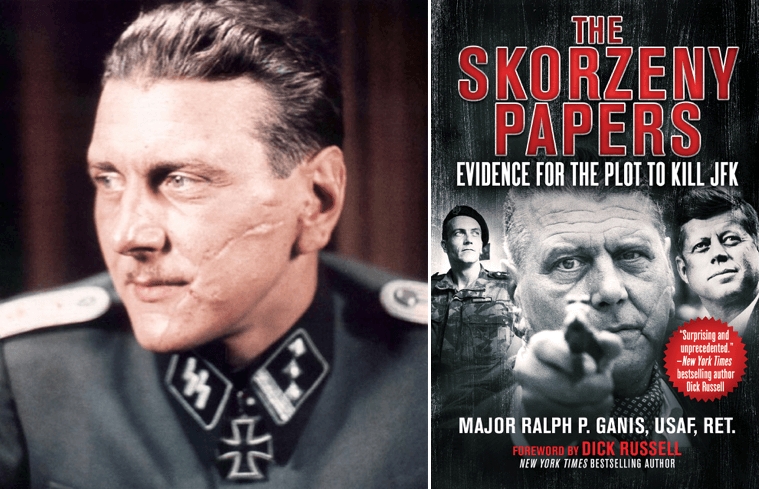
Major Ralph P. Ganis, The Skorzeny Papers: Evidence for the Plot to Kill JFK
I
When I heard that a previously undiscovered collection of personal correspondences from SS Colonel Otto Skorzeny had recently surfaced, I was truly interested. Besides his famous exploits in WWII, including the daring mountaintop rescue of Benito Mussolini and the kidnapping of Hungarian regent Miklós Horthy’s son from his Bucharest palace, Skorzeny was infamous for his postwar dealings with a number of intelligence agencies the world over. As a child, my grandfather, Marcel, a French resistance fighter, used to tell me stories of Otto’s exploits during car rides. I thought I was in for a real treat when I found this book. That Skorzeny could have had a hand on the team that killed President Kennedy was also an interesting hook.
The subtitle of this book is “Evidence for the Plot to Kill JFK,” and therein lies its true problem: if by evidence we are referring to clear-cut forensics, incriminating memos, newly declassified documents, newly discovered tapes, or reliable eyewitness testimonies that place Skorzeny either at the scene or in a position directly responsible for the assassination of JFK, then we have little to no “evidence” to justify the book’s subtitle. What the author of the book, Major Ralph Ganis, USAF (retired) seems to suggest is largely tangential to the actionable plot that took Kennedy’s life; that is, Skorzeny, from his position in Madrid as a jack of all trades with ties to postwar Nazis, Texas oil moguls, the Mossad, and French intelligence operatives, could have been a link in a long and winding chain of figures who eventually connected to those who executed the crime of the century. And yet, as we will see, even that supposition is largely based on fantastical leaps of logic, a primary source base that we are never allowed to verify—or see a picture of, or direct reference to—and a conclusion that is not only ridiculous but insulting to the JFK research community.
Dick Russell, who wrote the introduction to The Skorzeny Papers, rightly claims that the book provides a “chronological tracing of the dark alliances that sheds fresh light on how long-suspicious CIA officials like William Harvey and James Angleton wove Otto Skorzeny into their tangled web, or vice versa.” I will give Ganis and Russell that—most of the book is largely this, an extremely dry, almost colorless list of dozens and dozens of figures who were responsible for placing Skorzeny in a secure position from which to run his operations after the war: within only a few pages in chapter seven we have “Enter Major General Lyman L. Lemnitzer and the NATO Link,” “Enter Clifford Forster,” “Enter Don Isaac Levine.” I like to think I have a pretty good memory, but the sheer volume of second- and third-string players in this book is bewildering, with connections seemingly drawn from any and all personnel affiliated with anything remotely clandestine, few of which are ever revisited, and none of which seem truly important given the book’s central thesis, which is that Otto Skorzeny was somehow a key aspect of the Kennedy assassination.
The so-called “Skorzeny Papers,” which Ganis acquired through an American auction house bid in 2012, are alleged correspondences between Skorzeny and some of these underworld and intelligence-based figures, along with letters to his wife, who aided him in his dirty work to some degree. “As the story goes, many of the papers were burned over time, but a fragmentary grouping of documents (the ones used for the research in this book) survived. The archive ranges from 1947 to around the period of Skorzeny’s death.” (xv).
But since we are not allowed to view them or translate them from the German ourselves, we must take the author’s word that they are not mistranslated or even fraudulent.
Ganis begins his book’s preface with a bold proclamation: “Why was President John F. Kennedy killed and who carried it out? All of the investigations, commissions, and academic works have not answered these questions. This book integrated startling new information that does resolve the mystery.” (p. xxi) Let’s unpack that for a moment. Not all commissions are equal. The Warren Commission is not the same as Jim Garrison’s investigation of Clay Shaw, the HSCA, or the later ARRB. The latter three found quite compelling evidence that a domestic intelligence outfit indeed murdered JFK. The former was staffed by Allen Dulles and was essentially a disinformation campaign whose objective was to obfuscate the truth and put the story to bed for the nightly news, which had also been compromised through the Central Intelligence Agency’s media liaisons. As much has been exhaustively detailed in scholarly works, from John Newman’s Oswald and the CIA, to Jim DiEugenio’s Destiny Betrayed, to Jim Douglass’ JFK and the Unspeakable. That we cannot say with certainty who pulled the trigger on the fatal shot so vividly captured in the Zapruder film is ultimately inconsequential; for all intents and purposes, given the time elapsed since that fateful November afternoon fifty-five years ago, we do have a clear picture of the likely suspects behind the plot’s orchestration, along with compelling motives for why JFK was targeted. Bold claims like Ganis’s require even bolder evidence, and to open with a whopper like that, one would presume that Skorzeny’s purported personal papers contain something akin to the map of Dealey Plaza’s sewer system that investigators found in Cuban exile Sergio Arcacha Smith’s apartment, or a handwritten “thank you” note from James Angleton after the Warren Commission had ended for services Skorzeny rendered to the CIA. And yet not only is Otto Skorzeny himself only a tangential part of a book entitled The Skorzeny Papers, but the “evidence for the plot to kill JFK” is awkwardly squeezed into the last two pages of a 346-page work, with a final revelation that made me both angry for investing hours of my life reading the tome, and confused as to how an author with a true breadth of working knowledge about postwar intelligence networks could presume so myopic an assassination motive.
II
Otto Skorzeny was an Austrian by birth who joined the Nazi party somewhat reluctantly, mainly as a way to make a living as the outbreak of the Second World War ramped up in the late 1930s. A mechanic by trade, and a semi-professional fencer, his notorious scar across his face from a missed parry and his 6’4 stature made him something of an icon in the German army. Skorzeny was known for his fearlessness, guile and unconventional approach to commando warfare. As he once said in a postwar interview, “My knowledge of pain, learned with the sabre, taught me not to be afraid. And just as in dueling when you must concentrate on your enemy’s cheek, so, too, in war. You cannot waste time on feinting and sidestepping. You must decide on your target and go in.” (Charles Whiting, Skorzeny, 1972, p. 17) In many ways, his belief that small units could actually move world history in a similar or even greater fashion than regiments and divisions was affirmed after his thirty-man glider-borne SS unit spirited away Mussolini from the Gran Sasso Hotel with not even a single shot fired. Even Winston Churchill heaped praise on him for his bravery in the face of incredible odds.
Rearranging signposts during The Battle of the Bulge, his commandos, who wore captured American uniforms and spoke fluent English with almost no accent, attempted to sow chaos behind Allied lines, seeking to misdirect troops and armored units away from key areas. While the entire Wacht am Rhein [“Watch Along the Rhine”] operation, which was the German code name for Hitler’s last desperate gamble to capture the Belgian port of Antwerp and cut the British and American forces in two, was ultimately a futile dying gasp of an already-defeated Nazi war machine, it proved so devastating to Allied morale (and killed 75,000 Americans) that some planners did reconsider whether the war would be over any time soon. And when a handful of Skorzeny’s men were captured in their false uniforms during that bitterly cold winter of 1945, panic spread throughout SHAEF (Supreme Headquarters Allied Expeditionary Force), leading to a comical scene in which General Eisenhower frantically argued with his staff who insisted he station twenty guards with sub machine guns around his Paris office at all times in case Skorzeny tried to kill or abduct him. In the middle of the night, the future Director of the CIA, Walter Bedell Smith, Eisenhower’s aide-de-camp, ran out with his staff in pajamas and started firing his carbine into the brush just beyond the headquarters’ window.
He and his men later found the dead cat that had been scurrying about in the dark, but the legend of Otto Skorzeny had taken hold.
Dubbed “the most dangerous man in Europe,” Skorzeny finally surrendered to the Allies in occupied Germany, after seeing the futility of carrying out Hitler’s final order for his “werewolves” to continue the war after the end of hostilities. He was summarily booked and processed, and awaited trial for his role as a top Nazi official and a one-time personal bodyguard of Adolf Hitler. He was later approached by OSS officers as he languished in his holding cell at Darmstadt Prison and it is from this first contact that Ganis believes the true exploits of Skorzeny began. While stories differ as to the mechanics of his escape—Skorzeny claimed in his memoirs that he stole away in the trunk of a car and had a German driver unwittingly smuggle him through the checkpoints; while Arnold Silver, his American point of contact and debriefer said he was released on official terms—he nonetheless was a free man by 1948. After relocating to Paris, where he was unofficially used as a conduit through which CIA officials could monitor communist activity in postwar Europe, Skorzeny was quickly identified due to his conspicuous face and looming profile, and was outed by the French press during one of his many strolls down the Champs-Elysée with his wife Ilse.
Relocating to Madrid, it is here that Ganis believes his real work began, work that—Ganis believes—would ultimately find him involved with dark forces that killed JFK a decade later. Set up in a comfortable office that saw Skorzeny ostensibly managing a construction company that also handled imports and exports of mechanical parts to places in Central Africa and elsewhere, he for all outward purposes seems to have lived a quiet life. Writing memoirs, consulting with foreign governments for a variety of clandestine work, and running a low-key commando training school whose members included some of his former comrades from the SS, French OAS soldiers, American special forces officers, and a rogue’s gallery of other unsavory characters, his postwar life had little in common with his daring exploits during WWII.
The bulk of The Skorzeny Papers deals with the nebulous formation of both the CIA and its shell companies from the remains of the OSS, with familiar figures like Frank Wisner, Arnold Silver, Bill Harvey, and William Donovan featured prominently in Ganis’ narrative. The central portion of the book meanders from French anti-communist hit teams and their American handlers, to the also newly-formed Mossad and its eventual use of Skorzeny for the removal of Egyptian nuclear scientists, to a whole host of West German ex-Nazi intelligence personnel and their largely dull exploits passing mostly fabricated evidence of an impending Soviet invasion to Washington in exchange for their freedom and a career on the American payroll. Somewhere in this tangled web, Ganis situates Skorzeny who, because of his extensive contacts and personal daring during the Second World War, seems—in Ganis’ estimation—uniquely positioned to wrangle these disparate forces into something of a rogue network that is totally off the books. Ganis reiterates this throughout the book, seeking to distinguish ostensible layers of the spy world from what he considers its truly dark realm, which he identifies as a series of assassination teams bankrolled through corporate shell organizations like SOFINDUS, which eventually morphed into the World Commerce Corporation (WCC). In The Skorzeny Papers the WCC is akin to SPECTRE from the old James Bond novels; a looming, impenetrable evil menace whose tentacles reach into almost every aspect of Cold War politics and planning, Ganis spends a considerable amount of the book detailing its creation, key operators, possible ties to international Nazi groups and ultimately its potential role as the dark budget from which Skorzeny was able to fund his various international commando operations after the war. In reality, while I’m sure this is all very interesting to someone truly looking for an exhaustive account of postwar dirty money, it has very little to do with Skorzeny, and almost nothing to do with the domestic assassination of John F. Kennedy in Dealey Plaza.
The book then delves into the French OAS, focusing on the enigmatic Captain Jean René Souètre, who of course was allegedly deported from Fort Worth, TX, the afternoon of the JFK assassination. And while I am not denying that Souètre could have indeed been on the ground in Texas in some capacity, Ganis goes to great lengths—even putting him on the book’s cover next to Skorzeny and Kennedy—to implicate him in the plot: “The actual sniper, or team of snipers, was directed by Jean René Souètre, the former OAS officer wanted by French security services for an attempt on the life of President Charles de Gaulle in 1962.” While Souètre was a known paramilitary outlaw who hated the idea of Algerian independence from France—which Kennedy firmly championed from the Senate floor in the mid 1950s—he seems from the available evidence to have been a rogue player who drifted through these turbulent times, training commandos, taking exotic posts with his OAS buddies, and advising the CIA on a handful of ultimately uninteresting developments in the Third World. To suggest, as Ganis does, that he was the lynchpin of the ground operations in and around Dealey Plaza, while ignoring the more probable Cuban exile culprits, seems strained.
The Souètre chapter ends with a few lines that reveal a frustrating and repeated aspect of this book, where the author assumes that one’s proximity to a situation necessarily guarantees association and willing complicity. For example, Ganis argues:
The movements of Skorzeny during this period point to his being in attendance at the Lisbon meeting between Souètre and the CIA. In fact, Skorzeny made several trips to Portugal between March and July 1963 concerning his businesses. With the OAS cause now unsustainable, it appears Souètre left the meeting with a new option for employment, signing on with Skorzeny. Captain Jean René Souètre was now a soldier of fortune working for Otto Skorzeny in one of the most guarded secret organizations in the history of American intelligence.” (p. 248, italics added)
It’s not at all clear that these conclusions can be verified, and as Skorzeny’s whereabouts are only deduced from “the Skorzeny Papers,” which are never directly quoted—here or anywhere in the book to my knowledge—one must once again have faith that Ganis is being honest and accurate.
III
The book then spends a considerable amount of time on the Third World and its myriad decolonization movements, with a quite lengthy digression into Ganis’ analysis of the Congo Crisis, exploring the potential for Skorzeny to have been the mysterious QJ/WIN assassin the CIA hired to kill Patrice Lumumba. Ganis takes a fairly condescending approach to his analysis of Lumumba’s rise to power, claiming “As well-founded as Lumumba’s words may have been, they were politically ill-advised. This tense atmosphere was further compounded by the lack of a plan for the organized transition to power.” (p.279). As I have detailed in my article, “Desperate Measures in the Congo,” the United States destroyed any hope for a free Congo before Lumumba had risen to anything nearing real power. In fact, both Belgium and the CIA had planned on separating Katanga, the Congo’s richest area, from the country before it became independent. Belgium had stolen the country’s gold reserves, brought them to Brussels and refused to return them. President Eisenhower refused to meet with Lumumba after the Belgians had landed thousands of paratroopers inside the country. By the time Lumumba’s plane had landed back in Africa, Allen Dulles and friends all but marked Lumumba for death. For Ganis to say he had no plan for an “organized transition to power” smacks of paternalism: given his eloquence, popular appeal and vision of a new dawn for his recently unshackled nation, Lumumba may well have succeeded if he had not been undermined in advance.
The assassination mission was later aborted when the CIA and Belgian intelligence aided Katangese rebels with Lumumba’s capture after he fled his UN protection in a safe house. While I can see where Ganis is going, and how it could be possible, given that Skorzeny seems to have been in the Congo around this time, to my knowledge it’s been pretty strongly established that QJ/WIN, the CIA digraph of one of two selected assassins for the Congo plot, was actually Jose Marie Andre Mankel. To have sent a person as instantly recognizable as Otto Skorzeny into an unfolding international crisis involving the Soviet Union, Belgian and Congolese troops, U.N. officials from multiple nations, and American station personnel seems, to put it mildly, unwise. Indeed, WI/ROGUE, another CIA-sponsored hit man and agent sent on the assignment, had had plastic surgery and was said to be wearing a toupee during his visit. No matter Skorzeny’s connections to Katanga Province’s mining operations, which were real, he was more likely a visiting business opportunist rather than an actionable agent during the Congo Crisis, if he was present there those critical weeks surrounding Lumumba’s capture and execution at all.
Ganis then details Skorzeny’s one brief interview with a Canadian television program in September 1960, in which he boasts about being in high demand by both the enemies of Fidel Castro and Fidel himself, explaining a plot which he takes credit for being the first to discover. This was Operation Tropical, in which the CIA was allegedly training Skorzeny and his commandos for a kidnapping of the Cuban premier in early 1960. Ganis bases his description on an unnamed newspaper clipping found in the papers he secured in his winning auction bid. Curiously, I happened upon Operation Tropical in a perusal of the CIA’s online reading room months before I’d read this book, and searched in vain for the newspaper they cite as having outlined the plot, which they claim is the Sunday supplement edition of the Peruvian newspaper, La Cronica, dated August 7, 1966. I would be interested to read it if anyone can secure a copy. It would go a long way in verifying the validity of Ganis’ main body of evidence, and would be an interesting find for researchers more broadly. In any case, with the aborted Castro plot and a mainstream boilerplate description of the “failed Bay of Pigs invasion,” which of course Ganis attributes to Kennedy’s refusal to release nearby carrier-based air support (something Kennedy staunchly forbade before the operation was underway, a point which Ganis’ omits), we now enter the final stretch of the book, which looks directly at Skorzeny’s role in the JFK assassination.
Spoiler alert—there is none.
IV
“General American Oil Company,” “Colonel Gordon Simpson,” “Algur Meadows,” “Sir Stafford Sands,” “Colonel Robert Storey,” “Jacques Villeres,” “Permindex,” “Judge Duvall,” “Paul Raigorodsky,” “Thomas Eli Davis III,” “ Robert Ruark,” “Jake Hamon,” and about twenty other sub-headings flash across the first dozen or so pages of the final chapter of The Skorzeny Papers. The organization of the book centers on these disjointed, one-to-two-page sub-chapters which give the reader the disorienting and queasy feeling of reading it through glasses with the wrong prescription. Not only did Ganis miss the opportunity to style the life and times of Nazi Germany’s most infamous commando personality along the lines of a thrilling narrative, with exotic locales and shady deals over drinks and cigars, but he arranged the book in so awkward a fashion that he constantly has to end sentences with “and we will get back to him shortly,” or “and I will show you how this ties in later.” Even if one were to storyboard his entire panoply of tertiary personalities, it would look more like a Jackson Pollock art installation than a coherent plot with a compelling impetus culminating in the JFK assassination as we understand it. A story should be clear enough to draw the reader in with its simple facts, and should sensibly unfold on its own accord so as to prevent the need to constantly handhold during the descent into the labyrinth.
Conspicuously absent in The Skorzeny Papers are any substantial sub-headings detailing Cuban exiles, Allen Dulles, the Joint Chiefs of Staff, or any of the genuine suspects of the JFK assassination, save for meanderings on James Angleton’s and Bill Harvey’s roles in the creation of Staff D, the CIA’s executive action arm. Ruth and Michael Paine are nowhere to be found. Neither is a description of the aborted Chicago plot, or any substantive explanation of how Lee Harvey Oswald was moved into the Texas School Book Depository, or a note about David Phillips’ role in the whole affair from his Mexico City station. While these very real aspects of the actual JFK plot are infrequently touched upon in passing—Ganis cannot ignore the entire body of evidence, despite his best efforts—he insists on crow-barring his newfound “primary source data” into a story that at this point doesn’t permit much unique interpretation. It’s safe to say, in 2018, that President Kennedy was assassinated by a domestic, military-industrial-intelligence apparatus that viewed his foreign policy as anathema to both the “winning” of the Cold War and to their image of the United States’ role in world affairs. That Kennedy was a staunch decolonization advocate, a friend and champion of Third World leaders like Sukarno in Indonesia, Nasser in Egypt, Lumumba in the Congo, and sought diplomatic solutions to prevent the impending nuclear Armageddon with Nikita Khrushchev’s Soviet Union is all but ignored in Ganis’ conclusions as to why JFK was shot in Dallas. None of it is suggested. What ultimately led to the tragedy in Dealey Plaza, according to Ganis, is something much bigger.
V
It all comes down to JFK’s sexual indiscretions, folks. That’s right. Jack Kennedy just couldn’t resist the advances of the hundreds of femme fatales who threw themselves at him, and according to Ganis, the high command had to take him out when he cavorted with the ultimate Cold War honeypot.
I wish I were kidding. But unfortunately I’m not.
The author submits to the reader that the act to assassinate President Kennedy was carried out for reasons that far exceeded concerns over U.S. National security. In particular, they arose out of a pending international crisis of such a grave nature that the very survival of the United States and its NATO partners was at risk. At the source of this threat was breaking scandals that unknown to the public involved President Kennedy. To those around the President (sic) there was also the impact these scandals had on the president’s important duties such as control of the nuclear weapons and response to nuclear attack. It also appears the facts were about to be known. The two scandals at the heart of this high concern were the Profumo Affair and the Bobby Baker Scandal. (p.294)
I will spare anyone reading this a rebuttal of the relevance of this assertion, but suffice it to say, Ganis places the final straw at Kennedy’s—demonstrably disproven—affair with Eastern Bloc seductress Ellen Rometsch. Ganis claims, “Historians are taking a hard look at this information, but preliminary findings indicate Rometsch was perhaps a Soviet agent.” (p.295) He continues, “Her potential as a Soviet agent is explosive since Baker had arranged for multiple secret sexual liaisons between her and President Kennedy.” (p. 295)
He then scrapes together a weird narrative of how Attorney General Robert Kennedy was pleading with J. Edgar Hoover and the FBI to withhold these revelations in a “desperate effort to save his brother and the office of the presidency.” (p.296), He argues that “As President Kennedy was arriving in Dallas, Texas, on November 22, 1963, a very dark cloud of doom was poised over Washington, and the impending storm of information was hanging by a thread.” (p. 296). That’s when Skorzeny—from Madrid—was activated to save the Western world. It seems pointless to add that retired ace archive researcher Peter Vea saw the FBI documents on this case. The agents had concluded there was no such liaison between the president and Rometsch. In other words, to save himself, Baker was trying to spread his racket to the White House. Bobby Kennedy called his bluff.
Ganis pretentiously concludes, “In the end, the assassination network that killed JFK was the unfortunate legacy of General Donovan’s original Secret Paramilitary Group that included as a key adviser from its early inception—Otto Skorzeny. Furthermore, the evidence would seem to indicate Skorzeny organized, planned and carried out the Dallas assassination, however, we may never know what his exact role was.” (p. 342)
Indeed we may never, because there does not seem to be any. Ganis continues, “On November 22, 1963, an assassination network was in place in Dallas; it was constructed of associates of Otto Skorzeny and initiated by his minders in the U.S. Government and clandestine groups within NATO.” Wrapping up, the author reiterates, “The events that led to this killing were triggered by a limited group of highly placed men in the American government. They were convinced that the West was in imminent danger and posed to suffer irreparable damage, and, for some of them, imminent exposure to personal disgrace beckoned. All of this sprang from reckless debauchery in the White House and beyond. With the situation breached by Soviet intelligence and ripe for exploitation, it became untenable for this group. They took action.”
I’ll give you a few minutes now to wipe the tears from your eyes. Okay, good. Are you still with me? Overall, The Skorzeny Papers could, I suppose, serve as something like a compendium or glossary for those who just have to know the minutest details of the inner workings of this or that shell corporation that may or may not have had a hand in some world affair during the Cold War. But there are much better books on that. Ultimately, Ganis’ book is an uncomfortable, freewheeling careen down strange dead-end tracks, with unannounced detours through cold dark streets full of faceless characters, and later, journeys through mirror-filled fun houses of speculation, with a final twist and turn that spits you out right over Niagara Falls, barrel and all.
-
Creating the Oswald Legend – Part 2
I. Oswald’s Passport and Illegals
In part 2 we will continue our journey into Oswald’s wondrous world and discover that his USSR defection was only a part of the larger picture. Moscow and Minsk were only stops, but not the destination of his journey. These stops were to become part of his resume, to create a “Legend” who will return home pretending to be a Soviet spy in order to infiltrate suspected communists, subversives, and supporters of Castro. From the beginning that destination was Cuba; it has always been about Cuba.
Marguerite Oswald was in disbelief when she was informed that her son had defected to the Soviet Union. In September, her son visited his mother in Fort Worth after his discharge from the Marines and told her that he wanted to travel to Cuba. In February, an FBI agent, John Fain, interviewed Marguerite regarding the whereabouts of her missing son. He later stated in his report that “Mrs. Oswald stated he would not have been surprised to learn that Lee had gone to, say, South America or Cuba, but it never crossed her mind that he might go to Russia or that he might try to become a citizen there.”1
When Oswald tried to defect to the USSR, a wire service noted that his sister-in-law said “that he wanted to travel a lot and talked about going to Cuba.”2 Similarly, when he returned back to the States, a 1962 Fort Worth newspaper recalled what Oswald said to his family: “He talked optimistically about the future. Some of his plans had included going to college, writing a book, or joining Castro’s Cuban army.”3
Oswald’s travel destinations included Cuba, the Dominican Republic, England, Turku Finland, France, Germany, Russia and Switzerland. One has to wonder how the recently discharged Marine would have been able to fund a trip that involved so many countries that were far apart from each other, like Cuba and Russia. Before leaving the Marines, he applied for a passport on September 4, 1959 and received it on September 10, 1959. To apply for the passport he used for identification a Department of Defense (DOD) I.D. card, although he could have provided his birth certificate. As George Michael Evica noted, “Lee Harvey Oswald should never have had a DOD I.D. card on September 4, 1959, possibly on September 11th, but not on September 4th.”4 September 11 was the date that he was to be transferred to the Marine Corps Reserve, once his active duty was over.
The Marine Corps confirmed that it had issued the card before he was discharged, but this kind of practice ended as of July 1959, so he was probably issued the DOD I.D. card because he was going to fill a civilian position overseas that required it.5
Too many peculiarities surround the young ex-Marine, his DOD I.D. card, his passport application, the countries he was planning to visit and the expenses needed to support such a trip. All these were enough to sound the alarm bells in the intelligence community, but somehow this did not happen.
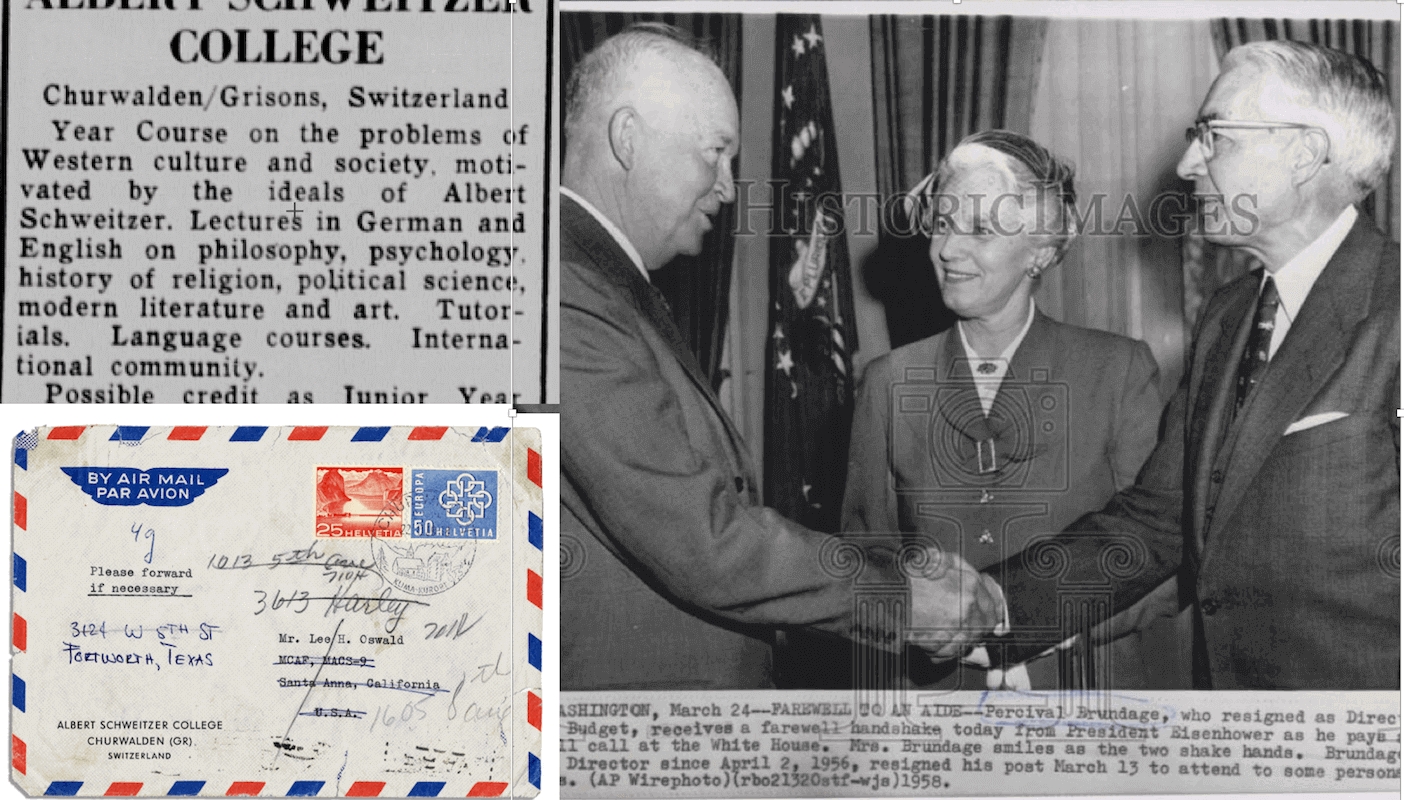
Oswald had also stated in his passport application that he intended to study in Europe, and he named two institutions. One was the Albert Schweitzer College (ASC) in Churwalden, Switzerland, and the second was the University of Turku in Finland.
Oswald sent his application to the ASC on March 19, 1959, informing them that he was going to attend the third (spring) term of the trimester schedule, from April 12, to June 27, 1960, followed by a registration fee payment of $25 on June 19. However, this time length posed a problem by itself. Oswald’s passport was valid for four months overseas, so if he wanted to attend its third trimester, then his passport should have been valid for nine months, an extra five months. According to his passport, he could have only made it to study the fall trimester of 1959, and then only if he was given an early discharge, which actually happened.6 Oswald was released from the Marines with a dependency discharge on September 11, 1959 to go to Fort Worth to take care of his injured mother. However, his mother had only a minor injury and Oswald left for New Orleans on September 17, 1959, to begin his trip to Europe. A year later, after his defection to the Soviet Union, he was given an undesirable discharge from the Marine Corps, something that was to haunt him to his final days.
In 1995 the Assassinations Records Review Board (ARRB) revealed the communication between the FBI Legat at the Paris Embassy and FBI Director Hoover. The FBI Legat had sent Hoover five memoranda regarding Oswald’s intentions to study the ASC.
The first memorandum was dated October 12, 1960. It was based on information from the Swiss Federal Police and stated that Oswald was planning to attend the fall trimester of 1959. The second memorandum was a strange one, since it stated that Oswald “had originally written a letter from Moscow indicating his intention to attend there (at Churwalden).”7
This was an extraordinary turn of events, as the second memorandum implied that Oswald was planning to attend the third trimester, similar to his college application and the Warren Commission’s conclusion.
The fourth and fifth memoranda were even more peculiar. They revealed that Oswald had not attended the course under a different name and that there is no record of a person possibly identical to Oswald attending the fall trimester.
The above information should have sounded the alarms in FBI HQ because they suspected that since he did not attend the college he had brought with him his passport and his birth certificate to the Soviet Union. Even Marguerite Oswald, when asked by FBI agent Fain about her son’s whereabouts in Europe, replied that Lee has taken his birth certificate with him.
The above information forced Hoover to send an enquiry to the Office of Security in the Department of State regarding the “missing” Lee: “Since there is a possibility that an impostor is using Oswald’s birth certificate, any current information … concerning subject (Oswald) … ”8
Hoover, like his agent before him, suspected that Oswald had fallen victim to a Soviet spy ring that would have used his birth certificate to create a false identity which an “illegal” spy would adopt to enter the United States as a sleeper agent.
The illegals were not under diplomatic protection like their legal counterparts that were usually connected to a Soviet embassy. They would resume the life of an American, probably one that has died, live a normal capitalistic life and would be activated when the need arose.
Switzerland had been a center of espionage since WWII. Soviet illegals would never send or receive mail directly to/from the Soviet Union but would use neutral countries like Switzerland as a cover address to avoid detection. It is a surprise that the CIA counter-intelligence mole hunters did not open a 201 file on Oswald as soon as he defected. In fact, they did not do that for over a year. Instead, they put him on the HT/LINGUAL list of about three hundred Americans whose mail was secretly being opened.9 This would be an indication that Oswald was used to detect illegal networks in Switzerland by detecting their mails.
The ASC was reputed to be a place where liberals, communists and Marxists would go to study, perhaps being a possible illegal passing point. By applying to this college, even if he never went there, it could appear that his birth certificate was used to create an illegal in Switzerland that would later use his identity and papers to travel to the States. Another scenario would have been that someone looking very similar to him, someone almost identical in appearance, could have taken his place, like a Soviet illegal. Alternatively, the US intelligence services would have looked suspiciously on Oswald upon his return to the States, wondering if he had been turned into a Soviet spy coming home on behalf of his new Soviet handlers.
Regardless of the truth, Oswald—wittingly or unwittingly—had created a “Legend” for himself that could be used any time against various targets. Most importantly though, the US intelligence services would suspect that Oswald was probably impersonated by someone else for sinister purposes. This was to be the first time but it would not be the last.
II. Albert Schweitzer College
How did Oswald find out about this obscure college somewhere in Switzerland? It has been suggested by various authors that Kerry Thornley, one of Oswald’s Marine friends at Santa Ana, brought it to his attention and helped him with the application.
Thornley was a New Age writer, satirist, mystic and crypto-fascist, and a native Californian who had studied at USC. He had been six months in active duty, following time in the reserves when he met Oswald at El Toro base near Santa Ana. Oswald even gave Thornley his copy of George Orwell’s 1984 to read.10 Thornley claimed that he met Oswald a week after Oswald applied to the ASC. As Greg Parker notes, it is possible that Thornley met and knew Oswald before his application to the college.11
Thornley testified to the Warren Commission:
I believe it was the First Unitarian Church in Los Angeles. I had mentioned earlier at the time I was talking to Oswald, and knew Oswald, I had been going to the First Unitarian Church in Los Angeles. This is a group of quite far to the left people politically for the most part, and mentioned in order to explain my political relationship with Oswald, at that moment, and he began to ask me questions about the First Unitarian Church and I answered, and then he realized or understood or asked what Oswald’s connection with the First Unitarian Church was and I explained to him that there was none.
We do know that Oswald had visited Los Angeles, at least to get his passport, although he may have visited the Cuban Consulate as we shall see later on.
The leader of this church was Minister Stephen Fritchman. He was a peace activist who had supported the Nuclear Test Ban Treaty, had been called by the Un-American Activities Committee and had attended the World Congress for Peace in Stockholm in May 1959.12
Was there a connection between Oswald, Thornley, Fritchman and the ASC? The National Archives and Records Administration (NARA) included in its assassination files about Oswald a sixty-page report on Fritchman. Additionally, the Warren Commission and the FBI were interested and curious about Oswald and Thornley’s Unitarian Church link while trying to explain how Oswald obtained information about the ASC.13
Evica believed that “Oswald’s mysterious source of information about Albert Schweitzer College could be explained by Thornley’s attendance at Fritchman’s First Unitarian Church in Los Angeles … the pastor may have possessed detailed information about the college and copies of the college’s registration forms. When Oswald visited LA, he could have picked up the materials at the church … Alternatively, Thornley … could have picked them up and passed them on to Oswald.”14
The Liberal Religious Youth (LRY) was a group that cooperated with the ASC. Reverend Leon Hopper, one of its members, said to Evica in March 2003 that “student recruitment was almost always through personal contacts … also confirmed that Stephen Fritchman could have been an information source … Finally Hopper confirmed that the LRY concentrated on the summer sessions of ASC, reaching prospective students through personal contacts.”15
The ASC was located in the small village of Churwalden, Switzerland, and there was something peculiar about it since it did not offer degrees. Even the Swiss authorities did not know it existed until the early 60s when there were accusations of a narcotics and fraud scandal involving the college. Soon the college was in debt, and closed only after an unknown entity from Liechtenstein paid off all of its debts.16 The peculiarities did not end there. Since the village was very small, it did not have a hospital, a library, a fire department or a police station. The village was many miles away from the nearest town of Chur, and one had to drive through poor roads and across mountains to reach the village.
The college was housed in the village’s larger building, the hotel Krone with thirty rooms capacity.17 It opened in 1954, and the first list of students available revealed there were no Swiss students at all, which served to keep it unknown to the Swiss Government.18
The ASC was created by the International Association for Religious Freedom (IARF). According to Richard Boeke, first President of the American chapter of IARF, it was the crown jewel of all the IARF’s associate religious centers and had initially been “good for Liberal Swiss Protestants.”19 The IARF originated in 1900 as the International Council of Unitarian and Other Liberal Religious Thinkers and workers on May 25, in Boston. The stated aim was “opening communications with those in all lands who are striving to unite Pure Religion and Perfect Liberty, and to increase fellowship and cooperation among them.”20 It would include religions like the Unitarian, Buddhist, Humanist, Muslim, Scientology and Theosophy.21
The ASC was operated by the Albert Schweitzer College Association—a non- profit organization with its legal HQs in the village of Churwalden—and the Unitarian “American Friends of Albert Schweitzer College” which was also a non-profit organization. The “American Friends of Albert Schweitzer College” had its offices in Boston. It was incorporated in New York in 1953 with the purpose of receiving tax-deductible contributions from United States citizens and corporations.22 Its directors were John H. Lathrop (Brooklyn, NY), John Ritzenthaler (Montclair, NJ), and Percival F. Brundage (Montclair, NJ).23 Brundage was the most interesting individual out of the three directors, a true member of the “Power Elite”, with government and intelligence connections.
III. Percival F. Brundage
Who was Percival F. Brundage? Brundage was the son of a Unitarian Minister who graduated cum laude from Harvard University in 1914 and afterwards became a successful accountant, probably one of the best of his era. In 1916 he worked as a civilian in the Material Accounting Section of the War Department’s Quartermaster Depot Office in New York which involved record keeping of sensitive military procurement operations.24
He became a senior partner in the accounting firm, Price-Waterhouse. He was director, and then president of the Federal Union that argued for the federation of the Atlantic democracies.25
Brundage had a significant connection to the Unitarian Church and the ASC. He was a major Unitarian Church officer from 1942-1954 when the Unitarian Church was cooperating with, first, the OSS, and later the CIA.26 He was also president of the International Association for Religious Freedom (IARF) from 1952-1955 and president of the American Friends of Albert Schweitzer College from 1953-1958. Most importantly, Brundage became the most prominent member of the Bureau of Budget (BOB) during the Eisenhower presidency. He was its deputy director from 1954-1956, its president from 1956-1958 and he served it as consultant until 1960.27
As the head of the BOB, Brundage was controlling the United States budget, and from that privileged position he would be familiar with the Pentagon’s and CIA’s secret black budgets but without ever exposing or surveying them. It seemed that Brundage would turn a blind eye and let them do their secret work without the government ever bothering them.
One of Brundage’s closest friends was a fellow Unitarian, James R. Killian Jr., president of the Massachusetts Institute of Technology (MIT).28 Killian was appointed the chairmanship of president Eisenhower’s Technological Capabilities Panel in 1953 to measure the nation’s security and intelligence capabilities and also to study both military and intelligence applications of high-flight reconnaissance.29 Killian appointed Edward H. Land, inventor of the Polaroid land camera, as chief of the top-secret intelligence section of the Air Force Technological Capabilities Panel that helped create high-flight reconnaissance, like the U-2 and satellites. Land was also responsible for the CIA receiving the responsibility for the U-2 program.30 In 1957 he was appointed by Eisenhower as Special Assistant for Science and Technology, and in 1956 became Eisenhower’s chairman of the US Board of Consultants on Foreign Intelligence Activities, reporting to the president the activities of the intelligence community, especially the CIA.31 This board was supported by Brundage’s BOB. Later, Killian advised Eisenhower that the Air Force was incapable of developing photographic reconnaissance satellites. This allowed him to turn over that assignment to the CIA, which led to the CORONA satellite program32 that was discussed in part 1.
Killian, Brundage and Nelson Rockefeller were the three men who transformed the national Committee of Aeronautics (NACA) into the civilian agency responsible for the US space program. It was renamed NASA. Brundage was responsible as the head of BOB for drafting the congressional legislation for the creation of NASA.33 Brundage was also involved in Operation Vanguard, which was “intended to establish freedom of space, and the right to overfly foreign territory for future intelligence satellites.”34
In 1960, Brundage and one of his associates, E. Perkins McGuire, were asked to hold the majority of a new airline stock “in name only.”35 They both agreed to act on behalf of the CIA. The airline was none other than Southern Air Transport, which was used in paramilitary missions in the Congo, the Caribbean and Indochina. The Newsweek issue of May 19, 1975 linked Percival Brundage to Southern Air Transport, Double-Check Corp, the Robert Mullen Company and Zenith Technical Enterprises. The Double-Check Corp was a CIA front that was used to recruit pilots for covert missions against Cuba; Robert Mullen’s advertising company provided cover for CIA personnel abroad; and Zenith Technical Enterprises was the front that provided cover for CIA’s JM/WAVE station in Miami.36
Southern Air Transport was created by Paul Helliwell, an originator of the CIA’s off-the-books accounting system and nicknamed Mister Black Bag. Helliwell was a member of the OSS and later of the CIA in the Far East; he was one of the most prominent members of the China Lobby. His mission was to assist Chang Kai-Shek and his Kuomintang (KMT) army in Burma to invade China. This army managed and controlled the opium traffic in the region. Helliwell created two front companies to help KMT to carry out its war and the drug trade. One was Sea Supply in Bangkok and the other was CAT Inc., later Air America in Taiwan.37 Helliwell had organized a drug trafficking network supported by banks to launder CIA’s drug profits in the Far East.
Richard Bissell brought Helliwell back to the States to plan a similar network of front companies and banks to finance the Agency’s war against Castro. Similar to Sea Supply and Air America, he created Southern Air Transport in Miami to fly over drugs and guns to support not only the war on Cuba but also in Laos, Vietnam and Cambodia.
In his book Prelude to Terror, Joseph Trento claimed that Helliwell’s main objective was to cement the CIA’s relationship with organized crime.38 Meyer Lansky and Santo Trafficante were both planning to invest in the Far East by bringing heroin back to the States. Helliwell established banks in Florida and became the owner of the Bank of Perrine in Key West, “a two-time laundromat for the Lansky mob and the CIA”, and its sister Bank of Cutler Ridge.39 Lansky would deposit money into the Bank of Perrine, reaching the US from the Bank of World Commerce in the Bahamas. Lansky also used the small Miami National Bank, where Helliwell was a legal counsel, to launder money from abroad and from his Las Vegas casinos.40 Peter Scott claimed that Helliwell worked with E. Howard Hunt, Mitch WerBell and Lucien Conein on developing relationships with drug dealing Cuban veterans of the Bay of Pigs invasion, and became CIA paymaster for JM/WAVE to finance Chief of Station Ted Shackley’s operations against Cuba.41 Sergio Arcacha-Smith, one of the New Orleans Cubans who knew Oswald and E. Howard Hunt, was involved in the lucrative business of contraband transportation from Florida to Texas, specializing in drugs, guns, and even prostitution.42
In other words, Percival Brundage was no ordinary citizen. His BOB activities with the U-2, the satellite programs, the Pentagon, the CIA, and especially his involvement with the ASC, linked him indirectly to Lee Harvey Oswald. The young Marine had applied to the ASC to study in Switzerland and his defection to the Soviet Union was unwittingly connected to the U-2 and CORONA projects that brought an end to the Paris Peace talks and prolonged the Cold War. When Percival Brundage became a part of Southern Air Transport, he entered a nexus of CIA, Mafia, drug trafficking, money laundering and anti-Castro Cubans, one which later met and manipulated Oswald, and some of whose members were very likely involved in the assassination of John F. Kennedy. It is also very plausible that the assassination was financed by this drug trafficking and banking network instead of oil-men money as many believe.
IV. Cuban Sympathizer or Agent Provocateur?
Was Oswald a communist sympathizer from his early days, like the Warren Commission concluded? Had he been in contact with the Cuban Consulate in Los Angeles?
Corporal Nelson Delgado was a Puerto Rican stationed at El Toro Marine Corps base who became close friends with Oswald. They were both loners but they had a common interest, and that was Cuba. Both admired Castro because he seemed to be a freedom fighter against Batista’s tyranny who could bring democracy to Cuba. They were dreaming that they could go there and become officers and free other islands like the Dominican Republic. Delgado could speak Spanish and Oswald would configure his ideas about how to run a government—so they kept dreaming.
Things got a little strange when Oswald became serious about it and was trying to find ways to actually go to Cuba.43
When interviewed by the Warren Commission, Delgado said he advised Oswald to go and see the Cubans at the Cuban Consulate in Los Angeles. Wesley Liebeler, a Warren Commission lawyer, took Delgado’s testimony and stretched it by the ears to make it look like Oswald was in contact with the Cubans all along. According to Australian researcher Greg Parker, “Liebeler, adroitly took a bunch of assumptions and leaps of logic by Delgado and magically recast them as proven fact leading to an inevitable conclusion.”44
According to Delgado:45
- Oswald told Delgado there was a Cuban consulate in Los Angeles;
- Oswald started receiving letters with a seal on them that Delgado thought might be from Los Angeles because Oswald had said he was getting such mail from the Cuban Consulate;
- Oswald took a trip by train to Los Angeles to “see some people”.
Based on the above, Liebeler instructed Delgado to “tell me all that you can remember about Oswald’s contact with the Cuban Consulate.”46
Delgado also noted that after Oswald allegedly visited the Cuban Consulate, he started receiving mail, pamphlets and a newspaper. Naturally, he assumed that they must have come from the Cuban Consulate and concluded the newspaper was communist, since it was written in Russian. He asked Oswald if it was a communist newspaper and he replied that it was White Russian and not communist. Still, Delgado, who did not know what White Russian meant, concluded it was a Soviet newspaper.47
One of the pamphlets had a big impressive seal that looked like a Mexican eagle with different colors, red and white and a Latin script with the word “United” included. Parker believes that Delgado probably was describing the logo of a Russian Solidarist movement known as NTS (HTC in Russian), standing for Narodnyi Trudovoy Soyuz (National Labor Union) in English.48 Below we can see the NTS logo with something that looks like an eagle, and the colors white, blue and red in the background.

NTS logo More information about NTS can be found in Stephen Dorill’s book MI6: Inside the Covert World of Her Majesty’s Secret Intelligence Service. According to Dorill, NTS was founded in Belgrade in July 1930 by Prince Anton Turkul and Claudius Voss, and it stood for National Labor Council. Prince Turkul was a member of the White Russian Armed Services Union (ROVS) and its purpose was to restore Tsarist Russia. Voss was the head of ROVS in the Balkans and “a British intelligence agent and ran ROVS’ MI6-friendly counter-intelligence service, the Inner Line, that sponsored NTS.”49
Dorill also revealed that “the Russian émigré organizations were working overtime through bodies such as the NTS … to undermine the Soviet regime and to form a provisional government when the Soviets collapsed.”50 Dorill described NTS’ origins: “Initially a left-of-centre grouping, NTS soon moved to the right, promoting an anti-Marxist philosophy of national labor solidarity, based on three components: idealism, nationalism, and activism. It enjoyed the support of several European intelligence services, in particular MI6, and also attracted substantial funds from businessmen with interests in pre-revolutionary Russia, including Sir Henry Deterding, chair of Royal Dutch Shell, and the armaments manufacturer, Sir Basil Zaharooff.”51
If Parker is right, and the pamphlets that Oswald was receiving were not communist but on the contrary from the NTS, then we can conclude that Oswald was in contact with fervent anti-communist White Russians. In that context, then, his trip to the Soviet Union could be viewed from a different perspective.
Oswald received help to apply to the ASC and travel to the Soviet Union, most likely from a nexus that involved the CIA and anti-communist organizations with relations to the military-industrial complex. When Oswald applied to the ASC, he listed his favorite authors as Jack London, Charles Darwin and Norman V. Peale.52 Jack London was one of the founders of The League for Industrial Democracy (LID), whose purpose was to extend democracy in all aspects of American life. During the Cold War, it was renamed the Student League for Industrial Democracy (SLID), had close ties to the CIA and had become anti-communist.53 Jack London was a supporter of social Darwinism, eugenics, Nietzschean philosophy and Jungian psychology.54
Darwin was a Unitarian and author of “Origins of the Species.” His cousin Francis Galton studied heredity based on Darwin’s work and as a result he coined the word “eugenics”, the theory that selective breeding will improve the human race.55
Norman Vincent Peale was a minister of the Lutheran church, politically conservative, and opposed the liberal and Catholic Jack Kennedy. He believed that as a Roman Catholic President Kennedy would align with the Vatican with respect to US foreign policy.56 He headed a group, which included Billy Graham, that held a secret meeting to discuss how to derail Kennedy’s election bid.57 Some of Peale’s associates were supporters of lynching, while others were against the Eisenhower-Khrushchev Paris peace summit.58 He was also friends with the conservatives Nixon and Hoover.59
If Oswald was, as he is alleged to be, a communist sympathizer, these interests and connections to the reactionary and elitist Right come as a surprise. Indeed, they would seem to indicate, on the contrary, that Oswald was actually instructed and guided by people who were anti-communist and probably tied to the CIA.
Even Hans Casparis, the founder of the ASC, had probable CIA connections. Casparis claimed that he had graduated from three universities, studied at a fourth and was a full-time lecturer in German and philosophy at the ASC. There were no specific degrees listed on the ASC brochure presenting Casparis, while five other lecturers held doctorates, and another one, along with Casparis’ wife, Therese, held a BA.60 Casparis claimed that he was a lecturer in education at the School of European Studies at the University of Zürich, but when Professor Evica asked the university to confirm it, they replied that Casparis had never lectured there.61 Records indicated that Casparis had studied at the University of Chicago (1946-1947), and the University of Tübingen (1922-1923), but never received degrees from either of the two.62
The same ASC brochure said that Therese Casparis, his wife, had a BA degree in education from the University of London. However, the university’s assistant archivist revealed that Therese had received a second-class honors degree in German and then enrolled to take a teacher’s diploma, but she left without taking an exam, so she never received a BA in education from that university. Therese gave birth to five children from 1934 to 1948, but Evica could not find any college in Europe or England which awarded a degree to Hans or Therese. 63 It was a mystery how they were able to raise five children without any higher degrees, yet were able to attract support from important Unitarians to establish a college in an unknown village somewhere in Switzerland. It is likely that Hans and Therese were employed by the CIA to infiltrate this liberal college. If we consider Evica’s findings that Allen Dulles had used religious organizations like the Unitarians to create humanitarian front organizations in order to conceal OSS and later CIA covert operations to destabilize Eastern Europe, South America and South East Asia, we can conclude, or strongly suspect, that ASC was such a front cover.
When Oswald was arrested in New Orleans during the summer of 1963, he was asked by police officer Frank Martello how he came to be a member of the Fair Play for Cuba Committee (FPCC). To that he replied that “he became interested in that committee in Los Angeles … in 1958 while in the US Marine Corps.”64 Although he gave the wrong information, since the FPCC was established in April of 1960, he simultaneously revealed that when he was visiting Los Angeles he most likely met the pro-Castro people that had organized the FPCC’s Los Angeles branch at the first Unitarian Church of Robert Fritchman.65
In 1963, Richard Case Nagell was investigating the FPCC branch in Los Angeles, leftists and Unitarians. In his notebook were written the names of: Helen Travis of the FPCC, Dorothy Healy of the Communist Party, USA, Reverend Robert Fritchman of the First Unitarian Church, and the officials of the Medical Aid for Cuba Committee.66
Is it possible that all along Oswald was being groomed to penetrate the FPCC?
A 1976 CIA internal memo stated, “In the late 1950’s, Hemming and Sturgis, both former US Marines, joined Fidel Castro in Cuba but returned shortly thereafter, claiming disillusionment with the Castro cause.”67 Delgado testified that a mysterious man visited Oswald at the gate of El Toro base. He had assumed that he was someone from the Los Angeles Cuban Consulate. However, Gerry Patrick Hemming revealed later on that he had met Oswald in the Cuban Consulate in Los Angeles and went to confront Oswald at the gate of El Toro base.
There are indications that this actually happened. A CIA memo stated that “Henning (Hemming) returned to California in October 1958 … he left for Cuba by air via Miami on or about 18 February 1959, arriving in Havana on 19 February 1959. He claimed to have contacted the officials in the Cuban consul’s office in Los Angeles prior to his departure.”68 Another CIA Security Office memo from 1977 linked Oswald to Hemming: “The Office of Security file concerning Hemming which is replete with information possibly linking Hemming and his cohorts to Oswald … ”69
Could it be possible that Oswald was being “put together” to penetrate pro-Castro organizations like the FPCC as Hemming had been associated with Castro and his allies before him?
In a 1976 article in Argosy, it was stated that, “Hemming maintains that the US should utilize a number of Special Forces types … who could penetrate revolutionary movements at an early stage, gain influential positions, and then channel them into more favorable areas.70 It was during that period late 1959, early 1960, when Oswald defected to the Soviet Union that the US Government—and Hemming—had realized that Castro was pro-Soviet. He was a Communist who could pose a threat to the US interests and an option would have been to have him “eliminated.”71
It is likely that Oswald was sent to the Soviet Union to build up a “Legend” as a pro-communist, pro-Soviet sympathizer. One who appeared to have provided secret information to help the Soviets shoot down the U-2—even if he did not—and then return home as a Soviet spy, or as someone who had helped create a Soviet illegal. His mission would have been to infiltrate leftist, subversive and pro-Castro organizations while pretending to be on their side.
Summary of Parts 1 and 2:
- The way Oswald received his passport was very peculiar.
- In 1959 Oswald likely visited the Los Angeles Cuban Consulate, allegedly because he was a Red sympathizer.
- His Marine mate Delgado thought he was receiving mail and leaflets from the Cuban Consulate, while the material was more likely White Russian, from an anti-communist solidarity organization called Narodnyi Trudovoy Soyuz
- Oswald had applied to study at the Albert Schweitzer College (ASC), an obscure college in Switzerland.
- There was confusion as to which trimester he was planning to attend ASC.
- It is a mystery as to how Oswald found out about this college.
- Kerry Thornley, another of Oswald’s Marine mates, was attending the First Unitarian Church in Los Angeles where Robert Fritchman was its Minister.
- Either Thornley or Fritchman probably supplied Oswald with all the necessary information.
- Oswald listed on his college application authors Jack London, Charles Darwin and Norman B. Peale, which indicated that Oswald had elitist, conservative and far right political views.
- Hans Casparis the founder of the ASC falsely claimed that he had academic credentials he did not have.
- Similarly with his wife Therese, also a lecturer at the ASC.
- The ASC was created by the International Association for Religious Freedom (IARF) and was supported by the Unitarian American Friends of Albert Schweitzer College.
- Percival Brundage was one of the Directors of the Unitarian American Friends of Albert Schweitzer College.
- Brundage was Director of the Bureau of Budget (BOB) during the Eisenhower presidency.
- Along with another Unitarian, James Killian, he was involved in the U-2 and CORONA satellite projects.
- Brundage held major stocks of Southern Air Transport that Paul Helliwell had established.
- Helliwell was a CIA man in the Far East who helped arrange drug trafficking to finance CIA operations.
- This brought Brundage in contact with a network of drug-trafficking, money-laundering banks, anti-Castro Cubans and the CIA operations against Castro.
- The ASC was to become a link between Oswald and Brundage.
- Oswald’s mother thought it was strange that her son would go to the Soviet Union; she thought he was more likely to go to Cuba.
- Oswald stated in 1963 that he first learned about the FPCC while visiting Los Angeles.
- The people who established the Los Angeles FPCC branch were attending Fritchman’s First Unitarian Church.
- It is probable that Oswald was prepared by some US intelligence service, probably the CIA, to penetrate pro-Castro organizations like the FPCC at a time that the US government began plans to eliminate Castro.
- For that reason it had to appear that he defected to the Soviet Union.
- His actions there created his bona fides that he had been turned into a communist spy.
- CIA counter-intelligence chief James Angleton ran a second operation involving Oswald or his file to sabotage the peace summit.
- Oswald was a fake defector and a US intelligence dangle.
- He never intended to renounce his citizenship.
- The FBI learned from his mother that he had his birth certificate with him.
- Hoover feared that some impostor might be using his birth certificate and that a Soviet illegal might take his place if he returned to the States.
- Oswald was put on the CIA’s illegal HT/LINGUAL mail-opening program designed to detect Soviet illegals.
- This would have also strengthened his Soviet spy profile.
- The U-2 had a finite operational life time.
- It was scheduled to be replaced by the A-12 aircraft and the Corona satellites, so there were alternatives if something went wrong.
- Oswald did not give information to the Soviets to help them shoot down the U-2, but it appeared that he did. This boosted his “Soviet Spy” legend.
- Dulles admitted that it happened due to a malfunction.
- Prouty believed that it was sabotaged from the inside.
- The U-2 was sacrificed, since there were other alternatives to replace it, to disrupt the Paris peace summit and prolong the Cold War.
- It was planned by a treasonous collaboration of American and Soviet hardliners who had invested in the Cold War.
- Oswald was part of Angleton’s mole hunt to discover who betrayed Popov and the U-2 project.
- However, Popov was not betrayed by a mole, so a mole hunt was not necessary.
- Angleton used the mole hunt as a cover to accommodate the U-2 shoot down. Although it failed to discover the mole’s identity, that exercise gave him a usable alibi by which he could claim, in the case suspicions were raised that it was an inside job, that the U-2 incident was the work of a mole.
In Part 3, we examine the Oswald legend in Dallas, New Orleans and Mexico City.
Go to Part 1
Go to Part 3
Go to Part 4
Go to Part 5
Go to Part 6
Go to Conclusion
Go to Appendix
Notes
1 John Newman, Oswald and the CIA, Skyhorse Publishing Inc. 1995, p. 92.
2 Newman, p. 92.
3 Newman, p. 92.
4 George Michael Evica, A Certain Arrogance, Trine Day 2011, p. 21.
5 Evica, p. 22.
6 Evica, pp. 25-26.
7 Evica, pp. 68-69.
8 Evica, p. 59.
9 Newman, p. 423.
10 Greg Parker, Lee Harvey’s Oswald Cold War, vols. 1 & 2, New Disease Press, 2015, p. 283.
11 Parker, p. 285.
12 Parker, p. 287.
13 Evica, p. 35.
14 Evica, pp. 35-36.
15 Evica, p. 87.
16 John Armstrong, Harvey and Lee, Quasar Press, 2003, p. 227.
17 Armstrong, pp. 227-228.
18 Armstrong, p. 228.
19 Evica, p. 83
20 Parker, pp. 287-288.
21 Parker, p. 288.
22 Evica, p. 86.
23 Armstrong, p .228.
24 Evica, p. 237.
25 Evica, p. 238.
26 Evica, p. 276.
27 Evica, p. 238.
28 Evica, p. 245.
29 Evica, p. 247.
30 Evica, p. 248.
31 Evica, p. 248.
32 Evica, p. 250.
33 Evica, pp. 255-256.
34 Parker, p. 290.
35 Evica, p. 272.
36 Armstrong, p. 229.
37 Peter Dale Scott, The American Deep State, Rowman & Littlefield, 2015, p. 126.
38 http://spartacus-educational.com/JFKhelliwell.htm.
39 http://www.globalresearch.ca/deep-events-and-the-cia-s-global-drug-connection/10095.
40 http://www.globalresearch.ca/deep-events-and-the-cia-s-global-drug-connection/10095.
41 http://spartacus-educational.com/JFKhelliwell.htm.
42 James DiEugenio, Destiny Betrayed, Skyhorse Publishing, 2012, p. 329.
43 Newman, pp. 96-97.
44 Parker, pp. 280-281.
45 Parker, p. 281
46 Parker, p. 281.
47 Parker, p. 282.
48 Parker, p. 282.
49 Stephen Dorril, MI6: Inside the Covert World of Her Majesty’s Secret Intelligence Service, Harper Collins, 2002, p. 405.
50 Dorril, p. 405.
51 Dorril, p. 406.
52 Parker, p. 296.
53 Parker, p. 297.
54 Parker, p. 297.
55 Parker, p. 297.
56 Parker, pp. 297-298.
57 Parker, p. 300.
58 Parker, p. 301.
59 Parker, p. 302.
60 Evica, pp. 95-96.
61 Evica, p. 96.
62 Evica, p. 96.
63 Evica, pp. 100-101.
64 Evica, p. 36.
65 Evica, p. 36.
66 Dick Russell, The Man Who Knew too Much, Carroll & Graf, p. 226.
67 Newman, p. 101.
68 Newman, p. 102.
69 Newman, p. 103.
70 Newman, p. 104.
71 Newman, pp. 115-121.
-
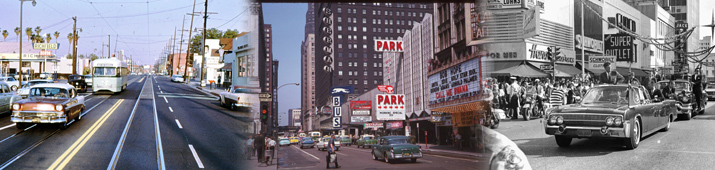
The Three Failed Plots to Kill JFK, Part 2
Case linkage and patsy casting for regime change operations
Case linkage, also called linkage analysis or comparative case analysis, is an offender profiling process that helps crime investigators determine whether a series of crimes were committed by the same offender.
The Warren Commission and the investigative agencies at their service never performed this type of standard research for the JFK assassination.
In The Three Failed Plots to Kill JFK: The Historians’ Guide on how to Research his Assassination published in 2016, I did some data mining from the works of reputable authors and original source documents (mostly from the Mary Ferrell Foundation) which centered on three previous plots (L.A., Chicago and Tampa) to assassinate JFK within the six months that preceded the murder and six potential patsies (Vaughn Marlowe, Richard Case Nagell, Thomas Arthur Vallee, Harry Power, Santiago Garriga and Policarpo Lopez). (Before reading this follow-up, it is strongly recommended that you read the original article by following the above hyperlink.)
What we can conclude from this analysis is that the peculiarities that one can find in their personas, associations and actions is hardly a haphazard collection of traits and behaviors. I have argued that there is a ZR/Rifle (CIA Executive Action) signature at play that points the finger straight at its signatories and the reliable executors of this regime-change M.O., namely: David Atlee Phillips, William Harvey, David Morales and their long established network of assassins and frame-up artists which includes Mafiosi and Cuban exiles.
Crucial to this line of inquiry will be the use of data visualization which will play a determining role in a summation phase of our quest to correct history book and mainstream media falsities in their accounts of November 22, 1963.
In this article, we will push the analysis even further by covering a fourth failed plot, add some information about one of the potential patsies already profiled, and add two more to our already impressive list. We will begin, however by discussing how the use of data visualization should be considered more often by authors in order to help synthesize this complex case.
Numerical data may be encoded using dots, lines, or bars, to visually communicate a quantitative message. Effective visualization helps users analyze and reason about data and evidence. It makes complex data more accessible, understandable and usable. (Wikipedia)
In Oswald’s Intelligence Connections: How Richard Schweiker clashes with Fake History, I chronicle some 64 characters (soon to be updated to over 75) that Oswald had touch points with that either certainly (over 30) or plausibly had intelligence connections. They were fluffed off by the Warren Commission instead of being mapped out in a diagram and analyzed for who they really were and who they linked up with—exactly what the Mueller Probe is doing for anyone with a direct or indirect relation with the Trump camp.
In my CIA and Mafia’s “Cuban-American mechanism” article, the chart below is used to showcase Santo Trafficante’s links with CIA, Mafia and Cuban exile persons of interest. Of particular interest are the persons with their names in red: No fewer than six for certain and two plausibly are directly involved in the Oswald set-up, murder or cover story and also are connected to Trafficante. The Trafficante, Roselli, Harvey, Morales, and Robertson links should also stimulate a lot of research:
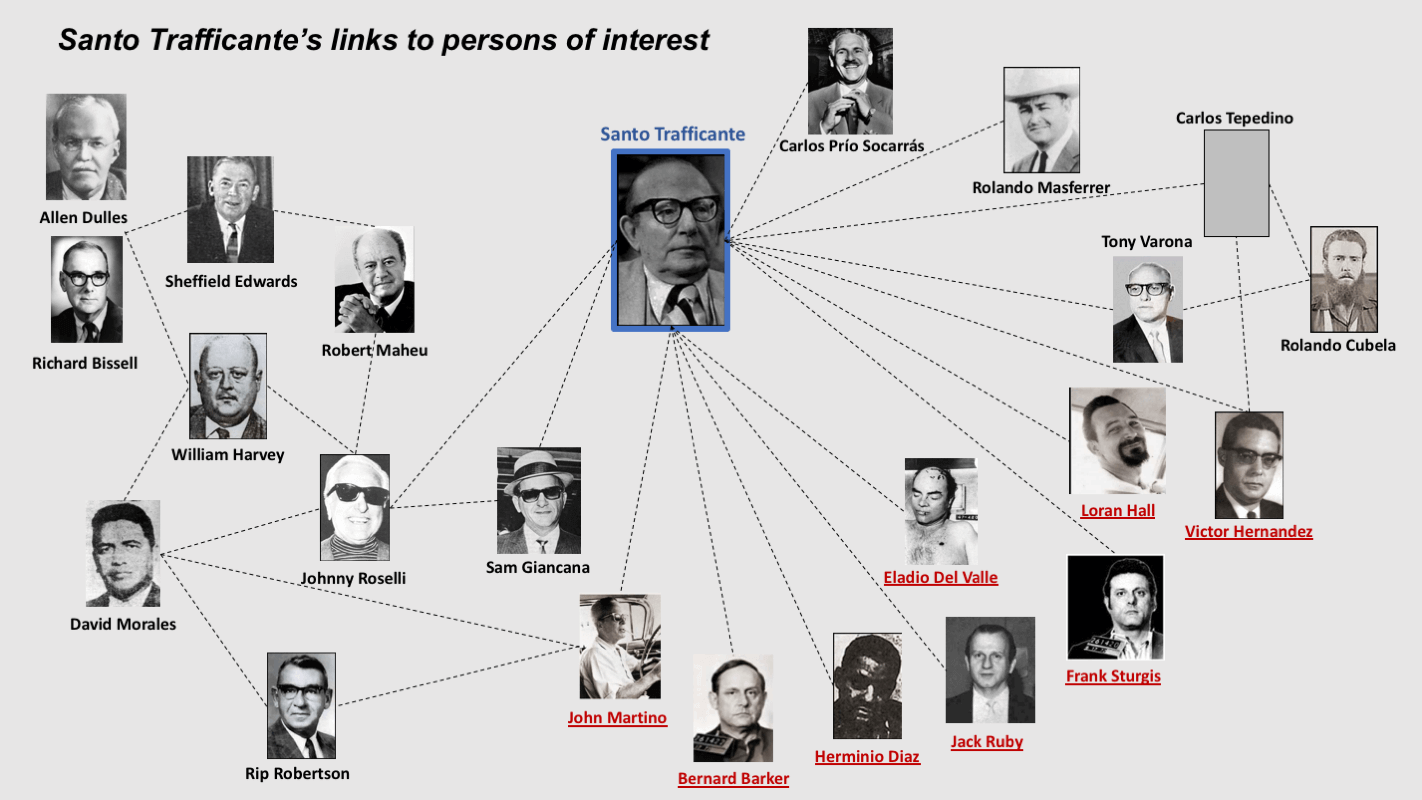
Also in this article, readers can inspect a table that singles out David Atlee Phillips as a person of extreme interest.
In all, Oswald and Phillips shared 23 touch points—20 of which took place within the year in and around the assassination. It is simply impossible to ignore this number of connections between a CIA officer and a lone drifter!
The Phantom Plot in Nashville, May 1963
After reading the Previous Plots article, researcher Frank Cassano sent me information about another plot that failed in Nashville which had been covered by Bill Adams in 1993 for The Fourth Decade:
Synopsis of Assassination Attempt Against JFK, May 18, 1963, in Nashville TN
A few years ago I began looking into other assassination sites as well as other potential assassins and potential patsies. I was able to track a potential JFK assassin to the general area (Knoxville, TN) of a planned JFK motorcade in May of 1963. The trip was altered prior to the actual day of the trip and JFK instead made a visit to Nashville, TN. His visit, on May 18, 1963, included several motorcades.
In early 1992 I was shocked to see a tabloid print a story about an assassination attempt against JFK during the Nashville trip! Congressman Bob Clement of Tennessee had made a startling revelation. He said his father, the late Gov. Frank Clement (governor of Tennessee in 1963) told him of a strange incident while JFK awaited a helicopter after visiting the Governor. The tabloid quoted Congressman Bob Clement of Tennessee as stating, “While the President waited for the helicopter, a man approached with a gun hidden underneath a sack. Secret Service agents spotted him and grabbed him”.
I called and interviewed the congressman in the early summer of 1963. I also obtained actual Nashville news stories about the congressman’s revelation in January of 1992. As a result of reading the news stories and talking to Congressman Clement, I have been able to piece together the following story:
President Kennedy arrived in Nashville on May 18, 1963. He rode in a motorcade to Vanderbilt University where he gave a speech outside in the football stadium. JFK left the stadium in another motorcade and drove to the governor’s mansion. Somewhere between the Governor’s mansion and the helicopter landing site at Overton High School, a man approached JFK with a handgun under a sack. It is unclear whether JFK was in his limousine or not at the time. The governor witnessed this event and the subsequent capture of the suspect by the Secret Service. The man was held at the High School for some time. Nothing more is known about the man. The Secret Service asked the governor to keep the event out of the press for fear it would lead to more assassination attempts.
I have also found some writings about a gun found in a paper bag in the vicinity of Dealey Plaza, however the foundation for this aspect of the story is not solid.
While this failed plot is by far the thinnest of the four looked into, it is worth noting for the following reasons:
- As with the Chicago plot, a suspect was picked up and released without any trace: no names, fingerprints, photos, reports, etc.
- The Nashville attempt, as was the case for all of the other failed plots, was revisited by neither the Secret Service nor the FBI after the JFK assassination.
- The Secret Service once again took steps to keep media from publicizing it.
- None of the four failed plots were known to the Warren Commission.
Over and above underscoring this pattern of secrecy, it may be worth pursuing whether or not there are still files or witnesses that could shed light on the incident and the suspect. Who were the arresting agents? Are they alive? What can we learn about this suspect? Was he also communist leaning? Was he linked to the FPCC? Did he have Cuban contacts? Why was he let go? Was he at least placed on an FBI watch list? Perhaps an FOIA request would be in order.
More on Harry Power
In the “Three Previous Plots” article, the alternate patsy that had the skimpiest profile was Harry Power. Other snippets of information about him have since surfaced.
Here is how Harry Power was originally covered:
San Antonio, November 21, 1963
Because of the code of omertà surrounding the JFK assassination, Harry Power’s story is perhaps the sketchiest of the potential scapegoat cases we will have discussed. But since no stone should be left unturned when investigating a murder, especially a president’s, it is worth identifying and earmarking for more analysis.
Harry Power was yet another ex-marine who checked in to a Terre Haute House Hotel room in Indiana on November 25, 1963 with a long package. When he checked out, he left behind a rifle … a Mannlicher-Carcanno, according to a retired Chief of Police Frank Riddle … a Mauser, according another unidentified source.
A United States Government Memo in 1967 describes the allegation. Riddle claimed San Antonio authorities informed him that Power was a member of the Young Communist League and an expert rifle marksman. An ex-co-worker described him as anti-Kennedy. He had held a job in San Antonio Texas in 1962.
Riddle stated that all information had been turned over to the Warren Commission and that the rifle was taken by Secret Service agents. The Secret Service claimed to have only found out about this incident in 1965. Their key source is none other than the head of the Washington Secret Service, Chief Rowley himself, who you will recall played a key role in keeping the Chicago plot as secret as possible. The FBI did confirm, however, that the Terre Haute Police department had in fact followed up on this lead around when Riddle claimed it happened … which would indicate further Secret Service and Warren Commission complacency.
According to Dick Russell, Richard Nagell told Jim Garrison that Power was a Trotskyite who had met Oswald.
Given that JFK motorcaded in San Antonio on November 21 and that Power could easily be linked to that city, it is not a major leap to see similarities between Power, Oswald and the other scapegoat candidates that seem to have been lined up before the assassination. [slightly edited]
The Indiana Rifle story had received little interest until journalist Sheldon Inkol researched it in 1993 (The Third Decade, Volume 9, Issue 5: “The Indiana Rifle,” by Sheldon Inkol) and updated his findings in 1995 for The Fourth Decade. From his research and FBI file 62-109060 JFK HQ, we can now add the following points:
- The rifle found in Indiana was most likely a Mauser and not a Mannlicher-Carcanno.
- Because of an NSF check written by Power, we know that at one time he was in New Orleans.
- An ex-co-worker of Power’s who was the witness Riddle referred to was Roger Dresch, who also stated that Power was a hunter who sighted a rifle with a scope at a shooting range, that he had been a paratrooper who complained about his father being an alcoholic, and who occasionally talked about becoming a hermit in the wilderness.
According to Inkol, it is Dick Russell who first revealed the name of Harry Power in The Man Who Knew Too Much in 1992. There had been only small articles about the incident before this. Inkol credits veteran researcher Larry Haapanen, who interviewed Riddle, for having confirmed the name of Power after following up on an article in 1970.
Dick Russell provided the following to the Harry Power profile:
A National Archives document about the affair was declassified in 1970 … a file reports that Power had been investigated in connection with the shooting attempt on General Walker in Dallas, a shooting that the WC falsely claimed to have been by Oswald and his Mannlicher-Carcano. Other files associated with the Power rifle claim that it was a 7.65 Mauser. CIA agent Richard Nagell told Garrison investigators in 1967 that Power was a Maoist or Trotskyite and “had known Lee Harvey Oswald and had been seen with him …”
Inkol adds the following points, based on police investigations:
- There were no fingerprints on the Mauser.
- Indiana Police indicated that the hotel where the rifle was found was right across from the Democratic and Republican headquarters.
- According to Riddle, the FBI tried to link Power’s presence to a political rally going on the night before in proximity to the Terre Haute hotel.
- The editor of the Indianapolis News and the NRA, who had found out about the incident, were asked to keep it silent by authorities.
- Power seemed to have a troubled marriage.
- He had financial difficulties.
- He was described as a “Smart Aleck”, “Trouble Maker” and person with a warped outlook on life.
- He had failed at one point to get a driver’s license.
- He may have been from Chicago.
According to Inkol, Frank Riddle insisted that Power was a suspect in the attempt on General Walker’s life the previous April—something the Warren Commission tagged on Oswald. In 1964, Secret Service Chief James Rowley confirmed to Riddle that the FBI and the Secret Service had files on Power.
Inkol tempers Riddle as a source as he points out that some have qualified him as a “blow-hard”.
Inkol is not convinced that Power was even in the hotel. He argues that the description given (age, height and weight) of the person with the rifle in the hotel is very different from the San Antonio description of Power.
He believes that one possibility that merits further investigation is that he was being set up as an alternate patsy or part of a subversive pro-communist group intent on attacking the U.S. Government—who could have been pinned as the shooter from the knoll if a front shot had to be admitted to.
He also points out that had the assassination taken place in San Antonio where Kennedy motorcaded a day earlier, the patsy might have been Power instead of Oswald.
Inkol ends the first article with a fleeting comment about the Indiana rifle being perhaps linked to a seventh potential patsy according to David Lifton who twice interviewed the next subject we will discuss, but revealed very little to Inkol about him. I decided to contact Lifton to follow up on this tantalizing clue about yet another alternate scapegoat (not to be confused with the famous astronaut), who even without a link to the rifle is, in terms of his profile, an Oswald dead ringer!
John Glenn
Unlike most of the other potential fall guys that figure in this analysis, the case of John Glenn and his wife Marcia is quite well documented. This, however, has nothing to do with the FBI, CIA, or Warren Commission’s efforts to scrutinize this Oswald semi-replica.
According to the WC, Oswald opening an FPCC chapter in New Orleans was a demonstration of his ego trip … period! Fortunately for researchers, the FPCC was under intensive scrutiny by the Internal Security Subcommittee of the Senate Judiciary Committee and the House Un-American Activities Committee (HUAC).
Through their reports and the writings in 1993 of Jerry Rose (The Third Decade, “Red Summer of ‘63”), we can paint a better picture of Glenn and the role the FPCC came to play in making our cast of puppets easy to frame for the crime of the century.
The FPCC was characterised as “Castro’s Network in the USA” by the HUAC. Membership within this anti-U.S. organization was described during hearings as an effective door-opener to enter Cuba via the Cuban Embassy in Mexico City and Cubana Airlines.
Though the HUAC had been seriously rattled by the McCarthy era witch-hunts, Castro was breathing some new life into this outfit for political showcasing of American patriotism.
One area that got their attention was the travel to Cuba by American students despite a travel ban. On June 25, 1963, 58 students left New York and transited through Russia satellite Czechoslovakia on the way to Cuba where they were apparently well received by the Castro regime. This group had been infiltrated by an informant named Barry Hoffman who had gotten approval from agencies that were tied to the FBI, CIA, and State Department. During hearings in September of 1963, he painted the students as pro-Cuba and anti-U.S.A. and talked about rumors that Cuba had not dismantled the nuclear installations on the island.
Evidently, he was a poor spy who was not trusted by the other students. He was “number 3 on their fink list”. Numbers 1 and 2 were John Glenn and his wife Marcia.
On November 18, 1963—four days before JFK’s assassination, the Glenns’ testimony before the HUAC had the effect of smearing the FPCC. Transcripts of the hearings point out striking similarities with Oswald:
John Glenn joined the U.S. Air force in 1950.
While in the service, Glenn received training in the Russian language at Syracuse University and became a Russian linguist for Air Force Intelligence, with security clearance for secret, top secret, and cryptographic information. Meanwhile, he continued his regular college studies through night school and correspondence courses. Glenn, while still receiving regular military service pay, including food and housing allowances, returned to full-time studies at the Indiana University where he obtained a degree in business administration in January 1954.
He then resumed active duty with Air Force Intelligence for 2 more years, including 16 months overseas, before being discharged in January 1956, after reaching the rank of staff sergeant.
During the summer of 1958, he visited the Soviet Union, Czechoslovakia, and Poland for about 40 days as a guide for the Tom Maupintour Associates, an American travel agency. The next summer he toured the same countries, plus Yugoslavia and Rumania, in a similar capacity for another travel organization.
The witness confirmed information obtained through an investigation by the Committee on Un-American Activities that he had traveled to Mexico in the spring of 1962 in an attempt to get a Cuban visa. He was unsuccessful.
It was at about this time, the fall of 1962, Glenn told the subcommittee, that he joined the Fair Play for Cuba Committee. He had been a sympathizer of the group much earlier, he said. He admitted having written a letter printed in an Indiana University publication, dated February 10, 1962, in which he said that “the people in Fair Play are willing to argue to anyone who will listen that our government and our press are lying through their teeth [about Cuba].”
The witness admitted that, without having applied for U.S. validation, he traveled to Cuba with the group of alleged students who departed from New York on a BOAC plane on June 25, 1963. Glenn acknowledged the accuracy of the subcommittee’s information that on the return trip, after arriving in Spain with the main body of U.S. “students” on August 26, 1963, he left the group and traveled to Morocco. He said that after he and his wife had learned they could stay abroad for a while, they had decided to travel to Algeria to observe the political developments there, which were supposed to be similar to what they had witnessed in Cuba.
When the Glenns arrived in Morocco from Spain, the witness testified, they received an entry permit to Algeria from the Algerian Government. While hitchhiking their way to Algeria, however, they were arrested by the Moroccan police and ordered deported to Spain as undesirables. He said he learned from both the American consul in Rabat, Morocco, and the Moroccan police that the deportation was ordered by the United States Government.
On October 15, 1963, according to investigation by the Committee on Un-American Activities, Glenn reported to the American Embassy in Madrid, Spain, that he and his wife did not have a ticket for return transportation to the United States. The embassy purchased a ticket for them, and they were flown to the United States on an Iberian Air Lines plane.
Their landlord testified that the Glenns possessed communist literature, including The Militant, which Oswald also subscribed to, that connected them to the Socialist Worker Party and its affiliate YSA.
In his article, Jerry Rose speculates that “given the possibility that Glenn was connected somehow with a rifle in Indiana which was believed to be related to the assassination, it is possible as well that Glenn, like Oswald, was being groomed as pro-communist patsy if Oswald for any reason did not work out in the role.” Rose advances that Glenn’s forced return and appearance before the HUAC suggest (but do not prove) control from high places … an interpretation he felt at the time that was worth pursuing.
David Lifton
When I first reached out to David Lifton through some of my contacts who know him, I was a bit apprehensive. But after some email exchanges, David Lifton generously shared some of his observations.
Here are the preliminary questions I sent David:
- Can you summarize when the interviews took place, where, how long they lasted, who was present?
- What led you to want to interview Glenn in the first place and how did you set them up?
- What were the topics covered and what were the main things he had to say and that you observed?
- Glenn’s learning of the Russian language, links to the FPCC, the way he entered Morocco and came back. Some point out the similarities to Oswald and the fingerprints of intelligence—what did your interviews (and other research) bring out in this area?
- Inkol mentions that you said that Glenn had a link to the Indiana Rifle (which is the one that links to William Power I believe). Can you discuss this?
- Do you think Glenn was being set up as a potential patsy?—please explain.
- You mentioned you knew about William Power. How? and if you do read my article, you will see that what I have on him is quite thin (I have found a few more bits of information that I will add). If there is anything you can add I would be most grateful.
Without going into details, David’s preamble to answering my questions deals with how the passage of time and moving his office unfortunately cloud his recollection of his meetings with Glenn. What follows here are his responses:
So… that having been said, and based on current recollection.
RESPONSE TO Q1-3: Glenn’s name came up in connection with my embarking on a comprehensive search of all print (i.e., newspaper) coverage of the JFK assassination, using a set of microfilms I purchased from University Microfilms in Ann Arbor, Michigan.
I believe that it was the San Antonio papers—either the San Antonio Light, or the News—Express (there were only two San Antonio papers) —that carried stories about what happened on 11/21/63. About a “mystery car” parked at a curb, and some remarks made by one of the occupants of that car, to the effect that “He’ll never get through this city.” Something like that. That led to the San Antonio Police dispatcher putting out a call for that vehicle to “call in to your headquarters” or some such thing. Then, 24-36 hours later, after JFK was assassinated in Dallas, this incident (call it the “San Antonio incident”) then resulted in significant “follow-up” coverage, and that led to the name John Glenn and the story of the San Antonio rifle, linked to the Indiana (Bloomington, IN, I think) rifle.
Anyway, I clipped those stories, then obtained the House (or Senate? not sure) hearings that took place on or about Nov 18, 1963, at which Glenn testified, as I recall.
With that as background, I then sought contact with Glenn, who—I somehow learned—lived in Venice, California.
My first meeting with Glenn was at the UCLA Student Union. What I remember is that it was dark outside, and the SU cafeteria was crowded, and that was how I met him.
I questioned him closely and established—to my satisfaction (again, “as I presently recall”) —that he did not fit the profile of an “alternate” patsy because there was no evidence whatsoever that there was any third party in his life influencing where he was living, or what he was doing, or asking him to do anything.
Of course, I was disappointed in the result, but that’s what I found.
Subsequently, when Robert Sam Anson (who I came to know) was writing about the JFK assassination (for Esquire, I think), he wanted to follow-up on this. Again, as I recall. And, again, as I recall, the two of us actually went to John Glenn’s Venice apartment and spoke with him.
I do not remember the details at all. What I do remember is being in John Glenn’s apartment, and having the sense that he was “just like Oswald,” something like that. I believe I had that sense because he had either a poster of, or paraphernalia connected with, The Militant. Again, I don’t remember. What I do remember is the UCLA Student Union “first meeting” and my sense of disappointment that my
hypothesis wasn’t panning out.
RESPONSE to Q4: See answer to Question 1. FYI: I kept a very imperfect “journal” of my daily work; and I would often write letters home, but I don’t believe they would have contained any relevant information.
Anyway, that material is stored “elsewhere.”
RESPONSE to Q5: I believe that the “primary source” for these “links” comes from the San Antonio newspaper coverage—again, I was using microfilmed records of the S A Light and/or News Express for the period 11/20 —11/25/1963.
RESPONSE to Q6: That was my hypothesis, but what I remember is being (very) disappointed that my questioning of him failed to unearth any supporting data. (Could he have been deceiving me? I suppose he “could have,” but I’m pretty confident that I was not being fooled, and that he was who he “appeared to be.”)
RESPONSE to Q7:
- Please send me the link to your article (or anything else you wish me to read) again. I’m not sufficiently “organized” to lay my hands on it at this moment.
- As I recall, it all stemmed from my work with the microfilmed records of the two San Antonio newspapers.
Also, and this may be of interest to you—or maybe not—I think that some of this “San Antonio” stuff may have been covered in the Dallas Morning News in the day or two after JFK was assassinated.
David followed up shortly after with this following point:
P.S. What I forgot to mention in my memo …
That the San Antonio newspaper (one of them) reported after the assassination of JFK on Friday 11/22/63, that the “mystery car” was a Secret Service vehicle.
And that’s what made the whole incident so very important.
Harry Dean
Harry Dean is one of those characters I put into the category of unreliable witnesses who may have important knowledge, but that have made many statements that are easily contestable and that have had researchers chasing their tails. Unfortunately, in the JFK assassination soap opera—we are faced with a whole slew of personalities who mislead yet can sometimes be decoded to a certain degree. Frank Sturgis and Gerry Patrick Hemming come to mind, as they along with others tried to send HSCA investigator Gaeton Fonzi and other researchers on wild goose chases. They nevertheless give us a better picture of the decadent setting Oswald immersed himself in.
When dealing with such characters, without fully dismissing them, it is prudent not to waste much time on them and only go with what can be corroborated.
Before reading some of Dean’s forum posts, I looked at what other researchers had to say about him.
For over 50 years, Dean made claims in letters and forums that he had been recruited, selected, and led by American Intelligence forces to take on special missions such as spying on Castro while in Cuba, the John Birch Society, and the Fair Play for Cuba Committee. Only in 2017 would he finally admit that he was not an official FBI informant.
In a 2005 post on The Education Forum, he came up with the following claim:
But among the widespread ‘rightist’ movement were assassin-minded persons that would take action to aid in seizing control of the U.S. government if only given the word.
Even being tight-knit with the individuals involved, except for bits and pieces of confusing information I failed to timely detect a clearer picture of the real and more subtle plot to kill the president … the plan move relentlessly … but a ‘need-to-know’ method of secrecy was being applied among my radical associates.
When the name of a Fair Play For Cuba Committee communist was broadcast throughout the rightist circuit after the airing of an August, 1963 radio program from Station WDSU, New Orleans, Louisiana, Lee Oswald was ‘selected’ by another of our {JBS} associates, retired U.S. Army General E.A. Walker of Dallas, Texas.
The subject was chosen by ‘Guy” Gabaldon as ‘the fall guy’ in the secretive plot against Kennedy. None of us objected, and found it humorous to frame a communist. I quietly considered it as goofy as the weird, but hazy, arrangements to kill the president.
When Kennedy visited Mexico City in late June of 1962, Gabaldon, in league with some rightist Mexican Federal Police Officials, was set to shoot president Kennedy. Only a last minute escape problem aborted that assassination scheme … Two other of our associates … Lawrence John Howard—aka Alonzo Escruido, and Loran Eugene ‘Skip’ Hall—aka Lorenzo Pacillo, were dispatched by Gabaldon to enlist Oswald in {a phony CIA, Central Intelligence Agency set-up} at Gabaldon’s Mexico City area office.
General Walker did not orchestrate the assassination, nor the framing of Oswald! Nor did the Mafia, the Cuban exiles, Birchers, etc. Walker could not have organized the weakening of security, the botched autopsy, the Mexico City Oswald imposter episode, the Warren Commission failures, the propaganda offensives. The framing of Oswald began before he left Dallas for New Orleans.
This goes a long way in explaining why some have suggested that I not include Dean in a comparative analysis of potential patsies.
However, when researching the documentary trail about Harry Dean on the Mary Ferrell site, as well as on forums and websites (see: https://sites.google.com/site/xrt013/harrydean) that provide an in-depth analysis of Dean’s statements and pertinent documents—we can nevertheless find information about the FPCC, Dean himself and other characters that seem to be part of a model:
A 1962 Los Angeles FBI File reveals the following about Dean:
LAX advised Chicago FBI office about phone conversation which Harry had with SA William J. McCauley. During that phone conversation, Harry “confided that he had been an informant for the Chicago Office, having been a Secretary of the Chicago chapter of the FPCC, but that largely because his wife had become very upset over his activities on behalf of the FBI, he had discontinued his informant activities and had come to the LAX area about one year ago, and is now employed as a plasterer operating out of the Union Office on Vermont Avenue, Los Angeles. He added that he has, since his arrival in Los Angeles, had casual contact with Edgar and Marjorie Swabeck, whom he had previously known in the Chicago area, and from them has learned that Marjorie Swabeck is secretary of the LAX chapter of the FPCC at the present time. He said that he otherwise has taken no particular interest in the FPCC, and that while he himself is personally not averse to resuming informant activities in behalf of the FBI, he hesitates to do so because of his wife’s feeling in the matter. The Chicago Office is requested to verify and furnish a brief summary of the subject’s background, particularly his activities as an informant and his reliability while known to the Chicago office.”
Another L.A. 1962 FBI file goes on further:
SAC Chicago to SAC LAX
Dean first called the Chicago Office in August, 1960, to report that he had been elected Recording Secretary, Chicago Chapter, FPCC. He did not divulge his name and address at this time. Later in the same month he called this office, stating his name and advising he was residing at 1540 Central Avenue, Whiting, Indiana, and that he owned his own business, the Whiting Plastering Company. He told of his connections with the FPCC, furnished information concerning the leadership of this organization, and said he would be amenable to an interview with an agent of the FBI.
The Indianapolis Office conducted an inquiry in Whiting, Indiana, in September 1960. Detective Captain Edward Grabovac, Whiting, Indiana Police Department, advised that Dean, whose real name he believed to be Gordon Hunt and who had used the name George R. Baker, had skipped town and the Whiting PD had a warrant for his arrest on bad check charges. Grabovac said Dean was a self-employed plasterer.
The Whiting, Indiana PD procured an identification record from the Detroit, Michigan PD under FBI #4657880. This record revealed that Dean had been committed as a mental patient in Canada in 1948 and was sentenced at Chatham, Ontario, for breaking and entering to ‘one year indefinite’. At this time, Dean had one arrest by the Detroit PD for disturbing a religious meeting and two arrests for using indecent and obscene language.
He was also AWOL from Fort Knox, Kentucky in 1949. In December 1960, Dean again called this Office to report that he had been residing in Detroit for the past two months. At that time he said he was living in Chicago but he refused to divulge his local address. He continued to telephonically contact this office on several occasions until June 1961.
He furnished information concerning Cuban nationals connected with the 26th of July Movement and on local persons connected with the FPCC. He was last contacted by two agents of the Chicago Office on June 7, 1961, at which time he was told that this office did not desire his assistance. Former CG___-S advised in August 1960, that Dean was a white male, age about 25 (in 1960), stocky build and black hair. While Dean voluntarily furnished info to the Chicago Office over a period of nearly a year, he was never considered a PSI or informant by this Office.
Even though Dean does not seem like a highly prized asset for the FBI, the paper trail on Dean also confirms the following: Dean had been committed as a mental patient in Canada in 1948 and was sentenced at Chatham, Ontario.
An OSI file (NARA Record Number: 104-10404-10041) confirms that Harry Dean was in the U.S. Army in 1945 and then again in 1948 using the name George Robert Baker and that the Office of Naval Intelligence has three files on him. It also states that he had been arrested by the RCMP and the Detroit Police under the Registration Act.
In 1958 he became a member of the 26th of July Movement, a group led by Fidel Castro.
In late 1959 and early 1960 he received three letters from Juan A. Orta, the Director of the Prime Minister’s Office of Cuba.
He visited Cuba in June 1960.
In August, 1960, he had been elected Recording Secretary, Chicago Chapter, FPCC.
He soon after became a voluntary informant to the FBI (who nevertheless considered him a Fruitcake).
In 1961, he moved to Los Angeles, where he had casual contact with Edgar and Marjorie Swabeck, whom he had previously known in the Chicago area, and from them learned that Marjorie Swabeck is secretary of the LAX chapter of the FPCC at the present time. (Which perhaps brought him into the realm of Vaughn Marlowe and Richard Case Nagell).
In 1962 he joined the John Birch Society.
He also claims to have known Larry Howard and Loran Hall whose names come up with respect to the assassination, and he warned the Los Angeles FBI about a plot to murder JFK that emanated from General Walker which was discussed during a John Birch Society meeting where Oswald was identified as the patsy.
In one of his posts Dean states that the Swabecks may have been setting him up. The NARA documents do confirm a relationship that would have begun in 1960 when Harry met Edgar Swabeck during his travels to Cuba. According to Dean they played a role in getting him to set up the Chicago FPCC branch.
By 1961, the Swabecks were now part of an L.A. FPCC chapter when Dean reconnected with them. They tried once again to involve him in the FPCC. It would not be a great leap to conclude that the Swabecks probably knew Vaughn Marlowe.
Edgar Swabeck’s father seems to have been Arne Swabeck, one of the founding members of the Communist Party in the U.S. In the late 1920s, he was expelled from the party as a Trotskyist and worked together with James P. Cannon and other American Trotskyists to create the Socialist Workers Party. Swabeck visited Leon Trotsky in his exile in Turkey in 1933. He made a cameo appearance in the movie Reds. He was also reference person for The Militant, published by the SWP.
It is also worth asking: If the murder had taken place in L.A., would a link to the cast of FPCC characters have also caused the downfall of the SWP which was very close to the FPCC management in L.A.?
Potential patsy analysis: a new perspective
When I completed the first article, I felt we could deduce that the subjects discussed where being actively groomed to become patsies; in other words, that operatives maneuvered easily discarded freelance assets or other malleable figures into assuming weaponized, pro-Castro and/or communist, anti-Kennedy misfit personas, and placed them in the proximity of the kill zone with abundant incriminating evidence. The string-pullers were also fully prepared to pounce with propaganda initiatives to put the blame of the assassination on Castro! While this seems to fit well—admittedly to varying degrees—in the cases of the first seven subjects profiled, the analysis of our two latest characters suggests something similar but with certain caveats.
In the cases of Dean (pending more research) and Glenn, we can state that the credentials are also very suspicious, but that certain elements fit less well the claim that they were being groomed to take the fall: Their FPCC links predate when the winning stratagem was being mapped out, which arguably had its origins no earlier than when the ZR/Rifle (executive action) architect and disgraced CIA officer William Harvey met with mobster John Roselli in late Winter 1963. It was after these meetings that definite attempts on JFK’s life began multiplying and that the subsequent incriminating behavior and travels of Oswald, Nagell, Lopez, Vallee, Power and Garriga were too well timed to be considered mere coincidences.
So how we interpret the profiles of Dean, Glenn, Nagell, and Marlowe with respect to their FPCC links needs to be more nuanced. While we cannot state at this point that they were maneuvered into joining the FPCC in order to be groomed as patsies, their connections to this organization, which was being heavily infiltrated by intelligence, when combined with their other traits, are nevertheless very telling and more in line with the role of informants who had patsy credentials. Some of the other subjects required fine-tuning of their personas and logistical maneuvering in the months leading up to the hit. The analysis of all the candidates on the short list bolsters the case that a cash-strapped Oswald did not leave his young daughter and pregnant wife in the lurch so he could pursue his ideological dream of opening an FPCC chapter in one of the most hostile places imaginable towards this dwindling organization.
Senator Richard Schweiker of the Church Committee famously stated that the fingerprints of intelligence were all over Oswald. As we can see in the updated chart, Oswald has company!
- Eight of the nine subjects profiled are connected to cities visited by Kennedy during the six months that preceded his assassination.
- Each of these cities were territories exploited criminally by Mafiosi of interest in the assassination.
- At least three moved to the cities and got employment in strategically located buildings along the motorcade route shortly before the planned presidential visit.
- Seven were ex-military.
- Eight of them exhibited behavior that can very plausibly be linked to intelligence gathering or Cuban exile interaction.
- Seven were directly linked to the FPCC. Seven of them had visited Mexico City.
- Six attempted to visit Cuba, three of them successfully.
- Seven had links to Cuban/Latino exiles.
- Six were described as having psychological problems.
- Seven exhibited anti-Kennedy behavior.
- None were probed seriously by the Warren Commission.
- Intelligence services, notably the Secret Service, kept crucial information about these subjects as well as the prior plots totally secret from the Warren Commission.
Potential alternative patsy comparison chart

More on the FPCC
In the original article, much was written to underscore just how unlikely it would be for the subjects analyzed to be involved in 1963 with a dying FPCC. The timing was not right, their profiles contrast with the students and intellectuals who were most ideologically attracted to this outfit before the missile crisis, and the opening of chapters in hostile locations like New Orleans and Miami in 1963 can simply be described as mindless … unless, of course, other stratagems were at play: perhaps its infiltration by informants, which was rampant by then, and patsy grooming ploys.
It stands to reason that the persons in a position to lead the infiltrators and monitor their movements deserve our utmost attention and that the FPCC should be turned upside down by the research community, because when Oswald joined the failing FPCC, he was most likely on a mission.
In this respect, John Newman’s research into the FPCC infiltration and David Atlee Phillips’ role is worth noting. From his 2013 countercoup article here are some key points:
- In early 1961, eleven weeks before the Bay of Pigs invasion, the CIA seized an opportunity to become more actively involved in running operations against the FPCC. CIA Security Office and Western Hemisphere elements identified an Agency employee who knew Court Wood, an American student just returned from Cuba under the sponsorship of the FPCC. This opportunity to surveil Court Wood, which developed at the end of January, was irresistible in the judgment of the person in the CIA’s Security Research Service (SRS) of the Security Office who conceived and authorized the operation. That person was James McCord, the same James McCord who would later become embroiled in the (Watergate) scandal during the Nixon Presidency.
- It is fitting that one of the Agency’s legendary disinformation artists, David Atlee Phillips, should have been in charge of the CIA’s CI and propaganda effort against the FPCC. Phillips would reappear in Mexico City at the time Oswald visited there, taking over the anti-Castro operations of the CIA station in Mexico City during the very days that CIA headquarters and the CIA Mexico City station exchanged cables on Oswald’s visit to the Mexican capital.
- “At the request of Mr. David Phillips” wrote the fortunate CIA employee picked to spy on his neighbor, “I spent the evening of January 6 with Court Wood, a student who has recently returned from a three-week stay in Cuba under the sponsorship of the Fair Play for Cuba Committee.” The employee said that Court and his father both were pro-Castro and “extremely critical” of American foreign policy. “I’ve been advised by Mr. Phillips to continue my relationship with Mr. Wood and I will keep your office informed of each subsequent visit.”
- What the operation tells us is that, by 1960, CIA was sufficiently interested in countering the FPCC to engage in an illegal domestic operation. The fact that controversy would follow the two men in charge, McCord in connection with Watergate and Phillips in connection with the Kennedy assassination, cause this page in CIA’s anti-Castro operations to stand out in hindsight.
- We have in the past utilized techniques with respect to countering activities of mentioned [FPCC] organization in the U.S. During December 1961, New York prepared an anonymous leaflet which was mailed to select FPCC members throughout the country for the purpose of disrupting FPCC and causing a split between FPCC and Socialist Workers Party (SWP) supporters, which technically was very effective.
- These tactics dramatize the lengths to which the FBI was willing to go to discredit the FPCC, whose chapters in Chicago, Newark, and Miami were infiltrated early on by the Bureau. As we will see in Chapter Sixteen, during Oswald’s tenure with the FPCC, FBI break-ins to their offices were a regular occurrence.
- According to FBI records, on April 21, 1963, Dallas confidential informant “T-2” reported this letter to the FPCC, in which Oswald said he had passed out FPCC pamphlets in Dallas with a placard around his neck reading HANDS OFF CUBA, VIVA FIDEL.
- Whether Oswald had stood on a street corner or not, important undercover FBI assets in New York were in motion against the FPCC during the time or shortly after Oswald wrote the letter. As we already know, the Fair Play for Cuba Committee was the subject for intense FBI and CIA interest and counterintelligence operations. A major FBI Chicago office investigation of the FPCC appeared on March 8, four days before Oswald ordered the rifle from Chicago. This study was transmitted to the CIA.
- By picking such an organization to correspond with and carrying out actions on its behalf, Oswald—by default or by design—had insinuated himself into the gray world of the watchers and the watched.
The SWP
Because of the Socialist Workers Party’s strong links to the FPCC and with at least four of the subjects we have profiled, and because it published The Militant, the newspaper being clutched by Oswald in his infamous backyard photo, it is worth researching this political outfit which was considered subversive by intelligence agencies.
In 2005, its national leader between the early 1960s to the mid 1980s, Barry Sheppard, wrote a political memoir about this organization.
The SWP had its roots in the 1930s and was officially founded in 1938. It quickly became an active supporter of leftist causes and the maligned Labor Movement—a target of Hoover’s FBI. Its existence was marked with volatility and controversy. It was a target of the McCarthy era witch-hunts in the fifties—these flared up again under the actions of the House Un-American Activities Committee in 1960s, when a certain Lee Harvey Oswald and at least three of the alternate patsies decided to join. The SWP also supported The Nation of Islam and later Malcolm X, The Freedom Riders, Algerian Independence, Peace movements—many of the issues Kennedy haters were boiling mad about!
It was an enthusiastic supporter of the Castro revolution:
Reflecting our own growing confidence in the revolutionary leadership, The Militant began to carry speeches by Castro and other Cuban leaders, which were among the best popular explanations of what the revolution was doing. In one of the first speeches we published, Fidel explained that the US-inspired counter-revolutionary fronts would fail because, unlike the guerrillas of the July 26 Movement, they could never build a base in the peasantry with their program of returning the land to the exploiters. Over the next years, others on the US left also came to support the Cuban revolution, but The Militant was always the best and most consistent US source providing truthful news about Cuba and publishing the ideas of the Cuban revolutionaries in their own words.
The SWP was very involved with the FPCC:
We came to be part of the leadership of the FPCC partly as the result of a crisis in the organization. The original FPCC leadership was somewhat timid, and shied away from forthright defense of the revolution as it radicalized. In response, Cuban members of the July 26 Movement living in the US blocked with the SWP and some other militants, and took over the leadership of the Committee. It was while he was staying at the Theresa that Castro met Malcolm X. A few years later, I would interview Malcolm for the Young Socialist in his office at the Theresa. The revolutionary Black nationalist was attracted to the Cuban Revolution from the start and supported it until he was murdered in 1965.
When Castro was refused lodging during his New York U.N. visit in 1960, he received support from the SWP:
Castro declared that the delegation would camp out in Central Park. Berta Green, a member of the SWP who was also the Executive Secretary of the Fair Play for Cuba Committee (FPCC), got in touch with the Hotel Theresa in Harlem, which agreed the Cubans could stay there.
Sheppard’s memoir shows that the SWP was much larger than the FPCC when he describes protest mobilization during the missile crisis in 1962:
We stood up to it. The PC discussed and approved the thrust of a statement to appear in the next issue of The Militant. It ran under the headline, “Stop the Crime Against Cuba!” We alerted SWP branches and YSA chapters that night to mobilize to support the broadest possible actions against the threat. In New York, there were two major demonstrations. One was called by Women Strike for Peace and other peace groups. We joined some 20,000 protesters at the United Nations on this demonstration. Then the Fair Play for Cuba Committee held its own action, more specifically pro-Cuba in tone, of over 1,000 people, also near the UN.
The following points concerning the July 1963 convention cast even more suspicion around the timing and motives of openings of FPCC chapters in the deep south by Santiago Garriga and Oswald and the continued involvement with the FPCC by the other subjects:
At the convention, a meeting of pro-Cuba activists discussed the situation in the Fair Play for Cuba Committee. Cubans living in the United States who supported the July 26 Movement had helped us build the FPCC. Now most of them had returned to Cuba. In most areas, the FPCC had dwindled down to supporters of the SWP and YSA. Since we did not want the FPCC to become a sectarian front group, the meeting decided to stop trying to build it. The FPCC then existed for a while as a paper organization, until the assassination of President John Kennedy dealt it a mortal blow.
Sheppard’s account of the SWP reaction when the Kennedy assassination was announced is noteworthy:
We were listening to the news when the announcement came. I said, “I hope it’s not that nut who tried to join the party, that guy who is a one-man Fair Play for Cuba Committee chapter in New Orleans.” Imagine how I felt when it turned out he was the one charged with the act. The SWP and YSA had received letters from a Lee Harvey Oswald, asking to join. His letters, as I remember them, were politically confused, and the photo that was sent with them was strange. In it, the person who was supposedly Oswald held copies of The Militant and the Communist Party’s Worker. He also sported two or more rifles and hand guns sticking out of his belt. A similar picture appeared on the cover of Life magazine after the assassination. Oswald, it turned out, had posed for similar photographs holding the Communist Party’s paper and the Workers’ World Party’s Workers’ World. One look at the picture and everyone in the leadership of the party and YSA thought we were dealing with a nut or a provocateur. Oswald purchased subscriptions to The Militant and Young Socialist. But no one in our leadership thought we should accept him as a member. In any case, our policy was not to accept at-large members in places where there was no party branch or YSA chapter, for the reason that there was no real way of evaluating the applicant. The press featured Oswald’s connection with the FPCC and speculated that Castro or some unspecified “reds” were behind the assassination. We were a potential target because we were well known as supporters of the Cuban revolution …
… The New York Daily News, attempting to fire up the atmosphere against the left, stated in an editorial: “The fact remains that Oswald was a Marxist and proud of it. The fact remains that the Communist Party continually preaches death to imperialism, capitalism, etc. It is only natural for lamebrains such as Oswald to conclude that this means killing your enemies wherever and whenever you can reach them defenseless. Ideas have consequences.” This was all a pack of lies. As The Militant pointed out a few days later, the editorial was also an attempt to cover up the fanatical hatred that the right wing had for Kennedy, particularly because of the concessions the government was being forced to make to the fight for Black rights. In Dallas during the days before the Kennedy visit, for example, the rightists had posted leaflets displaying a photo of Kennedy and the words: “Wanted for Treason.”
Dan Hardway’s 2016 declaration
HSCA investigative attorneys Dan Hardway and Ed Lopez co-authored a section for the HSCA’s Final Report on the CIA and LHO in Mexico City which remained classified in full until 1996. The draft, after further declassification in 2003, was published by the Mary Ferrell Foundation Press as Oswald, The CIA, And Mexico City: The Lopez-Hardway Report, and shed light on missing/ destroyed tapes and photos, Oswald impersonations, lying CIA officials and peculiar behavior by Oswald or a frame-up artist—all completely fluffed over by the Warren Commission.
In 2016, Dan Hardway prepared a written declaration in a support of a Jefferson Morley Freedom of Information civil action which should really trouble historians who describe JFK conspiracy proponents as flakey opportunists. In his own words, here is who media and historians have chosen to snub:
From July of 1977 until December of 1978, I was employed as a researcher on the staff of the United States House of Representatives Select Committee on Assassinations (HSCA). In that capacity I had a top secret security clearance and, during a major portion of my employment, had access to un-redacted Central Intelligence Agency (CIA) records. My primary area of responsibility in research for the HSCA was the possibility of any relationship of any nature between the CIA and Lee Harvey Oswald (LHO), with special focus on the CIA’s awareness of, and reporting on, LHO’s activities in Mexico City. Implicit in that focus was the issue of whether the evidence from Mexico indicated any operational connection between LHO and the CIA.
My research for the HSCA also covered areas related to people of interest, including David Atlee Phillips and William Harvey, among others, and CIA assassination programs. I was also tasked with research and analysis of the response of the CIA’s Mexico City Station LHO’s trip to Mexico City and to the assassination.
The following are some of the most damning statements made in this very important affidavit:
- Beginning in May of 1978, the CIA assigned George Joannides to handle liaison with Edwin Lopez and me. In the summer of 1978, Mr. Joannides began to change the way file access was handled. We no longer received prompt responses to our requests for files and what we did receive no longer seemed to provide the same complete files that we had been seeing. The obstruction of our efforts by Mr. Joannides escalated over the summer, finally resulting in a refusal to provide unexpurgated access to files in violation of the Memorandum of Understanding previously agreed to by the HSCA and the CIA.
- I did not do any research aimed at George Joannides, or his activities in 1963, because, while working for the HSCA in 1977-1978, I was not informed that he had had any involvement with any aspect of the Kennedy case and I had no basis to even suspect that he had. In researching possible connections between post-assassination stories about LHO and David Atlee Phillips, I did little, if any, research that I recall into the Directorio Revolucionario Estudantil (DRE) because, among other reasons, the CIA had firmly represented to the HSCA that all ties between the DRE and the CIA had been terminated prior to 1963.
- … to review CIA 201 files on many of the individuals who had been sources for stories that appeared in the immediate aftermath of the assassination tying LHO to Castro or the Fair Play for Cuba Committee. I was able to establish that most of the sources of the stories were, or had been, agents or assets used at one time or another by David Atlee Phillips.
- Before our unexpurgated access was cut off by Joannides, I had been able to document links between David Phillips and most of the sources of the disinformation that came out immediately after the assassination about Oswald and his pro-Castro proclivities. I confronted Phillips with those in an interview at our offices on August 24,1978. Phillips was extremely agitated by that line of questioning, but was forced to admit that many of the sources were not only former assets that he had managed, in the late 50’s and early 1960’s, but were also assets whom he was personally managing in the fall of 1963. Mr. Phillips was asked, but could not explain, why the information that came from anti-Castro Cuban groups and individuals pointing to Cuban connections all seemed to come from assets he handled personally, but acknowledged that was the case. Mr. Phillips also acknowledged that back-channel communication methods existed, but denied that any were used in Mexico City.
- We have, since 1978, learned that George Joaimides was running the propaganda shop at the CIA’s Miami JMWAVE Station in 1963. It is extremely unlikely that Mr. Joannides could have occupied that position and not have known, and worked with, David Atlee Phillips. In addition, in 1963, as we now know, George Joannides was the case officer handling the DRE. In 1977 the CIA specifically denied that DRE had a case officer assigned when asked that question by the HSCA.
- One possible inference from the known data, at this point, is that the CIA brought someone out of retirement who knew where to not let us look and he impeded and, eventually, shut down our research. His specific work in regard to my research was commended by his superior in his annual performance review from 1978.
- In addition to being a primary source of stories about LHO in the days after the assassination, the DRE also had a highly visible encounter with LHO in New Orleans in September 1963. George Joannides’ s performance evaluation dated July 31,1963, reports that Joannides has “done an excellent job in the handling of a significant student exile group which hitherto had successfully resisted any important degree of control.”
- David Phillips recruited a group of students in Havana to work against Castro while Phillips was serving under deep cover in Havana in the late 1950s. At the time, the group was known as the Directorio Revolucionario, or DR. Phillips was the DR’s first case officer. When the DR’s leadership fled Cuba in 1960, William Kent, who was very close to Phillips and worked with him, organized them into an effective organization in Florida, known as the Directorio Revolucionario Estudantil, or DRE.
- In August, 1963, LEO had an encounter with DRE representatives in New Orleans. That encounter resulted not only in widespread publicity in New Orleans at the time, including newspaper articles, television coverage and radio interviews, it also resulted in the first reports trying to tie LEO to Castro after the assassination of John Kennedy. DRE released their information the day of the assassination and it was covered in both the Miami Herald and the Washington Post the next day.
- The CIA never told the Warren Commission about their support of, and work with, the DRE in 1963. The CIA never told the Senate Select Committee to Study Governmental Operations with Respect to Intelligence Activities (the “Church Committee”) about it. The Assassinations Record Review Board (ARRB) asked the Agency about DRE. The CIA initially told the ARRB the same thing they told the HSCA: the Agency had no employee in contact with DRE in 1963. The ARRB, however, in examination of Joannides’s CIA personnel file, discovered its clear indication that Joannides was the DRE case officer in 1963.
- In the early 1960’s, David Phillips was working at Headquarters where he, along with Cord Meyer, developed the first disinformation operations aimed at the Fair Play for Cuba Committee.
- To summarize what we now know: the DRE originated as the DR under the tutelage of David Phillips in Havana in the late 1950’s. William Kent took over running the group, now known as the DRE, once they had fled from Havana to Miami. In his position, he was responsible to Phillips. Crozier came in to assist Kent with his workload. Kent and Crozier were not too successful with the hard-to-control group and Richard Helms gave the DRE an officer responsible directly to him, which officer was Joannides. But Joannides’s performance evaluations indicate that his immediate supervisor, prior to October 1963, was Kent. We do not know what working relationship Joannides had with Phillips either directly, or indirectly through Kent. It is unlikely that Phillips did not continue to be involved in, or at least kept apprised of, operations of a group that he had started and nurtured, both directly and indirectly, which continued to be directly active in his primary area of responsibility: anti-Castro propaganda. Indeed, it would be in keeping with what is known if he used that group in operations against the Fair Play for Cuba Committee, or that he continued to be involved in disinformation operations aimed at the group, having designed the first one.
- After David Atlee Phillips testified a second time before the HSCA in Executive Session on April 25,1978, several staff members, myself included, sought to have the Chief Counsel recommend to the Committee that it refer Mr. Phillips to the Justice Department for prosecution for lying to Congress.
- On September 16, 1963, the CIA informed the FBI that it was considering action to counter the activities of the Fair Play for Cuba Committee (FFCC) in foreign countries. In New Orleans, on September 17,1963, Oswald applied for, and received, a Mexican travel visa; on September 27, Oswald arrived in Mexico City. On that day, and the following day, Oswald, or someone impersonating him, may have visited the Cuban Consulate. On those same days, the Mexico City CIA Station was testing an impulse camera in their photo surveillance operation aimed at the door of the Cuban Consulate. Sometime in late September Phillips left Mexico City on a temporary duty assignment at CIA Headquarters. It is at this time that Phillips was promoted to chief of anti-Castro operations in Mexico City—the Cuba desk. On October 1, the Mexico City Station sent bulk materials to Headquarters.
Dan Hardway’s state of mind can be inferred by the open-ended questions he poses near the end of his declaration:
- Were the promotions rewards for a successful disinformation operation aimed at the FPCC in New Orleans, an operation that the Agency thought it could export to Mexico? While TDY, did Phillips meet with Kent at HQ? Did he meet with Joannides in Miami? Did they review the results of a disinformation and “dangle” operation they had just run in Mexico City?—their first attempt to export the successful domestic anti-FPCC disinformation operation? Did they review the production from the impulse camera? Was that camera’s production the “bulk material” in the pouch? We don’t know the answers because the questions were never asked; George Joannides shut down the HSCA investigation into this area before this level of detail could be discovered and connected. Given all this, a reasonable researcher has to ask whether the Oswald visit in Mexico City was part of an intelligence operation that had both counterintelligence and propaganda purposes? It also, in this context, becomes appropriate to ask whether there has been an active cover-up and whether George Joannides’ undercover assignment to work with the HSCA was part of that cover-up.
Hardway’s concluding remarks do not give the impression that he believes that Oswald was simply a drifting malcontent or a pro-Castro ideologue, and that Joannides and Phillips could be counted on for knowing what really happened:
- In regard to the issues of 1963 there would be great public benefit to knowing whether LHO had been involved, wittingly or unwittingly, in an intelligence operation. Even without settlement of that ultimate question, additional information about what George Joannides was doing in 1963, in particular with the DRE in New Orleans, would go a long way to providing insight into that ultimate question. Similarly, being able to explore the relationship between David Atlee Phillips and George Joannides would benefit the public by either confirming or disproving vital aspects of the events of 1963.
Conclusion
Dan Hardway’s declaration is recent, blistering, and completely demolishes the history books’ stenographic claims that Oswald the Lone Nut killed JFK. Hardway underscores many disturbing observations that cannot be explained by mere happenstance. His position is nevertheless soft-pedalled compared to what Schweiker and Gaeton Fonzi have stated. It is now possible to go a lot farther in our deductions.
Case comparison analysis of the potential patsies and prior plots to assassinate JFK would bring investigators to study common traits, behavior patterns, entity links, chronological sequences in order to develop a profile of the offenders. The perpetrators in this case were able to:
- recruit dreamy, malleable ex-marines or Cuban exiles who were drawn to the world of espionage;
- have access to a network of Mafiosi and Cuban exiles who shared regime change objectives and could work in proximity with the potential patsies while providing layers of separation for the decision-makers;
- use propaganda to create pro-Castro, anti-Kennedy, misfit, violent, and dangerous personas;
- lead the subjects into joining left-wing, subversive organizations, visiting Mexico City, and trying to enter Cuba;
- move some of them near the kill zones and cause them to behave suspiciously in visible, controversial, and timely manners;
- ensure a weak investigation and keep incriminating evidence secret;
- place the blame on communists or Castro himself with the help from friends in the media.
Only a select few had the means to carry all this out.
They wrote up the technique in a playbook called “ZR/Rifle” and applied it, or versions of it, a number of times in foreign countries. Some of them hated Kennedy so much that it is quite plausible that they went rogue. A few of them even admitted the existence of a conspiracy, their involvement, or their knowledge of it.
William Harvey’s links with other CIA persons of interest, Johnny Roselli and Santo Trafficante and their network of Mafiosi, Jack Ruby and Cuban exiles who hovered around Oswald during the last months of his life, his links to the FPCC infiltration programs, travel to Dallas shortly before the assassination and role in ZR/Rifle tactics qualify him as a person of extreme interest in the coup.
Visual data shows how David Atlee Phillips’ universe overlaps with Oswald’s through over 20 common touch points involving Cuban exiles, propaganda tools, the FPCC, Mexico City, Oswald babysitters, etc. Case linkage shows that no fewer than six of the eight alternate patsies were also marked as pro-Castro with their bizarre FPCC links, the very organization Phillips was turning inside out in his plots to counter Castro sympathizers. Throw in his lies, quasi-confessions, and his being thrown under the bus by colleague E.H. Hunt, and we have a strong case to make about who some of the leading plotters were.
If we accept that these are some the fingerprints of intelligence that Richard Schweiker referred to, the offender profile suggests quite strongly that at least a few of the fingers the prints came from belonged to David Atlee Phillips and William Harvey! In the late 1970s, after the HSCA asked the Justice Department to re-open the case, these two suspects, and their networks of assassins, operatives and propaganda assets who have been discussed in previous articles, should have been rounded up, and would have been in a normal murder investigation. The fact that this one was presidential seems to have lowered the bar of diligence and motivation. It should still be done posthumously, for the sake of correcting what is related to unsuspecting high-school history students, and of preventing future attacks on a democracy.
The next question we can ask ourselves, is who provided the brains and handled upper management tasks for the Big Event? The entity link diagram and a chronology analysis point so far to a group of like-minded, discarded and/or disgruntled CIA officers who were all loyal to a disgraced Alan Dulles who, after being removed from his functions by the victim, remained committed to his worldviews, well connected and a man on a mission. Stay tuned!
Go to Part 1
-
Jim Garrison: The Beat Goes On
Would Jim Garrison have been forgotten if Oliver Stone had never met the late Ellen Ray? If the reader is unaware of who Ellen Ray was let me inform you of her importance in history. (her obituary)
Ellen Ray was the wife of Bill Schaap. They ran a publishing company called Sheridan Square Press. Sheridan Square did not just release books. They also published magazines like the illustrious Covert Action Information Bulletin and Lies of our Times. If our readers do not know about those two periodicals, it is their loss. The first dealt with the Central Intelligence Agency and its allies; the second was concerned with media analysis. They were well done and important journals.
Ellen Ray had known Jim Garrison a long time—going all the way back to his original investigation of the John Kennedy murder in the late sixties. She always thought highly of him and his work. So when Garrison thought of writing a book on his inquiry in the eighties, Sheridan Square was one of the houses he thought of releasing it through. But before that, Garrison had had an offer from a much bigger publishing house. That deal did not go through since the proofreader the house assigned to the book was Sylvia Meagher. Now as everyone knows, this site is a sincere admirer of Meagher and her fine book, Accessories After the Fact. But as most insiders also realize, Meagher was one of the early critics who developed a phobia—some would call it a mania—about Jim Garrison and his inquiry. (The others would include Josiah Thompson and Paul Hoch.) Even someone like Jerry Policoff, who was a close friend of Meagher, once said that Sylvia should not have been assigned to review Garrison’s book: “My God, she contributed money to Clay Shaw’s defense!”
Well, predictably, Meagher’s analysis contributed to Garrison returning his advance. But that may have been fortunate, because now he turned to Ellen Ray and Sheridan Square Press. They assigned him Zachary Sklar as his editor. Zach was a distinguished journalism professor and contributor to Sheridan’s two publications. It was a fortunate pairing. Originally, Garrison had written his book from a third person point of view. But when he met Zach, the editor convinced him that since the DA was an actual participant in the story he was telling, it would be more effective if he wrote the book as a first person narrative. I think most people today would say that was a good choice.
On the Trail of the Assassins sold about forty thousand copies when it was originally released in hard cover. The thoroughly annotated book revealed many new things about Garrison’s investigation that most outsiders did not know about. It also exhibited Garrison’s firm grasp on the entire evidentiary record of the JFK case and also Kennedy’s place in history. Overall, it was a real contribution to the library of books on the assassination of President Kennedy.
But what happened later was probably even more significant. At a film festival in Havana, Ellen Ray met up with Oliver Stone. She told him words to the effect: “Have I got a book for you!” Stone read Garrison’s book and decided to bring it to the big screen. He did so in December of 1991.
But this was the JFK assassination. And it was Jim Garrison. As the DA noted in his book, there were many media critics of his inquiry. And they struck at him in what can only be called a vicious and personal manner. Some of them hid their relationships with the intelligence community, e.g., James Phelan, Walter Sheridan, and Hugh Aynesworth. Even more buried was the cooperation between these men and Clay Shaw’s lawyers. (See Destiny Betrayed, second edition, chapter 11 for an analysis of this nexus.) That sixties wave of media critics was not going to let Oliver Stone bring back Jim Garrison and the JFK case in any kind of fair or salutary manner. So they decided to do a preemptive strike on Stone’s film.
In what was probably an unprecedented campaign in the history of American cinema, the MSM attacked the film JFK seven months in advance of its release. In fact, Ben Bradlee and the The Washington Post sent George Lardner to Dallas to write a story as the film was being shot in Dealey Plaza.
Lardner’s article began with one of the truly snarky remarks in recent journalistic history. In watching a rehearsal of the Dealey Plaza sequence, Lardner noted that Stone had ordered up five shots in the assassination sequence. The reporter then wrote: “Five shots? Is this the Kennedy assassination or the Charge of the Light Brigade?” Through their acoustical testing, the House Select Committee on Assassinations had concluded that there were four shots fired. But as researcher Donald Thomas revealed at Cyril Wecht’s Duquesne Conference in 2003, those same sound technicians told Chief Counsel Robert Blakey that they detected five shots. Blakey told Thomas that he did not think it was possible to sell that many shots to the committee, so their report only analyzed and accepted four. In other words, this was a political decision, not a scientific one. There is real evidence that there were five shots, but somehow that did not matter to Lardner. After all, it’s the JFK case.
Lardner’s article was the first volley in a seven-month MSM campaign that was intended to make sure that the reception of JFK was jaundiced in advance. Many of the same people who attacked Garrison back in the sixties were brought back to do so again, like Aynesworth and Edward Epstein. The fact that neither of these men was at all credible or objective on the subjects of the Kennedy assassination or Jim Garrison was irrelevant. The goal was to savage the film before it had a fair hearing. That is how radioactive this subject was, even thirty years later.
In spite of this assault, JFK did well at the box office, both at home and abroad. It was nominated for eight Oscars, including Best Picture. But to show the reader just how nutty the anti-JFK crusade was, consider the following. On the eve of the Oscars, an anonymous author bought an ad in the trade journal Variety. The ad asked that no voters cast their ballot for the film as Best Picture. Researcher Rich Goad did some detective work and found out that the ad was paid for by the late Warren Commission counsel David Belin.
Besides bringing the Kennedy assassination back into the limelight, JFK was the main cause for the creation of the Assassination Records Review Board (ARRB). For at the end of the film, Stone added a subtitle revealing that the files of the House Select Committee were being kept secret until the year 2027. This created a sensation in Washington. Tens of thousands of citizens now called their representatives, sent them letters or faxed them in order to do something about this travesty. It worked. The Board was created. It was a unique agency that was made up of private citizens appointed by the president. That agency had a staff that read and researched documents that were now to be declassified. If an intelligence agency objected, that agency had to show why the document should be kept secret. This reversed the previous Freedom of Information Law, which put the burden of proof on the requester, who had to show why it should be declassified. But even today, twenty years after the ARRB closed its doors, the government is still maintaining secrecy over thousands of documents.
That Board has a decidedly mixed record of achievement. But it did do some good work on the Garrison angle of the JFK case. In fact, the Board even went to court with then New Orleans DA Harry Connick to salvage a file cabinet full of documents remaining from the Garrison investigation. After being shown up in the press, Connick resisted turning over the materials. But the Justice Department eventually secured the documents. The Garrison family also turned over thousands of pages that the late DA had in his personal effects.
Garrison had always insisted that, for various reasons, he was never able to reveal most of the evidence he had secured from 1967-69. After authors like William Davy, Joan Mellen and myself went through what the ARRB attained, we had to agree. The Garrison files in the Archives today hold an abundance of utterly fascinating material on a wide array of subjects dealing with many aspects of the JFK case. Does the MSM reveal any of this to the public? Nope. One of the most embarrassing aspects of the three-week binge that the media went on last year in anticipation that the JFK files were finally going to be completely declassified was this: No one chronicled what the ARRB had already released. Which was significant. It was about 2 million pages of material that opened up new vistas on subjects like Rose Cheramie, Kennedy and Vietnam, and the medical evidence in the JFK case. Guests like Larry Sabato, Phil Shenon and Gerald Posner did not want to discuss those topics. Nether did their hosts like NBC stooge on JFK, Rachel Maddow.
It is easy to understand why this would occur. As Upton Sinclair once said: It is hard to make journalists understand something when their paycheck depends on them not understanding it. Contrary to popular belief there is no such thing as a liberal media. In the twentieth century, and up until today, the American media has been controlled by an oligarchical class. Some authors call this class the Eastern Establishment. Some call it the Power Elite. As sociologist Donald Gibson explained in his fine book Battling Wall Street, President Kennedy was not a part of that group. He never joined the Council on Foreign Relations; he did not join any secret societies at Harvard; he didn’t like working intelligence during World War II. He got transferred out to the South Pacific and served with a bunch of Joe Six Pack guys on what were close to suicide missions. As this author demonstrated in the second edition of Destiny Betrayed, both in the Senate and in the White House, Kennedy was opposed to much of what this Power Elite was doing abroad, especially in the Third World. (See Destiny Betrayed, second edition, pp. 21-33) After his death, the progress that he did make in the White House was largely halted, and then reversed. (pp. 367-77) Due in part to the ARRB, we know much more about these changes, especially regarding Indochina.
Jim Garrison was probably the first critic of the Warren Commission who understood this matter. And it is probably one of the reasons the MSM decided to smear him beyond recognition. This goes on to the present day. In a recent article in a regional journal called 64 Parishes, a writer named Alecia Long decided to pick up the infernal and eternal anti-Garrison cudgel. The New Orleans Times Picayune has always liked to go after Garrison and so they are now carrying it on their web site.
To anyone who is familiar with the territory, the first reaction is, “Oh my aching back!” The ten-page article is simply a compendium of every MSM caricature of Garrison and his Kennedy case that one can imagine—except Long does not even mention the ARRB. She only alludes to what they did in about a half a sentence. As we shall see, this was a wise choice on her part.
The preposterous thesis of her essay is that somehow, by his clever use of the media, Garrison was able to advance his case, his cause and his reputation. She uses Garrison’s 30-minute talk on NBC as proof of this. She even opens her article by asking why NBC agreed to give the DA this platform. She does not answer her rhetorical question until several pages later. There, she finally says that in June of 1967, “NBC ran an hour-long special sharply critical of Garrison’s claims and the methods used by his investigators.” This is an understatement. Most objective observers considered the Walter Sheridan production a straight-out hatchet job. But she tries to bolster the program’s credibility by adding, “The special featured several witnesses who claimed to have been offered bribes in exchange for providing testimony damaging to Shaw.”
What she does not note is that these so-called “witnesses” were later exposed, either in court, or by their own confessions, as being bogus. (DiEugenio, pp. 239-43) And more than one witness—for instance, Fred Leemans and Marlene Mancuso—testified as to the unethical and threatening tactics used by Sheridan for the program. It was Sheridan who fabricated these phony on-air statements by threatening and intimidating Garrison’s witnesses. Mancuso did not succumb to his bullying, so she was not on the show. Leemans did and went on the program. But both of them signed affidavits revealing the extent to which Sheridan and his cohorts would go to in order to flip Garrison’s witnesses. For example, Leemans was told, “… if I did not change my statement and state that I had been bribed by Jim Garrison’s office, I and my family would be in physical danger.” (DiEugenio, p. 240) Somehow, Long missed those statements, which gravely undermine her thesis because logically, they explain why the Federal Communications Commission decided to grant Garrison the time to counter Sheridan’s handiwork. But even at that, the FCC only gave Garrison a half hour, compared to Sheridan’s full hour, which contradicts the idea of equal time embedded in the now defunct Fairness Doctrine.
She also questions why, when granted the time, Garrison did not answer Sheridan’s charges in more specific terms. As the DA stated throughout his Playboy interview, if he had done that, it would have given Shaw’s lawyers a pretext to move to get his case thrown out of court, since it would prejudice prospective jurors.
With the release of Garrison’s files by the ARRB, the idea that Garrison did not have a factual basis for his case against Shaw is revealed to be utterly false. There is no doubt today that Shaw used the pseudonym of Clay Bertrand. The declassified files contain over ten witnesses who stated this was the case. It is further revealed that the FBI knew this as well. And finally, attorney Dean Andrews knew it—and lied about it. As a consequence, Garrison never got to ask Shaw the key question: “Why did you call Andrews and ask him to go to Dallas to defend Oswald?” (DiEugenio, pp. 387-88)
It is also now shown that Shaw lied about his association with the CIA. That association has turned out to be a long service and a lucrative one. Not only did Shaw lie about it at his own trial, the CIA continually lied about it, and Robert Blakey fell for it. In the HSCA volumes, Shaw is referred to as part of a large businessman’s contact program in the Agency. Not true. Shaw was a well-compensated contract agent from at least the fifties. (Joan Mellen, Our Man In Haiti, pp. 54-55) In the sixties, he had a covert security clearance code name that was the same as Howard Hunt’s. (DiEugenio, pp. 383-87) The CIA tried desperately to cover up these facts, even going as far as altering Shaw’s files. (William Davy, Let Justice Be Done, p. 200) The ARRB later discovered the CIA had gone even further and destroyed Shaw’s 201 file.
(or open in a new window.)
As the late Yale educated attorney Allard Lowenstein once said regarding the Robert Kennedy assassination: in his experience as a lawyer, people who have nothing to hide don’t hide things. Somehow, Long does not think any of this new material is relevant to any discussion of Jim Garrison today.
In addition to this secrecy about Shaw, which hurt Garrison’s case, Long does not detail any of the other methods of obstruction that the CIA and the FBI used against Garrison. Nor does she elucidate any of the meetings that Shaw’s lawyers had in Washington soliciting this kind of aid, which ended up being bountiful. The declassified files of the ARRB contain literally scores of pages on this subject. This features interference with the serving of Garrison’s subpoenas. And further, the setting up of a special committee within the CIA to survey actions to take against Garrison before, during, and after the trial of Clay Shaw. At the first meeting of this super-secret group, James Angleton’s assistant, Ray Rocca, said that he felt that Garrison would convict Shaw in the Kennedy case. (DiEugenio, pp. 269-74) Perhaps in their quest to stop that from happening, on the eve of the trial, at least three prospective witness for the prosecution were physically attacked before they testified: Richard Case Nagell, Clyde Johnson and Aloysius Habighorst. None of these men ended up testifying. (p. 294)
As mentioned previously, one of the most bizarre statements that the author makes is that Garrison was proficient at using the media and manipulating them for his own benefit. How anyone can make such a statement today is simply inexplicable. As authors like William Davy and myself have shown, the media utterly destroyed Jim Garrison. Before Garrison took on the Kennedy assassination, he had a promising career ahead of him as a Louisiana politician. Many thought he could have been governor or senator from the state. (DiEugenio, pp. 172-74) That career was utterly wrecked by the two-year roasting he took in the press from almost every outlet imaginable: CBS, NBC, NY Times, Life Magazine, Saturday Evening Post, to name just a few. Garrison was eventually defeated in his District Attorney re-election bid due to two sets of phony pinball kickback charges, which he defeated at trial. But the publicity weakened his position and strengthened his opponent Harry Connick, who defeated him in a close election in 1973. (See chapter 19 of Garrison’s book.) To most legal observers, Connick turned out to be a very poor DA compared to Jim Garrison.
After Garrison was retired from the DA’s office, it took him years to recover from the ordeal he went through. At that time, people who visited him in New Orleans said he had a small office that he rented from a larger firm. This is the man who likely would have been residing in the governor’s mansion if not for the JFK case. That media manipulation Long describes did the DA a lot of good, didn’t it?
Long is so utterly biased that she actually credits Judge Herbert Christenberry. This is the judge who threw out Garrison’s attempt to try Shaw on perjury charges after his acquittal. Today, there is little or no doubt that Shaw lied numerous times at his conspiracy trial. For instance, about his employment by the CIA, about his friendship with David Ferrie, about his use of an alias. And according to Garrison assistant Steve Jaffe, this time Garrison was not going to make the same mistake he did at the conspiracy trial. He was going to use every witness he had against Shaw.
Judge Herbert Christenberry should never have presided over this hearing. Moreover, there should have never been a hearing in the first place. As Garrison notes in his book, the idea of a federal judge inserting himself into a state case was quite unusual, since there was a law against it. But that is what happened. Shaw’s lawyers moved to have a state case considered in federal court. (Garrison, p. 253)
Why did they do this?
Because Christenberry’s wife had written a letter to Shaw after his acquittal. This was also after Garrison filed the perjury charges. The letter uses the plural pronoun “we”, so it clearly describes both husband and wife’s sentiments. The Christenberrys congratulated Shaw on the outcome of the trial. They sympathized with him over what the DA had done to the poor man. They continued by saying how much better the proceedings would have been if the case had been allotted to federal court and Judge Christenberry. But unfortunately, Caroline Christenberry could not voice these sentiments during the trial for risk of being labeled prejudiced in advance. (Destiny Betrayed, second edition, p.315)
If there was ever an attempt to solicit a case, this was it. That letter is in the National Archives today. It appears Long has never heard of it.
This article proves the very worst about the JFK case. Everyone hoped that the declassification of the files would aid in the public’s understanding of what that case was really all about, what impact it had on the personages involved and also on American history. That will not happen with people like Long. At the end of her original essay as published in the periodical 64 Parishes, it is revealed that her piece is part of something called the “Democracy and the Informed Citizen Initiative”, which is sponsored by the Federation of State Humanities councils. The Andrew Mellon Foundation was part of the support for that initiative. In other words, the Power Elite Kennedy opposed is still thriving.
But further, as Anthony Thorne discovered, Long made up her mind about this matter without looking at any documents. She said, “I don’t want to dig through CIA and FBI documents for the rest of my life.” She then gave the back of her hand to the myriad books on the JFK case: “I find the basic premise of many these books to be problematic and would then note [sic] take those as seriously as historical studies.”
The books don’t matter. The documents don’t matter. Typical MSM historian on the JFK case. Which is why her article is worthless. It is the vacuity and speciousness of work like this that helps drive readers to the likes of Alex Jones. Perhaps unbeknownst to her, Long is adding to his minions.
-

Through a Glass Darkly: An MK-ULTRA Primer

“What is heroic in combat is criminal in peace. Just as combat sanctions physical violence, so espionage grants license to moral violence. It is trite but true to say that they did what they did for the good of their country. Unfortunately, it is also true that it frequently didn’t work out that way.”
~David C. Martin, Wilderness of Mirrors
Origins
If I were to tell you that the United States government has performed—and is likely still performing—bizarre, mind-altering experiments on its own unwitting citizens, whose results are often catastrophically damaging and sometimes fatal, with the goal of creating pawns for its intelligence chess board, I would expect you to stop listening to me. That’s what most people do in any case. And yet the United States has a long and storied history of medical and scientific abuses against its own population which bear repeating to place its later mind-control experiments in context. Following is a cursory overview culled from a 2002 Health News Net post entitled “A History of Secret Human Experimentation”:
In 1931, Dr. Cornelius Rhoads, under the auspices of the Rockefeller Institute for Medical Investigations, infected human subjects with cancer cells. He later established the U.S. Army Biological Warfare centers in Maryland, Utah, and Panama. Rhoads was also responsible for a battery of radiation exposure experiments perpetrated on American soldiers and civilian hospital patients.
In 1932, the Tuskegee Syphilis Study began in segregated Alabama. Two hundred black men diagnosed with syphilis were never told about their condition, were denied treatment, and were subjected to a covert longitudinal study on the effects of the disease that lasted forty years until a local newspaper broke the story. They all subsequently died from syphilis, and their wives and children, who also became infected, were never told that they could have been treated.
In 1935, after millions of individuals died from Pellagra over a span of two decades, the U.S. Public Health Service finally acts to stop the disease. The director of the agency admitted that researchers had known for at least twenty years that Pellagra was primarily caused by a niacin deficiency, but failed to address this since most of the deaths occurred in poverty-stricken black populations.
In 1940, 400 prisoners in Chicago were purposely infected with malaria in order to study the effects of new and experimental drugs to combat the disease. Ironically, Nazi doctors later on trial at Nuremberg cite this American study to defend their own actions during the Holocaust.
The United States of the late 1940s and 1950s was a product not only of unprecedented postwar power and security afforded the nation in the wake of the German and Japanese defeats, but also of the scientific proclivities of the time. We forget, I feel, just how jarringly different society was only seventy years ago. Much of the nation was still segregated, with anti-miscegenation laws firmly in place to prevent interracial couples from marrying; the sick and infirm, particularly those with mental deficiencies, were often viewed with disdain. Indeed, the words “moron” and “idiot” were both official psychiatric terms of mental competence from the postwar American eugenics movement, which remained a popular field of study among the psychological circles of the white elite. Books like B. F. Skinner’s Walden Two, published in 1948, were quite popular among America’s social planners. Preaching a rejection of any immanent extra-material element to consciousness and human emotion, Skinner believed that once certain environmental factors were correctly manipulated, human beings, and by extension, whole cultures, might be fundamentally changed. In this utopian novel, the characters behaved much the way Skinner’s rats did in his predictable laboratory experiments.
This reductionist worldview was a major contributing factor, in my opinion, to both the prevalence and the tacit acceptance of what amounts to decades of crimes perpetrated against both domestic and foreign target populations. Figures like Skinner, Aldous Huxley, and later Robert Shockley, the Stanford professor and Bell Labs inventor of the transistor—who as late as the early 1970s was calling for a concerted reduction of the African-American population due to their “dysgenic” makeup—held the imagination of policy planners and the power elite. As Hank Albarelli Jr. notes:
Here it should be emphasized that inevitably lurking within, near, and around all of the CIA’s early mind-control experiments was a strong element of racism that generally manifested itself through the Agency’s principle objective of establishing control over the perceived “weaker” and “less intelligent” segments of society. That the CIA’s initial mind control activities show a close kinship with many prominent characters within the racist and anti-immigration eugenics movement is no coincidence.
Iterations and Victims
From as early as WWII, “programmed operatives” had been an objective (though limited) of military and government intelligence agencies for a variety of reasons. Initially, from available evidence, much of which still remains redacted, we see that during the Allied struggle against Hitler’s Germany, the OSS and British intelligence were both interested in the potential to send “programmed” agents into occupied Europe. These agents, both witting and unwitting, would then deliver a predetermined message which could only be unlocked by their receiver upon the specifically encoded posthypnotic verbal or visual cue: I touch my right temple or say a phrase, and my subject divulges the message, only to then possess entirely no memory of the exchange. This ensured both that any intercepted agent placed under torture or interrogation would have no “real” memory of their intended communiqué or mission beyond their ostensible one. It also removed the threat of telegraphic or radio-transmitted communications being intercepted by Axis listening posts.
Clark Hull, a Yale hypnosis expert, described such a process in his 1933 book, Hypnosis and Suggestibility:
A youth of eighteen or nineteen years is brought in by my assistant. He has consented to act as subject in a research project. I stand before him and look directly into his eyes. As he tilts his head backward to look into my eyes I observe as usual the sign of considerable emotional disturbance in the beating of his carotid artery … I direct him to look steadily into my eyes and to think of nothing but sleep, to relax his muscles all over, even so much that his knees bend a little and his legs scarcely hold him up. After three or four minutes his eyes close, his head nods forward, and his breathing becomes heavy. I say, ‘Now you are falling toward me, you can’t help yourself … I catch him when well off his balance. Upon inquiry he states, in a drowsy tone, that he could not help falling forward but that he isn’t sound asleep ‘because I know everything that is going on.’
I suspect that he is mistaken and employ the following objective test. I give him a posthypnotic suggestion that after waking he shall pick up and examine a book on my desk when I sit down in a chair, but that he won’t recall anything about why he did it. I wake him as usual with a snap of my finger … A few minutes later I sit down in the chair. He casually walks over to my desk, picks up the book, and after glancing at its title lays it down. I say, ‘Why did you look at the book?’ He answers that he just happened to notice it lying there and wondered what it was about. (Hull, Hypnosis and Suggestibility, p. 32)
Early pioneers of this form of hypnosis included the esteemed Dr. George Estabrooks, chair of Colgate University’s department of psychology, whose 1943 book Hypnosis remains worth reading for anyone interested in the technical mechanisms whereby human beings can be unwittingly placed in a post-hypnotic suggestive state. As Estabrooks notes, there are five basic steps to the process:
- Covertly identify a specimen of the 20% of persons who are genetic somnambulists and easily can go to an amnesic depth of trance. Induct by a “disguised” method.
- While the subject is in trance, give a posthypnotic suggestion for him to become deeply hypnotized again whenever the hypnotist gives a certain cue (such as tugging the left ear lobe with the right hand).
- Also, give a posthypnotic suggestion which will deny the subject any conscious knowledge of this hypnosis, or any subsequent one. That causes an artificial, selective amnesia for all hypnosis events.
- Give a posthypnotic suggestion that nobody else can hypnotize this subject (called sealing).
- Give a suggestion under hypnosis that the subject will act in trance just as if awake (called waking hypnosis). (G.A. Estabrooks, Hypnosis, p. 200)
Dr. Estabrooks also devised a means by which an individual’s personality might be altered, going so far as to insist he could warp someone’s entire convictions and political leanings for a desired result:
We will use hypnotism to induce multiple personality. Hypnotism is the means to an end, though the technique would be impossible did we not have hypnotism at our disposal. In his normal waking state, which we will call Personality A, or PA, this individual will become a rabid communist. He will join the party, follow the party line and make himself as objectionable as possible to the authorities.
Then we develop Personality B (PB), the secondary personality, the unconscious personality … is rabidly American and anti-communist. It has all the information possessed by Personality A, the normal personality, whereas PA does not have this advantage. My super spy plays his role as a communist in the waking state, aggressively, consistently, fearlessly. But his PB is a loyal American, and PB has all the memories of PA. As a loyal American, he will not hesitate to divulge these memories. (Estabrooks, p. 200)
While these WWII dabblings proved interesting to those observing their curious results, it wasn’t until the early days of the Cold War that the United States government, and specifically the Central Intelligence Agency, became truly interested in the potential of harnessing the minds of both its assets and soldiers, and often its private citizenry. The United States Navy had already, as early as 1947, begun its own Project Chatter, which lasted for six years and which involved subjecting “volunteer” sailors, along with animals, to substances like the incredibly dangerous scopolamine, whose effects range from permanent dissociation and vivid recurring night terrors to complete submission to the commands and whims of a subject’s controller. As naval intelligence personnel got wind of the Nazi experiments on Jewish captives at places like the Dachau concentration camp, which involved heavy doses of mescaline and other mind-bending substances, they sought to both replicate the studies and push the investigations of their former enemies, who only two years earlier had surrendered to the Allies in the summer of 1945.
Headed by Dr. Charles Savage, a graduate of both Yale and the Pritzker Medical School of the University of Chicago, the team used LSD procured by Swiss manufacturer Sandoz in attempts to induce psychic transformations. As Prince Ray notes in his book, Project Chatter and the Betrayal of My Father, “In one experiment Savage used five “normal” persons and fifteen depressed patients. In his report, LSD-25 a Clinical-Psychological Study (1951), he provided detailed descriptions: Case II was a 20-year-old man who was admitted to the hospital with depression. He tearfully told psychologists that his mother was going to lose her home, his sister would lose her job, and he felt useless because he couldn’t help them. He was given LSD, the dosage increased to 100 mcg.; the end result was that the patients suffered from a “schizophrenic reaction.”
In late 1945, Operation Paperclip, the United States’ covert importation of Nazi war criminals, scientists, medical researchers, and intelligence operatives, provided a treasure trove of first-hand experience with such matters. Some were brought directly into the CIA’s payroll, like war-criminal Reinhard Gehlen, chief of the Wehrmacht’s Foreign Armies East (FHO) military intelligence unit, whose knowledge of Soviet intelligence services was sought by figures like Allen Dulles. Quite remarkable is the fact that Gehlen—who met with both President Truman and “Wild Bill” Donovan, the former head of the OSS during WWII—was instrumental in convincing the United States to pass the National Security Act of 1947, whose charter essentially laid the groundwork for the surveillance state we currently maintain. In its clauses, clandestine activities were allowed to begin without the approval of Congress or even the President, and reporting and evaluations were permitted to be indefinitely withheld if such disclosure could potentially compromise “national security.” In effect, it gave the newly christened CIA, and related agencies, almost unlimited freedom of action and partial legal immunity. And it gave Gehlen and his Nazi consorts access to millions of dollars, United States military support, and sustained their desperate hopes of finally destroying their dreaded Bolshevik nemesis, the Soviet Union. I would argue that the creation of the Cold War was in many ways as much an extension of unfulfilled Nazi aims, as it was a pragmatic Allied reaction to the realities of the postwar Manichean divide between capitalism and communism. We now know, for example, that Gehlen’s intelligence was almost entirely worthless; he vastly exaggerated Soviet intentions, underestimated their agents’ ability to penetrate West German intelligence, and personally helped escalate tensions between the burgeoning NATO countries and the Eastern bloc.
While Gehlen and others were smuggled across the Atlantic, both by the US intelligence agencies and the Vatican—who disguised many high-level Nazi party members as Catholic priests for safe exit to places like Brazil, Paraguay, and Argentina—others remained in Europe, with many setting up shop in West Germany. At these early black sites, as author Annie Jacobsen notes:
… the CIA teamed up with Army, Air Force and Naval Intelligence to run one of the most nefarious, classified, enhanced interrogation programs of the Cold War. The work took place inside a clandestine facility in the American zone of occupied Germany, called Camp King. The facility’s chief medical doctor was … Dr. Walter Schreiber, the former Surgeon General of the Third Reich. The activities that went on at Camp King between 1946 and the late 1950s have never been fully accounted for by either the Department of Defense or the CIA. (Lazar Berman, “CIA techniques developed by ex-Nazi doctors, author claims,” Times of Israel, 3/12/2014)
Evolutions
The Central Intelligence Agency, which itself had only emerged as an autonomous organization in 1947 from the remains of the OSS, didn’t waste much time in getting on the mind-altering bandwagon. In an April, 1950 memo to Rear Admiral Roscoe Hillenkoetter, then Director of the CIA, Sheffield Edwards, Chief of the Inspection and Security Staff Sheffield Edwards stressed, “In view of the extreme sensitivity of this project and its covert nature, it is deemed advisable to submit this document directly to you, rather than through the channel of the Projects Review Committee.” He continues:
The immediate purpose of the program (Project Bluebird) is to provide interrogation teams using the cover of polygraph interrogation to provide bona fides of high potential defectors and agents, and also for the collection of incidental intelligence from such projects. A team is to be composed of three persons consisting of a doctor/psychiatrist, a polygraph/hypnotist, and a technician. (Sheffield Edwards, “Office Memorandum, Subject: Project Bluebird,” CIA-RDP83-01042R000800010003)
Hearing rumors in the early 1950s that American prisoners of war who had returned to the United States from the Korean War were allegedly subjected to Chinese and Soviet brainwashing, the CIA was concerned that some of their nation’s military and strategic secrets could be revealed under interrogation. While much of this was anecdotal, and driven to near-hysterical levels in this height of the McCarthy Era and the Red Scare, a genuine curiosity about human nature and the limits of the mind seemed to drive some of the officers of the Central Intelligence Agency. It should be noted that later congressional probes determined this rationale was largely a cover should the program ever be exposed to the public. (“Final Report of the Select Committee to Study Governmental Operations, U.S. Senate, April 1976”) Like the Navy’s Project Chatter, team members of Bluebird frequently subjected their human guinea pigs to acid trips, mescaline dosing, and amphetamine overloads to test the limits of the human will. One of their favorites was a combination of hallucinogens and amphetamines they nicknamed “Smasher.”
Morse Allen was one of these initial pioneers of the CIA’s exploits in psychic investigations. While pharmaceutical applications had their place, officers like Morse were interested in more esoteric means by which the human will could be bent. From 1951 onward, he took it upon himself to survey the OSS’s remaining files from the Second World War. Securing funding for a four-month crash course in the field from his superiors in the CIA’s SRS (Security Research Section). He began his apprenticeship with figures around New York like Milton Erickson, a famous stage hypnotist. Bluebird was renamed Artichoke (after the street-handle of New York gangster Ciro Terranova, the “Artichoke King”), and from August 1951 onward, this program’s controllers began testing their hypno-suggestive procedures on some of the CIA’s volunteer support staff. Walter Bedell-Smith, Eisenhower’s trusted Chief of Staff and aide de camp in WWII and now the Director of the CIA, signed off on it, along with Dr. H. Marshall Chadwell, the CIA’s Scientific Intelligence Director. Morse Allen remained in de facto control of day-by-day operations. Most, if not all, of his early test subjects were women. Hypnotizing secretaries and female aides, the architects of Artichoke were quick to extend their bizarre methods into sexually abusive favors, going so far in some cases as hypnotizing these women and post-hypnotically suggesting that they perform sexual acts on complete strangers in Washington D.C. hotel rooms and CIA office suites. (H. Albarelli Jr., A Secret Order, chapter 7) In one encounter, Morse Allen hypnotized his personal secretary and programmed her to pick up a pistol and shoot another secretary. When she came out of her hypnosis and Allen gave the post-hypnotic cue, she picked up his service pistol on his desk, turned to the other girl, without expression, and fired. The receiver slammed home with a sharp click; the gun was of course unloaded. Allen was thrilled with the potential for this exciting new technique.
Begun officially in 1953, while Artichoke was fully operational, the CIA’s MK-ULTRA/MK-DELTA was the brainchild of Richard Helms, and served as yet another tentacle of the mind-control octopus that had gripped the imaginations of our nation’s intelligence officers. Its ostensible goals were the harassment, intimidation, and coercion of domestic (ULTRA) and foreign (DELTA) populations through the use of sociology, anthropology, radiation exposure, graphology, chemical triggering, paramilitary means, and psychiatry. (Final Report of the Select Committee to Study Governmental Operations, U.S. Senate, April 1976) Helms appointed the CIA’s notorious chief chemist, Dr. Sidney Gottlieb, as head of field operations. Gottlieb was nicknamed the Black Sorcerer by colleagues because of his obsession with concocting a plethora of exotic poisons, delivery devices, and other murderous schemes to eliminate world leaders and rival military figures. Gottlieb crafted the tube of poisoned toothpaste sent to the CIA’s station chief Larry Devlin in Leopoldville when President Eisenhower ordered the assassination of Patrice Lumumba, the progressive anti-colonial leader of the Congo. Instead, the CIA ended up kidnapping him, with the aid of Belgian intelligence and local rebels. He was later shot and dissolved in sulfuric acid. Gottlieb also designed the exploding cigars and explosive seashells which were unsuccessfully deployed—amid the dozens of other plots—to kill Fidel Castro as he partook in his two favorite leisure activities, puffing on Cohibas and free-diving on shallow reefs. As Castro once said, “If surviving assassination attempts were an Olympic event, I would win the gold medal.” (Patrick Oppmann, “Fidel Castro survived 600 assassination attempts, officials say,” CNN, 11/26/2016)
Canada also played a tertiary role in the CIA’s burgeoning MK-ULTRA research. The CIA-sponsored and Rockefeller-funded Allen Memorial Hospital in Montreal, Quebec, was the home of one Dr. D. Ewen Cameron, and his Subproject-68. Cameron was the one-time President of both the American Psychiatric Association and the Canadian Psychiatric Association, and eventually held the title of President of the World Psychiatric Association. He delivered addresses to a global audience, was a lecturer at numerous universities and medical schools, and was considered a preeminent authority on the human psyche. Cameron was present at the Nuremberg trials, and wrote a treatise which surmised that the inherent personality of the German people was incapable of submitting to defeat and incapable of living peacefully in a post-war environment. He called for a social reconditioning of their collective psyche in order to transform their next generation into a more docile group. In a strange twist, the anecdotal testimony of former CIA pilot and intelligence officer L. Fletcher Prouty notes that Cameron later became personally acquainted with numerous Nazi exiles, whose brains he picked for medical and psychiatric advice. (Marshall Thomas, Monarch: The New Phoenix Program, chapter 16)
Receiving personal funding from the CIA and Allen Dulles through their front organization, the Society for the Investigation of Human Ecology, Cameron became infamous for his “psychic driving” sessions. These consisted of unwitting mentally distraught patients—many were innocent housewives and children sent in for treatment of depression—being sedated and strapped into isolated gurneys on a secure upper floor of the facility, where they were not told for how long they were being detained. Then the doctor went to work in earnest; Cameron describes the process in his essay, “The Effects Upon Human Behavior of the Repetition of Verbal Signals:”
- The breaking down of ongoing patterns of the patient’s behavior by means of particularly intensive electroshocks (depatterning).
- The intensive repetition (16 hours a day for 6-7 days) of the prearranged verbal signal.
- During this period of intensive repetition the patient is kept in partial sensory isolation.
- Repression of the driving period is carried out by putting the patient, after the conclusion of the period, into continuous sleep for 7-10 days
Cameron’s goal was to attempt a full swipe of a patient’s memory, resulting in a blank slate, which only in physical form bore any resemblance to the former person. Initially, “psychic driving” was intended to erase the memories of incurable schizophrenic patients, but the CIA saw its potential in the intelligence world and ended up paying Cameron $69,000 to further their ends from 1957-1964. In one especially severe case, a woman who was released had to be taught how to use the toilet and tie her shoes, even though she was a formerly accomplished thirty-something mother of three. She never regained her memory and only realized what had happened and who was responsible when she saw a picture of Dr. Cameron in a library book decades later, which triggered a post-traumatic breakdown and an eventual lawsuit.
In another “treatment,” Phyllis Goldberg, a charming, attractive young nurse of nineteen, who was admitted to the Allen Memorial and Dr. Cameron, suffered an irreversible trauma that friends and family say utterly destroyed her life:
“When she would be with us, on weekends and so on, she didn’t communicate. She laughed for no reason. Her gait was very different,” Levenson explained. “She couldn’t dress herself—she couldn’t do anything for herself.” Small moments of affection—a pat on the head between aunt and niece, for example—elicited painful reactions from Goldberg. “When you went to pat her, just as a gesture, she would cringe,” Levenson said. “That bewildered me—not realizing, or understanding, she had electric shock equipment put on her head so many times that it [remained] in her subconscious.” (Lindsay Richardson, “Their Lives were Ruined: Families of MK-ULTRA survivors planning class-action lawsuit,” Montreal CTV, 5/20/2018)
As things progressed and more funding was secured, even stranger experiments unfolded, some bordering on the absurd. From 1955 to the mid 1960s, the CIA, using its own agents as well as assets from the Federal Bureau of Narcotics, dosed unknowing subjects in San Francisco brothels and clubs—notably in the Telegraph Hill area near North Beach—with LSD-laced cocktails. Codenamed Midnight Climax, the project was one of the dozens of subprojects under the MK-ULTRA umbrella. As part of this operation the CIA sent agent George White, who used the name “Morgan Hall” when interacting with neighbors, to San Francisco and set him up in a duplex near the bay, at 2250 Chestnut Street. They paid for him to furnish the apartment with French erotic art, lurid posters, and other enticing trinkets, and tasked him with finding a suitable accomplice to lure men in for observation. An alcoholic who kept a pitcher of martinis in his refrigerator, Hall then hired a local electronics firm to install audio bugs in the electrical outlets to complete his voyeuristic suite. “For hours Hall would sit perched on a portable toilet watching behind a two-way mirror while his employee, a drug-addicted prostitute, entertained unsuspecting visitors and slipped each one an exotic chemical or biological agent.” (John Jacobs and Bill Richards, “The Bizarre Tale of a CIA Operation,” Washington Post, 8/26/1977)
Another notable case was the 1951 “Pont St. Esprit Incident.” Here, in a quaint French country village near the Swiss border, hundreds of people went completely insane, with an onset that was both rapid and violent. One man tried to drown himself, screaming that snakes were eating his belly. An 11-year-old tried to strangle his grandmother. Another man shouted: “I am a plane”, before jumping out of a second-floor window, breaking his legs. He then got up and carried on for 50 yards. Another saw his heart escaping through his feet and begged a doctor to put it back. Many were taken to the local asylum in straight jackets. Time Magazine wrote at the time: “Among the stricken, delirium rose: patients thrashed wildly on their beds, screaming that red flowers were blossoming from their bodies, that their heads had turned to molten lead.” (Henry Samuel, “French bread spiked with LSD in CIA experiment,” Daily Telegraph, 3/11/2010)
Officially, the narrative involved a contaminated batch of baguettes from Roch Briand, the local bakery. Ergot, a hallucinogenic mold that develops when rye spoils—and which had been used as far back as the Eleusinian Mysteries ritual at Delphi in Ancient Greece—was blamed. Curiously, however, Pont St. Esprit was only a few miles from the world’s only manufacturing plant that produced high-grade LSD at the time: Sandoz. And also curious is a memorandum that was discovered, dating to 1975 during the Rockefeller Commission’s review of the CIA’s clandestine abuses, and which read, “Re: Pont-Saint-Esprit and F. Olson Files. SO Span/France Operation file, inclusive Olson. Intel files. Hand carry to Belin—tell him to see to it that these are buried.” (Mike Thomson, “Pont-Saint-Esprit poisoning: Did the CIA spread LSD?” BBC News, 8/23/2010)
Frank Olson headed the CIA’s overseas experiments involving mind-altering substances. And of course “Belin” refers to David Belin, the high-profile attorney who sat on both the Warren and Rockefeller Commissions. In 1953, a CIA agent dosed Olson’s cocktail at a local bar with LSD. Two days later, Olson “jumped or fell” out of a window on the thirteenth-floor of his Manhattan hotel suite. (David Remnick, “25 Years of Nightmares,” Washington Post, 7/28/1985) Author and former Canadian Liberal Party leader, Michael Ignatieff, among others, like Olson’s son, believe Allen Dulles and Richard Helms ordered his murder, since Olson had voiced reservations about and objections to the ethics of his missions.
Of no small concern is the fact that “since early 1954, following the death of Olson, a secret agreement between the CIA and the U.S. Department of Justice had been put in place whereby the violation of “criminal statutes” by CIA personnel would not result in Department of Justice prosecutions, if “highly classified and complex covert operations” were threatened with exposure. The agreement had been struck between CIA Chief Counsel Larry Houston and Deputy Attorney General William P. Rogers in February 1954, not long after Frank Olson’s death, and still remained solidly in place.” (H. Albarelli Jr., “Cries from the Past: Torture’s Ugly Echoes,” Truthout.org, 5/23/2010) With this agreement essentially sealing the agency from any remaining legal responsibilities following the creation and signing of the National Security Act of 1947, they were now totally exempt from oversight, and during the late 1950s and early 1960s, branched out into even weirder fields of inquiry and research. Their inquiries into the pure occult and spiritual realms of human consciousness were perhaps the most bizarre iteration of the mind-control explorations. MK-OFTEN, a still-secret and barely traceable sub-file buried in the MK-ULTRA files, mentions the Department of Defense’s use of mediums, clairvoyants, and even voodoo and Satanism. As researcher Peter Levenda notes:
Initially, Operation MK-OFTEN was a joint CIA/Army Chemical Corps drug project, based out of Edgewood Arsenal in Maryland and using inmates of the Holmesburg State Prison in Philadelphia as test subjects. It came under the aegis of the CIA’s Office of Research and Development (ORD), which was concerned with parapsychology and the application of supernatural powers for military purposes. Later, OFTEN would become a kind of grab bag of CIA investigations into the paranormal, and would include everything from séances and witchcraft to remote viewing and exotic drugs. (Levenda, Sinister Forces, chapter 4)
MKNAOMI, the CIA’s joint venture with the Army’s biological warfare division at Fort Detrick, which ran roughly from 1958 to the early 1970s, was the MK-digram’s final major iteration. In this program, scientists and technicians honed their abilities to deliver exotic and untraceable toxins and biological agents to unknowing victims, with a focus on agricultural poisoning, some of which likely was intended for Operation Mongoose, the CIA’s terror campaign against Cuba.
The Agency was estimated to have spent over 3 million dollars. Items developed ranged from attaché cases rigged to disseminate an agent in the air, a cigarette rigged to disseminate an agent when lighted, a fountain pen dart launcher, an engine head bolt designed to release an agent when heated, a fluorescent light starter to activate the light and then release an agent, etc. (“Cryptonym: MKNAOMI,” Mary Ferrell Foundation)
While Richard Nixon banned biological testing in November 1969, it is purported that substantial amounts of stockpiled neurotoxins and aggressive nerve agents were stashed away in secure facilities for years after MKNAOMI was officially terminated. (AP, “US Continues Defensive Germ Warfare Research,” New York Times, 9/7/1982)
Revelations and Implications
The late 1970s saw the rise of more Congressional probing into the clandestine activities of American intelligence agencies in the wake of the tumultuous 60s and the Vietnam War. When Seymour Hersh broke the story to the nation in 1975 that James Angleton’s counterintelligence outfit at the CIA had been routinely mass-surveilling American citizens’ mail, people were outraged. In the context of such probes as the Church Committee (1975), the Rockefeller Commission (1975), the House Select Committee on Assassinations (1976) and other notable, if problematic and incomplete investigations, Americans finally got a peek at the dirty deeds of their flagship intelligence agency. As the New York Times noted:
There seemed to be nothing the Central Intelligence Agency had not considered: lobotomies, powerful drugs, hypnosis, mental telepathy, deprivation of sleep and food, subliminal suggestion, isolation, ultra-sonic sound, flashing stroboscopic lights. The agency even considered magicians and prostitutes.” (Joseph Treaster, “CIA Mind Probes Now More Benign,” New York Times, 8/71977)
Little came of these probes, besides sensational headlines and James Angleton’s forced “retirement.” No one, to my knowledge, was charged with anything appropriate to the crimes committed, and the nation, while briefly outraged, moved on, as if they were watching a dramatic but ultimately irrelevant soap opera. In many ways, the Watergate break-in overshadowed the decades of abuse the CIA had been accused of.
MK-ULTRA shut down “officially” in 1972. No one knows how many total victims were abused or killed, because in 1973, then-Director of Central Intelligence Richard Helms ordered all files pertaining to MK-ULTRA shredded after getting tipped off of a coming congressional interest in the project. A few boxes were not located in time, and are the sole sources we have for review. Shortly thereafter, Helms was appointed as the U.S. Ambassador to Iran, where he served for four years, only returning reluctantly in 1977 to further testify—and commit perjury—to the CIA’s role in overthrowing the government of Chile and installing the brutal dictator Augusto Pinochet. Sydney Gottlieb, MK-ULTRA’s field-coordinator, also left the United States; he took up a humanitarian position in rural India, studying leprosy among the destitute.
The relevance of these revelations should be clear to anyone seriously interested in the Robert Kennedy assassination—to name but one bizarre case that continues to puzzle those unfamiliar with the facts surrounding the mind-control saga. Indeed, with Robert Kennedy Jr.’s now-public admission that he does not endorse the official story surrounding his father’s murder, the Washington Post recently published a piece whose headline ran, “The assassination of Bobby Kennedy: Was Sirhan hypnotized to be the fall guy?” It only took the MSM fifty years to consider this, but I suppose any progress is a positive thing in cases this sensitive.
The official story has Senator Kennedy giving his June 5th, 1968 primary victory speech in the Embassy Room of the Ambassador Hotel in Los Angeles. He was then escorted through a hallway offstage and hurried into a large kitchen pantry to make his way into an adjacent room for a press conference. As he finished shaking hands with a busboy, 24-year old Jordanian national, Sirhan Sirhan, emerged from beside a steam-table in a crowded corner and fired a .22 caliber pistol at the senator, mortally wounding him before being restrained and arrested. He was sentenced to death, but because California overturned the death penalty, his sentence was commuted to life imprisonment.
The problem with the story, of course, is that when Thomas Noguchi, the chief coroner for L.A. county, performed his autopsy, he determined that all four shots that struck Kennedy (one passed through his suit jacket without hitting him) came from behind, at sharp upward angles. None came from the front, which is where every single witness places Sirhan. Similarly, the fatal shot, which entered just below and behind his right ear—due to tell-tale powder burn patterns—could only have been fired from between one to a maximum three inches from the senator. This is demonstrably provable and incontrovertibly invalidates the eventual verdict of the court, which of course was based on the fact that Sirhan’s hapless defense attorney—perhaps compromised by the CIA—chose to avoid an actual examination and stipulated to the prosecution’s deeply flawed evidence. Sirhan was never closer to RFK than three feet. When he was detained, LAPD officers noted his strange calm, his glassy, placid eyes, and inability to recall anything that had just transpired. Later, during his prison visits by psychiatrists who attempted to hypnotize him, they noticed that he ranked with the most extreme strata of persons susceptible to both auto-suggestive and trance states, and would immediately become hypnotized. In one instance, he was given the posthypnotic command to climb the prison bars like a monkey once the cue was given. When awoken, and cued, he did just that, to the astonishment of his psychiatrist.
Sirhan is not alone in the short but fascinating cases involving wrongfully accused, post-hypnotically activated victims. I will conclude with the notorious, sensational, but factually proven case involving one Palle Hardrup. Hardrup was a thirty-year old Danish man who walked into a bank in Copenhagen, robbed the teller at gunpoint, shot him when he refused to hand over the money, shot the bank manager, then:
stood staring at his victims for a few moments as if trying to puzzle out what he had done. After putting his gun into his raincoat pocket, he unhurriedly sauntered out of the bank and rode his bicycle to his aunt’s house where he sat waiting for the police. (Perrot Phillips, “Now Go Out and Kill,” from Out of This World, vol. 6, 1978, pp. 74-5)
The author then notes that, “The case would have ended there—if it had not been for police psychiatrist Dr. Max Schmidt. Hardrup, in his opinion, did not really fit into the accepted pattern of a murder-mad gunman. He was a weak man, certainly, and a man who could easily be led. But he did not have a strong enough killer instinct to have murdered the two men at the bank—not unless he had been influenced by some other, unknown, factor.” Dr. Schmidt pursued his investigation and discovered that Hardrup had robbed another bank for $2,000 that he had given to a man by the name of Bjorn Nielsen, who Hardrup referred to as his “guiding spirit”. Nielsen had told Hardrup that he needed the money to fund a new Danish Nazi Party.
Nielsen was a ruthless confidence trickster who was known to have dabbled in hypnotism and the occult. He denied knowledge of Hardrup’s bank raids. But Schmidt was suspicious. Dr. Schmidt eventually administered a truth serum to Hardrup and an amazing story began to unfold. Suddenly Hardrup was describing in great detail how Nielsen had taken possession of him by hypnosis and had then manipulated him into murder. It happened that Nielsen and Hardrup had shared a cell together sometime after the end of WWII. In the spartan privacy of their cell he [Nielsen] subjected Hardrup to hypnosis and so started turning him into a robot.
But without a confession by Nielsen it would be difficult to prove in court. Dr. Paul Rieter, chief of the psychiatric department of Copenhagen City Hospital, eventually told investigators that, in his view, Hardrup had behaved in “an abnormal, insane-like condition while deprived of his own free will by hypnotic suggestive influence.” He added, “The impulse of the criminal acts came from without.”
To prove to the jury that this could actually happen, Dr. Rieter set up an amazing demonstration. He selected “a perfectly ordinary and gentle married woman—one of the last people who could be suspected of being capable of any crime of violence. Then, with permission from her and from the court, Rieter hypnotized her and showed the jury how it was possible to turn her into a “killer”. He kept his voice soothingly soft as he told her that her marriage was being destroyed because her husband was having an affair with another woman. But he kept repeating that her husband was in no way to blame, that he had been tricked and seduced by a viciously perverted woman.
Dr. Rieter continued to suggest to the hypnotized woman that she would be doing a great service to the world if she eliminated this evil woman and that it would not be considered a crime at all. Rieter even suggested that the hypnotized woman would be helping to protect other innocent people from the harm done by this evil woman. Also in the courtroom was another volunteer—a woman who had agreed to act as the “evil seductress”. Rieter told his guinea pig where to find her, and he handed her a gun loaded with blanks. “You know what to do and why you have to do it,” he said. “So now wake up …”
When the woman awoke from the trance she was obviously bewildered. She immediately stood up and searched the rows of people until she spotted the woman she had been told was the “evil seductress”. She walked over to the woman, raised the gun and fired. If the gun had been loaded with real bullets the “seductress” would have been dead.
The jury was convinced. Nielsen was sentenced to life in prison and Hardrup was sent to a “home for psychopaths.” After a few years he was released.” (Phillips, vol. 6)
As Lisa Pease notes in her masterful essay, “Sirhan and the RFK Assassination, Part I: The Grand Illusion”:
Have you ever seen a master magician? Have you found yourself gasping in amazement asking half-aloud, “How did he do that?” You see a man step into a box on a hollow platform immediately hoisted into the air. Within seconds, the man you saw get into a box that still hangs in front of you appears from behind you in the audience, walking down the aisle. Your eyes have convinced you this is not possible, because you saw the man get into the box. Yet there he is, the impossible made real. The assassination of Robert F. Kennedy is also a carefully constructed illusion, designed to confuse and obfuscate. Imagine what the eyewitnesses in the crowded pantry saw. Robert Kennedy had obviously been shot, and Sirhan was firing a weapon. Sirhan must have killed Kennedy. And yet, the physical evidence does not support this conclusion. Sirhan cannot have killed Kennedy any more than the magician could be both in the box and in the audience.
Without belaboring the point and reiterating what many have surmised, it seems almost beyond argument at this juncture in the research that Sirhan was programmed to serve as a distraction for the real assassin(s) of Senator Kennedy. Multiple eyewitnesses saw him throughout the night with the suspicious girl in the polka-dot dress, who lured him into the pantry just moments before Kennedy arrived. She was also sighted with him on numerous occasions at local gun ranges, and famously fled the scene in a hysterical giddy state with another man, shouting, “We shot him! We shot Senator Kennedy!” To this day, Sirhan continues to state he has no memory of the act, with his last conscious recollection being following the woman into the pantry and her pinching him sharply before he entered “range mode”. There, he claims, individual faces and bodies morphed into paper targets. Then he goes blank. As Pease notes, it’s possible Sirhan was firing blanks, since numerous witnesses observed burnt wads of paper being expelled from his gun and hanging in the still air.
Thane Eugene Cesar, a young employee for Lockheed who had ties to Robert Maheu—Howard Hughes’ CIA liaison and Vegas manager—was hired only weeks before the event by Ace Security, and left in January of 1969, a month before Sirhan’s trial began. Cesar was an avowed racist and George Wallace supporter who believed Kennedy was “giving the country over to the blacks”, to paraphrase his eerie interview with Ted Charach in the 1970s. He also owned a nine-shot .22 caliber Harrington and Richardson revolver, which he falsely claimed he sold before the assassination, but which was recovered in a muddy Arkansas pond years later and matched to his receipt of sale dated after the RFK murder. (Bill Turner and Jonn Christian, The Assassination of Robert F. Kennedy, p. 166) What is remarkable about this piece of evidence is that the man who purchased the gun, Jim Yoder, told the LA police this exact story, namely that Cesar had the .22 model after the Kennedy murder, during a re-inquiry by the LAPD in 1974. In other words, the security guard following the senator into the pantry, and positioned to his right and rear, holding his arm, owned a gun almost identical to Sirhan’s. And he had misrepresented that fact. (ibid, p. 167)
As to the other assassins, or perhaps a third gun, it is anyone’s guess. Twenty-one year old “memorabilia collector” Michael Wayne, who possessed ultra-right wing California Minuteman Keith Gilbert’s business card when later interrogated, is a person of interest. (An already-incarcerated Gilbert coincidentally had Wayne’s business card when his prison effects were examined.) As are a few other individuals who lurked in the Ambassador that day. But it’s irrelevant to the main revelation that one of the CIA’s dirty tricks from its MK-ULTRA days very likely changed the course of world history that fateful night. And the people truly behind Robert Kennedy’s death were never identified, let alone prosecuted.
Most of the American population has never considered that night as a transformative and disturbing episode in U.S. political history. They are content to believe that, well, only crazy people who’ve watched silly movies like Conspiracy Theory and The Manchurian Candidate and even Zoolander (“Kill the Prime Minister of Malaysia Derek!”) believe in hypno-programmed assassins and mind control. If that really took place, we’d hear about it on CNN or the Rachel Maddow Show. Which truly goes to show that in the end, the nation’s own self-reinforcing ignorance has been the CIA’s supreme accomplishment. No one really needs to be implanted with electrodes or “psychically driven” these days, so complete is the deception, so smooth and without discernible facets or seams. Today, the wholesale vertical integration of the military-industrial-psychosocial control apparatus has become as polished as a diamond. In a way, the pioneers in social engineering gave the American public far too much credit; it turns out that if you give the average citizen a cell phone that lights up and beeps every half hour, a Facebook feed, and an endless stream of sensational headlines and celebrity drama, you can get away with anything, up to and including the complete and utter erosion of our democracy.