Tag: CIA PLOTS

  • The CIA and Mafia’s “Cuban American Mechanism” and the JFK Assassination

    The CIA and Mafia’s “Cuban American Mechanism” and the JFK Assassination


    KUsomething:

    “Jesus, you don’t look so good!”

    WOsomething:

    “Look who’s talking, I’ve never seen you so baggy-eyed.”

    KUsomething:

    “I don’t handle the heat very well. I wonder how the Old Man is doing. Apparently, it’s a lot hotter a few floors down.”

    WOsomething:

    “Tell me, have you seen AMHINT-24 around?”

    KUsomething:

    “You mean the one who bumped into GPFLOOR in the courthouse after his rumble on…”

    WOsomething:

    “No that was AMSERF-1.”

    KUsomething:

    “Then was it the guy who got all those articles written about him with the help of AMHINT-5? … I thought he was AMDENIM-1.”

    WOsomething:

    “AMHINT-24 was in on the brouhaha on … uh, Canoe  Street; he also helped Don Santo Junior recruit AMLASH with the help of their friend AMWHIP-1. It gets a little confusing because many were part of AMSPELL… Then when you throw in the 30 or so AMOTs living here… Maybe AMSHALE-1 will help clear things up when he joins us.”

    KUsomething:

    “I don’t think we will be seeing him here, he seems to have gotten most of his shit together… I doubt he would even speak to me anyway, after getting shot at and all…”

    WOsomething:

    “Well, I can think of only a few others who might be soon joining us. Hopefully, they won’t blame us like the others do.”

    KUsomething:

    “Man it’s hot!”


    Introduction

    In 2013, just before the fiftieth anniversary of JFK’s assassination, this author completed a study on how North American history books describe the JFK assassination and how their authors justify their writings. The most distributed books overwhelmingly portrayed the crime as one perpetrated by a lone nut, and their key sources are the Warren Commission along with a few authors who re-enforce this notion.

    After corresponding with the historians, it became clear that almost all were unfamiliar, if not completely unaware, of critical information that came out in the half-century that followed. Many of the post-Warren Commission sources cannot simply be fluffed off as conspiracy theorist machinations. These include five subsequent government investigations; one civil trial; a number of mock trials; three foreign governments’ analysis of the assassination; and some groundbreaking work by a number of dedicated, independent researchers.

    In a subsequent article, it was demonstrated that most government investigations that followed (and therefore should have trumped) the Warren Commission, as well as the only civil trial about the case, proved that a conspiracy took place and that the Warren Commission hardly even investigated this possibility.

    When one considers the written conclusions from many of the reports, jury decisions and comments from investigation insiders, which contradict the Warren Commission report, it is clear that many of these historians were in breach of their own code of conduct by woefully disrespecting the official record. Furthermore, they showed no effort in following the proper historical research methodology that can be summarized as follows:

    1. Identification of the research problem (including formulation of the hypothesis/questions);
    2. Systematic collection and evaluation of data;
    3. Synthesis of information;
    4. Interpreting and drawing conclusions.

    By stopping all research beyond the obsolete Warren Commission report and limiting themselves to a few discredited authors, historians never made it to step two in their work. In fact, the impeaching of the Warren Commission by both the Church Committee and the HSCA should have stimulated investigators, journalists and historians to start anew with one of the hypotheses being that there was a probable conspiracy.

    Over and above underscoring historians’ ignorance of the work of their own institutions, this author sought to contribute to the data collection step in the research by analyzing previous plots to assassinate JFK and bringing out patterns that should have been impossible to ignore and that clearly pointed the finger at persons of interest in the case. In a fourth article, Oswald’s touch-points with some sixty-four plausible or definite intelligence-connected characters (since updated to seventy-five) underscored the Warren Commission’s hopelessly inaccurate and simplistic description of him as a lone malcontent.

    Another source of valuable information that historians are oblivious to comes from what foreign governments knew about the conspiracy. Cuba in particular was very motivated to monitor many of the persons of interest in the Kennedy assassination; for them their survival was at stake!

    Gaeton Fonzi, as an investigator for both the Church Committee and the HSCA, was perhaps the first to sink his teeth into the confusing world of Cuban exiles who were involved in plots to remove Castro. This allowed him to better connect the dots with CIA and Mafia forces that were influencing them. In doing so, researchers who were effective in disproving Warren Commission conclusions would now be better prepared to identify the plotters. Malcolm Blunt, John Newman, Bill Simpich and others began deciphering CIA cryptonym codes related to a hornet’s nest of secrets and covert operations that Allen Dulles kept hidden from his Warren Commission colleagues. In doing so, he deprived them of crucial information that could well have brought the spotlights right back on him.

    On the Mary Ferrell Foundation website, we can now find a database of CIA cryptonyms and pseudonyms carefully designed to designate people, organizations, operations and countries. For example, cryptonyms that begin with the letters AE relate to Soviet Union sources, in particular defectors and agents, and those that start with LI refer to operations, organizations, and individuals related to Mexico City. The category, which has by far the most cryptonyms, is the one that starts with the letters AM, which were used for protecting the identity of operations, organizations, and individuals relating to Cuba. As we will see, an impressive number of crypto-coded jargon revolves around the world of Oswald and the Big Event.

    In this article, we will: first, assess what some foreign intelligence services concluded about the assassination; second, explore how seemingly different factions came together to form one of America’s most ruthless team of covert operators, assassins, saboteurs and terrorists that wreaked havoc abroad and on American soil for decades; third, describe the make-up and some of the covert actions of what the Cubans called The CIA and Mafia’s “Cuban American Mechanism”; and finally, see how this obscure, misunderstood entity came to play a role on November 22, 1963.


    France, Russia and Cuba nix the Warren Commission report

    It is important to preface this section by recognizing that the quality of foreign government data is sometimes difficult to evaluate. Some would argue, perhaps rightly, that it does not always come with primary source information, that the data is old and that there could be hidden biases. On the other hand, we will see that foreign intelligence also had different sources that would logically have been well connected and positioned to observe the goings-on in and around the persons of interest, including Oswald himself; that they may in fact have had fewer biases than those controlling U.S. investigations; and that their research is much more recent than the sources lone-nut backers rely upon. As a matter of fact, Cuban analysis takes into account key ARRB declassified documentary trails that Warren Commission backers’ hero Gerald Posner could not do when he wrote Case Closed just before the ARRB vaults of classified documents were opening. In an open-ended investigation, not looking into what these sources can reveal is simply derelict.

    It was not only foreigners who suspected foul play the minute Ruby terminated Oswald; dark thoughts were omnipresent in the U.S. The very first media reactions clearly indicated that Oswald was bumped off in order to seal his lips.

    In an article written for the Washington Post, and published one month after the assassination, former president Harry Truman, who had established the CIA in 1947, opined that the CIA was basically out of control:

    For some time I have been disturbed by the way the CIA has been diverted from its original assignment… This quiet intelligence arm of the President has been so removed from its intended role that it is being interpreted as a symbol of sinister and mysterious foreign intrigue– and subject for cold war enemy propaganda.

    He said the CIA’s operational dutiesshould be terminated.” Allen Dulles, then sitting on the Warren Commission, tried unsuccessfully to get Truman to retract the story. Some have speculated that the timing of the writing of this article was linked to the assassination.

    Shortly after the media congratulations greeted the Warren Commission Report release, valiant independent researchers such as Vincent Salandria, Penn Jones, Sylvia Meagher and Mark Lane played key roles in debunking it. Some foreign governments were also forming their own opinions about what really took place.

    Neither Jackie Kennedy nor Bobby Kennedy believed the Warren Commission, nor did they trust U.S. intelligence to find the underlying cause of what really happened. According to the late William Turner and Jim Garrison investigator Steve Jaffe, they received information from French intelligence, which had monitored Cuban exiles and right-wing targets in the U.S. (perhaps because they felt some of the attempts on De Gaulle’s life stemmed from the U.S.). They reported that the president had been killed by a large rightwing domestic conspiracy.

    As for the Russian reaction to the JFK assassination, the most recent ARRB releases leave no doubt about where they stood on the matter. In 2017, a CIA note describing Nikita Khrushchev’s feelings about the assassination was declassified. It revealed a May 1964 conversation between the Soviet leader and reporter Drew Pearson, where the head of state said he did not believe American security was so “inept” that Kennedy was killed without a conspiracy. Khrushchev believed the Dallas Police Department to be an “accessory” to the assassination. The CIA source “got the impression that Chairman Khrushchev had some dark thoughts about the American Right Wing being behind this conspiracy.” When Pearson said that Oswald and Ruby both were, “mad” and “acted on his own … Khrushchev said flatly that he did not believe this.”

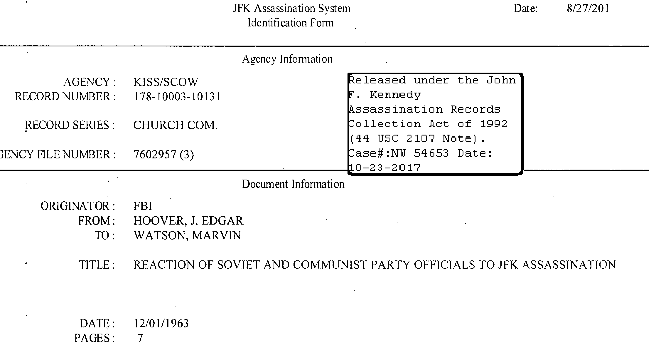
    The research community also gained access to a J. Edgar Hoover memo sent to Marvin Watson, Special Assistant to the President on December 2, 1966, which described what Russian intelligence believed about the murder:
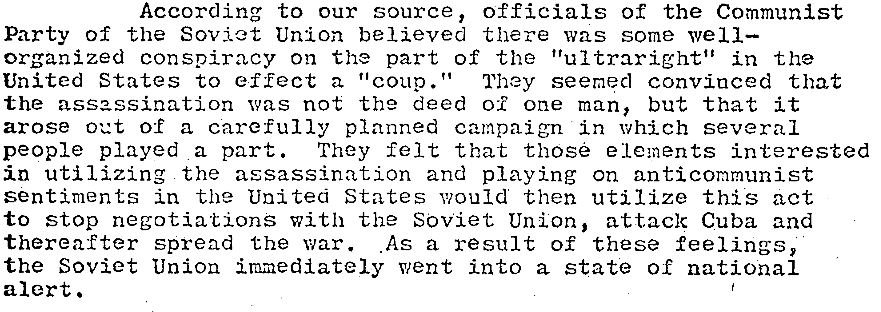
    The Memo also adds this explosive point made after two years of Russian intelligence efforts that had been intended for internal use only:
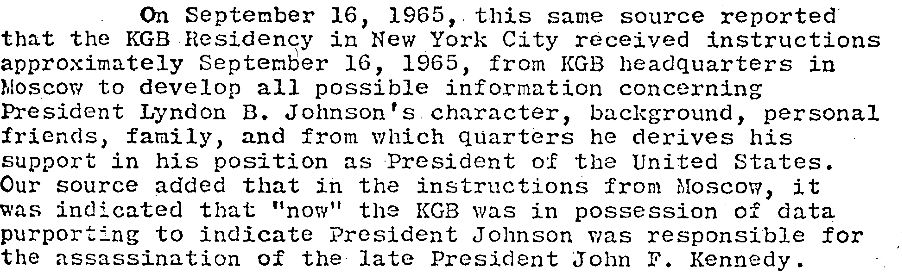
    We can safely guess that this only hardened Khrushchev’s opinions.

    When interviewed by NBC’s Megyn Kelly in 2017, Vladimir Putin stated, “There is a theory that Kennedy’s assassination was arranged by the United States intelligence services,” Putin told Kelly. “So if this theory is correct, and that can’t be ruled out, then what could be easier in this day and age than using all the technical means at the disposal of the intelligence services and using those means to organize some attacks, and then pointing the finger at Russia?”

    Though one can question his motives, there is no doubt that the ex-lieutenant colonel in the KGB had easy access to the intelligence on which he could base such a tantalizing statement.

    The most vocal foreign leader about the assassination was Fidel Castro.

    The Cuban leader was perhaps the first person to remark publicly that something was awry in the JFK case. He learned of the assassination on the day it happened while engaging in diplomatic discussions with one of JFK’s secret envoys, a French journalist named Jean Daniel. Immediately upon getting the news, Castro remarked to his visitor: “This is an end to your mission of peace. Everything is changed.” Later Castro commented: “Now they will have to find the assassin quickly, but very quickly, otherwise, you watch and see, I know them, they will try to put the blame on us for this thing.” A day later, after frantically following all the cables about the subject, the early ones linking Oswald to pro-Communist and Cuban interests, he felt it confirmed a plot to blame him so as to give the U.S. the excuse it needed to invade his country.

    Cuba was plunged into crisis-mode, the overthrow of the Island was already a clear and present danger and it would be under assault for decades. Its security and intelligence forces went into even higher gear. Among them, some Cuban exiles in the U.S. who had access to privileged information on plots to remove Castro, which intersected with the one to remove Kennedy— perceived to be the biggest roadblock into regaining an empire to be plundered once again by ruthless opportunists.


    The hit team: Was it a mosaic of diverse groups and organizations, or a well-tuned, synchronized network?

    One of the biggest problems researchers have in convincing skeptical audiences that there was, in fact, a large-scale conspiracy behind the coup d’état is that the involvement of so many different factions would have been too complex to pull off. In fact, here is what two historians remarked in their correspondence with me when I challenged their writings:

    • Was it Cubans, the CIA, the Mafia, Lyndon Johnson, the Federal Reserve . . . many of the villains contradict each other?
    • I’m always reminded of the headline in the comedy newspaper, The Onion, which read something like: JFK ASSASSINATED BY CIA, FBI, KGB, MAFIA, LBJ, OSWALD, RUBY, IRS, DEA, DEPT OF ED, DEPT. OF COMMERCE AND MORE! That about sums up the feeling from professional historians about those proposing we rethink the JFK assassination.

    Of course, it would have helped to ask who the persons and groups of interest were. Something the Cubans did. Out of all the foreign governments that looked into the assassination, Cuban intelligence efforts were the most persistent and the best connected. Their findings were eventually revealed. Thanks to some of their writings and exchanges with serious assassination researchers, we can better understand how interrelated some of the suspects were before, during and after the assassination. Their stories begin in the early part of the twentieth century.


    Cuba pre-revolution: Enrique Cirules, The Mafia in Havana, a Caribbean Mob story, 2010
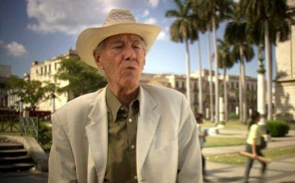
    Enrique Cirules (1938 – 18 December 2016) was a Cuban writer. His books include Conversation with the last American (1973), The Other War (1980), The Saga of La Gloria City (1983) Bluefields (1986), Ernest Hemingway in the Romano Archipelago (1999) The Secret life of Meyer Lansky in Havana (2006) and Santa Clara Santa (2006).
    Enrique Cirules  

    His The Mafia in Havana won the Literary Critic’s Award in 1994, and its 2010 edition is the basis for most of this section.

    This book goes significantly farther than what its title suggests, as it chronicles how a network of imperialist-exploiters from 1930 to the revolution in 1959 plundered the Island. It sheds light on how the foursome of the Mafia, U.S. intelligence, Captains of U.S. industry and the Cuban elite ran a rigged system with an invisible government pulling the strings using Cuban figureheads for the benefit of so few.

    The Mafia actually began running alcohol in Cuba in the early 1920s; however, the creation of a large criminal empire began in 1933 when Lucky Luciano tasked Meyer Lansky, the top Mafia financier, to begin a relationship with Fulgencio Batista who by then controlled Cuba’s Armed Forces. Batista used this position to influence Cuban presidents until he was elected president in 1940 and would go on to become a long-lasting American puppet dictator who made off with some 300 million dollars by the time he was forced to leave as Castro and his band of rebels were closing in on Havana.

    Cuba was an ideal location for the Mafia: only ninety miles off U.S. shores, virgin territory, with neither laws nor taxes to worry about, and Cuban leaders in their pockets. For a long time the Mafia operations were organized under Lansky who was the number one chieftain in Cuba, drug tsar Santo Trafficante Sr., Amadeo Barletta, and Amletto Batisti who actually established a bank to finance his Mafia interests. By the 1940s, the Mafia was careful to select Cuban nationals to participate in their operations. One wealthy Cuban who did well under this regime was Julio Lobo (AMEMBER-1) who was an important player in the sugar and banking industries. He also connects well with some of the Cubans of interest in the JFK assassination.

    By the end of World War II, the Mafia controlled casinos, prostitution, and the drug trade. Cuba was a stopping point for heroin destined to the U.S. and a key market for cocaine. They also began taking over banks they used to finance shady deals, get their hands on Cuban subsidies and launder Cuban and U.S. based rackets. At around the same time they took over important parts of the media. Trafficante even began training undercover agents within Cuban political groups. Barletta at one point was the sole representative of General Motors in Cuba. He also owned media outlets and many businesses.

    By far the most powerful of the foursome was Lansky, who is said to have been aware of everything that went on in Cuba. He intimidated all the leaders, including Batista. Lansky always kept a low profile, but he was well known by all the power brokers and key operators who governed the country. He was suspected of having maneuvered to block his ex-boss Luciano from gaining entry on the Island after his expulsion from the U.S. His high rank in the pecking order could be seen by his refusal to allow credit to the Vice-President of the republic in one of the casinos, his snubbing of the Minister of the Interior who sought to exchange greetings with him and by even pressuring Batista himself into protecting Mafia-friendly policies. An invisible government was now in charge of Cuba where profits of the Mafia empire were greater than the rest of the Cuban economy.

    By 1956, other U.S. mobsters, including Sam Giancana and Carlos Marcello, wanted in, which led to a bloody mob battle in the U.S. coined the Havana Wars.

    U.S. industry leaders took their share of the spoils as the Rockefellers used their banks to quickly take over large segments of the economy in the early 1930s. By the 1950s, Rockefeller interests owned much of the sugar, livestock and mining industries.

    Where one could find American imperialism thriving, not far away was Sullivan & Cromwell, the leading international lawyer/lobbyists of the era who joined their clients on Cuban soil and opened doors for others like the Schroeder Bank. Through the Dulles brothers, who were partners in the firm, the symbiosis with U.S. intelligence and government was ensured as John Foster Dulles later became Secretary of State and Allen Dulles would go on to head the CIA.

    The free reign in Cuba could not have worked without the efforts of U.S. intelligence, who became the gatekeepers of the Island as early as 1902 when they infiltrated the Cuban military. By the 1930s, they were using Mafiosi, journalists, lawyers, businessmen, politicians all over the Island. During the war years, Franklin Roosevelt became alarmed by the trend towards Marxism and was particularly worried about Cuba. The key diplomat he designated to ensure that Batista would squash any rebellion was no other than Meyer Lansky, because of his excellent relations with the dictator.

    Fearing a revolt, the U.S. took steps to fake a demonstration of democracy to give the Cuban people the impression that they had a voice. They convinced Batista to call an election in 1944 that the U.S. rigged to place another puppet, Doctor Ramon Martin (AMCOG-3), in power. The new leader could not take two steps without a Batista henchman breathing down his neck. During this era, Carlos Prío would have a stint as prime minister while Tony Varona was second in command—both of whom would go on to become key leaders of Cuban exiles in Miami. The invisible government later created a crisis around these political leaders so that Batista could come back in 1952 and save the day—so many smoke screens all marketed to the populace as a showcase of democracy by the Mafia and CIA-run media.

    By 1955, when a rebellion threat was growing again, Lyman Kirkpatrick, inspector general of the CIA, was making repeated trips to Cuba to help Batista, who had been scouted by the U.S. in the early 1940s. Cirules produced a letter from Allen Dulles to Batista where he reminds him of their recent meeting and the decision to have the new head of the Bureau of Repression of Communist Activities, General Tamayo, come to Washington to receive special training.

    In 1958, Castro took over and the Imperialist-Finance-Intelligence-Mafia network was forced out with many of their Cuban protégées. But not without a futile last stand from Tony Varona, who haplessly tried to lead the police forces.

    As we will see, many of the persons of interest in the JFK assassination did not just join forces sometime around 1962 to develop a plot to remove JFK. They were part of a well-connected network of very cunning people in existence for many years, if not decades, who desperately shared the same goal to regain their former power and wealth, who were very secretive, who planned the removal of Castro and who came to see JFK as an obstacle and a traitor. For some of them, their obsessions and their violence persisted for decades.

    Journalists and historians never asked themselves who these people whose names kept popping up from deep event to deep event were. If they had looked into their backgrounds, they would have discovered a ruthless cast of characters, who were linked to the Mafia and/or intelligence and/or U.S. imperialist forces and/or the Cuban elite. This network, which scattered away from Cuba in 1958, would quickly coalesce again in Miami and spread to New Orleans, Dallas and other American cities. What followed was an onslaught of assassination attempts against Castro, acts of terrorism that would span 40 years and a regime change in the U.S. on November 22, 1963, during lunchtime in full public view on a sunny day.


    American style state-sponsored terrorism

    The network of many of the persons of interest in the JFK assassination had its origins some thirty years before the revolution, and while many faces changed over time, the gangs lived on for decades with a moral compass that was pointed towards hell.

    Before discussing this partnership and Dealey Plaza, it is worth underscoring the forty years of fury unleashed on Cuba, and its friends, in the form of covert action according to the perpetrators, terrorist acts according to the victims. We will let the reader decide. The following is a partial list:

    • In March 1960, the Belgian steamship La Courbe loaded with grenades was blown up in Havana, killing 101 and injuring over 200;
    • In 1961, a volunteer teacher and a peasant were captured and tortured to death;
    • Also in 1961, explosives in cigarette packages were used to blow up a store;
    • In 1962, the Romero farming family were murdered by counter-revolutionaries;
    • In 1964, a Spanish supply ship was attacked;
    • In 1965, led by Orlando Bosch, terrorists bombed sugar cane crops;
    • In 1970, two fishing vessels were hijacked and their crews of 12 kidnapped;
    • In 1981, dengue fever broke out in Cuba killing 151 people, including 101 children; terrorist Eduardo Arocena admitted to the crime in a federal court in New York;
    • In 1994, terrorists from Miami entered Cuba and murdered a Cuban citizen;
    • In 1997, explosives were detonated in the Copacabana, killing an Italian tourist;
    • In 2003, the Cuban vessel Cabo Corriente was hijacked.

    The targets were not only confined to Cuban territory:

    • During the years that followed the revolution, British, Soviet and Spanish ships carrying merchandise to and from Cuba were attacked;
    • In 1972, Cuban exiles blew up a floor where there was a Cuban trade mission in Montreal killing one person;
    • In 1974, Orlando Bosch admitted sending letter bombs to Cuban embassies in Lima, Madrid and Ottawa;
    • The terrorists were particularly active in 1976: explosions were set off in the Cuban embassy in Madrid and the offices of a Cuban aviation company; two Cuban diplomats were kidnapped, tortured and assassinated; two other Cuban diplomats were murdered in Lisbon; a bomb exploded in a suitcase just before being put on a Cuban airline in Jamaica; terrorists downed a Cuban airliner that had departed from Barbados, killing all 73 aboard.

    Even U.S. soil was fair game for the terrorist cells:

    • In 1975, a Cuban moderate living in Miami was shot and killed;
    • Cuban diplomats were killed in New Jersey and New York City in 1979 and 1980;
    • In 1979, a TWA plane was targeted, but the bomb went off in a suitcase before departure.

    Overall, Cuba counted 3500 who died and 2000 who were injured because of these acts of aggression to go along with billions of dollars in damage.

    The terrorists, who had become full-fledged Americans, were well known to authorities but acted with impunity:

    • Orlando Bosch (AMDITTO-23) told the Miami press that “if we had the resources, Cuba would burn from one end to the other.”
    • There was not much remorse if we base ourselves on what Guillermo Novo Sampol had to say after a Cuban airline exploded in midflight, killing 73 passengers: “When Cuba pilots, diplomats or members of their family die—this always makes me happy.”
    • Convicted terrorist Luis Posada Carilles (AMCLEVE-15) confirmed in a New York Times interview that they had received training in the use of explosives by the CIA.

    Fabian Escalante’s investigation
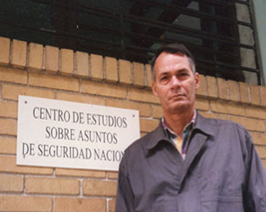
    Fabian Escalante joined the Department of State Security in 1959. Escalante was head of a counter-intelligence unit and also part of a team investigating a CIA operation called Sentinels of Liberty, an attempt to recruit Cubans willing to work against Castro. At the request of the U.S., he presented the HSCA with a report on Cuban findings about the JFK assassination that was never published by the committee because of some of the information it contained. He is recognized as a leading authority on the CIA in Cuba and Latin America.
    Fabian Escalante  

    Some of his critics state that he seems to base most of his analysis on the work of American researchers and that he is biased. In his defense, it is important to note that very few American investigators have gone through as much committee-based research as Escalante. While it is true that some of his sources like Tosh Plumlee and Chuck Giancana are not convincing for many, he himself tempers his observations by often emphasizing that more research should be done to follow-up on leads ignored by U.S. media and intelligence. His exchanges with people like Dick Russell and Gaeton Fonzi helped push the analysis forward. As we will see, some of his insights certainly go an awful lot farther than what we can see on CNN. In the following sections, we will look at Escalante’s work, which will be at times bolstered by findings from other sources that dovetail with his analysis.

    Cuban intelligence, though lacking in structure during the days that followed the revolution, had privileged access to informants in the U.S. and Cuba who at times penetrated exile groups in the U.S. and their antennas on the Island. They also captured combatants who revealed secrets they kept about the assassination. Furthermore, they were able to obtain information from their Russian counterparts. Finally, they kept abreast of all U.S. research in the subject to a degree far superior to what historians or mainstream media ever did. By 1965, a Cuban spy, Juan Felaifel Canahan, had infiltrated CIA special missions groups in Miami and won Cuban exile leader Manuel Artime’s confidence. Artime was involved in the plot to assassinate Castro code-named AMLASH, which brought together the CIA, Mafia, and Cuban exiles in the master plan. It was only after 1975, after the publication of a Church Committee report, that they suspected that this partnership was behind the assassination of JFK.

    In 1993, during his retirement, after launching a security studies center, he again put together all the pieces of the puzzle he could put his hands on. His research would be enriched by ARRB releases. Even Escalante admits that he does not have full access to all the Cuban files, but what he does know is worth listening to.

    In 1995 Wayne Smith, chief of the Centre for International Policy in Washington, arranged a meeting on the assassination of John F. Kennedy, in Nassau, Bahamas. Others in attendance were: Gaeton Fonzi, Dick Russell, Noel Twyman, Anthony Summers, Peter Dale Scott, John M. Newman, Jeremy Gunn, John Judge, Andy Kolis, Peter Kornbluh, Mary and Ray LaFontaine, Jim Lesar, Russ Swickard, Ed Sherry, and Gordon Winslow. In 2006, his book analyzing the assassination, JFK: The Cuba Files, was published. While some of Cuba’s sources are deemed contestable by some reputable researchers, it is clear that they had access to sources that not even the FBI could have tapped. Their findings may not be perfect but they certainly are more fact-based and up to date than anything a historian will find in the Warren Commission report.


    The network factions

    In JFK: The Cuba Files, Escalante describes how the departure of Cuban exiles, CIA operators and Mafiosi from the Island, where they had originally joined forces, gave birth to what he called the CIA and Mafia’sCuban American Mechanism”. Its members were based mostly in Miami and were trained to do a lot of the dirty work to get their empire back in a manner that was plausibly deniable by their supervisors.

    Most researchers are aware of the influence the business elite had on U.S. foreign policy. It is now fully accepted that regime change in the 1950s in the Middle East was for the benefit of U.S. and British oil magnates, and the removal of Arbenz in Guatemala was asked for by United Fruit and made good on by Dulles and a cadre of CIA officers who mastered the art of delivering a coup. Many of these specialists were involved in covert actions against Cuba and some became persons of interest in the JFK assassination.

    Escalante demonstrates the importance of the corporate elite in dictating U.S. policy by quoting a statement made by Roy Robottom, Assistant Undersecretary of State for Hemispheric Affairs: “… In June 1959 we had taken the decision that it was not possible to achieve our objectives with Castro in power … In July and August, we had been drawing up a program to replace Castro. However, certain companies in the United States informed us during that period that they were achieving some progress in negotiations, a factor that led to a delay …” By the end of 1959, J.C. King, head of the CIA’s Western Hemisphere Division, recommended the assassination of Castro. In March 1960, Eisenhower approved the overthrow under a project codenamed Pluto.

    The Mechanism assumed a life of its own after the failed Bay of Pigs in 1962, and held JFK responsible for the debacle.


    Structuring the Cuban exiles

    The author describes how “venal officials, torturers, and killers from the Batista Regime fled Cuba and sought refuge in the United States” to escape justice in Cuba, and began forming groups with an eye to re-taking the Island. In this chaos, the Mafia, the CIA, and the U.S. State Department would quickly aid them. This is what also gave birth to the Miami Cuban Mafia. Some of the prominent leaders were of course Batista puppets, including Carlos Prío Socarrás, who was President of Cuba from 1948-52, and Tony Varona, who was Vice President under Prío, also a Mafia associate. They led the Revolutionary Democratic Front (FRD) (AMCIGAR), an umbrella group for hundreds of smaller groups. The FRD was eventually replaced by the Cuban Revolutionary Council (CRC) (AMBUD) which was conceived by the CIA as a government in waiting.

    The command structure of the Cuban exiles was focused at first on the Bay of Pigs invasion. After this fiasco, in 1961, the management of the Cuban exiles centered on acts of sabotage and terrorism under the Operation Mongoose program led by Edward Lansdale and William Harvey. Harvey was later exiled to Rome after almost messing up the delicate Missile Crisis negotiations when he intensified covert actions against Cuba.

    In the early 1960s, JMWAVE in Miami became the largest CIA station with over 400 agents overseeing some 4000 Cuban exile assets, Mafia partnerships and soldiers of fortune. The Cuban exile counter-revolutionary organizations were so numerous (over 400) and weirdly connected that Richard Helms of the CIA had to send Bobby Kennedy a handbook to explain the situation. Some groups were more political in nature, others military. Many had antennas in Cuba.

    The handbook describes the unstable structure as follows:

    Counter-revolutionary organizations are in fact sponsored by Cuban intelligence services for the purpose of infiltrating “unities” creating provocations, collecting bona fide resistance members into their racks and taking executive action against them. It is possible that the alleged “uprising” on August 1962, which resulted in the well-nigh final declination of the resistance ranks, was the result of just such G-2 activities.Guerrilla and sabotage activities have been further reduced by lack of external support and scarcity of qualified leadership. Exile leaders continue to hold meetings, to organize to expound plans of liberation, and to criticize the United States “do nothing policy.”But it is the exceptional refugee leader who has the selflessness to relinquish status of leadership of his organization or himself by integrating into a single strong unified and effective body. “Unidades” and “Juntas” are continually being created to compete with one another for membership and U. S. financial support. They print impressive lists of member movements, which in many instances are only “pocket” or paper groups. Individuals appear to leadership roles in several or more movements simultaneously, indicating either a system of interlocking directorates or pure opportunism.

    In order to place in perspective the hundreds of counter-revolutionary groups treated herein, it is necessary to understand the highly publicized CRCConsejo Revolucionario Cubano—Cuban Revolutionary Council). The CRC is not included in the body of this handbook because it is not actually a counter-revolutionary group, but rather a superstructure, which sits atop all the groups willing to follow its direction and guidance in exchange for their portions of U. S. support for which the CRC is the principal channel.

    The CRC was originally known as the FRD (Frente Revolucionary Democratica) and was not officially called CRC or Consejo until the fall of 1961.The Consejo has always been beset with factionalism and internal dissension. It and its leader Dr. Jose Miro Cardona have been continually criticized by Cuban exile leaders for a “do nothing” policy. The CRC does not participate in activities within Cuba but acts as a coordinating body for member organizations. It has delegations in each Latin American country as well as in France and Spain. Besides the main office located in Miami, it has offices in Washington, New York, and New Orleans. CRC gives financial support to member groups for salaries, administrative expenses and possible underground activities in Cuba.

    The following is a list of the groups (the handbook gives additional information on each group-membership numbers in U.S. and Cuba, key members, year of foundation etc.):

    Part I: Leading Organizations [7 groups]

    1. Movimiento Revolucionario 30 de Noviembre – 30 Nov, MRTN, M-30-11 — 30 November Revolutionary Movement
    2. Movimiento de Recuperacion Revolucionario – MRR — Movement for Revolutionary Recovery
    3. Unidad Revolucionaria – U. R., Unidad — Revolutionary Unity
    4. Directorio Revolucionario Estudiantil D.R.E. — Students Revolutionary Directorate (DRE) (
    5. Rescate Democratico Revolucionario RDR — Revolutionary Democratic Rescue
    6. Movimiento Revolucionario del Pueblo — Revolutionary Movement of the People
    7. Movimiento Democrata Cristiano MDC — Christian Democrat Movement

    Part II describes those organizations currently judged to be above average in importance. [52 groups]. See appendix 1 (note: in this author’s opinion Alpha 66 in this group became very important).

    Part III describes those judged to be of little apparent value, paper organizations, or small disgruntled factions.

    The CIA ensured funding to the tune of $3 million a year according to CIA operative E. Howard Hunt. U.S. militia forces recruited some of the other Cuban exiles. Two CIA stations were key in the destabilization efforts: one in Mexico City, where David Phillips played a key role; the other in Madrid, headed by James Noel. Both spies were very active in Cuba before the revolution.

    Captain Bradley Ayers trained commandos. Training grounds could be found in Florida and near New Orleans, where Guy Banister, David Phillips, and David Ferrie were seen in the company of Cuban exiles and soldiers of fortune. According to Escalante, the Mafia, represented by John Roselli, exercised control as an executive and got involved as a supplier of weaponry. The Mafia could even count on CIA watercraft to bring in narcotics and arms. Finally, as Escalante continues, organizations created by private citizens interested in freeing “Cuba” popped up in various cities seeking additional and illegal funds for the huge cost of the operation and lobbying effort. Escalante cites as examples: in his native Texas, George H. W. Bush as one of those “outstanding Americans”, along with Admiral Arleigh Burke and his Committee for a Free Cuba; and in New Orleans, there was the Friends of Democratic Cuba.

    A repressive police and intelligence apparatus, called Operation 40, was formed to cleanse captured territories of communists and other adversaries. Mercenaries like Gerry Patrick Hemming, through his group called Interpen, and Frank Sturgis and his International Anticommunist Brigade, offered their services for waging the secret war. Private citizens and corporations joined the Mafia by getting involved in financing operations and launching NGOs such as the Friends of Democratic Cuba in New Orleans, located at 544 Camp Street. Here, Lee Harvey Oswald would eventually set up his Fair Play for Cuba Committee office and hob-nob with Cuban exiles he was supposedly at odds with.

    Operation Tilt, undertaken in 1963, and sponsored by Clare Boothe Luce (Life Magazine) and William Pawley (QDDALE), who were two close friends of Allen Dulles, is a clear example of how big business, Mafia, Cuban exiles and intelligence teamed up on an anti-Castro mission that went against JFK policy. Described by Gaeton Fonzi, among others, the scheme can only be seen as reckless and quasi-treasonous. In the winter of 1962, Eddie Bayo (Eduardo Perez) claimed that two officers in the Red Army based in Cuba wanted to defect to the United States. Bayo added that these men wanted to pass on details about atomic warheads and missiles that were still in Cuba despite the agreement that followed the Cuban Missile Crisis. Bayo’s story was eventually taken up by several members of the anti-Castro community, including Nathaniel Weyl, William Pawley, Gerry P. Hemming, John Martino, Felipe Vidal Santiago and Frank Sturgis. Pawley became convinced that it was vitally important to help get these Soviet officers out of Cuba. William Pawley contacted Ted Shackley at JMWAVE. Shackley decided to help Pawley organize what became known as Operation Tilt or the Bayo-Pawley Mission. He also assigned Rip Robertson, a fellow member of the CIA in Miami, to help with the operation. David Sanchez Morales, another CIA agent, also became involved in this attempt to bring out these two Soviet officers.

    On June 8, 1963, a small group, including William Pawley, Eddie Bayo, Rip Robertson, Virgilio Gonzalez, Eugenio Martinez, John Martino. Richard Billings and Terry Spencer, a journalist and photographer working for Life Magazine, boarded a CIA flying boat. After landing off Baracoa, Bayo and his men got into a 22-foot craft and headed for the Cuban shore. The plan was to pick them up with the Soviet officers two days later. However, Bayo and his men were never seen again. It was rumored that he had been captured and executed. However, his death was never reported in the Cuban press.

    William Pawley’s background is particularly revealing. Gaeton Fonzi points out in his book, The Last Investigation: “Pawley had also owned major sugar interests in Cuba, as well as Havana’s bus, trolley and gas systems and he was close to both pre-Castro Cuban rulers, President Carlos Prío and General Fulgencio Batista.” (Pawley was one of the dispossessed American investors in Cuba who early on tried to convince Eisenhower that Castro was a Communist and urged him to arm the exiles in Miami.)


    Lee Harvey Oswald and the subterfuge according to Escalante

    Like most Americans, the Cubans found Oswald’s murder by a nightclub owner in the basement of the Dallas Police headquarters simply too convenient. His immediate portrayal as communist and pro-Castro made them strongly suspect that this was all a ruse to attack Cuba.

    Within days of the assassination, Castro stated the following: “ … It just so happened that in such an unthinkable thing as the assassination a guilty party should immediately appear; what a coincidence, he (Oswald) had gone to Russia, and what a coincidence, he was associated with FPCC! That is what they began to say … It just so happens that these incidents are taking place precisely at a time when Kennedy was under heavy attack by those who felt his Cuba policy was weak …”

    When Escalante analyzed all they could find on Oswald (post-assassination cryptonym: GPFLOOR), he was led to the following hypothesis:

    1. Oswald was an agent of the U.S. intelligence service, infiltrated into the Soviet Union to fulfill a mission.
    2. On his return, he continued to work for U.S. security services.
    3. Oswald moved to New Orleans in April 1963 and formed links with Cuban organizations and exiles.
    4. In New Orleans, Oswald received instructions to convert himself into a sympathizer with the Cuban Revolution.
    5. Between July and September 1963, Oswald created evidence that he was part of a Cuba-related conspiracy.
    6. In the fall of 1963, Oswald met with a CIA officer and an agent of Cuban origin in Dallas, Texas, to plan a covert operation related to Cuba.
    7. In September 1963, Oswald met with the Dallas Alpha 66 group and tried to compromise Cuban exile Silvia Odio.
    8. Oswald attempted to travel to Cuba from Mexico.
    9. Oswald was to receive compromising correspondence from Havana linking him to the Cuban intelligence service.
    10. The mass media, directed by the CIA and Mafia’s “Cuban American Mechanism,” was primed to unleash a far-reaching campaign to demonstrate to the U.S. public that Cuba and Fidel Castro were responsible for the assassination.

    Through his investigation, he found evidence of the parallel nature of plans of aggression against Cuba and the assassination of Kennedy. The Cubans simply found that there were too many anti-Castro Cuban exiles in Oswald’s realm, suggesting a role in a sheep dipping operation. They show that his history as a provocateur in his pre-Russia infiltration days was similar to his actions in New Orleans, and that James Wilcott, a former CIA officer in Japan, testified to the HSCA that “ … Oswald was recruited from the military division with the evident objective of turning him into a double agent against the Soviet Union …” Escalante also received material on Oswald in 1977 from their KGB representative in Cuba, Major General Piotr Voronin. Then, in 1989, while in the Soviet Union, he met up with Pavel Iatskov, colonel of the first Directorate of the KGB, who had been in Mexico City during Oswald’s visit.

    Iatskov stated the following: “At the end of the 1970s, when the investigation into the Kennedy assassination was reopened, I was in Moscow, and at one point … one of the high-ranking officers from my directorate … commented that Oswald had been a U.S. intelligence agent and that his defection to the Soviet Union was intended as an active step to disrupt the growing climate of détente …” They speculated that Oswald was there to lend a blow to Eisenhower’s peace endeavors by giving away U-2 military secrets, which dovetailed into the downing of Gary Powers a few short weeks before a crucial Eisenhower/ Khrushchev summit.

    It was through some of their intelligence sources in the U.S. that the Cubans found out about the formation of the Friends of Democratic Cuba and its location in the famous Camp Street address. They identified Sergio Arcacha Smith, Carlos Bringuier and Frank Bartes as exiles who were often there and who were visited by Orlando Bosch, Tony Cuesta, Antonio Veciana, Luis Posada Carilles, Eladio del Valle, Manual Salvat, and others. This same source recognized Oswald as someone who was in a safe house in Miami in mid-1963. Escalante believes that Oswald did in fact visit Mexico City with the intention to try to get into Cuba, to push the incrimination of Castro even further.


    Letters from Cuba to Oswald—proof of pre-knowledge of the assassination

    In JFK: the Cuba Files, a thorough analysis of five bizarre letters that were written before the assassination in order to position Oswald as a Castro asset is presented. It is difficult to sidestep them the way the FBI did. The FBI argued that they were all typed from the same typewriter, yet supposedly sent by different people. Which indicated to them that it was a hoax, perhaps perpetrated by Cubans wanting to encourage a U.S. invasion.

    However, the content of the letters and timeline prove something far more sinister according to Cuban intelligence. The following is how John Simkin summarizes the evidence:

    The G-2 had a letter, signed by Jorge that had been sent from Havana to Lee Harvey Oswald on 14th November, 1963. It had been found when a fire broke out on 23rd November in a sorting office. “After the fire, an employee who was checking the mail in order to offer, where possible, apologies to the addressees of destroyed mail, and to forward the rest, found an envelope addressed to Lee Harvey Oswald.” It is franked on the day Oswald was arrested and the writer refers to Oswald’s travels to Mexico, Houston and Florida …, which would have been impossible to know about at that time!

    It incriminates Oswald in the following passage: “I am informing you that the matter you talked to me about the last time that I was in Mexico would be a perfect plan and would weaken the politics of that braggart Kennedy, although much discretion is needed because you know that there are counter-revolutionaries over there who are working for the CIA.”

    Escalante informed the HSCA about this letter. When he did this, he discovered that they had four similar letters that had been sent to Oswald. Four of the letters were post-marked “Havana”. It could not be determined where the fifth letter was posted. Four of the letters were signed: Jorge, Pedro Charles, Miguel Galvan Lopez and Mario del Rosario Molina. Two of the letters (Charles & Jorge) are dated before the assassination (10th and 14th November). A third, by Lopez, is dated 27th November, 1963. The other two are undated.

    Cuba is linked to the assassination in all the letters. In two of them an alleged Cuban agent is clearly implicated in having planned the crime. However, the content of the letters, written before the assassination, suggested that the authors were either “a person linked to Oswald or involved in the conspiracy to execute the crime.”

    This included knowledge about Oswald’s links to Dallas, Houston, Miami and Mexico City. The text of the Jorge letter “shows a weak grasp of the Spanish language on the part of its author. It would thus seem to have been written in English and then translated.

    Escalante adds: “It is proven that Oswald was not maintaining correspondence, or any other kind of relations, with anyone in Cuba. Furthermore, those letters arrived at their destination at a precise moment and with a conveniently incriminating message, including that sent to his postal address in Dallas, Texas …. The existence of the letters in 1963 was not publicized or duly investigated, and the FBI argued before the Warren Commission to reject them.”

    Escalante argues: “The letters were fabricated before the assassination occurred and by somebody who was aware of the development of the plot, who could ensure that they arrived at the opportune moment and who had a clandestine base in Cuba from which to undertake the action. Considering the history of the last 40 years, we suppose that only the CIA had such capabilities in Cuba.”


    Jack Ruby’s links to Trafficante

    Escalante is of the opinion that Jack Ruby and Trafficante were acquainted and that Ruby did in fact visit Trafficante when the latter was detained in Cuba in 1959. Here is his rationale:

    1. Ruby’s close friend Louis McWillie ran Trafficante’s Tropicana Casino;
    2. Ruby’s visits to Cuba after accepting invitations from McWillie, coincide with the detention of Trafficante and other Mafiosi;
    3. McWillie told the HSCA that he made various visits to the Tiscornia detention center during Ruby’s visits;
    4. After Ruby’s stays in Miami, he met with Meter Panitz (partner in the Miami gambling syndicate) in Miami. McWillie spoke with Panitz shortly before the visits. Trafficante was a leading gangster in Florida. Ruby kept this hidden from the Warren Commission;
    5. Ruby’s entries and exits logistics dispel any idea that he went to Cuba for vacation purposes;
    6. Ex-gun-runner and Castro friend Robert McKeown told the HSCA that Ruby approached him to try and get Castro to meet him in the hope of getting the release of three prisoners. McKeown also had contacts with Prío before and after the revolution and had met Frank Sturgis;
    7. John Wilson Hudson, a British journalist, was also detained in Tiscornia at the same time as Trafficante (confirmed by Trafficante). Wilson gave information to the U.S. embassy in London recalling an American gangster-type called Ruby had visited Cuba in 1959 and had frequently met an American gangster called Santo. Prison guard Jose Verdecia confirmed the visits of Trafficante by McWillie and Ruby when shown a photo. He also confirmed the presence of a British journalist.

    Operation 40

    “We had been operating a damned Murder Inc. in the Caribbean.”

    ~ President Johnson

    In 1973, after the death of Lyndon Johnson, The Atlantic published an article by a former Johnson speechwriter named Leo Janos. In “The Last Days of the President,” LBJ not only made this stunning statement but also expressed a highly qualified opinion that a conspiracy was behind the murder of JFK: “I never believed that [Lee Harvey] Oswald acted alone, although I can accept that he pulled the trigger.” Johnson thought such a conspiracy had formed in retaliation for U.S. plots to assassinate Fidel Castro; he had found after taking office that the government “had been operating a damned Murder Inc. in the Caribbean.” It is very likely that Johnson garnered this information from reading the CIA Inspector General Report on the plots to kill Castro.

    There is compelling evidence that it is through Operation 40 that some of the assassins that Johnson may have been referring to received their training and guidance. The existence of this brutal organization of hit men was confirmed to the Cuban G-2 by one of the exiles they had captured: “The first news that we have of Operation 40 is a statement made by a mercenary of the Bay of Pigs who was the chief of military intelligence of the invading brigade and whose name was Jose Raul de Varona Gonzalez,” says Escalante in an interview with Jean-Guy Allard:

    In his statement this man said the following: in the month of March, 1961, around the seventh, Mr. Vicente Leon arrived at the base in Guatemala at the head of some 53 men saying that he had been sent by the office of Mr. Joaquin Sanjenis (AMOT-2), Chief of Civilian Intelligence, with a mission he said was called Operation 40. It was a special group that didn’t have anything to do with the brigade and which would go in the rearguard occupying towns and cities. His prime mission was to take over the files of intelligence agencies, public buildings, banks, industries, and capture the heads and leaders in all of the cities and interrogate them. Interrogate them in his own way.

    The individuals who comprised Operation 40 had been selected by Sanjenis in Miami and taken to a nearby farm “where they took some courses and were subjected to a lie detector.” Joaquin Sanjenis was Chief of Police in the time of President Carlos Prío. Recalls Escalante: “I don’t know if he was Chief of the Palace Secret Service but he was very close to Carlos Prío. And, in 1973 he dies under very strange circumstances. He disappears. In Miami, people learn to their surprise—without any prior illness and without any homicidal act—that Sanjenis, who wasn’t that old in ‘73, had died unexpectedly. There was no wake. He was buried in a hurry.”

    Another Escalante source concerning Operation 40 was one of its members and a Watergate burglar: “And after he got out of prison, Eugenio Martinez came to Cuba. Martinez, alias ‘Musculito,’ was penalized for the Watergate scandal and is in prison for a time. And after he gets out of prison—it’s the Carter period, the period of dialogue, in ‘78, there is a different international climate—Eugenio Martinez asks for a contract and one fine day he appears on a boat here … and of course he didn’t make any big statements, he didn’t say much that we didn’t know but he talked about those things, about this Operation 40 group, about what they had done at the Democratic Party headquarters …”

    In the Cuba Files, Escalante underscores a reference to Operation 40 by Lyman Fitzpatrick, CIA Inspector General, in his report on the Bay of Pigs: “…the counter-intelligence and security service which, under close project control, developed into an efficient and valuable unit in support of the FRD, Miami base, and the project program. By mid-March 1961, this security organization comprised 86 employees of whom 37 were trainee case officers, the service having graduated four classes from its own training classes, whose instructor was (censored) police officer. (Probably Joaquin Sanjenis)”

    A memo by Arthur Schlesinger Jr. refers to this organization and its dark mission:

    Schlesinger’s Memo June 9, 1961
    MEMORANDUM FOR MR. RICHARD GOODWIN

    Sam Halper, who has been the Times correspondent in Habana and more recently in Miami, came to see me last week. He has excellent contacts among the Cuban exiles. One of Miro’s comments this morning reminded me that I have been meaning to pass on the following story as told me by Halper. Halper says that CIA set up something called Operation 40 under the direction of a man named (as he recalled) Captain Luis Sanjenis, who was also chief of intelligence. (Could this be the man to whom Miro referred this morning?) It was called Operation 40 because originally only 40 men were involved: later the group was enlarged to 70. The ostensible purpose of Operation 40 was to administer liberated territories in Cuba. But the CIA agent in charge, a man known as Felix, trained the members of the group in methods of third degree interrogation, torture and general terrorism. The liberal Cuban exiles believe that the real purpose of Operation 40 was to “kill Communists” and, after eliminating hard-core Fidelistas, to go on to eliminate first the followers of Ray, then the followers of Varona and finally to set up a right-wing dictatorship, presumably under Artime. Varona fired Sanjenis as chief of intelligence after the landings and appointed a man named Despaign in his place. Sanjenis removed 40 files and set up his own office; the exiles believe that he continues to have CIA support. As for the intelligence operation, the CIA is alleged to have said that, if Varona fired Sanjenis, let Varona pay the bills. Subsequently Sanjenis’s hoods beat up Despaign’s chief aide; and Despaign himself was arrested on a charge of trespassing brought by Sanjenis. The exiles believe that all these things had CIA approval. Halper says that Lt Col Vireia Castro (1820 SW 6th Street, Miami; FR 4 3684) can supply further details. Halper also quotes Bender as having said at one point when someone talked about the Cuban revolution against Castro: “The Cuban Revolution? The Cuban Revolution is something I carry around in my check book. Nice fellows.

    Arthur Schlesinger, Jr.

    Frank Sturgis, one of its members and a Watergate burglar, allegedly told author Mike Canfield: “this assassination group (Operation 40) would upon orders, naturally, assassinate either members of the military or the political parties of the foreign country that you were going to infiltrate, and if necessary some of your own members who were suspected of being foreign agents … We were concentrating strictly in Cuba at that particular time.”

    In November 1977, CIA asset and ex-Sturgis girlfriend, Marita Lorenz gave an interview to the New York Daily News in which she claimed that a group called Operation 40, that included Orlando Bosch and Frank Sturgis, were involved in a conspiracy to kill both John F. Kennedy and Fidel Castro. “She said that they were members of Operation 40, a secret guerrilla group originally formed by the CIA in 1960 in preparation for the Bay of Pigs invasion … Ms. Lorenz described Operation 40 as an ‘assassination squad’ consisting of about 30 anti-Castro Cubans and their American advisors. She claimed the group conspired to kill Cuban Premier Fidel Castro and President Kennedy, whom it blamed for the Bay of Pigs fiasco … She said Oswald … visited an Operation 40 training camp in the Florida Everglades. The idea of Oswald, or a double, being in Florida is not far-fetched. The 1993 PBS Frontline documentary “Who Was Lee Harvey Oswald?” had a photo of Oswald in Florida, which they conspicuously did not reveal on the program.

    In Nexus, Larry Hancock not only provides another confirmation of this outfit’s existence but describes part of its structure and its role: Time correspondent Mark Halperin stated that Operation 40 members “had been trained in interrogation, torture, and general terrorism. It was believed they would execute designated Castro regime members and Communists. The more liberal and leftist exile leaders feared that they might be targeted following a successful coup.”

    Hancock also asserts that “documents reveal that David Morales, acting as Counter-intelligence officer for JMARC, had selected and arranged for extensive and special training of 39 Cuban exiles, designated as AMOTs …. Sanjenis was the individual who recruited Frank Sturgis … They would identify and contain rabid Castroites, Cuban Communists …” A final confirmation of Operation 40 comes from Grayston Lynch (a CIA officer involved in the Bay of Pigs): “The ship Lake Charles had transported the men of Operation 40 to the Cuban landing area. The men had been trained in Florida, apart from the regular Brigade members, and were to act as a military government after the overthrow of Castro.”

    Other than Morales, Sanjenis, Sturgis, and Felix (probably Felix Rodriguez), it is difficult to pin down names of actual members with certainty. This author has not found any documentary traces. But there is no doubt that it existed and that it was a Top Secret project that was rolled over into the Bay of Pigs so that President Kennedy would not know about it. It was so secret that, according to Dan Hardway’s report for the HSCA, Richard Helms commissioned the study on Operation 40 to be done by his trusted aide Sam Halpern. Hardway wrote that only one person outside the Agency, reporter Andrew St. George, ever saw that report. Exactly who was in Operation 40 is a moot point; what is important to retain is that the most militant and violent Cuban exiles were recruited and trained by the CIA to perform covert operations against Cuba, Castro, and anyone who would get in their way no matter what country they were in and no matter who they were.


    The Mechanism’s Team Roster: The Big Leagues

    Out of the thousands of Cuban exiles living in the U.S., only a select few could be counted on to be part of the covert activities that would be used to remove Castro, and that became useful for the removal of Kennedy. These received special training in techniques used for combat, sabotage, assassinations and psychological warfare. The training would be provided by people such as Morales, Phillips and perhaps some soldiers of fortune.

    When analyzing these figures, it is easy to see how many were, or could easily have been, linked to one another before and after the revolution and during the November 22, 1963, period. It is only by understanding the universes of the factions that worked together on that dark day that we can explain how Oswald and Kennedy’s lives came to their tragic ends.

    The first 18 persons profiled were considered the most suspicious by the Cuban researchers. Because the Cuban data precedes 2006, we will enrich some of the pedigrees with more current information.

    Table 1

    Other persons of interest come from JFK: The Cuba Files and various other sources:

    Table 2


    Aftermath of the assassination

    “Operation 40 is the grandmother and great-grandmother of all of the operations that are formed later.”

    ~ Fabian Escalante

    The assassination of JFK was a landmark moment in American history. The country would go on to be rocked by a series of scandals that would see public confidence in politicians and media go into a tailspin. LBJ gave us Vietnam and Martin Luther King, Malcolm X, Bobby Kennedy and John Lennon saw their freedom of speech rights contested, with extreme prejudice. Watergate, Iran/Contra, George Bush Junior’s weapons of mass destruction, and the Wall Street meltdown would follow. Now even U.S. grounds are the target of foreign rebels who have mastered the art of using terrorism tactics similar to those that were used against Cuba.

    The role some of the members of the Mechanism played in future deep events adds credence to what is alleged about them regarding the removal of JFK. Their murderous accomplishments have their roots in the Dulles brothers’ worldviews. Allen Dulles’ protégé E. Howard Hunt became one of Nixon’s plumbers. In 1972, after Arthur Bremer attempted to assassinate presidential candidate George Wallace, Nixon aide Charles Colson asked Hunt to plant evidence in Bremer’s apartment that would frame George McGovern, the Democratic opponent. Hunt claims to have refused. Hunt, with his ex-CIA crony James McCord, and Cuban exiles Bernard Barker, Virgilio Gonzalez, Eugenio Martinez, together with Frank Sturgis, would all be arrested, and then let off rather easily for their roles in Watergate. Hunt would even demand and collect a ransom from the White House for his silence. In 1985, Hunt would lose the Liberty Lobby trial that, in large part, verified the infamous CIA memorandum from Jim Angleton to Richard Helms stating that they needed to create an alibi for Hunt being in Dallas on November 22, 1963.

    Recruited by David Morales in 1967, Felix Rodriguez succeeded in his mission to hunt down and terminate Che Guevara in Bolivia. Rodriguez kept Guevara’s Rolex watch as a trophy. He also played a starring role in the Iran/Contra scandal. In the 1980s, Rodriguez was the bagman in the CIA’s deal with the Medellin cartel and often met with Oliver North. He was also a guest of Ronald Reagan and George H. W. Bush at the White House.

    In 1989, Loran Hall and his whole family were arrested for drug dealing.

    As discussed earlier, Novo Sampol, Carilles (who also had links to Iran Contra), and Orlando Bosch continued in their roles in American-based terrorist activities for decades. Arrested in Panama, Luis Posada Carriles and Guillermo Novo were pardoned and released by Panama, in August, 2004. The Bush administration denied putting pressure on for the release. The Bush administration cannot deny providing safe haven to Bosch after an arrest in Costa Rica, which saw the U.S. decline an offer by the authorities to extradite Bosch to the United States.

    Veciana continued for a while to participate in attempts to assassinate Castro. He eventually outed David Atlee Phillips. For his candor, he was possibly framed and thrown in jail on narcotics trafficking charges. He was also shot at. The Mafia may not have regained their Cuban empire, but they no longer had the Kennedys breathing down their necks. American imperialists and captains of industry set their sights on the exploitation Vietnam, Indonesia, the Middle East, Africa and cashed in on conflicts.


    Risky Business

    Being a member of the Mechanism also came with its share of professional risks—namely, short life expectancies. When the Warren Commission whitewash was taking place, there were few worries. When the more serious Garrison, Church and HSCA investigations were in full swing, the word cutoff took on a whole new meaning. Intelligence did not seem to bother too much about being linked to rowdy exiles and Mafiosi when it came to removing a communist; the removal of JFK … well, that must have been a different matter. There were many deaths that occurred before 1978 which were timely and varied from suspicious to murderous:

    William Pawley died of a self-inflicted gunshot wound, in January 1977.

    Del Valle was murdered in 1967 when Garrison was tracking him down, shortly after David Ferrie’s suspicious death.

    Sanjenis simply vanished in 1973.

    Artime, Prío, Masferrer, Giancana, Hoffa, Roselli and Charles Nicoletti were all murdered between 1975 and 1977.

    Martino, Harvey and Morales all died of heart attacks.

    Out of some 45 network members discussed in this article, 18 did not survive the end of the HSCA investigation, 8 were clearly murdered and 7 of other deaths were both timely and suspicious.


    Trafficante’s links

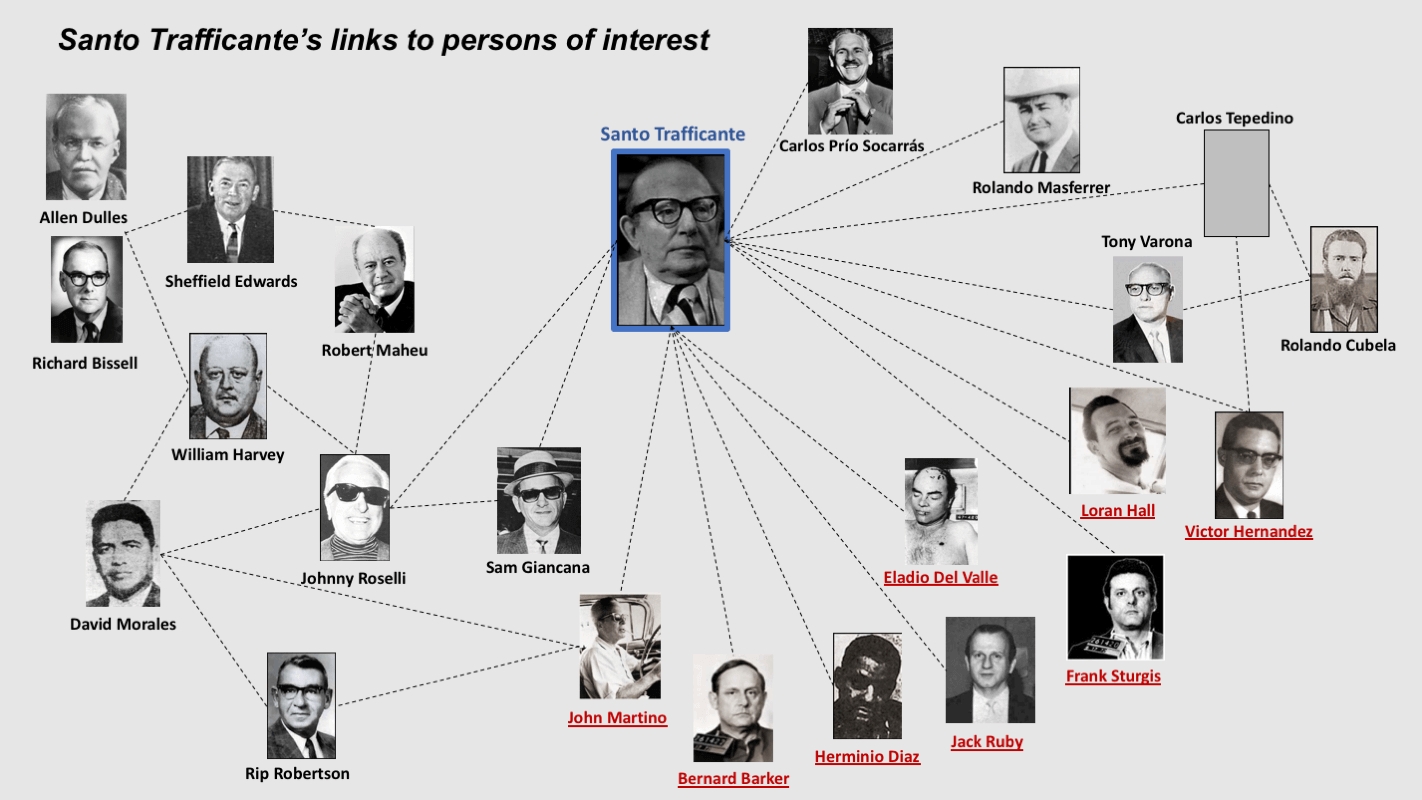
    The unholy marriage of the CIA and the Mafia with the objective of removing Castro was initiated by Allen Dulles and Richard Bissell. They had Sheffield Edwards go through Robert Maheu (a CIA cut-out asset), to organize a partnership with mobsters Giancana and Trafficante using Johnny Roselli as the liaison. The CIA gave itself plausible deniability and the Mafia could hope to regain its Cuban empire and a have the ultimate get-out-of-jail-free card in their back pockets.

    William Harvey, author of executive action M.O. ZR/RIFLE, eventually oversaw the relationship between himself and Roselli, which involved assassination expert David Morales as Harvey’s special assistant.

    Trafficante, who spoke Spanish, was the ideal mobster to organize a Castro hit because of his long established links on the Island. He was also seen as the CIA’s translator for the Cuban exiles. Through Tony Varona and Carlos Tepedino (AMWHIP-1), they tried to get Rolando Cubela (AMLASH) to murder Castro. Trafficante and his friends have very close ties to the Kennedy assassination, to the point where Robert Blakey (head of the HSCA) became convinced the mob was behind it. Blakey now seems to be open to the idea that the network was a lot larger.

    Trafficante’s links to persons of interest

    Victor Hernandez connects to Trafficante through his participation in the attempts to recruit Cubela, a potential hitman who had access to Castro. He wound up joining Carlos Bringuier in a Canal Street scuffle with Oswald that the arresting officer felt was for show. This was a key sheep-dipping moment of the eventual patsy. Loran Hall met Trafficante when the two were in jail in Cuba. He ran into him a couple of times in 1963. When the Warren Commission wanted the Sylvia Odio story to go away, Hall helped in the pointless tale that he in fact was one of the people who had met her.

    Rolando Masferrer had links with Alpha 66, Trafficante and Hoffa. According to William Bishop, Hoffa gave Masferrer $50,000 to kill JFK. Frank Sturgis connects with so many of the people of interest in the JFK assassination that it would require a book to cover it all. He likely received Mafia financing for his anti-Castro operations. He is alleged to have links with Trafficante. So does Bernard Barker, who some think may have been impersonating a Secret Service agent behind the grassy knoll.

    Fabian Escalante received intelligence (in part from prisoner Tony Cuesta) that Herminio Diaz and Eladio del Valle were part of the hit team and were in Dallas shortly before the assassination. Robert Blakey had the Diaz story corroborated by another Cuban exile. Diaz was Trafficante’s bodyguard and a hitman. Del Valle worked for Trafficante in the U.S. and was an associate of his in Cuba. It is important to note that Diaz’ background fits well with what is alleged, however some doubt the hearsay used to accuse him.

    John Martino showed pre-knowledge of the assassination and admitted a support role as a courier. He also helped in propaganda efforts to link Castro with Oswald. He worked in one of Trafficante’s Cuban casinos.

    As we have seen in an earlier section, Jack Ruby’s links to Trafficante are many. He is known to have spoken often with underworld personalities very closely linked to Trafficante, Marcello and the Chicago mob during the days leading up to the assassination. These include McWillie, James Henry Dolan and Dallas’ number two mobster Joe Campisi. We all know what he did two days after the coup. His seeming nonchalance in implicating others may have led to his demise while in jail.

    The following excerpts from the HSCA report should leave no doubt in the historians’ minds about the significance of just who Ruby’s friends were, what he was up to, and just how badly the Warren Commission misled the American people by describing him as another unstable loner:

    … He [Ruby] had a significant number of associations and direct and indirect contacts with underworld figures, a number of whom were connected to the most powerful La Cosa Nostra leaders.

    … Ruby had been personally acquainted with two professional killers for the organized crime syndicate in Chicago, David Yaras and Lenny Patrick. The committee established that Ruby, Yaras and Patrick were in fact acquainted during Ruby’s years in Chicago.

    … The committee also deemed it likely that Ruby at least met various organized crime figures in Cuba, possibly including some who had been detained by the Cuban government.

    … The committee developed circumstantial evidence that makes a meeting between Ruby and Trafficante a distinct possibility …

    … The committee concluded that Ruby was also probably in telephonic contact with Mafia executioner Lenny Patrick sometime during the summer of 1963.

    … The Assassinations Committee established that Jack Ruby was a friend and business associate of Joseph Civello, Carlos Marcello’s deputy in Dallas.

    … Joe Campisi was Ruby’s first visitor after his imprisonment for murdering the President’s alleged assassin. (Incredibly, the Dallas Police did not record the ten-minute conversation between Oswald’s murderer and a man known to be a close associate of Carlos Marcello’s deputy inDallas.)

    … The committee had little choice but to regard the Ruby-Campisi relationship and the Campisi-Marcello relationship as yet another set of associations strengthening the committee’s growing suspicion of the Marcello crime family’s involvement in a conspiracy to assassinate President Kennedy or execute the President’s alleged assassin or both.

    As for Jack Ruby’s connections with the Marcello organization in New Orleans, the committee was to confirm certain connections the FBI had been aware of at the time of the assassination but had never forcefully brought to the attention of the Warren Commission.

    Jack Ruby’s connections to the mob and his actions before, during and after the assassination were obviously a chokepoint for HSCA investigators. If we analyze Trafficante’s points of contact with very suspicious figures, one can easily argue that we have another.

    All these relationships should be enough to suggest that Trafficante played a role in the hit, at the very least in the recruitment of Ruby to eliminate Oswald. Over and above being tightly connected with key leaders of the Cuban exile community, he has at least nine (seven definite) links with people who became actors in the Kennedy assassination and/or Oswald’s universe (five definite and four plausible). Any serious investigator cannot file this away as coincidental or innocuous.


    David Phillips’ links to Oswald

    For a historian, pushing data collection further in this area and synthesizing the data would lead them to a new hypothesis: They would concur with Blakey that the mob was involved in the assassination.

    This would lead to a completely new area of investigation (that Blakey sadly dismissed) regarding who was complicit with the mob, which would invariably lead to data collection around CIA mob contacts such as William Harvey and David Morales who link up with our next subject. David Phillips’ overlap with the world of Oswald left some investigators from the Church and HSCA Committees with the feeling that they were within striking distance of identifying him as one of the plotters. That is when George Joannides and George Bush came in and saved the day.

    For exhibit 2, we can lazily accept that the entwinement of Phillips’ world with Oswald’s was mere happenstance, or conclude logically that it was by design:

    Phillips’ links to Oswald

    If Oswald was in fact a lone malcontent who somehow drifted by chance into the Texas School Book Depository, how can one even begin to explain so many ties with a CIA officer who just happened to be in charge of the Cuba desk in Mexico City, running the CIA’s anti-Fair Play for Cuba Committee campaign, and one of the agency’s premier propaganda experts? The perfect person to sheep-dip Oswald and to apply ZR/RIFLE strategies of blaming a coup on an opponent, ties into over 20 different events that were used to frame Oswald, blame Castro or hide the truth. He also connects well with up to six other patsy candidates who, like Oswald, all had links with the FPCC and made strange travels to Mexico City. It is no wonder the HSCA and Church Committee investigators found him to be suspicious and lying constantly, even while under oath.

    He made no fewer than four quasi-confessions, and his close colleague E. Howard Hunt confirmed his involvement in the crime.

    David Phillips’ name does not appear anywhere in the Warren Commission report. Nor in the 26 accompanying volumes. Which is especially startling in light of the fact that he was running the Agency’s anti-FPCC crusade.


    Conclusion

    JFK’s assassination has been partially solved. The arguments that can satisfy the skeptics are not yet fully streamlined and the willingness of the fourth estate and historians to finally shed light on this historical hot potato is still weak.

    Blue-collar and violent crimes perpetuated by individuals get the lion’s share of the publicity and serve to divert attention away from what is really holding America back. Behind the Wall Street meltdown, there were scores of white-collar criminals who almost caused a full-fledged depression. How many went to jail? Who were they? It is pure naiveté to believe that such crimes will get the attention of politicians, yet the limited studies on the matter indicate that they cost society over ten times more than blue-collar crime.

    State-crimes are almost never solved, let alone investigated. Politicians, media and the power elite fear being dragged into the chaos that would be caused by a collapse of public trust and avoid these issues like the plague. However, every now and then, a Church Committee does come along and exposes dirty secrets that, instead of hurting the country, will help straighten the course. The catalyst often comes from the youth who were behind the downfall of Big Tobacco and are now taking on the NRA.

    This article helps dispel the notion that the Cuban exiles, Mafia and CIA partnership was too complicated to have taken place. There is still explaining to do on how the Secret Service and Dallas Police Department were brought in to play their roles, but researchers like Vince Palamara have already revealed a lot in these areas. At least four of the people Oswald crossed paths with in the last months of his life had cryptonyms (Rodriguez, Hernandez, Bartes and Veciana). If the alleged sightings of him with other Cuban exiles are to be believed and other cryptonyms were to be decoded, that number would more than triple. Still other crypto-coded figures, who may not have met him, played a role in framing him. Still others are persons of interest in the assassination itself. By really exploring Oswald’s universe, we can get a glimpse of who some of the first line players and their bosses were. It is world of spooks, Mafiosi, Cuban exiles and shady businessmen who were part of, or hovered around, the “Cuban-American Mechanism”.

    If we were to push this exercise even further and explore the universes of Phillips, Morales and Harvey, we would fall into the world of Allen Dulles, a world brilliantly looked into by David Talbot in The Devil’s Chessboard and also by Fletcher Prouty. Understanding Dulles’ CIA and Sullivan & Cromwell’s links to the power brokers of his era would probably go a long way in explaining how the plot was called.

    It is this author’s opinion that today’s power elite are not far away from having the conditions needed to let this skeleton out of the closet. Their cutoff is time: most of the criminals have already passed away. Another cutoff may be Allen Dulles himself: he is long dead and he was not a formal part of the CIA when the crime took place. But as Talbot showed, the trails to him are still quite palpable.

    He may end up being the one who takes the most heat. And deservedly so.


    Appendix: Cuban exile groups judged to be of average importance in CIA handbook


    Asociacion de Amigos Aureliano AAA — Association of Friends of Aureliano

    Asociacion de Amigos de Aureliano – Independiente AAA-I — Association of Friends of Aureliano – Independent

    Accion Cubana AC — Cuban Action

    Asociacion Catolica Universitaria ACU – Catholic University Group

    Agrupacion de Infanteria de Combat AIC — Combat Infantry Group

    Alianza para la Libertad de Cuba ALC — Alliance for the Liberty of Cuba

    Agrupacion Montecristi (AM) — Montecristi Group

    Buro Internacional de la Legion Anticomunista BILA — International Bureau Anti-Communist Legion

    Batallon de Brigada BB — Brigade Battalion

    Bloque de Organizaciones Anti-Comunista BOAC — Bloc of Anti-Communist Organizations

    Comite Anti-Comunista de Ayuda a la Liberacion Cubana CACALC — Anti-Communist Committee to Aid Cuban Liberation

    Comite Coordinador de Organizaciones Democraticas Cubanas en Puerto Rico CCODC — Coordinating Committee of Democratic Organizations for Cuban in Puerto Rico

    Cruzada Femenina Cubana CFC — Cuban Women’s Crusade

    Confederacion Profesionales Universitarios Cubanos en el Exilio — Confederation of Cuban University Professional in Exile

    Confederacion de Trabajadores de Cuba en Exilio CTCE — Confederation of Cuban Workers in Exile

    Directorio Magisterial Revolucionario DMR — Revolutionary Teachers Directorate

    Ejercito Invasor Cubano EIC — Cuban Invading Army

    Ejercito Libertador de Cuba ELC — Liberating Army of Cuba

    Ejercito de Liberacion Nacional (ELN) — National Liberation Army

    Frente Anticomunista Cristiano FAC — Christian Anti-communist Front

    Fuerzas Armadas de Cuba En El Exilio (FACE) — Armed Forces of Cuba in Exile

    Fuerza Anticomunista de Liberacion (in US) FAL — Anti-Communist Liberation Force

    Fuerzas Armadas y Civiles Anticomunistas FAYCA — Armed Forces and Civilian Anti-Communists

    Federacion Estudiantil Universitaria FEU — University Students’ Federation

    Frente de Liberacion Nacional FLN — National Liberation Front

    Frente Nacional Democratica Triple A (FNDTA) — National Democratic Front (Triple A)

    Frente Organizado Anticomunista Cubano FOAC — Organized Anti-Communist Cuban Front

    Frente Obrero Revolucionario Democratico Cubano FORDC – Labor Revolutionary Democratic Front of Cuba

    Frente Revolucionaria Anti-Comunista FRAC — Anti-Communist Revolutionary Front

    Frente Unido de Liberacion Nacional FULN — United Front of National Liberation

    Gobierno Interno de Liberacion Anticomunista GILA — Internal Government of Anti-Communist Liberation

    Ingenieros de Combate Commando 100 — (Commando 100 Combat Engineers)

    Juventud Anticomunista Revolucionaria JAR — Revolutionary Anti-Communist Youth

    Junta Nacional Revolucionaria JNR — National Revolutionary Unity

    Junta Revolucionaria Cubana JURE — Cuban Revolutionary Unity

    Movimiento de Accion Revolucionaria MAR — Revolutionary Action Movement

    Movimiento Democratica Liberacion MDL — Democratic Movement for Liberation

    Movimiento Democratico Martiano MDM — Marti Democratic Movement (also Frente Democratico Martiano)

    Movimiento Masonico Clandestino MMC — Masonic Clandestine Movement

    Movimiento Revolucionario Accion Cubana MRAC — Cuban Action Revolutionary Movement

    Movimiento Recuperacion Revolucionaria Cubano — Cuban Revolutionary Recovery Movement

    Organizacion Autentico OA – Authentic Organization

    Operacion ALFA 66 — Operation ALPHA 66

    Organizacion del Ejercito Secreto Anticomunista OESA — Organization of the Anti-Communist Secret Army

    Pro-Gobierno Constitucional de Cuba en Exilio PGCC — Pro-Constitutional Government of Cuba

    Partido Revolucionario Cubana (Autentico) PRC — Cuban Revolutionary Party (Autentico)

    Resistencia Agramonte RA — Agramonte Resistance

    Segundo Frente Nacional de Escambray SFNE — Second National Front of the Escambray

    Unidad Cubana de Accion Libertadora UCAL — Cuban Union of Liberating Action

    Unidad de Liberacion Nacional (de Cuba) ULN — National Liberation Unity

    Union Nacional Democratica “Movimiento 20 de Mayo” UND — Democratic National Union “May 20”

    Union Nacional de Instituciones Revolucionarias UNI — National Union of Revolutionary Institutions


    The author wishes to express his thanks to Kennedys And King and to Chris La May for their proofreading and assistance with graphics.


    Addendum

    The following FBI teletype shows how the cooperation between the Mafia and the anti-Castro Cubans continued right up to the month of the assassination, despite JFK’s orders to cease and desist. The FBI informant states that Trafficante offered to pay for the arms and ammo purchased from the mob by the Cubans through him, provided they could demonstrate it would be used in efforts against Castro. [The editors]
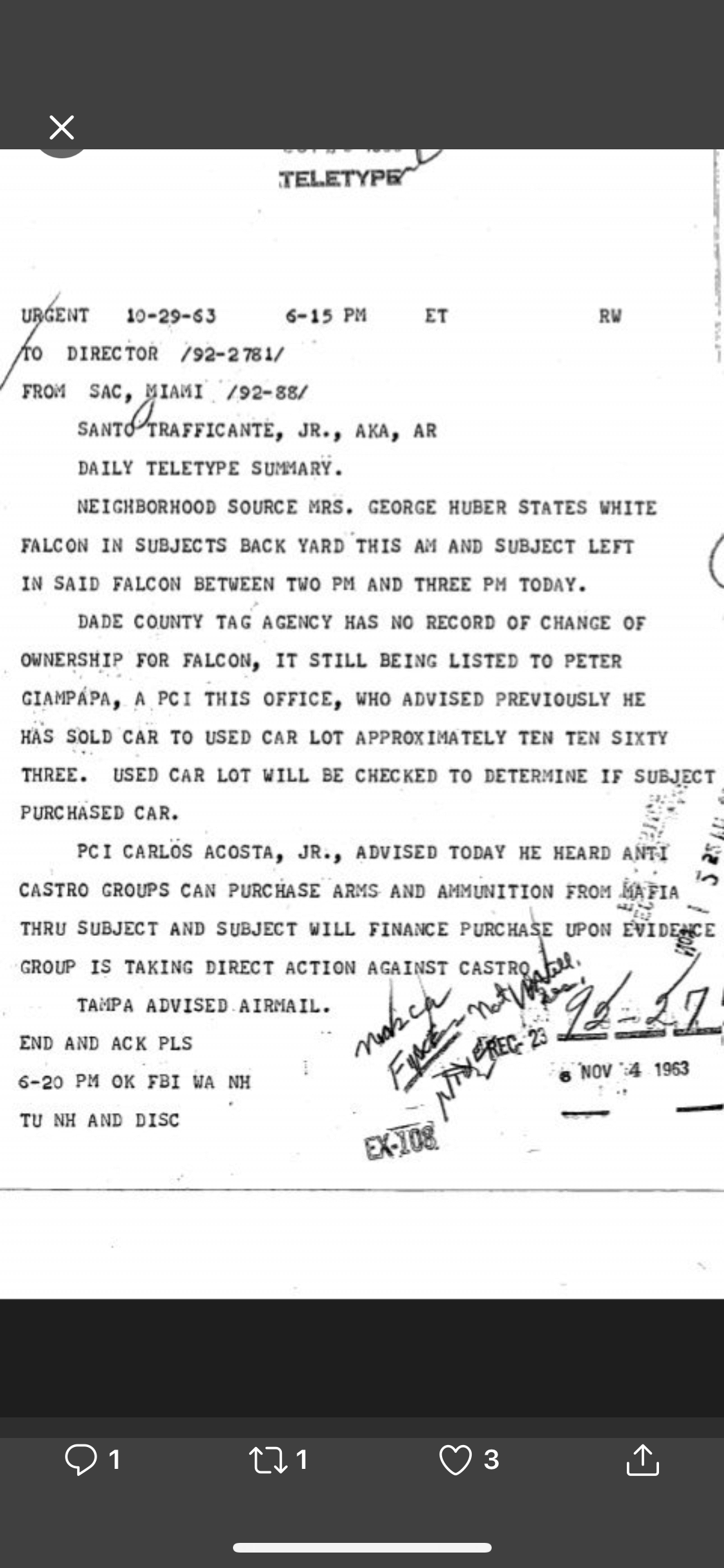
    fbi trafficante

  • Desperate Measures in the Congo

    Desperate Measures in the Congo


    I

    “The Dark Continent”

    In his sweeping and revolutionary Lectures on the Philosophy of History, the 19th-century Prussian philosopher G. W. F. Hegel detailed a vision of history unfolding through the bold and decisive actions of what he deemed “world historical” personalities. Having seen Napoleon and his ornate retinue of generals parade through his hometown of Jena as a young man, Hegel was impressed by the singular power of individuals to shape history, and eventually developed this notion into his rarefied theory of how unseen forces find their expression in the actions of powerful leaders who themselves—unwittingly or actively—force the grand wheel of history to turn through its great dialectical arc.

    So compelling was this vision to late 19th-century Europeans, who stood at the apex of technological achievement in contrast to the developing world, that even today few realize Hegel’s version of human history is but one narrative in a vast tapestry of explanations as to how societies have organized themselves throughout the centuries. We also forget, at our peril, the pernicious implications of Hegel’s theory concerning non-Europeans, especially the retrograde, even worthless qualities he ascribes to those inhabiting the African continent. As he noted in his series of lectures presented at the University of Berlin from 1822-30, “Negroes are enslaved by Europeans and sold to America. Bad as this may be, their lot in their own land is even worse, since there a slavery quite as absolute exists; for it is the essential principle of slavery, that man has not yet attained a consciousness of his freedom, and consequently sinks down to a mere Thing—an object of no value.” He concludes, after a lengthy digression on cannibalism, polygamy and the perpetual brutality among tribal sub-Saharan African groups, by claiming, “From these various traits it is manifest that want of self-control distinguishes the character of the Negroes. This condition is capable of no development or culture, and as we see them at this day, such have they always been.” (Lectures on the Philosophy of History, p. 98)

    This patriarchal view held by many 19th-century European intellectuals was the cornerstone for the many justifications used to perpetuate the brutal colonization of the African continent. The colorful flags of Denmark, Germany, France, Belgium, Portugal, England and Spain all shimmered in the hot African breeze at some point, continuously reaffirming from the colonizers’ perspective Hegel’s enduring vision of the infantile and helpless African peoples and their European “civilizers.” In this sense, the abject horror many historians have detailed at length in the Belgian Congo was not an aberration, but was more a crystalline and total distillation of the tenets of European racial subjugation as practiced elsewhere.

    In 1885 King Leopold II effectively declared the entire Congo basin his personal property, akin more to a medieval kingdom than a traditional colonial region like British India, for example, where to some extant the British were compelled to integrate aspects of local culture and politics into their own system. In the Belgian Congo, as Adam Hochschild and others have detailed, unrestrained brutality was normalized to such an extent that one might have forgotten that slavery had been universally abolished decades earlier. Established in 1885 at the Conference of Berlin, the “Free State of Congo” was ostensibly created to enrich the lives of its inhabitants, incapable, as Hegel noted, of managing their own affairs. And yet almost immediately this benevolent charter was reversed, with Leopold II using his mercenary Force Publique to maim, torture, and essentially re-enslave the native Africans of the Free State of Congo. Estimates vary, particularly due to the burning of records by the colonizers, but a conservative figure is that in his twenty-five year reign, nearly ten million Congolese were killed as a result of his policies, representing fifty percent of the 1880 population. During his reign of terror, Leopold and his provincial overseers extracted ivory, rubber, and other rare goods for export to Europe, personally enriching the king to the tune of 220 million francs ($1.1. billion today) by the estimates of the Belgian scholar Jules Marchal. (Adam Hochschild, King Leopold’s Ghost, p. 276) Incentivized through a tiered system of profit-maximization, the king’s men were rewarded with bonuses and promotions for resources gathered. Reluctant or underperforming Congolese were subjected to pitiless horrors, including having their limbs hacked off or enduring a hundred lashes of the whip, most of which proved fatal. The Force Publique also kidnapped villagers’ wives, who were frequently beaten and raped, holding them as ransom to induce workers to secure their release through reaching their rubber quotas. Herded like cattle into slave labor camps and paid just enough to purchase subsistence rations from their overlords, they remained powerless to resist Leopold’s private army, cordoned off in their remote Congo basin by armed outposts, attack dogs and a complacent international community at a time when information was the stuff of rogue travelers’ tales and stories told by escaped prisoners, rather than mass media headlines. In the United States, it was the lone voice of an African American military officer, Colonel George Washington Williams, who, having visited the Free State of Congo just years after its creation, felt compelled to openly criticize the regime in the international forums, declaring the Belgian king guilty of crimes against humanity:

    All the crimes perpetrated in the Congo have been done in your name, and you must answer at the bar of Public Sentiment for the misgovernment of a people, whose lives and fortunes were entrusted to you by the august Conference of Berlin, 1884—1885. I now appeal to the Powers which committed this infant State to your Majesty’s charge, and to the great States which gave it international being; and whose majestic law you have scorned and trampled upon, to call and create an International Commission to investigate the charges herein preferred in the name of Humanity, Commerce, Constitutional Government and Christian Civilization. (Washington, “Open Letter to King Leopold of the Congo”, 1890)

    Tales of his terrible and sinister exploits were the stuff of legend, and it was Leopold’s Free State of Congo that inspired author Joseph Conrad to write his famous novella Heart of Darkness, in which a distant and jaded Marlowe tells his shipmates his terrifying story of going up-river into the seething heart of colonial Central Africa. Yet from this tragic past, as the twentieth century dawned and Hegel’s dialectic of history moved the peoples of the world forward in the wake of the Second World War, the powerful and latent forces of human emancipation which had been awaiting their chance to check colonial oppression found their expression in a charismatic Congolese intellectual who intimately understood the powers arrayed against an autonomous Congo.


    II

    A New Hope

    The President observed that in the last twelve months, the world has developed a kind of ferment greater than he could remember in recent times. The Communists are trying to take control of this, and have succeeded to the extent that … in many cases [people] are now saying that the Communists are thinking of the common man while the United States is dedicated to supporting outmoded regimes. (Foreign Relations of the United States, 1958—1960, XIV, Document 157.)

    The Mouvement National Congolais (MNC) had been founded and led by Patrice Lumumba. Its aim was to seek the Congo’s independence from Belgium. In December of 1959, the MNC won a majority of local elections and participated at a conference in Brussels in late January of 1960. That conference set June 30, 1960 as the date for an independent Congo after national elections for new leadership were held in May. The MNC won the May elections. Lumumba was to be Congo’s first prime minister and Joseph Kasavubu the first president.

    In an impassioned and catalyzing speech to a crowd of thousands of newly liberated Congolese men and women, the Democratic Republic of Congo’s newly elected thirty-five year old prime minister, Patrice Lumumba, captivated his constituents by recounting the significance of what had just been achieved:

    We are deeply proud of our struggle, because it was just and noble and indispensable in putting an end to the humiliating bondage forced upon us. That was our lot for the eighty years of colonial rule and our wounds are too fresh and much too painful to be forgotten. We have experienced forced labour in exchange for pay that did not allow us to satisfy our hunger, to clothe ourselves, to have decent lodgings or to bring up our children as dearly loved ones.

    Morning, noon and night we were subjected to jeers, insults and blows because we were “Negroes”. Who will ever forget that the black was addressed as “tu,” not because he was a friend, but because the polite “vous” was reserved for the white man? We have seen our lands seized in the name of ostensibly just laws, which gave recognition only to the right of might. We have not forgotten that the law was never the same for the white and the black, that it was lenient to the ones, and cruel and inhuman to the others.

    We have experienced the atrocious sufferings, being persecuted for political convictions and religious beliefs, and exiled from our native land: our lot was worse than death itself. We have not forgotten that in the cities the mansions were for the whites and the tumbledown huts for the blacks; that a black was not admitted to the cinemas, restaurants and shops set aside for “Europeans”; that a black travelled in the holds, under the feet of the whites in their luxury cabins.

    Who will ever forget the shootings which killed so many of our brothers, or the cells into which were mercilessly thrown those who no longer wished to submit to the regime of injustice, oppression and exploitation used by the colonialists as a tool of their domination?

    All that, my brothers, brought us untold suffering. But we, who were elected by the votes of your representatives, representatives of the people, to guide our native land, we, who have suffered in body and soul from the colonial oppression, we tell you that henceforth all that is finished with. The Republic of the Congo has been proclaimed and our beloved country’s future is now in the hands of its own people.

    Freed from human bondage by a reluctant King Baudouin of Belgium in June of 1960, the Democratic Republic of Congo stood poised to capture the imagination of still-colonized and recently decolonized regions throughout the African continent. With Kasavubu as president and Lumumba as prime minister, along with a freely appointed parliamentary body, the Congolese provinces were taking the first decisive steps towards freedom. In the post-Free State of Congo period, stretching from its dissolution in 1908 to the 1960 creation of the Democratic Republic of Congo, although the abject horrors of Leopold II’s slave-labor program had largely subsided, the people of the Congo were still living under the thumb of their European overlords. In this interregnum period, education for black Africans was provided by white Catholic missionaries who proselytized their vision of what good Christians were to endure in the face of hardship. No African living in the Congo during this fifty-year period could vote, and apartheid was the default social framework in which blacks and whites co-existed. For the Congolese, these times were “free” only symbolically.

    But as many have pointed out, most recently John Newman in Countdown to Darkness, Belgium had schemed in advance to make sure that the free state of Congo would have an unsuccessful launch. The mechanism would be fouled to the degree that Belgium would have to retake the country in order to save it from a descent into chaos. As Newman points out, it was not just Belgium, but the USA that was unprepared to accept the success of a newly independent African country, especially one as large and as mineral-rich as Congo. Allen Dulles, Director of Central Intelligence, had smeared Lumumba’s character at a May 5, 1960 National Security Council (NSC) meeting. Dulles also suggested that there was “Some possibility that a movement might develop in the rich Katanga area for separation from the Congo.” (Newman, p. 152, all references are to the Kindle version) In other words, the foreign economic mining interests in Congo had planned the Katanga secession before independence day. And Dulles knew about it.

    On the day of Congo’s independence, there was another NSC meeting. This time Dulles was accompanied by Deputy Director Charles Cabell. Cabell now stated that Lumumba’s government would be communist-oriented and that Lumumba had already “solicited communist funds to help him obtain his present political position.” (Newman, p. 155) In other words, the CIA was doing its best to poison Lumumba’s character at the higher levels of governance in Washington.

    Within weeks of Lumumba’s pivotal June 30, 1960 speech, tensions within the Congolese state’s numerous and disparate factions and its multiracial army began to spill over into the general population. In sectors of the Congolese army, many black soldiers sought the removal of white officers, who they viewed as a cruel reminder of the colonial past, and demanded increased pay, commensurate with a professional army defending a newly unified and free nation. Katanga Province soon seceded from the Democratic Republic of Congo, only weeks after its creation, with its leader, Moise Tshombe, painting a picture of Prime Minister Lumumba as a radical. The mineral-rich region in the southeastern reaches of the Congo contained vast stores of precious metals, from copper to gold to the uranium used to build the atomic bombs the United States dropped on Japan at the end of WWII. Diamonds were also in large supply in Katanga, making it a truly invaluable region in the eyes of the colonizers. Indeed, the U.S. Central Intelligence Agency, along with Belgian military and intelligence support, began to get its hands dirty in Central African developments. Having sent cash, supplies, and the tacit support of intervention should their anti-Lumumba puppets fail to secure their tenuous hold during the crisis, the Western powers were instrumental in assuring the Democratic Republic of Congo would be stillborn. To tilt the scales even more against Lumumba, all of the country’s gold reserves had been transferred to Brussels prior to freedom day. And Brussels would not allow their transfer to Leopoldville. (Newman, p. 156)


    III

    Hope Dims

    On July 9, 1960 Belgium began to airlift paratroopers into Congo. With the Belgian troops already there, this now amounted to almost four thousand men. The next day, the provisional president of Katanga, Moise Tshombe, requested Belgian troops to restore order. To counter this, Lumumba and Kasavubu requested to meet with Tshombe, but the rebel leader of Katanga refused to let their plane land there. (Newman, p. 157) The Congolese troops now began to open fire on the Belgians and other Europeans. The Belgians returned the fire and shot scores of Congolese. (Richard Mahoney, JFK: Ordeal in Africa, p. 36) Lumumba now asked for American help in stopping the insurgency and the attempt by Belgium to reinstate control. Eisenhower turned the request down. (Mahoney, p. 37) On July 13, 1960 Belgian troops occupied the airport at Leopoldville, and shortly after this, Lumumba severed relations with Brussels. One day later, Dag Hammarskjold, Secretary General of the United Nations, shepherded through a resolution to send UN troops to the area. Hammarskjold also called on Belgium to remove its forces from the theater. This was the first time the UN had taken on such a mission. Hammarskjold was trying to make good on his intent to make the United Nations a forum where newly liberated countries could let their voices be heard against the established powers of the world.

    But Hammarskjold had the deck stacked against him. The largest mining operation in Congo was Union Minière, a joint Belgian/British enterprise. When the struggle broke out, the Belgians now began to pay business taxes not to Congo, but to Tshombe and Katanga. The Russians had also expressed their disappointment in what Belgium and the United States had and had not done. Dulles used this proclamation to turn the conflict into a Cold War struggle. (Newman, pp. 158-59) Lumumba and Kasavubu did not make things easier for him; they sent Hammarskjold a written ultimatum that demanded the Belgians be removed by July 19th. Furthermore, if this did not occur, they would then turn to the USSR in order to accomplish the task. (See Foreign Relations of the United States, hereafter FRUS, Vol. 14, Document 32) As both Richard Mahoney and John Newman have noted, this demand sent the NSC into overdrive. It sealed the CIA’s objective of turning a nationalist independence movement into a Cold War crucible, and on July 19th, the American ambassador to Belgium sent the following cable to Allen Dulles:

    Lumumba has now maneuvered himself into position of opposition to the West, resistance to United Nations and increasing dependence on Soviet Union … Only prudent therefore, to plan on basis that Lumumba government threatens our vital interests in Congo and Africa generally. A principal objective of our political and diplomatic action must therefore be to destroy Lumumba government as now constituted, but at same time we must find or develop another horse to back which would be acceptable in rest of Africa and defensible against Soviet political attack. (FRUS, Vol. 14, Document 136)

    The problem with this cable as sent by diplomat William Burden—a Vanderbilt fortune heir who had bought his way into the State Department—was that almost every statement in it was false. As Mahoney has shown, Lumumba was actually still trying to communicate with the USA at this time. Similarly, he was not resistant to Hammarskjold; he just wanted the UN Chief to perform with alacrity. And he was not dependent on the USSR. But further, his request to Moscow for supplies would have been prevented if the United States had acceded to his earlier cable to Washington. Finally, Lumumba did not constitute any danger to American interests in Congo or Africa. In fact, Burden confabulated the first part of the cable in order to jump to the second part, namely that the USA should now be prepared to take terminal actions against both Lumumba and Congo and should begin to search for a new leader there.

    As Senator John Kennedy once noted, it was this kind of State Department performance—backing the imperial powers while discounting the hopes of the native people—that was ultimately self-defeating, as France had seen at Dien Bien Phu in 1954. There, as Senator Kennedy had said, we had wrongly allied ourselves with “the desperate effort of a French regime to hang on to the remnants of empire.” (Mahoney, p. 15) This is a major reason why, in 1958, Kennedy purchased one hundred copies of that prophetic novel about Vietnam, The Ugly American, and passed it out to each of his Senate colleagues. But, unfortunately for Lumumba and the Congo, Kennedy was not yet president.

    The Burden communiqué seemed to inspire Dulles to scale even further heights in smearing Lumumba as not just a communist, but in league with Egypt, the USSR and the communist party in Belgium. (FRUS, Vol. 14, Document 140). The allegation of Lumumba´s allegiance to Egypt was natural, since the CIA considered Gamel Abdel Nasser too leftist and, according to author William Blum, had contemplated overthrowing him in 1957. Nasser was also a pan-Arabist, and therefore it was claimed that the union of Nasser and Lumumba could unleash a Red Horde across Africa and the Middle East. This was all propaganda. As Jonathan Kwitny later wrote in his seminal essay on Lumumba, there was never any credible evidence that Lumumba was a communist, or that he had any interest in proselytizing that dogma either in Congo or across Africa. (Kwitny, Endless Enemies, p. 72) But Dulles was not going to let the minor matter of evidence get in his way. At this same NSC meeting of July 21st, he now said that with Lumumba “we were faced with a person who was a Castro or worse.” (FRUS, Vol. 14, Document 140) Since President Eisenhower had already approved a plan to overthrow Castro, and Dulles was privy to CIA plots to assassinate him, the CIA Director was now playing his ace in the hole. With that card, Dulles was now clearly in opposition to Hammarskjold.

    In the latter part of July, Lumumba—further contradicting the Burden memo—decided to visit America. He arrived in New York to speak with Hammarskjold, and then went to Washington DC. Eisenhower avoided meeting him there by staying out of town in Newport, Connecticut. Lumumba told Secretary of State Christian Herter that Tshombe did not represent the people of Katanga and that Belgium has essentially stolen Congo’s gold assets and left the country with no treasury. (Newman, p. 218) He therefore requested a loan. Herter dodged all these requests by saying that these would all be considered by Hammarskjold and the USA would have input into these decisions—all the while Dulles, as previously noted, was working at odds with the United Nations.

    Lumumba now expressed disagreement with Hammarskjold over the terms of UN intervention. He demanded that the UN expel all non-African troops and enter Katanga to stop its secession. (Newman, p. 221) If not, then he would turn to the USSR to do so. The Russian aid began arriving just after mid-August. This included military advisors and supplies, by both ship and plane. With this, all hope for Lumumba and Congo’s independence went down the drain. There was now open talk in cables about Congo experiencing a classic communist takeover, and how the United States must “take action to avoid another Cuba”, and how “the commie design now seems suddenly clear.” (Mahoney, p. 40; Newman p. 222)

    All of this culminated in the August 18th NSC meeting. This meeting consisted of advisors like Maurice Stans and Douglas Dillon turning Lumumba into some kind of Red Menace. And this kind of talk eventually got the best of President Eisenhower. As Newman informs us, the turnaround time for NSC steno notes was usually a day. At the most it would extend to 3-4 days. In this case, the transcription took one week. In 1975, fifteen years after the meeting, the transcriber Robert Johnson decided to explain why the draft memo of that meeting took so long. Johnson testified that during the meeting Eisenhower gave an order for the assassination of Lumumba. (Newman, p. 224) After checking with a superior, Johnson decided not to include the order in the transcript. This issue was then followed up on a week later at another meeting. But as Newman has discovered, the Church Committee interview notes of a participant who conveyed Eisenhower’s interest in following up his assassination request with covert action have now disappeared. Luckily, however, Newman copied the notes back in 1994 before they were removed, so we know that after one week to think about it, Eisenhower had not changed his mind on the issue. (Newman, p. 232)

    The day after the August 25th meeting, Allen Dulles composed what can only be called an assassination cable. It reads as follows:

    In high quarters here it is the clear-cut conclusion that if Lumumba continues to hold high office, the inevitable result will at best be chaos and at worst pave the way to communist takeover of the Congo with disastrous consequences for the prestige of the UN and for the interests of the free world generally. Consequently, we conclude that his removal must be urgent and prime objective and that under existing conditions this should be a high priority of our covert action.

    On the second page of the cable, Dulles authorizes the station chief in Leopoldville to spend up to $100,000 to carry out the operation without consulting headquarters about the specifics. On the same day Dulles sent the cable, Director of Plans Dick Bissell talked to the head of the CIA’s Africa Division. He told Bronson Tweedy to start thinking about “reviewing possibilities, assets, and discussing them with headquarters in detail.” (Newman, pp. 236-240)

    On September 5th, 1960, only months after Lumumba’s grand speech, the President of the Democratic Republic of Congo, Joseph Kasavubu, dismissed him on Radio Brazzaville, officially of his own volition, but in actuality, with the urging of his CIA and Belgian intelligence handlers. (Stephen Weismann, “Opening the Secret Files on Lumumba’s Murder,” Washington Post 07/21/2002)

    Kasavubu had been a reluctant supporter of Lumumba, and Western strategists were quick to play on his hesitations regarding Congolese independence. For months leading up to this announcement, UN Undersecretary in Charge of General Assembly, Andrew Cordier, later president of Columbia University, had been coaching the Congolese president, and carefully monitoring developments as he prodded him to fire Lumumba. (Carole Collins, “The Cold War Comes to Africa: Cordier and the 1960s Congo Crisis,” Journal of International Affairs, 6/22/1993) After this bold radio dismissal, Cordier ordered U.N. troops into the region, with orders to ostensibly shut down the airport and radio stations in Brazzaville. As Collins notes, however, there was a backhanded motive to this move:

    These actions primarily hurt Lumumba because only Kasavubu enjoyed access to radio facilities in the neighboring state of Brazzaville. Similarly, Kasavubu’s allies were allowed to use the ostensibly closed airport to travel into the Congolese interior to mobilize support for the president while Lumumba’s supporters were grounded. Near the end of his three-week stay in early September, Cordier authorized the United Nations to offer food and pay to the Congolese Army. This action allowed Mobutu—a one-time Lumumba aide who had been appointed chief-of-staff of the army by Kasavubu just days earlier—to win credit for paying the soldiers their past-due salaries, and to pave the way for his coup attempt a few days later. The combination of U.N. and U.S. support was pivotal for Mobutu’s subsequent seizure of power.

    Colonel Joseph Mobutu, another key figure in the tripartite struggle for indigenous Congolese independence, was, like Kasavubu, not altogether enthusiastic about Lumumba’s historic and sweeping proclamations of independence. Now the titular head of the Democratic Republic of Congo’s armed forces, after a recent promotion by Kasavubu, Mobutu was essentially an opportunist from all extant evidence. Carefully monitoring local political developments and the slow but steady marshaling of Western armed forces in the sweltering jungle basin, he hedged his risk and quietly stood poised to make his bold power play. As Brian Urquhart recalls from his station at Leopoldville on the night of Kasavubu’s announcement,

    Mobutu appeared once again at our headquarters, this time in uniform. He said he was tired and nervous and needed a quiet place to relax. Our office was already jammed with jittery suppliants, so I put him in my bedroom. At his request, I lent him a radio, adding half a bottle of whiskey to cheer him up. Some time later, I looked in on our uninvited guest. He seemed to be enjoying the whiskey all right, as Radio Leopoldville continued to play the cha cha cha. But then the music stopped, and a voice was heard to say that he was suspending the president, the prime minister and the parliament and taking over the country.

    ‘C’est moi!’ Mobutu exclaimed, triumphantly pointing to the radio. ‘C’est moi!’

    I don’t know when I have been more irritated. I told Mobutu that if he wanted to make a coup d’état, the place for him was in the streets with his followers, not listening to the radio under false pretenses in someone else’s bedroom. We then threw him out.” (Brian Urquhart, “Mobutu and Tshombe: Two Congolese Rogues,” UN News Character Sketches)

    By the end of September, 1960, Mobutu and his remaining loyal soldiers and officers from the former Belgian Congo Army became the western Congo basin’s de facto functioning political body. This had been done in agreement with the Leopoldville CIA station chief, Larry Devlin. Devlin had also authorized Mobutu to eliminate Lumumba and had guaranteed him a large sum in French francs to do so. (Newman, p. 268) To the east, Lumumba’s deputy, Antoine Gizenga, assumed a provisional role as the leader of the short-lived Stanleyville government. To the south, Tshombe still held onto the Katanga and South Kasai provinces. Patrice Lumumba himself remained under house arrest, having been detained on September 16th by U.N. peacekeeping troops, ostensibly for his own safety.

    But the CIA had still not given up. In September, the Agency had three agents in Congo and their shared mission was to assassinate Lumumba. These were contract assassins QJ/WIN, WIROGUE, and the CIA headquarters chemist Sidney Gottlieb. Gottlieb was to prepare a toxic agent and deliver it to Congo. From there, Devlin was to recruit a Lumumba aide to insert it in the prime minister’s toothpaste. If that failed, Devlin was also trying to recruit an assassin to break into the safe haven the UN had provided for Lumumba and simply shoot him. These were in addition to Devlin’s agreement with Mobutu. Therefore, by the end of September, the CIA had five different methods on hand to kill Lumumba. But at the end of the month, Tweedy cabled Devlin that they must choose a plot that would conceal America’s role. (Newman, p. 268)


    IV

    “Mad Mike”

    To detail the full sweep of the Congo Crisis and its myriad twists and betrayals is beyond the scope of this article, but suffice to say, after Tshombe’s secession of Katanga province and Mobutu’s and Kasavubu’s betrayals of Lumumba, the prime minister was surrounded by hostile forces, and desperately sought outside help. Among these were the United States, which categorically rejected his pleas, and the Soviet Union, which agreed, at least ideologically, with his fight for freedom. But they were initially reluctant to commit armed forces for fear of escalating the regional conflict into a larger strategic battle with the West.

    President Tshombe, who still held onto Katanga in January 1961, had the most to lose and the likeliest chance of receiving outside help, given his region’s enormous natural resources. One of his initial strategies involved creating a group of 700 to 800 foreign mercenaries, both for personal protection and as a stopgap unit to quell any potential attacks from neighboring provinces on Katanga. Belgians, Rhodesians, South Africans, and French nationals answered the call; for a decent wage, they could partake in a quixotic adventure in the Congo, led by their much-loved and no-nonsense Thomas Michael “Mad Mike” Hoare, a retired WWII captain who promoted himself to major upon answering Tshombe’s call.

    Having served in the Second World War as an infantryman with the Royal Army’s London Rifles, Hoare was a veteran of the North African and Italian theaters of combat. After a brief stint in the peacetime army, he relocated to warmer climates, finally settling down in Durban, South Africa in the 1950s. Moonlighting as a safari guide and a used car salesman, he was looking for something new when he heard from a close friend that Tshombe was looking for mercenaries. Hoare flew to Katanga, and quickly placed an ad in a local newspaper. Within weeks he had mustered a few dozen able-bodied men. Among their colorful ranks were an ex-Wehrmacht soldier who flaunted his iron cross medal on deployments, former British and Australian soldiers from WWII, local Katangese soldiers trying to protect their homesteads and families, members of the former Belgian occupation and security forces, and a few former South African police officers. Hoare was quick to note that his men were seriously lacking in actual battlefield experience, with many faking feats of valor and claiming decorations and accomplishments that, when investigated, more often than not proved fictional. Through a punishing physical training regimen and a cursory demonstration of fundamental battlefield tactics and command protocols, “Mad Mike” whipped his infamous “4 Commando” (later 5 Commando) into basic shape by the early months of 1961, with his headquarters situated in the provincial capital of Elizabethville. He and a former Royal Army officer, Alistair Wicks, each led a company of sixty men, with Hoare in nominal command of the two units. (Mike Hoare, The Road to Katanga: A Congo Mercenary’s Personal Memoir)

    Initially tasked with securing Elizabethville against raiding parties of the local Baluba tribe, Hoare’s account is half Arthur Conan Doyle novel, half military memoir, but always gripping:

    The column had bogged down in the heart of enemy territory. The track had collapsed after days of torrential rains and more than twenty trucks had sunk into the mud up to their axles. We were surrounded by an unseen army of Baluba warriors, a tough and merciless foe. That day we had lost one of my men from a wound inflicted by a poisoned arrow. He had lasted less than sixty minutes and was one of my first casualties. Morale among my Katangese drivers was at rock bottom. My unit, 4 Commando, which was escorting the column, was on edge, several of the men down with malaria, the remainder near exhaustion from lack of sleep. (Hoare, 4)

    Initially tasked with supporting transport columns carrying food and supplies to the beleaguered Belgian security forces fighting in Katanga, Hoare’s 4 Commando eventually earned the trust of the Elizabethville government enough to serve as a small but effective personal army for Tshombe, who funded the adventure through the previously mentioned Union Minière, an enormously rich mining conglomerate based in Katanga. With access to nearly unlimited ammunition, modern Belgian assault rifles and belt-fed machine guns, and a motley assortment of military jeeps and half-ton trucks, Hoare’s group of foreign legionnaires was a truly frightening sight for an indigenous uprising armed with 19th-century shotguns, bows and arrows, and a mystical courage imbued in them by local witch doctors. For many of the Baluba, who were 4 Commando’s principal opponents in the early days of his deployment, a ritual dance, along with the ceremonial drinking of beer and smoking of marijuana, combined with the soothing rhythmic words of their shamans, steeled them against the commandos. Hoare noted that, while the notion that Western bullets passed through the Baluba was obviously absurd, their belief in this was fueled only in part by wishful thinking and mysticism; in previous uprisings before the declaration of Congolese independence, Belgian security forces would often fire blanks into crowds of Balubas who were marshaling to rebel.

    A man of average height and wiry build, with slicked-back blonde hair and sharp features, Thomas Michael Hoare was the spitting image of the great white hunter, which, as mentioned before, he once was. With his decorative beret, rolled up sleeves, and ubiquitous radio receiver in hand, he seemed archaic even in the mid 1960s. And yet this old-fashioned, Rule Britannia mentality was probably what saved him and his men’s lives in the depths of the jungle. Under no illusions regarding the challenges arrayed against him—especially the health risks presented by sustained deployments in the jungle without modern medical facilities—he was equally curious, in that colonial way, about the innate differences between Europeans and sub-Saharan Africans. While still under the same spell as Hegel, Kipling, Spencer, and other proponents of racial hierarchical thinking, to his credit, “Mad Mike” was more open to the African experience, if solely for practical considerations. Like an integrated unit in Vietnam, or a professional football team whose members must put their differences aside, if only temporarily, 4 Commando ultimately served, like the pirate ships of the 16th Century, as a strange meeting place for people of all walks of life. Hoare exercised executive control over the expedition, and in the case of a man who murdered a young Congolese boy after numerous other infractions, was not averse to summary execution. Another soldier under his command, who had raped and killed a local Katangese woman, was lined up in front of the trucks on the side of a house; Hoare knew the man was a semi-professional soccer player back in Europe, and saw fit to pull out his pistol and personally shoot off both of the man’s big toes.

    To these ends, throughout the early months following Katanga’s secession, Hoare’s motley crew slogged through the rugged Katanga backwoods, driving through monsoon downpours and blistering heat, setting up camp at night in some of the world’s most desolate regions, firing bright green illuminating flares at the sounds of potential raiding parties gathering in the jungle, but more often than not, firing blindly at imagined armies where only wildlife and rustling bush existed. Their first real encounter with the enemy, ironically, was an armed standoff in the village of Nyunga with U.N. peacekeeping troops. Having been placed there at the behest of the Feb. 21, 1961 U.N. Security Council decision to prevent a full-blown Congolese civil war, a detachment of Malayan soldiers with a platoon of armored cars ordered Hoare and his men to stand down. In the night, while the two forces stealthily checked their weapons and sandbagged their positions across the town square, Hoare’s radioman received a report from Albertville HQ that the U.N was very likely going to arrest 4 Commando and intern them in Leopoldville; all Belgian and foreign mercenaries, under the U.N. Security Council’s resolution, were considered hostile combatants. After a brief meeting with the Malayan colonel in charge of the U.N. detachment, Hoare had to think on his feet. He told the officer he would briefly consult with his men and try to forgo the inevitable and likely suicidal shootout with a heavily armed professional army. After walking across the town square and debriefing his men in his makeshift headquarters, seven of which wanted to surrender, he ordered a breakout. Those wishing to avoid capture would cut a mad dash across town as the others approached the checkpoint to surrender. They would scatter and rush through the jungle to a prearranged rendezvous point a few miles away and take it from there. Hoare checked his compass, grabbed his rifle, blew his whistle and they were off.


    V

    Plausible Deniability

    As long as Lumumba stayed in his UN-guarded safe haven he was relatively secure from any attempt by Mobutu to arrest him, for the simple reason that Hammarskjold’s representative would not allow the warrant to be served. Lumumba had survived several futile attempts by the CIA’s Executive Action program to eliminate him. For example, QJWIN and WIROGUE had been recruited through the CIA’s Staff D, which came under the control of William Harvey in 1960. Director of Plans Dick Bissell had himself offered the job of case officer on the operation to at least two agents and they both turned it down. But the second one, Justin O’Donnell, did agree to run an operation to politically neutralize Lumumba. The opportunity came when, under intense lobbying by America and England, the UN decided to seat Kasavubu’s delegation. This occurred just when Lumumba’s following was gaining strength in Congo. So Lumumba decided to arrange his escape to Stanleyville, his political base on the evening of November 27, 1960. (Mahoney, p. 55)

    Devlin now conferred with Mobutu to plot the paths that Lumumba would have to take in order to make it to Stanleyville. The CIA helped Mobutu set up checkpoints along river crossings and to block certain roads. (Mahoney, p. 56) On November 30th, QJ/WIN offered to go to Stanleyville to kill Lumumba himself. But within 24 hours of that offer, Lumumba was captured in the rebel province of Kasai. (Newman, p. 295) Fearing that killing him on their own soil would provoke a full-blown uprising, his captors decided to send him to his certain torture and death at the hands of the rulers of Katanga province. He was moved from a temporary holding barracks in Thysville to Elizabethville, the capital of Katanga, where his previous colonizers, the Belgians, were waiting with their close friend and president, Moise Tshombe. Having contemplated killing him through a tube of poisoned toothpaste only months earlier, the CIA was relieved at news of his capture and subsequent murder, which they helped orchestrate. Indeed, Sydney Gottlieb, the American witch doctor who pioneered many of the Central Intelligence Agency’s lethal potions and covert execution methods for ZR/RIFLE (the codename of the central assassination arm of the CIA), had only weeks earlier flown in from Europe to personally deliver the goods. (NY Times 12/11/2008)

    After a kangaroo court and short military trial which accused him of inciting a revolt, Lumumba, along with his two escaped aides who had all been beaten and sadistically abused throughout the night, was lined up against a tree and shot by a Belgian firing squad. President Tshombe personally oversaw the execution. After killing his two supporters, the Belgians and their Katangese paramilitary officers dumped them in shallow graves, later deciding to disinter them, dissolve their bodies in sulphuric acid, and grind their bones into a fine powder to forever erase them from history. When the sulphuric acid ran out, what was left of the corpses was set afire. (Newman, p. 296) This happened three days before John Kennedy’s inauguration. The news of his death was kept from Kennedy for almost one month. Whether this was by accident or by design, it is a fact that once Kennedy was in office his policy drastically altered Eisenhower’s. And it would have favored Lumumba.

    The murder of Patrice Lumumba made it much easier for a continuation of neocolonial policies in the Democratic Republic of Congo (DRC). In one fell swoop it laid waste to the nascent progressive hopes of a people essentially freed from over a hundred years of brutal colonial slavery, and paved the way for the rise of figures like Joseph Mobutu, who would later rule the Congo until 1996, becoming a billionaire and a brutal despot. Mobutu was a great friend of Washington, a tremendous ally to the CIA, and the bane of African nationalists seeking the practical, achievable vision of figures like Lumumba, who could have stood as a beacon of hope for a Pan-African unity of purpose against their white European overlords in this time of turmoil and decolonization. With the murder only months later of U.N. Secretary General Dag Hammarskjold—and Susan Williams’ book proves it was a murder—the last best measures for preventing a downward spiral of the DRC were lost. When his airplane, engulfed in flames, crashed into the jungle outside Ndola airport as he was attempting to land and begin ceasefire talks, one of the few honest statesman from the European power structure who was truly concerned about the fate of the Congo was lost. As Richard Mahoney notes in his fine book, JFK: Ordeal in Africa, Kennedy made a strong effort to try to keep Congo independent after Hammarskjold’s death. (See further Dodd and Dulles vs Kennedy in Africa) For as Greg Poulgrain revealed in The Incubus of Intervention, Kennedy and Hammarskjold had made a secret alliance to do all they could to keep Congo and Indonesia free from imperialism. Kennedy did his best to maintain that pledge after Hammarskjold was assassinated. (See Hammarskjold and Kennedy vs The Power Elite)


    Epilogue: Why Congo Matters Today

    As Jonathan Kwitny noted in Endless Enemies, after his death Lumumba became a hero in Africa. One could find his name affixed to avenues, schools, squares and parks. As Kwitny wrote: “Lumumba is a hero to Africans not because he promoted socialism, which he didn’t, but because he resisted foreign intervention. He stood up to outsiders, if only by getting himself killed.” (Kwitny, p. 72)

    But there is also a larger, more epochal aspect to what happened to Lumumba and Congo. This has to do with being a historical marker for Africa as it came out of the second Age of Colonialism. Again, Kwitny eloquently summarizes it:

    The democratic experiment had no example in Africa, and badly needed one. So perhaps the sorriest and the most unnecessary blight on the record of this new era is that the precedent for it all, the very first coup in postcolonial African history, the very first political assassination, and the very first junking of a legally constituted democratic system, all took place in a major country and were all instigated by the United States of America. It’s a sad situation when people are left to learn their ‘democracy’ from the Union of Soviet Socialist Republics. (Kwitny, p. 75)

    One cannot understand why the so-called “Third World” remains just that if one does not confront the very harsh realities of episodes from mid-century U.S. foreign policy like the CIA’s attempts to kill Patrice Lumumba. Though mainstream media outlets eventually admit to our sad and tragic “mistakes” made in the distant past and point to “startling revelations” about this and that player and agency involved, they fail to admit the obvious: The United States, for its entire post-WWII history, up to the publication of this article, has almost entirely suppressed, held-back, or outright destroyed freedom-seeking, nationalistic movements on a global scale. It does this through a variety of means, be they the actual targeted assassination of a movement’s leader, the depreciation of a nation’s currency, the overthrow of a regime through a proxy army or CIA-backed coup, or a traditional military invasion.

    This is a painful but necessary fact for its citizens to internalize, seeing as it runs counter to almost everything we are told about America in school, on the radio, or in the news. It is acceptable to critique the power structure insofar as that critique points to a technical glitch, a rogue personality, or a tactical error, as in the mainstream media´s common admission now that the Iraq War was a “mistake.” There are no mistakes at that level. The mistake was intended to be a mistake. Destabilization of a region, like the Middle East, or in our case, central Africa, is extremely helpful to people who seek to benefit from chaos. It was enormously profitable for mining interests in the Congo that the region fell into a perpetual civil war or under a brutal dictatorship. It was equally lucrative for hundreds of thousands of Indonesians to be slaughtered by Suharto’s death squads, seeing as parts of his nation contained hundreds of billions of dollars’ worth of gold veins. It was a strategic victory for nations like Libya, Iraq, Afghanistan, and others on the Project for a New American Century’s list to be decimated since this opened the way for greater geopolitical leverage against other superpowers like Russia and China, while subtly flooding the southern reaches of Europe with refugees, and spawning groups like ISIS and ISIL. What a more honest assessment of U.S. foreign policy would note is that the United States, as Martin Luther King famously noted, still remains the “greatest purveyor of violence in the world,” and yet the average citizen within its borders is blissfully unaware of this fact; and is equally unaware that it was a statement like that which likely got King killed by the very government he sought to change. Like Lumumba, figures like Dr. King, President Kennedy, and Dag Hammarskjold paid the ultimate price for seeking to effect change in the developing world and at home in America’s impoverished communities. And it is this sinister, plausibly deniable ugliness of the United States that is largely to blame.


    Editor’s note: the following feature appeared in 2016, and speaks directly to the theme of the Congo’s (and Africa’s) continuing relevance today.

    How the World Runs on Looting the Congo


    Addendum (05.01.2018)

    A new document courtesy of David Josephs.

    This document indicates just how involved Kennedy was in the colossal Congo crisis. He is actually leading the UN effort, not the other way around. After the murder of Hammarskjold, he appears to have taken over the Secretary General’s initiative there as the United Nations commitment was slackening.

    Or, click here: RIF 176-10036-10001

  • Bill Davy at the VMI Seminar

    Bill Davy at the VMI Seminar

    Alan Dale:

    I have the honor of being your host, your emcee. I’d like to begin by introducing our first speaker. William Davy is a longtime researcher and writer, a respected contributor to Probe Magazine. He’s been published as an essayist and reviewer. He’s the author of a monograph on Clay Shaw, which he further developed into his illuminating and much admired work, Let Justice Be Done: New Light on the Jim Garrison Investigation. Please welcome Bill Davy.

    Bill Davy:

    Thank you. Thank you, thank you, Lee, and good evening everybody. Just give me a second to get settled here and get my eyes on. Okay. All right.

    The topic of my presentation tonight are the new documents and the Season of Inquiry. By the Season of Inquiry, I’m talking about essentially the 1970s. It really was a season of inquiry. We have Watergate, of course, the Pike Committee, the Rockefeller Commission, the Church Committee, and House Select Committee on Assassinations. It seemed like at the time the politicians in the country in general were more interested in uncovering the political state. Pardon the term. Present company excluded, of course.

    We’re going to go into some of the documentary evidence, but oftentimes when I’ve given talks to, say, a less sophisticated audience, just to start off, I’ve asked the question, “What do you feel is the government’s official position on the JFK assassination?” and people will say something like, “Well, Oswald did it,” or, “That Warren Commission thing.” I say, “No, that’s not the official position at all. The official position of the federal government is that JFK was killed by a conspiracy.”

    It’s right there. That is the copy … Or it’s right here. It’s the final report of the House Select Committee on Assassinations. God knows there’s all kinds of problems with the HSCA. You can do a whole symposium on some of the in-fighting and backstabbing and so forth.

    But that aside, they did some good work, and a lot of that good work found its way into the report itself. I just want to take a quick look at some of the findings of the report. I hate talking at people because everybody can read, but a few of these are worth noting.

    First, “The committee believes on the basis of the evidence available to it that President John F. Kennedy was probably assassinated as result of a conspiracy.” Further, “The committee found that, to be precise and loyal to the facts it established, it was compelled to find that President Kennedy was probably killed as a result of a conspiracy.” Compelled to find, pretty strong language, even though they keep slipping the ‘probably’ in there.

    We’re talking about the scientific evidence here. The evidence available to the committee indicated that it was “probable that more than one person was involved in the president’s murder. That fact compels acceptance.” Again, with the compelling. “And it demands a reexamination of all that was thought to be true in the past.”

    Further, they conclude, “Neither Oswald nor Ruby turned out to be loners, as they’d been painted in the 1964 investigation,” and indeed in the media, ongoing as a matter of fact.

    “The committee found that the CIA-Mafia-Cuban plots had all the elements necessary for a successful assassination conspiracy: people, motive, and means; and the evidence indicated that the participants might well have considered using the resources at their disposal to increase their power and alleviate their problems by assassinating the president.”

    Again, talking about the scientific evidence. “Scientific acoustical evidence establishes a high probability that two gunmen fired at President John F. Kennedy. Other scientific evidence does not preclude the possibility of two gunmen firing at the president.” They’re talking about the stuck open mic of the motorcycle policeman who essentially recorded the assassination as it happened.

    Further, in talking about the photographic evidence, “A fleshtone comparison performed by analyzing measurements of color values,” and this is on Willis photograph number five. “A fleshtone comparison performed by analyzing measurements of color values on an object located behind the west end of the retaining wall,” this is on the grassy knoll, “confirmed that the image perceived was actually a human being.” They found photographic evidence of a human being behind the retaining wall on the grassy knoll.

    “The panel did perceive ‘a very distinct straight-line feature’ near the region of this person’s hands, but it was unable to deblur the image sufficiently to reach any conclusion as to whether the feature was in fact a weapon,” but they found a person and they found what appeared to be a weapon behind the grassy knoll.

    “During the course of its investigation, the committee developed several areas of credible evidence and testimony indicating a possible association in New Orleans and elsewhere between Lee Harvey Oswald and David W. Ferrie.” I’ll assume most people know who David Ferrie is, so we don’t have to go down that road.

    “The committee found that the Clinton witnesses … ” This may require a little explanation. What they’re talking about here is the town of Clinton, Louisiana, which is just outside of Baton Rouge. It was uncovered during the Garrison Investigation and the subsequent Shaw trial that Lee Harvey Oswald was seen in Clinton, Louisiana at a voter registration incident with not only David Ferrie but Clay Shaw as well.

    “The committee found that the Clinton witnesses … ,” and there was a whole cross-section of people up there testifying to this. “The committee found that the Clinton witnesses were credible and significant. It was the judgment of the committee that they were telling the truth as they knew it.”

    “If the witnesses were not only truthful but accurate as well in their accounts,” they’re talking about the Clinton witnesses, “they established an association of an undetermined nature between Ferrie, Shaw, and Oswald less than three months before the assassination.” “The committee was, therefore, inclined to believe that Oswald was in Clinton, Louisiana in late August, early September ’63 and that he was in the company of David Ferrie, if not Clay Shaw.”

    “The committee also found that there was at least the possibility that Oswald and Guy Banister were acquainted.” Banister, Ferrie, and Shaw were a triumvirate of suspects and intelligence operatives that had come into the orbit of the Garrison investigation. Anybody who’s seen Oliver Stone’s film, JFK, certainly knows who these players are. The committee found that there was at least a possibility that Oswald and Banister were acquainted. We’ll show later that that was more than a possibility.

    “The committee obtained independent evidence that someone might have posed as Oswald in Mexico in late September and early 1963.” This was the imposter down in Mexico City. Dr. Newman will probably be covering some of that later.

    On the Warren Commission, the committee found that it “failed to investigate adequately the possibility of a conspiracy to assassinate the president”, that it “presented as conclusions in its report in a fashion that was too definitive”. It “overstated the thoroughness of its investigation”, and that “It is a reality to be regretted that the commission failed to live up to its promise.”

    A summary of the House Select Committee’s conclusions. President Kennedy’s assassination was the result of CIA-Mafia-anti-Castro conspiracy. A gunman fired from the grassy knoll. Oswald was associated with Ferrie, Shaw, and Banister. Oswald was impersonated in Mexico City. The Warren Commission was a failure. Does that remind you of anybody? The House Select Committee’s conclusions vindicated Jim Garrison.

    Further vindication of Garrison comes in the form of the Church Committee. This is a rather misleading title document of Oswald in New Orleans. It’s 155 pages and there’s very little in it on Oswald in New Orleans. Again, this comes from the files of the Church Committee. This is the cover sheet: Oswald in New Orleans. One that’s of importance for us here is this interview with Wendell Roach.

    Now Mr. Roach at that time was in charge of the INS in New Orleans. That was the Immigration and Naturalization Service. It’s since become part of DHS, known as ICE and Customs and Border Patrol. But back before 9/11, it was known as INS. Wendell Roache was in charge of the New Orleans office. They interviewed Roach and … According to Roache, the INS’ role was to determine who was an alien and prevent unauthorized border crossings, et cetera. As part of their duties, they had the responsibility of surveilling these various Cuban groups in New Orleans, and there were a ton of them at the time, mainly these anti-Castro groups.

    The INS had them under surveillance. Included in the surveillance was the group of nuts, as he calls them, headed by David Ferrie. Roache knew the details of Ferrie’s dismissal from Eastern Airlines, various sordid details of his private life, et cetera. As part of surveilling these Cuban groups, they picked up surveillance on David Ferrie because he was closely aligned with these anti-Castro groups.

    As they were surveilling Ferrie and the anti-Castro groups, they picked up surveillance of Lee Harvey Oswald. As we can see here, Roache revealed that during the course of their surveillance, they picked up Lee Harvey Oswald going into the offices of Ferrie’s group. The offices of Ferrie’s group was at 544 Camp Street, which was Guy Banister’s office. Oswald had used that address and stamped that address on the literature that he was handing out in New Orleans. He was seen going into the offices of Ferrie’s group, Banister’s office, and Oswald was known to be one of the men in the group.

    Here you have an investigative body of the United States government in the person of Wendell Roache admitting that in the course of their surveillance, routine surveillance, they picked up David Ferrie associating with Lee Harvey Oswald, and the two of them going into Guy Banister’s office. Let’s see if we can blow this up a little bit.

    He also said that the anti-Castro Cubans have been trained by a six-foot ex-marine out of Lake Pontchartrain. He could be referring to Gerry Patrick Hemming here. Just throw that out there because he mentions … He goes out of his way mentioning a six-foot ex-marine.

    His take on Garrison was that Garrison had something: I read his reports in the newspaper, and they were correct. He received good intelligence, whether he was using it for politics or not. Roache noted that Garrison was all eyes and ears in the French Quarter.

    Further, he adds a little something extra to the Oswald story. When Oswald was arrested for the street scuffle with Carlos Bringuier in the summer of 1963, he was taken into custody. As the official record shows, the first thing he did he asked for an FBI agent, which was suspicious in and of itself.

    But there was an extra part of this story that hadn’t been revealed, at least I’d never heard of it until I found this document, and that is when they took him into custody, Oswald would only speak in Russian. When the NOPD had him, they assumed he was a Russian. They called INS. Of course, they would have responsibility for foreign aliens and so forth.

    One of Roache’s associates, this guy, David Smith, went to the police station, and he recognized Oswald as being part of the Banister-Ferrie group and said, “Look, this guy’s an American.” Once Oswald had been outed, he stopped with the Russian. It was then at that point he asked to see an FBI agent, but it was not until the INS guy had come in and said, “We recognize him from our surveillance of David Ferrie and Guy Banister.”

    When the Church Committee investigators finally tracked down Roache and they finally got a hold of him, this is what he said: “I’ve been waiting 12 years for you guys. I’ve been waiting for 12 years to talk someone about this.” No one ever bothered to run him down, talk to him. Maybe he didn’t volunteer the information either, but it’s rather shameful that the FBI and the Warren Commission, who were assigned to investigate the New Orleans angle, didn’t even come across this, and this is a representative of the federal government.

    As they were interviewing him over the phone, the Church Committee investigator was letting him go on and Roache began talking about Oswald. He said, “I saw him around frequently. I recall that he had an office in … ” As you can see, the interviewer cut him off. I was thinking to myself, “What are you doing?” Oswald was just obviously getting ready to say … I’m sorry. Roache was getting ready to say that they had seen Oswald had an office in Guy Banister’s building. It was obviously where he was going with that, but the investigator cut him off.

    Unfortunately that is about it in the files for Roache. I could not find any more follow up from the Church Committee. There was no transition of this evidence over to the House Select Committee. It’s just a shameful lack of follow up on this committees and that we’ve got a body of the federal government, the INS, who had seen Oswald in the company of David Ferrie and Guy Banister. Again, vindicating what Jim Garrison had been saying all along.

    Now what I want to do here is shift gears a little bit in that I’ll talk about … Again, this is out of the files of the Church Committee, because I think that’s been an unmined area for a lot of the researchers.

    This is the testimony of Scott Breckenridge. Scott Breckenridge was a counsel for the CIA. He had written the inspector general’s report on the CIA assassination plots. It was written by Breckenridge and Greer and signed off by the IG Ehrman .

    It came out of a Drew Pearson column that had appeared in The Post at the time. It was in response to a newspaper column by Drew Pearson, which had talked about Castro plots and how they may have backfired on the president, and Bobby Kennedy may be haunted by this. At any rate, the IG began their investigation of the assassination plot against Castro. This is some of what they came up with in the testimony of Breckenridge.

    First of all, he states that the only person to have seen that report was Richard Helms. It was written for Helms. Ehrman was the inspector general who signed off on it and Greer was the other author of it. Helms returned the report to the inspector general.

    What actually happened was they had one original and one copy. Helms ordered the copy destroyed and the one original got put in Helm’s safe at CIA headquarters. It left one copy of the IG report. For obvious reasons, Helms did not want that getting out.

    First of all, Helms didn’t like the report. One of the IG’s conclusions was that they concluded that the elimination of a dominant figure in government will not necessarily cause the downfall of the government. In other words, they’re saying assassination will not necessarily cause the downfall of a government. Helms didn’t like that. He liked assassinations. He thought it could lead to the downfall of a government.

    Further on, they’re talking about Phase I and Phase II plots against Castro. Phase I were the CIA-Mafia plots pre-JFK and ended under Eisenhower. Phase II were also CIA-Mafia plots. They began around November ’61, some time between November ’61 and April ’62. This is the William Harvey ZR/RIFLE-type plots.

    Some of the earlier plots to assassinate Castro were concurrent with the Bay of Pigs invasion. In other words, at the Bay of Pigs operation, a major component of that was the assassination of Castro. This information was never shared with the president, as it goes on here. Was that ever authorized by the White House, the president, and the Department of Defense? Answer: We have no record for it. Castro assassination plots, with the Bay of Pigs: not authorized. This goes on. This speaks, again, about the Bay of Pigs and the assassination plots.

    Breckenridge says, “I don’t think we ever found a clear record of the original authorization.” Senator Baker then asks, “Is it fair to say that Phase I of this operation included a plan for assassination of the leader of a foreign state without any authority from any agency or branch of government outside of the CIA?” Answer: “It is fair to say that our records did not disclose such authority.”

    On the question of presidential authority for these plots, as I note in my marginalia here, the answer is unequivocal. There was none. The president did not authorize any of this activity, and this is coming right from the CIA’s own inspector general report. That’s why this is key, I believe.

    Further, they’re talking about Sheffield Edwards. This is the briefing of Phase II by Helms and Sheffield Edwards to Robert Kennedy. They told him at the time that phase I was obviously pre-JFK and had stopped and that phase II, they did not notify him about, even though it was an ongoing operation. They told him that there were no current assassination plots.

    Then they’re asking who within the CIA approved the making of these false statements to Attorney General Kennedy, making of the false statements to RFK? Sheffield Edwards and Helms knew and approved making false statements to RFK. This would indicate that Colonel Edwards knew and that Mr. Helms knew, and knew that they were making false statements to RFK when they told him that phase I had been switched off and there was no phase II going on. Let’s see who we have here.

    This is CIA Director McCone. He had not been advised of any of the CIA assassination plots. In other words, they were worried that he would have stopped the assassination plots had he known, McCone. .. .so they didn’t tell him. It was just the director of the CIA. Helms and Sheffield Edwards and Harvey withheld all this information from the CIA director.

    Outside of phase I and phase II, there were other Castro assassination plots. As you can see, Breckenridge says yes in response to that. There was one plot about blowing up an electric plant in Havana while trying to get into position to assassinate Castro. That was an adjunct to these Phase I and Phase II plots, a sort of off the books, off the shelf kind of thing.

    There was another CIA plot where there was an assassin who tried three times and didn’t get into Cuba. After the Bay of Pigs occurred, he went on to some other activity. That was all that Breckenridge had, but there were other CIA plots to kill Castro prior to the Bay of Pigs with this one assassin trying three times.

    Again, they’re talking about other plots here, dropping in Cuban rifles with silencers to be used to kill Castro, correct. Also talking about the syringe with poison. This was actually a poison pen that was given to a CIA assassin. He was told that he had the approval, the tacit approval, of RFK to proceed with the assassination of Castro. That was Desmond Fitzgerald who was telling this to AMLASH, Rolando Cubela, code name AMLASH.

    Here they’re talking about other miscellaneous schemes prior to August 1960. It was when Kennedy wasn’t even in office yet. Again, Castro assassination plots ongoing prior to JFK even taking office.

    “We find no evidence of any of these schemesap proved at any level higher than division, if that.” Breckenridge: “That is correct.” There was no approvals as we see. There was no approval by the executive for any of these operations.

    This was something I didn’t know about. “Our record is not too conclusive, but when Mr. Colby,” they’re talking about William Colby taking over as CIA director in August of ’63, “instructed that if it had not already been terminated, it should be terminated.” They’re talking about the ZR/RIFLE assassination plots within the CIA.

    Apparently, as late as 1973, this was still an ongoing operation. It was still on the books. They didn’t know if it had been switched off or not. We’ll touch a little bit more on ZR/RIFLE in just a second.

    One thing I want to mention here, this gets brought up a lot in the context of Garrison and Garrison being mobbed up under the thumb of various mafiosos. They like to cite thi:s that the CIA knew about Garrison talking with Johnny Roselli in Las Vegas, and it was disturbing to them.

    First of all, Garrison was investigating the assassination of the president. He should be talking to Johnny Roselli. Certainly, the House Select Committee wanted to talk to him, and they did. After that, his remains ended up in an oil barrel floating outside of Miami. At any rate, what they were disturbed about was not that Garrison was mobbed up, they were concerned that Roselli was probably spilling the beans on the Castro plots to Garrison.

    It says here, they’re quoting from another CIA document, “Unhappily, it now appears that Garrison may also know this.” They’re talking about the Castro plots. Garrison may also know it because Roselli was spilling the beans to him. That’s what they were worried about, not that he was mobbed up, which he was not. That’s what they were disturbed about.

    They’re talking about Desmond Fitzgerald and the AMLASH plot and the poison pen that was given to AMLASH, and told that he had the assurances of Robert Kennedy, this was approved by RFK. F.A.O. Schwarz Jr., who was a counsel, asks, “There was no approval sought from Robert Kennedy?” Breckenridge: “That is correct.” They didn’t even ask for approval from RFK. They just went ahead and did it.

    This goes on to mention that there was a contingency fund of about $100,000 that could be used for these type of operations, off the book-type operations, unvouchered funds that could be used for assassination plots, foreign or domestic, and no one would be the wiser.

    This is actually one of the pages from the IG report itself. In the report, they ask, “Can the CIA state or imply that it was merely an instrument of policy?” CIA: “Not in this case. While it was true that phase II was carried out in an atmosphere of intense Kennedy pressure, such is not true of the earlier phase. Phase I was initiated in ’60 under the Eisenhower administration.” Again, phase II was never revealed to RFK or JFK. That’s just the second page of that. I just want to move on quickly.

    I mentioned the ZR/RIFLE program. That was the assassination program run by William Harvey. This is a document from the CIA. In 1976, probably as the HSCA was ramping up, they did a review of the ZR/RIFLE file. In so doing, they found these various ZR/RIFLE files, and note the early date pre-JFK. There’s a ZR/RIFLE administrative financial folder dated October 13th, 1960, and they’re talking about using one of their assets QJ/WIN back in 1959. As you can see, the ZR/RIFLE program predates JFK by quite a significant period. That’s just a continuation of that.

    Hale Boggs was a member of the Warren Commission. He was a congressman from New Orleans. A lot of people like to cite him as one of the Warren Commissioners who didn’t believe the conclusions, didn’t believe the magic bullet theory.

    Well, the FBI released these documents. In 1967, Boggs asked for a meeting with Deke DeLoach, who was J. Edgar Hoover’s right hand, if you will. He met with the Boggs in Boggs’ office. Boggs stated Garrison was making New Orleans and Louisiana the laughing stock of the world. He, Boggs, next praised the FBI and indicated that he had always been completely satisfied regarding the FBI’s thoroughness. He said that he wouldn’t be certain that Garrison had nothing which might bring disgrace upon him, Boggs, and his home state, et cetera.

    Here Boggs has reread much of the Warren Commission report just to make absolutely certain there were no loopholes. He stated he had found none. Boggs was no advocate of the Warren Commission and he was certainly no advocate of Garrison as he was informing on him to the FBI.

    Further discreditation of Garrison in the critical community came in a 1967-1968 broadcast by CBS. It was hosted by Dan Rather, Walter Cronkite, and their Dallas CBS reporter, Eddie Barker. It turns out that Eddie Barker was an FBI informant. “On this date, Eddie Barker, special agent in charge of contact, and news director of KBLD Radio and TV Dallas, advised me confidentially that CBS was planning a five-hour documentary. He stated the primary purpose of this was to take the books which are critical of the Warren report, particularly Rush to Judgment, and tear them apart.”

    He indicated in this document that he was not going to be critical of the FBI and, in fact, would support the Warren Report. He requested that this information be kept confidential and that he would give more details at a later date. Very accommodating of CBS.

    Finally, I’ll just conclude here something that’s not out of the files, but was actually in Vanity Fair magazine a few years ago. Yeah, 2009 actually. In it, they’re talking about William Manchester who wrote the book The Death of a President. Earl Warren went to Manchester and gave him the first draft of the commission’s report, of the Warren Report, and said, “Here. We’d like you to read it and approve its findings on behalf of the Kennedys.” Now is that any way to run an investigation? You’re having the Warren Report, the report with your name on it, vetted by the family of the murdered president? That’s a disgrace, frankly.

    This I apologize for the illegibility of, but this was an article from a magazine called Marin Life in 1977. It was written by a reporter named Richard Raznikov. Jim DiEugenio, who’ll be on later, can vouch, as I can, that if Raznikov dug this up, it’s as good as gold.

    What he revealed … It’s a little hard to read; it’s a little hard to read here … Earl Warren had attended a judicial conference in the State of Florida. At that conference, he confided to Raznikov’s source, who was a federal judge and a friend of Warren’s, that he, Warren, was ashamed of himself and of what the Commission had done and that the whole thing had been a whitewash, and he had been coerced into it by President Lyndon Johnson, which we knew.

    Again, this is from an unnamed source, but I have every confidence in this report of Richard Raznikov. If he’s got a source that said it, you can be pretty damn sure that he said it. You even have Earl Warren, the man whose name is on the cover of the Warren report, revealing that the whole thing was a cover up, a whitewash, and that he was actually ashamed.

    I was reading the inscription on the way in today out there, and it says, “Your services as informed citizens will be necessary to the peace and prosperity of the world.” That really touched me, and I hope that my little presentation tonight has helped you be a more informed citizenry. Thank you for your time. Thank you.


    This transcript has been edited for grammar and flow.


  • Antonio Veciana, with Carlos Harrison, Trained to Kill (2)

    Antonio Veciana, with Carlos Harrison, Trained to Kill (2)


    Antonio Veciana: Trained to Kill Kennedy Too?


    The Cuban exile and former CIA asset (AMSHALE-1) Antonio Veciana, 89, stole the show at the AARC Conference on “The Warren Report and the JFK Assassination” (2014) by admitting:

    “In the early 1960’s, I believed John F. Kennedy was a traitor to the Cuban exiles and to this country. Yet, over time, I came to recognize that President Kennedy was not a traitor (…) I couldn’t go from this world without saying that John F. Kennedy was a great man and a great president who had a great vision for this country and the world.”

    Neither will Veciana go from this world without making his memoirs available to readers. Co-authored by the Pulitzer Prize-winning (1991) journalist Carlos Harrison, his biographical account Trained to Kill (Skyhorse Publishing, 232 pages) hits the book market on April 18, 2017, with the subtitle “The Inside Story of CIA Plots against Castro, Kennedy, and Che.” David Talbot wrote the foreword.

    A Borgesian Garden of Forking Paths

    In his conversion from hater to admirer of JFK, Veciana denies having taken part in the assassination, but agrees it “was a coup, an internal conspiracy.” As HSCA staffer Eddie Lopez told James DiEugenio, “this conspiracy was like a giant spider web, and in the middle of it was [David Atlee] Phillips.” But given Phillips recruited Veciana in 1960 and was his handler until 1973, always under the alias of Maurice Bishop, the former head and current historian of the Cuban State Security Department, Major General Fabian Escalante, takes seriously the possibility that Veciana was indeed involved in the plot.

    Following either of these paths, Veciana’s story incriminates Phillips. Before the assassination, he claims Bishop asked him about the procedure for obtaining a visa at the Cuban Consulate in Mexico City, knowing that his cousin Hilda Veciana was married to the commercial attaché there, Guillermo Ruiz. After the assassination, he claims he asked him to recruit Ruiz as a defector who would testify that the Cuban Intelligence Services (CuIS) had given Lee Harvey Oswald precise instructions to kill Kennedy (p. 125). A little later, Bishop told Veciana to forget about recruiting Ruiz. That would be the last time Veciana ever spoke with him about Oswald. Veciana added that after the assassination a Customs agent working for CIA, Cesar Diosdado (AMSWIRL-1), did ask him if he knew Oswald. Before the HSCA, Diosdado denied having worked for the CIA and questioning anyone about Oswald.

    Veciana deemed it a mistake to get involved in something which did not concern him. That’s why he neither asked Bishop about the JFK assassination nor told anyone about having seen Oswald until Fonzi interviewed him in 1976. Nonetheless, Escalante has a point against the claim of no involvement. Before the assassination, Hilda Veciana was walking from her nearby house to the Cuban Embassy in Mexico City and came upon a wad of dollars on the sidewalk. A Mexican approached and told her, “Lady, this money is yours”. She got scared and ran for the embassy. Just in front was a CIA photo-surveillance post (LI/ONION). According to Escalante, the CIA tried in this way to compromise her in order to recruit Guillermo Ruiz by threatening him with photos of his wife grabbing the money.

    Since that incident occurred before the assassination, Escalante thinks that Veciana is voicing only a half-truth. His close encounter with Bishop in Dallas (TX) in late August or early September 1963 may have gone beyond the brief sighting of a young man who said nothing and turned out to be Oswald (p. 122). It may instead have been a meeting among plotters to coordinate both the recruiting of Ruiz and the visa for Oswald in Mexico City. Crucial to this scenario are Oswald’s whereabouts at that time. Although it has been argued that Oswald was in New Orleans when Veciana claimed to have seen him in Dallas, there are some curious indications that Oswald was absent from New Orleans in late August and early September 1963.

    Mary Ferrell expressly highlighted in her chronologies (Volume 3, p. 57) that the FBI couldn’t authenticate Oswald’s signature on two forms filled out under his name on August 27 and September 9 at the Department of Economic Security (DES) office in New Orleans. The same is true for the signatures on two TEC warrants cashed under his name on August 28 and September 6 in a Winn-Dixie store at 4303 Magazine. Oswald was living at 4907 Magazine and his rent was due on September 9, but he didn’t pay it. That very Monday, he cashed a TCE warrant in a Winn-Dixie store at 3920 S. Carrolton. The FBI verified the signature was his.

    Intermezzo: Oswald in Mexico City

    The FBI reviewed Oswald’s documents from August to October 1963. Its calligraphers affirmed the authenticity of the signature on his visa application of September 27, 1963, at the Cuban Consulate in Mexico City. If this is accurate, then it would be strong evidence of Oswald being there, without prejudice to the body of evidence about an impostor by phone in Mexico City and some doubles like “Leon” Oswald at Silvia Odio´s house in Dallas during the same time frame.

    Before the House Select Committee on Assassinations (HSCA), Cuban Consul Alfredo Mirabal asserted that the Oswald apprehended in Dallas and seen in the news reports of November 22 was the same man at the Consulate in Mexico City. The other consul, Eusebio Azcue, and the Mexican consular clerk, Sylvia Duran, disagreed. Notwithstanding, two other eyewitnesses—Commercial Attaché Guillermo Ruiz and his assistant Antonio Garcia-Lara—agreed with Mirabal. Since Ruiz spoke better English, Azcue himself asked him to explain to Oswald why the visa couldn’t be granted. Garcia-Lara heard a noisy discussion and could see Oswald leaving the premises.

    The Access Path to the Truth

    The right quantum of proof about the Bishop-Veciana-Oswald connection may be hidden among the 1,100 long-suppressed CIA records related to the JFK assassination, including four of Phillips’ operational files and Veciana’s routing and record sheet. The Warren Commission did not mention Phillips in any of its volumes, but his fingerprints are scattered everywhere.

    Just remember the passage in The Last Investigation (1993), by Gaeton Fonzi, on HSCA staffer Dan Hardway asking Phillips some awkward questions. Although he already had a cigarette burning, hands shaking, Phillips went ahead and lit up a second. He lied so blatantly about Oswald in Mexico City that the HSCA prepared an indictment for him on two perjury counts.

    A lesser known anecdote illustrates Phillips’ hatred of JFK. By 1966 he recruited—under the alias of Harold Benson—a high official of the Cuban Ministry of Construction, Nicolás Sirgado, who had been entrusted since 1962 by the CuIS to penetrate the CIA. Castro honored him at the memorial service for the victims of the 1976 Cuban passenger jet bombing in Barbados. After retiring in 1991 with the rank of Lieutenant Colonel, Sirgado appeared in the Cuban TV documentary ZR Rifle (1993). He remembered that Benson “told me [about having] seized the opportunity to urinate on Kennedy’s grave, since he considered Kennedy a damned Communist.”

    Even The Third Time Wasn’t a Charm

    As for Lopez concerning Kennedy, Phillips was the key man for Escalante concerning Fidel Castro. During an interview with Fonzi in late 1995, Escalante remarked that Phillips “was our major enemy [and] the mastermind of a great many Castro assassination plots.” In three of them, Veciana was the organizer.

    • Firing a bazooka—from an apartment rented by Veciana’s mother-in-law on the eighth floor of the building at 29 Misiones Street—at the speaker’s rostrum on the north terrace at the Presidential Palace, where Castro would be delivering a speech on October 4, 1961. The plot failed (p. 105). The Cuban G-2 smelled a rat and flooded the crowds, buildings and rooftops with agents and militiamen. When the hitmen approached the building, they felt overwhelmed by Castro’s forces and strolled back.
    • Shooting Castro with a gun hidden in a TV camera during a press conference in Santiago de Chile on November 1971. The would-be assassins were Cuban exiles Marcos Rodríguez and Antonio Domínguez, who entered Chile disguised as cameramen from the Venezuelan television network Venevisión. Both backed out of the plot fearing the ironclad security around Castro (p. 173).
    • Shooting Castro with a rifle at Quito International Airport (Ecuador). Veciana knew that Castro’s return flight from Santiago de Chile to Havana included a stopover there. He gave continuity to the Chilean job by bringing the right weapon to Quito and asking Luis Posada-Carriles to fly from Caracas to fire it at Castro at the right time. The plot came to nothing since the support team—two defectors from Castro’s Air Force—claimed it would be suicidal.

    Veciana didn’t give up. By himself, he masterminded a fourth attempt against Castro in New York. As Chairman-in-Office of the Non-Aligned Movement, Castro was scheduled to address the U.N. General Assembly on October 12, 1979. A contact bomb of softball size and appearance would be thrown against his limousine on the way from the airport to the Cuban U.N. Mission. The FBI prevented it (p. 198). The bombmaker had gone too far with his comments and his utterly terrified wife called the authorities.

    Veciana attributes the above-mentioned, and almost all the other failures, to a single main efficient cause: “Many Cubans wanted Castro dead, but all of them wanted to watch his funeral, too.”

    He had joined the Castroite 26th of July Movement against the putschist General Fulgencio Batista, but turned against Castro shortly after he took power and became embroiled in a nationalization process that would reach its climax on October 1960 (p. 89). Veciana was convinced that if Castro died, the so-called Cuban revolution would end (p. 102). But his anti-Castro service record exceeds by far the four assassination plots.

    The War Inside

    Overcoming poverty and asthma, Veciana had graduated from the University of Havana and became a wonder boy in the Cuban world of accounting. At age 25 he got a job at the National Bank, a kind of equivalent to the Federal Reserve. He would go on to head the Cuban Association of Public Accountants (p. 37).

    In 1958, Julio Lobo, dubbed the “Cuban Sugar King”, employed Veciana as comptroller in his finance company, Banco Financiero, which was doing business with Hotel Capri, partly owned by film actor George Raft, and other Havanan hotels controlled by the mob’s accountant Meyer Lansky. Castro took actions against these and other of Lobo’s businesses.

    On December 17, 1960, Lobo told CIA officer Bernie Reichardt that he had heard that Veciana “was systematically destroying the bank’s records and the machine bookkeeping equipment in the bank. Also, he felt that there had been some planning on Veciana’s part for the wholesale sabotage of his sugar mills”. By that time, Phillips had successfully recruited Veciana.

    Phillips had approached Veciana posing as a potential bank customer, the Belgian businessman Maurice Bishop. Veciana underwent a polygraph test, truth serum and interrogation (pp. 45-58), before being trained in espionage, handguns and explosives (pp. 63-68). He was even given a suicide pill just in case he was captured, but he refused to be an infiltrator into Castro’s regime.

    When Bishop left Havana to get ready for the Bay of Pigs, he gave Veciana ripped up dollar bills and Veciana then realized how Machiavellian his handler was. Veciana had already started a psywar against Castro with a confiscation warning which created a run on the banks. It was initially branded as a hoax by Cuban President Osvaldo Dorticós, but it would end up coming true on October 13, 1960 (pp. 71-80). Since November 25, 1959, Che Guevara had been presiding over the National Bank. He wanted Veciana to help with the task of nationalizing the banks and asked him to bring in accountants (p. 83-86).

    As Guevara rose to the top of the Cuban banking system, Castro’s Minister of Public Works, Manuel Ray, stepped down. By May 1960, he formed the Revolutionary Movement of the People (Spanish acronym: MRP). Veciana joined it and forged ahead until becoming Chief of Action and Sabotage.

    Veciana plotted a series of bombings with explosive devices—known as petacas—provided by the CIA (p. 96). On April 13, 1961, his team of saboteurs delivered the most devastating blow prior to the Bay of Pigs invasion, destroying the largest department store in Havana (El Encanto).

    Veciana also conspired with the CIA in Operation Pedro Pan (p. 90). It brought over 14,000 unaccompanied Cuban minors to the US from December 1960 to October 1962, after a rumor spread—backed by the CIA forgery of a supposed forthcoming law—to make Cubans believe the State would usurp parental control for the purpose of indoctrinating all their children.

    After the Bay of Pigs—Veciana offers a good summary of the fiasco (p. 100)—Castro struck another annihilating blow against his foes. On July 5, 1961, he decreed a monetary exchange that turned into worthless paper more than 400 million pesos held abroad by Cuban exiles. The in-country bank deposits were limited to 10,000 pesos per person. Veciana’s days in the underground were numbered. Shortly before the date set for the attempt with the bazooka, Bishop urged him to leave Cuba (p. 105). He did so with his mother-in-law in a small boat and entered the U.S. at Key West on October 7, 1961.

    Alpha and Omega

    Veciana met Bishop in Miami. They signed an agreement—or pledge of allegiance—in front of two unidentified witnesses, but Veciana got no copies. The CIA informed the HSCA there was “no Agency relationship with Veciana,” but he filled out an employment application with the CIA and a Provisional Operational Approval (POA) was requested for him on December 29, 1961. It was granted on January 29, 1962, and canceled in November. From then on and up to July 1966, Veciana was listed in the Army Information Source Registry.

    Bishop asked Veciana to organize a paramilitary group. In February of 1962, in Puerto Rico, he founded Alpha 66 as Bishop’s brainchild. (pp. 108 ff). Alpha symbolized the beginning of the end of Castro, while 66 represented the number of fellow accountants Veciana had initially drafted.

    Veciana focused on fund-raising and recruited Eloy Gutierrez Menoyo as Military Chief. The latter had led the anti-Batista guerrillas known as II Frente in the Escambray Mountains, but ended up defecting to the US on January 27, 1961. By October 1962, Alpha 66 and II Frente were united.

    Trying to force Kennedy to act resolutely against Castro, Bishop gave orders to hit ships going in and out of Cuba. On September 10, 1962, Alpha 66-II Frente started a series of raids by attacking two Cuban ships and a British freighter at the northern port of Caibarién, 200 miles east of Havana.

    At the peak of its naval operations, in March 1963, Alpha 66-II Frente sunk one Russian vessel at Isabella de Sagua and crippled another at Caibarién. By doing so, Bishop was trying to torpedo the Kennedy-Khrushchev peaceful solution to the Missile Crisis. Veciana held a press conference and The New York Times reported the Kennedy administration “was embarrassed” (pp. 112-20). But the outcome was quite different than intended.

    Instead of moving against Castro, Kennedy ordered a crackdown against the Cuban exile paramilitary groups, and put more pressure on British authorities to enforce the law in the Bahamas. In May 1963, Alpha 66-II Frente entered alliance with MRP. All efforts were devoted to military preparation for Plan Omega, meaning the end of the Castroite regime. Veciana strategically changed from raids to infiltration.

    It turned out, however, that before Veciana could get there, Castro had already beaten him to it. Alpha 66-II Frente-MRP was closely monitored—and in some cases manipulated—by Castro spies who had been in place for years. On January 23, 1965, Menoyo himself was captured in Cuba (p. 126). In fact, a Castro agent, Noel Salas, was part of Veciana’s infiltration team. Veciana quit, went to Puerto Rico and became a sports and concert promoter (p. 128).

    Intermezzo: How Castro Dealt with Assassination Attempts

    Alpha 66-II Frente-MRP was not an isolated case. In an interview for Tad Szulc’s book Fidel: A Critical Portrait (1986), Cuban Minister of Interior Ramiro Valdés confirmed: “There wasn’t anything in motion that we didn’t know about it, because we got undercover agents at all levels”. Apart from an ironclad personal security force against assassination plots, infiltrating the CIA and the Cuban exile community was instrumental to Castro’s surviving the Agency’s dirty war. AMLASH, for instance, was finally foiled due to intelligence furnished by CuIS agents ADELA (in France) and Juan Felaifel, who worked for three years with the CIA in Miami.

    A soft-headed folly revived by Philip Shenon—the Kennedy brothers and the CIA compelled Fidel Castro to take preemptive lethal action against a sitting U.S. President—is not just far removed from common sense, since Castro was fully aware that killing JFK wouldn´t solve anything and entailed risking everything. It also ignored the fact that Castro’s thinking style was system-centered. He would have never taken the “spaghetti western” approach to Kennedy that Lyndon Johnson popularized by raving “Kennedy was trying to get to Castro, but Castro got him first.”

    Consider the following. Castro triggered his revolution on July 26, 1953. On that day, the dictator Batista was attending a regatta at Varadero Beach. Some middle ranks insisted on blending in with the spectators and killing Batista there. Castro stuck to his principles and attacked the Moncada barracks as planned. He disapproved of the assault on the Presidential Palace by the Student Revolutionary Directorate on March 13, 1957. Castro reasoned: “It would have been easier to kill Batista than wage two years of guerrilla war, but it would not have changed the system.”

    Similar reasoning led Castro to advise Reagan about an extreme right-wing conspiracy to kill him in 1984. Castro ordered the CuIS to furnish all the intelligence to the U.S. Security Chief at United Nations, Robert Muller, and the FBI proceeded to dismantle the plot in North Carolina.

    In the same line of sheer nonsense, Dr. Brian Latell joined Shenonism by asserting that Castro warned the Kennedy brothers and the CIA—and the rest of the world—with an advertising piece of his personal bailiwick: “U.S. leaders should think that if they are aiding terrorist plans to eliminate Cuban leaders, they themselves will not be safe”. This statement made by Castro during a reception at the Brazilian Embassy in Havana on September 7, 1963 was quoted by Associated Press reporter Dan Harker and has since become well-known. But in November 1961, Kennedy himself had entertained the same idea. After meeting with Szulc, who noted he was “under terrific pressure from advisors (…) to okay a Castro murder,” Kennedy discussed the issue with his aide Richard Goodwin and remarked: “If we get into that kind of thing, we’ll all be targets”. Both were right. The “Castro did it” troupe didn’t get it.

    The Decline and Fall of Practically Every Rapport

    In Puerto Rico, Veciana used some assets to spy on Castroite agents. The agents found out and tried to kill him with a bomb at a sports event (p. 131). They also came to get him at his house in La Paz, Bolivia, where he worked as consultant to the Central Bank from the spring of 1968 until mid-1972.

    The US Agency for International Development (USAID) hired Veciana for this job thanks to Bishop. Veciana’s office, devoted to capital development, was in the Passport Division of the American Embassy. In fact, Veciana did little banking and spent most of the time working for Bishop (pp. 134-37).

    In an interview by the late Jean-Guy Allard on May 22, 2005, General Escalante gave a confusing statement: “In 1966 and 1967, Felix Rodriguez is in charge of the task force the CIA sent to Bolivia against Ernesto ‘Che’ Guevara. He used several names. He is there and he ends up participating directly in the murder of Che. Also there, in another position, is Antonio Veciana. He is there as a bank consultant in La Paz, but he runs the center which is coordinating intelligence gathering in the rear guard, working with the Bolivian intelligence services.”

    Rodriguez was not in charge of the CIA task force. Another Cuban exile, Gustavo Villoldo, claims to have been the lead agent in the field and dismissed Rodriguez as just a radio operator. Beyond dispute, they both had the same “Jim” as their CIA case officer. Besides that, Veciana arrived in La Paz about six months after Guevara’s death. Nevertheless, he provided a piece of information that goes counter to the official history about how Che’s diary was secretly delivered to Castro. The Bolivian Interior Ministry, Antonio Arguedas, wouldn’t have made such an unexpected decision because of congeniality. Rather, he followed a recommendation by his Cuban-American adviser and CIA agent, Julio García, who suggested the move to divert attention from the contradictory statements given by the Bolivian Armed Forces about Che’s death (p. 148).

    Veciana claims that—from his post in La Paz—he helped Bishop to undermine Salvador Allende’s administration in Chile (p. 156). As mentioned above, he also organized a second attempt against Castro under Bishop’s direction at that time. However, the fellow plotters in Venezuela schemed to blame the assassination on Soviet agents without tipping off Veciana. Bishop found out about it and accused Veciana of being part of the scheme. Their longer-than-a-decade relationship was now over (p. 174).

    Veciana returned to the US and resumed his work as a sports and concert promoter (p. 175). On July 26, 1973, he met Bishop in the parking lot of the Flagler Dog Track in Miami. Veciana asserts that Bishop gave him a suitcase containing $253,000 in cash, presumably as compensation for his anti-Castro efforts over the years. However, that summertime became dreadful for Veciana (pp. 181-87 passim).

    On August 10, he was indicted for conspiracy to distribute narcotics, possession with intent to distribute, and distribution of about seven kilos of cocaine. On August 18, he got discouraged with the anti-Castro militancy in Miami. Scarcely 300 people attended Juan Felipe de la Cruz’s funeral, although he had been branded as an exile hero. De la Cruz had died shortly after noon on August 2, 1973, when a bomb went off as he was assembling it in his room at Hotel Oasis in Avrainville, 15 miles south of Paris, France. The target was Cuban cabinet member Ramiro Valdes, hosted in a nearby chalet. Veciana was involved in the plot.

    On January 14, 1974, Veciana was convicted after a five-day trial in the Southern District of New York. Judge Dudley B. Bonsal, who happened to be the brother of former (1959-60) US Ambassador to Cuba Philip W. Bonsal, sentenced Veciana to concurrent terms of seven years on each count, followed by a three-year special parole term. The Court of Appeals (Second Circuit) upheld Bonsal’s ruling, but Veciana would serve just over two years. On March 2, 1976, Church Committee investigator Gaeton Fonzi met with him, and the Oswald-Bishop connection first surfaced, most likely because Veciana believed Bishop had set him up. The search for Maurice Bishop now began and the rest is history, well-told by Fonzi in The Last Investigation (1993) and encompassed in the Volume X (pp. 37-56) of the HSCA Appendix to the Hearings.

    On the same day—21st September 1979—that Fonzi gave him the HSCA staff report on him, Veciana was shot while driving home from his office in Miami (pp. 194 f). Four shots were fired, one hit the rearview mirror and a fragment of the bullet imbedded just above Veciana’s left ear. His relatives and friends speculated it was an attempt by Castro agents. Veciana did not rule out a CIA plot.

    During the HSCA proceedings, Veciana helped an artist to create a “pretty good”—according to Veciana himself—composite sketch of Bishop. It was shown to Phillips, who said, “It looks like me.” In turn, a photo of Phillips was shown to Veciana. His response wasn’t conclusive. He was then taken to see and speak with Phillips at a luncheon meeting in Reston (VA) on September 17, 1976. At this time, he said Phillips was not Bishop.

    Veciana restated this in his sworn testimony before the HSCA on April 26, 1978, although he admitted Phillips and Bishop bore a “physical similarity”. The day before, Phillips had testified he had never used the alias Maurice Bishop and had never met Veciana before the occasion in Reston. But on the 50th anniversary of the JFK assassination, Veciana authorized Fonzi’s widow, Marie, to publish the following statement: “Maurice Bishop, my CIA contact agent, was David Atlee Phillips. Phillips or Bishop was the man I saw with Lee Harvey Oswald in Dallas on September 1963.” Veciana elaborated further through other admissions and revelations at the AARC Conference on September 26, 2014.

    Today, an almost nonagenarian Veciana regrets having disregarded his family for politics. In the 1960’s, he founded B&F Marine, a small fiberglass repair shop and selective marine accessory retail store. The company became a dealership for Johnson & Mercury motors and other big brand names during the 1970s. It expanded to four locations, but they were successively closed as good times went by. In August 2016, the family-owned business filed again for bankruptcy after having sailed out of it in 2012 thanks to financial restructuring under the leadership of his son, Antonio Veciana, Jr. In 2017, we now have his book about his past (literally) explosive history.


    See also the review by Joseph Green

  • Antonio Veciana, with Carlos Harrison, Trained to Kill (1)

    Antonio Veciana, with Carlos Harrison, Trained to Kill (1)


    Pulp Nonfiction: Trained to Kill by Antonio Veciana with Carlos Harrison


    In September of 1979, Antonio Veciana was driving in Miami when an unknown assailant began shooting at him with a .45. The bullets blew out his car window, struck him in the head, his arm, his stomach, but he survived. Recovering in the hospital with a bullet embedded above his left ear,1 he first thought it might have been a CIA hit. But it was an awfully clumsy attempt, and he had earlier been told that Cuban leader Fidel Castro put him on a hit list.

    So he decided to get back at Castro with a model airplane and some C4.

    Now Veciana is the kind of guy who knows how to get explosives if he needs to, and this isn’t the first time he’s been part of an operation to assassinate Castro. So he starts working on his plan, and a few days later an FBI agent greets him on his front porch. The upshot of their conversation is that the agent knows he’s been trying to get some explosives. Then the agent says he already talked to Veciana’s explosives expert and knows he already has the C4.

    Veciana tells the agent to get lost. The agent had to be lying, because he hadn’t given his explosives guy the C4 yet. As a matter of fact it was hidden under the house, not far from where they were having the conversation.2

    Trained to Kill: The Inside Story of CIA Plots Against Castro, Kennedy, and Che is the incredibly improbable memoir written by Veciana (with Carlos Harrison), and the most incredible thing is how much of the story is demonstrably true. Already a major presence in books by HSCA investigator Gaeton Fonzi and well-respected researcher Dick Russell, the author takes the opportunity to tell his own story in his own clear, direct manner.

    This is a man who began life in a shack in the wake of the Great Depression, before growing up to work for Cuba’s richest banker. A hard left turn later, he became the leader of the CIA-backed revolutionary army, Alpha 66, ending up as a peripheral witness to the mechanics behind the assassination of John F. Kennedy.

    However, before we go into his story, let’s take a brief look at the background of American foreign policy in this time period. What changed after World War II? How did funding and training paramilitary groups and overthrowing countries become key functions of the American intelligence services?

    For that, I want to start with one Sir Ian Fleming.

    A DINNER PARTY

    On March 13, 1960, the novelist and intelligence agent Ian Fleming met his friend Mary Leiter (whose husband provided the name for Bond’s CIA friend Felix Leiter) in Washington, D.C. Leiter, driving around town, happened to spot a friend walking on P Street: Senator John F. Kennedy, who would in a few months become President of the United States. She asked the Senator if it would be all right to bring her guest to dinner. A fan of James Bond, and in particular the novel From Russia, with Love, he eagerly assented.3

    Fleming, now world famous as the inventor of James Bond, had a long career in “special services” and left his mark on U.S. intelligence history. During World War II, as a secretary of Admiral John Godfrey (then Director of Naval Intelligence of the Royal Navy), he served as a liaison to MI6 (British intelligence) and was something of an “idea man” with respect to covert operations. He was in the know to arguably the biggest secret of the war: that Alan Turing and his Bletchley Park colleagues had cracked the German Enigma Code. He had even proposed a plan to get an Enigma machine early in the process, but the plan, Operation Ruthless, was never realized, to the frustration of the Bletchley mathematicians.4 Fleming’s plan was as follows:

    I suggest we obtain the loot by the following means:

    1. Obtain from Air Ministry an air-worthy German bomber.
    2. Pick a tough crew of five, including a pilot, W/T operator and word-perfect German speaker. Dress them in German Air Force uniform, add blood and bandages to suit.
    3. Crash plane in the Channel after making S.O.S. to rescue service in P/L.
    4. Once aboard rescue boat, shoot German crew, dump overboard, bring rescue boat back to English port.

    In order to increase the chances of capturing an R. or M. with its richer booty, the crash might be staged in mid-Channel. The Germans would presumably employ one of this type for the longer and more hazardous journey.5

    Researchers in parapolitics will recognize this sort of operation. It was the kind of thing that would become standard in the American intelligence services. It is perhaps most associated with CIA planner Edward Lansdale of Operation Mongoose, dedicated to the removal of Fidel Castro. (Lansdale famously was thought to have been the model for Graham Green’s The Quiet American, with some cause.) It was in these elaborate plots that names familiar to JFK researchers appear: Allen Dulles, Richard Helms, James Jesus Angleton, Bill Harvey, David Morales, and many others.

    Fleming himself served as a liaison to Wild Bill Donovan, the famous first head of the Office of Strategic Services (OSS) that itself grew out of U.S. Naval intelligence (ONI). Indeed, he wrote a 72-page outline that would serve as a foundational document for the OSS and the Central Intelligence Agency. For his efforts, Fleming was awarded a Colt revolver with the inscription “For Special Services.” (In another odd connection, the friend – Mary Leiter – who introduced Fleming to Kennedy in 1960, lived on an estate in Langley, Virginia, owned by her husband’s father. That estate would end up being purchased by the government and converted into CIA headquarters.)6

    In any event, at that March 13, 1960 dinner, Kennedy would have known that his dinner guest was no mere spy novelist. A lively conversation ensued among the group, which also included the reporter Joseph Alsop and a CIA operative named John Bross. Bross had been the assistant general counsel to the U.S. High Commissioner to Germany, John J. McCloy, from 1949 to 1951. One of the things that Bross did was help McCloy make certain key decisions such as – for example – declining to pursue Klaus Barbie and other hardcore Nazis. Bross remained an important voice in the organization for decades; at the time of his death in 1990, CIA Director Richard Helms reflected on how often he had relied on his “wise counsel.”7 Meanwhile, Alsop would later be the man who planted the seed in Lyndon Johnson to form the Warren Commission instead of using local authorities to investigate the Kennedy assassination. Donald Gibson points out in his excellent essay that Alsop, in the transcript of a conversation with Johnson less than a day after Oswald’s shooting by Jack Ruby, baldly states that a formal commission will agree to keep out of the investigation things that the FBI will want to keep out.8 What those things might be is unspecified.

    Fleming, although fairly sedate during the course of the discussion, became aroused as talk turned around to Cuba. What should the U.S. do about Fidel Castro? For this, Fleming had a three-step plan, which shows a familiar pattern of thinking:

    1. The United States should send planes to scatter Cuban money over Havana, accompanying it with leaflets showing that it came with the compliments of the United States.
    2. Using the Guantanamo base, the United States should conjure up some religious manifestation, say a cross of sorts, in the sky which would induce the Cubans to look constantly skyward.
    3. The United States should send planes over Cuba dropping pamphlets, with the compliments of the Soviet union, to the effect that owing to American atom-bomb tests the atmosphere over the island had become radioactive; that radioactivity is held longest in beards; and that radioactivity makes men impotent. As a consequence the Cubans would shave off their beards, and without bearded Cubans there would be no revolution.9

    One might imagine that Fleming had his tongue in cheek when making that last suggestion, except the CIA invented equally absurd plans, including a scheme to make Castro’s beard fall out using thallium.10 Within half an hour of the dinner party ending, CIA Director Allan Dulles heard about Fleming’s visit and expressed dismay that he hadn’t been able to discuss Cuba with him in person.11 During the War, Dulles had shared office space with the “Man Called Intrepid,” the famous spy William Stephenson. Stephenson had a “license to kill,” and in fact was one of the inspirations for the character of James Bond.12 Dulles was so intrigued with James Bond that he actually tried to duplicate some of the spy’s gadgets. Mostly he seemed fond of the image of Bond, a man who will resort to violence to accomplish great ends in the line of duty.13

    It is common to speak of the United States and Great Britain having a “special relationship,” and it is no clearer than in the spy business. Even if Fleming’s document had more to do with the form than the letter of what American intelligence would be, it nonetheless carried an enormous influence. From its Ivy League origins and Wall Street orientation, to its determination to meddle in the affairs of other sovereign states, to its emulation of a superficial kind of “class.” Allen Dulles maintained outward respectability, smoked a pipe, and made the decision to obtain Russian intelligence from a Nazi, Reinhard Gehlen. Due to the Gehlen Operation’s inflated reports of Russian weaponry, it is not too far from the point to say that these men invented the Cold War. For his part, Gehlen referred to Dulles as the “Gentleman.”14 Gehlen also took credit for the American success of the Cuban Missile Crisis while simultaneously deploring Kennedy’s approach to solving it.15

    ENTER KENNEDY

    John F. Kennedy became President in the context of a burgeoning covert operations business used to destabilize and overthrow foreign governments, as well as “wet work” used to assassinate foreign leaders. Just as the British Crown had seen India and Africa as possessions, so did the United States gaze upon Latin America. This enormous intelligence apparatus, modeled on British intelligence, had grown to the extent that it represented a parallel government in many ways run out of the office of Allen Dulles.16

    The great “successes” of the 1950s included the overthrow of Mohammad Mossadeq in the Iranian coup of 1953 and Jacob Arbenz in Guatemala in 1954, among other atrocities.17 To give some idea of what continuity was like in the government, the original plan to overthrow Arbenz had been approved by Harry Truman and then continued under Dwight Eisenhower with no ideological objections along the way.18

    CUBA

    On January 1, 1959, Fidel Castro’s revolution, which had been a four-year guerilla struggle against the dictator Fulgenico Batista, successfully overthrew the government. Batista fled to the Dominican Republic.

    To the extent that Americans today know much about the Cuban revolution, it is assumed that Castro had always been a Communist. This is actually a much-debated point. At the time of the insurrection, the Atlantic Monthly informed its readers that there was “abundant evidence” that Castro was not a Communist.19 During a visit to the United States just six months previously, Castro had indicated he was not, and got favorable press. The ex-pitcher grabbed a hot dog at Yankee Stadium and was referred to by no less than Dean Acheson as the “first democrat in Latin America.”20 However, in 1958 Allen Dulles had told President Eisenhower that he did not think a Castro victory would be good for the United States. Meanwhile, Castro’s right-hand man Che Guevara had been in Guatemala during the Arbenz overthrow and undoubtedly carried that distrust with him to Cuba.21

    Fidel Castro’s overthrow and takeover of the Cuban government had widespread effects for being such a tiny island. In addition to legal trade with the United States, there was considerable mafia influence. Meyer Lansky had rolled into Miami in 1933, and during the War made inroads into Havana. By the time the 1950s came around, Santo Trafficante was running the (illegal) show in Cuba. The operation grew so large that he delegated Havana to his son, Santo Jr. The elder Trafficante and Batista became close.22 Batista had opened his doors to Trafficante and the Mafia to foster a welcome business environment for gambling and heroin.23

    And then in one fell swoop, the entire business was upended and the old arrangements went the way of the Dodo. (The effects of Castro’s overthrow are effectively dramatized in Francis Coppola’s film The Godfather Part II). It was also bad news for U.S. foreign policy since Cuba was a short distance from Florida. At least if you were in the hawkish frame of mind of the Pentagon and the intelligence services. And it was in this milieu that the son of Spanish immigrants, a young man named Antonio Veciana, found himself a budding revolutionary.

    VECIANA’S STORY

    Antonio Veciana was no James Bond. He was an asthmatic, lapsed-Catholic accountant who had gone to the University of Havana at the same time as Fidel Castro, although the latter studied law.24 He claims to have distrusted Fidel from the moment he first met him, seeing in him an inclination toward fascism rather than Communism. Fidel had tried to take control of the university, participating in assassinations and assaults on campus.25 Later, of course, in 1953, Castro would lead a failed coup attempt in Santiago de Cuba, winding up in prison only to be released two years later. Castro would head to Mexico with Ernesto ‘Che’ Guevara for a year, only to return on a boat to begin his revolutionary path – legend has it with less than twenty men and only two rifles.

    Castro’s eventual victory in 1959 was astonishing. Equally astonishing, Veciana – the asthmatic accountant, would instigate a plot to fire a bazooka at Se &‌#241; or Fidel Castro.

    However, Veciana had no sympathy for Batista. In May 1953 Veciana married, and two months later his best man Boris Luis Santa Coloma was tortured to death by Batista government thugs. Later that same year, the young man accepted a position with the Banco Nacional, which he described as “Cuba’s federal reserve,” even as Batista’s atrocities increased. At the same time, the revolutionary movement known as the July 26 movement, led by Castro and Che Guevara, began to expand.26

    In late September of 1959, a man named Maurice Bishop came to visit Veciana. At this time, Veciana worked for a bank owned by Julio Lobo, by some accounting the richest man in Cuba. This gave him some visibility. Veciana notes that, perhaps “coincidentally,” Maurice Bishop came to visit him a few days after a certain Jack Ruby left the island, according to their records.27

    This was the beginning of a relationship that lasted for many years. And there was something about Bishop that fired a spark in Veciana. Bishop made a vague proposal that he should help him defeat Castro, and he found himself agreeing, even without details or knowing which intelligence agency Bishop worked for. Although his first guess was CIA.28

    This relationship would also set off one of the most intriguing mysteries of the Kennedy assassination. Because through largely the efforts of HSCA investigator Gaeton Fonzi, Valencia came to believe that Maurice Bishop’s real name was David Atlee Phillips. A former playwright, Phillips had been recruited into the CIA. He had correctly guessed in 1958 that Castro would come to power.29 Veciana states in this book his certainty that Bishop was in fact Phillips, but we will come back to that.

    Bishop invited Veciana to work for him. He tells Veciana there will be many things he won’t know, and he can’t tell anyone, but he is eager to join, even with so many uncertainties. The initial process involves a grueling question-answer session lasting several hours. He gets past the first hurdle and is invited to go to another session. This second time, he is told to swallow a pill, which Veciana assumed was some sort of truth serum. It made him dizzy. At this second interrogation, he was asked many personal questions, including numerous inquiries about his sexuality – seemingly to find out whether he was gay.30

    He passed the test and went to work for the American intelligence apparatus, with the goal of overthrowing or assassinating Fidel Castro.

    THE BAY OF PIGS

    On April 17, 1961, the United States launched the failed Bay of Pigs invasion against Cuba. Veciana, through his contact Bishop, had received payment and training for the Cuban insurgency against Castro, and also had weapons provided. However, the invasion was a disaster, often blamed in history books as precipitated by Kennedy’s failure to provide “air cover.” However, as L. Fletcher Prouty observed, the plan did not have air cover as a kind of backup operation. If the Cuban planes were not destroyed, the invasion was not supposed to have gone forward.31 Indeed, there were many problems with how the plan was explained to Kennedy, as it was first presented in the context of a necessary Cuban uprising and then later without the uprising happening (to match the reality of a lack of popular will to overthrow Castro).32 And Veciana knew this to be true as well: “Agency officials told Kennedy that the people would rise up once the invasion began. That wasn’t true. It wasn’t close to true. The Pentagon knew it wasn’t.”33 The whole history of the Bay of Pigs has, in essence, been rewritten in a long section in Destiny Betrayed.

    Veciana describes the ridiculous situation like so:

    Twelve hundred men landed. Castro had two hundred thousand. The CIA knew that beforehand … What CIA director Allen Dulles was counting on was his ability to pressure young president John F. Kennedy into launching an all-out U.S. military invasion of the island after the Bay of Pigs brigade got bogged down on the beaches. But Kennedy shocked Dulles and the other gray-haired military and intelligence advisors by refusing to buckle. JFK had told them all along that he didn’t want a “noisy” invasion, and he refused to expand the CIA operation into an all-out war, even if it meant sacrificing the brave brigadistas.34

    Following the failed invasion, Veciana notes that Bishop began to describe Kennedy in negative terms. Bishop tells him: “It’s easy to be a liberal when your belly’s full.”35

    U.S. money began flowing to the terrorist group Alpha 66. The plan – according to Veciana’s reportage of what Bishop was telling him – was that they were trying to force Kennedy’s hand. The idea was that if the President failed to take action to remove Castro, he would be on a collision course with Krushchev and the Soviets.36 Bishop then tells Veciana to focus on attacking ships arriving into Cuba, which prompts this exchange:

    “When the Soviets start complaining and rattling their sabers, Kennedy has to act,” he said.

    “What if he doesn’t take aim at Cuba?” I asked, “What if he takes aim at the CIA?”

    “That’s exactly why we have Alpha 66. When they accuse us, we’ll tell him that we had nothing to do with it. It’s a bunch of anti-Castro exiles acting on their own.”37

    Alpha 66 was not the only one of these groups who were acting against Castro on behalf of the government. For example, Dave Morales was head of CI at the CIA Miami station, a hotbed of anti-Castro activity, and their stated mission was – among other things – to infiltrate the 26th of July movement.38 For his part, Veciana does not talk about the work of agency assets like Morales or anyone outside the scope of his activities. It’s one of the things that make his book so useful, in that it is both efficiently told and limited in outlook. Veciana does not tend to talk about things he did not experience personally, which lends greater weight to his encounters with Che Guevara, for example, and his rather startling statement that he met Lee Harvey Oswald in the company of Maurice Bishop.39 He had told investigator Gaeton Fonzi that Bishop had taught him how to recognize faces. He was positive it was Lee Oswald he had seen that day – or a double. “Exacto, exacto,” he told Fonzi.40

    CHILE

    In addition to these nuggets, Veciana discusses the U.S. government’s involvement with the Chilean coup of 1973 against Salvador Allende. According to the author, when Allende took office, Bishop’s focus went to Chile.41 Meanwhile, in 1967 Phillips had been made Chief of the Cuban Operations Group in the CIA’s Western Hemisphere Division. The Church Committee found that with regard to Chile, there had been a Track Two plot to start an insurrection against Allende – one that cost the U.S. government millions of dollars. Coincidentally, Phillips led that project.42

    The overthrow of Allende is interesting due to its broad similarities to the Kennedy assassination, as the author had previously told researcher Dick Russell. For Allende, there was a patsy lined up who would be killed shortly after the assassination with papers on him indicating he was a Russian Castro agent.43

    WAS MAURICE BISHOP DAVID ATLEE PHILLIPS?

    Bishop lines up with David Atlee Phillips in important ways. For example, Phillips was the Chief of Covert Action from 1961 to 1963 in Mexico City. Phillips had been involved in propaganda operations during the Bay of Pigs and became Chief of Cuban Operations just before the Kennedy assassination, interestingly.44 As Fonzi points out, that means Phillips should have known all the answers with regard to Lee Harvey Oswald’s alleged movements in Mexico City.45 When it came time for Phillips to testify to the House Select Committee on Assassinations, his testimony was a disaster. He was forced to admit he had simply invented a story about Oswald, although he insisted some elements of his testimony were true.46

    There are other small details. Phillips’s 1977 autobiography, Night Watch, cites a particular Cuban restaurant as his favorite eating spot. It was the same restaurant that Veciana mentioned to Fonzi – more than a year before Phillips’s book came out – as a casual meeting ground between himself and ‘Bishop.’47

    Certainly JM/WAVE, the CIA’s Miami station led by Ted Shackley, located on the campus of the University of Miami, would have been a logical place to practice the assassination. We know that Operation Mongoose operated out JM/WAVE.

    “[The CIA] had created an operations headquarters in Miami that was truly a state within a city – over, above, and outside the laws of the United States, not to mention international law, with a staff of several hundred Americans directing many more Cuban agents in just such types of actions, with a budget in excess of $50 million a year, and an arrangement with the local press to keep operations in Florida secret except when the CIA wanted something publicized.”48

    As noted, this is far from the complete story, but this is the main part of the story that reflects on Veciana. The author adopts a straightforward prose style and appears to be doing his best to give the truth as he sees it. For that he deserves some kudos. And though I have touched on many of the themes in the book, there is a great deal more of information regarding the nuts and bolts of the operations.

    EPILOGUE

    I began this essay talking about Ian Fleming and his influence on the American intelligence services. This did not end with his formal contributions to the charters of those agencies. In his books, James Bond is a tough customer who enjoys casual misogyny and has some bizarre notions (Fleming uses the vulgar term “chigroes” to refer to what he calls “Chinese negroes” and seems to think that gay men cannot whistle).

    It is a little striking to reflect on the former American spies who wrote pulp novels. The American CIA agent William F. Buckley, famous for his work at the National Review, wrote a series featuring his spy Blackford Oakes in battle with the evil Soviets. His friend E. Howard Hunt (they served together in Mexico City in the fifties) similarly churned out pulp novels with titles like Bimini Run. In fact, when Arthur Bremer shot George Wallace, and a “diary” was discovered in Bremer’s apartment, Gore Vidal wrote that he recognized Hunt’s literary style in the diary. In that famous essay, Vidal also dissected several Hunt novels and found the same casual racism and sexism within, along with the two-fisted America First attitude.49

    David Atlee Phillips didn’t write pulp spy novels. But his brother did.

    James Atlee Phillips, under the pen name Phillip Atlee, wrote hard-boiled pulp with the same points of view evidenced in Fleming, Hunt, and Buckley. In one of his novels, his hero Joe Gall knows he is in Mexico because he smells Mexicans.50 You get the idea.

    Atlee started his writing career publishing The Green Wound Contract in 1963. In this novel, his hero Joe Gall begins by investigating a murder in the sleepy town of Laredo, Texas. That investigation later leads him to New Orleans. Those two locations are, by themselves, interesting in relation to the JFK assassination already.

    Then, when Gall is inevitably captured by the villain Azmodeus, the latter gives a villain speech listing all the disasters of the CIA: “… in 1961 you armed and trained a pro-Batista force and sent it to the Bay of Pigs, losers. Bo Dai, Rhee, Diem, Nosavan, Pahlevi, Nasser, Castillo Armas, Castro. Am I in error yet, Mr. Gall?” Gall tells him no, so he continues. “ … Gehlen the ex-Nazi in your employ, the gentleman who armed the Hungarian patriots, and Radio Free Europe, which piped them out to be butchered … when the Peronistas got half the vote, you agreed that if the Argentines are going to vote like that, the whole election should be canceled.”

    Gall concedes the points, then clobbers the guard with an ashtray.51

    When, at the end of the book, weary from his adventures and having mailed in his report, he is given another possible mission, he gets contemplative:

    In the meantime, an interesting situation had arisen in one of the new desert republics. The United States had recognized this republic, and Carl said they have confirmation on a murder plot against Tallal, head of the new country. Unfortunately, the plot was being financed by two Arab kings who were ostensibly our allies; therefore the whole matter was delicate.

    A fee was involved, $250,000, cash … They wanted me to ambush and assassinate the assassin.

    From a technical point of view, it was interesting. Kicking at the log smoldering in the fireplace, I wondered what would be the best way to handle it. From the inside out, or the other way around …

    Just the same, it did beat selling insurance; that smiling for a living makes your face hurt. And even if I got caught, drawing a bear down the scope sight I’m sure they would understand that nobody can impugn the motives of a real Christian. Not if his heart is pure.52

    I don’t want to make too much about this point, but it is interesting. We know, for example, that Dwight Eisenhower was enthusiastic about psychological warfare, including the use of the arts.53 Perhaps – and this is just a thought – but it may be that as Reinhard Gehlen was producing internal propaganda from his network to keep the Cold War going from the inside, these CIA-connected novelists were doing the same thing for public consumption.

    All of this apparatus, including the part that Antonio Veciana reports on from the front lines, was already in place when these operations, aimed at foreign targets, suddenly were diverted to a domestic assassination. Once Kennedy declined to take the bait arranged for him during the Cuban Missile Crisis in October of 1962 – and now I enter into the realm of informed speculation – it appears that forces within the government decided to move forward with his assassination. A memorandum dated March 4, 1963 reads: “The President does not agree that we should make the breaking of Sino/Soviet ties a non-negotiable point. We don’t want to present Castro with a condition he obviously cannot fulfill.”54 He wants to improve relations with Cuba. He wants to pull out of Vietnam. The evidence for the latter is now overwhelming.

    As a practical matter, the people doing the killing had already established an industry of propaganda operations, assassination teams, and operational plans. The same people, and the same style of operations, would be involved. There was no need to reinvent the wheel to kill a President, and they didn’t.


    See also the review by Arnaldo Fernandez


    Notes

    1 Williams, Dan. “Anti-Castro Leader Shot in the Head.” The Miami Herald, September 22, 1979.

    2 Veciana, Antonio, with Carlos Harrison. Trained to Kill: The Inside Story of CIA Plots Against Castro, Kennedy, and Che. Skyhorse Publishing: New York, 2017, 195-196.

    3 Pearson, John. The Life of Ian Fleming (McGraw-Hill: New York, 1966), 321.

    4 Cox, David. “The Imitation Game: How Alan Turing Played Dumb to Fool US Intelligence.” The Guardian (The Guardian), February 22, 2017. https://www.theguardian.com/science/blog/2014/nov/28/imitation-game-alan-turing-us-intelligence-ian-fleming

    5 Memo from Ian Fleming to Director of Naval Intelligence, September 12, 1940, British National Archives.

    6 CIA. “What Do James Bond, Downton Abbey, and the CIA Have in Common?” 2015. Accessed February 3, 2017. https://www.cia.gov/news-information/featured-story-archive/2015-featured-story-archive/james-bond-downton-abbey-and-cia.html

    7 “John Bross Dies at 79.” The Washington Post. October 17, 1990. Accessed February 10, 2017. https://www.washingtonpost.com/archive/local/1990/10/17/john-bross-dies-at-79/473069e8-372d-426f-8f55-adfbb5194f22/?utm_term=.decc0326d6d9

    8 DiEugenio, James, & Lisa Pease, ed. The Assassinations: Probe Magazine on JFK, MLK, RFK and Malcolm X. Los Angeles, CA: Feral House,U.S., 2002, 11-16.

    9 Pearson, 322.

    10 St. Clair, Jeffrey, “Roaming Charges: The CIA’s Plots to Kill Castro,” Counterpunch, December 2, 2016. http://www.counterpunch.org/2016/12/02/roaming-charges-the-cias-plots-to-kill-castro/

    11 Pearson, 323.

    12 Talbot, David. The Devil’s Chessboard: Allen Dulles, the CIA, and the Rise of America’s Secret Government. HarperCollins: New York, 2015, 21-22.

    13 Kinzer, Stephen. The Brothers. Times Books – Henry Holt and Company: New York, 2013, 274.

    14 Talbot, 276-279.

    15 Gehlen, Reinhard. The Service: The Memoirs of General Reinhard Gehlen. Popular Library Edition: New York, 1972, 257.

    16 Talbot, 366-367.

    17 Dehghan, Saeed Kamali and Richard Norton-Taylor. “CIA Admits Role in 1953 Iranian Coup.” The Guardian (The Guardian), August 19, 2013. https://www.theguardian.com/world/2013/aug/19/cia-admits-role-1953-iranian-coup.

    18 “CIA and Assassinations: The Guatemala 1954 Documents.” Accessed January 24, 2017. http://nsarchive.gwu.edu/NSAEBB/NSAEBB4/.

    19 Ajaka, Nadine, Noah Gordon, Rumana Ahmed, The Editors, Elaine Godfrey, David Epstein, ProPublica, et al. “Castro is not a communist or a Dupe.” The Atlantic, December 31, 2014. https://www.theatlantic.com/international/archive/2014/12/castro-is-not-a-communist-or-a-dupe/384110/.

    20 Glass, Andrew and Jack Shafer. Politico. “Fidel Castro Visits the U.S., April 15, 1959.” April 15, 2013. Accessed February 25, 2017. http://www.politico.com/story/2013/04/this-day-in-politics-april-15-1959-090037.

    21 Luxenberg, Alan H. “Did Eisenhower Push Castro into the Arms of the Soviets?” Center for Latin American Studies at the University of Miami, Journal of Interamerican Studies and World Affairs, Vol. 30, No. 1 (Spring, 1988), 41-44. http://www.jstor.org/stable/165789

    22 McCoy, Alfred. The Politics of Heroin: CIA Complicity in the Global Drug Trade. Lawrence Hill: Chicago, IL, 1991, 41.

    23 Escalante, Fabián. JFK – the Cuba Files: The Untold Story of the Plot to Kill Kennedy. Melbourne: Ocean Press, 2006, 19.

    24 Veciana, Antonio, with Carlos Harrison. Trained to Kill: The Inside Story of CIA Plots Against Castro, Kennedy, and Che. Skyhorse Publishing: New York, 2017, 24.

    25 Ibid, 35.

    26 Ibid, 28-29.

    27 Ibid, 40.

    28 Ibid, 45.

    29 Ibid, 32.

    30 Ibid, 56.

    31 Ratcliffe, David T. Understanding Special Operations: And Their Impact on the Vietnam War Era. Rat Haus Reality Press: Santa Cruz, CA, 1999, 65-66.

    32 DiEugenio, James. Destiny Betrayed, Second Edition. Skyhorse Publishing: New York 2012, 42.

    33 Veciana, 99.

    34 Ibid, 100.

    35 Ibid, 101.

    36 Ibid, 112.

    37 Ibid, 113.

    38 Memorandum for the record, Interview with Dave Morales, June 2, 1961. https://www.maryferrell.org/showDoc.html?docId=16200&relPageId=38

    39 Ibid, 124.

    40 Fonzi, Gaeton. The Last Investigation. United States: Sky Pony Press, 2016, 142.

    41 Veciana, 157.

    42 Fonzi, 271-272.

    43 Russell, Dick. On the Trail of the JFK Assassins: A Groundbreaking Look at America’s Most Infamous Conspiracy. New York: Skyhorse Publishing, 2008, 150.

    44 Veciana, 190.

    45 Fonzi, 266.

    46 Simpich, Bill. State Secret. The Mary Ferrell Foundation, Chapter 5: The Mexico City Solution.” https://www.maryferrell.org/pages/State_Secret_Chapter5.html

    47 Russell, Dick. The Man Who Knew Too Much. 2nd ed. New York: Carroll & Graf Publishers, 2003, 270.

    48 Blum, William. Killing Hope: U.S. Military and C.I.A. Interventions Since World War II–Updated Through 2003. 2nd ed. Monroe, Me: Common Courage Press,U.S., 2003, 197.

    49 Vidal, Gore. “The Art and Arts of E. Howard Hunt.” The New York Review of Books, December 13, 1973. http://jfk.hood.edu/Collection/Weisberg%20Subject%20Index%20Files/V%20Disk/Vidal%20Gore/Item%2001.pdf

    50 Atlee, Phillip. The Death Bird Contract. Fawcett World Library: 1966, 5.

    51 Atlee, Phillip. The Green Wound Contract. Fawcett World LibraryL 1963, 128-129.

    52 Ibid, 205-206.

    53 Wilford, Hugh. The Mighty Wurlitzer: How the CIA Played America. Harvard University Press: Cambridge, Massachusetts: 2008, 153.

    54 Douglass, Jim. JFK and the Unspeakable. Orbis Books: Maryknoll NY: 2008, 56.

  • Robert F. Kennedy saw conspiracy in JFK’s assassination

    This Boston Globe article is a rare exception for the MSM. It is an honest and complete review of the evidence showing Bobby Kennedy never bought into the lone assassin, “Oswald did it” scenario. Not on 11/22/63, and not in 1968, when he was running for president in California, just before he himself was killed under suspicious circumstances.

    ~Jim DiEugenio

  • Robert F. Kennedy saw conspiracy in JFK’s assassination

    This Boston Globe article is a rare exception for the MSM. It is an honest and complete review of the evidence showing Bobby Kennedy never bought into the lone assassin, “Oswald did it” scenario. Not on 11/22/63, and not in 1968, when he was running for president in California, just before he himself was killed under suspicious circumstances.

    ~Jim DiEugenio

  • Robert Scheer can’t help himself


    Back in 1997, Seymour Hersh released his horrendous hatchet job of a book on John F. Kennedy, The Dark Side of Camelot. In discussing the book back then, I wrote that it was best perceived as the follow-up reaction to Oliver Stone’s film about the Kennedy murder case, JFK. The first part of the Establishment’s reaction to Stone’s film had been Gerald Posner’s 1993 book Case Closed. That error-riddled propaganda manifesto was meant to confuse the public as to how President Kennedy was killed. Maybe Oswald did it after all? Hersh’s book was the right cross to Posner’s left hook. It was meant to deflate the image of Kennedy as presented by Stone. He really was not all he was cracked up to be. So, go back to sleep Mr. John Q. Public, nothing was lost with Kennedy’s death anyway.

    But there was a problem with Hersh’s pile of rubbish. Namely, it was so bad that even much of the MSM would not approve it. The book got many more negative reviews than it did positive ones, e.g. Newsweek. Some commentators even wrote that Hersh had stooped so low that the volume would be better titled “The Dark Side of Seymour Hersh”.

    Up until that time, Hersh had been praised by much of the Left as being some kind of journalistic paragon. He had made his name as one of the men who had publicized the My Lai Massacre in Vietnam. And he had written an expose about Henry Kissinger called The Price of Power. Because of this inflated record, some on the Left decided that Hersh needed to be protected from the pummeling he was taking over his Kennedy book. Bob Scheer was one of those who came to his aid.

    Scheer, who had previously worked at Ramparts, was now working for the Los Angeles Times. The column he wrote back in 1997 for his former employer has now been recycled and reprinted at his web site “truthdig”. (click here)

    In that column he writes that the CIA had recruited Chicago Mafia chief Sam Giancana to help eliminate Fidel Castro. That is true and is contained in his source, the 1967 CIA Inspector General Report on the plots. Scheer then writes that Attorney General Robert Kennedy knew all about this attempt with Giancana since he was briefed on it in May of 1962 by the Agency.

    To read something like that makes me think of the famous response by attorney Joseph Welch to the demagogue Senator Joe McCarthy in 1954, “Have you no sense of decency, sir?” It is true that Kennedy was briefed in May of 1962. But Scheer jerks it out of context so jarringly that the whole affair is denied its true meaning.

    The truth is that the CIA had to brief Kennedy about the first phase of the plots. Not because he was in on them, but for the precise reason he was not. What had happened to cause this reluctant briefing is all in the IG Report. In the first phase of the CIA-Mafia plots, CIA asset Robert Maheu had recruited mobsters Giancana, Johnny Roselli and Santo Trafficante. That recruitment had begun in August of 1960, before John Kennedy’s inauguration, under Eisenhower. (IG Report, p. 16) The idea was that the CIA wished to know if the Mafia still had any associates on the island that could get close enough to Castro to slip him some form of poisonous toxins. These would be supplied in more than one possible form, as dreamed up by the CIA’s technical division. (ibid, p. 23) Giancana actually opposed the use of firearms since it would be hard to find someone to volunteer for such an assignment since the escape would be difficult. (ibid) These plots, which featured things like poison pills and exploding cigars, all failed.

    In the IG Report, these were termed the first phase of the Gambling Syndicate plots. They seem to have been closed down around April or May of 1961. This was after the failure at the Bay of Pigs. In their report, the authors make an inventory about who was knowledgeable about this phase of the plots. The Kennedys are not on that list. (ibid, p. 35) So why did RFK have to be briefed about it?

    Because in late 1961, or early 1962, Giancana called in a favor from Maheu. The windy city mobster was having an affair with singer Phyllis McGuire. But he suspected that she was two-timing him with comedian Dan Rowan. So he requested Maheu arrange to wiretap her room. Maheu was reluctant, but Giancana reminded him that he owed him one for the outreach on the Castro plots. (ibid, p. 57) Maheu then complied. But the local police in Las Vegas discovered the attempt in process. The actual wiretapper then called Maheu in the presence of the authorities. And this information was now relayed to the FBI. (ibid, p. 59) In late March of 1962, his former employers at the FBI called Maheu for clarification as to why they should not prosecute the perpetrator. Maheu referred the Bureau to the CIA.

    Since the FBI worked under the Justice Department, a lawyer from Justice, Herbert Miller, got in contact with the Agency. So now, the Attorney General had to be formally briefed on the whole affair, one of the reasons being that Giancana was one of the mobsters that Robert Kennedy was pursuing by all legal means at his disposal.

    In early May of 1962, RFK was briefed on how Maheu got involved with the wiretapping, and why Giancana felt he could call on him. (IG Report, pp. 62-63) The obvious question Scheer avoids is this: Why would RFK have to be briefed on the matter if he had known about it in advance?

    But that’s not the worst part of what Scheer leaves out. RFK made it clear to both the CIA and FBI Director J. Edgar Hoover that he was very upset that the Agency would deal with these kinds of people at all. And that this now endangered the case he had against Giancana. He made it clear that he wanted to hear no more about the CIA reaching out to the Mafia. In fact, as the Church Committee noted, one of the CIA briefers said: ”If you have seen Mr. Kennedy’s eyes get steely and his jaw set and his voice get low and precise, you get a definite feeling of unhappiness.” (Probe, Volume 4, No. 6, p. 7) According to John Siegenthaler, as noted in Ronald Goldfarb’s book Perfect Villains, Imperfect Heroes, RFK called CIA Deputy Director Richard Helms into his office and reamed him over this.

    But none of this mattered. For, as the report makes clear, CIA officer William Harvey was already working on Phase 2 of the plots with John Roselli. And Kennedy’s briefers did not tell him about it. (IG Report, p. 64) In fact, Harvey and CIA Officer Sheffield Edwards agreed to falsify the internal record by saying CIA Director John McCone—Kennedy’s appointee—had authorized Phase 2, when he had not. (op. cit., Probe) Why and how Scheer could discard all of this is kind of puzzling. But there is still more Scheer leaves out.

    When the Harvey-Roselli plots also came to naught, the CIA then recruited a Cuban national named Rolando Cubela to continue the plots. They gave him the code name AM/LASH. This phase of the Castro murder attempts went on from 1963-65; in other words, well into the Johnson administration. When Cubela asked for proof of high-level authorization inside the government, Richard Helms advised against telling Robert Kennedy about it. (ibid, pp. 88-89) But he decided to send CIA Officer Desmond Fitzgerald to see Cubela under a false name and say he was representing Kennedy. To make this plain: At every major step of the CIA plots to kill Castro, the Agency decided not just to keep RFK in the dark about them; but to lie to him, and then misrepresent him.

    In 1967, when the IG Report was commissioned, the reason was that newspaper columnist Drew Pearson had gotten wind of the plots and was publishing a much-mangled version of them. It was clear he did not have all the information that the CIA did. And the IG Report speculates that either Maheu or Roselli was leaking. (ibid, p. 122) Near the end of that report, in summarizing the Pearson stories, the authors of the IG Report declare that it is simply not true that Robert Kennedy may have approved of the plots. (p. 130) To make it even more obvious: the authors then postulate, in a limited hangout mode, if it were possible for the Agency to say it was “merely an instrument of policy?” Their own reply, in black and white, is: “Not in this case” (p. 131) In the report, that question is underlined and is typed all the way across the page, in spite of margins. How the heck Scheer could have missed it is simply stunning.

    Scheer also relies on a State Department meeting that General Ed Lansdale had convened about Operation Mongoose. The report makes clear that Robert Kennedy was not at the meeting. (IG Report, p. 112) There was some kind of general talk about eliminating Castro, which John McCone quickly neutered, later telling the authors of the IG Report that those terms were used in the context of overthrowing Castro’s government, not assassinating him. Afterwards, Lansdale inquired to Harvey about it. But Harvey did not want to disclose anything about his association with Roselli at the time. (ibid, pp. 114-15) But further, the records of Mongoose have been largely declassified today, and there is no mention of any such assassination plots in them, just as there is no mention of such plots in any of the Bay of Pigs declassifications. Scheer also left out the fact that every administration official the Church Committee interviewed said that JFK never knew about any such ongoing plots. (Alleged Assassination Plots, pp. 154-161) This included National Security Advisor McGeorge Bundy. If that isn’t enough, then how about Helms and Harvey also saying it? (ibid, pp. 148-52, 153-54)

    Could it get any worse for Scheer? Yes. As noted, this incredibly shallow and slanted column first appeared in the LA Times back in 1997. Probe Magazine replied to it back then. The LA Times printed that reply in its correspondence section. Did Scheer miss a correction to his own column? Or did he just ignore it?

    The occasion for Scheer recycling his worthless column is the visit by President Obama to Cuba. Needless to say, Scheer leaves out the diplomatic back channel to Castro that President Kennedy had set up in 1963 after the resolution of the Missile Crisis. As Jim Douglass so thoroughly described in JFK and The Unspeakable, that back channel—conducted through proxies like journalists Lisa Howard, Jean Daniel and diplomat William Attwood—likely would have resulted in diplomatic relations being restored between Cuba and the USA.

    In fact, Castro was jubilant about that possibility after Daniel’s visit in November of 1963. He then got the news of Kennedy’s assassination. He said first, “This is bad news … this is bad news … this is bad news.” He then turned to Daniel and said that everything was going to change now. Which it did. For over fifty years.

    Barack Obama is doing what John Kennedy would have done in a second term—had he not been assassinated. And the authority for that is Fidel Castro. In fact, Castro was so sold on this cooperation that he told Jean Daniel that, if need be, he would endorse Barry Goldwater in 1964 to guarantee Kennedy’s re-election. (Jim Douglass, JFK and The Unspeakable, pp. 84-90)

    Someone go tell Bob Scheer about all this—before he plants another custard pie on his face again.


    Addendum: Jim DiEugenio’s letter to the LA Times from November 11, 1997

    Letters to the Editor
    Los Angeles Times
    Times Mirror Square
    Los Angeles, CA 90053

    Dear Editors:

    In his column of November 11, 1997, Robert Scheer wrote that there is no question that Sy Hersh was correct in writing that John Kennedy ordered Castro’s assassination. Scheer cites as support the CIA’s 1967 Inspector General report on the Castro Assassination Plots.

    Unfortunately for Mr. Scheer, he is not the only person in LA with a copy of the CIA’s Inspector General report on the Castro Assassination Plots. The report states the opposite of what Mssrs. Scheer and Hersh proclaim. I have attached copies of the pages from which the following quotes are taken so there can be no doubt as to their authenticity. In the report, we find the following explicit, unequivocal statement:

    Former Attorney General Robert Kennedy was fully briefed by Houston and Edwards on 7 May 1962. A memorandum confirming the oral briefing was forwarded to Kennedy on 14 May 1962. The memorandum does not use the word “assassinate,” but there is little room for misinterpretation of what was meant. Presumably the original of that memorandum is still in the files of the Justice Department. It should be noted that the briefing of Kennedy was restricted to Phase One of the operation, which had ended a year earlier. Phase Two was already under way at the time of the briefing, but Kennedy was not told of it. [CIA IG Report, p. 130, emphasis added.]

    Phase One and Two refer to separate prongs of the assassination attempts against Castro. In other words, Robert Kennedy was told only after such plots, which had been ongoing during President John Kennedy’s tenure, had ended. Why would he need to be briefed on these plots after they had ended if he was aware of them while they were taking place? Note too that RFK was not told that new efforts were underway to kill Castro. Two pages after this admission, we find the next interesting and quite explicit question asked and answered by the CIA itself:

    Can CIA state or imply that it was merely an instrument of policy?

    Not in this case.

    [CIA IG Report, p. 132]

    The CIA has admitted flatly, for the record, in their own report, that they had no authorization for these plots; that they were not following any expressed policy. I hope you can express this correction in your paper.

    Sincerely,

    James DiEugenio
    Chairman, Citizens for Truth about the Kennedy Assassination
    Author of Destiny Betrayed: JFK, Cuba and the Garrison Case (New York: Sheridan Square Press, 1992)