Tag: book review

  • “Echoes of a Lost America” by Monika Wiesak – A Review

    “Echoes of a Lost America” by Monika Wiesak – A Review

    Echoes of a Lost America

    By Monika Wiesak

    Three years ago, in 2022, Monika Wiesak published America’s Last President. This remains one of the best, if not the best, of all contemporary books on the presidency of John F. Kennedy. If you have not read it, I strongly urge you to do so. (Click here for my review https://www.kennedysandking.com/john-f-kennedy-articles/last-president) Wiesak has now published a book about the assassination of President Kennedy, entitled Echoes of a Lost America.

    I

    She begins her new book by looking at the crime in a macroscopic manner. She describes some of the things that Kennedy was doing as president that likely disturbed people in the higher circles. She labels his foreign policy as anti-imperialist and mentions his attempt to forge a rapprochement with Fidel Castro in 1963. She uses a telling quote on Vietnam by Gen. Maxwell Taylor: “I don’t recall anyone who was strongly against sending combat troops, except one man, and that was the president.” (Wiesak, p. 10; all references to paperback version) She then discusses how, after Kennedy’s murder, LBJ Americanized the Vietnam War and provoked the Gulf of Tonkin incident in 1964. (Wiesak, p. 6) She continues in this vein by mentioning reversals by Johnson of Kennedy policies in the Dominican Republic, Indonesia, and the Congo.

    Unlike almost all other authors in the field, Wiesak brings in Kennedy’s clashes with Israeli/Zionist interests as part of her overview. For one example, she mentions Kennedy’s backing of UN emissary Joseph Johnson’s Palestinian refugee plan. Kennedy supported this concept until the end of his presidency. It allowed three methods of repatriation for the Palestinians. Either they could stay where they were and be compensated for their loss during the Nakba; they could move elsewhere and the UN would pay for it; or they could return to where they were originally. Secretly, President David Ben Gurion violently opposed the Johnson Plan. (p. 16)

    She also brings in a rather ignored piece of information. Namely, the highly enriched uranium that was used by the Israelis at the Dimona nuclear reactor was very likely stolen from the United States. (p. 21). This data is examined in minute detail by author Roger Mattson in his book Stealing the Atom Bomb. (Click here for a review https://consortiumnews.com/2016/09/11/how-israel-stole-the-bomb/) She adds that this heist was likely known to James Angleton. She concludes that Kennedy’s Middle East policy was overhauled in almost every aspect by President Johnson. And she adds this telling fact:

    The 92 million in military assistance provided in fiscal year 1966 was greater than the total of all official military aid provided to Israel cumulatively in all the years going back to the foundation of that nation in 1948. (Wiesak, p. 23)

    From here, she goes to Kennedy’s economic policies by beginning with an appropriate Kennedy quotation:

    The president must serve as the defender of the public good and the public interest against all the narrow private interests which operate in our society. (p. 26)

    Like many observers on this topic, she points out the importance of the appointment of James Saxon as Comptroller of the Currency. (p. 27). She wisely quotes from the famous interview that Saxon gave to US News and World Report just before Kennedy was killed. Saxon was trying to loosen bank regulations and also encouraging the opening of more state banks. He and Kennedy wanted an easier flow of credit and loans to small businessmen and farmers. This put Saxon at odds with the Federal Reserve Board. As the magazine summed up his policy:

    The Comptroller approved scores of new national banks, and branches, spurred key mergers, revised outmoded rules. Result: keener competition for deposits and customers. (p. 28)

    During this interview, Saxon said something rather bold. In reply to a question about if the Federal Reserve System should be updated or overhauled, his response was–in no uncertain terms–yes. He went as far as to say bank membership in the system should be voluntary. He clearly depicted himself as in opposition to the Fed, but he said he had Kennedy’s backing on this. He added that it was not surprising to him that the big banks in New York, like Chase Manhattan, did not like him. Because he wanted more open competition for deposits. At that time, Chase Manhattan was a Rockefeller controlled bank. This is an important point, and one that few writers have addressed, save perhaps Donald Gibson.

    II

    Amplifying on Kennedy’s economic reforms, she concentrates on Kennedy building a production-based economy—as opposed to a service economy. One way he was trying to do this was through the investment tax credit. In other words, he was giving companies tax credits if they would modernize their plant and equipment, which would result in higher production rates. This would lead to American products being more competitive in foreign markets. (p.29)

    He also tried to help those in need with welfare benefits by doubling the number of people eligible for surplus food, and also signing a bill extending unemployment benefits from 26-39 weeks. He raised the minimum wage and signed off on increased Social Security benefits. (p.29)

    She becomes the first writer to accent the showdown between Kennedy and the steel industry since Gibson. She rightly pictures the conflict as a battle. One between Kennedy trying to control inflation, the steel companies initially agreeing, but then reneging on the deal and confronting the president with an accomplished fact: they were raising their prices.

    As Gibson introduced the episode through John Blair:

    The April 1962 face-off between President Kennedy and US Steel had been described as the most dramatic confrontation in history between a president and a corporate management. (John Blair, Economic Concentration, p. 635)

    Kennedy felt he needed the steel company/labor union agreement to keep inflationary forces from spiraling throughout the economy. He figured his increase in minimum wages would be eaten up by what he called “the cruel tax of inflation.” (Wiesak, p 29) Kennedy thought he had an agreement that the workers would not demand higher wages and the company would not raise prices. But four days after the labor contract had been signed, on April 10th, Roger Blough, Chairman of US Steel, visited Washington. He then handed the president a PR release: the company would announce a 3.5 % price increase at midnight. (Gibson, Battling Wall Street, p.10) Kennedy reportedly said, “My father always told me that all businessmen were sons of bitches, but I never believed it till now.” (Wiesak, p. 30).

    After five other companies joined US Steel to break the agreement, Kennedy decided that, if his economic policy was going to have any impact or credibility, he would have to begin a counter-attack. Which he did. This was through Secretary of Defense Robert McNamara and Attorney General Robert Kennedy. The former stated that no company that broke the agreement would be given any more Pentagon contracts. The latter began investigating charges of collusion and price fixing by issuing subpoenas, some at 3 AM. (Ibid). Kennedy also used the bully pulpit to hit back. On April 11th, he said that he thought the American people would find it difficult to accept,

    A situation in which a tiny handful of steel executives whose pursuit of private power and profit exceeds their sense of public responsibility can show such utter contempt for the interest of 185,000,000 Americans. (Gibson, p. 13)

    Within 48 hours of handing over the announcement, big steel had taken back the price rise. Her synopsis of the crisis is fine, I just wish she had done a bit more with the part of Gibson’s book that deals with Kennedy’s struggle against the CFR globalists.

    From here, she goes on to describe Kennedy’s advocacy of Rachel Carson’s work against the chemical and pharmaceutical industries. Although Carson was attacked for Silent Spring, Kennedy formed a committee that vindicated the book in May of 1963. (Wiesak, p. 31) Kennedy also backed the work of Dr. Frances Kelsey against the drug thalidomide, and this then led to the FDA having approval over when a drug could be marketed. (ibid., p 32)

    With the banks, steel companies and big pharma, Kennedy was not looked upon as a friend of big business.

    III

    After adroitly laying out this backdrop, Wiesak now shifts over to the assassination itself. She begins with an examination of the alleged assassin, Lee Oswald. Was Oswald really a self-declared Marxist? There is a lot of evidence to indicate the contrary: namely that he was really an agent provocateur. And she wastes little time in mounting a case showing that he was. She includes the puzzle about Oswald’s 201 file, or the lack of the CIA opening one for the first 13 months after he defected to the Soviet Union. (p. 45). She adds that James Angleton’s successor, George Kalaris, gave a possible answer as to why it was finally opened: Oswald had made queries “concerning possible reentry into the United States.” (p. 45) This would suggest that Oswald understood he had failed to gull the KGB and wanted to return for reassignment.

    So once Oswald returned to Texas, he kept up this image by subscribing to communist and socialist newspapers. (p. 48). But at the same time, he is ingratiating himself with the White Russian community in Dallas, who all loathe communism and want a return to a monarchy. In the face of this returned Soviet defector and his strange behavior, inexplicably, the FBI closed their file on Oswald in October of 1962. Then they reopened it in March of 1963, allegedly based on communist periodical subscriptions that the Bureau already knew he had.

    Wiesak discusses the enigmatic figure of George DeMohrenschildt, nicknamed the Baron. Since he figured right into the midst of this whole contradictory White Russian/Oswald milieu. And she notes that the majority of the Baron’s contact with Oswald was during that six-month period when the FBI closed down their Oswald file. She also discusses the Baron’s acquaintance with Jean de Menil, president of the Schlumberger Corporation, which had close ties to the CIA; and through the Agency to the OAS, which was trying to overthrow French president Charles de Gaulle. DeMohrenschildt and his father also met and worked with Allen Dulles. (p. 49) In early 1963, DeMohrenschildt left for a reputed CIA assignment in Haiti. And now Ruth and Michael Paine have become the best friends of Lee and his wife Marina. And she examines their rather interesting connections to the higher circles. (p. 51)

    She concludes that Oswald appears “to be some sort of intelligence asset, either witting or unwitting, who James Angleton closely monitored.” (ibid)

    From here, the book segues into what she calls the “Lead Up to the Crime”. Jim Garrison thought the early announcement that Kennedy would be coming to Dallas, which was in the Dallas Times Herald in late April, marked the beginning of the maneuvering of Oswald away from the White Russians. (p. 53). In a bit over two weeks, Oswald would be looking for a job at Reilly Coffee Company in the Crescent City. She makes note that New Orleans DA Jim Garrison found out how some of Oswald’s cohorts moved on to the NASA base at Michoud. She then adds that Oswald thought he was going there also. (p. 54). Importantly, she also relates the heist by Oswald’s friend David Ferrie of arms from Schlumberger, which was operated by DeMohrenschildt’s friend Jean de Menil. These arms were then rerouted through Guy Banister’s office at 544 Camp Street, an office at which several witnesses saw Oswald. It was also the address that Oswald placed on some of the pro-Castro literature he was handing out that summer.

    She turns to Clay Shaw and notes the fact that he was reliably identified by the local sheriff as being seen with Ferrie and Oswald in the Clinton/Jackson area in the late summer of 1963. (p. 57) Through the work of Whitney Webb and Michelle Metta, she then links Shaw with DeMenil and Canadian lawyer Louis Mortimer Bloomfield through Permindex. About Permindex, she advances the case that it was a hydra-headed creation: CIA, Italian intelligence and the Mossad. She fingers Bloomfield as a key figure in Permindex because he had access to the majority of the shares in that enigmatic company. (p. 59) She also states that those associated with Permindex were globalists in their views of a world economy, e.g., Bloomfield, Edmond de Rothschild and Shaw. She points out, briefly, that this was opposed to Kennedy’s nationalist views.

    She then offers both views of Oswald in Mexico City: that he may have been there, and he might not have been. But when he returned to Dallas, the FBI’s Marvin Gheesling took the FLASH warning on him off the Watch List. (p. 65). If he had not done that, Oswald likely would not have been on the motorcade route. Also, if Ruth Paine had told Oswald about a job offer that came in from Robert Adams of the Texas Employment Commission, he also would likely not have been on the route.

    IV

    About the assassination itself, in Chapter 4, she does a nice synoptic job of gathering the evidence that Kennedy was undoubtedly killed by a conspiracy. She does this in a microscopic way, but says we should always keep our eye on the Big Picture. (p. 83)

    She then turns to Jack Ruby, the slayer of Oswald. We know that Ruby was the original Man for All Seasons. A guy who had connections in many different directions. She connects him to Meyer Lansky, and uses Seth Kantor’s biography to do so. (p. 110) She also notes that Lansky had worked with the ONI and OSS to help create Operation Underworld, where the Mob helped the war effort during World War II. Lansky had large investments in Cuba before the revolution, and she notes he was also involved with the Haganah, a kind of umbrella paramilitary group devoted to the establishment of Israel. (p. 110). Ruby was also known to Mayor Earle Cabell, who ended up being exposed as a CIA asset.

    Wiesak notes the connection between PR man Sam Bloom and Ruby. Ruby had Sam Bloom’s contact information scribbled down on a card in his apartment. Bloom was also the PR man for Judge Joe Brown at Ruby’s trial. Ruby’s lawyer Melvin Belli commented that “Bloom was making legal history—the first public-relations counselor to a judge in the history of jurisprudence.” (p. 115)

    With Oswald dead and the world seeing Ruby as his killer on TV, the media and the Power Elite were able to fashion and snap on a cover-up almost instantly. To say that it was effective and all-consuming does not do it justice. Wiesak discusses the phone calls from Eugene Rostow and Joseph Alsop to the White House urging Johnson to appoint a blue ribbon commission, because no one was believing what was coming out of Dallas. She also writes that Earle Cabell labeled the assassination “the irrational act of a single man.” (p. 122) And, most pungently, how the New York Times labeled Oswald as the assassin of Kennedy after Ruby killed him. This about a man who always insisted on his innocence and never had a lawyer. Assistant Attorney General Nicholas Katzenbach then cooperated with FBI Director J. Edgar Hoover to close the case in about 48 hours. (p. 125)

    What made that so problematic is that, from the beginning, the case against Oswald was full of question marks. And any serious journalist or investigator could have found them. Mark Lane did so in his article published in The Guardian on December 19, 1963. (Lane, Plausible Denial, pp. 335-60). When Lane asked to represent Oswald before the Warren Commission, he was turned down by J. Lee Rankin, the Chief Counsel. (Lane, p. 22) As Wiesak shows throughout Chapter 6, that was purely a decision made upon expediency, not on proper procedure or in the interests of justice. For the Commission’s case, as she demonstrates, was hapless. It would never have withstood the challenge of a properly prepared defense counsel.

    V

    She closes the book with chapters on the murder of Robert Kennedy, attempts to reopen the JFK case and a brief chapter on John F. Kennedy Jr.

    Her chapter on the facts of the RFK case is sharp and compelling. But I wish she had used more of David Talbot’s book on that issue. To give her credit, she does say at the beginning that critics usually consider the two cases as separate matters; but if one thinks that powerful forces killed JFK, then those same forces should be suspects in the removal of Robert. (p. 140) And she repeats this motif at the end of the chapter. (p. 192). If it had been me, I would have spent some more time on this issue, for example, showing that Bobby knew his brother had been killed by a large domestic conspiracy and that Dallas was the perfect place to execute such an action. Also, that he sent such a message to Moscow pertaining to this. (Talbot, Brothers, pp. 29-34)

    But I should mention something that I think was quite striking and relevant in this chapter. Quoting from the trial, Sirhan was asked what he thought about John Kennedy:

    I loved him, sir. More than any American could have….He was working sir, with the leaders of the Arab governments, the Arab countries, to bring a solution to the Palestinian refugee problem. And he promised these Arab leaders that he would do his utmost and his best to force or to put some pressure on Israel to comply with the 1948 United Nations Resolution sir, to either repatriate those Arab refugees or give them back, give them the right to return to their homes. And when he was killed that never happened. (p. 186)

    As we have seen previously, Sirhan was correct on this.

    In her review of attempts to reopen the JFK case, she treats Jim Garrison and his case against Clay Shaw with respect. She then describes the figurative earthquake that took place when ABC showed the Zapruder film in 1975 and how that caused the creation of the House Select Committee on Assassinations (HSCA). She has notable disdain for the HSCA. Commenting that their version of the Magic Bullet is as bad or worse than the Warren Commission’s. (p. 205) She is one of the very few writers to note the almost thunderous irony of the alleged plot against Jimmy Carter in May of 1979. Which just happened to involve two men: one named Raymond Lee Harvey and the other Osvaldo Espinoza-Ortiz.

    Her chapter on JFK Jr. hits the important points in relation to the topic at hand. She mentions Meg Azzoni, a former girlfriend, who said, “His heartfelt quest was to expose and bring to trial who killed his father and who covered it up.” (p. 213) She also adds that George magazine was really a presidential platform for him. Interestingly, she describes how he was very interested in the Yitzhak Rabin assassination and published an article on that case, which he himself edited, containing lengthy interviews with shooter Yigal Amir’s mother. She believed that Amir had been manipulated by the Shin Bet.

    The capper to all this? JFK Jr. was going to run for governor in 2002. (p. 217)

    She concludes that what Americans have been handed on the JFK case by the MSM and the political establishment is a counterfeit history. One that its citizens should resist. She also says that she has little doubt that America would be a different place if JFK had lived. And she ends in reference to Kennedy more or less what Kennedy said about Dag Hammarskjold before the United Nations, “Let us not allow his efforts to have been in vain.”

  • “That Day in Dallas: …” by Robert K. Tanenbaum – A Review

    “That Day in Dallas: …” by Robert K. Tanenbaum – A Review

    That Day in Dallas

    by Robert Tanenbaum


    Back in 1996, attorney Robert Tanenbaum did an interview for Probe magazine discussing his role overseeing the JFK case as Deputy Counsel for the House Select Committee on Assassinations (HSCA). Many readers were impressed by the revelations in that interview. (Click here for it https://www.kennedysandking.com/john-f-kennedy-articles/robert-tanenbaum-interviewed-by-probe) One who contacted Tanenbaum was first-generation researcher Ray Marcus. Ray encouraged Bob to write a book on his experience in Washington with the case. Tanenbaum said he would think about it.

    Well, it appears that he thought about it for almost three decades. Because he has now released a rather slim volume entitled That Day in Dallas. In advance, I must say that I have known Tanenbaum for over thirty years and have visited him at his home in Beverly Hills on several occasions. He is a likeable man of many accomplishments, among them being the former mayor of Beverly Hills. He has maintained a strong interest in the John Kennedy assassination over the intervening years. So it is with reluctance that I have to say that his book, That Day in Dallas, is a disappointment. Made more so by his prominence as a leading attorney in the JFK field.

    I

    The author is from New York City. His father was a lawyer/businessman, and his mother was a teacher. (Tanenbaum, p. 36, all references to e-book version) He excelled at playing basketball in high school. At a summer camp, he met NBA all-star Bob Cousy, and Cousy recommended him to coach Pete Newell at Cal Berkeley. (p. 50) After a year at a prep school in Washington, DC, Tanenbaum decided to take up Newell on his offer. At Cal, he played basketball and attended their storied Boalt Hall School of Law. He then interviewed for a position under Frank Hogan, the DA of New York City. Hogan had a long and illustrious career of 32 years in the DA’s office. Tanenbaum felt fortunate to be selected for service in that office, and he devotes several pages to how that hiring process played out. (pp. 58-64)

    Tanenbaum rose to supervise the homicide department, oversaw the court schedule, and ran legal training in Hogan’s office. He never lost a felony case that he tried to verdict, and he was one of the most — if not the most — active court lawyers in the office. He has stated that if Hogan had not passed on, he likely would have stayed there. But after Hogan died, Tanenbaum thought the office lost its stature. Therefore, when Philadelphia prosecutor Richard Sprague called him to come to Washington to work with him on the HSCA, Tanenbaum accepted.

    The deceased Sprague was a first assistant in the Philadelphia District Attorney’s office who had an excellent record. And most people believe that, given both his ability and work ethic, Sprague would have helmed the first full-court prosecution of the JFK case. The author clearly sees what happened with the HSCA as a legal proceeding sunk on the sandbar of politics. This is why he tries to fill in the background of his book with vignettes on how he was brought up and was instilled with a certain moral code. And it was not just by his family, but also certain professional mentors: like all-time great basketball coach Lou Carnesecca, and his colleague in the DA’s office Mel Glass. The former taught him the value of preparation. (pp. 42-43) The latter was a paragon of honesty about evidence. (p. 64) Tanenbaum notes this because he wants to get across the message that what he was faced with at the HSCA was something that was simply anathema to his upbringing.

    II

    The book has a circular structure to it. The author fills in the opening with the fact that the Warren Commission was a rigged game from the start since they largely relied on the FBI for their investigation. And J. Edgar Hoover had made up his mind on the case within about 48 hours of Kennedy’s death. (p. 8) So, in reality the Commission was a sham inquiry which ignored the importance of key witnesses. He identifies the Parkland doctors as an example of crucial testimony that was discounted. (p. 11). Tanenbaum also mentions the famous memo from Hoover to James Rowley of the Secret Service. That memo stated that FBI agents had listened to a tape supplied by the CIA of Oswald in Mexico City, and the voice on the tape did not match the Oswald the Bureau was questioning in Dallas. The memo also states that the picture produced by the Agency of Oswald in Mexico City does not look like Oswald. (Memo from Hoover to Rowley of 11/23/63)

    Tanenbaum read the memo and was very interested, especially since the Warren Commission had done little or nothing about Mexico City. He decided to ask CIA officer David Phillips about this tape, since he was stationed in Mexico City at this time. Phillips said it was CIA policy to recycle tapes every 6 or 7 days, so the tape did not exist after the second week of October. Tanenbaum handed Phillips the Hoover memorandum, which undermined his sworn testimony. Phillips folded the memo, placed it in his jacket pocket and left the room. (p. 14). Sprague had already questioned Phillips about the matter, but he did not have the Hoover memo.

    At this point in the HSCA inquiry, Tanenbaum told Sprague they needed to call Phillips back with his lawyer. The whole issue of perjury and contempt needed to be spelled out to him. But the committee balked at this.

    At this point in the volume, Tanenbaum now flashes back to his acceptance of the position in the first place. (p. 23) He and Sprague were under the impression that there would be no compromise in their search for the facts. He was now realizing that they had been gulled. Congress was not the right place for a high-profile murder investigation. He now describes how he was hit with a cold towel by this fact in one of his meetings with the chair of the HSCA, Congressman Louis Stokes.

    At this meeting, Tanenbaum told Stokes that he had strong suspicions about the Agency. This was not just based on his encounter with Phillips. It was also based on his meeting with Senator Richard Schweiker of the Church Committee. The senator told him the following:

    Beware, the CIA will stonewall your investigation, refuse to hand over key documents, and intentionally mislead to further advance its cover-up—all of which it has done monumentally already. You see, during my participation in the Senate investigation regarding possible intel Agency abuse, I came to realize that the godawful truth was that the CIA participated actively in the assassination of our president. (p. 24)

    Schweiker then handed him his Church Committee investigative file. Tanenbaum was trying to use that file, plus his own work, to convince Stokes to sign subpoenas. In what is probably the best scene in the book, Stokes declined. The reason he gave was that the HSCA would not go along with it because of the fear of Agency retaliation. This meant that neither Tanenbaum nor Sprague had the support of the committee any longer. When Stokes asked what the Deputy Counsel would now do, Tanenbaum said he would resign. When Sprague was informed of this impediment, he said he had no choice but to also resign.

    The problem with this being the best episode in the book is simple: we are only on page 26.

    III

    When I first heard that Tanenbaum would be writing a book on his experience with the JFK case, I thought he would be writing a memoir. That is, something like Jim Garrison’s book On the Trail of the Assassins. But that is not what That Day in Dallas is. There is much that is left out of the book that the author has related to me or at conferences. For instance, after Senator Schweiker gave him the file, he and his investigator, Cliff Fenton, went back to his apartment. They stayed up all night reading it. When they were done, Fenton turned to his boss and said, “Bob, this is not a New York City felony case. We are in over our heads.”

    This would have been a telling follow-up scene. Well, Fenton is not even in the book. And Tanenbaum himself curtailed what happened in his meeting with Schweiker. Because before the senator took the file out of his desk, he asked that Fenton leave the room. This is the gravity with which Schweiker regarded what he was about to say to the HSCA attorney: He wanted no witnesses there. And, in fact, when I visited Schweiker in his Washington office many years later, he denied he ever said that about CIA complicity in the JFK case. I told Tanenbaum about this interview, and he called it out as BS. He said Fenton would back him up on this since he told him about it. But my point is this would have all made for a gripping material in a memoir about his experience on the JFK case. For whatever reason, that is not what the author decided to pen.

    From that scene with Scheiker, the book goes into his upbringing in New York, his basketball and academic career, and his hiring by Hogan– which I have already outlined. In other words, it breaks the actual JFK narrative. And this goes on for about thirty pages. As I said, this does have a thematic purpose. But does it merit almost one quarter of the book? What makes this even more puzzling is that Tanenbaum knows how to write this kind of finely hewn, intricately referenced book. Because he has done it before. Three times to be exact: in Echoes of My Soul, Badge of the Assassin, and Coal Country Killing. These were all about celebrated homicide cases, so it’s not like he does not know how to do such a book.

    It is not until he arrives at his meeting with Richard Sprague that he completes the circle and gets back to the JFK case. And he now presents some of the evidence for why he believes the Kennedy murder was a conspiracy. He gives us things like the exposure of the junk science around the Comparative Bullet Lead Analysis test that falsely linked the bullets to each other in the case. (p. 78) He then goes on to the dispute about the fingerprint evidence between Lt. Day of the Dallas Police and Sebastian La Tona of the FBI. (p. 80)

    He describes how the eyewitness testimony in Dealey Plaza links to that at Parkland Hospital. (pp. 88-98) He also tries to show that, through x ray analysis, one can demonstrate the direction of the fatal head shot at Z frame 313, although this needed some finer elucidation. (p. 104)

    Towards the end, the author does make a new revelation. He writes that he had evidence that intelligence agents literally rewrote testimony of key witnesses to make the single shooter scenario stick. Again, this is something I wish he would have expanded on. (p. 120)

    But there is something wrong with his presentation. And that is his backing of the McCone/Rowley document. (p. 124) This is a memo that CIA Director John McCone allegedly wrote in 1964 to Secret Service chief James Rowley, In it, McCone writes that Oswald was a CIA operative and some of their agents were involved in what he termed the Dallas Action. There are so many problems with this exhibit that I really do not know why the author included it, except he was not aware of the controversy surrounding it. In addition to there being no paper trail for it at NARA, there are also internal problems with it. I discussed them in a previous review. (Click here for that https://www.kennedysandking.com/john-f-kennedy-reviews/groden-robert-absolute-proof)

    What makes the book even more disappointing is that I know the author did have new things to reveal. Because, for instance, he told me that Fenton had a back channel to the CIA giving him information about David Phillips using the name of Maurice Bishop. I also know that he saw documents showing that the CIA had surveillance on Garrison’s witnesses for harassment purposes, and the paper came out of Deputy Director Richard Helms’ office. I also know that his apartment in Washington was burglarized for certain documents he had there.

    All this and more could have made for a compelling, revelatory volume about one man’s journey into the abyss of the JFK case. In my opinion, Bob Tanenbaum missed a great opportunity.

  • The JFK Files Volume II: Pieces of the Assassination Puzzle

    The JFK Files Volume II: Pieces of the Assassination Puzzle

    The JFK Files Volume II: Pieces of the Assassination Puzzle

    By Jeffrey Meek

    Jeffrey Meek is the only writer I know who is allowed to pen a regular column on the JFK case. He writes for the Hot Springs Village Voice newspaper. He has now published his second collection of articles from that paper and added two long essays he wrote for the new version of George magazine. I have previously reviewed his first collection on this site. (Click here for that critique https://www.kennedysandking.com/john-f-kennedy-articles/the-jfk-files-pieces-of-the-assassination-puzzle)

    The main title of this anthology is The JFK Files, Part 2. This second collection leads off with an interview of the late Jim Gochenaur. People who have watched Oliver Stone’s JFK Revisited will know who Jim was. Jim was interviewed by the Church Committee. As the witness says here, and he said to Stone off-camera, that interview transcript went missing. When he arrived in Washington, he was first interviewed by staffers Paul Wallach and Dan Dwyer, and then by Senator Richard Schweiker himself. Schweiker, of course, made up half of the subcommittee running the inquiry into the JFK case for Senator Frank Church. The other half is Senator Gary Hart.

    What makes that loss even odder is that the man he was interviewed about, Secret Service agent Elmer Moore, was also brought in for an interview. The transcript of that interview is available. Jim met Moore back in early 1970 in Seattle when he was doing an academic assignment concerning the JFK case. The following year, he went to visit Moore in his office. Moore agreed to talk to him about his Secret Service inquiry into the JFK case, which began about 72 hours after Kennedy was killed. But he would only speak to him on condition that he took no notes or made no tapes, and he understood that if anything he said appeared in public, Moore would deny it. (p. 5)

    Since most of this site’s readers have seen Stone’s documentary, I will not repeat the things that Jim said on camera for this review. There are some things that Stone and I did not cover in that interview (we did that one jointly). For example, Jim told Jeff that Moore considered George DeMohrenschildt—nicknamed The Baron–a key player in the case. But unfortunately for Moore, he could not get access to him once President Johnson put the FBI in charge of the investigation. Moore also told Jim that he could not understand why Captain Will Fritz did not make a record of his questioning of Oswald, since he knew that there were two stenographers on hand for the Dallas Police. (p. 6). Moore also had a print copy of one of the infamous backyard photographs of Oswald with a rifle and handgun. Jim noted that one could easily see a line through Oswald’s chin. I don’t have to inform the reader why that is of central importance.

    Jim was also interviewed by the House Select Committee on Assassinations (HSCA). Strangely, that was only a phone interview. Even though the HSCA lasted much longer than the Church Committee and was a direct investigation of the JFK case, the Church Committee was chartered with only inquiring about the performance of the FBI and CIA for the Warren Commission. But further, Jim said they were more interested in another acquaintance he made in Seattle, namely, former FBI agent Carver Gayton. Gayton had told him that he knew James Hosty–whom he met after the assassination. The former Dallas agent told Carver that Oswald was an FBI informant. (p. 11) This action by the HSCA is odd since Jim always insisted that Moore was a more important witness than Gayton was. This two-part interview with Jim Gochenaur is one of the volume’s three or four high points. Made all the more important and poignant since Jim has passed.

    II

    Another interesting interview that Jeff did was with a man named Lee Sanders. Sanders was on the Dallas Police force at the time they were participating in a reconstruction of the assassination. This was for the acoustics testing that the HSCA did towards the end of their term. Sanders was involved with crowd and traffic control during a five-day assignment. Live ammunition was being used in these tests. (p. 49)

    Sanders said that the DPD’s best marksman, a man named Jerry Compton, took part in the tests. He and an FBI sharpshooter took their shots from the sixth floor of the Texas School Book Depository. Between test firings, Compton would come down out of the building. Sanders overheard Compton say that they were having problems repeating what the Warren Commission said Lee Oswald had done. As Meek writes, “The scuttlebutt from other officers was that there must have been other shooters.” (p. 49). Sanders then added, “We just didn’t think that one guy could have done this. We didn’t say that in public because it wouldn’t have been good for your career, not if you wanted to stay in good stature with the department.”

    Meek interviewed former Commission counsel Burt Griffin about his 2023 book, JFK, Oswald and Ruby: Politics, Prejudice and Truth. As an interviewing journalist, Meek is rather merciful with Griffin. His technique was to let him burn himself. Griffin tells Jeff that Jack Ruby shot Oswald out of anti-Semitism. He wanted to be seen as an avenger due to the infamous black bordered ‘Wanted for Treason’ ad in the papers. That was signed by a Bernard Weissman. This is Griffin’s money quote about Jack Ruby: “He was convinced at the time, and for the rest of his life, that antisemites were involved, with the goal being to blame the Jews for the president’s assassination.” (p. 56) Griffin properly labels this as his conclusion. He then adds that Jews were being blamed for the attack on General Walker in April of 1963. He then states, “So, antisemitism was an important factor in Dallas at the time.”

    Griffin then continues in this nonsensical vein by saying that there is no evidence that anyone else was involved in the JFK assassination except Oswald. He then adds the antique adage that the Commissioners always use: that the Commission’s goal was to locate a conspiracy. And if he could have done so he would have had an acclaimed political career. Meek does not say if he giggled during these comments. I assume he did not. His goal was to keep Griffin spouting these absurdities, which Griffin did by using Howard Brennan as a reliable eyewitness to the assassination.

    Something puzzling comes up next. It appears to be Griffin who surfaces the fact that the Commission has Jack Ruby entering the basement through the Main Street ramp. The book says that Sgt. Patrick Dean was the head of security, and Dean said no, Ruby did not come down that ramp. ( Meek, p. 57) But if one reads the Warren Commission volumes, one will see that it was Dean who was the first person to say that Ruby proclaimed he did come down the Main Street ramp. And this was right after the shooting. This information is also contained in Paul Abbott’s recent book about the shooting of Oswald by Ruby. (Death to Justice, pp. 226-27) In fact, Abbott implies that Dean might have manufactured this quote by Ruby since, initially at least, no one else heard it. It did not catch on as a cover story for the DPD until November 30th. (ibid) In fact, according to one disputed journalistic account, Dean even said he saw Ruby come down the ramp, which was not possible. (Abbott, p. 229).

    But here it states that Dean said that Ruby did not come down that ramp. It was then this dispute that caused a blow-up between Griffin and Dean. (Meek, p. 57). But yet in Seth Kantor’s book on Ruby he has excerpts from some of Griffin’s contemporaneous memos. This is what one of them says:

    If Dean is not telling the truth concerning the Ruby statement about coming down the Main Street ramp, it is important to determine why Dean decided to tell a falsehood about the Main Street ramp. (p. 288)

    In that memo, Griffin wrote that he thought Ruby came in some other way. And that Dean, who was responsible for security that day, “is trying to conceal his dereliction of duty.” In fact, Griffin even theorized that Dean “simply stated to Ruby he came down the Main Street ramp.” Evidently, through the intervening decades, something got lost in translation or dissipated down the memory hole.

    III

    One of the most fascinating tales in the book was not directly told to Meek. He relates it from an MSNBC show in 2013, an interview with HSCA staffer Christine Neidermeier. She said there was a lot of pressure for the committee to downplay any talk about conspiracy. It also became clear that it was going to be difficult getting straight answers from the CIA, and to a lesser extent, the FBI. (p. 69)

    She then related that she got a call from a man she thought was an FBI agent. Because he seemed to know everything she had told another agent. One of the things she said was that she leaned toward the conspiracy verdict since the HSCA could not duplicate what Oswald did in their rifle tests. The caller then revealed that he knew all about her classes at Georgetown, and also some of her friends. He then said that, with such a bright future ahead of her, maybe she should rethink her position. Niedermeier said this call rocked her back on her heels.

    Three other highlights of the book are interviews by Meek with Morris Wolff, Dan Hardway and Marie Fonzi.

    Wolff was a Yale Law School graduate who was employed by Attorney General Bobby Kennedy in his Office of Legal Counsel, where he worked on civil rights, and also contributed to the famous Peace Speech at American University. (Meek, pp 74-75) According to Morris, he was also a bicycle messenger between the AG and the president when Bobby wanted to get around J. Edgar Hoover. After JFK was killed, Bobby suggested that he go over to the staff of moderate Senate Republican John Sherman Cooper. According to Morris, when Cooper served on the Warren Commission, he was strongly opposed to the Single Bullet Theory. (p. 71)

    The interview with Dan Hardway was for a three-part review of the investigations of the JFK case by the federal government. HSCA staffer Dan tells Jeff that, at first, he and his partner Ed Lopez were stationed at CIA headquarters and allowed to have almost unrestricted access to requested files. That changed in 1978 when Scott Breckenridge, the main CIA liaison, told the HSCA that they were bringing in a new helper, namely George Joannides. George was coming out of retirement. And he assured the HSCA that he had nothing to do with the JFK case back in the sixties. (p. 150)

    As most everyone knows, this was false. Joannides was a CIA propaganda officer who was instrumental in running the Directorio Revolucionario Estudiantil (DRE) faction of anti-Castro Cubans in New Orleans. And they had many interactions with Oswald in the summer of 1963. It was around the arrival of Joannides that Dan and Ed were moved out of the CIA offices and into a new building with a safe, and then a safe inside the larger safe. They would now have to wait for files and would get them with missing sentences. They would then have to turn over both the files and their notes into the safe at night. This might indicate that the pair were getting too close to Oswald’s association with the CIA and what really happened in Mexico City, which were the subjects they were working on.

    IV

    The closing three-part essay is an exploration of the life and career of the late Gaeton Fonzi. It is greatly aided by the extensive cooperation Meek had with his widow, Marie. Gaeton Fonzi began as a journalist, first for the Delaware County Daily Times and then for Philadelphia magazine. It was his meetings in Philadelphia with first Vince Salandria and then Arlen Specter that got him interested in the JFK assassination. After consulting with Vince, he was prepared to ask Specter some difficult questions about the Single Bullet Theory, which was the backbone of the Warren Report. Fonzi was troubled by Specter’s halting replies to his pointed questions. (pp. 172-73). He then wrote an article about this for Philadelphia called “The Warren Commission, The Truth and Arlen Specter.”

    In 1972, Gaeton moved south to Florida. He began working for Miami Monthly and Gold Coast. In 1975, he got a phone call that would have a great impact on his life and career. Senator Richard Schweiker was from the Philadelphia area and had apparently heard about Fonzi’s article about Specter. He and Senator Gary Hart now made up a subcommittee of the Church Committee. Their function was to evaluate the performance of the CIA and FBI in aiding the Warren Commission. Schweiker was inviting Gaeton to join as chief investigator, which he did.

    In only one year, that committee made some compelling progress. The combination of their discoveries and the broadcast showing on ABC of the Zapruder film helped cause the HSCA to be formed. Fonzi continued his work there and was hot on the trail of CIA officer David Phillips. That pursuit actually began under Schweiker. And when the HSCA began, the first Deputy Counsel on the Kennedy side, Robert Tanenbaum, went to visit the senator. After a general discussion, Schweiker asked Tanenbaum’s assistant to leave the room. The senator then opened a drawer and pulled out a folder made up largely of Fonzi’s work. He handed it to Tanenbaum and said, “The CIA killed President Kennedy.” (click here https://www.kennedysandking.com/john-f-kennedy-articles/robert-tanenbaum-interviewed-by-probe) That file is what got Fonzi the job with the HSCA.

    As we all know, once Tanenbaum and Chief Counsel Richard Sprague were forced to resign, the writing was on the wall for that committee. And Fonzi did a very nice job outlining this in his memorable book, The Last Investigation. That book was presaged by a long article Fonzi did for Washingtonian magazine, which had a significant impact on the critical community. (p. 174) Fonzi clearly implied in both the article and the book that the findings in the HSCA report were not supported by the research that the committee conducted. When the Assassination Records Review Board ordered the HSCA files declassified, this was proven out in spades.

    A column that Meek apparently got a lot of reaction to involved an interview with this reviewer. It was about John Kennedy’s evolving foreign policy views from 1951 until his death. This included his visit to Saigon and his signal 1957 speech on the Senate floor about the French crisis in Algeria. (p. 103) No speech Kennedy made up to that time elicited such a nationwide reaction as the Algeria address. The Africans now looked to Kennedy as their unofficial ambassador. Meek follows through on this with the Congo crisis: how Kennedy favored Patrice Lumumba, while Belgium and the CIA opposed him. This was at least partly the cause of Lumumba’s death in January of 1961, about 72 hours before Kennedy was inaugurated.

    There are two essays that I find problematic. The first is with Antoinette Giancana, daughter of Chicago Mafia chieftain Sam Giancana. As I have been at pains to demonstrate, the Mob had nothing to do with either Kennedy’s primary win in West Virginia or the result in the general election in Illinois. Dan Fleming proved the former in his important book Kennedy vs Humphrey, West Virginia, 1960. He conducted extensive interviews and found no evidence of any Mafia influence on anyone. And he also outlines three official investigations of that election, on a state level, on a federal level, and one by Senator Barry Goldwater, which all came up empty. As per Illinois, Professor John Binder did a statistical study showing that, in the wards controlled by Giancana, not only did the results not show his support for Kennedy, they indicated the contrary: that he might have discouraged voting for candidate Kennedy. That essay first appeared in Public Choice, and it has been preserved at Research Gate.

    The second essay I find problematic is the one dealing with the whole Ricky White/Roscoe white imbroglio from the early nineties. In August of 1990, Ricky White was presented as the son of the Grassy Knoll shooter, namely Roscoe White. Roscoe was also supposed to have killed Patrolman J. D. Tippit. Meek bends over backwards to be fair to Ricky White. I will not take up space to deal with all the problems with this story. But for a contrary view, I include a link to Gary Cartwright’s 1990 article critiquing this concept. (https://www.degruyterbrill.com/document/doi/10.7560/711990-014/html?lang=en)

    All in all, Jeff Meek has done some good work. We are lucky to have him toiling in the vineyards of the JFK case oh so many years afterwards. I hope he keeps it up.

  • “Death to Justice” by Paul Abbott – A Review

    “Death to Justice” by Paul Abbott – A Review

    Death to Justice

    By Paul Abbott

    Paul Abbott’s Death to Justice is, as far as I know, a unique volume. There had never been an entire book devoted largely to the shooting of Lee Oswald by Jack Ruby. This is the first one.

    When I say ‘largely’, the first three chapters deal with what I would call background to the main subject of the book. This would include things like the oddities around the shooting of Patrol Officer J. D. Tippit, which led to the apprehension of Oswald at the Texas Theater. (pp. 8-9) Oswald’s stay in the USSR and the newly discovered presence of a five-volume KGB set about that visit; the U2 spy plane episode and the case of Robert Webster. (pp. 17-19).

    When the book gets to the actual assassination of President Kennedy, Abbott deals in broad outline with some of the more controversial aspects of that incident. For instance, Roger Craig and his testimony about Oswald escaping the Dealey Plaza area in a Nash Rambler, and the back-up witnesses for that incident; the Prayer Man issue about an image of Oswald at the top of the front steps of the Texas School Book Depository; the Butch Burroughs episode with him saying Oswald was at the Texas Theater before the time frame when the Warren Commission placed him there; and witness Bernard Haire saying he thought Oswald was taken out of the movie house by the back door. (pp. 32-40)

    In a brief outline form, Abbott then deals with four of the official Washington inquiries into the JFK case. (Technically, the Assassination Records Review Board was not really an inquiry into the JFK case.) The first was the Rockefeller Commission, which he justifiably dismisses since it was appointed by President Gerald Ford and supervised by former Warren Commission counsel David Belin. (pp. 41-42). He then shifts to the senatorial Church Committee, its focus on assassination attempts against foreign leaders, and the Richard Schweiker/Gary Hart subcommittee’s critique of the performance of the FBI in service to the Warren Commission. The Church Committee was followed by the House Select Committee on Assassinations. (HSCA). Abbott justly characterizes that as being reduced to the status of a “toothless tiger”, due to political infighting and sabotage. (p. 43). To give the HSCA some credit, Abbott writes that, in comparison to the Commission, they did “a more critical and insightful overview of Lee Oswald’s shooting” (ibid). But in his view, it was still incomplete. Hence, the genesis of his book.

    II

    The author then concisely goes over the serious shortcomings of Oswald’s short stay in the hands of the Dallas Police. First, the fact that, for whatever reason, Oswald never had an attorney to represent him. That he was paraded in some unfair line-ups. Second, there was no evidence that any of his interrogations were either taped or made into stenographic form. And to this day, there is a debate on whether or not he was properly charged in the JFK case. (pp. 45-47). In fact, when Oswald was asked about this, he said he was not charged. (p. 80)

    Methodically, the author describes what the scene was like in the Dallas City Hall basement. He lists the fact that there were at least six cameras on hand at various times during the approximate 48-hour time span Oswald was being held. (p.54). When Oswald was shot, Captain Will Fritz almost immediately proclaimed that the case was now closed since Oswald was the killer. (p. 61) Abbott notes the irony of this statement since, as anyone can see, it was Fritz’s negligence that allowed Oswald to be killed. In the films of the shooting that are not cropped, the viewer can see that Fritz broke from his position—which was supposed to be in front of Oswald—by at least five feet. It was this empty space that allowed Jack Ruby to step forward and shoot Oswald in the abdominal area. That single shot hit about every major organ it could have: the spleen, kidney, liver, aorta and vena cava. (p. 54). Oswald was pronounced dead at Parkland Hospital on Sunday at 1:07 pm, about 90 minutes after his arrival.

    The Dallas Police did an investigation after the shooting. Predictably, they concluded that murderer Jack Ruby came down the Main Street ramp. And that there was no collusion with anyone, either on the police force or in the press. His entry was allowed due to what they termed “unfortunate circumstances”, and these resulted with a “momentary breakdown” of security. (p. 62)

    Abbott concludes that this inquiry was sorely incomplete and the listing of witnesses on the scene during the murder ”neglects to account for others who were confirmed by the DPD as being there at the time of the shooting.” (p. 63) He points out that of the 70 police personnel that were interviewed, 22 were not in the basement at the time. Neither were 12 of the 21 reserve officers interviewed. (p. 64). One of the reserves was Kenneth Croy, who has already attracted attention from me and others in the murder of Tippit.

    There was a search of the basement done before Oswald was brought down, and unauthorized personnel, like maintenance workers, were cleared away. Guards were placed at all entrances. They were told that only police and credentialed media were to be let in. (p. 67) The original plan was for Oswald to be transported to the county jail by armored car. This plan was changed shortly before Oswald was brought down. The transfer was going to be done by unmarked police cars. But this was done late. So both armored cars were on the scene anyway, one for the transport and one in reserve: one was in the entryway at Commerce Street, and one was parked down the street. The protection pocket for Oswald was arranged with two men on either side of the prisoner, then one behind and Fritz in front. As we have seen, that formation was broken when Fritz broke out too far in front of Oswald. Thus leaving a clear opening for Jack Ruby to dart out of the crowd and mortally wound him.

    In their reporting, the police verified that Ruby sent a money order to one of his employees, Karen Carlin, that morning. This was done via Western Union, which was in direct proximity to the City Hall building.

    They measured the distance from Western Union to the top of the Main Street ramp and proceeding into the basement. They concluded it would take a minute and thirty-five seconds to walk, which was more than enough time for Ruby to leave that office and position himself in the crowd for the shooting.

    That above conclusion was adduced as factual—even the points that, as we shall see, were quite problematic, e.g., Ruby coming down the Main Street ramp. The police had to do this, of course, because— in probably the most shocking scene ever broadcast— the murder took place on live TV.

    One of the main problems that is implicit in that police report, and also in watching films of the shooting, is that the DPD allowed far too many media people to be in the direct area of the transfer. And not only were there too many people, there was too much equipment. This included distracting lights, which likely made it harder to detect Ruby as he rushed out to fire. (p. 68). Why the police allowed all these press people to be so close is a recurring question the author brings up throughout the book. (See, for example, p. 76, where the police themselves misrepresented where the press was at the crucial time.)

    III

    When the Warren Commission examined the murder of Oswald, it spent only 35 of its nearly 900 pages on that case. And since the Commission was so reliant on the FBI, that is where much of its info came from. They also concluded that Ruby had slipped into the basement unaided. (p. 72) The most relevant criticism made by the Commission was that the transfer should have been done the night before, and Chief Curry should not have announced the time in public.

    The author points out that witness Jimmie Turner had his testimony distorted by the Commission. They said that Turner was confident that he saw Ruby coming down the Main Street ramp. This was not what the man said. He said he saw him at the bottom of the ramp, and he had never seen Ruby before. And this also differs from Turner’s original statement to the police. With them, he said he did not see Ruby until just before the first shot was fired, and he did not recall seeing him in the basement. This is how desperate the FBI and the Commission were to find a witness to their preordained scenario. Their problem was that no one saw Ruby coming down the Main Street ramp. (pp. 74-77)

    Because of his questioning of Oswald, Fritz was behind schedule as to when the transfer would be effected. (pp. 80-81) Sheriff Decker did not even know how it would happen, but that office had received death threats over the phone. The FBI had gotten at least one and relayed it to the police.

    After reviewing the overall security setup, Abbott concludes that not every point of entry was covered. (Pp. 91-93, p. 100). There was also a mysterious man in the locker room just before the shooting, and he was not identified by the two witnesses who saw him. The Commission never found out who he was either.

    Tom Howard’s law firm was located across the street from City Hall. He was on the scene, as he told the FBI, since he had received a call from someone at the jail on behalf of another party. (p. 102). He managed to get in through Harwood Street. He heard a shot but did not see Oswald or Ruby. He turned around and walked back the same way he came and onto Harwood Street. This all begs the question: How secure was the building? Because Howard was not a cop or a press person.

    As per the sheer number of press people, the author shows that the DPD simply left out 24 of them from their schematic drawing of the scene. (p. 128). Then, at all levels of the inquiry, there were three of them who were relied upon: Ike Pappas, Jerry O’Leary and Maurice Carroll. As the author is at pains to show, these men were not reliable as to where they were right before the shooting. (pgs. 116-17)

    The two men who were to arrange for security in the basement were Sgts. James Putnam and Patrick Dean. But even during the search that morning, the media was not ordered to depart the scene. And, in fact, the author thinks this was done on purpose for publicity reasons. (pp. 153-55). Dean then assigned officers to locations at Elm, Commerce and Main. He also assigned officers for the convoy to Decker’s office. Detectives were called in at 11 AM to form an escort for Oswald. At this point, the author reveals that at the time of Oswald’s entry into the foyer, there were as many press representatives on hand as there were police officers, 46-46. How this was allowed to happen is bewildering. Because the larger the crowd, the easier it was for an unauthorized person to hide himself.

    Then, about 10-15 minutes before Oswald appeared in the basement, two men were moved from their guard assignments: Gano Worley and Alvis Brock. (p. 171) Their positions were on the eastern side of the basement car park. Brock was switched at about 10:45 AM to Elm and Ervay. Worley was moved about 15-20 minutes later. (pp. 171-73) He was also moved outside, to Commerce and Central Expressway. As the author notes, this was odd since there was already someone at that location. Worley said it was Ben McCoy who told him to move. McCoy said he got that instruction from Dean. Worley said there was a man called in to replace the pair, but as the author notes, this is problematic. Since the man who was the likely replacement, William J. Newman, never mentioned it. (p. 174) As the author notes, it was this entrance that was adjacent to where the Oswald transfer was to take place.

    IV

    Officer Roy Vaughn was posted at the Main Street ramp at 9:30 AM. He recalled every person he allowed to pass, and he followed his instructions on that matter. He was joined by a former member of the force, Napoleon Daniels. As the author notes, his testimony to the DPD, FBI and Warren Commission is of questionable value. Like some other important people, namely Patrick Dean, he failed his polygraph. (p. 177, p. 182)

    Across the street, leaning against his car, was Sgt. Don Flusche. He never saw Ruby approach the ramp or proceed down it. And he knew Ruby. He reported this to his supervisor, Lt. Earl Knox. He never heard back from him. (p. 178). He was not interviewed by either the Warren Commission or the FBI.

    When Oswald was escorted out, many of the police were looking back at him. They should have been looking forward, clearing a path— and also keeping the reporters, like Tom Pettit, from getting too close. Although there were accusations of people screaming out at the time, for example, calling Ruby an SOB, the author says none of these were recorded on any audio he could find. (p. 193)

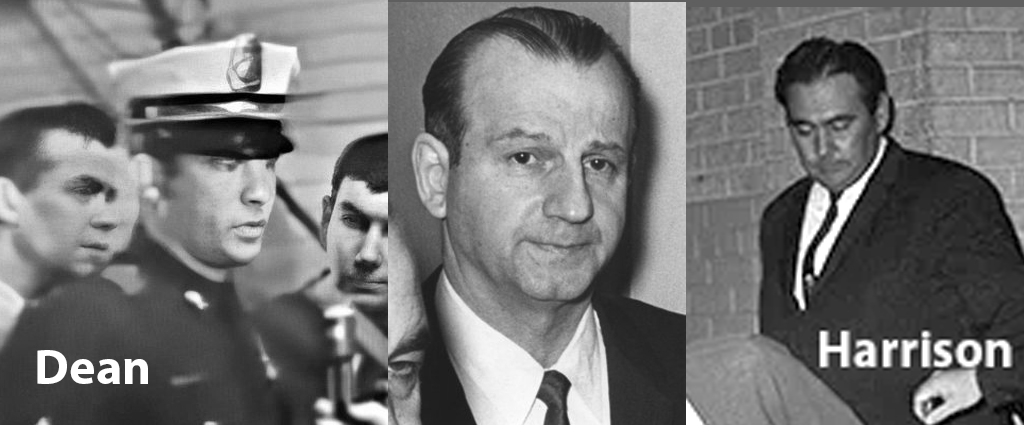
    If one watches the prelude to the murder in the film Evidence of Revision, one will see Ruby clearly hiding behind the football player sized Blackie Harrison before he darts out. This would be bad enough. But the author points out that Harrison said he tried to grab Ruby. But this is not backed up by the photo evidence. (p. 196). After Ruby shot Oswald, he seemed to try to lunge forward, but he was held back by detectives Jim Leavelle and L. C. Graves. The book then states something jarring that I had never noticed before. Abbott writes that Detective Miller then placed a dark garment over Ruby’s head, apparently to hide his face. He adds that it happened so quickly and surely that it is almost like he was prepared to do so. But still, no questions were asked as to why. (p. 205)

    Oswald was not whisked off to the hospital. He was taken back to the jail office. The first man to tend to Oswald was the first aid specialist for the police. And it took him a few minutes to get to the mortally wounded prisoner. In his first interview, Fred Bieberdorf said that when he arrived, he thought Oswald was dead. He then did what was probably the worst thing he could have done: he began to massage the sternum, this for a very critical abdominal wound. (pp. 208-09)

    After almost five minutes, the ambulance arrived. And even at that, the driver had to wait for almost another minute for the armored car to clear the driveway. Dr. Charles Crenshaw has said that if Oswald would have been treated properly and quickly he could have survived. (p. 218)

    V

    In his denouement, Mr. Abbott points his finger at two main suspects: Dean and Harrison. It was Dean who said that, just after Ruby was handcuffed, Ruby declared he came in off the Main Street ramp. No one else recalled this at that time. (pp. 226-27) Abbott suspects that Dean made up this quote, and later, others recalled it out of necessity—for instance, in condemning Ruby to the death penalty at his trial. According to one journalist, Dean even told him he saw Ruby come down the ramp, which Abbott states was not possible. And which Dean later denied he said.

    After talking to Tom Howard, his first attorney, Jack Ruby came up with his motive for murder: grief over Kennedy’s death and pity for his family. (pp. 231-32) He now declared he came down the ramp. To which Fritz said, No, you did not. Ruby then shut his mouth. Abbott argues that it was Howard who told him to say these things. And Abbott believes Ruby went along with it to cover up his real role in the conspiracy. The author bases this on the testimony of Julia Ann Mercer, which was well depicted by director Oliver Stone in his film JFK. He also uses the quote by Robert Vanderslice, who said that Ruby called him that morning and asked him if he ”would like to watch the fireworks.” He met Ruby in Dealey Plaza, and they were there at the time of the assassination. Ruby then left and headed towards the Dallas Morning News building without saying anything. (p. 239)

    At about 1:30, based on the reliable testimony of journalist Seth Kantor, Ruby was at Parkland Hospital. Later that afternoon, Ruby began his daily visits to the police station. At about 6 PM, Ruby was seen trying to enter Fritz’s outer office door, where Oswald was being questioned. He was stopped by an officer who said, “You can’t go in there, Jack.” (p. 242) Ruby then showed up for DA Henry Wade’s infamous midnight press conference. Ruby later lied about this by saying this was the first time that day he was at the station.

    Abbott does a neat job tracking Ruby’s weekend, and—as others have pointed out—it’s difficult not to conclude that Ruby was stalking Oswald. There is one matter I wish he would have delineated at more length. After studying the topic, it seems clear to me that it was Ruby who arranged to wire one of his dancers, Karen Carlin, a loan the next morning. Which put him at Western Union at the correct time he needed to be there. (p. 248)

    Abbott spends several pages demonstrating how Ruby really got into the building that morning. It most definitely was not by marching down the Main Street ramp. We have the testimony of Don Flusche and Roy Vaughn, who said that he did not. They are much more trustworthy than Dean.

    This is a creditable book that focuses on what was, in relative terms, a rather inadequately explored subject. Mr. Abbott has now made two contributions to the vast topic of the JFK murder: this book and his index to the files of Jim Garrison.

  • Is Robert Wagner the New Paul Hoch? – Part 2

    Is Robert Wagner the New Paul Hoch? – Part 2

    Is Robert Wagner the New Paul Hoch? – Part 2

    Gary L. Aguilar, MD

    Commission Exhibit #399, the “Magic Bullet”

    Decades ago, Josiah “Tink” Thompson and I detailed the reasons we had for suspecting that CE #399, the  Magic Bullet, is not the original bullet that was found on a stretcher at Parkland Hospital on the day of the assassination. We published our findings online in an essay entitled “The Magic Bullet: Even More Magical Than We Knew?” [1]


    The crux of it is that the FBI told the Warren Commission that one of their agents, Bardwell Odum, interviewed the two Parkland Hospital employees who had found the stretcher bullet, Darrell Tomlinson and O.P. Wright. And when Odum showed them CE 399, said the Bureau, they identified it as the stretcher bullet.[2] That was false: Odum never interviewed them.* Furthermore, according to the Bureau’s own, once-secret records, the witnesses told the Agent who did, Gordon Shanklin, that they did not recognize #399. That inconvenient FBI memo never reached the Warren Commission, which was left to believe that Tomlinson and Wright agreed #399 was the stretcher bullet.

    (*Tink and I interviewed Odum in his home in Dallas in the 1990s. He flatly denied he’d ever shown any bullet to any Parkland employees, a claim backed up by the fact no FBI files exist of Odum’s supposed interview.)

    Suspicion about CE 399’s bona fides first arose in 1966 when Tink Thompson interviewed Parkland’s O. P. Wright about it. A former cop and hunter with a trained eye for ‘guns and ammo,’ Wright said that the round-tipped #399 was not the Parkland bullet. Rather, the bullet he and Parkland engineer Darrell Tomlinson had found on 11/22/63 had a pointed tip. To show what he meant, he pulled a pointed-tipped bullet from his desk that he said looked like the 11/22 shell, and handed it to Tink. A photograph of Wright’s bullet is on page 175 of Tink’s 1967 book.[3]

    But wait, Wagner exclaims. There is evidence that at least Tomlinson agreed that #399 looked like the stretcher bullet! It was dug up by Pat Speer,[4] he tells, and it comes from two credible, independent sources, Warren skeptic Ray Marcus and Earl Golz, a Dallas Morning News reporter. They both said that Tomlinson had told them (in 1966 and 1977, respectively) that #399 resembled the stretcher bullet. (p. 117-120) 

    Our counselor admits that Tink and I were right that Agent Odum didn’t interview the two men. The record shows that Dallas Special Agent in Charge (SAC) Gordon Shanklin took the interview. But Wagner evades the most important evidentiary point: what Shanklin actually said in the declassified 6/20/64 FBI AIRTEL memorandum from the FBI office in Dallas. 

    For the benefit of the jury, here’s what Shanklin wrote the DC Bureau, as Tink and I published it decades ago: 

    “SAC, Dallas” (i.e., Special Agent in Charge, Gordon Shanklin) to J. Edgar Hoover, “For information WFO (FBI Washington Field Office), neither DARRELL C. TOMLINSON [sic], who found bullet at Parkland Hospital, Dallas, nor O. P. WRIGHT, Personnel Officer, Parkland Hospital, who obtained bullet from TOMLINSON and gave to Special Service, at Dallas 11/22/63, can identify bullet … .” (emphasis added) 

    This memo is the only record, and an official record, of what Tomlinson and Wright told the FBI about CE 399 in 1964. It proves that the Bureau lied to the Warren Commission in CE # 2011 about their saying it resembled the stretcher bullet. And, as Wagner knows but prefers the jury not to, it predates whatever Tomlinson may have told Ray Marcus and Earl Golz in ’66 and ’77. Wagner credits Tomlinson’s later story even though he himself cites the evidence that Tomlinson may not have told Marcus or Golz the truth.

    Wagner recounts that Tomlinson told Marcus in 1966 that he had met with FBI agent Shanklin and O.P. Wright in 1964 (p. 118), and that he advised Shanklin that #399 looked like the stretcher bullet. That’s not what Shanklin told his bosses in Washington. No doubt Shanklin’s account is the more objective. For, if anything, Shanklin would have been happy to report that Tomlinson and Wright told him that the dubious  CE 399 was the actual bullet they found on a Parkland stretcher. Wagner discounts what Tomlinson and Wright told the high-ranking FBI agent in 1964, when their memories were fresh. And he touts Tomlinson’s questionable, later word, seemingly oblivious to the inconvenient fact that Shanklin’s 1964 memo debunks the convenient tale Tomlinson gave Ray Marcus in 1966 and Earl Golz in 1977.

    It never seems to have occurred to our counselor that when Tomlinson was interviewed by Marcus, 2 years after the FBI interviewed him, and 13 years later by Earl Golz, that by then he might have learned the benefits of aligning with official preferences.  It shouldn’t be ignored that in 1964, Arlen Specter repeatedly leaned on a balky and uncomfortable Tomlinson to say that he found the Magic Bullet on Governor Connally’s stretcher. [5][6] Tomlinson stammered and stalled under oath, but later demonstrated on film to Walter Cronkite that he found the bullet on the stretcher that Tink Thompson had described in Six Seconds in Dallas, Ronnie Fuller’s stretcher–not Connally’s.[7]

    Furthermore, after Tomlinson and Wright, the next two people in the “Magic Bullet’s” alleged chain of possession, Secret Service Agent Richard Johnsen and the Chief of the Secret Service James Rowley, were also unable to identify #399, a fact that the FBI reported accurately in CE # 2011. Wagner tries to discount this by arguing their failure to identify was merely a failure to “positively identify” the bullet because they hadn’t inscribed their initials on it, a claim Tink and I dismantled in our original essay.

    The bottom line? The first four people in the “Magic Bullet’s” chain of possession said they couldn’t identify CE 399. The FBI lied about it, and Tomlinson probably lied about it, too. Wagner does the best he can with what little he has to make this problem go away. He hasn’t succeeded.

    The X-Ray Evidence: Enhanced vs Unenhanced

    JFK’s X-ray evidence is of particular importance to our counselor. For Dr. Wecht, myself, and others have argued that the presence of tiny, “dust-like” fragments in the right front quadrant of JFK’s skull X-ray can best be explained by his having been struck in the right front quadrant of his skull by a soft-nosed, hunting round, not Oswald’s jacketed bullet. This worries Wagner. “The nature of the tiny fragments is the most persuasive argument offered by the CRC (critical research community),” he writes, “at least regarding the head wounds of the president (sic) – to establish the multiple-gunman thesis and thus conspiracy.” (p. 305, emphasis added) Wagner is right to fret about the important implications of this evidence. But why?

    Unjacketed, soft-nosed rounds don’t behave like Oswald’s jacketed bullets do. Jacketed rounds pass through bone and break up once on the other side into small, but not tiny, “dust-like” fragments. (Fig. 12) Soft-nosed ones flatten on impact and burst into a “snowstorm” of minuscule fragments that cluster near the point of impact. And because they flatten on impact, unjacketed bullets impart more directional momentum to targets than jacketed ones do. The X-ray findings of injuries from the two types of missiles are distinctly different and distinctly important in the JFK case. 

    Wagner’s “expert,” again Larry Sturdivan, correctly described those differences to the HSCA. 

    The Select Committee asked, “Mr. Sturdivan, taking a look at JFK exhibit F–53, which is an X-ray of President Kennedy’s skull (Fig. 11), can you give us your opinion as to whether the President may have been hit with an exploding bullet?”

    “Well,” he replied, “this adds considerable amount of evidence to the pictures which were not conclusive. In this enhanced x-ray of the skull, the scattering of the fragments throughout the wound tract are characteristic of a deforming bullet. This bullet could either be a jacketed bullet that had deformed on impact or a soft-nosed or hollow-point bullet that was fully jacketed and therefore not losing all of its mass. It is not characteristic of an exploding bullet or frangible bullet, because in either of those cases the fragments would have been much more numerous and much smaller. A very small fragment has very high drag in tissue and, consequently, none of those would have penetrated very far. In those cases, you would definitely have seen a cloud of metallic fragments very near the entrance wound. So this case is typical of a deforming jacketed bullet leaving fragments along its path as it goes. (emphasis added throughout)[8]

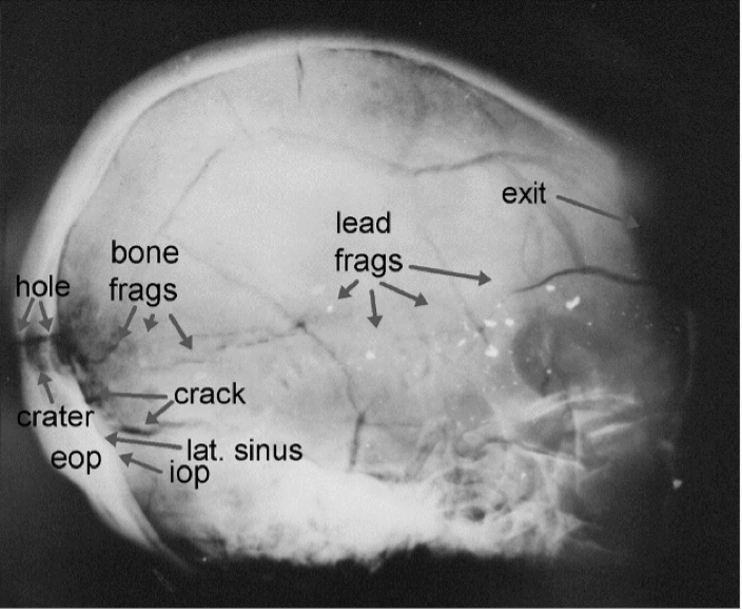
    Elaborating in his 2005 book, Sturdivan reproduced on the same page both Kennedy’s enhanced lateral skull X-ray and the unenhanced lateral X-ray of a skull shot with a Carcano round in the Biophysics Lab’s tests in 1964.[9] The pattern of bullet fragmentation was very similar, he said. He was right, but for reasons he didn’t at all understand. (Figs. 11 and 12.)

    Re JFK’s enhanced X-ray, he wrote: “… Lead fragments are scattered within the skull, reaching the frontal bone, not clustered at the entry pointFrangible bulletswould disintegrate very quickly, producing a dense cloud of fragments at the entry site … the extent of fragmentation of the bullet (in the enhanced X-ray) is characteristic of that of a fully jacketed military bullet that deformed and broke apart upon impact with the skull … It is not that of a frangible, soft-nosed or hollow-point bullet.”[10] (Fig. 11) (emphasis added)

    Sturdivan is simply wrong. Cyril Wecht and I explained why in a piece in the AFTE Journal that Wagner discusses in his book, and which he ignores. (p. 301-303) It’s not complicated. 

    Because he was neither a radiologist nor a physician, Sturdivan didn’t know how to read X-rays. He was reading the wrong X-ray when he compared Kennedy’s enhanced X-ray (Fig. 11) with the unenhanced film of the blasted test skull (Fig. 12). An apples to oranges comparison. The process of “enhancing” an X-ray renders minuscule fragments invisible. In Kennedy’s original, still secret,unenhanced X-ray, there is an obvious cloud of “dust-like” fragments that don’t show up in the enhanced film that Sturdivan discussed. And that “cloud” is located right where critics believe JFK was struck: the right front quadrant of JFK’s skull, just inside the “entry point,” to borrow from Sturdivan.

    Had he done it properly and scientifically, he would have compared Kennedy’s unenhanced post-mortem X-ray with the unenhanced X-ray of the test skull he reproduced in his book. (Why the HSCA hired someone as unqualified as Sturdivan to give an expert interpretation of the X-ray of the Century is a mystery, though perhaps not to those inclined to the view that the HSCA wanted a witness to tell them what they wanted to hear.)

    The unenhanced X-ray of the Biophysics test skull (Fig. 12) shows a pattern that is similar to Kennedy’s disanalogous, enhanced X-ray (Fig. 11) — a scattering of small fragments, but none of the “dust-like” radiolucencies that are present in JFK’s original, unenhanced X-rays. 

    The Snowstorm

    In the Biophysics experiment (Fig. 12), the test skull was shot from behind, and the missile entered where Oswald’s is said to have entered Kennedy’s, low through the occipital bone. The small fragments run across the lower portion of the skull, virtually undeflected. In this enhanced X-ray of JFK, small fragments run along the top. But the “dust-like” fragments, the “snow storm” of fragments, that are easily seen in the original, unenhanced films, aren’t seen because the process of “enhancement” has blotted them out. 

    GAWagner2 Fig11

    Figure 11. Enhanced lateral X-ray taken of JFK during the autopsy. (HSCA Exhibit F 53; 1HSCA240) 

    Red arrows: The autopsy report and Sturdivan and Wagner maintain Oswald’s bullet entered low, through the occipital bone. The Clark Panel and the HSCA’s Forensics Pathology Panel said it entered high, through the parietal bone. When the Biophysics Lab shot test skulls through the occipital bone, the resulting fragment trail was low. (Fig 12) By contrast, the fragment trail in Kennedy’s X-ray runs very close to the top of JFK’s skull, above: orangearrow. Wagner and Sturdivan maintain Oswald’s low-entering bullet left the fragments along the top of JFK’s skull, and that there were no “dust-like” fragments on his X-ray.

    However, JFK’s original, still secret, unenhanced X-rays at the National Archives do show myriad, minuscule fragments that are not visible in this enhanced image. They are clustered in the right front quadrant of JFK’s lateral skull X-ray. 

    GAWagner2 Fig12 

    Figure 12. Unenhanced, lateral x-ray of a test skull shot with a Mannlicher Carcano by the government’s Biophysics Lab.[11] The jacketed bullet entered low, through the occipital bone, as Oswald’s is said to have done. The fragment trail is low, as the undeflected Mannlicher Carcano round traversed the lower portion of the skull. 

    As with JFK’s enhanced X-ray, there is a scattering of small fragments. But no “dust-like” fragments are visible on this X-ray such as those that are visible, and were described in JFK’s original, unenhanced X-rays. JFK’s unenhanced, lateral skull X-ray would look like this X-ray if he’d been shot with a Mannlicher Carcano. But it doesn’t.

    The presence and location of the “snow storm” of dust-like fragments in the right front quadrant of JFK’s original, unenhanced skull X-rays destroys Wagner’s case for a lone gunman. It proves a non-jacketed bullet, a non-Oswald bullet, blew into the right front part of JFK’s skull. Were those X-rays available to the public, I would show them, and the issue would vanish. That those inconvenient “dust-like” fragments exist is not just my and Cyril Wecht’s opinion. 

    In fact, they were reported by Kennedy’s chief pathologist, James Humes, MD, also by a Secret Service agent, by an FBI Agent, as well as other government consulting, expert radiologists. This evidence has largely lain unrecognized and unappreciated in the record since 1964.

    • During his Warren Commission testimony in 1964, Dr. Humes said: “(JFK’s X-rays) had disclosed to us multiple minute fragments of radio opaque material…These tiny fragments that were seen dispersed through the substance of the brain in between were, in fact, just that extremely minute, less than 1 mm in size for the most part.” A few moments later, Dr. Humes was asked, “Approximately how many fragments were observed, Dr. Humes, on the x-ray?” “I would have to refer to them again (the X-rays),” he answered, “but I would say between 30 or 40 tiny dust-like particle fragments of radio opaque material, with the exception of this one I previously mentioned, which was seen to be above and very slightly behind the right orbit.”[12]
    • Secret Service Agent Roy Kellerman, an autopsy witness, testified that the fragments in JFK’s skull X-ray “looked like a little mass of stars; there must have been 30, 40 lights where these pieces were so minute that they couldn’t be reached.”[13]
    • The HSCA interviewed FBI Agent James Sibert and reported, “the X-ray had many ‘… flecks like the Milky Way… .’ Sibert said a lot of the metal fragments were tiny.”[14]
    • Russell Morgan, MD, the chairman of radiology at Johns Hopkins University, was the Clark Panel’s radiologist. “Distributed through the right cerebral hemisphere are numerous, small irregular metallic fragments,” the Panel reported, “most of which are less than 1 mm in maximum dimension. The majority of these fragments lie anteriorly and superiorly. None can be visualized on the left side of the brain and none below a horizontal plane through the floor of the anterior fossa of the skull.”[15]
    • Cook County Hospital Forensic Radiologist John Fitzpatrick, MD, examined JFK’s X-rays in consultation for the ARRB and agreed, writing: “There is a ‘snow trail’ of metallic fragments in the lateral skull X-rays which probably corresponds to a bullet track through the head, but the direction of the bullet (whether back-to-front or front-to-back) [sic] cannot be determined by anything about the snow trail itself.”[16]
    • Practicing neurologist Michael Chesser’s work requires examining skull X-rays. He examined the original, unenhanced JFK X-rays at the National Archives with special permission. He came to the same conclusion. “This location, on the intracranial side of the bony defect, is highly suggestive of an entry wound,” he wrote. “One of the principles of skull ballistics is that the largest fragments travel the furthest from the entry site, with the smallest traveling the least distance, and that is exactly what is seen on this right lateral skull X-ray. Tiny fragments are seen on the inner side of this right frontal skull defect, and the largest fragments were noted in the back of the skull.”[17]

    DiMaio’s Patriotic Folly

    Forensic pathologist Vincent DiMaio, MD, explained the meaning of a “snow trail” or “snowstorm”: “[T]he snowstorm appearance of an X-ray almost always indicates that the individual was shot with a centerfire hunting ammunition…”[18] That is, a soft-nosed, non-jacketed round. And as per Sturdivan, the right-forward location of the tiny fragments is a clear indication of what is visible in Zapruder film: an entrance wound in the right front quadrant of Kennedy’s head from an unjacketed bullet that left a tell-tail snowstorm of “dust-like” fragments in that area. 

    For, although he thought that the shot at Zapruder frame 312-313 went from back to front, Sturdivan admitted what is well understood among “ballistics/forensics” authorities: just as the X-ray “snowstorm” can’t tell you whether the bullet was going back-to-front or front-to-back, Sturdivan said that “[a] similar explosion would have taken place if the bullet had gone through in the opposite direction.”[19]

    Wagner, and his X-ray “expert” Sturdivan disagree. Our counselor clings to the theory Oswald’s bullet could have left the “snowstorm” of fragments in the right front part of JFK’s skull based on comments DiMaio made in a later edition of his book. 

    In it, he suggested that the breach of the shell’s jacket after Oswald’s bullet struck Kennedy’s skull from the rear might have released the “dust-like” fragments seen in Kennedy’s unenhanced X-rays. (p. 323) However, DiMaio never examined Kennedy’s X-rays; he offered no evidence for his theory; and the Biophysics skull-shooting tests offer stout counterevidence: they show that MCC shells don’t release “dust-like” fragments. (Fig. 12) The absence of minuscule fragments in the X-ray of the test skull crushes the DiMaio-Wagner-Sturdivan theory. For as Richard Feynman once put it, “It doesn’t matter how beautiful your theory is, it doesn’t matter how smart you are. If it doesn’t agree with the experiment, it’s wrong.”[20]

    [As an aside, Sturdivan finally did see the original, unenhanced images in 2004 at the National Archives. He was emphatic under oath to the HSCA that the absence of tiny fragments in the enhanced X-ray proved that a jacketed bullet, not a hunting round, had felled JFK. But when he reported on his examination of the originals that dramatically do show a snowstorm of fragments in the right front quadrant of JFK’s skull, he said nothing about them. (Nor did he mention them in his 2005 book, JFK Myths.) He either didn’t notice them, or elected not to say they were there.[21] The HSCA’s, and Wagner’s, X-ray “expert” conveniently didn’t see what he didn’t want to see, but what credentialed experts did see.

    X-ray Evidence of a Second Headshot?

    Besides the “snow trail” of dust-like fragments in the right front quadrant of JFK’s skull, there is also a trail of small, but not minuscule, fragments that runs along the top of JFK’s skull in both the enhanced and the still-secret nonenhanced lateral skull X-rays. It does not align with the supposed low, occipital entrance wound specified in Kennedy’s autopsy report, although the autopsy surgeons said that it did. [22]> Nor does it line up with the higher entrance wound the Clark Panel identified, although that Panel said that it lined up to that higher entrance spot that they chose. [23] In fact, as anyone can see, the fragment trail in JFK’s lateral X-ray is about 5 cm above where both the Clark Panel and the HSCA said it was. (Fig. 11, orange arrow.)

    That high fragment trail offers evidence for a second headshot circa Z-frames 327-328, one striking high from behind with a jacketed round that left small, but not “dust-like” fragments. Such a possibility is also backed up by the “jiggle” evidence in the Zapruder film (Z-frame 331 is blurred, which fulfills the 3-frame delay Luis Alvarez posited for a shot from the distant School Depository.[24]), by Professor James Barger’s acoustics analysis that indicated a shot from the rear at this moment, and by JFK’s rapidly forward-moving skull after Z frame 328, as explored by Thompson in Last Second in Dallas. Both Sturdivan and Wagner do not agree. Improbably, they claim Oswald’s bullet entered Kennedy’s skull low, was deflected upward, and left the high fragment trail at the top of Kennedy’s skull. Sturdivan, however, didn’t always see things that way.

    Sturdivan, Wagner, and the Improbable Bullet Deflection

    In 1978, Sturdivan told the HSCA that the evidence was clear and that the Forensic Pathology Panel got it right: “[T]here is no indication of any (bullet) track in the lower half of the skull. It definitely was in the upper part.” (Wagner, p. 305-6) [25] However, in 2003 he apparently changed his mind. He then endorsed the “low entrance” claim of Parkland neurosurgeon Robert Grossman, MD, with whom he had collaborated in a paper that appeared in the journal Neurosurgery. “There was a laceration approximately 1 inch in diameter located close to the midline of the cranium,” Grossman said, “approximately 1 inch above the external occipital protuberance,” and he produced a sketch of what he saw (Fig. 13).[26]<

     GAWagner2 Fig13

    Figure 13. Left: diagram prepared by Parkland neurosurgeon Robert Grossman, MD, depicting the entry wound he saw on 11/22/63. He said it was ~1 inch in diameter and slightly above the external occipital protuberance (EOP) in occipital bone. Right: Ida Dox’s drawing of the back of Kennedy’s head. It is a reasonably accurate rendition of an original autopsy photograph. [Dr. Grossman has said that JFK’s actual wound looked much different than the Dox image.[27]]

    Against the Clark Panel and the HSCA’s forensic pathologists, Wagner endorses Grossman and Sturdivan that the entry wound was low, just like the autopsy surgeons said it was (Chapter 10). Neither Sturdivan, Wagner, nor Grossman appear cognizant of the fact that X-rays, and Sturdivan’s own sworn testimony, pose virtually insurmountable obstacles for their theory.

    As per the lateral X-ray of the skull shot with Oswald’s type of ammo in the government’s tests (Fig. 12 and 15), the fragment trail is low and horizontal. Virtually undeflected, it follows the striking bullet’s trajectory across the test skull. Of course, upon impact, bullets may be deflected and veer away from the straight-line path. But the test bullet didn’t deflect much, if at all, as jacketed bullets like Carcano shells tend not to. Could Oswald’s bullet have been so severely deflected from its low entry point as to leave its fragments along the top of the President’s head, a full 100mm above the point of entry?

    Sturdivan and Wagner say: Yes, it could, and it did. No, it couldn’t, according to the government’s skull shooting tests and, ironically, Wagner’s trusty expert. Sturdivan has testified about bullet deflection. Speaking from experience, he said,

    “Well, let’s put it this way. With most military bullets, like the M-193, the bullet would curve almost immediately because the yaw begins to grow almost immediately. With the Mannlicher-Carcano bullet, it is much more stable, the yaw begins to grow much more slowly, and it curves much more slowly. So that at a target of 4 or 5 inches of soft tissue, that bullet would not deviate appreciably from its path… .” (emphasis added) [28]

    Recall that he told the HSCA that Oswald’s bullet had entered high:  “[T]here is no indication of any track in the lower half of the skull. It definitely was in the upper part.” [29]> (Wagner, p. 305-6) Sturdivan’s obvious point was that Oswald’s bullet wasn’t much deflected, so the fragment trail at the top of JFK’s skull X-ray was close to the path of the bullet. “I would place the original track as being somewhat lower than that trail of fragments indicated through there,” he testified, “certainly not much lower.” (emphasis added) [30]

    The X-ray of the test skull backs up Sturdivan’s claim: after entering the skull, the fragment trail does not deviate much from the bullet’s low trajectory. (Figs. 12 and 14)

    GAWagner2 Fig14 

    Figure 14. Left: Lateral skull X-ray of Biophysics Lab test skull shot with a Mannlicher Carcano round from the rear. The bullet entered just above the external occipital protuberance. Note the fragment trail is horizontal and low (green line). The higher, red line is the path Sturdivan/Wagner propose Oswald’s bullet took after striking near the bottom of Kennedy’s skull.

    Right: JFK’s enhanced lateral X-ray. Against Sturdivan’s testimony that MCC shells don’t much deflect, Wagner says that Oswald’s bullet entered JFK’s skull low and was dramatically deflected upward. He believes it left the fragment “trail” that we see in JFK’s X-rays at the very top of the skull, the red line. Note that there are no fragments between Wagner’s/Sturdivan’s low entrance wound and the “trail” at the top of Kennedy’s skull. 

    I’ll leave it to the jury to decide whether Wagner and Sturdivan are right about the President’s X-rays.


    Wagner “Debunks” the Acoustics

    To dismiss the HSCA’s acoustics evidence for a shot from the grassy knoll, our counselor ignores credentialed authorities who are agnostic on the question of conspiracy. Instead, he cites non-credentialed, pro-Warren Commission sources. A little context, first.

    Apparently, a Dealey Plaza motorcop’s microphone was stuck open in broadcast mode during the murder. Sounds were picked up, fed to, and recorded by the Dallas police. The HSCA hired two independent groups of acknowledged acoustics experts to analyze the recording. The first was M. R. Weiss and E. Aschkenasy; [31] the second was J. E. Barger, S.P. Robinson, E.G. Schmidt, and J.J. Wolf. [32] Both groups concluded that the recording revealed that gunshots had been fired, and that there was a high probability that one of the shots was fired from the grassy knoll. This finding arrived late in the HSCA’s proceedings, and it raised a ruckus. As the HSCA went out of business, two HSCA members recommended further study.

    “The acoustical evidence of a gunman on the grassy knoll has enormous significance for our Nation,” Congressman Christopher J. Dodd wrote. “This by itself makes real the idea of a conspiracy to kill the President. The data upon which the experts base their conclusion should, therefore, be reviewed by other noted experts in this field.”[33] (emphasis added)

    Similarly, Congressman Robert Edgar suggested, “I recommend that the Congress immediately order a full and detailed restudy of the acoustics work, perhaps through the National Science Foundation. Included in this restudy, a panel of scientific experts with knowledge of acoustics should be employed to monitor the methodology used in the study to ensure accuracy and determine the level of weight which should be given to this evidence.”[34] (emphasis added)

    As Thompson minutely documented in Last Second in Dallas, the government ignored the sensible, specific recommendations of the HSCA. Two “reinvestigations” were done. Neither used credentialed acoustics authorities. Instead, this hot potato was first handed to the FBI, which in 1964 had “proved” there was no conspiracy. A thoroughly inadequately trained Bureau agent, B. E. Koenig, wrote a paper “disproving” the HSCA’s acoustics authorities. [35] His work was promptly debunked and discredited.[36] [37]

    The Sorry Story of Luis Alvarez

    So the government then turned to its trusted deputy: Nobel Prize-winning physicist Luis Alvarez. Though lacking any acoustics expertise, the Nobelist had sterling credentials as a Warren Commission devotee, and had previously set science aside to run cover for the government on another controversy. That story is worth a few words that Wagner denies the jury. It helps contextualize Alvarez’s subsequent work on the acoustics.

    Israel and South Africa detonated a nuclear bomb in the Indian Ocean on 22 September 1979, the so-called “Vela Incident.” [38] It was inconvenient for President Carter’s nonproliferation policy that America’s ally, Israel, was testing nuclear weapons fashioned with American technology. To make the story go away, the government engaged Alvarez. He assembled a team and investigated, reporting that the “double flash” detected by the Vela satellite – invariably betokening a nuclear explosion – was, in this unique case, not a nuclear event. Rather, it was caused by a meteorite striking the satellite. As Thompson pointed out,Alvarez was promptly debunked by both expert government investigators and on-site Israeli sources that Seymour Hersh personally interviewed. [39]

    As had the Vela Incident, the conspiratorial implications of HSCA’s acoustics posed an uncomfortable problem for the government. So again, the government tapped Alvarez. Given his longstanding pro-government position on JFK’s murder, the Nobelist did not chair the Ad Hoc Committee on BallisticAcoustics.[40] But he influenced who would be on it. None of the selectees had any acoustics training or expertise, including its chair, physicist Norman Ramsey–with whom Alvarez had long collaborated on prior government projects. He also picked Richard Garwin and F. Williams Sarles, both physicists who’d served on the disinforming Vela Panel. Alvarez thereupon worked closely with the “Ramsey Panel” to debunk the HSCA’s acoustics. 

    Does Wagner embrace the experts who are truly expert in the field in which they offer opinions, such as the credentialed acoustics authorities? No. He goes instead with the uncredentialed Ramsey Panel, whose pro-government conflicts, prior history, and lack of expertise he omits any mention of–despite knowing of them from Thompson’s book, which he cites frequently. He also cites, in extenso, the conclusions of the untrained, non-acoustician Michael O’Dell (pp. 184-187, 191, 418-9, 423, 425, 428, 433.) Apparently, they told him what he wanted to hear. And with little more than that, he closes the case on the acoustics in favor of the official narrative. 

    Conclusion

    I would have much liked to have written a more favorable review, and would have if Wagner had written a different book. I’ve known him for seven years and bear him no personal animosity. He’s been a welcome guest in my home, attending JFK mini-conferences. He is invariably polite, well-mannered, and polished. Like Hoch, he presents himself as a “fair witness,” as someone who is detached, objectively minded, and willing to follow the evidence wherever it leads. But I’ve long thought that that’s not the real Wagner. Beneath a veneer of cautious, objective detachment, I see a devoted partisan. 

    My first suspicion arose in the wake of Wagner’s presence supporting anti-conspiracy activist Lucien Haag in a debate at a mock trial of Oswald in Houston in 2017. As he had in a paper in the Association of Firearms and Toolmark Examiners Journal (AFTE), Haag argued that Governor Connally’s back wound was so large and oval that it proved Oswald’s bullet (#399) had not hit point forward, undeflected. It instead must have struck the governor sideways, in “yaw,” because it had tumbled through JFK’s back and neck before it hit Connally. 

    Wecht and I had thoroughly debunked that same Haag myth two years before the Houston “trial” in the pages of the AFTE Journal.[41] It was foolish of Haag to gift us the opportunity to debunk him again in Houston. When later I read his first book, I discovered that Wagner had himself already debunked Haag’s fairy tale. Yet he remained mute as Haag tried foolishly to pass off this falsehood before the jury. This episode suggested to me that Wagner’s loyalty is likely less to truth than to the official narrative, and to junk-peddling “experts” like Haag who agitate in support of it. His latest book shows that our counselor’s stripes haven’t changed. 

    He’s still privileging pro-government nonexperts and dubious evidence while sedulously ignoring true experts and hard evidence. Does he really expect his jury of readers to accept the debunked claims of his “authorities” when their most demonstrable virtue is not their expertise in the fields in which they offer opinionson JFK, but their loyalty to the government’s lone gunman wheeze? I don’t think he can. Wagner has thus failed the jury. He has also failed his dwindling band of Warren Commission coreligionists who cleave to the official mythology, defending a government that has lied about the death of JFK since the day he was murdered. 

    But Wagner may yet redeem himself. He made a pledge that I hereby also make: “If I am wrong in certain respects, I will admit error and work to correct it.” (p. 13) I’ll do that no matter what he does, and I invite corrections. Let’s see if he does the same.

    ________________________________________

    Footnotes

    [1] https://www.history-matters.com/essays/frameup/EvenMoreMagical/EvenMoreMagical.htm

    [3] Thompson, J. Six Seconds in Dallas. New York, Bernard Geis Associates for Random House, 1967.

    [4] Speer, P. Chapter 3b: Men at Work. https://www.patspeer.com/chapter3bmenatwork

    [5] Warren Commission Hearings, V.6:130 ff. https://www.maryferrell.org/showDoc.html?docId=35#relPageId=140

    [6] Fonzi, G. The Warren Commission, The Truth, and Arlen Specter. Greater Philadelphia Magazine 1 August 1966 pp. 38-45, 79-88, 91.

    [7]https://www.youtube.com/watch?v=cvqCtaBkyyE  Watch video starting at the 30 minute, 10 second mark for Tomlinson’s explicitly identifying the stretcher he found a bullet on, which wasn’t Connally’s. See also Thompson, J. Six Seconds in Dallas. New York. Bernard Geis Associates for Random House, 1967, p. 161-164. Thompson describes the stretcher Tomlinson identified, on which Tomlinson found hospital gloves and a stethoscope It was pediatric patient Ronnie Fuller’s stretcher, exactly as Tomlinson demonstrated to Cronkite during his on-camera interview. 

    [9] Sturdivan LM. The JFK Myths, St. Paul, MN: Paragon House, 2005, Fig. 38, p. 173.

    [10] Sturdivan LM. The JFK Myths, St. Paul, MN: Paragon House, 2005, p. 177.

    [11]Source: Sturdivan, LM, Review of JFK Photographs and X-Rays at the National Archives, September 23, 2004. Available https://kenrahn.com/Noncons/LarryNARA.html

    [12]Warren Commission testimony of James H. Humes, MD, Vol. 2:353. https://history-matters.com/archive/jfk/wc/wcvols/wh2/pdf/WH2_Humes.pdf

    [13]Warren Commission testimony of Secret Service Agent Roy Kellerman. Vol. 2, p. 100. https://www.history-matters.com/archive/jfk/wc/wcvols/wh2/pdf/WH2_Kellerman.pdf

    [14] MD 85 – HSCA Interview Report of August 25, 1977 Interview of James W. Sibert, p. 3-4. https://aarclibrary.org/publib/jfk/arrb/master_med_set/md85/html/md85_0003a.htm

    [16] “Inside the ARRB: Appendices – Current Section: Appendix 44: ARRB staff report of observations and opinions of forensic radiologist Dr. John J. Fitzpatrick, after viewing the JFK autopsy photos and x-rays,” p. 2. https://www.maryferrell.org/showDoc.html?docId=145280#relPageId=225

    [17] Chesser, M A. Review of the JFK Cranial X-Rays and Photographshttps://assassinationofjfk.net/a-review-of-the-jfk-cranial-x-rays-and-photographs/

    [18] DiMaio, VJM. Gunshot wounds – Practical Aspects of Firearms, Forensics, and Ballistics Techniques, Third Edition, p. 166. https://books.google.com/books?id=8eCYCgAAQBAJ&pg=PA50&lpg=PA50&dq=soft+nosed+bullets,+Xrays,+snowstorm&source=bl&ots=0sNfkZezak&sig=ACfU3U1e6__SLS9tthavEYrGpK1kIi3rcg&hl=en&sa=X&ved=2ahUKEwiqtPCrqtfoAhUBqJ4KHSN8BSEQ6AEwFXoECA0QMQ#v=onepage&q=snow storm&f=false

    [19] Sturdivan, LM, The JFK Myths, St. Paul, MN: Paragon House, 2005, p. 171.

    [21]Sturdivan, L. “Review of JFK Photographs and X-Rays at the National Archives, September 23, 2004.”https://kenrahn.com/Noncons/LarryNARA.html

    [26] Sullivan, D, Faccio, R, Levy ML, Grossman, RG. THE ASSASSINATION OF JOHN F. KENNEDY: A NEUROFORENSIC ANALYSIS—PART 1: A NEUROSURGEON’S PREVIOUSLY UNDOCUMENTED EYEWITNESS ACCOUNT OF THE EVENTS OFNOVEMBER 22, 1963Neurosurgery. VOLUME 53 | NUMBER 5 | NOVEMBER 2003, p. 1023-1024. https://pubmed.ncbi.nlm.nih.gov/14580267/

    [27] Grossman never testified to the Warren Commission or the HSCA. Authors Groden and Livingstone reported that, “He (Grossman) said that he saw two large holes in the head, as he told the (Boston) Globe, and he described a large hole squarely in the occiput, far too large for a bullet entry wound…”. (Groden R. Livingstone. High Treason-I Groden and Livingstone, p. 51. See also “Duffy & Ricci, The Assassination of John F. Kennedy–A Complete Book of Facts, p. 207-208.)

    [31] Weiss MR and Aschkenasy E. An Analysis of Recorded Sounds Relating to the Assassination of President John F. Kennedy…

    https://aarclibrary.org/publib/jfk/hsca/reportvols/vol8/pdf/HSCA_Vol8_AS_1_Weiss.pdf

    [32]  Barger JE, Robinson SP, Schmidt EG, and Wolf JJ. Analysis of Recorded Sounds Relating to the Assassination of President...https://aarclibrary.org/publib/jfk/hsca/reportvols/vol8/pdf/HSCA_Vol8_AS_2_BBN.pdf

    [34] DISSENTING VIEWS BT HON. ROBERT W. EDGAR TO THE FINAL REPORT, p. 499. https://www.history-matters.com/archive/jfk/hsca/report/pdf/HSCA_Report_4_Remarks.pdf

    [35] Koenig, BE. Acoustic Gunshot Analysis – The Kennedy Assassination and Beyond (Conclusion) https://www.ojp.gov/ncjrs/virtual-library/abstracts/acoustic-gunshot-analysis-kennedy-assassination-and-beyond

    [36] Thompson. J. Last Second in Dallas. Lawrence, Kansas: University Press of Kansas, 2023, p. 275-300.

    [37] See also memo from HSCA Chief Counsel, Robert Blakey, to the FBI’s William Webster dated 4.2/1981 that included a technical refutation of FBI Agent Koenig’s acoustics analysis written by James Barger and the acoustics authorities at Bold, Beranak and Newman, Inc. Cambridge, Mass: http://jfk.hood.edu/Collection/FBI Records/062-117290/062-117290 Volume 25/62-117290P25b.pdf

    [39] Thompson. J. Last Second in Dallas. Lawrence, Kansas: University Press of Kansas, 2023, p. 280-284. 

    *See also” “The Vela Incident Nuclear Test or Meteoroid? Documents Show Significant Disagreement with Presidential Panel Concerning Cause of September 22, 1979 Vela “Double-Flash” Detection.” National Security Archives, 5/5/2006. Available here: https://nsarchive2.gwu.edu/NSAEBB/NSAEBB190/index.htm

    *A good summary of government evidence proving a nuclear blast in the Vela Incident is available in: Report on the 1979 Vela Incident. Available here. [“(Investigative journalist Seymour) Hersh reports interviewing several members of the Nuclear Intelligence Panel (NIP), which had conducted their own investigation of the event. Those interviewed included its leader Donald M. Kerr, Jr. and eminent nuclear weapons program veteran Harold M. Agnew. The NIP members concluded unanimously that it was a definite nuclear test. Another member—Louis H. Roddis, Jr.—concluded that ‘the South African-Israeli test had taken place on a barge, or on one of the islands in the South Indian Ocean archipelago.’” [Hersh 1991; pg. 280-281. Available here.] He also cited internal CIA estimates made in 1979 and 1980 which concluded that it had been a nuclear test. “The U.S. Naval Research Laboratory conducted a comprehensive analysis, including the hydroacoustic data, and issued a 300-page report concluding that there had been a nuclear event near Prince Edward Island or Antarctica [Albright 1994b].”

    [41]Aguilar G, Wecht CH. AFTE Journal — Volume 47 Number 3 — Summer 2015, p. 132. On-line at: https://www.kennedysandking.com/john-f-kennedy-reviews/nova-s-cold-case-jfk-junk-science-pbs

  • Is Robert Wagner the New Paul Hoch? – Part 1

    Is Robert Wagner the New Paul Hoch? – Part 1

    Is Robert Wagner the New Paul Hoch? – Part 1

    Gary L. Aguilar, MD

    Introduction

    Paul Hoch is considered by some, and was recently described as the “doyen of serious JFK assassination research.”[1] That was the impression I and several colleagues had of him when we first waded into the mysteries of the President’s murder in the early 1990s. Having immersed himself in the case since the mid-1960s, Hoch struck us then-newbies as objective, knowledgeable, and logical. His essays in the 1976 book The Assassinations were astute, informative, and justly attacked aspects of the official narrative. Particularly the dishonesty of the FBI, and the Warren Commission’s bending its knee to the Bureau despite its members’ private, serious misgivings.[2] But while he skewered the Commission, he also rubbished some of the critics’ wilder notions.[3] But when, decades ago, he boosted Gerald Posner and J. Edgar Hoover’s confidant, John Lattimer, MD,[4] and when Hoch signaled his loyalty to the official narrative, our enthusiasm subsided. As he has faded from the scene in recent years, Hoch continues to wave the Commission’s flag. And now it seems a protégé and apparent heir has stepped forward to take up that éminence grise’s banner.  His name is Robert Wagner.

    The author of two books,[5] Wagner, à la Hoch, purports to navigate the dense thicket of assassination medical, legal, and forensics data with “just one agenda,” he says, “to work toward establishing the most reasonable explanation of the assassination.”[6] To do that, Wagner, who has no credentials in medicine, law, or forensics, applies the knowledge and wisdom he’s acquired from what he says are his “many years of experience” in “providing expert opinions at state and federal trials on business and economic topics.” Those years taught him that “the jury needs to be convinced that the expert is truly expert in the field in which he or she offers opinions” and that an “expert consistently grounds his or her opinions on a reasonable assessment of known facts and overall context.”[7]

    In his latest book, JFK Assassinated, Wagner puts his courtroom experience to work weighing the contrasting claims of Warren loyalists and skeptics. He, like Hoch before him, levels broadsides at both sides. Also, like Hoch, he concludes that the battle is done, the smoke has cleared, and the government’s case, though battered and bruised, still stands.

    Pro Warren jurors will cheer, and they have.[8] Skeptics will jeer, not without good reason. For our counselor observes in the breach the very rules he advocates in real trials. He’ll never convince a fair jury that the experts he cites – Larry Sturdivan on neurophysiology, radiology, etc., Parkland Hospital’s Robert McClelland, MD on Kennedy’s head wound, Michael O’Dell, and indirectly the Ramsey Panel, on acoustics, etc., really are the best ‘experts in the fields in which they offer opinions.’ Nor does he show that they ‘consistently ground their opinions on reasonable assessments of known facts and overall contexts.’  

    In this review, as if presented to a jury, I will argue that a whiff of insincerity wafts from the pages of his book. For it’s difficult to imagine he doesn’t realize how flawed and prejudiced the sources he trusts are.

    Wagner was warned that I might take notice of his book. “Paul Hoch may have been correct,” he writes, “when he told me that I had taken over from him to be Gary’s punching bag.” (p. 343) I take no joy in lacing up the gloves. But with this book, our counselor has willingly stepped into the ring and put his guard down. I wouldn’t be taking a swing if he hadn’t jutted out his glass jaw.

    While much more could be written, in this review I will narrow the focus to areas our consultant most emphasizes: Kennedy’s head wound and evidence from the autopsy photographs; his explanation of JFK’s lurch “back and to the left” after being struck in the head at Zapruder frame 313; the bona fides of Commission Exhibit #399, the so-called “Magic Bullet;” Kennedy’s X-ray findings; and, finally, the acoustics evidence.

    To begin with, Wagner’s handling of the President’s head injuries hints at an agenda. In brief, he sides with the House Select Committee’s (HSCA’s) dubious claim, namely that the Parkland doctors were mistaken about Kennedy’s head wound. It’s a fascinating story, but a little background for the jury is in order.

    Kennedy’s Fatal Head Wound

    After the shots rang out in Dealey Plaza, Kennedy was rushed to an excellent major trauma center, Parkland Hospital. There, he was treated by a seasoned team of trauma surgeons. They said that Kennedy’s fatal wound was on the back, right side of his head. The words right “posterior,” “occipital,” “occipito-parietal,” etc., were repeatedly used. However, Kennedy’s autopsy photographs, which the HSCA said it had authenticated, showed no such rearward damage but only a wound toward the right front area of JFK’s head.[9] This posed a significant problem for the HSCA, which reinvestigated the assassination in the late 1970s.

    It announced that it had resolved the conflict. This is what it wrote in Volume 7, p. 37 of their volumes: 

    Critics of the Warren Commission’s medical evidence findings have found (sic) on the observations recorded by the Parkland Hospital doctors. They believe it is unlikely that trained medical personnel could be so consistently in error regarding the nature of the wound … In disagreement with the observations of the Parkland doctors are the 26 people present at the autopsy. All of those interviewed who attended the autopsy corroborated the general location of the wounds as depicted in the photographs; none had differing accounts … it appears more probable that the observations of the Parkland doctors are incorrect.”[10] (Emphasis added.)

    As we discovered almost 30 years ago from files declassified by the JFK Review Board–files that should never have been suppressed in the first place–the above HSCA claim was false. The autopsy witnesses did not corroborate the wounds depicted in the photographs. To the contrary, by word and diagram, they had overwhelmingly agreed with the Dallas doctors that JFK’s skull wound was rearward, on the right.[11]

    Wagner doesn’t bother with the autopsy witnesses who had more than ample viewing time, nor with most of the Texas trauma surgeons. Instead, he presents to the jury “[P]erhaps the most famous account” of JFK’s rearward wound, that of Dallas’s Robert McClelland, MD, and dissects the doctor over four pages (p. 206-10). Wagner begins by quoting McClelland’s Warren Commission testimony: “As I took the position at the head of the table … I was in such a position that I could very closely examine the head wound, and I noted that the right posterior portion of the skull had been extremely blasted.” (6H33). 

    That was an innocent mistake, Wagner says, because, as the anesthesiologist M. T. “Pepper” Jenkins reported, JFK’s “emergency room cart was elevated at the feet in order to provide a Trendelenberg position.” (Fig. 1.) (This is a common and proper maneuver in such circumstances. It increases blood flow to the brain and heart during the CPR of a trauma patient. I used it myself in emergencies during my stint as a trauma surgeon at UCLA-Harbor General Hospital.) 

    Fig. 1 depicts what Wagner is talking about. Dr. McClelland couldn’t actually have seen the back of JFK’s head, he says, because the head of the gurney had been lowered. Wagner’s conclusion? “[I]t is indeed most reasonable to believe that he observed a blast wound more on the top-right of the president’s (sic) head than on the right rear.” (emphasis added)

    GAWagner1 Fig1

    Figure 1. Dr. McClelland stood at JFK’s head in Trauma Room One. He looked down at the President, who was in a head-downward, Trendelenburg position. The back of Kennedy’s head would not have been visible to the doctor, says Wagner. So, the doctor saw a wound in the top-right of JFK’s head and mistook it for a posterior one.

    Wagner extrapolates from McClelland’s “error” to the rest of the trauma team, and lands in HSCA country. The wound McClelland described “is simply not correctly located. Perhaps this explains why other witnesses located the large wound incorrectly. After all,” Wagner argues, “if Dr. McClelland, having several minutes to observe the wound, could get this wrong, why wouldn’t others do the same?” (p. 210) Put simply, Wagner says the HSCA was right when it concluded that “it appears more probable that the observations of the Parkland doctors are incorrect.” 

    Wagner’s selection and elimination of evidence is as breathtaking as it is unsurprising. He has, rather unreasonably, left out witnesses ‘who are truly experts in the field in which they offer opinions’: the two senior head wound experts who attended Kennedy at Parkland. Neurosurgery professors Kemp Clark, MD, the most senior treating surgeon, the man who pronounced JFK dead, and who spoke at a news conference on the day of the murder, as well as his neurosurgery professor colleague, Robert Grossman, MD.

    He doesn’t black them out completely, but Wagner keeps the lights down low. He tells the jury that Clark located JFK’s wound “mostly in the back-back side of the president’s head” (sic, p. 282). And he doesn’t even mention Grossman. For the benefit of Wagner’s jury, let’s turn the lights up. 

    Kemp Clark, MD – from the record: 

    • In an undated note apparently written contemporaneously at Parkland, Clark described the President’s skull wound as “in the occipital region of the skull… Through the head wound, blood and brain were extruding… There was a large wound in the right occipitoparietal region … Both cerebral and cerebellar tissue were extruding from the wound.” (WC–CE#392)
    • In a handwritten note dated 11-22-63, Dr. Clark wrote, “a large 3 x 3 cm remnant of cerebral tissue present … there was a smaller amount of cerebellar tissue present also …There was a large wound beginning in the right occiput extending into the parietal region … Much of the skull appeared gone at the brief examination….” (Exhibit #392: WC V17:9-10)
    • He told the Warren Commission: “I then examined the wound in the back of the President’s head. This was a large, gaping wound in the right posterior part, with cerebral and cerebellar tissue being damaged and exposed.” (WC–V6:20)[12] 

    To push his theme that the Dallas doctors blew it, Wagner quotes, only to discount, what coauthor Cyril Wecht, MD, JD, and I wrote in Charles Crenshaw, MD’s second book, Trauma Room One: “it seems reasonable to suppose that not only did they have plenty of time to get a good look at Kennedy’s skull injuries, the Dallas doctors took responsible and appropriate steps to examine the skull wound before pronouncing the President dead.”[13] (p. 207) His riposte is that we were merely “inferring” that. We weren’t. 

    Which the jury would know if Wagner hadn’t knowingly cut what else we wrote on that very page: “Because the autopsy photographs show no wound in the rear of JFK’s skull, an explanation has been sought for how it was that so many Parkland physicians, including neurosurgeons, said they saw such a wound. The Boston Globe raised the issue. It reported that “some [Parkland] doctors doubted the extent to which a wound to the rear of the head would have been visible since the President was lying supine with the back of his head on a hospital cart….” The Globe immediately refuted that speculation: “But others, like [Dr. Richard] Dulaney and [neurosurgeon] Dr. Robert] Grossman, said the head at some point was lifted up, thereby exposing the rear wound.”[14]  And make no mistake, that paper is an MSM outlet.

    We also pointed out that the ARRB’s Jeremy Gunn interviewed Grossman on March 21, 1997, reporting, “[Grossman] and Kemp Clark [Chairman of Neurosurgery at Parkland] (sic) together lifted President Kennedy’s head so as to be able to observe the damage to the President’s head.”[15] Grossman has said the same thing over the years, most recently in the peer-reviewed journalNeurosurgery, where he wrote, “The President was lying supine, with his occiput on the stretcher. Kemp (Clark, MD) and I lifted his head to inspect the occiput….”[16] Grossman has repeated this numerous times,[17] which Wagner should know from work I’ve published that he discusses. [18] [19]

    That wasn’t the only credible expert Wagner omitted regarding JFK’s head injuries. Ironically, he also left out the professor of anesthesiology whom our consultant cited about Kennedy’s being positioned in Trendelenburg. In an interview with the HSCA’s Andy Purdy on 11-10-77, “Pepper” Jenkins said that he “was positioned at the head of the table so he had one of the closest views of the head wound (and) believes he was ‘…the only one who knew the extent of the head wound.’ (sic)…Regarding the head wound, Dr. Jenkins said that “a portion of the cerebellum (lower rear brain) (sic) was hanging out from a hole in the right–rear of the head.” (HSCA-V7:286-287) In an interview with the American Medical News published on 11-24-78, Jenkins said, “(Kennedy) had part of his head blown away and part of his cerebellum was hanging out.” (As elsewhere documented, poor Pepper’s inconvenient early memory underwent a sudden patriotic turn 12 years later when queried by pro-Warren loyalist Gerald Posner, who was kind enough not to remind the good doctor, or his readers, of his prior, unhelpful statements.[20])

    Furthermore, Wanger ignores other credible, official witnesses who were not rushed, who had ample opportunity to see what Kennedy’s fatal wound looked like, and whose descriptions of Kennedy’s wounds are part of the official record: the witnesses at Kennedy’s autopsy. As Wecht and I wrote in the Crenshaw book, Bethesda Naval Hospital witnesses were closely aligned with the “mistaken” descriptions of the trauma surgeons in Texas. 

    A full recitation of the Bethesda witnesses is beyond the scope of this discussion. Curious members of the jury are invited to review the official accounts of these witnesses, which have been online, with hot-linked sources, for 30+ years.[21] We summarized the autopsy witnesses’ accounts in the following table that appears on page 286 of Crenshaw’s Trauma Room One. (Fig. 2)

    GAWagner1 Fig2

    Figure 2. Screenshot of page 186 from Charles Crenshaw, MD’s Trauma Room One.

    Put simply, regarding JFK’s head wound, Wagner has ignored the best-positioned and most expert witnesses. Instead, he featured McClelland, who, though “less expert,” somehow managed to describe the wound very much like the experts did. 

    He also didn’t think to mention something else Wecht and I wrote about in Trauma Room One — published research on the reliability of witnesses.

    There we wrote:  

    Though sometimes dismissed as unreliable, the reigning authority on eyewitness testimony, Elizabeth Loftus, claims witnesses are not always unreliable. In fact, there are circumstances in which their reliability is high.[22]In part, her evidence is based upon a 1971 Harvard Law Review study. Marshall, Marquis, and Oskamp found that when test subjects were asked about “salient” details of a complex and novel film clip scene they were shown, their accuracy rate was high: 78% to 98%. Even when a detail was not considered salient, as judged by the witnesses themselves, they were still accurate 60% of the time.[23]

    Factors that would degrade witness recall were not present at either Parkland or Bethesda. Absent those factors, the research of Marquis and Oskamp, and Loftus, shows that witnesses are very reliable.[24] If Wagner is going to argue witness error is the explanation, it’s his burden to explain how so many good witnesses improbably made the same mistake by agreeing JFK had a gaping skull wound involving the back of his head.[25] Wecht and I made this challenge in the very pages Wagner cites; he does not rise to that challenge. We also documented official accounts of numerous percipient government eyewitnesses saying that autopsy photographs they took, or processed, or saw, have vanished. (Available online.[26]) For the reasons stated above, he must know about it and conveniently ignores it.

    However, Wagner doesn’t overlook the autopsy images completely. Rather, he uses one of them to (wrongly) insist that Kennedy was not struck high, in the parietal bone, as the Clark Panel and the HSCA’s Forensic Panel had determined, but low, in the occipital bone.

    Pierre Finck, MD and Kennedy’s occipital entrance Wound

    His evidence is a confusing and controversial photograph that was taken during the autopsy, which he calls the “mystery photograph”(p. 254). Wagner says that this image was taken to “document specific – and not general – wounds.” That is, it’s specific proof that the fatal bullet struck JFK low in the rear of his head, in occipital bone, where the autopsy report put it. His evidence is Finck’s memo to General Blumberg, “I help(ed) the Navy photographer to take photographs of the occipital wound (external and internal aspects) as well as the wound in the back.” (sic, p. 254) “[T]he mystery photograph was taken,” our counselor says, “to document an occipital wound of entry, just as Finck told Blumberg.”  Fig. 3 is the image Wagner refers to. 

    It is clearly not the photo Wagner says it is, which the jury would know if Wagner hadn’t cut the rest of Finck’s memo. Here’s what else he wrote, “I found a through-and-through wound of the occipital bone with a crater visible from the inside of the cranial cavity …This bone wound showed no crater when viewed from outside the skull … .” (emphasis added) [27] In other words, Finck said that no beveling was visible on the outside of the skull at the point of bullet penetration, the inshoot. But as anyone can see, “outside beveling” is plainly visible in this “mystery photograph.” (Fig. 3) (And it’s even more plainly visible in the original photo at the National Archives that I examined.) That makes this photo more likely one of an outshoot, not Wagner’s occipital inshoot. 

    GAWagner1 Fig3

    Figure 3. Bootleg copy of autopsy photograph of JFK’s skull wound. What it shows has been hotly contested for decades. 

    Wagner says it shows the entrance point of a bullet low in the back of JFK’s skull, in occipital bone, the area specified in the autopsy report. The red arrow points to a semicircular notch, the supposed entrance wound. But the “beveling” is on the outside of the skull, not the inside where Dr. Finck said it was. This, therefore, is not the photo of the entrance wound Finck meant.

    Were that not enough, Finck specifically rejected that this image was the occipital entry wound. 

    The HSCA’s Charles Petty, MD, asked Finck: “If I understand you correctly, Dr. Finck, you wanted particularly to have a photograph made of the external aspect of the skull from the back to show that there was no cratering to the outside of the skull … Did you ever see such a photograph?”

    Finck: “I don’t think so and I brought with me memorandum referring to the examination of photographs in 1967… and as I can recall I never saw pictures of the outer aspect of the wound of entry in the back of the head and inner aspect in the skull in order to show a crater although I was there asking [the photographer to take] these photographs. I don’t remember seeing those photographs.”[28]  (Emphasis added. If such images ever existed, they’ve disappeared. I elsewhere explore in detail the possibility that photographs are missing.[29]) 

    Kennedy’s lunge “back and to the left”

    Over several pages, Mr. Wagner discusses Kennedy’s pronounced left-rearward pitch after being struck in the head at Zapruder frames 312-313. He rejects the skeptics’ widely held view that Kennedy was driven backward by the momentum delivered to JFK’s skull from a shot fired from the right front. Instead, he maintains that either a “jet effect” or a “neuromuscular reaction,” or both, best explain(s) Kennedy’s rearward jolt.

    He scolds skeptics, writing, 

    I caution the CRC (critical research community, i.e., government skeptics) to be more circumspect about the back-and-to-the-left movement of the president (sic) after Z313. Frankly, the movement of the entire torso of the president (sic) against gravity because of a transiting bullet strike from the front (even hitting tangentially) (sic) seems to me as a layman, after studying expert views on this topic, at least as problematic as arguing for the jet effect or a neuromuscular reaction as an exclusive explanation of the president’s head and body movements after the fatal shot to the head. (p. 147)

    The theory that a “jet effect” explains Kennedy’s backward lunge was first put forward in 1976 in the American Journal of Physics by Luis Alvarez, a Nobel Laureate in physics.[30] It has been heralded ever since, in recent years, by Nicholas Nalli, Ph.D. Wagner likely knows that Wecht and I dismantled Alvarez’s theory in two pieces published in the AFTE Journal,[31] as well as in two online articles rebutting Nicholas Nalli’s defense of “jet effect.”[32] Even Warren loyalists no longer believe it, including one of our counselor’s most trusted allies, former government employee Larry Sturdivan. He rubbished the Nobelist’s nonsense on the basis of government-funded, skull-shooting experiments that he was a part of in 1964. (See Fig. 5, below.)

    Describing those tests, he told the HSCA that the test skulls:

    …moved in the direction of the bullet … showing that the head of the President would probably go with the bullet … In fact, all 10 of the skulls that we shot did essentially the same thing. They gained a little bit of momentum consistent with one or a little better foot-per-second velocity that would have been imparted by the bullet …  [33]

    He doubled down in his 2005 book, 

    “The question is,” he wrote, “Did the gunshot produce enough force in expelling the material from Kennedy’s head to throw his body backward into the limousine? Based on the high-speed movies of the skull shot simulations at the Biophysics Laboratory, the answer is no.”[34]

     But that isn’t the half of it. 

    Per Sturdivan, had a jet effect rocked Kennedy back and to the left, his blasted cranial contents would have been jettisoned in the opposite direction, toward the right front. It’s the forward-moving ejecta that would have provided the rearward propulsion, had there been any. But they don’t. Instead, like JFK’s head, they, too, flew off to the left and rear, and for the same reason, the government’s skulls did: momentum transfer.

    Zapruder frame 313 shows a mist of debris just in front of JFK’s face, but no real “plume” of brain and bone matter flying forward from him. Exiting bone fragments are seen flying upward, and only very slightly forward. Not discernable in the two-dimensional frame is that those bone segments were also traveling leftward. They landed to JFK’s left, not to his right-front, which they would have if Oswald’s shot from the rear had blown out the right-front side of JFK’s skull. Moreover, the “debris field” from the Z frame 312-313 headshot was principally to the President’s left-rear. (See Fig. 4.)

    GAWagner1 Fig4

    Figure 4. Zapruder frame 313 and sketch of documented debris field from headshot at Z-313. (Courtesy, Doug Desalles, MD)

    Zapruder Frame 313 (left image) shows, in two dimensions, that there is a cloudy mist above and in front of JFK’s face. Exiting bone fragments are going mostly upward and, as discussed, to Kennedy’s left. They would have blown forward to JFK’s right if Oswald’s shot had entered the rear of Kennedy’s skull and exploded out of the right front. The debris field (image right) shows that most of the ejecta moved “back and to the left,” as did the President’s head. 

    The motor police riding to Kennedy’s left rear, and Secret Service agents Clint Hill and Sam Kinney, also to JFK’s left rear, were bespattered, as was the left side of the trunk of JFK’s limousine. The right side of the car’s trunk, and motor cops riding to JFK’s right rear, were not smeared. This suggests that the Z 312-313 shot was fired from Kennedy’s right front, the “grassy knoll,” not from Oswald’s right-rearward location.

    Our counselor might counter that the cloud of debris that is visible in front of JFK’s face in frame 313 proves Kennedy was shot from behind. But his trusted expert, Sturdivan, has pointed out what is known among forensics/ballistics cognoscenti: “A similar explosion would have taken place if the bullet had gone through in the opposite direction.”[35] Noted forensics/ballistics authority, Masaad Ayoob, has elaborated on this very point regarding Kennedy.

    “The explosion of the President’s head as seen in frame 313 of the Zapruder film,” wrote Ayoob, “… is far more consistent with an explosive wound of entry with a small-bore, hyper-velocity rifle bullet … If the cataclysmic cranial injury inflicted on Kennedy was indeed an explosive wound of entry, the source of the shot would have had to be forward of the Presidential limousine, to its right, and slightly above … the area of the grassy knoll.”[36]

    Ayoob’s point was demonstrated in government duplication tests that our counsel’s trusted ally, Sturdivan, ran for the Warren Commission in 1964. These images were taken from a high-speed film of skull-shooting experiments. (Fig. 5)

    GAWagner1 Fig5

    Figure 5. High-speed film images from Biophysics Lab skull shooting tests conducted for the Warren Commission in 1964. 

    Note that while the bullet entered the back of the skull, the initial egress of debris is thrown rearward, exiting through the inshoot in the occiput. The later frames show that as much material flies back out of the entry point as from the area of exit in the front. As the skull ruptures, the skull moves swiftly away from the shooter, just as Kennedy’s did in Dealey Plaza. (Debris is not seen exiting the rear of Kennedy’s skull in the Zapruder film.)

    NEUROMUSCULAR  REACTION

    So, if not “jet effect,” what of “neuromuscular reaction” as an explanation for JFK’s lunge backward? Wagner quotes in extenso what I’ve written about that theory. I won’t repeat all of it here, but some key points bear mention. 

    First, there are two known types of “neuromuscular reactions” that may be seen in brain injuries or following head trauma: decorticate and decerebrate. Their features are well known in the medical/scientific community. It is known that they do not manifest in split seconds, as Kennedy’s reactions did. From the web, below are images depicting and contrasting decerebrate and decorticate positions (Fig. 6), images Wagner also used in his book (p. 135). JFK assumed neither posture in reaction to the headshot. 

    GAWagner1 Fig6

    Figure 6. Decorticate vs. Decerebrate Postures

    Decorticate posture results from damage to one or both corticospinal tracks. The upper arms are adducted, and the forearms flexed, with the wrists and fingers flexed on the chest. The legs are stiffly extended and internally rotated with plantar flexion of the feet.

    Decerebrate posture results from damage to the upper brain stem. The upper arms are adducted, and the forearms arms are extended, with the wrists pronated and the fingers flexed. The legs are stiffly extended, with plantar flexion of the feet.

    The Goat Experiment

    However, there is another, more instantaneous “neurospasm” that has been demonstrated experimentally in animals. Wagner’s go-to neurophysiology authority, Sturdivan, described and demonstrated this reaction – a split-second neurospastic response that he likened to the President’s response to the headshot at Z-312-313.[37] His evidence is a goat’s reaction to being shot through the head with a .30 caliber bullet, as shown in a movie produced by Edgewood Arsenal.

    As the high-speed film rolled, Sturdivan described the action to the HSCA: “…the back legs go out under the influence of the powerful muscles of the back legs, the front legs go upward and outward, that back (sic) arches, as the powerful back muscles overcome the those of the abdomen. That’s it.”[38]

    In his book The JFK Myths, Sturdivan reproduced a series of still photographs from the experiment that he said demonstrated the goat’s evanescent, “JFK-like” reaction to being shot in the head. Sturdivan writes, “His (the goat’s) back arches, his head is thrown up and back, and his legs straighten and stiffen for an instant before he collapses back into his previous flaccid state.”[39] (Fig. 7)

    GAWagner1 Fig7

    Figure 7. Images of a goat being shot in the head, per Larry Sturdivan. At left, image of a goat taken before being shot in the head. At right, the goat’s immediate reaction to being shot. His back arches, his upper and lower limbs splay outward and backward. (Unlike JFK’s, the goat’s head does not explode.)

    Elaborating to the HSCA, Mr. Sturdivan, who has no credentials in medicine, neurology, neurophysiology, etc., drew the Dealey Plaza parallel:

    …since all (of JFK’s) motor nerves were stimulated at the same time, then every muscle in the body would be activated at the same time. Now, in an arm, for instance, this would have activated the biceps muscle, but it would have also activated the triceps muscle, which, being more powerful, would have straightened the arm out (occurs in “decerebrate”). With leg muscles, the large muscles in the back of the leg are more powerful than those in the front, and, therefore, the leg would move backward (occurs both in “decerebrate” and “decorticate” postures). The muscles in the back of the trunk (the “extensor” muscles) are much stronger than the abdominals, and, therefore, the body would arch backward.[40]

    In a broadcast interview, Sturdivan demonstrated how he said Kennedy reacted to the fatal shot. (Fig. 8.)

    GAWagner1 Fig8

    Figure 8. Arching his back and head rearward, and his upper arms upward, in a filmed interview, Sturdivan purports to mimic JFK’s neurophysical reaction to the headshot.[41]

    Not only was Sturdivan’s posture one that JFK never remotely manifested, but his arms weren’t ‘straightened out’ as he testified they should have been, as the goat’s forelegs were. (Fig. 9)

    The jury can easily see that Mr. Sturdivan’s posture resembles neither of the known types of “neuromuscular reactions” depicted in Wagner’s book (Fig. 6), nor that of the goat’s response. (Fig. 7) All are unlike JFK’s actual reaction to his fatal head injury. (Fig. 9)

    GAWagner1 Fig9

    Figure 9. Zapruder frame 230, Kennedy is reacting to the first shot. His elbows are raised and abducted away from his body. His wrists are flexed inward across his mouth and neck. In Z frame 312, 1/18th second before his head explodes, JFK’s head is bent forward and to the left.

    In Z frame 320, less than ½ second later, it’s his head that has jolted backward, not his back, which has not arched backward à la Sturdivan, but instead follows after his driven skull. His right arm neither flexes inward, “decorticate-style,” nor straightens out, “decerebrate-style,” but instead falls limply toward the President’s lap. Kennedy’s reactions bear no resemblance to Mr. Sturdivan’s demonstration (Fig. 8), nor to any known “neuromuscular” reaction. (Fig.8)

    In sum, JFK’s reaction to the headshot at Z 312-313 can’t be explained by a “jet effect,” and it fails the physiological criteria of any kind of “neuromuscular” reaction.[42]

    Our counselor would have done himself and the jury a favor if he had looked at the Z film himself and not taken an anti-conspiracy activist’s word for what is in it.

    More Problems with Sturdivan

    Another counter to inexpert Sturdivan’s theory is that real neuromuscular reactions are not evanescent; they last a while. “Such decerebrate rigidity as Sherrington described,” the HSCA’s Forensic Panel correctly noted, “usually does not commence for several minutes after separation of the upper brain centers from the brainstem and spinal cord.”[43] Not only was Kennedy’s backward jolt immediate, it was not sustained.

    In the frames following Z-327, 7/10ths seconds after the headshot, JFK’s head starts driving forward. His back then follows along after it, but at a slower rate than his skull moves, which advances at as fast a rate, or faster, than his head flew backward after Zapruder frame 313.[44] Kennedy’s back thus “flexed” forward the same way it had “arched” backward: it didn’t itself flex or arch. It instead followed JFK’s head in both directions: backward after Z-313, and forward after Z-327. This is at a time when our counselor’s theory would have it that the President’s back should have been arching backward. (Fig. 10.) 

    In addition, Wagner argues that Kennedy’s backward-moving head could not have moved JFK’s torso backward; that it could not have ‘lifted him against gravity.’ Unfortunately for our counselor, the proof that it did is right in the Zapruder film in the frames following Z-327: Kennedy’s head flies forward, and his torso is visibly ‘lifted against gravity’ in the same, now forward direction. Obviously, it wasn’t the bullet itself that did all that; it was the left rearward lunge of his ~11 lb. head that tugged his upper body backward after Z-313, and then forward after Z-321.

    GAWagner1 Fig10

    Figure 10. Left: frame 320, 7/18th seconds after being struck in the head, Kennedy’s head has flown backward; his back and torso follow. At approximately frame 321, his head starts reversing direction and moving forward. 

    Right: frame 338, 17/18th seconds later, Kennedy’s head has moved far forward, and his back and torso have been “lifted against gravity” in a forward direction.

    Momentum Transfer vs. Neuromuscular Reaction vs. Momentum Transfer

    It’s clear that “jet effect” and/or “neuromuscular reaction” simply can’t explain Kennedy’s rearward lunge. The most reasonable explanation for it is momentum transfer from a bullet striking from the right front. This is consistent with the results of the Biophysics Lab’s experiments in which all the shot skulls moved in the direction of bullet travel; consistent with the fact debris from the headshot was thrown to JFK’s left rear; consistent with the observation of several witnesses who saw smoke floating across Dealey Plaza from the grassy knoll; consistent with the impressions of the 21 cops in Dealey Plaza who suspected a grassy knoll shot;[45]and it perfectly fits the acoustics evidence. 

    Click here to read part 2.

    ________________________________________

    Footnotes

    [1] Sayre, PaulThe Secrets of the JFK Assassination Archive – How a dogged journalist proved that the CIA lied about Oswald and Cuba — and spent decades covering it upNew York Magazine, 11/9/23. https://nymag.com/intelligencer/article/jfk-assassination-documents-national-archives.html

    [2] Hoch, Paul. “Ford, Jaworski, and the National Security Cover-Up.” In Scott P., Hoch, P. Stetler, R. The Assassiations – Dallas and Beyond. New York. Vintage Books, 1976, 136 ff.

    [4] John Lattimer, MD was J. Edgar Hoover’s urologist. In an ARRB interview, Parkland’s Paul Peters, MD revealed that Hoover let Lattimer privately see JFK’s restricted autopsy photographs. See ARRB transcript with Jeremy Gunn, p. 39-43: https://mail.google.com/mail/u/0/#label/Lattimer+and+Hoover+by+P.+Peters/FMfcgzGmtXDbzzLjcFwwJnRlMcnMsWpp?projector=1&messagePartId=0.1

    [5] Wagner, R. The Assassination of JFK: Perspectives Half a Century Later, Dog Ear Publishing2016, and JFK Assassisnated – In the Courtroom Debating the Critical Research Community. Mill City Press, 2023.

    [6] Wagner, R. JFK Assassisnated – In the Courtroom Debating the Critical Research Community. Mill City Press, 2023, p. 13.

    [7] Wagner, R. JFK Assassisnated – In the Courtroom Debating the Critical Research Community. Mill City Press, 2023, p. 6.

    [9] Significant question exists whether the HSCA had actually authenticated Kennedy’s autopsy photographs. As discussed elsewhere, the HSCA determined that extant images were not taken by camera that was allegedly used to take those photographs. See:  Gary L. Aguilar, MD and Kathy Cunningham. HOW FIVE INVESTIGATIONS INTO JFK’S MEDICAL/AUTOPSY EVIDENCE GOT IT WRONG, Part V: https://www.history-matters.com/essays/jfkmed/How5Investigations/How5InvestigationsGotItWrong_5.htm

    [11] Aguilar G, Cunningham K. HOW FIVE INVESTIGATIONS INTO JFK’S MEDICAL/AUTOPSY EVIDENCE GOT IT WRONG, part V:  The ‘Last’ Investigation – The House Select Committee on Assassinations. https://www.history-matters.com/essays/jfkmed/How5Investigations/How5InvestigationsGotItWrong_5.htm#_ednref273

    [12] More of Dr. Clark’s statements are available on line, here: http://assassinationweb.com/ag6.htm

    [13] Crenshaw, C A. Trauma Room One. New York: Paraview Press, 2001, p. 207.

    [14] Bradlee, Ben. “Dispute on JFK assassination evidence persists.” Boston Globe, 6/21/81, p. A-23. https://sites.google.com/site/jfkwords/full-articles/boston-globe

    [15] ARRB MD #185. ARRB interview with Dr. Robert G. Grossman, 3/21/97.

    [16] Sullivan, D, Faccio, R, Levy ML, Grossman, RG. THE ASSASSINATION OF PRESIDENT JOHN F. KENNEDY: A NEUROFORENSIC ANALYSIS—PART 1: A NEUROSURGEON’S PREVIOUSLY UNDOCUMENTED EYEWITNESS ACCOUNT OF THE EVENTS OFNOVEMBER 22, 1963. Neurosurgery. VOLUME 53 | NUMBER 5 | NOVEMBER 2003, p. 1023.

    [17] Dr. Robert Grossman’s Reaction to JFK Autopsy Photo (March 5, 1981). https://www.youtube.com/watch?v=SVTmhWdmuRo#:~:text=Full,%20verbatim,%20taped%20conversation  Listen starting at 4 min, 10 second mark. At and after the 14 minute mark, Grossman said that Clar k would be a better source than he because Clark picked up Kennedy’s head.

    [18] Roylance, Roy. Neurosurgeon recalls examining the dying JFK. Baltimore Sun, 11/22/2003. Republished by “Desert News.”https://www.deseret.com/2003/11/22/19797270/neurosurgeon-recalls-examining-the-dying-jfk/#:~:text=For%20Dr.%20Robert%20G.%20Grossman,%20this%20classic

    [20] See: Aguilar, G. JOHN F. KENNEDY’S FATAL WOUNDS: THE WITNESSES AND THE INTERPRETATIONS FROM 1963 TO THE PRESENT. http://assassinationweb.com/ag6.htm

    [21] Aguilar, G. JOHN F. KENNEDY’S FATAL WOUNDS: THE WITNESSES AND THE INTERPRETATIONS FROM 1963 TO THE PRESENT http://assassinationweb.com/ag6.htm#:~:text=In%20a%20speech%20to%20a%20gathering%20of%20Urologists

    [22] Elizabeth F. Loftus. Eyewitness Testimony. Cambridge: Harvard University Press, 1996, p, 25 – 28.

    [23] Loftus, Elizabeth F. Eyewitness Testimony. Cambridge, Harvard University Press, 1996, p. 25 – 26.  “Items that were highest of all in salience (“salience” being determined by the witnesses themselves) received accuracy and completeness scores of 98. Those that were lowest in salience received scores below 70.” 

    Note that an item judged not to be salient at all, i.e. “Salience category 0.00,” was still accurately recounted 61% of the time. See also the study to which Loftus refers, Marshall, J, Marquis, KH, Oskamp, S. Effects of kind of question and atmosphere of interrogation on accuracy and completeness of testimony.  Harvard Law Review, Vol.84:1620 – 1643, 1971.

    [24] Elizabeth Loftus, James M. Doyle. Eyewitness Testomony: Civil and Criminal, Second Edition. Charlottesville: The Michie Company, 1992.

    [25] Crenshaw, C A. Trauma Room One. New York: Paraview Press, 2001, p. 211-2.

    [27] ARRB MD 28 – Reports From LtCol Finck to Gen. Blumberg (1/25/65 and 2/1/65) file:///Users/gabrielaguilarmd/Downloads/mffpdf_609.pdf

    [28] HSCA testimony of Pierre Finck, MD. https://www.jfk-assassination.net/russ/testimony/finckhsca.htm

    [29] See: Aguilar G, Cunningham K. HOW FIVE INVESTIGATIONS INTO JFK’S MEDICAL/AUOPSY EVIDENCE GOT IT WRONG, part V:  The ‘Last’ Investigation – The House Select Committee on Assassinations. https://www.history-matters.com/essays/jfkmed/How5Investigations/How5InvestigationsGotItWrong_5.htm#_ednref273

    [30] Alvarez L, “A Physicist Examines the Kennedy Assassination Film,” American Journal of Physics Vol. 44, No. 9, p. 817. September, 1976. http://jfk.hood.edu/Collection/Weisberg%20Subject%20Index%20Files/A%20Disk/Alvarez%20Luis%20Dr/Item%2002.pdf

    [31] Both of the articles published by the AFTE Journal have been available on line since 2016. They are posted in an essay: Aguilar, G. NOVA’s Cold Case: JFK – the Junk Science Behind PBS’s Recent Foray into the Crime of the Century.    https://www.kennedysandking.com/john-f-kennedy-reviews/nova-s-cold-case-jfk-junk-science-pbs

    [32] Aguilar, G, Wecht, CH. Peer Reviewed” Medical/Scientific Journalism Has Been Corrupted by Warren Commission Apologists – Part 1.  https://www.kennedysandking.com/john-f-kennedy-articles/peer-reviewed-medical-scientific-journalism-has-been-corrupted-by-warren-commission-apologists

    Aguilar, G. Wecht, CH. Nicholas Nalli and the JFK Case, Part 2 https://www.kennedysandking.com/john-f-kennedy-articles/nicholas-nalli-and-the-jfk-case-part-2

    [33] House Select Committee on Assassinations testimony of Larry Sturdivan, 8 September, 1978. 1H404. On-line at http://history-matters.com/archive/jfk/hsca/reportvols/vol1/html/HSCA_Vol1_0204b.htm

    [34] Sturdivan LM. The JFK Myths. St. Paul, MN: Paragon House, 2005, p. 162.

    [35] Sturdivan, L. JFK Myths. St. Paul, MD: Paragon House, 2005, p. 170.

    [36] Ayoob, M. The JFK Assassination: A Shooter’s Eye View. American Handgunner, March/April, 1993, p 98.

    [37] Sturdivan LM. The JFK Myths. St. Paul, MN: Paragon House, 2005, p. 170.

    [39] Sturdivan, L M., “The JFK Myths: A Scientific Investigation of the Kennedy Assassination,” Paragon House, St. Paul, MD (2005), pp. 164, 166.

    [42] Individual Zapruder frames available on-line at: http://www.assassinationresearch.com/zfilm/ . A good video of Zapruder’s film is available, here: https://www.youtube.com/watch?v=iU83R7rpXQY

    [44] Precise measurements of this forward motion were first tabulated by Josiah Thompson in 1967. See table on page 274, in: Thompson J, Six Seconds in Dallas. New York: Bernard Geis Associates for Random House, 1967.

    [45] Morley, Jeff. “21 JFK cops who suspected a grassy knoll shot.”  https://jfkfacts.org/21-jfk-cops-who-heard-a-grassy-knoll-shot/

  • Review of Countdown 1960 – Part 2

    Review of Countdown 1960 – Part 2

    IV

    But as bad as all the above is, its not the worst part of this awful book. No, the worst part is when Wallace tries to show that the Kennedy campaign stole the 1960 election.  To do this, he does something I thought no credible author would ever do again. He trots out Judy Exner and Sy Hersh. Again, can the man be for real?  He must be the only reporter in America who is not aware that the book he is using, Hersh’s The Dark Side of Camelot, was discredited before it was even published.

    Hersh famously fell for a phony trust that was allegedly set up between the Kennedys and Marilyn Monroe by her attorney Aaron Frosch. Hersh was told, not once, but twice that the signatures were faked.  (For an analysis of this, click here https://www.kennedysandking.com/john-f-kennedy-articles/sy-hersh-falls-on-his-face-again-and-again-and-again) When experts in forgeries finally examined the papers, they proved to be forged in every way. The question later became why did Hersh, or his publisher, not do an examination first?

    But then Hersh used Exner and, as one will read above and below, that story also blew up in his face. Exner—who we will deal with soon– had now changed her story a second time.  She now said she was knowingly exchanging messages between John Kennedy and Sam Giancana. Unlike Wallace, Hersh realized Exner’s ever evolving story had credibility problems.  So Hersh now said that there was a witness to her messenger mission, namely Martin Underwood, a political operative for Mayor Richard Daley. (Hersh, pp. 304-305) 

    Like the Monroe trust BS, this also exploded in Hersh’s face.  Because when Underwood was examined under oath by the Assassination Records Review Board, he denied he did any such thing. (ARRB Final Report, p. 136) But incredibly, Wallace alludes to that part of the story again here.  For whatever reason, he does not name Underwood. (Wallace, p. 113)

    Now, still going with “pie on his face” Hersh, Wallace writes that Joseph Kennedy was involved in bootlegging operations with organized crime during Prohibition. This was disproved by author Daniel Okrent in his fine book on the era titled Last Call.  Okrent went through nearly 900 pages of FBI documents on Joe Kennedy.  These were done to clear him for the many positions he served on in government. Okrent found not one page or source who said a word about any such involvement. Joe Kennedy biographer David Nasaw discovered the same for his book, The Patriarch. But Nasaw, who had unprecedented access to Joe Kennedy’s files, also went over how Joe got so very rich. It was through stocks, real estate and, above all, the film business. As Okrent notes in his book, this mob mythology was begun in the sixties by gangsters who clearly had an agenda to smear JFK and RFK since they had made their lives so troublesome with their war against the Mob.

    Another point that Wallace sidesteps is this.  As FBI agent William Roemer explained in his book, Man Against the Mob, the Bureau had total surveillance on Giancana.  This included following him everywhere he went and having electronic wires on four dwellings that he did his business in. In Roemer’s 400 page book one will read no reference on tape to any arrangement with Joe Kennedy or the election.  Which is pretty convincing that it never happened.

    But for me, there is something even more convincing.  That is the work of professor John Binder. His landmark article “Organized Crime and the 1960 Presidential Election” first appeared in 2007 at Public Choice; it has been preserved at Research Gate. In a statistical study, Binder examined the returns for what were considered the 5 Chicago Outfit controlled wards. He discovered that there was no indication that the voting trends in those wards went up, and in some cases they declined. He also makes short work of the idea that the outfit could influence the Teamsters in that election. (Wallace, p. 214) Since Jimmy Hoffa depised the Kennedys and would not trust them with a tennis ball. After all they had already gotten rid of Hoffa’ predecessor Dave Beck.

    Thus Binder deduces that “union members in states where the Outfit operated voted less heavily Democratic than usual and therefore against JFK.” Binder concluded his essay by saying that “much of what has been written about the Outfit, the 1960 presidential  election and other events involving  the Kennedy family appears to  be historical myth”. (Here is a link to this fascinating article https://themobmuseum.org/blog/did-the-chicago-outfit-elect-john-f-kennedy-president/

    I should add one concluding note about Sy Hersh and his JFK book: Not even the MSM supported it. And  in most cases they savaged it. The most brutal and thorough review was composed by Garry Wills in The New York Review of Books on December 18, 1997. That memorable critique closed by saying it was an odd experience watching a once valued reporter destroy his reputation in a mad, and ultimately failed, mission to tear down President Kennedy–while simultaneously imploding himself. Somehow Chris Wallace missed that.

    V

    What Wallace does in trying to revive the dead corpse of Judy Exner is something I don’t even think magician David Copperfield would attempt.

    Exner first surfaced into the American consciousness for the Church Committee in 1975. At that time—and this is key– she stated that she wanted to head off wild-eyed speculation that she had ever discussed her relationships with either Sam Giancana or Johnny Roselli with John Kennedy.  She also said she knew nothing about the CIA attempts to neutralize Castro, and they were never brought up with the president.  Also, the president did not know she was seeing Giancana and Roselli. (NY Times 12/18/75, article by John Crewdson)

    She called a press conference in San Diego to say that she wanted to clear her name so as not to be implicated in “these bizarre assassination conspiracies.”  She also added that she “had no wish to sell the rest of her story to book publishers or to the news media.” (ibid) Although there were phone calls from Exner to the White House from California, no notations recorded her as a visitor to the Oval Office. (ibid). Evelyn Lincoln said the same. 

    It was revealed that when Hoover informed the White Hose of who she was, the communications stopped after March 22,1962. (Ibid)

    What is exceptional about this initial summary is that almost all of it will be radically altered over time.  And Wallace does not tell the reader about any of the revisions. She did take part in the writing of a book and Wallace quotes from it.  But that book was clearly a team operation out of agent Scott Meredith’s office with prolific Mafia writer Ovid DeMaris as co- writer.  It is important to note that DeMaris was also a big fan of FBI Director J. Edgar Hoover and a Warren Commission backer. (The Assassinations, edited by James DiEugenio and Lisa Pease, pp. 330-31). There is a salacious and unbelievable  scene in My Story placed at the Democratic Convention of 1960, one which has all the earmarks of being a fabrication. And unsurprisingly, Wallace repeats it here. (Wallace pp. 169-70; DiEugenio and Pease, pp. 332-33)       

    Not only does Wallace not tell the reader that Exner altered her story, he does not even note when it happened. It was for the February 29, 1988 issue of Peoplemagazine. And they were radical alterations. She reversed herself on everything she said in 1975. She now stated that she was seeing Giancana at Kennedy’s bidding! But further that she helped arrange meetings between Kennedy and Giancana and Kennedy and Roselli,  some of which took place at the White House!  (ibid, p. 333) If one reads the two best biographers on those two gangsters, William Brashler and Lee Server respectively, nothing like this ever came close to happening. And the idea it would happen with Bobby Kennedy as Attorney General is pure science-fiction. Exner was selling whoppers, and she was being paid tens of thousands to do so. (DiEugenio and Pease, p. 334)

    In her new and modified version, the reasons for these newly remembered meetings is in  order to cinch elections and to liquidate Castro. She specifically mentioned West Virginia at that time. Which Wallace agrees with.  Again, this shows  how poor his research is. Dan Fleming wrote a good book about that primary.  He notes that no subsequent inquiry—by the FBI, the state Attorney General, or by Senator Barry Goldwater—ever turned up any evidence of skullduggery that influenced the outcome of the election. (Fleming, Kennedy vs Humphrey: West Virginia 1960, pp. 107-12)  And unlike what Wallace tries to insinuate, Fleming interviewed literally scores of people throughout the state. He could not find any trace of any underworld figure on the ground during that primary.

    To show the reader just how bad Countdown 1960 is, Wallace mentions union leader Raymond Chafin, but he does so through author Laurence Leamer.  As far as I could detect, he does not refer to Chafin’s book Just Good Politics. Therefore Wallace twists the story of the Kennedy campaign contribution to Chafin for a get out the vote effort. Chafin originally backed Hubert Humphrey in that primary. Kennedy asked to meet with him and he told him that if he won, and then won the White House, he would give him even more than Humphrey had promised. Chafin changed his mind and asked for $3,500 to get out the vote.  Kennedy’s team misconstrued this and gave him $35.000, which he spent days delivering to other counties in the state.

    But that is not the end of the story.  Because Kennedy made good on his promise.  He summoned him to the White House after his inauguration. He was told he had 15 minutes with the president.  Kennedy countered and said Chafin would have all the time he needed.  At the end of the book, Chafin said that Kennedy ended up doing more for West Virginia than any previous president. That is quite a lot for Wallace to leave out of the story.

    In other words, Exner’s story about West Virginia is, to say the least, unfounded. But again, what Wallace leaves out is that Exner added to her story even further.  Almost ten years later, for Vanity Fair, she now said that JFK had impregnated her and she had an abortion.  Again, this is something she said the opposite of in her book. There she literally said “I didn’t have an abortion.” (DiEugenio and Pease, p. 336)

    But she then changed her story again for Hersh. For People, back in 1988, she said she was not really sure what was in the satchel that JFK gave her. Now it became 250,000 dollars in hundred dollar bills and the message was the elimination of Castro. (Hersh, pp. 303-07). To say that Exner changed her story is much too mild.  She has done a somersault from her original statements.  And the part about the elimination of Castro is an outright lie.  Because the declassified Inspector General Report on the CIA/Mafia plots to kill Castro specifically says that no president had any knowledge of them.  (Pp. 132-33)

    There is another outright lie that Exner told.  In Hersh’s book she told him that Attorney General Bobby Kennedy asked, “Are you still comfortable doing this. We want you to let us know if you don’t want to.” (Hersh, p. 308). Again, RFK is the man who had wall to wall surveillance on Giancana through both the FBI and the Justice Department. So Bobby was going to give Hoover bribery information on a mobster through the White House?  Who could believe this? 

    But Exner herself contradicted this.  In an interview she did with Larry King in 1992, she said that she never even talked to Bobby, perhaps in passing at a rally in Los Angeles.  In other words, Exner told so many lies she could not keep track of them. And this is the kind of witness that Wallace bases his book upon.  

    I could go on and on.  For example Wallace mentions the case of Florence Kater saying she had a picture of JFK leaving a girlfriend’s house at night.  The picture is not clear as to who the man is.  But Wallace attacks Kennedy for harshly scolding Kater about it in a threatening manner.  What Wallace does not reveal is this: Kater was blackmailing Kennedy.  She wanted a Modigliani painting.

    VI

    We now come to the reason for the book.  Which the author admits in his Acknowledgments. (p. 397). He says that during the January 6th Insurrection he was so disturbed  that he thought back to the elections he had covered.  He then writes that 2020 shattered the belief in acknowledging a winner and loser in a presidential campaign.  

    Wallace then makes a quantum leap in time.  He says that thinking about that day somehow reminded him of the election of 1960.  There is a slight problem here.  Wallace did not cover that election.  In fact, he was only 13 years old.  So, like much of the book, this simply does not wash. And if it did remind him of any election he covered, it should have been the 2000 election in Florida and the whole Bush v Gore phony decision commandeered by Justice Antonin Scalia and the Supreme Court. Where they halted the recount certified by the state and stopped the probability of Vice President Al Gore from winning the election.  Which it appeared he would have done since he was gaining on George W. Bush very quickly.  

    Besides the Supreme Court and its phony decision, we know that Roger Stone created a mini riot during a recount at the Steven B. Clark Government Center in downtown Miami. This was later named the Brooks Brothers riot since it was made up of Republican staffers disguised as local residents. As Chris Lehmann noted in The Nation, it was this ersatz local riot that outlined the blue print for Trump’s insurrection. (August 4, 2022) Roger Stone had been a dirty tricks impresario under Richard Nixon. In fact Stone wore a Nixon tattoo on his back. He then moved into the orbit of Donald Trump.  Stone was then part of the Stop the Steal demonstrations in Washington on the eve of the Insurrection.

    As Lehmann notes, the difference between the two is that the Florida riot worked.  That particular recount was halted and then the Supreme Court sealed the deal for the disastrous reign of George W. Bush. Which, among other things, included the deaths of about 650,000 civilians in Iraq. Even William Kristol later said that the Brooks Brothers riot let loose a buried trait in the GOP that later became dominant. (ibid)

    Also, many observers think that the whole mythology about the corruption in West Virginia began with Nixon’s operatives late in the general election.  When it looked like Nixon had lost his lead, they planted a story in the St. Louis Post Dispatch to this effect.

    So 2000 is the proper precedent for the Insurrection. Not a pile of mythology created after the fact by gangsters, Judy Exner and Sy Hersh. Wallace does not want to go there for obvious employment reasons. But also because he admits he favored Nixon in 1960. (Wallace, p. 397). He clearly did not like Kennedy.  And that carried forward to this book.  Any reporter who would stoop to using Exner and Hersh to trash JFK is too biased to be trusted.

    The best way to close this review it to quote Wallace from the MSNBC show The Beat. On October 9th, he commented on the Fox defamation lawsuit over the 2020 election. He said, “There ought to be a price to pay when you don’t tell the truth.”

    As detailed above, you just paid it Chris.

  • Review of Countdown 1960 – Part 1

    Review of Countdown 1960 – Part 1

    Whenever one thinks that the MSM cannot get any worse, or purposefully bad on the subject of John Kennedy or his assassination, another reminder arrives showing they can.  The latest example of this is Chris Wallace’s Countdown 1960.  This book, by former Fox reporter turned CNN employee Chris Wallace, is ostensibly about the race for the presidency in 1960.  I say ostensibly because anyone who knows the subject will be able to figure out what this book is really about.  And, in fact, Wallace pretty much confesses to his real intent in the acknowledgements section of the book.  That section is usually included in the front of a volume, but here its at the end. I will get to why I think that is so later.  

    I

    Like almost every writer who wants to exalt his work on this subject, Wallace begins by saying that the primary system of electing party nominees for the presidency was somehow a novelty in 1960.  And Kennedy decided to use it to original effect.  This is simply not the case. The primary system was really invented during the Progressive Era, but the first one was held before that, in 1901 in Florida. And just a few years later, 12 states were conducting them. By 1910, the practice of holding state elected delegates to cast ballots for the party winner at the convention was established. And, in fact, there was a memorable donnybrook in 1912 during the primary season between challengers Robert La Follette, Teddy Roosevelt and incumbent president William Howard Taft. And there was another memorable race as recently as 1952 between Dwight Eisenhower and Robert A. Taft.

    For me, the only notable differences in 1960 were 1.) The use of television, and 2.) The debates between Kennedy and Nixon. But the first would have happened anyway no matter who the candidates were.  It was a matter of the creeping reach and power of the broadcast media.  As for the second, this did not really establish a precedent. Because the next presidential debate did not occur until 1976. So right out of the gate, on page 3 to be exact, it can be said that Wallace is aggrandizing his subject. (As later revealed, this ties into his not so hidden agenda.)

    Another disturbing aspect of the book is the fact that Wallace and his researchers, Mitch Weiss and Lori Crim, did not seem to me to do a lot of genuine research.  In looking at the book’s reference notes, almost every one of them is to a prior book, newspaper article or periodical.  There is little that I would call new or original.  And, as I will explain later, some of the sources that Wallace uses are quite dubious; or as we shall see, in some instances, even worse than that.  These factors combine to make the book not just rather superfluous, but questionable at its foundations.

    One of the problematic areas of the book is that  very early Nixon is portrayed as an oracle on foreign policy. (p. 14) John Kennedy is portrayed as something of a cliché.  That is, the usual rich, handsome playboy portrait. (p. 17)  For example, Wallace begins by saying that Kennedy started running for the presidency in 1957, a thesis with which I would tend to disagree. (p. 2)  But if you are going to postulate such, how can any honest and objective author ignore Senator Kennedy’s great Algeria speech? Because it was made in that year. 

    Why is this both important and revelatory? There are two reasons why. First, that speech really put Kennedy on the national map. As Richard Mahoney noted, it provoked a firestorm of newspaper and periodical comments and editorials from all over the country. (JFK: Ordeal in Africa, pp. 14-16; see also, James DiEugenio, Destiny Betrayed, second edition,  pp. 25-28) That national furor ended up placing Kennedy on the cover of Time magazine, with the inside article titled “Man out Front”.  So how can that not be related to Wallace’s subject?

    The reason I think he does not include it is because that speech was a specific attack on President Eisenhower, his Secretary of State John Foster Dulles and, most relevant to Wallace’s book, on Vice President Richard Nixon. It assaulted the entire basis of their Cold War foreign policy in the Third World. Kennedy was essentially saying that America should not be backing European colonialism. We should be on the side of nationalism and independence in places like Algeria. And this was not just a matter of American idealism, but one of practicality.  He invoked what had happened three years earlier at Dien Bien Phu, where we had first backed the French empire–and it ended up in disaster. He proclaimed that what we should be doing now is assisting France to the negotiating table, in order to save that nation from civil war.  But we also should be working to free Africa. (See the anthology The Strategy of Peace, edited by Allan Nevins, pp. 65-81) 

    If one does not refer to this speech, or the trail that led Kennedy to make it, then yes, one can portray the senator as an empty Savile Row suit and Nixon as the experienced sagacious foreign policy maven. But that is simply not being accurate on the facts of the matter.  As John T. Shaw commented in JFK in the Senate, that speech made Kennedy the new voice of the Democratic party on foreign policy.  Since it challenged the prevailing orthodoxy of Eisenhower and Nixon. As Monice Wiesak wrote, this speech also made Kennedy the defacto ambassador to Africa. Because African dignitaries now began to follow him in the press and visit his office. (America’s Last President, p. 12)

    To ignore all of this is to shrink Kennedy and exalt Nixon.  If there is an historical figure who should not be exalted, it is Richard Nixon.  Because it was this Cold War monomania that first, got us into Vietnam, and then, from 1968 onward, kept us there. Until it became even more of a debacle than it had been under the French.

    II

    But there is another way that Wallace exalts Nixon. This is by minimizing the tactics he used to defeat, first Jerry Voorhees for a congressional seat, and then Helen Gahagan Douglas in a race for the senate. The latter is usually considered one of the dirtiest and most unscrupulous political races in American history. 

    Wallace spends all of one paragraph on it. (pp. 10-11)

    Which is really kind of startling.  Because illustrious author Greg Mitchell wrote a milestone book on that campaign in 1998.  It was titled Tricky Dick and the Pink Lady.  I could find no reference to that book in Wallace’s references.  In that campaign, Nixon’s team actually accused his opponent of being a conduit for Stalin. (Mitchell, p. 209) As Mitchell notes, up until that time, candidates who made anti-communism their focus usually lost.  That was not the case here. Nixon literally demagogued the issue to an almost pathological extent. As Mitchell notes:

    Republican and Democratic leaders alike interpreted the outcome as a victory for McCarthyism and a call for a dramatic surge in military spending…. Red baiting would haunt America for years, the so called national security state would evolve and endure and candidates would run and win on anti-Sovietism for decades. (ibid, xix)

    Nixon’s win seemed to demonstrate the political power of McCarthyism, which Senator Joe McCarthy had begun that same year with his famous speech in Wheeling, West Virginia. But as Mitchell proves in his first chapter, McCarthy’s speech drew heavily on the actual words of Congressman Nixon. As with Nixon, it was McCarthy’s aim to make anti-communism a political issue, to portray Democrats as not just soft on communism—Nixon actually tried this with President Truman– but in some cases as commie sympathizers. (This is one reason why Kennedy’s Algeria speech hit home, because it broke through all that Cold War boilerplate with facts and realism.)

    As Mitchell reveals—and contrary to what Wallace implies–Nixon had a lot of money in order to smear Douglas. Not only did he get large corporate contributions, but both the LA Times and the Hearst newspapers backed him. Along with Hollywood bigwigs like Cecil B. DeMille, Howard Hughes, Harry Cohn, Darryl Zanuck, Louis Mayer, Anne Baxter, John Wayne and Rosalind Russell. (Daily Beast, article by Sally Denton, November 16, 2009) Nixon also used anti-Semitism, since Douglas’ husband was Jewish. Nixon’s campaign made anonymous phone calls saying, “Did you know that she’s married to a Jew?” (ibid) But in addition to anti-Semitism, the campaign utilized racism. In the last days, thousands of postcards were mailed to white voters in suburbs, and into northern California. That postcard was emblazoned with the phony title—note the gender– “Communist League of Negro Women.”  The message was “Vote for Helen for senator.  We are with her 100%.” (ibid). Can a campaign get any more scurrilous than that? This is why Nixon had such a deservedly wretched reputation as a political hatchet man. Which somehow, and for whatever reason, Wallace wants the reader to forget.

     Nixon lied about what his agenda was both before and after this ugly race. Before it started he said–rather satirically in retrospect–there would be “no name-calling, no smears, no misrepresentations in this campaign.” (Ingrid Scobie, “Douglas v. Nixon”, History Today, November, 1992) And later, he downplayed his tactics for the campaign.  One reason the race had a lasting impact is that Nixon’s manager, the odious Murray Chotiner, became a tutor to the likes of later GOP advisors Karl Rove and Lee Atwater. 

    To relegate all this–and much more–to a single paragraph is just inexcusable.  Because, with a trick worthy of a card sharp, it hides two of the most important and unseemly aspects of Nixon’s career, his Machiavellian morality, and obsession with dirty tactics. 

    As we have seen, Nixon’s Cold War ideology would lead to a hellish ending in Indochina. His political tactics would cause Watergate. Incredibly, Wallace wants to whitewash both.

    III

    But all the above is not enough for Wallace, who is herniating himself by cosmeticizing Nixon.  He now makes a rather curious  statement:

    In 1960, America moved slowly toward racial equality, partly because of detours placed along the road to civil rights by southern governors. (pp. 23-24)

    He then adds something even more curious: Nixon supported civil rights. He uses the crisis at Little Rock’s Central High and the Civil Rights Act of 1957 as his evidence for this.  All of this relies on the ignorance of his audience to maintain even superficial credibility.

    Anyone who uses the web can find out that Eisenhower let the students at Central High be terrorized for 20 days while doing nothing. The courts had ordered nine African American students to enter Central High. Governor Orville Faubus called out the National Guard to prevent this. While this was boiling over, Eisenhower actually went on vacation to Newport, Rhode Island. He was then played for the fool by the redneck governor of the state. Faubus came to Newport and told Eisenhower he would now abide by the court ruling and withdraw the National Guard, who had worked against the students. He did not.  And the court ruled against him.  He then removed the Guard. Now the crowd had direct contact with the nine students the court had approved for attendance.

    Humiliated by Faubus and with the press now turning on him, Eisenhower had no choice but to call in federal troops.(LA Times, 3/24/1981, article by Robert Shogan.) Then he and Nixon tried to use a face saving device by submitting a weak civil rights bill to congress. They had no interest is expanding civil rights.  What they wanted to do was split the Democratic party in two: the northern liberals from the southern conservatives. Senate Majority Leader Lyndon Johnson did all he could to try and modify the bill so it would not be so polarizing to the southerners. (“The Kennedys and Civil Rights”, Part 1, by James DiEugenio) Because of this, the act ended up being little more than an advisory commission with virtually no real enforcement power.  So what Wallace is trying to sell here about Nixon on civil rights  is transparent bunk.

    But again, what he leaves out makes Wallace’s efforts worse than bunk.  The Eisenhower/Nixon team worked against civil rights. As Michael Beschloss has revealed, Eisenhower tried to convince Earl Warren not to vote for the Brown vs Board decision. And, in fact, both Eisenhower and Nixon failed to support that decision. In the 1956 Autherine Lucy case at the University of Alabama, Eisenhower let an African American student be literally run off campus, even though the court had supported her attendance. He did nothing to protect her. (Irving Bernstein Promises Kept, p. 97; Jack Bass, Unlikely Heroes, p. 64)  This was two years after Brown vs. Board.

    In a full eight years, the Eisenhower/Nixon administration filed a total of ten civil rights lawsuits.  What makes that even more startling is that six of those years were under the Brown v Board decision. Two of those lawsuits were filed on the last day of Ike’s administration. (Harry Golden, Mr. Kennedy and the Negroes, p. 104) And recall, during the Eisenhower/Nixon years, not only did you have the Brown decision, you had the Montgomery bus boycott. In other words one had some ballast to push ahead on the issue.

    Its not enough for Wallace to disguise the real facts about Eisenhower/Nixon on the issue. He now utterly distorts what Kennedy’s public stance was. He says that JFK had been silent about civil rights. (p. 24, p. 160). This is more rubbish from a book that will soon become a trash compactor. In  February of 1956 Kennedy said the following: 

    The Democratic party must not weasel on the issue….President Truman was returned to the White House in 1948 despite a firm stand on civil rights that led to a third party in the South…..We might alienate Southern support but the Supreme Court decision is the law of the land.

    It is hard to believe that Wallace’s research team missed this speech.  Why? Because Kennedy made it in New York City and the story appeared on the front page of the New York Times for February 8th.

    But in case that was not enough for Wallace, in 1957 Kennedy said the same thing.  This time he made that speech—the Brown decision must be upheld– in the heart of the confederacy:  Jackson, Mississippi. (Golden, p. 95)  As noted in the first speech, JFK made his opinion public knowing full well he would lose support in the south. Which, as Harry Golden noted, is what happened.

    One of the most bizarre things that Wallace writes is that Kennedy voted for the watered down version of the Civil Rights Act of 1957. What Wallace somehow missed completely is this: Kennedy did not want to vote for this bill at all.  As he wrote a constituent, it was because it was so weak. He had to be lobbied to vote for it by Majority Leader Lyndon Johnson.  LBJ sent two emissaries to convince him to do so, but Kennedy resisted. Johnson now personally went to Kennedy to lobby him in person.  Kennedy still was reluctant, but he was instructed by some Ivy League lawyers who said it would be better than nothing. (See Lyndon Johnson: The Exercise of Power, by Rowland Evans and Robert Novak, pp. 136-37)

    What was the result of all this back and forth?  Essentially nothing.  Because as Harris Wofford wrote in his book Of Kennedys and King, Eisenhower and Nixon resisted just about every recommendation the Civil Rights Commission—which originated with the act—made.  He should know since he was the lawyer for the agency. (p. 21)

    So the inactivity on civil rights in the fifties is clearly due to three men: Eisenhower, Nixon and Johnson. When JFK came into office, as Judge Frank Johnson said, it was like lightning.  Things changed that fast. Including going directly at those southern governors Wallace was talking about.

    Read part 2

  • Book Review: The Oswalds: An Untold Account of Marina and Lee

    Book Review: The Oswalds: An Untold Account of Marina and Lee


    The Oswalds: An Untold Account of Marina and Lee (New York: Diversion Books, 2022), 286 pp.

    The lives of Paul Gregory, a research fellow at the Hoover Institution, and his late father Pete, a Russian émigré from Siberia, intersected with those of Lee Harvey Oswald and his wife Marina in 1962-63. In the summer of 1962, Marina gave lessons in the Russian language to the son Paul. Pete, the father, wrote a letter of recommendation for Lee. And, in the immediate aftermath of the assassination, Pete translated the words of Marina for the Secret Service in a hideaway motel. As both the son and the father conversed extensively in Russian with the Oswalds, and the father was a distinguished linguist, Paul Gregory’s new book may shed light on one of the most important questions about Lee Harvey Oswald: How did a high school dropout become so proficient in the Russian language?

    Gregory’s book is written in the form of memoir. However, his experiences with the Oswalds in the summer of 1962 were not sufficient for a book-length manuscript. Consequently, the author rounded out his coverage of Oswald with a more expansive biography. For his sources, Gregory relied primarily on the Warren Report. This is revealing; it is clear that he has not probed deeply into the work of independent researchers of Oswald and the JFK assassination. The author refers to the latter body of literature as “forensics,” stating that “I cannot consider the hundreds of theories that reject Lee Harvey Oswald as the sole gunman.”[i]; “I am not going to engage in forensic analysis of an extra bullet and shots fired, directives to kill from Castro or Khrushchev, right-wing-fanatics, or deep-state cabals.”[ii] Gregory is convinced that his first-hand experience of Oswald validates the findings of the Warren Commission and is sufficient to demonstrate the lone gunman theory.

    And yet when it comes to the matter of Oswald’s Russian language skills, Gregory cites my article “Oswald’s Proficiency in the Russian Language,”[iii] wherein I explore the evidence indicating that Oswald was already fluent in Russian prior to his departure for the Soviet Union in 1959. My contention was that Oswald was an asset of the United States government sent to the Soviet Union due to his ability to understand Russian, which he carefully concealed during his nearly three-year sojourn in Minsk. Gregory acknowledges that Russian is a difficult language to learn, yet he appears to dismiss my findings as conspiratorial thinking: “Some conspiracy theorists contend that Oswald’s Russian fluency constitutes proof of a conspiracy. They claim that he could not have picked up the language so quickly.”[iv] But Gregory does not explore how, when, and where Oswald did pick up the language so quickly. He only indicates that Oswald’s Russian language skills were “self-taught.”[v] But where did the self-instruction occur? It certainly was not at Arlington Heights High School in Fort Worth in which Oswald dropped out after completing the ninth grade. It was not at the Monterey Institute of Languages, as Oswald never resided in Northern California. There is a suggestion he was there, but no real proof. It did not occur during his stint in the Marines, where Oswald was observed by multiple eyewitnesses as already fully capable of reading Russian-language materials in print.

    As for his spoken Russian, prior to his departure to the Soviet Union, Oswald was commended by Rosaleen Quinn, the aunt of one of Oswald’s Marine buddies, who experienced first-hand Oswald’s Russian language abilities. Quinn had been learning the language for over a year from Berlitz for a future position in the State Department. She later said to author Edward Epstein that Oswald spoke better Russian then she did. Gregory chooses to ignore the evidence that Oswald was already fluent in Russian when he left the Marines. The author simply assumes that Oswald achieved a mastery of Russian while he was in Minsk.[vi] But, during his nearly three-year stay, Oswald was not working diligently with his tutors or practicing on his own; instead, he was remembered by his friends in Minsk as constantly struggling with Russian and primarily speaking to them in English! In an interview that Gregory did with Patrick Bet David on November 22nd of this year, Gregory said that Oswald spoke Russian, but his grammar was very bad. This is not what Quinn said. She told Epstein that Oswald could string entire sentences together without much hesitation.

    When Oswald returned from the Soviet Union, he and Marina received correspondence from their acquaintances in Minsk. Ernst Titovets wrote a letter in Russian addressed to both Lee and Marina, but he included a separate portion to Lee written in English.[vii] The same was true with Aleksandr (Alejandro) Zieger in a joint letter written to Marina and Lee. The undated letter was composed sometime after the Oswalds left Minsk in 1962. Mr. Zieger writes most of the letter in Russian, offering general news of the Zieger family. But at the end, he includes a personal message to “Alek” (Oswald’s nickname in Minsk) that is written in English: “Alek—my best wishes and a ton of good luck.”[viii] These letters demonstrate that his friends in the Soviet Union were under the impression that Oswald could not read Russian. Yet the correspondence was received by the Oswalds at a time when Lee visited the office of Pete Gregory in order to obtain a letter of recommendation that verified his Russian language competency. Pete gave him a test after pulling out Russian volumes from his bookshelves and asking Oswald to translate. Surprised by Oswald’s proficiency, Pete then wrote the brief letter that vouched for Oswald, whose aptitude in Russian was so good that Pete believed him “capable of being an interpreter and perhaps a translator.”[ix]

    In what is revealing information contained in Gregory’s book, the linguist father Pete concluded that, based on his spoken Russian, Oswald was “from a Baltic republic or even Poland with Russian as a second language.”[x] He also speculated that “Oswald’s Russian fluency was explained by immersion in daily life rather than attendance at some sinister Russian language school for spies.”[xi] Pete’s son Paul attested that “having spent hours with Lee speaking Russian, I can confirm that his command of the everyday language was excellent. He could express anything he wanted to say.”[xii] The lapses in grammar and mistakes in gender may be partially explained by the father’s contention that Oswald originally learned Russian as a second language, “possibly from a Baltic republic or even Poland.” This description would explain how Oswald had already become proficient in Russian at the time he departed for the Soviet Union in 1959. It also must give us pause as to what was the true background of this young, bilingual man. The real Lee Harvey Oswald was born in New Orleans and raised exclusively in the United States. But Pete Gregory was referring to a young man who was likely born in Eastern Europe and was speaking both Russian and English as second languages.

    Working under tremendous pressure, Pete Gregory translated the words of Marina in response to questions from the Secret Service shortly after the assassination. His translations were subsequently checked by other experts and judged “faultless without deviation.”[xiii] Previously, he had been selected to accompany President Eisenhower to Moscow to serve as translator during the summit that was eventually cancelled due to the Gary Powers U-2 spy plane incident. In describing his father as “one of the nation’s best Russian interpreters,”[xiv] Paul may not have been engaging in hyperbole. As a world-class linguist, Pete Gregory is an authority worth listening to as an eyewitness to Oswald’s Russian language skills. As it turns out, Pete’s characterization of Oswald having learned Russian as a second language somewhere in Eastern Europe, possibly “from a Baltic republic or even Poland,” merits some consideration.

    How may this lend a clue to our understanding of Oswald? The answer lies in the massive work Harvey and Lee by John Armstrong, along with his articles on the harveyandlee.com website, and his digital archive documenting his research, which is accessible online from Baylor University. Because of the evidence of two Oswald boys using the same name, growing up in different households, attending different schools, and training separately in the Marines, Pete Gregory’s revelation about Oswald’s Russian language abilities could be corroborative evidence of Armstrong’s “The Oswald Project”, which sought to place a Russian speaking American in the Soviet Union as an asset.

    The long-term project of planting a Russian-speaking spy in the Soviet Union must be examined in the context of the aftermath of World War II and the start of the Cold War. Immediately after the war, there was the forced relocation of enormous populations as the map was being redrawn in Eastern Europe. Thousands of “displaced persons” were interred in camps. The so-called Displaced Persons Commission made available to the CIA the names of potential assets. As a result, Eastern European refugees were brought to the United States under a program headed by Frank Wisner, the CIA’s director of clandestine operations. Wisner had become the State Department’s and the CIA’s expert on Eastern European war refugees during the late 1940s and early 1950s. Under Wisner’s program, the refugees were granted asylum in return for their cooperation in secret operations against the Soviets.

    Wisner gained approval from the National Security Council for the “systematic” use of the refugees as set forth in a top-secret intelligence directive, NSCID No. 14 (March 3, 1950). Both the FBI and the CIA were authorized to jointly exploit the knowledge, experience, and talents of over 200,000 Eastern European refugees who had resettled in the United States.[xv] Under Wisner, the CIA was running hundreds of covert projects for the purpose of what the NSCID directive called the “exploitation of aliens as sources of foreign intelligence information.”[xvi] The surviving evidence suggests one of those projects merged the identities of a Russian-speaking immigrant boy, who likely came from Eastern Europe, with an American-born boy named Lee Harvey Oswald.[xvii] 

    Many of the Eastern European children grew up bilingual with Russian as a second language. As observed by journalist Anne Applebaum in her book Iron Curtain: The Crushing of Eastern Europe, 1944-1956, Eastern European children would, as a matter of course, be sent to live with another family at an early age in order to learn a second language. The idea behind this CIA project was to groom the Russian-speaking boy as a spy who, when he reached adulthood, would “defect” to the Soviet Union. Because he had assumed the name and identity of an American, the Soviets would not suspect that he spoke fluent Russian. The result was that nearly a decade later, as an undercover agent who secretly understood Russian, the Eastern European immigrant posing as a disgruntled United States Marine named Lee Harvey Oswald defected and spent nearly three years in the Soviet Union. While there, he married a Soviet woman and returned to the United States with his wife and child.

    Upon his return to the United States, Oswald wrote a lengthy account of his experience working at the Minsk Radio and TV Factory, where he drew upon “his fairly wide circle of friends and acquaintances to gather the figures and descriptions of the inner workings of the Soviet system.”[xviii] In wondering how Oswald “was able to put together such an insightful picture of the Soviet enterprise,”[xix] Gregory notes that Oswald was “a surprisingly keen observer of Soviet reality.”[xx] But there should be no surprise if it had been Oswald’s principal purpose as a false defector to observe and to report on the realities of Soviet life during his stay. Dennis Offstein was a co-worker of Oswald at the graphic arts company of Jaggars, Chiles, Stovall in Dallas shortly after Oswald’s return in 1962. In his testimony to the Warren Commission, Offstein recalled that Oswald gave him a detailed account of Soviet military maneuvers during his residency. Specifically, Offstein remembered Oswald’s description of:

    …the disbursement of the [Soviet] military units, saying that they didn’t intermingle their armored divisions and infantry divisions and various units the way we do in the United States, that they would have all of their aircraft in one geographical location and their tanks in another geographical location, and their infantry in another, and he mentioned that in Minsk he never saw a vapor trail, indicating the lack of aircraft in the area.[xxi]

    This perceptive account of the Soviet military activities that includes being on the lookout for “vapor trails” squares with other detailed observations that Oswald brought back and recorded in detail. In the testimony of Offstein alone, there was enough cause to warrant an investigation of Oswald’s ties to intelligence and the possibility that he was sent to the Soviet Union in 1959 in the capacity of what Offstein called “an agent of the United States.”[xxii] But with the presence of Allen Dulles on the Warren Commission, Oswald’s records in the CIA were effectively pre-screened from the committee. 

    It was Allen Dulles who insisted that the Warren Commission publish a detailed biography of Oswald. As a result, Chapter VII (“Lee Harvey Oswald: Background and Possible Motives”) is a fifty-page narrative replete with inaccurate details and chronological errors. That “biography” may be a mélange of the lives of two young men, and it has misled researchers for nearly sixty years, the latest of which is Paul Gregory. The major premise that undergirds Gregory’s book is that Oswald was a genuine defector. Working closely to the Warren Report, Gregory believes that Oswald was a committed Marxist, that his distribution of pro-Castro leaflets in New Orleans was genuine, that his opening of a branch of the Fair Play for Cuba Committee in New Orleans was genuine (despite him being the only member), and his visits to the Russian and Cuban embassies in Mexico City were genuine (despite the absence of concrete evidence that Oswald himself paid those visits). In paraphrasing the Warren Report, Gregory identifies Oswald’s principal motivation for the assassination not out of animosity for John F. Kennedy, but his belief, shaped by his study of Marxism, that “he was destined for a place in history.”[xxiii]

    But if Oswald was not a genuine defector and was working for the United States government, the entire edifice of the Warren Report collapses like a house of cards. If Oswald really had delusions of grandeur, he had the perfect opportunity to proclaim his great deed to history as he was paraded through the halls of the Dallas police headquarters and was allowed to address the press. But instead, he protested his arrest and insisted on his innocence with the words, “I’m just a patsy!” In this crystalline moment, he may have realized that he was a mere pawn in the greater design of the Cold War.

    A fatal shortcoming of Gregory’s methodology is that he has not kept up with new evidentiary discoveries in the JFK assassination, particularly the findings of the Assassination Records Review Board (ARRB). The military historian John Newman has observed that “in the history of the KGB and the CIA, their wars are not actually shooting each other so much as trying to penetrate each other.”[xxiv] Oswald may be best understood in the context of a myriad number of CIA projects with the goal of “penetrating” the enemy, including the critical area of identifying moles from within. Newman recounts the time when one of the legendary CIA mole hunters and “probably our most celebrated and capable counterintelligence officer in the history of the Central Intelligence Agency,”[xxv] Tennent “Pete” Bagley, sat down with researcher Malcolm Blunt. Bagley and Blunt reviewed the collection of documents on Oswald from the CIA, the State Department, and Naval intelligence. As they assessed the evidence, the stunning revelation came to Bagley that Oswald “had to be witting” in his defection.[xxvi] In other words, this senior CIA officer recognized that the evidence demonstrated that “Lee Harvey Oswald was a witting false defector when he went to Moscow.”[xxvii] This revelation was made possible through the efforts of the tenacious researcher Elizabeth “Betsy” Wolf, who had prepared detailed notes during her time spent on the House Select Committee on Assassinations (HSCA) in the late 1970s. The implications of her notes were so explosive that they were hidden until their declassification on a time-delayed release following the termination of the ARRB in 1998. Salvaging the notes was made possible by Oliver Stone’s film JFK, which led to the JFK Records Act and the establishment of the ARRB. In turn, the indefatigable researcher Malcolm Blunt carefully assembled Wolf’s notes and assessed their implications with Bagley.

    Betsy Wolf had been troubled by the fact that a “201 file” had not been prepared on Oswald by the CIA at the time of his defection in 1959. This point was not addressed by the Warren Commission which paid little, if any, real attention to Oswald’s connections to the intelligence network. According to CIA protocol, 201 files were routinely opened for persons “of active operational interest.”[xxviii] But, inexplicably, after Oswald’s so-called defection, a 201 file was not opened until over a year later on December 8, 1960.[xxix] Wolf’s breakthrough discovery was that early CIA reports on Oswald were pigeonholed in the CIA’s Office of Security (OS), rather than to the SR (Soviet Russia) division. The OS would not refer a 201 file, while SR would. As recounted by researcher Vasilios Vazakas, “in the case of Oswald, his files bypassed the General Filing System and went straight into the Office of Security and its SRS [Security Research Service] component.”[xxx] One possible explanation entertained by Vazakas was that “Oswald was a special project for [James Jesus] Angleton, one he wanted no one else to know about.”[xxxi] In a crucial interview described in Wolf’s handwritten notes and discovered by Blunt, on July, 26, 1978, Wolf spoke with Robert Gambino, at that time, the current chief of the OS. Gambino informed her that a request for the special handling of Oswald’s documents had occurred prior to Oswald’s defection. In other words, CIA documentation on Lee Harvey Oswald predated his defection. With an understanding of that chronology—and the testimony of both Bagley and Gambino– it is clear that the CIA was fully aware of the phony defection in advance of the time it occurred in late October, 1959.[xxxii]

    Even Oswald’s Marine roommate in Santa Ana, California, James Botelho, recognized that Oswald was not a genuine defector when he told attorney Mark Lane that “Oswald was not a Communist or a Marxist. If he was I would have taken violent action against him and so would many of the other Marines in the unit.”[xxxiii] After Oswald’s defection was made public, Botelho told how an investigation at the Santa Ana Marine base was conducted purely for show:

    It was the most casual of investigations. It was a cover-investigation so that it could be said there had been an investigation….Oswald, it was said, was the only Marine ever to defect from his country to another country, a Communist country, during peacetime. That was a major event. When the Marine Corps and American intelligence decided not to probe the reasons for the “defection,” I knew then what I know now: Oswald was on an assignment in Russia for American intelligence.[xxxiv]

    Through a nearly miraculous chain of events starting with Oliver Stone’s film and leading to the ARRB’s preservation of the notes of Betsy Wolf, we have today documentary evidence supporting Botelho’s claims that Oswald was a false defector.

    Instead of following through on the implications of Oswald’s language proficiency in Russian and exploring whether or not he was a genuine defector, Gregory pivots to spend a large portion of his book recounting the stormy relationship of Lee and Marina. Gregory returns to his default mode of the Warren Report to cite the Commission’s alleged motivation for the killing of the President: “The relations between Lee and Marina Oswald are of great importance in any attempt to understand Oswald’s possible motivation.”[xxxv] The fact that the Warren Commission had to look to the marital relationship of the suspected assassin for motivation for the murder of the President demonstrates how flimsy the case was against Oswald. Gregory spends countless pages describing the abuse Lee heaped upon Marina, mainly relying on secondhand information from members of the small Russian émigré community in Dallas. Gregory’s narrative resembles the plot outline of Shakespeare’s The Taming of the Shrew, wherein Lee is the tyrannical overlord of Marina just as Petruchio seeks to keep Katharina on a short leash.

    In what he calls his own “amateur psychoanalysis,”[xxxvi] Gregory repeats on multiple occasions the tiresome refrain of Warren Commission apologists that Oswald was seeking to impress his wife by carving out his place in history. During his time spent with Oswald in the summer of 1962, Gregory “detected none of the trademarks of a future assassin.”[xxxvii] Yet in the back-reading of his own experience through the lens of the Warren Report, Gregory concludes that he had “witnessed firsthand this small man’s attempt to prove to the world and to his young wife that he was indeed exceptional.”[xxxviii] Through a tortured logic, Gregory posits the following in response to Marina’s belittling of her husband’s politics and his substandard performance in the bedroom: “What better way for Oswald to kill two birds with one stone than by the ‘manly’ act of killing the most powerful man on earth?”[xxxix] This psychoanalytical approach completely misses the point that the killing of President Kennedy was a politically driven act at the height of the Cold War, the effect of which was a compete reversal of America’s foreign policy in the 1960s. Many of which were detailed in Oliver Stone’s four-hour film JFK: Destiny Betrayed.

    In an interview given by Gregory shortly before the release of his book, the author indicated that he was motivated to write the memoir because his family was embarrassed at having an association with the alleged assassin of an American president. In Gregory’s words, it was “a black spot on the family.”[xl] The resulting book is not the impartial work of a scholar at the Hoover Institution. Rather, it is the biased opinion of an eyewitness with a personal agenda. Gregory considered Marina Oswald as a friend, as she helped him to prepare a paper on an obscure Russian play during the summer of 1962. But one looks in vain in the book for Marina’s corroboration of what Gregory has written about her and her first husband. The author sent Marina a draft of the manuscript, as well as a cordial letter. But she never replied. The last time Gregory saw Marina was on Thanksgiving Day in 1962. In a 1993 NBC interview, the feisty Marina went toe-to-toe with newscaster Tom Brokaw, as she took issue with the claims of Gerald Posner in his book Case Closed and said of her husband that “he definitely did not fire the shots.”[xli] In 1996, Marina told Oprah Winfrey that she came to the conclusion that her husband was innocent by studying the Warren Report’s supplementary volumes, which puts a damper on the entire hypothesis of Paul Gregory’s book: “And then comes the 26 volumes of the testimony, of the evidence, which does not support their conclusion.”[xlii] Drawing so heavily as he does on the Warren Report, Gregory has written a book that should take its place alongside Priscilla Johnson McMillan’s Marina and Lee, Robert Oswald’s Lee, and Jean Davison’s Oswald’s Game, all of which serve as posthumous daggers in the heart of Lee Harvey Oswald.


    Appendix

    The Media’s Response to The Oswalds and Reflections on the Cold War

    Following the release of Paul Gregory’s book, the media’s response has fixated on the lurid elements of alleged domestic abuse and the troubled marriage of the Oswalds. Writing in the Daily Mail on November 25, 2022, Daniel Bates offers the eye-popping title of “‘He feared he would be exposed as a loser.’ Lee Harvey Oswald assassinated JFK because he was ‘humiliated’ by wife Marina who mocked him as sexually inadequate and cheated with a businessman.”[1]

    Bates’s formal review then begins with the observation that “Lee Harvey Oswald assassinated John F. Kennedy because he feared being branded a ‘loser’ by his wife who ridiculed his pretensions of being a Marxist intellectual.”[2]

    Here the journalist is invoking guilt by association in an argument that goes as follows: If Oswald was belittled and shamed by his wife, it follows that he killed the President in retaliation. A Kirkus review succinctly summarized the book as “an informative view of a killer’s marriage and lethal motivations.”[3] Writing in the New York Post, Heather Robinson concludes her review by speculating that “it’s even possible that Oswald killed JFK because the young president was seen as the ultimate symbol of American masculinity and power — and because Marina liked him.”[4]  Some of this “writing” resembles postmodern literary criticism.

    In the alternative media, Gus Russo on Spy Talk introduces a litany of titillating incidents not even mentioned in Gregory’s book. At the same time, he completely ignores how Oswald attained a superior level of Russian language proficiency, as well as Peter Gregory’s analysis that Oswald spoke like an Eastern European who had learned Russian from daily exposure, as opposed to formal training in the classroom. As Paul’s father, Pete, testified to the Warren Commission, “I would say it would be rather unusual, rather unusual for a person who lived in the Soviet Union for 17 months that he would speak so well that a native Russian would not be sure whether he was born in that country or not.”[5] This linguist was attempting to reconcile what he had heard as the inflections of an Eastern European speaking Russian that conflicted with what he was told by Oswald about how he had learned to speak the language. Russo also makes no mention of Oswald’s “defection” in 1959 and Gregory’s blind acceptance of the Warren Commission’s profile of Oswald as a genuine Marxist.

    In their rush to paint Oswald as a domestic abuser of the most despicable variety, the reviewers fail to mention a very important evidentiary point: Paul Gregory relies extensively on secondhand reporting that he heard from members of the Dallas Russian émigré community. The reviewers give readers the impression that Gregory is offering startling, new revelations. But these individuals were called before the Warren Commission and were questioned about the alleged abuse. Robert Charles-Dunne has provided a valuable collation of their testimony in “Was Oswald a Serial Wife Batterer?” that would serve as an indispensable resource alongside Gregory’s book.

    In following the words of the witnesses, it is apparent that they were not really witnesses. That they too were invariably relying on second- and third- hand reporting of Oswald’s treatment of his wife. The testimony of nineteen witnesses reveals that no police report was ever filed and rarely was there an actual witness to verify Oswald’s displays of temper. Gregory himself never observed Oswald physically striking Marina during any of his forty-eight tutorial sessions. And yet, his allegations are the bedrock foundation for the motivation that Oswald killed President Kennedy.

    Any instance of spousal abuse is reprehensible, and Marina Oswald has acknowledged that she was an abused wife. Yet over time, she was able to separate the abuse from the question of whether or not her husband shot the President. By the 1990s, while continuing to acknowledge Oswald’s shabby treatment of her, she still concluded that Lee had been framed…primarily from her study of the supplementary volumes of the Warren Report!  Scholars who tackle this topic should have the same degree of objectivity as a victim like Marina.

    In investing so much time in writing about the connection between Oswald’s treatment of his wife and the murder of President Kennedy, Gregory has given short shrift to the climate of the Cold War that impacted the lives of everyone described in his book, including his own and especially his father’s. Pete Gregory entered the pressure cooker to translate for Marina in response to questions from the Secret Service over the stressful assassination weekend. His dedication movingly comes across in the memoir. This was an instance of a law-abiding citizen being sucked into the maelstrom of a national crisis. But what was not known until recently was that Pete Gregory was later a likely employee of the CIA. As uncovered by researcher Malcolm Blunt, a set of documents indicates that, in 1965, Pete applied for work in the CIA in the JPRS (Joint Publications Research Service).[6]  

    The recipient of his application was the Chief Officer of the Foreign Documents Division of the CIA. It is possible that Pete may have been applying for a position of translator of sensitive multi-lingual texts at the height of the Cold War. In addition to Pete’s completed application, another document verifies his CIA security clearance through a strict process of vetting that included the administration of a polygraph. By profession, Pete was an engineer working in the petroleum industry of Texas. More work lies ahead in understanding precisely what role Pete was playing in the CIA in a Cold War connection that is never mentioned in his son’s memoir.

    Indeed, discourse on the Cold War in general is conspicuously absent from Gregory’s book. Mark Kramer, who is Director of Cold War Studies at Harvard University, wrote a commendatory blurb that appears at the start of The Oswalds: “Gregory’s book offers a definitive personality sketch of Oswald and a great deal of evidence that should put an end, once and for all, to the notion that shadowy forces intent on murdering the president would have enlisted such an unreliable and tempestuous loser.” This astonishing perspective written by a scholar of the Cold War speaks volumes about what little time the so-called experts have invested in studying the JFK assassination. Historians, journalists, and bloggers should be following trails of reliable evidence and placing a historical event carefully in context. They should not be relying on hearsay, gossip, and psychoanalytical speculation. A seminal moment of the Cold War was the assassination of President Kennedy that shifted the nation’s foreign policy over the course of a weekend. The preponderance of evidence suggests that the scapegoat Lee Harvey Oswald was a creature of the Cold War and that President Kennedy’s death was the result of forces at work against his vision of peace in the period following the Cuban Missile Crisis. Both men were pawns on a chessboard that we can finally understand today if we only take the time to examine the evidence. Until that happens, our knowledge of the Cold War will remain incomplete.


    [i] Paul R. Gregory, The Oswalds: An Untold Account of Marina and Lee (New York: Diversion Books, 2022), 36.

    [ii] Gregory, 230.

    [iii] James Norwood, “Oswald’s Proficiency in the Russian Language,” http://harveyandlee.net/Russian.html.

    [iv] Gregory, 100.

    [v] Gregory, 245.

    [vi] Gregory, 88.

    [vii] Gregory, 124. Gregory describes Titovets’s letter as “jocular.” But if Oswald had achieved “mastery” of Russian while in Minsk, as Gregory suggests, then why would Titovets feel compelled to write a special portion of the letter addressed expressly to Oswald in English?

    [viii] Mr. Zieger’s letter was published in the Warren Commission Hearings, Vol. XVI, 156 (Exhibit 33).

    [ix] John Armstrong, Harvey and Lee (Quasar, Ltd., 2003), 399.

    [x] Gregory, 100.

    [xi] Gregory, 100.

    [xii] Gregory, 100.

    [xiii] Gregory, 202.

    [xiv] Gregory, 207.

    [xv] The first article of the directive reads as follows: “Exploitation of aliens within the U.S. for internal security purposes shall be the responsibility of the Federal Bureau of Investigation. Exploitation of aliens as sources of foreign intelligence information or for other foreign intelligence purposes shall be the responsibility of the Central Intelligence Agency. This allocation to the Federal Bureau of Investigation and to the Central Intelligence Agency of separate areas of alien exploitation responsibility does not preclude joint exploitation, which must be encouraged whenever feasible.”
    NSCID No. 14: https://cryptome.org/nscids-50-55.pdf

    [xvi] NSCID No. 14, article 1: https://cryptome.org/nscids-50-55.pdf

    [xvii] See my article “Lee Harvey Oswald: The Legend and the Truth,” which begins with discussion of the HSCA testimony of Jim Wilcott: http://harveyandlee.net/J_Norwood/Legend.html

    [xviii] Gregory, 59.

    [xix] Gregory, 59.

    [xx] Gregory, 49.

    [xxi] Warren Commission Hearings, Vol. 10, 202.

    [xxii] Warren Commission Hearings, Vol. 10, 200.

    [xxiii] Gregory, 36.

    [xxiv] James DiEugenio and Oliver Stone, JFK Revisited: Through the Looking Glass (New York: Skyhorse Publishing 2022), 193.

    [xxv] DiEugenio and Stone, 193.

    [xxvi] DiEugenio and Stone, 194.

    [xxvii] DiEugenio and Stone, 194.

    [xxviii] John Newman, Oswald and the CIA: The Documented Truth About the Unknown Relationship Between the U.S. Government and the Alleged Killer of JFK (New York: Skyhorse Publishing, 2008), 47.

    [xxix] For researcher Vasilios Vazakas, Betsy Wolf was puzzled because “there were two reasons to open the 201 file on Oswald over a year prior to when it happened. Neither one triggered the opening. Further, when Wolf looked at the 201 file, it only contained copies and the two Naval dispatches were gone…. What could be a more compelling reason for the counter-intelligence office opening a file on Oswald than his threatening to give secrets of the U-2 to the Soviets?” Vasilios Vazakas, “Creating the Oswald Legend—Part 4.” kennedysandking.com. August 15, 2020.

    [xxx] Vazakas.

    [xxxi] Vazakas.

    [xxxii] Historian James DiEugenio summarizes the remarkable discovery of Betsy Wolfe as follows: “Only toward the end of her search did Betsy find out what had happened. Betsy’s notes include an interview with the former OS chief Robert Gambino. According to Malcolm, her handwritten notes are the only place anyone can find anything about this particular interview. (Wolf notes of 7/26/78) Gambino told her that CIA Mail Logistics was in charge of disseminating incoming documents. In other words, someone made this request about the weird routing of Oswald’s files from OS’s Security Research Service. (p. 324) And this was done prior to Oswald’s defection. Malcolm concludes that with what Betsy unearthed, there should now be no question that the CIA knew Oswald was going to defect before it happened.” Book review by James DiEugenio, “The Devil Is in the Details: By Malcolm Blunt with Alan Dale. kennedysandking.com. March 20, 2021: https://www.kennedysandking.com/john-f-kennedy-reviews/the-devil-is-in-the-details-by-malcolm-blunt-with-alan-dale

    [xxxiii] James Douglass, JFK and the Unspeakable—Why He Died and Why It Matters (Ossining, N.Y.: Orbis Books, 2008), 40.

    [xxxiv] Douglass, 40.

    [xxxv] Gregory, 230.

    [xxxvi] Gregory, 229.

    [xxxvii] Gregory, 16.

    [xxxviii] Gregory, 240.

    [xxxix] Gregory, 243.

    [xl] The LBJ Library, “With the Bark Off: A Conversation with Paul Gregory About Lee Harvey Oswald” (October 27, 2022): https://www.youtube.com/watch?v=vJ595whXpdE

    [xli] Marina Porter interview, August 1993 (NBC): https://www.pinterest.com/pin/28640147609703189/

    [xlii] A complete transcript of Marina’s interview with Oprah Winfrey, which includes an appearance by Oliver Stone, may be read in the following transcription made by R.J. DellaRosa: https://www.tumblr.com/novemberdays1963/37177099041/marina-oswald-porter-on-oprah-1996


    [1] Daniel Bates, The Daily Mail (November 25, 2022): https://www.dailymail.co.uk/news/article-11458759/Lee-Harvey-Oswald-assassinated-President-JFK-humiliated-wife-Marina.html

    [2] Bates.

    [3] https://www.kirkusreviews.com/book-reviews/paul-r-gregory/the-oswalds/

    [4] Heather Robinson, “Pal Reveals Lee Harvey Oswald’s Weird, Paranoid Life One Year Before Killing JFK” New York Post (November 29, 2022): https://nypost.com/2022/11/19/pal-reveals-lee-harvey-oswalds-weird-paranoid-life-pre-jfk-killing/

    [5] Warren Commission Hearings, Vol. II, 347.

    [6] According to the Harvard University Library, “The United States Joint Publications Research Service is a government agency which translates foreign language books, newspapers, journals, unclassified foreign documents and research reports.  Approximately 80% of the documents translated are serial publications.  JPRS is the largest single producer of English language translations in the world.  More than 80,000 reports have been issued since 1957, and currently JPRS produces over 300,000 pages of translations per year.” https://guides.library.harvard.edu/jprs

     ________

    James Norwood taught for twenty-six years in the humanities and the performing arts at the University of Minnesota. The curriculum that he offered included a semester course on the JFK assassination. He is the author of “Lee Harvey Oswald: The Legend and the Truth” and “Oswald’s Proficiency in the Russian Language” published at harveyandlee.com. His article “Edmund Gullion, JFK, and the Shaping of a Foreign Policy in Vietnam” was published at kennedysandking.com.

  • Mel Ayton’s The Kennedy Assassinations: A Review

    Mel Ayton’s The Kennedy Assassinations: A Review


    The Kennedy Assassinations: JFK and Bobby Kennedy

    By Mel Ayton

    Say this about Mel Ayton, he will not give up. Seven years ago, Martin Hay reviewed his book Beyond Reasonable Doubt—co-written with David Von Pein. Martin left the authors without a leg to stand on and made a mockery of their bombastic title. (Click here for that review)

    The subtitle of his new book is “Debunking the Conspiracy Theories.” In his preface, Ayton says that the bogus revelations in the John F. Kennedy case were put to rest by the late Vincent Bugliosi in Reclaiming History and the late John McAdams in JFK Assassination Logic.

    This author spent 458 pages of analysis and evaluation in taking apart Bugliosi’s mammoth book. There is no other way to say this: Bugliosi lied in his introduction when he said he would present the critics’ arguments the way they wanted them presented. He then doubled down on this by saying “I will not knowingly omit or distort anything.” (James DiEugenio, The JFK Assassination: The Evidence Today, pp XII-XIII)

    What was so shocking about the former prosecutor’s initial claim was how easy it was to show it was utterly and, in fact, knowingly false. For a prime example, see how Bugliosi dealt with Jack Ruby’s polygraph. (DiEugenio, pp. 267-70) It seemed to me that, with that book, Bugliosi was simply playing to the crowd. In this case, the MSM. A perfect example of this was his treatment of Doug Horne on the paradox of Kennedy’s brain, which had disappeared. Horne tried to prove that the surviving pictures of Kennedy’s brain cannot really be his. And in Oliver Stone’s documentary, JFK: Destiny Betrayed, we proved this along three evidentiary lines. Horne was on camera elucidating one of those lines: the testimony of autopsy photographer John Stringer. (DiEugenio, pp.160-65)

    The book by John McAdams was reviewed by four different authors: Pat Speer, Gary Aguilar, Frank Cassano and David Mantik. The last three were on this site. (Click here to read them.) The remarkable thing about those four critiques is that there is very little overlap between them. Which confirms there was a lot of objectionable material in the book.


    II

    This book is an anthology of essays Ayton has written and published, many of them updated. Before the five essays on the JFK case and six on the RFK case, Mel leads off with his Introduction, entitled “Conspiracy Thinking”. This is his way of branding any author who disagrees with him as a heretic who does not abide by the rules of evidence and logic. To any knowledgeable person, its quite the opposite. Let us just take a few examples.

    Ayton says that the guilt of James Earl Ray in the Martin Luther King case is overwhelming (p. 8). Then why did Bill Pepper win the very accurate and detailed mock trial for Ray? Why did he also win the civil suit in Memphis against Lloyd Jowers for his culpability in the conspiracy. (The Assassinations, Edited by James DiEugenio and Lisa Pease, pp. 492-509)

    He then adds this: “The post-Watergate United States became intensely susceptible to conspiracy arguments.” (p. 2) Well that would happen, if the American public was to finally see the evidence in the Zapruder film, as it was allowed to do in 1975—for the first time, after 12 years. The shocking sight of President Kennedy’s body rocketing backwards with terrific force, when Lee Harvey Oswald was supposed to be behind him—well that might do the trick Mel. Especially after trusted newsman Dan Rather misrepresented what happened in the film back in 1963.

    One last example: Ayton quotes historian Henry Steele Commager as saying in the new millennium, that ”There has come in recent years something that might be called a conspiracy psychology: a feeling that great events can’t be explained by ordinary processes.” (p. 11) That old Priscilla Johnson, recycled by Michael Shermer, chestnut. The idea that Oswald did not shoot Kennedy was propagated way back in 1967 by the first wave of Warren Commission critics: works by Mark Lane, Sylvia Meagher, Edward Epstein, and Harold Weisberg, among others. In December of 1967, Josiah Thompson’s book, Six Seconds in Dallas, actually made the cover of a large circulation magazine, Saturday Evening Post. Lane’s book Rush To Judgment was a number one bestseller.

    These books did what the MSM did not do. As Barry Ernest says in Oliver Stone’s documentary, they compared the Commission’s 26 volumes of evidence and testimony with the original 888 page Warren Report. They found, quite often, the evidence did not line up with the conclusions in that report. The Commisioners were banking on the premise that no one would ever read those 26 volumes. Not only did some intelligent people read them, they were so outraged they felt compelled to write about the difference, at length.

    But in spite of that, Ayton titles his first essay, originally published in 2004, “The Warren Commission Report: 40 Years later, it Still Stands Up.” Could anyone truly think such was the case? One of his opening sentences is that Oswald was a self-appointed champion of Castro. (p. 18) If there is one thing we know about Oswald today is that he was not in any way under the influence of Castro. As Jeff Morley has shown, that was simply the first cover story put out by the Cuban exiles in New Orleans, and paid for by the CIA. (Click here for more.) Ayton does not mention this important essay at any point in his book.

    On the next page, Ayton writes something even worse. He says that if the FBI and CIA had been more forthcoming with the HSCA, some of the mysteries about Oswald would have been cleared up. (p. 19) This is ridiculous. It was the CIA that would not allow the HSCA’s report on Oswald in Mexico City to be released to the public back in 1979. Commonly called the Lopez Report, Mr. Ed Lopez—a co-author–told this writer that the CIA made so many objections to the report that it took them 6 hours to get through the first two pages. That report strongly suggests that someone impersonated Oswald in Mexico City. (DiEugenio, pp.284-300) Also, the HSCA did not include, and the ARRB did not declassify during their active years, the work of Betsy Wolf. That work indicates that someone at CIA rigged Oswald’s file from the time he defected to Moscow in 1959.(Read more.) Why would that happen? And why would Oswald be impersonated in Mexico City? And did the Warren Commission report on these events? No, they did not. Further, as Jeff Morley has written-and stated in Oliver Stone’s film JFK Revisited— HSCA Chief Counsel Bob Blakey did not know the CIA lied to him about what George Johannides was doing in 1963 with the Cuban exiles in New Orleans. Blakey did not know that Johannides was supervising those exiles before he accepted him as a liaison to the committee. Why did the CIA lie about this?

    III

    His next essay tries to say that the mystery of the assassination can be solved by exploring the life of Lee Oswald. It would have been a breath of fresh air if Ayton had written something outside of the Warren Commission tripe. Nope. According to Mel, nothing new has been discovered about Oswald since 1964. He was a misfit, embraced by radical ideology and he took a shot at General Edwin Walker.

    I hate to tell Mel, but Oswald did not take a shot at Walker. (DiEugenio, pp. 100-102) Not unless bullets can change their color and caliber. And if Oswald wanted to be an important political figure, why did he never take credit for killing Kennedy? (Ayton, p. 43)

    Next up is an essay on Jack Ruby. More of the same. In this chapter there is no mention of Dr. Louis J. West and his treatment of Ruby in prison. If you don’t mention West then you do not have to reveal he worked for the CIA in their MK/Ultra program. (Tom O’Neill, Chaos, pp. 377-88)

    He also writes that Ruby left his apartment at 11 AM on Sunday morning and walked down the Main Street ramp. (Ayton, pp. 48-49) First, there is plentiful evidence that Ruby left his apartment earlier that morning and was seen at the DPD headquarters. In fact, he asked three witnesses, “Has Oswald been brought down yet?” (DiEugenio, p. 224) In addition a church minister said he was on an elevator with Ruby at 9:30 AM. Further, when his cleaning lady called Ruby early that morning, she did not think it was him who answered the phone. (Ibid)

    As per Ruby walking down the Main Street ramp as the Warren Commission held, that was seriously vitiated by the House Select Committee on Assassinations. Sgt. Don Flusche did not testify before the Commission. But he told the HSCA that he was in perfect position to view the ramp at that time. Because he had parked his car diagonally across the street and was leaning on it. Flusche knew Ruby and watched the entire episode; before and after the shooting. He said, “There was no doubt in his mind that Ruby did not walk down the ramp; and further, did not walk down Main Street anywhere near the ramp.” (DiEugenio, pp. 227-28). This is one of the reasons why the HSCA differed on this point with the Warren Commission. They thought it was more likely that Ruby came in through an unsecured door thought an alley. (HSCA Vol. 9, p. 139)

    Now that he has—unjustifiably– denied any kind of plot through Ruby, he goes after Mark Lane and the possibility of a CIA conspiracy. I wish I had a dollar for every time someone like Ayton says that the reason Lane prospered was because the public could not accept a misfit like Oswald could change the course of history alone. (Ayton, p. 66)

    Utter nonsense. The reason Lane was successful was because he mounted powerful arguments in his book Rush to Judgment, debated his opponents in public venues, and secured both radio and TV time since he was a cogent speaker who worked tirelessly to get his message out. (Click here for more.)

    Incredibly, in discussing Lane’s trial against Howard Hunt in Florida, he does not mention the Hunt memorandum. (Ayton, pp. 72-73) This was a document written by James Angleton which reporter Joseph Trento saw. Its intent was to provide a cover story for Hunt being in Dallas on the day JFK was assassinated. It was shown to Trento by Angleton himself. (DiEugenio and Pease, p. 195) Ayton implies that the whole story began with someone thinking Hunt was one of the 3 tramps. The legal proceedings began when former CIA officer Victor Marchetti wrote about the document, but he had not seen it, just heard of it. Angleton told Trento that Hunt was in Dallas that day. But further, Trento came to understand the following: “Angleton was trying to protect his own connections to Hunt’s being in Dallas.” And further, that, “It was Angleton himself who sent Hunt to Dallas because he didn’t want to use anybody from his own shop. Hunt was still considered a hand-holder for the Cuban exiles, sort of [Richard] Helms’ ‘unbroken pet.’” (ibid, p. 196). Can one imagine leaving all of the above out in any discussion of that civil trial?

    His last chapter in the JFK section is entitled, “Did Castro Kill JFK?” The premise is so goofy, its not worth reviewing this part. But I must point out a school boy whopper by Ayton. He writes that Joan Mellen relies on the testimony of Madeleine Brown in her book A Farewell to Justice. (Ayton, p. 77) If one checks the detailed index of Mellen’s book, Brown’s name does not appear. How can a writer rely on a witness that he or she does not mention?

    IV

    As bad as Ayton’s work on JFK is, his section on the Bobby Kennedy case might be worse. What can one say about a man who writes over 100 pages on that case and somehow leaves out the name of Dr. Thomas Noguchi? A man who, in those hundred pages, mentions the name of DeWayne Wolfer only in passing–and that is while he is quoting someone else. An author who does not describe the discoveries of Judge Robert Wenke’s Panel, which almost broke open the case. To anyone who knows the case, this is all simply inexcusable. There is no logical or evidentiary reason for these kinds of scholarly lacunae. Because those two men and that proceeding are central to the RFK case.

    What does Ayton give us instead? He uses authors like Godfrey Jansen, Robert Blair Kaiser, Ron Kessler, and men like Michael McCowan and LAPD Detective Chief Bob Houghton to both smear Sirhan’s character and simplistically skew the facts of the shooting. Back in 1970, Jansen wrote a book called Why Robert Kennedy was Killed: The Story of Two Victims. Anyone who picks up the book, as I did many years ago, can easily see what kind of volume it is. It is not in any way a study or examination of the assassination. It is, plain and simple, a political tract. Jansen had lived for years in the Middle East. He was pro-Arab and anti-Israel and he built the book around those two poles. Even the New York Times could not stomach the book. The late Anthony Lukas concluded that Jansen had turned “Sirhan’s act into an object lesson in Middle East politics. Perhaps that makes good politics; it makes a bad book.” (NY Times, May 2, 1971.) If an official story book will not pass muster for the NY Times, who will it satisfy? Well, maybe Mel Ayton?

    I thought no author in the RFK field would ever use McCowan again after I wrote a long review of Dan Moldea’s RFK book in the anthology The Assassinations. (Edited by James DiEugenio and Lisa Pease, pp. 610-31) Moldea did not inform the reader of very much about McCowan, except he was a member of Sirhan’s defense team. To describe that team as inept, does not begin to describe how bad they were. Suffice it to say that they never considered the possibility that their client was innocent. Which, in light of Noguchi’s autopsy—which we will get to later–is almost incredible. And for Moldea and Ayton to not sketch in the background of McCowen is, again, inexcusable.

    McCowan had been drawn up on charges of theft and mail fraud. According to a girlfriend of his, he was also possibly dealing in the black market of arms. Because of all this, he was suspended from LAPD. At the time of his entrance into the case he was on probation and had appealed his sentence. (DiEugenio and Pease, p. 629) A bit fishy perhaps? Important for the reader to know? Obviously.

    Then there was the fact that he offered to work without compensation. Plus the distinct possibility he had recruited an informant into the camp of leftist writer Don Freed when he was entrapped by the police on a phony explosives charge. (ibid) He tried once to categorize Sirhan as a communist. He told Sirhan he had to follow his lawyers’ disastrous trial strategy, or he was finished. This is the same McCowan who wrote a memo discouraging his legal team from calling Sandy Serrano as a witness for the defense. Serrano had seen a young woman and man running down the exterior stairs after the shooting; and the girl was shouting “We shot him! We shot him!” When asked by Serrano who they shot, the girl replied, “We shot Senator Kennedy.” (ibid, p. 586) Is this not a bit exculpatory? But McCowan’s reports were pretty much like this one: reliant on LAPD spin and lacking in insight and context. Despite all this, Moldea–and now Ayton—refuse to even consider the fact the man could have been a plant. And they do not want the reader to suspect that, so they dim the lights around him.

    It is easy to see why. Moldea wrote that SIrhan confessed to McCowan. He told him that as he was looking right at him, RFK turned his head. And that is when he shot him. Neither Moldea nor Ayton explain the problems with this scenario. Noguchi’s autopsy report states that all the projectiles that hit RFK came in at close range, from behind, and at extreme upward angles. The witness reports say that Sirhan’s arm was extended horizontally. Did Sirhan stoop down and then jump forward to shoot RFK? No one saw that. Also, what about the bullets that hit RFK in the back? After shooting him in the head, did Sirhan run around the senator and then fire his Iver Johnson 3 times into Robert Kennedy’s back? No one saw that either.

    V

    In backing McCowan and Moldea, Ayton does not disclose that Moldea broke an agreement which he prints in his book. He said that he would give everyone a chance to see what he would print about them beforehand. The McCowan exchange was not tendered to either Sirhan or his late brother Adel prior to publication. (ibid, p. 630) Ayton does not inform the reader about that important piece of information. Or that Moldea wrote a letter to RFK investigator Lynn Mangan saying he would take that quote out of the paperback version due to this problem. But he didn’t. Nor does he disclose that Sirhan vehemently denies the exchange ever took place. Or that the story McCowan told to Moldea about the shooting was at odds with what Moldea had earlier said in his book was his solution to how the crime actually happened. (ibid, p. 631) How and why Ayton could not detect this—it was quite obvious—is a bit surprising. And why, without revealing any of this, he would want to introduce new materials by McCowan, praised by Moldea, is a bit startling.

    Thomas Noguchi’s autopsy of Robert Kennedy has been praised by no less than Dr. Cyril Wecht as one of the finest medicolegal examinations he has read. As authors like Philip Melanson have written, that study states that all the bullets that came into Kennedy entered from behind, at very close range, and came in at rather extreme upward angles. Since Sirhan was in front of Kennedy, this has led witnesses like maître d Karl Uecker to declare that “There’s no way that the shots described in the autopsy could have come from Sirhan’s gun…Sirhan never got close enough for a point bank shot. Never!” (Philip Melanson, The Robert F. Kennedy Assassination, p. 33; see also Lisa Pease, A Lie too Big to Fail, pp. 275-76) In fact, before the grand jury, Noguchi said the fatal shot, behind the right ear, was at most no more than 2-3 inches from the skull. (Pease, p. 68)

    This creates a problem for Ayton, in both distance and direction. So he employs Vince DiPierro to say that, yes I saw Sirhan and he was that close to RFK. As this writer discovered years ago, there was pressure placed on DiPierro to amend his story. If one compares Vince’s early statements to those which Ayton uses, one can make that argument. (Pease,p. 49, pp. 72-74) Before the grand jury, Vince had said that Sirhan was somewhere between 4-6 feet in front of Kennedy. And he was behind Uecker, who was a large, thick man. Ayton also tries to use photographer Boris Yaro to deny this spatial fact. But as Pease wrote years earlier, Yaro was looking through a camera viewfinder in a foreshortened sightline, and told the FBI that Sirhan and Kennedy were “little more than silhouettes.” (LAPD Case Summary, p. 25).

    There are two other evidentiary arguments which Ayton either slights or simply avoids. Those deal with the number of bullet holes in the walls and ceiling of the Ambassador Hotel pantry—the crime scene—and the chain of custody issues dealing with both the handgun allegedly used and the bullets in evidence today. Concerning the former, Pease did a sterling job illustrating this serious problem, and she did it with documents and photos. She concluded there were 13 bullet holes. (Pease, pp. 257-64) As per DeWayne Wolfer’s handling of the gun and the projectiles, well the fact that, in 100 pages, Ayton pretty much avoids the man and this issue tells you all you need to know about Wolfer’s actions. (For the prurient reader I suggest Pease’s book pp. 81-84 and 91-97)

    Ayton goes beyond the norm in trying to discredit the idea of Sirhan as a programmed Manchurian Candidate. Yet he leaves out the name of Dr. Eduard Simson-Kallas. Kallas was one of Sirhan’s psychologists while imprisoned. He came to the conclusion that Sirhan was not mentally afflicted, but that he may have been hypnotized into committing the crime. And he attacked Sirhan’s defense team for their pleadings on this issue. He also criticized them by saying it was not possible for a person to hypnotize himself into such a deep trance. There must have been an external programmer. He was so disgusted with Sirhan’s defense that he called it the “psychiatric blunder of the century.” (Pease pp. 381-82)

    Ayton also tries to neutralize the famous Bjorn Neilson/Palle Hardrup Danish Manchurian Candidate case by saying that Hardrup later said that when the police suggested he may have been hypnotized, he used that excuse as a way of escaping liability for his crimes. (Ayton, p. 165) Again, this is dubious. Because all one has to do is read Wikipedia to see that Hardrup told several witnesses that Neilson hypnotized him several times in prison, before the crimes had been committed. (See also Pease, p. 392) Secondly, Lisa Pease traces a case in her book from Sebenico, Yugoslavia in 1923. A hypnotist placed a policeman in a trance and gave him a block of wood. He told him to fire into the crowd. Once the wood did not work, the cop pulled out his gun. He killed three people. The hypnotist was jailed, the policeman was placed in an asylum. (Pease, p. 394)

    In his endless attempt to discredit Sirhan, Ayton even uses Carmen Falzone. And he bills him as a friend of Sirhan’s at California’s Soledad Prison. (Ayton, pp. 196). Falzone said that Sirhan was in a waking state during the shooting of RFK and he killed Bobby Kennedy for the Arab cause. This one is really beyond the pale. As Lisa Pease and myself wrote, Falzone was first an informant on Sirhan and then was used by the DA’s office to spy on Sirhan’s family. (DiEugenio and Pease, p. 630) He was supposed to implicate Sirhan and his family in a plot that was allegedly being run by Muammar Qaddafi of Libya. But Falzone got details of his story screwed up, like the hand which SIrhan used to fire the gun. (For the whole tawdry episode about Falzone, see Melanson, pp. 116-26)

    This is an aspect of the story that Ayton wants to avoid. That is the extent which the authorities went to in order to smear, manipulate and convict Sirhan. For example, he leaves out the roles of Hank Hernandez and Manny Pena on the initial Special Unit Senator inquiry into the RFK murder. What Hernandez did to witness Sandy Serrano has become infamous in the RFK literature. She saw the Girl in the Polka Dot Dress running down the stairs after the shooting. DiPierro had seen that girl inside the pantry next to Sirhan. Serrano had to be negated since she told her story on TV with newsman Sandy Vanocur. I should not have to tell the reader how Hernandez broke every protocol in the book in conducting Serrano’s polygraph examination. (Pease, pp. 104-16). And as hostile as Hernandez was to witnesses who tended to exonerate SIrhan, he played softball with those people who should have been suspects in the case e.g. Michael Wayne. When Hernandez asked if he had been arrested, Wayne said yes. Hernandez said he could say not since he was a youth at the time.

    As I have seen for myself, Pena actually wrote on lead sheets about the Girl in the Polka Dot Dress, “Do not follow.” In my opinion, there was no more important lead to follow in the RFK case. The fact that it was not shows us that LAPD was not interested in solving the case. That this goes unreported and uncommented on in this book tells us all we need to know about it.