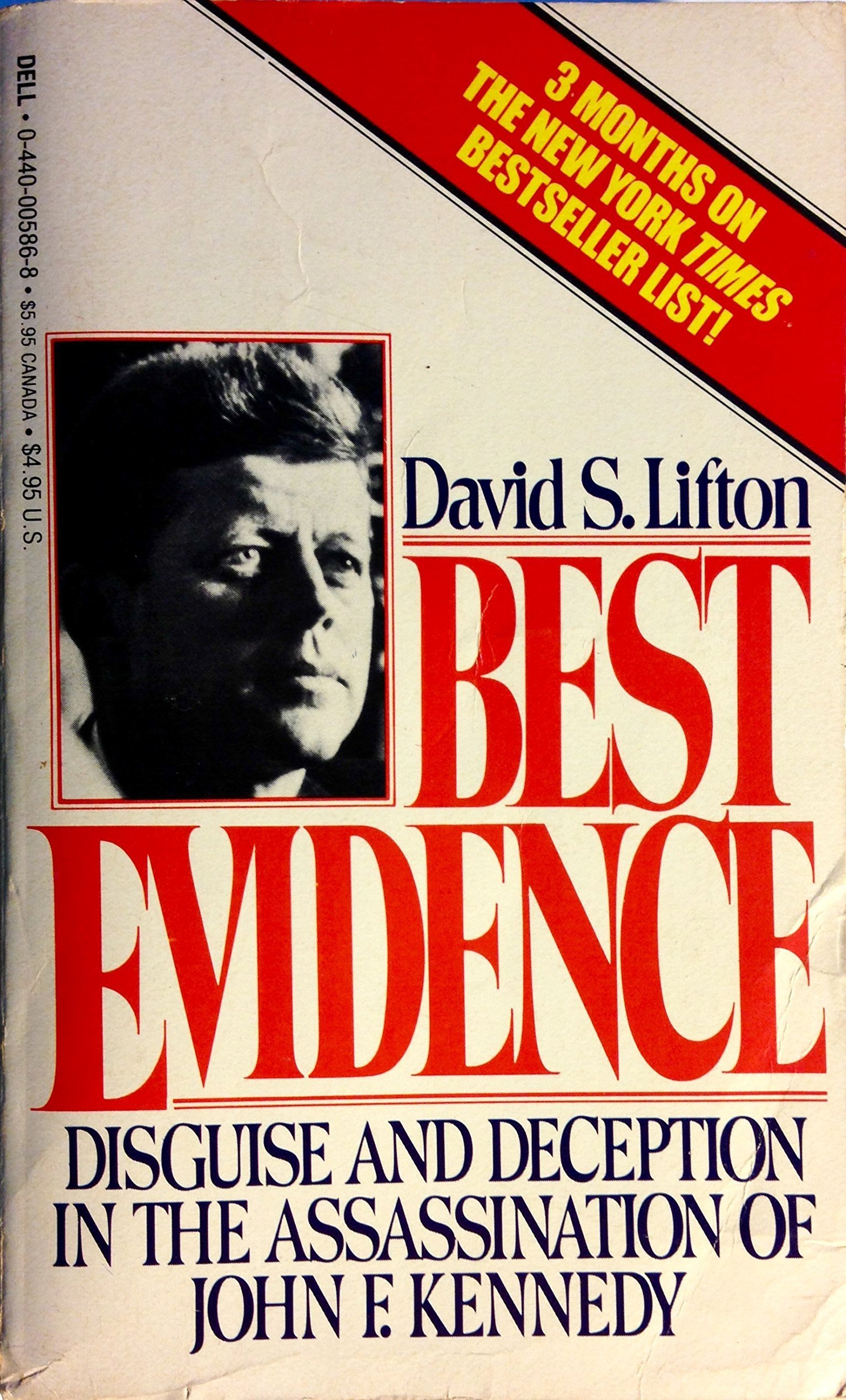
Sean Fetter’s two volume set on the JFK case, Under Cover of Night, runs over 1000 pages. And in this reviewer’s experienced opinion, there was no reason for that length, none at all. There is so much repetition, so many unnecessary and redundant sentences—Fetter thinks that if he says something often enough the reader will believe it—and so much carrying out personal vendettas by the author, that the book cries out—screams– for a wise and strong editorial hand.
When I use the phrase “personal vendettas”, I refer to four targets that Mr. Fetter has. They are, in order of intensity of antipathy:
- David Lifton
- Lyndon Johnson
- The MSM
The fourth target, which Fetter treats more lightly, is the critical community. I would not term his feelings about this last group as antipathy, let us just call it disdain. The reason I point this out at the start is that these extreme feelings color, to a serious degree, what Fetter writes in his book. It is not just a matter of personal invective and insults. It’s literally scores of them peppered throughout both books. To the point that this reviewer came to question the judgment and temperament of a writer who needs to consume so much time and ink in striking out at his perceived enemies.
In the case of Lifton, what complicates this was, to me, a seeming paradox. Because Fetter’s theory of the crime, at least in the immediate aftermath of the shooting, does not differ that much in overall plan from Lifton. Like Lifton, Fetter says that Kennedy’s corpse was hijacked, bullets extracted, and then the body was altered to disguise shots from the front. Like Lifton, he also states that the Zapruder film was altered in a very serious way. Where he differs from the author of Best Evidence is in how and where all this high level subterfuge occurred.
I
As Lifton himself once noted, Best Evidence did not have a lot of support within the critical community. But at least at one time, Fetter, and the man who wrote his Foreword, the late Peter David Rupay, worked for and with Lifton. This was revealed in an online review by Mr. Rupay of the book Bloody Treason. So, most probably, this is why the overall models are similar. But make no mistake, there was clearly a falling out among the three parties. And Rupay ended up disliking Lifton almost as much as Fetter does. In fact, Rupay put Lifton’s name in quotes in the Foreword. Why? Both men say that his real first name was Sam, not David. (I would have thought that sending away for his birth certificate would have settled the matter, which both men seem to think was of paramount importance.)
Very soon after this, we get a strong hint of what Fetter’s style and format is going to be. Fetter does not place his footnotes at the end of the chapter or at the end of the book. They are all on-page references. Many of them are not really footnotes at all in the academic sense. Because the majority of them refer to either “personal insights” or ‘personal discovery by the author.” There are not scores of these, not hundreds of them, but over a thousand. Some pages contain as many as five of them.(For example, see pages 268 and 270)
And this is where he places a majority of his personal attacks on Lifton. For instance, in the references on page 28, he says that 1.) His name was actually an alias, and 2.) He had a co -author on Best Evidence, and that was the late Patricia Lambert. He attributes both of these statements to Lifton himself which, perhaps inadvertently, attests to the fact of how close they were at one time.
Fetter now says that the proper model for his work was not Best Evidence but its precursor Murder from Within. (pp. 26-27) The author calls this the best book on the case in 50 years. (Fetter, p. 57) I have to add here: how many members of the critical community would agree with that declaration? Are we to forget people like Sylvia Meagher, Jim Douglass, and Gerald McKnight, among others? I would venture to say, not many would rate Murder from Within with the works of those others. If anyone would. (But, in one sentence, Fetter does give McKnight the back of his hand.)
Murder from Within began as a manuscript written in 1974 by Fred Newcomb and Perry Adams. It was later published as a book, which the reader can purchase online. Lifton and Newcomb had been friends and working partners. As Roger Feinman noted in his classic critique of Lifton’s book, Between the Signal and the Noise, the Newcomb/Adams volume resembles Best Evidence to a significant degree. For instance, it advocates a strong criminal role for the Secret Service, and also advocates for both wound alteration and Zapruder film alteration.
In Part One of Under Cover of Night it is revealed that in his architectural design, Fetter relies on the so called Boyajian Report for an alleged early arrival of Kennedy’s body at Bethesda Medical Center. This took place in the rear. (Fetter, p. 41). This was at 6:35 PM about 20-25 minutes prior to the official arrival. In my review of Harry Livingstone’s book Kaleidoscope, I discussed the use of this document as evidence. First, the actual report does not state the casket picked up by Roger Boyajian’s detail was President Kennedy’s casket, it only refers to it as “the casket”. If Boyajian knew it was Kennedy’s casket, would he not acknowledge that?
Secondly, the report was not signed by Boyajian and there is no hint as to why he did not sign it. There is a second page to the report that lists the 10 others in the detail, and none of them signed it either. Making it all a bit worse is that when the Assassination Records Review Board questioned Boyajian about whether he recalled picking up Kennedy’s casket, he could not recall doing so. In fact, he could not recall much about that day. Finally, the document the Board had does not appear to be the original. Which makes one wonder if it was ever filed with the military. Needless to say, this is not a good way to begin a radical interpretation of the Kennedy murder. As Carl Sagan noted, remarkable claims require remarkable evidence.
Fetter then says that something like 25 people observed or directly participated in that covert early arrival at Bethesda. If he includes the people in the Boyajian Report–for reasons noted above–they are dubious. He then lists some other witnesses. The problem with these other listings is going to be one that recurs in Fetter’s sourcing. Namely his aversion to proper footnote style. There is no way from the footnote to locate where and when these witnesses said they saw an early entry since he provides no proper sourcing for their testimony. And I don’t just mean page numbers. I mean the agency they testified to is also absent. (Fetter, p. 42)
But he also writes that when the corpse arrived people gasped, since what remained of Kennedy’s head was simply a vast, open crater and the skull had already been hacked open and the brain had been deliberately and violently removed from the skull cavity prior to the body’s initial arrival at 6:35 at the morgue. (p. 43) As many observers and commentators have written, there was a brain there; it was not a complete brain but there was a part of the brain present. Witnesses at Bethesda who have testified to this are people like FBI agents Jim Sibert and Frank O’Neill, mortician Tom Robinson, Dr. Thornton Boswell, Dr. James Humes, photographic technician Floyd Riebe and assistant Jim Jenkins. (The JFK Assassination: The Evidence Today, by James DiEugenio, p. 161) In fact Jenkins suffused the brain in solution after it was removed.
II
But in the face of this Fetter insists that there was pre autopsy surgery done to the body and that the bodies were switched—an issue I will get to later– and Bobby Kennedy and Jackie Kennedy did not know how Kennedy’s body had actually been transferred to Bethesda from Texas. (Fetter, p. 44). In other words, the altered body was delivered at 6:35 in the rear. Kennedy’s body was not in the bronze coffin coming in from the front. And upwards of 25 people knew about it.
Again, as per Lifton, Fetter says this was necessary because all the shots in Dealey Plaza came from the front. (Fetter, p. 55) Disagreeing with the majority of critics, Fetter states there was no triangulation of gunfire. (Ibid, p. 56) As many commentators on Best Evidence have stated: If all the shots came from the front, how does this explain Kennedy’s back wound, or the wounds in Governor John Connally– who was sitting in front of JFK? If one cannot make a good case for the fusillade being solely from the front, then does that not make the need for body alteration rather superfluous? For instance, due to the discoveries of the ARRB we now know that there was a hole in the rear of Kennedy’s skull at both Parkland Hospital and Bethesda. So why would there be a need to alter that wound? As Milicent Cranor has written, the doctors at Parkland did do horizontal tracheotomies. But let us give Fetter the benefit of the doubt on this one. What would it have taken to widen the wound in Kennedy’s neck? Would it have taken a bloody, macabre covert operation as the author notes and I will hence describe?
Let me be clear about it. Fetter is postulating not one, but two instances of body alteration. He is saying that Roy Kellerman took a first hack at the body while it was returning to Washington from Dallas. Kellerman was about 6’ 3” tall but he took a crash axe to Kennedy’s body in a 44 inch high cargo slot. (Fetter, pp. 355-60). As Doug Horne noted in his review of Fetter, the author did not provide an eyewitness to this dastardly deed, nor did he produce anyone who said that Kellerman even asked someone for a crash axe. Fetter makes much of the blood on Kellerman as evidence for this. Yet Kellerman helped take Kennedy’s body out of the limousine and onto a gurney at Parkland. (Harry Livingstone, Kaleidoscope, p. 185, 404)
But Fetter is stuck with his crash axe in Kellerman’s hands. So he has to state that the use of this produced hundreds of fragments in the skull. (p. 366) He estimates the number at between 500-1000. He largely relies on Humes’s testimony for this. But Humes was describing the condition of the skull from outside, how it broke apart easily. Humes, Boswell, Dr. Pierre Finck and the FBI agents all looked at the skull x rays that night. None of them described this 500-1000 dispersal of fragments in the skull. Not even close.
But now, Fetter—stuck with his crash axe– leaps to a remarkable conclusion: These x rays do not depict Kennedy’s actual skull. In his words, they are falsified images. He then criticizes other JFK researchers for trying to examine the x rays. They are wasting their time by trying to find the truth through criminally falsified imagery. (Fetter, p. 366)
So Fetter now gives another back of his hand to a radiologist like Dr. David Mantik who has been to the Archives 9 times to examine these exhibits and is a professionally trained radiologist who makes his living by examining such evidence. I would like to ask Fetter, 1.) How many times have you been to NARA? and 2.) What is your special training in radiology? And if you have no training and have never been there, how could you have detected something that Mantik could not? Fetter does not even attempt to counter the tests done by the HSCA that matched the sinuses and teeth in the post mortem x rays to Kennedy.
III
But Kellerman is only stage one of Fetter’s body alteration plot. Stage 2 is something called EORDO. This is an acronym for the End of the Runway Dropoff. (p. 410) What is remarkable about this idea is that Fetter admits he has no specific evidence for the event happening. He just adds that it must have occurred since there are no other options. (Fetter, p. 410) Well, Sean, if someone does not buy body alteration, there certainly are.
Let us get to the point: Fetter says Stage 2 took place at a place called Malcolm Grow Medical Clinic. This was an Air Force Hospital that opened in 1958 adjacent to Andrews Airfield. This is where Fetter says Kennedy’s corpse was offloaded and additional mutilation, searching for bullets, and photography took place. (Fetter p. 430). The author says this took about 20 minutes—I’m not kidding—and then helicopters arrived to pick up the body and deliver it behind Bethesda. (p. 436)
In the entire chapter during which Fetter deals with this wild concept–Chapter 21–he produces not one witness to either EORDO or Kennedy’s body being at Malcolm Grow. And that chapter is almost 40 pages long. What was precisely done there as far as the body alteration plot went is not specifically dealt with. It should have been since the author says Secret Service agents already removed bullets from Kennedy’s chest and skull on the plane. (Fetter, p. 310) Without explaining how they knew the projectiles were there.
I forgot to add, Fetter has a reply to those who do not buy body alteration. Blunt and simple: It happened and he says so. And he then adds as a rejoinder to those who disagree: “The only people who deny this fact today are fundamentally ignorant, fundamentally dishonest, fundamentally cowardly, or fundamentally damaged intellectually. Quite frankly some exhibit all four of those characteristics.” (p. 326). These kinds of insults for those who disagree with his tenets are not at all uncommon in the book. In fact, they occur with rather alarming frequency. Charming fellow.
But I have gotten a bit ahead of myself and left out some of the even wilder parts of Under Cover of Night. Let us address some of these in chronological order as to when they happened. Let us first deal with the actual shooting of President Kennedy and wounding of Governor Connally in Dealey Plaza. Fetter says that, for instance, Josiah Thompson was completely wrong when he titled his 1967 classic Six Seconds in Dallas. He was also wrong when he titled his next book on the case Last Second in Dallas. (p. 202). Why? Because there was a wholesale alteration of the Zapruder film that someone like Thompson could not somehow detect. After all, “Some people just never learn.” What Thompson did not realize—but what Fetter knows for sure– is that the Zapruder film at NARA does not even depict the actual shooting of President Kennedy. (Fetter, p. 393) Fetter then adds something that I found rather startling, even for him. He writes that somewhere between 20-30 seconds were eliminated from the original film” and this is where the action is.” In a recurring motif, he now adds a plug for an upcoming book: He will reveal what he knows about this “in stunning detail in my second major book…which is well under way.”
Oh, and because Fetter is making the Air Force a perpetrator in the crime, he knows where the alteration of the film took place. Please brace yourself: It took place in California. At a USAF facility called Lookout Mountain in Los Angeles. (Fetter, p. 578). In the 14 pages of the book that deal with this location, this reader could not find any evidence that places the Zapruder film there. And I can recall no other author who writes about this subject saying anything like this. For example, Doug Horne spends many, many pages on this issue in Volume 4 of his book Inside the ARRB, but I don’t recall a mention of the film going to California.
IV
In some respects, this book goes even beyond Best Evidence and Murder from Within. For instance, Fetter says that the body of John F. Kennedy was switched, not on the flight back to Washington, but right there at Parkland Hospital. (Fetter, p. 275). But he actually goes even beyond that. He writes that Jackie Kennedy knew the body had been switched! (p. 267, p.272) There is no explanation that I could find as to why Jackie Kennedy would accept something like this happening to her now deceased husband. But since Fetter has committed himself to this diversion, he has to postulate that Jackie would have to know.
Why? Because of Jim Bishop. According to Fetter, Bishop described a moment when Jackie left Trauma Room One at Parkland to get a smoke. (Fetter, p. 264) He says that somehow this information is owed to Mr. Bishop, but Bishop did not know what he had discovered. Well, I looked up the sources that Fetter used on this page in Bishop’s book The Day Kennedy Was Shot. Fetter refers to p. 180 and page 208 in Bishop’s book. On neither of those pages in the hardcover edition does Bishop write about Jackie leaving the side of the corpse of her husband at Parkland. If Fetter was referencing a different edition of the book, he should have noted that in his notes. But I should add that Fetter says that he deduced this from information supplied by Bishop. (See Footnote 585 on page 264)
A problem with Fetter’s dramatic scenario is Nurse Diana Bowron. She was one of the last medical persons to handle Kennedy’s corpse at Parkland. In the Commission volumes, in Bowron Exhibit 4, she describes Jackie’s last actions with the body and that she helped lift the corpse into a bronze casket. (See WC Vol. 19, p. 170) It later turned out that these quotes were relayed to the press not by her but through her mother. But, much later, she repeated them in an interview she did with Harry Livingstone. Bowron actually helped shear off Kennedy’s clothes and then washed Kennedy’s hair after he died to prepare him for the casket. She did this with nurse Margaret Hinchliffe. (Michael Benson, Who’s Who in the JFK Assassination, pp. 190-91) She told Livingstone that she loaded the body into the same bronze coffin she saw it offloaded from Air Force One at Andrews AFB. (Click here.)
But none of the above reservations and qualifications stop the rather immodest Sean Fetter from writing that he is the first and only person to determine what actually happened to JFK that day. (Fetter, p. 275) In light of the above, I would have to reply, “Oh really?”
(Go to Part 2 of my review for the political aspects of Fetter’s work.)