Tag: AUTOPSY WITNESSES

  • JFK: What the Doctors Saw – An Important Addition, and a Missed Opportunity

    JFK: What the Doctors Saw – An Important Addition, and a Missed Opportunity


    Paramount Plus’ new documentary, JFK: What the Doctors Saw, is a valuable contribution to the story of the assassination. It features interviews conducted during the past six years with the trauma surgeons who tried to save President John F. Kennedy’s life after he was shot in Dallas on 11/22/63. It will inevitably expand and enliven the never-ending controversy about whether Lee Harvey Oswald, alone, could have inflicted the wounds these doctors saw. On film, they make a compelling case that the answer is no.

    Whether one agrees with them or not, one can simply not watch them without concluding that these are sincere, highly experienced surgeons with no axe to grind, speaking truthfully about what they witnessed on perhaps the most dramatic day in their long and distinguished careers. Importantly, what they emphasize on film is something they’ve always said, right from the day Kennedy was assassinated: JFK arrived in Parkland Hospital’s Trauma Room One with a large, rearward skull wound.

    The House Select Committee on Assassinations in the late ‘70s, and Warren Commission defenders ever since, maintain that the Dallas doctors were mistaken. JFK’s actual head wound they say was where it appears in the autopsy photographs, on the right side of his skull toward the front, not the rear. It’s a question that is at the very heart of the question of conspiracy.

    Unfortunately, the film’s great value is somewhat diminished by the theory that JFK underwent a secret surgical procedure before the official autopsy began at Bethesda Naval Hospital. Douglas Horne, an Assassinations Records Review Board (ARRB) investigator, said on film that he believed that Commander James Humes, MD, JFK’s chief pathologist, had surreptitiously removed JFK’s brain to extract bullet evidence of a shot from the front. He then, says Horne, put Kennedy’s picked-over brain back into his shattered brain case, only to remove it again later during the official autopsy which Horne described as a “charade.” His extraordinary claim is made without extraordinary evidence, and so will persuade few and be dismissed by this author.

    That aside, there is much to recommend this work, especially the fact that the seven featured Parkland doctors have been consistent in their descriptions of JFK’s wounds for nearly 60 years. They still think Kennedy’s throat wound was probably an entrance wound, but never opined as to where that bullet might have gone. However, they seemed willing to consider the more likely possibility: that it was an exit wound for a shot that struck from behind. For while bullet fragments were found in front of JFK from a likely back-to-front trajectory, there is no evidence a bullet or fragments popped out behind Kennedy, nor any signs – X-ray or otherwise – that a bullet was retained anywhere in JFK’s chest or abdomen from a shot in front. The Parkland crew were less equivocal about JFK’s fatal head wound.

    As documented by the trauma surgeons in hospital notes written on the day of the murder and published by the Warren Commission, the Dallas crew still says there was major damage to right rear portion of JFK’s head. Kennedy’s autopsy photographs show no such wound. On film Doug Horne offered a possible explanation. “Everything changed as soon as JFK’s body left Parkland Hospital,” he said, reprising the claim first made by author David Lifton in his book, Best Evidence. As regards Kennedy’s head injury at least, new information shows that things don’t appear to have changed all that much between Dallas and the autopsy room at Bethesda Naval Hospital.

    In the 1990s, The Assassinations Records Review Board released suppressed interviews with witnesses at JFK’s autopsy that the House Select Committee had conducted in the late 1970s.Their descriptions of Kennedy’s skull injuries are strikingly similar to what the Parkland doctors said on the day of the assassination, as well as in interviews over the past 60 years and again in the documentary.

    By way of background, the following sampling of quotes are taken from notes written by the trauma surgeons who attended Kennedy on 11.22.63 and published in the Warren Report[1]:

    • Kemp Clark, MD, professor of neurosurgery: “There was a large wound in the right occipito-parietal region…There was considerable loss of scalp and bone tissue. Both cerebral and cerebellar tissue was extruding from the wound.” (WR, p. 518) And, “a large 3 x3 cm remnant of cerebral tissue present…there was a smaller amount of cerebellar tissue present also…There was a large wound beginning in the right occiput extending into the parietal region…Much of the skull appeared gone at the brief examination…” (WR p. 524-525)
    • Malcolm Perry, MD: p. 521: “A large wound of the right posterior cranium was noted…” (WR p. 521)
    • Charles Baxter, MD: “…the temporal and occipital bones were missing and the brain was lying on the table.” (WR p. 523)
    • Marion Thomas Jenkins, MD, the professor of anesthesiology who held JFK’s head in his hands during the resuscitation effort: “There was a great laceration on the right side of the head (temporal and occipital), causing a great defect in the skull plate so that there was herniation and laceration of great areas of the brain, even to the extent that the cerebellum had protruded from the wound.” (WR p. 529-530)

    Paramount Plus had the Dallas doctors reaffirming those observations, but it said nothing about what the autopsy witnesses had reported. Given Doug Horne’s remark, viewers were thus left to assume everything had changed. But it hadn’t.

    In formerly suppressed witness interviews that were not available to David Lifton when he wrote Best Evidence, but were to Doug Horne, the HSCA reported the following:

    • Bethesda lab technologist James Jenkins told the HSCA that, “he saw a head wound in the ‘…middle temporal region back to the occipital.’[2]
    • In an affidavit prepared for the HSCA, FBI agent James Sibert wrote that, “The head wound was in the upper back of the head … a large head wound in the upper back of the head…”[3]
    • The HSCA’s Andy Purdy interviewed Tom Robinson, the mortician who prepared John Kennedy’s remains for burial.: “Approximately where was (the skull) wound located?” Purdy asked. “Directly behind the back of his head,” Robinson answered. Purdy: “Approximately between the ears or higher up?” Robinson, “No, I would say pretty much between them.”
    • Jan Gail Rudnicki, Dr. Boswell’s lab assistant on the night of the autopsy, told the HSCA’s Mark Flanagan, the “back-right quadrant of the head was missing.”[4]
    • When first asked, John Ebersole, MD, the attending radiologist who took JFK’s autopsy X-rays, told the HSCA, “The back of the head was missing,” Hethen waffled after being shown the autopsy photographs.[5]
    • Regarding the Commanding officer of the military District of Washington, D. C., Philip C. Wehle, the HSCA reported that, “(Wehle) noted that the wound was in the back of the head so he would not see it because the President was lying face up.”[6] (emphasis added throughout)

    Besides these clear statements, several autopsy witnesses drew diagrams of President Kennedy’s wounds for the HSCA. (Figures 1 and 2)

    aguilar1Fig. 1. Left — Diagrams of JFK’s wounds prepared for the HSCA by autopsy technician, James Curtis Jenkins.[7] Right — Diagrams of JFK’s wounds prepared for the HSCA by autopsy witness, FBI agent James Sibert.[8]

    aguilar2Fig. 2. Left — Diagrams of JFK’s wounds prepared for the HSCA by Tom Robinson, the mortician who prepared Kennedy’s body for burial.[9] Right — Diagrams of JFK’s wounds prepared for the HSCA by autopsy witness, FBI agent Francis O’Neill, Jr.[10]
    [These and other, similar accounts are further elaborated upon in the 2003 on-line essay: “HOW FIVE INVESTIGATIONS INTO JFK’S MEDICAL/AUTOPSY EVIDENCE GOT IT WRONG.[11]]

    In neglecting the autopsy witnesses, the program missed a great opportunity – a long known, underreported HSCA scandal that the producer, Jacque Lueth, knew all about from repeated, personal conversations with me over the past several years. (Ms. Lueth told me she wanted to present this material on film but was blocked by others involved in the documentary.) Only when the ARRB released the accounts of the autopsy witnesses in the late 90s did we discover that the Select Committee had misled the public about what they had said in the 1970s. It had everything to do with the heart of Paramount’s documentary: JFK: What the Doctors Saw.

    Confronting the conflict between autopsy photos that show no damage to the rear of JFK’s skull and the Parkland doctors who said damage was in the rear, theHSCA reported it had resolved the problem. “Critics of the Warren Commission’s medical evidence findings have found (sic) on the observations recorded by the Parkland Hospital doctors,” they wrote. “They believe it is unlikely that trained medical personnel could be so consistently in error regarding the nature of the wound, even though their recollections were not based on careful examinations of the wounds…In disagreement with the observations of the Parkland doctors are the 26 people present at the autopsy.All of those interviewed who attended the autopsy corroborated the general location of the wounds as depicted in the photographs;none had differing accounts … Further, if the Parkland doctors are correct, then the autopsy personnel are either lying or mistaken. It did not seem plausible to theCommittee that 26 persons would by lying or, if they were, that they could provide such a consistent account of the wounds almost 15 years later. Second, it is less likely that the autopsy personnel would be mistaken in their general observations, given their detailed and thorough examination of the body…it appears more probable that the observations of the Parkland doctors are incorrect.” (7HSCA37-9. Emphasis added.[12])

    aguilar3

    This was clearly false. The autopsy witnesses had described a rearward skull defect to the HSCA verbally, in writing, and by sketch diagram. The HSCA, however, reported that the autopsy witnesses had refuted the Dallas witnesses whom, in fact, they had actually corroborated. There is an additional aspect of this that might have also been worth a few moments of film.

    At the one hour, 18-minute mark, the program showed a clip of the HSCA’s Andy Purdy declaring that the ‘Dallas doctors are wrong; these recollections afterward are faulty.’ As noted above, it was Purdy who was wrong, as the doctors’ ‘recollections afterward’ closely aligned with what Parkland’s experts documented on the day of the murder as per the Warren Report. They also snugly fit with the suppressed claims of the autopsy witnesses whom Purdy had himself interviewed, and whose diagrams he had signed (See Figs. 1 & 2). Though arguing that the public has been misled, Paramount Plus missed a perfect opportunity to both expose the government’s false claim, while debunking one of the government officials whom they had on film pushing that claim, Andy Purdy.

    There is another, evidence-based problem for those who argue that Parkland got it all wrong. Research has shown that experienced, credible witnesses working in their usual environment, simply do not make mistakes of this nature. Furthermore, how could a different group of credible witnesses at a multi-hour autopsy at a different location have made the same error as the Texans? Though witness claims are often disparaged as unreliable, the reigning authority on eyewitness testimony, Elizabeth Loftus, has reported that there are circumstances in which their reliability tends to be high.[13] She based her conclusions on evidence from a 1971 study. In a Harvard Law Review paper[14] Marshall, Marquis and Oskamp reported that, when test subjects were asked about “salient” details of a complex and novel film clip scene they were shown, their accuracy rate was high: 78% to 98%. Even when a detail was not considered salient, as judged by the witnesses themselves, they were still accurate 60% of the time.

    Loftus has identified the factors that tend to degrade witness accuracy, most of which are relevant to the Kennedy case. Principal among them are poor lighting, short duration of an event, or a long duration between the event and when a witness is asked questions about it, the unimportance of the event to the witness, the perceived threat of violence during the event, witness stress or drug/alcohol influence, and the absence of specialized training on the witness’s part. Absent these factors, Loftus’s work shows that witnesses are very reliable.[15]

    JFK’s skull damage would certainly have been considered a “salient detail” to the senior trauma surgeons in Trauma Room I, as well as the witnesses in the morgue. Negligible adverse circumstances were present in either location that would explain how both groups of witnesses might have erred. They were working as highly trained experts in their usual capacity, in their usual circumstances, and in their usual setting. Moreover, both groups had no reason to dissemble, and more than ample time and opportunity to make accurate observations, many of which were recorded immediately. Though the overwhelming odds are that they were right, Warren Commission loyalists are constrained to insist they were nearly 100% wrong, and somehow wrong in the same way. Their case hinges on the official autopsy photographs, which are regarded as unimpeachable proof the Parkland doctors were wrong. Presumably, they also prove that the autopsy witnesses were unimpeachably wrong, too: they show no damage to the right rear portion of JFK’s head.

    For Warren Commission skeptics, however,this documentary, combined with evidence declassified by the ARRB, offer reasons to believe the Dallas doctors and the autopsy witnesses were probably right.

    First, the extant autopsy photos may not tell the whole story. We learned from ARRB releases and other evidence that all three of JFK’s pathologists, both autopsy photographers, and the two government employees who developed Kennedy’s autopsy photographs have claimed, sometimes under oath, that photos they either took, or later saw after development, are missing.[16] Assuming they had no reason to lie, it’s likely the photographic record is incomplete. Among the pictures that may well be missing is an image (or images) of the full extent of Kennedy’s skull wound taken from his injured, right side. (Interestingly, in the official collection there is one of uninjured, left side of JFK’s head.)

    Autopsist J. Thornton Boswell’s face sheet diagram, prepared on the night of the post mortem, specifies that 17-cm of JFK’s skull was missing. No autopsy photograph captures such a huge defect. It strains credulity to think that the surgical team tasked with documenting JFK’s cause of death would have neglected to take such an image. In fact, as documented elsewhere, autopsy witnesses say such an image, or images, were taken.[17]

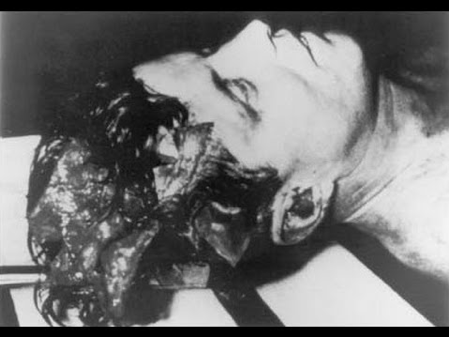
    Second, in the documentary Dr. McClelland said that the image of the back of Kennedy’s head does not show the wound he saw. He pointed out that a hand is holding JFK’s torn scalp over the rearward wound that he saw. (Figure 3)

    aguilar4Fig, 3: Bootleg copy of an autopsy photo from JFK’s autopsy in the correct orientation, with JFK lying on his left side. A hand appears to be holding the scalp forward over the back of the President’s head, over what Dr. McClelland said was a large rearward skull defect.

    In a similar vein, Kenneth Salyer, MD said he thought that the autopsy photos appeared to have been tampered with, and that they had replaced the scalp over an area that was wide open (1 hr., 20 min. mark).

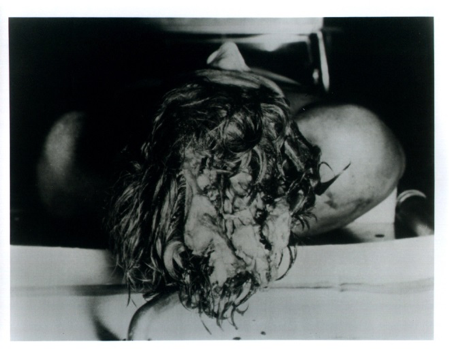
    Near the end of the film Dr. Salyer made a suggestion that some of us skeptics have long believed plausibly explains why the Parkland doctors and autopsy witnesses said JFK’s wound was right-rearward. A flap of JFK’s scalp had fallen backward, Salyer said, and it “bunched up” at the base of Kennedy’s occiput.

    Since the autopsy report documented that there were large scalp tears, and since JFK was lying face-up on the Parkland gurney, as well as on the autopsy table, it only makes sense that gravity would have drawn a torn flap downward to reveal what was present, a rearward skull defect described by both Parkland and Bethesda witnesses. It would jibe with Dr. Boswell’s 11/22/63 “face sheet” diagram specifying that 17-cm of President Kennedy’s skull was missing. (Figure 4) It would also fit with the anatomical ARRB sketch of Dr. Boswell’s depiction showing a massive skull defect. (Figure 5)

    aguilar5Figure 4. J. Thornton Boswell, MD’s “face sheet” diagram prepared during the autopsy on the night of JFK’s assassination at Bethesda Naval Hospital. Note the number “17” with arrows pointing fore and aft. Under oath, Dr. Boswell later explained that when examined, the President’s skull defect measured 17-cm.

    aguilar6Fig, 5. These diagrams are two-dimensional drawings prepared by the ARRB to depict JFK’s skull damage. They are based on markings made on a three-dimensional human skull model by J. Thornton Boswell, MD. Note that these diagrams reasonably match the face sheet diagram prepared on the night of the autopsy that documented 17-cm of Kennedy’s skull was missing . The images show what most skeptics believe: that Kennedy’s skull damage extended from the so-called “frontal bone” anteriorly well into the occipital bone posteriorly. A truly massive, fatal wound.

    Despite its imperfections, including the omission of evidence such as the above that would have reinforced its case against the Warren Commission’s trustworthiness, JFK: What the Doctors Saw is a valuable, first-hand account by credible witnesses, a real contribution to the medical evidence in the Kennedy case.

    At a minimum it confirms the widely held view that the government has not told the public the whole truth about the Kennedy case. It also adds to existing evidence from JFK’s X-rays, from the Zapruder film, from Dealey Plaza witnesses, etc. that have chipped away at the official version of Kennedy’s murder. It’s inescapable that the President’s mortal head wound was far larger than the 13-cm defect specified in the official autopsy report,[18] and much different than what can be gleaned from the extant file of autopsy photographs. Simply, by the most credible accounts imaginable, it’s too large and too different to be explained by a single shot fired from Lee Harvey Oswald’s alleged perch, “above and behind.”


    [1] Warren Report. >https://history-matters.com/archive/jfk/wc/wr/contents.htm

    [2] HSCA interview with Curtis Jenkins, Jim Kelly and Andy Purdy, 8-29-77. JFK Collection, RG 233, Document #002193, p.4. Also reproduced inARRB Medical Document #65, see p.4 and diagram on p. 16.

    [3] HSCA rec # 002191. Also reproduced in ARRB Medical Document #85, see p. 3 anddiagram on p. 9.

    [4] HSCA rec. # 180-10105-10397, agency file number # 014461, p. 2.)

    [5] https://history-matters.com/archive/jfk/arrb/master_med_set/md60/html/Image04.htm

    [6] HSCA record # 10010042, agency file # 002086, p. 2.

    [7] https://www.history-matters.com/archive/jfk/arrb/master_med_set/md65/html/md65_0016a.htm

    [8] https://www.history-matters.com/archive/jfk/arrb/master_med_set/md85/html/md85_0009a.htm

    [9] https://www.history-matters.com/archive/jfk/arrb/master_med_set/md63/html/Image13.htm

    [10] https://www.history-matters.com/archive/jfk/arrb/master_med_set/md86/html/md86_0011a.htm

    [11] https://history-matters.com/essays/jfkmed/How5Investigations/How5InvestigationsGotItWrong_5.htm#_edn287

    [12] 7HSCA37-39 https://www.history-matters.com/archive/jfk/hsca/reportvols/vol7/html/HSCA_Vol7_0024a.htm

    [13] Loftus, Elizabeth F.Eyewitness Testimony. Cambridge, Harvard University Press, 1996, p. 25 – 26.

    [14] Marshall, Marquis and Oskamp, Vol.84:1620 – 1643, 1971.

    [15] E Loftus, JM Doyle.Eyewitness Testimony: Civil and Criminal, Second Edition. Charlottesville:The Michie Company, 1992

    [16] See HOW FIVE INVESTIGATIONS INTO JFK’S MEDICAL/AUTOPSY EVIDENCE GOT IT WRONG, Part V. https://history-matters.com/essays/jfkmed/How5Investigations/How5InvestigationsGotItWrong_5.htm#_edn287

    [17] See “Questions Arise about JFK’s Autopsy Photographs.” https://www.history-matters.com/essays/jfkmed/How5Investigations/How5InvestigationsGotItWrong_5.htm

    [18] https://www.archives.gov/files/research/jfk/warren-commission-report/appendix-09.pdf

  • The JFK Assassination Dissected by Cyril Wecht and Dawna Kaufmann

    The JFK Assassination Dissected by Cyril Wecht and Dawna Kaufmann


    Alongside Mark Lane, Josiah Thompson, and Jim Garrison, Dr. Cyril Wecht’s face long ago made its way onto my own personal Mount Rushmore of JFK assassination experts. A world-renowned forensic pathologist, lawyer, author, and founder of the Cyril H. Wecht Institute of Forensic Science and Law at Duquesne University in Pittsburgh, his credentials and intellect are not open to question. Perhaps more importantly, his courage and integrity are beyond reproach. In opposition to most of his colleagues in medicine, Dr. Wecht has never been afraid to take a stand against official pronouncements when he knows them to be wrong. As such, he has been one of the most prominent and outspoken critics of the US government’s lone nut solution to the Kennedy assassination for more than fifty years. And never being one to follow the herd, Dr. Wecht has been just as outspoken when his fellow Warren Commission critics have gone off the deep end with their pet theories.

    My own contact with Dr. Wecht has been sadly limited. However, in 2015, after ballistics expert Lucien Haag published a piece titled “Death of the Shooter on the Grassy Knoll” in the pages of the AFTE Journal, I was among a small group of assassination buffs who offered Dr. Wecht and his colleague Dr. Gary Aguilar some ideas on how to respond. In a detailed email, I shared my thoughts on what could be discerned from a comparison of JFK’s post-mortem skull X-rays and the X-ray of a test skull that had been shot with the very rifle and ammunition Lee Harvey Oswald is alleged to have used. A few hours later, Dr. Wecht responded, “Thank you very much for your perceptive comments and observations…I appreciate your keen analysis and incisive critique…Your points will be helpful to us as we prepare our response to these WCR sycophants.” (Private email, Aug 13, 2015) To say the least, I was humbled and delighted by his kind words. I was equally as happy to see a comparison of the same two X-rays appear in Wecht and Aguilar’s published response.

    It perhaps goes without saying, therefore, that I was excited to learn that Dr. Wecht had published―with co-author Dawna Kaufmann―his first full length book on the Kennedy case. And my enthusiasm was stoked by the title of the book, The JFK Assassination Dissected, which appeared to me to suggest that the famous pathologist would be giving readers the benefit of his professional skills by offering an in-depth analysis of the forensic evidence in the case. As it turns out, however, that is not the type of book this is.

    Written as a kind of memoir, The JFK Assassination Dissected functions largely as an overview of the last fifty-eight years from Dr. Wecht’s perspective. The first third or so of the book functions largely as an introduction to the basic facts of the case. And as I read these early chapters, it occurred to me that I have long lamented the lack of a decent introductory book on the case, one that does not offer or promote long-discredited theories or erroneous conclusions. The JFK Assassination Dissected could almost fill that void, but for a few important caveats. Firstly, the book does not cite any of its sources, a must for any scholarly work. Secondly, it contains some important errors of fact, the most baffling of which is the claim, “According to the Warren Commission, as of September 1962, [Lee Harvey] Oswald began receiving a $200 stipend as FBI informant number S172.” And finally, the authors appear to accept some important elements of the official portrait of Oswald, despite how strongly much of it has been contested.

    For example, Wecht and Kaufmann matter-of-factly repeat the Warren Commission’s claim that in the spring of 1963 Oswald attempted to assassinate retired Army Major General Edwin Walker. The authors write of how Oswald allegedly stalked the “ultra-conservative” Walker, “taking photos of the general’s residence.” Then, on April 10, 1963, “…crouched behind a fence at the rear of the house where he could see Walker sitting at his desk. Oswald then fired one shot, at a distance of less than 100 feet away. The bullet hit the wooden frame of the window, and small fragments hit the general’s arm and caused bleeding.” (p. 89)

    The above has long been a favourite story of Warren Commission loyalists, because of what it supposedly says about Oswald. For instance, lone nut zealot Mel Ayton called the Walker incident “the most compelling pre-assassination evidence for Oswald’s propensity to meticulously plan and carry out an act of political assassination, alone and unaided.” (Beyond Reasonable Doubt, p. 149) And yet there have always been profound reasons for questioning Oswald’s participation in the whole affair. To begin with, Oswald never made it onto the Dallas police department’s list of suspects during the several months it investigated the shooting. Furthermore, eyewitness evidence suggested that at least two people were involved. Walter Kirk Coleman, a neighbour of General Walker, told police that he saw two men leaving the scene in two separate cars, one of whom stopped to put something on the back floorboard of his car, while the other climbed into a green or blue Ford and “took off a hurry.” (WC Vol. 24 p. 41) Neither man, according to Coleman, resembled Oswald and, in fact, Oswald did not have a car or even held a driver’s license.

    To be fair to Wecht and Kaufmann, the authors do mention the fact that two men were seen leaving the scene. What they do not divulge, however, is that the bullet that was recovered from Walker’s home was identified at the time as being a 30.06 steel-jacketed round. (Sylvia Meagher, Accessories After the Fact, p. 288 and WC Vol. 24 p. 40) It was not until the Warren Commission began looking into the incident that the bullet suddenly became a 6.5 mm copper-jacket, like the ones fired by Oswald’s rifle. This magical transformation of composition and calibre was a little too rich for Walker. When the retired Army general―who had held the real bullet in his hand on the night it was dug out of his wall―saw the Commission’s bullet on television he immediately started a campaign to have the government “withdraw the substituted bullet.” (Gerald McKnight, Breach of Trust, p. 52) Unsurprisingly, he was ignored.

    Another basic tenet of the official Oswald legend that Wecht and Kaufmann repeat without objection is the claim that the violent-tempered ex-Marine was in the habit of beating his wife, Marina. Yet, as I have written before, there is good reason to suspect that the reality of this issue is more complex than Commission apologists would have us believe. Testimony offered to the Commission suggested that Marina had taken pleasure in tormenting and embarrassing her husband in front of friends and Lee was himself observed covered in scratches inflicted by his wife. (HSCA Vol. 12, p.129) Marina even admitted in her own testimony that she would hit and throw objects at Lee. “I’m not a quiet woman myself,” she confessed. (WC Vol. 5 p. 598) It seems to me that whilst there is little doubt the Oswald marriage was often a violent one, in all likelihood neither party was entirely blameless.

    I was initially confused as to why Wecht and Kaufmann appeared so willing to accept the mainstream view of Oswald, but the answer came in a later chapter of the book which details a lunch Dr. Wecht had with Marina in November 1992. Writing of Marina’s “bravery” and being “in awe” of her ability to “separate fact from conjecture.” (p. 266) It seemed obvious that Dr. Wecht was quite taken by Oswald’s widow as she told him many of the same tales she had been recounting for nearly three decades by that time. It is important to note at this point that claims such as those concerning Oswald’s allegedly violent temper or his attempting to kill General Walker are reliant almost entirely on Marina’s word. In fact, as Mark Lane once noted, “The [Warren Commission’s] case against Lee Harvey Oswald was comprised essentially of evidence from two sources: Dallas police officers and Marina Oswald.” (Lane, Rush to Judgment, p. 307) In other words, in order to buy into the official story, it is essential to rely on Marina.

    It may well be that Dr. Wecht’s instincts are correct and he is right to believe her. On the other hand, Marina has proven, to be kind, a rather unreliable witness. In fact, over the years she has given so many conflicting stories that when the House Select Committee on Assassinations conducted its own ill-fated probe into the assassination in the late 1970s, the staff compiled a report totalling more than thirty pages titled “Marina Oswald Porter’s Statements of a Contradictory Nature.” Shortly after her husband’s own death at the hands of Jack Ruby, Marina told authorities that he had been a good husband who loved to help out with his children and she could think of no acts of violence he had committed. Later, her description changed to one of a selfish, vicious wife-beater who forced himself on her sexually and was, as she told Dr. Wecht, a “lousy father.” (p. 260)

    It might be argued that the evolution of Marina’s story was a result of her overcoming a sense of embarrassment or loyalty to her dead husband. Yet it cannot be ignored that the negative stories about Lee first began to emerge during the two-month period that Marina was held at the Inn of Six Flags in Arlington, Texas, and repeatedly interrogated by the Secret Service and FBI under threat of deportation. (WC Vol. 1 pp. 79; 410) Nor can it be ignored that, as Mark Lane pointed out, “In the course of Marina’s variegated testimony, she became richer.” (Lane, ibid) Indeed, soon after the assassination, she received hundreds of thousands of dollars in public donations and story advances, prompting her to hire a business manager. And the more the money rolled in, the more she painted herself as a helpless victim to a monstrous husband.

    These days, as Wecht and Kaufmann explain, Marina says she believes there was a conspiracy behind the Kennedy assassination, that Oswald was telling the truth when he labelled himself a “patsy,” and that both her and her deceased husband were lied to by the U.S. government. (p. 262) On the other hand, she continues to insist that the horrendous portrait she helped paint of Oswald is an accurate one and has not admitted to telling any lies of her own. Maybe that is because the essential facts of the story she eventually settled on are, despite numerous contradictions, sadly true. Or perhaps Marina is sticking to her guns simply because she has become accustomed to playing the victim. Either way, I do believe the authors would have been better served had they conveyed her account with a little more caution.

    Still, I cannot help but respect Dr. Wecht’s ability to state what he believes to be true regardless of what popular opinion may be. Although most students of the assassination take it as a given that Marina is not to be trusted, Dr. Wecht is, as usual, forging his own path. And it must be said, whatever his personal beliefs, Wecht usually takes care not to go beyond the bounds of the evidence. Thus, it is no surprise to me that he remains open minded on many issues, including the question of precisely what role Oswald played in the assassination.

    II

    Generally speaking, JFK assassination researchers fall into two camps: those who believe Oswald was totally innocent and played no part in the assassination and those who say he acted entirely alone. Dr. Wecht, however, appears to occupy the far less crowded middle ground. In a chapter dealing with Oswald’s arrest and the murder of police officer J.D. Tippit, he refuses to offer an opinion on Oswald’s guilt, writing that “Lee Harvey Oswald was the person arrested. I won’t argue whether he was the person who shot Officer J.D. Tippit.” (p. 53) Although Oswald’s innocence in the Tippit murder is taken for granted by a great number of assassination researchers today, Dr. Wecht’s is a wholly reasonable position. He notes that the official narrative has “many holes” that “might have been patched had Oswald been allowed to offer a defense,” (p. 53) and details several pertinent questions raised by critics. Yet, he does not say that the oft-repeated inconsistencies in the case against Oswald prove his innocence any more than the state’s evidence proves his guilt.

    Another element of the official story that Wecht and Kaufmann repeat without objection is the notion that Ruth Paine was nothing more than a friendly, do-gooding Quaker woman who took Marina in because she “wanted to improve her Russian-language skills” (p. 65) She also helped Oswald get a job at the Texas School Book Depository out of the goodness of her heart, yet such a belief is more than questionable today. In his highly regarded 2008 book JFK and the Unspeakable, author Jim Douglass detailed a number of curious connections between Ruth Paine, her husband Michael, and US intelligence agencies. For example, Michael’s stepfather was Arthur Young, the inventor of the Bell Helicopter and Michael himself worked as an engineer for Bell, a job that carried a security clearance of which he claimed not to know the details. Furthermore, his mother was Ruth Forbes Paine Young who was a lifelong friend of OSS spy Mary Bancroft, the mistress of CIA director Allen Dulles. As Douglass summarized, “By heritage Michael Paine was well connected in the military-industrial complex.” (Douglass, p. 169)

    Ruth Hyde Paine’s own familial connections are equally, if not more, interesting. Douglass points out that right after Ruth helped the Warren Commission to hang the assassination solely on Oswald, her insurance executive father, William Avery Hyde, received a three-year government contract from the Agency for International Development (AID), an organisation whose field offices were, as former Ohio governor and AID director John Gilligan later admitted, “infiltrated from top to bottom with CIA people.” (Ibid, 170) The end-of-tour report William Avery Hyde made of his time in Lima, Peru, may have been addressed to the State Department, but it was passed along to the CIA. As Douglass suggests, it may well be that Hyde used his insurance expertise as a “cover for gathering information on people [in Latin America] the CIA was watching carefully in the ferment of the sixties.” (Ibid)

    If her father’s CIA connections are less than certain, the same cannot be said of Ruth Paine’s younger sister Sylvia Hyde Hoke who, by 1963, was enjoying her eighth year as an employee of the Agency. Yet incredibly enough, five years later when Ruth was questioned in front of a grand jury in New Orleans, she admitted to knowing that her sister had a “government job,” but claimed not to know for which agency she worked. Nonetheless, when the same grand jury questioned Marina Oswald about why she had cut ties with Ruth shortly after the assassination, Marina explained, “I was advised by the Secret Service not to be connected with her.” Why? Because, according to Marina, the Secret Service had told her that Ruth “was sympathising with the CIA…she had friends over there and it would be bad for me if people find out a connection between me and Ruth and CIA.” (Ibid, 173)

    Intriguingly enough, Marina received a similar admonition from her husband’s eldest brother, Robert, who had become immediately suspicious of the Paines after meeting them for the first time at Dallas police headquarters on November 22, 1963. Later that evening, Robert wrote in his diary “I still do not know why or how, but Mr. and Mrs. Paine are somehow involved in this affair.” (WC Vol. 1, p. 346) Shortly thereafter, as he told the Warren Commission, Robert advised Marina to “sever all connections with Mr. and Mrs. Paine…I recommended that she did not talk to Mrs. Paine at all nor answer her letters…” (Ibid, pp. 420–21)

    Robert’s instincts aside, the central question remains: did Ruth and Michael Paine’s intelligence connections have any bearing on their relationship with Lee Harvey Oswald? A definitive answer to that question remains elusive. However, a possible clue can be found in volume 19 of the Warren Commission hearings and exhibits in the form of a report written by Dallas deputy sheriff Buddy Walthers. The report in question describes numerous items that were found in the Paine garage on the day of the assassination. Among them, according to Walthers, was “a set of metal file cabinets that appeared to be the names and activities of Cuban sympathizers.” (WC Vol. 19 p. 520) The obvious question raised by Walthers’ report is just why Ruth and Michael Paine would be in possession of file cabinets filled with the “names and activities of Cuban sympathizers,” if they were not involved in some form of intelligence gathering? Can there be any other explanation? And is it really nothing more than coincidence that Oswald’s main preoccupation appears to have switched from Soviet communism to Castro’s Cuba around the same time he became acquainted with the Paines? Whatever the answers to these questions may be, it remains puzzling to me that almost none of the above appears in The JFK Assassination Dissected and that the authors unhesitatingly portray the Paine/Oswald relationship in much the same manner it was described in the Warren Report.

    On a more positive note, Dr. Wecht remains the vociferous critic of the commission’s single bullet theory that he has always been, describing it unreservedly as “a hoax.” (p. 130) The SBT is, of course, integral to the official story, for without it there simply could not have been a lone gunman. Many of the arguments Dr. Wecht makes against the theory―the impossible trajectory, the near-pristine condition of the bullet etc.―will likely be familiar to even new students of the assassination today. However, there is one point Dr. Wecht has been making for decades that, it seems to me, gets routinely overlooked.

    In October 1966, at the invitation of soon-to-be “cherished friend” Josiah Thompson, Dr. Wecht travelled to New York for his first ever viewing of the complete Zapruder film. Although, as he writes, he had already come to “seriously discount” the SBT by that time, “seeing the Zapruder film underlined its fantasy.” Not only did the film clearly show Governor John Connally react to being shot considerably later than President Kennedy, it also showed that approximately one second after a bullet had supposedly shattered his wrist and severed the radial nerve, Connally “sat there with absolutely no evidence of pain on his face and his hand firmly gripping his hat.” (p. 157) The unlikelihood of such a scenario, of Connally still holding onto his Stetson hat long after the nerves that permit such action have been severed, further underscores the impossibility of the SBT. It also lends credence to the proposition forwarded by Josiah Thompson in his most recent book, Last Second in Dallas, that Connally’s wrist was injured around five seconds after frame 230, at approximately frame 327, when it was in the ideal position to be struck by a large fragment from a bullet that exited the side of Kennedy’s head.

    This type of observation is clearly right in Dr. Wecht’s wheelhouse as a forensic scientist. As previously noted, it is this very expertise that I believe serves as the selling point for his new book. And, to be sure, there is plenty of discussion about the medical evidence to be found in the pages of The JFK Assassination Dissected. For example, the authors describe President Kennedy’s wounds as they were observed at Parkland Hospital and give a detailed account of the procedures performed there in an ill-fated effort to save his life. Later in the book, Dr. Wecht is highly critical of Kennedy’s autopsy doctors and their report. He notes that lead pathologist Dr. James J. Humes was not a board-certified forensic pathologist and “had never performed an autopsy on a gunshot victim before.” (p. 68) Furthermore, quoting the autopsy report’s conclusion that the “projectiles [that struck Kennedy] were fired from a point behind and somewhat above the level of the deceased,” Dr. Wecht argues that “this one sentence is a direct contradiction of the medical evidence and numerous witness statements.” (p. 125) Yet, he does not take the opportunity to expand on this point or to ensure that readers understand the contradiction.

    This highlights precisely why the book fell short of my expectations. Although the authors hint at the many mysteries and contradictions that unfortunately exist in the medical record, Dr. Wecht does not attempt to provide a detailed analysis of the materials or to fully explain what reasonable conclusions can be drawn from them.

    III

    Back in 2016, in the previously mentioned article for the peer reviewed AFTE Journal, Drs. Wecht and Aguilar utilized the Zapruder film and the post-mortem X-rays of JFK’s skull to make the case for a head shot from the grassy knoll. Wecht and Aguilar noted the presence of a trail of bullet fragments in the very top of the skull, explaining that this fragment trail alone “almost completely eliminates the official theory JFK was struck from above and behind with a single bullet that entered his skull low, through the occipital bone…” They further concluded that the explosion of skull, blood, and brain seen in frame 313 of the Zapruder film―and the rearward snap of his head―was most likely the result of a shot, “fired from the right front, striking tangentially near the top right portion of the President’s skull, with a portion of the bullet being deflected upward and to the left rear of the limousine…a second head shot…[fired] from behind circa Z–327 is a tantalising possibility, for it would explain why the President’s head rolled swiftly forward after that frame…”

    Sadly, nothing like the above appears in The JFK Assassination Dissected. The X-rays are not provided, let alone annotated. And the only mention I could find of the fragment trail is found in Dr. Wecht’s account of a conversation with former Justice Department attorney John Orr of which he writes, “We discussed how the snow-flaking pattern seen in the X-rays of Kennedy’s skull suggests an expanding soft or hollow-point bullet that pulverizes its target, rather than a military bullet that is what Oswald was said to have used.” (p. 282) Whilst this observation is undoubtedly correct, it is puzzling to me that this is as much as Dr. Wecht has to say on the subject. There seems to be little logical reason why the analysis and conclusions he co-authored for an obscure forensic journal is not repeated in a book he presumably hopes will reach a much broader audience.

    Furthermore, after finishing the book, I found myself less certain of Dr. Wecht’s opinions on some issues than I was before I picked it up. For example, there has been for some decades considerable debate among both amateur sleuths and genuine medical experts over the authenticity of the autopsy photographs and X-rays. Perhaps the most highly credentialed individual to offer the opinion that these materials have been altered is physicist and radiation oncologist Dr. David Mantik. In 2014, having spent considerable time studying Dr. Mantik’s work, I asked Dr. Wecht for his opinion on it. He responded by saying, “I have no basis to unequivocally contend that JFK’s autopsy photos and X-rays have been tampered with,” adding that, “…Dr. Mantik is an outstanding expert. The observations he has expressed should be thoroughly reviewed and analyzed.” (Private email, January 6, 2014) From this, I took that Dr. Wecht was not sold on the theory but was keeping an open mind. He appeared to confirm this two years later, when he utilized the X-rays for the AFTE Journal without making any suggestion whatsoever that they might be altered. And yet, a couple of passing remarks in The JFK Assassination Dissected appear to suggest that he has long felt otherwise.

    In a high point of the book, Wecht relates a visit to New York with legendary Warren Commission critic Sylvia Meagher. They had a wide-ranging discussion, in which she told Wecht that Oswald was framed and a band of Cuban exiles killed Kennedy. (p. 151) But she also offered her belief that it would not be beyond the government to fabricate autopsy photographs and X-rays to suit the lone nut scenario. “There was no way to prove it at that time because the materials had not yet been released,” Dr. Wecht notes, “but I would reflect back on her comments in years to come and appreciate how prescient they were.” (p. 152) To me at least, these comments tend to indicate a belief that Meagher has since been proven correct.

    The second such suggestion comes from his account of a visit he paid to the set of Oliver Stone’s 1991 movie, JFK. After Stone asked Dr. Wecht to take a look at the parts of the script dealing with the autopsy and medical evidence, he emphasised for the filmmakers that the Parkland doctors saw a gaping hole in the back of Kennedy’s head that does not appear in the autopsy photos. “That suggests,” he told the director, “…that the fatal blow had to come from the front and that the autopsy photos must have been tampered with.” (p. 253) If this does indeed reflect a long-held belief by Dr. Wecht, then it has not, as far as I am aware, been apparent in previous writings and comments. On the other hand, if it is something he has become more convinced of over recent years, it would have been useful to know why. Either way, I wish there had been further discussion of the issue in the book and that he had made his stance crystal clear.

    Other readers may be confused as to Dr. Wecht’s opinion on the nature of JFK’s throat wound. Since virtually the day of the assassination, there has been a common―if, in my opinion, erroneous―belief among researchers that descriptions of the wound given by the emergency room physicians who treated Kennedy at Parkland Hospital prove that it was one of entrance. In discussing the observations of the Parkland doctors, Dr. Wecht writes, “Usually, first impressions of eyewitnesses are the most credible.” He goes on to note that “On three separate occasions” Dr. Malcolm Perry “described the bullet wound in the throat as an ‘entrance wound.’” Furthermore, Wecht explains, Dr. Perry was contacted on the night of the assassination by Secret Service agent Elmer Moore, “who explained that the doctor had to have seen an exit wound in the throat and berated him for holding an opinion that would cause the government trouble…Soon after, he began publicly modifying his observation of the throat wound as being either an entrance or exit wound…’” (p. 127–128)

    From the above, readers might be forgiven for thinking that Dr. Wecht believes Perry’s initial assessment was correct. That, however, does not appear to be the case. Dr. Wecht writes that the doctors at Parkland “did not roll over Kennedy’s body for a full inspection, so they didn’t know about the bullet that entered the back and exited his throat.” (p. 128) And later in the book he suggests without further elaboration that “the bullet that hit Kennedy and missed Connally likely continued to crack the limo’s windshield, leaving a dent on the chrome.” (p. 282) This, it seems to me, is an area that deserved much greater attention. I believe that the majority of readers would have benefited greatly from a detailed discussion in which Dr. Wecht brought his skills to bear and explained the circumstances under which a rifle bullet might leave behind an exit wound that has all the appearances of an entrance. With his decades of experience, Dr. Wecht might finally have put this matter to rest. Or, at the very least, given those who cling to the belief that the throat wound had to have been an entrance reason to reconsider.

    This review has been critical, but I do not want to create the impression that The JFK Assassination Dissected is a poor book or that it is without redeeming qualities. On the contrary, it is an engaging read and there is more than enough information on offer to inspire the casual reader or novice researcher to dig deeper into the assassination. I very much enjoyed the fact that it was presented as something of a memoir and some of my favourite parts of the book were those in which Dr. Wecht gave his recollection of his encounters with other notable figures like Mark Lane, Jim Garrison, and the late Warren Commission lawyer Arlen Specter. An encounter he had with Specter after a debate with the Commission lawyer is another memorable vignette in the book. (p. 143)

    Nonetheless, for me the book could have been much more. Dr. Wecht is, as far as I’m aware, the first career forensic pathologist ever to author, or co-author, a full-length book on the JFK assassination. As such, it would have been something special had he given readers the full benefit of his knowledge and experience and dug deeper into the medical evidence. As it stands, The JFK Assassination Dissected is a mostly worthwhile first or second book for anyone developing an interest in the subject, but has little new or revelatory to offer those of us who have been around for a while.

  • The Mysteries Around Ida Dox

    The Mysteries Around Ida Dox


    This is chapter four of a book I’ve written concerning the 52 witnesses that appeared and gave public testimony before the House Select Committee on Assassinations. Ida Dox gave her very brief testimony, only 11 questions, on September 7, 1978, in the Rayburn House Office Building, though the majority of testimony was given in the Cannon House Office Building.

    I tried to do with Ms. Dox, as I did with all of the witnesses, and that was lift out the salient points and update the evidence when necessary.

    The name of my book is Hidden In Plain Sight. It is an attempt to demonstrate that a large amount of evidence was obvious early in the investigation of the case. In other words, it was there all the time, but we didn’t see it, sometimes because we weren’t looking for it.

    Ultimately, it is a guide that will tour you through the labyrinth of testimony and evidence of the case in 1978 and then updated as the years have gone by.

    Chief Counsel Robert Blakey told me in an interview in the late 90’s that these witnesses were a way for the HSCA to present their evidence to the American public.

    Ida Dox, September 7, 1978

    On September 7, 1978, 9:09 a.m. session, EDT—Room 2172, Rayburn House Office Building, Washington, D.C., the House Select Committee on Assassinations took testimony from Ms. Ida Dox.

    Ida Dox was born on July 8, 1927 in Honduras, Central America and came to the United States in 1947. She received her Bachelor of Fine Arts from Newcomb College of Tulane University in New Orleans in 1950. She obtained her Master of Science degree from Johns Hopkins University in 1954 and her Doctorate of Philosophy from the University Maryland in 1990.

    She was a medical illustrator at Georgetown University Medical Center in Washington D.C. from1954–1969. She was chosen to be the medical illustrator for the Select Commission on Assassinations of John F. Kennedy and Martin Luther King, Junior of the United States House of Representatives in Washington D.C. from 1978–1979. She has been a medical illustrator and author, in Bethesda, Maryland, since 1969.

    At the time of the public hearings, she was a medical illustrator for the Department of Medical-Dental Communication at the Georgetown University Schools of Medicine and Dentistry. She was also an author of many textbooks on illustrated medical dictionaries, one of which I purchased off of Amazon.

    She died on October 18, 2013, at the age of 86. Dox was her maiden name, but her married name was Ida Melloni, as she married John Melloni in 1954.

    The HarperCollin’s Illustrated Medical Dictionary

    The House Committee on Assassinations contacted the Georgetown Medical School, which in turn recommended Ida Dox as a medical illustrator. She appeared before the Committee to testify in public session. She had been working with the medical panel for some time and was asked to explain her role, working with the autopsy photographs and x-rays, which would demonstrate the location and severity of the bullet wounds.

    Before her appearance, Robert Blakey read a list of rumors that had circulated regarding the location and nature of those wounds, specifically to JFK. Amazingly, what he stated was a lot closer to reality than the Humes, Boswell, and Finck autopsy findings.

    Blakey then commented on past presidential assassinations, as they related to the specific autopsies. He marginalized the credibility of the Parkland doctors by comparing the comments of Dr. McClelland, “a massive head and brain injury from a gunshot wound of the left temple,” (an obvious misspeak and red herring by Blakey, when he understandably meant right temple) to the wholly different description of neuro-surgeon Kemp Clark, who “observed a large gaping hole in the rear of the President’s head.” Blakey further weakened the import of their testimony by stating that they only worked on the President for a short time and they were trying to save him, which was not a possibility either way.” (I HSCA 142)

    If Ida Dox was to malign the rumor department, it would have been binding upon her to testify that she enhanced the wounds in the drawings that she made, especially Fox-3. More about that in due course.

    Andrew Purdy, who handled much of the medical aspect of the questioning, was called upon to question Ms. Dox. He began by asking her to expand on how it was determined what to illustrate for the Select Committee. A seemingly fair question. She said, “the committee, the medical panel, and myself…decided that the photographs taken at autopsy should be copied to illustrate the position of the wounds. The photographs that were selected were the ones that best showed the injuries.” (I HSCA 146) Why would a medical illustrator be involved in that decision-making process? She’s an artist, not a doctor. She sketches and traces; she does not slice and cut.

    “The photographs taken at autopsy should be copied to illustrate the position of the wounds.” (I HSCA 146) Wouldn’t the photographs illustrate that? This seems to be a wasted step. This has the appearance of an imitation of the Warren Commission, where Commander Humes told medical illustrator Harold Rydberg lies, but Rydberg followed orders, which he argued both strenuously and vociferously against years later. Dox would never argue in that same vein, unfortunately.

    The Warren Commission’s excuse was that to introduce the photos into evidence would mean publishing them; did the House Select Committee on Assassinations believe that by using drawings that they could keep the nature of the injuries from becoming public? The Dox drawings are some of the least graphic of the autopsy photos that we know about, but even still, they don’t hide what little graphic nature there is in those prints. The Warren Commission could get away with it, because nobody was going to see the photographs and that was a censuring that remained in place years later, when the HSCA chose drawings, identical to a couple of the autopsy photos, instead of the photos, for their study. Nothing had changed fourteen years after the Warren Commission, as neither the Commission nor the House Committee on Assassinations, and much to their shame, put the autopsy photographs into evidence.

    In her testimony of how she made the illustrations, at no time did she give any indication that the results used by the committee were in any way different from the actual photographs themselves. I am sure at some point, someone told Ida Dox exactly what to do with the red spot on Fox-3, the back of the head autopsy photograph. In fact, some of the records obtained from the National Archives do everything, except come right out and say just that. Does this make Ida culpable? Probably. I am sure she was just doing what she was told and may have been told it would illustrate what the medical panel was trying to explain. She is less culpable than Baden, to be sure.

    They would never publish the photos and the drawings by Ms. Dox in the same volumes, as it would easily demonstrate the differences between the two. The differences would have been recognized immediately, particularly with reference to the wound in the cowlick, not discernable in the photograph, but manifestly obvious in the drawing.

    Mr. Purdy: Ms. Dox, prior to today, did you have the opportunity to review the enlargements of your drawings to ensure that they are accurate?

    Ms. Dox: Yes, I did. I looked at them very, very carefully and they are my drawings except that they are photographically enhanced. [my emphasis] (I HSCA 148)

    The witness was asked if the drawings are accurate? Her answer was that she compared them to make sure that they were, in fact, her drawings and they had not been rehabilitated in any way. She had to know this wasn’t true, as the documents I received from the National Archives indicate in this chapter.

    In two investigations into the murder of the President of the United States, when it comes to medical evidence, the most crucial evidence of all, the deception seems to explode all over the place.

    This is a sleight of hand worthy of the Warren Commission, suggesting that the House Select Committee at least had a tutorial in coverups; they agreed for the sake of the Kennedy family’s privacy not to use the actual photos, but to use identical sketches made by a medical illustrator.

    I am not sure how that would have put anyone at ease in the Kennedy family. The President’s image was displayed, in death, and on television. Whether it was a photograph or a true rendering by a medical illustrator, it is truly much ado about nothing. The American public had already seen the graphicness of the Zapruder film on national television in March of 1975.

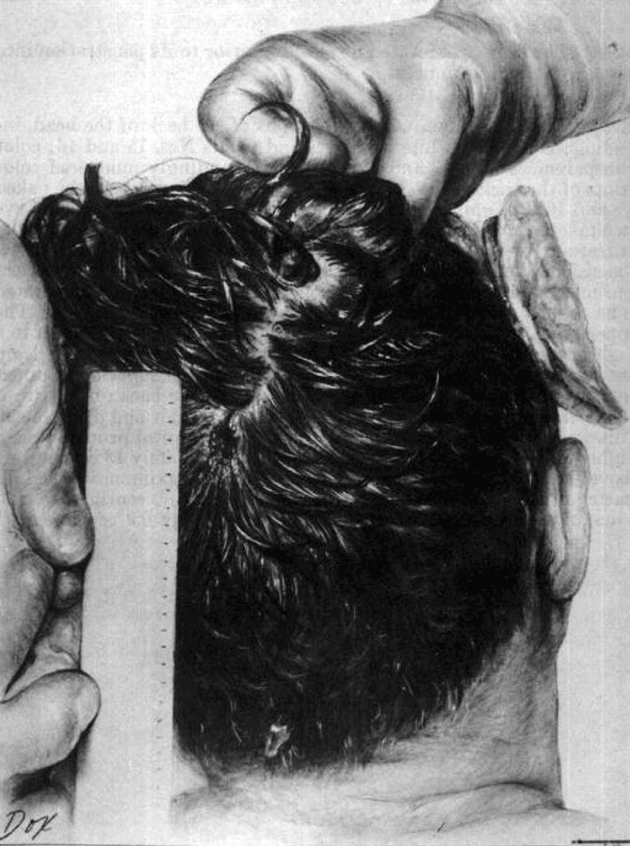
    But make no mistake, the autopsy photo that Dox copied of the back of the head and the resulting sketch she made are ages apart. Ida Dox deceptively depicted the rear head entrance wound, exposed as such when the inquiring public was finally allowed to see the actual wounds fifteen years after the event. Who knows what she was thinking, as she did what Dr. Baden told her.

    The decision not to use the original photographs was probably made by the Committee members. An arrangement was reached that they would publish the drawings, but only those deemed essential. The Dox drawing of the head wound was withheld from publication and it was not in the hundreds of pages of her file I received from the National Archives.

    She also responded to Purdy’s question by stating that “the photographs that were selected were the ones that best showed the injuries.” (I HSCA 146) Ms. Dox said she copied four photographs: the back of the head (Fox-3), the upper back (Fox-5), the side of the head (Fox-4) [not shown during public testimony], and the front of the neck (Fox-1 & 2). Key photos were clearly withheld, some say on grounds of taste. They were examined by the forensics panel and other experts, but not displayed or published. The top of the head photo (Fox-6 & 7) was not chosen. As stated, the side of the head photo drawn by Ms. Dox was not shown during public testimony either. She was asked to draw the head wound photo, but when they saw it, they decided not to publish it. I am not sure what they thought they would see before they looked at it, as they had seen the autopsy photograph on which it was based.

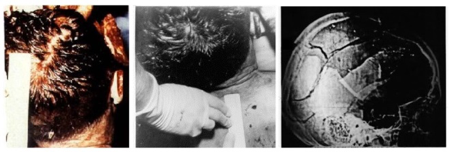
    The back of the head photo (Fox-3) was shown during the public testimony of Ms. Dox. The only problem is that the alleged entrance wound in the cowlick area is much more visible in her drawing, than on the original Fox-3 photograph. Conversely, her drawing of the back wound (Fox-5) omits the possibility of an entrance wound that has been alleged by some critics and his back was cleaned up quite a bit. Whether there are other possibilities concerning Fox-5, it should have at least been drawn. It also places the back wound much too high. The autopsy face sheet, as did his suit coat and shirt, as did Dr. Humes, places the back wound in the upper right posterior thorax at about the level of the third thoracic vertebra, which would be approximately five and three-eighths inches below the top of the collar. The Dox wound appears much too high.

    When Mr. Purdy asks how she copied the photographs, Ms. Dox stated that she did it by “placing a piece of tracing paper directly on the photograph, then all the details were very carefully traced…so that no detail could be overlooked or omitted or altered in any way.” (I HSCA 147) As noted, the upper entry head wound was altered. Period. Perjury, most likely, but I really believe it is more of being afraid to disagree with Dr. Baden, when he had told her what he wanted. Hard to tell. Things were omitted, especially on the back wound (Fox-5), where obvious detail is missing, and also on the back of the head wound (Fox-3), where the alleged cowlick area wound is much clearer and pronounced in her drawings than in the autopsy photographs themselves, as I stated earlier. Isn’t this really much ado about nothing? Couldn’t all of this have been avoided knowing that the drawings are no substitute for the photos? The original photos should have been available to researchers at least as soon as the Warren Commission closed up shop, but legally they haven’t been released to this day.

    Purdy goes on to say that Ms. Dox made other drawings to illustrate the conclusions of the forensic pathology panel. We are not exactly sure what these other drawings are, only to assume they are in the Committee’s files. The release of the Assassination Records Review Board medical materials did not tell us any more on this subject. I don’t recall this issue even being addressed. The truth is, in relationship to Ms. Dox, the ARRB made no difference at all. I’m frankly amazed that nobody at the ARRB asked the obvious question: Why are the Dox drawings and the photographs from which they are exactly made, so different? Sadly, Ms. Dox was not questioned by the ARRB and she could have been, since she didn’t pass away until 2013, but this was never addressed.

    In her next to the last question, Ms. Dox says that a frame of “film taken during the motorcade was photographed and the outline of the President’s head was used, so that the…head of the President…in the position that the medical panel decided was necessary.” (I HSCA 147-148) They were probably doing what they thought was adequate, but left themselves open to immense criticism, just as the Warren Commission did.

    Ms. Dox worked for the Committee, under the direction of Professor Blakey. In that capacity, she was assigned to assist the Committee by preparing drawings from the autopsy photos for possible publication. She was working under Blakey’s direction and Dr. Baden, or perhaps Andrew Purdy’s, since he guided most of the medical aspects of the case. Ultimately, Dr. Baden made the call on what Ms. Dox drew and, in some cases, how to draw it. As you listen and read the testimony of Ida Dox, you can only reflect about what should have been asked.

    I contacted Ms. Dox in October of 1999. I had two conversations with her on the telephone. It all started with a question I had regarding HSCA Exhibit F-302, which was a drawing of President Kennedy’s brain, that was put into evidence during the testimony of Dr. Humes. What followed was both puzzling and frustrating. I will go into detail about what Ms. Dox said about that sketching of JFK’s brain, parts of her testimony that she now denies ever saying, enhancement of the wounds that she drew for the Committee (which has to do with some correspondence between her and Dr. Baden that I requested and received from The National Archives and publish in this chapter), and other sundry matters.

    I prepared for my conversations with Ms. Dox by reading documents I received from the National Archives concerning her. There was a sense of discovery, but more so of clarification. I’m not one who looks for a demon under every shingle, nor is it my purpose to attempt to discredit someone who appears on the surface to be a nice lady who was just following orders and instructions. There were some things that did seem a bit odd and other things that I still don’t understand as I write this. The following information is based on those two telephone conversations I had with Ms. Dox.

    In the first conversation I had with here on October 14, 1999, I asked her the following questions:

    Question #1: How many photographs were you shown?

    When I asked Mrs. Dox this question on the phone, she quickly replied, “I can’t remember.” This is intriguing. If she had been shown 75 photos, okay, she can’t recall, but she testified before the HSCA that it was four, at least that is how many she drew. She doesn’t seem to be guessing before the HSCA during her public testimony. I don’t care how many zillion wounds she has illustrated, as one of the first humans on the planet to see those autopsy photos of JFK, you would think she could remember the number. Maybe not perfectly, but certainly not, “I don’t remember.” Even an estimate would have been nice.

    Question #2: Were you ever shown a photograph of the brain?

    She emphatically stated, “No!” This first surfaced for me when I noticed HSCA exhibit F-302 in David Lifton’s book, Best Evidence. During Dr. Humes’ testimony, exhibit F-302 is introduced, with no data whatsoever. It is said, then, to be a drawing of the brain. There are two kinds of representations in Lifton’s book. In the cases of the actual line drawings, they are represented in full, the throat wound, cropped so as not to show the face. The brain drawing, however, is in mid-text, so that may be why it is different from the others. It also has no signature on it. The other Dox drawings are reproduced in full and have a signature in the lower corner. It may have been a simple matter of a tracing of a tracing, or some sort, so it could be reproduced in text, without going to the photo section, which is different paper.

    The only available rendering of the brain, however, absent the photographs, is the drawing/tracing created by Ida Dox and I have already noted my criticisms of her efforts. In her brain illustration, the left cerebral hemisphere is intact, while the right cerebral hemisphere resembles a swirling pattern.

    The two lobes of the cerebellum are intact and unremarkable. That flies in the face of the doctors from Parkland, who testified to seeing cerebellum extruding from the large wound in the back of the head and here we are presented with no cerebellum damage and no large wound in the back of the head.

    Question #3: Were the wounds enhanced for the sake of clarity?

    Her response, “No, of course not.” This is interesting. At Wecht 2003, I asked Dr. Baden about this and was told that Dox was given other gunshot wounds to draw in order to enhance the visibility. You have to look for something even resembling a wound in the Fox-3 photograph. It looks more like a blood droplet, but not a bullet wound.

    He told me that Dox had been given other photos (see later in the text for the documents), of other individuals with wounds, in order that she would be able to highlight JFK’s wound, so people wouldn’t miss where the actual head wound was. Other researchers have talked with Dr. Baden about this and received similar responses.

    What follows after this paragraph is a copy of the Dox drawing of Fox-3 and the actual Fox-3 autopsy photo and then a few pages of documents I received from the National Archives, both of which were sent to Ida Dox by the HSCA, including “you can do much better, Ida,” from Michael Baden. How can you do “much better” than the autopsy photos you are directly looking at and tracing. Or, is “much better” referring to placing a bullet wound where there isn’t one in the cowlick area? Ida Dox lied to me on the phone, when she said she wasn’t given any pictures to use to enhance what wasn’t there. Here are some of the documents I got from the Archives, after I requested every document they had concerning Ida Dox. Unlike the Ida Dox drawing, the actual wound is not visible in Fox-3 and no other photographs show it either.

    Dox drawing of Fox-3
    Fox-3
    Ida—“You can do much better”—Michael Baden
    Bullet wound to the head from the pathology book written by Baden, et. al.

    The Forensic Pathology Panel of the House Select Committee was so thoroughly caught up in their findings, that the upper artifact, the red spot, and what they said was the actual entry wound, that they failed to realize how badly they had been duped.

    This is critical to the ongoing investigation and needs to be considered again. Originally, the HSCA worked from medical illustrations, done by medical illustrator Ida Dox. Unfortunately, Ms. Dox, who was allowed to commit perjury before the House Select Committee, altered the wound that some have identified as simply a red spot or droplet.

    Fox-3 (Color)
    Fox-3 Comparison with Dox Drawing
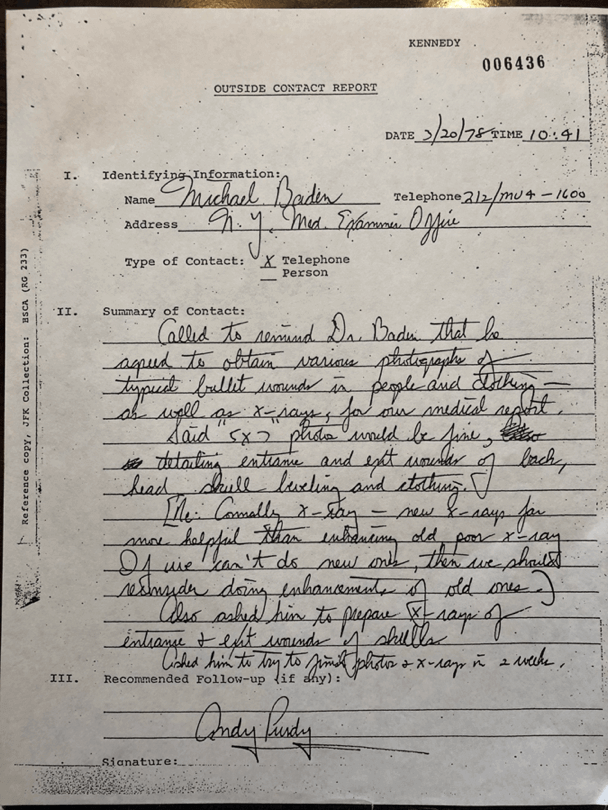
    Purdy Asking for Photos of Typical Bullet Wounds
    (Keep in mind, this is in the Dox materials sent to me from the National Archives)
    Flanagan to Baden, Asking for Photos of Typical In-Shoot Wounds

    Any assessment of the photographs show nothing even slightly comparable to what Dox drew. I often show the autopsy photos to friends or at talks I give at local libraries and they always produce the same shocked reaction. I show them the Fox photo of the back of the head and ask, “Do you see the entrance wound?”

    Nobody can ever see the entry. Then I show them the Dox drawing of the back of the head and ask if the wound is visible and unanimously and they say it is. Then I put them side-by-side and there is usually some kind of verbal gasp, as if they were watching the Zapruder film for the first time.

    Now they can see up close and personal that something sinister was going on with the medical evidence. The alteration becomes obvious.

    Ida Dox was given the autopsy photographs and requested to make sketches for the HSCA, a procedure that, in itself, calls into question the sanity of the people doing it, as a drawing of gore is almost as unpleasant as a photo of gore.

    The reader is invited, even strongly urged, to view the photographs in question and then view the same cowlick area in the Dox (Fox-3) drawings. You will be surprised, if you have never done this before.

    What is cited as an artifact and is not by any means proof of an entry wound in the photograph, becomes a glaring bullet hole thanks to Ida Dox, who was given additional photos as stated, showing bullet wounds of other people and not of John Kennedy, so that she could highlight and forge the JFK sketches. There is no doubt in my mind that the reason for moving the back of the head wound four inches higher is to explain the massive wound in JFK’s right temporal area of his skull. If you move the wound, then you have a perfect inshoot-outshoot scenario. If not, you have to explain how a bullet traveling downward from sixty feet in the air and behind can emerge on the upper right side of Kennedy’s temporal bone.

    The explanation I can assert is what I have already said in chapter one concerning Governor Connally, that a second head shot at c. Z-327, 7/10ths of a second after Z-313, explains this precisely and, if so, then there was no need to invent a head wound in the cowlick area, as Z-327 explains it perfectly. What is disheartening is that chapter one on Governor Connelly documents that the HSCA was suggesting a shot c. Z-327, but then the Committee wasn’t (as it was a Select, not a Standing committee) renewed and the data became inactive.

    That alone brings into question the honesty of the entire HSCA investigation and the charge against Dox is not a pointless one. The question then becomes two-fold:

    1. Why, (excepting the necessity to maintain the lone-assassin fiction) was the wound altered in order to make it obvious to any John Q citizen viewing the Dox drawing, when trained pathologists could not and did not identify it from the photograph which Dox claimed she copied exactly?
    2. Whose decision was it to alter the wound and whose decision was it not to make the obvious comparison between the actual photo and the altered drawing during the HSCA hearings? Baden seems to be candidate number 1.

    A little background on Baden and the Clark Panel is probably appropriate at this point. In the late 1960’s, the public was screaming for a reinvestigation. David Slawson at the Department of Justice wrote a memo to Ramsey Clark explaining that if they don’t do something the conspiracy fringe will get Congress to reopen the whole thing. It also is happening at the same time as the Garrison investigation, which scared the intelligence community, so they needed to calm the storms in Louisiana. Slawson suggests an investigation limited to the medical evidence and so the Clark panel is born. The Clark Panel relocates all the wounds, four inches higher on the head and four inches lower on the back. Why? If left where they were in the autopsy report, then Oswald didn’t do it. The plan succeeds and the public is quieted. Meanwhile, the prominent pathologists, having been thrown together to make up the Clark Panel, decide together to write a book on pathology. Ramsey Clark writes its forward. A young, inexperienced pathologist named Michael Baden is asked to contribute to the book. It’s not much, but associating his name with theirs launches his career.

    Ten years later, Baden is asked to head the HSCA’s medical panel. He insists he not serve on it alone, so that there is no question of impropriety, so he fills it up with friends, save a lone critic named Dr. Cyril Wecht. Before they would ever meet, Baden went in to examine the autopsy materials. He then sat down and wrote a memo which echoes every point made in the Clark Panel report. He moved the wounds and to the exact same points they had chosen.

    At the first meeting of the medical panel (Baden is the only panelist to have seen the materials at this point, though Wecht had gotten permission to see them in the early seventies), he presents them with his findings and calls for a vote to see if another meeting of the panel is necessary. Wecht says yes. The record does not reflect how the others voted, but plans for the other panelists to see the materials were not initiated for several weeks.

    This brings us back to Dox and Baden. Dox is permitted to see the photos and to make a set of drawings, which she denied to me on the telephone (though this is exactly what she stated in her public testimony in September of 1978). She then leaves them for Baden to approve. Baden sees the drawings and calls Purdy, who writes a memo to himself that says, “get a photo of a typical wound of entry.” (In another memo dated 4/24/78, Purdy states that he needs to remind Baden to get wound comparison photos and X-rays.) The next document in the record is a photocopy of a page out of the pathology book Baden and the Clark Panelists wrote. At the top of the photo of a tiny bullet wound to the head, Baden wrote, “Ida you can do much better.” Again, and as I stated earlier, I am not sure how you outdo the original autopsy photos. So better, in what sense? Location? The wound itself? Quite baffling, if not disturbing.

    On October 28, 1999, I called Ida Dox for the second time. She hung up on me at the end our first conversation. This time the conversation lasted a bit longer and was much more detailed. The following questions were asked Ida Dox at this time:

    Question #1: Did you see color or black and white photographs?

    She quickly said, “Color.” The color photos certainly show the wounds better, but still not as good as the Dox tracing. You would also think that black and white would be better to trace from. The fact that a lay observer can tell in a second that the tracings are accurate, except for the wounds, should raise questions immediately. The aforementioned data, along with the Baden and Purdy memos speak volumes to this point.

    Question #2: I asked her again about how many photographs she saw?

    This time she got defensive. I simply reminded her that my previous notes stated that she could not recall, but that she had stated in her testimony that she had drawn four. I was seeking clarification and thought, perhaps, there was a possibility she had been shown others. I was very polite and was genuinely not trying to trick her or confront her in any way. She was silent and so I proceeded.

    Question #3: I asked her if security was tight while viewing the autopsy photographs in the National Archives?

    She indicated that security was very tight. I was reminded that RFK was in a panic that such stuff would go public. It was difficult enough that the Dox drawings went public, but something had to. Her public testimony suggests she had worked from some kind of originals while being watched at the Archives. This led me to the next obvious question.

    Question #4: Did she have a set of autopsy photographs made, so as not to take up the Archives’ employees’ time?

    At this point she got very defensive, especially when I read her public testimony where she says this is exactly what had transpired. I was lucky the conversation went any further at all, as she was not happy. I was not accusing her of anything, still only seeking clarification. Her testimony, again, indicates she was given knock off copies to use outside the Archives, as she added detail like Humes’ gloves, so as not to keep the Archives busy.

    Question #5: I then asked her again if she had drawn F-302, which is JFK’s brain?

    She simply said, “I can’t remember.” I don’t care if it has been twenty years plus, you can’t tell me that you wouldn’t remember drawing a picture of the brain, which just happens to be of the President of the United States! The absurdity of this is beyond belief. Exhibit F-302 does come up during Dr. Baden’s testimony. He uses the drawing of the brain, which he says that Ida Dox drew, to show the intact nature of the cerebellum, thus attempting to prove that Dr. Humes et. al. could not possibly be correct in locating the entrance wound to the rear of JFK’s head in the area of the external occipital protuberance. It wasn’t until Dr. Humes’ testimony that F-302 was formally entered into evidence.

    During the session at the end of each testimony, when everyone is given five minutes to ask questions if they want to, Mr. Fithian asks about the possibility of metal fragments being in the brain. In Baden’s testimony, he displayed F-302 and says that in the right, front area side of the brain there was an oblong, blue discoloration, but that it was not a metal object. He stated that the Forensic Pathology Panel determined that it was blood vessels that had been sheered away. Baden went on to explain that there were many pictures taken of the brain and that some had toothpicks in the damaged part for identification purposes by the doctors at the autopsy.

    It still, however, doesn’t explain why Ms. Dox told me that she never saw any photographs of JFK’s brain, let alone drew them for the committee. Dr. Baden said there were several pictures of the brain and that Ms. Dox drew from them for the committee to illustrate for the Forensic Pathology Panel, that the cerebellum was not injured because of the rear entrance head shot to President Kennedy (I HSCA 304).

    Question #6: Did the photographs of JFK’s neck wound show the face as well?

    She told me that the pictures did show his face and that there had been some talk of blurring the face. The tracings, however, do not show the face of the President. That was all she addressed with this question.

    Question #7: I again asked her if she was shown other photographs of wounds in order to enhance the ones on her tracings/drawings?

    She got very defensive and refused to talk any further. In fact, she said, “I don’t think I want to talk about this any further.” I again tried to assure her that I was not attempting to confront her, only clarify what I had discovered from other researchers and documents from the National Archives. This didn’t seem to quell her anger, but she suggested I contact Professor Blakey, which I did. The data from the first conversation has already dealt with this question in full, but nonetheless, I thought I would give her another chance to verify what I had documentation for from the National Archives. I still refuse to believe you would forget doing something like this, especially in reference to the President of the United States. I don’t care how much time has passed, certain events in our lives are indelibly engrained in our psyche. This event would have to at least be up for a possible nomination.

    Question #8: I asked if there were any other medical illustrators besides her?

    She told me that she was the only one. In fact, she also worked for the Committee on the tracings/drawings concerning Dr. Martin Luther King, Jr. She received $16,000, not counting $125 per day, plus expenses for services rendered. This also included appearing as an expert during the public hearings. She was not required to write any reports, only that her medical illustrations would appear in the Committee’s final report. She spent 125 and one-half days consulting and providing services. The final tally, financially speaking, would be: $31,625, plus expenses. That’s not bad money for 125 days’ worth of work, especially in 1978.

    Question #9: I asked her how long it took to make the illustrations?

    She was kind enough to explain that it took a long time, months as far as the entire process, and that it is very tedious work.

    There were some things that were missed in her public testimony, that was gone over with her in her practice questions beforehand, which I still have copies from the National Archives. She was supposed to mention that she was to duplicate the autopsy photographs which show the key wound areas, reconstructions of wound areas with internal structures, and illustrate what happens to soft tissue and bones when they are struck by bullets. Most of these can be seen in Volume I of the HSCA Hearings when Dr. Baden is testifying.

    She also stated in her practice questions that blood on the skin and blood on the gloved hands were removed, as well as background details. She stated in her public testimony that she worked very closely with the medical panel, especially Dr. Michael Baden. Based on the previously mentioned discoveries from the Archives, her statement was only the tip of the iceberg.

    All in all, I found Ida Dox to be somewhat reticent to talk about the issues that I brought up to her. She was kind and cordial, but obviously on edge during the two conversations. I was never aggressive or combative, only attempting to clarify what I had discovered. I was told by one researcher, in reference to my questioning her about whether she drew the brain, that it is hard to believe that something called the Dox drawing and entered into evidence (or at least referred to constantly) during the hearings, that were nationally televised, could now be credibly disclaimed as not being her work. He told me to think about what I was suggesting here. I never suggested she didn’t draw F-302 (the brain), only wondered why she didn’t sign off on it, when she did on every other illustration. I also was puzzled as to why she would deny something like this; I wasn’t implying something sinister.

    I was also told that I was probably running into a simple failure of memory, after two decades. I was cautioned not to go down this path and get involved in a hypothesis alleging major forgery of evidence, when all I had was a simple error of memory.

    I really did appreciate the words of caution and took them seriously. I generally respect my colleagues in this field and take their words thoughtfully. I wasn’t implying forgery of evidence or even questioning whether she had drawn the illustration of F-302, again, only seeking clarification of the data I had before me. It made me question the integrity of Dr. Baden more than that of Ida Dox. She was merely following orders and protocol; the others, well, I’ll leave that up to each individual researcher to decide.

    A Final Comment: The fourteen questions they asked Ms. Dox is nothing but procedural, chain of evidence testimony and makes no statement about that which was under scrutiny, except that it is frightfully dishonest, and certainly Ida Dox had to know it when she was testifying.

    The first question that needed to be asked was, Why were so-called exact drawings or tracings necessary to be used in place of the actual photographs?

    There is absolutely no rational answer to this question. It does not seem like it was done out of respect for the President or the President’s family, because the drawings are just as graphic as the original photographs in some areas.

    Certain background material had been removed from the tracings. In the drawing which shows the circular bone extending from the right-front scalp, the inference from the drawing would be that the photo would have been taken with the President’s body posed, sitting up.

    In actuality, the body was laying on its left side. In the photo, one of the pathologists looms up from Kennedy’s side as the pathologist is standing and Kennedy is on his side on the examining table.

    If there can be one reason attributed to the use of drawings, it was to certify that which the House Select Medical Panel wanted. I have written elsewhere that a number of researchers have noted the difference between the photographs, particularly the back of the head photo, with its absence of any visible wound, and the Dox drawing, which clearly showed an obvious entry wound in the cowlick.

    The difference has to be placed in time perspective. As Dox noted in her testimony, she was under observation all the time while she was working at the National Archives with the originals of the photos. Yet she could have access to copies of those photos, to complete the tracings of the doctors’ hands, or rulers, in HSCA rooms.

    In 1978, those photographs had never been seen by the general public and an individual could only get into the National Archives to view them if they were a medical doctor.

    Thus, the first time the wounds were truly seen in some manner other than the Zapruder film or the absurd Rydberg drawings, contrived for the Warren Commission, were the Dox drawings.

    And therein lies the reason for the drawings. With the Fox photographs in my possession, and other researches too for some time and prints available in quantity, it was clear that the back of the head photo and the back of the head drawing were very different.

    From here, it was now a matter of forcing Commander Humes to change his testimony to reflect that the cowlick entry was the correct site and not the original autopsy finding, located four inches lower. Humes refused to change his findings when testifying before the Medical Panel, but he sold out altogether when he was on television in front of the HSCA itself.

    He moved both wounds—the head and the back—approximately four inches. Disgraceful.

  • Last Second in Dallas, part 2

    Last Second in Dallas, part 2


    Another dispute Thompson had with Vince Salandria was the author’s theory about the small hole in JFK’s throat. On the day of the assassination, Dr. Malcolm Perry said to the public that this appeared to be an entrance wound. Thompson’s idea is that it was a piece of either brain or metal ejected from Kennedy’s skull. And he includes a diagram of this on page 98. The trajectory of this projectile is hard to fathom, especially since it would be traveling through soft tissue. But also, once it went into the throat area, it would be entering into all kinds of small bones and thicker cartilage. So in addition to the trajectory, it found an exit path through that maze?

    Thompson takes Howard Brennan at his word. (pp. 98-99) Which he also did in his previous JFK book. I am not going to go into the myriad problems with Brennan as a witness. That would be redundant of too many good writers. Let me say this: today, the best one can say about Brennan is that he was looking at the wrong building. The worst one could say is that he was rehearsed and suborned. As Vince Palamara wrote in Honest Answers, Brennan refused to appear before the House Select Committee on Assassinations. Beyond that, he would not answer written questions. When they said they would have to subpoena him, he replied he would fight the subpoena. Does this sound like a straightforward, credible witness? (Palamara, pp. 186-89)

    To supplement the dubious Brennan, the author uses the testimony of the three workers underneath the sixth floor. Vincent Bugliosi used one of them in a mock trial of Lee Oswald in England in 1986. I addressed the serious problem with using these men––in Bugliosi’s case it was Harold Norman––in my book The JFK Assassination: The Evidence Today. (pp. 54-55) To make a long story short, after they were interviewed by the FBI, their stories were altered by the Secret Service. At that mock trial, Norman could have been taken apart and spat out if defense lawyer Gerry Spence had been prepared––which he was not. (For a long version of how and why this happened, see Secret Service Report 491)

    Let me add one key point about this. One of the Secret Service agents involved in this mutation was Elmer Moore, a man who––since the declassifications of the ARRB––has become infamous in the literature. There is little doubt today, in the wake of the declassified files, that Moore was an important part of the coverup. (DiEugenio, pp. 166-69) Therefore, in my view, Thompson missed another pattern––one which could have been indicated to him by Gary Aguilar or Pat Speer, in addition to myself.

    The middle part of the book narrates much of the case history from the early to late seventies. For Thompson, this means the first showings of the Zapruder film by Bob Groden at conferences, then the big national showing on ABC in 1975. This was one of the factors that spurred the creation of the HSCA in 1976. Thompson says that he was invited to the so called HSCA “critics conference.” He says this was where he first heard of the dictabelt tape of a motorcycle recording of the assassination. He takes the opportunity to tell us how the HSCA actually recovered the tape. He also explains how it worked and some of the technology behind it. (pp. 147-51) Keeping with his personal journey aspect, in this part of the book he also tells us how he decided to give up his professorship at Haverford and become a private investigator.

    From 1979 until 2006 the author tells us he was very little involved with the case. (pp. 182-83) This is kind of surprising when one thinks about it. Thompson all but leaves out the yearlong furor that took place over the release of Oliver Stone’s film JFK. Which is odd, since that was the largest period of focused attention the case got since 1975. All he says is that he was called to testify by the Assassination Records Review Board about their purchase of the Zapruder film. And he testified, properly I think, that once the Secret Service knew about the film it should have gone to Abraham Zapruder’s home and taken possession of it right there as a piece of evidence in a homicide case. (pp. 189-90) About any of the rather startling disclosures of the ARRB, I could detect little or nothing.

    He spends several pages on a conference organized by Gary Aguilar in San Francisco which featured Eric Randich and Pat Grant. It was these two men who broke open the whole mythology of Vincent Guinn’s Neutron Activation Analysis, today called Comparative Bullet Lead Analysis. I was at that conference and Thompson does a good enough job summing up their scientific findings. (pp. 190-96). As the author notes, this “junk science” had been important to the HSCA in its findings that somehow Oswald alone did the shooting, and the acoustical second shot from the front missed.


    II

    In the second half of the book Thompson more or less forsakes the personal journey motif. He concentrates on what he sees as three important pieces of evidence, which he figures are crucial to the case. I will deal with each of these as candidly and completely as I can.

    Thompson devotes Chapter 16, well over twenty pages, to the medical evidence in the JFK case. He begins this part of his book by declaring that the JFK autopsy was “botched,” in other words, whatever shortcomings there were in that procedure, they were not by design. I was rather surprised by this supposition, for the simple reason that Dr. Pierre Finck said under oath at the trial of Clay Shaw that the reason the back wound was not dissected is because the military brass in the room stopped them from doing so. He also said that James Humes, the chief pathologist, was not running the proceedings. They were being so obstructed that Humes literally had to shout out, “Who’s in charge here?” Finck testified that an Army general replied, “I am.” Finck summed up the situation like this:

    You must understand that in those circumstances, there were law enforcement officials, military people with various ranks, and you have to coordinate the operations according to directions. (James DiEugenio, Destiny Betrayed, p. 300, italics added)

    The Department of Justice––among other groups––was monitoring the Clay Shaw trial in close to real time. When Carl Eardley, the Justice Department specialist on the JFK case, heard this, he almost had a hernia. He called up another of the pathologists, Thornton Boswell, and sent him to New Orleans, since they now had to discredit Finck for revealing what had happened. Eardley later thought better of this, probably because by any standard measure, Finck had better qualifications as a forensic pathologist then Boswell did. (ibid, p. 304)

    One cannot overrate the importance of this testimony. To give just one indication of its importance: I did a pre-interview with Dr. Henry Lee for Oliver Stone’s new documentary on the JFK case. I asked him this specific question, directly related to Finck’s testimony: Can you figure out a firing trajectory without a tracking of the wound? He said that under those circumstances, it was very difficult to do. Here is a man who has worked about 8000 cases all over the world and is recognized as one of the best criminalists alive.

    The same situation applies to the skull wound, except in this case, the situation is more complex. If one talks to Lee or Cyril Wecht they will tell you there is no evidence of a brain sectioning. But the Review Board did an inquiry into this subject, and Jeremy Gunn and Doug Horne came up with some evidence that such an examination may have been done. Under the scope of this particular review, this is not the place to do an expansive analysis of their evidence. Suffice it to say I found Thompson’s excuse for this lack rather strained: the doctors did not have the time to do so such a thing. (Thompson, p. 259) Yet in the Commission’s volumes there is a brain examination, dated 12/6/63. (CE 391) And there is no mention of sectioning; two weeks was not long enough? Yet without sectioning, how can one determine the bullets’ paths? On this matter, Lee was quite animated. He put his right hand up in front of his face and said words to the effect: You have this bullet coming in at a right to left angle: it then reverses itself and goes left to right? The lack of dissection in this instance is even more perplexing because the head wounding was how Kennedy was killed. And this is why Lee’s hand was piercing the air in bewilderment.


    III

    Thompson wrote something later that stunned me. On page 258 he says that the first time the autopsy doctors learned of a tracheostomy over the anterior neck wound was when they read about it in the next day’s newspapers. That passage is undermined by Nurse Audrey Bell’s 1997 testimony to the Review Board. Bell told them that Dr. Malcolm Perry complained to her the next morning (on Saturday, November 23rd) that he had been virtually sleepless, “because unnamed persons at Bethesda had been pressuring him on the telephone all night long to get him to change his opinion about the nature of the bullet wound in the throat, and to redescribe it as an exit, rather than an entrance.” (See DiEugenio, The JFK Assassination: The Evidence Today, pp. 167-68; also this discussion)

    In a very late discovery by writer Rob Couteau, Bell’s testimony was both certified and expanded. In the days following the assassination, many reporters were milling around Dallas, and some found their way to Malcolm Perry’s home, for the reason that he and Dr. Kemp Clark had held a press conference on the day of the assassination where Clark said there was a large, gaping wound in the back of Kennedy’s skull, and Perry said the anterior neck wound appeared to be one of entrance. One of the reporters who migrated to Perry’s home was from the New York Herald Tribune and his name was Martin Steadman. He asked Perry about this issue and Perry was frank. He affirmed that it was an entrance wound. But beyond that he said he was getting calls through the night from Bethesda. They wanted him to change his story. He said that the autopsy doctors questioned his judgment about this and they also threatened to call him before a medical board to take away his license. (See further “The Ordeal of Malcolm Perry”) To put It mildly, I disagree with Thompson’s next day thesis on this point.

    Another surprising aspect of this chapter is that Thompson agrees with the Ramsey Clark Panel. That panel’s findings were released on the eve of the Clay Shaw trial. They upheld the original autopsy’s conclusions about two shots from behind; but they made about four major changes that were rather bracing. One of them was that they raised the entrance wound in the rear of Kennedy’s skull 10 mm upward, into the cowlick area. (Thompson, p. 248)

    The way Thompson mentions this in passing was, again, jarring to the reviewer, one reason being that, in all likelihood, it was Six Seconds in Dallas which caused both the Clark Panel to be formed and the rear skull wound to be raised to the cowlick area. (DiEugenio, The JFK Assassination, p. 150). As Russell Fisher, the panel’s chief pathologist later said, Attorney General Ramsey Clark got hold of an advance copy of Six Seconds in Dallas. On page 111 of that book, Thompson shows that Kennedy’s head––as depicted in the Warren Commission to illustrate the fatal wound––is not in the correct posture as shown in Zapruder frame 312. The Commission had the film; therefore, all the indications are that they fibbed about this key point.

    How did the Clark panel elevate that wound into the cowlick area? Since Thompson does not show the anterior/posterior X-ray, the reader is in the dark about this point. The answer is they largely based it on a disk-shaped white object in the rear of the skull that stands out plain as day on the X-ray. The problem with this piece of evidence is that none of the autopsy doctors, or the two FBI agents in attendance, saw it on the X-rays in the morgue the night of the autopsy; and it is not in the 1963 autopsy report. All of which is incredible, for two reasons. First, it is by far the largest fragment visible; and second, its dimensions of 6.5 mm precisely fit the caliber of ammunition Oswald was allegedly firing. (DiEugenio, The JFK Assassination, pp. 153-54)

    I could go on from there, but I won’t. As the reader can see, I did not find this chapter at all satisfactory.


    IV

    One of the key points Thompson wants to make in this book is something he has been talking about for a rather long time. It is the work of Dave Wimp on what the author calls “the blur illusion.” In fact, Thompson calls Chapter 14, “Breaking the Impasse: The Blur Illusion.” Since I took Thompson at his word about this, several years ago, at a JFK Lancer conference, I mentioned Wimp and his work. I said the forward bob by Kennedy preceding the rearward head snap did not really exist. Almost immediately after I finished my address, first Art Snyder and then John Costella disagreed with me. Snyder disagreed with me on the mathematical analysis Wimp had done. Costella disagreed on whether or not this was really an illusion. In other words: did Kennedy’s head really bob forward before jetting backward? The two disagreements gave me pause. Why? Because both men are physicists.

    Back in the sixties, Thompson first learned of this forward bob between Zapruder frames 312-313 from one of the earliest students of the film, Ray Marcus. (See page 112 of Six Seconds in Dallas, footnote 2) The author and Vince Salandria then studied this in combination with the more dramatic and lengthier rearward slam at the Archives. (Six Seconds, pp. 86-87) The issue is one of the most interesting aspects of Thompson’s first book. He goes through a few explanations of how this could have occurred. He then decides on a term that became rather famous in the critical community––the “double hit” or “double impact.” (pp. 94-95) In other words, two projectiles hit Kennedy’s skull almost instantaneously: one from behind and one from the front. The first moved him forward, the second rocked him backward. He then adds that S. M. Holland had told him the third and fourth shots sounded like they were fired almost simultaneously. He backs this up with other witnesses who heard the same thing. Thus the double impact was credible.

    Why did Thompson change his tune on this point? There seem to be three reasons for this. The first is that he felt his first thesis allowed for too precise a synchronization of the shots. No firing team could be that well trained. The second and third are complementary: Dave Wimp’s work coincided with his gravitation towards the acoustics evidence.

    Since Thompson decided to go with the acoustics, he had to dump the “double hit” he wrote about in his earlier book, because the acoustics evidence allows for only one shot from the front at Zapruder frame 312. The following shot comes from behind at Zapruder frame 328. Dave Wimp aided this new scenario by somehow making the forward bob disappear, being dismissed as an illusion.

    But if such was the case, then why did the two physicists disagree with my statement about the Wimp thesis? Snyder objected to it on mathematical grounds. He did not think that Wimp’s work had absolutely proved his thesis. He told me that there was about a 20% chance Wimp was wrong. Snyder turned out to be correct, because in a reply to Nick Nalli’s review of Last Second in Dallas, Wimp admitted his calculations were not correct. He wrote:

    That I have a blur illusion hypothesis is the result mostly of people failing to distinguish between what people are saying and what people are saying people are saying, which seems to be a pervasive problem. The issue is not about illusions but rather about bad methodology.

    Today, Wimp now seems to admit that Kennedy’s head did go forward by about an inch. Evidently, Thompson oversold this idea to at least one person: me. And since he still insists on it in his book, perhaps others.

    Costella explained why Wimp made an error in a more practical, applicable sense:

    Wimp has always made a valid observation about trying to measure the position of a single (rising or falling) edge, in the presence of blur. That is fraught, especially in the presence of unavoidable nonlinearities. What he never seems to have considered, as far as I can tell, is that if you have two opposite edges (rising then falling, or vice versa) of an object, then it is quite simple to align the center of mass of the object between any two frames, even if the edges are blurred. You can do this even if the two frames are blurred differently––that’s effectively what all stabilized versions of the film do (including his own!). It’s even simpler if you either deblur the blurred 313 to match 312 (like I did back in the day, per my animation on my website), or else blur 312 to match 313 …. What I never did is put an exact number of inches on the forward head movement. I have no idea if his smaller number is accurate or not, because I didn’t quantify. What is certain, just from the visuals, is that the head moves forward in the extant Z film. (Email of 6/15/21)

    How proficient is Costella in his study of the film? After he approached me at JFK Lancer, he took out his cell phone and showed me how he had deblurred Zapruder and the forward head bob was still there. Yes, John is a man who carries his work with him.

    G. Paul Chambers, another physicist, probably has the most sensible explanation for this aspect of the case. He has told Gary Aguilar that what likely happened is that the first shot through Kennedy’s back likely paralyzed him. When the car began to brake, his limp body then went forward. (Phone call with Gary Aguilar, 7/18/21)


    V

    “Jim, there is no motorcycle where the HSCA says there is.”

    The above quotation is taken from a phone conversation in 1994 between this reviewer and the late Dick Sprague. I chose to lead this part of my review with it because, as with the head bob, I once believed in the acoustics evidence. So when the famous photo analyst Dick Sprague said the above to me, I was surprised.

    Let me explain why I had that reaction. When I visited the now deceased HSCA attorney Al Lewis at his office in Lancaster Pennsylvania, he told me about something his former boss had done in the early days of that congressional committee. Chief Counsel Richard A. Sprague had arranged a day-long study of the photographic evidence in the JFK case. There were three presenters on hand: Bob Cutler, Robert Groden, and Dick Sprague. They went in that order. Before Cutler began, the chief counsel turned to those in attendance and said, “I don’t want anyone to leave unless I leave, and I don’t plan on leaving.” As Lewis related to me, Cutler’s presentation was about 35 minutes. Groden’s was over 90 minutes, close to two hours. Dick Sprague’s went on for four hours. By the end of Sprague’s demonstration, 12 of the 13 staff lawyers believed Kennedy had been killed by a conspiracy. (James DiEugenio and Lisa Pease, The Assassinations, p. 57)

    Such was the photographic mastery of Dick Sprague. At that time, no one had a more expansive collection of films and photos than he did. In that phone call, he told me that Robert Blakey, the second chief counsel, only called him once. It was to ask him if there was a motorcycle where the acoustics experts said there had to be one. Dick spent a lot of time going through his massive collection. He eventually replied that no, there was not. It was Groden who said that there was.

    To this day this issue has not been settled to any adequate degree. And there is simply no papering it over. Because the motorcycle has to be at a precise point near the intersection of Houston and Elm for the acoustics evidence to be genuine. Modern experts on the motorcade, like Mark Tyler, insist that Sprague was correct. And Mark argues that point effectively at the Education Forum. (See his post of June 9th) What I found severely disappointing about Thompson’s book is this: he barely deals with the issue at all. This is what he says about the highly controversial but crucial point: he writes that he and author Don Thomas found the correct motorcycle in the films of Gary Mack. Afterwards, they had a few beers and called it a night. (p. 304)

    I could hardly believe what I was reading. I actually wrote “WTF” in the margin of my notes. Somehow, this trio, not experts on the photo evidence, easily accomplished something that Dick Sprague––who was the leading authority in the field––could not do? The cavalier way Thompson deals with this important point––throwing in the phrase “having a few beers and calling it a night”––underscores just how unconvincing his treatment of it is. If it was this easy to locate and demonstrate, then why is there no picture of the proper motorcycle in proper context to accompany the “few beers and calling it a night”––straight out of Sam and Diane at Cheers––motif? I was so puzzled by this carelessness, leaning toward avoidance, that I went back and read up on the acoustics evidence.

    These sound recordings first entered the legal case during the days of the HSCA. They were offered up by Texas researchers Gary Mack and Mary Ferrell. Thompson does a good job in explaining the rather primitive technology which the Dallas police used in these recordings. There were two channels being recorded that day, simply labeled Channel 1 and Channel 2. The latter used a Gray Audograph powered by a worm gear which drives a needle into a vinyl disk. (Thompson, pp. 304-06). Channel 1 “was done by a Dictaphone that used a stylus inscribing a groove onto a blue plastic belt called a Dictabelt mounted on a rotating cylinder.” (Thompson, p. 148). Channel 1 was used for basic police operations. Channel 2 was for special events, like Kennedy’s motorcade. Back at headquarters, the dispatcher would announce each minute that passed, and each time the dispatcher spoke to a unit he would announce the time. (p. 149)

    The HSCA did two tests of the acoustics. The first was by a company called Bolt, Beranek, and Newman. The main scientist on this was James Barger, who supervised a reconstruction test in Dealey Plaza. After doing this, Barger said that there was about a 50% chance of a shot from the Grassy Knoll. The HSCA then gave those results to another team of acoustic experts: Mark Weiss and Ernest Aschkenasy . After examining this data they decided there was a much higher probability, 95%. The HSCA announced this in their final days.

    Because he is wedded to this evidence for the finale of his book, Thompson has nothing but scorn for what is today called the Ramsey Panel. The Department of Justice asked the National Academy of Sciences to review the work of the HSCA. They set up a committee named after Harvard physicist Norman Ramsey. Alvarez ended up serving on this committee. Alvarez told Barger that no matter what he said he would vote against him. (Thompson, p. 287) The panel was biased from the start and the author does a good job proving that point. For Thompson, this is why they ended up rejecting the HSCA result.

    But I want to note two things about the closing 80 or so pages of Last Second in Dallas and how an author making himself a character in his book is a double-edged sword. Thompson mentions a 2013 debate he did for CNN moderated by Erin Burnett; his opponent was Nick Ragone. (p. 276) If one can comprehend it, Ragone brought up Gerald Posner’s discredited book Case Closed. Thompson says he did not do well since he did not have any new evidence to reply with. I don’t want to toot my own horn, but if I had been there, I would have had a lot of new evidence to throw back. This is how I would have replied:

    Nick, that book came out in 1993. Which was one year before the ARRB was set up. They declassified 2 million pages of documents. Have you read them? I read a lot of them, and here is what they said.

    When asked the old chestnut, “Well why didn’t someone squeal?”, Thompson could have mentioned Larry Hancock’s book Someone Would Have Talked. He then could have said: “Larry shows that two people did talk, Richard Case Nagell and John Martino. If you don’t know about them, that is a failure of the MSM.” As a point of comparison, when Oliver Stone and I did an interview this past June with Fox, I brought about eight of these new ARRB documents with me. Fox filmed me showing them while I described what they said. They then had me send them in email form. Whether or not they will exhibit them on the show, I don’t know. But I had enough rocks in hand to play David with his slingshot.


    VI

    But the reason I think Thompson plays up the CNN experience is that he wants to show that if the acoustics evidence had been reexamined, he could have mentioned that. As noted, Thompson harshly critiques the Ramsey Panel, and much of this is warranted. But he only briefly mentions how the Weiss/Aschkenasy ––hereafter called WA––verdict was rather hastily granted a stamp of approval by the HSCA.

    What makes this kind of odd is that the author mentions Michael O’Dell more than once in the book. But he does not go into O’Dell’s rather bracing criticism of WA. O’Dell is a computer scientist and systems analyst. O’Dell wrote that the WA conclusion was based upon a motorcycle rider having his Channel 1 microphone button stuck open for a continuous five minute period. This was thought to be H. B. McLain, who first said it was and then said it was not him. What O’Dell was trying to do was to replicate what WA had done, except with much more powerful computer tools, not available back then. He wrote a report called “Replication of the HSCA Weiss and Aschkenasy Acoustic Analysis.” In his report, he found that:

    Numerous errors have been found with the data provided in the report, including basic errors involved in the measurement of delay times, waveform peaks and object position. Some of the errors are necessary to the finding of an echo correlation to the suspect Dictabelt pattern. The Weiss and Aschkenasy report does not stand up to even limited scrutiny, and the results it contains cannot be reproduced. (p. 2)

    O’Dell revealed that WA had relied on a millimeter ruler and string to map out their bullet paths on a map of Dealey Plaza. O’Dell used Adobe Photoshop to scan the same map as WA and transferred the measurements into pixels after lining them up in Excel. He found multiple critical errors in WA’s work, including those of distance measurement of buildings from other objects like the stockade fence. (See p. 3) O’Dell wrote that the microphone was positioned in the wrong place by WA. (p. 9) There were errors in the original paperwork independent of a transfer to a virtual model. For the buildings list in Dealey Plaza, items 16 and 20 were described as the same object. (p. 4) He also found out that one of the bullet paths was supposed to rebound off of object 23, yet there were only 22 structures WA had listed. (p. 5). There were objects listed in the WA table that O’Dell could not find on the map. (p. 8) But perhaps the most bracing criticism O’Dell made was that

    … the values presented in Table 4 for the Dictabelt pattern do not appear to be valid measurements of the peaks in the recording. A test that supposedly identifies a gunshot on the Dictabelt recording must, at a minimum, correctly measure the sound being tested on the Dictabelt. (p. 11)

    I could go on. But before anyone comes back at me by saying, “Why would you use something like this after what Dale Myers did with his phony cartoon based on the Zapruder film?” After all, Jim, Myers went on ABC TV and said the single bullet theory was really the single bullet fact. All I can do is reply with the following. I used O’Dell because Thompson used him. In communicating with the man I found out that Thompson had signed him to a non-disclosure agreement about his book. It ended when the work was published.

    Another series of problems with this evidence was written about by Charles Olsen and Lee Ann Maryeski in June of 2014 for Sonalysts, Inc. out of Waterford, Connecticut. They stated that although McLain had claimed he had opened up his cycle to a continuous high speed after the shooting, that is not what they determined by placing the sound on a graph: “What Figure 1 shows is a motorcycle that variously speeds up and slows down and idles during this latter period.” (6/6/2014, Olsen and Maryeski, pp. 3-4)

    Let me add one other comment. As both O’Dell, and especially Dave Mantik have pointed out, one of the virtues attributed to this evidence is the so called “order in the data.” Or as Don Thomas puts it in his book, the best test matches correspond to a topographic order in Dealey Plaza and with the dictabelt. (Hear No Evil, p. 583) But as Mantik informed me, if one looks at Thompson’s own table, if the HSCA had chosen the bullet sound at the 144.90 point in the tape, they would have had two matches to the School Book Depository that very closely matched the one to the knoll area. (Thompson, p. 155) The same thing occurred at 137.70; the TSBD could have been chosen over the knoll. (interview with Mantik, 6/26/21)

    In addition to all the above, Thompson essentially brushes over the issue of heterodyne tones. (p. 296) This is an important point that the Sonalyst report examined. It’s important because it can result in words being scrambled in pronunciation as one listens to them. Meaning that they can sound like one phrase to one person and another phrase to someone else. And this has happened. (Olsen and Maryeski, p. 9)

    Even his heralded discovery, that voices saying “Hold everything” and “I’ll check it,” occur around the assassination is odd. First, the object is to show whether or not the bullet echo correlation is real, not the voices. Also, to get a more distinct peak for “I’ll check it,” Richard Mullen, Barger’s protégé, used a narrower sampling PCC (Pattern cross correlation) window of 64. Therefore Thompson concludes this is what should have been used from the start. Yet for “Hold everything,” a wider sampling window of 512 yielded a larger net peak than did a smaller sampling window of 64. Thompson offers no explanation for this seeming paradox. (See Figures 22-6 and 22-7; 6/26/21 interview with Mantik)

    If the “Hold everything secure” phrase is at the time of the assassination, then the acoustics is invalid, since this is spoken after the assassination. “I’ll check it” would be around the time of the shots. So the two phrases are in conflict if both were valid. The first phrase is at the wrong time, the latter one is at the right time. So Thompson argues that the “Hold” phrase has been altered and is really an overdub. (Thompson, pp. 345-47)

    This has also been placed in doubt by O’Dell. (See Dictabelt Hums and the “hold everything secure” Crosstalk) The “Check” phrase, as has been argued by many, is not really crosstalk at all. The same sound does not appear on both channels. (Email communication with O’Dell, 7/25/21). And further, Sonalysts showed that the spectrograms of the phrase differ on Channel 1 and 2. (Olsen and Maryeski, p. 6)

    I could go on. But I think the point has been made. There are simply too many uncertain variables with the acoustics evidence to rely on it as having a 95% probability. Much of this is due to the innate poor quality of the recordings themselves.

    When we were making JFK Revisited, producer Rob Wilson asked me to incorporate a section on the acoustics evidence. I recommended against it. I simply noted that with all the above problems with that evidence we would be making ourselves into a bull’s eye on a target range; a whole gallery of persons would take out their bows and arrows and start unloading their quivers on us.

    As I said in Part 1, there are good things in Last Second in Dallas. And as a responsible critic I have described them. In my opinion, they are important and valuable and have stood the test of time. But it is also my opinion that there are a lot of things which seem to me to be liabilities, including what the author thinks is the culminating arc of his book––and I have described those deficits also. This is why Last Second in Dallas is a decidedly mixed bag.


    Return to Part 1

  • The Ordeal of Malcolm Perry

    The Ordeal of Malcolm Perry


    On the afternoon of the JFK assassination, within an hour or two after his death, there was a press conference at Parkland Hospital. Three important pronouncements were made. In fact, they were so important that they should have shaped the case in a permanent manner.

    First, acting press secretary Malcolm Kilduff talked about how Kennedy had died.

    Malcolm Kilduff at Parkland press briefing

    When he did so, he pointed to his right temple and said something like: it was a matter of a bullet through the head. Very shortly after, Chet Huntley said the same thing live on NBC television. On the air, he revealed his source to be Dr. George Burkley, President Kennedy’s own personal physician.

    Dr. Kemp Clark, chief of neurosurgery—the man who actually pronounced Kennedy dead—said he observed a large gaping hole in the rear of Kennedy’s skull. (Michael Benson, Who’s Who in the JFK Assassination, p. 80) Dr. Malcolm Perry, who cut a tracheostomy across the bullet wound in Kennedy’s neck, said that the wound was one of entrance. (James DiEugenio, The JFK Assassination: The Evidence Today, p. 367)

    Therefore, from these three pieces of evidence, one would have had to conclude that Kennedy was hit from the front. That implication would be almost inescapable. Therefore, some strange things happened with this key press conference. First of all, there is no film available of it today, which is remarkable in and of itself, because, as one can see from pictures and film snippets, there were many reporters in that conference room. It is very hard to comprehend how not one of them called for a film camera to cover the initial public pronouncement of President Kennedy’s death. Second, initially, the Secret Service told the Warren Commission that they did not even have a transcript of this conference. According to former Assassination Records Review Board (ARRB) analyst Doug Horne, there are two real problems with the Secret Service saying this. First, according to Horne, the Secret Service went around collecting the films of this press conference. Thus making it disappear. (See Horne at Future of Freedom Foundation conference of May 18th. This is at the FFF web site.)

    But further, the Secret Service lied to the Commission about having the transcript. In responding to Commission counsel Arlen Specter’s request, Chief of the Secret Service James Rowley wrote a letter to chief counsel J. Lee Rankin. He said that he could not locate either the films or the transcript of this press conference. (DiEugenio, p. 367) As the ARRB proved, this was a lie, because they found a transcript of that press conference that was time stamped, “Received US Secret Service 1963 Nov. 26 AM 11:40”. (ibid) Does it get much worse than that? In other words, the Warren Commission’s own investigators were keeping important pieces of evidence from them—and then lying about it.

    As most of us know, Perry was pressured to alter his first day story. By the time of his appearance before the Commission, he now said that the edges of the wound were neither ragged nor clean and that the wound could have been an exit or entrance. Gerald Ford got him to say that the reporting from the press conference was inaccurate. Allen Dulles applied the icing on the cake: he said Perry should issue a retraction—which, of course, he just had. (DiEugenio, pp. 166–67)

    The reason Ford and Dulles could do this is because, in all probability, the Secret Service had absconded with the films and the transcript. But further, Perry had been worked on. As the Church Committee had discovered, a man named Elmer Moore had taken it upon himself to convert Perry to the Commission’s point of view. Moore was a Secret Service agent who was forwarded to work for the Commission. One of his first assignments was to take up a desk at Parkland Hospital and convince the doctors there that they were wrong and the autopsy report was correct. One of his priority targets was Perry. (DiEugenio, p. 167)

    As Pat Speer later discovered, this story about Moore gets even worse. After he performed his assignment in Dallas so effectively, he got a promotion to a longer term one. He became the aide de camp to Commission Chairman Earl Warren. (DiEugenio, p. 168)

    But it was not just Moore—and it was not just a couple of weeks later. As Horne stated during that FFF conference, Nurse Audrey Bell testified that Perry told her he was getting calls that evening directing him to alter his testimony.(DiEugenio, p. 169) This is now backed up by a startling piece of evidence surfaced by author Rob Couteau. Martin Steadman was a reporter at the time of the JFK assassination. Couteau discovered a journal entry by Martin that is online. Steadman was stationed in Dallas for several days after the assassination gathering information. Some of it got in print and some of it did not. From all indications, the following did not.

    One of the witnesses he spent some time with in Dallas was Malcolm Perry. Steadman was aware of what Perry had said at the press conference about the directionality of the neck wound. Steadman wrote that, about a week after the assassination, he and two other journalists were with Perry in his home. During this informal interview, Perry said he thought it was an entrance wound because the small circular hole was clean. He then added two important details. He said he had treated hundreds of patients with similar wounds and he knew the difference between an exit and entrance wound. Further, hunting was a hobby of his, so he understood from that experience what the difference was. And he could detect it at a glance.

    Steadman went on to reveal something rather surprising. Perry said that during that night, he got a series of phone calls to his home from the doctors at Bethesda. They were very upset about his belief that the neck wound was one of entrance. They asked him if the Parkland doctors had turned over the body to see the wounds in Kennedy’s back. Perry replied that they had not. They then said: how could he be sure about the neck wound in light of that? They then told him that he should not continue to say that he cut across an entrance wound, when there was no evidence of a shot from the front. When Perry insisted that he could only say what he thought to be true, something truly bizarre happened. Perry said that one or more of the autopsy doctors told him that he would be brought before a Medical Board if he continued to insist on his story. Perry said they threatened to take away his license.

    After Perry finished this rather gripping tale, everyone was silent for a moment. Steadman then asked him if he still thought the throat wound was one of entrance. After a second or so, Perry said: yes, he did.

    What is so remarkable about this story is that it blows the cover off of the idea that the autopsy doctors did not know about the anterior neck wound until the next day. Not only did they know about it that night, they were trying to cover it up that night.

    But things always get worse in the JFK case. And this issue does also, because, if the reader can comprehend it, that night was not the first time Perry was told to revise his story—or to just plain shut up. Bill Garnet and Jacque Lueth have written, produced, and directed a documentary called The Parkland Doctors. It was shown at the CAPA Houston mock trial a few years back, but only to those in attendance, not to the viewing audience. Robert Tanenbaum is the host of the documentary. He let me see it at his home two years ago. It is a good and valuable film, since it features seven of the surviving doctors at that time, 2018.

    Towards the end of the program, Dr. Robert McClelland made a bracing comment about Perry. He said that as Perry was walking out of the afternoon press conference, a man in a suit and tie grabbed him by the arm. After he got his attention, he forcefully said to Malcolm, “Don’t you ever say that again!” I turned to Tanenbaum and said: “This is about ninety minutes after Kennedy was pronounced dead.” Tanenbaum said, “Jim, they knew within the hour.” At the very least, someone knew that there had to be a cover story snapped on.

    Malcolm Perry was a victim of a large-scale crime. The evidence above indicates that the cover up was planned with the conspiracy. I would love to know who that well-dressed man who accosted him was.

    One last point. When Elmer Moore was asked to appear before the Church Committee, he brought a lawyer with him. (DiEugenio, p. 168)

  • I was NOT a Teenage JFK Conspiracy Freak

    I was NOT a Teenage JFK Conspiracy Freak


    This is a (mostly serious) review of Fred Litwin’s book:

    I was a Teenage JFK Conspiracy Freak (2018)[1]

    Fred Litwin: He is a former left-wing activist, who is now a politically conservative, gay Jewish man, who became interested in the JFK case in 1975. At age 20, he was accused of being a CIA agent. He is a marketing and sales professional, who managed the Pentium III launch in Asia. As a founder of a music company, he has released 70 CDs and collected numerous awards. He has never visited the National Archives to examine the JFK artifacts. His Garrison website is here.

    David Mantik, MD, PhD: He is a socially liberal, but fiscally conservative heterosexual male, who has no interest in marketing or sales, nor has he ever collected any awards for CDs. After 80 years, no one has ever accused him of being a CIA agent. His son is an MD, while his daughter is a Hollywood film editor. As an internist, his wife still sees octogenarians and nonagenarians. He has examined the JFK artifacts at the National Archives on nine different days and has performed hundreds of optical density (OD) measurements on the extant X-rays. His JFK website is here.

    He who has no inclination to learn more will be very apt to think that he knows enough.
    —John Powell

    The best evidence that Oswald could fire as fast as he did and hit the target is the fact that he did so.
    —Commission Counsel Wesley Liebeler

    Facts are indifferent to your beliefs, religion, ethnicity, identity group, political party, gender, family, friends, or enemies. And they don’t cease to exist just because you ignore them. Like cockroaches, they are simply there. But it is wise that you not be too indifferent to them.
    —Tyler Durden (paraphrased)

    NOTE: I used the Kindle version of Litwin’s book so page numbers are not cited. This review is mostly free of citations. However, these may be found in countless numbers at my website—scattered throughout multiple articles—or in my Amazon e-book, JFK’s Head Wounds.

    MY DIALOGUE WITH LITWIN’S BOOK

    1. LITWIN (L): “A few seconds later, a bullet hit Kennedy in the head and he moved back and to the left.

    MANTIK (M): This action is seen in the extant Zapruder film. Oddly, however, no one in Dealey Plaza recalled this event. Early viewers of the Z-film (e.g., Erwin Schwartz, Dan Rather, Deke DeLoach (at the FBI), and, possibly, even Pierre Finck) reported an opposite movement—JFK’s head moved forward! None of these early viewers reported a head snap.[2] Instead, most eyewitnesses recalled that JFK had “slouched” forward. For a dose of reality, review the recollections of James “Ike” Altgens,[3] who saw JFK struck while he (JFK) was sitting erect. Most eyewitnesses agree quite closely with Altgens, but not with the Z-film. Litwin tells his readers none of this. His carefully selective approach infests the entire book as he consistently reports items that favor his biases, while persistently ignoring contrary items.

    1. L: “Duranty even denied that there was a famine in Ukraine.” Litwin notes that Walter Duranty even won a Pulitzer Prize for his 13 essays.

    M. We agree on this one issue—the Holodomor (1932–1933) was real; it also likely killed many of my (German Lutheran) relatives in Ukraine.

    1. L: “There are quite a few factoids in the JFK assassination.” Litwin’s examples include that a Mauser was found on the Sixth Floor and that Ruby knew Oswald.

    M: Litwin is surely wrong to implicitly hint that he knows all the answers (I don’t). Well-informed researchers would surely take issue with his brazen—and all-embracing—certainty about this case. As a remarkable counterexample, during the Assassination Records Review Board (ARRB), Noel Twyman discovered a receipt for a 7.65 Mauser shell recovered from Dealey Plaza. (The shell was found between November 22 and December 2, 1963.) Several witnesses report seeing Ruby with Oswald; you can doubt them or call them liars, but it is dishonest to pretend that they don’t exist. Unfortunately, similar examples of this arrogance permeate the entire book. This does not bode well. In fact, because of this, suspicions immediately arise about all of his future claims.

    1. L: “No topic is too crazy for [Lew] Rockwell—the strange deaths of witnesses; Zapruder film alteration; JFK’s phonied-up autopsy; JFK murder was an inside job.

    M: To respond to this litany would require innumerable paragraphs (many occur below), but Litwin has merely divulged his impetuous mindset, i.e., he has lurched across the finish line without even knowing where to begin.

    1. L: Here is an ironical statement by Litwin: “And, of course, the Robert Kennedy assassination was a conspiracy as well.” Then shortly later: “And the left could never face the fact that an Israel-hating Palestinian [Sirhan] killed Robert Kennedy.

    M: Nowhere does Litwin disclose the central forensic fact (not factoid) of this case—RFK was shot at very close range, according to the forensic pathologist of record, Thomas Noguchi (not in Litwin’s book), to whom I have spoken.[4] This fatal bullet struck RFK near his mastoid—an impossible shot for Sirhan given his frontal position. Litwin’s failure to report this most fundamental forensic fact is, prima facie, an immediate and serious indictment of his overall credibility. Furthermore, Litwin does not bother to cite Lisa Pease’s masterpiece on the RFK case: A Lie Too Big to Fail (2018).[5]

    1. L: “The authors of the Warren Report were honorable men who conducted an honest investigation and reached the right answer.

    M: Contrast that statement with Litwin’s subsequent comment: “In late 1966, Jim Garrison was on a flight with Louisiana Senator Russell Long who convinced him that the Warren Commission Report was fiction.

    And here is what Earl Warren proclaimed in his Capitol rotunda eulogy that Sunday: “…an apostle of peace has been snatched from our midst by the bullet of an assassin. What moved some misguided wretch to do this horrible deed may never be known to us….Does this suggest that Warren was open to conspiracy?

    Furthermore, three members of the Warren Commission (WC)—Hale Boggs, Richard Russell, and John Cooper—thought that the single bullet theory (SBT) was improbable.[6] Russell even asked that his opposition be stated in the report, which of course was not done. Consistent with his now-predictable pronouncements, Litwin tells us none of this.

    1. L: “The rifle found on the Sixth Floor was bought by Oswald.[7]

    M: Almost certainly, Oswald did not fire a weapon that day. It is most unlikely that he owned the Mannlicher-Carcano carbine. The truly diverse arguments for this conclusion are dazzling and overpowering. The reader is referred to the exhaustive work (Harvey and Lee) by John Armstrong. An easier way to begin, though, is with Reclaiming Parkland (2013) by James DiEugenio—or with Jim’s The JFK Assassination (on Kindle). Here are only some of the bewildering conflicts in the evidence (none of them cited by Litwin).

    1. The WC was never able to prove that Oswald received the weapon through the post office.
    2. The bank deposit slip reads February 15, 1963, even though Oswald did not order the weapon until March.
    3. In the book depository, the police found a 40.2 inch carbine with a 4-power scope.
    4. Oswald ordered a 36 inch carbine in March 1963; the 40 inch weapon was not advertised for sale until April 1963.
    5. Klein’s employee, Mitchell Westra stated, “Klein’s would not have mounted scopes on 40-inch Mannlicher-Carcanos.
    6. Klein’s microfilm records disappeared.
    7. The FBI did not find Oswald’s fingerprints on the money order.
    8. The clip was still inside the weapon when it was found even though it is nearly impossible for an empty clip to remain there.
    9. The serial number was not unique—John Lattimer owned the same weapon with the same serial number (C 2766).
    10. Marina never saw Oswald with a scoped weapon.
    11. No one, other than his wife, ever saw the weapon in Oswald’s hands.
    12. The source of Oswald’s ammunition was never determined.
    13. From John Armstrong: “If Oswald mailed the letter, and if the postmarks on the mailing envelope are genuine, it means that he left JCS around 9 AM, walked 11 blocks to postal zone 12 where he dropped the letter into a mailbox, and then walked several miles back to JCS without anyone noticing he was gone.” Even more puzzling, he could instead have mailed the letter from the GPO where he supposedly purchased the money order!
    1. L: “Oswald’s right palm print was found on the rifle barrel; and his fingerprints were found on the bag used to carry the rifle to work.

    M: Litwin’s forensic knowledge of fingerprints is gravely delinquent. He has not read my summary here. He has ignored the statements of experts: “When somebody tells you, ‘I think this is a match or not a match,’ they ought to tell you an estimate of the statistical uncertainty about it”—Constantine Gatsonis, Brown University statistician. He has also ignored Carl Day, who took Oswald’s palm print; in 1964, Day refused to sign a written statement confirming his fingerprint findings. (See WC Exhibit 3145, which is the FBI interview of September 9, 1964.) When FBI expert, Sebastian Latona, got the weapon from Day, he found no prints of value, no evidence of fingerprint traces, and no evidence of a lift. Furthermore, Day took no photographs of this palm print—either before or after he supposedly lifted it. By now we are no longer surprised by Litwin’s selective editing of critical facts. (Comments on the bag follow below.)

    1. L: Regarding the Tippit murder, “…two witnesses, Virginia and Barbara Davis, saw Oswald run across their lawn and unload the shells from his gun (which of course matched the revolver found in his possession).

    M: This is a remarkably naive approach to the complexities of the Tippit murder. For a much fuller explication, read the 675-page Into the Nightmare by my fellow Badger, Joe McBride. Sergeant Gerald Hill had told Officer James Poe to mark two shells with his initials, but when Poe examined the shells for the WC, his initials had disappeared! Even Litwin’s bald-faced claim that the shells matched the gun is far from certain,[8] but we no longer expect Litwin to express even a sliver of doubt when evidence favors his biases. For example, nowhere does he mention the conundrums posed by the multiple wallets in the Tippit scenario.

    1. L. “Merriman Smith, the UPI reporter who first reported that JFK had been shot…

    M: Merriman Smith, like many, many others in Dealey Plaza, reported that the limousine had stopped. The Z-film does not show this abrupt halt, which Litwin naturally ignores.

    1. L. “After just 54 minutes of deliberation, the jury found Clay Shaw not guilty.

    M: While I have no horse in this race, it should be noted that many (perhaps all) jurors felt that Garrison had proved conspiracy. In the interest of full disclosure, Litwin should have mentioned this.

    1. L. “The second movement [JFK’s head snap] was probably caused by a neuromuscular spasm…

    M: We may now legitimately suspect deliberate obfuscation, as Litwin fails to confess this: no expert in neuroscience has ever supported this hypothesis. In fact, it has been thoroughly debunked on many prior occasions, none of which is cited by Litwin.[9] The same is true for the jet effect. Milicent Cranor, in particular, has destroyed that argument.

    1. L: “They didn’t mention that the autopsy materials—clearly the best medical evidence available—totally refuted a shot from the front.

    M: It is surely hopeful that Litwin admits that the autopsy materials are the best medical evidence—which is why I visited the Archives on nine occasions. But this does not explain why he has not visited even once—even though some materials are open to non-specialists.

    Of course, his conclusion has been overwhelmingly refuted on many occasions; see my e-book (JFK’s Head Woundsnot cited by Litwin) for a thorough demolition of this overweening claim. More discussion occurs below.

    1. L: “He [Dick Gregory] blamed pollution as the source of criminal violence in the black community.

    M: Litwin here wants to smear Dick Gregory for his supposed fringe theories. However, lead in paint (and its banning in 1978)[10] remains a viable explanation for the decline in crime in the 1990s.

    1. L: “He [Gregory] believed that World Trade Center Towers One and Two were the victims of controlled demolition.

    M: This is just another attempt to smear Gregory. This is not my area of expertise, but long lists of building experts still favor a controlled demolition. It is a bit overwrought for Litwin to trash Gregory for beliefs held by so many professionals. Nonetheless, Litwin’s great Wurlitzer of denigration will not stop.

    1. L: “I tried to counter the conspiracy factoid that he was shot from the front.

    M: This is presumptuous—after all, labeling a fact as a factoid is a step too far. On the contrary, several Parkland doctors saw an entrance wound in the high forehead. Even Thorton Boswell, one of the pathologists, clearly described this forehead site as “…an incised wound.” (Note that scalpels cause incisions, but they do not cause “wounds.”) Of course, Litwin knows none of this.

    1. 17. L: “…it [Livingstone’s book] focused on the medical evidence, which was a favorite topic of mine.

    M: Since my e-book is so intensely focused on the medical evidence (perhaps more than any other book), I would expect Litwin to be quite familiar with it. But he shows no sign of this.

    1. L: “But the autopsy X-rays and photographs only showed a small wound in the back of Kennedy’s head—evidence of an entry wound.

    M: This is a truly stunning denouement. After all, on the X-rays the radiologists could not spot an entry hole (nor could I), and James Humes, the chief pathologist, declared, “I don’t know what that [red spot] is. It could be to me clotted blood. I don’t, I just don’t know what it is, but it certainly was not a wound of entrance” (7HSCA254). So desperate was Pierre Finck that he inquired whether this was in fact a photograph of JFK! Under oath, none of the three autopsy pathologists agreed with Litwin’s conclusion. Litwin has clearly let his unshakeable preconceptions determine his diktats, but this no longer surprises us.

    1. L: “…the Zapruder film shows the back of Kennedy’s head intact after the fatal shot…

    M: The Sixth Floor Museum in Dallas houses the first-generation transparencies created by MPI in 1997 (of each frame of the extant film). While viewing these together in November 2009, Sydney Wilkinson and I promptly identified the geometric patch on the back of JFK’s head; in fact, it was so flagrant that I had to stifle a laugh. It was so childishly done that my visually gifted daughter (a current film editor, who is now at work on a JFK documentary)—at age 10—would have been embarrassed at such a crude effort. That black patch is also obvious on the images that Wilkinson obtained from the National Archives. This was a US government authorized and certified, third generation, 35 mm, dupe negative of the “forensic version” of the Z-film.

    Here is Sydney’s summary after viewing the MPI images:

    We used a loupe and a light box to look at each transparency—I was stunned at how sharp they were. When I viewed the head shot frame (Z–313), and the frames following the head shot, I felt the hair stand up on the back of my neck. In the frames that weren’t blurry—i.e., Z–313, 317, 321, 323, 335, 337 (and more), the solid, black “patch” that is clearly seen on our 6k scans (covering the lower, right back of JFK’s head) was even more obvious/egregious on the MPI transparencies—I felt as if the “patch” jumped out at me. There was no doubt in my mind that the MPI transparencies corroborated what we (including numerous film experts) saw on our scans. Most importantly, they clearly depicted what should be on the “original” Zapruder film housed at NARA.

    Has Litwin seen any of these images? If so, why is he mute? In the interest of fairness and honesty, surely he must have done this before reporting such potent (contrary) conclusions. Invoking second-hand knowledge for this issue is simply absurd.

    Alec Baldwin has reported (at a public meeting that I attended) that the Kennedy family believes that the Z-film has been altered. As a participant, is it possible that Jackie knew what really happened? In my work, I discuss one of her chief recollections—which is totally inconsistent with the extant film—but which agrees with another witness (William Manchester) who had seen the original film 75 times.

    1. L: “And his [Harrison Livingstone’s] witnesses all disagreed with each other.

    M: This is surely false. At least sixteen (16) Parkland physicians[11] viewed the back of the head photographs, and all declared that they were manifestly inconsistent with Dallas. See the images in Groden’s books for the remarkable agreement among nearly all witnesses—physicians and non-physicians.

    1. L: “…hard physical evidence like the autopsy X-rays and photographs.

    M: Since that is precisely the entire focus of my e-book, it is simply stunning that Litwin has ignored it. After all, who else has seen this “hard physical evidence” on nine different visits to the Archives, compiled three long and meticulous notebooks, taken hundreds of OD measurements, and reported on it in scrupulous detail? Surely not Litwin.

    1. L: “But Hoch was not your run-of-the-mill conspiracy freak—he actually wanted to follow the facts, no matter where they led.

    M: Of course, Paul would not now be regarded as a conspiracy freak. I am nonetheless indebted to Paul for his collegial assistance with the acoustic evidence (discussed in over 100 pages on my website). Paul has described me as the only conspiracy believer who regards the Dictabelt as irrelevant. If so, I surely am not your “run-of-the-mill conspiracy freak.” (I became aware only today (October 20, 2020) that Pat Speer has now also discounted the acoustic evidence; see his website for this discussion. Kudos to Pat!)

    1. L: “…the radiologist [John Ebersole] who took the X-rays at the autopsy verified that the X-rays at the National Archives are the same X-rays he took that night. He said that ‘none are missing, none have been added, and none have been altered.’

    M: Did Litwin speak to Ebersole?[12] I did—twice. Litwin does not describe his interview. My conversation was recorded and is now located at the National Archives. Ebersole told me that he took more than three skull X-rays (three is the official number). Independently, Jerrol Custer, the radiology technician, in a personal encounter with me (and in several subsequent telephone conversations) also reported more than three skull X-rays, including at least one oblique view. Did Litwin interview Custer? He is silent about this.

    1. L: “There were several stereo pairs and there was no indication of alteration.

    M: This is transparently false. Groden reported precisely the opposite result, and he also offered (to me) his candid opinion of Robert Blakey’s pitiable skill at this simple task. (Blakey, the Chief Counsel of the HSCA, is absent from Litwin’s book.) To correct the record (based on my multiple visits—which included extensive stereo viewing), there are not merely several stereo pairs, but every view is doubled. This means that the number of control pairs is rather large—and these pairs all show the expected stereo effect (as I observed), with one quintessential exception. Precisely where the witnesses—both at Parkland and at Bethesda—saw a large occipital hole, the stereo effect does not occur!

    1. L: “…neutron activation analysis…‘strongly indicates that a single bullet injured both men.’

    M: Later in his book, Litwin admits that this is now known to be false—so kudos to him for that somewhat delayed confession. Unfortunately, he does not likewise admit that fingerprint evidence has now fallen under a dark cloud—it is now no longer viewed as highly reliable (as the previous JFK investigations had assumed).

    1. L: “The [Forensic Pathology] panel concluded that Kennedy and Connally’s alignment in the limousine was consistent with the SBT.

    M: This is now known to be irrelevant—because the so-called Magic Bullet can no longer be regarded as authentic. This is due to the detailed detective work of Josiah Thompson and Gary Aguilar (the latter is not cited by Litwin). He also ignored the stunning work of John Hunt, who demonstrated (via detailed documents at the Archives) that two different bullets arrived at the FBI laboratory that night! Which was the Magic Bullet? Litwin does not say!

    Even Dallas Police Chief Jesse Curry became a vocal doubter of the single gunman theory: “We don’t have any proof that Oswald fired the rifle and never did. Nobody’s yet been able to put him in that building with a gun in his hand.

    And LBJ was quoted: “I never believed that Oswald acted alone ….” He added that the government “had been operating a damned Murder Inc. in the Caribbean.

    1. L: “It is highly likely that the bullet used in the attempted assassination of General Walker was a Mannlicher-Carcano bullet.

    M: Walker repeatedly claimed that CE–573, the bullet fragment supposedly retrieved from the shooting scene, was not the fragment he had held in his hand. This is just one more explicit demonstration of how Litwin—surely deliberately—restricts critical data.

    1. L: “…every forensic pathologist who had viewed the autopsy evidence had concluded that Kennedy was shot [only] from behind.

    M: None of these subsequent forensic pathologists had examined the body. This is, after all, how real autopsies are done. Pathologists almost never make post-mortem decisions based solely on second-hand evidence (i.e., photographs and X-rays). And none of them had ever taken a course on forgery in forensic evidence—because no such courses exist (to this very day).[13]

    Their conclusion, of course, was based on autopsy photographs that had no legal provenance. Even worse, the panel members did not know this. We now also know that the HSCA lied about what the Bethesda witnesses had seen, i.e., these witnesses had reported a large posterior hole in the skull, similar to the Parkland defect. In addition, these “experts” implicitly believed that X-ray films were as immutable as God himself, but now we know better (from my work). As expected, Litwin never tells his readers about the nonexistent provenance of the autopsy photographs—or about my X-ray work.

    Since Litwin has now confessed his reverence for authority (a cultural bias that supposedly died after the 17th century), he might wish to ponder these words by legendary physicist and Nobel Laureate Richard Feynman:

    Science is the belief in the ignorance of experts.[14]

    Feynman (when discussing one of his own mistakes) is also remembered for his celebrated letter to a William and Mary student (who had mistakenly relied on Feynman’s mistake):

    You should, in science, believe logic and arguments, carefully drawn, and not authorities.[15]

    If Litwin is truly such a devotee of authority, he might consider converting to Catholicism (shall we remind him that the first Pope was a Jew?), which specializes in this approach. That James Humes, the chief JFK autopsy pathologist was a Catholic, and had joined the military (considered by many to be an authoritarian institution) is not at all irrelevant to this case. Litwin might also wish to read Obedience to Authority (1974) by Stanley Milgram, which details the highly pertinent experiments he did at Yale University during 1960–1963—on the in-born propensity of the human race to obey malevolent authority figures.

    1. L: “Oswald qualified as a sharpshooter in the U. S. Marines.

    M: If so, how could Oswald miss an easy shot at Walker, but then be so precise with much more difficult shots on November 22? In fact, between May 8, 1959, and November 22, 1963, despite diligent efforts by the FBI, no evidence was ever unearthed to show that Oswald had fired a weapon during those 1,600+ days (which is even longer than US involvement in WW II). Moreover, Marine Colonel Allison Folsom, testifying before the WC, characterized Oswald (while he was in the Marines and using a Marine-issued M-1) as not a very good shot.

    1. L: “Wounds created after the heart stops pumping blood have a lighter colour and would be easily recognizable by autopsy surgeons.

    M: This statement will soon haunt Litwin. Further discussion follows below.

    1. L: “In Reclaiming History, Vincent Bugliosi’s exhaustively-researched[16] 2007 account of the assassination, Judge John Tunheim, Chairman of the ARRB, said he had examined all of the redacted material and found “nothing in any of the documents that was central to the assassination.

    M: As the ARRB was concluding, I sent Tunheim a two-page questionnaire (of 25 questions) on the medical evidence, with a request that he forward it to all board members. I had hoped thereby to assess the board members interest in—and knowledge of—the medical evidence. Tunheim agreed to do so, but I never got any response, not even from Tunheim. Douglas Horne assured me that the board members had no interest in—or knowledge of—any of the pertinent (and often new) medical evidence. In view of this, Tunheim’s above comment is nearly irrelevant. Furthermore, he has never confessed to his near total ignorance of the medical evidence.

    1. L: “Yup, [Brian] McKenna thinks the Zapruder film was faked and that this has been confirmed by ‘Hollywood special effects experts.’

    M: Attendees at the November 2019 CAPA Conference in Dallas previewed a documentary, in which highly experienced Hollywood special effects experts[17] offered their resolute opinions that the film had been altered. Also review the work of optical physicist John Costella, PhD, at his website or in our book, The Great Zapruder Film Hoax. Furthermore, multiple individuals (initially unknown to one another)[18] have seen a clearly different Z-film. More importantly, they independently agree on many of the features they saw, i.e., action not seen in the extant film. Does Litwin truly believe that these observers were all merely spinning yarns? If so, why?

    1. L: “But there’s been a sea change in the past 20 years—the percentage of people who [believe conspiracy] has been steadily declining. In 2000, only 13% believed [in the lone gunman]; by 2013 that had risen to 30%.

    M: This is an important sociological change. But who is more likely to be correct: someone closer to the event—or someone further removed? Furthermore, who is more likely to be correct: someone who has been relentlessly—November 22 after November 22—subjected to the media onslaught of lone gunman programs (as well as forced classroom teaching that it was Oswald)? I encountered this myself when I visited my daughter’s elementary school classroom. My daughter’s classmate gave a presentation on the lone gunman—with no disagreement from the teacher! On the other hand, in my peripatetic journeys around the USA while treating cancer patients (typically elderly), I routinely find no one who accepts the lone gunman theory. But US demographics have changed fundamentally in the past few decades—and they continue to change. See Appendix 2 for my further meditations on this issue—and how they even relate to the current political scene.

    1. L: “For example, the chain of possession of CE–399 [the Magic Bullet] can be traced from the time it was found to the time it ended up in the FBI laboratory.

    M: This is so riddled with falsehoods that I can only wonder if Litwin has merely feigned his anti-conspiracy arguments. Possibly he merely enjoys sowing discord and smirking at the resulting chaos. (I do not pretend to know.) In any case, the work of Josiah Thompson, Gary Aguilar, and John Hunt is devastating for Litwin’s case. Of course, Litwin seems not even to know the names of the latter two.[19]

    1. L: “His [Roland Zavada’s] 150-page report, published in 1998, was quite clear—the Zapruder film at the National archives is the original film and has not been modified.

    M: I own one of the (very few) originals of this full-color report, and I still have Zavada’s e-mail address, which was recently active. Zavada is a chemical engineer, but he is not an expert on special effects. His report offers specific and serious challenges to film alteration, including in-camera issues as well as Kodak II chemical data (e.g., characteristic curves). I have addressed some of these issues; so has David Lifton. But a lengthy, and very detailed, response has come from Douglas Horne, who worked with Zavada on this project during the ARRB. Moreover, it should be recalled that Zavada was deeply beholden to the relevant power structures—both to the ardently held anti-conspiracy biases of the ARRB (characteristic of both board members and staff), as well as his expected fealty to his former employer—the Kodak Corporation (not to mention his retirement stipend). But this is not the time or place for further discussion of these technical matters. In any case, Litwin has demonstrated no useful knowledge of these issues.

    Douglas Horne reports the following, where he recalls that Zavada was referring to Z-317:

    In a side-venue at the Adolphus hotel [Dallas, Texas] at the JFK Lancer conference in 2013, Rollie Zavada stated: “It certainly looks like a black patch…but I don’t know how it would have been done.” This indicates he had no knowledge of visual special effects, such as aerial imaging, which was certainly the technique used. Present with me [during Zavada’s statement] was Leo Zahn,[20] a Hollywood film guy who has produced countless commercials on film, including a documentary about Frank Sinatra in Palm Springs. It was Leo Zahn who asked, “What about frame 317?” That was what Rollie was forced to respond to when he made his statement, after someone put frame 317 on the screen.

    I wrote [Horne here refers to his set of five JFK books] about aerial imaging extensively in my Z-film chapter, but he [Rollie] didn’t respond to any of that in his long critique.

    Horne adds the following comments:

    The observations of Dino Brugioni during my 2011 interview of him also “outweigh” Rollie’s technical report. Dino saw the original Z film on Saturday, Nov 23, 1963 at NPIC. For two reasons, he believed it was a different film than is in the Archives today:

    (1) There is only one head shot frame in the film now (Z–313), and Dino said there were at least three more of them in the version of the film he saw; he said that there were frames missing from the film (“cut out of the film”) on 3 occasions when viewing it as a motion picture with me, and this is what he was referring to: the head shot sequence.

    (2) The head explosion Dino saw was much BIGGER than the explosion in frame 313, much higher in the air; AND it was WHITE, not red or pink or orange.

    1. L: “…John McAdams who runs the best conspiracy debunking website.

    M: It is curious, and a bit amusing, that (according to Litwin) this website is not described as the “best” overall JFK website! My own review of McAdams’s book (including critical anatomic demonstrations—and the history of optical density) is at my website. As expected, McAdams has never uttered one word in self-defense after my demoralizing (for McAdams) review.

    1. L: “But if you are looking for the ultimate debunking tome, this is it. Bugliosi demolishes every conspiracy theory systematically.

    M: Bugliosi has done no original research, interviewed no new witnesses, and has never visited the National Archives. In other words, his book is jam-packed with second-hand information. The same frailties plague Litwin’s book. Furthermore, Bugliosi seemed not to understand the nature of scientific argument or what constitutes proof; he even admitted that his knowledge of physics was minimal.

    He also admitted (pp. xxx–xxxi) that the WC should have considered conspiracy more than it did. For example, one long, but omitted document (June 1964) was titled: “Oswald’s Foreign Activities: Summary of Evidence Which Might Be Said to Show That There Was Foreign Involvement in the Assassination of President Kennedy.” So, even if one read the Warren Report, this would be missed.

    On a lovely Sunday morning, I visited Bugliosi at his house near the Rose Bowl, where I presented him with my conclusions. As expected, he never really addressed any of them. Although he described our books (edited by James Fetzer) as the only exclusively scientific books on the case, he preferred instead to address his many straw men,[21] even though he promised his readers that he would never duck serious issues.

    In short, Bugliosi’s doorstopper book is a ponderous, tendentious prosecutor’s brief. Where contrary data were fundamentally irrefutable (e.g., my optical density data from the extant JFK skull X-rays or the presence of small metallic debris near JFK’s forehead) he ignored it—or trivialized it. After all, in the face of such hard data, his task was beyond hopeless. In fact, Litwin should have been aware of Bugliosi’s feeble efforts—after all, my Bugliosi review had been published (publicly) long before Litwin’s book.

    1. L: “[Oliver] Stone repeats many other factoids [Litwin’s favorite word] in his book. He believes…that Johnson changed Kennedy’s Vietnam policies…

    M: Harvard historian Fredrik Logevall (not in Litwin’s book) does not agree with Litwin’s conclusion—at all. He is the Laurence D. Belfer Professor of International Affairs at the John F. Kennedy School of Government. Read his book, Embers of the War: The Fall of an Empire and the Making of America’s Vietnam (1999). On the contrary, he believes that Johnson immediately changed course. Has Litwin read this book, or the books by John Newman or David Kaiser or Gordon Goldstein or Jim Blight? These are all absent from his list of references (which are mostly anti-conspiracy books and articles). Perhaps Litwin really prefers to limit what he reads. After all, he seems irresponsibly ignorant in medicine, in science, and now in history.

    1. L: “We will never know exactly why Oswald killed Kennedy.

    M: We will never know why I did it either. (Oswald was born one year before me.) Looking for motives in a man who fired no shots[22] is like the 19th century search for the ether. Did Litwin fail to read Oswald’s speech (July 1963) at the Jesuit House of Studies at Spring Hill College near Mobile, Alabama? In this rather private setting, where he presumably shared his real opinions, Oswald has little good to say about communism or communists, whom he describes as “a pitiful bunch.” Despite Oswald’s absence from the Sixth Floor, it is likely that Henry Wade[23] would have gotten a conviction.[24]

    1. L: “…as well as the forward dispersal of brain matter indicating a shot from behind.

    M: Litwin is clearly out of date: both forward and backward spatter typically occur. See my review of Nick Nalli (at my website) for images of this nearly universal phenomenon. Seeing such a forward dispersal proves nothing. Furthermore, multiple Hollywood special effects experts have now publicly stated their firm views that this display was faked. See endnote 17.

    1. L: “A new wave of books continues the trend of rejecting evidence…

    M: Talk about rejecting evidence—this is the perfect description of Litwin’s own book! Although his CDs are likely quite marvelous, he has yet to demonstrate any real scientific or medical knowledge relevant to this case. Perhaps he should at least attend medical school before he makes any more mistakes.[25]

    1. L: “…two bullet fragments found in the limousine and the cartridge cases found in the sniper’s nest matched his rifle “to the exclusion of all other weapons…

    M: Although he chooses not to inform us, his conclusion is presumably based on the rifling grooves. But here again, Litwin is quite out of date. To illustrate the issue about bullet grooves, in 2000 Richard Green was shot and wounded in his neighborhood south of Boston. About a year later, police found a loaded pistol in the yard of a nearby house. A detective with the Boston Police Department fired the gun multiple times in a lab and compared the minute grooves and scratches with the casings at the crime scene. They matched, he said at a pretrial hearing, “…to the exclusion of every other firearm in the world.” So how could the detective be so certain that the shots hadn’t been fired from another gun?

    The short answer, if you ask any statistician, is that he couldn’t. There was an unknown chance that a different gun could cause a similar pattern. (Furthermore, when the HSCA tested the weapon they found differences in the land and groove impressions as originally fired by the FBI.) But for decades, forensic examiners have claimed in court that close, but not identical, ballistic markings conclusively link evidence to a suspect—and judges and juries have (gullibly) trusted their so-called expertise. Examiners have made similar statements for other pattern-type evidence, e.g., fingerprints, shoeprints, tire tracks, and bite marks.

    In 2009, a committee at the National Academy of Sciences (NAS) concluded that such claims were ill-founded. “No forensic method has been rigorously shown to have the capacity to consistently, and with a high degree of certainty, demonstrate a connection between evidence and a specific individual or source.” In other words, judges and juries have sent many people to prison (and some to their deaths) based on bogus science. This is the kind of evidence that Litwin wants us to accept.

    1. L: “…his fingerprints were found on the bag used to carry the rifle to work.

    M: This assumes that the event occurred; there are, after all, serious questions about this. The FBI had two reports on the paper used for the bag—one stated that the paper was “not identical” with the book depository paper, while the other stated that the paper had the same “observable characteristics.” The astute reader can likely guess which one was prepared last.[26] Of course, we learn none of this from Litwin. Regarding the fingerprints, we now know we should not promptly trust such evidence—even if the prints are authentic. Also see Pat Speer’s comments here.

    1. L: “A radiologist looked for differences in density, discontinuities of bone structure, and any abnormal patterns and found no evidence of alteration.

    M: Dr. Gerald McDonnel (radiologist at Good Samaritan Hospital in Los Angeles—where RFK died)…advised the HSCA that an alteration of the [X-ray] images…should be readily…discernible in a number of ways:

    1. An inexplicable difference in [optical] density (of the same object)
    2. A discontinuity in anatomical structures.
    3. Altered continuity in a pattern that is clearly abnormal.
    4. An image that is not anatomical, or that displays an impossible pathological process.

    In online PowerPoint talks, in articles, and in oral presentations I have demonstrated that most of these criteria have been met by the extant JFK autopsy skull X-rays. The three critical anomalies are the White Patch, the 6.5 mm object (inside JFK’s right orbit), and the T-shaped inscription (on one lateral X-ray). McDonnel apparently did not spot any of these incongruities. He should have included one more item: the absence of emulsion (under the T-shaped inscription) on a copy film, but he did not envision this one, as it was totally novel. But McDonnel—because he was only a physician—may play that card as an excuse. After all, he was not a medical physicist. Nonetheless he never proposed optical density measurements as an analytical technique to probe these issues. Unfortunately, he passed away (only a few miles from my Los Angeles home) just before I entered this case, or we would have had an invigorating discussion.

    THE MEDICAL EVIDENCE: MORE CONCLUSIONS

    The back wound.

    This wound was most likely caused by metallic shrapnel from a bullet that struck Elm Street. Here are at least 3 arguments in favor of this. (1) At least five witnesses (including several in the WC volumes) reported such a bullet (or even bullets) glancing off Elm Street. (2) On the autopsy X-rays, tiny metal fragments are widely scattered on both sides of JFK’s skull (as I have observed at the Archives); the fragment at the back of the head, over which the 6.5 mm fake was superimposed, is likely just one of these. (3) Low energy X-ray scattering showed metal at the holes on the rear of the shirt and coat; spectroscopic data showed that this metal was copper, consistent with a (partially) copper-jacketed fragment. On the other hand, no metal was found on the front of the shirt, so that suggests either (1) a non-metallic projectile or (2) an entry superior to the shirt. Furthermore, the pathologists reported that the back wound was very shallow (as expected for shrapnel).

    Bruising seen at the autopsy.

    It is nearly certain that the damage to JFK’s shirt collar and tie were caused by a nurse’s scalpel, not by a projectile—as the nurses agreed. That is also my impression after viewing these items at the Archives. And, for the throat wound, I have proposed a glass shard—from the windshield. These shards are limited to a very narrow scattering cone (therefore striking no other limousine occupants); and we know that three more tiny wounds (on JFK‘s cheek) had to be closed by the mortician, because they oozed embalming fluid. These were very likely caused by additional (but very tiny) glass shards. But we know more than that.

    1. We know that something struck JFK in the throat while he was on Elm St. This conclusion derives from (an oft-overlooked part of) the autopsy report. At the autopsy, bruises (bruise: injury in which small blood vessels are broken but the overlying skin remains intact) were seen in the strap muscles of the anterior neck (and in the fascia around the trachea)—and a contusion was seen at the right lung apex. (Lung contusion: bruise of the lung as a result of vascular injury.) Such bruising can only occur while the victim is alive. After death, the heart stops pumping, and the circulatory system is under no pressure—so no bruising can then occur. Therefore, both the strap muscles and the lung contusion prove that JFK’s heart was still beating when these injuries occurred—so these wounds must have occurred on Elm St. As further confirmation, notice that the incisions for the chest tubes (on the anterior chest) were specifically described (in the autopsy report) as showing no bruising. So, we have a built-in control—right on JFK’s own body—for this deduction.

    2. We can therefore also reach one more conclusion—one of momentous import: Humes and Boswell understood, while at the autopsy, that something had struck JFK in the throat, while he was on Elm Street. Surely, they recognized that bruising of the lung apex and the neck muscles could only have occurred while JFK was still alive. (At the very least, they recognized that the tracheotomy could not have caused a contusion of the lung apex.) They merely disguised their knowledge (of these pre-mortem wounds) with their bland comments about bruising—and no one was ever shrewd enough to ask them about this. Of course, they also blamed the tracheotomy incision (for obscuring the throat entry wound), but they knew better. In other words, as I have always insisted, the pathologists disclosed as much truth as their predicament could bear. But they did not want history to regard them as buffoons (which they were not), so they left these clues for us. Because they were under strict military orders, with their pensions and promotions at stake, they had to be cagey. So, their detailed descriptions of bruising (versus no bruising) were their secret cryptograms to posterity that they were not fools. We should not say otherwise.

    3. The glass shard probably caused the contusion at the right lung apex, but due to its small size, its momentum quickly dissipated, so that no exit wound should have been expected. Furthermore, a glass shard would not readily be seen on an X-ray, so the pathologists had no credible chance of identifying it.

    4. Bruising (“ecchymosis”: the passage of blood from ruptured blood vessels into subcutaneous tissue, marked by a purple discoloration of the intact skin) was also seen at the back wound. Therefore, we have yet one more argument (besides the three cited just above) for a posterior projectile that struck JFK on Elm St.—most likely shrapnel.

    5. In view of the foregoing, we can now also conclude this: No one produced fake wounds after JFK died—after all, such wounds would not have caused bruising.[27]

    More about the throat wound.

    Gary Aguilar reports: “On February 14, 1992, an emergency room physician in Baltimore, Robert Artwohl, M.D., told an interesting tale in a Prodigy online post. He stated that he had had a private conversation with Dr. Perry in 1986 … speaking with Dr. Perry that night, one physician to another in [sic], Dr. Perry stated he firmly believed the wound to be an entrance wound.”

    At the Mock Trial of Oswald in Houston, Texas, Dr. Michael Chesser reported on his own conversations with a surgical colleague of JFK’s tracheotomy surgeon, Dr. Malcolm Perry. Perry had privately advised this colleague that the throat wound had indeed been an entrance wound.

    There is yet one more witness who proves that Malcolm Perry lied to the WC. In fact, Perry had seen an entrance wound, as recently reported by his colleague, Donald W. Miller, Jr., MD, of the University of Washington. We also know that nurse Audrey Bell, a close colleague of Dr. Perry, reported her conversations with him to the ARRB. Perry had complained to Bell on Saturday morning, November 23, that he had had phone calls all night to persuade him to change his statement about the throat entry wound. Perry even initially recalled that he had spoken to Bethesda on Friday, November 22 (presumably during the autopsy). Threats had actually been made to Perry to persuade him to change his story.

    Here is an excerpt from a transcript taken during an Executive Session of the Warren Commission (27 January 1964), quoting Chief Counsel J. Lee Rankin (also not in Litwin’s book):

    We have an explanation there in the autopsy that probably a fragment came out the front of the neck, but with the elevation the shot must have come from, and the angle, it seems quite apparent now, since we have the picture of where the bullet entered in the back, that the bullet entered below the shoulder blade to the right of the backbone, which is below the place where the picture shows the bullet came out in the neckband of the shirt in front, and the bullet, according to the autopsy didn’t strike any bone at all… (Post-Mortem, Harold Weisberg 1975, p. 307.)

    Since no known version of an autopsy report—not CE–387, nor the Sibert and O’Neill report, nor any subsequent FBI report—describes a bullet emerging from the throat, this is a completely inexplicable mystery, still unresolved to this very day.

    WC loyalists’ persistent claim that ER doctors often misinterpret wounds (e.g., confusing exit for entrance) tries to evade the facts, but…

    A. Such a tiny exit wound could not be duplicated in experiments by the WC;

    B. Milton Helpern, who had done 60,000 autopsies, had never seen an exit wound that small;

    C. Before political leverage was exerted, the first scenario by the National Photographic interpretations Center (NPIC) included a throat shot at Z–190.

    Forgeries in the autopsy X-rays.

    See my PowerPoint presentation here.

    An earlier (and rather detailed) November 2009 lecture is here.

    Alteration of the autopsy photographs: JFK’s back.

    While at the Archives, I spotted what everyone else had missed (after all, nine visits do present certain advantages). On JFK’s back (of the torso) two supposedly partner photographs of JFK’s back are distinctly different; see slide 64 ff. A left-sided dark spot, near the ruler, at the level of the scapular spine is distinctly not a dark spot in its partner photograph. For discussion of these contradictory images, see my 2009 online lecture for JFK Lancer. In the real world, such contradictions can never occur. After all, these paired photographs were taken within seconds of one another—with no time for any nefarious activity. Although the Archives still claims that all autopsy photographs are authentic—and unaltered—that cannot possibly be true. (Of course, they make the same claim for the X-rays.) If one such photographic counterexample exists, then the door is wide open to alteration of any of the other autopsy photographs—most especially the one of the back of the head.

    Extra bullets and fragments.

    In 2017, we learned that a hitherto unknown bullet had been found by Dr. James Young in the JFK limousine, but Litwin’s 2018 book does not report this. What about the Belmont (FBI) memo (also missing from Litwin’s book) of a bullet found behind the ear? What about Tom Robinson’s report (to the ARRB) of about 10 bullet fragments removed from JFK’s head? What about Dennis David’s typed memo about four bullet fragments? What about that transparent plastic bag of bone and bullet fragments that James Jenkins saw lying next to JFK’s head during the autopsy? (I have interviewed both David and Jenkins.) You will not learn any of this from Litwin. And neither Dennis David nor James Jenkins appears in Litwin’s book. Of course, Tom Robinson’s account (of bullet fragments) is also missing.

    CONCLUSIONS

    For those new to my work, an excellent starting point is at my website here.

    During the heated last two months of the 1976 presidential campaign (Carter vs. Ford), 500 voters—all with strong party allegiances (this was not a random poll!)—were monitored.[28] By the end, only 16 of these characters (just 3%) had changed their minds. So, we have learned this: voters do not use reason to decide these issues—instead they use reason to preserve their biases. And when they successfully preserve their biases, they experience a rush of pleasure (as confirmed via fMRI). In other words, self-delusion feels really great! Once you identify with a political party (or, in this case, with a JFK position), you edit the world to fit your preconceptions. You do not fit your beliefs to the facts. Human beings habitually silence inner cognitive dissonance via self-imposed, self-generated ignorance, i.e., their pre-frontal cortex (the reasoning part of the brain) rules the roost. The ego-driven goal of a human brain is to protect its sacred beliefs—its goal is not to uncover truth. Litwin’s book is an awe-inspiring paradigm of just how superbly this works. Psychologists should take note. After writing his book, Litwin must have felt exceptionally delirious—and he probably still does, even should he read this review (if he does). In all probability, though, he will remain calcified—just like the (above) 97% who never changed their minds.

    The lodestone. The 6.5 mm bogus object within JFK’s right orbit (see the figure below) remains the lodestone (i.e., the focus of attraction) for this entire case, but Litwin was evidently too frightened even to introduce it. This object materialized, quite stunningly (like a magician’s rabbit), without any warning in the Clark Panel report (1969).[29] No one at the autopsy, of at least dozens of participants, knew anything about this most central “forensic” object—presumably a major bullet fragment. All three autopsy pathologists, under oath before the ARRB, denied seeing it at the autopsy. And when I asked the radiologist (John Ebersole) about it, he never again commented on the autopsy. Instead he told me that he liked to write detective stories.

    JFK’s AP autopsy skull X-ray. The vertical arrow identifies the 6.5 mm object, which was not seen at the autopsy. The horizontal arrow identifies the 7 x 2 mm metal fragment, which was removed at the autopsy.

    While at the Archives, I took optical density (OD) measurements, at 0.1 mm (sic) intervals over this object (on both the AP and the lateral X-rays). Then after I returned home, I performed similar measurements with an authentic human skull and a genuine 6.5 mm (sawed off) Mannlicher-Carcano bullet. These two data sets were dramatically different and clearly suggested that this bizarre object on JFK’s skull X-ray had been inserted into the extant X-ray via a double exposure in the darkroom—during post-autopsy shenanigans (most likely by my radiation oncology colleague, John Ebersole). I subsequently proved how easy (during that era) it would have been to alter X-rays—by producing amusing X-ray films like this “birdbrain.”[30]

    To be taken seriously today, it is incumbent on any respectable author to enlighten us about the magical 6.5 mm object. If he/she fails to do so, it is immediately obvious that he/she is not sincere about this case. Larry Sturdivan, who is surely sincere and who is one of Litwin’s references, has tried but has failed (as I have previously discussed). Litwin does not even try. This is the (lode)stone about Litwin’s neck—not Oliver Stone. CASE CLOSED.

    APPENDIX 1: Over one hundred persons and/or items missing from Litwin’s book

    1. Gary Aguilar, MD
    2. M. L. Baker
    3. Russ Baker
    4. Guy Bannister
    5. Belmont memo
    6. Jim Blight
    7. Richard Bissell
    8. Robert Blakey
    9. Malcolm Blunt
    10. Hale Boggs
    11. Abraham Bolden
    12. Floyd Boring
    13. Camp Street
    14. Charles Brehm
    15. Chester Breneman
    16. Walt Brown, PhD
    17. Adm (Dr) George Burkley
    18. Michael Chesser, MD
    19. Chicago plot
    20. Kemp Clark, MD
    21. Clinton-Jackson sightings
    22. John Cooper
    23. John Costella, PhD
    24. Roger Craig
    25. Milicent Cranor
    26. Charles Crenshaw, MD
    27. Cortlandt Cunningham
    28. Jesse Curry
    29. Jerrol Custer
    30. Dennis David
    31. Carl Day
    32. Cartha “Deke” DeLoach
    33. dented shell
    34. Howard Donahue
    35. Death Certificate (JFK)
    36. John Ebersole, MD
    37. Enfield rifle
    38. Fabian Escalante
    39. double exposure
    40. James Fetzer, PhD
    41. Pierre Finck, MD
    42. Gaeton Fonzi
    43. Robert Frazier
    44. Wesley Frazier
    45. Will Fritz
    46. Gordon Goldstein
    47. Michael Griffith
    48. Jeremy Gunn
    49. Larry Hancock
    50. Harper fragment
    51. Drs. Harper, Cairns, and Noteboom (Harper fragment)
    52. William King Harvey (i.e., not the medical scientist)
    53. Gerald Hill
    54. Harry Holmes
    55. John Hunt
    56. James Jenkins
    57. M. T. Jenkins, MD
    58. George Joannides
    59. JM/WAVE
    60. David Kaiser
    61. Nicholas Katzenbach
    62. Malcolm Kilduff
    63. Robert Knudsen
    64. Edward Lansdale
    65. Meyer Lansky
    66. William Law
    67. Robert Livingston, MD
    68. Fredrik Logevall
    69. Sylvia Lopez
    70. Joe McBride
    71. Robert McClelland, MD
    72. Richard Mahoney
    73. David W. Mantik, MD, PhD
    74. Joan Mellen
    75. Minox camera
    76. Elmer Moore (Dr. Perry’s badger)
    77. David Sanchez Morales
    78. Errol Morris
    79. Marie Muchmore
    80. Richard Case Nagell
    81. Nicholas Nalli
    82. National Photographic and Interpretation Center
    83. Fred Newcomb
    84. Bill Newman
    85. John Newman
    86. Thomas Noguchi, MD
    87. Yuri Nosenko
    88. Gordon Novel
    89. NPIC
    90. Sylvia Odio
    91. Joe O’Donnell
    92. Kenny O’Donnell
    93. Bardwell Odum
    94. Optical Density (OD)
    95. Michael Paine (Ruth was located)
    96. Vincent Palamara
    97. White Patch
    98. Lisa Pease
    99. Malcolm Perry, MD
    100. David Phillips
    101. James Poe
    102. Dave Powers (Thomas was located)
    103. Gary Powers
    104. J. Lee Rankin
    105. Dan Rather
    106. red spot
    107. Randy Robertson, MD
    108. Tom Robinson
    109. Johnny Roselli
    110. Dick Russell (the author)
    111. Quentin Schwinn
    112. Peter Dale Scott
    113. Theodore Shackley
    114. Bill Simpich
    115. Wayne Smith
    116. Pat Speer
    117. John Stringer
    118. James Tague
    119. Tampa plot
    120. Don Thomas
    121. Elmer Lee Todd
    122. Darrell Tomlinson
    123. Noel Twyman
    124. Thomas Arthur Vallee
    125. Oswald’s wallets
    126. Jack White
    127. George Whittaker
    128. O. P. Wright
    129. David Wrone
    130. James Young, MD
    131. 6.5 mm

    APPENDIX 2: The looming American demographic shift—a dystopic phantasm

    In the next 20 years the groups (born after c. 1975) inside the blue brackets (see the colored graph below) will slowly disappear as they march off the page to the right, thus leaving only those folks to the left of the blue brackets (born before c. 1975). Not only will my pre-WW II generation vanish, but even many of the postwar boomers will disappear.

    Therefore, the demographic composition of the USA will change dramatically. This will become a very different country. In particular, there will be far fewer non-Hispanic whites (like me—and like Litwin). For example, note the number of individuals at age 5—whites are not even double that of Hispanics. By contrast, at age 60 that ratio is now over 6.

    We should also expect national policies and priorities to change radically. In particular, citizens will expect more and more government aid—and voters will increasingly favor politicians who promise ever more handouts. Expect progressivism to flourish, e.g., watch for distinct movements toward national healthcare (to include illegal aliens), free public college, guaranteed jobs, universal childcare, cancellation of student debt, very high minimum wages, and perhaps even universal wearing of masks in case of more epidemics. Social media will censor all online opinions, which will become more and more acceptable. We may even abandon academic testing in schools, so that no racial (or identity) preferences can possibly occur. Likewise, employee evaluations may become obsolete, for the same reason. Productivity and efficiency will no longer be valued, but racial and cultural sensitivity will be prized—and probably rewarded.

    With this loss of productivity, American international trade advantages will be lost and these new programs will become exceedingly costly. They will require enormous tax hikes, and many new taxes, e.g., a wealth tax, steeply graduated income taxes (getting steeper year by year), much higher estate taxes, higher Social Security taxes, and whatever else our legislatures can invent. Along with this we should expect inescapable inflation—the cost of living will rise dramatically, while our standard of living plummets. Special interest groups will clash over the last free government scraps, as politically weaker groups are ignored. We may even see persistent outbreaks of violence, as civil unrest accelerates. Meanwhile, gold and silver and collectables will skyrocket, but very few individuals will be able to own them.

    The JFK assassination will increasingly be forgotten, except for the occasional lone gunman programs in November. In 20 years (by 2040), individuals who were 10 years old in 1963 (i.e., born in 1953) will celebrate their 87th birthdays; in other words, almost no one then alive will recall the actual assassination. Instead American beliefs will have been shaped by the mainstream media and by their (lone gunman) school history books. By then I will be long gone, and my website and e-book will have vanished. Quite probably John McAdams’s website and even Fred Litwin himself will also have disappeared.

    Believers in conspiracies (of any stripe) will increasingly become marginalized and will be seen as too eccentric to notice. They may even become viewed as enemies of the state. Republicans will be seen as dodos, and libertarians will be viewed as deluded dreamers. Only progressives will be welcomed to dinner parties. All others will be outcasts—like the former untouchables of Mother India. Akin to the former Soviet Union, we will have become a one party state, like California already is today. But everyone will have a job—if they want one. The question will be whether they really want it. It might just be easier to apply for (rather generous) disability benefits—or maybe everyone will have a guaranteed income, so that no one will have to work at all. All citizens can then depend on the ever-whirling government printing presses—unless China calls in our government debts. In that case, we can all get jobs in China (to work their assembly lines), although Chinese wives may be hard to find. But perhaps our newly-liberated American women will cheer this mass emigration while male toxicity—especially white masculine toxicity— disappears from the land, and perfect peace arrives at last.

    APPENDIX 3: The Z-film/X-ray Paradox

    After reading my argument (which I first publicly expressed in the 1990s), David Josephs developed the overlay figure below, which luminously illustrates the most fundamental paradox in all of the medical evidence.

    JFK’s lateral skull X-ray superimposed on Z–312, as composed by David Josephs.

    JFK’s head cannot possibly be in the correct orientation) at Z–312 to match the metallic trail across the top of the skull X-rays (the head is tilted way too far forward in the Z-film). The trajectory of this metallic trail matches neither a frontal shot at Z–312 nor a posterior shot (unless it derived from a hot air balloon far above Dealey Plaza). No one has even attempted to explain this paradox, and Litwin does not read my work, so he would know nothing about this impossible conundrum. In any case, the logical conclusion is truly terrifying for Litwin’s case: Z–312 profoundly disagrees with the X-rays. Therefore, at least either the X-ray or the Z-film must be inauthentic. I favor the X-rays (after all, the trail is authentic), which then points a lustrous accusatory finger at Z–312. Of course, this paradox was well nigh inevitable; after all, the felons who altered the Z-film had no access to the X-rays—and vice versa. CASE CLOSED.

    APPENDIX 4: The range of various-sized particles

    Dr. Michael Chesser located this enlightening research in the literature. It is well known that large particles travel farther (in mass media) than smaller particles do, but this experiment provides final confirmation (Figure 139).

    The multiple tiny metallic particles near the forehead (on JFK’s lateral skull X-rays) provide irrefutable proof of a frontal headshot. See the online lectures of Dr. Michael Chesser. I have also observed these particles during my comprehensive mapping of all metallic particles in the skull X-rays (performed while at the National Archives). There is no way that these forehead particles could derive from a posterior headshot. A forehead entry wound was reported by several Parkland physicians—and their identified site was spatially consistent with these X-ray particles. Several Bethesda witnesses also confirmed such a wound—either by direct observation (Tom Robinson at the autopsy) or via (now missing) autopsy photographs, e.g., Quentin Schwinn, Robert Knudsen and Joe O’Donnell. I have personally spoken to Schwinn and have included his simulated autopsy image in my e-book. Even Boswell, somewhat guilelessly, described an “incised wound” at this same site. Scalpels cause incisions, but they most assuredly do not cause “wounds.” CASE CLOSED.

    APPENDIX 5: Believers in a JFK conspiracy

    Does Litwin truly know more about this case than all of these individuals?

    • Lyndon Baines Johnson, President of the United States • Richard M. Nixon, President of the United States • John B. Connally, Governor of Texas • J. Edgar Hoover, Director of the FBI • Clyde Tolson, Associate Director of the FBI • Cartha DeLoach, Assistant Director of the FBI • William Sullivan, FBI Domestic Intelligence Chief • John McCone, Director of the CIA • David Atlee Phillips, CIA disinformation specialist (Chief of Covert Actions, Mexico City, 1963) • Stanley Watson, CIA, Chief of Station • The Kennedy family • Admiral (Dr.) George Burkley, White House physician • James J. Rowley, Chief of the Secret Service • Robert Knudsen, White House photographer (who saw autopsy photos) • Jesse Curry, Chief of Police, Dallas Police Department • Roy Kellerman (heard JFK speak after supposed magic bullet) • William Greer (the driver of the Lincoln limousine) • Abraham Bolden, Secret Service, White House detail & Chicago office • John Norris, Secret Service (worked for LBJ; researched case for decades) • Evelyn Lincoln, JFK’s secretary • Abraham Zapruder, most famous home movie photographer in history. • James Tague, struck by a bullet fragment in Dealey Plaza • Hugh Huggins, CIA operative, conducted private investigation for RFK • Sen. Richard Russell, member of the Warren Commission • John J. McCloy, member of the Warren Commission. • Bertrand Russell, British mathematician and philosopher • Hugh Trevor-Roper, Regius Professor of Modern History at Oxford University • Michael Foot, British MP • Senator Richard Schweiker, assassinations subcommittee (Church Committee) • Tip O’Neill, Speaker of the House (he assumed JFK’s congressional seat) • Rep. Henry Gonzalez (introduced bill to establish HSCA) • Rep. Don Edwards, chaired HSCA hearings (former FBI agent) • Frank Ragano, attorney for Trafficante, Marcello, Hoffa. • Marty Underwood, advance man for Dallas trip • Riders in follow-up car: JFK aides; • Kenny O’Donnell and Dave Powers Sam Kinney. • Secret Service driver of follow-up car Paul Landis, passenger in Secret Service follow-up car. John Marshall, Secret Service • John Norris, Secret Service • H. L. Hunt, right-wing oil baron • John Curington, H.L. Hunt’s top aide • Bill Alexander, Assistant Dallas District Attorney • Robert Blakey, Chief Counsel for the HSCA • Robert Tanenbaum, Chief Counsel for the HSCA • Richard A. Sprague, Chief Counsel for the HSCA • Gary Cornwell, Deputy Chief Counsel for the HSCA • Parkland doctors: McClelland, Crenshaw, Stewart, Seldin, Goldstrich, Zedlitz, Jones, Akin, and others • Bethesda witnesses: virtually all of the paramedical personnel All of the jurors in Garrison’s trial of Clay Shaw • Bobby Hargis, Dealey Plaza motorcycle man • Mary Woodward, Dallas Morning News (and eyewitness in Dealey Plaza) Maurice G. Marineau, Secret Service, Chicago office • Most of the American Public  •  Most of the world’s citizens.

    APPENDIX 6: Jim DiEugenio vs. Fred Litwin

    Jim Garrison vs. Fred Litwin: The Beat Goes On (part 2)

    FINAL NOTE: Perhaps the chief benefit of a review of an impoverished book (such as this) is the inclusion of resources for personal learning. John Powell (see my opening quotation) would surely have endorsed this.


    [1] I was 23 years old when JFK was killed. I was then focused on my career in physics, while later I concentrated on my medical career. During the latter period, I was also busy raising my two children—because my wife had usually absconded to the Eisenhower Hospital ER, where she served as medical director. My first significant encounter with these JFK issues was at the Los Alamos National Laboratory in the fall of 1975—via a lecture by Luis Alvarez, Nobel Laureate in Physics. But my serious JFK research did not begin until I was about 50 years old, after Oliver Stone’s movie appeared. (I did watch it once.) So, unlike Litwin, I made no contributions to this case as a teenager. As I write this (at age 80), my brain has now marinated in these medical issues for three decades.

    [2] Oddly enough, every new viewer of the extant Z-film is, above all else, stunned by the head snap. Yet today no one ever sees JFK moving forward (like Ike Altgens did).

    [3] When CBS television interviewed him in 1967, Altgens said it was obvious to him that the head shot came from behind the limousine “because it caused him to bolt forward [emphasis added], dislodging him from this depression in the seat cushion.” He added that the commotion across the street after the shooting struck him as odd, since he believed the assassin would have needed to move very quickly to get there. [He presumably meant that the (sole) assassin had to move from behind the limousine to the spot across the street—within an impossibly short time interval.]

    [4] Also see the explicit comments about the RFK case by Cyril Wecht, MD, JD, in The Life and Deaths of CYRIL WECHT (2020) by Cyril H. Wecht and Jeff M. Sewald, pp. 110–111. Wecht has just gifted this book to me.

    [5] It is possible that Litwin did not have access to this 2018 book before his own book was published in 2018. I would expect that his website has since corrected this grievous oversight, but I have not confirmed this. Someone should. I have written a complimentary online review of Pease’s book.

    [6] Even the initial FBI investigation did not accept the SBT! It should also be noted that JFK’s personal physician did not accept the SBT—Admiral George Burkley, MD, refused to agree that there had been only one shooter. Of note, Burkley had been the only physician at both Parkland and at Bethesda.

    [7] Litwin does not discuss the dented shell found on the Sixth Floor, but Howard Donahue (a firearms expert, whom I had visited in Maryland) stated that it could not have been fired that day. Josiah Thompson stated that it had three identifying marks, which showed that it had been loaded and extracted at least three previous times. Such marks were not found on the other two shells. When Donahue was queried (by Michael Griffith—also not in Litwin’s book), Donahue replied, “there were no shells dented in that manner by the HSCA…I have never seen a case dented like this.” Did Litwin interview Donahue (as I did)?

    [8] FBI agent Cortlandt Cunningham (not in the book) could not match the bullets (taken from Tippit) to Oswald’s supposed handgun (WC Volume 3, p. 465). Did Litwin actually read this?

    [9] To begin this literature tour, see my Nick Nalli review (at my website).

    [10] Leaded gasoline was banned in the US for road vehicle use in 1995.

    11] During the Mock Trial of Oswald (November 16–17, 2017) at the South Texas College of Law—Houston, Texas, the new documentary, “The Parkland Doctors,” was screened. It was palpably obvious that these seven Parkland doctors, sitting in a semicircle, totally agreed that the autopsy photographs did not agree (at all) with their Parkland recollections. Has Litwin viewed this? He does not say.

    [12] Given Litwin’s self-proclaimed infatuation with the medical evidence, it is truly astonishing that Ebersole’s name does not appear in his book.

    [13] Of the 600+ officially listed Rembrandt paintings, about half may be forgeries. Ironically, X-rays have played a major role in this detective work, but this fact seems unknown to forensic pathologists.

    [14] From his speech “What is science?” given at the 15th annual meeting of the National Science Teachers Association in 1966 (one year before I earned my PhD in physics).

    [15] Preface to the Millennium Edition of Feynman’s famous Lectures on Physics (2010), Volume I, p. vii.

    [16] See my highly negative Bugliosi review at my website. Although he praises our book (Murder in Dealey Plaza) as the most scientific on the market, he never replied to my many devastating critiques—although he did protest to me in a long telephone call. During that call, he admitted that I was the only reviewer he had ever contacted. (Naturally, the others all praised his book!) So, instead of tackling my serious medical and scientific challenges, Bugliosi instead chose to spend 16 pages in a desultory discussion of Oswald’s motive—to no real purpose.

    [17] At the time of their interviews (2013), Paul Rutan had worked for 27 years at Paramount and Garrett Smith had worked in the film industry for 37 years, with almost 25 years at Paramount. They knew visual effects when they saw them. Both said that the blood in the “head explosion” in Z-313 did not look real, but that it looked like “a cartoon” or animation. Their comments can be heard in the documentary. Smith called Z–317 “an overlay” with the blood placed on top of the original image. In 2013, Rutan advised the documentarians (Thom Whitehead and Sydney Wilkinson) on video that Z–317 was produced by “an aerial optical printer.” He added that it would have been “an overnight job.” Most researchers are now aware of the two NPIC events (i.e., the viewing of two different Z-films on two successive days by two totally different teams) but Litwit does not even cite NPIC in his book.

    [18] I have interviewed many of them. Has Litwin bothered to do this? As usual, he is mute.

    [19] On June 16, 1995, I viewed the physical CE 399 (not merely the photographs!) at the National Archives—and noted the critical missing initials (of Elmer Todd). Has Litwin done this? He does not say, even though he could have. Does he even understand why the missing initials are important? He does not say and Todd does not appear in Litwin’s book.

    [20] Leo is a fellow resident of my home town of Rancho Mirage, and he has gifted his Sinatra documentary to me.

    [21] Although some of Bugliosi’s books were outstanding, his Divinity of Doubt, despite being highly acclaimed, was woefully uninformed. Shortly before his death I sent him my review of this book. That review is also here. In turn, Bugliosi mailed me a CD of Italian music! As a purveyor of CDs, did Litwin get one from Bugliosi, too? If so, that remains secret.   

    [22] Read the nonfiction book, The Innocent Man by John Grisham, for which I wrote a lengthy review. Furthermore, the JFK case is hardly the first one with misleading evidence. The French had their own Dreyfuss Affair, where virtually all the “official evidence” pointed toward an innocent man. Litwin seems unaware that such a travesty is possible in the modern world.

    [23] He is the infamous Wade in “Roe vs. Wade.”

    [24] See my review of Wagner’s book for a discussion of Wade’s deplorable record (1951–1986) of false convictions. Many of these have now been overturned, while others still await justice. The award-winning documentary, The Thin Blue Line (1988), by another fellow (and contemporaneous) Badger, Errol Morris, exposes one of these cases. In that film, the hidden motto of Wade’s office was described as, “Any prosecutor can convict a guilty man. It takes a great prosecutor to convict an innocent man.”

    [25] Litwin, who frequently touts his passion for the medical evidence, might ponder this online Amazon review of my e-book from Gregory Henkelmann, MD (a physics major and practicing radiation oncologist for 30 years): “Dr. Mantik’s optical density analysis is the single most important piece of scientific evidence in the JFK assassination. Unlike other evidence, optical density data are as ‘theory free’ as possible, as this data deals only with physical measurements. To reject alteration of the JFK skull X-rays is to reject basic physics and radiology.”

    [26] Bugliosi supposedly solved this conflict—by claiming that the reports were from different days, thus implying that further work had clarified the situation. Unfortunately for Bugliosi (and for Litwin), both reports were created on the same day (November 30, 1963). Pat Speer has even argued (with surprising support) that the bag currently in evidence is not the original one. This issue is further confounded by the fact that the police did not photograph the bag where they say it was found; in fact, it was not photographed at all until November 26, 1963!

    [27] Ebersole told me (on a recorded call, now housed at the Archives) that phone calls occurred with Dallas during the autopsy. Parkland ENT surgeon, Malcolm Perry (who performed the tracheotomy), initially also recalled these autopsy conversations, but he later changed his story, probably under duress. Therefore, during the autopsy, despite their later denials, the pathologists knew about the throat wound.  Kathleen Cunningham (now Evans) long ago compiled a long list of supporting evidence for this conclusion.

    [28] In retrospect, with 2020 vision (a pun), this is quite astonishing, but Republican Ford won three states that are now permanent Democratic fixtures–California, Oregon, and Washington! This transformation, of course, was predictable, based on Appendix 2.

    [29] These four physicians met in Washington, DC, on February 26–27, 1968 and drafted their report on February 27, 1968. However, the Clark Panel report was not made public until January 16, 1969. Besides introducing this most fantastic 6.5 mm object, the Panel is famous for moving the posterior skull entry site superiorly by 10 cm. Although most authors do, Litwin does not mention this major repositioning. Mistakes of 4 inches do not trouble him.

    [30] Today you can merely type “jfk birdbrain image” into a browser and my faked X-ray image instantly appears.

  • The 3 Faces of Dr. Humes

    The 3 Faces of Dr. Humes


    Warren Commission

    The autopsy on President John F. Kennedy is certainly one of the most controversial aspects—if not THE most controversial aspect—of the assassination. It has spawned the most bizarre theories, some of which are beyond ridiculous, others are outright obscene, yet some researchers’ conclusions are probably closer to reality than the actual autopsy protocol. What I propose to do is to take a look at the record of Commander Dr. James Joseph Humes, the lead autopsy doctor on the evening of November 22, 1963. We will cover his testimony before the Warren Commission, House Select Committee on Assassinations, and the Assassination Records and Review Board.

    Dr. Humes testified before the Warren Commission in 1964, the House Select Committee on Assassinations in 1978, and the Assassination Records Review Board in 1996. These three different interrogations deserve examination. Many questions have loomed—and still remain—as to what really happened during the evening of November 22, 1963. Humes was the head autopsy doctor that night. To quote Al Smith, “Let’s take a look at the record.” Our decisions about believing him will rest largely on his testimony, correlated with other data we have assimilated over the years.

    On March 16, 1964, Dr. Humes appeared before the Warren Commission with Arlen Specter, the Commission’s designated medical attorney, handling most of the inquiry. Commander Humes stated that “the body [of President Kennedy] was received at 25 minutes before 8 and the autopsy began at approximately 8:00 p.m. on that evening” (2H 349). Early in the questioning, Dr. Humes mentions that all of the autopsy photos were not taken at the same time, but “were made as the need became apparent to make such” (2H 349).[1] This point will come up again during his ARRB deposition. The photos made before the proceedings began were, as Humes stated, “the face of the President, the massive head wound and the large defect associated with it. He mentions 15-20 being made before these proceedings finished. This number seems low, especially when there was litigation in 1993 to have 257 photos and x-rays released.[2] The point is that Humes indicated the autopsy photos were not all taken at once, but throughout the procedure as the need arose. Specter asked Dr. Humes to dilate on the neck wound, which really means the back wound, which was five and three-eighths inches down from the top of the shirt and coat collars.[3] There never was or will be a neck wound in the back. This needs to be settled once and for all. Whether you agree with Admiral Burkley’s assertion on the death certificate, or just look at the autopsy pictures, President Kennedy was shot in the back, not the neck. This is important for the sake of accuracy: the Gerald Ford revelation about changing the language in the Warren Report from “back” to “back of neck,” which he confessed to doing “for the sake of clarity,” was, in fact, a key element in salvaging the Single Bullet Theory, which is the foundational point for the government’s case against Oswald, and also for there being only one shooter firing that fateful day. Specter then asked if it would have helped to have the photos and x-rays, to which Humes responded that it might be helpful. Specter follows this up with a rather memorable observation: “Is taking photos and x-rays routine or something out of the ordinary?” (2H 350). Having Harold Rydberg execute medical illustrations for the Commission volumes because the autopsy photographs weren’t available, this was both unnecessary and absurd. Humes both relied on deceitful drawings in testifying before the Commission and he and fellow pathologist Thornton Boswell described those drawings for Rydberg, instead of using the actual photographs, which he did not see until November 1, 1966. That is two and a half years after the fact. Recall: the third pathologist, Pierre Finck, did not appear until the brain had been removed, late in the game.

    Simply compare the Rydberg drawings with the actual stills of the Zapruder film and you might conclude they are from two different crimes. JFK’s head is not in the slightest bit in the same position as Zapruder frame 312, when compared to the Rydberg drawings. Keep in mind, early in the history of this case, the only way you could compare frame 312 with the Rydberg drawings was to actually own a set of the 26 volumes of hearings and exhibits (and the frames only went up to 334 in the volumes).

    This is the death of the President of the United States![4] Humes went on to describe the posterior wounds. The back wound was 7 x 4 mm; it had a long axis roughly parallel to the long axis of the vertical column. The back-of-the-head wound was 2.5 cm to the right of midline and slightly above the external occipital protuberance. There was also a wound of exit, which created a huge defect over the right side of the skull, leaving fractures and fragments. Its greatest diameter was 13 cm. Humes stated that, after they reflected the scalp, they found a corresponding defect on both tables of the skull. After Humes described the head wound, Specter asked him if he was referring to the wound on the lower part of the neck! Specter, throughout his interrogation of the doctors, is always trying to divert, deflect, or ask them hypotheticals that are irrelevant to the evidence at hand. Does he have an agenda? Yes. If you doubt that assertion, then I ask you to please go back and read his questioning of any of the medical personnel.

    Humes went on to say that portions of JFK’s skull came apart when they reflected the scalp. This has led some to believe that the President’s head cracked like an eggshell, when it exploded due to the force of the missile entry. Humes said they received three portions of skull late in the evening or early morning hours of the 23rd.[5] They were roughly put together to account for the portion of the defect that Humes thought was the exit wound. It still left one-fourth of the defect unaccounted for. Again, fragments of scalp fell to the table as it was reflected.

    Humes then mentioned their attempt to locate non-movable points of reference. He mentions the mastoid process and the acromion process. Basically, the measurements are movable if the torso can swivel. When Humes measured the “back” wound at 14 cm below the mastoid process, he is measuring the back in terms of the ear. Was the body straight? Arched back? Arched forward? These factors would make a significant difference in determining the actual distance. The head wound, however, is 2.5 cm to the right of midline and slightly above the external occipital protuberance, which is fixed and not movable. An attempt to “take probes and have them satisfactorily fall through and definite path” proved unsuccessful. (2H 361) Robert Knudsen, White House photographer (HSCA Agency File Number 014028), when interviewed by Andrew Purdy, stated he saw at least two probes going through the body of President Kennedy; there may have been as many as three. This will come up again during Humes’ ARRB encounter. Another possibility, if they didn’t use probes, is that the back wound was not penetrable, because the doctors never bothered to rotate the musculature of JFK which could have loosened things up enough for them to correctly probe the wound.[6]

    Dr. Humes said he didn’t talk with Dr. Perry at Parkland until the next day, November 23rd. I find it hard to believe that anyone, including Dr. George Burkley—who was the only medical person to have been at both Parkland and Bethesda—wouldn’t have said something to the pathologists, especially if he saw the throat wound before the tracheotomy was performed, an assumption many have claimed, but have not proven. There has been a lot of controversy whether Dr. Humes made the customary Y-incision or some alternative, perhaps a U-incision. Humes stated to the Warren Commission, as well as putting it in the autopsy report, that he made the customary Y-incision, perhaps because someone did not want JFK’s adrenal glands examined. This will also come up during his ARRB discussion, where he repeats his claim that he made the Y-incision. Humes said he saw JFK’s clothing for the first time the day before his WC testimony. This implies many things; the most obvious being negligence on Humes’ part, assisted by the Secret Service. He addressed this issue again during his ARRB questioning.

    Humes stated that the missile traversed JFK’s neck from interior to exterior, due to an analysis of the fibers on the front side of the shirt. This also correlates with the left anterior tie defect. This depends on what is the cause of the cut shirt and tie nick. Some argue this is due to a scalpel cut when his clothing was removed. (Harold Weisberg argued this in a letter to the Washington Post of January 11, 1992) Humes went on to say that the wound in the anterior portion of the neck was physically lower than the posterior wound in the back. This has to be the party line for the Single Bullet Theory to survive. A mere look at the autopsy photo showing the back wound (Fox-3) warrants this as dubious. At the COPA conference of 1995, investigator Andy Purdy and both Dr. Cyril Wecht and Dr. Michael Baden agreed to this, the back wound entered at a slightly upward angle, 11 degrees, based on the abrasion collar around the entry wound. What the Forensic Pathology Panel did—in conjunction with the work of astrophysicist Thomas Canning—was have JFK leaning sufficiently forward so that a level of upward track through the body itself became a downward path. (HSCA Vol. VII, pp. 87, 100) Therefore JFK was leaning sharply forward, while behind the Stemmons Freeway sign. And he does this for precisely .9 seconds. But since JFK was sitting nearly upright while in the car, the photographic panel for the HSCA concluded that the back wound was even with or lower than the throat wound. But in a very odd reference the photographic panel said it would leave the final figures up to Tom Canning. (See footnote in Vol. VI, p. 33)

    Humes stated that he didn’t feel the X-rays would assist the Commission materially in specifying the nature of the wounds. This may make more sense when we get to his testimony before the ARRB. It seems an odd sort of reasoning for a medical doctor to say the x-rays wouldn’t help or assist the Commission in determining the nature of JFK’s wounds. A point of controversy in recent years was in respect to what Dr. Humes actually burned in his fireplace the weekend of the assassination. He stated before the Warren Commission that the draft of the autopsy report was “burned in the fireplace of my recreation room” (2H 373). There was a question as to whether he burned an autopsy draft or his autopsy notes—a significant difference. This will get cleared up when we get to his ARRB testimony. Dr. Humes concluded his testimony by declaring that CE-399 could not have inflicted the wound to Governor Connally’s wrist or left thigh, due to the fragments that were discarded while the jacket of the bullet remained intact. He implied that one bullet could have caused both wrist and thigh wounds, but not CE-399. He also suggested that one bullet could have penetrated President Kennedy and also Governor Connally, but not have caused any further damage. This is a key point that is very much underplayed.

    House Select Committee on Assassinations

    On September 7, 1978, Commander Humes, appearing before the HSCA, was asked a scant 44 questions by Gary Cornwell. This should not pose much of a surprise, since the Warren Commission asked all three autopsy doctors a total of only 304 questions (Humes was asked 215; Boswell and Finck essentially nodded their heads to what Humes had already replied to Specter). With little exaggeration, it could be stated that the testimony of Commander Humes could be the entire autopsy statement. To say, “Humes, Boswell, and Finck,” only means they were all in the same room together at the same time, which Specter allowed them to be while testifying, though you would think the opposite should have been done to avoid collusion. Specter asked Boswell if he agreed with Humes, which turned him into a bobblehead of agreement. Specter questioned Finck more than he did Boswell. This was odd, because a lot of cutting had been done before Finck entered the morgue. What is disturbing is that at least 92 other witnesses were asked more questions than the three pathologists combined. Thoroughness was not the aim of the Commission. But for the HSCA, the third question that Mr. Cornwell asked already makes you think Dr. Humes is being excused for his incompetence. Cornwell asked, “You had received special education and training in the field of pathology; is that correct?” Humes: “That is correct, yes, sir” (HSCA, Vol. I, p. 324).

    Humes then states the autopsy began “about 7:30 pm in the evening and after some preliminary examinations, about 8 or 8:15” (HSCA, Vol. I, p. 324). He said they noticed almost immediately the two wounds, one in the head and one in the back of the neck. Humes is rather liberal, as was Specter before him, with the use of “back of the neck,” since the photos, drawings, and clothing all show the wound in the upper back. Humes, responding to a question by Mr. Cornwell, said the autopsy ended around midnight, even though he said 11 pm to the Warren Commission.

    The questioning then turned to the subject of Dr. Humes being interviewed by the Forensic Pathology Panel in the Archives. When Mr. Cornwell said the panel disagreed with Dr. Humes about the location of the head wound, Humes—on the PBS videotaping of the proceedings—was visibly shaken. He attempted to jot down some notes, while at the same time steadying his hand to do so. He told the panel that the small droplet—which looks like a piece of tissue paper one applies to a cut after shaving—in the lower portion of Fox-3 (F-48 according to the HSCA exhibits) was a “wound of entry and that that was the only wound of entry” (HSCA, Vol. I, p. 325). Cornwell then proceeded to an observation by Dr. Petty about the supposed defect in the cowlick area (in looking closely at this, the supposed wound appears to be somewhat below JFK’s cowlick area, which was higher on his head). Yet, the alleged defect is much more apparent in the Ida Dox drawings than in the Fox-3 autopsy photograph. This is because Dox was given pictures of gunshot wounds, which she then superimposed in that area of the skull, highly exaggerating what was really there. Documents revealing this kind of alteration by Dox, urged on by Baden, were declassified years later, making it even more offensive. In fact, with Baden in his presence, Dr. Randy Robertson presented these at Cyril Wecht’s Duquesne Conference in 2003.

    Both the back of the head photograph and the Dox drawing are easily obtainable on the internet. Compare and prepare to be bedazzled! Humes replied to Petty:

    I don’t know what that is. No. 1, I can assure you that as we reflected the scalp to get to this point, there was no defect corresponding to this in the skull at any point. I don’t know what that is. It could be to me clotted blood. I don’t, I just don’t know what it is, but it certainly (my emphasis) was not any wound of entrance. (HSCA, Vol. I, p. 326)

    Humes then stated to Cornwell that he only had short notice to prepare and hoped they could straighten things out. Humes saw the wound on the night of the autopsy. He knew the HSCA location of the wound was too high. There are certainly valid reservations that the image in the cowlick area is even a wound at all. Maybe if we had both the back of the head photos, as inventoried in HSCA, Vol. VII (medical and firearms evidence), in stereo viewing it would help with the orientation. Cornwell continued verbal probing about the head wound: “If…you have a more well-considered or a different opinion or whether your opinion is still the same, as to where the point of entry is?” Humes then made a rather weird characterization as to his appearance before the pathology panel: “Yes, I think I do have a different opinion. No. 1, it was a casual kind of discussion that we were having with the panel members, as I recall it” (HSCA, Vol. I, p. 327). Humes then digressed about the photographs, saying that he first saw them on November 1, 1966, and again on January 27, 1967, when the three (he indicated Finck wasn’t there when talking to the ARRB) autopsy doctors went to the Archives to categorize and summarize their findings.[7]

    Humes then stunned everyone when he said that the alleged cowlick area wound would fit as being above and to the right of the external occipital protuberance, and:

    …is clearly in the location of where we said approximately where it was…therefore, I believe that is the wound of entry…By the same token, the object in the lower portion, which I apparently and I believe now erroneously previously identified…is far below the external occipital protuberance and would not fit with the original autopsy findings” (HSCA, Vol. I, p. 327).

    Dr. Humes seemed unaware of Baden’s hidden agenda. Michael Baden was determined to have the HSCA panel agree with the Ramsey Clark Panel of 1968. In that brief 48-hour medical affair, Dr. Russell Fisher and his three cohorts made five alterations to the original autopsy. (see more here)

    What is amazing about that feat of medical alchemy is that Fisher did it all without exhuming the body or consulting with the original pathologists, which is probably why Humes appeared surprised before the HSCA. One of the things Fisher did was to raise the rear skull wound 4 inches upward. Yet Cornwell probed no further! Is there any wonder that some critics have suggested the photos may have been tampered with, if the doctor who performed the autopsy can’t remember where the wound of entrance is located on the head of the President of the United States while looking directly at them? This will be even more evident during his ARRB testimony in regard to the X-rays. Mr. Cornwell then asked Humes to step to the easel to locate the wound of entrance on the lateral x-ray of the skull. It is obvious when you watch his testimony on video that Dr. Humes was very reluctant to address the easel. Humes agreed with Dr. Baden on the location of the wound to the skull at the point of a fracture line that juts out a bit. He concludes this tête-à-tête by saying they were presently engaged in semantics about the location of the wound of entrance to the head. After all that has preceded, with Humes admitting he was wrong about the head wound entrance, changing from slightly above the external occipital protuberance to the area of the cowlick, he then revealed something that is equally shocking. Cornwell: “The testimony today indicated that the panel places that (head wound entrance) at approximately 10 centimeters [c. 4 inches] above the external occipital protuberance. Would that discrepancy be explainable?” Humes: “Well, I have a little trouble with that; 10 centimeters is a significant—4 inches” (HSCA, Vol. I, p. 329). Cornwell again did not ask Humes to expand on the dilemma. The question is: What does Dr. James J. Humes believe about the wound of entrance to the head? He seemed to agree with the forensic panel and then turns right around and states that 4 inches is significant and that he has a little trouble with that. So, do a lot of other people. This issue was revisited during his ARRB testimony.

    When Humes and Boswell were behind closed doors talking with the medical panel, they were both quite vociferous that the entrance wound in the back of the head was below the external occipital protuberance. When the cowlick wound was then pointed out to him he says, “No, no. That is no wound.”

    Humes stated that he stayed with the morticians to help prepare the President’s body until about 5:00 a.m. He began to write the autopsy report about 11:00 pm the next evening. He finished about 3 or 4 o’clock the following morning, Sunday the 24th. Cornwell asked Humes: “was the distance between the wound and the external occipital protuberance noted on those notes?” Humes replied: “…not…in any greater detail than appears in the final report” (HSCA, Vol. I, p. 330). He thought the photographs and x-rays would suffice to accurately locate this wound. He will share that same notion with the ARRB. Is it Humes’ contention that this would be better than the body itself, which he had? How does this explain the ruler in the Fox-3 autopsy photograph? Was someone not measuring? This seems to have been the most opportune time to measure the exact location of the wound. He then continued about the autopsy notes, saying the original notes had the President’s blood on them and he didn’t want them to fall into potentially untrustworthy hands after the fact. He will give a more detailed account before the ARRB. Didn’t military procedure bind him to turn the notes over to his commanding officer, after he adapted the information from them into his report? He wouldn’t have been allowed to take them out of the building. What he took out and what his affidavit specifies are “draft notes.” In other words, a rough outline of notes for an autopsy report. He then wrote a more coherent draft the next day and burned the “draft notes” in his home fireplace. Given the circumstances under which they were written, they may have gotten blood on them, perhaps from the original notes, or from Humes’ gloves or clothing, that is if he wrote draft notes before changing out of his autopsy garb. Or it was the original notes that he burned and he did not want to admit that.

    Humes closed his testimony by restating he had no reason to change his opinion that only one bullet struck President Kennedy in the back of the head, without ever being asked. He doesn’t seem as sure, however, as to where that bullet struck. Cornwell closed the questioning and no one else raised one question to Dr. Humes. Odd, that the one man who may have the most vital information about the condition of the late President’s body isn’t probed more aggressively? You get the feeling the Committee is somewhat embarrassed for Dr. Humes, given his somewhat waffling testimony. They shouldn’t have been.

    Assassination Records Review Board

    On February 13, 1996, the Assassination Records Review Board questioned Dr. Humes for almost 7 hours. The examination was conducted by Jeremy Gunn, General Counsel of the ARRB. Early in the questioning, Gunn asked Humes about JFK’s adrenal glands. Humes seems irritated—as he does throughout the deposition—and said about his conversation with Dr. Burkley, “…the nature of that conversation I don’t think I should discuss with you people” (ARRB p. 29). I have never understood why Humes was so annoyed about JFK’s adrenal glands being discussed. The Parkland doctors spoke without hesitation of what they often called his “adrenal insufficiency.” Why he would feel so bound to what was by then a non-secret befuddles me. The Kennedys no doubt didn’t want JFK’s Addison’s Disease exposed, but today, as in 1996, it’s foolish to try and avoid it as some kind of taboo subject.

    Humes repeated that he called Dr. Perry the next morning about 8 or 9 o’clock—which gives us a time frame—and only then learned about the wound in JFK’s throat. Before the Warren Commission, he claimed that he “had to take one of my children to a religious function that morning, but then I returned and made some phone calls and got hold of the people in Dallas, which was unavailable to us during the course of the examination.” Is he serious? He tried, but couldn’t get in touch with any of the Parkland doctors, specifically Dr. Perry. So, let’s see if I get this right: the FBI could compile a complete dossier on Lee Harvey Oswald within hours of the assassination, but no one could seem to find the most important doctor in the world on that night, the one who had obliterated that anterior neck wound with his tracheotomy. Humes admitted to not knowing about standard autopsy protocol for gunshot wounds and autopsy of the neck. He stated early in this testimony that he had experience with gunshot wounds at Tripler Hospital in Hawaii and possibly in San Diego. In this part of his testimony, Dr. Humes still refers to the back wound as the back of the neck, which is amazing after the Clark Panel and the HSCA. He repeats there were some superficial attempts at probing, but the effort was aborted. He doesn’t deny probing—perhaps because of what Robert Knudsen told the HSCA—but only says it wasn’t effective. He also mentions he should have requested JFK’s clothing. He also remembers giving Dr. Burkley JFK’s brain in a pail after his interment. He said that Robert Kennedy, being the spokesperson for the family, wanted to inter it with the body. He stated he gave it to Dr. Burkley about ten days after the autopsy, after JFK had been interred. So, what was the point?

    Another oddity is that Dr. Humes claimed to have never even seen the autopsy manual produced by the Departments of the Army, Navy, and Air Force, dated July 1960. If this seems like topic hopping, it is because the ARRB did this periodically. Humes admitted the possibility of phone calls during the autopsy, but that he was not directly involved. There are witnesses who report calls between Parkland and Bethesda the evening of the autopsy. Humes said one of the biggest problems that night was the people in the autopsy room. He says he should have thrown them all out. He approximates 15-20 people were in the room that night.[8] He appeared frustrated, however, as to who was actually in the autopsy room.

    One of the reasons Humes had no idea who assistants like Jerrol Custer, John Stringer, and Paul O’Connor were is that he didn’t do autopsies. At this stage of his career, he was really an administrator. He initially said that Admiral Calvin Galloway wasn’t there, but then says he may have been, but played no role whatsoever. Yet Galloway was the commander at Bethesda Medical Center. He can’t recall Admiral Edward Kenney being there either, though he may have stuck his head in the door at some point. Kenney was the Surgeon General of the United States Navy, the highest medical officer in the corps. He says if General Philip Wehle was in there, he was unaware of it. This certainly doesn’t seem to line up with the Sibert-O’Neill report, which stated the presence of both Galloway and Wehle. When asked why he didn’t weigh the brain, thymus, or thyroid, Humes repeated, “I don’t know.” He went on to say that he didn’t understand why Dr. Burkley verified and signed the autopsy report. He didn’t recall him doing this.

    Dr. Humes stated that all of the photos, excluding Fox-8, were all taken before the head was cleaned. Fox-8 was taken, obviously, after the brain was removed, near the end of the autopsy. As a sidebar, he thought most of the x-rays were taken before the photographs. He also remarked they had all of the x-rays developed during the autopsy. As he stated to the Warren Commission, the skull fell apart when he reflected the scalp. When discussing the removal of the brain, he never mentions Paul O’Connor, though he is listed in the Sibert-O’Neill report. Humes stated that Dr. Boswell may have helped him remove the brain; he wasn’t sure. He felt the brain was disrupted by the “force of the blow rather than by the particular passage of any missile…” (ARRB, p. 103). He said the lacerations were in the mid-brain posteriorly. Keep in mind, when Humes testified before the Warren Commission, he said, “at the time of the post-mortem examination, we noted that clearly visible in the large skull defect and exuding from it was lacerated brain tissue which, on close inspection, proved to represent the major portion of the right cerebral hemisphere.” In other words, one of the two hemispheres was almost completely missing. Oddly, that same brain, when weighed at the supplementary examination, was assessed to weigh more than a normal human brain.

    On page 111 of his ARRB deposition, Dr. Humes said he spent 30-45 minutes examining the cranium after the brain was removed. How could you not remember exactly where the point of entry was in the rear of the head?

    He said they didn’t actually record the autopsy, because that procedure was relatively new and they had just begun doing that. But it had started recently and you would think that especially with the autopsy of the President of the United States you would want to record the proceedings for posterity—unless there were external forces that felt otherwise. Humes said: “I don’t think any real thought was given to it, to tell the truth” (ARRB p. 118). Apparently a lot of things weren’t given much thought that night.

    When the burning of his notes came up for discussion, he gave rationale as to why he did it. He remembered going to Greenfield Village, home of the Henry Ford museum, and seeing the chair Lincoln was sitting in when he was shot. He said the tour guide pointed out a drop of Lincoln’s blood on the back of the chair. He thought that was macabre and didn’t want anyone to ever get these documents, hence the burning of the notes. What follows is some quibbling as to whether he burned his autopsy notes or a draft of the report, Humes replied, “It was handwritten notes and the first draft that was burned” (ARRB, p. 134). Later, Humes goes further: “Everything that I personally prepared until I got to the status of the handwritten document that later was transcribed was destroyed” (ARRB, p. 134). He only wanted to hand Dr. Burkley a completed version…everything else was burned. He added that he may have burned a draft of the report due to spelling errors. “I don’t know. I can’t recall. I absolutely can’t recall” (ARRB, p. 138). So much for a good memory—an absolute pre-requisite for an individual whose work might well include courtroom testimony. When questioned about non-movable points for measurement, Humes got annoyed, he asked if he did anything wrong, and said that he didn’t want to get into a debate. When asked about Burkley placing the back wound at about the level of the third thoracic vertebra, Humes said he didn’t know if that was correct, since he didn’t measure from which vertebra it was. He went on to say, “I think that’s much lower than it actually was” (ARRB, pp. 141-142).

    Mr. Gunn then proceeded to have Dr. Humes comment on the Fox autopsy photographs. He begins with Fox-4, which is the left profile. The only comments by Humes are in regard to any incisions being made before the photo was taken. Humes denied this, with the exception of having to make a coronal incision to remove the brain.

    [Note: James Jenkins’ book, At the Cold Shoulder of History, has suggestions that this was NOT the Bethesda morgue, because of the phone placement, the tiles, and the metal head rest used, as Bethesda simply used a wood block.]

    The second photo was the right superior profile, sometimes referred to as G-1 (Groden-1). When asked about the triangular shaped object above the right ear—what the late Harry Livingstone referred to as the “devil ear”—Humes replied, “That’s a flap of skin turned back” (ARRB, p. 158). What Livingstone referred to as “bat wing configuration sutures,” Humes dismissed as a “piece of skull” (ARRB p. 159). The other sharp line that creates another V, Humes again said it’s another piece of skull. On the top of JFK’s head, there is matter that is extruding; Humes notes “that’s scalp reflected that way” (ARRB p. 160).

    The next photos were Fox-6 and Fox-7. The matter on the top of the head Humes says is simply scalp folded back. In reference to the object over where the right ear would be, Humes says it is a piece of bone.

    The fourth photos Humes looked at was Fox-5, which is the back-wound photo. Humes stated there may have been some slight cleaning in this photograph. When asked about the ruler, he said they may have been trying to record visually the size of the wound. Gunn then asked about the two marks, one at approximately the second-centimeter line and the other at the six-centimeter line. Humes said the one lower in the back may represent a drop of blood, when questioned directly about it, Humes then said, “I have no idea” (ARRB, p. 167). He did not think there were two wounds of entry in the picture. Gunn then digressed about the head wound and missing bone and Humes responded, “It was just a hole. Not a significant missing bone” (ibid, p. 171). During this same exchange, Humes says something that is significant. When Gunn asked him if there was any missing bone in the rear of the skull, Humes said, “There basically wasn’t any…not a significant missing bone.”

    The reader should understand a key issue at this point. According to the record, the Harper fragment was discovered the day after the assassination. It was given over to some medical experts in Dallas, photos were made, and then it transferred to the FBI. The Bureau flew it to Washington where it was given to Admiral Burkley. After that, it disappeared. Which means that Humes never saw it. It is certainly an important piece of evidence that represents a rather significant area of space—according to David Mantik—on the rear of Kennedy’s skull. (See the photos presented by Mantik in Murder In Dealey Plaza, pp. 226-27) Could Humes really not have been aware of any of this? And if so, why did Jeremy Gunn not bring it up in the questioning at this point?

    The discussion then went to Fox-1 and Fox-2, usually referred to as the “stare of death picture” in the photographic record. This showed Kennedy from the front, thus including the tracheotomy. Humes suggested there might be an exit wound in the inferior portion of the wound that was obliterated by that tracheotomy. (ibid, p. 175)

    Humes then proceeded on to Fox-3, the back-of-the-head photograph. When Dr. Humes was in closed session with the HSCA forensic panel, he picked the lower point, the little white droplet, as the entrance wound. And this is what the three autopsy doctors said was the entry point of the rear skull wound. Then before the HSCA in public session, he chose the higher point, near the cowlick area, as the point of entrance. Now, before the ARRB, he can’t pick either, while looking at the photograph. (See pp. 180-83) He was simply unable to identify the entrance wound in the back of the head. He then went on to say he isn’t aware of where the HSCA forensic panel placed the wound. He commented that it is possible the scalp is being pulled forward in Fox-3. He added that he cannot place the entry wound in the high mark, close to the cowlick area. He also doesn’t have the “foggiest idea” of what the marking is toward the bottom (white droplet), near the hairline (ARRB, p. 180). He says he has problems identifying the entry wound in the photos, but didn’t on the night of the autopsy. He also says he can’t see ANY wound in the upper area in the black and white copy of Fox-3. The flap above the ear was possibly dura, according to Humes. Despite what any of us might think, and for whatever it is worth, no matter what anyone thinks of the photos, the doctors at Parkland Hospital, the morticians, Mrs. Kennedy, and Clint Hill and almost all of the medical personnel place a wound in the back of the head. And although Humes was befuddled by the photos as presented to him by Gunn, the lead pathologist did revert back to his original work for the lower location of the skull wound in his 1992 interviews in the for the Journal of the American Medical Association. And with Gunn, as we shall see, Humes seemed to defer to that earlier opinion.

    Humes waffled once again, when asked about a reflected scalp photo of the posterior portion of the head. He now said he cannot recall it specifically. He can’t seem to identify Fox-8—the mystery autopsy photo—as either posterior, frontal, or parietal. He says the scalp is reflected downward in Fox-8. Humes seemed to imply that the large gaping hole is an exit wound, though you get the impression he thought he was looking at the temporal-parietal area of the head, not the occipital region. Humes also seemed troubled about not seeing a photo of the interior of the thorax. He regretted not having a photo of the posterior cranial fossa, where the defect was. On page 203 of the deposition, Humes stated that the right side of the brain, the cerebrum, appears to be intact. He says, “That’s not right, because it was not” (ARRB p. 203). He then realizes he was looking at the photo of the brain backwards! In his confusion, he suggested the left cerebrum was disrupted due to the explosion of the bullet striking the skull and the brain bouncing off the interior of the head. The discussion turned to the X-rays, with the anterior-posterior X-ray discussed initially. He said the large gap in the top right quadrant was the result of being removed by the path of the missile. The second x-ray, lateral, was then probed for any details Dr. Humes might be able to add to the record. He noticed fracture lines in the top of the parietal bone as well as into the occipital bone. He thought there were fragments towards the vertex in this picture. He also said he had previously seen fragments corresponding to a small occipital wound in the x-ray, but now doesn’t see it (ARRB p. 222).

    Again, this is a key evidentiary point that Gunn seemed to understand and was prepared for. In the autopsy report in the Warren Report, Humes described a line of particles in Kennedy’s skull that went from the low wound in the posterior up to a line of particles up higher. Gunn expressed it like this:

    Gunn: Do you recall having seen an X ray previously that had fragments corresponding to a small occipital wound?

    Humes: Well I reported that I did, so I must have. But I don’t see them now. (ibid)

    In other words, the way this lower wound connected to the particle lines in the upper skull was now gone. Did someone make them disappear? In other words was the X ray altered? Or as some people think: Did that lower to upper trail simply never exist? If it did not, then did the trail of fragments in the upper skull forensically reveal a shot from the front? At any trial of Oswald—like the Harper fragment—this would have been a significant issue for the defense. And it would pose a serious problem for the prosecution.

    Humes also said he didn’t understand the big, non-opaque area that takes up half the skull. He didn’t remember seeing this the night of the autopsy. He was then asked, rather awkwardly, about the existence of a photo or X-ray of a probe inserted into the posterior thorax. Humes responded, “No, absolutely not” (ARRB, p. 224). Yet, in his Warren Commission testimony, he talked about superficially attempting to insert a probe. He also mentioned taking X-rays of extremities in case a missile might have lodged there, but no serious pieces of metal were ever found.

    The interview concluded with Humes stating how confused he has been and how even more confused he was before the HSCA. The final page of the deposition, in a letter from Dr. Humes to Mr. Jeremy Gunn said:

    I experienced great difficulty in interpreting the location of the wound of entrance in the posterior scalp from the photograph. This may be because of the angle from which it was taken, or the position of the head, etc. It is obvious that the location of the external occipital protuberance cannot be ascertained from the photograph. I most firmly believe that the location of the wound was exactly where I measured it to be in relation to the external occipital protuberance and so recorded it in the autopsy report. After all that was my direct observation in the morgue and I believe it to be far more reliable than attempting to interpret what I believe to be a photograph which is subject to various interpretations. (ARRB, p. 248).

    Did Humes suffer from intellectual agnosia? He didn’t seem to remember the location of the alleged entrance wound into the back of the head of the President of the United States. From his different testimonies over the years, he couldn’t seem to recall a number of things. Dr. Humes seemed to want all of this to just go away, but as long as doubts, inconsistencies and subterfuge exist, hopefully there will be enough interest around to keep pouring over the record, trying to figure out what really happened. Dr. Humes passed away in May of 1999. I think we can agree that at a trial of Lee Harvey Oswald, the defense would have looked forward to cross examining Humes. That questioning would not have resembled the examination given to Humes by Arlen Specter for the Warren Commission.

    Addendum, from James Jenkins’ book: Earlier, it was noted that Humes was uncertain about Galloway and others; more to the point, he had no idea who James Jenkins or Paul O’Connor were. Jenkins stated for the record that he had never assisted in an autopsy performed by Humes, whom he characterized as “…more of an administrator.” So the autopsy of the murdered president was conducted by a man who knew none of the corpsmen involved. The second pathologist, Boswell, was a moonlighting lab pathologist, and the final addition to the lineup was supposed to be the guy to keep them informed by reviewing their work, an Army Lt. Colonel. The radiologist was not a pathology radiologist but a radiation oncologist. When Humes asked for an outside forensic pathologist to join them, the request was denied. Dr. Milton Halpern, the medical examiner in New York City, expected to be called in to oversee the autopsy. He was surprised when he was not called.


    [1] It goes without saying that it would be challenging if not impossible to take pictures of the body at the same time you take photos of the interior of the skull cavity, even though the latter group of exposures have vanished without a trace.

    [2] Part of that bizarre numerical inconsistency is due in part to the fact that some of the so-called “Fox” poses involved four exposures, multiplying Humes’ 15-20 estimate to 60-80, but still coming up short. Add to that the bizarre fact that three full sets of X-rays were taken, as they were going to X-ray until they found something, and the number grows again.

    [3] It has been argued that JFK’s coat was “bunched,” but although that could explain some discrepancy in the coat, it would not explain the shirt.

    [4] It should surprise no one that Rydberg, upon seeing the photos after he made the drawings, immediately impugned the accuracy of his own drawings. Dox, at best, admitted to having help with her tracings.

    [5] There is no tangible evidence as to the provenance of the skull pieces, or who delivered them.

    [6] James Jenkins, in his recent publication, insists that the lungs were not penetrated.

    [7] Finck was not present for the November, 1966 look-see; he was brought back to DC from Viet Nam for the 1967 event.

    [8] In the recent work by Jim Jenkins, At the Cold Shoulder of History, the number is suggested as 30 or 31.

  • Dennis Breo, the New York Times, and JFK

    Dennis Breo, the New York Times, and JFK


    On November 8, 2019, the New York Times printed a letter from an author named Dennis Breo. This was in reply to a review of Jack Goldsmith’s book In Hoffa’s Shadow. In the review of that book, Chris Nashaway wrote that the disappearance of Hoffa ranks with mysteries like the disappearance of Amelia Earhart and the identity of the so-called second shooter on the grassy knoll. Please note the term “so-called” in front of the second shooter.

    Well, even that large qualifier was not enough for one Dennis Breo. Breo promptly wrote a letter to the Times who, quite willingly, accommodated him.

    Dennis Breo

    Stepping up to his soap box, Breo wrote that what the Times had done by printing that sentence was a “serious disservice to history.” He then said that he had been a journalist for the Journal of American Medicine Association (JAMA) when they did interviews with the three autopsy doctors on the JFK case in May of 1992. He wrote that, because of that, he could assure the Times that “there was no second shooter from the grassy knoll or anywhere else.” He then said that the autopsy doctors proved that both wounds in Kennedy went from back to front, that is, his back of the neck wound and his head wound. Therefore, the only possible shooter was Lee Harvey Oswald. He then ended his letter with the fact that the Times endorsed that article saying that “it offers proof against paranoia.”

    Dr, George Lundberg

    This was the first letter on the correspondence page. Above it, the Times bannered the letter with the rubric “There was no Second Shooter on the Grassy Knoll,” all seeming a bit much for printing the phrase “the so called second shooter.”

    Naturally, the Times did not reply to Breo’s letter to defend what they originally printed. They did not even let Mr. Nashaway respond. They were wise in doing so, because Breo is a huge target for anyone disputing the Warren Report’s version of events.

    First, Dennis Breo is not a doctor and has never been a doctor. He is now a retired journalist, living in Florida. At the time that the film JFK came out, he was working with Dr. George Lundberg, the editor of JAMA. Lundberg did not like the portrayal of his friend Dr. James Humes in that picture. Evidently, he did not care to find out that it was not really a portrayal. It was all based upon facts that were adduced at the trial of Clay Shaw in 1969 in New Orleans. Those facts, recited under oath by Dr. Pierre Finck, were accurately scripted for the film. There was nothing defamatory about these scenes. The film reflected Finck’s testimony on the stand, according  to the trial  record, which director/writer Oliver Stone had secured.

    Finck’s testimony, in and of itself, is quite a story. He was called by the defense. The reason being that Dr. John Nichols, a pathologist, had been an effective witness for the prosecution. He testified that, in his opinion, the Zapruder film proved a shot from the front and, therefore, showed a conspiracy. (James DiEugenio, Destiny Betrayed, second edition, p. 299) The defense was worried about the impact of both the Zapruder film and Nichols. So they called Kennedy autopsy physician Pierre Finck as a witness. The Justice Department was coordinating its coverage of the Clay Shaw trial through attorney Carl Eardley in Washington. (ibid, p. 299)  Eardley was the point man on the cover up of the medical evidence in the JFK case. For example, he had coordinated a meeting in 1966 so that four of those present in the Bethesda morgue room—where Kennedy’s autopsy was performed—would testify that all the photos of that procedure were accounted for. Even though everyone knew they were not, including Eardley. (ibid, p. 305). Eardley wisely kept his name off the final draft of the false document.

    Finck’s testimony in New Orleans was coordinated with Eardley in advance. (DiEugenio, p. 299) Finck was fine under direct examination. He was reduced to mumbling and bumbling by Jim Garrison’s assistant DA Alvin Oser under cross examination. The Shaw trial was the first direct exposure of the corrupt practices and hierarchical control of what went on in the Bethesda morgue on the evening of November 22, 1963. The examination got so bad that Finck began dodging questions and refusing to answer. The judge had to order him to answer. When he did, he admitted that Kennedy’s back wound was not dissected because the doctors—Humes, Finck, and Thornton Boswell—were ordered not to do so. He also admitted that Humes had to stop the examination once, because of all the interference. Once halted, Humes then asked aloud: “Who is in charge here?” Finck testified that an army general replied, “I am.” Finck then added: “You must understand that in those circumstances, there were law enforcement officials, military people, with various ranks and you have to coordinate the operations according to directions.” (DiEugenio, p. 300, italics added)

    Finck had given away the game. Kennedy’s back wound was not dissected, because the military presence there would not allow it. The doctors were not in charge; the Pentagon officers were. Because of this, no one would ever know for certain the precise circumstances by which President Kennedy was killed. Did the back wound transit the body? Did it meet the anterior neck wound as part of its trajectory? Those questions can never be answered, because of the military control of the Bethesda autopsy.

    Finck’s testimony was devastating to the official story, so much so, that when local US attorney Harry Connick informed Eardley what the doctor was saying, the maestro of the medical cover up panicked. When Dr. Boswell testified to the Assassination Records Review Board, he said that Eardley was really upset about what Finck said under oath at the Shaw trial. (DiEugenio, p. 304) Eardley told Boswell that he had to get someone to New Orleans quickly, because Finck was “really lousing everything up.” In other words, telling the truth was screwing up Eardley’s cover up efforts. Eardley flew Boswell to New Orleans, where he was met by Connick. But Eardley changed his mind and Boswell did not testify. Eardley’s intent was to have Boswell smear Finck as a “strange man.” Eardley probably changed his mind, because he realized that Finck was more experienced as a forensic pathologist than Humes or Boswell was. That was why they called him in a bit late in the procedure. It would have been difficult to discredit someone with better credentials than yourself. (DiEugenio, p. 304)

    This was what writers Oliver Stone and co-writer Zachary Sklar had based this part of the film upon, although they had not yet seen the declassified machinations behind the scenes from Washington with Eardley. But this was all sworn testimony at the Shaw trial. JAMA could have availed themselves of it rather easily by calling Mr. Stone or the court stenographer of the Shaw trial—Helen Dietrich—who was still alive at the time. There is no evidence that Lunderg or Breo did either. Lundberg’s reaction to the film was not at all scientific or medically sound. After he saw the picture, he wrote a letter to his friend Jim Humes. It said:

    Have you seen the movie JFK? Three hours and fifteen minutes of truth mixed with non-truth mixed with alleged truth. For the younger person, not knowledgeable about 1963—very difficult to tell the difference. Please either write the truth now for JAMA or let Dennis Breo (and me?) interview you…to set the record straight—at least about the autopsy. (Brad Kizzia in Assassination Science, edited by James Fetzer, p.73)

    In other words, Breo and Lundberg went to work to counter the facts that JFK had set forth. Which were based upon Finck’s sworn testimony. It was later revealed in a deposition that Lundberg likely did not know that these autopsy scenes were based upon Finck’s testimony, when he wrote that letter to Humes. (Brad Kizzia in Trauma Room One, p. 165, by Dr. Charles Crenshaw.)

    Dr, Charles Crenshaw

    Something else had happened while Lundberg and Breo were setting about their task to rehabilitate one of the worst autopsies ever performed. Dr. Charles Crenshaw had published his book, Conspiracy of Silence. In that volume, Crenshaw revealed that upon being shown the autopsy photographs by researcher Gary Shaw, he was taken aback, because they did not conform with what he recalled. (Crenshaw, p. 18) Crenshaw said the back of the head photo did not reveal the blowout wound he saw and the anterior neck wound seemed widened and enlarged. Crenshaw’s book was published in April of 1992. It became a best seller.

    Breo and Lundberg prepared the May 1992 issue of JAMA for the original autopsy doctors to tell their story. They even called a press conference, in advance, in New York City. The article and the press conference also brought into question the efficacy of Crenshaw’s book. In fact, Lundberg and Breo even questioned if Crenshaw was in the emergency room. (Crenshaw, pgs. 153, 161, 165)

    Somehow, in his recent letter to the New York Times, Breo forgot to mention some rather embarrassing reporting in the Times about that press conference. Dr. Lawrence Altman was at that 1992 event in New York. His two reports for the Times showed that all one had to do was peruse the Warren Commission volumes to discover that Crenshaw was in the emergency room at Parkland Hospital when Kennedy was there. (Crenshaw, p. 166). Even though the Altman articles were published before the issue of JAMA was distributed, there was no correction added to the issue.

    Crenshaw requested a right to reply and Lundberg refused. Crenshaw then launched a lawsuit for defamation. Brad Kizzia represented the surgeon. The depositions in that case were rather interesting. It is quite obvious that Lundberg and Breo had an agenda. And they did not care about the long factual record of the Kennedy case. For instance, in his letter to the Times claiming he knows there were only two shots from the rear and they were by Oswald, Breo writes that the lower rear wound came in at the neck. This proves that not only did Breo not study the case before he wrote the JAMA articles—he has not studied it since. The House Select Committee on Assassinations (HSCA) had the autopsy photographs. They published artists’ renditions of the wounds. That wound, which Breo says is in the neck, is clearly in Kennedy’s back. (Crenshaw, p. 269) This is a fact that not even Dr. Michael Baden of the HSCA could deny. If a writer will not even admit that, then how can anyone trust him with the rest of the facts of the JFK autopsy.

    For in addition to the autopsy doctors being stopped from dissecting the back wound, there is no existing record of them sectioning Kennedy’s brain. This should have been done, in order to track the bullet path through the skull. No examining doctor since—from the HSCA or the ARRB—has been able to find any records from a sectioning process. (Although Doug Horne has made the case it was done and then covered up. Click here to read that essay.) To say that this was a failing is a monumental understatement.  For if the brain was not sectioned, then:

    1. How can one chart the bullet path through the skull?
    2. Say with confidence that JFK was hit by only one bullet in the head?
    3. Tell us that only one bullet came in from behind?

    Adding to this problem, the angle from the sixth floor of the Texas School Book Depository to the limousine below is slightly right to left.  But if one believes the autopsy, the bullet exited going left to right. There is also the problem that the 1968 Ramsey Clark Panel moved the rear skull wound up four inches to the cowlick area. But yet, for JAMA, Lundberg and Breo moved it back down again. These serious issues in the Kennedy case were all either discounted or ignored by JAMA. (Crenshaw, p. 203) As was the riddle of the weight of Kennedy’s brain. The supplementary autopsy report, filed on December 6, 1963, says that the weight was 1500 grams. (ibid, p. 238) This is virtually impossible to believe. Too many witnesses saw a brain that was missing a significant amount of mass. Secondly, from films and pictures of the assassination, one can see the blood and tissue that was ejected from Kennedy’s skull. This has led many to believe that there was some real subterfuge going on, with not just the autopsy, but the supplemental autopsy days later. It is why so many observers, e.g. forensic scientist Henry Lee, believe that the autopsy in the JFK case was such a mess that no observer can come to real conclusions about precisely how Kennedy was killed. (Lee said this in an interview with Oliver Stone for the upcoming documentary JFK: Destiny Betrayed)

    As both Gary Aguilar and Cyril Wecht noted in their review of JAMA’s articles (there was more than one), the fundamental factual errors that Breo and Lundberg made would not pass muster in a high school class on the JFK case. In the first sentence of the first article, Breo wrote that only Humes and Boswell knew what really happened during the autopsy of JFK. Thus ignoring Pierre Finck, who actually was the only experienced forensic pathologist of the three. (Aguilar and Wecht in Crenshaw, p. 202) Breo then added that the JAMA interview was the only time that Humes and Boswell had publicly discussed the JFK case. This was wrong in more than one sense. In 1967, Boswell had granted an interview to Josiah Thompson for attribution in his book Six Seconds in Dallas. In that same year, Humes gave an interview to Dan Rather for a CBS special broadcast in the summer of 1967. All three doctors had appeared in public before the HSCA; Humes was even on television for a second interview done alone. Boswell had given interviews to both the Baltimore Sun and the New York Times. Humes had given an interview for attribution to David Lifton. All of this betrays the fact that JAMA wanted to trumpet their articles as being somehow unprecedented in the literature, when, in fact, that was not an accurate assessment.

    In the second article, JAMA stated, through one of the Parkland doctors, that none of what the Dallas doctors saw contradicted that the bullets were fired from behind Kennedy and above. Now, at this time, the Assassination Records Review Board had not declassified the drawings and affidavits given to the HSCA. These clearly denoted a large, avulsive wound in the rear of Kennedy’s skull, which would suggest a shot from the front. But even in 1992, there was testimony and evidence that such was the case. To cite just two examples: the Warren Commission testimony of Secret Service agent Clint Hill and the drawing on page 107 of  Thompson’s book Six Seconds in Dallas directed by Dr. Robert McClelland. (Click here for Hill)

    One of the worst things about the JAMA articles and Breo’s performance was that, as attorney Brad Kizzia discovered, neither Lundberg nor Breo ever talked to Crenshaw himself. (Crenshaw, p. 164) But, beyond that, Kizzia also discovered that there was no peer review of Breo’s writing about the JFK case. (ibid, p. 165) The excuse given was that Breo’s work was only considered journalism. Considering that this “journalism” discussed and reviewed a quite complex and controversial subject and that Breo was not a physician, this is a truly remarkable decision by the editors at JAMA. And it’s why many doctors suspended their subscriptions to the magazine afterwards. Making all this even more troubling was the fact that Lundberg was a pathologist. Yet he admitted he had not read any books about the JFK case. (Crenshaw, p. 165) JAMA ended up settling with Crenshaw for about a quarter of a million dollars.

    The AMA board terminated George Lundberg seven years later. At that time, during the Bill Clinton impeachment proceedings, he was running an article about what college students considered oral sex to be. The executives at the AMA declared that he had compromised “the integrity of the journal” and they had been inserted “into a debate that had nothing to do with science or medicine.” (BBC News, 1/18/99)

    That judgment could have been asserted back in 1992.

  • New URL for TheMantikView

    New URL for TheMantikView

    David Mantik’s home site can now be found at http://themantikview.com

  • Ricochet of a Lie

    Ricochet of a Lie


    Ricochet of a Lie

    And Kennedy’s Throat Wound

    (A version of this essay was previously published under the title “The Magic Throat.”)


    If you believe the gaping hole in the front of Kennedy’s neck was the result of body alteration by unknown persons, the facts below may change your mind.


    Commander James Humes, M.D., the lead pathologist who performed the autopsy on President John F. Kennedy, was interviewed in 1992 by the Journal of the American Medical Association (JAMA).1 Once again, he and his team were going to set the record straight.

    As often happens on these occasions, Humes provided a fresh crop of contradictions.   One such contradiction is the subject of this article: the size Humes gave JAMA for the incision in Kennedy’s throat: less than half the size he reported earlier,2 3 and less than half the size as it appears in autopsy photographs.  

    What intrigues me about this new size is its striking similarity to the one described by Malcolm Perry, M.D., to David Lifton, author of “Best Evidence.”4


    1964, James Humes: Large Incision

    According to Humes’s autopsy report,5 the tracheotomy incision was 6.5 centimeters, but Humes told the Warren Commission it was between 7 and 8 centimeters.6 The latter description seems to match what shows in autopsy photographs. (Note: “tracheotomy” is sometimes spelled “tracheostomy”; both are correct.)


    1980, Malcolm Perry: Small Incision

    The best selling Best Evidence by David Lifton was published in 1980. In it, Lifton quotes Malcolm Perry as saying the incision was only 2 to 3 centimeters wide. When Lifton asked if it could have been 3.5 centimeters, Perry agreed. Could it have been 4 centimeters? Perry “hesitated a bit, then said yes.” How about 4.5 centimeters? Perry said he “really doubted it was that large. It just wasn’t necessary.” Lifton added, “Perry sounded distinctly uneasy.” Lifton quoted other Parkland doctors who corroborated Perry’s claims.7

    Perry’s first answer, “2 to 3 centimeters wide,” is consistent with the routine tracheotomy incision as diagrammed in Lifton’s book.

    Not the kind of incision made on a victim of a penetrating neck trauma.


    1992, James Humes: Small Incision

    Humes told JAMA that “The tracheostomy was a gaping wound, about 3 to 4 centimeters around ….”8

    Only 3 to 4 centimeters “around”? This is how one describes a perimeter. Translated, this would make the incision across no more than 2 centimeters in horizontal width—about the size Malcolm Perry gave David Lifton. A very interesting match indeed.


    What Did Malcolm Perry Actually Do?

    Small incisions are created for routine tracheotomies—the kind performed for patients with severe breathing problems, such as those due to pneumonia, for instance. David Lifton investigated and then publicized the appearance of a routine tracheotomy incision.

    What David Lifton did not investigate at all, apparently, was this relevant question:

    How do emergency room doctors respond to a penetrating wound in the neck, regardless of whether the patient has wounds elsewhere in the body?

    Doctors must quickly find and repair any life-threatening damage that has been done—and that means creating a fairly wide incision, one large enough to visualize the carotid arteries, for example. (These arteries are not in the middle of the throat; they are off to either side of the neck.)

    From Perry’s and Humes’s descriptions, it sounds like Kennedy had a “collar incision,” similar to the one shown below from the Journal of Trauma 1978; 18 (1) : 2-77 (see the Addendum at the end of this article for more extensive documentation).

    incision

    In Kennedy’s case, it was already clear that he was having trouble breathing, and one doctor placed an endotracheal tube which proved to be inadequate. So when Perry arrived, he performed a tracheotomy. And, he said, he “made an incision right through this wound which was present in the neck.”9

    But that was not all that Perry did. He made an incision large enough to allow him to inspect the carotid arteries, the mediastinum, and other structures.

    “Once the transverse incision through the skin and subcutaneous tissues was made, it was necessary to separate the strap muscles covering the anterior muscles of the windpipe and thyroid. At that point, the trachea was noted to be deviated slightly to the left and I found it necessary to sever the exterior strap muscles on the other side to reach the trachea.”10 (His testimony on another day is similar.11)

    “I also made it big enough that I could look to either side of the trachea … I didn’t know whether I was going to encounter carotid arteries or whatever. But the path of the bullet clearly put those vessels at risk as well as the trachea, so I made the wound big enough to do that … How big it [the incision] was, I don’t know … . I made it big enough to control an underlying bleeding blood vessel if necessary.”12

    Please see the Addendum for quotations from articles on this subject—including some from a chapter in a textbook written by Malcolm Perry himself.


    Why Perry Described Such a Small Incision: A Theory

    Malcolm Perry was aware of Humes’s sworn testimony that, on the night of the autopsy, he knew nothing about a bullet wound in the throat, that he thought only a tracheotomy had been done.

    Caught off guard by Lifton’s question, Perry probably thought he had better not say anything that would contradict Humes’s story. 

    Perry was apparently confident that Humes’s earlier report of a large incision was not well known. He has said more than once that he never met anyone who had read the Warren Commission Hearings.


    Why Humes Revised the Size: A Theory

    Small incisions are not done in the presence of a penetrating wound in the throat.

    If Kennedy only had a small opening in his throat, this would have made it easier to believe Humes’s story of thinking the president only had a tracheotomy. This may have been the reason Humes gave such a different description of the incision to JAMA.

    Furthermore, he may have worried that, had he described a wider incision, one that was more consistent with those performed in the presence of trauma, then one of JAMA’s readers might well have asked, how could he have been so sure the only abnormality in JFK’s throat was the remains of a tracheotomy? Especially in the presence of a bullet wound in the back?


    What May Lie Behind the Revisions

    Had Humes admitted to being aware of a throat trauma, he would have then been obliged to deal with it: dissect its path, obtain tissue specimens, document its characteristics, photograph it close-up and under magnification.

    What if a proper study of the wound showed it to be an entrance? This would mean that at least one shooter was in front of Kennedy. But Humes and his team were under a great deal of pressure to prove the president’s wounds were created by one sniper, located above and behind.

    Better to feign ignorance of a wound that may contradict that conclusion. Better to wait until after the body was gone, when it was too late to document its nature—entrance or exit—and its alleged connection with the wound in the back.13


    But Humes Did Know

    It seems that, even on the night of the autopsy, Humes et al. did know that a bullet had passed through Kennedy’s throat, either coming or going.

    The bruising in the neck is what told him, bruising that could only have occurred during the motorcade—when the heart was still beating normally. What’s more, possibly out of vanity (and to avoid looking stupid to his peers), he wanted the Warren Commissioners to know that he knew, that he had not missed something so important, or its significance.

    “When examining the wounds in the base of the President’s neck anteriorly … we noted, and we noted in our record, some contusion and bruising of the muscles of the neck of the Present. We noted that at the time of the postmortem examination.”14

    He went on to describe wounds that were created by the Parkland doctors: incisions made in the chest for the placement of chest tubes, and in the arm and ankle for administering intravenous fluids—wounds that did not lead to bleeding and bruising, because they were made later, when the heart was barely beating.

    “Those wounds [made at Parkland, on the chest and in the arm and ankle] showed no evidence of bruising or contusion … which made us reach the conclusion that they were performed during the agonal moments of the late President … when the circulation was … seriously embarrassed, if not nonfunctional. So that these wounds … were performed about the same time as the tracheotomy wound …”15

    “So, therefore, we reached the conclusion that the damage to those muscles on the anterior neck just below this wound were received at approximately the same time that the wound here on the top of the pleural cavity was, while the President still lived and while his heart and lungs were operating in such a fashion to permit him to have a bruise in the vicinity … so we feel that, had this missile not made its path in that fashion, the wound made by Doctor Perry in the neck would not have been able to produce, wouldn’t have been able to produce, these contusions of the musculature of the neck.”16

    Ignoring Humes’s comments above, Commissioner Allen Dulles then completely changed the subject.17

    In later years, J. Thornton Boswell, the pathologist who assisted Humes, actually described seeing, on that same night, the remains of the bullet hole itself, “part of the perimeter of a bullet wound in the anterior neck”,18 and they concluded that night that the bullet exited the throat.19 When talking to the ARRB in 1996, Humes denied seeing the remains of the bullet wound, or knowing anything about its existence.20

    The lead photographer, John Stringer, described the pathologists putting their fingers into the gaping hole trying to feel for anything sharp, looking for bullet fragments, in other words.21 John H. Ebersole, M.D., Acting Chief of Radiology, said that Humes had been in touch with the Parkland doctors that same night, and, clearly, had been informed of the bullet wound in the throat.22 (This is not a comprehensive treatment of the subject; there is yet other testimony relative to this issue not included here.)


    Comic Relief: Humes “Explains”

    “And we wondered, where’s the bullet? You know. Should have called Dallas right then and there. It would have saved me a lot of worry and grief for several hours, because x-rays hadn’t found it for us. Like it could have been in his thigh or it could have been in his buttock. It could have been any damn place …”23

    So, it could have gone any damn place—except a few inches away out the hole in the front?

    “We didn’t know where it went. It was obvious after we talked to the doctors the next morning where it went. It went out. That’s why we couldn’t find it. And we weren’t going to spend the rest of the night there, you know. Meantime, George Burkley is telling me, you know, the family wants to get out of here sometime tonight. Then we proceeded with the dissection of the lungs, heart and abdominal contents and so forth.”24

    Note: Kennedy was not shot in the abdomen.

    “… it wouldn’t make a great deal of sense to go slashing open the neck. What would we learn? Nothing you know.”25

    Have sympathy for the late James Humes. He not only had to cover his own ass, he had to cover the collective ass of those who were pressuring him to come up with the “right” answers. He never did seem sure of the script.


    Was it an Entrance Wound?

    We have no way of knowing what the nature of Kennedy’s throat wound was but, considering all the lies told about it, Humes et al. probably thought it was an entrance. Based on the wound’s characteristics as reported, nothing seems to justify declaring it an entrance or an exit although, grossly, it was most typical of an entrance.

    • Exit wounds can be small;
    • Ragged wounds can be entrances;
    • Entrance wounds need not have abrasion collars, but often do;
    • Shored exit wounds always have pronounced abrasion collars.
    • Non-shored exit wounds do not have abrasion collars.

    One thing does seem certain: if the wound had been an exit, the bullet had to have exited above the shirt; it could not have gone through the shirt (the bottom part of the collar band), as alleged. This would have created a “shored wound.” In shored wounds, an obvious abrasion collar is created26 with little bits of skin hanging (like the flakes of a sunburn) as the shoring material—which usually sticks to the wound—is pulled off the victim.27

    Furthermore, skin would have been left behind on the shirt: upon exiting, the bullet would have crushed the skin against the shirt on its way out, skin that would have been visible to the naked eye.28 The FBI would surely have loudly announced such evidence had they found any.

    Kennedy’s throat wound did not have the wide, pronounced abrasion collar of a shored exit wound, but it apparently did have the abrasion collar of an entrance wound.29

    As mentioned above, exit wounds can be small, but would a jacketed bullet travelling at medium high velocity through the loose, wrinkled, tanned, leathery skin of Kennedy’s neck leave a small wound?

    Or—unhindered by any shoring material—would the bullet pull the skin forward on its way out, tenting the skin, creating the lacerations of a typical “stellate” wound of exit?

    (All of the small exit wounds in the photos that I could find were in what looked like taut, young skin in areas not unexposed to the sun and not subjected to a lot of stretching, and wrinkle-causing movement, like the neck and wrists.)

    For more on the subject of bullet wounds (including photographs and additional references) please see my article, Trajectory of a Lie Part I. The Palindrome” at www.history-matters.com.


    Conclusion

    Commander James Humes testified that, on the night of the autopsy, the only abnormality seen in Kennedy’s throat was a tracheotomy incision. For the following reasons, this seems to have been a cover story:

    • Context: there was an entrance wound, only inches away, in the back;
    • The incision was larger than one for a typical tracheotomy, though, by itself, this is not reason to suspect trauma;
    • The strap muscles were severed; this is not done in routine tracheotomies;
    • Humes testified he saw bruising in the throat muscles that he said he knew could only have occurred during the motorcade, when the president’s heart was still functioning normally;
    • Other doctors testified that they all knew of the bullet wound in the throat;
    • Part of the perimeter of the hole created by the bullet was seen.

    By denying awareness of the wound, Humes avoided documenting its nature. (He also avoided properly documenting the back and head wounds, all for the same reason apparently.)

    A few years later, in an apparent effort to support Humes’s story, the surgeon who performed the incision, Malcolm Perry, M.D., described it as small enough to be typical. This same surgeon was most accommodating when it came to revising other trajectory-related details.   Nearly 30 years later, Commander Humes himself reported the incision as small, radically contradicting his own testimony to provide a description that just happened to agree with Malcolm Perry’s.

    It is also possible that each doctor simply had a malfunction of memory.


    ADDENDUM

    Standard Response to Penetrating Wounds of the Neck

    What was the standard emergency response to a penetrating injury of the throat—whether or not the trachea (windpipe) is injured, and whether or not there is another life-threatening wound?

    Exploratory surgery—however quick and limited—was and is the standard. The incision Perry made was apparently similar to the one shown in the diagram below:30

    incision

    According to the 1971 issue of the American Journal of Surgery, the performance of an “exploratory” in these circumstances had been standard since World War II:

    “The general surgical principle of mandatory exploration of all penetrating wounds has become established during the past three decades.” 31

    Parkland Policy on Penetrating Neck Wounds

    “Since 1957 it has been the policy at Parkland Memorial Hospital to explore virtually all penetrating wounds of the neck regardless of the clinical impression as to the severity of the injury …”

    “The incision was planned to allow full exposure of the tract of injury. Proximal and distal control of the major vessels was also considered in the length and position of the incision. The sternocleidomastoid (“strap”) muscle and/or other neck muscles were taken off the insertion or transected whenever necessary to provide adequate exposure.”32

    The textbook Principles of Trauma Care contains a chapter written by Malcolm Perry, “Penetrating Wounds of the Neck.”33 Perry’s list of findings that indicate the need for exploration include some that applied to Kennedy:

    • Bleeding
    • Large hematoma
    • Shock
    • Respiratory distress
    • Subcutaneous emphysema
    • Blood in the oropharynx

    Finally, an exploratory is even appropriate in the absence of these signs because life-threatening damage can hide behind a superficial looking wound. The authors of the 1971 paper discovered the following:

    “… one third of the patients with injury to a major structure had no clinical evidence for this. This latter group included one patient with a through and through bullet wound of the carotid artery.”34


    Notes

    1 D. L. Breo, “JFK’s death-the plain truth from the MD’s who did the autopsy.” Journal of the American Medical Association 1992; 267: 2794-2803, here p. 2798.

    2 Autopsy Report. MD3, ARRB Master Set of Exhibits.

    3 J. J. Humes, Warren Commission Hearings, Vol. II, p. 361 (“some 7 or 8 cm in length”).

    4 D. S. Lifton, Best Evidence. Carroll & Graff, 1980, p. 238.

    5 Autopsy Report.

    6 WCH II, p. 361.

    7 Lifton, p. 238.

    8 Breo, p. 2798.

    9 M. Perry, Warren Commission Hearings, Vol. VI, p. 10.

    10 WCH VI, p. 10.

    11 Perry, Warren Commission Hearings, Vol. III, p. 370.

    12 Perry, ARRB Testimony, August 17, 1998, pp. 24-25.

    13 Humes, HSCA Testimony, September 7, 1978, p. 330.

    14 WCH II, p. 367.

    15 WCH II, p. 367.

    16 WCH II, p. 368.

    17 WCH II, p. 368.

    18 J. T. Boswell, HSCA Testimony, August 7, 1977, pp. 8, 12.

    19 Boswell, ARRB Testimony, February 26, 1996, pp. 34, 45.

    20 Humes, ARRB Testimony, February 13, 1996, p. 115.

    21 J. Stringer, ARRB Testimony, July16, 1996, pp. 191-2.

    22 J. H. Ebersole, HSCA Testimony, 1978, p. 20; pp. 51-52.

    23 Humes, ARRB Testimony, p. 113.

    24 Humes, ARRB Testimony, p. 113.

    25 Humes, ARRB Testimony, p. 36.

    26 V. J. M. Di Maio, Gunshot Wounds, Practical Aspects of Firearms, Ballistics, and Forensic Techniques, Second Edition. CRC Press, 1999.

    27 J. C. Aguilar, “Shored gunshot wounds of exit.” American Journal of Forensic Medicine and Pathology 1983; 4(3): 199-204.

    28 Aguilar, “Shored gunshot wounds of exit.”

    29 M. Perry, HSCA p. 302; C. Baxter, Warren Commission Hearings, Vol. VI, p. 42.

    30 For the diagram: J. D. Saletta, R. J. Lowe, L. T. Lim, J. Thornton, S. Delk, and G. S. Moss, “Penetrating trauma of the neck.” Journal of Trauma and Acute Care Surgery 1976; 16(7): 579-587; D. C. Blass, E. C. James, R. J. Reed, C. W. Fedde, and A. L. Watne, “Penetrating wounds of the neck and upper thorax.” Journal of Trauma and Acute Care Surgery 1978; 18(1): 2-7.

    31 “Exploratory since WW II”: C. Ashworth, L. F. Williams, and J. J. Byrne, “Penetrating wounds of the neck. Re-emphasis of the need for prompt exploration.” American Journal of Surgery 1971; 121: 387-391.

    32 Parkland: R. F. Jones, J. C. Terrell, and K. E. Salyer, “Penetrating wounds of the neck: an analysis of 274 cases.” Journal of Trauma and Acute Care Surgery 1967; 7(2): 228-237.

    33 M. Perry, Chapter 16, “Penetrating Wounds of the Neck.” In: G. T. Shires, ed., Principles of Trauma Care, Third Edition. McGraw-Hill Book Company, 1985.

    34 Ashworth, Williams, Byrne, “Penetrating wounds of the neck.”