Tag: AUTOPSY

  • Gary Aguilar’s Rebuttal to Robert Wagner

    Gary Aguilar’s Rebuttal to Robert Wagner

    Gary Aguilar Rebuts Robert Wagner

    By Gary L. Aguilar, MD


    Self-described “open-minded” Bob Wagner’s riposte (click here) to my review of his book is a showcase of how closed the minds of Warren Commission loyalists are to evidence that threatens J. Edgar Hoover’s no conspiracy verdict. The imperious and notoriously corrupt Bureau Chief, who instilled fear in all, including the Warren Commissioners and LBJ,[1] pronounced Oswald the sole assassin within hours of the ex-marine’s arrest. [2] He controlled the investigation, pressing his remarkable epiphany on the public[3] as well as on the hapless Warren Commissioners whom he cowed. (“[N]ot one of its seven members had any investigative experience.”[4]) The Commissioners bent the knee, as the Church Committee and the House Select Committee later determined.[5] With good reason.

    Hoover had them file-checked them for “derogatory information.” Commissioner Gerald Ford spied for Hoover and helped him block Earl Warren’s preferred choice for Chief Counsel, Warren Olney.[6] The lawyer Hoover preferred, Chief Counsel J. Lee Rankin, later admitted: “Who could protest against what Mr. Hoover did back in those days?” It’s pretty clear that at the time, no one could, not the U. S. Chief Justice nor Congressmen and Senators. Assistant FBI Director William Sullivan understood how things worked: “Only if one unwritten but iron rule was unfailingly observed: The Director was always right.”[7] Predictably, the Warren Commission proved Sullivan was right.

    Bob Wagner shows that, even in these days, some remain who seem unmoved by the government’s myriad, proven lies and bad faith, and I stand with Hoover’s pre-investigation epiphany. In doing so, Wagner repeatedly violates Occam’s principle that the simplest explanation – in this case, the one that requires the fewest assumptions, the fewest exceptions to the rule, the fewest leaps of faith – is most likely the correct one. Wagner shows his hostility to Lord Occam in his take on “clearly the central theme,” and the “primary point of his analysis”: the location of Kennedy’s skull wound. (Wagner’s emphasis)

    Wagner relentlessly campaigns to discredit Parkland Hospital’s Dr. Robert McClelland’s sworn testimony: “[The] right posterior portion of [JFK’s] skull had been extremely blasted.”[8] His description matched those of other Parkland doctors. Wagner argued, “if Dr. McClelland, having several minutes to observe the wound, could get this wrong, why wouldn’t others do the same?”[9] (He dodged a question I’d put to him: How did the two neurosurgery professors who lifted JFK’s skull and examined the head wound also get it wrong, describing it much as McClelland and the others had?)

    KENNEDY’S HEAD WOUND – WERE THE DALLAS DOCTORS WRONG?

    “The large wound was on the top of the head,” Wagner insists. So, the doctors were wrong. Wagner’s proof? “Alternate substantive evidence.” (Sounds almost Trumpian.) His alternative evidence is threefold.

    One: The autopsy said Kennedy’s head wound was “chiefly the parietal bone but extending somewhat into the temporal and occipital regions.”[10]

    Two: A 4 x 2.5-inch skull fragment was ejected from the top of JFK’s skull and found in the limousine – the so-called “triangular” or “Delta” fragment.

    Three: An autopsy photo shows what Wagner says is a bullet hole in the low, occipital bone, with missing bone above it at the top of JFK’s skull.

    The Texas crew missed the damage to the top of JFK’s head. And I blew it because I never “addressed how head wound witnesses at Parkland (and Bethesda) (sic) failed to note this large area of skull missing from the top of the president’s (sic) head.” He’s wrong.

    First, there’s much more about Kennedy’s head wound than Wagner’s quotes from the autopsy report. Moreover, I have discussed the obvious and common-sensical reason that both Parkland and Bethesda witnesses didn’t notice that a bone was missing from the top of JFK’s skull. He ignored it.

    J. Thornton Boswell’s much-discussed “face sheet” diagram of JFK’s skull, prepared during the autopsy, is primary evidence. It’s superior to the official autopsy report that was written, rewritten, and typed up later, and which says that Kennedy’s skull defect measured “13 cm. in greatest diameter.”[11] The House Select Committee’s (HSCA) Dr. Michael Baden asked Boswell about an important discrepancy in this diagram:

    Baden: “Could you explain the diagram on the back [of Boswell’s face sheet]?”

    Boswell: “Well, this was an attempt to illustrate the magnitude of the [skull] wound again. And as you can see it’s 10 centimeters from right to left, 17 centimeters from posterior to anterior.”[12] (Fig. 1)
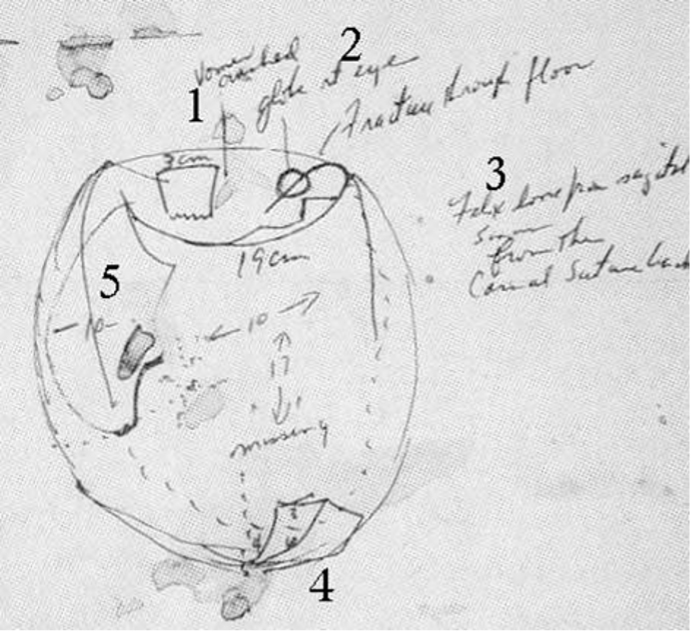
    Figure 1. Dr. Boswell’s “face sheet” diagram of JFK’s skull. In the center of the image, Boswell wrote “17” and “missing,” with an arrow pointing front-to-back. He also wrote “10” next to an arrow pointing right-to-left. The official autopsy report says Kennedy’s skull defect measured “13 cm. in greatest diameter.”

    How did a 17-cm skull defect on the night of the autopsy shrink in the autopsy report? Boswell told the HSCA, the Assassinations Records Review Board (ARRB)and me that JFK’s skull defect measured 17 cm at the outset of the autopsy. But after a late-arriving bone fragment was replaced into the bottom rear of JFK’s skull, into the “occiput,” the remaining gap then measured “only” 13 cm, the dimension specified in the autopsy report.[13]

    Two important things follow. Not only was bone ejected from the top of JFK’s skull, the Delta fragment, but bone was also ejected from the rear, from the low, occipital bone. (Fig. 2)
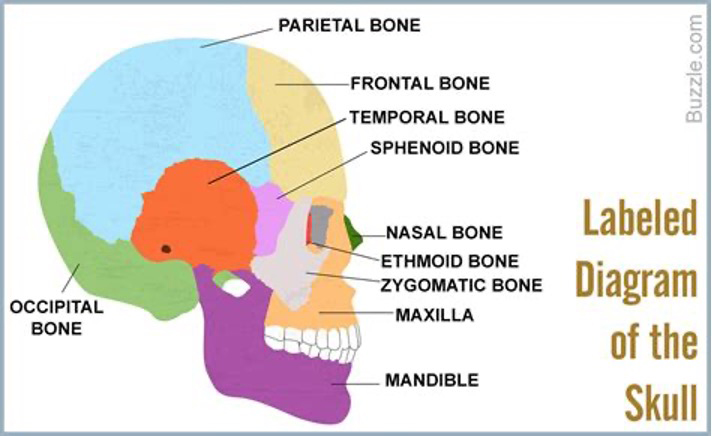
    Figure 2. Diagram of human skull viewed from the right side.

    Secondly, JFK’s skull defect ran per force from the low, occipital bone in the skull’s rear to roughly the parietal-frontal bone region in the front. That’s what Boswell depicted on a human skull that he had marked for the ARRB. Both Boswell’s face sheet and ARRB diagrams are in sharp contrast to what the Warren Commission presented to the public, the Rydberg diagram. It depicts a small (bullet) hole in the rear of JFK’s skull in an otherwise intact plate of bone, and a skull defect that is well above that hole. (Fig. 3)
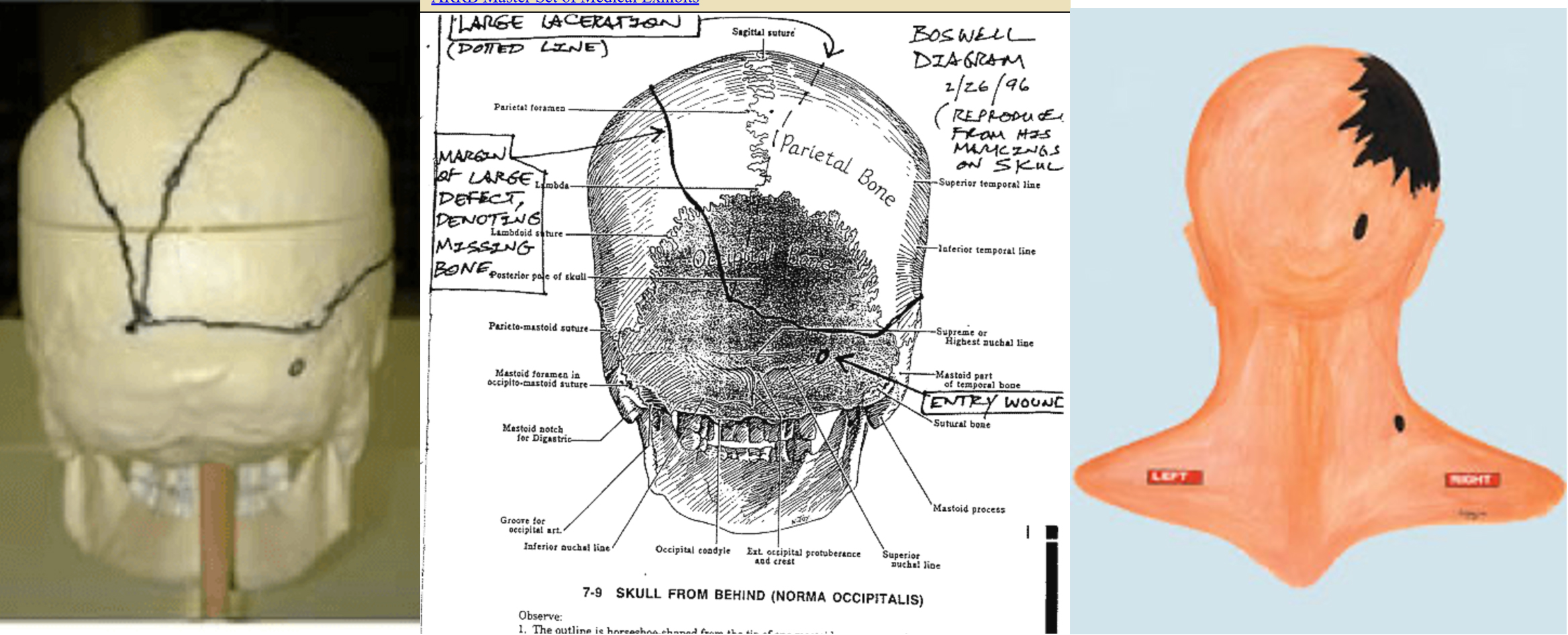
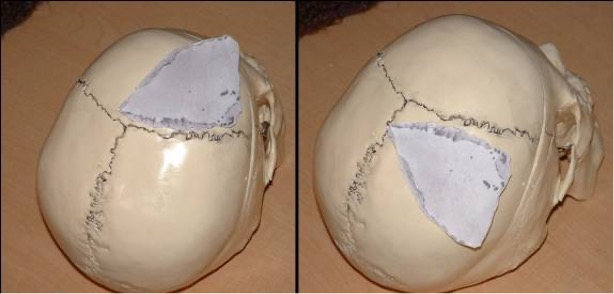
    Figure 3. Left: Photo of a skull marked by Dr. Boswell depicting the size of JFK’s skull defect at autopsy.[14] Notice that the defect extends deeply into the bottom of “JFK’s” low occipital bone. Center: a two-dimensional rendering of the markings Boswell made on the human skull for the ARRB. It shows the shape and dimension of Kennedy’s skull defect at autopsy.[15]

    Right: Warren Commission Exhibit 386 shows a small occipital entrance wound, which is distinct from the large right-sided skull defect. Boswell told the HSCA in 1977 and the ARRB in 1996 that the entrance hole was not in an intact plate of bone. They actually inferred it was a wound of entrance from the beveling present on a late-arriving bone fragment, which fit into a wound that was initially much larger than shown here, and which extended down to the entrance hole. (See CE # 386.[16] Also see Boswell’s HSCA interview,[17] and Dr. Boswell’s ARRB deposition, p. 79 ff.[18])

    The reason Parkland’s trauma surgeons, neurosurgery professors, and autopsy witnesses said JFK’s skull wound was occipital has an obvious, simple explanation. Wagner says I never addressed this. I have, several times, starting decades ago.

    “Wounds picked apart during an autopsy examination,” I wrote 25 years ago, “are often found to be larger than they first appeared to emergency personnel. In Kennedy’s case, moreover, Jackie Kennedy testified that she tried to hold the top of JFK’s head down as they raced from Dealey Plaza to Parkland Hospital. It is not hard to imagine that during the time it took the Presidential limousine to get to Parkland Hospital, a clot had formed, gluing the top portion of JFK’s disrupted scalp down, making JFK’s skull defect appear smaller to treating surgeons than it later would to autopsy surgeons.”[19]

    Jackie has said as much herself. ” ’He had his hand out, I could see a piece of his skull coming off, and I can see this perfectly clean piece detaching itself from his head . . . I kept holding the top of his head down, trying to keep the brains in,’ she said on Nov. 29, 1963.[20]” (my emphasis)

    In his rebuttal, Wagner offers autopsy witness FBI agent James Sibert in support of his claim that the overlooked Delta fragment proves the Dallas error. But in a taped interview, Sibert described what he saw when Kennedy’s head was unwrapped at autopsy: “… there was a sheet unwrapped off the head. There was a big gaping hole in the right rear of the head back here … .”[21] (my emphasis) (Fig. 4) Sibert also diagrammed the wound he saw for the ARRB. Sibert thus confirms that JFK’s head wound at autopsy looked eerily like, if not as large as, the wound Dr. McClelland saw at Parkland.[22] Many other autopsy witnesses described it in similar terms, and so were just as “mistaken” as Dallas neurosurgeons and the FBI Agent were.[23]
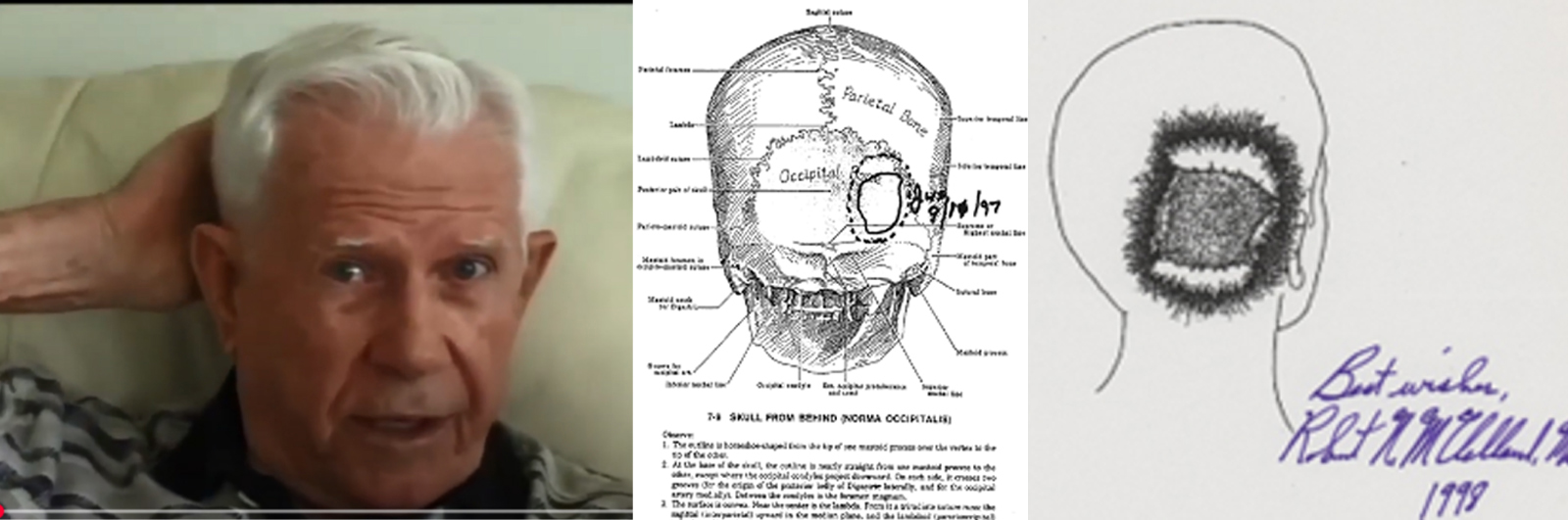
    Figure 4. Left: screenshot of witness James Sibert showing where JFK’s wound was when they unwrapped his head at autopsy. Center: MD 188 – Sketch made by FBI agent James W. Sibert for the ARRB – Anatomical Drawing of Wound in President Kennedy’s Head (Executed on September 11, 1997). Right: “McClelland diagram” attested to by Dr. McClelland in 1998.

    Jackie held the top of JFK’s head down on the way to Parkland; a blood clot kept his scalp down; and the full extent of his skull defect wasn’t apparent until the surgeons at Bethesda lifted his scalp to examine his huge skull defect. My reply to Wagner’s claim of: “The large wound was on the top of the head, not lower on the back of the head” is clear. Kennedy’s wound was so large that it involved both the top of his head as well as the back of his head.

    But what about the autopsy photograph that shows the backside of JFK’s head intact and undamaged? Does this not prove Dr. McClelland, neurosurgeon Dr. Kemp Clark, Agent Sibert, etc., were wrong? (Fig. 5) The ARRB asked Boswell about this very photograph.

    Q. Okay. Could we turn to the sixth view, which is described as “wound of entrance in right posterior occipital region”? That corresponds to black and white photos Nos. 15 and 16, and color photos Nos. 42 and 43. Do these photographs appear to you, Dr. Boswell, to be accurate representations of photographs taken during the autopsy of President Kennedy?

    A. Yes.

    Q. In that photograph, is the scalp of President Kennedy being pulled forward?

    A. Yes.

    Q. For what purpose was it being pulled forward?

    A. In order to take the photograph, because if it wasn’t pulled forward, this would just–the scalp would come down and cover the wound of entrance here. And this was necessary to demonstrate the wound here. [24]

    In other words, the photo of the back of JFK’s head doesn’t show the rearward extent of the head wound because JFK was lying on his left side, not upright, as his scalp was pulled forward over the back of his skull to show a bullet wound in the scalp. (Fig.5)
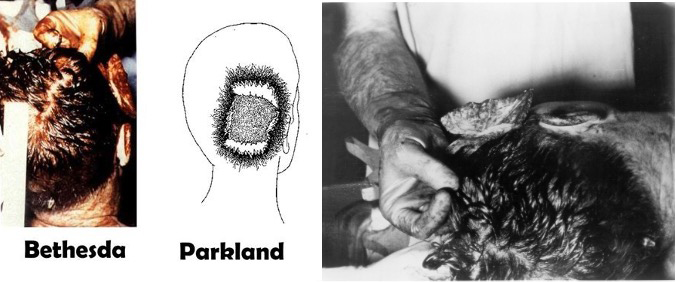
    Figure 5. Left: Autopsy photo as it’s usually displayed. Kennedy is upright; the backside of JFK’s head is intact and undamaged. Center: diagram of the wound that Parkland’s Dr. Robert McClelland said he saw. Right: proper orientation of the photo as it was taken. JFK is lying on his left side, and an autopsist (Boswell?) is holding JFK’s rearward scalp forward over the right-rear portion of Kennedy’s skull wound.

    WAGNER’S CLAIM: AN AUTOPSY PHOTO PROVES OCCIPITAL INSHOOT

    Re Wagner’s last bit of ‘alternate evidence,’ an autopsy photo commonly called the ”mystery photo”. It is so badly shot and composed that many could not understand what it was. I do not accept his “special plea” that he knows what it is and what it means, when even the autopsy surgeons and the HSCA’s Forensic Pathology Panel were uncertain about its proper orientation or meaning. Besides, as I originally wrote, Dr. Pierre Finck, who held JFK’s skull in his hands, as Wagner put it, said that this is not the photo Wagner says it is.

    This “mystery photo” (sic) is of the “occipital wound of entrance,” he says, “How could it be otherwise?” It’s otherwise for at least two good reasons. First, in his 1965 memo to General Blumberg, Finck wrote that “I found a through-and-through wound of the occipital bone, with a crater visible from the inside. This wound showed no crater when viewed from the outside.”[25] (my emphasis)

    The wound in the photo, as I discussed in my original review, and as anyone can see, is beveling. But it’s beveled outside, not inside, and it’s plainly visible, even in this bootleg “mystery photograph.” (Fig. 6) The outside beveling makes this photo more likely one of an outshoot, not Wagner’s occipital inshoot. 
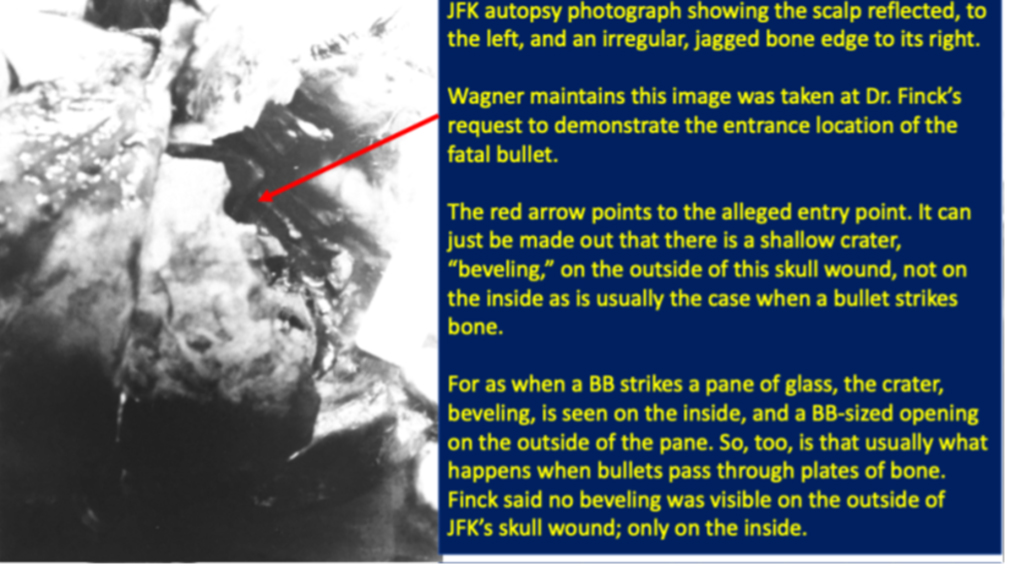
    Figure 6. “Mystery photo” from JFK’s autopsy.

    Wagner says this “mystery photo” (taken from my slide show) shows the entrance point of a bullet low in the back of JFK’s skull, in occipital bone, the area specified in the autopsy report. The red arrow points to a semicircular notch, Wagner’s supposed entrance wound. But the “beveling” is on the outside of the skull, not the inside, where Dr. Finck said it was. This, therefore, is not the photo of the entrance wound that Finck meant.

    The HSCA’s Charles Petty, MD, asked Finck: “If I understand you correctly, Dr. Finck, you wanted particularly to have a photograph made of the external aspect of the skull from the back to show that there was no cratering to the outside of the skull … Did you ever see such a photograph?” (my emphasis)

    Finck: “I don’t think so and I brought with me memorandum referring to the examination of photographs in 1967… and as I can recall I never saw pictures of the outer aspect of the wound of entry in the back of the head and inner aspect in the skull in order to show a crater … I don’t remember seeing those photographs.”[26] Finck examined this photograph, which does show cratering on the outside, and he denied it was the occipital entrance photo. So how can Wagner, not a forensic pathologist, not a physician, and who wasn’t present, say that Finck, a forensic pathologist, who was there, who held JFK’s head in his hands, is wrong, and that he is right.

    WAGNER AND KENNEDY’S PHYSICAL AND X-RAY EVIDENCE

    Perhaps Wagner’s most desperate assaults on Lord Occam have to do with the physical evidence: Kennedy’s response to the shot that killed him, and the autopsy X-rays. By his lights, what we see happen to JFK’s head, what we see in the Zapruder film, and what’s visible in JFK’s X-rays, mesh smoothly with Hoover’s scenario. They don’t.

    Put simply, we know from government duplication experiments done for the Warren Commission that, when human skulls are struck with Mannlicher ammo, they move differently than JFK’s did; the skull injuries are vastly different; and the X-ray findings are worlds apart. I ran through them in detail in my original review.

    Briefly:

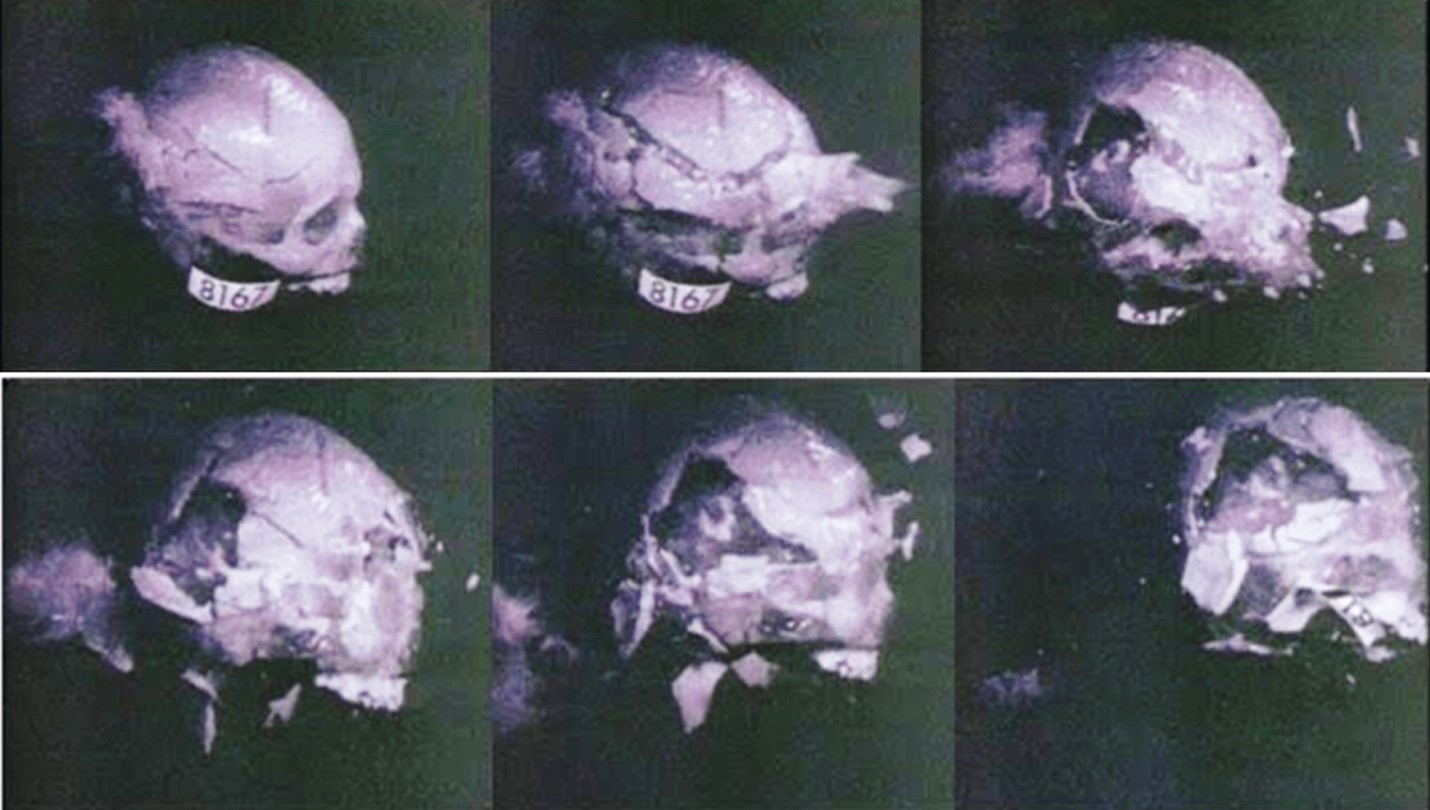
    High-speed photos show that when struck with MCC rounds in the government’s tests, 10 out of 10 skulls moved away from the shooter, not back toward the shooter as Wagner argues Kennedy’s did. The photos also show that, like all “closed vessels,” the first reaction to bullet penetration is an explosion back out through the point of entrance.[27] Milliseconds later, there’s a burst through the outshoot on the opposite side of the skull, or “closed vessel.” (JFK’s skull showed no such rearward ejecta in the Z film.) Shot in accordance with the official theory, the test skull’s right forehead, entire right orbit, and right cheek were blown away. JFK suffered no such injuries.

    There’s no small irony that the official experiments intended to “duplicate” what happened when Oswald shot JFK not only failed, they pretty much proved Oswald didn’t do it. (Fig. 7) The pictures below illustrate what I said about ejecta and facial damage.
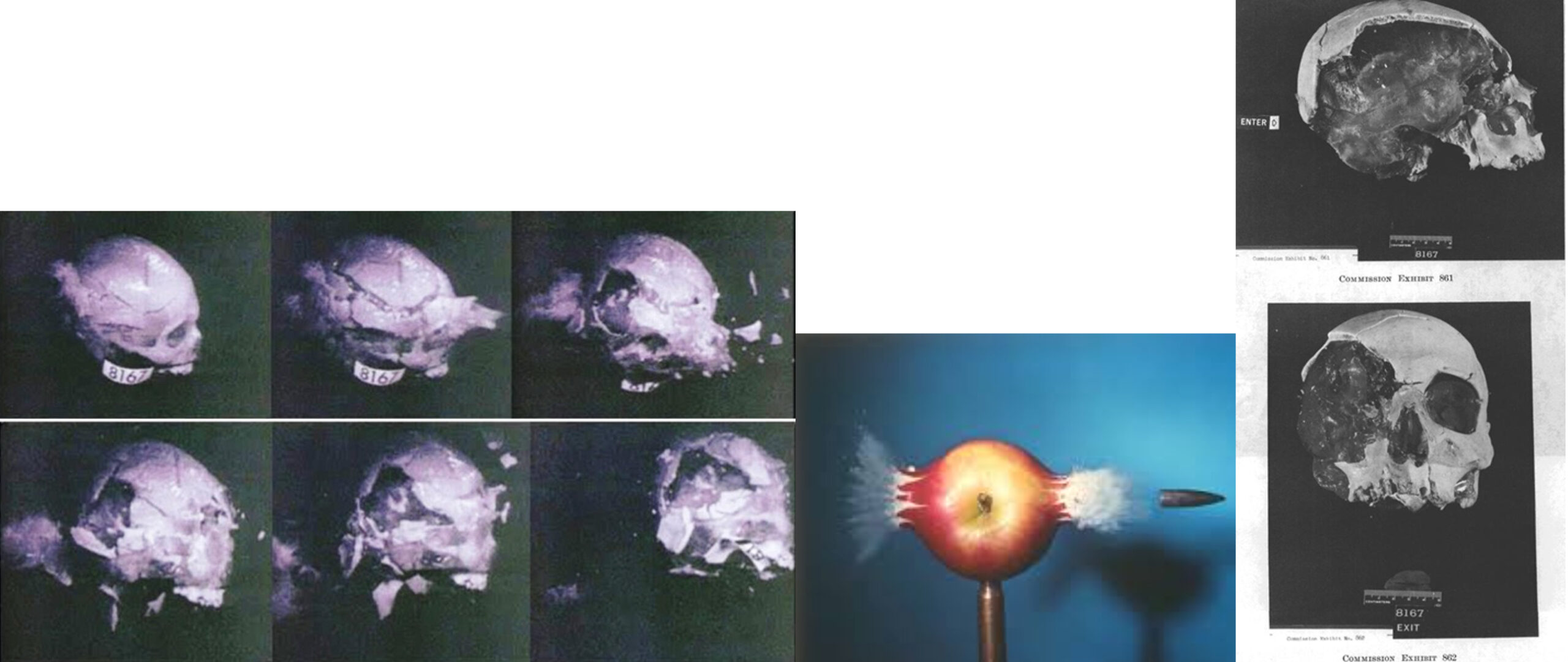
    JFK’s X-rays can’t keep Wagner’s ship afloat. A test skull shot with a Carcano round showed no “dust-like,” no “snowstorm,” of minuscule fragments. Wagner’s own expert, Larry Sturdivan, testified in detail why: jacketed bullets like Oswald’s don’t leave a “snowstorm” of minuscule fragments after blasting through bone.[28]

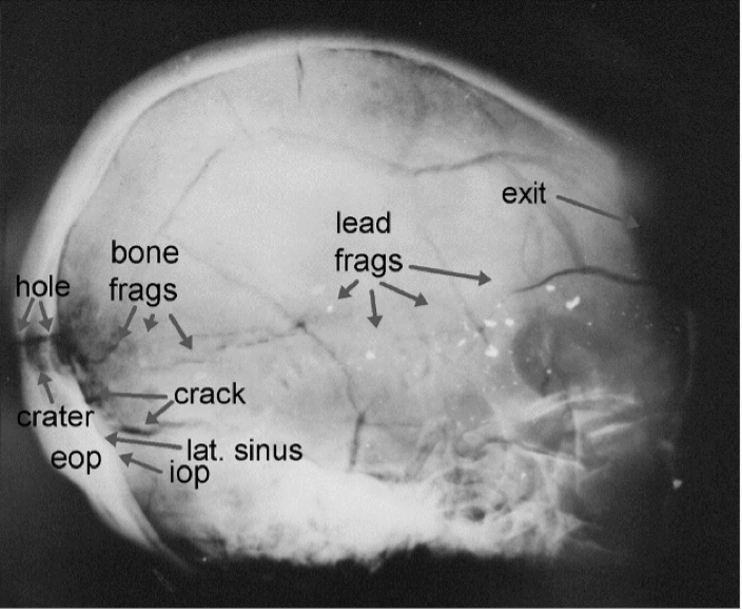
    But in fact, there is a “snowstorm” of minuscule bullet fragments in the right front quadrant of JFK’s skull X-ray. They are clearly visible in JFK’s original, unenhanced X-rays, and their existence in that location was attested to by expert radiologists.[29] But they’re blotted out and are not visible in the poor quality, “enhanced” films available to the public.

    Moreover, jacketed shells like Oswald’s don’t deviate much from their original flight path. Why? Because, as Larry Sturdivan testified, the jacketed “Mannlicher-Carcano bullet is much more stable, the yaw begins to grow much more slowly (than non-jacketed, military rounds do) … .”[30] (my emphasis)

    Wagner asks us to believe that Oswald shot downward toward JFK’s receding skull, striking it low with a jacketed slug. It was then somehow deflected way upward to the top of JFK’s skull, leaving fragments high in the skull. (Figs.7&8)
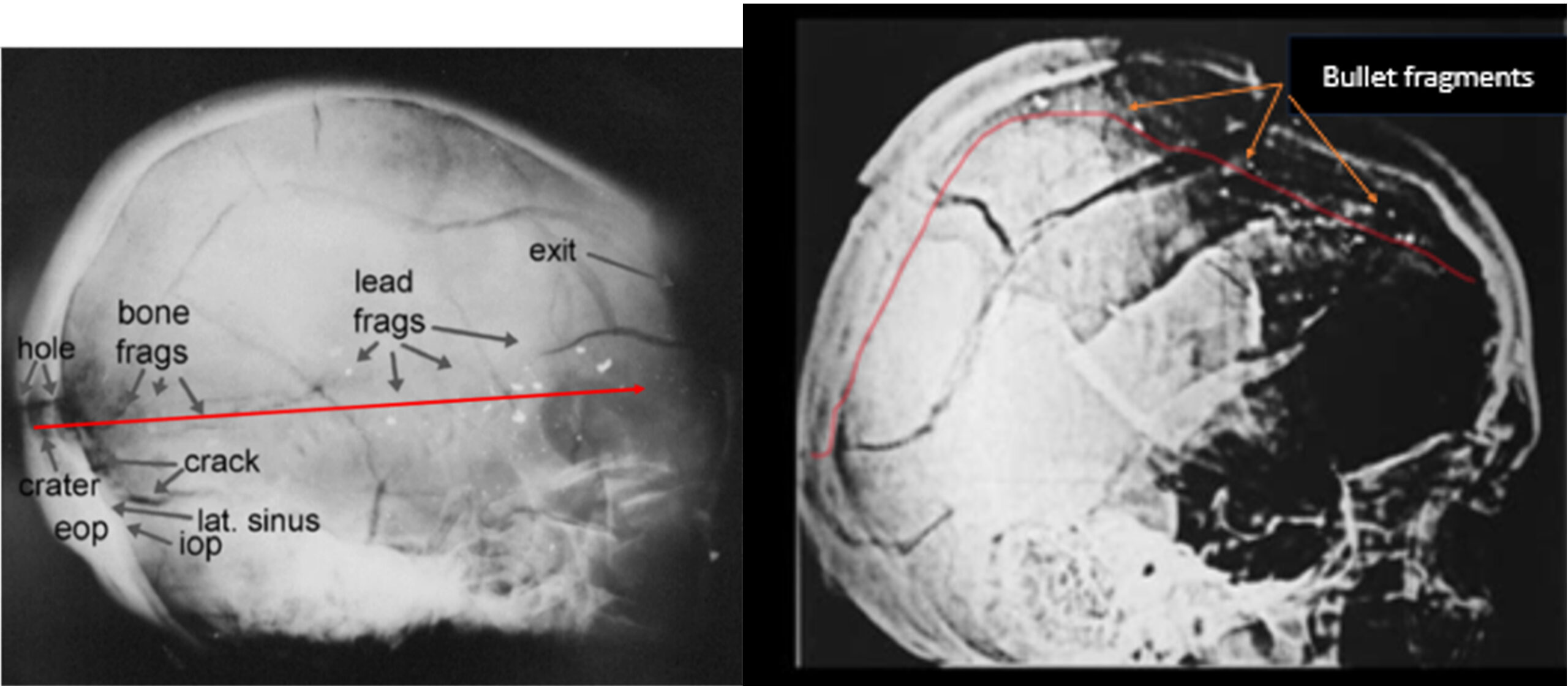
    Figure 8. Left: Sturdivan reproduced an X-ray of a test skull shot with a Mannlicher round at the Biophysics Lab.[31] The fragments are small, but not “dust-like.” Not like the “snowstorm” of fragments visible in the right-front quadrant of Kennedy’s still-secret, original and unenhanced, lateral X-ray. (Which is evidence JFK was killed with a non-jacketed bullet. For “dust-like” fragments are quickly stopped by brain tissue, and so lodge close to the point of entry.) Moreover, the test skull’s fragment trail closely follows a low, little-deviated flight path across the skull, precisely as Larry Sturdivan said happens with MCC rounds.

    * Right: JFK’s “enhanced” lateral X-ray: small fragments are visible only along the top of the skull. Wagner says that, unlike the test skull, Oswald’s bullet was fired downward, struck JFK’s skull low, then popped up to the top of his skull, broke apart, and blew out of the right side of his head.

    MOMENTUM – WHAT DROVE KENNEDY “BACK AND TO THE LEFT”?

    Wagner offers no explanation for JFK’s rearward lunge. Except a “grassy knoll” shot did not do it. Why? Because JFK’s body is visibly “lifted against gravity” after Z-313. It’s something that Kennedy’s rearward head movement could not have accomplished. (He carefully avoids admitting it, but if not “momentum transfer” from a “grassy knoll” shot, his sole remaining pro-Hoover explanation for the rearward lunge is a “neuromuscular” reaction, one that lacks medical/scientific foundation, and that has been debunked.[32])

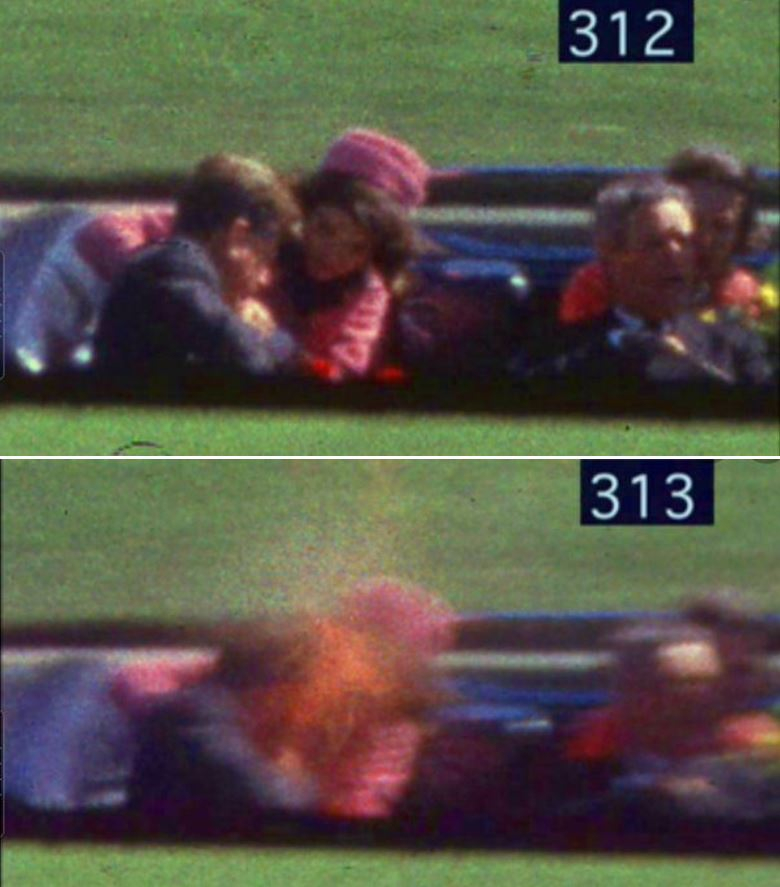
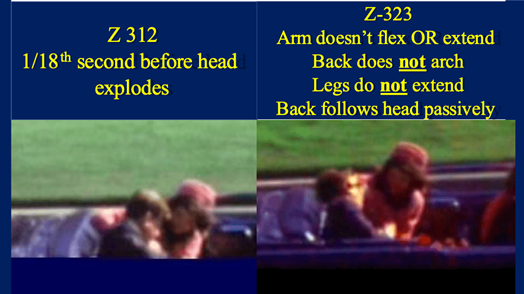
    The proof Wagner is wrong is in the Zapruder film. The motion of JFK’s head appears to have been enough to pull his back along with it. For as JFK’s head moves, so does his upper body, and it does so in two different directions. Following Z-327, when an acoustics- and Z-film-corroborated shot hit him from behind, Kennedy’s head lunges frontward and his back moves forward with it. The opposite thing happens after Z-313: his head flies backward, and his back follows. So just as JFK’s back is “lifted against gravity” backward when his head jolts rearward after Z-313, his back is similarly “lifted against gravity” forward as the President’s head ploughs ahead after Z-327. (Fig. 9)
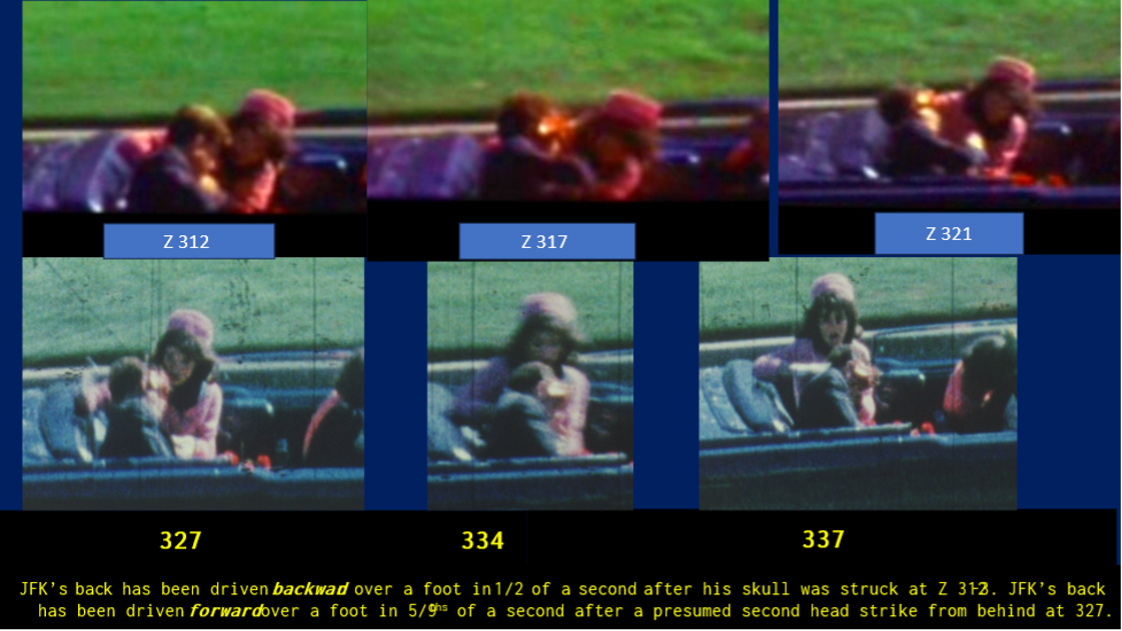
    Figure 9. Kennedy’s “upper body” is “lifted against gravity” backward by the motion of his head after Z-313, just as it is similarly “lifted against gravity” forward after Z-327. (Image taken from a PowerPoint slide.)

    THE “DEBRIS FIELD”

    Josiah Thompson, Dr. Doug Desalles and I have repeatedly pointed out that the “debris field” – the region toward which most of Kennedy’s skull and brain matter flew – was “back and to the left” of Kennedy, consistent with a shot from the grassy knoll. Wagner counters that some “human matter” was also located forward of JFK. He’s right on that.

    The explosion of JFK’s head at Z-313 would likely have sent some debris forward. As previously shown (Fig.7), some debris flies back toward the shooter when any closed vessel is struck. But most of the debris from the Z-312-313 shot clearly flew back to the left. Some of the forward-driven material likely flew due to a bullet strike to JFK’s head from the rear at Z-327-8. That strike drove JFK’s head and upper body rapidly forward after Z-327. It also abruptly changed the anterior-top portion of his skull, driving the “debris” that is seen falling down across his face a half-second later. High-quality Z-frames make this clear. (Fig. 10)

    As final, corroborative points, an acoustics waveform suggested a shot was fired from behind at Z-327-8. And Z-frames 331 and 332 are “jiggled,” which fulfills the Alvarez-proposed, 3-frame delay for the sound of an Oswald shot at Z-327-8 to reach Zapruder and jostle his camera.[33]
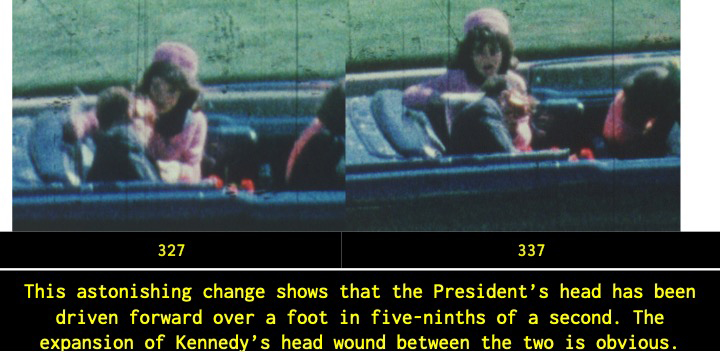
    Figure 10. Between Z-frame 327 and 337, Kennedy’s head is driven swiftly forward and downward; his back follows. The anterior portion of his head changes dramatically, and debris can be seen spilling down across his face. (If he was struck from behind at Z-327, why is there no rearward gush of ejecta seen as occurred in the government’s skull shooting tests, Fig. 7? Simply, by Z-327 the President’s skull was no longer a “closed vessel.”)

    THE MAGIC BULLET – COMMISSION EXHIBIT #399

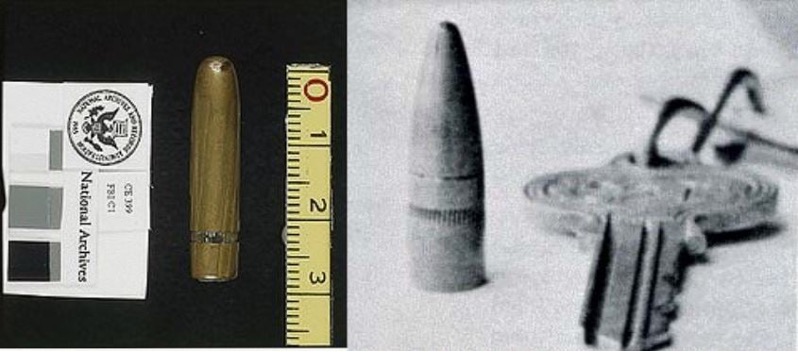
    Wagner tries to salvage the dubious bona fides of the so-called “magic bullet” by eliding key facts. First, the FBI lied in Commission Exhibit #2011 when it reported that Parkland employees Tomlinson and Wright claimed #399 resembled the bullet they found on 11.22.63.[34] They never said that. The early, and only, report from the Bureau’s Dallas field office in 1964 reported that neither Tomlinson nor Wright could identify #399. Period. And, as Wagner admits, in 1966 O.P. Wright handed Thompson a bullet from his own desk that he said looked like the bullet they’d found. It had a pointed tip, not at all like the round-tipped #399. (As a former Dallas Sheriff, he would have known the difference.)

    The FBI also lied, claiming that it was agent Bardwell Odum who had gotten the Tomlinson-Wright admission that there was a bullet resemblance. In person, in his own living room, Odum emphatically denied to Thompson and me that he’d gotten any such admission. He never talked with Tomlinson and Wright, or had #399 in his possession. The Bureau’s own internal records back up Odum’s unequivocal denials to us. Odum’s name is nowhere to be found in any FBI files regarding #399, according to searches done by skeptics as well as by the government.

    It should not be ignored that #399 is “magical” in other ways as well. It’s supposed to have passed through JFK’s jacket and shirt on the way in, through his neck, his shirt again on the way out. It then nicked his tie, tore through Governor Connally’s jacket and shirt, blew completely through his chest, breaking a rib, and out through his shirt. Then it passed, butt-first, backward through the governor’s wrist, transected his trousers, before finally lodging in his leg, only later to fall out. And yet there are no fabric striations on the unblemished nose of #399. Nor is there any residuum of blood or tissue on this negligibly deformed missile. And it’s skeptics who are fools for not buying this?

    ACOUSTICS

    As I pointed out in my review, Wagner says that one should trust authorities “who are truly expert in the field in which they offer opinions.” He didn’t do that with the acoustics, nor with much else for that matter. The U.S. Justice Department didn’t either. Wagner omits any mention of a well-known, acoustics-related scandal.

    When the HSCA went out of business, two of the committee members appropriately recommended that the pro-conspiracy acoustic evidence needed to be reexamined. They specified that acoustics experts should do the restudy.[35] As I discussed in my review, in typical fashion, the Justice Department ignored the HSCA’s directive. Justice first turned to a Bureau agent, B. E. Koenig, whose credentials consisted of his completing a quickie “Gee Whiz!” course in acoustics. His paper “refuting” the HSCA’s acoustics was promptly debunked and discredited.[36]

    DOJ then turned to Nobel Prize winner, Luis Alvarez. He’d previously put out a false scientific finding that pleased the Carter Administration. His work on the so-called Vela incident proved nothing except that he could be relied upon to uphold a necessary government myth. [37][38]

    U.S. officials needed a fixer for the acoustics. But Alvarez didn’t chair the reexamination. Instead, he arranged the panel. The selectees were all physicists known to Alvarez. None had any acoustics training or expertise. Not even the chair, Harvard’s Norman Ramsey, with whom Alvarez had long collaborated on prior government projects. He also picked Richard Garwin and F. Williams Sarles, both trusted alumni of Alvarez’s Vela fiasco. It was like picking pediatricians to do a hip replacement, except that the pediatricians I have personally known would never do what Alvarez and his appointees did.

    Alvarez sat in and worked closely with his “Ramsey Panel,” and, lo and behold, they disproved the HSCA’s acoustics! Wagner shows no concern about this arrangement: progovernment, anticonspiracist Alvarez hand-picked non-experts who issued a progovernment opinion in a field in which they had no experience or expertise, and which supposedly disproved the findings of government-appointed scientists with proven experience and expertise. And it’s skeptics who are fools for not buying this?

    Conclusion

    A reasonable corollary of Lord Occam’s principle might be to reject a complex theory that requires suspending disbelief and embracing complex improbabilities if there is a simpler, less complex, less improbable theory that requires less suspension of disbelief. The evidence is so against Wagner that he asks us to suspend disbelief and accept complex improbabilities.

    • That numerous percipient trauma surgeons, neurosurgery professors, FBI agent eye witnesses were wrong that Kennedy had a rearward skull wound;
    • That nonphysician Wagner is right that the “mystery photo” in Fig. 6 is Kennedy’s occipital entrance wound from Oswald’s fatal bullet, and that JFK’s examining forensic pathologist Finck, who said it isn’t, is wrong;
    • That JFK’s head flew backward toward Oswald’s rifle when all 10 test skulls that were similarly fired upon in government tests flew away from the shooter;
    • That Oswald’s bullet entered Kennedy’s skull low on a downward trajectory, yet was wildly deflected upward. Which is in defiance of the expressed claims of Wagner’s experienced, government ballistics expert, Larry Sturdivan, whose opinion was confirmed in a government duplication test that showed that a Mannlicher shell was not deflected as it passed through a human skull;
    • That Oswald’s jacketed MCC bullet left a “snowstorm” of minuscule fragments in the right front quadrant of JFK’s head when “snowstorms” in X-rays are not seen with jacketed bullets, but only with non-jacketed rounds. [Nor was a “snowstorm” seen in the X-ray of a test skull shot with an MCC shell in a government test. (Fig.8)]
    • That the “debris field” that flew back to the left of JFK, and the skull fragments that flew leftward, were all driven backward and leftward by Oswald’s bullet that supposedly entered the right rear of Kennedy’s skull and blew out of the right front part of his head;
    • That there is nothing noteworthy about the fact that none of the first four people in the chain of possession of the Parkland stretcher bullet were later able to identify #399 as that same bullet. Nor is it noteworthy that the FBI lied about #399 in official records. Nor that there was neither the marking of the shell’s having passed through fabric nor any tissue residues on the near-pristine bullet that is supposed to have been so destructive of fabric, flesh and bone;
    • That a group of untrained, acoustics-ignorant physicists, appointed by an acoustics-ignorant, proven government toady and anticonspiracist (Luis Alvarez), definitively debunked the findings of three of the most highly regarded acoustics authorities in the country.
    • That the debunked “neuromuscular reaction” and/or “jet effect” explain(s) Kennedy’s rearward lunge, and that the momentum imparted to JFK’s skull from a grassy knoll shot does not.

    For Wagner, it’s always, well, under normal circumstances, a, b, c, … x, y, and z do not happen. But this time it’s different. As improbable as it may seem, folks, in this unique case, all these unlikely things did happen, and they happened just the way the government said they did … . And it’s the skeptics who are fools for not buying this? Well, we don’t buy it. Because we have long had a far less complicated theory than J. Edgar Hoover about what happened in Dealey Plaza. And it’s one that fits the evidence and is not in defiance of it. It explains things like JFK’s rearward lunge, which an Oswald shot does not; it explains things like ejecta backward; why the motorcycle cops were hit with blood and tissue while riding to JFK’s right; why there is a snowstorm of dust-like bullet fragments in the right front of Kennedy’s forehead. I could go on and on with this, but I think the reader gets the point by now.

    If the government had been telling us the truth all along, there’d have been no need for intimidating witnesses, for destroying evidence, and for continuing to withhold evidence to this day.

    So why does Wagner remain faithful to those who have endlessly lied and acted in such extraordinarily bad faith? How many more proven official malefactions would it take to shake his faith? I keep thinking of something Jeff Morley pointed out that’s worth repeating:

    “In civil law, when one party does not disclose evidence in its possession, a jury is allowed to draw an adverse inference that the missing information destroyed or not produced was unfavorable.” Now, 60+ years after Kennedy was assassinated, it’s more than fair to draw the adverse inference that the missing information destroyed or not produced by the FBI, the CIA,[39] and the Secret Service was unfavorable to the government’s claim Oswald acted alone.[40]

    One might have hoped that the government’s proven dishonesty and bad faith in the Kennedy case, which Jim Dieugenio, Jeff Morley, and others have shown have no limit and no end, would force a reckoning among Warren loyalists. There’s little doubt but that it has, among some. But from what he’s written in his books and in his riposte, it seems that there’s nothing that’s likely to ever shake Bob Wagner’s “patriotic” faith. And it’s skeptics who are fools for not buying this?

    Click here to read the article by Robert Wagner that Gary Aguilar is responding to.

    Editor’s note: Robert Wagner and Gary Aguilar have both been given space on this site to present their latest retorts on this ongoing debate. At this point, we have no plans to publish further discussion between the two researchers regarding this debate.

    ————

    1. Curt Gentry. J. Edgar Hoover – the Man and the Secrets. New York. W.W. Norton & Co., 1991, p. 553, and p. 558. (Hoover kept a file on LBJ.)

    2. See Hoover memo from 11.22.63 saying Oswald was the culprit: https://www.maryferrell.org/showDoc.html?docId=62251#relPageId=97

    3. JFK assassination files: Hoover said FBI must “convince the public” Oswald acted alone. CBS News. https://www.cbsnews.com/news/jfk-assassination-files-hoover-said-fbi-must-convince-the-public-oswald-acted-alone/

    4. Curt Gentry. J. Edgar Hoover – the Man and the Secrets. New York. W.W. Norton & Co., 1991, p. 548 and p. 553.

    5. See: Aguilar G. Warren Commission Counsels Burt Griffin and Howard Willens Attempt the Impossible: Shoring up the Tottering Credibility of Earl Warren’s Investigation. https://www.kennedysandking.com/john-f-kennedy-articles/warren-commission-counsels-burt-griffin-and-howard-willens-attempt-the-impossible-shoring-up-the-tottering-credibility-of-earl-warren-s-investigation

    6. Sources at: Aguilar G. Warren Commission Counsels Burt Griffin and Howard Willens Attempt the Impossible: Shoring up the Tottering Credibility of Earl Warren’s Investigation https://www.kennedysandking.com/john-f-kennedy-articles/warren-commission-counsels-burt-griffin-and-howard-willens-attempt-the-impossible-shoring-up-the-tottering-credibility-of-earl-warren-s-investigation

    7. Gerald D. McKnight. Breach of Trust – How the Warren Commission Failed the Nation and Why. Lawrence, Kansas: Kansas University Press, 2005, p. 150.

    8. Warren Commission testimony of Robert McClelland, Hearings Vol. 6, p. 33. Hereafter 6H33.

    9. Wagner, R. JFK Assassisnated – In the Courtroom Debating the Critical Research Community. Mill City Press, 2023, p. 210.

    10. Warren Commission Exhibit #387, Autopsy Report and Supplemental Report, p. 3. https://aarclibrary.org/publib/jfk/wc/wr/pdf/WR_A9_AutopsyReport.pdf

    11. Warren Commission Exhibit #387, Autopsy Report and Supplemental Report, p. 3. https://aarclibrary.org/publib/jfk/wc/wr/pdf/WR_A9_AutopsyReport.pdf

    12. House Select Committee (HSCA) testimony of J. Thornton Boswell, MD. V7:253 https://history-matters.com/archive/jfk/hsca/reportvols/vol7/html/HSCA_Vol7_0132a.htm

    13. HSCA memo of conversation with J. T. Boswell, HSCA record # 180-10093-10430-, agency file number 002071, p. 6. Also reproduced in ARRB Medical Document #26, see p. 6. See also my discussion of this 33 years ago:

      Aguilar G, Cunningham K. HOW FIVE INVESTIGATIONS INTO JFK’S MEDICAL/AUTOPSY EVIDENCE GOT IT WRONG – DISCUSSION. https://history-matters.com/essays/jfkmed/How5Investigations/How5InvestigationsGotItWrong_6.htm

    14. Image available at: Mantik D. The Omissions and Miscalculations of Nicholas Nalli

      https://www.kennedysandking.com/john-f-kennedy-articles/the-omissions-and-miscalculations-of-nicholas-nalli

    15. ARRB Master Set of Medical Exhibits, MD 29. https://history-matters.com/archive/jfk/arrb/master_med_set/md209/html/md209_0001a.htm

    16. https://history-matters.com/archive/jfk/wc/wcvols/wh16/html/WH_Vol16_0501a.htm

    17. HSCA V. 7:246. https://history-matters.com/archive/jfk/hsca/reportvols/vol7/html/HSCA_Vol7_0128b.htm

    18. https://history-matters.com/archive/jfk/arrb/medical_testimony/Boswell_2-26-96/html/Boswell_0045b.htm

    19. Aguilar G. The Converging Medical Case for Conspiracy in the Death of JFK. In: Fetzer J, ed. Murder in Dealey Plaza, Part III. Chicago: Catfeet Press, 2000, p. 187.

    20. Seattle Times, May 27, 1995. Jackie’s Memories Of JFK’s Death — In 1963 Interview, She Talked Of Seeing Husband Shot. https://archive.seattletimes.com/archive/19950527/2123253/jackies-memories-of-jfks-death—-in-1963-interview-she-talked-of-seeing-husband-shot

    21. https://www.youtube.com/watch?v=h7cimeXvqLA

    22. https://aarclibrary.org/publib/jfk/arrb/master_med_set/md188/html/md188_0001a.htm

    23. See my 1994 compilation of witness statements: JOHN F. KENNEDY’S FATAL WOUNDS: THE WITNESSES AND THE INTERPRETATIONS FROM 1963 TO THE PRESENT http://assassinationweb.com/ag6.htm

    24. ARRB testimony of J. Thornton Boswell, p. 160-161. https://www.jfk-assassination.net/russ/testimony/boswella.htm

    25. MD 28 – Reports From Lt. Col Finck to Gen. Blumberg (1/25/65 and 2/1/65). See Summary page: https://aarclibrary.org/publib/jfk/arrb/master_med_set/md28/html/Image19.htm

    26. HSCA testimony of Pierre Finck, MD. https://www.jfk-assassination.net/russ/testimony/finckhsca.htm

    27. Besides the photos from the government’s Biophysics Lab, a posted video of extremely high speed videos of eggs being shot with bullets that repeatedly show that the first egress of debris exits the point of entrance. See “Cory Santos” videos posted online in an “Education Forum” discussion of “jet effect.” https://educationforum.ipbhost.com/topic/27768-video-destroying-the-jet-effect/

    28. See: Aguilar G. Is Robert Wagner the New Paul Hoch? – Part 2, “Snowstorm.” https://www.kennedysandking.com/john-f-kennedy-articles/is-robert-wagner-the-new-paul-hoch-part-2

    29. See: Aguilar G. The X-Ray Evidence: Enhanced vs Unenhanced. In: Is Robert Wagner the New Paul Hoch? – Part 2 https://www.kennedysandking.com/john-f-kennedy-articles/is-robert-wagner-the-new-paul-hoch-part-2

    30. Sturdivan, L. Testimony HSCA Vol. 1:394. https://aarclibrary.org/publib/jfk/hsca/reportvols/vol1/pdf/HSCA_Vol1_0908_3_Sturdivan.pdf

    31. Sturdivan, L S. The JFK Myths. St. Paul. MN. Paragon House, 2005, p. 173.

    32. * See: Aguilar G, Wecht CH. Dr. Nalli and Neuromuscular Reaction. In: Nicholas Nalli and the JFK Case, Part 2. https://www.kennedysandking.com/john-f-kennedy-articles/nicholas-nalli-and-the-jfk-case-part-2

      * See: Aguilar G, Wecht CH. AFTE Journal — Volume 47 Number 3 — Summer 2015, p. 134-135. Available here: https://www.kennedysandking.com/john-f-kennedy-reviews/nova-s-cold-case-jfk-junk-science-pbs

      * See: Aguilar G. Wecht CH. AFTE Journal — Volume 48 Number 2 — Spring 2016, p. 72. Available here: https://www.kennedysandking.com/john-f-kennedy-reviews/nova-s-cold-case-jfk-junk-science-pbs

    33. Alvarez J. A physicist examines the Kennedy assassination film. Am. J. Physics, V.4, # 9. Sept. 1976. https://aarclibrary.org/publib/jfk/hsca/reportvols/vol1/pdf/HSCA_Vol1_0908_4_Alvarez.pdf

    34. See Commission Exhibit #2011: https://www.history-matters.com/essays/frameup/EvenMoreMagical/images/Slide2.GIF

    35. * HSCA Final Report, p. 486. https://www.history-matters.com/archive/jfk/hsca/report/pdf/HSCA_Report_4_Remarks.pdf

      * DISSENTING VIEWS BT HON. ROBERT W. EDGAR TO THE FINAL REPORT, p. 499https://www.history-matters.com/archive/jfk/hsca/report/pdf/HSCA_Report_4_Remarks.pdf

    36. * Koenig, BE. Acoustic Gunshot Analysis – The Kennedy Assassination and Beyond (Conclusion) https://www.ojp.gov/ncjrs/virtual-library/abstracts/acoustic-gunshot-analysis-kennedy-assassination-and-beyond

      * Thompson. J. Last Second in Dallas. Lawrence, Kansas: University Press of Kansas, 2023, p. 275-300.

      * See also memo from HSCA Chief Counsel, Robert Blakey, to the FBI’s William Webster dated 4.2/1981 that included a technical refutation of FBI Agent Koenig’s acoustics analysis written by James Barger and the acoustics authorities at Bold, Beranak and Newman, Inc. Cambridge, Mass: http://jfk.hood.edu/Collection/FBI Records/062-117290/062-117290 Volume 25/62-117290P25b.pdf

    37. Thompson. J. Last Second in Dallas. Lawrence, Kansas: University Press of Kansas, 2023.

    38. * https://scienceandglobalsecurity.org/archive/sgs25wright.pdf

      * Thompson. J. Last Second in Dallas. Lawrence, Kansas: University Press of Kansas, 2023, p. 280-284. 

      *See also” “The Vela Incident Nuclear Test or Meteoroid? Documents Show Significant Disagreement with Presidential Panel Concerning Cause of September 22, 1979 Vela “Double-Flash” Detection.” National Security Archives, 5/5/2006. Available here: https://nsarchive2.gwu.edu/NSAEBB/NSAEBB190/index.htm

      *A good summary of government evidence proving a nuclear blast in the Vela Incident is available in: Report on the 1979 Vela Incident. Available here. [“(Investigative journalist Seymour) Hersh reports interviewing several members of the Nuclear Intelligence Panel (NIP), which had conducted their own investigation of the event. Those interviewed included its leader Donald M. Kerr, Jr. and eminent nuclear weapons program veteran Harold M. Agnew. The NIP members concluded unanimously that it was a definite nuclear test. Another member—Louis H. Roddis, Jr.—concluded that ‘the South African-Israeli test had taken place on a barge, or on one of the islands in the South Indian Ocean archipelago.’” [Hersh 1991; pg. 280-281. Available here. He also cited internal CIA estimates made in 1979 and 1980 which concluded that it had been a nuclear test. “The U.S. Naval Research Laboratory conducted a comprehensive analysis, including the hydroacoustic data, and issued a 300-page report concluding that there had been a nuclear event near Prince Edward Island or Antarctica [Albright 1994b].”

    39. CIA Hid Key Oswald Ties from JFK Investigators, New Docs Confirm

      July 14, 2025 https://rockymountainvoice.com/2025/07/14/cia-hid-key-oswald-ties-from-jfk-investigators-new-docs-confirm/
    40. Jeff Morley. JFK Facts. https://jfkfacts.substack.com/p/a-trail-of-destruction-followed-faucis?utm_source=post-email-title&publication_id=315632&post_id=145391771&utm_campaign=email-post-title&isFreemail=false&r=1e6chw&triedRedirect=true&utm_medium=email

  • Robert Wagner Replies to Gary Aguilar

    Robert Wagner Replies to Gary Aguilar

    Robert Wagner Replies to Gary Aguilar


    Introduction

    In December 2024, Kennedys and King published Dr. Gary Aguilar’s review of my book JFK Assassinated – In the Courtroom: Debating the Critical Research Community (“JFKA”). JFK was my second book about the assassination of President Kennedy. My first book, The Assassination of JFK: Perspectives Half a Century Later, was published in 2016. I met Gary in November 2017 at the Houston mock trial of Lee Harvey Oswald, where I served as a prosecution expert consultant. Having since exchanged a few hundred emails and engaged on private group threads, Gary and I are familiar with each other’s views on this subject. While we have significant disagreements, I have always admired Gary’s dedication and enormous contributions to this case.

    Gary addresses six topics. Below I address them individually and then conclude with important overall context discussed in JFKA not mentioned by Gary. Space for my reply is limited, so I can only address high points. There is much more supporting detail offered in JFKA.

    Response


    1. The Fatal Head Wound – Especially the Parkland Hospital Recollections

    Gary complains that I rely on Dr. McClelland’s recollection, extrapolating it to every doctor and layperson in Trauma Room 1 at Parkland. Gary criticizes me for neglecting sufficient discussion of the reports of two neurosurgeons, Kemp Clark and (allegedly) Robert Grossman.[1] This critique completely sidesteps the primary point of my analysis.

    This issue is principally about considering where on the president’s head that adults—many of them doctors, some of them laypeople—say they saw a sizable hole, and addressing the differences between their recollections and the autopsy evidence. Gary’s well-known survey of Parkland (and Bethesda) witnesses includes mostly laypeople and medical doctors who are not neurosurgeons.[2] Gary implicitly trusted such witnesses to accurately report their observations about the location of a large wound somewhere on a human head. So, the issue is not that neurosurgical credentials are necessary to accurately report what was seen. The issue is distilled to this: When witness observations conflict with autopsy evidence, is there alternate substantive evidence that provides value in determining where to grant greater weight as to reliability?

    McClelland’s authorized sketch has been seized upon by the critic community as “Exhibit A” of the location of the area of missing skull. I quoted Doug Horne (p. 206), when describing the whereabouts of the location of the area of missing skull, which Horne says was attested to “virtually unanimously” by Parkland treatment physicians: “It was approximately fist sized, or baseball sized, or perhaps even a little smaller—the size of a very large egg or a small orange; … it was in the right rear of the head behind the right ear.”[3] Horne’s summary description matches well with the McClelland drawing:

    The Parkland witnesses do not describe the wound in the same detail from person to person, but in any case, their descriptions of the wound location are noticeably at odds with that described at autopsy as: “chiefly the parietal bone but extending somewhat into the temporal and occipital regions”[4] (emphasis added). By and large, the Parkland witnesses described the wound location as chiefly occipital.

    There is persuasive evidence nullifying the accuracy of those recollections, and it is not blind reliance on autopsy doctors, but on evidence not in dispute: the large triangular fragment recovered from the limousine and brought to the Bethesda morgue late into the autopsy. The triangular (“delta”) fragment measured about 4 inches by 2.5 inches. Researcher John Hunt considered anatomical locations just in front of, or behind, the president’s right coronal suture; locations that are generally agreed to be the possibilities for the fragment’s origin. Regardless, no one claims this fragment is occipital bone from the back of the president’s head [5]:

    Gary has not addressed how head wound witnesses at Parkland (and Bethesda) failed to note this large area of skull missing from the top of the president’s head—coincidentally more or less the same size of the area of missing skull according to McClelland.[6] Unlike at Parkland, the Bethesda witnesses, early in the autopsy, would have observed enlargement of that wound as the autopsy doctors reflected the president’s scalp and portions of the skull adhered to the reflected scalp and also fell away from the head, enlarging the span of missing skull (p. 288) such that no significant sawing (if any) was needed to extract the president’s brain (the brain could not have been extracted from the area of missing bone represented by the McClelland sketch).[7]

    That Parkland witnesses failed to note the large hole in the top of the president’s skull is irreconcilable to the “delta fragment” evidence.[8] Further, those witnesses do not describe a second large hole (this one on the top of the head, either in back of, or in front of, the right coronal suture), nor a contiguous larger wound extending from occipital bone forward to the coronal suture anterior on the parietal bone, even with the due examination by the Parkland doctors, as mentioned by Gary. The large wound was on the top of the head, not lower on the back of the head.

    That the area of missing skull was at the top of the president’s head is confirmed by one of the autopsy photographs (“views”)—taken from behind the president showing the large wound on top of his head, which autopsy assistant James Jenkins described as having brain matter visible.[9] When FBI Agent James Sibert was shown this autopsy photograph by William Law, he said, “I definitely remember that. That’s just the way it looked.”[10] When, for Law and Debra Conway, Sibert sketched the dimensions of the delta fragment, Conway commented, That’s huge! I mean, that’s the top of your head.”[11] Gary’s review omits these issues as presented in JFKA, yet this is clearly the central theme of my analysis, not McClelland’s singular reporting.

    How could Parkland witnesses have been mistaken? We know Bethesda witness Sibert appeared on Gary’s surveyed list of “right rear” witnesses and confirmed that location verbally to Law, yet also authenticated an autopsy photograph—taken before any autopsy manipulations were performed—that very clearly shows the wound on the top of the president’s head.[12] Reports of visible cerebellar brain tissue (e.g., neurosurgeon Clark and anesthesiologist Jenkins) are also in conflict with this evidence, although as Gary has previously written, the “external occipital protuberance (EOP), overlies the upper margin of the cerebellum which lies beneath it.”[13] It follows that because the autopsy reported location of the inshoot was “slightly above” the EOP,[14] the bullet could have missed the cerebellum (defecting up, to be discussed), which brain pictures from the supplemental autopsy confirm.


    1. The Entry Wound on the Back of the President’s Head

    Here, Gary notes Pierre Finck’s autopsy commentary, which he contends I ignore or misinterpret. Neither assertion is true. Consider the so-called “mystery photo.” That view is one of three extant pictures (views) to document bullet wounds.[15] Noteworthy is that Finck told his boss, General Blumberg, that he directed only three pictures (views) be taken: “the occipital wound (external and internal aspects), as well as the wound in the back” (pp. 222, 254). Gary mistakenly notes that I omitted a key part of Finck’s description, namely, “I found a through-and-through wound of the occipital bone, with a crater visible from the inside of the cranial cavity. This bone wound showed no crater when viewed from outside the skull” (emphasis added).[16] Not only do I quote this phrase (p. 221), but I devote significant narrative to its meaning in context because it is key to understanding the “mystery photo” (pp. 221-223; 251-258).

    Gary points to the semi-circular notch in the “mystery photo” and claims “outside beveling is plainly visible,” concluding that this is evidence of outshoot. Importantly, Finck never claimed there was any evidence of outshoot anywhere on the intact skull, and he had that skull in his hands.[17] Finck clearly had something else in mind. As discussed in JFKA (pp. 255-257), critic researcher Don Thomas warned of wrongly interpreting beveling features: “when dealing with fragments or margins of bone, and not through-and-through holes [as is the case here], all bets are off. This is because the laminate nature of cranial bone lends itself to chipping that can easily be confused with beveling.”[18] I also quoted Vincent Di Maio: “Chips of bone can flake off the edge of an entrance hole.”[19] One of Gary’s seminal published works is also relevant to this point, relating, “…there are numerous cases from the scientific literature in which the documented beveling characteristics were the reverse of what might be expected from the known direction of wounding”[20] (emphasis added). As expressed in JFKA (p. 256), even though Finck told Blumberg otherwise, there is no extant photograph showing the internal aspect of the skull for the entry wound, the partner to what we see in the semi-circular notch in the “mystery photo.” As Finck related to Blumberg, the portion of a “crater”[21] was “obvious” on the internal aspect. Although this involves speculation, it finds support because, again, Finck never claimed to have seen outshoot evidence anywhere on the intact skull and, again, Finck held that skull in his hands.

    Finck said he directed pictures be taken of the occipital wound of entrance (not parietal, as Gary now claims), both internal and external aspects. I propose that the “mystery photo” was the picture of the external aspect. Finck never said generalized pictures were taken of the skull. The most reasonable conclusion is that the “mystery photo” was a particularized picture – one of just three views directed, meaning that each had targeted purpose from Finck’s perspective. For the “mystery photo,” then a targeted, particularized picture of what? The occipital wound of entrance, just as Finck related to Blumberg. How could it be otherwise? It could only be otherwise if one were to disconnect his intention from the outcome, which would not be reasonable. In JFKA chapters 9 and 10, I discuss confusion posed by the “mystery photo” among researchers and all three autopsy doctors (see particularly p. 229). The autopsy doctors, Finck included, saw the pictures for the first time a few years after the autopsy—then setting the table for confusion—and understandably even more hazy recollections fifteen years later as to the HSCA, and three decades later to the ARRB. These impediments should not override what Finck told Blumberg in early 1965 before he ever saw the autopsy pictures, although total clarity is indeed lacking.[22]

    While researchers disagree about whether a noticeable forward head movement at Z312-Z313 is because of a rearward bullet strike (it was, as notable members of the critic community acknowledge) or, alternatively, Zapruder film blur artifacts (as Gary believes), or that Puppe’s Rule (a secondary fracture of the president’s skull terminated when meeting a prior fracture) establishes that a low shot to the back of the president’s head was the first trauma inflicted to his head, as argued by Randy Robertson and Michael Chesser (both recognized by the critical community as having radiology interpretation expertise[23]); the evidentiary weight confirms that the president was at Z312-Z313 struck low on the back of the head in occipital bone (not parietal, as Gary maintains as occurring at circa Z327), just as Finck and other autopsy doctors concluded.


    1. The “Back and to the Left” Lunge

    Gary says I concluded that “either a ‘jet effect’ or a ‘neuromuscular reaction’ or both, best explain(s) Kennedy’s rearward jolt.” That is not at all what I wrote. In JFKA, I simply rejected the effects of bullet momentum as an explanation for the “lunge” (pp. 335-336).

    In long-ago private conversation, Gary scolded me for my claim of the effect of the Z312-Z313 shot lifting the president’s torso against gravity, but no more. (In response, I pointed out that Tink Thompson recognized this “lifting” effect in Last Second in Dallas.[24]) I place weight on the expertise of Larry Sturdivan (degree in physics) to the extent of his contention that a penetrating bullet strike to the head would not lift a torso against gravity, as it must have just after Z312-Z313, but physics Ph.D. David Mantik had also so concluded.[25] Now, the retort from Gary is that a similar effect can be seen from the effect of a supposed rear head strike just after circa Z327. I will leave the readers to determine for themselves if a forward torso lunge occurs just after circa Z327 akin to the rearward torso lunge just after Z312-Z313, but I cannot make that reach.[26] Gary says these lunges (just after Z313 and Z327) were both caused by the president’s head as it “tugged” his torso in the same direction. The notion that the lifting of the president’s entire torso just after Z313 was caused by the “tugging” of the president’s head finds objection by two physics-trained researchers, one pro-conspiracy and one anti-conspiracy. I also note that even Tink described the post Z313 event as “lifts and throws his body backward and to the left …” (emphasis added), which is accurate and connotates something more severe than a “tug.” Finally, while we all agree that such an effect occurred after Z312-Z313, Randy Robertson and Don Thomas, both critic researchers and important believers of a shot fired at circa Z327 (like Tink, in support of the acoustics case), deny that this shot even struck the president.[27]

    Gary notes that “the debris field” (matter ejected from the president’s head) went “principally to the president’s left-rear.” It is also well-known, however, that Agents Greer and Kellerman, riding two rows in front of the president, were sprayed with human matter[28]; some human matter was located as far forward as on the hood of the car[29]; and the Harper bone fragment was reportedly found by its namesake well forward location of the limousine at Z313.[30] Human matter was jettisoned in many directions (plainly visible at Z313, and not at circa Z327), as hydraulic cavitation from the sheer force of the shot caused the president’s head to explode.[31]


    1. Provenance of CE 399

    Gary’s criticism relates to the government’s documentation of the chain of possession of CE 399, particularly of O.P. Wright’s claim that the recovered bullet had a pointed tip, rather than a rounded nose, as does CE 399[32]:

    In Last Second in Dallas, Tink relates details of his 1966 conversation, and of testing Wright on his recollection of seeing a pointed tip bullet. Wright forcefully implied that such a mistake was not possible.[33] For Wright, one could evidently not mistake the difference between the two types of bullets.

    In a long-ago email exchange, Gary confirmed that he had no reason to suspect that the two middle intermediaries in the six-person transmission chain of CE 399, Secret Service Agent Richard Johnsen, and Secret Service Chief James Rowley, took part in evidence manipulation. According to documentation Gary cites, neither Johnsen nor Rowley could many months later positively identify CE 399 as the bullet they handled on November 22, 1963. Wouldn’t it be reasonable to conclude, however, that Johnsen and Rowley, when later presented with CE 399 for identification, would not have merely claimed they were unable to identify it, but would have instead said, consistent with Wright, that CE 399 was positively not the bullet? (As mentioned in JFKA, p.120, without identifying markings it would not be realistic for either Johnsen or Rowley months later to distinguish one round-nosed bullet from another.) Wouldn’t Wright have said the same thing in 1964 to Gordon Shanklin? Would Shanklin have risked tampering with witness accounts, like Wright’s, in the larger ongoing investigation in which such impropriety could be easily exposed? From this analysis one must be skeptical of Gary’s and Tink’s argument, if not reject it, as I do, for this and other reasons explained in JFKA.


    1. Directionality of the Fatal Shot

    Gary takes issue with my assertion that a bullet entered low on the president’s head, in occipital bone, and exited high on the top/top right side of the present’s head upon deflection. Noteworthy is Don Thomas’ admonition in Hear No Evil, that bullets will deflect as he took to task the HSCA’s bullet trajectory analysis: “There was no good reason to believe that the bullet track through the skull would be anywhere close to the same as that prior to impact. On the contrary, the bullet would almost certainly deflect … This is why a knowledgeable (and honest) person would not undertake such an analysis in the first place” (emphasis added).[34] It follows that the path of bullet (or bullet fragments) deflection through a skull is a unique event, difficult if not impossible to replicate on any human head, much less a cadaver skull.

    This issue highlights a certain line of demarcation: did the shot that struck the president in the back of the head do so in occipital bone as the first head strike (my position, with this event being the sole shot to the head), or did the shot strike much higher–about four inches higher than reported at autopsy–in parietal bone as a second head strike (Gary)? As to the bullet strike to the back of the head, the weight of the evidence (as previously discussed) supports the lower occipital location, and that there was no head trauma prior to that strike. That being the case, then a bullet (or bullet fragments) upward deflection is self-evident from the visible damaged and undamaged (e.g., undamaged face and forehead) portions of the president’s head, as shown in the autopsy pictures. In turn, this leads to the next issue.

    As to the “lead storm” fragment pattern seen on the autopsy X-rays, the questions posed are the directionality of a bullet causing that pattern, as well as the interpretation of the pattern. I recognize this issue is complex and, especially in isolation, hazardous for lone shooter supporters, but there are issues beyond what Gary has addressed.

    There were at least two impacts on the skull by a bullet (or bullet fragments) on entry and then on exit. A disintegrating jacketed bullet can shed at least larger fragments as it passes through the head (shown on the Biophysics Lab test featured by Gary and JFKA, p. 318). A bullet (or bullet fragments) can also shed fragments upon exit from collision with the skull and for that proposition there is evidence: an X-ray of the delta fragment (formerly located in the right front quadrant of the president’s skull in the same region where there are also tiny fragments visible in the X-rays) shows tiny metallic fragments on that bone at the exit (not entrance) site. In Tink Thompson’s reconstruction, he acknowledges that a Mannlicher-Carcano–alleged Oswald bullet–struck the president in the back of the head,[35] as I believe Gary does, and so do I, although we disagree on the timing and location, as mentioned. As the first shot, however, at least two large and visibly mangled M-C bullet fragments (CE 567 and CE 569) collided with the president’s skull upon exit – producing evidence of that exit on the delta fragment (recall, from the top of the president’s head) and accompanying tiny fragments (pp. 282-283, 321-323), which, according to James Humes, were “similar in character to the particles seen within the skull (emphasis added).[36] Additionally, the president’s head was attached to a living human body unlike a shooting test on a cadaver skull. The chaos resulting from hydraulic cavitation (visible explosion) of the president’s living head is relevant to any consideration of the fragment pattern. As researcher Pat Speer notes, with evidence, it appears that many of these tiny fragments are outside of the skull, in the scalp.[37]

    Gary’s notes that Massad Ayoob concluded, “The explosion of the president’s head as seen in frame 313 … is far more consistent with an explosive wound of entry with a small-bore hyper-velocity rifle bullet …” As discussed in JFKA, Ayoob also concluded, in the same article, “It is entirely possible that he [Oswald] also shot JFK in the back of the head with another bullet, which for unexplainable reasons did damage out of proportion to its ballistic capability as most of us would perceive that to be.”[38] Entirely possible. Vincent Di Maio also allowed for an Oswald bullet to have struck the president in the head. (In JFKA, I explained Gary’s concerns with Di Maio’s conclusions.[39]) The simple point is that two prominent gunshot wound experts allowed for the lone shooter theory.


    1. Acoustics Evidence

    Gary’s assertion that I rely on the Ramsey Panel is wrong. Throughout more than forty pages (pp. 162-195, 416-428) of related analysis and discussion, not once do I substantively refer to the Ramsey Panel’s work. It is only an endnote (197, p. 423) where such reference is made, and then only to acknowledge criticisms of the panel’s work by Don Thomas and Tink Thompson. Gary has the reader of his review believe my acoustics analysis is superficial, which is entirely wrong. Gary again sidesteps the basis for my conclusions.

    Acoustics evidence, especially as to supporting the theory of a shot from the grassy knoll, is built upon three prongs: (1) reconstruction tests conducted in Dealey Plaza in 1978 and related waveform comparison analysis done by HSCA experts, (2) alleged instances of crosstalk on two police frequencies, and (3) evidence that motorcycle cop H.B. McLain was in the right locations in Dealey Plaza as shots were fired. In addition, for the acoustics evidence to be valid, all agree that McLain’s microphone had to be the microphone in question, picking up gunshot sounds as he was accompanying the motorcade. I have no ability to directly opine on waveform science or crosstalk that both supporters and detractors of the acoustics evidence use to make their case, although I explain strengths and weaknesses of both sides in relation to each of these issues in JFKA. Rather, I dispute the assertion that McLain’s was the open microphone, referring to it as a “deal-killer” for the acoustics case (p. 175; see also p. 336). In JFKA, I relate my several strands of reasoning, covering many pages of analysis. Not once in Gary’s review is the name “McLain” mentioned, nor my related analysis. Also, the HSCA report said that McLain asked a reasonable question, one for which the only reasonable answer further invalidates the acoustics case: “If it was my radio on my motorcycle, why did it [channel 1, the frequency purportedly containing evidence of gunshots] not record the revving up at high speed plus my siren when we immediately took off for Parkland Hospital?”[40] Channel 1 did not pick up engine revving and siren sounds because McLain’s radio was switched to channel 2 – the frequency devoted to the presidential motorcade, which it was McLain’s job to be monitoring.

    Gary objects to my reference to Michael O’Dell as an acoustics evidence expert. But it was Tink Thompson that acknowledged O’Dell’s expertise. In Last Second in Dallas, he writes, “The universe of people really knowledgeable about the acoustic evidence is vanishingly small: James Barger, Don Thomas, Chris Scally, and one other person, Michael O’Dell.”[41] O’Dell informs me he reached out and then was invited to consult with James Barger and Tink for a year or two prior to publication of Last Second in Dallas, raising the issues noted in JFKA, and others. As described in chapter 7 of JFKA, O’Dell questions technical (waveform) aspects and the interpretation of crosstalk relied on by Barger and, by extension, Tink. O’Dell raises valid issues not addressed in Last Second in Dallas. In JFKA I wrote that O’Dell’s work impinges the acoustics evidence (p. 191). I am unaware of any rebuttal to O’Dell’s criticisms. Gary says that I cite, in extenso, Michael O’Dell’s work and incorrectly implies that O’Dell and the Ramsey Panel are the basis for my conclusion. Rather than simply recite my book index, as Gary did, for O’Dell page references (several containing name references only, and one of those pages cited by Gary – my error – was an incorrect page reference), it is not hard to see that less than ten percent of the word count of this topic relates to O’Dell. And it is certainly not O’Dell’s work in extenso.

    Concluding Remarks

    In both books I emphasize an important theme that should guide anyone’s analysis of the assassination: Oswald’s movements in the depository were not controlled. If there was a sophisticated conspiracy to frame an innocent patsy, it would have been job one to make sure the patsy could not produce an alibi. For all that supposed conspirators could know, Oswald would be in the company of coworkers as the shots rang out. After the release of JFKA, Vince Palamara noted on the JFK Education Forum, “Wagner believes the greatest challenge to those who believe there was a conspiracy is the following: there is no evidence that Oswald’s movements were controlled in any fashion on 11/22/63 to PREVENT HIM FROM HAVING AN ALIBI. As an open-minded author/researcher, I myself cannot think of a good counterargument to this challenge” (emphasis in the original).[42] I propose to Vince and others that there is no good counterargument. This should give any researcher pause. As noted in both books, if Oswald was a shooter (not a patsy), then the notion of a Mafia or some (direct or indirect) government involvement in the assassination is realistically precluded. A conspiracy involving Oswald and other rogue types is possible, however, although anyone partnering with Oswald in murdering the president would have taken on considerable risk given Oswald’s high-profile activities earlier in 1963. I am not dogmatic, however. I have said for years that I am an Oswald (probably) did it guy. Probably.

    Click here to read Gary Aguilar’s response to this article.


    —————

    1. In 2003, David Lifton authored an article questioning whether Dr. Grossman was even in Trauma Room 1 during the president’s treatment: “That is the issue: not what Dr. Grossman alleges he saw; not his interpretations; but whether he was there.” https://www.jfk-assassination.net/grossman.htm. Thus, contrary to Gary’s assertion, and respecting Lifton’s analysis, I will not give weight to Dr. Grossman’s representations out of a proper abundance of caution.

    2. https://history-matters.com/essays/jfkmed/How5Investigations/How5InvestigationsGotItWrong_tabfig.htm#Table_1.

    3. Doug Horne, Inside the Assassination Records Review Board: The U.S. Government’s Final Attempt to Reconcile the Conflicting Medical Evidence in the Assassination of JFK – Volume 1, (2009), p. 69.

    4. CE 387 of the Warren Commission hearings. Material quoted and discussed in JFKA, pp. 276-282.

    5. “A Demonstrable Impossibility: The HSCA Forensic Pathology Panel’s Misrepresentation of the Kennedy Assassination Medical Evidence,” https://www.history-matters.com/essays/jfkmed/ADemonstrableImpossibility/ADemonstrableImpossibility.htm.

    6. In a 50th anniversary interview in 2013, Dr. McClelland said the wound was “at least five inches in diameter.” https://www.bing.com/videos/riverview/relatedvideo?q=jfk+robert+mcclelland+interview+with+hsca&mid=4D55662CC464643168B34D55662CC464643168B3&FORM=VIRE. See just after the six-minute mark.

    7. James Humes, Warren Commission testimony (2H 354): “We had to do virtually no work with a saw to remove these portions of the skull, they came apart in our hands very easily …” See also James Jenkins, At The Cold Shoulder of History, (2018), pp. 26-27. The pertinent material is quoted in JFKA at pp. 211-212.

    8. If one concludes (as I do) that the so-called Harper fragment was also parietal bone (not from the rear of the head), then the actual span of missing skull (ejected from the top/top right of the president’s head) is even larger. The trapezoidal Harper fragment measured about 2.75 by 2.2 inches. See JFKA, pp. 440-441 (endnote 224).

    9. At The Cold Shoulder of History, (2018), p. 141. Material discussed in JFKA, pp. 209-210.

    10. In the Eye of History, (2015), pp. 376-377. Material is quoted in JFKA at p. 210.

    11. In the Eye of History, (2015), pp. 395, 479. Material is quoted in JFKA at pp. 210, 441 (endnote 225).

    12. ARRB, view #3. Although there were thirty-eight individual pictures taken at the autopsy (Doug Horne, Inside the Assassination Records Review Board – Volume 1, (2009), Illustrations section (Figure 57), many of those black and white and color pictures taken were of the same “view;” there are just seven views corresponding to those many individual pictures. Four of the views were pictures taken of the body (including view #3 – Figure 61) prior to any autopsy manipulations being performed.

    13. “The Converging Medical Case for Conspiracy,” Murder in Dealey Plaza, (2000), p. 181. Material quoted and discussed in JFKA, pp. 258-259. In his review of JFKA, Gary refers to November 1977 HSCA interview notes (7 HSCA 286), indicating that Dr. Jenkins “believes he was … the only one who knew the extent of the head wound” (emphasis added). How could that be if it were Clark and/or (allegedly) Grossman that lifted and inspected the president’s head (according to Grossman or Dulaney)? Which doctor should be relied upon?

    14. CE 387 of the Warren Commission hearings.

    15. ARRB, view #7 (Doug Horne, Inside the Assassination Records Review Board – Volume 1, (2009), Illustrations section (Figure 66).

    16. January 25, 1965, Finck letter to Blumberg and accompanying February 1, 1965, notes, ARRB Medical Exhibit 28, see particularly pp. 327, 332.

    17. See, for example, February 1, 1965, Finck notes to Blumberg, ARRB Medical Exhibit 28, see particularly p. 331: “No EXIT wound is identifiable at this time in the skull …” (emphasis in the original). Finck then relates that it was upon receipt of the late-arriving fragments (including the delta fragment) that provided evidence of a bullet exit. Material quoted and discussed in JFKA at pp. 255-258.

    18. Hear No Evil, (2010), p. 273. Thomas’ comments related to the beveling on the delta fragment.

    19. Gunshot Wounds (3rd ed.), (2016), pp. 100-101. Material quoted in JFKA at p. 448 (endnote 250).

    20. https://history-matters.com/essays/jfkmed/How5Investigations/How5InvestigationsGotItWrong_6.htm. See footnote 352. Material quoted and discussed in JFKA at pp. 255-258.

    21. February 1, 1965, Finck notes to Blumberg, ARRB Medical Exhibit 28, see particularly p. 331: “I also noticed another scalp wound, possibly of entrance, in the right occipital region … Corresponding to that wound, the skull shows a portion of a crater (emphasis added), the beveling of which is obvious on the internal aspect of the bone; on that basis, I told the prosectors and Admiral Galloway that this occipital wound is a wound of ENTRANCE” (emphasis in the original). Material quoted in JFKA, p. 221.

    22. Finck told Blumberg there were three pictures capturing specific wounds, and on that he is correct. While it would have made sense that a picture of the internal aspect of the skull would have been taken to document the inshoot beveling that Finck said he saw, such a picture is not extant in the official collection. Instead, the controversial “back of the head” view is extant as a third picture view.

    23. Robertson: see for example his review of Tink Thompson’s book Last Second in Dallas at https://www.kennedysandking.com/john-f-kennedy-reviews/a-review-of-last-second-in-dallas-by-josiah-thompson; Chesser: see James Jenkins’ book, At The Cold Shoulder of History, (2018), pp. 156-157. Material related to discussion in JFKA at p. 130.

    24. Last Second in Dallas, (2021), pp. 354-356. Material discussed in JFKA at p. 143.

    25. “The Zapruder Film Controversy,” Murder in Dealey Plaza, (2000), p. 343. Mantik apparently believes the lurch we see on the Zapruder film just after Z313 is the effect of film alteration. Material discussed in JFKA, pp. 139-143, 396-397 (endnote 149), 410 (endnote 154).

    26. See slow motion version of the Zapruder film at https://www.youtube.com/watch?v=_zwG3QdPLfw&rco=1. Note that at around Z327, and then the few frames following, Jackie, with her right hand on the president’s back, begins the movement to the trunk of the car. By far it is better to study the slow-motion film than to try to interpret still frames.

    27. Hear No Evil, (2010), p. 717. See, for example, Randy Robertson’s analysis published on the Kennedys and King website, in which Robertson describes a direct impact at 328 on the limousine windshield (“A whole bullet directly struck the windshield frame at 328 …”), allegedly shown by a flare in the windshield. Robertson believes that, without that flare, “there is no convincing visual evidence for an impact at 328…” https://www.kennedysandking.com/john-f-kennedy-reviews/a-review-of-last-second-in-dallas-by-josiah-thompson. Material related to discussion in JFKA at p. 142.

    28. FBI Agent Frank O’Neill September 12, 1997, ARRB deposition transcript at p. 74.

    29. See FBI Agent Robert Frazier’s February 22, 1969, testimony at the Clay Shaw trial, https://www.maryferrell.org/showDoc.html?docId=1297#relPageId=11.

    30. See David Mantik’s book JFK’s Head Wounds, (2015), pp. 54-61; Mantik’s book The Final Analysis (2024), pp. 219-226.

    31. For example, see Sherry Fiester’s analysis in Enemy of the Truth (2012) (pp. 250-251). Fiester explains that projectile fragmentation creates a certain chaos, such that, “Since the brain is encased by the closed and inflexible structure of the skull, only breaking the skull open can relieve the temporary cavity pressure. The fractured skull may or may not remain intact. If the scalp tears from the force of temporary cavitation, bone fragments may be ejected from the skull. In this event, blood and tissue will forcefully exit from the opening created by the missing bone fragment. If a portion of the scalp adheres to the dislodged bone fragment, a bone avulsion is produced (emphasis added). (Material quoted and discussed in chapter 11 of JFKA.) As such, there is more to the analysis of the “debris field” than an angle of a shot.

    32. The pointed tip bullet at right is a picture adapted from Tink’s book Six Seconds in Dallas, (1967), p.175.

    33. Last Second in Dallas, (2021), pp. 23-26. Material quoted and discussed in JFKA, pp. 117-121, 391-392 (endnote 130).

    34. Hear No Evil, (2010), pp. 434-437. Material quoted in JFKA at p. 302.

    35. Last Second in Dallas, (2021), p. 230.

    36. James Humes Warren Commission testimony, 2H 354-355. Less than half of that bullet’s mass was ever recovered. Whatever happened to most of that bullet’s mass can only be speculated, including perhaps explaining the controversial Tague curb strike. JFKA, pp. 463-464 (endnote 291).

    37. Chapter 18 of Speer’s online book (https://www.patspeer.com/chapter18x-rayspecs ). Material, including personal communication with Speer, quoted in JFKA, pp. 311-312. For example, Speer cites an August 23, 1978, report of Dr. David Davis (HSCA radiology consultant), who reported, “It is not possible to totally explain the metallic fragment pattern that is present from some of the metallic fragments located superiorly in the region of the parietal bone, or at least projecting on the parietal bone, are actually in the scalp.” (7 HSCA 222-225, particularly at 224)

    38. American Handgunner, March/April 1993, p. 106. Material quoted in JFKA at p. 324.

    39. Gunshot Wounds (3rd ed.), (2016), p. 166. Material quoted and explained in JFKA at pp. 323-324.

    40. HSCA report, pp. 492-493 (comments offered by Representatives Devine and Edgar).

    41. Last Second in Dallas, (2021) p. 339. Material quoted in JFKA, p. 186.

    42. JFK Education Forum, May 3, 2024, post.

  • Three Letters to Congresswoman Luna

    Three Letters to Congresswoman Luna

    Letter 1 – Doug Horne to Anna Luna – Subject: Final Determination Orders

    Dear Congresswoman Luna,

    This is Douglas Horne again, one of the witnesses who testified before your Task Force on May 20, 2025.

    As a former senior staff member who worked for the ARRB, I am vitally concerned about the issues related to the mishandling of the ARRB’s JFK assassination records by the National Archives from the time the ARRB shut down, in September 1998, until early this year.

    Attorney Andrew Iler, perhaps the foremost living expert on the JFK Records Act, has detailed this year, in two long articles published by Jim DiEugenio at his website Kennedys and King, the apparent malfeasance of the Archivist of the United States with regard to the handling (or rather, mishandling) of the Review Board’s FINAL DETERMINATION ORDERS regarding each assassination record we turned over to the Archives.

    Approximately 27,000 of these forms were created by the ARRB, containing disposition instructions pertaining to periodic review requirements, and also specific instructions on when each document should have been released.   It appears that in many, many cases the Archivist of the United States failed to perform the ministerial duties required of that incumbent with regard to mandatory periodic review and/or early release, prior to 2017. 

    Most of the 27,000 Final Determination Orders created by the ARRB cannot be located by NARA, or so they say.  Many documents that were ordered released in 2006 or 2007, for example, were not fully declassified and released by NARA, as the ARRB ordered.  Attorney Andrew Iler has documented these facts in his two long articles published this year.

    Whether this malfeasance was due to incompetence and an uncaring attitude, or whether it can be attributed to NARA being a tool of the intelligence community that was continuing to resist release of these records, we do not yet know.

    But the American people deserve to know why the Archivist of the United States failed to perform his ministerial duties over a period of approximately 16-17 years.

    I sincerely hope that the Task Force on the Declassification of Federal Secrets will hold a public hearing in which the Archives, as an institution, is “taken to task” for its failures in this regard—and in which detailed explanations are provided to the Task Force about how this came about, and why.

    Andrew Iler spent years looking into this matter, and his findings have been well-documented, in writing.  He is a man of impeccable integrity.  He has communicated his findings in detail to Jake Greenberg, the Chief Counsel for Investigations for the House Committee on Oversight and Government Reform.  As I mentioned earlier, his two long articles about these issues have been published at the Kennedys and King blogsite.

    I am sure Andrew Iler (who is “copy to” on this email above) will readily answer any questions you may have about these issues.

    Thank you for your attention to this matter, for it is well within the scope of what your Task Force has been empowered to look into, on behalf of the American people.

    Sincerely,

    Douglas Horne

    Former Chief Analyst for Military Records, ARRB

    Letter 2 – Doug Horne to Jake Greenberg – Subject: List of Missing Medical Evidence (for Task Force Report)

    Dear Jake,

    Jefferson Morley, who apparently is very close to Chairwoman Luna, asked me yesterday for a list of missing JFK medical evidence, and asked me if I had been in touch with her staff to “follow up.”  I responded to him by providing a summary of this information, but now, one day later, I have taken the hint he dropped on me, and have decided to provide such a list to you directlyunfiltered by anyone else.

    Since I am currently the pre-eminent living expert on JFK’s autopsy (no false modesty here), I thought you should receive such a list directly from me, without having any third party possibly filter it, misunderstand the facts here, or water it down.

    So here is my definitive list of missing JFK medical evidence:

    1.  Eight sets of autopsy photographs are known to be missing, based on credible eyewitness testimony and recollections, and were never placed into the official record; most “sets” of autopsy photos known today consist of two black and white negatives, and two-to-four color positive transparencies, 4 x 5 inches in size, of the same view.  Autopsy photographs that I am confident are missing include:

    a. an overhead, wide-shot of JFK’s body taken from a stepladder;
    b. large bruise atop the right lung, taken inside the interior of the chest, after the lungs were removed;
    c. entrance wound in the lower right of the skull, with scalp reflected, taken from the outside of the skull;
    d. entrance wound in the lower right of the skull, taken from inside the
    cranium, after the brain was removed;
    e. condition of the back of the head, after embalming and reconstruction was completed, still showing an exit defect that could not be closed; [witness Saundra Spencer recalled in sworn testimony to the ARRB that this, and similar images, were recorded on color negatives, not color positive transparencies and B&W negatives, as were the remainder of the autopsy photos in the National Archives]
    f. negatives from a B&W film pack showing metal probes in JFK’s body; [these images were developed and seen by White House photographer Robert Knudsen, but were never placed in the National Archives]
    g. B&W prints showing a large exit defect in the rear of JFK’s head; [shown to USIA White House photographer by White House photographer and Navy Chief, Robert Knudsen]
    h. B&W prints (and at least one color positive transparency) showing a small entry wound high in the forehead above the corner of JFK’s right eye. [there are five credible witnesses who have seen such images]

    2.  Two JFK skull x-rays known to have been taken—both oblique views of the exit wound in the right rear of his head—have never been placed into the official record.  [witness: Jerrol Custer, Navy x-ray technician, to the ARRB]

    3.  Furthermore, since all three extant JFK skull x-rays in the National Archives are known to be copy films, and are not originals, the three originals of those x-rays are missing as well.  [specifically, one left lateral skull film, one right lateral skull film, and one A-P, or “anterior-posterior” skull film] 

    4.  The “Harper Fragment” of cranial bone from the occipital region of JFK’s skull, found in Dealey Plaza on November 23, 1963, has been missing since December of 1963.  It was last signed for by the President’s Military Physician, Rear Admiral George Burkley.  Its dimensions were approximately 2.75 inches in width and 2.5 inches high.  Photographs exist in the public record: it was photographed by the 3 pathologists who examined it at Methodist Hospital in Dallas, and also by the FBI, after it was sent to Washington. D.C.

    5.  Missing bullet fragments retrieved from JFK’s body at Bethesda Naval Hospital prior to the commencement of the “autopsy of record” at approximately 8:15 PM on November 22, 1963 include: 

    a. one vial containing about the ten tiny fragments removed from JFK’s brain; [witness: mortician Tom Robinson of Gawler’s Funeral Home, to both the HSCA and the ARRB]

    b. one bullet fragment removed from JFK’s back (from the intercostal tissue, between his ribs); [witnesses: Tom Robinson of Gawler’s to the HSCA; Navy corpsman Paul O’Connor to the HSCA; and Navy x-ray technician Jerrol Custer to the ARRB] 

    c. and finally, the four “large” bullet fragments for which Navy corpsman Dennis David typed a receipt (for a Federal Agent) the night of the autopsy.  [Witness: Navy corpsman Dennis David to the ARRB; he not only typed the receipt, but he also saw the fragments, and was also allowed by the Federal Agent to handle the fragments] 

    All of those fragments, seen by credible witnesses, remain missing today, and were never introduced into the official record.

    END OF LIST

    Jake, I would greatly appreciate it if you would acknowledge receipt of this important summary of missing JFK medical evidence, and if you would also forward it to Chairwoman LUNA and her staff. 

    I am assuming that you may find such a list useful when the Task Force Report is written.

    Sincerely,

    Douglas P. Horne

    Former Chief Analyst for Military Records, ARRB

    Letter 3 – Doug Horne to Anna Luna – Subject: List of Missing Medical Evidence (for Task Force Report)

    Dear Congresswoman Luna,

    I am Douglas Horne, the ARRB medical evidence witness who testified before your Task Force on May 20, 2025.

    I wanted to take this opportunity to forward, directly to you, a comprehensive list of missing JFK autopsy medical evidence which we definitely know today once existed, but which is now missing.

    I sent this list to Jake Greenberg some time ago (back on July 18th), in the hopes that it would find its way into the report your task Force will issue on the JFK records issues, but I never received an acknowledgment from him.

    Therefore, I am forwarding it directly to you and your chief of staff, in the hopes that it will be useful to you in writing your report (and in explaining why we should have no confidence in the Warren Report’s conclusions about a lone assassin).

    If a lone nut had killed the president in 1963, and it was a “simple murder” as some have claimed, there would have been no need to destroy and/or alter so any medical records related to the autopsy, or to dispose of bullet fragments from JFK’s body and a crucial bone fragment from his skull.

    I know from the news stories I am aware of that you are very busy this year, but I hope that you will find this list of missing medical evidence useful when writing the Task Force Report.

    Sincerely,

    Douglas Horne

    Former Chief Analyst for Military Records, ARRB

  • Is Robert Wagner the New Paul Hoch? – Part 2

    Is Robert Wagner the New Paul Hoch? – Part 2

    Is Robert Wagner the New Paul Hoch? – Part 2

    Gary L. Aguilar, MD

    Commission Exhibit #399, the “Magic Bullet”

    Decades ago, Josiah “Tink” Thompson and I detailed the reasons we had for suspecting that CE #399, the  Magic Bullet, is not the original bullet that was found on a stretcher at Parkland Hospital on the day of the assassination. We published our findings online in an essay entitled “The Magic Bullet: Even More Magical Than We Knew?” [1]


    The crux of it is that the FBI told the Warren Commission that one of their agents, Bardwell Odum, interviewed the two Parkland Hospital employees who had found the stretcher bullet, Darrell Tomlinson and O.P. Wright. And when Odum showed them CE 399, said the Bureau, they identified it as the stretcher bullet.[2] That was false: Odum never interviewed them.* Furthermore, according to the Bureau’s own, once-secret records, the witnesses told the Agent who did, Gordon Shanklin, that they did not recognize #399. That inconvenient FBI memo never reached the Warren Commission, which was left to believe that Tomlinson and Wright agreed #399 was the stretcher bullet.

    (*Tink and I interviewed Odum in his home in Dallas in the 1990s. He flatly denied he’d ever shown any bullet to any Parkland employees, a claim backed up by the fact no FBI files exist of Odum’s supposed interview.)

    Suspicion about CE 399’s bona fides first arose in 1966 when Tink Thompson interviewed Parkland’s O. P. Wright about it. A former cop and hunter with a trained eye for ‘guns and ammo,’ Wright said that the round-tipped #399 was not the Parkland bullet. Rather, the bullet he and Parkland engineer Darrell Tomlinson had found on 11/22/63 had a pointed tip. To show what he meant, he pulled a pointed-tipped bullet from his desk that he said looked like the 11/22 shell, and handed it to Tink. A photograph of Wright’s bullet is on page 175 of Tink’s 1967 book.[3]

    But wait, Wagner exclaims. There is evidence that at least Tomlinson agreed that #399 looked like the stretcher bullet! It was dug up by Pat Speer,[4] he tells, and it comes from two credible, independent sources, Warren skeptic Ray Marcus and Earl Golz, a Dallas Morning News reporter. They both said that Tomlinson had told them (in 1966 and 1977, respectively) that #399 resembled the stretcher bullet. (p. 117-120) 

    Our counselor admits that Tink and I were right that Agent Odum didn’t interview the two men. The record shows that Dallas Special Agent in Charge (SAC) Gordon Shanklin took the interview. But Wagner evades the most important evidentiary point: what Shanklin actually said in the declassified 6/20/64 FBI AIRTEL memorandum from the FBI office in Dallas. 

    For the benefit of the jury, here’s what Shanklin wrote the DC Bureau, as Tink and I published it decades ago: 

    “SAC, Dallas” (i.e., Special Agent in Charge, Gordon Shanklin) to J. Edgar Hoover, “For information WFO (FBI Washington Field Office), neither DARRELL C. TOMLINSON [sic], who found bullet at Parkland Hospital, Dallas, nor O. P. WRIGHT, Personnel Officer, Parkland Hospital, who obtained bullet from TOMLINSON and gave to Special Service, at Dallas 11/22/63, can identify bullet … .” (emphasis added) 

    This memo is the only record, and an official record, of what Tomlinson and Wright told the FBI about CE 399 in 1964. It proves that the Bureau lied to the Warren Commission in CE # 2011 about their saying it resembled the stretcher bullet. And, as Wagner knows but prefers the jury not to, it predates whatever Tomlinson may have told Ray Marcus and Earl Golz in ’66 and ’77. Wagner credits Tomlinson’s later story even though he himself cites the evidence that Tomlinson may not have told Marcus or Golz the truth.

    Wagner recounts that Tomlinson told Marcus in 1966 that he had met with FBI agent Shanklin and O.P. Wright in 1964 (p. 118), and that he advised Shanklin that #399 looked like the stretcher bullet. That’s not what Shanklin told his bosses in Washington. No doubt Shanklin’s account is the more objective. For, if anything, Shanklin would have been happy to report that Tomlinson and Wright told him that the dubious  CE 399 was the actual bullet they found on a Parkland stretcher. Wagner discounts what Tomlinson and Wright told the high-ranking FBI agent in 1964, when their memories were fresh. And he touts Tomlinson’s questionable, later word, seemingly oblivious to the inconvenient fact that Shanklin’s 1964 memo debunks the convenient tale Tomlinson gave Ray Marcus in 1966 and Earl Golz in 1977.

    It never seems to have occurred to our counselor that when Tomlinson was interviewed by Marcus, 2 years after the FBI interviewed him, and 13 years later by Earl Golz, that by then he might have learned the benefits of aligning with official preferences.  It shouldn’t be ignored that in 1964, Arlen Specter repeatedly leaned on a balky and uncomfortable Tomlinson to say that he found the Magic Bullet on Governor Connally’s stretcher. [5][6] Tomlinson stammered and stalled under oath, but later demonstrated on film to Walter Cronkite that he found the bullet on the stretcher that Tink Thompson had described in Six Seconds in Dallas, Ronnie Fuller’s stretcher–not Connally’s.[7]

    Furthermore, after Tomlinson and Wright, the next two people in the “Magic Bullet’s” alleged chain of possession, Secret Service Agent Richard Johnsen and the Chief of the Secret Service James Rowley, were also unable to identify #399, a fact that the FBI reported accurately in CE # 2011. Wagner tries to discount this by arguing their failure to identify was merely a failure to “positively identify” the bullet because they hadn’t inscribed their initials on it, a claim Tink and I dismantled in our original essay.

    The bottom line? The first four people in the “Magic Bullet’s” chain of possession said they couldn’t identify CE 399. The FBI lied about it, and Tomlinson probably lied about it, too. Wagner does the best he can with what little he has to make this problem go away. He hasn’t succeeded.

    The X-Ray Evidence: Enhanced vs Unenhanced

    JFK’s X-ray evidence is of particular importance to our counselor. For Dr. Wecht, myself, and others have argued that the presence of tiny, “dust-like” fragments in the right front quadrant of JFK’s skull X-ray can best be explained by his having been struck in the right front quadrant of his skull by a soft-nosed, hunting round, not Oswald’s jacketed bullet. This worries Wagner. “The nature of the tiny fragments is the most persuasive argument offered by the CRC (critical research community),” he writes, “at least regarding the head wounds of the president (sic) – to establish the multiple-gunman thesis and thus conspiracy.” (p. 305, emphasis added) Wagner is right to fret about the important implications of this evidence. But why?

    Unjacketed, soft-nosed rounds don’t behave like Oswald’s jacketed bullets do. Jacketed rounds pass through bone and break up once on the other side into small, but not tiny, “dust-like” fragments. (Fig. 12) Soft-nosed ones flatten on impact and burst into a “snowstorm” of minuscule fragments that cluster near the point of impact. And because they flatten on impact, unjacketed bullets impart more directional momentum to targets than jacketed ones do. The X-ray findings of injuries from the two types of missiles are distinctly different and distinctly important in the JFK case. 

    Wagner’s “expert,” again Larry Sturdivan, correctly described those differences to the HSCA. 

    The Select Committee asked, “Mr. Sturdivan, taking a look at JFK exhibit F–53, which is an X-ray of President Kennedy’s skull (Fig. 11), can you give us your opinion as to whether the President may have been hit with an exploding bullet?”

    “Well,” he replied, “this adds considerable amount of evidence to the pictures which were not conclusive. In this enhanced x-ray of the skull, the scattering of the fragments throughout the wound tract are characteristic of a deforming bullet. This bullet could either be a jacketed bullet that had deformed on impact or a soft-nosed or hollow-point bullet that was fully jacketed and therefore not losing all of its mass. It is not characteristic of an exploding bullet or frangible bullet, because in either of those cases the fragments would have been much more numerous and much smaller. A very small fragment has very high drag in tissue and, consequently, none of those would have penetrated very far. In those cases, you would definitely have seen a cloud of metallic fragments very near the entrance wound. So this case is typical of a deforming jacketed bullet leaving fragments along its path as it goes. (emphasis added throughout)[8]

    Elaborating in his 2005 book, Sturdivan reproduced on the same page both Kennedy’s enhanced lateral skull X-ray and the unenhanced lateral X-ray of a skull shot with a Carcano round in the Biophysics Lab’s tests in 1964.[9] The pattern of bullet fragmentation was very similar, he said. He was right, but for reasons he didn’t at all understand. (Figs. 11 and 12.)

    Re JFK’s enhanced X-ray, he wrote: “… Lead fragments are scattered within the skull, reaching the frontal bone, not clustered at the entry pointFrangible bulletswould disintegrate very quickly, producing a dense cloud of fragments at the entry site … the extent of fragmentation of the bullet (in the enhanced X-ray) is characteristic of that of a fully jacketed military bullet that deformed and broke apart upon impact with the skull … It is not that of a frangible, soft-nosed or hollow-point bullet.”[10] (Fig. 11) (emphasis added)

    Sturdivan is simply wrong. Cyril Wecht and I explained why in a piece in the AFTE Journal that Wagner discusses in his book, and which he ignores. (p. 301-303) It’s not complicated. 

    Because he was neither a radiologist nor a physician, Sturdivan didn’t know how to read X-rays. He was reading the wrong X-ray when he compared Kennedy’s enhanced X-ray (Fig. 11) with the unenhanced film of the blasted test skull (Fig. 12). An apples to oranges comparison. The process of “enhancing” an X-ray renders minuscule fragments invisible. In Kennedy’s original, still secret,unenhanced X-ray, there is an obvious cloud of “dust-like” fragments that don’t show up in the enhanced film that Sturdivan discussed. And that “cloud” is located right where critics believe JFK was struck: the right front quadrant of JFK’s skull, just inside the “entry point,” to borrow from Sturdivan.

    Had he done it properly and scientifically, he would have compared Kennedy’s unenhanced post-mortem X-ray with the unenhanced X-ray of the test skull he reproduced in his book. (Why the HSCA hired someone as unqualified as Sturdivan to give an expert interpretation of the X-ray of the Century is a mystery, though perhaps not to those inclined to the view that the HSCA wanted a witness to tell them what they wanted to hear.)

    The unenhanced X-ray of the Biophysics test skull (Fig. 12) shows a pattern that is similar to Kennedy’s disanalogous, enhanced X-ray (Fig. 11) — a scattering of small fragments, but none of the “dust-like” radiolucencies that are present in JFK’s original, unenhanced X-rays. 

    The Snowstorm

    In the Biophysics experiment (Fig. 12), the test skull was shot from behind, and the missile entered where Oswald’s is said to have entered Kennedy’s, low through the occipital bone. The small fragments run across the lower portion of the skull, virtually undeflected. In this enhanced X-ray of JFK, small fragments run along the top. But the “dust-like” fragments, the “snow storm” of fragments, that are easily seen in the original, unenhanced films, aren’t seen because the process of “enhancement” has blotted them out. 

    GAWagner2 Fig11

    Figure 11. Enhanced lateral X-ray taken of JFK during the autopsy. (HSCA Exhibit F 53; 1HSCA240) 

    Red arrows: The autopsy report and Sturdivan and Wagner maintain Oswald’s bullet entered low, through the occipital bone. The Clark Panel and the HSCA’s Forensics Pathology Panel said it entered high, through the parietal bone. When the Biophysics Lab shot test skulls through the occipital bone, the resulting fragment trail was low. (Fig 12) By contrast, the fragment trail in Kennedy’s X-ray runs very close to the top of JFK’s skull, above: orangearrow. Wagner and Sturdivan maintain Oswald’s low-entering bullet left the fragments along the top of JFK’s skull, and that there were no “dust-like” fragments on his X-ray.

    However, JFK’s original, still secret, unenhanced X-rays at the National Archives do show myriad, minuscule fragments that are not visible in this enhanced image. They are clustered in the right front quadrant of JFK’s lateral skull X-ray. 

    GAWagner2 Fig12 

    Figure 12. Unenhanced, lateral x-ray of a test skull shot with a Mannlicher Carcano by the government’s Biophysics Lab.[11] The jacketed bullet entered low, through the occipital bone, as Oswald’s is said to have done. The fragment trail is low, as the undeflected Mannlicher Carcano round traversed the lower portion of the skull. 

    As with JFK’s enhanced X-ray, there is a scattering of small fragments. But no “dust-like” fragments are visible on this X-ray such as those that are visible, and were described in JFK’s original, unenhanced X-rays. JFK’s unenhanced, lateral skull X-ray would look like this X-ray if he’d been shot with a Mannlicher Carcano. But it doesn’t.

    The presence and location of the “snow storm” of dust-like fragments in the right front quadrant of JFK’s original, unenhanced skull X-rays destroys Wagner’s case for a lone gunman. It proves a non-jacketed bullet, a non-Oswald bullet, blew into the right front part of JFK’s skull. Were those X-rays available to the public, I would show them, and the issue would vanish. That those inconvenient “dust-like” fragments exist is not just my and Cyril Wecht’s opinion. 

    In fact, they were reported by Kennedy’s chief pathologist, James Humes, MD, also by a Secret Service agent, by an FBI Agent, as well as other government consulting, expert radiologists. This evidence has largely lain unrecognized and unappreciated in the record since 1964.

    • During his Warren Commission testimony in 1964, Dr. Humes said: “(JFK’s X-rays) had disclosed to us multiple minute fragments of radio opaque material…These tiny fragments that were seen dispersed through the substance of the brain in between were, in fact, just that extremely minute, less than 1 mm in size for the most part.” A few moments later, Dr. Humes was asked, “Approximately how many fragments were observed, Dr. Humes, on the x-ray?” “I would have to refer to them again (the X-rays),” he answered, “but I would say between 30 or 40 tiny dust-like particle fragments of radio opaque material, with the exception of this one I previously mentioned, which was seen to be above and very slightly behind the right orbit.”[12]
    • Secret Service Agent Roy Kellerman, an autopsy witness, testified that the fragments in JFK’s skull X-ray “looked like a little mass of stars; there must have been 30, 40 lights where these pieces were so minute that they couldn’t be reached.”[13]
    • The HSCA interviewed FBI Agent James Sibert and reported, “the X-ray had many ‘… flecks like the Milky Way… .’ Sibert said a lot of the metal fragments were tiny.”[14]
    • Russell Morgan, MD, the chairman of radiology at Johns Hopkins University, was the Clark Panel’s radiologist. “Distributed through the right cerebral hemisphere are numerous, small irregular metallic fragments,” the Panel reported, “most of which are less than 1 mm in maximum dimension. The majority of these fragments lie anteriorly and superiorly. None can be visualized on the left side of the brain and none below a horizontal plane through the floor of the anterior fossa of the skull.”[15]
    • Cook County Hospital Forensic Radiologist John Fitzpatrick, MD, examined JFK’s X-rays in consultation for the ARRB and agreed, writing: “There is a ‘snow trail’ of metallic fragments in the lateral skull X-rays which probably corresponds to a bullet track through the head, but the direction of the bullet (whether back-to-front or front-to-back) [sic] cannot be determined by anything about the snow trail itself.”[16]
    • Practicing neurologist Michael Chesser’s work requires examining skull X-rays. He examined the original, unenhanced JFK X-rays at the National Archives with special permission. He came to the same conclusion. “This location, on the intracranial side of the bony defect, is highly suggestive of an entry wound,” he wrote. “One of the principles of skull ballistics is that the largest fragments travel the furthest from the entry site, with the smallest traveling the least distance, and that is exactly what is seen on this right lateral skull X-ray. Tiny fragments are seen on the inner side of this right frontal skull defect, and the largest fragments were noted in the back of the skull.”[17]

    DiMaio’s Patriotic Folly

    Forensic pathologist Vincent DiMaio, MD, explained the meaning of a “snow trail” or “snowstorm”: “[T]he snowstorm appearance of an X-ray almost always indicates that the individual was shot with a centerfire hunting ammunition…”[18] That is, a soft-nosed, non-jacketed round. And as per Sturdivan, the right-forward location of the tiny fragments is a clear indication of what is visible in Zapruder film: an entrance wound in the right front quadrant of Kennedy’s head from an unjacketed bullet that left a tell-tail snowstorm of “dust-like” fragments in that area. 

    For, although he thought that the shot at Zapruder frame 312-313 went from back to front, Sturdivan admitted what is well understood among “ballistics/forensics” authorities: just as the X-ray “snowstorm” can’t tell you whether the bullet was going back-to-front or front-to-back, Sturdivan said that “[a] similar explosion would have taken place if the bullet had gone through in the opposite direction.”[19]

    Wagner, and his X-ray “expert” Sturdivan disagree. Our counselor clings to the theory Oswald’s bullet could have left the “snowstorm” of fragments in the right front part of JFK’s skull based on comments DiMaio made in a later edition of his book. 

    In it, he suggested that the breach of the shell’s jacket after Oswald’s bullet struck Kennedy’s skull from the rear might have released the “dust-like” fragments seen in Kennedy’s unenhanced X-rays. (p. 323) However, DiMaio never examined Kennedy’s X-rays; he offered no evidence for his theory; and the Biophysics skull-shooting tests offer stout counterevidence: they show that MCC shells don’t release “dust-like” fragments. (Fig. 12) The absence of minuscule fragments in the X-ray of the test skull crushes the DiMaio-Wagner-Sturdivan theory. For as Richard Feynman once put it, “It doesn’t matter how beautiful your theory is, it doesn’t matter how smart you are. If it doesn’t agree with the experiment, it’s wrong.”[20]

    [As an aside, Sturdivan finally did see the original, unenhanced images in 2004 at the National Archives. He was emphatic under oath to the HSCA that the absence of tiny fragments in the enhanced X-ray proved that a jacketed bullet, not a hunting round, had felled JFK. But when he reported on his examination of the originals that dramatically do show a snowstorm of fragments in the right front quadrant of JFK’s skull, he said nothing about them. (Nor did he mention them in his 2005 book, JFK Myths.) He either didn’t notice them, or elected not to say they were there.[21] The HSCA’s, and Wagner’s, X-ray “expert” conveniently didn’t see what he didn’t want to see, but what credentialed experts did see.

    X-ray Evidence of a Second Headshot?

    Besides the “snow trail” of dust-like fragments in the right front quadrant of JFK’s skull, there is also a trail of small, but not minuscule, fragments that runs along the top of JFK’s skull in both the enhanced and the still-secret nonenhanced lateral skull X-rays. It does not align with the supposed low, occipital entrance wound specified in Kennedy’s autopsy report, although the autopsy surgeons said that it did. [22]> Nor does it line up with the higher entrance wound the Clark Panel identified, although that Panel said that it lined up to that higher entrance spot that they chose. [23] In fact, as anyone can see, the fragment trail in JFK’s lateral X-ray is about 5 cm above where both the Clark Panel and the HSCA said it was. (Fig. 11, orange arrow.)

    That high fragment trail offers evidence for a second headshot circa Z-frames 327-328, one striking high from behind with a jacketed round that left small, but not “dust-like” fragments. Such a possibility is also backed up by the “jiggle” evidence in the Zapruder film (Z-frame 331 is blurred, which fulfills the 3-frame delay Luis Alvarez posited for a shot from the distant School Depository.[24]), by Professor James Barger’s acoustics analysis that indicated a shot from the rear at this moment, and by JFK’s rapidly forward-moving skull after Z frame 328, as explored by Thompson in Last Second in Dallas. Both Sturdivan and Wagner do not agree. Improbably, they claim Oswald’s bullet entered Kennedy’s skull low, was deflected upward, and left the high fragment trail at the top of Kennedy’s skull. Sturdivan, however, didn’t always see things that way.

    Sturdivan, Wagner, and the Improbable Bullet Deflection

    In 1978, Sturdivan told the HSCA that the evidence was clear and that the Forensic Pathology Panel got it right: “[T]here is no indication of any (bullet) track in the lower half of the skull. It definitely was in the upper part.” (Wagner, p. 305-6) [25] However, in 2003 he apparently changed his mind. He then endorsed the “low entrance” claim of Parkland neurosurgeon Robert Grossman, MD, with whom he had collaborated in a paper that appeared in the journal Neurosurgery. “There was a laceration approximately 1 inch in diameter located close to the midline of the cranium,” Grossman said, “approximately 1 inch above the external occipital protuberance,” and he produced a sketch of what he saw (Fig. 13).[26]<

     GAWagner2 Fig13

    Figure 13. Left: diagram prepared by Parkland neurosurgeon Robert Grossman, MD, depicting the entry wound he saw on 11/22/63. He said it was ~1 inch in diameter and slightly above the external occipital protuberance (EOP) in occipital bone. Right: Ida Dox’s drawing of the back of Kennedy’s head. It is a reasonably accurate rendition of an original autopsy photograph. [Dr. Grossman has said that JFK’s actual wound looked much different than the Dox image.[27]]

    Against the Clark Panel and the HSCA’s forensic pathologists, Wagner endorses Grossman and Sturdivan that the entry wound was low, just like the autopsy surgeons said it was (Chapter 10). Neither Sturdivan, Wagner, nor Grossman appear cognizant of the fact that X-rays, and Sturdivan’s own sworn testimony, pose virtually insurmountable obstacles for their theory.

    As per the lateral X-ray of the skull shot with Oswald’s type of ammo in the government’s tests (Fig. 12 and 15), the fragment trail is low and horizontal. Virtually undeflected, it follows the striking bullet’s trajectory across the test skull. Of course, upon impact, bullets may be deflected and veer away from the straight-line path. But the test bullet didn’t deflect much, if at all, as jacketed bullets like Carcano shells tend not to. Could Oswald’s bullet have been so severely deflected from its low entry point as to leave its fragments along the top of the President’s head, a full 100mm above the point of entry?

    Sturdivan and Wagner say: Yes, it could, and it did. No, it couldn’t, according to the government’s skull shooting tests and, ironically, Wagner’s trusty expert. Sturdivan has testified about bullet deflection. Speaking from experience, he said,

    “Well, let’s put it this way. With most military bullets, like the M-193, the bullet would curve almost immediately because the yaw begins to grow almost immediately. With the Mannlicher-Carcano bullet, it is much more stable, the yaw begins to grow much more slowly, and it curves much more slowly. So that at a target of 4 or 5 inches of soft tissue, that bullet would not deviate appreciably from its path… .” (emphasis added) [28]

    Recall that he told the HSCA that Oswald’s bullet had entered high:  “[T]here is no indication of any track in the lower half of the skull. It definitely was in the upper part.” [29]> (Wagner, p. 305-6) Sturdivan’s obvious point was that Oswald’s bullet wasn’t much deflected, so the fragment trail at the top of JFK’s skull X-ray was close to the path of the bullet. “I would place the original track as being somewhat lower than that trail of fragments indicated through there,” he testified, “certainly not much lower.” (emphasis added) [30]

    The X-ray of the test skull backs up Sturdivan’s claim: after entering the skull, the fragment trail does not deviate much from the bullet’s low trajectory. (Figs. 12 and 14)

    GAWagner2 Fig14 

    Figure 14. Left: Lateral skull X-ray of Biophysics Lab test skull shot with a Mannlicher Carcano round from the rear. The bullet entered just above the external occipital protuberance. Note the fragment trail is horizontal and low (green line). The higher, red line is the path Sturdivan/Wagner propose Oswald’s bullet took after striking near the bottom of Kennedy’s skull.

    Right: JFK’s enhanced lateral X-ray. Against Sturdivan’s testimony that MCC shells don’t much deflect, Wagner says that Oswald’s bullet entered JFK’s skull low and was dramatically deflected upward. He believes it left the fragment “trail” that we see in JFK’s X-rays at the very top of the skull, the red line. Note that there are no fragments between Wagner’s/Sturdivan’s low entrance wound and the “trail” at the top of Kennedy’s skull. 

    I’ll leave it to the jury to decide whether Wagner and Sturdivan are right about the President’s X-rays.


    Wagner “Debunks” the Acoustics

    To dismiss the HSCA’s acoustics evidence for a shot from the grassy knoll, our counselor ignores credentialed authorities who are agnostic on the question of conspiracy. Instead, he cites non-credentialed, pro-Warren Commission sources. A little context, first.

    Apparently, a Dealey Plaza motorcop’s microphone was stuck open in broadcast mode during the murder. Sounds were picked up, fed to, and recorded by the Dallas police. The HSCA hired two independent groups of acknowledged acoustics experts to analyze the recording. The first was M. R. Weiss and E. Aschkenasy; [31] the second was J. E. Barger, S.P. Robinson, E.G. Schmidt, and J.J. Wolf. [32] Both groups concluded that the recording revealed that gunshots had been fired, and that there was a high probability that one of the shots was fired from the grassy knoll. This finding arrived late in the HSCA’s proceedings, and it raised a ruckus. As the HSCA went out of business, two HSCA members recommended further study.

    “The acoustical evidence of a gunman on the grassy knoll has enormous significance for our Nation,” Congressman Christopher J. Dodd wrote. “This by itself makes real the idea of a conspiracy to kill the President. The data upon which the experts base their conclusion should, therefore, be reviewed by other noted experts in this field.”[33] (emphasis added)

    Similarly, Congressman Robert Edgar suggested, “I recommend that the Congress immediately order a full and detailed restudy of the acoustics work, perhaps through the National Science Foundation. Included in this restudy, a panel of scientific experts with knowledge of acoustics should be employed to monitor the methodology used in the study to ensure accuracy and determine the level of weight which should be given to this evidence.”[34] (emphasis added)

    As Thompson minutely documented in Last Second in Dallas, the government ignored the sensible, specific recommendations of the HSCA. Two “reinvestigations” were done. Neither used credentialed acoustics authorities. Instead, this hot potato was first handed to the FBI, which in 1964 had “proved” there was no conspiracy. A thoroughly inadequately trained Bureau agent, B. E. Koenig, wrote a paper “disproving” the HSCA’s acoustics authorities. [35] His work was promptly debunked and discredited.[36] [37]

    The Sorry Story of Luis Alvarez

    So the government then turned to its trusted deputy: Nobel Prize-winning physicist Luis Alvarez. Though lacking any acoustics expertise, the Nobelist had sterling credentials as a Warren Commission devotee, and had previously set science aside to run cover for the government on another controversy. That story is worth a few words that Wagner denies the jury. It helps contextualize Alvarez’s subsequent work on the acoustics.

    Israel and South Africa detonated a nuclear bomb in the Indian Ocean on 22 September 1979, the so-called “Vela Incident.” [38] It was inconvenient for President Carter’s nonproliferation policy that America’s ally, Israel, was testing nuclear weapons fashioned with American technology. To make the story go away, the government engaged Alvarez. He assembled a team and investigated, reporting that the “double flash” detected by the Vela satellite – invariably betokening a nuclear explosion – was, in this unique case, not a nuclear event. Rather, it was caused by a meteorite striking the satellite. As Thompson pointed out,Alvarez was promptly debunked by both expert government investigators and on-site Israeli sources that Seymour Hersh personally interviewed. [39]

    As had the Vela Incident, the conspiratorial implications of HSCA’s acoustics posed an uncomfortable problem for the government. So again, the government tapped Alvarez. Given his longstanding pro-government position on JFK’s murder, the Nobelist did not chair the Ad Hoc Committee on BallisticAcoustics.[40] But he influenced who would be on it. None of the selectees had any acoustics training or expertise, including its chair, physicist Norman Ramsey–with whom Alvarez had long collaborated on prior government projects. He also picked Richard Garwin and F. Williams Sarles, both physicists who’d served on the disinforming Vela Panel. Alvarez thereupon worked closely with the “Ramsey Panel” to debunk the HSCA’s acoustics. 

    Does Wagner embrace the experts who are truly expert in the field in which they offer opinions, such as the credentialed acoustics authorities? No. He goes instead with the uncredentialed Ramsey Panel, whose pro-government conflicts, prior history, and lack of expertise he omits any mention of–despite knowing of them from Thompson’s book, which he cites frequently. He also cites, in extenso, the conclusions of the untrained, non-acoustician Michael O’Dell (pp. 184-187, 191, 418-9, 423, 425, 428, 433.) Apparently, they told him what he wanted to hear. And with little more than that, he closes the case on the acoustics in favor of the official narrative. 

    Conclusion

    I would have much liked to have written a more favorable review, and would have if Wagner had written a different book. I’ve known him for seven years and bear him no personal animosity. He’s been a welcome guest in my home, attending JFK mini-conferences. He is invariably polite, well-mannered, and polished. Like Hoch, he presents himself as a “fair witness,” as someone who is detached, objectively minded, and willing to follow the evidence wherever it leads. But I’ve long thought that that’s not the real Wagner. Beneath a veneer of cautious, objective detachment, I see a devoted partisan. 

    My first suspicion arose in the wake of Wagner’s presence supporting anti-conspiracy activist Lucien Haag in a debate at a mock trial of Oswald in Houston in 2017. As he had in a paper in the Association of Firearms and Toolmark Examiners Journal (AFTE), Haag argued that Governor Connally’s back wound was so large and oval that it proved Oswald’s bullet (#399) had not hit point forward, undeflected. It instead must have struck the governor sideways, in “yaw,” because it had tumbled through JFK’s back and neck before it hit Connally. 

    Wecht and I had thoroughly debunked that same Haag myth two years before the Houston “trial” in the pages of the AFTE Journal.[41] It was foolish of Haag to gift us the opportunity to debunk him again in Houston. When later I read his first book, I discovered that Wagner had himself already debunked Haag’s fairy tale. Yet he remained mute as Haag tried foolishly to pass off this falsehood before the jury. This episode suggested to me that Wagner’s loyalty is likely less to truth than to the official narrative, and to junk-peddling “experts” like Haag who agitate in support of it. His latest book shows that our counselor’s stripes haven’t changed. 

    He’s still privileging pro-government nonexperts and dubious evidence while sedulously ignoring true experts and hard evidence. Does he really expect his jury of readers to accept the debunked claims of his “authorities” when their most demonstrable virtue is not their expertise in the fields in which they offer opinionson JFK, but their loyalty to the government’s lone gunman wheeze? I don’t think he can. Wagner has thus failed the jury. He has also failed his dwindling band of Warren Commission coreligionists who cleave to the official mythology, defending a government that has lied about the death of JFK since the day he was murdered. 

    But Wagner may yet redeem himself. He made a pledge that I hereby also make: “If I am wrong in certain respects, I will admit error and work to correct it.” (p. 13) I’ll do that no matter what he does, and I invite corrections. Let’s see if he does the same.

    ________________________________________

    Footnotes

    [1] https://www.history-matters.com/essays/frameup/EvenMoreMagical/EvenMoreMagical.htm

    [3] Thompson, J. Six Seconds in Dallas. New York, Bernard Geis Associates for Random House, 1967.

    [4] Speer, P. Chapter 3b: Men at Work. https://www.patspeer.com/chapter3bmenatwork

    [5] Warren Commission Hearings, V.6:130 ff. https://www.maryferrell.org/showDoc.html?docId=35#relPageId=140

    [6] Fonzi, G. The Warren Commission, The Truth, and Arlen Specter. Greater Philadelphia Magazine 1 August 1966 pp. 38-45, 79-88, 91.

    [7]https://www.youtube.com/watch?v=cvqCtaBkyyE  Watch video starting at the 30 minute, 10 second mark for Tomlinson’s explicitly identifying the stretcher he found a bullet on, which wasn’t Connally’s. See also Thompson, J. Six Seconds in Dallas. New York. Bernard Geis Associates for Random House, 1967, p. 161-164. Thompson describes the stretcher Tomlinson identified, on which Tomlinson found hospital gloves and a stethoscope It was pediatric patient Ronnie Fuller’s stretcher, exactly as Tomlinson demonstrated to Cronkite during his on-camera interview. 

    [9] Sturdivan LM. The JFK Myths, St. Paul, MN: Paragon House, 2005, Fig. 38, p. 173.

    [10] Sturdivan LM. The JFK Myths, St. Paul, MN: Paragon House, 2005, p. 177.

    [11]Source: Sturdivan, LM, Review of JFK Photographs and X-Rays at the National Archives, September 23, 2004. Available https://kenrahn.com/Noncons/LarryNARA.html

    [12]Warren Commission testimony of James H. Humes, MD, Vol. 2:353. https://history-matters.com/archive/jfk/wc/wcvols/wh2/pdf/WH2_Humes.pdf

    [13]Warren Commission testimony of Secret Service Agent Roy Kellerman. Vol. 2, p. 100. https://www.history-matters.com/archive/jfk/wc/wcvols/wh2/pdf/WH2_Kellerman.pdf

    [14] MD 85 – HSCA Interview Report of August 25, 1977 Interview of James W. Sibert, p. 3-4. https://aarclibrary.org/publib/jfk/arrb/master_med_set/md85/html/md85_0003a.htm

    [16] “Inside the ARRB: Appendices – Current Section: Appendix 44: ARRB staff report of observations and opinions of forensic radiologist Dr. John J. Fitzpatrick, after viewing the JFK autopsy photos and x-rays,” p. 2. https://www.maryferrell.org/showDoc.html?docId=145280#relPageId=225

    [17] Chesser, M A. Review of the JFK Cranial X-Rays and Photographshttps://assassinationofjfk.net/a-review-of-the-jfk-cranial-x-rays-and-photographs/

    [18] DiMaio, VJM. Gunshot wounds – Practical Aspects of Firearms, Forensics, and Ballistics Techniques, Third Edition, p. 166. https://books.google.com/books?id=8eCYCgAAQBAJ&pg=PA50&lpg=PA50&dq=soft+nosed+bullets,+Xrays,+snowstorm&source=bl&ots=0sNfkZezak&sig=ACfU3U1e6__SLS9tthavEYrGpK1kIi3rcg&hl=en&sa=X&ved=2ahUKEwiqtPCrqtfoAhUBqJ4KHSN8BSEQ6AEwFXoECA0QMQ#v=onepage&q=snow storm&f=false

    [19] Sturdivan, LM, The JFK Myths, St. Paul, MN: Paragon House, 2005, p. 171.

    [21]Sturdivan, L. “Review of JFK Photographs and X-Rays at the National Archives, September 23, 2004.”https://kenrahn.com/Noncons/LarryNARA.html

    [26] Sullivan, D, Faccio, R, Levy ML, Grossman, RG. THE ASSASSINATION OF JOHN F. KENNEDY: A NEUROFORENSIC ANALYSIS—PART 1: A NEUROSURGEON’S PREVIOUSLY UNDOCUMENTED EYEWITNESS ACCOUNT OF THE EVENTS OFNOVEMBER 22, 1963Neurosurgery. VOLUME 53 | NUMBER 5 | NOVEMBER 2003, p. 1023-1024. https://pubmed.ncbi.nlm.nih.gov/14580267/

    [27] Grossman never testified to the Warren Commission or the HSCA. Authors Groden and Livingstone reported that, “He (Grossman) said that he saw two large holes in the head, as he told the (Boston) Globe, and he described a large hole squarely in the occiput, far too large for a bullet entry wound…”. (Groden R. Livingstone. High Treason-I Groden and Livingstone, p. 51. See also “Duffy & Ricci, The Assassination of John F. Kennedy–A Complete Book of Facts, p. 207-208.)

    [31] Weiss MR and Aschkenasy E. An Analysis of Recorded Sounds Relating to the Assassination of President John F. Kennedy…

    https://aarclibrary.org/publib/jfk/hsca/reportvols/vol8/pdf/HSCA_Vol8_AS_1_Weiss.pdf

    [32]  Barger JE, Robinson SP, Schmidt EG, and Wolf JJ. Analysis of Recorded Sounds Relating to the Assassination of President...https://aarclibrary.org/publib/jfk/hsca/reportvols/vol8/pdf/HSCA_Vol8_AS_2_BBN.pdf

    [34] DISSENTING VIEWS BT HON. ROBERT W. EDGAR TO THE FINAL REPORT, p. 499. https://www.history-matters.com/archive/jfk/hsca/report/pdf/HSCA_Report_4_Remarks.pdf

    [35] Koenig, BE. Acoustic Gunshot Analysis – The Kennedy Assassination and Beyond (Conclusion) https://www.ojp.gov/ncjrs/virtual-library/abstracts/acoustic-gunshot-analysis-kennedy-assassination-and-beyond

    [36] Thompson. J. Last Second in Dallas. Lawrence, Kansas: University Press of Kansas, 2023, p. 275-300.

    [37] See also memo from HSCA Chief Counsel, Robert Blakey, to the FBI’s William Webster dated 4.2/1981 that included a technical refutation of FBI Agent Koenig’s acoustics analysis written by James Barger and the acoustics authorities at Bold, Beranak and Newman, Inc. Cambridge, Mass: http://jfk.hood.edu/Collection/FBI Records/062-117290/062-117290 Volume 25/62-117290P25b.pdf

    [39] Thompson. J. Last Second in Dallas. Lawrence, Kansas: University Press of Kansas, 2023, p. 280-284. 

    *See also” “The Vela Incident Nuclear Test or Meteoroid? Documents Show Significant Disagreement with Presidential Panel Concerning Cause of September 22, 1979 Vela “Double-Flash” Detection.” National Security Archives, 5/5/2006. Available here: https://nsarchive2.gwu.edu/NSAEBB/NSAEBB190/index.htm

    *A good summary of government evidence proving a nuclear blast in the Vela Incident is available in: Report on the 1979 Vela Incident. Available here. [“(Investigative journalist Seymour) Hersh reports interviewing several members of the Nuclear Intelligence Panel (NIP), which had conducted their own investigation of the event. Those interviewed included its leader Donald M. Kerr, Jr. and eminent nuclear weapons program veteran Harold M. Agnew. The NIP members concluded unanimously that it was a definite nuclear test. Another member—Louis H. Roddis, Jr.—concluded that ‘the South African-Israeli test had taken place on a barge, or on one of the islands in the South Indian Ocean archipelago.’” [Hersh 1991; pg. 280-281. Available here.] He also cited internal CIA estimates made in 1979 and 1980 which concluded that it had been a nuclear test. “The U.S. Naval Research Laboratory conducted a comprehensive analysis, including the hydroacoustic data, and issued a 300-page report concluding that there had been a nuclear event near Prince Edward Island or Antarctica [Albright 1994b].”

    [41]Aguilar G, Wecht CH. AFTE Journal — Volume 47 Number 3 — Summer 2015, p. 132. On-line at: https://www.kennedysandking.com/john-f-kennedy-reviews/nova-s-cold-case-jfk-junk-science-pbs

  • Is Robert Wagner the New Paul Hoch? – Part 1

    Is Robert Wagner the New Paul Hoch? – Part 1

    Is Robert Wagner the New Paul Hoch? – Part 1

    Gary L. Aguilar, MD

    Introduction

    Paul Hoch is considered by some, and was recently described as the “doyen of serious JFK assassination research.”[1] That was the impression I and several colleagues had of him when we first waded into the mysteries of the President’s murder in the early 1990s. Having immersed himself in the case since the mid-1960s, Hoch struck us then-newbies as objective, knowledgeable, and logical. His essays in the 1976 book The Assassinations were astute, informative, and justly attacked aspects of the official narrative. Particularly the dishonesty of the FBI, and the Warren Commission’s bending its knee to the Bureau despite its members’ private, serious misgivings.[2] But while he skewered the Commission, he also rubbished some of the critics’ wilder notions.[3] But when, decades ago, he boosted Gerald Posner and J. Edgar Hoover’s confidant, John Lattimer, MD,[4] and when Hoch signaled his loyalty to the official narrative, our enthusiasm subsided. As he has faded from the scene in recent years, Hoch continues to wave the Commission’s flag. And now it seems a protégé and apparent heir has stepped forward to take up that éminence grise’s banner.  His name is Robert Wagner.

    The author of two books,[5] Wagner, à la Hoch, purports to navigate the dense thicket of assassination medical, legal, and forensics data with “just one agenda,” he says, “to work toward establishing the most reasonable explanation of the assassination.”[6] To do that, Wagner, who has no credentials in medicine, law, or forensics, applies the knowledge and wisdom he’s acquired from what he says are his “many years of experience” in “providing expert opinions at state and federal trials on business and economic topics.” Those years taught him that “the jury needs to be convinced that the expert is truly expert in the field in which he or she offers opinions” and that an “expert consistently grounds his or her opinions on a reasonable assessment of known facts and overall context.”[7]

    In his latest book, JFK Assassinated, Wagner puts his courtroom experience to work weighing the contrasting claims of Warren loyalists and skeptics. He, like Hoch before him, levels broadsides at both sides. Also, like Hoch, he concludes that the battle is done, the smoke has cleared, and the government’s case, though battered and bruised, still stands.

    Pro Warren jurors will cheer, and they have.[8] Skeptics will jeer, not without good reason. For our counselor observes in the breach the very rules he advocates in real trials. He’ll never convince a fair jury that the experts he cites – Larry Sturdivan on neurophysiology, radiology, etc., Parkland Hospital’s Robert McClelland, MD on Kennedy’s head wound, Michael O’Dell, and indirectly the Ramsey Panel, on acoustics, etc., really are the best ‘experts in the fields in which they offer opinions.’ Nor does he show that they ‘consistently ground their opinions on reasonable assessments of known facts and overall contexts.’  

    In this review, as if presented to a jury, I will argue that a whiff of insincerity wafts from the pages of his book. For it’s difficult to imagine he doesn’t realize how flawed and prejudiced the sources he trusts are.

    Wagner was warned that I might take notice of his book. “Paul Hoch may have been correct,” he writes, “when he told me that I had taken over from him to be Gary’s punching bag.” (p. 343) I take no joy in lacing up the gloves. But with this book, our counselor has willingly stepped into the ring and put his guard down. I wouldn’t be taking a swing if he hadn’t jutted out his glass jaw.

    While much more could be written, in this review I will narrow the focus to areas our consultant most emphasizes: Kennedy’s head wound and evidence from the autopsy photographs; his explanation of JFK’s lurch “back and to the left” after being struck in the head at Zapruder frame 313; the bona fides of Commission Exhibit #399, the so-called “Magic Bullet;” Kennedy’s X-ray findings; and, finally, the acoustics evidence.

    To begin with, Wagner’s handling of the President’s head injuries hints at an agenda. In brief, he sides with the House Select Committee’s (HSCA’s) dubious claim, namely that the Parkland doctors were mistaken about Kennedy’s head wound. It’s a fascinating story, but a little background for the jury is in order.

    Kennedy’s Fatal Head Wound

    After the shots rang out in Dealey Plaza, Kennedy was rushed to an excellent major trauma center, Parkland Hospital. There, he was treated by a seasoned team of trauma surgeons. They said that Kennedy’s fatal wound was on the back, right side of his head. The words right “posterior,” “occipital,” “occipito-parietal,” etc., were repeatedly used. However, Kennedy’s autopsy photographs, which the HSCA said it had authenticated, showed no such rearward damage but only a wound toward the right front area of JFK’s head.[9] This posed a significant problem for the HSCA, which reinvestigated the assassination in the late 1970s.

    It announced that it had resolved the conflict. This is what it wrote in Volume 7, p. 37 of their volumes: 

    Critics of the Warren Commission’s medical evidence findings have found (sic) on the observations recorded by the Parkland Hospital doctors. They believe it is unlikely that trained medical personnel could be so consistently in error regarding the nature of the wound … In disagreement with the observations of the Parkland doctors are the 26 people present at the autopsy. All of those interviewed who attended the autopsy corroborated the general location of the wounds as depicted in the photographs; none had differing accounts … it appears more probable that the observations of the Parkland doctors are incorrect.”[10] (Emphasis added.)

    As we discovered almost 30 years ago from files declassified by the JFK Review Board–files that should never have been suppressed in the first place–the above HSCA claim was false. The autopsy witnesses did not corroborate the wounds depicted in the photographs. To the contrary, by word and diagram, they had overwhelmingly agreed with the Dallas doctors that JFK’s skull wound was rearward, on the right.[11]

    Wagner doesn’t bother with the autopsy witnesses who had more than ample viewing time, nor with most of the Texas trauma surgeons. Instead, he presents to the jury “[P]erhaps the most famous account” of JFK’s rearward wound, that of Dallas’s Robert McClelland, MD, and dissects the doctor over four pages (p. 206-10). Wagner begins by quoting McClelland’s Warren Commission testimony: “As I took the position at the head of the table … I was in such a position that I could very closely examine the head wound, and I noted that the right posterior portion of the skull had been extremely blasted.” (6H33). 

    That was an innocent mistake, Wagner says, because, as the anesthesiologist M. T. “Pepper” Jenkins reported, JFK’s “emergency room cart was elevated at the feet in order to provide a Trendelenberg position.” (Fig. 1.) (This is a common and proper maneuver in such circumstances. It increases blood flow to the brain and heart during the CPR of a trauma patient. I used it myself in emergencies during my stint as a trauma surgeon at UCLA-Harbor General Hospital.) 

    Fig. 1 depicts what Wagner is talking about. Dr. McClelland couldn’t actually have seen the back of JFK’s head, he says, because the head of the gurney had been lowered. Wagner’s conclusion? “[I]t is indeed most reasonable to believe that he observed a blast wound more on the top-right of the president’s (sic) head than on the right rear.” (emphasis added)

    GAWagner1 Fig1

    Figure 1. Dr. McClelland stood at JFK’s head in Trauma Room One. He looked down at the President, who was in a head-downward, Trendelenburg position. The back of Kennedy’s head would not have been visible to the doctor, says Wagner. So, the doctor saw a wound in the top-right of JFK’s head and mistook it for a posterior one.

    Wagner extrapolates from McClelland’s “error” to the rest of the trauma team, and lands in HSCA country. The wound McClelland described “is simply not correctly located. Perhaps this explains why other witnesses located the large wound incorrectly. After all,” Wagner argues, “if Dr. McClelland, having several minutes to observe the wound, could get this wrong, why wouldn’t others do the same?” (p. 210) Put simply, Wagner says the HSCA was right when it concluded that “it appears more probable that the observations of the Parkland doctors are incorrect.” 

    Wagner’s selection and elimination of evidence is as breathtaking as it is unsurprising. He has, rather unreasonably, left out witnesses ‘who are truly experts in the field in which they offer opinions’: the two senior head wound experts who attended Kennedy at Parkland. Neurosurgery professors Kemp Clark, MD, the most senior treating surgeon, the man who pronounced JFK dead, and who spoke at a news conference on the day of the murder, as well as his neurosurgery professor colleague, Robert Grossman, MD.

    He doesn’t black them out completely, but Wagner keeps the lights down low. He tells the jury that Clark located JFK’s wound “mostly in the back-back side of the president’s head” (sic, p. 282). And he doesn’t even mention Grossman. For the benefit of Wagner’s jury, let’s turn the lights up. 

    Kemp Clark, MD – from the record: 

    • In an undated note apparently written contemporaneously at Parkland, Clark described the President’s skull wound as “in the occipital region of the skull… Through the head wound, blood and brain were extruding… There was a large wound in the right occipitoparietal region … Both cerebral and cerebellar tissue were extruding from the wound.” (WC–CE#392)
    • In a handwritten note dated 11-22-63, Dr. Clark wrote, “a large 3 x 3 cm remnant of cerebral tissue present … there was a smaller amount of cerebellar tissue present also …There was a large wound beginning in the right occiput extending into the parietal region … Much of the skull appeared gone at the brief examination….” (Exhibit #392: WC V17:9-10)
    • He told the Warren Commission: “I then examined the wound in the back of the President’s head. This was a large, gaping wound in the right posterior part, with cerebral and cerebellar tissue being damaged and exposed.” (WC–V6:20)[12] 

    To push his theme that the Dallas doctors blew it, Wagner quotes, only to discount, what coauthor Cyril Wecht, MD, JD, and I wrote in Charles Crenshaw, MD’s second book, Trauma Room One: “it seems reasonable to suppose that not only did they have plenty of time to get a good look at Kennedy’s skull injuries, the Dallas doctors took responsible and appropriate steps to examine the skull wound before pronouncing the President dead.”[13] (p. 207) His riposte is that we were merely “inferring” that. We weren’t. 

    Which the jury would know if Wagner hadn’t knowingly cut what else we wrote on that very page: “Because the autopsy photographs show no wound in the rear of JFK’s skull, an explanation has been sought for how it was that so many Parkland physicians, including neurosurgeons, said they saw such a wound. The Boston Globe raised the issue. It reported that “some [Parkland] doctors doubted the extent to which a wound to the rear of the head would have been visible since the President was lying supine with the back of his head on a hospital cart….” The Globe immediately refuted that speculation: “But others, like [Dr. Richard] Dulaney and [neurosurgeon] Dr. Robert] Grossman, said the head at some point was lifted up, thereby exposing the rear wound.”[14]  And make no mistake, that paper is an MSM outlet.

    We also pointed out that the ARRB’s Jeremy Gunn interviewed Grossman on March 21, 1997, reporting, “[Grossman] and Kemp Clark [Chairman of Neurosurgery at Parkland] (sic) together lifted President Kennedy’s head so as to be able to observe the damage to the President’s head.”[15] Grossman has said the same thing over the years, most recently in the peer-reviewed journalNeurosurgery, where he wrote, “The President was lying supine, with his occiput on the stretcher. Kemp (Clark, MD) and I lifted his head to inspect the occiput….”[16] Grossman has repeated this numerous times,[17] which Wagner should know from work I’ve published that he discusses. [18] [19]

    That wasn’t the only credible expert Wagner omitted regarding JFK’s head injuries. Ironically, he also left out the professor of anesthesiology whom our consultant cited about Kennedy’s being positioned in Trendelenburg. In an interview with the HSCA’s Andy Purdy on 11-10-77, “Pepper” Jenkins said that he “was positioned at the head of the table so he had one of the closest views of the head wound (and) believes he was ‘…the only one who knew the extent of the head wound.’ (sic)…Regarding the head wound, Dr. Jenkins said that “a portion of the cerebellum (lower rear brain) (sic) was hanging out from a hole in the right–rear of the head.” (HSCA-V7:286-287) In an interview with the American Medical News published on 11-24-78, Jenkins said, “(Kennedy) had part of his head blown away and part of his cerebellum was hanging out.” (As elsewhere documented, poor Pepper’s inconvenient early memory underwent a sudden patriotic turn 12 years later when queried by pro-Warren loyalist Gerald Posner, who was kind enough not to remind the good doctor, or his readers, of his prior, unhelpful statements.[20])

    Furthermore, Wanger ignores other credible, official witnesses who were not rushed, who had ample opportunity to see what Kennedy’s fatal wound looked like, and whose descriptions of Kennedy’s wounds are part of the official record: the witnesses at Kennedy’s autopsy. As Wecht and I wrote in the Crenshaw book, Bethesda Naval Hospital witnesses were closely aligned with the “mistaken” descriptions of the trauma surgeons in Texas. 

    A full recitation of the Bethesda witnesses is beyond the scope of this discussion. Curious members of the jury are invited to review the official accounts of these witnesses, which have been online, with hot-linked sources, for 30+ years.[21] We summarized the autopsy witnesses’ accounts in the following table that appears on page 286 of Crenshaw’s Trauma Room One. (Fig. 2)

    GAWagner1 Fig2

    Figure 2. Screenshot of page 186 from Charles Crenshaw, MD’s Trauma Room One.

    Put simply, regarding JFK’s head wound, Wagner has ignored the best-positioned and most expert witnesses. Instead, he featured McClelland, who, though “less expert,” somehow managed to describe the wound very much like the experts did. 

    He also didn’t think to mention something else Wecht and I wrote about in Trauma Room One — published research on the reliability of witnesses.

    There we wrote:  

    Though sometimes dismissed as unreliable, the reigning authority on eyewitness testimony, Elizabeth Loftus, claims witnesses are not always unreliable. In fact, there are circumstances in which their reliability is high.[22]In part, her evidence is based upon a 1971 Harvard Law Review study. Marshall, Marquis, and Oskamp found that when test subjects were asked about “salient” details of a complex and novel film clip scene they were shown, their accuracy rate was high: 78% to 98%. Even when a detail was not considered salient, as judged by the witnesses themselves, they were still accurate 60% of the time.[23]

    Factors that would degrade witness recall were not present at either Parkland or Bethesda. Absent those factors, the research of Marquis and Oskamp, and Loftus, shows that witnesses are very reliable.[24] If Wagner is going to argue witness error is the explanation, it’s his burden to explain how so many good witnesses improbably made the same mistake by agreeing JFK had a gaping skull wound involving the back of his head.[25] Wecht and I made this challenge in the very pages Wagner cites; he does not rise to that challenge. We also documented official accounts of numerous percipient government eyewitnesses saying that autopsy photographs they took, or processed, or saw, have vanished. (Available online.[26]) For the reasons stated above, he must know about it and conveniently ignores it.

    However, Wagner doesn’t overlook the autopsy images completely. Rather, he uses one of them to (wrongly) insist that Kennedy was not struck high, in the parietal bone, as the Clark Panel and the HSCA’s Forensic Panel had determined, but low, in the occipital bone.

    Pierre Finck, MD and Kennedy’s occipital entrance Wound

    His evidence is a confusing and controversial photograph that was taken during the autopsy, which he calls the “mystery photograph”(p. 254). Wagner says that this image was taken to “document specific – and not general – wounds.” That is, it’s specific proof that the fatal bullet struck JFK low in the rear of his head, in occipital bone, where the autopsy report put it. His evidence is Finck’s memo to General Blumberg, “I help(ed) the Navy photographer to take photographs of the occipital wound (external and internal aspects) as well as the wound in the back.” (sic, p. 254) “[T]he mystery photograph was taken,” our counselor says, “to document an occipital wound of entry, just as Finck told Blumberg.”  Fig. 3 is the image Wagner refers to. 

    It is clearly not the photo Wagner says it is, which the jury would know if Wagner hadn’t cut the rest of Finck’s memo. Here’s what else he wrote, “I found a through-and-through wound of the occipital bone with a crater visible from the inside of the cranial cavity …This bone wound showed no crater when viewed from outside the skull … .” (emphasis added) [27] In other words, Finck said that no beveling was visible on the outside of the skull at the point of bullet penetration, the inshoot. But as anyone can see, “outside beveling” is plainly visible in this “mystery photograph.” (Fig. 3) (And it’s even more plainly visible in the original photo at the National Archives that I examined.) That makes this photo more likely one of an outshoot, not Wagner’s occipital inshoot. 

    GAWagner1 Fig3

    Figure 3. Bootleg copy of autopsy photograph of JFK’s skull wound. What it shows has been hotly contested for decades. 

    Wagner says it shows the entrance point of a bullet low in the back of JFK’s skull, in occipital bone, the area specified in the autopsy report. The red arrow points to a semicircular notch, the supposed entrance wound. But the “beveling” is on the outside of the skull, not the inside where Dr. Finck said it was. This, therefore, is not the photo of the entrance wound Finck meant.

    Were that not enough, Finck specifically rejected that this image was the occipital entry wound. 

    The HSCA’s Charles Petty, MD, asked Finck: “If I understand you correctly, Dr. Finck, you wanted particularly to have a photograph made of the external aspect of the skull from the back to show that there was no cratering to the outside of the skull … Did you ever see such a photograph?”

    Finck: “I don’t think so and I brought with me memorandum referring to the examination of photographs in 1967… and as I can recall I never saw pictures of the outer aspect of the wound of entry in the back of the head and inner aspect in the skull in order to show a crater although I was there asking [the photographer to take] these photographs. I don’t remember seeing those photographs.”[28]  (Emphasis added. If such images ever existed, they’ve disappeared. I elsewhere explore in detail the possibility that photographs are missing.[29]) 

    Kennedy’s lunge “back and to the left”

    Over several pages, Mr. Wagner discusses Kennedy’s pronounced left-rearward pitch after being struck in the head at Zapruder frames 312-313. He rejects the skeptics’ widely held view that Kennedy was driven backward by the momentum delivered to JFK’s skull from a shot fired from the right front. Instead, he maintains that either a “jet effect” or a “neuromuscular reaction,” or both, best explain(s) Kennedy’s rearward jolt.

    He scolds skeptics, writing, 

    I caution the CRC (critical research community, i.e., government skeptics) to be more circumspect about the back-and-to-the-left movement of the president (sic) after Z313. Frankly, the movement of the entire torso of the president (sic) against gravity because of a transiting bullet strike from the front (even hitting tangentially) (sic) seems to me as a layman, after studying expert views on this topic, at least as problematic as arguing for the jet effect or a neuromuscular reaction as an exclusive explanation of the president’s head and body movements after the fatal shot to the head. (p. 147)

    The theory that a “jet effect” explains Kennedy’s backward lunge was first put forward in 1976 in the American Journal of Physics by Luis Alvarez, a Nobel Laureate in physics.[30] It has been heralded ever since, in recent years, by Nicholas Nalli, Ph.D. Wagner likely knows that Wecht and I dismantled Alvarez’s theory in two pieces published in the AFTE Journal,[31] as well as in two online articles rebutting Nicholas Nalli’s defense of “jet effect.”[32] Even Warren loyalists no longer believe it, including one of our counselor’s most trusted allies, former government employee Larry Sturdivan. He rubbished the Nobelist’s nonsense on the basis of government-funded, skull-shooting experiments that he was a part of in 1964. (See Fig. 5, below.)

    Describing those tests, he told the HSCA that the test skulls:

    …moved in the direction of the bullet … showing that the head of the President would probably go with the bullet … In fact, all 10 of the skulls that we shot did essentially the same thing. They gained a little bit of momentum consistent with one or a little better foot-per-second velocity that would have been imparted by the bullet …  [33]

    He doubled down in his 2005 book, 

    “The question is,” he wrote, “Did the gunshot produce enough force in expelling the material from Kennedy’s head to throw his body backward into the limousine? Based on the high-speed movies of the skull shot simulations at the Biophysics Laboratory, the answer is no.”[34]

     But that isn’t the half of it. 

    Per Sturdivan, had a jet effect rocked Kennedy back and to the left, his blasted cranial contents would have been jettisoned in the opposite direction, toward the right front. It’s the forward-moving ejecta that would have provided the rearward propulsion, had there been any. But they don’t. Instead, like JFK’s head, they, too, flew off to the left and rear, and for the same reason, the government’s skulls did: momentum transfer.

    Zapruder frame 313 shows a mist of debris just in front of JFK’s face, but no real “plume” of brain and bone matter flying forward from him. Exiting bone fragments are seen flying upward, and only very slightly forward. Not discernable in the two-dimensional frame is that those bone segments were also traveling leftward. They landed to JFK’s left, not to his right-front, which they would have if Oswald’s shot from the rear had blown out the right-front side of JFK’s skull. Moreover, the “debris field” from the Z frame 312-313 headshot was principally to the President’s left-rear. (See Fig. 4.)

    GAWagner1 Fig4

    Figure 4. Zapruder frame 313 and sketch of documented debris field from headshot at Z-313. (Courtesy, Doug Desalles, MD)

    Zapruder Frame 313 (left image) shows, in two dimensions, that there is a cloudy mist above and in front of JFK’s face. Exiting bone fragments are going mostly upward and, as discussed, to Kennedy’s left. They would have blown forward to JFK’s right if Oswald’s shot had entered the rear of Kennedy’s skull and exploded out of the right front. The debris field (image right) shows that most of the ejecta moved “back and to the left,” as did the President’s head. 

    The motor police riding to Kennedy’s left rear, and Secret Service agents Clint Hill and Sam Kinney, also to JFK’s left rear, were bespattered, as was the left side of the trunk of JFK’s limousine. The right side of the car’s trunk, and motor cops riding to JFK’s right rear, were not smeared. This suggests that the Z 312-313 shot was fired from Kennedy’s right front, the “grassy knoll,” not from Oswald’s right-rearward location.

    Our counselor might counter that the cloud of debris that is visible in front of JFK’s face in frame 313 proves Kennedy was shot from behind. But his trusted expert, Sturdivan, has pointed out what is known among forensics/ballistics cognoscenti: “A similar explosion would have taken place if the bullet had gone through in the opposite direction.”[35] Noted forensics/ballistics authority, Masaad Ayoob, has elaborated on this very point regarding Kennedy.

    “The explosion of the President’s head as seen in frame 313 of the Zapruder film,” wrote Ayoob, “… is far more consistent with an explosive wound of entry with a small-bore, hyper-velocity rifle bullet … If the cataclysmic cranial injury inflicted on Kennedy was indeed an explosive wound of entry, the source of the shot would have had to be forward of the Presidential limousine, to its right, and slightly above … the area of the grassy knoll.”[36]

    Ayoob’s point was demonstrated in government duplication tests that our counsel’s trusted ally, Sturdivan, ran for the Warren Commission in 1964. These images were taken from a high-speed film of skull-shooting experiments. (Fig. 5)

    GAWagner1 Fig5

    Figure 5. High-speed film images from Biophysics Lab skull shooting tests conducted for the Warren Commission in 1964. 

    Note that while the bullet entered the back of the skull, the initial egress of debris is thrown rearward, exiting through the inshoot in the occiput. The later frames show that as much material flies back out of the entry point as from the area of exit in the front. As the skull ruptures, the skull moves swiftly away from the shooter, just as Kennedy’s did in Dealey Plaza. (Debris is not seen exiting the rear of Kennedy’s skull in the Zapruder film.)

    NEUROMUSCULAR  REACTION

    So, if not “jet effect,” what of “neuromuscular reaction” as an explanation for JFK’s lunge backward? Wagner quotes in extenso what I’ve written about that theory. I won’t repeat all of it here, but some key points bear mention. 

    First, there are two known types of “neuromuscular reactions” that may be seen in brain injuries or following head trauma: decorticate and decerebrate. Their features are well known in the medical/scientific community. It is known that they do not manifest in split seconds, as Kennedy’s reactions did. From the web, below are images depicting and contrasting decerebrate and decorticate positions (Fig. 6), images Wagner also used in his book (p. 135). JFK assumed neither posture in reaction to the headshot. 

    GAWagner1 Fig6

    Figure 6. Decorticate vs. Decerebrate Postures

    Decorticate posture results from damage to one or both corticospinal tracks. The upper arms are adducted, and the forearms flexed, with the wrists and fingers flexed on the chest. The legs are stiffly extended and internally rotated with plantar flexion of the feet.

    Decerebrate posture results from damage to the upper brain stem. The upper arms are adducted, and the forearms arms are extended, with the wrists pronated and the fingers flexed. The legs are stiffly extended, with plantar flexion of the feet.

    The Goat Experiment

    However, there is another, more instantaneous “neurospasm” that has been demonstrated experimentally in animals. Wagner’s go-to neurophysiology authority, Sturdivan, described and demonstrated this reaction – a split-second neurospastic response that he likened to the President’s response to the headshot at Z-312-313.[37] His evidence is a goat’s reaction to being shot through the head with a .30 caliber bullet, as shown in a movie produced by Edgewood Arsenal.

    As the high-speed film rolled, Sturdivan described the action to the HSCA: “…the back legs go out under the influence of the powerful muscles of the back legs, the front legs go upward and outward, that back (sic) arches, as the powerful back muscles overcome the those of the abdomen. That’s it.”[38]

    In his book The JFK Myths, Sturdivan reproduced a series of still photographs from the experiment that he said demonstrated the goat’s evanescent, “JFK-like” reaction to being shot in the head. Sturdivan writes, “His (the goat’s) back arches, his head is thrown up and back, and his legs straighten and stiffen for an instant before he collapses back into his previous flaccid state.”[39] (Fig. 7)

    GAWagner1 Fig7

    Figure 7. Images of a goat being shot in the head, per Larry Sturdivan. At left, image of a goat taken before being shot in the head. At right, the goat’s immediate reaction to being shot. His back arches, his upper and lower limbs splay outward and backward. (Unlike JFK’s, the goat’s head does not explode.)

    Elaborating to the HSCA, Mr. Sturdivan, who has no credentials in medicine, neurology, neurophysiology, etc., drew the Dealey Plaza parallel:

    …since all (of JFK’s) motor nerves were stimulated at the same time, then every muscle in the body would be activated at the same time. Now, in an arm, for instance, this would have activated the biceps muscle, but it would have also activated the triceps muscle, which, being more powerful, would have straightened the arm out (occurs in “decerebrate”). With leg muscles, the large muscles in the back of the leg are more powerful than those in the front, and, therefore, the leg would move backward (occurs both in “decerebrate” and “decorticate” postures). The muscles in the back of the trunk (the “extensor” muscles) are much stronger than the abdominals, and, therefore, the body would arch backward.[40]

    In a broadcast interview, Sturdivan demonstrated how he said Kennedy reacted to the fatal shot. (Fig. 8.)

    GAWagner1 Fig8

    Figure 8. Arching his back and head rearward, and his upper arms upward, in a filmed interview, Sturdivan purports to mimic JFK’s neurophysical reaction to the headshot.[41]

    Not only was Sturdivan’s posture one that JFK never remotely manifested, but his arms weren’t ‘straightened out’ as he testified they should have been, as the goat’s forelegs were. (Fig. 9)

    The jury can easily see that Mr. Sturdivan’s posture resembles neither of the known types of “neuromuscular reactions” depicted in Wagner’s book (Fig. 6), nor that of the goat’s response. (Fig. 7) All are unlike JFK’s actual reaction to his fatal head injury. (Fig. 9)

    GAWagner1 Fig9

    Figure 9. Zapruder frame 230, Kennedy is reacting to the first shot. His elbows are raised and abducted away from his body. His wrists are flexed inward across his mouth and neck. In Z frame 312, 1/18th second before his head explodes, JFK’s head is bent forward and to the left.

    In Z frame 320, less than ½ second later, it’s his head that has jolted backward, not his back, which has not arched backward à la Sturdivan, but instead follows after his driven skull. His right arm neither flexes inward, “decorticate-style,” nor straightens out, “decerebrate-style,” but instead falls limply toward the President’s lap. Kennedy’s reactions bear no resemblance to Mr. Sturdivan’s demonstration (Fig. 8), nor to any known “neuromuscular” reaction. (Fig.8)

    In sum, JFK’s reaction to the headshot at Z 312-313 can’t be explained by a “jet effect,” and it fails the physiological criteria of any kind of “neuromuscular” reaction.[42]

    Our counselor would have done himself and the jury a favor if he had looked at the Z film himself and not taken an anti-conspiracy activist’s word for what is in it.

    More Problems with Sturdivan

    Another counter to inexpert Sturdivan’s theory is that real neuromuscular reactions are not evanescent; they last a while. “Such decerebrate rigidity as Sherrington described,” the HSCA’s Forensic Panel correctly noted, “usually does not commence for several minutes after separation of the upper brain centers from the brainstem and spinal cord.”[43] Not only was Kennedy’s backward jolt immediate, it was not sustained.

    In the frames following Z-327, 7/10ths seconds after the headshot, JFK’s head starts driving forward. His back then follows along after it, but at a slower rate than his skull moves, which advances at as fast a rate, or faster, than his head flew backward after Zapruder frame 313.[44] Kennedy’s back thus “flexed” forward the same way it had “arched” backward: it didn’t itself flex or arch. It instead followed JFK’s head in both directions: backward after Z-313, and forward after Z-327. This is at a time when our counselor’s theory would have it that the President’s back should have been arching backward. (Fig. 10.) 

    In addition, Wagner argues that Kennedy’s backward-moving head could not have moved JFK’s torso backward; that it could not have ‘lifted him against gravity.’ Unfortunately for our counselor, the proof that it did is right in the Zapruder film in the frames following Z-327: Kennedy’s head flies forward, and his torso is visibly ‘lifted against gravity’ in the same, now forward direction. Obviously, it wasn’t the bullet itself that did all that; it was the left rearward lunge of his ~11 lb. head that tugged his upper body backward after Z-313, and then forward after Z-321.

    GAWagner1 Fig10

    Figure 10. Left: frame 320, 7/18th seconds after being struck in the head, Kennedy’s head has flown backward; his back and torso follow. At approximately frame 321, his head starts reversing direction and moving forward. 

    Right: frame 338, 17/18th seconds later, Kennedy’s head has moved far forward, and his back and torso have been “lifted against gravity” in a forward direction.

    Momentum Transfer vs. Neuromuscular Reaction vs. Momentum Transfer

    It’s clear that “jet effect” and/or “neuromuscular reaction” simply can’t explain Kennedy’s rearward lunge. The most reasonable explanation for it is momentum transfer from a bullet striking from the right front. This is consistent with the results of the Biophysics Lab’s experiments in which all the shot skulls moved in the direction of bullet travel; consistent with the fact debris from the headshot was thrown to JFK’s left rear; consistent with the observation of several witnesses who saw smoke floating across Dealey Plaza from the grassy knoll; consistent with the impressions of the 21 cops in Dealey Plaza who suspected a grassy knoll shot;[45]and it perfectly fits the acoustics evidence. 

    Click here to read part 2.

    ________________________________________

    Footnotes

    [1] Sayre, PaulThe Secrets of the JFK Assassination Archive – How a dogged journalist proved that the CIA lied about Oswald and Cuba — and spent decades covering it upNew York Magazine, 11/9/23. https://nymag.com/intelligencer/article/jfk-assassination-documents-national-archives.html

    [2] Hoch, Paul. “Ford, Jaworski, and the National Security Cover-Up.” In Scott P., Hoch, P. Stetler, R. The Assassiations – Dallas and Beyond. New York. Vintage Books, 1976, 136 ff.

    [4] John Lattimer, MD was J. Edgar Hoover’s urologist. In an ARRB interview, Parkland’s Paul Peters, MD revealed that Hoover let Lattimer privately see JFK’s restricted autopsy photographs. See ARRB transcript with Jeremy Gunn, p. 39-43: https://mail.google.com/mail/u/0/#label/Lattimer+and+Hoover+by+P.+Peters/FMfcgzGmtXDbzzLjcFwwJnRlMcnMsWpp?projector=1&messagePartId=0.1

    [5] Wagner, R. The Assassination of JFK: Perspectives Half a Century Later, Dog Ear Publishing2016, and JFK Assassisnated – In the Courtroom Debating the Critical Research Community. Mill City Press, 2023.

    [6] Wagner, R. JFK Assassisnated – In the Courtroom Debating the Critical Research Community. Mill City Press, 2023, p. 13.

    [7] Wagner, R. JFK Assassisnated – In the Courtroom Debating the Critical Research Community. Mill City Press, 2023, p. 6.

    [9] Significant question exists whether the HSCA had actually authenticated Kennedy’s autopsy photographs. As discussed elsewhere, the HSCA determined that extant images were not taken by camera that was allegedly used to take those photographs. See:  Gary L. Aguilar, MD and Kathy Cunningham. HOW FIVE INVESTIGATIONS INTO JFK’S MEDICAL/AUTOPSY EVIDENCE GOT IT WRONG, Part V: https://www.history-matters.com/essays/jfkmed/How5Investigations/How5InvestigationsGotItWrong_5.htm

    [11] Aguilar G, Cunningham K. HOW FIVE INVESTIGATIONS INTO JFK’S MEDICAL/AUTOPSY EVIDENCE GOT IT WRONG, part V:  The ‘Last’ Investigation – The House Select Committee on Assassinations. https://www.history-matters.com/essays/jfkmed/How5Investigations/How5InvestigationsGotItWrong_5.htm#_ednref273

    [12] More of Dr. Clark’s statements are available on line, here: http://assassinationweb.com/ag6.htm

    [13] Crenshaw, C A. Trauma Room One. New York: Paraview Press, 2001, p. 207.

    [14] Bradlee, Ben. “Dispute on JFK assassination evidence persists.” Boston Globe, 6/21/81, p. A-23. https://sites.google.com/site/jfkwords/full-articles/boston-globe

    [15] ARRB MD #185. ARRB interview with Dr. Robert G. Grossman, 3/21/97.

    [16] Sullivan, D, Faccio, R, Levy ML, Grossman, RG. THE ASSASSINATION OF PRESIDENT JOHN F. KENNEDY: A NEUROFORENSIC ANALYSIS—PART 1: A NEUROSURGEON’S PREVIOUSLY UNDOCUMENTED EYEWITNESS ACCOUNT OF THE EVENTS OFNOVEMBER 22, 1963. Neurosurgery. VOLUME 53 | NUMBER 5 | NOVEMBER 2003, p. 1023.

    [17] Dr. Robert Grossman’s Reaction to JFK Autopsy Photo (March 5, 1981). https://www.youtube.com/watch?v=SVTmhWdmuRo#:~:text=Full,%20verbatim,%20taped%20conversation  Listen starting at 4 min, 10 second mark. At and after the 14 minute mark, Grossman said that Clar k would be a better source than he because Clark picked up Kennedy’s head.

    [18] Roylance, Roy. Neurosurgeon recalls examining the dying JFK. Baltimore Sun, 11/22/2003. Republished by “Desert News.”https://www.deseret.com/2003/11/22/19797270/neurosurgeon-recalls-examining-the-dying-jfk/#:~:text=For%20Dr.%20Robert%20G.%20Grossman,%20this%20classic

    [20] See: Aguilar, G. JOHN F. KENNEDY’S FATAL WOUNDS: THE WITNESSES AND THE INTERPRETATIONS FROM 1963 TO THE PRESENT. http://assassinationweb.com/ag6.htm

    [21] Aguilar, G. JOHN F. KENNEDY’S FATAL WOUNDS: THE WITNESSES AND THE INTERPRETATIONS FROM 1963 TO THE PRESENT http://assassinationweb.com/ag6.htm#:~:text=In%20a%20speech%20to%20a%20gathering%20of%20Urologists

    [22] Elizabeth F. Loftus. Eyewitness Testimony. Cambridge: Harvard University Press, 1996, p, 25 – 28.

    [23] Loftus, Elizabeth F. Eyewitness Testimony. Cambridge, Harvard University Press, 1996, p. 25 – 26.  “Items that were highest of all in salience (“salience” being determined by the witnesses themselves) received accuracy and completeness scores of 98. Those that were lowest in salience received scores below 70.” 

    Note that an item judged not to be salient at all, i.e. “Salience category 0.00,” was still accurately recounted 61% of the time. See also the study to which Loftus refers, Marshall, J, Marquis, KH, Oskamp, S. Effects of kind of question and atmosphere of interrogation on accuracy and completeness of testimony.  Harvard Law Review, Vol.84:1620 – 1643, 1971.

    [24] Elizabeth Loftus, James M. Doyle. Eyewitness Testomony: Civil and Criminal, Second Edition. Charlottesville: The Michie Company, 1992.

    [25] Crenshaw, C A. Trauma Room One. New York: Paraview Press, 2001, p. 211-2.

    [27] ARRB MD 28 – Reports From LtCol Finck to Gen. Blumberg (1/25/65 and 2/1/65) file:///Users/gabrielaguilarmd/Downloads/mffpdf_609.pdf

    [28] HSCA testimony of Pierre Finck, MD. https://www.jfk-assassination.net/russ/testimony/finckhsca.htm

    [29] See: Aguilar G, Cunningham K. HOW FIVE INVESTIGATIONS INTO JFK’S MEDICAL/AUOPSY EVIDENCE GOT IT WRONG, part V:  The ‘Last’ Investigation – The House Select Committee on Assassinations. https://www.history-matters.com/essays/jfkmed/How5Investigations/How5InvestigationsGotItWrong_5.htm#_ednref273

    [30] Alvarez L, “A Physicist Examines the Kennedy Assassination Film,” American Journal of Physics Vol. 44, No. 9, p. 817. September, 1976. http://jfk.hood.edu/Collection/Weisberg%20Subject%20Index%20Files/A%20Disk/Alvarez%20Luis%20Dr/Item%2002.pdf

    [31] Both of the articles published by the AFTE Journal have been available on line since 2016. They are posted in an essay: Aguilar, G. NOVA’s Cold Case: JFK – the Junk Science Behind PBS’s Recent Foray into the Crime of the Century.    https://www.kennedysandking.com/john-f-kennedy-reviews/nova-s-cold-case-jfk-junk-science-pbs

    [32] Aguilar, G, Wecht, CH. Peer Reviewed” Medical/Scientific Journalism Has Been Corrupted by Warren Commission Apologists – Part 1.  https://www.kennedysandking.com/john-f-kennedy-articles/peer-reviewed-medical-scientific-journalism-has-been-corrupted-by-warren-commission-apologists

    Aguilar, G. Wecht, CH. Nicholas Nalli and the JFK Case, Part 2 https://www.kennedysandking.com/john-f-kennedy-articles/nicholas-nalli-and-the-jfk-case-part-2

    [33] House Select Committee on Assassinations testimony of Larry Sturdivan, 8 September, 1978. 1H404. On-line at http://history-matters.com/archive/jfk/hsca/reportvols/vol1/html/HSCA_Vol1_0204b.htm

    [34] Sturdivan LM. The JFK Myths. St. Paul, MN: Paragon House, 2005, p. 162.

    [35] Sturdivan, L. JFK Myths. St. Paul, MD: Paragon House, 2005, p. 170.

    [36] Ayoob, M. The JFK Assassination: A Shooter’s Eye View. American Handgunner, March/April, 1993, p 98.

    [37] Sturdivan LM. The JFK Myths. St. Paul, MN: Paragon House, 2005, p. 170.

    [39] Sturdivan, L M., “The JFK Myths: A Scientific Investigation of the Kennedy Assassination,” Paragon House, St. Paul, MD (2005), pp. 164, 166.

    [42] Individual Zapruder frames available on-line at: http://www.assassinationresearch.com/zfilm/ . A good video of Zapruder’s film is available, here: https://www.youtube.com/watch?v=iU83R7rpXQY

    [44] Precise measurements of this forward motion were first tabulated by Josiah Thompson in 1967. See table on page 274, in: Thompson J, Six Seconds in Dallas. New York: Bernard Geis Associates for Random House, 1967.

    [45] Morley, Jeff. “21 JFK cops who suspected a grassy knoll shot.”  https://jfkfacts.org/21-jfk-cops-who-heard-a-grassy-knoll-shot/

  • Doug Horne Reviews Sean Fetter’s new book “Under Cover of Night”

    Doug Horne Reviews Sean Fetter’s new book “Under Cover of Night”


    This review is primarily a “medical critique” of three major aspects of Sean Fetter’s UNDER COVER OF NIGHT, as well as commentary about his historiography.

    (1) Fetter has fully adopted and thoroughly advanced David Lifton’s hypothesis from BEST EVIDENCE that the post mortem surgery to JFK’s head wounds (evidenced in both Dr. Boswell’s autopsy sketch of the severe damage to the top of JFK’s skull, and in the graphic autopsy photos showing the top of JFK’s cranium removed—damage that no one saw at Parkland Hospital) occurred well before the President’s body arrived at Bethesda Naval Hospital the night of the assassination. In my many telephone conversations with Lifton from 1996-2000, before we largely parted ways with each other, Lifton indicated to me many times that he still believed this to be the case, in spite of the strong evidence to the contrary that I presented to him on numerous occasions. Fetter explicitly states his support for this old Lifton hypothesis when he states the same conclusions, on pages 46 and 52; in summary, in Volume I of UNDER COVER OF NIGHT, Sean Fetter concludes that JFK’s corpse was violently mutilated (namely, that the top of the head was hacked open with a “crash axe,” and his throat wound was torn open); his spinal cord was severed; and his brain was removed from the cranium, all long before 6:35 PM when Kennedy’s body arrived at Bethesda Naval Hospital. So, as much as Fetter decries Lifton’s analytical abilities, and disparages him personally, he has endorsed THE major hypothesis in Lifton’s BEST EVIDENCE.

    And yet, strong dispositive evidence exists that post mortem tampering with JFK’s wounds did NOT occur prior to the arrival of his body at Bethesda Naval Hospital—and that JFK arrived at Bethesda with his head in the same condition that was observed when his body left Parkland Hospital, in Dallas: namely, with a localized, avulsed exit wound in the right rear quadrant of his head, about the size of a baseball or small orange; with the top of the head apparently intact; and with the brain still in the cranium.

    Read the rest of the article here.


    Doug Horne replies to Gary Aguilar’s comments on his appearance in What the Doctors Saw.

    Read here.

  • JFK: What the Doctors Saw – An Important Addition, and a Missed Opportunity

    JFK: What the Doctors Saw – An Important Addition, and a Missed Opportunity


    Paramount Plus’ new documentary, JFK: What the Doctors Saw, is a valuable contribution to the story of the assassination. It features interviews conducted during the past six years with the trauma surgeons who tried to save President John F. Kennedy’s life after he was shot in Dallas on 11/22/63. It will inevitably expand and enliven the never-ending controversy about whether Lee Harvey Oswald, alone, could have inflicted the wounds these doctors saw. On film, they make a compelling case that the answer is no.

    Whether one agrees with them or not, one can simply not watch them without concluding that these are sincere, highly experienced surgeons with no axe to grind, speaking truthfully about what they witnessed on perhaps the most dramatic day in their long and distinguished careers. Importantly, what they emphasize on film is something they’ve always said, right from the day Kennedy was assassinated: JFK arrived in Parkland Hospital’s Trauma Room One with a large, rearward skull wound.

    The House Select Committee on Assassinations in the late ‘70s, and Warren Commission defenders ever since, maintain that the Dallas doctors were mistaken. JFK’s actual head wound they say was where it appears in the autopsy photographs, on the right side of his skull toward the front, not the rear. It’s a question that is at the very heart of the question of conspiracy.

    Unfortunately, the film’s great value is somewhat diminished by the theory that JFK underwent a secret surgical procedure before the official autopsy began at Bethesda Naval Hospital. Douglas Horne, an Assassinations Records Review Board (ARRB) investigator, said on film that he believed that Commander James Humes, MD, JFK’s chief pathologist, had surreptitiously removed JFK’s brain to extract bullet evidence of a shot from the front. He then, says Horne, put Kennedy’s picked-over brain back into his shattered brain case, only to remove it again later during the official autopsy which Horne described as a “charade.” His extraordinary claim is made without extraordinary evidence, and so will persuade few and be dismissed by this author.

    That aside, there is much to recommend this work, especially the fact that the seven featured Parkland doctors have been consistent in their descriptions of JFK’s wounds for nearly 60 years. They still think Kennedy’s throat wound was probably an entrance wound, but never opined as to where that bullet might have gone. However, they seemed willing to consider the more likely possibility: that it was an exit wound for a shot that struck from behind. For while bullet fragments were found in front of JFK from a likely back-to-front trajectory, there is no evidence a bullet or fragments popped out behind Kennedy, nor any signs – X-ray or otherwise – that a bullet was retained anywhere in JFK’s chest or abdomen from a shot in front. The Parkland crew were less equivocal about JFK’s fatal head wound.

    As documented by the trauma surgeons in hospital notes written on the day of the murder and published by the Warren Commission, the Dallas crew still says there was major damage to right rear portion of JFK’s head. Kennedy’s autopsy photographs show no such wound. On film Doug Horne offered a possible explanation. “Everything changed as soon as JFK’s body left Parkland Hospital,” he said, reprising the claim first made by author David Lifton in his book, Best Evidence. As regards Kennedy’s head injury at least, new information shows that things don’t appear to have changed all that much between Dallas and the autopsy room at Bethesda Naval Hospital.

    In the 1990s, The Assassinations Records Review Board released suppressed interviews with witnesses at JFK’s autopsy that the House Select Committee had conducted in the late 1970s.Their descriptions of Kennedy’s skull injuries are strikingly similar to what the Parkland doctors said on the day of the assassination, as well as in interviews over the past 60 years and again in the documentary.

    By way of background, the following sampling of quotes are taken from notes written by the trauma surgeons who attended Kennedy on 11.22.63 and published in the Warren Report[1]:

    • Kemp Clark, MD, professor of neurosurgery: “There was a large wound in the right occipito-parietal region…There was considerable loss of scalp and bone tissue. Both cerebral and cerebellar tissue was extruding from the wound.” (WR, p. 518) And, “a large 3 x3 cm remnant of cerebral tissue present…there was a smaller amount of cerebellar tissue present also…There was a large wound beginning in the right occiput extending into the parietal region…Much of the skull appeared gone at the brief examination…” (WR p. 524-525)
    • Malcolm Perry, MD: p. 521: “A large wound of the right posterior cranium was noted…” (WR p. 521)
    • Charles Baxter, MD: “…the temporal and occipital bones were missing and the brain was lying on the table.” (WR p. 523)
    • Marion Thomas Jenkins, MD, the professor of anesthesiology who held JFK’s head in his hands during the resuscitation effort: “There was a great laceration on the right side of the head (temporal and occipital), causing a great defect in the skull plate so that there was herniation and laceration of great areas of the brain, even to the extent that the cerebellum had protruded from the wound.” (WR p. 529-530)

    Paramount Plus had the Dallas doctors reaffirming those observations, but it said nothing about what the autopsy witnesses had reported. Given Doug Horne’s remark, viewers were thus left to assume everything had changed. But it hadn’t.

    In formerly suppressed witness interviews that were not available to David Lifton when he wrote Best Evidence, but were to Doug Horne, the HSCA reported the following:

    • Bethesda lab technologist James Jenkins told the HSCA that, “he saw a head wound in the ‘…middle temporal region back to the occipital.’[2]
    • In an affidavit prepared for the HSCA, FBI agent James Sibert wrote that, “The head wound was in the upper back of the head … a large head wound in the upper back of the head…”[3]
    • The HSCA’s Andy Purdy interviewed Tom Robinson, the mortician who prepared John Kennedy’s remains for burial.: “Approximately where was (the skull) wound located?” Purdy asked. “Directly behind the back of his head,” Robinson answered. Purdy: “Approximately between the ears or higher up?” Robinson, “No, I would say pretty much between them.”
    • Jan Gail Rudnicki, Dr. Boswell’s lab assistant on the night of the autopsy, told the HSCA’s Mark Flanagan, the “back-right quadrant of the head was missing.”[4]
    • When first asked, John Ebersole, MD, the attending radiologist who took JFK’s autopsy X-rays, told the HSCA, “The back of the head was missing,” Hethen waffled after being shown the autopsy photographs.[5]
    • Regarding the Commanding officer of the military District of Washington, D. C., Philip C. Wehle, the HSCA reported that, “(Wehle) noted that the wound was in the back of the head so he would not see it because the President was lying face up.”[6] (emphasis added throughout)

    Besides these clear statements, several autopsy witnesses drew diagrams of President Kennedy’s wounds for the HSCA. (Figures 1 and 2)

    aguilar1Fig. 1. Left — Diagrams of JFK’s wounds prepared for the HSCA by autopsy technician, James Curtis Jenkins.[7] Right — Diagrams of JFK’s wounds prepared for the HSCA by autopsy witness, FBI agent James Sibert.[8]

    aguilar2Fig. 2. Left — Diagrams of JFK’s wounds prepared for the HSCA by Tom Robinson, the mortician who prepared Kennedy’s body for burial.[9] Right — Diagrams of JFK’s wounds prepared for the HSCA by autopsy witness, FBI agent Francis O’Neill, Jr.[10]
    [These and other, similar accounts are further elaborated upon in the 2003 on-line essay: “HOW FIVE INVESTIGATIONS INTO JFK’S MEDICAL/AUTOPSY EVIDENCE GOT IT WRONG.[11]]

    In neglecting the autopsy witnesses, the program missed a great opportunity – a long known, underreported HSCA scandal that the producer, Jacque Lueth, knew all about from repeated, personal conversations with me over the past several years. (Ms. Lueth told me she wanted to present this material on film but was blocked by others involved in the documentary.) Only when the ARRB released the accounts of the autopsy witnesses in the late 90s did we discover that the Select Committee had misled the public about what they had said in the 1970s. It had everything to do with the heart of Paramount’s documentary: JFK: What the Doctors Saw.

    Confronting the conflict between autopsy photos that show no damage to the rear of JFK’s skull and the Parkland doctors who said damage was in the rear, theHSCA reported it had resolved the problem. “Critics of the Warren Commission’s medical evidence findings have found (sic) on the observations recorded by the Parkland Hospital doctors,” they wrote. “They believe it is unlikely that trained medical personnel could be so consistently in error regarding the nature of the wound, even though their recollections were not based on careful examinations of the wounds…In disagreement with the observations of the Parkland doctors are the 26 people present at the autopsy.All of those interviewed who attended the autopsy corroborated the general location of the wounds as depicted in the photographs;none had differing accounts … Further, if the Parkland doctors are correct, then the autopsy personnel are either lying or mistaken. It did not seem plausible to theCommittee that 26 persons would by lying or, if they were, that they could provide such a consistent account of the wounds almost 15 years later. Second, it is less likely that the autopsy personnel would be mistaken in their general observations, given their detailed and thorough examination of the body…it appears more probable that the observations of the Parkland doctors are incorrect.” (7HSCA37-9. Emphasis added.[12])

    aguilar3

    This was clearly false. The autopsy witnesses had described a rearward skull defect to the HSCA verbally, in writing, and by sketch diagram. The HSCA, however, reported that the autopsy witnesses had refuted the Dallas witnesses whom, in fact, they had actually corroborated. There is an additional aspect of this that might have also been worth a few moments of film.

    At the one hour, 18-minute mark, the program showed a clip of the HSCA’s Andy Purdy declaring that the ‘Dallas doctors are wrong; these recollections afterward are faulty.’ As noted above, it was Purdy who was wrong, as the doctors’ ‘recollections afterward’ closely aligned with what Parkland’s experts documented on the day of the murder as per the Warren Report. They also snugly fit with the suppressed claims of the autopsy witnesses whom Purdy had himself interviewed, and whose diagrams he had signed (See Figs. 1 & 2). Though arguing that the public has been misled, Paramount Plus missed a perfect opportunity to both expose the government’s false claim, while debunking one of the government officials whom they had on film pushing that claim, Andy Purdy.

    There is another, evidence-based problem for those who argue that Parkland got it all wrong. Research has shown that experienced, credible witnesses working in their usual environment, simply do not make mistakes of this nature. Furthermore, how could a different group of credible witnesses at a multi-hour autopsy at a different location have made the same error as the Texans? Though witness claims are often disparaged as unreliable, the reigning authority on eyewitness testimony, Elizabeth Loftus, has reported that there are circumstances in which their reliability tends to be high.[13] She based her conclusions on evidence from a 1971 study. In a Harvard Law Review paper[14] Marshall, Marquis and Oskamp reported that, when test subjects were asked about “salient” details of a complex and novel film clip scene they were shown, their accuracy rate was high: 78% to 98%. Even when a detail was not considered salient, as judged by the witnesses themselves, they were still accurate 60% of the time.

    Loftus has identified the factors that tend to degrade witness accuracy, most of which are relevant to the Kennedy case. Principal among them are poor lighting, short duration of an event, or a long duration between the event and when a witness is asked questions about it, the unimportance of the event to the witness, the perceived threat of violence during the event, witness stress or drug/alcohol influence, and the absence of specialized training on the witness’s part. Absent these factors, Loftus’s work shows that witnesses are very reliable.[15]

    JFK’s skull damage would certainly have been considered a “salient detail” to the senior trauma surgeons in Trauma Room I, as well as the witnesses in the morgue. Negligible adverse circumstances were present in either location that would explain how both groups of witnesses might have erred. They were working as highly trained experts in their usual capacity, in their usual circumstances, and in their usual setting. Moreover, both groups had no reason to dissemble, and more than ample time and opportunity to make accurate observations, many of which were recorded immediately. Though the overwhelming odds are that they were right, Warren Commission loyalists are constrained to insist they were nearly 100% wrong, and somehow wrong in the same way. Their case hinges on the official autopsy photographs, which are regarded as unimpeachable proof the Parkland doctors were wrong. Presumably, they also prove that the autopsy witnesses were unimpeachably wrong, too: they show no damage to the right rear portion of JFK’s head.

    For Warren Commission skeptics, however,this documentary, combined with evidence declassified by the ARRB, offer reasons to believe the Dallas doctors and the autopsy witnesses were probably right.

    First, the extant autopsy photos may not tell the whole story. We learned from ARRB releases and other evidence that all three of JFK’s pathologists, both autopsy photographers, and the two government employees who developed Kennedy’s autopsy photographs have claimed, sometimes under oath, that photos they either took, or later saw after development, are missing.[16] Assuming they had no reason to lie, it’s likely the photographic record is incomplete. Among the pictures that may well be missing is an image (or images) of the full extent of Kennedy’s skull wound taken from his injured, right side. (Interestingly, in the official collection there is one of uninjured, left side of JFK’s head.)

    Autopsist J. Thornton Boswell’s face sheet diagram, prepared on the night of the post mortem, specifies that 17-cm of JFK’s skull was missing. No autopsy photograph captures such a huge defect. It strains credulity to think that the surgical team tasked with documenting JFK’s cause of death would have neglected to take such an image. In fact, as documented elsewhere, autopsy witnesses say such an image, or images, were taken.[17]

    Second, in the documentary Dr. McClelland said that the image of the back of Kennedy’s head does not show the wound he saw. He pointed out that a hand is holding JFK’s torn scalp over the rearward wound that he saw. (Figure 3)

    aguilar4Fig, 3: Bootleg copy of an autopsy photo from JFK’s autopsy in the correct orientation, with JFK lying on his left side. A hand appears to be holding the scalp forward over the back of the President’s head, over what Dr. McClelland said was a large rearward skull defect.

    In a similar vein, Kenneth Salyer, MD said he thought that the autopsy photos appeared to have been tampered with, and that they had replaced the scalp over an area that was wide open (1 hr., 20 min. mark).

    Near the end of the film Dr. Salyer made a suggestion that some of us skeptics have long believed plausibly explains why the Parkland doctors and autopsy witnesses said JFK’s wound was right-rearward. A flap of JFK’s scalp had fallen backward, Salyer said, and it “bunched up” at the base of Kennedy’s occiput.

    Since the autopsy report documented that there were large scalp tears, and since JFK was lying face-up on the Parkland gurney, as well as on the autopsy table, it only makes sense that gravity would have drawn a torn flap downward to reveal what was present, a rearward skull defect described by both Parkland and Bethesda witnesses. It would jibe with Dr. Boswell’s 11/22/63 “face sheet” diagram specifying that 17-cm of President Kennedy’s skull was missing. (Figure 4) It would also fit with the anatomical ARRB sketch of Dr. Boswell’s depiction showing a massive skull defect. (Figure 5)

    aguilar5Figure 4. J. Thornton Boswell, MD’s “face sheet” diagram prepared during the autopsy on the night of JFK’s assassination at Bethesda Naval Hospital. Note the number “17” with arrows pointing fore and aft. Under oath, Dr. Boswell later explained that when examined, the President’s skull defect measured 17-cm.

    aguilar6Fig, 5. These diagrams are two-dimensional drawings prepared by the ARRB to depict JFK’s skull damage. They are based on markings made on a three-dimensional human skull model by J. Thornton Boswell, MD. Note that these diagrams reasonably match the face sheet diagram prepared on the night of the autopsy that documented 17-cm of Kennedy’s skull was missing . The images show what most skeptics believe: that Kennedy’s skull damage extended from the so-called “frontal bone” anteriorly well into the occipital bone posteriorly. A truly massive, fatal wound.

    Despite its imperfections, including the omission of evidence such as the above that would have reinforced its case against the Warren Commission’s trustworthiness, JFK: What the Doctors Saw is a valuable, first-hand account by credible witnesses, a real contribution to the medical evidence in the Kennedy case.

    At a minimum it confirms the widely held view that the government has not told the public the whole truth about the Kennedy case. It also adds to existing evidence from JFK’s X-rays, from the Zapruder film, from Dealey Plaza witnesses, etc. that have chipped away at the official version of Kennedy’s murder. It’s inescapable that the President’s mortal head wound was far larger than the 13-cm defect specified in the official autopsy report,[18] and much different than what can be gleaned from the extant file of autopsy photographs. Simply, by the most credible accounts imaginable, it’s too large and too different to be explained by a single shot fired from Lee Harvey Oswald’s alleged perch, “above and behind.”


    [1] Warren Report. >https://history-matters.com/archive/jfk/wc/wr/contents.htm

    [2] HSCA interview with Curtis Jenkins, Jim Kelly and Andy Purdy, 8-29-77. JFK Collection, RG 233, Document #002193, p.4. Also reproduced inARRB Medical Document #65, see p.4 and diagram on p. 16.

    [3] HSCA rec # 002191. Also reproduced in ARRB Medical Document #85, see p. 3 anddiagram on p. 9.

    [4] HSCA rec. # 180-10105-10397, agency file number # 014461, p. 2.)

    [5] https://history-matters.com/archive/jfk/arrb/master_med_set/md60/html/Image04.htm

    [6] HSCA record # 10010042, agency file # 002086, p. 2.

    [7] https://www.history-matters.com/archive/jfk/arrb/master_med_set/md65/html/md65_0016a.htm

    [8] https://www.history-matters.com/archive/jfk/arrb/master_med_set/md85/html/md85_0009a.htm

    [9] https://www.history-matters.com/archive/jfk/arrb/master_med_set/md63/html/Image13.htm

    [10] https://www.history-matters.com/archive/jfk/arrb/master_med_set/md86/html/md86_0011a.htm

    [11] https://history-matters.com/essays/jfkmed/How5Investigations/How5InvestigationsGotItWrong_5.htm#_edn287

    [12] 7HSCA37-39 https://www.history-matters.com/archive/jfk/hsca/reportvols/vol7/html/HSCA_Vol7_0024a.htm

    [13] Loftus, Elizabeth F.Eyewitness Testimony. Cambridge, Harvard University Press, 1996, p. 25 – 26.

    [14] Marshall, Marquis and Oskamp, Vol.84:1620 – 1643, 1971.

    [15] E Loftus, JM Doyle.Eyewitness Testimony: Civil and Criminal, Second Edition. Charlottesville:The Michie Company, 1992

    [16] See HOW FIVE INVESTIGATIONS INTO JFK’S MEDICAL/AUTOPSY EVIDENCE GOT IT WRONG, Part V. https://history-matters.com/essays/jfkmed/How5Investigations/How5InvestigationsGotItWrong_5.htm#_edn287

    [17] See “Questions Arise about JFK’s Autopsy Photographs.” https://www.history-matters.com/essays/jfkmed/How5Investigations/How5InvestigationsGotItWrong_5.htm

    [18] https://www.archives.gov/files/research/jfk/warren-commission-report/appendix-09.pdf

  • Nicholas Nalli and the JFK Case, Part 2

    Nicholas Nalli and the JFK Case, Part 2


    When Cyril Wecht, MD, JD and I put out a critique of Nicholas Nalli Ph.D.’s “peer reviewed” attempt to resuscitate Luis Alvarez’s moribund “jet effect” theory[1] – that Lee Oswald’s shot from behind “jetted” JFK’s head backward – we expected he’d respond. He did. Yet, he didn’t refute our scientific claims. Instead, he bristled that our commentary was, as the title of his rejoinder put it, “The Anti-Science Attack on Scientific Peer-Review.” Our major “sin” was impugning the questionable “peer review” processes that his journal, Heliyon, used to green-light his paper.

    We stated that Heliyon was not a proper, peer-reviewed scientific journal, for it required authors to pay to publish, and it asked them to suggest whom they’d like reviewing their submission and, worse, who’d they like not to “referee” it. Given the obvious flaws in his work, we argued what seemed sensible: that Heliyon was an unrigorous, pay-to-publish, more or less “vanity journal,” and that his “peer reviewers” were likely neither true experts nor anonymous, but probably folks he chose, including long time Warren loyalist, Mr. Larry Sturdivan. Dr. Nalli responded angrily, demanding a retraction and an apology for our blasphemies that were “an anti-science slander against scientists and contemporary peer-reviewed science publishing.”[2]

    Dr. Nalli is partly right: we are against “contemporary peer-review science publishing.” But not all of it. Dr. Nalli is apparently correct that nowadays some journals like Heliyon want authors to pay and to recommend reviewers. It didn’t used to be that way. Does anyone really believe science is better when a writer can select whom he or she does and does not want reviewing her submission?

    Dr. Nalli admitted that he’d paid Heliyon. But that he neither picked, nor knew, his “referees.” He said Heliyon found them and assured him that they had the requisite expertise – in forensic science, ballistics, projectiles, trauma research, gunshot injury, head injury, and impact, etc. Finally, Dr. Nalli fumed that Mr. “Larry Sturdivan was not one of the anonymous reviewers,” although he did say that Sturdivan had “consulted with him during the writing period.”

    If the above is true, in view of the errors in the work itself, one can have faith in the fact that Heliyon dropped the ball. Dr. Nalli’s reviewers plainly did not have the desired expertise. Nor did his consultant, Sturdivan.

    For example, Heliyon’s “experts” in ‘forensic science and gunshot and head injuries’ didn’t know that Dr. Nalli was wildly proposing that JFK’s premortem brain weighed 2,100 grams, ~700+ grams more than an unblasted, adult male brain.[3] Obviously, neither Dr. Nalli, nor Sturdivan, nor Heliyon’s “peer reviewers” took the 20 seconds it’d take to fact check human brain weights. It’s something an expert in forensic science and/or head injury should have known without googling, and would certainly have spent the 20 seconds if he didn’t.

    After his howler was brought to Dr. Nalli’s attention,[4] he published a correction, claiming his 2,100-gram figure wasn’t an error, but merely an “oversight.” It was indisputably an error; the oversight was his, Sturdivan’s, and his peer reviewers not bothering to check brain weights. Backpedaling to salvage his threadbare theory, he then proposed, with Heliyon’s “peer” approval, that Kennedy’s brain may have weighed “only” 1800 grams or 1650 grams,[5] both weights still well above the normal range of a compete brain – 1,250 to 1,400 grams.

    Worse, Dr. Nalli also offered a third possibility: that JFK’s premortem brain might have weighed 1500 grams, precisely what it weighed when measured at autopsy![6]

    If by pre mortem, Nalli means before he was shot, then Kennedy’s brain was quite above average. If Nalli means after he was shot but before the autopsy, then that would of course have been after bits of it had been blown all over Dealey Plaza, the limo, its occupants, the motor cops riding to the left rear of the limo (though not the right rear), etc. And after Jackie Kennedy had handed a “big chunk of the President’s brain” to Parkland Hospital’s chief of anesthesia, professor Marion “Pepper” Jenkins, MD, during the failed resuscitation effort.[7] Moreover, as per his “jet effect” theory, that would also have been after substantial brain ejecta had shot forward, providing the propulsion that Dr. Nalli argues jerked Kennedy’s skull rearward. Not very likely.

    Zapruder frame 313 shows a mist of debris just in front of JFK’s face, but no real “plume” of brain and bone matter flying forward of him. The exiting bone fragments are flying more upward, not forward. Not discernable in the two-dimensional frame is that those bits were also traveling leftward, and were found to JFK’s left. Similarly, the “debris field” from the frame 313 head shot was principally to the President’s left-rear. (See Figure 1.)

    Picture1Figure 1. Zapruder frame 313 and sketch of documented debris field from head shot at Z-313.

    Zapruder Frame 313 (left image) shows, in two dimensions, that there is a cloudy mist in front of JFK’s face. (See Fig. 2 for comparison with a similar mist seen in a skull-shooting test.) Exiting bone fragments are going mostly upward and, as discussed, to the left. They were not actually going forward which they would have been if, as claimed, Oswald’s shot had entered through the rear of Kennedy’s skull and exited the right front. The debris field (image right) shows that most of the ejecta moved “back and to the left,” as the President’s head also did. This is evidence the shot was fired from Kennedy’s right front, the “grassy knoll,” not his right rear.

    It was thus not accurate for Dr. Nalli to accuse Dr. Wecht and I of “anti-science slander against scientists.” Our brief wasn’t remotely against science or scientists. Quite the contrary. In our two articles we defended good science as against science that was not soundly based but was put out to primarily defend the government’s case for Oswald’s sole guilt.[8] Among these examples are several individuals Dr. Nalli heralds: Nobel Laureate Luis Alvarez, John Lattimer, MD, Messrs. Larry Sturdivan and Lucien Haag, Ken Rahn, Ph.D., Vincent Guinn, Ph.D.,[9] the so-called Ramsey Panel,[10] and, last but not least, the members of the House Select Committee’s forensics panel.[11] It would appear that, Dr. Nalli’s loyalty to these luminaries seems based less on their evidence than on their eminence and loyalty to the government. Let us exemplify our disagreement.

    Luis Alvarez

    Duplication Tests

    Dr. Nalli dilates on Alvarez’s “duplication” shooting tests that he contends confirmed the “jet effect.” He reports that the Nobelist felt stung by a critique he’d received from then-philosophy professor, Josiah Thompson, Ph.D. So, he worked with Paul Hoch, one of his Berkeley graduate students, to find experimental evidence to support his creative theory. Hoch recommended that “Alvarez perform some sort of experimental test that ‘could demonstrate the retrograde recoil on a rifle range, using a reasonable facsimile of a human head.’ They experimented firing upon different targets, ultimately deciding a taped melon as the best facsimile.” Hoch noted that the melons consistently exhibited a ‘retrograde motion’ toward the shooter. Alvarez thus demonstrated that a recoil effect is indeed possible.[12] Dr. Nalli’s account is both selective and incomplete–in a word, unscientific.

    Why did Dr. Nalli never address Josiah Thompson’s discovery that, in his “peer reviewed” Am. J. Physics “jet effect” paper, Alvarez never disclosed that he fired on multiple objects, and all but the melons flew away from the rifle, not towards it? (We had to wait for Thompson to learn of it.) While Dr. Nalli admits that Alvarez got different results from shooting at different objects, he doesn’t tell readers what they were. Is selective reporting that tells the test results that support one’s theory while omitting those that contradict it scientific? Apparently yes, according to Nalli. No, according to Thompson, me, and Wecht. And then there are questions about the specifics of Alvarez’s tests.

    Neither Dr. Nalli nor Alvarez acknowledged that the light-weight target melons only recoiled after being struck with super-charged, deforming, soft-nosed bullets, not after being pierced by the slower, nondeforming jacketed bullets Oswald supposedly used. Furthermore, is a soft-skinned, light-weight melon a “reasonable facsimile” of a much heavier, bony human head, scientifically? Yes, it is, according to Drs. Nalli, Hoch, and Alvarez. No, it isn’t, according to Thompson, Wecht and me. We’ll leave that for readers as a thought experiment. It shouldn’t take too much thinking.

    We challenged Dr. Nalli that this was shoddy scientific reportage. He gave no reply.

    The “Jiggle Effect”

    Alvarez had noted that some Zapruder frames are blurred, and concluded that the blurred images resulted from Zapruder’s delayed startle reaction to the sound of gunshots. “Delayed” because the sound of gunshots traveled more slowly than light, thus more slowly than the visible action in his film. In our review of Dr. Nalli’s tribute to Alvarez, we pointed out that the Nobel winner gave a preposterous, progovernment explanation for the most dramatic of the blurred frames: Zapruder frame 313.[13]

    He wrote: “[I]n the light of this background material we see that the obvious shot in frame 313 is accompanied immediately by an angular acceleration of the camera, in the proper sense of rotation to have been caused directly by shock-wave pressure on the camera body.”[14] Although he mentioned “shock waves,” Dr. Nalli (wisely) kept a deafening silence on Alvarez’s ridiculous claim about frame 313.

    As is well known, and which we pointed out, “shock waves” from bullet blasts travel at the speed of sound, about 1,100 ft/sec. They expand as a cone behind the nose of the bullet as it slices through air.[15][16] Oswald’s supposed bullet flew almost twice as fast as the shock wave, about 2,100 ft/sec. Thus, the expanding shock wave from that missile would not have reached Zapruder in time to blur 313 if Oswald had fired it, from 270 feet away. (Only a shock wave from a “grassy knoll” shot—~60 feet from Zapruder—would have been close enough to nudge the camera and blur frame 313. This fact provides additional corroboration that the frame 313 shot came from the “grassy knoll.” If Oswald had fired that shot, frames 315, 316, and/or 317 would be blurred, and they are not.)

    It’s difficult to understand how Alvarez either didn’t know that, or didn’t check to see if he was right about it. It’s less difficult to imagine why Mr. Science Dr. Nalli never addressed this in either his peevish reply to Wecht and I, or even in his review of Thompson’s book.[17] Similarly, Dr. Nalli refused to glance through another window Thompson opened that offers a useful insight into Alvarez’s loyalties.

    The Vela Incident and Alvarez’s Politics

    Thompson reported that Alvarez had produced a government-friendly, but flat-out wrong, report denying Israel and South Africa had exploded a nuclear device in the so-called “Vela Incident.” Alvarez was promptly debunked by both expert government investigators and on-sight witnesses that Seymour Hersh personally interviewed.[18] Nalli says nothing about this incident, whether in his response to our criticizing him for ignoring it, or in his review of Thompson’s book where it is explored in extenso. It’s an episode that speaks to Alvarez’s trustworthiness when he is called upon to weigh in on issues dear to the government’s heart. This history should not be ignored when judging Nobelist’s credibility on the government’s controversial version of Dallas’s darkest day. Dr. Nalli ignored it, as he did the problems with other Warren defenders he plugs.[19][20]

    John Lattimer, MD

    John Lattimer, MD, a confidant of J. Edgar Hoover[21] and a “jet effect” aficionado, is another of Dr. Nalli’s models.

    Conducting more analogous trials than Alvarez had, Dr. Lattimer fired at human skulls using a Mannlicher Carcano. But he fired downward at them from close range, striking the rear of filled human skulls that were perched atop ladders.[22] The target skulls recoiled, but apparently not due to any “jet effect.” As we pointed out, in his book, Hear No Evil, Donald Thomas, Ph.D. explained the obvious:

    “Lattimer’s diagrams reveal that the incoming angle of the bullet trajectory sloped downwards relative to the top of the ladder, with the justification that the assassin was shooting from an elevated position…But the downward angle would have had the effect of driving the skulls against the top of the ladder with a predictable result—a rebound.”[23] (A video clip of Dr. Lattimer’s shooting tests shows the bullet’s momentum rocking the ladder forward as the skull is driven against the top of the ladder and bounces backward.[24])

    Lattimer’s downward-shooting technique was precisely what longtime Warren defender, and another of Dr. Nalli’s consultants, Paul Hoch, Ph.D. (physics) had sensibly warned against. The target should be fired upon along a horizontal trajectory, Hoch said, not at a downward angle. And the target should either be dangling from a wire or laying on a flat surface.

    Lattimer’s botched technique gave predictably botched results, yet were published by a “peer reviewed” journal. Unlike Dr. Lattimer’s skulls, the base of JFK’s skull and jaw bone were not resting on a hard, flat surface. (It is also worth mentioning that the “wounds” sustained by the blasted skulls were not, as Dr. Lattimer reported, “very similar to those of the President.”[25]) While Dr. Nalli cites our paper debunking Lattimer’s tests, and while he also cites Don Thomas’s book, Hear No Evil, he champions science by maintaining a protective silence about Lattimer’s flawed technique.

    Lattimer’s tendentious skull shooting results were of a piece with his other “peer reviewed” results: He also shot melons. “No melon or skull or combination,” he reported, “ever fell away from the shooter in these multiple experiments,”[26] a finding that deserves an honorable place in the Journal of Irreproducible Results.[27] By contrast, Warren loyalist Mr. Lucien Haag reported what happened when he fired Carcano bullets at melons: “the melons (which were free to move) remained in place, and the entry and exits holes were small.”[28]

    Douglas Desalles, MD and Stanford Linear Accelerator physicist, Arthur Snyder, Ph.D. shot melons with MCC ammo and found the same thing: the targets barely budged, though some did roll slowly away. (Lucien Haag, however, did finally get melons to recoil. But only when he fired after clipping the tips off Carcano rounds to expose the soft lead cores, justifying doing so by arguing that the tip of Oswald’s jacketed bullet would have been breached when it struck JFK’s skull.[29])

    Unscientific Practice Among Pro-Government Authors

    A glaring omission mars all the scientific “peer reviewed” JFK papers by Haag, Alvarez, Lattimer and, given our mention of it in our critique, Dr. Nalli. It is requisite, standard practice in medical/scientific journalism to acknowledge and integrate prior published research findings that bear on an author’s thesis. Writers elaborating on newly discovered aspects of the Theory of Gravity, for example, might well tip their hats to Issac Newton and Albert Einstein. Earlier, published findings that are in conflict with a submitter’s research would typically be discussed and footnoted in referenced work. This is just standard, time-honored practice in peer-reviewed scientific, as well as nonscientific journalism.

    Judging by his copious footnotes, Dr. Nalli appears to grasp this. But when it comes to the “jet effect” and duplicating shooting experiments, Dr. Nalli and jet effect promoters Alvarez, Lattimer, and Lucien Haag, observe this fundamental practice in the breach. They all avert their gaze from what is perhaps the most truly analogous, and credible, test for jet effect ever performed.

    Undertaken by the government for the Warren Commission in 1964, the Biophysics Lab at Aberdeen Proving Grounds ran duplication tests that are virtually never acknowledged by government defenders.

    Using the kind of rifle and ammunition Oswald owned, dried human skulls filled with gelatin were fired upon from the rear. Mr. Larry Sturdivan, a government employee and lifelong Warren defender, participated in those experiments. Using a film shot at 2200 frames/second, he described what happened while testifying to the House Select Committee on Assassinations.

    “As you can see,” Sturdivan swore, “each of the two skulls that we have observed so far have moved in the direction of the bullet. In other words, both of them have been given some momentum in the direction that the bullet was going … In fact, all 10 of the skulls that we shot did essentially the same thing.”[30] (Figure 2)

    Picture3Figure 2. High speed film images from Biophysics Lab skull shooting tests conducted for the Warren Commission in 1964. Note that while the bullet entered the back of the skull, the initial egress of misty material is thrown rearward from the point of entrance in the occiput, and that as much material appears to fly backward from the entry point as from the area of exit in the front. As the skull ruptures, the skull moves swiftly away from the shooter.

    Like the rearward egress of debris in first frame of this series, a mist appears overlying the right anterolateral aspect of JFK’s head in Zapruder frame 313 (Fig. 1), which offers experimental corroboration of a bullet entrance in this location. Bony fragments in the third frame of this series are blowing forward. By contrast, those from Kennedy’s skull flew upward and to the left.

    In our review, Dr. Wecht and I challenged Dr. Nalli on these government experiments. Like his heroes, Alvarez, Lattimer, Haag, et al, Dr. Nalli says not a word. This is science?

    Dr. Nalli and Neuromuscular Reaction

    In his original paper, Dr. Nalli argued that a “neuromuscular reaction” followed the initial “jet effect” at Zapruder 313-14, and it propelled Kennedy’s head and upper torso further rearward after Zapruder frame 315. Citing progovernment, nonexperts such as Gerald Posner, John Lattimer, and especially Larry Sturdivan, Dr. Nalli said that “a neuromuscular spasm is the only physically plausible mechanism known to this author.”[31]

    In our review we assaulted Dr. Nalli on this point. “If ‘neuromuscular spasm’ is the only physically plausible mechanism that Nalli knows of,” we wrote, “it’s likely because he’s ‘cherry picked’ the “expertise” of untrained, inexpert. anti-conspiracy crusaders … Were Nalli the least bit serious, or curious, he’d have scoured and cited the work of proper authorities (e.g. neurophysiologists, neurologists, perhaps even trauma surgeons). But he doesn’t; he sources nonexperts.” Among them are the pathologists of the HSCA’s forensic pathology panel, who are authorities on the victims of “unnatural deaths.” (With apologies to coauthor Wecht, pathologists are no more expert on neurophysiological phenomena of living humans than orthopedists are on pediatric asthma.)

    As we previously documented, JFK’s rearward lunge bears no resemblance to the two scientifically recognized types of “neuromuscular spasms” that have been repeatedly specified by Dr. Nalli’s consultant, Mr. Larry Sturdivan: “decorticate” and “decerebrate” neuromuscular reactions. In a filmed interview, Sturdivan demonstrated JFK’s “neuromuscular reaction.” (Figure 3.)

    Picture4Figure 3. Mr. Larry Sturdivan demonstrating JFK’s “neuromuscular reaction” to the fatal head shot.

    Mr. Sturdivan’s posture mimics neither JFK’s reaction to his fatal head injury nor an actual neuromuscular reaction.

    Picture5Figure 4.

    And here is how JFK actually reacted following the head shot at Zapruder 312-13, (Figure 5)

    Picture6Figure 5. Image left, 1/18th second before his head explodes: JFK’s head is chin-downward, tilted forward and slightly to the left. Image right, ½ second after he’s hit, it is JFK’s head that has moved backward. His back does not arch. His right arm neither flexes inward in “decorticate” posture, nor extends in “decerebrate” posture, as it would were it a “neuromuscular reaction.” Instead, it falls limply to Kennedy’s side.

    Note that JFK’s back does not arch; his legs do not extend, which would be detectable by an upward jerking of his body. His forearms do not adduct or extend as they would if his reaction was either decorticate or decerebrate; they simply drop. Unlike in “neuromuscular reactions,” Kennedy’s back passively follows his head, with no visible backward arching, or jerking.

    All this medically/scientifically-based evidence, and more, was laid out in our critique. Dr Nalli offered no counterevidence to it.

    He was similarly silent on our evisceration of his take on “neutron activation analysis” (NAA), another thoroughly debunked bit of junk science that supposedly buttressed Oswald’s sole guilt.

    Dr. Nalli and Neutron Activation Analysis

    NAA was first proffered as evidence in the Kennedy case by UC Irvine professor Vincent P. Guinn during his House Select Committee testimony. NAA is a sophisticated technique that supposedly allowed scientists to match bullet fragments from a crime scene to the bullet they came from. Guinn testified that NAA proved that all bullets and fragments from the assassination traced to but two bullets, which had been firearms-matched by the FBI to Oswald’s rifle. NAA was debunked years before Dr. Nalli ever put pen to paper on JFK. But because NAA is still touted by some anti-conspiracy evangelists, Dr. Nalli inexplicably tries to maintain it.

    For example, in his review of Last Second in Dallas, Dr. Nalli touts Guinn. He writes:

    …that it was ‘highly probable’ that the fragments in Gov. Connally’s wrist were from the ‘stretcher bullet’ (CE399) found at Parkland Hospital and that the fragments from President Kennedy’s head were from the same bullet as the fragments found in the limousine, thereby providing strong evidence that only two bullets caused all the wounds.[32] Dr. Nalli added a qualifier: “There has apparently been some degree of legitimate dispute about the NAA findings of Guinn. However, counterarguments have since been advanced from forensic experts such as Larry Sturdivan (cf. The JFK Myths) (sic) and Luke Haag. Lacking personal expertise, I shall remain, for the time being, agnostic on Guinn’s findings. Sturdivan and Haag are not to be easily dismissed…”[33]

    Dr. Nalli neither mentions nor alludes to what the “legitimate dispute” is all about, nor even who has disputed Guinn, Sturdivan, and Haag. He has a good, though not a scientific, reason not to. It would be difficult to justify why untrained, uncredentialed, crusading anti-conspiracy “forensic experts,” Sturdivan and Haag, would also happen to have expertise on NAA that’s on par with their detractors who have, contra Dr. Nalli, quite “easily dismissed” Sturdivan and Haag (as well as Guinn, and Kenneth Rahn, Ph.D., Sturdivan’s NAA coauthor).

    The ‘legitimate disputants’ Nalli didn’t think worth naming include the FBI’s National Laboratory, which abandoned the use of NAA to match bullets and fragments in 2005 because of its serious deficiencies;[34] two “conspiracy agnostic,” nationally recognized NAA authorities from Lawrence Livermore National Lab, Eric Randich, Ph.D. and Pat Grant, Ph.D., who specifically debunked Guinn’s JFK claims in the prestigious Journal of Forensic Sciences[35] (Guinn was one of Pat Grant’s professors at UC Irvine, and bore him no malice. See Grant’s “Commentary on Dr. Ken Rahn’s Work on the JFK Assassination Investigation.”[36]); a distinguished professor of statistics at Texas A&M University, Clifford Spiegelman, Ph.D., and his coauthor, FBI chief lab examiner William Tobin, who, among other things, eviscerated the flawed statistical analysis that Sturdivan, had published supporting NAA;[37] as well as others.[38]

    Furthermore, Nalli had every good reason to know of these inconvenient “alternative” facts, and not only from the “literature review” he should have done as a science writer during manuscript preparation. They’ve attracted considerable interest among assassination students. They are easily found by doing a simple google search.[39] Moreover, they were explored in extenso in a piece I wrote with coauthor Wecht that Nalli cites himself. That article included a detailed discussion of the collapse of NAA in bullet matching studies, both in the Kennedy case and elsewhere. It also provided the citations found here, with hotlinks to the peer reviewed papers and the source documents themselves.[40] Dr. Nalli averted his gaze from all this.

    Tellingly, Nalli also fails to mention that neither Sturdivan nor Haag have any primary expertise in NAA. They have no applicable training or background, and no credible NAA research, apart from Sturdivan’s debunked statistical analysis that was demolished, without refutation, by the statistics professor at Texas A&M; by the NAA authorities at Lawrence Livermore Lab,[41] and by Stanford Linear Accelerator physicist, Arthur Snyder, Ph.D.[42]

    Dr. Nalli thus puts lightweights Sturdivan and Haag on one side of the NAA scale, and these heavy-weight ‘legitimate disputants’ on the other, and says he must remain agnostic because they look balanced to him. This is exactly the kind of pro-government, anti-science, cherry-picking that skeptics have learned to expect from pro-Warren “scientific experts.” But the irony doesn’t end there.

    Referring to Thompson’s showcasing the work of the internationally recognized acoustics authority, James Barger, Nalli sniffed that “Thompson has no problem ‘appealing to authority’ when it suits him.’” Without delving into the complexities of the acoustics evidence, James Barger, is, actually, an internationally renowned authority to whom one may perfectly appropriately “appeal.” For Barger’s acoustics credentials, and those of the other acousticians who reported to the House Select Committee, easily surpass those of the so-called Ramsey Panel, the Alvaraz-selected physicists who were not acoustics trained, but who Warrenistas like to believe have debunked credentialed acoustics authorities.

    As he did with the government’s skull shooting tests at Aberdeen Proving Grounds, as well as with “neuromuscular reaction” and NAA, Dr. Nalli eschews credentialed, legitimate, published authorities, but has had ‘no problem appealing to the authority,’ and arguing from the authority, of inexpert, anti-conspiracy activists. For example, Eric Randich and Pat Grant versus Larry Sturdivan.

    Should Dr. Nalli ever want to publicly address our science-based challenges to Alvarez’s selectively reported shooting tests that “proved” his “jet effect theory;” or his “jiggle effect” explanation for why Zapruder frame 313 is blurred; or how Alvarez handled the “Vela Incident;” or John Lattimer’s “duplication” shooting tests; or the U.S. Government’s skull shooting experiments; or Kennedy’s supposed “neuromuscular reaction;” or Neutron Activation Analysis, we would be only too happy to engage and respond in the true spirit of scientific inquiry.

    We won’t be holding our breath. Interested readers shouldn’t either. For Dr. Nalli was invited to an on-line “frank exchange of views” with author Aguilar, a debate. He refused. He was then offered to debate physicist Paul Chambers, Ph.D., author of Head Shot: The Science Behind the JFK Assassination.[43] The host of the debate reassured Dr. Nalli that they would review the nature of the questions beforehand with both Dr Nalli and Dr. Chambers so Dr. Nalli would know it was not going to be an ambush.

    He refused that, too.


    Go to Part 1.


    [1] Nalli, Nicholas. Gunshot-wound dynamics model for John F. Kennedy assassination

    [2] http://jfkfiles.blogspot.com/search?q=nicholas+nalli

    [3] Nalli, Nicholas. Gunshot-wound dynamics model for John F. Kennedy assassination

    [4] Milicent Cranor. Scientist’s Trick ‘Explains’ JFK Backward Movement When Shot

    [5] Nalli, Nicholas. [Heliyon 4 (2018) e00603] Corrigendum to “Gunshot-wound dynamics model for John F. Kennedy assassination”

    [6] https://www.history-matters.com/archive/jfk/wc/wcvols/wh16/pdf/WH16_CE_391.pdf

    [7]JFK in Trauma Room One: The Missing Piece: Last Moments Before Death.” A YouTube video of Parkland Professor Marion T. Jenkins, MD discussing the assassination. This quote can be heard at and after the 5 minute, 25 second mark. Available here.

    [8] Gary Aguilar, Cyril Wecht. “Peer Reviewed” Medical/Scientific Journalism Has Been Corrupted by Warren Commission Apologists – Part 2

    [9] V P Guinn. JFK (John F Kennedy) Assassination – Bullet Analyses

    . Analytical Chemistry Volume: 51 Issue: 4 Dated: (April 1979) Pages: 484A-486A,488A,492A-493A

    [10] Josiah Thompson. Last Second in Dallas. University Press of Kansas, 2021.

    [11] HOW FIVE INVESTIGATIONS INTO JFK’S MEDICAL/AUTOPSY EVIDENCE GOT IT WRONG. Gary L. Aguilar, MD and Kathy Cunningham

    [12]https://www.academia.edu/50355206/The_Ghost_of_the_Grassy_Knoll_Gunman_and_the_Futile_Search_for_Signal_in_Noise. P. 7.

    [13] https://www.kennedysandking.com/john-f-kennedy-articles/1279#_edn78

    [14] Alvarez L, “A Physicist Examines the Kennedy Assassination Film”, American Journal of Physics Vol. 44, No. 9, p. 817. September, 1976. Available here.

    [15] “The speed of sound, known as Mach 1, varies depending on the medium through which a sound wave propagates. In dry, sea level air that is around 25 degrees Celsius, Mach 1 is equal to 340.29 meters per second, or 1,122.96 feet per second.” Available here.

    [16] Robert C. Maher. “Summary of Gun Shot Acoustics,” Montana State University 4 April 2006. “A supersonic bullet causes a characteristic shock wave pattern as it moves through the air. The shock wave expands as a cone behind the bullet, with the wave front propagating outward at the speed of sound.” Available here.

    [17] Nalli, Nicholas. The Ghost of the Grassy Knoll Gunman and the Futile Search for Signal in Noise

    [18] A brief discussion with source notes is available on-line in ref. #18, here.

    [19] See comment #3 following Nalli’s article, The Anti-Science Attack on Scientific Peer-Review. Comment posted here.

    [20] See also ref. #18, here.

    [21] See ARRB Testimony of Charles Baxter, Ronald Coy Jones, Robert M. Mclelland, Malcom Perry, Paul C. Peters, 27 Aug 1998, p. 39-42, here.

    [22] Lattimer JK, Lattimer J, Lattimer G. “An Experimental Study of the Backward Movement of President Kennedy’s Head,” Surgery, Gynecology & Obstetrics. February, 1976, Vol. 142, pp. 246–254.

    [23] Thomas, Don. Hear No Evil. Ipswich, MA. Mary Ferrell Foundation Press, 2010, pp. 362–363.

    [24] Clip from a Walter Cronkite CBS special on the assassination, with voice over by Cronkite. Note that the test skull sits flat, atop the ladder. When it is struck from above, the ladder swings forward as momentum imparted to the skull is transferred to the ladder: watch here.

    [25] Image available at: Milicent Cranor. Scientist’s Trick ‘Explains’ JFK Backward Movement When Shot.

    [26] Lattimer JK, Lattimer J, Lattimer G. “An Experimental Study of the Backward Movement of President Kennedy’s Head,” Surgery, Gynecology & Obstetrics. February, 1976, Vol. 142, pp. 246–254. Available here.

    [27] The Journal of Irreproducible Results 1980-2003. Available here.

    [28] Haag, L. “President Kennedy’s Fatal Head Wound and his Rearward Head ‘Snap,’” AFTE Journal, Vol. 46, No. 4, Fall 2014, p. 283; see Figure 8. (Copy available by request.)

    [29] Haag, L. President Kennedy’s Fatal Gunshot Wound and the Seemingly Anomalous Behavior of the Fatal Bullet. AFTE Journal, Vol. 46, No. 3, Summer 2014, p. 218ff.

    [30] Sturdivan LM. HSCA testimony, Vol.1:404. Available here.

    [31] Nalli N R. Gunshot-wound dynamics model for John F. Kennedy assassination.

    [32] Nalli, N R. “The Ghost of the Grassy Knoll Gunman,” a review of J. Thompson’s book “Last Second in Dallas” published on-line, 6/3/21.

    [33] Nalli, N. The Ghost of the Grassy Knoll Gunman and the Futile Search for Signal in Noise

    [34]FBI Laboratory Announces Discontinuation of Bullet Lead Examinations,” September 1, 2005. FBI National Press Office.

    [35] Erik Randich Ph.D., Patrick M. Grant Ph.D., Proper Assessment of the JFK Assassination Bullet Lead Evidence from Metallurgical and Statistical Perspectives. Journal of Forensic Sciences, V.51(4)717 ff. July 2006.

    [36] Pat Grant, Ph.D. “Commentary on Dr. Ken Rahn’s Work on the JFK Assassination Investigation.” Available on the Mary Ferrell website, here.

    [37] Cliff Spiegelman, William A. Tobin, William D. James, Simon J. Sheather, Stuart Wexler and D. Max Roundhill. CHEMICAL AND FORENSIC ANALYSIS OF JFK ASSASSINATION BULLET LOTS: IS A SECOND SHOOTER POSSIBLE?, The Annals of Applied Statistics 2007, Vol. 1, No. 2, pp. 287–301. Check here.

    [38] * Giannelli, Paul, “Comparative Bullet Lead Analysis: A Retrospective,” Case Western Reserve, Sept., 2001.
         * William Tobin. “Comparative Bullet Lead Analysis: A Case Study in Flawed Forensics”, www.nacdl.org The Champion.
         * Charles Pillar. “Report Finds Flaws in FBI Bullet AnalysisLos Angeles Times, 2/4/2004. Charles Pillar.

    [39] *Cliff Spiegelman, Ph.D. “What new forensic science reveals about JFK assassinationSalon.com, 12/12/2017.
          * See also: Pat Grant, Ph.D. (Lawrence Livermore Laboratory). Commentary on Dr. Ken Rahn’s (NAA) Work on the JFK Assassination Investigation.

    [40] https://www.kennedysandking.com/https://host626.com/wp-content/uploads/2016/07/AguilarWechtAFTA2015-f07.pdf

    [41] See Pat Grant’s evisceration of NAA defender, Ken Rahn. “Commentary on Dr. Ken Rahn’s Work on the JFK Assassination Investigation

    [42] Arthur Snyder, Ph.D. Comments on the Statistical Analysis in Ken Rahn’s Essay: “Neutron-Activation Analysis and the John F. Kennedy Assassination”

    [43] Head Shot: The Science Behind the JFK Assassination

  • The Mystery of Kennedy’s Brain Deepens

    The Mystery of Kennedy’s Brain Deepens


    The treasure trove of documents that Malcolm Blunt refers this writer to is almost never ending.

    A few months ago, Malcolm asked me if I knew about something called the Mastrovito interview by the Assassination Records Review Board (ARRB). I said no I did not. He said it was really interesting in relation to the Secret Service cover up. So he linked me to it. After I read it, I thought Oliver Stone should talk about it in his upcoming interview with Tucker Carlson. Carlson was fired by Fox before Stone could appear. But since the interview is so interesting, our readers should be informed about it.

    Let me preface this by saying that once I read it, I called up Dave Montague. He was the principal field investigator for the ARRB after Anne Buttimer left. I asked him how he found out about James M. Mastrovito. I had only seen him mentioned in the work of Vince Palamara, and there only briefly. (Honest Answers p. 129) Montague said that Joan Zimmerman originally told him he should try and find him. Zimmerman was the ARRB employee in charge of the Secret Service inquiry. She gave Dave some background on the man and he began looking for him. With the help of David Marwell, then executive director, the ARRB located him. Once they did, he was sent some materials and asked if he wished to talk. He consented to a phone interview with Joan and Dave. The date of the interview is April 1, 1997.

    Mastrovito was a 20-year veteran of the Secret Service: 1959 to 1979. He was on the White House detail from 1960 to 1962. After the murder of Kennedy, he was relocated from a field office to headquarters. Once the PRS—Protective Research Section — was reorganized into the Intelligence Division, he became a deputy there. He held this spot for about a decade. Then, for a few years before he retired, he became the Director of that division.

    We now come to the part of the interview that interested Joan Zimmerman into first digging up Mastrovito. According to him, Robert Bouck was moved out of the PRS after 1963. So at this time, he became in charge of the Kennedy file. Which was about 5-6 file cabinets worth of material. He was in charge of cutting down the volume of the file. After he was done cutting, miraculously, the collection was pared down to just one 5 drawer file cabinet. He said he thought this occurred in about 1970.

    He added that while the House Select Committee on Assassinations was in session, he was questioned on this issue by then Chief Counsel Robert Blakey. Blakey was quite curious about it and even threatened legal action. On the grounds that some Secret Service files he requested were not around at this time. Mastrovito replied by saying that Director James Rowley’s 1965 memo instructed him to remove “irrelevant materials”. But Zimmerman wrote in her memo that it was Mastrovito who decided what to keep and what to discard.

    Zimmerman then asked an important, probing, type of question: Did he view or obtain any artifacts while he was in charge of the JFK file? In an answer that none could have predicted, he replied that “…he had received a piece of President Kennedy’s brain.” He continued by saying it was contained in a vial with the identifying label on it. And here he offered a very intriguing further detail. The vial, about the size of a prescription bottle, was from the Armed Forces Institute of Pathology (AFIP). When Zimmerman asked him who handed him the vial he said that it was Walter Young, who was the first chief of the Intelligence Division. This was when Young retired and Mastrovito took over; he assumed it was given to Young from someone at AFIP. Unfortunately, Young had died a year before the interview. Incredibly, Mastrovito said he eliminated the content of the vial in a machine that destroys food.

    afipArmed Forces Institute of Pathology (AFIP)

    The reason I wanted Stone to talk about Mastrovito with Tucker Carlson is because his interview complemented, and complicated, the material Stone has in his films, JFK Revisited and JFK: Destiny Betrayed. One of the most compelling aspects of those films from a forensic view was the material dealing with the baffling evidentiary problems presented by Kennedy’s brain. Stone made this argument from differing planes of evidence. First, that the alleged weight of Kennedy’s brain as 1500 grams cannot be accurate. Since that is about 150 grams more than the average weight of a brain according to an extensive Dutch study. As Gary Aguilar notes in the film, how can this be so when we see all the blood, tissue and even bone dislodged by a shot to Kennedy’s head at frame 313 in the Zapruder film. When we also see photos of the back seat of the car covered with loads of blood and tissue? When we look at Jackie Kennedy’s dress? When we know that she handed a doctor at Parkland Hospital a piece of bone from Kennedy’s skull? When we know that two motorcycle policemen to Kennedy’s left recall being splattered with blood and brain tissue–so hard that one thought he was hit by a bullet. (James DiEugenio, The JFK Assassination: The Evidence Today, p. 161)

    Then there is the condition of the brain as witnessed by medical personnel at both Parkland and Bethesda. Multiple witnesses, over ten actually, said they saw a brain that was severely damaged. For instance, Dr. McClelland of Parkland said about a third of the brain was blasted out. Dr. Thornton Boswell at Bethesda, where the autopsy was conducted, said the same. Medical assistant James Jenkins said the brain was so damaged on the underside that it was hard to introduce needles for it to be formalin profused. (Ibid.)

    Yet this is not what the illustrations and pictures show. Not even close. They show a pretty much complete brain, one that is only disrupted on one side but with no real loss of volume. This paradox was brought to a boil when, as Stone shows in his film, the official autopsy photographer, John Stringer, denied he took these brain photos. He did so under oath during a deposition for the ARRB. There were two main reasons he could not accept the photos the Board showed him. First, he said he did not use the type of film these photos were taken with, which was the Ansco brand. Second, he did not utilize the photographic technique involved, called a press pack. This was betrayed by a series number for each photo. Stringer was pretty much stunned when he noticed these numbers. (Ibid, p. 164)

    Obviously, the autopsy itself was done the night of November 22nd at Bethesda Medical Center. There was an alleged supplementary autopsy report done. It was signed only by lead pathologist Jim Humes. There is a date at the top of the first page, December 6, but it is handwritten. Since the rest of the report is typed, this indicates it was added later.

    bethesdaBethesda Naval Hospital

    Now, if the autopsy was done at Bethesda and the official story has pathologist Jim Humes giving the medical exhibits, including the brain, to Admiral George Burkley—Kennedy’s private doctor– for the internment, then how did at least a part of Kennedy’s brain end up at the AFIP? And how and why was this kept hidden for literally decades? The inevitable question suggests itself: was this the destination of Kennedy’s real brain, the one that was blasted beyond recognition? According to Montague this information very much interested and troubled Chief Counsel Jeremy Gunn and Military Records analyst Doug Horne, the two leaders of the ARRB medical inquiry. One reason it did so was that it seemed to corroborate a previous interview the ARRB had done. This was one with a man named Ken Vrtacnik who also worked at AFIP. That interview was done on November 12, 1996, as his name had been provided by an outside, unnamed source.

    Vrtacnik had been stationed at AFIP during the years 1964-65. He was interviewed by Montague and Horne. In a remarkable piece of testimony, he corroborated Mastrovito. He said that he had seen Kennedy’s brain during the 1964-65 period, and he stated it had been kept in a locked room as part of the AFIP complex. Like Mastrovito, he said he knew it was Kennedy’s brain since it was labeled as such. He also added that it was under very tight control. But he said an AFIP employee, Joyce Manus, who ran the Pathology Data Division, could produce a data sheet which would show when the specimen was received, from whom, and its current status there. This writer has not been able to find any ARRB interview with Manus.

    The intrigue over what happened to Kennedy’s brain is now multiplied by these two pieces of testimony. Who would have thought that this aspect could get any worse? But it has. And again, it shows just how utterly incompetent and amateurish the Warren Commission was. They did not even touch this matter. Yet it now seems that the mystery of President Kennedy’s brain is something like a signal light from a watch tower cutting through the foggy night. Kennedy’s brain is now the key to the crime, providing guidance through the storm.