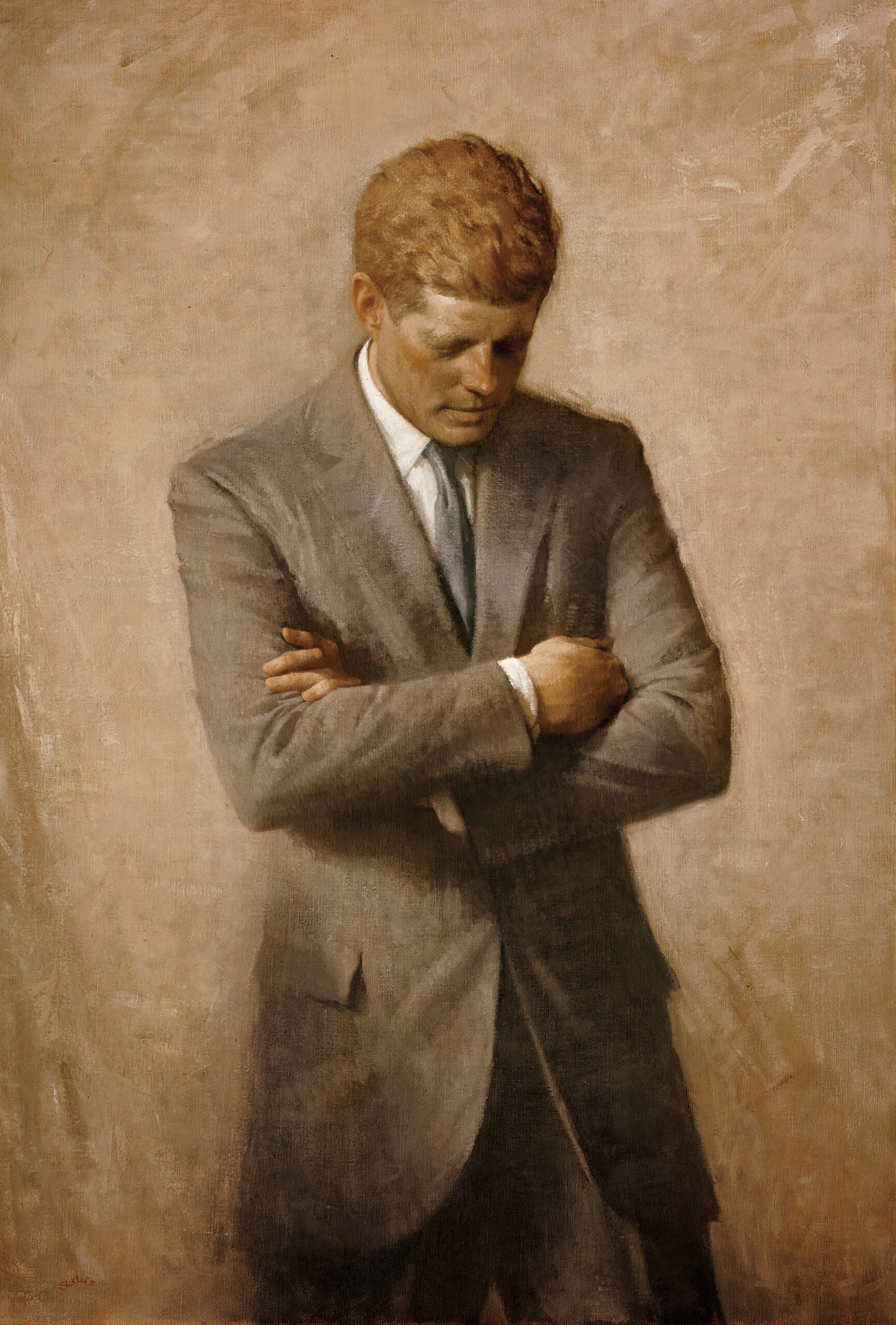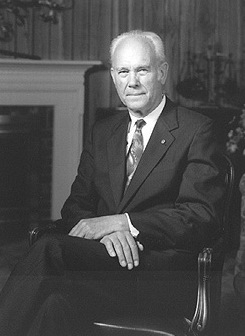
Tag: ARRB

  • Old Wine in New Bottles: Fletcher Prouty’s New Critics Recycle the Past

    Old Wine in New Bottles: Fletcher Prouty’s New Critics Recycle the Past


    (Disclosure: the author is a friend and colleague of Len Osanic, who befriended and worked with Fletcher Prouty in his later years. Len continues to run the Fletcher Prouty online reference site www.prouty.org)

    Recent years have seen a resurgence in reputational criticism of the late Col. L Fletcher Prouty, the former Pentagon official responsible for numerous influential books and essays, and the real-life model for the fictional Mr X character in Oliver Stone’s 1991 film JFK. Curiously, these efforts – by a small but vocal faction – gathered momentum following the passing of John McAdams, a self-styled “debunker” of JFK assassination theories who had been a central source of reputational disparagement of Prouty dating back to the early 1990s.[1]The renewed efforts have added little to what had been previously articulated, but are notable for a distinctly strident tone and a smug certainty in presenting harsh conclusions which are not at all supported by the available record. By this, the new anti-Prouty crowd appear distinguished by being actually worse, or at least more irresponsible and reckless, than their late mentor.

    I

    A central focus for these critics has been Prouty’s 1996 appearance before a panel of ARRB staffers. While this event earned little more than a passing mention in the McAdams compendium, to contemporary debunkers it serves as the effective immolation of Prouty’s entire assassination-related oeuvre as, over the course of a long interview, he allegedly “could not substantiate any of his allegations.”

    Prouty’s Appearance at the ARRB 1996

    The Assassination Records Review Board was created by the US Congress in the wake of Oliver Stone’s JFK film and the resulting outcry over the continuing classification of much of the official record and subsequent investigations. The Board had the mandate to identify records and oversee the process by which they would be made public. In certain circumstances, the Board had the authority to interview persons whose input could assist with locating records or whose personal experiences might help clarify circumstances which were yet incomplete. An interview was arranged with Fletcher Prouty for September 1996, with the intention of both clarifying experiences and identifying records.

    The 9/10/96 letter from Chief Counsel Jeremy Gunn read as follows: “We will ask you to recount your personal experiences from around the time of the assassination of President Kennedy, as well as whatever information you have regarding military activities and procedures in effect. I would also like you to bring with you any relevant documents or notes related to these topics, especially any contemporaneous records (such as personal correspondence, telephone notes, daily diary entries, or the like) you might have.”

    A month previous to this communication, a memorandum had been distributed to Gunn from Tim Wray, a Pentagon veteran who was then running the ARRB’s Military Records Team. Wray understood a potential interview with Prouty would be assisting an effort known as the “112 Military Intelligence Project”, specifically interested in information previously published by Prouty concerning a possible “stand down” order directed to a Texas-based Military Intelligence unit related to presidential protection duties in Dallas 1963.[2]

    Wray’s 8/9/96 memo on Army Intelligence in Dallas read as follows: “We should eventually interview Prouty as well, though I frankly do not expect much from this—everything about his story that we’ve been able to check out so far appears to be untrue….Its only slightly more difficult to check the factual basis for the other elements of Prouty’s story….Prouty’s assertion to the contrary notwithstanding—it appears that military collaboration with the Secret Service was in fact, extremely limited, and that there certainly were no such thing as “military presidential protection units” per se.

    Wray would also later write, “Among other purposes, an important goal of this interview was to ask Prouty about three specific allegations he made in his book, “CIA etc”. These allegations were of particular significance to use because Prouty claimed they were based on his own firsthand knowledge.” (Wray Memo of 2/21/97)

    That there was an identified “important goal” for the interview was not shared with Prouty in the communication from September 10, 1996. Similarly, Wray’s Military Records Team assistant Christopher Barger composed a memo the following day, September 11,1996, identifying specific “allegations” appearing in Prouty’s 1992 book JFK: The CIA, Vietnam, and the Plot to Assassinate John F Kennedy, and proposing a line of questioning marked by an innate skepticism directed to Prouty’s “personal experiences”.[3] This doubting approach to his published work was also not shared with Prouty ahead of his appearance.

    The interview was conducted on September 24, 1996. According to some, referring to his performance, Prouty suffered severe damage to his reputation and the integrity of his rendering of the historic record.[4] This version of events relies on an interview “Summary”, produced by Military Records Team assistant Barger, which frames the exchange as a contentious deposition.[5] The integrity of this Summary relies on the assumption that the Team participating in this interview spoke from a position supported by the confirmed record.

    If It Walks Like A Duck…

    Wray wrote, about a month later:

    “…we should make (Prouty’s) interview with the ARRB easily available in written form so people can see for themselves what’s behind the fluff…There’s no way we can fairly represent the interview in summary form without it looking like a hatchet job.” – (Tim Wray, ARRB Memorandum October 23, 1996.)[6]

    1.TranscriptThe interview transcript was published along with the Summary so that, according to Wray, the process wouldn’t merely appear as a “hatchet job”.

    It might seem obvious that if one cannot “fairly” describe an interview process without it appearing as a “hatchet job”, then the proposition that the process was, in fact, a hatchet job is in play. Wray, to the contrary, asserts, literally, that “the emperor has no clothes” and declares therefore the ARRB Military Records Team is “not planning to do much of (Prouty’s) laundry.”[7] Beyond the strained analogy, Wray’s memorandum establishes the Team engaged the interview as an adversarial contest, tied to their own biases and skewed to a partisan acceptance of the JFK assassination’s Official Story. In a telling example, Barger opines: “Prouty also admits that he has never read or even seen the Warren Commission Report. No reputable historian would write a criticism of a source document without having read the source document first.”[8]

    Barger’s Summary begins by noting the panel’s interest in Prouty stemmed from “claims”, “theories” and “conclusions” often based on “special, firsthand knowledge that he gained through his own experiences” during his years at the Pentagon. The purpose of the interview is therefore, in part, to determine the extent to which his “various allegations or statements” were based on “personal knowledge or experience”, and, “should he disavow factual knowledge”, to determine if he is aware of other “factual data that could tend to prove or disprove his allegations.” The Summary proceeds to itemize ten supposed “allegations” Prouty had articulated or published in his work, and putting them to a test, such as locating reference in official documents or finding confirmation through the identification of other individuals. In conclusion, The Summary insists the Team “intended on hearing his story”, but found “in the face of numerous contradictions, unsupportable allegations, and assertions which we know to be incorrect, we have no choice but to conclude that there is nothing to be gained or added to the record from following up on anything he told us.”[9]

    While this Summary conclusion has apparently convinced some persons that Prouty should not be taken seriously, it represents a prejudiced interpretation reliant on a concept of allegation introduced solely by the Team’s own initiative. The concept of a “hatchet job” is confirmed by the notable reliance in the Summary on this term – allegation – a word never articulated in the communications with Prouty ahead of the interview, and used sparingly during the interview itself.[10] Within the Summary, however, its prominent use is naturalized by repetition, and contemporary endorsements of the Summary’s conclusions repeat the word liberally.

    Put another way, and considering the range of experiences across Prouty’s professional career, one might refer to his “observations” instead of the more obviously loaded preferred description. The difference between the two is quite sharp, particularly since the stated purpose of the interview, from the Team’s perspective, was to “prove or disprove” and “confirm or deny”:

    ob·ser·va·tion |(ə)n |

    a remark, statement, or comment based on something one has seen, heard, or noticed

    al·le·ga·tion |noun

    a claim or assertion that someone has done something illegal or wrong, typically one made without proof

    2.allegationThe Summary of the ARRB interview framed Prouty’s personal experiences as a series of “allegations”.

    There are ten separate “allegations” described in the Interview Summary, each with a “Result or Conclusion by ARRB” attached. Three “allegations” refer to content in the JFK film; one refers to Prouty’s work as a military liaison with the CIA; and six have to do with presidential protection, a field outside of his professional responsibility and of which he had no practical experience.

    The first “allegation” refers to Prouty’s trip to Antarctica in November 1963, noting, in the JFK movie, this trip was portrayed as “out of the ordinary or unusual in some way.”[11] Although, in a later publication, Prouty had surmised retrospectively if there was a hidden reason to being selected for the journey, he otherwise spoke consistently, including to the ARRB panel, of the trip as routine.[12] The assumed “sinister connotations”, portrayed by the ARRB panel as an “allegation”, is in fact a dramatic embellishment attributable to the JFK screenwriters, not to Prouty – who, regardless, is described as unable “to back up the suspicions he mentioned in the excerpt from his book.”[13] The second “allegation” concerns information appearing in wire service news reports and published in a New Zealand paper approximately 5-6 hours after the shots in Dallas.[14] While the Team’s “Result or conclusion” of this minor affair doesn’t refer to an actual result or conclusion, it does suggest “Prouty’s allegation of a ‘cover story’ will be weakened”. The point missed, however, is by his presence in New Zealand Prouty was outside and apart from the common shared experience stateside on that day, dominated by the visceral shock of the initial news followed by a steady drip of information which appeared to follow a sequential logic. Outside the simulacrum, Prouty could make the obvious, and correct, observation that there had quickly appeared a great deal of information about a suspect who had yet to be even arraigned on the JFK case, and in fact wouldn’t be for another 6-7 hours.[15] Having made this first observation, it is fair for him to point out the incorrect reports of “automatic weapons fire” – as others did as well.

    “Allegation” numbers three through five, and ten, concern Prouty’s information – published in his book JFK: The CIA, Vietnam and the Plot to Assassinate John F. Kennedy and in his Foreword to Mark Lane’s book Plausible Denial — regarding an apparent case of security stripping in Dallas involving a military intelligence outfit based in San Antonio.[16] Prouty had privately received information that the 112th Unit had been advised to stand down in Dallas by the Secret Service, This was referring to a Presidential protection capability within the military. According to internal memoranda, the ARRB Military Records Team was skeptical such units existed and was determined to “debunk” Prouty’s information. In the fullness of time, Prouty’s veracity regarding both the actual fact of military intelligence support for presidential protection, and the private communication he received, has been confirmed and the Team’s skepticism debunked.[17]

    Allegations six and seven refer to Prouty’s knowledge of Secret Service presidential protection protocols. When mentioning these, Prouty is referring to events specific to his military career, including several days in Mexico City, 1955, with a Secret Service advance team ahead of an Eisenhower visit. Prouty’s observations from these episodes inform his published statements and his statements during the ARRB interview. He qualifies his interactions as having “logistics purposes, not to learn all about the system.” The ARRB’s Summary characterizes the “allegations” as lacking corroborative documentation. This lack included failing to answer the question: “How many Secret Service agents would you have expected to be providing coverage in Dallas?”[18] Figurative speech is also interpreted literally, such as Prouty’s reference to the Secret Service working from a long-established “book” (he is asked if he has a copy of the “book”), or his impression that the Secret Service was deficient in Dallas stated as “they weren’t there” (he is asked if he meant they literally were not there).[19] This exchange is referred in the Summary as follows: “Prouty makes the very serious charge that the Secret Service was not even on duty in Dallas on November 22, then admits he has no experience upon which to base this statement.”[20] In truth, the deficiencies of the Secret Service during the Dallas motorcade have been well-catalogued, if not by the sources who appear to have influenced the Team.

    “Allegation #8” concerns whether some of Oswald’s activity during his Marine service in Asia – specifically with radar at Atsugi air base (where the U2s were based) and potentially in support of operations directed at Indonesia – could be described as part of CIA-directed programs. Although Prouty correctly describes the existence of the programs and Oswald’s proximity, the Panel jumps on his lack of specific documentation (“substantiating evidence”) as a means of dismissing the notion Oswald was involved. Even though Oswald himself specifically hinted at insider knowledge of U2 activity (at Atsugi) during his communications in Moscow related to his defection to the USSR, the Team presumes to consign this “allegation” as based merely on open-source rumors.

    “Allegation #9” refers to Prouty’s identification of Ed Lansdale in one of the well-known “Tramps” photos, which is portrayed in the JFK film. The Team acknowledges that a “search of travel records” might confirm or deny Lansdale’s presence in the Dallas region at the time, but factors such as the “small likelihood” of finding such records and their “relative unimportance” indicated that such effort was “not worth checking out.” (Summary ,p 11) In 1991, at the time of the JFK film, Lansdale could be traced to Fort Worth, Texas mid-November 1963. Subsequent information has placed Lansdale in Denton, a Dallas suburb, on the evening of November 21, 1963.[21]

    In sum, despite the brutal Summary composed in the aftermath of Prouty’s appearance before the ARRB’s Military Records Team, none of the ten points presuming to “debunk” his “allegations” actually hold up under scrutiny. That is, while the ARRB’s panel makes much of Prouty’s supposed failure to produce information outside his jurisdiction, such as Secret Service “manuals” (of which they aren’t even sure exist in the first place), and proceed to criticize his lived experiences, there is nothing actually incorrect or overstated in his observations. Latter-day critics lionize the Military Records Team’s Summary conclusions using a superficial reading based largely on the Team’s own predetermined finger-pointing, which was biased and subject to partial knowledge later superseded. However, there was one data point appearing in the Summary which has held up over the years as an accurate statement:

    “Fletcher Prouty was where he says he was during the period from 1955-1964. His position can be documented.” (P. 13)

    II

    Prior to the release of Oliver Stone’s JFK in late 1991, L. Fletcher Prouty was a relatively inconspicuous figure known to few outside of aging participants of early Cold War military/intelligence circles, or committed parapolitical researchers and their small followings. The backlash directed against the film – which began while it was still filming – attacked the intellectual foundation of the screenplay, as personified by director Oliver Stone (purportedly being “fooled” by Warren Commission critics), the film’s “compromised” protagonist (Jim Garrison) and, to a lesser extent, the insider Fletcher Prouty (known in the film as “Mister X”).
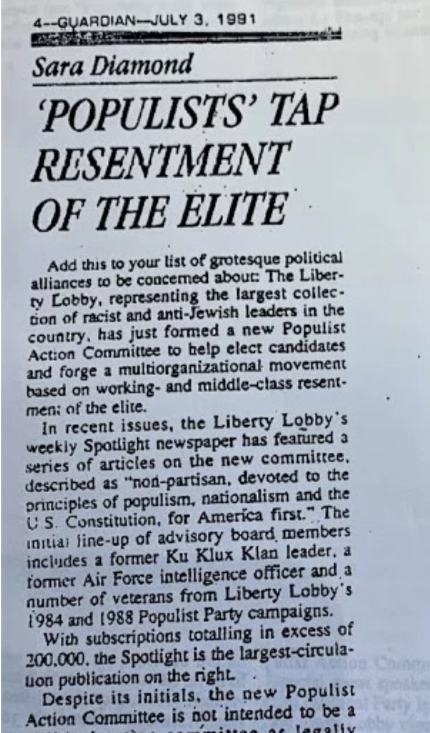
    3.NYC.Guardian.1991A photocopy of Diamond’s Guardian article was anonymously submitted to the JFK production office, along with several typewritten pages of “opposition research” directed at Prouty.

    All three were in the crosshairs of an article published in the November 1991 issue of Esquire Magazine. With the punning title “The Shooting of JFK”, author Robert Sam Anson put together one of the key contributions to the anti-JFK literature from the period, covering the film’s production. While bashing first Stone, then Garrison, and then turning to Prouty in a late-article segment which combined character assassination with an offhand revelation of why it was exactly the establishment had problems with the film.[22]

    Anson introduces Prouty as a genial grandfather type, at least as so impressing the JFK production office, but notes the whispers of “cautious buffs” who are “leery” and wary of Prouty’s background and “claims.”[23] Suddenly, in the production office, a “small thing” starts “the trouble”, and reporter Anson, despite the staff’s nondisclosure agreements, manages to be in the know and in the loop. Anson reports that some of the office’s research staff had been paging through “a tiny left-wing New York weekly” and, by chance, discovered an article identifying Fletcher Prouty “as a cause célèbre in the virulently anti-Semitic, racist Liberty Lobby.”[24]

    The article in question – ‘Populists’ Tap Resentment of the Elite – written by Sara Diamond and published in the July 3, 1991 issue of The Guardian (NYC) – was a legitimate investigative work, and the specific references to Prouty’s activities were accurate. While, to those who knew Prouty, the concept he was a racist fellow-traveler in step with the most virulent members of the Lobby, or even a “right-winger” as portrayed, appeared fringe and absurd, within Stone’s production office the general consensus was Prouty’s associations “looked bad” and could be a “public-relations time-bomb” for the JFK film.[25] The top researcher on staff told Stone: “Basically, there’s no way Fletcher could be unaware of the unsavory aspects of the Liberty Lobby.”[26]

    The Connections to the Liberty Lobby

    The finger-pointing directed at Prouty associating him with the Lobby was based on essentially four items: guest appearances on a syndicated radio program – Radio Free America – hosted by Tom Valentine and sponsored by The Spotlight, the Lobby’s weekly newspaper (numerous appearances 1988-94)[27];a speaking engagement at The Spotlight’s annual national convention (September 1990); the re-publication of Prouty’s The Secret Team by the Lobby’s imprint Noontide Press (autumn 1990)[28]; and Prouty’s being named to a national policy advisory board for the Lobby’s Populist Action Committee, (spring 1991).[29]
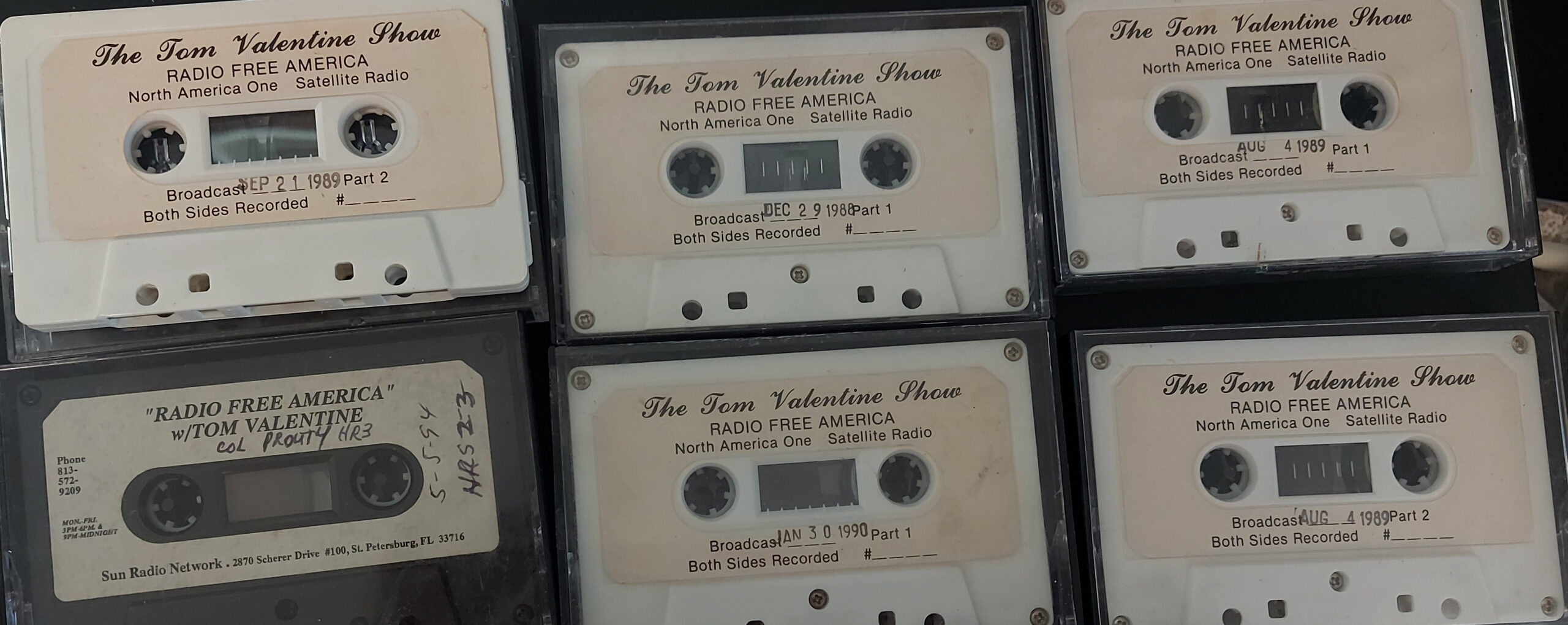
    4.Valentine.showCassettes from Radio Free America, Tom Valentine’s syndicated AM radio program. Prouty was a popular guest with both the host and the audience, appearing several times a year through 1994.

    Taken at face value, in addition to the radio program which he appeared several times a year from 1988-94 as a popular guest, the links may stem from the longer association of Prouty’s colleague Mark Lane with the Liberty Lobby, representing them across several lawsuits in the mid-to-late 1980s. The experiences would result in a book, Plausible Denial, published in 1991, for which Prouty wrote the Foreword. In his book, Lane describes how his interest in representing the Liberty Lobby was piqued by the convergence of the initial litigation, which involved E. Howard Hunt, with the JFK assassination. Lane felt it was an opportunity to litigate a facet of that lingering controversy, and potentially assist its eventual resolution.

    Prouty’s brief direct association with Lobby-related groups in late 1990 / early 1991 is coincident with the preparation of Plausible Denial.

    When You’re A Hammer, Everything Looks Like A Nail

    As it happened, there were at least three researcher/reporters working the far-right “beat” in 1990-91, observing activity sponsored by the Liberty Lobby. One was working for the Anti-Defamation League.[30] The second was Sara Diamond, the author of the piece published in the “tiny left-wing New York weekly”, and at the time working on a UC Berkeley sociology PhD, eventually producing a dissertation entitled “Right Wing Movements in the United States 1945-1992”. The third was activist Chip Berlet, concentrating on the influence of America’s political right with particular concern directed to overlap, or convergence, of the right with the left.[31] Both Berlet and Diamond were outspoken with their opinion that alliances between the extreme right and the Left, initiated through mutual disagreement with official policies such as the Gulf War, was a “bad idea” and perhaps part of a strategic plot by the right to co-opt or discredit Progressives.[32]

    Berlet was in attendance at the 1990 Spotlight conference, at which Prouty spoke, and at which both Mark Lane and Dick Gregory also appeared.[33]Acknowledging the conference’s attention to looming foreign policy controversies in the Middle East,Berlet wrote: “There was considerable antiwar sentiment expressed by speakers who tied the U.S. presence in Saudi Arabia to pressure from Israel and its intelligence agency, Mossad…No matter what actual political involvement, if any…the themes discussed at the Liberty Lobby conference tilted toward undocumented anti-Jewish propaganda rather than principled factual criticisms.”[34] However, rather than analyze the contrasts between the propaganda and the factual criticisms, Berlet is more interested in highlighting links between individuals and organizations, and connecting overarching thematic concepts between them. So the content of Prouty’s remarks, with the topic “The Secret Team”, is not discussed, but his acknowledgment during the presentation of Noontide Press for republishing his book is.[35] Similarly, the reader learns who followed Prouty to the podium, who participated in a panel Prouty moderated, how The Spotlight paraphrased the event, and even how persons “associated” with the Liberty Lobby later circulated antiwar literature “at several antiwar rallies.”

    Researcher Laird Wilcox, editor of the annual Guide To the American Right surveys, criticized in the 1990s what he termed an “anti-racist industry”, claiming anti-racist groups had consistently overstated the influence of what are in fact fringe movements, and named both the ADL and Political Research Associates as having engaged questionable tactics to support their conclusions.[36] “Mr. Wilcox says what most watchdog groups have in common is a tendency to use what he calls ‘links and ties’ to imply connections between individuals and groups.”[37]

    ‘Links and ties’ is certainly not an uncommon technique, particularly for political research. It does however produce a lot of “false positives”, and researchers are perhaps therefore best served exercising a degree of due diligence and establishing secondary sources before jumping to conclusions – such as Diamond’s linking Prouty to the “extreme right” or Berlet labelling him a “fascist”.[38]This can be compounded by a rhetorical strategy of using broad brush strokes to establish and portray monolithic racialist structures – a tendency which may be effective as a partisan effort to “sound the alarm”, but which can be misleading and reduce political complexity to simple and skewed dichotomies.[39]In this fashion, the Liberty Lobby’s weekly newspaper The Spotlight was assumed by the three researchers as necessarily a tool of the anti-Semitic foundation of the Lobby, and was therefore, in their perception, obviously engaged primarily in disseminating that message (although much of that effort may appear in code).[40] Other information portrays The Spotlight, at least during the time in question, as servicing a broader populist conservative community. The publication is described in Kevin Flynn’s 1989 investigative The Silent Brotherhood as “one of the right wing’s most widely read publications”, attracting “a huge diversity of readers, from survivalists and enthusiasts of unorthodox medical treatments to fundamentalist Christians and anti-Zionists.”[41]Daniel Brandt’s NameBase, a parapolitical research tool, described The Spotlight in 1991 as “anti-elitist, opposed to the Gulf War, wanted the JFK assassination reinvestigated, and felt that corruption and conspiracies could be found in high places.”[42]

    Prouty himself responded to the criticisms of his “links and ties” to the Liberty Lobby as follows:

    “I’ve never written for Liberty Lobby. I’ve spoken as a commercial speaker, they paid me to speak and then I left. They print a paragraph or two of my speech same as they would of anybody else, but I’ve never joined them. I don’t subscribe to their newspaper, I never go to their own meetings, but they had a national convention at which asked me to speak and they paid me very, very well. I took my money and went home and that’s it. I go to the meeting, I go home, I don’t join.”[43]

    III

    An honest review of the “hatchet-jobs” directed at Fletcher Prouty invariably sources to the time frame of 1991-1992, coinciding with the U.S. establishment’s attack on Oliver Stone’s JFK film, conducted through its legacy media. In light of that, a curious feature of Robert Sam Anson’s Esquire piece is its concluding section, following directly from the Liberty Lobby “cause célèbre” takedown of Prouty, which had in turn followed a concentrated bashing of Stone and then Jim Garrison. Rather than continuing with the overt criticism, the concluding section hastily endorses a new personage with a point of view said to gel with Stone’s general thesis of JFK’s intention to exit Vietnam, but with a non-conspiratorial spin.

    5.Prouty.with.JudgeProuty with John Judge in early 1992. Small circulation VHS interviews were among the limited options available for efforts to support and supplement Stone’s “JFK”.

    The new personage was John Newman, well-regarded these days with a solid thirty-year run of intensively detailed histories of the Kennedy administration’s national security challenges. Upon this introduction, Anson sets out immediately to contrast Newman with Prouty, utilizing complementary adjectives: Newman is described as “meticulous, low-key, methodical, highly experienced, characteristically cautious” while Prouty is “ever-voluble” and prone to jumping to conclusions. Anson strongly infers that Newman expresses what amounts to the “good” interpretation of events, while Prouty embodies the misshapen “buff” perspective.

    On the other hand, Newman’s perspective still confirms the previously fringe viewpoint that Kennedy had developed a Vietnam policy anticipating an eventual complete withdrawal of “military personnel”, which the JFK film had adopted. Anson opts to promote a presumed back-channel “secret operation” designed to “systematically deceive” the White House so to encourage expansion of the US effort in Vietnam. This secret operation is proposed to be “the real story” above and beyond Fletcher Prouty’s musings regarding the distinctions between National Security Action Memorandums 263 and 273. In the fullness of time, the “back-channel secret operation” never proved a viable hypothesis, while Prouty’s intuitive commentary on NSAM 263 and 273 has been effectively accepted even if debate over motivation continues.

    Therefore, the two express “hatchet-jobs” directed at Prouty in 1991 and 1996 – the Esquire piece and the ARRB interview – both promoting the pretension that Prouty was unstable and his concepts were easily “debunked” by the official record, have proved to be fundamentally in error, first over the NSAMs and second over the military intelligence units. To this day, Prouty’s detractors still cannot articulate where exactly he is wrong – about the assassination or about his experiences during his military career. This is why such criticisms invariably fade into a drab curtain of distraction, stained with reference to the Liberty Lobby, Scientology, Princess Diana, and other irrelevancies.

    Oliver Stone put it well in his published response to Anson’s Esquire piece: “(Prouty’s) revelations and his book The Secret Team have not been discredited in any serious way. I regret his involvement with Liberty Lobby, but what does that have to do with the Kennedy / Vietnam issue?…I have not, nor do I intend, to ‘distance’ myself in any way from Garrison’s or Colonel Prouty’s long efforts in this case. They may have made mistakes, but they fought battles that Anson could never dream of.”


    NOTES:

    [1] Mcadams’ Prouty entry on his JFK assassination website was an oft-cited compilation of disparaging talking points. Most if not all of this concerted “debunking” has in turn been debunked. Disputes over the factual record and Mcadams’ seeming influence over certain Wikipedia gatekeepers (editors) resulted in a classic essay discussing narrative management and the internet: Anatomy of an Online Atrocity: Wikipedia, Gamaliel, and the Fletcher Prouty Entry

    [2] See Fletcher Prouty vs the ARRB by Jim DiEugenio for the full story.

    [3]Memorandum dated Sept 11, 1996.

    [4]L. Fletcher Prouty Talks to the ARRB

    [5]Interview Summary, prepared October 23, 1996 by Christopher Barger

    [6]Memorandum is found on page 70 of this link.

    [7] Ibid

    [8] Interview Summary p11. In context, Prouty’s reference to the Warren Report is based on the understanding it was fully part of a cover-up operation and therefore wholly unreliable as a “historic” record and, in that regard, useless as a “source document.” Prouty’s work never had the pretension to specifically “criticize” the Report for this reason.

    [9] In some instances, the panel holds Prouty as “unreliable” due to his reluctance to identify individuals, despite his specific caution at the interview’s start that he will not identify individuals who are/were operational – “I never name a man who is operational. Never.” He was also labelled unreliable by being unable to produce particular documentation, although he had explained that the types of documents they sought either never existed or had been long destroyed.

    [10] The full transcript of the September 24, 1996 interview with Prouty can be accessed here.

    [11] Allegation #1: Trip to Antarctica may have had sinister connotations. Interview Summary p2

    [12] L. Fletcher Prouty, JFK: The CIA, Vietnam and the Plot to Assassinate John F. Kennedy, Introduction by Oliver Stone (New York: Citadel Press, 1992), p. 284. “I have always wondered, deep in my own heart, whether that strange invitation that removed me so far from Washington and from the center of all things clandestine that I knew so well might have been connected to the events that followed.”

    [13] “Result or conclusion by ARRB:…Prouty made no statements for the record to back up the suspicions he mentioned in the excerpt from his book cited above.” Interview Summary p3.

    [14] “it is alleged that the Christchurch Star, when running its first story about the assassination, included biographical information on Lee Harvey Oswald and named him as the accused before he had actually been arraigned for the crime in Dallas. The allegation is also made that the first reports from Dealey Plaza, which were not entirely accurate, were sent out as a part of a ‘cover story’ of some sort.” Interview Summary p3.

    [15] The rapid identification of Oswald as first the main and eventually the only suspect remains to be accounted for, particularly as the evidence was sparse and the suspect was denying everything. It is not known how or why the FBI concluded Oswald “did it” an hour after his arrest, or the process by which the wire services soon after were presumably signalled that Oswald’s identity and biography was newsworthy. There were other arrests made in connection with Dealey Plaza, but none other than Oswald featured names and personal biographies splashed across the evening news.

    [16] L. Fletcher Prouty, JFK: The CIA, Vietnam and the Plot to Assassinate John F. Kennedy, Introduction by Oliver Stone (New York: Citadel Press, 1992 p. 294. Plausible Denial p XV.

    [17] See: “Fletcher Prouty vs the ARRB” by Jim DiEugenio

    [18] interview transcript p36 Prouty’s tone in reply is noted: “(testily) See, we’re overdoing this. I went to Mexico City once, so I’d know the business…”. In the Summary, the descriptive “(testily”) is changed to “(Very agitatedly)” Summary Barger p8

    [19] Wray: “…When you say “the Secret Service was not in Dallas” do I understand you are speaking a little bit figuratively there? That they may have been there, but weren’t doing their job thoroughly? Or do you mean literally, that they were not there?” Interview transcript (P36).

    [20] Barger Summary p8. Prouty in fact discussed his experience, which was in 1955 in Mexico City

    [21] pp 261-262 Alan Dale with Malcolm Blunt, The Devil Is In The Details, self-published 2020. Prouty’s identification was confirmed by his Pentagon boss Victor Krulak in a personal letter written in the 1980s. There have been claims such letter never existed, but it is be found in the Prouty document archive maintained by Len Osanic.

    [22]Anson had previously written They’ve Killed the President, Bantam 1975, in which he first bashed Garrison and his truncated investigation.

    [23]According to Anson, the whispers suggested Prouty “had a tendency to see the CIA’s dark hand everywhere…Another liability was Prouty’s fondness for putting himself at the center of great events.” These suggestions seem to refer to Prouty’s military career, during which, most everyone agrees, he worked closely with CIA and “was where he says he was…his position can be documented.”

    [24]This may not be an accurate account of this discovery, as around the same time the research staff had been forwarded a photocopy of the article in question, along with several typewritten pages referring to complementary research by a researcher with the Anti Defamation League. Both sources supplied similar reference to associations between Prouty and groups linked with the Liberty Lobby. It is possible the chance “discovery” was more accurately described as the arrival of unsolicited opposition research forwarded to the Stone office. Exactly how Anson got word of this is not known.

    [25]Anson writes: “When questioned, Prouty, the intelligence expert, pleaded ignorance. He had not known of (Liberty Lobby founder) Carto’s Nazi leanings, he insisted…As for (Carto’s) assertion that the Holocaust was a lie, (Prouty)…would say only, ‘I’m no authority in that area.’ ‘My God,’ moaned a Stone assistant after listening to the rationalizations. ‘If this gets out, Oliver is going to look like the biggest dope of all time.’” This paragraph can be read as inferring Stone’s team confronted Prouty and were listening directly to his response. Anson’s sentence structure, however, is not exactly precise and leaves open the possibility, or likelihood, that someone else conducted this questioning of Prouty, under unknown circumstances, and that the staffers “listened” to the “rationalizations” second-hand.

    [26]This opinion is something of an extrapolation, also expressed by Anson i.e.: “When questioned, Prouty, the intelligence expert, pleaded ignorance.” This presumes Prouty’s attention to detail in his professional capacity necessarily carried over to other aspects of his life. Such presumption is not entirely accurate as, for example, at the time they first met, Prouty was entirely unfamiliar with Oliver Stone and had not seen any of his films, despite the publicity associated with Stone’s career momentum in the 1980s and his three Oscar wins.

    [27]Prouty’s appearances, across several years, were cited as a clear indication of his “being up to his neck in the racist right movement”. Len Osanic has copies of Prouty’s Radio Free America appearances on cassette, and says the claim, sourced to Anti Defamation League researchers, that the program engaged in routine anti-semitism and Holocaust Denial are “nothing”. Osanic says Prouty’s appearances were essentially similar to the contemporaneous Karl Loren Live broadcasts from Los Angeles which Prouty also appeared during this period. The author has reviewed several of Prouty’s interviews with Valentine and concurs with Osanic. The discussions cover ground exactly similar to most other interviews Prouty gave at the time, the content of which are entirely uncontroversial.

    [28]Prouty told Len Osanic the publication was a “one-time” commitment, a limited press run for which Prouty received a small amount of money. Prouty told Osanic that he understood Noontide as specializing in editions of books which had fallen out of circulation. Noontide, at the time, had also republished Leonard Lewin’s Report From Iron Mountain. The original edition of The Secret Team in 1973 was subject to distribution problems. Prouty discussed this in a note to the 1997 edition: “ After excellent early sales of The Secret Team during which Prentice-Hall printed three editions of the book, and it had received more than 100 favorable reviews, I was invited to meet Ian Ballantine, the founder of Ballantine Books. He told me that he liked the book and would publish 100,000 copies in paperback as soon as he could complete the deal with Prentice-Hall…Then one day a business associate in Seattle called to tell me that the bookstore next to his office building had had a window full of the books the day before, and none the day of his call. They claimed they had never had the book. I called other associates around the country. I got the same story from all over the country. The paperback had vanished. At the same time I learned that Mr. Ballantine had sold his company. I traveled to New York to visit the new “Ballantine Books” president. He professed to know nothing about me, and my book. That was the end of that surge of publication. For some unknown reason Prentice-Hall was out of my book also. It became an extinct species.” The Secret Team book, and its unavailability, was referred several times on the Valentine radio program ahead of the republication.

    [29]Prouty agreed to the use of his name, but said he had no other involvement with the Committee, i.e. he never provided advice or attended any meetings.

    [30]This may have been Kenneth McVay, whose work, later published online, corresponds to the cited information sent to Stone’s office; see this and this.

    [31]Berlet’s divisive rhetoric targeted “virtually every independent critic of the Imperial State that the reader can name”, which at the time in question (1990-91) included “the Christic Institute, Ramsay Clark, Mark Lane, Fletcher Prouty, David Emory, John Judge, Daniel Brandt” et al. Ace Hughes, Berlet for Beginners, Portland Free Press, July/August 1995.

    [32]Berlet, Chip. Right Woos Left: Populist Party, LaRouchite, and Other Neo-Fascist Overtures to Progressives, and Why They Must Be Rejected, 1999, Political Research Associates.

    [33]“Other conference speakers and moderators at the September 1990 Liberty Lobby convention included attorney Mark Lane, who has drifted into alliances with Liberty Lobby that far transcend his role as the group’s lawyer, and comedian and activist Dick Gregory, whose anti-government rhetoric finds fertile soil on the far right.” Berlet, Chip. Right Woos Left p40

    [34]ibid

    [35]A public expression of gratitude to the publishers is a routine dedication for authors.

    [36]Wilcox, Laird The Watchdogs 1997 self-published.

    [37]Researcher Says ‘Hate’ Fringe Isn’t As Crowded As Claimed, Washington Times, May 9, 2000. p.A2

    [38]NameBase is a cross-indexed database tool for “anti-Imperial” researchers, initiated by Daniel Brandt. Chip Berlet, along with Fletcher Prouty, was on the NameBase Board of Advisors in 1991 when Berlet, describing Prouty as a “Larouche-defender”, announced his refusal to remain on the same Board. Brandt encouraged Berlet to leave, saying “When it came to making a choice between Prouty and Berlet, it was a rather easy decision for me to make.” Berlet took three other Board members with him, and a lingering feud percolated for many years after. See this.

    [39]Via “links and ties”, it was common for right-wing rhetoric in the 1960s to label ideological opponents as literally Communist agents embedded within civil rights and other movements. Debates over methodology – such as links and ties – which were frequent in the 1990s, highlighted the expanding scope of identified political “enemies” (a debate again familiar in today’s polarized political and social landscape). This expansion resulted in erroneous claims such as that Prouty held right-wing, or even “extreme right-wing” political views, claims which are unfortunately being currently recycled by a small faction of researchers.Prouty never openly discussed his personal politics, other than to say “the only club I’ve joined is the Rotary Club.” Prouty, in the author’s opinion, could be fairly described as a “mid-century main-street Rotary Club American”.

    [40]Diamond is referred: “to understand where the Liberty Lobby and its supporters are coming from, you have to understand their code language, which seldom if ever attacks Jews directly, but instead refers to ‘the big medical establishment, the big legal establishment, the major international bankers’, all of them controlled by you know who.” The obvious problem with this proposition is that determining what is “code” and what is legitimate criticism is often a wholly subjective enterprise. Also, a “code” requires both the disseminators and the receivers to be “in” on the cipher interpretation.

    [41]The Spotlight “regularly featured articles on such topics as Bible analysis, taxes and fighting the IRS, bankers and how they bleed the middle class, and how the nation is manipulated by the dreaded Trilateral Commission and the Council on Foreign Relations.” p. 85. Flynn, Kevin and Gerhardt, Gary, The Silent Brotherhood: Inside America’s Racist Underground, The Free Press, 1989.

    [42]“we found only rare hints of international Jewish banking conspiracies or the like in The Spotlight.” See this.

    [43](Col. L. Fletcher Prouty Responds to Accusations of Involvement in Right Wing Extremist Groups Interview Date: April 3, 1996. – Col L. Fletcher Prouty Reference Site. There is no record of Prouty expressing extremist or racist views, as the researchers cited admit: “Diamond says that Prouty himself has, as far as she has been able to determine, made no public racist or anti-semitic utterances.” “Berlet states that Prouty himself has never made any overt anti-semitic or racist comments…” (typewritten document submitted to Oliver Stone’s production office) “Nothing here shows Prouty to have been a Nazi or an anti-Semite…” John Mcadams. This has not prevented a few contemporary critics from asserting that Prouty was, in fact, anti-semitic. This notion appears to be based on two items: an advance notice for a 1991 Liberty Lobby event which lists Prouty as a prospective speaker (Prouty did not in fact appear); and a 1981 private letter authored by Prouty in which, discussing the looming AWACS deal some months ahead of Reagan’s controversial public announcement, Prouty uses the phrase “Jewish Sgt” during a discussion of potential military logistic compromises associated with computerized systems relying on multiple inputs from different locations. The cherry-picked phrase, as presented, reveals essentially a lack of basic knowledge of the historic issue and perhaps a misunderstanding of the term “anti-semitic”. For a balanced perspective on the AWACS controversy see: Gutfeld, Arnon, The 1981 AWACS Deal: AIPAC and Israel Challenge Reagan, Begin-Sadat Center for Strategic Studies.
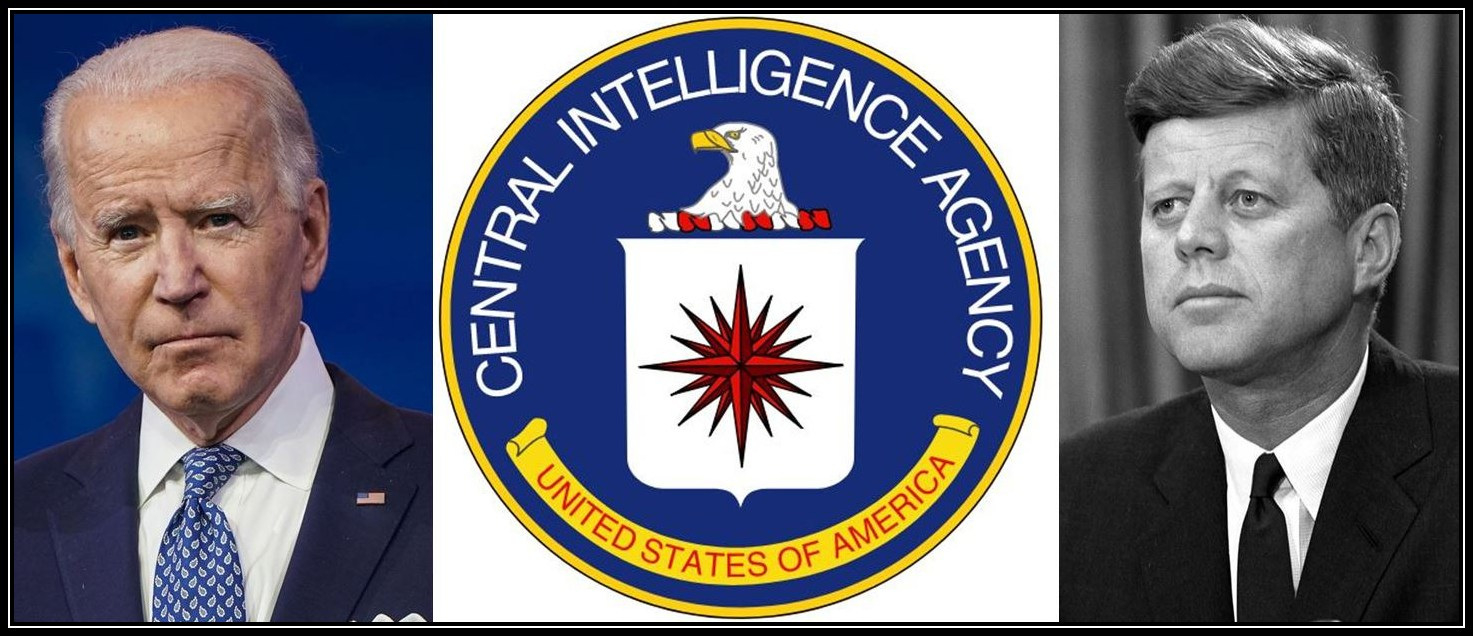
  • The Biden/CIA Attempt to Usurp Congress’ Authority Over JFK Records

    The Biden/CIA Attempt to Usurp Congress’ Authority Over JFK Records


    The Friday Night News Dump

    In the waning hours of the evening of Friday, June 30, 2023, long after the filing deadlines of the media elite in Washington D.C. and even longer after the most dedicated talking head had left to celebrate their July 4th independence from tyranny in the Hamptons, the Biden Administration issued an Executive Memorandum that is a flagrant and illegitimate attempt to terminate an Act of Congress and usurp congressional authority over its own processes and records. A copy of President Biden’s Executive Memorandum is here.

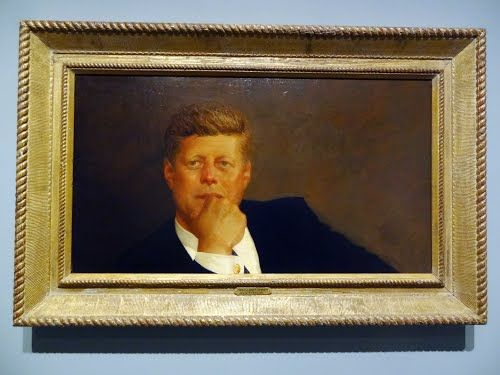
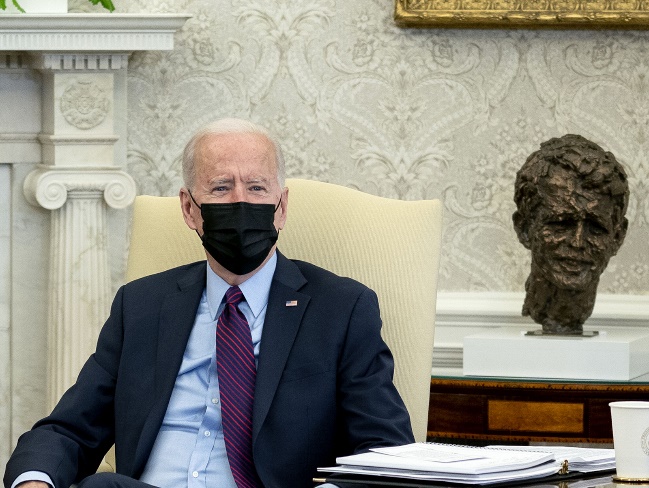
    It is unclear what truly prompted President Biden to take a flamethrower to an Act of Congress that he himself voted for in 1992 as a member of the Senate, due to bipartisan public pressure to release records related to the 1963 assassination of President John F. Kennedy. It is further perplexing that Biden has chosen to continue to deny the American public transparency into the death of a much admired predecessor since he has chosen to surround himself in the White House with artwork memorializing the Kennedys e.g. the bust of Robert F. Kennedy in the Oval Office and the famous portrait of JFK by Jamie Wyeth that President Biden specifically requested to be borrowed from the Museum of Fine Arts in Boston to hang in his private White House study.

    biden rfk(Stefani Reynolds for The New York Times)

    jfk portrait(Museum of Fine Arts, Boston)

    JFK Records Act Backgrounder

    What exactly is in Biden’s Executive Memorandum that is so egregious? Well, it would help to briefly go back to the 1990s, when Joe Biden was a U.S. Senator from Delaware and the Chair of the Senate Judiciary Committee.

    As a result of decades of significant controversy caused by the government withholding millions of pages of records related to the 1963 assassination of President Kennedy from the American public, Congress enacted the John F. Kennedy Assassination Records Collection Act of 1992 (JFK Records Act”). Congress was put under substantial public pressure to do something about the continuing secrecy around records related to Kennedy’s assassination, because 30 years after his murder, executive agencies were holding hundreds of thousands of assassination related files secret, based on unsubstantiated claims of “national security”. Freedom of Information Act requests were ineffective at penetrating a completely unaccountable lock that the U.S. security state had on these then 30-year-old records. Public outcry after Oliver Stone’s Oscar winning film JFK tipped the balance. So Congress passed the JFK Records Act in a rare, unanimous bi-partisan vote. The act was signed into law by the then President George H.W. Bush, and after numerous delays finally went into effect in 1994.

    The full John F. Kennedy Assassination Records Collection Act of 1992 can be found here. It is worth reading.

    The law mandates, among other things, that by no later than October 26, 2017, all records related to the 1963 assassination of President John F. Kennedy had to be publicly disclosed in full, unless for each record, the President certified that extremely stringent criteria for postponement were met. If such postponement criteria were satisfied based on the legal standard of clear and convincing evidence, the President’s unclassified reasons for postponing each individual record had to be published in the Federal Register. This way the public could at least understand exactly which specific records were being postponed and what the legal basis was for the postponement of each individual assassination record.

    It needs to be noted that in accordance with the provisions of both the JFK Records Act (particularly section 9(d)(1)) and the Constitution’s separation of powers, that the President’s authority to postpone the public disclosure of assassination records only applies to Executive Branch records (which are records created by agencies and offices controlled by the President e.g. CIA, FBI, Secret Service, DEA, NSA, DOD, etc…). The President does not have legal authority over “non-executive branch records”, which include records created by Congress and other sources not controlled by the executive branch. Congress was very careful when drafting the JFK Records Act to ensure that they did not grant the President authority to control their legislative branch records.

    Congress also required that for each assassination record, that all “Government Offices” (the JFK Records Act specifically includes the Executive Office of the President in the definition of “Government Office”) had to issue what is called an “Identification Aid” when any action was taken or decision made in respect to any record. These Identification Aids were tracking forms that attached to all assassination records and recorded a brief description of the record, including the date of the document, the originating agency or entity, the disposition of the record and any action taken with respect to the record, such as the particular section 6 criteria for postponement that provided the legal justification for continuing to hold the assassination record in secret from the public. 

    Further, Congress specifically mandated the Archivist of the United States to ensure that all Identification Aids for every postponed record form part of the Assassination Records Collection. Also, that a publicly accessible Directory of Identification Aids be created and maintained, so that there was full transparency for the public to understand exactly which assassination records were continuing to be held in secret in the Protected Collection and what the legal basis for postponement was under section 6 of the JFK Records Act for each record.

    Most importantly, Congress made it clear in the JFK Records Act that there was a “presumption of disclosure” and the legal burden was on an agency to prove that a specific assassination record met the legal standard for postponement required by the Act and that clear and convincing demonstrable evidence was required in order to deprive the public access to a record.

    In order to ensure that government agencies and offices complied with the JFK Records Act, Congress created the Assassination Records Review Board (“ARRB”). This 5 person citizens’ panel was tasked with collecting, cataloging and reviewing all assassination records, with the mandate to release all assassination records, unless a record met the exacting criteria set out in section 6 of the Act.

    The ARRB’s limited tenure ran fromOctober 1, 1994 to September 30, 1998.During the ARRB’s time in operation, the Board and staff reviewed and made “final determinations” about every single assassination record that was identified and submitted by government agencies and offices. In the mid-1990s when the ARRB was doing its work, the JFK Records Act mandated that only in the most rare and exceptional circumstances were assassination records to be postponed from public disclosure.

    The law also legally mandated that, based on “final determinations” and recommendations for release made by the ARRB, all postponed records had to be periodically reviewed under the same stringent and exacting standards of section 6 of the Act. The purpose of the Periodic Review process was to “downgrade and declassify” all of the records held secret in the Protected Collection. By legally mandating this downgrading and declassification periodic review process, the JFK Records Act makes it clear that as time passes it should become more difficult, not easier for executive agencies to keep assassination records secret and to deny the American people access all the facts about the circumstances surrounding President Kennedy’s murder.

    ARRB “Final Determinations” and the Periodic Review Process

    Every assassination record currently held in the secret Protected Collection is held as a result of an ARRB “final determination”.As the ARRB went about its business between October 1994 and September 1998, it created a form called the “ARRB Final Determination Form”. These forms are not widely published and not a lot of attention has been placed on them by anyone in the research community.

    In every case where the ARRB made a Final Determination to postpone the release of an assassination record, they filled out one of these Final Determination Forms. These included the specific section 6 criteria which formed the legal basis on which a record was legally permitted to continue to be held in secret. The Final Determination Form also provided unclassified written reasons for each postponed record, along with the ARRB’s recommendation for releasing the record (i.e. a covert agent’s death, or a source or method no longer requiring protection).

    “Final Determination Forms” are critically important.

    Judge John Tunheim, the Chair of the ARRB has confirmed that all postponement decisions made by the ARRB are “Final Determinations” under the Act.

    The work with respect to all of the records currently held in the Protected Collection at NARA has been completed for over 25 years. The ARRB did its job. The result is a catalog of Final Determination Forms that state the section 6 criteria for postponement and the ARRB’s recommended release date for each assassination record, based on the section 6 criteria.

    A serious problem that occurred from September 1998 until October 26, 2017, is that virtually no Periodic Review took place in accordance with sections 5 and 9 of the JFK Records Act. The Periodic Review was supposed to happen based on the information and recommendations that the ARRB recorded on their ARRB Final Determination Forms for each postponed record.

    The mandated purposes of Periodic Review were to provide a rolling review of the postponed assassination records in accordance with the criteria and recommendations issued by the ARRB in their ARRB Final Determination Forms. If this had occurred as Congress mandated in the JFK Act, by October 26, 2017, there should have been only a very small number of records still held in the Protected Collection when the October 26, 2017 deadline came up.

    Again, according to the Law, it’s legislative history, and legal commentary, by the time the October 26, 2017 statutory deadline rolled around, based on the statute’s mandated program of Periodic Review, there should have been virtually no records left in the “Protected Collection” held at the National Archives. Because the clear purposes of the Act were to create an accountable, transparent and enforceable process to downgrade, declassify and ultimately fully disclose every single assassination record to the public, so that the public itself could decide for itself what the facts were about what happened in Dallas on November 22, 1963. 

    In reality, despite the law’s clear mandate, when October 26, 2017 did come and go, there were still an undetermined number of assassination records being either fully or partially withheld. By some estimates, the number of withheld records totalled was quite voluminous. But an accurate number was impossible to calculate because of the broken down and functionally inoperable Identification Aid Program that NARA and the agencies have failed to adequately maintain pursuant to their legal mandate.

    President Biden’s Friday Night Memorandum

    Now back to President Biden’s June 30, 2023 Executive Memorandum that postponed an undetermined number of unidentified assassination records. Let that sink in for a moment…

    “Maximum Transparency”

    Despite the clear mandates imposed by the JFK Records Act to establish an “accountable” and “enforceable” process for the full disclosure of all assassination records; and the explicit requirement that each record be accounted for with an identification aid, the President’s June 30, 2023 Memorandum does not identify or account for a single assassination record. 

    President Biden stated in the opening paragraph of his memorandum that, “As I have reiterated throughout my Presidency, I fully support the Act’s aim to maximize transparency by disclosing all information in records concerning the assassination, except when the strongest possible reasons counsel otherwise.” There is an unavoidable divergence from reality in the President’s statement, that is Orwellian in magnitude. For the simple reason that without being able to track which assassination records were postponed from disclosure through the mandated identification aid program, and without providing the legally required reasons for each postponement, on a record-by-record basis (“as required by the Act”), where is the “transparency” and “accountability”?

    When the ARRB issued final determinations on a record-by-record basis in the mid-1990s, only the President could override such final determinations pursuant to his authority under section 9(d)(1) of the Act. In respect to any Presidential determination to postpone or release a record under his 9(d)(1) authority, the President was mandated by law to:

    1. apply the standard of proof and postponement criteria required by section 6 of the Act;
    2. Provide unclassified reasons for the postponement based on the section 6 standard of proof and postponement criteria;
    3. Have the reasons for the postponement published in the Federal Register; and 
    4. Issue an identification aid for each postponed assassination record.

    The above duties, mandated to the President are what are called statutory or “ministerial duties”. The President does not have any wiggle room or discretion with respect to these mandated ministerial duties. If a President does not comply with ministerial duties, the resulting decisions may be reviewed by the courts on an application for judicial review or mandamus. While suing the President is not made easy, there are very narrow pathways that can be found to ensure that a President complies with the law. In the case of the JFK Records Act, these pathways require a refined parsing of the language of the Act to determine what specifically Congress required for a President or other specifically named officials to do.

    Neither President Trump nor President Biden complied with any of the above ministerial duties imposed on them by section 9(d)(1) of the JFK Records Act. They did not apply the standard of proof in section 6 to any postponement. They did not apply the postponement criteria; they did not provide any unclassified reasons for postponement for each record, so that the public could understand the rationale for any of the postponements. They did not issue any identification aids for each postponed record. And there is no way for the public to understand which records the postponements apply to, because there was not even a list of the postponed records published in the Federal Register as is required under the Act.

    All of these violations of the JFK Records Act, make it difficult or impossible for the public to seek any accountability or transparency in respect to the President’s decision-making. Further any attempt to seek judicial review of any specific postponed record will be extremely difficult, because no reasons were given for the postponement of any particular record. One of the requisite elements of any final decision or order under the principles of administrative law is that adequate or sufficient reasons be provided to justify a decision, so that any impacted party would understand the basis for the decision, and so that aggrieved parties would be able to fairly appeal such decisions. These basic legal principles form part of the foundations of our system of law and prevent “Star Chamber” justice and abuses of authority.

    The Clear and Convincing Standard of Proof

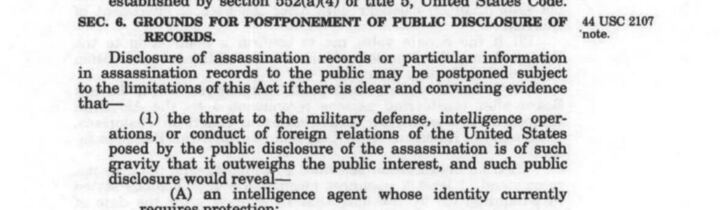
    Another serious legal problem arising from President Biden’s opening platitudes is his attempt to modify by edict the legal standards for postponement that are the basis of the JFK Records Act. Nowhere in the JFK Records Act do the words “except when the strongest possible reasons counsel otherwise.”

    The standards and criteria for postponement are only found in section 6 of the JFK Act.

    jfk records act1

    In legal processes there are several different standards of proof. In most criminal proceedings, the standard of proof is the well-known “beyond a reasonable doubt”. Civil standards of proof may vary depending on the seriousness of the process and the range of potential consequences of a ruling. Common civil standards of proof include “balance of probabilities”, “preponderance of evidence”, and “clear and convincing evidence”. When a statute imposes a standard of proof, that is the standard that parties must meet in order to successfully make their case. 

    Parties cannot simply ignore or change a statutory standard of proof in order to better suit their case.

    Congress decided when they enacted the JFK Records Act that the law would impose the relatively high civil standard of proof of “clear and convincing evidence”. There is no other standard of proof when it comes to assessing the grounds for postponing assassination records. All government offices, agencies and the President of the United States must follow the law and comply with the clear and convincing standard of proof mandated by sections 6 and 9(d)(1) of the JFK Records Act.

    To be certain, “Except when the strongest possible reasons counsel otherwise.” is not the standard of proof imposed by the JFK Records Act. In fact…“Except when the strongest possible reasons counsel otherwise.” is not a standard of proof anywhere in the world.

    Final Certification???

    The opening paragraph of President Biden’s Memorandum presents another perplexing statement and completely non-compliant decision by the President. “With my final certification made in this memorandum -– the last required under the Act -– and definitive plans for future disclosures, my Administration is fulfilling the promise of transparency to the American people.” [Emphasis added.] From this statement, one can be left with no other understanding: that with his June 30, 2023 Executive Memorandum, the government and the President’s legal obligations under the JFK Records Act have been fulfilled and that the June 30, 2023 Memorandum will be the final and last word on the undetermined number of unidentified assassination records being held in secret by the government.

    The problem with this statement is that it runs smack into section 12(b) of the Act. That section of the JFK Act is titled, “Termination of Effect of Act”. Part (a) of the section deals with the termination of sections of the Act pertaining to appointments to the ARRB and the operation of the Board. Pursuant to section 12(a), all of the sections of the Act that cover matters dealing with appointments to and operations of the ARRB shall terminate when the ARRB’s mandate ended on September 30, 1998.

    In respect to the sections of the Act that do not deal with appointments to or the operations of the ARRB, all those sections remain in full force and effect until every last assassination record is fully publicly disclosed to the public and the National Archivist certifies that all assassination records are publicly available. Section 12(b) is set out immediately below.

    jfk records act2

    Section 6 of the Act does not pertain to appointments to the ARRB and it does not deal with any ARRB operations. In fact, section 6 of the Act does not even mention the ARRB at all. Section 6 is a part of the Act that is mandated to form the basis of any and all decisions to postpone the disclosure of an assassination record by any and all government offices (including the Executive Office of the President of the United States). Section 12(b) legally mandates that section 6 remains in full force and effect as operational law and is applicable to the President’s authority to postpone disclosure of records, “as required by this Act” pursuant to sections 5(g)(2)(D) and 9(d)(1).

    The JFK Records Act makes no mention or suggestion that the President’s legal duties under the Act come to an end prior to the full public release of every single assassination record. To the contrary, both sections 12(b) and 9(d) make it clear that the President’s duties continue until there are no more secret assassination records held in the Protected Collection at NARA.

    Further, pursuant to sections 5 and 9 of the Act, the President has an ongoing statutory role in the periodic review process. Section 5(g)(2)(D) of the Act, is the provision that contains the purported authority pursuant to which both Presidents Trump and Biden have postponed the release of the remaining secret assassination records. It cannot be ignored that the title of section 5(g) of the Act is, “PERIODIC REVIEW OF POSTPONED ASSASSINATION RECORDS”. 

    Section 9(d)(1) of the Act also specifically weighs in on the President’s ongoing ministerial duties with respect to postponement of assassination records. That section mandates that, after the ARRB has made a “final determination”, regarding the release or postponement of an assassination record, only the President has the sole and non-delegable authority to release or postpone the release of assassination records under the standards of section 6 of the Act. There will be more about section 9(d)(1) later in this article.

    It is therefore unclear what the legal basis is for President Biden’s dismissive assertion that the June 30, 2023 Memorandum is the “final certification” required by the Act. This makes no sense given the clear duties imposed by sections 5, 6, 9 and 12, as discussed above.

    “Each Assassination Record…As Required By This Act”

    In section 2 of the June 30, 2023 Executive Memorandum, President Biden states that, “The Act permits the continued postponement of public disclosure of information in records concerning President Kennedy’s assassination only when postponement remains necessary to protect against an identifiable harm to the military defense, intelligence operations, law enforcement, or the conduct of foreign relations that is of such gravity that it outweighs the public interest in disclosure.”

    It would appear that the process suggested above in the President’s Memorandum directly conflicts with the President’s claims that he supports the transparency and accountability provisions of the Act. Does the JFK Records Act actually authorize the President to certify the postponement of thousands of unidentified assassination records en masse and without providing any reasons for each record that he certifies for postponement?

    The President’s Memorandum seems to cherry-pick words and phrases out of section 5(g)(2)(D), and omits some critically important language from the section. The omissions drastically change the meaning and purposes of this section as purported by the President in his Memorandum. Let’s look at exactly what section 5(g)(2)(D) states.

    5(g)(2)(D) Each assassination record shall be publicly disclosed in full, and available in the Collection no later than the date that is 25 years after the date of enactment of this Act, unless the President certifies, as required by this Act, that—

    1. continued postponement is made necessary by an identifiable harm to the military defense, intelligence operations, law enforcement, or conduct of foreign relations; and
    2. the identifiable harm is of such gravity that it outweighs the public interest in disclosure.

    The words “Each” and “as required by this Act”, seem to be omitted from any reference to section 5(g)(2)(D) of the JFK Records Act made by the government. Including in all of the Presidential Memoranda of both President’s Trump and Biden. It seems that the government is afraid to fully quote section 5(g)(2)(D) in its complete entirety. And the government is particularly frightened by the words “eachand “as required by this Act”, 

    The rules of statutory interpretation impress on lawyers and judges that words printed into laws must be given meaning; and that legislators do not insert meaningless or superfluous words into statutes.

    So what do the words “each” and “as required by this Act” mean in relation to the President’s authority to postpone the public disclosure of assassination records? The answer to this question could consume the better part of a chapter in a book or an entire lawsuit. I will try to provide a brief explanation of the proper interpretation of these words in the context of section 5(g)(2)(D) and in relation to the JFK Records Act as a whole.

    When the word “each” is used at the beginning of section 5(g)(2)(D), the rules of statutory interpretation would strongly imply that the word modifies the following parts of the whole section. It follows that a proper reading of this section would reasonably determine that the word “each” acts to modify both the requirement for public disclosure of each assassination record by no later than the statutory deadline of October 26, 2017; and “each” modifies the alternative requirement for the certification for postponement of each assassination record, as required by this Act. This interpretation would militate against a holus bolus en masse certification of an undetermined number of unidentified assassination records. This interpretation is further supported by the purposes of the Act, as well as all of the other sections dealing with periodic review and Presidential authority to postpone records. It would create an absurdity of law to interpret section 5(g)(2)(D) to mean that prior to October 26, 2017, there were more stringent postponement criteria and public transparency requirements under the Act than after October 26, 2017.

    The words “as required by this Act” must also be given meaning in the context of the President’s authority to certify the postponement of assassination records. If Congress intended that section 5(g)(2)(D) be an isolated, stand-alone provision and the only provision dealing with Presidential postponements, Congress would not have included the additional words, “as required by this Act” in Section 5(g)(2)(D). The inclusion of the words “as required by this Act” must therefore be read consistently and in line with the other sections of the JFK Records Act that pertain to the postponement of assassination records. Namely section 6 (which mandates the standard of proof and the exclusive postponement criteria) and with section 9(d)(1). That is the authorizing provision that grants the President his sole and non-delegable authority under the law to postpone the release of Executive Branch assassination records after the ARRB has rendered a final determination about an assassination record. 

    Instead of addressing the words “each” and “as required by this Act”, President Biden’s Memorandum summarily omits these words and ignores the statutory/ministerial duties that the words legally impose on the President in respect to decisions to continue the postponement of public disclosure of the secret assassination records held in the Protected Collection.

    “Transparency Plans”

    Let’s be blunt. The President’s “Transparency Plans”—originated by the CIA– are the opposite of transparent. They might as well be called “Opacity Plans” if the truth is being told. The JFK Records Act is one big statutory transparency plan that mandates tracking forms (identification aids) and a directory of these aids to provide transparency for each and every document in the Records Collection, including those documents that are continuing to be held in the secret Protected Collection. President Biden’s Transparency Plan seeks to do away with the Identification Aid Program and the publicly accessible Directory of Identification Aids.

    Section 6 of the Act mandates that all government offices apply the clear and convincing standard of proof and the five exclusive criteria pursuant to which postponements are permitted by law. Section 12(b) states that section 6 of the Act remains in full force and effect until the Archivist certifies that every single last assassination record is fully publicly disclosed. The President’s Memorandum seeks to do away with all of these truly transparency driven standards, and replace them by edict with new, less onerous, less stringent, less accountable, and totally unenforceable standards. 

    What happened to the mandate to downgrade and declassify all of the records? How and why did it suddenly become easier for the government to keep these assassination records secret…. not more difficult?

    President Biden’s Attempt to Seize Authority Over Congressional Records

    One aspect of both President Trump and President Biden’s multiple memoranda that ought to have received far more resistance from both the public and Congress, is the Presidents’ assertions of authority over what are termed “non-executive branch records”. These records include House and Senate records, largely originating from the House Select Committee on Assassinations and the senate’s Church Committee. As briefly discussed above, Congress was very careful in drafting the JFK Records Act not to cede any authority over non-executive branch records to the President. Section 9(d)(1) takes particular aim at this issue by explicitly limiting the President’s authority over only executive branch records.

    What impact does this have on the current state of the records held secret in the Protected Collection? It means that any Presidential postponement of a non-executive branch record is unlawful and that by law, every single record that originated from the HSCA and the Church Committee should have been fully publicly disclosed on October 26, 2017. This did not happen because both President Trump and President Biden broke the law when they authorized those records to remain held in secret. Congress should have stepped in to protect their authority over their own records and processes, but to date, Congress has failed to schedule any oversight hearing or call any official to account for the undeniable non-compliance under the Act by NARA, the agencies and the Executive Office of the President. It seems that no branch of the government is interested in complying with the JFK Records Act on any level, in any meaningful way. Senate Majority Leader Chuck Schumer did however mention the JFK Assassination Records Act last week when he suggested that Congress ought to use the that act as a model for new legislation to provide public transparency on the urgent and pressing issue of UFO sightings!! Is our government trolling us?

    As this article goes to print, Judge Seeborg has just issued a decision in the case brought by the Mary Ferrell Organization in San Francisco court. An update on this important decision will be forthcoming next week.

  • RFK Jr.: ‘It’s Very Disturbing’ That Biden Refused to Release More JFK Assasination Docs


    President Joe Biden is keeping thousands of JFK assassination secret as part of a “Transparency Plan,” drawing fire from historians, researchers as well as his Democratic primary opponent—a nephew of the president murdered nearly 60 years ago today.

    “It’s very disturbing,” Robert Francis Kennedy Jr., told The Messenger in an interview. “They’re pouring the concrete on 60-year-old secrets so that they’re permanently interred. Why?”

    Read the rest of the article here. (The Messenger News)

  • ACTION ALERT: Biden and the CIA Turn the Lights Out

    ACTION ALERT: Biden and the CIA Turn the Lights Out


    On Friday night, President Joe Biden released an executive order that more or less said that the JFK Records Collection Act is no longer in effect.

    Usually the White House delays such an announcement to a Friday night in order to avoid maximum publicity such a decree would get on a Monday morning news cycle. Since there was little publicity about the order, it appears that the administration succeeded in its attempt to keep the fallout about the order minimal.

    What this announcement does is essentially stymie the original JFK Records Collection Act. That 1992 law said that after October 2017, every last document concerning the JFK case would be released without redactions. The only person who could prevent that from happening was the president. Yet after that termination date, first President Trump and then President Biden, delayed the process a total of at least four times. And now, with this June 30th order, Biden has pretty much stopped the declassification process before it is completed—and in two ways. First, there are still thousands of documents yet to be released in unredacted form. Secondly, according to our reporter on the subject, Gary Majewski, the last two releases contained no new documents.

    Apparently, Biden has succumbed to the demands of the executive intelligence agencies, particularly the CIA and its so called Transparency Plan. (Chad Nagle explains that here) Biden’s order also turns over ultimate disposition of the remaining JFK files to the National Declassification Center, by following the Transparency Plan:

    The Transparency Plans will ensure that the public will have access to the maximum amount of information while continuing to protect against identifiable harms to the military defense, intelligence operations, law enforcement, and the conduct of foreign relations under the standards of the Act.

    It is hard to comprehend how someone as experienced as Joe Biden could agree to these excuses that the CIA, and FBI always use in order to keep relevant information hidden. President Kennedy was killed almost 60 years ago under the most suspect circumstances. What secret operations from more than a half century ago could outweigh the need for total disclosure of that murder?

    We urge our readers to protest this attempt to place a muzzle on the JFK Records Collection Act. Please contact either the House Oversight Committee or The White House to make your objection known.

    House Oversight Committee
    2157 Rayburn House Office Bldg.
    Washington. DC 20515
    Phone: 202-225-5074; Fax: 202-225-3974

    Chair: James Comer; Ranking Member: Jamie Raskin
    The White House
    1600 Pennsylvania Avenue, N. W.
    Washington DC 20500
    Phone: 202-456-1111; Email : president@whitehouse.gov

    (This is a breaking story, and we will have more about it from attorney Mark Adamczyk and Andrew Iler.)

  • President Biden Delays the Release of the Remaining JFK Assassination Records


    Biden and his DOJ have put an axe through sections 6 and section 9(1)(d) of the Act, which will effectively kill the JFK Assassination Records Act of 1992 and all of the work accomplished by Oliver Stone to get the Act passed in the first place.

    Here is a news story on this topic.

    Download the memorandum issued by the White House here. (PDF)

  • For Reasons of National Security – Reframing the Assassinations of the 1960s and the Case Against the CIA – Part 2

    For Reasons of National Security – Reframing the Assassinations of the 1960s and the Case Against the CIA – Part 2


    Muddied Waters and the People Who Talked

    “They muddy the water to make it seem deep,” is one of Nietzsche’s many poignant aphorisms. Often seen as a critique of scholars who obfuscate a lack of depth through intellectual gloating, I think it can apply to the CIA treatment of the Kennedy case. Theories ridiculous and worthwhile still abound regarding the Kennedy assassination, distracting from a simple truth: that the CIA has demonstrated continued mendacity regarding the murder of a president and is still withholding documents directly related to it. As Jefferson Morley put it, we don’t need a theory to point out that the CIA’s behavior is suspicious. The agency has muddied the waters for decades with false stories, but has now backed itself into a corner. They are at a loss for available cover stories, so stonewalling and kicking the can down the road is the best recourse they have.

    A couple of questions that continue to be begged regarding these examples of CIA dishonesty:

    1. Just what are they actually hiding?
    2. And why has the agency felt so inclined to fabricate so many differing, and false narratives over the years when the case against Oswald is supposedly so ironclad, even sacrosanct?

    Though I do not claim to know the answers, the following discussion may provide indications as to why. A more specific, yet related question relevant to document disclosure is this: which higher up was authorizing the operations concerning Joannides and the militant DRE? This is especially important as it relates to the activity surrounding Oswald in the summer of 1963. Disclosure of such information could potentially confirm well-founded suspicions regarding an intelligence operation involving Oswald, and as we will postulate, possible conspirators in the assassination.

    The erroneous stories promoted by various CIA affiliates over the years were often characterized by the implication of some sort of Cuban and/ or Soviet conspiracy involving Oswald. In his book Legend, this is what Edward Epstein postulated, and we know that book was cooperated on with James Angleton. David Phillips was one of the agency officers promoting what are now provably false stories of such an international plot, even while the official government position precluded any idea of conspiracy. One bogus story involved an informant named Gilbert Alvarado, who claimed to have seen Oswald at the Cuban Embassy in Mexico City receiving money from a red haired Cuban for the purposes of assassinating the President. Various aspects of the story, including the initial date Alvarado claimed the exchange took place, did not add up, and thus the story was eventually retracted, adding to the air of suspicion surrounding why the tale was treated so seriously in the first place and promoted by the like of Phillips. (Scott,Dallas ’63, pg. 26-29)

    Phillips’ behavior and contradictory statements regarding the Oswald legend bothered House Select Committee members, including Richard Sprague who stated while questioning Phillips, “to some degree you have slithered around what are quotes by people in the news media.” Again, why, if Oswald was a lone nut-job, would Phillips continue to tell such conflicting stories? (Morley, “JFK Most Wanted”) From the obfuscation regarding the supposed surveillance of Oswald at the embassies in Mexico City, to the Alvarado story, Phillips’ behavior has justifiably aroused concern from investigators and researchers over the years. House Select investigator Gaeton Fonzi’s book The Last Investigation is particularly enlightening when it comes to this particular topic, and also the matter in general of how the CIA obstructed the HSCA’s investigation.

    In another fascinating exchange, attorney and author Mark Lane met with Phillips for a recorded debate at the University of Southern California in 1977. At one point during the debate, Phillips back-pedaled even further than he had on previous occasions, stating that “I have not said that there was not a conspiracy to kill Jack Kennedy…I don’t know what happened in Dallas.” (Our Hidden History) Phillips is not the only CIA officer who attempted retreat into “limited hang out” territory over the years. Other key players have come to terms with how the government’s official story has devolved into further implausibility.

    While speaking to reporter Seymour Hersh, counter intelligence czar James Angleton cryptically stated, “A mansion has many rooms. I’m not privy to who struck John.” Former CIA station chief Rolf Mowatt-Larsenn attempted to decode the puzzling language so typical of Angleton: “The mansion refers to CIA. The rooms refer to compartments, where we hide information, control information. ‘I’m not privy’ doesn’t necessarily mean ‘I don’t know,’ or ‘I don’t suspect.’ ‘I’m not privy’ [means] ‘I wasn’t in the loop.’” To Mowatt-Larsenn this confirmed “…at a gut level, if not on an analytical basis, that he [Angleton] had a suspicion [of a plot to kill JFK], if not more than that.” Not only did Seymour Hersh feel the same way, but he also felt Angleton was attempting to avoid some guilt or blame by implicating another faction of the agency. When speaking to this analysis, Jefferson Morley contended, “This story, however, tests the limits of Mowatt-Larssen’s theory that ‘CIA rogues’ ambushed Kennedy in Dealey Plaza. Angleton was one of the most powerful men in the agency. If he condoned a plot, then complicity in the assassination reached the highest levels of government and was not confined to the Miami station, as Mowatt-Larssen contends.” (Morley, “CIA Tradecraft”) Nonetheless, it’s worth explaining what sort of “rogues” Mowatt-Larssen could have been referring to.

    The Bays of Pigs fiasco and its aftermath came to exemplify two divergent paths of American foreign policy. On one path, detente combined with reluctance to invade militarily (i.e. Kennedy), and on the other, bellicose, “anti-communist” colonialism with a proclivity towards assassination. In the latter camp was a CIA, Cuban exile contingent with real skin in the game. They had seen their compatriots captured and killed due to what they thought was all Kennedy’s doing, and later saw Kennedy moving towards detente with the man who was their mortal enemy, Fidel Castro. Career CIA officer and assassin David Morales labeled Kennedy’s Bay of Pigs conduct as “traición (betrail/treason).” (Scott, Dallas ’63, pg.51) Another career CIA officer, E. Howard Hunt stated,

    Under the [Kennedy] administrations philosophy, the real enemy became poverty and ignorance; any talk of an international communist conspiracy was loudly derided. Detente and a positive approach of easing international tensions filled the Washington air, to the wonderment of those who still remembered Budapest, the Berlin wall, and the fate of Brigade 2506 [at the Bay of Pigs]. (Howells)

    The Miami Station and Morales

    More telling than Robert Kennedy being suspicious of the CIA following his brother’s death (Morley, Scorpions’ Dance, pg.54), or the public being suspicious, or even President Johnson suspecting a CIA plot (ibid, pg. 87) there is this: the CIA was suspicious of the CIA. In a recently un-redacted memo, officer Donald R. Heath details a specific and internal investigation the Agency secretly conducted soon after Kennedy’s death. In attempting to come clean in this 1977 memorandum, Heath details that, as part of the intra-agency investigation, he requested “…all possible data on any Cuban exile” his colleagues knew of “who disappeared just before or right after the Kennedy murder and has since been missing from Miami under suspicious circumstances.” Going further, Heath asked for info on associates who may have been approached during 1963 by Cuban exiles who were seeking “assistance in getting sizeable (sic) amounts of funds, weapons or cars.” Heath’s requests also included a “list of all Cuban exiles or Cubano-Americans” who would have been “capable of orchestrating the murder of President Kennedy in order to precipitate an armed conflict between Cuba and the USA.” (Heath Jr.) We don’t know what, if any answers Heath received regarding this inquiry.

    The CIA’s Miami JM/WAVE station in Miami was the location in which many of the agency’s Cuban exile operations were based, including those directed by previously mentioned head of para-military operations, David Morales, who happened to lead the same sorts of militant Cuban and unaccountable “shadow” groups detailed as suspicious in the Heath memo. (Hancock, pg. 111-112) Beyond his being a specialist in liquidation, Morales did not hide his contempt for John or Robert Kennedy. In a story corroborated by both Morales’ lawyer Robert Walton, and lifelong friend Ruben Carbajal, Morales ended an alcohol fueled, anti-JFK tirade by muttering, “Well, we took care of that son of a bitch, didn’t we?” (ibid, pg. 115). Walton, on a separate occasion, paraphrased another of Morales’ concerning comments, one that implicated him (Morales) in both Kennedy brother murders: “I was in Dallas when we got that motherfucker [John Kennedy], and I was in Los Angeles when we got the little bastard [Robert Kennedy].” (RFK Must Die)

    In a 1994 letter to John Tunheim, Bradley Ayers, a CIA officer once stationed at JM/WAVE, claimed that there were nine individuals based at the Miami station who had “intimate operational knowledge of the circumstances surrounding the assassination” of John F. Kennedy. This list included station chief Theodore Shackley and David Morales. Interestingly, Ayers also stated that Morales would often be “off station” from JM/WAVE during 1963, frequently traveling to Mexico City, the scene of the aforementioned intrigue regarding an Oswald imposter.(Hancock, pg. 113)

    It’s one thing to hear some farfetched, alien type conspiracy theory related to Kennedy’s death. It’s another to have corroborated stories regarding people like Morales, especially as it relates to potential motive and means, and the fact that the milieu Oswald found himself in in 1963 regarding Cuban operations involved very specific individuals (e.g. Joannides) whose operations we know for a fact, constitute a part of the documents the CIA is still withholding. To someone not familiar with the particular details we’ve been covering, some unknown like David Morales bragging about killing the Kennedys is just another of many anecdotal “confessions” made by mob bosses and others over the decades. In light of what we now know about Morales, however, the statement is disturbing.

    There were also other CIA officials who, at the very least, were suspicious of their cohorts when it came to the Kennedy assassination. Richard Helms, director of CIA covert operations in 1963, was caught off guard in a 1992 CBS interview when asked about potential agency involvement. The exchange was televised as follows:

    Helms: I am simply stating this on television, because I would like the American public to understand, that the CIA was not involved in that assassination, regardless of what anybody says. I tell you, we checked up on it later, not only at the time, but when the Warren Commission was sitting and so forth, [to] be sure that nobody had been in Dallas on that particular day.
    Richard Schlesinger (interviewer): You did that in November of 1963?
    Helms: Of course.
    Schlesinger: Why did you do that? Had anybody accused the CIA at the time?
    [At this point, Helms’ body language changes. He’s visibly uncomfortable and is at a loss for words. After a few moments of silence, he responds.]
    Helms: The place was in an uproar, the country was in an uproar. There was a great concern that this might have been a foreign doing of some kind.
    Schlesinger: So who asked you to check where your own agents were?
    Helms: We did that in our own.
    Schlesinger: Why?
    Helms: Well, because I just thought it was a wise thing to do.
    Schlesinger: Why?
    [Helms once again appears to be flustered, and pauses. With a slight smirk that expressed his discomfort, he stutters into his next response.]

    Phillips and Mexico City

    So what could Helms have been privy to, or at the very least been suspicious of? Groups like the David Morales led Special Affairs Staff of JM/WAVE? David Phillips? Phillips, in his new 1963 role at CIA, not only answered to the Special Affairs Staff, but also handled the intel regarding Cuba which came out of Mexico, intel that undoubtedly included information and surveillance regarding the person who identified themself as Lee Oswald. (Scott, Dallas ’63, pg. 52-53) All of this being in addition to his previous psychological warfare operation against the FPCC. Plus the fact that Howard Hunt told the HSCA that Phillips helped create the DRE. These three situations represent massively important events in pre-assassination knowledge of Oswald, and Phillips was (at least) tangentially involved in all three. Still withheld information and documentation regarding the nexus that links JM/WAVE, affiliated Cuban exiles, and Oswald in 1963 is what is still being treated with the utmost secrecy by the CIA in 2023.

    Whatever happened in Mexico City in the fall of 1963, it bears the marks of spy craft. Someone knew how to manipulate the Oswald file to not only frame him and implicate the Cubans and/or Soviets, but also leave what author John Newman has called a “World War III virus” that would lead to a pressure to accept a more safe, “lone nut” conclusion on the Warren Commission’s part. In order to help convince Chief Justice Earl Warren to head the Commission, President Johnson brought up the potential of global nuclear annihilation that had to be avoided. The questionable information about a potential communist conspiracy apparent in Mexico City, which Johnson was privy to, most certainly played into not only influencing Warren to sign on, but also indicates how a “lone nut” conclusion was further necessitated by the dangerous intel. (DiEugenio, JFK Revisited, pg.92-93) There can be little doubt that Warren was fiercely intimidated and did not want to go anywhere near a real investigation. In fact, at first, he did not even want them to either gather evidence or call witnesses. (DiEugenio, Destiny Betrayed, p. 359).

    Whoever was manipulating the Oswald and Mexico City intelligence had to be within the CIA; or at the very least, had to have intimate working knowledge of the CIA’s files on Oswald, the complete overview of which was only available to James Angleton. The conspirators were also almost certainly aware of the fact that the intel coming out of Mexico City involved the highly secret LIENVOY intercept program, the potential disclosure of which would have leveraged other unwitting government officials into cover up of any related circumstance. (Scott, Dallas ’63, pg.48) What likely began as a separate counterintelligence operation involving Oswald ended up being co-opted by a more clandestine “dark operation” that was utilized in the plot to kill the president, and force a cover up on people privy to the sensitive knowledge of the original intelligence operation(s). (Newman, xv)

    Here we have a two for one motive: get rid of Kennedy and lay the blame at Castro’s door step. Or as the Heath memo stated, “precipitate an armed conflict between Cuba and the USA.” This is right out of the CIA playbook, specifically, officer William Harvey’s playbook. In his handwritten notes regarding ZR/Rifle, an agency assassination program which drew from underworld figures, Harvey wrote, “Cover: planning should include provision for blaming Czechs or Sovs in case of blow. Should have phony 201 in RI to backstop this, documentation therein forged and backdated. Should look like a CE [CounterEspionage] file.” (Mary Ferrell Foundation, Cryptonym ZRRifle) Considering not only the legend of Oswald’s supposed pro-Castro sympathies, the attempted framing of the Soviets in the Oswald imposter wiretaps from Mexico City, but also the strange treatment of Oswald’s 201 file, the correlations with Harvey’s notes are uncanny.

    William Harvey: From Rome to Dallas?

    Harvey, another figure of suspicion to the House Select Committee, was a notorious drunk known for his “thug” like behavior. (Talbot, pg. 502) He was essentially banished to the Rome CIA station following the Cuban Missile Crisis of 1962 for his highly dangerous, unauthorized, cowboy like predilection towards war. Robert Kennedy had made clear to then CIA director John McCone that all covert operations against Cuba were to be halted during the crisis. After Kennedy found out that Harvey had ignored this order by sending out commando teams for a potential invasion of Cuba, Harvey was demoted and sent to Italy. Harvey was aware that Bobby Kennedy was responsible for having him reprimanded, and it was no secret that he “hated Bobby Kennedy’s guts with a purple passion.” (Spartacus Educational, “William K. Harvey”) It just so happened that Harvey’s ZR/Rifle assassination program was housed within Staff D, the same arm of the CIA that controlled intercept info out of Mexico City. Harvey was also linked with Morales, both on an operational level (sometimes in unauthorized mingling with the likes of mobster Johnny Rosselli), but also in an outwardly shared, venomous hatred of the Kennedy brothers. (Scott, Dallas ’63, pp. 17, 51)

    Harvey’s deputy at the Rome CIA station, Mark Wyatt, recounted that in November of 1963, Harvey coincidentally traveled to Dallas, and tried brushing it off with some innocuous excuse to the effect of “I’m here to see what’s happening.” (Talbot. 477) House Select Committee investigator Dan Hardway detailed how his team requested from the CIA the travel vouchers of William Harvey for the fall of 1963. Details of Harvey’s simple whereabouts from the 1960s should in theory, not be damning. Yet the agency has still refused to release such documents. Hardway also stated of Harvey:

    We considered him one of our prime suspects from the very start. He had all the key connections— to organized crime, to the CIA station in Miami where the Castro plots were run, to other prime suspects like David Phillips. (Talbot, p.477)

    In a 2016 Freedom of Information Act Request, I personally asked the CIA for the November 1963 travel logs of Harvey, E. Howard Hunt, and David Atlee Phillips. The agency replied eleven months later. They wrote that they “did not locate any records responsive” to my request. Regarding the records that still exist, or that the public has access to, our means of proper historical evaluation is handicapped. And although no “smoking gun” document(s) exist, or may ever come to light necessarily, the activity of certain CIA members connected with Oswald and affiliated organizations in Mexico City and Miami is highly suggestive of a matrix where a potential conspiracy to assassinate President Kennedy could have been hatched.

    False Flags and Alien Conspiracies

    The sentiment of Kennedy enemies in the CIA represented a portion of the jingoistic, and mutinous milieu the president found himself in, the existence of which extended into the military. Operation Northwoods, a false flag operation proposed to the president by his Joint Chiefs of staff, not only typified a foreign policy approach anathema to the direction JFK was heading—rapprochement with Cuba–but provides further context to the assassination when seen as another means for preemptive war.

    The plans for Northwoods essentially called for both staged and actual acts of terrorism conducted by the United States that were to be blamed on Cuba which included, but were not limited to these ideas: “A ‘Remember the Maine’ incident” in which the US would “blow up a US ship in Guantanamo Bay and blame Cuba…” and a “terror campaign…pointed at refugees seeking haven in the United States” in which they would “sink a boatload of Cubans en route to Florida (real or simulated).” (Mary Ferrell Foundation, “Operation Northwoods”) Kennedy was having none of it. But it is worth noting the correlation with what the Kennedy assassination ended up representing in light of Oswald being painted as a Castro agent: a potential false flag means of galvanizing support for war against Cuba. This gets closer to the fuller historical context of the assassination, not just bits of anecdotal information blaming a “lone nut” with no motive.

    A further means for providing context involves a discussion of how we have come to think about assassinations. As alluded to in the work of Peter Scott, the socio-political milieus surrounding events like the Kennedy assassination, especially when discussed by government investigative bodies, are often viewed as aberrations rather than structural issues more inherent or endemic to how our political economy has operated. Scott brings up the previously mentioned HSCA chief counsel Robert Blakey as an example. Blakey, when discussing potential Mafia involvement in the assassination, framed the information from the point of view of an isolated issue, instead of recognizing how deeply involved the Mafia was with the CIA for the purposes of attempting to execute Castro, and for instance, illicit drug smuggling and weapons trafficking during the period in question. All of which were concealed by a sometimes complicit law enforcement. (Scott, Deep Politics, Pg. 72) The Iran Contra scandal is also among a long list of numerous related incidents that come to mind on the topic of “supra-constitutional,” and unaccountable activity by the CIA and affiliated underworld organizations.

    Similarly, the danger also exists of lumping real issues of historical importance in with “alien conspiracies,” either for reasons of stifling conversation, or for the sake of avoiding the discomfort surrounding this subject. We must not conflate legitimate issues with Qanon chat room fodder. Especially in the early decades of the CIA, assassinations, coups and the like were, although covered up, the norm and far from rare, especially at the behest of corporate interests. (Talbot, pg. 248) These state sponsored acts of assassination and terrorism extended well beyond the government of any one nation, and represented a warped zeitgeist in certain intelligence and military circles against “communism.” William Harvey, along with many of his compatriots, participated in an organization born of these circles called Operation Gladio. This multinational effort involved “stay behind groups” following World War II which conducted sabotage and terrorist operations for the purposes of stifling progressive government movements in Europe and to push against Soviet expansion into the continent. In a startling example of Northwoods style plans come to fruition, Gladio networks succeeded in bombing public locations in Italy, including the Bologna railway, killing hundreds of innocent civilians, and after the fact, blaming radical left wing groups. (Howells)

    As Tim Howells put it:

    Clearly these men firmly believed that the war against communism was too important to be entrusted to the democratically elected government of the United States. Extraordinary measures were justified to save the American people from themselves.” (ibid)

    The “patriots” working for the government such as Harvey, Phillips, Morales and the like would have made no distinction between eliminating foreign targets and a president who they considered a threat to the American way of life. To them, Kennedy was a communist traitor and had to be removed for reasons of national security. It may be naive to think that the covert assassination tactics utilized by the intelligence community abroad haven’t ever come to roost here at home. Are we mistakenly trying to make ourselves an exception by thinking “It could happen in banana republics, but never here”?

    It is also mistaken to ascribe to the way Warren Commission defenders continue to misinterpret theories regarding potential CIA involvement. One way is how they try to imply or present that researchers are arguing that the entire Agency was involved, which is fudging the issue. We need intelligence agencies to help defend the country, but the fact that certain people who have worked for the CIA over the years did morally reprehensible and highly illegal things is not up for debate. Institutions chartered to defend the public interest and people who operate beyond constitutional boundaries while working for said institutions are not mutually exclusive in this case. Just because we need agencies like the CIA, doesn’t mean there does not need to be reform on some level. That reform starts with regaining an already damaged public trust. Trust is earned, not coerced. Would current CIA officials care to defend the record of the likes of Morales, Dulles, and Harvey? Then by all means, defend their valor and release the apparently innocuous, yet still classified material regarding the assassination.

    Truman and Dulles: December 1963

    It’s telling that on December 22nd, 1963, a month to the day after JFK was killed, former president Harry Truman published an op-ed that expressed how he was perturbed by what the CIA had become since he signed its existence into law in 1947. Truman wrote that he was, “disturbed by the way the CIA had been diverted from its original assignment.” Further that, “It has become an operational and sometimes policy making arm of the government” of a “sinister” nature. He went even further, stating, “There is something about the way that the CIA has been functioning that is casting a shadow over our historic position and I feel we need to correct it.” (DiEugenio, Destiny Betrayed, pg. 378-380) It turned out that Truman started writing the piece on December 1st. In other words, a bit more than one week after Kennedy was killed. Admiral Sidney Souers, who offered input on the drafting, congratulated Truman on the editorial and said that Dulles “caused the CIA to wander far from the original goal established by you, and it is certainly a different animal than I tried to set up for you. (ibid)

    As much as Souers liked the piece, Allen Dulles did not. And recall, he was sitting on the Warren Commission at this time. In April of 1964, he went so far as to visit Truman at his home in an effort to have the story retracted. Truman denied the former spy man’s request, but Dulles went on to tell CIA counsel Lawrence Houston that Truman had confessed being in error, which was a complete lie. (Morley, “After JFK Was Killed”)

    Even more fascinating was Dulles’ parting words for Truman in which he rejected another recent “attack” that the CIA had incurred in the press. This was most likely referring to the October 1963 New York Times/Washington Daily News op-eds, written by Richard Starnes and Arthur Krock that took issue with the Agency’s Vietnam policy. This included the damning statement of an insider source who labeled Central Intelligence as a “malignancy” which the White House couldn’t even rein in. Vietnam was another issue Kennedy had been at loggerheads with the CIA as well as the military establishment over. Yet the full extent of this dispute was not really known during the period in question. Given the reason for Dulles’ visit, it’s interesting how he seemed to be implying that Truman’s own attacks were somehow correlated, being that no one had yet connected the dots between Vietnam policy and the bad blood between Kennedy and the CIA. It was almost as if Dulles knew what Truman was implicitly stating in his op-ed, and had revealed a guilty conscience. (DiEugenio, Destiny Betrayed pg.380-381)

    Disclosure and Deep Politics

    A blanket excuse that the intelligence community continues to use for withholding certain pertinent documents relating to the JFK case is that it’s “for reasons of national security.” To playdevil’s advocate for a minute: what is the possible double meaning of this tired phrase the CIA and National Security Council continue to stall with? It can’t be for reasons of endangering agents in the field. Everyone in question has long since passed. That the agency is protecting “sources and methods” is dubious sixty years after the fact, and a potentially never-ending excuse. I can’t help but wonder if “for reasons of national security,” is a veiled admission in that, if the full extent of documents were released, faith in the national security state would be compromised to an unparalleled degree and undermine our national security institutions. Modern distrust of the federal government has already been stoked by the CIA’s ongoing mendacity, however, and coming clean is the only healthy way forward.

    It could be the case that we find ourselves at a point of historical revisionism in the United States, one that may be painful, but necessary for a more effective politics. We have already revised the way we look at other key historic events in our country’s past, darker instances included. For decades it was suspected that the Reagan campaign’s “October Surprise” of the 1980 election involved a treasonous, multinational negotiation that resulted in the stalled release of American hostages in Tehran, Iran, thus putting the death nail in president Jimmy Carter’s re-election bid. Once a ridiculed “conspiracy theory” by congressional committees, admission over the existence of such a plot has been conceded, even in mainstream circles.

    In a recent New York Times article, former Reagan aide Ben Barnes confirmed then campaign manager and soon to be CIA director William Casey’s skullduggery. Casey had met with Iranian intelligence officials in Europe during the summer of 1980, and in exchange for the delayed release of American hostages at the embassy in Tehran, offered the shipment of arms via Israel and into Tehran. The plan succeeded. Carter’s reelection hopes were dashed, and the hostages were released within minutes of Ronald Reagan’s inauguration. As Jefferson Morley noted, not only does this demonstrate how unacknowledged “extra-constitutional” conspiracies can affect the political direction of the country, it also shows how we can actually come to terms with the reality of such events when the weight of unavoidable evidence demands and the veil of official orthodoxy is lifted. (Morley, “Once Ridiculed”)

    With the killing of both Kennedy brothers, the shift in policy President Kennedy was taking became an aberration, rather than the norm. It is an aberration that has prevailed in the executive branch ever since. This topic, possibly to the same degree that discussion surrounding potential high-level assassination plots, has largely been unacknowledged in mainstream discourse. I struggle to remember any such coverage of the implications of Kennedy’s markedly different foreign policy approach in any school textbook, for instance. This is what we might call a case of covered history versus not covered history. As an example, the Bay of Pigs is covered in high school textbooks. What is not properly covered is the full extent of the fallout from the event in terms of how it pitted Kennedy against the CIA and vice versa. And the list goes on: Covered- CubanMissileCrisis, vs Not Covered- the detenteKennedy was moving towards with Russia and Castro, and the secret back channel correspondence he had with both.

    A common thread here, despite various mistakes President Kennedy made during his short term in office, was reluctance on his own part toward committing to full-scale war. In the 6 major instances in which the president’s advisors urged him toward war, both nuclear and otherwise, he avoided it.

    1. At the Bay of Pigs, Kennedy refused to commit US forces in Cuba.
    2. In Laos, he opted to support a neutral government away from Soviet or American influence.
    3. At the Berlin Wall in 1961, he ordered the unauthorized tank brigade of US general Lucius Clay to retreat from the wall after the Soviets paralleled Clay’s dangerous tactic.
    4. In November of 1961, he turned down his Joint Chiefs, who proposed a massive introduction of American ground troops into Vietnam.
    5. As mentioned above, in March of 1962, Kennedy turned down Northwoods.
    6. During the Cuban Missile Crisis of October 1962, in what hawkish Air Force General Curtis LeMay insanely likened to the Nazi appeasement in Munich, Kennedy avoided the recommended first nuclear strike against Cuba and the Soviets, opting for a negotiated weapons removal of both parties instead.

    All of this was in addition to Kennedy’s anti-colonialist stance and support of Third World development and self-determination free of foreign influence. (Wiesak, pg. 53, 59, 143) Not to ignore his unprecedented moves toward disarmament referenced in his United Nations addresses (ibid, pg. 184) and “peace speech” of June 1963. All of these were among many issues that made the president a legitimate threat against hard liners in the security state and connected financial interests. (ibid, 62, 65; Talbot, pg. 549) This very real and highly volatile anti-Kennedy sentiment not only pervaded the CIA, but also the military establishment and related right-wing, nationalist circles. (Scott, Dallas ’63, pg.126,130-131,141). The evidence for this is how quickly and thoroughly Kennedy’s policies were altered and then reversed after his death. (See JFK Revisited, by James DiEugenio, pp. 209-221). And further, how much of the Third World went into mourning upon learning of his assassination. (ibid)

    It’s worth noticing that anti-war, particularly anti-Vietnam war sentiment, was a through line in the major political figureheads who were assassinated in the 1960s (i.e. Martin Luther King, Robert F. Kennedy). It would serve us better if, in fact, this kind of uncovered history, as it were, was more common knowledge rather than niche knowledge. This is tantamount to what Scott might call the “deep political” history of America: A history of a country that continues to have issues related to disclosure and unwarranted secrecy.

    As of this writing, the CIA is trying do away with a law set in place by congress thirty years ago pertaining to the release of all JFK assassination files i.e.. The JFK Records Collection Act of 1992. The statute set forth by congress included an October 26th, 2017 deadline for full disclosure of all relevant documents. Not only has the CIA disregarded that deadline four times in the past six years, but they are now trying to do away with a deadline altogether, essentially and undemocratically determining the law themselves. Their new, misleadingly named “transparency plan” would allow for the president to be removed from the declassification process, forever allowing the intelligence agencies (e.g. CIA, NSA, Pentagon) themselves to have the perpetual final say, and group withheld JFK material in with classified files that have nothing to do with the assassination. (Nagle)

    It’s safe to say that what is lurking in those files is not innocuous. The CIA is holding a steaming bag of trash and telling us it doesn’t stink. But they cannot have it both ways. They can’t withhold the documents saying they’re innocuous and also tell us they’re too sensitive to be released. At this point, any defense of the government’s official position requires a serious mental game of Twister. But the effectiveness of their gaslighting only goes so far as the unwarranted and assumed virtue of their “official” capacity or position allows. The wizard behind the curtain is telling us to look away, but we know too much of the context relating to the situation for this to be the case. Without this context, our knowledge amounts to “Well, the CIA is telling us that such and such thing is the case. They’re designated to defend the country, and know what they’re talking about, so that thing must be so.” This type of circular reasoning allows for their excuses to be treated as ex cathedra, as infallible. “Rome has spoken, the case is closed.”

    Part of the discomfort of this 60 year old event, and a big reason many avoid pondering a conspiracy of the nature we’ve been alluding to, involves recognizing the fact that the democratic ethos of America was lost on November 22nd, 1963. Further, that our institutions don’t always function healthily or follow the democratic, constitutional, or moral standards we have come to expect of them. For instance, how did the media miss the story that the Commission volumes were published in November of 1964 and, 3 months later, Lyndon Johnson was sending the first combat troops to Vietnam. Something that Kennedy refused to do in three years.

    The president’s death signified a pushback of private, illicit power against the public state. Which is where the true power of democracy should lie, but is not guaranteed. It’s not that the remaining documents in question are going to detail a plot to kill John Kennedy. It’s the possibility that when seen in context of what else has been disclosed, the record will get us closer to coming to terms with our country’s collective shadow, and allow us to begin to write a better, more informed, and more robust history. Context means everything.


    Go to Part 1 of 2


    References

    1. Black Op Radio “#1129 – Jefferson Morley” Accessed 21 May 2023.
    2. Central Intelligence Agency. Countering Criticism of the Warren Report
    3. Dale, Alan. “Thank You, Phil Shenon” Assassination Archives and Research Center, Accessed 2 May 2023.
    4. DiEugenio, James. Destiny Betrayed: JFK, Cuba, and the Garrison Case. 2nd ed., Skyhorse, 2013.
    5. DiEugenio, James.JFK Revisited: Through the Looking Glass. Skyhorse Publishing Company, Incorporated, 2022.
    6. DiEugenio, James. “The Devil is in the Details: By Malcolm Blunt with Alan Dale” Accessed 2 May 2023.
    7. Good, Aaron. American Exception. Simon and Schuster, 21 June 2022.
    8. Hancock, Larry. Someone Would Have Talked – Updated! JFK Lancer Productions, 1 Nov. 2010.
    9. Harding, Lee . “The CIA’s Media Assets.” Frontier Centre for Public Policy, 28 June 2021,.
    10. Harvard University. “Max Holland”, Davis Center, 6 May 2022, Accessed 21 May 2023.
    11. Heath Jr., Donald R. “1963-1964 Miami Station Action to Aid Investigation of the Murder of John Kennedy”, National Archives
    12. Howells, Tim. “Kennedy and the Cold Warriors: The Case for a ‘Big Conspiracy.’”, Kennedy Assassination Chronicles, Volume 7, Issue 3, Accessed 2 May 2023.
    13. Kreig, Andrew. “CIA Implicated in JFK Murder and Ongoing Cover-Up, Experts Allege on C-SPAN”, Accessed 21 May 2023.
    14. Mary Ferrell Foundation. “Cryptonym: ZRRIFLE”, Accessed 22 May 2023.
    15. Mary Ferrell Foundation. “Operation Northwoods”, Accessed 23 May 2023.
    16. Morley, Jefferson. “After JFK Was Killed, Harry Truman Called for Abolition of the CIA”, JFK Facts, 18 Apr. 2023, Accessed 23 May 2023.
    17. Morley, Jefferson. “CIA Tradecraft & JFK’s Assassination:“I’m Not Privy to Who Struck John””, JFK Facts, 8 Feb. 2020, Accessed 22 May 2023.
    18. Morley, Jefferson. “Jefferson Morley: Presentation at the Washington Press Club”, 26 Dec. 2022, Accessed 21 May 2023.
    19. Morley, Jefferson. “JFK Most Wanted: Dave Phillips’ CIA Operations Files”, JFK Facts, 27 June 2017, Accessed 22 May 2023.
    20. Morley, Jefferson. “Once Ridiculed, the October Surprise Deal Is Now Confirmed”, JFK Facts, 20 Mar. 2023, Accessed 23 May 2023.
    21. Morley, Jefferson. Scorpions’ Dance: The President, the Spymaster, and Watergate. St. Martin’s Press, 2022.
    22. Morley, Jefferson. “The CIA’s New Spin on Lee Harvey Oswald”, JFK Facts, 4 Jan. 2023, Accessed 21 May 2023.
    23. Nagle, Chad. “The CIA’s Sinister “Transparency Plan” for JFK Files”, JFK Facts, 5 Apr. 2023, Accessed 23 May 2023.
    24. Newman, John. Where Angels Tread Lightly. Apr. 2015.
    25. Our Hidden History. “Mark Lane vs David Atlee Phillips, USC (1977)”, 14 Dec. 2016, Accessed 22 May 2023.
    26. Phillips, David Atlee. The Night Watch. Atheneum Books, 1977.
    27. RFK Must Die, Directed by Shane O’Sullivan, 2007.
    28. Scott, Peter. Dallas ’63: The First Deep State Revolt against the White House. Open Road Integrated Media, 2018.
    29. Scott, Peter. Deep Politics and the Death of JFK. Berkeley, Calif., Univ. Of Calif. Press, 2004.
    30. Spartacus Educational. “Bradley Ayers”, Spartacus Educational, Accessed 22 May 2023.
    31. Spartacus Educational. “William K. Harvey”, Spartacus Educational, Accessed 22 May 2023.
    32. Stahl, Lesley. “The New World of AI Chatbots like ChatGPT”, 5 Mar. 2023, Accessed 21 May 2023.
    33. Talbot, David. “Inside the Plot to Kill JFK: The Secret Story of the CIA and What Really Happened in Dallas”, Salon, 22 Nov. 2015, Accessed 21 May 2023.
    34. Talbot, David. The Devil’s Chessboard: Allen Dulles, the CIA, and the Rise of America’s Secret Government. Harper Perrenial, 2016.
    35. Vaccaro The Crooner.“Richard Helms Needed to Work on His Plausible Denial Face”, 28 Nov. 2013, Accessed 22 May 2023.
    36. Vazakas, Vasilios. “Creating the Oswald Legend – Part 4”, Accessed 21 May 2023.
    37. Virtual JFK: Vietnam If Kennedy Had Lived. Directed by Masutani Koji, International Film Circuit, 2008.
    38. Wiesak, Monika.America ’s Last President: What the World Lost When It Lost John F. Kennedy. Monika Wiesak, 2022.
  • For Reasons of National Security – Reframing the Assassinations of the 1960s and the Case Against the CIA – Part 1

    For Reasons of National Security – Reframing the Assassinations of the 1960s and the Case Against the CIA – Part 1


    Nearly sixty years after the fact, documents related to the assassination of John F. Kennedy are still making headlines, and are still being withheld in part or in full by the National Archives at the direction of the CIA and other factions of the national security state. Within hours following Kennedy’s death, long before the Warren Commission was even a thought, the case against alleged killer Lee Harvey Oswald was being deemed open and shut by the likes of then FBI director J. Edgar Hoover. (See, Dale in sources at end) This fait accompli conclusion aimed to pre-empt any public discourse long before any serious investigation could really take place. In September 1964, the Warren Commission went on to fully endorse that strangely premature thesis. Case closed; iron clad; Oswald did it. And yet, despite it being presented as so cut and dry, the public is still not fully privy to all of the documents pertaining to the assassination. By all accounts, this now constitutes a violation of the law, and does not help the Central Intelligence Agency when it comes to public suspicion.

    The CIA, long the subject of many a conspiracy discussion, is at the center of these continued withholdings and will be the focal point of our discussion here. They continue to stonewall, having pressured both presidents Trump and Biden to withhold relevant documents, despite the fact that full release was mandated by congress to take place by October 2017. So why has the CIA remained such a prime entity of suspicion regarding the Kennedy assassination? Why not discuss some Soviet or Cuban conspiracy, or a pure and simple mob hit? Why not simply accept the Oswald did it conclusion as essentially correct, and the rest as craziness? There are enough theories out there to make one’s head spin, and the mere mention of the JFK assassination can even elicit an air of absurdity. And that is part of the problem. Theories so absurd have been conflated with matters of real concern in this regard, and the topic has, for those not wishing to pay attention, been relegated to a trivial level of non-importance or a sort of comic politics.

    The goal of this essay is not to delve into the minutiae of the Kennedy case (e.g. number of shots fired, medical evidence), but to offer aid to someone not familiar with the particulars of the case in reframing how they approach this world changing event particulalry as it relates to the ongoing fight for relevant document disclosure and declassification. And for those who are more ardent researchers, I suggest key tenets that we need to remind ourselves of as we move forward.

    Hidden History and the Warren Commission

    “History is not what happened, but what the surviving evidence said happened. If you can hide the evidence and keep the secrets, then you can write history.” (Morley, Scorpion’s Dance, p.45) After coming across this quote in researcher and journalist Jefferson Morley’s recent book Scorpions’ Dance, it reminded me of the power of the documentary record concerning any historical event; how first impressions related to a documentary record–no matter how complete or incomplete, dubious or not–can leave an imprint on the public psyche at large, an imprint that can be hard to maintain an objective distance from and can lead to deeply entrenched a priori assumptions. Some examples of such a priori thinking as they relate to the Kennedy assassination are as follows:

    1) Government institutions always have the public’s best interest in mind, and are able to properly investigate instances where that may not be the case

    2) There was no reason to distrust the Warren Commission, the “blue ribbon” panel of government officials tasked with investigating the assassination.

    For many, the government in particular, the Warren Commission Report, released in 1964, represented the only trustworthy review of the documentary record. That review concluded that Lee Harvey Oswald, a disaffected 24 year old with Communist sympathies who had once attempted defection to the Soviet Union, killed President Kennedy and acted alone. Oswald— a man full of contradictions–a man who they said wanted to make his mark on history, yet denied killing the president. He was a man with no clearly defined motive; a “commie nut” that wanted to kill a leader who was moving towards detente with the Soviet Union and Cuba; a man that apparently came out of the blue without warning, yet as we will expand upon, was of prime interest to the upper echelons of American intelligence for years prior to the assassination (JFK Revisited, pg. 195). So does the Warren Commission’s conclusiondeserve to be inherently trusted? Without knowing who affected the commission’s conclusions and how it operated, believing that much was unjustified at best, and some was willfully ignorant at worst.

    Less than delving into the many misgivings of the Warren Commission’s investigation, it is paramount to know who comprised the Commission, and the fact that the CIA–which are and were of prime suspicion regarding the Kennedy case–not only had key associates who were highly active in its proceedings (e.g. Allen Dulles), but that that same agency, along with the FBI, purposively hampered the Warren Commission investigation. This is not a theory. This is evident via the documentary record, as we shall see. Then chief justice of the Supreme Court Earl Warren, the namesake of the commission, was not the commission’s most active or influential member. In reality, he quickly became the ceremonial head of a severely compromised investigation. The previously mentioned Allen Dulles, former director of the CIA, was the most active commission member, and a huge reason behind why the commission’s investigation was in fact so compromised. (Talbot, pg.575-578; DiEugenio, JFK Revisited, pg.100)

    Dulles’ mere presence on the commission should have signified a huge red flag. Two years prior to John Kennedy’s death, Dulles had been fired from the CIA by Kennedy himself following the Bay of Pigs disaster. Though he took public responsibility for the debacle, Kennedy realized that he had been duped by Dulles and the CIA. who According to a highly critical Inspector General’s report, the Cuban forces were potentially outnumbered by about a 100 to 1. (DiEugenio, Destiny Betrayed, pg.45)

    A now declassified CIA document regarding preparation for the invasion acknowledged the fact that, in order for the invasion to be successful in the way that the agency intended, Department of Defense cooperation was necessary (ibid, pg.44). The evidence now available points towards the fact that the CIA sold Kennedy a bill of goods, explaining that the strength of the awaiting Cuban exile uprising would be enough to topple the Castro government. (Wiesak, pg. 25, Howells) In all likelihood, the plan was designed to fail so that the President would be forced to send in the U.S. military. But Kennedy did not succumb to the pressure of the CIA or the military, and the operation ended in complete failure and embarrassment. CIA trained Cuban exiles were captured and killed. (Wiesak, pg. 26-27) Agents were despondent and not only blamed the president, but expressed ongoing, venomous hatred toward him. There was no love lost between both parties, with Kennedy privately stating that he would “shatter the CIA into a thousand pieces and scatter it to the winds.” (DiEugenio, Destiny Betrayed, pg.52) The CIA’s budget was cut, the president intended to restructure the agency, and in the fall of 1961, he ordered the agency members in charge of the Bay of Pigs operation to step down: Director of Plans Richard Bisssell, Deputy Director Charles Cabell, and Director Allen Dulles.

    When appointed to the Warren Commission, Dulles became the epitome of the fox guarding the hen house; an investigation that because of him and CIA counter intelligence chief James Angleton, completely ignored, or was not granted access to, critical information regarding the President’s alleged killer, Lee Harvey Oswald. But what was the CIA hiding? In a nutshell, it was the intense interest they had in Oswald, and the volumes of relevant documented material relating to him dating all the way back to 1959. Angleton, who was the only person with full access and overview to Oswald’s CIA files, coordinated the CIA response to the Warren Commission. (Scott, Dallas ’63, pg. 90)

    Oswald: Defector or Pawn of Intelligence?

    In October of 1959, Lee Harvey Oswald, after leaving the Marines, moved to the Soviet Union and voiced his intention to renounce his citizenship at the U.S. Embassy in Moscow. Richard Snyder, the embassy attaché who reported back to U.S. Intelligence, was one of two who spoke with Oswald. In addition to voicing his intention to renounce his citizenship, Oswald also stated that he had something of “special interest” regarding his time in the military that he intended to divulge to the Soviets. This information was relayed to the intelligence community back home with top secret security implications, yet alarm bells strangely failed to go off within the CIA. This would not be the only time information concerning Oswald would be treated in such a way by the Agency, despite it all taking place at the height of cold war tensions. But what exactly was Oswald threatening to turn over to the Soviets? The implication, no doubt, was the information Oswald had on the highly secretive U2 spy plane program the CIA was involved with. (DiEugenio, JFK Revisited, pg.193)

    Oswald had once been a radar operator stationed in Atsugi, Japan which was a base for the U2. Then, in what looked like a bizarrely reckless performance, was announcing his intention to commit an act of espionage at the U.S. embassy in Moscow by turning the information over to the Soviets. (DiEugenio, review of The Devil Is in the Details) Figures high up in the CIA certainly recognized the implications of Oswald’s statements, yet no action was ever taken to charge Oswald with any crime. James Angleton never disclosed this sensitive information about the U2 program and Oswald to the Warren Commission, despite the fact that he oversaw the highly compartmentalized and closely guarded documentary record on Oswald, much of which made its way through no less than seven government agencies from 1959 onward.

    Just on the surface, Oswald’s brazen actions were strange and suspicious. Here’s a man who, in the post-McCarthy era, traveled to Russia with announced intention to defect, hinted at committing an act of treason and espionage, and yet, was allowed to reenter the United States and live his life as normal without facing any charges. But the actions do make sense, as author Peter Scott has explained, when seen in context of a counterintelligence operation—a mole-hunt in which the CIA was testing for traitors in its ranks. James Angleton was in charge of such operations at the CIA, specifically what are called “marked card” operations, where false and dichotomous information is inserted into files to test for leaks. Oswald’s files routed through CIA, and the State Department, among others, contained purposeful errors, omissions and other various anomalies which created bifurcation of the record, making legitimate information on Oswald closely guarded, and thus the man himself, hard or impossible to track down. (Scott, Dallas ’63, pg.57-59) There are for example, many repeated instances of Oswald’s name being mislabeled as “Lee Henry Oswald” with important information pertaining to “Lee Harvey Oswald” being attached to such files, Oswald’s physical description contradicting his actual appearance (ibid, pg.91), and disparities in the State Department and Marine files over whether Oswald actually renounced has citizenship or not. As Scott explains, if a false age for Oswald is purposely inserted into a file, and sources tell the originating agency that some outside party has heard that Oswald is that same, false age, the agency has narrowed their search for an intelligence leak and potential double agent. Information pertaining to Oswald’s actual age, on the other hand, would reveal nothing (ibid, pg.59)

    Former CIA officials have since acknowledged the existence of in house, false defector programs used for counter intelligence purposes. Long time Agency officer Pete Bagley–one of many CIA employees who saw files on Oswald–spoke to the fact that he (Oswald) had to be a “witting” player in such in an operation. (DiEugenio, JFK Revisited, Pg.194). Otto Otepka, then of the U.S. State Department, also knew such programs existed. After inquiring about a list of “defectors” that included Lee Harvey Oswald, Otepka was essentially censured and blackballed by the CIA. His office was bugged and raided, and his career took a turn for the worst. Otepka was getting too close to a highly guarded operation when he asked the CIA which defectors were legitimate and which belonged to the Agency. He was let go from his state department position the month of the Kennedy assassination (Scott, Dallas ’63, pg. 101-102).

    It’s also worth noting the specific manner in which the documents regarding Oswald were routed and treated in CIA channels. Unlike, for example, defector Robert Webster, whose files were routinely routed to the Soviet Russia (SR) division, Oswald’s were treated much more unusually. Instead, they were kept closer to the vest by initially going through the office of security (OS) and James Angleton’s counter intelligence office (CI). Additionally, the opening of what is called a 201 (personality file) which should have been another routine matter, especially in the case of a defector, was not initiated for Oswald until over a year after his defection. (Vazakas) Oswald’s files were being treated with secret scrutiny on a need to know basis.

    It was JamesAngleton’s clear intention to “wait out” the Warren Commission and not divulge any of this incriminating record regarding Oswald, especially when it came to events that transpired inMexico City in the weeks leading up to the assassination. These events, in the author’s opinion, constitute some of the strongest indications of a pre-assassination conspiracy.

    Mexico City, the CIA, and Anti-Castro Operations

    During the period of late September to early October 1963, someone using the name Lee Harvey Oswald visited both the Cuban and Soviet embassies in Mexico City in an apparent attempt to acquire an in transit visa for travel to the Soviet Union. The CIA conducted heavy surveillance of both the embassies in question as part of one of the largest and most sensitive intelligence outposts they had anywhere in the world. But it wasn’t until the 1990s, following the passage of the JFK Records Act, that some relevant and startling information about this event became known. Someone who was almost certainly an imposter was the individual actually surveilled at both embassies using Oswald’s name. Tapes and transcripts of the telephone conversations the person in question made at the embassies were recorded, only to be later acknowledged by J. Edgar Hoover after the assassination as not being a match to the Lee Harvey Oswald arrested in Dallas. (DiEugenio, JFK Revisited, pg.93)

    Beyond the fact that the recorded voice itself didn’t match, the description of the mystery person given by those working at the embassies was at odds with that of the real Oswald. Additionally, the subject was documented as having spoken very poor “broken” Russian. By almost all accounts, Oswald was fluent in Russian. Worse still was that the CIA did not have any photographs of Oswald entering or leaving either embassy, despite photography being a routine matter of the heavy surveillance being conducted there. Psychological warfare specialist and chief of the CIA’s Western Hemisphere operations at the time, David Phillips, who we will discuss later, likely perjured himself in the 1970s when asked about the surveillance in question. Phillips’ bogus explanations included the assertion that the Agency’s surveillance camera system happened to be down during the period in question, and that the missing audio of these highly sensitive phone conversations regarding the president’s alleged assassin had been destroyed as a matter of routine. (Kreig) But perhaps worst of all, was the information regarding who the Oswald imposter was in contact with during some of the documented correspondence, one Valery Kostikov.

    Kostikov was known by the CIA at the time to be in charge of “wet affairs” for the KGB in the western hemisphere: “wet affairs” being lingo for assassinations (Scott, Dallas ’63, pg. 88) The information regarding this correspondence, which should have been treated with extreme urgency, was known to a faction of CIA in early October of 1963, but was only properly disseminated after the assassination of President Kennedy. The standard security “Flash” which should have been attached to Oswald’s inter-government agencies files from that point forward was also conveniently removed. This allowed him (Oswald) to secure his job at the Texas School Book Depository building which overlooked the future Presidential parade route whilst avoiding necessary surveillance by the FBI and the like. (Talbot. Pg. 542) James Angleton said nothing to the Warren Commission about these most sensitive facts relating to Mexico City (Scott, Dallas ’63, pg. 12-13). Additionally, Angleton’s Counter Intelligence staff lied in October 1963 when asked about their latest information on Oswald, stating that their most recent receipt dated back to his 1962 return to the Unites States (ibid, pg.91) Thus if one accepts the Warren Commission’s verdict,they are not simply accepting some “blue ribbon” panel of independent, government investigators. They are by default, accepting a CIA coerced and disguised conclusion.

    The agency, for one reason or another, was pre-empting secret discourse within the halls of Washington regarding assassination culpability, and as we shall see, public discourse as well. The deeper context of this as it relates to Oswald suggests that he was likely acting as an agent provocateur for American intelligence, and that his apparent pro-Castro activities were eventually adopted to frame him for the murder of the president. The DRE (Directorio Revolucionario Estudiantil), a CIA supported anti-Castro group, came into contact with Oswald during the summer of 1963, resulting in a public fracas and subsequent arrest of Oswald himself. Oswald had drawn a fair amount of attention during this period by offering his services to the CIA sponsored DRE, members of whom ended up in the aforementioned scuffle with Oswald in the streets of New Orleans when they saw him leafleting for a pro-Castro cause, the Fair Play For Cuba Committee. (DiEugenio, Destiny Betrayed, pg. 159) The FPCC, as of the summer of 1963, was one of the foremost pro-Castro advocacy groups in the United States. Oswald was handing out flyers for the committee, oddly enough, near the heart of the intelligence community in New Orleans. In what was almost certainly a telling mistake, the address stamped on the leaflets in question was 544 Camp Street, an address connected to the very building used by virulent anti-communist and ex-FBI man Guy Bannister. Bannister was also affiliated with the Cuban Revolutionary Council, a CIA sponsored, militant organization comprised mainly of Cuban exiles that conducted clandestine raids on Cuba in effort to overthrow Fidel Castro. (ibid, pgs. 119, 179)

    Additionally, audio and video recordings of Oswald debating his supposed pro-Marxist and Castro views against certain DRE affiliates were obtained during this time, adding to the eventual media maelstrom of information brought to national attention in the days after the assassination. The DRE and their affiliates were, in large part, responsible for the dissemination of this material that aimed to shape public opinion. As Jefferson Morley has noted, within hours of the gunfire in Dallas, the AMSPELL [CIA code name for DRE] network delivered an intelligence coup: Kennedy’s killer was a Castro supporter. Ted Shackley of the CIA’s JM/WAVE station in Miami relayed the info about Oswald’s pro-Castro FPCC activities in New Orleans, activities that had also been, interestingly enough, recorded on film and photo and publicized in the summer of 1963. The DRE was remarkably well informed about the suspected assassin who had been in custody for barely two hours. Jose Lanuza of AMSPELL began contacting the press almost immediately upon receipt of the info, including Pulitzer Prize winning Hal Hendrix of the Miami Herald, later revealed to be a CIA asset. The CIA’s propaganda machine was at work from the get go, and barely anyone was aware, other than the agency itself, that the information going out to the press was being generated by the agency’s own affiliates. (Morley, Scorpion’s Dance, pg. 55-56)

    Oswald’s ostentatious activities under the FPCC name were not only strange for a supposed communist to be performing, but were actually unsanctioned by the FPCC itself. What was not known for decades was the fact that the CIA and FBI had joint anti-FPCC propaganda campaigns at this time. The CIA effort of which was coordinated at first by none other than David Phillips, the same man who happened to control the flow of intelligence out of Mexico City and also said Oswald was merely a “blip” on the CIA’s proverbial radar. (DiEugenio, Destiny Betrayed pg. 158; Phillips, pg. 139)

    Phillips, as noted, dodged important questions under oath before the HSCA when asked about the supposed surveillance of Oswald from the Soviet and Cuban and embassies in Mexico City. All of Oswald’s activities related to the FPCC and DRE have the earmarks of a counterintelligence or COINTELPRO style operation. This includes the planting of deceptive information, the leaking of information, and the use of law enforcement to harass or arrest. (Jefferson Morley: Presentation) The CIA officer who acted as liaison with the DRE was one George Joannides. Documents related to Joannides, who passed away in 1990, happen to be among the ones the CIA is still withholding.

    It’s clear by now that Oswald was not merely a “blip” on the CIA’s radar. This was an outright and now verifiable lie on Phillips’, and by association, Angleton’s part. So why the lie? To simply cover up the fact that they had pre-assassination knowledge of Oswald? That Oswald worked for them and ended up killing the president resulting in potential embarrassment for CIA? It seems to go beyond that. They knew what he was up to for years. It defies logic that in the weeks before the assassination, where Oswald should have been treated as a Code Red subject, he could have shaken free of his years’ worth of additional history with the U.S. intelligence community and was allowed to be anywhere near the president’s motorcade in Dallas.

    The Conspiracy Theory Conspiracy and Limited Hang Outs

    There is another a priori assumption that often surrounds discussion of the Kennedy assassination which deserves our attention: “If there was a conspiracy, the Warren Commission or any other investigative government body would have uncovered it.” Conspiracy, the dirty word that inevitably stands out here, is of prime importance, especially concerning the kind of associations or imprints that same word has left on public discourse.

    When covering the Kennedy assassination in the decades since, media outlets have often avoided touching serious discussion of conspiracy with a ten-foot pole. Part of this may have to do with not wanting to tarnish the relationship many major publications and networks have had over the years with sources of exclusive, intelligence inside the CIA. (Talbot, pg. 211, 585; Harding) But a large part of this phenomenon, no doubt, is a lingering product of the CIA’s ongoing tactics, originating with an operation beginning in the 1960s following Kennedy’s death to discredit “conspiracy theorists.” The term itself was not coined by the agency, but the weaponization of the term, fittingly enough, was its doing.

    Following criticism from the likes of authors such as the late Mark Lane, a propaganda campaign to counter Warren Commission detractors took shape in the latter half of the 1960s at the behest of the CIA. In early 1967, a key CIA dispatch in particular was disseminated to media assets asking for assistance in labeling such critics as “conspiracy theorists”. The idea was to label them as not of sound judgment, or as the victims of communist propaganda. This highly detailed and multi-faceted strategy can be found under CIA document number 1035-960.

    The late author Lance DeHaven-Smith has accurately noted that the term was seldom used prior to the Kennedy assassination and that its weaponization in this way constituted a “conspiracy theory conspiracy”. One in “which “state actors intervene in society to help create a prevailing common sense wherein reasonable suspicions of high criminality are reflexively dismissed and stigmatized by our sense making institutions.” (Good, pg.10)

    I have come to label terms like conspiracy theorist as “emotionally charged shielding phrases,” which aim to shut down critical thinking and simply quash an argument whether it happens to be well founded or not. Another example of such a phrase involves the questioning of a given critic’s “patriotism” (e.g. accusing the CIA of skullduggery is “unpatriotic” and “insulting to our institutions”). But hiding behind the use of these pejoratives is simply not good enough anymore, and the CIA seems to know that this is the case. Besides stonewalling and their abdication of responsibility to the law (e.g.. The JFK Records Act), another one of their tactics involves the use of what have been called “limited hang out” discussions.

    Former CIA officer Victor Marchetti described a “limited hangout” strategy as “spy jargon for releasing some of the hidden facts, in order to distract the public from bigger, more explosive information.” (Talbot, “Inside the Plot to Kill JFK”) A recent example of this CIA goal-post moving trickery can be seen in the recent way in which the agency has tacitly changed their position on Oswald’s alleged activities in Mexico City. Recognizing that their previous cover story, that of Oswald being a mere “blip” on their radar, as being untenable, the agency has changed its tune, saying instead that they “never engaged Oswald.” (Morley, “The CIA’s New Spin”)

    I myself have observed defenders of the Warren Commission resort to a kind of limited hang out reflex when presented with issues in the official narrative. During my final semester in college I was enrolled in a science course, and was allowed to author an essay on various issues dealing with the medical and ballistics evidence related to the Kennedy assassination. When I first proposed the idea and some potential sources, the professor of the class took issue with what I intended to write about, referring me instead to a Newsweek article authored by one Max Holland entitled “The Truth About the Kennedy Assassination.” During the course of a follow up discussion in which I explained several of issues of the assassination story as they related to the article, Oswald, and the CIA, it surprised me to find out that the professor was not aware, or perhaps, was not concerned with the fact that Max Holland had written the Newsweek article. Holland, after all, is a well-known Warren Commission flack, and has received awards from the Agency’s publication for his work.

    While the professor seemed to have an open mind with my concerns, and acknowledged that the CIA’s business often dealt in “lies,” he essentially explained that he would find it hard to believe any potential cover up involving the Agency as being anything more than a concealment of something relatively embarrassing. To me, this epitomized a limited hang out argument: tacitly admitting to holes in the official story, getting closer to the truth, but presenting a different, more palatable story that does not consider more sinister possibilities, even in the face of concerning information that gives credence to the latter.

    Through their stonewalling and underhanded maneuvers, the agency has turned potentially groundbreaking investigations into limited hang-outs. The House Select Committee on Assassinations (HSCA) of the 1970s pursued leads that often pointed right to the doorstep of the CIA, but were barred from entry. Case in point: while attempting to investigate the links between the DRE and Oswald, investigators from the HSCA were assigned to work with a formerly retired CIA officer who acted as liaison between the committee and the Agency. The CIA then proceeded to play dumb when the committee inquired about who their CIA case officers were back in the summer of 1963. In fact the DRE case officer was George Joannides, the same man the Agency brought out of retirement to be their liaison. By not disclosing what Joannides was actually responsible for back in 1963, the CIA had pretended to investigate itself, and once again obstructed an official government investigation into the assassination of the president. (DiEugenio, JFK Revisited, pg. 66; Black Op Radio, 40:00) It was not until years after the HSCA investigation that the critical role George Joannides had played while working for Central Intelligence were revealed. As previously mentioned, records regarding Joannides and his operations concerning the DRE happen to be among those that are still partially or fully redacted nearly sixty years after the assassination, and over thirty years after Joannides’ death.

    G. Robert Blakey, former chief counsel of the HSCA’s investigation, helped coordinate their work with the CIA believing, for years after the fact, that the proceedings had been as thorough and honest as possible. After Jefferson Morley revealed the truth to Blakey regarding Joannides, Blakey revoked his statements of belief in the Agency, and affirmed that they had not cooperated with the HSCA investigation. (ibid, 43:00). There are gaps in the historical record, and the CIA had been filling in the blanks with their own story. This, to borrow a term from cognitive scientist and artificial intelligence researcher Gary Marcus, amounts to “authoritative bullshit.” (Stahl) Marcus uses his term when describing how AI blends truth and fiction together so seamlessly that it comes off as a voice of trustworthy authority to a layperson. I think the term can also apply here, especially when considering the occasional undue reverence we automatically give to certain institutions simply because of their assumed “authority.”


    Go to Part 2 of 2

  • JFK Assassination Records – A Watershed Moment?

    JFK Assassination Records – A Watershed Moment?


    On October 19, 2022, a lawsuit was filed by the Mary Ferrell Foundation against President Joseph R. Biden and the National Archives and Records Administration (“NARA”) to enforce the John F. Kennedy Assassination Records Collection Act of 1992. The lawsuit seeks to compel the President and NARA to finally perform their duties under the federal law that governs the final declassification of JFK assassination records.

    Some historical context is important. The John F. Kennedy Assassination Records Collection Act of 1992 (the “JFK Records Act”) was unanimously passed by Congress in 1992. President Biden, a Senator at the time, voted in favor of the JFK Records Act. The JFK Records Act was unanimously approved by Congress and signed into law by President George H.W. Bush. One can read the JFK Records Act in its entirety by searching “Public Law 102-526, 102d Congress, President John F. Kennedy Assassination Records Collection Act of 1992.”

    The JFK Records Act is extremely favorable to the American public in terms of transparency and declassification of assassination records. On reading the JFK Records Act one does not have to go past the first page of the statute to see what Congress intended and how strong of an impact it was meant to have. For example:

    Section 2(a)(2), JFK Records Act: “all Government records concerning the assassination of President John F. Kennedy should carry a presumption of immediate disclosure, and all records should be eventually disclosed to enable the public to become fully informed about the history surrounding the assassination.”   

    Section 2(a)(3), JFK Records Act: “legislation is necessary to create an enforceable, independent, and accountable process for the public disclosure of such records.”

    Section 2(a)(4), JFK Records Act: “legislation is necessary because congressional records related to the assassination of President John F. Kennedy would not otherwise be subject to public disclosure until at least the year 2029.”

    Section 2(a)(7): “most of the records related to the assassination of President John F. Kennedy are almost 30 years old, and only in the rarest cases is there any legitimate need for continued protection of such records.”

    This is what your Congress declared in 1992, 30 years ago, and with the strongest of language. Congress declared that records pertaining to the JFK assassination had already been unreasonably withheld from the public for 30 years. Even the CIA felt the JFK Records Act was a different breed of declassification law, that had the teeth to go much further than FOIA (Freedom of Information Act) or any previous effort to shed light on deep government secrets. In a 1998 internal CIA Memorandum titled JFK Records Review – Lessons Learned, the CIA stated that, “The level of evidence required by the Board [the Assassination Records Review Board or ARRB] to postpone what was generally considered protectable information was extremely high and usually required documentation of ‘current harm’. Defenses based on general principles such as official cover or sources and methods were not acceptable.”

    The Board closed down in 1998. In 2022, after another 30 years, and in spite of the strongest possible legislation, the President and responsible agencies are still withholding almost 15,000 records that are relevant to the JFK Assassination. Many records are still withheld in full. Others have been “released” with significant redactions. The point of this article is not to analyze which specific records have been withheld in full, which records still have significant redactions, or which records have not been turned over to NARA for inspection and preservation. The point of this article is to explain why legal action was necessary and also unfortunately for the American public, the last and only choice.

    The JFK Records Act established and created the Assassination Records Review Board (ARRB). Upon creation of the JFK Records Act, agencies and government offices were ordered to deliver all assassination records to NARA. An assassination record is defined as any record related to the assassination of President Kennedy that was “created or made available for use by, obtained by, otherwise came into the possession of” (i) the Warren Commission; (ii) the Rockefeller Commission; (iii) the Church Committee; (iv) the Pike Committee; (v) the House Select Committee on Assassinations (HSCA); (vi) any executive agency; and (vii) and other office of the Federal Government, or any state or local law enforcement office that performed work in connection with the federal inquiry in the Kennedy assassination. For anyone looking to understand the full scope of the JFK Records Act and the work of the ARRB, the ARRB’s Final Report is essential reading.

    The above-defined assassination records became known as the JFK Records Collection, or the “Collection”. It was then the job of the ARRB, an independent body, to review the Collection and make legal determinations on which records might still qualify for classification under the standards of the JFK Records Act. What are those standards? For an agency or government office to request continued classification, section 6 of the JFK Records Act put the burden of proof on the objecting agencies. The burden of proof is not on researchers and the American public to demonstrate why an assassination record(s) should be released. For agencies and government offices to make a proper legal case for continued classification and secrecy, they were required to provide the ARRB with clear and convincing evidence that:

    1. the threat to the military defense, intelligence operations, or conduct of foreign relations posed by the public disclosure of the assassination (record) is of such gravity that it outweighs the public interest, and such public disclosure would reveal (i) an intelligence agent whose identify currently requires protection; (ii) an intelligence source or method; or (iii) any other matter currently relating to the military defense or intelligence operations, the disclosure of which would demonstrably impair national security.
    2. the disclosure of the record would reveal the identity of a living person who provided confidential information to the United States;
    3. the disclosure of the record could constitute an unwarranted invasion of privacy;
    4. the disclosure of the record would compromise the existence of a confidentiality agreement between a U.S. government agent and a cooperating individual or foreign government; or
    5. the disclosure would reveal a security or protective procedure currently utilized by the Secret Service or other agency responsible for protecting government officials.[1]

    In other words, an agency still seeking classification (the CIA, FBI or Secret Service, to name a few) were required to provide the ARRB with demonstrably clear and convincing evidence based on the above standards from the JFK Records Act. If they did not, the ARRB had the legal authority to order the declassification of the assassination record. If there was some evidence warranting continued classification, the ARRB issued a final order recommending a date for final declassification. These Final Orders from the ARRB were contained in a form document called a “Final Determination Notification, under its statutory authority. These documents provided the unclassified reasons for postponement for each assassination record that disclosure was postponed in whole or in part, along with the ARRB’s recommended date or triggering event for the release of said record.

    To its credit, the ARRB did a tremendous amount of work from 1994 to 1998, releasing more than 2 million pages of assassination records. In 1998, however, the ARRB’s authority had run its course according to its Congressional mandate and the ARRB was dissolved in late September of that year. NARA, and the American public, were then left with a Collection that still contained tens of thousands of classified records, totaling hundreds of thousands of pages. Agencies were required under the JFK Records Act to perform periodic review pursuant to the recommendations and Final Determinations of the ARRB in order to ensure timely declassification and release of the assassination records.

    What happened after 1998? Virtually nothing. Without the independent ARRB to ensure that agencies and government offices continued their periodic review obligation, it was up to NARA to hope that agencies and government offices would finish the work on declassification. The intent of Congress is that maybe 1% (or less) of the Collection could plausibly still require classification as of 2017. Refer again to the declaration of Congress in the JFK Records Act: “most of the records related to the assassination of President John F. Kennedy are almost 30 years old, and only in the rarest cases is there any legitimate need for continued protection of such records.” That declaration was made in 1992! Reflect on that for a moment.

    October 26, 2017 was in fact the deadline for final declassification. Section 5(g)(2)(d) of the JFK Records Act required the President (Trump at the time) to take specific action to ensure that Congress’s mandate to release all assassination records by the deadline was completed. We are all aware of Trump’s tweets in which he committed to the final release of all assassination records on the eve of this deadline in 2017.

    The President only has power to authorize continued classification of an assassination record if he certifies that “each” specific record continues to pose an identifiable harm to the military defense, intelligence operations, law enforcement, or conduct of foreign relations, as required by the Act; and that such identifiable harm is of such gravity that it outweighs the public interest in disclosure. In other words, the President is required to make decisions with regard to each assassination record under the same constraints and authority as the ARRB. The President was therefore required to finish the ARRB’s job by October 26, 2017, or provide published unclassified reasons, based on clear and convincing evidence for each assassination record withheld under the criteria set out in section 6 of the JFK Records Act, as outlined in detail above.

    What happened instead? President Trump initially issued an order Executive Memorandum on October 26, 2017 delaying the release of assassination records. Plain and simple: This order was illegal and did not comply with the clear standards of the JFK Records Act. Trump’s first order in October 2017 authorized a 6-month delay for agencies and governments to continue their review of assassination records and make recommendations to Trump by April, 2018. Then it got worse. On April 26, 2018, President Trump issued another order Executive Memorandum authorizing another delay of over three (3) years.

    In October of 2021, President Biden declassified about ten per cent of the outstanding documents. He then continued the trend of his predecessor, which is extremely troubling. President Biden issued another order Executive Memorandum giving agencies and government offices until December 15, 2022 to make final decisions on the release of assassination records. Let me say that again. President Biden has now empowered agencies and government offices to make their own decisions on declassification. This is exactly the opposite of how the JFK Records Act was intended to work. Like both of President Trump’s Memoranda, President Biden’s Executive Memorandum is simply unlawful.

    Congress was abundantly clear that the purpose of the JFK Records Act was to publicly disclose all records related to the assassination of President Kennedy through an enforceable process of downgrading and declassification. In all but the “rarest of cases” was any assassination record to be kept secret beyond the final deadline for release on October 26, 2017. It therefore defies both reason and Congress that two Presidents, the Archivist, NARA, and a number of executive agencies have determined that the standards for continuing postponement of the withheld assassination records have somehow become less onerous now after that deadline for release and after 60 years have passed.

    There is no reasonable expectation that President Biden will take appropriate action by December 15, 2022. If anything, he has empowered agencies and government offices to act with more secrecy in regard to the withheld assassination records. Thus the necessity of the legal action.

    The government continues to operate under the findings of the Warren Commission, which is that Lee Harvey Oswald acted alone in the assassination and with no confederates. That Commission also concluded that Jack Ruby assassinated Oswald on his own and with no associates. The House Select Committee on Assassinations (“HSCA”) concluded in 1978 that there was a probable conspiracy in the Kennedy assassination and referred the matter to the U.S. Justice Department for further investigation. However, the Justice Department has done nothing to further investigate the murder of the 35th President of the United States. If Oswald did act alone, or even if he acted with other alleged “pro-Castro sympathizers”, why the continued secrecy? One can only assume that the thousands of withheld records will show a U.S. Intelligence connection to Oswald, which was covered up immediately after the assassination and is still being covered up. That is an article for another day, but it is the only logical conclusion at this time.

    Only time will tell, and hopefully a Court will finally declare that there is no reasonable or legal reason to continue the sixty years of government secrecy.

    _________


    [1] The term “current” is a prevailing theme in section 6 of the JFK Records Act. It is absurd to think that, after what happened to President Kennedy in Dallas, that a current security or protective procedure utilized by the Secret Service in 1963 could be compromised by the release of assassination records. Anyone who has studied this subject is aware that the Secret Service actively destroyed its records pertaining to presidential security in 1963, despite the mandate of the ARRB.

  • Fletcher Prouty vs. the ARRB

    Fletcher Prouty vs. the ARRB


    As we know, prior to the opening of Oliver Stone’s film JFK, there was a deliberate attempt to sandbag the picture. This included efforts both inside and outside the critical community. On May 14, 1991—a full seven months before the premiere—Jon Margolis wrote a hatchet job on a film he had not seen for the Dallas Morning News. On May 19th, George Lardner in the Washington Post—supplied with a bootleg copy of a script by the late Harold Weisberg—did the same. Lardner included a blast at the film’s Vietnam withdrawal thesis. He wrote, “That there was no abrupt change in Vietnam policy after JFK’s death.” When Stone was allowed to reply to this, he and Lardner continued to argue over that withdrawal thesis. (Washington Post, June 2, 1991) The man who brought the Vietnam withdrawal concept to Stone was retired Air Force Colonel Fletcher Prouty. Prior to the film’s mid-December 1991 opening, the November issue of Esquire magazine published a long cover story on the film. It was written by the late journalist Robert Sam Anson.

    In 1975, Anson had written a book on the assassination entitled, “They’ve Killed the President!” If any editor at Esquire had read it, they should have thought twice about giving Anson the assignment, because Anson’s book contains one of the worst smears in the literature on New Orleans DA Jim Garrison. And since Stone based his film on Garrison’s book, he was the protagonist of the picture.

    Clearly, Anson had a dog in this fight. His article, “The Shooting of JFK,” accused Garrison of being “closely associated with organized crime” and also of leaving out of his book, On the Trail of the Assassins, his trial for bribery and income tax evasion. As Bill Davy pointed out, Garrison had no such mob association. (Let Justice Be Done, pp. 149–67) And Garrison had written about that trial, which resulted in his acquittal. (Garrison, pp. 254–72) But Anson had an agenda: Kennedy was likely killed by a conspiracy, but Stone and Garrison were not the people to tell us what really happened.

    Anson described Prouty as a writer for “one of the raunchier porno magazines.” He then wrote that Prouty’s by-line and association with the Joint Chiefs of Staff changed often over time. Neither of these were accurate. And Prouty’s singular achievements—his penning of the classic book The Secret Team, the fact that his many essays contained a remarkable amount of new and valuable information—this was all cast aside by Esquire. Fulfilling his agenda, Anson dutifully played off historian John Newman against Prouty, with Newman as the white hatter in Stone’s consulting crew and Prouty as the black hat.

    Anson’s article had some notoriety in the MSM. So when the film opened, Prouty had a bleeding 3 inch gash over his right eye. And since he was responsible for originating the film’s overarching thesis—namely that President Kennedy was leaving Vietnam when he was killed—he became a target. The fact that the MSM had completely missed the idea that the Vietnam War would not have happened if Kennedy had lived—that was something they did not want to face up to.

    II

    To fully understand the second stage of the issue at hand, one has to look back at Douglas Horne’s 5 volume series, Inside the Assassination Records Review Board. Horne included an important 15-page section in the first volume entitled “The Culture of the ARRB.” (Horne, pp. 9–24) This was an eye-opening, sometimes startling, section of that series.

    Horne is at pains to describe a kind of ‘future shock’ upon his arriving in Washington to work for the ARRB. With the exception of Jack Tunheim, none of the five Board members were really familiar with the case. (Horne, p. 10) When Doug suggested a series of briefings to bring them up to speed, Chief Counsel Jeremy Gunn advised against it:

    He said they had little interest in the evidentiary conflicts that characterized the JFK assassination and had demonstrated great impatience with him on more than one occasion when he had attempted to discuss the ambiguity in the medical evidence arena. Furthermore, Jeremy told me that none of the Board members believed there had been a conspiracy to kill President John F. Kennedy. (Horne, p. 10, italics in original)

    And this is where Horne’s disclosures become even more interesting and they dovetail with the subject of this essay. Horne estimates that as much as 2/3 of the staff believed the Warren Commission was correct. This is remarkable, especially since the Board was operating in the wake of the national uproar created by Stone’s film. Most polls from that time period would have shown that upwards of 75% of the public believed Kennedy had been killed as a result of a conspiracy. In sum, concerning this question, the Board was not a representative cross section of the populace.

    Horne writes there was strong prejudice, a kind of arrogance, toward any colleagues or independent researchers who questioned the Warren Commission’s verdict. (Horne, p. 11) He then extended this attitude to David Marwell, the staff director, which suggests that one reason the Board appointed Marwell may have been because he agreed with them. (Horne, p. 12) And the decisions on hiring—which Marwell had some control over—were also an echo of this thinking. (Horne, p. 13)

    There can be little doubt about Marwell’s mindset. In a newspaper interview he did in 1994, he said he found Gerald Posner’s Case Closed a valuable book on Kennedy’s murder. But beyond that, Marwell was on cordial terms with Posner and with Commission advocates Max Holland and Gus Russo. (ibid) Horne writes that the majority of the staff felt the problem with the JFK case was Cold War secrecy, “not the evidence itself.” He characterizes this split between him and most of his colleagues like this:

    The ongoing battle in our society over how to understand the Kennedy assassination, between the critical research community on the one hand, and the establishment’s historians and media organs on the other, was being played out in microcosm within the ARRB—and the deck was stacked in favor of the conservative views of the Board members and the Executive Director. (Horne, p. 14)

    If the reader needed more evidence on this score, consider what Board member William Joyce told the LA Times on August 20, 1997: he said he thought the Commission did a “very good job.” Recall, this is after the Board secured the evidence that Gerald Ford, with a stroke of a pen, altered the Warren Report and moved up JFK’s back wound into his neck. The late Kermit Hall made similar statements around this time: namely that Oswald fired all the shots, there was no conspiracy. (Maryland Law Review, Vol. 56 No. 1) Board member Henry Graff told Penthouse Magazine, “I have found nothing to suggest there was anything but a single gunman. What put him up to it…I don’t think we’ll ever know.” (January, 1997)

    To summarize this general attitude, on page one of the ARRB’s Final Report, these words appear in reference to Stone’s feature film: “While the movie was largely fictional…” No one who was objective, or in command of the facts of the JFK case, could write such a phrase. This is quite close to the type of boilerplate that the likes of Hugh Aynseworth or the late Vincent Bugliosi would bandy about. In my book The JFK Assassination: The Evidence Today, I do a scene-by-scene analysis of the first third of the film. In light of the documents the Review Board opened, in many instances Stone looks rather conservative in his composition of the picture. (DiEugenio, pp. 189–94) Therefore, whoever wrote that part of the report was either uninformed or rather biased. We can consider that comment a kind of parting shot by the Board at the screenwriters, Stone, and Zach Sklar.

    III

    As mentioned above, Horne observes that Marwell and the Board chose a staff that was largely neutral or sided with the Krazy Kid Oswald crowd. Upon going to work, Horne’s first direct supervisor was Tim Wray. Wray was the chief of the Military Records Team. He was a recently retired Army infantry colonel and was a veteran of the Pentagon. Horne said about Wray, “Tim was an open Warren Commission supporter.” (Horne E-mail, 4/23/22) Wray bragged to Horne about knowing “Goldberg over in the Pentagon,” the guy who actually wrote the Warren Report. (Arthur Goldberg is named on page v of the Warren Report as a staff member.)

    According to Horne, “Tim used to needle me a lot about the psychology of JFK researchers and what he called their slipshod methodology, etc. I simply endured it (had to!) and ended up taking his job.” This last refers to Wray’s departure in 1997, which was not explained. Horne also includes the following revelation about Wray, “I tried to get him to read JFK and Vietnam, but he said he ‘couldn’t finish it’ and returned it to me with coffee stains all over the pages.”

    The last disclosure is relevant to the main point of this essay. For this reason: it was initially Fletcher Prouty who had informed Oliver Stone about President Kennedy’s intent to withdraw from Vietnam. Prouty worked with and under General Victor Krulak. Krulak had been to Vietnam in September of 1963 and, as opposed to his trip partner, diplomat Joseph Mendenhall, he had given Kennedy a rather benign report about the progress of the war.

    The next month, Kennedy was ready to enact his withdrawal plan. It had been prepared by Secretary of Defense Robert McNamara as far back as 1962. McNamara had given instructions to the overall commander in Vietnam, General Paul Harkins, to tell each department in Saigon to prepare withdrawal schedules. These schedules had been given to the Secretary at the May Sec/Def conference of 1963 in Hawaii. Krulak was supposed to be on the journey to Saigon with McNamara and Joint Chiefs Chairman Max Taylor that fall, but he was not. The McNamara/Taylor Report was prepared with electronic exchanges between Saigon and Washington. In Washington, Krulak prepared the final report under Bobby Kennedy’s supervision. (John Newman, JFK and Vietnam, 2017 edition, p. 408) That report was designed to serve as President Kennedy’s exit plan from Saigon. The pretext was that since the war was going alright, Americans could now depart.

    Working under Krulak gave Colonel Prouty an unusual window into Kennedy’s plan to leave Vietnam and the Colonel wrote and spoke about this more than once after he left his position in the Pentagon. His writings and utterances on Indochina are both comprehensive and incisive to anyone who has read them. And thanks to Len Osanic, who runs the best Prouty web site there is, we have access to them. (See Len’s site at prouty.org) In fact, years before Newman published JFK and Vietnam, Prouty was aware of most of the salient points that John would address in that milestone book, for example: falsification of intelligence reports by the CIA, the importance of the McNamara/Taylor report, its relation to NSAM 263, etc.

    IV

    As we have seen, Tim Wray had no time or use for any of this rather bracing information about Kennedy’s intent to leave Indochina. Somehow, the fact that Vietnam would not have happened if Kennedy had lived apparently did not interest him. What he really wanted to hone in on was the Prouty information about the 112th Unit at San Antonio being unable to provide further security for President Kennedy’s upcoming trip to Dallas. Looking at the ARRB documents collected on this subject by Malcolm Blunt, it appears that Wray recruited his colleague Chris Barger and chief counsel Jeremy Gunn to accompany him on this mission. (Horne assured this writer that Barger was not the instigator on this.)

    In an ARRB memo secured by Blunt of February 28, 1997, the reader can see that the Board entitled this mission “The 112th Military Intelligence Project.” What is odd about this whole effort is that, although it was apparently designed to discredit Prouty, that was not actually the end result of the Board’s efforts. For example, investigator Dave Montague got in contact with former Lt. Stephen Weiss, who was with that detachment in 1963 but was now retired. He told Montague that Colonel Robert Jones had requested they get in contact with the Secret Service and offer them supplementary protection for President Kennedy in Dallas. Weiss was surprised that the Secret Service declined. He said the word was that a man, who’s name phonetically sounded like [Forrest] Sorrels, declined the offer. (ARRB memo, p. 1) Another person with that detachment, Ed Coyle, had been in on regular interagency group conferences, for example with the FBI and local police groups. He also thought that the 112th would be asked to supplement the Secret Service for Dallas. He was also surprised when the offer was declined. (ARRB memo, p. 2, this was written in handwritten notes of 7-19-96)

    In other words, there were two independent sources who confirmed that the information conveyed by Prouty was accurate in its outlines, in other words, the 112th offered help in protecting the president and it was declined. The Board then tried to discredit Jones. Wray insisted he was not an Operations Officer but an Intelligence Officer and, therefore, somehow that put him out of the loop. He compared that position to someone who just figured out the Japanese attack on Pearl Harbor—in 1945, after their surrender.

    I don’t think most people would agree with that characterization, because, for example, the HSCA termed Jones as an Operations Officer. In certain FBI documents, he was described as an Operations Officer on 11/22/63. (E-mail, Blunt to the late Ed Sherry, 1/19/07) The Secret Service also labeled him as such on 11/30/63. (Blunt to Sherry, 1/18/07) In an article that Larry Hancock and Anna Marie Kuhns Walko wrote for the Dealey Plaza Echo, they referred to him as that. (Vol. 5 No. 2, July 2001) Further, according to a handwritten note on the ARRB memo, Jones said he could prove this himself.

    Another way in which Wray and the ARRB tried to impeach Prouty’s information was by writing that, except in very rare situations, military intelligence did not supplement the Secret Service. In the memo noted above, Wray gives credit to Dennis Quinn for that information, which brings us to another notable choice by the Board.

    Quinn, a former lawyer for the Navy, also was of Wray’s persuasion. He opposed any Board inquiry into the medical evidence, saying it would muddy the record, not clarify it. Quinn supported the Warren Commission’s conclusions very strongly. Like Wray, he was dismissive and belittling of the critical community. He went as far as trying to get David Marwell to stop the ARRB investigation of the medical evidence. After Quinn attended the James Humes deposition, he left the medical review team, thereby leaving just Gunn and Horne on that inquiry. Quinn then left the ARRB in about a year. (E-mail from Horne of May 4, 2022)

    The Hancock/Walko article tended to contradict the Wray/Quinn information about the Secret Service using the supplementary aid of military protection. Hancock and Walko wrote that prior to Dallas, there were such supplements in Miami, Tampa, and San Antonio. This writer cross checked that information with Secret Service expert Vince Palamara. He affirmed it was accurate. (E-mail communication with Vince, May 3, 2022) He sent me photos and other evidence from his site, which back up his case. But, in addition, Vince went further. He also sent evidence that there were military supplements to Secret Service protection for Kennedy in Pueblo, Colorado and San Diego, California that year. (Palamara e-mail of May 4, 2022.) Therefore, in its haste to nab Prouty, it appears that the ARRB was wrong in one of its initial assumptions. They simply did not do the proper study of the past motorcades and they did not consult the proper sources of information.

    V

    Fletcher Prouty was accustomed to alleged inquiries into the JFK case that were, let us say, not as rigorous or straightforward as they seemed. He had been through this with the Rockefeller Commission. That body had been appointed by President Gerald Ford. As revealed in Oliver Stone’s documentary JFK: Destiny Betrayed, when asked why he appointed such conservative mainstays to the commission— such as Lyman Lemnitzer and Ronald Reagan—Ford said it was to conceal some sensitive operations. When asked “Like what?”, he said “Like assassinations!” In keeping with that dictum, Ford appointed Commission lawyer David Belin as executive director for that inquiry. Prouty was called in as a witness by them. He was asked to go off the record at an interesting point in his interview by Commission lawyer Marvin Gray. They were discussing the issues of deniability and compartmentalization. (Interview of 5/15/75, p. 4) Toward the end, Prouty got into some utterly fascinating material about the Nhu brothers, Trujillo, and the U2,bits of which are still redacted to this day. But, to put it mildly, there was very little follow up. As he later revealed to Len Osanic, when Prouty then went into his pre-interview for the House Select Committee on Assassinations (HSCA), he felt the same disappointment. He was probably the only man in the building who would recognize who former CIA officer George Joannides was and why he was really there. He only did the pre-interview and that was it for him. He recognized what was going on under the surface.

    Therefore, when he was called in for an ARRB interview, from the first couple of questions asked, he understood what they were up to. When he got home, he called Len Osanic, who was running a forerunner of his web site. He told Len about the experience. Fletcher said he could not believe the spin, so he decided to play along and participate in their game. (Osanic interview, May 5, 2022) For example, when asked if he had any notes of his information about the 112th, Prouty said no.

    The fact is he did make notes and he kept them. Len Osanic has them on his site today. They are from one Bill McKinney who served with the 112th right after the JFK assassination. Bill said the controversy about the non-reinforcement in Dallas was still going on at that time and, again, this witness contravenes another ARRB assumption. (ARRB memo, p. 6) McKinney said that he did get training in protective services. He said this was attained at Fort Holabird in Maryland. McKinney said that the 112th’s offer of protection was refused point blank, even though people there knew that Dallas was dangerous.

    Mr. McKinney now makes three witnesses that buttress Prouty’s statement about the denial of supplementary services, but there was actually a fourth. After Oliver Stone’s film was in circulation, a young woman called up Len Osanic. She said she was the daughter of one of the commanding officers of the 112th. She said that on the night of the assassination, she was at home. In the kitchen of their house, a heated discussion was going on. She recalled the term “stand down,” because it seemed odd to her. She had only heard the term “stand up.” Watching the film JFK and the mention of that term made her retroactively realize what the heated discussion was all about. (E-mail communication with Osanic of May 5, 2022. This woman was in a high position in the government, so she will remain anonymous.)

    To put it mildly, the weight of the evidence contravenes what the ARRB Special Project about the 112th was about. In fact, with this new evidence, it is difficult to find anything that the ARRB Special Project was right about in this particular dispute over JFK and Fletcher Prouty. Their research seems to have been less than thorough. And those who have tossed about the Prouty/ARRB interview as a way of smearing both the Colonel and Stone’s film have been shown to have fallen for some rather incomplete and unfounded information. Let me add: this includes Jeremy Gunn who, the last time I talked to him in 2019, seemed to still be taking that whole misguided exercise seriously.

    Fletcher Prouty was one of the few people inside the rings of power in Washington who dared to speak out about what he knew. He wrote a quite valuable book, The Secret Team. He and Dave Ratcliffe cooperated on a book of interviews, Understanding Special Operations, which is also quite valuable. (Click here for details) Finally, his series of essays that were published in the seventies and eighties are a formidable achievement in understanding how the shadow government operates. (Click here for details)

    Such a figure did not deserve to have his reputation sullied by those who were allegedly pursuing the factual record about the murder of President Kennedy.

    (The author would like to extend his thanks to Len Osanic, Malcolm Blunt, Doug Horne, and Vince Palamara for their help in the composition of this article. It would not exist in this form without them.)