
Visit Our Hidden History for both the audio and a full transcript. Or scroll down to listen to the audio here.
Visit Our Hidden History for both the audio and a full transcript. Or scroll down to listen to the audio here.

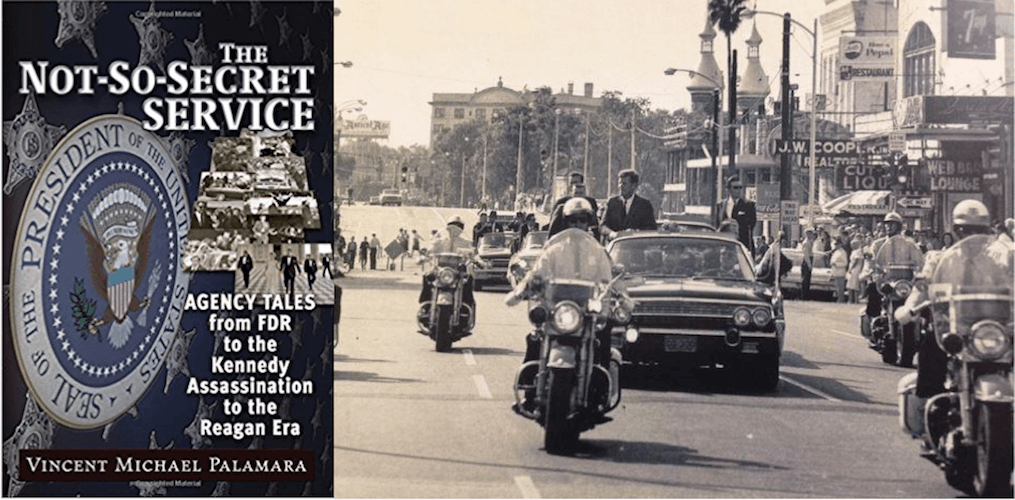
The Kennedy researcher and film historian Joseph McBride often cites Penn Jones’s suggestion that one should “find a single aspect of the case, and research the hell out of it.” The living embodiment of that suggestion is Vincent Michael Palamara. Vince has specialized in the Secret Service protection for decades, producing the books Survivor’s Guilt, JFK: from Parkland to Bethesda and now The Not-So-Secret-Service: Agency Tales from FDR to the Kennedy Assassination to the Reagan Era. As a result of his frequent contacts with members of the Secret Service, he has information in his books that cannot be accessed elsewhere.
The first thing to know about this new collection is that it does not solely focus on John F. Kennedy, although much of it reflects on or fills in the historical background of the Secret Service. Palamara, via his correspondence, for example, is able to supply significant first-hand reports about the quality of Presidential protection from an historical perspective prior to 11/22/1963, and the quality of the protection on that day. As is well-known, Fletcher Prouty had referred to the poor quality of the protection supplied on the day of the assassination, pointing out, for example, that there were strict procedural measures that had been ignored. He criticized the route itself, the open windows in the buildings, the slow speed of the parade route, and a few other things (cf. Dave Ratcliffe, Understanding Special Operations, 205-210).
Palamara contrasts the Secret Service performance in Dallas and compares it to a trip taken just four days earlier in Tampa. Why, he asks, did the motorcade not proceed in a wedge formation, with agents physically on the president’s limousine, as was customary? He also points to an interesting article from December of 1963, from U.E. Baughman, a former Secret Service Chief, who also indicates a violation of what he calls “basic, fundamental” rules. (Palamara, 87). Fascinating.
For researchers, perhaps the most important chapter in the book is called “Debunking Agent Gerald Blaine’s The Kennedy Detail.” It’s the longest chapter in the book, and goes into detail to counter Blaine’s book, which—as Palamara points out—has no footnotes and uses the sheen of authority to put forward questionable history. To use just one example, he asserts that Admiral Burkley, Kennedy’s physician, ran late and therefore had to catch the bus rather than riding in a staff car; while Burkley himself stated for the record that it was the Secret Service who put him on the bus. (122) The Kennedy Detail (co-written by Lisa McCubbin, who served the same function for Clint Hill’s series of books), focuses entirely away from “conspiracy theories,” as Palamara observes, largely on the grounds they are disrespectful to the family.
A few words should be said about Lisa McCubbin, both Blaine’s and Hill’s co-author. McCubbin, a journalist by trade, found in Clint Hill both a boyfriend and a new business. Hill had promised he would never write a memoir, but having met McCubbin, he then decided to write three of them: Five Presidents, Five Days in November, and Mrs. Kennedy and Me. “He credits Lisa McCubbin for bringing him out of his ‘dungeon, where he languished for years in [his] emotional prison’ and for helping him ‘find a reason to live, not just exist,’” says the bio on Lisa McCubbin’s webpage: Quite interesting. The major media likes to criticize the “cottage industry” of JFK books; but as usual, it seems like the best supported and promoted works are those with the least interesting content. In addition, Hill’s exit from the “dungeon” and hooking up with McCubbin has also mysteriously coincided with Hill no longer saying anything to upset the defenders of the Warren Commission. In fact, if you want to hear him speak on the subject in your town, all you need is cash.
There is also some interesting background on McCubbin at this AEI site:
In July of 2001, just two months before September 11, Lisa gave up her news anchor chair and moved with her family to Riyadh, Saudi Arabia, where her husband was being transferred by his company. After September 11, KGET-TV asked Lisa to report as a foreign correspondent with an insider’s view of Saudi Arabia. Her reports from inside the Middle East captivated the southern California audience by providing a personal connection to the Arab world.
In Riyadh, Lisa met Prince Abdullah bin Faisal bin Turki Al-Saud, a great-grandson of the founder of Saudi Arabia. After learning that Lisa was an experienced journalist, Prince Abdullah convinced her to work for the Saudis as a media consultant and trainer. In a country where women are not allowed to work with men, it was extraordinary that Lisa had direct meetings with the prince and his male staff—often held secretly at Prince Abdullah’s private villa. Her rare experiences in Saudi Arabia are the subject of her first book, Undercover in Islam: Spinning the News from Saudi Arabia.
McCubbin is the daughter of Gay and Wyman Harris. Wyman Harris graduated from the USAF, class of ’63. His background can be seen here:
Mr. Wyman C. Harris is a Principal at Harris, Hoimes, Sutton & Allen, LLC. He was the Chief Operating Officer and Chief Executive Officer at Wyndham Foods, Inc. Mr. Harris is a Director of Sagus International, Inc. He served six years in the United States Air Force in Germany and the Pentagon. Mr. Harris completed the Program for Management Development at Harvard Business School and received an M.S. in Industrial Engineering at Purdue University and a B.S. from the United States Air Force Academy. (See this link; a little more can be found here)
Anyway, it’s all a bit interesting.
To return to the main topic, Blaine contends that conspiracy theorists are just nasty people who want to think ill of our government. The trouble is, the behavior of the Secret Service tends to belie that. Palamara gives a full list of the contents of the two boxes that the Secret Service had deliberately destroyed in January of 1995, just a few months after the Assassination Records and Review Board had been established. Those records concerned the Protection of President John F. Kennedy and the Protective Survey Reports from presidential trips ranging from September 1963 right up until November 8, 1963—two weeks before the assassination. As Palamara writes, this cannot be an accident. How did the Secret Service respond to this?
… the Secret Service attempted to wriggle out of its predicament by simultaneously suggesting that perhaps the destruction was really the Review Board’s fault because it was not in receipt of the ARRB’s expanded definition of what constituted an “assassination record” until February 1995, after the records were destroyed …. [Ralph] Basham [the Administrative Director of Administration] also tried to downplay the significance of the missing Chicago protective survey reports for the cancelled November 2, 1963 trip (during which conspirators had planned to assassinate President Kennedy) … (137)
Needless to say, all of these trip reports would be of tremendous significance to any investigative body reviewing the protection of the president during a completed assassination. But the Chicago report is critical because it resulted in the cancellation of a trip and the possible saving of Kennedy’s life. Because there were strong indications that a plot was afoot in Chicago, as first reported by Edwin Black in his landmark essay “The Chicago Plot,” and also supplemented by Abraham Bolden, who later wrote about the incident in The Echo from Dealey Plaza. For the Secret Service to “accidentally” destroy these most important records, just before the ARRB was about to request them, is ever so slightly suspicious.
There is more to be found in the book: for example, I had not heard the story of Thomas Shipman, who was one of three people to drive President Kennedy while he was in office and who died shortly before the assassination. Although not much is known about him, it is certainly of interest.
Overall, there are two great strengths of the book. One is that it is relatively short yet fairly dense with information. Palamara is not selling any particular theory throughout the text (except the general thesis that the Warren Commission was wrong) and this is an excellent feature. The second great strength of the book is the obsession with obtaining direct reports and interviews, and when using secondary sources he reprints many of them right in the book so we can look at them. I was very appreciative of this aspect. The book’s subtitle is “Agency Tales from FDR to the Kennedy Assassination to the Reagan Era,” and that is what it delivers; so there is some information in the book that JFK researchers might regard as trivial. However, much of the material, especially the historical background work that the author has done with the agents themselves, is invaluable. And his persistence in attacking the work of Blaine/McCubbin/Hill is thoroughly admirable, if for no other reason than to continue our collective insurgency against the falsified historical record that the establishment wants to carve into stone.

The year 2017 contains two important milestones in the mystery of the John F. Kennedy saga—one dealing with the man, the other with the mysteries of his assassination. The end of last month marked the centennial of Kennedy’s birth in Brookline, Massachusetts. This was commemorated with glossy news magazine special editions and a few TV programs—at least one with Caroline Kennedy, the last surviving member of the immediate family. There was also an act of Congress recognizing this event.
This October, another act of Congress will be honored in regards to John F. Kennedy. This one relates not to his life, but to his death. On October 17th, the National Archives will release well over three thousand documents relating to the assassination of President Kennedy. In other words, fifty-four years after his murder, 53 years after the Warren Report was issued, the American public will finally be allowed to read what the American government wanted to keep classified for still another 22 years. Because if it were not for Oliver Stone’s 1991 film JFK, most of these documents would have remained classified until the year 2039. But due to the firestorm of controversy created by that film, an act of Congress was passed. That act created a citizens’ panel called the Assassination Records Review Board (ARRB). From 1994-98 it declassified over two million pages of documents dealing with the assassination of President Kennedy. But there were certain restrictions placed in the legislation that allowed for exceptions until the year 2017. Those exceptions will expire this October.
The secrets already released by the ARRB from 1994-98 were underplayed by the news media, but in fact they were quite bracing. For instance, the records of a meeting in May of 1963 helmed by Secretary of Defense Robert McNamara showed that President Kennedy did have a plan to withdraw from Vietnam. Under questioning by ARRB chief counsel Jeremy Gunn, Kennedy pathologist James Humes revealed that he had burned both his notes and the first draft of his autopsy report. We learned from declassified records of the Church Committee that INS officers—on the trail of Cuban illegals—had followed David Ferrie to Guy Banister’s office in New Orleans. And they found Lee Oswald there.
On April 28th of this year, Max Holland published an essay on the JFK case in The Daily Beast. Holland brought up a different milestone date. This one concerned the 50th anniversary of a story originally published on April 25, 1967 in the (now defunct) New Orleans States Item. Holland’s article was called “How the KGB Duped Oliver Stone.” Holland stated that the 50-year-old article—titled “Mounting Evidence Links CIA to Plot Probe”—was a triumph for Moscow.
The article describes the arrest of Clay Shaw by New Orleans DA Jim Garrison on March 1, 1967. Holland characterizes the arrest of Shaw for conspiracy in the JFK case as “outlandish and baseless”. He adds that the reasons for Shaw’s arrest had already been reviewed back in 1963 by the FBI and found wanting.
But the arrest of Shaw created headlines around the world. And this led to several articles about Shaw’s work in Rome for a mysterious business entity called Centro Mondiale Commerciale (CMC). One Italian newspaper, which produced a series of articles, Paese Sera, was a leftwing publication that eventually wrote that CMC might have been a creation of the CIA, and a center of funding for illegal covert activities. Jim Garrison received copies of these Paese Sera articles. According to the author, this is how the DA now centered his investigation on CIA complicity in the Kennedy murder. The article then concludes that Garrison was really an unsuspecting dupe of Moscow. How? Because Paese Sera was really a conduit for KGB disinformation. And because Oliver Stone based his 1991 film JFK on Garrison’s memoir On the Trail of the Assassins, Stone was also made a Moscow dupe.
Holland’s source for this? The controversial Mitrokhin archives. Vasili Mitrokhin was a former archivist for the KGB. In 1992 he defected to the United Kingdom. As Russian scholar Amy Knight has noted, the story behind Mitrokhin and his defection strains credulity. But it began a whole new genre of academic studies and books. With a skeptical eye, she surveyed the books in all of their questionable aspects, i.e., the sales and marketing of former Russian intelligence employees who spirit out their notes on KGB files. (See this article in the Wilson Quarterly)
This new area of trade and barter reached its apogee in the instance of Alexander Vassiliev, still another former Russian intelligence officer who defected to England. In that case, it was shown that Vassiliev’s “notes” at times actually distorted the original memorandum beyond recognition.
Once in England, Mitrokhin was furnished with an official in-house British MI5 author. In turn, Christopher Andrew set up a syndication deal with Rupert Murdoch. The subsequent volume was called The Sword and the Shield. In 1995, the political angle behind the barter was accentuated. Based on the word of still another Russian intelligence defector, Murdoch and his subordinates accused former Labor Party leader Michael Foot of accepting funds from KGB agents. Foot promptly sued for libel. Understandably, Murdoch did not want to appear in court, so he settled the case in Foot’s favor.
Mitrokhin’s notes said that the late Mark Lane had been aided by two secret donations from the KGB: one for 1500 dollars and one for 500 dollars. As Lane later replied, the only donation he received even close to those amounts was from the extraordinarily wealthy Corliss Lamont, an heir to the JP Morgan fortune. Not a likely candidate for a KGB agent. Further, according to the Mitrokhin notes, the transfer occurred in New York City in 1966. As Lane has noted, he was living in London that year, finishing up and editing his book Rush to Judgment, which was being published by a British house. (Lane, Last Word, pp. 92-93) Third, the next largest donation Lane got for further research was from Woody Allen. It was for $50. Lane kept records of his donations. In other words, the Mitrokhin charges against him were quite dubious. Consequently, he challenged the veracity of the book in a letter to the author. Andrew never replied. (ibid, p. 96)
Which brings us to the pretext for this article. Clay Shaw was arrested on March 1, 1967. Three days later, Paese Sera began publishing its six-part series on the mysterious and suspicious activities of the CMC in Italy. The author tries to imply that there was a cause-effect relationship between the two events. He bases this on one of the notes in the Mitrokhin archive. That note says that in 1967, the Russians started a disinformation scheme in that Italian newspaper that was later picked up in New York. (ibid, p. 73) That is it. In other words, there is no specificity to the accusation. There is no mention in the Mitrokhin note of Jim Garrison, Clay Shaw, the CMC or any New York publication that picked up the story. Realizing how that paucity presents a problem, Holland had once said that there was a mention of the Paese Sera series in the socialist New York weekly the National Guardian. But this was only done because they had a contributor who lived in Rome.
In prior presentations, Holland had realized how thin this case was. So he added the testimony of CIA officer Richard Helms before a congressional committee concerning Paese Sera. The problem with this was that Dr. Gary Aguilar exposed Helms’ testimony as being rather faulty. It turned out that Helms, in order to discredit Paese Sera, used a story in which they said the CIA was complicit in the attempts to overthrow French president Charles DeGaulle. As Aguilar ably pointed out, this story was true. Even a sympathetic CIA author like Andrew Tully admitted this as far back as 1962, after the attempted coup of the French generals over the war in Algeria. The complicity was reported even earlier than that in The New York Times by Scotty Reston. (NY Times, April 29, 1961) More recently, David Talbot hammered the point home with multiple sources in his biography of Allen Dulles, The Devil’s Chessboard. (See pp. 412-24)
Another implication of Holland’s essay is that, somehow, the KGB dreamed up the story and gave it to Paese Sera on the occasion of Shaw’s arrest. As anyone in the newspaper business knows, usually the next day’s paper is locked down the night before. Which would mean that the KGB put the story together in about 48 hours. This author had the opportunity to read the six part series in translation. The idea that a foreign intelligence service could put together such a story on such brief notice is hard to buy. Clearly, the quite lengthy, detailed reporting was the result of a weeks-long inquiry into the whole business enterprise of the CMC. So unless this was all made up in Moscow—and it is hard to see how it could be—the idea of a KGB “planting” of the story is simply improbable.
Why would Paese Sera be interested in such a lengthy exposé? Because the CMC was a mysterious business agency with a suspect past. Prior to moving to Italy, the enterprise had been kicked out of Basel, Switzerland in 1957. The reasons were similar to those that Paese Sera complained about: murky financing and the questionable character of the company directors. Which included one George Mandel, who had been accused of working the Jewish refugee racket during World War II. When this unsavory fact surfaced in the Swiss press, Mandel threatened to sue the paper—but he didn’t. The editor was disappointed. He commented, “Too bad. We would have heard some great things at the trial.” (Paris Flammonde, The Kennedy Conspiracy, p. 216; State Department Memorandum of April 9, 1958)
But further, as questions about the financing in Basel began to crest, another director of the firm, former Hungarian prime minister Ferenc Nagy, mentioned J. Henry Schroder Banking Corporation as a source of funds. He also mentioned J and W Seligman. As William Davy writes in his book Let Justice be Done, Allen Dulles had been general counsel to Schroder prior to becoming CIA Director. When the Dulles brothers law firm, Sullivan and Cromwell, was still dealing with the Nazis in the thirties, they used Schroder’s as their conduit. When Dulles became DCI, he opened up a fifty million dollar emergency fund with Schroder’s. It was later reported that Schroder’s served as one of the recurring cut-outs for the Agency to transfer funds. (Davy, pp. 96-97) If one consults the book Millionaires and Managers, a 1969 analysis of the large Wall Street investment houses and legal firms, one will see that both banks—Schroder and Seligman—come under the purview and control of what the author calls the Sullivan and Cromwell/Marine Midland Group. This important back-story in Switzerland is ignored by Holland.
In 1958, because of all the controversy in Basel, the enterprise moved to Italy. This is when Clay Shaw entered the picture. The major board players in Italy were much the same as in Switzerland. But they were augmented by people like a former member of Mussolini’s cabinet, and the son-in-law of Hjalmar Schacht, financial guru of the Third Reich. They represented “a small cross-section of the aging royalists with whom Shaw liked to hobnob on his European jaunts and whose names and phone numbers were kept in his address book.” (Davy, p. 98)
Paese Sera was not the only newspaper that reported on the controversial company. So did Corriere della Sera, Il Messaggero and Le Devoir in Montreal. The latter likely reported on the enterprise because its general counsel was Louis Bloomfield, a Montreal corporate and international lawyer. Looking through what has been released of Bloomfield’s papers, researcher Maurice Phillips has discovered that Bloomfield was an important player in the CMC scheme. He actually coordinated meetings and investments for Nagy from some of the wealthiest men in the world, who were somehow interested in the CMC; e.g., Edmund deRothschild, and David Rockefeller. (Letter from Bloomfield to Dr. E. W. Imfeld, 2/10/60) Phillips has also uncovered documents that show that Nagy was a CIA asset and that he queried the Agency, offering them the use of CMC in any capacity. (March 24, 1967 CIA memo, released in 1998.) Phillips is now involved in a legal dispute with the Bloomfield estate, who wish to cut off any further access to these papers. This, in spite of the fact that Bloomfield’s will said his papers should be opened to the public twenty years after his death, and he passed away in 1984.
Finally, there is information about the CIA and the CMC from FBI agent Regis Kennedy, who, along with Warren DeBrueys, was J. Edgar Hoover’s man on the ground in the Cuban exile community in New Orleans. He reportedly stated that, “Shaw was a CIA agent who had done work of an unspecified nature over a five year period in Italy.” (Davy, p. 100) That description, of course, perfectly matches both the time span and the location of the CMC. Therefore, in two strands of Holland’s sixteen-year old yarn—concerning the CIA and the DeGaulle overthrow, and the Agency connections to the Centro Mondiale Commerciale—it turns out that Paese Sera was right and Holland was, shall we say, obtuse. After all the controversy in Italy, the CMC left and went to Johannesburg, South Africa. Thus the idea that CMC was somehow connected with the Central Intelligence Agency is anything but disinformation.
But Holland goes even further here. In defiance of the ARRB declassified record, he conceals from the reader the new documents about Clay Shaw. The author writes that both the Warren Commission and the FBI investigated the true identity of a man named Clay Bertrand, who New Orleans lawyer Dean Andrews said called him to go to Dallas and defend Oswald. Holland writes that the Bureau and the Commission determined that this allegation was false, and that Bertrand was not even a real person.
First, there is no evidence that the Warren Commission itself ever did any kind of search for the true identity of Clay Bertrand. The FBI did investigate the issue. And the results were pretty much contrary to what Holland describes. In 1967, the Justice Department committed a faux pas about it. They admitted that the FBI had investigated Clay Shaw back in 1963. (Davy, p. 191) This announcement caused much consternation at FBI headquarters, because the obvious follow up question would be: Why was the FBI investigating Shaw as part of its original inquiry into the Kennedy murder? J. Edgar Hoover did not want to answer that question. So the Justice Department issued a second announcement: the FBI had not conducted any inquiry about Shaw in 1963.
As the declassified record demonstrates, this was false. In fact, The New York Times actually printed the truth about this on March 3, 1967. They wrote, “A Justice Department official said tonight that his agency was convinced that Mr. Bertrand and Mr. Shaw were the same man … .” Behind the scenes, FBI official Cartha DeLoach admitted that, in December of 1963, several parties had furnished the FBI information about Shaw. (Davy, p. 192, italics added) Before Shaw was arrested, the FBI had multiple sources saying Garrison was correct: Shaw was Bertrand. (ibid, p. 193) The declassified record shows that the Bureau knew this and concealed it.
One of the most questionable statements in Holland’s essay is that it was because of the Paese Sera article that Garrison began to focus on the CIA as his chief suspect in the Kennedy murder. Again, this does not align with the record, or even with what Garrison himself has written. It is very clear what led Garrison down this path: Oswald’s Russian language test in the military, and the flyers Oswald was passing out on Canal Street in New Orleans in the summer of 1963. The former was a strong indication Oswald was receiving Russian language training in the Marines. Which suggests he was being prepared in advance for his defection to Russia upon his early release. As per the latter, some of the flyers Oswald was handing out in New Orleans contained the address: 544 Camp Street. As depicted in Stone’s film, Garrison visited this building. It turned out that Oswald had been seen there at the office of former FBI agent Guy Banister. It turned out that, again, as depicted in JFK, Banister’s office was a clearinghouse for many Cuban exiles, along with Oswald’s longtime friend, David Ferrie. And Garrison later learned that both Banister and Ferrie were involved with both the Bay of Pigs landing, and Operation Mongoose, the secret war against Cuba, also depicted in Stone’s film. Both of these were CIA sanctioned, supplied, and backed. The more Garrison peeled back 544 Camp Street, the more he discovered how residents of the address, like Sergio Arcacha Smith, were related to the CRC. This was the CIA’s anti-Castro Cuban government in exile, created by Howard Hunt. Therefore, the only way to explain Oswald’s presence amid all these CIA agents and Castro haters was that he was an agent provocateur against the Fair Play for Cuba Committee, which was billed on the literature as being located at that address. Garrison goes through all of this in his memoir, On the Trail of the Assassins. (See Garrison, pp. 22-25 and 34-36)
But another point that caused Garrison to consider the CIA as a chief suspect was the infiltration of his office. And also the fact that suspects and witnesses in his case were being furnished lawyers associated with the CIA. Again, this point has been reinforced with the release of declassified files by the ARRB. Through that process we have discovered that the CIA maintains what they call a Cleared Attorneys Panel in major cities. This panel is called upon when the Agency gets stuck in sensitive situations. The Garrison investigation caused word to get out in the New Orleans legal community about this panel, and soon letters were being sent to CIA Director Richard Helms to volunteer for work on it. (Letter from James Quaid, May 15, 1967)
This directly relates to the article Holland mentions in The New Orleans States Item. The Paese Sera article takes up two paragraphs in the over thirty-paragraph article. The reporting team had talked to one of the witnesses Garrison was trying to extradite back to New Orleans. Gordon Novel had volunteered for Garrison’s probe masquerading as an electronics expert who could ensure his office was not bugged. He ended up doing the opposite. Again, as Stone’s film shows, he wired the office for sound and sold some of the tapes to the producer of an upcoming NBC special. (James DiEugenio, Destiny Betrayed, Second edition, pp. 232-34) When Garrison requested Novel testify before the grand jury, he fled the state. As the article reveals, Novel had worked for the CIA since the Bay of Pigs operation. And he planned on using those credentials for his defense—if Garrison ever got him back to New Orleans. Which he did not. In other words, a former CIA operative was ingratiating himself with the DA. He was then wiring his office and selling the tapes to an upcoming negative TV special. And, as Garrison revealed in his October 1967 Playboy interview, one of Novel’s attorneys was being paid by the CIA. Kind of interesting, no? But it is left out of Holland’s story.
As one can see from what I have indicated above, the Mitrokhin Archives represents one notch of a string of former KGB agents who understood an important historical point in time had been reached. That, after the fall of the USSR, and especially after the rise to power of Boris Yeltsin and his disastrous economic policies, the writing was on the wall. One way to escape the oncoming socio-economic crisis was to curry favor with the American State Department, as depicted in the recent film, Ukraine on Fire. Another way was to win over the west with “notes” from the KGB Archives. (Evidently Mitrokhin did not have access to a copier for all those many years he was an archivist.)
But the East/West exchange actually goes back before Mitrokhin. It stems from the relationship of former TV/Radio journalist Brian Litman with the KGB after the USSR began to collapse in 1991. At that time, while working for an American cable TV company, Litman was living in Moscow. It is there that he began a relationship with the KGB and sold the American rights to a book called Passport to Assassination. That book proposed that Lee Harvey Oswald actually did go to the Russian embassy while he was in Mexico City. There, he met with the embassy chief consul and two assistant consuls. This occurred even though no surveillance camera captured Oswald’s image upon entrance or exit; and there was no recorded tape of his voice inside the embassy. Even though the embassy was under multi-camera surveillance and the interior was bugged.
The portrayal of Oswald in this book is that of a desperate man at the end of his rope. He carries a handgun with him since he thinks the FBI is following him around everywhere—even in Mexico. He says ominous things, like, “For me it’s all going to end in tragedy.” Or he breaks down and weeps, because he fears the FBI will actually kill him. This is allegedly due to the fact he wrote a letter to the Soviet Embassy in Washington over the possibility of returning to Russia. In other words, by actually placing Oswald in Mexico City, this book countered what Mexico City CIA officer David Phillips said in public: namely, that when all the information is finally produced, there will be no evidence placing Oswald inside the Russian embassy. (Mark Lane, Plausible Denial, p. 82) Thus began a long migration of convenient helpers from the KGB who would paper over problems in the CIA’s version of the Cold War—including its difficulties with the Kennedy assassination. For instance, in the Litman/Nechiporenko version of Oswald in Mexico, Oswald (oh so conveniently) pulls his jacket over his head as he leaves the embassy—as if the authors were aware that the CIA surveillance took no photos of Oswald entering or leaving. One wonders, did he also do that upon entering the compound? If so, how did he know about the surveillance?
But perhaps the worst part of the essay is the charge that it was Jim Garrison who caused a loss of belief by Americans in the democratic institutions of their government. Because it was not Jim Garrison who provoked serious doubts about the Warren Commission. It was a wave of books, articles, and radio appearances by the first critics of the Warren Report, who preceded Jim Garrison. That is, writers like Edward Epstein, Vincent Salandria, Harold Weisberg, and Mark Lane. By 1967, the Gallup Poll revealed that belief in the Warren Report’s Oswald-Did-It-Alone concept was at about 30%. What drove it even lower—to 11% in 1976—were three major events, which we all know about. They were, in order, the Vietnam War, the Watergate scandal, and the exposés of the Church Committee concerning the crimes of the CIA and FBI. This all began in 1965—with the first insertion of American combat troops into Vietnam—and continued until the last reports of the Church Committee in 1976.
The unfolding of these three events on national TV, radio, and in daily newspapers, was incessant and, in its cumulative effect, oceanic. They literally dominated all news cycles for over ten years. Has Holland completely forgot about the Tet Offensive and the cover up of the slaughter of civilians at My Lai? What about Richard Nixon’s Saturday Night Massacre? Or the indictments of over sixty employees of his administration, and the convictions of over forty of them? Perhaps he missed the Church Committee’s exposure of the attempts by the CIA to assassinate Patrice Lumumba of the Congo? Or J. Edgar Hoover’s COINTELPRO programs to infiltrate, disrupt, and sometimes eliminate leftist groups?
It was the tremendous impact of these three events that drove down all belief in government. And anyone can see this by looking at the graph in Kevin Phillips’ 1995 book Arrogant Capitol, which first appeared in US News and World Report. But interestingly, on that US News graph, the drop-off in belief begins in 1964, the year the Warren Report was issued, three years before Jim Garrison’s inquiry was made public. This would suggest that, from the beginning—and without any outside influence—the American public thought something was awry with the official story of President Kennedy’s assassination.
As author Larry Sabato noted in his 2013 book The Kennedy Half Century, there is an underlying reason that Kennedy’s life and death is celebrated on so many occasions. Sabato commissioned extensive polling and focus groups for his book. At the end, he revealed that 78% of those polled thought that Kennedy’s presidency had a deep impact on the USA. Which is remarkable since Kennedy only served two years and ten months of his term. Even more remarkably, 91% of the public believes that Kennedy’s murder changed the country a great deal. The last polling result was that 75% of the public did not believe the Warren Report verdict of Kennedy’s assassination, namely that Oswald acted alone.
The Daily Beast preferred printing this article instead of previewing the upcoming releases of the ARRB in October, or the mock trial of Oswald in November in Houston. Which is somewhat surprising, since those upcoming events are rather singular in more ways than one. Holland’s article is nothing more than a rerun of an essay he started marketing at least 16 years ago. In the Spring 2001 edition of Wilson Quarterly , it was entitled “The Demon in in Jim Garrison”. In 2004, he made a very similar presentation at the Assassination Archives Research Center Conference, which, as mentioned above, was rebutted by Gary Aguilar. In 2007, the piece was printed in the CIA’s Center for the Study of Intelligence. Any differences between the versions is marginal. So if The Daily Beast paid Holland, it was like a photographer dusting off photos in his drawer from 15 years ago—easy money. But what makes it worse is that they were all done after 1998—the termination date of the Assassination Records Review Board. As the reader can see, Holland ignored the new information on Clay Shaw and Jim Garrison. Instead, he went with records from an alleged KGB archives which are easily rendered dubious.
For many, many years now Holland has been ignoring the declassified records of the ARRB. Even when he was supposed to be reporting on those files. The fact that he still does so, even on the eve of their final disbursement, tells us all we need to know about him.
See also: Max Holland and Donald Carpenter vs Jim Garrison and the ARRB
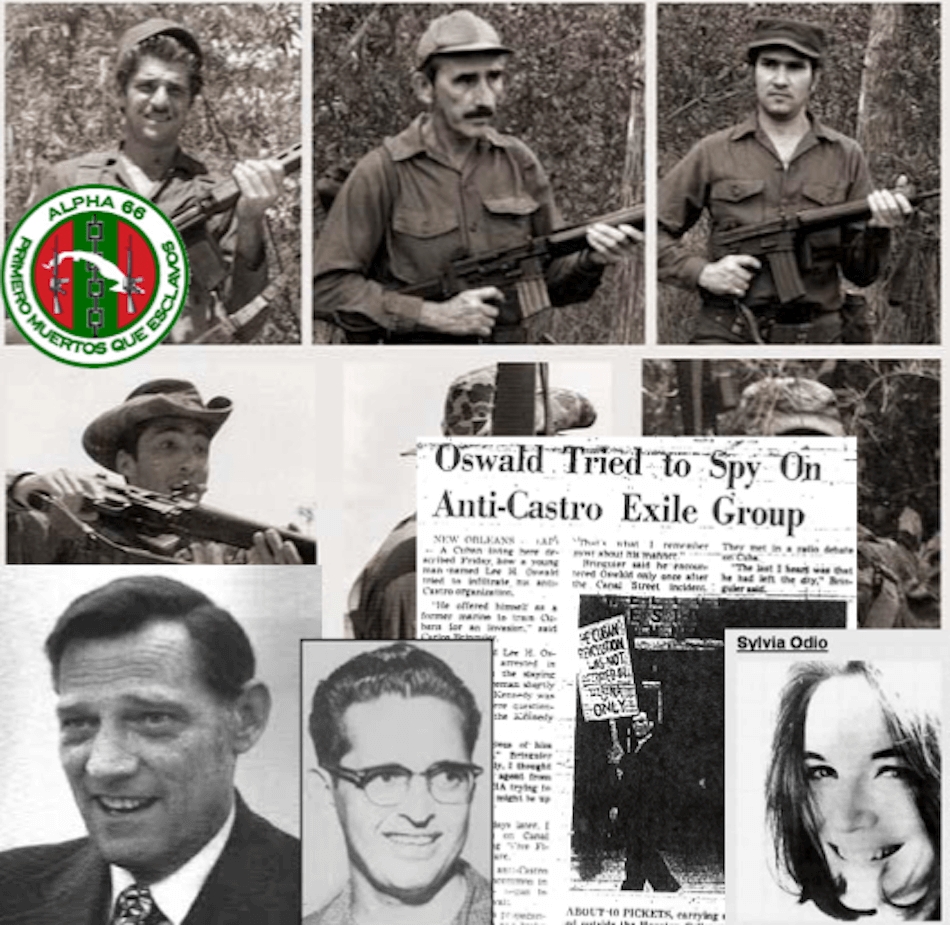
The CIA never recovered from its perfect failure at the Bay of Pigs. It generated a sort of obsession with Castro that led to an ultimate defeat in times of dirty war; but also to a carnivalesque approach to Castroist Cuba. A facet of this carnavalization became manifest in the fourth part of the series JFK Declassified: Tracking Oswald. The episode is entitled “The Cuban Connection,” but illustrates how former CIA case officer Bob Baer is disconnected from historical truth.
Baer opened this episode with a memo from HSCA first Deputy Counsel, Robert Tanenbaum,1 about Oswald’s involvement in New Orleans with Cuban exiles—and some non-Cuban soldiers of fortune—recruited and trained by the CIA to overthrow Castro. Thusly, he is setting the stage for a hell of a sleight of hand. Former Marine “Ozzie” Oswald, re-defector from the Soviet Union and pro-Castro activist in Dallas,2 will turn into a leftist wannabe killer of Kennedy.
It’s easy to predict that the conjuring trick will continue with Castro knowing in advance Oswald’s criminal intent, since everything going on in the anti-Castro belligerent milieu in the U.S. was reported to him by the Cuban Intelligence Service (CuIS). On the other hand, the CIA did have the luxury of missing Oswald as a security risk, since it funded the black ops against Castro, but it ran them from afar with “little oversight”. It doesn’t matter that since April 24, 1963, the vey leader of Alpha 66 in Dallas, Manuel Rodríguez Oscarberro, had been reported to the Secret Service as security risk to President Kennedy.3
Big-budget paraphernalia—underwater sonar, a diver, metal detector for canvassing the forest—are displayed again, as if the episode were about artifacts instead of new milestones in the well-known historical trail of the CIA dirty war against Castro. However, Baer forgot to include a crap detector and claimed that nobody else had ever really looked into the connection between Oswald, the Cubans, and the CIA. It would mean that—just for instance—New Orleans D.A. Jim Garrison never started an investigation in late 1966 or Harold Weisberg never wrote Oswald in New Orleans: Case for Conspiracy with the CIA (Canyon Books, 1967). But by skipping those authors, Baer does not have to bring up the names of David Ferrie, Clay Shaw and Guy Banister.
The legerdemain with Ozzie included the Tourette’s-Syndrome-style reiteration that he shot Kennedy and he did it “with the same rifle” ordered by mail on March 12, 1963, and used to shoot at General Edwin Walker on April 10. Baer forgot what Tanenbaum stated in his ARRB Testimony (1996): “I don’t think from my experience that Lee Harvey Oswald could be convicted in any courtroom in America.” As it happened, the Warren Commission engaged in acts of evidentiary wizardry to do so:
Baer evidently wants to travel instead of reading any books on the subject he is addressing in the TV series. As even beginners know, the “key to this whole operation” in New Orleans lies in the Miami CIA station (JM/WAVE). Hence Baer and his team go to South Florida. They track down former CIA contractor Marshall Golnick, who has “inside information” from a half century ago. They also do another archaeological search in Key Largo around a military facility.
Golnick states that the Cuban exiles trained in New Orleans were dropped off by bus in Miami and received money and weapons. They were ready to stage raids into Cuba to destroy any infrastructure in sight; but this all ended with the fiasco at Bay of Pigs (thereby forgetting about Operation MONGOOSE). Golnick then reinforced the historical lie used by Baer himself to justify why Cuban exiles hated Kennedy: The latter ordered the Bay of Pigs invasion, but then withheld air support.
The invasion was a so-called CIA covert operation that was unleashed with a Pearl-Harbor-style air bombing against three Cuban air force bases. Since these bombings were attributed to Castro’s defectors, they could not return to bomb again without destroying the plausible deniability required by the White House to prevent condemnation at the UN.8 And further, as Peter Kornbluh demonstrates in Bay of Pigs Declassified, the alleged D-Day air strikes were not part of the original plan. They were to be launched from an airstrip on the island after a beachhead was secured. The latter never happened.
Finally, Golnick drops his own bomb about Oswald: likely aligned with the most radical fringe groups such as Alpha 66 and Omega 7. It does not matter that Alpha 66 was founded in 1962 and Omega 7 in 1974. According to the program, all these groups wanted to kill Kennedy and so did Oswald. Baer hammers the point home: “Oswald is a pronounced Marxist who praised Communist ideals.” Therefore, he and the radical Cuban exile groups worked together to achieve the common goal of killing JFK. Such a coincidence of contraries was strong enough to prevent the fierce anti-Castro Alpha 66 fighters from reacting to Oswald’s Castroist inclinations. By skipping authors like Weisberg and Garrison, Baer does not have to bring up the names of David Ferrie, Clay Shaw and Guy Banister.
Amid the extremist Cuban exile paramilitary subculture, Oswald flaunted his Fair Play for Cuba Committee [FPCC] militancy in New Orleans from mid-June to late August 1963. But only members of the Student Revolutionary Directorate (DRE) cadre, Carlos Bringuier and two cohorts, confronted him in a minor fracas at Canal Street on August 9, when Oswald was distributing the sold-out 1961 first edition of FPCC pamphlet The Crime Against Cuba (1961).9 Which had Banister’s 544 Camp Street address stamped on it. Oswald had described the scuffle—including being arrested by the police—in a letter to the FPCC dated August 1st and postmarked August 4th. In other words, before it happened.
Although all the anti-Castro groups in New Orleans and Miami were CIA brainchildren, Baer and his partner, former police officer Adam Bercovici, do not give a damn about how the CIA wasn’t aware of an Oswald-Alpha 66 common goal. Instead, they do some brainstorming to find Oswald’s deeper motivation. And they discover it. Oswald had an “I’ll show them” mindset.
They also discover, this time on the computer, that the man behind Alpha 66 was Maurice Bishop. But they don’t identify him as David Philips, who in 1963 was playing a CIA dual role: Chief of the Cuban Desk in Mexico City and Chief of Covert Ops against Cuba in Langley. They only resort to the well-known statement by Antonio Veciana about having seen Bishop with Oswald in Dallas in the late summer of 1963. Bercovici concludes: “There’s your co-conspirator. He had on-the-ground assistance in Dallas.”
Back on the computer, they bump into the famous, late September Sylvia Odio incident.10 It’s prima facie evidence of Oswald being impersonated in Dallas while visiting Mexico City, or vice versa. But Baer limits his explanation as to why the FBI didn’t track the event in Dallas: “Because they missed it.” Indeed, they did. On October 9, 1963, the FBI cancelled the security flash on Oswald,11 but on October 10, 1963, Langley omitted in a cable (DIR 74673) to the FBI that “Lee Oswald” had spoken with Soviet Consul Valeriy Kostikov in Mexico City, Baer’s main character of the first episode (“The Iron Meeting”). Such a piece of intel would have been enough to restore the flash. This cable also provided a false description of a presumed American entering the Soviet Embassy and the related photo taken by a CIA site wasn’t Oswald’s. In other words, during these weeks, it was Murphy’s Law that pertained: Everything that could have gone wrong, did go wrong between Oswald, the FBI and the CIA.
In closing the episode, Baer and Bercovici swallow whole Marina Oswald’s testimony about her husband shooting at General Walker. They search the DPD files on the case. Oswald appears to have never been brought up even as a person of interest by the police prior to the creation of the Warren Commission. But they focus in on the two cars seen leaving from the alley behind General Walker’s house, concluding Oswald had likely been driven in and out by accomplices.
The preview of the fifth part, “Scene of the Crime,” showed a re-enactment of the shooting at Dealey Plaza. A rifle is fired from above and behind at a rubber head, which goes backwards after being shot. As in the Walker shooting, Oswald will surely have get-away accomplices.
1 In a fictionalized account (Corruption of Blood, Dutton, 1995) of his HSCA experience, Tanenbaum referred to a black-and-white silent 8 mm home movie showing military exercises. The viewer can see the pinpoints of fire from rifles and the shimmering gouts of muzzle blast from machine guns. Among the people in the film, Tanenbaum identified David Ferrie in a close-up; Oswald “in his ball cap and black T-shirt;” Antonio Veciana “in civvies this time, holding a .45 and smiling;” and “another guy in civilian clothes,” who Tanenbaum believes was David Atlee Phillips, alias Maurice Bishop (pages 143-46). Jim DiEugenio asked Tanenbaum: “Was it really as you described in the book, with all the people in that film? Bishop was in the film?” Tanenbaum replied: “Oh, yeah. Absolutely! They’re all in the film. They’re all there. But, the fact of the matter is the [HSCA] began to balk at a series of events” (Probe, Vol. 3, No 5, July-August 1996). In fact, the film vanished after Tanenbaum’s departure from HSCA.
2 Shortly before Oswald moved to New Orleans, the FBI office in Dallas received info about him passing out pamphlets of the Fair Play for Cuba Committee [FPCC] on Main Street and wearing a placard around his neck reading, “Hands Off Cuba, Viva Fidel.” It occurred on April 15, 1963. SA Agent James Hosty reported it on September 10. See Warren Commission, Vol. XXVI, CE 2718.
3 Eventually, a CuIS informant furnished the intel Rodríguez Oscarberro had told him that “if his involvement in the assassination was uncovered, he was a dead man, given that he was an Alpha 66 delegate in Dallas and knew too much.” See Escalante, Fabian: JFK: The Cuba Files, Ocean Press, 2000, 170 f.
4 Warren Report, 406.
5 Ibidem, 119. It implies that, in about 24 hours in 1963, the U.S. Post Service picked up the money order from a mailbox in Dallas and transported it to a post office where it was sorted and shipped out to the airport. Then it flew 700 miles to Chicago, was picked up there and driven to the main post office, where it was sorted, placed on a truck and driven to the regional post office. Here it was given to a route carrier who delivered it to Klein’s. After being sorted out again, Klein’s delivered it to the First National Bank of Chicago to be deposited in Klein’s account.
6 Armstrong, John: Harvey and Lee, Quasar Ltd., 2003, 477.
7 DiEugenio, James: Reclaiming Parkland, Skyhorse, 2013, 62.
8 When Eisenhower approved the CIA policy paper A Program of Covert Action Against the Castro Regime on March 17, 1960, he made crystal clear to CIA Director Allen Dulles: “Our hand should not show in anything that is done” (Memorandum of Conference with the President, March 17, 1960. FRUS, Vol. VI, Doc. 486). Kennedy stuck to the script and ruled out an intervention of the U.S. armed forces under any condition, as he clearly stated at a press conference at the State Department on April 12, 1963 (Cf.: Johnson, Haynes: The Bay of Pigs, W. W. Norton and Co., 1964, 72).
9 By that time, the CIA had ordered 45 copies. DiEugenio, James: Destiny Betrayed, Skyhorse, 2012 158 f.
10 In late September, Mrs. Odio was visited by two Cubans (Leopoldo and Angelo) along with an America introduced as Leon Oswald. They would be “working in the underground” and looking for her help regarding funds for the Cuban exile group JURE. The next day, Leopoldo phoned Mrs. Odio and discussed Oswald, saying he was an excellent shot and had said that President Kennedy should have been killed after Bay of Pigs. When JFK was murdered in Dallas, Mrs. Odio fainted upon hearing the news and recognizing Oswald. Her account was corroborated by her sister Annie, who had briefly seen the visitors. It reached the FBI and later the Warren Commission, but the latter ultimately dismissed it because its chronology put Oswald on his way to Mexico City on the same dates.
11 Because of that, Hoover disciplined Lambert Anderson, Marvin Gheesling, and sixteen other agents.
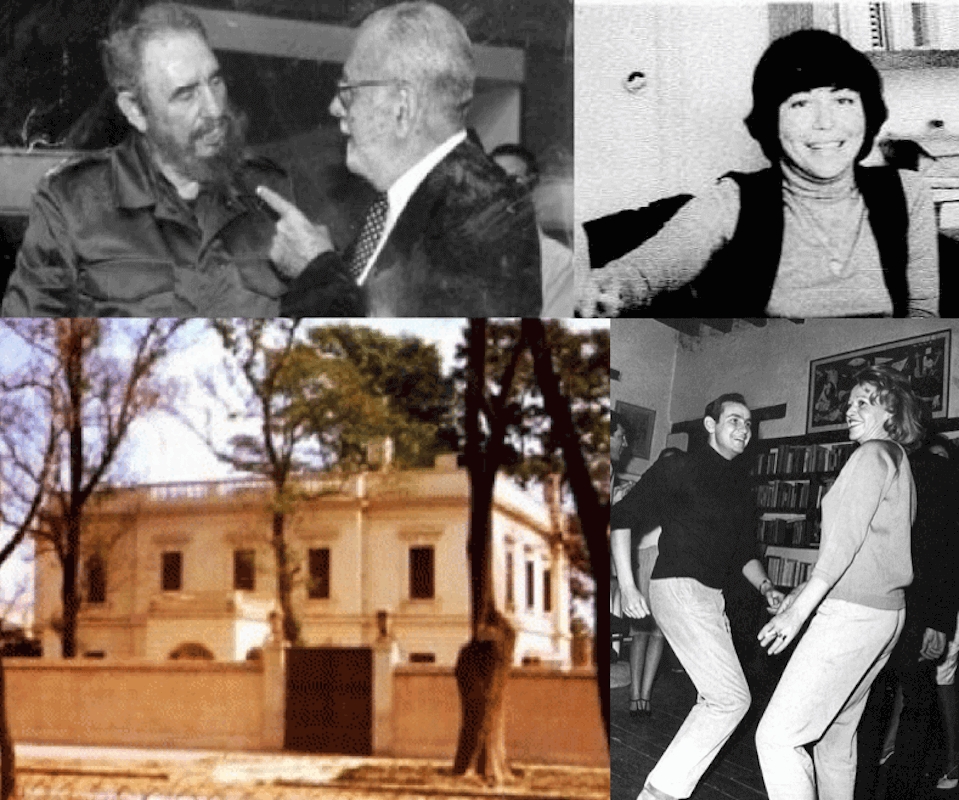
The History Channel series JFK Declassified: Tracking Oswald has been curtailed in the U.S. Maybe the ratings were too low, but History Canada continues airing it on Sundays at 10 p.m. (East). Maybe it had to take a break in the U.S. after two self-contradictory episodes: “The Iron Meeting” inside a bullring in Mexico City should have never happened since “The Russian Network” didn´t care about recruiting Oswald.1 The third part, “Oswald Goes Dark,” starts following in the footsteps of the CIA by trying to link the Mexican consular clerk Silvia Duran and the American visa applicant Lee Harvey Oswald outside the Cuban Consulate.2
For this purpose, host Bob Baer recycled as “new memo”: the entirely discredited “Thomas Report”3 about Duran and Oswald at a twist party, and this was then exploited by the replacement of the Russian Network—the Cuban Intelligence Service (CuIS)—to put Oswald up to killing JFK. Using a mobile lab, Baer and his team also tracked down a witness, Francisco Guerrero Garro, who had kept his silence for more than half century, but now swears having seen Oswald and even a Cuban consul at a twist party. Oswald could have been invited by his “friend” Duran. However, a false testimony does not become a fact by repetition.
Such a twist party4 was the ludicrous brainchild of Francisco’s aunt, the late Mexican writer Elena Garro de Paz. After having exhaustively interviewed her and her daughter twice in November 1964, the Legal Attaché (FBI) at the U.S. Embassy in Mexico City put the case at rest, simply because they “failed to substantiate the allegations.”5
CIA Station Chief Win Scott passed along the info to CIA headquarters at Langley. On the memo, Scott’s deputy Allen White wrote down: “I don’t know what FBI did in November 64, but the Garros have been talking about this for a long time and she is said to be extremely bright.” Scott dismissed White’s remark with a lapidary handwritten comment: “She is also nuts.”6
Garro de Paz drove others nuts as well. The late Charles W. Thomas, a political officer at the U.S. Embassy, talked with her in 1965 and raised her false story with the Secretary of State William Rogers in 1969. Baer has just joined this fruity party. It includes sound effects from the Cold War: “If we can prove that the Cubans were involved, that’s an act of war against the United States.” Thusly he is definitively “scaling the walls of high camp”, like Philip Shenon with A Cruel and Shocking Act (Henry Holt and Co., 2013).7
Baer applied another nutty scheme to put Oswald up to killing Kennedy. FBI spy Jack Childs (SOLO) managed to talk with Castro and reported to his boss J. Edgar Hoover, who summed up to Warren Commission General Counsel, J. Lee Rankin, that “no further action is contemplated by this Bureau”8 about SOLO’s report. Baer attempts to twist the intel furnished by SOLO into smoking gun evidence of Oswald’s criminal intent.
On May 20, 1964, Jack Childs flew from Moscow to “THE BEACH” [Cuba] in the SOLO Mission 15. He spent ten days there. The gist of his report reads thus:
“Castro said ‘I was told this by my people in the Embassy exactly how he (Oswald) stalked in and walked in and ran out. That in itself was a suspicious movement, because nobody comes to an Embassy for a visa (they go to a Consulate). [Castro] stated that when Oswald was refused his visa at the Cuban Embassy in Mexico City, he acted like a madman and started yelling and shouting on his way out, ‘I’m going to kill this bastard. I’m going to kill Kennedy’”9
The HSCA nipped the problem in the bud: “Nothing in the evidence indicated that the threat should have been taken seriously, if it had occurred, since Oswald had behaved in an argumentative and obnoxious fashion.”10 By insisting in muddying the waters, Baer misses a proper research problem that John Newman has formulated as a mystery.11
Both Duran and the incoming (Alfredo Mirabal) and outcoming (Eusebio Azcue) Cuban consuls were adamant before HSCA that Oswald didn’t vow such a threat at the Cuban Consulate.12 Two Cuban officials—Guillermo Ruiz and Antonio García—from the Commercial Office, located upstairs, were also eyewitnesses of Oswald’s making a scene at the Consulate and claimed they didn’t hear a threat against Kennedy.
The Lopez Report deciphered the apparent mystery. The Consulate “was in a separate building from the Embassy.”13 In 1963, the Cuban diplomatic compound in Mexico City was at Francisco Marquez Street (Colonia Condesa) with two main entrances: One to the Embassy, on the corner of Tacubaya Alley, and the other to the Consulate, on the corner of Zamora Street. No wonder the CIA surveillance post (LIONION) in a third-floor apartment across Francisco Marquez Street employed an agent—Cesar Rodriguez Gallegos—at one window for photographing the Embassy, while a pulse camera covered the Consulate from another window.
SOLO himself reasonably commented to Hoover that “the Cuban Embassy people must have told Oswald something to the effect that they were sorry that they did not let Americans into Cuba because the U.S. government stopped Cubans from letting them in, and that is when Oswald shouted out the statement about killing President Kennedy.” It goes without saying that Oswald was told to apply anyway for a visa at the Consulate.
Oswald must have entered the Cuban diplomatic compound at the corner of Tacubaya Alley shortly after arriving in Mexico City on September 27, 1963. In fact, there is a clue about it besides Castro’s statement. On January 1964, FBI Special Agent Nathan L. Ferris was advised by Mexican informants that Elizabeth Mora [American-born Mexican artist Elizabeth Catlett-Mora] had spilled the beans about a conversation with Cuban Cultural Attaché Teresa Proenza. The latter confided to Mora “that Oswald walked in ‘cold’ to the Cuban Embassy. [She] was the first person he talked to [and] turned him over to the nearest person higher in rank and who spoke English.” Proenza added that Oswald had come to the Embassy for “a visa to go to Russia.”14
Newman told Jim DiEugenio that the threat “is almost surely a forgery.” The Childs report to Hoover is part of a letter to Gus Hall, leader of the Communist Party USA (CPUSA), and “this kind of information would not be part of that letter [since] SOLO was too experienced to do that.” Notwithstanding, SOLO also reported “that he later discussed CASTRO’s statements with BEATRICE JOHNSON, the CPUSA representative in Cuba.” A forged report wouldn’t ever include a third party for running the risk of denial.
From Mexico City, Baer and his well-equipped team switched their focus to Louisiana, where they pretended having uncovered certain gaps in Oswald’s timeline between August and October 1963. During his period, specifically from late August to early September, two key incidents occurred and were finally reported to HSCA.
With regard to HSCA, Baer limited himself to telling his partner, former police detective Adam Bercovici, it was “the follow-up investigation to the Warren Commission.” He did not refer to Ferrie or Shaw, much less to Oswald´s close contact with Guy Bannister, head of the Anti-Communist League of the Caribbean. He was just content to assert that Oswald went off the grid so that it became easier for Baer to detonate an explosive device: The Cuban radical exiles were Oswald´s “accomplices.”
The team drove out of New Orleans to the nearby town of Belle Chasse and reached a remote area, surrounded by swamps and thick vegetation, with some decrepit buildings still standing. They found evidence of it being a training facility and weapon arsenal. A “military-grade operation,” surmised Baer, as if nobody knew the Bay-of-Pigs-related CIA operation JM/MOVE was headquartered there in 196117, while Oswald was working at a factory in Minsk (Belarus).
But let’s give the duo some credit. They raised the issue that Oswald was working with intelligence agencies in a secret government operation and left us with one final, juicy morsel. According to Baer, “the more we get into this the more it appears this guy was not a lone wolf. There’s overwhelming evidence to assume he had accomplices.”
No doubt the fourth part, “The Cuban Connection”, will be breathtaking. Baer surely will twist the facts again. Oswald will appear linked to a belligerent anti-Castro group, organized and backed by the CIA, but Baer will try to perform the analytical piroutte that Castro, not the CIA, learned about Oswald’s intention to kill Kennedy, since the anti-Castro group had been infiltrated by CuIS agents who were reporting everything back to Castro.
1 See the previous reviews “How The History Channel is Tracking Oswald Non-Historically” and “How The History Channel is Tracking Oswald Pathetically”.
2 At the request of the CIA Station Chief, Duran was arrested by the Mexican Federal Security Directorate (FDS) the day after the assassination. The line of questioning sought her confession of having entrapped and lured Oswald with sexual favors into a conspiracy to kill Kennedy. See McKnight, Gerald: Breach of Trust, University Press of Kansas, 2005, 78.
3 NARA Record Number: 104-10404-10325
4 In 1963, the twist dance craze was sweeping Mexico thanks to Bill Haley and His Comets with Twist Español, Florida Twist and other hits under the record label Orfeon. As cousin of Silvia Duran’s husband, Elena Garro de Paz would have attended such parties within the family circle. She claimed having seen Oswald at the home of her cousin Ruben Duran. Silvia never denied the possibility of being at a twist party in the house of her brother-in-law with Elena present, but always denied having met Oswald after September 27, 1963, much less outside the Cuban Consulate. Silvia agreed to be interviewed by HSCA, while Elena refused.
5 Memo of 27 December 1965 from LEGAT (Nathan Ferris) to the Ambassador (NARA Record Number: 104-10007-10043).
6 NARA Record Number: 104-10404-10320
7 See the review by James DiEugenio.
8 Warren Commission Document 1359.
9 FBI Records: The Vault – SOLO (http://vault.fbi.gov/solo), Part 63, pp. 58-59).
10 The Final Report of HSCA, Washington: U.S. Government Printing Office, 1979, 122.
11 Oswald and the CIA, Skyhorse Publishing, 2008, p. 428.
12 See JFK Exhibit F-440 A (Duran) and HSCA Report, Vol. III, pp. 173-78 (Mirabal) and 127-58 (Azcue).
13 Lopez Report, pp. 26 f. [http://history-matters.com/archive/jfk/hsca/lopezrpt_2003/html/LopezRpt_0025a.htm]
14 NARA Record Number: 124-10003-10386 [http://www.maryferrell.org/mffweb/archive/viewer/showDoc.do?docId=61273]
15 Veciana, Antonio and Carlos Harrison: Trained to Kill, Skyhorse Publishing, 2017, 122.
16 Fonzi, Gaeton: The Last Investigation, Skyhorse Publishing, 2013, 140.
17 A diversionary force commanded by Nino Díaz (AMNORM-1) was organized, equipped and trained in great haste at Belle Chasse. After all, the mother ship couldn’t reach the intended beach 30 miles east of Guantanamo (Eastern Cuba). Cf. CIA Clandestine Service Historical Paper No. 105 (1961), 22 f.

The second part—“The Russian Network”—of the History Channel series “JFK Declassified: Tracking Oswald” brought with it a bunch of malarkey, as anticipated in the previous review. Moreover, this airing has left Bob Baer at an unavoidable crossroads in terms of his motivation: either he is deliberately trying to “De-Face-the-Nation” with fake news about a historical tragedy, or he is unable to deal with the body of evidence about the JFK assassination.
While advertising ad nauseam that his “new investigation” uncovers “new evidence”, Baer remains tethered to a pair of fallen trees: The Warren Commission Report and the Red conspiracy theory masterminded by the CIA. Both have long been knocked down by successive findings in a line of research that extends from Mark Lane’s Rush to Judgment (1966) to Jeff Morley’s The Ghost (2017).
Baer flew to Moscow to find out whether “Oswald was working with the KGB.” That’s a fictitious research problem, since the solution is known beforehand and has conclusively emerged from multiple sources.1 Another goal was to establish a “chronology of Oswald’s movements” there, as if neither the comprehensive Mary Ferrell Chronologies nor Peter Vronky’s specific timeline of Oswald in Russia were available on line.
Baer set out to shock again with a high-tech device designed to find anomalies in walls. He did find some in Oswald’s room at Hotel Metropole and inferred they dated from more than half century ago, just to prove an axiom: Oswald’s room was wired. Journalist Priscilla Johnson was pretty aware of that without using any detector when she interviewed Oswald right there on November 12 or 13, 1959.
So as to open another window on Moscow, Baer draws upon Oswald’s diary and deems it as “never released,” despite its inclusion in “The Defector Study” published by the HSCA on March 1979 (Vol. XII, pp. 435-73). Furthermore, Baer boasts about his “unprecedented access” to retired KGB Colonel Oleg Nechiporenko, but at the outset makes a surprising statement: “I have no idea what this guy knows.” So, Baer has not had time to read Nechiporenko’s Passport to Assassination (Birch Lane, 1993), even though he advertises himself as a researcher with “over a decade” of experience on Oswald.
In front of the cameras, Nechiporenko told the same old story from his book. He, Pavel Yatskov, and Valeriy Kostikov did meet Oswald in Mexico City, but the KGB had no intention of recruiting him. Baer simply agreed with his “credible source.” Except that this seems to contradict the first part of the series, which says that Oswald had picked up something on a visit to the Russian Embassy from an alleged encounter with Valeriy Kostikov at the Soviet Embassy in Mexico City. This led to an urgent talk—iron meeting—about political assassination in a bullring.
Notwithstanding, Baer uses the scene at the Soviet Consulate described by Nechiporenko—Oswald pulling a loaded pistol and weeping tears of “I can’t stand it anymore” due to FBI harassment—as a quantum of proof about Oswald’s proclivity “to political violence.” Most people who have studied Oswald look at this whole episode from the book with a jaundiced eye. First, because the whole scene does not at all resemble Oswald. For instance, in his violent encounter with Cuban exiles in New Orleans, Oswald remained cool throughout. While being paraded through the corridors of the Dallas Police Department, again, Oswald seemed calm and collected, even though he was being accused of a double homicide. And second, why would Oswald think he would have to shoot it out with the FBI in Mexico City? All he was doing was applying for an in-transit visa, through Cuba to Russia. What was criminal about this act?
Since Baer must muddle through his Red conspiracy theory without any shred of evidence, now comes the turn of the Cuban Intelligence Service (CuIS). Baer paves the way for an easy-to-predict gambit—“Castro sorta done it”—by shifting the focus from Kostikov the Terrible2 to Silvia Duran, a Mexican clerk at the Cuban Consulate in Mexico City. To that effect, Baer spins a yarn: This “mysterious woman [was] more than a clerk, [actually] a possible [Oswald] accomplice, [since] the U.S. asked for her arrest [the day after the assassination], the CIA Director John McCone ordered her not to answer any questions [about herself] and the Warren Commission completely ignored her.”
AMERICAN: I was just now at your Embassy and they took my address.
SOVIET: I know that.
AMERICAN: [Translator comment: speaks terrible, hardly recognizable Russian] I did not know it then. I went to the Cuban Embassy to ask them for my address, because they have it.
SOVIET: Why don’t you come again and leave your address with us. It is not far from the Cuban Embassy.
AMERICAN: Well, I’ll be there right away
Surprisingly, the American didn´t show up at the Russian Embassy. And before the HSCA panel that interviewed her on June 6, 1978,7 Duran was adamant that she did not make such a call nor did Oswald visit the Cuban Consulate again after being attended to three times on September 27.
On Tuesday, October 1, two phone calls were placed to the Soviet consulate by a man trying to follow up on his call from September 28. In the second call, the man specifically identified himself as Lee Oswald. He asked about his visa request, even though the Soviets had given him a loud and clear message about waiting several months. The caller coaxed his conversation partner into providing Kostikov’s name by claiming a previous encounter with that consul. The CIA transcriber Boris Tarasoff remarked that Lee Oswald was “the same person who had called a day or so ago and spoken in broken Russian.” After giving a hint about a CuIS safe house on Saturday, on Monday Lee Oswald ended up giving his name and establishing a link to Kostikov.
After being interviewed by Kessler in 1976 and giving her testimony before a HSCA panel in 1978, the only secret relevant to Silvia Duran has already been revealed: after the assassination, it became clear that CIA officers knew Oswald had been impersonated in Mexico City during his visit. Thus, he had been set up for the assassination and the CIA didn’t prevent the killing.
Baer sticks to the pattern of the Red conspiracy theories by blurring the facts. He misrepresents a call made by Silvia Duran from the Cuban Consulate on September 27 as if it were the fake call attributed to her on September 28. He also places the dramatic scene by Oswald in his third visit to the Cuban Consulate—after Consul Eusebio Azcue made crystal clear no in-transit visa to Cuba would be given to him soon—as if it occurred during his first visit, when Duran asked him to get the mandatory photos for the visa application. However, these are just peanuts compared with the pathetic Shenonist move Baer has planned for the third part of the series: having Duran as a Cuban intel agent who invited Oswald to a twist party.
1 On January 5, 1977, the KGB Chief of Station in Havana, Major General Piotr Voronin, furnished intel on Oswald at the request of the Cuban State Security Department (DSE). He stated the KGB “had no operative interest in Oswald and his wife”. In May 1989, DSE’s former head and current historian, Major General Fabian Escalante, met in Moscow with a KGB Colonel (retired) from the First Directorate [Foreign Intelligence], Pavel Yatskov. He told Escalante having fortuitously met Oswald in Mexico City. A consulate guard notified that an American was insisting on seeing a Soviet official, although it was Saturday and the consulate was closed. Yatskov assisted Oswald, who narrated “a strange story [about being] a member of the CPUSA and a Cuba support committee [Fair Play for Cuba Committee].” Oswald wanted to visit Havana and asked for a Soviet visa because the USSR would be his final destination. He was told to make an application and to wait 4-6 months, since any Soviet visa to U.S. citizens must be granted by Moscow. He reacted by leaving without even filling in the official form.
After the assassination, Yatskov discussed the Oswald case with KGB officers of the Second Directorate [Counterintelligence]. They confirmed having nothing to do with him. As the Church Committee brought the case into the spotlight, it was discussed again at the KGB First Directorate. It was said that “Oswald had been a U.S. intelligence agent.” Yatskov added that when Oswald revealed his intention to return to the U.S., the GRU [Military Intelligence] “was in charge of the matter. It was a GRU First Directorate practice to at least attempt an initial working agreement in all cases of citizens wishing to return to their countries of origin, and Oswald would not have been any exception.”
2 Nechiporenko nodded when Baer asked about Kostikov as head in North America of the 13th Department, devoted to wet affairs (Mokriye Dela in KGB jargon) meaning ops that involve bloodshed.
3 NARA Record Number: 104-10189-10453
4 NARA Record Number: 104-10073-10391
5 NARA Record Number: 104-10428-10082.
6 NARA Record Number: 104-10413-10074.
7 JFK Exhibit F-440 A.
8 NARA Record Number: 104-10102-10145.
9 NARA Record Number: 104-10422-10090.
10 DIR 85318, 11-27-63, in [Duran’s] Information – NARA Record Number: 104-10102-10145, p. 14.
11 Washington Post, November 26, 1976, A7.
12 NARA Record Number: 104-10020-10018.
13 NARA Record Number: 1993.06.24.14:59:13:840170.

The six-part series “JFK Declassified: Tracking Oswald” (History Channel, Tuesdays, 10 PM EDT) went on the air this week. To give weight to the presentations, the host is a former CIA agent, Bob Baer. Baer boasts that no one else, except him, has analyzed the more than two million pages of declassified documents about the JFK assassination which the Assassination Records Review Board has released.
Not everyone who reaches back into history can survive intact. Baer doesn’t make it because of Shenonism.1 At the very beginning of the series he more or less announces this by presenting long-known facts as somehow exciting new findings. He then conveys them to the viewer as a big deal, because the Warren Commission couldn’t grasp them. Baer simply overlooked or—even worse—swept under the carpet all the sound research performed after the JFK Records Act (1992).
The first part of the series—“The Iron Meeting” (zheleznaya yavka in Russian, designating a standard KGB procedure for an urgent talk)—proves to be more than enough to realize that Baer dives into subjunctive history; namely the history imagined in the mood used when something may or may not have happened. He circumvents all the quanta of proof that do not fit his biased view of Oswald as the lone gunman shooting a magic bullet, and with the Soviets and the Cubans behind him.
Baer starts by arrogating to himself the discovery of a CIA document, dated the day after the assassination, about a J. Edgar Hoover/Lyndon B. Johnson phone conversation revealing that Oswald met with Soviet officials in Mexico City. Except that the CIA station learned about such a meeting well before the assassination. According to their records, they taped an October 1, 1963 call through their Mexico City based listening post codenamed LIENVOY. According to these records, a call to the taped phone 15-60-55 at the Soviet Embassy contained this passage:
—Hello, this is LEE OSWALD speaking. I was at your place last Saturday and spoke to a Consul, and they say that they’d send a telegram to Washington, so I wanted to find out if you have anything new? But I don’t remember the name of that Consul.
—KOSTIKOV. He is dark?
—Yes. My name is OSWALD.
Trying to make an impression, Baer resorts to an analogy between ISIS and the Soviet Union—as the main U.S. enemy at different times—for asking rhetorically what we should believe if an American citizen met with ISIS officials abroad, came back and killed the sitting U.S. President. Baer refuses to take on the more obvious question. Which is this: if the CIA knew that an American citizen met with Soviet officials in Mexico City, why was he allowed to return to the U.S. without being subsequently handled as a security risk? Even though the CIA had immediately learned2 about his visit not only to the Soviet Embassy, but also to the Cuban diplomatic compound on September 27, 1963.
The Lopez Report (1978) seems to remain outside the scope of Baer´s self-proclaimed pioneering analysis. Which is a little amazing since he has already announced that he read the 2 million pages of declassified documents of the ARRB, and that board was established as a result of the JFK Act. One of the Board’s early targets was the Lopez Report, concerning the subject of Oswald in Mexico City. Instead, Baer devotes himself to the “working theory” about Oswald receiving a walk-in package from the KGB as soon as he visited the Soviet Embassy. Baer does not deal with the fact that the CIA has never produced a recording of Oswald’s actual voice or a photo of Oswald at either embassy, despite having both the Soviet and Cuban embassies under bugging and photo surveillance3. This lack, especially of evidence from phone taps, would have an impact on the validity of the conversation he quotes. Further, the Lopez Report does not refer to Oswald picking up any package at the Soviet Embassy. And that report is, far and away, the most voluminous and thorough investigation ever done about Oswald’s alleged activities in Mexico City.
The viewers are left in the dark about how John Newman has convincingly demonstrated in Oswald and the CIA (1995) that the Agency was closely and constantly tracking Oswald from 1959 to 1963. Baer also abstained from warning the viewers about Oswald being impersonated by phone in Mexico City, as Bill Simpich has proven beyond any reasonable doubt in State Secret (2013).
But first and foremost, Baer dodged the oh-so-intriguing fact that the CIA concealed or misrepresented key data on Oswald before the assassination. The LIENVOY report for September 19634 referred only to “two leads of operational interest:” a female professor from New Orleans calling the Soviet Embassy, and a Czech woman calling the Czech embassy. The so-called October cables between the CIA Station there (MEXI) and CIA HQ at Langley (DIR-HDQS) provide additional evidence about a conspiracy of silence at a time when no one could know, except if there were plotters, what was coming.
Why did MEXI 6453 hide all information from Langley about Oswald visiting the Cuban diplomatic compound? Why did DIR 74830 hide from MEXI all information about Oswald’s pro-Castro activism in Dallas and New Orleans? Why did Langley lower Oswald’s security profile by quoting—as latest info available—a May 1962 memo from the U.S. Embassy in Moscow? Why did Langley go further by excluding Department of State, FBI and Navy from the information furnished by MEXI about an eventual contact between Oswald and KGB officer Kostikov? Instead of dealing with these relevant whys, Baer invites the History Channel viewers to a bullring in Mexico City.
Diving into the subjunctive history, Baer imagines that Oswald entered the Soviet Embassy and received a KGB walk-in package with four postcards of landmarks in Mexico City. One of them, a bullring, was the perfect location for a covert meeting, since the CIA bugging at the Soviet Embassy prevents KGB officers from talking freely about political murder. Thus, we have a rezidentura very concerned about bugging, but so unconcerned about photo surveillance that its officers will follow up a case knowing that the person of interest had not been photographed by the CIA either entering or exiting the embassy.
Thereupon Baer and two fellow travelers engage in a sort of children’s game aimed to prove that finding Oswald after entering a bullring and taking his seat for a covert meeting would be like looking for a needle in a haystack. The outcome is obvious, but the attentive observer wonders why the CIA Station in Mexico City wasn’t shadowing Oswald after having listened to a call—on September 27 at 4:00 p.m.—from the Cuban to the Soviet Consulate5 regarding “a U.S. citizen who had requested a transit visa to Cuba because he is going to URSS.”
Having proven that an iron meeting may have taken place at a bullring in Mexico City on Sunday, September 29, 1963, Baer attempted again to amaze the viewers with a discovery. Apparently unaware of the CIA transcript from the October 1, 1963 tapped phone call, Baer ran a high-tech device designed to find “hidden links” among many documents. It matched a “Comrade KOSTIN”—mentioned in a typed letter (Commission Exhibit 15) to the Soviet Embassy in Washington, dated on November 8 or 9, 1963, and signed by Lee H. Oswald—with the surname Kostikov listed in the staff of the Soviet Embassy in 1963.
Baer asserted “it´s not a coincidence” having both Oswald and Kostikov in Mexico City at the same time. He´s right. It wouldn’t have been a coincidence that Oswald met Kostikov. The latter was a consul assigned to the Soviet Embassy in Mexico City since September 19, 1961, and the former was trying to get a Soviet visa. It´s not a coincidence either that Bear takes for granted what CIA Deputy Director of Plans Richard Helms told the Warren Commission (Commission Document 347) about Kostikov: “[He] is believed to work for Department Thirteen of the First Chief Directorate of the KGB. It is the Department responsible for executive action.” Ignoring that the Kostikov-Oswald connection was debunked long ago by, among others, Peter Scott in his essay on “CIA files and the pre-assassination framing of Lee Harvey Oswald” (March 1994), Baer simply confirms his shift in focus from history to story. And on top of an unsubstantiated exchange of postcards, Baer leaves out another key point, this time about Oswald and the bullring. On page 735, the Warren Report attributes the information about Oswald being at a bullfight to Marina Oswald. What the Commission left out was this integral fact: at her first Secret Service interview, in the days immediately after the assassination, Marina repeatedly and forcefully denied that Oswald had ever been to Mexico! (James DiEugenio, Reclaiming Parkland, p. 280)
Baer doesn’t seem to care whether what he says is true or false, or if some of the things he says are directly opposed by other, earlier evidence. Rather, he only seems to care whether or not his viewers can be persuaded. Thus, the second part, and the rest of the series, is pretty predictable. Baer will follow in the footsteps of Dr. Brian Latell, showing that Castro knew about it. Without any shred of evidence about Soviet or Cuban agents training Oswald or providing him with guns or money, Baer will move the burden of dealing with Oswald from the KGB to the Cuban Intelligence Services (CuIS). He will also transfigure Oswald into a Castroite true-believer.
1 The term was coined by Jim DiEugenio in his review of Philip Shenon’s book A Cruel and Shocking Act (2013).
2 See the CIA transcripts of five taped calls linked to Oswald from September 27 to October 1, 1963 (NARA Record Number 104-10413-1007).
3 By 1963, the CIA Station was running two phone tap operations in Mexico City: LIENVOY, focused on the embassies, and LIFEAT, aimed rather at homes. Under the program LIEMPTY, three photo bases were operating around the Soviet Embassy: LIMITED, LILYRIC, and LICALLA. Another (LIONION) was set in front of the Cuban diplomatic compound.
4 NARA Record Number: 104-10052-10083
5 The Lopez Report (1978) gently deemed as not “accurate” the blatant lie given by the CIA Inspector General in 1977 to HSCA: “It was not until 22 November 1963 [that the] Station learned (…) Oswald had also visited the Cuban Embassy.” (p. 123)


The Zapruder film is (most probably) an intact and authentic 8mm motion picture sequence. Information appearing in the film corresponds with common segments of other amateur films taken in Dealey Plaza during the assassination event, as well as existing still images. The extant images match the general description provided by Abraham Zapruder, the man who filmed the images, during his live televised appearance at WFAA studios in Dallas approximately two hours after the shooting. Later suspicions Zapruder film frames may have been removed or altered, after the film was processed and initial copies printed, gradually gained momentum in the late 1970s/early 1980s as a previously unacknowledged analysis of the film was revealed which challenged the established chain of custody with the film’s possession. Suspicions increased after the Assassination Records Review Board took specific interest in authenticating the film in the late 1990s. Although there is not currently any hard evidence that tampering took place, the presence of a Zapruder film (original or copies) at the CIA’s National Photographic Interpretation Center (NPIC) on the weekend of the assassination has been effectively established, even as official records of this event have inexplicably failed to appear.
Limits to Fakery
 |
| NPIC analysts at work during Cuban Missile Crisis |
The most precise description of a possible how and when pertaining to alteration of the Zapruder film was developed by Doug Horne, who had worked as Chief Analyst for Military Records for the Assassination Records Review Board (ARRB) in the 1990s. Horne assisted in the joint efforts between the ARRB and Kodak to preserve and assess the authenticity of the Zapruder film. During this process, as former employees of NPIC added detail to events on the weekend of the assassination, Horne came to realize two things: two separate teams developed distinct sets of briefing boards from selected frames of the film; and, from recollection (albeit many years after the fact), each team believed they were handling the original Zapruder film—one group working from an 8mm film reel, and the other from an unslit 16mm reel.1 Horne postulated that, in the approximately twelve-hour period between the work of the two teams, the original film could have been sent to a top-secret CIA film facility attached to a Kodak plant in Rochester, NY (Hawkeye Works) and there revised over the course of the day on an optical printer. A freshly altered “original” film was then presumedly returned to NPIC for a new set of briefing boards, and the existing prints of the original film were swapped out.2.
Information pointing to two separate briefing boards, and two different film formats used to create them, should not be dismissed. Official clarification may yet be discovered, perhaps in the still missing official history of the Zapruder film’s presence at the NPIC written by Dino Brugioni. As speculation has otherwise filled the vacuum, it’s worth considering what was, and was not, possible to do manipulating film images in 1963. Evidence of an 8mm reel of film on one night, and an unslit 16mm reel the next does not automatically or logically lead to an alteration hypothesis.3
The alteration argument vis-à-vis the Zapruder film has been prone to a certain illiteracy regarding the mechanics and science of special-effects filmmaking, specifically the use of the optical printer, which ranges from mildly informed to wildly uninformed, even as the whole of the argument requires intervention of such machines. Roland Zavada, a retired Kodak specialist hired by the ARRB to authenticate the Zapruder film, explained technical issues mitigating against alteration in a patient, if somewhat exasperated, response to Doug Horne’s theories and criticism published in the fourth volume of Horne’s Inside the Assassination Record Review Board.4 The substance of Zavada’s response can be, and is, supported by relevant professional technical and descriptive texts, as well as, if sought, personal affidavit from technicians experienced in practical application of optical printers for celluloid-based motion pictures (a skill set largely displaced since the advent of digital technologies). The notion that elements within the Zapruder film’s frames could be removed or rearranged at will, let alone done so without evident and obvious trace, is completely mistaken. Such sorcery was not possible with the available optical printer technology, and, for what was possible, the relatively short time period available in Horne’s hypothesis would not allow for anything but very limited—very limited—activity.
 |
| An Oxberry 1600 aerial optical printer, a common commercial model |
In an article titled “The Cinemagic of the Optical Printer”5, Linwood Dunn lists the variety of visual effects achievable on the optical printer: creating transitions such as dissolves and wipes of varying complexity; changing image size and position on screen; frame modification such as speeding up or slowing down a sequence, or “freezing” a select frame; optical zooms; superimpositions; split screens; adding motion, e.g., creating a rocking effect for a scene set in a boat or aircraft. He then describes “special categories” of effects work: travelling mattes “used to matte a foreground action into a background film made at another time”; blow-ups and reductions used to convert formats, e.g., 16mm film converted to 35mm; anamorphic conversion to change aspect ratio; and “doctoring and salvaging” which includes salvaging unusable scenes due to mechanical or human error on set or adding elements to previously filmed scenes.6.
 |
Claims of Zapruder film alteration usually cite changing image size, frame modification, superimposition, travelling mattes, and doctoring. Where these claims tend to fail is by misunderstanding necessary limitations in the use of these techniques. A common claim is that an altered Zapruder film has removed or repositioned bystanders along the visible motorcade route through doctoring and superimposition combined with a travelling matte of the Presidential and Secret Service limousines. What is not understood while making such claims is, prior to the introduction of digital workspaces, mattes and superimpositions found seamless effect by utilizing hard vertical and horizontal lines within the frame to join separate elements, or by adding images to a flat uniform background. Consistent vertical or horizontal separation points or uniform backgrounds within the Zapruder film are virtually nonexistent because a) the sequence is always in motion as Zapruder panned with the motorcade, b) the motorcade varies in size within the frame as it approaches and passes Zapruder’s zoomed-in lens, and c) the shaky hand-held filming is inconsistent (i.e., this is not a steady locked-off pan performed with a tripod).7
Any element within the frame said to have been removed from the Zapruder film would require an equal consistent element to replace it; for instance, removing a bystander from the Dealey Plaza lawn would require additonal lawn in place for the requisite number of frames, just as a replaced bystander closer to Elm Street would require a replacement background consistent with what already is visible (portions of road, sidewalk, landscaping and other persons). These replacement elements must also adjust plausibly in perspective as Zapruder’s camera drifts and pans, and blur when the camera is unsteady. Again, this is long before digital technologies, and the workspace of each individual celluloid frame was 8mm in diameter. Theoretical radical alteration of the Zapruder film would require exacting work in multiple areas of each frame, for many dozens of frames, which would require many weeks, at least, to accomplish.8 At the end of such a process, it would be necessary for the results to appear as a seamless element of the original, an impossible task to conceive. Any removal of persons, geographic features, or even splatter from a large exit wound, should be obvious through inconsistencies produced by attempting to replace the lost information. If the Zapruder film was in fact somehow radically altered, appearing as it appears today, then it would stand as the single greatest trick shot in cinema history, even as the technique developed by these magicians would never be exploited for any other purpose, or even rumor of such incredible feat leaked as the magicians never sought credit.
Another important consideration for determining what is possible with an optical printer is the requirement for precise testing related to exposure and color temperature, to maintain consistency as film stocks have varying exposure indexes and grain structure. Print stocks used with optical printers are different from those used in the field, and production of an intermediate internegative with these stocks is a necessary part of the process,9 adding generational loss. Alteration of the Zapruder film would then require not only seamless work within the frames, but also assuring the resulting altered film’s colour, exposure, and grain is consistent with the original 8mm film stock, a feat with no known precedent.10 Discussing this, Roland Zavada determined that the minimum time to evaluate these factors, including filming, processing, and viewing the necessary tests, would have been more than seven hours,11 which factors poorly in considering an alteration scenario limited to Sunday November 24.
 |
| Z-313: a painted blob and debris removal? |
Incredibly, although Zavada’s peer-supported professional opinion mitigating against alteration to the Zapruder film should have largely diminished the controversy, the notion of alteration has since hardened, and a substantial number of persons have somehow become convinced that radical alteration is a proven fact. In truth, time constraints and technical limitations make plain that if alteration was in fact engaged in that Sunday, it would necessarily be limited to, for example, a “blob” added to a frame or a black mask added to a few frames. However, even this work appears unlikely due to the difficulties in returning the altered product to an undetectable plausible 8mm “original”.12.
Aside from the technical reasons mitigating against Zapruder film alteration and substitution, a set of other considerations was articulated by Josiah Thompson in his 1998 article “Why The Zapruder Film Is Authentic.” 13 Thompson notes, from the officially vetted timeline, the original Zapruder film was in the possession of either Abraham Zapruder or representatives from LIFE Magazine that entire weekend. This notion is no longer assured. Even so, Thompson makes the point there was no means to ensure additional copies of the original intact version were not created before the film could be presumedly delivered to Hawkeye for alteration. For example, an extra copy could have been printed surreptitiously at the facilities in Dallas on the first day, or a copy perhaps made by the FBI from a borrowed Secret Service print, as discussed in memos from Saturday November 23.14 Thompson also notes that there are numerous films and photographs depicting the same sequence (or portions thereof) which potentially could require alteration as well (some thirty-eight persons had cameras in use during this sequence), and, as important, on the weekend of the assassination it could not be known if all photos and film had been accounted for—that is, a then unknown film or photograph could appear later to reveal the forgery.
Finally, other than a painted “blob” or black mask to hide wounds, it is unclear what exactly it is believed the alleged alteration is concealing. In the numerous films and still photographs which feature portions of the exact sequence captured by Zapruder, and in sequences taken before and after Zapruder was filming, there is nothing to suggest a person or event which would require excision, such as during the limousine turn which does not appear in the Zapruder film (although Abe Zapruder suggested he had filmed it during his Warren Commission testimony). One frequently cited presumed alteration is the slowing down and near complete stop of the Presidential limousine in the moments ahead of the fatal (Z312) shot which, it is claimed, was removed from the film. This is not true, but can appear that way because Zapruder is panning his camera to follow the passing vehicle; the camera itself in motion assumes a certain pace even as the vehicle slows within the frame. The slowing of the limousine becomes apparent if the viewer is able to identify Zapruder’s panning motion as a separate element from the motion of the vehicle, and follow as the pan in turn slows to keep the limousine relatively centered in frame. The camera pan actually gets ahead of the vehicle, highlighting its decrease in speed. That the limousine had come near to a complete halt can be observed in the person of Secret Service Agent Hill who rapidly gains on the static chassis. The acceleration of the vehicle is also obvious, and is even more so in the Nix film.
The Zapruder Film Is Not A Precise Clock
 |
According to Dino Brugioni, one of the NPIC staff interviewed in the late 1990s and 2000s, representatives from the Secret Service were at NPIC on Saturday evening November 23, 1963 and were “vitally interested in timing how many seconds occurred between various frames.” Brugioni’s colleague Ralph Pearse informed these men that the Zapruder Bell & Howell Zoomatic 414PD was “a spring-wound camera, with a constantly varying operating speed”, and attempts to determine precise timing would be “unscientific” and could lead to false conclusions.15 The Secret Service agents insisted, and Pearse apparently used a stopwatch to gauge time between “various frames of interest.” Later testing by the FBI would determine that the Zapruder camera ran at an average speed of 18.3 frames per second, and, with that established, it was claimed that a count of frames between significant events appearing in the Zapruder film, divided by 18.3, could produce a precise reading of the time between which these events occurred, particularly the timing between presumed shots.
This formula unfortunately bypasses the important qualifier “average”, as it became commonly reported that the camera’s film speed was 18.3 frames per second, and thereby it was claimed the Zapruder film could serve as a precise clock for the assassination sequence.16 This is not the case, due to the spring-wound mechanism of Zapruder’s camera which, as Ralph Pearse noted, had a “constantly varying operating speed.” This factor is apparent in the results of the tests done by the FBI’s Lyndal Shaneyfelt, “focusing the camera on a clock with a large sweeping second band”, later counting frames from the developed film to ascertain the number of frames per second as determined by the sweeping second band. A “sync” motion picture camera, with a crystal sync oscillator maintaining consistent operating speed, would indeed produce repeatedly the exact same number of frames per second, but a spring-wound camera would vary.17 This spring-wound effect is reflected in the FBI report:
“This study has been made by checking the film speed of the Zapruder camera at ten second intervals throughout the full running time of a fully wound camera. Several checks were made on a full roll of film and it was found that the film speed of the camera when fully wound runs at an average speed of from 18.0 to 18.1 frames per second (fps) for the first ten seconds. It gradually increases to 18.3 to 18.5 fps for the next 20 seconds, then gradually decreases slightly to 18.1 fps for ten seconds before the final twenty seconds that run at an average speed of 17.6 to 17.9 frames per second. Mr. Zapruder has stated that the camera was fully wound when he started filming the President’s motorcade.”18.
According to the above calculation, the Zapruder film, once the Presidential car comes into view (the 132 frames of the head of the motorcade accounts for approximately 7.3 seconds) was exposed at 18 to 18.1 fps for about three seconds, and then “gradually” increased to 18.3 to 18.5 fps for its duration. The 353 frames, according to the FBI’s calculation, occurred over somewhere between 19.138 seconds to 19.332 seconds (without accounting for the “gradual transition from 18/18.1 to 18.3/18.5). The shooting sequence (LIFE 12/6/63 frame Z-190 to Z-312) occurred from somewhere between 6.595 seconds and 6.666 seconds (again not accounting for the “gradual” transition), a difference of between one and two frames. So, while not demonstrating extreme variation, the FBI’s work, at least as described, demonstrates that, giving or taking even two frames in a short span, the Zapruder film cannot be considered an exact clock. Other tests on similar cameras noted even greater disparity between individual “checks” than a few tenths of seconds.19 Such disparity is more in keeping with the advice of NPIC’s Ralph Pearse that a spring-wound camera’s operating speed was constantly varying and that attempts to measure precise timing could lead to false conclusions. In fact, the FBI’s “average” speed seems unusual for these cameras in that the results inferred suggest comparatively minute differences.
Might the FBI have dropped a high frame count pass and a low frame count pass recorded by the Zapruder camera during their speed tests, in the interest of arriving at a more precise statistical average? This statistical method is known as a “truncated mean.”20 An odd reference to frames-per-second appears in a chart presented to the Warren Commission in January 1964, presenting timing scenarios for the Presidential limousine’s approach to Dealey Plaza, based on measurements which identify a high and low miles-per-hour determination (15 mph and 12 mph) with a similar constant frames-per-second count (“22 fps” and “17.6 fps”).21 It is very tempting to speculate that these numbers—22 fps and 17.6 fps—might represent the high and low markers of the FBI’s speed tests with the Zapruder camera. Shaneyfelt told the Warren Commission “we ran through several tests of film … and averages were taken.” (WCH Vol. 5, p. 160)
 |
 |
 |
 |
| In 1967 CBS time-tested five same-model cameras and got varying results |
If so, the presumed “average speed” of 18.3 frames-per-second is, as Pearse told the Secret Service, meaningless in context of the assassination as there is no possibility or means to determine the frame rate when Zapruder’s camera actually ran on November 22. In theory, the “constantly varying operating speed” of the spring-wound camera would mean the frame rate varied across the duration of any filmed sequence. Although Pearse articulated this, and Brugioni apparently attached this information to the first set of prepared briefing boards, the insistence of the Secret Service agents suggests determining a time sequence for the assassination was an investigative priority. This insistence would create for the developing lone assassin narrative a series of problems.
How Did LIFE Magazine Know The Camera Ran At 18fps?
Before the FBI ran their speed tests with the Zapruder camera, LIFE Magazine’s article “An End To Nagging Rumors” (December 6, 1963) already states: “from the movie camera’s known speed of 18 frames a second—two frames a second faster than it should have run—it is possible to reconstruct the precise timing …” Zapruder’s Bell & Howell camera, according to its operating manual, was supposed to run at 16 frames per second in its RUN setting. That it actually ran some two frames faster could only be determined through tests similar to what the FBI would later do—filming a clock with the original camera. The LIFE Magazine article does not directly state that LIFE itself conducted tests and determined the speed, it says only the speed is “known”.
 |
Although there is nothing in the record about testing Zapruder’s camera before the FBI took possession of it on December 4, 1963, it appears highly likely that a test to determine the speed of that camera was undertaken as part of an official investigation, connected with the Secret Service and CIA, sometime during the week following assassination. Information derived from this test was subsequently shared with LIFE Magazine. 22 Philip Melanson’s 1984 essay “Hidden Exposure: Cover-Up and Intrigue in the CIA’s Secret Possession of the Zapruder Film” first noticed a brief aside in an December 4, 1963 FBI memorandum discussing the possession of the camera: “(Zapruder) advised this camera had been in the hands of the United States Secret Service Agents on December 3rd, 1963 as they claimed they wanted to do some checking of it.”23 If the Secret Service were in possession of Zapruder’s camera on December 3rd, they may well have been in possession of the camera before that date. The memorandum certainly does not clarify.
 |
When the Secret Service visited NPIC on the evening of November 23, 1963, “vitally interested in timing how many seconds occurred between various frames” Dino Brugioni recalled: “Ralph Pearse informed them, to their surprise and dismay, that this would be a useless procedure because the Bell and Howell movie camera (that they told him had taken the movie) was a spring-wound camera, with a constantly varying operating speed.” A 1975 CIA description of the same NPIC event states that since “the film had been taken in a spring-powered movie camera, it was not possible to determine precise time between shots without access to the camera to time the rate of spring run-down.”24 Access to the camera was necessary to determine the information the Secret Service was intent on establishing. That the Zapruder camera, and even the Zapruder film original, may have been, or probably were, examined at NPIC shortly after the assassination should have been an expected procedure. The Secret Service considered themselves holding “primary jurisdiction in a case of this nature”,25 and, as Philip Melanson notes, “the Secret Service of the 1960s and early 1970s had some sort of technical dependence upon the CIA.”26.
An FBI memorandum dated November 29, 1963, generated by Dallas field agents, discusses a meeting with Secret Service Special Agent John Howlett, in which Howlett described an ability to determine the distance from the alleged sniper’s nest to the Presidential limousine at the time of shots striking the President, ascertained from 8mm movies of the assassination.27 Howlett places the first shot, “where the President was struck the first time in the neck”, at “approximately 170 feet”. Paul Mandel’s LIFE article also places the first shot at 170 feet ( “The first shot strikes the President, 170 feet away…”, also identified as Zapruder frame 190 since 122 frames are then counted to the third shot which “over a distance of 260 feet, hits the President’s head.”). Howlett would inform the FBI the fatal shot was at “approximately 260 feet”. As Howlett was meeting with the FBI men, LIFE’s issue with Mandel’s article was being readied for the printers. It is hard not to believe that Special Agent Howlett and LIFE Magazine’s Paul Mandel received their information from the same or similar sources, derived from analysis conducted at NPIC.
A later chart created by the Secret Service, listing distances which differed slightly from Howlett’s,28 and associating these distances with Zapruder film frames (CE884), would situate the given distance of the first shot as equivalent to Zapruder frames 200 or 201, shortly before JFK disappears behind the Stemmons Freeway sign in the film. A certain flexibility in determining position and frame number has been introduced as early as Howlett telling the FBI men on November 29 that the Secret Service “using the 8 millimeter film have been unable to ascertain the exact location where Governor JOHN B. CONNALLY had been struck.” This uncertainty reflects the difficulties for the developing official story, as the FBI’s Robert Frazier had determined on November 27 that the bolt-action rifle in evidence required at least 2.8 seconds to operate between shots at moving target, the equivalent to approximately fifty Zapruder frames. Determining that Connally was not struck until somewhere around Z-250 (in relation to a first hit on JFK at frame 200) is not supported by the Zapruder film, where it appears the strike occurred at least 20 frames earlier.29 Differing from Howlett, Mandel in the LIFE article, provides a precise frame for a shot striking Connally (Z-264):
“The first shot strikes the President, 170 feet away, in the throat; 74 frames later the second fells Governor Connally; 48 frames after that the third, over a distance of 260 feet, hits the President’s head. From first to second shot 4.1 seconds elapse; from second to third, 2.7 seconds. Altogether, the three shots take 6.8 seconds—time enough for a trained sharpshooter, even through the bobbing field of a telescopic sight.“ (Paul Mandel, “End To Nagging Rumors: The Six Critical Seconds”, LIFE Magazine, December 6, 1963)30
In her book, Alexandra Zapruder ponders the irony that her grandfather’s film had displaced the view from the purported sniper’s nest; standing in, so to speak, for “seeing the assassination through Oswald’s eyes”. In actuality, the true irony is that, by insisting on establishing exact timing and ignoring Ralph Pearse’s advice, federal investigators wrapped themselves into a straightjacket trying to explain the visible shooting sequence, and the “exact” timing of the film, against the self-imposed limitation of three shots and one bolt-action rifle. Ultimately the Warren Commission had to go with both the single bullet theory and the claim that it could not determine when the first shot was fired. For its part, the HSCA’s photographic panel seemed to determine that the President was struck before disappearing behind the freeway sign in the film and also endorsed the single bullet theory, which are mutually exclusive.
What Happened At The NPIC November 23-25, 1963?
 |
| Dino Brugioni in 1962 |
It appears that two sets of “briefing boards” were independently created—one through the Saturday evening into Sunday morning and one through Sunday evening into Monday morning—both using frame blow-ups derived from a copy of or the original of the Zapruder film. Dino Brugioni was involved with the Saturday night event, and Homer McMahon the Sunday evening event, as developed by Doug Horne. Brugioni’s recollections are corroborated by a CIA submission to the Rockefeller Commission made in May 1975.31 This document, describing an analysis of the Zapruder film at NPIC, matches Brugioni’s account of the presence of the Secret Service, that establishing elapsed times between rifle shots was of primary concern, and the subsequent production of briefing boards. The document states the Secret Service “were present during the process of analysis” and took away one set of briefing boards, while CIA Director McCone retained another. The briefing board set “was controlled carefully; very few people saw it.” Notably, the document does not date the event, instead choosing to vaguely locate it in “late 1963.” Results of the analysis are deflected: “We assume the Secret Service informed the Warren Commission about anything of value resulting from our analysis of the film, but we have no direct knowledge that they did so.”
 |
On the day following this first disclosure of a Zapruder film analysis at NPIC, the Rockefeller Commission requested “memoranda or other textual information provided to the Secret Service by CIA after NPIC’s analysis of the Zapruder film.” The CIA responded a week later, claiming they “had no indication in our records that any such written material was provided to the Secret Service. Attached are copies of the only textual matter in our files pertaining to the NPIC’s analysis of the Zapruder film.”32 Xerox copies of six “written or typed papers” were attached, described as the total existing documentation of an analysis process which spread over a thirty-six hour period and featured the production of two separate briefing board sets. That the May 7 CIA Addendum included information about the “spring-powered camera” which appears directly derived from Brugioni’s briefing board notes attached, but no such notes are among the sparse released documentation on May 14, does not inspire confidence that the CIA is on the level here.33.
 |
Among the six papers provided to the Rockefeller Commission is a typed page which features an undated columned list featuring four “panels” with Zapruder frame numbers listed below each panel. Each frame number has a corresponding “print” number, totalling 28 prints. This appears to be for a set of briefing boards presumably created the weekend of the assassination, perhaps the second session, as Brugioni said his boards consisted of less than twenty prints. Handwritten notes on another page calculate time needed to “shoot internegs”, process, test, and make three prints. During interviews in the 1990s, Homer McMahon and Ben Hunter recognized their handwriting on this document, and also on portions of another handwritten document recreating the previously described typed briefing board chart.34 Three more handwritten pages are included, author unknown, which appear to have been created at a later date than the November 23-25 analysis as these pages feature charts and calculations which refer directly to information appearing in LIFE ’s December 6 article “An End To Nagging Rumors.”
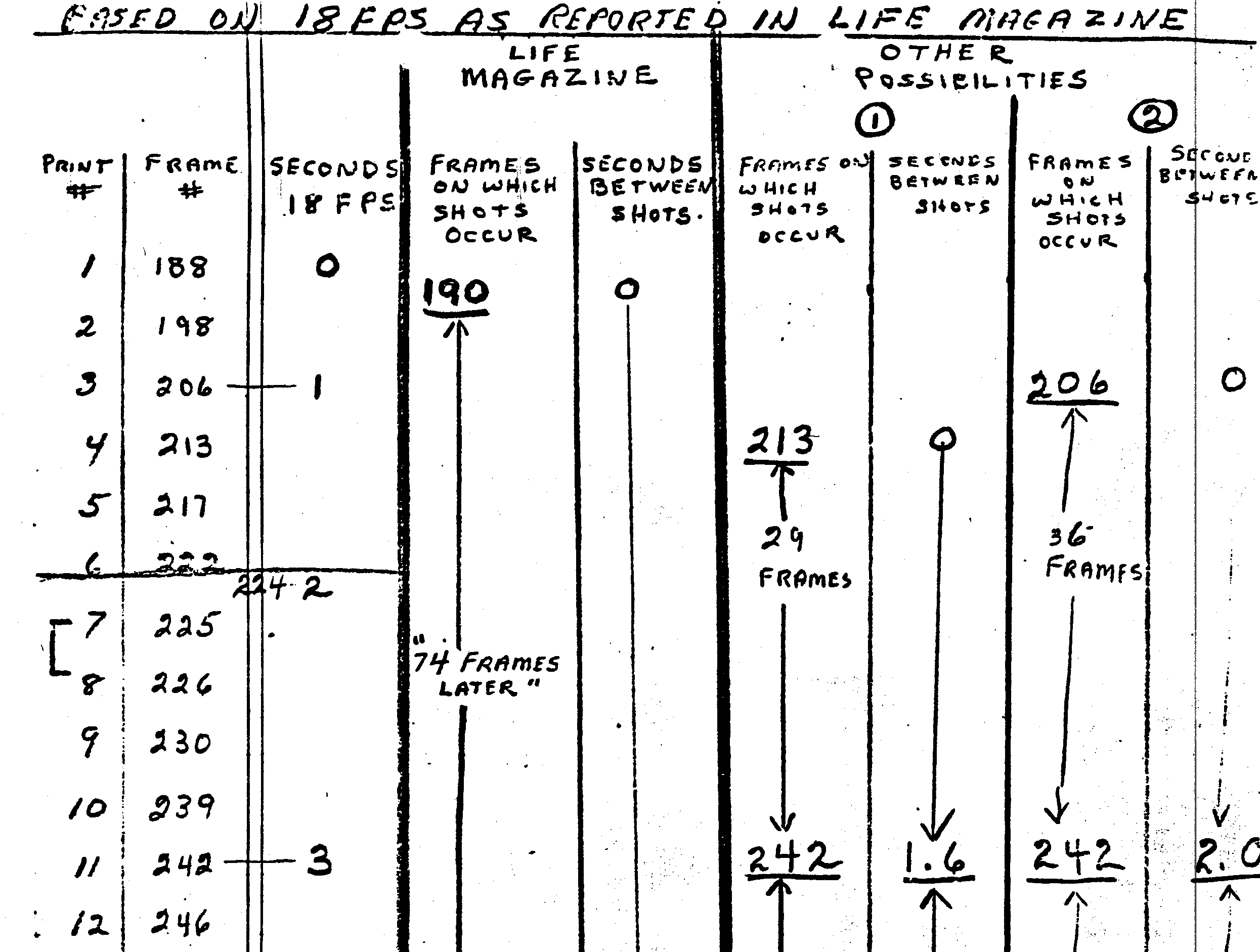 |
 |
| These relatively unsophisticated charts were presented as artifacts of the 1963 NPIC analysis, even though they were clearly drawn up later. |
In fact, these pages seem to have been drawn up by a person completely unaware of the first weekend briefing boards, or that the Secret Service had already possessed the information that appeared in LIFE. The hand drawn charts feature phrases from the Mandel article in quotation marks: “74 frames later”; “48 frames after that”; “2 FPS than it should have been run”. A question is written out: “how do they know frames of first and second shot?” Timing calculations cluster the page, with division tables setting scenarios of 18fps (attributed to LIFE) and 16 fps (the camera’s speed according to its operating manual). Alternative shooting scenarios, most of which feature Zapruder frame 242 as a second shot, appear next to the LIFE attributed shooting sequence of Z-190—Z-264—Z-312. Whatever is going on with these unsophisticated charts, the impression left by the CIA’s 1975 presentation on the NPIC analysis—from lack of documentation to the sketchy attribution of “late 1963”—is of a conscious decision not to admit analysis occurred on the weekend of the assassination. Making it appear the NPIC, the premiere image analysis lab anywhere at the time, relied on timings and frame numbers printed in LIFE Magazine served to deflect attention from the actual analysis done, as did the diversion of highlighting the Secret Service’s supposed sole responsibility to share “anything of value resulting from our analysis.” The NPIC analysis event had been effectively disappeared from the record.
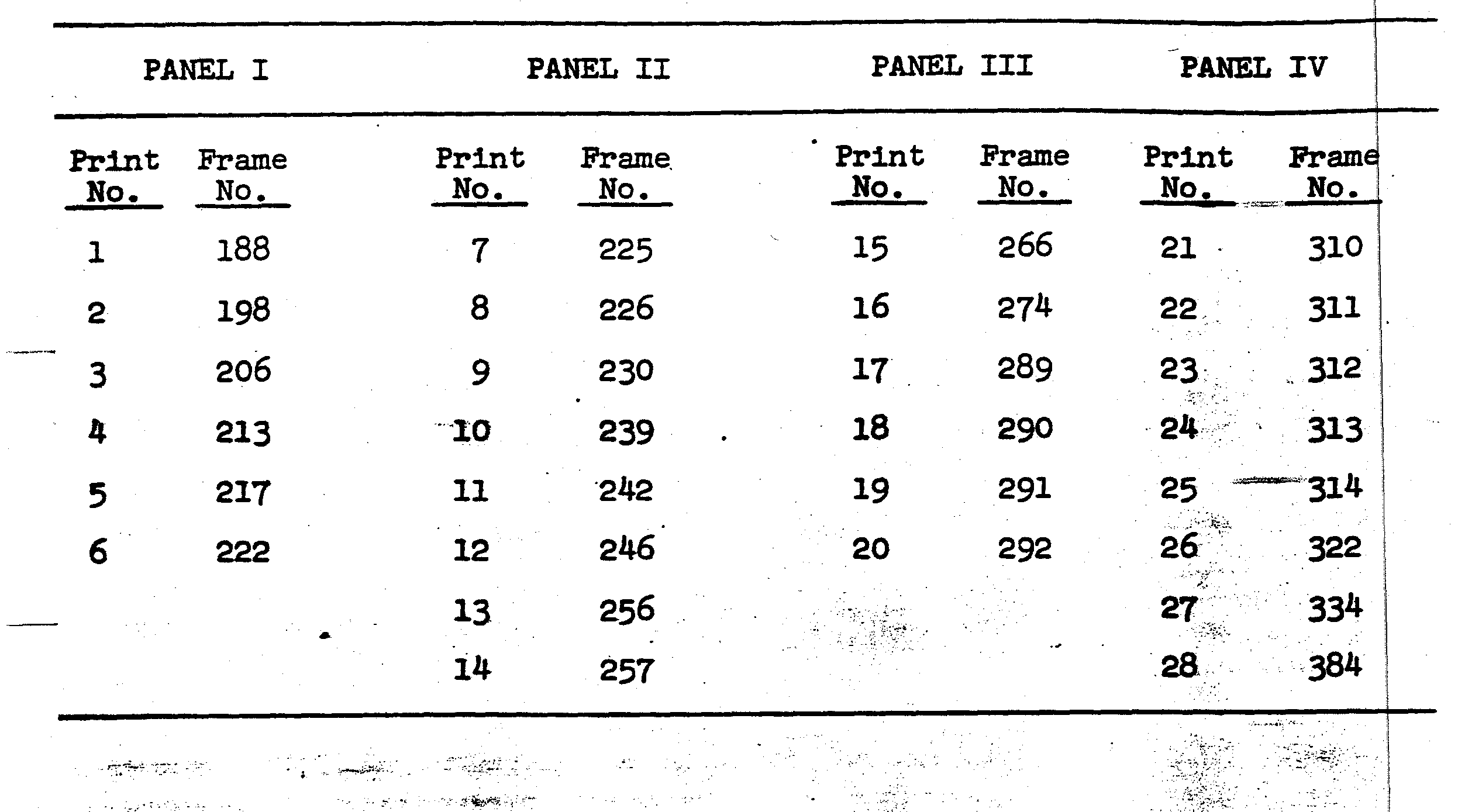 |
| The typed frame chart produced as part of NPIC’s records. This may be from the second analysis event, Nov. 24-25, 1963. |
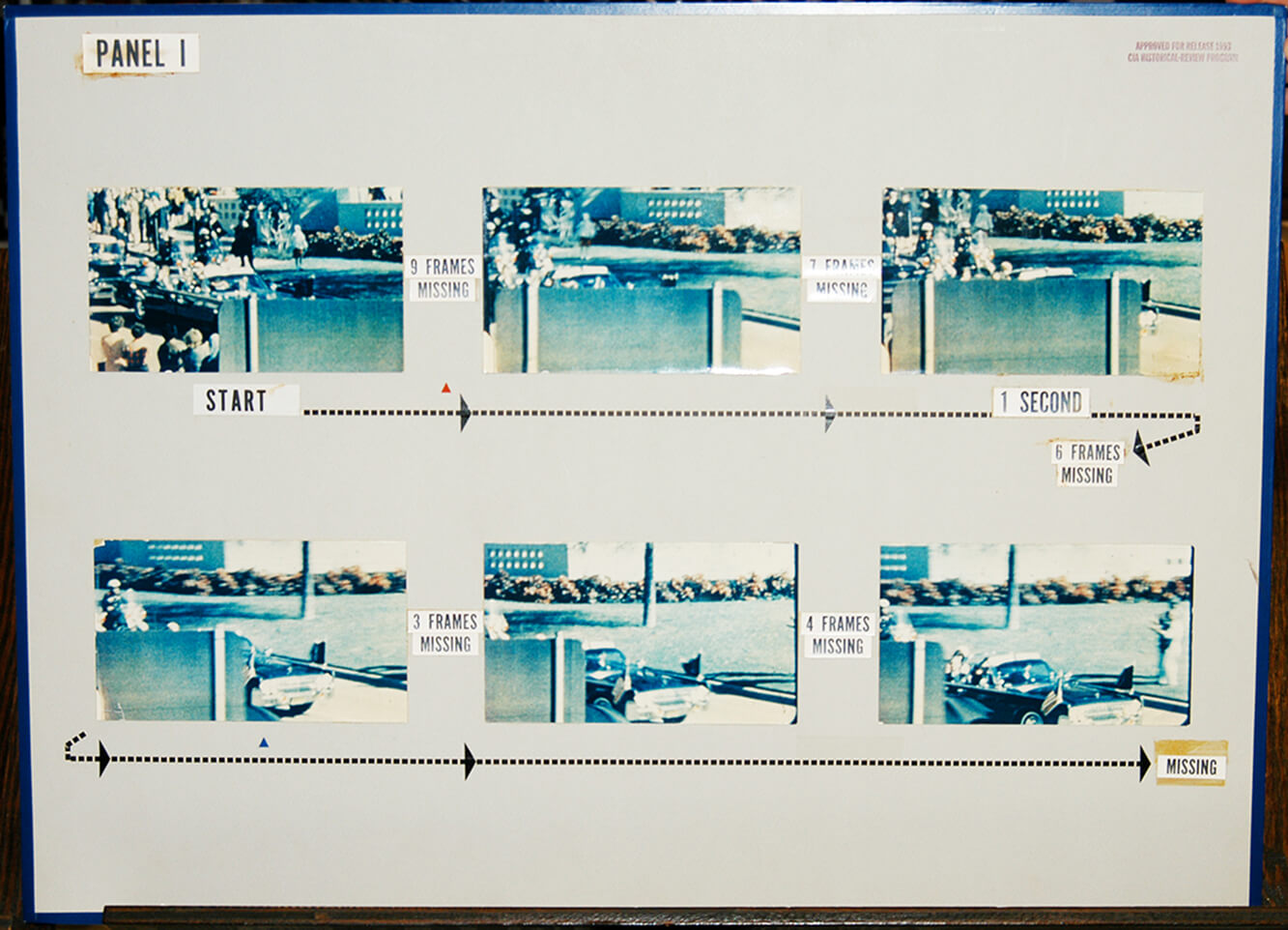 |
 |
| The briefing panels in the record seem derived from the above typed chart. Dino Brugioni was certain these were not the charts he had created during the first analysis event Nov. 23-24, 1963. |
| This motion sequence features the selected frames from the above chart. That the panning of Zapruder’s camera gets ahead of the slowing vehicle is apparent. |
For its part, the Secret Service had nothing to add, claiming that by 1979 all documents relating to the assassination had been passed to the National Archives. Nothing directly attributed to an NPIC analysis appears. The Warren Commission—which sponsored two conferences in April 1964 at which the Zapruder film was closely analyzed in the presence of Bethesda and Parkland doctors, ballistics experts from Edgewood Arsenal, FBI agents, Commission attorneys, and even John and Nellie Connally—did not receive any information regarding the November 1963 NPIC analysis.
In her book, Alexandra Zapruder asks about the NPIC event: “Who cares when it happened?” That is not the appropriate question. More appropriately: Why was the NPIC analysis hidden from the official record and the official investigation, and then, when uncovered in 1975, its “when” was obscured and its documentation was obviously incomplete?
A reason for this may be the NPIC analysis clearly demonstrated that a lone gunman conclusion was not viable; that something like the “flurry” of shots described by Secret Service Agent Roy Kellerman—seated in the passenger seat of the Presidential limousine—was more apparent. Homer McMahon, during his 1990s interviews, said it was his impression that “he saw JFK reacting to 6 to 8 shots fired from at least three directions.”35 Robert Kennedy would tell Arthur Schlesinger Jr., on December 9, 1963, that CIA Director John McCone, who received the NPIC’s first briefing boards, had indicated to him “there were two people involved in the shooting.”36 A few hours after McCone’s briefing on Sunday November 24, LIFE Magazine’s publisher C.D. Jackson sent instructions to Dallas to negotiate the remaining rights to the Zapruder film which had been explicitly left out of the contract signed the previous day. An internal LIFE memo would note that “C.D. Jackson bought the copyright to Zapruder’s film to keep it from being shown in motion.”
The Zapruder Film Proves Conspiracy
A week after the assassination, the Secret Service was continuing its investigation utilizing a shooting sequence which commenced with a first hit at either Zapruder frame 190 or frame 200. At the same time, LIFE Magazine was preparing its December 6 issue featuring an article which placed the first shot at Zapruder frame 190. Years later, a House Select Committee on Assassinations photographic panel systematically analyzed the Zapruder film in a manner similar, if not more extensively, to that done previously by the NPIC.37 The HSCA panel would report: “At approximately Zapruder frame 200, Kennedy’s movements suddenly freeze; his right hand abruptly stops in the midst of a waving motion and his head moves rapidly from his right to his left in the direction of his wife. Based on these movements, it appears that by the time the President goes behind the sign at frame 207 he is evidencing some kind of reaction to a severe external stimulus.”38
 |
 |
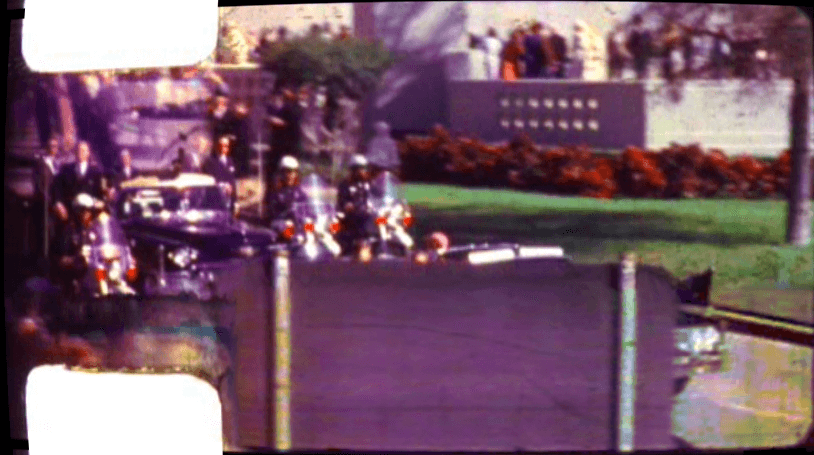 |
| Zapruder frames 190, 200, and 207. Analysis determined Kennedy began to react to a “severe external stimulus” at this point. |
The Warren Commission Report would claim “it is not necessary to any essential findings of the Commission to determine just which shot hit the Governor.”39 This is not true, as essential findings of the Commission included the determination that only three shots were fired, all from a particular bolt-action rifle found on the sixth floor of the Texas School Book Depository. If the President was reacting to a “severe external stimulus” (i.e. a shot) before disappearing behind the Stemmons freeway sign, as seen in the Zapruder film and as determined by both expert panels in 1963 and 1978, there was not enough time to operate the rifle’s bolt and fire a second shot to strike Connally consistent with his observed reaction (struck approximately Z224-230). The Commission’s Single Bullet Theory proposes that Kennedy and Connally react to the same bullet as they come into view at Zapruder frame 222-223, although in the film it appears obvious the President is already reacting to external stimulus while Connally is not. It has been suggested that Connally’s reaction is somehow delayed, although the smashing of his rib bone by the passing bullet would initiate an immediate involuntary reflexive response.
Since the time of the HSCA, independent researchers have been successful in aligning close analysis of the Zapruder film with eyewitness testimony and with other photographic evidence.40 With this work, the determination advanced by the analysis in 1963 and 1978 that the President was struck by a shot at a point between Zapruder frames 190-200, before disappearing behind the Stemmons Freeway sign as seen in the film, has been corroborated by the accounts in the official record of at least a dozen witnesses, and their interlocking observations are further supported by the photographic record apart from the Zapruder film.
The testimony of Jacqueline Kennedy exemplifies this support for a first shot circa Z-190. She told the Warren Commission that she turned in her seat to directly face her husband as the result of a commotion, a noise, which can be identified as this first strike (which probably hit in the back, as witnesses located behind the Presidential vehicle described his reaction as a slump to his left). Mrs. Kennedy can be observed in the Zapruder film as turning just ahead of the disappearance behind the sign, and afterwards her hat remains largely visible holding this position, looking directly at her husband. Proponents of the single bullet theory are suggesting that a shot from a high-powered rifle blasted through Kennedy’s neck and struck Connally, while Mrs Kennedy looked directly on, closely positioned, and she didn’t realize what had just happened. What is observable in the Zapruder film is that Jackie Kennedy, looking directly at her husband in the moments before the devastating shot at Z-312, is bewildered as to the source of her husband’s distress.
 |
 |
 |
 |
 |
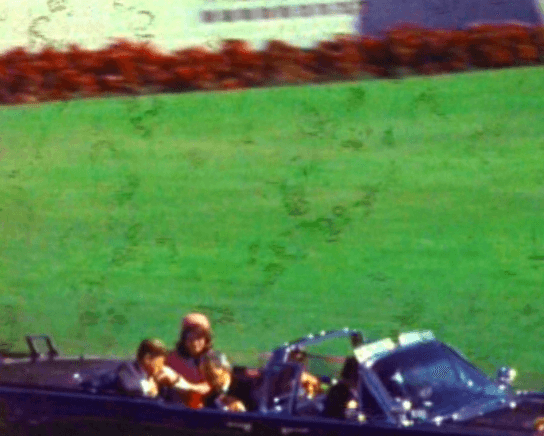 |
| Mrs. Kennedy turned to look at her husband as the result of an audible commotion, generally conceded as the strike of a first shot. She is doing so before the vehicle disappears behind the sign. |
Dino Brugioni, during his 2009 interviews, recalled that the Secret Service agents who arrived with the Zapruder film at NPIC on November 23, 1963, and who directed the analysis of the film “in individual stop frames”, paid particular attention to the portion of the film which showed the Presidential limousine just ahead of the Stemmons sign, its subsequent disappearance behind the sign, and then the frames after it reappeared. The Zapruder film is unique in the photographic record as capturing this portion of the assassination sequence, and what it shows cannot be reconciled with the official conclusion of a lone assassin—as the Secret Service, and its CIA partner, surely realized less than forty-eight hours after the event.
NOTES
1 The 8mm film in Zapruder’s camera was actually a spool of 16mm film, exposed along one side and then flipped and exposed on the other. After processing the film would be slit down the middle, the two halves spliced together to make one continuous roll of developed 8mm film.
2 For an overview of the National Photographic Interpretation Center and excerpts from Horne’s work, see Bill Kelly, “Washington Navy Yard NPIC”, JFK Countercoup blog http://jfkcountercoup.blogspot.com/2010/02/washington-navy-yard-npic.html.
3 That the Saturday 8mm reel is assumed to be the Zapruder original relies on Dino Brugioni’s recollection that there was film information between the sprocket holes. Brugioni’s memory appears fairly solid, and is corroborated on crucial points by the available sparse official documentation, but the Zapruder film possession timeline is tight because LIFE Magazine did its own work with the film at some point over the first weekend. If Brugioni is mistaken on this detail, then he was working from a Secret Service first generation copy of the film. Brugioni remembers an 8mm projector was used to view the film, but it is hard to believe NPIC employees projecting the actual original due to risk of damaging the film. It could also be that the Zapruder original was retrieved from LIFE on Sunday, possibly delivered to Hawkeye to create additional copies, and then sent to NPIC for creation of a second briefing board. Roland Zavada determined in his authenticity report that the Zapruder original initially remained as an unslit 16mm reel, as seen at NPIC Sunday night. The compartmentalization of the two briefing board sessions may reflect that the first was an “in-house” analysis, and the second featured a differing set of impressions.
4 Zavada’s open letter can be read here: http://www.jfk-info.com/RJZ-DH-032010.pdf It is a response to Chapter 14: “The Zapruder Film Mystery”, Douglas P. Horne, Inside the Assassination Record Review Board, Volume Four.
5 Linwood G Dunn, ASC., “Cinemagic of the Optical Printer”, American Cinematographer Manual, Fifth Edition, 1980. The Fifth Edition features a unique section on special effects cinematography. Dunn’s company Film Effects of Hollywood was established in 1946, and Dunn was a pioneer in optical printer technology. The American Cinematographer Manual has served as an essential professional reference book since its first edition was published in 1935. The latest Tenth Edition appeared in 2013. These volumes are compiled and published by the American Society of Cinematographers.
6 The specific examples for this final category are much simpler than might be inferred by the term “doctoring”. In the film It’s A Mad, Mad, Mad, Mad World, a gag was to feature a truck bumping into a wooden shack which subsequently collapses. During filming, the breakaway shack was pulled before the truck had backed up far enough for the gag to work. Using the optical printer, the frame was split vertically between the truck and the shack, and the frame portion of the intact shack was held (frozen) until the other frame portion saw the truck reversed to the position that would sell the intended gag. Note that the ability to achieve this effect depended on a lack of moving elements in the portion of the frame featuring the shack, as can be seen in the movie itself. A second example was of using split screens, trick cuts, and superimpositions to create close explosions and artillery fire near a group of actors playing refugees for a film titled One Minute To Zero (the desired effect was unsafe to attempt on the set.)
7 ”A Hollywood or other film production requiring postproduction optical effects is a product of a carefully planned and executed script in advance. The key subject matter, foreground and background scene content, camera image focus, depths of field, masks or mattes, etc., are carefully executed ahead of time and incorporated into the camera film that becomes the optical master…(the Zapruder film) was handheld, unsteady, panned to follow the limousine causing bystanders and background to be blurred and Zapruder jerked as reflex reaction to rifle shot reports or other stimuli.” Zavada, p. 19.
8 Consider the time required to produce relatively simple shots of the USS Enterprise against a black space background, as described in an online article (http://memory-alpha.wikia.com/wiki/Film_Effects_of_Hollywood) discussing Film Effects of Hollywood’s association with the first Star Trek television show. This indicates the time-consuming and sometimes imperfect results using optical printers. The effects seen in the original Star Trek program are nothing compared to claims of Zapruder film alteration.
9 “Preparation of an internegative which closely simulates the characteristic of the original has always been the goal of optical houses throughout the industry. In spite of the superb quality frequently achieved in internegatives, it seems virtually impossible to attain characteristics identical to those of the original negative in the duplicate generations for the following reasons: 1) The non-linear response of photographic film limits the range over which the following generations can duplicate an original. The internegative is one or two generations away from the original, depending on the stock used. 2) Many variable elements are introduced during the processing of the internegative. 3) The exposure characteristics of the optical printer may vary from time to time.” Mehrdad Azarmi, “Exposure Control of Optical Printers”, American Cinematographer Manual, Fifth Edition, 1980.
10 “There is no known film production history that would provide a technology reference for the use of an 8mm KODACHROME II camera film as a printing master to allow subsequent significant optical special effects into selected scenes and then reconstitute the adjusted images on to an 8mm KODACHROME II daylight film ‘indistinguishable’ from the camera original.” Zavada, p. 18.
11 Zavada, pp. 30-32.
12 One text cited as “proof” that altering the Zapruder film was plausible has been Techniques of Special Effects Cinematography by Raymond Fielding. When excerpts of alteration arguments were shared with Fielding by Zavada in 2006, Fielding’s response included: “in my judgment there is no way in which manipulation of these images could have been achieved satisfactorily in 1963 with the technology then available … if such an attempt at image manipulation of the footage had occurred in 1963, the results could not possibly have survived professional scrutiny … challenges regarding the authenticity of the NARA footage and assertions of image manipulation … are technically naïve.” Zavada, p. 18.
13 The article is derived from a presentation made at a conference in Dallas November 20, 1998. (http://www.jfk-info.com/thomp2.htm)
14 DeLoach to Mohr, “8 Millimeter Color Film Taken At Scene of Assassination” https://www.maryferrell.org/showDoc.html?docId=62256#relPageId=43&tab=page.
15 Horne, Inside the Assassination Records Review Board, Volume Four, p. 1233. This fascinating and important information, derived from an interview conducted by Peter Janney, is worthwhile considering in full: “… He also said that the Secret Service was vitally interested in timing how many seconds occurred between various frames, and that Ralph Pearse informed them, to their surprise and dismay, that this would be a useless procedure because the Bell and Howell movie camera (that they told him had taken the movie) was a spring-wound camera, with a constantly varying operating speed, and that while he could certainly time the number of seconds between various frames if they so desired, that in his view it was an unscientific and useless procedure which would provide bad data, and lead to false conclusions, or words to that effect. Nevertheless, at the request of the two Secret Service agents, Ralph Pearse dutifully used a stopwatch to time the number of seconds between various frames of interest to their Secret Service customers. Dino Brugioni said that he placed a strong caveat about the limited, or suspect, usefulness of this timing data in the briefing notes he prepared for Art Lundahl.”
16 The HSCA’s photographic panel did note in its report “only the average, and not the precise, running speeds for the camera are known.” Despite this, the panel would go ahead and calculate time between frames anyway. HSCA Report Appendix, Volume VI, p. 31.
17 “In crystal drive systems, a crystal oscillator of extremely high accuracy at, or in, the recorder, provides the sync pulse. The camera, in turn, is driven by a specially designed D.C. motor and control circuit which is capable of operating in exact synchronism with a self-contained crystal oscillator of comparable accuracy…both camera and recorder reference to self-contained crystal oscillators which are so accurate the effect is the same as if they had been tied together.” Edmund M. Di Giulio, “Crystal Controlled Cordless Camera Drive System”, American Cinematographers Manual, Fifth Edition, pp. 469-472.
18 FBI Memorandum, Griffith to Conrad, January 31, 1964. https://www.maryferrell.org/archive/docs/062/62298/images/img_62298_37_300.png.
19 CBS did their own tests for their 1967 news special on the Warren Report. Using five cameras, the same model as the Zapruder camera (not the actual camera), their tests filming a clock with a sweeping hand resulted in a fair amount of disparity. Roughly matching the timing of the shooting sequence, the common exposed frames came in at 6.16, 6.70, 6.90, 7.30, and 8.35 seconds. Pat Speer: “IN 1967, CBS PURCHASED FIVE IDENTICAL CAMERAS AND FOUND THAT THEY RAN 15.45, 17.7, 18.7, 19.25, AND 20.95 FRAMES PER SECOND, A SIMILAR RANGE WITH A SIMILAR AVERAGE OF 18.4 FPS.” A New Perspective On the Kennedy Assassination, Chapter 2B http://www.patspeer.com/chapter2b%3Athesecretservicesecrets.
20 “It involves the calculation of the mean after discarding given parts of a probability distribution or sample at the high and low end, and typically discarding an equal amount of both.” https://en.wikipedia.org/wiki/Truncated_mean.
21 CD 298, p. 59 (https://www.maryferrell.org/showDoc.html?docId=10699#relPageId=59&tab=page) and CD 298, p. 62 (https://www.maryferrell.org/showDoc.html?docId=10699#relPageId=62&tab=page). It should be noted that 17.6 frames per second is cited in the FBI’s January 31, 1964 memorandum in reference to average running speed during the final twenty seconds of the Zapruder camera’s wind. This does not explain how “22 fps” entered the record. Further discussion is found in Pat Speer, A New Perspective On the Kennedy Assassination, Chapter 2B http://www.patspeer.com/chapter2b%3Athesecretservicesecrets.
22 LIFE’s publication schedule was such that editions were assembled a week ahead of publication date. So the December 6 edition would have been largely prepared by the weekend of November 29-Dec 1, and on the newsstands by mid-week.
23 FBI 105-82555 Oswald HQ File, Section 16, pp. 30-31 https://www.maryferrell.org/showDoc.html?docId=57688#relPageId=30&tab=page. This report also states the “camera was set to take normal speed movie film or 24 frames per second.” This is incorrect: the Bell & Howell camera’s normal run speed, as noted in its operating manual, was 16 frames per second. The camera had no setting to reproduce 24 frames per second.
24 This comment was most likely derived from Brugioni’s briefing board notes. https://www.maryferrell.org/showDoc.html?docId=7135#relPageId=4&tab=page.
25 Memorandum 11/25/63, CD 87, p. 91.
26 Philip H. Melanson, “Hidden Exposure: Cover Up and Intrigue in the CIA’s Secret Possession of the Zapruder Film”, The Third Decade, Vol. 1, Issue 1, November 1984. https://www.maryferrell.org/showDoc.html?docId=48721#relPageId=15&tab=page.
27 Barrett/Lee, Dallas, 11/29/63. https://www.maryferrell.org/archive/docs/010/10406/images/img_10406_120_300.png.
28 Howlett’s measurement for the fatal shot is “approximately 260 feet”, whereas the Secret Service chart (CE 884) notes the distance as 265.3 feet.
29 The FBI’s Frazier would tell the Warren Commission that Connally’s wounds could not have occurred past Z-231, if the shot was fired from the designated TSBD 6th floor window. A week after Howlett shared information with the FBI, the Secret Service would promote a different set of measurements, extending the shooting sequence to the equivalent of Z-217, Z-283, and Z-343 (CE 585). A Visual Aid Guide presented in January 1964 by the FBI to the Warren Commission (CD 298) would include a similar extended measurement whereas the first shot strikes at “167 feet”, the second at “262 feet”, and a third at “307 feet”—a full 45 feet beyond the location of the headshot seen in the Zapruder film. This Visual Aid Guide is therefore saying the fatal shot at Z312 is the second shot in the sequence. See Pat Speer, A New Perspective On the Kennedy Assassination, Chapter 2B (http://www.patspeer.com/chapter2b%3Athesecretservicesecrets) for more discussion.
30 Mandel goes on to describe a sharpshooter test, using the “director of the National Rifle Association”, firing “an identical-make rifle with an identical sight against a moving target over similar ranges for LIFE last week. He got three hits in 6.2 seconds.” Later, at the request of the Warren Commission, the FBI investigated this sharpshooter test. It was determined that the sharpshooter used by LIFE was not “the director” of the NRA, and the test had no connection to the NRA. The test target was approximately fifty yards away and moved “from right to left and back, running for a distance of thirty-three feet in one direction.” (CD 1309) This test may not have been directly related to the Zapruder camera speed test results, as numerous media outlets, including LIFE, were interested in timing tests with a similar rifle very soon after the assassination, even in the absence of any published exact time for the shooting sequence. The “nagging rumor”—that there wasn’t enough time for three shots—probably derived from observation of the bolt action mechanism of the purported assassination weapon. Five decades later, well-founded skepticism remains.
31 “Addendum To Comment On Zapruder Film” https://www.maryferrell.org/showDoc.html?docId=7135.
32 “NPIC Analysis of Zapruder Filming of John F. Kennedy Assassination” https://www.maryferrell.org/showDoc.html?docId=31994.
33 A handwritten note written by then NPIC Director John Hicks, Brugioni’s boss in 1975, attests that these are “the only known” documents available. In a 2009 interview, Brugioni recalled discovering one of his briefing boards from 1963 during the 1975 review, and that Hicks was distressed about this.
34 Douglas P. Horne, Inside the Assassination Record Review Board, Volume Four, p. 1230.
35 Douglas P. Horne, Inside the Assassination Record Review Board, Volume Four, p. 1224.
36 For discussion of this see Bill Kelly, “CIA Director Told RFK Two People Shooting at JFK” http://jfkcountercoup.blogspot.ca/2013/01/cia-director-told-rfk-two-people.html.
37 “The Zapruder film was viewed by this group on a frame-by-frame basis and at various speeds approximately 100 times.” HSCA Report Appendix, Volume VI, p 16. https://www.maryferrell.org/showDoc.html?docId=958#relPageId=22&tab=page.
38 HSCA Report Appendix, Volume VI, p. 17. https://www.maryferrell.org/showDoc.html?docId=958#relPageId=23&tab=page.
39 Report of the President’s Commission on the Assassination of President Kennedy, p. 19.
40 see, for example, Pat Speer, A New Perspective on the Kennedy Assassination, Chapter 12 http://www.patspeer.com/chapter12%3Athesingle-bullet%22fact%22. Barb Junkkarinen, “First Shot/First Hit Circa Z-190”, Kennedy Assassination Chronicles, Volume Five, Issue Two, 1999 https://www.maryferrell.org/showDoc.html?docId=4884#relPageId=24&tab=page.
Audio of CAPA Conference (posted at BlackOp Radio, 827a).
If your browser is having trouble loading the audio, click here.
On the 54th anniversary of President Kennedy’s assassination, at a bookstore in Coral Gables, Florida two famous authors convened. They were Gerald Posner and Roger Stone. The subject was a debate over the circumstances of Kennedy’s assassination. Obviously, because of the orientation of their books on the subject, Posner defended the Warren Commission verdict while Stone argued for a conspiracy.
 |
| Robert Loomis |
Posner was trained as a lawyer. At age 23, he became one of the youngest attorneys ever employed by Cravath, Swaine and Moore, John McCloy’s old law firm. In 1980, he left that firm and opened a private practice with a partner. In 1986, he left that practice and became an author. In a relatively short period of time, he wrote three non-fiction books and one novel. In 1991, he was enlisted by Robert Loomis of Random House to write a response to Oliver Stone’s movie about the Kennedy assassination, JFK. The very plugged-in Loomis promised Posner that the CIA would cooperate with him on the project. (The Assassinations, edited by James DiEugenio and Lisa Pease, p. 369) And they did. Without their help, how else could an author gain access to high level defector Yuri Nosenko?
 |
| Harold Evans |
As was exposed in a later lawsuit by the late Roger Feinman, Random House put a major effort into selling Posner’s Case Closed. One that was personally supervised by Harold Evans, who was president of the publishing house at the time. According to information Feinman discovered in his lawsuit, it was Evans who personally approved the infamous NY Times ads for the book. This was a four-phase campaign. It began with two teaser ads that promised to name the guilty parties in the JFK assassination. It culminated with two more ads. These featured the faces of Oliver Stone, David Lifton, Robert Groden, Jim Marrs, Mark Lane and Jim Garrison under a title which boldly accused them of the charge: “Guilty of Misleading the American Public”. If the reader knows anything about advertising costs in major newspapers, he can guess what those four ads cost. (Click here for Feinman’s essay about his lawsuit against Random House.)
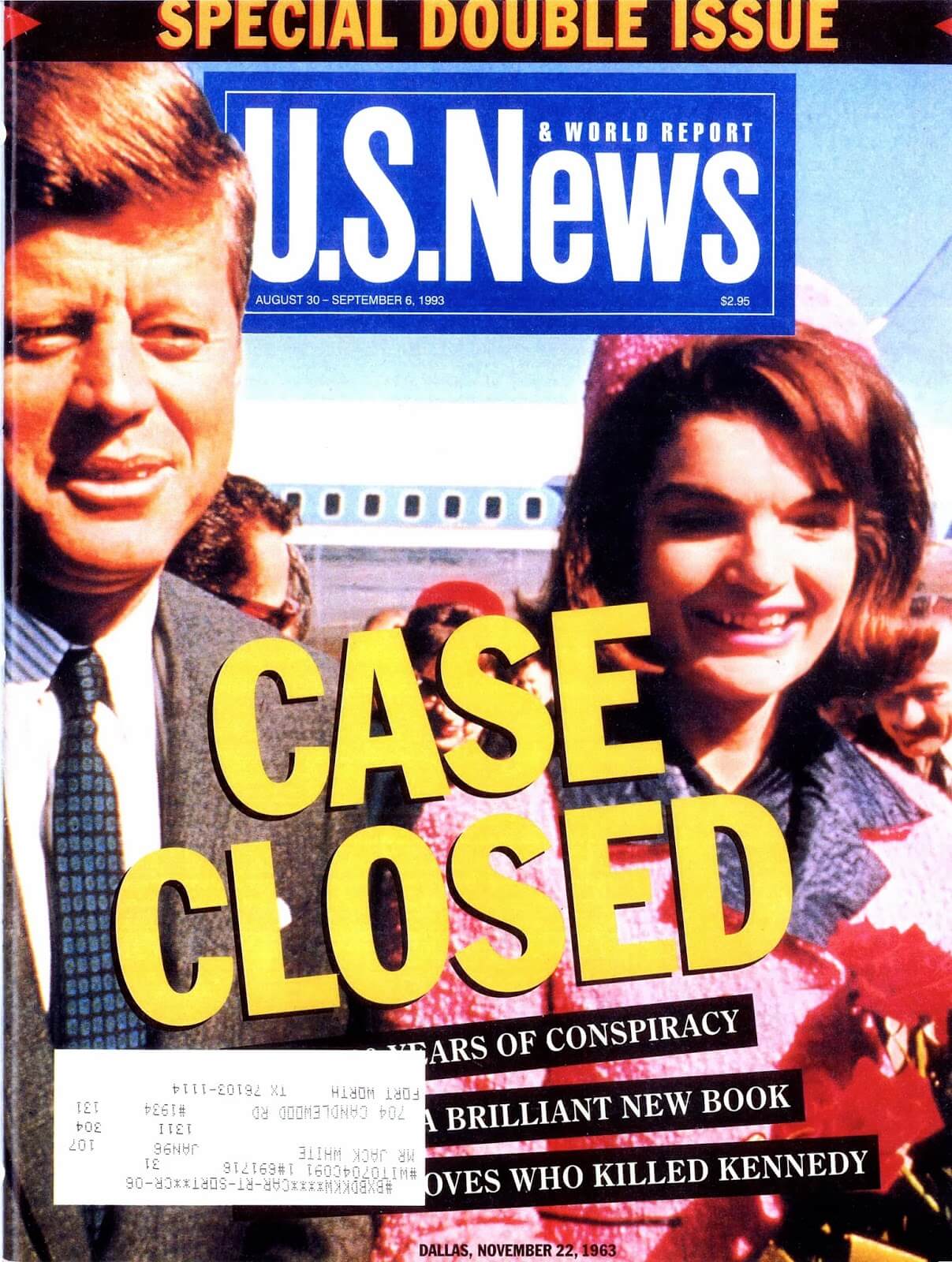
But that was not all. Apparently because Evans had previously served as a director of US News and World Report, that magazine gave Posner’s book a cover story. The book became such a cause celebre that other authors have successfully used it as a way to curry favor with the MSM, e.g., Jeff Toobin and Robert Dallek.
The problem with all this hoopla, which was designed to coincide with the 30th anniversary of the assassination, is that it was completely unwarranted. There were several reviews that showed just how flawed Case Closed was: for instance, David Wrone’s. (See also this index of items on this site.) In fact, there were so many problems with Posner’s book that activist Dave Starks put together a compendium page of articles to show that, not only was Case Closed a very bad piece of scholarship, but it might have been worse than that. In his haste to do a hatchet job on the critics, Posner may have created interviews he did not actually do. For instance, Peter Scott talked to Carlos Bringuier after Case Closed came out. Contrary to the book’s claims, Bringuier said he never talked to Posner. (Author interview with Scott in San Francisco in 1994) Same with Dealey Plaza witness James Tague, who the author clearly states he talked to on two successive days. (See Posner, paperback edition, p. 546) When Gary Aguilar talked to Tague, he said he never spoke to Posner. To use another example, although the author said he interviewed JFK’s forensic pathologist Thornton Boswell, Boswell told Aguilar he never spoke to him. (Click here for Starks’ devastating page on Posner.)
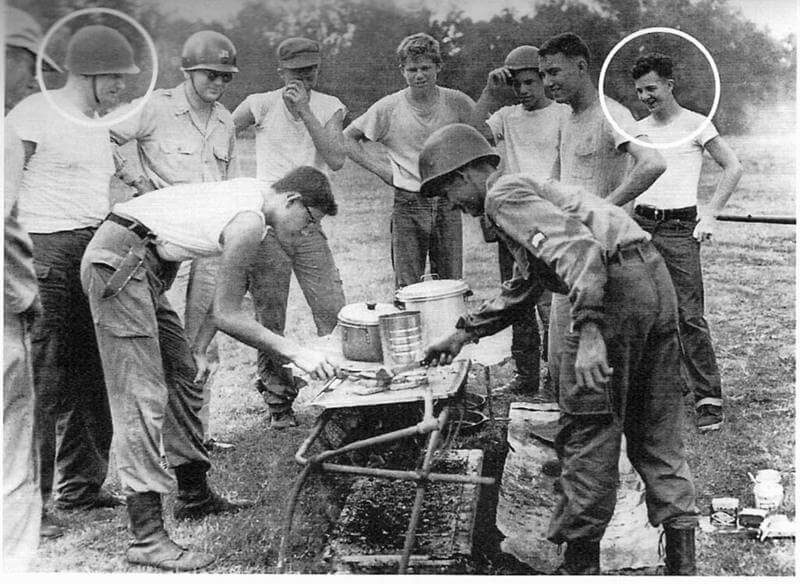 |
| David Ferrie & Lee Oswald, Civil Air Patrol (1955) |
Posner also committed some outright howlers in his much-ballyhooed book. For example, in his schematic drawings of the assassin at the Texas School Book Depository window, he has him posed as firing from an extreme left to right angle. So much so that these “Posner shots” would have ended up in the railroad yards behind the picket fence. (See Appendix A of Case Closed, paperback edition.) This makes one wonder if Posner was ever in Dallas. Because to anyone who has been to the building and peered out the sixth floor window—which was possible back then—it presents a slight right to left angle. Posner also wrote that there was no evidence to connect David Ferrie with Oswald. (Posner, p. 425) This was utterly ridiculous on many counts. But to name just one, when the book came out PBS did a special which featured a photo of Oswald and Ferrie together at a Civil Air Patrol (CAP) barbecue. They found it by questioning some other members of the CAP. Which means Posner could have done the same if he had knocked on some doors in the Crescent City. Posner also writes that there was no such personage as Clay Bertrand in New Orleans. When the JFK Act declassified both the Jim Garrison files and the papers of the HSCA, Posner again ended up with custard pie on his face. Those documents reveal that the number of witnesses who stated that Clay Shaw used the alias of Clay Bertrand was in the double digits. (Destiny Betrayed, Second Edition, by James DiEugenio, pp. 211, 387, 388)
Posner’s book showed us in excelsis just how schizoid America is on the murder of President Kennedy. It did not matter to the Powers That Be just how error-strewn Posner’s book was. It did not matter to them that he was more or less acting as a hired gun for Loomis and Evans. It did not matter to them that the book was obviously a rush job for the 30th anniversary. Or that the title was preposterous since the declassification process of the JFK Act had not even gone into effect yet. In other words, the book was saying the case was closed when, in fact, two million pages of documents were about to be declassified in the next four years.
Clearly, as representatives of the Anglo-American Establishment, the important thing for Loomis and Evans was this: They wanted to create a tangible cultural artifact to rally around at the 30th anniversary. Why? In order to beat back the tsunami effect of Oliver Stone’s JFK, which had blindsided them. Posner’s book was a concocted historical event. Today the book has been retired to the (rather large) ash heap of useless volumes on the JFK case. It has no intrinsic factual merit to it at all. It is simply an exemplar of a two-part cultural/historical phenomenon. I say two parts, because the second phase of this Jungian neurotic outbreak occurred four years later, with another Loomis client. This time the collective seizure was over Sy Hersh’s equally horrendous book. This one was a biography of John Kennedy, The Dark Side of Camelot. That bookend volume was as bad in its own way as Posner’s tome. But Oliver Stone had not just said that JFK was killed by a conspiracy. His film also stated that Kennedy was a foreign policy iconoclast who was changing things in that realm. This was true and has been proven even more accurate by recent scholarship. But that did not matter with Hersh, whose book was so bad that some critics said it should have been titled, The Dark Side of Seymour Hersh.
Roger Stone was born in Lewisboro, New York to a reporter mother and a father who drilled oil wells. Stone got hooked on politics when he read Conscience of a Conservative by Barry Goldwater. Although he admired Goldwater’s ideas he could not comprehend the tactics of his 1964 campaign. To put it mildly, he thought they were rather quixotic. As he told writer Matt Labash, “It’s like he was trying to lose. Going to Tennessee and coming out against the Tennessee Valley Authority? These were suicidal acts.” (Weekly Standard, November 5, 2007)
 |
| Roger Stone & Nixon |
Because of this, Roger Stone became more enamored with Richard Nixon as his conservative standard bearer. He deduced that Nixon was “more pragmatic, more interested in winning than proving a point.” He took a pithy aphorism from RMN: “Losers don’t legislate.” (ibid) Stone liked Nixon so much that he decided that his newly found idol had not really lost the 1960 election. He had been robbed of the presidency through electoral fraud. So he wrote Nixon a letter at his New York law firm encouraging him to run again. Nixon replied that he did not plan on doing so, but if he did, he would be in touch with young Stone. (Stone is such a Nixon fan he had his face tattooed on his back.)
 |
| Jeb Magruder testifies during the Watergate hearings |
While a student at George Washington University in Washington D.C., Stone invited Jeb Magruder, deputy director of the Committee to Reelect the President, to speak at the college’s Young Republican Club. After the speaking engagement Stone asked Magruder for a job with CREEP. At age 19, Stone decided to forsake his studies and joined right in with the antics of the infamous CREEP. For instance, he planted a mole in the camp of Democratic rival Hubert Humphrey. Magruder and his cohorts were obsessed with intelligence and skullduggery, and Stone had a natural affinity for them. He once wrote a check to Nixon rival Pete McCloskey from an account inscribed as the Young Socialists Alliance. Once he got the receipt he leaked it to the reactionary newspaper Manchester Union-Leader. (ibid)
Against Senator George McGovern in the general election, Stone hired another spy he termed Sedan Chair II. But according to Stone, he did not understand the mentality of CREEP. To him it did not make any sense to take the kinds of risks they were taking when the Democratic candidate, McGovern, had so little chance of winning. After Watergate, which spelled the end of Nixon’s political career, he went to work for Bob Dole, and then for the (failed) Ronald Reagan campaign of 1976. During this period, he co-founded the National Conservative Political Action committee, which was designed to execute a GOP takeover of the Senate. Which, by recruiting men like Dan Quayle and Chuck Grassley, it did. As he noted to Jeffrey Toobin, “The Democrats were weak, we were strong.” (The New Yorker, June 2, 2008)
 |
| Donald Trump & Roy Cohn |
 |
| John Anderson (Sept. 16, 1980) |
In 1980, he again worked for Reagan. In that election, he joined forces with the notorious attorney Roy Cohn, sworn enemy of the late Bobby Kennedy. They decided that the best way for Reagan to beat incumbent president Jimmy Carter in New York was to help Democratic congressman John Anderson get on the ballot. This way, the Democratic Party vote would be split and therefore weakened. According to Stone, Cohn told him to get in contact with a lawyer friend he had. Once in contact, he was to ask him how much it would cost to get Anderson the Liberal party nomination in New York. Stone reported back that the price was $125,000. A couple of days later, Stone was told by Cohn to pick up a suitcase and deliver it to the lawyer. He did so, and Anderson won the Liberal Party nomination. Reagan won New York with 46% of the vote. (ibid, Labash)

Reagan’s victory in 1980 allowed Stone to enter the upper stratosphere of political campaign managing and lobbying. He now set up an office with two other GOP stalwarts, Charles Black and Paul Manafort. They would later be joined by none other than the late Lee Atwater, the man usually given credit for the Willie Horton TV ads, which helped defeat Democrat Michael Dukakis in 1988. The firm was lobbying on behalf of such people as Ferdinand Marcos, dictator of the Philippines, as well as conservative causes like the Nicaraguan Contras, and Angola’s UNITA rebels. And they advised several presidential candidates, even when they opposed each other.
Stone’s primacy in the higher circles of the GOP came to an end in 1996. He was serving as an unaccredited adviser to Bob Dole’s presidential campaign when scandal struck. And it struck through the National Enquirer. They billed the story as “Top Dole Aide Caught in Group-Sex Ring.” (op. cit., Toobin) He and his second wife had run ads for swinging partners to participate in bedroom games. (op. cit., Labash) The tabloids even got hold of the advertising photos. Stone tried his usual “Deny, deny, deny” tactics. But they did not succeed.
But in 2000, James Baker, who was running the GOP recount effort in Florida against Al Gore, brought Stone back to perform one last piece of political subterfuge. That act would have a momentous impact on America for decades into the future. It has come to be known as the “Brooks Brothers riot”.
When the Florida Supreme Court ruled that Gore could have a recount in four counties, Stone and Baker decided this had to be thwarted. Scores of Republican congressional aides—the Brooks Brothers suits—had been flown to Miami to simulate grass roots, Floridian protest against the recount. Stone stationed himself in a Winnebago outside the building where the Miami-Dade County recount was taking place. Outfitted with walkie-talkies and cell phones, he went to work using these aides to create the illusion of an indigenous attack on the building. He did this by having the congressional aides actually enter the building and demand the recount be halted. According to the New York Times, some people were struck or kicked. (11/23/2000) This scene inside the building was coupled with Stone inspired Spanish language radio warnings about carloads of Cuban exiles driving to the scene. (op. cit., Toobin) In its broad outlines, the operation resembled the CIA coup in Guatemala in 1954. Between the Brooks Brothers demonstrators and the “imminent Cuban exile assault”, the recount was discontinued. The episode likely stopped Gore from actually taking the lead for the first time. This—plus the later Antonin Scalia order granting emergency relief due to the “irreparable damage” of counting votes—ultimately led to the US Supreme Court decision stopping the recount. And that brought us George W. Bush, perhaps the worst president in history.

After his work for Random House on the JFK case, in 1998 Posner wrote a book on the 30th anniversary of the Martin Luther King assassination. To no one’s surprise, Killing the Dream came to the same conclusion as Case Closed—the official story was correct. One year later of course, William Pepper demonstrated in court that Posner was wrong. The jury in a civil case brought by the King family ruled that King was killed as a result of a conspiracy.
 |
| David Marwell |
Because of his establishment-pleasing writings, Posner became a TV and MSM presence. And he continued to write more non-fiction books. He appeared on many TV programs and also as an editorial writer for some major newspapers. According to Doug Horne in his book Inside the ARRB, the first director of the Assassination Records Review Board, David Marwell, said he found much of value in Case Closed. Consequently, he had lunch with Posner more than once. Harold Evans’ wife, Tina Brown, hired Posner as an investigative journalist for the online magazine Daily Beast. But he was forced to step down from that position in 2010 over several accusations that demonstrated that Posner was a serial plagiarist. He not only plagiarized for his articles at Daily Beast, but also in at least three of his books, e.g., Miami Babylon. (See Slate, “The Posner Plagiarism Perplex”, 2/11/2010, also Miami New Times, March 30, 2010)
 |
| Tina Brown |
 |
| Harper Lee |
Three years later, the late Harper Lee filed a lawsuit claiming that her literary agent’s son-in-law had directed Posner to set up a corporation to defraud Lee of her royalties from her colossal best-seller To Kill a Mockingbird. In her court filing she said that she had faulty hearing and eyesight and these had been used by Samuel Pinkus to snooker her into signing over her book copyright. Pinkus assigned the copyright to a company incorporated by Posner. (NY Post, May 4, 2013) Four months later, Posner settled the suit and was dismissed from the legal action.
After his work for James Baker in Miami, Roger Stone tended to concentrate on two new subjects. First, there was his friendship with Donald Trump. Stone was sold on the idea of Trump making a run for the presidency on the Reform Party ticket, the party created by Ross Perot. Although Trump made some overtures to run in the 2000 election, he ultimately decided against it. Stone also began to develop an avocation as an author. To say that his output has been prolific does not do him justice. In the space of about three years, beginning in late 2013, Stone has written or co-written—at last count—seven books. At least three of them rely on his relationship with Richard Nixon, who he still holds in high regard. If one looks closely, three of them rely on his relationship with Trump, who he had worked for in Trump’s 2015-16 campaign before they (allegedly) parted ways. His book about Jeb Bush, Jeb and the Bush Crime Family, was clearly meant as a broadside against the candidate most perceived as the favorite in the GOP primary campaign. His book about the Clintons, The Clintons’ War on Women, was meant as a preemptive strike against the attacks against Trump’s philandering with females.
 |
 |
 |
But Roger Stone/author first came to prominence at the 50th anniversary of the JFK assassination. At that time he co-wrote a book entitled The Man Who Killed Kennedy: The Case Against LBJ. That book became a New York Times bestseller. In fact, of all the books released at the 50th, it likely sold the most copies. Since then he has stayed involved in the field. In fact, his co-writers on the two previously mentioned books come from the JFK field. They are, respectively, Saint John Hunt and Robert Morrow.
Why has Stone done this? It likely does not pay him the fees he commanded as a Washington lobbyist working in a very powerful PR firm. In a profile written by Jeff Toobin for The New Yorker, some hints for this career move are tossed out—almost inadvertently. One of the reasons Stone gives for being so enamored of Nixon is his anti-elitism. He adds Nixon was class conscious. And he identified with average people who ate TV dinners and watched Lawrence Welk. To Stone, Nixon “recognized the effectiveness of anti-elitism—a staple of American campaigns even today—as a core message.” In comparing Nixon with Reagan, Stone states that although many Republicans give Reagan credit for the defections of the working class from the Democrats, it was really Nixon who started it. Stone then zeroes in on the whole polarization concept:
Nixon figured out how to win. We had a non-elitist message. We were the party of the workingman! We wanted lower taxes for everyone across the board. They were the part of the Hollywood elite. … The point that the Democrats missed was that the people who weren’t rich wanted to be rich.
There is little doubt that Nixon, with his appeals to the Silent Majority in order to expand and lengthen the Vietnam War, did use these kinds of techniques. It’s obvious from the declassified tapes at the Nixon Library that he did not mean any of it. This was amply exposed by author Ken Hughes, among others, in his fine book Fatal Politics. And this exposure helps explain why Nixon and his family fought so long and hard not to have those tapes declassified. That book reveals that Nixon knew the war was lost in 1969. But he did not want to have South Vietnam fall on his watch. Therefore, he lied to Nguyen Van Thieu of South Vietnam to keep him in his corner while he negotiated an agreement with the north. The whole time he slaughtered tens of thousands of innocent civilians in an expanded air war over all of Indochina. The only reason for this was to announce a peace agreement on the eve of the 1972 election to make sure he had a landslide victory. This is all admitted to on these tapes in the Hughes book, and in letters he sent to Thieu in the book The Palace File.
But the relevant point for today’s scene is that this cultural anti-elite aspect was well used by both Stone and Trump during the latter’s successful presidential campaign. Trump decided to leapfrog most of the MSM, and he did this with Stone’s help. In addition to the two books mentioned above, Stone helped promote the whole mythology of Ted Cruz’s father being seen in New Orleans with Lee Oswald in the summer of 1963. Stone used the word of Judyth Baker to promote this bizarre story. And Trump went on national TV with it. (Click here for our reaction.) The Morrow/Stone book about Clinton helped Trump alleviate the impact of the compelling Access Hollywood videotape. And this whole anti-cultural-elite concept helped avoid the question of how in the heck do the interests of a billionaire real estate investor coincide with America’s shrinking middle class? With the announcement of Trump’s cabinet, we can see that, as with Nixon, the whole idea is little more than window dressing. The policies that this cabinet and the Republican Party will try to enact will gut the middle class even more.
All of the above about these two men is more than relevant to their debate in Coral Gables. Because it informs us of the state of the JFK case in America today. This author would not walk across the street to see Posner speak about either the JFK or King case. Simply because he is a lawyer who is in the employ of the official story. Therefore, it does not matter if what he is saying is incomplete, dubious or just specious. This reviewer has never read any of Stone’s books for the simple reason that I have a hard time thinking that Stone could master something as complex and multi-layered as the JFK case in just a matter of 3-4 years. I am also skeptical of the case that he and others have made against Lyndon Johnson. In watching this confrontation it appears I was correct about these suspicions.
Roger Stone presented first. He led off with remarks about the avulsed rear skull wound that, for him, disappeared from the back of Kennedy’s head after he left Parkland Hospital. (This is not accurate. Gary Aguilar has shown it did not disappear, it was apparent at both the emergency room at Parkland and Bethesda Medical Center, where Kennedy’s body underwent an autopsy.) Stone later added the confusing point that the House Select Committee on Assassinations (HSCA) was convened because of Oliver Stone’s film JFK. I think Roger meant the Assassination Records Review Board (ARRB) was convened.
But he then confuses this issue even more by saying that the HSCA revealed more of Ruby’s Mafia ties, which led them to conclude organized crime involvement in the JFK case. This is not really accurate, as the HSCA did not deduce this as one of their conclusions. Chief Counsel Robert Blakey did that in his later book on the JFK case, The Plot to Kill the President (which was co-written with Dick Billings).
Stone also talked about his relationship with Senator Arlen Specter and how Specter did not have access to the autopsy materials during the Warren Commission proceedings. This needed to be qualified. As revealed by the declassified transcripts of the their executive hearings, the Warren Commission did have the autopsy materials. (Gerald McKnight, Breach of Trust, p. 171) And as Pat Speer has shown on his web site, Specter did see at least one of the autopsy photos. (See Chapter 10, “Examining the Examinations”.)
Stone also said that the alleged rifle used by Oswald was purchased for $75.00 and that no marksman was able to duplicate what he did, that is get 2 of 3 direct hits in six seconds. The latter part of this is correct, the former sum is about three times what the rifle actually cost. Stone then concluded with the Jay Harrison/Barr McClellan sponsored Mac Wallace fingerprint found on the sixth floor. He also even mentioned one Loy Factor’s involvement with Wallace and the LBJ plot.
Posner then replied. He criticized Stone’s book for having so many footnotes to other books. He therefore termed the book outdated. This is bizarre since Posner’s book is overwhelmingly reliant on the Warren Report and the accompanying volumes of evidence. He then said there was no evidence on the autopsy x-rays and photos that revealed anyone firing from anywhere except from behind and the general vicinity of the sixth floor.
Apparently, Posner was not aware of the ARRB interview with Tom Robinson who worked out of Gawler’s funeral parlor. He said there was a wound near the right temple of the president that he filled in with wax. He said it was so close to the hairline it was difficult to see. (Murder in Dealey Plaza, p. 250, edited by James Fetzer.) Author Don Thomas has also done good work with the autopsy photos, which makes this wound easier to discern. Posner also ignores the fact that, as many have indicated, if the autopsy doctors are correct and the entrance wound in the skull came in near the base, then there is no trajectory of bullet particles on the X-rays to match it up with.
Since Stone gave Posner an opening about only the Parkland doctors seeing the hole in the back of the skull, lawyer Posner took advantage of it. He said that since Kennedy’s body was not turned over at Parkland, they really didn’t see it. This is ridiculous on more than one count. First, as Gary Aguilar has shown, this avulsed wound did not “disappear” after Dallas. It was clearly observed at Bethesda, except the HSCA hid these interviews from the public. Therefore they were only declassified with the advent of the ARRB. (ibid, p. 199) And Posner talks about using dated information.
Secondly, Parkland nurse Diana Bowron actually saw this wound as she was aiding the entourage bringing Kennedy’s body into the emergency room, and she saw it again as she was prepping Kennedy’s corpse to depart. (ibid, pp. 60, 199) Neurosurgeon Kemp Clark examined Kennedy’s skull as the tracheotomy was being performed and he stated that he saw this wound. (ibid, p. 193) Nurse Audrey Bell told the ARRB that Malcolm Perry showed her this wound by turning Kennedy’s head slightly. (Interview of 4/1/97) Then, of course, there is the testimony of Secret Service agent Clint Hill who said he saw this wound in the limousine on the way to Parkland. (op. cit., Fetzer, pp. 198-99) Stone should have literally harpooned Posner for citing such specious information.
The bloviating Posner then added something just as dubious. He said that in order to argue conspiracy one must state that the X-rays and photos are altered. More baloney. Stone should have asked Posner on rebuttal, “How did the 6.5 mm fragment get on the X-rays if it’s not in the autopsy report and none of the autopsy doctors saw it that night?” He then should have asked the prosecutor, “What happened to the trail of fragments that lead pathologist Jim Humes wrote about in his report which goes from the bottom rear of the skull to the top? Those do not exist today. Why Gerald?” (Reclaiming Parkland, by James DiEugenio, pp. 152-54) Stone should also have asked the attorney, “Gerald, if all the shots came from the rear, including the head shot, why is there no blowout in the front of Kennedy’s face?”
Further, the brain was never sectioned. Therefore we do not know the path of the bullet through the skull, or if there was only one bullet. That would have been the best evidence of exactly what killed President Kennedy. But it was not done. Why?
Finally, the back wound was not dissected. So we do not know if this wound was a through and through wound–did it transit the body? If it did not, then the Single Bullet Theory Posner upholds is kaput. And according to pathologist Pierre Finck’s testimony at the Clay Shaw trial, the reason it was not tracked is that the doctors were prevented from doing so by the military brass at Bethesda.
These all indicate a cover up, if not a conspiracy. And they all would have been better evidence than the photos and X-rays. After all, one cannot photograph autopsy practices that were never performed.
Posner then said it is wrong to say that no marksman ever duplicated Oswald’s shooting feat. He said the Commission did, CBS did, and the HSCA did.
Concerning the first, I don’t know what Posner is talking about. Mark Lane and Sylvia Meagher have discussed the rifle experiments of the Warren Commission. (Meagher, Accessories After the Fact, pp. 108-10; Lane, Rush to Judgment, pp. 126-30) The FBI tried to get off three shots in six seconds, scoring two of three direct hits in the head and shoulder area. They failed. Therefore, the Commission had three military snipers try it. These tests were rigged. They were done from about twenty feet up, not sixty, as would have been the case with Oswald. The three riflemen were given as much time as they wanted to gauge the first shot, again not the case for Oswald. Third, they were firing at stationary and not moving targets. And even at that, the targets were grouped much closer together than what the Commission said was the firing series in Dealey Plaza. Fifth, these were some of the vey best marksmen in the military. They were so good they were above the best in the Marine Corps, and could qualify for the Olympics. To put it mildly, Oswald was nowhere near this quality. But even at that only one of them got the shots off in the required time. And none were able to get two of three direct hits.
Concerning CBS, apparently Posner has not read my essay based on CBS internal memoranda adduced by their employee Roger Feinman. Unlike what Posner stated, their first marksman, a famous military sniper, using a model of the 6.5 Mannlicher Carcano, could not do what Oswald did. They then brought in a team of riflemen, and let them practice for a week—which Oswald did not do in any way, shape or form. They then set up a target that eliminated the oak tree from the sixth floor, eliminated the curve in the street, and instead set up a moving sled to fire at. This last was the most important factor. Why? Because the sled posed an enlarged target, as Feinman notes, it at least doubled the target area. In other words, CBS cheated after their first marksman failed. (Click here for that information.)
Stooping to the HSCA for evidence on this subject is really hard to understand. Even for Posner. Because the HSCA did no rifle tests during its actual duration. They did not do them until after the HSCA ceased operation. Wallace Milam sent me the full memo on this episode. It turns out that Chief Counsel Robert Blakey, his assistant Gary Cornwell, and some Washington policemen went out to a rifle range. There they tried to do what the Commission said Oswald did. In their overweening ambition, at first they decided not to use the telescopic site. Which is ridiculous since the Commission said Oswald did use it. After all, why would it be attached to the rifle if it were not used? As I can inform the reader, that scope makes a huge difference. To say Oswald did what he did without it is simply preposterous. But when the policemen used only the iron sights on the rifle, they had the same problem that the Commission did. They could not maintain accuracy within the six second time interval of the Warren Commission. So what did Blakey and Cornwell do? They used something called “point aiming”. Which means not using any site at all, just pointing the rifle. When they got off two shots in under two seconds that was enough. They then deduced it was possible to do what Oswald allegedly did even though they were only 20 feet up instead of 60 feet and their accuracy results were not recorded. (The Assassinations, edited by James DiEugenio and Lisa Pease, p. 83)
 |
| Marine sniper Carlos Hathcock |
Stone should have replied that, yes, you can do what the Commission said Oswald did. But you have to cheat. And then not tell the public about the cheating. I would have then added that Carlos Hathcock, the greatest sniper of the Vietnam War, actually did try and duplicate accurately what the Commission said Oswald did. He told author Craig Roberts that he could not do it, even though he tried more than once.
Posner actually used the fingerprint evidence on the alleged Oswald rifle to try and convict Oswald. Without telling the public that this so-called evidence was presented only after the FBI found there were no prints found on the rifle when Sebastian LaTona examined it that night. (Meagher, op. cit., pp. 120-27) Prints only showed up about a week later, and then thirty years later for a PBS special. Stone rightly pointed out that the FBI was inexplicably at the Oswald funeral parlor trying to get fingerprints off of his corpse. (Henry Hurt, Reasonable Doubt, pp. 107-09) Which is weird, since the Dallas Police already had Oswald’s fingerprints.
Posner concluded by rebutting the use of the Mac Wallace fingerprint with the work of FBI authority Robert Garrett, as is featured in Joan Mellen’s book, Faustian Bargains.
I won’t go on with my analysis since it would just be more of the same. Posner making more and more dubious claims and Stone replying with populist type experts, e.g., Judyth Baker on Cruz, and Richard Bartholomew on the Wallace print. (Yet, to my knowledge, Richard is not a fingerprint expert.) Posner actually tried to impeach Victoria Adams not seeing Oswald running down the stairs after the shooting by saying she did not see officer Marrion Baker or supervisor Roy Truly either. Again, Posner seems unaware that Miss Garner, Victoria’s supervisor, did see those two men come up the stairs after Adams and co-worker Sandy Styles went down. Further, the Warren Commission had this document in their hands, since it was dated June 2, 1964. While they were in session.
Now, obviously, if Garner saw Baker and Truly after Victoria and Sandy went down the stairs, then the two women left within seconds of the shooting, as they said they did. Yet the Warren Report says they left much later, minutes afterwards. In other words, the Commission covered up the true facts of what had occurred. Because Adams and Styles give Oswald a rock solid alibi for not being on the sixth floor when they needed him to be so. (DiEugenio, op. cit., pp. 115-20)
The most important thing that was said during this debate was that Stone would try and talk to Mr. Trump about the declassification of the final documents being held at the National Archives by the JFK Act. They are supposed to be finally disposed of in October of this year. Let us hope Mr. Stone uses his influence to see that through. It would be in keeping with his and Mr. Trump’s obeisance to conservative populism.
(The debate video is embedded below, or the reader can watch it by clicking here.)