Tag: ARRB

  • Rachel Maddow, JFK and Easy Money

    Rachel Maddow, JFK and Easy Money


    In the lead up to the final declassification of the long awaited secret files on President Kennedy’s assassination, there were literally dozens of TV broadcast segments alerting the public to what President Trump had decided to do and what it all meant. Not one of these programs went beyond the surface of the event. And most of them relied on nothing but general information, questionable guests, and past clichés about the case to create their segments. Incredibly, the MSM even trotted out Mr. Plagiarism, Gerald Posner, for some appearances. No one noted that Posner has not done any work of the JFK case in twenty years. And his discredited book Case Closed was written and published before the creation of the Assassination Records Review Board (ARRB) in 1994. Therefore, not only was Posner not familiar with the current batch of declassified files, he was not aware of what was in the two million pages declassified from 1994-1998. But that did not stop Michael Smerconish from hosting him on his CNN show as an authority.

    But probably the worst of the segments happened to be one of the longest ones, timing in at almost ten minutes. This took place on October 25th, the day before the documents were supposed to be released. It was on MSNBC’s Rachel Maddow Show.

    MSNBC has a reputation, and a niche, in cable television as being a liberal haven. Compared to say Fox, that is true. But many would question just how liberal, and honest, the cable network is. For instance, Melissa Harris-Perry was an acute, well-informed host who really tried to book rarely heard voices onto her program. In fact, her show was the only Sunday talk show that did not utilize a majority of white males as guests. After four years, she was forced out in early 2016. She concluded that, since she was an African-American female, they did not want to hear her comments on election returns that year. Try and find anything online, or anywhere else, that Maddow said or wrote about Perry’s highly publicized dispute with management. My other point would be this: How liberal and honest can MSNBC be if Chris Matthews is the longstanding bellwether of the network? This is the man who actually wrote a book—Kennedy and Nixon—that tried to equate the political career of John Kennedy with that of Richard Nixon. He then wrote a completely inadequate biography of JFK. In all the years I listened to the Bay-area blowhard, I never heard anything but inside-the-beltway pabulum from the man. For this he makes five million a year. Nice work if you can get it.

    Maddow has followed the Matthews paradigm on the Kennedy case, and she has also steered away from Perry’s dangerous list of guests. Her show on October 25th is a prime exhibit for what is wrong with cable news. It also demonstrates why the so-called cable revolution—begun by Ted Turner back in 1979—has been such a disappointment. Maddow’s program started off with her spoken intro to the subject of the long delayed release of the JFK assassination files. She began by showing footage of Oswald being held in detention. (To her credit, she did say Oswald was the “alleged” assassin.) She then said that as Oswald was being transferred in the basement of the Dallas jail, he was shot and killed. She added that NBC had a reporter there covering that event. His name was Tom Pettit . She then ran the NBC footage of Jack Ruby shooting Oswald. Pettit said three times that “Oswald has been shot”, and he topped it off with, “There’s no question Oswald has been shot.”

    After this memorable footage was shown, Maddow said not one word about it. She just left it with Pettit ’s rather vapid and repetitive, “Oswald has been shot.” No comment on how Jack Ruby entered the building, or how the House Select Committee on Assassinations concluded that the Warren Commission was dead wrong when they wrote Ruby came down the Main Street ramp. No observations on how the Dallas Police covered up that Ruby had help entering the building, and that even the Warren Commission suspected such was the case. (Reclaiming Parkland, by James DiEugenio, pp. 229-30) Nor did she mention that the night before, Oswald had attempted to make a call to one John Hurt in North Carolina, a former military intelligence officer. But that call was aborted on orders of the Secret Service. Nor did she say that Ruby had called the police the night before and warned dispatcher Billy Grammer not to transport Oswald the next day or “We are going to kill him.” (ibid, p. 224, italics added) Maddow did not even state that this event meant there would be no trial for Oswald, and thus he would not have any defense against the Dallas Police charges. Nor did she say that when the Warren Commission was constructed, they failed to give Oswald any defense at all, while violating almost every protection constitutionally afforded to the accused.

    Instead of any of that, which seems pretty important in setting the table for the JFK case, what did Maddow talk about instead? Well, Maddow seems to think Tom Pettit is more important then the murder of Oswald by Jack Ruby. She now mentioned his presidential interviews and some of the broadcast awards he had garnered. She chose to do that because she wanted to set up something that was really kind of inexcusable. The Pettit synopsis was used to bridge the time gap from 1963 to the release of Oliver Stone’s film JFK in 1991. She described the film as positing a theory for a broader conspiracy in the Kennedy case. She then added that there had always been theories like that, without describing any of the evidence that Stone’s film advanced. Including how Ruby actually did get into the police basement.

    Our hostess then added that Stone’s film caused the enactment of the JFK Act in 1992. But she did not say that the last title card of the film noted that the files of the House Select Committee on Assassinations—which shuttered in 1978—were classified for over fifty years. The exposure of that fact embarrassed some of the people who were involved with that classification, like Committee Chairman Louis Stokes. And this caused hearings to be held on Capitol Hill to declassify the remaining files and let Americans see what was being kept secret. Besides missing much of that, she then added something completely unwarranted. She said the idea behind this law was to “tamp down some of the assassination conspiracy theories”. The idea behind the law was to eliminate the secrecy that enshrouded one of the most pivotal events of the second half of the twentieth century. To let the public in on what, until then, only certain people in the executive intelligence community were allowed to know. And thus let the public make up its own mind about the matter. The irony of her pronouncements here is that they were all done against the background of scenes from Stone’s film.

    From here, Maddow then segued to 1993. And we now saw why she built up Tom Pettit . Because she now cuts to Pettit ’s original segment from the first day that the JFK Act declassified any of the long secret files. This was before the Assassination Records Review Board was even constructed. Consequently, if one attempted on that day to see these files, more often than not, what you would get is a RIF notice. Which meant that the file had been tagged by its originating agency—be it the FBI, CIA, or State Department—and it would remain secret until the yet to be appointed Review Board ordered it declassified. And the vast majority of the 2 million pages that were to be declassified had to go through that process.

    Why did she choose to show this particular report? Because Pettit ’s segment is pretty much worthless. He shows us documents that he does not even know had already been declassified and are a part of the Warren Commission volumes. And he relates facts that anyone with any familiarity with the case would have already known. For example, that Oswald had defected to the Soviet Union and returned with a Russian wife. Pettit would then smugly and stupidly say, “We already knew that.” Which would be a little like saying that President Kennedy was killed in Dallas in 1963; but we already knew that.

    Pettit began his report by saying the documents released that day showed that the CIA was deeply involved in the JFK investigation. This is false on two counts. The two chief investigative arms of the Warren Commission were the FBI and the Secret Service. The CIA was mainly involved with Oswald in Russia and Mexico. (And also trying to get information on foreign authors the Commission wanted to discredit, like Thomas Buchanan and Joachim Joesten.) What is quite puzzling about the Warren Commission is that the CIA produced little about Oswald in either country. In fact, as was demonstrated in the documents released this past July by the National Archives, the Agency, in the immediate days after the assassination, could not find any evidence that Oswald had been in Mexico City. This failure was driving them to distraction. Because they were stuck with audiotapes, allegedly of Oswald’s voice, in the Cuban and Russian consulates in Mexico City. So the question now became: How did the CIA capture his voice, but have no evidence he was there? And the answer to this was that—as the FBI soon discovered—it was not Oswald’s voice on the tapes. So the Agency decided to turn over this evidentiary problem about Oswald being in Mexico City to their friends in the Mexican government, specifically the Interior Department.

    Yet, in another document released this past July—which Maddow or her staff could have easily attained—it is shown that the men involved in running that investigation were not at all cooperative with the Warren Commission representatives sent to investigate the crime. In fact, as the rough draft of Commission lawyer David Slawson’s report reveals, he, William Coleman and Howard Willens were given the run around by the officers running the Mexican arm of the investigation. (Slawson Report “Trip to Mexico City” 4/22/64) This is an important point that was smudged in the final draft of Slawson’s report, which was declassified twenty years ago by the ARRB. Again, Maddow’s staff could have easily gotten hold of that report, too. The reports would have shown that the three Warren Commission representatives had all of one meeting with the man running the inquiry in Mexico. That man, Luis Echeverria, would soon become the President of Mexico.

    In reading that rough draft, they also would have learned that CIA station chief Winston Scott lied to the Commission attorneys on a key point: Namely, why he could produce no pictures of Oswald in Mexico City. (Slawson report, p. 25) Scott told his visitors that the reasons there were no photos were that the CIA was limited to daylight hours, there was not enough manpower, lack of funds, and no artificial light. This was nonsense. To take just one example: the Soviet consulate was covered by (at least) two cameras. One operated from 2 PM until darkness each day except Sunday (when the consulate was not open). The other operated from dawn to 2 PM, except Sunday. Since today we know that Oswald was supposed to be at the Soviet consulate on Friday and Saturday before 2 PM, the CIA should have four photos of him. (See John Newman, Oswald and the CIA, p. 356; DiEugenio, p. 292) Scott was blowing smoke at the Commission—which is understandable on his part. What is not understandable is that the three investigators readily accepted it.

    But since neither Maddow nor her staff has looked at these July 2017 hidden files, she sticks with Tom Pettit back in 1993. What does Tom tell us? Well, I hate to inform Rachel of this, but Tom misinformed his audience. He told them that in these declassified files it is revealed that Oswald returned home by bus from Mexico City under the name of H. O. Lee. Tom is wrong here on two points. That information was not declassified in 1993. It is in the Commission volumes, labeled as Commission Exhibit 2530 Commission Exhibit 2530. So when Pettit then adds his refrain, “We already knew that.” Well duh? Tom, it’s in the 26 volumes, so why are you showing it to us? But there is something even worse about CE 2530, and Pettit was not going to tell us about it. And Maddow’s staff did not fact check his 24 year old report.

    As noted above, the CIA decided to solve its problem about Oswald being/or not being in Mexico City by turning over its inquiry to Echeverria, who was a friend and colleague of Scott. (Jefferson Morley, Our Man In Mexico, pp. 262, 275) The FBI did not join this inquiry until February. A point that surprised even the Commission lawyers in Mexico. (Slawson rough draft, p. 65) When the Bureau did finally arrive, they had problems with what Echeverria had done. For instance, there was no record of Oswald leaving Mexico through the border by bus, but there was a record he left by car. (FBI cable to Mexico City 3/12/64) The Bureau did not want that information to stand because Oswald had no car and probably could not drive, implying Oswald was with someone. After a while, the FBI finally thought they located the buses Oswald used to leave Mexico. But they could not locate his name on a bus manifest. (ibid) Through a confidential informant, they then discovered that his name was supposed to be on a reservation request made out by a travel agency. But when they found the travel agency and the reservation number, the woman said that particular form was blank. Then another confidential source showed up at the travel agency and discovered a carbon of this form with O. H. Lee’s name on it. But when the FBI checked on the exchange of this form for a ticket, the attendant said the man she recalled exchanging it was tall with a great deal of hair. This could not have been Oswald. (John Armstrong, Harvey and Lee, p. 685)

    This is what Tom Pettit did not tell us about “what we already knew” because he didn’t know it. And this is the quality of the fact-checking Maddow’s staff did. If you can believe it, based on Pettit ’s fraudulent first day report, Rhodes scholar Maddow labeled the entire ARRB process “a bust”. This about a four year long inquiry that declassified 2 million pages of documents, produced Chief Counsel Jeremy Gunn’s milestone inquiry into the medical evidence, and yielded a largely unredacted version of the finest study of Mexico City, the HSCA’s Lopez Report. That report makes Slawson’s two Mexico City reports look like kindergarten coloring books. But again, the viewer does not know this since Maddow and her staff likely never read the Lopez Report. Which, again, they could have easily secured if they called the National Archives.

    Maddow concluded by guesting another alleged authority, author and former New York Times reporter Philip Shenon; even though Shenon had been on MSNBC three days earlier. One thing she could have asked Shenon is: Why in your book A Cruel and Shocking Act, do you say that Earl Warren, in some kind of deal with the Kennedys, refused to have the Commission look at the autopsy X rays and photos? First of all, the Kennedys had no control over the autopsy evidence in 1964; it was the property of the Secret Service. Secondly, during an exchange in the Commission’s executive session hearings, it was revealed to John McCloy that the Commission did have a secured room that housed this evidence. (Gerald McKnight, Breach of Trust, p. 171)

    But there is no way she was going to ask Shenon about the problems with his book. She then began to characterize those interested in this subject as being “crazy” about the next day’s release. There was not one comment on why on earth it would be necessary to keep 3100 files and tens of thousands of documents secret 54 years after Kennedy was killed. In other words, it was the critics who were touched, not those who want secrecy ad infinitum. When she asked Shenon just what was going to be released, he escaped into some gas about how much the government knew about Oswald. When in fact, just by looking at the National Archives spreadsheet, one can see that there are documents on the CIA/Cuban exile base JM/WAVE, the alleged CIA assassination program ZR/Rifle, and files on suspects like Bill Harvey, David Phillips, Howard Hunt and James Angleton. Harvey, Phillips and Hunt were all in Dallas in November for no apparent reason.

    But Shenon was allowed to spew his usual pap about how the CIA and FBI somehow knew that Oswald was talking about killing the president in advance. As I showed near the end of my review of Shenon’s ersatz book, the evidence he uses for this was all created after the fact by the most dubious sources and in the most dubious places. And it has been decimated by experts like John Newman and Arnaldo Fernandez.

    The wrap up to all this was so condescending, it was almost a parody. Maddow asked Shenon something like: how much crazinesss do you expect about this tomorrow? (The second time she used the C-word in regard to those who are interested in the case.) And also, do you expect a lot of tumult tomorrow? To which Shenon said, sight unseen, that a lot of the documents should be difficult to decipher, but it would be like Christmas for the army of conspiracy theorists looking for material to support their concepts. When I used the word parody above, I meant that the back-and-forth was parodic of the two conversants. Because Maddow never asked Shenon about his bizarre theory that somehow Castro controlled Oswald through Silvia Duran in Mexico City at the Cuban consulate and she knew he was ready to strike for Fidel.

    But if Maddow and her staff had done their homework, and really wanted to educate and interest their audience, she would have confronted Shenon with a record declassified this past July. It was an FBI document, dated February 1, 1967. The Bureau’s William Brannigan had discovered through the CIA that Shenon’s employer, The New York Times, had now lost faith in the Oswald-did-it confection. They were now engaged in a “special project involving a full-scale exposé of the Warren Report.” The memo said that this Times project would conclude that the Commission’s conclusions were not reliable. That investigative project was never enacted. And one can only guess that when the Agency got that report, they forwarded it to former Warren Commissioner Allen Dulles, who got in contact with Arthur Sulzberger, publisher of the Times, because Dulles was a good friend of the family. Since Maddow is part of that mediaocracy, this would have been too far outside the confines for her to bring up. In fact it would have blown up the whole segment.

    Maddow’s show was pretty much symptomatic of the MSM’s attitude toward these releases. It was Leslie Nielson/Frank Drebin time from The Naked Gun. Well if you ignore what happened in Vietnam, Cambodia and Indonesia just two years after Kennedy was killed, then yep it’s just a board game for kids on Christmas. But personally, I think it’s pretty difficult to ignore the deaths of about 5.5 million people, most of them innocent, defenseless civilians. It’s like asking someone to forget about the Holocaust.

    What these shows do is all too easy. In this one Maddow’s staff fished out some archival footage from NBC, did some research on Pettit, got permission to show parts of JFK and called up Shenon. As shown above, it results in nothing but aimless and uninformed banter. Great for the highly paid participants, but a disservice to the causes of public information, history and democracy. On this issue, all of these recent programs, not just Maddow’s, are pretty much indistiguishable from the likes of Bill O’Reilly or Sean Hannity. In the cause of journalistic irresponsibility, on the subject of JFK, left meets right. The hosts and producers simply don’t know anything and really don’t care to learn. Which is bad since, as shown above, it is an epochal subject. But unfortunately, it strikes at the feet of the Power Elite, the one that Shenon and Maddow work for and prosper at.

    I don’t really mean to single out Maddow. As I said, I did not see one good program in this ongoing boring and ultimately stultifying circus. But I did want to show that even some of the most promising figures in the media have succumbed to the radioactivity of the JFK case. Maddow attended Stanford and Oxford. She has a Ph. D. in philosophy. But as director Martin Ritt once said of actor Richard Burton, “I don’t care how talented he is. It’s how he uses that talent that concerns me.” Whatever promise Maddow showed in her early days back at WRSI in Northampton Mass. or at Air America, she has now settled into a formulaic, smooth oiled-rail routine at MSNBC. I’d wish her well on that success, but it’s not the success I had imagined for her.

  • The Larry and Phil Show, Part 3

    The Larry and Phil Show, Part 3


    On July 25th of this year, in The Washington Post, Larry Sabato and Philip Shenon co-authored a column in which they both recommended that President Trump not grant any appeal that an agency of government could make to delay any final releases of JFK-related assassination documents. When the Assassination Records Review Board closed its doors in 1998, they allowed that any document that they had exempted from release would have to be declassified in 2017. Included in that legal exemption were documents endangering an agent in place, or an ongoing operation. It was hard to believe 35 years after Kennedy’s assassination such a risk could be run. But the ARRB did allow for a large number of documents to be so withheld. It is well-nigh impossible to think that excuse could exist 54 years later. And it is also hard to fathom that, even if it did, that danger would outweigh the benefits to the public of finally getting to look at what the government had kept hidden from them on the JFK case. After all, many intelligent commentators have held that the secrecy about Kennedy’s death in 1963 provoked a corrosive effect upon the public’s belief in the government’s credibility.

    Which is almost the exact argument that Sabato and Shenon used in their July article. They wrote:

    We know we speak for an army of historians, political scientists, journalists, and concerned citizens … when we say that it is time for the federal government to release everything …. This is the moment for full transparency about a seminal event that cost many Americans’ trust in their government.

    Although Sabato and Shenon got the number of documents released in July wrong, they were correct in saying that the July release was only a partial one. At that time, the National Archives had planned on doing more partial releases until the last day the law allowed for a final release, which was October 26, 2017. The authors advised that the president not listen to any possible appeal from the CIA, the FBI, the Secret Service or any other intelligence agency that wished to further delay declassification. They wrote that when it came to JFK’s murder, there were no secrets worth keeping at this late date. As for the necessity of keeping any spy’s identity secret, “logic suggests that almost all those people are now dead …”

    Sabato and Shenon closed with their usual two standard trademarks. First, that somehow 21st-century forensic science has demonstrated Oswald was the lone assassin, and that if there was a conspiracy, Oswald was still the trigger man. But they closed with a request to Trump that he must release these last documents, for if the message is that the USA cannot “tell the truth about the murder of the president, it could not be expected to be honest about anything else.”

    About ten days later, the duo printed another article, this time in the online journal Politico. Here they wrote that they had reviewed some of the documents released in July—although the evidence in the article suggested they had only read one. And that release revealed that somehow the CIA may have known that Oswald had killed Kennedy to avenge the CIA/Mafia plots to kill Castro. The idea that Oswald was inspired by Cuban propaganda to kill JFK is quite old. In fact, there was an entire book written about it in 1970 by Albert H. Newman, a former Newsweek correspondent. In 1984, that hoary idea was then repeated by Jean Davison in her equally bad and error-filled book Oswald’s Game. (See my review) Shenon then repeated the “Oswald was inspired by Castro” premise in his book A Cruel and Shocking Act. That volume was timed for release on the 50th anniversary of JFK’s death.

    In this new article, the authors again repeated their claim that somehow 21st century forensic science had proven that Oswald acted alone. More than one person—most notably forensic pathologist Cyril Wecht—has appealed to Sabato and Shenon to please make public their evidence backing up that forensic claim. For the only instance of any such “21st century” testing was done by the father and son team of Lucien and Michael Haag for the PBS series Nova; it was entitled Cold Case: JFK. That program was literally skewered by Gary Aguilar and Wecht in a twenty-page reply published in a professional forensic journal over two installments. (“NOVA’s Cold Case: JFK – the Junk Science Behind PBS’s Recent Foray into the Crime of the Century”) The Haags were so thoroughly thrashed that they have refused to debate either Aguilar or Wecht in public. Even though Aguilar has offered to pay their air fare and hotel bill. This author knows of no other such 21st century demonstration.

    But the idea behind the August 3rd story, that somehow the CIA only suspected a motive for what Oswald did and had no active role in the cover up, this was also quite questionable. And it was taken up by more than one commentator. (For an example, see “New Files Confirm the JFK Investigation Was Controlled by the CIA – Not ‘Botched’ as Some Pretended”) It is clear today that the CIA was deliberately obstructing more than one attempt to find out the truth about Oswald and the assassination. To name three examples, it has now been shown that they obstructed the Warren Commission, the Garrison investigation, and the House Select Committee on Assassinations. Nevertheless, Sabato and Shenon did not say anything in this column to revise or retract their previous plea for full disclosure of the ARRB documents.

    Just two days ago, however, on October 16th, they seemed to hit an off-key note. In another co-authored article for Politico, the headline reads, “The JFK Document Dump Could be a Fiasco”. The authors mentioned that the National Archives had altered their original schedule, which was to release the final JFK documents in a staggered schedule over three months. One obvious reason this was done was so the CIA, FBI, Secret Service and other executive intelligence agencies could buy time to convince the White House to grant their appeals for delay.

    But the authors criticize the decision on different grounds. They write that “with everything public at once, pandemonium is all but guaranteed, since major news organizations around the world will want to know, almost instantly, what is in the documents that is new and potentially important.” They warn that the result could be that many journalists will “reach overly hasty, cherry-picked conclusions from individual documents.” The other alternative would be for them to “throw up their hands, assuming that the confusion over the documents is simply more proof of why it is impossible to know the full truth about JFK’s death.” What makes that last statement seem a bit prejudicial is the article’s opening sentence. There Sabato and Shenon proclaim, “The federal government’s long campaign to try to choke off rampant conspiracy theories about the November, 1963 assassination of President John F. Kennedy is threatening to end this month in massive confusion, if not chaos.” They then prognosticate the worst nightmare possible for them, especially if Trump decides on further delay: it “will simply help fuel a new generation of conspiracy theories.”

    This author does not follow that logic. For the simple reason that with one lonely exception, Sabato and Shenon—over three installments—have never mentioned or reviewed a single document that was released from the July disbursement. So if you always ignore what was disbursed, how can the pattern of disbursement have an impact on the content of the disbursement?

    One reaction to their writing would be: Why aren’t Shenon and Sabato actually reviewing the files and describing what is in them? Another would be, why has no MSM outlet done something similar? In fact, the only lengthy discussion of any of the newly released July documents was by this author on Black Op Radio on September 14, 2017. (Click here and scroll down to that date) With the help of researcher Gary Majewski, host Len Osanic and I shared some of these delayed secrets with the audience. Which made for a most appreciative reaction.

    But there is also a conclusion about the remaining documents that Sabato and Shenon seem to want to avoid. That is this: contrary to their standard refrain, maybe there is material in those long hidden papers that contravenes their recurring thesis: namely, that there is nothing of real importance there that would alter the tenets of the Warren Commission. Is that not one logical conclusion for continued classification after 54 years? Why, after over a half century, and so much controversy and damage to their reputations, would the CIA, FBI, or Secret Service still want to conceal records on the JFK case? In light of the fact of how much suspicion such secrecy has already created, why not walk down the path described by Sabato and Shenon in their first article: full disclosure? Especially when some senators and congressman have already recommended that path as the only wise one to take.

    After the July release, many people complained about a long download time. There seems to be something more than just computer efficiency that made NARA alter their schedule. The evidence would suggest that there are people in high positions who want to maintain the cover-up about Kennedy’s assassination. If so, why? And if Trump agrees with that plea, the public will need to be fully informed as to why he went along with it.

    This author would like to say he trusts that Sabato and Shenon will report that possible outcome accurately. But by their past record in all this, he has some reservation about the matter.

  • Full-text searchable pdfs of the NARA documents released in July 2017

    Full-text searchable pdfs of the NARA documents released in July 2017


    Each of the .pdf files contains multiple RIFs, thus reducing the number to 28 and 20 (from 425 and 3,369), for the postponed-in-full and released with deletions, respectively. The title tells you the first and the last RIF inside. To each file, searchable text has been added.

    To search them, you will need to download them:

    • Formerly postponed-in-full:  download.
    • Formerly released with deletions: download.

    and view them in an Adobe Reader.  

    Choose  “Open Full Acrobat Search”:


    openfullacrobat


    The full search allows you to choose how to search the documents (individually, or all documents in a folder, etc.):


    FullAcrobatSearch


    Our thanks to Ramon Herrera for the preparation of these documents.


  • The Larry and Phil Show

    The Larry and Phil Show


    As most of us know, the National Archives began a premature release of JFK assassination documents on July 25th. The legal target date had previously been late October. For whatever reason, NARA decided to begin early. As I noted in my Open Letter to Martha Murphy and John Mathis, the first week was marked by many problems. Most of which, in my opinion, could have been avoided.

    Anyone familiar with the JFK case understands that these documents are the leftover residue from the work of the Assassination Records Review Board (ARRB). Formed to declassify all the records in the JFK case, that citizens’ panel ceased operations in 1998. But they specified that, by law, certain documents could be exempted from their declassification efforts. They also stated, however, that 2017 would be the termination date for those documents.

    There were many valuable documents that the ARRB declassified, dealing both with the Kennedy presidency, and Kennedy’s assassination. Concerning the former, the ARRB declassified the records of the SecDef conference of May 1963, which cinched the case that President Kennedy had assigned Robert McNamara to implement his withdrawal plan from Vietnam. (James DiEugenio, Destiny Betrayed, Second Edition, p. 366) Concerning the latter, the ARRB declassified the Lopez Report, which raises the most profound questions about Oswald’s alleged trip to Mexico seven weeks before the assassination. Chief Counsel of the ARRB, Jeremy Gunn, conducted a long inquiry into the medical evidence in the Kennedy assassination. The highlight of this was the testimony of official photographer John Stringer. Under oath, Stringer told Gunn that he did not take the photos of Kennedy’s brain at NARA. (James DiEugenio, Reclaiming Parkland, p. 164)

    Unfortunately for the public, there was little fanfare attended to both the process and the discoveries of the ARRB. There were some sporadic stories, for instance, about the Vietnam withdrawal plans and Operation Northwoods, but generally speaking, the MSM did not explain the task of the ARRB, nor did it inform the public about the gold in the treasure trove of documents—over two million pages—that finally saw the light of day after over 30 years of secrecy.

    Last week’s early batch of releases also featured some bracing documents. For instance, there was a document revealing the CIA status of Dallas Mayor Earle Cabell. Another one showed that, by the seventies, Collins Radio was quite close to the CIA. Collins Radio relates to the assassination through both George DeMohrenschildt and Carl Mather. And this is only from a first glance through several thousands of pages of newly declassified documents.

    Which brings us to the Larry and Phil Show. I refer here to the commentary on this NARA release by authors Larry Sabato and Phil Shenon. These two men penned two largely irrelevant books at the time of the fiftieth anniversary of Kennedy’s assassination: respectively, The Kennedy Half Century, and A Cruel and Shocking Act, told us very little that was new about either the Kennedy presidency or the facts of his assassination. (For a review of the former, click here, for a review of the latter, click here) What is exceptional about that fact is this: Both men wrote their books over a decade past the closing down of the ARRB. Yet one would be hard pressed to show how those millions of documents, or Gunn’s extensive medical inquiry, figured into those two books, both of which, unsurprisingly, came to the conclusion that none of the documents mattered. Neither did Jeremy Gunn’s inquiry. The Warren Commission was right all along. Lee Oswald killed JFK; the Magic Bullet lived.

    Nevertheless, that conclusion did not jibe with the information dispersed by the ARRB. To cite one example, the new files proved that FBI Director J. Edgar Hoover had lied about key witnesses identifying the Magic Bullet as the projectile recovered from Parkland Hospital (DiEugenio, Reclaiming Parkland, p. 90).  Even though, as Jeremy Gunn’s inquiry proved, the autopsy doctors 1.) could not find a pathway through Kennedy’s back to exit the Magic Bullet through the neck, and 2.) could not connect their malleable probes inserted through the body at a downward trajectory, which is necessary to make the Single Bullet Theory possible. In fact, James Jenkins, an autopsy assistant, later said it simply was not possible to pass the probe through the front wound. (ibid., pp. 140-41)

    In spite of the above, the underlying Sabato-Shenon message was this: The ARRB did not matter. Sixty thousand documents did not matter. Two million pages did not matter. If you mostly bypass it all, yeah, they don’t. Censorship makes almost anything work.

    Well, Larry and Phil are at it again. On July 25th, the day of the early release of the JFK documents, the two authors published a joint editorial in the Washington Post. In that article they stated that only President Trump could stop any of the still classified JFK documents from being released in full. Which meant that an agency, like the FBI, would have to appeal to the president to halt declassification of a document, or a set of documents. Trump’s option would be either to sustain or deny the request. They urged Trump not to sustain any such request. But the plea was couched in some peculiar padding. For instance, Larry and Phil say that Oswald’s journey to Mexico City was not fully explored by the Warren Commission. It would be more proper to state that it really was not explored at all by the Commission, as the ARRB-declassified David Slawson/William Coleman report reveals. When one compares that 36-page document with the 300-page Lopez Report, one sees just how empty the Warren Commission version of Mexico City was.

    In the last three paragraphs, the authors reveal their real point. They actually write that “21st century forensic science demonstrates that Oswald was almost certainly the lone gunman in Dallas …” What on earth can they be speaking of? Can they really be referring to the work of Lucian and Michael Haag, which was part of the media circus for the fiftieth anniversary on PBS? Can Larry and Phil not be aware that Gary Aguilar and Cyril Wecht completely eviscerated the work of those two men in a forensic journal—to the point that neither one will appear in public to debate Aguilar, even though he has offered to pay their plane fare and hotel accommodations? (Click here to read all 31 pages of this demolition) If not to this program, then I have no idea what they are referring to, since as stated above, the work of the ARRB has spelled finis to the Magic Bullet.

    But if one combines that with the closing, one gets an idea of what their agenda really is. And it’s not pretty. At the end, in urging Trump to declassify it all, they write that if he does, he will “show that the government no longer has anything to hide.” If one combines their enigmatic “21st century forensic science” with this last plea, then one gets the drift: Let it all loose, since Oswald did it anyway.

    That agenda was confirmed in Politico on August 3, 2017. Both men wrote an article one week after the initial release of documents. Here they correct a faux pas they made the week before. There, they implied that the first release was of only 441 documents. Here, they correct that by saying it was 441 documents that had been withheld in full, and 3,369 other documents that had been partly redacted. And the grand total would have been well over ten thousand pages of material. In other words, it is a formidable pile of records which no one could have possibly read before they wrote this story. If it was published on August 3rd, it was likely started at least two days in advance. But further, the article does not mention any of the numerous problems with the release that many researchers, including this author, have previously noted: the fact that many of the documents are illegible, some are still being withheld in full, some still have redactions in place, etc. It is very odd that if one really was interested in what these documents contained, one would not note any of these problems. But they did not.

    Yet, in spite of all of that, they can write that none of the documents “released last week undermines the Warren Commission’s finding that Oswald killed Kennedy … .” How could they possibly write such a thing if no person has actually read and annotated these thousands of pages? In fact, some of them are still being released as fully classified. Any real analysis of that size of a release would take weeks, if not a month to accomplish. But further, as has been proven by their track record, neither Sabato nor Shenon would print such material if it was there anyway. In addition to the material above “undermining” the single bullet theory, neither man discussed Jeremy Gunn’s medical review or John Stringer’s bombshell testimony of him not taking the photos of JFK’s brain at NARA. The latter would then necessitate the questions: 1.) Who did take the photos, and 2.) Why would they need to be substituted? That is a territory they do not want to venture into—or they lose their MSM face time. And they value that way too much. After all, that is why they get printed in the Washington Post, and Politico, which was started by two former reporters from the Washington Post.

    What do they give us instead? The bulk of the story is comprised of Shenon’s usual, mildewed ideas that somehow, some way, agents of Fidel Castro influenced Oswald, and that the CIA became curious about this story, and decided—years later—that they had missed this angle. If Shenon and Sabato had been serious and sober authors, they would have qualified this by saying that, among others, David Phillips actually pushed the Cuban angle at first, but the story was discredited. (See Who’s Who in the JFK Assassination, by Michael Benson, pp. 11-12)   It was later discovered that each story associated with the Castro/Oswald angle could be traced to a Phillips asset, a fact which made the CIA officer very nervous under questioning by Dan Hardway of the House Select Committee on Assassinations. (See The Last Investigation, by Gaeton Fonzi, pp. 292-293)

    The game that Sabato and Shenon are playing is pretty clear for any discerning reader. They are urging the president not to deny declassification of any document that the ARRB allowed to be delayed, since that could lead some pesky and curious researchers to say that, “Look, the government is hiding something!” Trust us in this plea. Because we won’t print anything that negates the official story anyway. After all, look what we did in our books.

    The legacy of Shenon and Sabato is that they shamelessly continue their own JFK cover-up fifty-four years after Kennedy was murdered.

  • Open Letter to NARA Concerning First Release of Documents

    Open Letter to NARA Concerning First Release of Documents


    An Open Letter to Martha Murphy and John Mathis at NARA

    Re: Last Releases of the JFK Act

    From: James DiEugenio, Editor and Publisher, kennedysandking.com


    As both of you know, when the Assassination Records and Review Board closed its doors way back in 1998, they specified that after four years of operation, there were still many documents related to the JFK assassination that had yet to be declassified. That body had been set up as a direct result of the firestorm of controversy that swept the country as a result of the release of Oliver Stone’s film JFK. At the end of that film, a title card appeared which said that the files of the House Select Committee on Assassinations were classified until the year 2039. Stone’s film raised many questions about the circumstances of President Kennedy’s assassination. The most direct one was: Did Lee Oswald shoot the president? For about ten months in 1991-1992 the country was involved in a debate about this question which encompassed all forms of media.

    Finally, due to this furor, the JFK Act was passed in 1992 and the Assassination Records Review Board (ARRB) was later established by President Clinton. After some initial delay, it got up and rolling in 1994 and lasted until 1998. In retrospect, the ARRB did not last long enough and it was also underfunded. I say this because it has become apparent that many of the documents now being released should not have been withheld in the first place. But the main point is, everyone involved in the field knew that the 2017 date for final release was coming.

    The original date for final release was late October of 2017. NARA had announced previously that, for whatever reason, it would be releasing withheld documents prior to that date. And beginning on July 24th, with little advance fanfare, this is what you did. According to a previous announcement by Ms. Murphy, there was a team of four archivists and three technicians working on this project many months in advance. One would therefore have expected that you would only begin the advance release if you were ready to do so. You must have realized that there were many people interested in the subject and that these people were eager to begin going through the remainder of the documents. Why begin the process early if everything was not in place?

    After one week of sorting through the initial release of last week, that is a question that hangs pregnant in the air. To put it frankly, this early release has been the equivalent of “jumping the gun”.   There have been many complaints by many researchers. But to name just some of the more popular ones:


    1. Some of the documents are so poorly copied they are, quite literally, illegible.
    2. Some of the documents are related to the MLK case, not the JFK case.
    3. Some of the documents are being released with a withheld notice on them. That is, they are not declassified at all.
    4. Some documents have not been released but should be there, since the document was already known about.
    5. Some of the documents still contain redactions.
    6. Many of the documents in the index do not have titles.


    As I noted above, many people in the JFK community, and some in the media, were eagerly awaiting the final release of the ARRB documents. The creation of the ARRB, as you know, was a very unusual act of Congress. In fact, I can think of no other body quite like it. Many, many important and revealing documents were finally declassified by that citizens’ panel. These documents had a profound impact on the information that informed people now have about the career and assassination of President Kennedy. Whole books have been written on the JFK case that have been largely based on those documents. It would not be an overstatement to say that those documents changed the calculus on that crucial historical episode. In retrospect, as beneficial as the ARRB was to the information database on the JFK case, it is clear that many of the documents released during the last week should not have been withheld either from them or by them. In my opinion, that is a matter for them to explain, not you.

    But concerning the six points listed above, these are all matters that were up to NARA. The assassination of President Kennedy was perhaps the single most tragic event of the second half of the 20th century. According to polls conducted by author Larry Sabato for his book The Kennedy Half Century, that event had a profound impact on the course of history. Many people interviewed for that book said that the nation has not been the same since. This is one of the reasons that this case still haunts America. You should have been aware of this fact. In my opinion, and the opinion of many others, there should have been no redactions or no withholdings upon the July 24th release. And given that there are, there should have been no early release. That matter should have been resolved in advance. You also should have furnished a complete and thorough index to the documents prior to their release. That way there would have been no dispute about what was there and what was not. There should have been an explanation of why there are MLK documents in the JFK collection. And finally, you should have demanded from the originating agency that every document be readily legible.

    This case has been prominent in the public’s consciousness for 54 years. It has caused much pain, confusion, debate, and deliberate obfuscation. In this regard, it deserved a first class resolution −− one which, for some reason, NARA has yet to provide. President Kennedy deserved better. I hope the situation is corrected, for his sake as well as others’.


    Sincerely,


    James DiEugenio, Editor/Publisher of kennedysandking.com

    Author of Destiny Betrayed, Reclaiming Parkland, co–editor, The Assassinations


    See also: What is new in the files (Earle Cabell’s 201 file from 1956).

  • NARA has released the first set of JFK documents


    This first set comprises documents originating from FBI and CIA series identified by the Assassination Records Review Board as assassination records.  More releases will follow.

  • JFK Declassified: Tracking Oswald, Part 6

    JFK Declassified: Tracking Oswald, Part 6


    Part 7

    Part 5

    Part 4

    Part 3

    Part 2

    Part 1


    How The History Channel Did Not Track Oswald


    The series “JFK Declassified: Tracking Oswald”1 has revealed itself to be a deception, one almost as blatant as the magic bullet, conducted not in six seconds, but over six episodes:

    • “The Iron Meeting” that never happened in Mexico City, since …
    • “The Russian Network” immediately wrote Oswald off as a nut job;
    • “Oswald Goes Dark” in New Orleans—after displaying his pro Castro activism in broad daylight on the streets and even on the radio—to establish …
    • “The Cuban Connection” with Alpha 66—a virulent paramilitary group of Cuban exiles organized and backed by the CIA—for the common purpose of killing Kennedy;
    • “The Scene of the Crime” is mounted upon junk-science tests aimed at fixing Oswald as the lone gunman, and a far-fetched escape route for cooking up evidence about alleged Castroite Oswald being helped by anti-Castroite Alpha 66; and finally …
    • “The Truth” reached by former CIA case officer Bob Baer is just an old CIA deceit about Castro’s foreknowledge of Oswald’s criminal intent.

    An Overview of Baer’s First Four Installments

    Before commenting on the last episode, let us revisit some of the earlier segments, in order to accent both what was in them and what was missing.

    The first episode, about Oswald in Mexico City, was largely based upon a dubious book arranged by American journalist Brian Litman while he was living in Moscow in the late eighties. Colonel Oleg Nechiporenko’s Passport to Assassination seemed designed to counter two sources. First, what CIA officer David Phillips said in a debate with Mark Lane, namely, that when all the records were in, there would be no evidence Oswald was at the Russian consulate. (See Plausible Denial, p. 82) Second, what the Lopez Report describes: namely, that the CIA could provide no tapes or pictures of Oswald at either the Russian or Cuban consulates. The Litman/Nechiporenko book said Oswald was at the Russian consulate anyway. And even more made to order, the portrait it drew of Oswald was one of an unstable, almost suicidal character who fears the FBI is hunting him down. Which, as we know, is contradictory to the actual Oswald who, even under arrest for murder in Dallas, was a pretty cool customer. The Litman/Nechiporenko creation is much more in line with the Warren Commission’s sociopathic portrait. Baer never notes this discrepancy.

    What is even worse, in part 2, Baer tells the audience that before he met with the colonel, he had no idea what Nechiporenko knew about Oswald. Are we to buy the concept that Baer never heard of his book? Are we supposed to believe the note of surprise in Baer’s voice when the colonel tells him he met with Oswald in Mexico City? That book was published in 1993, well over twenty years ago. So when, after speaking with the colonel, Baer says, “This puts the case in a whole new light”, what on earth is he talking about? And who does he think he is kidding? Certainly not anyone who knows something about the JFK case.

    But further, in his usual portentous tones, Baer constantly compares Oswald meeting with Russian KGB agents in 1963 to someone meeting with ISIS today. As if ISIS had embassies that people can walk into and request information about visa applications. Again, this is so exaggerated as to be ludicrous. When did the KGB ever perform executions on camera? The spy wars back then were more sophisticated, more assiduous and cerebral in their planning and objectives than the war with terror today. That is one reason why it was called the Cold War.

    Let us describe another crevice in Baer’s early presentation. One of the very few documents Baer shows the audience which actually was declassified by the Assassination Records Review Board was a transcript of a call between President Johnson and FBI Director J. Edgar Hoover. In it, LBJ asks for information about Oswald in Mexico City. The call was made on the morning of November 23rd. Baer does not tell the audience that, as Rex Bradford discovered, there is no tape recording of this call, we only have a transcript. But he also does not tell his viewers that right after LBJ asked for more information, Hoover told the president that the audio tape and the picture they have of Oswald did not correspond to the man the FBI was interrogating in Dallas. In other words, the guy the CIA says was in Mexico City is not the man electronically captured by the CIA surveillance devices. (Jim Douglass, JFK and the Unspeakable, p. 80) Are we to believe that Baer read that transcript but missed that crucial piece of information? Or if he did not, he thought that it somehow was not important?

    Let us mention another less-than-candid practice of “Tracking Oswald”. Time after time, Baer intones that he has studied the JFK case for ten years and read the entire 2 million page declassified record of the Assassination Records Review Board. In fact, he (unconvincingly) tries to insinuate that he has scanned the two million pages into his own personal database. Yet, if that were so, why does he show us pages printed from the Warren Commission Report as being redacted? Which they are not. He does this more than once, at least three times. Is he trying to present old, mildewed information as somehow spankingly brand new?

    After speaking with Oleg Nechiporenko, Baer decides that his idea from Part 1, that somehow Oswald met with KGB agents in Mexico City in 1963 and they plotted to kill President Kennedy is faulty. Yet the original evidence he based this on was flawed to begin with. Baer said that the FBI got hold of some postcards that Oswald allegedly purchased in Mexico City. One of them depicted a bullfight. Therefore, Baer deduced that Oswald met some KGB agents at a bullfight and planned the killing of JFK. No joke.

    The idea that if you buy a postcard with a bullfight on it, then you went to a bullfight is not logically sound. Tourists buy all kinds of postcards in foreign countries concerning places they do not actually go to. It is true that Marina Oswald said that her husband told her that he went to a bullfight in Mexico City. (WR, p. 735) But this is in direct contradiction to the fact that she had previously denied he was in Mexico City to the Secret Service during their first interview. And she denied it twice. (Secret Service report of Charles Kunkel from 11/24-11/30)

    Contrary to what the program asserts, the evidence of Oswald in Mexico City—a Spanish-English dictionary, blank postcards, etc.—was not immediately seized and turned over to the FBI. And contrary to what Baer says, the Russians did not give him the postcard in evidence. These pieces of evidence—including the postcards—were adduced into the record a week after the assassination by Marina Oswald’s companion Ruth Paine. (Reclaiming Parkland, by James DiEugenio, p. 344) That Baer relies so much on these postcards without telling the viewer about their provenance tells us a lot about both his honesty and his knowledge base. Or perhaps both. Because the truth is that the Warren Commission had a hard time placing Oswald in Mexico City. Months later, in August, Priscilla Johnson, who replaced Ruth Paine as Marina’s companion, was still surfacing evidence about Oswald’s bus rides in Mexico City. This drove Warren Commission lawyer Wesley Liebeler up the wall. (ibid)

    Baer also makes much play about Soviet diplomat Valery Kostikov meeting with Oswald at the Russian consulate in Mexico City. At the end of Part One, he tries to proffer it as evidence that hardly anyone ever knew about. If Baer really believes that, then he did not read the Warren Report, because Kostikov’s name appears there on page 734. And he is named as a KGB agent on that same page. In other words, it was open to the public back in 1964.

    Once the KGB colonel tells him the Russians had no espionage interest in Oswald, Baer drops that line of inquiry. He now goes back to Mexico City and “discovers” the name of Sylvia Duran in his two million page declassified database. Again, he somehow sounds surprised when he finds the name of Sylvia Duran in there, even though, as anyone could have told him—except perhaps his staff—her name is also in the Warren Report. (See p. 734) And again, he continues in his shocked syndrome with, “This file completely changes the course of this investigation.” Who does Bob think Oswald talked to in the Cuban consulate, Che Guevara? Again, Baer is seemingly stunned when he finds out the Warren Commission did not talk to Duran. Which again shows his lack of knowledge of the real declassified record. The ARRB declassified the Commission’s Slawson/Coleman report in the Nineties. It was very clear from this Mexico City trip report of the Warren Commission that the CIA and FBI kept those two men on a short leash. By never referring to it, Baer escapes this question: Why did the Bureau and the Agency firmly regulate what Commission lawyers David Slawson and Bill Coleman saw and read? And why did the Commission not demand more freedom and access?

    Ultimately, what can one say about a program called “Tracking Oswald” that never mentions or details the following names: Ruth and Michael Paine, George Bouhe, George DeMohrenschildt, David Ferrie, Guy Banister, Clay Shaw, or Kerry Thornley? These people largely controlled the last 17 months of Oswald’s life after his return from Russia. The first four did so in the Dallas/Fort Worth area; the second quartet in New Orleans. If you never examine any of those persons then how are you tracking Oswald? And contrary to what Baer says about his (ersatz) access to the ARRB declassified files, there have been many pages released about those people. And there are still pages that will be released on them in October of this year.

    Baer’s presentation is so restricted, so empty, and at the same time his approach is so hammily bombastic, that it leads an informed viewer to suspect an agenda. That agenda is to make believe he has consumed 2 million pages of documents for the viewer. Then to present virtually nothing from those pages. After performing this shell game, he tells his audience: Hey, I saw them, and guess what? Oswald still did it.

    Sure Bob, sure.


    The Final Chapter

    The title for the final episode conceals the fact that Baer’s conclusion—Castro knew it—has been drawn from two false premises: (1) Oswald was the lone gunman who killed Kennedy firing both a magic bullet and a fatal shot to the head; (2) Oswald was openly telling his criminal intention to members of Alpha 66, which was riddled with agents of the Cuban Intelligence Service (CuIS) who reported back to Castro.

    Since Baer refuses to explain how CuIS moles would have known much more about Oswald than the CIA officers and agents working closely with Alpha 66 since its inception in 1962, let’s make a clean break with his conspiracy theory. There is no shred of evidence refuting Castro’s statement about Oswald during his Radio/TV appearance in Havana the day after the assassination:2 “We never in our life heard of the existence of this person.”


    An Apocryphal Story as Baer’s Cornerstone

    Shortly before airing the series, Baer revealed to Time magazine staffer Olivia B. Waxman:3 “What really got me into it was meeting a defector from Cuba and one of the best agents the CIA has ever had. He said that on the 22nd of November 1963, four hours before the assassination, he was at an intelligence site in Havana when he got a call from Castro’s office, saying, ‘Turn all of your listening ability to high frequency communications out of Dallas because something’s going to happen there.’”

    In front of the camera Baer provides a second-hand version of this story by CuIS defector Enrique García, who affirmed that another CuIS defector, Florentino Aspillaga, had told him such a story. The latter had also given it as an anecdote à la carte for the book Castro’s Secrets (Macmillan, 2012, 2013),4 written by former CIA desk analyst Dr. Brian Latell.

    Together with Aspillaga and Latell, García and Baer end up forming a crew who carry the banner “Castro knew Kennedy would be killed.” It’s silly that Castro would have resorted to a radio counterintelligence prodigy or any other means of electronic intelligence (ELINT) in order to learn something that would have been instantly available through the mass media. In 1963, instant info about anything occurring in Dallas during the JFK visit simply meant broadcast reports interrupting soap operas on the three national TV networks and radio stations breaking news furnished by reporters covering the live event.

    Pathetically, Baer mounts a charade with Adam Bercovici broadcasting local info from Dallas, Baer himself boosting it through short-wave radio as some Alpha 66 operator would have done, and two guys in a boat picking up the signal in international waters near a Cuban ELINT radio tower. They are unaware that Aspillaga, codenamed TOUCHDOWN by the CIA,5 became a self-defeating storyteller6: “It wasn’t until two or three hours later that I began hearing broadcasts on amateur radio bands about the shooting of President Kennedy.” Radio amateurs must have just been chatting about what the commercial media had already reported. Indeed, a unique witness—French journalist Jean Daniel—had given conclusive evidence against Aspillaga since the very day of the assassination. After a phone call by Cuban President Osvaldo Dorticós, Castro got all the news “from the NBC network in Miami.”7 Plus, we know from Daniel—who was serving as Kennedy’s emissary to Castro on the day of the assassination—that Fidel was utterly shocked when he heard the news that Kennedy had been shot. Later, when Castro got the news that JFK was dead, he turned to Daniel and said—referring to their plans for rapprochement—that everything was going to change. (Jim Douglass, JFK and the Unspeakable, pp. 89-90)

    Aspillaga’s story is spurious not only because it’s silly but because, as shown above, its rebuttal can be traced back to Daniel’s on-site account. The crux of the matter is that Aspillaga confided to Latell in 2007 he had previously told the story only to the CIA during his debriefing after defection in 1987.8 Thus, it must have been declassified or withheld under the terms of the JFK Records Act (1992). However, Aspillaga’s story appears neither among the millions of pages declassified by the ARRB nor among the around 1,100 records still withheld by the CIA at the National Archives and Records Administration (NARA).9


    Tracking Oswald Seriously

    In Dallas, Baer and his team attempt to reconstruct a planned Oswald escape after the last shot. He imagines having made an unbelievable discovery: there were, get this, six houses of Cuban exiles along the road to a present-day bus stop on a route matching the dubious 1963 transfer ticket found in Oswald’s shirt pocket when he was arrested. Even as simply linking Oswald to a safe house, this evidence is fishy.

    Baer absolutely trusts an informant who told the Dallas Police Department (DPD) about seeing Oswald with Cuban exiles in a house at 1326 Harlandale Avenue. It was rented by Jorge Salazar, lieutenant to Manuel Rodríguez Orcabarrio [sic], head of the Dallas Alpha 66 chapter, and served as a meeting place. However, Peter Scott pointed out that Orcabarrio “looked so much like Oswald that he was mistaken for him.”10 A point that somehow, in all his alleged document review, Baer missed. Yet, this was backed up by another reputable JFK researcher. In his book, The Secret Service (Fine Communications, 2002), the late Philip H. Melanson further provided that it was “independently confirmed by the FBI [that Orcabarrio] bore a resemblance to Lee Harvey Oswald” (page 83). And Larry Hancock argues that there is some evidence that the information was later negated. A source later “told the FBI Oswald had never been there.”11

    Baer ignores all of this and goes on by cherry-picking info out of context. To make it crystal clear that Alpha 66 was deeply infiltrated by CuIS, defector García stated that its Chief of Operations was a Castro dangle. In fact, CuIS officer José Fernández-Santos, a.k.a. “El Chino” [The Chinese], became Alpha 66 Chief of Naval Operations, but just after illegally leaving Cuba in late 1968. To reinforce the image of Oswald obsessed with killing Kennedy, Baer makes use of the Sylvia Odio incident as if it were a prelude in Dallas on the road to Mexico City, instead of a quantum of proof about Oswald’s impersonation here or there.12

    Under an illusion about another “explosive discovery”, Baer raves on about Oswald returning from Mexico to fulfil “his promise” and running into people as furious with Kennedy as himself: Alpha 66. Thus, Baer and his team lost the real trail marked by the CIA’s “keen interest in Oswald, held very closely on the need-to-know basis.”13

    Three CIA teams never stopped tracking Oswald all the way from Moscow (1960) to Dallas (1963). Info about him—more than 40 different documents: FBI reports, State Department cables, intercepted personal letters and others—usually passed from the CIA Counterintelligence (CI) Special Investigation Group (SIG) to the CI Operation Group (OPS) to the Counter-Espionage Unit of the Soviet Russia Division (CE-SR/6).

    • The CIA opened a personality file (201-289248) on “Lee Henry Oswald” on 9 December 1960. His documentary record began with the Halloween 1959 UPI story “An ex-Marine asks for Soviet citizenship.”
    • Since May 25, 1960, “Lee Harvey Oswald” appeared in another file at the Covert Operations Desk, based on the report by FBI Special Agent John Fain in Dallas after talking with Oswald’s parents about “Funds Transmitted to Residents of Russia.”
    • A third CIA index card for “Lee H. Oswald” was attached to file (100-300-011) about the Fair Play for Cuba Committee (FPCC) on October 25, 1963. FBI Special Agent Warren De Brueys had reported from New Orleans that Oswald confessed being “a member of the alleged New Orleans chapter of FPCC,” a pro-Castro group listed as subversive.

    These cards were used in a threesome for making different legends of the same re-defector, who arrived in the U.S. with his wife and their 4-month-old daughter on June 13, 1962, thanks to a $435.71 loan from the State Department. S.A. Fain debriefed him in Fort Worth twice. His final report, dated on August 30, 1962, stated Oswald “agreed to contact the FBI if at any time any individual made any contact of any nature under suspicious circumstances with him.”

    Surprisingly, the CIA cable traffic in early October 1963 demonstrates that the Station in Mexico City and the Headquarters in Langley hid from each other their intel about Oswald’s connections with Cuba: His visit to the Cuban Consulate on September 27, 1963, and his pro-Castro activism in Dallas and New Orleans, respectively.

    The CIA got shockingly involved in a conspiracy of silence about a former Marine, re-defector from the Soviet Union and self-pronounced Marxist, who was identified by the FBI as a pro-Castro activist in Dallas and New Orleans, spotted by the CIA in Mexico City visiting both the Cuban and Soviet embassies, and finally missed by both the FBI and the CIA as a security risk in Dallas at the moment of truth. A former CIA case officer must be aware of all this, but Baer overlooks the hard facts in lieu of resorting to camouflage with “Castro knew it.”


    Castro versus Kennedy

    In the interview with Waxman, Baer dragged and dropped that Castro “had every reason in the world” to want JFK dead. In the series, Baer assumes that Castro “was very happy” when his moles in Alpha 66 briefed him about Oswald being set up to kill Kennedy. Since Castro did nothing to prevent JFK’s death, Baer foists a conspiracy of silence on him.

    This is an utter distortion of history done for the History Channel. Because Castro had every reason to want Kennedy alive and well. On Christmas Eve 1962, the American lawyer Jim Donovan boarded the last flight with the Bay of Pigs prisoners airlifted to Miami as result of his negotiation with Castro. Just before departure, Castro’s aide Dr. Rene Vallejo broached the subject of re-establishing diplomatic relations. Upon learning of this communication, Kennedy commented “it looked interesting.”14

    With JFK’s death Castro was going to gain nothing else than LBJ in the White House, who offered no promise of more favorable U.S. policies toward Cuba. The Soviet bloc’s diplomats in Havana were aware of Castro’s preference. On March 31, 1963, Hungarian Ambassador János Beck set out in a secret report to Budapest that Castro was convinced “Kennedy is the best” option among the possible candidates for the U.S. presidency in 1964.15 Furthermore, ABC newswoman Lisa Howard interviewed Castro in April 1963 and reported he considered a rapprochement with Washington desirable.16 The same message was conveyed in August 1963 by one María Boissevain, wife of a former Dutch Ambassador to Cuba.17

    Even so, the CIA was dismayed that Kennedy continued to favor a compromise with Castro. On November 5, 1963, CIA Deputy Director for Plans Dick Helms suggested to “war game” the Castro détente in a meeting of the Special Group.18 Kennedy opted for sending French reporter Jean Daniel as secret envoy to Castro. On November 19, Daniel was already talking with him, while Kennedy was waiting for an agenda proposal by Castro to “decide what to say [and to] do next.”19

    On September 7, 1963, Castro had attended a reception at the Brazilian Embassy in Havana. He talked with Associated Press correspondent Dan Harker, who quoted him saying: “U.S. leaders should think that if they are aiding terrorist plans to eliminate Cuban leaders, they themselves will not be safe.”20 According to the crew of “Castro sorta did it,” he wanted Kennedy’s death and gratuitously broadcasted his intention to the whole world. In fact, Kennedy had expressed the same idea on November 1961. After meeting with reporter Tad Szulc, who noted him “under terrific pressure from advisors (…) to okay a Castro murder,” Kennedy discussed the issue with his aide Richard Goodwin and remarked: “If we get into that kind of thing, we’ll all be targets”.21

    Castro summed up his ethical pragmatism thusly: “Ethics is not a simple moral issue (…) It produces results.”22 If he would have had foreknowledge—from Alpha 66 or any other source—of Oswald or whoever else was threatening to kill Kennedy, he would have reacted just as in 1984 with a U.S. President he deemed much worse than Kennedy. After being advised about an extreme right-wing conspiracy to kill Ronald Reagan in North Carolina, Castro ordered his spymaster at the Cuban Mission to the UN to furnish all the intel to the U.S. Security Chief at the UN, Robert Muller. The FBI quietly dismantled the plot.23


    Abuse of History

    Baer’s intent appears to be to keep on muddying the waters. He even said to Waxman: “We don’t know exactly what the Cubans told him in Mexico City,” although the CIA did know that they only talked about an in-transit visa. The acting consul, Alfredo Mirabal, was also a CuIS officer, identified by the CIA as “Chief of Intel”24. Before the HSCA, Mirabal adamantly stated having judged Oswald’s visit to the Cuban consulate on September 27, 1963, as “a provocation.”25

    That day the CIA listening post LIENVOY recorded two calls between Cuban and Soviet consular staffers about an American citizen seeking—illegally—an in-transit visa to Cuba on his way to Soviet Russia. On the second call’s transcript, Station Chief Win Scott noted: “Is it possible to identify?”26

    This normal reaction was followed by an anomaly. In the LIENVOY operational report for September 1963, Scott referred to “two leads of operational interest:” a female professor from New Orleans calling the Soviet Embassy, and a Czech woman calling the Czech embassy.27 In gross violation of the CIA protocol, the U.S. citizen in Mexico City who was allegedly Oswald was not reported to Langley.

    Ironically, the conspiracy of silence foisted in a fact-free manner by Baer on Castro proved to be factually correct in reference to the CIA. With Castro as vantage point instead of the CIA, Baer was not tracking Oswald to articulate a true picture of the past, but to drive the historical truth away.


    NOTES

    1 After two episodes, the series was cancelled in the U.S., but continued in Canada. The History Channel has informally stated it will come back to the States in a timely fashion.

    2 JFK Exhibit F-684.

    3Former CIA Operative Argues Lee Harvey Oswald’s Cuba Connections Went Deep,” Time, April 25, 2017.

    4 See the book review “The End of An Obsession.”

    5 After 25 years and 13 medals in the CuIS, Aspillaga defected from his third-rate post in Bratislava [Slovakia] to Vienna in early June 1987. The CIA Station Chief there, James Olson, thought his companion was Aspillaga’s daughter, but she was actually Aspillaga’s girlfriend. The British historian Rupert Allason, a.k.a. Nigel West, made an entry for the case in his Historical Dictionary of Sexspionage (Scarecrow Press, 2009). Anyway, Aspillaga got a deluxe package of resettlement in the U.S. in return for handing over valuable documents stolen from the first-rank CuIS Station in Prague and for being squeezed by CIA debriefers. He furnished the key intel that almost all the Cubans recruits by the CIA from 1960 onward were double agents loyal to Castro.

    6 Brian Latell, Castro’s Secrets, Macmillan, 2013, 103.

    7 Jean Daniel, “When Castro Heard the News,” The New Republic, December 7, 1963.

    8 Instead of taking the road to clarification, the CIA engaged in a conspiracy of silence. The Agency Release Panel responded to a FOIA request on June 28, 2013: “The CIA can neither confirm nor deny the existence or nonexistence” of JFK-related records in Aspillaga’s debriefing.

    9 Neither Aspillaga nor TOUCHDOWN brings any result by searching one after the other, or both, at the National Archives web site. By entering “JFK Assassination” in the search box, the first relevant result would be “About JFK Assassination Records Collection.” By clicking on it, then on “JFK Assassination Records Collection Database”, and finally on “Standard Search”, a “Kennedy Assassination Collection Simple Search Form” appears. After entering the terms “Aspillaga” (first line) OR “Touchdown” (second line), no hit will be retrieved.

    10The CIA’s Mystery Man,” The New York Review of Books, Volume 22, Number 12, July 17, 1975.

    11 The last name is often misspelled as Orcabarrio or Orcaberrio. In the CuIS files, he is registered as Manuel Rodríguez Oscarberro. On the evening of November 22, 1963, DPD detective Buddy Walthers knew about someone looking very much like Oswald going into this house since October because his mother-in-law was living next door. Walthers reported it and the FBI did no more than confirm that Oscarberro and other Cuban exiles had been there and departed. Nonetheless it was noted that a source inside Alpha 66, who later moved to Puerto Rico, had furnished the information that Oswald was not associated with the group in any way and had never been to the house. Since Oscarberro did move to Puerto Rico, it is possible he was the FBI source clearing Oswald.

    12 Both occurrences overlapped in time, but left the same trail. Along with two Cuban exiles, a Leon Oswald visited Mrs. Odio in Dallas. The day after, one of the Cubans phoned her and discussed Oswald as an excellent shooter, who believed President Kennedy should have been assassinated after Bay of Pigs. Meanwhile, a Lee Harvey Oswald visited the Cuban Embassy in Mexico City and yelled on his way out: “I’m going to kill Kennedy!”

    13 As CIA Counterintelligence (CI) officer Jane Roman told John Newman on November 2, 1994.

    14 FRUS, XI, Doc. 275, 687 f.

    15 Declassified top secret document from the Hungarian Ministry of Foreign Affairs. At Cold War History Research Center Budapest, click on “Archives”, then on “Selected Hungarian Documents on Cuba, 1960-1963,” and finally on “Talks between Cuba and the USA (March 31, 1963).

    16 “Castro’s Overture,” War/Peace Report, September 1963, 3-5.

    17 NARA Record Number: 104-10310-10244.

    18 NARA Record Number: 104-10306-10024.

    19 Peter Kornbluh, “JFK and Castro,” Cigar Aficionado, September – October 1999, pp. 3 ff.

    20 “Castro Blasts Raids on Cuba,” New Orleans Times-Picayune, September 9, 1963.

    21 Richard Mahoney, JFK: Ordeal in Africa, Oxford University Press, 1983, p.135.

    22 My Life: A Spoken Autobiography, Simon and Schuster, 2008, 211.

    23 Nestor Garcia-Iturbe, Cuba-US: Cuban Government Saved Reagan’s Life, June 6, 2015.

    24 NARA Record Number: 1994.05.03.10:31:46:570005.

    25 HSCA Report, pp. 173-78.

    26 NARA Record Number 104-10413-10074

    27 NARA Record Number: 104-10052-10083.

  • JFK Declassified: Tracking Oswald, Part 5

    JFK Declassified: Tracking Oswald, Part 5


    Part 1

    Part 2

    Part 3

    Part 4

    Part 6

    Part 7


    For the fifth episode of the series “JFK Declassified: Tracking Oswald,” former CIA case officer Bob Baer and his team moved from New Orleans to Dallas seeking to prove Oswald “had help in accomplishing his mission.” Aren’t they putting the cart before the horse by widening the net in search of accomplices before having determined whether Oswald was the perpetrator? They are indeed doing so, because Baer does have a mission: Keeping the CIA out of the picture.

    After mixing Oswald with the anti-Castro and CIA-backed paramilitaries of Alpha 66 in a weird pot made of “special intent to kill President Kennedy soup”, Baer keeps on blighting a big-budget TV show by ignoring the body of the evidence. The latter supports the same assessment given by J. Edgar Hoover to Lyndon B. Johnson the morning after the assassination: “The case as it stands now isn’t strong enough to be able to get a conviction. ”1

    The Warren Commission (WC) has manufactured the case against Oswald with at least a wrong murder weapon (CE 139), a wrong bullet (CE 399), and a wrong shell (CE 543). Instead of weighing the evidence, Baer and his team commit a kind of Only Game in Town Fallacy: If a second shooter is not at hand, then that leaves Oswald as the lone gunman.


    Bogus Testing

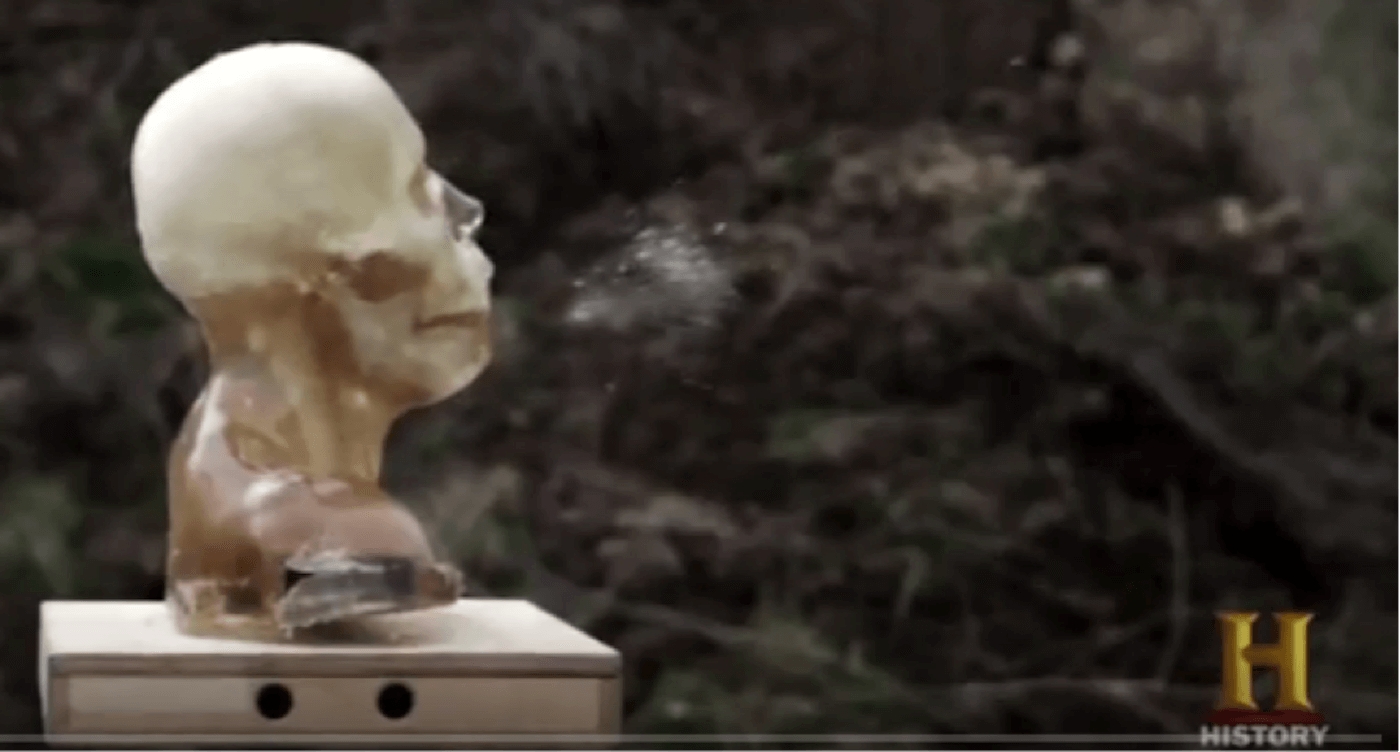
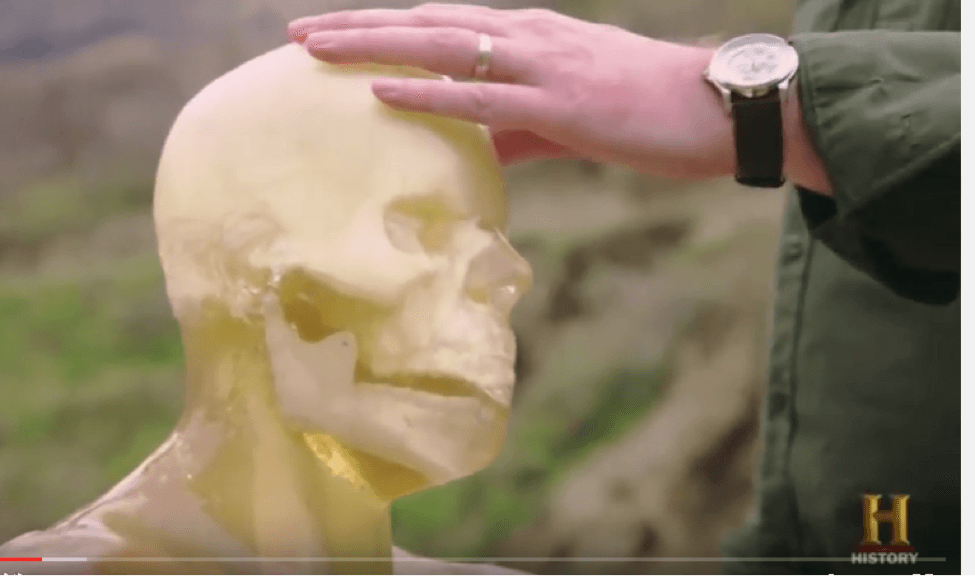
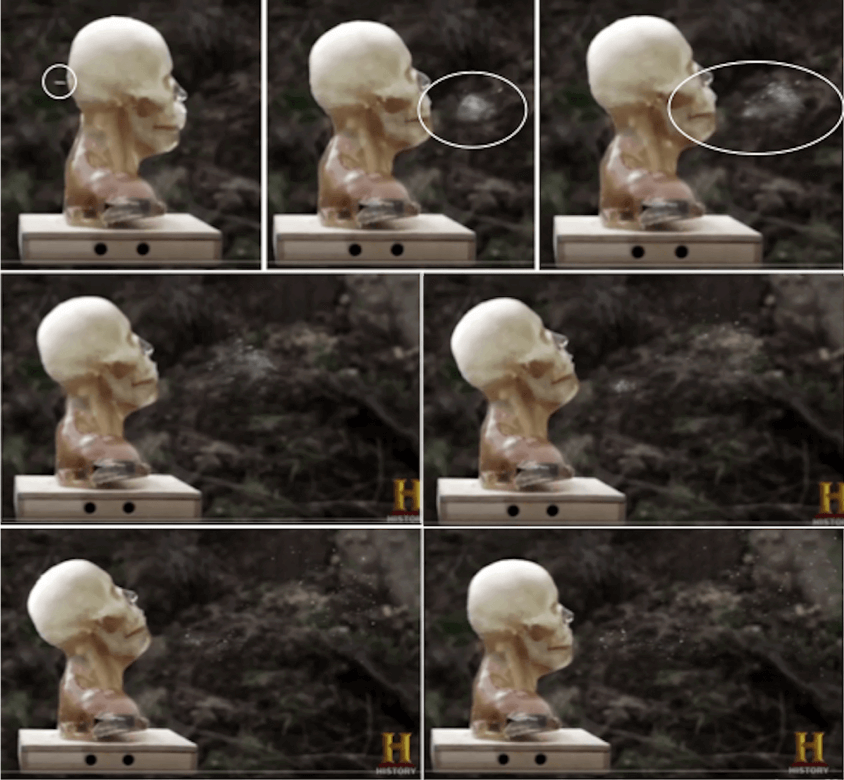
    To throw out the prima facie evidence —in the Zapruder film2— of gunfire from the right front, Baer simply replaces Luis Alvarez’s melon with what they call an encased gel ordinance head. Which goes backwards after being struck by a bullet fired from behind.

    A Nobel Prize winner in Physics (1968), Alvarez got involved in a test with a taped-up melon to verify that the backward snap of Kennedy’s head was consistent with a shot from behind due to a jet-propulsion-like recoil.3 But, as Gary Aguilar showed in his reply to Luke and Mike Haag, another test conducted by research physical scientist Larry Sturdivan at the Aberdeen Proving Grounds in 1964 proved otherwise. Ten skulls were shot with a Mannlicher-Carcano and all of them moved away from the rifle in the same direction of the bullet. The Commission suppressed these findings and plainly reported that President Kennedy was struck in the head and “fell to the left into Mrs. Kennedy’s lap.”  (Click here for that article)

    Alvarez’s test was misleading because a taped-up melon has neither the sheer strength nor the thickness close to that of a human skull. By the same token, Baer’s ballistic test is just another rigged attempt to support the discredited WC lone-gunman theory with a childish jet effect. We cannot do better than let Milicent Cranor comment at length on this ludicrous so-called “experiment”.


    History Channel – or Saturday Night Live?

    By Milicent Cranor

    This segment of the History Channel’s special on the Kennedy Assassination seems like a low-budget skit from Saturday Night Live!

    An “expert sniper” goes through the motions of recreating the shot to Kennedy’s head. The idea is to prove that one shot from the presumed Oswald location can cause the reaction we see on the Zapruder film: the head moving to the back and to the left.

    It’s not clear what they’ve dug up to use for the head.  The sniper describes it vaguely as a human head filled with ordinance gel, and throughout his little talk, he refers to that gel.  As in “shooting from behind the ballistics gel” and “I’ve got the ballistics gel on target.”  Maybe he hopes to convey the impression of a gelatinous brain causing the head to spring backwards. 

    The demonstration is just amazing. it is far more revealing than the show’s creators realize:

    We only get a side view of the action – and are not allowed to see the back or front of the head, not even after the shooting.

    The limited view of the head shows no damage whatsoever.

    The head moves back, but not to the left.  Then it pops right back up to its original position! 

    Something, possibly vaporized gel, seems to come out of the head (or from a smoke machine behind the head) – but only from the mouth area. 

    So he looks like a man leaning back with pleasure as he smokes a fine cigar, oblivious to the characters behind him.

    The sniper’s explanation for what happened is even more amazing: 

    “…the bullet enters the back of the head and the terminal ballistics will come here — [indicates area of right eye and forehead] – causing the head to go back and to the left.”

    cranor a

    “The terminal ballistics will come here”?  Terminal ballistics is defined as “the study of the behavior and effects of a projectile when it hits its target and transfers its energy to the target.”

    The sniper can’t explain what happened, but he seems to think that by naming the field of study concerned with such phenomena, the audience will be fooled.

    cranor b

    It is especially funny that he points to the area of the right eye: (1) In real life, the bullet is supposed to have exited from the top of the head on the right; (2) the gel-filled head in the demonstration seems to have no damage to that area, and it would show in a right profile view; and (3) all the exiting stuff representing brain matter comes out of the mouth.  Neither JFK nor the head in this demo is supposed to have had an exit wound in the mouth.

    Conclusion: The creators of this segment must have gel for brains. Or they think their audience does.

    cranor d
    THE SMOKING MAN

    Watch the segment on YouTube


    As the reader can see, this is not a studious, scientific attempt to duplicate the circumstances that befell Kennedy at 12:30 PM in Dealey Plaza, in Dallas.  And for Baer to try and pass it off as such speaks very poorly of both him and his show.

    But Bob Baer is not done.  Not by a long shot. For now he goes on and conducts what he calls an acoustics test. According to him, dozens of ear witnesses4 who heard shots coming from the Grassy Knoll were actually confused due to “the amphitheater effect.” The real sound coming from the Texas School Book Depository (TSBD) would have echoed at the so-called triple underpass and other hard structures in Dealey Plaza.

    To construct this “explosive theory,” Baer went to the crime scene with sound engineers and equipment that “nobody used before”. He just forgot to adjust the experiment setting to the standards of historical reconstruction.5 Not a single person was placed where a certain witness had been watching the presidential motorcade, and the sounds of the shooting weren’t generated by firing the rifle at the sniper nest. They were recorded elsewhere and played thereafter from near the TSBD.  No kidding.

    What is kind of shocking about this so-called acoustics test is that Baer completely ignores its far superior predecessor. During the proceedings of the House Select Committee on Assassinations, (HSCA) that body did an acoustics test in Dealey Plaza.  Except their testing was live and they brought riflemen into the plaza. And from that and their work with and analysis of the 11/22/63 dictabelt recording from Dealey Plaza by a Dallas policeman on a motorcycle, they concluded the following: 1.) Someone fired from the grassy knoll, and 2.) There were five shots fired that day. (Which, as Don Thomas reveals in his book Hear No Evil, for political reasons, Chief Counsel Robert Blakey reduced to four.)

    But, if one can comprehend it, Baer completely ignored the HSCA precedent, which included two teams of the finest audio scientists in the country. Among their members was Dr. James Barger of the firm Bolt, Beranek, and Newman. Barger had done acoustical research for the Navy in the field of submarine sonar detection, and had been involved in testing tapes of the 1970 Kent State shooting in Ohio. Barger did scientific testing of the actual sound wave patterns produced in Dealey Plaza at that time.  Barger’s findings were passed on to Professor Mark Weiss and his associate Ernest Aschkenasy. They did the final presentation for the committee. To imply, as Baer does, that those three men spent as much time and testing as they did and could not separate an echo from a live shot is ridiculous. But Baer and his program are so agenda driven that it is as if these previous tests never happened.  He brings in some audio recordings, some computer programmers, pays them a few bucks and with these stage props he has somehow eliminated the second gunman in the JFK case. Pure and utter poppycock. Baer’s level of science here would not pass muster at a good high school’s Science Fair. 


    An Inescapable Second Shooter

    On December 12, 1963, the Secret Service (SS) did a crude recreation. Its black and white footage plotted three shots on the JFK limousine. The bystander James Tague —wounded by a bullet ricocheting off the curb about 260 feet away from the limousine— destroyed the prior three-shots-three-hits scenario. Then, the magic bullet emerged not from evidence, but as an out-of-the-blue solution engineered to sustain the lone gunman theory.

    The FBI-SS reenactment on 23-24 May 1964 was a re-adjustment to preserve the willful closing of the case against Oswald. It also provided the notorious photo (CE 309) of Commission junior counsel Arlen Specter indicating with a metal rod the trajectory of the lie. However, an apparently insignificant detail provides a quantum of proof for demolishing any attempt—including Baer’s—to realign the shoots with the WC Report.

    For the 1964 recreation, Specter used the same jacket worn by Governor Connally on November 22, 1963, but he did not use President Kennedy’s. Otherwise he couldn’t have aligned the bullet entrance hole in the back of both Kennedy’s jacket and shirt with the exit wound at his throat.6

    The bullet holes are positioned 5 3/8” down from the collar line on the back of the jacket. They are consistent with the JFK death certificate, signed by his personal physician, Dr. George Burkley, who examined a back wound at the level of the third thoracic vertebra, about 4-6 inches below the point where the shoulders meet the neck.

    At this level, a bullet coming downward from the TSBD would not be able to exit the throat. But the Commission acolytes do not care about the death certificate7 and dismiss the jacket and the shirt as material evidence with the claim that both bunched up. Let’s connect the dots in a simple test.

    • Baer is invited to come dressed in suit and tie, along with John McAdams, Max Holland, Gerald Posner, Phillip Shenon et. al.;
    • They will remove their jackets and shirts to mark the position of the bullet hole in Kennedy’s, and will also mark on their bodies the back wound given by the WC;
    • They will put on their jackets and shirts, and will take a back seat in a car8;
    • They will get their jackets and shirts to ride up until the mark on each one matches the mark of the back wound. This crucial moment will be photographically captured;
    • They will compare the photos with the Zapruder film to find not even the faintest resemblance of JFK’s tailored suit jacket and buttoned shirt bunching up as theirs.

    They will surely face a dilemma. If the Warren Commission accurately placed the back wound, then JFK’s jacket and shirt were replaced, hence conspiracy; if the jacket and shirt are authentic, then the WC gave a false representation of JFK’s back wound, hence conspiracy or cover-up. There is not one whiff of any of these factors in the entire “Tracking Oswald” series, for if they did present it, the show would have to be called, “Trying to Find who Killed Kennedy.”  The Warren Commission did not want to do that.  Neither does Baer.


    Oswald’s Escape and Another Crime Scene

    After surreptitiously taking for granted that Oswald was the lone gunman, Baer applies his on-the-ground field officer expertise to assemble Oswald’s plan of escape with a concealed route, an Alpha 66 safe house, and some anti-Castro Cuban exiles as accomplices. No clue is given about how Oswald could have learned in advance the presidential motorcade’s schedule in order for him to have planned the assassination by firing a rifle with telescopic sight from his very place of employment.9  In that regard, Baer also ignores the following. That morning, Oswald asked fellow worker James Jarman why all the people were assembled in the plaza below.  When Jarman replied that President Kennedy was going to pass through in a motorcade, Oswald asked him which way it was proceeding.  Kind of wrecks Baer’s idea of Oswald’s planning.  Which is probably why he ignores it. (See Syliva Meagher, Accessores After the Fact, Vintage Books, 1992, pp. 37-38)

    For all of what follows, Baer relies on the bus ticket found in Oswald´s shirt pocket.  The former CIA officer somehow never discerns the difference between getting to and from work, and around the Dallas area, on the one hand, and escaping from the scene of a high profile murder case amid hundred of witnesses on the other. But Baer uses the ticket to infer a getaway route from the TSBD to an Alpha 66 safe house. On the way, Baer loses the evidentiary trail that—since Sylvia Meagher´s research in 1967—has put the ticket and other circumstances of Oswald’s escape under a cloud of suspicion (Accessories After the Fact, pp. 70-93).

    Baer deduces that, from his years of experience in the CIA, in a situation like this, the assassin(s) needed to have an escape route planned in advance. Our host does not want to admit that what the Commission says Oswald did after the shooting would suggest that he had no such plan in mind. Or that the latest research on this matter clearly indicates he was not on the sixth floor at all. (See Barry Ernest’s book, The Girl on the Stairs. Click here for a review) For the idea that a man who just killed the president would now search out public transportation to flee the scene of the crime amid hundreds of spectators and scores of policemen is simply not credible. But that is what the official story says. And that is what Baer is supporting.

    In any real planning situation one would rely on one of two factors for escape amid a multitude of spectators. The first alternative would be disguise—of which there is no evidence in this case. The other would be speed. That is, the longer one stays at or near the scene, the longer one risks the possibility of exposure and/or capture. Concerning this subject, one could do as Josiah Thompson did at the end of Six Seconds in Dallas. That is, present the testimony of policeman Roger Craig. Craig says he saw Oswald running down the embankment after the shooting. He then jumped into a Rambler driven by a dark skinned man. That would sound like an escape plan utilizing speed.  But probably because of that, Baer ignores it.  So in his scenario, Oswald boards a bus, gets off the bus, then walks a few blocks, and hails a taxi. But before he enters, he offers it to a little old lady standing next to him. (Meagher, p. 83) With a straight face Baer pronounces this an “escape plan”.

    Furthermore, Baer explains that Oswald ended up in the Texas Theater because of the run-in with Police Officer J.D. Tippit on East 10th Street, about 100 feet eastward from Patton Avenue. At that point, the escape plan was supposedly disrupted and Oswald failed to think clearly and rationally.  However, as in the case of his alleged shooting of the President, the evidence against Oswald in Tippit’s murder is shoddy.10 And Baer ignores that shoddiness.

    The crime scene is almost a mile away from Oswald’s rooming house at 1026 N. Beckley. His landlady Earlene Roberts saw him waiting for a bus at 1:04 PM after he left his room. Temple Ford Bowley arrived at the crime scene when Officer Tippit was already on the ground and some bystanders were milling around the police car. Bowley looked at his watch and the time was 1:10 PM. The Commission ignored Bowley. Why? Because clearly Oswald couldn´t have walked almost a mile in less than 6 minutes. They then reported that Tippit was killed circa 1:15 PM, despite the fact that is the time he was pronounced dead at Methodist Hospital. To keep up appearances, a typed FBI memo stretched out Tippit’s agony at the hospital until 1:25 PM.

    This case against Oswald for the Tippit shooting further weakens due to the three-wallets enigma.11 At the crime scene, Channel 8 staffer Ron Reiland filmed a policeman showing an open wallet to an FBI agent. According to FBI agent James Hosty, his fellow Bob Barrett revealed that this wallet contained IDs for both Oswald and Alek Hidell. But Dallas Police Officer Paul Bentley confiscated a second wallet from Oswald after he was arrested at the Texas Theater.  And another one was found among Oswald´s belongings at Ruth Paine´s house in Irving. These are all facts. They strongly suggest some evidence against Oswald was planted. They are ignored by Baer.

    Let us add another point about the two constant refrains by Baer during the program.  First, the continuing assumption that Oswald is the guilty party. This, as we have seen, he achieves only by ignoring the evidence, especially the new evidence declassified by the Assassination Records Review Board (ARRB). And that relates to the second refrain:  that Baer has read through the two million pages of declassified documents by the ARRB.  Yet this program offers no evidence from that declassification process. For instance, Baer presents a four-decades-old police report that Oswald was seen at an Alpha 66 safehouse in the Dallas area. The other document used in this episode is the famous testimony of Antonio Veciana of him seeing Oswald with Maurice Bishop at the Southland Building in Dallas.  Again, that information extends back to the seventies.  And it does not at all connect Oswald with Alpha 66. Veciana was arriving to meet with his case officer Bishop at the time.  He was early, and he saw Bishop with Oswald.  Oswald left shortly after he arrived.  In other words, Oswald was there with Bishop, not with Alpha 66 leader Veciana.  And as Veciana later admitted—just three years ago—Bishop was David Phillips.

    Now if Bob Baer was really interested in furnishing the public with new information, he could have done at least a couple of things with that crucial admission.  First, he could have said that the ARRB discovered that Phillips (along with James McCord) was running the CIA’s counter-intelligence programs against the Fair Play for Cuba Committee, of which Oswald was the only member in New Orleans. When one combines that with the fact that Oswald worked out of the same building that former FBI agent Guy Banister did, 544 Camp Street; and he printed that Camp Street address on more than one of his flyers, then that meeting with Phillips gets interesting.  Why would an alleged communist like Oswald be meeting with a CIA officer and working with a former FBI agent?

    The other aspect that could have been made up of new information would have been Phillips running the Cuban desk in Mexico City while Oswald was allegedly there.  Baer could have told the public:

    The man Oswald was meeting with,  David Phillips, told the HSCA that there were no tapes or pictures of Oswald in Mexico City. Yet there was such a tape that FBI agents listened to in Dallas while Oswald was under arrest for murder. Those agents told FBI Director J. Edgar Hoover that this tape was not the voice of the man in detention. We are going to explore that apparent quandary tonight.

    But, of course, Baer could not do that since he began the show by using a lot of questionable material about the Russians controlling Oswald in Mexico City, when the declassified Lopez Report strongly suggests that Oswald was impersonated in Mexico City. So the true identity of Oswald is kept under wraps, and some mythical association with Alpha 66 is now manufactured out of next to nothing.


    Coda

    More than fifty years and zero evidence after the JFK assassination, Baer is oddly not interested in or ignorant of what has been proven and debunked. He simply pushes back to square one—the lone gunman who shot a magic bullet—by concocting a light version (Castro knew it) of the oldest CIA backstop (Castro did it) through the fact-free hypothesis of Oswald linked somehow to Alpha 66 in the killing.


    Notes

    1 White House Telephone Transcripts, 23 November 1963, LBJ Library.

    2 In his remark to Attorney General Robert Kennedy about two people involved in the shooting, CIA Director John McCone wasn’t speculating. He had been briefed by Art Lundahl, head of the National Photographic Interpretation Center (NPIC), where leading photo analyst Dino Brugioni and his team examined the Zapruder film, made still enlargements of select frames, and mounted them on briefing boards. See Dan Hardways “Thank you, Phil Shenon” (AARC, 2015).

    3 Thus, Alvarez joined the crew of dueling experts devoted to defending the WC at any cost, after the Zapruder film was available for the first time to a mass audience on March 6, 1975, thanks to HSCA consultant Robert Groden and JFK activist Dick Gregory, who brought it to Geraldo Rivera’s ABC show “Good Night America.”

    4 Baer uses his own statistics, but the most reliable study, 216 Witnesses, by Stewart Galanor, found that 52 heard a shot from Grassy Knoll, 48 from TSBD, 5 from both places and 4 elsewhere. Other 37 witnesses could not tell and 70 more were not asked.

    5 The WC acolytes always incur this failure. For instance, it’s well-known since Mark Lane’s Rush to Judgement (The Bodley Head, 1966) that WC’s firearms experts were unable to duplicate what Oswald did, but Vincent Bugliosi replied in Reclaiming History (W. W. Norton & Company, 2007) that CEs 582 to 584 “shows two hits were scored on the head” (p. 1005) – only that both were scored using iron sights instead of scope.

    6 The FBI Supplemental Report from January 13, 1964, contains Exhibits 59 and 60 showing the bullet entrance holes in the back of Kennedy’s jacket and shirt, respectively. They weren’t included in any of the 26 volumes of Commission Exhibits. The initial draft of the WC report stated:  “A bullet had entered his back at a point slightly above the shoulder to the right of the spine.” WC member Gerald Ford wanted it to read: “A bullet had entered the back of his neck slightly to the right of the spine.” After the ARRB declassification, the discrepancy emerged. Ford told reporters: “My changes were only an attempt to be more precise.” (AP, July 3, 1997).

    7 Specter neither produced it nor interviewed Admiral Burkley, who as JFK’s personal physician was the only doctor present both at the Parkland Hospital (Dallas) in the emergency room and at Bethesda Medical Center (Maryland) during the autopsy.

    8 It could be the Cadillac used by Specter instead of the presidential limousine (Lincoln Continental 1961).

    9 For these and other similar issues, see A.M. Fernandez’s “Why the Warren Commission got scared with Castro”.

    10 Joseph McBride, Into the Nightmare, Hightower Press, 2013, pp. 244 ff.

    11 James DiEugenio, Reclaiming Parkland, Skyhorse Publishing, 2013, pp. 101 ff.