Tag: ALLEN DULLES

  • John Newman, Countdown to Darkness, Volume 2

    John Newman, Countdown to Darkness, Volume 2


    John Newman has just released the third part of his series on the murder of John F. Kennedy. Titled Into the Storm, we are running an excerpt from it on our site, while linking to another excerpt. This review deals with the second volume, Countdown to Darkness. It is indefinite as to how long this series will be. I originally heard it would be a five-volume set. But now I have heard from other sources it may be six. (I will comment on this length factor later.)

    Countdown to Darkness assesses several subjects. Some of these the author deals with well. Some of his treatments disappoint. The point is the book is wide-ranging in scope, as I imagine the rest of the series will be. It does not just deal with topics relating to the JFK murder. There are subjects dealt with that are more in keeping with a history of Kennedy’s presidency. Therefore, the book is broad based.

    Countdown to Darkness begins with the peculiar arrangement surrounding the dissemination of Oswald’s file at CIA. This valuable information is a combination of Newman’s examination of the file traffic, plus insights gained by the estimable British researcher Malcolm Blunt. Those insights were achieved through Blunt’s discussions with the late CIA officer Tennent Bagley. In this analysis, Newman repeats his previous thesis that although the first Oswald files went to the Office of Security, they should have gone to the Soviet Russia Division. (p. 3; all references to the e-book version) He expands on this by saying this pattern appears to have been prearranged. The mail distribution form was altered in advance to make this happen. (p. 2) One effect of this closed off routing was that there was little chatter about Oswald’s implied threat to surrender radar secrets. When Blunt talked to Bagley, Malcolm told him about this dissemination pattern. Bagley asked Blunt if he thought this was done wittingly. When Malcolm said he was not sure, the CIA officer replied he should be—because it was set up that way in advance. Blunt said that this disclosure was “a significant departure from Bagley’s normal cautious phrasings.” (p. 30)


    II

    From here, the book turns to Cuba and President Dwight Eisenhower’s intent to overthrow Castro. CIA Director Allen Dulles with Vice President Richard Nixon first discussed this idea in 1959. The initial planning on the project was handed to J. C. King and Richard Bissell; the former was Chief of the Western Hemisphere, the latter was Director of Plans. (p. 32) The author traces the familiar story of how the original idea—to integrate a guerilla force onto the island to hook up with the resistance—began to evolve into something larger in January of 1960. This was coupled with the Allen-Dulles-inspired embargo, which extended to include weapons from England. This was meant to force Castro to go to the Eastern Bloc and the USSR for arms. (pp. 36-37) Dulles also wanted to sabotage the sugar crop, but Eisenhower turned that request down.

    Bissell turned over the architecture of the overthrow plan to CIA veteran officer Jake Esterline. (p. 48) Esterline had been a deputy on the 1954 task force in the coup against Arbenz in Guatemala. Like David Talbot before him, the author points out the fact that warnings about the overall design problems, and how the objective differed from Guatemala, were deep-sixed. (p. 55) By March of 1960, Eisenhower started talking about a different approach, a strike force type invasion. The president wanted OAS support for this plan. And here the author introduces something new to the reviewer: his concept of Eisenhower’s Triple Play. That is, in order to achieve such outside support, the White House and CIA would rid Latin America of a thorn in its side, namely, the bloodthirsty dictator of the Dominican Republic, Rafael Trujillo. (p. 90) This will later expand into an attempt to also get NATO behind the overthrow. Hence, Ike’s Triple Play will include the assassination of Patrice Lumumba of Congo.

    One of the contingencies upon which Eisenhower based his overthrow of Castro was the establishment of a government in exile. This consisted of the banding together of several individual groups of Cuban exiles under an umbrella called the Revolutionary Democratic Front, or FRD. (p. 127) This endeavor ended up being quite difficult, for two reasons. First, some prominent exile members, like Tony Varona, did not want to join. Second, a principal officer involved for the CIA, Gerry Droller (real name Frank Bender), had rather poor organizational skills. The author gives us more than one example of this trait. (pp. 129-32)

    As the operation morphed from a guerilla-type incursion into a brigade invasion concept, more managers were grafted onto the project. The author first names Henry Hecksher. (p. 140) Hecksher worked with David Phillips on the Arbenz overthrow, then went to Laos, and then was assigned to Howard Hunt’s favorite exile, Manuel Artime, in 1963-64. (pp. 142-44) Another person named by the author as part of this expansion is Carl Jenkins.(p. 147) Jenkins worked at the Retalhuleu military base in Guatemala. A base was also set up in Nicaragua and some of the Alabama National Guard pilots were enlisted.

    As the brigade concept was escalating, false information was entered into the information flow. Undersecretary of State Douglas Dillon said only 40% of the Cuban populace would end up supporting Castro. (p. 170) Which, to put it mildly, turned out to be almost ludicrously wrong. Castro now began to import a flow of Eastern Bloc arms through Czechoslovakia. (p. 171) As this occurred, Eisenhower, through Dulles, began to activate the Trujillo aspect of the Triple Play. This appears to have been set in motion between February and April of 1960. (p. 172)

    When Castro began to seize oil companies like Texaco, Esso and Shell, Vice President Nixon began to urge Eisenhower into action. He recommended “strong positive action” to avoid becoming labeled, “uncle Sucker” throughout the world. (p. 174) National Security Advisor Gordon Gray said much the same thing: “… the U.S. has taken publicly about all it can afford to take from the Castro government ….” (p. 174)

    On July 9, 1960, Nikita Khrushchev threatened the USA with ICBMs over Cuba. Eisenhower replied that America would not be intimidated by these threats. (p. 176) The author mentions that at this time there was an attempt by the Agency to solicit a Cuban pilot to assassinate Raul Castro. Newman scores author Evan Thomas for distorting this as the pilot’s idea, when the impetus was clearly from the CIA. (p. 182) General Robert Cushman, working on the staff of Richard Nixon, urged Howard Hunt to use as much skullduggery as possible to get rid of Castro. (pp. 184-85)

    But as the Inspector General report by Lyman Kirkpatrick later revealed, the attempt to arm and supply the dissidents on the island was not working. In fact, at times, it was counter-productive, since Castro’s forces would recover the supplies and arms. As the threat grew, Russia sent in more arms to the island: tanks, mortars, cannons. With these advantages Castro began to close in on the resistance. And this was another reason the original guerilla plan was modified into a brigade-sized invasion. (p. 185)


    III

    We now come to what this reviewer feels is probably the highlight of the first two books in the series: the author’s work on the assassination of Patrice Lumumba of the Congo. Newman devotes four chapters to this subject. In my opinion the result is one of the best medium-length treatments of the Congo crisis I have read. As noted above, Eisenhower felt that by getting involved in Belgium’s colonial problems, this would encourage NATO allies to stand by him in his attempt to overthrow Castro. After all, the NATO alliance began in 1948 with the Brussels Treaty.

    As early as May 5, 1960 Allen Dulles was aware that Belgium was attempting to set up a breakaway state in the Congo called Katanga. This was two months before the ceremony formalizing the Belgian withdrawal from its African colony. (p. 153) Katanga was the richest region in Congo, and perhaps one of the richest small geographical areas in the world. If the Katanga secession were successful, it would do much to benefit Belgium and its covert ally England, at the same time that it would damage the economy of the new state of Congo.

    Dulles was predisposed to favor Belgium because of his prior career as a corporate lawyer with the global New York law firm of Sullivan and Cromwell. That firm represented many companies that benefited from low wage conditions in the Third World. Therefore Dulles and his deputy Charles Cabell began to smear independence leader Patrice Lumumba at National Security meetings in advance of his assuming power. Combined with the fact that the Belgian departure was not total, this pitted Lumumba against both the former imperialists and the growing malignancy of the USA. (p. 154)

    Lumumba’s stewardship was not just hurt by the Katanga secession, but also by the fact that Belgium had removed Congo’s gold reserves and placed them in Brussels prior to independence being declared. (p. 155) With little cash on hand, Lumumba’s army mutinied and spun out of control. This created the pretext for Belgium to send in paratroopers. The Belgians now began to fire on the Congolese. On July 11th, Katanga declared itself a separate state. By July 13, 1960, two weeks after independence, the Belgians occupied the Leopoldville airport and Lumumba decided to break relations with Brussels. The next day the United Nations, under Secretary General Dag Hammarskjold, passed a resolution to send troops to Congo. In the meantime Allen Dulles was working overtime to tell anyone on the National Security Council and in the White House that Lumumba would tie Congo to Egypt’s Gamal Abdel Nasser, Castro and the Communist Bloc. (pp. 162-63)

    This tactic worked. When Lumumba arrived in Washington to ask for supplies, loans and aid in expelling the Belgians, Eisenhower was not on hand to greet him. Instead, Lumumba talked to Secretary of State Christian Herter and Under Secretary Douglas Dillon. They lied to him by saying they were working through Hammarskjold. (p. 220) This left Lumumba little choice but to ask Russia for supplies. The USSR sent him transport planes and technicians. (p. 222)

    When the Russians sent Lumumba the military aid, it sealed his fate. On August 18, 1960 Leopoldville station chief Larry Devlin sent a cable that was drawn in the most hyperbolic terms imaginable. Devlin told CIA HQ that Congo was now experiencing a classic communist takeover, and there was little time to avoid another Cuba. (p. 223) This was clearly meant as a provocation. It worked. On the day this cable arrived, Eisenhower instructed Dulles to begin termination efforts against Lumumba. This was kept out of the meeting record. It was not revealed until the investigations of the Church Committee. The recording secretary to the meeting, Robert Johnson, told the committee that it was too sensitive to be included in the minutes. (p. 227)

    The plot began the next day. Director of Plans Dick Bissell told Devlin to begin action to replace Lumumba with a pro-Western leader. On August 26, Allen Dulles sent an assassination order to Devlin that authorized a budget of $100,000 to terminate Lumumba, the equivalent of close to a million dollars today. (p. 236) Bissell now called in the head of the Africa Division, Bronson Tweedy, and they began to assemble a list of assets they could employ in order to do the job. (p. 246) One of these was the infamous Dr. Sydney Gottlieb, who began to prepare poisons for use in the assassination. Devlin also got President Joseph Kasavubu to remove Lumumba from his position as prime minister. At this point Hammarskjold sent his own emissary, Rajeshwar Dayal, to Congo to protect Lumumba.

    This was necessary because, in addition to Gottlieb, Devlin now bribed the chief of the army, Josef Mobutu, to also assassinate Lumumba. (p. 265) At around this time, two CIA-hired killers, codenamed QJ WIN and WI ROGUE, both arrived in Leopoldville. Not knowing each other, they both stayed at the same hotel. Gottlieb then arrived in Congo. (p. 268) In September of 1960, with a multiplicity of lethal assets on hand, Tweedy now cabled Devlin to produce an outline of how he planned on terminating Lumumba.

    The use of the two codenamed assassins in Congo marks the beginning of the ZR/Rifle program. This was the CIA’s mechanism for exterminating foreign leaders. It began under Eisenhower in September of 1960. (p. 280) The next month it was taken over by CIA officer William Harvey. ZR/Rifle was sort of like the reverse side of Staff D, which was a burglary program to break into embassies and steal codebooks. Harvey and his assistant Justin O’Donnell recruited safe crackers, burglars and document forgers for that part of the program. (pp. 284-85) When Harvey testified before the Church Committee, he lied about the use of ZR/Rifle in the Lumumba case. He was fully aware of what the two men were doing in Congo. (p. 290)

    Mobutu now tried to arrest Lumumba, but Dayal blocked the attempt. Three things happened in November of 1960 that penned the final chapter. CIA officer Justin O’Donnell arrived in Congo to supervise the endgame. John Kennedy, who the CIA knew sympathized with Lumumba, was elected president. And third, America and England cooperated in seating Kasavubu’s delegation at the United Nations. This last event provoked Lumumba into escaping from Dayal’s house arrest. O’Donnell had decided that the CIA should not actually murder Lumumba. But they would help his enemies do the deed. Therefore, Devlin cooperated with Mobutu to cut off possible escape routes to Lumumba’s base in Stanleyville. He was captured, imprisoned and transferred to Elizabethville in Katanga. (p. 295) Lumumba was executed by firing squad and his body was soaked in sulphuric acid. When the acid ran out, his corpse was incinerated. (p. 296) Thus was the sorry end of the first democratically elected leader of an independent country in sub-Saharan Africa.

    As I said, for me, this section on Lumumba is the highlight of the first two volumes.


    IV

    Another topic that the author spends significant time on is the CIA/Mafia plots to kill Castro. The author traces this idea from Allen Dulles to Dick Bissell. He believes that Eisenhower gave his tacit approval to the plots. He also believes that Bissell dissembled in his testimony on how the plots were hatched, and he mounts several lines of evidence to demonstrate this. (p. 327) Bissell dissembled in order to conceal the fact that it was he who approved of giving the assignment to the Mafia through CIA asset Robert Maheu. By mid-August of 1960, the CIA’s Technical Services Division was at work manufacturing toxins to place in Castro’s cigars.

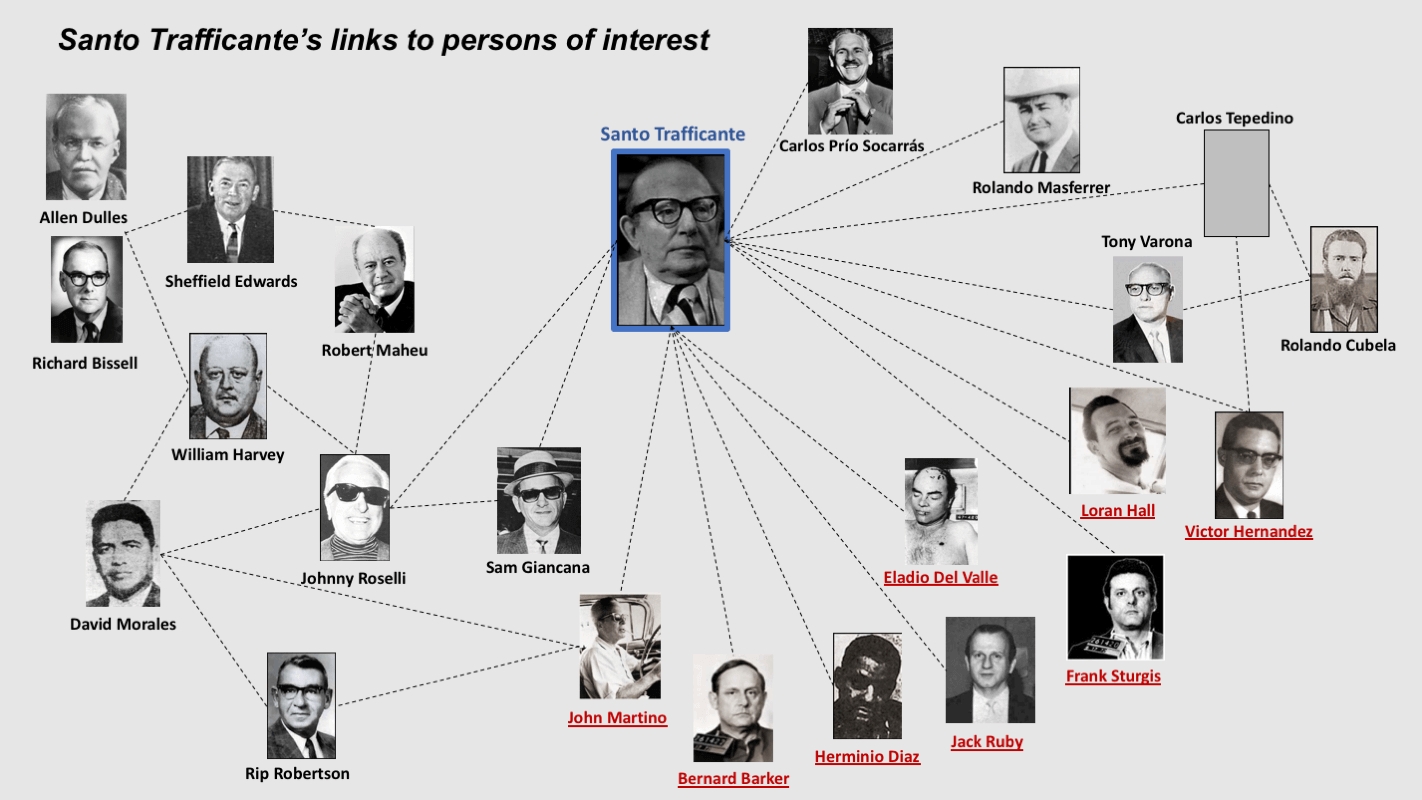
    Maheu offered gangster Johnny Roselli $150, 000 to kill Castro. (p. 331) Both Allen Dulles and his deputy Charles Cabell were briefed on this overture in late August by Chief of Security Sheffield Edwards, who was part of the Mafia outreach program. Meetings were arranged with Roselli in Beverly Hills and New York City. Maheu and CIA support officer Jim O’Connell masqueraded as American businessmen who wanted to protect their interests by getting rid of Castro. But Maheu eventually told Roselli that O’Connell was CIA. Therefore, the veneer of plausible deniability was lost. (p. 333) Roselli now began to recruit Cubans in Florida for the murder assignment. He also arranged a meeting in Miami for Maheu to be introduced to Sam Giancana and Santo Trafficante, respectively the Mafia dons for Chicago and Tampa. When this occurred the author writes that, because of the reputations and history of these two men, the plots and the association should have been reassessed and approval cancelled. They were not.

    They should have been. Because the recruitment of Giancana was a huge liability. Not just because of his history of being a hit man; but also because of his inability to keep a secret. Feeling emboldened, since he was now in the arms of the government, he bragged about his role in the plots to at least two people. From there the word spread to others, including singer Phyllis McGuire. Giancana revealed both the mechanism of death—poison pills—and the projected date of the assassination—November of 1960. (p. 334-35) Through his network of informants, FBI Director J. Edgar Hoover found out about Giancana’s dangerous chatter. But Hoover did not know that the CIA had put him up to it. The Director told Bissell about it, but Bissell did not inform Hoover about his role as recruiter.

    Maheu now arranged to have McGuire’s room wired for sound in Las Vegas. This was done for two reasons. First, to see if she was talking about the plots; and second, as a favor to Giancana, who suspected she was cheating on him with comedian Dan Rowan. The police discovered this illegal bugging. In addition to the security problem, this all had disturbing repercussions when Attorney General Robert Kennedy began his crusade against organized crime in 1961. (p. 336)

    Along with these assassination plots, on November 3, 1960, National Security Officer Gordon Gray came up with the idea of using Cuban exiles dressed as Castro soldiers to stage an attack on Guantanamo Bay as a pretext for an invasion. (p. 346) As the author suggests, the very fact that the murder plots and this false flag operation were contemplated show that those involved in managing the strike force invasion understood that its chances for success were low. (pp. 345-46) To further that miasma of doubt, at this same meeting, a question was asked about “direct positive action” against Fidel, his brother Raul and Che Guevara.

    There was good reason for both the doubt and the fallback positions, because about two weeks later, CIA circulated a memo admitting that there would not be any significant uprisings on the island due to any incursion, and also that the idea of securing an air strip on the island was also not possible unless the Pentagon was part of the attempt. (p. 348) This memo was not shared with the incoming President Kennedy. The author deigns that it was not shared because the internal uprising myth was used to manipulate Kennedy into going along with the operation. It thus became part and parcel with the new “brigade strike force” concept. (pp. 352-53)

    On January 2, 1961, Castro broke relations with the United States. The favor was returned two days later. These actions caused the training of the exiles in Central America to be expanded, and also for the action against Trujillo to be accelerated. (p. 355) On January 4th, Chief of the CIA paramilitary section wrote a memo to one of the operation’s designers, Jake Esterline. The memo said the invasion would be stuck on the beach unless an uprising took place or there was overt military action by the USA. (p. 355) As the author notes, this is another indication that the people involved at the ground level understood that, left to its own devices, the prospects for the invasion were fey. Hawkins added that Castro’s military forces were growing. They would soon include featured tanks, artillery, heavy mortars and anti-aircraft batteries. Given those facts, Hawkins warned that:

    Castro is making rapid progress in establishing a communist-style police state that will be difficult to unseat by any means short of overt intervention by US military forces. (p. 356, Newman’s italics)

    Since Bissell was a supervisor of both the assassination plots and the invasion, one wonders if he was banking on the murder of Castro to bail out what looked like an upcoming failure on the beach. In fact, as the author notes, at NSC meetings of January 12 and also January 19, the idea of overt intervention was brought up again. What made the time factor even more pressing was that the CIA had information that the shiploads of these munitions would reach Cuba in mid-March and continue with daily arrivals after that. This is why Hawkins urged that the invasion be launched in late February and no later than March 1. (p. 356) This would not happen, since Kennedy rejected the first proposal for the operation, namely the Trinidad landing site.


    V

    Kennedy had two meetings on the subject during his first week in office. At neither did he appear enthusiastic about it. On February 3, 1961 the Joint Chiefs wrote a ten-page report in which they viewed the plan favorably. This was something of a reversal from their previous assessments. But they cautioned that the plan was reliant on indigenous support from the island, meaning defections from Castro. They foresaw that if the force retreated to the mountains it might need overt American intervention. But even with these reservations, the executive summary at the end was positive. (pp. 363-64) Newman comments that one way to explain this reversal is that the Joint Chiefs felt that if the CIA plan failed, they would be called in to save the day and collect the glory.

    Kennedy now chimed in with his reservations about having the operation look too much like a World War II amphibious assault. He asked if it were possible to configure it more like a guerilla operation. (p. 366) This was a harbinger of what was to come from the president, who clearly never liked the operation in the first place. Knowing this, those pushing the plan tried to convince Kennedy that the strike force would ignite a rebellion on the island, even though they knew that such was not the case. (p. 383) Newman writes that this manipulation was done so that JFK would not cancel the operation—the gamble being that he would feel obligated to send in the Pentagon once he saw the invasion faltering. This hidden agenda to the Bay of Pigs episode was pretty well established in 2008 by Jim Douglass in his fine book JFK and the Unspeakable.

    At White House insistence, the location of the plan was moved away from Trinidad, 170 miles southeast of Havana, at the foothills of the Escambray Mountains. (p. 389) The reason for the switch was that Trinidad had a population of about 26,000 people. This decreased the odds of surprise and opened up the possibility of civilian casualties. Trinidad also did not have a proper length airfield for B-26 bombers. For these reasons, the locale was shifted to the Bahia de Cochinos (Bay of Pigs), east of the Zapata Peninsula. The CIA now went to work tailoring a plan for the new location.

    There was a serious problem with these delays. The longer it took to launch the operation, the more time Castro had to import weaponry from the USSR. The arms supplies began arriving in earnest on March 15. After that, one or two ships would unload per day. (p. 392) At this point, both Esterline and Hawkins wanted to leave the project.

    As the author notes, another important alteration was that the air cover and assaults were gradually whittled down in frequency and scope. This was owed to the reluctance of Kennedy and Secretary of State Dean Rusk to reveal the hand of American involvement. The first Hawkins-Esterline plan featured well over one hundred sorties in five different waves. (p. 390) When Kennedy asked Bissell how long it would take for the invasion force to work its way off the beachhead, he replied about ten days. In light of what actually happened, this was absurd, since no beachhead was ever established to break out of.

    As late as an April 4 meeting, Kennedy was still trying to argue for an infiltration plan. Inserting groups of 200-250 men and developing a build-up from there. Kennedy was trying to make it appear less as an invasion and more as an internal uprising. The CIA replied that this would only alert Castro, and each group would then be eliminated. (p. 394) The next day Kennedy asked assistant Arthur Schlesinger what he thought of the project. Schlesinger said he opposed it. He felt that Castro was too entrenched to be displaced by a single landing force. And if the landing did not cause uprisings, logic would dictate American intervention. The author notes the late date of this cogent observation: ten days before the launch from Central America. Newman also notes the fact that no one from the Pentagon pointed this out at the meeting; just as there was no real discussion of the air cover plan. Making it all the worse: Kennedy had instructed Bissell to tell the brigade leaders that no American military forces would participate or support the invasion in any way. (p. 393)

    But further, Kennedy drastically cut back on the amount of air sorties he would allow. And this is what had Esterline and Hawkins ready to depart the project. (p. 396) As stated previously, they insisted there had to be five waves of air strikes and over 100 individual sorties. Kennedy and Rusk opposed this aspect. Newman blames the Joint Chiefs for not stepping in and pointing out the difference between the Esterline/Hawkins design and what was happening to it. The author, citing Bissell, now says that what was left was the strikes scheduled the day before, and also the D-Day air strikes. Newman, citing Bissell, says that Kennedy then cancelled the latter the day before they were scheduled. (pp. 399-400) I was surprised to see the author adopt this interpretation of the controversial issue. This is a point of dispute which I will delve into later.

    The invasion was an utter failure and the battle was decided within the first 24 hours. There was no surprise. There were no defections. And in the first 24 hours there was no Allen Dulles. Bissell had encouraged him to keep a speaking engagement in Puerto Rico. Dulles did keep it. Newman makes an interesting observation about this. Dulles kept the engagement to give the appearance that the operation was really Bissell’s. Therefore, after the Navy saved the day, he should be forced to resign while Dulles kept his job. (p. 402)

    What no one thought would happen did happen at midnight on April 18. Joint Chiefs Chairman Lyman Lemnitzer and Navy Chief Arleigh Burke tried to convince the president that he must intervene. (p. 403) Kennedy turned down this last attempt to get him to commit American power into the failed beachhead. Dulles’ plan to overthrow Castro and save his position had failed.

    Burke was relieved of duty in August of 1961. Later in the year, Dulles, Bissell and Cabell were also terminated. Lyman Lemnitzer was moved to NATO command and replaced by General Maxwell Taylor. In a conclusion, the author writes that after doing the research for this book, he has now downgraded his opinion about Eisenhower as a president. (pp. 404-405) After doing my own work on the man, I would have to agree. But I would make this judgment not just on foreign policy but also with civil rights. Eisenhower had some remarkably good circumstances accompanying his presidency; for instance, a growing economy, positive net trade balance in goods and services, a great military advantage over the USSR, and a unified populace behind him. In retrospect, he had a lot of political capital to make some daring decisions with, both abroad and on the domestic scene. For whatever reason, he chose not to. He passed those decisions on to his successor.


    VI

    I might as well begin the negative criticism with the subject of the Bay of Pigs. As the reader can see from my above synopsis, the author advocates for the stance put forth by Allen Dulles and Howard Hunt in their Fortune magazine article, saying that Kennedy cancelled the D-Day air strikes. (September, 1961, “Cuba: The Record Set Straight”) And that somehow this was the fatal blow delivered to the enterprise. (Newman, p. 400)

    I would have thought that by now, this stance would have been discredited. In the penetrating report delivered by CIA Inspector General Lyman Kirkpatrick, he poses the hypothetical: Let us assume that Castro’s air corps had been neutralized. That would have left about 1,500 troops on the beach against tens of thousands of Castro’s regular army, reinforced by a hundred thousand or more men in reserve. And the Russians had been delivering shiploads of artillery, mortars and tanks every day for over a month, the very weapons one uses to stop an amphibious invasion on the ground. (Peter Kornbluh, Bay of Pigs Declassified, pp. 41, 52. This book contains most of the Kirkpatrick Report and its appendixes.) What made this aspect even worse is something Newman barely mentions: the element of surprise. One reason Kennedy moved the operation out of Trinidad is that the area was too populated, which would mitigate against that element. The Zapata peninsula was sparsely populated and the CIA said there was no paramilitary patrol there. This turned out to be false. There was a police force at Playa Giron beach the night of the landing. (Kornbluh, p. 37) They alerted Havana. Castro had his troops, with armor and artillery, on the scene within ten hours. But it’s actually worse than that. Castro had so thoroughly penetrated the operation by his intelligence sources that he knew when the last ship left Guatemala. (Kornbluh, p. 321) Therefore, on high alert, he was literally waiting for the landing. To top if off, the other element that the CIA said would be important to the invasion’s success, mass defections from the populace, was non-existent. In fact, Castro later crowed about how even the small number of people on the scene had backed him against the exiles. (Kornbluh, pp. 321-22) Therefore, with no defections, no surprise, being massively outnumbered, and with mortars, tanks and artillery shelling the force on the beach, as Kirkpatrick wrote: What difference would it have made with or without Castro’s air corps in operation?

    But I would further disagree with the author’s presentation. There is today an ample body of evidence that the so-called D-Day air strikes were not actually cancelled. They were contingent on being launched from an airfield on the island, which is one reason the Zapata Peninsula was chosen. Prior to the invasion, the CIA had agreed to this in their March 15th outline of the plan. In fact, they mention the issue three times in that memo. (Kornbluh, pp. 125-27) Further, both the Kirkpatrick Report and the White House’s Taylor Report mention this stipulation. (Kornbluh, p. 262; Michael Morrisey, “Bay of Pigs Revisited”, The Fourth Decade, Vol. 1 No. 2, p. 20) In the latter, the report states that National Security Advisor McGeorge Bundy explicitly told CIA Deputy Director Charles Cabell that such would be the case. (p.23)

    This speaks to another issue directly related to the alleged cancellation of the D-Day air strikes. Newman says that both Cabell and Bissell went to the office of Dean Rusk and pleaded their case for the strikes. Rusk was against it and he then got Kennedy on the line and he was also against it. This disagrees with both Dan Bohning’s book, The Castro Obsession, and Peter Kornbluh’s fine volume, Bay of Pigs Declassified. Both of those works say that Rusk offered to get Kennedy on the line, but the offer to talk to JFK in person was turned down. (Bohning, p. 48, Kornbluh p. 306) There is a good reason why Cabell would not want to talk to Kennedy about this subject. It comes from an unexpected source, namely Howard Hunt. In his book on the subject, Give Us this Day, he describes being at CIA headquarters monitoring the operation. He writes that Cabell actually stopped the D-Day strikes from lifting off. Cabell did so because he knew this was not part of the final plan! (Hunt, p. 196)

    Newman’s source for much of this rather controversial material is Dick Bissell’s memoir, Reflections of a Cold Warrior. To put it mildly, between his role in the CIA/Mafia Castro plots and the Bay of Pigs—and his dissembling about both—one would think that any author would look at what Bissell had to say about those topics with an arched eyebrow. Larry Hancock, who is quite familiar with the Bay of Pigs, actually called Bissell an inveterate liar on the subject. For instance, he kept on lying to Esterline and Hawkins about his meetings with Kennedy and about the cutting down of the air strikes. He also told them that if there was too much cut back, he would abort the project. He did not. (e-mail communication with Hancock, 2/23/19)

    If for some reason the author feels all of this information is wrong and Bissell was correct, then he should have at least acknowledged the discrepancy and explained why he felt such was the case.

    But probably worse than this are the two chapters Newman devotes to Judith Exner, Sam Giancana and Kennedy. Before I read this book, I would have thought I would have never seen anything like that topic in a book penned by Newman, for the simple reason that he has almost always been circumspect about the sources he uses for his writing. What caused him to drop his guard on this topic is inexplicable to this reviewer. But whatever the reason, he did.

    And he dropped it all the way down. He buys into just about everything Exner ever authored. To the point that he actually writes that the Church Committee allowed her to get away with lying to them. But that somehow, some way, she did tell the truth to—of all people—Seymour Hersh for his hatchet job on JFK, The Dark Side of Camelot. (p. 203) And I should add, it is not just Hersh. The author’s sources for these two chapters include people like Tony Summers on both Exner and Frank Sinatra, and Chuck Giancana on Sam Giancana. I don’t know how he missed the likes of Randy Taraborrelli and Sally Bedell Smith.

    If one is going to buy Exner’s stories, one has to examine them in order and be complete about the inventory, or relatively so. The first time she ever spoke in public about her affair with JFK was in her book, My Story, published in 1977. That book was co-authored by Ovid Demaris, an experienced crime author who wrote a fawning book about J. Edgar Hoover called The Director. He also co-wrote a book called Jack Ruby, which pretty much takes the stance toward Oswald’s killer that the Warren Commission did. In that work, he also went out of his way to criticize the Warren Commission critics, like Mark Lane. So right from the beginning, one could at least find evidence that Exner was being used as a vehicle.

    My Story was 300 pages long. Demaris was anti-JFK, and he made this clear in his own introduction. If Exner had anything significant to say beyond her Church Committee testimony, she had the opportunity and, in Demaris, the correct author to do it with. She did not. But eleven years later, she did. In a February 29, 1988 cover story for People magazine, Exner was now billed as “the link between JFK and the Mob.”

    What did that title signify? Exner was now telling America that, since she knew both Giancana and Kennedy, they were using her as a messenger service for things like buying elections and also the CIA/Mafia plots to kill Castro. But this was all done with Exner being unaware of what she was doing. Newman writes that Exner likely first talked about this in 1992 with talk show host Larry King. (Newman, p. 203) The author apparently never looked up this 1988 story. This allows him to miss some important aspects of the Exner saga.

    There was another key point in the Exner tales. This came in 1997 with a double-barreled blast from both Liz Smith in Vanity Fair and Hersh in his hatchet job. All one needed to do is compare the installments for an internal analysis to see if they were consistent with each other. One easily finds out they are not. For instance, in 1977 Exner said the idea that she had an abortion was a lie spread about her by the FBI. She denies it in the most extreme terms. She actually said she wanted to kill the agent for slandering her. (The Assassinations, edited by James DiEugenio and Lisa Pease, p. 336) But in 1997, she now said she did have an abortion and beyond that, it was JFK who impregnated her. Major revisions like that should raise serious doubts in anyone’s mind about Exner and how she was being used.

    But that’s not all. For People magazine, Exner said she was not cognizant of her role as a message carrier. She never bothered reading any of the messages between Giancana and Kennedy, or opening any of the containers. But as Michael O’Brien later wrote, this was contradicted in 1997 for Smith, to whom she said that Kennedy showed her what was in one of the large envelopes. Supposedly it was $250,000. Somehow, in 1983, she forgot about being shown that much money. (Washington Monthly, December 1999, p. 39)

    There is another whopper in this trail of horse dung. In 1992, when asked by Larry King if Bobby Kennedy had anything to do with this message-carrying service or if she had any kind of relations with him at all, she said no she did not. Either Exner lost track of all the lies she told, or her handlers didn’t give a damn, because in 1997 this was reversed. Now she said that when she was at the White House having lunch with JFK, Bobby would come by and pinch her on the neck and ask if she was comfortable carrying those messages back and forth to Chicago for them. (Washington Monthly, p. 39)

    If Newman had done his homework on this, he would have discovered just how and why the 1983 fantasy version started. Exner knew she could make money off her story. Contrary to what Newman writes, she ended up making hundreds of thousands of dollars selling her tall tales to the anti-Kennedy press. (DiEugenio and Pease, p. 330) She was paid $50,000 to sit down with Kitty Kelley for the People story in 1983. (O’Brien, p. 40)

    As biographer George Caprozi later revealed, the two did not get along at all. The problem was that Kelley kept on trying to pump Exner for information about Frank Sinatra. She was preparing one of her biographies about him at the time. Exner did not like this and so the two fought like cats and dogs. Nothing productive came out of the meetings. Since they had to pay both women, the editors decided that they themselves would pen the story. (DiEugenio and Pease, p. 334) I should not have to ask Newman, or anyone reading this review, who owns People magazine. The purview of the cover story would come under the aegis of Time-Life. The people who hid the Zapruder film for eleven years; who edited the stills from the film so as not to reveal the head snap; the same people who, on February 21, 1964, placed a dubious photo of Oswald on their cover with the alleged weapons he used to kill Officer Tippit and JFK. In 1983, the time of the story’s publication, the principals were all dead: Sam Giancana, John Roselli and John F. Kennedy. With Exner bought off, the story was libel-proof.

    Finally, to prove that Exner was being used as an anti-Kennedy vehicle, consider the Martin Underwood appendage to the saga. By 1997, Exner had gone hog-wild with her mythology. She now said she was carrying money and messages to Chicago from the White House and she would deliver them to a train station with Giancana waiting for her. This was so silly on its face that Hersh knew he needed a corroborating witness for it. So apparently, with help from Gus Russo, he tried to recruit Martin Underwood to accompany Exner in this film noir scenario. Underwood had worked for Mayor Richard Daley in Chicago and then did some advance work in 1960 for the Kennedy campaign. But the Exner follies now collapsed. Under questioning from the Assassination Records Review Board, Underwood would not go along with the scheme and said he knew nothing about such train travel or Judith Exner. (O’Brien, p. 40; see also “ Who is Gus Russo?”)

    I could go on and on. But I think the above is enough to expose Judy Exner for what she was: a lying cuss. Someone who would sell her soul for money and tinsel to the likes of Hersh, Smith and Time-Life. She did not deserve one sentence in this book, let alone two chapters.

    Let me make one final overall criticism. I have reviewed parts one and two of the series. Countdown to Darkness ends with the debacle at the Bay of Pigs. That took place in April of 1961. Kennedy had been in office for all of three months. I don’t have to tell the reader how long this series could be if the author keeps up this pace. The overall title of the series is The Assassination of President Kennedy. That is not what the series is really about. The book is really about the Kennedy administration. For instance, Volume 3, Into the Storm, features chapters on the association of the Kennedy administration with Martin Luther King. Unless the author is going to say the Klan killed Kennedy, I fail to see how that fits the overall rubric.

    When I was talking about and reviewing Vincent Bugliosi’s elephantine Reclaiming History, I wrote that because something is bigger does not make it better. In my opinion, with an astute and sympathetic editor, these first two volumes could easily have been collapsed into one—with the Exner garbage completely cut. More does not automatically connote quality. Sometimes it’s just more. I had the same complaint about Doug Horne’s five volumes series. Our side does not have to compete with the late Vince Bugliosi to exhibit our knowledge or bona fides. This is a long way of saying that I really hope Newman contains himself, or finds a decent editor who he respects and will listen to. He should stop at five volumes.

    There is a saying among actors: Sometimes, less is more.


    SEE ALSO:


  • The Murder of Hammarskjold

    The Murder of Hammarskjold


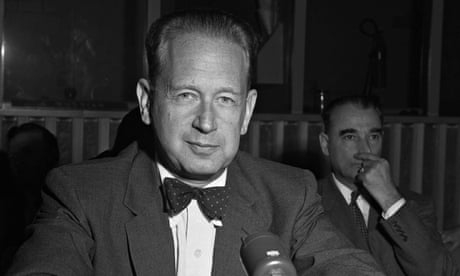
    Dag Hammarskj ld 011For a long time this site has tried to point out that the Congo struggle was one of the most important, yet underreported, foreign policy episodes that took place during the Kennedy administration. Sloughed off by the likes of MSM toady David Halberstam, it took writers like Jonathan Kwitny and Richard Mahoney to actually understand the huge stakes that were on the table in that conflict, namely European imperialism vs African nationalism. Kennedy had radically revised America’s Congo policy from Dwight Eisenhower to favor the latter. Not knowing he was dead, JFK was trying to support Congo’s democratically elected leader Patrice Lumumba. JFK was also one of the few Western leaders trying to help UN Secretary General Dag Hammarskjold stop the Europeans from crushing Congo’s newly won independence.
    In September of 1961, just eight months after Lumumba was murdered, Hammarskjold died in a plane crash. It was officially ruled an accident. But there were doubts from the beginning. For example, Harry Truman told the New York Times, that Hammarskjold was on the verge of getting something done “when they killed him.” It now turns out that Kennedy’s ambassador to Congo, Edmund Gullion, also suspected Hammarskjold’s plane was shot down. And he suspected it the night it happened. This key fact was not revealed for fifty years.

    Below we link to three stories in the press of late that have finally circulated about the true circumstances of what happened to the Secretary General, the man who Kennedy called, “the greatest statesman of the 20th century.”

    It is nice that the MSM is finally catching up to what we wrote about 20 years ago in Probe Magazine.  In particular:

    In the first of these two articles, Jim DiEugenio lays out the overall struggle of Kennedy and Hammarskjold to keep Congo free and united against the imperial forces of Belgium and England. In the second, Lisa Pease examines the murders of Lumumba and Hammarskjold within eight months of each other. Those assassinations left Kennedy standing alone. When he was killed, the imperialists triumphed.

    During the ensuing decade, CTKA continued to focus on this important story, again underscoring the links between Kennedy and Hammarskjold, but now reinforced by the work of historian Greg Poulgrain with regard to their cooperation over Indonesia. See:

    Finally, two decades later, the MSM is acknowledging that work. We don’t like to toot our own horn, but … Honk! Honk!

  • Creating the Oswald Legend – Part 2

    Creating the Oswald Legend – Part 2


    I. Oswald’s Passport and Illegals

    In part 2 we will continue our journey into Oswald’s wondrous world and discover that his USSR defection was only a part of the larger picture. Moscow and Minsk were only stops, but not the destination of his journey. These stops were to become part of his resume, to create a “Legend” who will return home pretending to be a Soviet spy in order to infiltrate suspected communists, subversives, and supporters of Castro. From the beginning that destination was Cuba; it has always been about Cuba.

    Marguerite Oswald was in disbelief when she was informed that her son had defected to the Soviet Union. In September, her son visited his mother in Fort Worth after his discharge from the Marines and told her that he wanted to travel to Cuba. In February, an FBI agent, John Fain, interviewed Marguerite regarding the whereabouts of her missing son. He later stated in his report that “Mrs. Oswald stated he would not have been surprised to learn that Lee had gone to, say, South America or Cuba, but it never crossed her mind that he might go to Russia or that he might try to become a citizen there.”1

    When Oswald tried to defect to the USSR, a wire service noted that his sister-in-law said “that he wanted to travel a lot and talked about going to Cuba.”2 Similarly, when he returned back to the States, a 1962 Fort Worth newspaper recalled what Oswald said to his family: “He talked optimistically about the future. Some of his plans had included going to college, writing a book, or joining Castro’s Cuban army.”3

    Oswald’s travel destinations included Cuba, the Dominican Republic, England, Turku Finland, France, Germany, Russia and Switzerland. One has to wonder how the recently discharged Marine would have been able to fund a trip that involved so many countries that were far apart from each other, like Cuba and Russia. Before leaving the Marines, he applied for a passport on September 4, 1959 and received it on September 10, 1959. To apply for the passport he used for identification a Department of Defense (DOD) I.D. card, although he could have provided his birth certificate. As George Michael Evica noted, “Lee Harvey Oswald should never have had a DOD I.D. card on September 4, 1959, possibly on September 11th, but not on September 4th.”4 September 11 was the date that he was to be transferred to the Marine Corps Reserve, once his active duty was over.

    The Marine Corps confirmed that it had issued the card before he was discharged, but this kind of practice ended as of July 1959, so he was probably issued the DOD I.D. card because he was going to fill a civilian position overseas that required it.5

    Too many peculiarities surround the young ex-Marine, his DOD I.D. card, his passport application, the countries he was planning to visit and the expenses needed to support such a trip. All these were enough to sound the alarm bells in the intelligence community, but somehow this did not happen.

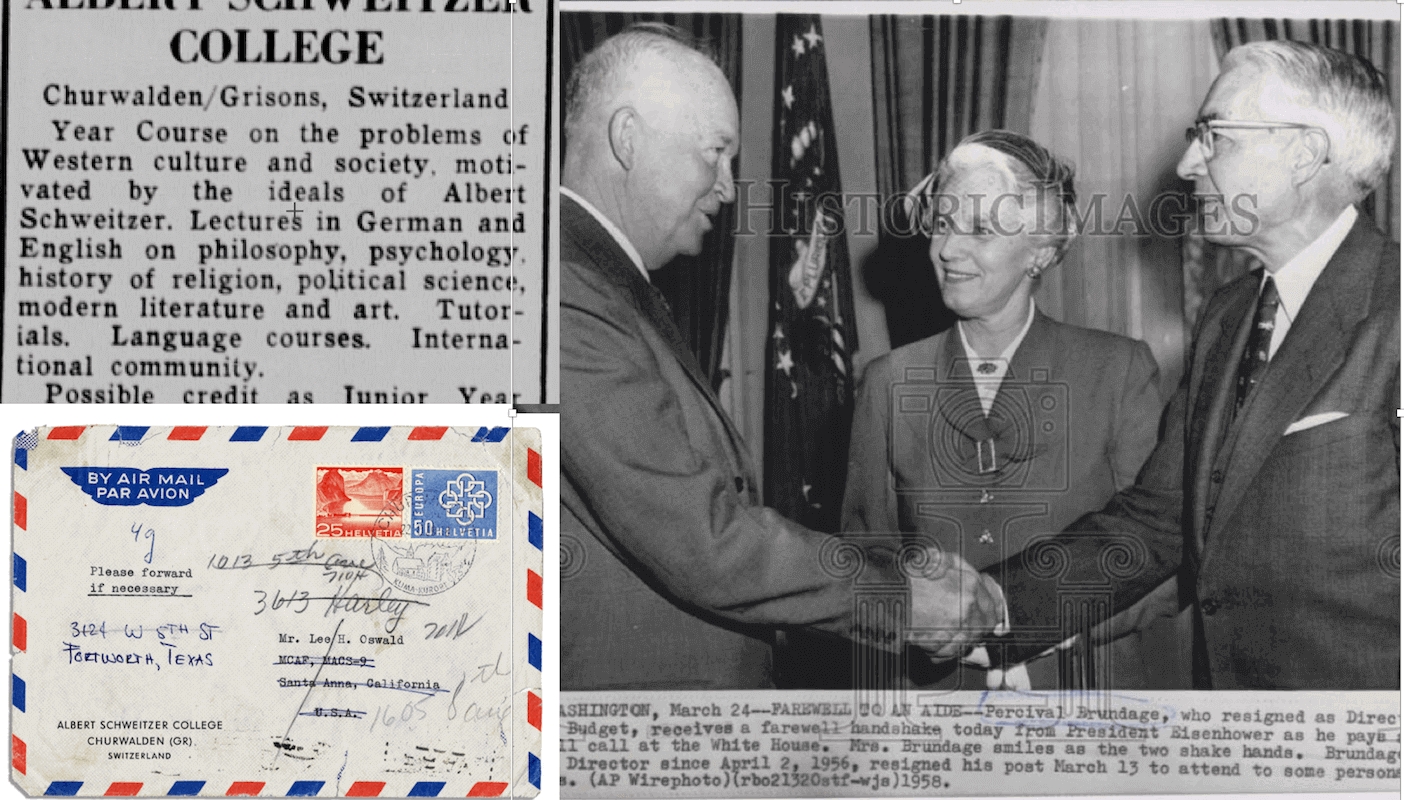
    Oswald had also stated in his passport application that he intended to study in Europe, and he named two institutions. One was the Albert Schweitzer College (ASC) in Churwalden, Switzerland, and the second was the University of Turku in Finland.

    Oswald sent his application to the ASC on March 19, 1959, informing them that he was going to attend the third (spring) term of the trimester schedule, from April 12, to June 27, 1960, followed by a registration fee payment of $25 on June 19. However, this time length posed a problem by itself. Oswald’s passport was valid for four months overseas, so if he wanted to attend its third trimester, then his passport should have been valid for nine months, an extra five months. According to his passport, he could have only made it to study the fall trimester of 1959, and then only if he was given an early discharge, which actually happened.6 Oswald was released from the Marines with a dependency discharge on September 11, 1959 to go to Fort Worth to take care of his injured mother. However, his mother had only a minor injury and Oswald left for New Orleans on September 17, 1959, to begin his trip to Europe. A year later, after his defection to the Soviet Union, he was given an undesirable discharge from the Marine Corps, something that was to haunt him to his final days.

    In 1995 the Assassinations Records Review Board (ARRB) revealed the communication between the FBI Legat at the Paris Embassy and FBI Director Hoover. The FBI Legat had sent Hoover five memoranda regarding Oswald’s intentions to study the ASC.

    The first memorandum was dated October 12, 1960. It was based on information from the Swiss Federal Police and stated that Oswald was planning to attend the fall trimester of 1959. The second memorandum was a strange one, since it stated that Oswald “had originally written a letter from Moscow indicating his intention to attend there (at Churwalden).”7

    This was an extraordinary turn of events, as the second memorandum implied that Oswald was planning to attend the third trimester, similar to his college application and the Warren Commission’s conclusion.

    The fourth and fifth memoranda were even more peculiar. They revealed that Oswald had not attended the course under a different name and that there is no record of a person possibly identical to Oswald attending the fall trimester.

    The above information should have sounded the alarms in FBI HQ because they suspected that since he did not attend the college he had brought with him his passport and his birth certificate to the Soviet Union. Even Marguerite Oswald, when asked by FBI agent Fain about her son’s whereabouts in Europe, replied that Lee has taken his birth certificate with him.

    The above information forced Hoover to send an enquiry to the Office of Security in the Department of State regarding the “missing” Lee: “Since there is a possibility that an impostor is using Oswald’s birth certificate, any current information … concerning subject (Oswald) … ”8

    Hoover, like his agent before him, suspected that Oswald had fallen victim to a Soviet spy ring that would have used his birth certificate to create a false identity which an “illegal” spy would adopt to enter the United States as a sleeper agent.

    The illegals were not under diplomatic protection like their legal counterparts that were usually connected to a Soviet embassy. They would resume the life of an American, probably one that has died, live a normal capitalistic life and would be activated when the need arose.

    Switzerland had been a center of espionage since WWII. Soviet illegals would never send or receive mail directly to/from the Soviet Union but would use neutral countries like Switzerland as a cover address to avoid detection. It is a surprise that the CIA counter-intelligence mole hunters did not open a 201 file on Oswald as soon as he defected. In fact, they did not do that for over a year. Instead, they put him on the HT/LINGUAL list of about three hundred Americans whose mail was secretly being opened.9 This would be an indication that Oswald was used to detect illegal networks in Switzerland by detecting their mails.

    The ASC was reputed to be a place where liberals, communists and Marxists would go to study, perhaps being a possible illegal passing point. By applying to this college, even if he never went there, it could appear that his birth certificate was used to create an illegal in Switzerland that would later use his identity and papers to travel to the States. Another scenario would have been that someone looking very similar to him, someone almost identical in appearance, could have taken his place, like a Soviet illegal. Alternatively, the US intelligence services would have looked suspiciously on Oswald upon his return to the States, wondering if he had been turned into a Soviet spy coming home on behalf of his new Soviet handlers.

    Regardless of the truth, Oswald—wittingly or unwittingly—had created a “Legend” for himself that could be used any time against various targets. Most importantly though, the US intelligence services would suspect that Oswald was probably impersonated by someone else for sinister purposes. This was to be the first time but it would not be the last.


    II. Albert Schweitzer College

    How did Oswald find out about this obscure college somewhere in Switzerland? It has been suggested by various authors that Kerry Thornley, one of Oswald’s Marine friends at Santa Ana, brought it to his attention and helped him with the application.

    Thornley was a New Age writer, satirist, mystic and crypto-fascist, and a native Californian who had studied at USC. He had been six months in active duty, following time in the reserves when he met Oswald at El Toro base near Santa Ana. Oswald even gave Thornley his copy of George Orwell’s 1984 to read.10 Thornley claimed that he met Oswald a week after Oswald applied to the ASC. As Greg Parker notes, it is possible that Thornley met and knew Oswald before his application to the college.11

    Thornley testified to the Warren Commission:

    I believe it was the First Unitarian Church in Los Angeles. I had mentioned earlier at the time I was talking to Oswald, and knew Oswald, I had been going to the First Unitarian Church in Los Angeles. This is a group of quite far to the left people politically for the most part, and mentioned in order to explain my political relationship with Oswald, at that moment, and he began to ask me questions about the First Unitarian Church and I answered, and then he realized or understood or asked what Oswald’s connection with the First Unitarian Church was and I explained to him that there was none.

    We do know that Oswald had visited Los Angeles, at least to get his passport, although he may have visited the Cuban Consulate as we shall see later on.

    The leader of this church was Minister Stephen Fritchman. He was a peace activist who had supported the Nuclear Test Ban Treaty, had been called by the Un-American Activities Committee and had attended the World Congress for Peace in Stockholm in May 1959.12

    Was there a connection between Oswald, Thornley, Fritchman and the ASC? The National Archives and Records Administration (NARA) included in its assassination files about Oswald a sixty-page report on Fritchman. Additionally, the Warren Commission and the FBI were interested and curious about Oswald and Thornley’s Unitarian Church link while trying to explain how Oswald obtained information about the ASC.13

    Evica believed that “Oswald’s mysterious source of information about Albert Schweitzer College could be explained by Thornley’s attendance at Fritchman’s First Unitarian Church in Los Angeles … the pastor may have possessed detailed information about the college and copies of the college’s registration forms. When Oswald visited LA, he could have picked up the materials at the church … Alternatively, Thornley … could have picked them up and passed them on to Oswald.”14

    The Liberal Religious Youth (LRY) was a group that cooperated with the ASC. Reverend Leon Hopper, one of its members, said to Evica in March 2003 that “student recruitment was almost always through personal contacts … also confirmed that Stephen Fritchman could have been an information source … Finally Hopper confirmed that the LRY concentrated on the summer sessions of ASC, reaching prospective students through personal contacts.”15

    The ASC was located in the small village of Churwalden, Switzerland, and there was something peculiar about it since it did not offer degrees. Even the Swiss authorities did not know it existed until the early 60s when there were accusations of a narcotics and fraud scandal involving the college. Soon the college was in debt, and closed only after an unknown entity from Liechtenstein paid off all of its debts.16 The peculiarities did not end there. Since the village was very small, it did not have a hospital, a library, a fire department or a police station. The village was many miles away from the nearest town of Chur, and one had to drive through poor roads and across mountains to reach the village.

    The college was housed in the village’s larger building, the hotel Krone with thirty rooms capacity.17 It opened in 1954, and the first list of students available revealed there were no Swiss students at all, which served to keep it unknown to the Swiss Government.18

    The ASC was created by the International Association for Religious Freedom (IARF). According to Richard Boeke, first President of the American chapter of IARF, it was the crown jewel of all the IARF’s associate religious centers and had initially been “good for Liberal Swiss Protestants.”19 The IARF originated in 1900 as the International Council of Unitarian and Other Liberal Religious Thinkers and workers on May 25, in Boston. The stated aim was “opening communications with those in all lands who are striving to unite Pure Religion and Perfect Liberty, and to increase fellowship and cooperation among them.”20 It would include religions like the Unitarian, Buddhist, Humanist, Muslim, Scientology and Theosophy.21

    The ASC was operated by the Albert Schweitzer College Association—a non- profit organization with its legal HQs in the village of Churwalden—and the Unitarian “American Friends of Albert Schweitzer College” which was also a non-profit organization. The “American Friends of Albert Schweitzer College” had its offices in Boston. It was incorporated in New York in 1953 with the purpose of receiving tax-deductible contributions from United States citizens and corporations.22 Its directors were John H. Lathrop (Brooklyn, NY), John Ritzenthaler (Montclair, NJ), and Percival F. Brundage (Montclair, NJ).23 Brundage was the most interesting individual out of the three directors, a true member of the “Power Elite”, with government and intelligence connections.


    III. Percival F. Brundage

    Who was Percival F. Brundage? Brundage was the son of a Unitarian Minister who graduated cum laude from Harvard University in 1914 and afterwards became a successful accountant, probably one of the best of his era. In 1916 he worked as a civilian in the Material Accounting Section of the War Department’s Quartermaster Depot Office in New York which involved record keeping of sensitive military procurement operations.24

    He became a senior partner in the accounting firm, Price-Waterhouse. He was director, and then president of the Federal Union that argued for the federation of the Atlantic democracies.25

    Brundage had a significant connection to the Unitarian Church and the ASC. He was a major Unitarian Church officer from 1942-1954 when the Unitarian Church was cooperating with, first, the OSS, and later the CIA.26 He was also president of the International Association for Religious Freedom (IARF) from 1952-1955 and president of the American Friends of Albert Schweitzer College from 1953-1958. Most importantly, Brundage became the most prominent member of the Bureau of Budget (BOB) during the Eisenhower presidency. He was its deputy director from 1954-1956, its president from 1956-1958 and he served it as consultant until 1960.27

    As the head of the BOB, Brundage was controlling the United States budget, and from that privileged position he would be familiar with the Pentagon’s and CIA’s secret black budgets but without ever exposing or surveying them. It seemed that Brundage would turn a blind eye and let them do their secret work without the government ever bothering them.

    One of Brundage’s closest friends was a fellow Unitarian, James R. Killian Jr., president of the Massachusetts Institute of Technology (MIT).28 Killian was appointed the chairmanship of president Eisenhower’s Technological Capabilities Panel in 1953 to measure the nation’s security and intelligence capabilities and also to study both military and intelligence applications of high-flight reconnaissance.29 Killian appointed Edward H. Land, inventor of the Polaroid land camera, as chief of the top-secret intelligence section of the Air Force Technological Capabilities Panel that helped create high-flight reconnaissance, like the U-2 and satellites. Land was also responsible for the CIA receiving the responsibility for the U-2 program.30 In 1957 he was appointed by Eisenhower as Special Assistant for Science and Technology, and in 1956 became Eisenhower’s chairman of the US Board of Consultants on Foreign Intelligence Activities, reporting to the president the activities of the intelligence community, especially the CIA.31 This board was supported by Brundage’s BOB. Later, Killian advised Eisenhower that the Air Force was incapable of developing photographic reconnaissance satellites. This allowed him to turn over that assignment to the CIA, which led to the CORONA satellite program32 that was discussed in part 1.

    Killian, Brundage and Nelson Rockefeller were the three men who transformed the national Committee of Aeronautics (NACA) into the civilian agency responsible for the US space program. It was renamed NASA. Brundage was responsible as the head of BOB for drafting the congressional legislation for the creation of NASA.33 Brundage was also involved in Operation Vanguard, which was “intended to establish freedom of space, and the right to overfly foreign territory for future intelligence satellites.”34

    In 1960, Brundage and one of his associates, E. Perkins McGuire, were asked to hold the majority of a new airline stock “in name only.”35 They both agreed to act on behalf of the CIA. The airline was none other than Southern Air Transport, which was used in paramilitary missions in the Congo, the Caribbean and Indochina. The Newsweek issue of May 19, 1975 linked Percival Brundage to Southern Air Transport, Double-Check Corp, the Robert Mullen Company and Zenith Technical Enterprises. The Double-Check Corp was a CIA front that was used to recruit pilots for covert missions against Cuba; Robert Mullen’s advertising company provided cover for CIA personnel abroad; and Zenith Technical Enterprises was the front that provided cover for CIA’s JM/WAVE station in Miami.36

    Southern Air Transport was created by Paul Helliwell, an originator of the CIA’s off-the-books accounting system and nicknamed Mister Black Bag. Helliwell was a member of the OSS and later of the CIA in the Far East; he was one of the most prominent members of the China Lobby. His mission was to assist Chang Kai-Shek and his Kuomintang (KMT) army in Burma to invade China. This army managed and controlled the opium traffic in the region. Helliwell created two front companies to help KMT to carry out its war and the drug trade. One was Sea Supply in Bangkok and the other was CAT Inc., later Air America in Taiwan.37 Helliwell had organized a drug trafficking network supported by banks to launder CIA’s drug profits in the Far East.

    Richard Bissell brought Helliwell back to the States to plan a similar network of front companies and banks to finance the Agency’s war against Castro. Similar to Sea Supply and Air America, he created Southern Air Transport in Miami to fly over drugs and guns to support not only the war on Cuba but also in Laos, Vietnam and Cambodia.

    In his book Prelude to Terror, Joseph Trento claimed that Helliwell’s main objective was to cement the CIA’s relationship with organized crime.38 Meyer Lansky and Santo Trafficante were both planning to invest in the Far East by bringing heroin back to the States. Helliwell established banks in Florida and became the owner of the Bank of Perrine in Key West, “a two-time laundromat for the Lansky mob and the CIA”, and its sister Bank of Cutler Ridge.39 Lansky would deposit money into the Bank of Perrine, reaching the US from the Bank of World Commerce in the Bahamas. Lansky also used the small Miami National Bank, where Helliwell was a legal counsel, to launder money from abroad and from his Las Vegas casinos.40 Peter Scott claimed that Helliwell worked with E. Howard Hunt, Mitch WerBell and Lucien Conein on developing relationships with drug dealing Cuban veterans of the Bay of Pigs invasion, and became CIA paymaster for JM/WAVE to finance Chief of Station Ted Shackley’s operations against Cuba.41 Sergio Arcacha-Smith, one of the New Orleans Cubans who knew Oswald and E. Howard Hunt, was involved in the lucrative business of contraband transportation from Florida to Texas, specializing in drugs, guns, and even prostitution.42

    In other words, Percival Brundage was no ordinary citizen. His BOB activities with the U-2, the satellite programs, the Pentagon, the CIA, and especially his involvement with the ASC, linked him indirectly to Lee Harvey Oswald. The young Marine had applied to the ASC to study in Switzerland and his defection to the Soviet Union was unwittingly connected to the U-2 and CORONA projects that brought an end to the Paris Peace talks and prolonged the Cold War. When Percival Brundage became a part of Southern Air Transport, he entered a nexus of CIA, Mafia, drug trafficking, money laundering and anti-Castro Cubans, one which later met and manipulated Oswald, and some of whose members were very likely involved in the assassination of John F. Kennedy. It is also very plausible that the assassination was financed by this drug trafficking and banking network instead of oil-men money as many believe.


    IV. Cuban Sympathizer or Agent Provocateur?

    Was Oswald a communist sympathizer from his early days, like the Warren Commission concluded? Had he been in contact with the Cuban Consulate in Los Angeles?

    Corporal Nelson Delgado was a Puerto Rican stationed at El Toro Marine Corps base who became close friends with Oswald. They were both loners but they had a common interest, and that was Cuba. Both admired Castro because he seemed to be a freedom fighter against Batista’s tyranny who could bring democracy to Cuba. They were dreaming that they could go there and become officers and free other islands like the Dominican Republic. Delgado could speak Spanish and Oswald would configure his ideas about how to run a government—so they kept dreaming.

    Things got a little strange when Oswald became serious about it and was trying to find ways to actually go to Cuba.43

    When interviewed by the Warren Commission, Delgado said he advised Oswald to go and see the Cubans at the Cuban Consulate in Los Angeles. Wesley Liebeler, a Warren Commission lawyer, took Delgado’s testimony and stretched it by the ears to make it look like Oswald was in contact with the Cubans all along. According to Australian researcher Greg Parker, “Liebeler, adroitly took a bunch of assumptions and leaps of logic by Delgado and magically recast them as proven fact leading to an inevitable conclusion.”44

    According to Delgado:45

    • Oswald told Delgado there was a Cuban consulate in Los Angeles;
    • Oswald started receiving letters with a seal on them that Delgado thought might be from Los Angeles because Oswald had said he was getting such mail from the Cuban Consulate;
    • Oswald took a trip by train to Los Angeles to “see some people”.

    Based on the above, Liebeler instructed Delgado to “tell me all that you can remember about Oswald’s contact with the Cuban Consulate.”46

    Delgado also noted that after Oswald allegedly visited the Cuban Consulate, he started receiving mail, pamphlets and a newspaper. Naturally, he assumed that they must have come from the Cuban Consulate and concluded the newspaper was communist, since it was written in Russian. He asked Oswald if it was a communist newspaper and he replied that it was White Russian and not communist. Still, Delgado, who did not know what White Russian meant, concluded it was a Soviet newspaper.47

    One of the pamphlets had a big impressive seal that looked like a Mexican eagle with different colors, red and white and a Latin script with the word “United” included. Parker believes that Delgado probably was describing the logo of a Russian Solidarist movement known as NTS (HTC in Russian), standing for Narodnyi Trudovoy Soyuz (National Labor Union) in English.48 Below we can see the NTS logo with something that looks like an eagle, and the colors white, blue and red in the background.

    nts logo
    NTS logo

    More information about NTS can be found in Stephen Dorill’s book MI6: Inside the Covert World of Her Majesty’s Secret Intelligence Service. According to Dorill, NTS was founded in Belgrade in July 1930 by Prince Anton Turkul and Claudius Voss, and it stood for National Labor Council. Prince Turkul was a member of the White Russian Armed Services Union (ROVS) and its purpose was to restore Tsarist Russia. Voss was the head of ROVS in the Balkans and “a British intelligence agent and ran ROVS’ MI6-friendly counter-intelligence service, the Inner Line, that sponsored NTS.”49

    Dorill also revealed that “the Russian émigré organizations were working overtime through bodies such as the NTS … to undermine the Soviet regime and to form a provisional government when the Soviets collapsed.”50 Dorill described NTS’ origins: “Initially a left-of-centre grouping, NTS soon moved to the right, promoting an anti-Marxist philosophy of national labor solidarity, based on three components: idealism, nationalism, and activism. It enjoyed the support of several European intelligence services, in particular MI6, and also attracted substantial funds from businessmen with interests in pre-revolutionary Russia, including Sir Henry Deterding, chair of Royal Dutch Shell, and the armaments manufacturer, Sir Basil Zaharooff.”51

    If Parker is right, and the pamphlets that Oswald was receiving were not communist but on the contrary from the NTS, then we can conclude that Oswald was in contact with fervent anti-communist White Russians. In that context, then, his trip to the Soviet Union could be viewed from a different perspective.

    Oswald received help to apply to the ASC and travel to the Soviet Union, most likely from a nexus that involved the CIA and anti-communist organizations with relations to the military-industrial complex. When Oswald applied to the ASC, he listed his favorite authors as Jack London, Charles Darwin and Norman V. Peale.52 Jack London was one of the founders of The League for Industrial Democracy (LID), whose purpose was to extend democracy in all aspects of American life. During the Cold War, it was renamed the Student League for Industrial Democracy (SLID), had close ties to the CIA and had become anti-communist.53 Jack London was a supporter of social Darwinism, eugenics, Nietzschean philosophy and Jungian psychology.54

    Darwin was a Unitarian and author of “Origins of the Species.” His cousin Francis Galton studied heredity based on Darwin’s work and as a result he coined the word “eugenics”, the theory that selective breeding will improve the human race.55

    Norman Vincent Peale was a minister of the Lutheran church, politically conservative, and opposed the liberal and Catholic Jack Kennedy. He believed that as a Roman Catholic President Kennedy would align with the Vatican with respect to US foreign policy.56 He headed a group, which included Billy Graham, that held a secret meeting to discuss how to derail Kennedy’s election bid.57 Some of Peale’s associates were supporters of lynching, while others were against the Eisenhower-Khrushchev Paris peace summit.58 He was also friends with the conservatives Nixon and Hoover.59

    If Oswald was, as he is alleged to be, a communist sympathizer, these interests and connections to the reactionary and elitist Right come as a surprise. Indeed, they would seem to indicate, on the contrary, that Oswald was actually instructed and guided by people who were anti-communist and probably tied to the CIA.

    Even Hans Casparis, the founder of the ASC, had probable CIA connections. Casparis claimed that he had graduated from three universities, studied at a fourth and was a full-time lecturer in German and philosophy at the ASC. There were no specific degrees listed on the ASC brochure presenting Casparis, while five other lecturers held doctorates, and another one, along with Casparis’ wife, Therese, held a BA.60 Casparis claimed that he was a lecturer in education at the School of European Studies at the University of Zürich, but when Professor Evica asked the university to confirm it, they replied that Casparis had never lectured there.61 Records indicated that Casparis had studied at the University of Chicago (1946-1947), and the University of Tübingen (1922-1923), but never received degrees from either of the two.62

    The same ASC brochure said that Therese Casparis, his wife, had a BA degree in education from the University of London. However, the university’s assistant archivist revealed that Therese had received a second-class honors degree in German and then enrolled to take a teacher’s diploma, but she left without taking an exam, so she never received a BA in education from that university. Therese gave birth to five children from 1934 to 1948, but Evica could not find any college in Europe or England which awarded a degree to Hans or Therese. 63 It was a mystery how they were able to raise five children without any higher degrees, yet were able to attract support from important Unitarians to establish a college in an unknown village somewhere in Switzerland. It is likely that Hans and Therese were employed by the CIA to infiltrate this liberal college. If we consider Evica’s findings that Allen Dulles had used religious organizations like the Unitarians to create humanitarian front organizations in order to conceal OSS and later CIA covert operations to destabilize Eastern Europe, South America and South East Asia, we can conclude, or strongly suspect, that ASC was such a front cover.

    When Oswald was arrested in New Orleans during the summer of 1963, he was asked by police officer Frank Martello how he came to be a member of the Fair Play for Cuba Committee (FPCC). To that he replied that “he became interested in that committee in Los Angeles … in 1958 while in the US Marine Corps.”64 Although he gave the wrong information, since the FPCC was established in April of 1960, he simultaneously revealed that when he was visiting Los Angeles he most likely met the pro-Castro people that had organized the FPCC’s Los Angeles branch at the first Unitarian Church of Robert Fritchman.65

    In 1963, Richard Case Nagell was investigating the FPCC branch in Los Angeles, leftists and Unitarians. In his notebook were written the names of: Helen Travis of the FPCC, Dorothy Healy of the Communist Party, USA, Reverend Robert Fritchman of the First Unitarian Church, and the officials of the Medical Aid for Cuba Committee.66

    Is it possible that all along Oswald was being groomed to penetrate the FPCC?

    A 1976 CIA internal memo stated, “In the late 1950’s, Hemming and Sturgis, both former US Marines, joined Fidel Castro in Cuba but returned shortly thereafter, claiming disillusionment with the Castro cause.”67 Delgado testified that a mysterious man visited Oswald at the gate of El Toro base. He had assumed that he was someone from the Los Angeles Cuban Consulate. However, Gerry Patrick Hemming revealed later on that he had met Oswald in the Cuban Consulate in Los Angeles and went to confront Oswald at the gate of El Toro base.

    There are indications that this actually happened. A CIA memo stated that “Henning (Hemming) returned to California in October 1958 … he left for Cuba by air via Miami on or about 18 February 1959, arriving in Havana on 19 February 1959. He claimed to have contacted the officials in the Cuban consul’s office in Los Angeles prior to his departure.”68 Another CIA Security Office memo from 1977 linked Oswald to Hemming: “The Office of Security file concerning Hemming which is replete with information possibly linking Hemming and his cohorts to Oswald … ”69

    Could it be possible that Oswald was being “put together” to penetrate pro-Castro organizations like the FPCC as Hemming had been associated with Castro and his allies before him?

    In a 1976 article in Argosy, it was stated that, “Hemming maintains that the US should utilize a number of Special Forces types … who could penetrate revolutionary movements at an early stage, gain influential positions, and then channel them into more favorable areas.70 It was during that period late 1959, early 1960, when Oswald defected to the Soviet Union that the US Government—and Hemming—had realized that Castro was pro-Soviet. He was a Communist who could pose a threat to the US interests and an option would have been to have him “eliminated.”71

    It is likely that Oswald was sent to the Soviet Union to build up a “Legend” as a pro-communist, pro-Soviet sympathizer. One who appeared to have provided secret information to help the Soviets shoot down the U-2—even if he did not—and then return home as a Soviet spy, or as someone who had helped create a Soviet illegal. His mission would have been to infiltrate leftist, subversive and pro-Castro organizations while pretending to be on their side.


    Summary of Parts 1 and 2:

    • The way Oswald received his passport was very peculiar.
    • In 1959 Oswald likely visited the Los Angeles Cuban Consulate, allegedly because he was a Red sympathizer.
    • His Marine mate Delgado thought he was receiving mail and leaflets from the Cuban Consulate, while the material was more likely White Russian, from an anti-communist solidarity organization called Narodnyi Trudovoy Soyuz
    • Oswald had applied to study at the Albert Schweitzer College (ASC), an obscure college in Switzerland.
    • There was confusion as to which trimester he was planning to attend ASC.
    • It is a mystery as to how Oswald found out about this college.
    • Kerry Thornley, another of Oswald’s Marine mates, was attending the First Unitarian Church in Los Angeles where Robert Fritchman was its Minister.
    • Either Thornley or Fritchman probably supplied Oswald with all the necessary information.
    • Oswald listed on his college application authors Jack London, Charles Darwin and Norman B. Peale, which indicated that Oswald had elitist, conservative and far right political views.
    • Hans Casparis the founder of the ASC falsely claimed that he had academic credentials he did not have.
    • Similarly with his wife Therese, also a lecturer at the ASC.
    • The ASC was created by the International Association for Religious Freedom (IARF) and was supported by the Unitarian American Friends of Albert Schweitzer College.
    • Percival Brundage was one of the Directors of the Unitarian American Friends of Albert Schweitzer College.
    • Brundage was Director of the Bureau of Budget (BOB) during the Eisenhower presidency.
    • Along with another Unitarian, James Killian, he was involved in the U-2 and CORONA satellite projects.
    • Brundage held major stocks of Southern Air Transport that Paul Helliwell had established.
    • Helliwell was a CIA man in the Far East who helped arrange drug trafficking to finance CIA operations.
    • This brought Brundage in contact with a network of drug-trafficking, money-laundering banks, anti-Castro Cubans and the CIA operations against Castro.
    • The ASC was to become a link between Oswald and Brundage.
    • Oswald’s mother thought it was strange that her son would go to the Soviet Union; she thought he was more likely to go to Cuba.
    • Oswald stated in 1963 that he first learned about the FPCC while visiting Los Angeles.
    • The people who established the Los Angeles FPCC branch were attending Fritchman’s First Unitarian Church.
    • It is probable that Oswald was prepared by some US intelligence service, probably the CIA, to penetrate pro-Castro organizations like the FPCC at a time that the US government began plans to eliminate Castro.
    • For that reason it had to appear that he defected to the Soviet Union.
    • His actions there created his bona fides that he had been turned into a communist spy.
    • CIA counter-intelligence chief James Angleton ran a second operation involving Oswald or his file to sabotage the peace summit.
    • Oswald was a fake defector and a US intelligence dangle.
    • He never intended to renounce his citizenship.
    • The FBI learned from his mother that he had his birth certificate with him.
    • Hoover feared that some impostor might be using his birth certificate and that a Soviet illegal might take his place if he returned to the States.
    • Oswald was put on the CIA’s illegal HT/LINGUAL mail-opening program designed to detect Soviet illegals.
    • This would have also strengthened his Soviet spy profile.
    • The U-2 had a finite operational life time.
    • It was scheduled to be replaced by the A-12 aircraft and the Corona satellites, so there were alternatives if something went wrong.
    • Oswald did not give information to the Soviets to help them shoot down the U-2, but it appeared that he did. This boosted his “Soviet Spy” legend.
    • Dulles admitted that it happened due to a malfunction.
    • Prouty believed that it was sabotaged from the inside.
    • The U-2 was sacrificed, since there were other alternatives to replace it, to disrupt the Paris peace summit and prolong the Cold War.
    • It was planned by a treasonous collaboration of American and Soviet hardliners who had invested in the Cold War.
    • Oswald was part of Angleton’s mole hunt to discover who betrayed Popov and the U-2 project.
    • However, Popov was not betrayed by a mole, so a mole hunt was not necessary.
    • Angleton used the mole hunt as a cover to accommodate the U-2 shoot down. Although it failed to discover the mole’s identity, that exercise gave him a usable alibi by which he could claim, in the case suspicions were raised that it was an inside job, that the U-2 incident was the work of a mole.


    In Part 3, we examine the Oswald legend in Dallas, New Orleans and Mexico City.

    Go to Part 1

    Go to Part 3

    Go to Part 4

    Go to Part 5

    Go to Part 6

    Go to Conclusion

    Go to Appendix


    Notes

    1 John Newman, Oswald and the CIA, Skyhorse Publishing Inc. 1995, p. 92.

    2 Newman, p. 92.

    3 Newman, p. 92.

    4 George Michael Evica, A Certain Arrogance, Trine Day 2011, p. 21.

    5 Evica, p. 22.

    6 Evica, pp. 25-26.

    7 Evica, pp. 68-69.

    8 Evica, p. 59.

    9 Newman, p. 423.

    10 Greg Parker, Lee Harvey’s Oswald Cold War, vols. 1 & 2, New Disease Press, 2015, p. 283.

    11 Parker, p. 285.

    12 Parker, p. 287.

    13 Evica, p. 35.

    14 Evica, pp. 35-36.

    15 Evica, p. 87.

    16 John Armstrong, Harvey and Lee, Quasar Press, 2003, p. 227.

    17 Armstrong, pp. 227-228.

    18 Armstrong, p. 228.

    19 Evica, p. 83

    20 Parker, pp. 287-288.

    21 Parker, p. 288.

    22 Evica, p. 86.

    23 Armstrong, p .228.

    24 Evica, p. 237.

    25 Evica, p. 238.

    26 Evica, p. 276.

    27 Evica, p. 238.

    28 Evica, p. 245.

    29 Evica, p. 247.

    30 Evica, p. 248.

    31 Evica, p. 248.

    32 Evica, p. 250.

    33 Evica, pp. 255-256.

    34 Parker, p. 290.

    35 Evica, p. 272.

    36 Armstrong, p. 229.

    37 Peter Dale Scott, The American Deep State, Rowman & Littlefield, 2015, p. 126.

    38 http://spartacus-educational.com/JFKhelliwell.htm.

    39 http://www.globalresearch.ca/deep-events-and-the-cia-s-global-drug-connection/10095.

    40 http://www.globalresearch.ca/deep-events-and-the-cia-s-global-drug-connection/10095.

    41 http://spartacus-educational.com/JFKhelliwell.htm.

    42 James DiEugenio, Destiny Betrayed, Skyhorse Publishing, 2012, p. 329.

    43 Newman, pp. 96-97.

    44 Parker, pp. 280-281.

    45 Parker, p. 281

    46 Parker, p. 281.

    47 Parker, p. 282.

    48 Parker, p. 282.

    49 Stephen Dorril, MI6: Inside the Covert World of Her Majesty’s Secret Intelligence Service, Harper Collins, 2002, p. 405.

    50 Dorril, p. 405.

    51 Dorril, p. 406.

    52 Parker, p. 296.

    53 Parker, p. 297.

    54 Parker, p. 297.

    55 Parker, p. 297.

    56 Parker, pp. 297-298.

    57 Parker, p. 300.

    58 Parker, p. 301.

    59 Parker, p. 302.

    60 Evica, pp. 95-96.

    61 Evica, p. 96.

    62 Evica, p. 96.

    63 Evica, pp. 100-101.

    64 Evica, p. 36.

    65 Evica, p. 36.

    66 Dick Russell, The Man Who Knew too Much, Carroll & Graf, p. 226.

    67 Newman, p. 101.

    68 Newman, p. 102.

    69 Newman, p. 103.

    70 Newman, p. 104.

    71 Newman, pp. 115-121.

  • Through a Glass Darkly: An MK-ULTRA Primer

    Through a Glass Darkly: An MK-ULTRA Primer

    mk ultra


    “What is heroic in combat is criminal in peace. Just as combat sanctions physical violence, so espionage grants license to moral violence. It is trite but true to say that they did what they did for the good of their country. Unfortunately, it is also true that it frequently didn’t work out that way.”

    ~David C. Martin, Wilderness of Mirrors


    Origins

    If I were to tell you that the United States government has performed—and is likely still performing—bizarre, mind-altering experiments on its own unwitting citizens, whose results are often catastrophically damaging and sometimes fatal, with the goal of creating pawns for its intelligence chess board, I would expect you to stop listening to me. That’s what most people do in any case. And yet the United States has a long and storied history of medical and scientific abuses against its own population which bear repeating to place its later mind-control experiments in context. Following is a cursory overview culled from a 2002 Health News Net post entitled “A History of Secret Human Experimentation”:

    In 1931, Dr. Cornelius Rhoads, under the auspices of the Rockefeller Institute for Medical Investigations, infected human subjects with cancer cells. He later established the U.S. Army Biological Warfare centers in Maryland, Utah, and Panama. Rhoads was also responsible for a battery of radiation exposure experiments perpetrated on American soldiers and civilian hospital patients.

    In 1932, the Tuskegee Syphilis Study began in segregated Alabama. Two hundred black men diagnosed with syphilis were never told about their condition, were denied treatment, and were subjected to a covert longitudinal study on the effects of the disease that lasted forty years until a local newspaper broke the story. They all subsequently died from syphilis, and their wives and children, who also became infected, were never told that they could have been treated.

    In 1935, after millions of individuals died from Pellagra over a span of two decades, the U.S. Public Health Service finally acts to stop the disease. The director of the agency admitted that researchers had known for at least twenty years that Pellagra was primarily caused by a niacin deficiency, but failed to address this since most of the deaths occurred in poverty-stricken black populations.

    In 1940, 400 prisoners in Chicago were purposely infected with malaria in order to study the effects of new and experimental drugs to combat the disease. Ironically, Nazi doctors later on trial at Nuremberg cite this American study to defend their own actions during the Holocaust.

    The United States of the late 1940s and 1950s was a product not only of unprecedented postwar power and security afforded the nation in the wake of the German and Japanese defeats, but also of the scientific proclivities of the time. We forget, I feel, just how jarringly different society was only seventy years ago. Much of the nation was still segregated, with anti-miscegenation laws firmly in place to prevent interracial couples from marrying; the sick and infirm, particularly those with mental deficiencies, were often viewed with disdain. Indeed, the words “moron” and “idiot” were both official psychiatric terms of mental competence from the postwar American eugenics movement, which remained a popular field of study among the psychological circles of the white elite. Books like B. F. Skinner’s Walden Two, published in 1948, were quite popular among America’s social planners. Preaching a rejection of any immanent extra-material element to consciousness and human emotion, Skinner believed that once certain environmental factors were correctly manipulated, human beings, and by extension, whole cultures, might be fundamentally changed. In this utopian novel, the characters behaved much the way Skinner’s rats did in his predictable laboratory experiments.

    This reductionist worldview was a major contributing factor, in my opinion, to both the prevalence and the tacit acceptance of what amounts to decades of crimes perpetrated against both domestic and foreign target populations. Figures like Skinner, Aldous Huxley, and later Robert Shockley, the Stanford professor and Bell Labs inventor of the transistor—who as late as the early 1970s was calling for a concerted reduction of the African-American population due to their “dysgenic” makeup—held the imagination of policy planners and the power elite. As Hank Albarelli Jr. notes:

    Here it should be emphasized that inevitably lurking within, near, and around all of the CIA’s early mind-control experiments was a strong element of racism that generally manifested itself through the Agency’s principle objective of establishing control over the perceived “weaker” and “less intelligent” segments of society. That the CIA’s initial mind control activities show a close kinship with many prominent characters within the racist and anti-immigration eugenics movement is no coincidence.


    Iterations and Victims

    From as early as WWII, “programmed operatives” had been an objective (though limited) of military and government intelligence agencies for a variety of reasons. Initially, from available evidence, much of which still remains redacted, we see that during the Allied struggle against Hitler’s Germany, the OSS and British intelligence were both interested in the potential to send “programmed” agents into occupied Europe. These agents, both witting and unwitting, would then deliver a predetermined message which could only be unlocked by their receiver upon the specifically encoded posthypnotic verbal or visual cue: I touch my right temple or say a phrase, and my subject divulges the message, only to then possess entirely no memory of the exchange. This ensured both that any intercepted agent placed under torture or interrogation would have no “real” memory of their intended communiqué or mission beyond their ostensible one. It also removed the threat of telegraphic or radio-transmitted communications being intercepted by Axis listening posts.

    Clark Hull, a Yale hypnosis expert, described such a process in his 1933 book, Hypnosis and Suggestibility:

    A youth of eighteen or nineteen years is brought in by my assistant. He has consented to act as subject in a research project. I stand before him and look directly into his eyes. As he tilts his head backward to look into my eyes I observe as usual the sign of considerable emotional disturbance in the beating of his carotid artery … I direct him to look steadily into my eyes and to think of nothing but sleep, to relax his muscles all over, even so much that his knees bend a little and his legs scarcely hold him up. After three or four minutes his eyes close, his head nods forward, and his breathing becomes heavy. I say, ‘Now you are falling toward me, you can’t help yourself … I catch him when well off his balance. Upon inquiry he states, in a drowsy tone, that he could not help falling forward but that he isn’t sound asleep ‘because I know everything that is going on.’

    I suspect that he is mistaken and employ the following objective test. I give him a posthypnotic suggestion that after waking he shall pick up and examine a book on my desk when I sit down in a chair, but that he won’t recall anything about why he did it. I wake him as usual with a snap of my finger … A few minutes later I sit down in the chair. He casually walks over to my desk, picks up the book, and after glancing at its title lays it down. I say, ‘Why did you look at the book?’ He answers that he just happened to notice it lying there and wondered what it was about. (Hull, Hypnosis and Suggestibility, p. 32)

    Early pioneers of this form of hypnosis included the esteemed Dr. George Estabrooks, chair of Colgate University’s department of psychology, whose 1943 book Hypnosis remains worth reading for anyone interested in the technical mechanisms whereby human beings can be unwittingly placed in a post-hypnotic suggestive state. As Estabrooks notes, there are five basic steps to the process:

    1. Covertly identify a specimen of the 20% of persons who are genetic somnambulists and easily can go to an amnesic depth of trance. Induct by a “disguised” method.
    2. While the subject is in trance, give a posthypnotic suggestion for him to become deeply hypnotized again whenever the hypnotist gives a certain cue (such as tugging the left ear lobe with the right hand).
    3. Also, give a posthypnotic suggestion which will deny the subject any conscious knowledge of this hypnosis, or any subsequent one. That causes an artificial, selective amnesia for all hypnosis events.
    4. Give a posthypnotic suggestion that nobody else can hypnotize this subject (called sealing).
    5. Give a suggestion under hypnosis that the subject will act in trance just as if awake (called waking hypnosis). (G.A. Estabrooks, Hypnosis, p. 200)

    Dr. Estabrooks also devised a means by which an individual’s personality might be altered, going so far as to insist he could warp someone’s entire convictions and political leanings for a desired result:

    We will use hypnotism to induce multiple personality. Hypnotism is the means to an end, though the technique would be impossible did we not have hypnotism at our disposal. In his normal waking state, which we will call Personality A, or PA, this individual will become a rabid communist. He will join the party, follow the party line and make himself as objectionable as possible to the authorities.

    Then we develop Personality B (PB), the secondary personality, the unconscious personality … is rabidly American and anti-communist. It has all the information possessed by Personality A, the normal personality, whereas PA does not have this advantage. My super spy plays his role as a communist in the waking state, aggressively, consistently, fearlessly. But his PB is a loyal American, and PB has all the memories of PA. As a loyal American, he will not hesitate to divulge these memories. (Estabrooks, p. 200)

    While these WWII dabblings proved interesting to those observing their curious results, it wasn’t until the early days of the Cold War that the United States government, and specifically the Central Intelligence Agency, became truly interested in the potential of harnessing the minds of both its assets and soldiers, and often its private citizenry. The United States Navy had already, as early as 1947, begun its own Project Chatter, which lasted for six years and which involved subjecting “volunteer” sailors, along with animals, to substances like the incredibly dangerous scopolamine, whose effects range from permanent dissociation and vivid recurring night terrors to complete submission to the commands and whims of a subject’s controller. As naval intelligence personnel got wind of the Nazi experiments on Jewish captives at places like the Dachau concentration camp, which involved heavy doses of mescaline and other mind-bending substances, they sought to both replicate the studies and push the investigations of their former enemies, who only two years earlier had surrendered to the Allies in the summer of 1945.

    Headed by Dr. Charles Savage, a graduate of both Yale and the Pritzker Medical School of the University of Chicago, the team used LSD procured by Swiss manufacturer Sandoz in attempts to induce psychic transformations. As Prince Ray notes in his book, Project Chatter and the Betrayal of My Father, “In one experiment Savage used five “normal” persons and fifteen depressed patients. In his report, LSD-25 a Clinical-Psychological Study (1951), he provided detailed descriptions: Case II was a 20-year-old man who was admitted to the hospital with depression. He tearfully told psychologists that his mother was going to lose her home, his sister would lose her job, and he felt useless because he couldn’t help them. He was given LSD, the dosage increased to 100 mcg.; the end result was that the patients suffered from a “schizophrenic reaction.”

    In late 1945, Operation Paperclip, the United States’ covert importation of Nazi war criminals, scientists, medical researchers, and intelligence operatives, provided a treasure trove of first-hand experience with such matters. Some were brought directly into the CIA’s payroll, like war-criminal Reinhard Gehlen, chief of the Wehrmacht’s Foreign Armies East (FHO) military intelligence unit, whose knowledge of Soviet intelligence services was sought by figures like Allen Dulles. Quite remarkable is the fact that Gehlen—who met with both President Truman and “Wild Bill” Donovan, the former head of the OSS during WWII—was instrumental in convincing the United States to pass the National Security Act of 1947, whose charter essentially laid the groundwork for the surveillance state we currently maintain. In its clauses, clandestine activities were allowed to begin without the approval of Congress or even the President, and reporting and evaluations were permitted to be indefinitely withheld if such disclosure could potentially compromise “national security.” In effect, it gave the newly christened CIA, and related agencies, almost unlimited freedom of action and partial legal immunity. And it gave Gehlen and his Nazi consorts access to millions of dollars, United States military support, and sustained their desperate hopes of finally destroying their dreaded Bolshevik nemesis, the Soviet Union. I would argue that the creation of the Cold War was in many ways as much an extension of unfulfilled Nazi aims, as it was a pragmatic Allied reaction to the realities of the postwar Manichean divide between capitalism and communism. We now know, for example, that Gehlen’s intelligence was almost entirely worthless; he vastly exaggerated Soviet intentions, underestimated their agents’ ability to penetrate West German intelligence, and personally helped escalate tensions between the burgeoning NATO countries and the Eastern bloc.

    While Gehlen and others were smuggled across the Atlantic, both by the US intelligence agencies and the Vatican—who disguised many high-level Nazi party members as Catholic priests for safe exit to places like Brazil, Paraguay, and Argentina—others remained in Europe, with many setting up shop in West Germany. At these early black sites, as author Annie Jacobsen notes:

    … the CIA teamed up with Army, Air Force and Naval Intelligence to run one of the most nefarious, classified, enhanced interrogation programs of the Cold War. The work took place inside a clandestine facility in the American zone of occupied Germany, called Camp King. The facility’s chief medical doctor was … Dr. Walter Schreiber, the former Surgeon General of the Third Reich. The activities that went on at Camp King between 1946 and the late 1950s have never been fully accounted for by either the Department of Defense or the CIA. (Lazar Berman, “CIA techniques developed by ex-Nazi doctors, author claims,” Times of Israel, 3/12/2014)


    Evolutions

    The Central Intelligence Agency, which itself had only emerged as an autonomous organization in 1947 from the remains of the OSS, didn’t waste much time in getting on the mind-altering bandwagon. In an April, 1950 memo to Rear Admiral Roscoe Hillenkoetter, then Director of the CIA, Sheffield Edwards, Chief of the Inspection and Security Staff Sheffield Edwards stressed, “In view of the extreme sensitivity of this project and its covert nature, it is deemed advisable to submit this document directly to you, rather than through the channel of the Projects Review Committee.” He continues:

    The immediate purpose of the program (Project Bluebird) is to provide interrogation teams using the cover of polygraph interrogation to provide bona fides of high potential defectors and agents, and also for the collection of incidental intelligence from such projects. A team is to be composed of three persons consisting of a doctor/psychiatrist, a polygraph/hypnotist, and a technician. (Sheffield Edwards, “Office Memorandum, Subject: Project Bluebird,” CIA-RDP83-01042R000800010003)

    Hearing rumors in the early 1950s that American prisoners of war who had returned to the United States from the Korean War were allegedly subjected to Chinese and Soviet brainwashing, the CIA was concerned that some of their nation’s military and strategic secrets could be revealed under interrogation. While much of this was anecdotal, and driven to near-hysterical levels in this height of the McCarthy Era and the Red Scare, a genuine curiosity about human nature and the limits of the mind seemed to drive some of the officers of the Central Intelligence Agency. It should be noted that later congressional probes determined this rationale was largely a cover should the program ever be exposed to the public. (“Final Report of the Select Committee to Study Governmental Operations, U.S. Senate, April 1976”) Like the Navy’s Project Chatter, team members of Bluebird frequently subjected their human guinea pigs to acid trips, mescaline dosing, and amphetamine overloads to test the limits of the human will. One of their favorites was a combination of hallucinogens and amphetamines they nicknamed “Smasher.”

    Morse Allen was one of these initial pioneers of the CIA’s exploits in psychic investigations. While pharmaceutical applications had their place, officers like Morse were interested in more esoteric means by which the human will could be bent. From 1951 onward, he took it upon himself to survey the OSS’s remaining files from the Second World War. Securing funding for a four-month crash course in the field from his superiors in the CIA’s SRS (Security Research Section). He began his apprenticeship with figures around New York like Milton Erickson, a famous stage hypnotist. Bluebird was renamed Artichoke (after the street-handle of New York gangster Ciro Terranova, the “Artichoke King”), and from August 1951 onward, this program’s controllers began testing their hypno-suggestive procedures on some of the CIA’s volunteer support staff. Walter Bedell-Smith, Eisenhower’s trusted Chief of Staff and aide de camp in WWII and now the Director of the CIA, signed off on it, along with Dr. H. Marshall Chadwell, the CIA’s Scientific Intelligence Director. Morse Allen remained in de facto control of day-by-day operations. Most, if not all, of his early test subjects were women. Hypnotizing secretaries and female aides, the architects of Artichoke were quick to extend their bizarre methods into sexually abusive favors, going so far in some cases as hypnotizing these women and post-hypnotically suggesting that they perform sexual acts on complete strangers in Washington D.C. hotel rooms and CIA office suites. (H. Albarelli Jr., A Secret Order, chapter 7) In one encounter, Morse Allen hypnotized his personal secretary and programmed her to pick up a pistol and shoot another secretary. When she came out of her hypnosis and Allen gave the post-hypnotic cue, she picked up his service pistol on his desk, turned to the other girl, without expression, and fired. The receiver slammed home with a sharp click; the gun was of course unloaded. Allen was thrilled with the potential for this exciting new technique.

    Begun officially in 1953, while Artichoke was fully operational, the CIA’s MK-ULTRA/MK-DELTA was the brainchild of Richard Helms, and served as yet another tentacle of the mind-control octopus that had gripped the imaginations of our nation’s intelligence officers. Its ostensible goals were the harassment, intimidation, and coercion of domestic (ULTRA) and foreign (DELTA) populations through the use of sociology, anthropology, radiation exposure, graphology, chemical triggering, paramilitary means, and psychiatry. (Final Report of the Select Committee to Study Governmental Operations, U.S. Senate, April 1976) Helms appointed the CIA’s notorious chief chemist, Dr. Sidney Gottlieb, as head of field operations. Gottlieb was nicknamed the Black Sorcerer by colleagues because of his obsession with concocting a plethora of exotic poisons, delivery devices, and other murderous schemes to eliminate world leaders and rival military figures. Gottlieb crafted the tube of poisoned toothpaste sent to the CIA’s station chief Larry Devlin in Leopoldville when President Eisenhower ordered the assassination of Patrice Lumumba, the progressive anti-colonial leader of the Congo. Instead, the CIA ended up kidnapping him, with the aid of Belgian intelligence and local rebels. He was later shot and dissolved in sulfuric acid. Gottlieb also designed the exploding cigars and explosive seashells which were unsuccessfully deployed—amid the dozens of other plots—to kill Fidel Castro as he partook in his two favorite leisure activities, puffing on Cohibas and free-diving on shallow reefs. As Castro once said, “If surviving assassination attempts were an Olympic event, I would win the gold medal.” (Patrick Oppmann, “Fidel Castro survived 600 assassination attempts, officials say,” CNN, 11/26/2016)

    Canada also played a tertiary role in the CIA’s burgeoning MK-ULTRA research. The CIA-sponsored and Rockefeller-funded Allen Memorial Hospital in Montreal, Quebec, was the home of one Dr. D. Ewen Cameron, and his Subproject-68. Cameron was the one-time President of both the American Psychiatric Association and the Canadian Psychiatric Association, and eventually held the title of President of the World Psychiatric Association. He delivered addresses to a global audience, was a lecturer at numerous universities and medical schools, and was considered a preeminent authority on the human psyche. Cameron was present at the Nuremberg trials, and wrote a treatise which surmised that the inherent personality of the German people was incapable of submitting to defeat and incapable of living peacefully in a post-war environment. He called for a social reconditioning of their collective psyche in order to transform their next generation into a more docile group. In a strange twist, the anecdotal testimony of former CIA pilot and intelligence officer L. Fletcher Prouty notes that Cameron later became personally acquainted with numerous Nazi exiles, whose brains he picked for medical and psychiatric advice. (Marshall Thomas, Monarch: The New Phoenix Program, chapter 16)

    Receiving personal funding from the CIA and Allen Dulles through their front organization, the Society for the Investigation of Human Ecology, Cameron became infamous for his “psychic driving” sessions. These consisted of unwitting mentally distraught patients—many were innocent housewives and children sent in for treatment of depression—being sedated and strapped into isolated gurneys on a secure upper floor of the facility, where they were not told for how long they were being detained. Then the doctor went to work in earnest; Cameron describes the process in his essay, “The Effects Upon Human Behavior of the Repetition of Verbal Signals:”

    1. The breaking down of ongoing patterns of the patient’s behavior by means of particularly intensive electroshocks (depatterning).
    2. The intensive repetition (16 hours a day for 6-7 days) of the prearranged verbal signal.
    3. During this period of intensive repetition the patient is kept in partial sensory isolation.
    4. Repression of the driving period is carried out by putting the patient, after the conclusion of the period, into continuous sleep for 7-10 days

    Cameron’s goal was to attempt a full swipe of a patient’s memory, resulting in a blank slate, which only in physical form bore any resemblance to the former person. Initially, “psychic driving” was intended to erase the memories of incurable schizophrenic patients, but the CIA saw its potential in the intelligence world and ended up paying Cameron $69,000 to further their ends from 1957-1964. In one especially severe case, a woman who was released had to be taught how to use the toilet and tie her shoes, even though she was a formerly accomplished thirty-something mother of three. She never regained her memory and only realized what had happened and who was responsible when she saw a picture of Dr. Cameron in a library book decades later, which triggered a post-traumatic breakdown and an eventual lawsuit.

    In another “treatment,” Phyllis Goldberg, a charming, attractive young nurse of nineteen, who was admitted to the Allen Memorial and Dr. Cameron, suffered an irreversible trauma that friends and family say utterly destroyed her life:

    “When she would be with us, on weekends and so on, she didn’t communicate. She laughed for no reason. Her gait was very different,” Levenson explained. “She couldn’t dress herself—she couldn’t do anything for herself.” Small moments of affection—a pat on the head between aunt and niece, for example—elicited painful reactions from Goldberg. “When you went to pat her, just as a gesture, she would cringe,” Levenson said. “That bewildered me—not realizing, or understanding, she had electric shock equipment put on her head so many times that it [remained] in her subconscious.” (Lindsay Richardson, “Their Lives were Ruined: Families of MK-ULTRA survivors planning class-action lawsuit,” Montreal CTV, 5/20/2018)

    As things progressed and more funding was secured, even stranger experiments unfolded, some bordering on the absurd. From 1955 to the mid 1960s, the CIA, using its own agents as well as assets from the Federal Bureau of Narcotics, dosed unknowing subjects in San Francisco brothels and clubs—notably in the Telegraph Hill area near North Beach—with LSD-laced cocktails. Codenamed Midnight Climax, the project was one of the dozens of subprojects under the MK-ULTRA umbrella. As part of this operation the CIA sent agent George White, who used the name “Morgan Hall” when interacting with neighbors, to San Francisco and set him up in a duplex near the bay, at 2250 Chestnut Street. They paid for him to furnish the apartment with French erotic art, lurid posters, and other enticing trinkets, and tasked him with finding a suitable accomplice to lure men in for observation. An alcoholic who kept a pitcher of martinis in his refrigerator, Hall then hired a local electronics firm to install audio bugs in the electrical outlets to complete his voyeuristic suite. “For hours Hall would sit perched on a portable toilet watching behind a two-way mirror while his employee, a drug-addicted prostitute, entertained unsuspecting visitors and slipped each one an exotic chemical or biological agent.” (John Jacobs and Bill Richards, “The Bizarre Tale of a CIA Operation,” Washington Post, 8/26/1977)

    Another notable case was the 1951 “Pont St. Esprit Incident.” Here, in a quaint French country village near the Swiss border, hundreds of people went completely insane, with an onset that was both rapid and violent. One man tried to drown himself, screaming that snakes were eating his belly. An 11-year-old tried to strangle his grandmother. Another man shouted: “I am a plane”, before jumping out of a second-floor window, breaking his legs. He then got up and carried on for 50 yards. Another saw his heart escaping through his feet and begged a doctor to put it back. Many were taken to the local asylum in straight jackets. Time Magazine wrote at the time: “Among the stricken, delirium rose: patients thrashed wildly on their beds, screaming that red flowers were blossoming from their bodies, that their heads had turned to molten lead.” (Henry Samuel, “French bread spiked with LSD in CIA experiment,” Daily Telegraph, 3/11/2010)

    Officially, the narrative involved a contaminated batch of baguettes from Roch Briand, the local bakery. Ergot, a hallucinogenic mold that develops when rye spoils—and which had been used as far back as the Eleusinian Mysteries ritual at Delphi in Ancient Greece—was blamed. Curiously, however, Pont St. Esprit was only a few miles from the world’s only manufacturing plant that produced high-grade LSD at the time: Sandoz. And also curious is a memorandum that was discovered, dating to 1975 during the Rockefeller Commission’s review of the CIA’s clandestine abuses, and which read, “Re: Pont-Saint-Esprit and F. Olson Files. SO Span/France Operation file, inclusive Olson. Intel files. Hand carry to Belin—tell him to see to it that these are buried.” (Mike Thomson, “Pont-Saint-Esprit poisoning: Did the CIA spread LSD?” BBC News, 8/23/2010)

    Frank Olson headed the CIA’s overseas experiments involving mind-altering substances. And of course “Belin” refers to David Belin, the high-profile attorney who sat on both the Warren and Rockefeller Commissions. In 1953, a CIA agent dosed Olson’s cocktail at a local bar with LSD. Two days later, Olson “jumped or fell” out of a window on the thirteenth-floor of his Manhattan hotel suite. (David Remnick, “25 Years of Nightmares,” Washington Post, 7/28/1985) Author and former Canadian Liberal Party leader, Michael Ignatieff, among others, like Olson’s son, believe Allen Dulles and Richard Helms ordered his murder, since Olson had voiced reservations about and objections to the ethics of his missions.

    Of no small concern is the fact that “since early 1954, following the death of Olson, a secret agreement between the CIA and the U.S. Department of Justice had been put in place whereby the violation of “criminal statutes” by CIA personnel would not result in Department of Justice prosecutions, if “highly classified and complex covert operations” were threatened with exposure. The agreement had been struck between CIA Chief Counsel Larry Houston and Deputy Attorney General William P. Rogers in February 1954, not long after Frank Olson’s death, and still remained solidly in place.” (H. Albarelli Jr., “Cries from the Past: Torture’s Ugly Echoes,” Truthout.org, 5/23/2010) With this agreement essentially sealing the agency from any remaining legal responsibilities following the creation and signing of the National Security Act of 1947, they were now totally exempt from oversight, and during the late 1950s and early 1960s, branched out into even weirder fields of inquiry and research. Their inquiries into the pure occult and spiritual realms of human consciousness were perhaps the most bizarre iteration of the mind-control explorations. MK-OFTEN, a still-secret and barely traceable sub-file buried in the MK-ULTRA files, mentions the Department of Defense’s use of mediums, clairvoyants, and even voodoo and Satanism. As researcher Peter Levenda notes:

    Initially, Operation MK-OFTEN was a joint CIA/Army Chemical Corps drug project, based out of Edgewood Arsenal in Maryland and using inmates of the Holmesburg State Prison in Philadelphia as test subjects. It came under the aegis of the CIA’s Office of Research and Development (ORD), which was concerned with parapsychology and the application of supernatural powers for military purposes. Later, OFTEN would become a kind of grab bag of CIA investigations into the paranormal, and would include everything from séances and witchcraft to remote viewing and exotic drugs. (Levenda, Sinister Forces, chapter 4)

    MKNAOMI, the CIA’s joint venture with the Army’s biological warfare division at Fort Detrick, which ran roughly from 1958 to the early 1970s, was the MK-digram’s final major iteration. In this program, scientists and technicians honed their abilities to deliver exotic and untraceable toxins and biological agents to unknowing victims, with a focus on agricultural poisoning, some of which likely was intended for Operation Mongoose, the CIA’s terror campaign against Cuba.

    The Agency was estimated to have spent over 3 million dollars. Items developed ranged from attaché cases rigged to disseminate an agent in the air, a cigarette rigged to disseminate an agent when lighted, a fountain pen dart launcher, an engine head bolt designed to release an agent when heated, a fluorescent light starter to activate the light and then release an agent, etc. (“Cryptonym: MKNAOMI,” Mary Ferrell Foundation)

    While Richard Nixon banned biological testing in November 1969, it is purported that substantial amounts of stockpiled neurotoxins and aggressive nerve agents were stashed away in secure facilities for years after MKNAOMI was officially terminated. (AP, “US Continues Defensive Germ Warfare Research,” New York Times, 9/7/1982)


    Revelations and Implications

    The late 1970s saw the rise of more Congressional probing into the clandestine activities of American intelligence agencies in the wake of the tumultuous 60s and the Vietnam War. When Seymour Hersh broke the story to the nation in 1975 that James Angleton’s counterintelligence outfit at the CIA had been routinely mass-surveilling American citizens’ mail, people were outraged. In the context of such probes as the Church Committee (1975), the Rockefeller Commission (1975), the House Select Committee on Assassinations (1976) and other notable, if problematic and incomplete investigations, Americans finally got a peek at the dirty deeds of their flagship intelligence agency. As the New York Times noted:

    There seemed to be nothing the Central Intelligence Agency had not considered: lobotomies, powerful drugs, hypnosis, mental telepathy, deprivation of sleep and food, subliminal suggestion, isolation, ultra-sonic sound, flashing stroboscopic lights. The agency even considered magicians and prostitutes.” (Joseph Treaster, “CIA Mind Probes Now More Benign,” New York Times, 8/71977)

    Little came of these probes, besides sensational headlines and James Angleton’s forced “retirement.” No one, to my knowledge, was charged with anything appropriate to the crimes committed, and the nation, while briefly outraged, moved on, as if they were watching a dramatic but ultimately irrelevant soap opera. In many ways, the Watergate break-in overshadowed the decades of abuse the CIA had been accused of.

    MK-ULTRA shut down “officially” in 1972. No one knows how many total victims were abused or killed, because in 1973, then-Director of Central Intelligence Richard Helms ordered all files pertaining to MK-ULTRA shredded after getting tipped off of a coming congressional interest in the project. A few boxes were not located in time, and are the sole sources we have for review. Shortly thereafter, Helms was appointed as the U.S. Ambassador to Iran, where he served for four years, only returning reluctantly in 1977 to further testify—and commit perjury—to the CIA’s role in overthrowing the government of Chile and installing the brutal dictator Augusto Pinochet. Sydney Gottlieb, MK-ULTRA’s field-coordinator, also left the United States; he took up a humanitarian position in rural India, studying leprosy among the destitute.

    The relevance of these revelations should be clear to anyone seriously interested in the Robert Kennedy assassination—to name but one bizarre case that continues to puzzle those unfamiliar with the facts surrounding the mind-control saga. Indeed, with Robert Kennedy Jr.’s now-public admission that he does not endorse the official story surrounding his father’s murder, the Washington Post recently published a piece whose headline ran, “The assassination of Bobby Kennedy: Was Sirhan hypnotized to be the fall guy?” It only took the MSM fifty years to consider this, but I suppose any progress is a positive thing in cases this sensitive.

    The official story has Senator Kennedy giving his June 5th, 1968 primary victory speech in the Embassy Room of the Ambassador Hotel in Los Angeles. He was then escorted through a hallway offstage and hurried into a large kitchen pantry to make his way into an adjacent room for a press conference. As he finished shaking hands with a busboy, 24-year old Jordanian national, Sirhan Sirhan, emerged from beside a steam-table in a crowded corner and fired a .22 caliber pistol at the senator, mortally wounding him before being restrained and arrested. He was sentenced to death, but because California overturned the death penalty, his sentence was commuted to life imprisonment.

    The problem with the story, of course, is that when Thomas Noguchi, the chief coroner for L.A. county, performed his autopsy, he determined that all four shots that struck Kennedy (one passed through his suit jacket without hitting him) came from behind, at sharp upward angles. None came from the front, which is where every single witness places Sirhan. Similarly, the fatal shot, which entered just below and behind his right ear—due to tell-tale powder burn patterns—could only have been fired from between one to a maximum three inches from the senator. This is demonstrably provable and incontrovertibly invalidates the eventual verdict of the court, which of course was based on the fact that Sirhan’s hapless defense attorney—perhaps compromised by the CIA—chose to avoid an actual examination and stipulated to the prosecution’s deeply flawed evidence. Sirhan was never closer to RFK than three feet. When he was detained, LAPD officers noted his strange calm, his glassy, placid eyes, and inability to recall anything that had just transpired. Later, during his prison visits by psychiatrists who attempted to hypnotize him, they noticed that he ranked with the most extreme strata of persons susceptible to both auto-suggestive and trance states, and would immediately become hypnotized. In one instance, he was given the posthypnotic command to climb the prison bars like a monkey once the cue was given. When awoken, and cued, he did just that, to the astonishment of his psychiatrist.

    Sirhan is not alone in the short but fascinating cases involving wrongfully accused, post-hypnotically activated victims. I will conclude with the notorious, sensational, but factually proven case involving one Palle Hardrup. Hardrup was a thirty-year old Danish man who walked into a bank in Copenhagen, robbed the teller at gunpoint, shot him when he refused to hand over the money, shot the bank manager, then:

    stood staring at his victims for a few moments as if trying to puzzle out what he had done. After putting his gun into his raincoat pocket, he unhurriedly sauntered out of the bank and rode his bicycle to his aunt’s house where he sat waiting for the police. (Perrot Phillips, “Now Go Out and Kill,” from Out of This World, vol. 6, 1978, pp. 74-5)

    The author then notes that, “The case would have ended there—if it had not been for police psychiatrist Dr. Max Schmidt. Hardrup, in his opinion, did not really fit into the accepted pattern of a murder-mad gunman. He was a weak man, certainly, and a man who could easily be led. But he did not have a strong enough killer instinct to have murdered the two men at the bank—not unless he had been influenced by some other, unknown, factor.” Dr. Schmidt pursued his investigation and discovered that Hardrup had robbed another bank for $2,000 that he had given to a man by the name of Bjorn Nielsen, who Hardrup referred to as his “guiding spirit”. Nielsen had told Hardrup that he needed the money to fund a new Danish Nazi Party.

    Nielsen was a ruthless confidence trickster who was known to have dabbled in hypnotism and the occult. He denied knowledge of Hardrup’s bank raids. But Schmidt was suspicious. Dr. Schmidt eventually administered a truth serum to Hardrup and an amazing story began to unfold. Suddenly Hardrup was describing in great detail how Nielsen had taken possession of him by hypnosis and had then manipulated him into murder. It happened that Nielsen and Hardrup had shared a cell together sometime after the end of WWII. In the spartan privacy of their cell he [Nielsen] subjected Hardrup to hypnosis and so started turning him into a robot.

    But without a confession by Nielsen it would be difficult to prove in court. Dr. Paul Rieter, chief of the psychiatric department of Copenhagen City Hospital, eventually told investigators that, in his view, Hardrup had behaved in “an abnormal, insane-like condition while deprived of his own free will by hypnotic suggestive influence.” He added, “The impulse of the criminal acts came from without.”

    To prove to the jury that this could actually happen, Dr. Rieter set up an amazing demonstration. He selected “a perfectly ordinary and gentle married woman—one of the last people who could be suspected of being capable of any crime of violence. Then, with permission from her and from the court, Rieter hypnotized her and showed the jury how it was possible to turn her into a “killer”. He kept his voice soothingly soft as he told her that her marriage was being destroyed because her husband was having an affair with another woman. But he kept repeating that her husband was in no way to blame, that he had been tricked and seduced by a viciously perverted woman.

    Dr. Rieter continued to suggest to the hypnotized woman that she would be doing a great service to the world if she eliminated this evil woman and that it would not be considered a crime at all. Rieter even suggested that the hypnotized woman would be helping to protect other innocent people from the harm done by this evil woman. Also in the courtroom was another volunteer—a woman who had agreed to act as the “evil seductress”. Rieter told his guinea pig where to find her, and he handed her a gun loaded with blanks. “You know what to do and why you have to do it,” he said. “So now wake up …”

    When the woman awoke from the trance she was obviously bewildered. She immediately stood up and searched the rows of people until she spotted the woman she had been told was the “evil seductress”. She walked over to the woman, raised the gun and fired. If the gun had been loaded with real bullets the “seductress” would have been dead.

    The jury was convinced. Nielsen was sentenced to life in prison and Hardrup was sent to a “home for psychopaths.” After a few years he was released.” (Phillips, vol. 6)

    As Lisa Pease notes in her masterful essay, “Sirhan and the RFK Assassination, Part I: The Grand Illusion”:

    Have you ever seen a master magician? Have you found yourself gasping in amazement asking half-aloud, “How did he do that?” You see a man step into a box on a hollow platform immediately hoisted into the air. Within seconds, the man you saw get into a box that still hangs in front of you appears from behind you in the audience, walking down the aisle. Your eyes have convinced you this is not possible, because you saw the man get into the box. Yet there he is, the impossible made real. The assassination of Robert F. Kennedy is also a carefully constructed illusion, designed to confuse and obfuscate. Imagine what the eyewitnesses in the crowded pantry saw. Robert Kennedy had obviously been shot, and Sirhan was firing a weapon. Sirhan must have killed Kennedy. And yet, the physical evidence does not support this conclusion. Sirhan cannot have killed Kennedy any more than the magician could be both in the box and in the audience.

    Without belaboring the point and reiterating what many have surmised, it seems almost beyond argument at this juncture in the research that Sirhan was programmed to serve as a distraction for the real assassin(s) of Senator Kennedy. Multiple eyewitnesses saw him throughout the night with the suspicious girl in the polka-dot dress, who lured him into the pantry just moments before Kennedy arrived. She was also sighted with him on numerous occasions at local gun ranges, and famously fled the scene in a hysterical giddy state with another man, shouting, “We shot him! We shot Senator Kennedy!” To this day, Sirhan continues to state he has no memory of the act, with his last conscious recollection being following the woman into the pantry and her pinching him sharply before he entered “range mode”. There, he claims, individual faces and bodies morphed into paper targets. Then he goes blank. As Pease notes, it’s possible Sirhan was firing blanks, since numerous witnesses observed burnt wads of paper being expelled from his gun and hanging in the still air.

    Thane Eugene Cesar, a young employee for Lockheed who had ties to Robert Maheu—Howard Hughes’ CIA liaison and Vegas manager—was hired only weeks before the event by Ace Security, and left in January of 1969, a month before Sirhan’s trial began. Cesar was an avowed racist and George Wallace supporter who believed Kennedy was “giving the country over to the blacks”, to paraphrase his eerie interview with Ted Charach in the 1970s. He also owned a nine-shot .22 caliber Harrington and Richardson revolver, which he falsely claimed he sold before the assassination, but which was recovered in a muddy Arkansas pond years later and matched to his receipt of sale dated after the RFK murder. (Bill Turner and Jonn Christian, The Assassination of Robert F. Kennedy, p. 166) What is remarkable about this piece of evidence is that the man who purchased the gun, Jim Yoder, told the LA police this exact story, namely that Cesar had the .22 model after the Kennedy murder, during a re-inquiry by the LAPD in 1974. In other words, the security guard following the senator into the pantry, and positioned to his right and rear, holding his arm, owned a gun almost identical to Sirhan’s. And he had misrepresented that fact. (ibid, p. 167)

    As to the other assassins, or perhaps a third gun, it is anyone’s guess. Twenty-one year old “memorabilia collector” Michael Wayne, who possessed ultra-right wing California Minuteman Keith Gilbert’s business card when later interrogated, is a person of interest. (An already-incarcerated Gilbert coincidentally had Wayne’s business card when his prison effects were examined.) As are a few other individuals who lurked in the Ambassador that day. But it’s irrelevant to the main revelation that one of the CIA’s dirty tricks from its MK-ULTRA days very likely changed the course of world history that fateful night. And the people truly behind Robert Kennedy’s death were never identified, let alone prosecuted.

    Most of the American population has never considered that night as a transformative and disturbing episode in U.S. political history. They are content to believe that, well, only crazy people who’ve watched silly movies like Conspiracy Theory and The Manchurian Candidate and even Zoolander (“Kill the Prime Minister of Malaysia Derek!”) believe in hypno-programmed assassins and mind control. If that really took place, we’d hear about it on CNN or the Rachel Maddow Show. Which truly goes to show that in the end, the nation’s own self-reinforcing ignorance has been the CIA’s supreme accomplishment. No one really needs to be implanted with electrodes or “psychically driven” these days, so complete is the deception, so smooth and without discernible facets or seams. Today, the wholesale vertical integration of the military-industrial-psychosocial control apparatus has become as polished as a diamond. In a way, the pioneers in social engineering gave the American public far too much credit; it turns out that if you give the average citizen a cell phone that lights up and beeps every half hour, a Facebook feed, and an endless stream of sensational headlines and celebrity drama, you can get away with anything, up to and including the complete and utter erosion of our democracy.

  • Edmund Gullion, JFK, and the Shaping of a Foreign Policy in Vietnam

    Edmund Gullion, JFK, and the Shaping of a Foreign Policy in Vietnam


    In the 1951 photograph above, General Jean de Lattre de Tassigny is leading a contingent through the streets of Saigon at a time when France was engaged in a losing cause during the First Indochina War. In the back of the pack, a young congressman from Massachusetts, John F. Kennedy, is observing the conditions on the ground in a war effort that was at the time receiving substantial American aid. Kennedy’s younger brother Robert accompanied him on the trip. RFK later ran on an anti-war platform at the height of the Vietnam War, shortly before his assassination in 1968. This study explores the impact of the 1951 trip to Vietnam on John F. Kennedy, his association with the diplomat Edmund Gullion, and the evolving vision of JFK for American foreign policy in Vietnam, which was articulated in a major address given in 1954.

    Edmund Gullion (1913-98) enjoyed a distinguished career as a diplomat followed by a second life in academia as Dean of the Fletcher School of Law and Diplomacy at Tufts University, where he trained a generation of foreign officers. As a Southeast Asian specialist, he held senior positions at the American Embassy in Saigon from 1949-52 during the First Indochina War. At a time when the Truman administration was ramping up aid for France in an effort to salvage its colonial outpost in Southeast Asia, Gullion was an advocate of Vietnamese independence. Later, at a critical juncture in America’s involvement in Vietnam in 1963, Gullion asked a colleague, “Do you really think there is such a thing as a military solution for Vietnam?”1

    Gullion was also a confidant of the young Congressman and World War II hero John F. Kennedy, who visited Saigon in 1951. Congressman Kennedy was there to observe up close the conditions of a foreign colonial war in progress, in preparation for his run for the Senate the next year against Henry Cabot Lodge. Later, he used Gullion as a sounding-board as he was shaping his own views on America’s role in Southeast Asia and the Third World. During his presidency, JFK appointed Gullion as ambassador to the Congo.2 Gullion’s oral interviews and the words of JFK himself help to shed light on the congressman’s formation as a statesman in the period before he acceded to the presidency. The year 1954 is an especially important crossroads in the history of Vietnam and a turning point for JFK in articulating a foreign policy for Southeast Asia.

    Young John F. Kennedy was an inveterate traveler. When he was a Harvard student, he took time out to travel to Europe, the Balkans, and the Middle East in 1939, witnessing first-hand the ominous signs of the coming war. During the war itself, he survived an attack on his PT boat in the Solomon Islands, heroically rescuing a badly burned crew member and guiding his men to safety until they were rescued. At the close of the war in 1945, he worked as a journalist, attending the United Nations Conference on International Organization in San Francisco and the Potsdam Conference. As a congressman from Massachusetts, Kennedy embarked on a seven-week, 25,000-mile trip in 1951. Accompanied by his brother Robert and his sister Patricia, Kennedy visited Israel, Pakistan, Iran, India, Singapore, Thailand, French Indochina (Vietnam), Korea, and Japan. Upon his return home, he conveyed to the press that his goal for the trip was to learn “how those peoples regarded us and our policies, and what you and I might do in our respective capacities to further the cause of peace.”3

    At the time, he described in a radio interview what he believed should be the primary goal of combatting communism in the Third World, which was “not the export of arms or the show of armed might but the export of ideas, of techniques, and the rebirth of our traditional sympathy for and understanding of the desires of men to be free.”4 When Kennedy met with Indian Prime Minister Jawaharlal Nehru, he asked Nehru for his view on the current war in French Indochina. Nehru replied that the military and financial assistance provided to the French by the United States was a “bottomless hole” because the war was an example of doomed colonialism.5 Upon arriving in Vietnam, the Kennedy entourage observed Charles de Gaulle and the top brass of the French military as the war was in progress. But, more significantly, the young Congressman was to have a fateful meeting with an American consular officer named Edmund Gullion.


    II

    While the French were optimistic about retaining their colonial empire with American support, Gullion had recognized in 1951 that they would not prevail. Kennedy had known Gullion since 1947 when they had conferred about a speech the congressman was to give on foreign policy. Now, they met privately on the top of the Hotel Majestic in Saigon. Earlier in the day, Kennedy had been told by the French commander, General Jean de Lattre de Tassigny, that with 250,000 troops, it would be impossible for the French to lose.6 But as JFK listened to the twilight mortar shells exploding in the distance from the artillery of the Viet Minh, Gullion informed him that

    In twenty years there will be no more colonies. We’re going nowhere out here. The French have lost. If we come in here and do the same thing, we will lose, too, for the same reason. There’s no will or support for this kind of war back in Paris. The homefront is lost. The same thing would happen to us.7

    Congressman Kennedy would never forget the prophetic words of Gullion. A decade later, in the now famous debates in the White House in November of 1961, he recalled them to his cabinet members. As John Newman and James Blight have described, these men were pressing him as commander-in-chief to augment military advisors in Vietnam with American combat troops, a request that JFK adamantly rejected.8

    When Kennedy returned from his 1951 trip, it was clear that he was deeply affected by the words of Gullion. Robert Kennedy later recalled that the experience had been “very very major” [sic] in shaping his older brother’s vision for American foreign policy in the countries he had visited.9 In describing this period in Kennedy’s life, historian Herbert S. Parmet writes that,

    … at a time of containment as the sine qua non of meeting the spread of the ‘international Communist conspiracy,’ Jack Kennedy was evolving into a spokesman for a more sophisticated view. He was beginning to call attention to the soft spot of the Western cause, to the frustration of a region that had long contended with colonial domination.10

    In March of 1952, Kennedy spoke to an audience in Everett, Massachusetts, voicing his opposition to sending American troops to assist the French in Indochina. In April, he addressed a Knights of Columbus chapter in nearby Lynn, stating that “we should not commit our ground troops to fight in French Indochina.”11 In an editorial in The Traveler,the Congressman received praise for taking a stand against the status quo: “Mr. Kennedy is doing a service in prodding our conscience.”12 It was clear in 1952 that Kennedy was as outspoken of American aid to the French as he was against the French colonial war itself.

    Gullion returned to Washington in 1953, at which time he renewed his association with Kennedy, who had recently been elected to the Senate. They had many conversations and bonded in their minority opinion about the policy of pouring aid into the French war effort in Indochina. The State Department even suspected Gullion of contributing to Kennedy’s speeches on foreign policy. But Gullion recalls an independently minded Kennedy, who not only did not require Guillon’s assistance as a speechwriter, but was shaping a vision entirely on his own. In reflecting on his meetings with Kennedy in an oral history interview in 1964, Gullion modestly recalled that from the very first speech in which Kennedy had sought Gullion’s aid in 1947, the young politician was thinking for himself:

    Actually, it was a very realistic and an advanced kind of perspective that he had, and it was his own. My own contributions to it were factual, and I volunteered some opinions and some sentences, but I was somewhat surprised and, I suppose, my own very youthful egoisms somewhat checked when I saw the finished product and realized how much of this was Kennedy and how little of it was mine. It was quite an interesting product.13

    Gullion also recalled that after his 1951 trip, Kennedy’s “stance on Indochina certainly went against the prevailing opinion …. Now when he came back he prepared an address in the Senate which was one of his most important.”14 In his work on this major address, Kennedy conferred with Gullion, and, once again, his views were “entirely his own,” according to Gullion.15

    JFK’s speech in the Senate came at a turning point in the modern history of Vietnam in the year 1954. After a brutal, fifty-seven day standoff in northwestern Vietnam, Dien Bien Phu fell to the forces of Ho Chi Minh on May 7. With aid from the Chinese and Russians, the Viet Minh commander Võ Nguyen Giáp had amassed troops and, most importantly, heavy artillery that negated the formidable French airpower. The collapse and surrender of the French that followed were the result of Giáp’s brilliant tactical campaign at Dien Bien Phu. In July, French Prime Minister Pierre Mendès-France put his signature to the Geneva Accords that effectively marked the end of French control of Indochina. The Geneva agreement stipulated that in the nation’s transition to independence, there would be a temporary partition of the country pending a national election to be held in the summer of 1956.

    But the United States never signed the Geneva agreements, and almost immediately, the CIA aggressively began to transform Vietnam with the same zeal that had just effected regime changes in Iran and Guatemala. Now, to counter Ho Chi Minh in the north, the search was on for a United States backed leader in the south, whose rise to power would be facilitated by the CIA specialist in black operations, Edward Lansdale. In early 1954 and prior to the French defeat at Dien Bien Phu, Ngo Dinh Diem was made prime minister of Vietnam by France’s longstanding puppet ruler Bao Dai. Within the next two years, Diem would take control of South Vietnam through the sophisticated psychological warfare and propaganda campaigns of Lansdale.16 With Diem in place, Secretary of State John Foster Dulles was able to boast that, “We have a clean base there now, without a taint of colonialism. Dien Bien Phu was a blessing in disguise.”17 The elections that were to unify Vietnam never occurred in 1956, because the United States knew that Ho Chi Minh would be elected in a landslide. Instead, the partition between North and South Vietnam was no longer “temporary,” the North Vietnamese were identified as the “communists,” and, propped up by American economic and military support, the “free” nation of South Vietnam under Diem came into existence.18


    III

    As the turbulent events of 1954 were unfolding in Vietnam, and a month before Dien Bien Phu collapsed, John F. Kennedy rose to deliver an address in the Senate on April 6, 1954. The structure of the speech was a detailed, year-by-year recapitulation of the massive American support given to the struggling French mercenary army through administrations of both a Democrat (Truman) and a Republican (Eisenhower). Kennedy had done his homework for the speech. This included sending a list of forty-seven detailed questions to Secretary of State John Foster Dulles about the purpose of American involvement in Vietnam.19 But Kennedy was not aware that the United States national security network had already recognized the futility of American intervention in Vietnam by 1954. In 1971, the release of the secret Pentagon Papers revealed that in 1954,

    … unless the Vietnamese themselves show an inclination to make individual and collective sacrifices required to resist Communism, which they have not done to date, no amount of external pressure and resistance can long delay complete Communist victory in Vietnam.20

    With that knowledge, the Eisenhower administration continued its unalloyed engagement in Vietnam.

    On the floor of the Senate, Kennedy prefaced his chronological survey by demanding the government’s accountability to the American people for adventurism and potential war in Vietnam:

    If the American people are, for the fourth time in this century, to travel the long and tortuous road of war—particularly a war which we now realize would threaten the survival of civilization—then I believe we have a right—a right which we should have hitherto exercised—to inquire in detail into the nature of the struggle in which we may become engaged, and the alternative to such struggle. Without such clarification the general support and success of our policy is endangered.21

    Kennedy was most likely expressing to Eisenhower his personal outrage when he had learned that secret discussions had occurred about deploying atomic warfare in Vietnam to support the fading French prospects of victory. In his speech, Kennedy’s concerns for disclosure were being raised prior to the outcome of the battle of Dien Bien Phu and months before the American subversion of the Geneva Accords that resulted in the artificial division of Vietnam against the will of the Vietnamese people. As he was speaking in the Senate, there was as yet no design for a portion of Vietnam to become an American client state led by a puppet ruler like Diem. It was precisely such a scenario that Kennedy feared.

    Kennedy then went on to warn of the dangers of an American military commitment to Vietnam in the wake of the French struggle he had observed in 1951, based on his first-hand experience and the perspectives he had gleaned from Edmund Gullion:

    But to pour money, materiel, and men into the jungles of Indochina without at least a remote prospect of victory would be dangerously futile and self-destructive. I am frankly of the belief that no amount of American military assistance in Indochina can conquer an enemy which is everywhere and at the same time nowhere, “an enemy of the people” which has the sympathy and covert support of the people.22

    In hindsight, the prophetic nature of Kennedy’s 1954 address underscores a set of lessons that would eventually be learned the hard way by the policymakers after the horrific number of American and Vietnamese casualties during the war that unfolded between 1965-75. Kennedy closed his address by issuing a warning about the potential consequences of military adventurism in Vietnam, including a nod to Thomas Jefferson’s prudence and caution, prior to leaping into the unknown with a military entanglement abroad:

    The time to study, to doubt, to review, and revise is now, for upon our decisions now may well rest the peace and security of the world, and, indeed, the very continued existence of mankind. And if we cannot entrust this decision to the people, then, as Thomas Jefferson once said: “If we think them not enlightened enough to exercise their control with a wholesome discretion, the remedy is not to take it from them but to inform their discretion by education.”23

    This coda to Kennedy’s speech could have been a road map to the future to avoid what became the tragedy of the Vietnam War.


    IV

    JFK’s tour-de-force Senate address of 1954 was not political grandstanding. Rather, it was a carefully formulated examination of the question of American intervention in Vietnam at a pivotal moment for both nations. Prior to the Senate speech, Kennedy had spoken to the Cathedral Club in Brooklyn, New York, stressing that the French could not withstand the united forces of Ho Chi Minh, who “has influence penetrating all groups of society because of his years of battle against French colonialism.”24 As he would say again in late 1961 to his advisors, the situation was far different from the recent Korean conflict, wherein an independent government in the south was threatened by the invading communists from the north. Even before the Geneva Accords had mandated free elections to unify Vietnam and before Eisenhower began to use the expression “domino theory,” Kennedy had identified the unique circumstances of Vietnam’s long struggle for independence, as distinct from a nation that America could potentially “lose” to communism.

    After the Senate speech, Kennedy followed up with a television appearance, indicating that the French could not possibly retain Indochina and that again, as he would say seven years later, “American intervention with combat troops would not succeed.”25 In another 1954 speech in Los Angeles, Kennedy asserted that the American people “have been deceived for political reasons on the life and death matters of war and peace.”26 He reiterated this theme before the Whig-Cliosophic Society of Princeton University and the Executives Club in Chicago, stressing above all the importance of recognizing independent movements for nationhood in the Third World and distinguishing them from the global expansion of communism. In response to Vice President Richard Nixon’s call to send American ground troops into Vietnam, Kennedy responded that if we were to do that, “We are about to enter the jungle to do battle with the tiger.”27 By the end of 1954, an imaginary line would be drawn across Vietnam as a result of the Geneva Accords. But a very different line was being drawn in the sand by John F. Kennedy: one that proscribed American military intervention. The 1954 Senate speech, which was addressed to President Eisenhower, was a prescient warning about repeating the mistakes of the French. Ultimately, it was advice that was ignored after the death of President Kennedy by his successors, Lyndon B. Johnson and Richard M. Nixon.

    In Adlai Stevenson’s bid to unseat Eisenhower as president, Kennedy delivered speeches in support of Stevenson in the run-up to the 1956 presidential election. But when he discussed foreign policy, Kennedy refused to engage in partisan politics. In describing American interference in the developing nations of Africa and Southeast Asia, Kennedy observed that

    … the tragic failure of both Republican and Democratic administrations since World War II to comprehend the nature of this revolution, and its potentialities for good and evil, has reaped a bitter harvest today. And it is by rights and by necessity a major foreign policy campaign issue that has nothing to do with anti-communism.28

    After such speeches, the Stevenson election team asked Kennedy to refrain from making further foreign policy remarks in the course of the campaign. Senator Kennedy was unsuccessful in his quest for the nomination of Vice President on the Stevenson ticket. Which was probably a blessing in disguise.

    During the late 1950s, the focus of Southeast Asian foreign policy of the Eisenhower administration was on preventing the nation of Laos from becoming the first fallen domino. During the 1960 presidential campaign, Kennedy stressed that we would never succeed in Laos against “guerrilla forces or in peripheral wars … We have been driving ourselves into a corner where the choice is all or nothing.”29 As a senator, Kennedy had recognized that “public thinking is still being bullied by slogans which are either false in context or irrelevant to the new phase of competitive coexistence in which we live.”30 By the time he was elected President in 1960, Kennedy had the wisdom to see beyond the Cold War slogans of “the domino theory,” “godless communism,” and “Soviet master plan.” In his first year in office as President, Kennedy traveled to Vienna for a summit with Khrushchev. While en route, he was warmly received in Paris by President Charles de Gaulle. After Kennedy presented de Gaulle with a gift of an original letter written from George Washington to the Marquis de Lafayette, de Gaulle proffered advice to Kennedy on Vietnam, telling him that intervention in Southeast Asia would be “a bottomless military and political quagmire.”31

    This counsel reflected the lessons learned by de Gaulle himself from Dien Bien Phu and Algeria. But John F. Kennedy hardly needed this advice from de Gaulle, as his thinking about the emerging nations of Africa, the Middle East, and Southeast Asia had been formed after a decade of close study and hands-on experience during his travels. His 1954 address in the Senate could be a blueprint even today for correcting the misguided American attempts at “nation building” abroad.32 From the time he traveled to Vietnam until his death, Kennedy had the clarity of thinking to understand that the struggle in Vietnam was the story of nationalism, not a Cold War intrigue. And the thinking that informed his vision was guided at the outset by the words he had heard in 1951 from Edmund Gullion.


    Afterword

    The history of the Vietnam War is invariably delineated by historians as a continuum of escalating involvement from the administrations of Eisenhower to Kennedy to Johnson to Nixon in the form of an incremental progression.33 This essay challenges that notion as apparent in the vision of John F. Kennedy, one that vehemently opposed conventional warfare in Vietnam. According to JFK’s speechwriter Theodore Sorensen, Vietnam was

    … not central to the foreign policy of the Kennedy presidency. Berlin was, Cuba, the Soviet Union, but not Vietnam. Vietnam was a low-level insurrection at that point.34

    While there were sixteen thousand military advisors in Vietnam at the time of his assassination on November 22, 1963, Kennedy had resisted the pressure to send in combat forces. According to Sorensen, Kennedy listened to his hawkish advisors, “but he never did what they wanted.”35 Similarly, Võ Hong Nam, the son of the North Vietnamese general Võ Nguyên Giáp, informed researcher Mani Kang, in an interview in 2011, that “President Kennedy was finally changing his foreign policy in regards to Vietnam in 1963” and “he was withdrawing.”36

    The military historian John M. Newman observes that “at 12:30 P.M., on Friday, November 22, the rifle shots rang out in Dealey Plaza that took the president’s life. His Vietnam policy died with him.”37 Lyndon Johnson’s decision to use the Gulf of Tonkin affair as the pretext to send combat troops into Vietnam, escalate the war, prop up a string of South Vietnamese dictators in a client state, and, finally admit failure, when choosing not to run for reelection as President in 1968, has tended to erase the memory of JFK’s goal of withdrawing all military advisors no later than 1965.

    Speaking before a large gathering at the LBJ Library on May 1, 1995, Robert McNamara, JFK’s Secretary of Defense and, later, one of the principal policymakers of the Vietnam War under LBJ, recalled the strategic meetings of the National Security Council (NSC) on October 2 and October 5, 1963, wherein, against the will of the majority of the NSC committee members, President Kennedy had made the determination for complete withdrawal of United States military advisors from Vietnam by December 31, 1965. Historian James DiEugenio has effectively summarized the psychology that JFK was using against a powerful national security network that opposed his plan for withdrawal from Vietnam:

    Kennedy had based his withdrawal plan on taking advantage of the differences between what the real battlefield conditions were and what the Pentagon said they were. Knowing that the American-backed South Vietnam effort there was failing, the Pentagon was disguising this with a whitewash of how bad things really were. Therefore, Kennedy was going to hoist the generals on their own petard: If things were going so well, then we were not needed anymore.38

    In Kennedy’s plan, the initial phase-out of one thousand advisors would be accomplished by the end of 1963. A public announcement would be made to set these decisions “in concrete.”39 McNamara’s recall of the NSC meeting was corroborated when, in the late 1990s, the Assassination Records Review Board (ARRB) released tape recordings of key meetings during the Kennedy presidency, including those of the National Security Council sessions of October 2 and October 5, 1963, wherein all of McNamara’s points were confirmed. McNamara’s voice appears on the tape, stating, “We need to get out of Vietnam, and this is a way of doing it.”40 Shortly after the NSC meetings, JFK approved the Top Secret National Security Action Memo 263. Declassified in the early 1990s, the document identifies the first phase of the withdrawal of one thousand U.S. military personnel by the end of 1963. The combination of contemporary eyewitness testimony, oral history, recollections of statesmen, tape recordings of meetings, documentary evidence, and, above all, President Kennedy in his own words, points to his capacity as commander-in-chief to steer the United States away from what became the tragedy of the Vietnam War following his assassination.


    Notes

    1 Wolfgang Saxon, “Edmund Asbury Gullion, 85, Wide-Ranging Career Envoy,” obituary, The New York Times, March 31, 1998. (https://www.nytimes.com/1998/03/31/world/edmund-asbury-gullion-85-wide-ranging-career-envoy.html)

    2 At a critical stage in the crisis of the Diem regime in Vietnam in the summer of 1963, JFK wanted to appoint Gullion as ambassador in Saigon. But Secretary of State Dean Rusk opposed the nomination of Gullion in favor of an opposition party member, the Republican Henry Cabot Lodge. In an effort to show bipartisan unity, JFK went along with Rusk. But the appointment of Lodge was a grave mistake that eventually JFK would regret. Robert Kennedy had also preferred the selection of Gullion, warning his brother that Lodge would create “a lot of difficulties in six months.” RFK’s words were prophetic, especially at the time of the CIA-backed assassination of Ngo Dinh Diem that occurred six months later and unbeknownst to the President. James W. Douglass, JFK and the Unspeakable: Why He Died and Why It Matters (Mary Knoll, NY: Orbis Books, 2008), 151.

    3 Robert Dallek, An Unfinished Life: John F. Kennedy—1917-1963 (New York: Little Brown and Company, 2003), 165.

    4 Dallek, 167.

    5 Dallek, 168.

    6 Douglass, 93.

    7 Douglass, 93.

    8 Kennedy’s advisors included Robert McNamara, Dean Rusk, McGeorge Bundy and his brother William, and Eugene Rostow and his brother Walt. These were the men identified by journalist David Halberstam as “the best and the brightest” of the intellectuals in JFK’s administration. After the president’s assassination, these civilian policy makers would be complicit with Lyndon Johnson as the chief architects of the disastrous war in Vietnam.

    9 Herbert S. Parmet, Jack: The Struggles of John F. Kennedy (New York: The Dial Press, 1980), 228.

    10 Parmet, 228.

    11 Parmet, 228.

    12 Parmet, 228.

    13 Oral History with Edmund A. Gullion, July 17, 1964.

    14 Oral History with Edmund A. Gullion, July 17, 1964.

    15 Oral History with Edmund A. Gullion, July 17, 1964.

    16 The clandestine operation of Lansdale has been documented with great thoroughness by Talbot and Douglass, as per bibliography.

    17 Richard Mahoney, JFK: Ordeal in Africa (Oxford and New York: Oxford University Press, 1983), 139. Quoted in James DiEugenio, Destiny Betrayed—JFK, Cuba, and the Garrison Case, second edition (New York: Skyhorse Publishing, 2012), 24.

    18 The 1958 bestselling novel The Ugly American, written by Eugene Burdick and William J. Lederer, exposed the smooth tactics of counterintelligence, propaganda, and force exerted by American operatives to win “hearts and minds” in a fictitious Southeast Asian nation. The thinly veiled portrait of Lansdale was apparent in the wily character of Colonel Edwin Hillendale, whose psychological ploys sought to convert the nation to the American way. Senator John F. Kennedy loved the novel and purchased one hundred copies for distribution to the entire United States Senate. He also paid for a large advertisement of the book in The New York Times.

    19 Mahoney, 15.

    20 The Complete Pentagon Papers, The New York Timesonline, 1945-67 (http://www.documentcloud.org/documents/205509-pentagon-papers-part-iv-a-4.html)

    21 John F. Kennedy, Senate Address on Indochina, April 6, 1954 (https://www.jfklibrary.org/Research/Research-Aids/JFK-Speeches/United-States-Senate-Indochina_19540406.aspx)

    22 John F. Kennedy, Senate Address on Indochina, April 6, 1954. Shortly after the period in which Edmund Gullion was stationed in Vietnam, Charlton Ogburn became an intelligence officer in Southeast Asia, writing memos to the State Department and warning of the dangers of military involvement in Vietnam. His voice was completely ignored by the overconfident civilian leaders in Washington. Ogburn believed that the reach of the authorities was “totalitarian” in nature, a reality that was grasped by Plato, who may have been the first to identify the amorphous power of the “State” in the example of ancient Athens. For Ogburn, Vietnam was a “laboratory” for understanding how dogma is wielded by authority figures. He later recalled that “we lost over fifty thousand lives in Vietnam because the authorities could not be budged. Their appraisal of themselves was based on their being right …. They had to be right.” 
The passage of time would prove Ogburn to be correct in his assessment of Vietnam. Writing in 1989, Andrew Jon Rotter in The Path to Vietnam—Origins of the American Commitment to Southeast Asia (Ithaca, New York: Cornell University Press, 1989) refers to Ogburn’s dispatches to State Department officials as “startling and prophetic” in his early critique of the false assumptions guiding U.S. policy. Ogburn concluded one of his memos to Dean Rusk with a statement that spoke for the rights of Third World nations caught up in the Cold War. Referring to the people of Southeast Asia, Ogburn wrote, “Darn it, they are the ones who are threatened with a fate worse than death—not we.” Around the same time, John F. Kennedy was making virtually the same argument in his Senate speech of April 4, 1954.

    23 John F. Kennedy, Senate Address on Indochina, April 6, 1954.

    24 Parmet, 281.

    25 Parmet, 286.

    26 Parmet, 285.

    27 Parmet, 285.

    28 Remarks of Senator John F. Kennedy at the Los Angeles World Affairs Council Luncheon at the Biltmore Hotel on September 21, 1956. (https://www.jfklibrary.org/Research/Research-Aids/JFK-Speeches/Los-Angeles-CA-World-Affairs-Council_19560921.aspx)

    29 Arthur Schlesinger, Jr., A Thousand Days—John F. Kennedy in the White House (New York: Fawcett, 1965), 310-11.

    30 Quoted in James DiEugenio, Destiny Betrayed—JFK, Cuba, and the Garrison Case, second edition (New York: Skyhorse Publishing, 2012), 25.

    31 Dallek, 397. Prior to acceding to the presidency, Kennedy paid a visit to General Douglas MacArthur who, like de Gaulle, advised him to “never get involved in a land war in Asia.” (https://www.cnn.com/2016/09/08/politics/caroline-kennedy-axe-files)

    32 As observed by biographer David Talbot, “Kennedy’s thinking about the historical imperative of Third World liberation was remarkably advanced. Even today, no nationally prominent leader in the United States would dare question the imperialistic policies that have led our country into one military nightmare after another. Kennedy understood that Washington’s militant opposition to the world’s revolutionary forces would only reap ‘a bitter harvest.’” Talbot, The Devil’s Chessboard—Allen Dulles, the CIA, and the Rise of America’s Secret Government (New York: Harper Collins, 2015), 362.

    33 In the popular Steven Spielberg film The Post, the screenwriters lump together on multiple occasions the American Presidents from Eisenhower to Nixon, suggesting that each President was on board with military intervention in Vietnam, as the American commitment grew exponentially from one administration to the next. But the historical record suggests that this was not the case during Kennedy’s thousand-day presidency.

    34 David Talbot, Brothers—The Hidden History of the Kennedy Years (New York: Free Press, 2007), 215.

    35 Talbot, Brothers, 215.

    36 Mani Kang, “General Giap Knew,” Kennedys and King, August 30, 2013. (https://kennedysandking.com/john-f-kennedy-articles/general-giap-knew)

    37 John M. Newman, JFK and Vietnam—Deception, Intrigue, and The Struggle for Power (self-published, 2016), 458.

    38 James DiEugenio, Reclaiming Parkland—Tom Hanks, Vincent Bugliosi, and the JFK Assassination in the New Hollywood (New York: Skyhorse Publishing, 2016), 188.

    39 James K. Galbraith, “Exit Strategy: In 1963, JFK Ordered a Complete Withdrawal From Vietnam,” Boston Review (September 1, 2003).

    40 Galbraith.


    Works Cited Bibliography

    The Personal Papers of Edmund A. Gullion. The John F. Kennedy Library, Boston, Massachusetts (https://archive2.jfklibrary.org/EAGPP/EAGPP-FA.xml )

    Historic Speeches of John F. Kennedy. The John F. Kennedy Library, Boston, Massachusetts (https://www.jfklibrary.org/JFK/Historic-Speeches.aspx )

    The Complete Pentagon Papers, The New York Timesonline, 1945-67 (http://www.documentcloud.org/documents/205509-pentagon-papers-part-iv-a-4.html )

    Dallek, Robert. An Unfinished Life: John F. Kennedy—1917-1963. New York: Little Brown and Company, 2003.

    DiEugenio, James. Destiny Betrayed—JFK, Cuba, and the Garrison Case, Second Edition. New York, Skyhorse Publishing, 2012.

    DiEugenio, James. Reclaiming Parkland—Tom Hanks, Vincent Bugliosi, and the JFK Assassination in the New Hollywood. New York: Skyhorse Publishing, 2016.

    Douglass, James W. JFK and the Unspeakable: Why He Died and Why It Matters. Mary Knoll, NY: Orbis Books, 2008.

    Galbraith, James K. “Exit Strategy: In 1963, JFK Ordered a Complete Withdrawal From Vietnam,” Boston Review, September 1, 2003.

    Mahoney, Richard. JFK: Ordeal in Africa. Oxford and New York: Oxford University Press, 1983.

    Newman, John M. JFK and Vietnam—Deception, Intrigue, and the Struggle for Power, second edition. Self-published, 2016.

    Parmet, Herbert S. Jack: The Struggles of John F. Kennedy. New York: The Dial Press, 1980.

    Rotter, Andrew Jon. The Path to Vietnam—Origins of the American Commitment to Southeast Asia. Ithaca, New York: Cornell University Press, 1989.

    Saxon, Wolfgang. “Edmund Asbury Gullion, 85, Wide-Ranging Career Envoy. “ Obituary, The New York Times, March 31, 1998.

    Schlesinger, Arthur, Jr. A Thousand Days—John F. Kennedy in the White House. New York: Fawcett, 1965.

    Talbot, David. Brothers—The Hidden History of the Kennedy Years. New York: Free Press, 2007.

    Talbot, David. The Devil’s Chessboard: Allen Dulles, the CIA, and the Rise of America’s Secret Government. New York: Harper Perennial, 2016.

  • The CIA and Mafia’s “Cuban American Mechanism” and the JFK Assassination

    The CIA and Mafia’s “Cuban American Mechanism” and the JFK Assassination


    KUsomething:

    “Jesus, you don’t look so good!”

    WOsomething:

    “Look who’s talking, I’ve never seen you so baggy-eyed.”

    KUsomething:

    “I don’t handle the heat very well. I wonder how the Old Man is doing. Apparently, it’s a lot hotter a few floors down.”

    WOsomething:

    “Tell me, have you seen AMHINT-24 around?”

    KUsomething:

    “You mean the one who bumped into GPFLOOR in the courthouse after his rumble on…”

    WOsomething:

    “No that was AMSERF-1.”

    KUsomething:

    “Then was it the guy who got all those articles written about him with the help of AMHINT-5? … I thought he was AMDENIM-1.”

    WOsomething:

    “AMHINT-24 was in on the brouhaha on … uh, Canoe  Street; he also helped Don Santo Junior recruit AMLASH with the help of their friend AMWHIP-1. It gets a little confusing because many were part of AMSPELL… Then when you throw in the 30 or so AMOTs living here… Maybe AMSHALE-1 will help clear things up when he joins us.”

    KUsomething:

    “I don’t think we will be seeing him here, he seems to have gotten most of his shit together… I doubt he would even speak to me anyway, after getting shot at and all…”

    WOsomething:

    “Well, I can think of only a few others who might be soon joining us. Hopefully, they won’t blame us like the others do.”

    KUsomething:

    “Man it’s hot!”


    Introduction

    In 2013, just before the fiftieth anniversary of JFK’s assassination, this author completed a study on how North American history books describe the JFK assassination and how their authors justify their writings. The most distributed books overwhelmingly portrayed the crime as one perpetrated by a lone nut, and their key sources are the Warren Commission along with a few authors who re-enforce this notion.

    After corresponding with the historians, it became clear that almost all were unfamiliar, if not completely unaware, of critical information that came out in the half-century that followed. Many of the post-Warren Commission sources cannot simply be fluffed off as conspiracy theorist machinations. These include five subsequent government investigations; one civil trial; a number of mock trials; three foreign governments’ analysis of the assassination; and some groundbreaking work by a number of dedicated, independent researchers.

    In a subsequent article, it was demonstrated that most government investigations that followed (and therefore should have trumped) the Warren Commission, as well as the only civil trial about the case, proved that a conspiracy took place and that the Warren Commission hardly even investigated this possibility.

    When one considers the written conclusions from many of the reports, jury decisions and comments from investigation insiders, which contradict the Warren Commission report, it is clear that many of these historians were in breach of their own code of conduct by woefully disrespecting the official record. Furthermore, they showed no effort in following the proper historical research methodology that can be summarized as follows:

    1. Identification of the research problem (including formulation of the hypothesis/questions);
    2. Systematic collection and evaluation of data;
    3. Synthesis of information;
    4. Interpreting and drawing conclusions.

    By stopping all research beyond the obsolete Warren Commission report and limiting themselves to a few discredited authors, historians never made it to step two in their work. In fact, the impeaching of the Warren Commission by both the Church Committee and the HSCA should have stimulated investigators, journalists and historians to start anew with one of the hypotheses being that there was a probable conspiracy.

    Over and above underscoring historians’ ignorance of the work of their own institutions, this author sought to contribute to the data collection step in the research by analyzing previous plots to assassinate JFK and bringing out patterns that should have been impossible to ignore and that clearly pointed the finger at persons of interest in the case. In a fourth article, Oswald’s touch-points with some sixty-four plausible or definite intelligence-connected characters (since updated to seventy-five) underscored the Warren Commission’s hopelessly inaccurate and simplistic description of him as a lone malcontent.

    Another source of valuable information that historians are oblivious to comes from what foreign governments knew about the conspiracy. Cuba in particular was very motivated to monitor many of the persons of interest in the Kennedy assassination; for them their survival was at stake!

    Gaeton Fonzi, as an investigator for both the Church Committee and the HSCA, was perhaps the first to sink his teeth into the confusing world of Cuban exiles who were involved in plots to remove Castro. This allowed him to better connect the dots with CIA and Mafia forces that were influencing them. In doing so, researchers who were effective in disproving Warren Commission conclusions would now be better prepared to identify the plotters. Malcolm Blunt, John Newman, Bill Simpich and others began deciphering CIA cryptonym codes related to a hornet’s nest of secrets and covert operations that Allen Dulles kept hidden from his Warren Commission colleagues. In doing so, he deprived them of crucial information that could well have brought the spotlights right back on him.

    On the Mary Ferrell Foundation website, we can now find a database of CIA cryptonyms and pseudonyms carefully designed to designate people, organizations, operations and countries. For example, cryptonyms that begin with the letters AE relate to Soviet Union sources, in particular defectors and agents, and those that start with LI refer to operations, organizations, and individuals related to Mexico City. The category, which has by far the most cryptonyms, is the one that starts with the letters AM, which were used for protecting the identity of operations, organizations, and individuals relating to Cuba. As we will see, an impressive number of crypto-coded jargon revolves around the world of Oswald and the Big Event.

    In this article, we will: first, assess what some foreign intelligence services concluded about the assassination; second, explore how seemingly different factions came together to form one of America’s most ruthless team of covert operators, assassins, saboteurs and terrorists that wreaked havoc abroad and on American soil for decades; third, describe the make-up and some of the covert actions of what the Cubans called The CIA and Mafia’s “Cuban American Mechanism”; and finally, see how this obscure, misunderstood entity came to play a role on November 22, 1963.


    France, Russia and Cuba nix the Warren Commission report

    It is important to preface this section by recognizing that the quality of foreign government data is sometimes difficult to evaluate. Some would argue, perhaps rightly, that it does not always come with primary source information, that the data is old and that there could be hidden biases. On the other hand, we will see that foreign intelligence also had different sources that would logically have been well connected and positioned to observe the goings-on in and around the persons of interest, including Oswald himself; that they may in fact have had fewer biases than those controlling U.S. investigations; and that their research is much more recent than the sources lone-nut backers rely upon. As a matter of fact, Cuban analysis takes into account key ARRB declassified documentary trails that Warren Commission backers’ hero Gerald Posner could not do when he wrote Case Closed just before the ARRB vaults of classified documents were opening. In an open-ended investigation, not looking into what these sources can reveal is simply derelict.

    It was not only foreigners who suspected foul play the minute Ruby terminated Oswald; dark thoughts were omnipresent in the U.S. The very first media reactions clearly indicated that Oswald was bumped off in order to seal his lips.

    In an article written for the Washington Post, and published one month after the assassination, former president Harry Truman, who had established the CIA in 1947, opined that the CIA was basically out of control:

    For some time I have been disturbed by the way the CIA has been diverted from its original assignment… This quiet intelligence arm of the President has been so removed from its intended role that it is being interpreted as a symbol of sinister and mysterious foreign intrigue– and subject for cold war enemy propaganda.

    He said the CIA’s operational dutiesshould be terminated.” Allen Dulles, then sitting on the Warren Commission, tried unsuccessfully to get Truman to retract the story. Some have speculated that the timing of the writing of this article was linked to the assassination.

    Shortly after the media congratulations greeted the Warren Commission Report release, valiant independent researchers such as Vincent Salandria, Penn Jones, Sylvia Meagher and Mark Lane played key roles in debunking it. Some foreign governments were also forming their own opinions about what really took place.

    Neither Jackie Kennedy nor Bobby Kennedy believed the Warren Commission, nor did they trust U.S. intelligence to find the underlying cause of what really happened. According to the late William Turner and Jim Garrison investigator Steve Jaffe, they received information from French intelligence, which had monitored Cuban exiles and right-wing targets in the U.S. (perhaps because they felt some of the attempts on De Gaulle’s life stemmed from the U.S.). They reported that the president had been killed by a large rightwing domestic conspiracy.

    As for the Russian reaction to the JFK assassination, the most recent ARRB releases leave no doubt about where they stood on the matter. In 2017, a CIA note describing Nikita Khrushchev’s feelings about the assassination was declassified. It revealed a May 1964 conversation between the Soviet leader and reporter Drew Pearson, where the head of state said he did not believe American security was so “inept” that Kennedy was killed without a conspiracy. Khrushchev believed the Dallas Police Department to be an “accessory” to the assassination. The CIA source “got the impression that Chairman Khrushchev had some dark thoughts about the American Right Wing being behind this conspiracy.” When Pearson said that Oswald and Ruby both were, “mad” and “acted on his own … Khrushchev said flatly that he did not believe this.”

    The research community also gained access to a J. Edgar Hoover memo sent to Marvin Watson, Special Assistant to the President on December 2, 1966, which described what Russian intelligence believed about the murder:

    The Memo also adds this explosive point made after two years of Russian intelligence efforts that had been intended for internal use only:

    We can safely guess that this only hardened Khrushchev’s opinions.

    When interviewed by NBC’s Megyn Kelly in 2017, Vladimir Putin stated, “There is a theory that Kennedy’s assassination was arranged by the United States intelligence services,” Putin told Kelly. “So if this theory is correct, and that can’t be ruled out, then what could be easier in this day and age than using all the technical means at the disposal of the intelligence services and using those means to organize some attacks, and then pointing the finger at Russia?”

    Though one can question his motives, there is no doubt that the ex-lieutenant colonel in the KGB had easy access to the intelligence on which he could base such a tantalizing statement.

    The most vocal foreign leader about the assassination was Fidel Castro.

    The Cuban leader was perhaps the first person to remark publicly that something was awry in the JFK case. He learned of the assassination on the day it happened while engaging in diplomatic discussions with one of JFK’s secret envoys, a French journalist named Jean Daniel. Immediately upon getting the news, Castro remarked to his visitor: “This is an end to your mission of peace. Everything is changed.” Later Castro commented: “Now they will have to find the assassin quickly, but very quickly, otherwise, you watch and see, I know them, they will try to put the blame on us for this thing.” A day later, after frantically following all the cables about the subject, the early ones linking Oswald to pro-Communist and Cuban interests, he felt it confirmed a plot to blame him so as to give the U.S. the excuse it needed to invade his country.

    Cuba was plunged into crisis-mode, the overthrow of the Island was already a clear and present danger and it would be under assault for decades. Its security and intelligence forces went into even higher gear. Among them, some Cuban exiles in the U.S. who had access to privileged information on plots to remove Castro, which intersected with the one to remove Kennedy— perceived to be the biggest roadblock into regaining an empire to be plundered once again by ruthless opportunists.


    The hit team: Was it a mosaic of diverse groups and organizations, or a well-tuned, synchronized network?

    One of the biggest problems researchers have in convincing skeptical audiences that there was, in fact, a large-scale conspiracy behind the coup d’état is that the involvement of so many different factions would have been too complex to pull off. In fact, here is what two historians remarked in their correspondence with me when I challenged their writings:

    • Was it Cubans, the CIA, the Mafia, Lyndon Johnson, the Federal Reserve . . . many of the villains contradict each other?
    • I’m always reminded of the headline in the comedy newspaper, The Onion, which read something like: JFK ASSASSINATED BY CIA, FBI, KGB, MAFIA, LBJ, OSWALD, RUBY, IRS, DEA, DEPT OF ED, DEPT. OF COMMERCE AND MORE! That about sums up the feeling from professional historians about those proposing we rethink the JFK assassination.

    Of course, it would have helped to ask who the persons and groups of interest were. Something the Cubans did. Out of all the foreign governments that looked into the assassination, Cuban intelligence efforts were the most persistent and the best connected. Their findings were eventually revealed. Thanks to some of their writings and exchanges with serious assassination researchers, we can better understand how interrelated some of the suspects were before, during and after the assassination. Their stories begin in the early part of the twentieth century.


    Cuba pre-revolution: Enrique Cirules, The Mafia in Havana, a Caribbean Mob story, 2010

    Enrique Cirules (1938 – 18 December 2016) was a Cuban writer. His books include Conversation with the last American (1973), The Other War (1980), The Saga of La Gloria City (1983) Bluefields (1986), Ernest Hemingway in the Romano Archipelago (1999) The Secret life of Meyer Lansky in Havana (2006) and Santa Clara Santa (2006).
    Enrique Cirules  

    His The Mafia in Havana won the Literary Critic’s Award in 1994, and its 2010 edition is the basis for most of this section.

    This book goes significantly farther than what its title suggests, as it chronicles how a network of imperialist-exploiters from 1930 to the revolution in 1959 plundered the Island. It sheds light on how the foursome of the Mafia, U.S. intelligence, Captains of U.S. industry and the Cuban elite ran a rigged system with an invisible government pulling the strings using Cuban figureheads for the benefit of so few.

    The Mafia actually began running alcohol in Cuba in the early 1920s; however, the creation of a large criminal empire began in 1933 when Lucky Luciano tasked Meyer Lansky, the top Mafia financier, to begin a relationship with Fulgencio Batista who by then controlled Cuba’s Armed Forces. Batista used this position to influence Cuban presidents until he was elected president in 1940 and would go on to become a long-lasting American puppet dictator who made off with some 300 million dollars by the time he was forced to leave as Castro and his band of rebels were closing in on Havana.

    Cuba was an ideal location for the Mafia: only ninety miles off U.S. shores, virgin territory, with neither laws nor taxes to worry about, and Cuban leaders in their pockets. For a long time the Mafia operations were organized under Lansky who was the number one chieftain in Cuba, drug tsar Santo Trafficante Sr., Amadeo Barletta, and Amletto Batisti who actually established a bank to finance his Mafia interests. By the 1940s, the Mafia was careful to select Cuban nationals to participate in their operations. One wealthy Cuban who did well under this regime was Julio Lobo (AMEMBER-1) who was an important player in the sugar and banking industries. He also connects well with some of the Cubans of interest in the JFK assassination.

    By the end of World War II, the Mafia controlled casinos, prostitution, and the drug trade. Cuba was a stopping point for heroin destined to the U.S. and a key market for cocaine. They also began taking over banks they used to finance shady deals, get their hands on Cuban subsidies and launder Cuban and U.S. based rackets. At around the same time they took over important parts of the media. Trafficante even began training undercover agents within Cuban political groups. Barletta at one point was the sole representative of General Motors in Cuba. He also owned media outlets and many businesses.

    By far the most powerful of the foursome was Lansky, who is said to have been aware of everything that went on in Cuba. He intimidated all the leaders, including Batista. Lansky always kept a low profile, but he was well known by all the power brokers and key operators who governed the country. He was suspected of having maneuvered to block his ex-boss Luciano from gaining entry on the Island after his expulsion from the U.S. His high rank in the pecking order could be seen by his refusal to allow credit to the Vice-President of the republic in one of the casinos, his snubbing of the Minister of the Interior who sought to exchange greetings with him and by even pressuring Batista himself into protecting Mafia-friendly policies. An invisible government was now in charge of Cuba where profits of the Mafia empire were greater than the rest of the Cuban economy.

    By 1956, other U.S. mobsters, including Sam Giancana and Carlos Marcello, wanted in, which led to a bloody mob battle in the U.S. coined the Havana Wars.

    U.S. industry leaders took their share of the spoils as the Rockefellers used their banks to quickly take over large segments of the economy in the early 1930s. By the 1950s, Rockefeller interests owned much of the sugar, livestock and mining industries.

    Where one could find American imperialism thriving, not far away was Sullivan & Cromwell, the leading international lawyer/lobbyists of the era who joined their clients on Cuban soil and opened doors for others like the Schroeder Bank. Through the Dulles brothers, who were partners in the firm, the symbiosis with U.S. intelligence and government was ensured as John Foster Dulles later became Secretary of State and Allen Dulles would go on to head the CIA.

    The free reign in Cuba could not have worked without the efforts of U.S. intelligence, who became the gatekeepers of the Island as early as 1902 when they infiltrated the Cuban military. By the 1930s, they were using Mafiosi, journalists, lawyers, businessmen, politicians all over the Island. During the war years, Franklin Roosevelt became alarmed by the trend towards Marxism and was particularly worried about Cuba. The key diplomat he designated to ensure that Batista would squash any rebellion was no other than Meyer Lansky, because of his excellent relations with the dictator.

    Fearing a revolt, the U.S. took steps to fake a demonstration of democracy to give the Cuban people the impression that they had a voice. They convinced Batista to call an election in 1944 that the U.S. rigged to place another puppet, Doctor Ramon Martin (AMCOG-3), in power. The new leader could not take two steps without a Batista henchman breathing down his neck. During this era, Carlos Prío would have a stint as prime minister while Tony Varona was second in command—both of whom would go on to become key leaders of Cuban exiles in Miami. The invisible government later created a crisis around these political leaders so that Batista could come back in 1952 and save the day—so many smoke screens all marketed to the populace as a showcase of democracy by the Mafia and CIA-run media.

    By 1955, when a rebellion threat was growing again, Lyman Kirkpatrick, inspector general of the CIA, was making repeated trips to Cuba to help Batista, who had been scouted by the U.S. in the early 1940s. Cirules produced a letter from Allen Dulles to Batista where he reminds him of their recent meeting and the decision to have the new head of the Bureau of Repression of Communist Activities, General Tamayo, come to Washington to receive special training.

    In 1958, Castro took over and the Imperialist-Finance-Intelligence-Mafia network was forced out with many of their Cuban protégées. But not without a futile last stand from Tony Varona, who haplessly tried to lead the police forces.

    As we will see, many of the persons of interest in the JFK assassination did not just join forces sometime around 1962 to develop a plot to remove JFK. They were part of a well-connected network of very cunning people in existence for many years, if not decades, who desperately shared the same goal to regain their former power and wealth, who were very secretive, who planned the removal of Castro and who came to see JFK as an obstacle and a traitor. For some of them, their obsessions and their violence persisted for decades.

    Journalists and historians never asked themselves who these people whose names kept popping up from deep event to deep event were. If they had looked into their backgrounds, they would have discovered a ruthless cast of characters, who were linked to the Mafia and/or intelligence and/or U.S. imperialist forces and/or the Cuban elite. This network, which scattered away from Cuba in 1958, would quickly coalesce again in Miami and spread to New Orleans, Dallas and other American cities. What followed was an onslaught of assassination attempts against Castro, acts of terrorism that would span 40 years and a regime change in the U.S. on November 22, 1963, during lunchtime in full public view on a sunny day.


    American style state-sponsored terrorism

    The network of many of the persons of interest in the JFK assassination had its origins some thirty years before the revolution, and while many faces changed over time, the gangs lived on for decades with a moral compass that was pointed towards hell.

    Before discussing this partnership and Dealey Plaza, it is worth underscoring the forty years of fury unleashed on Cuba, and its friends, in the form of covert action according to the perpetrators, terrorist acts according to the victims. We will let the reader decide. The following is a partial list:

    • In March 1960, the Belgian steamship La Courbe loaded with grenades was blown up in Havana, killing 101 and injuring over 200;
    • In 1961, a volunteer teacher and a peasant were captured and tortured to death;
    • Also in 1961, explosives in cigarette packages were used to blow up a store;
    • In 1962, the Romero farming family were murdered by counter-revolutionaries;
    • In 1964, a Spanish supply ship was attacked;
    • In 1965, led by Orlando Bosch, terrorists bombed sugar cane crops;
    • In 1970, two fishing vessels were hijacked and their crews of 12 kidnapped;
    • In 1981, dengue fever broke out in Cuba killing 151 people, including 101 children; terrorist Eduardo Arocena admitted to the crime in a federal court in New York;
    • In 1994, terrorists from Miami entered Cuba and murdered a Cuban citizen;
    • In 1997, explosives were detonated in the Copacabana, killing an Italian tourist;
    • In 2003, the Cuban vessel Cabo Corriente was hijacked.

    The targets were not only confined to Cuban territory:

    • During the years that followed the revolution, British, Soviet and Spanish ships carrying merchandise to and from Cuba were attacked;
    • In 1972, Cuban exiles blew up a floor where there was a Cuban trade mission in Montreal killing one person;
    • In 1974, Orlando Bosch admitted sending letter bombs to Cuban embassies in Lima, Madrid and Ottawa;
    • The terrorists were particularly active in 1976: explosions were set off in the Cuban embassy in Madrid and the offices of a Cuban aviation company; two Cuban diplomats were kidnapped, tortured and assassinated; two other Cuban diplomats were murdered in Lisbon; a bomb exploded in a suitcase just before being put on a Cuban airline in Jamaica; terrorists downed a Cuban airliner that had departed from Barbados, killing all 73 aboard.

    Even U.S. soil was fair game for the terrorist cells:

    • In 1975, a Cuban moderate living in Miami was shot and killed;
    • Cuban diplomats were killed in New Jersey and New York City in 1979 and 1980;
    • In 1979, a TWA plane was targeted, but the bomb went off in a suitcase before departure.

    Overall, Cuba counted 3500 who died and 2000 who were injured because of these acts of aggression to go along with billions of dollars in damage.

    The terrorists, who had become full-fledged Americans, were well known to authorities but acted with impunity:

    • Orlando Bosch (AMDITTO-23) told the Miami press that “if we had the resources, Cuba would burn from one end to the other.”
    • There was not much remorse if we base ourselves on what Guillermo Novo Sampol had to say after a Cuban airline exploded in midflight, killing 73 passengers: “When Cuba pilots, diplomats or members of their family die—this always makes me happy.”
    • Convicted terrorist Luis Posada Carilles (AMCLEVE-15) confirmed in a New York Times interview that they had received training in the use of explosives by the CIA.

    Fabian Escalante’s investigation

    Fabian Escalante joined the Department of State Security in 1959. Escalante was head of a counter-intelligence unit and also part of a team investigating a CIA operation called Sentinels of Liberty, an attempt to recruit Cubans willing to work against Castro. At the request of the U.S., he presented the HSCA with a report on Cuban findings about the JFK assassination that was never published by the committee because of some of the information it contained. He is recognized as a leading authority on the CIA in Cuba and Latin America.
    Fabian Escalante  

    Some of his critics state that he seems to base most of his analysis on the work of American researchers and that he is biased. In his defense, it is important to note that very few American investigators have gone through as much committee-based research as Escalante. While it is true that some of his sources like Tosh Plumlee and Chuck Giancana are not convincing for many, he himself tempers his observations by often emphasizing that more research should be done to follow-up on leads ignored by U.S. media and intelligence. His exchanges with people like Dick Russell and Gaeton Fonzi helped push the analysis forward. As we will see, some of his insights certainly go an awful lot farther than what we can see on CNN. In the following sections, we will look at Escalante’s work, which will be at times bolstered by findings from other sources that dovetail with his analysis.

    Cuban intelligence, though lacking in structure during the days that followed the revolution, had privileged access to informants in the U.S. and Cuba who at times penetrated exile groups in the U.S. and their antennas on the Island. They also captured combatants who revealed secrets they kept about the assassination. Furthermore, they were able to obtain information from their Russian counterparts. Finally, they kept abreast of all U.S. research in the subject to a degree far superior to what historians or mainstream media ever did. By 1965, a Cuban spy, Juan Felaifel Canahan, had infiltrated CIA special missions groups in Miami and won Cuban exile leader Manuel Artime’s confidence. Artime was involved in the plot to assassinate Castro code-named AMLASH, which brought together the CIA, Mafia, and Cuban exiles in the master plan. It was only after 1975, after the publication of a Church Committee report, that they suspected that this partnership was behind the assassination of JFK.

    In 1993, during his retirement, after launching a security studies center, he again put together all the pieces of the puzzle he could put his hands on. His research would be enriched by ARRB releases. Even Escalante admits that he does not have full access to all the Cuban files, but what he does know is worth listening to.

    In 1995 Wayne Smith, chief of the Centre for International Policy in Washington, arranged a meeting on the assassination of John F. Kennedy, in Nassau, Bahamas. Others in attendance were: Gaeton Fonzi, Dick Russell, Noel Twyman, Anthony Summers, Peter Dale Scott, John M. Newman, Jeremy Gunn, John Judge, Andy Kolis, Peter Kornbluh, Mary and Ray LaFontaine, Jim Lesar, Russ Swickard, Ed Sherry, and Gordon Winslow. In 2006, his book analyzing the assassination, JFK: The Cuba Files, was published. While some of Cuba’s sources are deemed contestable by some reputable researchers, it is clear that they had access to sources that not even the FBI could have tapped. Their findings may not be perfect but they certainly are more fact-based and up to date than anything a historian will find in the Warren Commission report.


    The network factions

    In JFK: The Cuba Files, Escalante describes how the departure of Cuban exiles, CIA operators and Mafiosi from the Island, where they had originally joined forces, gave birth to what he called the CIA and Mafia’sCuban American Mechanism”. Its members were based mostly in Miami and were trained to do a lot of the dirty work to get their empire back in a manner that was plausibly deniable by their supervisors.

    Most researchers are aware of the influence the business elite had on U.S. foreign policy. It is now fully accepted that regime change in the 1950s in the Middle East was for the benefit of U.S. and British oil magnates, and the removal of Arbenz in Guatemala was asked for by United Fruit and made good on by Dulles and a cadre of CIA officers who mastered the art of delivering a coup. Many of these specialists were involved in covert actions against Cuba and some became persons of interest in the JFK assassination.

    Escalante demonstrates the importance of the corporate elite in dictating U.S. policy by quoting a statement made by Roy Robottom, Assistant Undersecretary of State for Hemispheric Affairs: “… In June 1959 we had taken the decision that it was not possible to achieve our objectives with Castro in power … In July and August, we had been drawing up a program to replace Castro. However, certain companies in the United States informed us during that period that they were achieving some progress in negotiations, a factor that led to a delay …” By the end of 1959, J.C. King, head of the CIA’s Western Hemisphere Division, recommended the assassination of Castro. In March 1960, Eisenhower approved the overthrow under a project codenamed Pluto.

    The Mechanism assumed a life of its own after the failed Bay of Pigs in 1962, and held JFK responsible for the debacle.


    Structuring the Cuban exiles

    The author describes how “venal officials, torturers, and killers from the Batista Regime fled Cuba and sought refuge in the United States” to escape justice in Cuba, and began forming groups with an eye to re-taking the Island. In this chaos, the Mafia, the CIA, and the U.S. State Department would quickly aid them. This is what also gave birth to the Miami Cuban Mafia. Some of the prominent leaders were of course Batista puppets, including Carlos Prío Socarrás, who was President of Cuba from 1948-52, and Tony Varona, who was Vice President under Prío, also a Mafia associate. They led the Revolutionary Democratic Front (FRD) (AMCIGAR), an umbrella group for hundreds of smaller groups. The FRD was eventually replaced by the Cuban Revolutionary Council (CRC) (AMBUD) which was conceived by the CIA as a government in waiting.

    The command structure of the Cuban exiles was focused at first on the Bay of Pigs invasion. After this fiasco, in 1961, the management of the Cuban exiles centered on acts of sabotage and terrorism under the Operation Mongoose program led by Edward Lansdale and William Harvey. Harvey was later exiled to Rome after almost messing up the delicate Missile Crisis negotiations when he intensified covert actions against Cuba.

    In the early 1960s, JMWAVE in Miami became the largest CIA station with over 400 agents overseeing some 4000 Cuban exile assets, Mafia partnerships and soldiers of fortune. The Cuban exile counter-revolutionary organizations were so numerous (over 400) and weirdly connected that Richard Helms of the CIA had to send Bobby Kennedy a handbook to explain the situation. Some groups were more political in nature, others military. Many had antennas in Cuba.

    The handbook describes the unstable structure as follows:

    Counter-revolutionary organizations are in fact sponsored by Cuban intelligence services for the purpose of infiltrating “unities” creating provocations, collecting bona fide resistance members into their racks and taking executive action against them. It is possible that the alleged “uprising” on August 1962, which resulted in the well-nigh final declination of the resistance ranks, was the result of just such G-2 activities.Guerrilla and sabotage activities have been further reduced by lack of external support and scarcity of qualified leadership. Exile leaders continue to hold meetings, to organize to expound plans of liberation, and to criticize the United States “do nothing policy.”But it is the exceptional refugee leader who has the selflessness to relinquish status of leadership of his organization or himself by integrating into a single strong unified and effective body. “Unidades” and “Juntas” are continually being created to compete with one another for membership and U. S. financial support. They print impressive lists of member movements, which in many instances are only “pocket” or paper groups. Individuals appear to leadership roles in several or more movements simultaneously, indicating either a system of interlocking directorates or pure opportunism.

    In order to place in perspective the hundreds of counter-revolutionary groups treated herein, it is necessary to understand the highly publicized CRCConsejo Revolucionario Cubano—Cuban Revolutionary Council). The CRC is not included in the body of this handbook because it is not actually a counter-revolutionary group, but rather a superstructure, which sits atop all the groups willing to follow its direction and guidance in exchange for their portions of U. S. support for which the CRC is the principal channel.

    The CRC was originally known as the FRD (Frente Revolucionary Democratica) and was not officially called CRC or Consejo until the fall of 1961.The Consejo has always been beset with factionalism and internal dissension. It and its leader Dr. Jose Miro Cardona have been continually criticized by Cuban exile leaders for a “do nothing” policy. The CRC does not participate in activities within Cuba but acts as a coordinating body for member organizations. It has delegations in each Latin American country as well as in France and Spain. Besides the main office located in Miami, it has offices in Washington, New York, and New Orleans. CRC gives financial support to member groups for salaries, administrative expenses and possible underground activities in Cuba.

    The following is a list of the groups (the handbook gives additional information on each group-membership numbers in U.S. and Cuba, key members, year of foundation etc.):

    Part I: Leading Organizations [7 groups]

    1. Movimiento Revolucionario 30 de Noviembre – 30 Nov, MRTN, M-30-11 — 30 November Revolutionary Movement
    2. Movimiento de Recuperacion Revolucionario – MRR — Movement for Revolutionary Recovery
    3. Unidad Revolucionaria – U. R., Unidad — Revolutionary Unity
    4. Directorio Revolucionario Estudiantil D.R.E. — Students Revolutionary Directorate (DRE) (
    5. Rescate Democratico Revolucionario RDR — Revolutionary Democratic Rescue
    6. Movimiento Revolucionario del Pueblo — Revolutionary Movement of the People
    7. Movimiento Democrata Cristiano MDC — Christian Democrat Movement

    Part II describes those organizations currently judged to be above average in importance. [52 groups]. See appendix 1 (note: in this author’s opinion Alpha 66 in this group became very important).

    Part III describes those judged to be of little apparent value, paper organizations, or small disgruntled factions.

    The CIA ensured funding to the tune of $3 million a year according to CIA operative E. Howard Hunt. U.S. militia forces recruited some of the other Cuban exiles. Two CIA stations were key in the destabilization efforts: one in Mexico City, where David Phillips played a key role; the other in Madrid, headed by James Noel. Both spies were very active in Cuba before the revolution.

    Captain Bradley Ayers trained commandos. Training grounds could be found in Florida and near New Orleans, where Guy Banister, David Phillips, and David Ferrie were seen in the company of Cuban exiles and soldiers of fortune. According to Escalante, the Mafia, represented by John Roselli, exercised control as an executive and got involved as a supplier of weaponry. The Mafia could even count on CIA watercraft to bring in narcotics and arms. Finally, as Escalante continues, organizations created by private citizens interested in freeing “Cuba” popped up in various cities seeking additional and illegal funds for the huge cost of the operation and lobbying effort. Escalante cites as examples: in his native Texas, George H. W. Bush as one of those “outstanding Americans”, along with Admiral Arleigh Burke and his Committee for a Free Cuba; and in New Orleans, there was the Friends of Democratic Cuba.

    A repressive police and intelligence apparatus, called Operation 40, was formed to cleanse captured territories of communists and other adversaries. Mercenaries like Gerry Patrick Hemming, through his group called Interpen, and Frank Sturgis and his International Anticommunist Brigade, offered their services for waging the secret war. Private citizens and corporations joined the Mafia by getting involved in financing operations and launching NGOs such as the Friends of Democratic Cuba in New Orleans, located at 544 Camp Street. Here, Lee Harvey Oswald would eventually set up his Fair Play for Cuba Committee office and hob-nob with Cuban exiles he was supposedly at odds with.

    Operation Tilt, undertaken in 1963, and sponsored by Clare Boothe Luce (Life Magazine) and William Pawley (QDDALE), who were two close friends of Allen Dulles, is a clear example of how big business, Mafia, Cuban exiles and intelligence teamed up on an anti-Castro mission that went against JFK policy. Described by Gaeton Fonzi, among others, the scheme can only be seen as reckless and quasi-treasonous. In the winter of 1962, Eddie Bayo (Eduardo Perez) claimed that two officers in the Red Army based in Cuba wanted to defect to the United States. Bayo added that these men wanted to pass on details about atomic warheads and missiles that were still in Cuba despite the agreement that followed the Cuban Missile Crisis. Bayo’s story was eventually taken up by several members of the anti-Castro community, including Nathaniel Weyl, William Pawley, Gerry P. Hemming, John Martino, Felipe Vidal Santiago and Frank Sturgis. Pawley became convinced that it was vitally important to help get these Soviet officers out of Cuba. William Pawley contacted Ted Shackley at JMWAVE. Shackley decided to help Pawley organize what became known as Operation Tilt or the Bayo-Pawley Mission. He also assigned Rip Robertson, a fellow member of the CIA in Miami, to help with the operation. David Sanchez Morales, another CIA agent, also became involved in this attempt to bring out these two Soviet officers.

    On June 8, 1963, a small group, including William Pawley, Eddie Bayo, Rip Robertson, Virgilio Gonzalez, Eugenio Martinez, John Martino. Richard Billings and Terry Spencer, a journalist and photographer working for Life Magazine, boarded a CIA flying boat. After landing off Baracoa, Bayo and his men got into a 22-foot craft and headed for the Cuban shore. The plan was to pick them up with the Soviet officers two days later. However, Bayo and his men were never seen again. It was rumored that he had been captured and executed. However, his death was never reported in the Cuban press.

    William Pawley’s background is particularly revealing. Gaeton Fonzi points out in his book, The Last Investigation: “Pawley had also owned major sugar interests in Cuba, as well as Havana’s bus, trolley and gas systems and he was close to both pre-Castro Cuban rulers, President Carlos Prío and General Fulgencio Batista.” (Pawley was one of the dispossessed American investors in Cuba who early on tried to convince Eisenhower that Castro was a Communist and urged him to arm the exiles in Miami.)


    Lee Harvey Oswald and the subterfuge according to Escalante

    Like most Americans, the Cubans found Oswald’s murder by a nightclub owner in the basement of the Dallas Police headquarters simply too convenient. His immediate portrayal as communist and pro-Castro made them strongly suspect that this was all a ruse to attack Cuba.

    Within days of the assassination, Castro stated the following: “ … It just so happened that in such an unthinkable thing as the assassination a guilty party should immediately appear; what a coincidence, he (Oswald) had gone to Russia, and what a coincidence, he was associated with FPCC! That is what they began to say … It just so happens that these incidents are taking place precisely at a time when Kennedy was under heavy attack by those who felt his Cuba policy was weak …”

    When Escalante analyzed all they could find on Oswald (post-assassination cryptonym: GPFLOOR), he was led to the following hypothesis:

    1. Oswald was an agent of the U.S. intelligence service, infiltrated into the Soviet Union to fulfill a mission.
    2. On his return, he continued to work for U.S. security services.
    3. Oswald moved to New Orleans in April 1963 and formed links with Cuban organizations and exiles.
    4. In New Orleans, Oswald received instructions to convert himself into a sympathizer with the Cuban Revolution.
    5. Between July and September 1963, Oswald created evidence that he was part of a Cuba-related conspiracy.
    6. In the fall of 1963, Oswald met with a CIA officer and an agent of Cuban origin in Dallas, Texas, to plan a covert operation related to Cuba.
    7. In September 1963, Oswald met with the Dallas Alpha 66 group and tried to compromise Cuban exile Silvia Odio.
    8. Oswald attempted to travel to Cuba from Mexico.
    9. Oswald was to receive compromising correspondence from Havana linking him to the Cuban intelligence service.
    10. The mass media, directed by the CIA and Mafia’s “Cuban American Mechanism,” was primed to unleash a far-reaching campaign to demonstrate to the U.S. public that Cuba and Fidel Castro were responsible for the assassination.

    Through his investigation, he found evidence of the parallel nature of plans of aggression against Cuba and the assassination of Kennedy. The Cubans simply found that there were too many anti-Castro Cuban exiles in Oswald’s realm, suggesting a role in a sheep dipping operation. They show that his history as a provocateur in his pre-Russia infiltration days was similar to his actions in New Orleans, and that James Wilcott, a former CIA officer in Japan, testified to the HSCA that “ … Oswald was recruited from the military division with the evident objective of turning him into a double agent against the Soviet Union …” Escalante also received material on Oswald in 1977 from their KGB representative in Cuba, Major General Piotr Voronin. Then, in 1989, while in the Soviet Union, he met up with Pavel Iatskov, colonel of the first Directorate of the KGB, who had been in Mexico City during Oswald’s visit.

    Iatskov stated the following: “At the end of the 1970s, when the investigation into the Kennedy assassination was reopened, I was in Moscow, and at one point … one of the high-ranking officers from my directorate … commented that Oswald had been a U.S. intelligence agent and that his defection to the Soviet Union was intended as an active step to disrupt the growing climate of détente …” They speculated that Oswald was there to lend a blow to Eisenhower’s peace endeavors by giving away U-2 military secrets, which dovetailed into the downing of Gary Powers a few short weeks before a crucial Eisenhower/ Khrushchev summit.

    It was through some of their intelligence sources in the U.S. that the Cubans found out about the formation of the Friends of Democratic Cuba and its location in the famous Camp Street address. They identified Sergio Arcacha Smith, Carlos Bringuier and Frank Bartes as exiles who were often there and who were visited by Orlando Bosch, Tony Cuesta, Antonio Veciana, Luis Posada Carilles, Eladio del Valle, Manual Salvat, and others. This same source recognized Oswald as someone who was in a safe house in Miami in mid-1963. Escalante believes that Oswald did in fact visit Mexico City with the intention to try to get into Cuba, to push the incrimination of Castro even further.


    Letters from Cuba to Oswald—proof of pre-knowledge of the assassination

    In JFK: the Cuba Files, a thorough analysis of five bizarre letters that were written before the assassination in order to position Oswald as a Castro asset is presented. It is difficult to sidestep them the way the FBI did. The FBI argued that they were all typed from the same typewriter, yet supposedly sent by different people. Which indicated to them that it was a hoax, perhaps perpetrated by Cubans wanting to encourage a U.S. invasion.

    However, the content of the letters and timeline prove something far more sinister according to Cuban intelligence. The following is how John Simkin summarizes the evidence:

    The G-2 had a letter, signed by Jorge that had been sent from Havana to Lee Harvey Oswald on 14th November, 1963. It had been found when a fire broke out on 23rd November in a sorting office. “After the fire, an employee who was checking the mail in order to offer, where possible, apologies to the addressees of destroyed mail, and to forward the rest, found an envelope addressed to Lee Harvey Oswald.” It is franked on the day Oswald was arrested and the writer refers to Oswald’s travels to Mexico, Houston and Florida …, which would have been impossible to know about at that time!

    It incriminates Oswald in the following passage: “I am informing you that the matter you talked to me about the last time that I was in Mexico would be a perfect plan and would weaken the politics of that braggart Kennedy, although much discretion is needed because you know that there are counter-revolutionaries over there who are working for the CIA.”

    Escalante informed the HSCA about this letter. When he did this, he discovered that they had four similar letters that had been sent to Oswald. Four of the letters were post-marked “Havana”. It could not be determined where the fifth letter was posted. Four of the letters were signed: Jorge, Pedro Charles, Miguel Galvan Lopez and Mario del Rosario Molina. Two of the letters (Charles & Jorge) are dated before the assassination (10th and 14th November). A third, by Lopez, is dated 27th November, 1963. The other two are undated.

    Cuba is linked to the assassination in all the letters. In two of them an alleged Cuban agent is clearly implicated in having planned the crime. However, the content of the letters, written before the assassination, suggested that the authors were either “a person linked to Oswald or involved in the conspiracy to execute the crime.”

    This included knowledge about Oswald’s links to Dallas, Houston, Miami and Mexico City. The text of the Jorge letter “shows a weak grasp of the Spanish language on the part of its author. It would thus seem to have been written in English and then translated.

    Escalante adds: “It is proven that Oswald was not maintaining correspondence, or any other kind of relations, with anyone in Cuba. Furthermore, those letters arrived at their destination at a precise moment and with a conveniently incriminating message, including that sent to his postal address in Dallas, Texas …. The existence of the letters in 1963 was not publicized or duly investigated, and the FBI argued before the Warren Commission to reject them.”

    Escalante argues: “The letters were fabricated before the assassination occurred and by somebody who was aware of the development of the plot, who could ensure that they arrived at the opportune moment and who had a clandestine base in Cuba from which to undertake the action. Considering the history of the last 40 years, we suppose that only the CIA had such capabilities in Cuba.”


    Jack Ruby’s links to Trafficante

    Escalante is of the opinion that Jack Ruby and Trafficante were acquainted and that Ruby did in fact visit Trafficante when the latter was detained in Cuba in 1959. Here is his rationale:

    1. Ruby’s close friend Louis McWillie ran Trafficante’s Tropicana Casino;
    2. Ruby’s visits to Cuba after accepting invitations from McWillie, coincide with the detention of Trafficante and other Mafiosi;
    3. McWillie told the HSCA that he made various visits to the Tiscornia detention center during Ruby’s visits;
    4. After Ruby’s stays in Miami, he met with Meter Panitz (partner in the Miami gambling syndicate) in Miami. McWillie spoke with Panitz shortly before the visits. Trafficante was a leading gangster in Florida. Ruby kept this hidden from the Warren Commission;
    5. Ruby’s entries and exits logistics dispel any idea that he went to Cuba for vacation purposes;
    6. Ex-gun-runner and Castro friend Robert McKeown told the HSCA that Ruby approached him to try and get Castro to meet him in the hope of getting the release of three prisoners. McKeown also had contacts with Prío before and after the revolution and had met Frank Sturgis;
    7. John Wilson Hudson, a British journalist, was also detained in Tiscornia at the same time as Trafficante (confirmed by Trafficante). Wilson gave information to the U.S. embassy in London recalling an American gangster-type called Ruby had visited Cuba in 1959 and had frequently met an American gangster called Santo. Prison guard Jose Verdecia confirmed the visits of Trafficante by McWillie and Ruby when shown a photo. He also confirmed the presence of a British journalist.

    Operation 40

    “We had been operating a damned Murder Inc. in the Caribbean.”

    ~ President Johnson

    In 1973, after the death of Lyndon Johnson, The Atlantic published an article by a former Johnson speechwriter named Leo Janos. In “The Last Days of the President,” LBJ not only made this stunning statement but also expressed a highly qualified opinion that a conspiracy was behind the murder of JFK: “I never believed that [Lee Harvey] Oswald acted alone, although I can accept that he pulled the trigger.” Johnson thought such a conspiracy had formed in retaliation for U.S. plots to assassinate Fidel Castro; he had found after taking office that the government “had been operating a damned Murder Inc. in the Caribbean.” It is very likely that Johnson garnered this information from reading the CIA Inspector General Report on the plots to kill Castro.

    There is compelling evidence that it is through Operation 40 that some of the assassins that Johnson may have been referring to received their training and guidance. The existence of this brutal organization of hit men was confirmed to the Cuban G-2 by one of the exiles they had captured: “The first news that we have of Operation 40 is a statement made by a mercenary of the Bay of Pigs who was the chief of military intelligence of the invading brigade and whose name was Jose Raul de Varona Gonzalez,” says Escalante in an interview with Jean-Guy Allard:

    In his statement this man said the following: in the month of March, 1961, around the seventh, Mr. Vicente Leon arrived at the base in Guatemala at the head of some 53 men saying that he had been sent by the office of Mr. Joaquin Sanjenis (AMOT-2), Chief of Civilian Intelligence, with a mission he said was called Operation 40. It was a special group that didn’t have anything to do with the brigade and which would go in the rearguard occupying towns and cities. His prime mission was to take over the files of intelligence agencies, public buildings, banks, industries, and capture the heads and leaders in all of the cities and interrogate them. Interrogate them in his own way.

    The individuals who comprised Operation 40 had been selected by Sanjenis in Miami and taken to a nearby farm “where they took some courses and were subjected to a lie detector.” Joaquin Sanjenis was Chief of Police in the time of President Carlos Prío. Recalls Escalante: “I don’t know if he was Chief of the Palace Secret Service but he was very close to Carlos Prío. And, in 1973 he dies under very strange circumstances. He disappears. In Miami, people learn to their surprise—without any prior illness and without any homicidal act—that Sanjenis, who wasn’t that old in ‘73, had died unexpectedly. There was no wake. He was buried in a hurry.”

    Another Escalante source concerning Operation 40 was one of its members and a Watergate burglar: “And after he got out of prison, Eugenio Martinez came to Cuba. Martinez, alias ‘Musculito,’ was penalized for the Watergate scandal and is in prison for a time. And after he gets out of prison—it’s the Carter period, the period of dialogue, in ‘78, there is a different international climate—Eugenio Martinez asks for a contract and one fine day he appears on a boat here … and of course he didn’t make any big statements, he didn’t say much that we didn’t know but he talked about those things, about this Operation 40 group, about what they had done at the Democratic Party headquarters …”

    In the Cuba Files, Escalante underscores a reference to Operation 40 by Lyman Fitzpatrick, CIA Inspector General, in his report on the Bay of Pigs: “…the counter-intelligence and security service which, under close project control, developed into an efficient and valuable unit in support of the FRD, Miami base, and the project program. By mid-March 1961, this security organization comprised 86 employees of whom 37 were trainee case officers, the service having graduated four classes from its own training classes, whose instructor was (censored) police officer. (Probably Joaquin Sanjenis)”

    A memo by Arthur Schlesinger Jr. refers to this organization and its dark mission:

    Schlesinger’s Memo June 9, 1961
    MEMORANDUM FOR MR. RICHARD GOODWIN

    Sam Halper, who has been the Times correspondent in Habana and more recently in Miami, came to see me last week. He has excellent contacts among the Cuban exiles. One of Miro’s comments this morning reminded me that I have been meaning to pass on the following story as told me by Halper. Halper says that CIA set up something called Operation 40 under the direction of a man named (as he recalled) Captain Luis Sanjenis, who was also chief of intelligence. (Could this be the man to whom Miro referred this morning?) It was called Operation 40 because originally only 40 men were involved: later the group was enlarged to 70. The ostensible purpose of Operation 40 was to administer liberated territories in Cuba. But the CIA agent in charge, a man known as Felix, trained the members of the group in methods of third degree interrogation, torture and general terrorism. The liberal Cuban exiles believe that the real purpose of Operation 40 was to “kill Communists” and, after eliminating hard-core Fidelistas, to go on to eliminate first the followers of Ray, then the followers of Varona and finally to set up a right-wing dictatorship, presumably under Artime. Varona fired Sanjenis as chief of intelligence after the landings and appointed a man named Despaign in his place. Sanjenis removed 40 files and set up his own office; the exiles believe that he continues to have CIA support. As for the intelligence operation, the CIA is alleged to have said that, if Varona fired Sanjenis, let Varona pay the bills. Subsequently Sanjenis’s hoods beat up Despaign’s chief aide; and Despaign himself was arrested on a charge of trespassing brought by Sanjenis. The exiles believe that all these things had CIA approval. Halper says that Lt Col Vireia Castro (1820 SW 6th Street, Miami; FR 4 3684) can supply further details. Halper also quotes Bender as having said at one point when someone talked about the Cuban revolution against Castro: “The Cuban Revolution? The Cuban Revolution is something I carry around in my check book. Nice fellows.

    Arthur Schlesinger, Jr.

    Frank Sturgis, one of its members and a Watergate burglar, allegedly told author Mike Canfield: “this assassination group (Operation 40) would upon orders, naturally, assassinate either members of the military or the political parties of the foreign country that you were going to infiltrate, and if necessary some of your own members who were suspected of being foreign agents … We were concentrating strictly in Cuba at that particular time.”

    In November 1977, CIA asset and ex-Sturgis girlfriend, Marita Lorenz gave an interview to the New York Daily News in which she claimed that a group called Operation 40, that included Orlando Bosch and Frank Sturgis, were involved in a conspiracy to kill both John F. Kennedy and Fidel Castro. “She said that they were members of Operation 40, a secret guerrilla group originally formed by the CIA in 1960 in preparation for the Bay of Pigs invasion … Ms. Lorenz described Operation 40 as an ‘assassination squad’ consisting of about 30 anti-Castro Cubans and their American advisors. She claimed the group conspired to kill Cuban Premier Fidel Castro and President Kennedy, whom it blamed for the Bay of Pigs fiasco … She said Oswald … visited an Operation 40 training camp in the Florida Everglades. The idea of Oswald, or a double, being in Florida is not far-fetched. The 1993 PBS Frontline documentary “Who Was Lee Harvey Oswald?” had a photo of Oswald in Florida, which they conspicuously did not reveal on the program.

    In Nexus, Larry Hancock not only provides another confirmation of this outfit’s existence but describes part of its structure and its role: Time correspondent Mark Halperin stated that Operation 40 members “had been trained in interrogation, torture, and general terrorism. It was believed they would execute designated Castro regime members and Communists. The more liberal and leftist exile leaders feared that they might be targeted following a successful coup.”

    Hancock also asserts that “documents reveal that David Morales, acting as Counter-intelligence officer for JMARC, had selected and arranged for extensive and special training of 39 Cuban exiles, designated as AMOTs …. Sanjenis was the individual who recruited Frank Sturgis … They would identify and contain rabid Castroites, Cuban Communists …” A final confirmation of Operation 40 comes from Grayston Lynch (a CIA officer involved in the Bay of Pigs): “The ship Lake Charles had transported the men of Operation 40 to the Cuban landing area. The men had been trained in Florida, apart from the regular Brigade members, and were to act as a military government after the overthrow of Castro.”

    Other than Morales, Sanjenis, Sturgis, and Felix (probably Felix Rodriguez), it is difficult to pin down names of actual members with certainty. This author has not found any documentary traces. But there is no doubt that it existed and that it was a Top Secret project that was rolled over into the Bay of Pigs so that President Kennedy would not know about it. It was so secret that, according to Dan Hardway’s report for the HSCA, Richard Helms commissioned the study on Operation 40 to be done by his trusted aide Sam Halpern. Hardway wrote that only one person outside the Agency, reporter Andrew St. George, ever saw that report. Exactly who was in Operation 40 is a moot point; what is important to retain is that the most militant and violent Cuban exiles were recruited and trained by the CIA to perform covert operations against Cuba, Castro, and anyone who would get in their way no matter what country they were in and no matter who they were.


    The Mechanism’s Team Roster: The Big Leagues

    Out of the thousands of Cuban exiles living in the U.S., only a select few could be counted on to be part of the covert activities that would be used to remove Castro, and that became useful for the removal of Kennedy. These received special training in techniques used for combat, sabotage, assassinations and psychological warfare. The training would be provided by people such as Morales, Phillips and perhaps some soldiers of fortune.

    When analyzing these figures, it is easy to see how many were, or could easily have been, linked to one another before and after the revolution and during the November 22, 1963, period. It is only by understanding the universes of the factions that worked together on that dark day that we can explain how Oswald and Kennedy’s lives came to their tragic ends.

    The first 18 persons profiled were considered the most suspicious by the Cuban researchers. Because the Cuban data precedes 2006, we will enrich some of the pedigrees with more current information.

    Table 1

    Other persons of interest come from JFK: The Cuba Files and various other sources:

    Table 2


    Aftermath of the assassination

    “Operation 40 is the grandmother and great-grandmother of all of the operations that are formed later.”

    ~ Fabian Escalante

    The assassination of JFK was a landmark moment in American history. The country would go on to be rocked by a series of scandals that would see public confidence in politicians and media go into a tailspin. LBJ gave us Vietnam and Martin Luther King, Malcolm X, Bobby Kennedy and John Lennon saw their freedom of speech rights contested, with extreme prejudice. Watergate, Iran/Contra, George Bush Junior’s weapons of mass destruction, and the Wall Street meltdown would follow. Now even U.S. grounds are the target of foreign rebels who have mastered the art of using terrorism tactics similar to those that were used against Cuba.

    The role some of the members of the Mechanism played in future deep events adds credence to what is alleged about them regarding the removal of JFK. Their murderous accomplishments have their roots in the Dulles brothers’ worldviews. Allen Dulles’ protégé E. Howard Hunt became one of Nixon’s plumbers. In 1972, after Arthur Bremer attempted to assassinate presidential candidate George Wallace, Nixon aide Charles Colson asked Hunt to plant evidence in Bremer’s apartment that would frame George McGovern, the Democratic opponent. Hunt claims to have refused. Hunt, with his ex-CIA crony James McCord, and Cuban exiles Bernard Barker, Virgilio Gonzalez, Eugenio Martinez, together with Frank Sturgis, would all be arrested, and then let off rather easily for their roles in Watergate. Hunt would even demand and collect a ransom from the White House for his silence. In 1985, Hunt would lose the Liberty Lobby trial that, in large part, verified the infamous CIA memorandum from Jim Angleton to Richard Helms stating that they needed to create an alibi for Hunt being in Dallas on November 22, 1963.

    Recruited by David Morales in 1967, Felix Rodriguez succeeded in his mission to hunt down and terminate Che Guevara in Bolivia. Rodriguez kept Guevara’s Rolex watch as a trophy. He also played a starring role in the Iran/Contra scandal. In the 1980s, Rodriguez was the bagman in the CIA’s deal with the Medellin cartel and often met with Oliver North. He was also a guest of Ronald Reagan and George H. W. Bush at the White House.

    In 1989, Loran Hall and his whole family were arrested for drug dealing.

    As discussed earlier, Novo Sampol, Carilles (who also had links to Iran Contra), and Orlando Bosch continued in their roles in American-based terrorist activities for decades. Arrested in Panama, Luis Posada Carriles and Guillermo Novo were pardoned and released by Panama, in August, 2004. The Bush administration denied putting pressure on for the release. The Bush administration cannot deny providing safe haven to Bosch after an arrest in Costa Rica, which saw the U.S. decline an offer by the authorities to extradite Bosch to the United States.

    Veciana continued for a while to participate in attempts to assassinate Castro. He eventually outed David Atlee Phillips. For his candor, he was possibly framed and thrown in jail on narcotics trafficking charges. He was also shot at. The Mafia may not have regained their Cuban empire, but they no longer had the Kennedys breathing down their necks. American imperialists and captains of industry set their sights on the exploitation Vietnam, Indonesia, the Middle East, Africa and cashed in on conflicts.


    Risky Business

    Being a member of the Mechanism also came with its share of professional risks—namely, short life expectancies. When the Warren Commission whitewash was taking place, there were few worries. When the more serious Garrison, Church and HSCA investigations were in full swing, the word cutoff took on a whole new meaning. Intelligence did not seem to bother too much about being linked to rowdy exiles and Mafiosi when it came to removing a communist; the removal of JFK … well, that must have been a different matter. There were many deaths that occurred before 1978 which were timely and varied from suspicious to murderous:

    William Pawley died of a self-inflicted gunshot wound, in January 1977.

    Del Valle was murdered in 1967 when Garrison was tracking him down, shortly after David Ferrie’s suspicious death.

    Sanjenis simply vanished in 1973.

    Artime, Prío, Masferrer, Giancana, Hoffa, Roselli and Charles Nicoletti were all murdered between 1975 and 1977.

    Martino, Harvey and Morales all died of heart attacks.

    Out of some 45 network members discussed in this article, 18 did not survive the end of the HSCA investigation, 8 were clearly murdered and 7 of other deaths were both timely and suspicious.


    Trafficante’s links

    The unholy marriage of the CIA and the Mafia with the objective of removing Castro was initiated by Allen Dulles and Richard Bissell. They had Sheffield Edwards go through Robert Maheu (a CIA cut-out asset), to organize a partnership with mobsters Giancana and Trafficante using Johnny Roselli as the liaison. The CIA gave itself plausible deniability and the Mafia could hope to regain its Cuban empire and a have the ultimate get-out-of-jail-free card in their back pockets.

    William Harvey, author of executive action M.O. ZR/RIFLE, eventually oversaw the relationship between himself and Roselli, which involved assassination expert David Morales as Harvey’s special assistant.

    Trafficante, who spoke Spanish, was the ideal mobster to organize a Castro hit because of his long established links on the Island. He was also seen as the CIA’s translator for the Cuban exiles. Through Tony Varona and Carlos Tepedino (AMWHIP-1), they tried to get Rolando Cubela (AMLASH) to murder Castro. Trafficante and his friends have very close ties to the Kennedy assassination, to the point where Robert Blakey (head of the HSCA) became convinced the mob was behind it. Blakey now seems to be open to the idea that the network was a lot larger.

    Trafficante’s links to persons of interest

    Victor Hernandez connects to Trafficante through his participation in the attempts to recruit Cubela, a potential hitman who had access to Castro. He wound up joining Carlos Bringuier in a Canal Street scuffle with Oswald that the arresting officer felt was for show. This was a key sheep-dipping moment of the eventual patsy. Loran Hall met Trafficante when the two were in jail in Cuba. He ran into him a couple of times in 1963. When the Warren Commission wanted the Sylvia Odio story to go away, Hall helped in the pointless tale that he in fact was one of the people who had met her.

    Rolando Masferrer had links with Alpha 66, Trafficante and Hoffa. According to William Bishop, Hoffa gave Masferrer $50,000 to kill JFK. Frank Sturgis connects with so many of the people of interest in the JFK assassination that it would require a book to cover it all. He likely received Mafia financing for his anti-Castro operations. He is alleged to have links with Trafficante. So does Bernard Barker, who some think may have been impersonating a Secret Service agent behind the grassy knoll.

    Fabian Escalante received intelligence (in part from prisoner Tony Cuesta) that Herminio Diaz and Eladio del Valle were part of the hit team and were in Dallas shortly before the assassination. Robert Blakey had the Diaz story corroborated by another Cuban exile. Diaz was Trafficante’s bodyguard and a hitman. Del Valle worked for Trafficante in the U.S. and was an associate of his in Cuba. It is important to note that Diaz’ background fits well with what is alleged, however some doubt the hearsay used to accuse him.

    John Martino showed pre-knowledge of the assassination and admitted a support role as a courier. He also helped in propaganda efforts to link Castro with Oswald. He worked in one of Trafficante’s Cuban casinos.

    As we have seen in an earlier section, Jack Ruby’s links to Trafficante are many. He is known to have spoken often with underworld personalities very closely linked to Trafficante, Marcello and the Chicago mob during the days leading up to the assassination. These include McWillie, James Henry Dolan and Dallas’ number two mobster Joe Campisi. We all know what he did two days after the coup. His seeming nonchalance in implicating others may have led to his demise while in jail.

    The following excerpts from the HSCA report should leave no doubt in the historians’ minds about the significance of just who Ruby’s friends were, what he was up to, and just how badly the Warren Commission misled the American people by describing him as another unstable loner:

    … He [Ruby] had a significant number of associations and direct and indirect contacts with underworld figures, a number of whom were connected to the most powerful La Cosa Nostra leaders.

    … Ruby had been personally acquainted with two professional killers for the organized crime syndicate in Chicago, David Yaras and Lenny Patrick. The committee established that Ruby, Yaras and Patrick were in fact acquainted during Ruby’s years in Chicago.

    … The committee also deemed it likely that Ruby at least met various organized crime figures in Cuba, possibly including some who had been detained by the Cuban government.

    … The committee developed circumstantial evidence that makes a meeting between Ruby and Trafficante a distinct possibility …

    … The committee concluded that Ruby was also probably in telephonic contact with Mafia executioner Lenny Patrick sometime during the summer of 1963.

    … The Assassinations Committee established that Jack Ruby was a friend and business associate of Joseph Civello, Carlos Marcello’s deputy in Dallas.

    … Joe Campisi was Ruby’s first visitor after his imprisonment for murdering the President’s alleged assassin. (Incredibly, the Dallas Police did not record the ten-minute conversation between Oswald’s murderer and a man known to be a close associate of Carlos Marcello’s deputy inDallas.)

    … The committee had little choice but to regard the Ruby-Campisi relationship and the Campisi-Marcello relationship as yet another set of associations strengthening the committee’s growing suspicion of the Marcello crime family’s involvement in a conspiracy to assassinate President Kennedy or execute the President’s alleged assassin or both.

    As for Jack Ruby’s connections with the Marcello organization in New Orleans, the committee was to confirm certain connections the FBI had been aware of at the time of the assassination but had never forcefully brought to the attention of the Warren Commission.

    Jack Ruby’s connections to the mob and his actions before, during and after the assassination were obviously a chokepoint for HSCA investigators. If we analyze Trafficante’s points of contact with very suspicious figures, one can easily argue that we have another.

    All these relationships should be enough to suggest that Trafficante played a role in the hit, at the very least in the recruitment of Ruby to eliminate Oswald. Over and above being tightly connected with key leaders of the Cuban exile community, he has at least nine (seven definite) links with people who became actors in the Kennedy assassination and/or Oswald’s universe (five definite and four plausible). Any serious investigator cannot file this away as coincidental or innocuous.


    David Phillips’ links to Oswald

    For a historian, pushing data collection further in this area and synthesizing the data would lead them to a new hypothesis: They would concur with Blakey that the mob was involved in the assassination.

    This would lead to a completely new area of investigation (that Blakey sadly dismissed) regarding who was complicit with the mob, which would invariably lead to data collection around CIA mob contacts such as William Harvey and David Morales who link up with our next subject. David Phillips’ overlap with the world of Oswald left some investigators from the Church and HSCA Committees with the feeling that they were within striking distance of identifying him as one of the plotters. That is when George Joannides and George Bush came in and saved the day.

    For exhibit 2, we can lazily accept that the entwinement of Phillips’ world with Oswald’s was mere happenstance, or conclude logically that it was by design:

    Phillips’ links to Oswald

    If Oswald was in fact a lone malcontent who somehow drifted by chance into the Texas School Book Depository, how can one even begin to explain so many ties with a CIA officer who just happened to be in charge of the Cuba desk in Mexico City, running the CIA’s anti-Fair Play for Cuba Committee campaign, and one of the agency’s premier propaganda experts? The perfect person to sheep-dip Oswald and to apply ZR/RIFLE strategies of blaming a coup on an opponent, ties into over 20 different events that were used to frame Oswald, blame Castro or hide the truth. He also connects well with up to six other patsy candidates who, like Oswald, all had links with the FPCC and made strange travels to Mexico City. It is no wonder the HSCA and Church Committee investigators found him to be suspicious and lying constantly, even while under oath.

    He made no fewer than four quasi-confessions, and his close colleague E. Howard Hunt confirmed his involvement in the crime.

    David Phillips’ name does not appear anywhere in the Warren Commission report. Nor in the 26 accompanying volumes. Which is especially startling in light of the fact that he was running the Agency’s anti-FPCC crusade.


    Conclusion

    JFK’s assassination has been partially solved. The arguments that can satisfy the skeptics are not yet fully streamlined and the willingness of the fourth estate and historians to finally shed light on this historical hot potato is still weak.

    Blue-collar and violent crimes perpetuated by individuals get the lion’s share of the publicity and serve to divert attention away from what is really holding America back. Behind the Wall Street meltdown, there were scores of white-collar criminals who almost caused a full-fledged depression. How many went to jail? Who were they? It is pure naiveté to believe that such crimes will get the attention of politicians, yet the limited studies on the matter indicate that they cost society over ten times more than blue-collar crime.

    State-crimes are almost never solved, let alone investigated. Politicians, media and the power elite fear being dragged into the chaos that would be caused by a collapse of public trust and avoid these issues like the plague. However, every now and then, a Church Committee does come along and exposes dirty secrets that, instead of hurting the country, will help straighten the course. The catalyst often comes from the youth who were behind the downfall of Big Tobacco and are now taking on the NRA.

    This article helps dispel the notion that the Cuban exiles, Mafia and CIA partnership was too complicated to have taken place. There is still explaining to do on how the Secret Service and Dallas Police Department were brought in to play their roles, but researchers like Vince Palamara have already revealed a lot in these areas. At least four of the people Oswald crossed paths with in the last months of his life had cryptonyms (Rodriguez, Hernandez, Bartes and Veciana). If the alleged sightings of him with other Cuban exiles are to be believed and other cryptonyms were to be decoded, that number would more than triple. Still other crypto-coded figures, who may not have met him, played a role in framing him. Still others are persons of interest in the assassination itself. By really exploring Oswald’s universe, we can get a glimpse of who some of the first line players and their bosses were. It is world of spooks, Mafiosi, Cuban exiles and shady businessmen who were part of, or hovered around, the “Cuban-American Mechanism”.

    If we were to push this exercise even further and explore the universes of Phillips, Morales and Harvey, we would fall into the world of Allen Dulles, a world brilliantly looked into by David Talbot in The Devil’s Chessboard and also by Fletcher Prouty. Understanding Dulles’ CIA and Sullivan & Cromwell’s links to the power brokers of his era would probably go a long way in explaining how the plot was called.

    It is this author’s opinion that today’s power elite are not far away from having the conditions needed to let this skeleton out of the closet. Their cutoff is time: most of the criminals have already passed away. Another cutoff may be Allen Dulles himself: he is long dead and he was not a formal part of the CIA when the crime took place. But as Talbot showed, the trails to him are still quite palpable.

    He may end up being the one who takes the most heat. And deservedly so.


    Appendix: Cuban exile groups judged to be of average importance in CIA handbook


    Asociacion de Amigos Aureliano AAA — Association of Friends of Aureliano

    Asociacion de Amigos de Aureliano – Independiente AAA-I — Association of Friends of Aureliano – Independent

    Accion Cubana AC — Cuban Action

    Asociacion Catolica Universitaria ACU – Catholic University Group

    Agrupacion de Infanteria de Combat AIC — Combat Infantry Group

    Alianza para la Libertad de Cuba ALC — Alliance for the Liberty of Cuba

    Agrupacion Montecristi (AM) — Montecristi Group

    Buro Internacional de la Legion Anticomunista BILA — International Bureau Anti-Communist Legion

    Batallon de Brigada BB — Brigade Battalion

    Bloque de Organizaciones Anti-Comunista BOAC — Bloc of Anti-Communist Organizations

    Comite Anti-Comunista de Ayuda a la Liberacion Cubana CACALC — Anti-Communist Committee to Aid Cuban Liberation

    Comite Coordinador de Organizaciones Democraticas Cubanas en Puerto Rico CCODC — Coordinating Committee of Democratic Organizations for Cuban in Puerto Rico

    Cruzada Femenina Cubana CFC — Cuban Women’s Crusade

    Confederacion Profesionales Universitarios Cubanos en el Exilio — Confederation of Cuban University Professional in Exile

    Confederacion de Trabajadores de Cuba en Exilio CTCE — Confederation of Cuban Workers in Exile

    Directorio Magisterial Revolucionario DMR — Revolutionary Teachers Directorate

    Ejercito Invasor Cubano EIC — Cuban Invading Army

    Ejercito Libertador de Cuba ELC — Liberating Army of Cuba

    Ejercito de Liberacion Nacional (ELN) — National Liberation Army

    Frente Anticomunista Cristiano FAC — Christian Anti-communist Front

    Fuerzas Armadas de Cuba En El Exilio (FACE) — Armed Forces of Cuba in Exile

    Fuerza Anticomunista de Liberacion (in US) FAL — Anti-Communist Liberation Force

    Fuerzas Armadas y Civiles Anticomunistas FAYCA — Armed Forces and Civilian Anti-Communists

    Federacion Estudiantil Universitaria FEU — University Students’ Federation

    Frente de Liberacion Nacional FLN — National Liberation Front

    Frente Nacional Democratica Triple A (FNDTA) — National Democratic Front (Triple A)

    Frente Organizado Anticomunista Cubano FOAC — Organized Anti-Communist Cuban Front

    Frente Obrero Revolucionario Democratico Cubano FORDC – Labor Revolutionary Democratic Front of Cuba

    Frente Revolucionaria Anti-Comunista FRAC — Anti-Communist Revolutionary Front

    Frente Unido de Liberacion Nacional FULN — United Front of National Liberation

    Gobierno Interno de Liberacion Anticomunista GILA — Internal Government of Anti-Communist Liberation

    Ingenieros de Combate Commando 100 — (Commando 100 Combat Engineers)

    Juventud Anticomunista Revolucionaria JAR — Revolutionary Anti-Communist Youth

    Junta Nacional Revolucionaria JNR — National Revolutionary Unity

    Junta Revolucionaria Cubana JURE — Cuban Revolutionary Unity

    Movimiento de Accion Revolucionaria MAR — Revolutionary Action Movement

    Movimiento Democratica Liberacion MDL — Democratic Movement for Liberation

    Movimiento Democratico Martiano MDM — Marti Democratic Movement (also Frente Democratico Martiano)

    Movimiento Masonico Clandestino MMC — Masonic Clandestine Movement

    Movimiento Revolucionario Accion Cubana MRAC — Cuban Action Revolutionary Movement

    Movimiento Recuperacion Revolucionaria Cubano — Cuban Revolutionary Recovery Movement

    Organizacion Autentico OA – Authentic Organization

    Operacion ALFA 66 — Operation ALPHA 66

    Organizacion del Ejercito Secreto Anticomunista OESA — Organization of the Anti-Communist Secret Army

    Pro-Gobierno Constitucional de Cuba en Exilio PGCC — Pro-Constitutional Government of Cuba

    Partido Revolucionario Cubana (Autentico) PRC — Cuban Revolutionary Party (Autentico)

    Resistencia Agramonte RA — Agramonte Resistance

    Segundo Frente Nacional de Escambray SFNE — Second National Front of the Escambray

    Unidad Cubana de Accion Libertadora UCAL — Cuban Union of Liberating Action

    Unidad de Liberacion Nacional (de Cuba) ULN — National Liberation Unity

    Union Nacional Democratica “Movimiento 20 de Mayo” UND — Democratic National Union “May 20”

    Union Nacional de Instituciones Revolucionarias UNI — National Union of Revolutionary Institutions


    The author wishes to express his thanks to Kennedys And King and to Chris La May for their proofreading and assistance with graphics.


    Addendum

    The following FBI teletype shows how the cooperation between the Mafia and the anti-Castro Cubans continued right up to the month of the assassination, despite JFK’s orders to cease and desist. The FBI informant states that Trafficante offered to pay for the arms and ammo purchased from the mob by the Cubans through him, provided they could demonstrate it would be used in efforts against Castro. [The editors]

    fbi trafficante

  • Desperate Measures in the Congo

    Desperate Measures in the Congo


    I

    “The Dark Continent”

    In his sweeping and revolutionary Lectures on the Philosophy of History, the 19th-century Prussian philosopher G. W. F. Hegel detailed a vision of history unfolding through the bold and decisive actions of what he deemed “world historical” personalities. Having seen Napoleon and his ornate retinue of generals parade through his hometown of Jena as a young man, Hegel was impressed by the singular power of individuals to shape history, and eventually developed this notion into his rarefied theory of how unseen forces find their expression in the actions of powerful leaders who themselves—unwittingly or actively—force the grand wheel of history to turn through its great dialectical arc.

    So compelling was this vision to late 19th-century Europeans, who stood at the apex of technological achievement in contrast to the developing world, that even today few realize Hegel’s version of human history is but one narrative in a vast tapestry of explanations as to how societies have organized themselves throughout the centuries. We also forget, at our peril, the pernicious implications of Hegel’s theory concerning non-Europeans, especially the retrograde, even worthless qualities he ascribes to those inhabiting the African continent. As he noted in his series of lectures presented at the University of Berlin from 1822-30, “Negroes are enslaved by Europeans and sold to America. Bad as this may be, their lot in their own land is even worse, since there a slavery quite as absolute exists; for it is the essential principle of slavery, that man has not yet attained a consciousness of his freedom, and consequently sinks down to a mere Thing—an object of no value.” He concludes, after a lengthy digression on cannibalism, polygamy and the perpetual brutality among tribal sub-Saharan African groups, by claiming, “From these various traits it is manifest that want of self-control distinguishes the character of the Negroes. This condition is capable of no development or culture, and as we see them at this day, such have they always been.” (Lectures on the Philosophy of History, p. 98)

    This patriarchal view held by many 19th-century European intellectuals was the cornerstone for the many justifications used to perpetuate the brutal colonization of the African continent. The colorful flags of Denmark, Germany, France, Belgium, Portugal, England and Spain all shimmered in the hot African breeze at some point, continuously reaffirming from the colonizers’ perspective Hegel’s enduring vision of the infantile and helpless African peoples and their European “civilizers.” In this sense, the abject horror many historians have detailed at length in the Belgian Congo was not an aberration, but was more a crystalline and total distillation of the tenets of European racial subjugation as practiced elsewhere.

    In 1885 King Leopold II effectively declared the entire Congo basin his personal property, akin more to a medieval kingdom than a traditional colonial region like British India, for example, where to some extant the British were compelled to integrate aspects of local culture and politics into their own system. In the Belgian Congo, as Adam Hochschild and others have detailed, unrestrained brutality was normalized to such an extent that one might have forgotten that slavery had been universally abolished decades earlier. Established in 1885 at the Conference of Berlin, the “Free State of Congo” was ostensibly created to enrich the lives of its inhabitants, incapable, as Hegel noted, of managing their own affairs. And yet almost immediately this benevolent charter was reversed, with Leopold II using his mercenary Force Publique to maim, torture, and essentially re-enslave the native Africans of the Free State of Congo. Estimates vary, particularly due to the burning of records by the colonizers, but a conservative figure is that in his twenty-five year reign, nearly ten million Congolese were killed as a result of his policies, representing fifty percent of the 1880 population. During his reign of terror, Leopold and his provincial overseers extracted ivory, rubber, and other rare goods for export to Europe, personally enriching the king to the tune of 220 million francs ($1.1. billion today) by the estimates of the Belgian scholar Jules Marchal. (Adam Hochschild, King Leopold’s Ghost, p. 276) Incentivized through a tiered system of profit-maximization, the king’s men were rewarded with bonuses and promotions for resources gathered. Reluctant or underperforming Congolese were subjected to pitiless horrors, including having their limbs hacked off or enduring a hundred lashes of the whip, most of which proved fatal. The Force Publique also kidnapped villagers’ wives, who were frequently beaten and raped, holding them as ransom to induce workers to secure their release through reaching their rubber quotas. Herded like cattle into slave labor camps and paid just enough to purchase subsistence rations from their overlords, they remained powerless to resist Leopold’s private army, cordoned off in their remote Congo basin by armed outposts, attack dogs and a complacent international community at a time when information was the stuff of rogue travelers’ tales and stories told by escaped prisoners, rather than mass media headlines. In the United States, it was the lone voice of an African American military officer, Colonel George Washington Williams, who, having visited the Free State of Congo just years after its creation, felt compelled to openly criticize the regime in the international forums, declaring the Belgian king guilty of crimes against humanity:

    All the crimes perpetrated in the Congo have been done in your name, and you must answer at the bar of Public Sentiment for the misgovernment of a people, whose lives and fortunes were entrusted to you by the august Conference of Berlin, 1884—1885. I now appeal to the Powers which committed this infant State to your Majesty’s charge, and to the great States which gave it international being; and whose majestic law you have scorned and trampled upon, to call and create an International Commission to investigate the charges herein preferred in the name of Humanity, Commerce, Constitutional Government and Christian Civilization. (Washington, “Open Letter to King Leopold of the Congo”, 1890)

    Tales of his terrible and sinister exploits were the stuff of legend, and it was Leopold’s Free State of Congo that inspired author Joseph Conrad to write his famous novella Heart of Darkness, in which a distant and jaded Marlowe tells his shipmates his terrifying story of going up-river into the seething heart of colonial Central Africa. Yet from this tragic past, as the twentieth century dawned and Hegel’s dialectic of history moved the peoples of the world forward in the wake of the Second World War, the powerful and latent forces of human emancipation which had been awaiting their chance to check colonial oppression found their expression in a charismatic Congolese intellectual who intimately understood the powers arrayed against an autonomous Congo.


    II

    A New Hope

    The President observed that in the last twelve months, the world has developed a kind of ferment greater than he could remember in recent times. The Communists are trying to take control of this, and have succeeded to the extent that … in many cases [people] are now saying that the Communists are thinking of the common man while the United States is dedicated to supporting outmoded regimes. (Foreign Relations of the United States, 1958—1960, XIV, Document 157.)

    The Mouvement National Congolais (MNC) had been founded and led by Patrice Lumumba. Its aim was to seek the Congo’s independence from Belgium. In December of 1959, the MNC won a majority of local elections and participated at a conference in Brussels in late January of 1960. That conference set June 30, 1960 as the date for an independent Congo after national elections for new leadership were held in May. The MNC won the May elections. Lumumba was to be Congo’s first prime minister and Joseph Kasavubu the first president.

    In an impassioned and catalyzing speech to a crowd of thousands of newly liberated Congolese men and women, the Democratic Republic of Congo’s newly elected thirty-five year old prime minister, Patrice Lumumba, captivated his constituents by recounting the significance of what had just been achieved:

    We are deeply proud of our struggle, because it was just and noble and indispensable in putting an end to the humiliating bondage forced upon us. That was our lot for the eighty years of colonial rule and our wounds are too fresh and much too painful to be forgotten. We have experienced forced labour in exchange for pay that did not allow us to satisfy our hunger, to clothe ourselves, to have decent lodgings or to bring up our children as dearly loved ones.

    Morning, noon and night we were subjected to jeers, insults and blows because we were “Negroes”. Who will ever forget that the black was addressed as “tu,” not because he was a friend, but because the polite “vous” was reserved for the white man? We have seen our lands seized in the name of ostensibly just laws, which gave recognition only to the right of might. We have not forgotten that the law was never the same for the white and the black, that it was lenient to the ones, and cruel and inhuman to the others.

    We have experienced the atrocious sufferings, being persecuted for political convictions and religious beliefs, and exiled from our native land: our lot was worse than death itself. We have not forgotten that in the cities the mansions were for the whites and the tumbledown huts for the blacks; that a black was not admitted to the cinemas, restaurants and shops set aside for “Europeans”; that a black travelled in the holds, under the feet of the whites in their luxury cabins.

    Who will ever forget the shootings which killed so many of our brothers, or the cells into which were mercilessly thrown those who no longer wished to submit to the regime of injustice, oppression and exploitation used by the colonialists as a tool of their domination?

    All that, my brothers, brought us untold suffering. But we, who were elected by the votes of your representatives, representatives of the people, to guide our native land, we, who have suffered in body and soul from the colonial oppression, we tell you that henceforth all that is finished with. The Republic of the Congo has been proclaimed and our beloved country’s future is now in the hands of its own people.

    Freed from human bondage by a reluctant King Baudouin of Belgium in June of 1960, the Democratic Republic of Congo stood poised to capture the imagination of still-colonized and recently decolonized regions throughout the African continent. With Kasavubu as president and Lumumba as prime minister, along with a freely appointed parliamentary body, the Congolese provinces were taking the first decisive steps towards freedom. In the post-Free State of Congo period, stretching from its dissolution in 1908 to the 1960 creation of the Democratic Republic of Congo, although the abject horrors of Leopold II’s slave-labor program had largely subsided, the people of the Congo were still living under the thumb of their European overlords. In this interregnum period, education for black Africans was provided by white Catholic missionaries who proselytized their vision of what good Christians were to endure in the face of hardship. No African living in the Congo during this fifty-year period could vote, and apartheid was the default social framework in which blacks and whites co-existed. For the Congolese, these times were “free” only symbolically.

    But as many have pointed out, most recently John Newman in Countdown to Darkness, Belgium had schemed in advance to make sure that the free state of Congo would have an unsuccessful launch. The mechanism would be fouled to the degree that Belgium would have to retake the country in order to save it from a descent into chaos. As Newman points out, it was not just Belgium, but the USA that was unprepared to accept the success of a newly independent African country, especially one as large and as mineral-rich as Congo. Allen Dulles, Director of Central Intelligence, had smeared Lumumba’s character at a May 5, 1960 National Security Council (NSC) meeting. Dulles also suggested that there was “Some possibility that a movement might develop in the rich Katanga area for separation from the Congo.” (Newman, p. 152, all references are to the Kindle version) In other words, the foreign economic mining interests in Congo had planned the Katanga secession before independence day. And Dulles knew about it.

    On the day of Congo’s independence, there was another NSC meeting. This time Dulles was accompanied by Deputy Director Charles Cabell. Cabell now stated that Lumumba’s government would be communist-oriented and that Lumumba had already “solicited communist funds to help him obtain his present political position.” (Newman, p. 155) In other words, the CIA was doing its best to poison Lumumba’s character at the higher levels of governance in Washington.

    Within weeks of Lumumba’s pivotal June 30, 1960 speech, tensions within the Congolese state’s numerous and disparate factions and its multiracial army began to spill over into the general population. In sectors of the Congolese army, many black soldiers sought the removal of white officers, who they viewed as a cruel reminder of the colonial past, and demanded increased pay, commensurate with a professional army defending a newly unified and free nation. Katanga Province soon seceded from the Democratic Republic of Congo, only weeks after its creation, with its leader, Moise Tshombe, painting a picture of Prime Minister Lumumba as a radical. The mineral-rich region in the southeastern reaches of the Congo contained vast stores of precious metals, from copper to gold to the uranium used to build the atomic bombs the United States dropped on Japan at the end of WWII. Diamonds were also in large supply in Katanga, making it a truly invaluable region in the eyes of the colonizers. Indeed, the U.S. Central Intelligence Agency, along with Belgian military and intelligence support, began to get its hands dirty in Central African developments. Having sent cash, supplies, and the tacit support of intervention should their anti-Lumumba puppets fail to secure their tenuous hold during the crisis, the Western powers were instrumental in assuring the Democratic Republic of Congo would be stillborn. To tilt the scales even more against Lumumba, all of the country’s gold reserves had been transferred to Brussels prior to freedom day. And Brussels would not allow their transfer to Leopoldville. (Newman, p. 156)


    III

    Hope Dims

    On July 9, 1960 Belgium began to airlift paratroopers into Congo. With the Belgian troops already there, this now amounted to almost four thousand men. The next day, the provisional president of Katanga, Moise Tshombe, requested Belgian troops to restore order. To counter this, Lumumba and Kasavubu requested to meet with Tshombe, but the rebel leader of Katanga refused to let their plane land there. (Newman, p. 157) The Congolese troops now began to open fire on the Belgians and other Europeans. The Belgians returned the fire and shot scores of Congolese. (Richard Mahoney, JFK: Ordeal in Africa, p. 36) Lumumba now asked for American help in stopping the insurgency and the attempt by Belgium to reinstate control. Eisenhower turned the request down. (Mahoney, p. 37) On July 13, 1960 Belgian troops occupied the airport at Leopoldville, and shortly after this, Lumumba severed relations with Brussels. One day later, Dag Hammarskjold, Secretary General of the United Nations, shepherded through a resolution to send UN troops to the area. Hammarskjold also called on Belgium to remove its forces from the theater. This was the first time the UN had taken on such a mission. Hammarskjold was trying to make good on his intent to make the United Nations a forum where newly liberated countries could let their voices be heard against the established powers of the world.

    But Hammarskjold had the deck stacked against him. The largest mining operation in Congo was Union Minière, a joint Belgian/British enterprise. When the struggle broke out, the Belgians now began to pay business taxes not to Congo, but to Tshombe and Katanga. The Russians had also expressed their disappointment in what Belgium and the United States had and had not done. Dulles used this proclamation to turn the conflict into a Cold War struggle. (Newman, pp. 158-59) Lumumba and Kasavubu did not make things easier for him; they sent Hammarskjold a written ultimatum that demanded the Belgians be removed by July 19th. Furthermore, if this did not occur, they would then turn to the USSR in order to accomplish the task. (See Foreign Relations of the United States, hereafter FRUS, Vol. 14, Document 32) As both Richard Mahoney and John Newman have noted, this demand sent the NSC into overdrive. It sealed the CIA’s objective of turning a nationalist independence movement into a Cold War crucible, and on July 19th, the American ambassador to Belgium sent the following cable to Allen Dulles:

    Lumumba has now maneuvered himself into position of opposition to the West, resistance to United Nations and increasing dependence on Soviet Union … Only prudent therefore, to plan on basis that Lumumba government threatens our vital interests in Congo and Africa generally. A principal objective of our political and diplomatic action must therefore be to destroy Lumumba government as now constituted, but at same time we must find or develop another horse to back which would be acceptable in rest of Africa and defensible against Soviet political attack. (FRUS, Vol. 14, Document 136)

    The problem with this cable as sent by diplomat William Burden—a Vanderbilt fortune heir who had bought his way into the State Department—was that almost every statement in it was false. As Mahoney has shown, Lumumba was actually still trying to communicate with the USA at this time. Similarly, he was not resistant to Hammarskjold; he just wanted the UN Chief to perform with alacrity. And he was not dependent on the USSR. But further, his request to Moscow for supplies would have been prevented if the United States had acceded to his earlier cable to Washington. Finally, Lumumba did not constitute any danger to American interests in Congo or Africa. In fact, Burden confabulated the first part of the cable in order to jump to the second part, namely that the USA should now be prepared to take terminal actions against both Lumumba and Congo and should begin to search for a new leader there.

    As Senator John Kennedy once noted, it was this kind of State Department performance—backing the imperial powers while discounting the hopes of the native people—that was ultimately self-defeating, as France had seen at Dien Bien Phu in 1954. There, as Senator Kennedy had said, we had wrongly allied ourselves with “the desperate effort of a French regime to hang on to the remnants of empire.” (Mahoney, p. 15) This is a major reason why, in 1958, Kennedy purchased one hundred copies of that prophetic novel about Vietnam, The Ugly American, and passed it out to each of his Senate colleagues. But, unfortunately for Lumumba and the Congo, Kennedy was not yet president.

    The Burden communiqué seemed to inspire Dulles to scale even further heights in smearing Lumumba as not just a communist, but in league with Egypt, the USSR and the communist party in Belgium. (FRUS, Vol. 14, Document 140). The allegation of Lumumba´s allegiance to Egypt was natural, since the CIA considered Gamel Abdel Nasser too leftist and, according to author William Blum, had contemplated overthrowing him in 1957. Nasser was also a pan-Arabist, and therefore it was claimed that the union of Nasser and Lumumba could unleash a Red Horde across Africa and the Middle East. This was all propaganda. As Jonathan Kwitny later wrote in his seminal essay on Lumumba, there was never any credible evidence that Lumumba was a communist, or that he had any interest in proselytizing that dogma either in Congo or across Africa. (Kwitny, Endless Enemies, p. 72) But Dulles was not going to let the minor matter of evidence get in his way. At this same NSC meeting of July 21st, he now said that with Lumumba “we were faced with a person who was a Castro or worse.” (FRUS, Vol. 14, Document 140) Since President Eisenhower had already approved a plan to overthrow Castro, and Dulles was privy to CIA plots to assassinate him, the CIA Director was now playing his ace in the hole. With that card, Dulles was now clearly in opposition to Hammarskjold.

    In the latter part of July, Lumumba—further contradicting the Burden memo—decided to visit America. He arrived in New York to speak with Hammarskjold, and then went to Washington DC. Eisenhower avoided meeting him there by staying out of town in Newport, Connecticut. Lumumba told Secretary of State Christian Herter that Tshombe did not represent the people of Katanga and that Belgium has essentially stolen Congo’s gold assets and left the country with no treasury. (Newman, p. 218) He therefore requested a loan. Herter dodged all these requests by saying that these would all be considered by Hammarskjold and the USA would have input into these decisions—all the while Dulles, as previously noted, was working at odds with the United Nations.

    Lumumba now expressed disagreement with Hammarskjold over the terms of UN intervention. He demanded that the UN expel all non-African troops and enter Katanga to stop its secession. (Newman, p. 221) If not, then he would turn to the USSR to do so. The Russian aid began arriving just after mid-August. This included military advisors and supplies, by both ship and plane. With this, all hope for Lumumba and Congo’s independence went down the drain. There was now open talk in cables about Congo experiencing a classic communist takeover, and how the United States must “take action to avoid another Cuba”, and how “the commie design now seems suddenly clear.” (Mahoney, p. 40; Newman p. 222)

    All of this culminated in the August 18th NSC meeting. This meeting consisted of advisors like Maurice Stans and Douglas Dillon turning Lumumba into some kind of Red Menace. And this kind of talk eventually got the best of President Eisenhower. As Newman informs us, the turnaround time for NSC steno notes was usually a day. At the most it would extend to 3-4 days. In this case, the transcription took one week. In 1975, fifteen years after the meeting, the transcriber Robert Johnson decided to explain why the draft memo of that meeting took so long. Johnson testified that during the meeting Eisenhower gave an order for the assassination of Lumumba. (Newman, p. 224) After checking with a superior, Johnson decided not to include the order in the transcript. This issue was then followed up on a week later at another meeting. But as Newman has discovered, the Church Committee interview notes of a participant who conveyed Eisenhower’s interest in following up his assassination request with covert action have now disappeared. Luckily, however, Newman copied the notes back in 1994 before they were removed, so we know that after one week to think about it, Eisenhower had not changed his mind on the issue. (Newman, p. 232)

    The day after the August 25th meeting, Allen Dulles composed what can only be called an assassination cable. It reads as follows:

    In high quarters here it is the clear-cut conclusion that if Lumumba continues to hold high office, the inevitable result will at best be chaos and at worst pave the way to communist takeover of the Congo with disastrous consequences for the prestige of the UN and for the interests of the free world generally. Consequently, we conclude that his removal must be urgent and prime objective and that under existing conditions this should be a high priority of our covert action.

    On the second page of the cable, Dulles authorizes the station chief in Leopoldville to spend up to $100,000 to carry out the operation without consulting headquarters about the specifics. On the same day Dulles sent the cable, Director of Plans Dick Bissell talked to the head of the CIA’s Africa Division. He told Bronson Tweedy to start thinking about “reviewing possibilities, assets, and discussing them with headquarters in detail.” (Newman, pp. 236-240)

    On September 5th, 1960, only months after Lumumba’s grand speech, the President of the Democratic Republic of Congo, Joseph Kasavubu, dismissed him on Radio Brazzaville, officially of his own volition, but in actuality, with the urging of his CIA and Belgian intelligence handlers. (Stephen Weismann, “Opening the Secret Files on Lumumba’s Murder,” Washington Post 07/21/2002)

    Kasavubu had been a reluctant supporter of Lumumba, and Western strategists were quick to play on his hesitations regarding Congolese independence. For months leading up to this announcement, UN Undersecretary in Charge of General Assembly, Andrew Cordier, later president of Columbia University, had been coaching the Congolese president, and carefully monitoring developments as he prodded him to fire Lumumba. (Carole Collins, “The Cold War Comes to Africa: Cordier and the 1960s Congo Crisis,” Journal of International Affairs, 6/22/1993) After this bold radio dismissal, Cordier ordered U.N. troops into the region, with orders to ostensibly shut down the airport and radio stations in Brazzaville. As Collins notes, however, there was a backhanded motive to this move:

    These actions primarily hurt Lumumba because only Kasavubu enjoyed access to radio facilities in the neighboring state of Brazzaville. Similarly, Kasavubu’s allies were allowed to use the ostensibly closed airport to travel into the Congolese interior to mobilize support for the president while Lumumba’s supporters were grounded. Near the end of his three-week stay in early September, Cordier authorized the United Nations to offer food and pay to the Congolese Army. This action allowed Mobutu—a one-time Lumumba aide who had been appointed chief-of-staff of the army by Kasavubu just days earlier—to win credit for paying the soldiers their past-due salaries, and to pave the way for his coup attempt a few days later. The combination of U.N. and U.S. support was pivotal for Mobutu’s subsequent seizure of power.

    Colonel Joseph Mobutu, another key figure in the tripartite struggle for indigenous Congolese independence, was, like Kasavubu, not altogether enthusiastic about Lumumba’s historic and sweeping proclamations of independence. Now the titular head of the Democratic Republic of Congo’s armed forces, after a recent promotion by Kasavubu, Mobutu was essentially an opportunist from all extant evidence. Carefully monitoring local political developments and the slow but steady marshaling of Western armed forces in the sweltering jungle basin, he hedged his risk and quietly stood poised to make his bold power play. As Brian Urquhart recalls from his station at Leopoldville on the night of Kasavubu’s announcement,

    Mobutu appeared once again at our headquarters, this time in uniform. He said he was tired and nervous and needed a quiet place to relax. Our office was already jammed with jittery suppliants, so I put him in my bedroom. At his request, I lent him a radio, adding half a bottle of whiskey to cheer him up. Some time later, I looked in on our uninvited guest. He seemed to be enjoying the whiskey all right, as Radio Leopoldville continued to play the cha cha cha. But then the music stopped, and a voice was heard to say that he was suspending the president, the prime minister and the parliament and taking over the country.

    ‘C’est moi!’ Mobutu exclaimed, triumphantly pointing to the radio. ‘C’est moi!’

    I don’t know when I have been more irritated. I told Mobutu that if he wanted to make a coup d’état, the place for him was in the streets with his followers, not listening to the radio under false pretenses in someone else’s bedroom. We then threw him out.” (Brian Urquhart, “Mobutu and Tshombe: Two Congolese Rogues,” UN News Character Sketches)

    By the end of September, 1960, Mobutu and his remaining loyal soldiers and officers from the former Belgian Congo Army became the western Congo basin’s de facto functioning political body. This had been done in agreement with the Leopoldville CIA station chief, Larry Devlin. Devlin had also authorized Mobutu to eliminate Lumumba and had guaranteed him a large sum in French francs to do so. (Newman, p. 268) To the east, Lumumba’s deputy, Antoine Gizenga, assumed a provisional role as the leader of the short-lived Stanleyville government. To the south, Tshombe still held onto the Katanga and South Kasai provinces. Patrice Lumumba himself remained under house arrest, having been detained on September 16th by U.N. peacekeeping troops, ostensibly for his own safety.

    But the CIA had still not given up. In September, the Agency had three agents in Congo and their shared mission was to assassinate Lumumba. These were contract assassins QJ/WIN, WIROGUE, and the CIA headquarters chemist Sidney Gottlieb. Gottlieb was to prepare a toxic agent and deliver it to Congo. From there, Devlin was to recruit a Lumumba aide to insert it in the prime minister’s toothpaste. If that failed, Devlin was also trying to recruit an assassin to break into the safe haven the UN had provided for Lumumba and simply shoot him. These were in addition to Devlin’s agreement with Mobutu. Therefore, by the end of September, the CIA had five different methods on hand to kill Lumumba. But at the end of the month, Tweedy cabled Devlin that they must choose a plot that would conceal America’s role. (Newman, p. 268)


    IV

    “Mad Mike”

    To detail the full sweep of the Congo Crisis and its myriad twists and betrayals is beyond the scope of this article, but suffice to say, after Tshombe’s secession of Katanga province and Mobutu’s and Kasavubu’s betrayals of Lumumba, the prime minister was surrounded by hostile forces, and desperately sought outside help. Among these were the United States, which categorically rejected his pleas, and the Soviet Union, which agreed, at least ideologically, with his fight for freedom. But they were initially reluctant to commit armed forces for fear of escalating the regional conflict into a larger strategic battle with the West.

    President Tshombe, who still held onto Katanga in January 1961, had the most to lose and the likeliest chance of receiving outside help, given his region’s enormous natural resources. One of his initial strategies involved creating a group of 700 to 800 foreign mercenaries, both for personal protection and as a stopgap unit to quell any potential attacks from neighboring provinces on Katanga. Belgians, Rhodesians, South Africans, and French nationals answered the call; for a decent wage, they could partake in a quixotic adventure in the Congo, led by their much-loved and no-nonsense Thomas Michael “Mad Mike” Hoare, a retired WWII captain who promoted himself to major upon answering Tshombe’s call.

    Having served in the Second World War as an infantryman with the Royal Army’s London Rifles, Hoare was a veteran of the North African and Italian theaters of combat. After a brief stint in the peacetime army, he relocated to warmer climates, finally settling down in Durban, South Africa in the 1950s. Moonlighting as a safari guide and a used car salesman, he was looking for something new when he heard from a close friend that Tshombe was looking for mercenaries. Hoare flew to Katanga, and quickly placed an ad in a local newspaper. Within weeks he had mustered a few dozen able-bodied men. Among their colorful ranks were an ex-Wehrmacht soldier who flaunted his iron cross medal on deployments, former British and Australian soldiers from WWII, local Katangese soldiers trying to protect their homesteads and families, members of the former Belgian occupation and security forces, and a few former South African police officers. Hoare was quick to note that his men were seriously lacking in actual battlefield experience, with many faking feats of valor and claiming decorations and accomplishments that, when investigated, more often than not proved fictional. Through a punishing physical training regimen and a cursory demonstration of fundamental battlefield tactics and command protocols, “Mad Mike” whipped his infamous “4 Commando” (later 5 Commando) into basic shape by the early months of 1961, with his headquarters situated in the provincial capital of Elizabethville. He and a former Royal Army officer, Alistair Wicks, each led a company of sixty men, with Hoare in nominal command of the two units. (Mike Hoare, The Road to Katanga: A Congo Mercenary’s Personal Memoir)

    Initially tasked with securing Elizabethville against raiding parties of the local Baluba tribe, Hoare’s account is half Arthur Conan Doyle novel, half military memoir, but always gripping:

    The column had bogged down in the heart of enemy territory. The track had collapsed after days of torrential rains and more than twenty trucks had sunk into the mud up to their axles. We were surrounded by an unseen army of Baluba warriors, a tough and merciless foe. That day we had lost one of my men from a wound inflicted by a poisoned arrow. He had lasted less than sixty minutes and was one of my first casualties. Morale among my Katangese drivers was at rock bottom. My unit, 4 Commando, which was escorting the column, was on edge, several of the men down with malaria, the remainder near exhaustion from lack of sleep. (Hoare, 4)

    Initially tasked with supporting transport columns carrying food and supplies to the beleaguered Belgian security forces fighting in Katanga, Hoare’s 4 Commando eventually earned the trust of the Elizabethville government enough to serve as a small but effective personal army for Tshombe, who funded the adventure through the previously mentioned Union Minière, an enormously rich mining conglomerate based in Katanga. With access to nearly unlimited ammunition, modern Belgian assault rifles and belt-fed machine guns, and a motley assortment of military jeeps and half-ton trucks, Hoare’s group of foreign legionnaires was a truly frightening sight for an indigenous uprising armed with 19th-century shotguns, bows and arrows, and a mystical courage imbued in them by local witch doctors. For many of the Baluba, who were 4 Commando’s principal opponents in the early days of his deployment, a ritual dance, along with the ceremonial drinking of beer and smoking of marijuana, combined with the soothing rhythmic words of their shamans, steeled them against the commandos. Hoare noted that, while the notion that Western bullets passed through the Baluba was obviously absurd, their belief in this was fueled only in part by wishful thinking and mysticism; in previous uprisings before the declaration of Congolese independence, Belgian security forces would often fire blanks into crowds of Balubas who were marshaling to rebel.

    A man of average height and wiry build, with slicked-back blonde hair and sharp features, Thomas Michael Hoare was the spitting image of the great white hunter, which, as mentioned before, he once was. With his decorative beret, rolled up sleeves, and ubiquitous radio receiver in hand, he seemed archaic even in the mid 1960s. And yet this old-fashioned, Rule Britannia mentality was probably what saved him and his men’s lives in the depths of the jungle. Under no illusions regarding the challenges arrayed against him—especially the health risks presented by sustained deployments in the jungle without modern medical facilities—he was equally curious, in that colonial way, about the innate differences between Europeans and sub-Saharan Africans. While still under the same spell as Hegel, Kipling, Spencer, and other proponents of racial hierarchical thinking, to his credit, “Mad Mike” was more open to the African experience, if solely for practical considerations. Like an integrated unit in Vietnam, or a professional football team whose members must put their differences aside, if only temporarily, 4 Commando ultimately served, like the pirate ships of the 16th Century, as a strange meeting place for people of all walks of life. Hoare exercised executive control over the expedition, and in the case of a man who murdered a young Congolese boy after numerous other infractions, was not averse to summary execution. Another soldier under his command, who had raped and killed a local Katangese woman, was lined up in front of the trucks on the side of a house; Hoare knew the man was a semi-professional soccer player back in Europe, and saw fit to pull out his pistol and personally shoot off both of the man’s big toes.

    To these ends, throughout the early months following Katanga’s secession, Hoare’s motley crew slogged through the rugged Katanga backwoods, driving through monsoon downpours and blistering heat, setting up camp at night in some of the world’s most desolate regions, firing bright green illuminating flares at the sounds of potential raiding parties gathering in the jungle, but more often than not, firing blindly at imagined armies where only wildlife and rustling bush existed. Their first real encounter with the enemy, ironically, was an armed standoff in the village of Nyunga with U.N. peacekeeping troops. Having been placed there at the behest of the Feb. 21, 1961 U.N. Security Council decision to prevent a full-blown Congolese civil war, a detachment of Malayan soldiers with a platoon of armored cars ordered Hoare and his men to stand down. In the night, while the two forces stealthily checked their weapons and sandbagged their positions across the town square, Hoare’s radioman received a report from Albertville HQ that the U.N was very likely going to arrest 4 Commando and intern them in Leopoldville; all Belgian and foreign mercenaries, under the U.N. Security Council’s resolution, were considered hostile combatants. After a brief meeting with the Malayan colonel in charge of the U.N. detachment, Hoare had to think on his feet. He told the officer he would briefly consult with his men and try to forgo the inevitable and likely suicidal shootout with a heavily armed professional army. After walking across the town square and debriefing his men in his makeshift headquarters, seven of which wanted to surrender, he ordered a breakout. Those wishing to avoid capture would cut a mad dash across town as the others approached the checkpoint to surrender. They would scatter and rush through the jungle to a prearranged rendezvous point a few miles away and take it from there. Hoare checked his compass, grabbed his rifle, blew his whistle and they were off.


    V

    Plausible Deniability

    As long as Lumumba stayed in his UN-guarded safe haven he was relatively secure from any attempt by Mobutu to arrest him, for the simple reason that Hammarskjold’s representative would not allow the warrant to be served. Lumumba had survived several futile attempts by the CIA’s Executive Action program to eliminate him. For example, QJWIN and WIROGUE had been recruited through the CIA’s Staff D, which came under the control of William Harvey in 1960. Director of Plans Dick Bissell had himself offered the job of case officer on the operation to at least two agents and they both turned it down. But the second one, Justin O’Donnell, did agree to run an operation to politically neutralize Lumumba. The opportunity came when, under intense lobbying by America and England, the UN decided to seat Kasavubu’s delegation. This occurred just when Lumumba’s following was gaining strength in Congo. So Lumumba decided to arrange his escape to Stanleyville, his political base on the evening of November 27, 1960. (Mahoney, p. 55)

    Devlin now conferred with Mobutu to plot the paths that Lumumba would have to take in order to make it to Stanleyville. The CIA helped Mobutu set up checkpoints along river crossings and to block certain roads. (Mahoney, p. 56) On November 30th, QJ/WIN offered to go to Stanleyville to kill Lumumba himself. But within 24 hours of that offer, Lumumba was captured in the rebel province of Kasai. (Newman, p. 295) Fearing that killing him on their own soil would provoke a full-blown uprising, his captors decided to send him to his certain torture and death at the hands of the rulers of Katanga province. He was moved from a temporary holding barracks in Thysville to Elizabethville, the capital of Katanga, where his previous colonizers, the Belgians, were waiting with their close friend and president, Moise Tshombe. Having contemplated killing him through a tube of poisoned toothpaste only months earlier, the CIA was relieved at news of his capture and subsequent murder, which they helped orchestrate. Indeed, Sydney Gottlieb, the American witch doctor who pioneered many of the Central Intelligence Agency’s lethal potions and covert execution methods for ZR/RIFLE (the codename of the central assassination arm of the CIA), had only weeks earlier flown in from Europe to personally deliver the goods. (NY Times 12/11/2008)

    After a kangaroo court and short military trial which accused him of inciting a revolt, Lumumba, along with his two escaped aides who had all been beaten and sadistically abused throughout the night, was lined up against a tree and shot by a Belgian firing squad. President Tshombe personally oversaw the execution. After killing his two supporters, the Belgians and their Katangese paramilitary officers dumped them in shallow graves, later deciding to disinter them, dissolve their bodies in sulphuric acid, and grind their bones into a fine powder to forever erase them from history. When the sulphuric acid ran out, what was left of the corpses was set afire. (Newman, p. 296) This happened three days before John Kennedy’s inauguration. The news of his death was kept from Kennedy for almost one month. Whether this was by accident or by design, it is a fact that once Kennedy was in office his policy drastically altered Eisenhower’s. And it would have favored Lumumba.

    The murder of Patrice Lumumba made it much easier for a continuation of neocolonial policies in the Democratic Republic of Congo (DRC). In one fell swoop it laid waste to the nascent progressive hopes of a people essentially freed from over a hundred years of brutal colonial slavery, and paved the way for the rise of figures like Joseph Mobutu, who would later rule the Congo until 1996, becoming a billionaire and a brutal despot. Mobutu was a great friend of Washington, a tremendous ally to the CIA, and the bane of African nationalists seeking the practical, achievable vision of figures like Lumumba, who could have stood as a beacon of hope for a Pan-African unity of purpose against their white European overlords in this time of turmoil and decolonization. With the murder only months later of U.N. Secretary General Dag Hammarskjold—and Susan Williams’ book proves it was a murder—the last best measures for preventing a downward spiral of the DRC were lost. When his airplane, engulfed in flames, crashed into the jungle outside Ndola airport as he was attempting to land and begin ceasefire talks, one of the few honest statesman from the European power structure who was truly concerned about the fate of the Congo was lost. As Richard Mahoney notes in his fine book, JFK: Ordeal in Africa, Kennedy made a strong effort to try to keep Congo independent after Hammarskjold’s death. (See further Dodd and Dulles vs Kennedy in Africa) For as Greg Poulgrain revealed in The Incubus of Intervention, Kennedy and Hammarskjold had made a secret alliance to do all they could to keep Congo and Indonesia free from imperialism. Kennedy did his best to maintain that pledge after Hammarskjold was assassinated. (See Hammarskjold and Kennedy vs The Power Elite)


    Epilogue: Why Congo Matters Today

    As Jonathan Kwitny noted in Endless Enemies, after his death Lumumba became a hero in Africa. One could find his name affixed to avenues, schools, squares and parks. As Kwitny wrote: “Lumumba is a hero to Africans not because he promoted socialism, which he didn’t, but because he resisted foreign intervention. He stood up to outsiders, if only by getting himself killed.” (Kwitny, p. 72)

    But there is also a larger, more epochal aspect to what happened to Lumumba and Congo. This has to do with being a historical marker for Africa as it came out of the second Age of Colonialism. Again, Kwitny eloquently summarizes it:

    The democratic experiment had no example in Africa, and badly needed one. So perhaps the sorriest and the most unnecessary blight on the record of this new era is that the precedent for it all, the very first coup in postcolonial African history, the very first political assassination, and the very first junking of a legally constituted democratic system, all took place in a major country and were all instigated by the United States of America. It’s a sad situation when people are left to learn their ‘democracy’ from the Union of Soviet Socialist Republics. (Kwitny, p. 75)

    One cannot understand why the so-called “Third World” remains just that if one does not confront the very harsh realities of episodes from mid-century U.S. foreign policy like the CIA’s attempts to kill Patrice Lumumba. Though mainstream media outlets eventually admit to our sad and tragic “mistakes” made in the distant past and point to “startling revelations” about this and that player and agency involved, they fail to admit the obvious: The United States, for its entire post-WWII history, up to the publication of this article, has almost entirely suppressed, held-back, or outright destroyed freedom-seeking, nationalistic movements on a global scale. It does this through a variety of means, be they the actual targeted assassination of a movement’s leader, the depreciation of a nation’s currency, the overthrow of a regime through a proxy army or CIA-backed coup, or a traditional military invasion.

    This is a painful but necessary fact for its citizens to internalize, seeing as it runs counter to almost everything we are told about America in school, on the radio, or in the news. It is acceptable to critique the power structure insofar as that critique points to a technical glitch, a rogue personality, or a tactical error, as in the mainstream media´s common admission now that the Iraq War was a “mistake.” There are no mistakes at that level. The mistake was intended to be a mistake. Destabilization of a region, like the Middle East, or in our case, central Africa, is extremely helpful to people who seek to benefit from chaos. It was enormously profitable for mining interests in the Congo that the region fell into a perpetual civil war or under a brutal dictatorship. It was equally lucrative for hundreds of thousands of Indonesians to be slaughtered by Suharto’s death squads, seeing as parts of his nation contained hundreds of billions of dollars’ worth of gold veins. It was a strategic victory for nations like Libya, Iraq, Afghanistan, and others on the Project for a New American Century’s list to be decimated since this opened the way for greater geopolitical leverage against other superpowers like Russia and China, while subtly flooding the southern reaches of Europe with refugees, and spawning groups like ISIS and ISIL. What a more honest assessment of U.S. foreign policy would note is that the United States, as Martin Luther King famously noted, still remains the “greatest purveyor of violence in the world,” and yet the average citizen within its borders is blissfully unaware of this fact; and is equally unaware that it was a statement like that which likely got King killed by the very government he sought to change. Like Lumumba, figures like Dr. King, President Kennedy, and Dag Hammarskjold paid the ultimate price for seeking to effect change in the developing world and at home in America’s impoverished communities. And it is this sinister, plausibly deniable ugliness of the United States that is largely to blame.


    Editor’s note: the following feature appeared in 2016, and speaks directly to the theme of the Congo’s (and Africa’s) continuing relevance today.

    How the World Runs on Looting the Congo


    Addendum (05.01.2018)

    A new document courtesy of David Josephs.

    This document indicates just how involved Kennedy was in the colossal Congo crisis. He is actually leading the UN effort, not the other way around. After the murder of Hammarskjold, he appears to have taken over the Secretary General’s initiative there as the United Nations commitment was slackening.

    Or, click here: RIF 176-10036-10001

  • John Allen Stern, C.D. Jackson: Cold War Propagandist for Democracy and Globalism

    John Allen Stern, C.D. Jackson: Cold War Propagandist for Democracy and Globalism


    I. “The American Century”

    In this concise and penetrating analysis of a largely forgotten Cold War propagandist and public relations figure, John Allen Stern paints a complex picture of the genesis of the Cold War, capturing not only the singular influence of C.D. Jackson on 1950s American foreign policy, but the broader contradictions of the ideological battle waged against the Soviet Union by the United States.

    As has been exhaustively portrayed in many a book on the Cold War, almost immediately following the cessation of hostilities after the Japanese surrender in August of 1945, the United States found itself alone among the world’s nations in terms of hegemonic potential, nuclear capabilities and industrial might. There exists much debate as to the actual established beginning of the Cold War, and the breaking with Franklin Roosevelt’s more friendly American/Soviet aims. Many have placed the milestone—at least thematically—shortly after Churchill’s famous March of 1946 speech in Fulton, Missouri. There Churchill decried an “Iron Curtain” descending over Europe, a phrase previously used by Nazi Foreign Minister Count Lutz Schwerin von Krosigk a year earlier. Others have pointed to George Kennan’s “Long Telegram,” sent in February, 1946 while he was the U.S. Chargé d’affaires in Moscow as the most tangible departure in U.S. Foreign policy vis-à-vis the Soviet Union for the coming decade.

    In his message to the Secretary of State, Kennan described the CCCP as, “a political force committed fanatically to the belief that with the U.S. there can be no permanent modus vivendi.” His prescription was for “a long-term, patient but firm and vigilant containment of Russian expansive tendencies.” (George Kennan, “Telegraphic Message from Moscow”, 2/22/1946)

    It may be accurate to judge the posture of U.S. policy planners towards the Soviet Union in the wake of World War II as provocative, belligerent, and essentially counter-productive to their purported goal of fostering global stability. But it is worth getting into the minds of those who had just witnessed the apocalyptic horror of an unprecedented total war, the death toll of which exceeded 60 million in only six years. The unlocking and eventual unleashing of the devastating power of atomic weaponry, coupled with the economic and ideological vacuum into which Western Europe descended after the defeat of the Nazis, presented a formidable challenge to even the most sophisticated foreign relations experts. To many, everything west of the Berlin Occupation Zone lay open to communist infiltration, particularly those nations like France with previously strong socialist factions. To others, like C.D. Jackson, the new mantle of global authority gained in the wake of the Second World War presented a unique opportunity for the United States to lead the world on a moral crusade for the hearts and minds of people in beleaguered communist territories. For those who stood at this great juncture in the 20th Century, the Soviet Union loomed like a dark shadow, poised, many felt, to marshal its forces and complete its unfinished conquest of the “free world.”

    Charles Douglas Jackson stepped into this tense scene of early Cold War uncertainty when he accepted his role as special assistant to President Eisenhower. Coming from Life—where he worked alongside Henry Luce, the publisher of this quintessentially American magazine—Jackson brought both his persuasive charm and astute political observations to the job; earning the admiration of many disparate personalities, from the president to the newly appointed director of the Central Intelligence Agency, Allen Dulles. One of the first global flash points on which Jackson cut his teeth was the coup the CIA sponsored against the democratically elected leader of Guatemala, Jacobo Árbenz, in which capacity Jackson quietly aided intelligence planners in the dissemination of disinformation preceding the overthrow. While ostensibly executed as a clandestine removal of a potential communist leader about to fall into Moscow’s waiting hands, an equally compelling financial motive from the board of directors at United Fruit was also responsible for the green-lighting of the caper. It was, after all, Sullivan and Cromwell, a top American law firm that covertly supported the Nazi war machine during WWII, who represented United Fruit. And it was also John Foster Dulles, made partner at the firm during the 1930s, who was Secretary of State under Eisenhower in the summer of 1954 when the plot was unfolding, and his brother Allen, who was Director of the CIA and also a leading board member of the firm.

    Why this familiar incident bears repeating is that throughout his monograph, Stern does an excellent job of exposing this revolving door of mid-century American politics. With a near-monopoly on credibility, magazines like Life were, along with other titans of journalism like the Washington Post and The New York Times, arbiters of truth, and promulgated to a large extent the narratives of what America stood for, what its enemies sought, and how hardworking officials in Washington were vigilantly keeping them safe in their peaceful suburban enclaves. As authors like Carl Bernstein have detailed, Luce was deeply supportive of the CIA. In a 1977 exposé entitled “The CIA and the Media,” he writes, “For many years, Luce’s personal emissary to the CIA was C.D. Jackson, a Time Inc. vice-president who was publisher of Life magazine from 1960 until his death in 1964.” (Rolling Stone, 10/22/1977) It was Life which later bought the rights, within a day of its shooting, to the infamous Zapruder film in November of 1963, and closely guarded it from the public until its eventual leak on Geraldo Rivera’s “Good Night America” show in 1975, deeming it unsuitable for the American psyche. The film—altered or original—shows President Kennedy’s head snapping dramatically back and to the left. Could that possibly have persuaded Luce and his associates in the intel community from releasing it? Honest folks that they were? But I digress.

    What’s also of note is a December 6, 1963 Life article written by Paul Mandel. This extremely telling piece of the cover-up includes statements like, “Oswald was an ex-marine sharpshooter,” and “Oswald had both the time and the ability to zero-in three times.” (Life, 12/6/1963) This is interesting, given that no one—without cheating—has been able to recreate the fantastic feat in the allotted six seconds of the Warren Commission’s official findings. This includes the legendary Carlos Hathcock, a USMC sniper during the Vietnam War who held a world record—later surpassed—for a confirmed kill at 1.4 miles. (James DiEugenio, “The Lost Bullet: Max Holland Gets Lost In Space,” 11/30/2011) When he left the service, Oswald was a poor shot according to his marksmanship performance reviews. Similarly, Mandel states unequivocally that a Clayton E. Wheat Jr., director of the NRA, actually reproduced this shot in a controlled setting for Life. He “fired an identical-make rifle with an identical sight against a moving target over similar ranges for Life last week. He got three hits in 6.2 seconds.” (“The Lost Bullet”) However, as researcher Pat Speer has observed,

    Someone at the (Warren) Commission recalled the claim in the December 6 issue of Life Magazine that Oswald’s purported shots had been duplicated by someone at the NRA, and asked the FBI to look into it. The FBI report forwarded by Hoover is quite damaging to Life’s credibility. While Life claimed the shooter was an official of the NRA, it turned out the shooter had merely been recommended by the NRA. The shooter, Clayton Wheat, moreover, admitted that he’d had 8 or 9 practice shots and had used a 7.35mm Carcano in his tests, not the 6.5 mm Carcano purportedly used by Oswald. He also acknowledged that he’d fired on a moving deer target traveling slowly, 3-5 mph, right to left over 33 feet, and not at a human head and shoulders-sized target traveling 12 mph away on an angle over a distance of 100 feet or so. He also mentioned that that he’d fired at the target from a distance of 150 feet, from approximately 10 degrees above horizontal, as opposed to firing from a distance of 160-265 feet from approximately 22-16 degrees above horizontal for the purported shots on Kennedy from the sniper’s nest. In short, he didn’t reproduce the shots at all.” (Patrick Speer, A New Perspective on the John F. Kennedy Assassination, Vol. 2, p. 22)

    Equally telling is the other blatant lie in Mandel’s piece for Life, which seeks to explain the testimony of a Parkland Hospital doctor who had told investigators that the president’s throat wound was an entrance wound. Mandel claims this was due to Kennedy’s turning and waving at the crowd: “His throat is exposed—to the sniper’s nest—just before he clutches it.” (Life, 12/6/1963) Mandel cites the then-unreleased Zapruder film as proof of this, having personally viewed it. Yet no extant version of the film actually portrays this, raising serious doubt over his conclusion.

    That C.D. Jackson, on behalf of Allen Dulles, also had a CIA asset, Isaac Don Levine, ghostwrite Marina Oswald’s story for Life is equally suspect. (Stern, p. 122) Though the piece was never published, Levine, a member of the Tolstoy Foundation, a CIA-backed anti-communist front organization with ties to C.D. Jackson’s Psychological Strategy Board going back to the 1950s, spent a full week with Marina Oswald immediately before her testimony to the Warren Commission. (George Michael Evica, A Certain Arrogance, p. 225)

    Life’s publisher Henry Luce, a dedicated and vocal anti-communist, was quick to realize the unprecedented historical opportunity afforded America in the wake of the Allied victory in Europe. No serious historian can deny that the Soviet Union, however repressive and internally corrupt it truly was, actually saved Europe from fascism. Yet this was almost never spoken of in the West, and to be honest, rarely is today. During Operation Barbarossa, the German codename for the June, 1941 invasion of the Soviet Union, Hitler sent 180 divisions (nearly 3.8 million men, 3,800 tanks, 5,400 aircraft and 18,000 artillery pieces) on a mission of conquest and racial extermination which ultimately left over 20 million Russians and Ukrainians dead, as opposed to the forty-five German divisions facing the combined British, Free French, Canadian, Australian, New Zealander, and American forces in late 1942.

    Luce and his pal Jackson, like many Americans in the wake of the Second World War, viewed the outcome as something akin to divine providence, and were quick to draft a persuasive narrative of good versus evil, of a benevolent emancipatory American intervention which paved the way for the liberation of Hitler’s Fortress Europe—a narrative which continues to persuade today. There is no denying the tremendous sacrifices of the American forces in their quest to free Europe from the dark bondage of the Nazi regime. My own grandfather, a French Resistance fighter who helped rescue downed Allied pilots, never forgot that striking image of Operation Overlord’s enormous flotilla anchored off his foggy coast. But it was not a singular effort. Hitler officially declared war on the United States on December 11, 1941, four days after the Japanese attacked Pearl Harbor. It was not until November, 1942 that the American expeditionary force touched down in North Africa to begin its actual combat operations against the Afrika Corps led by Erwin Rommel. After a slow and bloody slog across Tunisia, a 1943 invasion of Sicily and subsequent landings on the Italian mainland, a full three years had elapsed from when Soviet troops began fighting for their existence as a people until the D-Day landings in June, 1944. Stalin never forgot this. And, as history would have it, the famous image of American GIs and Soviet troops embracing on the sunny banks of the Elbe river before the Russians stormed Berlin quickly dissolved into the dreaded specter of the Red Menace in the wake of that tragic global conflagration.

    For figures like C.D. Jackson, the arc of the post-war era of the late 1940s and early 1950s represented the unfolding of Luce’s “American Century,” the title of a sensational feature Luce wrote in a February, 1941 issue of Life Magazine. This thematic portrayal and its subsequent economic, strategic and propagandistic initiatives are best summarized by Stern, who explains,

    It entailed economic liberation for the United States through the integration of American business with markets and resources worldwide, for which governmental institutions were to provide the necessary “atmosphere” for expansion. That amounted to the extension abroad of American business interests, long strapped by the backward thinking of many corporate leaders. The American Century would bring as well, political and economic unity between the United States and Western Europe, along with Japan. It promised to raise living standards around the world, especially in Africa, Southeast Asia, the Middle East and Latin America—areas soon to be collectively defined as the “Third World,”—where a wealth of natural resources made them vulnerable targets for communist incursion. Above all, the American Century was to instill among Americans a sense of destiny and mission, a conviction that our way of life was right for the world, and that it was our time to rule. (Stern, p. 25.)


    II. “It’s Not Propaganda if You Tell the Truth”

    Author Stern goes to great lengths to explain the various propaganda methods and delivery systems the United States employed in its quest to combat Soviet encroachment, both in continental Europe and the world over. Citing cases like Radio Free Europe, which C.D. Jackson actually designed and helped run, and lesser-known programs, like the comical anti-communist pamphlets shoved in balloons and floated over the Iron Curtain by the tens of thousands, he does a nice job of detailing the subtler methods of Cold War spy-craft and propaganda, and gives a compelling, if cursory exposition on the intellectual history of Western social manipulation. He states,

    C.D. Jackson and President Eisenhower would answer the bellicose cries of the saber-rattlers with a clarion call of their own. Jackson outlined his “Strategy for Survival” in a rapidly changing and dangerous world: What would win the day, he promised in sermon-like prose to a wide and diverse audience, was propaganda: ‘We had better get used to it, because goodness knows we need it, and just because Dr. Goebbels and the Kremlin have debased it, that is no reason why we cannot elevate it.’ He made palatable the idea of ‘an official propaganda organization’—which, he confessed, many citizens found dishonest and un-American—by comparing it to teaching ‘a word of wonderful meaning.’

    What is striking when one takes in the ramifications of these propaganda programs is the contempt with which many of their theorists viewed the American masses. Harold Lasswell, a longtime friend of political commentator Walter Lippmann, and himself an influential Yale law professor, is quoted in Stern’s book as arguing,We must recognize the ‘ignorance and stupidity (of) … the masses’ and not succumb to democratic dogmatisms about men being the best judges of their own interests.” (Stern, 43) This art of “manufacturing consent,” later critiqued by the likes of Noam Chomsky in an eponymous book, became a fundamental part of American society by the time the Second World War had begun to unfold.

    I should note that Edward Bernays, a cousin of Sigmund Freud, was a pioneer of American propaganda. Yet conspicuously absent from Stern’s book is a discussion of the Committee on Public Information, or “Creel Commission,” which arguably was the true genesis of full-blown American war propaganda. It employed Bernays, along with George Creel, Carl Byoir and others to sell the First World War to an isolationist general population. Though he touches on the earlier role Bernays played in Calvin Coolidge’s presidency during the mid 1920s, it’s odd that given his otherwise excellent monograph, this important propaganda think-tank, which lasted from 1917 to 1919, is not mentioned. Indeed, Josef Goebbels, the Nazi Propaganda Minister, often cited Bernays as the greatest influence in shaping his own policies in Germany, and Adolf Hitler was a great admirer of him as well, even citing the Committee on Public Information as a template for his own efforts. (Dan Nimmo and Chevelle Newsome, Political Commentators in the United States in the 20th Century: A Bio Critical Sourcebook, p. 66)

    It would also have been nice if Stern had mentioned how Hitler glossed the cover of Henry Luce’s Time Magazine in 1938 in full regalia as “Man of the Year,”; or how the Führer had actually hired New York advertising agency Carl Byoir & Associates in 1933—the same Carl Byoir of Creel Commission notoriety—to actively promote “positive images” of the Third Reich. (The Observer, 12/22/2014). These collusive links between the purported bastion of democracy in the free world, the United States of America, and one of the most violent and destructive regimes in human history, remains a curious gap in Stern’s story, and are a necessary window into comprehending the Soviet Union’s very real fear of a re-armed Germany in the wake of the Second World War.


    III. “The Hidden Hand”

    What Stern does an exceptional job of showcasing is the impasse at which more nuanced thinkers found themselves when confronted with die-hard cold warriors like the Dulles Brothers and certain members of the Joint Chiefs of Staff. An especially telling episode from 1953 is one in which a young Tom Braden, fresh out of the CIA academy, overhears Walter Bedell-Smith, now undersecretary of State, on a McCarthyist tirade regarding a new appointment to the U.S. Information Program, one of the departments of the wider public relations umbrella network described in Stern’s book. Braden recalled, “I remember walking into Allen Dulles’ office one day soon after I joined the CIA, and I could hear “Beetle” Smith, whose office door adjoined the Director’s, roaring out from beyond his front door: ‘They got that goddamned communist Nelson Rockefeller running psychological warfare.’ I went into Allen’s office and said I don’t want to work here anymore. I don’t want anything to do with this.” (Stern, p. 110).

    For figures like Jackson, who by no means sought neutralism or appeasement with the Eastern Bloc, there existed a kind of middle ground. Stern does a fine job of showing the small ways in which people like him served as a necessary buffer to the brinkmanship of the war-hawks. As he notes,

    Whereas Jackson wanted to quietly capture the loyalties of the non-aligned nations and make inroads into the Eastern Bloc, as well as strengthen our position with England and France—both of whom recognized the inherent emptiness of communist dialectics and the military threat posed by Russia, but accepted coexistence and especially trade with the Soviet States—(John Foster) Dulles opted for outright coercion and applied bullying tactics.” (Stern, p. 101)


    Time and time again this story has been repeated, and Stern’s book is a necessary primer for the arm-twisting the intelligence apparatus would employ on JFK during his brief tenure as president. What is both interesting and arguably under-reported in the scholarship, is how even a former Supreme Commander of Allied Forces in Europe like Dwight Eisenhower was feeling the pressure of his newly-formed intelligence and propaganda machine.

    As Stern notes, in 1956 the CIA had urged the president to parachute weapons and supplies to the disillusioned Hungarian protesters who had taken to the streets in open rebellion against the Soviet Union. This rebellion was largely due to Western propaganda imperatives broadcast over Radio Free Europe. When he refused, many members of the intelligence community saw only weakness, not Eisenhower’s real concerns over provoking a potential nuclear exchange between the superpowers. (Stern, pp. 3-4) Also interesting to note—and the author does—is how the figures the United States had selected to lead the failed Hungarian uprising were largely former members of the fascist Arrow Cross Party. Arrow Cross had been instrumental in WWII in aiding the Nazis’ Jewish extermination program in Hungary after the Germans captured and deposed the Hungarian Regent, Miklós Horthy, through a daring commando operation led by SS Major Otto Skorzeny. Stern argues, “In contrast, Jewish refugees from the uprising told the French Press that, ‘Soviet soldiers had saved their lives.’” (p. 4) And thus in the first chapter of the book, we see the contradictions and moral hazards inherent in the intelligence and propaganda communities’ Realpolitik approach to communism, a theme that would continue to generate blowback and further tarnish the image of the United States in the decades to come.

    While Eisenhower fully supported the CIA’s overthrows of both Mossadeq in Iran and Árbenz in Guatemala, he seemed fearful enough of a final apocalyptic showdown with the Soviet Union to pursue a watered down form of détente. And it was C.D. Jackson himself who wrote the president’s iconic “Atoms for Peace” address to the UN General Assembly in 1953. This rhetorically moving—if somewhat disingenuous—speech deserves reading, as the language is quite revealing in terms of Jackson’s power to persuade:

    … for me to say that the defense capabilities of the United States are such that they could inflict terrible losses upon an aggressor—for me to say that the retaliation capabilities of the United States are so great that such an aggressor’s land would be laid waste—all this, while fact, is not the true expression of the purpose and the hope of the United States. To pause there would be to confirm the hopeless finality of a belief that two atomic colossi are doomed malevolently to eye each other indefinitely across a trembling world. To stop there would be to accept helplessly the probability of civilization destroyed—the annihilation of the irreplaceable heritage of mankind handed down to us generation from generation—and the condemnation of mankind to begin all over again the age-old struggle upward from savagery toward decency, and right, and justice. Surely no sane member of the human race could discover victory in such desolation. Could anyone wish his name to be coupled by history with such human degradation and destruction?

    Eisenhower continues:

    We never have, and never will, propose or suggest that the Soviet Union surrender what rightly belongs to it. We will never say that the peoples of the USSR are an enemy with whom we have no desire ever to deal or mingle in friendly and fruitful relationship. On the contrary, we hope that this coming conference may initiate a relationship with the Soviet Union which will eventually bring about a freer mingling of the peoples of the East and of the West—the one sure, human way of developing the understanding required for confident and peaceful relations. Instead of the discontent which is now settling upon Eastern Germany, occupied Austria and the countries of Eastern Europe, we seek a harmonious family of free European nations, with none a threat to the other, and least of all a threat to the peoples of the USSR. (Dwight D. Eisenhower, “Atoms for Peace,” 12/8/1953)


    How much of this was purely stagecraft is debatable, and as Stern notes, many within the CIA, like Tom Braden, felt it was likely a ploy to ensure the United States remained dominant in terms of nuclear first-strike capability, and served to alleviate growing tensions with Western allies in Europe who feared a Third World War extinction event. This constant shadow play, both within the U.S. foreign policy circles and in the diplomatic tensions between the United States and the Soviet Union, are a highlight of the book. As Stern reveals, it is never really clear just where even moderates like Jackson ultimately stand within this dynamic. To be clear, this is fine contribution to scholarship, for too often a monolithic Eastern Bloc is juxtaposed against a Red-baiting West in conventional narratives of the Cold War, with figures like Jackson either relegated to tertiary roles in the grand scheme of things or altogether excluded. Even sinister figures like Allen Dulles are shown in their rare finer moments, including Stern’s vignette where Senator Joe McCarthy, the towering figure of anti-communism, responsible for the nationwide purges of purported Soviet sympathizers, is attempting to fire none other than the CIA’s own Deputy Director of Intelligence, William Bundy. His crime: contributing $400 to the Alger Hiss Defense Fund.

    Braden was in Dulles’ office one day with William Bundy, and the Director told Bundy, ‘get out of here and I’ll deal with it.’ Dulles then went directly to Eisenhower and said, in Braden’s words, he wasn’t going to ‘fuck about with this mess from Wisconsin.’ Dulles bluntly told the president ‘he would resign unless McCarthy’s attacks were stopped.’ (Stern, 99)


    IV. Ignorance is Strength

    The late American political theorist Sheldon Wolin once described the United States as an “inverted totalitarian” society. By this he contrasts its more subtle and sophisticated methods of coercion and control with the more overt and brute-force tactics seen in places like the former Soviet Union. In his prescient book Democracy Incorporated, Wolin argues,

    Antidemocracy (sic), executive predominance, and elite rule are basic elements of inverted totalitarianism. Antidemocracy does not take the form of overt attacks upon the idea of government by the people. Instead, politically it means encouraging what I have earlier dubbed ‘civil demobilization,’ conditioning an electorate to being aroused for a brief spell, controlling its attention span, and then encouraging distraction or apathy.” (Sheldon Wolin, Democracy Incorporated: Managed Democracy and the Specter of Inverted Totalitarianism, 2008, p. 239å)

    Figures like C.D. Jackson, Bernays, and Luce all served this function of the state. Stern presents a fine account of precisely how this was accomplished in mid-century America, one largely unbeknownst to the general public. With dramatically fewer outlets—no internet, for one—from which to gather a comprehensive and serious view of current events, the average American in the 1950s and early 1960s was largely dependent on what these back-channel propaganda handlers were manufacturing. Though a few independent investigative outfits like Ramparts managed to get some of the less-than-savory episodes in American foreign and domestic policies out into the world, their circulation was dwarfed by the essentially monolithic mainstream print and television media.

    What truly struck me about Stern’s book was the timeliness of its publication. As we gear up for another year of the media’s predictable fear mongering— e.g., “Russia hacked the election,” “Putin murders journalists,” “Russia has weaponized Pokemon Go” (an actual CNN headline)—it’s good to have a source like this book to connect the dots. What’s fascinating is how in the epilogue, written in 2012, he notes that, with the Soviet Union gone and Russia now no longer a threat to the West, our bogeyman has become Islamic fundamentalism. Which, of course, is true; even with the alleged murder and burial at sea of Osama Bin Laden the United States is still mired in a never-ending multiple-theater “war on terror.” But how curious that even six years ago no one in America, at least not seriously, was talking about a renewed Cold War with Russia. Certainly not your average person or generally circulated periodical. And yet just last year, in an October 2017 issue, The Economist ran a sensational cover story entitled, “A Tsar is Born: As the world marks the centenary of the October Revolution, Russia is once again under the rule of the tsar.” Vladimir Putin is featured in an artistic rendering in full 19th– Century Imperial Russian military dress: in place of his bar of ribbons we find a rectangular image of a prisoner’s hands gripping a prison cell’s iron bars, under which hangs a red sickle and hammer medal. That this iconic image symbolizes the ideological opposite of their “tsar” portrait is never explained. But that’s not the point. The point is he’s a tsar, okay? Tsar = bad. Now go watch football and check your Facebook feeds folks. It would make Edward Bernays proud.

    Silly headlines like this serve as reminders of the entrenched philosophical notion of what the 19th-century Prussian philosopher G.W. Hegel once called “negative identity,” or defining yourself by that to which you stand opposed. And CD Jackson: Cold War Propagandist for Democracy and Globalism is a painful reminder of this pernicious attitude that continues to saturate both our government and media. The insights gleaned from this short text are a truly valuable addition for U.S. historians and those interested in the creation and dissemination of propaganda in a professedly free and democratic society. To these ends, Stern succeeds in showing how one forgotten figure of the past played his hand at shaping the landscape of U.S.-Soviet relations behind the scenes.

    While it would have been nice to know more about Jackson the human being—he serves more as a cryptic cipher around which is spun an investigative exposition on the Cold War propaganda apparatus—perhaps that was exactly the author’s intent, despite the fact that the title of the book would suggest a more biographical approach to the reader. Similarly, the subject would seem to lend itself better to a more chronological narration of how the psychological warfare departments and shell companies rolled out during the Cold War evolved, with planners learning from past successes and mistakes and adapting to the exigencies of the time. The book is, in fact, strangely disjointed in its organization, and Jackson himself is curiously quoted only a few times in the body of primary source evidence the author cites. Perhaps, as Stern mentions in his introduction, this owes itself to the relative scarcity of information on him. But the omission does weaken what ostensibly is a case study of this person’s life and times.

    In conclusion, however, I must say that C.D. Jackson: Cold War Propagandist for Democracy and Globalism was a pleasure to read, and I highly recommend it to anyone wishing to fill in the gaps in Cold War historiography.

  • The Enemy Within: The Rise and Fall of the Alliance for Progress

    The Enemy Within: The Rise and Fall of the Alliance for Progress


    with Jim DiEugenio


    In March of 1961, President Kennedy gave a moving address at a White House reception for members of Congress and the Diplomatic Corps of Latin America in which he detailed his bold vision for a progressive South and Central American future:

    We propose to complete the revolution of the Americas, to build a hemisphere where all men can hope for a suitable standard of living and all can live out their lives in dignity and in freedom. To achieve this goal political freedom must accompany material progress … Let us once again transform the American Continent into a vast crucible of revolutionary ideas and efforts, a tribute to the power of the creative energies of free men and women, an example to all the world that liberty and progress walk hand in hand. Let us once again awaken our American revolution until it guides the struggles of people everywhere­ –– not with an imperialism of force or fear but the rule of courage and freedom and hope for the future of man.

    To many, the Alliance for Progress—as the ten-year, $20 billion dollar foreign aid program for Latin America was known—was a necessary, if somewhat controversial move on the United States’ part to quell social upheavals in developing nations. Some felt that the inherent instability of post-colonial Latin America would inevitably lead to the continent’s adoption of communism, that omnipresent Cold War specter largely deployed as a bogey-man for the continuance of U.S. imperialism and intervention, whose very real atrocities in Europe were, by default, exported to the wider world to justify almost every post-war intervention by the United States military-industrial apparatus. While the Soviet Union was far from the ideal society outlined by its founding members after the Russian Revolution of 1917—not to mention the absolutely shocking treatment of its citizens during and after World War II—its international ambitions were far from inevitable. And certainly not always as sinister as U.S. foreign-policy planners insisted, particularly in the Khrushchev era, into which President Kennedy stepped after winning the 1960 election.

    A few key ideological underpinnings of those American policy makers in power during the 1950s and early 1960s must be mentioned. These include, but are not limited to, a myopic paternalism towards non-white governments in the developing world; an irrational, reactive fear of anything resembling socialism or neutralism; and a steadfast belief in allying with the greater of two evils, namely a pro-U.S. dictator over an independent, “potentially communist” official interested in his own country’s well-being. It was in this context that the spymasters at the Central Intelligence Agency, and their friends on the board of United Fruit Company, cooked up Operation PBSUCCESS, the half-baked 1954 overthrow of the democratically elected leader of Guatemala, Jacobo Árbenz. This plot, hatched from Washington by the likes of Allen Dulles and Walter Bedell Smith, to name but two, was intended to redeem the exploitative profits of the United Fruit Company’s banana farms—which Árbenz asked to be fairly taxed and repurposed for general occupancy by the poor—and to destroy any possibility of his land and tax reforms from going “communist.”

    Árbenz himself had no ties to Moscow, was only trying to reverse the decades of dictatorial excess plaguing his nation from its previous rulers, and noted that there wasn’t even a Russian embassy in Guatemala. In the climate of mid-century McCarthyism, it wasn’t a hard sell to discredit Arbenz’ regime.

    In the congressional debate from June of 1954, just weeks before the coming overthrow, both Lyndon Johnson and his fellow Texan, representative Jack Brooks, were staunchly pushing for intervention on Capitol Hill. Eerily echoing rhetoric used to justify the later U.S. support of the Nicaraguan Contras, Congressman Brooks argued, “A communist-dominated government in Guatemala is only 700 miles from Texas—only 960 miles, or a few hours’ bomber time, from the refiners, the chemical plants, and the homes of my own Second District in Texas.” (Congressional Record, Senate, 25 June 1954, pp. 8922-8926) In 1986, Ronald Reagan emphatically reminded those in attendance in his Cabinet Room that if the counter-revolutionaries he was funding through his illegal arms deal with Iran failed, it would create “a privileged sanctuary for terrorists and subversives just two days’ driving time from Harlingen, Texas” (Ronald Reagan, “Remarks at a White House Meeting for Supporters of United States Assistance for the Nicaraguan Democratic Resistance”).

    One of the only opposing voices to the Brooks tirade, Senator William Langer of North Dakota, was largely ignored, and did not even receive comments after his views were expressed. He noted:

    I do not believe that the Members of the Senate have been adequately informed as yet as to what is going on in Guatemala. We have had inadequate time to consider such a major declaration on foreign policy. Is there a foreign invasion of Guatemala, or is there a civil war? …. Of course we are opposed to external interference with the affairs of any nation, especially so with regard to our sister republics of Latin America. But even more, we will, or we ought to be, committed to the principle that every sovereign nation has a right to determine for itself its own form of government. (Congressional Record, Senate, 28 June 1954, pp. 9065-9066.)

    In the end, none of this mattered. And the story, which has been covered in exhaustive and painful detail by the likes of Nick Cullather in Secret History and William Blum in Killing Hope, is well known. Both psychological and direct warfare were employed to achieve their dramatic effect: Miami-based anti-Árbenz radio broadcasts, leaflets dropped by B-26 bombers, and vicious strafings of the harbor’s oil reserve tanks and the city’s capital buildings combined to spread chaos and terror. Renegade pilot Jerry DeLarm and a former Flying Tiger named Whiting Willauer, whose P-47s buzzed Guatemala City, bristling with eight .50 caliber machine guns, searched the city for anything that moved, scattering citizens and forcing Árbenz to steal away to his headquarters with his security detail. The implied threat of a full-blown United States Marine Corps landing eventually forced Árbenz to concede. Days later, fearing for his life in his presidential suite, he appeared on a nightly radio broadcast and announced his reluctant resignation: “Workers, peasants, patriots! Guatemala is going through a hard trial. A cruel war against Guatemala has been unleashed. The United Fruit Company and U.S. monopolies, together with U.S. ruling circles are responsible. Mercenaries have unleashed fire and death, respecting nothing.” (FOIA Guatemala 0000920952 U 3 May 1, 1954)

    Following this, he fled the capital with his remaining loyal staff members and sought refuge in a nearby Mexican embassy. Team members of the coup went so far as to plant Marxist literature in his personal bookshelf. And they left behind a crate of Soviet weapons and ammunition, which was quietly discredited by the international media because of their sloppy work, though Time Magazine predictably parroted the CIA’s disinformation. It has also come to light that on June 3, 1954, just weeks before the coup, Allen Dulles privately ordered Arthur Hays Sulzberger, the publisher of the New York Times, to keep his foreign journalists out of Guatemala. After attempting to convince him that one of his best reporters, Sydney Gruson, was a communist who could not be trusted to provide an accurate picture of the unfolding political situation, Dulles demanded he be prevented from flying to Guatemala City to cover the events. Eventually, Sulzberger conceded: ‘‘I telephoned Allen Dulles and told him that we would comply with their suggestion.” (NY Times, 6/7/1997) It should be noted that Gruson eventually became an executive of the Times, and later a director and vice chairman. He retired from the paper in 1987 and went into investment banking. This was Allen Dulles’ idea of a communist. (NY Times, 3/9/1998)


    II

    In the wake of Árbenz’ removal, and the subsequent removal of Colonel Díaz, who was Árbenz’s final supporter and was in power all of one day, the brutal and corrupt former chief of Guatemalan police, Carlos Castillo Armas arrived. He had been leading a 150-man CIA-funded and trained band of guerillas through the jungles of Honduras on this way to the capital during the air raids. After a brief discussion with Col. Monzon—who had become the third leader of Guatemala in as many days—Armas came to power. He immediately ordered the arrests of all former high-ranking Árbenz supporters. That list of supporters came from John Peurifoy, the U.S. Ambassador the CIA had placed on site before the coup. Over the next few months, he then sent death squads roaming into the countryside, killing thousands of landless peasants and blaming the murders on Árbenz, going so far as to immediately publish a picture book of the mass graves called Genocidio sobre Guatemala, a disturbing Alice in Wonderland revision of history I don’t recommend reading. Within the first few months, over 72,000 people were arrested and detained without trial for alleged ties to communism.

    In the United States, Castillo-Armas was invited by President Eisenhower to a gold-star dinner reception and given a ceremonial party of the highest order. Their man in Guatemala had been installed, and another threat to world stability had been removed. Days after the coup, U.S. Secretary of State John Foster Dulles established the official lie in a United States television and radio broadcast, “Led by Colonel Castillo-Armas, patriots arose in Guatemala to challenge the communist leadership—and to change it. Thus the situation is being cured by the Guatemalans themselves.” (Jonathan Fried, Guatemala in Rebellion:Unfinished History, Grove Press, 1983, pp.77-79). The truth was that, had it not been for United Fruit and the CIA, Árbenz would not have been overthrown. Castillo-Armas was simply an appendage manufactured by Washington.

    Árbenz’s daughter committed suicide years later, citing the coup and their uncertain wanderings in exile as her source of depression. Her father died in 1971, an alcoholic by then, in a strange bathtub accident in Mexico City; aides forced their way into his hotel bathroom when they noted steam coming from under the door sill. He was found face down in scalding water. Towards the end of his life he actually did join the Communist Party, since he believed the Soviet Union was the only bulwark against Western imperialism, a trajectory later taken by Fidel Castro after the Cuban revolution, and after multiple attempts had been made on his life by the CIA and its Cuban exile mercenaries, and the implications of the Operation Mongoose terror campaign sank in.

    It was nearly forty years later that the death squads, random political kidnappings, and utter chaos of the overthrow and its aftermath finally abated. Nearly 200,000 Guatemalans were killed in the wake of PBSUCCESS. The nation has never fully recovered from the coup. It not only served to harden the hearts of those with any inkling that the United States was their friend, but fundamentally radicalized figures like Ernesto “Che” Guevara, who himself was in Guatemala City during the coup, and who witnessed the betrayal by the purported beacon of democracy in the free world.

    In a way, PBSUCCESS, along with the overthrow of Mohammad Mosaddegh in Iran only a year earlier, was the template that would be repeated throughout the Cold War: plausible deniability, the co-opting of corrupt insiders seeking power or revenge, crates of weapons and cash, and voilà: peace. Only the total opposite resulted, as both Shah Reza Pahlavi in Iran (1953) and Carlos Castillo Armas in Guatemala (1954) displayed unusual violence once they came to power, essentially condemning their populations to lives of abject misery and despair during their reigns, forever terrified of being tortured and imprisoned by the nations’ respective secret police forces and their embedded CIA handlers and trainers. This was largely lost on policy planners, removed as they were from the scenes of their crimes. Life went on in Georgetown and at CIA headquarters. Figures like E. Howard Hunt and Allen Dulles went on puffing their wooden pipes in their plush, book-lined studies, carefully reading foreign cables and memoranda, dutifully planning the next overthrow, the next dictator to be installed, the next assassination. As E. Howard Hunt’s son observed in a 2007 interview, when he asked his father about the deaths of all those Guatemalans following PBSUCCESS, he said, surprised, “Deaths? What deaths?” (Rolling Stone, 4/5/2007)


    III

    It is in this context that President Kennedy’s struggle to reconcile with the intelligence agencies was born. When he took the oath of office, he had unknowingly filled an essentially compromised position of statesmanship, whose real power lay not in the democratic or executive processes, but in shadowy, essentially rogue organizations like the Central Intelligence Agency, and to a lesser extent, Hoover’s FBI, who at the time were more concerned with subverting peaceful demonstrations domestically and wiretapping elected officials for personal exploitation than with solving major crimes. Indeed, Hoover was in something of a double bind himself, as James Angleton, the CIA’s Chief of Counter-Intelligence, allegedly possessed an incriminating photo of Hoover having sex with his Deputy Director Clyde Tolson, a telling accusation given Hoover’s unusually bitter hatred of homosexuals. (Lisa Pease, Probe, Vol. 7 No. 5., 2000)

    Philip K. Dick’s The Man in The High Castle is a counterfactual scenario in which the Axis forces won World War II. There it is detailed how a triumphant Nazi Germany secretly plotted to undermine their ostensible Japanese ally while fulfilling their commitment to the Final Solution. While this thankfully never took place, what is remarkable about the postwar period is the amount of actual influence these Nazi forces continued to have on Western policy in the wake of their military defeat, and how, in many ways their members shaped the creation of the CIA. Consider for a moment the fact that the OSS, and later the CIA, almost entirely relied on former Nazis to provide intelligence on all Soviet activity in Europe immediately after the war. That Germany had pledged a war of racial extermination against the Russian people only a few years earlier apparently didn’t factor into American officials’ interpretation of their Nazi agents’ reports on Soviet activity and its relative threat to the West. Reinhard Gehlen, a former SS Major General who ran this “Gehlen Organization” which later became West Germany’s Bundesnachrichtendienst (Federal Intelligence Service), was personal friends with Allen Dulles, who exchanged letters with him years after he was acquitted of war crimes and put on the U.S. payroll to establish his spy network. One letter, from April 1957 begins, “May I extend to you my heartiest and most sincere wishes for your birthday and wish you health and continuing success for your responsible task during the next years of your life. I would like to take this opportunity to enclose my kindest thanks for your cordial hospitality my co-workers and I enjoyed during our stay over there.”

    This should come as little surprise, given Allen Dulles’ own dealings with the Nazis during the war in which his own country was trying bitterly to defeat Hitler, at great loss of life and materiel. Sullivan and Cromwell, the law firm of which John Foster Dulles was managing partner, was instrumental in keeping I. G. Farben, Krupp, and other Nazi industries in business during the ostensible embargo and trading freeze imposed by the United States during World War II. Mirroring their dual powers as Secretary of State and Director of Central Intelligence in the 1950s, John and Allen respectively tested their powers when Allen was OSS station chief of Berne, Switzerland in 1942, and Foster was running his law firm in New York. As David Talbot noted in a recent interview:

    In one case a German industrialist had seen Auschwitz being built and had heard what they were going to be using it for. He slipped across the border with this eyewitness account and Dulles basically did nothing with this to make this an urgent priority of the Roosevelt administration. He was not concerned about the Jews’ fate. He was more concerned about his clients, his German clients: making sure their assets would be carefully hidden and that Germany would emerge from the war defeated but a strong bulwark against the Soviet Union, whom he always regarded as the true enemy. (Reader Supported News, 10/20/2015)

    This historical backdrop is crucial to understanding the future conflation, in the 1950s and 60s, of communism with nationalistic independence movements in the developing world. For it was people like the Dulles brothers and their colleagues who would convince President Truman to create the CIA, under much pressure, and through the presentation of the Red menace as gleaned from the not-entirely-objective Gehlen Group and their Nazi members who were enjoying U.S. salaries and protection. Indeed, not only was Gehlen protected, but also Wernher von Braun, who handpicked Jewish slaves for use at his Peenemünde Mittelwerk rocket facility during the war; von Braun subsequently became the leading scientist for the U.S. space program, going so far as to design the boosters that put the first American astronauts on the moon. Similarly, while seemingly random Nazis were tried and executed at Nuremberg, those with truly useful knowledge in the eyes of U.S. foreign policy officials were conveniently released on strange case-by-case dismissals. Otto Skorzeny, who rescued Mussolini from the Gran Sasso hotel with his elite glider-borne troops, was never convicted of war-crimes, despite being Hitler’s personal bodyguard and despite his equipping SS commandos with captured U.S. uniforms and weapons to sow discord during the Battle of the Bulge. Incredibly, it was three SS soldiers masquerading as U.S. military police officers that broke him out of Darmstadt prison while he awaited his verdict. Maintaining it was always the United States that aided his escape, he quickly found new work after the war from the highest bidders. These included the fascist government of Peron’s Argentina, Franco’s Spain, Israel, and even the United States, which denies ever dealing with him, but whom Skorzeny, in a brief interview, claims hired him to remove Castro. This is actually supported by the CIA’s own records. In a memo from August of 1966, they noted,

    Otto Skorzeny, the former SS Colonel who rescued Mussolini, planned to kidnap Fidel Castro and take him to an undisclosed place, according to a feature article in the Sunday supplement to La Cronica published in Lima, Peru on August 7, 1966. The article says that the plan, known as “Project Tropical,” having the approval of Allen Dulles, head of CIA, was to have been carried out in 1961 but was vetoed by President Kennedy. (FOIA3B3: “Otto Skorzeny Planned to Kidnap Fidel Castro.”)

    In many ways, to figures in the American intelligence agencies, President Kennedy represented a radical departure from previous administrations. For instance, he favored figures like Indonesia’s Sukarno, and Patrice Lumumba in the Congo, both nationalists seeking financial and political independence from Western colonial and industrial policies. Therefore, in the eyes of those who championed the Dulles brothers, he was a traitor. That the CIA tried to overthrow Sukarno and actively participated in the successful assassination of Lumumba did not escape his attention, and from almost the first few months of his term, Kennedy came to discover the truly sinister machinations of an agency which ostensibly existed to gather intelligence against foreign threats, but which in reality had become a well-oiled coup d’état and assassination machine. Hoping that he would carry the torch from the Eisenhower administration’s support of overthrows against developing nations, policy planners in the CIA and other agencies were sorely disappointed by his rhetoric and actions in the face of defiant, outspoken liberation leaders, who they were quick to subsume under the communist umbrella which they saw unfolding across the world in their Manichean ideology of the post-McCarthy era. Kennedy stated in his March 1961 address outlining the Alliance for Progress words which, in the eyes of planners like Dulles, seemed reminiscent of the Kremlin: “We call for social change by free men, change in the spirit of Washington and Jefferson, of Bolivar and San Martin—not change which seeks to impose on men tyrannies which we cast out a century and a half ago. Our motto is what it has always been—progress yes, tyranny no—progreso sí, tiranía no!”


    IV

    As a number of authors—like Richard Mahoney—have shown, unlike Eisenhower, Kennedy understood the evils that colonialism and imperialism had wrought in the Third World. He also understood that the regimes that had been set up in the second Age of Colonialism were beginning to break apart during the fifties. A good example of this was his landmark 1957 speech in the Senate assailing France’s colonial war to maintain its regime in Algeria. In that speech Kennedy specifically targeted American aid to France to fight its imperial war against the Algerian natives. Because of that famous speech, he subsequently became the man to see in Washington for visiting African dignitaries.

    In early 1961, Kennedy had sent Arthur Schlesinger on a tour of Latin America. (Schlesinger, A Thousand Days, pp. 175-185) Schlesinger had a strong interest in the area since he had studied Franklin Roosevelt’s Good Neighbor Policy. He admired the aim but felt it was limited as it emphasized the diplomatic and legal dimensions of American aid. Its only economic aspect was the Export-Import Bank. Later on, the International Monetary Fund (IMF) also entered the picture. But as Schlesinger quickly grasped, the terms placed on loans from the IMF demanded too many restrictive measures, like deflation, which resulted in higher unemployment and reduced per capita income.

    The solution, as far as the Eisenhower/Nixon administration was concerned, was to supply mostly military aid—and then let private companies invest in these Latin American countries in hopes of creating economic development through foreign investment. The problem with this was that the IMF and Export-Import Bank would usually make loans only to nations that had what they considered stable governments. As Schlesinger pointed out, this usually meant right-wing governments. It was this kind of thinking that sent Vice President Nixon to Havana to praise the “competence and stability” of the completely corrupt Batista regime. (Schlesinger, p. 174) These debilitating IMF programs, as well as other private American loans, were well described in John Perkins’ 2004 book Confessions of an Economic Hit Man. There, Perkins observed that far too high a ratio of the loan packages ended up aiding the plutocracy that was already in power.

    As Schlesinger acutely observed, this paradigm ignored how the United States had actually developed as a business and commercial power. Congress had made very large investments in transportation and infrastructure, e.g., canals, highways, and railroads. Congress had also granted large amounts of property to states to create land grant colleges, many of which specialized in agricultural education. The federal government also encouraged the settling of the frontier through what were essentially land giveaways in states like Oklahoma. Therefore, historian Schlesinger concluded, the Eisenhower/Nixon model contradicted the American model. At the same time, the model was inadequate to the needs of these many developing countries. Or as one Latin American leader told Schlesinger, “The United States has given me just enough rope to hang myself.” (Schlesinger, p. 182) It therefore encouraged the image of America as an imperial power from the north. And it also gave an appeal to communists like Fidel Castro. As another leader told Kennedy’s representative:

    There is much poverty in my country. The communists have made themselves the advocates of the just demands of the workers and peasants. That makes it hard for us to oppose them without seeming to oppose what we regard as a just social program. (p. 183)

    Thus it was not just an ethical, and humanitarian dilemma, but also a practical one in terms of the Cold War. America had to be able to compete with the communists on the basic sustenance level in Latin America. If not, then we would encourage violent unrest leading to guerilla warfare. What made the New Frontier’s approach even more attractive was that when Schlesinger talked to most of the leaders in Latin America, they preferred aid from Kennedy more than they did Castro. In other words, the Eisenhower/Nixon approach squandered a welcome opportunity. (p. 185)

    Schlesinger returned in February and briefed the president. On March 13, 1961, the Alliance for Progress was formally announced in the East Room of the White House. Kennedy summoned all Latin American ambassadors to the proceedings, and had them broadcast in Spanish, Portugese, French and English through Voice of America. The president then sent a request to Congress for funding. The basic idea was that aid money would now come from the Treasury Department, bypassing the punitive restrictions of the IMF, Export-Import Bank and private loans. Kennedy declared that he wanted the Alliance to transform the Western Hemisphere “into a vast crucible of revolutionary ideas and efforts.” (Theodore Sorenson, Kennedy, p. 601)

    Five months later, Kennedy arranged for a meeting in Punta Del Este, Uruguay. The president sent Schlesinger, Latin American specialist Richard Goodwin, Adolf Berle (a veteran of the Good Neighbor Policy), United Nations representative Adlai Stevenson, Treasury Secretary Douglas Dillon and many foreign aid officers. (Although Dillon was a Republican, he understood Kennedy’s strategy to counter Castro’s appeal.) The Punta del Este concept was similar to a giant business seminar at which Americans were supposed to brainstorm with Latin Americans to write up programs and proposals to advance economic development. Nothing like it had ever occurred before in South America. After the meeting, Kennedy was startled by the scope of the problems he was facing. He had originally conceived a ten-year plan. But now he was skeptical that the problems could be solved in a decade, even with his planned 20 billion dollar investment from the American treasury. (Sorenson, p. 602)

    As Ted Sorenson noted, one of the obstructions Kennedy ran into was the resistance of the landed aristocracy that was already in power. They were quite influential in all facets of the status quo, e.g., the newspapers and the military. They did not want to alter that status quo with land grants, tax reform, or increased wages. And Kennedy did not envision the Alliance as just a funding program. He also wanted it to be a reform program, one that would extend not just economic benefits but political rights. (p. 602) As he expressed with one of his most famous adages, “Those who make peaceful revolution impossible will make violent revolution inevitable.” (p. 602)

    But in spite of all the obstacles, Kennedy’s Alliance for Progress managed to build housing projects, schools, create individually owned farms, and provide food rations for the hungry. And he got many letters from former street urchins who now, for the first time, had a new home to live in. (p. 604)

    Beyond these goals, Kennedy was planning on putting structures in place that would guarantee long range and self-sustaining reform. He was also constructing central planning agencies, technical assistance programs, progressive tax structures, and encouraging the submission of detailed development plans to the Organization of American States. And he did experience some success. In its first year, aid to Latin America tripled. In two years, ten of the nineteen member nations hit their targeted growth rates. (p. 604) One of which was a 2.5% increase in per capita income.

    Like many programs Kennedy had launched, once he was killed in Dallas, the CIA and President Johnson at first neutralized it, and then as Johnson gave way to President Nixon, it was reversed. As every commentator on the Alliance for Progress has pointed out, when Johnson took office, this marked the ascendancy of Thomas Mann in Latin American affairs. Mann, the ambassador to Mexico under Kennedy, like others in the State Department, had been busy in the wake of his assassination trying to put together Oswald as part of a Cuban conspiracy. Mann and Johnson had long been friends. And, like Johnson, Mann was a conservative in his foreign policy views. Johnson quickly made Mann his de facto chief officer in Latin America. Within 18 months, the new president gave Mann three titles in the area, including the directorship of the Alliance. This was significant for one simple reason. Mann had opposed such an aid program for the area as far back as 1959. (Walter LaFeber, Inevitable Revolutions, p. 156) In other words, while Johnson kept up the Kennedy rhetoric about the Alliance for Progress, Mann was the perfect figure in the bureaucracy to start to extinguish the program. As LBJ speechwriter Harry McPherson once said about Kennedy’s eloquent opening address back in March of 1961 in the East Room, it was a “lot of crap”. (p. 156)

    Mann did two things to start to stamp out the program. First, the overall allotment was greatly reduced for fiscal years 1967-69. Second, what was left was mainly directed to military, not economic, aid. The excuse for this was the increasing massive expenditures going to Indochina. (p. 156) These future planned reductions were accompanied by a speech Mann made in March of 1964, less than four months after Kennedy’s assassination. This address was given to Mann’s Latin American employees in what was supposed to be an off-the-record conference. In the speech, he made no reference at all to the Alliance for Progress. Nor did he address any need for structural changes. What he did point out was the need to spur economic growth while maintaining the status quo. He went as far as to say “this meant quickly recognizing military regimes that overthrew civilian governments” (p. 157) Thus, in short order, two of Kennedy’s aims for the Alliance were stopped cold: encouraging wider democratic participation, and expanding economic opportunity.

    The further erosion of the Alliance was continued the next year in the Dominican Republic. President Kennedy was opposed to the military coup that had expelled the elected president Juan Bosch. Bosch had been elected in December of 1962 in what many declared the first free election in that country’s history. He immediately announced both economic and political reforms in keeping with the Alliance for Progress aims. But he was overthrown in a military coup in September of 1963. As Donald Gibson has described in his book Battling Wall Street, Kennedy took the lead in beginning a hemisphere-wide condemnation and economic boycott of the new regime in order to help Bosch regain power. At the time of his assassination, Kennedy’s actions were picking up steam. (Gibson, pp. 78-79)

    Bosch went into exile in Puerto Rico. While there he arranged for his backers to slowly gain strength in hopes of returning to power. This very likely was about to happen in 1965. But unlike Kennedy, Johnson and Mann were opposed to Bosch. As with Allen Dulles’ view of Arbenz, they saw him as another Castro: a second communist dictatorship in the Caribbean. With the help of the CIA, including Bernardo De Torres, a chief suspect in the JFK assassination, they infiltrated Bosch’s forces, and created a huge propaganda campaign that attributed atrocities to his followers. (James DiEugenio, Destiny Betrayed, Second Edition, p. 228) This set the stage for the landing of about 30,000 Marines in April of 1965 in order to maintain control and prevent Bosch from taking power. In the name of a souped up and false charge of anti-communism (Bosch was not a communist), Johnson had violated the nonintervention pledge the USA had made when it joined the OAS in 1948. This was consistent with what he felt about that body since he once said it “… couldn’t pour piss out of a boot if the instructions were written on the heel.” (LaFeber, p. 158) Johnson’s invasion of the Dominican Republic told members of the OAS that the Alliance for Progress was all but buried.

    In 1969, President Nixon presided over the last rites. He sent Nelson Rockefeller on a tour similar to Schlesinger’s for Kennedy in 1961. Except Rockefeller came back with a quite different message. He wrote in his report that there was really little America could do in the area and he said that the USA should drastically cut back on its aid programs. (Jeffrey Taffet, Foreign Aid as Foreign Policy, pp. 181-88) This message was similar to Patrick Moynihan’s infamous memo to Nixon in January of 1970 about the plight of African Americans; his recommended solution was to begin a period of “benign neglect”.

    But as author John Bohrer points out in his book The Revolution of Robert Kennedy, it really had entered that phase four years earlier. When Senator Robert Kennedy was preparing for a journey to several countries in South America, he was briefed by the State Department. After listening to their instructions, he replied it looked to him as if what the Alliance for Progress had come down to was that you can “abolish political parties and close down the Congress and take away the basic freedoms of the people … and you’ll get a lot of our money. But if you mess around with an American oil company, we’ll cut you off without a penny. Is that it?” His briefer said that that was about the size of it. As he walked out RFK told an assistant, “It sounds like we’re working for United Fruit again.” (Bohrer, p. 231)

    President Kennedy’s ideas for a more peaceful world were almost universally reversed after his death, the Alliance for Progress being one that has been little noticed by anyone who is not a foreign policy aficionado. But not only did President Kennedy wish to join in a collaborative effort with the Soviet Union to reach the moon; he saw in the concept of mutually assured nuclear destruction a horrifying and unnecessary scenario, going so far as to ratify the Nuclear Test Ban Treaty in August of 1963 with Nikita Khrushchev, which essentially took the first major step to wind down the specter of atomic holocaust. Similarly, Kennedy had asked Schlesinger to draw up a written plan to greatly decrease the covert action wing of the CIA, and even restructure it to allow transparency and Congressional oversight. (David Talbot, The Devil’s Chessboard, p. 439)

    The legacy of this brief moment in American history has largely been relegated to the cult of Kennedy’s personality: his playboy image, his charisma, and his superficial sheen. And yet, at least to my knowledge, no president had come so close as to actually delivering on the promises of the United States’ purported mission of fostering peace across the world. There is substantial evidence for his withdrawal plan from Vietnam, which, if he had lived, could have prevented one of the greatest humanitarian crises in 20th-Century history, not to mention preserved the reputation of the world’s leading superpower. In addition, with his assassination came a full retrenchment of the intelligence-industrial complex, whose actions and efforts basically ran unchecked until the cursory reviews of Congress in the mid-to-late 1970s in the wake of Watergate. And with Martin Luther King’s and Robert Kennedy’s assassinations only months apart in 1968, it is safe to say that all of the major players for human progress and actual co-operation among nations and among those at home had been removed. Symbolically, the Sixties ended that hot night in June of 1968 at the Ambassador Hotel, a tragic evening which served as a somber bookend to the brief window of hope that had opened in the election of 1960 for a generation genuinely seeking change.

  • The Vietnam War and the Destruction of JFK’s Foreign Policy (Part 2)


    Part 1


    Part 2: 1963-1975


    What happens next, of course, is that Johnson essentially passes NSAM 273 which had been drafted for JFK at his Honolulu conference at which Kennedy said, “When these guys get back, we’re going to have a long discussion about how the heck we ever got into Vietnam.” LBJ rewrites this and he orders three important revisions in the rough draft that McGeorge Bundy had written. One of them was that they would be able to use American naval equipment to raid the north coast of Vietnam and the other two were to make it easier to do special forces cross-border operations into Cambodia and Laos.

    In other words, what you were going to have now was the beginning of the Gulf of Tonkin incident because South Vietnam didn’t have any navy. South Vietnam itself couldn’t do those raids coupled with the destroyer communications missions, what they called the DESOTO patrols, which is going to result in the Gulf of Tonkin incident.

    Second of all, this now spreads the war across the borders into Laos and Cambodia which Kennedy really didn’t want to do. He wanted to keep [Cambodian Prince] Sihanouk in Cambodia and he wanted to try and keep Laos neutral.

    If you can believe it, and by now you can, Burns and Novick don’t mention NSAM 273 and how it altered Kennedy’s policies. After the election, when Johnson then is elected president in a landslide in which he campaigned essentially on the idea that we’re not going to send American boys to fight a war that Asian boys should, he uses this incident in the Tonkin Gulf as a war declaration.

    I’m going to go with that just briefly because I think everybody listening to this understands what the Tonkin Gulf incident was. These patrols that I mentioned, these raids by the South Vietnamese army aboard these American sponsored patrol ships, they were coupled with American destroyers decked out with high-tech communications equipment to find radar spots and communication spots along the North Coast of Vietnam off the Tonkin Gulf. They were clearly … even George Ball who worked for Johnson in the State Department, and even McGeorge Bundy, later said that they were designed as provocations.

    When the North Vietnamese went ahead and counter attacked the raids, they actually put one machine gun bullet into one of the destroyer’s hulls then, of course, there was a so-called second attack, which never really happened. That was enough pretext for Johnson to use as a way to attack the North which is, by the way, what he wanted to do since March of 1964 when he signed NSAM 288, which more or less reversed NSAM 263 and which mapped out certain targets that we would use. He sends these airplane jet sorties over North Vietnam, bombing petroleum refineries and also navy shipyards. I think it was something like at least 65 sorties. Two guys were shot down, one was killed, one was taken prisoner. That signaled to Hanoi that Johnson planned to go to war in Vietnam.

    Giap actually admitted towards the end of his life, through his son, that he understood Kennedy was withdrawing at the end of 1963. (https://kennedysandking.com/john-f-kennedy-articles/general-giap-knew) This new signal told the North to start planning for a war because Johnson’s attitude was completely different.

    And that, of course, is what happened. Once Johnson won the landslide election, then very shortly after that he began to militarize this, by the way, I should say over Bobby Kennedy’s protests.

    There’s a really nice book out by a guy named John Bohrer called The Revolution of Robert Kennedy, where for the first time that I know of, it’s revealed that Bobby Kennedy did not agree with what Johnson was doing, and he did not agree as early as 1964. Everybody says it’s 1967, but that was only when Bobby Kennedy, this is in public; privately, he was trying to discourage Johnson from militarizing the war. That’s what Johnson’s intent was.

    In early 1965, he begins to send all kinds of bombing planes into South Vietnam. I think about 90 some bombers come over from Thailand. Of course, if you’re going to put all these bomber planes in there, the Viet Cong are going to raid them – which they did. That was the excuse for sending in the first American combat troops.

    I think there was something like 5,000 who went ashore at Da Nang in March of 1965 and then that increased amazingly by the end of the year if you can believe it, by the end of 1965 there’s 175,000 combat troops in the country. Amazing escalation.

    Operation Rolling Thunder which was, like I said, the biggest bombing campaign the world had ever seen. You got to wonder what the hell is there to bomb? The reason you bombed Germany or Japan was because there was an industrial base that supplied the war machines of both countries; but how the heck can you bomb rice fields and palm trees? There really wasn’t a heck of a lot of industrial base in North Vietnam to bomb, or in South Vietnam. Of course you ended up killing a heck of a lot of civilians.

    By the way, I should add that when I did some research on this, the numbers I found go way beyond what the Defense Department admitted. I found a study that was made by a British medical group that actually went to Vietnam today and they went ahead and they interviewed, they went door to door, which is what you’re supposed to do with epidemiological work on this. You want to actually try and talk to people in the field. When they asked them, “How many members of your family did you lose when it was all over?” meaning to anything, not just bombing but also stepping on mines and things like that, they came to the rather astonishing figure – these revised figures – that between both the military casualties and the civilian casualties that the number is 4 million, which is amazing in a country of 35 million people. Which means that about one-tenth of the population was killed during this crazy, senseless, nutty war.

    Let me add that this is one of the reasons Kennedy did not want to send combat troops in because he said, “How do you fight an enemy that is both everywhere and nowhere and at the same time has the support of the people? How do you send American combat troops in to fight that kind of a war?”

    Johnson and Westmoreland, who was the guy who … Westmoreland was the general that Johnson chose to be the commanding officer in Vietnam; they didn’t seem to understand that. They never came to a kind of tactical and strategic decision about how to fight the war except to try and overpower the enemy with this terrific artillery fire and air power, and it didn’t work.

    All it did was essentially kill a lot of civilians, not win over the population for us, in fact it did the opposite; and it bombed to smithereens the beautiful ecology of that country. This went on: ’65, ’66, and ’67. By this time, the United States had something like 525,000 combat troops in country. By the way, when I say that figure, once Johnson made his decision to escalate, he asked the Joint Chiefs of Staff: he said “Tell me how many men it’s going to take and how long to win this war?” And they actually told him they said 500,000 men, five to ten years to do it.

    Johnson finally hit the 500,000 number in 1967, 1968, around that time; 500,000 combat troops in the country and it still didn’t work. The horrible thing of course is that as it didn’t work, the American army begin to collapse, began to fall apart internally, because they knew there really wasn’t any plan to win the war.

    Colonel Robert Heinl wrote a wonderful article in which he described this, called Collapse of the Armed Forces in Indochina. (https://msuweb.montclair.edu/~furrg/Vietnam/heinl.html) He reported all the drug abuse, because in addition to not being able to win the war, the United States got involved through the CIA, Air America, in this Golden Triangle Opium Trade in which President Thieu knew about it and Vice-president Ky was a part of it. By the way, Burns and Novick don’t mention that involvement at all.

    What happened is that many of these soldiers either begin to smoke pot or do heroin and then it got to be a business. It began to be refined because you refine opium into heroin and then it began to be shipped to Marseille a great French seaport on the Mediterranean, and then some of it got into the United States. There had been reports that some of it came in in the body bags of dead American soldiers. I’m not positive that happened, but I’ve seen reports that it happened. There was a report that Hoover talked about it in one of his memos but I’ve never actually seen the memo. That’s how bad this thing got as the American army began to collapse. And then of course began what the military termed “fragging”.

    As the American soldiers begin to see that there was no way to win this war, they began to do two things. They began to take it out on the civilian population by slaughtering many unarmed civilians; and then also by taking it out on their commanding officers. If they got a mission message the night before that they knew was hopeless, instead of going through with the mission, they would just go ahead and toss a grenade in the commanding officer’s cabin.

    There were numerous … Heinl in his article said that … I think it’s from 1969 to 1971. There were well over 200 instances of that happening in Vietnam. You can’t run an army, I don’t have to tell anybody – even people who want to defend this war to this day and there’s still some people who do – that you can’t run an army like that. You can’t run an army, if you got that many people mutinying.

    The American army began to collapse, and then, of course, you have the Tet Offensive. The Tet Offensive took place at the beginning of 1968 and at the time when Johnson and Westmoreland were saying that there’s light at the end of the tunnel. Well, the massive size and scope of the Tet Offensive, in which the Viet Cong raided almost every major city in South Vietnam, in which they actually had Viet Cong inside the American Embassy in Saigon; and there was a famous picture, and Burns and Novick didn’t show this picture. There’s a famous picture of an American diplomat shooting a handgun at a Viet Cong rebel running through the courtyard. That picture got published in Life Magazine.

    Then the American people said “We can’t even defend our own American Embassy in Saigon?” Like I said, these raids took place all throughout South Vietnam, from the northern part to the southern part. That showed the American public that we weren’t winning the war, and Johnson refused to admit this.

    At a famous meeting after the Tet Offensive, he called in his advisors and he called in some elder statesmen like Bob Lovett and Dean Acheson. He brought in the Pentagon to try and explain how United States had not lost Tet; we actually won: because we killed so many more of the enemy than they killed of us. And Acheson walked out. When Johnson called him up later and said: Why did you walk out, Dean? Acheson said something like: I’m not going to listen to any of this crap anymore. I’m not going to listen to some commissioned officer coming over and giving me the message that Pentagon wants to deliver. I actually want to see the raw reports.

    That began to turn Johnson around. A couple of weeks later he sent a new Secretary of Defense, because McNamara had quit by now. One by one all the Kennedy people quit; Pierre Salinger, John McCone, McGeorge Bundy, George Ball, and then McNamara. One by one they all left. He appointed his own Secretary of Defense, Clark Clifford. He went over to the Pentagon and he talked about this on more than one occasion. He said words to the effect: When I started these interviews I was a hawk; after two weeks of asking these guys questions based on the documents they gave me, I realized that I had made a terrible mistake. Today, I have no problem saying that I could not have been more wrong about Vietnam.

    At the end of that two-week review, he went back to Johnson and he said, “There’s no way we’re going to win this war. My best advice to you is to get out of this thing.” That’s when Johnson went on TV, I think it was the end of March 1968, and he shocked the country and he said he was not going to run again, as he was going to devote the rest of his time to trying to get a peace treaty in Vietnam.

    OHH:

    ’68 is such an important year. Can you just give us a little chronology of the assassinations, the riots in Chicago, and these other things you were talking about?

    James DiEugenio:

    1968 is one of the most … I mean to call it pivotal doesn’t do it justice. It’s really epochal because you had so many key events happening in that one year that there’s no way around it: Individually they changed the shape of history. Put it together, they completely shifted history around.

    In the beginning of 1968, of course we had the Tet Offensive. That leads to Johnson going on the air and saying he’s not going to run again, which is a shock to everybody. Then a week later, you had the assassination of Martin Luther King in Memphis, just a week later. Then you had McCarthy and Bobby Kennedy both running for president and slowly but surely Bobby Kennedy takes a lead. It looks like he’s going to win the nomination because he won this great victory in California. Then that night, which I think is almost exactly one month after … no, no, excuse me, two months after King is assassinated, then Bobby Kennedy is assassinated.

    In many ways, in many ways, anybody who studies history should be able to tell you this: With the death of Bobby Kennedy you really, I don’t think we’re exaggerating this at all, you really had the death of the 60s. That was it. With him went all the hopes and dreams and the aspirations, whether well-founded or not, of that whole generation of people who really wanted to see the promises of the New Frontier, the promises of the civil rights movement, the promises of a new approach to foreign policy, the promises of a more equitable country. That was over with his death and that’s what made it so shocking.

    That led to the Chicago Convention. At that convention, you essentially had what was the RFK/King wing of the Democratic Party led by all those young people and people of color protesting against the Richard Daley/Lyndon Johnson wing of the Democratic Party. You had that split that was dramatized by the violence which I think most people who study that, that was really a planned attack by Daley who wanted to put down this uprising that he saw.

    It was really kind of a street battle which the networks really didn’t do a heck of a good job broadcasting. But there had been a lot of private pictures taken of what those cops were doing to those kids. It was really brutal. It leaked over to the convention where you had Abraham Ribicoff, a Kennedy guy, looking right at Daley and saying, “If George McGovern won this thing” – because McGovern was the guy they put up at the last minute in place of Bobby Kennedy to represent the Robert Kennedy wing of the party—“We wouldn’t have this Gestapo tactics in the streets of Chicago.”

    You can see Daley, you can read his lips when he says “F – – K. You”; and the Democratic Party splintered apart at that convention. Then of course, you had Nixon … and I’ve said this more than once, Nixon essentially hijacked Johnson’s peace plan. Because he began to perceive this as a way that Johnson was going to become the peace president and win the election for Hubert Humphrey, his vice president who, after Kennedy was killed, won the nomination in Chicago.

    He sabotaged it, quite literally, there’s no other way around this. The evidence today is overwhelming that he sabotaged the peace talks that Johnson was trying to sponsor by having an emissary, Madame Chennault, the wife of Claire Chennault, and Bui Diem who was President Thieu’s Ambassador in Washington. They told President Thieu not to cooperate with Johnson’s peace plan. If they held out, they would get a better deal from Nixon.

    What’s important to remember about that is you have to really understand how treacherous Nixon was. I don’t think that the Burns-Novick special got that close to it. At that time Nixon is having Chennault and Diem report to John Mitchell, who’s going to be his attorney general, and who was his campaign manager. Nixon knows about the meeting of Lovett and Acheson and Clark Clifford in Washington that took place in January and February. He tells people working on his speeches … literally he says, because he has heard about that meeting and he says: We know the war can’t be won, but we can’t let on to that. We have to make like it can be won to have more leverage in the campaign.

    Here’s a guy who knows that the Vietnam War was lost, who sabotages Johnson’s attempt to end it for purely political purposes, and then once he becomes president due to this … because, see, on the eve of the election, I think four or five days before the election, President Thieu made a 27-minute speech – and by the way, Burns and Novick don’t tell you this either – he made a 27-minute speech in Saigon that was carried by all three networks. Back in those days you had ABC, NBC, and CBS, and if you had those three, everybody in the country is watching it because that’s all there was except for PBS which had a very small audience.

    They all televised Thieu’s speech, in which he made it clear that he was not going to cooperate with Johnson’s plan because he perceived this as a sell-out to South Vietnam. Even people who worked for Nixon said that that speech won the election for him because Humphrey was coming on very strong in October and that speech put the stop to Humphrey’s rally.

    That’s what happened in 1968 and that’s how Nixon became president.

    It was an unbelievable, mind-boggling year and it all happened in the space of a matter of months. That’s what put Richard Nixon in the White House. It’s a bloody shame what happened as a result of that because Nixon and Kissinger passed a paper around the first weeks they were in the White House, it’s called NSSM1, which means National Security Study Memorandum. They wanted to know what people thought about in the foreign policy apparatus, what people thought about the Vietnam War.

    Johnson had replaced Westmoreland with Creighton Abrams at this time. Even Creighton Abrams, in his response, said words to the effect that: in my opinion you cannot win a military victory. All you have is a stalemate there.

    In other words, knowing that the best he could do was get a long stalemate and knowing the American people will never stand for that, Nixon begins to expand the air war into Laos and Cambodia. For political purposes, he then began to draw down the number of troops there.

    In other words, you were doing a balancing act. You were getting out American combat troops, trying to turn the war over to South Vietnam; and at the same time you’re increasing and expanding the focus of the air war. What that did, of course, is it destabilized Cambodia and Laos.

    I don’t have to tell about it, what happened in Cambodia, because once the air war began to rain down, it began to help the Chinese Marxist rebels led by Pol Pot. I shouldn’t say that because most people, if you try and classify who Pol Pot was, nobody really knows what the heck he was. He is seen to be like an agrarian revolutionary who wanted to empty whole cities out and bring them to the countryside in a crazy, restructuring of society.

    As the bombing campaign picked up, Pol Pot’s forces strengthened. When Sihanouk brought in his Prime Minister Lon Nol, a military guy, when he went on vacation, Lon Nol staged a coup. Of course, Lon Nol encouraged Nixon because he was keeping what they were doing, and the country got destabilized even more and the bombing went inland. What happened, of course, was this built up Pol Pot’s forces until he was able to lay siege to Lon Nol’s new government, a horrible, horrible situation that resulted.

    This went on, this expansion of the war, Nixon knowing that he really can’t win but trying to find a way to get the best agreement he can, and at the same time he’s polarizing and deceiving the public in America. He’s going to sell out President Thieu because once he realizes that he can’t win the war, he also knows he has to get out before the election or else people are going to ask him … rather, excuse me, he has to arrange to have the defeat come after the election or people are going to say, “You kept us here for four years for nothing.” He begins to create something called “the decent interval”.

    The decent interval is something that both Nixon and Kissinger lied about in both their books; in Nixon’s book, No More Vietnams and Kissinger’s book, The White House Years. They denied that this thing existed, but it did exist. In fact, Kissinger even wrote about it in his notebooks he took over to China and he talked about it with Zhou Enlai. And Zhou Enlai communicated it to North Vietnam.

    The decent interval was this concept: Saigon could fall but it had to fall after the American troops were gone, because then we could blame it on President Thieu and the South Vietnamese army, and it wouldn’t be blamed on us.

    That’s how treacherous these guys were. That’s how bad these guys were. The countless tons of bombs … by the way, Nixon dropped more bombs in Indochina than Johnson did, and it was by of wide margin, just so he could ensure that he’d win the 1972 election and humiliate … these guys hated what they perceived as a liberal media and leftist intellectuals, and so that’s what they were doing. That’s what they were doing. That’s what they did it for. That’s what it went on for.

    What happens, of course, is that there is the Easter Offensive in the spring of ’72 that undoubtedly would have taken the country over at that time. It was a massive tank attack from the north, but then Nixon and Kissinger called in the American Air Force from as far away as Thailand and that stopped the Easter Offensive.

    Then, when Nixon thought he had a peace agreement in the fall of 1972 and Kissinger brought the agreement back to President Thieu, and President Theiu went into a rage because he looked at it and it only mentioned three countries in Indochina; Cambodia, Laos, and Vietnam. In other words, Nixon and Kissinger were essentially saying: We know that it’s all over and we know that the country is going to be united again with the north and you’re not going to be a part of it. Thieu flew into a rage and Kissinger couldn’t handle him. He let him write out a list of demands and he brought the demands back to Le Duc Tho, who was the negotiator in Paris, with Kissinger.

    It was a list of 60 demands. Le Duc Tho says: Look, I can’t settle every one of these in one-on-one with you. I got to take them back to Hanoi and I have to discuss a few of them with the Politburo there. Kissinger didn’t want to admit that he wasn’t making any headway because Nixon had already relieved Kissinger of his duties with Thieu, and he appointed Alexander Haig to run that aspect. Kissinger said that the North Vietnamese were being deliberately belligerent, and so Nixon ordered the Christmas Bombing which went on for something like 13 days. The North was so outraged by this…

    There is a mythology on what people, like the military, that says somehow that it was the Christmas Bombing that brought Le Duc Tho back to the negotiating table. First of all, Le Duc Tho was going to return to the negotiating table anyway. What Nixon did that for was to try and show President Thieu that he would use American military power if there were any violations of the agreement. That’s what that was for. Then, Hanoi got so angry because they didn’t want to return to the negotiating table. Nixon had to ask them to come back. They didn’t want to come back. The Chinese had to convince them to go back. China basically said: Look, Nixon has lost something like 12 points in his approval ratings because of that bombing. He is in deep trouble over this Watergate thing, which is not going to go away. All you have to do is wait them out and you can take the whole country because they’re going to have to leave.

    Also, Congress has start cutting funding for the war.

    After the shootings at Kent State and Jackson State, the Gulf of Tonkin Resolution was repealed, and now the liberals in Congress and even some Republicans were so sick of this thing that they started to cut off the funding for the war. The Peace Movement accomplished that, which of course Burns and Novick don’t tell you that in their documentary; but they did achieve that. A very significant achievement.

    So Le Duc Tho went back to Paris and the agreements were signed in January of 1973. Nixon’s big thing was always peace with honor. Well, first of all, there was no peace and there was no honor. The fighting continued, each side trying to get an advantage. There was nothing honorable about it because polarizing the country and selling out your ally at the same time, there’s no honor in doing that.

    Then, of course, in 1975 Nixon is finally out of office due to the Watergate Scandal like the Chinese predicted. Kissinger is running the evacuation of South Vietnam, and everybody remembers the famous image of the American helicopter at the top of … some people say it’s the American Embassy but actually I think it’s a CIA station building. That helicopter there with all the Vietnamese trying to get on the helicopter. Some of them didn’t get on. The United States left. President Jerry Ford and Kissinger left about 500 people there.

    That’s the image that everybody remembers about America leaving Vietnam. That night, Kissinger got on the phone with an old friend of his from academic circles when he was at Harvard and said: Thank God it’s all over. We should have never been there. In other words, that’s what he really thought. That’s what Kennedy was saying – we should have never had American combat troops there, we should have never had this huge military mission there.

    It always amazed me that Nixon and Kissinger were looked up to as these foreign policy mavens. When, in fact, they were nothing but dyed-in-the-wool Cold Warriors, who manipulated the Cold War for political purposes.

    To show you how stupid Nixon and Kissinger were, in the ’80s when Gorbachev took over the Soviet Union, after he met with Reagan … Reagan really liked him. He thought this guy is a real reformer. Margaret Thatcher, the right-wing nut from England actually said we can work with Mr. Gorbachev. Reagan called in Nixon and he then called in Kissinger and he told them: I think I can really work with this guy. I don’t think he’s one of those old hard line communist apparatchiks. Nixon didn’t believe it. He told him, “Yes he is. That’s how he got the power.” And then he told, as he was leaving, he told Reagan’s assistants: “Whatever you do, don’t leave Reagan in the same room with Gorbachev alone.”

    Kissinger said the same thing, How can you be that wrong about two important things, like the Vietnam War and that great moment in history which Reagan partly bungled because of the advice from those two guys? It has always puzzled me how Nixon and Kissinger, how the mainstream media made them out to be these foreign policy gurus when in fact they were nothing except a dressed up John Foster Dulles.

    I’ll take Kennedy any day of the week.

    OHH:

    Right. Just from what happened in Vietnam, and just because you brought up Pol Pot. Eventually it was the Vietnamese themselves that had to go get rid of Pol Pot because of what he had done.

    James DiEugenio:

    Correct. See, that’s something that Burns and Novick don’t even touch on. The horrible genocide that took place in Cambodia because of the Nixon-Kissinger bombing campaign. When Pol Pot took over, God knows … I usually go by a million people but if you go ahead and find that … because there was this investigation I think a few years ago, this long series of trials and investigations that went on. They actually put the figure much higher than that. They actually put the figure at about two million that perished by Pol Pot in Cambodia.

    And you’re exactly right. It got so horrible in Cambodia that the North Vietnamese had to go in, and it was they that overturned the Pol Pot tyranny, not us.

    OHH:

    Right. When you think about what you just said with … you have Cambodia, two million people; you have Vietnam, four million people I don’t think you can take out from this whole thing the Indonesian massacres of 1965 because it’s obvious at the whole domino theory, so you’re talking about seven million people in the course of 20 years, whatever it was.

    James DiEugenio:

    No, that all happened. The vast amount of casualties in Vietnam all happened from about 1966 onward and you had the overthrow of Sukarno in ’65, right? In the period of about a decade, you had the … going by the latest figures, the latest figures that I could find, when you add in Vietnam, Cambodia, and Indonesia. What did you say, seven million?

    OHH:

    Just roughly from what you had said earlier…

    James DiEugenio:

    Yeah, that’s what I would say. I would say a rough estimate would be about seven million. That might be wrong, that might be too high, it might be too low but it’s around, from the latest figures I could find, the most accurate figures I could find, it’s about seven million.

    At the very least, it’s five and a half million. And all because of the reversals of Kennedy’s policies in both Indochina and Indonesia. Because Kennedy, as people who read my website and keep up on Greg Poulgrain’s work, the wonderful scholar on Indonesia from Australia, Kennedy was backing Sukarno all the way to the end. I’m talking 1963, and he planned on visiting Indonesia in 1964.

    Kennedy went as far as to arrange nationalization deals for Sukarno, because he thought Sukarno was getting screwed by these big petroleum companies. He actually got on the phone and relayed his message: I want a much more generous split to go to Indonesia. They wanted 90/10 in favor of the company. Kennedy insisted 60/40 in the favor of the Indonesian government.

    That was the whole difference because we know what happened in Indonesia after. Under Johnson, it just became a pig out in which tens of thousands of people, hundreds of thousands of people were slaughtered and Suharto gave the government over to the big corporations, most of them being Americans.

    OHH:

    Let’s end on this. I want to put Kennedy’s policies in perspective a little bit. Do you feel that there’s any resemblance between his idea of what America’s foreign policy should be and what FDR’s vision for the post-war world should have been?

    James DiEugenio:

    I think they’re pretty similar when I look at this. When I see what FDR’s foreign policy was and what he wanted to do with the Soviet Union and what he wanted to do in the third world. I think they’re pretty much similar.

    Roosevelt wanted to keep that grand alliance together after the war: that is between United States, England, and the Soviet Union. He felt he could control Stalin at least in the international field and so he wanted to keep that together after the war. He tried to understand the Soviet Union’s insecurity about Eastern Europe. Now in the third world, Roosevelt did not want any more of the colonialism, this brutal colonialism that actually went in and made the native people even worse off than they were before the colonial state took over. He actually said that to one of his advisors: We can’t tolerate a situation in which the native people are in worse conditions after the Europeans come in than they were before.

    Those two things I think are pretty similar to what Kennedy’s ideas were, certainly by 1963. In my opinion, what you had here is you had Kennedy trying to go ahead and turn back American foreign policy by rebelling against what the Dulles Brothers had done and restoring it back to Roosevelt. Then what you have when Johnson and then Nixon took over, you had essentially the overthrow of Kennedy’s reform policy and you went back to what the Dulles Brothers were.

    By the way, let me add one I’m pretty sure about, I’m right about this. At one time before the Burns-Novick series came on, I was going to do a very long two-part essay for kennedysandking,com, and this was going to be my central idea. I was going to go ahead and demonstrate, because most authors all they do is compare Kennedy with Johnson: what did Johnson do to Kennedy’s foreign policy? I was going to take it all the way through Nixon and Kissinger. And I was going to do it in four central areas: Vietnam, Pakistan and India, Indonesia and the Middle East. I actually spent a lot of time on this. I spent about four months doing research on it.

    Then, when the Burns-Novick thing came on I said, “Well, I can do it this way. I can do it with just focusing on this and this is going to be a big media event so more people will probably read this if I just focus it on Vietnam”, but I did do the preliminary research and so I’m pretty sure that I’m right about this. That was the historical contour: Kennedy was going back to Roosevelt and then after Kennedy was assassinated, Johnson and Nixon went back to Dulles. They repealed almost all the good things that Kennedy had done, and they went back to more or less a Dulles-Eisenhower paradigm.

    To complete that thought – to show you how bad it got – once Nixon left office Jerry Ford, Mr. Warren Commission cover-up, took over. He brought in Don Rumsfeld and Dick Cheney. Those guys thought that Kissinger was too moderate, if you can believe it. They thought he was too moderate. That was the historical beginning of the Neocon movement, the Neoconservative movement that eventually swept through Washington. That was the complete elimination and destruction of whatever was left of Kennedy’s foreign policy once those guys took power. Because we saw what happened first with the Reagan administration and then with both the Bushes. They did so much damage to the American image abroad that … I don’t really honestly … I don’t think you can even salvage it anymore. In my opinion that’s what happened.

    Kennedy’s Foreign Policy today is essentially in a museum.

    OHH:

    Right.

    James DiEugenio:

    It’s dead and buried and you can study it for historical purposes. But that series of events from Johnson to Nixon to Ford spelled the end of that kind of view of American foreign policy throughout the world. It’s like that book that Kennedy liked so much, The Ugly American. Did you know that? That he was a big fan of that book?

    OHH:

    No, no.

    James DiEugenio:

    It was a classic back then. It was trying to show how misguided American foreign policy was, and they made a movie out of it with Marlon Brando. It was how misguided American foreign policy was in the Third World. Kennedy liked it so much he bought a hundred copies and he gave it to everybody else in the Senate, so they could read it so they would understand, in a fictional form, what was happening.

    That view that America could not be a controller, we had to let those people in the Third World have a degree of freedom and democracy for themselves; that we we’re going to lose them to either fascism or communism. That was all dead and buried then, and that’s what happened. I sincerely believe that that was the case from the work I did on this.

    OHH:

    Can you give a list of books if people want to dig more into this issue?

    James DiEugenio:

    To find out about Kennedy’s foreign policy?

    OHH:

    Yeah.

    James DiEugenio:

    Okay. A really good one I believe is [by] Robert Rakove and it’s called Kennedy Johnson, and the Nonaligned World;

    [A second one is:] Betting on the Africans by Philip E. Muehlenbeck.

    The third one is The Incubus of Intervention by Greg Poulgrain.

    The last one is JFK: Ordeal in Africa by Richard Mahoney.

    OHH:

    Is there anything you want to add, tag on at the end here?

    James DiEugenio:

    No. I think we did a pretty good job covering it. There’s a lot of information in this interview that’s not in those essays, so I think we did a pretty good job on it and I got to actually be more explicit about what my original message was going to be.

    OHH:

    Great. You’re such a wealth of knowledge so it’s always great to hear you go over all these things. Let me … is that Colby interview, is that in the new JFK releases?

    James DiEugenio:

    Yes.

    OHH:

    Great. I’ll dig that up at some links on there. Thanks for talking once again, and I really appreciate you taking the time.

    James DiEugenio:

    Okay.


    This interview was edited for grammar, flow and factual accuracy.