Tag: ALLEN DULLES

  • The Schlesinger Memo: JFK v CIA – Addendum

    The Schlesinger Memo: JFK v CIA – Addendum

    The Schlesinger Memo: JFK v CIA – Addendum

    by James DiEugenio

    Addendum A – Highlights of PFIAB Meeting Notes

    Researcher David Denton uncovered a sheaf of documents that show why Kennedy wanted to reform the CIA. 

    The documents are sourced from the PFIAB. Though this advisory board has changed names over the years, Wikipedia describes it as ‘an advisory body to the Executive Office of the President of the United States. According to its self-description, it “provides advice to the President concerning the quality and adequacy of intelligence collection, of analysis and estimates, of counterintelligence, and of other intelligence activities.” ’ (link to the Wikipedia PFIAB page).

    See the next addendum for the entire file.

    This first highlighted section gives voice rather dramatically about his frustration at not knowing what the Agency was doing most of the time. 

    DiEugenioSchles Addend 01

    (pp 7-8, highlight 1)

    Denton also uncovered another group which shows how those close advisors around him are also frustrated with their lack of knowledge of Agency activities and the CIA’s apparent reluctance to let them know about them.

    DiEugenioSchles Addend 02

    (p 8, highlight 2)

    DiEugenioSchles Addend 03

    (p 9, highlight 3)

    DiEugenioSchles Addend 04

    (p 10, highlight 4)

    DiEugenioSchles Addend 05

    (p 11, highlight 5)

    DiEugenioSchles Addend 06

    (p 12, highlight 6)

    DiEugenioSchles Addend 07

    (p 16, highlight 7)

    DiEugenioSchles Addend 08

    (p 16, highlight 8)

    DiEugenioSchles Addend 09

    (p 19, highlight 9)

    DiEugenioSchles Addend 10

    (p 20, highlight 10)

    DiEugenioSchles Addend 11

    (p 22, highlight 11)

    Addendum B – Raw PFIAB Meeting Notes

    The entire raw PFIAB document may be found here or in the same file with highlighting (starting at page 7) from Addendum A here.

    Addendum C – Schlesinger Memo

    Thanks to attorney Andrew Iler, please view the rarely seen 1993 5-page CIA version of the Schlesinger memo that shows desired redactions here and the 15-page White House redacted version here. The unredacted version may be found here. The first version above shows just how strongly the CIA did not want this document out there in full, unredacted form.

    It took the ARRB to get it in that form. Why? Because it would show just what JFK was upset about: how the CIA was controlling policy. And how their policy in Cuba at the Bay of Pigs–one of direct intervention–opposed his. Secondly, although the memo is admirable, Schlesinger makes an error on page one. He assumes there was no CIA involvement in the attempts to overthrow de Gaulle over Algeria, and to aid the rebel group, the OAS in doing so. In the book JFK Revisited, Oliver Stone and I found several sources that indicate otherwise. (pp. 72,73) This information was found in American, French, and British sources.   According to David Talbot, Kennedy told the French ambassador that he had nothing to do with the attempted overthrow but he could not be sure if the CIA was involved. (The Devil’s Chessboard, pp. 412-419).

    As Iler points out, multiple entities submitted different copies of the memo to the ARRB, this is why there are different RIF#s and different Originating Agencies listed. The two Originating Agencies for the documents linked above are (1) The White House and (2) The CIA. The RIF for the White House version does not appear to be a typical ARRB RIF sheet. Iler also notes that on both RIFs that there are no Opening Criteria pursuant to section 6 of the JFK Records Act. This is atypical.

    The documents may also be viewed at the Mary Ferrel Foundation:

    The White House Version (15 pages)
    RIF#: 176-10033-10145

    The CIA Version (5 pages)
    RIF#: 157-10002-10056


    Click here to read the main article.

  • The Schlesinger Memo: JFK v CIA

    The Schlesinger Memo: JFK v CIA

    The Schlesinger Memo: JFK v CIA

    by James DiEugenio


    As everyone who studies the presidency of John F. Kennedy knows, the seminal moment in his education about the treacherous ways of Washington occurred rather early.  It was in April of 1961 with his ill-fated decision to launch the Bay of Pigs invasion of Cuba. As many commentators have said, the president had no real enthusiasm about this operation.  And even CIA Director Allen Dulles admitted as much. (Destiny Betrayed, by James DiEugenio, second edition, p. 36) When White House advisor Arthur Schlesinger asked the president what he thought about the plans for the operation, Kennedy pithily replied that he thought about it as little as possible. (ibid)

    Due to this reluctance, the CIA–in the persons of Dulles and Director of Plans Dick Bissell–had to entice Kennedy into going along with their concept. Therefore, they told him that Fidel Castro’s popularity was diminishing, that only 20 % of the public supported him, and that many native Cubans thought his regime would soon fall. The capper was this: if a rebellion would begin, the vast majority of the militia units would defect. (Peter Kornbluh, Bay of Pigs Declassified, pp. 294-95)

    But even with that, Kennedy decided to put the decision up for a vote of his advisors. Secretary of Defense Robert McNamara described the scene in his memoir. As Kennedy went around the table, only one person dissented from approval.  And that person was not even a member of the administration–it was  Senator William Fulbright. (Robert McNamara, In Retrospect, pp.25-27) But everyone else, the Joint Chiefs, members of the National Security Council, Secretary of State Dean Rusk, and McNamara himself, all endorsed it. In fact, McNamara had passed a note to Kennedy saying that the Pentagon predicted that, even if the attack did not succeed, it would lead to Castro’s downfall.

    Needless to say, everyone but Fulbright was wrong. But what made it even worse was this: the CIA had deceived Kennedy.  The truth was that Dulles and Bissell knew the operation would not succeed. This was first discovered by Attorney General Robert Kennedy as part of the White House inquiry into the debacle helmed by General Maxwell Taylor.  In his interrogation of Allen Dulles, RFK was simply stupefied at some of the answers to his questions.  For instance, if the initial assault failed, the fallback plan was for the brigade to resort to guerilla tactics.  The problem with this was that when the AG went to one of the Cubans involved in the training for the operation, Manolo Ray, he said they had no training at all in those kinds of maneuvers. But further to have resorted to that, the brigade would have had to retreat into the hills, which were about 80 miles away through swampland. (Michael Morrisey, “The Bay of Pigs Revisited,” at Mary Ferrell Foundation)

    From his experience questioning Dulles, Bobby Kennedy suspected his brother had been snookered.  He decided that Dulles had to go.  So he consulted with his father, Joseph Kennedy, and discovered that Robert Lovett and David Bruce, two scions of the Eastern Establishment, had tried to dispose of Dulles years earlier. RFK brought in Lovett to join him to talk about what Dulles had done both to the Agency in general, and to him personally regarding the Bay of Pigs. (DiEugenio, pp. 48-50). President Kennedy not only terminated Dulles, but also Bissell and Deputy Director Charles Cabell.

    II

    Bobby Kennedy was correct about the subterfuge. Many years later scholar Lucien S. Vandenbroucke discovered notes that Dulles had made concerning an article that he was going to pen for Harper’s about the Bay of Pigs.  It turns out that Dulles understood that the project was fey.  But what he was banking on was that Kennedy would intervene with American might rather than face a humiliating defeat. (Diplomatic History, Fall, 1984)  When Vandenbroucke published the article, Bissell replied in a letter.  The architect of the plan said that he and Dulles, “had allowed Kennedy to persist in misunderstanding about the nature of the Cuban operation.”

    It’s clear that the president was convinced by his brother and Lovett.  He said as much to his longtime friend Paul Fay. He confided that, when he first came into office, he was shocked at what poor judgment the military had shown. Being a former Navy man, as was Fay, he looked up to high officers. He assumed they had earned their stature by wise judgment and honest achievement. He now thought he was wrong. And he would not instinctively follow their advice in the future. Alluding to the Bay of Pigs, he said:

    They wanted a fight and probably calculated that if we committed ourselves part way and started to lose, I would give the OK to pour in what was needed. (Paul Fay, The Pleasure of His Company, p. 189)

    At this point we should note that Schlesinger wrote that it was Dulles’ assurances that the brigade could go guerilla that ultimately convinced Kennedy to put the operation to a vote. (A Thousand Days, p.257) It is also through Schlesinger that we know about the Lovett-Bruce report, since he found it among Robert Kennedy’s papers when he was writing his biography of RFK.

    This is all pertinent to the complete declassification of the 16-page Schlesinger memo that he wrote up for JFK in the wake of the Bay of Pigs. As David Talbot wrote in his book about Allen Dulles, Schlesinger saw the capsizing of that operation as an opportunity to “bring the CIA under presidential control, which neither Truman nor Eisenhower had been able to do.” (The Devil’s Chessboard, p.438) As a former OSS operative, Schlesinger thought he was the man to provide Kennedy with the plan to do so.

    Schlesinger decided to strike while the iron was hot. He wanted to propose something before any kind of official committee loyal to Dulles performed an apologia. As he wrote to Kennedy in the aftermath of the disaster, “It is important, in my judgment, to take CIA away from the Club.”  (Ibid) In that regard, Schlesinger had reservations about Taylor managing the White House inquiry into the operation.  To him, he was not the kind of crusader who would capitalize on the president’s initial response to “splinter the CIA into a thousand pieces.” (Talbot, p. 439)

    Although Kennedy stayed with Taylor for the analysis of what had gone wrong, Schlesinger convinced the president that he was the right choice to pen a reorganization plan for the Agency. He told JFK that he served in the OSS during the war, and had been a CIA consultant since.  He would not call himself a professional, but an experienced amateur. (ibid)

    According to David Talbot, Schlesinger took the job quite seriously.  He consulted with senate liberals like George McGovern, and a mysterious CIA whistle-blower who told him, “The Central Intelligence Agency is sick.” He also collected critiques from left-of-center journals like The Nation and The New Republic.  He handed the memo to the president on June 30th.  Before President Trump’s executive order, we only had the memorandum in partly censored from. We now have the whole memo, unredacted.

    III

    Schlesinger began his statement by saying that the CIA had simply been caught in too many overseas disasters. They had used up their allowed quota in that area. He then wrote that the problem as he saw it was “the autonomy with which the Agency has been permitted to operate.”  He then got more specific as to the causes:

    1. An inadequate doctrine of clandestine operations 
    2. An inadequate conception of the relationship between operations and policy
    3. An inadequate conception of the relationship between operations and intelligence.

    Schlesinger said that this autonomy, and the resultant three shortcomings, were the result of lack of input from the State Department.

    When the CIA began the State Department looked on this new venture with suspicion and renounced the opportunity to seize firm control of CIA operations. It did not, for example, try to establish any effective system of clearance for CIA activities; and some ambassadors frankly preferred not to know what CIA was up to in their countries. (p. 2)

    He then noted that after 1953, when the Director of CIA—Allen Dulles– and Secretary of State—John Foster Dulles– were brothers, this made the problem even worse. (This was, if anything, an understatement.) As a result, the CIA began to grow in stature and reach. CIA paid better and also Allen Dulles had protected his employees from McCarthy’s witch hunts.  This resulted in the employment and assignment of several capable and independent-minded employees. Thus began the more active role the CIA played in foreign policy.

    Schlesinger now comments that by the time State realized just how potent the CIA had become, the cat was more or less out of the bag. The CIA had assumed control over clandestine intelligence collection and operations, and even in the realms of political reporting and diplomatic conduct. (p. 2) Therefore with this non-supervision, the CIA developed a set of parallel functions to State and even Defense.  That is it had its own political desks, and “ in effect, its own foreign services”. Schlesinger added “it even has its own air force.” (p. 3). With its large budget, “The contemporary CIA possesses many of the characteristics of a state within a state.” (ibid)

    This power had been augmented by the fact that “there is no doctrine governing our conduct of clandestine operations.”(p. 3). As a result, the CIA has used the standard that if the communists do it, then we must do it, a sort of “fighting fire with fire” ethos. At this point, Schlesinger observed that those in power have not thought through this dilemma of how to maintain an open society alongside covert activities. Since America maintained freedom of speech and press, they could comment on the covert actions of the CIA.  He now stated that covert activity was allowable when it did not corrupt the principles of a free society.

    Schlesinger categorized some areas of CIA activity and to its relationship to the problem he had outlined. Going up the ladder from intelligence collection, to espionage, to covert action.  The last he found most objectionable.  And he cogently wrote that such operations which relied 

    …on the suppression of news, of lying to congressmen and journalists, and on the deception of the electorate should be undertaken only when the crisis is so considerable that the gains really seem to outweigh the disadvantages.

    The author then said, these problems are co-existent with the size of the operation.  (As this writer would comment, obviously the Bay of Pigs would be a prime example of this.)  Schlesinger warned that before such an operation is launched the case for its overwhelming necessity must be made. (p. 4). 

    IV

    Schlesinger went on to observe that the above was not the only consideration. Another important aspect was that CIA activities should be “subordinate to US foreign policy.” Which they had not been. (p. 5) And this could be a problem at any level of Agency activity, including recruiting double agents. Because the proposed target might be leading the CIA into a trap. And since the Agency does these things by itself, the ramifications of failure are a blow to the State Department, who were unsuspecting. Schlesinger argued that State, along with the ambassador,  should be informed of the possible approach and they should be able to measure the risks and rewards, and hold ultimate veto power over the operation. (p. 5)

    Schlesinger now addressed a problem he himself encountered during the Bay of Pigs operation. Namely, that State had not cleared and did not even know who many of the operatives were. And in that operation, the CIA recruited many Cuban exiles of questionable character. (p. 6). In this memo, he refers to his experience of going down to Florida at Kennedy’s request and observing that representatives of the Cuban Revolutionary Council had been detained by Operation Forty operatives, a group of thugs with their own secret agenda who were running parallel to the main operation. This might be the first time the rubric had been used in White House memoranda. Schlesinger implies that these types of men would never have been cleared by State. (For a fuller discussion of what Schlesinger knew about Operation Forty, see DiEugenio, pp. 50-52)

    Since the CIA considered itself more or less independent of State, the latter did not find itself aware of many covert actions until they were about to be launched. Therefore this gives these projects their own momentum of inevitability. This makes the advocate appear tough and realistic and the man with reservations legalistic and soft. (p. 7). The inescapable outcome is that the CIA was creating policy. Yet this was something that Allen Dulles himself said at the inception of the Agency should not be done: “The Central Intelligence Agency should have nothing to do with policy.” (p. 7). Here, Schlesinger mentioned in passing the attempted overthrow of Sukarno in Indonesia in 1958, which was exposed as a CIA operation. Schlesinger strongly urged that this system be revised so that State can exercise control over covert actions which impact their policy.

    Schlesinger now addressed an issue that had been partly censored before the Trump order.  It is a subject he called “The Controlled American Source”. Today we call it the use of CIA employees acting under State Department cover, many of them in foreign embassies with diplomatic titles. Schlesinger pointed out that the Agency has nearly as many employees overseas under these covers as actual State Department employees. (p. 7) Again this was something Dulles had warned against.  In the Dulles-Correa-Jackson report of 1948, the authors wrote that this practice should be kept at a minimum and the CIA should find its own covers to lessen reliance on State. The reverse had happened. And at some embassies, in certain sections, the number of CIA people outnumbered the actual State Department employees. (p. 8). And at times the higher-up CIA people advocate for different policies than State;  Schlesinger mentioned Laos as an example. What made it worse was that these CIA people had access to the local presidents and/or prime ministers.

    The memo also mentions Paris as another example of this trend. There were 128 CIA people in that embassy and the Agency occupied the top floor of the building. They tried to dominate conversations with certain important political personalities. (p. 8). So far from weening itself off of this usage, the Agency was now committed to it for overseas cover. Schlesinger noted the obvious dangers in all this and strongly recommended it be curtailed. (p. 9)

    V

    Kennedy’s advisor now turned to the subject of paramilitary warfare. He began by saying, “There is almost no CIA function more peculiarly dependent on the political context than paramilitary warfare.”(p. 9) Schlesinger warned of a situation that Kennedy was familiar with: when the opposition has the support of the populace, it is much more difficult to defeat. (p. 10) So Schlesinger pointed out that this kind of low-level fighting needed a political goal for it to be successful.  And he quoted a leader familiar with all this, Mao, to back up this idea. Schlesinger concluded that this type of warfare “cannot be considered as primarily a military weapon.  It is primarily a political weapon….” (ibid)

    He then pointed out how the British model for policy control worked.  There, they kept “clandestine activity under strict Foreign Office control.” (p. 11) He then recommended this system for adaptation in the USA.  He warned JFK about the problem that State might be reluctant to do so.  He wrote that they had to overcome “inbred habits of diffusion, negativism and delay and to take a firm and purposeful grip on the situation.” (p. 12) He also pointed out that in the British system, clandestine collection of intelligence is done by the intel service. But the analysis and estimating part was in the Foreign Office. In America, the CIA did both.

    Schlesinger said that it was Dulles himself who argued for this method back in 1947.  Dulles said that facts should not be blinded by policy. The presidential advisor countered with the argument that if one is too much in favor of a covert action, one will select intelligence to support that operation. Which we have seen, and as Schlesinger wrote, was very much the case with the Bay of Pigs project. What was needed was an analysis by a joint group of authorities familiar with the aim of the project but not directly involved with it.

    In conclusion, Schlesinger states that what he was proposing was “a fairly drastic rearrangement of our present intelligence set-up.” (p. 14) He was also pleading for a stronger role for the State Department. He even suggested changing the name from CIA to National Information Service. (p. 15) And each and every covert activity would need to be cleared in advance by the Deputy Undersecretary of State for Intelligence. (p. 15). He also suggested changing the responsibility for collection and interpretation of data. He would retitle this to the Foreign Research Agency.  

    David Talbot pointed out that Schlesinger sent rough draft copies of the memo to future Defense Secretary Clark Clifford, diplomat Chip Bohlen, and speechwriter Ted Sorenson. Once it was sent to the White House, and National Security Advisor McGeorge Bundy was a recipient, the Dulles forces began to organize a counterattack. Maxwell Taylor argued against it by saying this was no time for major surgery since it would hurt morale. On the same grounds, Taylor also argued against changing the title. (Talbot, p. 440)

    Two weeks after his memo was submitted, RFK told Schlesinger that his reorganization plan was on hold until they could find a proper candidate to helm the plan. That man ended up being Fowler Hamilton. Hamilton was a Wall Street lawyer, a former prosecutor in FDR’s Justice Department, and was also a bombing analyst in the Army Air Force. Schlesinger thought he was qualified. But the reaction to Fowler was very strong. So Kennedy turned to Republican John McCone. 

    Schlesinger was quite disappointed in this choice. He protested that he was the wrong man for his plan:  “He sees the world in terms of a set of emotion-charged stereotypes.” (Talbot, p. 441). Schlesinger was correct on this. But some of the reforms that he had recommended came to pass: Kennedy issued orders that ambassadors should lead foreign policy in foreign countries. He also requested that the Joint Chiefs be more vigorous and direct in advice to him on paramilitary projects like the Bay of Pigs. Third, that all paramilitary operations be presented to a Strategic Resources Group which would appoint someone to run the operation. (DiEugenio, pp. 52-53) 

    But Schlesinger’s bold and reformist plan more or less died when Fowler was rejected. Kennedy apparently did not want a full-fledged internal battle on his plate at the time. So he settled for a piecemeal reform plan. It took the 9-11 disaster for an office superseding the CIA to be created: the Director of National Intelligence. But the very fact that JFK commissioned such a study, that he seriously entertained it, and that he had someone in mind to man it, tell us how opposed he was to what Dulles had created, represented, and run.  And how it had all combined to create the Bay of Pigs debacle, or what he called, “the worst experience of my life.” (DiEugenio, p. 52) 

    Click here to read the addendum.

  • Four Died Trying, Chapter Two

    Four Died Trying, Chapter Two


    Four Died Trying:  Jack Joins the Revolution

    I have had the opportunity to see the second part of the bold, ambitious documentary series, Four Died Trying.   Entitled “Jack Joins the Revolution”, it seems to me to be a notable achievement over which director John Kirby and producer Libby Handros should take a bow.

    It begins with Oliver Stone noting the difference in age and appearance between John Kennedy and his predecessors, Harry Truman and Dwight Eisenhower. We then cut to Robert Kennedy Jr. and he supplies an even more direct context, namely the Irish background of the Kennedy family. After all, the Irish had been colonized for 800 years.  And this is something that the Kennedy family never forgot since the British control deprived the Irish of true suffrage and political office, among  other rights– including that of property.  This domination was particularly aimed at Catholics, which was the religion of the Kennedys.  There had been rebellions and, to say the least, the Great Famine of 1845-52 was a controversial event. Ireland did not become a formal and recognized republic until 1949, and Northern Ireland remains a part of the United Kingdom.

    As Kennedy Jr. notes this is likely why, when the family migrated to America, they decided to get into state and local politics. This included both sides of the family, the Fitzgeralds and the Kennedys. Which brought them into conflict with the Boston Brahmins, represented by the union of the Lodges and Cabots from Beacon Hill.

     Joseph Kennedy,  Rose Fitzgerald’s husband and JFK’s father, was a wealthy businessman who served in several appointed national positions, including as Franklin Roosevelt’s chair of the Security and Exchange Commission. But, as author Monica Wiesak—America’s Last President—illuminates, although the father was a rich capitalist he wanted his children to have a wide ranging education. For instance the brothers Joe and Jack studied under the illustrious Harold Laski at the London School of Economics.  Laski was a radical Labor Party leader who was sympathetic to Marxism. What Laski did was to encourage independent thinking, not bordered by orthodoxies. Monica also describes Jack’s rather sickly childhood which allowed him much time to read and also to empathize with those who were suffering. 

     Joe Kennedy was appointed ambassador to England by FDR. He wanted the US to stay out of the continental war brewing between Germany  on one side and England and France. Since Roosevelt wanted to get America into the war, and Kennedy was perceived as an isolationist, Joe was removed from office in 1940.  Then Pearl Harbor happened and both Jack and his brother Joe joined the service. As brother-in-law Stephen Smith observes, they were both war heroes.  Joe died on a dangerous air mission, and Jack saved his men after a Japanese destroyer cut their PT boat in half. JFK never forgot the natives on the island who helped him: he  invited them to the White House.

    This war service helps shoehorn the film into its main theme. Kennedy served as a journalist and was at the San Francisco Conference which ushered in the United Nations.  He could have continued in that vocation.  But he decided that he wanted to actually be in a position where he could take action.  So he ran for congress and was elected at age 29.   As Wiesak states, on the domestic side he was anti-monopolist and advocated for low cost housing for veterans. 

    By the mid-fifties, he had begun to evolve into an anti-imperialist and nationalist in foreign policy. And, I must say, the research team on this project dug up films and articles that even I had not seen before in this vein. And I have spent around ten years focusing on this very topic.  

    In one instance, Kennedy states that America had now stopped being a model for the Third World.  So much so that we had given an opening on this to the USSR, which we should not have done. In another instance, he says that France was wrong not to cede any control in Indochina to the Vietnamese. He then adds that nationalism was more powerful than anti-communism.  Kennedy had the same attitude toward the countries of the Middle East.

    Appropriately, the film then cuts to David Talbot speaking about how the Dulles brothers, since they were partners at Sullivan and Cromwell, had a rather dramatically different point of view on the subject. Talbot speaks about their apogee of power under President Eisenhower.  Through an NBC special from the sixties, we see Dulles being interviewed and saying that the CIA was asked to help in Vietnam. (Whatever that was supposed to mean.). The film then contrasts Dulles with young John Kennedy.  And JFK speaks about how America should have followed the example of Indonesia, where the Dutch allowed for independence.  JFK expands on this by saying we can avoid both imperialism and communism–but only by allowing for some kind of freedom.

    Wiesak now talks about Kennedy’s landmark 1957 Algeria speech, which shocked the leaders of both political parties. And the film shows examples of the editorials which appeared, and the almost violent repercussions in newspapers like the Boston Globe and the New York Times. In fact, the latter printed direct criticism from the French about Kennedy.  Jim Douglass insightfully comments that this contest between Kennedy and the Establishment has either been forgotten or covered up by historians and the media.  Unlike Foster Dulles, Kennedy did not think you could bind the world together through treaties or by selling free enterprise in the Third World. 

    Adroitly, since Algeria was in Africa, the film now pivots to how that continent was greatly moved by Kennedy’s speech. Including how the African diplomats underwent segregation in the USA, even the ones who were in Washington to visit with him. In a real find, the film shows clips of Kennedy mentioning Africa during the campaign of 1960.  Former Secret Service agent Abraham Bolden makes an appearance and states how much this appealed to African Americans.

    We now turn to Cuba and Castro.  Wiesak comments on how Kennedy understood that America was wrong to have backed dictator Fulgencio Batista for as long and as fully as we did. In fact, the American ambassador there was the second most powerful man on the island. This strong man syndrome in American foreign policy is commented on by author Stephen Schlesinger who co-wrote the fine book, Bitter Fruit,  on the 1954 CIA overthrow in Guatemala. The pretext that Foster Dulles used, that Guatemalans now had the freedom to choose, was utterly false. It was the CIA which had now overthrown a democratically elected leader in Jacobo Arbenz and installed a dictator in Castillo Armas. The difference being that Armas would now protect the holdings of United Fruit, a client of Sullivan and Cromwell. That overthrow was followed by decades of oppression, terror and murder– which eventually took the lives of approximately  100,000 citizens. 

    In a classic vignette, CBS reporter Eric Sevareid asks Allen Dulles if he has ever engaged in acts of violence, a charge which he denies.  Dulles then jests about the tales in the media about the CIA using murder tactics and usurping power abroad.  This segues to Joseph Kennedy’s service on the Hoover Commission.  That led to the legendary Bruce/Lovett report which called for reforms to the CIA, and what Dulles had done to it.  

    This could not make for a better bridge to the ending. Before Kennedy could take office in 1961, the CIA was working to overthrow the democratically elected government of Patrice Lumumba in Congo. Dulles knew that Kennedy favored him over the Belgian colonialists. Lumumba was dead three days before Kennedy was inaugurated.

    All in all, this is an impressive achievement in both research and execution. I was privileged to see a sneak preview.  And hopefully it will be released to the public soon. It’s the kind of history that the masses should know about, and MSM hacks like Chris Wallace wish to hide. 

  • Revisiting Dag Hammarskjold’s Mysterious Death


    One man is known to have survived the infamous crash. Why was his testimony hidden?

    Read the article here. (The Yale Review)

  • Allen Dulles’ Weekend at The Farm

    Allen Dulles’ Weekend at The Farm


    Robert Morrow, a dedicated JFK researcher, has just relocated an important find at the Princeton Library in the Dulles Archives. It was first written about at length in book form by David Talbot in his biography of Alen Dulles, The Devil’s Chessboard. (See pp. 546-47) Lisa Pease first located it many years ago in their online collection. But it was then lost due to a reorganization of the Dulles files. That reorganization threw off the reference pages for location purposes. But Morrow requested the archivists find it, and they did in what was, according to Robert, ‘a big, complicated digital file.’

    Since it had been lost, it weakened the claim that this invaluable day-by-day calendar datebook clearly makes. According to Talbot, Dulles was in Washington that day but he did not spend the late afternoon or evening at his home in Georgetown. He was at the top secret CIA facility known officially as Camp Peary. It was unofficially known as The Farm. And according to the date book, Dulles was there from at least late Friday afternoon, through Saturday and Sunday of that dramatic weekend. In other words during the Kennedy autopsy, while Lee Oswald was in detention and after Jack Ruby shot the alleged assassin.

    This is odd since, at the time of the assassination of President Kennedy, Allen Dulles had no formal role in the government of the United States. He was what was called a “gray eminence” a figure from a storied past collecting his civil service pension and giving speeches promoting the Cold War. But The Farm, located in southeast Virginia’s, York County, was not a club for Agency veterans to swig bourbon and talk about the overthrow of Mossadegh. It was a busy, coordinated center for testing and experimenting clandestine activities. This huge, sprawling base—over 9000 acres—is partly used to train CIA employees in the Directorate of Operations, as well as their equivalent in the, at that time, new Defense Intelligence Agency (DIA). (An example would be the opening scene in David Mamet’s spy thriller Spartan.) Interestingly, according to Wikipedia, it is also available for off-site conferences and working groups. According to a CIA officer who visited there for three weeks, one thing they did was to stage mock executions. It was heavily guarded, but with a living legend like Dulles that stricture probably did not apply.

    As Talbot writes, prior to Dulles renovating it, Camp Peary was used by the Navy Seabees and then as a prisoner of war camp for captured German sailors. According to former CIA officers Phil Agee and Victor Marchetti, “among the well-trained professionals turned out by The Farm were skilled assassins.” (Talbot, p. 546). Dulles had built for himself a sort of second home at Camp Peary, one with a well-stocked library, including current CIA reports and intel estimates. Quoting Dan Hardway, former House Select Committee on Assassinations investigator, “The Farm was basically an alternative CIA headquarters, from where Dulles could direct ops.”

    And let us not forget another important point that Talbot elucidates in his book. Not only did Dulles continually meet with high CIA officials after he was fired by President Kennedy over the Bay of Pigs. He was also meeting with a mysterious but prominent Cuban exile leader named Paulino Sierra Martinez. (Talbot, p. 458). In fact, in the spring of 1963, Sierra met with both Dulles and General Lucius D. Clay. Both men had made a name by crosssing Kennedy. Dulles over, to name just one example, Cuba and the Bay of Pigs; Clay during the Berlin Crisis. Clay later said that Kennedy has lost his nerve during the Berlin confrontation; Dulles later exclaimed about JFK that: “He thought he was a God.” Sierra was largely based out of Chicago, the location of the famous Chicago Plot to kill JFK in early November, and the place where Homer Echeverria said his group would come into a lot of money as soon as they took care of Kennedy. Secret Service sources said that Echeverria’s weapon purchases were being financed by Sierra with mob money. (Talbot, p. 461)

    Thanks much to Morrow for retrieving this very revealing piece of evidence. One more strike against the travesty that was the Warren Commission.

    * * *

    Update: Attorney Dan Alcorn sent me what he feels to be contradictory evidence to the calendar notations about Dulles at the Farm. Lisa Pease replied to this evidence on the linked podcast below.

  • Chris Hedges and Aaron Mate: Please Sit Down

    Chris Hedges and Aaron Mate: Please Sit Down


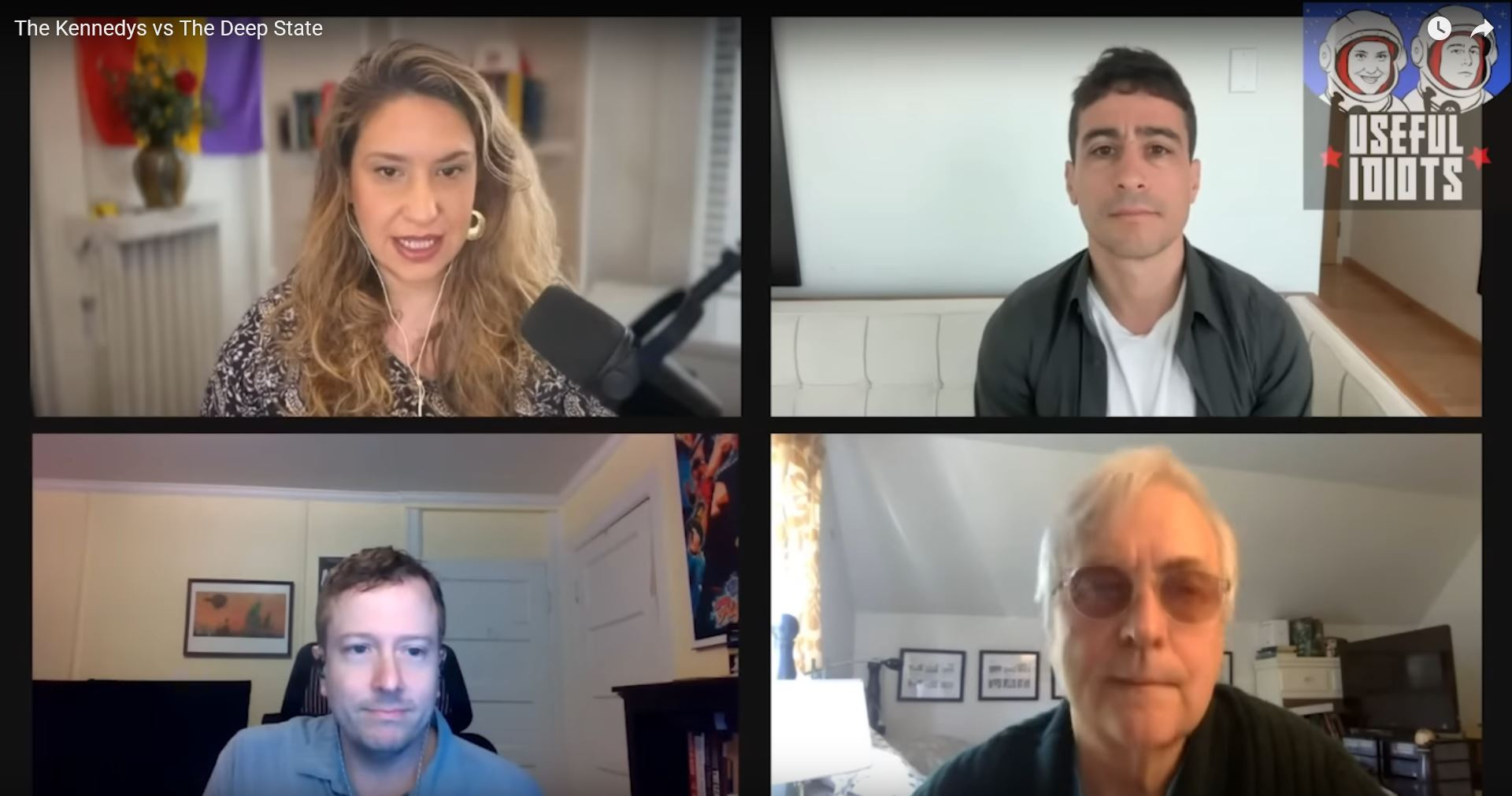
    On the podcast of Useful Idiots for June 23rd, Katie Helper and Aaron Mate guested founder of Salon and bestselling author David Talbot. A second guest was Aaron Good, who hosts the podcast American Exception and is author of the book of the same name. Because of the interest of those two authors in the JFK assassination, plus the presidential candidacy of Robert Kennedy Jr. the subject of the assassination of President John F. Kennedy arose. Helper asked a general question about his assassination: as to why he thought it occurred. Talbot replied that it was likely because of Kennedy’s attempts to end the Cold War. He then named a few examples, like the Partial Nuclear Test Ban, his attempts at détente with Cuba and Russia, and his withdrawal of advisors from Vietnam.

    Aaron Mate then joined in. Mate is a journalist I would like to like. He has done some good work in battling the MSM, for example on the issue of Russia Gate. I was just about bowled over when he said that he had only read the works of Seymour Hersh and Noam Chomsky on the subject of the John F. Kennedy presidency. Which would be the equivalent of him saying that he has only read Gerald Posner and Vincent Bugliosi on his assassination. A respectable reporter could hardly choose two worse sources than those two men. (Click here for Hersh and here for Chomsky)

    Mate started in with, well yes, John Kennedy did make the famous American University Peace Speech. But he also then made his “Ich bin ein Berliner” speech later that same June month in 1963. As this linked article shows Kennedy made the Berlin speech since he wanted to fortify the Atlantic Alliance over the doubts sown about its solidarity by French leader Charles DeGaulle.

    As anyone who studies the Kennedy presidency understands, the city of Berlin, because it was located inside East Germany, was of prime importance to Kennedy, as was the Atlantic Alliance. Unlike Vietnam, he felt this was an area and an alliance that impacted America’s national security. For example, during the Cuban Missile Crisis, Kennedy thought that Nikita Khrushchev was going to use his newly installed missiles in Cuba as a way to either barter or to move on Berlin. (The Kennedy Tapes by Ernest May and Philip Zelikow, pp. 176-77). But this did not affect his continued efforts at rapprochement with Moscow and Havana. Those were ongoing up until his assassination.

    Mate then went on to say that raids against Cuba persisted after Operation Mongoose was discontinued. (He actually said after the Bay of Pigs invasion, but this was a clear chronological error on his part.) Talbot replied that this was merely boom and bang that did not result in anything of substance. Which is correct. In fact, upon Kennedy’s death Des Fitzgerald, CIA’s chief of Cuban operations at the time, suggested they be stopped. There were only five in the second half of 1963 and they were of little consequence, individually or as a whole. In two letters Fitzgerald wrote to the White House he clearly implied this effort was so meager that it was counterproductive. (James DiEugenio, Destiny Betrayed, second edition, p. 70) But the important aspect to note is that, as author Peter Kornbluh has observed, the back channel efforts with Fidel Castro ended upon JFK’s assassination. Much to the chagrin of Castro. (Click here)

    But the worst comments that Mate made were on Vietnam. In reference to National Security Action Memorandum 263, he used the old Chomsky mythology that this thousand man withdrawal was conditional on the war being favorable to Saigon. The implication being that somehow Kennedy would reverse policy if it weren’t. Anyone can read NSAM 263, for example, in John Newman’s revised version of his book JFK and Vietnam. (p. 417). There is nothing conditional about it. The first thousand advisors were being withdrawn by the end of 1963.

    But further, Kennedy told his aides Ken O’Donnell and Dave Powers that he had been convinced by Senator Mike Mansfield. Mansfield had told JFK twice that the American effort in Vietnam was not effective. That the proper policy was to send no more reinforcements and to begin a withdrawal from the area. After the second discussion of Mansfield’s plan Kennedy said that in 1965 he would become an unpopular president. He would be branded a communist appeaser and another McCarthy Red Scare would ensue. But he was satisfied with that. As long as it happened after he was reelected, and everyone was out: “So we had better make damned sure that I am reelected.” (Johnny, We Hardly Knew Ye , by O’Donnell and Powers, pp. 16-17).

    Would Kennedy say he was going to be branded a commie appeaser if he thought the withdrawal would result in victory?

    Secondly, Mate is quoting Chomsky from a book the latter published before the declassification process of the Assassination Records Review Board (ARRB) began. In December of 1997, the ARRB declassified hundreds of pages of records on Vietnam. This included the Sec/Def meeting from May of 1963, where all US representatives—Pentagon, CIA, State Department—would meet to review the situation in Indochina. At this particular meeting Secretary of Defense Robert McNamara collected the withdrawal plans from the Pentagon that he had requested earlier. Everyone in the room understood that the withdrawal would be completed by 1965. There is no mention by anyone of escalation if the war turned south. In fact, General Earle Wheeler noted that proposals for any such action would elicit “a negative Presidential decision.” (Probe Magazine, Vol. 5 No. 3, p. 19)

    Third, as Newman discussed in Oliver Stone’s film JFK: Destiny Betrayed, he was given permission by McNamara to listen to and read the transcripts of his Pentagon debriefs. In that record, McNamara said that he and Kennedy had concluded that they could give equipment, training and advisors to Saigon. But they could not fight the war for them. Once the training mission was completed America was leaving, and it did not matter what the military situation was on the ground.

    Former New York Times journalist Chris Hedges might be even worse on the subject of Kennedy history. I had the misfortune of watching his interview on the Bad Faith podcast with Briahna Joy Gray. Just what we need, another professional Chomskyite leftist who relies on Sy Hersh’s hatchet job of a book on JFK. Anyone who admits that in public—as these two men did—should be pilloried and castigated for being an unreliable sucker.

    First, unlike what Hedges conveys, according to Jules Witcover’s authoritative book 85 Days, prior to the 1968 New Hampshire primary, Bobby Kennedy had decided to enter the Democratic race for president. He stayed out of that primary in deference to Gene McCarthy’s candidacy. Bobby entered the race because he did not think that McCarthy was strong enough on domestic issues.

    Second, I just about fell out of my chair when Hedges said that RFK was somehow obsessed with the death of Fidel Castro. This is simply false. The CIA/Mafia plots to assassinate Castro went back to 1960. And anyone who reads the Inspector General report on them would know that Bobby Kennedy did not know about them until May of 1962. And he found out about them through an accident. Sam Giancana wanted a hotel room in Vegas wiretapped since he thought his girlfriend, Phyllis McGuire, was carrying on with comedian Dan Rowan. This illegal surveillance, commissioned by the CIA Castro plotter Robert Maheu, was discovered by the local authorities. It was kicked up to the FBI. When RFK learned of it he requested a briefing as to why Maheu was trying to comply with Giancana’s request. That is how he found out about the plots. When the CIA briefed him, they told him that the plots had been discontinued. This was a lie and the CIA knew it was false when they told him. (CIA IG Report, pp. 57-66)

    But further, the CIA’s internal report proved that at no time did any president give any approval or authorization to the plots to kill Castro. (IG Report, pp. 132-33). Yet the CIA authorized, through Director of Plans Richard Helms, the use of RFK’s name in a further extension of the plots through a Cuban national named Rolando Cubela. (IG Report, pp. 89-93).

    This is how wrong Hedges is about this whole sorry episode. I mean a function of a journalist—especially an alternative reporter—is to consult the primary sources on a subject like this. If not, you run the risk of misinforming the public. The CIA Inspector General report is online. There is no excuse for not reading it. (Here it is)

    Neither, as Hedges maintains, did JFK buy into the whole Cold War ethos, especially in the Third World. Did Hedges miss Kennedy’s famous speech in 1957, where he bucked the entire media/political establishment on this issue in the French colonial conflict in Algeria? All one has to do is read Richard Mahoney’s JFK: Ordeal in Africa about President Kennedy and the Congo to understand that. Kennedy was backing Congo’s Patrice Lumumba against the European power Belgium in that epic struggle. The CIA helped to get rid of Lumumba about three days before Kennedy was inaugurated.(Mahoney, pp. 69-74)

    Question to Hedges: Was that just a coincidence? Or did they not like the fact that they knew JFK was going to back Lumumba? In fact, Kennedy directly caused the UN to back Lumumba’s successor, labor leader Cyrille Adoula, against the secession of the rich European backed Katanga province. And Kennedy gave the go ahead to use the United Nation’s military force, Operation Grand Slam, to do so. (Mahoney, pp. 154-56).

    I almost threw up when Hedges said that the Kennedys were late to support civil rights. This is just utter nonsense. I proved in a 60 page documented essay that no president since Lincoln did more for civil rights than JFK. And no Attorney General did more on the issue than Bobby Kennedy. And it started within about two months after Kennedy was inaugurated. To name just one achievement: JFK signed the first executive order about affirmative action. To name another: RFK prosecuted the Secretary of Education in Louisiana for not obeying a judicial decree on school integration. (Click here)

    This almost MSM goofiness is topped when Hedges says that RFK hated Martin Luther King. On that one I went from puking to cardiac arrest. Bobby Kennedy supervised the famous March on Washington in 1963. He was determined that this event would come off like clockwork so the civil rights movement would be hailed as a non-violent triumph. It did and it was. (Irving Bernstein, Promises Kept, p. 114). As most people in the know understand—except maybe Hedges—it was Bobby Kennedy who gave King the idea for a Poor People’s March. (Arthur Schlesinger, Robert Kennedy and His Times, pp. 911-12) It was Robert Kennedy who rescued the Freedom Riders and King in Montgomery by sending in 500 federal marshals under the direction of Byron White. (Bernstein, p. 66) It was JFK who called Coretta Scott King when her husband was imprisoned during the presidential race in 1960. It was Bobby who then intervened and had King released.(Bernstein, pp. 35-36) It was Bobby Kennedy who gave the address in Indianapolis the night King was killed to a predominantly Afro-American crowd. That was the only major city that did not go up in flames over King’s murder. Anyone who can listen to this speech and say RFK hated King is not to be trusted on the subject.

    The excuse Hedges gives for cancelling all of this out and saying that Bobby hated King was the approval the Attorney General gave to a wiretap on King’s phone. What he leaves out is that Bobby was under relentless pressure by J. Edgar Hoover to do so. As FBI official William Sullivan wrote, RFK resisted, resisted and resisted any such action. But Hoover’s clearly implied threat was that the FBI would release evidence that King was secretly a communist sympathizer who had people who were pink in his employ. Finally, the AG agreed to a 30 day trial on the grounds that if nothing was found, that would be it for the accusations and the surveillance. The problem was that President Kennedy was killed around the time it lapsed and that was it for RFK’s control over Hoover. To put it mildly, Hoover’s good friend Lyndon Johnson had no such qualms about the FBI’s battles against King. And beyond that, the evidence indicates that Hoover already had King wired, and was trying to cover himself with his threats about exposure. (Harris Wofford, Of Kennedys and Kings, pp. 211-17)

    It is crucial to note that King did not endorse Eugene McCarthy in 1968. He was waiting for RFK to make up his mind. When Bobby announced he said, “We’ve got to get behind Bobby now that he’s in.”(Schlesinger, p. 912) Let me also add, back in 2015, the late Paul Schrade told me that it was Cesar Chavez’ idea to get RFK to Delano, California for the hearings on suppression against the farm workers. To put it mildly, Bobby came through for them. (Click here to see)

    If King and Chavez are not enough, we know that after JFK passed, Gamal Abdel Nasser of Egypt, Achmed Sukarno of Indonesia, and Juan Bosch of the Dominican Republic were all mired in pain, to the point of tears. They all knew the road ahead. They were correct. We know what happened after—except for maybe Chris Hedges and Aaron Mate.

    All of this is not a matter of politics. It is a matter of defiled history.

  • Dave Emory’s 27-part series on JFK Revisited, with Jim DiEugenio

    Dave Emory’s 27-part series on JFK Revisited, with Jim DiEugenio


    jd emory jfkr


      For The Record #1262 Interview #1 with Jim DiEugenio
      For The Record #1263 Interview #2 with Jim DiEugenio
      For The Record #1264 Interview #3 with Jim DiEugenio
      For The Record #1265 Interview #4 with Jim DiEugenio
      For The Record #1266 Interview #5 with Jim DiEugenio
      For The Record #1267 Interview #6 with Jim DiEugenio
      For The Record #1268 Interview #7 with Jim DiEugenio
      For The Record #1269 Interview #8 with Jim DiEugenio
      For The Record #1270 Interview #9 with Jim DiEugenio
      For The Record #1271 Interview #10 with Jim DiEugenio
      For The Record #1272 Interview #11 with Jim DiEugenio
      For The Record #1273 Interview #12 with Jim DiEugenio and Dr. Gary Aguilar
      For The Record #1274 Interview #13 with Jim DiEugenio and Dr. Gary Aguilar
      For The Record #1275 Interview #14 with Jim DiEugenio and Paul Bleau
      For The Record #1276 Interview #15 with Jim DiEugenio and Paul Bleau
      For The Record #1279 Interview #16 with Jim DiEugenio and John Newman
      For The Record #1280 Interview #17 with Jim DiEugenio and John Newman
      For The Record #1281 Interview #18 with Jim DiEugenio and David Talbot
      For The Record #1282 Interview #19 with Jim DiEugenio and David Talbot
      For The Record #1283 Interview #20 with Jim DiEugenio
      For The Record #1284 Interview #21 with Jim DiEugenio
      For The Record #1285 Interview #22 with Jim DiEugenio
      For The Record #1286 Interview #23 with Jim DiEugenio
      For The Record #1287 Interview #24 with Jim DiEugenio
      For The Record #1288 Interview #25 with Jim DiEugenio
      For The Record #1289 Interview #26 with Jim DiEugenio and Lisa Pease
      For The Record #1290 Interview #27 with Jim DiEugenio and Lisa Pease

  • The Overthrow Attempt of 1934

    The Overthrow Attempt of 1934


    Was there really a businessman’s plot to overthrow Franklin Roosevelt’s government in 1934? Jonathan M. Katz in his new book Gangsters of Capitalism: Smedley Butler, the Marines, and the Making and Breaking of America’s Empire isn’t sure.

    He begins his book with a meeting, allegedly between retired US Marine General Smedley Butler and a prominent Wall Street Stock power broker. It actually starts in 1933. Gerald C. MacGuire, a representative of a prominent Wall Street brokerage house, starts trying to recruit Smedley Butler. He wants Butler to speak against Franklin D. Roosevelt and his policy of taking the dollar off the gold standard at an American Legion conference in Chicago, but it broadens from there. And by 1934, MacGuire is sending Butler postcards from the French Riviera, where he’s just arrived from fascist Italy, and also Berlin. Then he comes to Butler’s hometown of Philadelphia and asks him to lead a column of half a million World War I veterans up Pennsylvania Avenue for the purpose of intimidating FDR into either resigning outright or handing off all his executive powers to an all-powerful, unelected cabinet secretary who the plotters backing MacGuire were going to name.

    Butler was a celebrated US Marine general having had experience on multiple battlefields from 1898 to the 1920s. In the summer of 1932, while the depression was deepening, he led a group of thousands of World War I veterans in a march on Washington to demand they be given access to their promised World War I pensions. It is for these reasons that the plotters chose Butler to lead the revolt.

    The coup plotters included the head of General Motors Alfred P. Sloan, as well as J.P. Morgan Jr. and the former president of DuPont, Irénée du Pont, and probably Gerald MacGuire’s boss, Wall Street luminary Grayson Murphy. The group asked the celebrated Marine Corps officer Smedley Butler to lead a military coup. But Butler refused and revealed what he knew to members of Congress.

    This is a portion of General Smedley Butler speaking before the committee in 1934:

    I appeared before the congressional committee, the highest representation of the American people, under subpoena to tell what I knew of activities which I believed might lead to an attempt to set up a fascist dictatorship.

    The plan, as outlined to me, was to form an organization of veterans to use as a bluff, or as a club at least, to intimidate the government and break down democratic institutions. The upshot of the whole thing was that I was supposed to lead an organization of 500,000 men which would be able to take over the functions of government.

    I talked with an investigator for this committee who came to me with a subpoena on Sunday, November 18. He told me they had unearthed evidence linking my name with several such veteran organizations. As it then seemed to me to be getting serious, I felt it was my duty to tell all I knew of such activities to this committee.

    My main interest in all this is to preserve our democratic institutions. I want to retain the right to vote, the right to speak freely, and the right to write. If we maintain these basic principles, our democracy is safe. No dictatorship can exist with suffrage, freedom of speech and press.

    From that point on, Katz takes us on an extended tour of all the places where Smedly Butler helped to build the American Empire. From his first action as a raw volunteer in the Spanish American War through his two tours of duty in China, to his aid in the Panamanian revolution that resulted in the establishment of an independent nation of Panama which was submissive to the US desire to build a canal, to his aid in crushing rebellions in the Philippines, Haiti, The Dominican Republic and Mexico, Katz extensively catalogues the rise and exploitation of the American Empire.

    Katz actually visited many of the places Butler served. And he combines interviews with historians of the various countries along with personal papers of Butler and many prominent businessmen to paint a rather ugly picture of the conquest, establishment, and development of the American Empire.

    For Kennedys and King website visitors, two groups that keep popping up during the extensive cataloguing of the events described in the book are Sullivan Cromwell and Brown Brothers Harriman. These two business entities were involved in many of the enterprises in Latin America described in the book. As Kennedys and King visitors recognize, these two entities are often linked as possible high-level orchestrators of the JFK assassination.

    Sullivan and Cromwell was associated with the Dulles Brothers: John Foster, Secretary of State Under President Dwight Eisenhower, and his brother Allen, the notorious CIADirector from 1953–1962, who was fired by JFK after the abortive Bay of Pigs invasion.

    Brown Brothers Harriman was associated with the Bush family—namely Prescott Bush. Prescott was heavily involved with investments in Nazi Germany prior to World War II. He was so involved with the Nazis that there was a separate investigation by the same committee that investigated the Butler accusations in the late 1930’s, which was a precursor to the House Un-American Activities Committee. Some documentaries confuse the two investigations. (Apparently the documents associated with these two separate investigations both reside in the same area of the National Archives.) But Katz insists that Butler never mentions Prescott Bush as a conspirator in the 1934 plot.

    As for the specifics of the plot, MacGuire told Butler at one of their early meetings in 1934 that very soon, a group identified as ‘The Liberty League’, involving some of the people earlier mentioned (Murphy, duPont, Sloan, etc.) were going to go public with an organization that would stand openly in opposition to FDR’s New Deal programs and agenda. A few weeks later, The New York Times published a front-page article declaring the emergence of The Liberty League which not only featured some of the businessmen, but also used two anti-New Deal Democrats and former Presidential candidates, John W. Davis and Al Smith, as front-men.

    The reason why we don’t know more about this plot is because the congressional committee that Butler testified in front of, which was headed by John W. McCormack—who went on to become the longtime speaker of the House—and Samuel Dickstein, who was a Democrat of New York, cut their investigation short. The only people who testified were Butler, a newspaper reporter who Butler had enlisted in sort of an independent investigation, Gerry MacGuire, and the lawyer for one of the minor players in the industrialists’ plot, the heir to the Singer sewing machine fortune. Absent that more detailed investigation, Katz isn’t willing to state definitely the extent to which the du Ponts, Sloan, Murphy, and the others were actually involved in the planning of the business plot. They may have been deeply involved and just stopped planning once Butler ratted them out. It’s possible that Grayson Murphy—MacGuire’s boss—hadn’t got them involved yet. Katz isn’t willing to say.

    Interestingly enough, the media reaction was quite similar to the more recent response to the 1960s assassination conspiracy research. The business community Butler accused tried to laugh Butler off and used The New York Times, Time Magazine, Henry Ford II’s Dearborn Examiner and other prominent media outlets of the time to debunk Butler’s testimony.

    Time Magazine owned by billionaire Henry Luce ran a satirical piece mocking Butler. The New York Times ran a mocking unsigned editorial strongly condemning Butler. While this limited investigation was able to verify all major statements made by Butler, and the few witnesses who testified, again, the mainstream media gave it little publicity—soft peddling it and spending little time on the summary and final analysis of the final congressional sub-committee report. (Sound familiar readers? How about that Assassination Records Review Board report? Who extensively reported on it in the 1990s?) But for all the discounting and snideness, the McCormack/Dickstein report included the following:

    In the last few weeks of the committee’s official life, it received evidence showing that certain persons had made an attempt to establish a fascist organization in this country…There is no question that these attempts were discussed, were planned, and might have been placed in execution when and if the financial backers deemed it expedient.

    Katz sees definite parallels to the January 6, 2021, insurrection in Washington. He points out how MacGuire—the contact person for Butler—had been influenced by a fascist insurrection in Paris a few weeks before his association with Butler. A group called ‘The Fiery Cross’ lead an insurrection to prevent a center left, social democratic party from taking power in France. Using conspiracy theories about fixed elections and the suicide of a rightist leader who they claim was murdered combined with an unhealthy dose of antisemitism, this motley coalition of far right groups stormed the parliament and were almost successful before being suppressed by the authorities. It is that kind of Putsch that MacGuire and his associates hoped could be successful in the United States.

    I found this book a very interesting and enlightening read and believe it may have been an earlier precursor to the assassinations of the 1960s as well as a parallel to the January 6th insurgency of 2021.