Tag: AFRICA

  • The Kirknewton Incident

    The Kirknewton Incident


    Did a US Air Force Security Service Member Intercept a Communication

    Predicting the JFK Assassination?


    The time is October 1963. The place is an Air Force Base in Kirknewton (Scotland), located approximately 11 miles west of the capital city, Edinburgh. A US Air Force (USAF) Security Service member is carrying out his regular duties at the base. Although it is in the United Kingdom, the base is currently under the control of the USAF Security Service. His duties include monitoring and reporting intelligence communication traffic to his supervisors. They then relay this information on to the National Security Agency (NSA) Headquarters in Fort Meade, Maryland. The individual’s name is David Christensen.

    Christensen is listening to communications coming out of Lisbon, the capital of Portugal. Suddenly, he eavesdrops on a link between Lisbon and Tangier (Morocco) that mentions a high-ranking figure in organized crime and the assassination of President John F. Kennedy. Recognizing the importance and gravitas of such an intercept, he immediately informs his supervisors, confident in the knowledge that they will pass the information up the chain of command.

    Christensen had done his duty. He was relieved. He may even have felt that because of the important content of the intercept, it would have been given Critical Intelligence Communications status, otherwise known as CRITIC. Such messages should be alerted to the President and other senior government officials within minutes, if possible.

    A few weeks later, when Christensen heard the news of President Kennedy’s assassination in Dallas on 22 November 1963, his heart sank. His life then followed a similarly low trajectory. As he said himself, in a letter he wrote in May 1978, to a fellow officer who served with him at the RAF Kirknewton base, “it really broke me up after Nov. 22, 63 especially when I had it all beforehand.” We will return to this letter shortly.

    Was David Christensen destined to become another accidental witness to history, having had prior knowledge of the JFK assassination, alerting the appropriate authorities who then did nothing and failed to protect the President?

    This is his story and how it was eventually brought to the attention of the House Select Committee on Assassinations (HSCA) in 1978.


    David Christensen and RAF Kirknewton

    David Frederick Christensen was born on 26 January 1942 in the midwestern town of Dickinson, North Dakota. He grew up on a ranch near the town of Halliday, which was about 40 miles north east from the town of his birth. Christensen graduated from High School in Halliday in 1960 and married that same year. The young Christensen quickly joined the USAF and in 1961 was sent overseas to the RAF Kirknewton base in Scotland.

    The small town of Kirknewton has a population of just over 2,000. During World War II, a military airfield was built about a mile south of the town by the British Royal Air Force (RAF). Unsurprisingly, it was named RAF Kirknewton.

    The base began life as a grass airfield in late 1940. Its initial purpose was to provide a home for the 289 Squadron in November 1941. The 289 Squadron was an anti-aircraft operation unit who eventually relocated to another base around six months later. RAF Kirknewton was then used for a variety of purposes, including a short stint as a Refresher Flying Training School, which helped to prepare inactive pilots for postings to operational training units.

    In 1943, there was some hope that the RAF Kirknewton base would replace the RAF Findo Gask station, when that base became unserviceable. Findo Gask was situated 50 miles north of Kirknewton. That hope quickly evaporated however when RAF Kirknewton did not obtain the necessary clearance to build runway extensions, probably because of dangerous crosswinds in the area.

    From the 1950s onwards, RAF Kirknewton was no longer used for aviation and in early 1952, the base was handed over to the USAF Security Service––the intelligence branch of the USAF. RAF Kirknewton then began a new life as a strategic US intelligence listening station that was used by the Central Intelligence Agency (CIA) and NSA to eavesdrop on military and commercial naval traffic, with priority given to Soviet radar. The Cold War was really heating up at this point. Personnel at the base included radio operators, linguists, and analysts––many with Top Secret and higher security clearance.

    The planning for this phase in the life of RAF Kirknewton actually began in August 1951 at the Brooks Air Force Base in San Antonio, Texas when the 37th Radio Squadron Mobile (RSM) was activated. This unit was then selected to move to the UK and into the RAF Kirknewton base.

    Ironically, President Kennedy’s last official act as President was at the Brooks Air Force Base on 21 November 1963, when he opened and dedicated the new Aerospace Health Medical Centre there.

    Around May/June 1952, the first personnel arrived in Scotland (via a three month stay in Bremerhaven, Germany for background investigations and security clearances). These first arrivals referred to Scotland as the “land of the heather, the moors, Scotch whiskey and the kilt.”

    The 37th RSM began formal operations at Kirknewton in August 1952 and by the following month the base had grown in size, with around 17 officers and 155 airmen in post. During its first year, RAF Kirknewton was used to evaluate antenna configurations, with the aim of determining the most effective configuration for intercepting Soviet communications and radar signals.

    The formal transfer of RAF Kirknewton from the British air ministry to the USAF had already taken place by 27 March 1953. Two years later, the 37th RSM was re-designated as the 6952nd RSM, but there was no change to the original mission.

    At the peak of its activity, RAF Kirknewton housed 17 officers and 463 airmen. Over 2,000 personnel served during the lifespan of the base. Towards the end of its life as a listening station, the base was even responsible for maintaining security over part of the hotline established in 1963 between Washington and Moscow, as the cable route passed through the area. The base was handed back to Britain in 1967.

    In James Bamford’s book, The Puzzle Palace (Penguin Books, 1983, page 270), we get an insight into the type of work Christensen would have been performing at Kirknewton. An unnamed former employee explained his routine at the base:

    Intercepted telegrams came through on telex machines. I was provided with a list of about 100 words to look out for. All diplomatic traffic from European embassies was in code and was passed at once to a senior officer. A lot of telegrams––birthday congratulations for instance––were put into the burn bag. I had to keep a special watch for commercial traffic, details of commodities, what big companies were selling, like iron and steel and gas. Changes were frequent. One week I was asked to scan all traffic between Berlin and London and another week between Rome and Belgrade. Some weeks the list of words to watch for contained dozens of names of big companies. Some weeks I just had to look for commodities. All traffic was sent back to Fort Meade in Washington.

    As “all traffic was sent back to Fort Meade in Washington” you would have thought that an intercept referring to the assassination of the President would have been given priority treatment and not “put into the burn bag” with birthday messages!


    Christensen’s Letter and Subsequent Investigation

    Earlier, I referred to a letter David Christensen wrote to an ex-colleague in May 1978. The recipient of his letter was Sergeant Nicholas Stevenson, who served two tours of duty at RAF Kirknewton. The second tour was between June 1962 and June 1965, so he was based there at the same time Christensen said he picked up the Lisbon/Tangier intercept. We can see here a typed copy of the letter provided to the HSCA by the NSA in 1978 (click here to see the original handwritten version of Christensen’s letter).

    Unlike his alert to senior officers in October 1963, Christensen’s letter to Stevenson did not fly under the radar. It was quickly brought to the attention of US government agencies and eventually the HSCA, led by Chief Counsel G. Robert Blakey.

    When Christensen wrote the letter, he was in a Veterans Hospital in Sheridan, Wyoming. Stevenson was based at Corry Field, Florida.

    An earlier public release of the letter contained many redactions. This is what two of the pages looked like––clearly there were concerns about the content:

    Once Stevenson had read the letter, he alerted the USAF Security Service, who in turn notified the Office of Special Investigations (OSI). An OSI agent, based at the Lowry Air Force Base in Colorado, was assigned to contact Christensen, and interview him about the letter. This interview took place on or around 1 June 1978.

    A letter dated 2 June 1978 from Paul Fisher (Chief, USAF Security Service) provides an insight into what was discussed between the OSI agent and Christensen. Fisher’s letter was addressed to James Lear, Director of the NSA (click here to see Fisher’s letter). He wrote that the purpose of the interview with Christensen was to determine the names of any other individuals he may have contacted. He went on to state that “Mr. Christensen has a long history of alcoholism, family problems and now wants to see a cleared psychiatrist as he attributes all of his problems from Oct 1963, per the OSI agent. In addition, he has indicated to the OSI that he now fears for his life.”  

    The government agencies at this point clearly seemed to be more concerned about who else Christensen may have talked to about the letter, rather than the actual claim made about the JFK assassination and organized crime. Christensen’s health and personal problems were also highlighted, a common tactic when trying to undermine someone’s credibility.

    This illustrates that if Christensen did intercept a message in October 1963 predicting the JFK assassination, and tried to raise the alarm or alert authorities, then it had a very profound and damaging effect on his life. Something similar happened to Eugene Dinkin, Ralph Leon Yates, and Abraham Bolden to name just a few (click here for more on Eugene Dinkin).

    On 7 September 1978, Daniel Silver (General Counsel, NSA) wrote to the FBI about the letter and provided them with a typed copy. Silver indicated that the FBI may wish to bring the matter to the attention of any Committee of the Congress. The HSCA had already been investigating the JFK assassination for two years by then (click here to see Silver’s letter).

    Interestingly, Silver also corroborated a central claim made in Christensen’s letter about what was going on at the RAF Kirknewton base in October 1963.

    Silver wrote that “the information contained in Mr. Christensen’s letter that the Air Force Security Service was intercepting international commercial communications at Kirknewton, Scotland in 1963 is correct, as is the assertion that the station monitored communications links between Lisbon and other parts of the world.” As we will discuss later, other facts raised by Christensen in his letter can also be corroborated.

    The HSCA were indeed made aware of Christensen’s claim and on 8 November 1978, Chief Counsel Blakey met with a representative of the NSA to discuss further. The memorandum written up from this meeting confirmed that Christensen had been committed to “a mental institution” because of the October 1963 intercept. Blakey posed several questions to the NSA including what their capability was to retrieve communications from Kirknewton from the time period in question, and whether Christensen really was working for the USAF at the time and doing the kind of work consistent with “intercepting commercial communications.”

    Blakey followed this up on 15 November 1978 by writing to Harold Brown who was then Secretary of Defense under President Jimmy Carter. Brown had also worked in the Defense Department under Robert McNamara during JFK’s time in the White House.

    On the same date, a memorandum of understanding was also drawn up and signed by both Blakey and John Kester, who was the Special Assistant to the Secretary and Deputy Secretary of Defense. The purpose of the memorandum was in relation to the Defense Department’s agreement to release Sergeant Stevenson to be interviewed by the HSCA. It included the restrictions placed on them in this regard, such as that it be limited in scope to the allegations made by Christensen, no classified information would be disclosed by the HSCA without the written consent of the Defense Department, and that Stevenson would be accompanied at the interview.

    What is also interesting about the memorandum of understanding was an error in the original typed copy. As we can see, it referred to “the allegations of David F Christensen of involvement by the Government of Cuba in the assassination of President John F. Kennedy.” This was then scored out, initialed and corrected to readof certain individuals.”

    Click here to see the full memorandum of understanding.>

    There is no record that Christensen made any allegation that the Government of Cuba was involved in the JFK assassination. I’m sure this mistake was just an honest clerical error!


    The Interview with Sergeant Stevenson

    The interview with Sergeant Nicholas Stevenson took place on 17 November 1978 in the Senate Intelligence Committee room. Two HSCA staff members conducted the session. They were Gary Cornwell and Kenneth Klein. Stevenson was accompanied by a legislative liaison officer from the USAF. Others in attendance included Eugene Yeates, Chief of Legislative Affairs at the NSA.

    I have been unable to find a verbatim account of what was discussed but a summary of the interview was subsequently written up by Klein that day (click here to see Klein’s report) and by Yeates in a memorandum dated 21 November 1978 (click here to see Yeates’ memorandum).

    At the meeting, Stevenson confirmed that he had known Christensen for a number of years and recognized other names in the letter. He added that he could not rule out that such a message was picked up at RAF Kirknewton but felt it would have been more widely known at the base and be the probable subject of a CRITIC. We have seen previously that this relates to a piece of Critical Intelligence Communications which should be treated with the utmost urgency and importance. Stevenson denied any specific knowledge of the allegation made concerning organized crime and the assassination of the President.

    HSCA investigator Cornwell suggested to Stevenson that he call Christensen to find out the name of the figure in organized crime. Stevenson replied that he was unwilling to do so. In Klein’s report, it is stated that the lawyer representing Stevenson, stated that “such a phone call could only be arranged through the Department of Defense.”

    It has always puzzled me why the HSCA did not pursue more vigorously the name of the organized crime figure mentioned in Christensen’s letter. The memorandum by Eugene Yeates stated that “the staffers remain particularly interested in determining the name of the individual who Mr. Christensen believes relates to the assassination” and ended with the words “If the Committee is able to determine a specific name, the staffers indicated that they would probably initiate a specific inquiry to NSA to again search our materials.”

    There is no available information that I have yet been able to find that the HSCA made any serious further efforts to determine the identity of the individual. Despite what Stevenson’s lawyer said, I would have thought the HSCA would have moved heaven and earth to find out the name of the organized crime figure, particularly as Chief Counsel Blakey was pointing the figure of suspicion for the assassination at organized crime. I also realize at the time (November 1978) that the HSCA and their Congressional investigatory mandate was due to run out at the end of the year. I accept that they may have had higher priorities to pursue at the time, such as the acoustical evidence from the Police Officer’s dicta-belt, that recorded the shots in Dealey Plaza.

    Author, Larry Hancock, did speak to Sergeant Nicholas Stevenson for his excellent book Someone Would Have Talked (JFK Lancer Productions & Publications, 2010 edition, page 367). Stevenson told Hancock that “he was unable to discuss the subject because of two brain operations which had totally eliminated all of his past memories.”

    On 21 November 1978, Eugene Yeates wrote a further letter to confirm that the NSA had “made a thorough search of all records” pertinent to the allegation made by Christensen and that “no communications or information relating to the Committee’s request” had been located. This letter was only released in full in November 2017 under the JFK Records Collections Act 1992 (click here to see the letter).

    Another document only released in full at this time was from Harold Parish of the NSA. His memorandum was dated 2 January 1979. In it, Parish outlines the scope of the search conducted by the NSA to find materials relevant to the Kirknewton incident. He concluded that the NSA had “done all reasonable things to locate the reported intercept with negative results.” Just before concluding this, he also admitted that the search only really consisted of a look through three boxes from 1963 containing unidentified materials. There were nearly 10,000 products on file from January through November 1963 that would take a minimum of four weeks to go through (click here to see the memorandum).

    The reality of the search is underlined by another memorandum dated 13 December 1978, this time by C. Baldwin of the NSA (click here to see the memorandum). Baldwin’s memo confirmed “that a review of the documents in these three unidentified boxes would constitute a reasonable effort to find the alleged record” and that the “latest date in the box was 1962.” We know Christensen’s intercept was made in October 1963.

    Baldwin’s memo goes on to state that Mr. Sapp of the NSA “requested that an additional search be made of materials dated later than 1963” but that after reviewing the listing of such boxes, “nothing on the list merits such a search.”  

    It is clear to me that the NSA’s response, that they had made a “thorough search” to locate information relating to Christensen’s allegation, was disingenuous at best and a complete fabrication at worst. It also makes me wonder why these documents were hidden from public view for nearly 40 years if there was nothing to see. I appreciate that time is precious for government agencies but maybe in the near future, I’ll get the opportunity to make a more “thorough search” of these materials. I look forward to that day.


    The Lisbon and Tangier Link

    The intelligence agencies and HSCA seemed to have closed the book insofar as David Christensen’s allegation was concerned.

    You will recall that he mentioned that the link picked up was between Lisbon and Tangier. We have seen that the NSA confirmed that they were indeed listening to communications between Lisbon and other parts of the world at the time Christensen was based at RAF Kirknewton.

    Lisbon and Tangier are only about 275 miles apart. They are both interesting places to research. Both are port cities with easy access to North Africa, Southern Europe and a gateway to the Atlantic.

    Lisbon was known as the Capital of Espionage during World War II, largely because Portugal was officially neutral during that bloody conflict. Like its neighbour Spain, Portugal was ruled by a fascist dictator for decades. Antonio de Oliveira Salazar held power from 1932 until 1968. But because of the country’s neutrality during the war, Lisbon became a haven for spies. Intelligence agents from the allies and axis countries all converged on Lisbon.

    After the war, many organizations continued to take advantage of Salazar’s anti-communist dictatorship. These included CIA-NATO sponsored “Gladio” stay behind units, set up allegedly to defend Western Europe from a possible Soviet invasion, but who ended up inflicting murder and terrorist attacks on their own populations to instill fear, and frame political opponents. James Earl Ray also spent around ten days in Lisbon just before his arrest in London in June 1968 for the alleged murder of Martin Luther King Jr.

    Tangier was an important trade centre and international zone from 1924 until it was integrated into Morocco in 1956. It was also a place where spies met and even the setting for part of a James Bond film in the 1980’s! Bond author, Ian Fleming, was a friend of JFK’s. Smuggling was a popular pastime, if we can describe it as that. There were also several alleged sightings of Lee Harvey Oswald in Tangier, but I am sceptical of their authenticity. I could write a separate article about this subject alone! 

    An interesting character who we do know was in Tangier was Thomas Eli Davis III. He was an associate of Jack Ruby and in the gun running business, which included Cuba. In fact, it is reported that Ruby’s first lawyer, Tom Howard, asked his client whilst he was awaiting trial for Oswald’s murder if there was anybody who could harm his defence if it came out at the trial. Ruby mentioned Thomas Eli Davis.

    Davis was arrested in Tangier on 8 December 1963 for trying to sell two pistols to raise money. What concerned the Moroccan police more though was that Davis also had in his possession a cryptic, unsigned letter in his handwriting that mentioned Oswald and the Kennedy assassination. It is likely though that the reference to Oswald was a Victor Oswald, an arms dealer that Davis met in Madrid around November 1963.

    Another, and possibly more interesting bit of information about Davis, is that he was in custody in Algiers, Algeria on the day of the JFK assassination for running guns to the violent Organisation Armée Secrète, commonly known as the OAS. The OAS were opposed to Algerian independence from France (which was won in March 1962) and had tried to assassinate President De Gaulle on numerous occasions because of his stance on Algeria. They also had a station in Madrid.

    According to author Seth Kantor, Davis’s release from custody in Algiers was facilitated by a CIA asset with the cryptonym QJ/WIN (The Ruby Cover-Up, Zebra Books, 1978, page 45). This mysterious individual was part of the ZR/RIFLE Executive Action assassination programme led by William Harvey, who hated Kennedy and Castro. Could Harvey’s programme have diverted its attention towards JFK?

    Anti-Castro Cuban refugees were also known to have left their country of birth and made their way to Tangier because of the Castro revolution.

    The connection between Lisbon and Tangier may not therefore have been as benign as one may originally think. It does not seem unreasonable that communications and intelligence chatter could have been picked up around October 1963 that included talk of the imminent assassination of JFK.


    The Figure in Organized Crime           

    Earlier in the article, we saw the letter that Christensen wrote in 1978. He wrote that “the man’s name most mentioned was number 4 in a certain branch of organized crime at the time. Was number 2 last year.”

    You don’t need to have the detective powers of Sherlock Holmes or Jessica Fletcher to work out that the person mentioned in the intercept therefore had to still be alive in 1977, the year before the letter was written––and was the number 2 man in that branch of organized crime.

    When we talk about organized crime and the JFK assassination, there are three names that generally come top of most people’s lists. They are Carlos Marcello from Louisiana, Sam Giancana from Chicago and Florida kingpin, Santo Trafficante Jr. All are on record as wishing harm on President Kennedy, and his brother Bobby, and all had the means, motive and opportunity to do so.

    Giancana though was brutally murdered himself in June 1975, so this would appear to rule him out as the person in the letter. Other high-profile Mafia figures who have been linked with the JFK assassination over the years include Joseph Civello (Dallas), Jimmy Hoffa (Teamsters Union), Johnny Roselli (CIA/Mafia Castro hits) and Antoine Guerini (Marseille Mafia).

    They were also all dead by 1977 (or in Hoffa’s case had disappeared). Antoine Guerini’s equally notorious brother, Barthélemy, was sentenced to twenty years in prison in 1969 and died in 1982. Suspected grassy knoll shooter, Lucien Sarti, was also dead, killed in a Mexico City shoot out in 1972. So, it is most unlikely that the man’s name mentioned in the letter, and who was number 2 in a certain branch of organized crime in 1977, could have been any of these men.

    It seems credible that the branch of organized crime mentioned in the letter could have been the lucrative heroin drug smuggling trade––going through Marseille and into North America. The so-called French Connection. It was thriving in the early 1960s and therefore under intense scrutiny by some government agencies. Montreal was a key city in this drugs corridor, as they made their way from Europe to the USA. This makes Paul Mondolini a potential suspect. He was alive in 1977.

    This is, of course, all speculation and it is easy to throw names around without any specific corroboration. As well as drug trafficking, there are many other “branches” of organized crime including murder and assassination. The list of potential candidates could therefore be very long. But I do not think it takes us much further forward to throw other names into the mix without evidence.

    What we do know for sure is that there was an opportunity for the HSCA to find out the name of the person in Christensen’s letter, but they either didn’t have time or did not believe it worthy of further investigation. The NSA didn’t help with their poor excuse of a search for relevant records and information. Could they have been worried about where it might lead them?


    An Officer and a Gentleman

    It’s easy to forget that within all this talk of the JFK assassination, organized crime figures, and Cold War paranoia, that the whole Kirknewton incident really revolves around one man––David Frederick Christensen.

    Only he really knows the whole story and may have taken his secrets to the grave. Christensen died on 22 December 2008. He was 66 years old and rests forever at the Halliday Cemetery in North Dakota.

    Some may say that he made the whole story up, perhaps to engineer some medical and financial assistance he may have been looking for from government. What happened between October 1963 and May 1978 (when he wrote the letter to Stevenson) is also a mystery. Who else did he tell about it? Was pressure brought to bear on him to keep quiet? These questions remain unanswered for now and require further investigation.

    What we do know is that it rarely ended well for people who bravely put their heads above the parapet and tried to sound a warning about the possible assassination of JFK.

    For those who doubt Christensen’s story, it’s worth reflecting on some of the other points mentioned in his 1978 letter.

    He included the names of other officers who served at RAF Kirknewton, such as Prater, Harley, and Hendrickson. A review of the alumni at the USAF RAF Kirknewton website confirms the existence of such named individuals who served there. The Berkely Bar in Edinburgh was an established drinking establishment for serving military personnel at the time. He had indeed married a girl call Marlene Burr in 1960 and they were later divorced. He refers to some people as 202s and 203s. A 202 was a Radio Traffic Analyst and a 203 a Language Specialist––work consistent with the RAF Kirknewton base at the time. Could the outfit in Texas have been a reference to the Brooks Air Force Base in San Antonio?

    Amongst all these facts, I find it extremely unlikely that Christensen would then have thrown in a wild accusation about an intercept that mentioned the assassination of President Kennedy, unless it really did happen.

    As we all continue to research different aspects of the JFK assassination, maybe more about the Christensen story will be revealed. It’s a pity more of the documents and details about the HSCA investigation were not released until after his death. We may have been able to find found out a lot more if they were released earlier.

    What we should never lose sight of though is that David Christensen was a human being who served his country with distinction and received an honorable discharge. He was trusted with high security clearance and is not just a name to be read in documents.

    He had two sons and six grandchildren––a family man. He enjoyed playing card games and worked in the oil business when he left the Air Force. And his life was profoundly affected following Kirknewton. As he said himself––“it really broke me up after November 22, 1963” and “it cost him a divorce and everything from his wife.”

    Until evidence is presented to the contrary, perhaps we should also start referring to David F Christensen as another forgotten hero as far as the JFK assassination is concerned.

    We must keep searching for the truth.

    As JFK said himself once, “Things do not happen. Things are made to happen.

  • The Murder of Hammarskjold

    The Murder of Hammarskjold


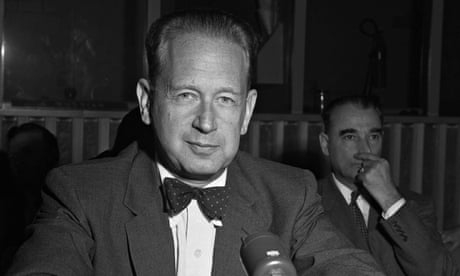
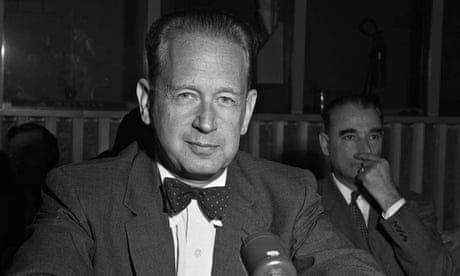
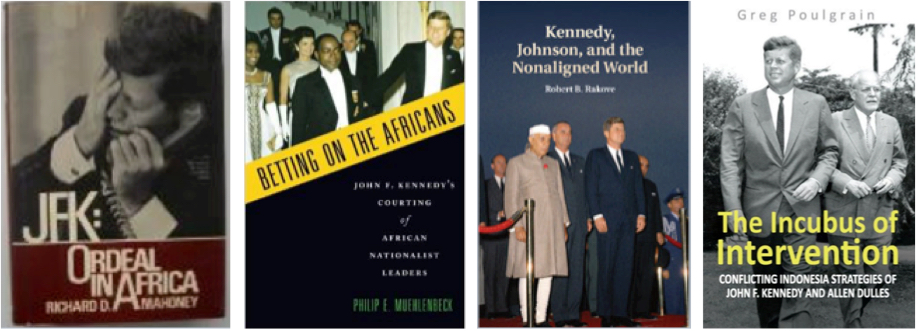
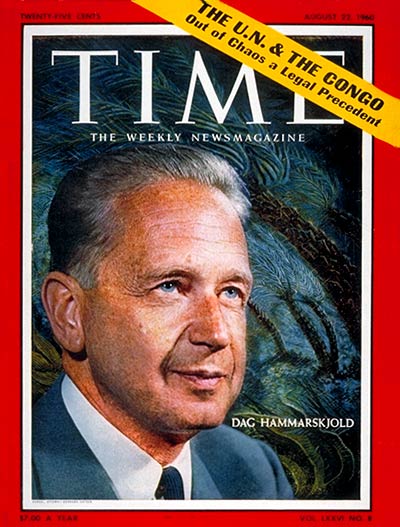
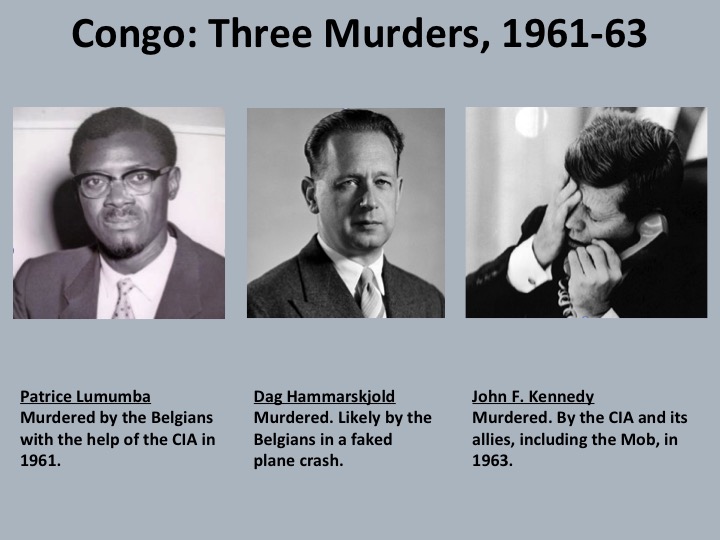
    Dag Hammarskj ld 011For a long time this site has tried to point out that the Congo struggle was one of the most important, yet underreported, foreign policy episodes that took place during the Kennedy administration. Sloughed off by the likes of MSM toady David Halberstam, it took writers like Jonathan Kwitny and Richard Mahoney to actually understand the huge stakes that were on the table in that conflict, namely European imperialism vs African nationalism. Kennedy had radically revised America’s Congo policy from Dwight Eisenhower to favor the latter. Not knowing he was dead, JFK was trying to support Congo’s democratically elected leader Patrice Lumumba. JFK was also one of the few Western leaders trying to help UN Secretary General Dag Hammarskjold stop the Europeans from crushing Congo’s newly won independence.
    In September of 1961, just eight months after Lumumba was murdered, Hammarskjold died in a plane crash. It was officially ruled an accident. But there were doubts from the beginning. For example, Harry Truman told the New York Times, that Hammarskjold was on the verge of getting something done “when they killed him.” It now turns out that Kennedy’s ambassador to Congo, Edmund Gullion, also suspected Hammarskjold’s plane was shot down. And he suspected it the night it happened. This key fact was not revealed for fifty years.

    Below we link to three stories in the press of late that have finally circulated about the true circumstances of what happened to the Secretary General, the man who Kennedy called, “the greatest statesman of the 20th century.”

    It is nice that the MSM is finally catching up to what we wrote about 20 years ago in Probe Magazine.  In particular:

    In the first of these two articles, Jim DiEugenio lays out the overall struggle of Kennedy and Hammarskjold to keep Congo free and united against the imperial forces of Belgium and England. In the second, Lisa Pease examines the murders of Lumumba and Hammarskjold within eight months of each other. Those assassinations left Kennedy standing alone. When he was killed, the imperialists triumphed.

    During the ensuing decade, CTKA continued to focus on this important story, again underscoring the links between Kennedy and Hammarskjold, but now reinforced by the work of historian Greg Poulgrain with regard to their cooperation over Indonesia. See:

    Finally, two decades later, the MSM is acknowledging that work. We don’t like to toot our own horn, but … Honk! Honk!

  • Desperate Measures in the Congo

    Desperate Measures in the Congo


    I

    “The Dark Continent”

    In his sweeping and revolutionary Lectures on the Philosophy of History, the 19th-century Prussian philosopher G. W. F. Hegel detailed a vision of history unfolding through the bold and decisive actions of what he deemed “world historical” personalities. Having seen Napoleon and his ornate retinue of generals parade through his hometown of Jena as a young man, Hegel was impressed by the singular power of individuals to shape history, and eventually developed this notion into his rarefied theory of how unseen forces find their expression in the actions of powerful leaders who themselves—unwittingly or actively—force the grand wheel of history to turn through its great dialectical arc.

    So compelling was this vision to late 19th-century Europeans, who stood at the apex of technological achievement in contrast to the developing world, that even today few realize Hegel’s version of human history is but one narrative in a vast tapestry of explanations as to how societies have organized themselves throughout the centuries. We also forget, at our peril, the pernicious implications of Hegel’s theory concerning non-Europeans, especially the retrograde, even worthless qualities he ascribes to those inhabiting the African continent. As he noted in his series of lectures presented at the University of Berlin from 1822-30, “Negroes are enslaved by Europeans and sold to America. Bad as this may be, their lot in their own land is even worse, since there a slavery quite as absolute exists; for it is the essential principle of slavery, that man has not yet attained a consciousness of his freedom, and consequently sinks down to a mere Thing—an object of no value.” He concludes, after a lengthy digression on cannibalism, polygamy and the perpetual brutality among tribal sub-Saharan African groups, by claiming, “From these various traits it is manifest that want of self-control distinguishes the character of the Negroes. This condition is capable of no development or culture, and as we see them at this day, such have they always been.” (Lectures on the Philosophy of History, p. 98)

    This patriarchal view held by many 19th-century European intellectuals was the cornerstone for the many justifications used to perpetuate the brutal colonization of the African continent. The colorful flags of Denmark, Germany, France, Belgium, Portugal, England and Spain all shimmered in the hot African breeze at some point, continuously reaffirming from the colonizers’ perspective Hegel’s enduring vision of the infantile and helpless African peoples and their European “civilizers.” In this sense, the abject horror many historians have detailed at length in the Belgian Congo was not an aberration, but was more a crystalline and total distillation of the tenets of European racial subjugation as practiced elsewhere.

    In 1885 King Leopold II effectively declared the entire Congo basin his personal property, akin more to a medieval kingdom than a traditional colonial region like British India, for example, where to some extant the British were compelled to integrate aspects of local culture and politics into their own system. In the Belgian Congo, as Adam Hochschild and others have detailed, unrestrained brutality was normalized to such an extent that one might have forgotten that slavery had been universally abolished decades earlier. Established in 1885 at the Conference of Berlin, the “Free State of Congo” was ostensibly created to enrich the lives of its inhabitants, incapable, as Hegel noted, of managing their own affairs. And yet almost immediately this benevolent charter was reversed, with Leopold II using his mercenary Force Publique to maim, torture, and essentially re-enslave the native Africans of the Free State of Congo. Estimates vary, particularly due to the burning of records by the colonizers, but a conservative figure is that in his twenty-five year reign, nearly ten million Congolese were killed as a result of his policies, representing fifty percent of the 1880 population. During his reign of terror, Leopold and his provincial overseers extracted ivory, rubber, and other rare goods for export to Europe, personally enriching the king to the tune of 220 million francs ($1.1. billion today) by the estimates of the Belgian scholar Jules Marchal. (Adam Hochschild, King Leopold’s Ghost, p. 276) Incentivized through a tiered system of profit-maximization, the king’s men were rewarded with bonuses and promotions for resources gathered. Reluctant or underperforming Congolese were subjected to pitiless horrors, including having their limbs hacked off or enduring a hundred lashes of the whip, most of which proved fatal. The Force Publique also kidnapped villagers’ wives, who were frequently beaten and raped, holding them as ransom to induce workers to secure their release through reaching their rubber quotas. Herded like cattle into slave labor camps and paid just enough to purchase subsistence rations from their overlords, they remained powerless to resist Leopold’s private army, cordoned off in their remote Congo basin by armed outposts, attack dogs and a complacent international community at a time when information was the stuff of rogue travelers’ tales and stories told by escaped prisoners, rather than mass media headlines. In the United States, it was the lone voice of an African American military officer, Colonel George Washington Williams, who, having visited the Free State of Congo just years after its creation, felt compelled to openly criticize the regime in the international forums, declaring the Belgian king guilty of crimes against humanity:

    All the crimes perpetrated in the Congo have been done in your name, and you must answer at the bar of Public Sentiment for the misgovernment of a people, whose lives and fortunes were entrusted to you by the august Conference of Berlin, 1884—1885. I now appeal to the Powers which committed this infant State to your Majesty’s charge, and to the great States which gave it international being; and whose majestic law you have scorned and trampled upon, to call and create an International Commission to investigate the charges herein preferred in the name of Humanity, Commerce, Constitutional Government and Christian Civilization. (Washington, “Open Letter to King Leopold of the Congo”, 1890)

    Tales of his terrible and sinister exploits were the stuff of legend, and it was Leopold’s Free State of Congo that inspired author Joseph Conrad to write his famous novella Heart of Darkness, in which a distant and jaded Marlowe tells his shipmates his terrifying story of going up-river into the seething heart of colonial Central Africa. Yet from this tragic past, as the twentieth century dawned and Hegel’s dialectic of history moved the peoples of the world forward in the wake of the Second World War, the powerful and latent forces of human emancipation which had been awaiting their chance to check colonial oppression found their expression in a charismatic Congolese intellectual who intimately understood the powers arrayed against an autonomous Congo.


    II

    A New Hope

    The President observed that in the last twelve months, the world has developed a kind of ferment greater than he could remember in recent times. The Communists are trying to take control of this, and have succeeded to the extent that … in many cases [people] are now saying that the Communists are thinking of the common man while the United States is dedicated to supporting outmoded regimes. (Foreign Relations of the United States, 1958—1960, XIV, Document 157.)

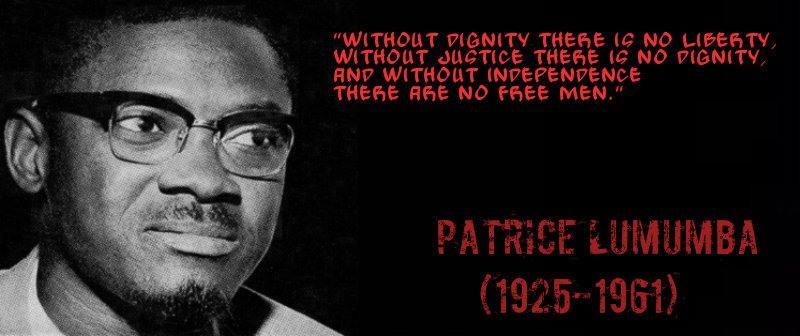
    The Mouvement National Congolais (MNC) had been founded and led by Patrice Lumumba. Its aim was to seek the Congo’s independence from Belgium. In December of 1959, the MNC won a majority of local elections and participated at a conference in Brussels in late January of 1960. That conference set June 30, 1960 as the date for an independent Congo after national elections for new leadership were held in May. The MNC won the May elections. Lumumba was to be Congo’s first prime minister and Joseph Kasavubu the first president.

    In an impassioned and catalyzing speech to a crowd of thousands of newly liberated Congolese men and women, the Democratic Republic of Congo’s newly elected thirty-five year old prime minister, Patrice Lumumba, captivated his constituents by recounting the significance of what had just been achieved:

    We are deeply proud of our struggle, because it was just and noble and indispensable in putting an end to the humiliating bondage forced upon us. That was our lot for the eighty years of colonial rule and our wounds are too fresh and much too painful to be forgotten. We have experienced forced labour in exchange for pay that did not allow us to satisfy our hunger, to clothe ourselves, to have decent lodgings or to bring up our children as dearly loved ones.

    Morning, noon and night we were subjected to jeers, insults and blows because we were “Negroes”. Who will ever forget that the black was addressed as “tu,” not because he was a friend, but because the polite “vous” was reserved for the white man? We have seen our lands seized in the name of ostensibly just laws, which gave recognition only to the right of might. We have not forgotten that the law was never the same for the white and the black, that it was lenient to the ones, and cruel and inhuman to the others.

    We have experienced the atrocious sufferings, being persecuted for political convictions and religious beliefs, and exiled from our native land: our lot was worse than death itself. We have not forgotten that in the cities the mansions were for the whites and the tumbledown huts for the blacks; that a black was not admitted to the cinemas, restaurants and shops set aside for “Europeans”; that a black travelled in the holds, under the feet of the whites in their luxury cabins.

    Who will ever forget the shootings which killed so many of our brothers, or the cells into which were mercilessly thrown those who no longer wished to submit to the regime of injustice, oppression and exploitation used by the colonialists as a tool of their domination?

    All that, my brothers, brought us untold suffering. But we, who were elected by the votes of your representatives, representatives of the people, to guide our native land, we, who have suffered in body and soul from the colonial oppression, we tell you that henceforth all that is finished with. The Republic of the Congo has been proclaimed and our beloved country’s future is now in the hands of its own people.

    Freed from human bondage by a reluctant King Baudouin of Belgium in June of 1960, the Democratic Republic of Congo stood poised to capture the imagination of still-colonized and recently decolonized regions throughout the African continent. With Kasavubu as president and Lumumba as prime minister, along with a freely appointed parliamentary body, the Congolese provinces were taking the first decisive steps towards freedom. In the post-Free State of Congo period, stretching from its dissolution in 1908 to the 1960 creation of the Democratic Republic of Congo, although the abject horrors of Leopold II’s slave-labor program had largely subsided, the people of the Congo were still living under the thumb of their European overlords. In this interregnum period, education for black Africans was provided by white Catholic missionaries who proselytized their vision of what good Christians were to endure in the face of hardship. No African living in the Congo during this fifty-year period could vote, and apartheid was the default social framework in which blacks and whites co-existed. For the Congolese, these times were “free” only symbolically.

    But as many have pointed out, most recently John Newman in Countdown to Darkness, Belgium had schemed in advance to make sure that the free state of Congo would have an unsuccessful launch. The mechanism would be fouled to the degree that Belgium would have to retake the country in order to save it from a descent into chaos. As Newman points out, it was not just Belgium, but the USA that was unprepared to accept the success of a newly independent African country, especially one as large and as mineral-rich as Congo. Allen Dulles, Director of Central Intelligence, had smeared Lumumba’s character at a May 5, 1960 National Security Council (NSC) meeting. Dulles also suggested that there was “Some possibility that a movement might develop in the rich Katanga area for separation from the Congo.” (Newman, p. 152, all references are to the Kindle version) In other words, the foreign economic mining interests in Congo had planned the Katanga secession before independence day. And Dulles knew about it.

    On the day of Congo’s independence, there was another NSC meeting. This time Dulles was accompanied by Deputy Director Charles Cabell. Cabell now stated that Lumumba’s government would be communist-oriented and that Lumumba had already “solicited communist funds to help him obtain his present political position.” (Newman, p. 155) In other words, the CIA was doing its best to poison Lumumba’s character at the higher levels of governance in Washington.

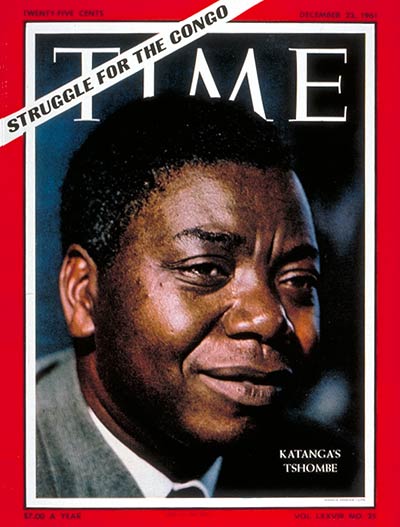
    Within weeks of Lumumba’s pivotal June 30, 1960 speech, tensions within the Congolese state’s numerous and disparate factions and its multiracial army began to spill over into the general population. In sectors of the Congolese army, many black soldiers sought the removal of white officers, who they viewed as a cruel reminder of the colonial past, and demanded increased pay, commensurate with a professional army defending a newly unified and free nation. Katanga Province soon seceded from the Democratic Republic of Congo, only weeks after its creation, with its leader, Moise Tshombe, painting a picture of Prime Minister Lumumba as a radical. The mineral-rich region in the southeastern reaches of the Congo contained vast stores of precious metals, from copper to gold to the uranium used to build the atomic bombs the United States dropped on Japan at the end of WWII. Diamonds were also in large supply in Katanga, making it a truly invaluable region in the eyes of the colonizers. Indeed, the U.S. Central Intelligence Agency, along with Belgian military and intelligence support, began to get its hands dirty in Central African developments. Having sent cash, supplies, and the tacit support of intervention should their anti-Lumumba puppets fail to secure their tenuous hold during the crisis, the Western powers were instrumental in assuring the Democratic Republic of Congo would be stillborn. To tilt the scales even more against Lumumba, all of the country’s gold reserves had been transferred to Brussels prior to freedom day. And Brussels would not allow their transfer to Leopoldville. (Newman, p. 156)


    III

    Hope Dims

    On July 9, 1960 Belgium began to airlift paratroopers into Congo. With the Belgian troops already there, this now amounted to almost four thousand men. The next day, the provisional president of Katanga, Moise Tshombe, requested Belgian troops to restore order. To counter this, Lumumba and Kasavubu requested to meet with Tshombe, but the rebel leader of Katanga refused to let their plane land there. (Newman, p. 157) The Congolese troops now began to open fire on the Belgians and other Europeans. The Belgians returned the fire and shot scores of Congolese. (Richard Mahoney, JFK: Ordeal in Africa, p. 36) Lumumba now asked for American help in stopping the insurgency and the attempt by Belgium to reinstate control. Eisenhower turned the request down. (Mahoney, p. 37) On July 13, 1960 Belgian troops occupied the airport at Leopoldville, and shortly after this, Lumumba severed relations with Brussels. One day later, Dag Hammarskjold, Secretary General of the United Nations, shepherded through a resolution to send UN troops to the area. Hammarskjold also called on Belgium to remove its forces from the theater. This was the first time the UN had taken on such a mission. Hammarskjold was trying to make good on his intent to make the United Nations a forum where newly liberated countries could let their voices be heard against the established powers of the world.

    But Hammarskjold had the deck stacked against him. The largest mining operation in Congo was Union Minière, a joint Belgian/British enterprise. When the struggle broke out, the Belgians now began to pay business taxes not to Congo, but to Tshombe and Katanga. The Russians had also expressed their disappointment in what Belgium and the United States had and had not done. Dulles used this proclamation to turn the conflict into a Cold War struggle. (Newman, pp. 158-59) Lumumba and Kasavubu did not make things easier for him; they sent Hammarskjold a written ultimatum that demanded the Belgians be removed by July 19th. Furthermore, if this did not occur, they would then turn to the USSR in order to accomplish the task. (See Foreign Relations of the United States, hereafter FRUS, Vol. 14, Document 32) As both Richard Mahoney and John Newman have noted, this demand sent the NSC into overdrive. It sealed the CIA’s objective of turning a nationalist independence movement into a Cold War crucible, and on July 19th, the American ambassador to Belgium sent the following cable to Allen Dulles:

    Lumumba has now maneuvered himself into position of opposition to the West, resistance to United Nations and increasing dependence on Soviet Union … Only prudent therefore, to plan on basis that Lumumba government threatens our vital interests in Congo and Africa generally. A principal objective of our political and diplomatic action must therefore be to destroy Lumumba government as now constituted, but at same time we must find or develop another horse to back which would be acceptable in rest of Africa and defensible against Soviet political attack. (FRUS, Vol. 14, Document 136)

    The problem with this cable as sent by diplomat William Burden—a Vanderbilt fortune heir who had bought his way into the State Department—was that almost every statement in it was false. As Mahoney has shown, Lumumba was actually still trying to communicate with the USA at this time. Similarly, he was not resistant to Hammarskjold; he just wanted the UN Chief to perform with alacrity. And he was not dependent on the USSR. But further, his request to Moscow for supplies would have been prevented if the United States had acceded to his earlier cable to Washington. Finally, Lumumba did not constitute any danger to American interests in Congo or Africa. In fact, Burden confabulated the first part of the cable in order to jump to the second part, namely that the USA should now be prepared to take terminal actions against both Lumumba and Congo and should begin to search for a new leader there.

    As Senator John Kennedy once noted, it was this kind of State Department performance—backing the imperial powers while discounting the hopes of the native people—that was ultimately self-defeating, as France had seen at Dien Bien Phu in 1954. There, as Senator Kennedy had said, we had wrongly allied ourselves with “the desperate effort of a French regime to hang on to the remnants of empire.” (Mahoney, p. 15) This is a major reason why, in 1958, Kennedy purchased one hundred copies of that prophetic novel about Vietnam, The Ugly American, and passed it out to each of his Senate colleagues. But, unfortunately for Lumumba and the Congo, Kennedy was not yet president.

    The Burden communiqué seemed to inspire Dulles to scale even further heights in smearing Lumumba as not just a communist, but in league with Egypt, the USSR and the communist party in Belgium. (FRUS, Vol. 14, Document 140). The allegation of Lumumba´s allegiance to Egypt was natural, since the CIA considered Gamel Abdel Nasser too leftist and, according to author William Blum, had contemplated overthrowing him in 1957. Nasser was also a pan-Arabist, and therefore it was claimed that the union of Nasser and Lumumba could unleash a Red Horde across Africa and the Middle East. This was all propaganda. As Jonathan Kwitny later wrote in his seminal essay on Lumumba, there was never any credible evidence that Lumumba was a communist, or that he had any interest in proselytizing that dogma either in Congo or across Africa. (Kwitny, Endless Enemies, p. 72) But Dulles was not going to let the minor matter of evidence get in his way. At this same NSC meeting of July 21st, he now said that with Lumumba “we were faced with a person who was a Castro or worse.” (FRUS, Vol. 14, Document 140) Since President Eisenhower had already approved a plan to overthrow Castro, and Dulles was privy to CIA plots to assassinate him, the CIA Director was now playing his ace in the hole. With that card, Dulles was now clearly in opposition to Hammarskjold.

    In the latter part of July, Lumumba—further contradicting the Burden memo—decided to visit America. He arrived in New York to speak with Hammarskjold, and then went to Washington DC. Eisenhower avoided meeting him there by staying out of town in Newport, Connecticut. Lumumba told Secretary of State Christian Herter that Tshombe did not represent the people of Katanga and that Belgium has essentially stolen Congo’s gold assets and left the country with no treasury. (Newman, p. 218) He therefore requested a loan. Herter dodged all these requests by saying that these would all be considered by Hammarskjold and the USA would have input into these decisions—all the while Dulles, as previously noted, was working at odds with the United Nations.

    Lumumba now expressed disagreement with Hammarskjold over the terms of UN intervention. He demanded that the UN expel all non-African troops and enter Katanga to stop its secession. (Newman, p. 221) If not, then he would turn to the USSR to do so. The Russian aid began arriving just after mid-August. This included military advisors and supplies, by both ship and plane. With this, all hope for Lumumba and Congo’s independence went down the drain. There was now open talk in cables about Congo experiencing a classic communist takeover, and how the United States must “take action to avoid another Cuba”, and how “the commie design now seems suddenly clear.” (Mahoney, p. 40; Newman p. 222)

    All of this culminated in the August 18th NSC meeting. This meeting consisted of advisors like Maurice Stans and Douglas Dillon turning Lumumba into some kind of Red Menace. And this kind of talk eventually got the best of President Eisenhower. As Newman informs us, the turnaround time for NSC steno notes was usually a day. At the most it would extend to 3-4 days. In this case, the transcription took one week. In 1975, fifteen years after the meeting, the transcriber Robert Johnson decided to explain why the draft memo of that meeting took so long. Johnson testified that during the meeting Eisenhower gave an order for the assassination of Lumumba. (Newman, p. 224) After checking with a superior, Johnson decided not to include the order in the transcript. This issue was then followed up on a week later at another meeting. But as Newman has discovered, the Church Committee interview notes of a participant who conveyed Eisenhower’s interest in following up his assassination request with covert action have now disappeared. Luckily, however, Newman copied the notes back in 1994 before they were removed, so we know that after one week to think about it, Eisenhower had not changed his mind on the issue. (Newman, p. 232)

    The day after the August 25th meeting, Allen Dulles composed what can only be called an assassination cable. It reads as follows:

    In high quarters here it is the clear-cut conclusion that if Lumumba continues to hold high office, the inevitable result will at best be chaos and at worst pave the way to communist takeover of the Congo with disastrous consequences for the prestige of the UN and for the interests of the free world generally. Consequently, we conclude that his removal must be urgent and prime objective and that under existing conditions this should be a high priority of our covert action.

    On the second page of the cable, Dulles authorizes the station chief in Leopoldville to spend up to $100,000 to carry out the operation without consulting headquarters about the specifics. On the same day Dulles sent the cable, Director of Plans Dick Bissell talked to the head of the CIA’s Africa Division. He told Bronson Tweedy to start thinking about “reviewing possibilities, assets, and discussing them with headquarters in detail.” (Newman, pp. 236-240)

    On September 5th, 1960, only months after Lumumba’s grand speech, the President of the Democratic Republic of Congo, Joseph Kasavubu, dismissed him on Radio Brazzaville, officially of his own volition, but in actuality, with the urging of his CIA and Belgian intelligence handlers. (Stephen Weismann, “Opening the Secret Files on Lumumba’s Murder,” Washington Post 07/21/2002)

    Kasavubu had been a reluctant supporter of Lumumba, and Western strategists were quick to play on his hesitations regarding Congolese independence. For months leading up to this announcement, UN Undersecretary in Charge of General Assembly, Andrew Cordier, later president of Columbia University, had been coaching the Congolese president, and carefully monitoring developments as he prodded him to fire Lumumba. (Carole Collins, “The Cold War Comes to Africa: Cordier and the 1960s Congo Crisis,” Journal of International Affairs, 6/22/1993) After this bold radio dismissal, Cordier ordered U.N. troops into the region, with orders to ostensibly shut down the airport and radio stations in Brazzaville. As Collins notes, however, there was a backhanded motive to this move:

    These actions primarily hurt Lumumba because only Kasavubu enjoyed access to radio facilities in the neighboring state of Brazzaville. Similarly, Kasavubu’s allies were allowed to use the ostensibly closed airport to travel into the Congolese interior to mobilize support for the president while Lumumba’s supporters were grounded. Near the end of his three-week stay in early September, Cordier authorized the United Nations to offer food and pay to the Congolese Army. This action allowed Mobutu—a one-time Lumumba aide who had been appointed chief-of-staff of the army by Kasavubu just days earlier—to win credit for paying the soldiers their past-due salaries, and to pave the way for his coup attempt a few days later. The combination of U.N. and U.S. support was pivotal for Mobutu’s subsequent seizure of power.

    Colonel Joseph Mobutu, another key figure in the tripartite struggle for indigenous Congolese independence, was, like Kasavubu, not altogether enthusiastic about Lumumba’s historic and sweeping proclamations of independence. Now the titular head of the Democratic Republic of Congo’s armed forces, after a recent promotion by Kasavubu, Mobutu was essentially an opportunist from all extant evidence. Carefully monitoring local political developments and the slow but steady marshaling of Western armed forces in the sweltering jungle basin, he hedged his risk and quietly stood poised to make his bold power play. As Brian Urquhart recalls from his station at Leopoldville on the night of Kasavubu’s announcement,

    Mobutu appeared once again at our headquarters, this time in uniform. He said he was tired and nervous and needed a quiet place to relax. Our office was already jammed with jittery suppliants, so I put him in my bedroom. At his request, I lent him a radio, adding half a bottle of whiskey to cheer him up. Some time later, I looked in on our uninvited guest. He seemed to be enjoying the whiskey all right, as Radio Leopoldville continued to play the cha cha cha. But then the music stopped, and a voice was heard to say that he was suspending the president, the prime minister and the parliament and taking over the country.

    ‘C’est moi!’ Mobutu exclaimed, triumphantly pointing to the radio. ‘C’est moi!’

    I don’t know when I have been more irritated. I told Mobutu that if he wanted to make a coup d’état, the place for him was in the streets with his followers, not listening to the radio under false pretenses in someone else’s bedroom. We then threw him out.” (Brian Urquhart, “Mobutu and Tshombe: Two Congolese Rogues,” UN News Character Sketches)

    By the end of September, 1960, Mobutu and his remaining loyal soldiers and officers from the former Belgian Congo Army became the western Congo basin’s de facto functioning political body. This had been done in agreement with the Leopoldville CIA station chief, Larry Devlin. Devlin had also authorized Mobutu to eliminate Lumumba and had guaranteed him a large sum in French francs to do so. (Newman, p. 268) To the east, Lumumba’s deputy, Antoine Gizenga, assumed a provisional role as the leader of the short-lived Stanleyville government. To the south, Tshombe still held onto the Katanga and South Kasai provinces. Patrice Lumumba himself remained under house arrest, having been detained on September 16th by U.N. peacekeeping troops, ostensibly for his own safety.

    But the CIA had still not given up. In September, the Agency had three agents in Congo and their shared mission was to assassinate Lumumba. These were contract assassins QJ/WIN, WIROGUE, and the CIA headquarters chemist Sidney Gottlieb. Gottlieb was to prepare a toxic agent and deliver it to Congo. From there, Devlin was to recruit a Lumumba aide to insert it in the prime minister’s toothpaste. If that failed, Devlin was also trying to recruit an assassin to break into the safe haven the UN had provided for Lumumba and simply shoot him. These were in addition to Devlin’s agreement with Mobutu. Therefore, by the end of September, the CIA had five different methods on hand to kill Lumumba. But at the end of the month, Tweedy cabled Devlin that they must choose a plot that would conceal America’s role. (Newman, p. 268)


    IV

    “Mad Mike”

    To detail the full sweep of the Congo Crisis and its myriad twists and betrayals is beyond the scope of this article, but suffice to say, after Tshombe’s secession of Katanga province and Mobutu’s and Kasavubu’s betrayals of Lumumba, the prime minister was surrounded by hostile forces, and desperately sought outside help. Among these were the United States, which categorically rejected his pleas, and the Soviet Union, which agreed, at least ideologically, with his fight for freedom. But they were initially reluctant to commit armed forces for fear of escalating the regional conflict into a larger strategic battle with the West.

    President Tshombe, who still held onto Katanga in January 1961, had the most to lose and the likeliest chance of receiving outside help, given his region’s enormous natural resources. One of his initial strategies involved creating a group of 700 to 800 foreign mercenaries, both for personal protection and as a stopgap unit to quell any potential attacks from neighboring provinces on Katanga. Belgians, Rhodesians, South Africans, and French nationals answered the call; for a decent wage, they could partake in a quixotic adventure in the Congo, led by their much-loved and no-nonsense Thomas Michael “Mad Mike” Hoare, a retired WWII captain who promoted himself to major upon answering Tshombe’s call.

    Having served in the Second World War as an infantryman with the Royal Army’s London Rifles, Hoare was a veteran of the North African and Italian theaters of combat. After a brief stint in the peacetime army, he relocated to warmer climates, finally settling down in Durban, South Africa in the 1950s. Moonlighting as a safari guide and a used car salesman, he was looking for something new when he heard from a close friend that Tshombe was looking for mercenaries. Hoare flew to Katanga, and quickly placed an ad in a local newspaper. Within weeks he had mustered a few dozen able-bodied men. Among their colorful ranks were an ex-Wehrmacht soldier who flaunted his iron cross medal on deployments, former British and Australian soldiers from WWII, local Katangese soldiers trying to protect their homesteads and families, members of the former Belgian occupation and security forces, and a few former South African police officers. Hoare was quick to note that his men were seriously lacking in actual battlefield experience, with many faking feats of valor and claiming decorations and accomplishments that, when investigated, more often than not proved fictional. Through a punishing physical training regimen and a cursory demonstration of fundamental battlefield tactics and command protocols, “Mad Mike” whipped his infamous “4 Commando” (later 5 Commando) into basic shape by the early months of 1961, with his headquarters situated in the provincial capital of Elizabethville. He and a former Royal Army officer, Alistair Wicks, each led a company of sixty men, with Hoare in nominal command of the two units. (Mike Hoare, The Road to Katanga: A Congo Mercenary’s Personal Memoir)

    Initially tasked with securing Elizabethville against raiding parties of the local Baluba tribe, Hoare’s account is half Arthur Conan Doyle novel, half military memoir, but always gripping:

    The column had bogged down in the heart of enemy territory. The track had collapsed after days of torrential rains and more than twenty trucks had sunk into the mud up to their axles. We were surrounded by an unseen army of Baluba warriors, a tough and merciless foe. That day we had lost one of my men from a wound inflicted by a poisoned arrow. He had lasted less than sixty minutes and was one of my first casualties. Morale among my Katangese drivers was at rock bottom. My unit, 4 Commando, which was escorting the column, was on edge, several of the men down with malaria, the remainder near exhaustion from lack of sleep. (Hoare, 4)

    Initially tasked with supporting transport columns carrying food and supplies to the beleaguered Belgian security forces fighting in Katanga, Hoare’s 4 Commando eventually earned the trust of the Elizabethville government enough to serve as a small but effective personal army for Tshombe, who funded the adventure through the previously mentioned Union Minière, an enormously rich mining conglomerate based in Katanga. With access to nearly unlimited ammunition, modern Belgian assault rifles and belt-fed machine guns, and a motley assortment of military jeeps and half-ton trucks, Hoare’s group of foreign legionnaires was a truly frightening sight for an indigenous uprising armed with 19th-century shotguns, bows and arrows, and a mystical courage imbued in them by local witch doctors. For many of the Baluba, who were 4 Commando’s principal opponents in the early days of his deployment, a ritual dance, along with the ceremonial drinking of beer and smoking of marijuana, combined with the soothing rhythmic words of their shamans, steeled them against the commandos. Hoare noted that, while the notion that Western bullets passed through the Baluba was obviously absurd, their belief in this was fueled only in part by wishful thinking and mysticism; in previous uprisings before the declaration of Congolese independence, Belgian security forces would often fire blanks into crowds of Balubas who were marshaling to rebel.

    A man of average height and wiry build, with slicked-back blonde hair and sharp features, Thomas Michael Hoare was the spitting image of the great white hunter, which, as mentioned before, he once was. With his decorative beret, rolled up sleeves, and ubiquitous radio receiver in hand, he seemed archaic even in the mid 1960s. And yet this old-fashioned, Rule Britannia mentality was probably what saved him and his men’s lives in the depths of the jungle. Under no illusions regarding the challenges arrayed against him—especially the health risks presented by sustained deployments in the jungle without modern medical facilities—he was equally curious, in that colonial way, about the innate differences between Europeans and sub-Saharan Africans. While still under the same spell as Hegel, Kipling, Spencer, and other proponents of racial hierarchical thinking, to his credit, “Mad Mike” was more open to the African experience, if solely for practical considerations. Like an integrated unit in Vietnam, or a professional football team whose members must put their differences aside, if only temporarily, 4 Commando ultimately served, like the pirate ships of the 16th Century, as a strange meeting place for people of all walks of life. Hoare exercised executive control over the expedition, and in the case of a man who murdered a young Congolese boy after numerous other infractions, was not averse to summary execution. Another soldier under his command, who had raped and killed a local Katangese woman, was lined up in front of the trucks on the side of a house; Hoare knew the man was a semi-professional soccer player back in Europe, and saw fit to pull out his pistol and personally shoot off both of the man’s big toes.

    To these ends, throughout the early months following Katanga’s secession, Hoare’s motley crew slogged through the rugged Katanga backwoods, driving through monsoon downpours and blistering heat, setting up camp at night in some of the world’s most desolate regions, firing bright green illuminating flares at the sounds of potential raiding parties gathering in the jungle, but more often than not, firing blindly at imagined armies where only wildlife and rustling bush existed. Their first real encounter with the enemy, ironically, was an armed standoff in the village of Nyunga with U.N. peacekeeping troops. Having been placed there at the behest of the Feb. 21, 1961 U.N. Security Council decision to prevent a full-blown Congolese civil war, a detachment of Malayan soldiers with a platoon of armored cars ordered Hoare and his men to stand down. In the night, while the two forces stealthily checked their weapons and sandbagged their positions across the town square, Hoare’s radioman received a report from Albertville HQ that the U.N was very likely going to arrest 4 Commando and intern them in Leopoldville; all Belgian and foreign mercenaries, under the U.N. Security Council’s resolution, were considered hostile combatants. After a brief meeting with the Malayan colonel in charge of the U.N. detachment, Hoare had to think on his feet. He told the officer he would briefly consult with his men and try to forgo the inevitable and likely suicidal shootout with a heavily armed professional army. After walking across the town square and debriefing his men in his makeshift headquarters, seven of which wanted to surrender, he ordered a breakout. Those wishing to avoid capture would cut a mad dash across town as the others approached the checkpoint to surrender. They would scatter and rush through the jungle to a prearranged rendezvous point a few miles away and take it from there. Hoare checked his compass, grabbed his rifle, blew his whistle and they were off.


    V

    Plausible Deniability

    As long as Lumumba stayed in his UN-guarded safe haven he was relatively secure from any attempt by Mobutu to arrest him, for the simple reason that Hammarskjold’s representative would not allow the warrant to be served. Lumumba had survived several futile attempts by the CIA’s Executive Action program to eliminate him. For example, QJWIN and WIROGUE had been recruited through the CIA’s Staff D, which came under the control of William Harvey in 1960. Director of Plans Dick Bissell had himself offered the job of case officer on the operation to at least two agents and they both turned it down. But the second one, Justin O’Donnell, did agree to run an operation to politically neutralize Lumumba. The opportunity came when, under intense lobbying by America and England, the UN decided to seat Kasavubu’s delegation. This occurred just when Lumumba’s following was gaining strength in Congo. So Lumumba decided to arrange his escape to Stanleyville, his political base on the evening of November 27, 1960. (Mahoney, p. 55)

    Devlin now conferred with Mobutu to plot the paths that Lumumba would have to take in order to make it to Stanleyville. The CIA helped Mobutu set up checkpoints along river crossings and to block certain roads. (Mahoney, p. 56) On November 30th, QJ/WIN offered to go to Stanleyville to kill Lumumba himself. But within 24 hours of that offer, Lumumba was captured in the rebel province of Kasai. (Newman, p. 295) Fearing that killing him on their own soil would provoke a full-blown uprising, his captors decided to send him to his certain torture and death at the hands of the rulers of Katanga province. He was moved from a temporary holding barracks in Thysville to Elizabethville, the capital of Katanga, where his previous colonizers, the Belgians, were waiting with their close friend and president, Moise Tshombe. Having contemplated killing him through a tube of poisoned toothpaste only months earlier, the CIA was relieved at news of his capture and subsequent murder, which they helped orchestrate. Indeed, Sydney Gottlieb, the American witch doctor who pioneered many of the Central Intelligence Agency’s lethal potions and covert execution methods for ZR/RIFLE (the codename of the central assassination arm of the CIA), had only weeks earlier flown in from Europe to personally deliver the goods. (NY Times 12/11/2008)

    After a kangaroo court and short military trial which accused him of inciting a revolt, Lumumba, along with his two escaped aides who had all been beaten and sadistically abused throughout the night, was lined up against a tree and shot by a Belgian firing squad. President Tshombe personally oversaw the execution. After killing his two supporters, the Belgians and their Katangese paramilitary officers dumped them in shallow graves, later deciding to disinter them, dissolve their bodies in sulphuric acid, and grind their bones into a fine powder to forever erase them from history. When the sulphuric acid ran out, what was left of the corpses was set afire. (Newman, p. 296) This happened three days before John Kennedy’s inauguration. The news of his death was kept from Kennedy for almost one month. Whether this was by accident or by design, it is a fact that once Kennedy was in office his policy drastically altered Eisenhower’s. And it would have favored Lumumba.

    The murder of Patrice Lumumba made it much easier for a continuation of neocolonial policies in the Democratic Republic of Congo (DRC). In one fell swoop it laid waste to the nascent progressive hopes of a people essentially freed from over a hundred years of brutal colonial slavery, and paved the way for the rise of figures like Joseph Mobutu, who would later rule the Congo until 1996, becoming a billionaire and a brutal despot. Mobutu was a great friend of Washington, a tremendous ally to the CIA, and the bane of African nationalists seeking the practical, achievable vision of figures like Lumumba, who could have stood as a beacon of hope for a Pan-African unity of purpose against their white European overlords in this time of turmoil and decolonization. With the murder only months later of U.N. Secretary General Dag Hammarskjold—and Susan Williams’ book proves it was a murder—the last best measures for preventing a downward spiral of the DRC were lost. When his airplane, engulfed in flames, crashed into the jungle outside Ndola airport as he was attempting to land and begin ceasefire talks, one of the few honest statesman from the European power structure who was truly concerned about the fate of the Congo was lost. As Richard Mahoney notes in his fine book, JFK: Ordeal in Africa, Kennedy made a strong effort to try to keep Congo independent after Hammarskjold’s death. (See further Dodd and Dulles vs Kennedy in Africa) For as Greg Poulgrain revealed in The Incubus of Intervention, Kennedy and Hammarskjold had made a secret alliance to do all they could to keep Congo and Indonesia free from imperialism. Kennedy did his best to maintain that pledge after Hammarskjold was assassinated. (See Hammarskjold and Kennedy vs The Power Elite)


    Epilogue: Why Congo Matters Today

    As Jonathan Kwitny noted in Endless Enemies, after his death Lumumba became a hero in Africa. One could find his name affixed to avenues, schools, squares and parks. As Kwitny wrote: “Lumumba is a hero to Africans not because he promoted socialism, which he didn’t, but because he resisted foreign intervention. He stood up to outsiders, if only by getting himself killed.” (Kwitny, p. 72)

    But there is also a larger, more epochal aspect to what happened to Lumumba and Congo. This has to do with being a historical marker for Africa as it came out of the second Age of Colonialism. Again, Kwitny eloquently summarizes it:

    The democratic experiment had no example in Africa, and badly needed one. So perhaps the sorriest and the most unnecessary blight on the record of this new era is that the precedent for it all, the very first coup in postcolonial African history, the very first political assassination, and the very first junking of a legally constituted democratic system, all took place in a major country and were all instigated by the United States of America. It’s a sad situation when people are left to learn their ‘democracy’ from the Union of Soviet Socialist Republics. (Kwitny, p. 75)

    One cannot understand why the so-called “Third World” remains just that if one does not confront the very harsh realities of episodes from mid-century U.S. foreign policy like the CIA’s attempts to kill Patrice Lumumba. Though mainstream media outlets eventually admit to our sad and tragic “mistakes” made in the distant past and point to “startling revelations” about this and that player and agency involved, they fail to admit the obvious: The United States, for its entire post-WWII history, up to the publication of this article, has almost entirely suppressed, held-back, or outright destroyed freedom-seeking, nationalistic movements on a global scale. It does this through a variety of means, be they the actual targeted assassination of a movement’s leader, the depreciation of a nation’s currency, the overthrow of a regime through a proxy army or CIA-backed coup, or a traditional military invasion.

    This is a painful but necessary fact for its citizens to internalize, seeing as it runs counter to almost everything we are told about America in school, on the radio, or in the news. It is acceptable to critique the power structure insofar as that critique points to a technical glitch, a rogue personality, or a tactical error, as in the mainstream media´s common admission now that the Iraq War was a “mistake.” There are no mistakes at that level. The mistake was intended to be a mistake. Destabilization of a region, like the Middle East, or in our case, central Africa, is extremely helpful to people who seek to benefit from chaos. It was enormously profitable for mining interests in the Congo that the region fell into a perpetual civil war or under a brutal dictatorship. It was equally lucrative for hundreds of thousands of Indonesians to be slaughtered by Suharto’s death squads, seeing as parts of his nation contained hundreds of billions of dollars’ worth of gold veins. It was a strategic victory for nations like Libya, Iraq, Afghanistan, and others on the Project for a New American Century’s list to be decimated since this opened the way for greater geopolitical leverage against other superpowers like Russia and China, while subtly flooding the southern reaches of Europe with refugees, and spawning groups like ISIS and ISIL. What a more honest assessment of U.S. foreign policy would note is that the United States, as Martin Luther King famously noted, still remains the “greatest purveyor of violence in the world,” and yet the average citizen within its borders is blissfully unaware of this fact; and is equally unaware that it was a statement like that which likely got King killed by the very government he sought to change. Like Lumumba, figures like Dr. King, President Kennedy, and Dag Hammarskjold paid the ultimate price for seeking to effect change in the developing world and at home in America’s impoverished communities. And it is this sinister, plausibly deniable ugliness of the United States that is largely to blame.


    Editor’s note: the following feature appeared in 2016, and speaks directly to the theme of the Congo’s (and Africa’s) continuing relevance today.

    How the World Runs on Looting the Congo


    Addendum (05.01.2018)

    A new document courtesy of David Josephs.

    This document indicates just how involved Kennedy was in the colossal Congo crisis. He is actually leading the UN effort, not the other way around. After the murder of Hammarskjold, he appears to have taken over the Secretary General’s initiative there as the United Nations commitment was slackening.

    Or, click here: RIF 176-10036-10001

  • Hammarskjold and Kennedy vs. The Power Elite

    Hammarskjold and Kennedy vs. The Power Elite


    indonesia header


    As many CTKA readers and observers of JFK symposiums will know, since the 2013 Cyril Wecht conference in Pittsburgh, one of the topics I have been researching and talking about is John F. Kennedy’s reformist foreign policy. To some people this seemed kind of pointless. After all, in virtually every JFK assassination book Kennedy’s foreign policy boiled down to Vietnam and Cuba. What else was there?

    Quite a lot. What was new in my speech mostly came from Philip Muehlenbeck’s volume, Betting on the Africans, which had been published the year before. (Click here for a review) Later, I discovered Robert Rakove’s book, Kennedy, Johnson and the Nonaligned World. That book serves as a fine compliment to Muehlenbeck. (Click here for the CTKA review) I used much of the Rakove material to present my altered versions of the 2013 presentation at both the JFK Lancer in 2013 and 2014 and the AARC Conference in 2014.

    These two books form a thematic line that extends back to Richard Mahoney’s landmark volume JFK: Ordeal in Africa. That book was a trailblazing effort in the field of excavating what Kennedy’s foreign policy really was, and where its intellectual provenance came from. It was published in 1983. Even though it bore the Oxford University Press imprimatur, it had little influence. It virtually had little or no impact in the categories of Kennedy biography, studies of the Kennedy presidency, or the JFK assassination field. Which, in retrospect, is stunning. Because what Mahoney did in that book was revolutionary. In a systematic way, he traced the beginnings of President Kennedy’s foreign policy ideas. He did this with a wealth of data he garnered from weeks spent at the JFK Library. He used this ignored information to show how Kennedy’s ideas on the east/west struggles in the Third World originated, why they were different than President Eisenhower’s, and how they manifested themselves once he became president. No other book I had read elucidated this progress in such a detailed and rigorous way. In fact, when I was done with the book I actually felt like I had been snookered by relying on historians like Herbert Parmet, William Manchester, and Richard Reeves for my information on Kennedy’s presidency and foreign policy. Mahoney made them look like hacks.

    It became clear to me that there was, quite literally, a war going on. And as unsatisfactory as the Parmet, Reeves, and Manchester books were (with Manchester I am referring to his presidential profile book Portrait of a President) these would be superseded by even worse JFK books later: biographies by John H. Davis, Robert Dallek, Thomas Reeves, and worst of all—perhaps the worst imaginable—Sy Hersh’s pile of rubbish The Dark Side of Camelot.

    In 2008 Jim Douglass made a clean break with all the calculated trash. His fine volume, JFK and the Unspeakable, has become something of a classic. It has actually crossed over and is sourced in books outside strictly the JFK assassination or JFK presidency fields. I wrote a very approving essay about Jim’s book. (Click here)

    Douglass did an exceedingly good job in elucidating Kennedy’s Vietnam and Cuba policies between the covers of one book. But with the new scholarship by Rakove and Muehlenbeck, the Douglass book seems rather narrowly focused today. And with the even newer book by Greg Poulgrain, The Incubus of Intervention (see my recent review), we can now add Indonesia to Africa and the Middle East as objects of Kennedy’s reformist foreign policy. In fact, Douglass is on to this. He actually pointed out that I should read and review the Poulgrain book.

    Four trailblazing books on Kennedy’s foreign policy

    But the Kennedy Enlightment really began with Mahoney. And although his book dealt with three African trouble spots, the majority of the book was focused on the colossal Congo crisis. Which, like other problems, Kennedy inherited from President Eisenhower. As we learn more about the Congo conflagration, we begin to see how large and complex that struggle was. Large in the sense that, in addition to the UN, several nations were directly involved. Complex in the sense that there were subterranean agendas at work. For instance, although England and France ostensibly and officially supported the United Nations effort there, they were actually subverting it on the ground through third party agents. In fact, when one studies the seething cauldron that was the Congo crisis, there are quite a few villains involved. There are only three heroes I can name: Patrice Lumumba, Dag Hammarskjold and John F. Kennedy. All three were murdered while the struggle was in process. Their deaths allowed the democratic experiment in Congo to fail spectacularly. Ultimately, it allowed one form of blatant exploitation, colonialism, to be replaced by another, imperialism.

    II

    To sketch in the background: In 1960, Belgium was going to leave Congo after brutally colonizing the country for generations. But their plan was to leave so abruptly that the nation would collapse inwardly for lack of leadership. Belgium would then return in order to protect the Belgian assets still there. As we shall see, the CIA was in agreement on this. Especially when Patrice Lumumba was democratically elected as Prime Minister. As Jonathan Kwitny noted, Lumumba was the first democratically elected leader of an African nation emerging from the long era of European colonialism. Ideally, Lumumba could have set a precedent. That did not happen. And the reason it did not happen was largely because of outside interference.

    Within days of June 30th, Congo independence, the Belgian plan began to work. Rioting took place and Belgian soldiers began to fire into crowds. On July 11th, the regional governor of the immensely wealthy Katanga province, Moise Tshombe, declared his state was seceding from Congo. Tshombe was egged on by the Belgians and British who wanted mineral rights. In exchange, they promised him military aid and mercenaries if Lumumba attacked Katanga. (Kwitny, p. 55)

    As Kwitny notes in Endless Enemies, the CIA and the National Security Council did not like Lumumba. After all, he had the gumption to ask for aid in kicking out the Belgians, who were now parachuting troops back in. Lumumba asked for aid from the USA, the USSR and the United Nations. The first declined, the second seemed amenable to sending arms, and Secretary General Dag Hammarskjold decided to send in a UN expeditionary force. The fact that Lumumba went to the USSR was enough for CIA station chief Larry Devlin to portray him as a communist. On August 18th he wired DCI Allen Dulles that Congo was experiencing a classic communist takeover. He then added that anti-West forces were rapidly gaining power and Congo was on the verge of becoming another Cuba. (ibid, p. 59)

    This was preposterous. There was no “anti-West force” build-up in Congo. In fact, England and Belgium were sending in troops and mercenaries. These were later joined by the French, who also wanted a stake in Katanga. But Devlin concluded by saying that Lumumba should be “replaced” by a pro-Western group. (ibid) This is just days after Lumumba visited the USA asking for help to expel the Belgians. Ambassador Clare Timberlake contributed the same kind of utter distortion. He told Washington that Lumumba wanted troops in order to expel the Belgians and then nationalize all industry and property. Lumumba would then invite communist bloc experts in to run the economy. (ibid, pp. 59-60)

    The Devlin/Timberlake cables had their intended impact. Within 48 hours DCI Allen Dulles and President Eisenhower agreed that Lumumba had to be neutralized. (ibid, p. 62) The CIA took two tracks to achieve this aim. First, Timberlake and his deputy Frank Carlucci tried to get President Kasavubu to stage a coup. He said no. So Devlin went to military colonel Josef Mobutu and asked him to eliminate Lumumba. In September, Kasavubu finally relented and dismissed Lumumba. Lumumba then said he was dismissing Kasavubu. With a Mexican standoff holding, Devlin then went to Mobutu and asked him to arrest Lumumba. But the UN emissary there, Rajeshwar Dayal, prevented the action. And Lumumba now became somewhat of a prisoner in his own home. Kasavubu then dissolved parliament, which had backed Lumumba. (p. 66) The second track of the CIA’s program now kicked in: assassination plots to kill Lumumba. (ibid, p. 67)

    As the reader can see, in the space of two months, the Americans and Europeans had pretty much destroyed whatever hope there was for the first democratic nation to emerge and survive in post-colonial Africa. In fact, one could fairly say that they strangled African democracy in the cradle. From here, it got worse. Devlin now wanted Mobutu to eliminate not just Lumumba, but his deputy Antoine Gizenga. (ibid) But Dayal and Hammarskjold kept him protected also.

    When Mobutu’s troops began to battle with the UN mission, Lumumba made an impulsive, perhaps reckless, decision. He escaped from Dayal’s protection and tried to flee to Stanleyville, his political base. With Devlin’s help, Mobutu captured him. And after severely beating him, returned him to the capital of Leopoldville.

    Three things then happened that sealed Lumumba’s fate. First, Russian planes carrying supplies and arms started arriving in Stanleyville. Second, two CIA assassins also arrived on the scene. And third, John F. Kennedy was about to be inaugurated. Because of these factors, , instead of having Lumumba killed by the CIA agents, or risk a more sympathetic policy under Kennedy, on January 13, 1961, Mobutu had Lumumba shipped to Moise Tshombe in Katanga. As Devlin must have known, this meant he would be killed soon. Four days later, he was. (ibid, p. 69)

    The information about his death was kept from President Kennedy for almost a month. He did not learn about Lumumba’s murder until February 13th. He learned of it on a phone call with UN Ambassador Adlai Stevenson. White House photographer Jacques Lowe captured the moment in a crystalline photograph:

    Kennedy hears of Lumumba’s murder from Adlai Stevenson
    (photo by Jacques Lowe)

    Perhaps no photo from the Kennedy presidency summarizes who Kennedy was, and how he differed from what preceded him and what came after him, than this picture.

    III

    In the wake of Lumumba’s murder, Dag Hammarskjold was not about to give up. Secretary General Hammarskjold was from Sweden and his family had a long history in public service. His father had been a regional governor and then Sweden’s prime minister. Two of his older brothers had also spent time in government service, one as a governor and the other working with the League of Nations. As an economist, Dag worked for the Finance Ministry and coined the term “planned economy”. He and his brother Bo helped launch the Swedish welfare state.

    Dag Hammarskjold
    August 27, 1960

    Hammarskjold first worked with the Swedish delegation at the United Nations. He then, rather unexpectedly, was voted its second Secretary General in 1953. As writer Susan Williams notes, his ascendancy coincided with the beginning of the de-colonization process in Africa and Asia. By 1960, 47 of the 100 UN members came from this Afro/Asia bloc. (Williams, Who Killed Hammarskjold? p. 23) In 1960 alone, 16 African nations had joined the UN. Hammarskjold decided to tour the continent in late 1959. He had harsh words for the apartheid regime of the Union of South Africa. Therefore, he became an enemy of white supremacists on that continent. And with those nations who still held colonies there, or were trying to unduly influence their former colonies e.g. France, England, Portugal and Belgium. (ibid, p. 24)

    Because of his Swedish background and his work in civil service and planned economies, Hammarskjold had a special sensitivity to these new and awakening nations. He understood that, individually, these states felt weak and isolated. But as members of the UN, they felt part of a world community that could elevate their stature. Or, as he put it, the function of the UN was to protect the weak against the strong. (ibid)

    Hammarskjold suspected what the Belgian secret agenda was before they pulled out of Congo. Therefore he sent Ralph Bunche, part of the American delegation, there as independence was enacted. King Baudouin of Belgium was there for the official proceeding. He actually praised what Belgium had done for Congo and specifically singled out Leopold II for praise. Which would be like giving credit to John Calhoun in the struggle for civil rights for Black Americans. Lumumba felt he had to respond. He said, words to the effect, “we are your monkeys no more”. (Williams, p. 31)

    There can be little doubt that tensions began to build because of this exchange. Also because, in the ranks of the army, Belgians still remained in command centers. When violence broke out, Lumumba blamed it on the Belgians in the military and accused the former mother country of trying to recolonize Congo—which was accurate. As civilian Belgians tried to leave the country, Baudouin sent in troops to protect them. A week later, Tshombe announced the Katanga secession. Katanga contained about 60% of Congo’s mineral wealth. Tshombe was clearly in alliance with the giant mining conglomerate Union Miniere, a Belgian/British transnational. For immediately after this announcement, the company said it would not pay its corporate taxes to the Congo capital of Leopoldville anymore. It would now pay them to Elisabethville, the capital of Katanga. (ibid, p. 33) The company also extended Tshombe a large loan. Further, Belgian advisors began to flock to Katanga as well as British mercenaries from nearby Rhodesia. Congo was going to be stillborn.

    Lumumba now turned to Hammarskjold for help. The Secretary General immediately passed UN Resolution 143. This demanded that the Belgians leave Congo and promised assistance to Lumumba until the nation was able to defend itself. Within 48 hours, there were 3,500 UN troops on the ground in Congo. Although he was now being accused of acting too late by the USSR, Hammarskjold proclaimed he would not recognize either Mobutu or Kasavubu as the leader of Congo. (Williams, p. 39) But when Lumumba was murdered, the Russians again criticized the Secretary General for doing too little, too late.

    Hammarskjold replied by passing resolution 161. There were now 15,000 UN troops in Congo, they were now allowed to use military force. The mission was to expel all foreign troops, and Parliament would be reconvened under UN protection. The Secretary General clearly saw Congo as a defining moment for both the UN and his leadership. (ibid, p. 41)

    The UN commander on the ground, Conor Cruise O’Brien, demanded Tshombe step down and Katanga rejoin Congo. To strengthen himself, Tshombe now recruited French veterans of the OAS, the terrorist group of army veterans who had split off from French president Charles DeGaulle over Algerian independence.

    Moise Tshombe
    December 22, 1961

    In the face of this, O’Brien launched two offensives into Katanga. The first was called Operation Rumpunch, and the second was named Operation Morthor. The first operation was quite successful, the second was not. About half of Elisabethville was still under Tshombe’s control. (ibid, p. 49) By this time, the British premier of the African Federation—Roy Welensky— was clearly favoring Katanga, as was the Union of South Africa. Welensky, working with his colleague on African Affairs, Baron Cuthbert Alport, was also secretly supplying mercenaries from Rhodesia to Tshombe. (ibid, p. 51)

    As a result of this secret policy, Welensky now shifted troops into Ndola, the main airport for Rhodesia, which was just a few miles from the border with Congo. Welensky shipped in food, supplies and arms from as far away as Australia. (ibid, p. 53) Rhetorically, Welensky went as far as to compare the UN troops in Congo to the Nazis.

    This information is important. Since we are about to discuss the second high profile murder over the Congo Crisis: that of Dag Hammarskjold. Today I, and many others, call it a murder, not a suspicious death. The state of the evidence seems to me to clearly denote that this was a planned assassination. After considering some of the work of Susan Williams and others, the reader will likely agree.

    IV

    Hammarskjold flew into Congo on September 13, 1961. He was surprised to hear about Operation Morthor, since he maintained he had not authorized it. While there, the Battle of Jadotville began. This was fought between a company of Irish UN troops and mercenaries employed by Tshombe. During the battle, Tshombe requested a meeting with Hammarskjold.

    This was to occur on September 17th, in Ndola, a city in British controlled Rhodesia. Tshombe requested no reporters be alerted. But, Baron Alport was there. He stationed himself in the airport manager’s office, right below the control tower. As previously stated, also on hand was a temporary arm of the Rhodesian Ministry of Defense set up by Welensky. Hammarskjold was to arrive aboard a DC6 piloted by a Swede. Below him, on the runway, were 18 Rhodesian planes and two American DC3’s. (ibid, p. 68) In referring to the last, a Rhodesian air squadron leader told the UN Commission that there were “underhand things going on” at the airport, “with strange aircraft coming in, planes without flight plans and so on. There were American planes sitting on the airfield with engines running, likely transmitting messages.” (Lisa Pease, “Midnight in the Congo”, Probe, Vol. 6 No. 3 p. 20) Further, another witness said the American planes were full of sophisticated communications equipment. (Williams, p. 188)

    Hammarskjold’s flight never landed at Ndola. And there is no tape recording of the approach of the plane. But there were notes kept. According to the written record, the last message from the plane was that the pilot was descending from 16,000 to 6,000 feet. (Williams, p. 70) At this point, Ndola lost contact with the plane. Because it was around midnight, no search party was sent out. Alport made a comment that the plane must have landed elsewhere. He then suggested the control room staff retire at around 3:00 AM. Yet, there were reports being filed around this time that several witnesses had independently seen a large ball of fire go off in the sky in the nearby vicinity. (ibid, p. 72) At 7 AM, a UN plane flew into Ndola to begin a search for Hammarskjold and the 15 other lost passengers of the Albertina. The pilot was arrested upon touching down. (ibid, p. 73)

    The airport manager did not return until 9 AM, three hours after dawn. The search did not start until an hour later. The wreckage of the plane was found at about 3 PM, eight miles from the airport. There was one survivor, Harold Julien. He would pass away six days later. But not before he said the plane was in flames before it hit the ground. Further, the plane was determined to be under power, and the landing gear was lowered. Although all the passengers were severely burned, Hammarskjold was not—at all. Further, in something that simply cannot be explained, there was a playing card stuffed into his ruffled tie. Although it is not possible to determine what the card is from the photos, a witness at the scene said it was the ace of spades. (Williams, p. 7) Another oddity, Alport ended up with Hammarskjold’s briefcase. (ibid, p. 85) These anomalies suggest someone was at the crash scene before the official first responders arrived. As we shall see, the evidence for this is more than circumstantial.

    Two of the security guards on the plane had bullets in their bodies. This was officially explained by saying that the heat of the crash had caused ammunition to explode. But a Swedish expert who had done experiments on this topic said that, even if this were so, the projectiles would not have enough force to penetrate the bodies. (See Pease, and Williams, p. 6) What makes this even more fascinating is the testimony of Major General Bjorn Egge. Egge had been the head of the UN military information mission in Congo. He had flown to the Ndola hospital, where the victims had been transported. When he saw Hammarskjold’s body he noticed what appeared to be a bullet hole in his forehead. (Williams, p. 5) That hole is not apparent in the autopsy photos Williams saw. But when the photos were shown to forensic experts, two of them said it appeared the photo had been retouched at the forehead. (ibid, p. 9)

    Let us now consider sole survivor Julien’s crucial testimony: that the plane was in flames before it hit the ground. (Williams, p. 94) There is much evidence to corroborate this key point. Charles Southall was a Navy intelligence analyst in 1961. At the time, he was attached to the NSA base on the island of Cyprus. On the night of the crash, he was at home. His commanding officer called him and said he should come out and listen to a recorded communication intercept he had captured. This was the only time such a thing happened while he was in Cyprus, so Southall did so. He said that, on the recording, he heard a pilot say he was descending on the DC6. He then heard what he thought was the sound of a cannon firing. Then, the pilot said, “I’ve hit it…It’s going down.” (Williams, p. 143) Someone in the office recognized the pilot’s voice, and the NSA had a dossier on him. When the Swedish government reopened the case in 1992, Southall tried to communicate with them through the American State Department. But the Swedes found out about him through an independent source and he was interviewed more than once. (ibid, p. 147)

    Southall’s testimony is echoed by the words of Swedish flying instructor Tore Meijer. He was stationed as a flight teacher to the Ethiopian Air Force in 1961. On the night of the crash, he was listening to a short wave radio he had just bought. Therefore, he was testing various frequencies. (ibid, p. 152) He picked up a conversation that included mention of the Ndola airport. In his own words, he then described the following: “The voice says, he’s approaching the airport, he’s turning—he’s leveling—where the pilot is approaching the actual landing strip. Then I hear the same voice saying, “another plane is approaching from behind, what is that?” The voice then said, “He breaks off the plan…he continues.” Meijer said he lost the contact at this point.

    The idea that another plane intercepted Hammarskjold’s is corroborated by at least seven witnesses on the ground. (Pease, p. 20) For example, Dickson Buleni said he saw a smaller plane above the larger plane dropping something that looked like fire on it. (Williams, p. 117) This testimony is similar to that of Timothy Kankasa and his wife. (ibid, pp. 93, 122) But the Kankasas revealed something that may be even more interesting. They said that the crash was not initially discovered at around 3 PM on the 18th. Timothy and a few other residents of Twapia Township discovered it about six hours earlier. Further, the couple stated that this information was reported to local officials. Timothy also said he had reported it to the first investigating body from Rhodesia, but it had been edited out of his testimony. (ibid)

    Again, there is independent corroboration for this earlier successful search, which punctures the 15-hour official lag time between the crash and the discovery of the plane wreckage. Colonel Charles Gaylor had been instructed by the USAF to fly to Ndola to help escort Hammarskjold to any other destination he wished to fly to as a result of his work there. Therefore, he was awaiting the landing of the Albertina that night. When Hammarskjold’s plane did not land, Gaylor retired so he could wake up and begin searching for the lost plane. He found it the next morning and relayed the information to the Ndola airport. Gaylor said that the Rhodesian planes did not show up until four hours later. (ibid, p. 188)

    Another witness, who also saw a second plane in the sky, built on this disturbing indication of a deliberate and immediately enacted cover up as to the discovery of the wreckage. He saw two Land Rover type vehicles rushing at high speed toward the scene within an hour of the crash. (See Pease, “Midnight in the Congo”, p. 20) He and another witness then saw the vehicles return after they saw and heard a large fireball explosion. (Williams, p. 105)

    One should note in regards to this testimony: when studying the photos of the wreckage of the Albertina, it certainly does not look like the plane simply crashed. Because the damage is just too extensive. It does appear that there was at least one explosion. But further, there do not seem to be any photos taken of Hammarskjold in situ. (Williams, pp. 13, 111) Because of this lack, because of the delay in the “discovery”, because of the testimony of Bjorn Egge about a bullet hole in Dag’s forehead, because of the experts who detected signs of tampering with the photos, because of the lack of any burns, because of all this, some have suggested that Hammarskjold may have survived the crash. And I should add one more point on this issue. Williams could not find any official autopsy reports. There are only summaries and conclusions. (p. 8)

    From just this brief précis of the evidence, the reader can see that the original story, which said the crash was due to pilot error, is simply not credible today. The evidence indicates that Hammarskjold’s plane was sabotaged. A cover up, which seems preplanned, then ensued. The motive—as with Lumumba’s murder— was to make sure that Congo would not be an independent country. One in which the citizenry would be able to enjoy the fruits of its own prodigal resources. Which is what Lumumba had promised his followers during his campaign. With both Lumumba and Hammarskjold done away with, that aim now seemed unattainable.

    V

    As Susan Williams writes in her book, John Kennedy was an unflinching admirer of Hammarskjold. After his death, Kennedy summoned one of his assistants into the oval office. The president told Sture Linner that, compared to Hammarskjold, he was a small man. Because, in his view, Dag Hammarskjold was the greatest statesman of the 20th century. (p. 239)

    When Kennedy came into office, one of the reversals he made of President Eisenhower’s foreign policy was in Congo. He had tried to make the issue of the rising tide of African nationalism part of the 1960 campaign. For he attempted to differentiate himself from his opponent Richard Nixon on the point. (See Philip Muehlenbeck, Betting on the Africans, pp. 37-41) This was a legitimate point of difference. At a National Security Council meeting, the vice-president once claimed that “some of the people of Africa have been out of the trees for only about fifty years.” Budget Director Maurice Stans replied that he “had the impression that many Africans still belonged in trees.” (ibid, p. 6) Kennedy did not at all share in this view. From at least 1957, with his powerful Senate speech on the French/Algerian crisis, Kennedy had become a staunch advocate of favoring African nationalism and liberation over the concerns of our European colonialist allies. (ibid, p. 36) For in that speech he actually stated that a true ally of France would not have done what Eisenhower and Nixon had with Algeria. Which was to either remain silent on the conflict, or even supply France with weapons. A true friend would have pointed out the folly of the colonial struggle. And then escorted France to the bargaining table to foster her exit from a hopeless and expensive civil war. (The full text of this visionary speech is in the book The Strategy of Peace, edited by Allan Nevins, pp. 66-80)

    When Kennedy was inaugurated, he immediately enacted policies to carry out these differing views on Africa. As Muehlenbeck demonstrates, he did so on a number of different fronts. But the policy reversal that was done fastest was in Congo. Which he requested his first week in office. And which he approved on February 2nd. (See “Dodd and Dulles vs. Kennedy in Africa,” by James DiEugenio, Probe, Vol. 6 No. 2, p. 21) Upon hearing of this, Ambassador Timberlake sent word to Allen Dulles that Kennedy was breaking with Eisenhower, and his new program was more or less a sell-out to the Russians. When Hammarskjold got wind of the reversal, he told Dayal that they could soon expect an organized backlash to Kennedy’s reformist policy. Which, in large part, backed Lumumba—not realizing he was dead—and was open to negotiations with Russia over a militarily neutralized Congo. Kennedy also opposed the secession of Katanga and was willing to cooperate with the UN in an attempt to keep Congo free and independent.

    In other words, for all intents and purposes, Kennedy agreed with the outlines of what Hammarskjold was doing. To make the distinction clear, he recalled Timberlake. (ibid, p. 22) Then, in September, Hammarskjold was killed.

    At this point two remarkable things occurred in the immense Congo struggle. First, former President Harry Truman made a stunning comment. He said, “Dag Hammarskjold was on the point of getting something done when they killed him. Notice that I said, ‘When they killed him.’ ” (Williams, p. 232) Author Greg Poulgrain later shed some light on the origins of this surprising comment. He interviewed Hammarskjold’s close friend and colleague at the UN, George Ivan Smith. It turns out that Hammarskjold and Kennedy were cooperating, not just on Congo, but on the problem of the Dutch occupation of West Irian, which Indonesian leader Achmed Sukarno felt should be part of Indonesia. (Poulgrain, The Incubus of Intervention, pp. 77-78) Smith also added that Kennedy had let Harry Truman know about these discussions. Which seems logical, since Truman was the only previous Democratic president still alive.

    The second remarkable development was that Kennedy decided to shoulder on with what Hammarskjold had begun in the Congo. In other words, by himself, he was going to oppose the imperialist forces of England, France, and Belgium. Which all desired to split Katanga away from Congo. And then make both states pawns for European multinational corporations. There can be very little doubt that this was Kennedy’s aim. Why? Because, after Hammarskjold’s demise, he went to the UN to pay tribute to his legacy. He then appointed Edmund Gullion as his ambassador to Congo.

    Anyone who knows anything about Kennedy will realize, it was Gullion who first altered JFK’s consciousness on the subject of the appeal of communism in the Third World. This occurred on Senator Kennedy’s visit to Saigon in 1951. JFK never forgot the prediction that Gullion made at that time. Namely that France would not win the war in Indochina. When Kennedy gained the White House, he brought Gullion in as an advisor on colonial matters. And now he sent him to Leopoldville to attempt to compensate for the loss of Hammarskjold. As Richard Mahoney wrote, this indicated just how important Kennedy thought the Congo was. Because no ambassador in the entire administration had more secure access to the oval office than Gullion. (Mahoney, JFK: Ordeal in Africa, p. 108) Kennedy then went further. He made George Ball his special advisor on Congo inside the White House. Ball later became famous as the one man willing to argue against President Johnson during his disastrous escalation of the Vietnam War. But even in 1961 Ball had a reputation as something of a maverick on foreign policy.

    Kennedy addresses U.N. General Assembly
    September 25, 1961

    Addressing the General Assembly at the memorial for Hammarskjold, Kennedy said, “Let us here resolve that Dag Hammarskjold did not live or die in vain.” He backed this up by having his UN delegation vote for a use of force resolution to deport the mercenaries and advisory personnel out of Katanga. (DiEugenio, p. 23) In doing so, Kennedy was militarily moving against his formal allies, the British, French and Belgians. For those nations were all paying lip service to the UN forces. But not so clandestinely, they were undermining the mission. Therefore, Kennedy was not just honoring Hammarskjold rhetorically. He was continuing his policies—and pushing the UN into following him. In fact, when hostilities broke out in Katanga with Tshombe trying to block highways used by UN troops, Kennedy told the new UN leader U Thant, who was wavering on the commitment, not to worry at all about European reaction. He would take care of that. He then said in public, these leaders should spend less time criticizing the UN and more time convincing Tshombe to negotiate a truce with the new leader of Congo, Cyrille Adoula. (Mahoney, p. 117)

    Kennedy also had to deal with the big guns of the MSM who seemed to favor Tshombe. That is: Time magazine, who put him on their cover; William F. Buckley, who (incredibly) compared Katanga’s secession to the Hungarian uprising of 1956; and Sen. Thomas Dodd, who actually visited Tshombe in Katanga to show his support. In the face of this, Kennedy decided to use economic warfare. He told the representatives of the giant Union Miniere mining corporation that unless they significantly cut their monthly stipend to Tshombe, he would unleash a terrific attack on Katanga, and then turn over the company’s assets to Adoula. This achieved its aim. The stipend was significantly reduced. (DiEugenio, p. 24)

    Kennedy and Cyrille Adoula at the White House

    Kennedy then brought Adoula to New York. In his address to the United Nations, the African leader criticized Belgium and praised Congo’s national hero, Patrice Lumumba. (Mahoney, p. 134) In reaction, Tshombe’s supporters then wanted to bring him to the USA to counter this appearance. Gullion argued against it. He suggested denying Tshombe a visa on the basis that he was not a real representative of Congo. Kennedy listened to arguments for and against the denial. He then sided with Gullion and denied the visa. (DiEugenio, p. 24)

    On the day before Christmas of 1962, Katangese troops fired on a UN helicopter and outpost. Kennedy had previously forced the issue on his White House staff by demanding a unanimous vote to back the military invasion of Katanga. George Ball, who was holding out for more negotiations, came over to the Kennedy/Gullion side. So now the USA fully backed Operation Grand Slam, the UN attempt to finally take Elisabethville, capital of Katanga. By January 22, 1963 Grand Slam had succeeded on all fronts. Tshombe, predictably, fled to Rhodesia. As Adlai Stevenson, Kennedy’s representative to the United Nations wrote, it was that body’s finest hour.

    VI

    Kennedy addresses U.N. General Assembly
    September 20, 1963

    The UN had never before done what Hammarskjold had committed it to in Congo. That is, send a large military force into an independent nation to put down an internal civil war. But Hammarskjold had done so at Lumumba’s request. Both men had been murdered over that struggle. With Hammarskjold gone, the United Nations did not want to stay after Grand Slam was completed. In fact, it’s an open question if Grand Slam would have been launched without Kennedy’s visit to the UN the year before. But because of the expense, controversy, and length of the expedition, the UN leadership wanted to leave Congo in 1963. Even with Adoula’s position precarious and the Congolese army a rather unreliable force. Again, Kennedy took it upon himself to go to New York. On September 20, 1963 Kennedy addressed the UN General Assembly on this very subject. He said he understood how a project like this would lose its attraction after its initial goals were met. Because then the bills would come due. But he urged the UN to do what it could to preserve the gains they had made. He also asked that they do all in their power to maintain Congo as an independent nation in its fragile state. He concluded the UN should complete what Hammarskjold had begun.

    Kennedy’s speech turned around the consensus opinion to depart. The UN voted to keep the peacekeeping mission there. But later in 1963, things began to unravel. Kasavubu decided to disband Parliament. This ignited a leftist rebellion from Stanleyville. There was an assassination attempt on Mobutu. With this, Mobutu, already a darling of the CIA, now became the Pentagon’s poster boy at Fort Benning.

    Mobutu Sese Seko
    with Prince Bernhard of the Netherlands
    (1973)

    After Kennedy’s murder, President Johnson sided with the CIA and the Fort Benning crowd. As the Stanleyville rebellion picked up steam, the CIA now descended on the American embassy and took it over. It became the base for an air operation run by Cuban exile pilots. Incredibly, Belgium now became an ally of the USA. Tshombe was asked back to Congo by Mobutu. Tshombe immediately found a treasure trove of Chinese documents and a defector who now said China was behind the leftist rebellion. (Kwitny, p. 79) Needless to say, within 18 months, Johnson and the CIA had reversed the Kennedy/Hammarskjold program. Adoula and Kasavubu were dismissed or forced out; Gullion left. In 1966 Mobutu installed himself as military dictator. The riches of the Congo were now mined by the European forces Lumumba asked Hammarskjold to remove. Like Suharto in Indonesia, Mobutu became one of the richest men in the world. His holdings in Belgian real estate alone topped 100 million dollars. (Kwitny, p. 87) Like Suharto, he reigned for three decades. And like the Indonesia dictator, when he fell, he left his country in a destabilized, anarchic state with poverty predominating. In other words, where they were at the beginning.

    One of the most fascinating revelations in Greg Poulgrain’s The Incubus of Intervention was this: In addition to JFK working with the Secretary General Hammarskjold on Congo, the two were also working on a design for Indonesia. (Poulgrain, p.77) They were planning on a solution to the West Irian problem. Which was part of the former Dutch Empire that Netherlands did not want to let go. Probably because of the great mineral wealth there, which likely even surpassed that of Katanga. Further, the two men were also working on a plan to aid countries coming out of colonialism. This was called OPEX. This was a UN group that would send professionals of all kinds into these areas to aid their development. Not as advisors, but as servants of the new country. This is the plan Hammarskjold had in mind for West Irian. In their original concept, Hammarskjold would play the lead role in both Congo and Indonesia, with Kennedy supporting him. With the Secretary General’s 1961 murder, Kennedy had to soldier through both situations himself. He was doing a fairly good job, until he too was assassinated. In fact, he had planned on a state visit to Jakarta in 1964, a first for an American president.

    As one can see from this discussion, and also Poulgrain’s book, Kennedy’s policies were reversed in both countries shortly after his murder. (See again the above-cited review; also, this interview with the author) The results were horrendous for the citizens of both countries. For when Mobutu and Suharto took over, any idea of having the prodigal natural resources of both states aid in fostering its citizenry was lost. Because of the two overthrows, Lumumba and Sukarno did not funnel the money into improvements for the daily lives of their citizens, through building infrastructure, energy sources, hospitals, primary and secondary schools etc. Instead it went to the shareholders of the exploiting companies and into the pockets of Mobutu and Suharto.

    As Jonathan Kwitny has noted, Congo could have been a sterling example of a nation crippled by colonialism, now being set free. And aided by the USA, allowed to grow and nurture, and thereby be a model—for not just Africa—but the rest of the world. That is what Hammarskjold and Kennedy had hoped for. Just as they had imagined for Sukarno and Indonesia. Instead, something contrary to that occurred. Or as Kwitny wrote:

    The democratic experiment had no example in Africa, and badly needed one. So perhaps the sorriest, and the most unnecessary, blight on the record of this new era, is that the precedent for it all, the very first coup in post-colonial African history, the very first political assassination, and the very first junking of a legally constituted democratic system, all took place in a major country, and were all instigated by the United States of America. (Kwitny, p. 75)

    Kennedy and Hammarskjold understood this moral and practical quandary. It was not until recently that the importance of the Hammarskjold/Kennedy relationship has been highlighted. I and others have also tried to show that Kennedy’s foreign policy should be seen not just as a series of individual instances, but in the gestalt. That is, as part of an overall pattern. Largely because of his sensitivity to these Third World issues—which was not at all the case with Eisenhower, Johnson and Nixon. But this gestalt concept has been very late in arriving. Because the cover up about the facts of Kennedy’s real foreign policy has been more stringent and assiduous than the cover up about the facts of his assassination.

    Too often we think of that foreign policy in terms of just Cuba and Vietnam. As seen above, that view foreshortens history. It’s the way the other side wants us to see Kennedy—a view without Hammarskjold. Constricted by this deliberate obstruction, we fail to see who Kennedy really was. Not only does that foreshortened view cheat history, it cheats Kennedy—and helps conceal the secrets of his assassination.

    from “JFK’s Foreign Policy: A Motive for Murder”
    JFK Lancer conference, November 2014

    Addendum

    See now U.N. to Probe Whether Iconic Secretary-General Was Assassinated for the discovery of the original SAIMR documents.

  • Introduction to JFK’s Foreign Policy: A Motive for Murder


    In a little over a year [2013-2014], I have spoken at four conferences. These were, in order: Cyril Wecht’s Passing the Torch conference in Pittsburgh in October of 2013; JFK Lancer’s 50th Anniversary conference on the death of JFK, in Dallas in November of 2013; Jim Lesar’s AARC conference in Washington on the 50th Anniversary of the Warren Commission in September of 2014; and Lancer’s Dallas conference on the 50th anniversary of the Commission in November of 2014.

    At all four of these meetings, I decided to address an issue that was new and original. Yet, it should not have been so, not by a long shot. The subject I chose was President Kennedy’s foreign policy outside of Vietnam and Cuba. I noted that, up until now, most Kennedy assassination books treat Kennedy’s foreign policy as if it consisted of only discussions and reviews of Cuba and Vietnam. In fact, I myself was guilty of this in the first edition of Destiny Betrayed. My only plea is ignorance due to a then incomplete database of information. I have now come to conclude that this view of Kennedy is solipsistic. It is artificially foreshortened by the narrow viewpoint of those in the research community. And that is bad.

    Why? Because this is not the way Kennedy himself viewed his foreign policy, at least judging by the time spent on various issues—and there were many different topics he addressed—or how important he considered diverse areas of the globe. Kennedy had initiated significant and revolutionary policy forays in disparate parts of the world from 1961 to 1963. It’s just that we have not discovered them.

    Note that I have written “from 1961 to 1963”. Like many others, I have long admired Jim Douglass’ book JFK and the Unspeakable. But in the paperback edition of the book, it features as its selling tag, “A Cold Warrior Turns.” Today, I also think that this is a myth. John Kennedy’s unorthodox and pioneering foreign policy was pretty much formed before he entered the White House. And it goes back to Saigon in 1951 and his meeting with State Department official Edmund Gullion. Incredibly, no author in the JFK assassination field ever mentioned Gullion’s name until Douglass did. Yet, after viewing these presentations, the reader will see that perhaps no other single person had the influence Gullion did on Kennedy’s foreign policy. In a very real sense, one can argue today that it was the impact of Gullion’s ideas on young Kennedy that ultimately caused his assassination.

    These presentations are both empirically based. That is, they are not tainted or colored by hero worship or nostalgia. They are grounded in new facts that have been covered up for much too long. In fact, after doing this research, I came to the conclusion that there were two cover-ups enacted upon Kennedy’s death. The first was about the circumstances of his murder. That one, as Vince Salandria noted, was designed to fall apart, leaving us with a phony debate played out between the Establishment and a small, informed minority. The second cover-up was about who Kennedy actually was. This cover-up was supposed to hold forever. And, as it happens, it held for about fifty years. But recent research by authors like Robert Rakove and Philip Muehlenbeck, taking their cue from Richard Mahoney’s landmark book, JFK: Ordeal in Africa, have shown that Kennedy was not a moderate liberal in the world of foreign policy. Far from it. When studied in its context—that is, what preceded it and what followed it—Kennedy’s foreign policy was clearly the most farsighted, visionary, and progressive since Franklin Roosevelt. And in the seventy years since FDR’s death, there is no one even in a close second place.

    This is why the cover-up in this area had to be so tightly held, to the point it was institutionalized. So history became nothing but politics. Authors like Robert Dallek, Richard Reeves, and Herbert Parmet, among others, were doing the bidding of the Establishment. Which is why their deliberately censored versions of Kennedy were promoted in the press and why they got interviewed on TV. It also explains why the whole School of Scandal industry, led by people like David Heymann, prospered. It was all deliberate camouflage. As the generals, in that fine film Z, said about the liberal leader they had just murdered, Let us knock the halo off his head.

    But there had to be a reason for such a monstrous exercise to take hold. And indeed there was. I try to present here the reasons behind its almost maniacal practice. An area I have singled out for special attention was the Middle East. Many liberal bystanders ask: Why is the JFK case relevant today? Well, because the mess in the Middle East now dominates both our foreign policy and the headlines, much as the Cold War did several decades ago. And the roots of the current situation lie in Kennedy’s death, whereupon President Johnson began the long process which reversed his predecessor’s policy there. I demonstrate how and why this was done, and why it was kept such a secret.

    It is a literal shame this story is only coming to light today. John Kennedy was not just a good president. Nor was he just a promising president. He had all the perceptions and instincts to be a truly great president.

    That is why, in my view, he was murdered. And why the dual cover-ups ensued. There is little doubt, considering all this new evidence, that the world would be a much different and better place today had he lived. Moreover, by only chasing Vietnam and Cuba, to the neglect of everything else, we have missed the bigger picture. For Kennedy’s approach in those two areas of conflict is only an extension of a larger gestalt view of the world, one that had been formed many years prior to his becoming president.

    That we all missed so much for so long shows just how thoroughly and deliberately it had been concealed.


    {aridoc engine=”google” width=”400″ height=”300″}images/ppt/JimDFP-Wecht2013.pptx{/aridoc}


    {aridoc engine=”google” width=”400″ height=”300″}images/ppt/JimDFP-Lancer2014.pptx{/aridoc}


    Wecht 2013 Presentation

    Lancer 2014 Presentation


    Version given at November in Dallas, November 18, 2016

    {aridoc engine=”google” width=”400″ height=”300″}images/ppt/JimDFP-Lancer2016.pptx{/aridoc}

    Lancer 2016 Presentation


    Revision, presented on March 3, 2018, in San Francisco

    {aridoc engine=”google” width=”400″ height=”300″}images/ppt/JimD-JFK-FP-2018.pptx{/aridoc}

    2018 Revision

  • Philip E. Muehlenbeck, Betting on the Africans


    Reading Philip Muehlenbeck’s Betting on the Africans is a pleasure. And it was a pleasure for more than one reason. First of all, it forms a complement to Richard Mahoney’s milestone 1983 book, JFK: Ordeal in Africa. Mahoney’s book was a masterful thesis on the formative stages of Kennedy’s foreign policy in Southeast Asia and how this impacted his conduct of the epochal Congo crisis. Muehlenbeck’s book focuses on the other important countries in Africa that Kennedy dealt with at the time. But second, it discerns subtle characteristics of Kennedy’s African policy and why he acted as he did with certain nations. Most of this information was new to this reviewer, who is well versed in Kennedy’s foreign policy. Or thought he was. Finally, the book takes us deeper into just how far Kennedy was willing to go in supporting Third World nationalism in opposition to the NATO alliance, and also in opposition to those in his own administration. By doing so, the book further elucidates the almost uncanny sophistication and subtle nuances of Kennedy’s vision of the world. A sophistication and subtlety that no president since has either matched or exceeded.

    I

    Very properly, Muehlenbeck begins the book with the reaction of President Dwight Eisenhower and his Secretary of State John Foster Dulles to the break up of colonial empires in Africa during the fifties. Here, he states two simple facts. When Eisenhower became president there were only four independent countries in Africa; 23 independent states arose on the continent by 1960. Even though this tremendous wave of colonial liberation took place on the Eisenhower/Dulles watch, not once did the USA ever vote against a European power over a colonial dispute in Africa. Neither did Ike or Dulles criticize colonial rule by any allies. And very often, Eisenhower would find a reason to go golfing when a new African head of state arrived in Washington. (Muehlenbeck, p. 3)

    Much of this attitude came from the Dulles State Department. As the author notes, “Dulles believed that Third World nationalism was a tool of Moscow’s creation rather than a natural outgrowth of the colonial experience.” (p. 4) Dulles thought that this was really a staged move toward communism and Russian hegemony. For instance, in a 1954 State Department paper, the advice was that the USA had to keep Africa stable to keep relations with NATO afloat. Therefore, the Eisenhower administration generally allowed America’s African policy to be set in the European capitals of London, Paris, Brussels and Lisbon. (ibid) Even with Portugal – not really a key ally – the best Eisenhower and Dulles would do was abstain from a vote. Although Eisenhower did raise occasional objections on this issue, he invariably followed Dulles’ Soviet obsessed lead. In fact, he once said that he disdained having to invite “those niggers” to diplomatic functions. (p. 5) Eisenhower and Dulles even sent “regional” ambassadors to these new countries. That is, one ambassador would serve two , three, or four nations at a time. This was not just condescending, but it made for inefficient delays in action. (ibid) Also, there was very little discernment by Eisenhower or Dulles as to the differences between countries e.g. Niger and Nigeria.

    It’s little surprise that Richard Nixon shared these types of views. At a National Security Council meeting, the vice-president claimed that “some of the peoples of Africa have been out of the trees for only about fifty years.” (p. 6) Budget Director Maurice Stans replied that he “had the impression that many Africans still belonged in trees.” This all pointed to another reason why these men of wealth and white privilege did not see any urgency in the upheaval going on in Africa. In their view, they could not understand why these people wanted to be set free, since they clearly had little ability to actually govern themselves or their nations. (ibid) Consequently, Nixon stated for the record his obvious conclusions about democracy and independence in Africa:

    We must recognize, although we cannot say it publicly, that we need the strong men of Africa on our side … Since we must have the strong men of Africa on our side, perhaps we should in some cases develop military strong men as an offset to communist development of labor unions. (p. 7)

    In other words, Nixon was already in favor of backing fascist dictators rather than letting the United States help form the democratic experiment in Africa. This from the man who the MSM constantly praised as being a “wise man” in foreign policy.

    Because of this inherent deference to its European allies, many times, neither Eisenhower nor Dulles would meet with African foreign dignitaries upon their arrival. (p. 9) Further, when they did, they would limit the publicity allowed. Sometimes actually embargoing any news stories.

    To show just how insensitive John Foster Dulles was to the African issue, consider his association with Gamel Abdel Nasser of Egypt. Nasser occupied a very special place in Africa since he was not just the leader of an important African country, but he was also an Arab nationalist whose nation had great geo-political significance because of the location of the Suez Canal. Well, in the face of all this, Secretary of State Dulles tried to get Nasser to join America in a military pact against Russia. (p. 10) Nasser replied that if he did that, he would lose all stature with his populace since they would now see him as a stooge of America. Dulles also would not sell arms to Nasser. So he bought them from Poland. And then Egypt recognized China.

    At this point, Dulles decided to make an example out of Nasser. He cut food shipments to the country, and he also cancelled support for the Aswan Dam project. This was a huge miscalculation that provoked two serious repercussions. First, Egypt now decided to occupy the Suez Canal. This caused an invasion of Sinai by England, France and Israel. Which, in turn, caused a showdown at the UN where the USSR and USA backed Egypt and made the invaders leave. Secondly, the Russians eagerly stepped in and supplied the loans necessary to build the dam.

    Dulles now decided to do something that, in light of today, was probably even worse. Realizing he had inadvertently built up Nasser in the Arab world, he now decided to try and make King Saud of Saudi Arabia Nasser’s counterweight. Saud then signed onto the Eisenhower Doctrine, the idea that the Russians had to be kept out of the Middle East. Most observers saw this as a step to keep Nasser in check. Therefore, the message was that Dulles was siding with royalty and against nationalism. (p. 15) Which is the same thing that Eisenhower and the Dulles brothers did in Iran in 1954.

    There was also the Algeria crisis, where France fought a horrible and bloody guerilla war to keep Algeria part of the homeland. At best, one could say that Ike and Dulles sat this one out. Another serious problem Eisenhower had in Africa occurred after Dulles died in 1959. This was the immense Congo crisis. Since Eisenhower and his new Secretary of State Christian Herter decided to, at first, not back Patrice Lumumba, and then approved his assassination, this cooled the attempt by men like Kwame Nkrumah of Ghana to begin cooperative relations with the USA. In fact, when Nkrumah protested the policy of Eisenhower and CIA Director Allen Dulles in Congo, Eisenhower now looked upon Nkrumah as a communist. And as with John Foster Dulles and Nasser, he withdrew support for a pet project of Nkrumah’s, the Volta River Dam. (p. 24)

    Another opportunity was squandered in the shadow of the Congo crisis. In late 1958, France set the country of Guinea free since it voted down a referendum to stay part of Francophone Africa. Mimicking what Lumumba had done, President Ahmed Sekou Toure first went to Eisenhower and Dulles for aid. They declined the request. He then turned to Russia for help and they gave it to him. In fact, in deference to French President Charles DeGaulle, Eisenhower even initially declined to recognize Guinea as a country. (p. 26) Again, Eisenhower looked upon Toure as being a Red. Especially since he asked for American help in Congo. The most he would offer Toure was 150 scholarships and an English language training program. (p. 27)

    As Muehlenbeck makes clear, because of this irrational tendency to see almost all of Africa through the lens of the Cold War, Eisenhower saw the wave of independence that was taking place a “destructive hurricane”. But since the USSR saw it, accurately, as a tornado of nationalism they were in a good position to take advantage of the Eisenhower-Dulles blindness. And they did precisely that e.g. the Aswan Dam, Congo and aid to Algerian rebels.

    II

    As Muehlenbeck notes, for Kennedy, in 1957, the challenge of dealing with European imperialism was “the single most important test of American foreign policy today.” That same year, Kennedy made an eloquent and controversial speech on the floor of the Senate in which he attacked the Eisenhower-Dulles policy of sitting on their hands while France now made the same mistake in Algeria as they did in Vietnam. That speech was so powerful that that the French governor in Algiers warned Americans to stay off the streets of the city. He was right, for a bomb went off outside the American consulate there. (p. 36)

    In 1958, Kennedy became the chairman of the Foreign Relations sub-committee on Africa. From that position, he urged Eisenhower to meet all the heads of state of the newly freed African nations. For if he did not, “the future of Africa will seriously effect, for better or worse, the future of the USA.” (p. 37) Kennedy specifically rejected the so-called evolutionary approach taken by Eisenhower and Dulles, since he understood that all of Africa would soon be set free. Kennedy was intent on creating a new foreign policy that would break out of the confines of the Cold War. Then, and only then, could America respond to the needs of emerging nations in the Third World. Prior to the Democratic convention, he told Harris Wofford that if Stuart Symington or Lyndon Johnson were the nominee “we might as well elect Dulles or Acheson; it would be the same cold-war foreign policy all over again.” (p. 37) Kennedy’s Undersecretary of State George Ball explained JFK’s ideas from a slightly different angle:

    Postwar diplomacy had rested largely on the assumption that the United States … was a status quo power, while the Soviet Union was essentially a revolutionary power, and that the United States would benefit by encouraging stability; the Soviet Union by exploiting turbulence … The Kennedy Doctrine challenged this approach … If America failed to encourage the young revolutionaries in the new countries, they would inevitably turn toward the Soviet Union … America should, therefore, stop trying to sustain traditional societies and ally itself with the side of revolution. (p. xiv)

    Kennedy was not kidding. In his speeches during his presidential campaign the candidate mentioned Africa 479 times. (p. 37) One of the things he said to make his point was this: “There are children in Africa named Thomas Jefferson, George Washington and Abraham Lincoln. There are none called Lenin or Trotsky – or Nixon.” (p. 38) A newspaper in Africa wrote that, “For Africans, as for everybody else, Mr. Kennedy’s election is almost as important as it is for Americans.” A month after the election, the new president sent a four man team to Africa to bring back a report. It was led by Senator Frank Church. Upon his return Church said that, whenever his team would near a village, an eager crowd would inevitably materialize. They would then begin chanting in unison, “Kennedy, Kennedy, Kennedy!”

    The new president did not disappoint. When he took charge a veritable sea change took place in American policy towards Africa. Frank Church’s team filed a report which recommended “sweeping changes in America’s attitude towards Africa.” Church said that America should “abandon its traditional fence-sitting – arising from links with the colonial powers – in support for African nationalism.” (p. 41) As a result, Kennedy’s first State Department appointee was G. Mennen Williams to the office of Assistant Secretary for African affairs. A former governor of Michigan, Williams was a champion of civil rights. In fact he was so staunch on this issue that Kennedy could not appoint him as Secretary of State – a move he briefly contemplated – because he knew that southern senators would filibuster him. So he placed him in a “position of responsibility second to none in the new administration.” (p. 42) He and Williams then reversed previous policy and appointed ambassadors to individual countries. But further, they appointed ambassadors who were conversant in the local language, who understood the culture, and were sympathetic to the problems of the emerging continent. For instance, William Attwood – who would later become famous as Kennedy’s back channel messenger to Castro – specifically requested to be posted to Guinea. Kennedy and Williams wanted ambassadors who were interested in restoring America’s image in a previously ignored place.

    As the author outlines it, Kennedy’s overall African program had four overall aims:

    1. To oppose European colonialism
    2. To accept African non-alignment
    3. To Initiate economic programs and development
    4. To exercise personal diplomacy to build relationships

    In fact, Kennedy issued a specific executive order, NSAM 16, which discarded the Eisenhower trait of deferring American policy in Africa to its European allies. (p. 45) Or as Williams stated in public, “What we want for the Africans is what the Africans want for themselves.” This was later misreported as Williams saying, “Africa for the Africans”. It was a mangling that the Africans very much liked and Williams did not hotly dispute.

    III

    Williams and Kennedy placed the new program into effect quickly. In the summer of 1961 they began to apply pressure on Portugal to set free its colony of Angola.. To further hammer the point home, Kennedy then began to aid the Angolan nationalists fighting for their freedom (p. 46)

    In his first year in office, Kennedy quintupled Eisenhower’s aid package to Africa. (p. 47) And unlike his predecessor, Kennedy began to shift the money in these aid packages from being primarily military to being primarily social and economic aid. In another break with the past, in April of 1961, Kennedy threw open the doors of the White House to the Foreign Service staffs of African missions in the District of Columbia. He even invited African exchange students studying in America to African Freedom Day ceremonies at the White House. An event at which he himself was in attendance and where he mixed in with the guests. (p. 49) This gesture was not symbolic. As Muehlenbeck notes, by the time of his assassination, President Kennedy had formally met with no less than 28 African heads of state. To illustrate the point, the author notes that this comes out to about one per month. Eisenhower’s average was about one per year. As Muehlenbeck further notes, many of these meetings went well past the time the appointment was allotted for in JFK’s schedule. Further, Kennedy would invariably punctuate the meeting by taking his guest upstairs to meet his wife and daughter. This was done to accent the personal interest the president had in seeing these men succeed in their new endeavor. To say this new approach worked does not do it justice. As Somali prime minister Abdirashid Aki Shermarke later noted, Kennedy had a unique ability “to make himself a friend – immediately.” He then added that after his meeting, “I had an unlimited respect for the man; an unlimited respect for the man, beyond any doubt.” (p. 51)

    Kennedy’s new approach was fully complemented by Williams’ devotion to his task. He was anything but a stay at home secretary. Williams took tours to Africa eleven times. (p. 53) In one year he spent 100 days abroad. As Muehlenbeck notes, all of this was simply unprecedented in the diplomatic annals of American relations with Africa.

    As Richard Mahoney fully noted, although Patrice Lumumba was killed before Kennedy was inaugurated, the announcement was made after he was in office. This may have been done by Allen Dulles to somehow impute blame to Kennedy. Even though Kennedy actually favored Lumumba and had nothing at all to do with his murder. In fact, some observers feel that Lumumba was killed when he was simply because of the fact that Dulles knew Kennedy would take his side in the Congo dispute. Because of this probable tactical maneuver, Kennedy sent William Attwood to personally visit with Sekou Toure of Guinea since he understood what Lumumba meant to these new leaders. Attwood then briefed Kennedy on the meeting and Kennedy approved an extensive aid program for Guinea which included funding for a future dam. (p. 63) Then, after personally speaking with the nation’s ambassador in Washington, he sent his brother-in-law, Sargent Shriver, to the country for a goodwill visit. Toure’s discussion with Shriver confirmed that Kennedy’s policy was correct. Toure said, “We don’t want to become an extension of any foreign political, economic or military system – or a colony of the Soviet Union , the United States, or anybody.” (p. 64) He said that with all the problems colonialism had left him with, he had no time for “ideological abstractions.” Shriver replied that the USA had no intent to Americanize any country, but he believed that the rich must share the fruits of the earth with the poor to begin to form a basis for equality. Toure liked Shriver so much that he invited him to meet with his entire cabinet. The two then went on an impromptu 160 mile motorcade drive through the countryside, occasionally stopping to give speeches. These speeches would occasionally be finalized with cheers of, “Long live the United States! Long live President Kennedy!” (ibid) When Shriver returned he said that he saw pictures of Toure and Kennedy inside the huts in the poorest villages. He saw none of Castro or Khrushchev. In fact, Toure later kicked out the Soviet ambassador for creating Marxist study groups among students. (p. 67)

    Kennedy then invited Toure to visit Washington. Kennedy actually greeted him at the airport. He then took him to the White House to meet his wife and child and share a glass of sherry. At a luncheon that followed, Toure offered a public toast to his host by saying, “Africa is independent today thanks to people like yourself.” (p. 68) When he returned home, he told his countrymen that he thought Kennedy fully understood the special problems they faced and was committed to helping them find solutions.

    In 1963, Shriver visited the country again to inaugurate a trade fair. Toure stood beside him and said that African leaders must now realize the value of working with the USA. Further, that American help “is contrary to what we were told, the most disinterested, the most effective and the most responsive to our real needs.” After the first meeting of the Organization for African Unity in May of 1963, Toure sent Kennedy a letter briefing him about the proceedings. He had rejected offers of French and Russian aid and wished to cooperate with Kennedy on a resolution to the Congo crisis. As the reader can see, Kennedy had moved Toure from being alienated by the Congo crisis and sympathetic to the USSR, to being very much in the Kennedy camp. It had been so sensitively and skillfully done that even Eisenhower’s former ambassador to Guinea praised Kennedy’s accomplishment. (p. 71)

    Another revolutionary leader who was deeply disappointed by America’s handling of the Congo crisis and the killing of Lumumba was Kwame Nkrumah of Ghana. The USSR tried to take advantage of this by changing the name of one of its colleges to Patrice Lumumba University. The USSR also told Nkrumah that it would help him build a dam on the Volta River and invite him to Moscow for a state visit. (p. 77)

    Kennedy wanted not so much to move Nkrumah into the American camp but to keep him neutral or non-aligned. This is a key point that Muehlenbeck wants to make. Whereas Eisenhower and Dulles considered neutrality a sin, or in some cases – as with Achmed Sukarno of Indonesia – almost as bad as communism, Kennedy welcomed it. As with Shriver’s discussion with Toure, JFK understood that when a person was in desperate straits, it did not matter who sent the help. Therefore he considered non-alignment to constitute a level playing field. As long as America was intent on understanding and solving problems, he could compete and win in this contest with the USSR.

    Therefore in order to keep Nkrumah in the non-aligned camp, he arranged to meet with him in Washington. Kennedy thoroughly explained to him what his stance on Congo was. (Click here for a summary of JFK’s policy there.) Nkrumah then told Kennedy that he was not a communist and there was not a single organized communist party in sub-Sahara Africa. Kennedy understood all this since his special economic advisor on African affairs was English economist Barbara Ward. Ward was very interested in helping colonized economies develop out of poverty. And she was particularly friendly with Nkrumah. She was intent on convincing Kennedy to back the Volta River Dam project which she knew was very important to both Ghana and its leader Nkrumah. She told JFK that if he did not do this, then as with Nasser and the Aswan Dam, Nkrumah would get help from the Russians for it. (p. 82)

    Kennedy took her advice. He personally intervened with the World Bank to get approval for the dam. But the mercurial Nkrumah visited Moscow anyway. Kennedy was urged by many to drop Nkrumah at this point. He was even encouraged to do so by his father and his brother Robert Kennedy. But Ward was steady in insisting this would be a mistake. She told Kennedy that not only would Kennedy’s aid on this turn Nkrumah, it would serve as a great example to the young nations of Africa to show that the USA understood them on a non-ideological basis. Kennedy decided to stay the course with Ward. He wrote her, “We have put quite a few chips on a very dark horse indeed, but I believe the gamble is worthwhile.” (p. 87) He understood that by cooperating with Nkrumah it would particularly help him with Nkrumah’s colleague, the first president of Senegal, Leopold Sedar Senghor. In fact, Kennedy did something Eisenhower or Dulles would never do: he actually asked Senghor for advice on the issue. Senghor told him to commit to the project. Kennedy took the advice and did so. (p. 90) Kennedy also decided that to keep Nkrumah non-aligned, he had to switch to a more sympathetic ambassador. So he appointed another staunch advocate of civil rights and African nationalism to the post, William Mahoney. With these moves, the dam project went forward with American help, and Nkrumah stayed in the non-aligned camp. This greatly helped the American image in Africa.

    IV

    As Muehlenbeck notes, Kennedy and his ambassador to the United Nations, Adlai Stevenson, did something else that Eisenhower and John Foster Dulles never did. And they did it less than two months after Kennedy was sworn in. On March 15, 1961 Stevenson startled the diplomatic world by casting a vote in favor of a Liberian resolution calling for a reform program to gain the independence of Angola from Portugal. In voting against an original NATO ally, Kennedy and Stevenson were voting with the USSR. Further, America was voting against France and England, its two most important allies in Europe. In doing so, Kennedy fulfilled a campaign promise he had made. He had said he would not allow the USA to abstain from every UN resolution, or trade its vote for other supposed gains in order to seek to “prevent subjugated people from being heard.” (p. 97) Even the usually somnolent New York Times understood the significance of Stevenson’s vote. The Grey Lady called this, “a major shift in American foreign policy on the part of the Kennedy administration” and in ” a very real sense a new Declaration of Independence.” (ibid) Kennedy understood that if he had not done this, it would have been a blow to his non-aligned policy. For then the USSR would have been the only great power in the Caucasian world to side against colonialism.

    To put it mildly, the Portugese did not like the vote. Twenty thousand Portugese citizens picketed the American embassy in Lisbon. They actually began stoning the compound. Truman’s Secretary of State Dean Acheson criticized Kennedy for voting against a NATO ally. Kennedy further antagonized Portugal by organizing a scholarship program for Angolan students and aiding the Angolan rebels. (p. 102)

    Kennedy understood that this vote would greatly help him with the emerging leaders, and especially with Julius Nyerere of Tanganyika. Because when Neyerere went to the UN in 1954 to lobby for such a resolution for his country, Dulles and Eisenhower limited the young African freedom fighter to a 24 hour visa and an 8 block travel radius for visitation. So Nyerere saw that this 1961 vote signaled a sea change. He visited Kennedy in Washington in July of 1961 and later became close friends with Robert Kennedy. (p. 100) This was in spite of the fact that upon Tanganyika’s independence it was one of the worst off nations in Africa: 85% of the inhabitants were illiterate, less than half of the children were in school and the country had no university. (p. 105) Kennedy further angered Portugal by backing Eduardo Mondlane of Mozambique, another Portguese colony. Mondlane was the leader of the rebel group FRELIMO. He was assassinated in 1969. Many believe it was by the Portugese secret services.

    How far was Kennedy willing to go in order to get Portugal to set free all of its African colonies? How about bribery. He actually offered to give Portugal a stipend of 500 million dollars a year for eight years if they would do so. Which in today’s currency would probably be about 16 billion dollars. Portugal turned it down. (p. 107)

    As with Congo, Kennedy’s policy was so radical that it now began to be attacked by conservatives in congress. Senator John Tower of Texas called Kennedy’s African policy a “horrendous failure”. He said Kennedy had waged an indiscriminate anti-colonial crusade. Referring to the autocratic Prime Minister of Portugal Antonio Salazar, Tower declared that “if Angola and Mozambique are wrested from Portugal, the fall of the Salazar government is a possibility … In turn the succession of a pro-communist government is not unlikely.” To complete the specter of communism, he then added that this is what happened with Castro in Cuba. (p. 115) But as with the opposition of Senator Thomas Dodd on Congo, Kennedy proceeded anyway. He now announced an arms embargo against South Africa and the integration of all American facilities there. (p. 118)

    Muehlenbeck concludes that this program by Kennedy against Portugal was so radical that even people in his own State Department rebelled against it. Especially when Salazar now began to use landing rights in the Azores as a counterweight to get Kennedy to let up. Because of the Missile Crisis, Kennedy partly did let up. But the author concludes that no other president to that time did more to “support African nationalism and oppose South African apartheid” than did Kennedy. As Nyerere said, “The Americans are trying to adjust themselves to Russia, thanks to Kennedy … Kennedy – I have great respect for that man; he was a good man, a great man.” (p. 121) As we will see, Nyerere’s hopes were later dashed by Johnson and Nixon.

    V

    Perhaps the most fascinating part of Betting on the Africans is the section on Kennedy’s relations with Gamel Abdel Nasser of Egypt. As noted above, in light of John Foster Dulles’ relation with Nasser, Kennedy had his work cut out for him on this front. But he was intent on trying to make sure that Nasser stayed non-aligned, and further that the United States not be seen as being closely allied with the royalist nation of Saudi Arabia. Kennedy understood that the geography and location of Egypt, plus the fact that Nasser was seen as an Arab nationalist in Africa made him a crucial leader in both Africa and the Middle East. But beyond that, Kennedy also understood that Nasser was a charismatic and active politician who understood that he could influence events and leaders both on his continent and in the Arab world. In a clear reference to the Dulles-Nasser imbroglio over Aswan, Kennedy said:

    If we can learn the lessons of the past – if we can refrain from pressing our case so hard that the Arabs feel their neutrality and nationalism are threatened, the Middle East can become an area of strength and hope. (p. 124)

    In light of what has happened today in that sector, Kennedy’s words seem as wise as they are forlorn.

    Kennedy appointed Dr. John S. Badeau as the American ambassador to Egypt. Badeau headed the Near East Foundation, he spoke Arabic and probably had more knowledge of the history of Egypt than any other American. Plus, he already knew both Nasser and Speaker of the National Assembly Anwar El Sadat. Kennedy thought that the USA had to ally itself with men like Nasser rather than with the corrupt and conservative Arab regimes which really did not have any popular support. And he told McGeorge Bundy to put improved relations with Egypt near the top of his foreign policy objectives for the New Frontier. One of his first acts was to offer Nasser a ten million dollar grant to preserve ancient monuments in the Nile Valley. (p. 125)

    Like others, Nasser was befuddled by the American conduct in the Congo crisis. But after seeing how Kennedy reversed Eisenhower’s policies there, he toned down both his anti-American and anti-Israeli rhetoric. (p. 127) In return, after Syria left the United Arab Republic in 1961, Kennedy extended 500 million dollars in loans to Egypt to stabilize the economy.

    But to further show his favoritism toward Nasser, Kennedy did something to demonstrate his breakage with the Dulles-Eisenhower policy. Saudi Arabian monarch King Saud had to take up residence in a Boston hospital for a medical condition in 1961. As Muehlenbeck writes, “For Kennedy the Saudi monarchy was an archaic relic of the past and Nasser was the wave of the future.” (p. 133) So not only did Kennedy not visit Saud in the hospital, even though it was his hometown, he instead went to Palm Beach, Florida so as not to even be near him. To Kennedy, Saud exemplified brutality, cronyism, and economic and civil rights abuses. After constant badgering from the State Department, Kennedy did visit Saud after he left the hospital and went to a convalescent home. But on his way he said to his companion, “What am I doing calling on this guy.” (p. 134)

    How far did Kennedy go in his backing of Nasser? During the civil war in Yemen, Nasser backed Abdullah al-Sallal against the last Mutawakklite King of Yemen, Muhammad al-Badr. Saudi Arabia supported Badr in order to beat back Nasser and nationalism. To show his support for Nasser, Kennedy recognized al-Sallal. He did this even when both Harold McMillan of England and Golda Meir of Israel criticized him for doing so. (p. 135) Kennedy finally sent veteran diplomat Ellsworth Bunker to broker a Nasser-Saud deal to pull out their support. Nasser cooperated only because of his admiration for Kennedy. In fact, Kennedy was so supportive of Nasser and Ben Bella of Algeria that the senate passed the Gruening Amendment to limit his aid to both of them. As the author notes, Kennedy’s support for Nasser and Bella stalled the growth of anti-Americanism throughout the Middle East.

    To illustrate just how determined Kennedy was in having the new nations of Africa stay independent and not be subject to imperialism from any sector, Muehlenbeck notes that President Kennedy decided that if he had to butt heads with Charles DeGaulle over Africa, then he would do so. Prior to Kennedy, Eisenhower and Dulles clearly let France have its way in Francophone Africa. Their conduct during the Algerian War for independence typified this stance. And when Kennedy criticized their inability to confront France on the issue, Eisenhower and Dulles then attacked Kennedy. Kennedy also understood that although France granted many of their states freedom in 1960, DeGaulle planned on keeping optimum influence there and other countries out of that sphere. For instance, on the day independence was made legal, France did not invite any other foreign dignitaries to the ceremonies. Further, DeGaulle favored those states which decided to stay affiliated with France instead of those who wanted to break away completely. For instance, he gave only one of the former French states aid, and it was the paltry sum of $100, 000. Kennedy targeted the countries ignored by France. By 1962, he had given them 30 million dollars. (p. 161) Further, DeGaulle backed Moise Tshombe in the Congo crisis. (p. 166)

    Therefore, Kennedy saw French influence in Africa as being retrograde. And he decided he was going to compete with France in Africa even if it meant endangering his alliance with DeGaulle. He sent an ambassador to each former French colony and offered each one an aid package. He even decided to compete with France in places she was strongest, like the Ivory Coast. In Gabon, which had large deposits of uranium, Kennedy decided to actually back the opposition to the French leaning leader. In fact, the American ambassador there actually met with the opposition leaders. Kennedy was so interested in this issue that he commissioned a paper in November of 1963 to study all the French objectives and strategies in Africa and to come up with ways to counter them.

    VI

    All of this paid off royally during the Cuban Missile Crisis. There was a great fear by the Pentagon that if the crisis was prolonged and the quarantine line had to be maintained for a long time, the Russians would use air strips in Africa to create and sustain a huge airlift project. This would be similar to what the USA and President Truman did during the Berlin Airlift. Therefore, to stop that contingency from happening Kennedy had to target the countries that could make this possible and have them agree to deny the Russians both overflight rights and refueling stops. The total of requests made was to 16 nations: 5 for refueling and 11 for overflights.

    Nkrumah wanted to see the evidence that the Russians were actually installing missiles in Cuba. When the ambassador showed him the U-2 photos, Nkrumah wrote a letter to Kennedy saying, “I appeal to you personally in the name of humanity to see to it that this calamity is averted. The world will be greatly beholden to you if you can save it at this critical moment.” (p. 218)

    In Senegal, Senghor was in a tough situation since he had an agreement with Czechoslovakia for refueling rights. Kennedy sent him a personal letter which arrived in the middle of the night. Senghor awoke when he heard it was from Kennedy. He then called a cabinet meeting. The vote was to refuse the refueling rights. (p. 218) This decision was so unpopular that there was a leftist coup against Senghor two months later which failed.

    In the end all 16 requests were accepted. The Russian airlift was thwarted before it could begin. This reviewer has never seen this important aspect of the Missile Crisis explicated nearly as well as it is here.

    As the author notes, Kennedy’s extraordinary activism in Africa was made all the more exceptional when one considers the fact that very few people knew or cared about these new countries. And further, that there was no significant export or import market there. Africa made up only 3% of the American export market. In fact, if Kennedy had abided by European colonialism, businesses would have liked it more. Because corporations looked upon the new leaders of Africa as too mercurial and their nations too unstable for large investments. All in all, Kennedy had more official visits with African heads of state than any previous president. And, in constant dollars, he gave more foreign aid to Africa per year than any president ever. (p. 224) Kennedy ignored the business aspect in order to stay true to his vision. Or as one State Department officer said, “Kennedy had successfully changed our foreign policy alignment from an east-west rivalry to a north-south struggle for mutual understanding and cooperation.” (p. 227) Another said, “Africans were revolutionaries overthrowing colonial powers and that is what Kennedy was in their minds, he was a revolutionary leader – young and overthrowing the colonial powers.”

    This, of course was all dropped when LBJ became president. As the author notes, Johnson had little interest in Africa and was much more focused on Vietnam. (p. 231) He did not even know where Nkrumah was from. Johnson was criticized by Ben Bella and Nasser for his tilt toward Israel in the 1967 war. When Johnson favored Moise Tshombe in Congo, Stevenson said that the USA had gone from champions to being viewed as badly as the Belgians in Africa. Nixon then cut aid to Africa to 29% of its 1962 sum and targeted only ten countries with it. The brief and great years of understanding and aid were over. The decades of neglect would now begin.

    But the memory lingered. When Harris Wofford visited Africa in the late eighties he said that “in the homes of ordinary people no other American president or world leader had joined the faded photographs of Kennedy.” (p. 233) The first leader of Cameroon, Ahmadou Ahidjo, kept a huge picture of Kennedy in the reception room of his residential compound for decades after his death. He would greet his guests there by pointing to it and saying, “Well, that’s my hero.” (p. 253)

    When news of Kennedy’s murder arrived in Africa the outpouring of grief was overwhelming. In Nairobi, Kenya 6,000 people crammed into a cathedral for a memorial service. Sekou Toure said “I have lost my only true friend in the outside world.” He then issued a stamp in honor of Kennedy. (p. 227) Ben Bella called the American embassy and was obviously shaken. Weepingly he said, “I don’t believe it. Believe me, I’d rather it happen to me than him.” (ibid) A week later he named a large square in a suburb of Algiers after Kennedy, the first time that had happened with a non-African. Neyerere stayed up late listening to the news from Dallas. He then went to sleep. He then got up in the middle of the night, dressed and went to his office. He then exclaimed, “My God why have I dressed, why have I come here? There is nothing any of us can do about it.” When Nasser heard the news he sank into a deep depression. The entire film of Kennedy’s funeral was then shown four times on Cairo television. (p. 228) When Nkrumah got the news he called the ambassador. He asked him if there was anything he could do. The ambassador said he could say a prayer. Nkrumah replied, “I am already on my knees.” The president of the Ivory Coast declared two days of national mourning. When the American ambassador to that country arrived at work the next morning, there was a strange man waiting for him. He told him he had no official business. He ran a shop about forty miles away. He said, “I came here this morning to simply say that I never knew President Kennedy. I never saw President Kennedy. But he was my friend.” (p. 228) As one magazine in Africa wrote, “Not even the death of Hammarskjold dismayed Africans as much as did the death of John Kennedy.”

    Philip Muehlenbeck has done a laudatory job in further elucidating a complex subject and a complex man. Showing us all that 50 years later, we are still discovering new things about Kennedy’s incredibly complex view of the world. By doing so, and by showing the difference between Kennedy and what came before and after him, he helps us understand why the prime minister of Somalia later said that “the memory of Kennedy is always alive in us Africans.” These are the kind of books we need today about the presidency of John F. Kennedy. A book like this is worth two by Thurston Clarke and five by Robert Dallek. Muehlenbeck did what the historian is supposed to do. He has forged new frontiers by finding new facts. His book joins the short shelf of volumes that are necessary in understanding who President Kennedy really was. And also, perhaps, why he was assassinated.

  • Midnight in the Congo: The Assassination of Lumumba and the Mysterious Death of Dag Hammarskjold


    From the March-April, 1999 issue (Vol. 6 No. 3) of Probe


    “In Elizabethville, I do not think there was anyone there who believed that his death was as accident.” – U.N. Representative Conor O’Brien on the death of U.N. Secretary-General Dag Hammarskjold

    “A lot has not been told.” – Unnamed U.N. official, commenting on same


    The CIA has long since acknowledged responsibility for plotting the murder of Patrice Lumumba, the popular and charismatic leader of the Congo. But documents have recently surfaced that indicate the CIA may well have been involved in the death of another leader as well, U.N. Secretary-General Dag Hammarskjold. Hammarskjold died in a plane crash enroute to meet Moise Tshombe, leader of the breakaway (and mineral-rich) province of Katanga. At the time of his death, there was a great deal of speculation that Hammarskjold had been assassinated to prevent the U.N. from bringing Katanga back under the rule of the central government in the Congo. Fingers were pointed at Tshombe’s mercenaries, the Belgians, and even the British. Hardly anyone at the time considered an American hand in those events. However, two completely different sets of documents point the finger of culpability at the CIA. The CIA has denied having anything to do with the murder of Hammarskjold. But we all know what the CIA’s word is worth in such matters.

    In the previous issue of Probe, Jim DiEugenio explored the history of the Congo at this point in time, and the difference between Kennedy’s and Eisenhower’s policies toward it. In the summer of 1960, the Congo was granted independence from Belgium. The Belgians had not prepared the Congo to be self-sufficient, and the country quickly degenerated into chaos, providing a motive for the Belgians to leave their troops there to maintain order. While the Belgians favored Joseph Kasavubu to lead the newly independent nation, the Congolese chose instead Patrice Lumumba as their Premier. Lumumba asked the United Nations, headed then by Dag Hammarskjold, to order the Belgians to withdraw from the Congo. The U.N. so ordered, and voted to send a peacekeeping mission to the Congo. Impatient and untrusting of the U.N., Lumumba threatened to ask the Soviets for help expelling the Belgian forces. Like so many nationalist leaders of the time, Lumumba was not interested in Communism. He was, however, interested in getting aid from wherever he could, including the Soviets. He had also sought and, for a time, obtained American financial aid.

    Hatching an Assassination

    In 1959, Lumumba had visited businessmen in New York, where he stated unequivocally, “The exploitation of the mineral riches of the Congo should be primarily for the profit of our own people and other Africans.” Affected minerals included copper, gold, diamonds, and uranium. Asked whether the Americans would still have access to uranium, as they had when the Belgians ran the country, Lumumba responded, “Belgium doesn’t produce any uranium; it would be to the advantage of both our countries if the Congo and the U.S. worked out their own agreements in the future. 1 Investors in copper and uranium in the Congo at that time included the Rockefellers, the Guggenheims and C. Douglas Dillon. Dillon participated in the NSC meeting where the removal of Lumumba was discussed.

    According to NSC minutes from the July 21, 1960 meeting, Allen Dulles, head of the CIA and former lawyer to the Rockefellers, sounded the alarm regarding Lumumba:

    Mr. Dulles said that in Lumumba we were faced with a person who was Castro or worse … Mr. Dulles went on to describe Mr. Lumumba’s background which he described as “harrowing” … It is safe to go on the assumption that Lumumba has been bought by the Communists; this also, however, fits with his own orientation.2

    Lawrence Devlin, referenced in the Church Committee report under the pseudonym “Victor Hedgman,” was the CIA Station Chief in Leopoldville (now Kinshasa). On August 18th, Devlin cabled Dulles at CIA headquarters the following message:

    EMBASSY AND STATION BELIEVE CONGO EXPERIENCING CLASSIC COMMUNIST EFFORT TAKEOVER GOVERNMENT…. WHETHER OR NOT LUMUMBA ACTUALLY COMMIE OR JUST PLAYING COMMIE GAME TO ASSIST HIS SOLIDIFYING POWER, ANTI-WEST FORCES RAPIDLY INCREASING POWER CONGO AND THERE MAY BE LITTLE TIME LEFT IN WHICH TAKE ACTION TO AVOID ANOTHER CUBA.3

    The day this cable was sent, the NSC held another meeting at which Lumumba was discussed. Robert Johnson, a member of the NSC staff, testified to the Church Committee that sometime during the summer of 1960, at an NSC meeting, he heard President Eisenhower make a comment that sounded to him like a direct order to assassinate Lumumba:

    At some time during that discussion, President Eisenhower said something – I can no longer remember his words – that came across to me as an order for the assassination of Lumumba…. I remember my sense of that moment quite clearly because the President’s statement came as a great shock to me.4

    The Church Committee report on the Alleged Assassination Plots Involving Foreign Leaders recorded that Johnson “presumed” Eisenhower made the statement while “looking toward the Director of Central Intelligence.”5 With or without direct authorization, on August 26, 1960, Allen Dulles took the bull by the horns. He cabled Devlin in the Congo station the following message:

    IN HIGH QUARTERS HERE IT IS THE CLEAR-CUT CONCLUSION THAT IF [LUMUMBA] CONTINUES TO HOLD HIGH OFFICE, THE INEVITABLE RESULT WILL AT BEST BE CHAOS AND AT WORST PAVE THE WAY TO COMMUNIST TAKEOVER OF THE CONGO WITH DISASTROUS CONSEQUENCES FOR THE PRESTIGE OF THE U.N. AND FOR THE INTERESTS OF THE FREE WORLD GENERALLY. CONSEQUENTLY WE CONCLUDE THAT HIS REMOVAL MUST BE AN URGENT AND PRIME OBJECTIVE AND THAT UNDER EXISTING CONDITIONS THIS SHOULD BE A HIGH PRIORITY OF OUR COVERT ACTION.6

    Assassination requests would normally have gone to Richard Bissell. Because Bissell was away on vacation, Dulles told Eisenhower he would take care of Lumumba. According to Dulles family biographer Leonard Mosley, Dulles put Richard Helms in charge of preparing the assassination plot. A few days later, Helms produced a “blueprint” for the “elimination” of Lumumba.7 Although the Church Committee report includes no references to Helms’ involvement, this is certainly plausible. One of the first people involved in the plot to kill Lumumba was Dr. Sidney Gottlieb, who enjoyed Richard Helms’ patronage within the agency. As Helms moved up in the Agency, so too did Gottlieb.8 Gottlieb is identified as “Joseph Scheider” in the Church Committee report. Gottlieb was the grandfather of the CIA’s mind control programs, as well as the producer of exotic and deadly biotoxins for the CIA’s “Executive Action” programs.

    After returning from vacation, Bissell approached Bronson Tweedy, head of the CIA’s Africa Division, about exploring the feasibility of assassinating Lumumba. Gottlieb also conversed with Bissell, and claimed Bissell had indicated they had approval from “the highest authority” to proceed with assassinating Lumumba.

    By September 5, the situation in the Congo had deteriorated badly. Kasavubu made a radio address to the nation in which he dismissed Lumumba and six Ministers. Thirty minutes later, Lumumba gave a radio address in which he announced that Kasavubu was no longer the Chief of State. Lumumba called upon the people to rise up against the army. Just over a week later, Joseph Mobutu claimed he was going to neutralize all parties vying for control and would bring in “technicians” to run the country.9 According to Andrew Tully, Mobutu was “discovered” by the CIA, and was used by CIA to take charge of the country when the favored Kasavubu lost authority. The CIA’s relationship with Mobutu is pertinent to the ultimate question of the CIA’s final culpability in the assassination of Lumumba. Tully refers to Mobutu as “the CIA’s man” in the Congo.10 When Mobutu claimed power, he called on the Soviet-bloc embassies to vacate the country within 48 hours.11 John Prados wrote that Mobutu was “cultivated for weeks by American diplomats and CIA officers, including Station Chief Devlin.”12

    Gottlieb was sent to the Congo to meet Devlin. The CIA cabled Devlin that Gottlieb, under the alias of “Joseph Braun,” would arrive on approximately September 27. Gottlieb was to announce himself as “Joe from Paris.” The cable bore a special designation of PROP. Tweedy told the Church Committee that the PROP designator was established specifically to refer to the assassination operation. According to Tweedy, its presence restricted circulation to Dulles, Bissell, Tweedy, Tweedy’s deputy, and Devlin. Tweedy sent a cable through the PROP channel saying that if plans to assassinate Lumumba were given a green light, the CIA should employ a third country national to conceal the American role.13 Clearly, from the start, deniability was the highest concern in the assassination plotting.

    The toxin was supposed to be administered to Lumumba orally through food or toothpaste. This effort was clearly unsuccessful, if it had ever been fully attempted. Gottlieb’s and Devlin’s testimony conflicted regarding the disposal of the toxins. Both said they disposed of all the toxins in the Congo River. But if one of them did this, the other is lying, and both could be lying to protect the continued presence of toxic substances, as indicated by a cable from Leopoldville to Tweedy, dated 10/7/60:

    [GOTTLIEB] LEFT CERTAIN ITEMS OF CONTINUING USEFULNESS. [DEVLIN] PLANS CONTINUE TRY IMPLEMENT OP.14

    In October 1960, Devlin cabled Tweedy a cryptic request for him to send a rifle with a silencer via diplomatic pouch, a violation of international law:

    IF CASE OFFICER SENT, RECOMMEND HQS POUCH SOONEST HIGH POWERED FOREIGN MAKE RIFLE WITH TELESCOPIC SCOPE AND SILENCER. HUNTING GOOD HERE WHEN LIGHTS RIGHT. HOWEVER AS HUNTING RIFLES NOW FORBIDDEN, WOULD KEEP RIFLE IN OFFICE PENDING OPENING OF HUNTING SEASON.15

    There is no evidence to suggest a silenced rifle was or was not pouched at this point. The CIA did, however, send rifles to be used to assassinate Rafael Trujillo by diplomatic pouch to the Dominican Republic.

    A senior CIA officer from the Directorate of Plans was dispatched to the Congo to aid in the assassination attempt. Justin O’Donnell, referred to in the Church Committee records as “Father Michael Mulroney,” refused to be involved directly in a murder attempt against Lumumba, saying succinctly, “murder corrupts.”16 But he was not opposed to aiding others in the removal of Lumumba. He told the Church Committee:

    I said I would go down and I would have no compunction about operating to draw Lumumba out [of U.N. custody], to run an operation to neutralize his operations….17

    O’Donnell planned to lure Lumumba away from U.N. protection and then turn Lumumba over to his enemies, who would surely kill him. “I am not opposed to capital punishment,” O’Donnell explained to the Church Committee. He just wasn’t going to pull the trigger himself.

    O’Donnell requested that CIA asset QJ/WIN be sent to the Congo for his use. O’Donnell claimed he wanted QJ/WIN to participate in counterespionage. (The CIA’s IG report, however, indicated that QJ/WIN had been recruited to assassinate Lumumba.18) O’Donnell’s plan, which appears to have been successful, was for QJ/WIN to penetrate the defenses around Lumumba and encourage Lumumba to “escape” his U.N. guard. Once in the open, Mobutu’s forces could then arrest Lumumba and kill him. In the end, this is exactly what appears to have happened. Although O’Donnell denied that QJ/WIN had anything to do with Lumumba’s escape, arrest and murder, a cable to CIA’s finance division from William Harvey implies otherwise:

    QJ/WIN was sent on this trip for a specific, highly sensitive operational purpose which has been completed.19

    Another CIA operative, code-named WI/ROGUE, was dispatched to aid in the Congo operation. The CIA provided WI/ROGUE plastic surgery and a toupee “so that Europeans traveling in the Congo would not recognize him.” WI/ROGUE was described as a man who would “dutifully undertake appropriate action for its execution without pangs of conscience. In a word, he can rationalize all actions.”20

    WI/ROGUE was apparently assigned to Devlin. a report prepared for the CIA’s Inspector General described the preparation to be undertaken for his use:

    In connection with this assignment, WI/ROGUE was to be trained in demolitions, small arms, and medical immunization.21

    While in the Congo, WI/ROGUE undertook to organize an “Execution Squad.” One of the people he attempted to recruit was QJ/WIN. QJ/WIN did not know whether WI/ROGUE was CIA or not, and refused to join him. Both O’Donnell and Devlin claimed WI/ROGUE had no authority to convene an assassination team. But that assertion seems hard to believe, given that a capable assassin was assigned to a group plotting the permanent removal of Lumumba. And given that WI/ROGUE was to be trained in “medical immunization” it seems possible WI/ROGUE was to administer the poisons brought to the Congo by Gottlieb.

    The CIA, while accepting responsibility for plotting to kill Lumumba, disavows responsibility for his eventual murder. The Church Committee bought this line from the CIA and concluded the same in their report. Yet within the report and elsewhere on the record are events that belie that conclusion. For example, a cable from Devlin to Tweedy implies possible CIA foreknowledge of Lumumba’s escape which led to his death:

    POLITICAL FOLLOWERS IN STANLEYVILLE DESIRE THAT HE BREAK OUT OF HIS CONFINEMENET AND PROCEED TO THAT CITY BY CAR TO ENGAGE IN POLITICAL ACTIVITY…. DECISION ON BREAKOUT WILL PROBABLY BE MADE SHORTLY. STATION EXPECTS TO BE ADVISED BY [unidentified agent] OF DECISION MADE…. STATION HAS SEVERAL POSSIBLE ASSETS TO USE IN EVENT OF BREAKOUT AND STUDYING SEVERAL PLANS OF ACTION.22

    The Church Committee believed that one CIA cable seemed to indicate the CIA’s lack of foreknowledge of Lumumba’s eventual escape. But in another instance they cited this troubling passage, which indicates likely CIA involvement in his capture:

    [STATION] WORKING WITH [CONGOLESE GOVERNMENT] TO GET ROADS BLOCKED AND TROOPS ALERTED [BLOCK] POSSIBLE ESCAPE ROUTE.23

    According to contemporaneous cable traffic, the CIA was kept informed of Lumumba’s condition and movements during the period following his escape. Some authors believe that the CIA was directly involved in his capture. Andrew Tully acknowledges that “There were reports at the time that CIA had helped track him down,” but adds, “there is nothing on the record to confirm this.” However, nearly all authors agree that Lumumba was captured by Mobutu’s troops, and Mobutu was clearly, as Tully called him, “the CIA’s man” in the Congo.

    By January of 1961, Devlin was sending urgent cables to CIA Director Allen Dulles stating that a “refusal [to] take drastic steps at this time will lead to defeat of [United States] policy in Congo.”24 That particular cable was dated January 13, 1961. The very next day, Devlin was told by a Congolese leader that the captive Lumumba was to be transferred to a prison in Bakwanga, the “home territory” of his “sworn enemy.” Three days later, Lumumba and two of his closest supporters were put on an airplane for Bakwanga. In flight, the plane was redirected to Katanga “when it was learned that United Nations troops were at the Bakwanga airport.” Katanga claimed, on February 13, 1961, that Lumumba had escaped the previous day and died at the hands of hostile villagers. However, the U.N. conducted its own investigation, and concluded that Lumumba had been killed January 17, almost immediately upon arrival in Katanga. Other accounts vary. Some accounts indicated that on the plane, Lumumba and his supporters were so badly beaten that the Belgian flight crew became nauseated and locked themselves in the flight deck. Another account indicated that Lumumba was beaten “in full view of U.N. officials” and then driven to a secluded house and killed. But a contradictory version indicated that U.N. officers were not allowed in the area where the plane carrying Lumumba landed, and that the U.N. officials only had a glimpse at a distance of the prisoners when they disembarked. By all accounts, however, this was the last time any of the prisoners were seen in public alive.

    In a bizarre footnote to this story, former CIA man John Stockwell wrote of a CIA associate of his who told him one night of his adventure in Elizabethville (now Lubumbashi), “driving about town after curfew with Patrice Lumumba’s body in the trunk of his car, trying to decide what to do with it.” Stockwell added that his associate “presented this story in a benign light, as though he had been trying to help.”25 And in a similarly incriminating statement, CIA officer Paul Sakwa remembered that Devlin subsequently “took credit” for Lumumba’s assassination.26 In an open letter to CIA Director Admiral Stansfield Turner, Stockwell wrote:

    Eventually he [Lumumba] was killed, not by our poisons, but beaten to death, apparently by men who had agency cryptonyms and received agency salaries.27

    From the CIA’s own evidence, the CIA sought to entice Lumumba to escape protection. They then monitored his travel, assisted in creating road blocks, and when he was captured, encouraged his captors to turn him over to his enemies. The CIA had a strong relationship with Mobutu when Mobutu had the power to decide Lumumba’s fate. And then there are the admissions reported by Stockwell and Sakwa. How can anyone, in the light of such evidence, claim the CIA was not directly responsible for Lumumba’s murder?

    Hammarskjold’s Last Flight

    The CIA could not have been satisfied solely with the death of Lumumba. One of the barriers to completing the takeover of the Congo remained the United Nations, and more specifically, U.N. Secretary-General Dag Hammarskjold.

    Dag Hammarskjold’s heritage stemmed from that of a Swedish knight. Subsequent generations had served as soldiers and statesmen. It seemed only fitting that with such a heritage, Hammarskjold would be drawn to a life of governmental service. He grew up in the Swedish capital among a group of progressive economists, intellectuals, and artists. He sought out companions and mentors from these fields. But Hammarskjold was on a strong spiritual quest as well, seeking his own divine purpose and contemplating the sacrifices of others for the common good. He was an intensely private man who never married. Because of this, many assumed he must have been a homosexual. Hammarskjold always denied this, and once wrote a Haiku addressing his frustration at having to deal with this constant accusation:

    Because it did not find a mate
    they called
    the unicorn perverted.28

    Speaking four languages and having a reputation as an agile negotiator, Hammarskjold was a natural choice for the United Nations. Always gravitating toward roles of leadership, he came ultimately to serve in the highest position of that body during one of the most difficult periods in its existence.

    When he took office, the United States was embroiled in virulent McCarthyism. His predecessor at the U.N. had bent over backwards to please American sponsors by expelling suspected communists from the ranks of the U.N. When Hammarskjold took his place, his first acts focused on rebuilding badly damaged morale among the U.N. workers. Once in office, he traveled the world seeking peace and reconciliation among warring factions. He felt that dispatching U.N. troops on peacekeeping missions was a necessary, if poor substitute for failed political negotiations. In 1958, Hammarskjold was unanimously reelected to a second five-year term as Secretary-General.

    By far, Hammarskjold’s biggest challenge was the Congo. Hammarskjold understood the complexity of the political situation there and resisted moves that would put the people in that country at risk of exploitation. When Katanga seceded, the Soviets were furious that Hammarskjold didn’t send troops in to prevent the secession, and claimed Hammarskjold was siding with colonialists. Lumumba too lashed out at Hammarskjold for not responding in force. Hammarskjold’s hands were tied, however, by the American, British, French and Belgium factions which wanted to see Katanga secede in order to maintain access to the great mineral wealth there. But Hammarskjold did not give in completely to these non-native interests, and sent U.N. troops between the warring Congo and Katanga forces to see that one side did not annihilate the other. Hammarskjold had originally been impressed with Lumumba, but his opinion of him declined as Lumumba increasingly acted in an irresponsible manner. The country virtually fell apart in September when first Kasavubu (another Congo leader in the CIA’s pocket29), then Lumumba, and ultimately Mobutu claimed to be the country’s leader. One of the few world leaders openly supporting Hammarskjold’s policy in the Congo was President John Kennedy.

    Hammarskjold died in a plane crash sometime during the early morning hours of September 8, 1961. He was flying aboard the Albertina to the Ndola airport at the border of the Congo in Northern Rhodesia, where he was to meet with Tshombe to broker a cease-fire agreement. The pilot of the Albertina filed a fake flight plan in an attempt to keep Hammarskjold’s ultimate destination hidden. Despite this and other measures taken to preserve secrecy, less than 15 minutes into the flight the press was reporting that Hammarskjold was enroute to Ndola.

    At 10:10, the pilot radioed the airport that he could see their lights, and was given permission to descend from 16,000 to 6,000 feet. Then the plane disappeared. It was found the next day, crashed and burnt at a site about ten miles from the airport. The unexplained downing of the plane gave rise immediately to rumors of attack and sabotage.

    Two of Hammarskjold’s close associates, Conor O’Brien and Stuart Linner, had been targets of assassination attempts. Several attempts had been made in Elizabethville on O’Brien. And gunmen tried to lure Linner to Leopoldville, then under Kataganese control. One gunman even made his way into Linner’s office before being apprehended. Forces both inside and outside the Congo made clear that they did not approve of the U.N.’s handling of affairs there. U.N. forces were continually attacked. And Hammarskjold himself had received various threats. Because of this obvious animosity, it was no stretch for people to believe Hammarskjold’s death was no accident.

    The origin of the plan to meet at Ndola was itself under dispute. O’Brien asserted in print on three different occasions that the location had been chosen by Lord Lansdowne. As one author noted,

    He was doing more than accuse Lansdowne of not telling the truth. He was implying the Britisher was partly responsible for a journey that ended in disaster.30

    The British government has always insisted the choice of Ndola was Hammarskjold’s. But the British were clearly working against Hammarskjold by siding with Katanga. The British colony of Northern Rhodesia also sent food and medical supplies to Katanga. Rhodesia’s Roy Welensky served as a media conduit for Tshombe. Clearly, the British had a motive to get rid of Hammarskjold, who stood in the way of Katanga’s independence, and therefore their denial regarding the choice of Ndola should be weighted accordingly. In fact, leaders from around the world accused Britain of being directly responsible. The Indian Express, India’s largest daily, wrote, “Never even during Suez have Britain’s hands been so bloodstained as they are now.” Johshua Nkomo, President of the African National Democratic Party in Southern Rhodesia, said “The fact that this incident occured in a British colonial territory in circumstances which look very queer is a serious indictment of the British Government.” The Ghanian Times ran an editorial headed “Britain: The Murderer.” Note that this prophetic piece was written in 1961:

    The history of the decade of the sixties is becoming the history of political and international murders. And one of the principal culprits in this sordid turn in human history is that self-same protagonist of piety – Britain.

    Britain was involved, by virtue of her NATO commitments, in the callous murder of the heroic Congolese Premier, Patrice Lumumba.

    But Britain stands alone in facing responsibility for history’s No. 1 international murder – the murder of United Nations Secretary-General Dag Hammarskjold.31

    Due to public interest and obvious questions, both the British-contolled Northen Rhodesian government and the U.N. convened commissions to investigate the incident. Two of the earliest claims regarding the crash were given focus by both commissions: reports of a second plane, and reports of a flash in the sky near the airport. Seven different witnesses told the Rhodesian commission of a second plane in the vicinity of the Ndola airport. In Warren Commission-like fashion, the Rhodesian authorities waved away these sightings under various excuses. The only plane officially recorded to be in the vicinity was Hammarskjold’s, therefore the witnesses had to be wrong. But the airport was not using radar that night, and another plane could easily have been in the area. One witness chose not to talk to the Rhodesian authorities and went directly to the U.N.. He too had seen a second plane, following behind and slightly above a larger plane. After the plane crashed and exploded, he saw two Land Rover type vehicles rush at “breakneck speed” toward the site of the crash. A short time later, they returned. Asked why he hadn’t shared his account with the Rhodesians, the witness replied simply, “I do not trust them.” The U.N. report theorized that perhaps people had seen the plane’s anti-collision beam and thought it represented a second plane. However, some of the witnesses claimed the second plane flew away from the first after the crash, negating that theory. 32 Earwitness evidence was also suggestive. Mrs. Olive Andersen heard three quick explosions at the time when the plane would have passed overhead. W. J. Chappell thought he heard the sound of a low-flying plane followed by the noise of a jet, followed later by three loud crashes and shots as if a canon was firing.33

    Assistant Inspector Nigel Vaughan was driving on patrol that night about ten miles from the site of the crash. He told investigators that he saw a sudden light in the sky and then what seemed to be a falling object. But he placed the sighting an hour after the plane disappeared, and so his testimony is ignored. However, other witnesses also claimed to see a flash in the sky that night, including two police officers, one of which thought the sighting important enough to report to the airport.

    Adding to suspicion of a broader plot was the fact that, despite the Albertina’s having announced its arrival at the airport, no alarm was raised when the plane did not land. In fact, Lord Alport sent the airport people home, claiming the Albertina’s occupants must have simply changed their mind and decided not to land there. No search and rescue operation was launched until well into the following morning.Later examinations of the bodies showed that Hammarskjold may well have survived the initial crash, although he had near-fatal if not fatal injuries. There was a small chance that had he been found in time, his life may have been saved.

    Royal Rhodesian Air Force Squadron Leader Mussell told the U.N. commission that there were “underhand things going on” at that time in Ndola, “with strange aircraft coming in, planes without flight plans and so on.” He also reported that “American Dakotas were sitting on the airfield with their engines running,” which he imagined were likely “transmitting messages.”

    Beyond the strange circumstances surrounding the downing of the plane, the plane itself contained interesting, if controversial evidence. 201 live rounds, 342 bullets and 362 cartridge cases were recovered from both the crash site and the dead bodies. Bullets were found in the bodies of six people, two of whom were Swedish guards. The British Rhodesian authorities concluded that the ammunition had simply exploded in the intense heat of the fire, and just happened to shoot right into the humans present. But this contention was refuted by Major C. F. Westell, a ballistics authority, who said,

    I can certainly describe as sheer nonsense the statement that cartridges of machine guns or pistols detonated in a fire can penetrate a human body.34

    He based his statement on a large scale experiment that had been done to determine if military fire brigades would be in danger working near munitions depots. Other Swedish experts conducted and filmed tests showing that bullets heated to the point of explosion nonetheless did not achieve sufficient velocity to penentrate their box container.35

    If someone aboard the plane fired the bullets found in these bodies, who would it have been? P. G. Lindstrom, in Copenhagen’s journal Ekstra Bladet, wrote that one of Tshombe’s agents in Europe told him that an extra passenger had been aboard who was to hijack the plane to Katanga. No evidence of an additional body was found in the wreckage, however.

    Transair’s Chief Engineer Bo Vivring examined the plane and noted damage to the window frame in the cockpit area, as well as fiberglass in the radar nose cone, and concluded that these injuries were likely bullet holes. He told the Rhodesian commission months later, “I am still suspicious about these two specimens.”36

    In their final report, the Federal Rhodesian commission concluded that the incident was the result of pilot error, and denied any possibility that the plane was in any way sabotaged or attacked. The U.N. took a more cautious stance, declining to blame the pilot. But they were unable to pinpoint the cause, and refused to rule out the possibility of sabotage or attack. In contrast, the Swedish government, along with others carried the strong opinion that the plane had been shot from the ground or the air, or had been blown up by a bomb.

    And there the matter lay, as far as the public was concerned. No one would know for sure. Some had suspicions. In a curious episode, Daniel Schorr once questioned whether the CIA was behind the murder. The question must be set in its original context.

    In January of 1975, President Ford was hosting a White House luncheon for New York Times publisher Arthur Sulzberger, among others, when the subject of the Rockefeller commission came up. One of the Times’ editors questioned the overtly conservative, pro-military bent of the appointees. Ford explained that he needed trustworthy citizens who would not stray from the narrowly defined topics to be investigated so they wouldn’t pursue matters which could damage national security and blacken the reputation of the last several Presidents. “Like what?” came the obvious question, from A. M. Rosenthal. “Like assassinations!” said clumsy ex-Warren Commission member Ford, who added quickly, “That’s off the record!” But Schorr took the question to heart, and wondered what Ford was hiding. Shortly after this episode, Schorr went to William Colby, then CIA Director, and asked him point blank, “Has the CIA ever killed anybody in this country?” Colby’s reply was, “Not in this country.” “Who?” Schorr pressed. “I can’t talk about it,” deferred Colby. The first name to spring to Schorr’s lips was not Lumumba, Trujillo, or even Castro. It was Hammarskjold.37

    Is there any evidence of British or CIA involvement in Hammarskjold’s death? Sadly, the answer is yes. Of both. In 1997, documents uncovered by the South African Truth and Reconciliation Commission indicated a conspiracy between the CIA and MI5 to remove Hammarskjold. Messages written on the letterhead of the South Africa Institute for Maritime Research (SAIMR), covering a period from July, 1960 to September 17, 1961, the date of Hammarskjold’s crash, discussed a plot to kill Hammarskjold named Operation Celeste. The messages, written by a commodore and a captain whose names were expunged by the Truth and Reconciliation Commission, reference Allen Dulles. According to press reports, the most damning document refers to a meeting between CIA, SAIMR, and the British intelligence organizations of MI5 and Special Operations Executive, at which Dulles agreed that “Dag is becoming troublesome…and should be removed.” Dulles, according to the documents, promised “full cooperation from his people.” In another message, the captain is told, “I want his removal to be handled more efficiently than was Patrice [Lumumba].”

    Later orders to the captain state:

    Your contact with CIA is Dwight. He will be residing at Hotel Leopold II in Elizabethville from now until November 1 1961. The password is: “How is Celeste these days?” His response should be: “She’s recovering nicely apart from the cough.”38

    According to the documents, the plan included planting a bomb in the wheelbay of the plane so that when the wheels were retracted for takeoff, the bomb would explode. The bomb was to be supplied by Union Miniere, the powerful Belgian mining conglomerate operating in the Katanga province. However, a report dated the day of the crash records that the “Device failed on take-off, and the aircraft crashed a few hours later as it prepared to land.”39

    A British Foreign Officer spokesman suggested to the press that the documents were Soviet disinformation.40 The documents were also dismissed as fakes by a former Swedish diplomat, but according to news reports, “they bear a striking resemblance to other documents emanating from SAIMR seven years ago … These documents show the SAIMR masterminded the abortive 1981 attempt to depose Seychelles president Albert RenÈ. It was also behind a successful 1990 coup in Somalia.”41

    The reference to cooperation between MI5 and CIA is not farfetched either. British and American interests worked together to defeat Mossadegh in Iran. In his book that was originally banned in Britain for revealing too many state secrets, former MI5 officer Peter Wright described how William Harvey, the head of the CIA’s “Executive Action” programs, accompanied by CIA Counterintelligence Chief James Angleton, visited MI5 in 1961 to ask for help finding assassins.42 And according to Paul Lashmar in his book Britain’s Secret Propaganda War 1948-1997, the British secretly aided in the overthrow of Sukarno in 1965, a coup for which the CIA bears a great deal of responsibility.

    Brian Urquhart, a former U.N. Under-Secretary-General and the author of an extensive biography of Dag Hammarskjold, stated that “The documents seem to me to make no sense whatsoever.” He praised Bishop Desmond Tutu for saying there was no verification for the authenticity of these documents. But Urquhart went too far when he said, “Even supposing there was any such conspiracy, which I strongly doubt, there is no conceivable way they could have got within any kind of working distance of Hammarskjold’s plane in time.”43 In fact, the plane was left unguarded for four hours. There was general security at the airport, but anyone who knew what they were doing would have no trouble gaining access to the plane. The cabin was secured, but the wheelbay, hydraulic compartments and heating systems were accessible.44 Urquhart also contends that saboteurs would have attacked the wrong plane, as Lansdowne and Hammarskjold switched planes that day. But if the saboteurs were as sophisticated as the CIA was with Lumumba, that information would have been known in advance by the necessary parties. What if the plotters themselves occasioned the switch of the planes? Urquhart shows himself to be a man of limited imagination in this regard. Urquhart caps his comments by adding that he had seen “20 or 30 different accounts” over the years of how Hammarskjold was killed, and that “if one is true all the other 29 are false.” In the words of Buffy the Vampire Slayer, “Does the word ‘duh’ mean anything to you?” There can be only one truth. Having 29 false leads would not negate the truth of the remaining one.

    While Bishop Tutu conceded the documents may be disinformation, he added the following qualifier:

    It isn’t something that is so bizarre. Things of that sort have happened in the past. That is why you can’t dismiss it as totally, totally incredible.45

    In the Independent of 8/20/98, author Mary Braid wrote that “In 1992, ex-U.N. officials said mercenaries hired by Belgian, U.S. and British mining companies shot down the plane, as they believed their businesses would be hurt by Hammarskjold’s peace efforts.” The key here is to understand that these assertions are not mutually exclusive. The CIA has shown its disdain for official government positions on more than several occasions, and has a long track record of working with private corporations to effect a foreign policy dictated more by business needs than political ones. In the Congo, we saw that the CIA apparently pursued a triple track. They planned poison, gun, and escape-capture-kill plans as they sought to remove Lumumba from the scene. If they were intent on getting rid of Hammarskjold, as the Truth Commission discoveries suggest, the CIA may have employed both bomb planters and mercenaries.

    Has anyone ever claimed responsibility for Hammarskjold’s death? Surprisingly, the answer is yes. A longtime CIA operative claimed he personally shot down the plane.

    Confessions of a Hitman

    In 1976, Roland “Bud” Culligan sought legal assistance. After serving the CIA for 25 years, Culligan was angry. He had performed sensitive operations for the company and felt he deserved better treatment than to be put in jail on a phony bad check charge so the agency could “protect” him from foreign intelligence agents. He had been jailed since 1971, and now the agency was disavowing any connection with him. His personal assets had mysteriously vanished, and his wife Sara was being harassed. But Culligan had kept one very important card up his sleeve. He had kept a detailed journal of every assignment he had performed for the CIA. He had dates, names, places. And Culligan was a professional assassin.

    Culligan sought the aid of a lawyer who in turn required some corroborative information. The lawyer asked Culligan to provide explicit details, such as who had recruited him into the CIA, who was his mutual friend with Victor Marchetti, and could he describe in detail six executive action (E.A.) assignments. Culligan answered each request. One of the executive actions he detailed was his assignment to kill Dag Hammarskjold.

    Culligan described first in general terms how he would receive assignments:

    It is impossible, being here, to recall perfectly all details of past E.A.’s Each E.A. was unique and the execution was left to me and me alone. Holland [identified elsewhere as Lt. Gen. Clay Odum] would call, either by phone or letter memo. At times I would be “billed” by a fake company for a few dollars. The number to call was on the “bill.” I have them all. I studied each man, or was introduced by a mutual friend or acquaintance, to dispell suspicion. I was not always told exactly why a man was subject to being killed. I believed Holland and CIA knew enough about matter to be trusting and I did my work accordingly…. By the time I was called in, the man had become a total loss to CIA, or had become involved in actual plotting to overthrow the U.S. Gov, with help from abroad. There were some exceptions.

    …When an E.A. was planned, I was given all possible details in memo form, pictures, verbal descriptions, money, tickets, passports, all the time I needed for plan and set up. I and I alone called the final shot or shots.

    Culligan matter-of-factly described five other EAs. But when he told of Hammarskjold, it was out of sequence and in a different tone than the other descriptions:

    The E.A. involving Hammarskjold was a bad one. I did not want the job. Damn it, I did not want the job…. I intercepted D.H’s trip at Ndola, No. Rhodesia (now Zaire). Flew from Tripoli to Abidjian to Brazzaville to Ndola, shot the airplane, it crashed, and I flew back, same way…. I went to confession after Nasser and I swore I would never again do this work. And I never will.

    Culligan did not want his information released. He only wanted to use it to pressure the CIA into restoring his funds, clearing his record, and allowing his wife and himself to live in peace. When this effort failed, a friend of Culligan’s pursued the matter by sending Culligan’s information to Florida Attorney General Robert Shevin.

    Shevin was impressed enough by the documentation Culligan provided to forward the material along to Senator Frank Church, in which he wrote,

    It is my sincere hope and desire that your Committee could look into the allegations made by Mr. Culligan. His charges seem substantive enough to warrant an immediate, thorough investigation by your Committee.

    Culligan was scheduled to be released from prison in 1977. He wrote the CIA’s General Counsel offering to turn in his journal if he was released without any further complications. But once out of jail, Culligan found himself on the run continuously, fearing for his and his wife’s life. A friend continued to write public officials on Culligan’s behalf, saying,

    There are forces that operate within our Government that most people do not even suspect exist. In the past, these forces have instituted actions that would be repugnant to the American people and the world at large. I have always wanted to see this situation handled quietly and honorably without a lot of publicity. Unfortunately, the agencies, bureaus, and services involved are devoid of honor. This story is extremely close to going public soon and when it does, I fear for the effect upon our Country and her position in the world community.

    The story never did go public, until now. And this is only a piece of what Culligan had to say.46 You can’t see all of what he had to say. These files remain restricted at the National Archives, withdrawn by the CIA, unavailable to researchers. Not even the Review Board could pry forth the tape Culligan made in jail detailing his CIA activities. And no wonder. Want to hear one of Culligan’s bombshells? In the list of Executive Actions Culligan detailed, three related to the Kennedy assassination. Culligan wrote that he was hired to kill three of the assassins who had participated in, as he called it, the “Dallas E.A.” Apparently, the three were asking for larger sums to cover their silence. Culligan recruited them for a mission and told them to meet him in Guatemala. When they showed up, he killed all three.

    Is Culligan to be believed? Why can’t we know for certain? Where are the leaders who are not afraid to confront the demons of the past, to genuinely seek out the truth about our history? Who will take this information and pursue it where it leads? Because no one pursued the truth about Lumumba at the time, and no one found the truth about Hammarskjold’s death, assassination remained a viable way to change foreign policy. Malcolm X, the two Kennedy brothers and Martin Luther King fell prey to the same forces. When will the media serve the public, instead of the ruling elite, by finally reporting the truth about the assassinations of the sixties?

    Notes

    1. Gerard Colby with Charlotte Dennett, Thy Will Be Done (New York: HarperCollins, 1995), pp. 325-326.

    2. Church Committee, Alleged Assassination Plots Involving Foreign Leaders (Washington: U.S. Government Printing Office, 1975), p. 57, hereafter Assassination Plots.

    3. Assassination Plots, p. 14.

    4. Assassination Plots, p. 55

    5. Assassination Plots, p. 55.

    6. Assassination Plots, p. 15.

    7. Leonard Mosley, Dulles: A Biography of Eleanor, Allen, and John Foster Dulles and Their Family Network (New York: The Dial Press, 1978), pp. 462-463. From his notes, Mosley’s source for this appears to have been Richard Bissell.

    8. John Marks, The Search for the Manchurian Candidate (New York, W. W. Norton & Co. Inc., 1979), p. 60.

    9. Brian Urquhart, Hammarskjold (New York: Alfred A. Knopf, 1972), p. 451.

    10. Andrew Tully, CIA: The Inside Story (New York: Crest Books, 1963), pp. 178, p. 184.

    11. Hammarskjold was later to write that policy in the Congo “flopped” and cited as two defeats “the dismissal of Mr. Lumumba and the ousting of the Soviet embassy.” Urquhart, p. 467.

    12. John Prados, Presidents’ Secret Wars (Chicago: Ivan R. Dee, 1996), p. 234.

    13. Assassination Plots, p. 23.

    14. Assassination Plots, p. 29.

    15. Assassination Plots, p. 32.

    16. Assassination Plots, p.38n1.

    17. Assassination Plots, p. 39.

    18. Assassination Plots, p. 45.

    19. Assassination Plots, p. 44.

    20. Assassination Plots, p. 46.

    21. Assassination Plots, p. 46.

    22. Assassination Plots, p. 48.

    23. Assassination Plots, p. 48

    24. Assassination Plots, p. 49.

    25. John Stockwell, In Search of Enemies (New York: W. W. Norton & Company, Inc., 1978), p. 105.

    26. Richard D. Mahoney, JFK: Ordeal in Africa (New York: Oxford University Press, 1983), p. 67.

    27. Mahoney, p. 71, citing the letter as published in the International Herald-Tribune of April 25, 1977.

    28. Urquhart, p. 27.

    29. William Blum, Killing Hope (Monroe: Common Courage Press, 1986), p. 158.

    30. Arthur Gavshon, The Mysterious Death of Dag Hammarskjold (New York: Walker and Company, 1962), p. 167. Gavshon was, according to the biography on the back flap of his book, a “veteran diplomatic correspondent for one of the world’s biggest new agencies and from his London vantage point has had access to the confidential information known to the diplomats and governments riding the dizzying Congolese merry-go-round.”

    31. Gavshon, p. 50.

    32. Gavshon, p. 237.

    33. Gavshon, p. 17.

    34. Gavshon, p. 58.

    35. Gavshon, p. 58.

    36. Gavshon, p. 57.

    37. Daniel Schorr, Clearing the Air (Boston: Houghton Mifflin Company, 1977), pp. 143-145.

    38. Mail & Guardian (of Johannesburg, South Africa), 8/28/98.

    39. Mail & Guardian, 8/28/98.

    40. The Atlanta Journal and Constitution, 8/20/98.

    41. Mail & Guardian, 8/28/98.

    42. Peter Wright, Spy Catcher (New York: Dell, 1988), pp. 203-204.

    43. Anthony Goodman, Reuters, 8/19/98.

    44. Gavshon, p. 8.

    45. The Atlanta Constitution and Journal, 8/22/98.

    46. For more information on Culligan, see Kenn Thomas’ interview of Lars Hansson in Steamshovel Press #10, 1994.